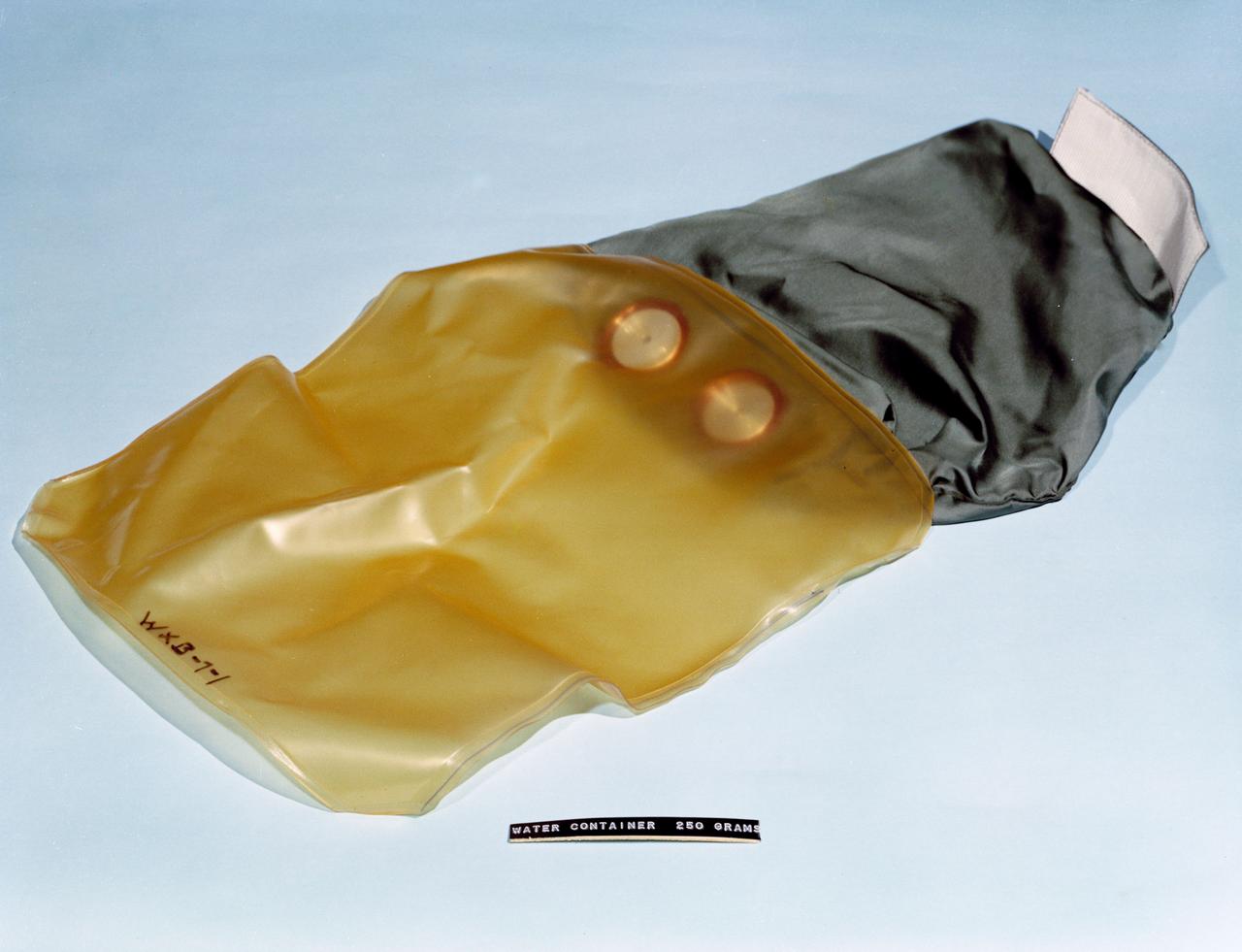
S62-06783 (1962) --- Component of Mercury astronauts survival equipment backpack - water container holding 250 grams when full. Photo credit: NASA
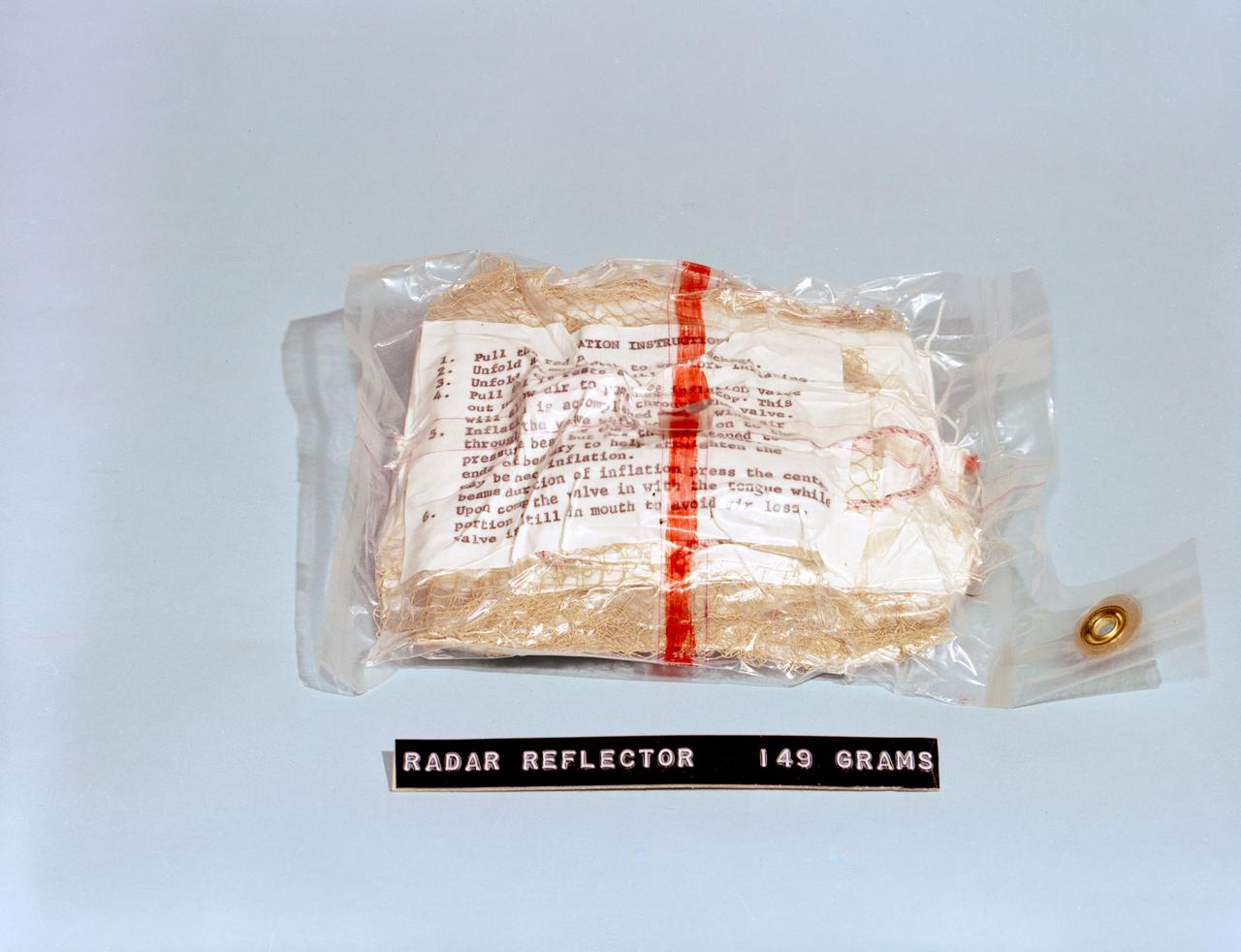
S62-06767 (1962) --- A radar reflector, survival equipment for the Mercury astronauts. Photo credit: NASA

S90-45845 (29-31 July 1990) --- Eileen M. Collins, a USAF major and a candidate for a pilot astronaut's position with NASA, listens to a briefing on parachute ejection. The classroom session was part of a three-day survival training course hosted by Vance Air Force Base in Oklahoma. Photo credit: NASA
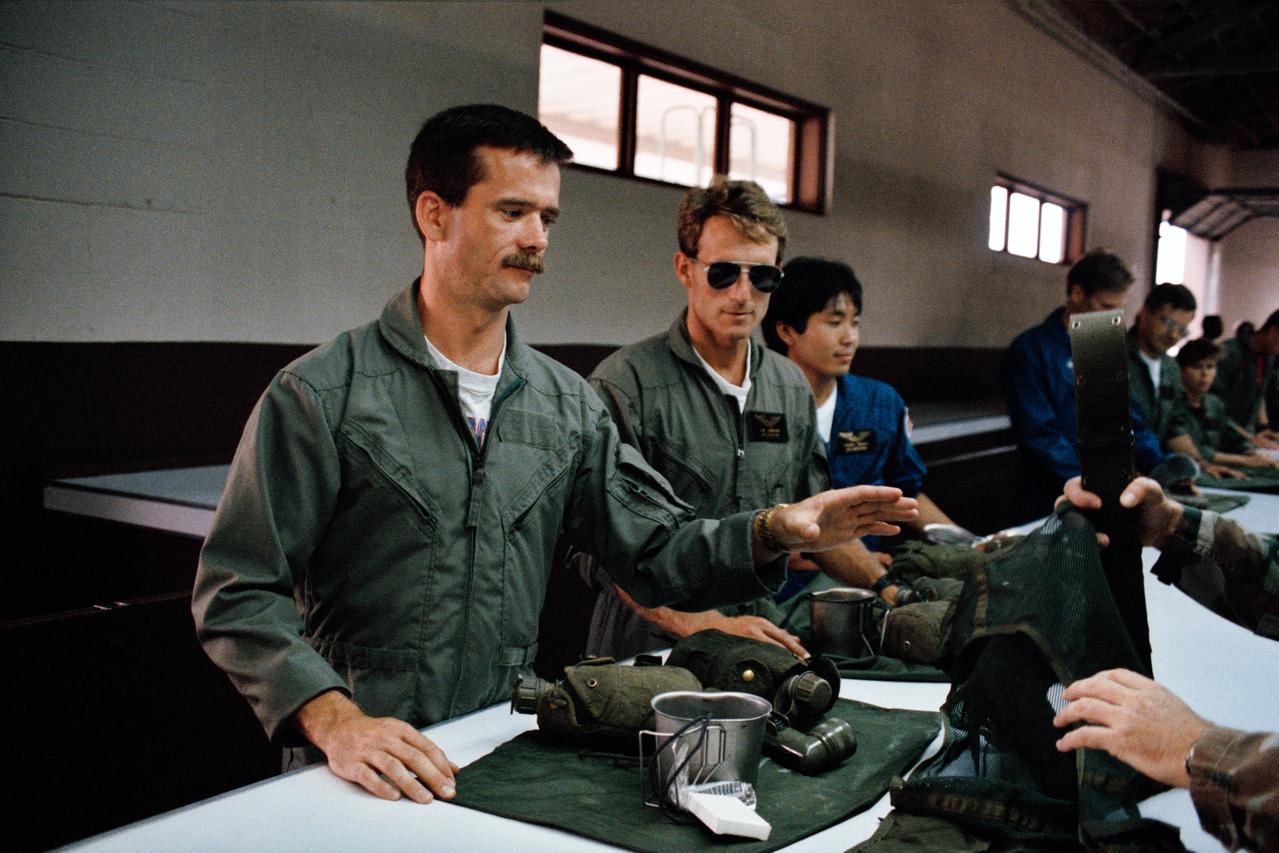
S92-46536 (16 Aug. 1992) --- Astronaut candidates Chris A. Hadfield, Jerry M. Linenger and Koichi Wakata (left to right in foreground) are issued gear for a survival school hosted by Fairchild Air Force Base. Hadfield, from Canada, and Wakata, from Japan, are among the five international candidates in the group of astronaut candidates currently involved in a year-long training and evaluation program.

Space shuttle orange launch and entry suit (LES), a partial pressure suit, is modeled by a technician. LES was designed for STS-26, the return to flight mission, and subsequent missions. Included in the crew escape system (CES) package are launch and entry helmet (LEH) with communications carrier (COMM CAP), parachute pack and harness, life raft, life preserver unit (LPU), LES gloves, suit oxygen manifold and valves, boots, and survival gear.
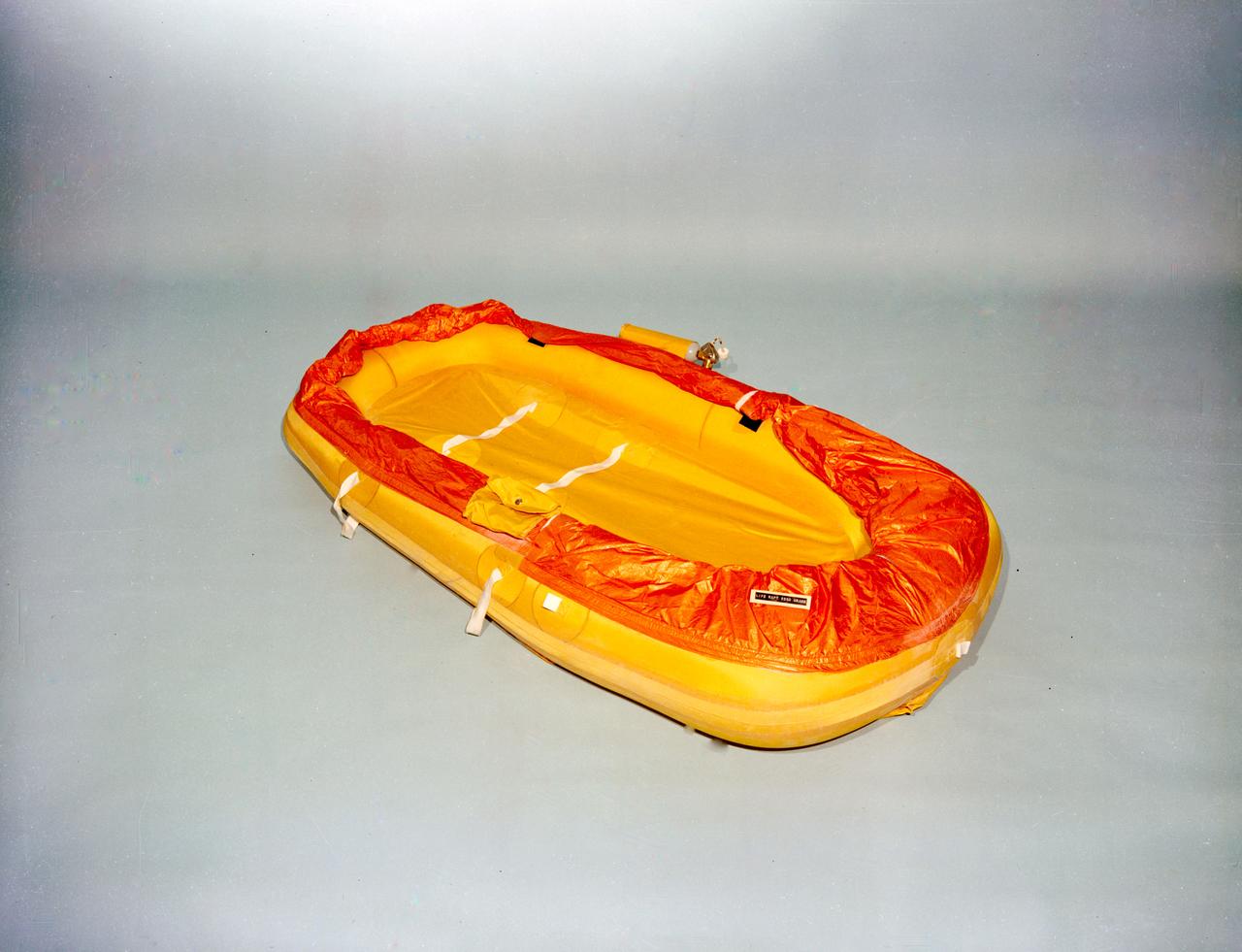
S62-06769 (1962) --- A life raft, survival equipment for the Mercury astronauts. Photo credit: NASA
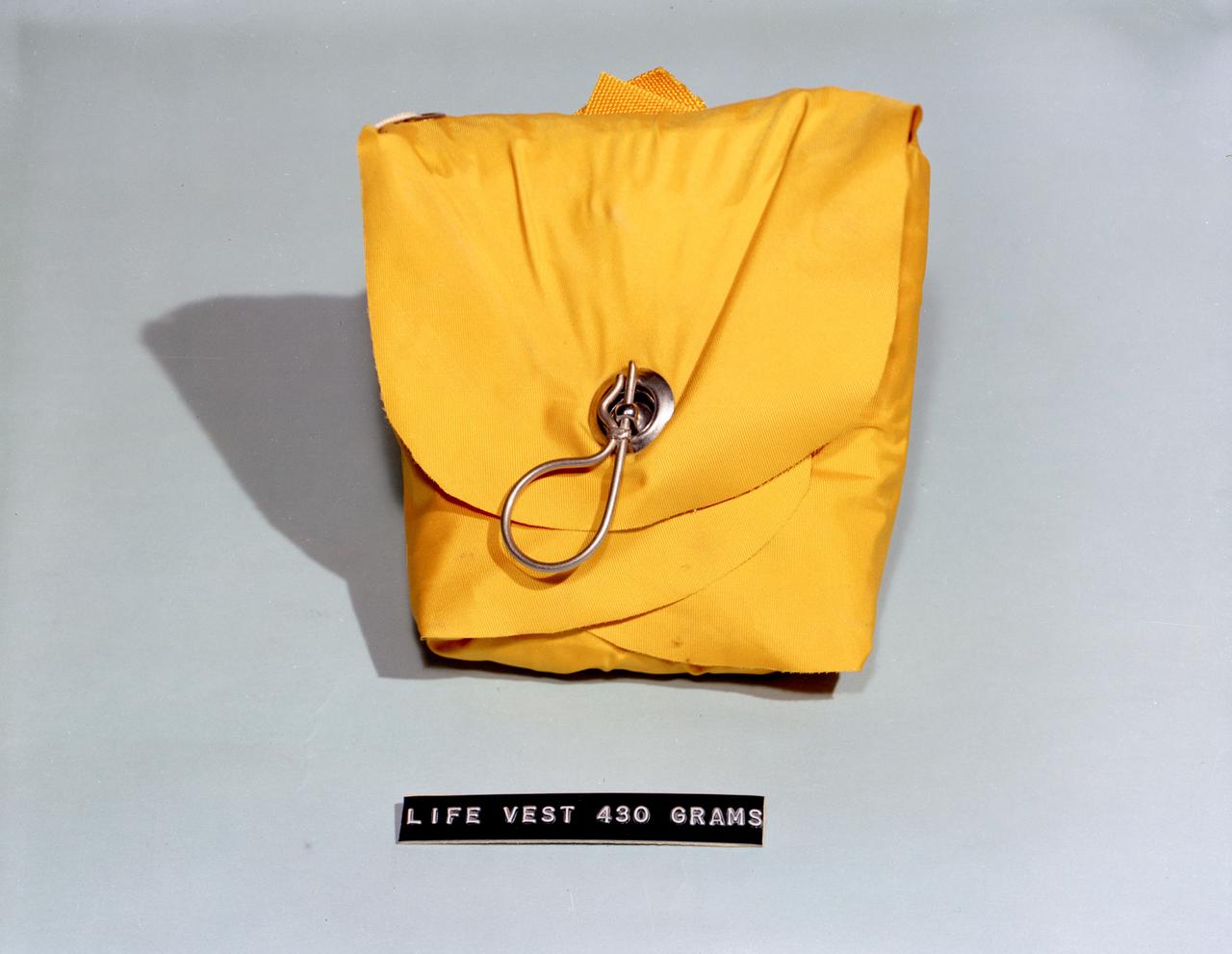
S62-06768 (1962) --- A life vest, survival equipment for the Mercury astronauts. Photo credit: NASA
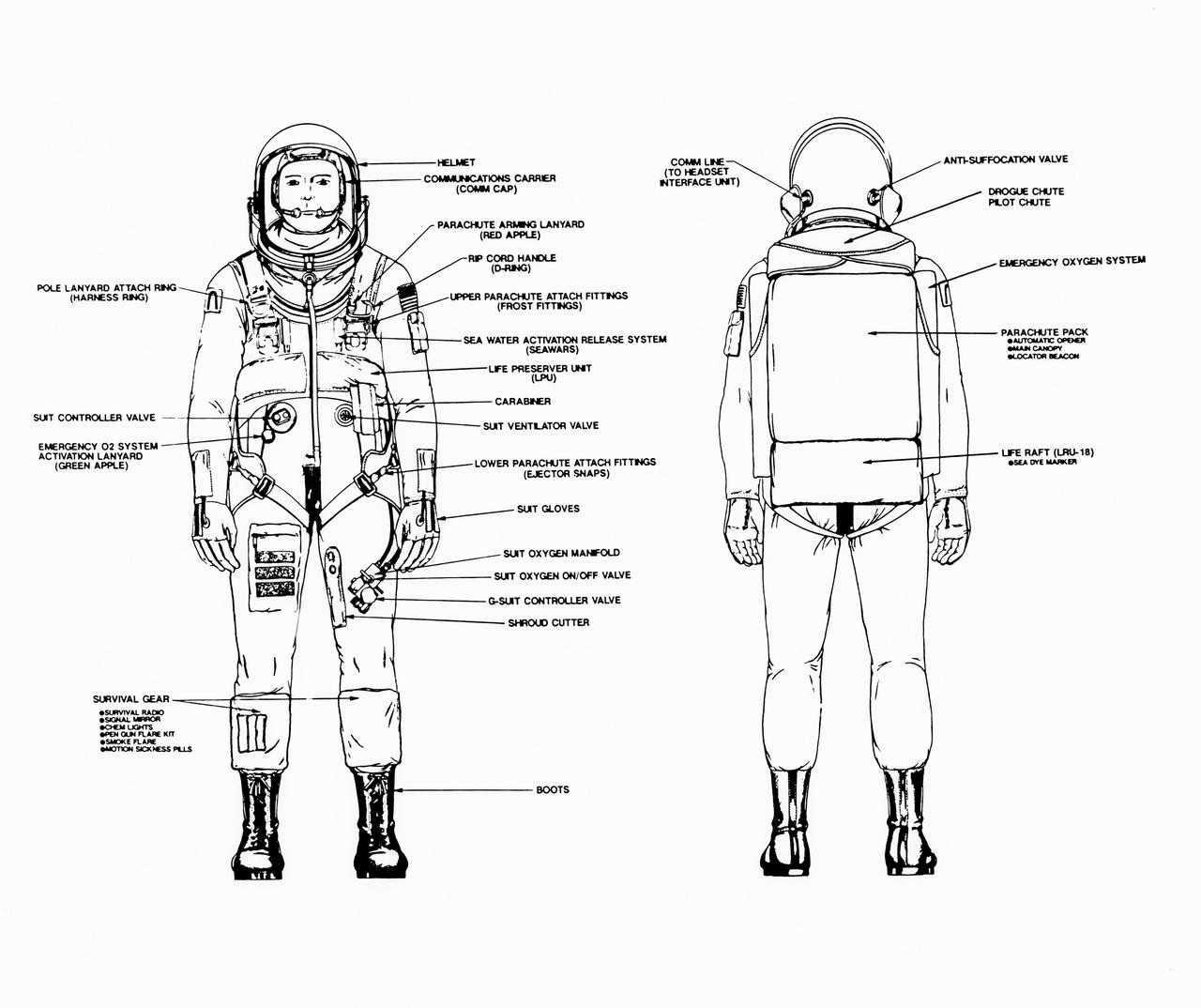
Line drawings illustrate the front and back of the space shuttle launch and entry suit (LES) and labels identify various components. LES was designed for STS-26, the return to flight mission, and subsequent missions. Included in the crew escape system (CES) package are launch and entry helmet (LEH) with communications carrier (COMM CAP), parachute pack and harness, life preserver unit (LPU), life raft unit (LRU), LES gloves, suit oxygen manifold and valves, boots, and survival gear. Details of larger components are also identified.
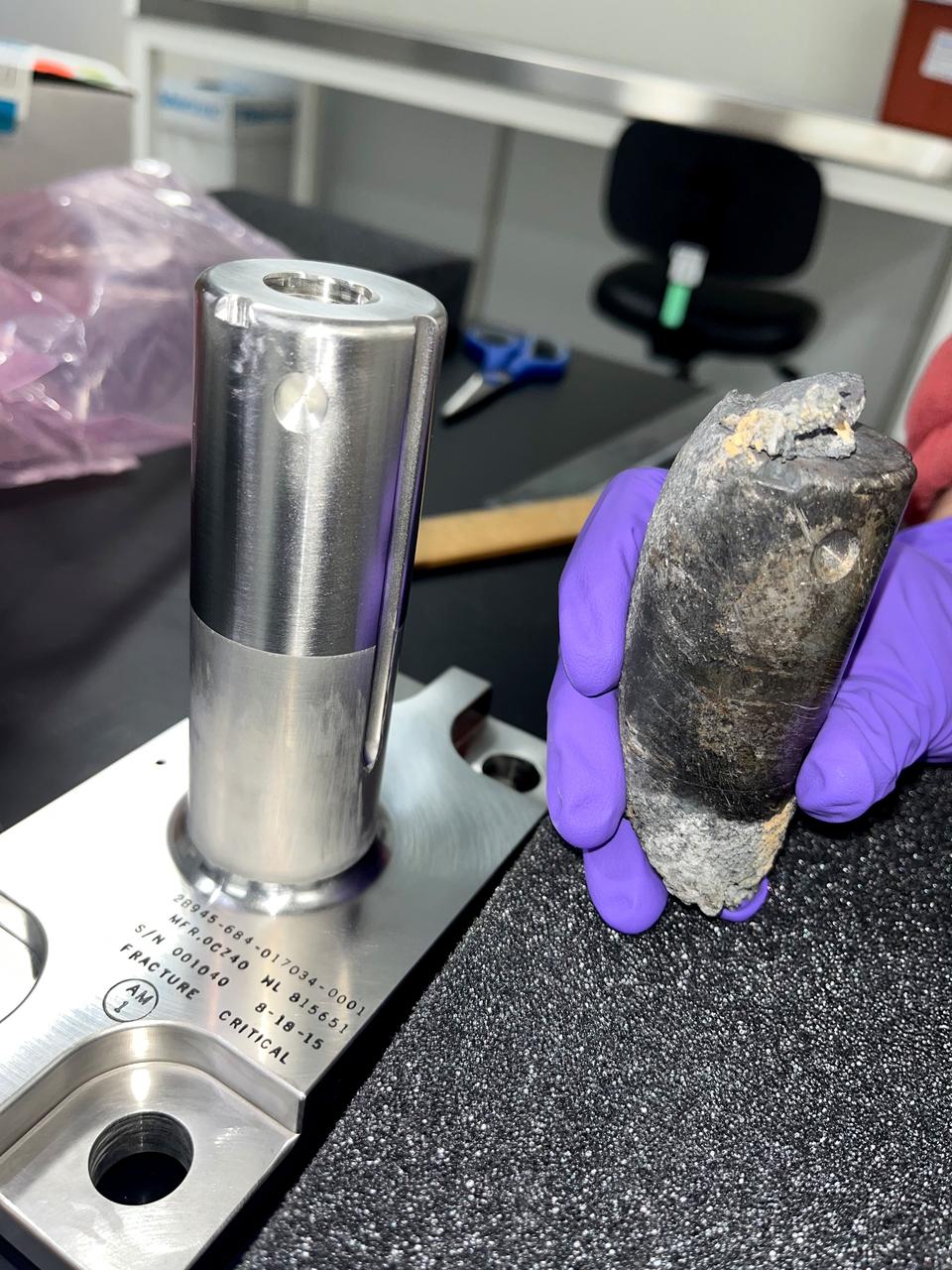
jsc2024e025649 (March 29, 2024) --- Recovered stanchion from the NASA flight support equipment used to mount International Space Station batteries on a cargo pallet. The stanchion survived re-entry through Earth’s atmosphere on March 8, 2024, and impacted a home in Naples, Florida.
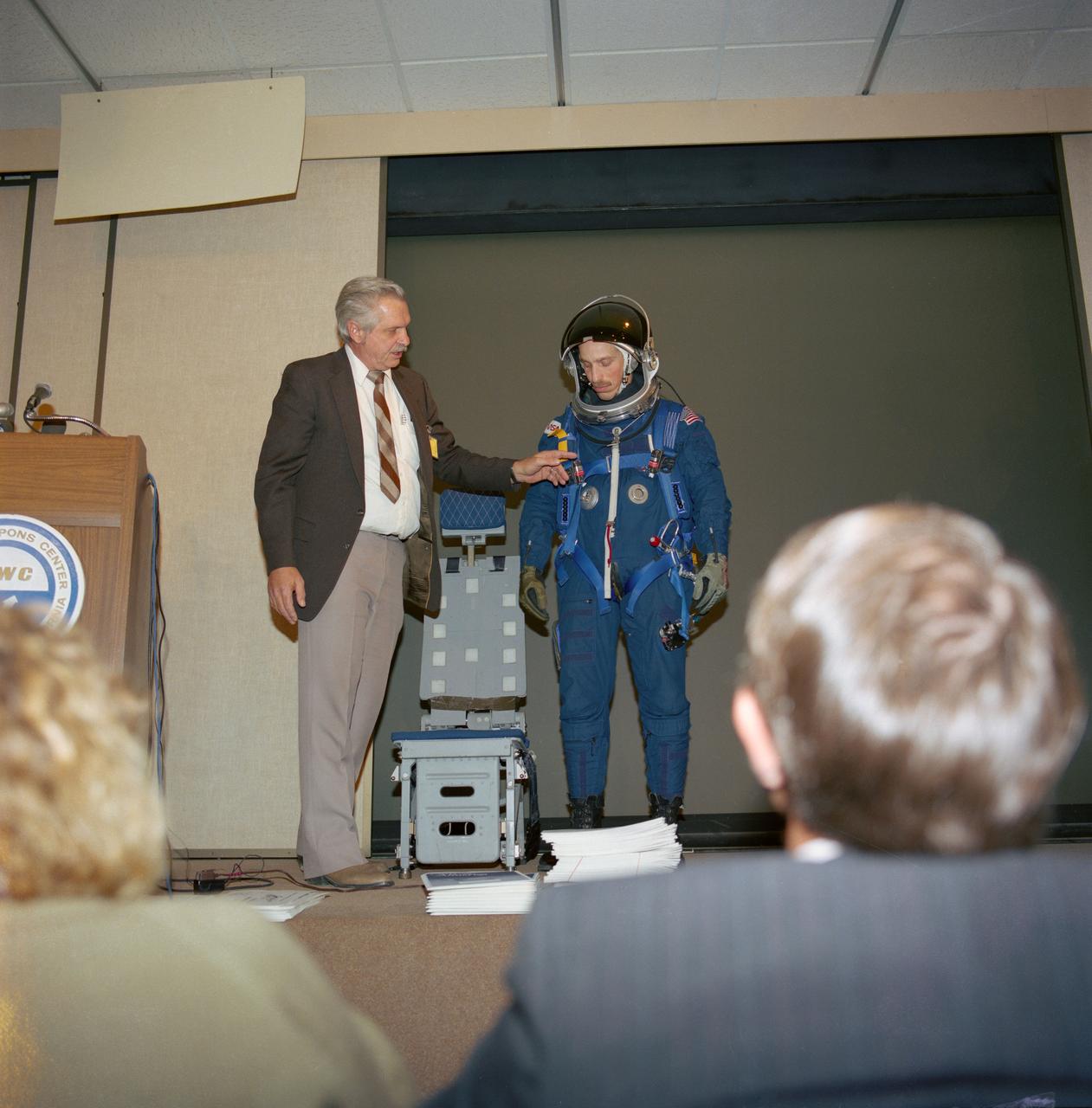
S88-25408 (8 Dec 1987) --- James O. Schlosser (left), JSC crew systems branch employee responsible for crew equipment development, gives a briefing on the crew equipment baselined for STs-26 as astronaut James P. Bagian models the new gear. Included in the package are a partial pressure suit, harness, parachute, life raft and survival gear. The deomonstration took place at the Naval Weapons Center in China Lake, CA.
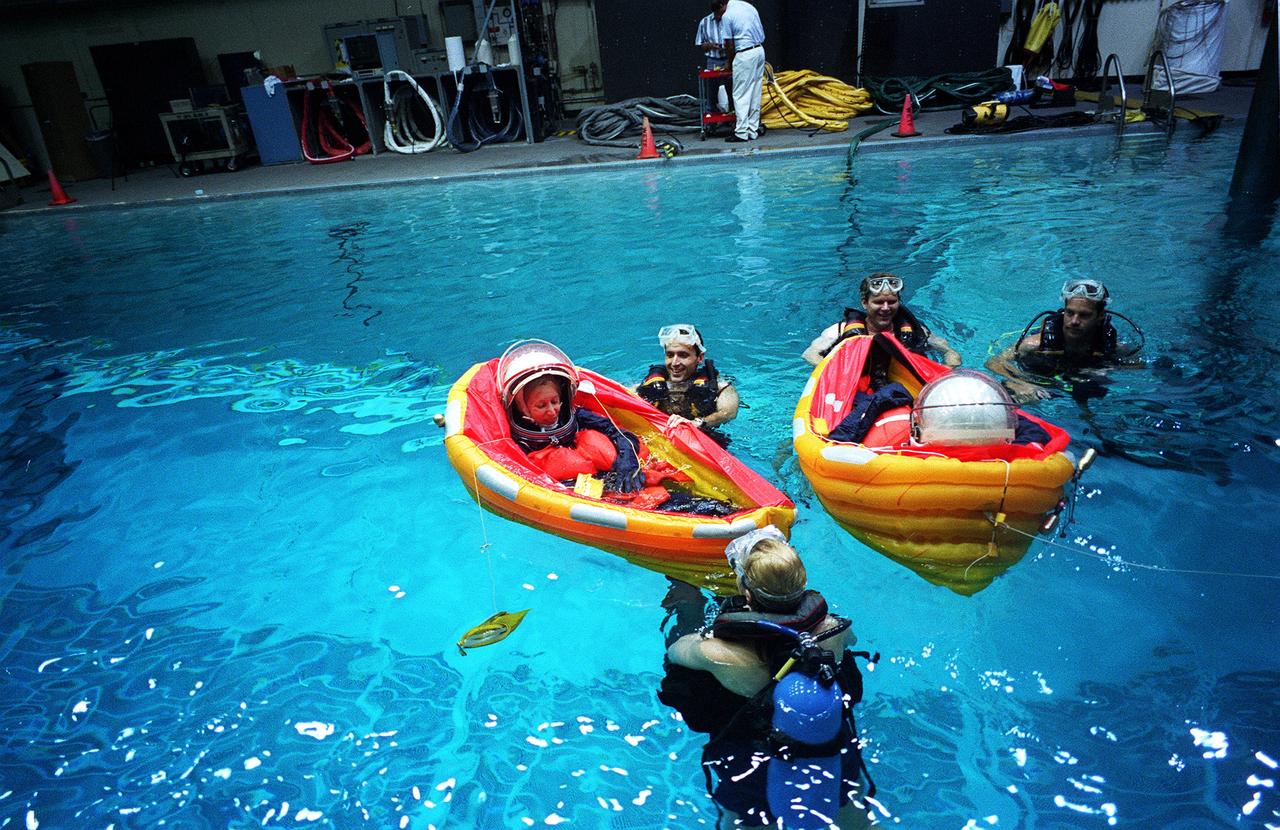
S96-15405 (26 Sept. 1996) --- In the Johnson Space Center's weightless environment training facility, astronaut Marsha S. Ivins, STS-81 mission specialist, bails water from her life raft during water bailout survival training. Astronaut Peter J.K. (Jeff) Wisoff (pictured in right raft) and four other STS-81 crewmates (out of frame) joined Ivins for the bailout training exercises. Several SCUBA-equipped divers assist in the training exercise.
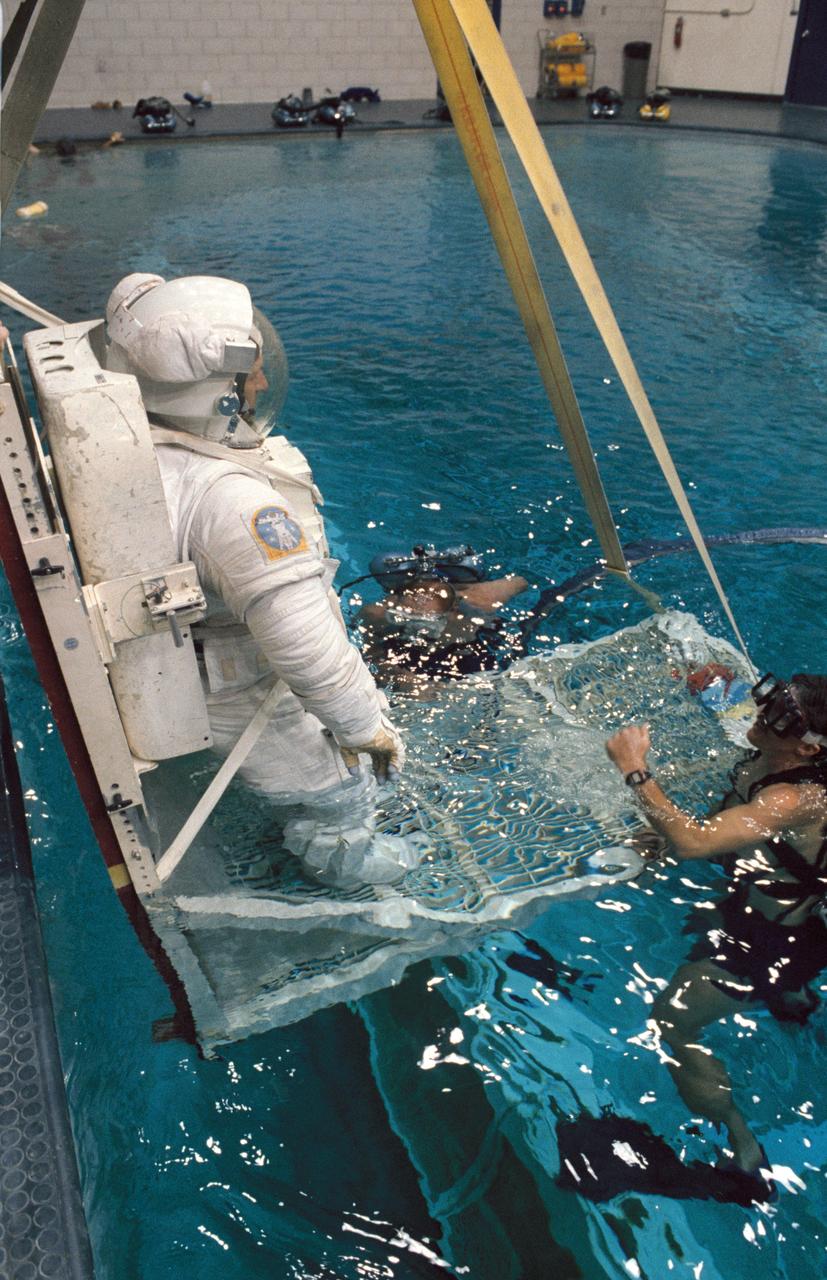
S87-44061 (25 Sept 1987) --- Dr. Claude Nicollier, equipped with a pressurized extravehicular mobility unit (EMU), is in the process of being submerged in the 25-ft. deep pool of JSC's weightless environment training facility (WET-F) for a familiarization session. Dr. Nicollier's suit is weighted to facilitate a neutrally buoyant condition. He is assisted by two SCUBA-equipped divers. Dr. Nicollier, a Swiss scientist assigned to the STS-46 mission as a payload specialist, first came to the Johnson Space Center in July 1980. Along with Dr. Wubbo Ockels, another European Scientist, Dr. Nicollier underwent survival training and other basic astronaut-type training alongside the 1980 class of astronaut candidates. Some photos in this series show Dr. Nicollier in an extravehicular mobility unit (EMU). This is for familiarization purposes only as the scientist is not scheduled for any extravehicular activity.
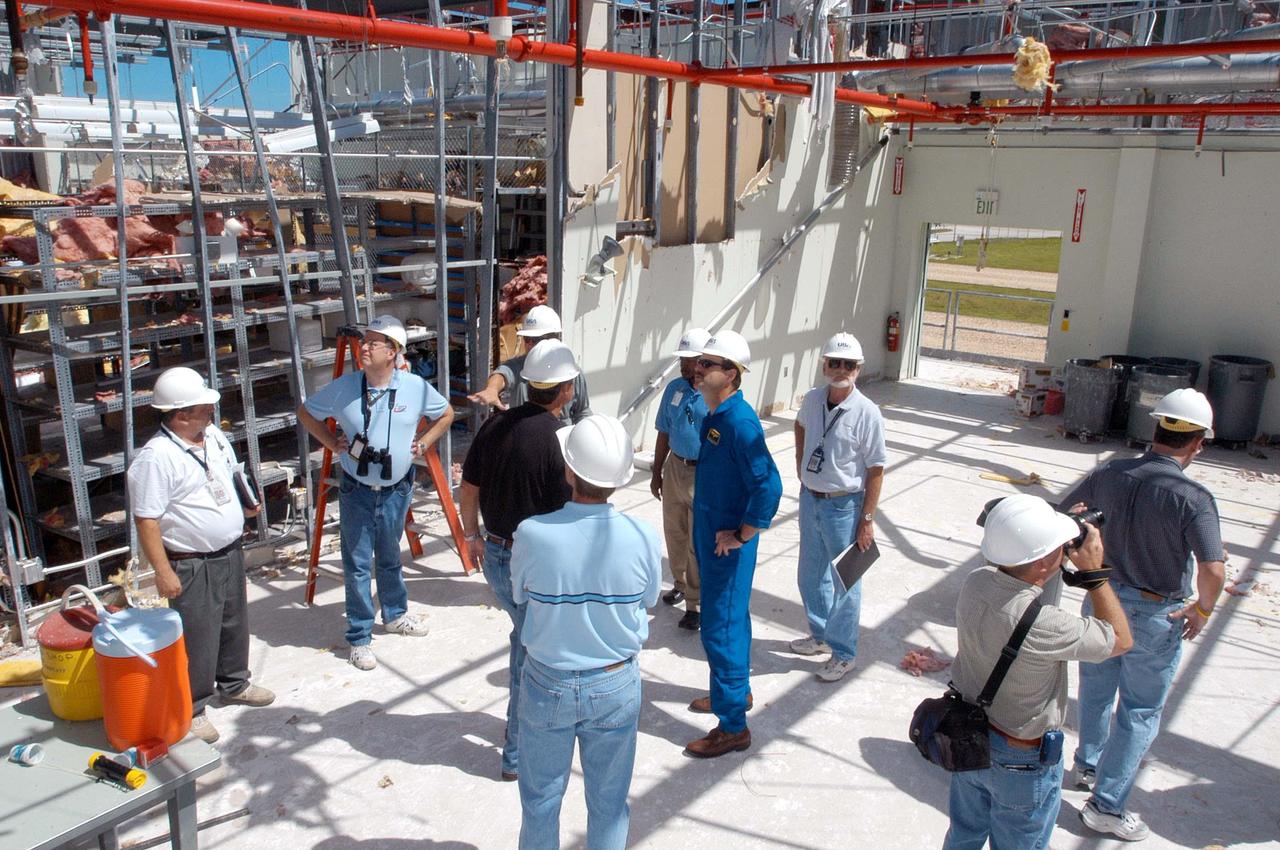
KENNEDY SPACE CENTER, FLA. - Members of a hurricane assessment team from Johnson Space Center and Marshall Space Flight Center observe the damage to the roof of the Thermal Protection System (TPS) Facility at KSC after Hurricane Frances hit the east coast of Central Florida and Kennedy Space Center. Near the center is astronaut Scott Altmann, a member of the team. The facility, which creates the TPS tiles, blankets and all the internal thermal control systems for the Space Shuttles, is almost totally unserviceable at this time after losing approximately 35 percent of its roof. Equipment and materials that survived the storm have been relocated to the RLV hangar near the KSC Shuttle Landing Facility.
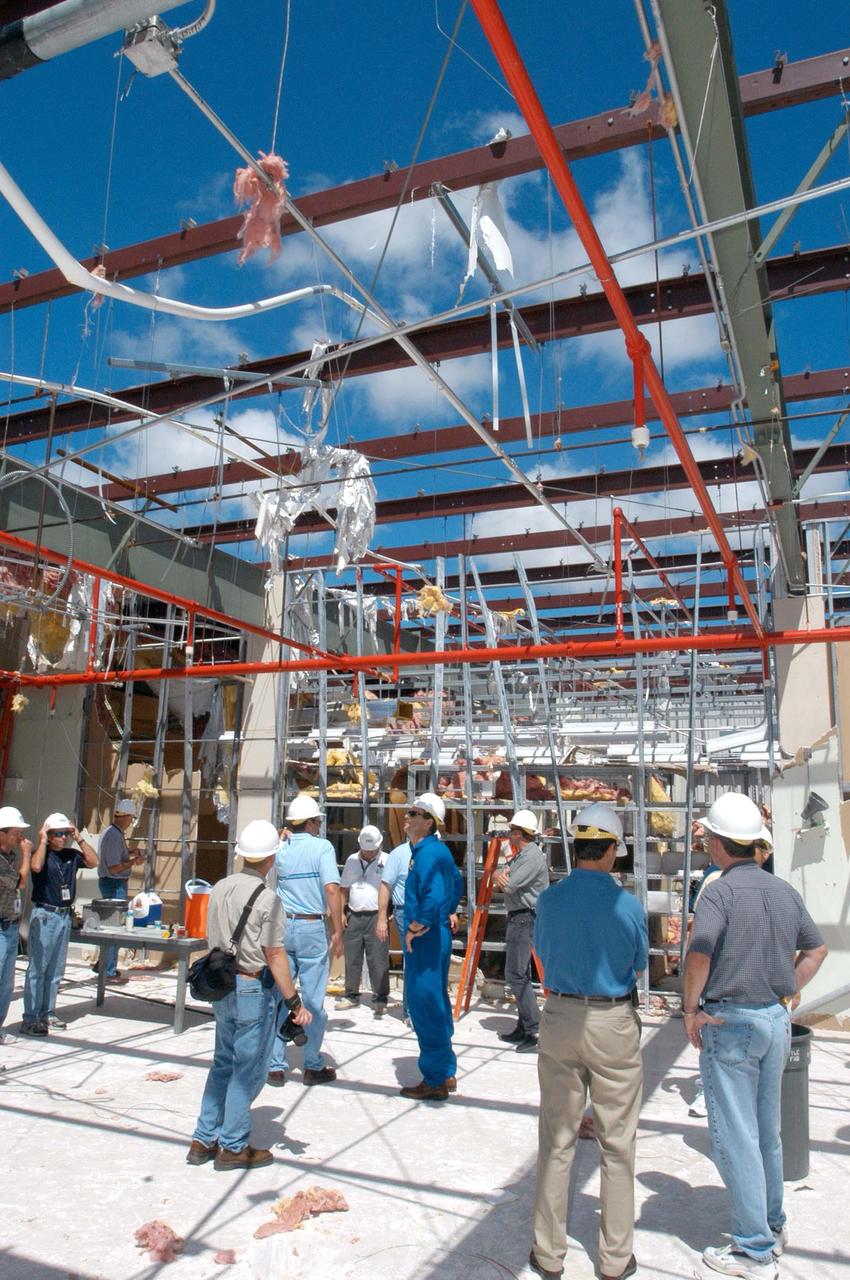
KENNEDY SPACE CENTER, FLA. - Members of a hurricane assessment team from Johnson Space Center and Marshall Space Flight Center observe the damage to the roof of the Thermal Protection System (TPS) Facility at KSC after Hurricane Frances hit the east coast of Central Florida and Kennedy Space Center. Near the center is astronaut Scott Altmann, a member of the team. The facility, which creates the TPS tiles, blankets and all the internal thermal control systems for the Space Shuttles, is almost totally unserviceable at this time after losing approximately 35 percent of its roof. Equipment and materials that survived the storm have been relocated to the RLV hangar near the KSC Shuttle Landing Facility.
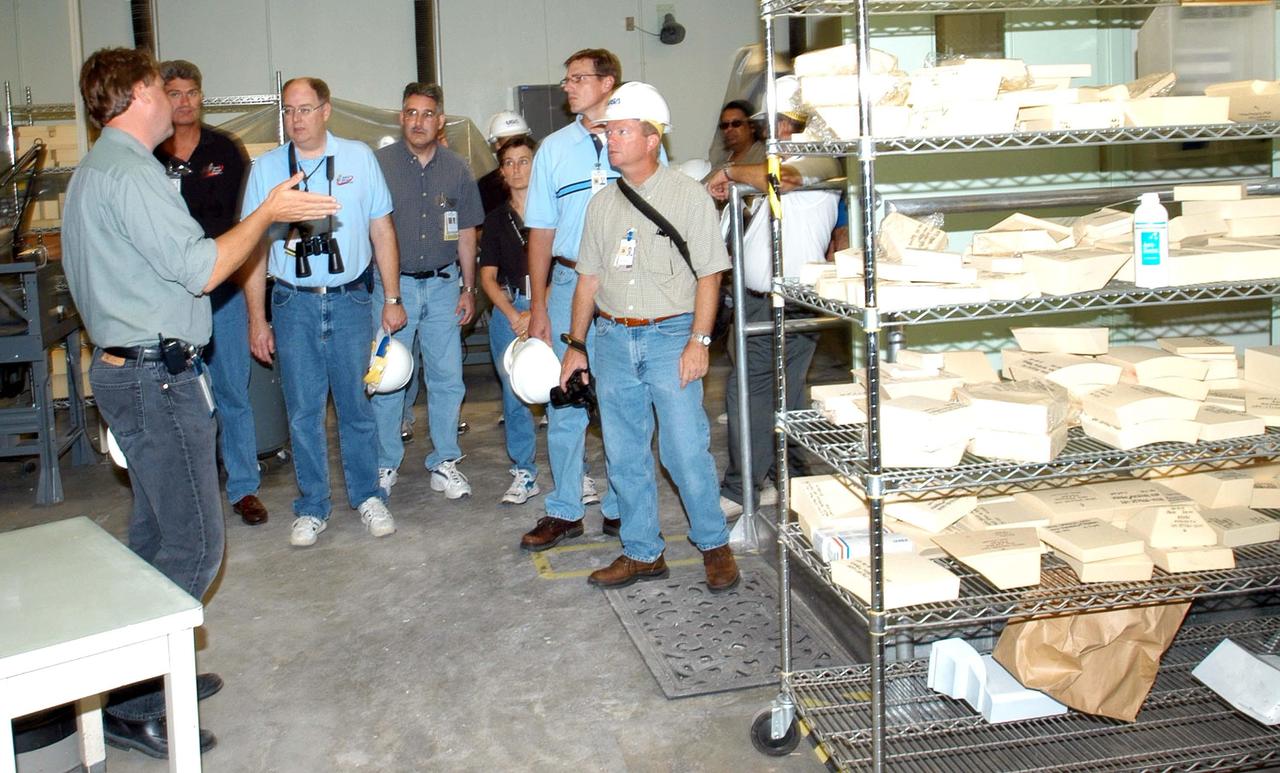
KENNEDY SPACE CENTER, FLA. - Members of a hurricane assessment team from Johnson Space Center and Marshall Space Flight Center tour the Thermal Protection System (TPS) Facility at KSC after Hurricane Frances hit the east coast of Central Florida and Kennedy Space Center. At left is Martin Wilson, manager of the TPS operations. The facility, which creates the TPS tiles, blankets and all the internal thermal control systems for the Space Shuttles, is almost totally unserviceable at this time after losing approximately 35 percent of its roof. Equipment and materials that survived the storm have been relocated to the RLV hangar near the KSC Shuttle Landing Facility.
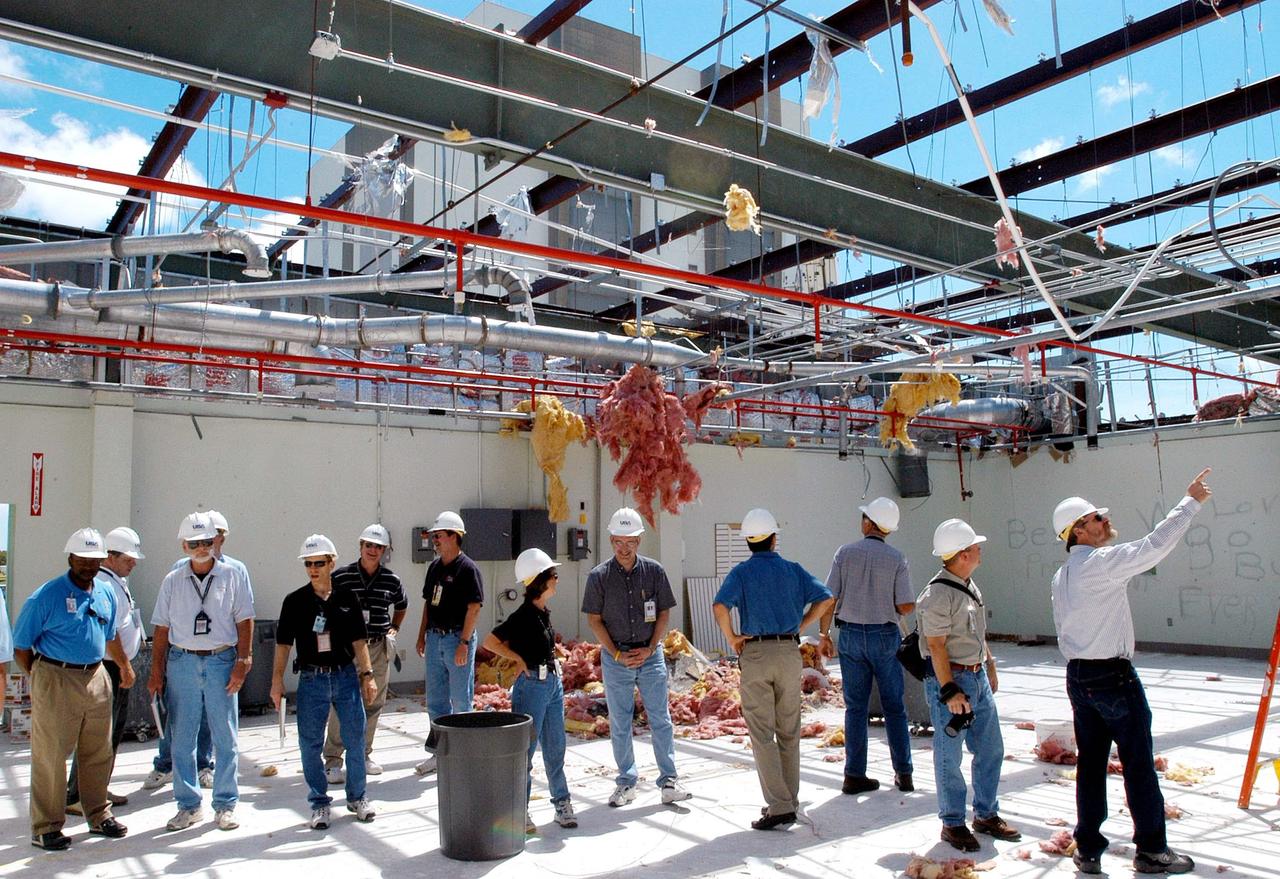
KENNEDY SPACE CENTER, FLA. - Members of a hurricane assessment team from Johnson Space Center and Marshall Space Flight Center observe the damage to the roof of the Thermal Protection System (TPS) Facility at KSC after Hurricane Frances hit the east coast of Central Florida and Kennedy Space Center. The facility, which creates the TPS tiles, blankets and all the internal thermal control systems for the Space Shuttles, is almost totally unserviceable at this time after losing approximately 35 percent of its roof. Equipment and materials that survived the storm have been relocated to the RLV hangar near the KSC Shuttle Landing Facility.
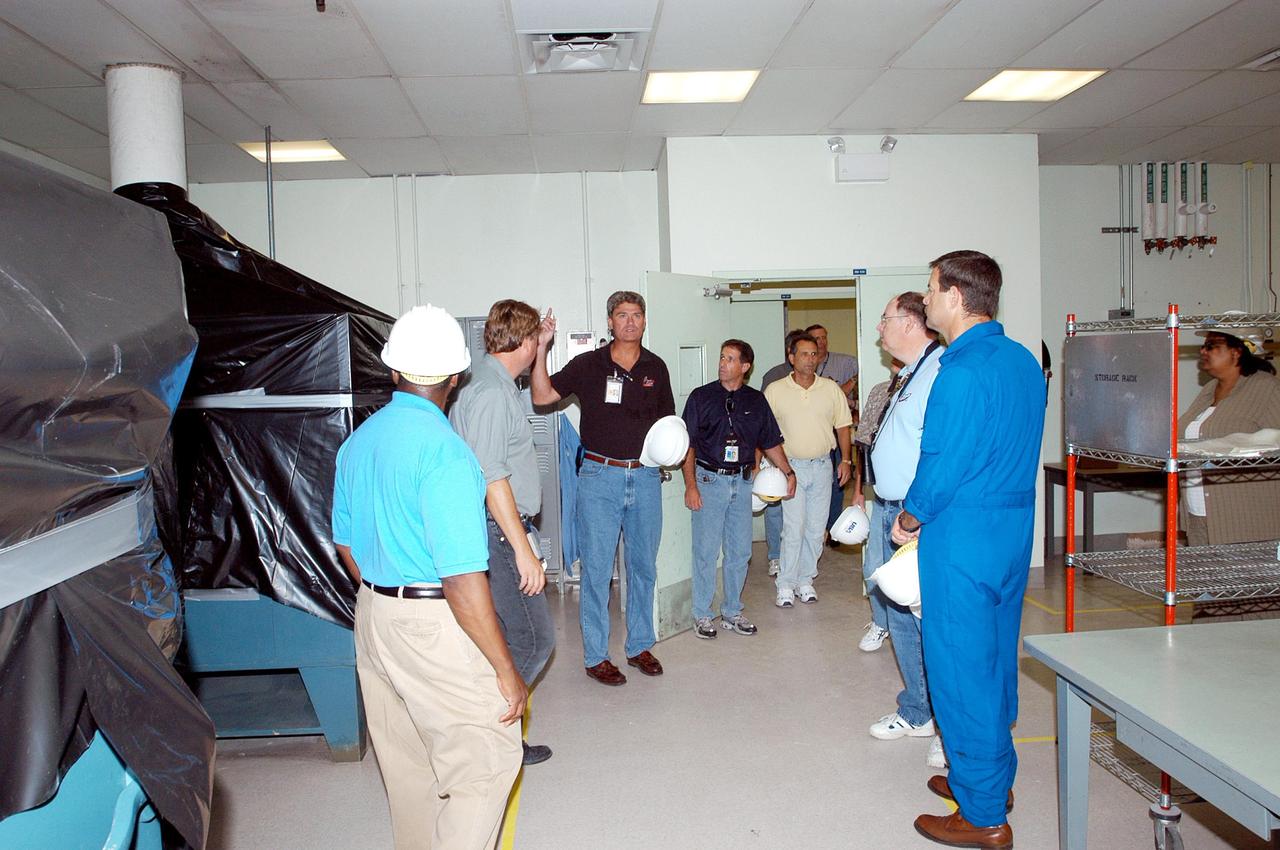
KENNEDY SPACE CENTER, FLA. - Members of a hurricane assessment team from Johnson Space Center and Marshall Space Flight Center tour the Thermal Protection System (TPS) Facility at KSC after Hurricane Frances hit the east coast of Central Florida and Kennedy Space Center. At right is astronaut Scott Altmann, a member of the team. The facility, which creates the TPS tiles, blankets and all the internal thermal control systems for the Space Shuttles, is almost totally unserviceable at this time after losing approximately 35 percent of its roof. Equipment and materials that survived the storm have been relocated to the RLV hangar near the KSC Shuttle Landing Facility.
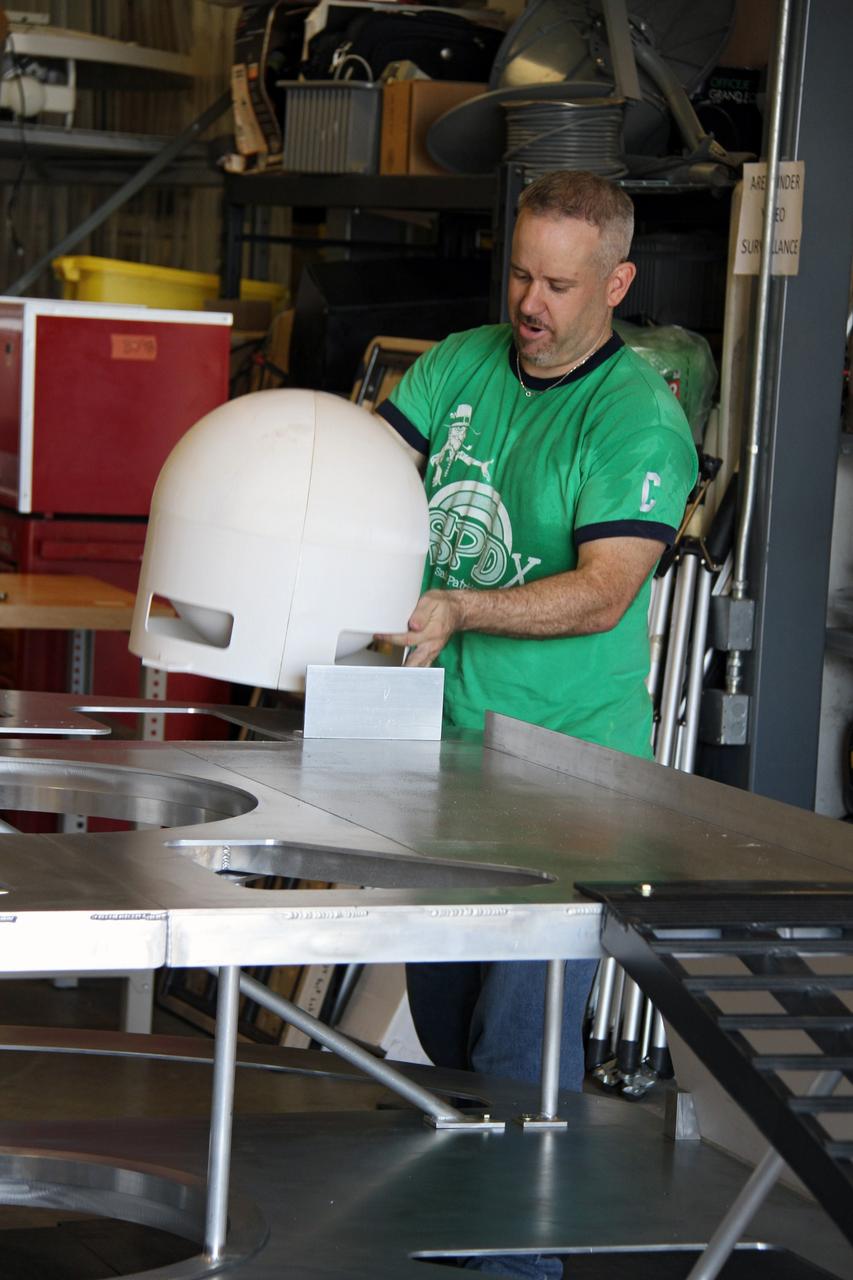
CAPE CANAVERAL, Fla. – NASA systems engineer Jim Smith assembles the prototype lander for NASA’s Regolith and Environment Science and Oxygen and Lunar Volatile Extraction, or RESOLVE, project in a test facility behind the Operations and Checkout Building at NASA’s Kennedy Space Center in Florida. RESOLVE consists of a rover and drill provided by the Canadian Space Agency to support a NASA payload that is designed to prospect for water, ice and other lunar resources. RESOLVE also will demonstrate how future explorers can take advantage of resources at potential landing sites by manufacturing oxygen from soil. NASA will be conducting field tests in July outside of Hilo, Hawaii, with equipment and concept vehicles that demonstrate how explorers might prospect for resources and make their own oxygen for survival while on other planetary bodies. For more information, visit http://www.nasa.gov/exploration/analogs/index.html. Photo credit: NASA/Ben Smegelsky
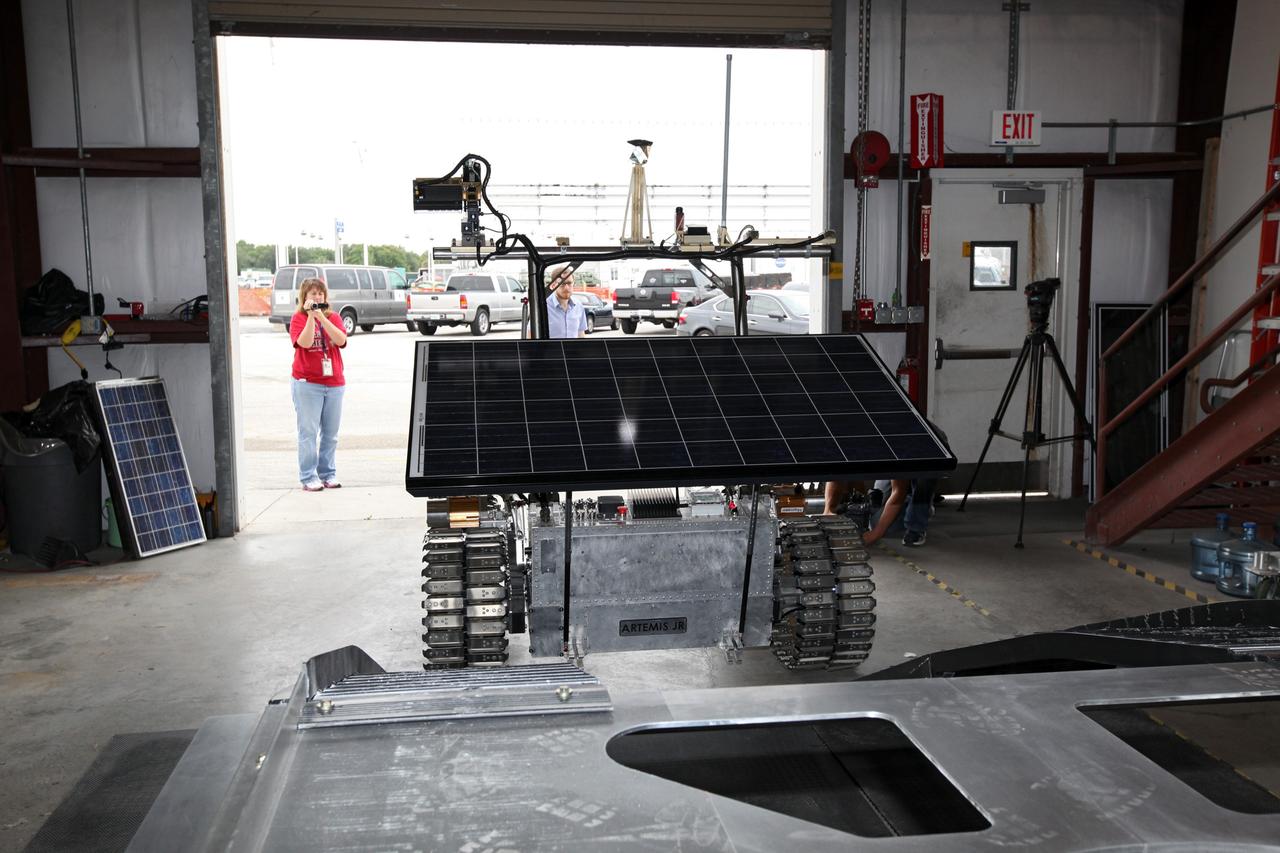
CAPE CANAVERAL, Fla. – In a test facility behind the Operations and Checkout Building at NASA’s Kennedy Space Center in Florida, the prototype rover Artemis Jr. for NASA’s Regolith and Environment Science and Oxygen and Lunar Volatile Extraction, or RESOLVE, project dismounts from the RESOLVE lander during a dry run using ramps attached to the prototype lander. RESOLVE consists of a rover and drill provided by the Canadian Space Agency to support a NASA payload that is designed to prospect for water, ice and other lunar resources. RESOLVE also will demonstrate how future explorers can take advantage of resources at potential landing sites by manufacturing oxygen from soil. NASA will conduct field tests in July outside of Hilo, Hawaii, with equipment and concept vehicles that demonstrate how explorers might prospect for resources and make their own oxygen for survival while on other planetary bodies. For more information, visit http://www.nasa.gov/exploration/analogs/index.html. Photo credit: NASA/Dimitri Gerondidakis
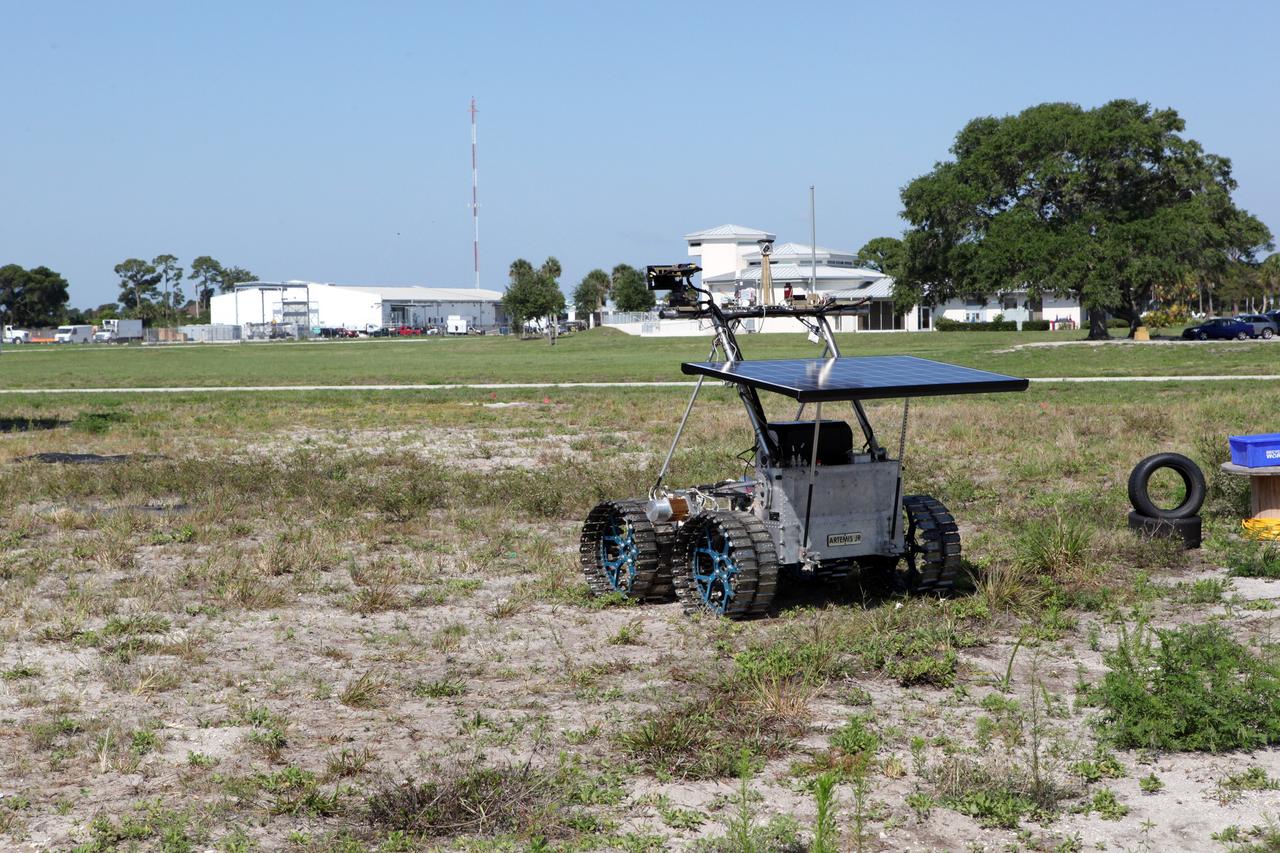
CAPE CANAVERAL, Fla. – The prototype rover Artemis Jr. for NASA’s Regolith and Environment Science and Oxygen and Lunar Volatile Extraction, or RESOLVE, project takes a spin around the field next to the Operations and Checkout Building at NASA’s Kennedy Space Center in Florida. RESOLVE consists of a rover and drill provided by the Canadian Space Agency to support a NASA payload that is designed to prospect for water, ice and other lunar resources. RESOLVE also will demonstrate how future explorers can take advantage of resources at potential landing sites by manufacturing oxygen from soil. NASA will conduct field tests in July outside of Hilo, Hawaii, with equipment and concept vehicles that demonstrate how explorers might prospect for resources and make their own oxygen for survival while on other planetary bodies. For more information, visit http://www.nasa.gov/exploration/analogs/index.html. Photo credit: NASA/Dimitri Gerondidakis
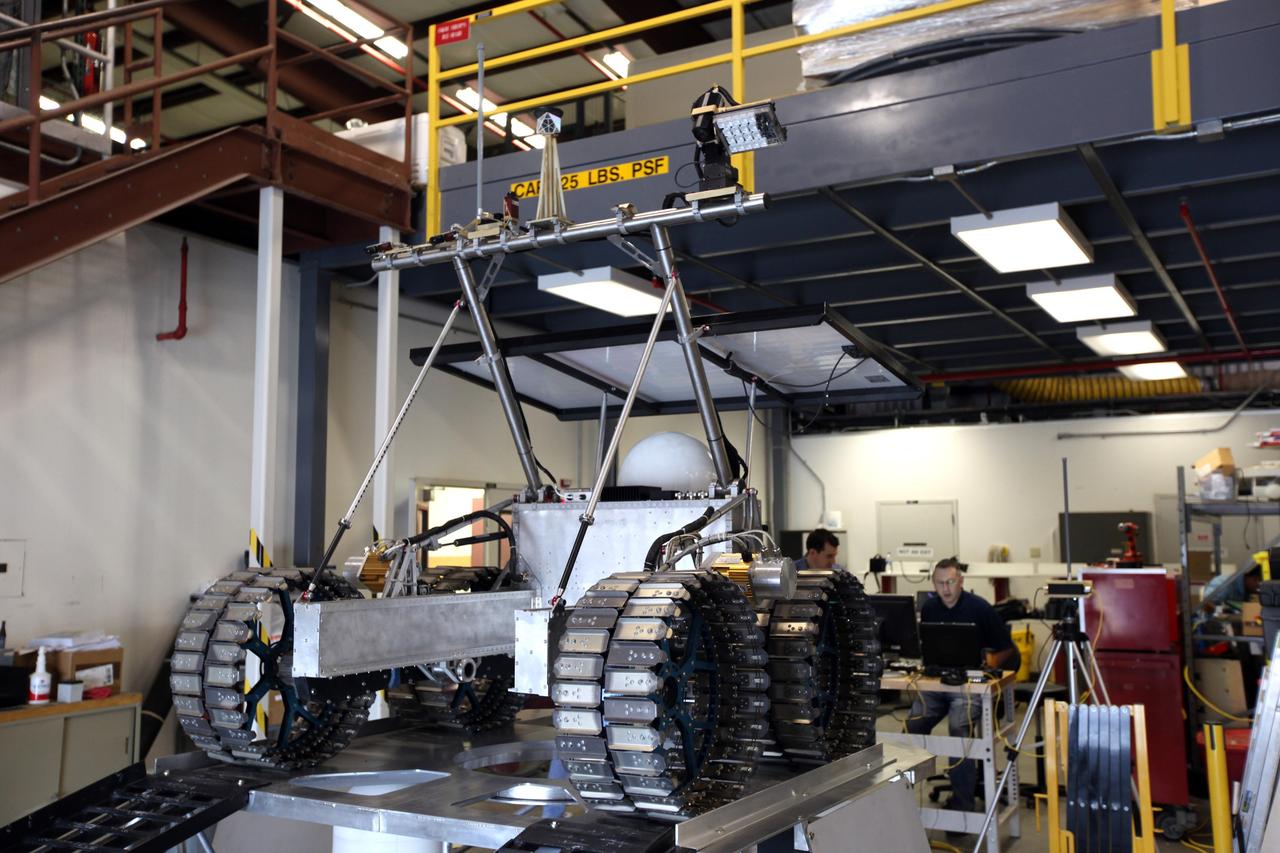
CAPE CANAVERAL, Fla. – The prototype rover Artemis Jr. for NASA’s Regolith and Environment Science and Oxygen and Lunar Volatile Extraction, or RESOLVE, project is unpacked in a test facility behind the Operations and Checkout Building at NASA’s Kennedy Space Center in Florida and in place on top of the prototype lander. RESOLVE consists of a rover and drill provided by the Canadian Space Agency to support a NASA payload that is designed to prospect for water, ice and other lunar resources. RESOLVE also will demonstrate how future explorers can take advantage of resources at potential landing sites by manufacturing oxygen from soil. NASA will conduct field tests in July outside of Hilo, Hawaii, with equipment and concept vehicles that demonstrate how explorers might prospect for resources and make their own oxygen for survival while on other planetary bodies. For more information, visit http://www.nasa.gov/exploration/analogs/index.html. Photo credit: NASA/Dimitri Gerondidakis
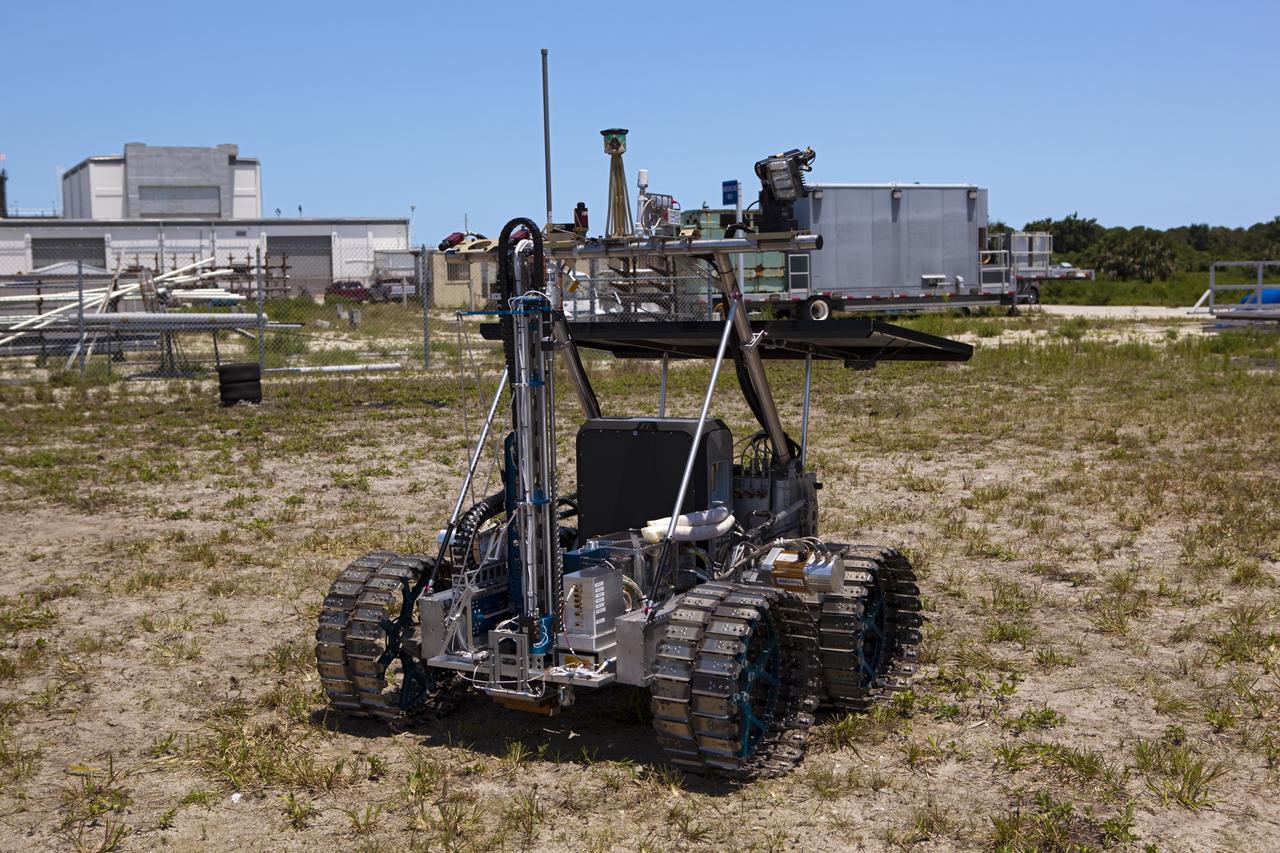
CAPE CANAVERAL, Fla. – A demonstration of the prototype rover Artemis Jr. for NASA’s Regolith and Environment Science and Oxygen and Lunar Volatile Extraction, or RESOLVE, project is conducted in a field beside the Operations and Checkout Building at NASA’s Kennedy Space Center in Florida. The rover and its drill are provided by the Canadian Space Agency and work in concert with NASA science instruments to prospect for water, ice and other lunar resources. RESOLVE also will demonstrate how future explorers can take advantage of resources at potential landing sites by manufacturing oxygen from soil. NASA will conduct field tests in July outside of Hilo, Hawaii, with equipment and concept vehicles that demonstrate how explorers might prospect for resources and make their own oxygen for survival while on other planetary bodies. For more information, visit http://www.nasa.gov/exploration/analogs/index.html. Photo credit: NASA/Dimitri Gerondidakis
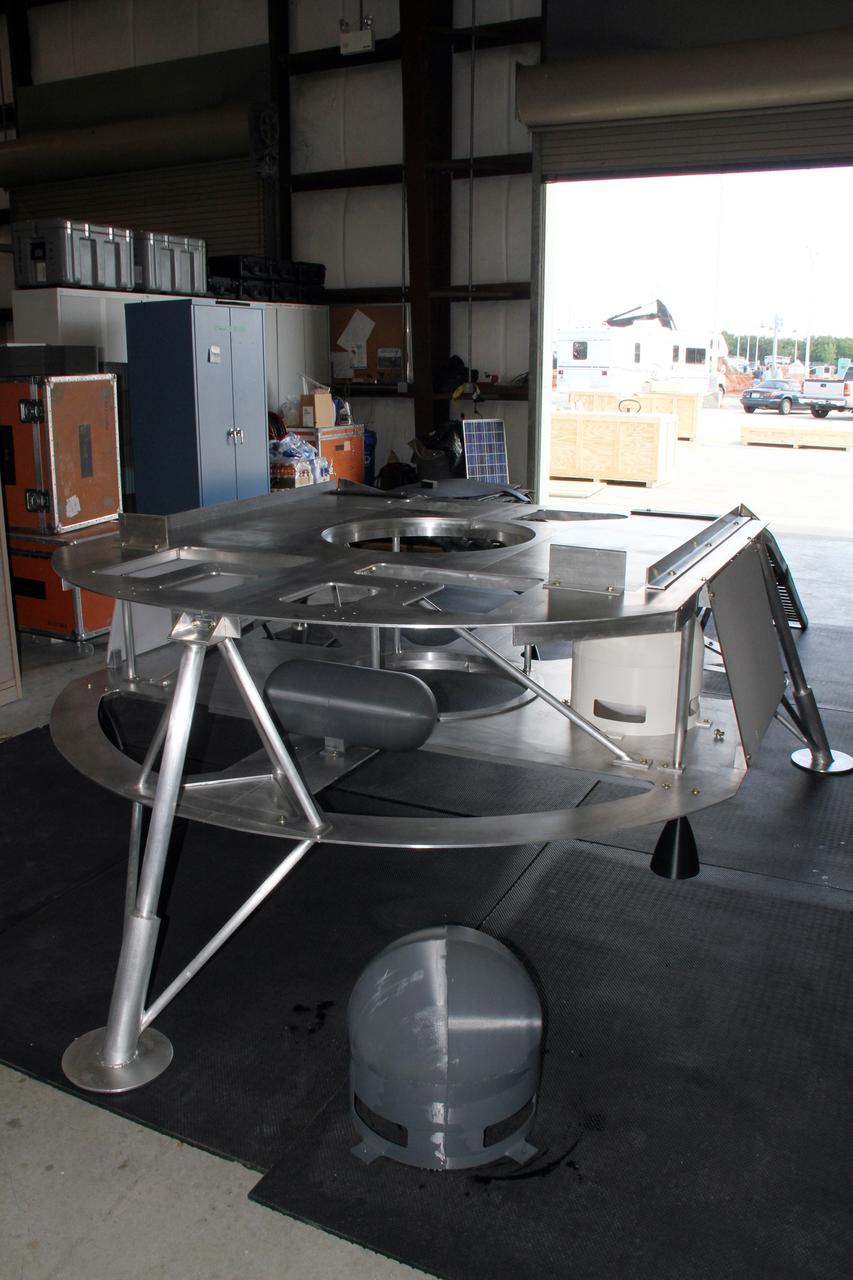
CAPE CANAVERAL, Fla. – Assembly of the prototype lander for NASA’s Regolith and Environment Science and Oxygen and Lunar Volatile Extraction, or RESOLVE, project is complete in a test facility behind the Operations and Checkout Building at NASA’s Kennedy Space Center in Florida. RESOLVE consists of a rover and drill provided by the Canadian Space Agency to support a NASA payload that is designed to prospect for water, ice and other lunar resources. RESOLVE also will demonstrate how future explorers can take advantage of resources at potential landing sites by manufacturing oxygen from soil. NASA will be conducting field tests in July outside of Hilo, Hawaii, with equipment and concept vehicles that demonstrate how explorers might prospect for resources and make their own oxygen for survival while on other planetary bodies. For more information, visit http://www.nasa.gov/exploration/analogs/index.html. Photo credit: NASA/Ben Smegelsky
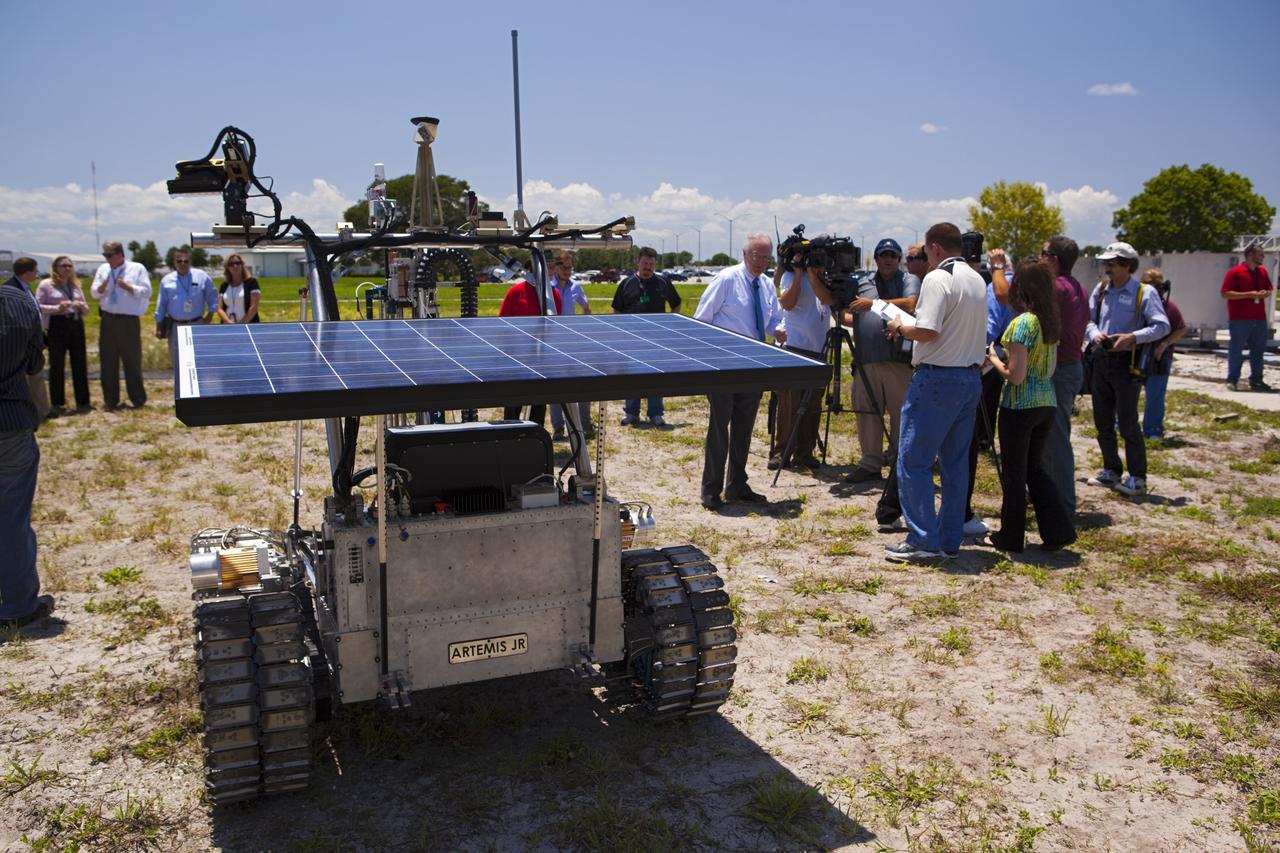
CAPE CANAVERAL, Fla. – The solar array on the prototype rover Artemis Jr. for NASA’s Regolith and Environment Science and Oxygen and Lunar Volatile Extraction, or RESOLVE, project soaks up the sunlight during a rover demonstration for media representatives in a field beside the Operations and Checkout Building at NASA’s Kennedy Space Center in Florida. The rover and its drill are provided by the Canadian Space Agency and work in concert with NASA science instruments to prospect for water, ice and other lunar resources. RESOLVE also will demonstrate how future explorers can take advantage of resources at potential landing sites by manufacturing oxygen from soil. NASA will conduct field tests in July outside of Hilo, Hawaii, with equipment and concept vehicles that demonstrate how explorers might prospect for resources and make their own oxygen for survival while on other planetary bodies. For more information, visit http://www.nasa.gov/exploration/analogs/index.html. Photo credit: NASA/Dimitri Gerondidakis
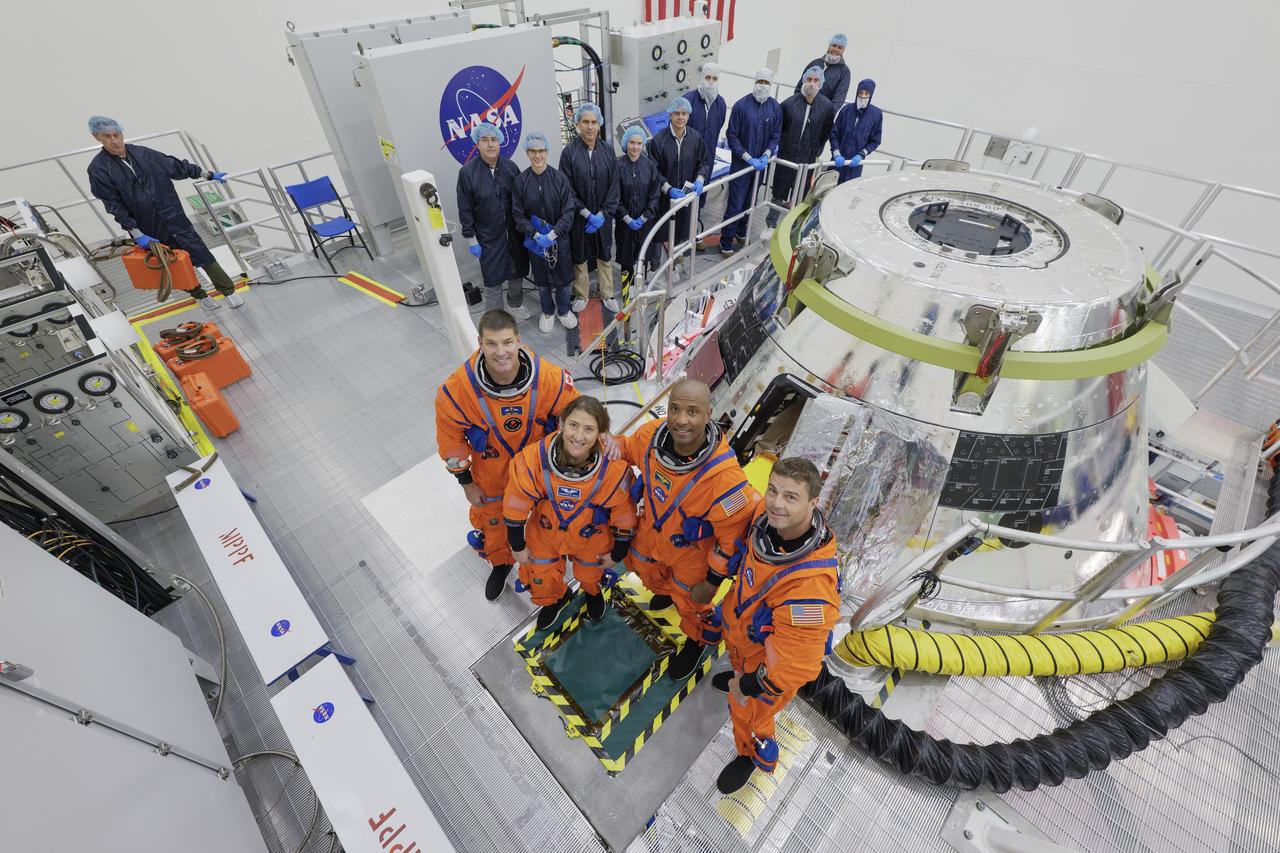
The Artemis II crew (from left to right) CSA (Canadian Space Agency) Jeremy Hansen, mission specialist; Christina Koch, mission specialist; Victor Glover, pilot; and Reid Wiseman, commander, don their Orion Crew Survival System Suits for a multi-day crew module training beginning Thursday, July 31, 2025 at the agency’s Kennedy Space Center in Florida. Behind the crew, wearing clean room apparel, are members of the Artemis II closeout crew. Testing included a suited crew test and crew equipment interface test, performing launch day and simulated orbital activities inside the Orion spacecraft. This series of tests marks the first time the crew entered their spacecraft that will take them around the Moon and back to Earth while wearing their spacesuits.
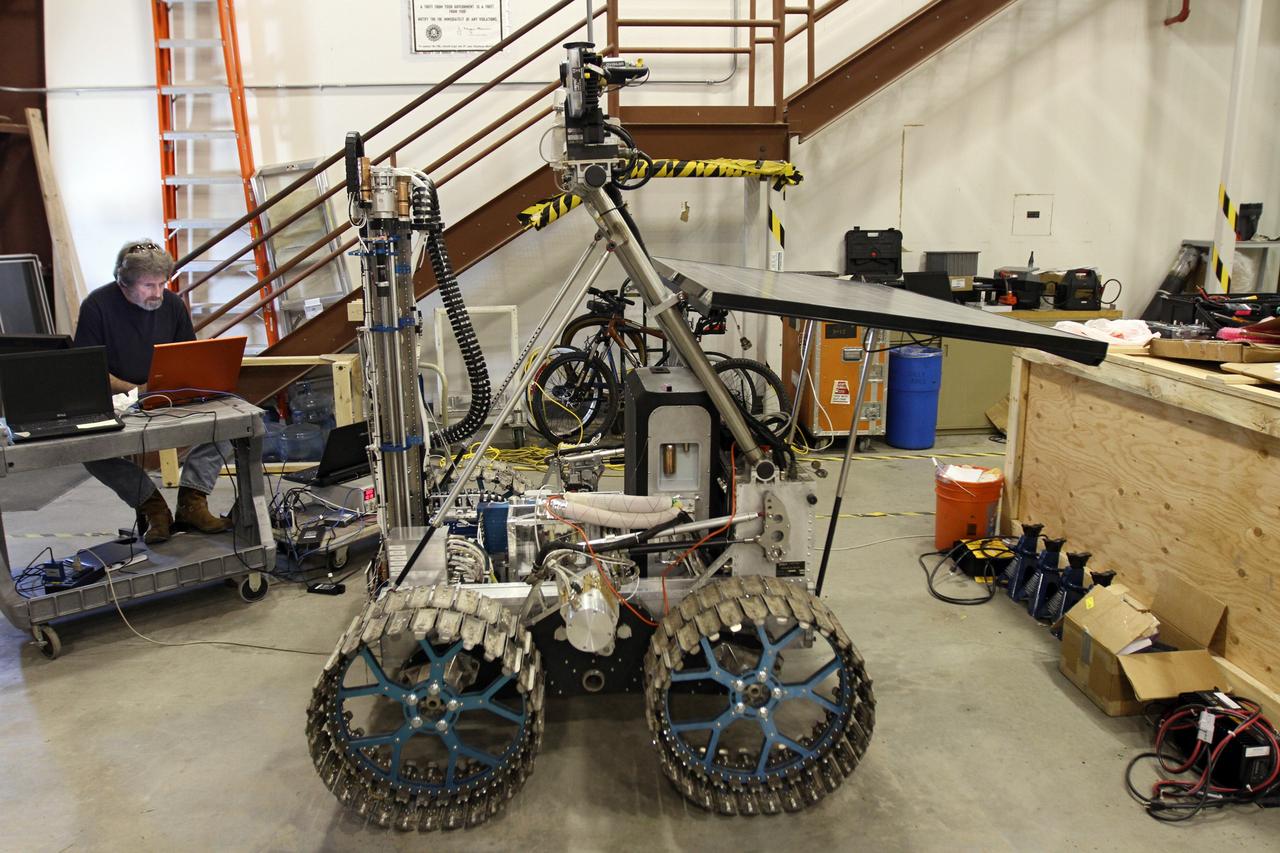
CAPE CANAVERAL, Fla. – The NASA payload is installed on the prototype rover Artemis Jr. for NASA’s Regolith and Environment Science and Oxygen and Lunar Volatile Extraction, or RESOLVE, project in a test facility behind the Operations and Checkout Building at NASA’s Kennedy Space Center in Florida. The cylindrical structure at left is the drill the tabletop surface at right is the rover’s solar array. The drill and rover were provided to NASA by the Canadian Space Agency. The NASA payload is designed to prospect for water, ice and other lunar resources. RESOLVE also will demonstrate how future explorers can take advantage of resources at potential landing sites by manufacturing oxygen from soil. NASA will conduct field tests in July outside of Hilo, Hawaii, with equipment and concept vehicles that demonstrate how explorers might prospect for resources and make their own oxygen for survival while on other planetary bodies. For more information, visit http://www.nasa.gov/exploration/analogs/index.html. Photo credit: NASA/Cory Huston

CAPE CANAVERAL, Fla. – The prototype lander for NASA’s Regolith and Environment Science and Oxygen and Lunar Volatile Extraction, or RESOLVE, project is assembled and ready for testing in a facility behind the Operations and Checkout Building at NASA’s Kennedy Space Center in Florida. RESOLVE consists of a rover and drill provided by the Canadian Space Agency to support a NASA payload that is designed to prospect for water, ice and other lunar resources. RESOLVE also will demonstrate how future explorers can take advantage of resources at potential landing sites by manufacturing oxygen from soil. NASA will be conducting field tests in July outside of Hilo, Hawaii, with equipment and concept vehicles that demonstrate how explorers might prospect for resources and make their own oxygen for survival while on other planetary bodies. For more information, visit http://www.nasa.gov/exploration/analogs/index.html. Photo credit: NASA/Ben Smegelsky
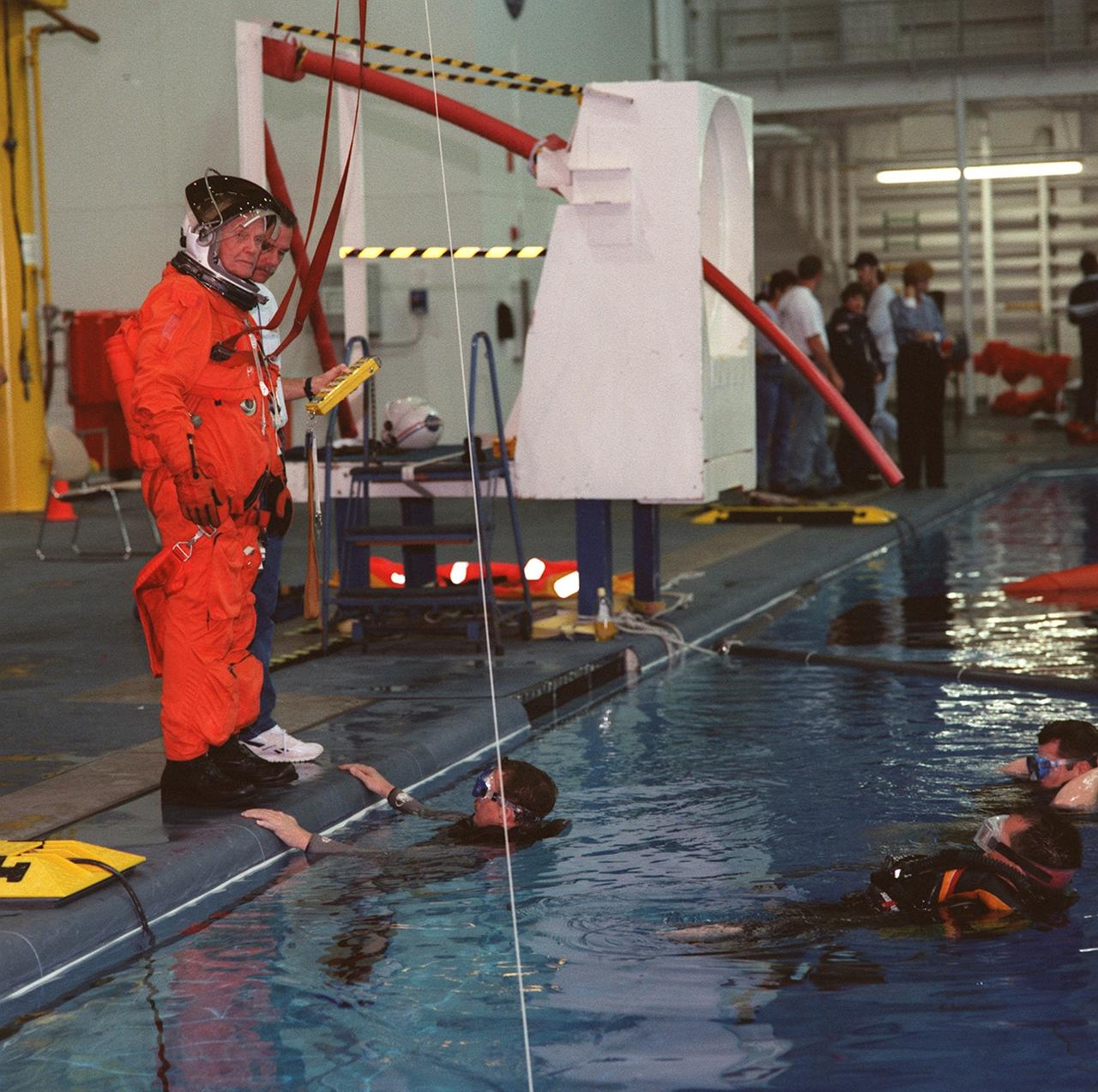
S98-04610 (6 April 1998) --- U.S. Sen. John H. Glenn Jr. (D.-Ohio), attired in a training version of the Space Shuttle partial pressure launch and entry suit, surveys the scene of a bailout training exercise. The giant pool in the Neutral Buoyancy Laboratory (NBL)at the Sonny Carter Training Facility allows the STS-95 crewmembers the opportunity to simulate ejection from an aircraft over water. A number of SCUBA-equipped divers assist in the training exercises. The nearby structure contains a simulated version of the escape pole which is located in the middeck on each of four NASA Space Shuttle vehicles. Parachute drops, raft deployment, water bailing, flare signaling and other survival techniques are also covered in the session.
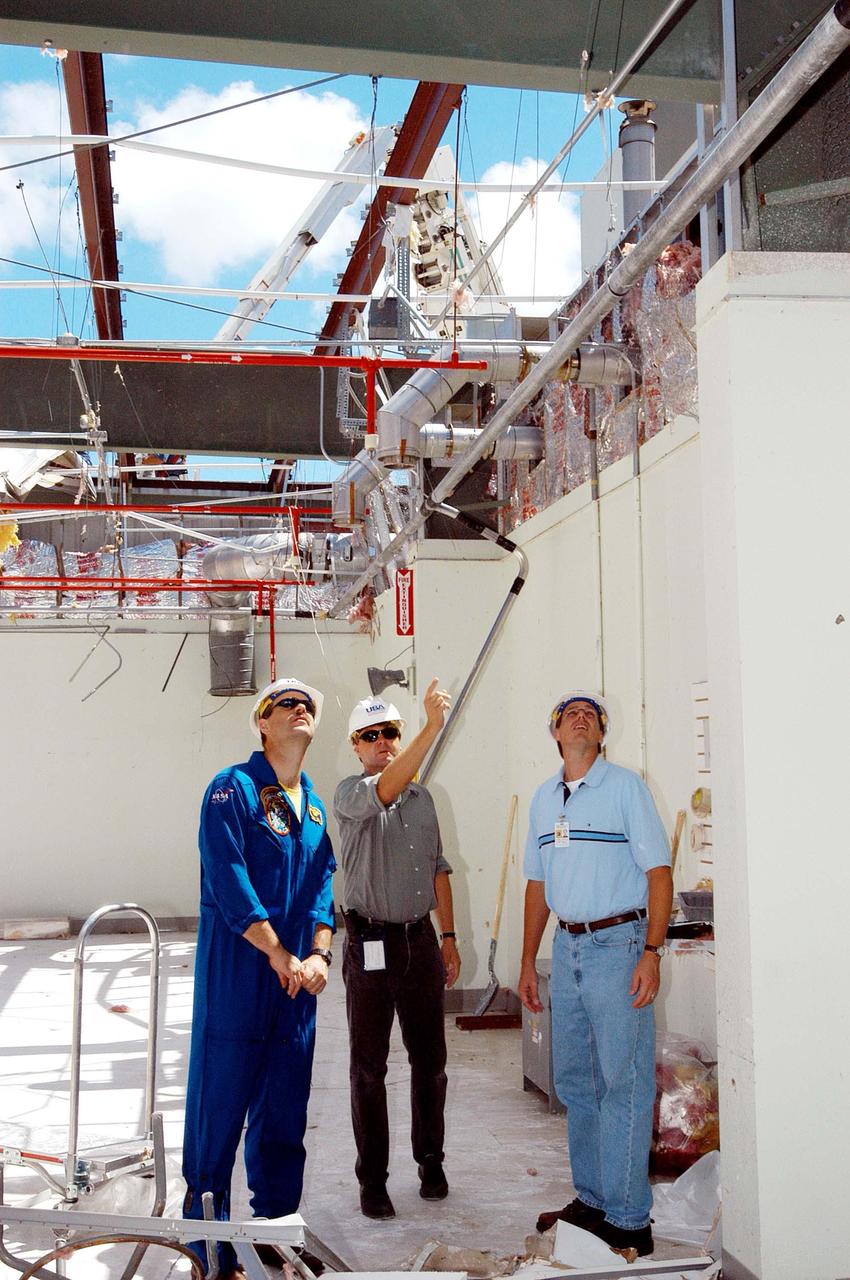
KENNEDY SPACE CENTER, FLA. - Members of a hurricane assessment team from Johnson Space Center and Marshall Space Flight Center observe the damage to the roof of the Thermal Protection System (TPS) Facility at KSC after Hurricane Frances hit the east coast of Central Florida and Kennedy Space Center. At left is astronaut Scott Altmann, a member of the team, and at center is Martin Wilson, manager of the TPS operations. The facility, which creates the TPS tiles, blankets and all the internal thermal control systems for the Space Shuttles, is almost totally unserviceable at this time after losing approximately 35 percent of its roof. Equipment and materials that survived the storm have been relocated to the RLV hangar near the KSC Shuttle Landing Facility.
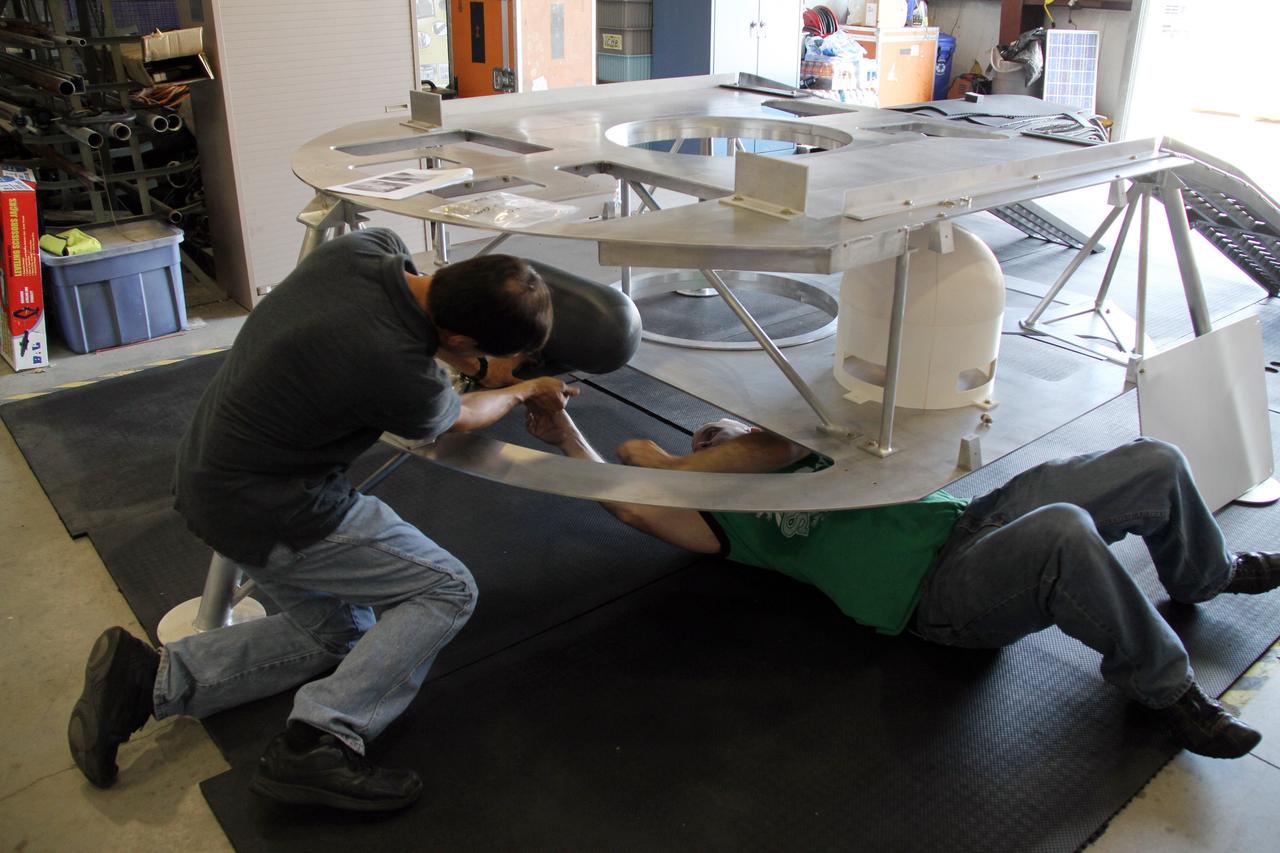
CAPE CANAVERAL, Fla. – Engineers complete the assembly of the prototype lander for NASA’s Regolith and Environment Science and Oxygen and Lunar Volatile Extraction, or RESOLVE, project in a test facility behind the Operations and Checkout Building at NASA’s Kennedy Space Center in Florida. RESOLVE consists of a rover and drill provided by the Canadian Space Agency to support a NASA payload that is designed to prospect for water, ice and other lunar resources. RESOLVE also will demonstrate how future explorers can take advantage of resources at potential landing sites by manufacturing oxygen from soil. NASA will be conducting field tests in July outside of Hilo, Hawaii, with equipment and concept vehicles that demonstrate how explorers might prospect for resources and make their own oxygen for survival while on other planetary bodies. For more information, visit http://www.nasa.gov/exploration/analogs/index.html. Photo credit: NASA/Ben Smegelsky

CAPE CANAVERAL, Fla. – The solar array on the prototype rover Artemis Jr. for NASA’s Regolith and Environment Science and Oxygen and Lunar Volatile Extraction, or RESOLVE, project soaks up the sunlight as it takes a test drive around the field next to the Operations and Checkout Building at NASA’s Kennedy Space Center in Florida. RESOLVE consists of a rover and drill provided by the Canadian Space Agency to support a NASA payload that is designed to prospect for water, ice and other lunar resources. RESOLVE also will demonstrate how future explorers can take advantage of resources at potential landing sites by manufacturing oxygen from soil. NASA will conduct field tests in July outside of Hilo, Hawaii, with equipment and concept vehicles that demonstrate how explorers might prospect for resources and make their own oxygen for survival while on other planetary bodies. For more information, visit http://www.nasa.gov/exploration/analogs/index.html. Photo credit: NASA/Dimitri Gerondidakis
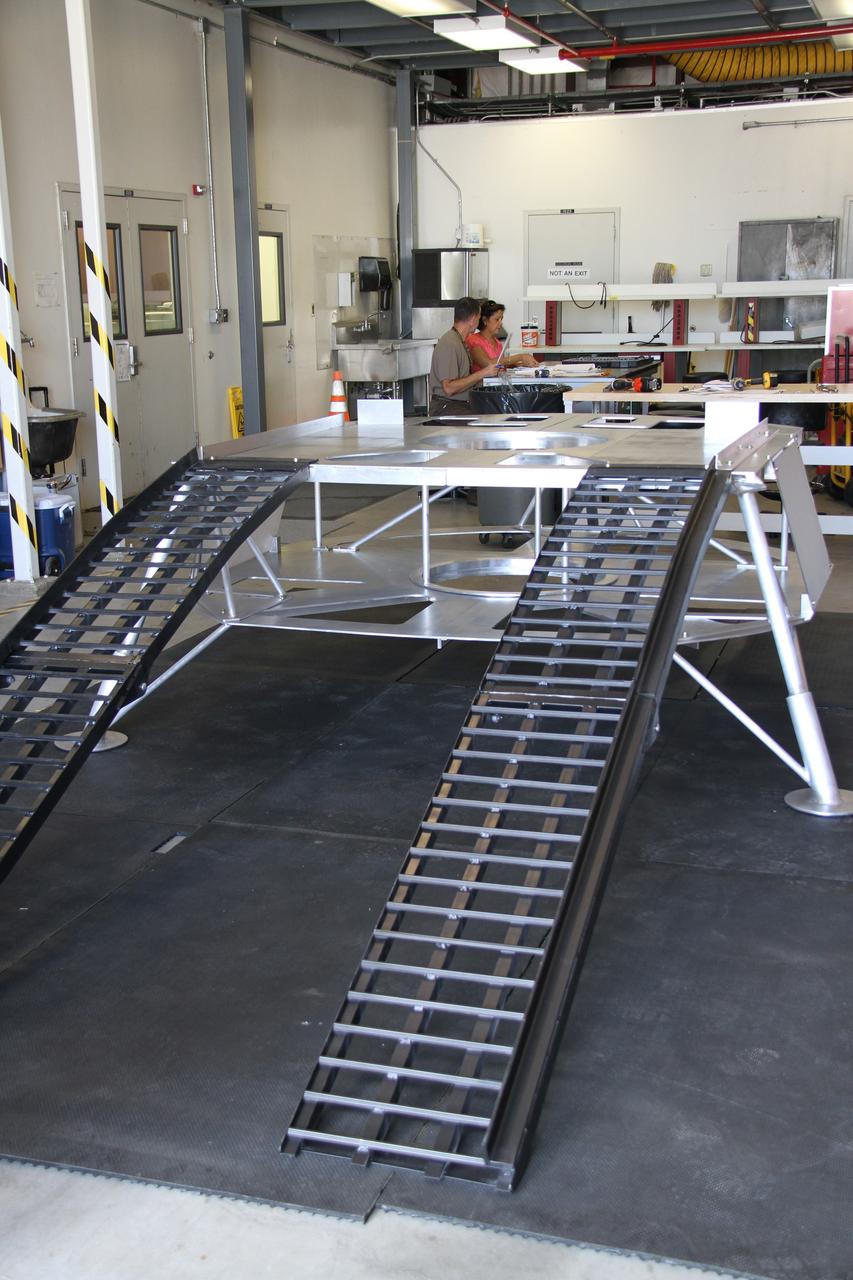
CAPE CANAVERAL, Fla. – The prototype lander for NASA’s Regolith and Environment Science and Oxygen and Lunar Volatile Extraction, or RESOLVE, project is unpacked in a test facility behind the Operations and Checkout Building at NASA’s Kennedy Space Center in Florida. The ramps provide RESOLVE’s rover an avenue to mount or dismount the lander. RESOLVE consists of a rover and drill provided by the Canadian Space Agency to support a NASA payload that is designed to prospect for water, ice and other lunar resources. RESOLVE also will demonstrate how future explorers can take advantage of resources at potential landing sites by manufacturing oxygen from soil. NASA will be conducting field tests in July outside of Hilo, Hawaii, with equipment and concept vehicles that demonstrate how explorers might prospect for resources and make their own oxygen for survival while on other planetary bodies. For more information, visit http://www.nasa.gov/exploration/analogs/index.html. Photo credit: NASA/Ben Smegelsky
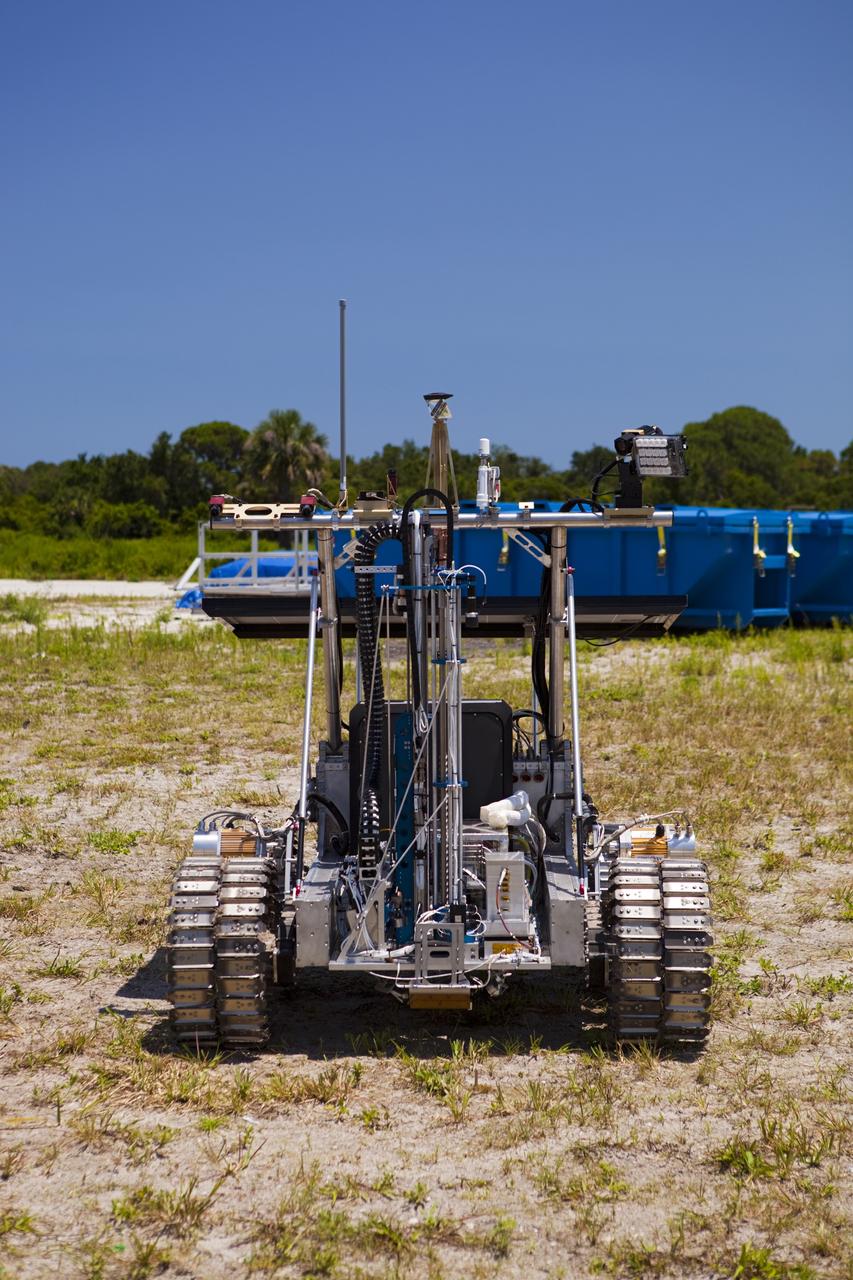
CAPE CANAVERAL, Fla. – A demonstration of the prototype rover Artemis Jr. for NASA’s Regolith and Environment Science and Oxygen and Lunar Volatile Extraction, or RESOLVE, project is conducted in a field beside the Operations and Checkout Building at NASA’s Kennedy Space Center in Florida. The rover and its drill are provided by the Canadian Space Agency and work in concert with NASA science instruments to prospect for water, ice and other lunar resources. RESOLVE also will demonstrate how future explorers can take advantage of resources at potential landing sites by manufacturing oxygen from soil. NASA will conduct field tests in July outside of Hilo, Hawaii, with equipment and concept vehicles that demonstrate how explorers might prospect for resources and make their own oxygen for survival while on other planetary bodies. For more information, visit http://www.nasa.gov/exploration/analogs/index.html. Photo credit: NASA/Dimitri Gerondidakis

CAPE CANAVERAL, Fla. – The prototype rover Artemis Jr. for NASA’s Regolith and Environment Science and Oxygen and Lunar Volatile Extraction, or RESOLVE, project takes a test drive around the field next to the Operations and Checkout Building at NASA’s Kennedy Space Center in Florida. RESOLVE consists of a rover and drill provided by the Canadian Space Agency to support a NASA payload that is designed to prospect for water, ice and other lunar resources. RESOLVE also will demonstrate how future explorers can take advantage of resources at potential landing sites by manufacturing oxygen from soil. NASA will conduct field tests in July outside of Hilo, Hawaii, with equipment and concept vehicles that demonstrate how explorers might prospect for resources and make their own oxygen for survival while on other planetary bodies. For more information, visit http://www.nasa.gov/exploration/analogs/index.html. Photo credit: NASA/Dimitri Gerondidakis
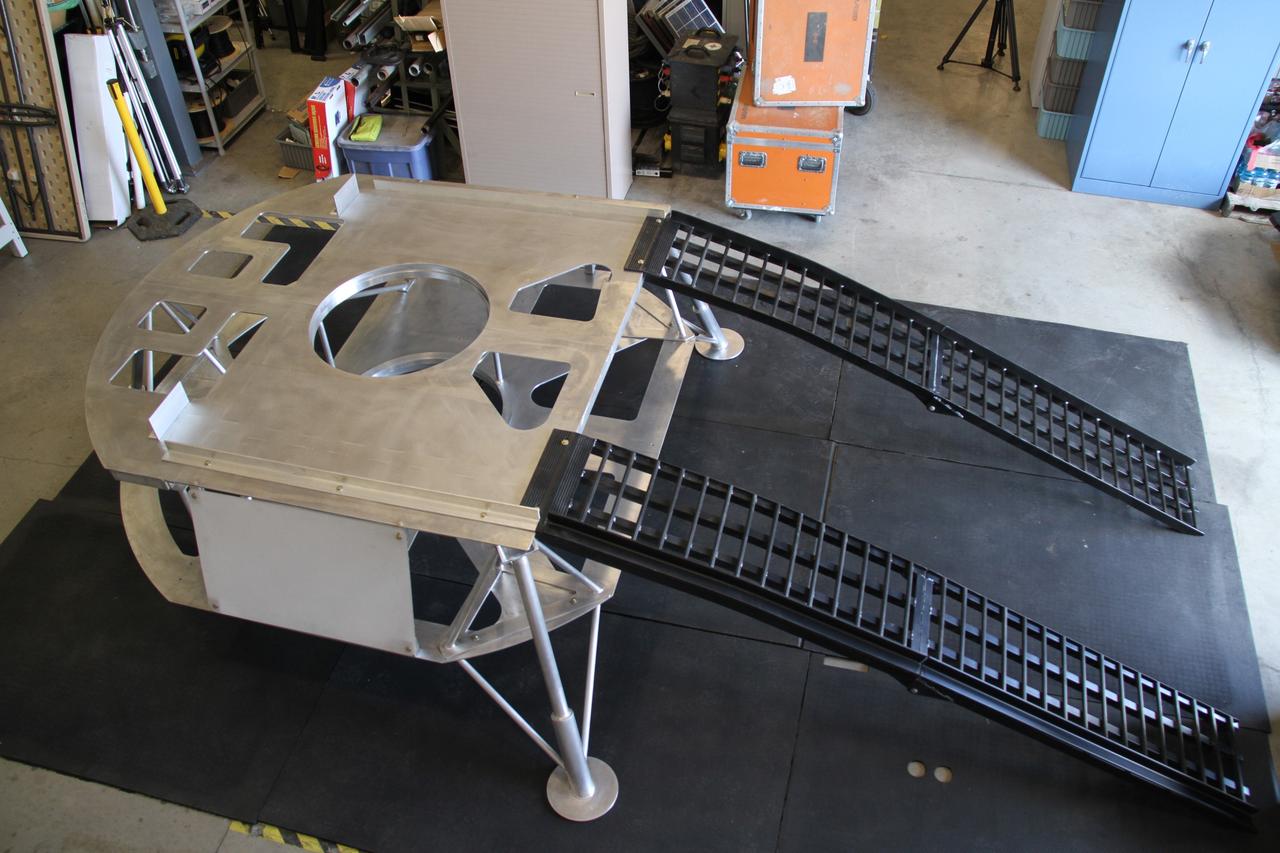
CAPE CANAVERAL, Fla. – The prototype lander for NASA’s Regolith and Environment Science and Oxygen and Lunar Volatile Extraction, or RESOLVE, project is prepared for further assembly in a test facility behind the Operations and Checkout Building at NASA’s Kennedy Space Center in Florida. The ramps provide RESOLVE’s rover an avenue to mount or dismount the lander. RESOLVE consists of a rover and drill provided by the Canadian Space Agency to support a NASA payload that is designed to prospect for water, ice and other lunar resources. RESOLVE also will demonstrate how future explorers can take advantage of resources at potential landing sites by manufacturing oxygen from soil. NASA will be conducting field tests in July outside of Hilo, Hawaii, with equipment and concept vehicles that demonstrate how explorers might prospect for resources and make their own oxygen for survival while on other planetary bodies. For more information, visit http://www.nasa.gov/exploration/analogs/index.html. Photo credit: NASA/Ben Smegelsky
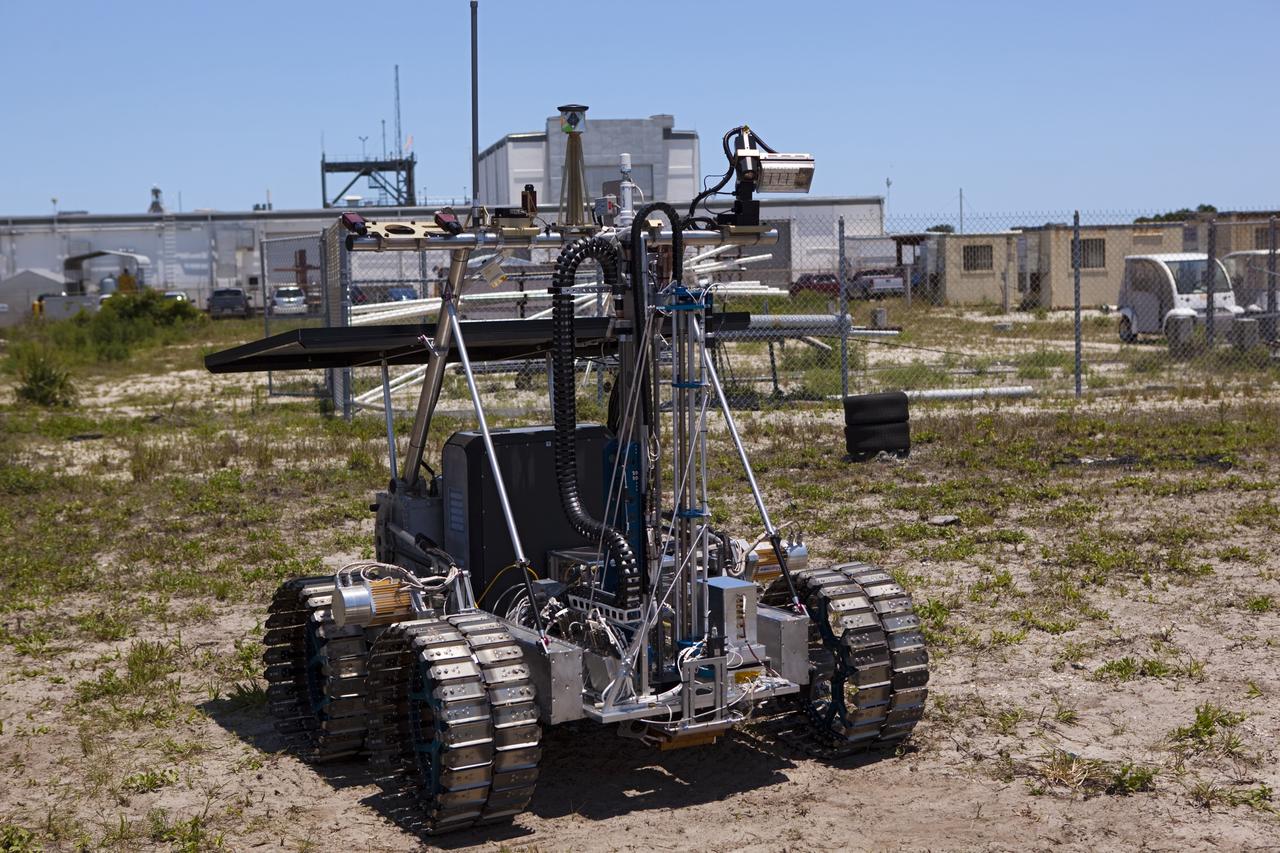
CAPE CANAVERAL, Fla. – A demonstration of the prototype rover Artemis Jr. for NASA’s Regolith and Environment Science and Oxygen and Lunar Volatile Extraction, or RESOLVE, project is conducted in a field beside the Operations and Checkout Building at NASA’s Kennedy Space Center in Florida. The rover and its drill are provided by the Canadian Space Agency and work in concert with NASA science instruments to prospect for water, ice and other lunar resources. RESOLVE also will demonstrate how future explorers can take advantage of resources at potential landing sites by manufacturing oxygen from soil. NASA will conduct field tests in July outside of Hilo, Hawaii, with equipment and concept vehicles that demonstrate how explorers might prospect for resources and make their own oxygen for survival while on other planetary bodies. For more information, visit http://www.nasa.gov/exploration/analogs/index.html. Photo credit: NASA/Dimitri Gerondidakis
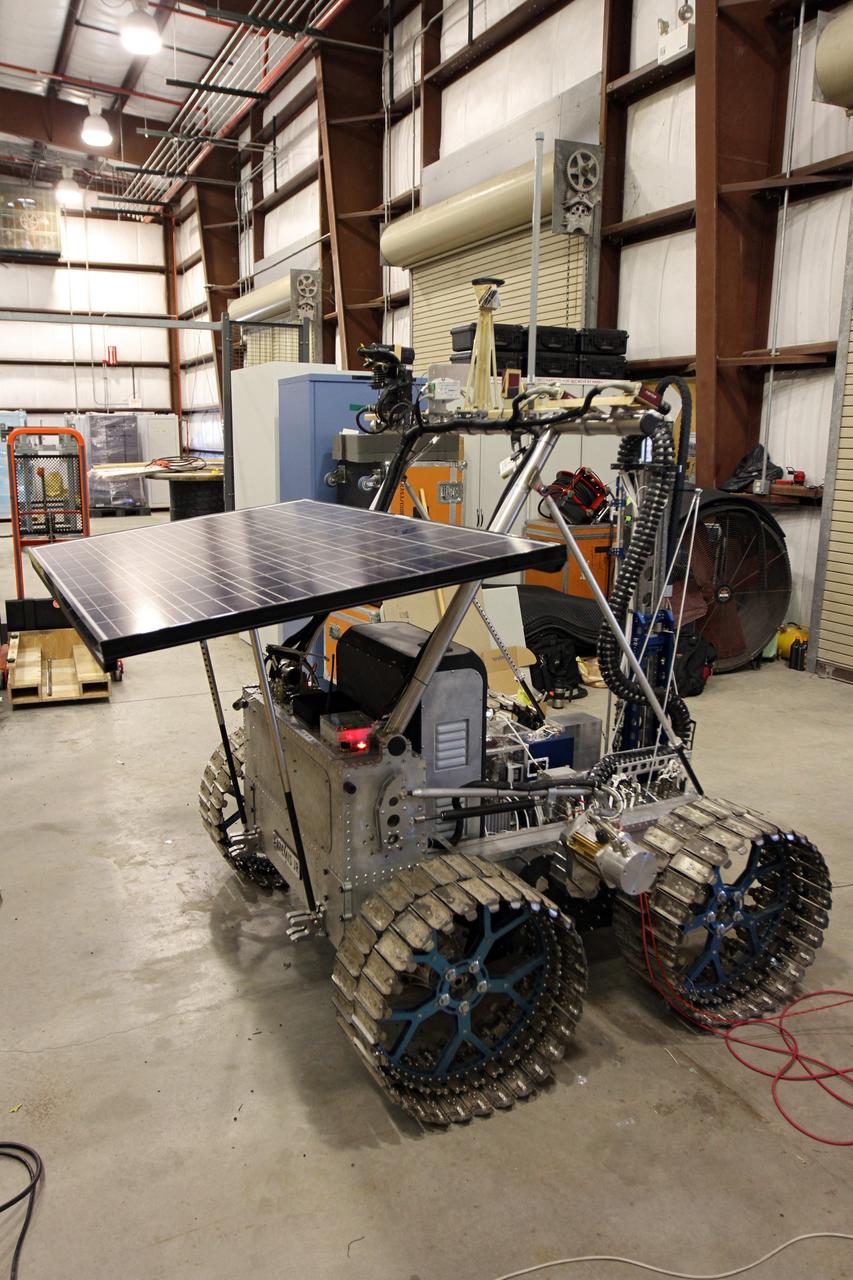
CAPE CANAVERAL, Fla. – The NASA payload is installed on the prototype rover Artemis Jr. for NASA’s Regolith and Environment Science and Oxygen and Lunar Volatile Extraction, or RESOLVE, project in a test facility behind the Operations and Checkout Building at NASA’s Kennedy Space Center in Florida. The cylindrical structure at right is the drill the tabletop surface at left is the rover’s solar array. The drill and rover were provided to NASA by the Canadian Space Agency. The NASA payload is designed to prospect for water, ice and other lunar resources. RESOLVE also will demonstrate how future explorers can take advantage of resources at potential landing sites by manufacturing oxygen from soil. NASA will conduct field tests in July outside of Hilo, Hawaii, with equipment and concept vehicles that demonstrate how explorers might prospect for resources and make their own oxygen for survival while on other planetary bodies. For more information, visit http://www.nasa.gov/exploration/analogs/index.html. Photo credit: NASA/Cory Huston
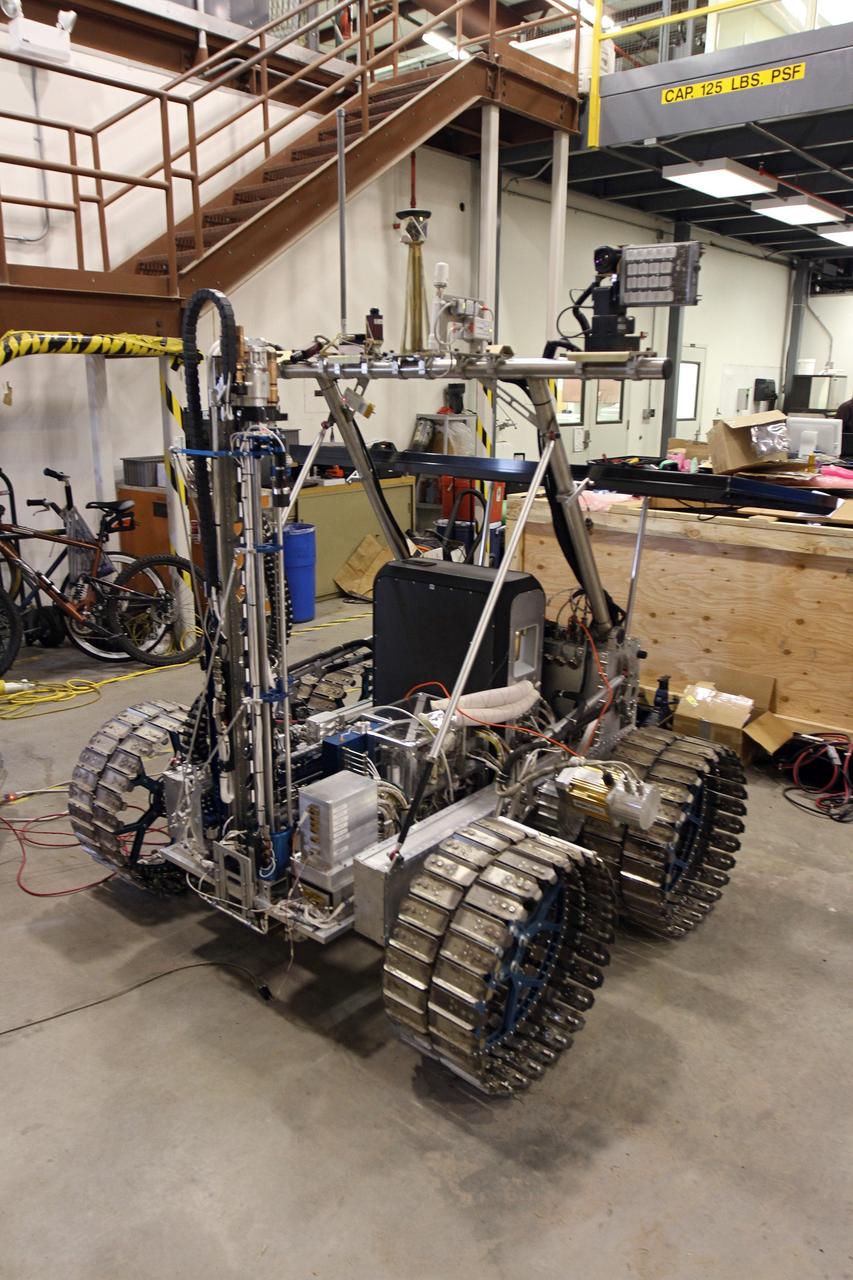
CAPE CANAVERAL, Fla. – The NASA payload is installed on the prototype rover Artemis Jr. for NASA’s Regolith and Environment Science and Oxygen and Lunar Volatile Extraction, or RESOLVE, project in a test facility behind the Operations and Checkout Building at NASA’s Kennedy Space Center in Florida. The cylindrical structure at left is the drill. The drill and rover were provided to NASA by the Canadian Space Agency. The NASA payload is designed to prospect for water, ice and other lunar resources. RESOLVE also will demonstrate how future explorers can take advantage of resources at potential landing sites by manufacturing oxygen from soil. NASA will conduct field tests in July outside of Hilo, Hawaii, with equipment and concept vehicles that demonstrate how explorers might prospect for resources and make their own oxygen for survival while on other planetary bodies. For more information, visit http://www.nasa.gov/exploration/analogs/index.html. Photo credit: NASA/Cory Huston
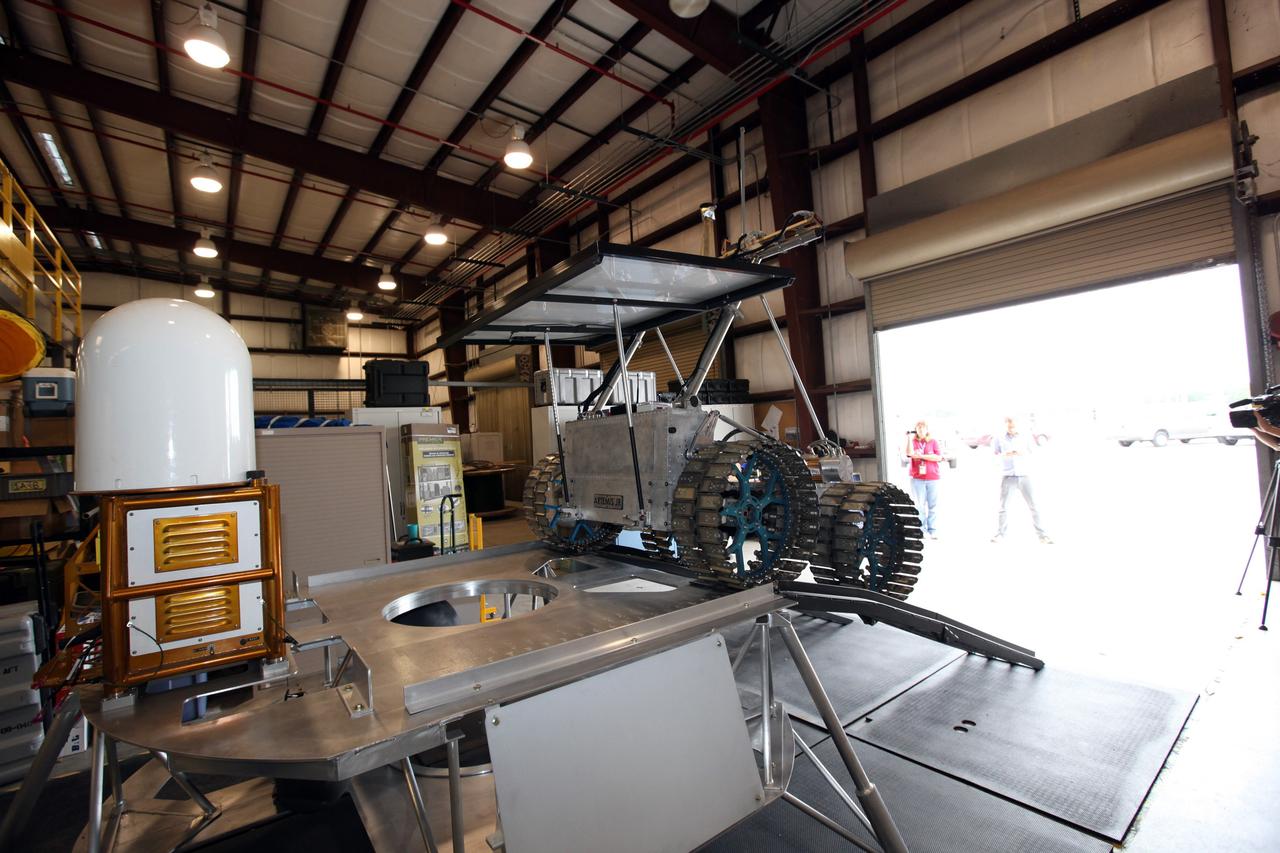
CAPE CANAVERAL, Fla. – In a test facility behind the Operations and Checkout Building at NASA’s Kennedy Space Center in Florida, the prototype rover Artemis Jr. for NASA’s Regolith and Environment Science and Oxygen and Lunar Volatile Extraction, or RESOLVE, project dismounts from the RESOLVE lander during a dry run using ramps attached to the prototype lander. RESOLVE consists of a rover and drill provided by the Canadian Space Agency to support a NASA payload that is designed to prospect for water, ice and other lunar resources. RESOLVE also will demonstrate how future explorers can take advantage of resources at potential landing sites by manufacturing oxygen from soil. NASA will conduct field tests in July outside of Hilo, Hawaii, with equipment and concept vehicles that demonstrate how explorers might prospect for resources and make their own oxygen for survival while on other planetary bodies. For more information, visit http://www.nasa.gov/exploration/analogs/index.html. Photo credit: NASA/Dimitri Gerondidakis
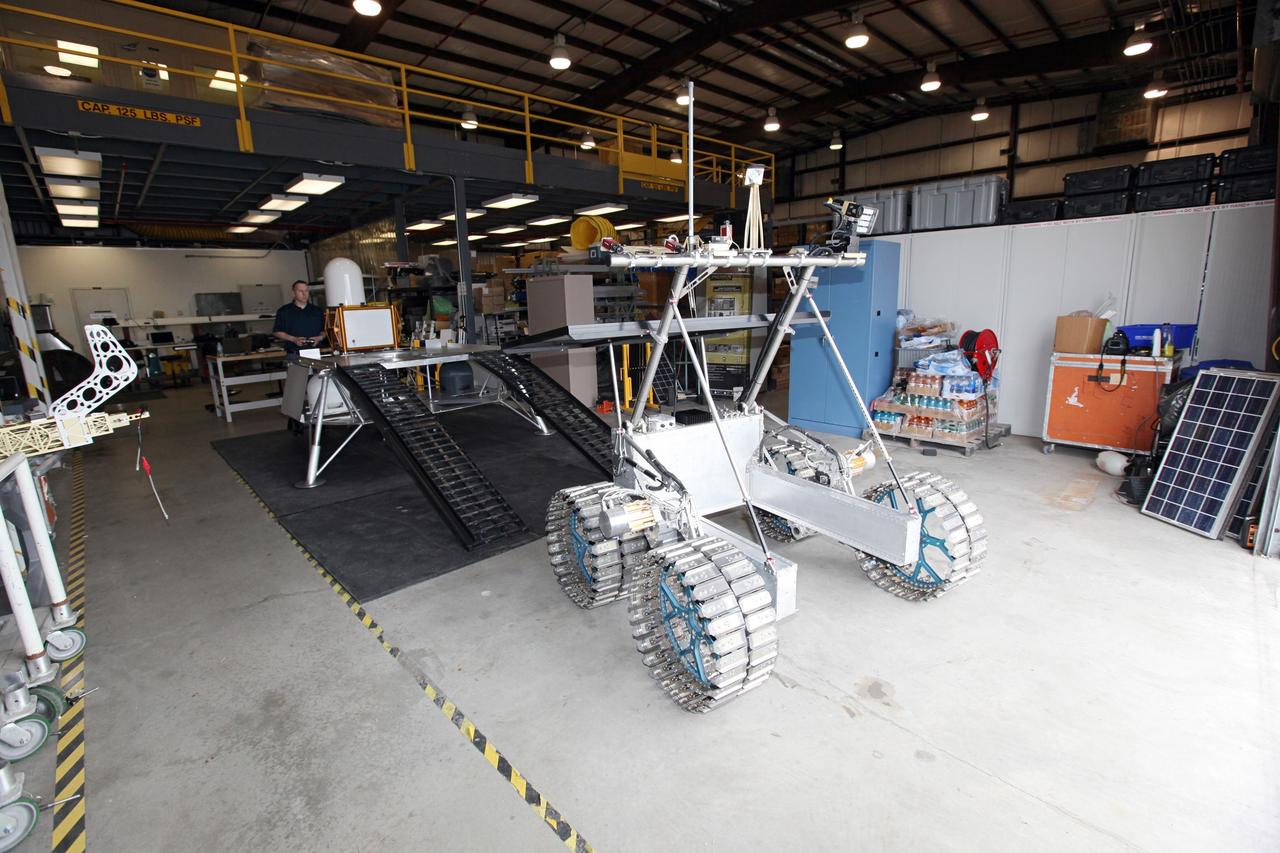
CAPE CANAVERAL, Fla. – In a test facility behind the Operations and Checkout Building at NASA’s Kennedy Space Center in Florida, the prototype rover Artemis Jr. for NASA’s Regolith and Environment Science and Oxygen and Lunar Volatile Extraction, or RESOLVE, project has dismounted the RESOLVE lander during a dry run using the ramps attached to the prototype lander. RESOLVE consists of a rover and drill provided by the Canadian Space Agency to support a NASA payload that is designed to prospect for water, ice and other lunar resources. RESOLVE also will demonstrate how future explorers can take advantage of resources at potential landing sites by manufacturing oxygen from soil. NASA will conduct field tests in July outside of Hilo, Hawaii, with equipment and concept vehicles that demonstrate how explorers might prospect for resources and make their own oxygen for survival while on other planetary bodies. For more information, visit http://www.nasa.gov/exploration/analogs/index.html. Photo credit: NASA/Dimitri Gerondidakis
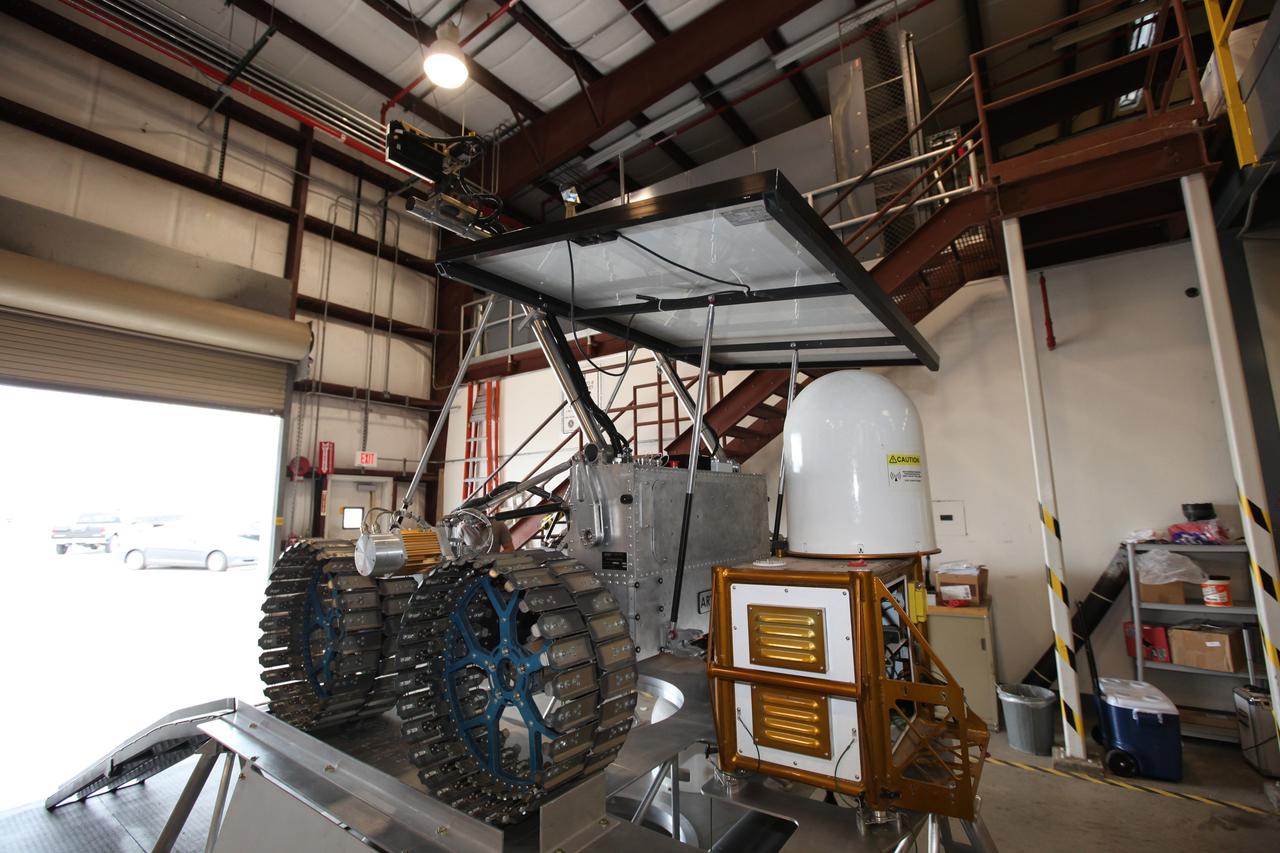
CAPE CANAVERAL, Fla. – The prototype rover Artemis Jr. for NASA’s Regolith and Environment Science and Oxygen and Lunar Volatile Extraction, or RESOLVE, project rests atop the prototype lander, prepared for further processing in a test facility behind the Operations and Checkout Building at NASA’s Kennedy Space Center in Florida. RESOLVE consists of a rover and drill provided by the Canadian Space Agency to support a NASA payload that is designed to prospect for water, ice and other lunar resources. RESOLVE also will demonstrate how future explorers can take advantage of resources at potential landing sites by manufacturing oxygen from soil. NASA will conduct field tests in July outside of Hilo, Hawaii, with equipment and concept vehicles that demonstrate how explorers might prospect for resources and make their own oxygen for survival while on other planetary bodies. For more information, visit http://www.nasa.gov/exploration/analogs/index.html. Photo credit: NASA/Dimitri Gerondidakis
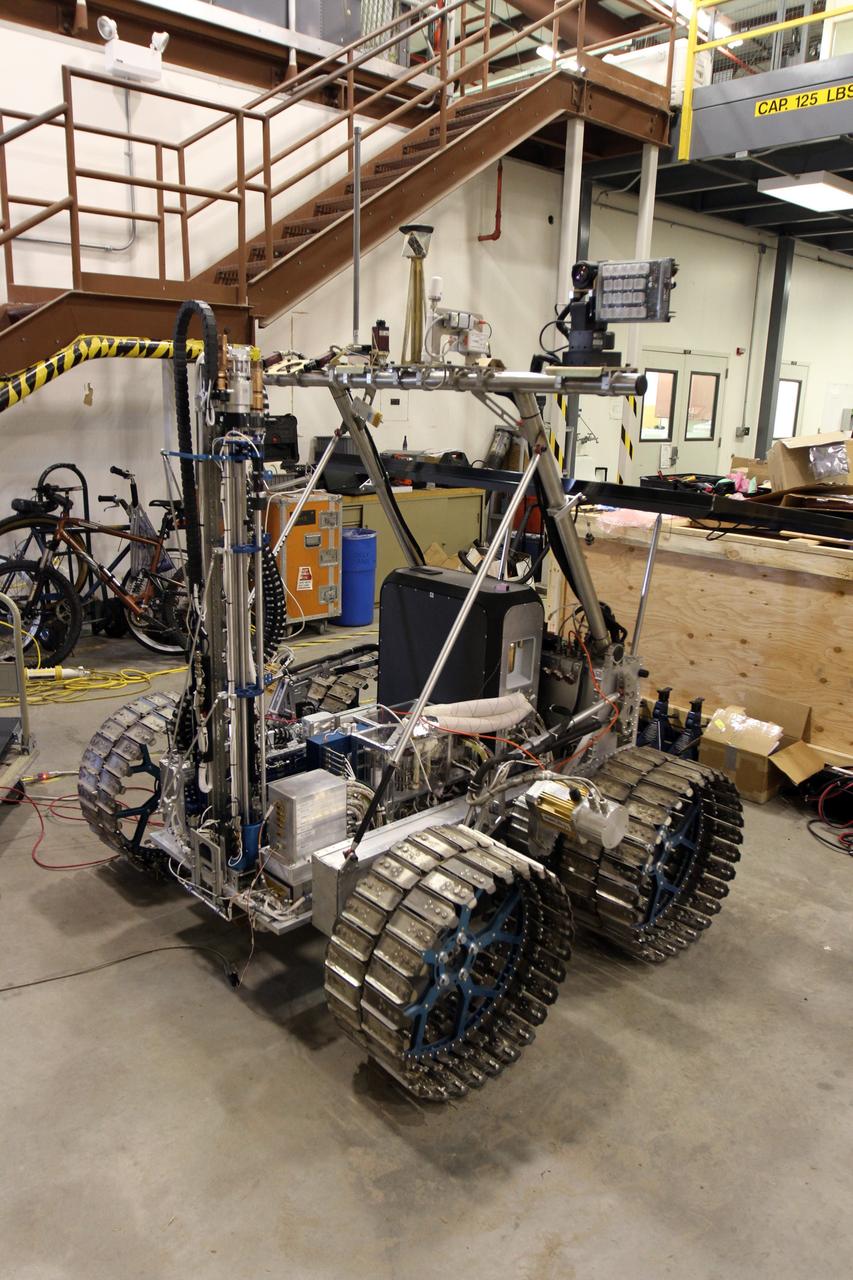
CAPE CANAVERAL, Fla. – The NASA payload is installed on the prototype rover Artemis Jr. for NASA’s Regolith and Environment Science and Oxygen and Lunar Volatile Extraction, or RESOLVE, project in a test facility behind the Operations and Checkout Building at NASA’s Kennedy Space Center in Florida. The cylindrical structure at left is the drill. The drill and rover were provided to NASA by the Canadian Space Agency. The NASA payload is designed to prospect for water, ice and other lunar resources. RESOLVE also will demonstrate how future explorers can take advantage of resources at potential landing sites by manufacturing oxygen from soil. NASA will conduct field tests in July outside of Hilo, Hawaii, with equipment and concept vehicles that demonstrate how explorers might prospect for resources and make their own oxygen for survival while on other planetary bodies. For more information, visit http://www.nasa.gov/exploration/analogs/index.html. Photo credit: NASA/Cory Huston
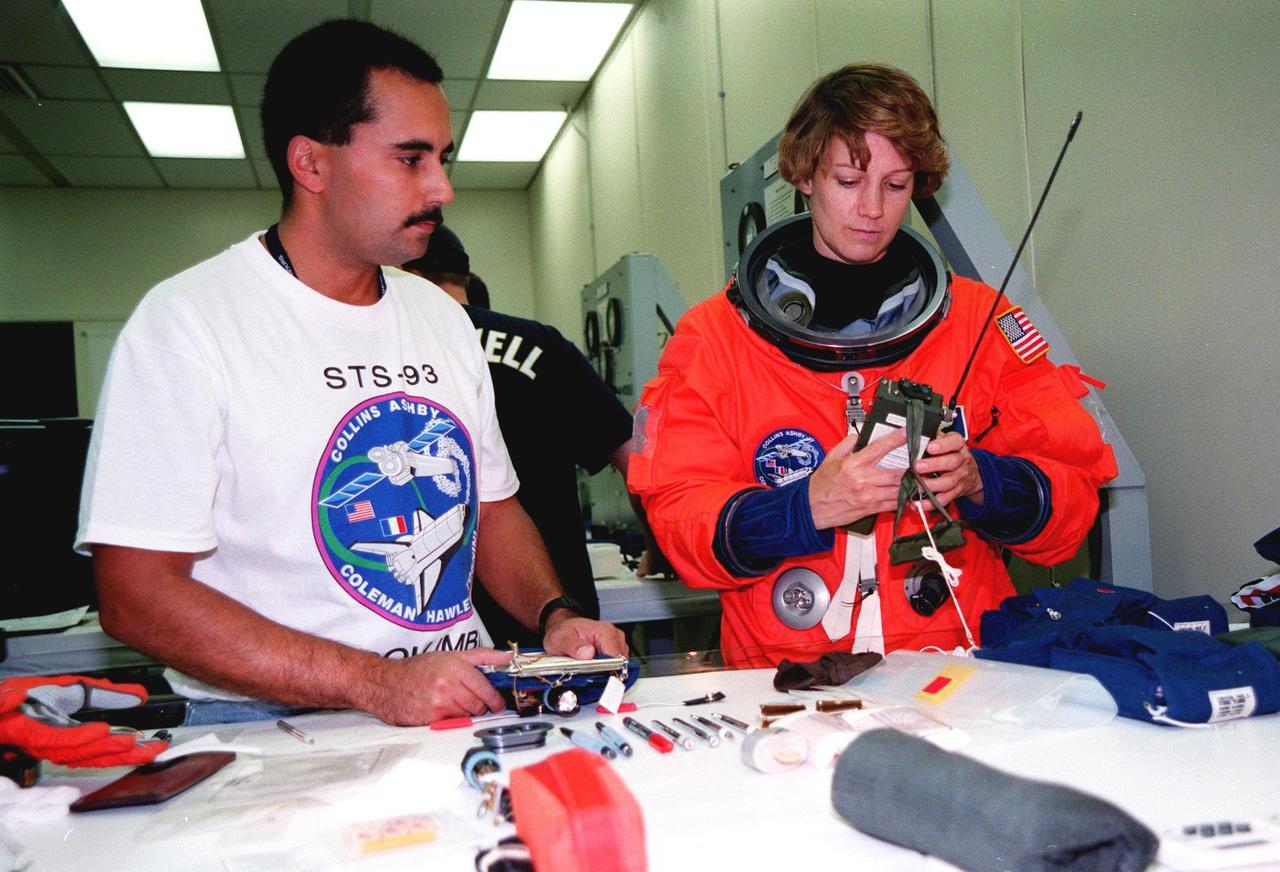
In the Operations and Checkout Bldg., STS-93 Commander Eileen M. Collins checks out a PRC-112 survival radio, part of flight equipment, under the eye of Ray Cuevas, with United Space Alliance. In preparation for their mission, the STS-93 crew are participating in Terminal Countdown Demonstration Test activities that also include equipment check and a launch-day dress rehearsal culminating with a simulated main engine cut-off. Others in the crew participating are Pilot Jeffrey S. Ashby, and Mission Specialists Steven A. Hawley (Ph.D.), Catherine G. Coleman (Ph.D.), and Michel Tognini of France, who represents the Centre National d'Etudes Spatiales (CNES). Collins is the first woman to serve as a Shuttle commander. The primary mission of STS-93 is the release of the Chandra X-ray Observatory, which will allow scientists from around the world to obtain unprecedented X-ray images of exotic environments in space to help understand the structure and evolution of the universe. The targeted launch date for STS-93 is no earlier than July 20 at 12:36 a.m. EDT from Launch Pad 39B
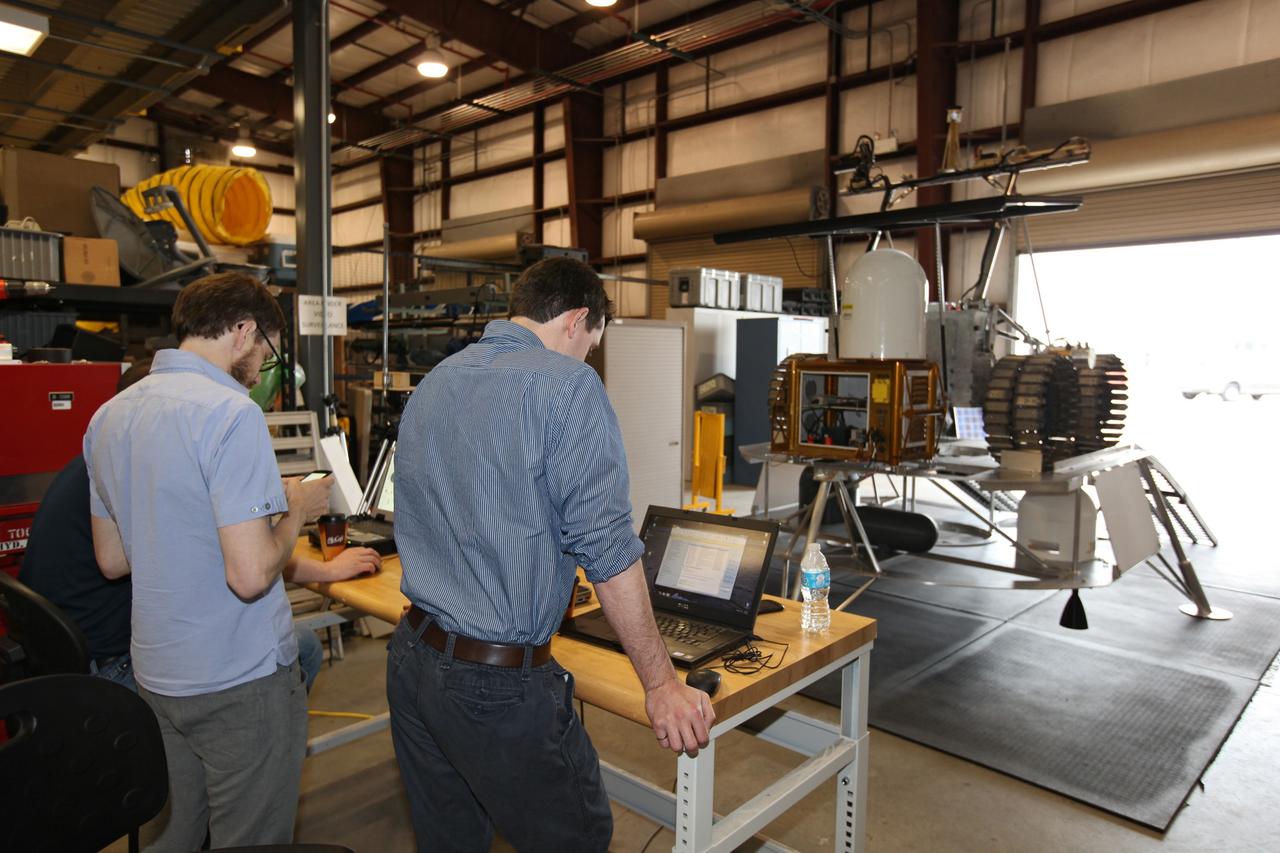
CAPE CANAVERAL, Fla. – Engineers with Neptec, a contractor to the Canadian Space Agency, prepare to conduct checkouts of the prototype rover Artemis Jr. for NASA’s Regolith and Environment Science and Oxygen and Lunar Volatile Extraction, or RESOLVE, project in a test facility behind the Operations and Checkout Building at NASA’s Kennedy Space Center in Florida. The rover is positioned atop RESOLVE’s prototype lander. RESOLVE consists of a rover and drill provided by the Canadian Space Agency to support a NASA payload that is designed to prospect for water, ice and other lunar resources. RESOLVE also will demonstrate how future explorers can take advantage of resources at potential landing sites by manufacturing oxygen from soil. NASA will conduct field tests in July outside of Hilo, Hawaii, with equipment and concept vehicles that demonstrate how explorers might prospect for resources and make their own oxygen for survival while on other planetary bodies. For more information, visit http://www.nasa.gov/exploration/analogs/index.html. Photo credit: NASA/Dimitri Gerondidakis
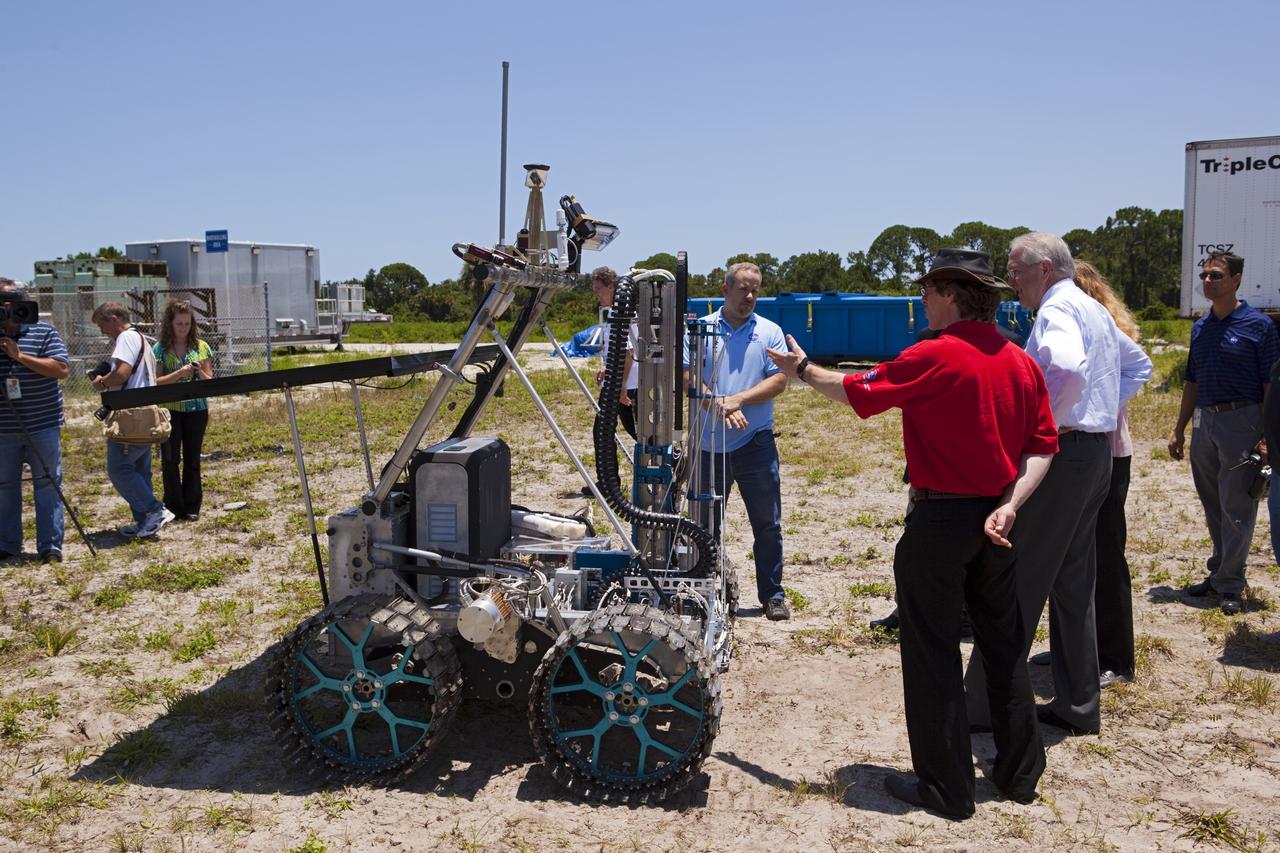
CAPE CANAVERAL, Fla. – Daniel Lefebvre, an engineer with the Canadian Space Agency, points out some of the features of the prototype rover Artemis Jr. for NASA’s Regolith and Environment Science and Oxygen and Lunar Volatile Extraction, or RESOLVE, project to media representatives on hand for a demonstration of the rover in a field beside the Operations and Checkout Building at NASA’s Kennedy Space Center in Florida. The rover and its drill are provided by the Canadian Space Agency and work in concert with NASA science instruments to prospect for water, ice and other lunar resources. RESOLVE also will demonstrate how future explorers can take advantage of resources at potential landing sites by manufacturing oxygen from soil. NASA will conduct field tests in July outside of Hilo, Hawaii, with equipment and concept vehicles that demonstrate how explorers might prospect for resources and make their own oxygen for survival while on other planetary bodies. For more information, visit http://www.nasa.gov/exploration/analogs/index.html. Photo credit: NASA/Dimitri Gerondidakis
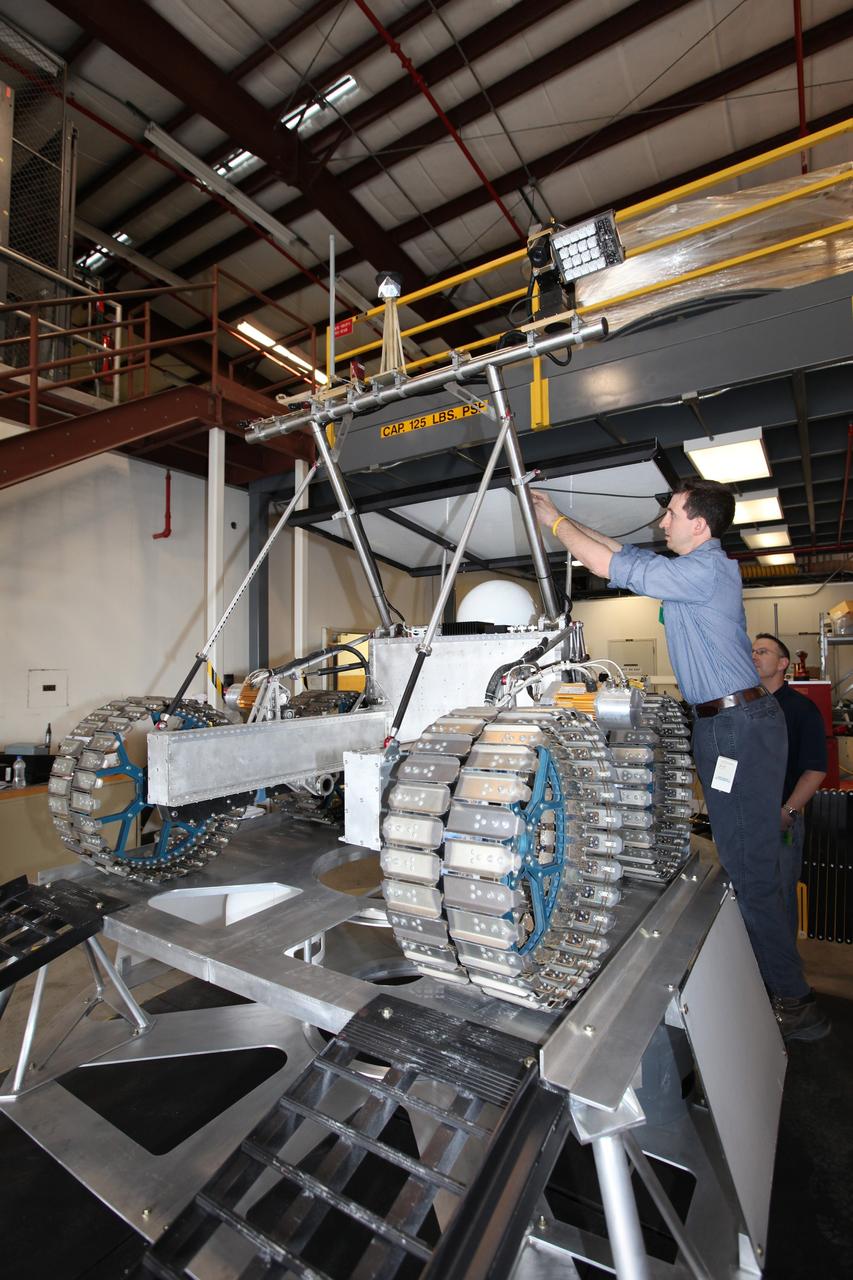
CAPE CANAVERAL, Fla. – Nick Cristello, an engineer with Neptec, a contractor to the Canadian Space Agency, attaches navigation-related wiring on the prototype rover Artemis Jr. in a test facility behind the Operations and Checkout Building at NASA’s Kennedy Space Center in Florida before conducting a dry run. The rover is one component of NASA’s Regolith and Environment Science and Oxygen and Lunar Volatile Extraction, or RESOLVE, project and is positioned atop RESOLVE’s prototype lander. RESOLVE consists of a rover and drill provided by the Canadian Space Agency to support a NASA payload that is designed to prospect for water, ice and other lunar resources. RESOLVE also will demonstrate how future explorers can take advantage of resources at potential landing sites by manufacturing oxygen from soil. NASA will conduct field tests in July outside of Hilo, Hawaii, with equipment and concept vehicles that demonstrate how explorers might prospect for resources and make their own oxygen for survival while on other planetary bodies. For more information, visit http://www.nasa.gov/exploration/analogs/index.html. Photo credit: NASA/Dimitri Gerondidakis
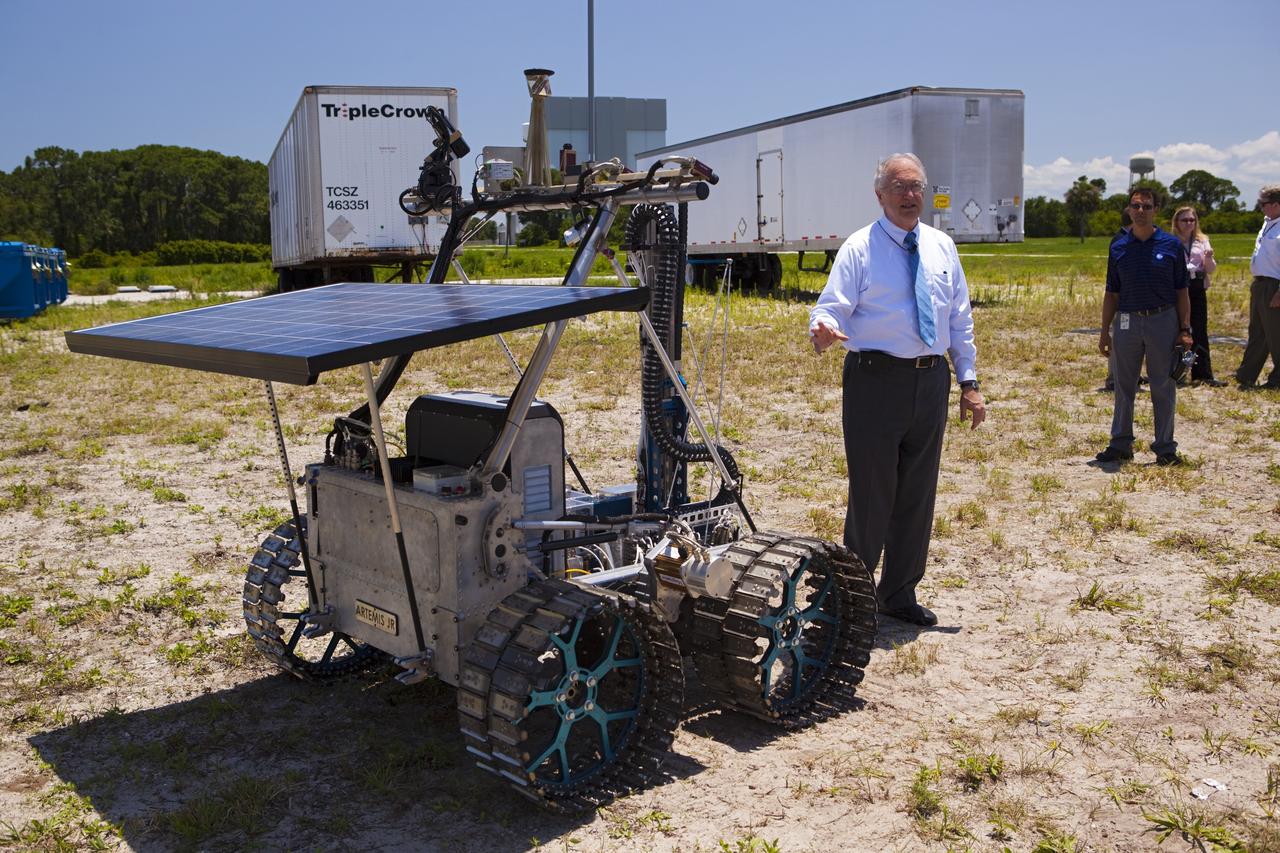
CAPE CANAVERAL, Fla. – NASA In Situ Resource Utilization Project Manager William Larson discusses the design and operation of the prototype rover Artemis Jr. for NASA’s Regolith and Environment Science and Oxygen and Lunar Volatile Extraction, or RESOLVE, project with media representatives during a rover demonstration for media representatives in a field beside the Operations and Checkout Building at NASA’s Kennedy Space Center in Florida. The rover and its drill are provided by the Canadian Space Agency and work in concert with NASA science instruments to prospect for water, ice and other lunar resources. RESOLVE also will demonstrate how future explorers can take advantage of resources at potential landing sites by manufacturing oxygen from soil. NASA will conduct field tests in July outside of Hilo, Hawaii, with equipment and concept vehicles that demonstrate how explorers might prospect for resources and make their own oxygen for survival while on other planetary bodies. For more information, visit http://www.nasa.gov/exploration/analogs/index.html. Photo credit: NASA/Dimitri Gerondidakis
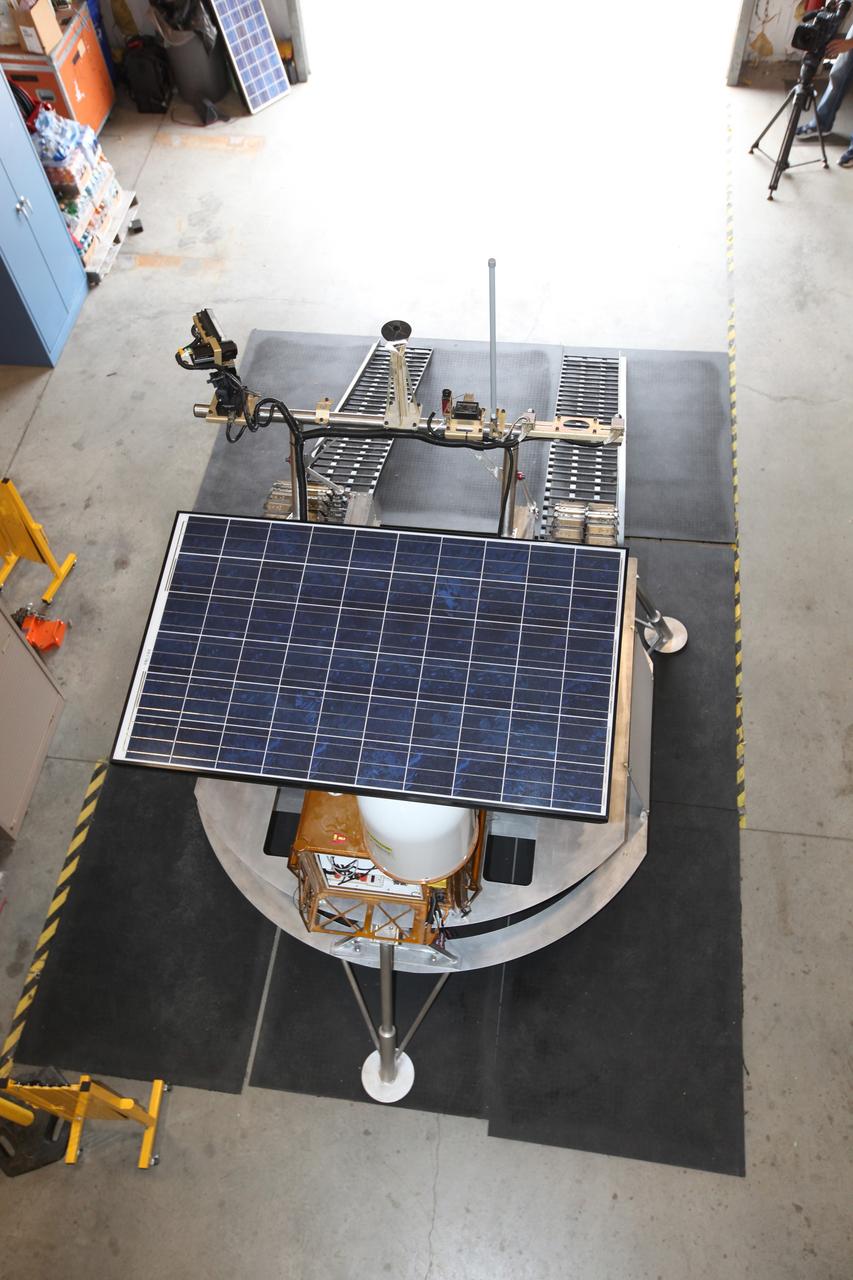
CAPE CANAVERAL, Fla. – This overhead view of the prototype rover Artemis Jr. for NASA’s Regolith and Environment Science and Oxygen and Lunar Volatile Extraction, or RESOLVE, project was taken in a test facility behind the Operations and Checkout Building at NASA’s Kennedy Space Center in Florida and provides a clear view of its solar array, as well as the placement of the ramps that provide it with an avenue to mount or dismount the prototype lander beneath it. RESOLVE consists of a rover and drill provided by the Canadian Space Agency to support a NASA payload that is designed to prospect for water, ice and other lunar resources. RESOLVE also will demonstrate how future explorers can take advantage of resources at potential landing sites by manufacturing oxygen from soil. NASA will conduct field tests in July outside of Hilo, Hawaii, with equipment and concept vehicles that demonstrate how explorers might prospect for resources and make their own oxygen for survival while on other planetary bodies. For more information, visit http://www.nasa.gov/exploration/analogs/index.html. Photo credit: NASA/Dimitri Gerondidakis
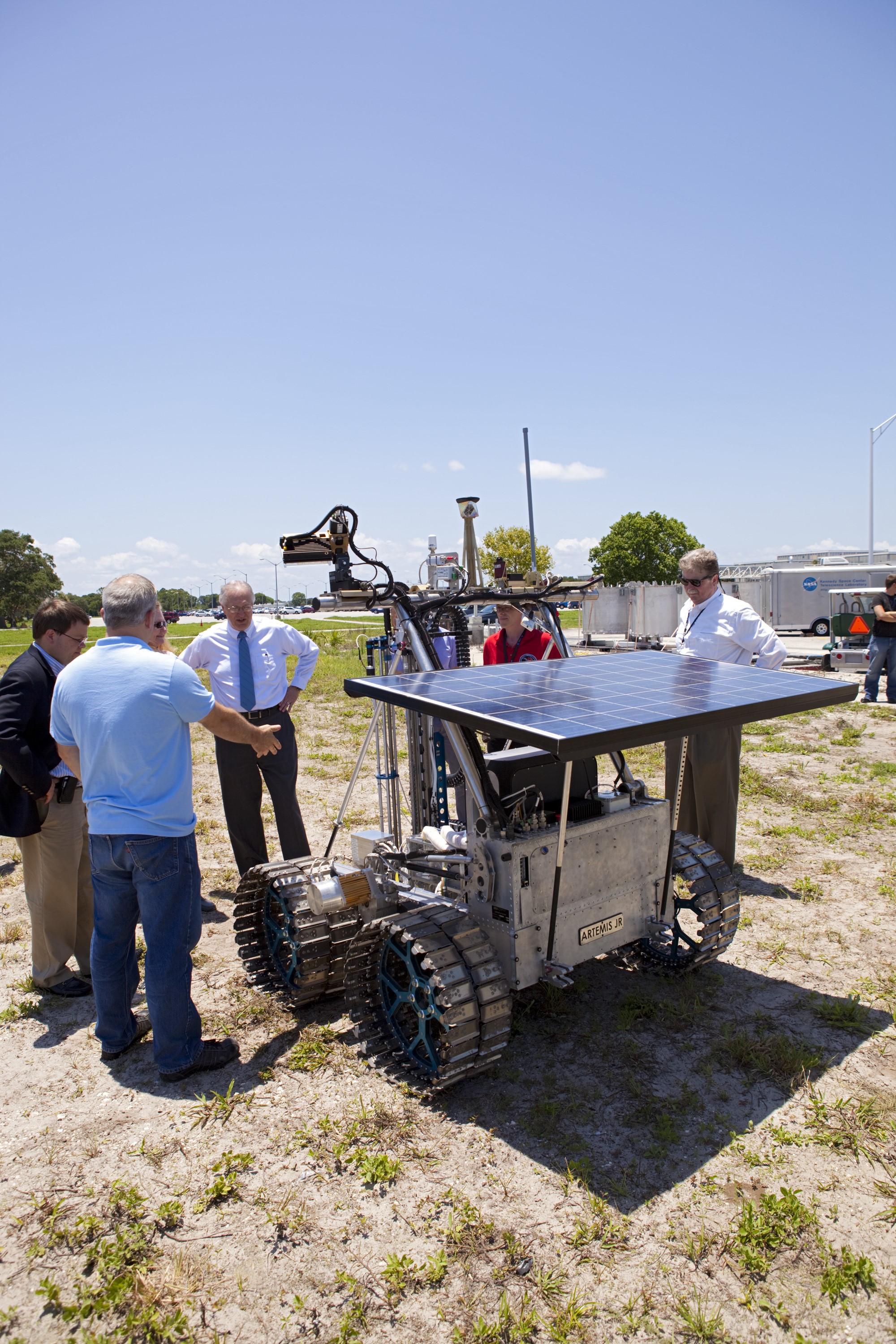
CAPE CANAVERAL, Fla. – Media representatives discuss the design and operation of the prototype rover Artemis Jr. for NASA’s Regolith and Environment Science and Oxygen and Lunar Volatile Extraction, or RESOLVE, project with NASA In Situ Resource Utilization Project Manager William Larson, facing the rover, in a field beside the Operations and Checkout Building at NASA’s Kennedy Space Center in Florida. The rover and its drill are provided by the Canadian Space Agency and work in concert with NASA science instruments to prospect for water, ice and other lunar resources. RESOLVE also will demonstrate how future explorers can take advantage of resources at potential landing sites by manufacturing oxygen from soil. NASA will conduct field tests in July outside of Hilo, Hawaii, with equipment and concept vehicles that demonstrate how explorers might prospect for resources and make their own oxygen for survival while on other planetary bodies. For more information, visit http://www.nasa.gov/exploration/analogs/index.html. Photo credit: NASA/Dimitri Gerondidakis
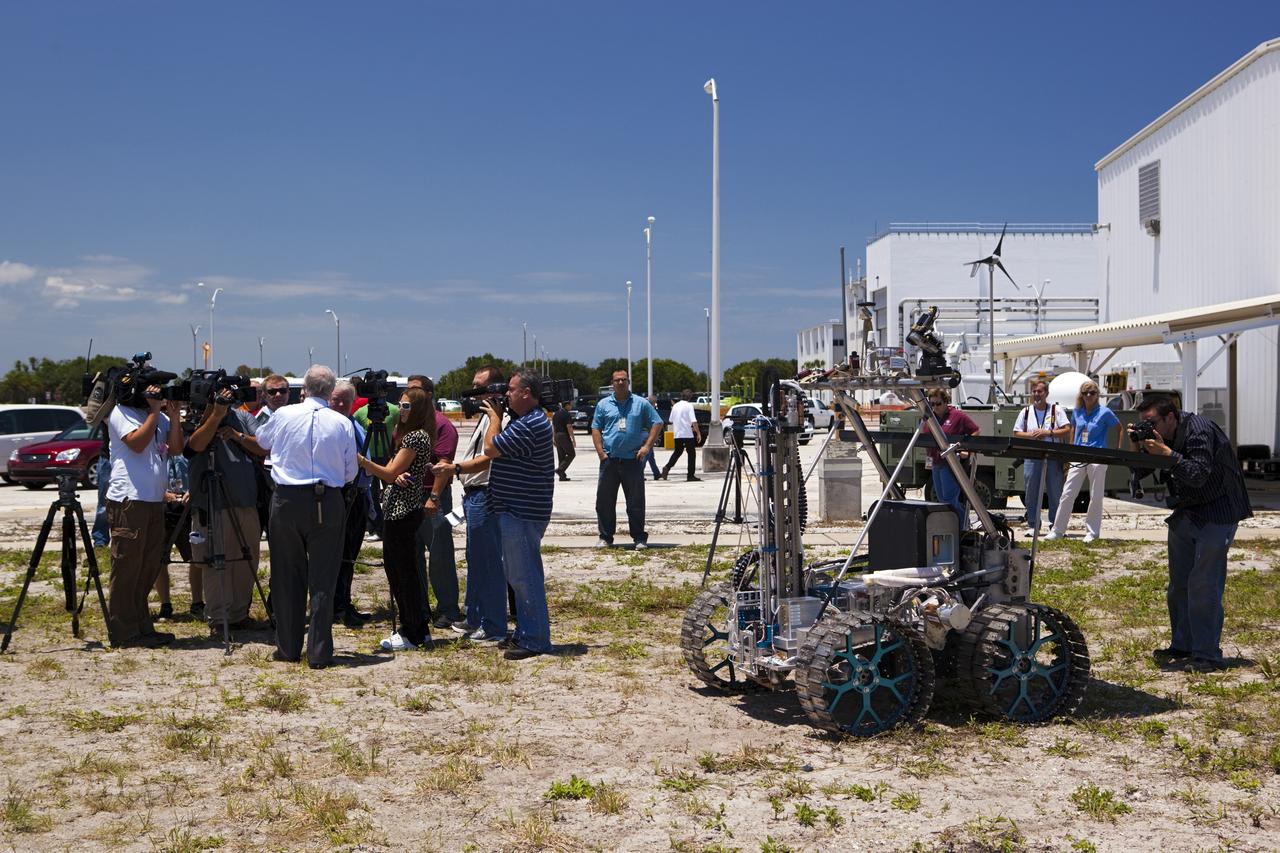
CAPE CANAVERAL, Fla. – NASA In Situ Resource Utilization Project Manager William Larson, back to camera, discusses the design and operation of the prototype rover Artemis Jr. for NASA’s Regolith and Environment Science and Oxygen and Lunar Volatile Extraction, or RESOLVE, project with media representatives during a rover demonstration in a field beside the Operations and Checkout Building at NASA’s Kennedy Space Center in Florida. The rover and its drill are provided by the Canadian Space Agency and work in concert with NASA science instruments to prospect for water, ice and other lunar resources. RESOLVE also will demonstrate how future explorers can take advantage of resources at potential landing sites by manufacturing oxygen from soil. NASA will conduct field tests in July outside of Hilo, Hawaii, with equipment and concept vehicles that demonstrate how explorers might prospect for resources and make their own oxygen for survival while on other planetary bodies. For more information, visit http://www.nasa.gov/exploration/analogs/index.html. Photo credit: NASA/Dimitri Gerondidakis
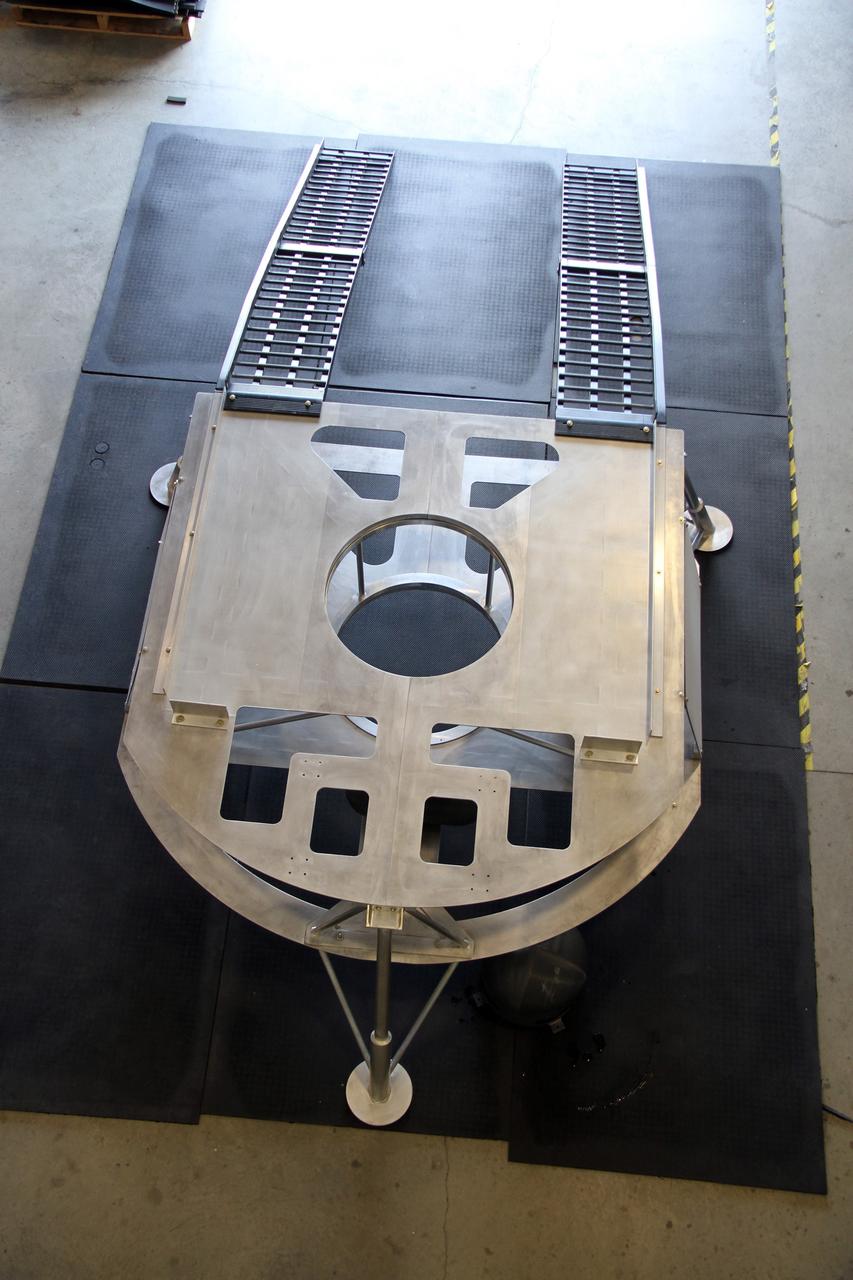
CAPE CANAVERAL, Fla. – This overhead view of the prototype lander for NASA’s Regolith and Environment Science and Oxygen and Lunar Volatile Extraction, or RESOLVE, project was taken in a test facility behind the Operations and Checkout Building at NASA’s Kennedy Space Center in Florida and reveals the lander’s unique structure and the placement of the ramps that will provide RESOLVE’s rover an avenue to mount or dismount the lander. RESOLVE consists of a rover and drill provided by the Canadian Space Agency to support a NASA payload that is designed to prospect for water, ice and other lunar resources. RESOLVE also will demonstrate how future explorers can take advantage of resources at potential landing sites by manufacturing oxygen from soil. NASA will be conducting field tests in July outside of Hilo, Hawaii, with equipment and concept vehicles that demonstrate how explorers might prospect for resources and make their own oxygen for survival while on other planetary bodies. For more information, visit http://www.nasa.gov/exploration/analogs/index.html. Photo credit: NASA/Ben Smegelsky
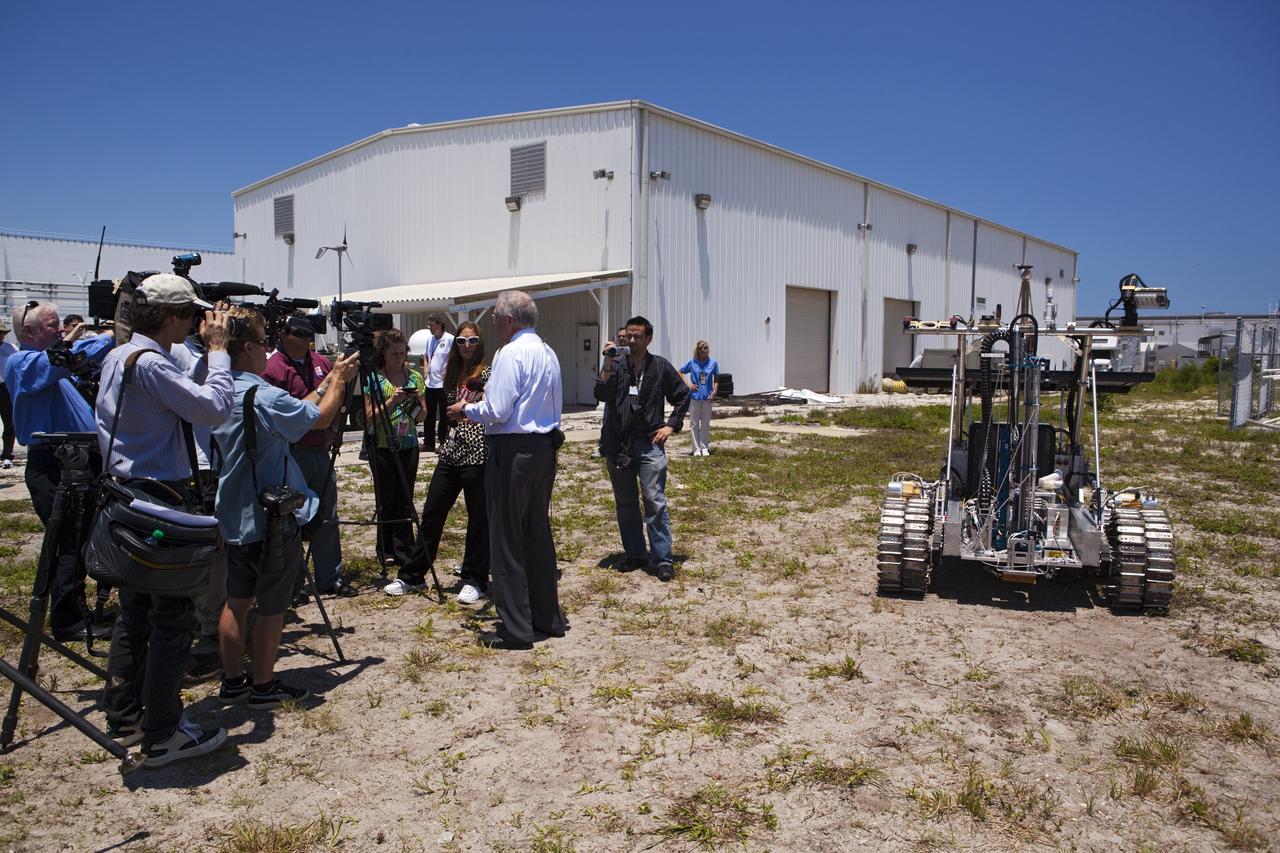
CAPE CANAVERAL, Fla. – NASA In Situ Resource Utilization Project Manager William Larson, back to rover, discusses the design and operation of the prototype rover Artemis Jr. for NASA’s Regolith and Environment Science and Oxygen and Lunar Volatile Extraction, or RESOLVE, project with media representatives during a rover demonstration in a field beside the Operations and Checkout Building at NASA’s Kennedy Space Center in Florida. The rover and its drill are provided by the Canadian Space Agency and work in concert with NASA science instruments to prospect for water, ice and other lunar resources. RESOLVE also will demonstrate how future explorers can take advantage of resources at potential landing sites by manufacturing oxygen from soil. NASA will conduct field tests in July outside of Hilo, Hawaii, with equipment and concept vehicles that demonstrate how explorers might prospect for resources and make their own oxygen for survival while on other planetary bodies. For more information, visit http://www.nasa.gov/exploration/analogs/index.html. Photo credit: NASA/Dimitri Gerondidakis