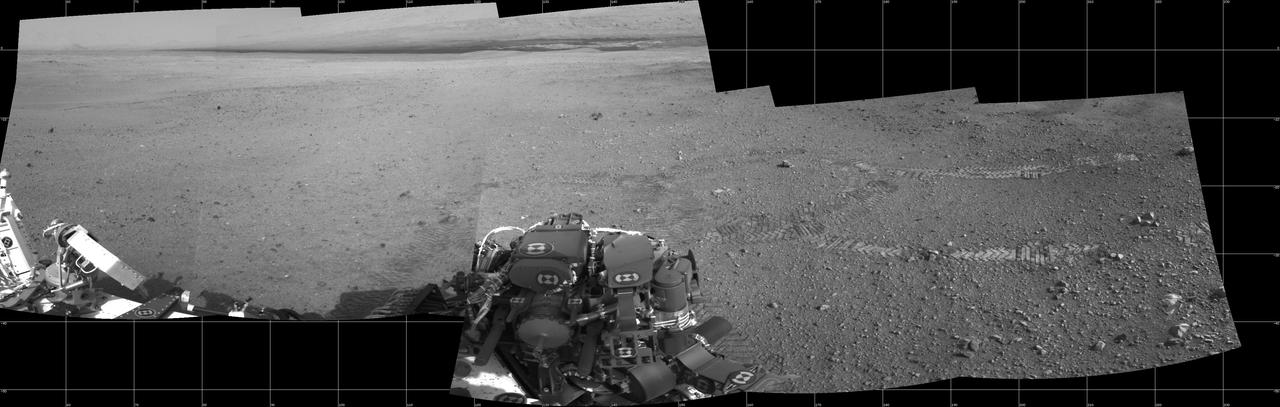
Two donut-shaped tracks make an infinity symbol, and mark the first two drives of NASA Curiosity rover. The landing site is at the far right.
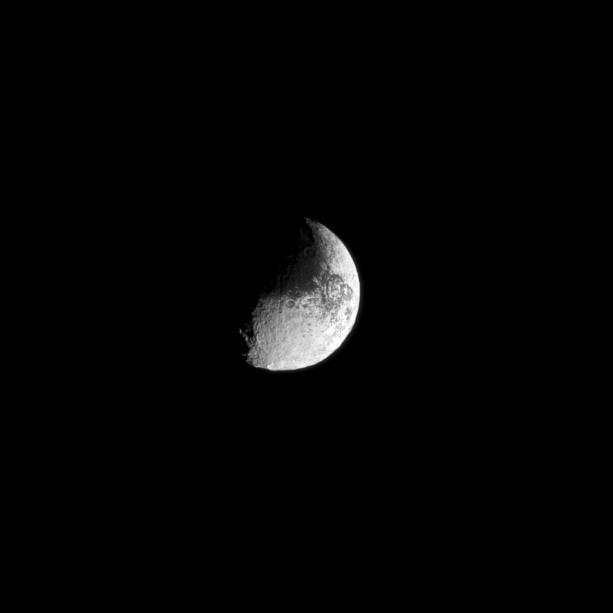
With its light and dark surface, Iapetus appears almost like a yin and yang symbol or a comma punctuation mark in this Cassini spacecraft image.
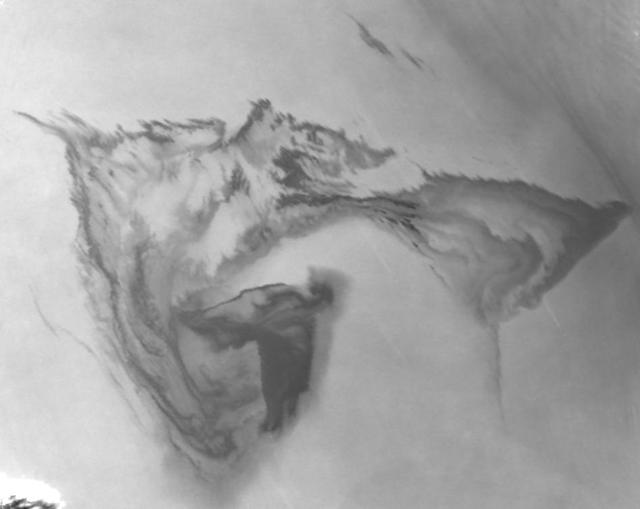
This image from NASA Terra satellite was acquired on May 1, 2010. The red symbol indicates the approximate position of the Deepwater Horizon platform and the source of the oil slick which resulted in a significant oil spill in the Gulf of Mexico.
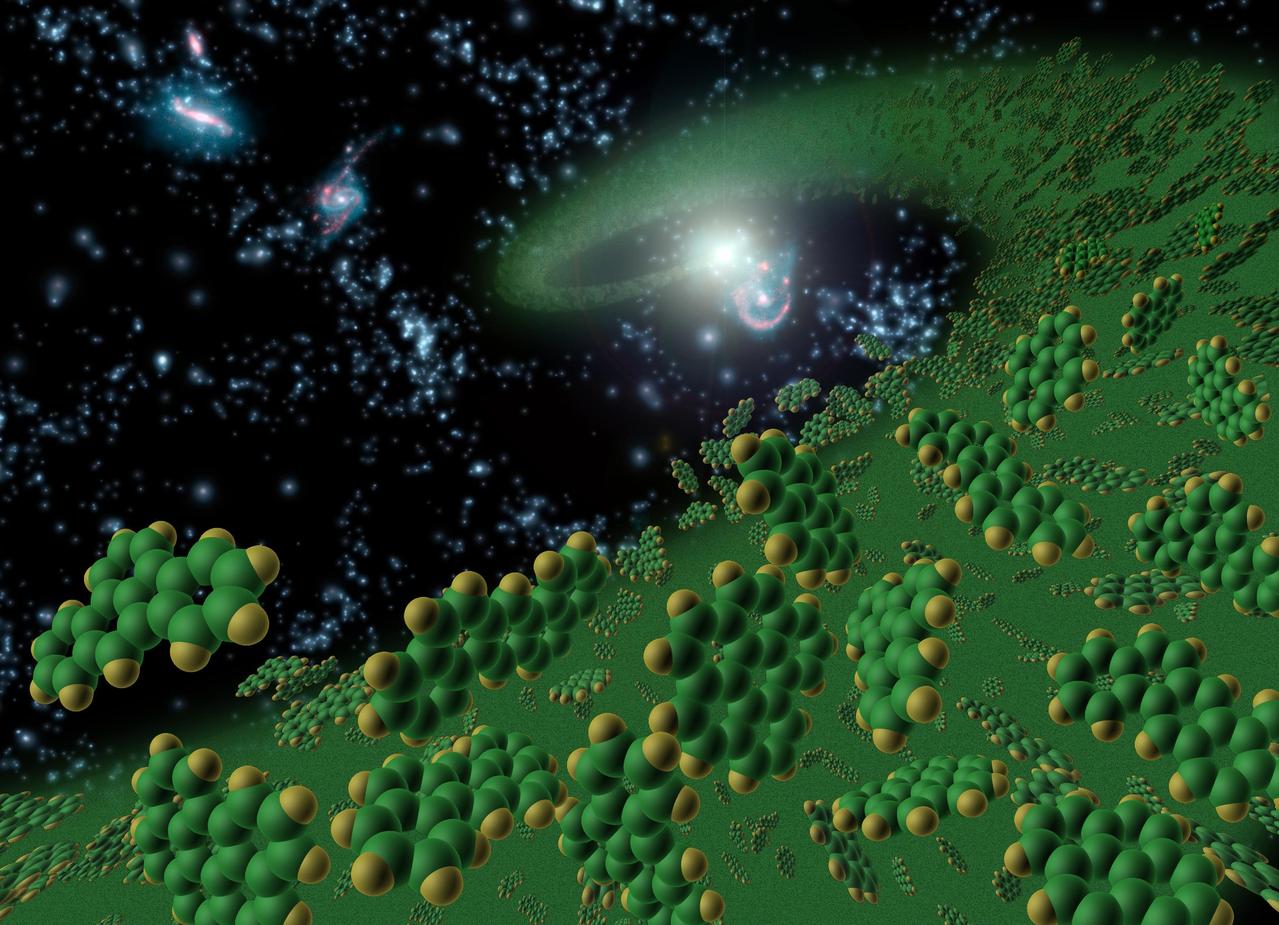
This artist conception symbolically represents complex organic molecules, known as polycyclic aromatic hydrocarbons, seen in the early universe. These large molecules, comprised of carbon and hydrogen, are considered among the building blocks of life.
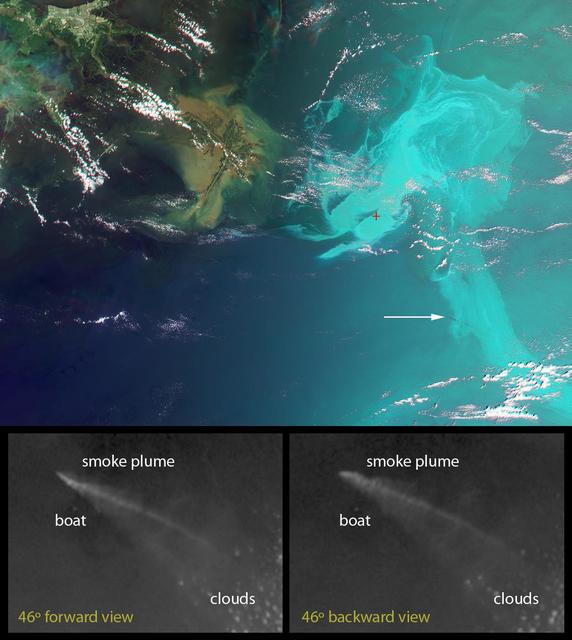
This false-color image, obtained by NASA Terra spacecraft on May 17, 2020, indicates the former location of the drilling platform red symbol and pointing to a plume of smoke white arrow.
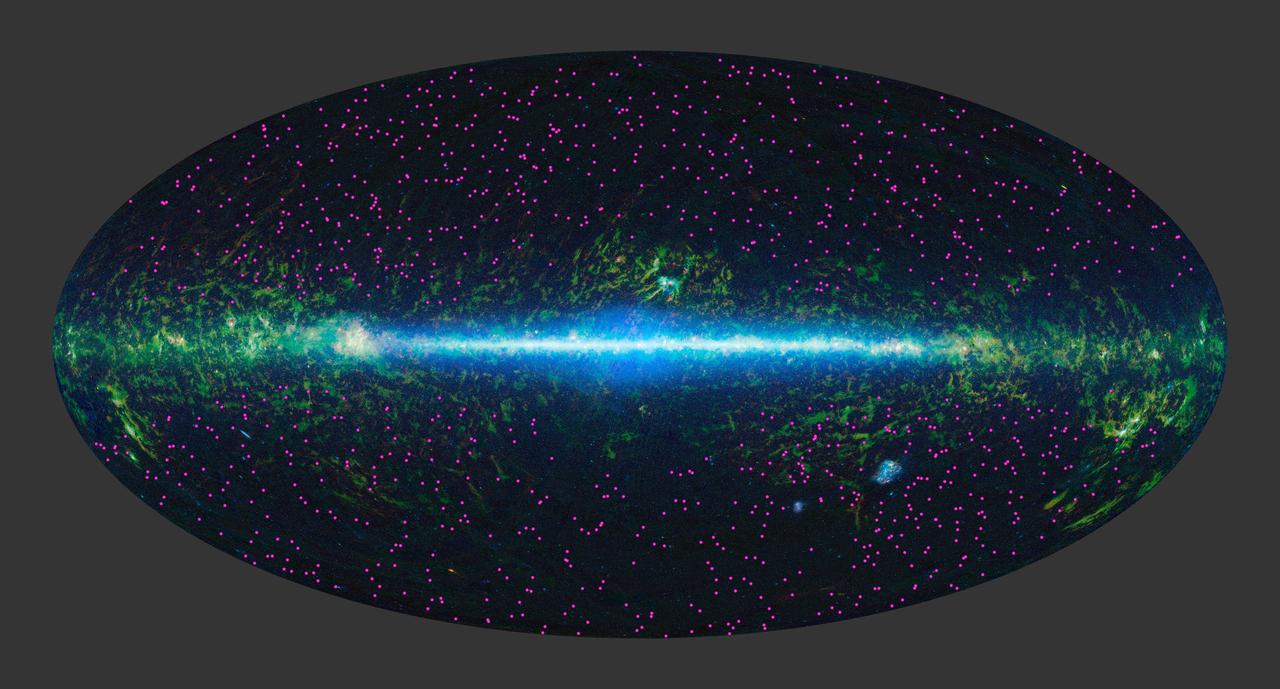
NASA WISE has identified about 1,000 extremely obscured objects over the sky, as marked by the magenta symbols. These hot dust-obscured galaxies, or hot DOGs, are turning out to be among the most luminous.
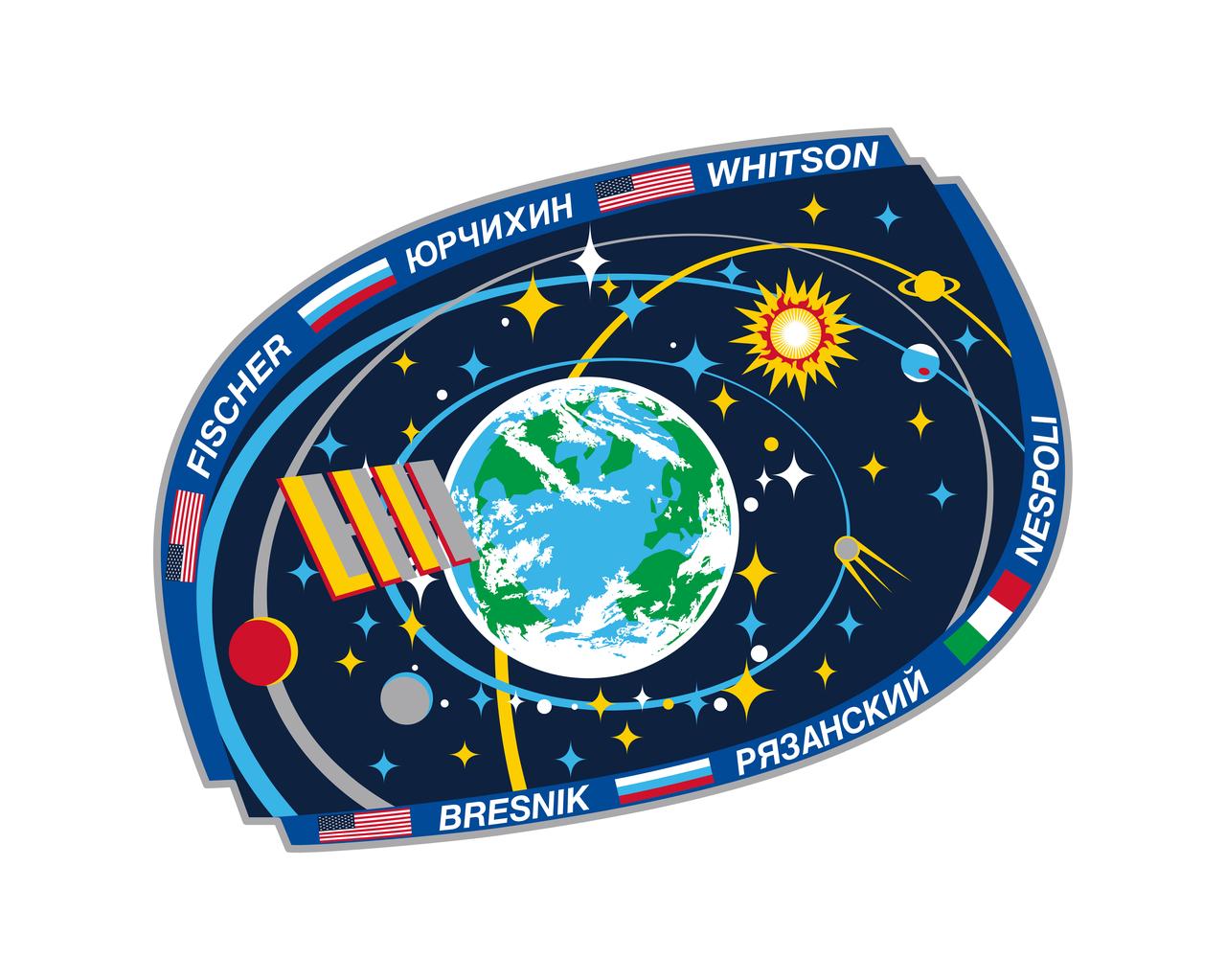
ISS052-s-001 (01/27/2016) --- Orbiting the Earth continuously since 1998, the International Space Station (ISS) is one of our greatest engineering achievements. It is depicted in gold, symbolic of constancy and excellence. Flying directly toward a sunrise represents the ISS’s contributions to a bright future. That sunrise and the Earth beneath ituses blue, white, red, and green, the combined national colors of Italy, Russia, and the United States, symbolizing the crew’s cohesiveness. Crewmember names are in blue symbolizing devotion and loyalty. The white border represents sunlight unscattered by the Earth’s atmosphere. Symbolic of new Russian and U.S. spacecraft that will further human exploration, the patch is shaped as a capsule. The number 52 is drawn as a path eventually leading to Mars. Finally, the stars symbolize the values of leadership, trust, teamwork, and excellence lived by mission control teams throughout the history of human space programs, as well as their global vigilance in operating the ISS.
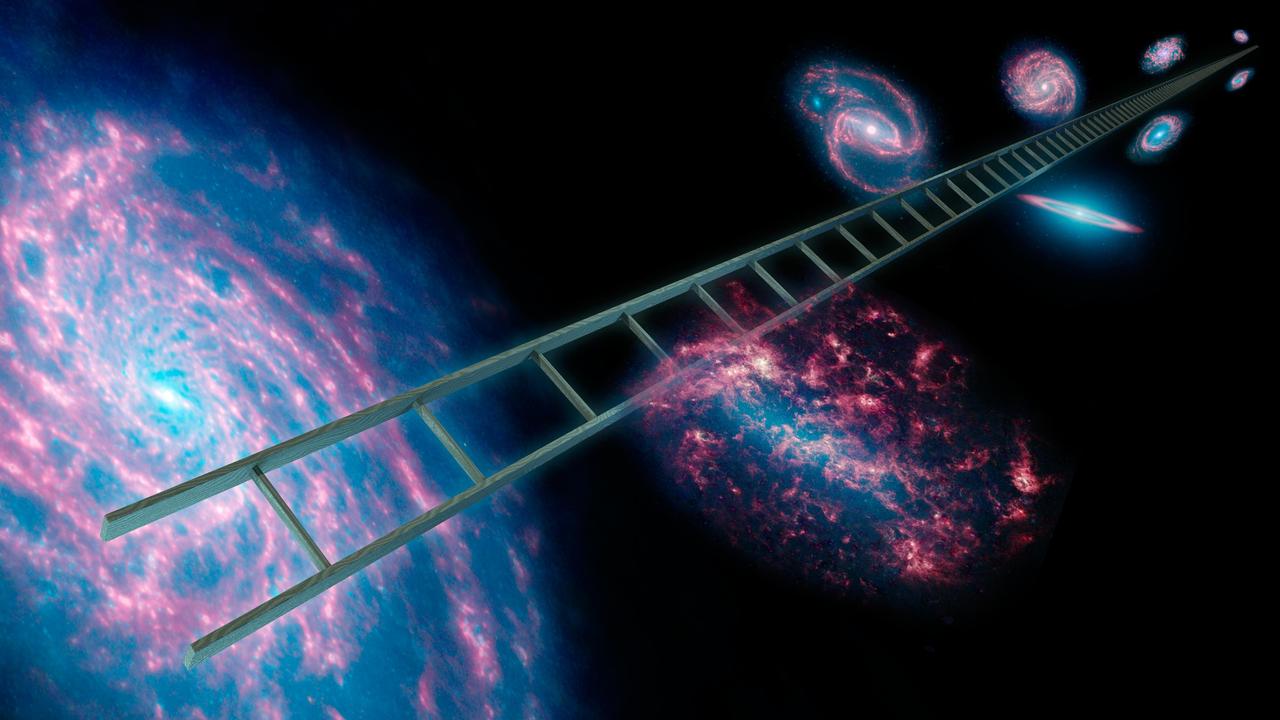
Astronomers using NASA Spitzer Space Telescope have greatly improved the cosmic distance ladder used to measure the expansion rate of the universe, its size and age. This artist concept symbolically shows a series of stars that have known distances.
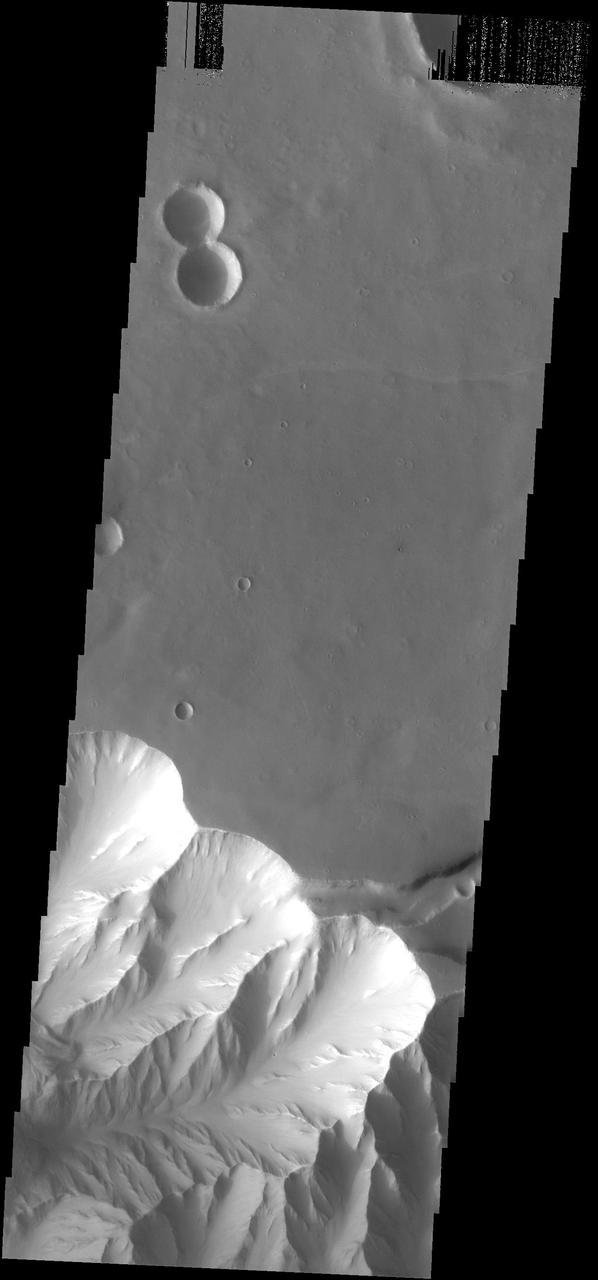
Back by popular demand: THEMIS ART IMAGE #75 The number 8 to go with letter L. Rotate the image and these craters will make the infinity symbol
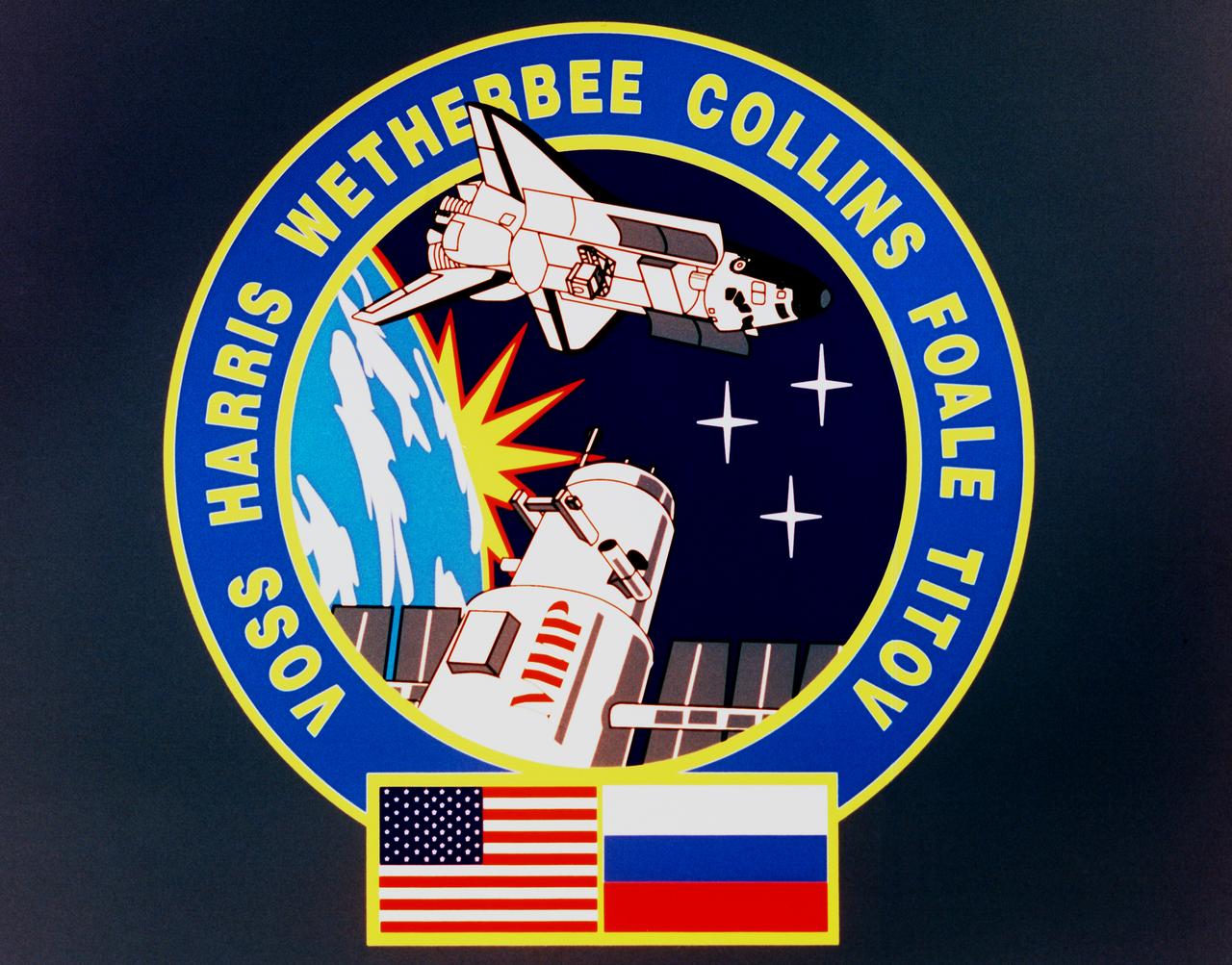
Designed by the crew members, the STS-63 crew patch depicts the orbiter maneuvering to rendezvous with Russia's Space Station Mir. The name is printed in Cyrillic on the side of the station. Visible in the Orbiter's payload bay are the commercial space laboratory Spacehab and the Shuttle Pointed Autonomous Research Tool for Astronomy (SPARTAN) satellite which are major payloads on the flight. The six points on the rising sun and the three stars are symbolic of the mission's Space Transportation System (STS) numerical designation. Flags of the United States and Russia at the bottom of the patch symbolize the cooperative operations of this mission.
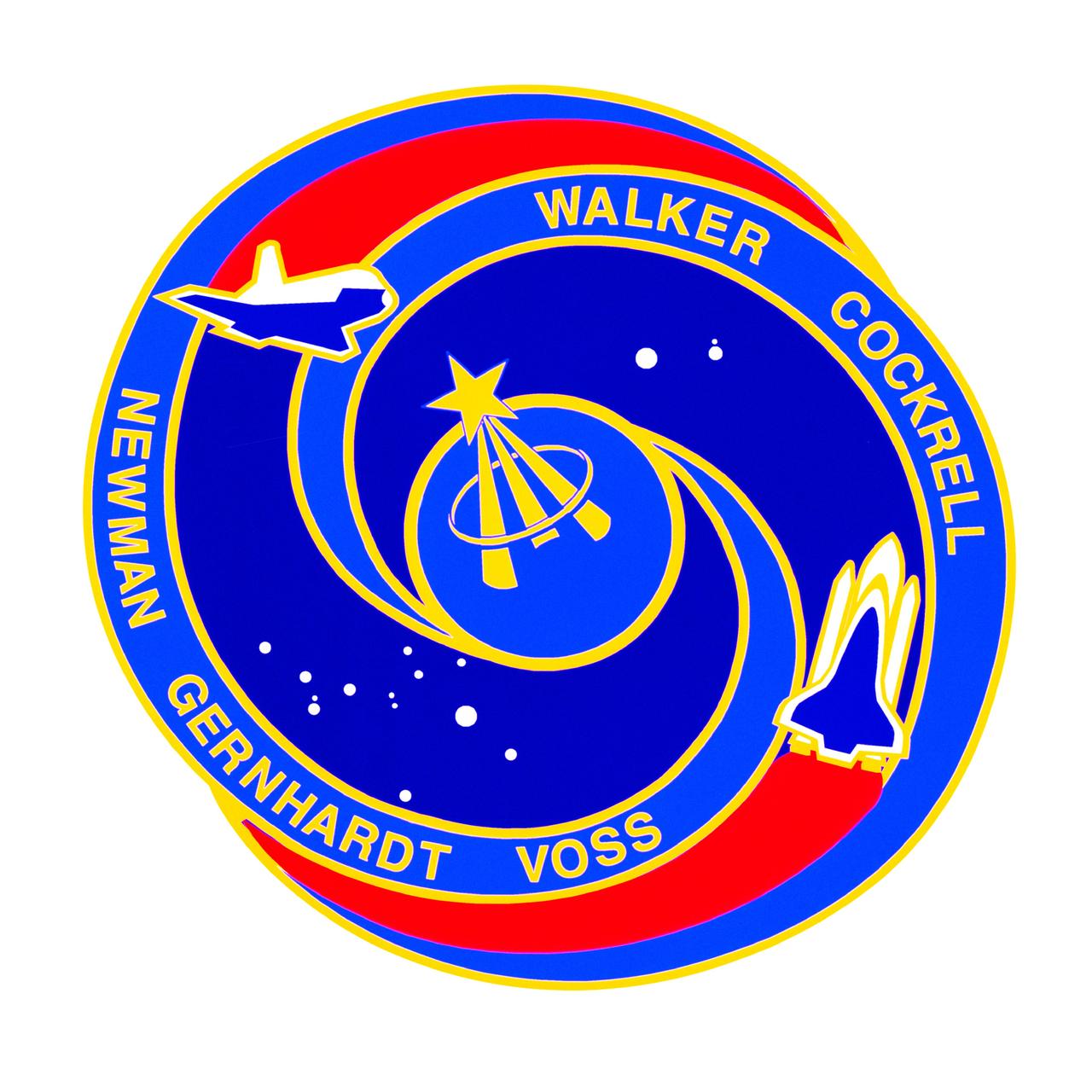
Designed by the mission crew members, the patch for STS-69 symbolizes the multifaceted nature of the flight's mission. The primary payload, the Wake Shield Facility (WSF), is represented in the center by the astronaut emblem against a flat disk. The astronaut emblem also signifies the importance of human beings in space exploration, reflected by the planned space walk to practice for International Space Station (ISS) activities and to evaluate space suit design modifications. The two stylized Space Shuttles highlight the ascent and entry phases of the mission. Along with the two spiral plumes, the stylized Space Shuttles symbolize a NASA first, the deployment and recovery on the same mission of two spacecraft (both the Wake Shield Facility and the Spartan). The constellations Canis Major and Canis Minor represent the astronomy objectives of the Spartan and International Extreme Ultraviolet Hitchhiker (IEH) payload. The two constellations also symbolize the talents and dedication of the support personnel who make Space Shuttle missions possible.
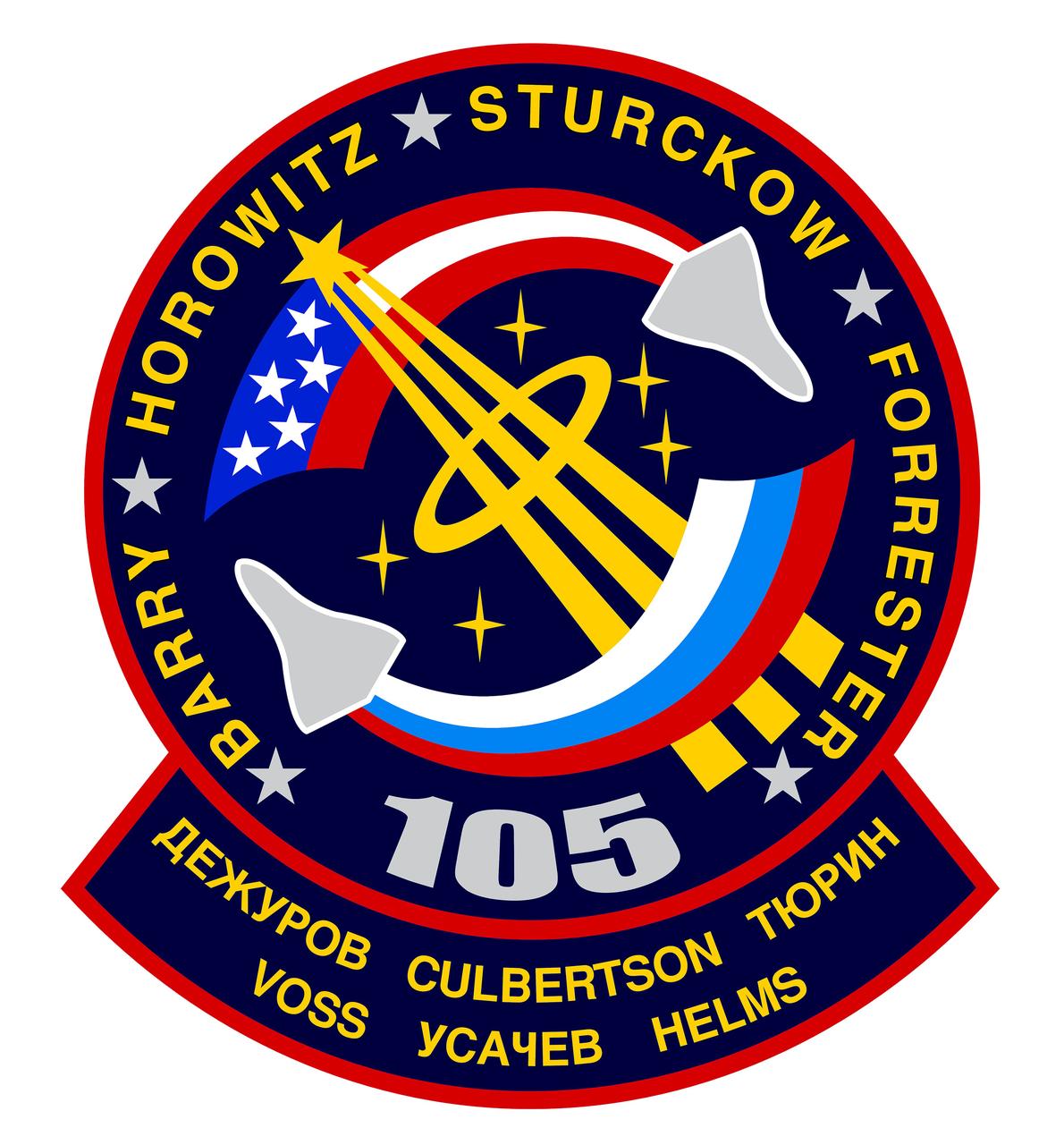
The STS-105 crew patch symbolizes the exchange of the Expedition Two and Expedition Three crews aboard the International Space Station (ISS). The three gold stars near the ascending orbiter represent the U.S. commanded Expedition Three Crew journeying into space, while the two gold stars near the descending orbiter represent the Russian commanded Expedition Two crew on their return to Earth. The ascending and descending Orbiters form a circle that represents both the crew rotation and the continuous presence in space aboard the station. The plumes of each orbiter represent the flags of the U.S. and Russia, symbolizing the close cooperation between the two nations. The Astronaut office symbol, a star with three rays of light, depicts the unbroken link between Earth and the brightest star on the horizon, the ISS. The names of Discovery's crew of four astronauts are shown along the border of the patch while the names of the Expedition crews are shown on the chevron at the bottom of the patch.
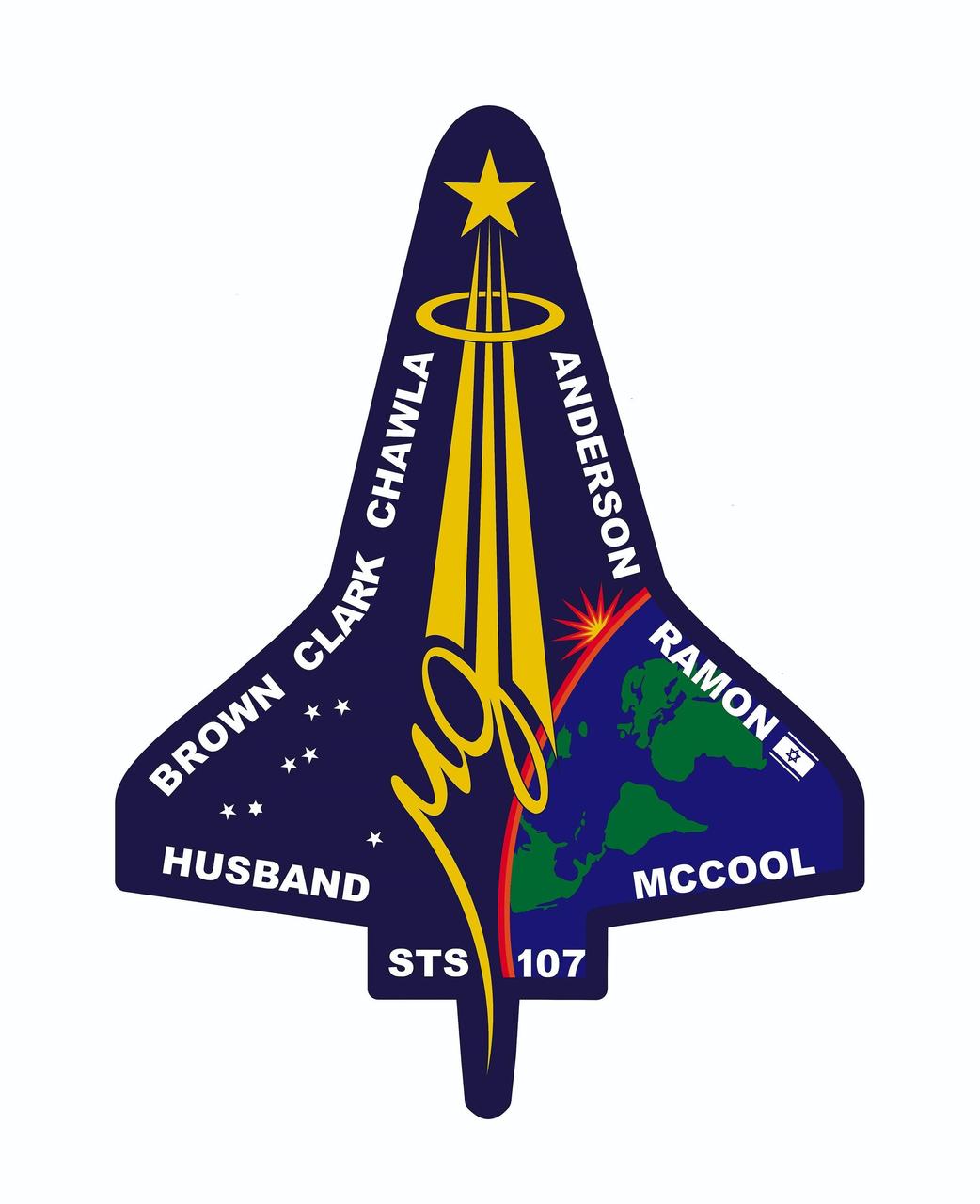
JOHNSON SPACE CENTER, HOUSON, TEXAS -- STS-107 INSIGNIA -- This is the insignia for STS-107, which is a multi-discipline microgravity and Earth science research mission with a multitude of international scientific investigations conducted continuously during the planned 16 days on orbit. The central element of the patch is the microgravity symbol flowing into the rays of the astronaut symbol. The mission inclination is portrayed by the 39-degree angle of the astronaut symbol to the Earth's horizon. The sunrise is representative of the numerous experiments that are the dawn of a new era for continued microgravity research on the International Space Station and beyond. The breadth of science conducted on this mission will have widespread benefits to life on Earth and our continued exploration of space, illustrated by the Earth and stars. The constellation Columba (the dove) was chosen to symbolize peace on Earth and the Space Shuttle Columbia. The seven stars also represent the mission crew members and honor the original astronauts who paved the way to make research in space possible. The Israeli flag is adjacent to the name of the payload specialist who is the first person from that country to fly on the Space Shuttle. The NASA insignia design for Space Shuttle flights is reserved for use by the astronauts and for other official use as the NASA Administrator may authorize. Public availability has been approved only in the form of illustrations by the various news media. When and if there is any change in this policy, which we do not anticipate, it will be publicly announced.
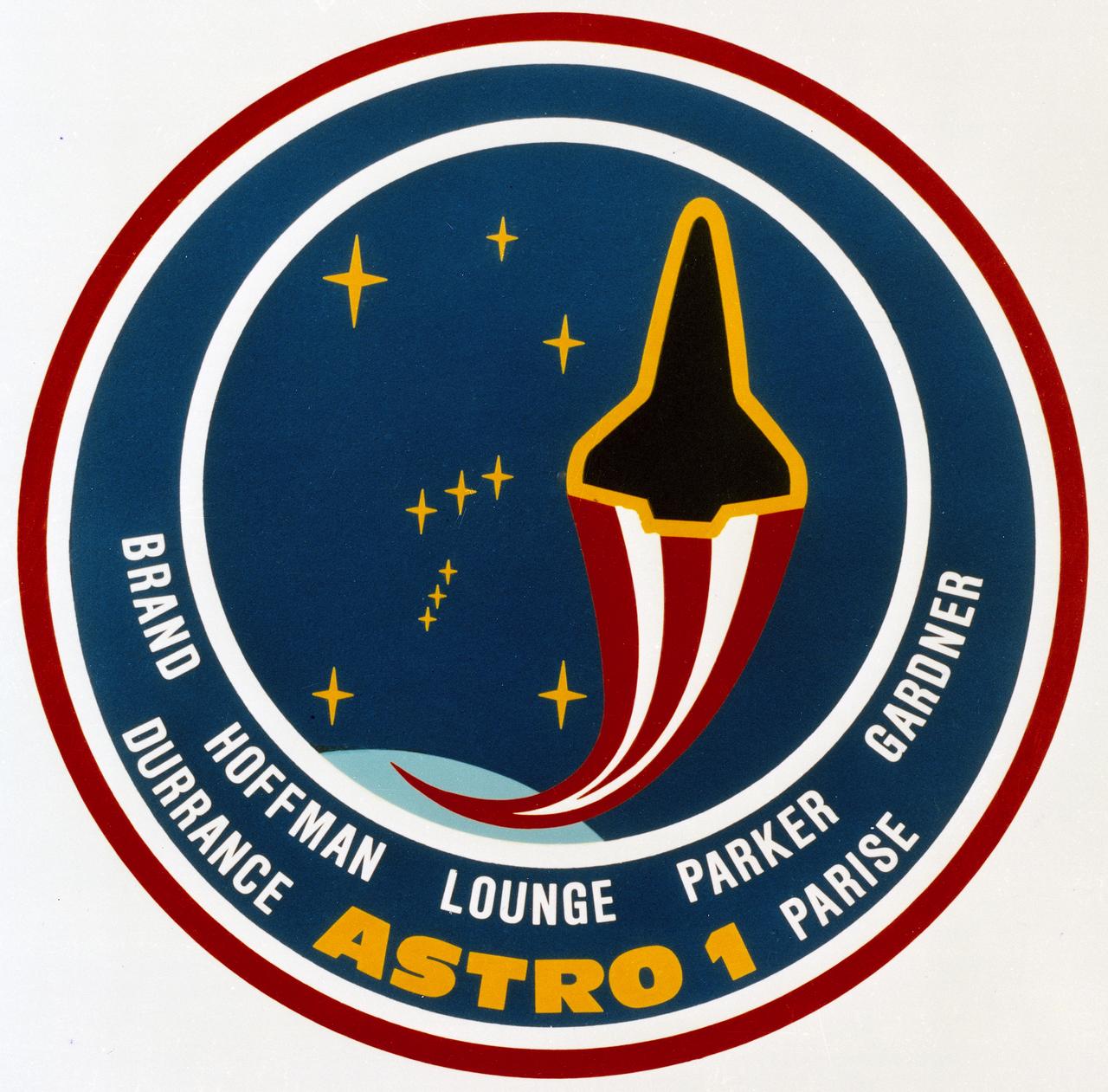
Designed by the crewmembers assigned to the mission, the STS-35 crew patch symbolizes the Space Shuttle flying above Earth's atmosphere to better study the many celestial objects of the universe, represented by the constellation Orion.
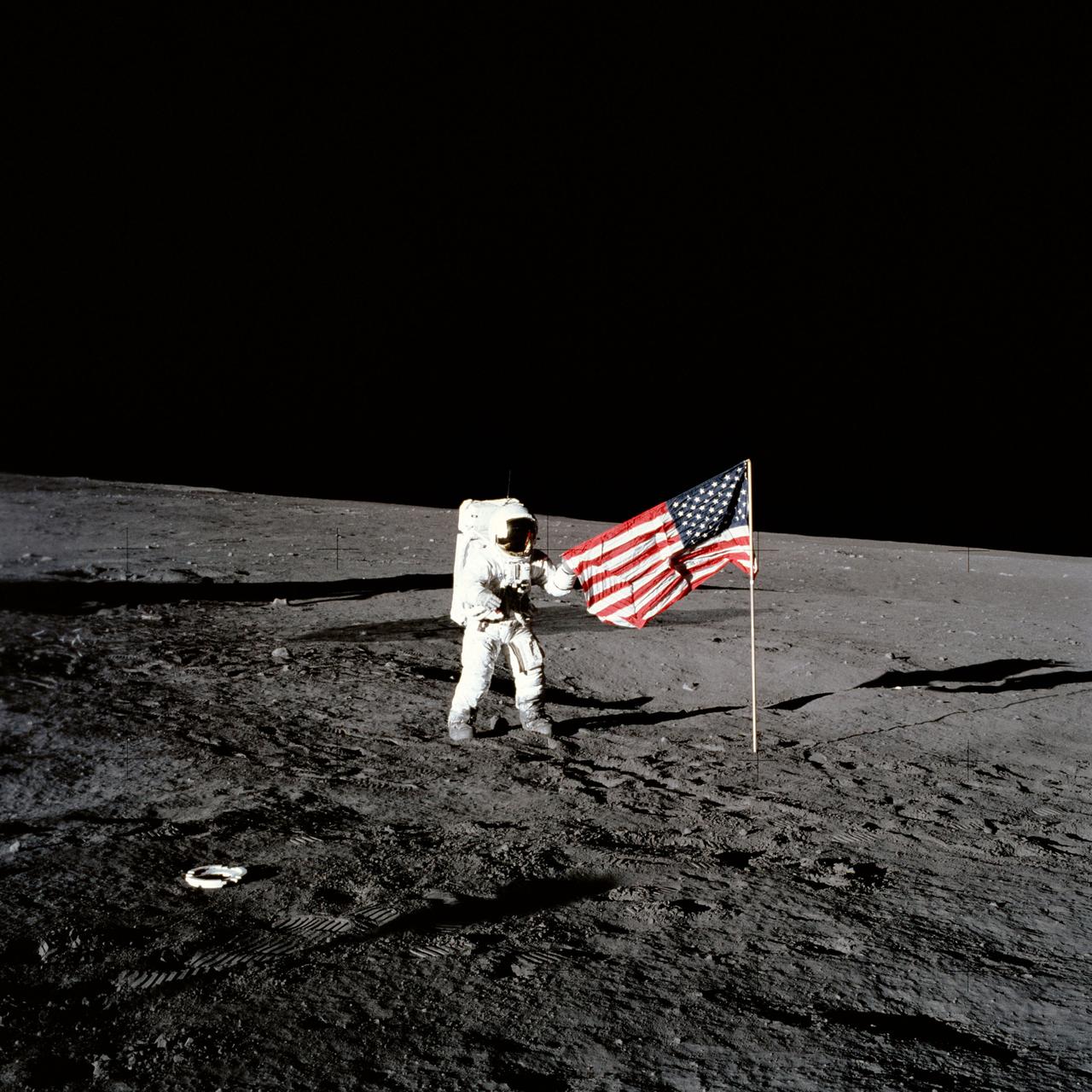
AS12-47-6897 (19 Nov. 1969) --- Astronaut Charles Conrad Jr., Apollo 12 commander, stands beside the United States flag after it was unfurled on the lunar surface during the first extravehicular activity (EVA), on Nov. 19, 1969. Several footprints made by the crewmembers can be seen in the photograph. While astronauts Conrad and Alan L. Bean, lunar module pilot, descended in the Lunar Module (LM) "Intrepid" to explore the Ocean of Storms region of the moon, astronaut Richard F. Gordon Jr., command module pilot, remained with the Command and Service Modules (CSM) "Yankee Clipper" in lunar orbit.
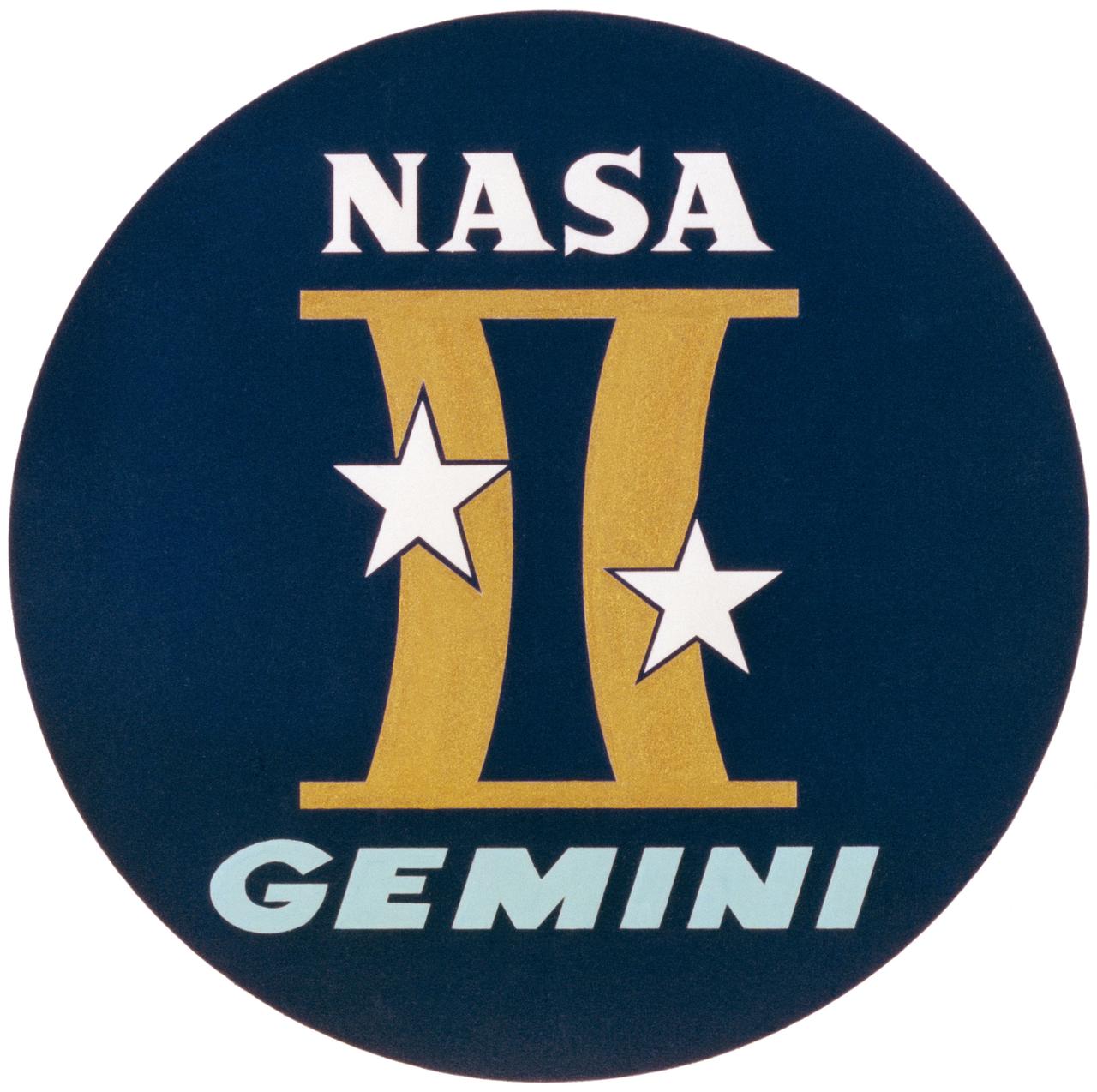
S65-54354 (30 Aug. 1965) --- The insignia of the Gemini Space Program is a disc of dark blue as a background for a gold Zodiac Gemini symbol. A white star on each of the two vertical curves of the Gemini symbol represent the Gemini twins, Pollux and Castor. The NASA insignia design for Gemini flights is reserved for use by the astronauts and for other official use as the NASA Administrator may authorize. Public availability has been approved only in the form of illustrations by the various news media. When and if there is any change in this policy, which we do not anticipate, it will be publicly announced.
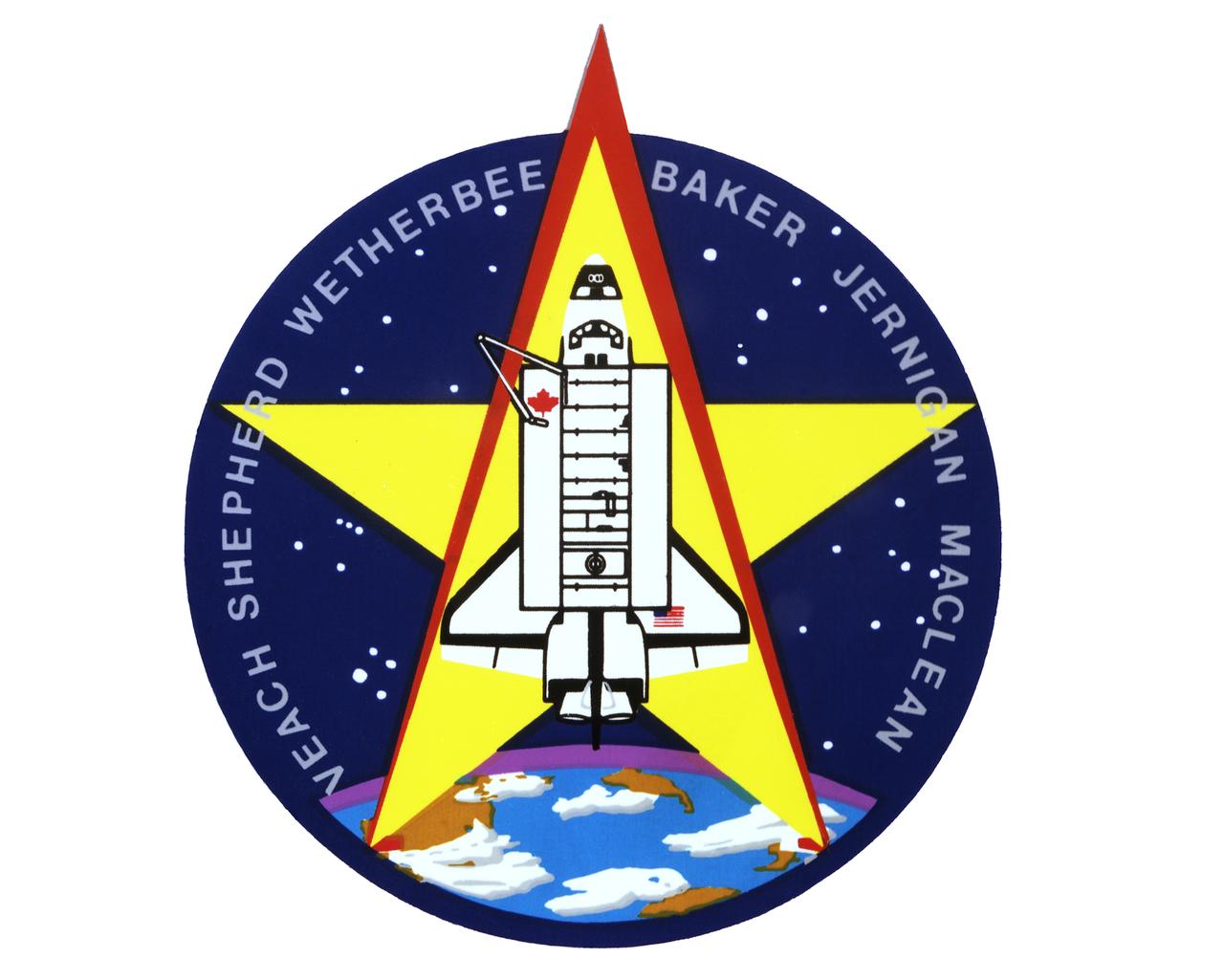
The STS-52 insignia, designed by the mission’s crew members, features a large gold star to symbolize the crew's mission on the frontiers of space. A gold star is often used to symbolize the frontier period of the American West. The red star in the shape of the Greek letter lambda represents both the laser measurements taken from the Laser Geodynamic Satellite (LAGEOS II) and the Lambda Point Experiment, which was part of the United States Microgravity Payload (USMP-l). The remote manipulator and maple leaf are emblematic of the Canadian payload specialist who conducted a series of Canadian flight experiments (CANEX-2), including the Space Vision System test.
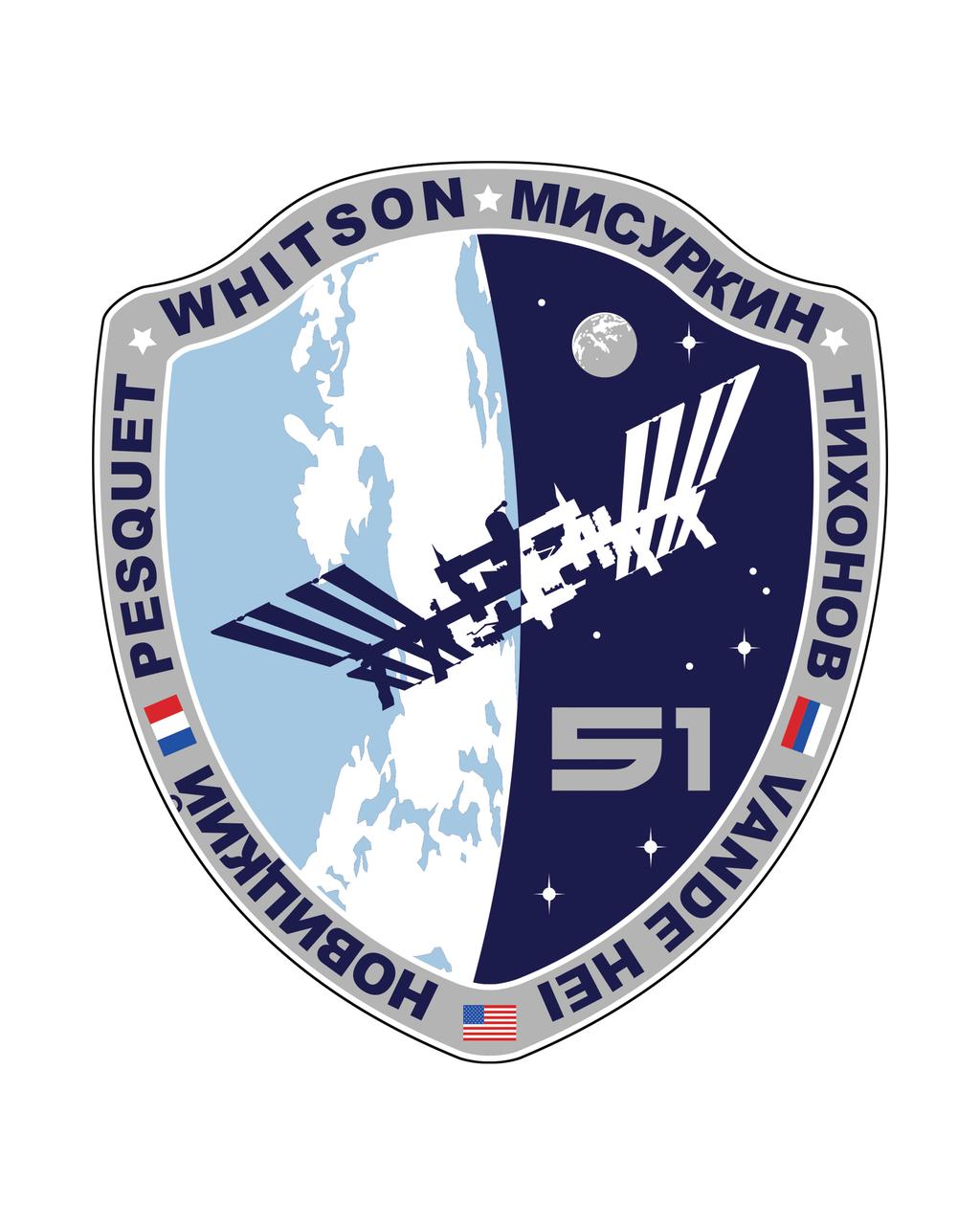
ISS051-S-001 --- From as early as the 11th century, coats of arms have been used as emblems representing groups as small as families to as large as countries. The Expedition 51 patch is designed as a modernized international coat of arms, blending the traditional shield shape with our modernized symbol of achievement, the International Space Station. The background represents our home world and its inhabitants on the left, and outer space to the right. The bi-color International Space Station is the bridge between the two, symbolizing the benefits on Earth of space research, and at the same time our mission to explore deeper into space, on a path to further discovery and knowledge.
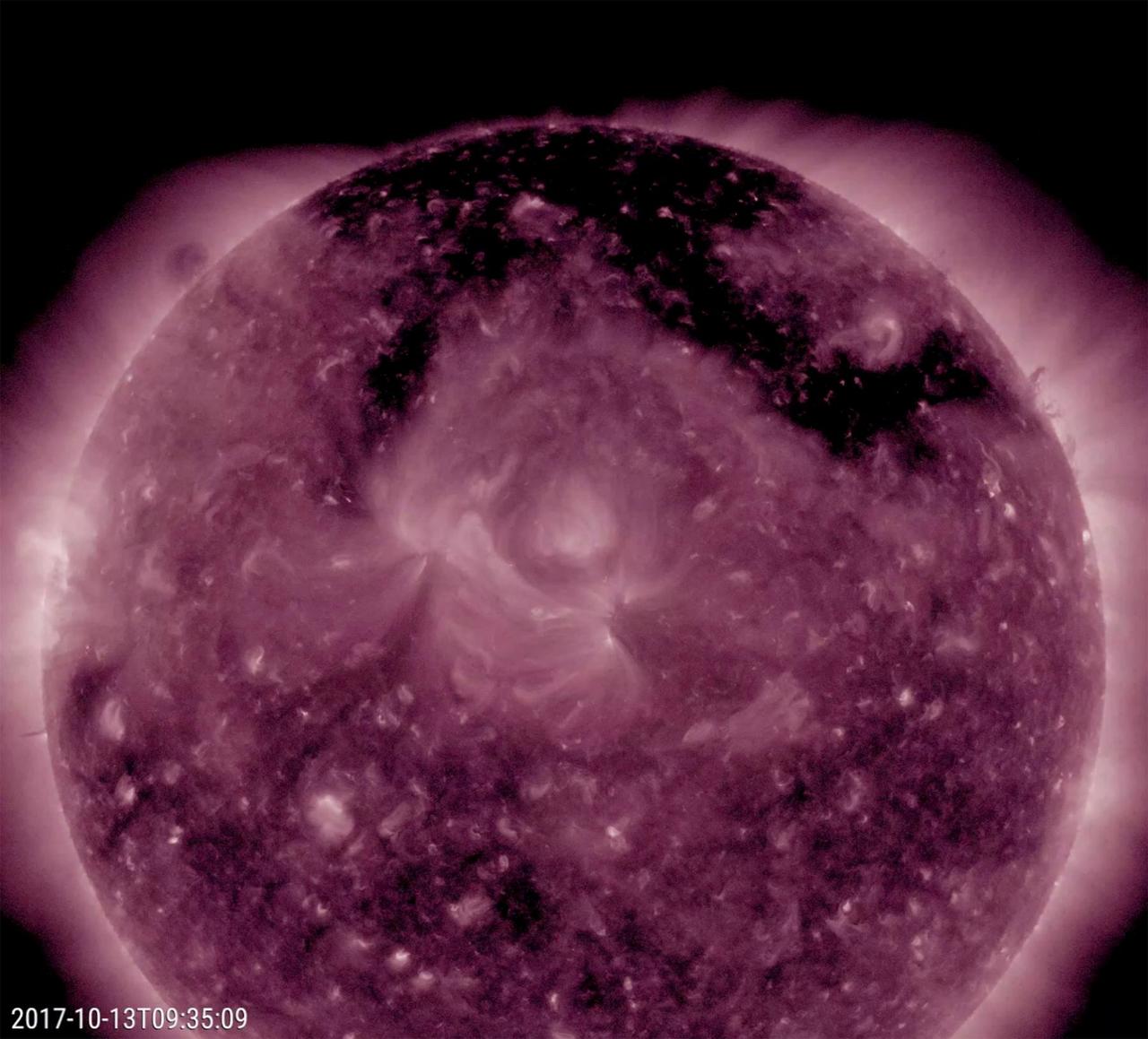
A large coronal hole stands out as the most obvious feature on the sun this week (Oct. 12-13, 2017). The dark structure, shaped kind of like the Pi symbol, spreads across much of the top of the sun. Though one cannot tell from this image and video clip in false-color extreme ultraviolet light, it is spewing high-speed solar wind particles into space and has been doing this all week. It is likely that these charged particles have been interacting with Earth's atmosphere and generating many aurora displays in regions near the poles the past several days. Animations are available at https://photojournal.jpl.nasa.gov/catalog/PIA22047
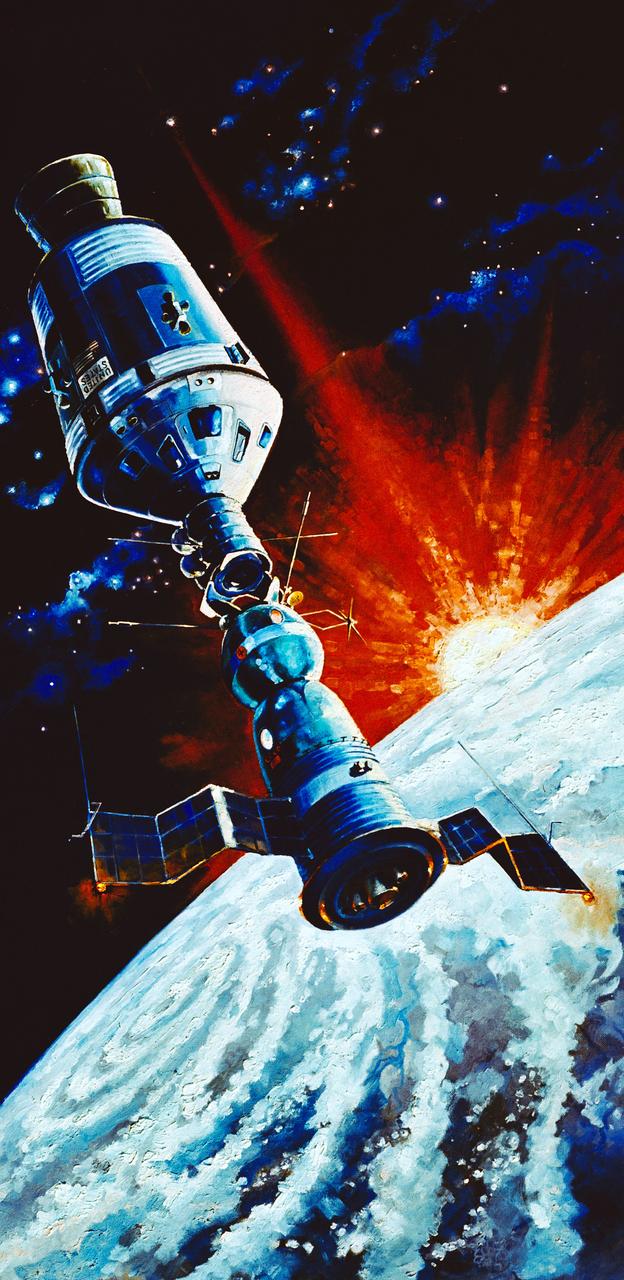
S75-25077 (May 1975) --- A photographic copy of a painting made by cosmonaut Aleksey A. Leonov, commander of the Soviet ASTP first (prime) crew. This symbolic artwork, representing a Soviet Soyuz spacecraft docking in Earth orbit with an American Apollo spacecraft, was finished in May 1974. The sketch for the painting was made in 1973 following the signing of the space agreement between the United Stated and the Soviet Union. Leonov said that his painting symbolizes the new type of international cooperation of working together in space. The original painting, which measures 80 centimeters by 160 centimeters (1 cm. = 0.39 in.), is on display in a museum in the city of Baku on the Caspian Sea. In making the sketch for the painting Leonov used a model of an earlier Soyuz spacecraft and a picture of an Apollo spacecraft. Later, he obtained a model of an Apollo which helped him check the configuration of the American spacecraft. The tanks on the Docking Module are no longer exposed on the current DM configuration, he noted. Also, this would not be an exact view of the sun as seen from Earth orbit. Leonov took artist license in stressing the symbolism in his artwork. The Soyuz is represented smaller in the painting than it actually is, Leonov added.
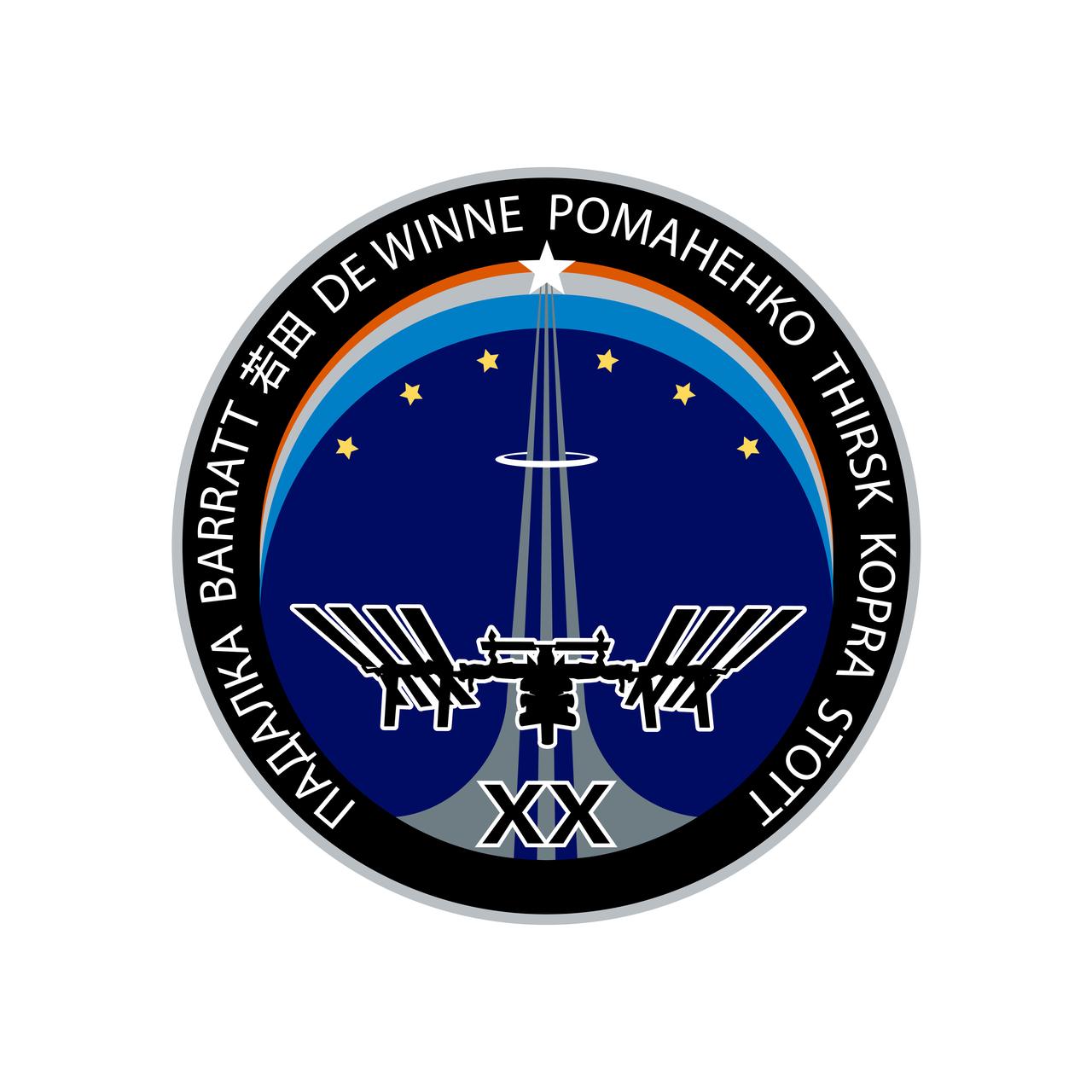
ISS020-S-001A (December 2008) --- The Expedition 20 patch symbolizes a new era in space exploration with the first six-person crew living and working onboard ISS and represents the significance of the ISS to the exploration goals of NASA and its international partners. The six gold stars signify the men and women of the crew. The astronaut symbol extends from the base of the patch to the star at the top to represent the international team, both on the ground and on orbit, that are working together to further our knowledge of living and working in space. The space station in the foreground represents where we are now and the important role it is playing towards meeting our exploration goals. The knowledge and expertise developed from these advancements will enable us to once again leave low earth orbit for the new challenges of establishing a permanent presence on the moon and then on to Mars. The blue, gray and red arcs represent our exploration goals as symbols of Earth, the moon and Mars. The NASA insignia design for ISS expedition crews is reserved for use by the astronauts and for other official use as the NASA Administrator may authorize. Public availability has been approved only in the form of illustrations by the various news media. When and if there is any change in this policy, which is not anticipated, it will be publicly announced.
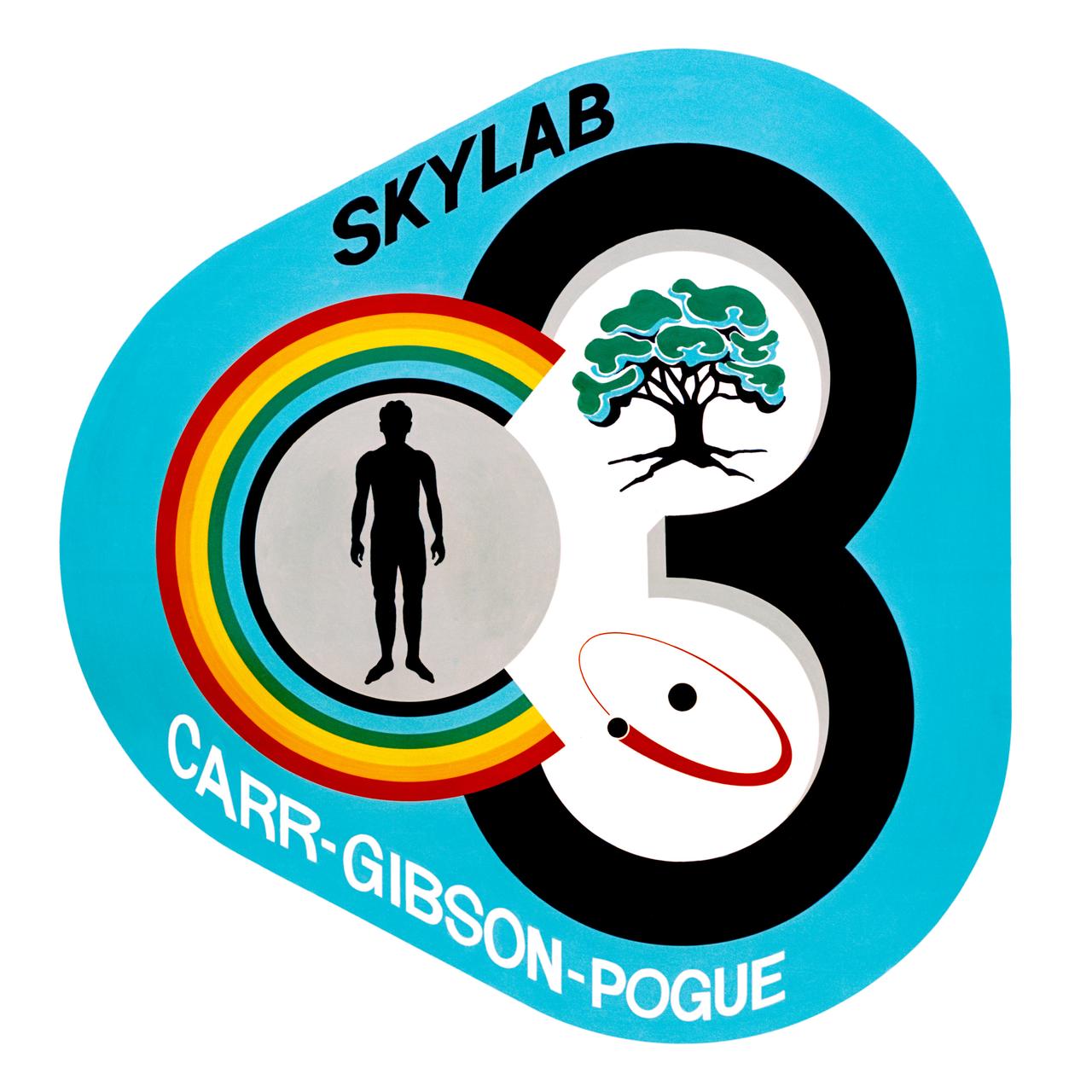
S72-53094 (For release February 1973) --- This is the emblem for the third manned Skylab mission. It will be a mission of up to 56 days. Skylab is an experimental space station consisting of a 100-ton laboratory complex in which medical, scientific and technological experiments will be performed in Earth orbit. The members of the crew will be astronaut Gerald P. Carr, commander; scientist-astronaut Edward G. Gibson, science pilot; and astronaut William R. Pogue, pilot. The symbols in the patch refer to the three major areas of investigation proposed in the mission. The tree represents man's natural environment and relates directly to the Skylab mission objectives of advancing the study of Earth resources. The hydrogen atom, as the basic building block of the universe, represents man's exploration of the physical world, his application of knowledge, and his development of technology. Since the sun is composed primarily of hydrogen, it is appropriate that the symbol refers to the solar physics mission objectives. The human silhouette represents mankind and the human capacity to direct technology with a wisdom tempered by regard for his natural environment. It also directly relates to the Skylab medical studies of man himself. The rainbow, adopted from the Biblical story of the flood, symbolizes the promise that is offered man. It embraces man and extends to the tree and the hydrogen atom emphasizing man's pivotal role in the conciliation of technology with nature. Photo credit: NASA
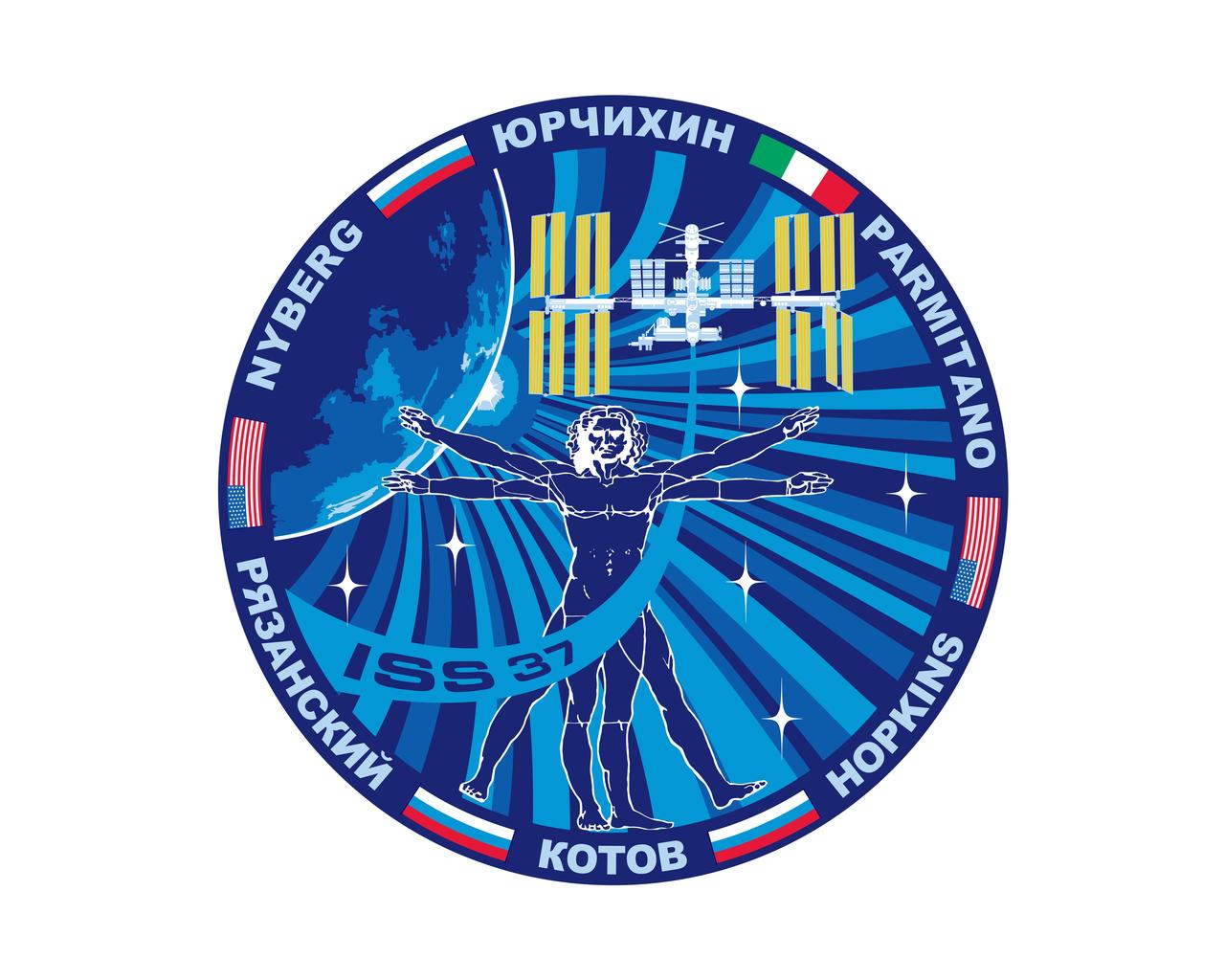
ISS037-S-001 (August 2012) --- Leonardo da Vinci's Vitruvian Man, created some 525 years ago, as a blend of art and science and a symbol of the medical profession, is depicted amongst the orbits of a variety of satellites circling the Earth at great speed. Da Vinci's drawing, based on the proportions of man as described by the Roman architect Vitruvius, is often used as a symbol of symmetry of the human body and the universe as a whole. Almost perfect in symmetry as well, the International Space Station, with its solar wings spread out and illuminated by the first rays of dawn, is pictured as a mighty beacon arcing upwards across our night skies, the ultimate symbol of science and technology of our age. Six stars represent the six members of Expedition 37 crew, which includes two cosmonauts with a medical background, as well as a native of Da Vinci's Italy. The design for insignia for space station flights is reserved for use by the crew members and for other official use as the NASA Administrator may authorize. Public availability has been approved only in the form of illustrations by the various news media. When and if there is any change in this policy, which is not anticipated, it will be publicly announced.
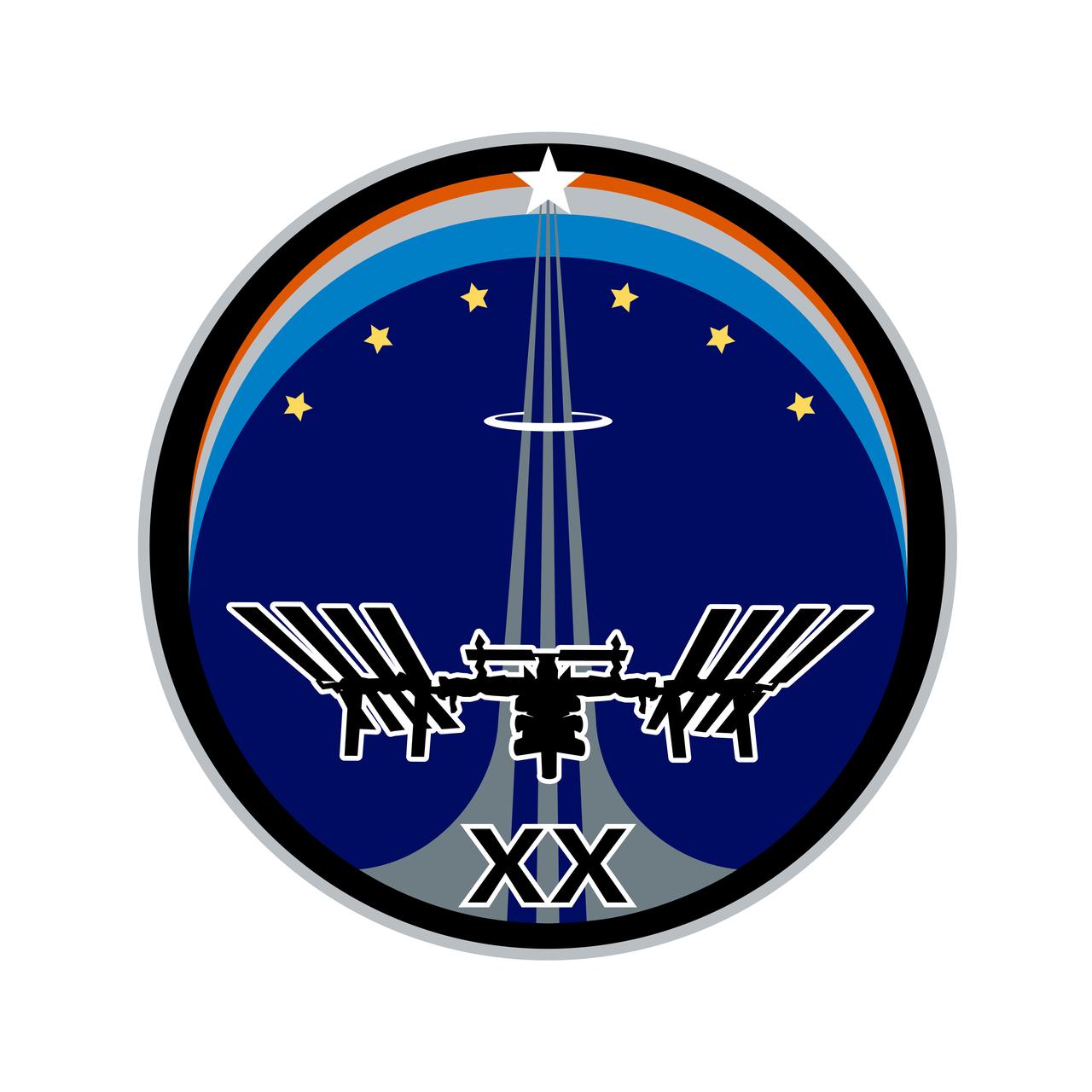
ISS020-S-001B (December 2008) --- The Expedition 20 patch symbolizes a new era in space exploration with the first six-person crew living and working onboard ISS and represents the significance of the ISS to the exploration goals of NASA and its international partners. The six gold stars signify the men and women of the crew. The astronaut symbol extends from the base of the patch to the star at the top to represent the international team, both on the ground and on orbit, that are working together to further our knowledge of living and working in space. The space station in the foreground represents where we are now and the important role it is playing towards meeting our exploration goals. The knowledge and expertise developed from these advancements will enable us to once again leave low earth orbit for the new challenges of establishing a permanent presence on the moon and then on to Mars. The blue, gray and red arcs represent our exploration goals as symbols of Earth, the moon and Mars. The NASA insignia design for ISS expedition crews is reserved for use by the astronauts and for other official use as the NASA Administrator may authorize. Public availability has been approved only in the form of illustrations by the various news media. When and if there is any change in this policy, which is not anticipated, it will be publicly announced.
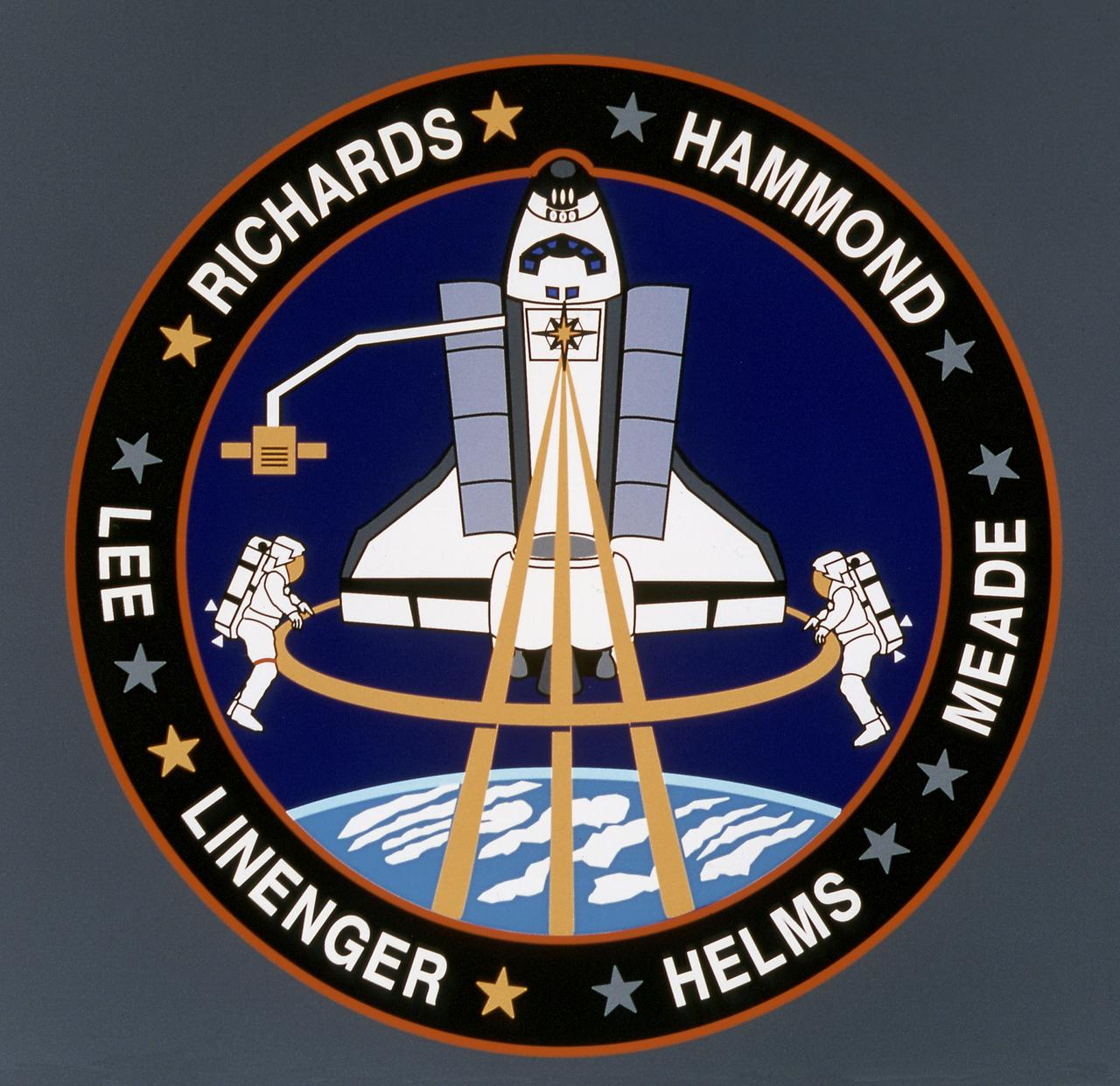
The STS-64 patch depicts the Space Shuttle Discovery in a payload-bay-to-Earth attitude with its primary payload, Lidar In-Space Technology Experiment (LITE-1) operating in support of Mission to Planet Earth. LITE-1 is a lidar system that uses a three-wavelength laser, symbolized by the three gold rays emanating from the star in the payload bay that form part of the astronaut symbol. The major objective of the LITE-1 is to gather data about the Earth's troposphere and stratosphere, represented by the clouds and dual-colored Earth limb. A secondary payload on STS-64 is the free-flier SPARTAN 201 satellite shown on the Remote Manipulator System (RMS) arm post-retrieval. The RMS also operated another payload, Shuttle Plume Impingement Flight Experiment (SPIFEX). A newly tested extravehicular activity (EVA) maneuvering device, Simplified Aid for EVA Rescue (SAFER), represented symbolically by the two small nozzles on the backpacks of the two untethered EVA crew men. The names of the crew members encircle the patch: Astronauts Richard N. Richards, L. Blaine Hammond, Jr., Jerry M. Linenger, Susan J. Helms, Carl J. Meade and Mark C. Lee. The gold or silver stars by each name represent that person's parent service.
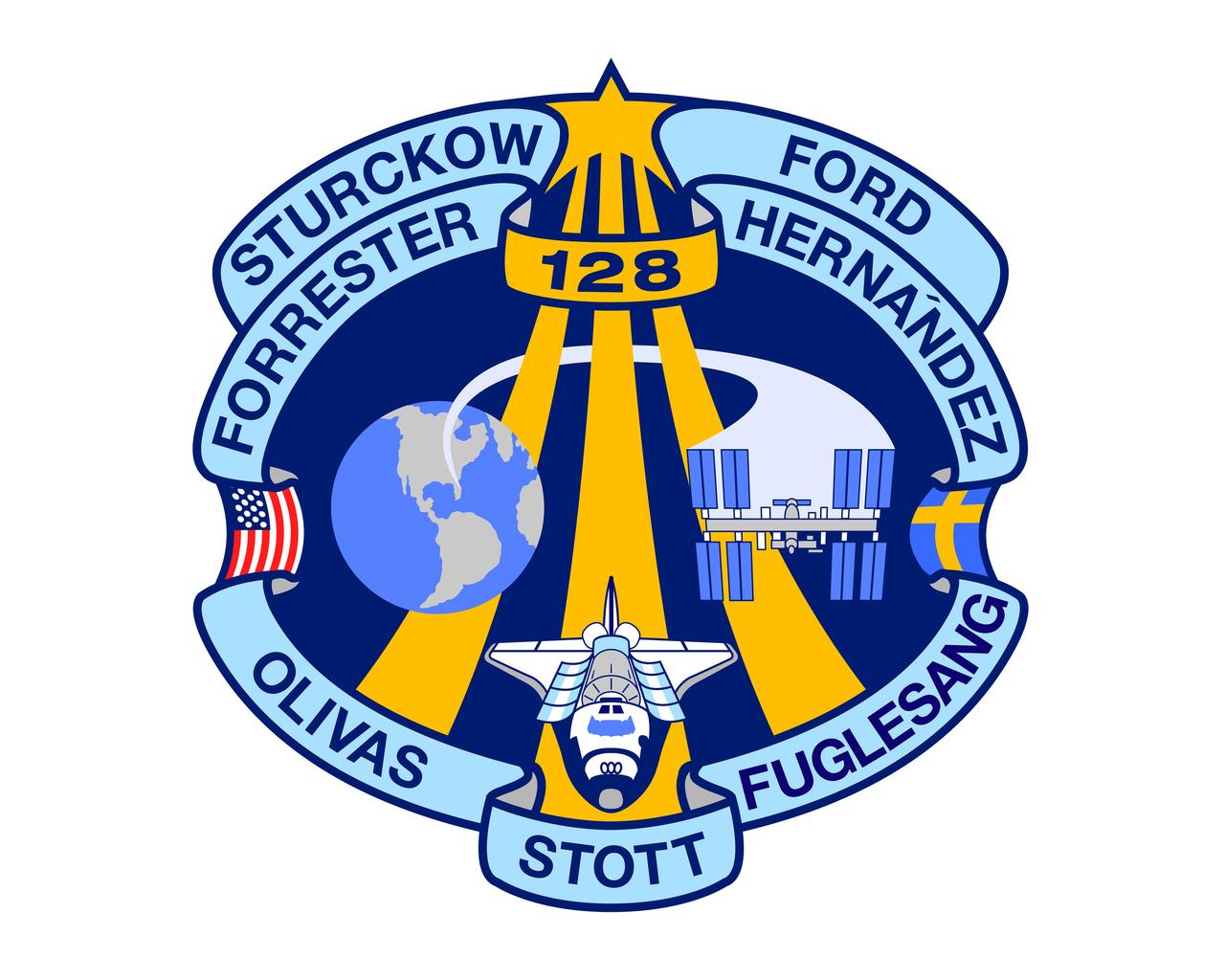
STS128-S-001 (April 2009) --- The STS-128 patch symbolizes the 17A mission and represents the hardware, people and partner nations that contribute to the flight. The Space shuttle Discovery is shown in the orbit configuration with the Multi-Purpose Logistics Module (MPLM) Leonardo in the payload bay. Earth and the International Space Station wrap around the Astronaut Office symbol reminding us of the continuous human presence in space. The names of the STS-128 crew members border the patch in an unfurled manner. Included in the names is the expedition crew member who will launch on STS-128 and remain on board ISS, replacing another Expedition crew member who will return home with STS-128. The banner also completes the Astronaut Office symbol and contains the U.S. and Swedish flags representing the countries of the STS-128 crew. The NASA insignia design for space shuttle flights is reserved for use by the astronauts and for other official use as the NASA Administrator may authorize. Public availability has been approved only in the forms of illustrations by the various news media. When and if there is any change in this policy, which is not anticipated, the change will be publicly announced. Photo credit: NASA
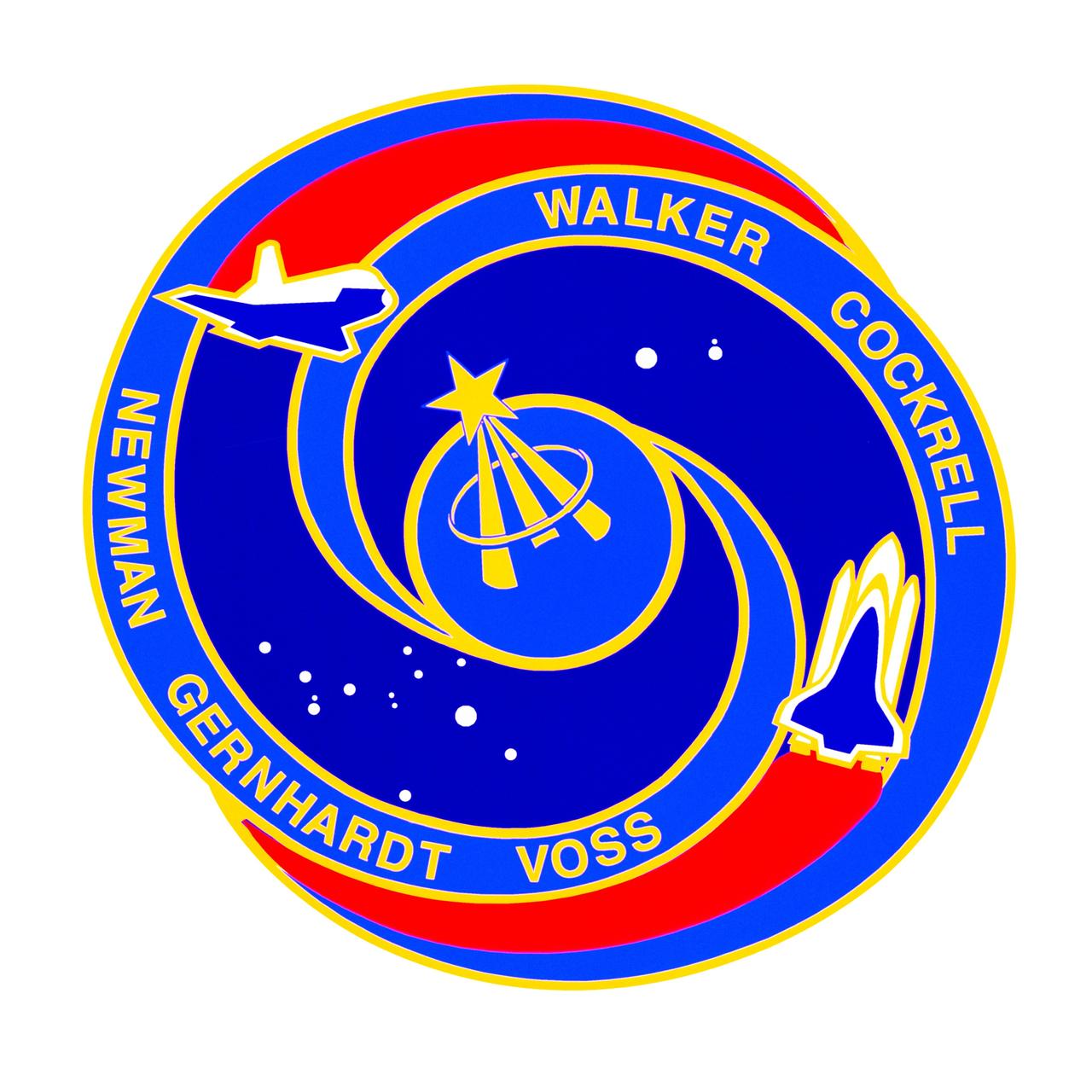
STS069-S-001 (May 1995) --- Designed by the crew members, the patch for STS-69 symbolizes the multifaceted nature of the flight's mission. The primary payload, Wake Shield Facility (WSF), is represented in the center by the astronaut emblem against a flat disk. The astronaut emblem also signifies the importance of human beings in space exploration, reflected by the planned spacewalk supporting space station assembly. The two stylized space shuttles highlight the ascent and entry phases of the mission. Along with the two spiral plumes, the stylized space shuttles symbolize a NASA first - the deployment and recovery on the same mission of two spacecraft (both the Wake Shield Facility and the Spartan). The constellations Canis Major and Canis Minor represent the astronomy objectives of the Spartan and International Extreme Ultraviolet Hitchhiker (IEH) payload. The two constellations also symbolize the talents and dedication of the support personnel who make space shuttle missions possible. The NASA insignia design for space shuttle flights is reserved for use by the astronauts and for other official use as the NASA Administrator may authorize. Public availability has been approved only in the forms of illustrations by the various news media. When and if there is any change in this policy, which is not anticipated, the change will be publicly announced. Photo credit: NASA
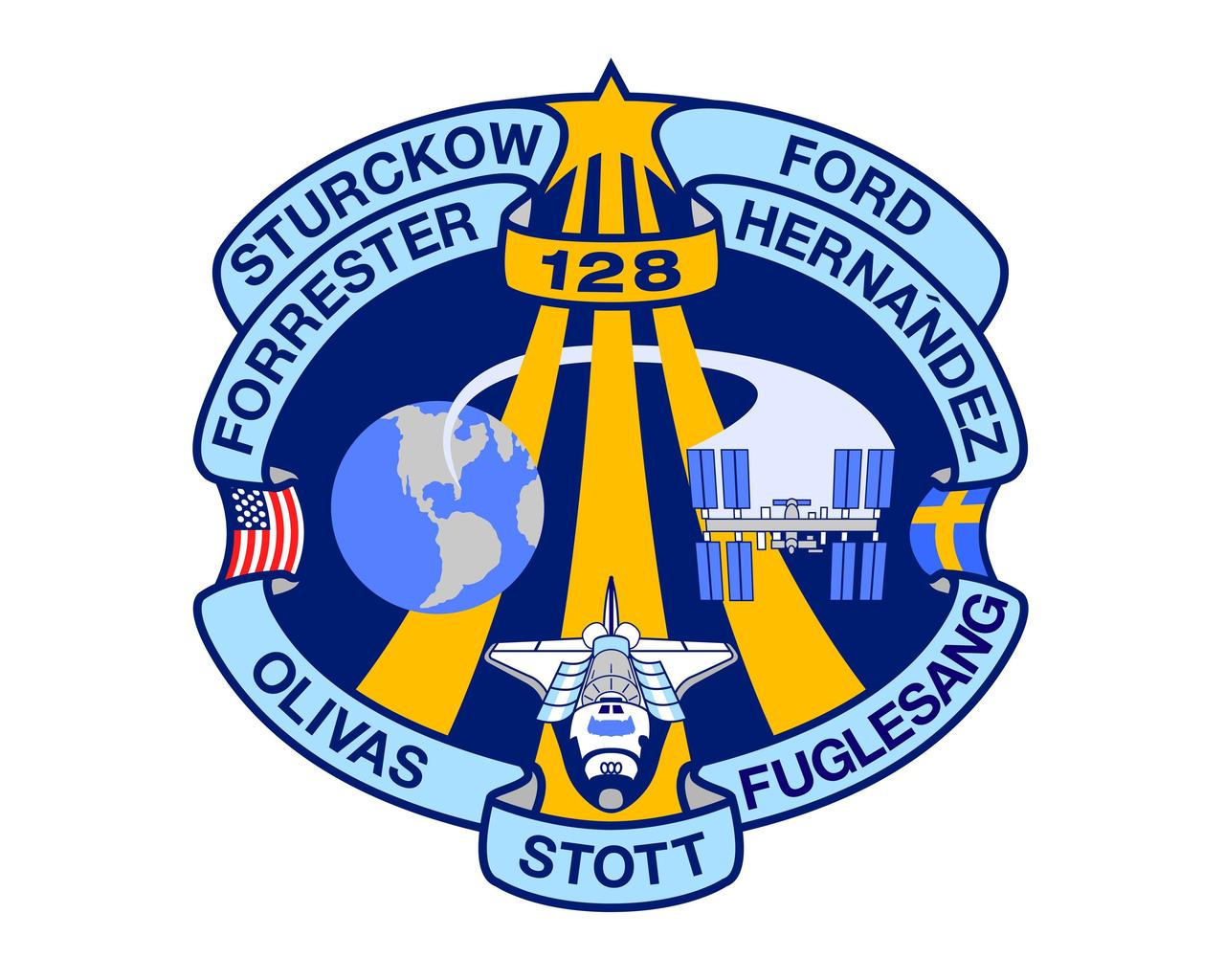
JOHNSON SPACE CENTER, Houston – STS128-S-001 -- The STS-128 patch symbolizes the 17A mission and represents the hardware, people and partner nations that contribute to the flight. The Space Shuttle Discovery is shown in the orbit configuration with the Multi Purpose Logistics Module (MPLM) Leonardo in the payload bay. Earth and the International Space Station wrap around the Astronaut Office symbol reminding us of the continuous human presence in space. The names of the STS-128 crew members border the patch in an unfurled manner. Included in the names is the expedition crew member who will launch on STS-128 and remain on board ISS, replacing another Expedition crew member who will return home with STS-128. The banner also completes the Astronaut Office symbol and contains the U.S. and Swedish flags representing the countries of the STS-128 crew. The NASA insignia design for Space Shuttle flights is reserved for use by the astronauts and for other official use as the NASA Administrator may authorize. Public availability has been approved only in the form of illustrations by the various news media. When and if there is any change in this policy, which we do not anticipate, it will be publicly announced.
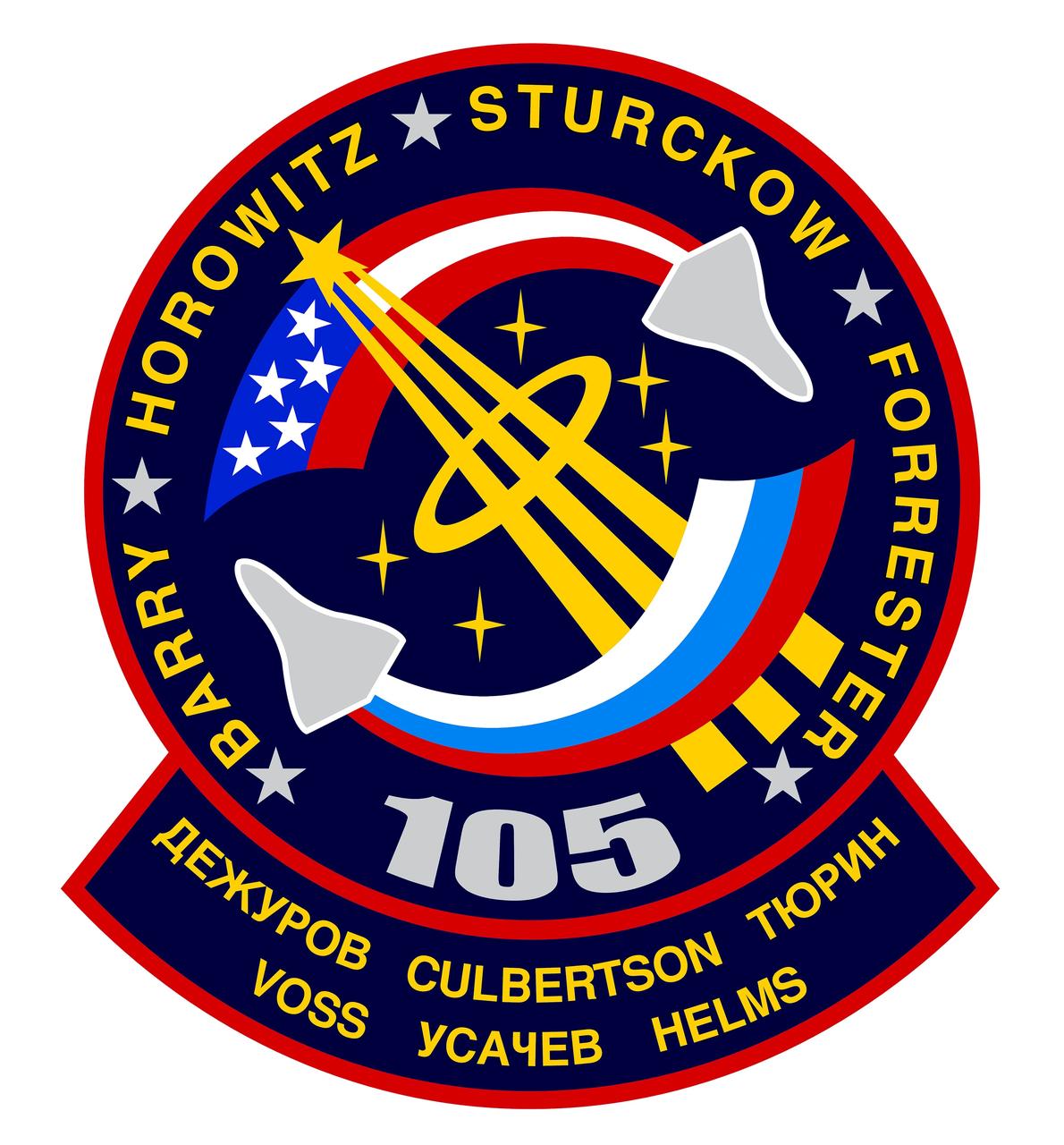
STS105-S-001 (April 2001) --- The STS-105 crew patch symbolizes the exchange of the Expedition Two and Expedition Three crews aboard the International Space Station. The three gold stars near the ascending orbiter represent the U.S. commanded Expedition Three crew as they journey into space, while the two gold stars near the descending orbiter represent the Russian commanded Expedition Two crew and their return to Earth. The plumes of each orbiter represent the flags of the United States and Russia and symbolize the close cooperation between the two countries. The Astronaut Office symbol, a star with three rays of light, depicts the unbroken link between Earth and the newest and brightest star on the horizon, the International Space Station (ISS). The ascending and descending orbiters form a circle that represents both the crew rotation and the continuous presence in space aboard the ISS. The names of the four astronauts who will crew Discovery are shown along the border of the patch. The names of the Expedition Three and Expedition Two crews are shown on the chevron at the bottom of the patch. The NASA insignia design for space shuttle flights is reserved for use by the astronauts and for other official use as the NASA Administrator may authorize. Public availability has been approved only in the forms of illustrations by the various news media. When and if there is any change in this policy, which is not anticipated, the change will be publicly announced. Photo credit: NASA
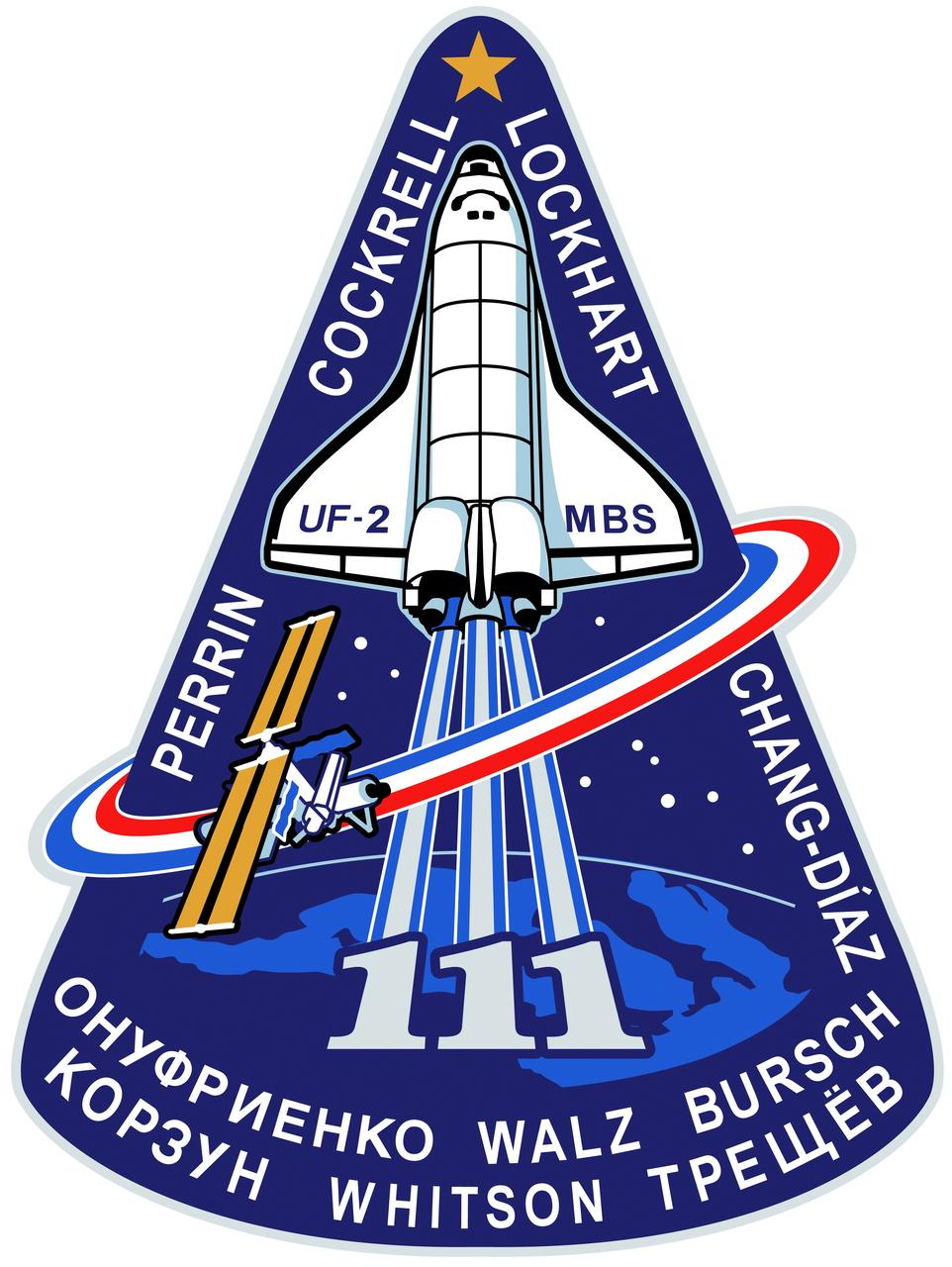
STS111-S-001 (January 2002) --- The STS-111 patch symbolizes the hardware, people, and partner nations that contribute to the flight. The space shuttle rises on the plume of the Astronaut Office symbol, carrying the Canadian Mobile Base System (MBS) for installation while docked to the International Space Station (ISS). The mission is named UF-2 for ISS Utilization Flight number two. The ISS orbit completes the Astronaut Office symbol and is colored red, white, and blue to represent the flags of the United States, Russia, France, and Costa Rica. The Earth background shows Italy, which contributes the Multi Purpose Logistics Module (MPLM) used on this flight to re-supply ISS. The ten stars in the sky represent the ten astronauts and cosmonauts on orbit during the flight, and the star at the top of the patch represents the Johnson Space Center, in the state of Texas, from which the flight is managed. The names of the STS-111 crew border the upper part of the patch, and the Expedition Five (going up) and Expedition Four (coming down) crews? names form the bottom of the patch. The NASA insignia design for space shuttle flights is reserved for use by the astronauts and for other official use as the NASA Administrator may authorize. Public availability has been approved only in the forms of illustrations by the various news media. When and if there is any change in this policy, which is not anticipated, the change will be publicly announced. Photo credit: NASA
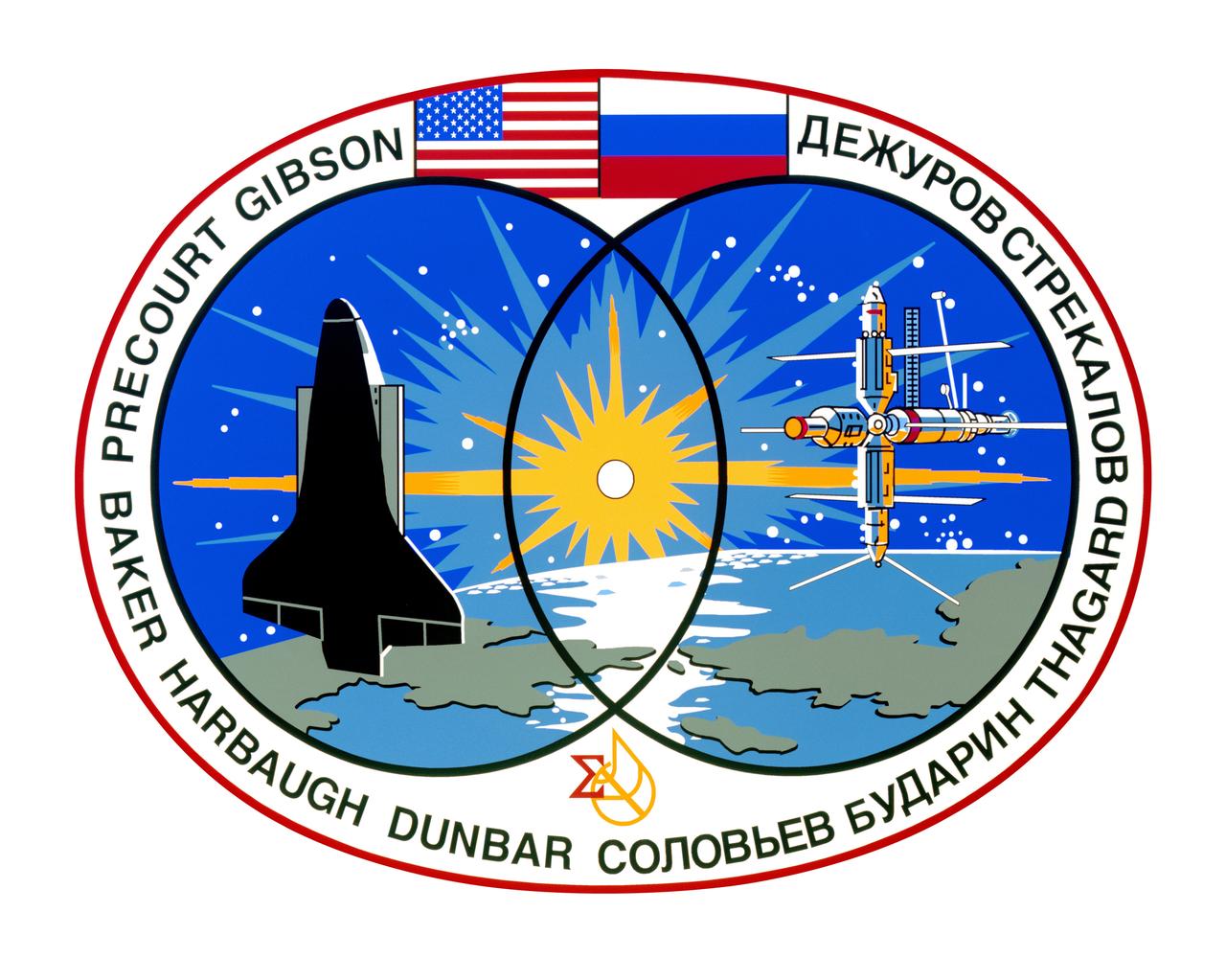
STS071-S-001 (April 1995) --- The STS-71 crew patch design depicts the orbiter Atlantis in the process of the first international docking mission of the space shuttle Atlantis with the Russian Mir Space Station. The names of the 10 astronauts and cosmonauts who will fly aboard the orbiter as shown along the outer border of the patch. The rising sun symbolizes the dawn of a new era of cooperation between the two countries. The vehicles Atlantis and Mir are shown in separate circles converging at the center of the emblem symbolizing the merger of the space programs of the two space faring nations. The flags of the United States and Russia emphasize the equal partnership of the mission. The joint program symbol at the lower center of the patch acknowledges the extensive contributions made by the Mission Control Centers (MCC) of both countries. The crew insignia was designed by aviation and space artist, Bob McCall, who also designed the crew patch for the Apollo-Soyuz Test Project (ASTP) in 1975, the first international space docking mission. The NASA insignia design for space shuttle flights is reserved for use by the astronauts and for other official use as the NASA Administrator may authorize. Public availability has been approved only in the forms of illustrations by the various news media. When and if there is any change in this policy, which is not anticipated, the change will be publicly announced. Photo credit: NASA
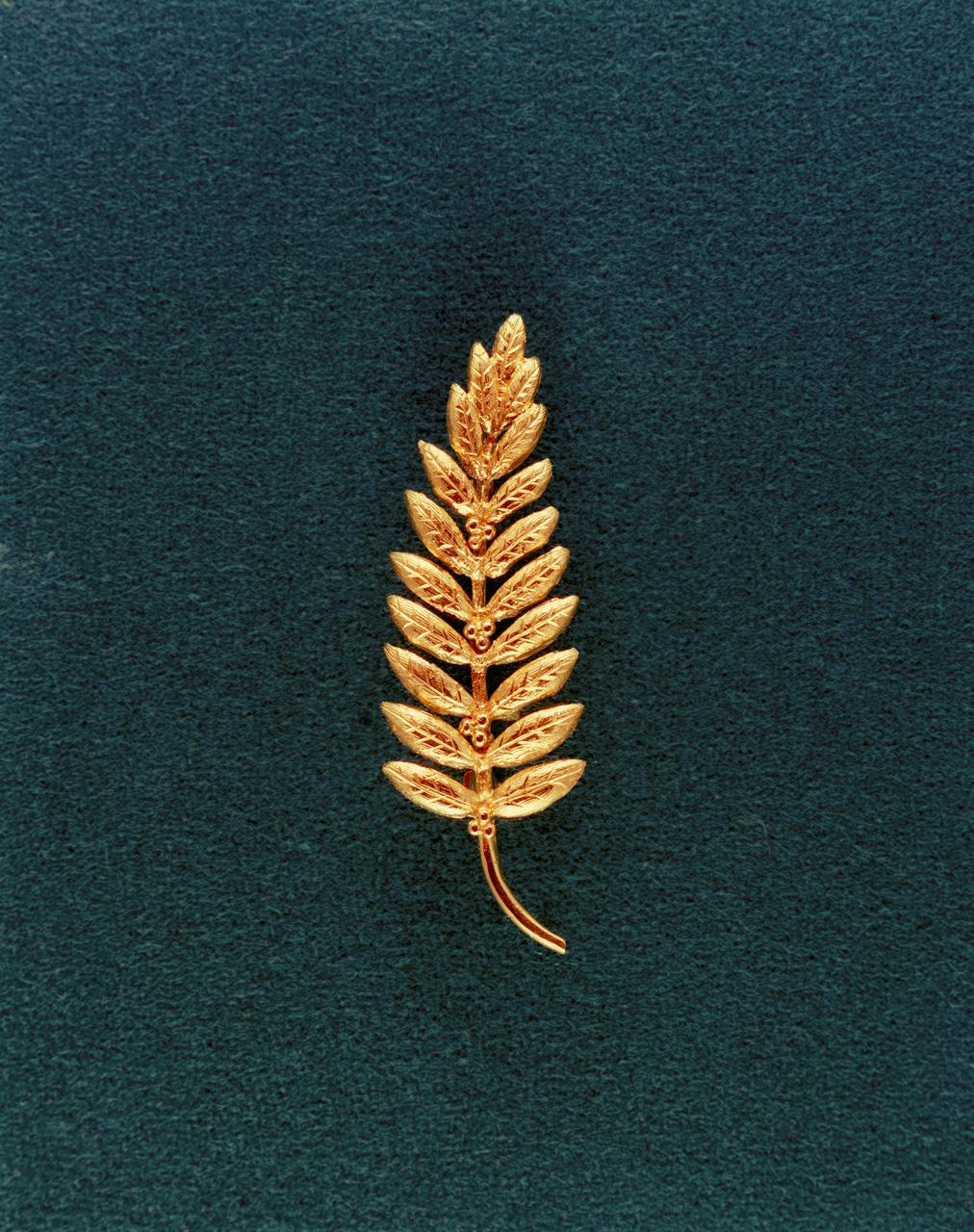
S69-40941 (July 1969) --- This picture is of the gold replica of an olive branch, the traditional symbol of peace, which was left on the moon's surface by Apollo 11 crewmembers. Astronaut Neil A. Armstrong, commander, was in charge of placing the small replica (less than half a foot in length) on the moon. The gesture represents a fresh wish for peace for all mankind.
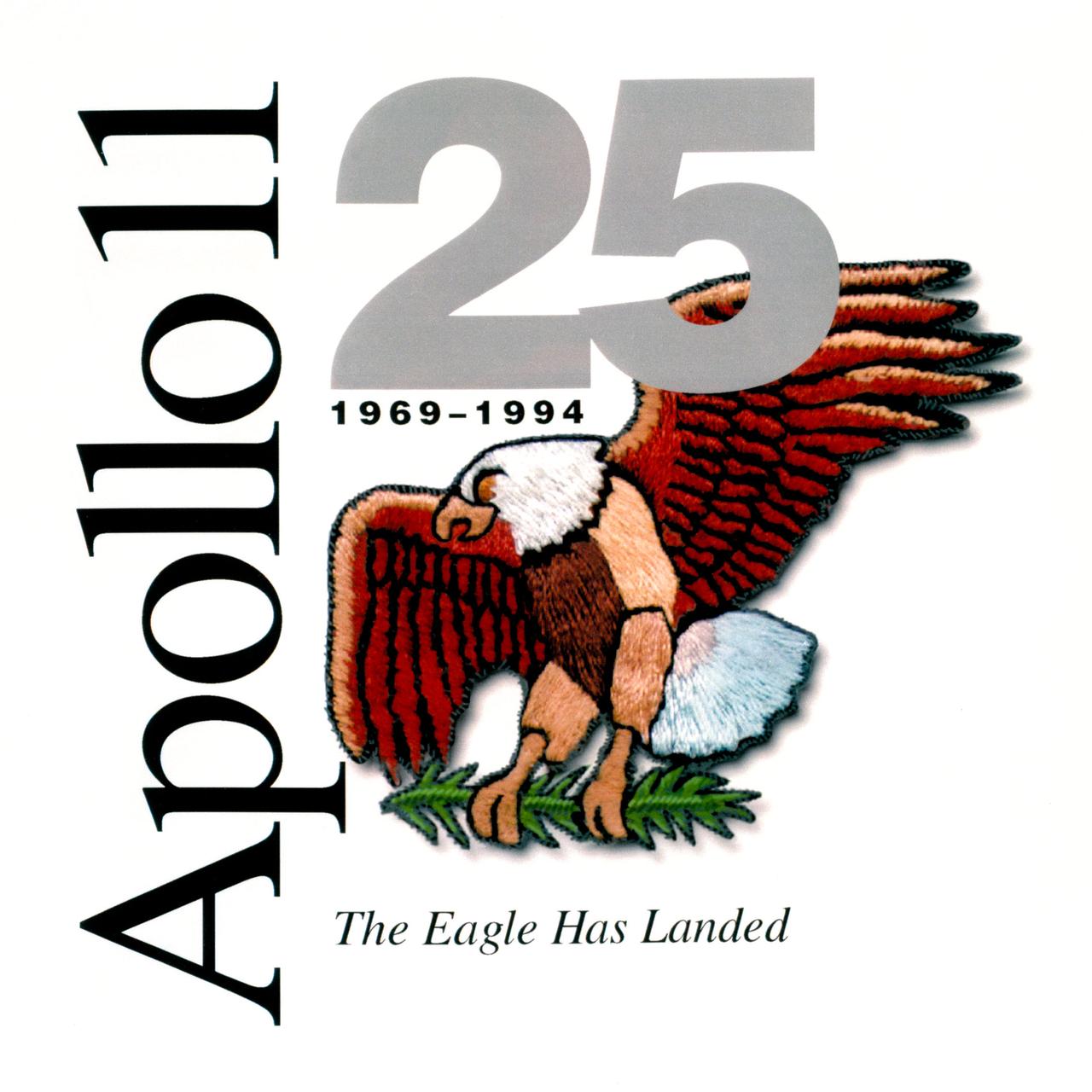
This official NASA commemorative logo marks the 25th anniversary of the first lunar landing. The design incorporates an eagle, from the original Apoll 11 crew insignia, descending toward the lunar surface with an olive branch, symbolizing America's peaceful mission in space. Alternative Headquarters number is 93-HC-312 or 93-H-336.
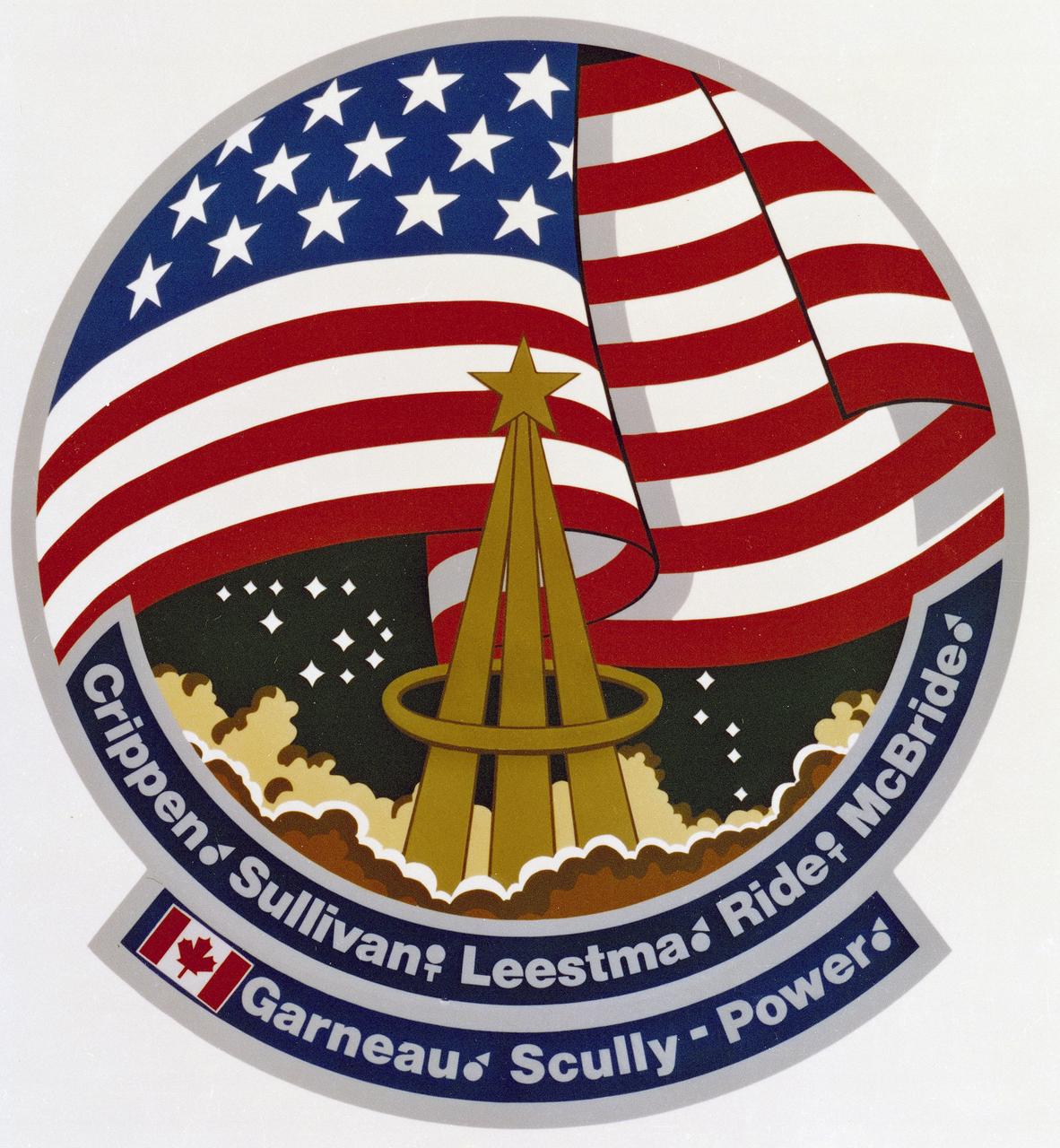
The 41-G mission insignia focuses on its seven crew members (first to exceed six), the U.S. Flag and the Unity symbol known as the astronaut pin. The pin design in center shows a trio of trajectories merging in infinite space, capped by a bright shining star and encircled by an elliptical wreath denoting orbital flight.

The 51-J mission insignia, designed by Atlantis's first crew, pays tribute to the Statue of Liberty and the ideas it symbolizes. The historical gateway figure bears additional significance for Astronauts Karol J. Bobko, mission commander; and Ronald J. Grabe, pilot, both New Your Natives.
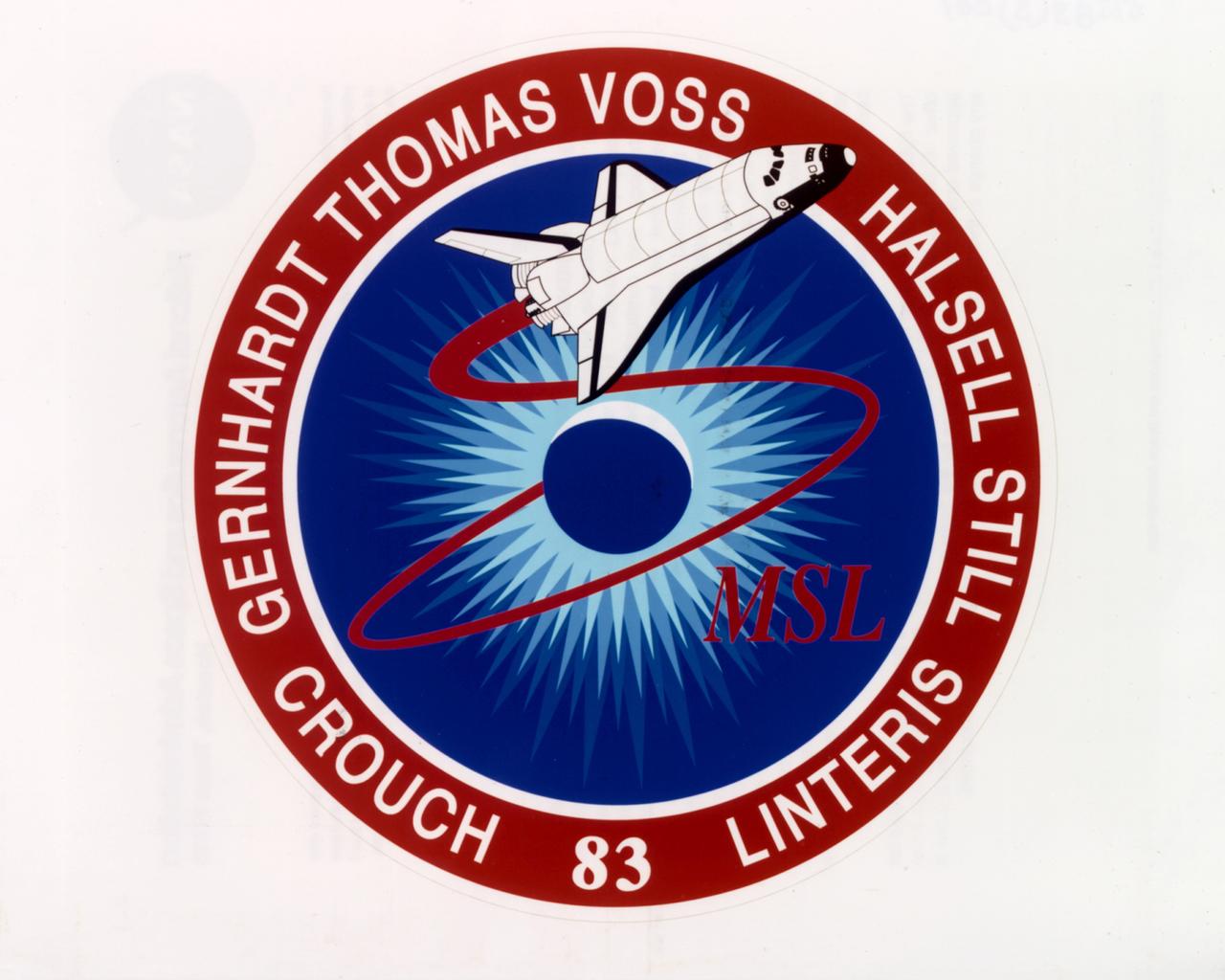
The crew patch for NASA's STS-83 mission depicts the Space Shuttle Columbia launching into space for the first Microgravity Sciences Laboratory 1 (MSL-1) mission. MSL-1 investigated materials science, fluid dynamics, biotechnology, and combustion science in the microgravity environment of space, experiments that were conducted in the Spacelab Module in the Space Shuttle Columbia's cargo bay. The center circle symbolizes a free liquid under microgravity conditions representing various fluid and materials science experiments. Symbolic of the combustion experiments is the surrounding starburst of a blue flame burning in space. The 3-lobed shape of the outermost starburst ring traces the dot pattern of a transmission Laue photograph typical of biotechnology experiments. The numerical designation for the mission is shown at bottom center. As a forerunner to missions involving International Space Station (ISS), STS-83 represented the hope that scientific results and knowledge gained during the flight will be applied to solving problems on Earth for the benefit and advancement of humankind.
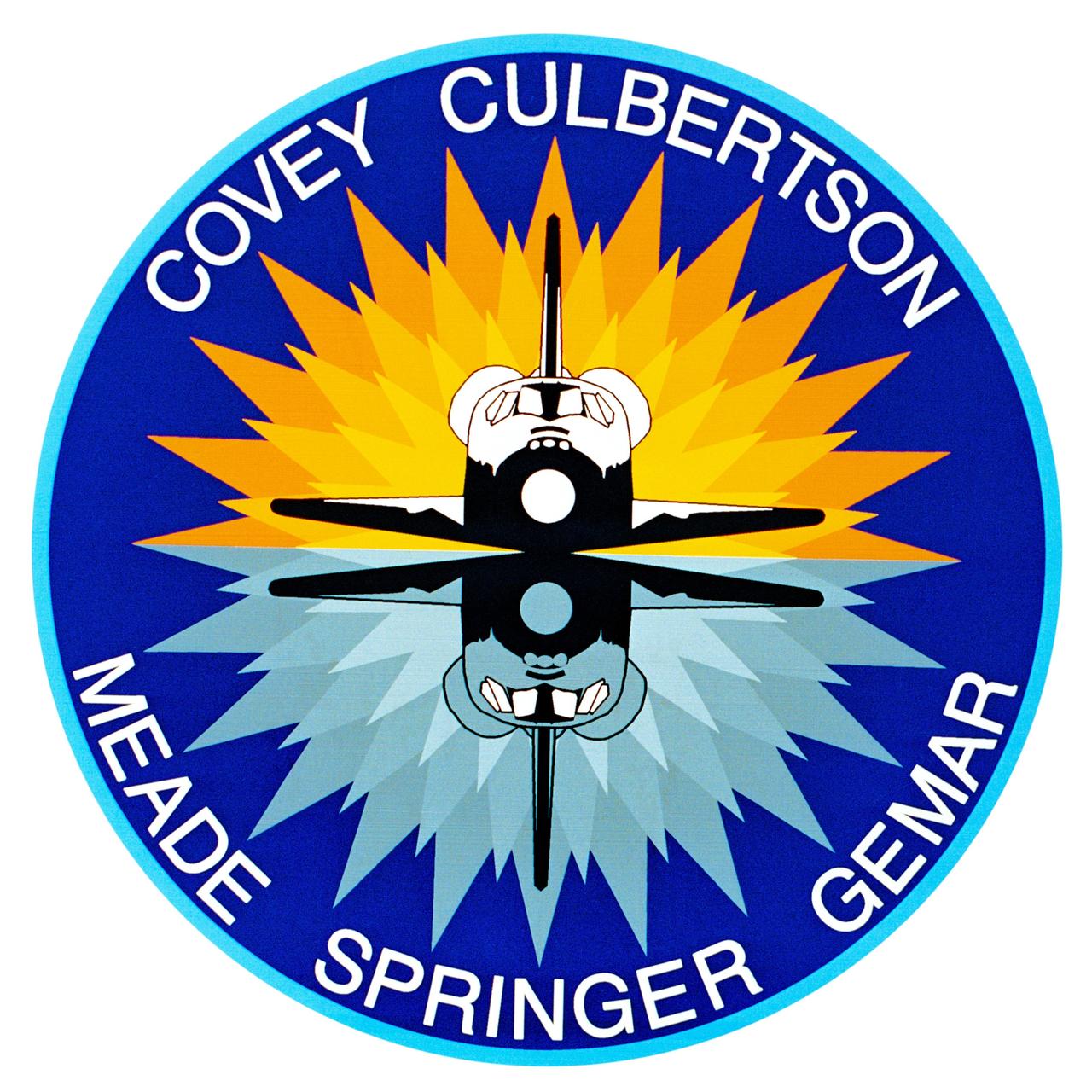
STS038-S-001 (May 1990) --- The STS-38 patch was designed to represent and pay tribute to all the men and women who contribute to the Space Shuttle Program. The top orbiter, with the stylistic Orbital Maneuvering System burn, symbolizes the continuing dynamic nature of the Space Shuttle Program. The bottom orbiter, a black and white mirror image, acknowledges the thousands of unheralded individuals who work behind the scenes in support of America's Space Shuttle Program. This mirror image symbolizes the importance of their contributions. The NASA insignia design for space shuttle flights is reserved for use by the astronauts and for other official use as the NASA Administrator may authorize. Public availability has been approved only in the forms of illustrations by the various news media. When and if there is any change in this policy, which is not anticipated, the change will be publicly announced. Photo credit: NASA
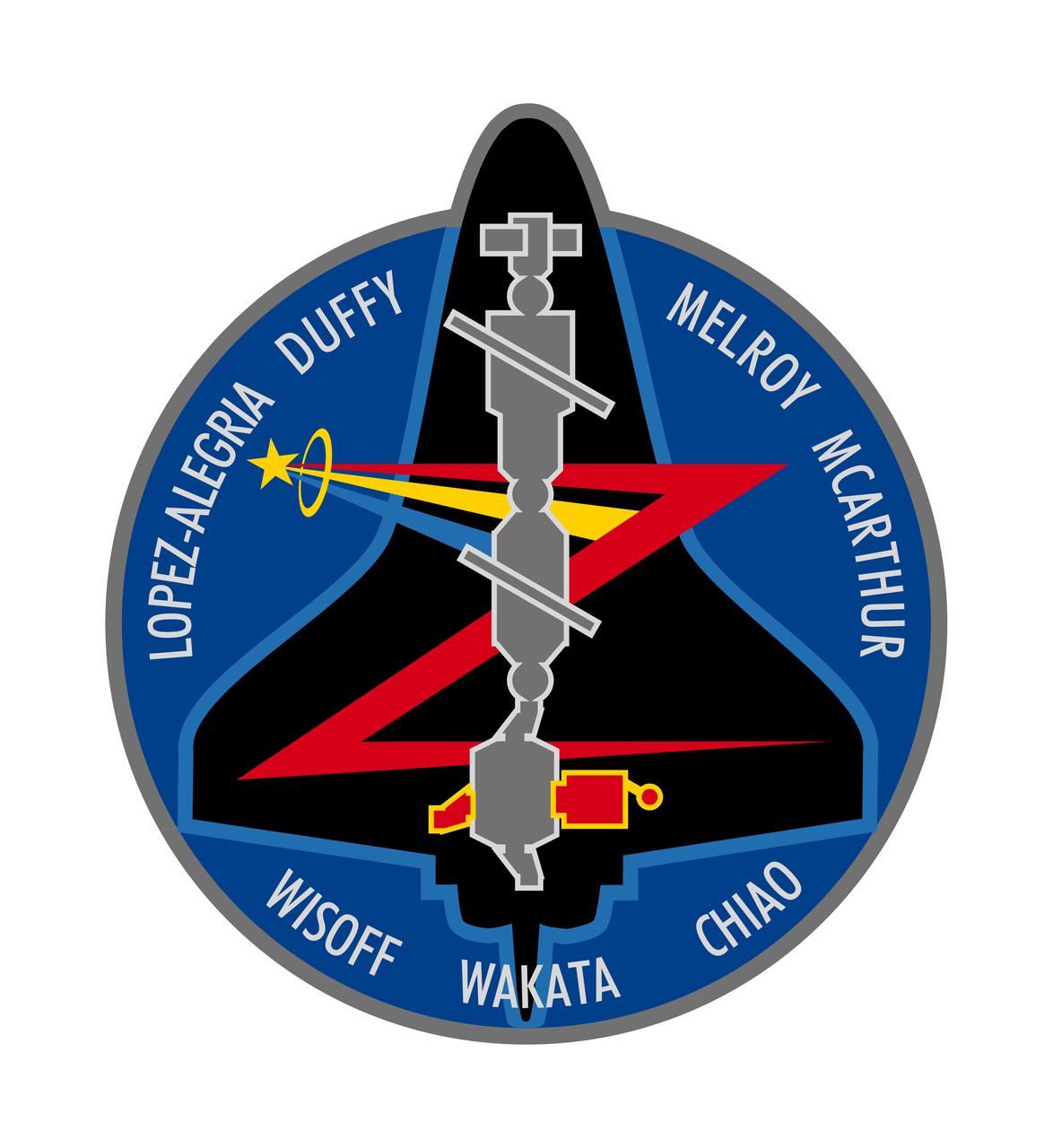
Designed by the crew members, the STS-92 patch symbolizes the second mission to carry U.S. built elements to the International Space Station (ISS) for assembly. The black silhouette of the Space Shuttle Discovery stands out against the deep blue background of space in low Earth orbit. In the foreground, in gray, is a profile view of the ISS as it appears when the shuttle and crew arrive, with the station consisting of the Unity node, its two Pressurized Mating Adapters (PMA), the Zarya functional cargo block, the Zvezda service module, and the Progress cargo vehicle. Following the shuttle's rendezvous and docking, the ISS configuration now augmented by the two elements delivered by Discovery, the Z1 truss and PMA-3. These two elements, depicted in red, were installed using the shuttle's robot arm and connected to ISS during four space walks. The multinational nature of both the STS-92 crew and the ISS are reflected in the multi-colored Astronaut Office symbol.

ISS010-S-001 (May 2004) --- The Expedition 10 patch uses simple symbolism to describe the mission. The large Roman numeral "X," formed by the American and Russian flags, symbolizes the joint nature of this mission, as well as the fact that this flight is the 10th mission to stay on the International Space Station (ISS). The current configuration of the ISS is next to the name of the ISS Commander, while the Soyuz vehicle is placed next to the name of the Soyuz Commander. The single star and the black background signify this is a space mission. The NASA insignia design for shuttle flights and station increments is reserved for use by the astronauts and for other official use as the NASA Administrator may authorize. Public availability has been approved only in the forms of illustrations by the various news media. When and if there is any change in this policy, which is not anticipated, the change will be publicly announced.
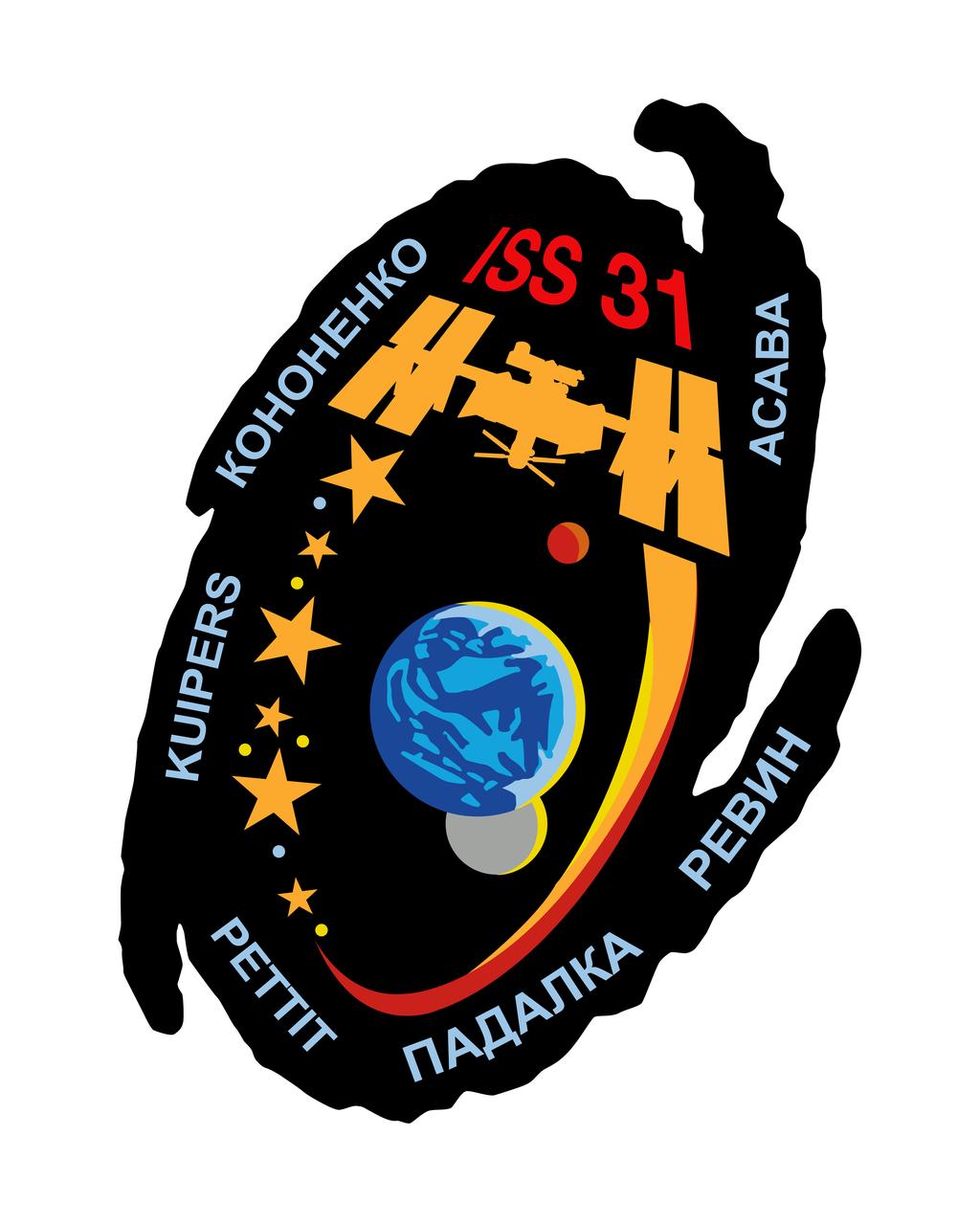
ISS031-S-001 (September 2011) --- Thin crescents along the horizons of Earth and its moon depict International Space Station (ISS) Expedition 31. The shape of the patch represents a view of our galaxy. The black background symbolizes the research into dark matter, one of the scientific objectives of Expedition 31. At the heart of the patch are Earth, its moon, Mars, and asteroids, the focus of current and future exploration. The ISS is shown in an orbit around Earth, with a collection of stars for the Expedition 30 and 31 crews. The small stars symbolize the visiting vehicles that will dock with the complex during this expedition. The NASA insignia design for shuttle and space station flights is reserved for use by the astronauts and for other official use as the NASA Administrator may authorize. Public availability has been approved only in the forms of illustrations by the various news media. When and if there is any change in this policy, which is not anticipated, the change will be publicly announced. Photo credit: NASA and Its International Partners
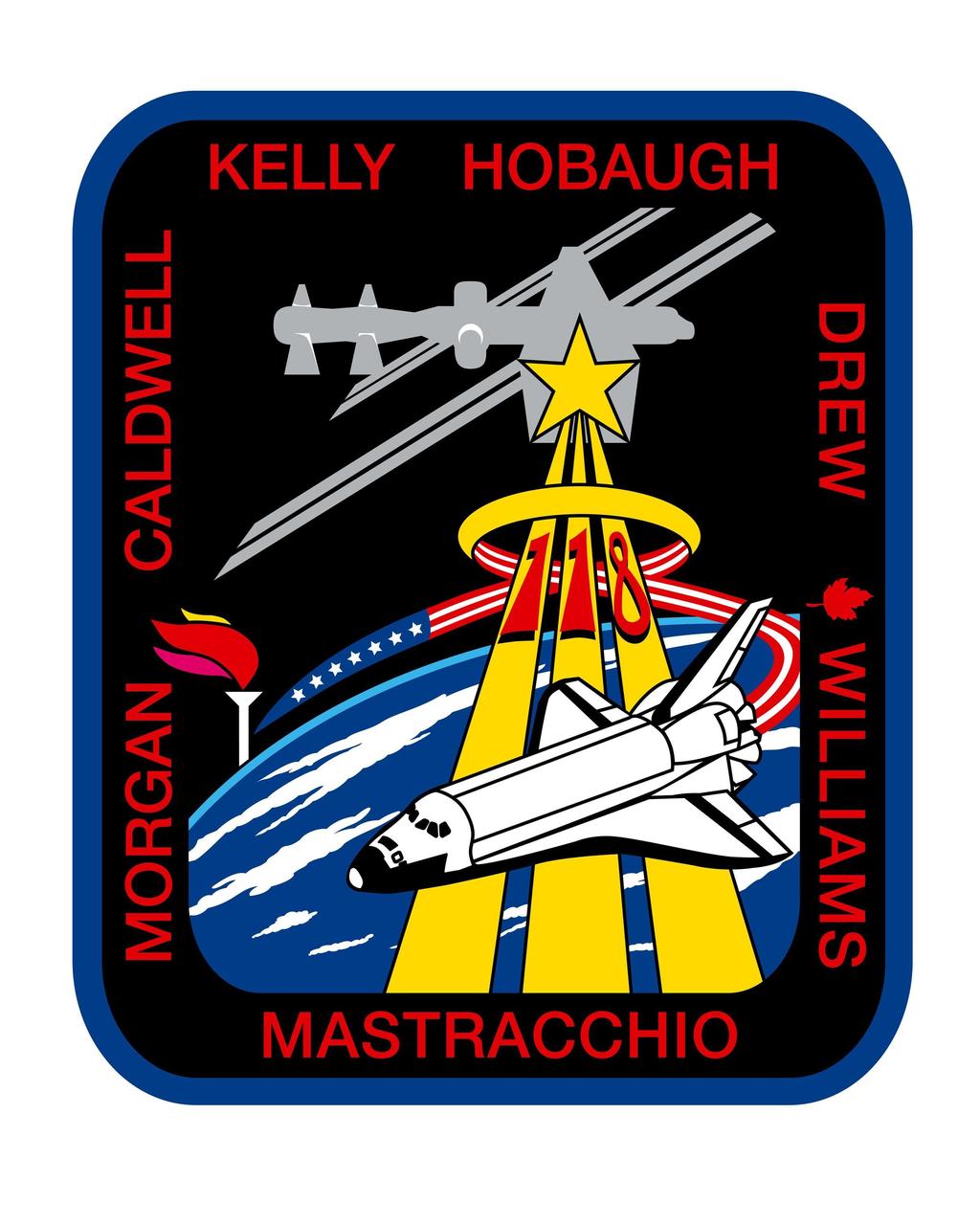
JOHNSON SPACE CENTER, Houston -- STS118-S-001 -- The STS-118 patch represents Space Shuttle Endeavour on its mission to help complete the assembly of the International Space Station and symbolizes the pursuit of knowledge through space exploration. The flight will accomplish its ISS 13A.1 assembly tasks through a series of spacewalks, robotic operations, logistics transfers and the exchange of one of the three long-duration expedition crew members. On the patch, the top of the gold astronaut symbol overlays the starboard S-5 truss segment, highlighting its installation during the mission. The flame of knowledge represents the importance of education, and honors teachers and students everywhere. The seven white stars and the red maple leaf signify the American and Canadian crew members flying aboard Endeavour.
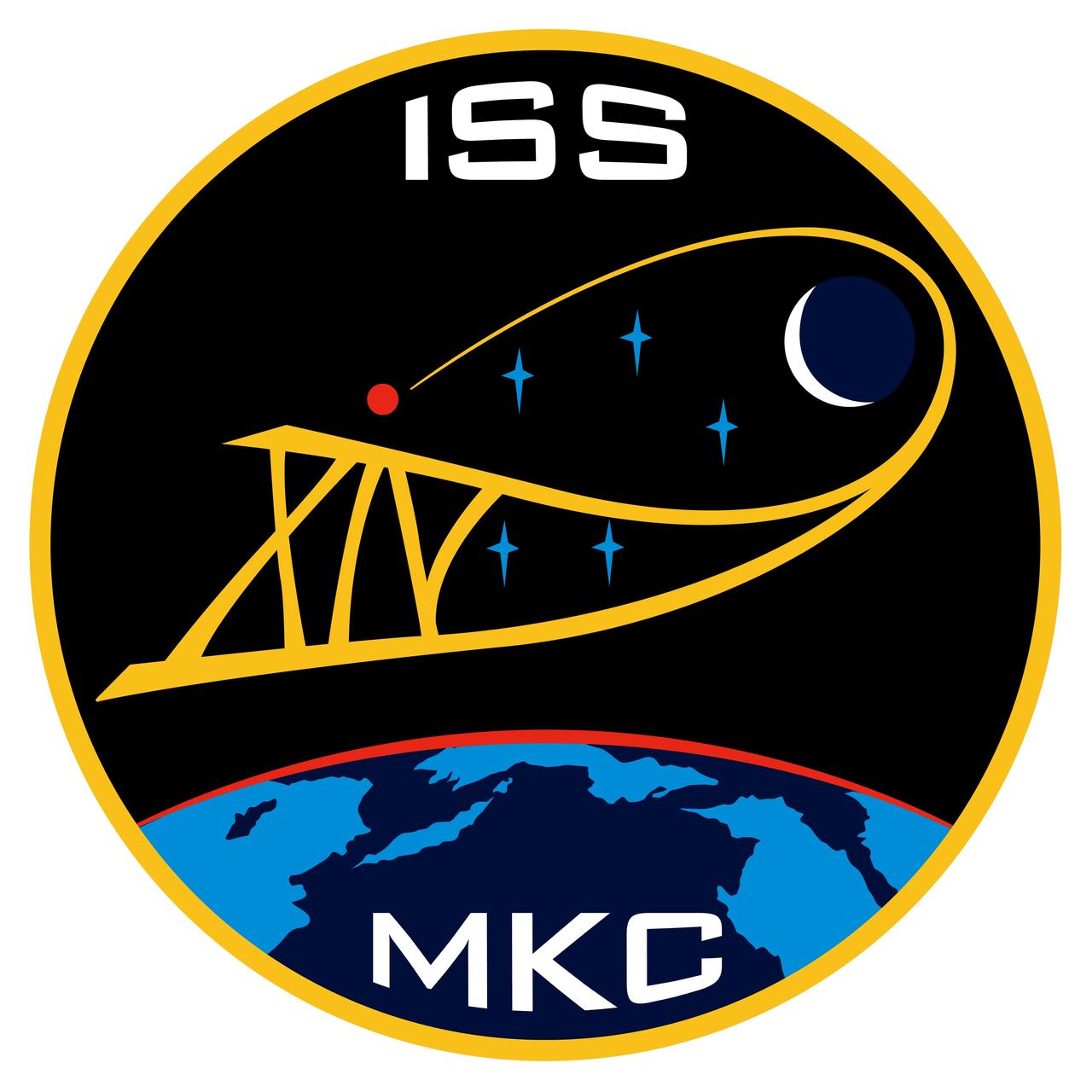
ISS014-S-001 (May 2006) --- This emblem embodies the past, present, and future of human space exploration. The Roman numeral XIV suspended above the Earth against the black background of space symbolizes the fourteenth expeditionary mission to the International Space Station (ISS). Elements of this symbol merge into a unified trajectory destined for the moon, Mars, and beyond, much as science and operations aboard the ISS today will pave the way for future missions to our celestial neighbors. The five stars honor the astronauts and cosmonauts of missions Apollo 1, Soyuz 1, Soyuz 11, Challenger, and Columbia, who gave their lives in the pursuit of knowledge and discovery. The NASA insignia for design for shuttle flights and station increments is reserved for use by the astronauts and for other official use as the NASA Administrator may authorize. Public availability has been approved only in the form of illustrations by the various news media. When and if there is any change in this policy which is not anticipated, it will be publicly announced.
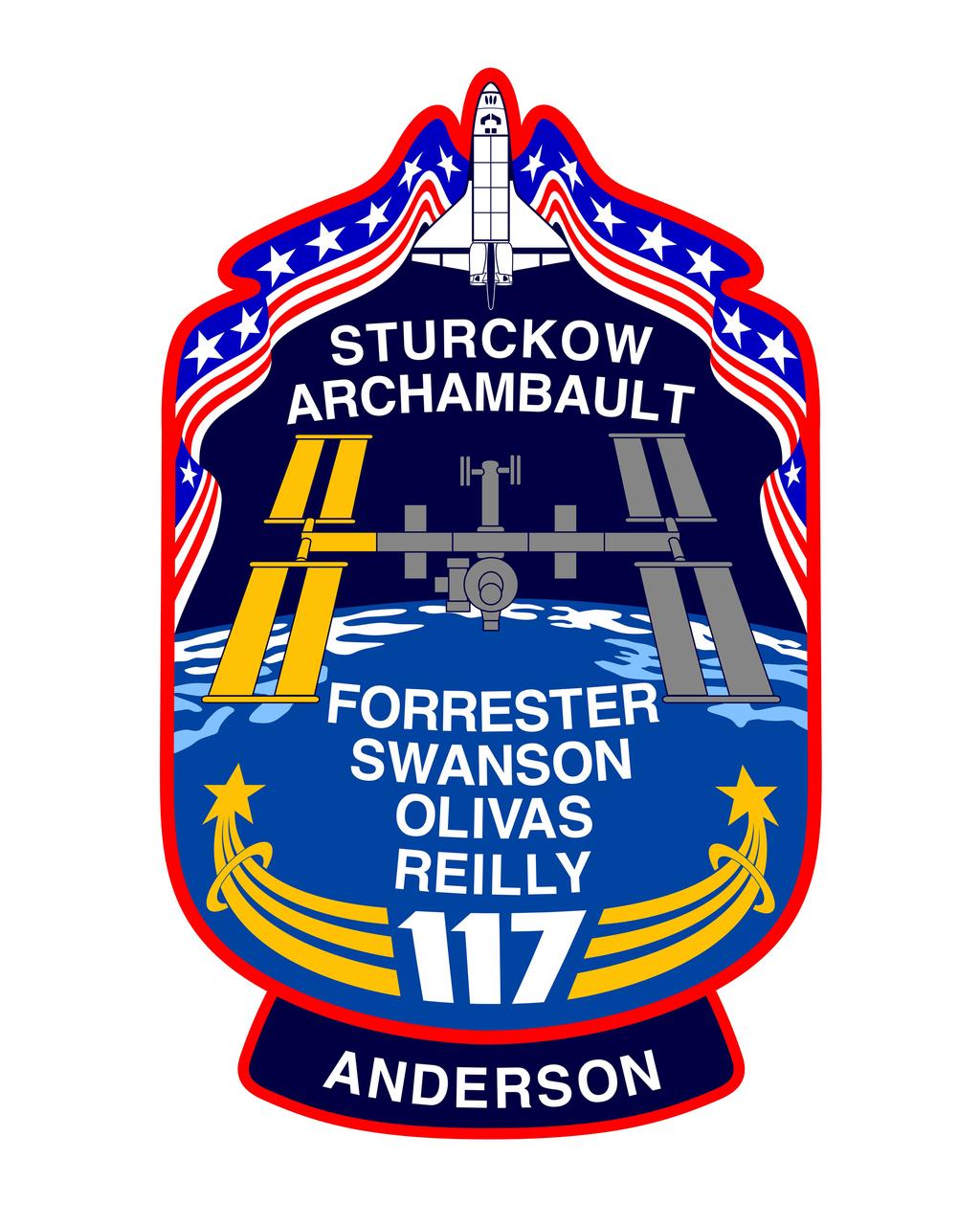
The STS-117 crew patch symbolizes the continued construction of the International Space Station (ISS) and our ongoing human presence in space. The ISS is shown orbiting high above the Earth. Gold is used to highlight the portion of the ISS that will be installed by the STS-117 crew. It consists of the second starboard truss section, S3 and S4, and a set of solar arrays. The names of the STS-117 crew are located above and below the orbiting outpost. The two gold astronaut office symbols, emanating from the 117 at the bottom of the patch, represent the concerted efforts of the shuttle and station programs toward the completion of the station. The orbiter and unfurled banner of red, white, and blue represent our Nation and renewed patriotism as we continue to explore the universe.
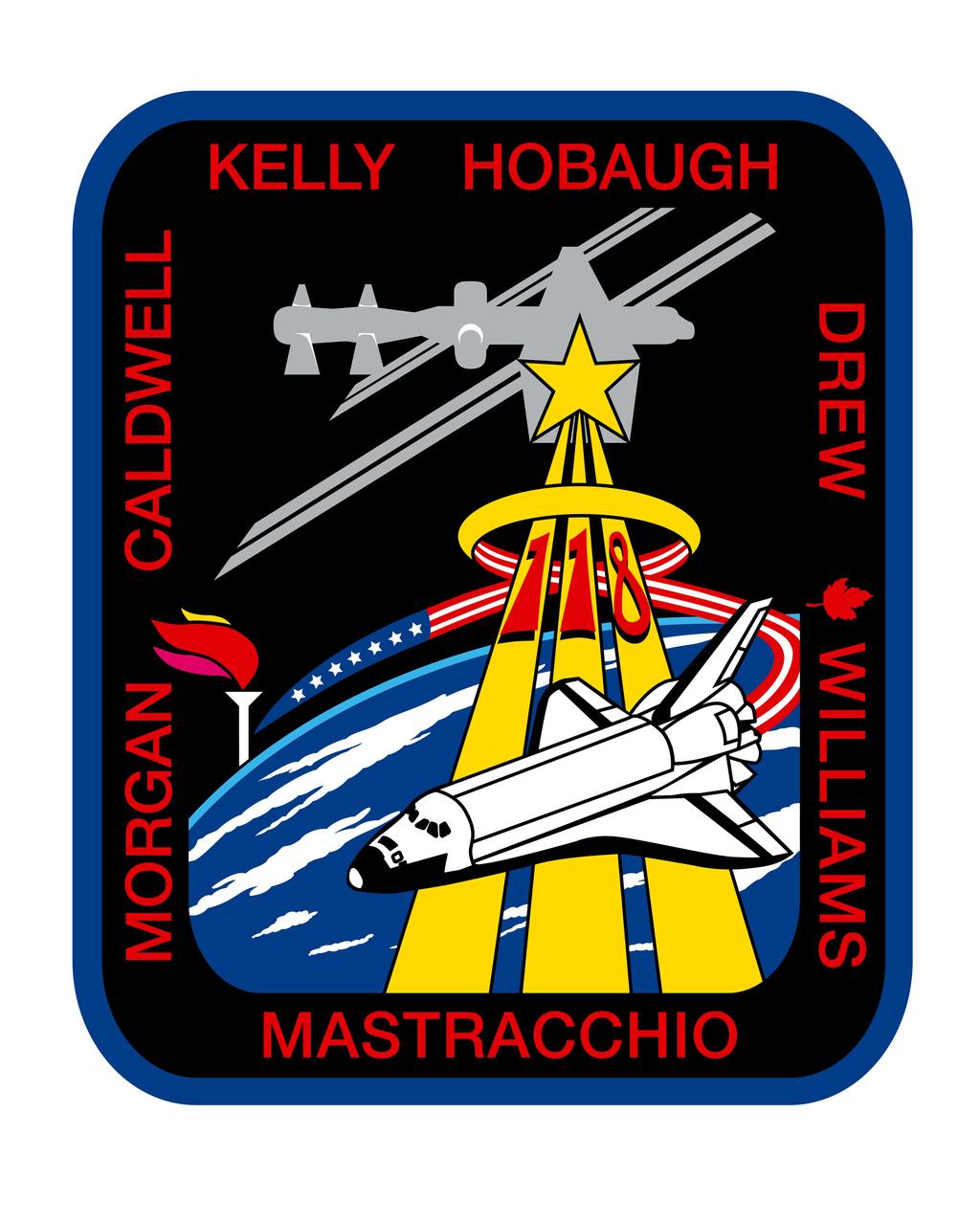
The STS-118 crew patch represents the Space Shuttle Endeavour on its mission to help complete the assembly of the International Space Station (ISS), and symbolizes the pursuit of knowledge through space exploration. The flight accomplished its ISS 13A.1 assembly tasks through a series of space walks, robotic operations, logistics transfers, and the exchange of one of the three long-duration expedition crew members. On the patch, the top of the gold astronaut symbol overlays the starboard S5 truss segment, highlighting its installation during the mission. The flame of knowledge represents the importance of education, and honors teachers and students everywhere. The seven white stars and the red maple leaf signify the American and Canadian crew members, respectively, flying aboard Endeavour.
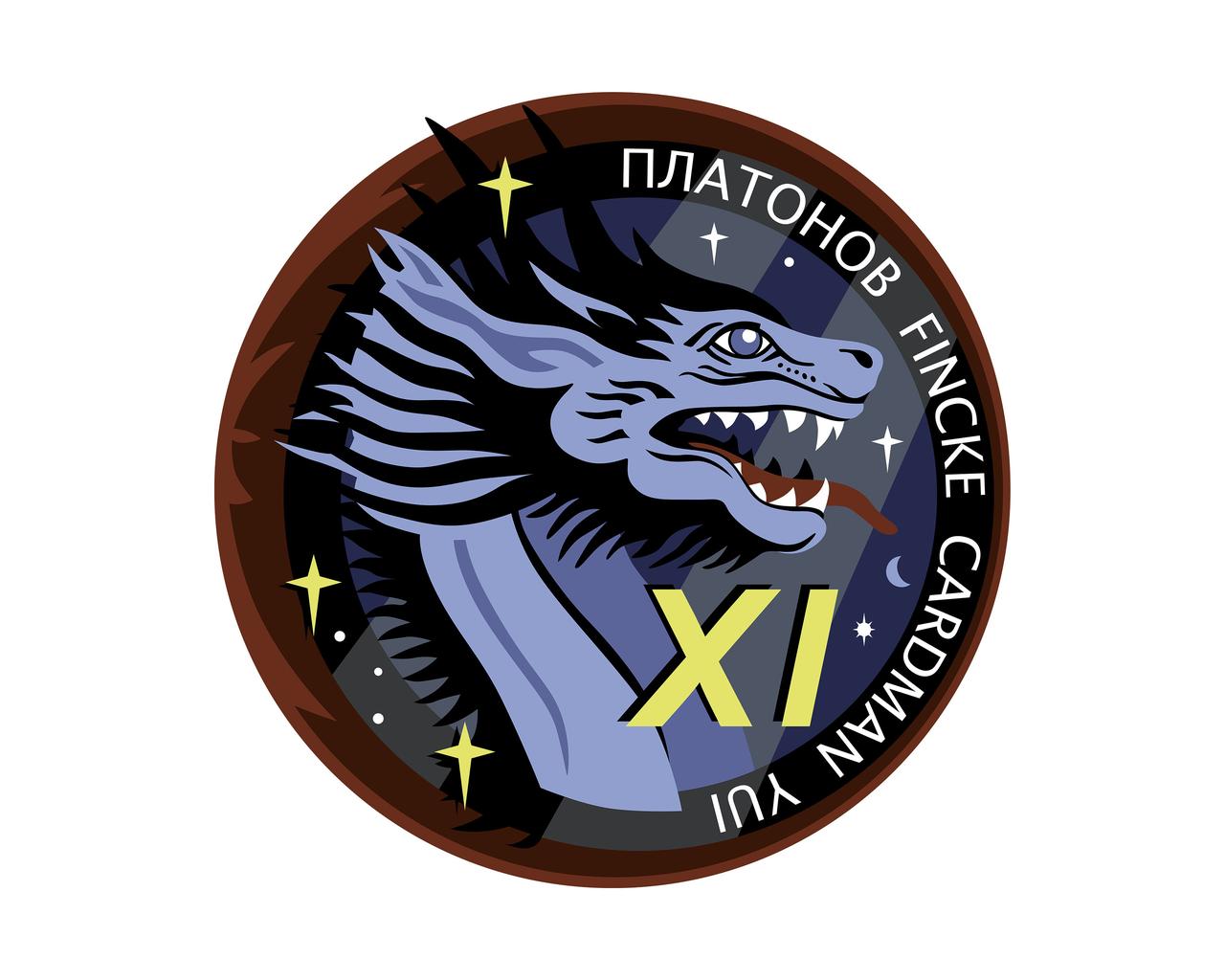
jsc2025e034097 (Feb. 14, 2025) --- The Crew-11 mission patch embodies teamwork, exploration, and the deep connections that bind us—across nations, agencies, and families. Shades of white, red, and blue pay tribute to the flags of the three nations represented by the crew, while three gold stars symbolize the unity of our three space agencies working together in pursuit of discovery. .At the heart of the design, two radiant sunbeams form the number “11” illuminating a blue circle—a subtle nod to Voyager’s Pale Blue Dot image, reminding us of the fragile unity of our shared home. This vision of Earth is reflected in the dragon’s eye, reinforcing our focus on exploration and the perspective gained from space. .The dragon, evoking the heraldry of family crests, stands as a guardian of our mission and legacy. Within the stars, we honor the children of the crew, a reminder of the generations inspired by human spaceflight. Encircling it all, a red flame represents both the power of launch and the plasma of reentry, symbolizing the full journey—our departure from Earth, our work aboard the International Space Station, and our safe return home. Crew-11: Together, we rise.
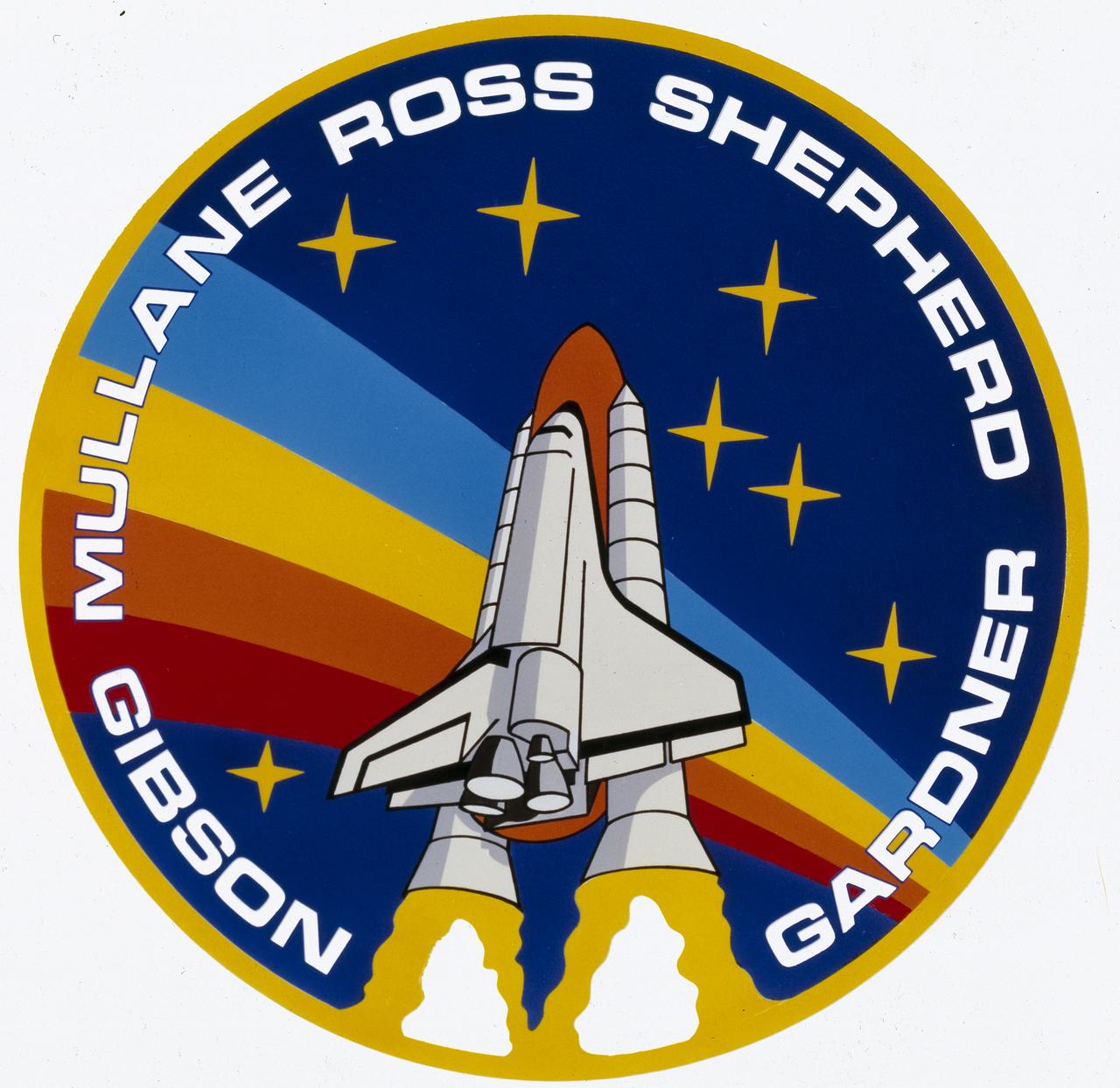
The patch depicts the Space Shuttle lifting off against the multi-colored backdrop of a rainbow, symbolizing the triumphal return to flight of our nation's manned space program. The design also commemorates the memory of the crew of Challenger mission STS-51-L, represented by the seven stars. The names of the flight crewmembers of STS-27 are located along the border of the patch.
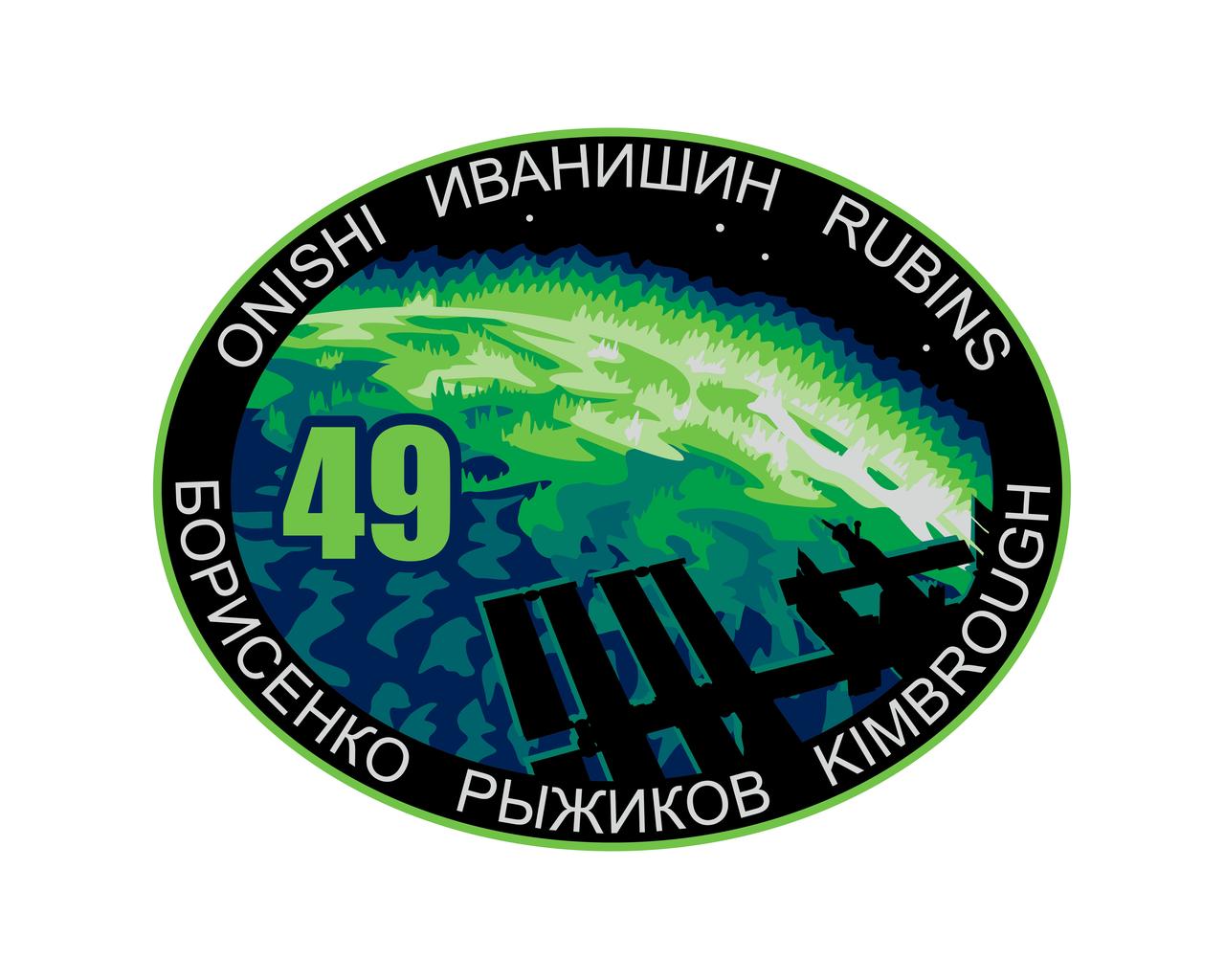
ISS049-S-001 --- The Expedition 49 patch shows the International Space Station (ISS) coming into view over an aurora extending past Earth’s horizon. This depiction emphasizes the benefits to Earth of research conducted on the ISS as well as the global nature of the international partnerships vital to this endeavor. The green hue in the aurora is symbolic of life on our home planet. The crew of Expedition 49 will be working “Off the Earth, for the Earth.”
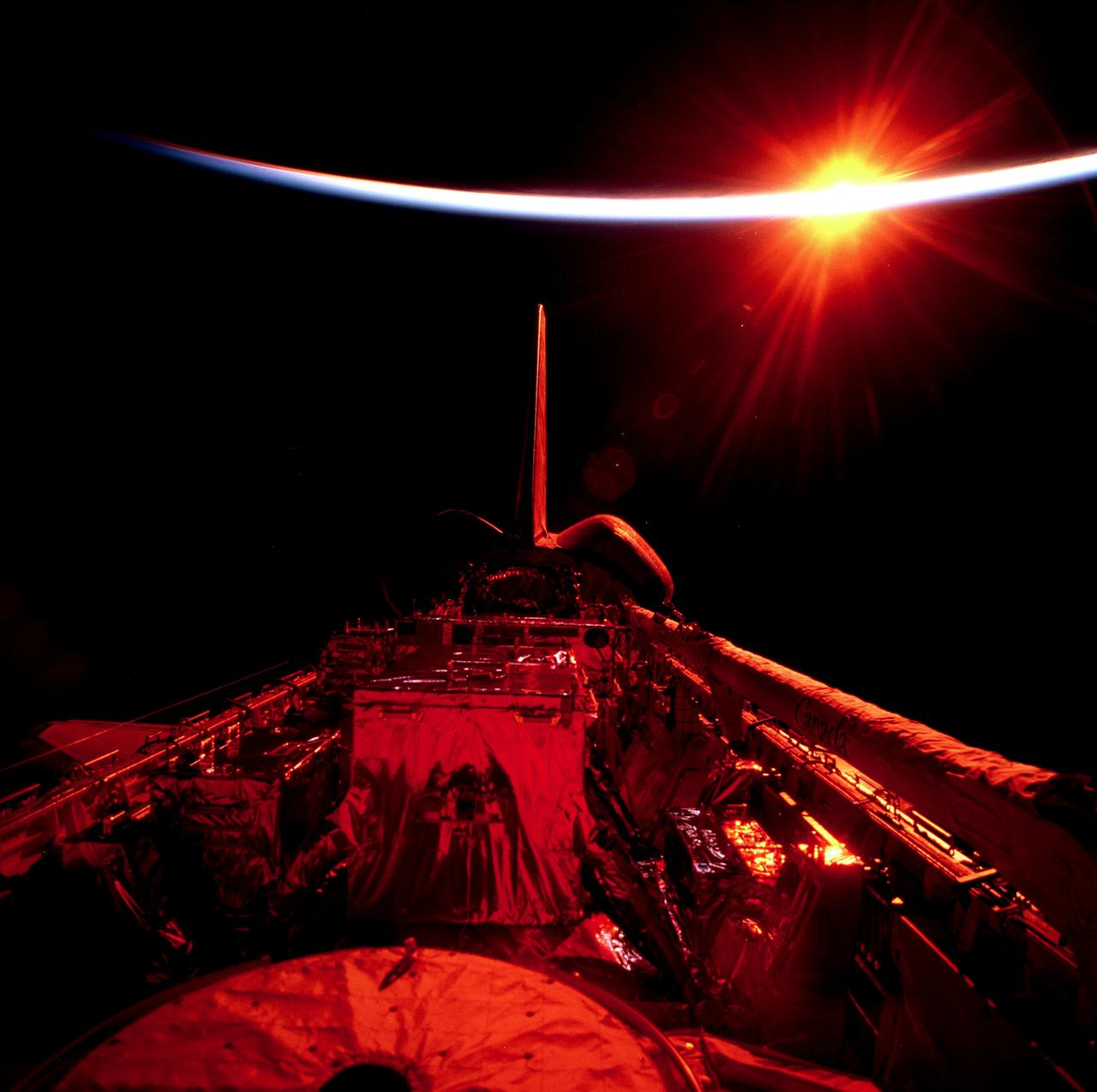
STS082-765-007 (21 Feb. 1997) --- This scene of the sun setting on the Space Shuttle Discovery's almost empty cargo bay symbolizes the successful conclusion of the mission, as the seven astronauts inside the crew cabin approach one of the final mission chores -- that of closing the cargo bay doors. The astronauts earlier completed five days of Extravehicular Activities (EVA) designed to service the giant Hubble Space Telescope (HST), now noticeably missing in the bay. At bottom center is part of the top of the exit airlock, making its first flight.
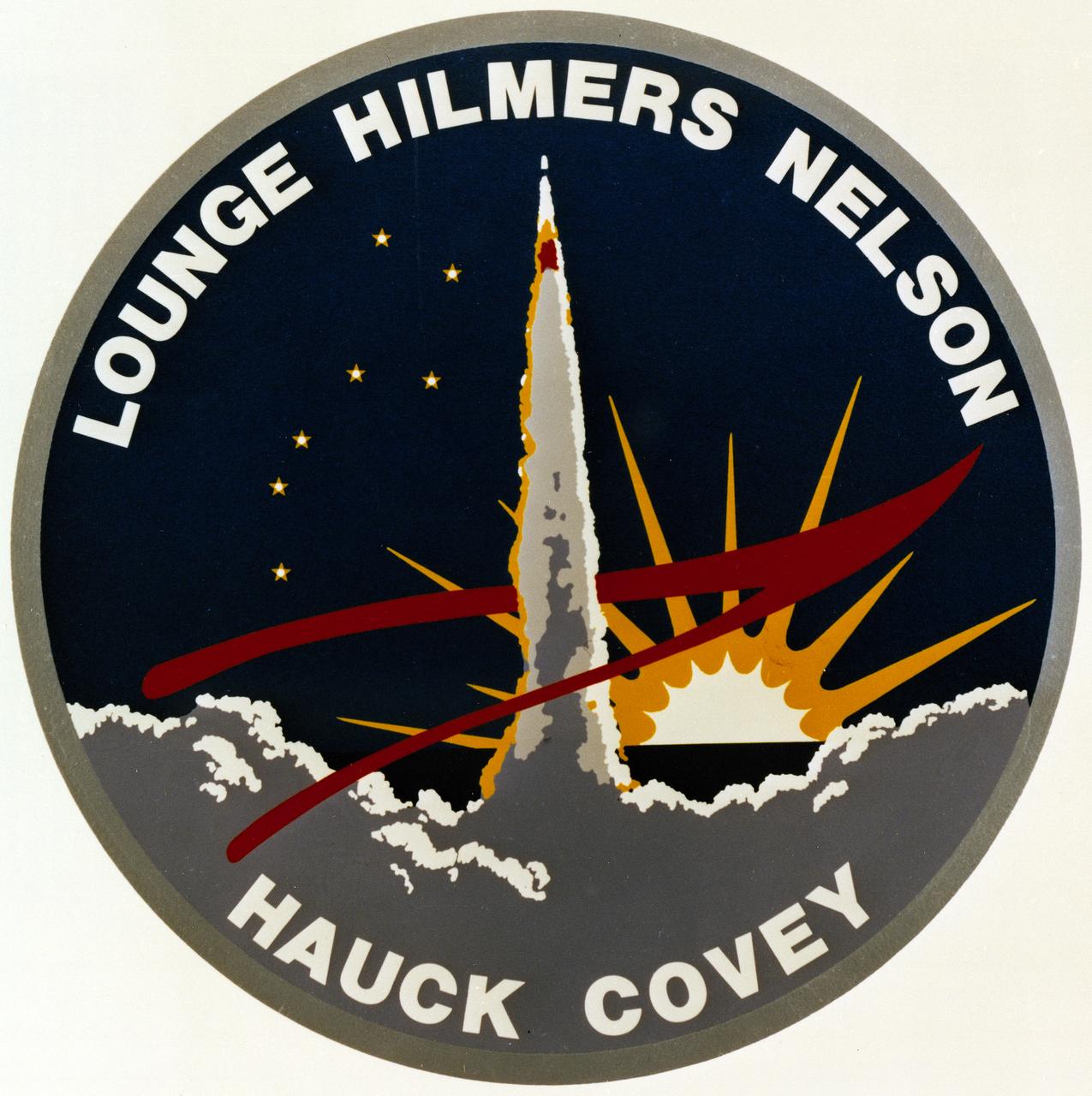
The predominant themes are: a new beginning (sunrise), a safe mission (stylized launch and plume), the building upon the traditional strengths of NASA (the red vector which symbolizes aeronautics on the original NASA insignia), and a remembrance of their seven colleagues who died aboard Challenger (the seven-starred Big Dipper). The patch was designed by artist Stephen R. Hustvedt of Annapolis, MD.
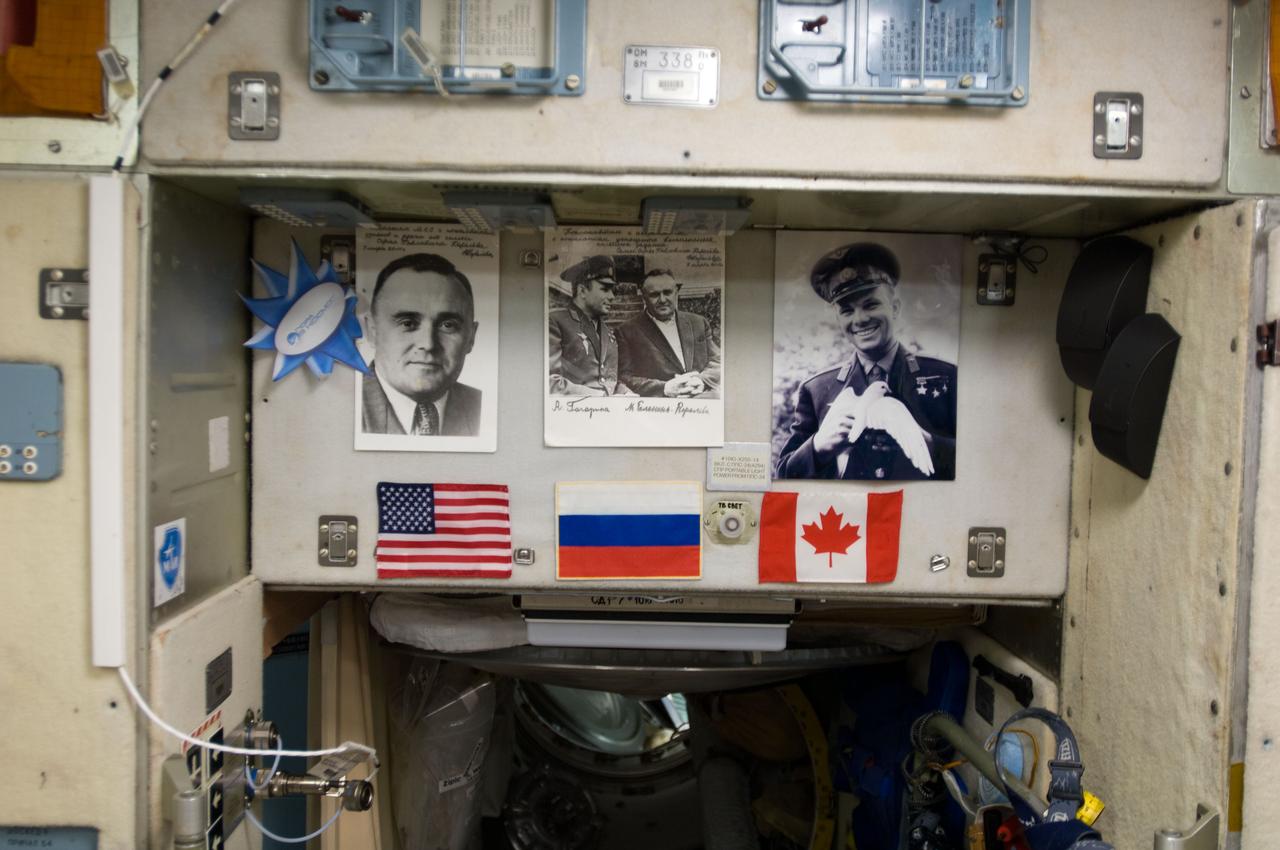
View of Yuri Alexievich Gagarin (first space traveler) photo and other photos,above Service Module (SM) hatch. The blue and white rosette on the left with the writing поÑа в коÑÐ¼Ð¾Ñ is the symbol and name of the Russian television program for children that covers cosmonautic and International Space Station (ISS) topics. Photo was taken during Expedition 34.
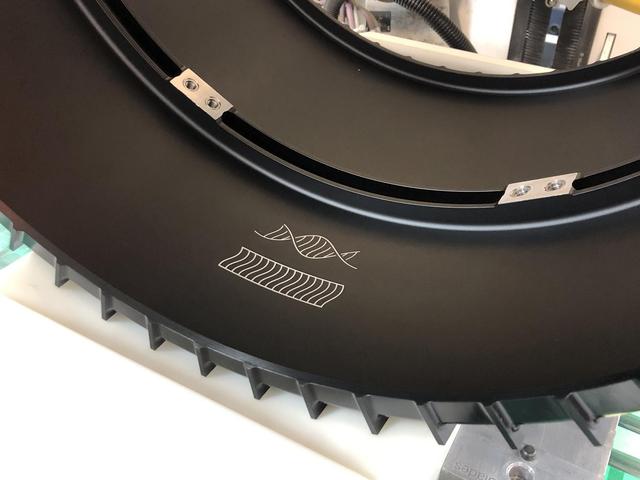
This photo shows two small drawings inscribed inside the front left wheel of the Mars Perseverance rover, pictured here before it was installed on the rover. One figure represents the tracks that the rover leaves as it drives on Mars. The other resembles that same pattern, twisted into the shape of DNA. The symbols represent humanity's fundamental drive to invent the tools necessary for exploration, and serve as a reminder that our space robots are of human origin. https://photojournal.jpl.nasa.gov/catalog/PIA24552
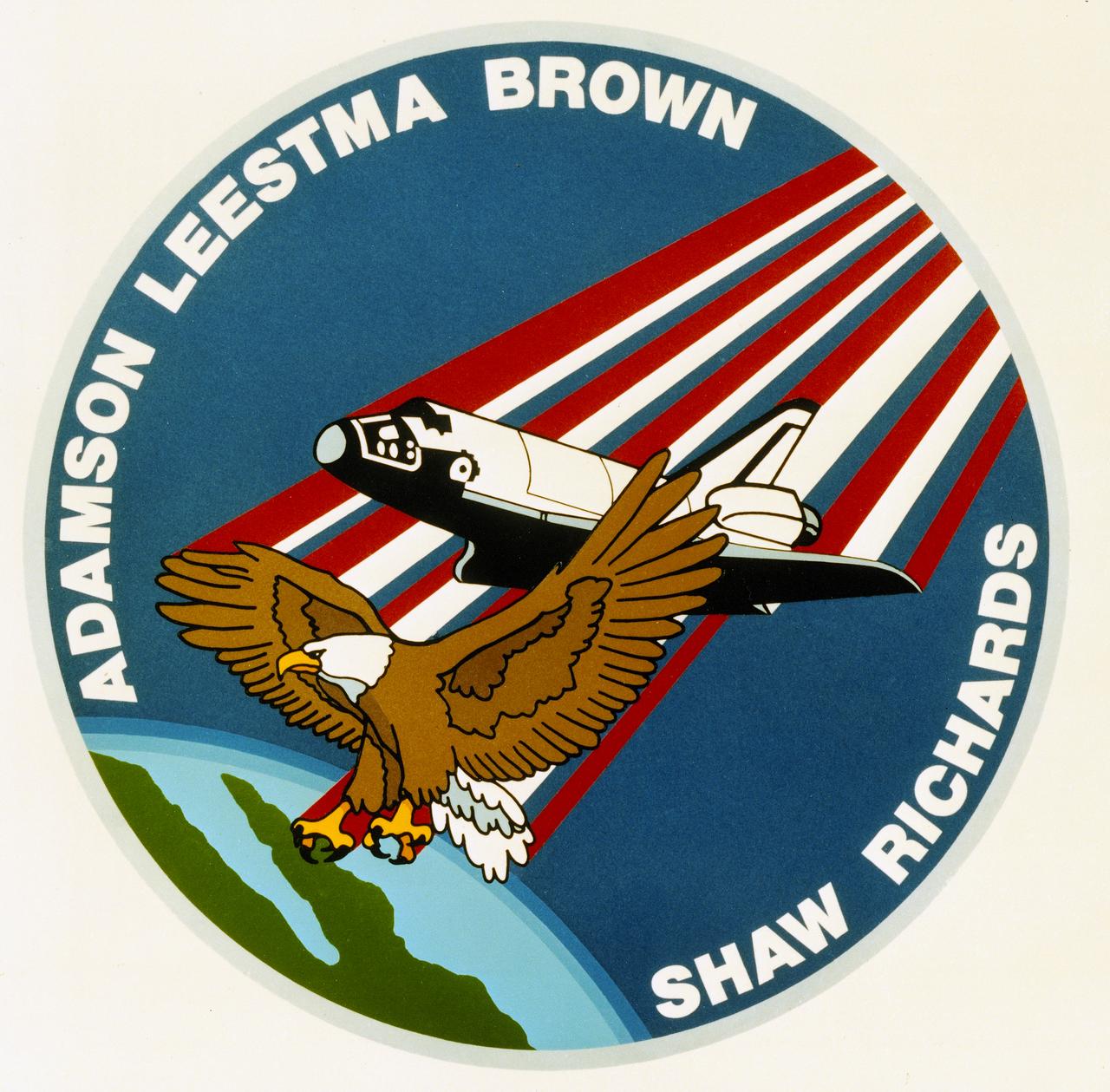
The STS-28 insignia was designed by the astronaut crew, who said it portrays the pride the American people have in their manned spaceflight program. It depicts America (the eagle) guiding the space program (the Space Shuttle) safely home from an orbital mission. The view looks south on Baja California and the west coast of the United States as the space travelers re-enter the atmosphere. The hypersonic contrails created by the eagle and Shuttle represent the American flag. The crew called the simple boldness of the design symbolic of America's unfaltering commitment to leadership in the exploration and development of space.
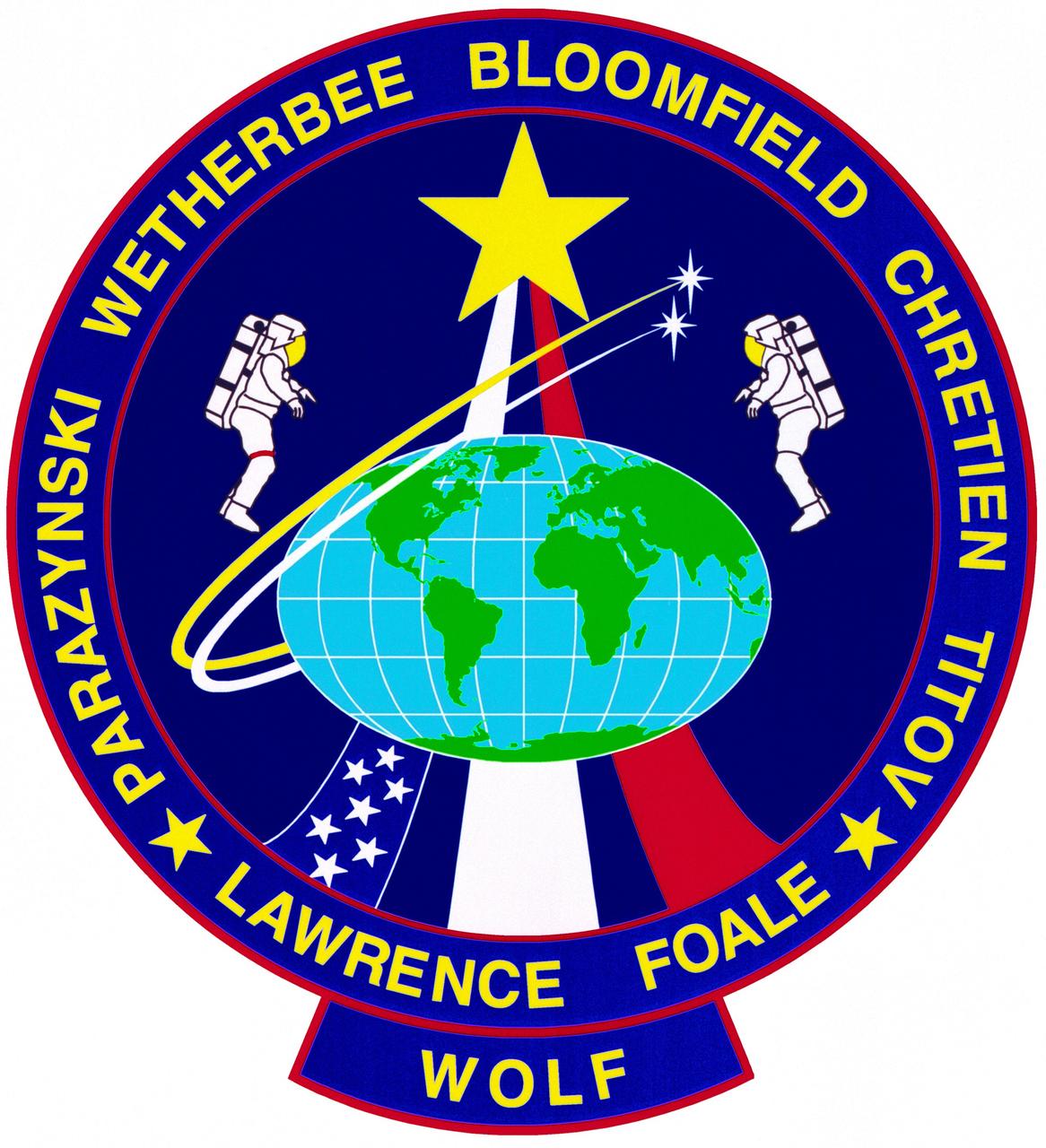
The STS-86 flight was the seventh shuttle-Mir docking mission, symbolized by seven stars. The international crew includes astronauts from the United States, Russia, and France. The flags of these nations are incorporated in the rays of the astronaut logo. The rays of light streaking across the sky depict the orbital tracks of the two spacecraft as they prepare to dock. During the flight, an American astronaut and a Russian cosmonaut will perform an extravehicular activity (EVA). The mercator projection of Earth illustrates the global cooperative nature of the flight.
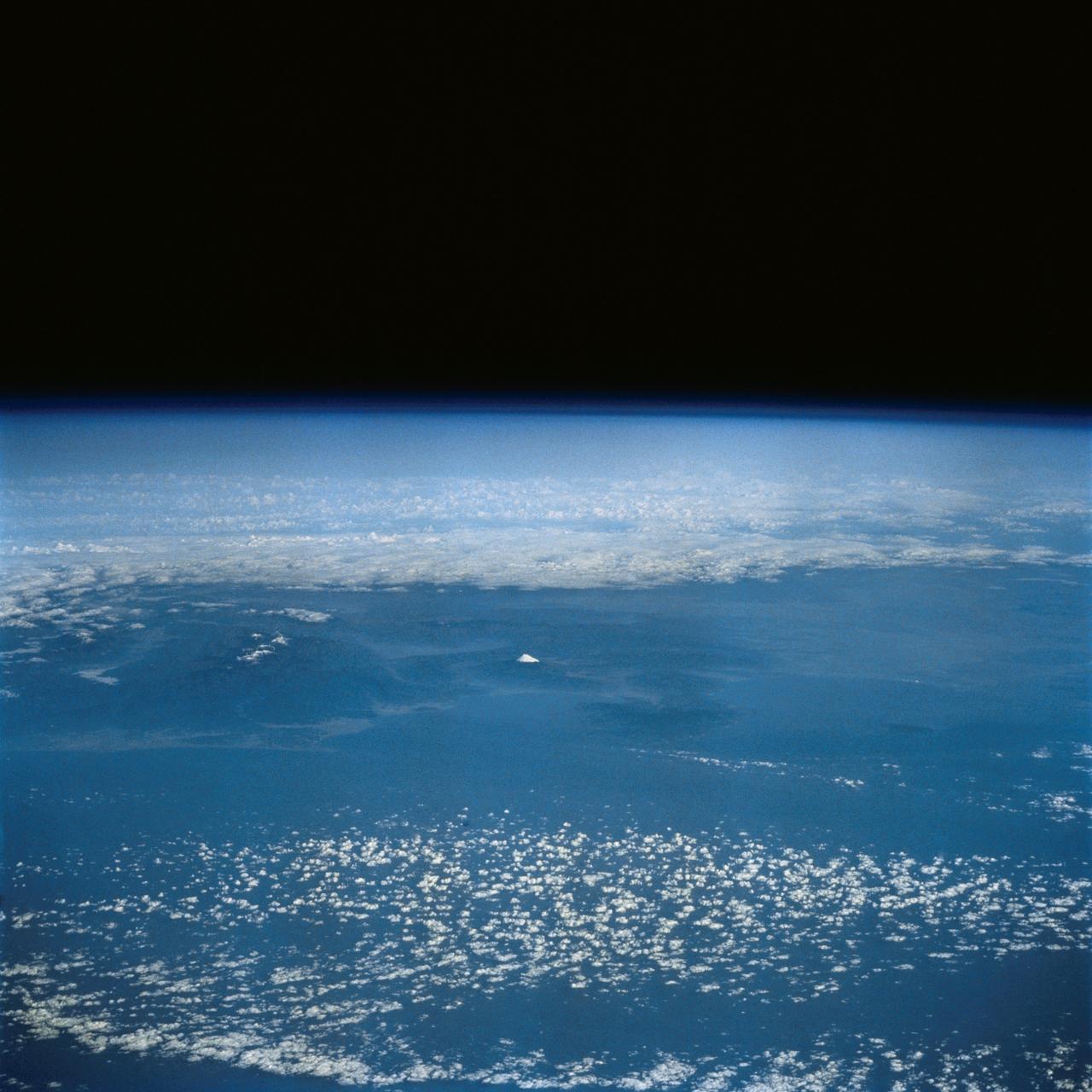
This distant view of Mt. Fuji, on the main home island of Honshu, Japan (34.0N, 139.0E) was taken from about 450 miles to the south. Evan at that great distance, the majestic and inspiring Mt. Fuji is still plainly visible and easily recognized as a world renowned symbol of Japan. The snow capped extinct volcano lies just a few miles south of Tokyo.
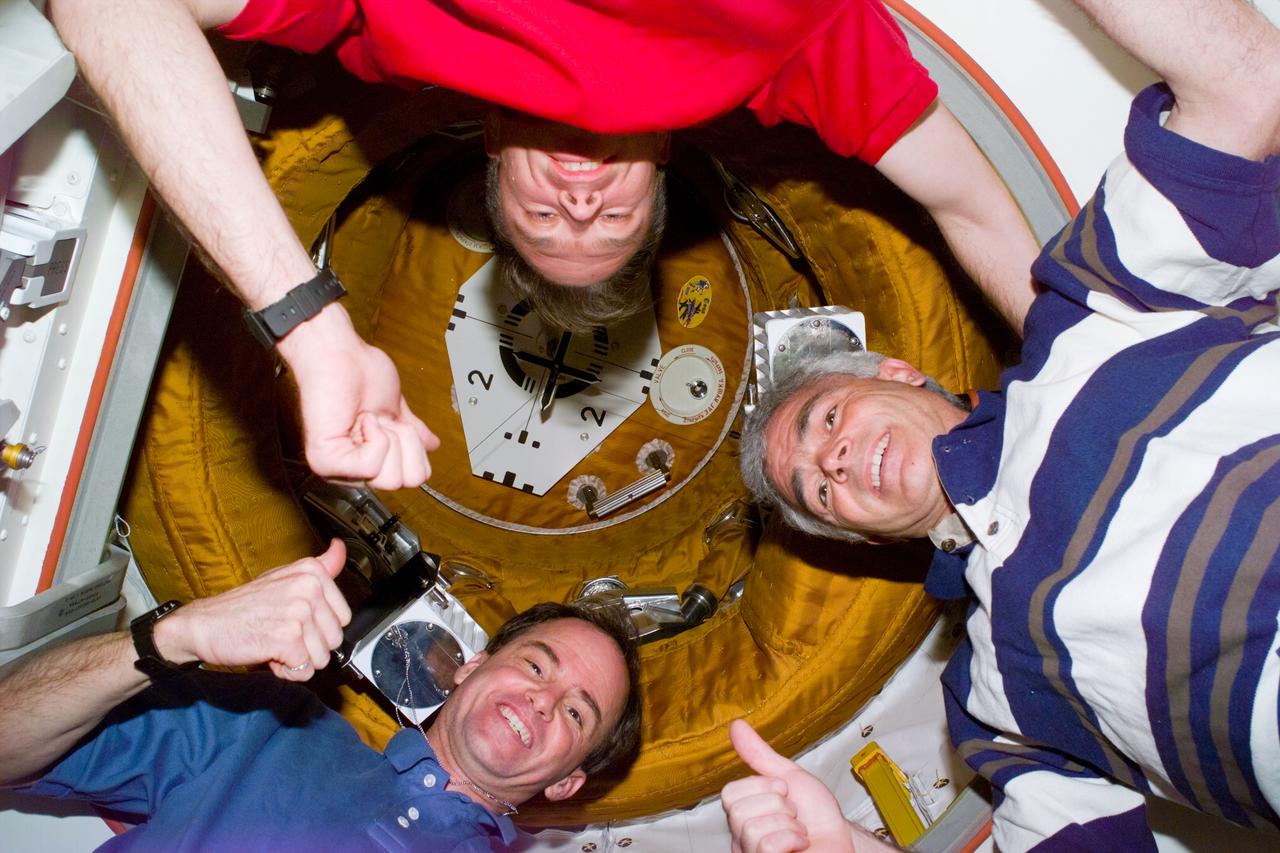
S76-E-5222 (28 March 1996) --- One would take this triumvirate of thumbs-up symbols to refer to a successful hatch closing, as the Space Shuttle Atlantis is about to be separated from its link with Russia's Mir Space Station. Hold photo with frame number and clock at bottom left. Astronaut Kevin P. Chilton, mission commander, is at lower left. Others are astronauts Richard A. Searfoss (top), pilot, and Michael R. (Rich) Clifford, mission specialist.
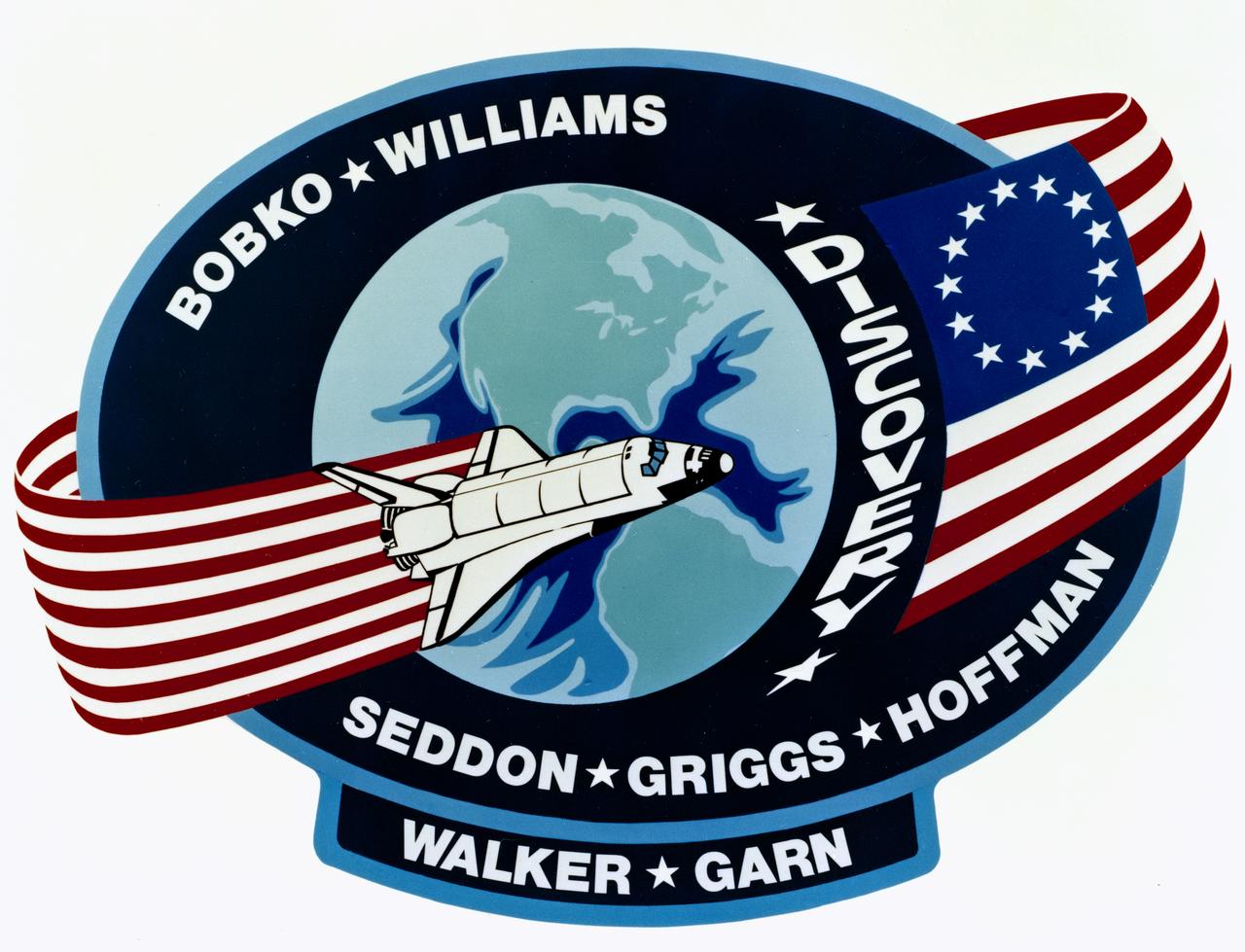
The dominant features of the STS-51D emblem are an orbit formed by a Colonial American flag and a Space Shuttle. The flag in orbit signifies the U.S. flag to indicate that it comes from this country and the American people. The original 13- star flag is used to symbolize a continuity of technical achievement and progress since colonial times. The name Discovery preceding the flag represents the spirit of Discovery and exploration of new frontiers which have been a hallmark of American people even before they were formed together as a nation.
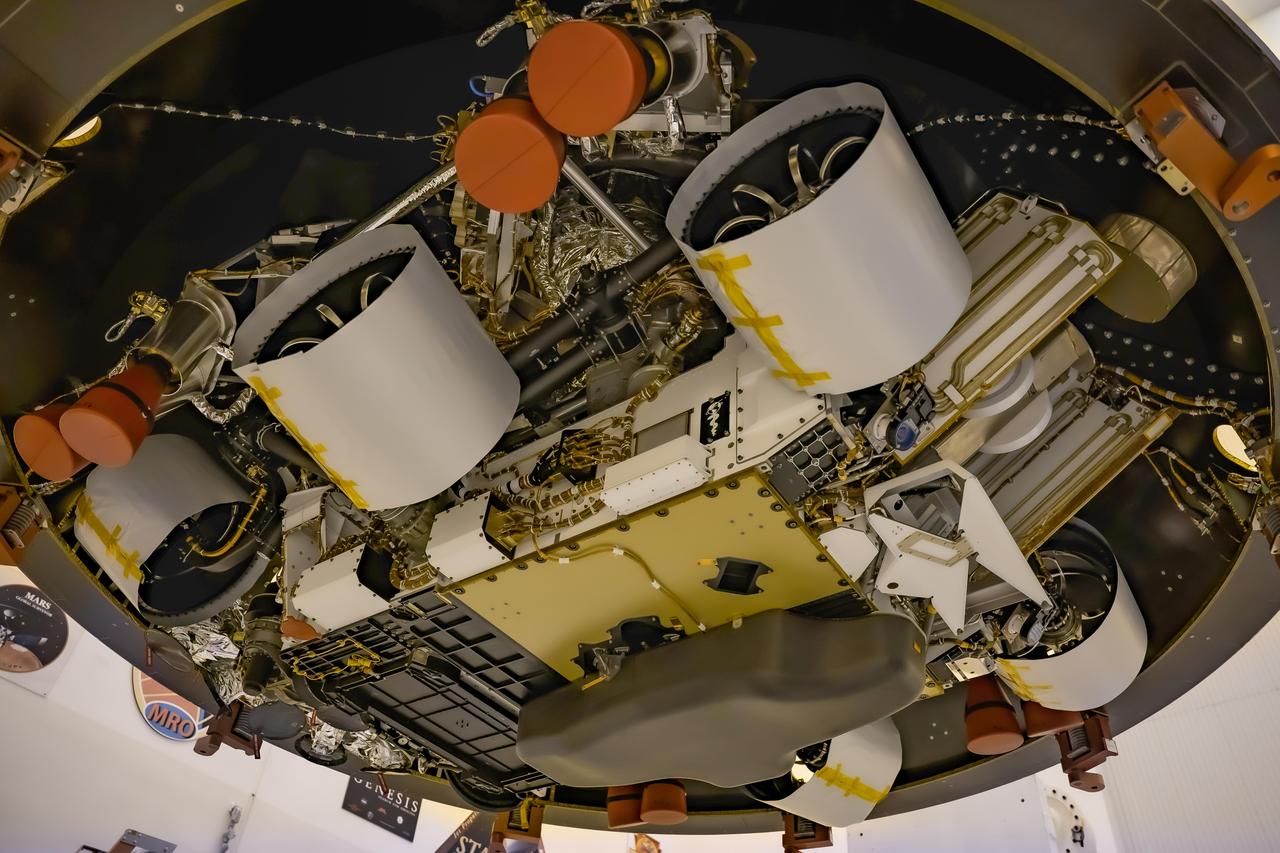
Seen from below, NASA's Mars 2020 Perseverance rover is in position in the aeroshell that will protect the rover on its way to the Red Planet. To the right of the middle wheel is the plaque that commemorates the impact of the COVID-19 pandemic and pays tribute to the perseverance of healthcare workers around the world. Featuring a snake-entwined rod to symbolize healing and medicine, the plaque was attached to the rover in May 2020 at Kennedy Space Center in Florida. https://photojournal.jpl.nasa.gov/catalog/PIA23924
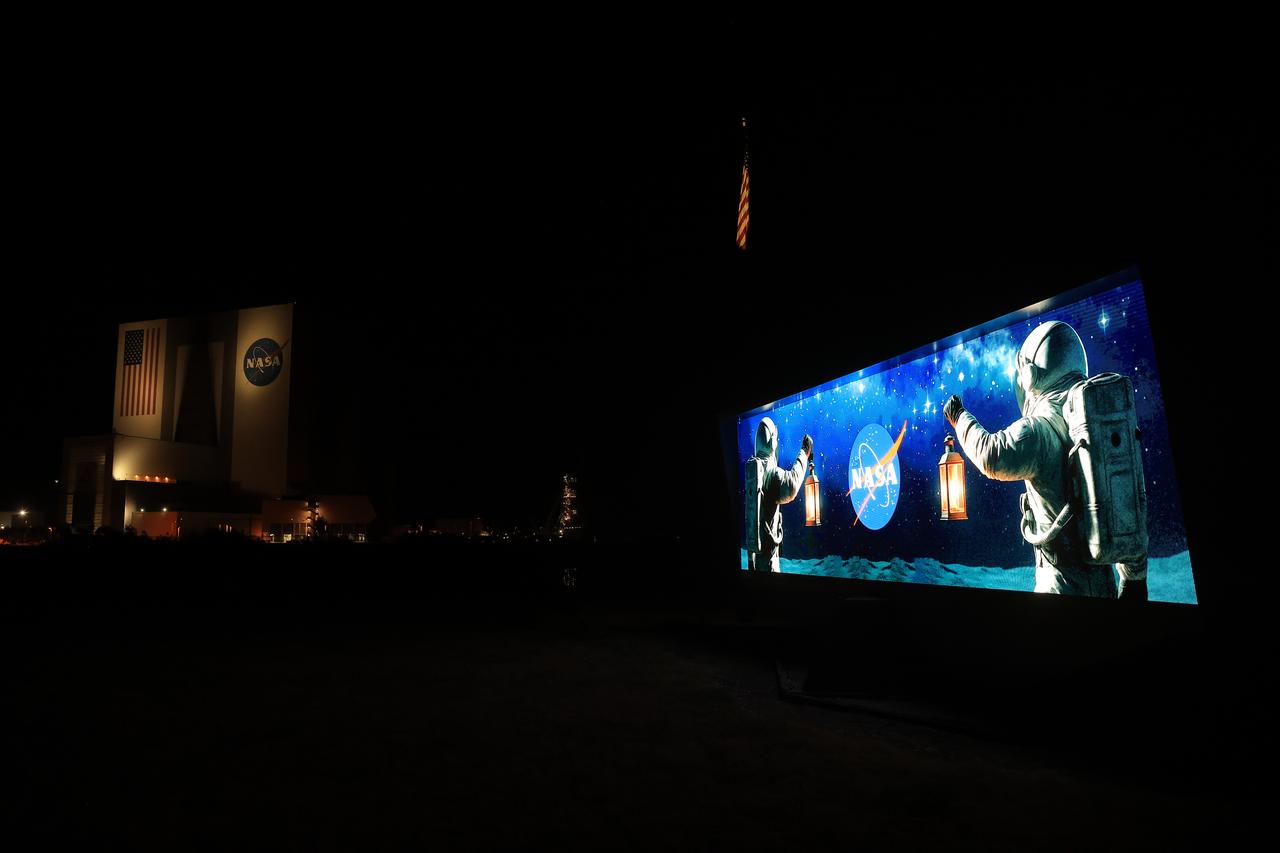
The historic countdown clock by the NASA News Center at the agency’s Kennedy Space Center in Florida on Friday, April 18, 2025, displays a graphic commemorating the 250th anniversary of Paul Revere’s midnight ride. The display is part of an initiative for all federal agencies to place two lights in a window as a symbol of the two lanterns placed in the steeple of Boston’s Old North Church used to signal to Revere and William Dawes to begin the famous midnight ride warning fellow minutemen in the Province of Massachusetts Bay that British soldiers were coming by sea.

jsc2026e396742 (June 25, 2026) - NASA's Johnson Space Center Director Vanessa Wyche and Rosemary Roosa, president of The Moon Tree foundation and daughter of late Apollo 14 astronaut Stuart Roosa, share a special plaque honoring the ties between the Apollo and Artemis Programs. The plaque is constructed from an original Moon tree planted soon after the Apollo 14 mission and symbolizes the passing of the baton from Apollo to Artemis. Credit: NASA
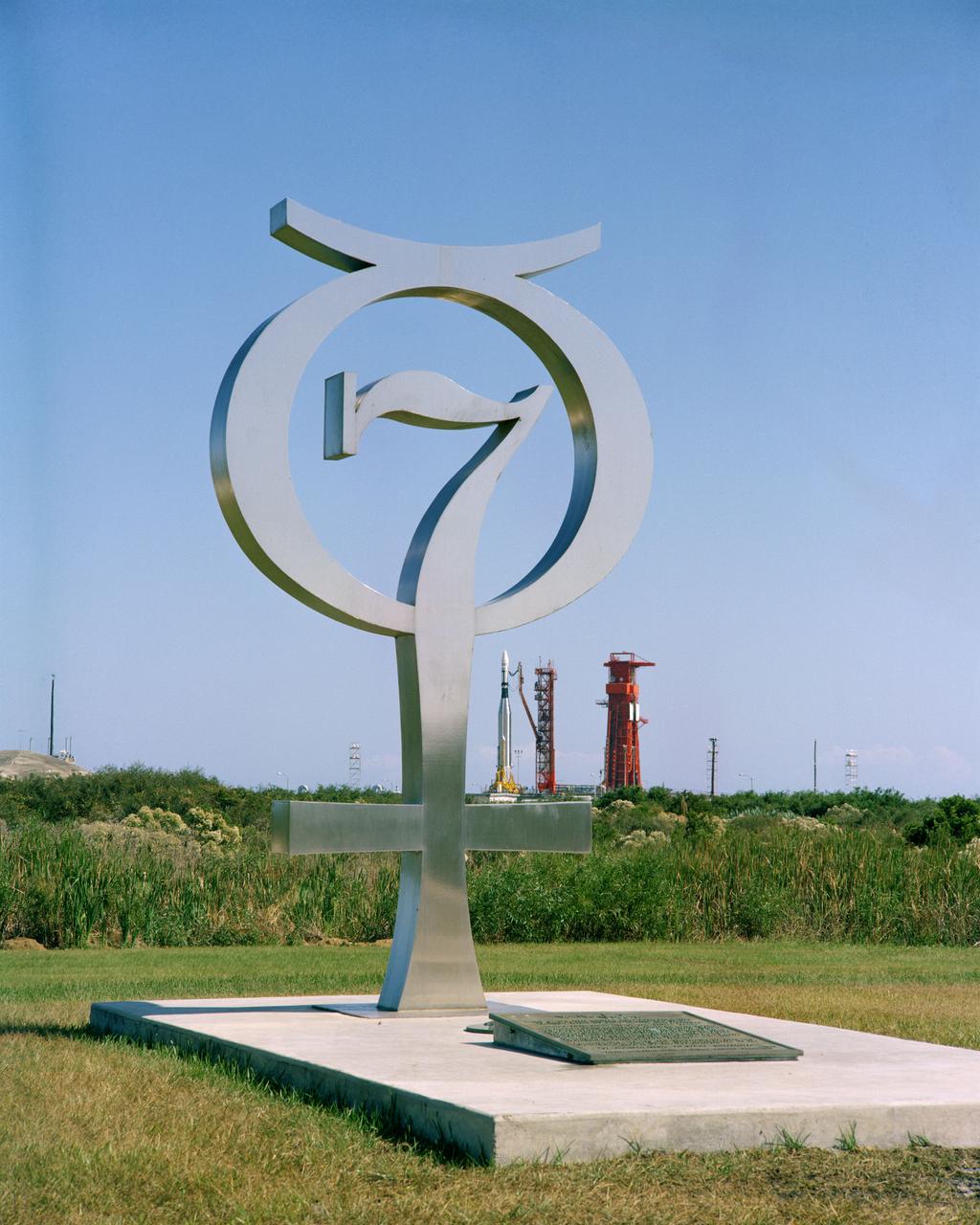
S66-59963 (9 Nov. 1966) --- Monument at Pad 14 honoring Project Mercury. The Arabic number seven represents the seven original astronauts. The other figure is the astronomical symbol of the Planet Mercury. In background is the Gemini-12 Agena Target Docking Vehicle atop its Atlas launch vehicle at Cape Kennedy, Florida. Photo credit: NASA
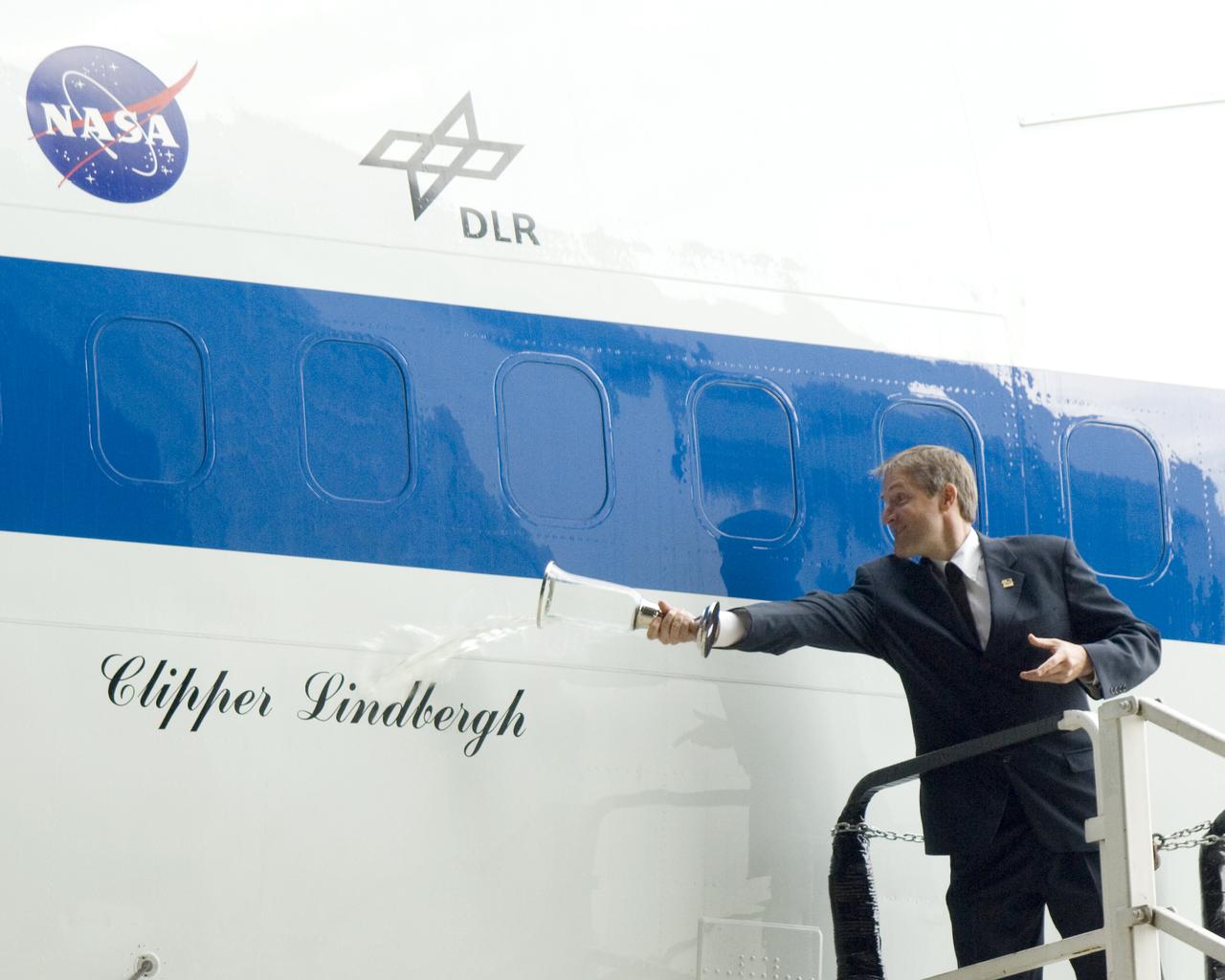
Erik Lindbergh christens NASA's 747 Clipper Lindbergh, the Stratospheric Observatory for Infrared Astronomy, with a special commemorative concoction representing local, NASA, and industry partners. The liquid consisted of a small amount of California wine representing NASA Dryden where the aircraft will be stationed, a small amount of Dr. Pepper (a Waco, TX invention), a quantity of French bottled water (to symbolize Charles Lindbergh's flight to Paris on this date), and a dash of German beer to represent the SOFIA German industry partners.
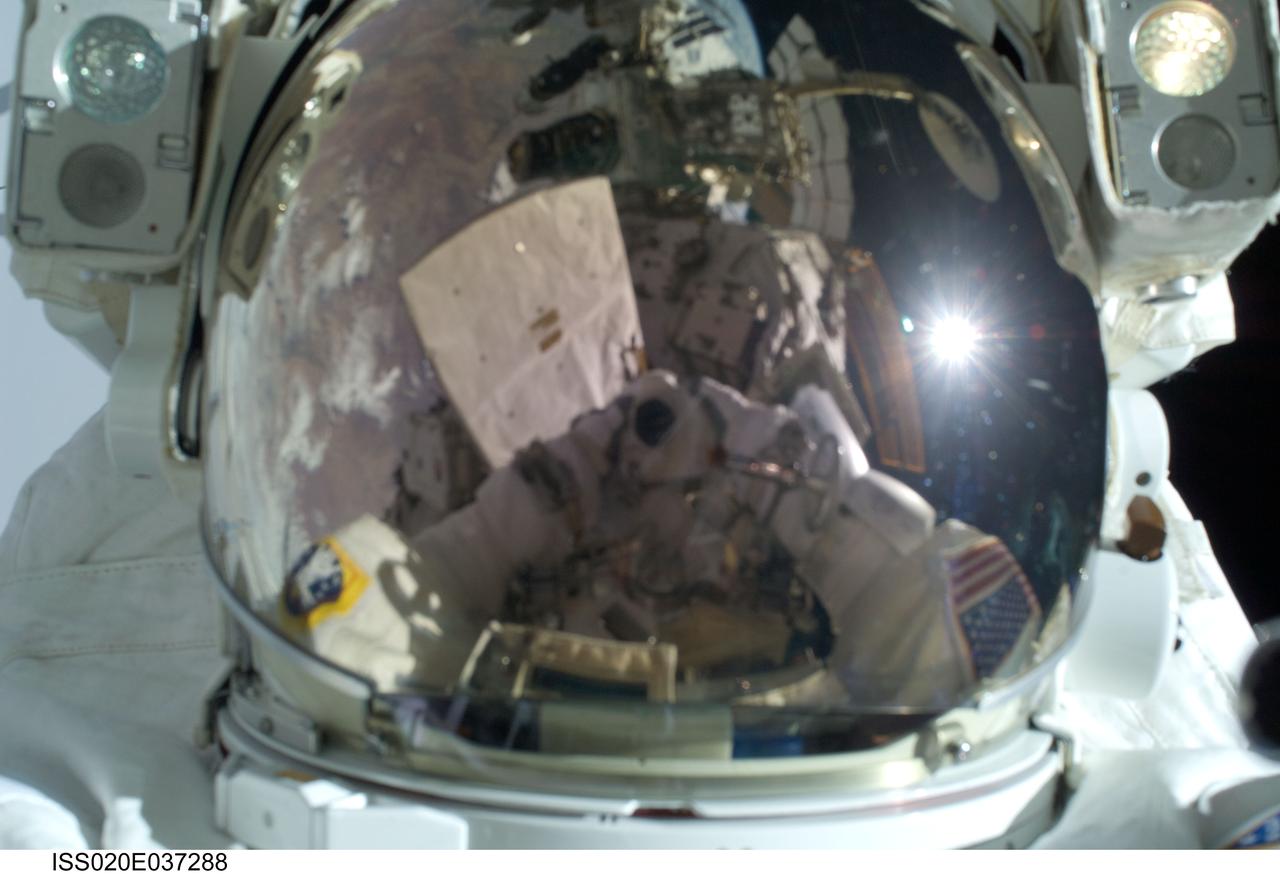
ISS020-E-037288 (1 Sept. 2009) --- The "busy" scene in the helmet visor of one of the spacewalkers for STS-128's initial extravehicular activity symbolizes how full of activity the six-and-a-half-hour (6:35) experience was for the two working outside the International Space Station and for their colleagues inside both the orbital outpost and the Space Shuttle Discovery.
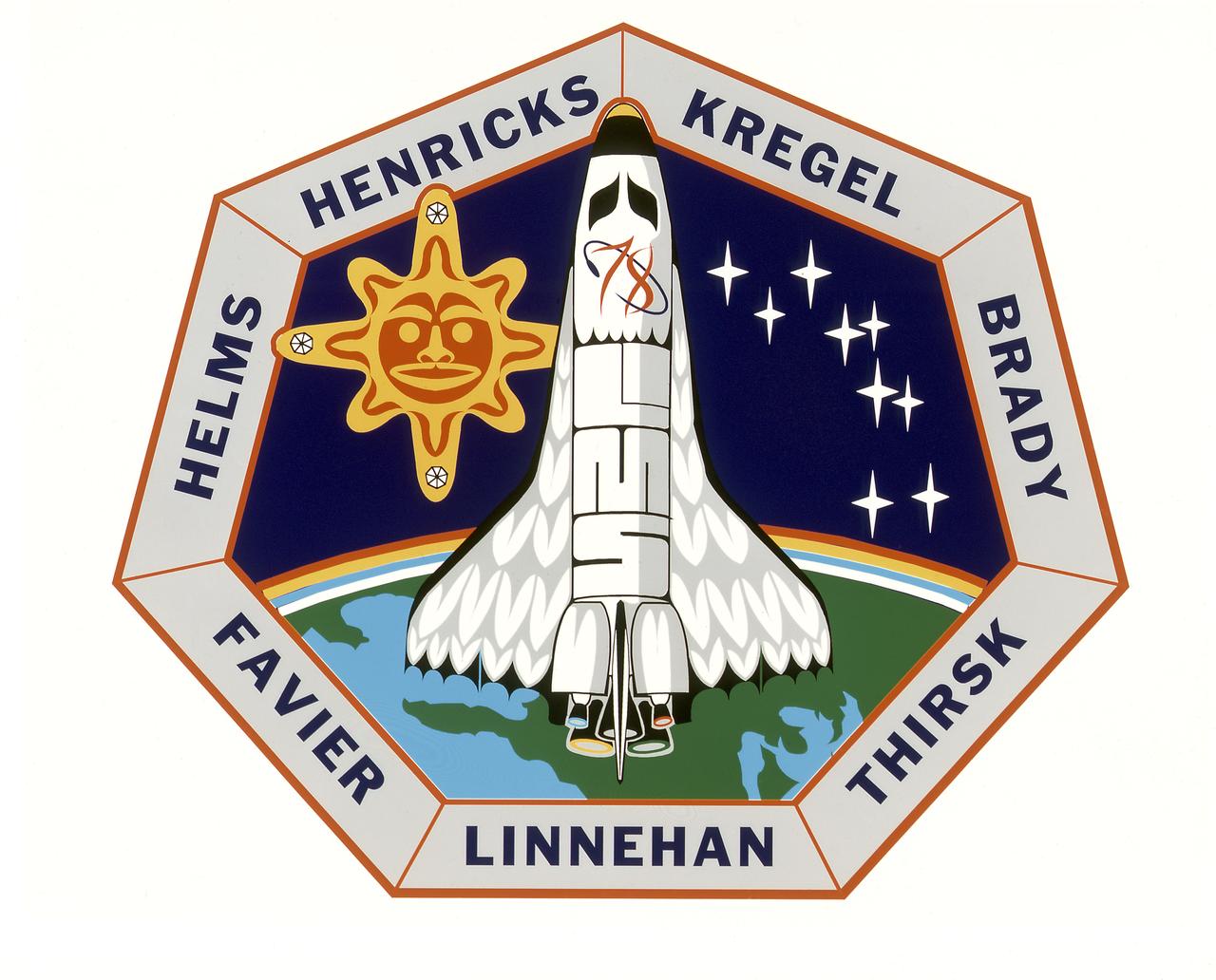
The STS-78 patch links past with present to tell the story of its mission and science through a design imbued with the strength and vitality of the 2-dimensional art of North America's northwest coast Indians. Central to the design is the space Shuttle whose bold lines and curves evoke the Indian image for the eagle, a native American symbol of power and prestige as well as the national symbol of the United States. The wings of the Shuttle suggest the wings of the eagle whose feathers, indicative of peace and friendship in Indian tradition, are captured by the U forms, a characteristic feature of Northwest coast Indian art. The nose of the Shuttle is the strong downward curve of the eagle's beak, and the Shuttle's forward windows, the eagle's eyes, represented through the tapered S forms again typical of this Indian art form. The basic black and red atoms orbiting the mission number recall the original NASA emblem while beneath, utilizing Indian ovoid forms, the major mission scientific experiment package LMS (Life and Materials Sciences) housed in the Shuttle's cargo bay is depicted in a manner reminiscent of totem-pole art. This image of a bird poised for flight, so common to Indian art, is counterpointed by an equally familiar Tsimshian Indian symbol, a pulsating sun with long hyperbolic rays, the symbol of life. Within each of these rays are now encased crystals, the products of this mission's 3 major, high-temperature materials processing furnaces. And as the sky in Indian lore is a lovely open country, home of the Sun Chief and accessible to travelers through a hole in the western horizon, so too, space is a vast and beckoning landscape for explorers launched beyond the horizon. Beneath the Tsimshian sun, the colors of the earth limb are appropriately enclosed by a red border representing life to the Northwest coast Indians. The Indian colors of red, navy blue, white, and black pervade the STS-78 path. To the right of the Shuttle-eagle, the constellation Delphinus recalls the dolphin, friend of ancient sailors and, now perhaps too, of the 9 space voyagers suggested by this constellation's blaze of 9 stars. The patch simultaneously celebrates international unity fostered by the Olympic spirit of sports competition at the 1996 Olympic Games in Atlanta, Georgia, U.S.A. Deliberately poised over the city of Atlanta, the Space Shuttle glows at its base with the 5 official Olympic rings in the 5 Olympic colors which can also be found throughout the patch, rings and colors which signify the 5 continents of the earth. This is an international mission and for the first time in NASA patch history, astronauts have dispensed with identifying country flags beneath their names to celebrate the spirit of international unity so characteristic of this flight.
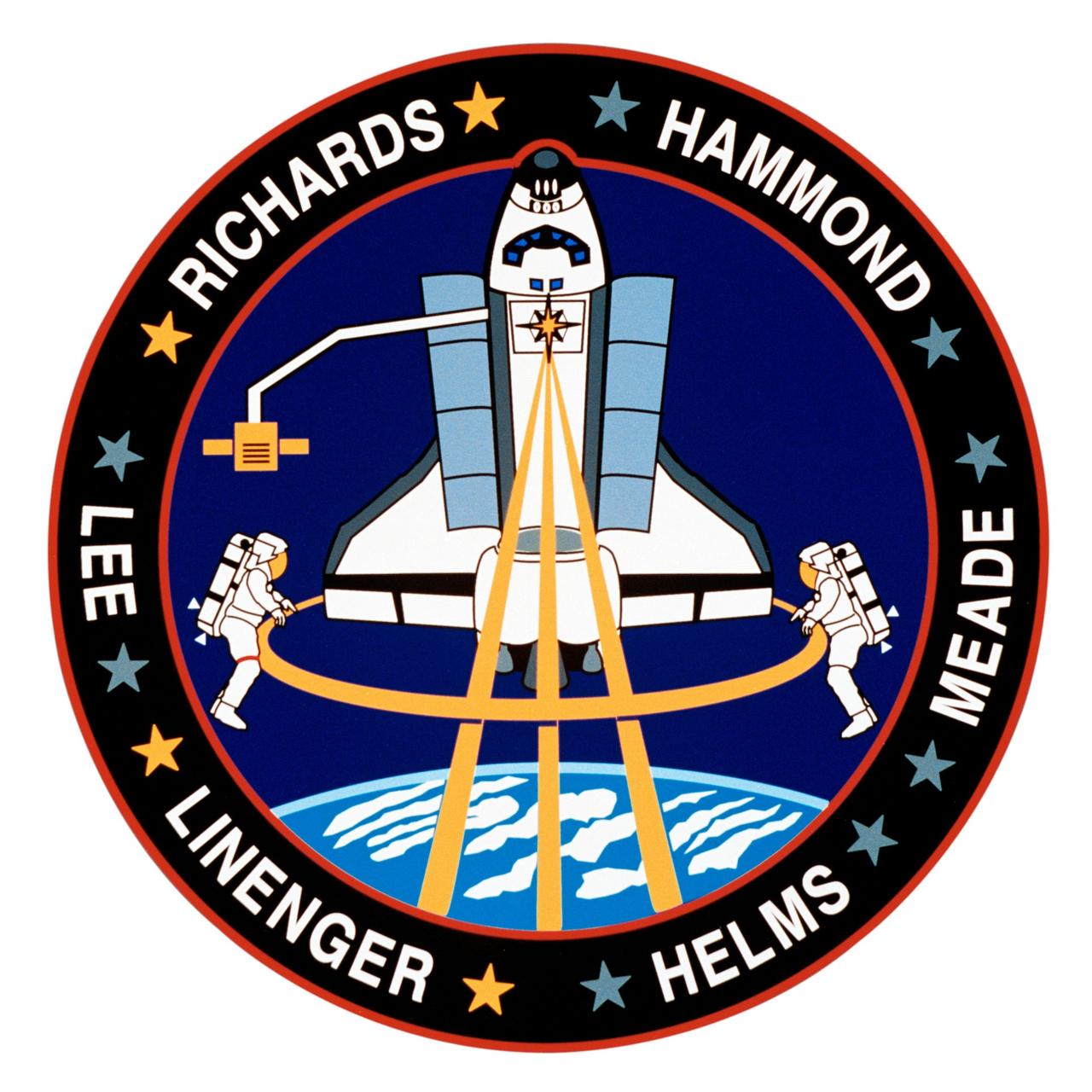
STS064-S-001 (July 1994) --- The patch depicts the space shuttle Discovery in a payload-bay-to-Earth attitude with its primary payload, Lidar In-Space Technology Experiment (LITE-1) operating in support of Mission to Planet Earth. LITE-1 is a lidar (light detection and ranging) system that uses a three-wavelength laser, symbolized by the three gold rays emanating from the star in the payload bay that form part of the astronaut symbol. The major objective of this first flight of LITE-1 is to validate its design and operating characteristics by gathering data about the Earth's troposphere and stratosphere, represented by the clouds and dual-colored Earth limb. A secondary payload on STS-64 is the free-flier SPARTAN-201 satellite shown on the Remote Manipulator System (RMS) arm post-retrieval. The objective of SPARTAN-201 is to investigate the physics of the solar wind and complement data being obtained from the ULYSSES satellite launched on STS-41. The RMS will also operate another secondary payload, Shuttle Plume Impingement Flight Experiment (SPIFEX), which will assess the plume effects from the Orbiter's Reaction Control System thrusters. Additionally, STS-64 will test a new extravehicular activity (EVA) maneuvering device, Simplified Aid for EVA Rescue (SAFER), represented symbolically by the two small nozzles on the backpacks of the two untethered EVA crew men. The names of the crew members encircle the patch: astronauts Richard N. Richards, commander; L. Blaine Hammond Jr., pilot; Jerry M. Linenger; Susan J. Helms, Carl J. Meade and Mark C. Lee, all mission specialists. The gold or silver stars by each name represent that person's parent service. The NASA insignia design for space shuttle flights is reserved for use by the astronauts and for other official use as the NASA Administrator may authorize. Public availability has been approved only in the forms of illustrations by the various news media. When and if there is any change in this policy, which is not anticipated, the change will be publicly announced. Photo credit: NASA

JOHNSON SPACE CENTER, HOUSTON, TEXAS - STS-111 INSIGNIA -- The STS-111 patch symbolizes the hardware, people, and partner nations that contribute to the flight. The Space Shuttle rises on the plume of the Astronaut Office symbol, carrying the Canadian Mobile Base System (MBS) for installation while docked to the International Space Station (ISS). The mission is named UF-2 for ISS Utilization Flight number two. The ISS orbit completes the Astronaut Office symbol and is colored red, white, and blue to represent the flags of the United States, Russia, France, and Costa Rica. The Earth background shows Italy, which contributes the Multi Purpose Logistics Module (MPLM) used on this flight to re-supply ISS. The ten stars in the sky represent the ten astronauts and cosmonauts on orbit during the flight, and the star at the top of the patch represents the Johnson Space Center, in the state of Texas, from which the flight is managed. The names of the STS-111 crew border the upper part of the patch, and the Expedition Five (going up) and Expedition Four (coming down) crews' names form the bottom of the patch. The NASA insignia design for Shuttle flights is reserved for use by the astronauts and for other official use as the NASA Administrator may authorize. Public availability has been approved only in the forms of illustrations by the various news media. When and if there is any change in this policy, which is not anticipated, the change will be publicly announced. The NASA insignia design for Space Shuttle flights is reserved for use by the astronauts and for other official use as the NASA Administrator may authorize. Public availability has been approved only in the form of illustrations by the various news media. When and if there is any change in this policy, which we do not anticipate, it will be publicly announced

STS078-S-001 (March 1998) --- The STS-78 mission links the past with the present through a crew patch influenced by Pacific Northwest Native American art. Central to the design is the space shuttle Columbia, whose shape evokes the image of the eagle, an icon of power and prestige and the national symbol of the United States. The eagle?s feathers, representing both peace and friendship, symbolize the spirit of international unity on STS-78. An orbit surrounding the mission number recalls the traditional NASA emblem. The Life Sciences and Microgravity Spacelab (LMS) is housed in Columbia?s payload bay and is depicted in a manner reminiscent of totem art. The pulsating sun, a symbol of life, displays three crystals representing STS-78?s three high-temperature microgravity materials processing facilities. The constellation Delphinus recalls the dolphin, friend of sea explorers. Each star represents one member of STS-78?s international crew including the alternate payload specialists Pedro Duque and Luca Urbani. The colored thrust rings at the base of Columbia signify the five continents of Earth united in global cooperation for the advancement of all humankind. The NASA insignia design for space shuttle flights is reserved for use by the astronauts and for other official use as the NASA Administrator may authorize. Public availability has been approved only in the forms of illustrations by the various news media. When and if there is any change in this policy, which is not anticipated, the change will be publicly announced. Photo credit: NASA
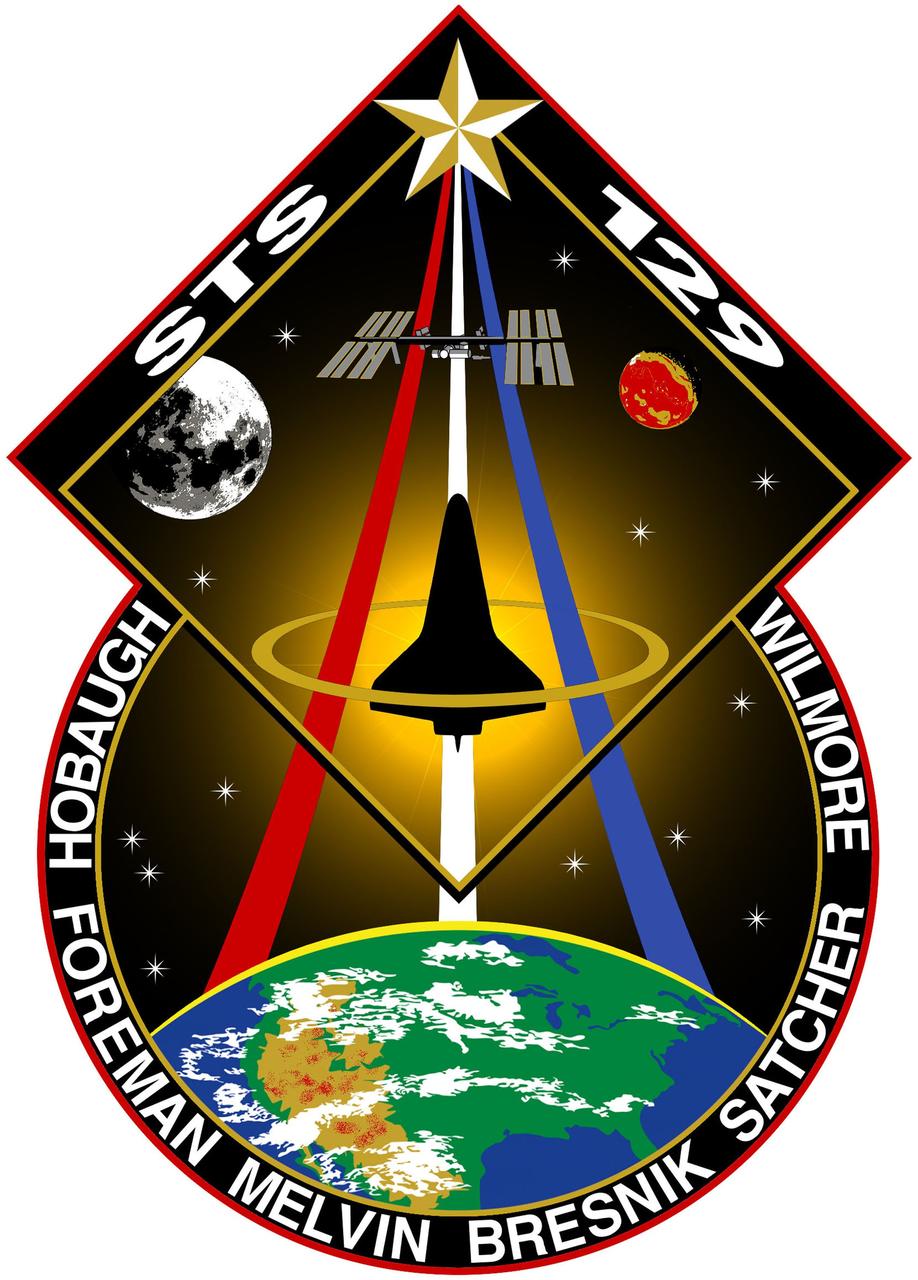
JOHNSON SPACE CENTER, Houston - STS129-S-001 -- For STS-129 the sun shines brightly on the International Space Station (ISS) above and the United States below representing the bright future of U.S. human spaceflight. The contiguous U.S., Rocky Mountains, and Great Desert Southwest are clearly visible on the earth below encompassing all the NASA centers and the homes of the many dedicated people that work to make our Space Program possible. The integrated shapes of the patch signifying the two Express Logistics Carriers that will be delivered by STS-129 providing valuable equipment ensuring the longevity of the ISS. The Space Shuttle is vividly silhouetted by the sun highlighting how brightly the Orbiters have performed as a workhorse for the U.S. Space Program over the past 3 decades. The Space Shuttle ascends on the Astronaut symbol portrayed by the Red, White and Blue swoosh bounded by the gold halo. This symbol is worn with pride by this U.S. crew representing their country on STS-129. The names of the crew members are denoted on the outer band of the patch. As STS-129 launches, the Space Shuttle is in its twilight years. This fact is juxtaposed by the 13 stars on the patch which are symbolic of our children who are the future. The Moon and Mars feature predominantly to represent just how close humankind is to reaching further exploration of those heavenly bodies and how the current Space Shuttle and ISS missions are laying the essential ground work for those future endeavors. The NASA insignia for design for Shuttle flights is reserved for use by the astronauts and for other official use as the NASA Administrator may authorize. Public availability has been approved only in the form of illustrations by the various news media. When and if there is any change in this policy which is not anticipated, it will be publicly announced. (Note: the description is provided by the crew members).
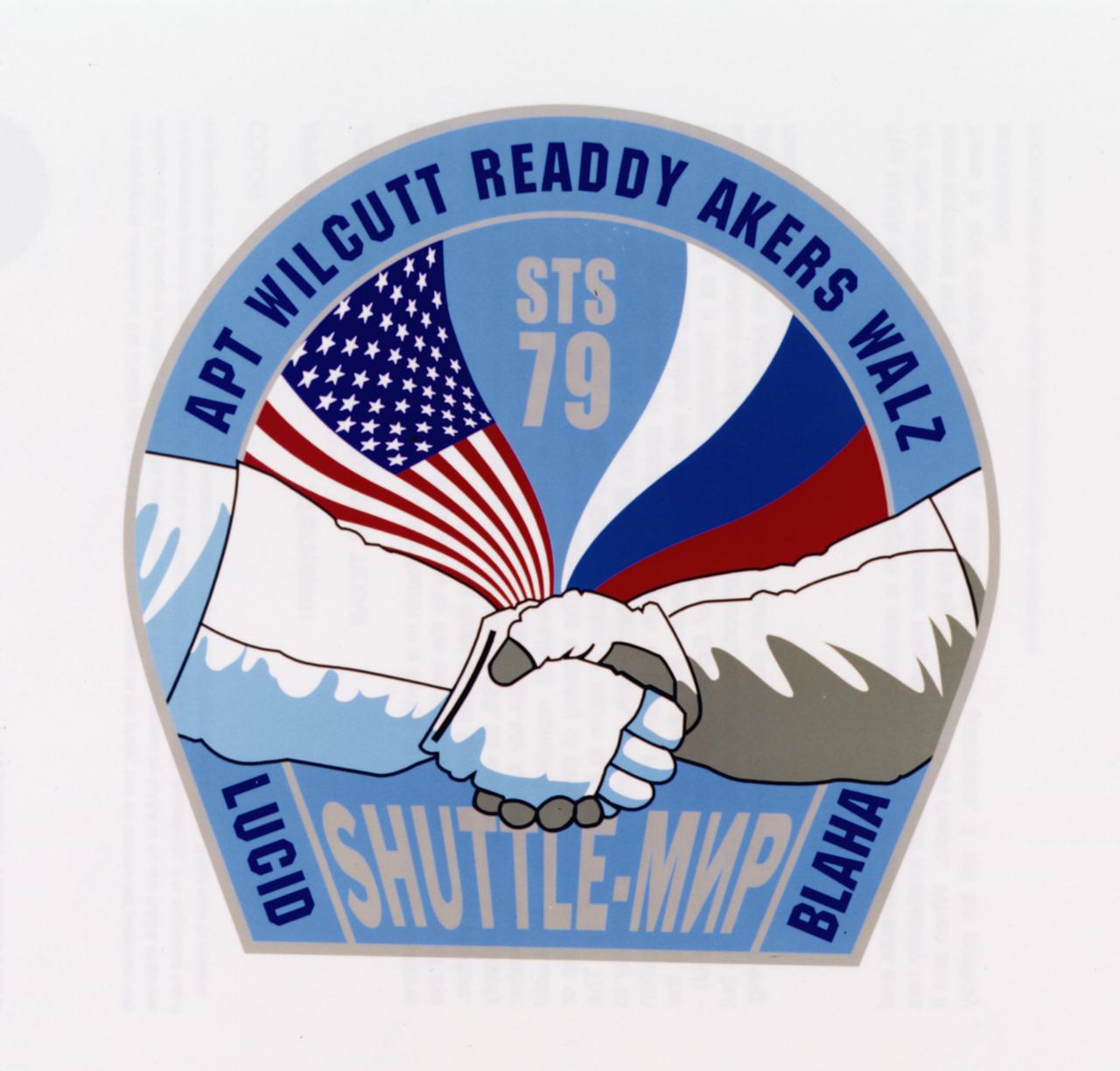
STS-79 was the fourth in a series of NASA docking missions to the Russian Mir Space Station, leading up to the construction and operation of the International Space Station (ISS). As the first flight of the Spacehab Double Module, STS-79 encompassed research, test and evaluation of ISS, as well as logistics resupply for the Mir Space Station. STS-79 was also the first NASA-Mir American crew member exchange mission, with John E. Blaha (NASA-Mir-3) replacing Shannon W. Lucid (NASA-Mir-2) aboard the Mir Space Station. The lettering of their names either up or down denotes transport up to the Mir Space Station or return to Earth on STS-79. The patch is in the shape of the Space Shuttle’s airlock hatch, symbolizing the gateway to international cooperation in space. The patch illustrates the historic cooperation between the United States and Russia in space. With the flags of Russia and the United States as a backdrop, the handshake of Extravehicular Mobility Unit (EMU) which are suited crew members symbolizes mission teamwork, not only of the crew members but also the teamwork between both countries space personnel in science, engineering, medicine and logistics.
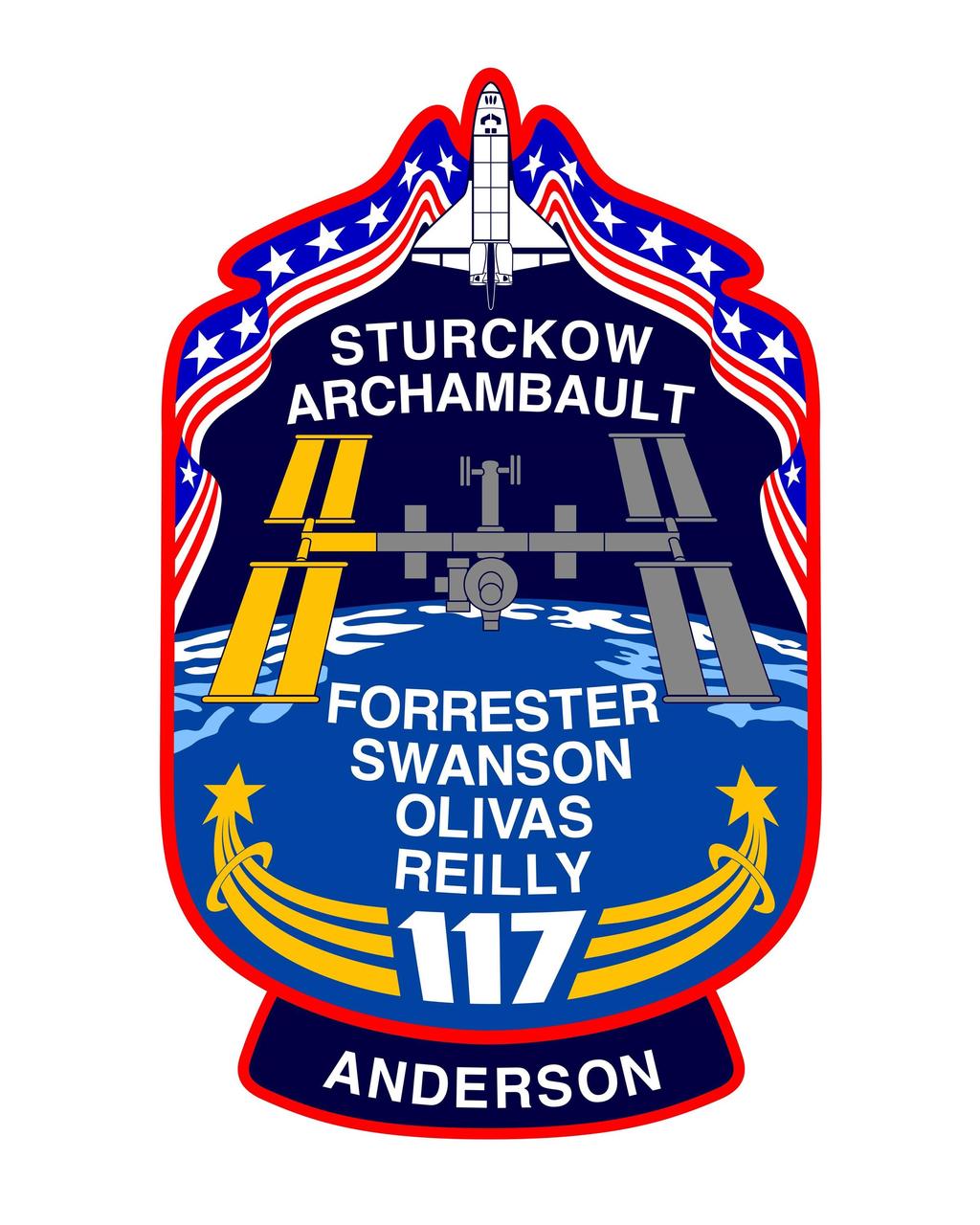
JOHNSON SPACE CENTER, Houston -- STS117-S-001 -- The STS-117 crew patch symbolizes the continued construction of the International Space Station (ISS) and our ongoing human presence in space. The ISS is shown orbiting high above the Earth. Gold is used to highlight the portion of the ISS that will be installed by the STS-117 crew. It consists of the second starboard truss section, S3/S4, and a set of solar arrays. The names of the STS-117 crew are located above and below the orbiting outpost. The two gold astronaut office symbols, emanating from the '117' at the bottom of the patch represent the concerted efforts of the shuttle and station programs toward the completion of the station. The orbiter and unfurled banner of red, white and blue represent our Nation's renewed patriotism as we continue to explore the universe. The NASA insignia design for shuttle space flights is reserved for use by the astronauts and other official use as the NASA Administrator may authorize. Public availability has been approved only in the form of illustrations by the various news media. When and if there is any change in this policy, which is not anticipated, such will be publicly announced.
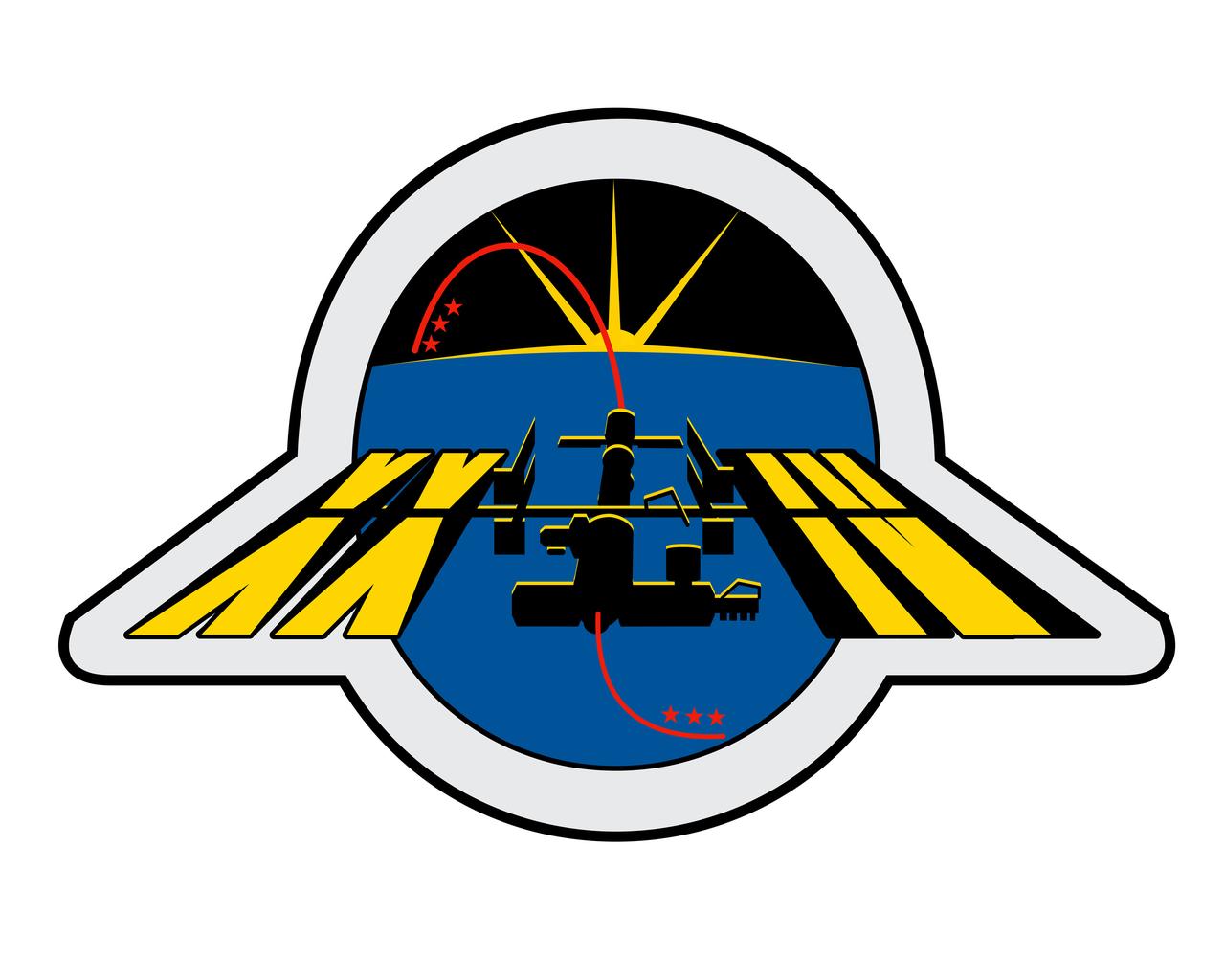
ISS024-S-001A (January 2010) --- Science and Exploration are the cornerstones of NASA?s mission onboard the International Space Station (ISS). This emblem signifies the dawn of a new era in our program?s history. With each new expedition, as we approach assembly complete, our focus shifts toward the research nature of this world-class facility. Prominently placed in the foreground, the ISS silhouette leads the horizon. Each ray of the sun represents the five international partner organizations that encompass this cooperative program. Expedition 24 is one of the first missions expanding to a crew of six. These crews, symbolized here as stars arranged in two groups of three, will launch on Soyuz vehicles. The unbroken flight track symbolizes our continuous human presence in space, representing all who have and will dedicate themselves as crew and citizens of the International Space Station. The NASA insignia design for shuttle flights and station increments is reserved for use by the astronauts and for other official use as the NASA Administrator may authorize. Public availability has been approved only in the forms of illustrations by the various news media. When and if there is any change in this policy, which is not anticipated, the change will be publicly announced.
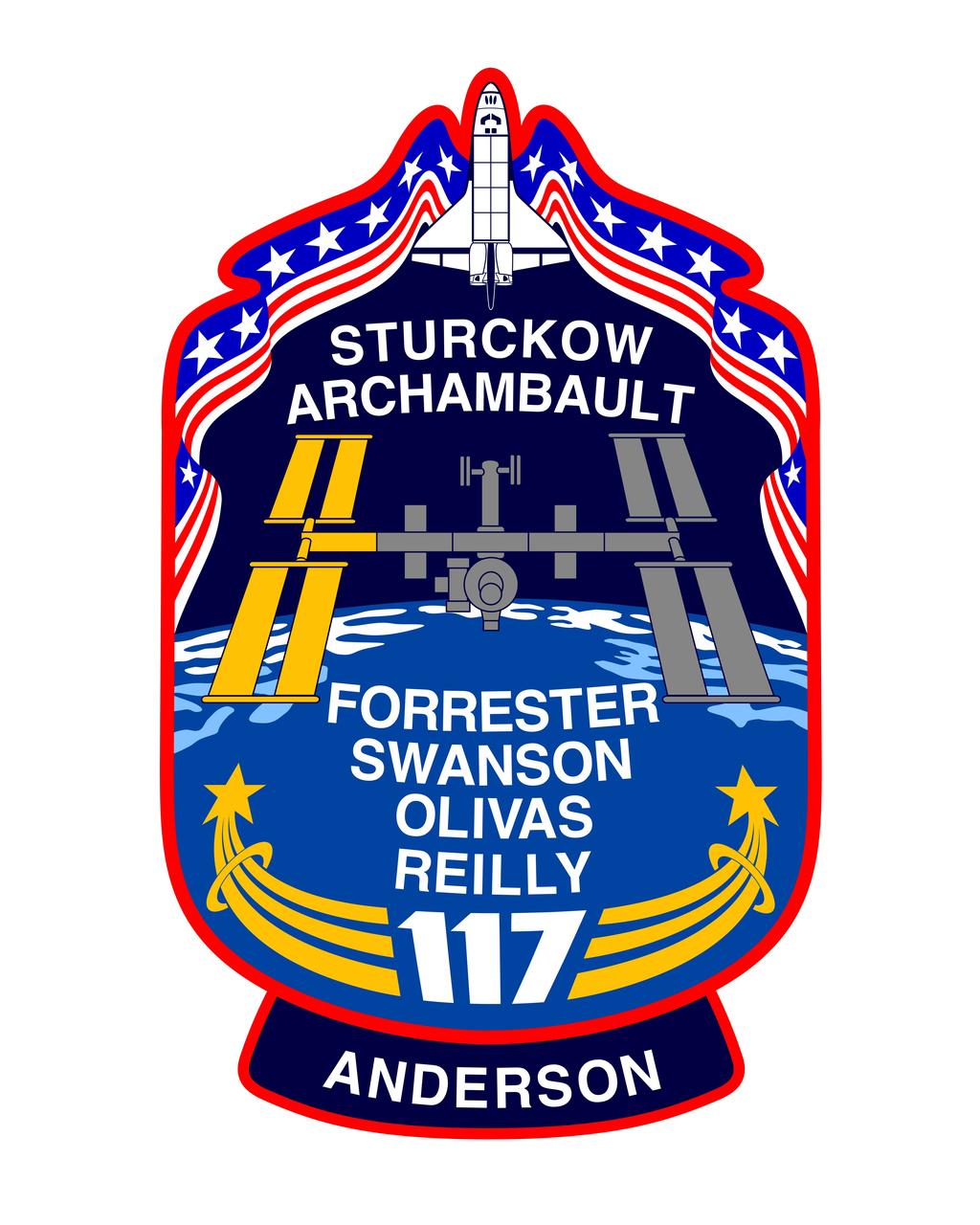
STS117-S-001 (May 2007) --- The STS-117 crew patch symbolizes the continued construction of the International Space Station (ISS) and our ongoing human presence in space. The ISS is shown orbiting high above Earth. Gold is used to highlight the portion of the ISS that will be installed by the STS-117 crew. It consists of the second starboard truss section, S3/S4, and a set of solar arrays. The names of the STS-117 crew are located above and below the orbiting outpost. The two gold astronaut office symbols, emanating from the '117' at the bottom of the patch, represent the concerted efforts of the shuttle and station programs toward the completion of the station. The orbiter and unfurled banner of red, white, and blue represent our Nation's renewed patriotism as we continue to explore the universe. The NASA insignia design for space shuttle flights is reserved for use by the astronauts and for other official use as the NASA Administrator may authorize. Public availability has been approved only in the forms of illustrations by the various news media. When and if there is any change in this policy, which is not anticipated, the change will be publicly announced. Photo credit: NASA
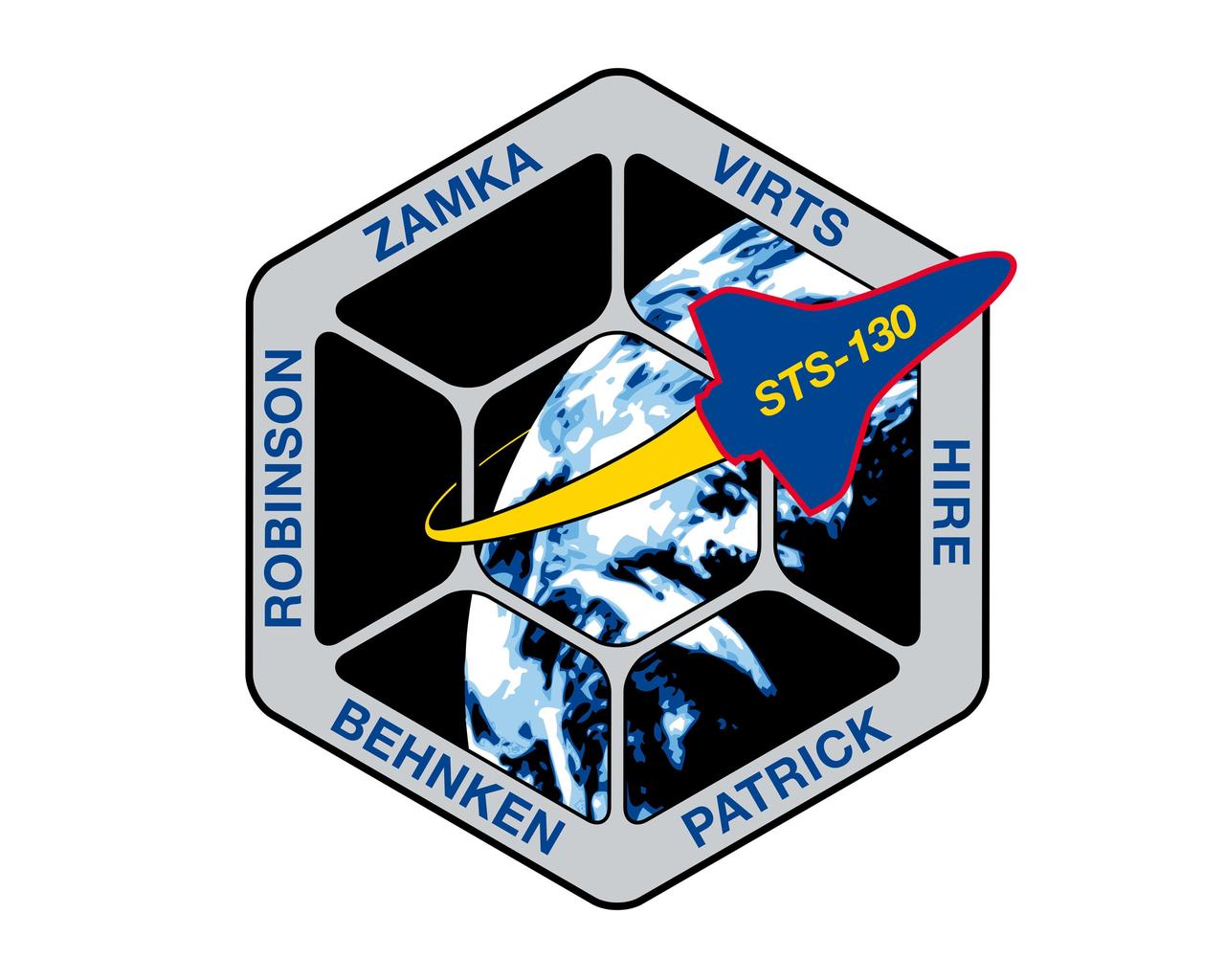
JOHNSON SPACE CENTER, Houston - STS130-S-001 - The STS-130 patch was designed by the crew to reflect both the objectives of the mission and its place in the history of human spaceflight. The main goal of the mission is to deliver Node 3 and the Cupola to the International Space Station (ISS). Node 3, named "Tranquility," will contain life support systems enabling continued human presence in orbit aboard the ISS. The shape of the patch represents the Cupola, which is the windowed robotics viewing station, from which astronauts will have the opportunity not only to monitor a variety of ISS operations, but also to study our home planet. The image of Earth depicted in the patch is the first photograph of the Earth taken from the moon by Lunar Orbiter I on August 23, 1966. As both a past and a future destination for explorers from the planet Earth, the moon is thus represented symbolically in the STS-130 patch. The Space Shuttle Endeavour is pictured approaching the ISS, symbolizing the Space Shuttle's role as the prime construction vehicle for the ISS. The NASA insignia design for shuttle flights is reserved for use by the astronauts and for other official use as the NASA Administrator may authorize. Public availability has been approved only in the form of illustrations by the various news media. When and if there is any change in this policy, which we do not anticipate, it will be publicly announced.

Designed by the STS-88 crew members, this patch commemorates the first assembly flight to carry United States-built hardware for constructing the International Space Station (ISS). This flight's primary task was to assemble the cornerstone of the Space Station: the Node with the Functional Cargo Block (FGB). The rising sun symbolizes the dawning of a new era of international cooperation in space and the beginning of a new program: the International Space Station. The Earth scene outlines the countries of the Station Partners: the United States, Russia, those of the European Space Agency (ESA), Japan, and Canada. Along with the Pressurized Mating Adapters (PMA) and the Functional Cargo Block, the Node is shown in the final mated configuration while berthed to the Space Shuttle during the STS-88/2A mission. The Big Dipper Constellation points the way to the North Star, a guiding light for pioneers and explorers for generations. In the words of the crew, These stars symbolize the efforts of everyone, including all the countries involved in the design and construction of the International Space Station, guiding us into the future.
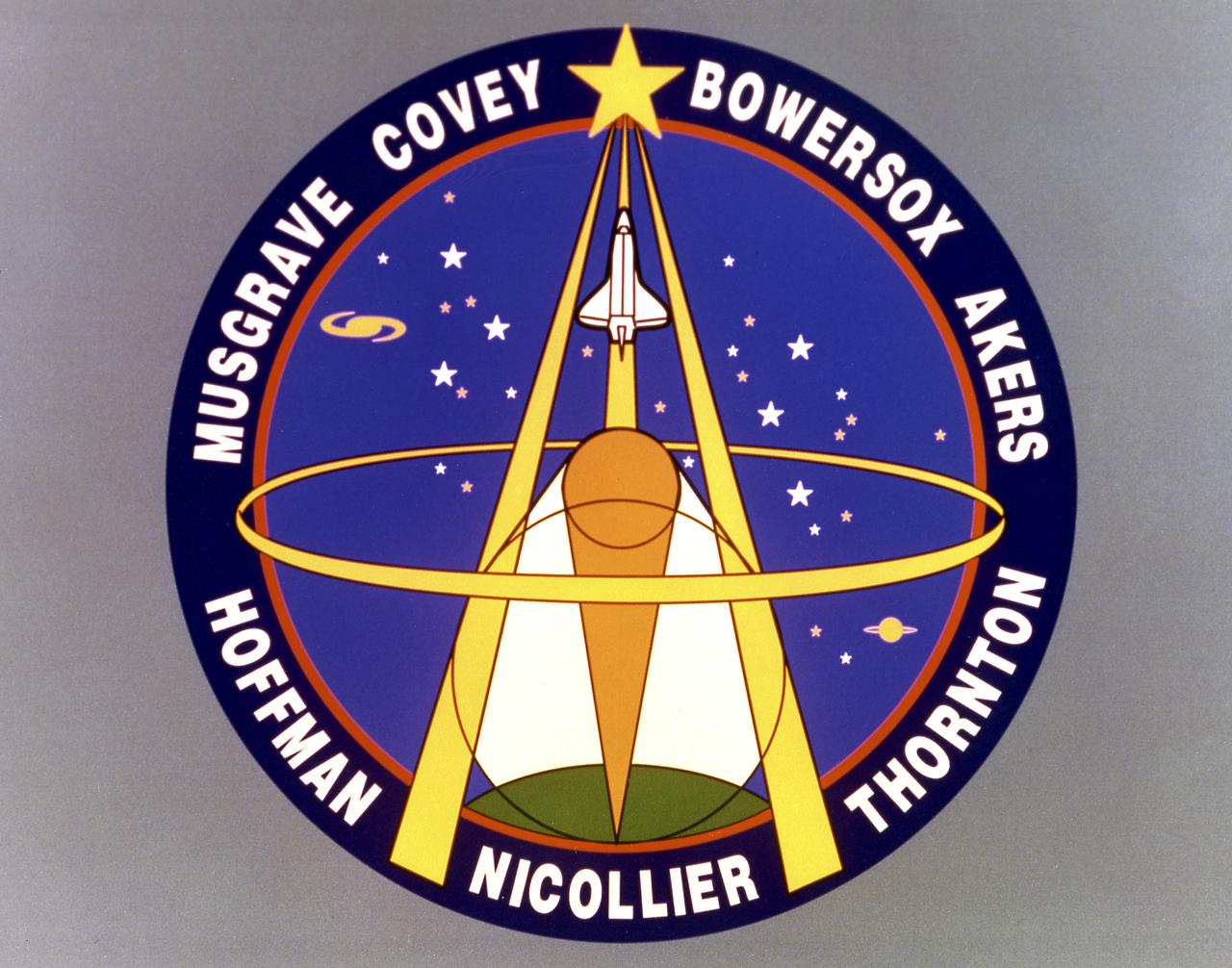
Designed by the mission crew members, the STS-61 crew insignia depicts the astronaut symbol superimposed against the sky with the Earth underneath. Also seen are two circles representing the optical configuration of the Hubble Space Telescope (HST). Light is focused by reflections from a large primary mirror and a smaller secondary mirror. The light is analyzed by various instruments and, according to the crew members, brings to us on Earth knowledge about planets, stars, galaxies and other celestial objects, allowing us to better understand the complex physical processes at work in the universe. The Space Shuttle Endeavour is also represented as the fundamental tool that allows the crew to perform the first servicing of the Hubble Space Telescope so its scientific deep space mission may be extended for several years to come. The overall design of the emblem, with lines converging to a high point, is also a symbolic representation of the large-scale Earth-based effort which involves space agencies, industry, and the universities to reach goals of knowledge and perfection.
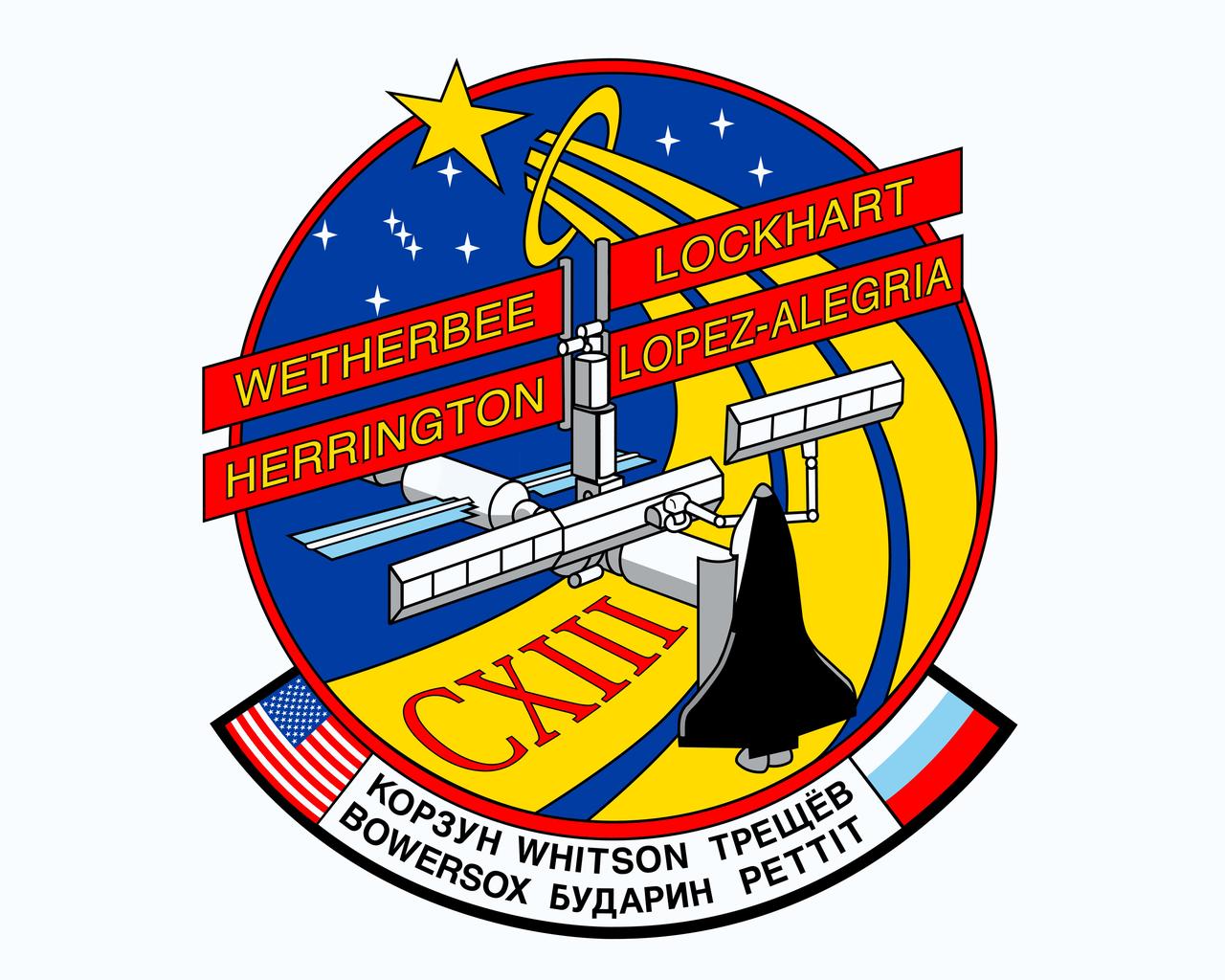
This is the crew patch for the Shuttle Endeavor STS-113 mission, the 16th American assembly flight, and 112th overall American flight to the International Space Station (ISS). STS-113 mission objectives included the delivery of the Expedition Six Crew to the ISS, the return of Expedition Five back to Earth, and the installation and activation of the Port 1 Integrated Truss Assembly (P1). The first major component installed on the left side of the Station, the P1 truss provides an additional three External Thermal Control System radiators. Three space walks, aided by the use of the Robotic Manipulator Systems of both the Shuttle and the Station, were performed in the installation of P1. Also, more than 2,500 pounds (1,134 kilograms) of cargo were transferred between the Shuttle and Station. The Space Shuttle Orbiter Endeavor launched on November 23, 2002 from Kennedy's launch pad 39A and returned 11 days later on December 4, 2002. The patch depicts the Space Shuttle Endeavour docked to the ISS during the installation of the P1 truss with the gold astronaut symbol in the background. The seven stars at the top left center of the patch are the seve brightest stars in the constellation Orion. They represent the combined seven crew members (four Shuttle and three Expedition Six). The three stars to the right of the astronaut symbol represent the returning Expedition Five crew members. The Roman Numeral CXIII represents the mission number 113.

The official patch of the International Space Station's Expedition 70 crew. The Expedition 70 patch is designed around the central yin-yang symbol representing balance; first and foremost, the balance of our beautiful planet Earth that is encircled by the yin-yang symbol and which forms part of the Expedition number. In our exploration of space, we are reminded of the uniqueness of Earth; the further we push the boundaries of human existence, the stronger our longing for our home planet grows. As our understanding of the cosmos expands, so does our understanding of Earth, and although we live in an ever-changing world, we recognize the need for a planet in balance to ensure our future. Space exploration is also about creating the future of our dreams. The tentative first steps we take today will hopefully become a well-trodden path in the future. This is represented stylistically by the “retro-futuristic” design of the patch, which mimics the design of the posters depicting the future from the early days of the space age. It is also emphasized by the yellow, orange, and red colors suggesting a sunrise. Lastly, the dynamism in the depiction of the number 7 suggests not only the physical launch into space, but also humanity’s progress towards the future.

ISS017-S-001B (Oct. 2007) --- The Expedition 17 patch is meant to celebrate current human achievements in space as well as symbolize the future potential for continuing exploration. The Earth, represented at the bottom of the patch, is the base from which all space exploration activities initiate. The International Space Station (ISS), shown in low Earth orbit, illustrates the current level of space operations. The arrow and star point outwards, away from the Earth, towards the wider universe indicating the direction of future activities as human beings build on what has already been accomplished. The flags, representing the home countries of the crew members, Russia and the United States, are touching, highlighting the cooperative nature of the space program and symbolizing the merger of science and technical knowledge of these two experienced space-faring nations. The NASA insignia design for space station flights is reserved for use by the astronauts and for other official use as the NASA Administrator may authorize. Public availability has been approved only in the form of illustrations by the various news media. When and if there is any change in this policy, which is not anticipated, it will be publicly announced.
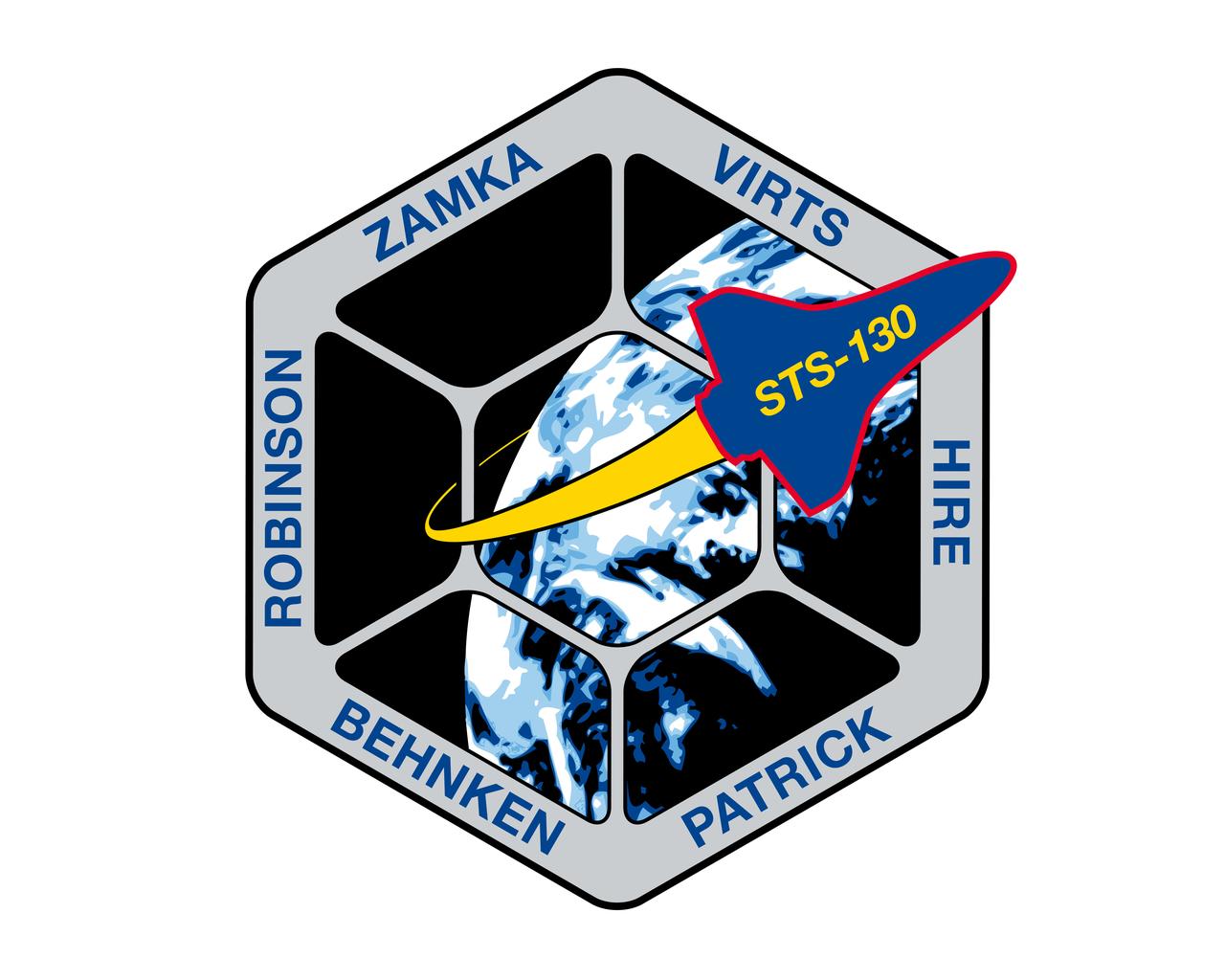
STS130-S-001 (September 2009) --- The STS-130 patch was designed by the crew to reflect both the objectives of the mission and its place in the history of human spaceflight. The main goal of the mission is to deliver Node 3 and the Cupola to the International Space Station (ISS). Node 3, named ?Tranquility,? will contain life support systems enabling continued human presence in orbit aboard the ISS. The shape of the patch represents the Cupola, which is the windowed robotics viewing station, from which astronauts will have the opportunity not only to monitor a variety of ISS operations, but also to study our home planet. The image of Earth depicted in the patch is the first photograph of Earth taken from the moon by Lunar Orbiter I on Aug. 23, 1966. As both a past and a future destination for explorers from planet Earth, the moon is thus represented symbolically in the STS-130 patch. The space shuttle Endeavour is pictured approaching the ISS, symbolizing the space shuttle's role as the prime construction vehicle for the ISS. The NASA insignia design for space shuttle flights is reserved for use by the astronauts and for other official use as the NASA Administrator may authorize. Public availability has been approved only in the forms of illustrations by the various news media. When and if there is any change in this policy, which is not anticipated, the change will be publicly announced. Photo credit: NASA
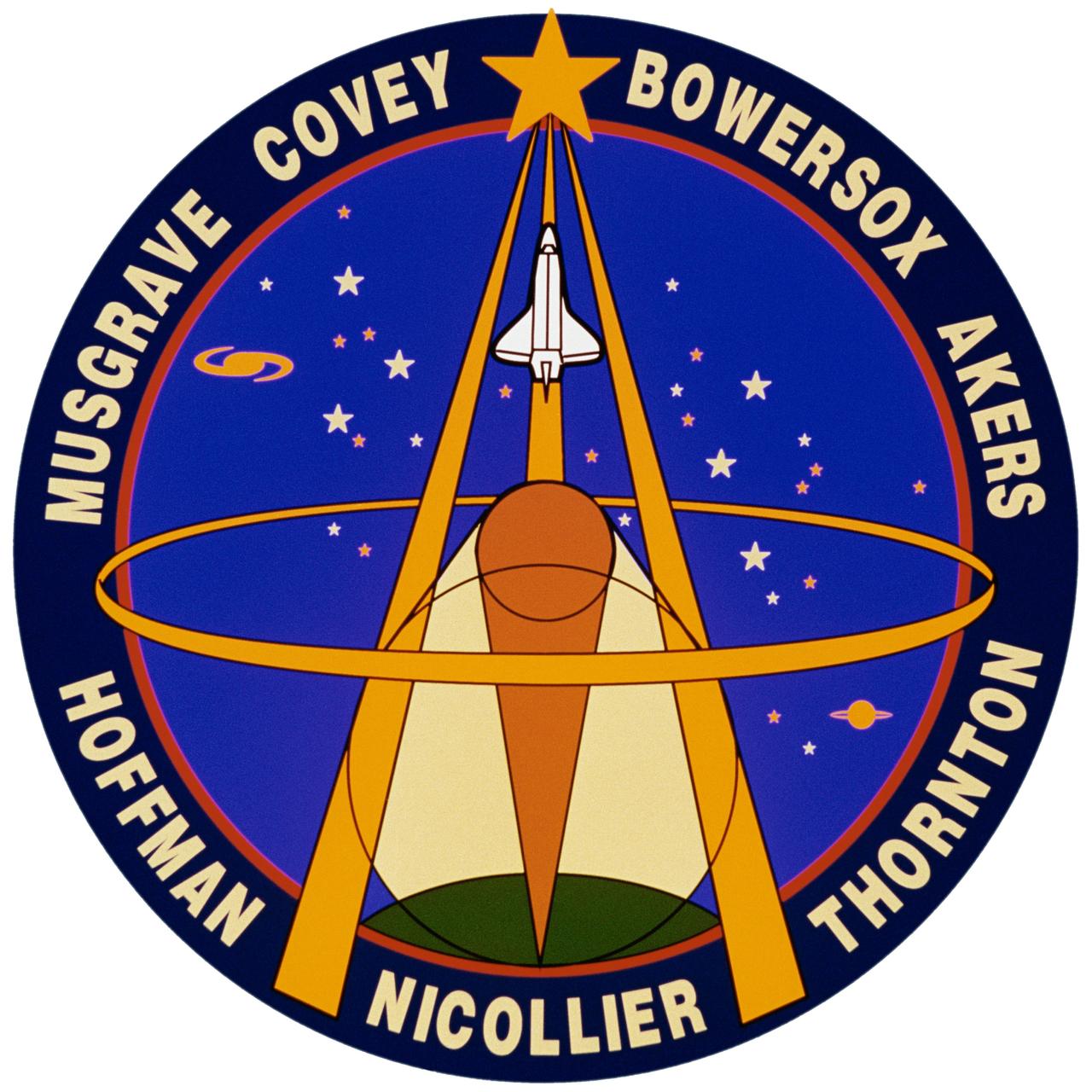
STS061-S-001 (1 Oct. 1993) --- Designed by the crew members, the STS-61 crew insignia depicts the astronaut symbol superimposed against the sky with the Earth underneath. Also seen are two circles representing the optical configuration of the Hubble Space Telescope (HST). Light is focused by reflections from a large primary mirror and a smaller secondary mirror. The light is analyzed by various instruments and, according to the crew members, "brings to us on Earth knowledge about planets, stars, galaxies and other celestial objects, allowing us to better understand the complex physical processes at work in the universe." The space shuttle Endeavour is also represented as the fundamental tool that allows the crew to perform the first servicing of the Hubble Space Telescope so its scientific deep space mission may be extended for several years to come. The overall design of the emblem, with lines converging to a high point, is also a symbolic representation of the large-scale Earth-based effort -- which involves space agencies, industry and the universities -- to reach goals of knowledge and perfection. The NASA insignia design for space shuttle flights is reserved for use by the astronauts and for other official use as the NASA Administrator may authorize. Public availability has been approved only in the forms of illustrations by the various news media. When and if there is any change in this policy, which is not anticipated, the change will be publicly announced. Photo credit: NASA
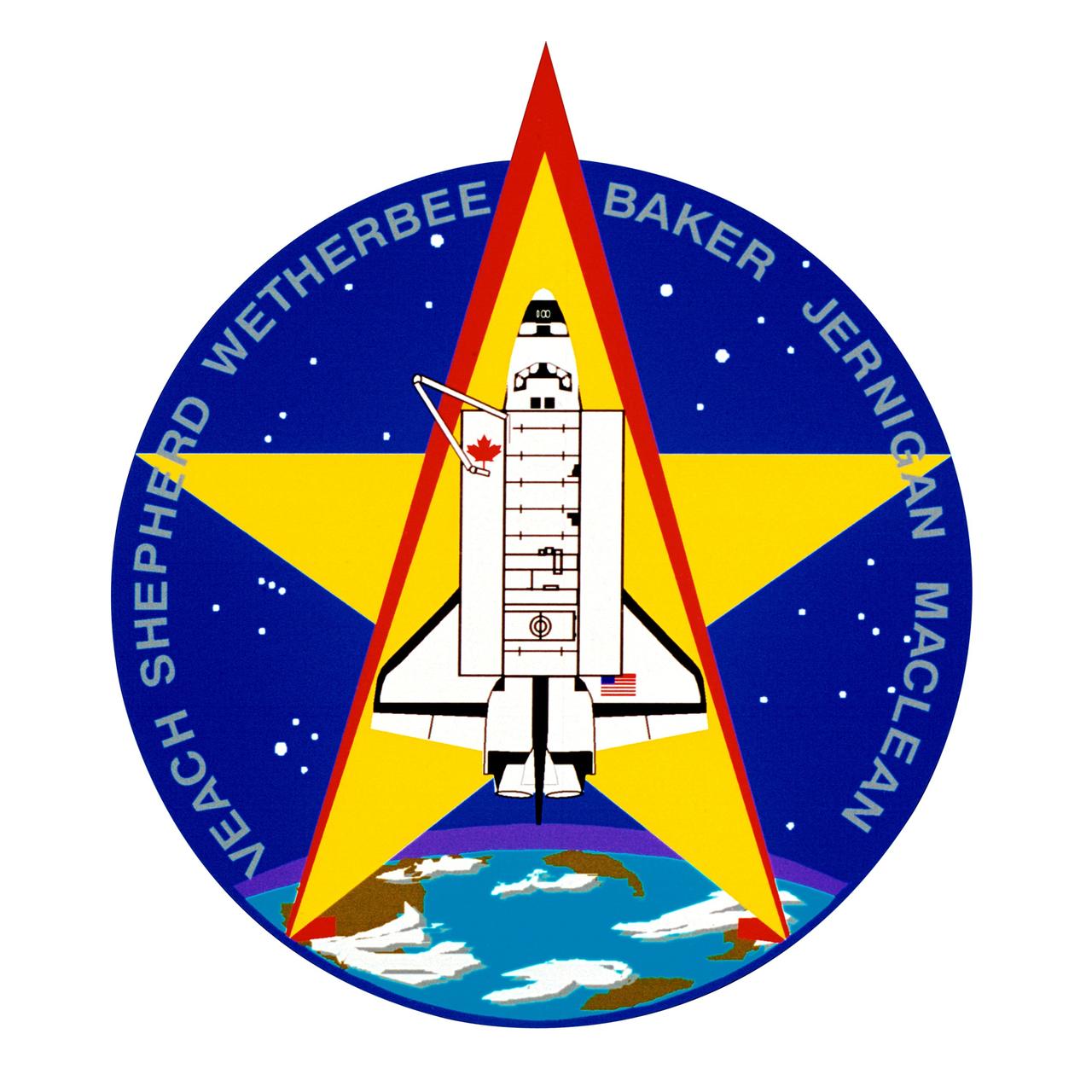
STS052-S-001 (July 1992) --- The insignia, designed by the STS-52 crew members, features a large gold star to symbolize the crew's mission on the frontiers of space. A gold star is often used to symbolize the frontier period of the American West. The red star in the shape of the Greek letter lambda represents both the laser measurements to be taken from the Laser Geodynamic Satellite (LAGEOS II) and the Lambda Point Experiment, which is part of the United States Microgravity Payload (USMP-1). The LAGEOS II is a joint Italian\United States satellite project intended to further our understanding of global plate tectonics. The USMP-1 is a microgravity facility which has French and United States experiments designed to test the theory of cooperative phase transitions and to study the solid\liquid interface of a metallic alloy in the low gravity environment. The Remote Manipulator System (RMS) and maple leaf are emblematic of the Canadian payload specialist who will conduct a series of Canadian flight experiments (CANEX-2), including the Space Vision System test. The NASA insignia design for space shuttle flights is reserved for use by the astronauts and for other official use as the NASA Administrator may authorize. Public availability has been approved only in the form of illustrations by the various news media. When and if there is any change in this policy, which we do not anticipate, it will be publicly announced. Photo credit: NASA
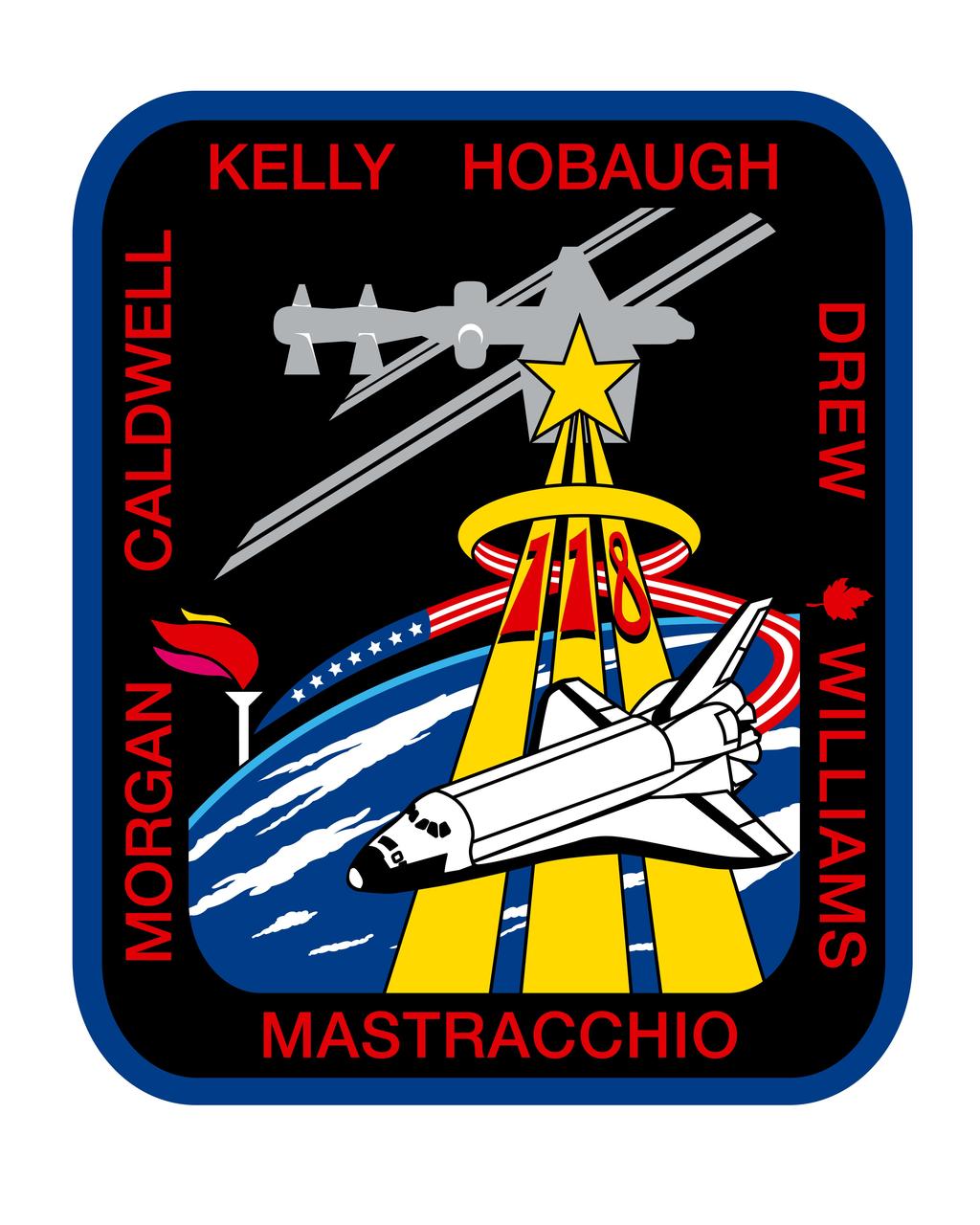
STS118-S-001 (May 2007) --- The STS-118 patch represents space shuttle Endeavour on its mission to help complete the assembly of the International Space Station (ISS), and symbolizes the pursuit of knowledge through space exploration. The flight will accomplish its ISS 13A.1 assembly tasks through a series of spacewalks, robotic operations, logistics transfers, and the exchange of one of the three long-duration expedition crew members. On the patch, the top of the gold astronaut symbol overlays the starboard S-5 truss segment, highlighting its installation during the mission. The flame of knowledge represents the importance of education, and honors teachers and students everywhere. The seven white stars and the red maple leaf signify the American and Canadian crew members, respectively, flying aboard Endeavour. The NASA insignia design for space shuttle flights is reserved for use by the astronauts and for other official use as the NASA Administrator may authorize. Public availability has been approved only in the forms of illustrations by the various news media. When and if there is any change in this policy, which is not anticipated, the change will be publicly announced. Photo credit: NASA
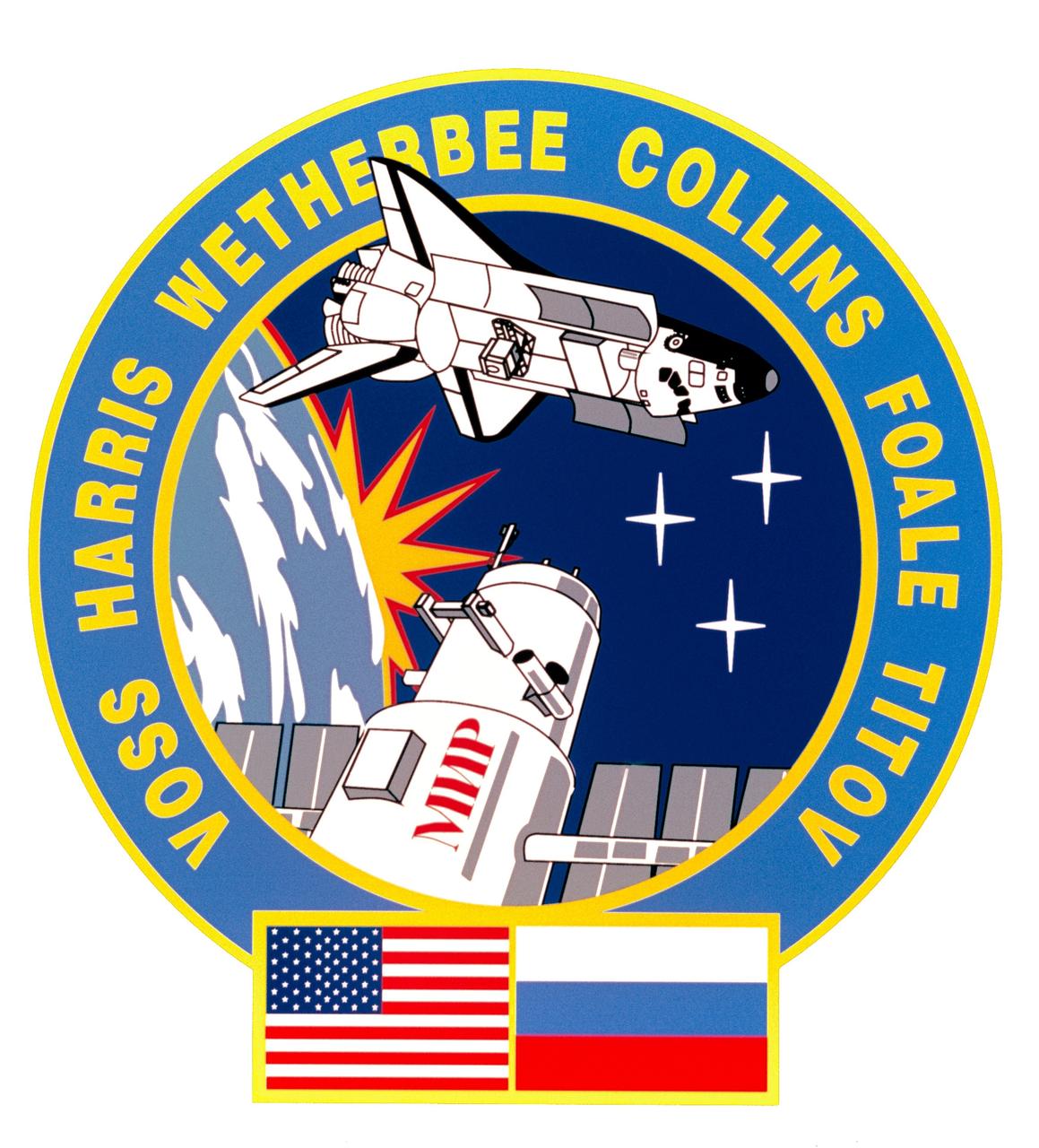
STS063-S-001 (September 1994) --- Designed by the crew members, the STS-63 crew patch depicts the orbiter maneuvering to rendezvous with Russia's Space Station Mir. The name is printed in Cyrillic on the side of the station. Visible in the orbiter's payload bay are the commercial space laboratory Spacehab and the Shuttle Pointed Autonomous Research Tool for Astronomy (SPARTAN) satellite which are major payloads on the flight. The six points on the rising sun and the three stars are symbolic of the mission's Space Transportation System (STS) numerical designation. Flags of the United States and Russia at the bottom of the patch symbolize the cooperative operations of this mission. The crew will be flying aboard the space shuttle Discovery. The NASA insignia design for space shuttle flights is reserved for use by the astronauts and for other official use as the NASA Administrator may authorize. Public availability has been approved only in the forms of illustrations by the various news media. When and if there is any change in this policy, which is not anticipated, the change will be publicly announced. Photo credit: NASA
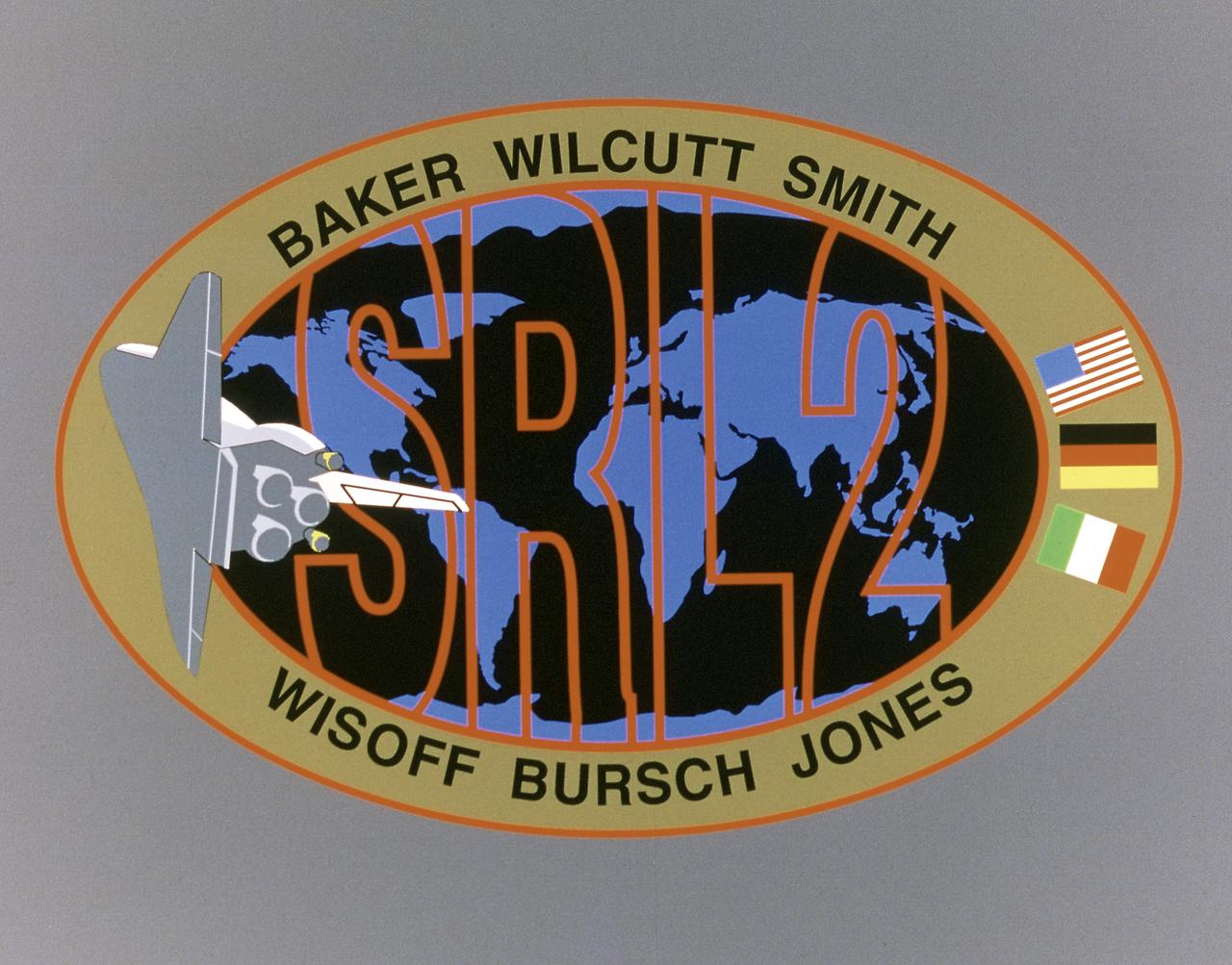
This STS-68 patch was designed by artist Sean Collins. Exploration of Earth from space is the focus of the design of the insignia, the second flight of the Space Radar Laboratory (SRL-2). SRL-2 was part of NASA's Mission to Planet Earth (MTPE) project. The world's land masses and oceans dominate the center field, with the Space Shuttle Endeavour circling the globe. The SRL-2 letters span the width and breadth of planet Earth, symbolizing worldwide coverage of the two prime experiments of STS-68: The Shuttle Imaging Radar-C and X-Band Synthetic Aperture Radar (SIR-C/X-SAR) instruments; and the Measurement of Air Pollution from Satellites (MAPS) sensor. The red, blue, and black colors of the insignia represent the three operating wavelengths of SIR-C/X-SAR, and the gold band surrounding the globe symbolizes the atmospheric envelope examined by MAPS. The flags of international partners Germany and Italy are shown opposite Endeavour. The relationship of the Orbiter to Earth highlights the usefulness of human space flights in understanding Earth's environment, and the monitoring of its changing surface and atmosphere. In the words of the crew members, the soaring Orbiter also typifies the excellence of the NASA team in exploring our own world, using the tools which the Space Program developed to explore the other planets in the solar system.
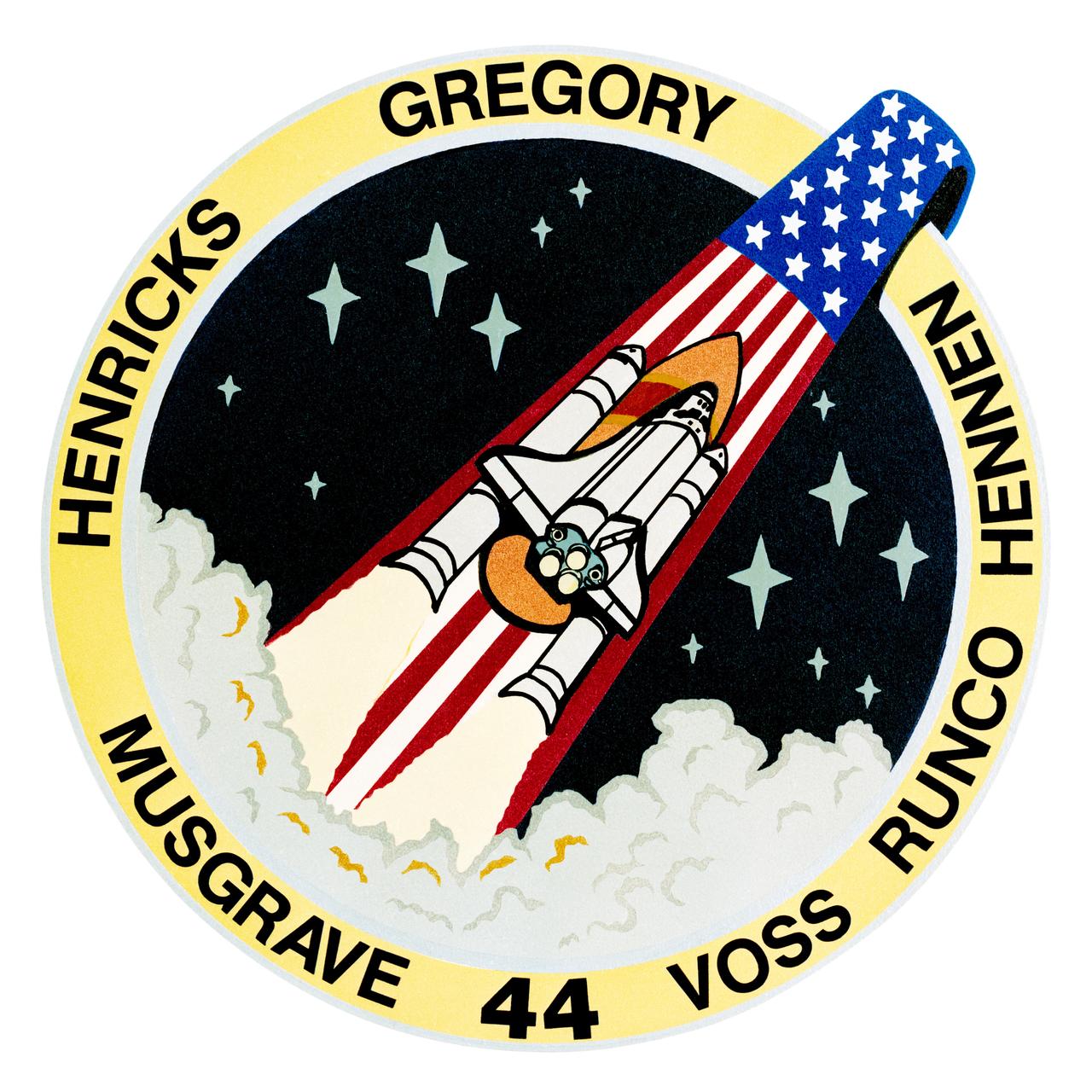
STS044-S-001 (July 1991) --- Designed by the participating crew members, the STS-44 patch shows the space shuttle Atlantis shortly after liftoff as it rolls to ascend into orbit. The orbital path illustrated by the red, white and blue of the stylized American flag represents the American contribution and strength derived from this mission. The black background of space, indicative of the mysteries of the universe, is illuminated by six large stars, which depict the American crew of six and the hopes that travel with them. The smaller stars represent the myriad of unheralded Americans who work in support of this mission. Within the shuttle's payload bay is a Defense Support Program (DSP) Satellite which will help insure peace. The stars of the flag symbolize our leadership in an exciting quest of space and the boundless dreams for mankind's future. In the words of a crew spokesman, "the stars of the flag symbolize our leadership in an exciting quest of space and the boundless dreams for humanity's future." The NASA insignia design for space shuttle flights is reserved for use by the astronauts and for other official use as the NASA Administrator may authorize. Public availability has been approved only in the forms of illustrations by the various news media. When and if there is any change in this policy, which is not anticipated, the change will be publicly announced. Photo credit: NASA
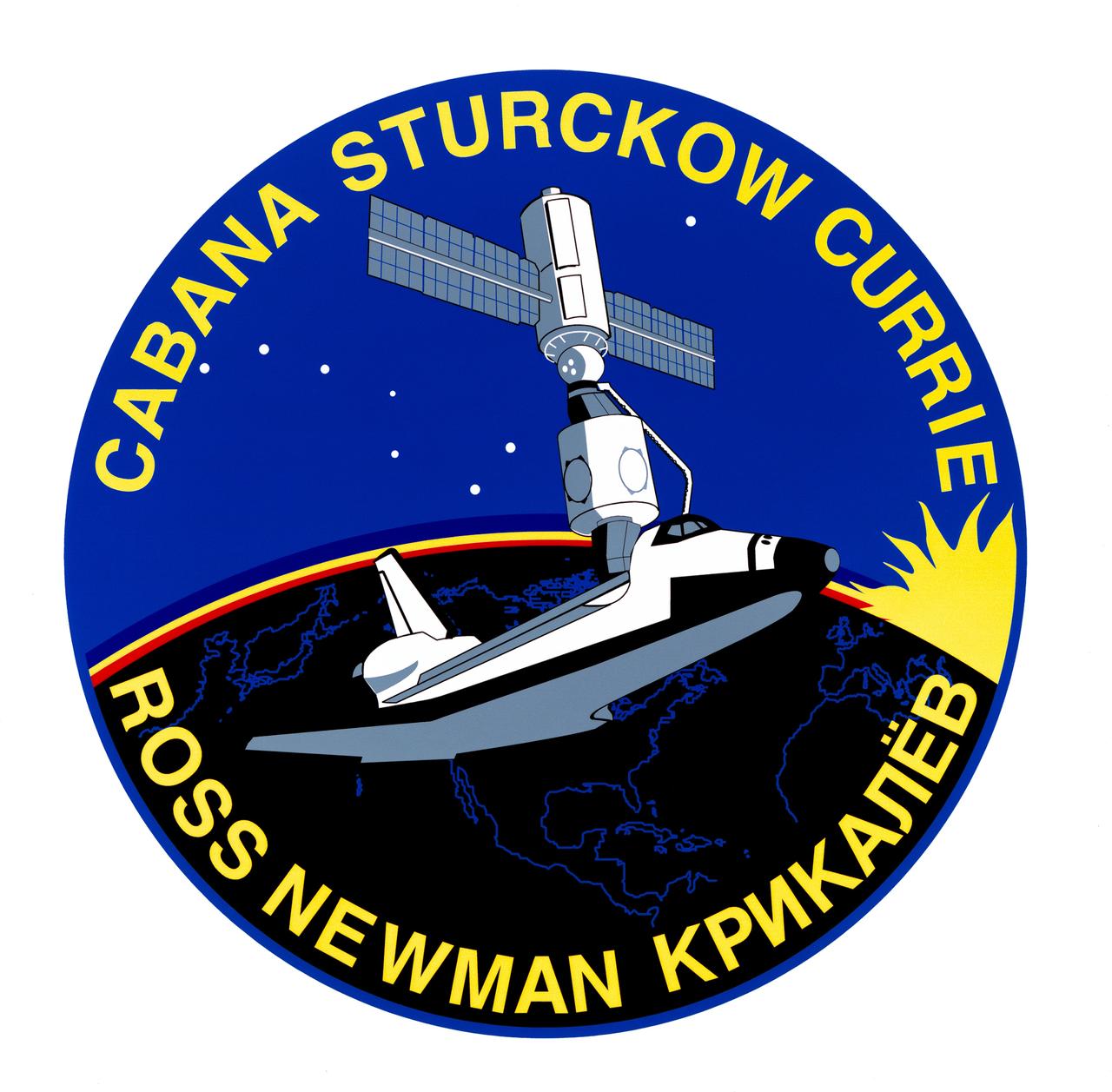
STS088-S-001 (September 1998) --- Designed by the crew members, this STS-88 patch commemorates the first assembly flight to carry United States-built hardware for constructing the International Space Station (ISS). This flight's primary task is to assemble the cornerstone of the space station: the Node with the Functional Cargo Block (FGB). The rising sun symbolizes the dawning of a new era of international cooperation in space and the beginning of a new program: the International Space Station. The Earth scene outlines the countries of the Station Partners: the United States, Russia, those of the European Space Agency (ESA), Japan, and Canada. Along with the Pressurized Mating Adapters (PMA) and the Functional Cargo Block, the Node is shown in the final mated configuration while berthed to the space shuttle during the STS-88/2A mission. The Big Dipper Constellation points the way to the North Star, a guiding light for pioneers and explorers for generations. In the words of the crew, "These stars symbolize the efforts of everyone, including all the countries involved in the design and construction of the International Space Station, guiding us into the future." The NASA insignia design for space shuttle flights is reserved for use by the astronauts and for other official use as the NASA Administrator may authorize. Public availability has been approved only in the forms of illustrations by the various news media. When and if there is any change in this policy, which is not anticipated, the change will be publicly announced. Photo credit: NASA

ISS017-S-001D (Oct. 2007) --- The Expedition 17 patch is meant to celebrate current human achievements in space as well as symbolize the future potential for continuing exploration. The Earth, represented at the bottom of the patch, is the base from which all space exploration activities initiate. The International Space Station (ISS), shown in low Earth orbit, illustrates the current level of space operations. The arrow and star point outwards, away from the Earth, towards the wider universe indicating the direction of future activities as human beings build on what has already been accomplished. The flags, representing the home countries of the crew members, Russia and the United States, are touching, highlighting the cooperative nature of the space program and symbolizing the merger of science and technical knowledge of these two experienced space-faring nations. The NASA insignia design for space station flights is reserved for use by the astronauts and for other official use as the NASA Administrator may authorize. Public availability has been approved only in the form of illustrations by the various news media. When and if there is any change in this policy, which is not anticipated, it will be publicly announced.

ISS017-S-001C (Oct. 2007) --- The Expedition 17 patch is meant to celebrate current human achievements in space as well as symbolize the future potential for continuing exploration. The Earth, represented at the bottom of the patch, is the base from which all space exploration activities initiate. The International Space Station (ISS), shown in low Earth orbit, illustrates the current level of space operations. The arrow and star point outwards, away from the Earth, towards the wider universe indicating the direction of future activities as human beings build on what has already been accomplished. The flags, representing the home countries of the crew members, Russia and the United States, are touching, highlighting the cooperative nature of the space program and symbolizing the merger of science and technical knowledge of these two experienced space-faring nations. The NASA insignia design for space station flights is reserved for use by the astronauts and for other official use as the NASA Administrator may authorize. Public availability has been approved only in the form of illustrations by the various news media. When and if there is any change in this policy, which is not anticipated, it will be publicly announced.
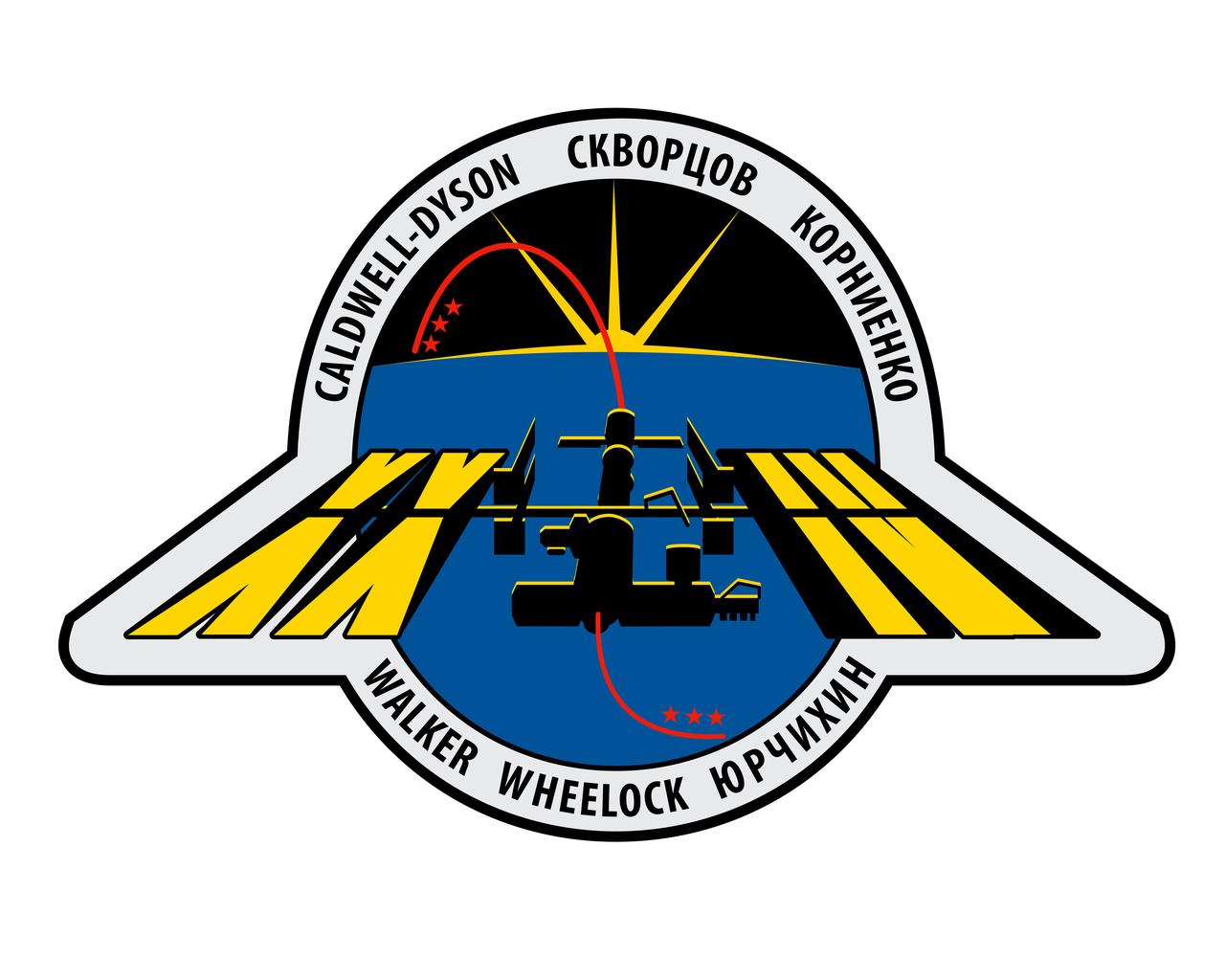
ISS024-S-001 (January 2010) --- Science and Exploration are the cornerstones of NASA?s mission onboard the International Space Station (ISS). This emblem signifies the dawn of a new era in our program?s history. With each new expedition, as we approach assembly complete, our focus shifts toward the research nature of this world-class facility. Prominently placed in the foreground, the ISS silhouette leads the horizon. Each ray of the sun represents the five international partner organizations that encompass this cooperative program. Expedition 24 is one of the first missions expanding to a crew of six. These crews, symbolized here as stars arranged in two groups of three, will launch on Soyuz vehicles. The unbroken flight track symbolizes our continuous human presence in space, representing all who have and will dedicate themselves as crew and citizens of the International Space Station. The NASA insignia design for shuttle flights and station increments is reserved for use by the astronauts and for other official use as the NASA Administrator may authorize. Public availability has been approved only in the forms of illustrations by the various news media. When and if there is any change in this policy, which is not anticipated, the change will be publicly announced.
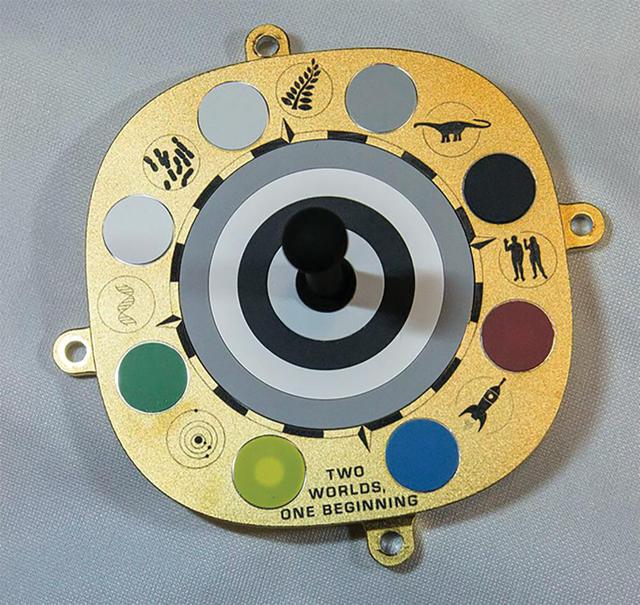
The primary calibration target for Mastcam-Z, a pair of zoomable cameras aboard NASA's Perseverance Mars rover, features color swatches used by scientists to fine-tune the cameras' settings. The object in the center, known as a shadow post, helps scientists check the color of the sky to calibrate for lighting conditions. Symbols and mottos relevant to the mission are included around the target's perimeter: (clockwise from top) a fern; an Apatosaurus; a man and woman raising their hands in greeting (a nod to plaques carried aboard Pioneer 10 and 11, as well as the Golden Record aboard Voyagers 1 and 2); a rocket traveling from Earth (blue dot) to Mars (red dot); a motto reading "Two Worlds, One Beginning," in reference to the idea of Earth and the Red Planet growing out of the same proto-stellar dust; a model of the inner solar system; a DNA helix; and cyanobacteria, one of the earliest forms of life on Earth. A key objective for Perseverance's mission on Mars is astrobiology, including the search for signs of ancient microbial life. The rover will characterize the planet's geology and past climate, pave the way for human exploration of the Red Planet, and be the first mission to collect and cache Martian rock and regolith (broken rock and dust). https://photojournal.jpl.nasa.gov/catalog/PIA24178

iss068e016856 (Oct. 12, 2022) --- The eleven Expedition 68 crew members aboard the International Space Station pose for a portrait. In the front row from left, are cosmonauts Anna Kikina, Sergey Prokopyev, and Dmitri Petelin. In the next row, are astronauts Samantha Cristoforetti of ESA (European Space Agency) and Koichi Wakata of the Japan Aerospace Exploration Agency (JAXA). In the back, are NASA astronauts Jessica Watkins, Kjell Lindgren, Bob Hines, Frank Rubio, Josh Cassada, and Nicole Mann. A symbolic key, representing the traditional change of command ceremony, that Cristoforetti earlier handed over to Prokopyev, floats in the center of the frame, as he begins his spaceflight as Expedition 68 Commander.
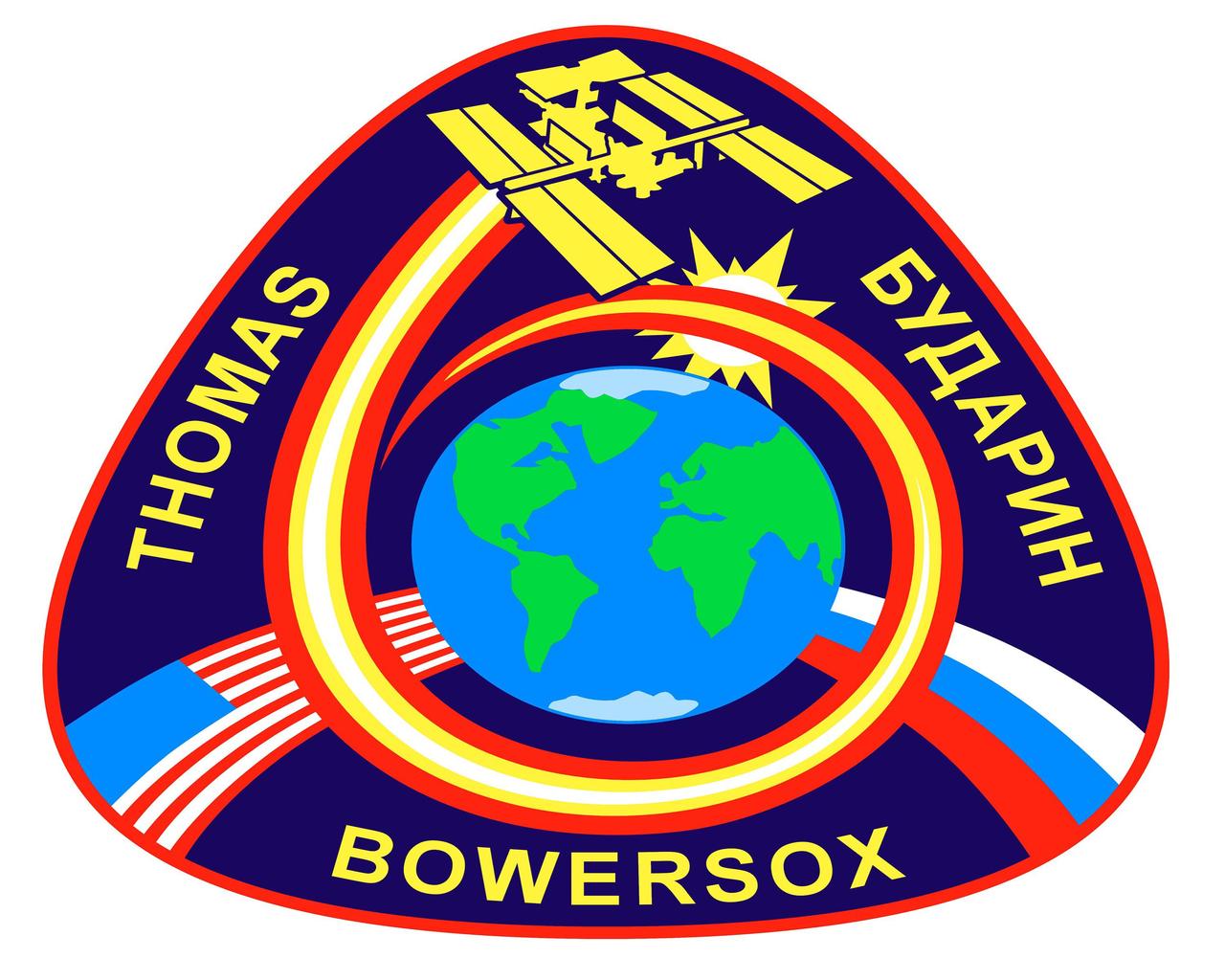
The International Space Station (ISS) Expedition 6 crew patch depicts the station orbiting the Earth on its mission of international cooperation and scientific research. The Earth is placed in the center of the patch to emphasize that work conducted aboard this orbiting laboratory is intended to improve life on our home planet. The shape of the Space Station’s orbit symbolizes the role that experience gained from ISS will have on future exploration of our solar system and beyond. The American and Russian flags encircling the Earth represent the native countries of the Expedition 6 crew members, which are just two of the many participant countries contributing to the ISS and committed to the peaceful exploration of space.
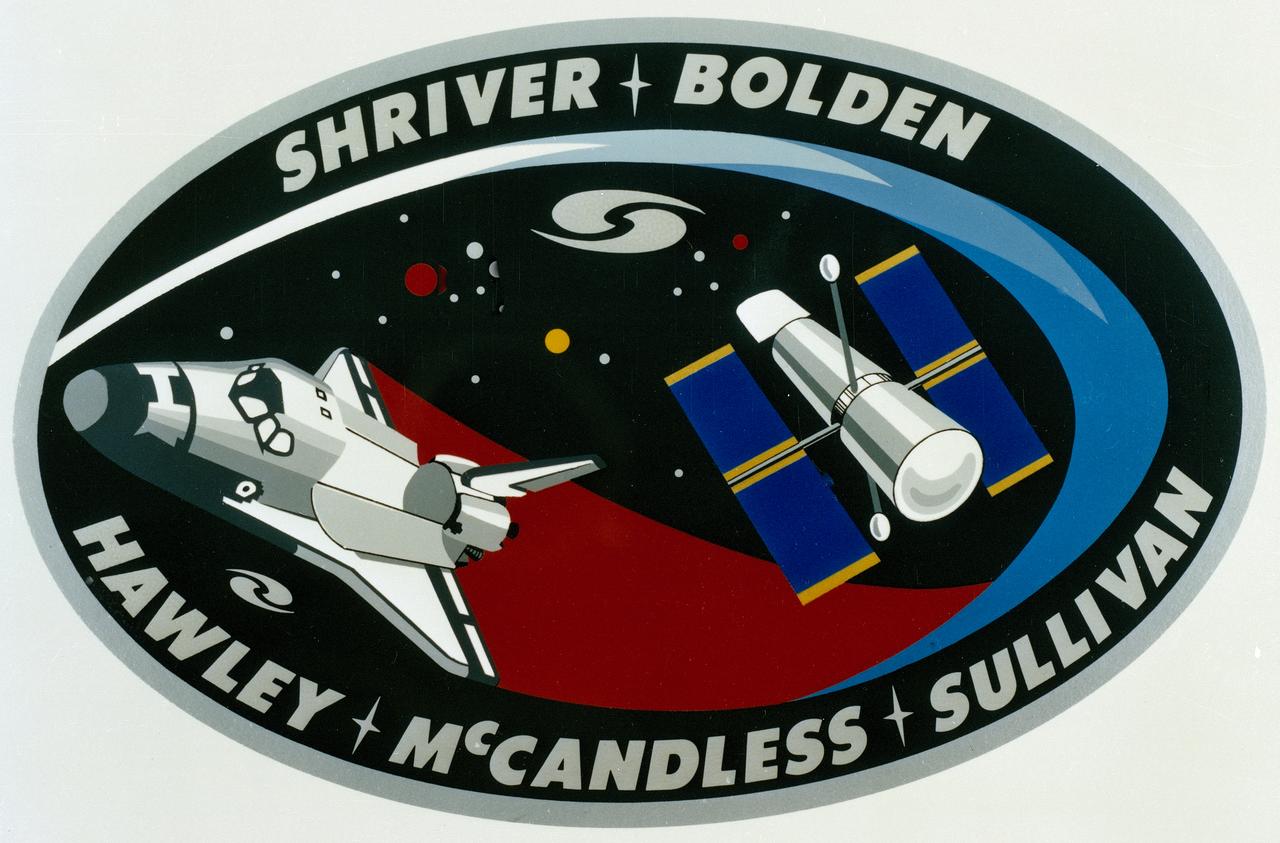
The mission insignia for NASA's STS-31 mission features the Hubble Space Telescope (HST) in its observing configuration against a background of the universe it will study. The cosmos includes a stylistic depiction of galaxies in recognition of the contribution made by Sir Edwin Hubble to our understanding of the nature of galaxies and the expansion of the universe. The STS-31 crew points out that is it in honor of Hubble's work that this great observatory in space bears his name. The depicted Space Shuttle trails a spectrum symbolic of both the red shift observations that were so important to Hubble's work and new information which will be obtained with the HST. Encircling the art work, designed by the crew, are the names of its members.
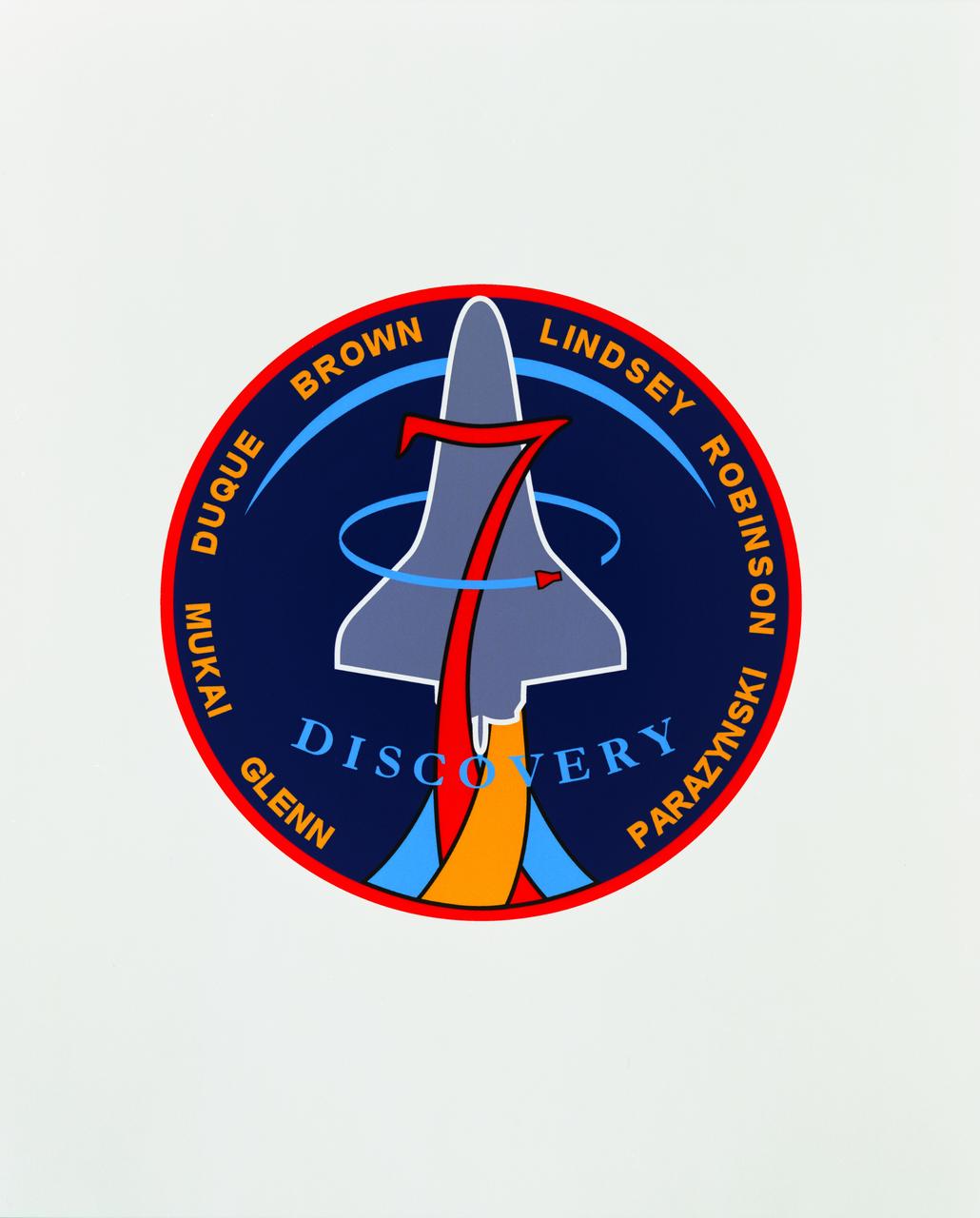
The STS-95 patch, designed by the crew, is intended to reflect the scientific, engineering, and historic elements of the mission. The Space Shuttle Discovery is shown rising over the sunlit Earth limb, representing the global benefits of the mission science and the solar science objectives of the Spartan Satellite. The bold number '7' signifies the seven members of Discovery's crew and also represents a historical link to the original seven Mercury astronauts. The STS-95 crew member John Glenn's first orbital flight is represented by the Friendship 7 capsule. The rocket plumes symbolize the three major fields of science represented by the mission payloads: microgravity material science, medical research for humans on Earth and in space, and astronomy.
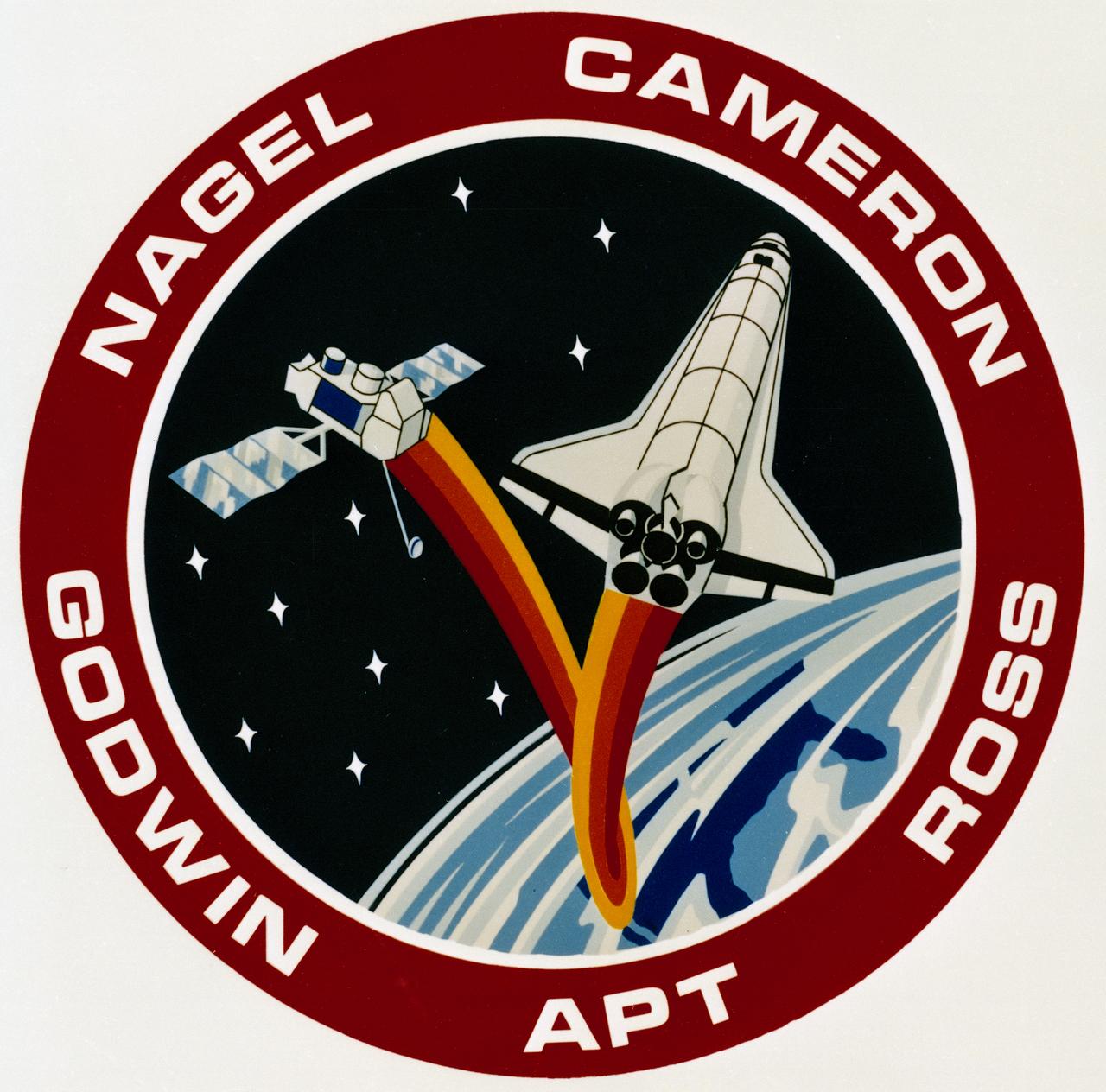
The principal theme of the STS-37 patch, designed by astronaut crewmembers, is the primary payload -- Gamma Ray Observatory (GRO) -- and its relationship to the Space Shuttle. The Shuttle and the GRO are both depicted on the patch and are connected by a large gamma. The gamma symbolizes both the quest for gamma rays by GRO as well as the importance of the relationship between the manned and unmanned elements of the United States space program. The Earth background shows the southern portion of the United States under a partial cloud cover while the two fields of three and seven stars, respectively, refer to the STS-37 mission designation.

KENNEDY SPACE CENTER, Fla. -- After the signing of a lease agreement between Spaceport Florida Authority (SFA) and United Space Alliance (USA) for the use of a hangar at Kennedy Space Center, (foreground left) Marcie Harris, USA site director, and (foreground right) Ed Gormel, Spaceport Florida executive director, hold a symbolic ribbon. Behind them are (left) Greg Popp, Spaceport Florida business manager, and (right) Congressman Dave Weldon. The hangar was originally developed by the state as part of a joint NASA/SFA Reusable Launch Vehicle Support Complex at KSC. USA plans to use the state-developed 50,000-square-foot facility to store and maintain Space Shuttle ground equipment
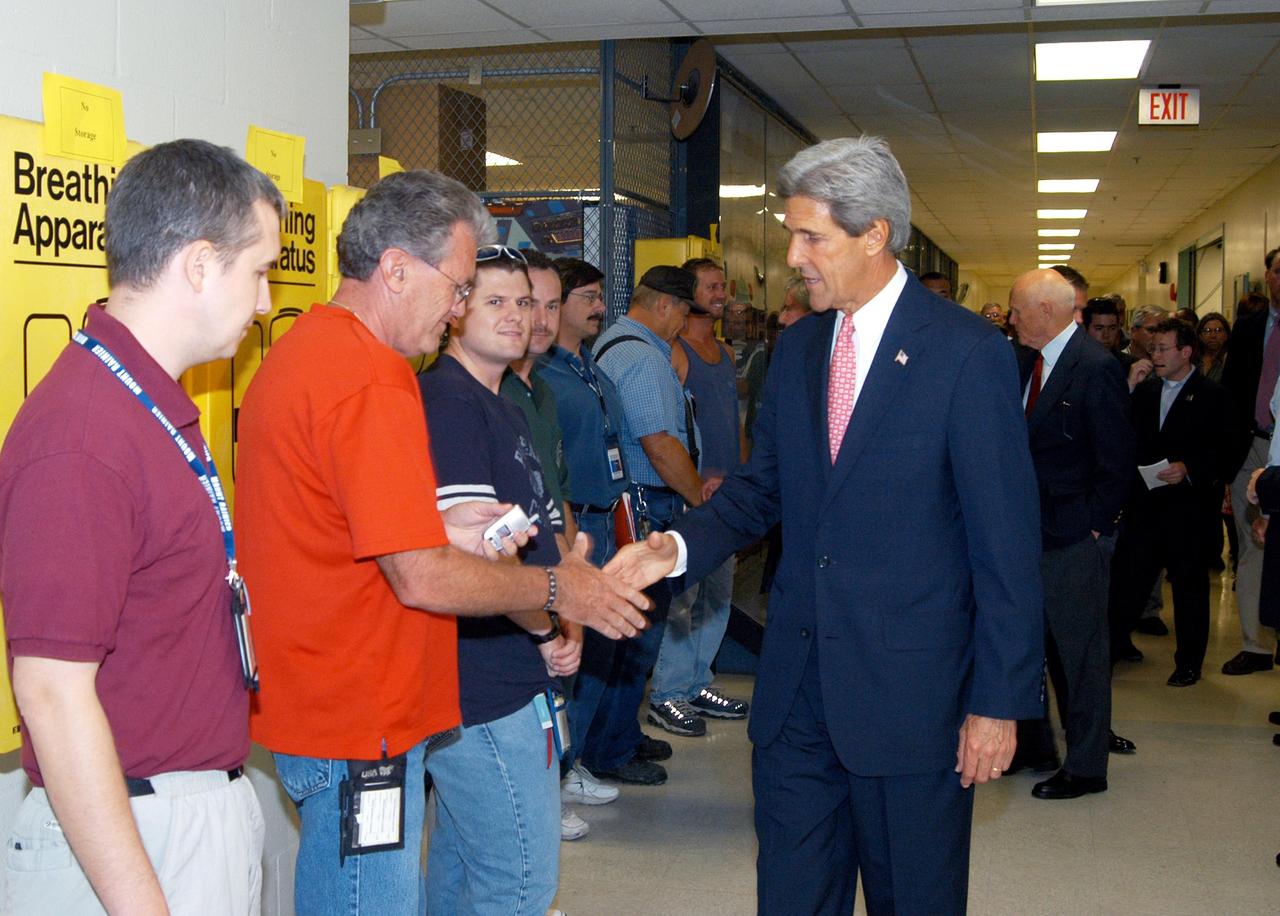
KENNEDY SPACE CENTER, FLA. - Sen. John F. Kerry, D-Mass., greets Kennedy Space Center employees during a tour of the Orbiter Processing Facility (OPF). The orbiter Discovery is being prepared for flight in the OPF on the next Space Shuttle mission. The tour follows a public meeting Kerry held at the Dr. Kurt H. Debus Conference Facility at the Kennedy Space Center Visitor Complex. He said he chose to speak at KSC because it symbolizes America’s commitment to science, innovation and technology. He and Sen. John Edwards, D-N.C., are on a speaking tour prior to their appearance at the Democratic National Convention in Boston.
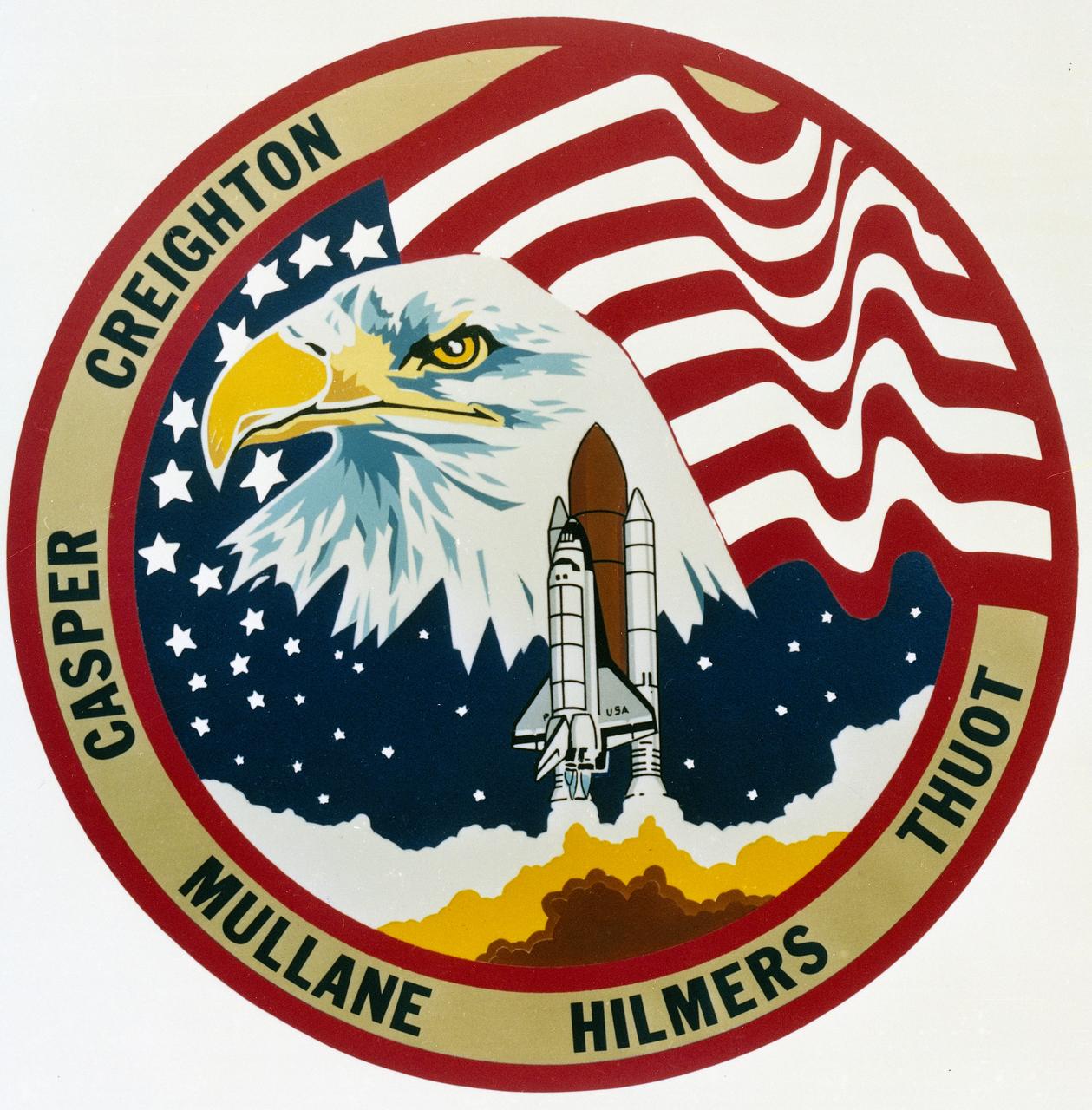
The dominant theme of the STS-36, designed by the five astronaut crewmembers, is, in their words ...the essential role that space plays in preserving the blessings of freedom and liberty for America. The crew used the eagle to symbolize our country's commitment to strength and vigilance; its domain is not bound by the limits of Earth but reaches out to the star. The Shuttle, they express majestically beginning its journey into orbit demonstrates how man and machine work together for the security of our nation. A crew spokesman went on to say the flag represents the patriotism and love for America possessed by each member of the five-man crew and signifies the honor accorded them through participation in national defense.
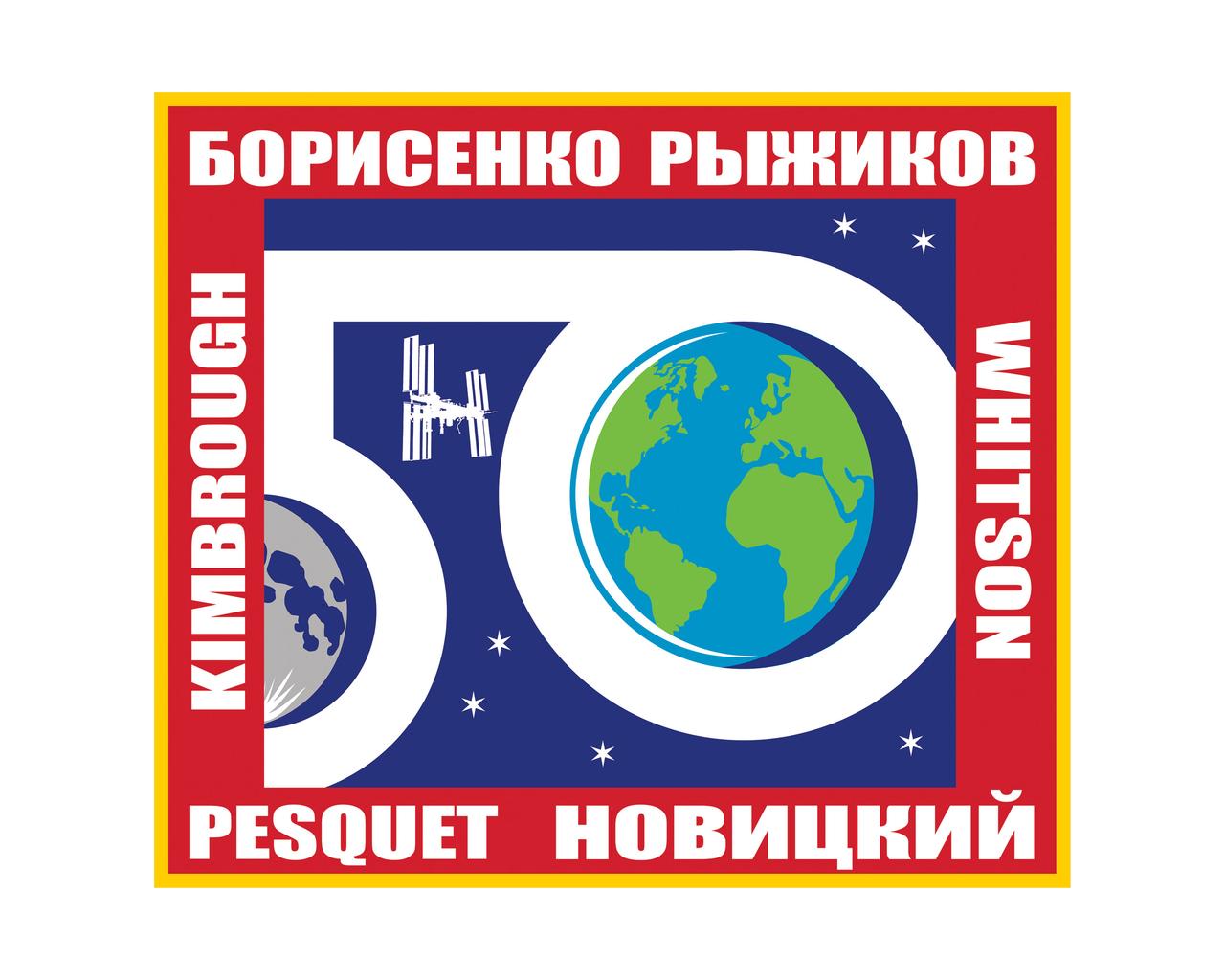
ISS050-S-001 (01/27/2016) --- The Expedition 50 patch encompasses the spirit of human exploration from previous missions to the Moon to current exploration on the International Space Station (ISS). The red border symbolizes future human exploration of Mars – the Red Planet. Our home planet Earth is prominent in the patch to remind us that everything done on the mission is to help people on Earth – “Off the Earth, For the Earth.” The background colors of red, white, and blue represent the national colors of all six crewmembers – United States, Russia, and France. The six stars represent the families of all six crewmembers. Finally, the ‘50’ signifies the 50th Expedition to the ISS.

Digital data matrix, used to identify the millions of Space Shuttle parts, is being commercialized to make barcoding tamper resistant and invisible to the naked eye. These codes are applied directly to the product regardless of shape, size or color. The markings can range from as small as four microns to as large as two square feet. Using the Vericode Symbol which include such details as the manufacturer, serial numbers, the lot number of the parent material, design changes, special processing to which the part was subjected-everything needed to determine accurately and automatically, the extent of the recall needed, which might be a couple of hundred cars instead of tens of thousands.
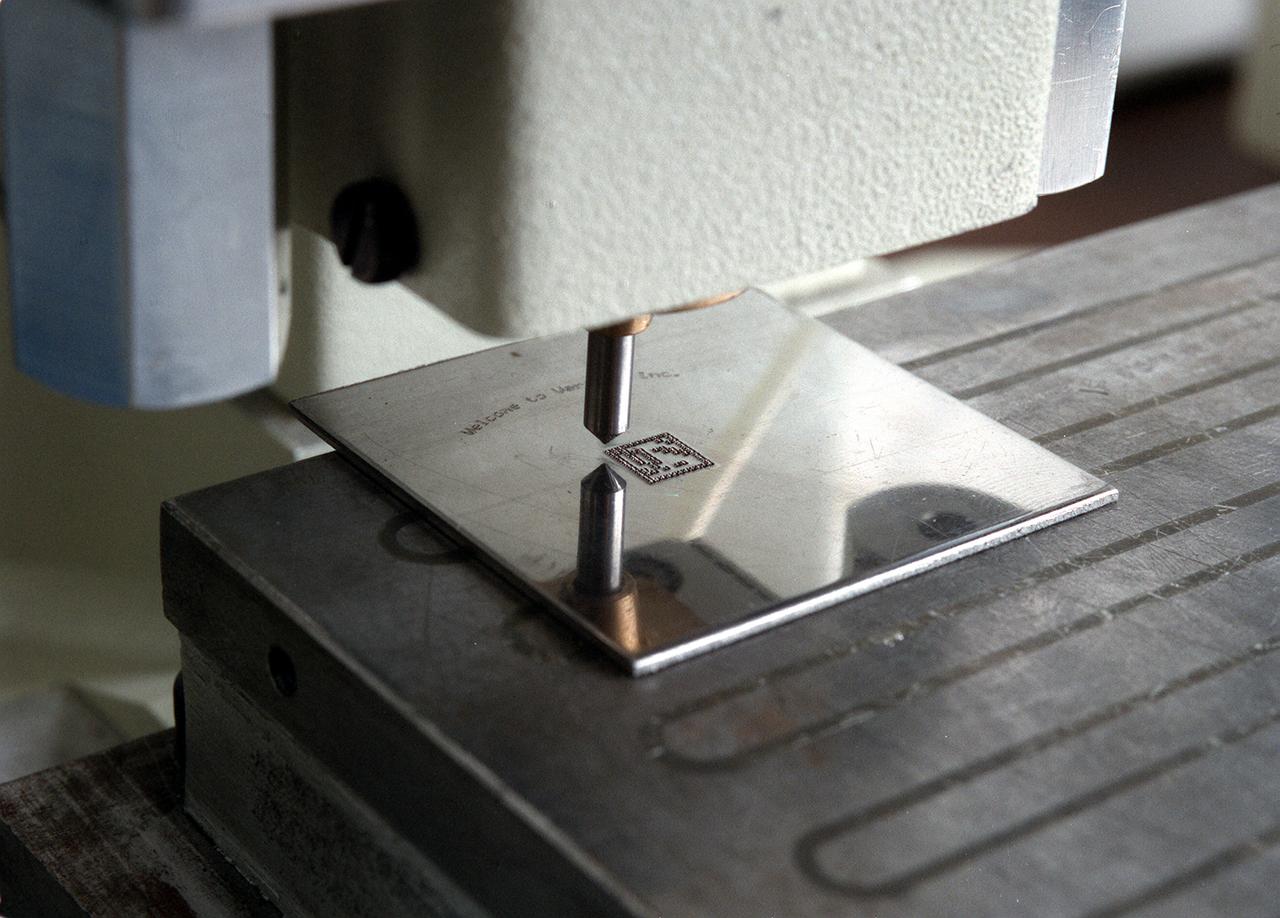
Digital data matrix, used to identify the millions of Space Shuttle parts, is being commercialized to make barcoding tamper resistant and invisible to the naked eye. These codes are applied directly to the product regardless of shape, size or color. The markings can range from as small as four microns to as large as two square feet. Using the Vericode Symbol which include such details as the manufacturer, serial numbers, the lot number of the parent material, design changes, special processing to which the part was subjected-everything needed to determine accurately and automatically, the extent of the recall needed, which might be a couple of hundred cars instead of tens of thousands.