
This stunning image, captured by the NASA/ESA Hubble Space Telescope’s Advanced Camera for Surveys (ACS), shows part of the sky in the constellation of Sagittarius (The Archer). The region is rendered in exquisite detail — deep red and bright blue stars are scattered across the frame, set against a background of thousands of more distant stars and galaxies. Two features are particularly striking: the colors of the stars, and the dramatic crosses that burst from the centers of the brightest bodies. While some of the colors in this frame have been enhanced and tweaked during the process of creating the image from the observational data, different stars do indeed glow in different colors. Stars differ in color according to their surface temperature: very hot stars are blue or white, while cooler stars are redder. They may be cooler because they are smaller, or because they are very old and have entered the red giant phase, when an old star expands and cools dramatically as its core collapses. The crosses are nothing to do with the stars themselves, and, because Hubble orbits above Earth’s atmosphere, nor are they due to any kind of atmospheric disturbance. They are actually known as diffraction spikes, and are caused by the structure of the telescope itself. Like all big modern telescopes, Hubble uses mirrors to capture light and form images. Its secondary mirror is supported by struts, called telescope spiders, arranged in a cross formation, and they diffract the incoming light. Diffraction is the slight bending of light as it passes near the edge of an object. Every cross in this image is due to a single set of struts within Hubble itself! Whilst the spikes are technically an inaccuracy, many astrophotographers choose to emphasize and celebrate them as a beautiful feature of their images. Image credit: ESA/Hubble & NASA <b><a href="http://www.nasa.gov/audience/formedia/features/MP_Photo_Guidelines.html" rel="nofollow">NASA image use policy.</a></b> <b><a href="http://www.nasa.gov/centers/goddard/home/index.html" rel="nofollow">NASA Goddard Space Flight Center</a></b> enables NASA’s mission through four scientific endeavors: Earth Science, Heliophysics, Solar System Exploration, and Astrophysics. Goddard plays a leading role in NASA’s accomplishments by contributing compelling scientific knowledge to advance the Agency’s mission. <b>Follow us on <a href="http://twitter.com/NASAGoddardPix" rel="nofollow">Twitter</a></b> <b>Like us on <a href="http://www.facebook.com/pages/Greenbelt-MD/NASA-Goddard/395013845897?ref=tsd" rel="nofollow">Facebook</a></b> <b>Find us on <a href="http://instagrid.me/nasagoddard/?vm=grid" rel="nofollow">Instagram</a></b>

This photograph is a Hubble Space Telescope (HST) image of a sky full of glittering jewels. The HST peered into the Sagittarius star cloud, a narrow dust free region, providing this spectacular glimpse of a treasure chest full of stars.
![Some of the most breathtaking views in the Universe are created by nebulae — hot, glowing clouds of gas. This new NASA/ESA Hubble Space Telescope image shows the centre of the Lagoon Nebula, an object with a deceptively tranquil name. The region is filled with intense winds from hot stars, churning funnels of gas, and energetic star formation, all embedded within an intricate haze of gas and pitch-dark dust. Nebulae are often named based on their key characteristics — particularly beautiful examples include the Ring Nebula (heic1310), the Horsehead Nebula (heic1307) and the Butterfly Nebula (heic0910). This new NASA/ESA Hubble Space Telescope image shows the centre of the Lagoon Nebula, otherwise known as Messier 8, in the constellation of Sagittarius (The Archer). The inspiration for this nebula’s name may not be immediately obvious — this is because the image captures only the very heart of the nebula. The Lagoon Nebula’s name becomes much clearer in a wider field view (opo0417i) when the broad, lagoon-shaped dust lane that crosses the glowing gas of the nebula can be made out. Another clear difference between this new image and others is that this image combines both infrared and optical light rather than being purely optical(heic1015). Infrared light cuts through thick, obscuring patches of dust and gas, revealing the more intricate structures underneath and producing a completely different landscape [1]. However, even in visible light, the tranquil name remains misleading as the region is packed full of violent phenomena. The bright star embedded in dark clouds at the centre of this image is known as Herschel 36. This star is responsible for sculpting the surrounding cloud, stripping away material and influencing its shape. Herschel 36 is the main source of ionising radiation [2] for this part of the Lagoon Nebula. This central part of the Lagoon Nebula contains two main structures of gas and dust connected by wispy twisters, visible in the middle third of this image (opo9638). These features are quite similar to their namesakes on Earth — they are thought to be wrapped up into their funnel-like shapes by temperature differences between the hot surface and cold interior of the clouds. The nebula is also actively forming new stars, and energetic winds from these newborns may contribute to creating the twisters. This image combines images taken using optical and infrared light gathered by Hubble’s Wide Field Planetary Camera 2. Credit: NASA, ESA, J. Trauger (Jet Propulson Laboratory) <b><a href="http://www.nasa.gov/audience/formedia/features/MP_Photo_Guidelines.html" rel="nofollow">NASA image use policy.</a></b> <b><a href="http://www.nasa.gov/centers/goddard/home/index.html" rel="nofollow">NASA Goddard Space Flight Center</a></b> enables NASA’s mission through four scientific endeavors: Earth Science, Heliophysics, Solar System Exploration, and Astrophysics. Goddard plays a leading role in NASA’s accomplishments by contributing compelling scientific knowledge to advance the Agency’s mission. <b>Follow us on <a href="http://twitter.com/NASAGoddardPix" rel="nofollow">Twitter</a></b> <b>Like us on <a href="http://www.facebook.com/pages/Greenbelt-MD/NASA-Goddard/395013845897?ref=tsd" rel="nofollow">Facebook</a></b> <b>Find us on <a href="http://instagrid.me/nasagoddard/?vm=grid" rel="nofollow">Instagram</a></b>](https://images-assets.nasa.gov/image/GSFC_20171208_Archive_e000671/GSFC_20171208_Archive_e000671~small.jpg)
Some of the most breathtaking views in the Universe are created by nebulae — hot, glowing clouds of gas. This new NASA/ESA Hubble Space Telescope image shows the centre of the Lagoon Nebula, an object with a deceptively tranquil name. The region is filled with intense winds from hot stars, churning funnels of gas, and energetic star formation, all embedded within an intricate haze of gas and pitch-dark dust. Nebulae are often named based on their key characteristics — particularly beautiful examples include the Ring Nebula (heic1310), the Horsehead Nebula (heic1307) and the Butterfly Nebula (heic0910). This new NASA/ESA Hubble Space Telescope image shows the centre of the Lagoon Nebula, otherwise known as Messier 8, in the constellation of Sagittarius (The Archer). The inspiration for this nebula’s name may not be immediately obvious — this is because the image captures only the very heart of the nebula. The Lagoon Nebula’s name becomes much clearer in a wider field view (opo0417i) when the broad, lagoon-shaped dust lane that crosses the glowing gas of the nebula can be made out. Another clear difference between this new image and others is that this image combines both infrared and optical light rather than being purely optical(heic1015). Infrared light cuts through thick, obscuring patches of dust and gas, revealing the more intricate structures underneath and producing a completely different landscape [1]. However, even in visible light, the tranquil name remains misleading as the region is packed full of violent phenomena. The bright star embedded in dark clouds at the centre of this image is known as Herschel 36. This star is responsible for sculpting the surrounding cloud, stripping away material and influencing its shape. Herschel 36 is the main source of ionising radiation [2] for this part of the Lagoon Nebula. This central part of the Lagoon Nebula contains two main structures of gas and dust connected by wispy twisters, visible in the middle third of this image (opo9638). These features are quite similar to their namesakes on Earth — they are thought to be wrapped up into their funnel-like shapes by temperature differences between the hot surface and cold interior of the clouds. The nebula is also actively forming new stars, and energetic winds from these newborns may contribute to creating the twisters. This image combines images taken using optical and infrared light gathered by Hubble’s Wide Field Planetary Camera 2. Credit: NASA, ESA, J. Trauger (Jet Propulson Laboratory) <b><a href="http://www.nasa.gov/audience/formedia/features/MP_Photo_Guidelines.html" rel="nofollow">NASA image use policy.</a></b> <b><a href="http://www.nasa.gov/centers/goddard/home/index.html" rel="nofollow">NASA Goddard Space Flight Center</a></b> enables NASA’s mission through four scientific endeavors: Earth Science, Heliophysics, Solar System Exploration, and Astrophysics. Goddard plays a leading role in NASA’s accomplishments by contributing compelling scientific knowledge to advance the Agency’s mission. <b>Follow us on <a href="http://twitter.com/NASAGoddardPix" rel="nofollow">Twitter</a></b> <b>Like us on <a href="http://www.facebook.com/pages/Greenbelt-MD/NASA-Goddard/395013845897?ref=tsd" rel="nofollow">Facebook</a></b> <b>Find us on <a href="http://instagrid.me/nasagoddard/?vm=grid" rel="nofollow">Instagram</a></b>

A 2 week observation through the optic eye of the Chandra X-Ray Observatory revealed this sturning explosion occurring in the super massive black hole at the Milky Way's center, known as Sagittarius A or Sgr A*. Huge lobes of 20-million degree Centigrade gas ( red loops in image) flank both sides of the black hole and extend over dozens of light years indicating that enormous explosions occurred several times over the last 10 thousand years. Weighing in at 3-million times the mass of the sun, the Sgr A* is a starved black hole, possibly because explosive events in the past have cleared much of the gas around it.

A contingent of young stars and star-forming gas clouds is sticking out of one of the Milky Way's spiral arms like a splinter protruding from a plank of wood. Stretching some 3,000 light-years, this is the first major structure identified with such a dramatically different orientation relative to the arm. The background image shows the location of the splinter in the Milky Way. The yellow region in the center of the image is the galaxy's bright and crowded center. The galaxy's arms spiral around the center, and are full of stars and star-forming clouds of gas and dust. A key property of spiral arms is how tightly they wind around a galaxy. This characteristic is measured by the arm's pitch angle. A circle has a pitch angle of 0 degrees; as the spiral becomes more open, the pitch angle increases. Most models of the Milky Way suggest that the Sagittarius Arm forms a spiral that has a pitch angle of about 12 degrees, but the protruding structure has a pitch angle of nearly 60 degrees. Similar structures – sometimes called spurs or feathers – are commonly found jutting out of the arms of other spiral galaxies. For decades scientists have wondered whether our Milky Way's spiral arms are also dotted with these structures or if they are relatively smooth. https://photojournal.jpl.nasa.gov/catalog/PIA24576

This infrared image from NASA's Spitzer Space Telescope shows what astronomers are referring to as a "snake" (upper left) and its surrounding stormy environment. The sinuous object is actually the core of a thick, sooty cloud large enough to swallow dozens of solar systems. In fact, astronomers say the "snake's belly" may be harboring beastly stars in the process of forming. The galactic creepy crawler to the right of the snake is another thick cloud core, in which additional burgeoning massive stars might be lurking. The colorful regions below the two cloud cores are less dense cloud material, in which dust has been heated by starlight and glows with infrared light. Yellow and orange dots throughout the image are monstrous developing stars; the red star on the "belly" of the snake is 20 to 50 times as massive as our sun. The blue dots are foreground stars. The red ball at the bottom left is a "supernova remnant," the remains of massive star that died in a fiery blast. Astronomers speculate that radiation and winds from the star before it died, in addition to a shock wave created when it exploded, might have played a role in creating the snake. Spitzer was able to spot the two black cloud cores using its heat-seeking infrared vision. The objects are hiding in the dusty plane of our Milky Way galaxy, invisible to optical telescopes. Because their heat, or infrared light, can sneak through the dust, they first showed up in infrared images from past missions. The cloud cores are so thick with dust that if you were to somehow transport yourself into the middle of them, you would see nothing but black, not even a star in the sky. Now, that's spooky! Spitzer's view of the region provides the best look yet at the massive embryonic stars hiding inside the snake. Astronomers say these observations will ultimately help them better understand how massive stars form. By studying the clustering and range of masses of the stellar embryos, they hope to determine if the stars were born in the same way that our low-mass sun was formed - out of a collapsing cloud of gas and dust - or by another mechanism in which the environment plays a larger role. The snake is located about 11,000 light-years away in the constellation Sagittarius. This false-color image is a composite of infrared data taken by Spitzer's infrared array camera and multiband imaging photometer. Blue represents 3.6-micron light; green shows light of 8 microns; and red is 24-micron light. http://photojournal.jpl.nasa.gov/catalog/PIA01318

Swirling dust clouds and bright newborn stars dominate the view in this image of the Lagoon nebula from NASA Spitzer Space Telescope. The nebula lies in the general direction of the center of our galaxy in the constellation Sagittarius.

This image from NASA Wide-field Infrared Survey Explorer, or WISE, is a view of an area of the sky over 12 times the size of the full Moon on the border of the constellations Sagittarius and Corona Australis.

Artist rendering of NASA Stardust capsule returning to Earth. The Stardust spacecraft will bring back samples of interstellar dust, including recently discovered dust streaming into our Solar System from the direction of Sagittarius.

Artist rendering of NASA Stardust capsule returning to Earth. The Stardust spacecraft will bring back samples of interstellar dust, including recently discovered dust streaming into our Solar System from the direction of Sagittarius.

These images, taken by NASA black-hole hunter, NuSTAR, are the first, focused high-energy X-ray views of the area surrounding the supermassive black hole, called Sagittarius A*, at the center of our galaxy.

This artist concept illustrates the frenzied activity at the core of our Milky Way galaxy. The galactic center hosts a supermassive black hole in the region known as Sagittarius A*, or Sgr A*, with a mass of about four million times that of our sun.

Tipped toward Earth and illuminated by the star, these rings look like ellipses in images taken with NASA Spitzer Space Telescope. The massive star at the center, which lies within the constellation Sagittarius, is about 7,200 light-years from Earth.

Atlas Image mosaic, covering 14.8 x 20.0 on the sky, of the Trifid Nebula, aka Messier 20 and NGC 6514. The Trifid is only about 1.5 degrees northwest on the sky of the larger Lagoon Nebula Messier 8 in the constellation Sagittarius

These four nebulae (star-forming clouds of gas and dust) are known for their breathtaking beauty: the Eagle Nebula (which contains the Pillars of Creation), the Omega Nebula, the Trifid Nebula, and the Lagoon Nebula. In the 1950s, a team of astronomers made rough distance measurements to some of the stars in these nebulae and were able to infer the existence of the Sagittarius Arm. Their work provided some of the first evidence of our galaxy's spiral structure. In a new study, astronomers have shown that these nebulae are part of a substructure within the arm that is angled differently from the rest of the arm. A key property of spiral arms is how tightly they wind around a galaxy. This characteristic is measured by the arm's pitch angle. A circle has a pitch angle of 0 degrees, and as the spiral becomes more open, the pitch angle increases. Most models of the Milky Way suggest that the Sagittarius Arm forms a spiral that has a pitch angle of about 12 degrees, but the protruding structure has a pitch angle of nearly 60 degrees. Similar structures – sometimes called spurs or feathers – are commonly found jutting out of the arms of other spiral galaxies. For decades scientists have wondered whether our Milky Way's spiral arms are also dotted with these structures or if they are relatively smooth. https://photojournal.jpl.nasa.gov/catalog/PIA24577
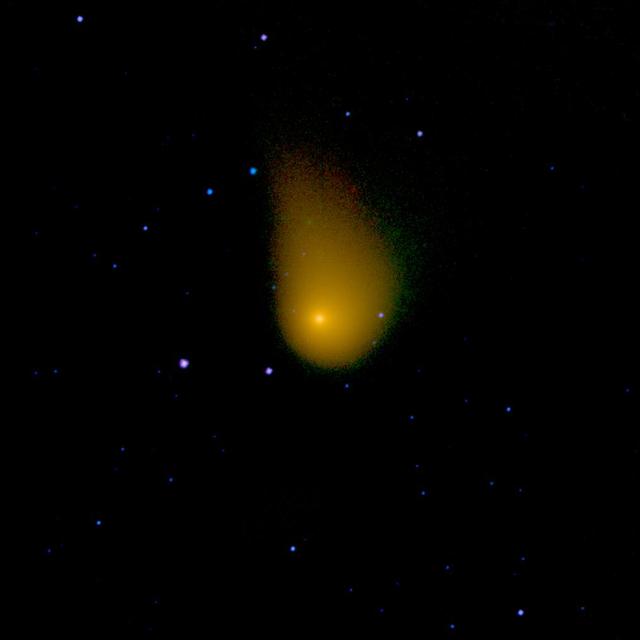
An infrared view from NASA's NEOWISE mission of the Oort cloud comet C/2006 W3 (Christensen). The spacecraft observed this comet on April 20th, 2010 as it traveled through the constellation Sagittarius. Comet Christensen was nearly 370 million miles (600 million kilometers) from Earth at the time. The image is half of a degree of the sky on each side. Infrared light with wavelengths of 3.4, 12 and 22 micron channels are mapped to blue, green, and red, respectively. The signal at these wavelengths is dominated primarily by the comet's dust thermal emission, giving it a golden hue. The WISE spacecraft was put into hibernation in 2011 upon completing its goal of surveying the entire sky in infrared light. WISE cataloged three quarters of a billion objects, including asteroids, stars and galaxies. In August 2013, NASA decided to reinstate the spacecraft on a mission to find and characterize more asteroids. http://photojournal.jpl.nasa.gov/catalog/PIA20118

This panoramic view encompasses the entire sky as seen by Two Micron All-Sky Survey. The measured brightnesses of half a billion stars (points) have been combined into colors representing three distinct wavelengths of infrared light: blue at 1.2 microns, green at 1.6 microns, and red at 2.2 microns. This image is centered on the core of our own Milky Way galaxy, toward the constellation of Sagittarius. The reddish stars seemingly hovering in the middle of the Milky Way's disc -- many of them never observed before -- trace the densest dust clouds in our galaxy. The two faint smudges seen in the lower right quadrant are our neighboring galaxies, the Small and Large Magellanic Clouds. http://photojournal.jpl.nasa.gov/catalog/PIA04250

This image composite compares visible-light and infrared views from NASA's Spitzer Space Telescope of the glowing Trifid Nebula, a giant star-forming cloud of gas and dust located 5,400 light-years away in the constellation Sagittarius. Visible-light images of the Trifid taken with NASA's Hubble Space Telescope, Baltimore, Md. (inside left, figure 1) and the National Optical Astronomy Observatory, Tucson, Ariz., (outside left, figure 1) show a murky cloud lined with dark trails of dust. Data of this same region from the Institute for Radioastronomy millimeter telescope in Spain revealed four dense knots, or cores, of dust (outlined by yellow circles), which are "incubators" for embryonic stars. Astronomers thought these cores were not yet ripe for stars, until Spitzer spotted the warmth of rapidly growing massive embryos tucked inside. http://photojournal.jpl.nasa.gov/catalog/PIA07226

This is a photograph of giant twisters and star wisps in the Lagoon Nebula. This superb Hubble Space Telescope (HST) image reveals a pair of one-half light-year long interstellar twisters, eerie furnels and twisted rope structures (upper left), in the heart of the Lagoon Nebula (Messier 8) that lies 5,000 light-years away in the direction of the constellation Sagittarius. This image was taken by the Hubble Space Telescope Wide Field/Planetary Camera 2 (WF/PC2).

Astronomers using data from NASA's Wide-field Infrared Survey Explorer, or WISE, are helping to trace the shape of our Milky Way galaxy's spiral arms. This illustration shows where WISE data revealed clusters of young stars shrouded in dust, called embedded clusters, which are known to reside in spiral arms. The bars represent uncertainties in the data. The nearly 100 clusters shown here were found in the arms called Perseus, Sagittarius-Carina, and Outer -- three of the galaxy's four proposed primary arms. Our sun resides in a spur to an arm, or a minor arm, called Orion Cygnus. http://photojournal.jpl.nasa.gov/catalog/PIA19341

This NASA Hubble Space Telescope (HST) image of the Trifid Nebula reveals a stellar nursery being torn apart by a nearby massive star. Embryonic stars are forming within an ill-fated cloud of dust and gas, which is destined to be eaten away by the glare from the massive neighbor. The cloud is about 8 light years away from the nebula' s central star. This stellar activity is a beautiful example of how the life cycle of stars like our Sun is intimately cornected with their more powerful siblings. Residing in the constellation Sagittarius, the Trifid Nebula is about 9,000 light years from Earth.

An expanded view of comet C/2006 W3 (Christensen) is shown here. The WISE spacecraft observed this comet on April 20th, 2010 as it traveled through the constellation Sagittarius. Comet Christensen was nearly 370 million miles (600 million kilometers) from Earth at the time. The extent of the dust, about a tenth of a degree across in this image, is about 2/3rds the diameter of the sun. The red contours show the signal from the gas emission observed by the WISE spacecraft in the 4.6 micron wavelength channel, which contains carbon monoxide (CO) and carbon dioxide (CO2) emission lines. The strength of the 4.6 micron signal indicates over half a metric ton per second of CO or CO2 was emitted from this comet at the time of the observations. The WISE spacecraft was put into hibernation in 2011 upon completing its goal of surveying the entire sky in infrared light. WISE cataloged three quarters of a billion objects, including asteroids, stars and galaxies. In August 2013, NASA decided to reinstate the spacecraft on a mission to find and characterize more asteroids. http://photojournal.jpl.nasa.gov/catalog/PIA20119

This image composite compares the well-known visible-light picture of the glowing Trifid Nebula (left panel) with infrared views from NASA's Spitzer Space Telescope (remaining three panels). The Trifid Nebula is a giant star-forming cloud of gas and dust located 5,400 light-years away in the constellation Sagittarius. The false-color Spitzer images reveal a different side of the Trifid Nebula. Where dark lanes of dust are visible trisecting the nebula in the visible-light picture, bright regions of star-forming activity are seen in the Spitzer pictures. All together, Spitzer uncovered 30 massive embryonic stars and 120 smaller newborn stars throughout the Trifid Nebula, in both its dark lanes and luminous clouds. These stars are visible in all the Spitzer images, mainly as yellow or red spots. Embryonic stars are developing stars about to burst into existence. Ten of the 30 massive embryos discovered by Spitzer were found in four dark cores, or stellar "incubators," where stars are born. Astronomers using data from the Institute of Radioastronomy millimeter telescope in Spain had previously identified these cores but thought they were not quite ripe for stars. Spitzer's highly sensitive infrared eyes were able to penetrate all four cores to reveal rapidly growing embryos. http://photojournal.jpl.nasa.gov/catalog/PIA07225

Here we see the spectacular cosmic pairing of the star Hen 2-427 — more commonly known as WR 124 — and the nebula M1-67 which surrounds it. Both objects, captured here by the NASA/ESA Hubble Space Telescope are found in the constellation of Sagittarius and lie 15 000 light-years away. The star Hen 2-427 shines brightly at the very centre of this explosive image and around the hot clumps of gas are ejected into space at over 150 000 kilometres per hour. Hen 2-427 is a Wolf–Rayet star, named after the astronomers Charles Wolf and Georges Rayet. Wolf–Rayet are super-hot stars characterised by a fierce ejection of mass. The nebula M1-67 is estimated to be no more than 10 000 years old — just a baby in astronomical terms — but what a beautiful and magnificent sight it makes. A version of this image was released in 1998, but has now been re-reduced with the latest software.

Astronomers using the Hubble Space Telescope (HST) have identified what may be the most luminous star known; a celestial mammoth that releases up to 10-million times the power of the Sun and is big enough to fill the diameter of Earth's orbit. The star unleashes as much energy in six seconds as our Sun does in one year. The image, taken by a UCLA-led team with the recently installed Near-Infrared Camera and Multi-Object Spectrometer (NICMOS) aboard the HST, also reveals a bright nebula, created by extremely massive stellar eruptions. The UCLA astronomers estimate that the star, called the Pistol Star, (for the pistol shaped nebula surrounding it), is approximately 25,000 light-years from Earth, near the center of our Milky Way galaxy. The Pistol Star is not visible to the eye, but is located in the direction of the constellation Sagittarius, hidden behind the great dust clouds along the Milky Way

In this sturning image provided by the Hubble Space Telescope (HST), the Omega Nebula (M17) resembles the fury of a raging sea, showing a bubbly ocean of glowing hydrogen gas and small amounts of other elements such as oxygen and sulfur. The nebula, also known as the Swan Nebula, is a hotbed of newly born stars residing 5,500 light-years away in the constellation Sagittarius. The wavelike patterns of gas have been sculpted and illuminated by a torrent of ultraviolet radiation from the young massive stars, which lie outside the picture to the upper left. The ultraviolet radiation is carving and heating the surfaces of cold hydrogen gas clouds. The warmed surfaces glow orange and red in this photograph. The green represents an even hotter gas that masks background structures. Various gases represented with color are: sulfur, represented in red; hydrogen, green; and oxygen blue.

This image shows the star-studded center of the Milky Way towards the constellation of Sagittarius. The crowded center of our galaxy contains numerous complex and mysterious objects that are usually hidden at optical wavelengths by clouds of dust — but many are visible here in these infrared observations from Hubble. However, the most famous cosmic object in this image still remains invisible: the monster at our galaxy’s heart called Sagittarius A*. Astronomers have observed stars spinning around this supermassive black hole (located right in the center of the image), and the black hole consuming clouds of dust as it affects its environment with its enormous gravitational pull. Infrared observations can pierce through thick obscuring material to reveal information that is usually hidden to the optical observer. This is the best infrared image of this region ever taken with Hubble, and uses infrared archive data from Hubble’s Wide Field Camera 3, taken in September 2011. Credit: NASA, ESA, and G. Brammer <b><a href="http://www.nasa.gov/audience/formedia/features/MP_Photo_Guidelines.html" rel="nofollow">NASA image use policy.</a></b> <b><a href="http://www.nasa.gov/centers/goddard/home/index.html" rel="nofollow">NASA Goddard Space Flight Center</a></b> enables NASA’s mission through four scientific endeavors: Earth Science, Heliophysics, Solar System Exploration, and Astrophysics. Goddard plays a leading role in NASA’s accomplishments by contributing compelling scientific knowledge to advance the Agency’s mission. <b>Follow us on <a href="http://twitter.com/NASA_GoddardPix" rel="nofollow">Twitter</a></b> <b>Like us on <a href="http://www.facebook.com/pages/Greenbelt-MD/NASA-Goddard/395013845897?ref=tsd" rel="nofollow">Facebook</a></b> <b>Find us on <a href="http://instagram.com/nasagoddard?vm=grid" rel="nofollow">Instagram</a></b>

This artist's concept puts solar system distances -- and the travels of NASA's Voyager 2 spacecraft -- in perspective. The scale bar is in astronomical units, with each set distance beyond 1 AU representing 10 times the previous distance. One AU is the distance from the Sun to Earth, which is about 93 million miles, or 150 million kilometers. Neptune, the most distant planet from the Sun, is about 30 AU. Much of the solar system is actually in interstellar space. Informally, the term "solar system" is often used to mean the space out to the last planet. Scientific consensus, however, says the solar system goes out to the Oort Cloud, the source of the comets that swing by our sun on long time scales. Beyond the outer edge of the Oort Cloud, the gravity of other stars begins to dominate that of the Sun. The inner edge of the main part of the Oort Cloud could be as close as 1,000 AU from our Sun. The outer edge is estimated to be around 100,000 AU. Voyager 2, the second farthest human-made object after Voyager 1, is around 119 AU from the Sun. Indications from the scientific instruments suggest Voyager 2 passed beyond our heliosphere (the bubble of plasma the Sun blows around itself) and into interstellar space (the space between stars) in November 2018. The heliosphere has a turbulent outer boundary known as the heliosheath. The termination shock is the inner boundary of the heliosheath and the heliopause is the outer boundary, beyond which lies interstellar space. Voyager 2 crossed the termination shock at 84 AU in August 2007. It will take about 300 years for Voyager 2 to reach the inner edge of the Oort Cloud and possibly about 30,000 years to fly beyond it. Voyager 2 is heading away from the Sun about 36 degrees out of the ecliptic plane (plane of the planets) to the south, toward the constellations of Sagittarius and Pavo. In about 40,000 years, Voyager 2 will be closer to another star than our own Sun, coming within about 1.7 light years of a star called Ross 248, a small star in the constellation of Andromeda. https://photojournal.jpl.nasa.gov/catalog/PIA22921

This colourful bubble is a planetary nebula called NGC 6818, also known as the Little Gem Nebula. It is located in the constellation of Sagittarius (The Archer), roughly 6000 light-years away from us. The rich glow of the cloud is just over half a light-year across — humongous compared to its tiny central star — but still a little gem on a cosmic scale. When stars like the Sun enter retirement, they shed their outer layers into space to create glowing clouds of gas called planetary nebulae. This ejection of mass is uneven, and planetary nebulae can have very complex shapes. NGC 6818 shows knotty filament-like structures and distinct layers of material, with a bright and enclosed central bubble surrounded by a larger, more diffuse cloud. Scientists believe that the stellar wind from the central star propels the outflowing material, sculpting the elongated shape of NGC 6818. As this fast wind smashes through the slower-moving cloud it creates particularly bright blowouts at the bubble’s outer layers. Hubble previously imaged this nebula back in 1997 with its Wide Field Planetary Camera 2, using a mix of filters that highlighted emission from ionised oxygen and hydrogen (opo9811h). This image, while from the same camera, uses different filters to reveal a different view of the nebula. A version of the image was submitted to the Hubble’s Hidden Treasures image processing competition by contestant Judy Schmidt.

This NASA/ESA Hubble Space Telescope image shows the spiral galaxy NGC 4845, located over 65 million light-years away in the constellation of Virgo (The Virgin). The galaxy’s orientation clearly reveals the galaxy’s striking spiral structure: a flat and dust-mottled disc surrounding a bright galactic bulge. NGC 4845’s glowing centre hosts a gigantic version of a black hole, known as a supermassive black hole. The presence of a black hole in a distant galaxy like NGC 4845 can be inferred from its effect on the galaxy’s innermost stars; these stars experience a strong gravitational pull from the black hole and whizz around the galaxy’s centre much faster than otherwise. From investigating the motion of these central stars, astronomers can estimate the mass of the central black hole — for NGC 4845 this is estimated to be hundreds of thousands times heavier than the Sun. This same technique was also used to discover the supermassive black hole at the centre of our own Milky Way — Sagittarius A* — which hits some four million times the mass of the Sun (potw1340a). The galactic core of NGC 4845 is not just supermassive, but also super-hungry. In 2013 researchers were observing another galaxy when they noticed a violent flare at the centre of NGC 4845. The flare came from the central black hole tearing up and feeding off an object many times more massive than Jupiter. A brown dwarf or a large planet simply strayed too close and was devoured by the hungry core of NGC 4845.

Huge waves are sculpted in this two-lobed nebula called the Red Spider Nebula, located some 3,000 light-years away in the constellation of Sagittarius. This warm planetary nebula harbors one of the hottest stars known and its powerful stellar winds generate waves 100 billion kilometers (62.4 billion miles) high. The waves are caused by supersonic shocks, formed when the local gas is compressed and heated in front of the rapidly expanding lobes. The atoms caught in the shock emit the spectacular radiation seen in this image. Image credit: ESA/Garrelt Mellema (Leiden University, the Netherlands) <b><a href="http://www.nasa.gov/audience/formedia/features/MP_Photo_Guidelines.html" rel="nofollow">NASA image use policy.</a></b> <b><a href="http://www.nasa.gov/centers/goddard/home/index.html" rel="nofollow">NASA Goddard Space Flight Center</a></b> enables NASA’s mission through four scientific endeavors: Earth Science, Heliophysics, Solar System Exploration, and Astrophysics. Goddard plays a leading role in NASA’s accomplishments by contributing compelling scientific knowledge to advance the Agency’s mission. <b>Follow us on <a href="http://twitter.com/NASAGoddardPix" rel="nofollow">Twitter</a></b> <b>Like us on <a href="http://www.facebook.com/pages/Greenbelt-MD/NASA-Goddard/395013845897?ref=tsd" rel="nofollow">Facebook</a></b> <b>Find us on <a href="http://instagrid.me/nasagoddard/?vm=grid" rel="nofollow">Instagram</a></b>

This sturning image, taken by the newly installed Advanced Camera for Surveys (ACS) aboard the Hubble Space Telescope (HST), is an image of the center of the Omega Nebula. It is a hotbed of newly born stars wrapped in colorful blankets of glowing gas and cradled in an enormous cold, dark hydrogen cloud. The region of nebula shown in this photograph is about 3,500 times wider than our solar system. The nebula, also called M17 and the Swan Nebula, resides 5,500 light-years away in the constellation Sagittarius. The Swan Nebula is illuminated by ultraviolet radiation from young, massive stars, located just beyond the upper-right corner of the image. The powerful radiation from these stars evaporates and erodes the dense cloud of cold gas within which the stars formed. The blistered walls of the hollow cloud shine primarily in the blue, green, and red light emitted by excited atoms of hydrogen, nitrogen, oxygen, and sulfur. Particularly striking is the rose-like feature, seen to the right of center, which glows in the red light emitted by hydrogen and sulfur. As the infant stars evaporate the surrounding cloud, they expose dense pockets of gas that may contain developing stars. One isolated pocket is seen at the center of the brightest region of the nebula. Other dense pockets of gas have formed the remarkable feature jutting inward from the left edge of the image. The color image is constructed from four separate images taken in these filters: blue, near infrared, hydrogen alpha, and doubly ionized oxygen. Credit: NASA, H. Ford (JHU), G. Illingworth (USCS/LO), M. Clampin (STScI), G. Hartig (STScI), the ACS Science Team, and ESA.

This colorful image shows a nebula – a cloud of gas and dust in space – captured by NASA's now-retired Spitzer Space Telescope located is in the constellation Sagittarius, along the plane of the Milky Way, which was as part of Spitzer's GLIMPSE Survey (short for Galactic Legacy Infrared Mid-Plane Survey Extraordinaire). With a little imagination, you might be able to see the outlines of Godzilla. Stars in the upper right (where this cosmic Godzilla's eyes and snout would be) are an unknown distance from Earth but within our galaxy. Located about 7,800 light-years from Earth, the bright region in the lower left (Godzilla's right hand) is known as W33. When viewed in visible light, this region is almost entirely obscured by dust clouds. But infrared light (wavelengths longer than what our eyes can perceive) can penetrate the clouds, revealing hidden regions like this one. Blue, cyan, green, and red are used to represent different wavelengths of infrared light; yellow and white are combinations of those wavelengths. Blue and cyan represent wavelengths primarily emitted by stars; dust and organic molecules called hydrocarbons appear green; and warm dust that's been heated by stars or supernovae (exploding stars) appears red. When massive stars die and explode into supernovae, they reshape the regions around them, carving them into different shapes; they also push material together and initiate the birth of new stars that continue the cycle. https://photojournal.jpl.nasa.gov/catalog/PIA24579
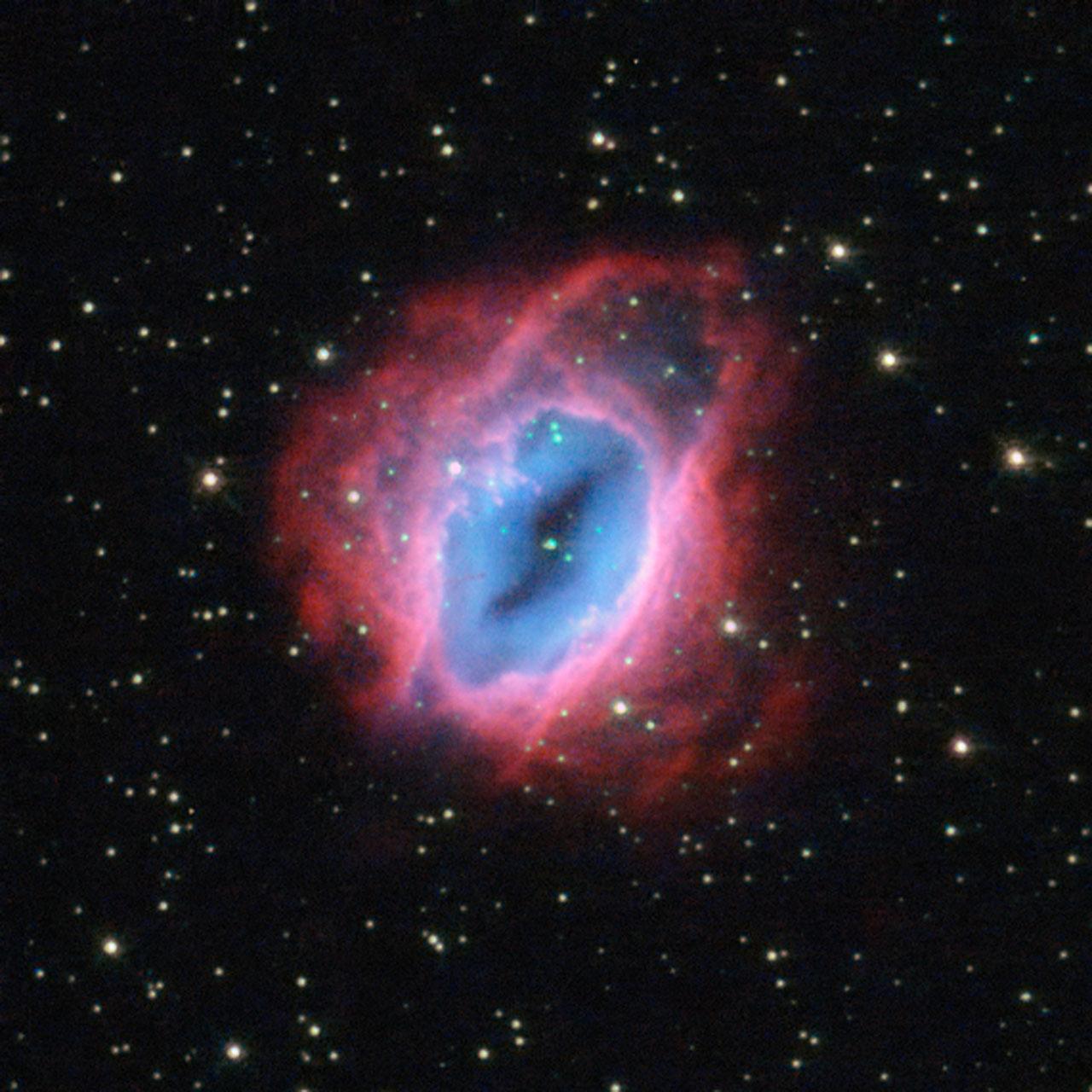
It may look like something from "The Lord of the Rings," but this fiery swirl is actually a planetary nebula known as ESO 456-67. Set against a backdrop of bright stars, the rust-colored object lies in the constellation of Sagittarius (The Archer), in the southern sky. In this image of ESO 456-67, it is possible to see the various layers of material expelled by the central star. Each appears in a different hue - red, orange, yellow, and green-tinted bands of gas are visible, with clear patches of space at the heart of the nebula. It is not fully understood how planetary nebulae form such a wide variety of shapes and structures; some appear to be spherical, some elliptical, others shoot material in waves from their polar regions, some look like hourglasses or figures of eight, and others resemble large, messy stellar explosions - to name but a few. Image Credit: ESA/Hubble and NASA <b><a href="http://www.nasa.gov/audience/formedia/features/MP_Photo_Guidelines.html" rel="nofollow">NASA image use policy.</a></b> <b><a href="http://www.nasa.gov/centers/goddard/home/index.html" rel="nofollow">NASA Goddard Space Flight Center</a></b> enables NASA’s mission through four scientific endeavors: Earth Science, Heliophysics, Solar System Exploration, and Astrophysics. Goddard plays a leading role in NASA’s accomplishments by contributing compelling scientific knowledge to advance the Agency’s mission. <b>Follow us on <a href="http://twitter.com/NASA_GoddardPix" rel="nofollow">Twitter</a></b> <b>Like us on <a href="http://www.facebook.com/pages/Greenbelt-MD/NASA-Goddard/395013845897?ref=tsd" rel="nofollow">Facebook</a></b> <b>Find us on <a href="http://instagram.com/nasagoddard?vm=grid" rel="nofollow">Instagram</a></b>

This new NASA/ESA Hubble Space Telescope image presents the Arches Cluster, the densest known star cluster in the Milky Way. It is located about 25 000 light-years from Earth in the constellation of Sagittarius (The Archer), close to the heart of our galaxy, the Milky Way. It is, like its neighbour the Quintuplet Cluster, a fairly young astronomical object at between two and four million years old. The Arches cluster is so dense that in a region with a radius equal to the distance between the Sun and its nearest star there would be over 100 000 stars! At least 150 stars within the cluster are among the brightest ever discovered in the the Milky Way. These stars are so bright and massive, that they will burn their fuel within a short time, on a cosmological scale, just a few million years, and die in spectacular supernova explosions. Due to the short lifetime of the stars in the cluster, the gas between the stars contains an unusually high amount of heavier elements, which were produced by earlier generations of stars. Despite its brightness the Arches Cluster cannot be seen with the naked eye. The visible light from the cluster is completely obscured by gigantic clouds of dust in this region. To make the cluster visible astronomers have to use detectors which can collect light from the X-ray, infrared, and radio bands, as these wavelengths can pass through the dust clouds. This observation shows the Arches Cluster in the infrared and demonstrates the leap in Hubble’s performance since its 1999 image of same object.

Here we see the spectacular cosmic pairing of the star Hen 2-427 — more commonly known as WR 124 — and the nebula M1-67 which surrounds it. Both objects, captured here by the NASA/ESA Hubble Space Telescope are found in the constellation of Sagittarius and lie 15,000 light-years away. The star Hen 2-427 shines brightly at the very center of this explosive image and around the hot clumps of surrounding gas that are being ejected into space at over 93,210 miles (150,000 km) per hour. Hen 2-427 is a Wolf–Rayet star, named after the astronomers Charles Wolf and Georges Rayet. Wolf–Rayet are super-hot stars characterized by a fierce ejection of mass. The nebula M1-67 is estimated to be no more than 10,000 years old — just a baby in astronomical terms — but what a beautiful and magnificent sight it makes. Image credit: ESA/Hubble & NASA, Acknowledgement: Judy Schmidt <b><a href="http://www.nasa.gov/audience/formedia/features/MP_Photo_Guidelines.html" rel="nofollow">NASA image use policy.</a></b> <b><a href="http://www.nasa.gov/centers/goddard/home/index.html" rel="nofollow">NASA Goddard Space Flight Center</a></b> enables NASA’s mission through four scientific endeavors: Earth Science, Heliophysics, Solar System Exploration, and Astrophysics. Goddard plays a leading role in NASA’s accomplishments by contributing compelling scientific knowledge to advance the Agency’s mission. <b>Follow us on <a href="http://twitter.com/NASAGoddardPix" rel="nofollow">Twitter</a></b> <b>Like us on <a href="http://www.facebook.com/pages/Greenbelt-MD/NASA-Goddard/395013845897?ref=tsd" rel="nofollow">Facebook</a></b> <b>Find us on <a href="http://instagrid.me/nasagoddard/?vm=grid" rel="nofollow">Instagram</a></b>

This NASA/ESA Hubble Space Telescope image presents the Arches Cluster, the densest known star cluster in the Milky Way. It is located about 25,000 light-years from Earth in the constellation of Sagittarius (The Archer), close to the heart of our galaxy, the Milky Way. It is, like its neighbor the Quintuplet Cluster, a fairly young astronomical object at between two and four million years old. The Arches cluster is so dense that in a region with a radius equal to the distance between the sun and its nearest star there would be over 100,000 stars! At least 150 stars within the cluster are among the brightest ever discovered in the Milky Way. These stars are so bright and massive that they will burn their fuel within a short time (on a cosmological scale that means just a few million years). Then they will die in spectacular supernova explosions. Due to the short lifetime of the stars in the cluster the gas between the stars contains an unusually high amount of heavier elements, which were produced by earlier generations of stars. Despite its brightness the Arches Cluster cannot be seen with the naked eye. The visible light from the cluster is completely obscured by gigantic clouds of dust in this region. To make the cluster visible astronomers have to use detectors which can collect light from the X-ray, infrared, and radio bands, as these wavelengths can pass through the dust clouds. This observation shows the Arches Cluster in the infrared and demonstrates the leap in Hubble’s performance since its 1999 image of same object. Credit: NASA/ESA <b><a href="http://www.nasa.gov/centers/goddard/home/index.html" rel="nofollow">NASA Goddard Space Flight Center</a></b> enables NASA’s mission through four scientific endeavors: Earth Science, Heliophysics, Solar System Exploration, and Astrophysics. Goddard plays a leading role in NASA’s accomplishments by contributing compelling scientific knowledge to advance the Agency’s mission. <b>Follow us on <a href="http://twitter.com/NASAGoddardPix" rel="nofollow">Twitter</a></b> <b>Like us on <a href="http://www.facebook.com/pages/Greenbelt-MD/NASA-Goddard/395013845897?ref=tsd" rel="nofollow">Facebook</a></b> <b>Find us on <a href="http://instagrid.me/nasagoddard/?vm=grid" rel="nofollow">Instagram</a></b>

This colorful bubble is a planetary nebula called NGC 6818, also known as the Little Gem Nebula. It is located in the constellation of Sagittarius (The Archer), roughly 6,000 light-years away from us. The rich glow of the cloud is just over half a light-year across — humongous compared to its tiny central star — but still a little gem on a cosmic scale. When stars like the sun enter "retirement," they shed their outer layers into space to create glowing clouds of gas called planetary nebulae. This ejection of mass is uneven, and planetary nebulae can have very complex shapes. NGC 6818 shows knotty filament-like structures and distinct layers of material, with a bright and enclosed central bubble surrounded by a larger, more diffuse cloud. Scientists believe that the stellar wind from the central star propels the outflowing material, sculpting the elongated shape of NGC 6818. As this fast wind smashes through the slower-moving cloud it creates particularly bright blowouts at the bubble’s outer layers. Hubble previously imaged this nebula back in 1997 with its Wide Field Planetary Camera 2, using a mix of filters that highlighted emission from ionized oxygen and hydrogen. This image, while from the same camera, uses different filters to reveal a different view of the nebula. Image credit: ESA/Hubble & NASA, Acknowledgement: Judy Schmidt <b><a href="http://www.nasa.gov/audience/formedia/features/MP_Photo_Guidelines.html" rel="nofollow">NASA image use policy.</a></b> <b><a href="http://www.nasa.gov/centers/goddard/home/index.html" rel="nofollow">NASA Goddard Space Flight Center</a></b> enables NASA’s mission through four scientific endeavors: Earth Science, Heliophysics, Solar System Exploration, and Astrophysics. Goddard plays a leading role in NASA’s accomplishments by contributing compelling scientific knowledge to advance the Agency’s mission. <b>Follow us on <a href="http://twitter.com/NASAGoddardPix" rel="nofollow">Twitter</a></b> <b>Like us on <a href="http://www.facebook.com/pages/Greenbelt-MD/NASA-Goddard/395013845897?ref=tsd" rel="nofollow">Facebook</a></b> <b>Find us on <a href="http://instagrid.me/nasagoddard/?vm=grid" rel="nofollow">Instagram</a></b>

Panta rhei is a simplified version of the famous Greek philosopher Heraclitus' teachings. It basically means, everything flows. And everything in the Universe is indeed continually on the move, spiraling and shifting through space. Some cosmic objects move a little further than others — take the subject of this NASA/ESA Hubble Space Telescope image, a globular cluster of stars known as Palomar 12. Although it currently lies on the outskirts of the Milky Way’s halo, Palomar 12 was not born here. When astronomers first studied this cluster, they were puzzled by its strangely young age when compared to the other clusters in the galaxy. It appeared to be around 30 percent younger than other Milky Way globulars. Surely if it had been born within our galaxy, it would have sprung to life at a similar time to its cluster companions? A bit more digging revealed that Palomar 12 was actually ripped from its initial home, the Sagittarius Dwarf Elliptical galaxy, around 1.7 billion years ago via tidal interactions between its former home and our galaxy. The dwarf galaxy that Palomar 12 once called home is a satellite galaxy to ours, and closely orbits around us — even occasionally passing through the plane of our galaxy. In fact, it is being slowly torn apart and consumed by the Milky Way. The sparkling stars in this picture were imaged by Hubble’s Advanced Camera for Surveys. Credit: ESA/NASA <b><a href="http://www.nasa.gov/audience/formedia/features/MP_Photo_Guidelines.html" rel="nofollow">NASA image use policy.</a></b> <b><a href="http://www.nasa.gov/centers/goddard/home/index.html" rel="nofollow">NASA Goddard Space Flight Center</a></b> enables NASA’s mission through four scientific endeavors: Earth Science, Heliophysics, Solar System Exploration, and Astrophysics. Goddard plays a leading role in NASA’s accomplishments by contributing compelling scientific knowledge to advance the Agency’s mission. <b>Follow us on <a href="http://twitter.com/NASAGoddardPix" rel="nofollow">Twitter</a></b> <b>Like us on <a href="http://www.facebook.com/pages/Greenbelt-MD/NASA-Goddard/395013845897?ref=tsd" rel="nofollow">Facebook</a></b> <b>Find us on <a href="http://instagram.com/nasagoddard?vm=grid" rel="nofollow">Instagram</a></b>

This NASA/ESA Hubble Space Telescope image shows the spiral galaxy NGC 4845, located over 65 million light-years away in the constellation of Virgo (The Virgin). The galaxy’s orientation clearly reveals the galaxy’s striking spiral structure: a flat and dust-mottled disk surrounding a bright galactic bulge. NGC 4845’s glowing center hosts a gigantic version of a black hole, known as a supermassive black hole. The presence of a black hole in a distant galaxy like NGC 4845 can be inferred from its effect on the galaxy’s innermost stars; these stars experience a strong gravitational pull from the black hole and whizz around the galaxy’s center much faster than otherwise. From investigating the motion of these central stars, astronomers can estimate the mass of the central black hole — for NGC 4845 this is estimated to be hundreds of thousands times heavier than the sun. This same technique was also used to discover the supermassive black hole at the center of our own Milky Way — Sagittarius A* — which hits some four million times the mass of the sun. The galactic core of NGC 4845 is not just supermassive, but also super-hungry. In 2013 researchers were observing another galaxy when they noticed a violent flare at the center of NGC 4845. The flare came from the central black hole tearing up and feeding off an object many times more massive than Jupiter. A brown dwarf or a large planet simply strayed too close and was devoured by the hungry core of NGC 4845. Image credit: ESA/Hubble & NASA and S. Smartt (Queen's University Belfast) <b><a href="http://www.nasa.gov/audience/formedia/features/MP_Photo_Guidelines.html" rel="nofollow">NASA image use policy.</a></b> <b><a href="http://www.nasa.gov/centers/goddard/home/index.html" rel="nofollow">NASA Goddard Space Flight Center</a></b> enables NASA’s mission through four scientific endeavors: Earth Science, Heliophysics, Solar System Exploration, and Astrophysics. Goddard plays a leading role in NASA’s accomplishments by contributing compelling scientific knowledge to advance the Agency’s mission. <b>Follow us on <a href="http://twitter.com/NASAGoddardPix" rel="nofollow">Twitter</a></b> <b>Like us on <a href="http://www.facebook.com/pages/Greenbelt-MD/NASA-Goddard/395013845897?ref=tsd" rel="nofollow">Facebook</a></b> <b>Find us on <a href="http://instagrid.me/nasagoddard/?vm=grid" rel="nofollow">Instagram</a></b>

Image release date September 22, 2010 To view a video of this image go here: <a href="http://www.flickr.com/photos/gsfc/5014452203">www.flickr.com/photos/gsfc/5014452203</a> Caption: A spectacular new NASA/ESA Hubble Space Telescope image reveals the heart of the Lagoon Nebula. Seen as a massive cloud of glowing dust and gas, bombarded by the energetic radiation of new stars, this placid name hides a dramatic reality. The Advanced Camera for Surveys (ACS) on the NASA/ESA Hubble Space Telescope has captured a dramatic view of gas and dust sculpted by intense radiation from hot young stars deep in the heart of the Lagoon Nebula (Messier 8). This spectacular object is named after the wide, lagoon-shaped dust lane that crosses the glowing gas of the nebula. This structure is prominent in wide-field images, but cannot be seen in this close-up. However the strange billowing shapes and sandy texture visible in this image make the Lagoon Nebula’s watery name eerily appropriate from this viewpoint too. Located four to five thousand light-years away, in the constellation of Sagittarius (the Archer), Messier 8 is a huge region of star birth that stretches across one hundred light-years. Clouds of hydrogen gas are slowly collapsing to form new stars, whose bright ultraviolet rays then light up the surrounding gas in a distinctive shade of red. The wispy tendrils and beach-like features of the nebula are not caused by the ebb and flow of tides, but rather by ultraviolet radiation’s ability to erode and disperse the gas and dust into the distinctive shapes that we see. In recent years astronomers probing the secrets of the Lagoon Nebula have found the first unambiguous proof that star formation by accretion of matter from the gas cloud is ongoing in this region. Young stars that are still surrounded by an accretion disc occasionally shoot out long tendrils of matter from their poles. Several examples of these jets, known as Herbig-Haro objects, have been found in this nebula in the last five years, providing strong support for astronomers’ theories about star formation in such hydrogen-rich regions. The Lagoon Nebula is faintly visible to the naked eye on dark nights as a small patch of grey in the heart of the Milky Way. Without a telescope, the nebula looks underwhelming because human eyes are unable to distinguish clearly between colours at low light levels. Charles Messier, the 18th century French astronomer, observed the nebula and included it in his famous astronomical catalogue, from which the nebula’s alternative name comes. But his relatively small refracting telescope would only have hinted at the dramatic structures and colours now visible thanks to Hubble. The Hubble Space Telescope is a project of international cooperation between ESA and NASA. Image credit: NASA, ESA <b><a href="http://www.nasa.gov/audience/formedia/features/MP_Photo_Guidelines.html" rel="nofollow">NASA image use policy.</a></b> <b><a href="http://www.nasa.gov/centers/goddard/home/index.html" rel="nofollow">NASA Goddard Space Flight Center</a></b> enables NASA’s mission through four scientific endeavors: Earth Science, Heliophysics, Solar System Exploration, and Astrophysics. Goddard plays a leading role in NASA’s accomplishments by contributing compelling scientific knowledge to advance the Agency’s mission. <b>Follow us on <a href="http://twitter.com/NASAGoddardPix" rel="nofollow">Twitter</a></b> <b>Like us on <a href="http://www.facebook.com/pages/Greenbelt-MD/NASA-Goddard/395013845897?ref=tsd" rel="nofollow">Facebook</a></b> <b>Find us on <a href="http://instagram.com/nasagoddard?vm=grid" rel="nofollow">Instagram</a></b> To learn more about the Hubble Space Telescope go here: <a href="http://www.nasa.gov/mission_pages/hubble/main/index.html" rel="nofollow">www.nasa.gov/mission_pages/hubble/main/index.html</a>