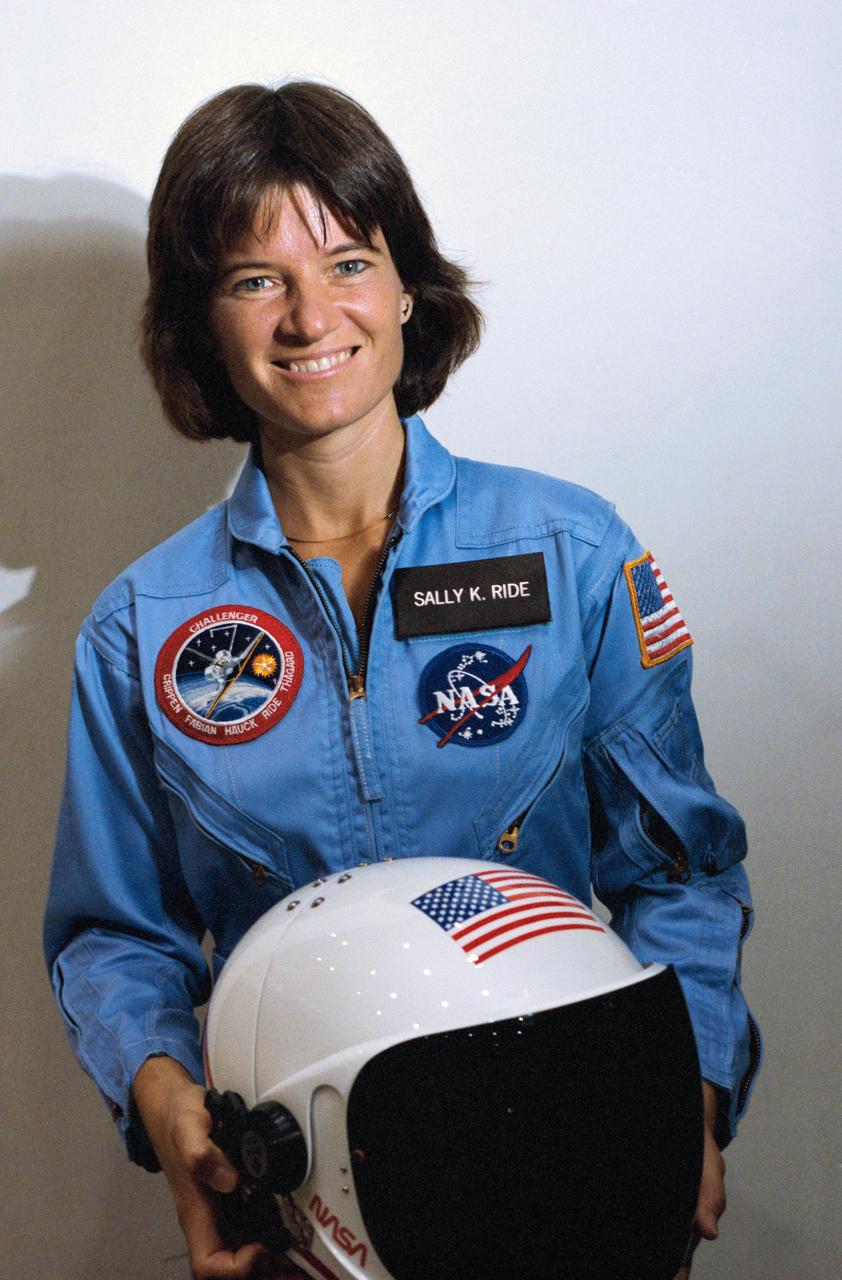
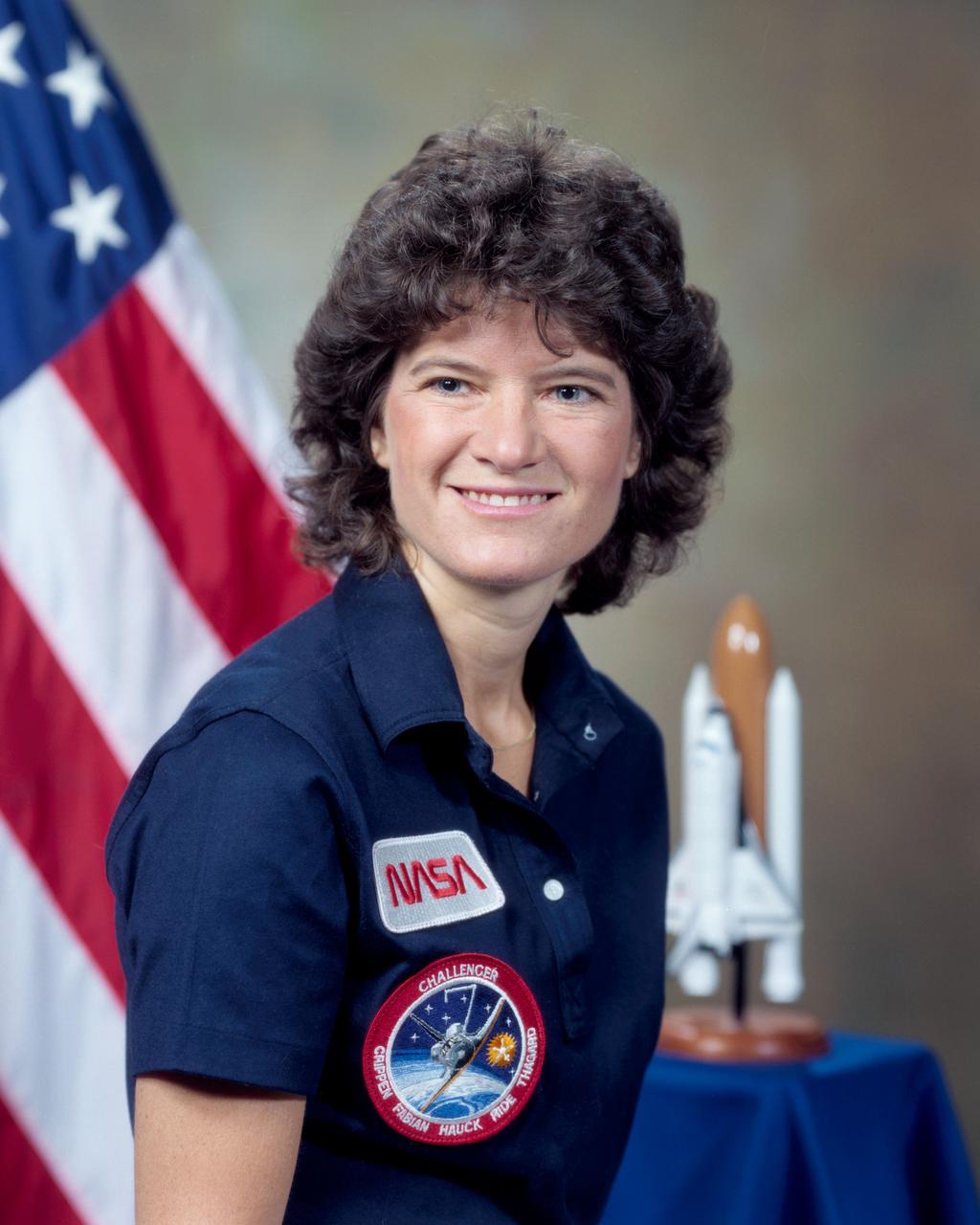
S84-37256 (June 1984) - Astronaut Sally K. Ride.
Portrait - Ride, Sally K.
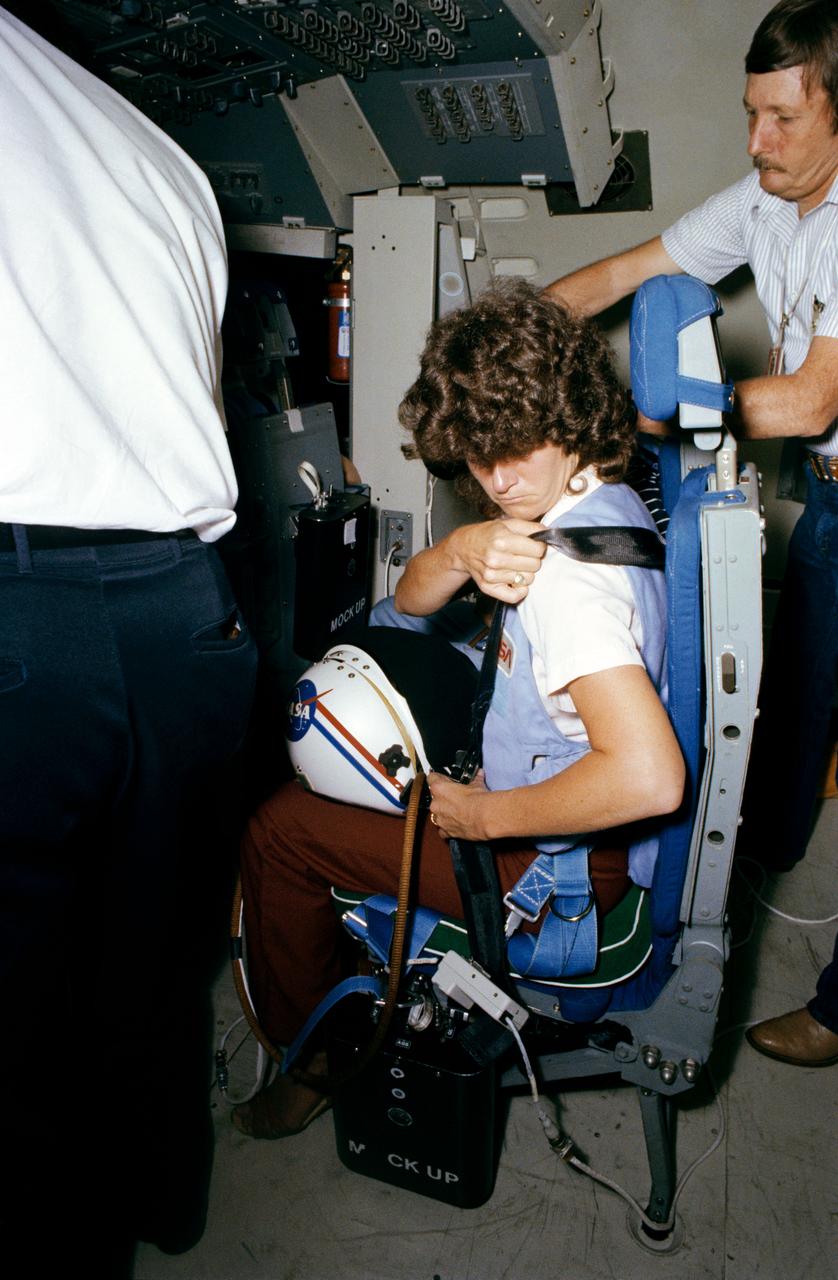
S83-32568 (23 May 1983) --- Astronaut Sally K. Ride, STS-7 mission specialist, straps herself into a seat in the Shuttle Mission Simulator (SMS) in Johnson Space Center?s Mission Simulation and Training Facility. Dr. Ride and the other STS-7 crew members continue their simulations in the motion base simulator in preparation for their flight in the space shuttle Challenger. Launch is scheduled for June 18. Troy Stewart, suit technician, assisted Dr. Ride. Photo credit: NASA
Simulator - Ride, Sally K.
S83-32571 (23 May 1983) --- Four-fifths of the STS-7 crew take a break from simulations in the Johnson Space Center?s Mission Simulation and Training Facility and pose for NASA photographer. Standing on the steps leading into the motion-based Shuttle Mission Simulator (SMS) are (left to right) astronauts Robert L. Crippen, John M. Fabian, Frederick H. Hauck and Sally K. Ride. Crippen is crew commander; Hauck, pilot; and Fabian and Ride are mission specialists, along with Norman E. Thagard (not involved in this phase of training and not pictured). Photo credit: NASA
Simulator - Ride, Sally K.
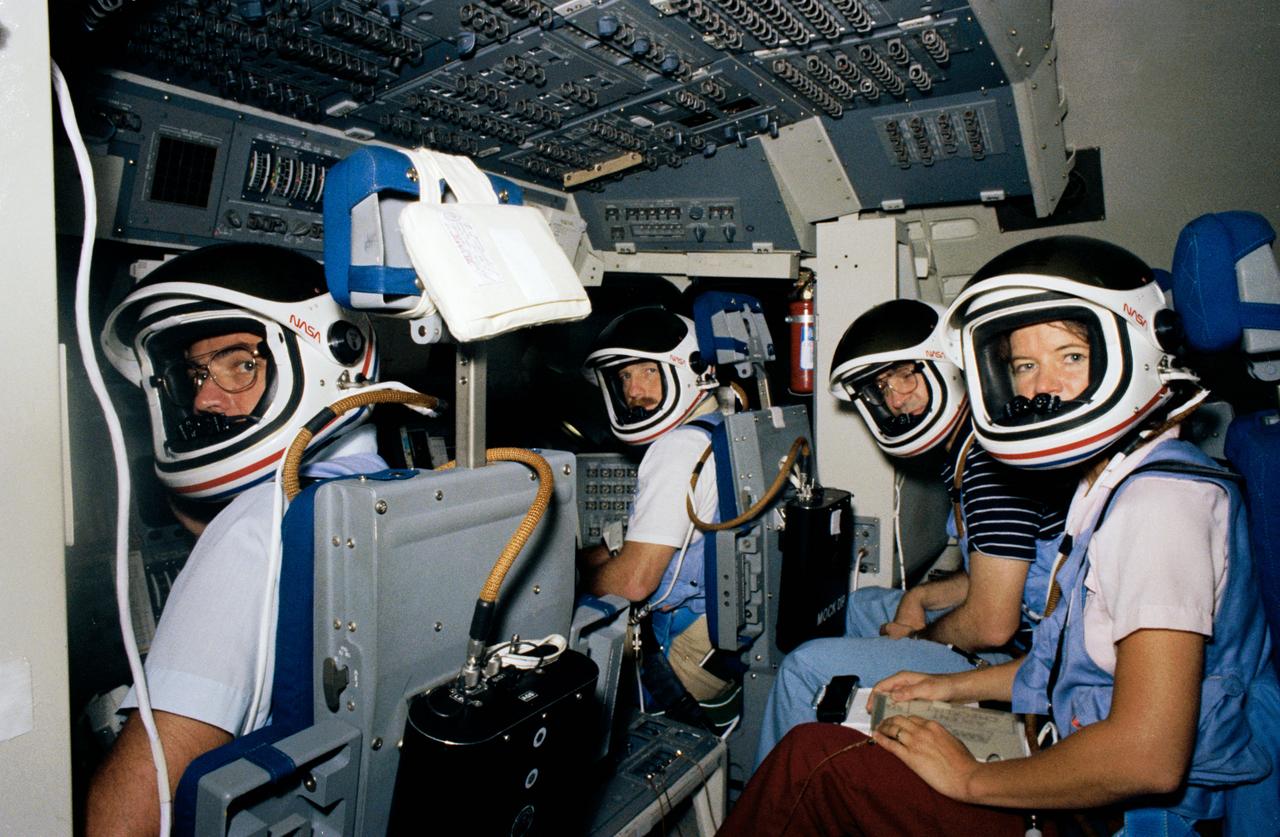
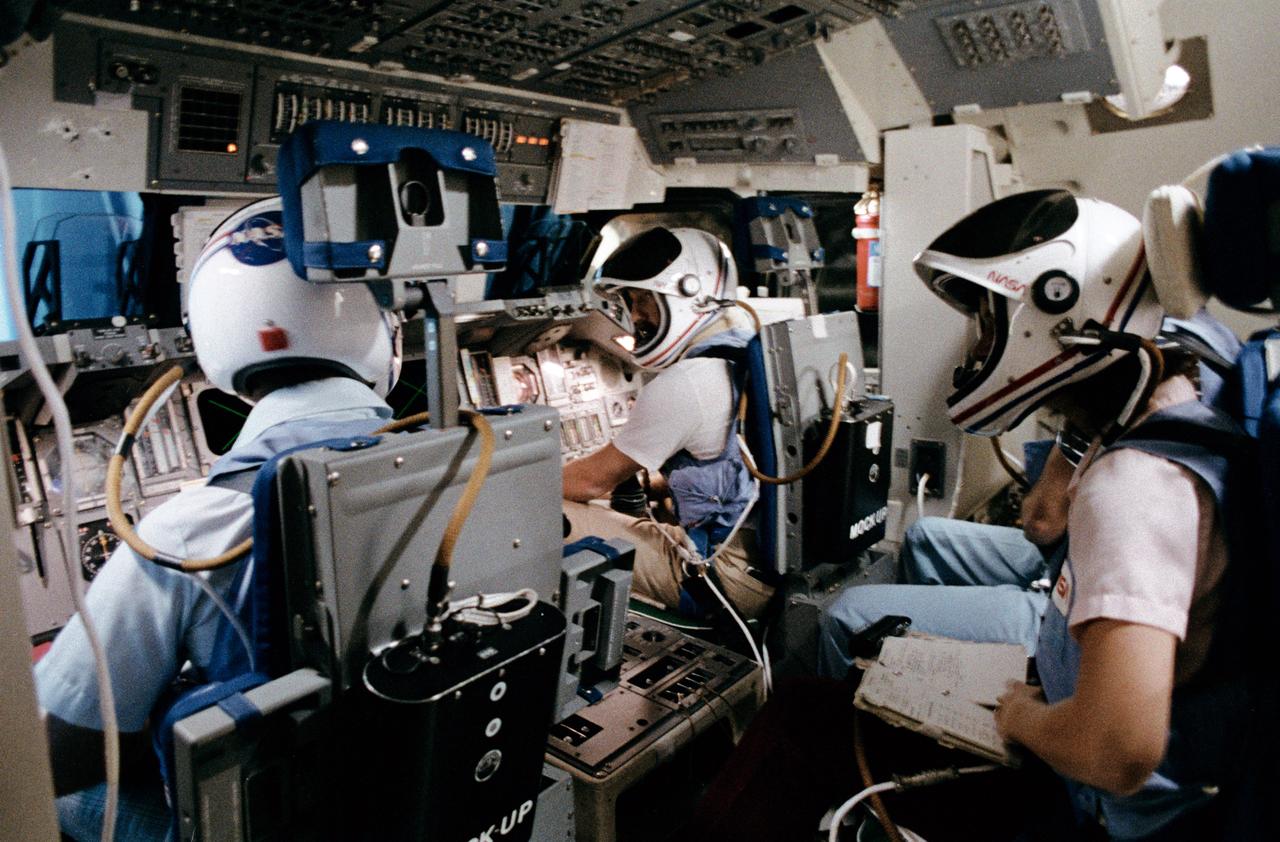
S83-32569 (23 May 1983) --- A preview of NASA?s next spaceflight is provided by this scene in the Johnson Space Center?s Shuttle mission simulator (SMS) with four-fifths of the crew in the same stations they will be in for launch and landing phases of the Challenger?s second space mission.  They are (left-right) Astronauts Robert L. Crippen, crew commander; Frederick H. Hauck, pilot; John M. Fabian and Dr. Sally K. Ride, mission specialists.  Dr. Norman E. Thagard, a third mission specialist, is to be seated in the mid-deck area below the flight deck for launch and landing phases.  Launch is now scheduled for June 18.
Simulator - Ride, Sally K.
S83-32823 (26 May 1983) --- Astronauts Sally K. Ride and John M. Fabian, attired in clean suits, participate in a STS-7 crew mission test in the Kennedy Space Center's vertical processing facility (VPF). They are two of three STS-7 mission specialists preparing for the June mission. Photo credit: NASA
Astronaut Sally K. Ride and John Fabian participates in crew mission test
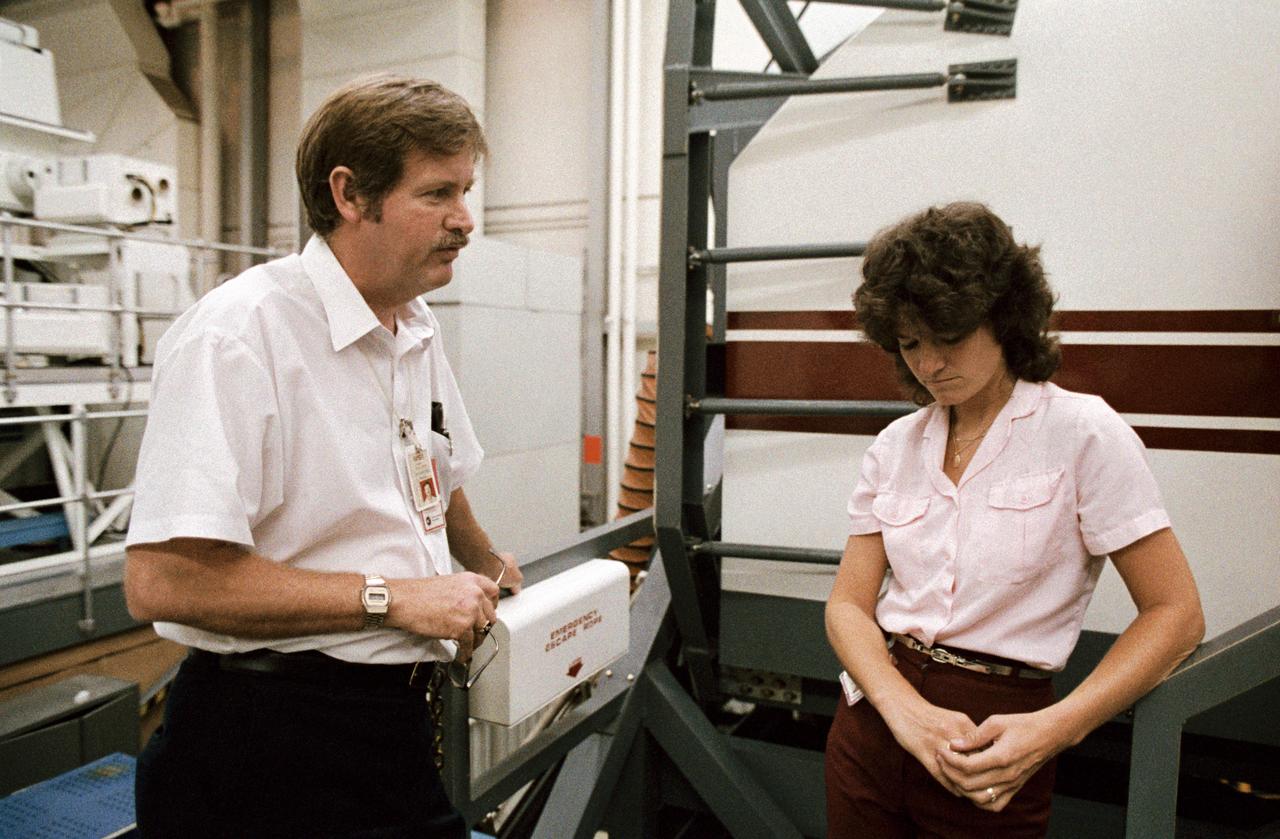
S83-32890 (23 May 1983) --- Astronaut Sally K. Ride, STS-7 mission specialist, stands near the Shuttle Mission Simulator (SMS) in Johnson Space Center's (JSC) Mission Simulation and Training Facility with suit specialist Alan M. Rochford after simulation of various phases of the upcoming STS-7 flight. Photo credit: NASA
Astronaut Sally K. Ride outside of shuttle mission simulator
S85-41007 (9 May 1983) --- At NASA's Johnson Space Center, astronaut Sally K. Ride takes a break from training as a mission specialist for NASA's STS-7 spaceflight in Earth orbit.  Photo credit: NASA
Sally Ride with Launch and Entry Helmet
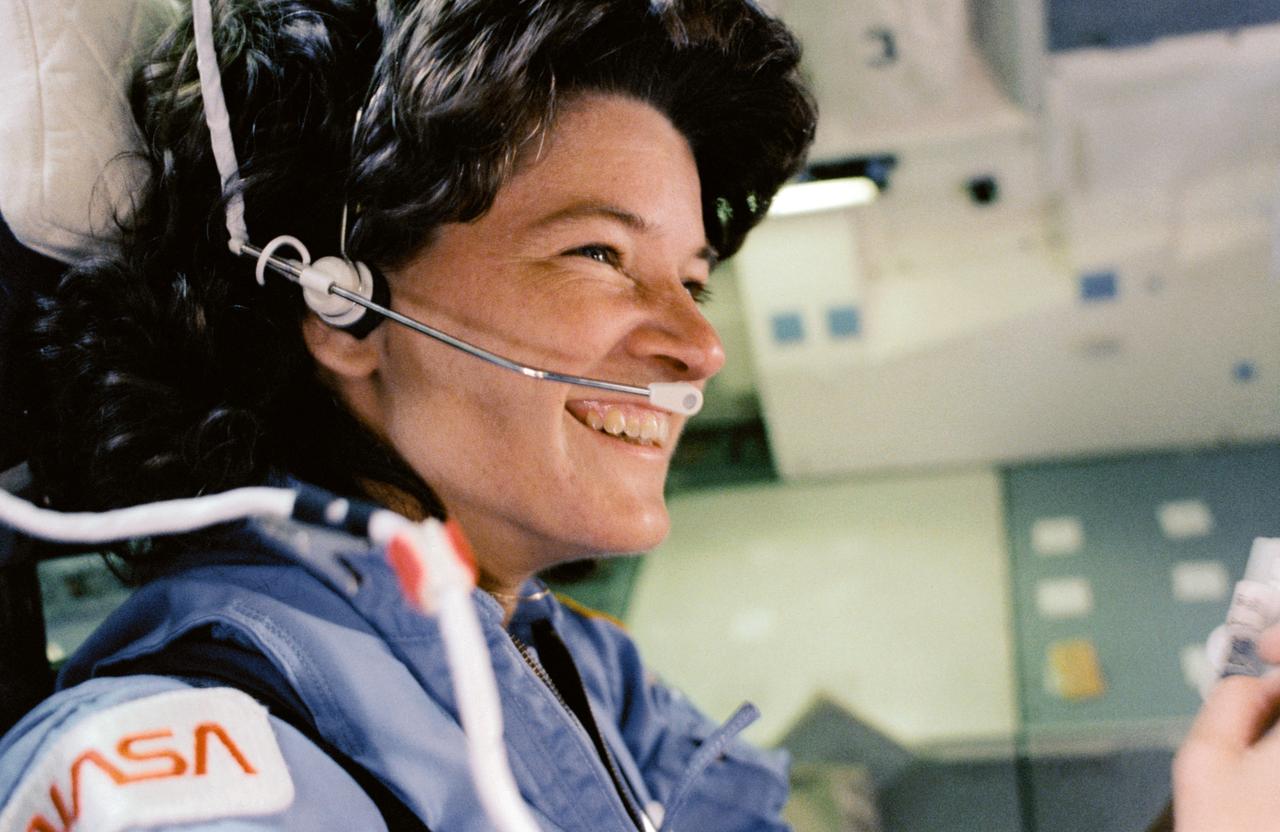
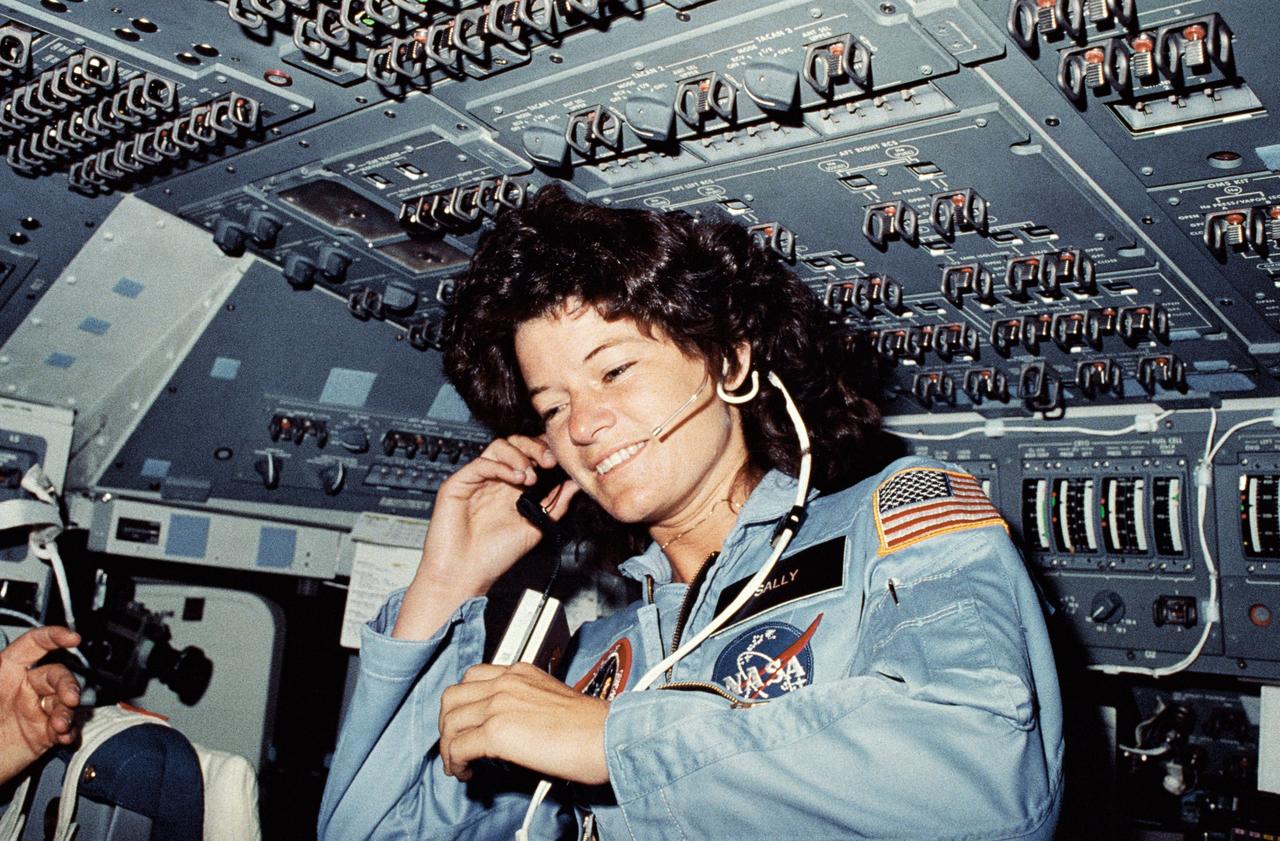
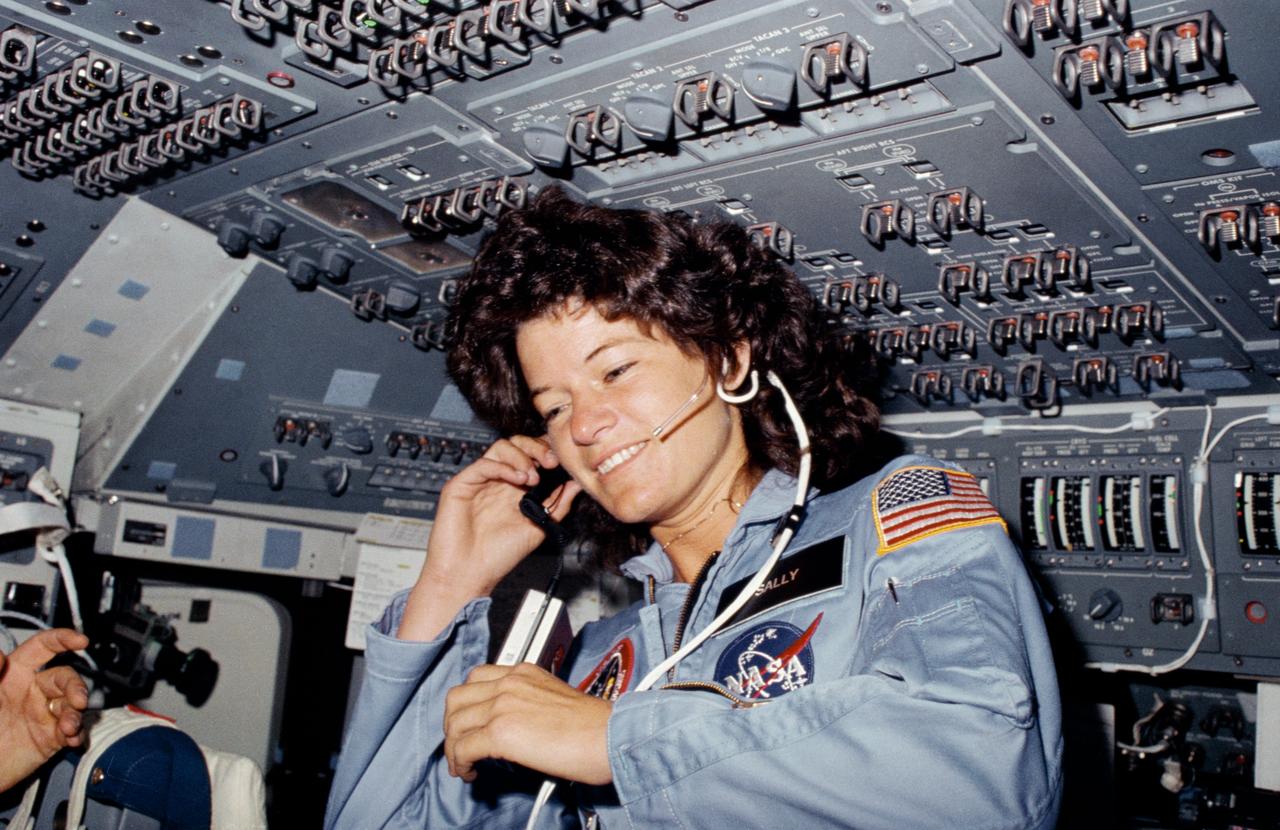
STS007-02-027  (21 June 1983) --- Astronaut Sally K. Ride, STS-7 mission specialist,  communicates with ground controllers from the flight deck of the Earth-orbiting Space  Shuttle Challenger.
Mission Specialist (MS) Ride on forward flight deck
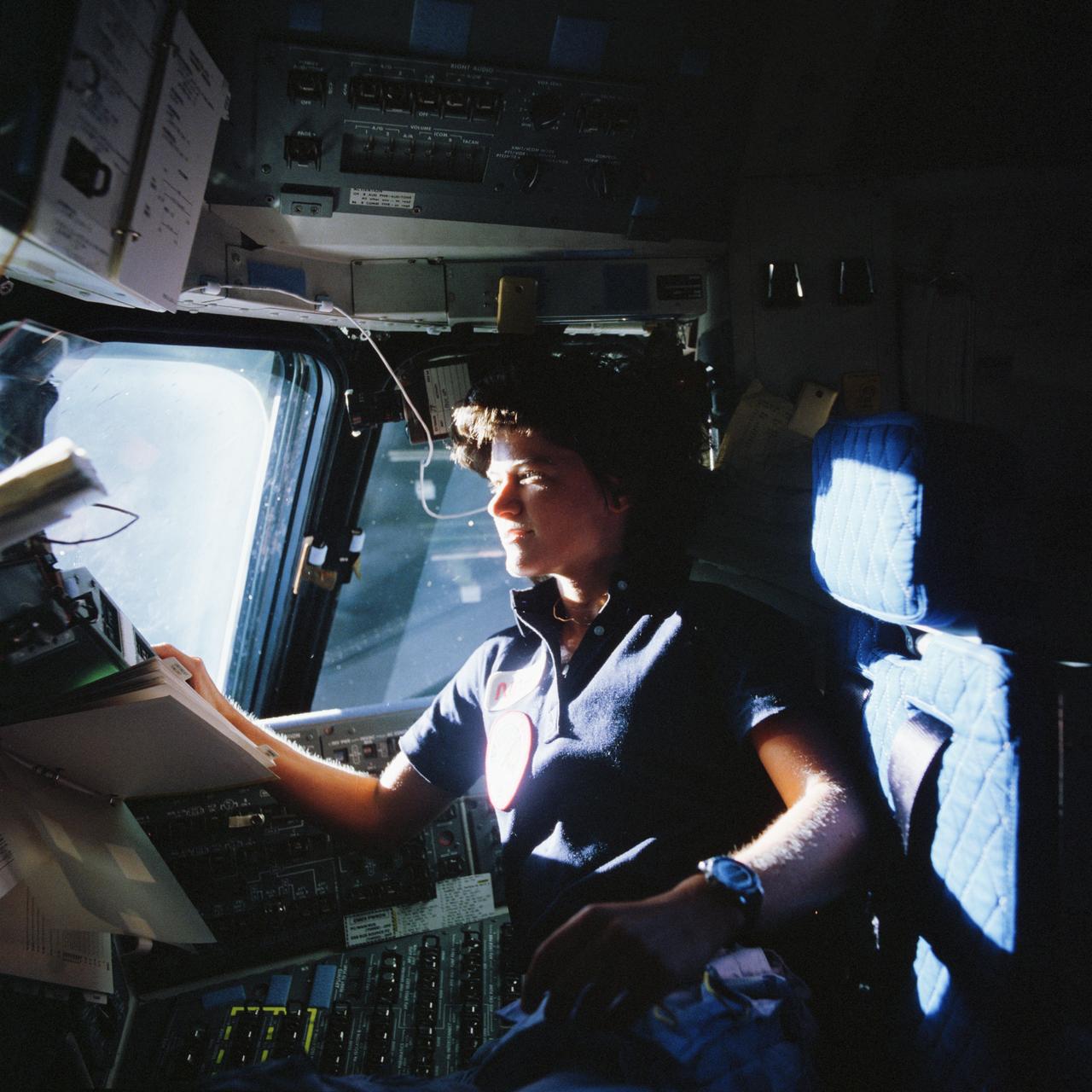
STS007-05-029 / S83-35783(5-13 Oct 1984) --- Astronaut Sally K. Ride, mission specialist, is shown here sitting in the front seat and looking out the windows of the Earth-orbiting Space Shuttle Challenger.  Ride and four other crew members are onboard the Challenger.
STS-7 crew on aft flight deck during proximity operations
S83-35783 / STS007-05-029 (18-24 June 1983) --- Astronaut Sally K. Ride, mission specialist, is shown here sitting in the front seat and looking out the windows of the Earth-orbiting Space Shuttle Challenger.  Ride and four other crew members are onboard the Challenger.
Astronaut Sally Ride on Flight Deck
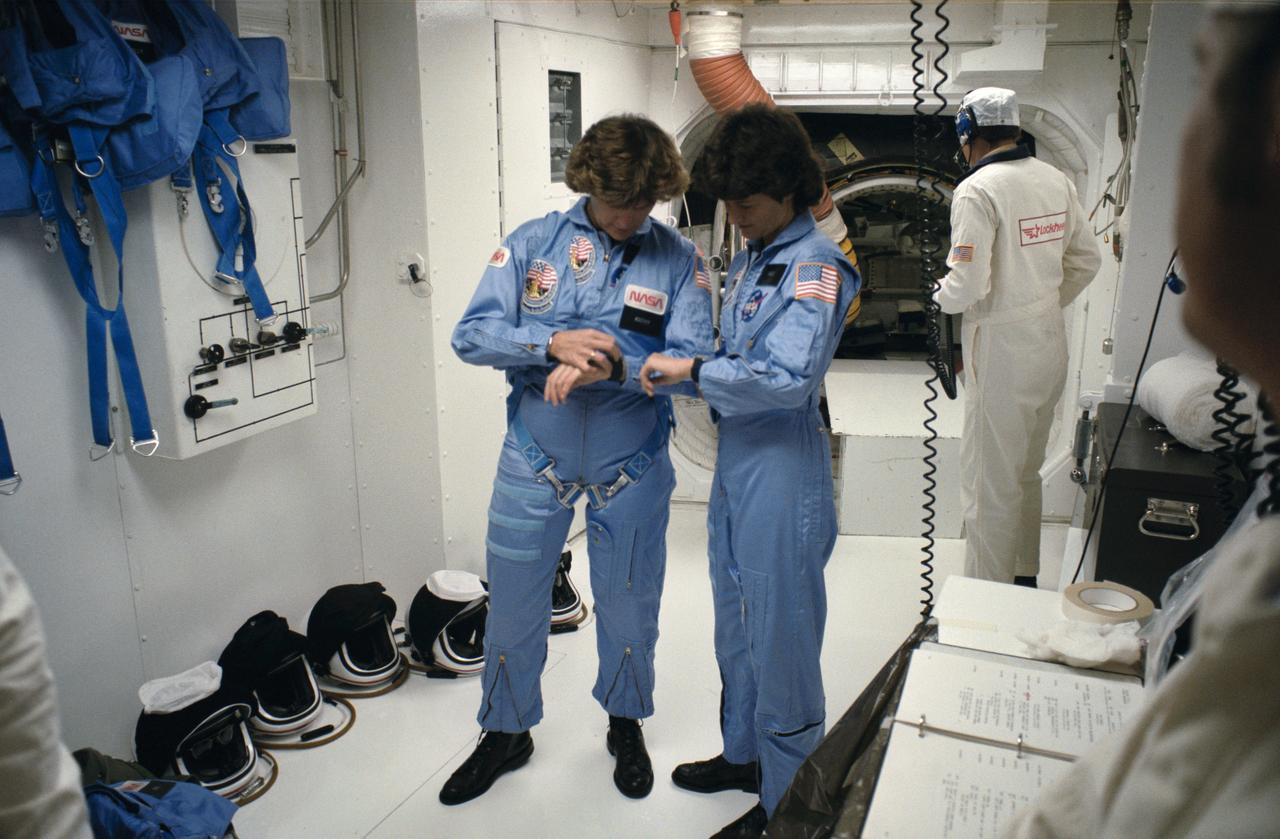
41G-90082 / S17-90082 (5 Oct 1984) --- Astronauts Sally K. Ride (right) and Kathryn D. Sullivan, two of three mission specialists, synchronize their watches prior to ingressing the Space Shuttle Challenger on the launch pad at Kennedy Space Center (KSC).  They are in the White Room leading to the entry hatch of the vertically configured spacecraft.
Astronauts Sullivan and Ride synchronize their watches before liftoff
S83-35763 / STS007-02-027 (18 June 1983) --- Seen on the flight deck of the space shuttle Challenger, astronaut Sally K. Ride, STS-7 mission specialist,  became the first American woman in space on June 18, 1983.  Photo credit: NASA
STS-7 - Ride, Sally (Inflight)
S83-32822 (5 May 1983) --- Astronaut Sally K. Ride (left) participates in a mission sequence test in preparation for STS-7, in the Kennedy Space Center?s (KSC) vertical processing facility (VPF). Dr. Ride is a mission specialist for the flight. She is joined here by Anna L. Fisher, a physician and astronaut from the 1978 group of 35, which also included Dr. Ride. Photo credit: NASA
CREW TRAINING - STS-7 - KSC
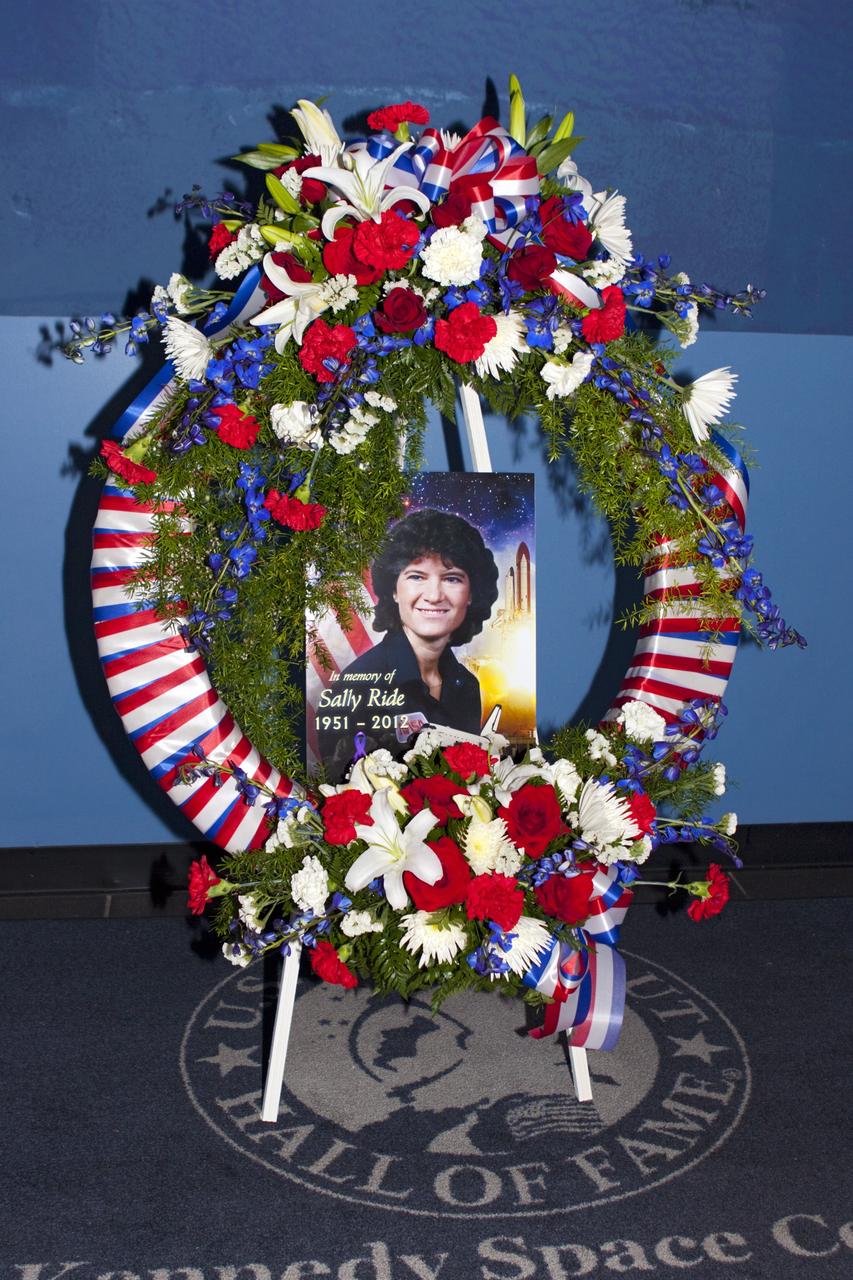
TITUSVILLE, Fla. - A wreath was laid at the U. S. Astronaut Hall of Fame honoring Sally K. Ride, who became America's first woman in space in 1983. Following her death on July 23, 2012, Ride is being remembered for her service to NASA and for her efforts to encourage children to study math, science and technology.      A California-born physicist, she broke the gender barrier 29 years ago when she rode to orbit aboard space shuttle Challenger on STS-7. Ride subsequently served, again as a mission specialist, on STS-41G in 1984. Following her career with NASA, in 2001 Ride founded her own company, Sally Ride Science, to pursue her long-time passion of motivating youth -- especially girls and young women -- to pursue careers in technical fields.  Photo credit: NASA/Jim Grossmann
KSC-2012-3958
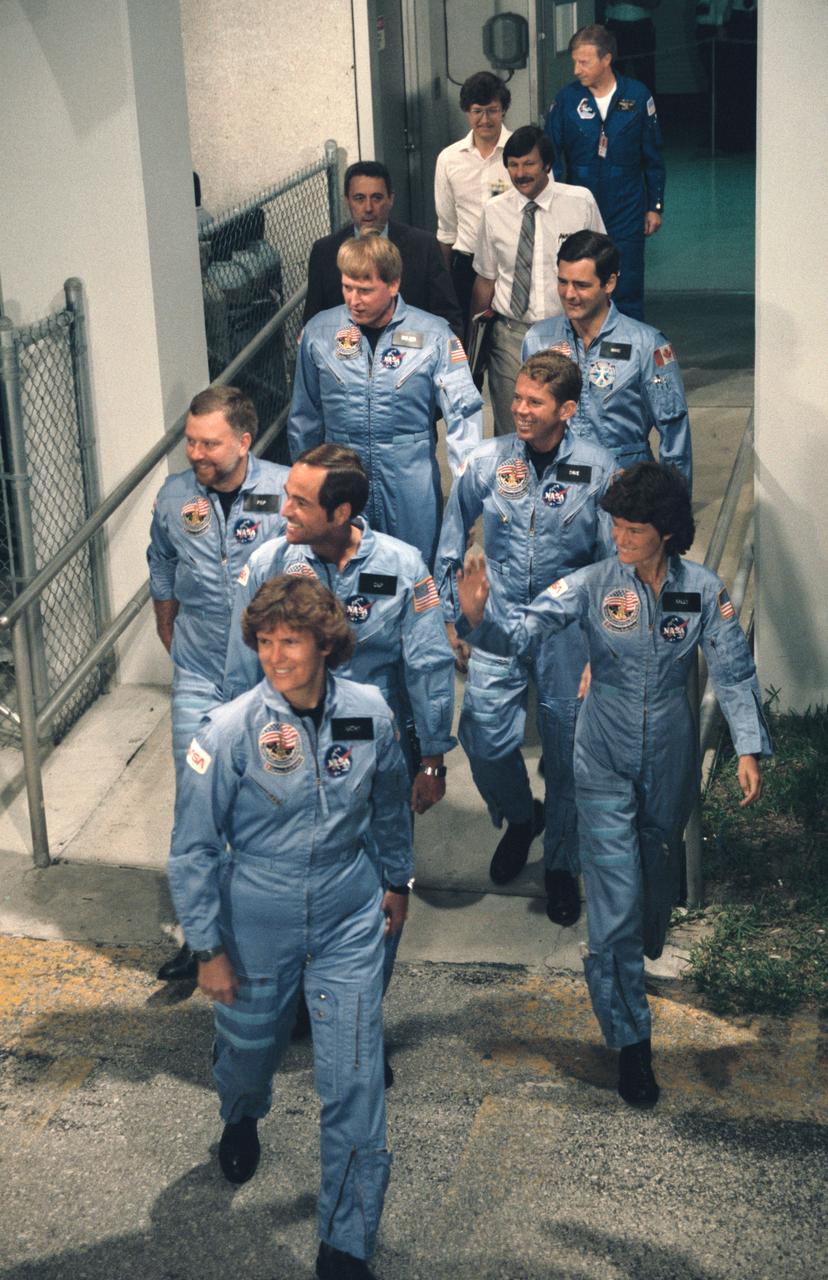
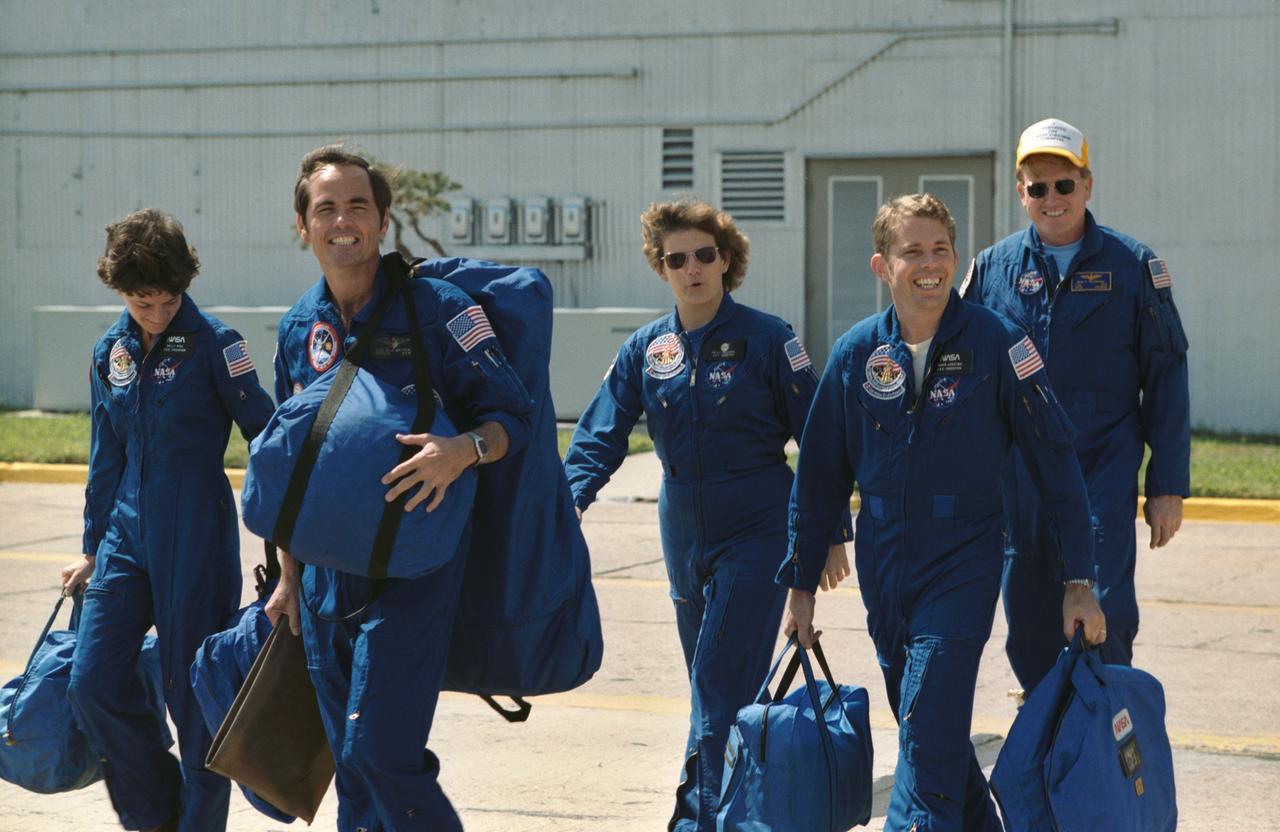
41G-90081 / S17-90081 (5 Oct 1984) --- The seven member crew leaves the Operations and Checkout Building (OCB) to take a van ride to the launch pad.  Leading the way is Kathryn D. Sullivan followed in file by Robert L. Crippen, Paul D. Scully-Power and Jon A. McBride.  On the right side are Sally K. Ride, David C. Leestma and Marc Garneau.  Trailing the crew are George W. S. Abbey, Richard Nygren, Paul Bulver, and Paul J. Weitz.
STS 41-G crew prepares to leave Operations and checkout bldg for launch
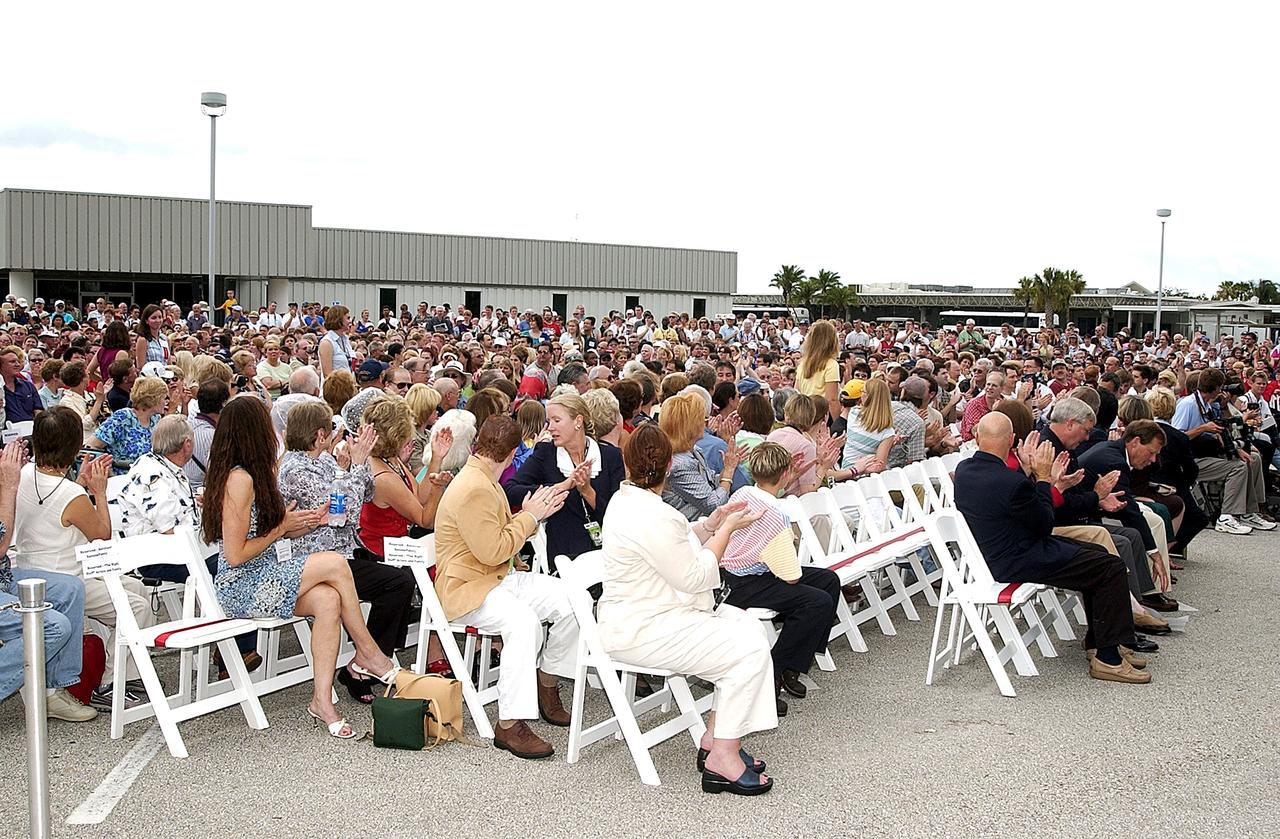
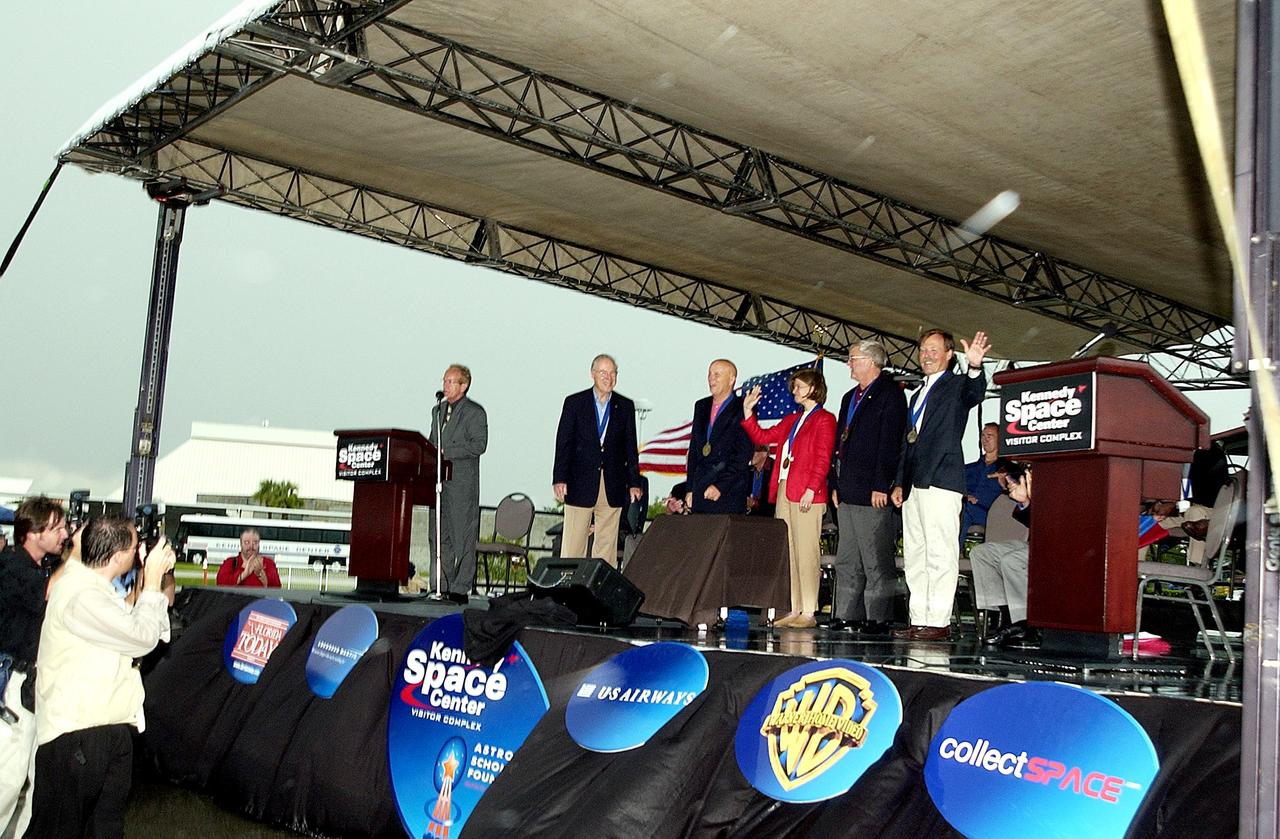
KENNEDY SPACE CENTER, FLA. -  At the KSC Visitor Complex, past and present recipients of college scholarships awarded by the Astronaut Scholarship Foundation stand up to be recognized by the audience.  The occasion was the induction ceremony of four Space Shuttle astronauts into the U.S. Astronaut Hall of Fame, including Daniel Brandenstein, Robert "Hoot" Gibson, Story Musgrave, and Sally K. Ride. The Foundation awards 17 scholarships annually, each worth $8,500, to students interested in studying science and engineering.  Since 1984, more than $1.7 million in scholarship funds have been awarded.
KENNEDY SPACE CENTER, FLA. - At the KSC Visitor Complex, past and present recipients of college scholarships awarded by the Astronaut Scholarship Foundation stand up to be recognized by the audience. The occasion was the induction ceremony of four Space Shuttle astronauts into the U.S. Astronaut Hall of Fame, including Daniel Brandenstein, Robert "Hoot" Gibson, Story Musgrave, and Sally K. Ride. The Foundation awards 17 scholarships annually, each worth $8,500, to students interested in studying science and engineering. Since 1984, more than $1.7 million in scholarship funds have been awarded.
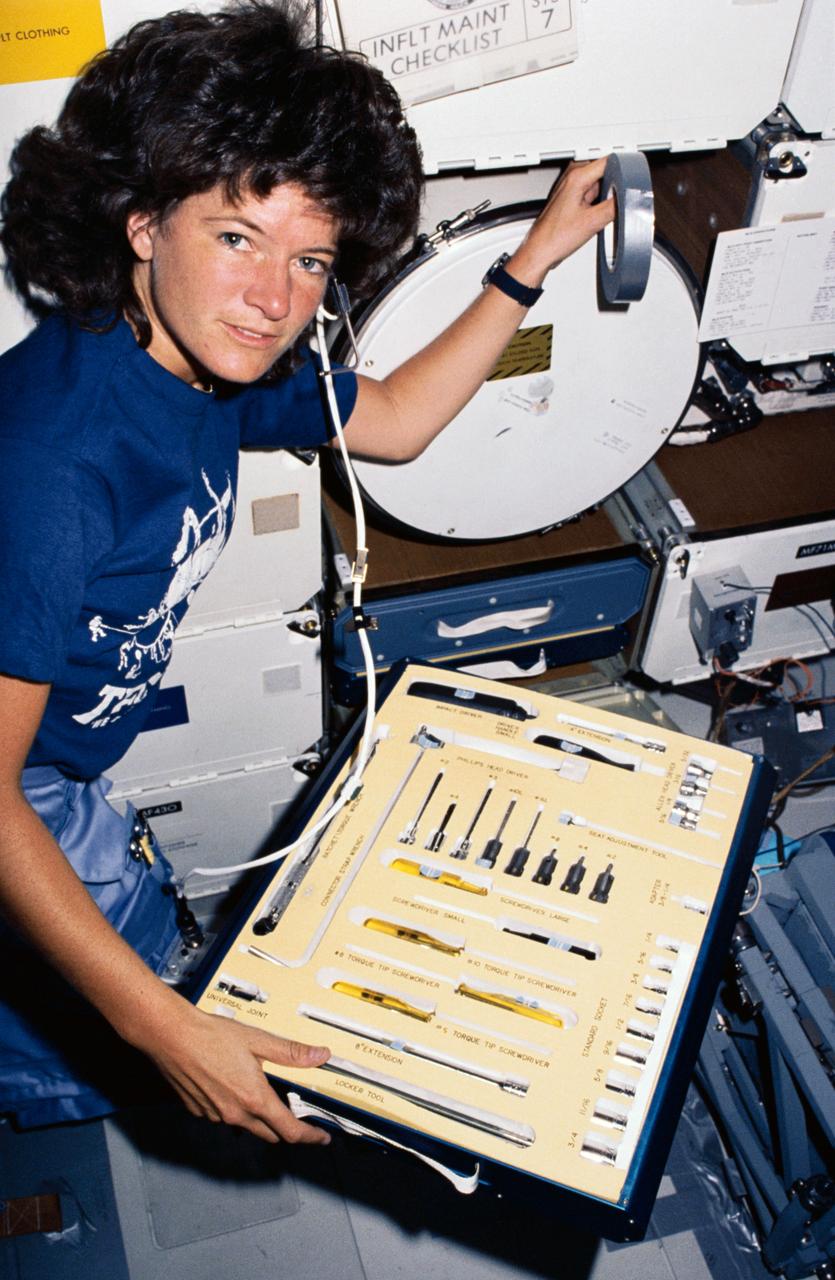
STS007-12-536 (18-24 June 1983) --- Astronaut Sally K. Ride, STS-7 mission specialist, displays the array of tools at her disposal on the mid deck of the Earth-orbiting Space Shuttle Challenger.  Dr. Ride is positioned near the monodisperse latex reactor (MLR) experiment.  They cylinder near her elbow is the actual reactor and the device next to it at right frame edge is the MRL apparatus container.  Dr. Ride and four other astronauts are sharing duties aboard the reusable spacecraft for a six-day space mission full of “firsts.” This photograph was made with a 35mm camera.  It was among the visuals used by crewmembers at their post-flight press conference.
Mission Specialist (MS) Ride with tool tray on middeck
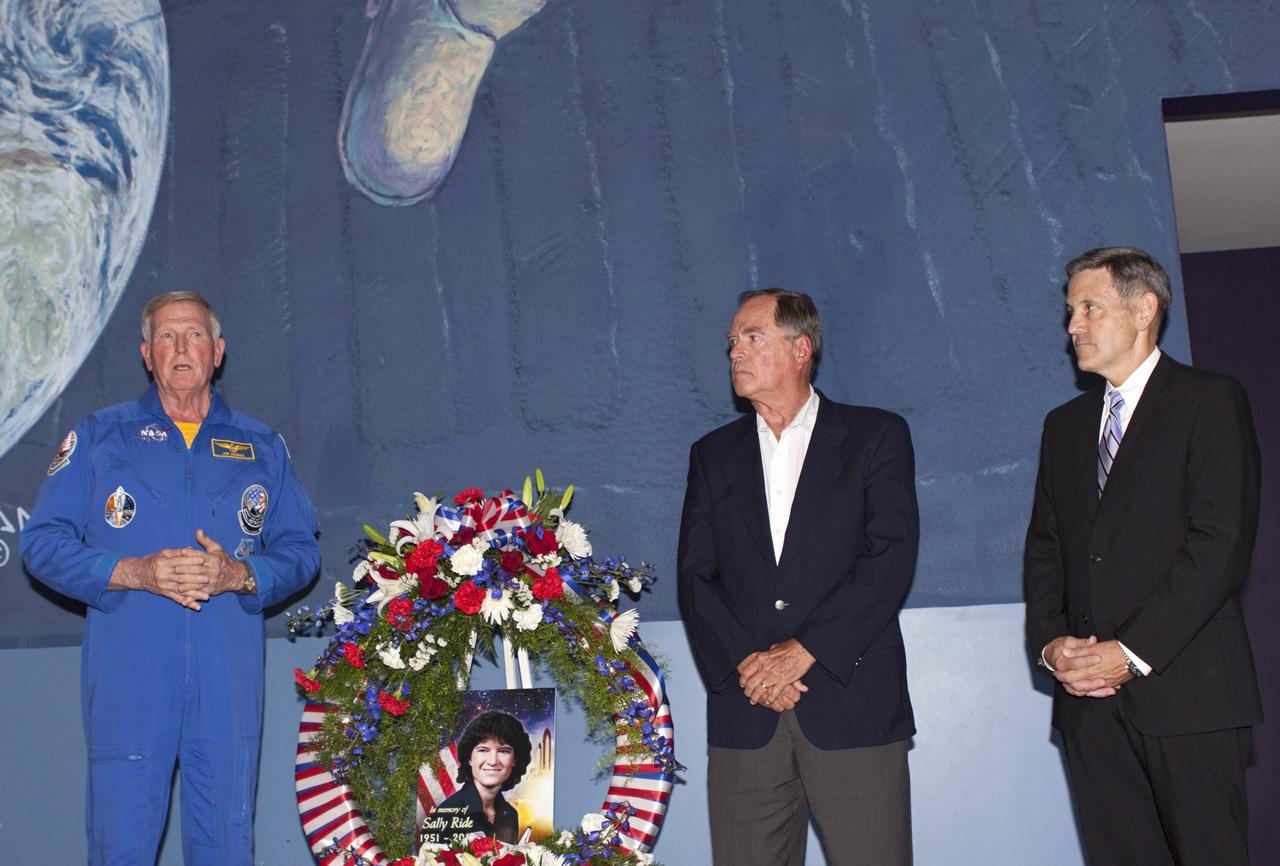
TITUSVILLE, Fla. - Former astronauts Jon McBride, left, and Bob Crippen, center, along with Kennedy Space Center director Bob Cabana, also a former astronaut, laid a wreath at the U. S. Astronaut Hall of Fame honoring Sally K. Ride, who became America's first woman in space in 1983. Following her death on July 23, 2012, Ride is being remembered for her service to NASA and for her efforts to encourage children to study math, science and technology. Crippen was commander on both of Ride's space shuttle missions. McBride was pilot on her second flight. Ride was inducted into the Astronaut Hall of Fame in 2003.      A California-born physicist, she broke the gender barrier 29 years ago when she rode to orbit aboard space shuttle Challenger on STS-7. Ride subsequently served, again as a mission specialist, on STS-41G in 1984. Following her career with NASA, in 2001 Ride founded her own company, Sally Ride Science, to pursue her long-time passion of motivating youth -- especially girls and young women -- to pursue careers in technical fields.  Photo credit: NASA/Jim Grossmann
KSC-2012-3957
KENNEDY SPACE CENTER, FLA. -  At the KSC Visitor Complex, former astronaut Robert L. Crippen (standing right) congratulates former astronaut Sally K. Ride at her induction ceremony into the U.S. Astronaut Hall of Fame. Also standing is former astronaut James A. Lovell.  Seated on the dais, from left, are former astronauts Gordon Cooper, Scott Carpenter, Buzz Aldrin, Walter Cunningham, Edgar B. Mitchell, and Fred W. Haise, all previously inducted into the Hall of Fame. Being inducted with Ride are Space Shuttle astronauts Daniel Brandenstein, Robert "Hoot" Gibson, and Story Musgrave. Conceived by six of the Mercury Program astronauts, the U.S. Astronaut Hall of Fame opened in 1990 to provide a place where space travelers could be remembered for their participation and accomplishments in the U.S. space program. The four new inductees join 48 previously honored astronauts from the ranks of the Gemini, Apollo, Skylab, Apollo-Soyuz, and Space Shuttle programs.
KENNEDY SPACE CENTER, FLA. - At the KSC Visitor Complex, former astronaut Robert L. Crippen (standing right) congratulates former astronaut Sally K. Ride at her induction ceremony into the U.S. Astronaut Hall of Fame. Also standing is former astronaut James A. Lovell. Seated on the dais, from left, are former astronauts Gordon Cooper, Scott Carpenter, Buzz Aldrin, Walter Cunningham, Edgar B. Mitchell, and Fred W. Haise, all previously inducted into the Hall of Fame. Being inducted with Ride are Space Shuttle astronauts Daniel Brandenstein, Robert "Hoot" Gibson, and Story Musgrave. Conceived by six of the Mercury Program astronauts, the U.S. Astronaut Hall of Fame opened in 1990 to provide a place where space travelers could be remembered for their participation and accomplishments in the U.S. space program. The four new inductees join 48 previously honored astronauts from the ranks of the Gemini, Apollo, Skylab, Apollo-Soyuz, and Space Shuttle programs.
KENNEDY SPACE CENTER, FLA. -  At the KSC Visitor Complex, former astronaut Robert L. Crippen (right) presents former astronaut Sally K. Ride (standing center) at her induction ceremony into the U.S. Astronaut Hall of Fame. Also standing is former astronaut James A. Lovell.  Seated on the dais are, from left, former astronauts John H. Glenn, Gordon Cooper, Buzz Aldrin, and Walter Cunningham, all previously inducted into the Hall of Fame. Being inducted with Ride are Space Shuttle astronauts Daniel Brandenstein, Robert "Hoot" Gibson, and Story Musgrave. Conceived by six of the Mercury Program astronauts, the U.S. Astronaut Hall of Fame opened in 1990 to provide a place where space travelers could be remembered for their participation and accomplishments in the U.S. space program. The four new inductees join 48 previously honored astronauts from the ranks of the Gemini, Apollo, Skylab, Apollo-Soyuz, and Space Shuttle programs.
KENNEDY SPACE CENTER, FLA. - At the KSC Visitor Complex, former astronaut Robert L. Crippen (right) presents former astronaut Sally K. Ride (standing center) at her induction ceremony into the U.S. Astronaut Hall of Fame. Also standing is former astronaut James A. Lovell. Seated on the dais are, from left, former astronauts John H. Glenn, Gordon Cooper, Buzz Aldrin, and Walter Cunningham, all previously inducted into the Hall of Fame. Being inducted with Ride are Space Shuttle astronauts Daniel Brandenstein, Robert "Hoot" Gibson, and Story Musgrave. Conceived by six of the Mercury Program astronauts, the U.S. Astronaut Hall of Fame opened in 1990 to provide a place where space travelers could be remembered for their participation and accomplishments in the U.S. space program. The four new inductees join 48 previously honored astronauts from the ranks of the Gemini, Apollo, Skylab, Apollo-Soyuz, and Space Shuttle programs.
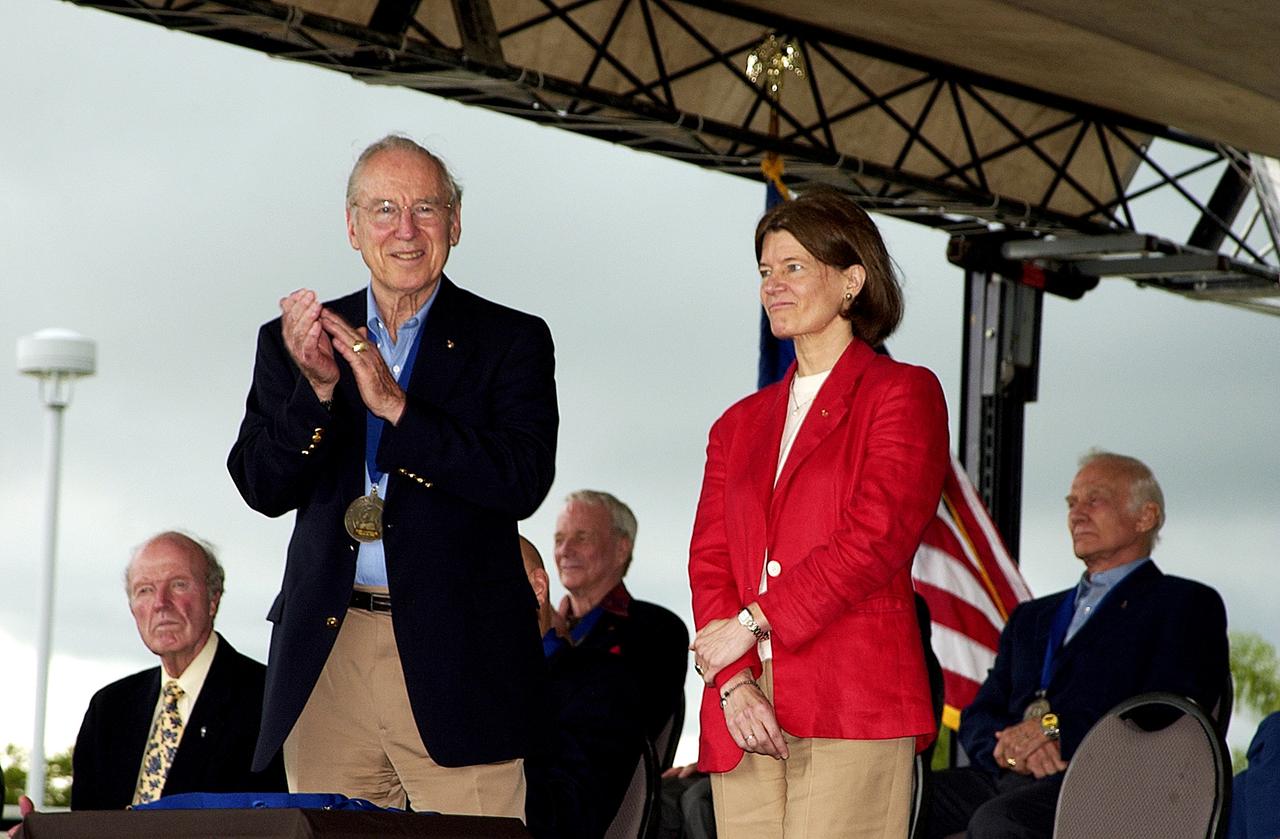
KENNEDY SPACE CENTER, FLA. -  At the KSC Visitor Complex, former astronaut James A. Lovell (standing left) applauds former astronaut Sally K. Ride at her induction ceremony into the U.S. Astronaut Hall of Fame. Seated on the dais, from left, are former astronauts Gordon Cooper, Scott Carpenter, and  Buzz Aldrin, all previously inducted into the Hall of Fame. Being inducted with Ride are Space Shuttle astronauts Daniel Brandenstein, Robert "Hoot" Gibson, and Story Musgrave. Conceived by six of the Mercury Program astronauts, the U.S. Astronaut Hall of Fame opened in 1990 to provide a place where space travelers could be remembered for their participation and accomplishments in the U.S. space program. The four new inductees join 48 previously honored astronauts from the ranks of the Gemini, Apollo, Skylab, Apollo-Soyuz, and Space Shuttle programs.
KENNEDY SPACE CENTER, FLA. - At the KSC Visitor Complex, former astronaut James A. Lovell (standing left) applauds former astronaut Sally K. Ride at her induction ceremony into the U.S. Astronaut Hall of Fame. Seated on the dais, from left, are former astronauts Gordon Cooper, Scott Carpenter, and Buzz Aldrin, all previously inducted into the Hall of Fame. Being inducted with Ride are Space Shuttle astronauts Daniel Brandenstein, Robert "Hoot" Gibson, and Story Musgrave. Conceived by six of the Mercury Program astronauts, the U.S. Astronaut Hall of Fame opened in 1990 to provide a place where space travelers could be remembered for their participation and accomplishments in the U.S. space program. The four new inductees join 48 previously honored astronauts from the ranks of the Gemini, Apollo, Skylab, Apollo-Soyuz, and Space Shuttle programs.
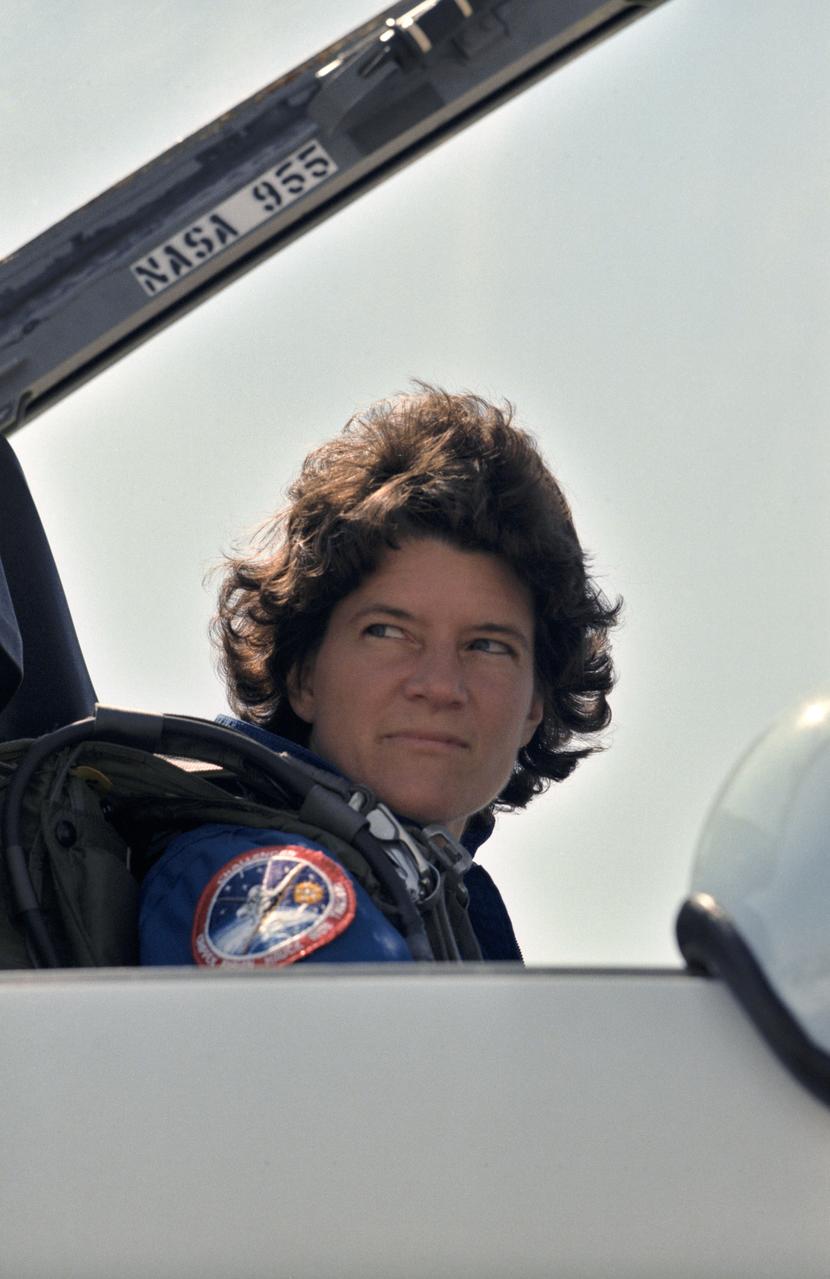
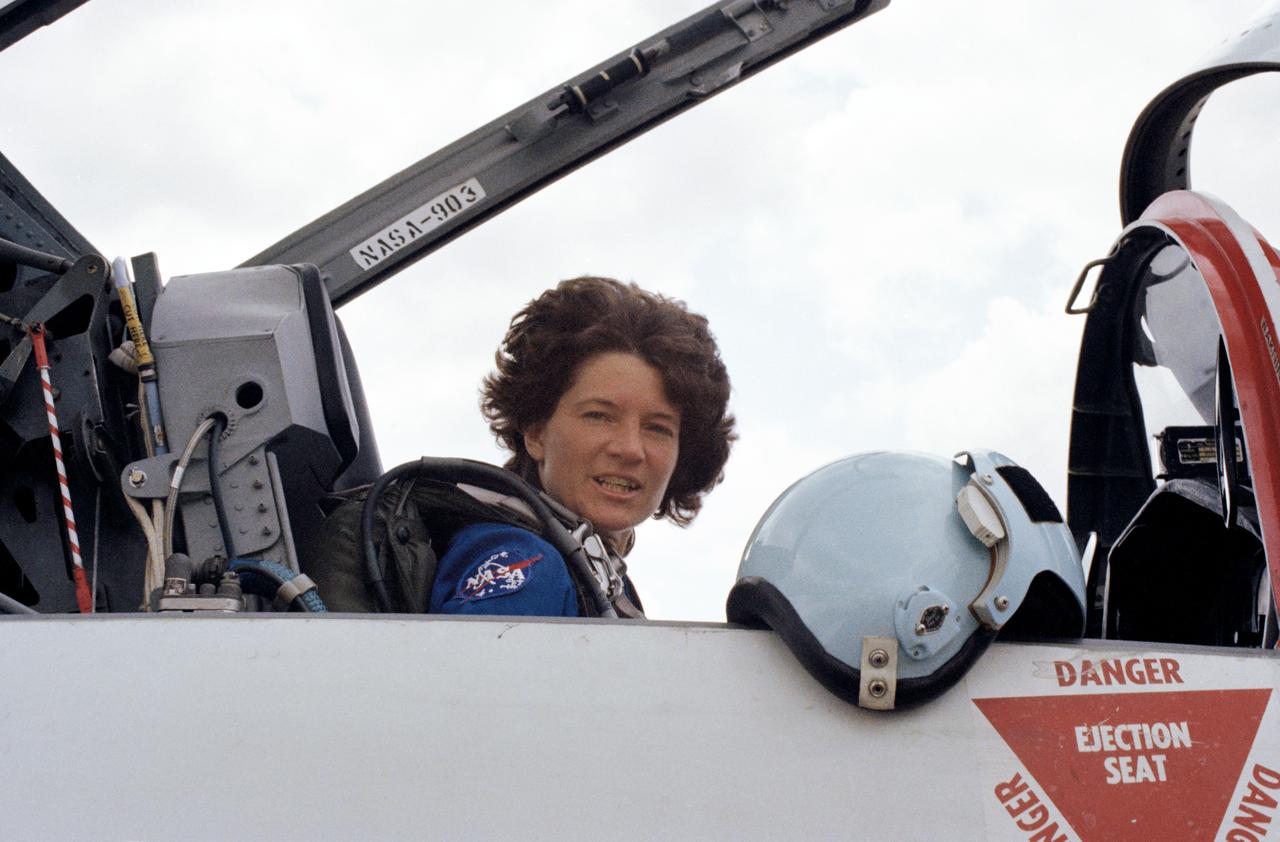
41G-90028 / S17-90028 (2 Oct 1984) --- Astronaut Sally K. Ride, 41-G mission specialist, gets a last look of Houston from the ground prior to departing the area in a T-38 jet aircraft to begin preparations in Florida for her 41-G space mission later in the week.  Dr. Ride is in the rear station of a NASA T-38 at Ellington Air Base, near the Johnson Space Center.  She and four other astronauts used the jet trainers to fly to Florida while the mission's two payload specialists flew there aboard a  Gulfstream aircraft.
Astronaut Sally Ride prepares to leave for KSC
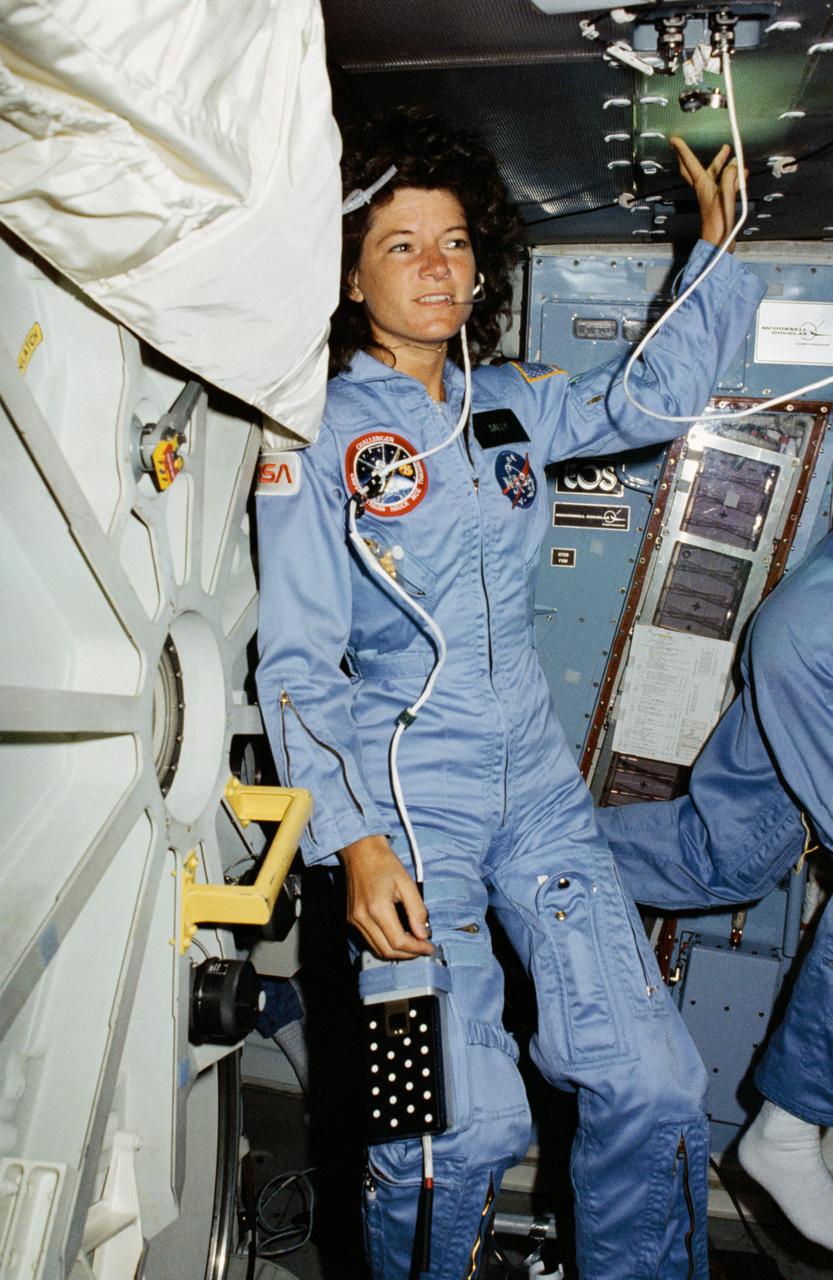
STS007-02-020 (21 June 1983) --- Astronaut Sally K. Ride, STS-7 mission specialist, STS-7 mission specialist, stands in the mid deck of the orbiting Space Shuttle Challenger near one of the experiment with which she has devoted a great deal of time.  The continuous flow electrophoresis system (CFES) experiment, about the size of a household refrigerator, stands nearby.  One of her fellow crewmembers moves partially out of frame in the background.  The tube on her face is part of a communications system linking Dr. Ride to ground controllers in Houston.
Mission Specialist (MS) Ride on middeck
STS007-15-671 / S83-35767 (21 June 1983) --- Among the "firsts" on the mission is this unprecedented scene of a crew of five astronauts aboard the Space Shuttle Challenger in space.  A pre-set 35mm camera exposed the frame.  Left to right on the flight deck are Norman E. Thagard, mission specialist; Robert L. Crippen, commander; Frederick H. Hauck, pilot; Sally K. Ride, mission specialist; and John M. Fabian, mission specialist.  Crippen the crew commander, is making his second Space Shuttle trip; pilot Hauck and mission specialist Dr. Ride, Dr. Thagard and Fabian are members of the 1978 class of astronaut candidates (ASCAN).
INFLIGHT (CREW ACTIVITIES) - STS-7
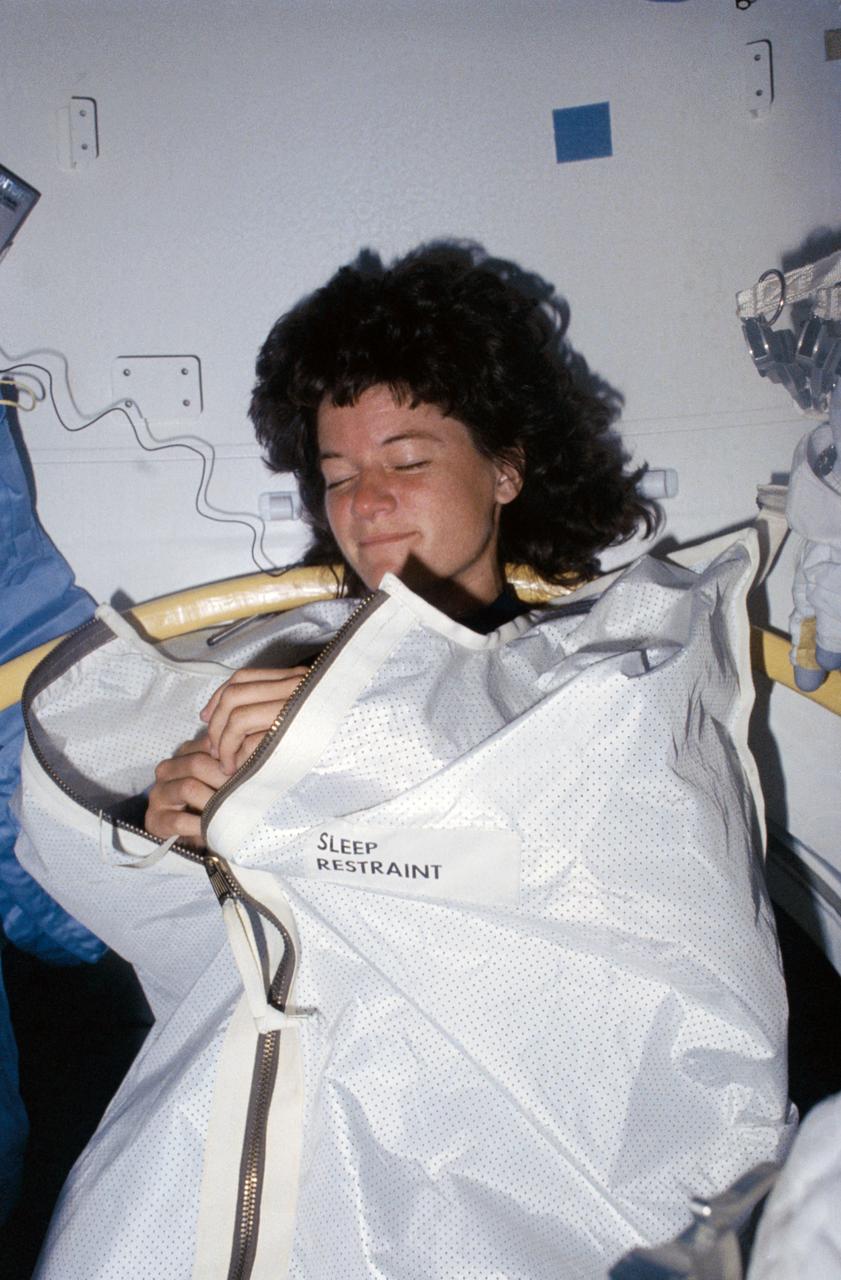
STS007-26-1438 (18-24 June 1983) --- Astronaut Sally K. Ride, mission specialist, was captured at her sleep station in the Space Shuttle Challenger's middeck by a fellow crew member using a 35mm camera.  This method of sleep is just one used by the 20 astronauts who have now flown aboard NASA's first two Space Shuttle Orbiters.  Some astronauts choose to sleep in various positions with either their feet or upper bodies or both anchored and others elect to use the sleep restraint device demonstrated here by Dr. Ride.
Mission Specialist (MS) Ride sleeps in airlock
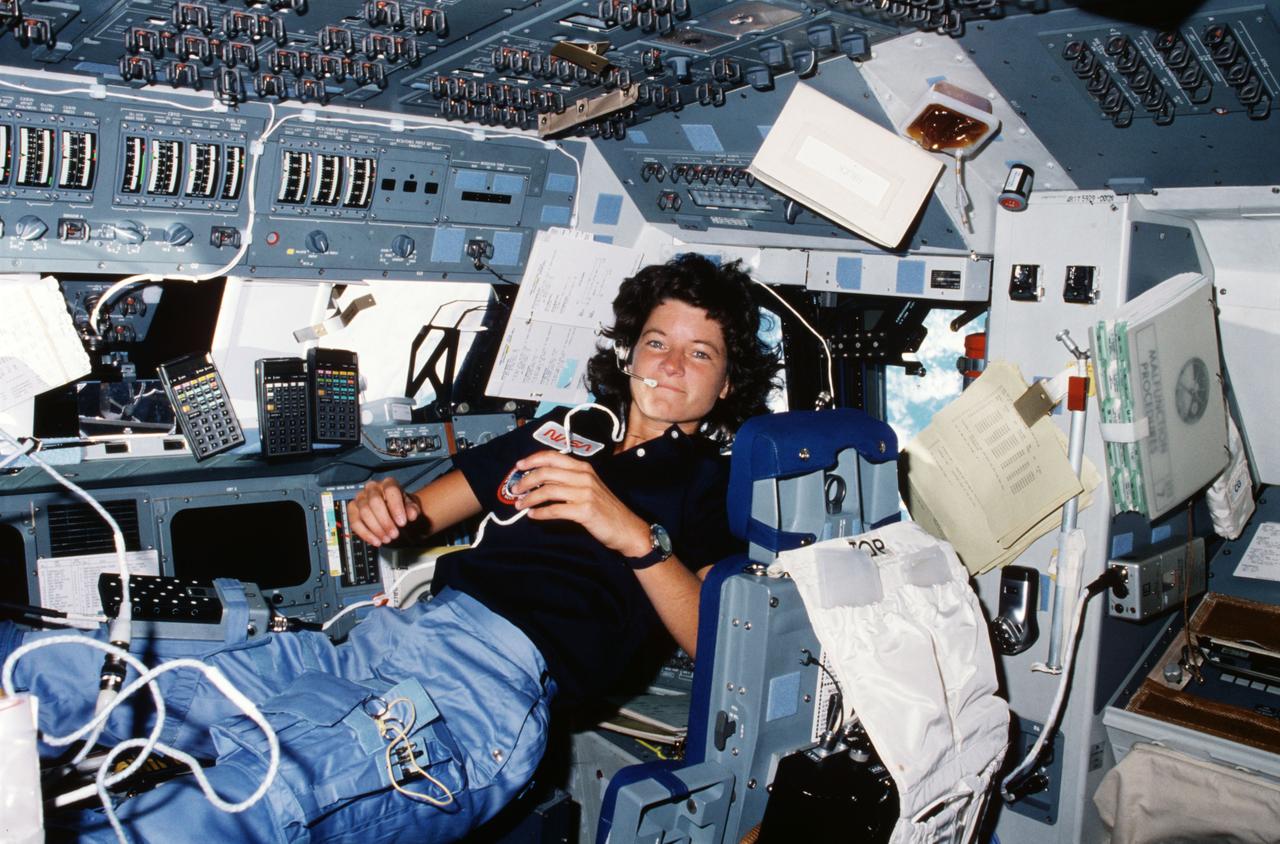
STS007-14-629 (21 June 1983) --– Astronaut Sally K. Ride, STS-7 mission specialist, performs a number of functions simultaneously, proving the necessity for versatility and dexterity in space travel. Floating freely on the flight deck, Dr. Ride communicates with ground controllers in Houston, moves within feet of important reference data, hand calculators and other aids all at the same time. She is one of the five astronaut crew members for the Challenger’s second orbital mission. Her head is in the station normally occupied by the pilot (in this case, Frederick H. (Rick) Hauck) and her feet are anchored at the station for the crew commander (in this case, Robert L. Crippen). Photo credit: NASA
Mission Specialist (MS) Ride at forward flight deck pilots stations controls
S79-29596 (28 Feb 1979) --- Contrasting the old with the new, six astronaut candidates pose for photographers in their new constant wear garments, ideal for the zero-gravity tasks in the pressurized environs of Space Shuttle.  The "old" is an Apollo type spacesuit used for extravehicular activity (EVA).  From left to right are Shannon W. Lucid, Rhea Seddon, Kathryn D. Sullivan, Judith A. Resnik, Anna L. Fisher and Sally K. Ride.
FEMALE ASTRONAUT-CANDIDATES (ASCAN)'S - JSC
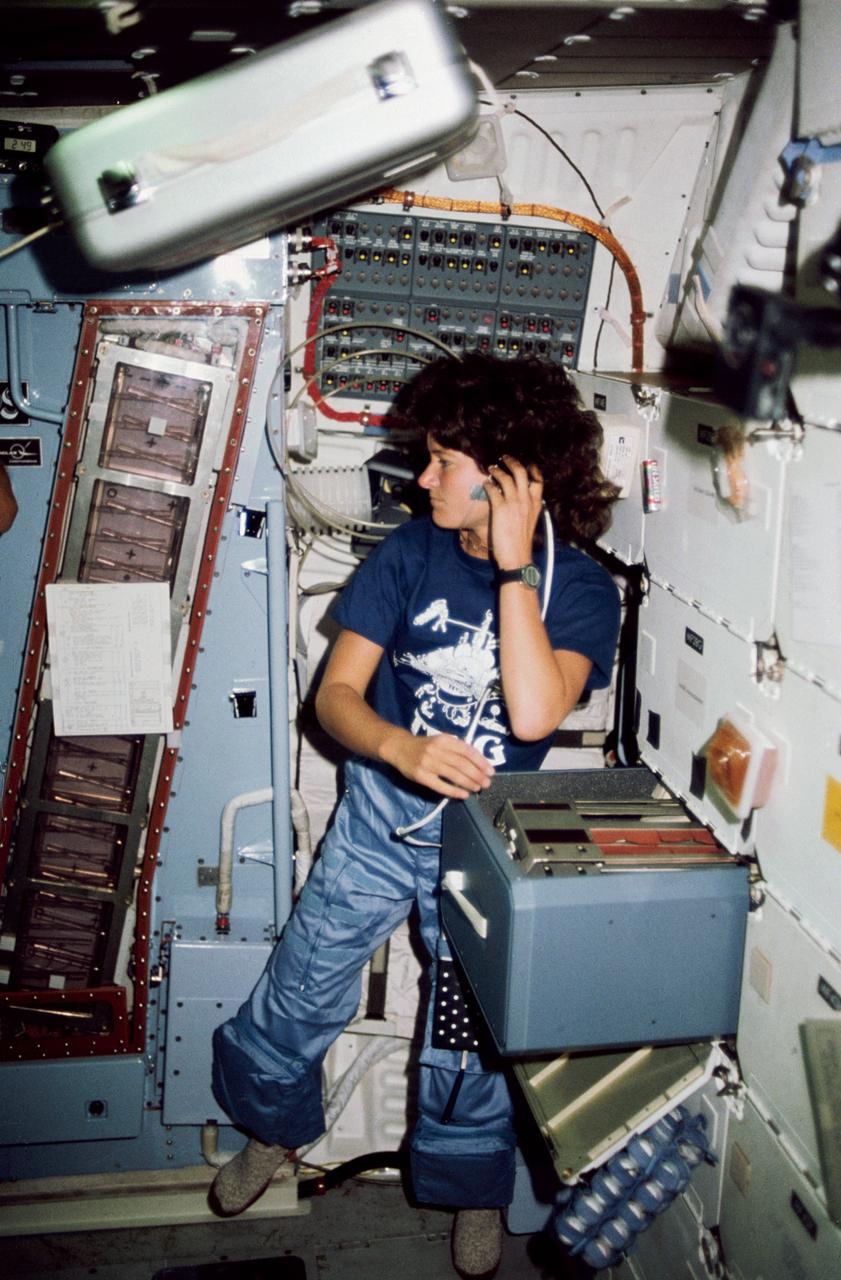
STS007-11-495 (18-24 June 1983) --- Astronaut Sally K. Ride, STS-7 mission specialist, communicates with ground controllers from the mid deck of the Earth-orbiting Space Shuttle Challenger.  She has just opened one of the large lockers during the operation and monitoring of the continuous flow electrophoresis system (CFES) experiment at left edge.  This photograph was made with a 35mm camera.
Mission Specialist (MS) Ride adjusts headset (HDST) on middeck
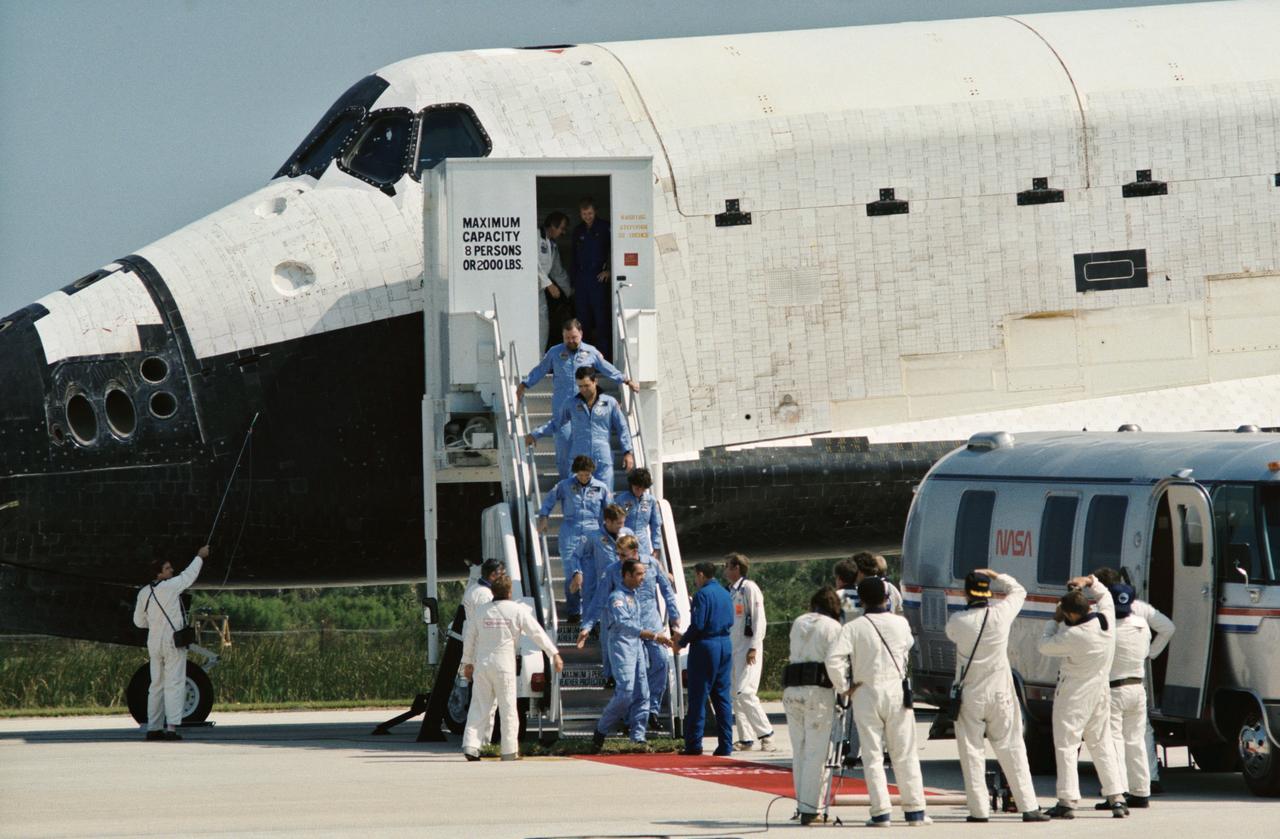
41G-90217 (13 Oct 1984) --- 41-G crew leaves the orbiter after landing at Kennedy Space Center at the end of their mission. Astronaut Robert Crippen shakes hands with George W.S. Abbey, Director of JSC's Flight Crew Operations, while the other crewmembers wait behind him. They are Jon McBride, David Leestma, Sally K. Ride, Kathryn Sullivan, Marc Garneau and Paul Scully-Power.
STS 41-G crew leaves orbiter after landing at Kennedy Space Center
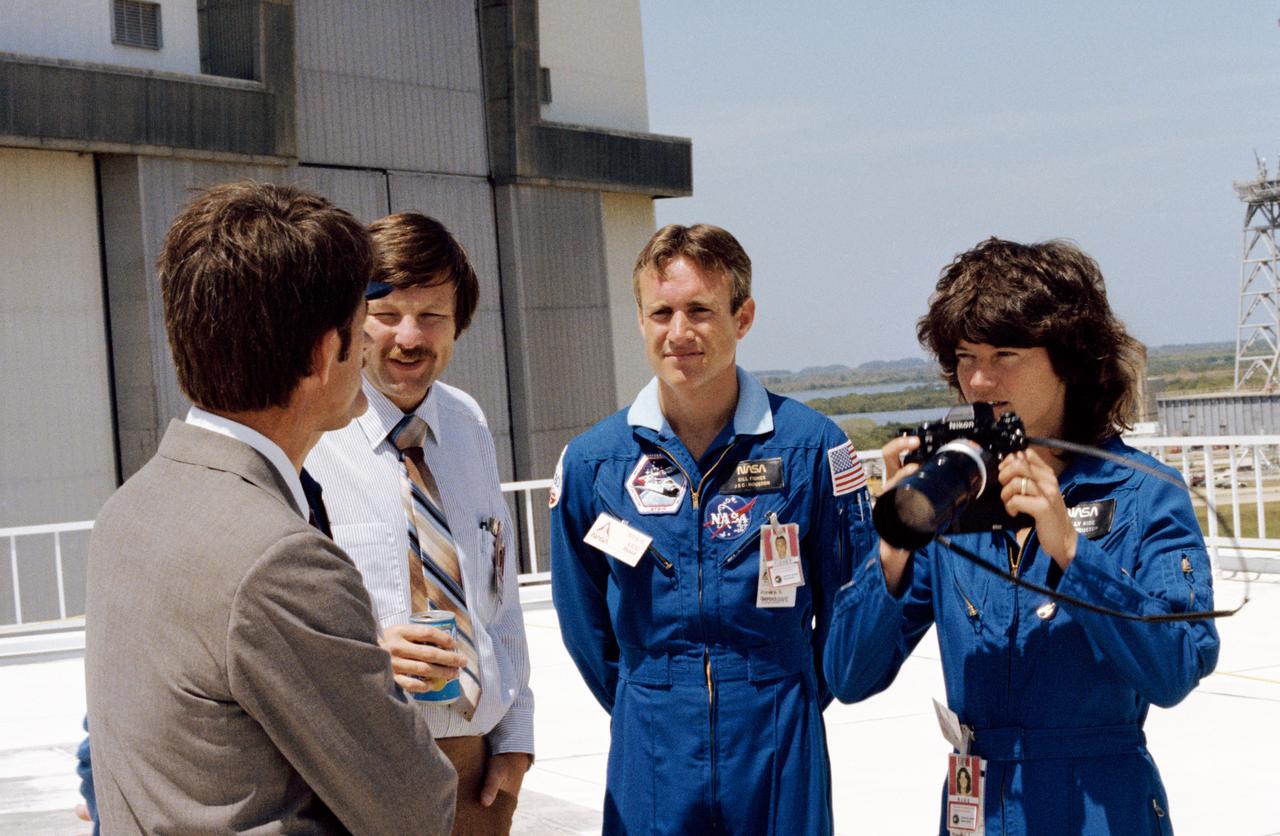
S83-31046 (4 April 1983) --- Astronaut Sally K. Ride, mission specialist for STS-7, scheduled for June 1983, records some of the prelaunch activity for STS-6 on 35mm film at the Kennedy Space Center (KSC). Astronaut William B. Lenoir, STS-5 mission specialist, is at left. Others pictured include Richard W. Nygren (center), chief of the vehicle integration section of the operations division at JSC; and astronaut William F. Fisher, second right. Photo credit: NASA
PREFLIGHT - STS-6 - KSC, FL AND EAFB, TX
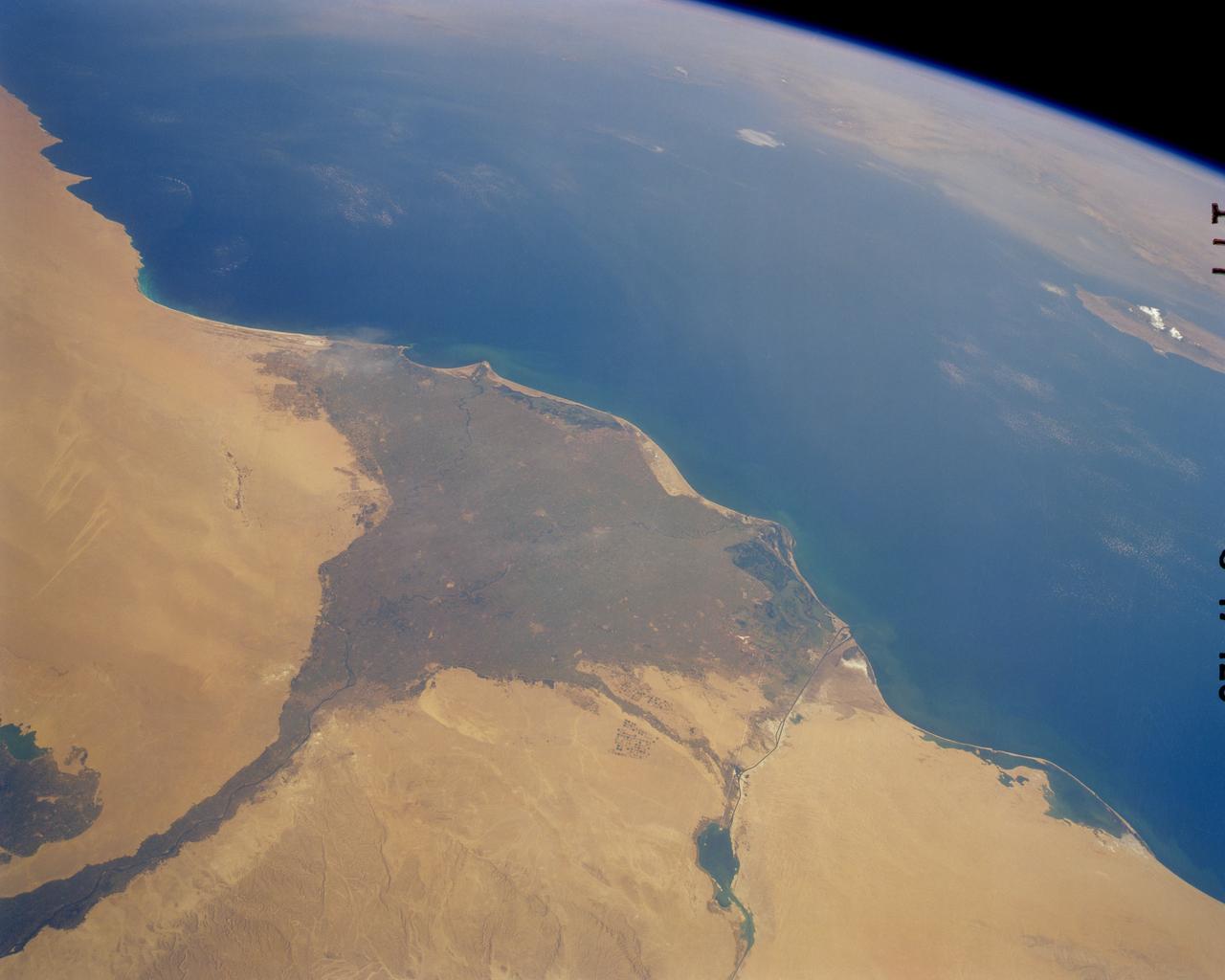
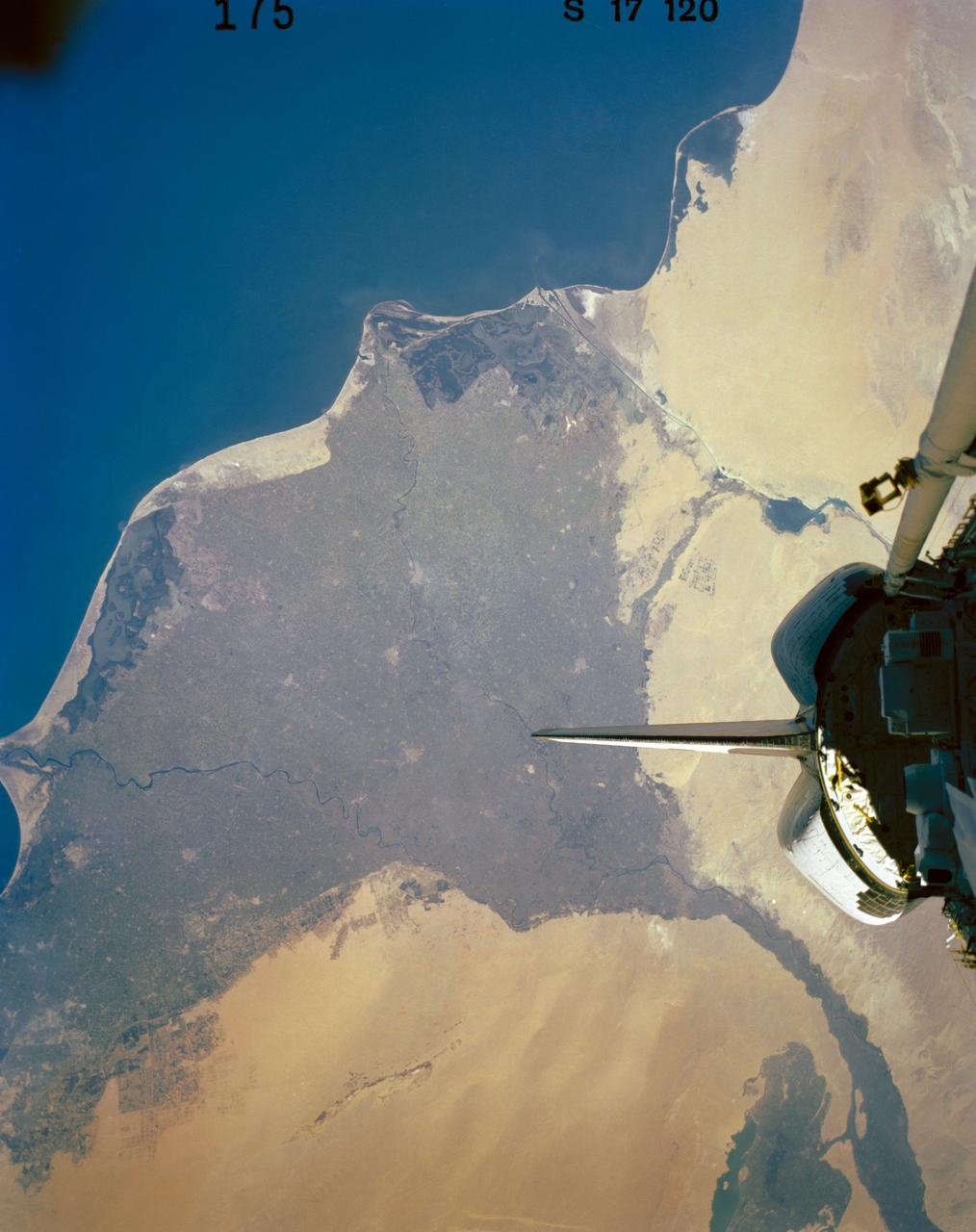
41G-120-177 (5-13 Oct 1984) --- Egypt and the Nile River Delta are easily recognizable in this 250mm frame.  Cairo and the Egyptian pyramids are also visible in the lower left side of this photograph.  The crew consisted of astronauts Robert L. Crippen, commander, Jon A. McBride, pilot; mission specialist’s Kathryn D. Sullivan, Sally K. Ride, and David D. Leestma; Canadian astronaut Marc Garneau; and Paul D. Scully-Power payload specialist.
Earth Observation taken during the 41G mission
S79-29592 (28 Feb 1979) --- Sporting their new Shuttle-type constant-wear garments, these six astronaut candidates pose for a picture in the crew systems laboratory at the Johnson Space Center (JSC) with the personnel rescue enclosure (PRE) or "rescue ball" and an unoccupied Apollo EMU.  From left to right are Rhea Seddon, Kathryn D. Sullivan,  Judith A. Resnik,  Sally K. Ride, Anna L. Fisher and Shannon W. Lucid.
Female Astronaut-Candidates (ASCAN)'s - JSC
S79-29594 (28 Feb 1979) --- Sporting their new Shuttle-type constant-wear garments, these six astronaut candidates pose for a picture in the crew systems laboratory at the Johnson Space Center (JSC).  From left to right are Rhea Seddon, Sally K. Ride, Kathryn D. Sullivan, Shannon W. Lucid, Anna L. Fisher and Judith A. Resnik.
FEMALE ASTRONAUT-CANDIDATES (ASCAN)'S - JSC
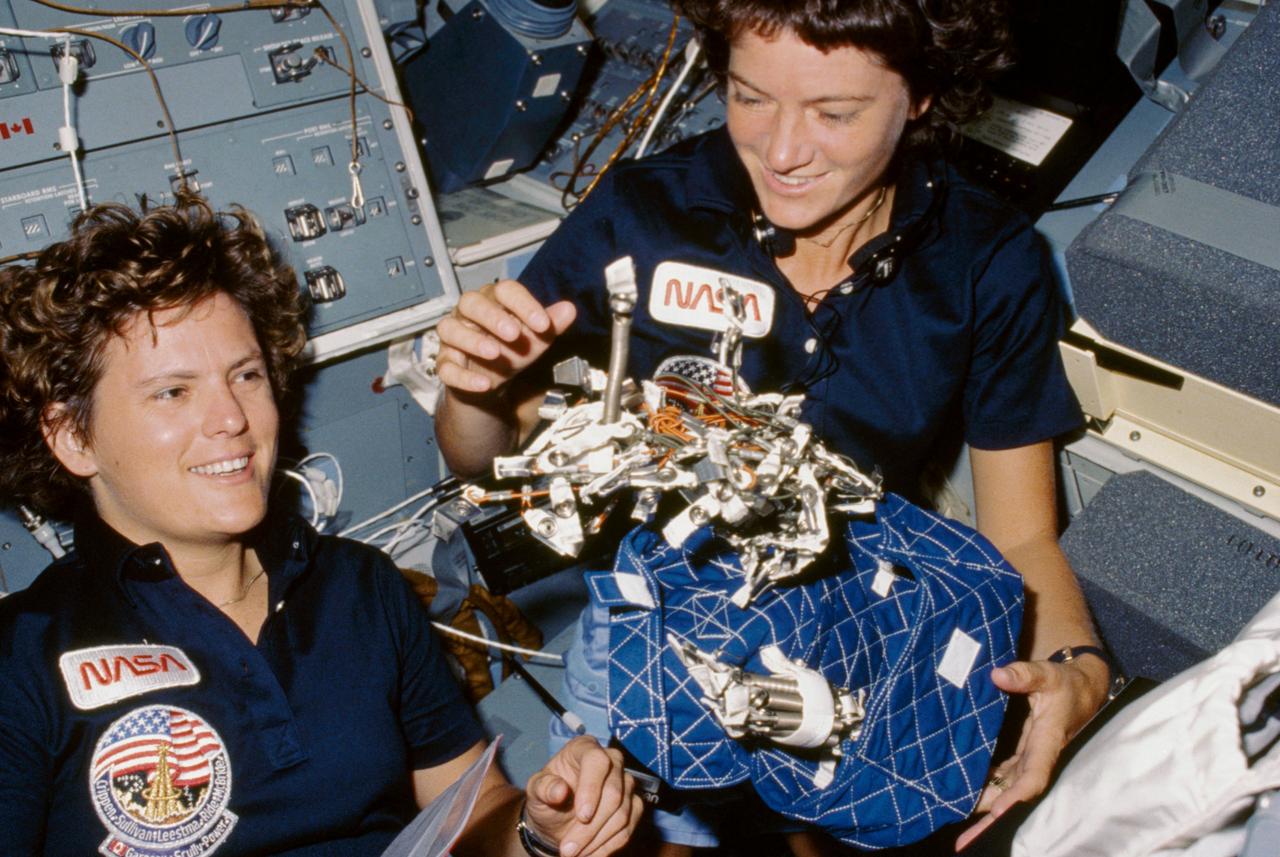
41G-07-021 (5-13 October 1984) --- Astronauts Kathryn D. Sullivan, left, and Sally K. Ride show off what appears to be a "bag of worms", a product of their creativity. The "bag" is a sleep restraint and the majority of the "worms" are springs and clips used with the sleep restraint in its normal application. Clamps, a bungee cord and Velcro strips are other recognizable items in the "creation".
Astronauts Sullivan and Ride show sleep restraint equipment
S83-29016 (4 March 1983) --- These five astronauts represent the Space Transportation System's (STS) first five-member crew. They will be aboard the Space Shuttle Challenger for the mission, scheduled for June of this year.  Astronaut Robert L. Crippen (center, first row) is crew commander.  Other crew members are astronauts Frederick H. Hauck, right, pilot; and Sally K. Ride, John M. Fabian and Norman E. Thagard, mission specialists.  Seven stars and the Challenger provide the backdrop for the crew's portrait.
STS-7 - CREW PORTRAIT
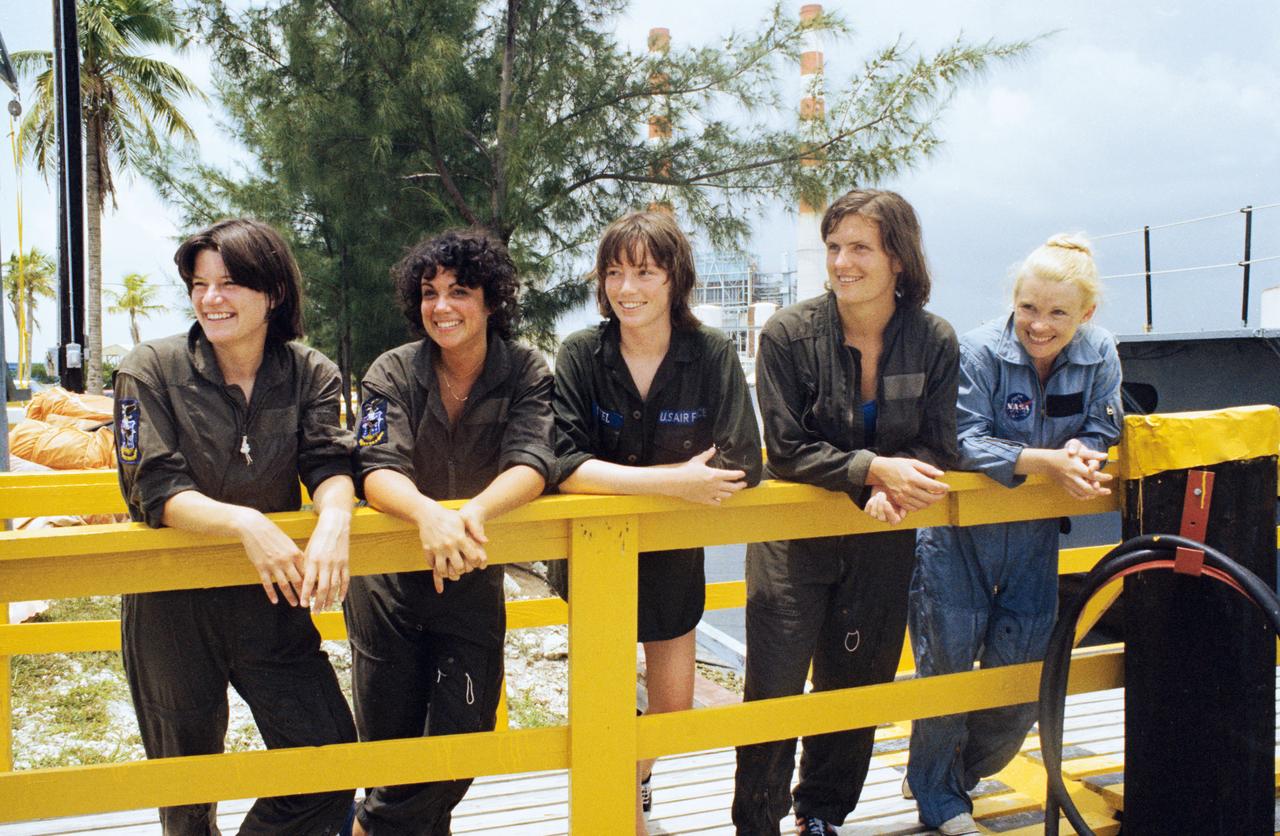
S78-33616 (31 July-2 Aug 1978) --- Taking a break from the various training exercises at a three-day water survival school held near Homestead Air Force Base, Florida are these five astronaut candidates left to right are Sally K. Ride, Judith A. Resnik, Anna L. Fisher; Kathryn D. Sullivan and Rhea Seddon.  They were among fifteen mission specialist-astronaut candidates who joined one of the pilot astronaut candidates for the training.
Water Survival Training - Astronauts - JSC
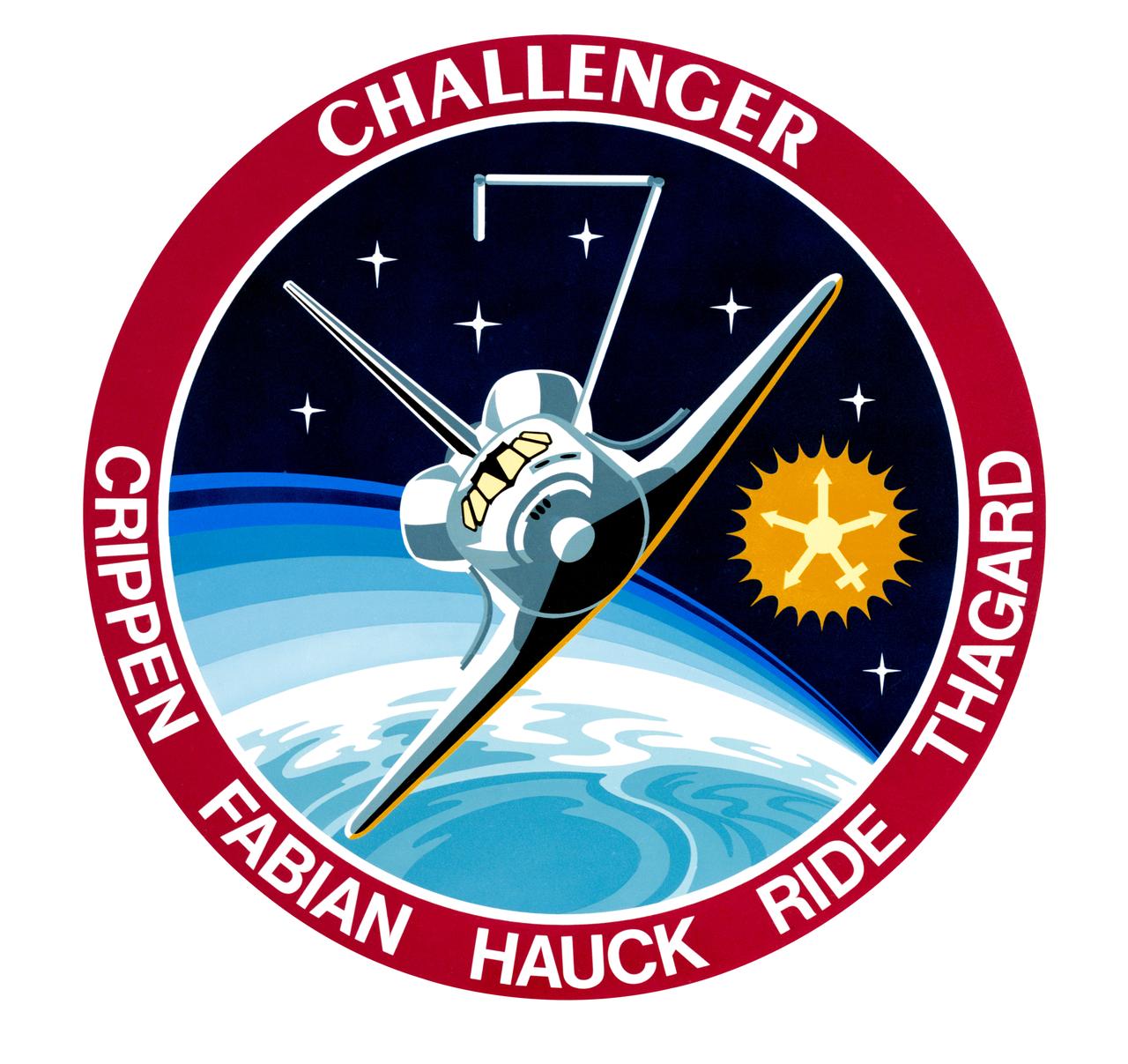
S83-28355 (March 1983) --- The space shuttle Challenger, making its second flight into space on STS-7, is featured in the art for the insignia for that NASA flight. The remote manipulator arm is positioned such that, the number 7 is formed.  Likewise, seven stars are visible against the black sky. Within the sun?s center are representations for the five crew members, including, for the first time in NASA?s space program, a woman ? Dr. Sally K. Ride, mission specialist. The crew member?s surnames are listed along the outside edge of the sphere. They are astronauts Robert L. Crippen, commander; Frederick H. Hauck, pilot; John M. Fabian, Sally K. Ride and Norman E. Thagard, mission specialists. The flight is scheduled for the first week of June 1983.    The NASA insignia design for space shuttle flights is reserved for use by the astronauts and for other official use as the NASA Administrator may authorize. Public availability has been approved only in the forms of illustrations by the various news media. When and if there is any change in this policy, which is not anticipated, the change will be publicly announced. Photo credit: NASA
STS-7 CREW LOGO/INSIGNIA
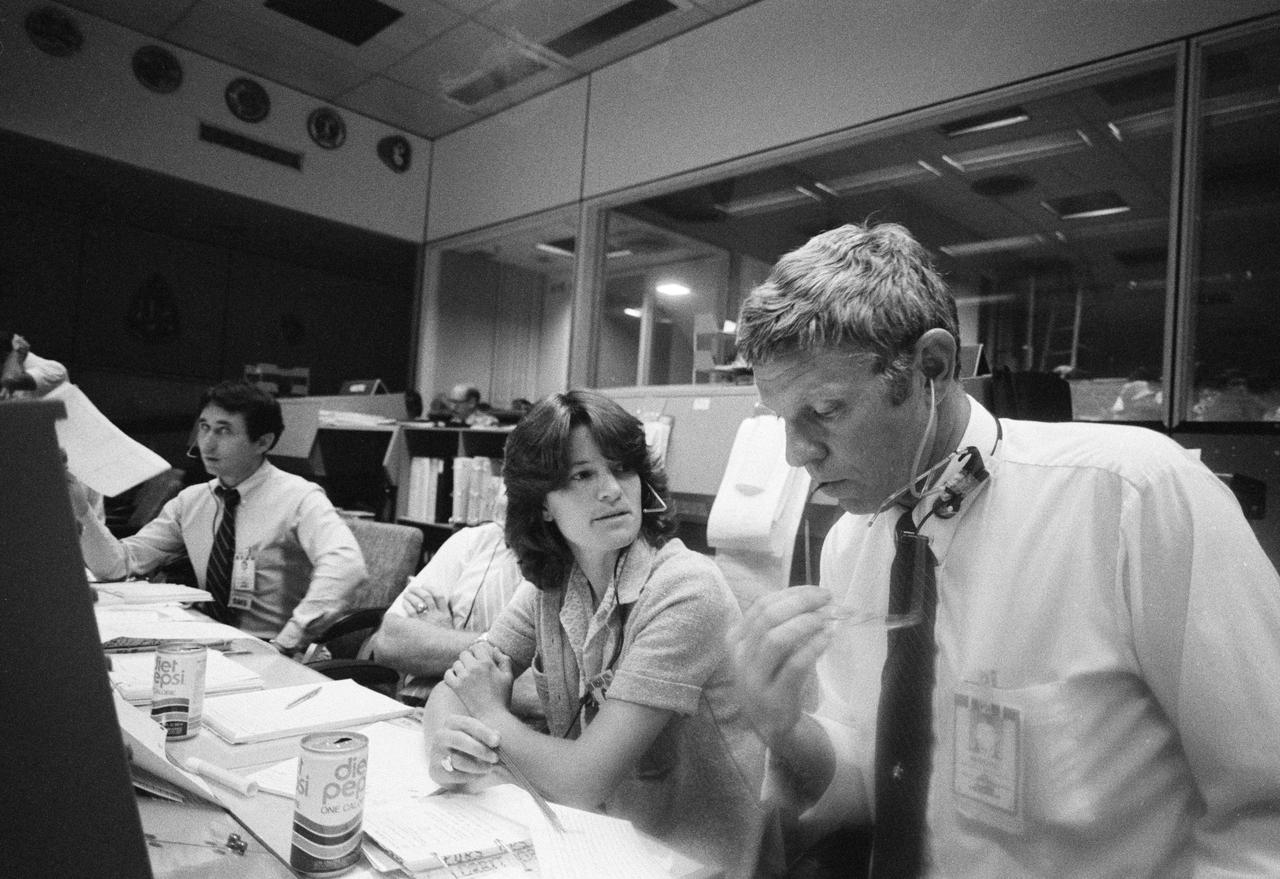
S81-33963 (July 1981) --- Mission specialist/astronaut Sally K. Ride and Dale E. Moore of the flight control division?s electrical, mechanical and environmental systems branch take a special interest in a simulations session during which the remote manipulator system (RMS, a mechanized arm) takes a momentary spotlight. They are seated at the CAPCOM or capsule communicator console in the mission operations control room of JSC?s mission control center. Dr. Ride will converse with astronauts Joe H. Engle and Richard H. Truly during their STS-2 mission in space when the RMS will have its debut in the Columbia?s cargo bay. Astronaut James F. Buchli, serving in a CAPCOM capacity, is partially obscured behind Dr. Ride. Photo credit: NASA
STS-2 - SIMULATION - RIDE, SALLY, ASTRONAUT - JSC
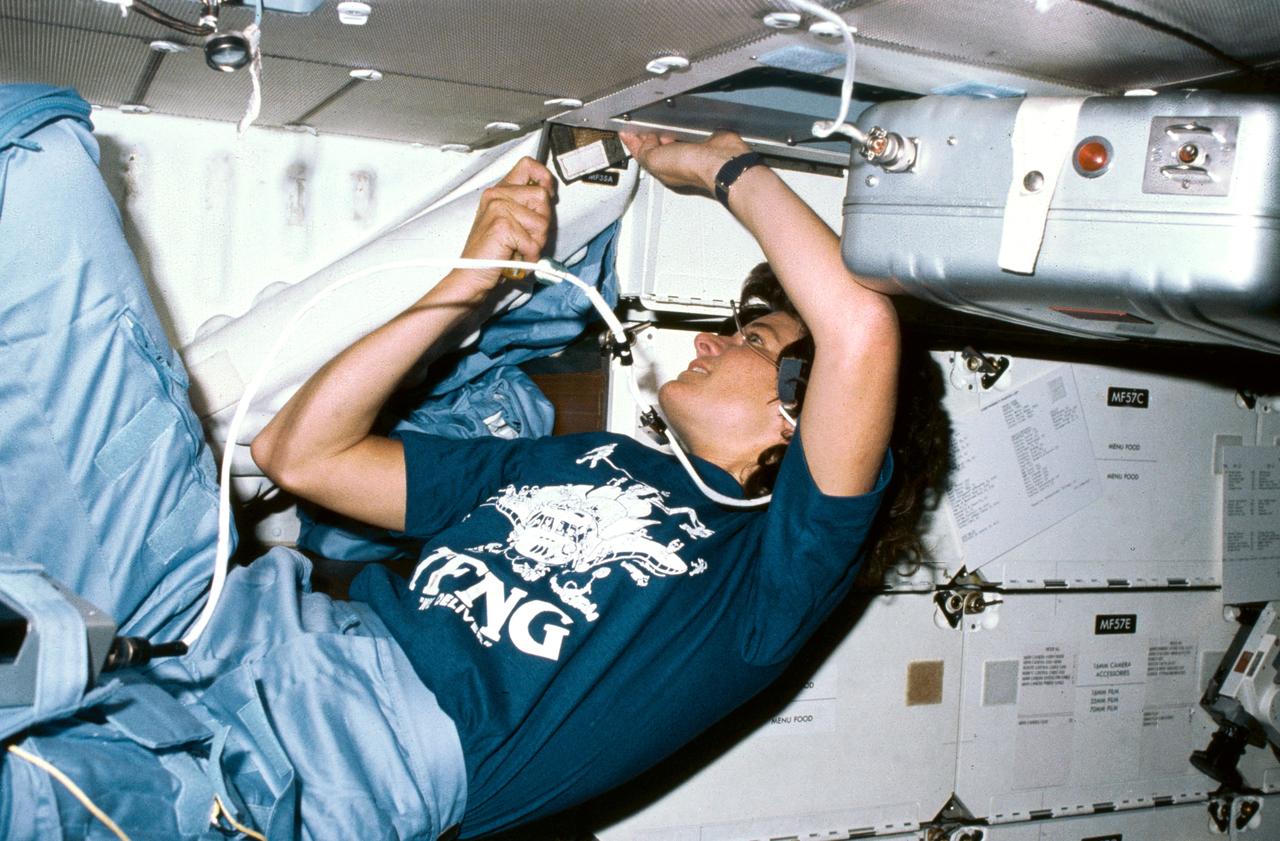
S83-35768 (18-24 June 1983) --- Astronaut Sally K. Ride, mission specialist for STS-7, uses a screw driver in order to clean out an air filtering system in the mid-deck of the Earth-orbiting Space Shuttle Challenger.  Dr. Ride's constant wear garment bears some extras -- a cartoon of 35 busy astronauts around a Space Shuttle and the acronym TFNG, below which is written, "We deliver!"  TFNG stands for thirty-five new guys, referring to the 1978 class of astronaut candidates (ASCAN) from which Dr. Ride and three of her crew members hail.  The tiny two-word declarative in white lettering refers to the successful deployment of two communications satellites.  This photograph was made with a 35mm camera.
Inflight views of the crew of STS-7
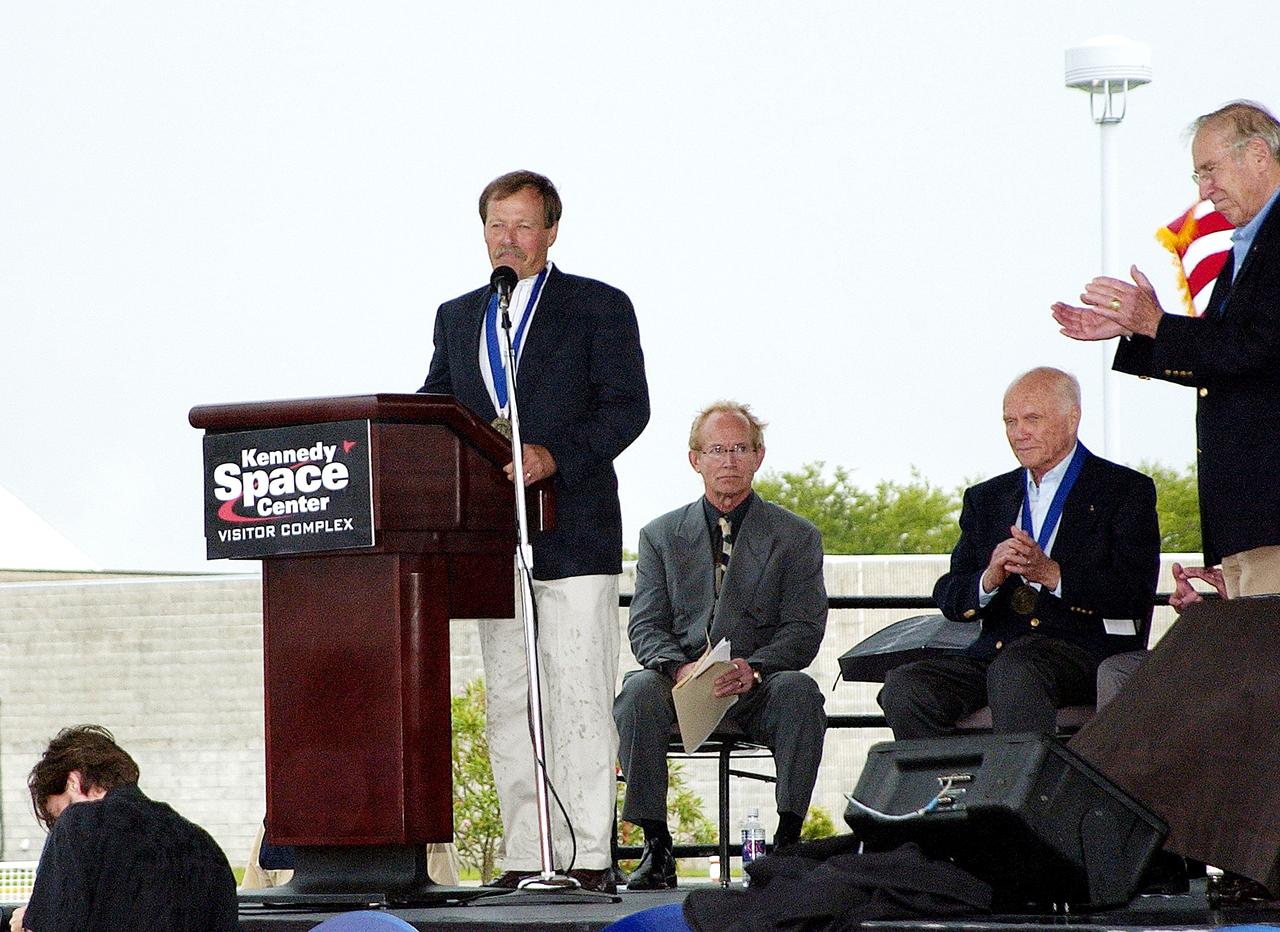
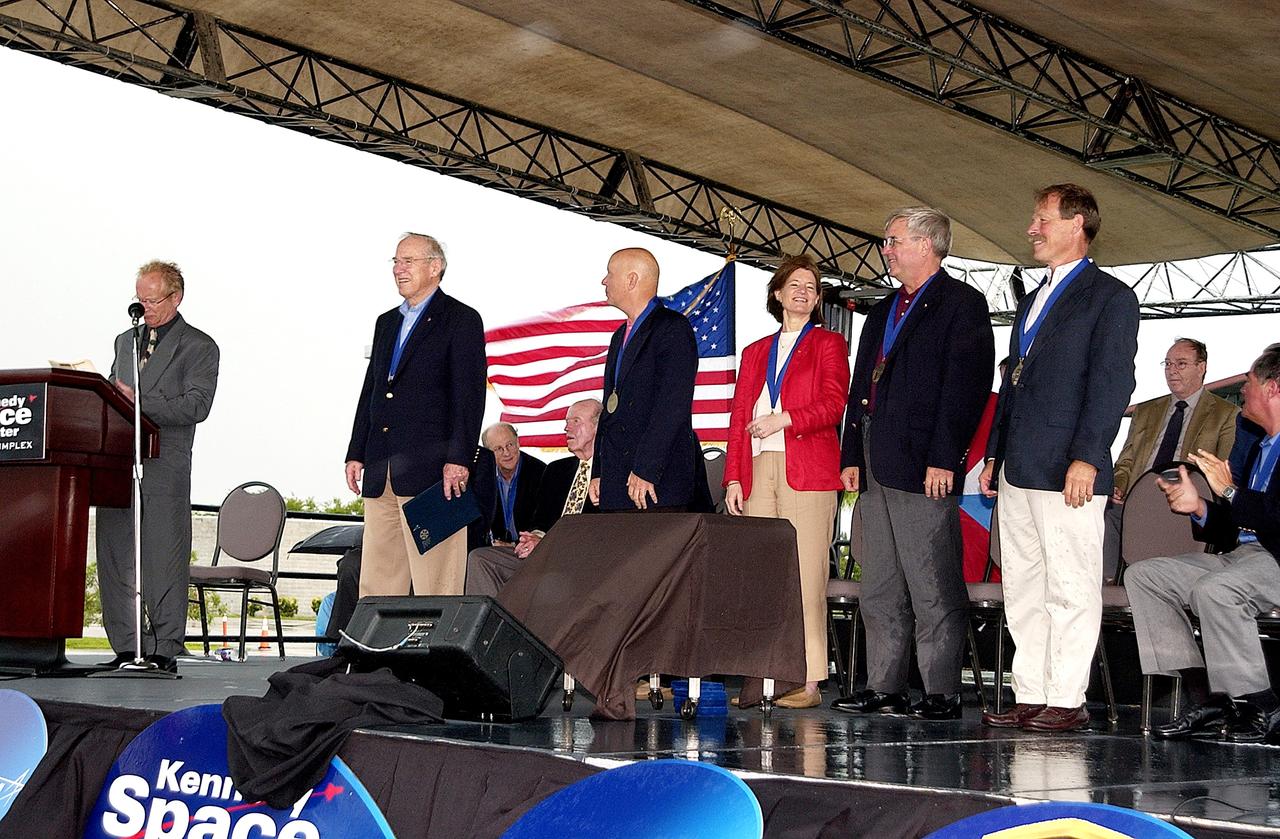
KENNEDY SPACE CENTER, FLA. -  At the KSC Visitor Complex, actor and Master of Ceremonies Lance Henriksen (at podium) introduces four newly inducted Space Shuttle astronauts to the audience at their induction ceremony into the U.S. Astronaut Hall of Fame. From left center, they are Story Musgrave, Sally K. Ride, Daniel Brandenstein, and Robert "Hoot" Gibson. Also standing, left, is former astronaut James A. Lovell.  Conceived by six of the Mercury Program astronauts, the U.S. Astronaut Hall of Fame opened in 1990 to provide a place where space travelers could be remembered for their participation and accomplishments in the U.S. space program. The four new inductees join 48 previously honored astronauts from the ranks of the Gemini, Apollo, Skylab, Apollo-Soyuz, and Space Shuttle programs.
KENNEDY SPACE CENTER, FLA. - At the KSC Visitor Complex, actor and Master of Ceremonies Lance Henriksen (at podium) introduces four newly inducted Space Shuttle astronauts to the audience at their induction ceremony into the U.S. Astronaut Hall of Fame. From left center, they are Story Musgrave, Sally K. Ride, Daniel Brandenstein, and Robert "Hoot" Gibson. Also standing, left, is former astronaut James A. Lovell. Conceived by six of the Mercury Program astronauts, the U.S. Astronaut Hall of Fame opened in 1990 to provide a place where space travelers could be remembered for their participation and accomplishments in the U.S. space program. The four new inductees join 48 previously honored astronauts from the ranks of the Gemini, Apollo, Skylab, Apollo-Soyuz, and Space Shuttle programs.
KENNEDY SPACE CENTER, FLA. -  At the KSC Visitor Complex, former astronaut Robert "Hoot" Gibson (at podium) addresses the audience at his induction ceremony into the U.S. Astronaut Hall of Fame. Also standing is former astronaut James A. Lovell.  Seated on the dais, from left, are actor and Master of Ceremonies Lance Henriksen and former astronaut John H. Glenn.  Also being inducted with Gibson are Space Shuttle astronauts Daniel Brandenstein, Story Musgrave, and Sally K. Ride. Conceived by six of the Mercury Program astronauts, the U.S. Astronaut Hall of Fame opened in 1990 to provide a place where space travelers could be remembered for their participation and accomplishments in the U.S. space program. The four new inductees join 48 previously honored astronauts from the ranks of the Gemini, Apollo, Skylab, Apollo-Soyuz, and Space Shuttle programs.
KENNEDY SPACE CENTER, FLA. - At the KSC Visitor Complex, former astronaut Robert "Hoot" Gibson (at podium) addresses the audience at his induction ceremony into the U.S. Astronaut Hall of Fame. Also standing is former astronaut James A. Lovell. Seated on the dais, from left, are actor and Master of Ceremonies Lance Henriksen and former astronaut John H. Glenn. Also being inducted with Gibson are Space Shuttle astronauts Daniel Brandenstein, Story Musgrave, and Sally K. Ride. Conceived by six of the Mercury Program astronauts, the U.S. Astronaut Hall of Fame opened in 1990 to provide a place where space travelers could be remembered for their participation and accomplishments in the U.S. space program. The four new inductees join 48 previously honored astronauts from the ranks of the Gemini, Apollo, Skylab, Apollo-Soyuz, and Space Shuttle programs.
KENNEDY SPACE CENTER, FLA. -  At the KSC Visitor Complex, former astronaut John H. Glenn (at podium) presents former astronaut Robert "Hoot" Gibson (standing right) at his induction ceremony into the U.S. Astronaut Hall of Fame. Also standing is former astronaut James A. Lovell.  Seated on the dais, from left, are actor and Master of Ceremonies Lance Henriksen (left), and former astronauts Sally K. Ride and Daniel Brandenstein (right), both inducted into the Hall of Fame today. Also being inducted is Space Shuttle astronaut Story Musgrave. Conceived by six of the Mercury Program astronauts, the U.S. Astronaut Hall of Fame opened in 1990 to provide a place where space travelers could be remembered for their participation and accomplishments in the U.S. space program. The four new inductees join 48 previously honored astronauts from the ranks of the Gemini, Apollo, Skylab, Apollo-Soyuz, and Space Shuttle programs.
KENNEDY SPACE CENTER, FLA. - At the KSC Visitor Complex, former astronaut John H. Glenn (at podium) presents former astronaut Robert "Hoot" Gibson (standing right) at his induction ceremony into the U.S. Astronaut Hall of Fame. Also standing is former astronaut James A. Lovell. Seated on the dais, from left, are actor and Master of Ceremonies Lance Henriksen (left), and former astronauts Sally K. Ride and Daniel Brandenstein (right), both inducted into the Hall of Fame today. Also being inducted is Space Shuttle astronaut Story Musgrave. Conceived by six of the Mercury Program astronauts, the U.S. Astronaut Hall of Fame opened in 1990 to provide a place where space travelers could be remembered for their participation and accomplishments in the U.S. space program. The four new inductees join 48 previously honored astronauts from the ranks of the Gemini, Apollo, Skylab, Apollo-Soyuz, and Space Shuttle programs.
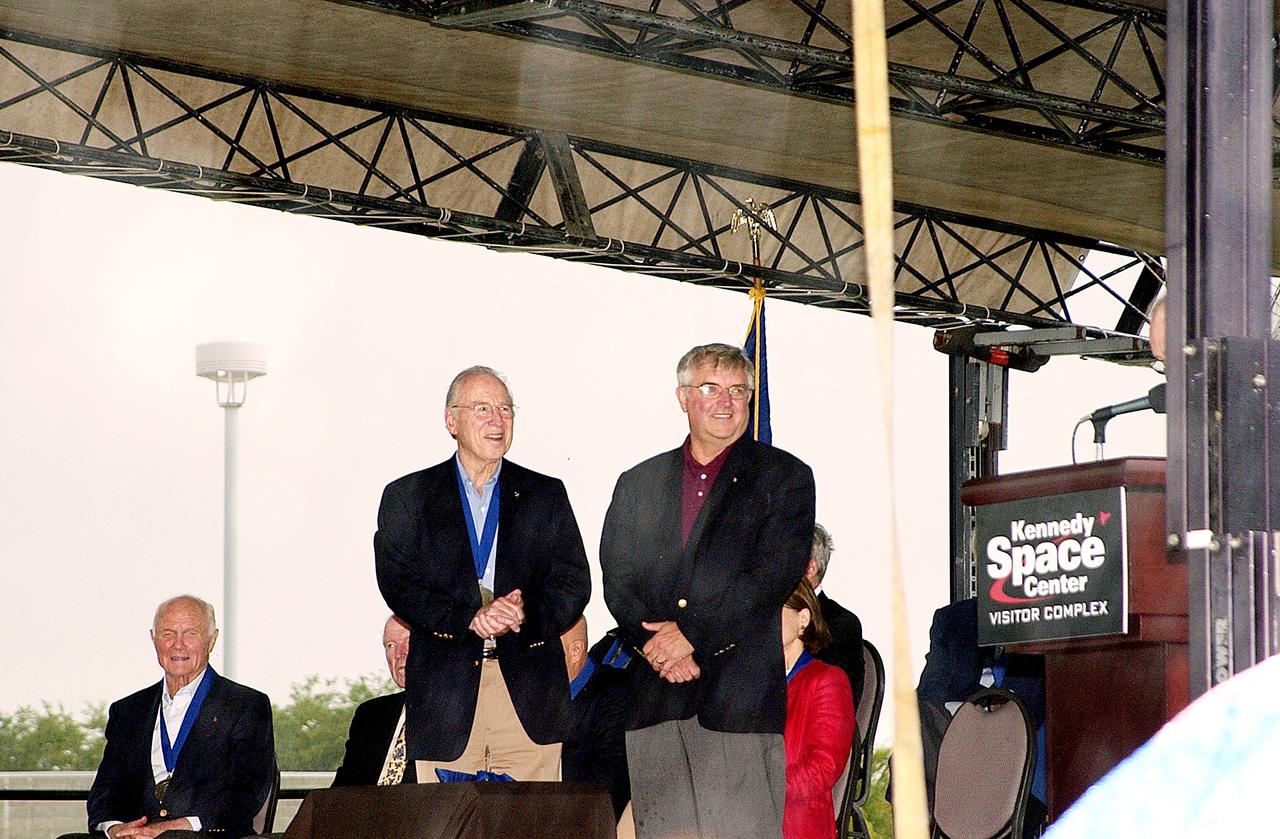
KENNEDY SPACE CENTER, FLA. -  At the KSC Visitor Complex, former astronaut Frederick H. (Rick) Hauck (standing right) congratulates former astronaut Daniel Brandenstein (standing center) at his induction ceremony into the U.S. Astronaut Hall of Fame. Also standing is former astronaut James A. Lovell.  Seated on the dais, from left, are former astronauts John H. Glenn and Gordon Cooper, both previously inducted into the Hall of Fame. Being inducted with Brandenstein are Space Shuttle astronauts Robert "Hoot" Gibson, Story Musgrave, and Sally K. Ride. Conceived by six of the Mercury Program astronauts, the U.S. Astronaut Hall of Fame opened in 1990 to provide a place where space travelers could be remembered for their participation and accomplishments in the U.S. space program. The four new inductees join 48 previously honored astronauts from the ranks of the Gemini, Apollo, Skylab, Apollo-Soyuz, and Space Shuttle programs.
KENNEDY SPACE CENTER, FLA. - At the KSC Visitor Complex, former astronaut Frederick H. (Rick) Hauck (standing right) congratulates former astronaut Daniel Brandenstein (standing center) at his induction ceremony into the U.S. Astronaut Hall of Fame. Also standing is former astronaut James A. Lovell. Seated on the dais, from left, are former astronauts John H. Glenn and Gordon Cooper, both previously inducted into the Hall of Fame. Being inducted with Brandenstein are Space Shuttle astronauts Robert "Hoot" Gibson, Story Musgrave, and Sally K. Ride. Conceived by six of the Mercury Program astronauts, the U.S. Astronaut Hall of Fame opened in 1990 to provide a place where space travelers could be remembered for their participation and accomplishments in the U.S. space program. The four new inductees join 48 previously honored astronauts from the ranks of the Gemini, Apollo, Skylab, Apollo-Soyuz, and Space Shuttle programs.
KENNEDY SPACE CENTER, FLA. -  At the KSC Visitor Complex, actor and Master of Ceremonies Lance Henriksen (at podium) introduces four newly inducted Space Shuttle astronauts to the audience at their induction ceremony into the U.S. Astronaut Hall of Fame. From left center, they are Story Musgrave, Sally K. Ride, Daniel Brandenstein, and Robert "Hoot" Gibson. Also standing, left, is former astronaut James A. Lovell.  Conceived by six of the Mercury Program astronauts, the U.S. Astronaut Hall of Fame opened in 1990 to provide a place where space travelers could be remembered for their participation and accomplishments in the U.S. space program. The four new inductees join 48 previously honored astronauts from the ranks of the Gemini, Apollo, Skylab, Apollo-Soyuz, and Space Shuttle programs.
KENNEDY SPACE CENTER, FLA. - At the KSC Visitor Complex, actor and Master of Ceremonies Lance Henriksen (at podium) introduces four newly inducted Space Shuttle astronauts to the audience at their induction ceremony into the U.S. Astronaut Hall of Fame. From left center, they are Story Musgrave, Sally K. Ride, Daniel Brandenstein, and Robert "Hoot" Gibson. Also standing, left, is former astronaut James A. Lovell. Conceived by six of the Mercury Program astronauts, the U.S. Astronaut Hall of Fame opened in 1990 to provide a place where space travelers could be remembered for their participation and accomplishments in the U.S. space program. The four new inductees join 48 previously honored astronauts from the ranks of the Gemini, Apollo, Skylab, Apollo-Soyuz, and Space Shuttle programs.
KENNEDY SPACE CENTER, FLA. -  At the KSC Visitor Complex, former astronaut Daniel Brandenstein (standing right) is presented to the audience at his induction ceremony into the U.S. Astronaut Hall of Fame. Also standing is former astronaut James A. Lovell.  Seated on the dais, from left, are former astronauts John H. Glenn and Gordon Cooper, both previously inducted into the Hall of Fame. Being inducted with Brandenstein are Space Shuttle astronauts Robert "Hoot" Gibson, Story Musgrave, and Sally K. Ride. Conceived by six of the Mercury Program astronauts, the U.S. Astronaut Hall of Fame opened in 1990 to provide a place where space travelers could be remembered for their participation and accomplishments in the U.S. space program. The four new inductees join 48 previously honored astronauts from the ranks of the Gemini, Apollo, Skylab, Apollo-Soyuz, and Space Shuttle programs.
KENNEDY SPACE CENTER, FLA. - At the KSC Visitor Complex, former astronaut Daniel Brandenstein (standing right) is presented to the audience at his induction ceremony into the U.S. Astronaut Hall of Fame. Also standing is former astronaut James A. Lovell. Seated on the dais, from left, are former astronauts John H. Glenn and Gordon Cooper, both previously inducted into the Hall of Fame. Being inducted with Brandenstein are Space Shuttle astronauts Robert "Hoot" Gibson, Story Musgrave, and Sally K. Ride. Conceived by six of the Mercury Program astronauts, the U.S. Astronaut Hall of Fame opened in 1990 to provide a place where space travelers could be remembered for their participation and accomplishments in the U.S. space program. The four new inductees join 48 previously honored astronauts from the ranks of the Gemini, Apollo, Skylab, Apollo-Soyuz, and Space Shuttle programs.
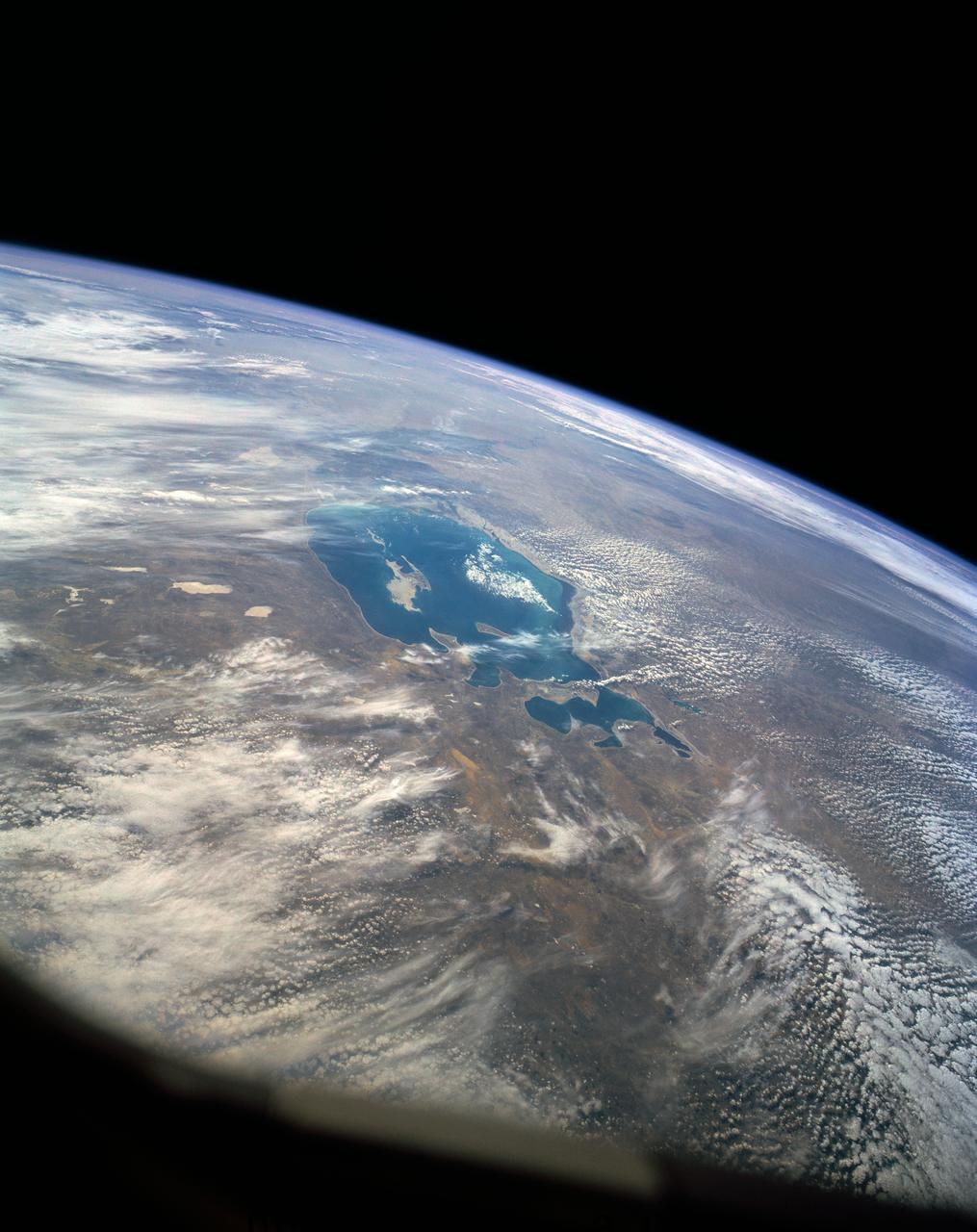
41G-120-005 (5-13 Oct 1984) --- The Kyzyl Kum Desert of the Kazakh and Uzbek Soviet Socialist Republics.  The Aralskoe More, also known as the Aral Sea, is to the south-southeast.  This saltwater lake is fed mainly from waters of the Amu Darya River, mostly with snow melt water from the distant Tyan-Shan Mountains near the Afghanistan and China border.  The crew consisted of astronauts Robert L. Crippen, commander; Jon A. McBride, pilot; mission specialist's Kathryn D. Sullivan, Sally K. Ride, and David D. Leestma; Canadian astronaut Marc Garneau; and Paul D. Scully-Power, payload specialist.
Earth Observation taken during the 41G mission
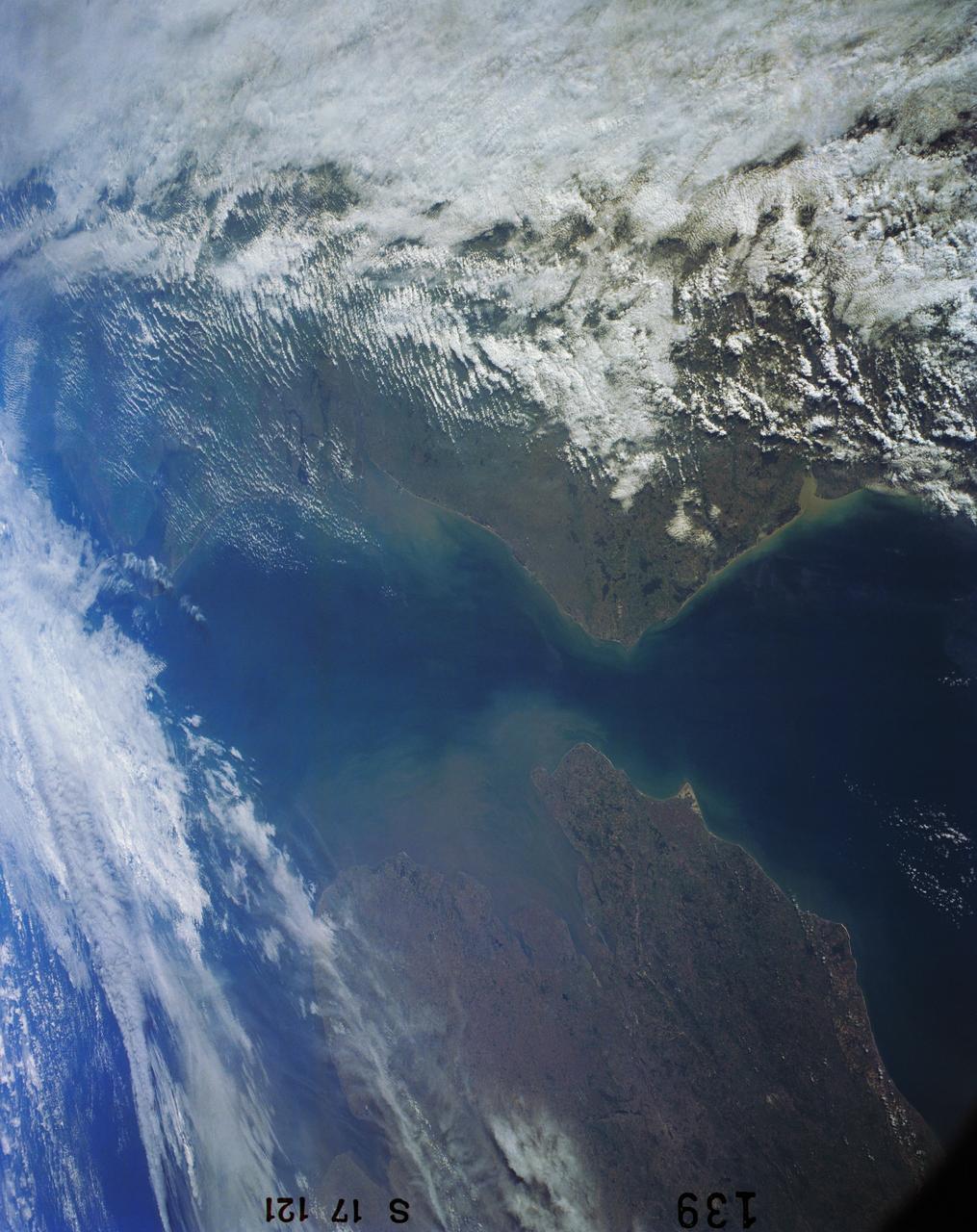
41G-121-139 (5-13 Oct. 1984) --- The Strait of Dover and London, seldom seen in space photography, can be delineated in this medium format camera's scene showing parts of England and France from onboard the Earth-orbiting space shuttle Challenger.  Parts of the Thames River can also be traced in the frame.  The 41-G crew consisted of astronauts Robert L. Crippen, commander; Jon A. McBride, pilot; and Mission Specialists Kathryn D. Sullivan, Sally K. Ride, and David D. Leestma; along with Canadian astronaut Marc Garneau; and Paul D. Scully-Power, both payload specialists. Photo credit: NASA
English Channel
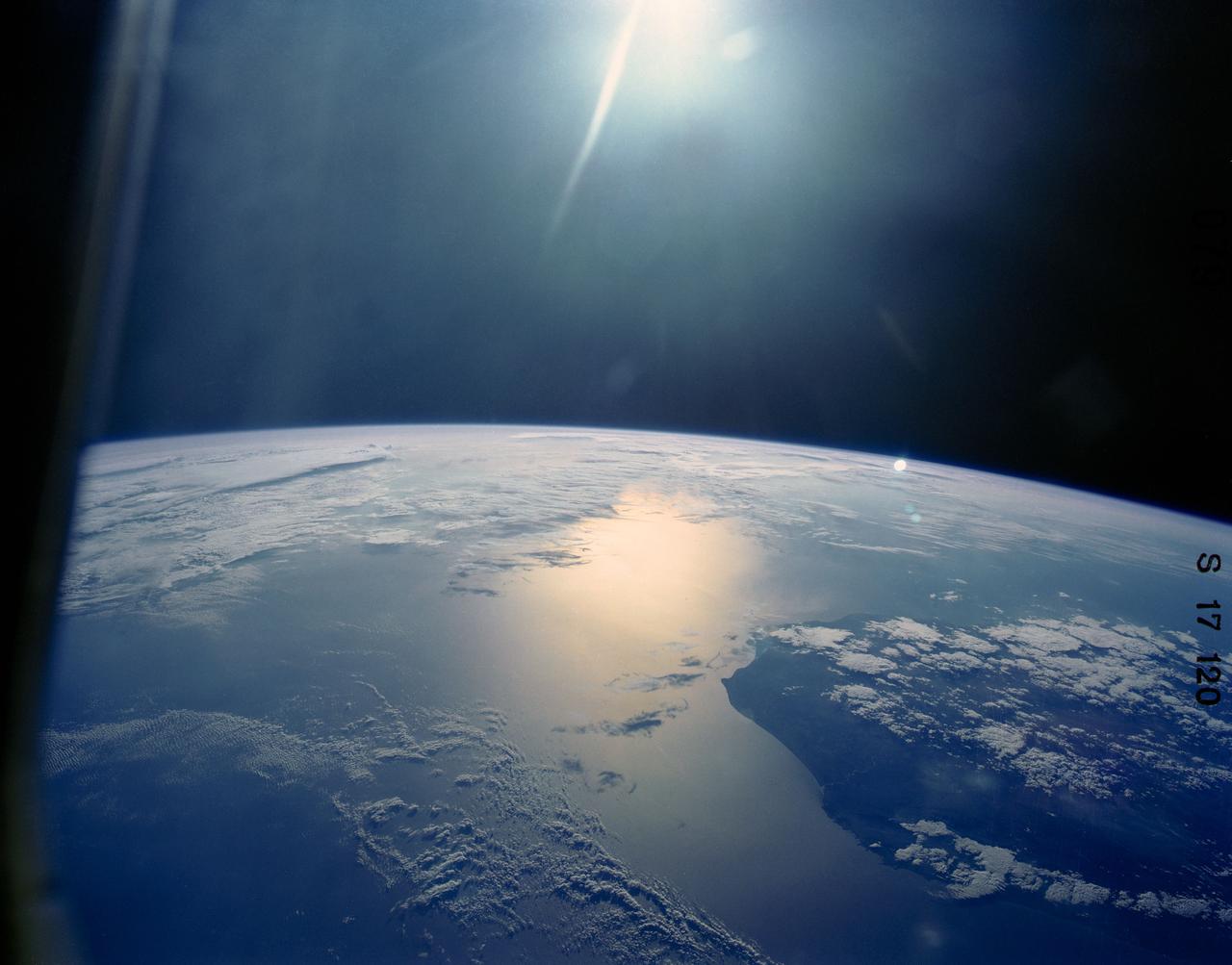
41G-120-079 (5-13 Oct 1984) --- This oblique view, photographed from the Space Shuttle Challenger, shows the south tip of the island of Madagascar.  Sunglint reflects on the surface of the Mozambique Channel.  The crew consisted of astronauts Robert L. Crippen, commander; Jon A. McBride, pilot; mission specialist's Kathryn D. Sullivan, Sally K. Ride, and David D. Leestma; Canadian astronaut Marc Garneau; and Paul D. Scully-Power, payload specialist.        EDITOR'S NOTE: The STS-41G mission had the first American female EVA (Sullivan); first seven-person crew; first orbital fuel transfer; and the first Canadian (Garneau).
Earth Observation taken during the 41G mission
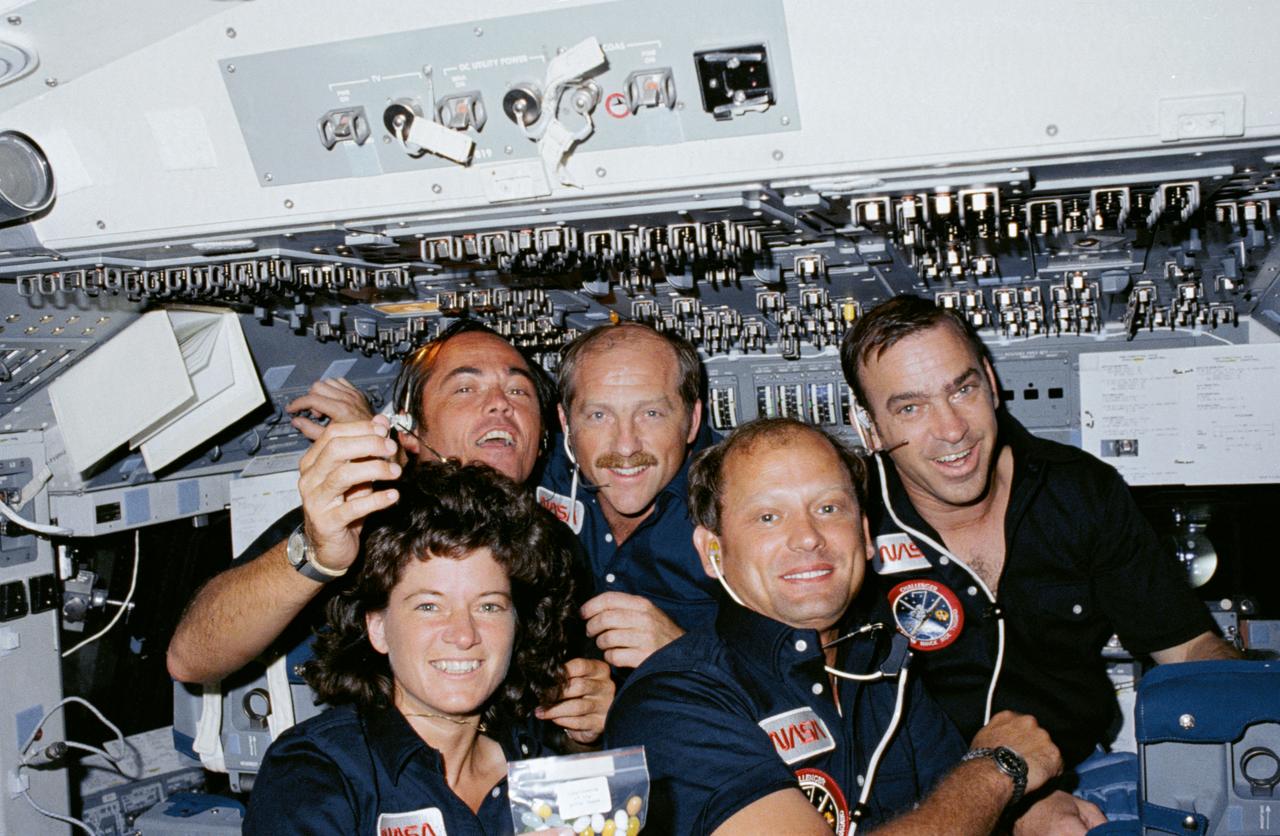
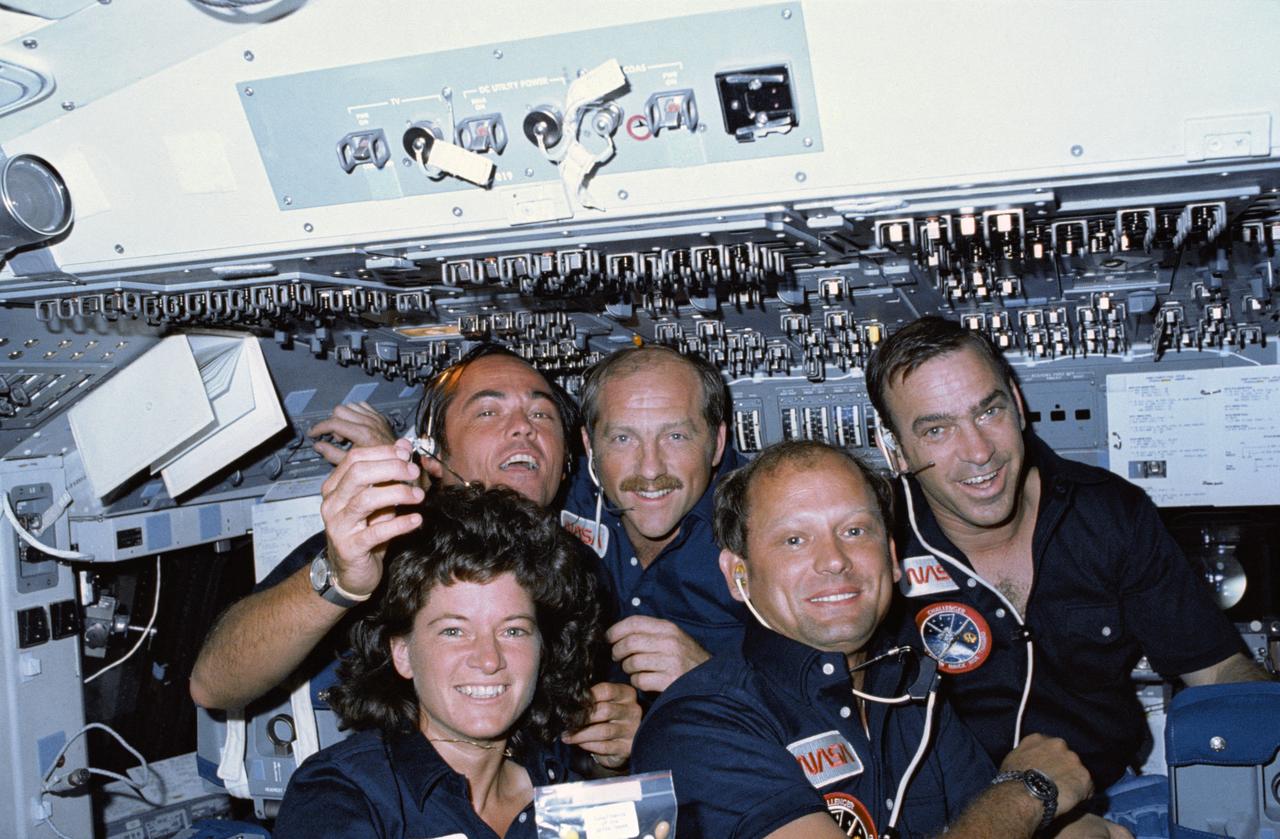
STS007-30-1574 / S83-35774 (21 June 1983) --- The five "passengers" onboard the Earth-orbiting Space Shuttle Challenger display some jelly beans discovered among their food supplies during their six-day mission.  The label on the candy reads, "Compliments of the White House."  In the rear are (left to right) astronauts Robert L. Crippen, crew commander, Frederick H. Hauck, pilot; and John M. Fabian, mission specialist.  In front are Drs. Sally K. Ride and Norman E. Thagard, mission specialists.  The scene was exposed by a pre-set 35mm camera.
Crew members pose for group portrait on forward flight deck
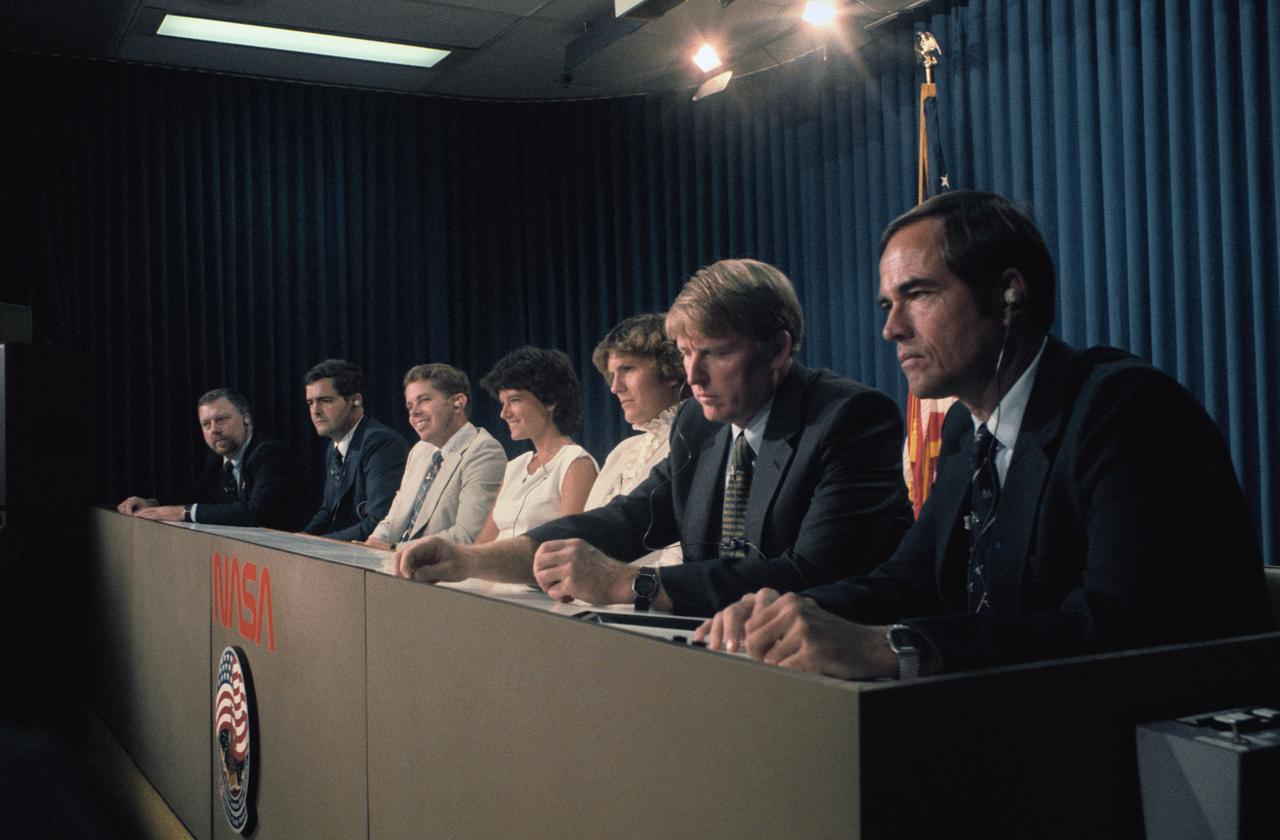
S84-41580 (3 Sept 1984) --- Assembled together publicly for the first time, the seven crewmembers for NASA's 41-G Space Shuttle mission field questions from the press corps at the Johnson Space Center.  Pictured (foreground right to left) are Robert L. Crippen, crew commander ;Jon A. McBride, pilot; Kathryn D. Sullivan, Sally K. Ride and David C. Leestma--all mission specialists; Marc Garneau, representing the Canadian National Research Council, and Paul D. Scully-Power, U.S. Navy oceanographer, both payload specialists. Their flight is scheduled for early October.
Press conference with the crew of the 41-G mission
S83-35774 / STS007-30-1574 (21 June 1983) --- The five "passengers" onboard the Earth-orbiting Space Shuttle Challenger display some jelly beans discovered among their food supplies during their six-day mission.  The label on the candy reads, "Compliments of the White House."  In the rear are (left to right) astronauts Robert L. Crippen, crew commander, Frederick H. Hauck, pilot; and John M. Fabian, mission specialist.  In front are Drs. Sally K. Ride and Norman E. Thagard, mission specialists.  The scene was exposed by a pre-set 35mm camera.
INFLIGHT (CREW ACTIVITIES) - STS-7
41G-120-175 (5-13 Oct. 1984) --- Egypt and the Nile River Delta are easily recognizable in this 250mm frame photographed by one of the seven 41-G crew members aboard the Earth-orbiting space shuttle Challenger.  Cairo and the Egyptian pyramids are also visible in the lower left side of this photograph. The 41-G crew consisted of astronauts Robert L. Crippen, commander, Jon A. McBride, pilot; Mission Specialists Kathryn D. Sullivan, Sally K. Ride, and David D. Leestma; along with Canadian astronaut Marc Garneau; and Paul D. Scully-Power, both payload specialists. Photo credit: NASA
41g-120-175
41D-3277 (S14-3277) (4 Sept 1984) --- Having met the press for the first time as a group, members of the STS 41-G crew pose for photographs in the Shuttle mockup and   integration laboratory at the Johnson Space   Center.  They are (bottom row, left, to right)   Marc Garneau and Paul D.  Scully-Power, both   payload specialists; and Robert L. Crippen, crew commander; (second row, l.-r.) Astronauts Jon A. McBride, pilot; David C. Leestma and Sally K. Ride, both mission specialists; and Kathryn D. Sullivan, mission specialist.  They are scheduled for an October 5, 1984 launch aboard the Space Shuttle Challenger.
Portrait view of STS 41-G crew in civilian clothes
S83-32723 (23 May 1983) --- This scene in the Shuttle Mission Simulator (SMS) previews next month?s STS-7 flight in the space shuttle Challenger. Taken during a simulation session, the photo illustrates the seating arrangement for launch and landing phases of the Challenger?s second spaceflight and its first with five crew members. Pictured, left to right, are astronauts Robert L. Crippen, commander; Frederick H. Hauck, pilot; Sally K. Ride and John M. Fabian (almost totally obscured), mission specialists. Dr. Norman E. Thagard, a third mission specialist, will be seated in the middeck for launch and landing phases. Photo credit: NASA/Otis Imboden/National Geographic Society.
CREW TRAINING (SIMULATOR) - STS-7 - JSC
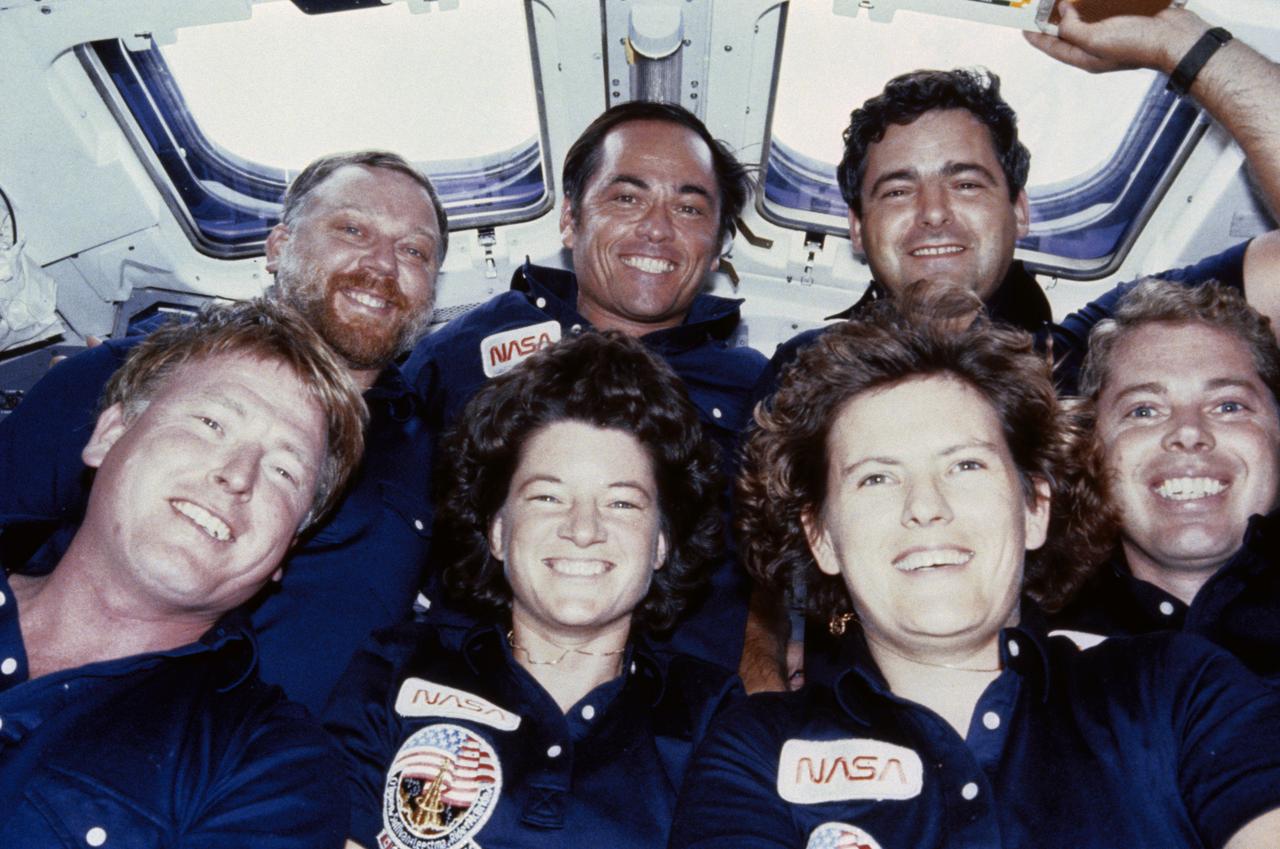
41G-19-006 (5-13 Oct. 1984) --- The seven-member 41-G crew assembles for a group shot on the flight deck of the Earth-orbiting space shuttle Challenger. Robert L. Crippen, commander, is in center of the back row.  Others pictured are (front row, l.-r.) Jon A. McBride, pilot; Sally K. Ride, Kathryn D. Sullivan and David C. Leestma, all mission specialists; and Paul D. Scully-Power (left) and Marc Garneau, both payload specialists, on the back row. Garneau represents the National Research Council of Canada and Scully-Power is a civilian oceanographer with the U.S. Navy. Photo credit: NASA
STS 41-G crew photo taken on the flight deck of the Challenger during flight
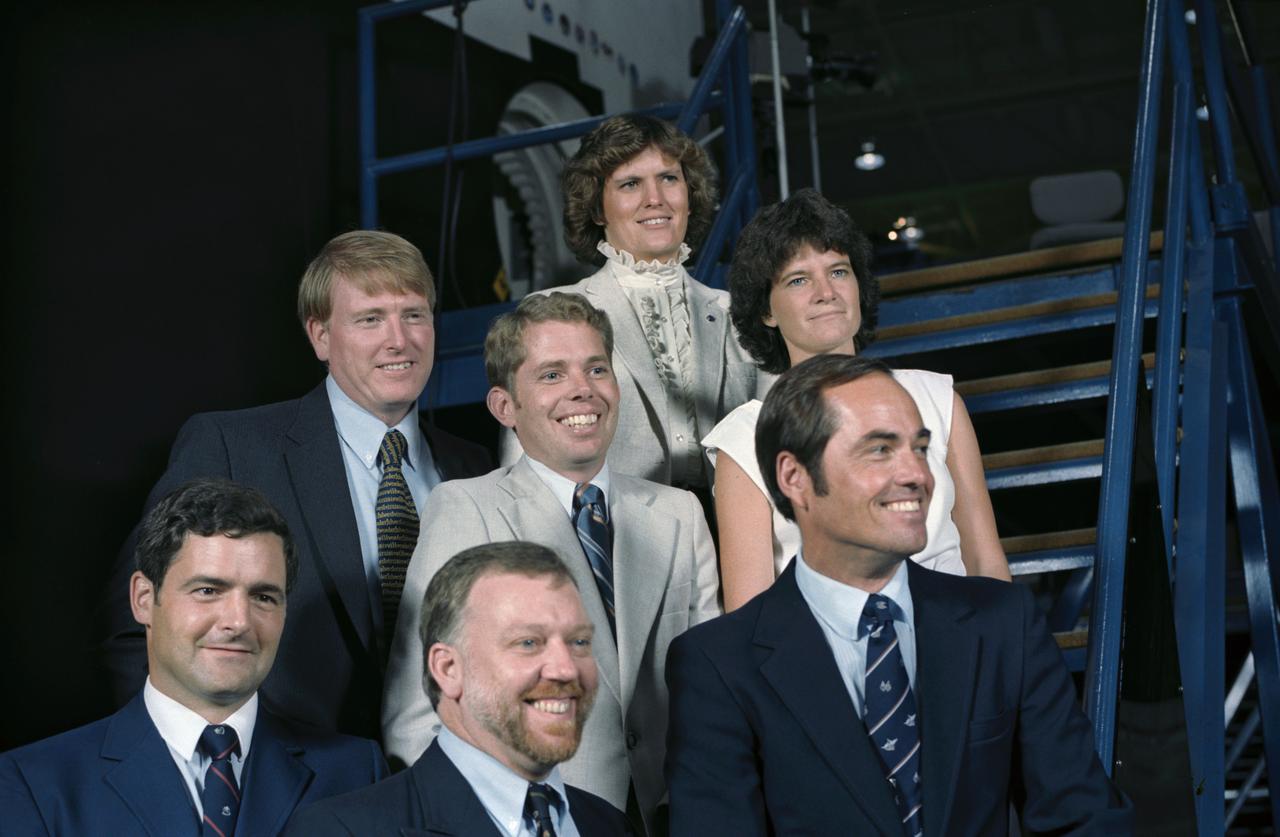
S78-25633 (31 Jan. 1978) --- These six mission specialist astronaut candidates are the first women ASCANs to be named by NASA. They are, left to right, Rhea Seddon, Anna L. Fisher, Judith A. Resnik, Shannon W. Lucid, Sally K. Ride and Kathryn D. Sullivan. Along with these candidates, 14 other mission specialist candidates and 15 pilot astronaut candidates were presented during a press conference at the Johnson Space Center on Jan. 31, 1978. All 35 met the press in the larger Teague Auditorium and the women greeted photographers and other media representatives in the Public Affairs Office briefing room. Photo credit: NASA
New astronauts visit JSC
41G-90029 / S17-90029 (2 Oct 1984) --- These five astronauts prepare to board T-38 jet aircraft for a trip to Florida where they will begin preparations for a trip into space aboard the Challenger later this week.  Astronaut Robert L. Crippen, left, leads the way.  The crew commander is followed by (l.-r.) Sally K. Ride (extreme left edge), Kathryn D. Sullivan, David C. Leestma and Jon A. McBride, McBride is pilot and the others are mission specialists.  Marc Garneau, representing the National Research Council of Canada and Paul D. Scully-Power, a civilian oceanographer with the U.S. Navy, are the payload specialists who will fly to Florida aboard a Gulfstream aircraft.
STS 41-G crew prepares to leave for KSC
STS007-08-396 (18-24 June 1983) --- Astronaut Robert L. Crippen, STS-7 commander, used a 35mm camera to expose this frame of the four representatives of the "thirty five new guys" onboard the Earth-orbiting Space Shuttle Challenger.  The TFNG (notice Frederick H. Hauck's T-shirt at left) pays tribute to the 1978 astronaut candidate (ASCAN) class of NASA astronauts.  Others in the photograph are Astronauts Norman E. Thagard, Sally K. Ride and John M. Fabian.  Hauck is the crew's pilot and the other three are mission specialist.  The crew members are in the process of preparing a snack of meal.  The tall experiment in the background is the Continuous Flow Electrophoresis System (CFES).
STS-7 crewmembers during meal preparation on middeck
S83-34151 (15 June 1983) --- Astronaut Sally K. Ride, STS-7 mission specialist, takes one last look at familiar training environs before taking off from NASA’s Houston facility in a T-38 jet aircraft, destination: Florida and the Kennedy Space Center (KSC). After a few days of preparation at KSC, Dr. Ride and four other astronauts will be the first NASA five-member crew to fly in space as they liftoff in the Challenger from Launch Pad 39A. The mission specialist is positioned in the rear station of the jet, piloted by astronaut Robert L. Crippen, STS-7 commander. The T-38 fleet is kept at Ellington Base near the Johnson Space Center (JSC).
PREFLIGHT (DEPARTURE) - STS-7 - ELLINGTON AFB (EAFB), TX
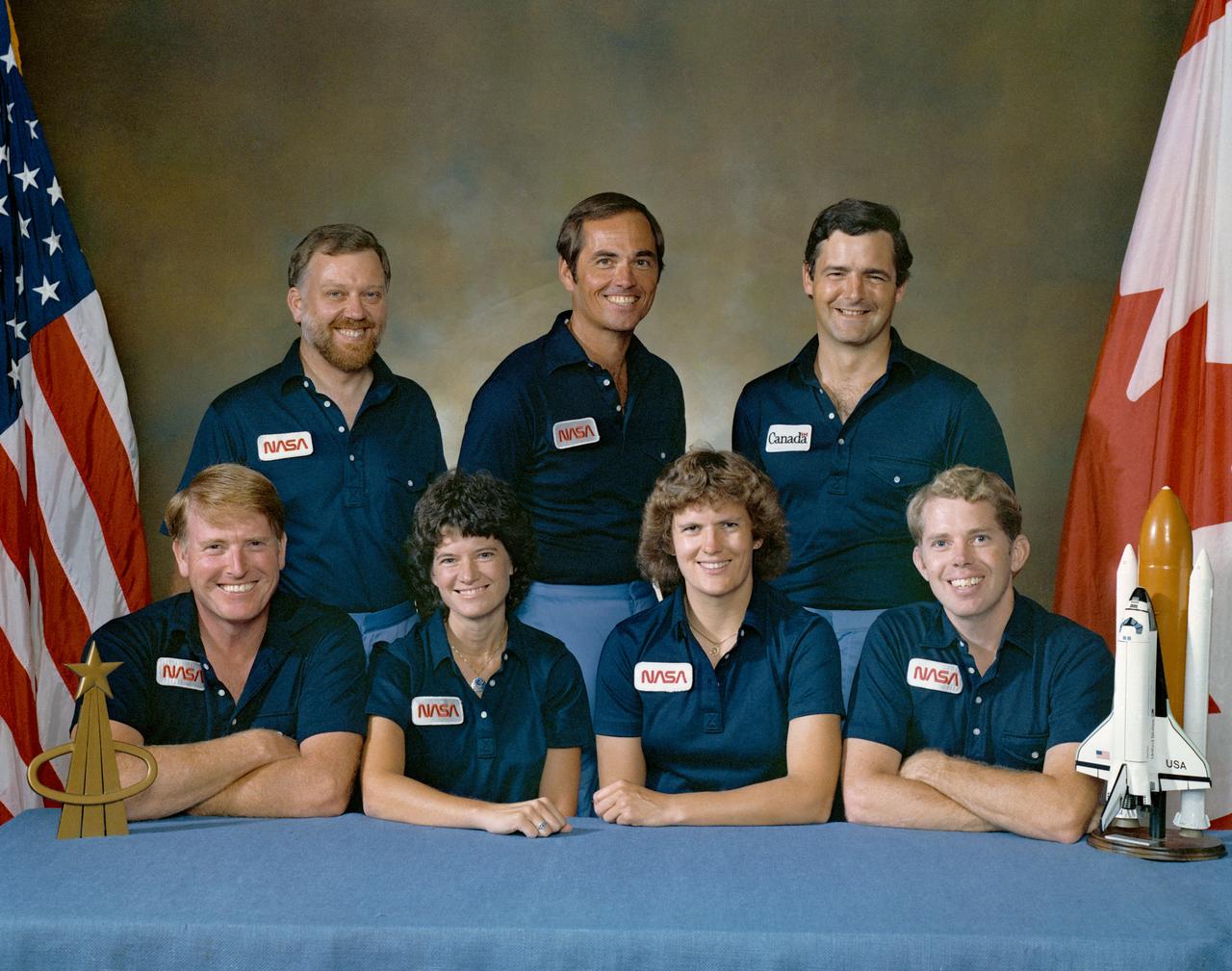
S84-37981 (20 July 1984) --- The space shuttle Challenger will carry these seven persons into space for NASA's STS-41G mission scheduled for October 1984.  They are (bottom row, left to right) astronauts Jon A. McBride, pilot; and Sally K. Ride, Kathryn D. Sullivan and David C. Leestma -- all mission specialists. Astronaut Robert L. Crippen crew commander, is flanked by Paul D. Scully-Power and Marc Garneau, both payload specialists. Scully-Power is an oceanographer for the U.S. Navy and Garneau represents the National Research Council (Canada). The replica of a gold astronaut pin near McBride signifies unity. The group represents the largest space shuttle crew thus far. Photo credit: NASA
Official photo of the 41-G crew
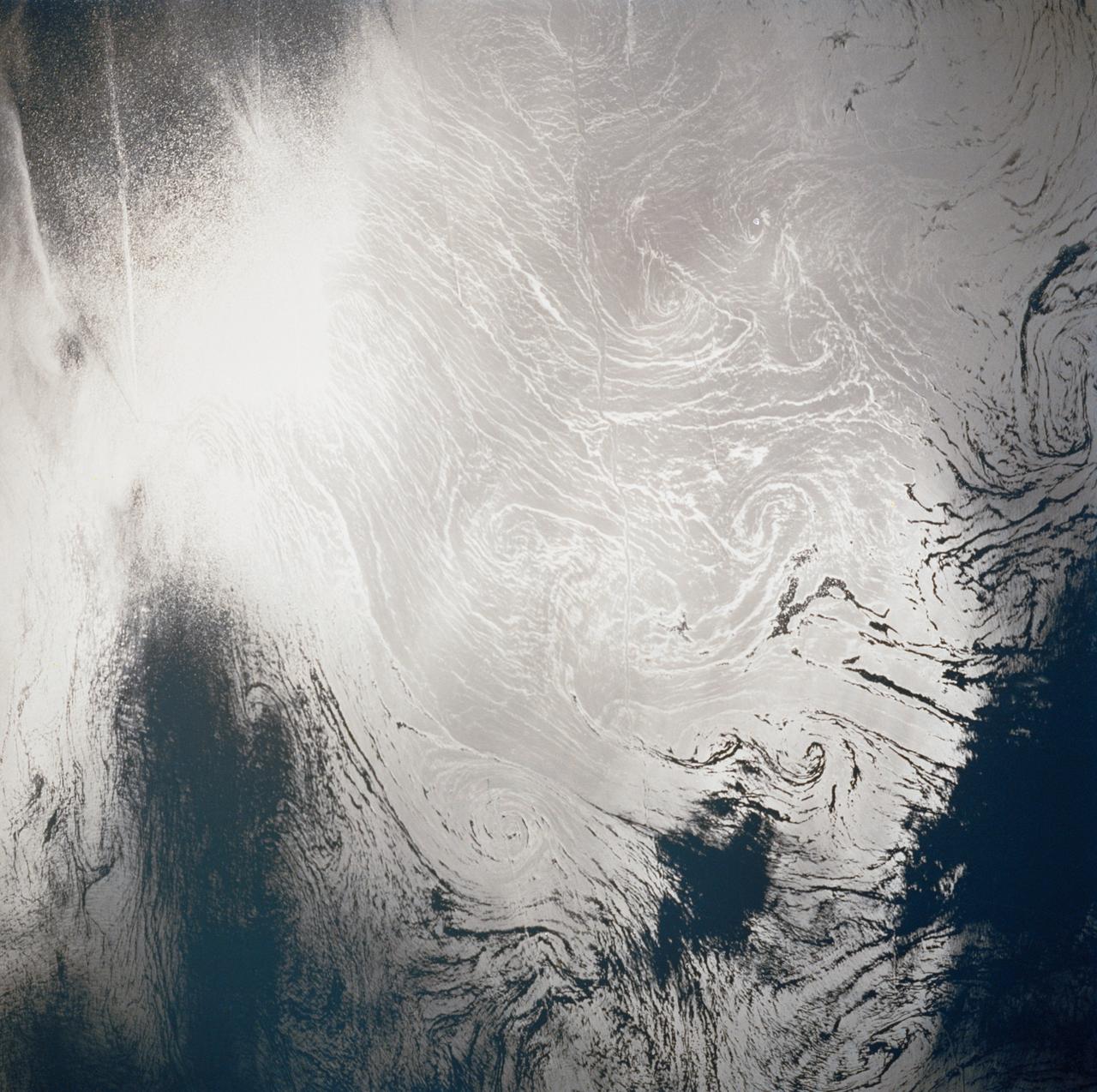
41G-38-060 (5-13 Oct 1984) --- A large ship wake in the central Mediterranean Sea is highlighted by sunglint in this handheld camera's view from STS-41G.  According to NASA and U.S. Navy scientists studying the STS-41G film, the depicted reflectance is similar to oil slicks seen in the various oceans of the world.  They note that it is apparent that a ship is pumping a mixture of bilge water and oil overboard.  The crew consisted of astronauts Robert L. Crippen, commander; Jon A. McBride, pilot; mission specialist's Kathryn D. Sullivan, Sally K. Ride, and David D. Leestma; Canadian astronaut Marc Garneau; and Paul D. Scully-Power, payload specialist.        EDITOR'S NOTE: The STS-41G mission had the first American female EVA (Sullivan); first seven-person crew; first orbital fuel transfer; and the first Canadian (Garneau).
STS-41G earth observations
41G-101-013 (14 Oct 1984) --- Astronaut David C. Leestma works at the Orbital Refueling System (ORS) on the Mission Peculiar Support Structure (MPESS) in the aft end of the cargo bay of the Space Shuttle Challenger.  Astronaut Kathryn D. Sullivan, America's first woman to perform an extravehicular activity (EVA) with the logging of this busy day, exposed this frame witha 35mm camera.  The crew consisted of astronauts Robert L. Crippen, commander; Jon A. McBride, pilot; mission specialist's Kathryn D. Sullivan, Sally K. Ride, and David D. Leestma; Canadian astronaut Marc Garneau; and Paul D. Scully-Power, payload specialist.        EDITOR'S NOTE: The STS-41G mission had the first American female EVA (Sullivan); first seven-person crew; first orbital fuel transfer; and the first Canadian (Garneau).
Astronaut in EMU in the payload bay
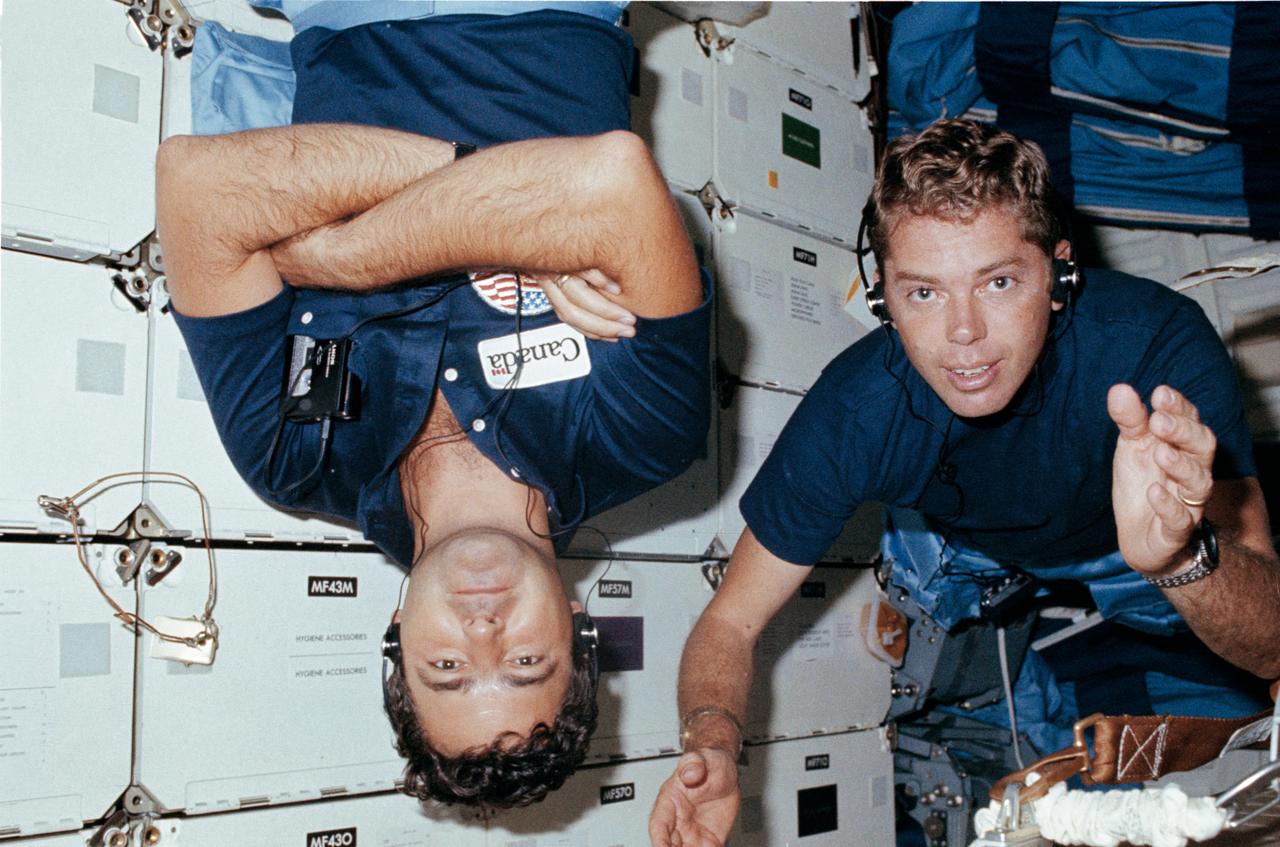
41G-101-039 (5-13 Oct 1984) --- Two members of a record seven-person crew are pictured during Intravehicular Activity (IVA) aboard the Earth-orbiting Space Shuttle Challenger.  Hold picture with open hand at right center edge.  Astronaut David C. Leestma, mission specialist, is at right observing a test by payload specialist Marc Garneau, representing the National Research Council (NRC) of Canada.  Garneau spent much of his on-duty time conducting a series of experiments for the NRC.  The crew consisted of astronauts Robert L. Crippen, commander; Jon A. McBride, pilot; mission specialist's Kathryn D. Sullivan, Sally K. Ride, and David D. Leestma; Canadian astronaut Marc Garneau, and Paul D. Scully-Power, payload specialist's.        EDITOR'S NOTE: The STS-41G mission had the first American female EVA (Sullivan); first seven-person crew; first orbital fuel transfer; and the first Canadian (Garneau).
41G crew activities
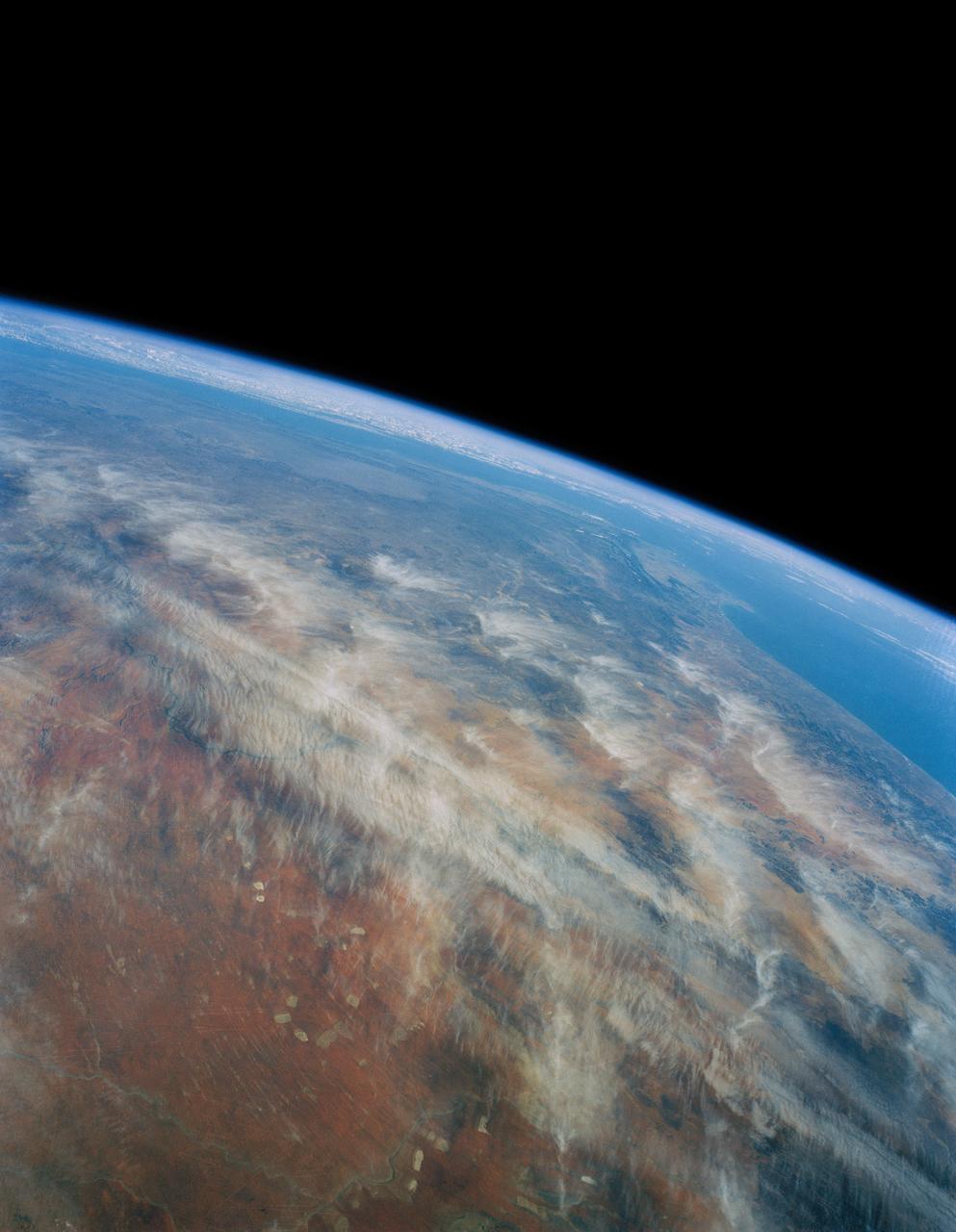
41G-121-189 (5-13 Oct 1984) --- The Kalihari Desert is visible in the foreground of this photograph covering three African nations.  The desert is a classic red to orange-red, with small depressions and salt encrustation's which appear as lakes.  Visible are Cape Town, the Cape of Good Hope and Cape Agulhas.  The crew consisted of astronauts Robert L. Crippen, commander; Jon A. McBride, pilot; mission specialist's Kathryn D. Sullivan, Sally K. Ride, and David D. Leestma; Canadian astronaut Marc Garneau; and Paul D. Scully-Power, payload specialist.        EDITOR'S NOTE: The STS-41G mission had the first American female EVA (Sullivan); first seven-person crew; first orbital fuel transfer; and the first Canadian (Garneau).
Earth Observation taken during the 41G mission
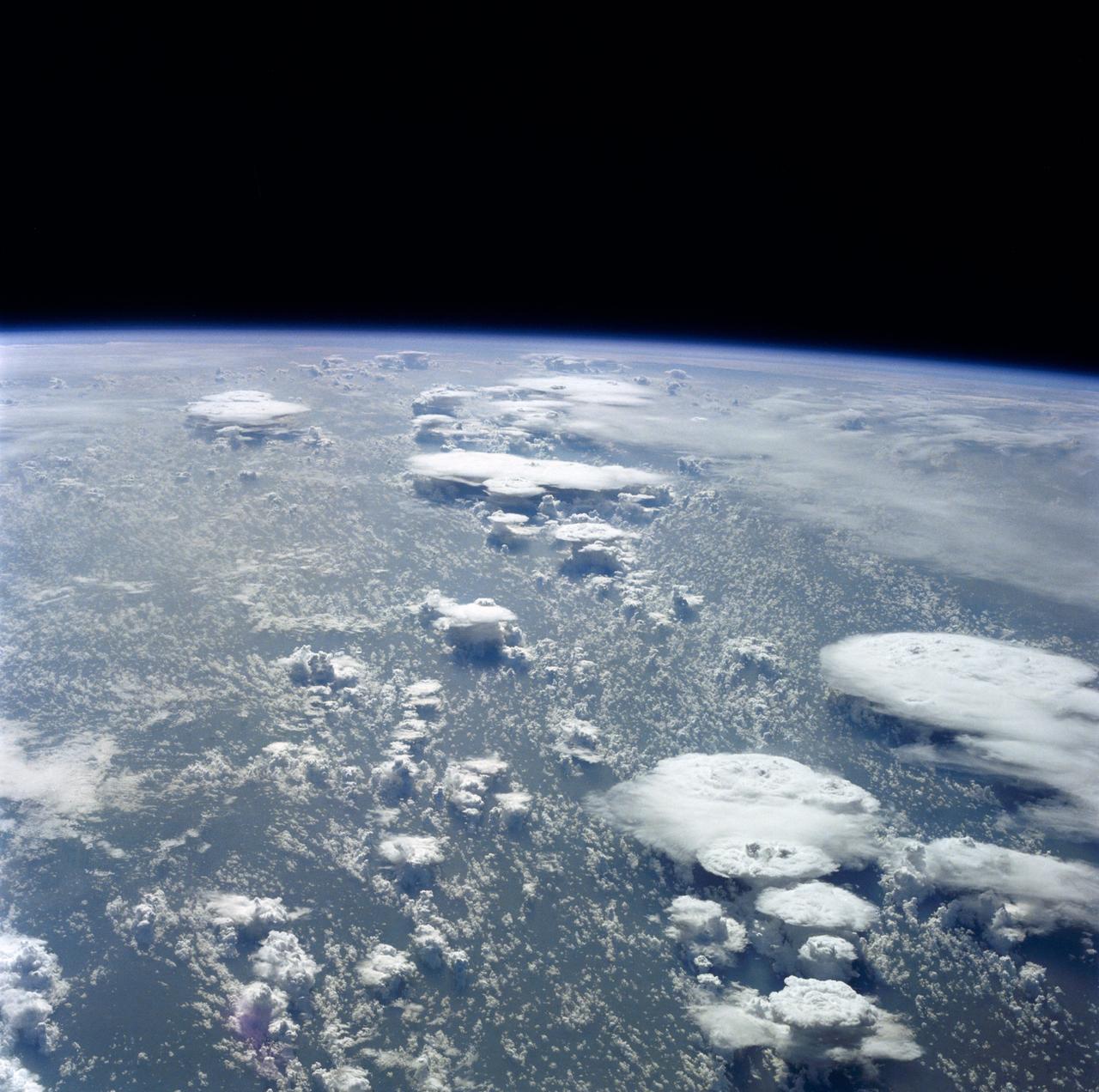
41G-39-044 (5-13 Oct 1984) --- "Flatirons", cumulonimbus clouds that have flattened out at a high altitude, the result of rapidly rising moist air.  At a given altitude, depending on the temperature, wind, and humidity, the cloud mass can no longer rise and the wind aloft shears the cloud.  Central Nigeria, an area in which tropical rain forest gives way to dryer savannah lands, lies beneath a layer a heavy haze and smoke.  The crew consisted of astronauts Robert L. Crippen, commander; Jon A. McBride, pilot; mission specialist's Kathryn D. Sullivan, Sally K. Ride, and David D. Leestma; Canadian astronaut Marc Garneau, and Paul D. Scully-Power, payload specialist's.
STS-41G earth observations
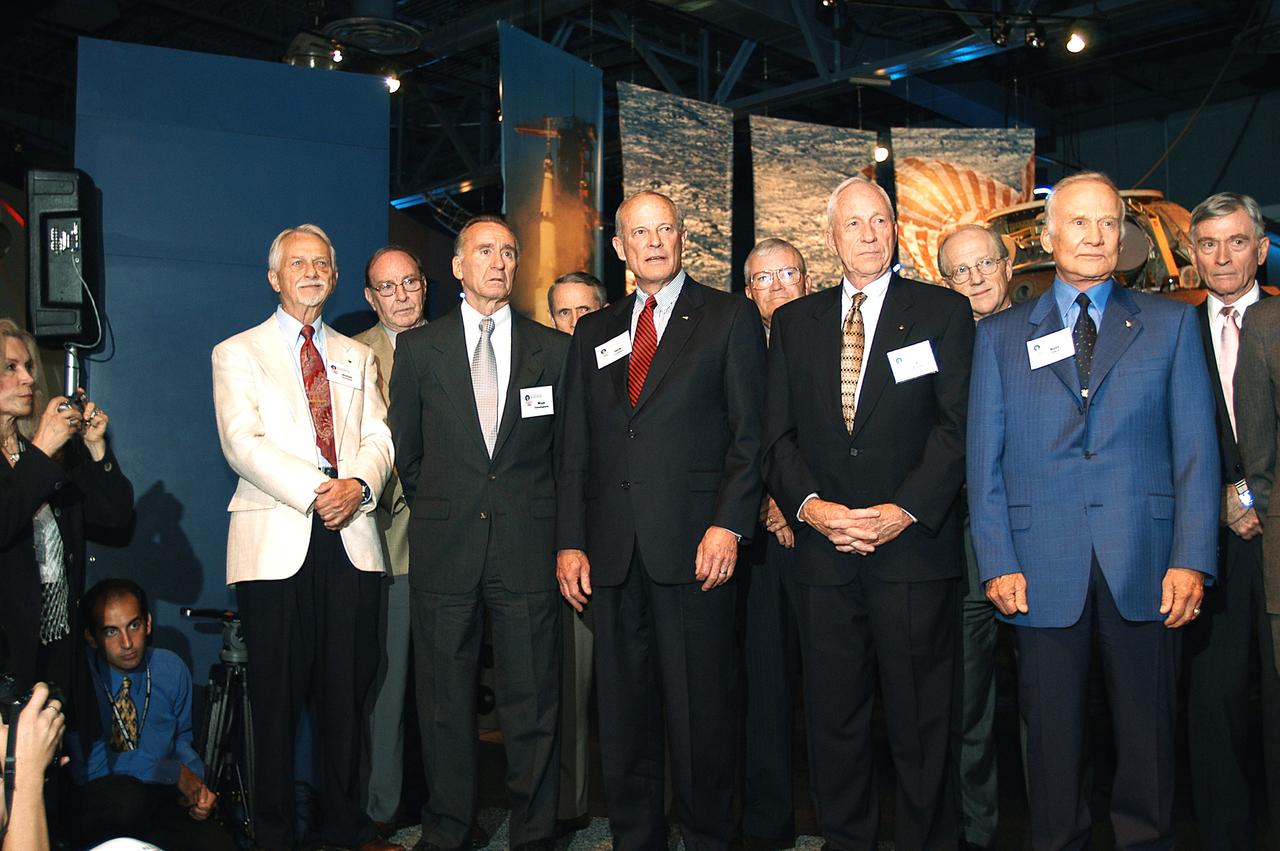
KENNEDY SPACE CENTER, FLA. -  A group of current and former U.S. astronauts are introduced to the audience at a ribbon cutting ceremony officially opening the U.S. Astronaut Hall of Fame as part of the Kennedy Space Center Visitor Complex.  In the front row, from left, are Owen K. Garriott, Walter Cunningham, Jack R. Lousma, Alfred M. Worden, and Buzz Aldrin.  In the back row, from left, are Edgar D. Mitchell, Edward G. Gibson, Fred W. Haise, Frederick H. (Rick) Hauck, and John W. Young.  The ceremony was held in conjunction with the induction of four Space Shuttle astronauts into the Hall of Fame including Daniel Brandenstein, Robert "Hoot" Gibson, Story Musgrave, and Sally Ride.  Conceived by six of the Mercury Program astronauts, the U.S. Astronaut Hall of Fame opened in 1990 to provide a place where space travelers could be remembered for their participation and accomplishments in the U.S. space program.  The four new inductees join 48 previously honored astronauts from the ranks of the Gemini, Apollo, Skylab, Apollo-Soyuz, and Space Shuttle programs.
KENNEDY SPACE CENTER, FLA. - A group of current and former U.S. astronauts are introduced to the audience at a ribbon cutting ceremony officially opening the U.S. Astronaut Hall of Fame as part of the Kennedy Space Center Visitor Complex. In the front row, from left, are Owen K. Garriott, Walter Cunningham, Jack R. Lousma, Alfred M. Worden, and Buzz Aldrin. In the back row, from left, are Edgar D. Mitchell, Edward G. Gibson, Fred W. Haise, Frederick H. (Rick) Hauck, and John W. Young. The ceremony was held in conjunction with the induction of four Space Shuttle astronauts into the Hall of Fame including Daniel Brandenstein, Robert "Hoot" Gibson, Story Musgrave, and Sally Ride. Conceived by six of the Mercury Program astronauts, the U.S. Astronaut Hall of Fame opened in 1990 to provide a place where space travelers could be remembered for their participation and accomplishments in the U.S. space program. The four new inductees join 48 previously honored astronauts from the ranks of the Gemini, Apollo, Skylab, Apollo-Soyuz, and Space Shuttle programs.
S78-26481 (January 1978) --- This is a montage of the individual portraits of the 35-member 1978 class of astronaut candidates. From left to right are Guion S. Bluford, Daniel C. Brandenstein, James F. Buchli, Michael L. Coats, Richard O. Covey, John O. Creighton, John M. Fabian, Anna L. Fisher, Dale A. Gardner, Robert L. Gibson, Frederick D. Gregory, S. David Griggs, Terry J. Hart, Frederick H. (Rick) Hauck, Steven A. Hawley, Jeffrey A. Hoffman, Shannon W. Lucid, Jon A. McBride, Ronald E. McNair, Richard M. (Mike) Mullane, Steven R. Nagel, George D. Nelson, Ellison S. Onizuka, Judith A. Resnik, Sally K. Ride, Francis R. (Dick) Scobee, Rhea Seddon, Brewster H. Shaw Jr., Loren J. Shriver, Robert L. Stewart, Kathryn D. Sullivan, Norman E. Thagard, James D. Van Hoften, David M. Walker and Donald E. Williams. Photo credit: NASA or National Aeronautics and Space Administration
Astronaut Candiates - 1978 Shuttle Program
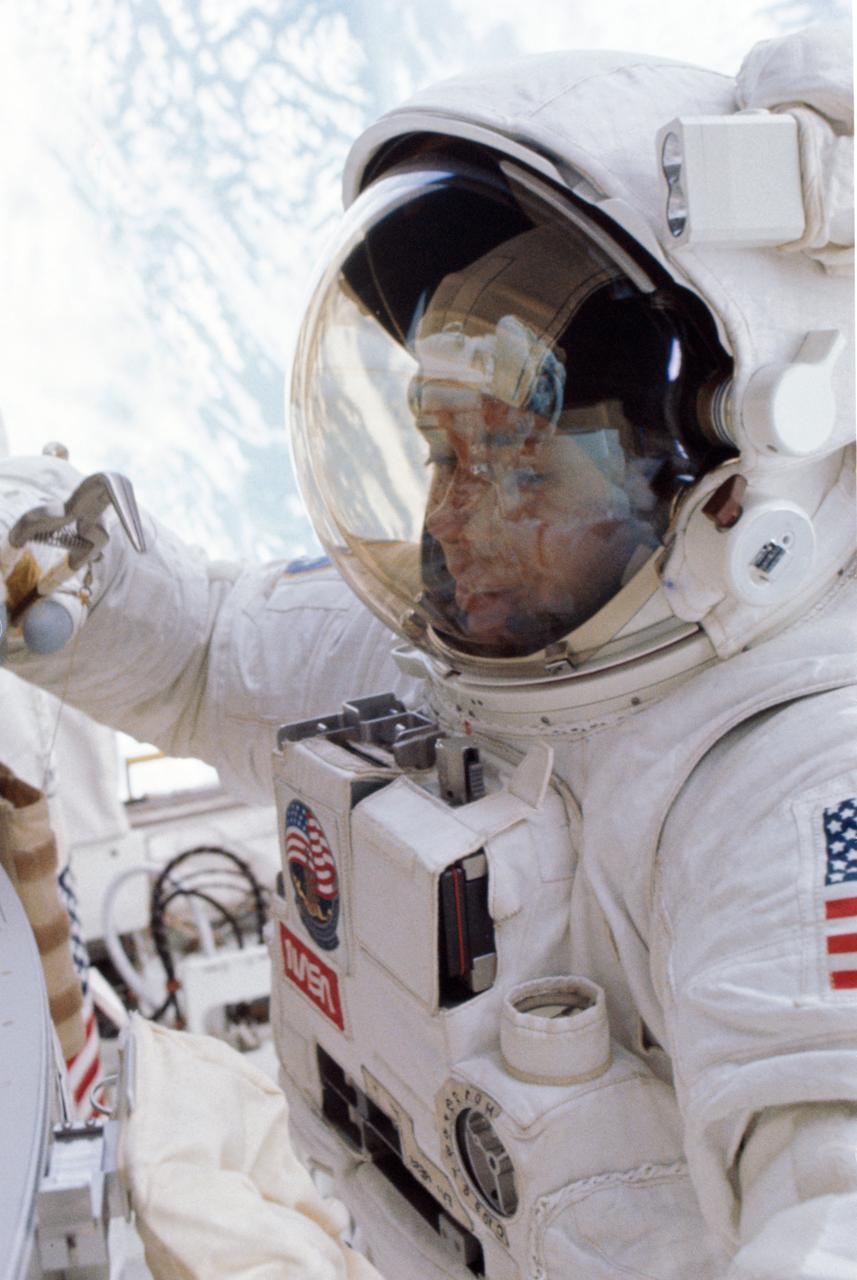
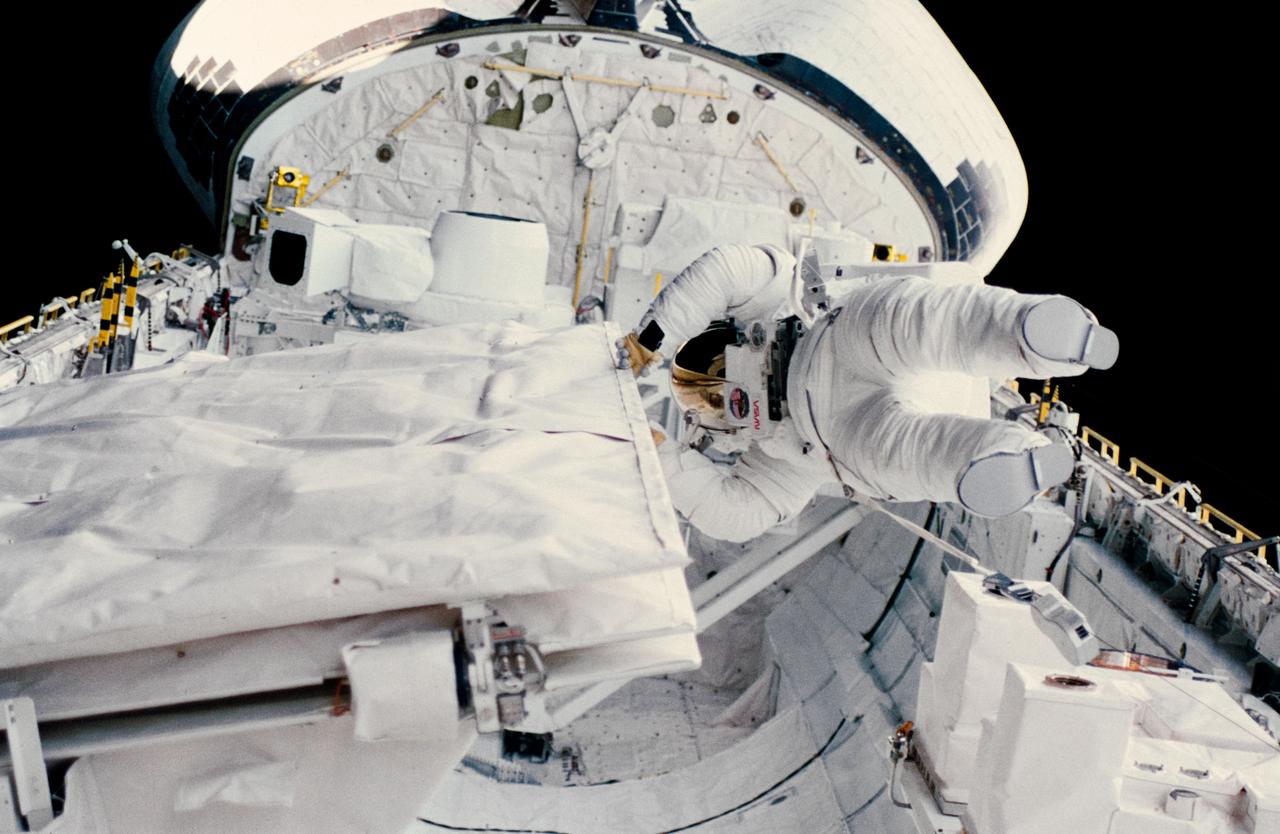
41G-13-032 (11 Oct. 1984) --- Astronaut Kathryn D. Sullivan checks the latch of the SIR-B antenna in the space shuttle Challenger's open cargo bay during her historic extravehicular activity (EVA) on Oct. 11, 1984.  Earlier, America's first woman to perform an EVA and astronaut David C. Leestma, participated in an in-space simulation of refueling a spacecraft in orbit.  The Orbital Refueling System (ORS) is just beyond the astronaut mission specialist's helmet.  To the left is the Large Format Camera (LFC).  The LFC and ORS are stationed on a device called the Mission Peculiar Support Structure (MPESS).  Crew members consisted of astronauts Robert L. Crippen, commander; Jon A. McBride, pilot; along with Kathryn D. Sullivan, Sally K. Ride, and David D. Leestma, all mission specialists; and Canadian astronaut Marc Garneau and Paul D. Scully-Power, both payload specialist.        EDITOR'S NOTE: The STS-41G mission had the first American female EVA (Sullivan); first seven-person crew; first orbital fuel transfer; and the first Canadian (Garneau).
Astronaut Kathryn Sullivan checks SIR-B antenna during EVA
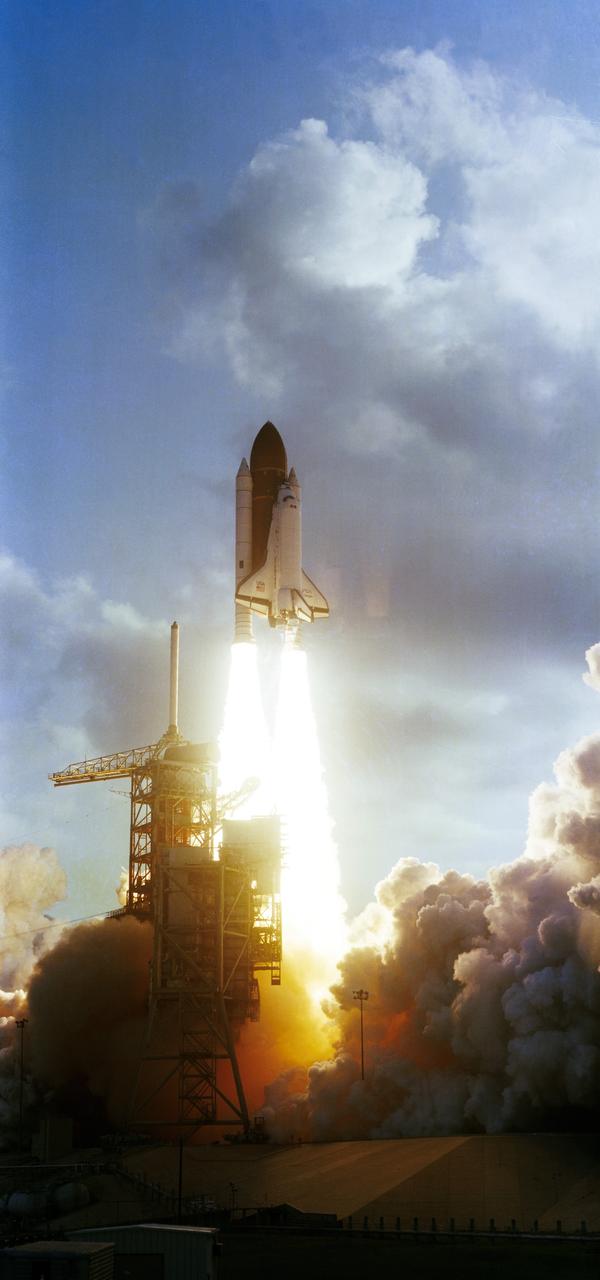
S83-35702 (18 June 1983) --- The seventh launch of the NASA Space Transportation System and the second lift-off of the space shuttle Challenger occurred at 7:33 a.m. (EDT) today from the Pad 39A launch site, at the Kennedy Space Center (KSC). The six-day mission will be highlighted by the first direct landing from space by an orbiter to the Shuttle Landing Facility (SLF). The crew consists of astronauts Robert Crippen, commander, the first two-time space shuttle astronaut; Frederick H. Hauck, pilot; and three mission specialists --  Sally K. Ride, John M. Fabian and  Norman E. Thagard. During the mission the crew will deploy the Indonesian PALAPA-B and the Canadian ANIK-C communications satellites. They will also use the Remote Manipulator System (RMS) arm to deploy and retrieve a platform for space experiments called the Shuttle Pallet Satellite (SPAS), and serve as a spaceborne laboratory for OSTA-2, a scientific payload. Getaway Special canisters and materials processing experiments will fill out the complement of payloads on the mission. Photo credit: NASA
LAUNCH - STS-7 - KSC
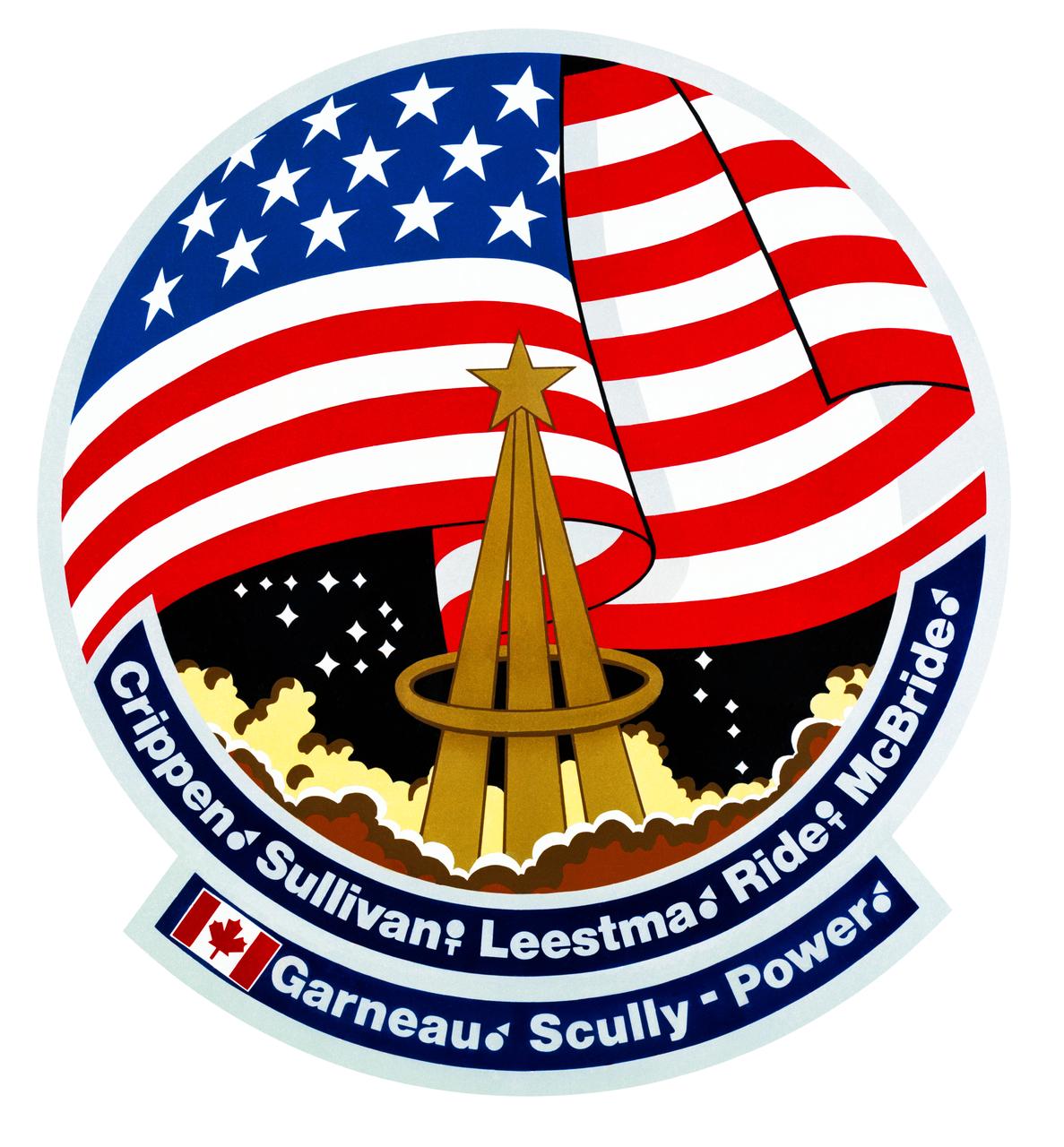
S84-36158 (June 1984) --- The STS-41G Challenger mission insignia focuses on its seven crew members (first to exceed six), the United States flag and the Unity symbol known as the astronaut pin. The pin design in center shows a trio of trajectories merging in infinite space, capped by a bright shining star and encircled by an elliptical wreath denoting orbital flight. Crew members for the (originally-scheduled 17th STS) mission include astronauts Robert L. Crippen and Jon A. McBride, commander and pilot, respectively, whose surnames flank those of the NASA mission specialists - astronauts Kathryn D. Sullivan, David C. Leestma and Sally K. Ride. Paul Scully-Power, a United States Navy oceanographer, and Marc Garneau, a Canadian, join the crew as payload specialists.  The artwork was done for NASA by Patrick Rawlings.     The NASA insignia design for space shuttle flights is reserved for use by the astronauts and for other official use as the NASA Administrator may authorize. Public availability has been approved only in the forms of illustrations by the various news media. When and if there is any change in this policy, which is not anticipated, the change will be publicly announced. Photo credit: NASA
PATCH - STS-41G CREW - INSIGNIA
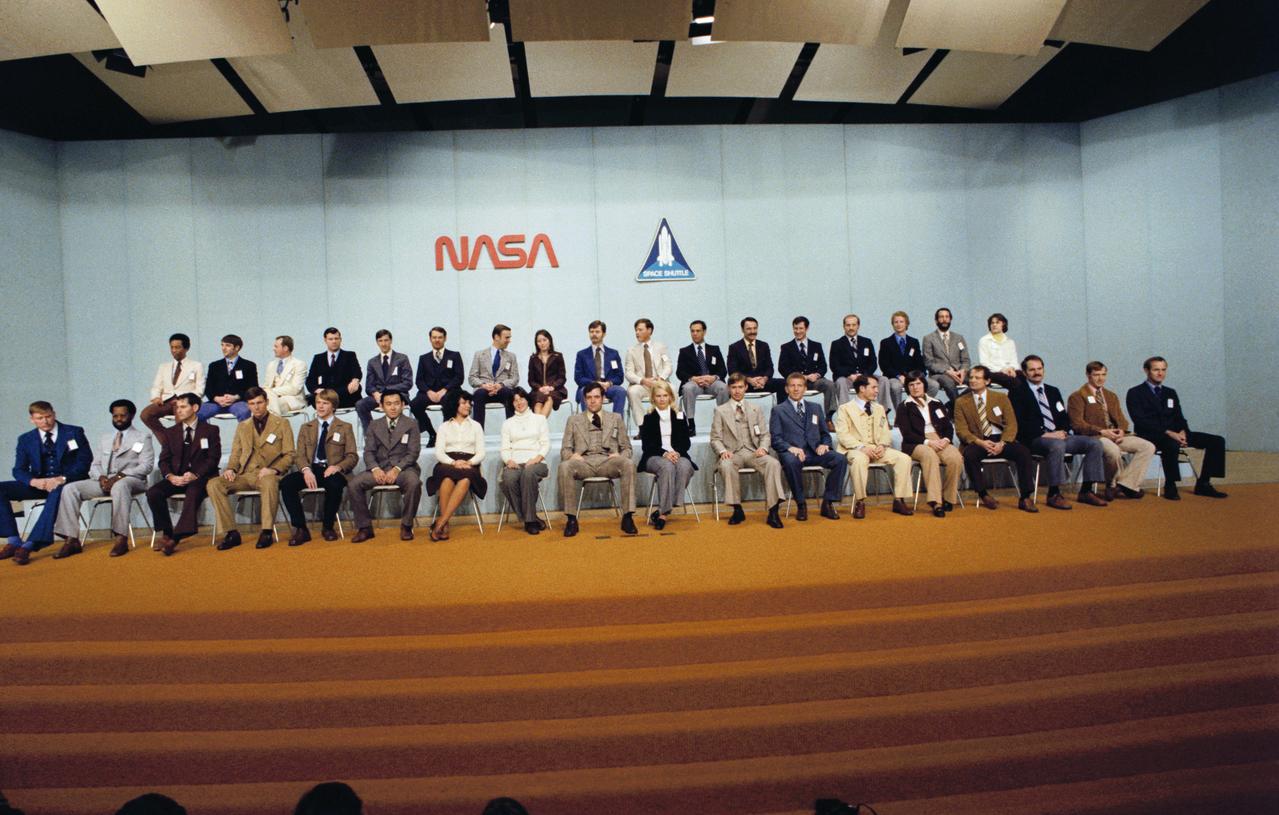
S78-26569 (31 Jan. 1978) --- The 35 new astronaut candidates, presented Jan. 31, 1978, in the Building 2 auditorium at NASA's Johnson Space Center, pose for photographers. They are arranged in alphabetical order with top left as beginning point and bottom right as stopping point. They are Guion S. Bluford, Daniel C. Brandenstein, James F. Buchli, Michael L. Coats, Richard O. Covey, John O. Creighton, John M. Fabian, Anna L. Fisher, Dale A. Gardner, Robert L. Gibson, Frederick D. Gregory, S. David Griggs, Terry J. Hart, Frederick H. (Rick) Hauck, Steven A. Hawley, Jeffrey A. Hoffman, Shannon W. Lucid, Jon A. McBride, Ronald E. McNair, Richard M. (Mike) Mullane, Steven R. Nagel, George D. Nelson, Ellison S. Onizuka, Judith A. Resnik, Sally K. Ride, Francis R. (Dick) Scobee, Rhea Seddon, Brewster H. Shaw Jr., Loren J. Shriver, Robert L. Stewart, Kathryn D. Sullivan, Norman E. Thagard, James D. van Hoften, David M. Walker and Donald E. Williams. Photo credit: NASA or National Aeronautics and Space Administration
CREW CANDIDATES - SHUTTLE - JSC
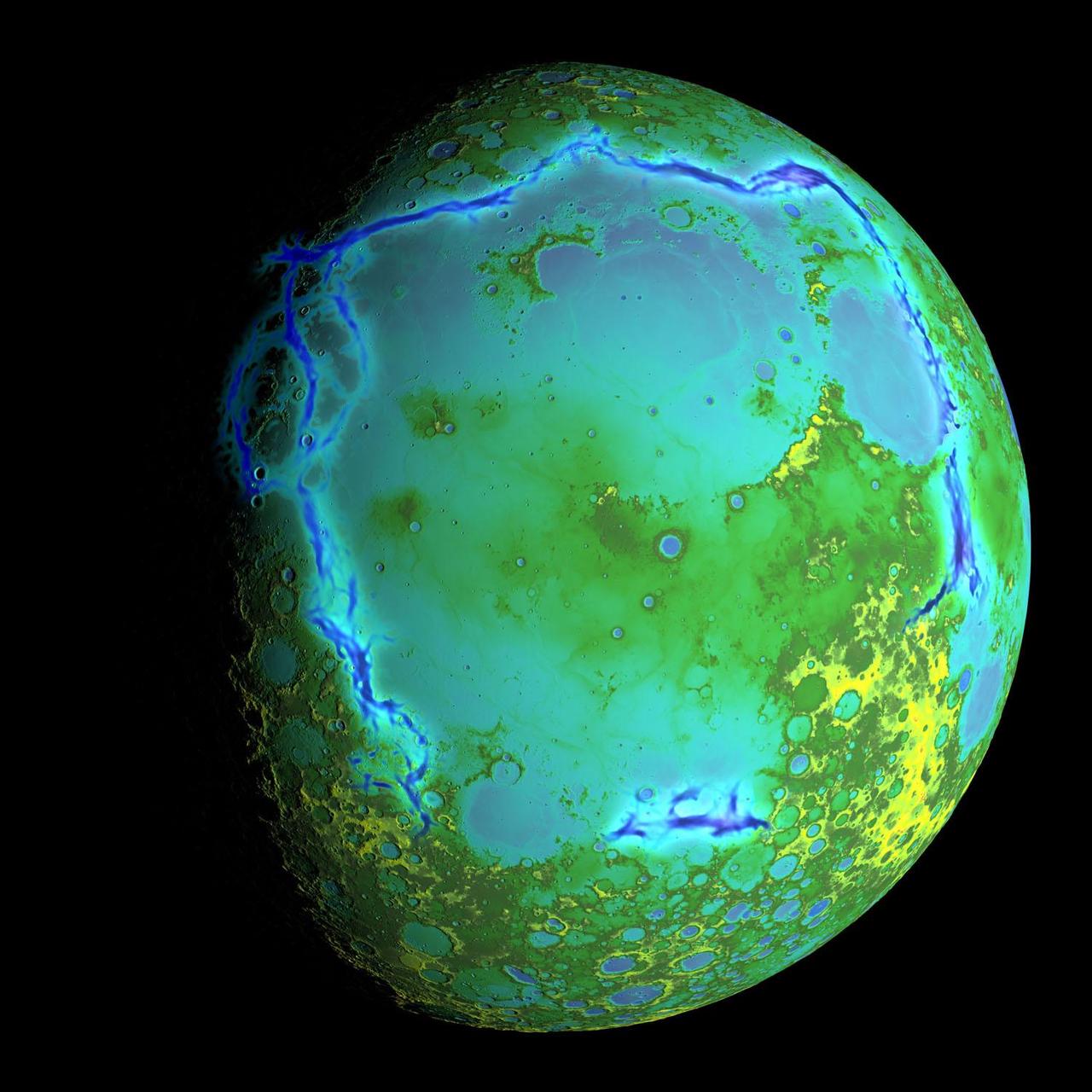
Topography of Earth's moon generated from data collected by the Lunar Orbiter Laser Altimeter, aboard NASA's Lunar Reconnaissance Orbiter, with the gravity anomalies bordering the Procellarum region superimposed in blue. The border structures are shown using gravity gradients calculated with data from NASA's Gravity Recovery and Interior Laboratory (GRAIL) mission. These gravity anomalies are interpreted as ancient lava-flooded rift zones buried beneath the volcanic plains (or maria) on the nearside of the Moon.  Launched as GRAIL A and GRAIL B in September 2011, the probes, renamed Ebb and Flow, operated in a nearly circular orbit near the poles of the moon at an altitude of about 34 miles (55 kilometers) until their mission ended in December 2012. The distance between the twin probes changed slightly as they flew over areas of greater and lesser gravity caused by visible features, such as mountains and craters, and by masses hidden beneath the lunar surface.  The twin spacecraft flew in a nearly circular orbit until the end of the mission on Dec. 17, 2012, when the probes intentionally were sent into the moon's surface. NASA later named the impact site in honor of late astronaut Sally K. Ride, who was America's first woman in space and a member of the GRAIL mission team.  GRAIL's prime and extended science missions generated the highest-resolution gravity field map of any celestial body. The map will provide a better understanding of how Earth and other rocky planets in the solar system formed and evolved.  The GRAIL mission was managed by NASA's Jet Propulsion Laboratory (JPL) in Pasadena, California, for NASA's Science Mission Directorate in Washington. The mission was part of the Discovery Program managed at NASA's Marshall Space Flight Center in Huntsville, Alabama. GRAIL was built by Lockheed Martin Space Systems in Denver.  For more information about GRAIL, please visit <a href="http://grail.nasa.gov" rel="nofollow">grail.nasa.gov</a>.  Credit: NASA/Colorado School of Mines/MIT/GSFC/Scientific Visualization Studio
Topography of Earth's moon