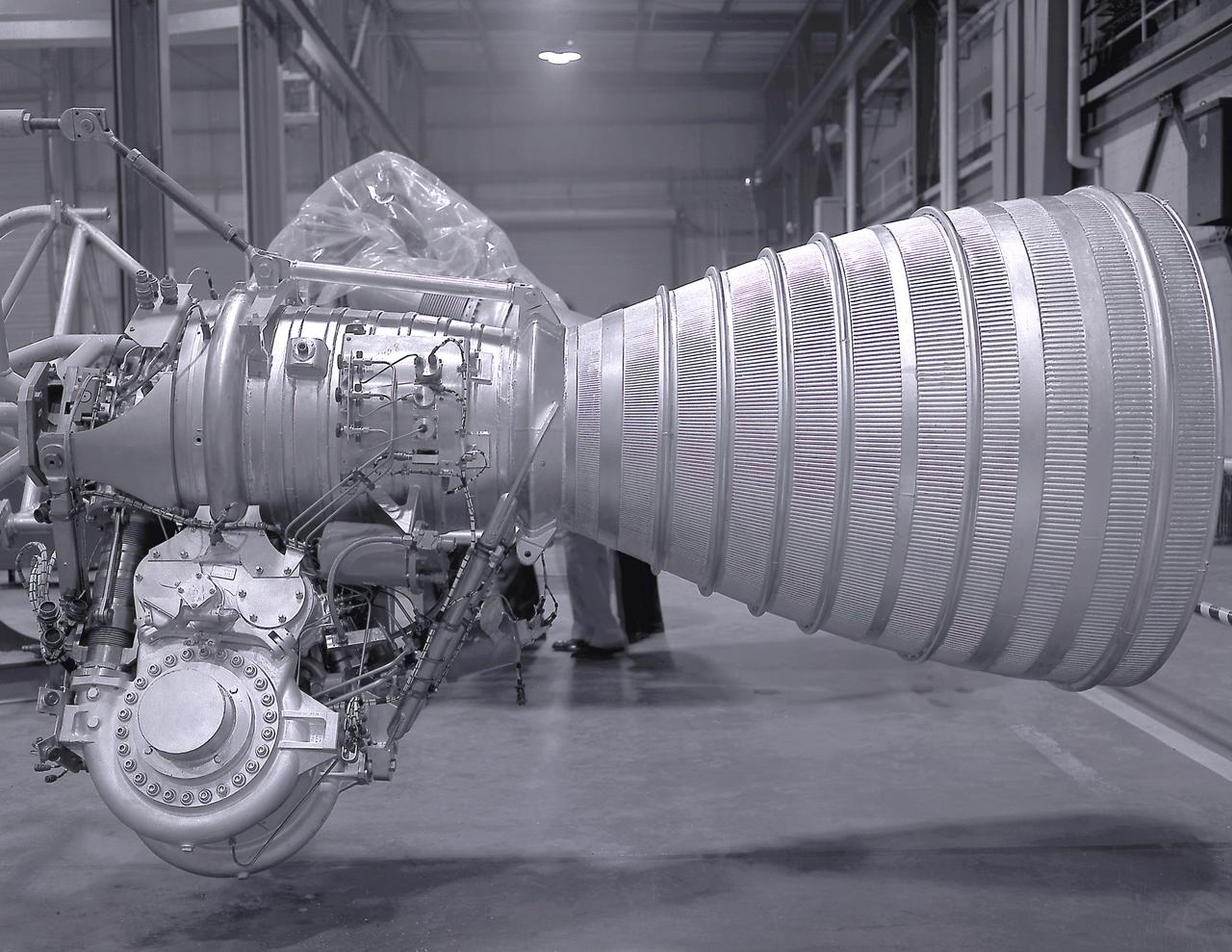
A Cluster of eight H-1 engines were used to thrust the first stage of Saturn I (S-I stage) and Saturn IB (S-IB stage). The engines were arranged in a double pattern. Four engines, located inboard, were fixed in a square pattern around the stage axis, while the remaining four engines were located outboard in a larger square pattern and each outer engine was gimbaled. Each H-1 engine, fueled with liquid oxygen (LOX) and kerosene (RP-1), had a thrust of 188,000 pound each for a combined thrust of over 1,500,000 pounds. The H-1 engine was developed under the direction of Marshall Space Flight Center (MSFC).
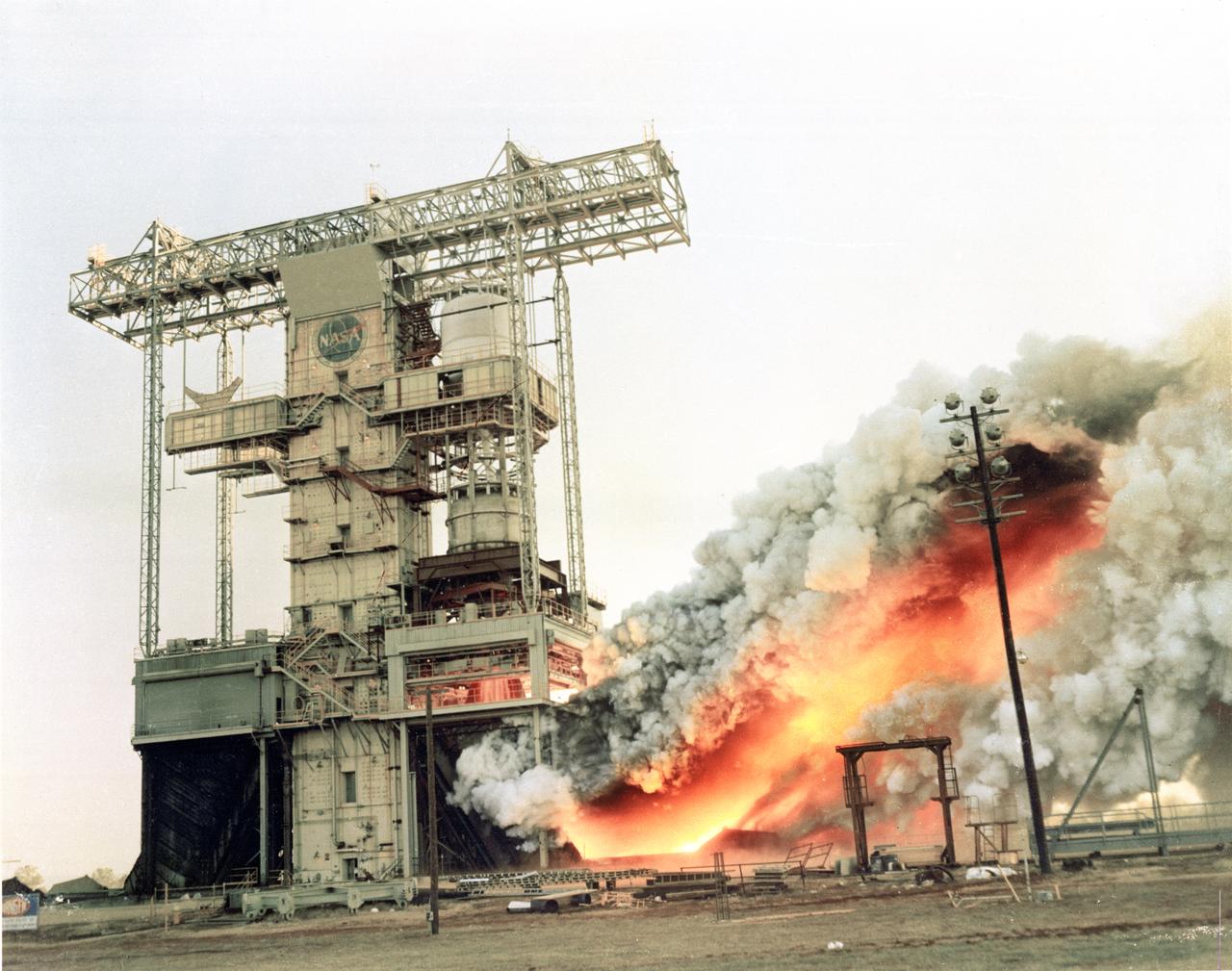
Pictured is a dual position Saturn I/IB test at the T-Stand at Marshall Space Flight Center. This stand was built to test two articles at the same time, thus providing engineers at MSFC with the opportunity to compare identical burns.
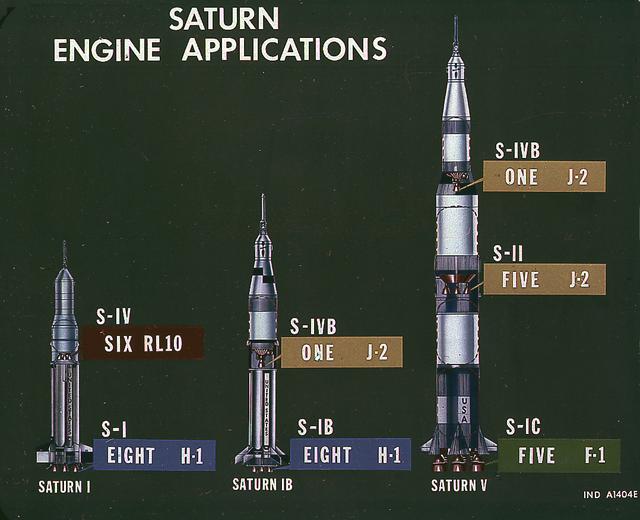
This image illustrates the basic differences between the three Saturn launch vehicles developed by the Marshall Space Flight Center. The Saturn I, consisted of two stages, the S-I (eight H-1 engines) and the S-IV (six RL-10 engines). The Saturn IB (center) also consisted of two stages, the S-IB (eight H-1 engines) and the S-IVB (one J-2 engine). The Saturn V consisted of three stages, the S-IC (five F-1 engines), the S-II (five J-2 engines), and the S-IVB (one J-2 engine).
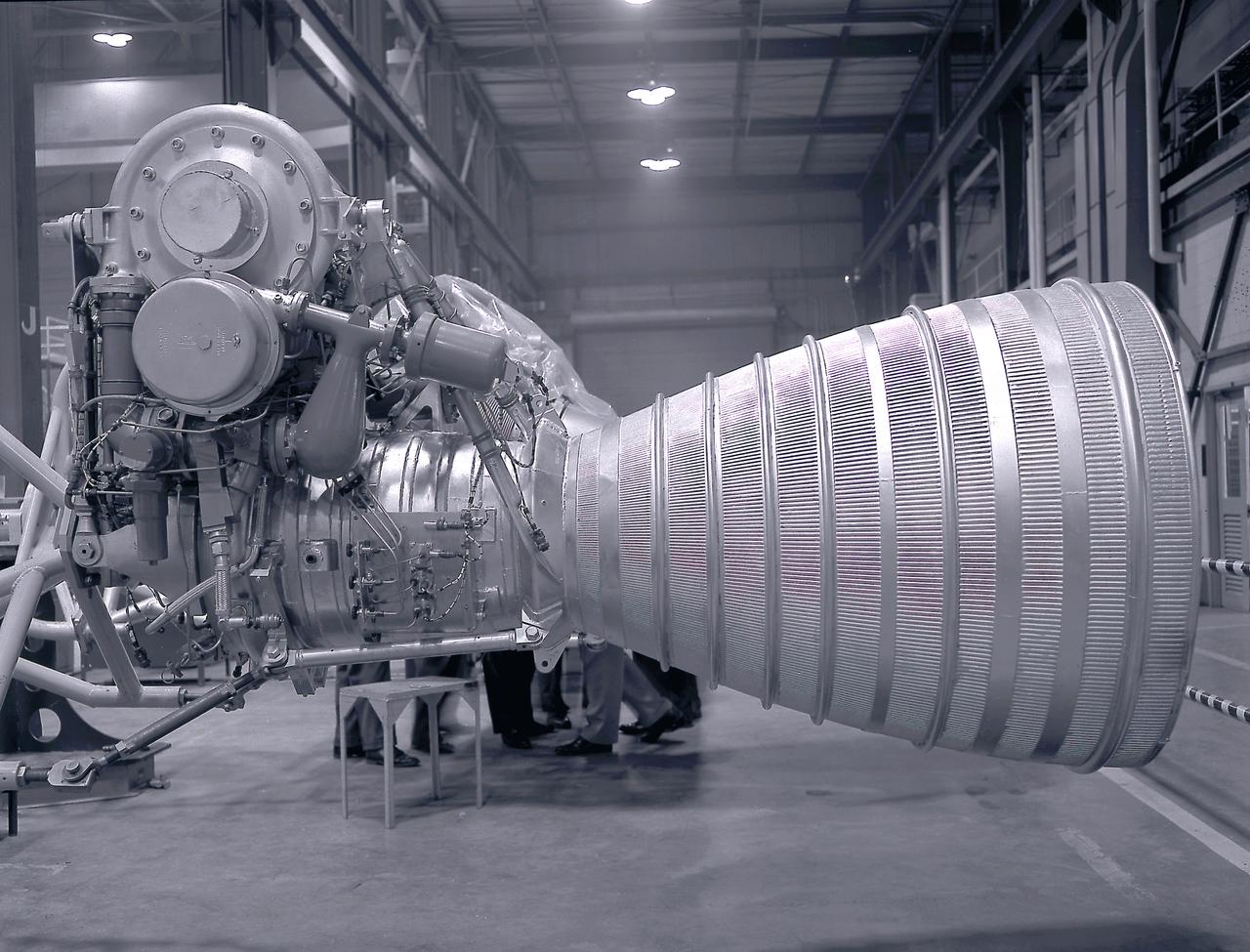
A Cluster of eight H-1 engines were used to thrust the first stage of Saturn I (S-I stage) and Saturn IB (S-IB stage). The engines were arranged in a double pattern. Four engines, located inboard, were fixed in a square pattern around the stage axis, while the remaining four engines were located outboard in a larger square pattern and each outer engine was gimbaled. The H-1 engine, fueled with liquid oxygen (LOX) and kerosene (RP-1), had a thrust of 188,000 pound each for a combined thrust of over 1,500,000 pounds. Each H-1 engine was developed under the direction of Marshall Space Flight Center (MSFC).
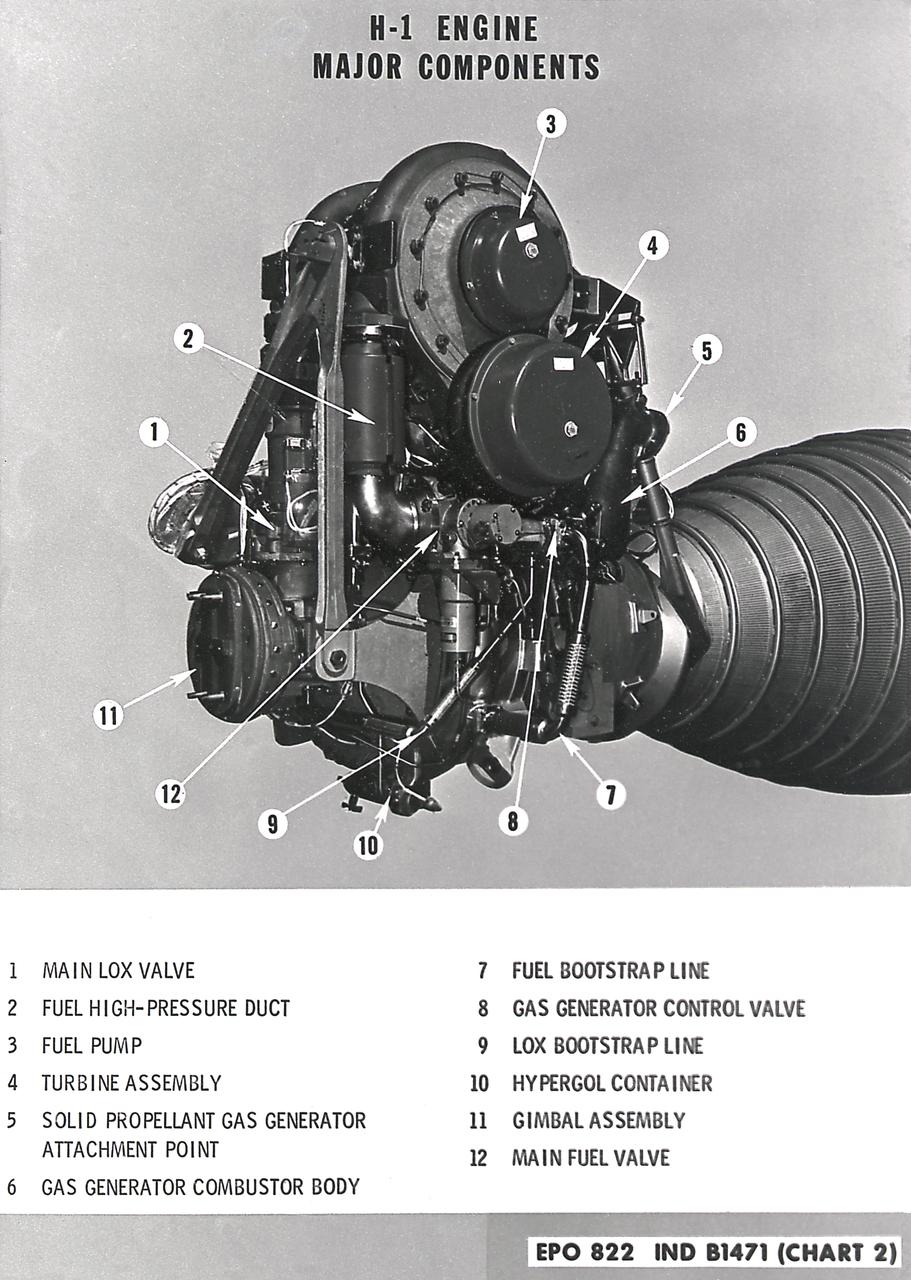
H-1 engine major components with callouts (chart 1). The H-1 engine was used in a cluster of eight on the the first stage of Saturn I (S-I stage) and Saturn IB (S-IB stage). The engines were arranged in a double pattern: four engines, located inboard, were fixed in a square pattern around the stage axis, while the remaining four engines were located outboard in a larger square pattern and each outer engine was gimbaled. Each H-1 engine had a thrust of 188,000 pounds for a combined thrust of over 1,500,000 pounds.
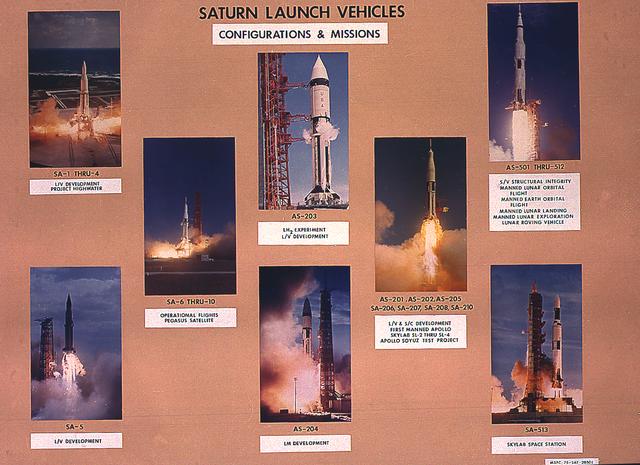
This montage illustrates the various configurations and missions of the three classes of the Saturn vehicles developed by the Marshall Space Flight Center. The missions for the Saturn I included atmospheric science investigations and the deployment of the Pegasus meteroid-detection satellite as well as launch vehicle development. The Saturn IB vehicle tested the Apollo spacecraft and launched the three marned Skylab missions as well as the Apollo Soyuz test project. The Saturn V vehicle launched the manned lunar orbital/landing missions, and the Skylab Orbital Workshop in 1973.
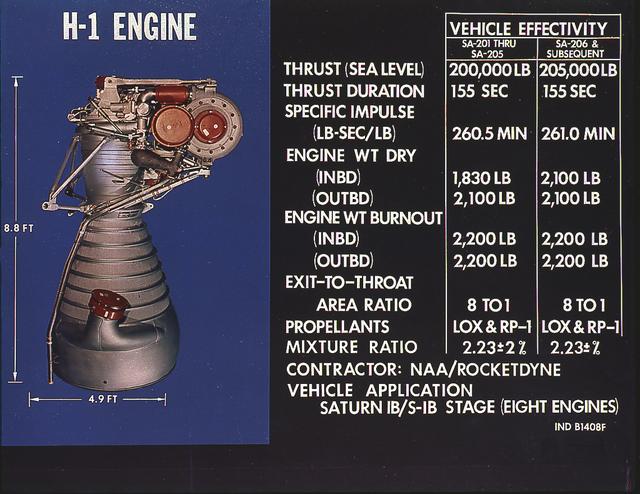
H-1 engine characteristics: The H-1 engine was developed under the management of the Marshall Space Flight Center (MSFC). The cluster of eight H-1 engines was used to power the first stage of the Saturn I (S-I stage) and Saturn IB (S-IVB stage) launch vehicles, and produced 188,00 pounds of thrust, a combined thrust of 1,500,000 pounds, later uprated to 205,000 pounds of thrust and a combined total thrust of 1,650,000 pounds for the Saturn IB program.
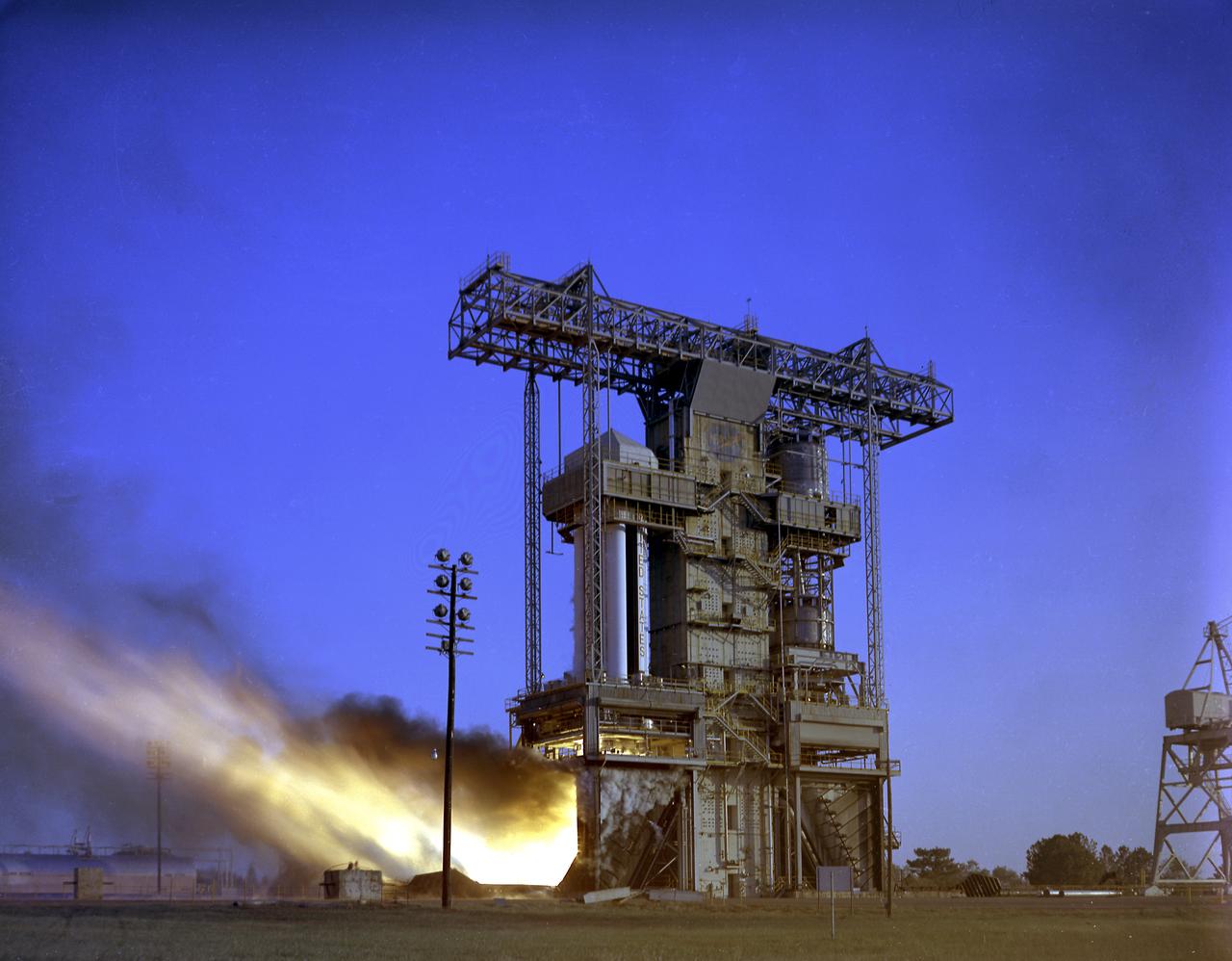
Test firing of the Saturn I S-I Stage (S-1-10) at the Marshall Space Flight Center. This test stand was originally constructed in 1951 and sometimes called the Redstone or T tower. In l961, the test stand was modified to permit static firing of the S-I/S-IB stages, which produced a total thrust of 1,600,000 pounds. The name of the stand was then changed to the S-IB Static Test Stand.
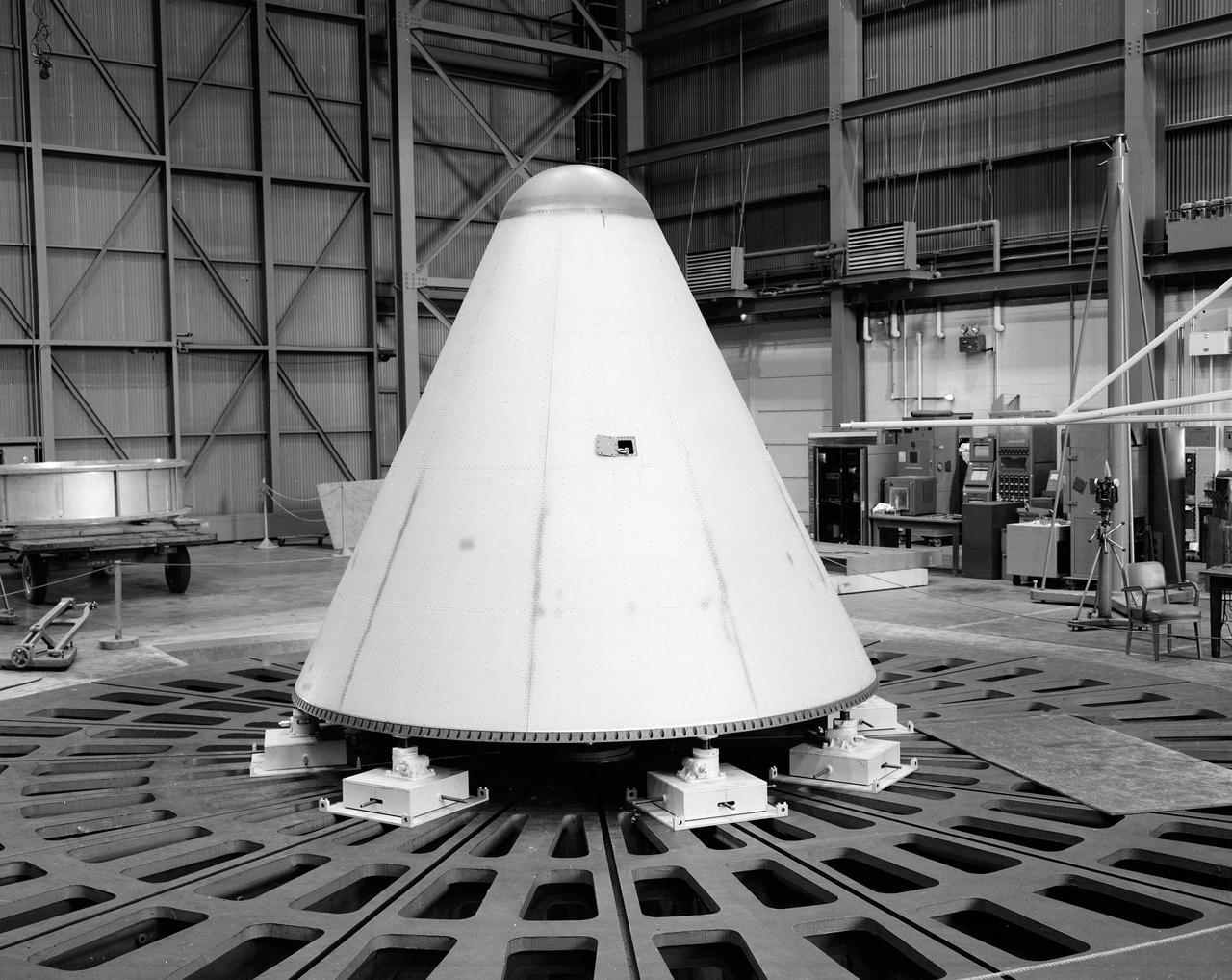
Developed by the Marshall Space Flight Center (MSFC) as an interim vehicle in MSFC’s “building block” approach to the Saturn rocket development, the Saturn IB utilized Saturn I technology to further develop and refine the larger boosters and the Apollo spacecraft capabilities required for the manned lunar missions. The Saturn IB vehicle was a two-stage rocket and had a payload capability about 50 percent greater than the Saturn I vehicle. The first stage, S-IB stage, was a redesigned first stage of the Saturn I. This photograph is of the S-IB nose cone #3 during assembly in building 4752.
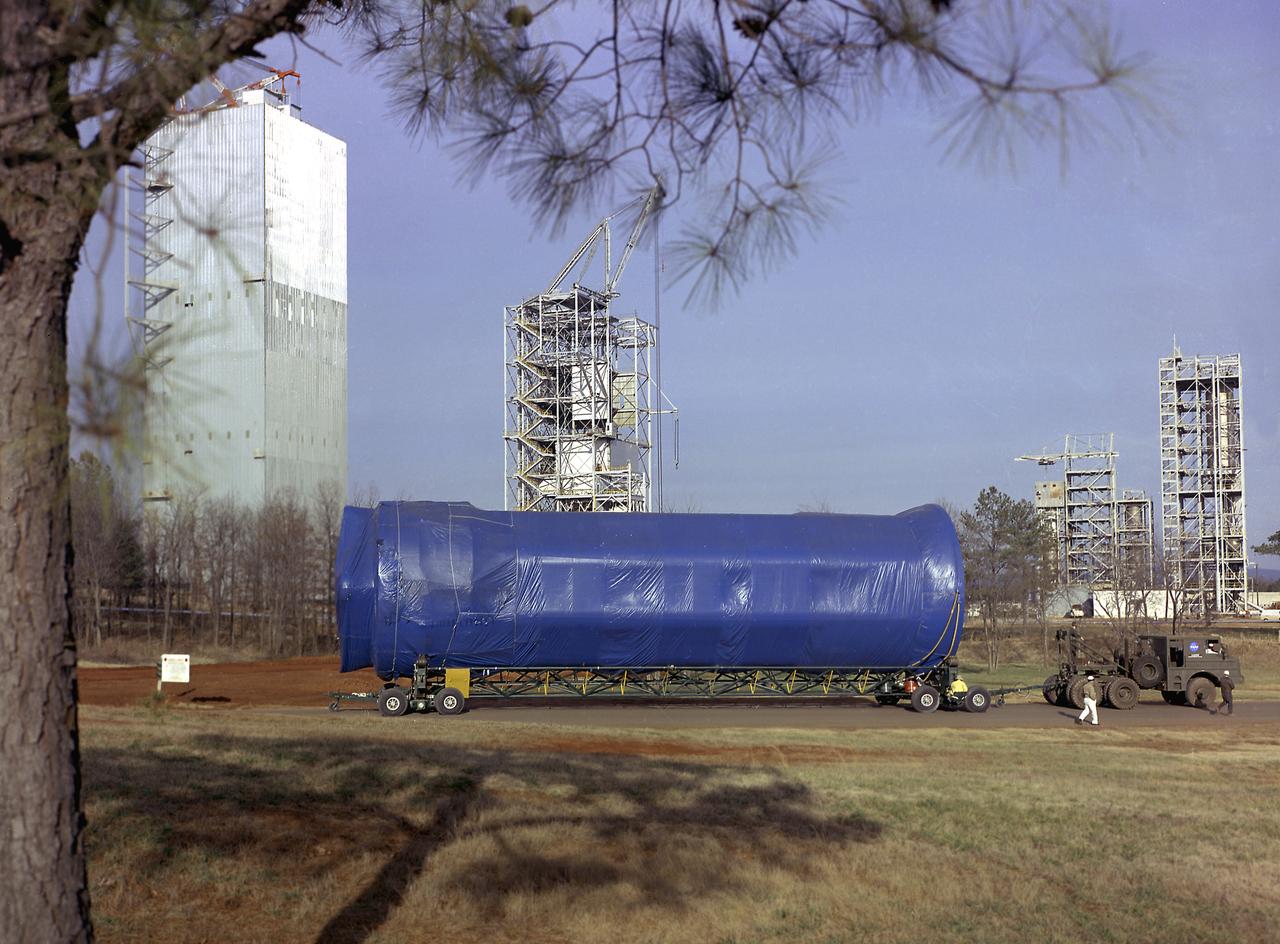
S-IB-200D, a dynamic test version of the Saturn IB launch vehicle's first stage (S-IB), makes its way to the Marshall Space Flight Center (MSFC) East Test Area on January 4, 1965. Test Laboratory persornel assembled a complete Saturn IB to test the structural soundness of the launch vehicle in the Dynamic Test Stand. Developed by the MSFC as an interim vehicle in MSFC's "building block" approach to the Saturn rocket development, the Saturn IB utilized Saturn I technology to further develop and refine the larger boosters and the Apollo spacecraft capabilities required for the manned lunar missions.
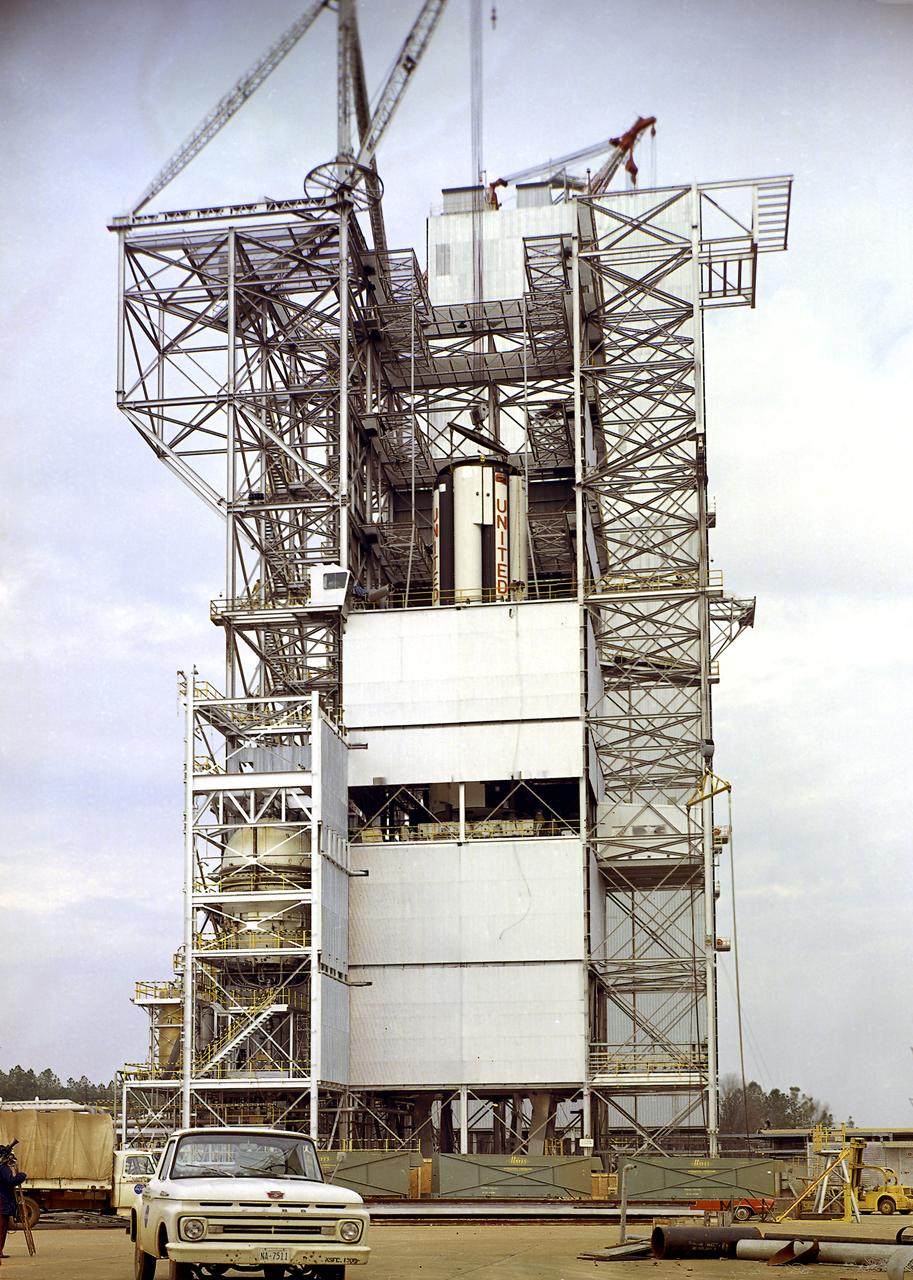
Marshall Space Flight Center (MSFC) workers lower S-IB-200D, a dynamic test version of the Saturn IB launch vehicle's first stage (S-IB stage), into the Center's Dynamic Test Stand on January 12, 1965. Test Laboratory persornel assembled a complete Saturn IB to test the structural soundness of the launch vehicle. Developed by the MSFC as an interim vehicle in MSFC's "building block" approach to Saturn rocket development, the Saturn IB utilized Saturn I technology to further develop and refine large boosters and the Apollo spacecraft capabilities required for the manned lunar missions.
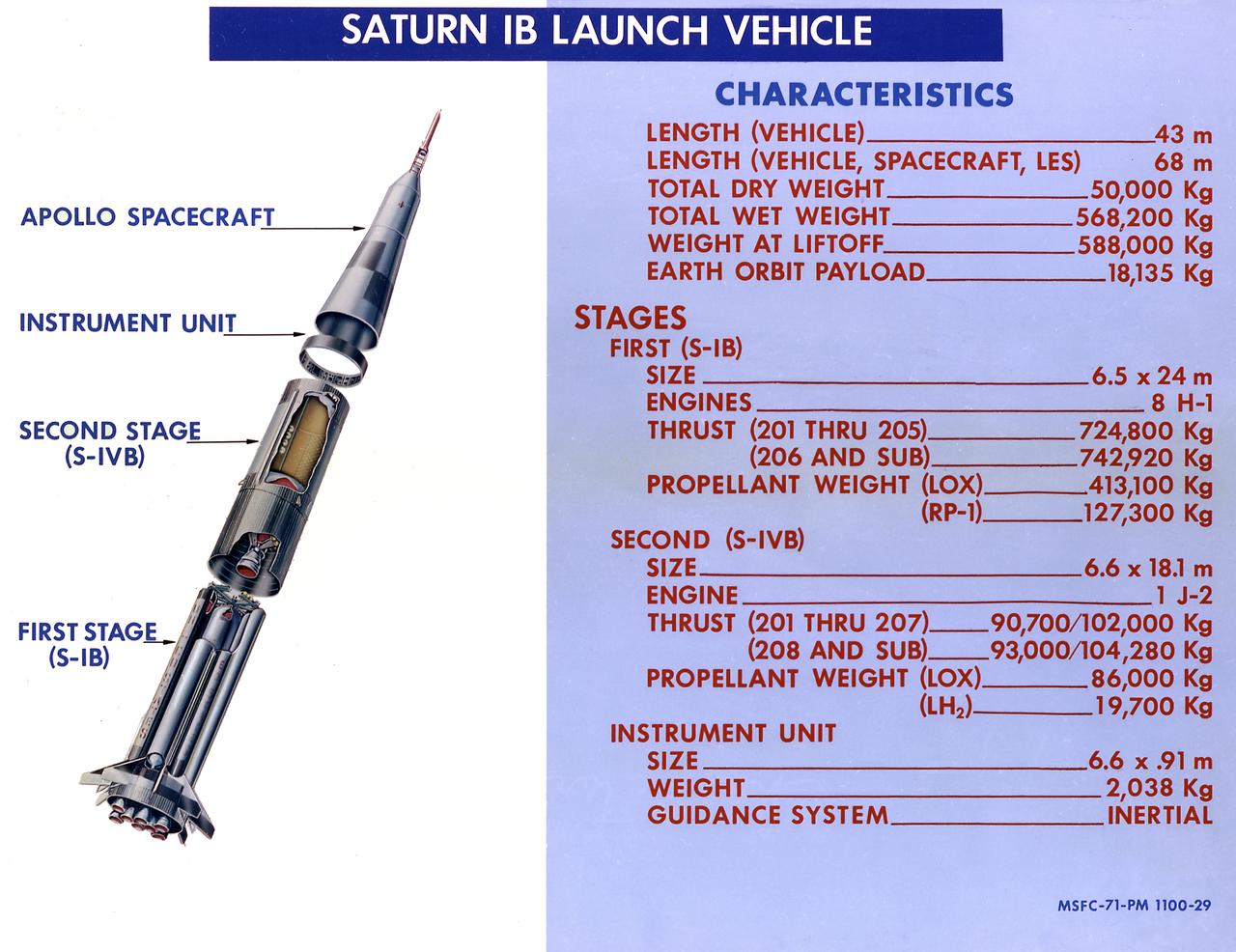
This 1968 cutaway drawing illustrates the Saturn IB launch vehicle with its two booster stages, the S-IB (first stage) and S-IVB (second stage), and provides the vital statistics in metric units. Developed by the Marshall Space Flight Center (MSFC) as an interim vehicle in MSFC's "building block" approach to the Saturn rocket development, the Saturn IB utilized Saturn I technology to further develop and refine the larger boosters and the Apollo spacecraft capabilities required for the marned lunar missions.
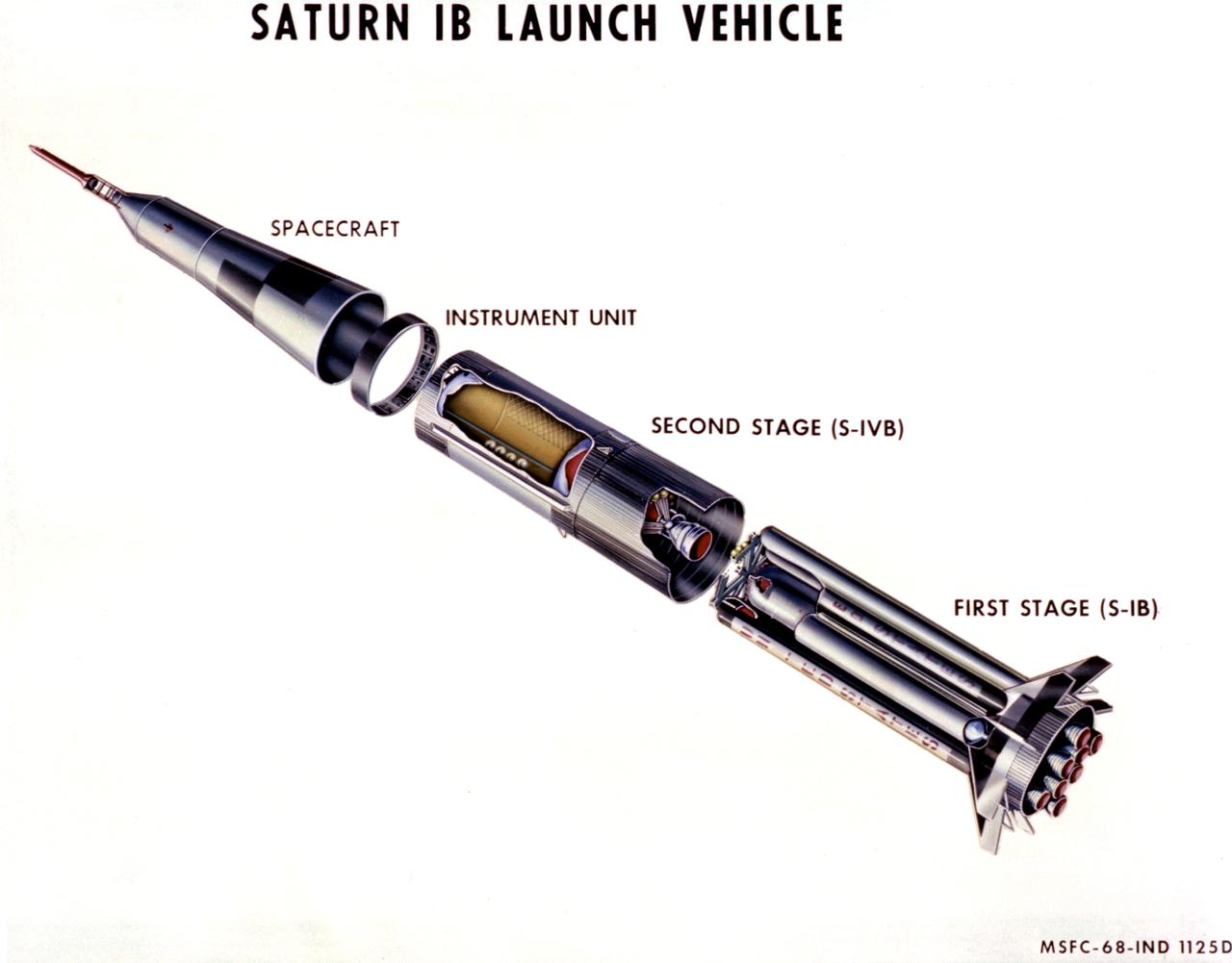
This 1968 cutaway drawing illustrates the Saturn IB launch vehicle with its two booster stages, the S-IB and S-IVB. Developed by the Marshall Space Flight Center (MSFC) as an interim vehicle in MSFC's "building block" approach to the Saturn rocket development, the Saturn IB utilized Saturn I technology to further develop and refine the larger boosters and the Apollo spacecraft capabilities required for the marned lunar mission.
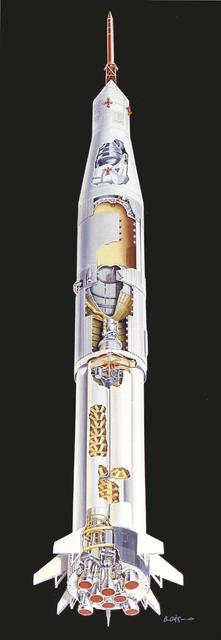
This undated cutaway drawing illustrates the Saturn IB launch vehicle with its two booster stages, the S-IB and S-IVB. Developed by the Marshall Space Flight Center (MSFC) as an interim vehicle in MSFC's "building block" approach to the Saturn rocket development, the Saturn IB utilized Saturn I technology to further develop and refine the larger boosters and the Apollo spacecraft capabilities required for the marned lunar missions.
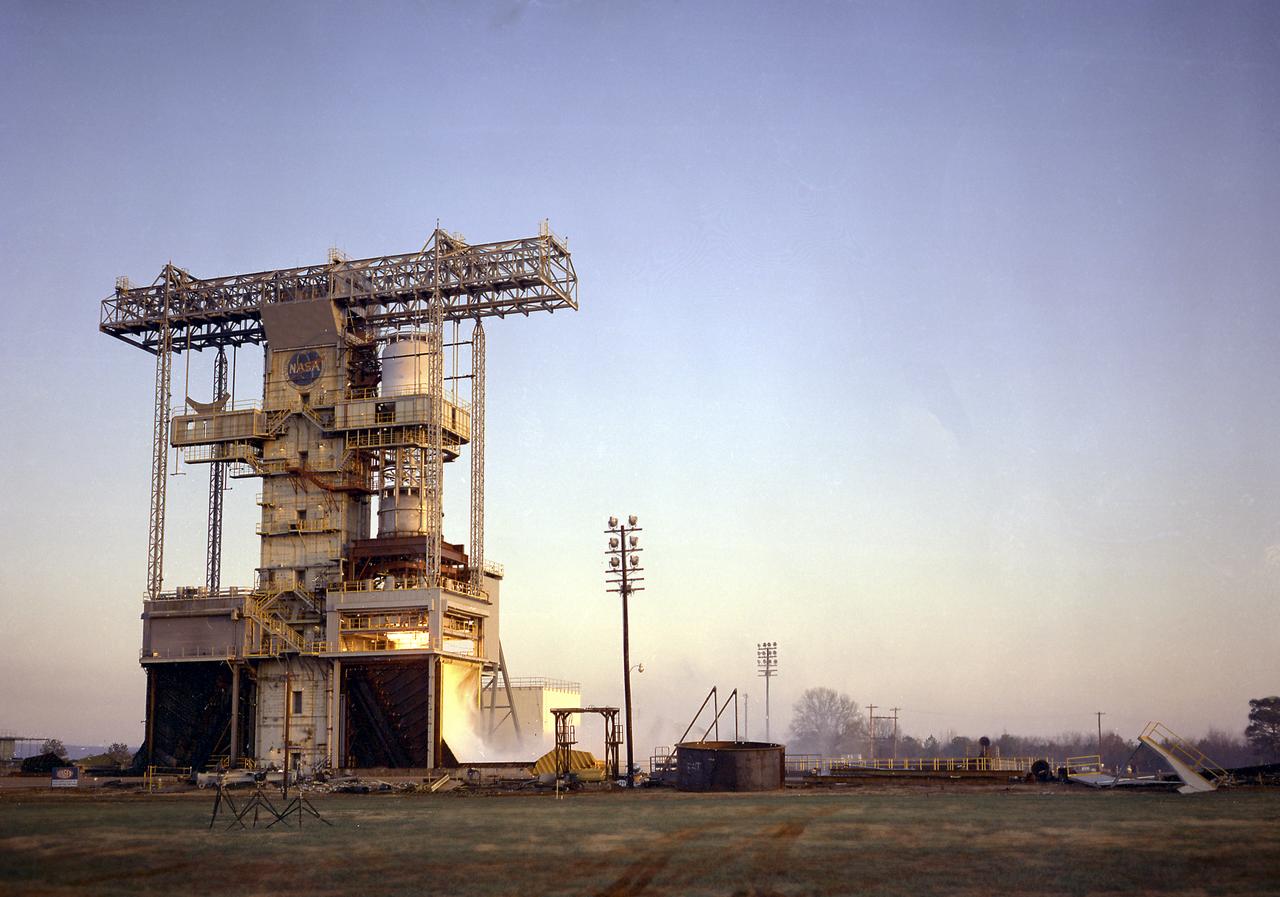
The test laboratory of the Marshall Space Flight Center (MSFC) tested the F-1 engine, the most powerful rocket engine ever fired at MSFC. The engine was tested on the newly modified Saturn IB static test stand that had been used for three years to test the Saturn I eight-engine booster, S-I (first) stage. In 1961, the test stand was modified to permit static firing of the S-I/S-IB stage and the name of the stand was then changed to the S-IB Static Test Stand. Producing a combined thrust of 7,500,000 pounds, five F-1 engines powered the S-IC (first) stage of the Saturn V vehicle for the marned lunar mission.
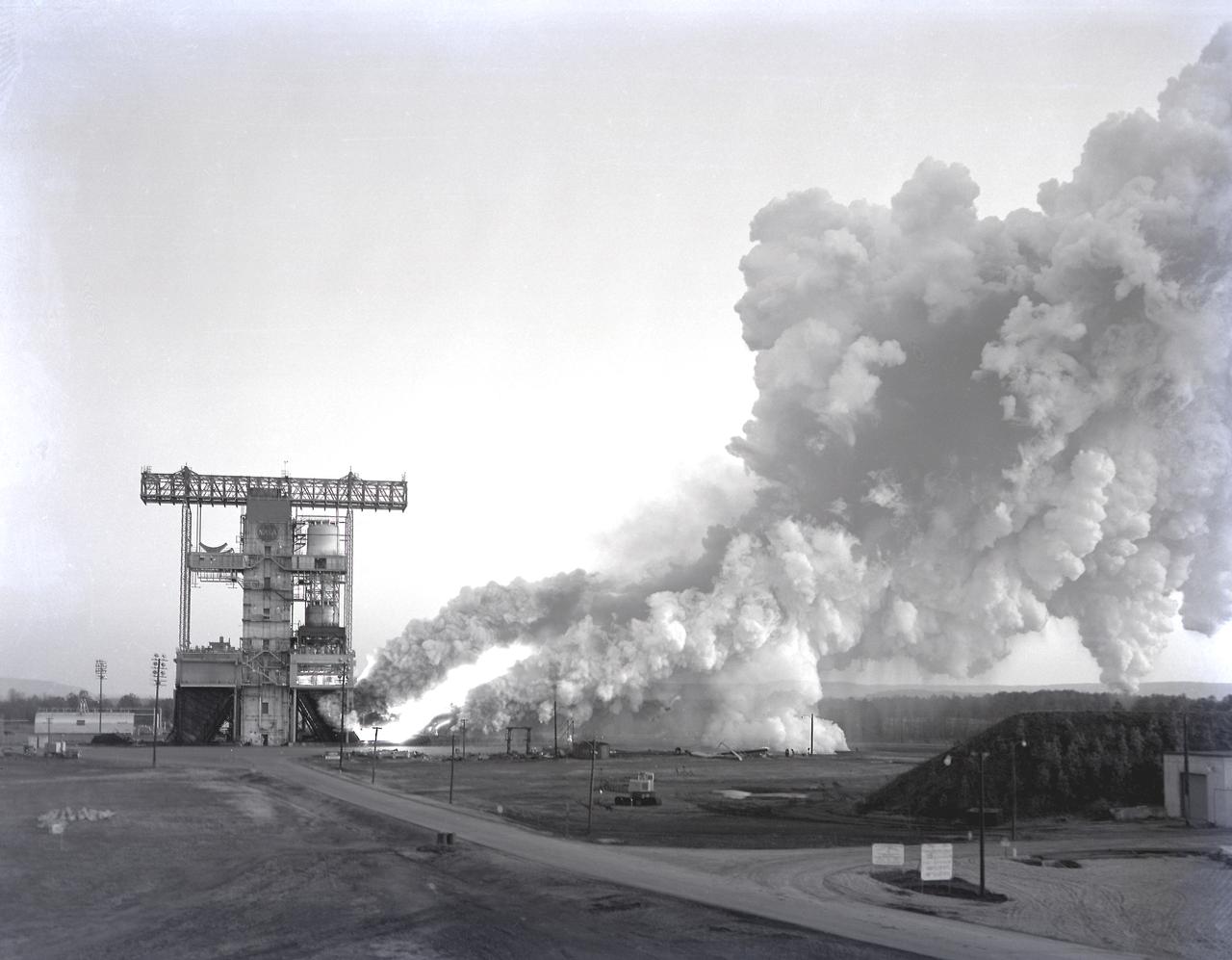
The test laboratory of the Marshall Space Flight Center (MSFC) tested the F-1 engine, the most powerful rocket engine ever fired at MSFC. The engine was tested on the newly modified Saturn IB Static Test Stand which had been used for three years to test the Saturn I eight-engine booster, S-I (first) stage. In 1961 the test stand was modified to permit static firing of the S-I/S-IB stage and the name of the stand was then changed to the S-IB Static Test Stand. Producing a combined thrust of 7,500,000 pounds, five F-1 engines powered the S-IC (first) stage of the Saturn V vehicle for the marned lunar mission.
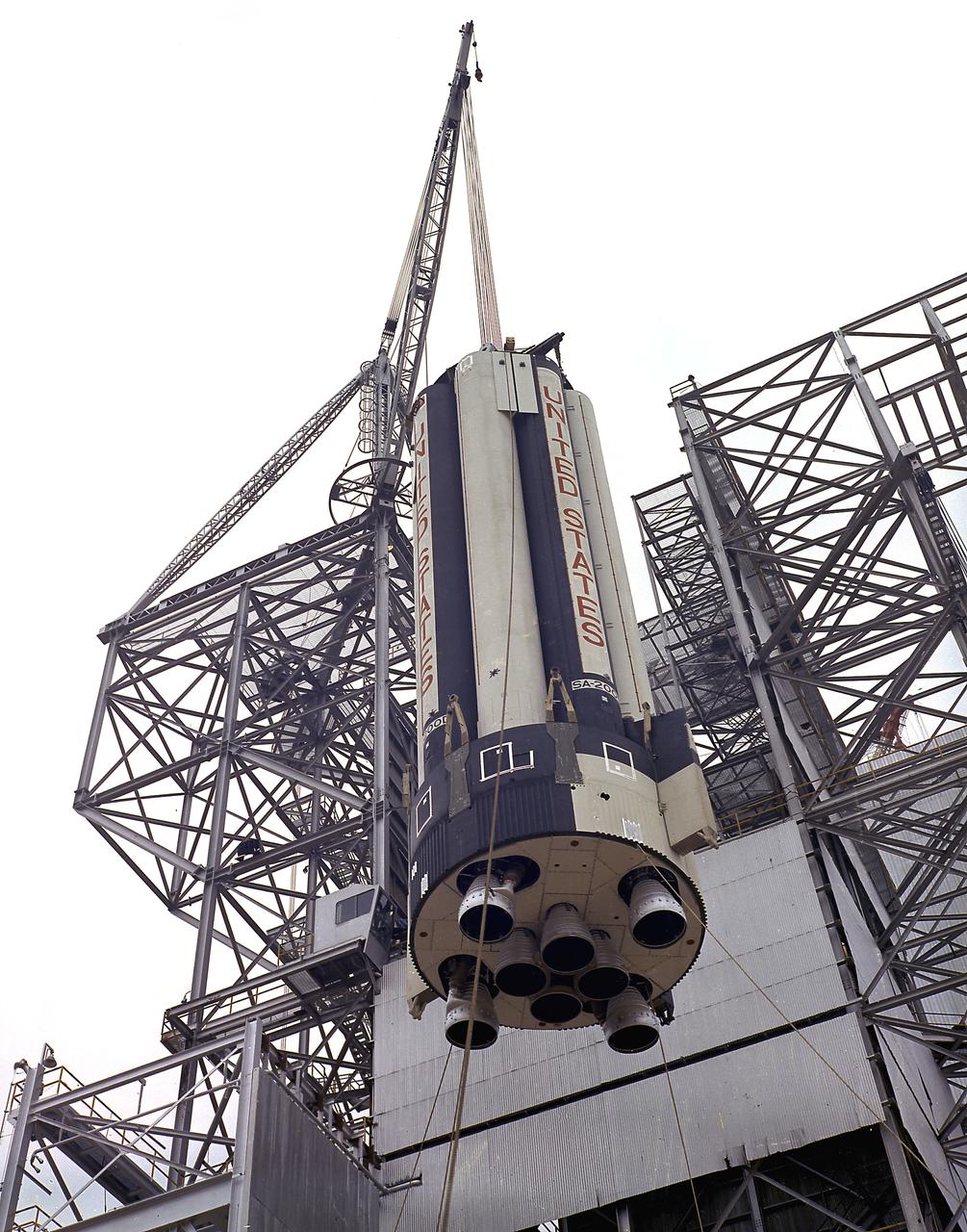
Workers at the Marshall Space Flight Center's (MSFC) Dynamic Test Stand install S-IB-200D, a dynamic test version of the Saturn IB launch vehicle's first stage, on January 11, 1965. MSFC Test Laboratory persornel assembled a complete Saturn IB to test the launch vehicle's structural soundness. Developed by the MSFC as an interim vehicle in MSFC's "building block" approach to the Saturn rocket development, the Saturn IB utilized Saturn I technology to further develop and refine the larger boosters and the Apollo spacecraft capabilities required for the manned lunar missions.
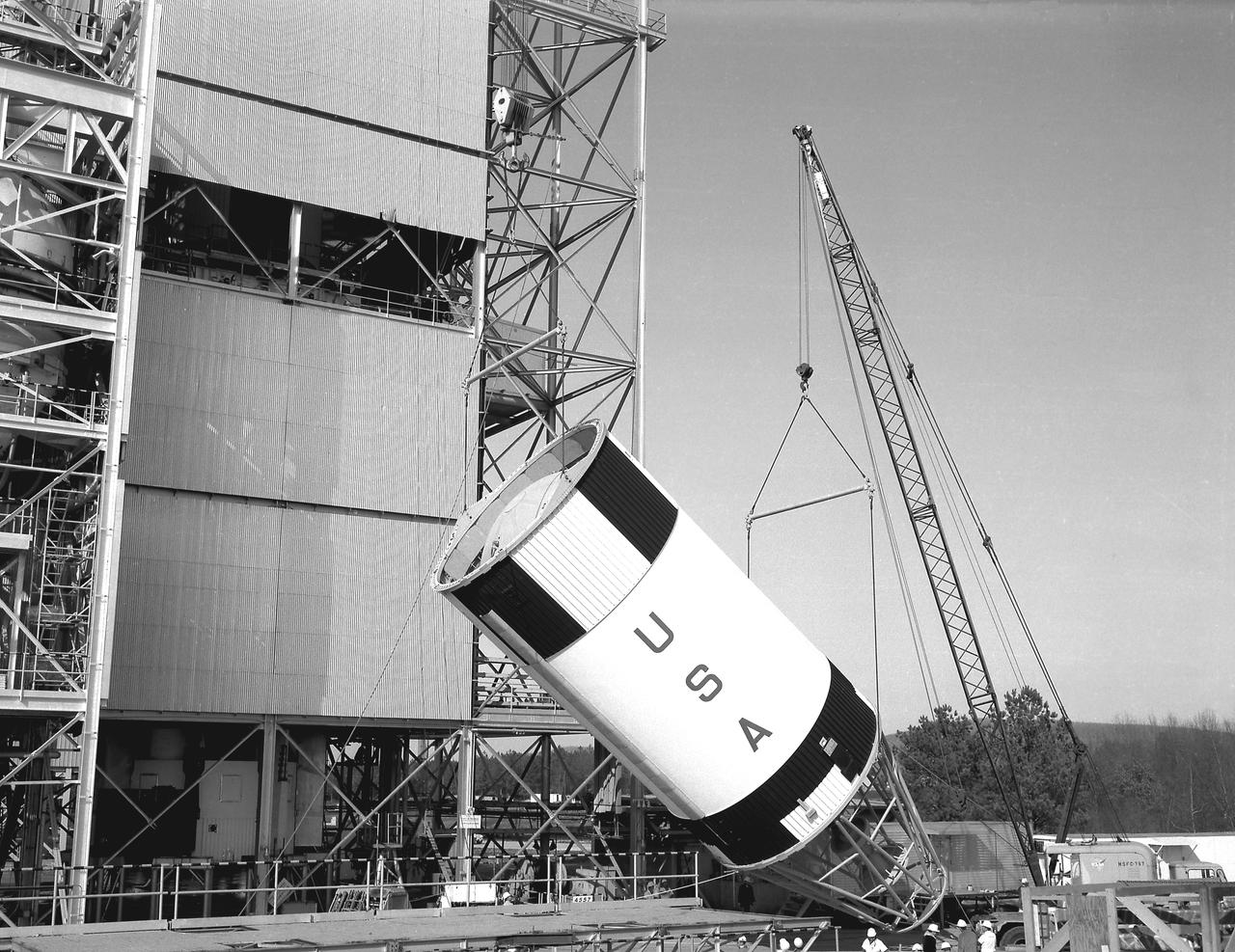
Marshall Space Flight Center (MSFC) workers hoist a dynamic test version of the S-IVB stage, the Saturn IB launch vehicle's second stage, into the Center's Dynamic Test Stand on January 18, 1965. MSFC Test Laboratory persornel assembled a complete Saturn IB to test the launch vehicle's structural soundness. Developed by the MSFC as an interim vehicle in MSFC's "building block" approach to the Saturn rocket development, the Saturn IB utilized Saturn I technology to further develop and refine the larger boosters and the Apollo spacecraft capabilities required for the manned lunar missions.
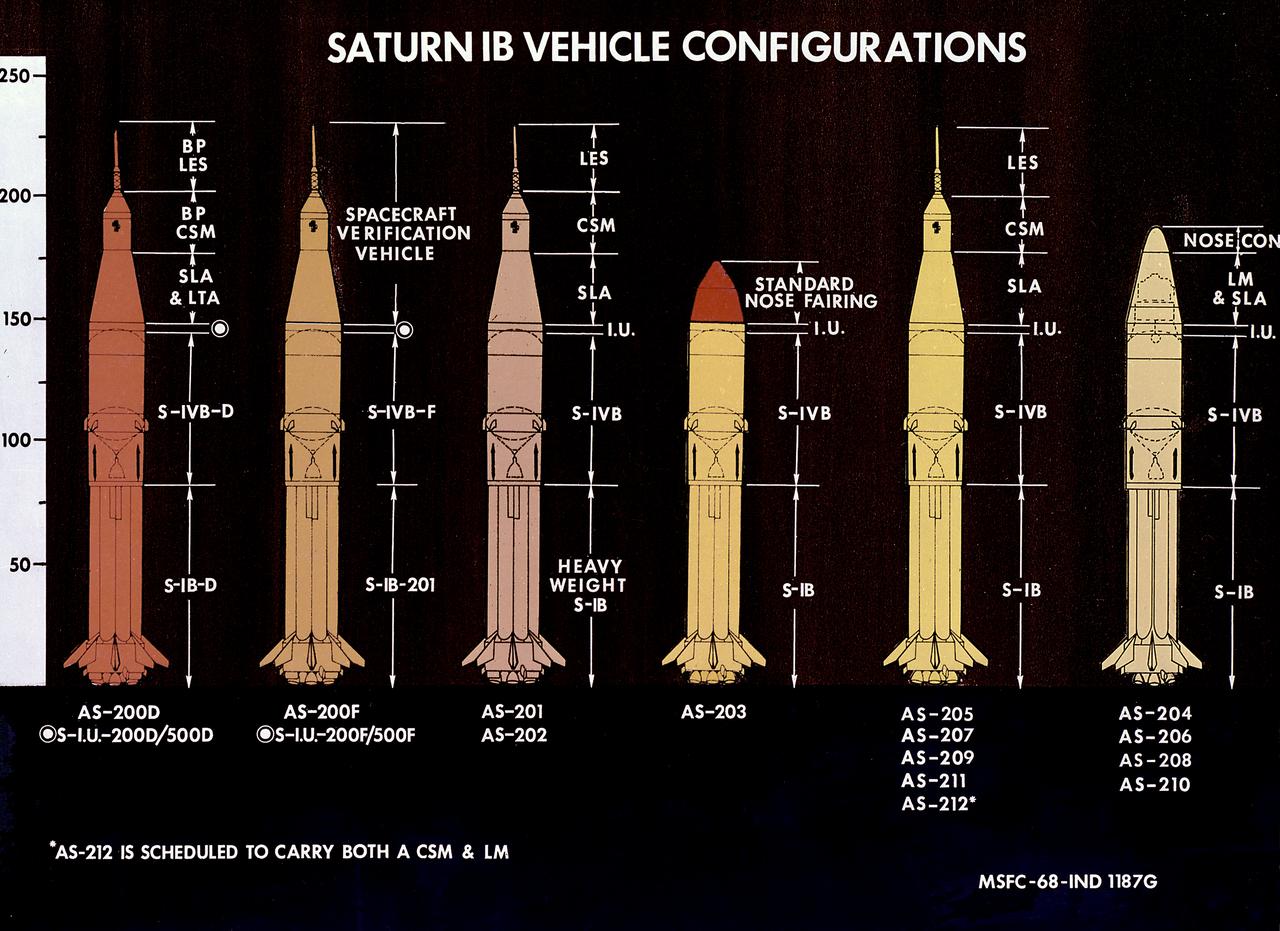
This 1968 chart depicts the various mission configurations for the Saturn IB launch vehicle. Developed by the Marshall Space Flight Center (MSFC) as an interim vehicle in MSFC's "building block" approach to the Saturn rocket development, the Saturn IB utilized Saturn I technology to further develop and refine the larger boosters and the Apollo spacecraft capabilities required for the marned lunar missions.
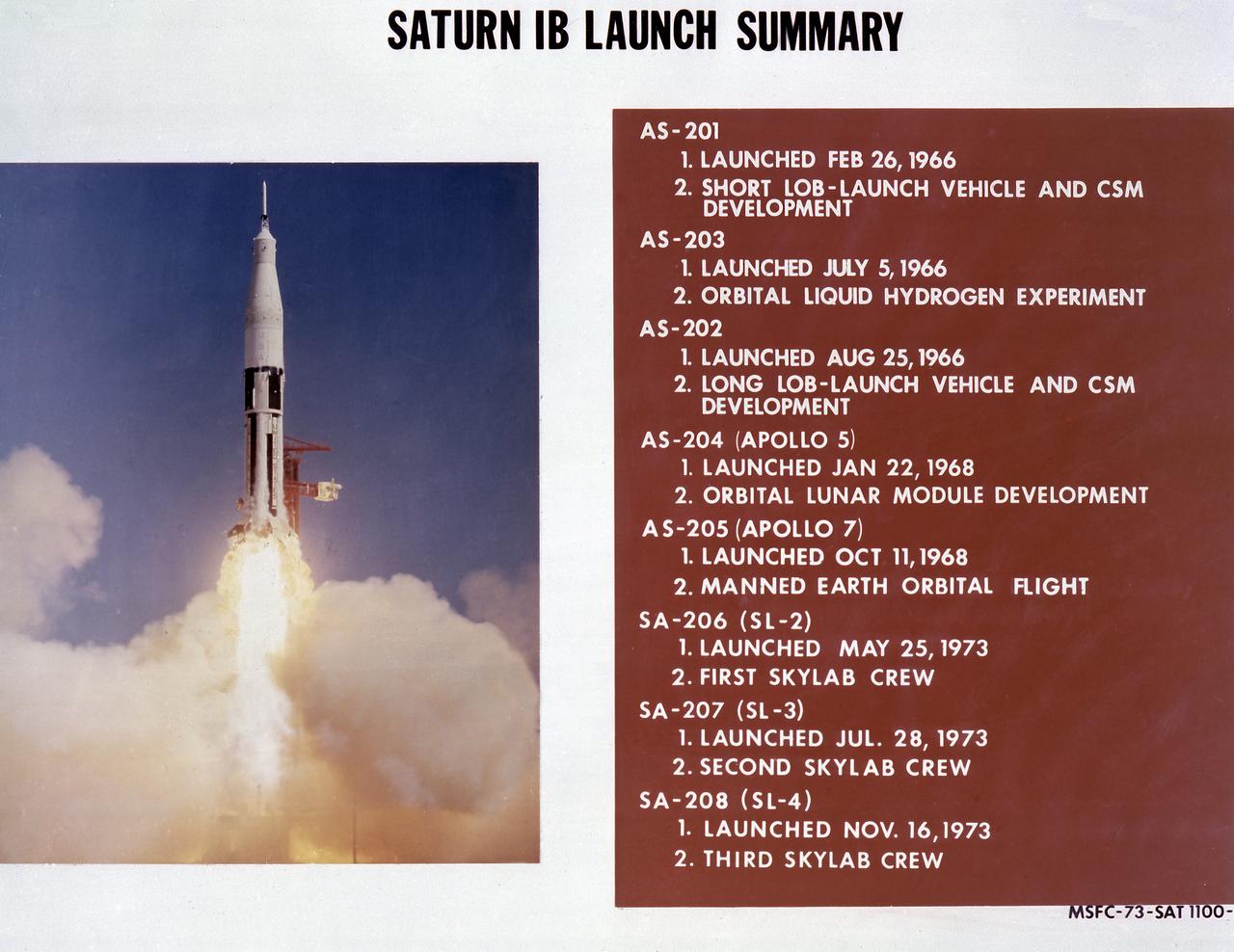
This chart provides a launch summary of the Saturn IB launch vehicle as of 1973. Developed by the Marshall Space Flight Center (MSFC) as an interim vehicle in MSFC's "building block" approach to the Saturn rocket development, the Saturn IB utilized Saturn I technology to further develop and refine the larger boosters and the Apollo spacecraft capabilities required for the marned lunar missions.
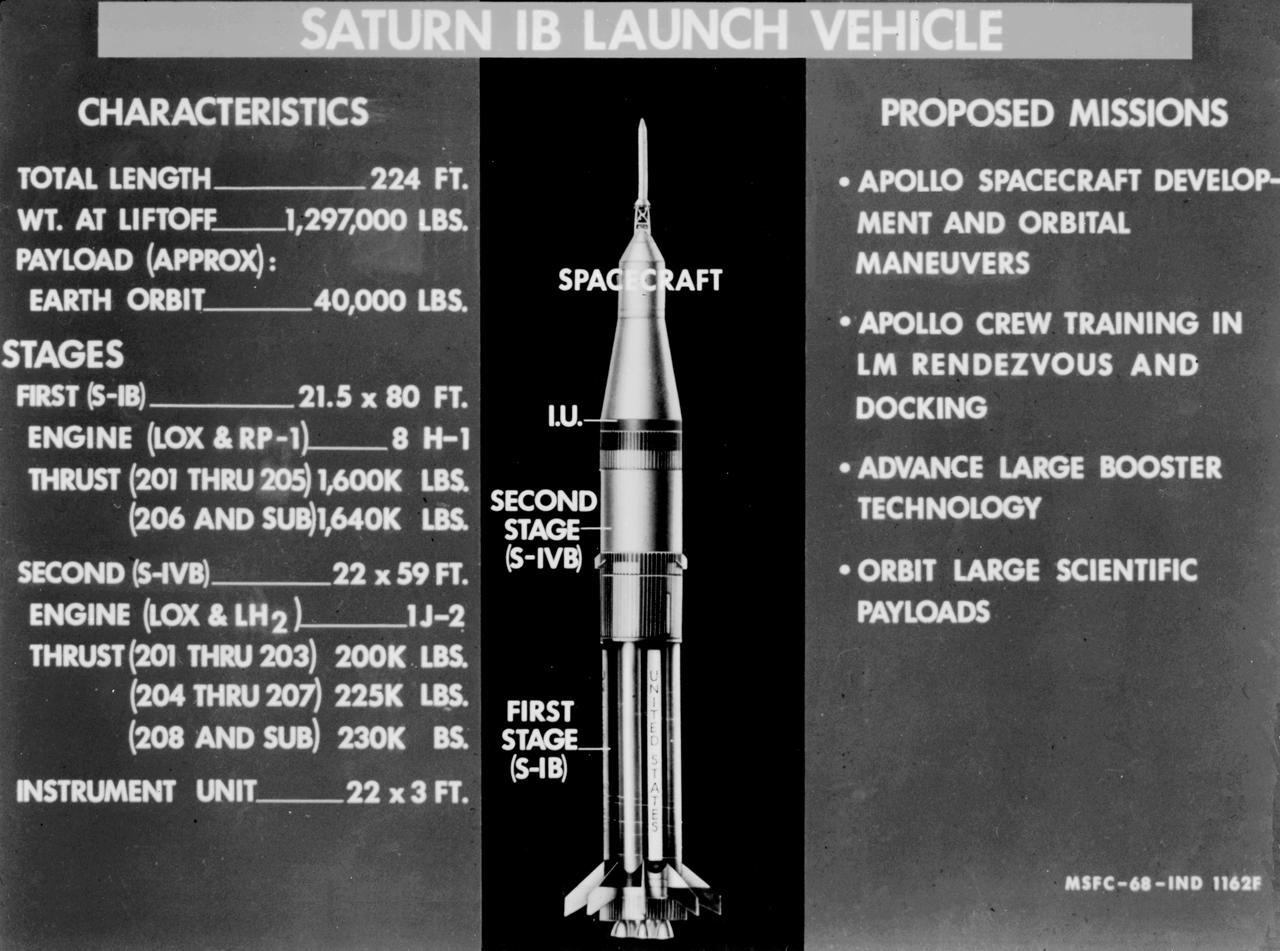
This 1968 chart illustrates the characteristics and proposed missions for the Saturn IB launch vehicle. Developed by the Marshall Space Flight Center (MSFC) as an interim vehicle in MSFC's "building block" approach to the Saturn rocket development, the Saturn IB utilized Saturn I technology to further develop and refine the larger boosters and the Apollo spacecraft capabilities required for the marned lunar missions.
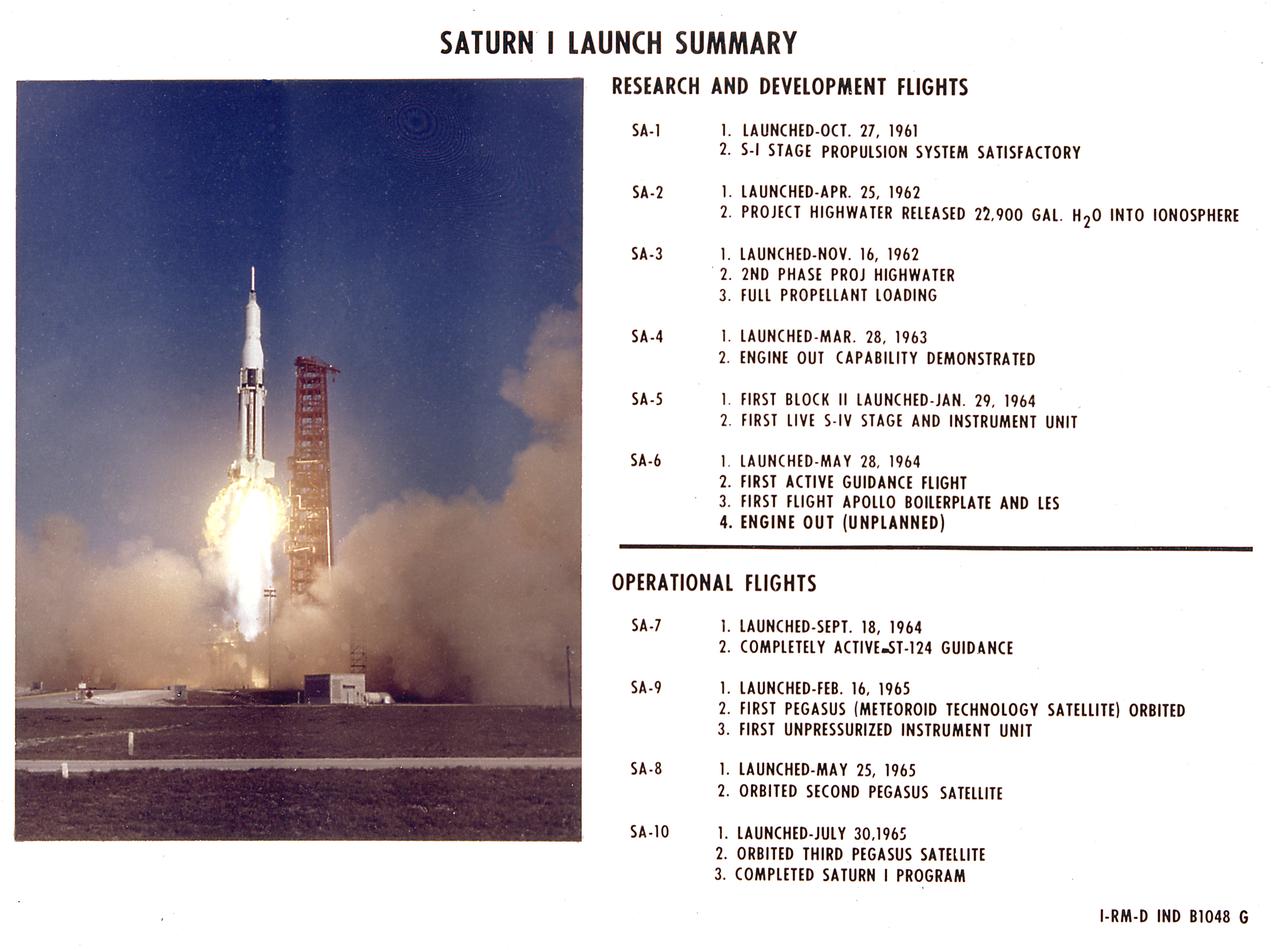
Saturn 1 Launch summary of research and development flights and operational flights. NASA's initial development plan for the Saturn program had called for the Saturn I to serve as a stepping stone to the development of larger Saturn vehicles ultimately known as the Saturn IB and Saturn V. The Saturn I launch vehicle proved the feasibility of the clustered engines and provided significant new payload lifting capabilities.

Workmen at the Kennedy Space Center hoist the Saturn Lunar Module (LM) Adapter into position during assembly of the 204LM-1, an unmanned Apollo mission that tested the Apollo Lunar Module in Earth orbit. Also known as Apollo 5, the spacecraft was launched on the fourth Saturn IB launch vehicle. Developed by the Marshall Space Flight Center (MSFC) as an interim vehicle in MSFC's "building block" approach to the Saturn rocket development, the Saturn IB utilized Saturn I technology to further develop and refine a larger booster and the Apollo spacecraft capabilities required for the manned lunar missions.
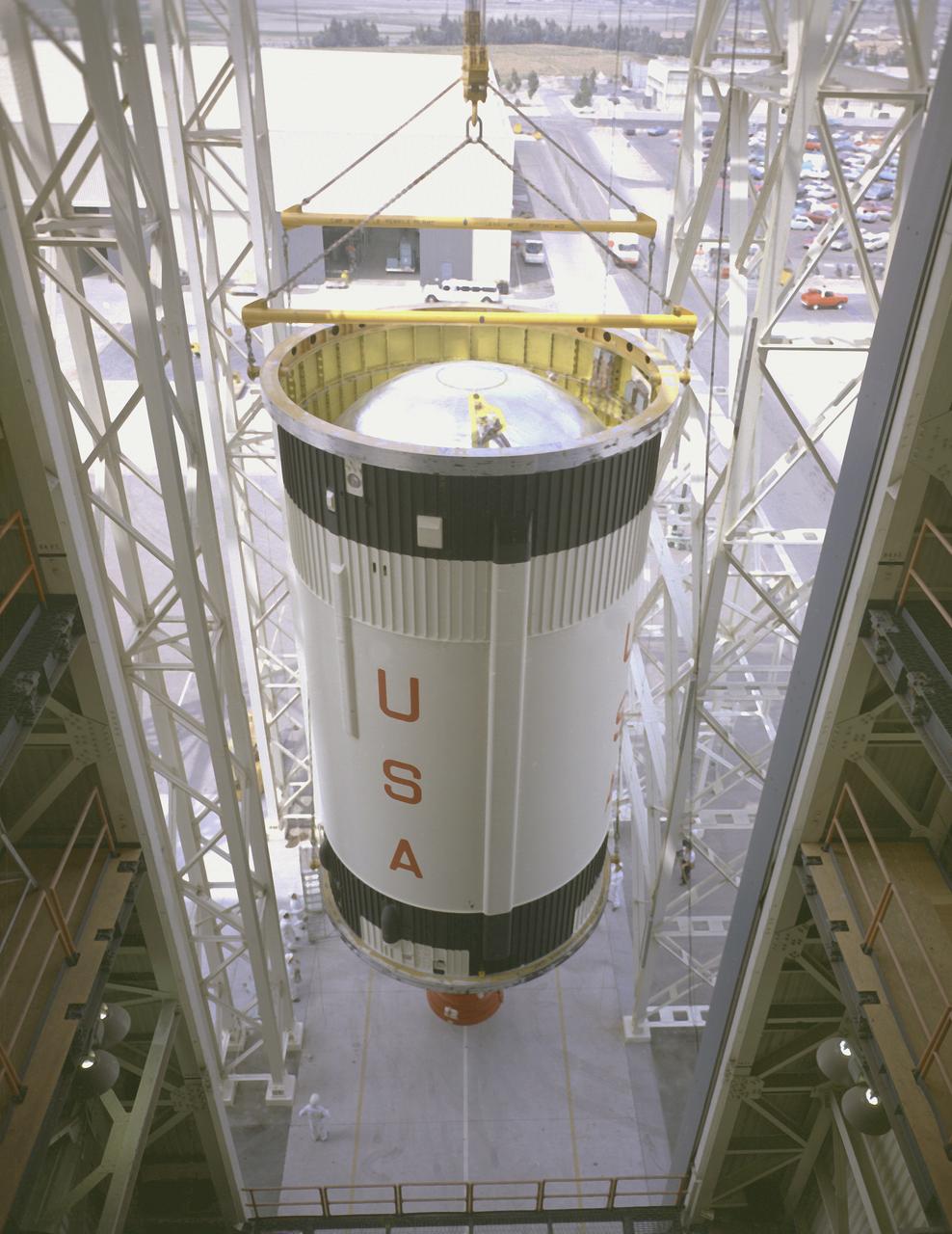
Workers at McDornel-Douglas install the Saturn IB S-IVB (second) stage for the Apollo-Soyuz mission into the company's S-IVB assembly and checkout tower in Huntington Beach, California. The Saturn IB launch vehicle was developed by the Marshall Space Flight Center (MSFC) as an interim vehicle in its "building block" approach to Saturn rocket development. This vehicle utilized the Saturn I technology to further develop and refine the capabilities of a larger booster and the Apollo spacecraft required for the manned lunar missions. The S-IVB stage, later used as the third stage of the Saturn V launch vehicle, was powered by a single J-2 engine initially capable of 200,000 pounds of thrust.
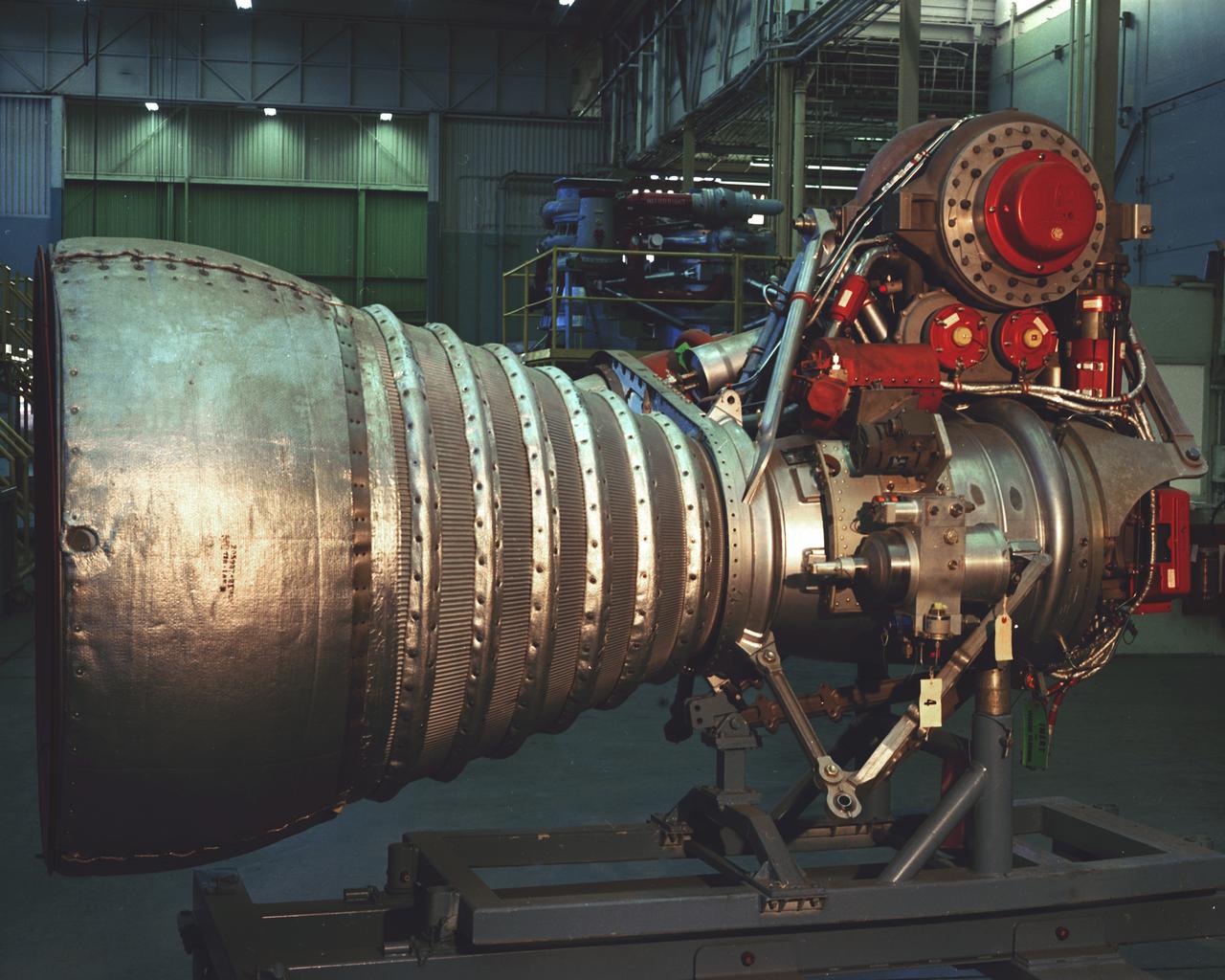
A cluster of eight H-1 engines were used to thrust the first stage of Saturn I (S-I stage) and Saturn IB (S-IB stage). The engines were arranged in a double pattern. Four engines, located inboard, were fixed in a square pattern around the stage axis, while the remaining four engines were located outboard in a larger square pattern and each outer engine was gimbaled. Each H-1 engine, fueled with liquid oxygen (LOX) and kerosene (RP-1), initially had a thrust of 188,000 pounds each for a combined thrust of over 1,500,000 pounds. Later, the H-1 engine was upgraded to 205,000 pounds of thrust and a combined total thrust of 1,650,000 pounds for the Saturn IB program. This photo depicts a single modified H-1 engine. The H-1 engine was developed under the direction of Marshall Space Flight Center (MSFC).
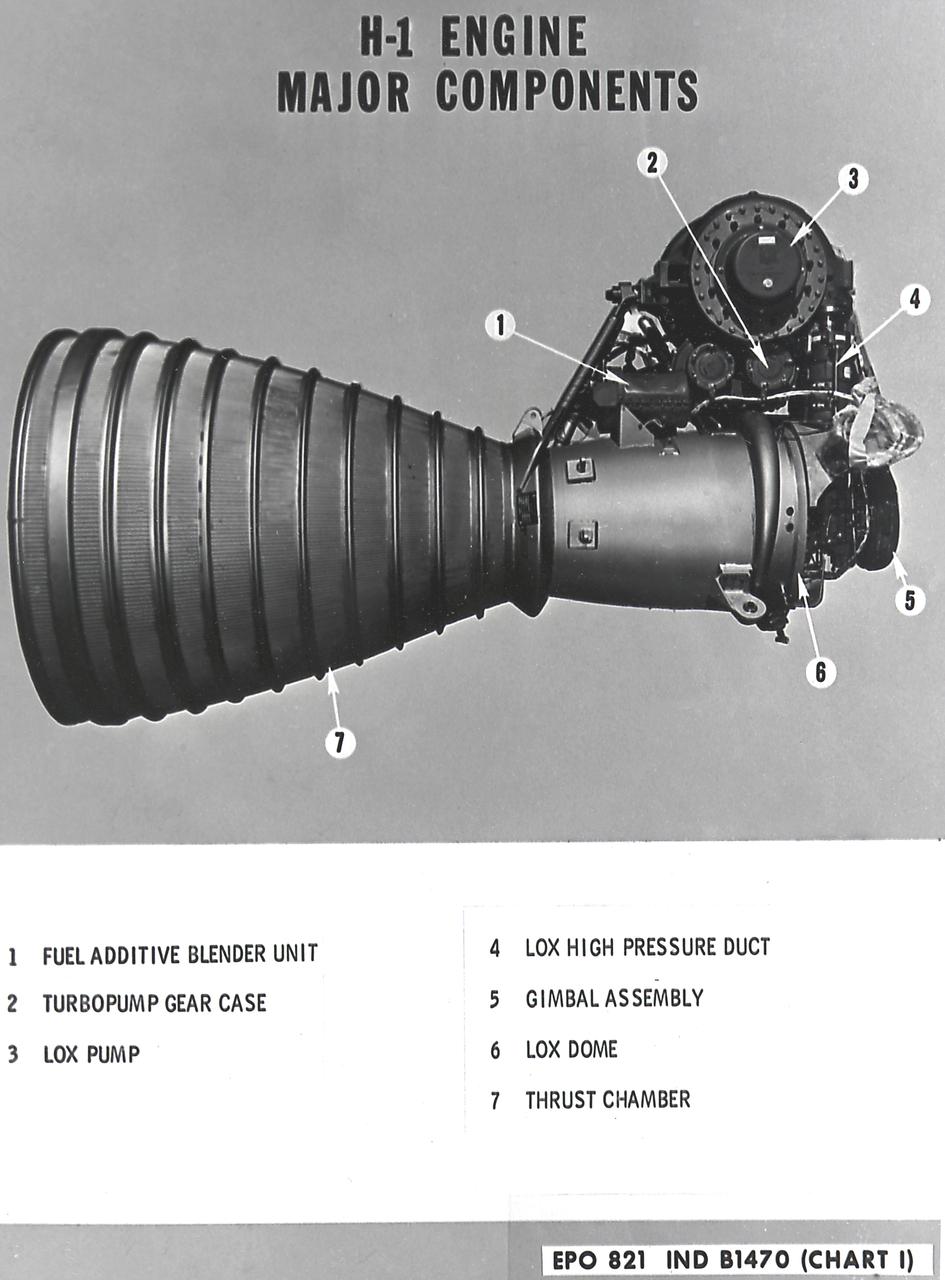
H-1 Engine major components with callouts (chart 1): The H-1 engine was used in a cluster of eight on the the first stage of Saturn I (S-I stage) and Saturn IB (S-IB stage). The engines were arranged in a double pattern: four engines, located inboard, were fixed in a square pattern around the stage axis, while the remaining four engines were located outboard in a larger square pattern and each outer engine was gimbaled. Each H-1 engine had a thrust of 188,000 pounds for a combined thrust of over 1,500,000 pounds.
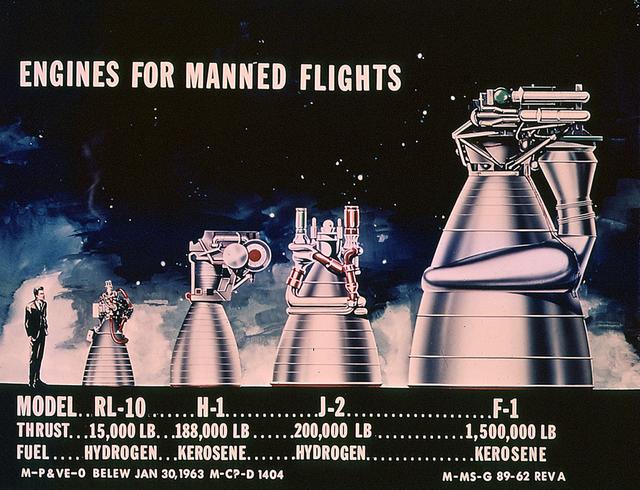
This drawing clearly shows the comparative sizes of the rocket engines used to launch the Saturn vehicles. The RL-10 and the H-1 engines were used to launch the Saturn I rockets. The J-2 engine was used on the second stage of Saturn IB and the second and third stages of Saturn V. The F-1 engine was used on the first stage of the Saturn V.
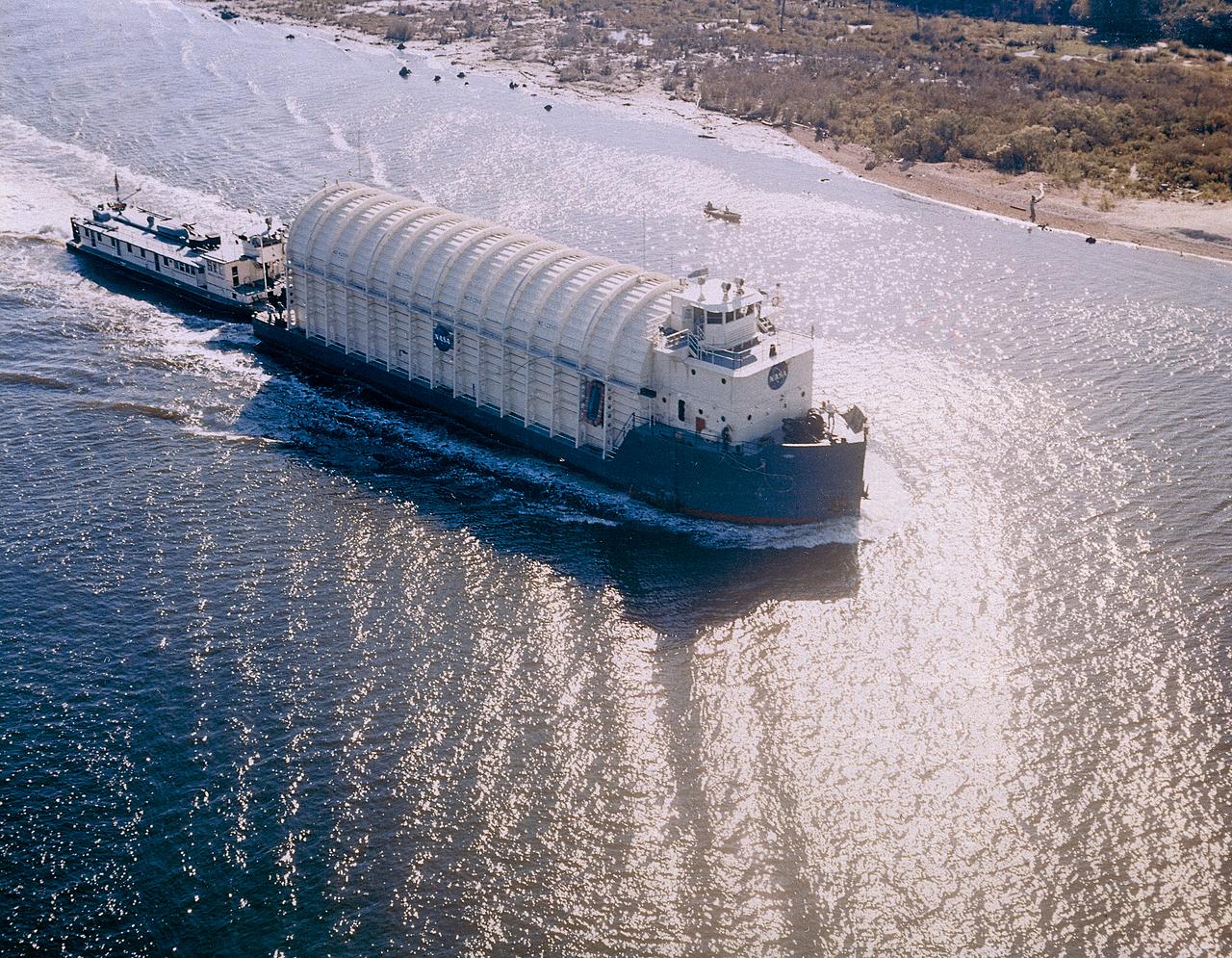
NASA used barges for transporting full-sized stages for the Saturn I, Saturn IB, and Saturn V vehicles between the Marshall Space Flight Center (MSFC), the manufacturing plant at the Michoud Assembly Facility (MAF), the Mississippi Test Facility for testing, and the Kennedy Space Center. The barges traveled from the MSFC dock to the MAF, a total of 1,086.7 miles up the Tennessee River and down the Mississippi River. The barges also transported the assembled stages of the Saturn vehicle from the MAF to the Kennedy Space Center, a total of 932.4 miles along the Gulf of Mexico and up along the Atlantic Ocean, for the final assembly and the launch. Pictured is the barge Palaemon carrying Saturn IV S-IB flight stage enroute to MSFC.
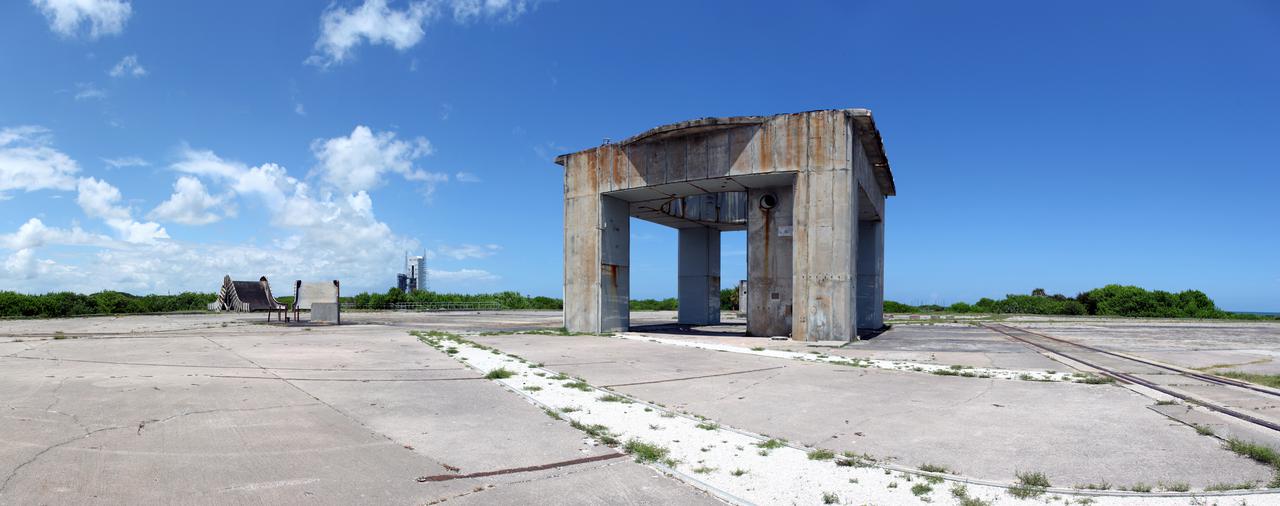
CAPE CANAVERAL, Fla. -- At Cape Canaveral Air Force Station in Florida stands the Launch Complex-34 launch platform. During the Apollo Program, Complex-34 was the site of the first Saturn I and Saturn IB launches, as well as the tragic fire in which the Apollo 1 astronauts lost their lives. Apollo 7, the first crewed Apollo flight, was the last to launch from Complex-34. Subsequent Apollo mission launched from NASA Kennedy Space Center's Launch Complex 39. Photo credit: NASA_Frankie Martin
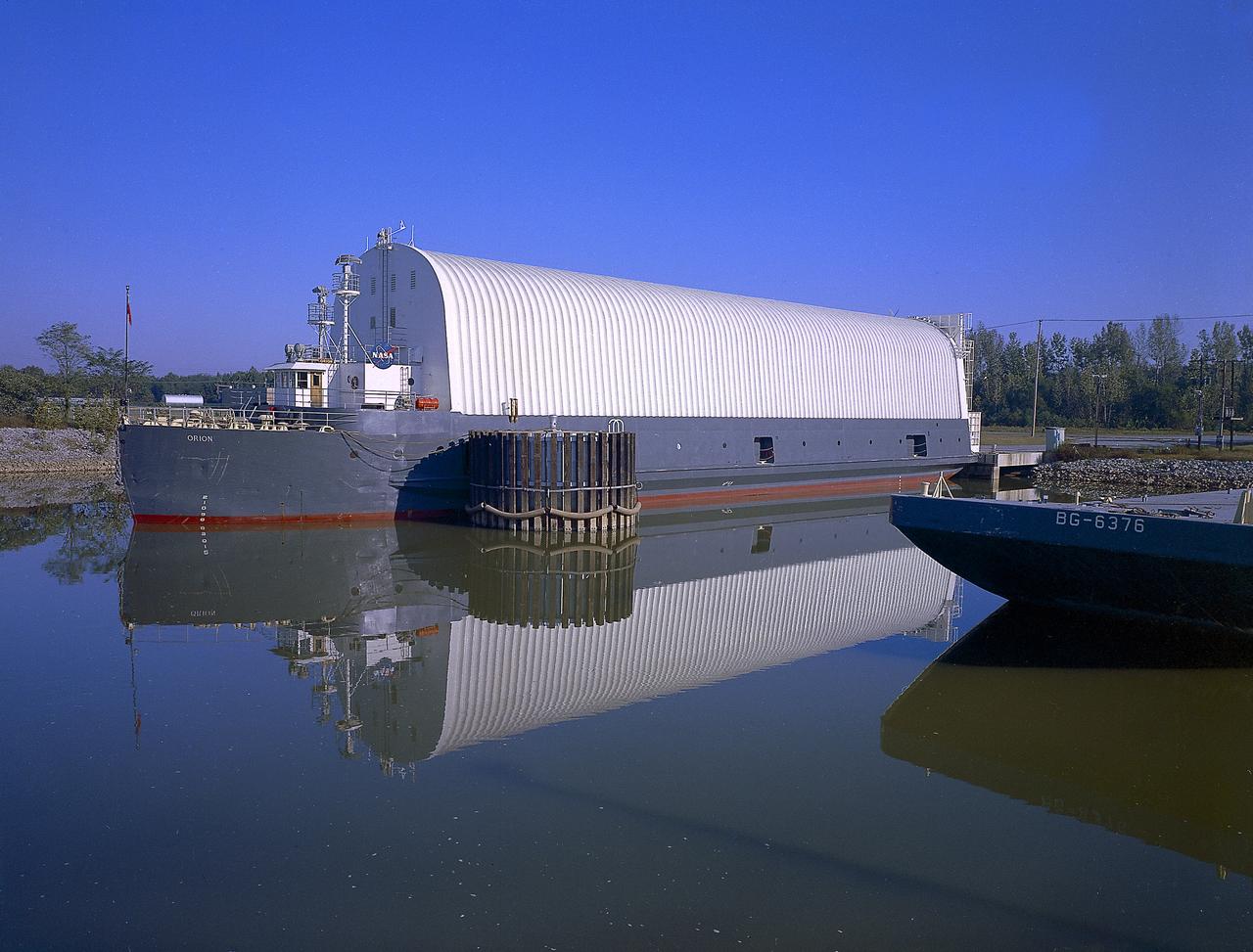
NASA used barges for transporting full-sized stages for the Saturn I, Saturn IB, and Saturn V vehicles between the Marshall Space Flight Center (MSFC), the manufacturing plant at the Michoud Assembly Facility (MAF), the Mississippi Test Facility for testing, and the Kennedy Space Center. The barges traveled from the MSFC dock to the MAF, a total of 1,086.7 miles up the Tennessee River and down the Mississippi River. The barges also transported the assembled stages of the Saturn vehicle from the MAF to the Kennedy Space Center, a total of 932.4 miles along the Gulf of Mexico and up along the Atlantic Ocean, for the final assembly and the launch. This photograph shows the barge Orion at the MSFC dock.
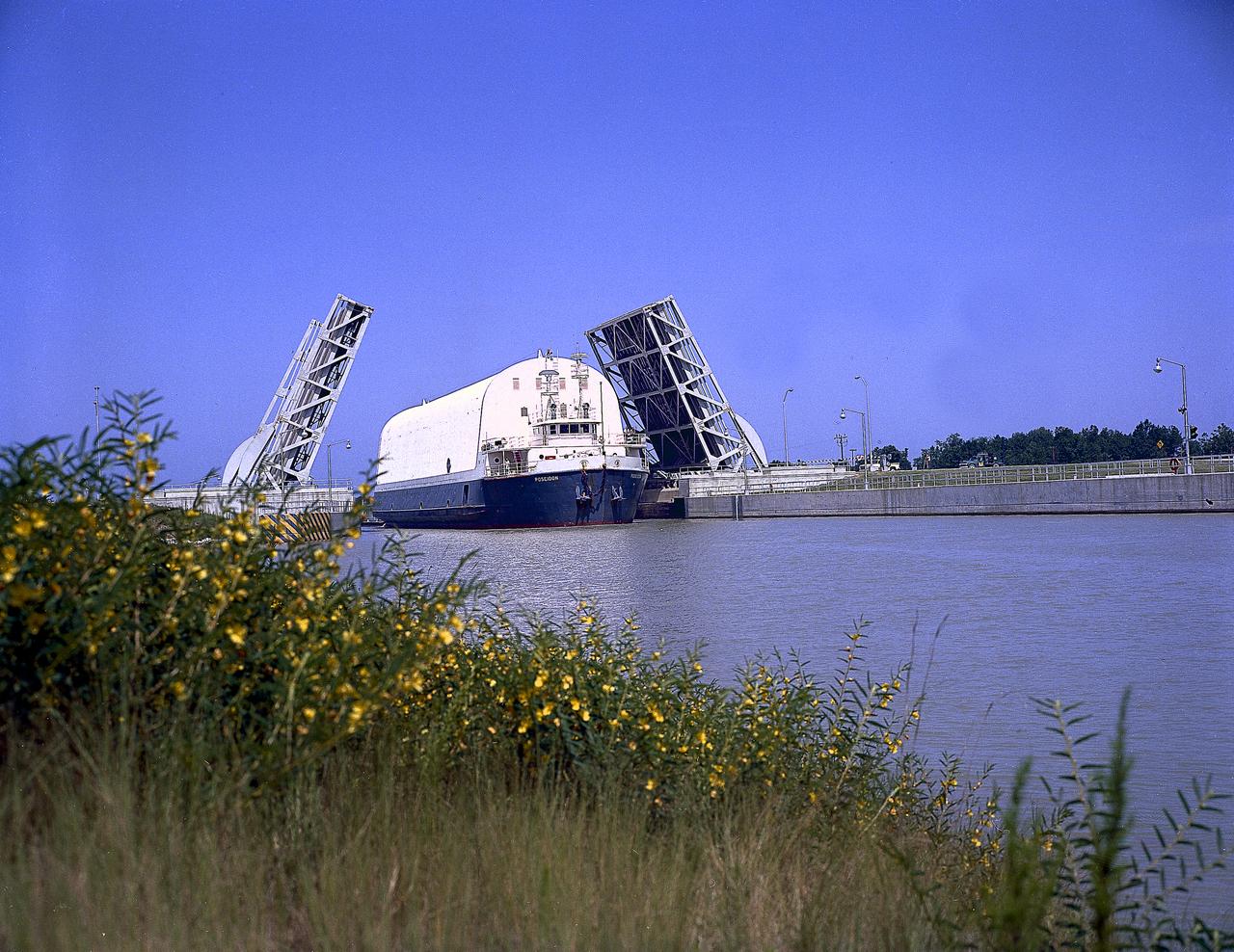
NASA used barges for transporting full-sized stages for the Saturn I, Saturn IB, and Saturn V vehicles between the Marshall Space Flight Center (MSFC), the manufacturing plant at the Michoud Assembly Facility (MAF), the Mississippi Test Facility for testing, and the Kennedy Space Center. The barges traveled from the MSFC dock to the MAF, a total of 1,086.7 miles up the Tennessee River and down the Mississippi River. The barges also transported the assembled stages of the Saturn vehicle from the MAF to the Kennedy Space Center, a total of 932.4 miles along the Gulf of Mexico and up along the Atlantic Ocean, for the final assembly and the launch. This photograph shows the barge Poseidon loaded with the Saturn V S-II (second) stage passing through a bascule bridge.
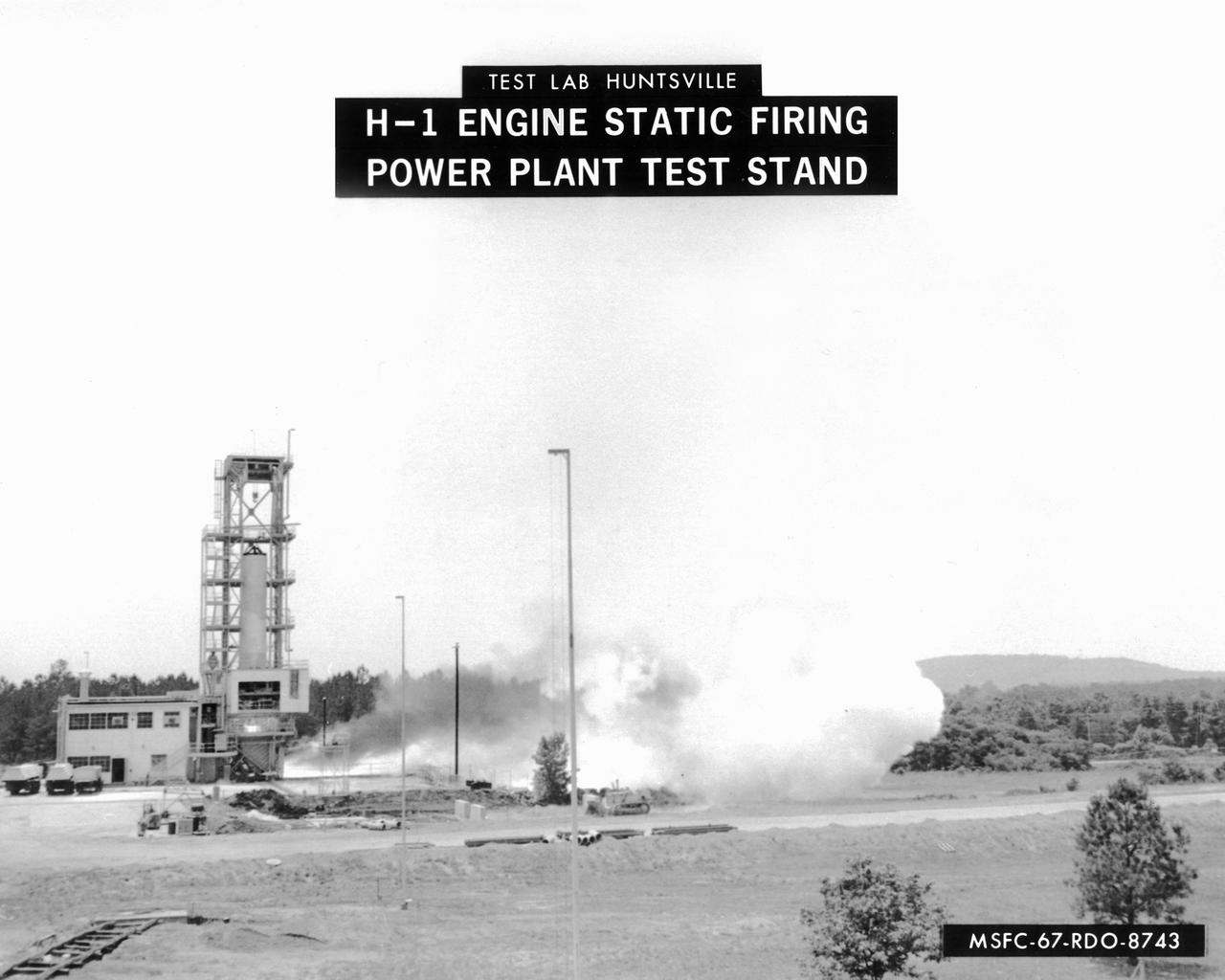
This image depicts a firing of a single H-1 engine at the Marshall Space Flight Center’s (MSFC’s) Power Plant test stand. This 1950s test stand, inherited from the Army, was used to test fire engines until the Test Area was completed in the latter 1960s. The H-1 engine was the workhorse of the first Saturn launch vehicles and used in the Saturn I, Block 1 and II, and in the Saturn IB. The eight H-1 engines were attached to a thrust frame on the vehicle’s aft end in two different ways. Four engines are rigidly attached to the inboard position and canted at a three degree angle to the long axis of the booster. The other four engines, mounted in the outboard position, are canted at six degrees.
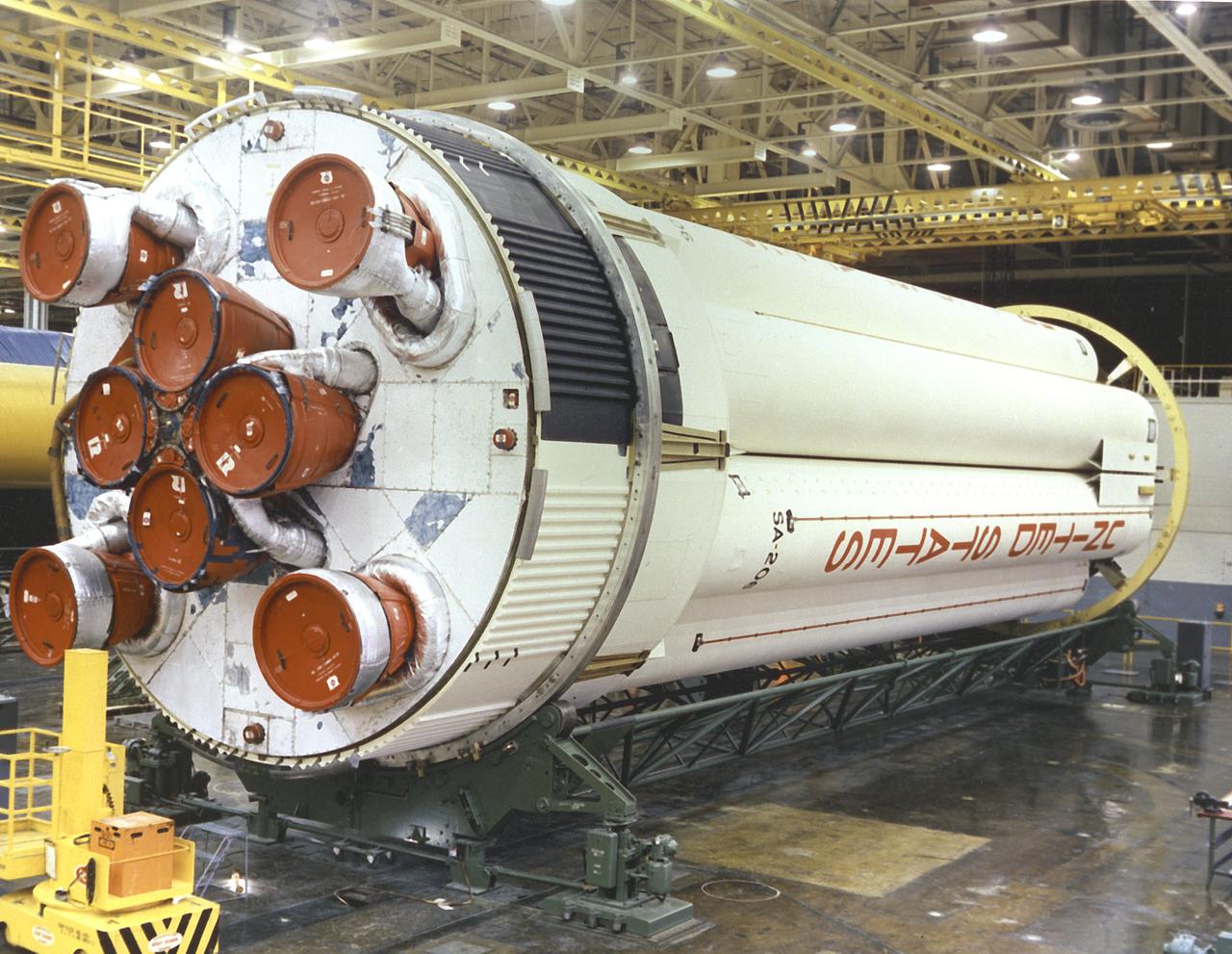
The Saturn 1B S-IB (first) stage being prepared for shipment at Michoud Assembly Facility (MAF), near New Orleans, Louisiana. Developed by the Marshall Space Flight Center and built by the Chrysler Corporation at MAF, the S-IB stage utilized the eight H-1 engines and each produced 200,000 pounds of thrust, a combined thrust of 1,600,000 pounds.
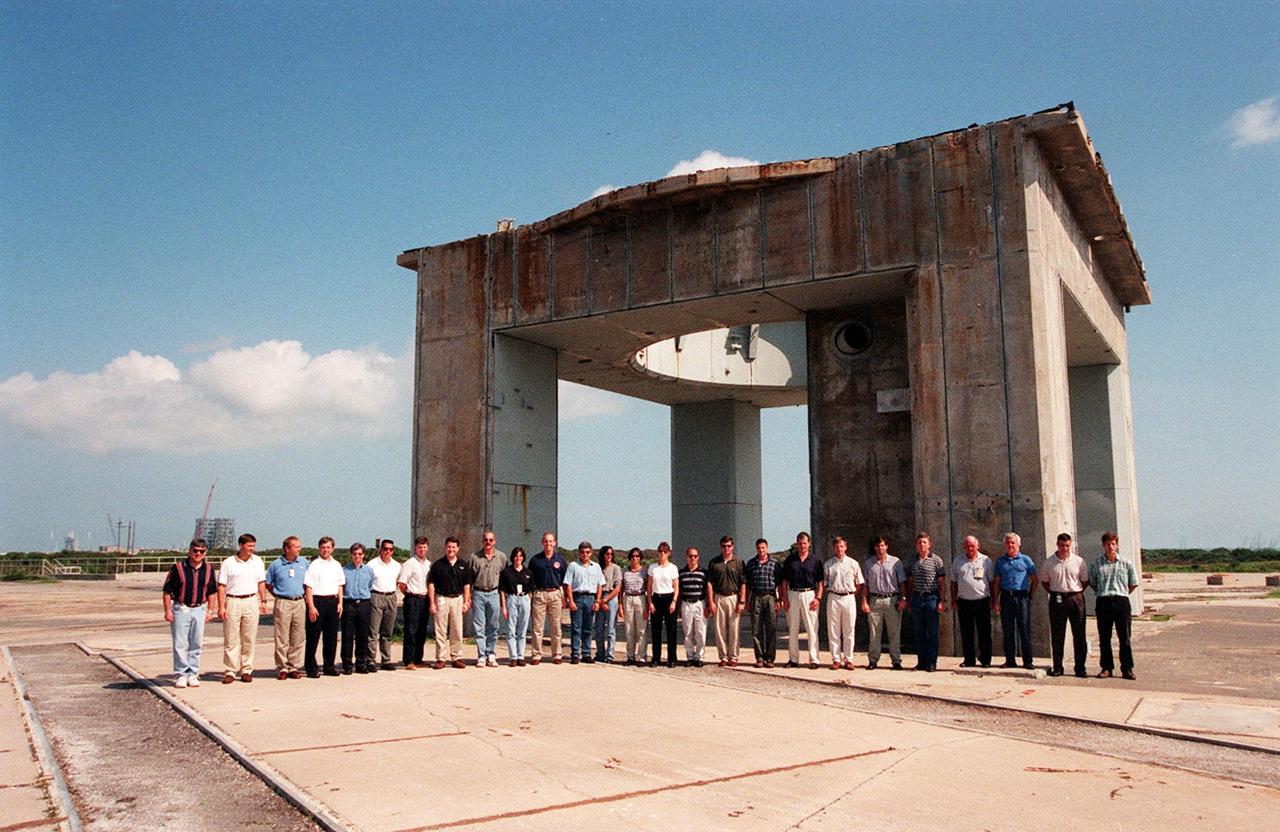
At Cape Canaveral Air Station, members of the 1998 astronaut candidate class (Group 17) pose in front of what remains of the launch tower at Launch Complex 34 during a tour of the station's facilities. During the Apollo Program, Launch Complex 34 was the site of the first Saturn I and Saturn IB launches, as well as the tragic fire in which the Apollo I astronauts lost their lives. The class is at Kennedy Space Center taking part in training activities, including a flight awareness program, as well as touring the OPF, VAB, SSPF, SSME Processing Facility, launch pads, SLF, Apollo/Saturn V Center, and the crew quarters. The U.S. candidates in the '98 class are Clayton C. Anderson, Lee J. Archambault, Tracy E. Caldwell (Ph.D.), Gregory E. Chamitoff (Ph.D.), Timothy J. Creamer, Christopher J. Ferguson, Michael J. Foreman, Michael E. Fossum, Kenneth T. Ham, Patricia C. Hilliard (M.D.), Gregory C. Johnson, Gregory H. Johnson, Stanley G. Love (Ph.D.), Leland D. Melvin, Barbara R. Morgan, William A. Oefelein, John D. Olivas (Ph.D.), Nicholas J.M. Patrick (Ph.D.), Alan G. Poindexter, Garrett E. Reisman (Ph.D.), Steven R. Swanson, Douglas H. Wheelock, Sunita L. Williams, Neil W. Woodward III, George D. Zamka; and the international candidates are Leopold Eyharts, Paolo Nespoli, Hans Schlegel, Roberto Vittori, Bjarni V. Tryggvason, and Marcos Pontes