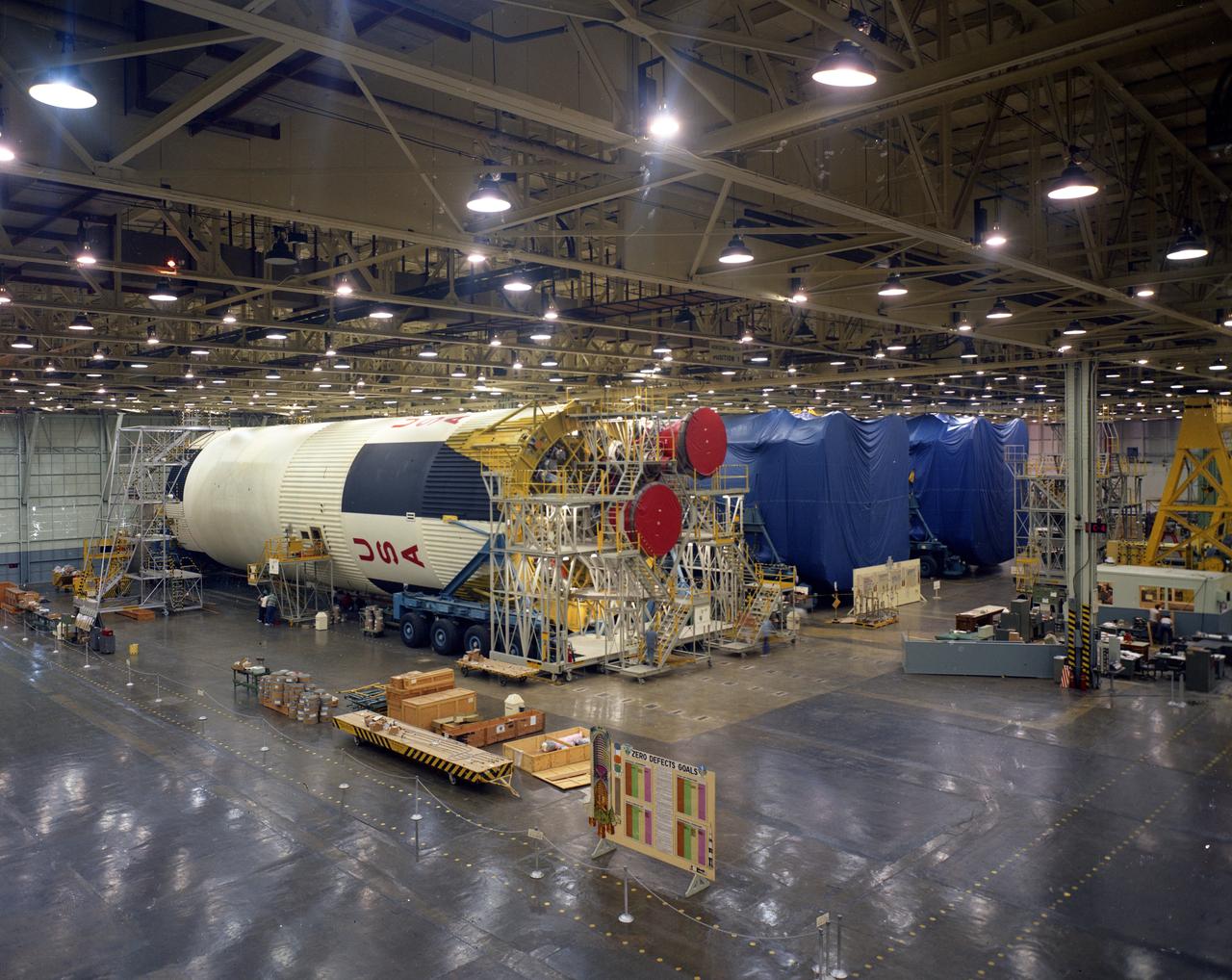
Saturn V S-1C boosters lined up in the Horizontal Assembly area of Michoud Assembly Facility. Image dated 10-5-1967.
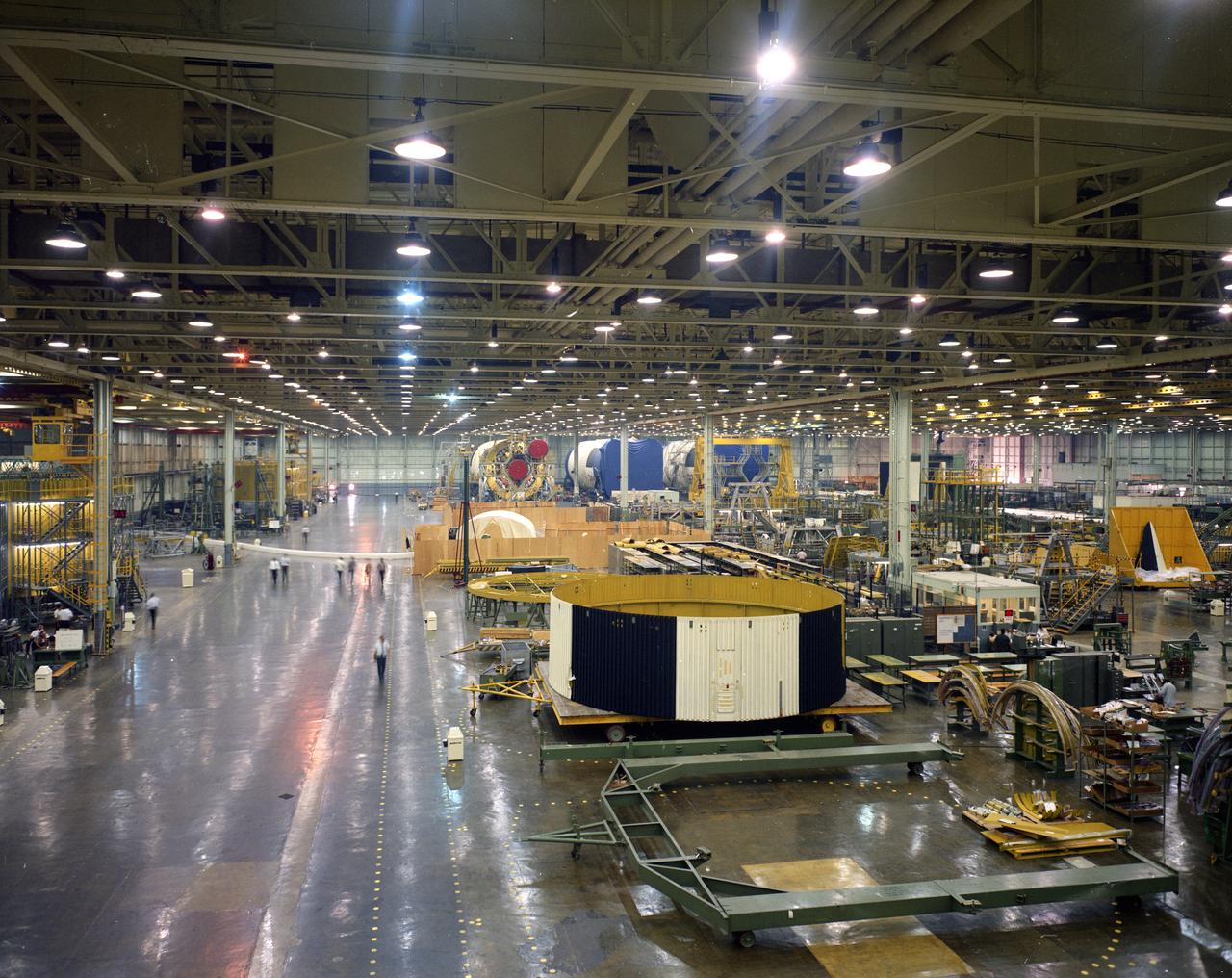
Parts of the Saturn V first stage await assembly at NASA’s Michoud Assembly Facility in October of 1967. In the far end of the image you can see S-1C stages nearing completion.
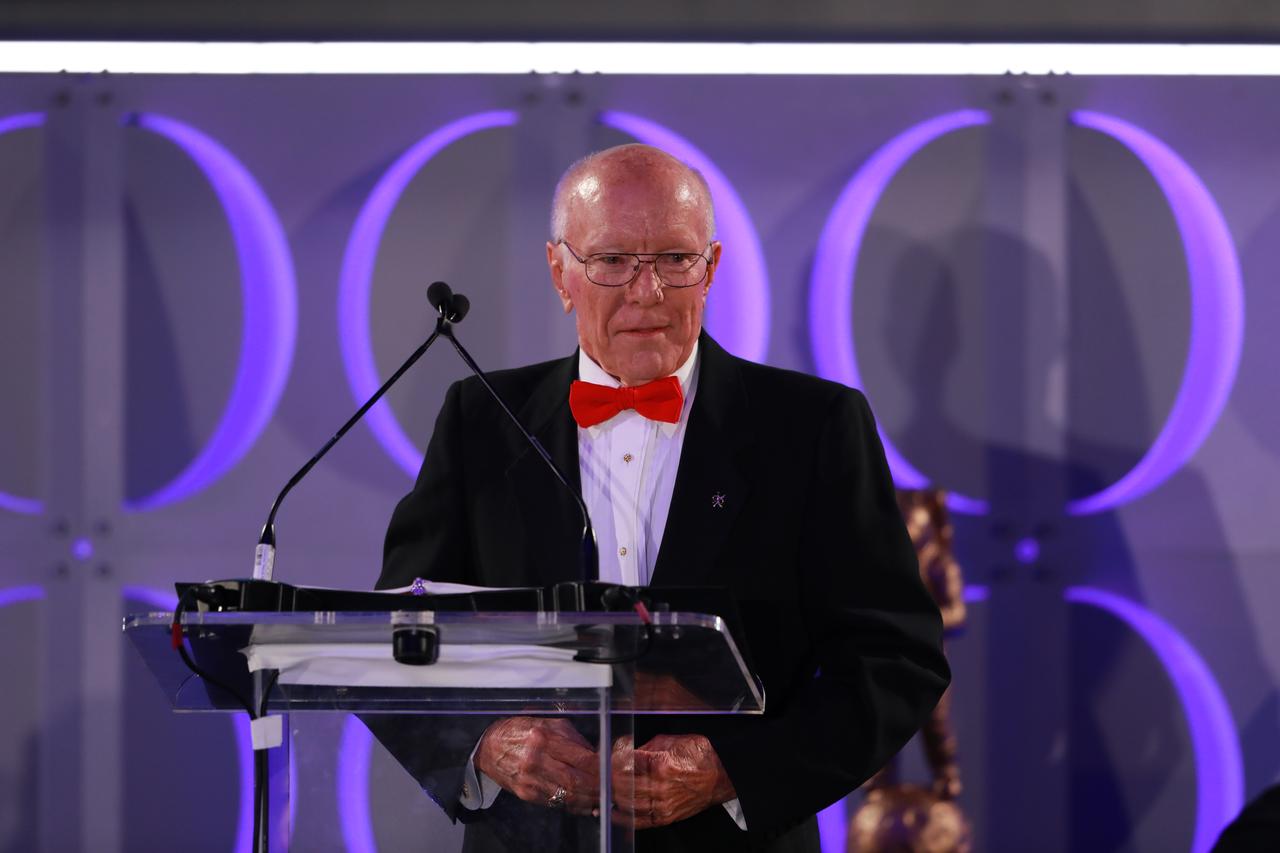
Gerry Griffin, Apollo flight director, makes remarks during the Apollo 11 50th Gala, pressented by Northrop Grumman, inside the Apollo/Saturn V Center at the Kennedy Space Center Visitor Complex on July 16, 2019
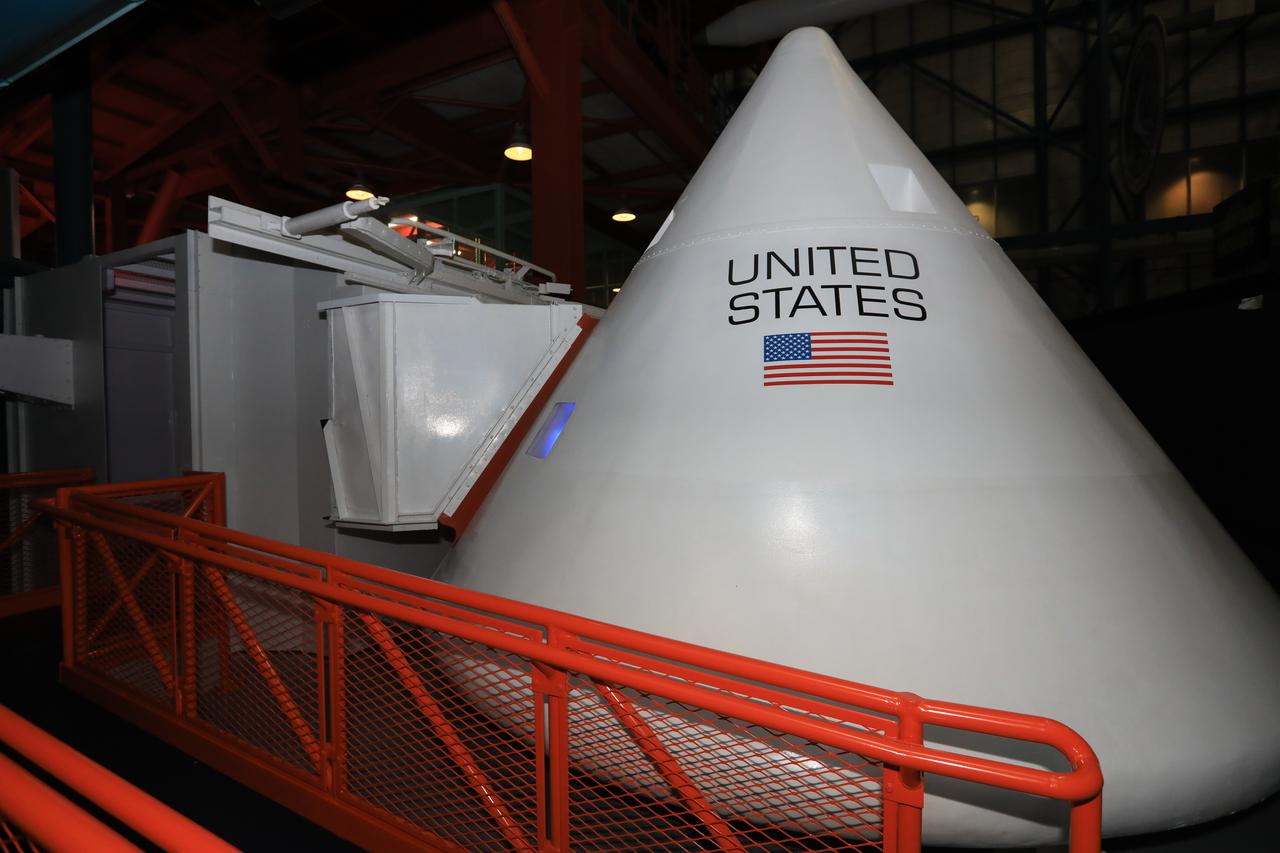
An Apollo spacecraft mockup marks the capstone of the new tribute to the crew of Apollo 1 who perished in a fire at the launch pad on Jan. 27, 1967, during training for the mission. The tribute highlights the lives and careers of astronauts Gus Grissom, Ed White II and Roger Chaffee who were lost during the fire. The tribute at the Apollo/Saturn V Center at NASA's Kennedy Space Center opened Jan. 27, 2017, 50 years after the crew of three was lost. It features numerous items recalling the lives of the three astronauts. The tribute also includes the three-part hatch to the spacecraft itself, the first time any part of the Apollo 1 spacecraft has been displayed publicly. A version of the hatch after it was redesigned is also showcased as an example of improvements NASA made throughout the agency and to the Apollo spacecraft that would later carry astronauts to the moon.
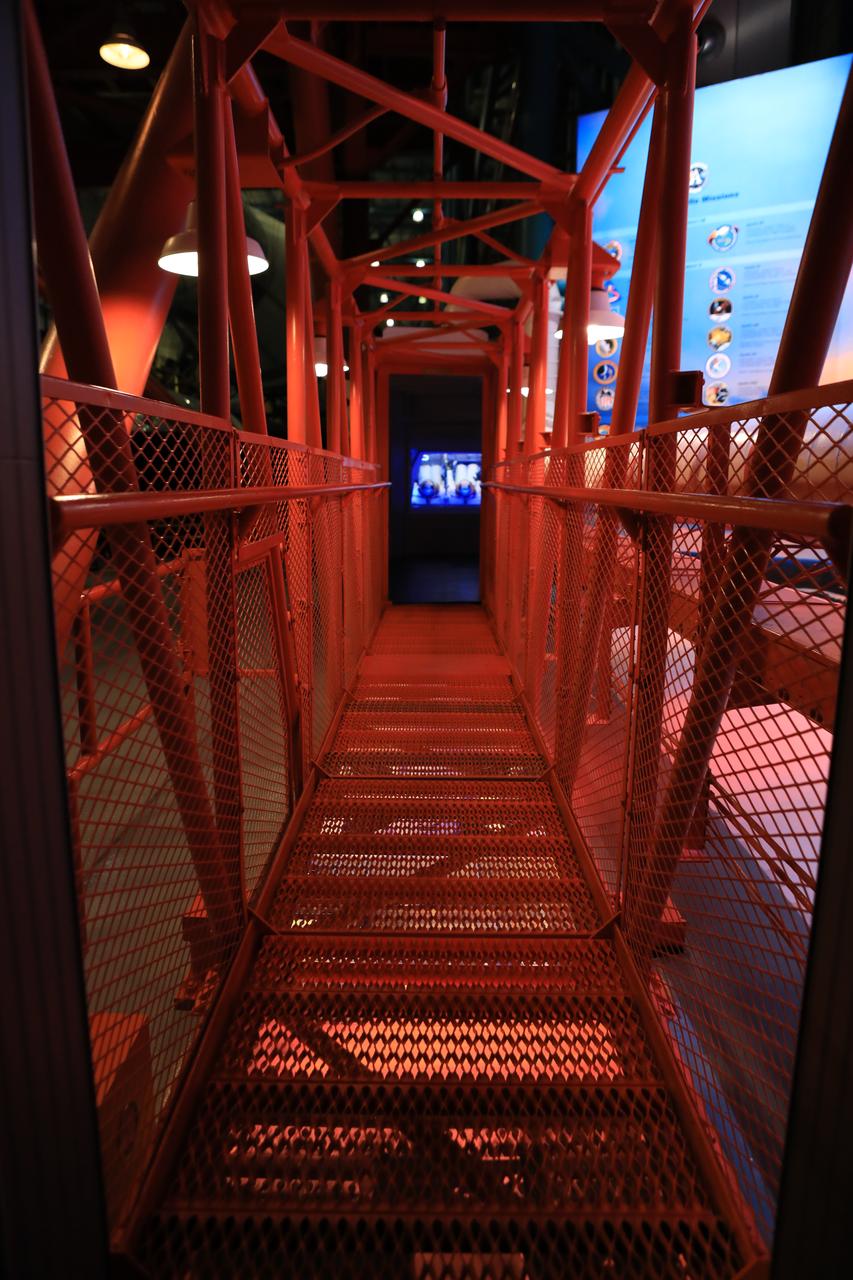
The crew access arm that astronauts walked across to reach the Apollo spacecraft for missions to the moon serves as the exit for the new tribute to the crew of Apollo 1 who perished in a fire at the launch pad on Jan. 27, 1967, during training for the mission. The tribute highlights the lives and careers of astronauts Gus Grissom, Ed White II and Roger Chaffee who were lost during the fire. The tribute at the Apollo/Saturn V Center at NASA's Kennedy Space Center opened Jan. 27, 2017, 50 years after the crew of three was lost. It features numerous items recalling the lives of the three astronauts. The tribute also includes the three-part hatch to the spacecraft itself, the first time any part of the Apollo 1 spacecraft has been displayed publicly. A version of the hatch after it was redesigned is also showcased as an example of improvements NASA made throughout the agency and to the Apollo spacecraft that would later carry astronauts to the moon.

A display case dedicated to astronaut Gus Grissom is shown inside the new tribute to the crew of Apollo 1 who perished in a fire at the launch pad on Jan. 27, 1967, during training for the mission. Grissom, Ed White II and Roger Chaffee were lost during the fire. The tribute at the Apollo/Saturn V Center at NASA's Kennedy Space Center opened Jan. 27, 2017, 50 years after the crew of three was lost. It features numerous items recalling the lives of the three astronauts. It also includes the three-part hatch to the spacecraft itself, the first time any part of the Apollo 1 spacecraft has been displayed publicly. A version of the hatch after it was redesigned is also showcased as an example of improvements NASA made throughout the agency and to the Apollo spacecraft that would later carry astronauts to the moon.
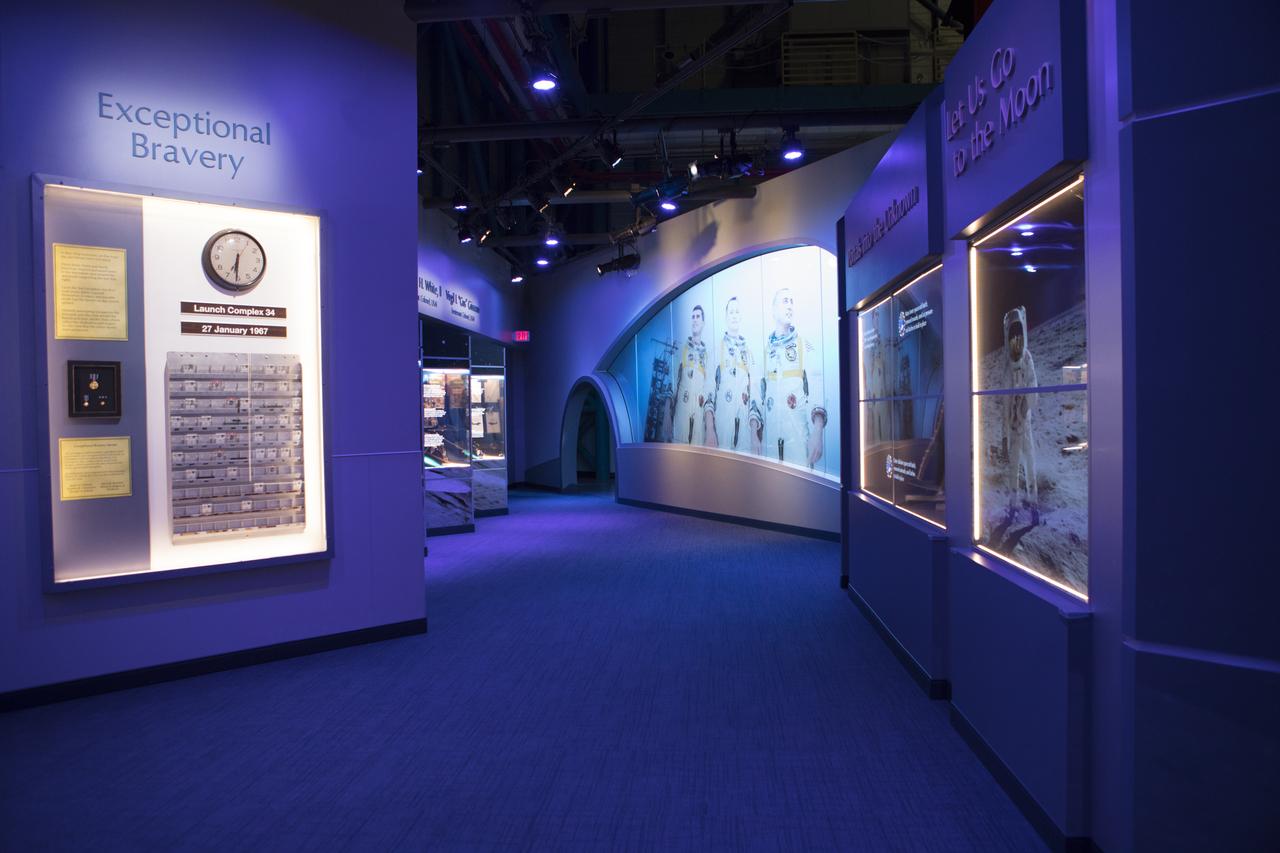
The new tribute to the crew of Apollo 1 who perished in a fire at the launch pad on Jan. 27, 1967, during training for the mission is shown looking down the length of the area. The tribute highlights the lives and careers of astronauts Gus Grissom, Ed White II and Roger Chaffee who were lost during the fire. The tribute at the Apollo/Saturn V Center at NASA's Kennedy Space Center opened Jan. 27, 2017, 50 years after the crew of three was lost. It features numerous items recalling the lives of the three astronauts. The tribute also includes the three-part hatch to the spacecraft itself, the first time any part of the Apollo 1 spacecraft has been displayed publicly. A version of the hatch after it was redesigned is also showcased as an example of improvements NASA made throughout the agency and to the Apollo spacecraft that would later carry astronauts to the moon.
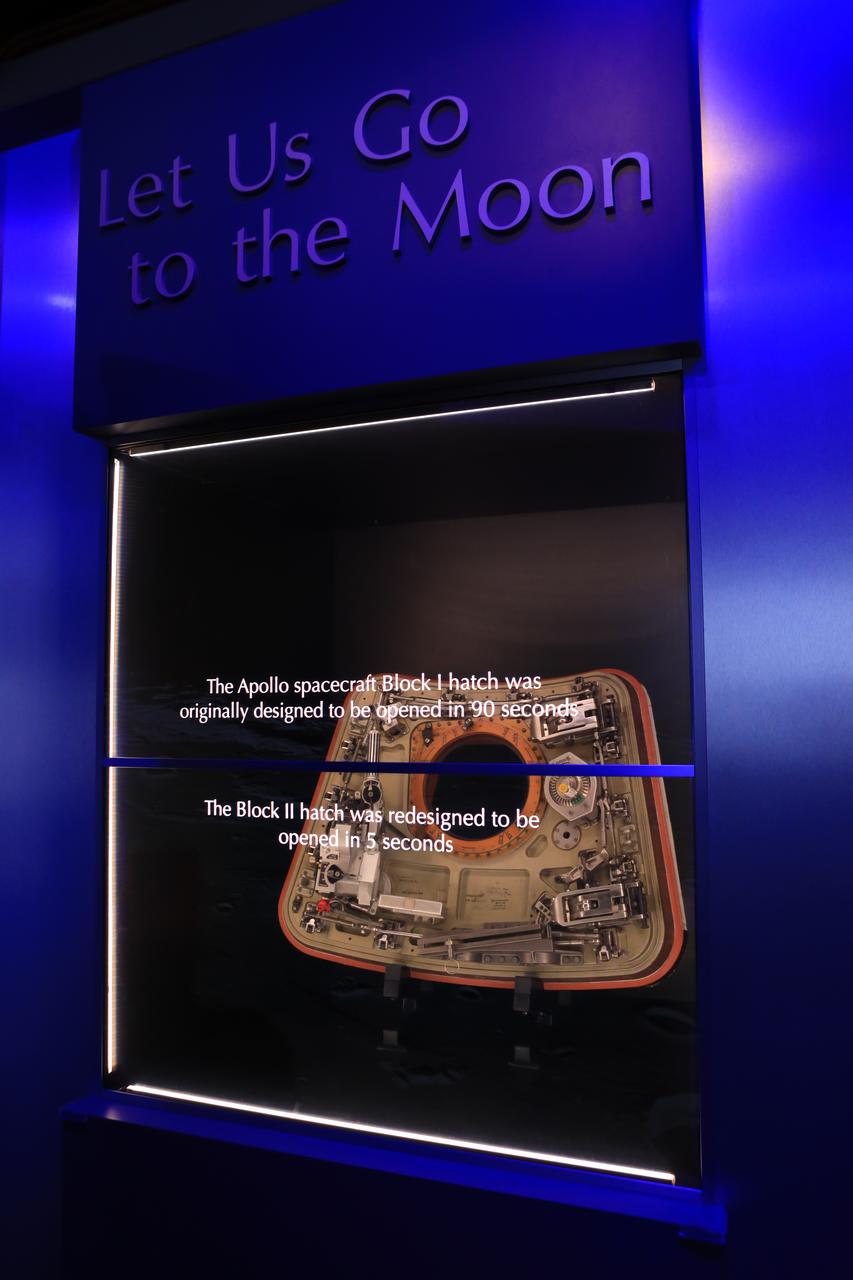
A redesigned hatch for an Apollo spacecraft is shown inside the new tribute to the crew of Apollo 1 who perished in a fire at the launch pad on Jan. 27, 1967, during training for the mission. Astronauts Gus Grissom, Ed White II and Roger Chaffee were lost during the fire. The tribute at the Apollo/Saturn V Center at NASA's Kennedy Space Center opened Jan. 27, 2017, 50 years after the crew of three was lost. It features numerous items recalling the lives of the three astronauts. The tribute also includes the three-part hatch to the spacecraft itself, the first time any part of the Apollo 1 spacecraft has been displayed publicly. The version of the hatch after it was redesigned was also showcased as an example of improvements NASA made throughout the agency and to the Apollo spacecraft that would later carry astronauts to the moon.
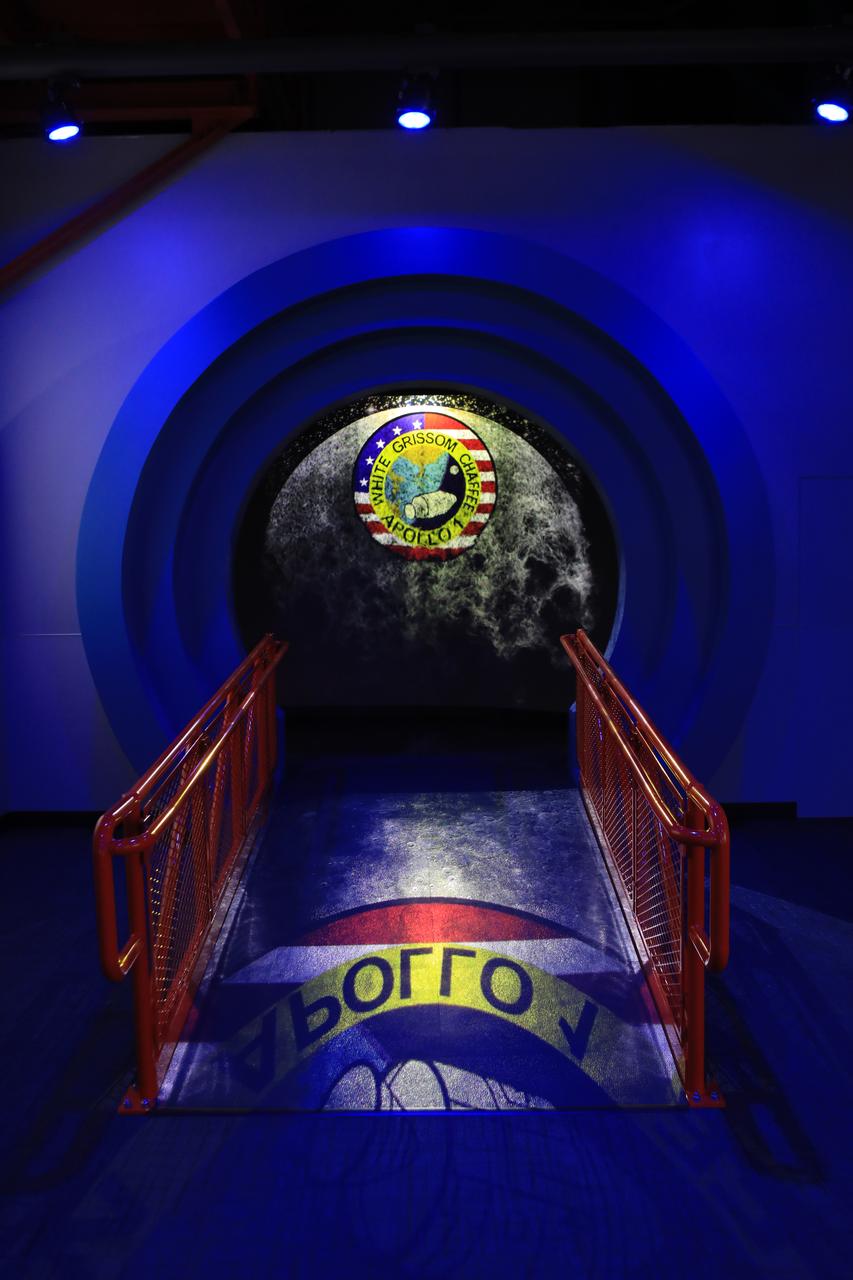
A gateway featuring the Apollo 1 mission logo over the moon is shown inside the new tribute to the crew of Apollo 1 who perished in a fire at the launch pad on Jan. 27, 1967, during training for the mission. Astronauts Gus Grissom, Ed White II and Roger Chaffee were lost during the fire. The tribute at the Apollo/Saturn V Center at NASA's Kennedy Space Center opened Jan. 27, 2017, 50 years after the crew of three was lost. It features numerous items recalling the lives of the three astronauts. The tribute also includes the three-part hatch to the spacecraft itself, the first time any part of the Apollo 1 spacecraft has been displayed publicly. A version of the hatch after it was redesigned is also showcased as an example of improvements NASA made throughout the agency and to the Apollo spacecraft that would later carry astronauts to the moon.
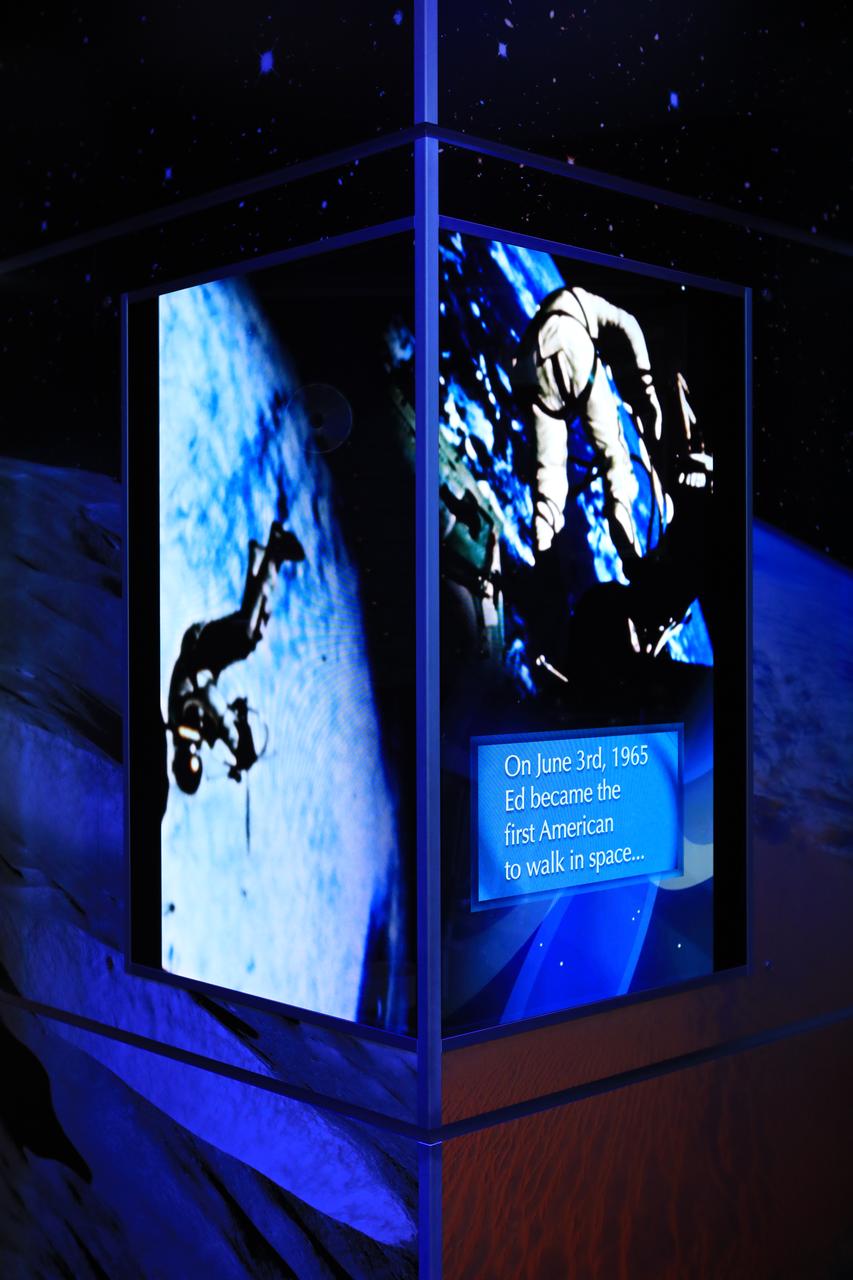
A display case dedicated to astronaut Ed White II is shown inside the new tribute to the crew of Apollo 1 who perished in a fire at the launch pad on Jan. 27, 1967, during training for the mission. Gus Grissom, White and Roger Chaffee were lost during the fire. The tribute at the Apollo/Saturn V Center at NASA's Kennedy Space Center opened Jan. 27, 2017, 50 years after the crew of three was lost. It features numerous items recalling the lives of the three astronauts. It also includes the three-part hatch to the spacecraft itself, the first time any part of the Apollo 1 spacecraft has been displayed publicly. A version of the hatch after it was redesigned is also showcased as an example of improvements NASA made throughout the agency and to the Apollo spacecraft that would later carry astronauts to the moon.
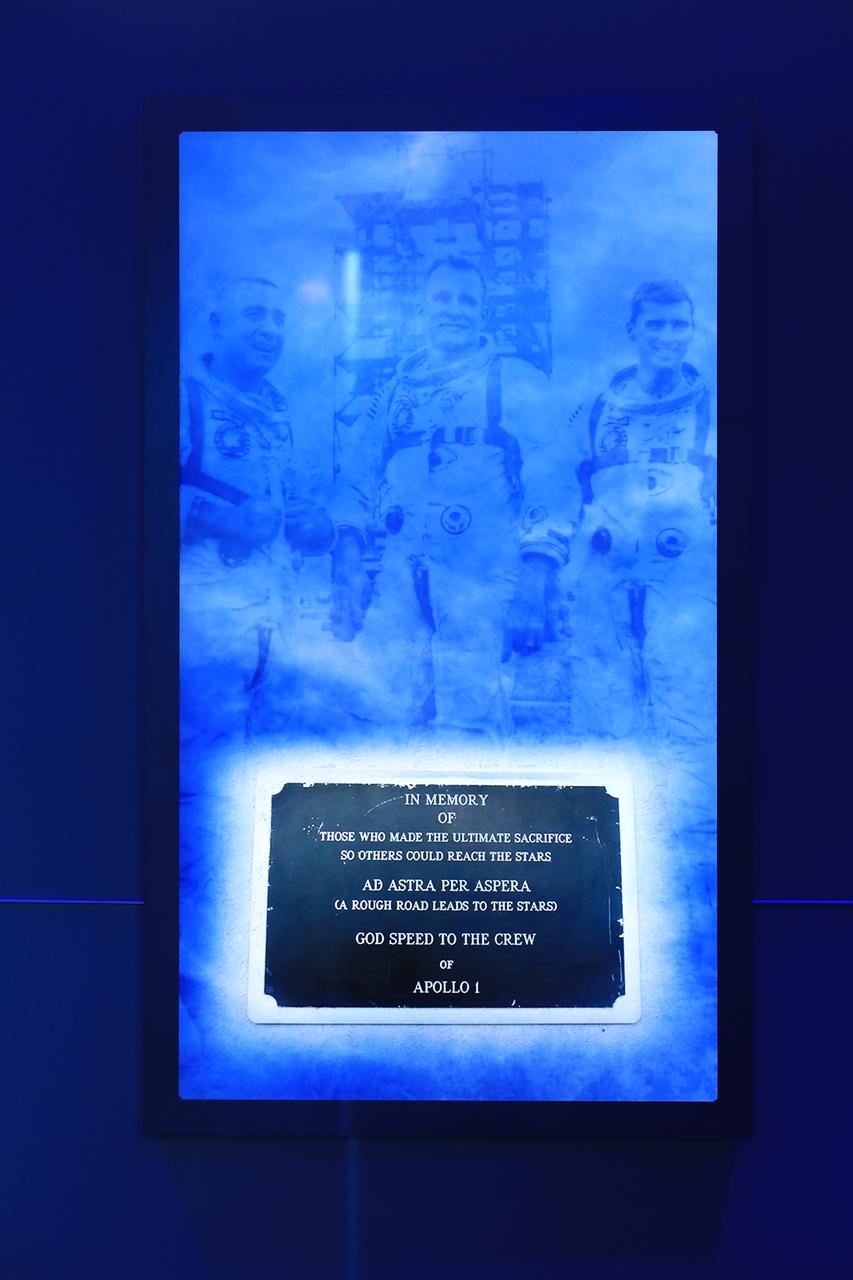
A display screen showing the memorial plaque that is in place at Launch Complex 34 is shown inside the new tribute to the crew of Apollo 1 who perished in a fire at the launch pad on Jan. 27, 1967, during training for the mission. Astronauts Gus Grissom, Ed White II and Roger Chaffee were lost during the fire. The tribute at the Apollo/Saturn V Center at NASA's Kennedy Space Center opened Jan. 27, 2017, 50 years after the crew of three was lost. It features numerous items recalling the lives of the three astronauts. It also includes the three-part hatch to the spacecraft itself, the first time any part of the Apollo 1 spacecraft has been displayed publicly. A version of the hatch after it was redesigned is also showcased as an example of improvements NASA made throughout the agency and to the Apollo spacecraft that would later carry astronauts to the moon.
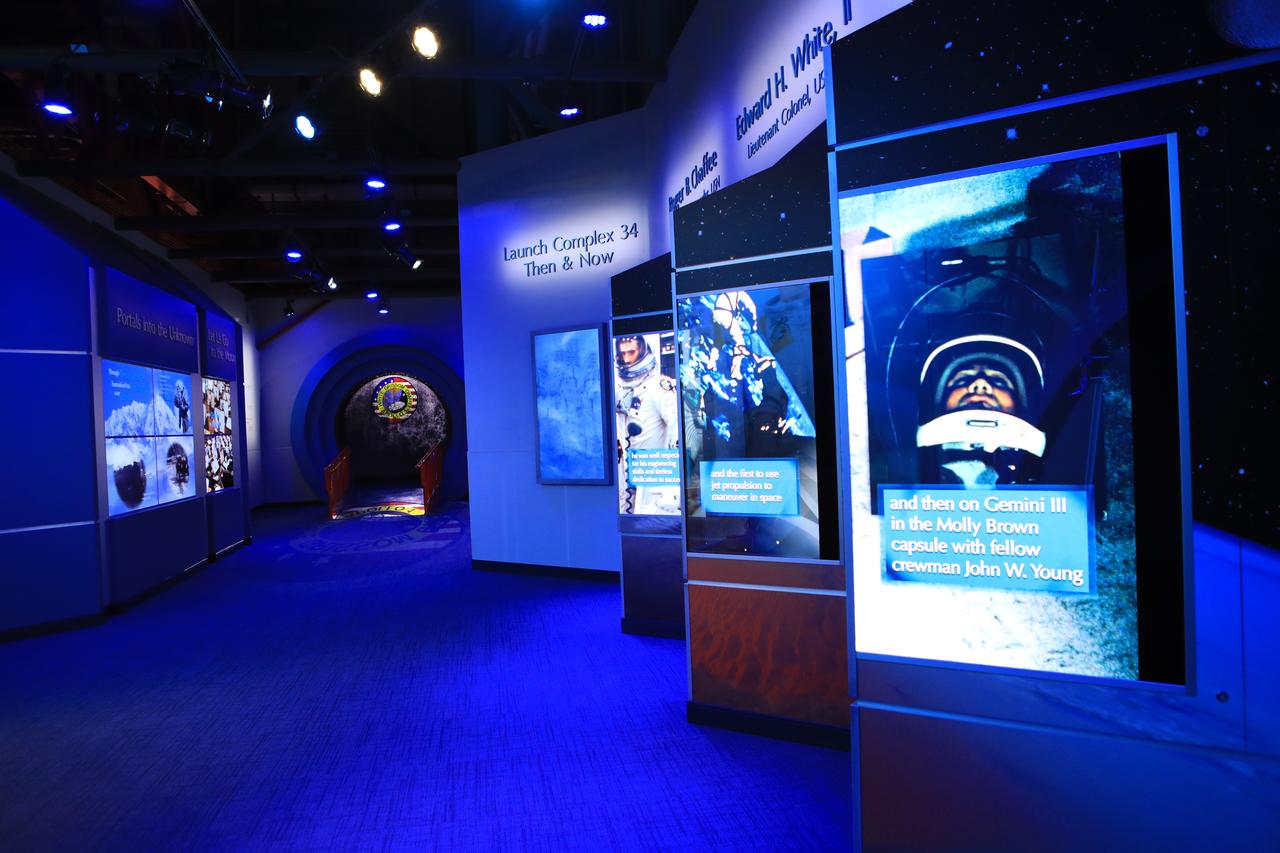
The new tribute to the crew of Apollo 1 who perished in a fire at the launch pad on Jan. 27, 1967, during training for the mission is shown looking down the length of the area. The tribute highlights the lives and careers of astronauts Gus Grissom, Ed White II and Roger Chaffee who were lost during the fire. The tribute at the Apollo/Saturn V Center at NASA's Kennedy Space Center opened Jan. 27, 2017, 50 years after the crew of three was lost. It features numerous items recalling the lives of the three astronauts. The tribute also includes the three-part hatch to the spacecraft itself, the first time any part of the Apollo 1 spacecraft has been displayed publicly. A version of the hatch after it was redesigned is also showcased as an example of improvements NASA made throughout the agency and to the Apollo spacecraft that would later carry astronauts to the moon.
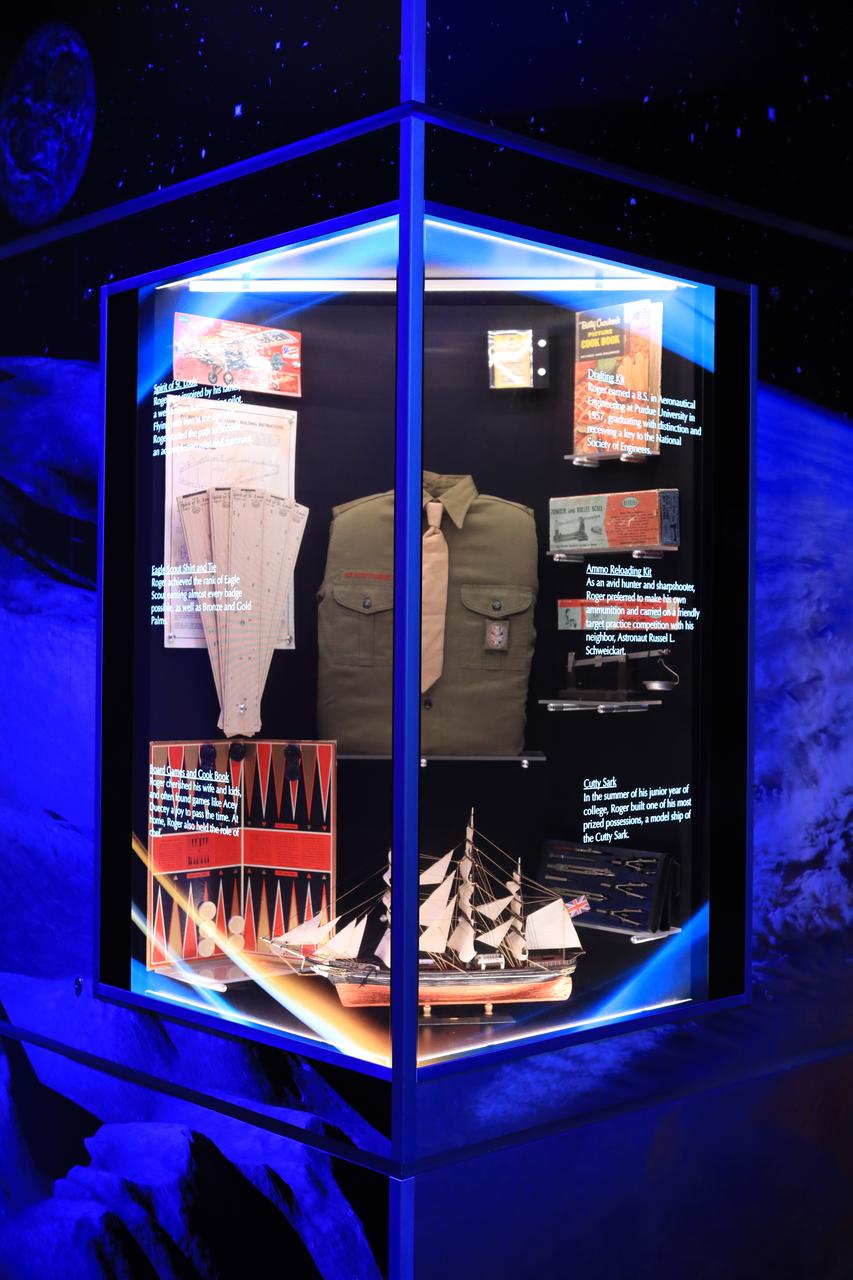
A display case dedicated to astronaut Roger Chaffee is shown inside the new tribute to the crew of Apollo 1 who perished in a fire at the launch pad on Jan. 27, 1967, during training for the mission. Gus Grissom, Ed White II and Chaffee were lost during the fire. The tribute at the Apollo/Saturn V Center at NASA's Kennedy Space Center opened Jan. 27, 2017, 50 years after the crew of three was lost. It features numerous items recalling the lives of the three astronauts. It also includes the three-part hatch to the spacecraft itself, the first time any part of the Apollo 1 spacecraft has been displayed publicly. A version of the hatch after it was redesigned is also showcased as an example of improvements NASA made throughout the agency and to the Apollo spacecraft that would later carry astronauts to the moon.
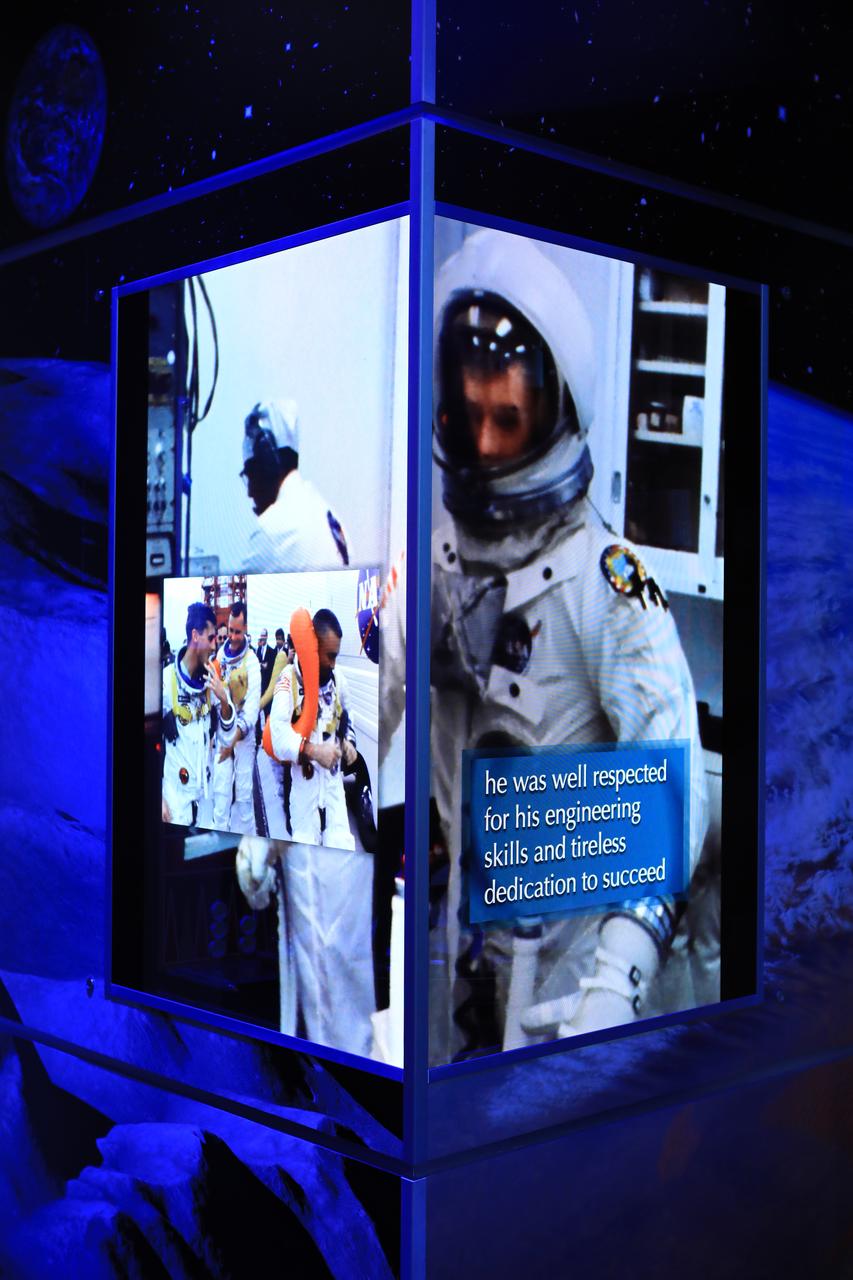
A display case dedicated to astronaut Roger Chaffee is shown inside the new tribute to the crew of Apollo 1 who perished in a fire at the launch pad on Jan. 27, 1967, during training for the mission. Gus Grissom, Ed White II and Chaffee were lost during the fire. The tribute at the Apollo/Saturn V Center at NASA's Kennedy Space Center opened Jan. 27, 2017, 50 years after the crew of three was lost. It features numerous items recalling the lives of the three astronauts. It also includes the three-part hatch to the spacecraft itself, the first time any part of the Apollo 1 spacecraft has been displayed publicly. A version of the hatch after it was redesigned is also showcased as an example of improvements NASA made throughout the agency and to the Apollo spacecraft that would later carry astronauts to the moon.
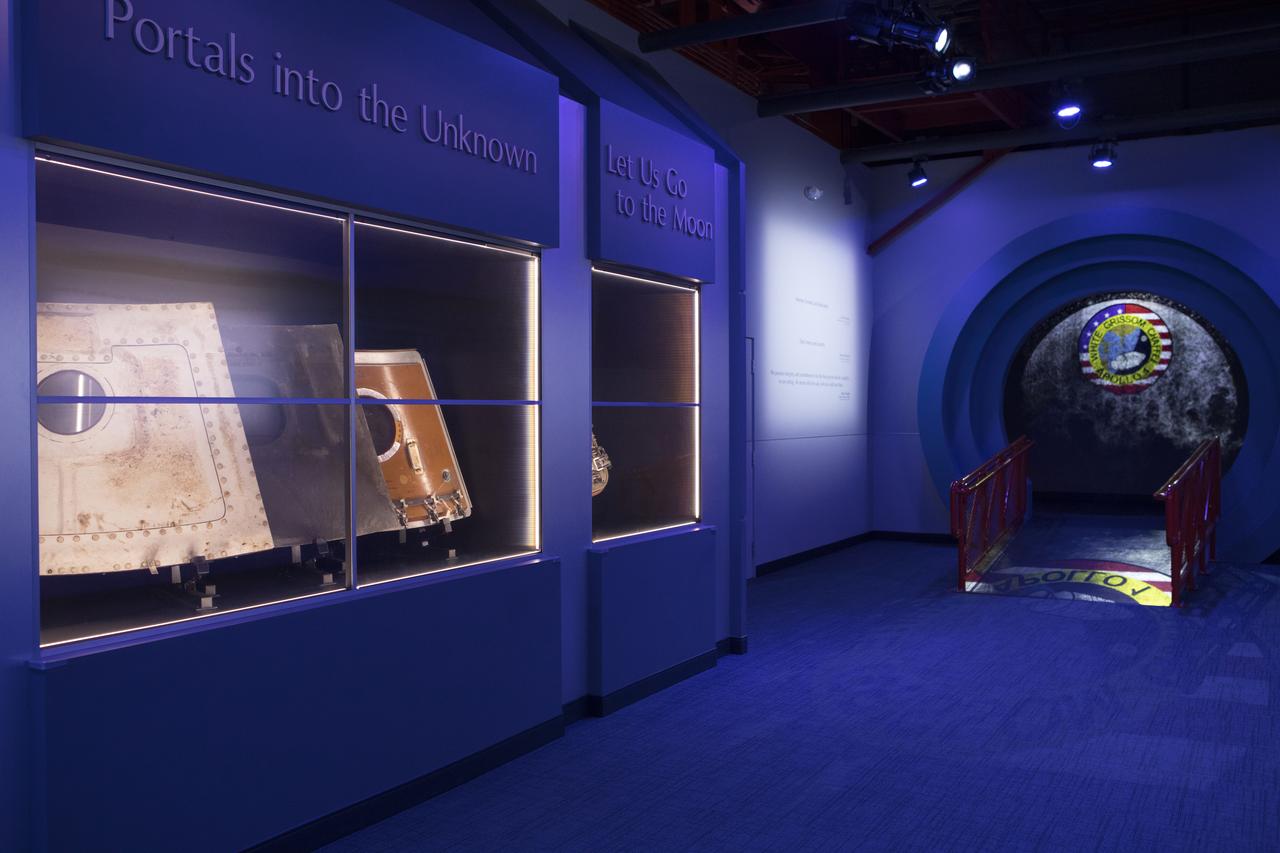
The three-part hatch that was in place on the Apollo 1 spacecraft is shown in a tribute to the crew of Apollo 1 who perished in a fire at the launch pad on Jan. 27, 1967, during training for the mission. This is the first time any part of the Apollo 1 spacecraft has been displayed publicly. The tribute highlights the lives and careers of astronauts Gus Grissom, Ed White II and Roger Chaffee who were lost during the fire. The tribute at the Apollo/Saturn V Center at NASA's Kennedy Space Center opened Jan. 27, 2017, 50 years after the crew of three was lost. It features numerous items recalling the lives of the three astronauts. A version of the hatch after it was redesigned is also showcased as an example of improvements NASA made throughout the agency and to the Apollo spacecraft that would later carry astronauts to the moon.
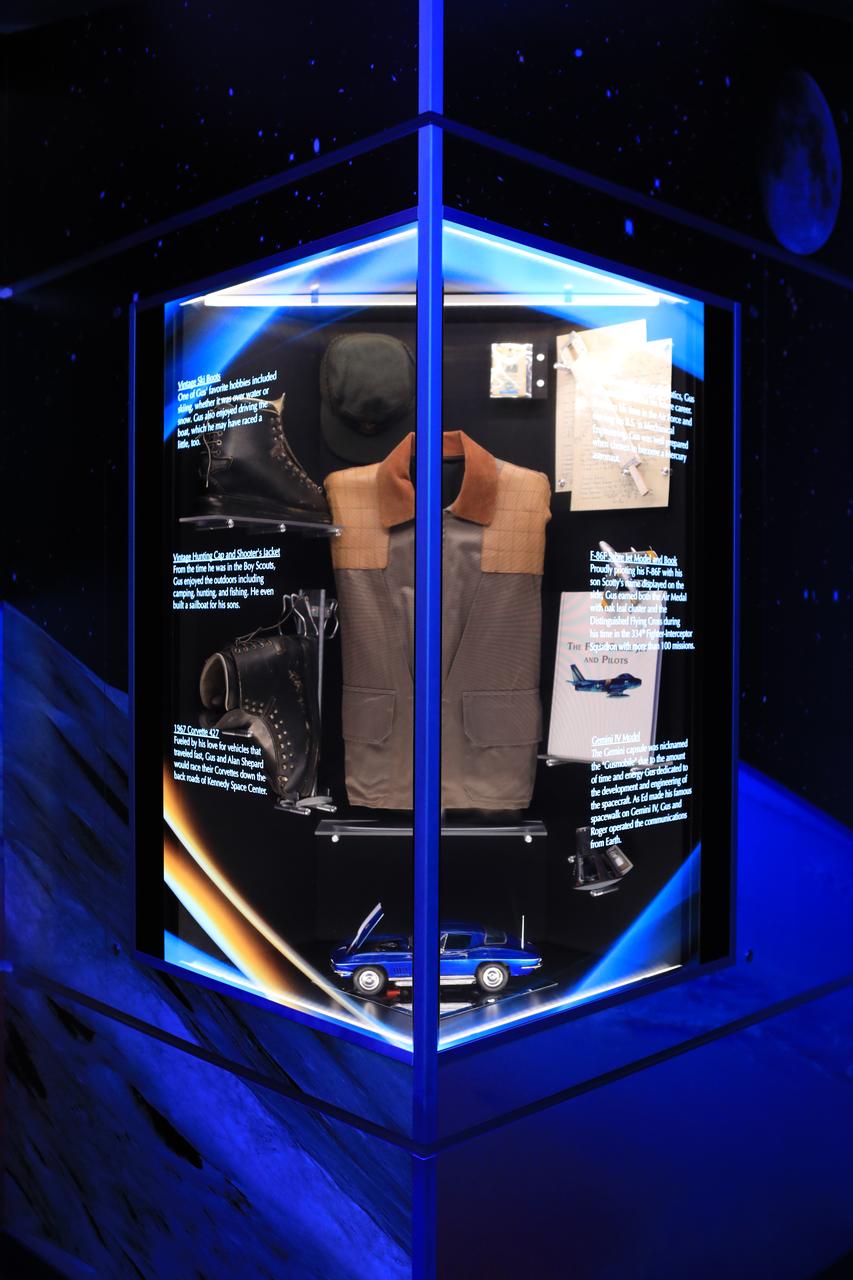
A display case dedicated to astronaut Gus Grissom is shown inside the new tribute to the crew of Apollo 1 who perished in a fire at the launch pad on Jan. 27, 1967, during training for the mission. Grissom, Ed White II and Roger Chaffee were lost during the fire. The tribute at the Apollo/Saturn V Center at NASA's Kennedy Space Center opened Jan. 27, 2017, 50 years after the crew of three was lost. It features numerous items recalling the lives of the three astronauts. It also includes the three-part hatch to the spacecraft itself, the first time any part of the Apollo 1 spacecraft has been displayed publicly. A version of the hatch after it was redesigned is also showcased as an example of improvements NASA made throughout the agency and to the Apollo spacecraft that would later carry astronauts to the moon.
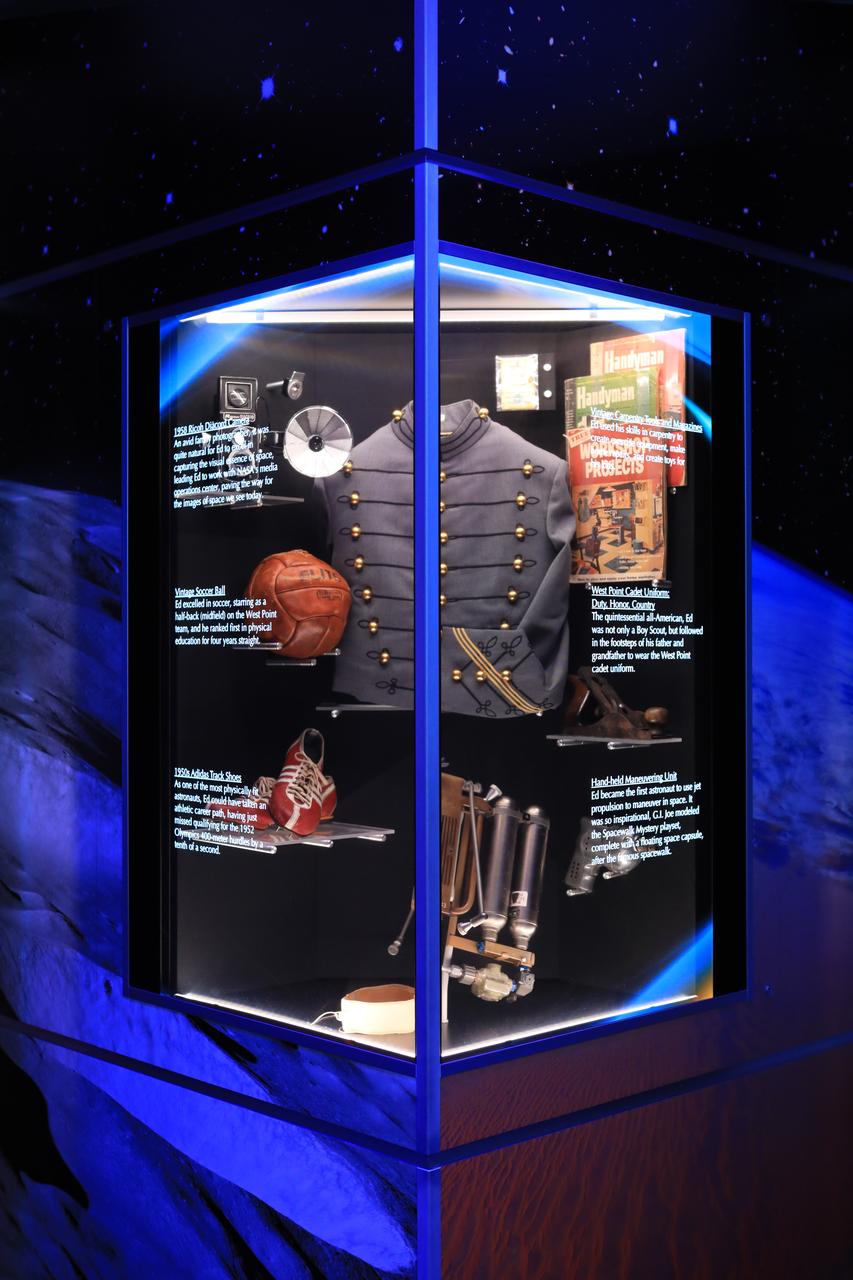
A display case dedicated to astronaut Ed White II is shown inside the new tribute to the crew of Apollo 1 who perished in a fire at the launch pad on Jan. 27, 1967, during training for the mission. Gus Grissom, White and Roger Chaffee were lost during the fire. The tribute at the Apollo/Saturn V Center at NASA's Kennedy Space Center opened Jan. 27, 2017, 50 years after the crew of three was lost. It features numerous items recalling the lives of the three astronauts. It also includes the three-part hatch to the spacecraft itself, the first time any part of the Apollo 1 spacecraft has been displayed publicly. A version of the hatch after it was redesigned is also showcased as an example of improvements NASA made throughout the agency and to the Apollo spacecraft that would later carry astronauts to the moon.
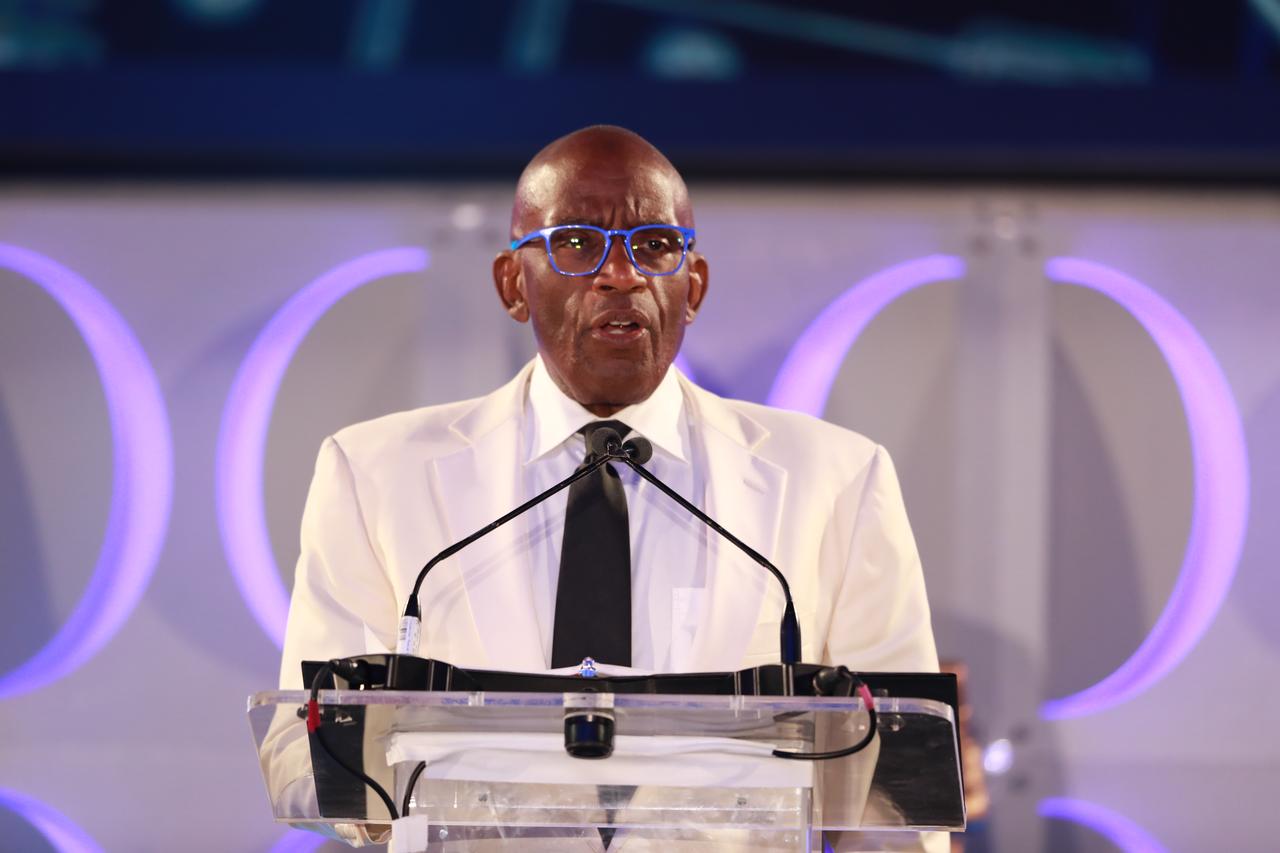
Al Roker, NBC TODAY Show co-host and weatherman, serves as the emcee for the Apollo 11 50th Gala, presented by Northrop Grumman, inside the Apollo/Saturn V Center at the Kennedy Space Center Visitor Complex on July 16, 2019.

During the Apollo 11 50th Gala, presented by Northrop Grumman, on July 16, 2019, last year's space-themed constume contest winner, left, helps the announcer preent this year's winners their awards. The gala was held inside the Apollo/Saturn V Center at the Kennedy Space Center Visitor Complex in Florida.
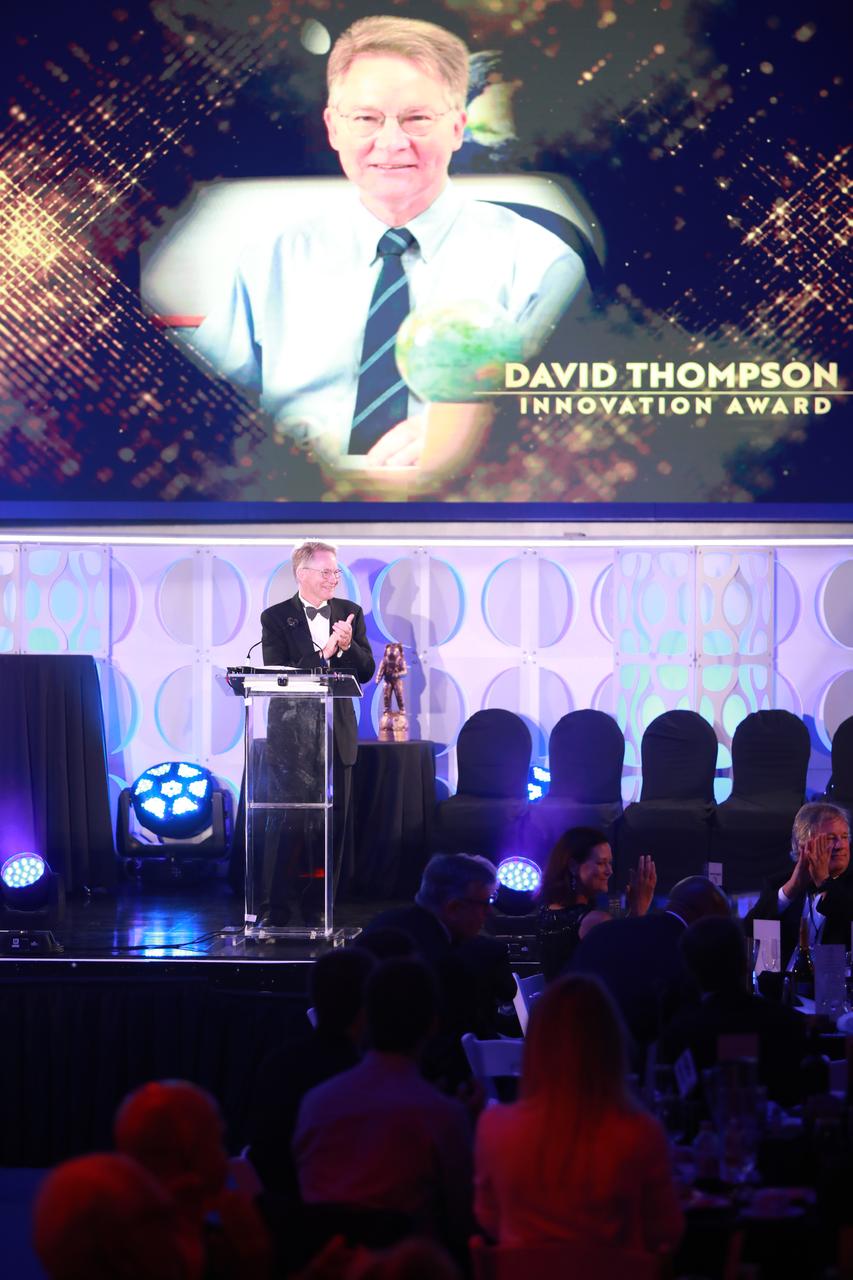
David Thompson, founder, presdient and CEO of Orbital Sciences Corp. (later known as Orbital ATK), makes remarks after receiving the Innovation Award at the Apollo 50th Gala on July 16, 2019. The gala, presented by Northrop Grumman, was held inside the Apollo/Saturn V Center at the Kennedy Space Center Visitor Complex in Florida.
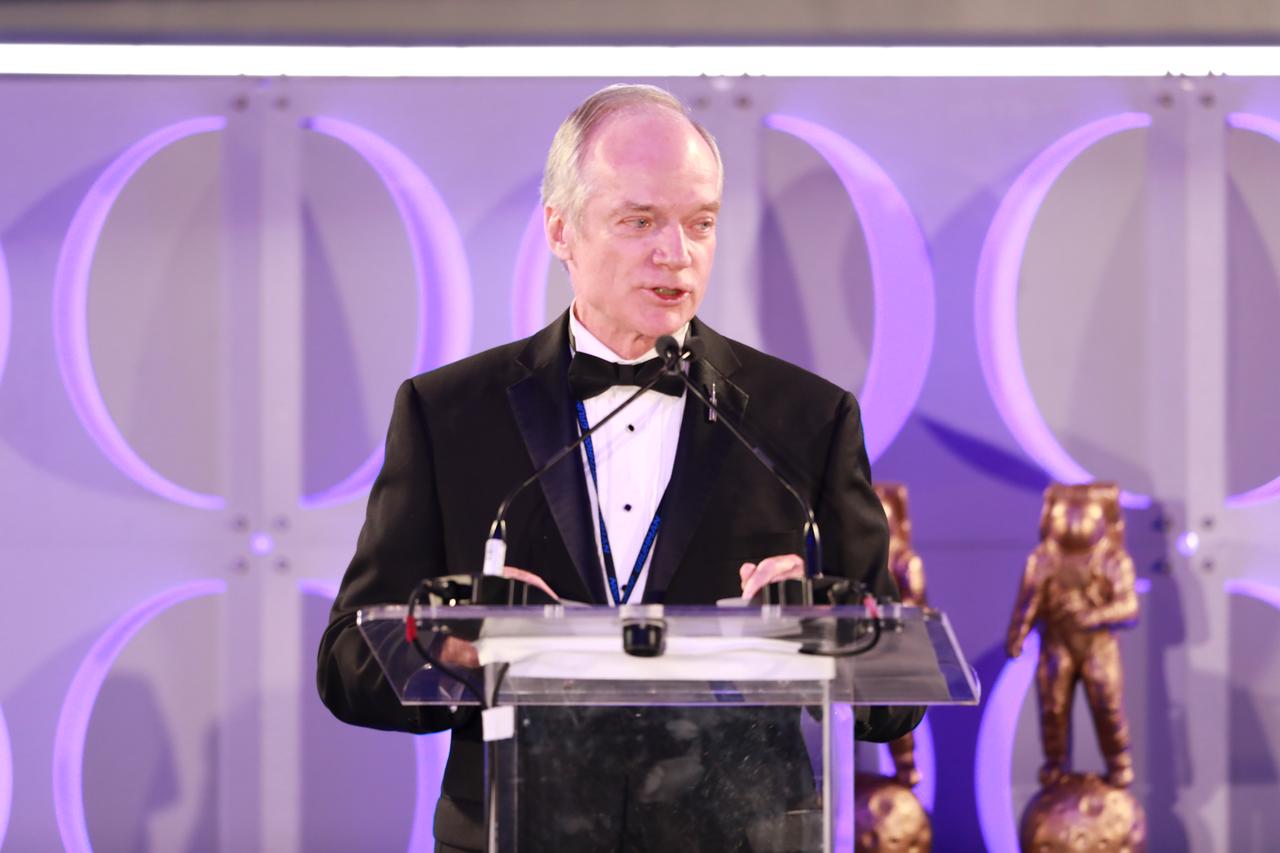
Retired NASA astronaut Charlie Precourt, vice president, propulsion systems, with Northrop Grumman, delivers remarks during the Apollo 11 50th Gala, presented by Northrop Grumman, inside the Apollo/Saturn V Center at the Kennedy Space Center Visitor Complex on July 16, 2019.
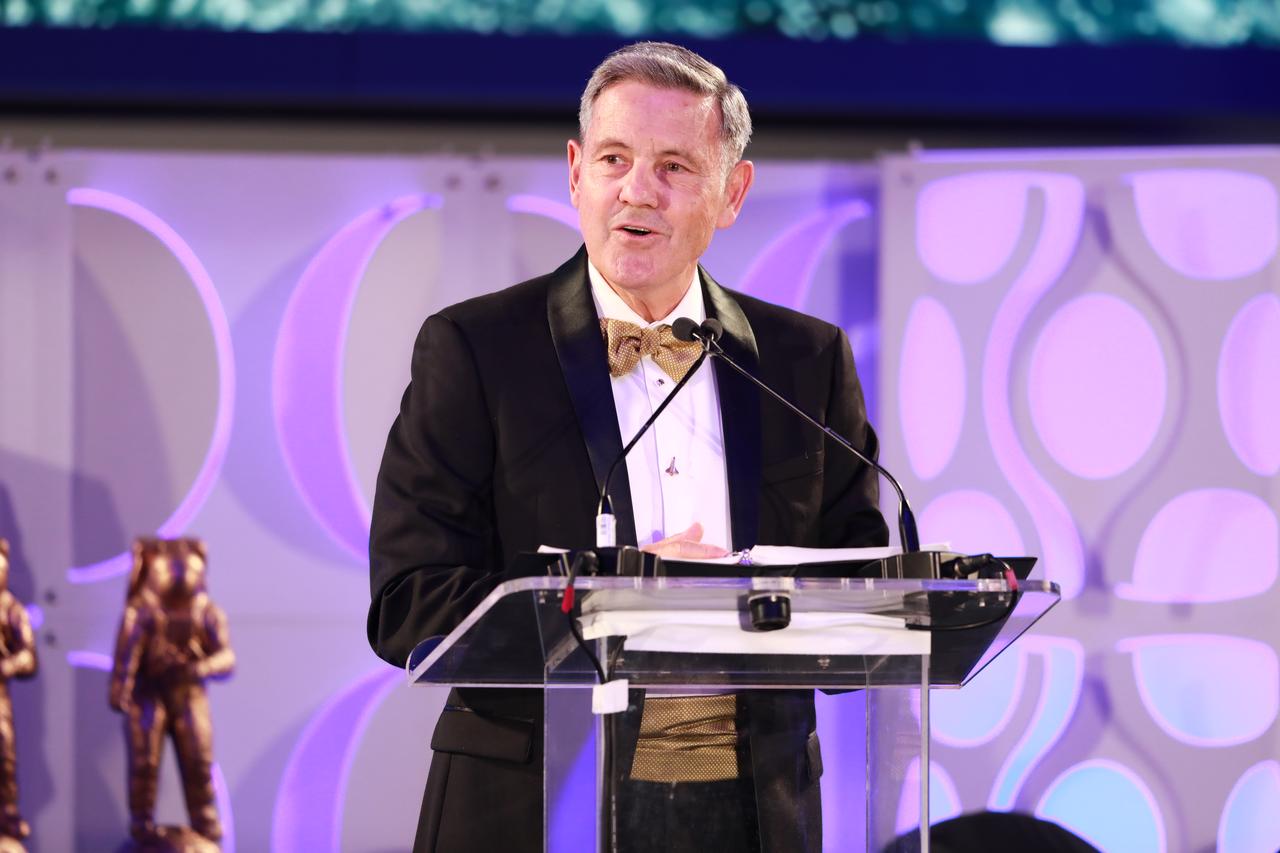
NASA Kennedy Space Center Director and retired astronaut Bob Cabana delivers remarks during the Apollo 50th Gala, presented by Northrop Grumman, inside the Apollo/Saturn V Center at the Kennedy Space Center Visitor Complex in Florida on July 16, 2019.
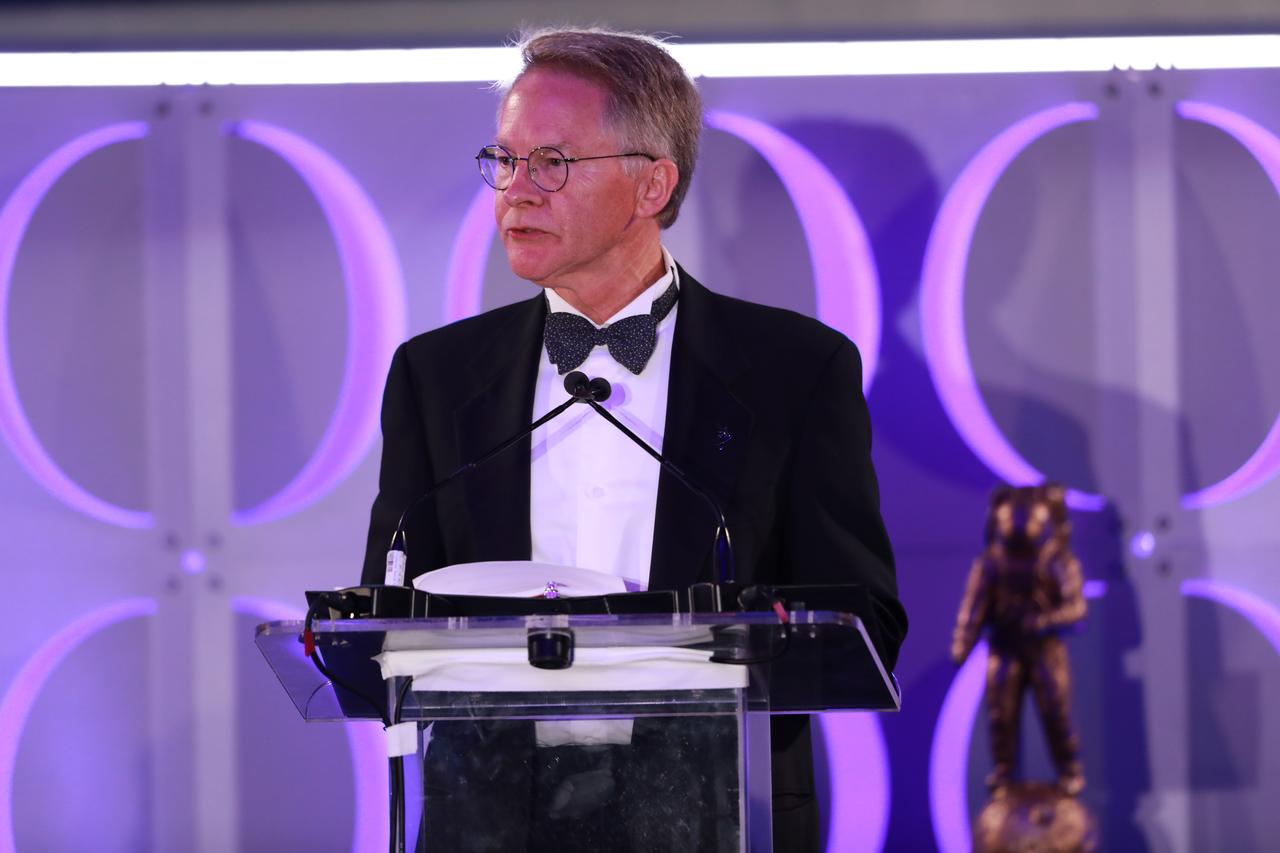
David Thompson, founder, presdient and CEO of Orbital Sciences Corp. (later known as Orbital ATK), makes remarks after receiving the Innovation Award at the Apollo 50th Gala on July 16, 2019. The gala, presented by Northrop Grumman, was held inside the Apollo/Saturn V Center at the Kennedy Space Center Visitor Complex in Florida.

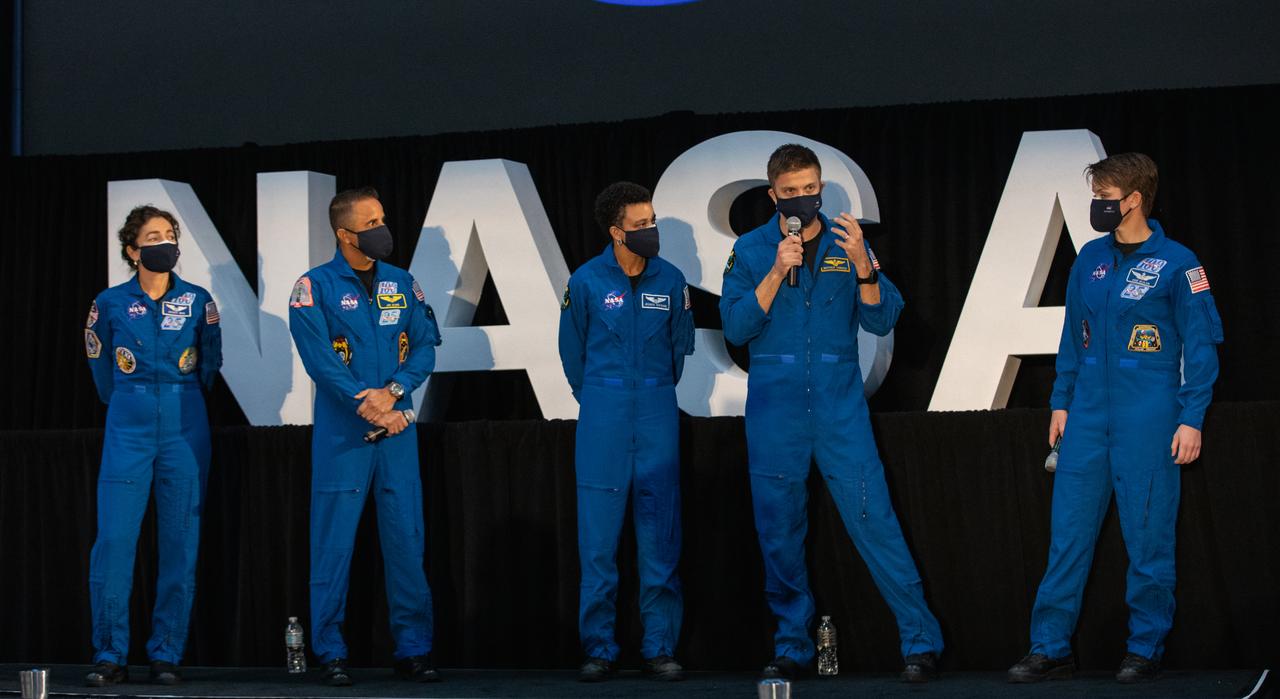
From left, NASA astronauts Jessica Meir, Joseph Acaba, Anne McClain, Matthew Dominick, and Jessica Watkins pose inside the Apollo/Saturn V Center at the Kennedy Space Center Visitor Complex in Florida on Dec. 9, 2020. The five are among the initial team of 18 astronauts eligible for early Artemis missions on and around the Moon, announced by Vice President Mike Pence during a meeting of the National Space Council inside the Apollo/Saturn V Center. Under the Artemis program, NASA will land the first woman and the next man on the Moon in 2024.
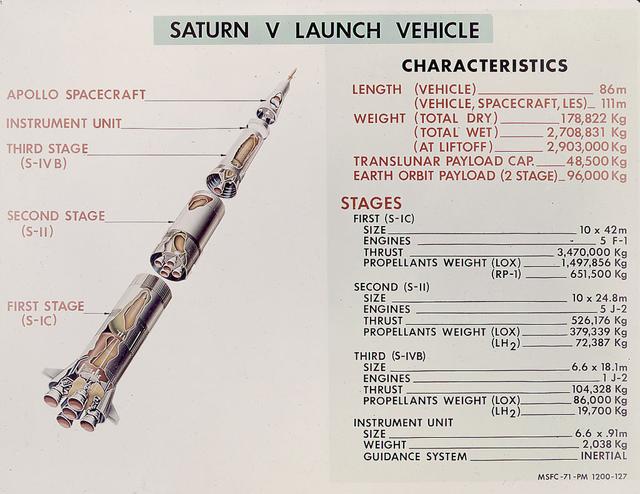
This is a good cutaway diagram of the Saturn V launch vehicle showing the three stages, the instrument unit, and the Apollo spacecraft. The chart on the right presents the basic technical data in clear metric detail. The Saturn V is the largest and most powerful launch vehicle in the United States. The towering, 111 meter, Saturn V was a multistage, multiengine launch vehicle standing taller than the Statue of Liberty. Altogether, the Saturn V engines produced as much power as 85 Hoover Dams. Development of the Saturn V was the responsibility of the Marshall Space Flight Center at Huntsville, Alabama, directed by Dr. Wernher von Braun.
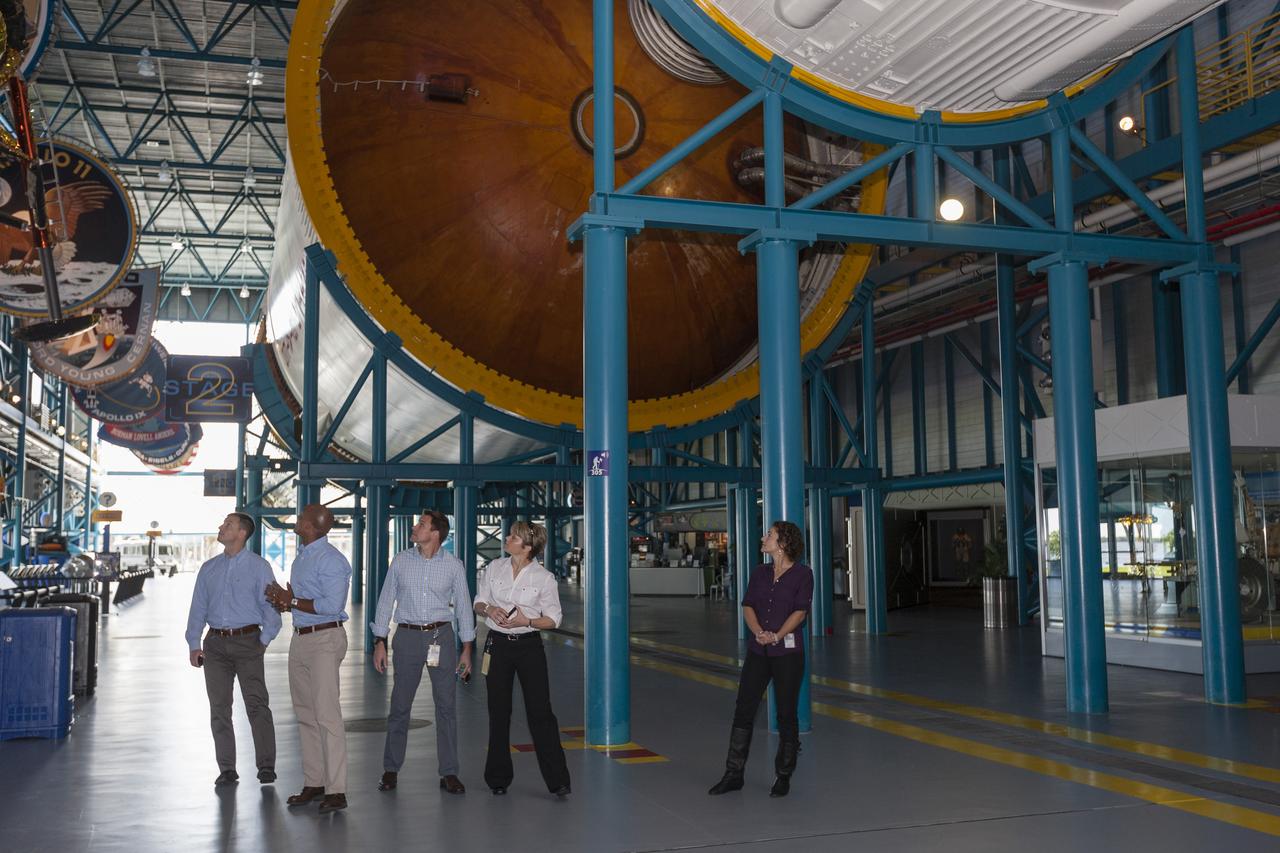
CAPE CANAVERAL, Fla. – NASA astronaut candidates Andrew Morgan, from left, Victor Glover, Josh Cassada, Anne McClain and Jessica Meir tour the Apollo Saturn V Center at Kennedy Space Center in Florida during a daylong set of briefings and tours of different facilities at NASA's primary launch center. The astronaut class of 2013 was selected by NASA after an extensive year-and-a-half search. The new group will help the agency push the boundaries of exploration and travel to new destinations in the solar system. To learn more about the astronaut class of 2013, visit: http://www.nasa.gov/astronauts/2013astroclass.html Photo credit: NASA/Kim Shiflett
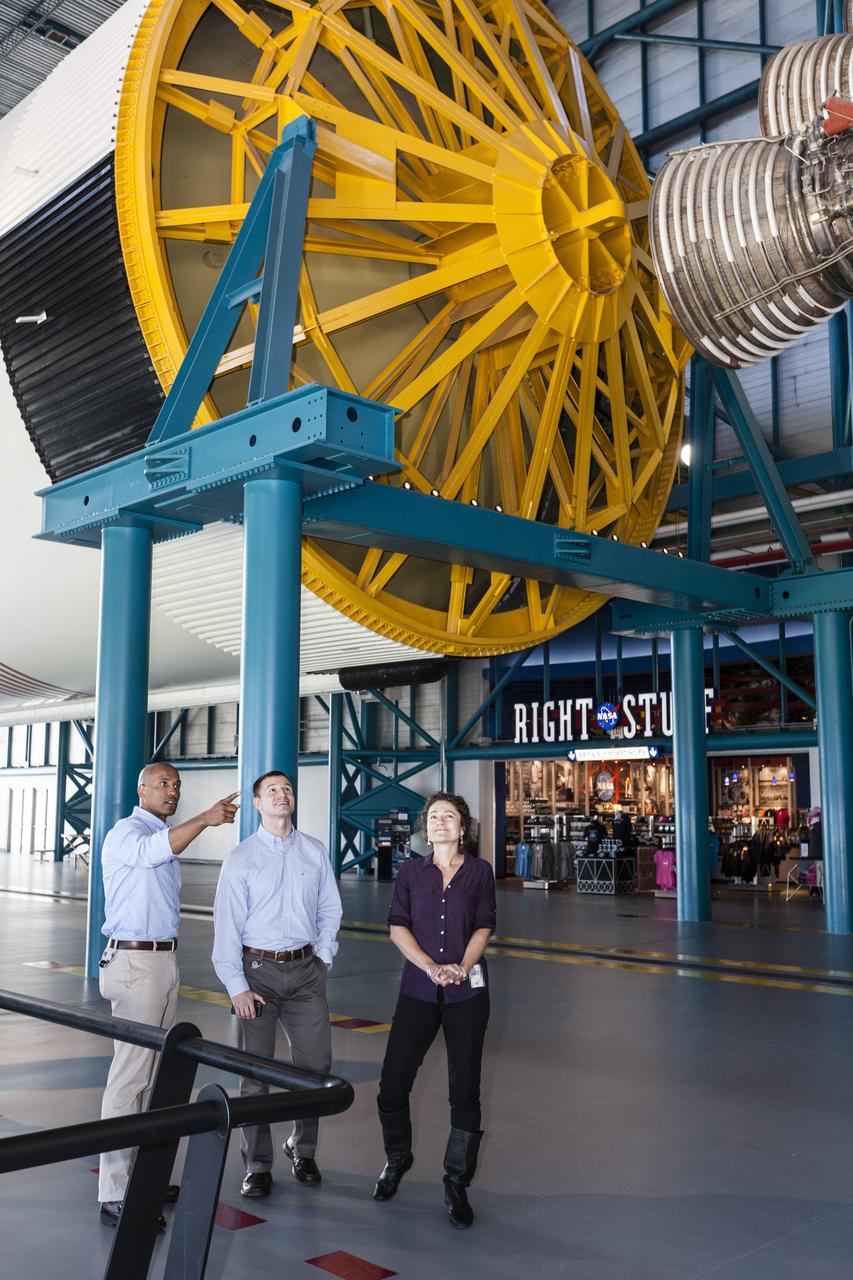
CAPE CANAVERAL, Fla. – NASA astronaut candidates Victor Glover, from left, Andrew Morgan and Jessica Meir tour the Apollo Saturn V Center at Kennedy Space Center in Florida during a daylong set of briefings and tours of different facilities at NASA's primary launch center. The astronaut class of 2013 was selected by NASA after an extensive year-and-a-half search. The new group will help the agency push the boundaries of exploration and travel to new destinations in the solar system. To learn more about the astronaut class of 2013, visit: http://www.nasa.gov/astronauts/2013astroclass.html Photo credit: NASA/Kim Shiflett
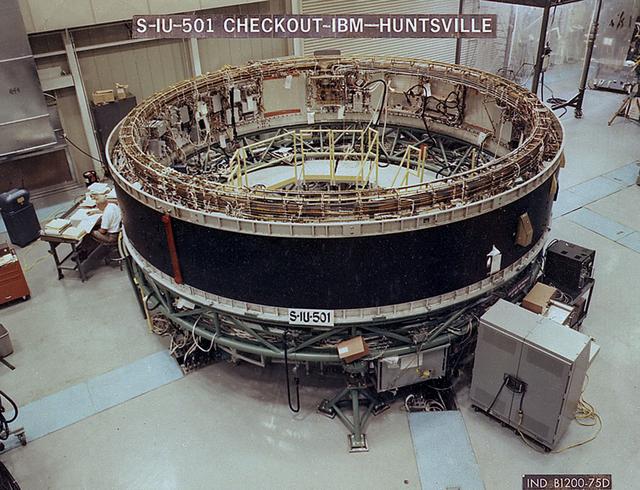
A technician checks the systems of the Saturn V instrument unit in a test facility in Huntsville. This instrument unit was flown aboard Apollo 4 on November 7, 1967, which was the first test flight of the Saturn V. The towering 363-foot Saturn V was a multi-stage, multi-engine launch vehicle standing taller than the Statue of Liberty. Altogether, the Saturn V engines produced as much power as 85 Hoover Dams.
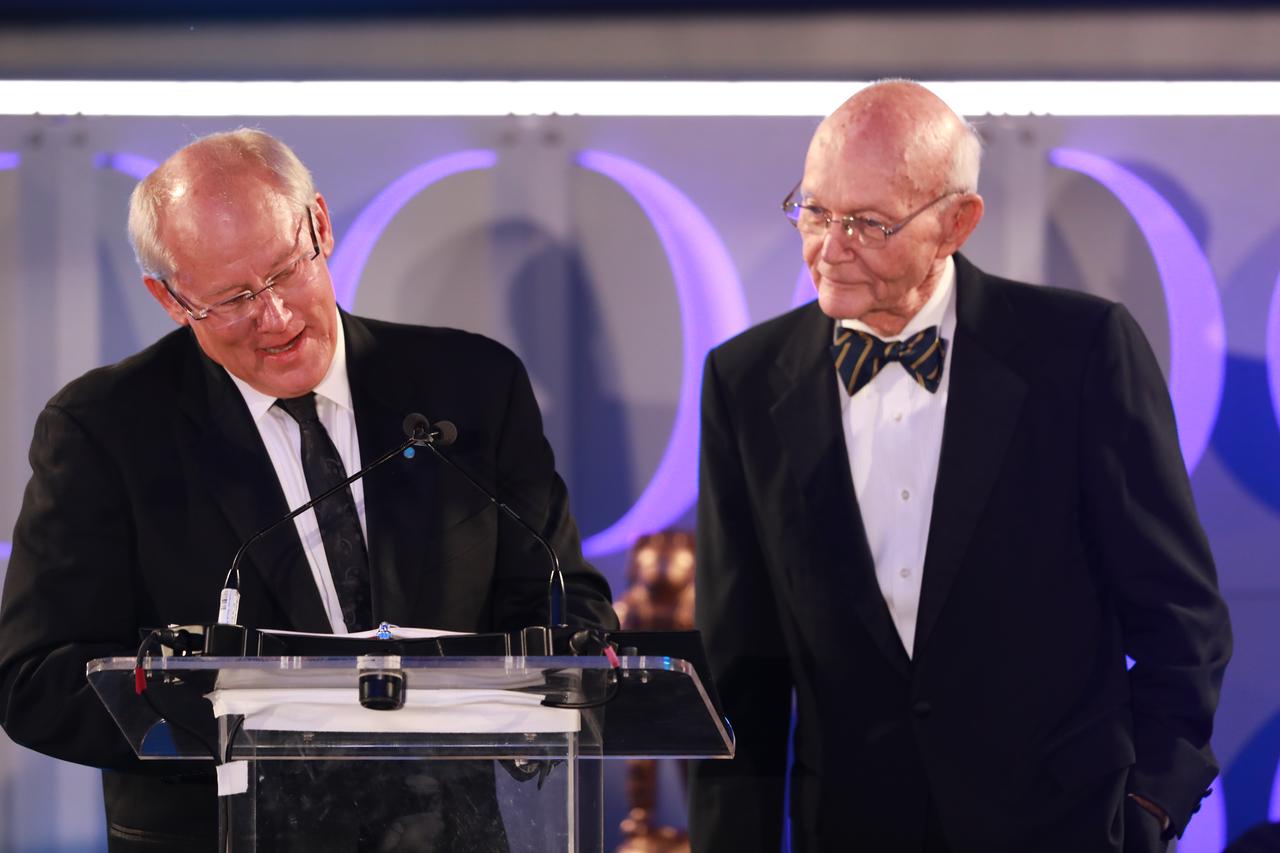
Andy Aldrin, son of Apollo 11 astronaut Buzz Aldrin, introduces Apollo 11 astronaut Michael Collins, during the Apollo 50th Gala, presented by Northrop Grumman. The event was held inside the Apollo/Saturn V Center at the Kennedy Space Center Visitor Complex in Florida on July 16, 2019.
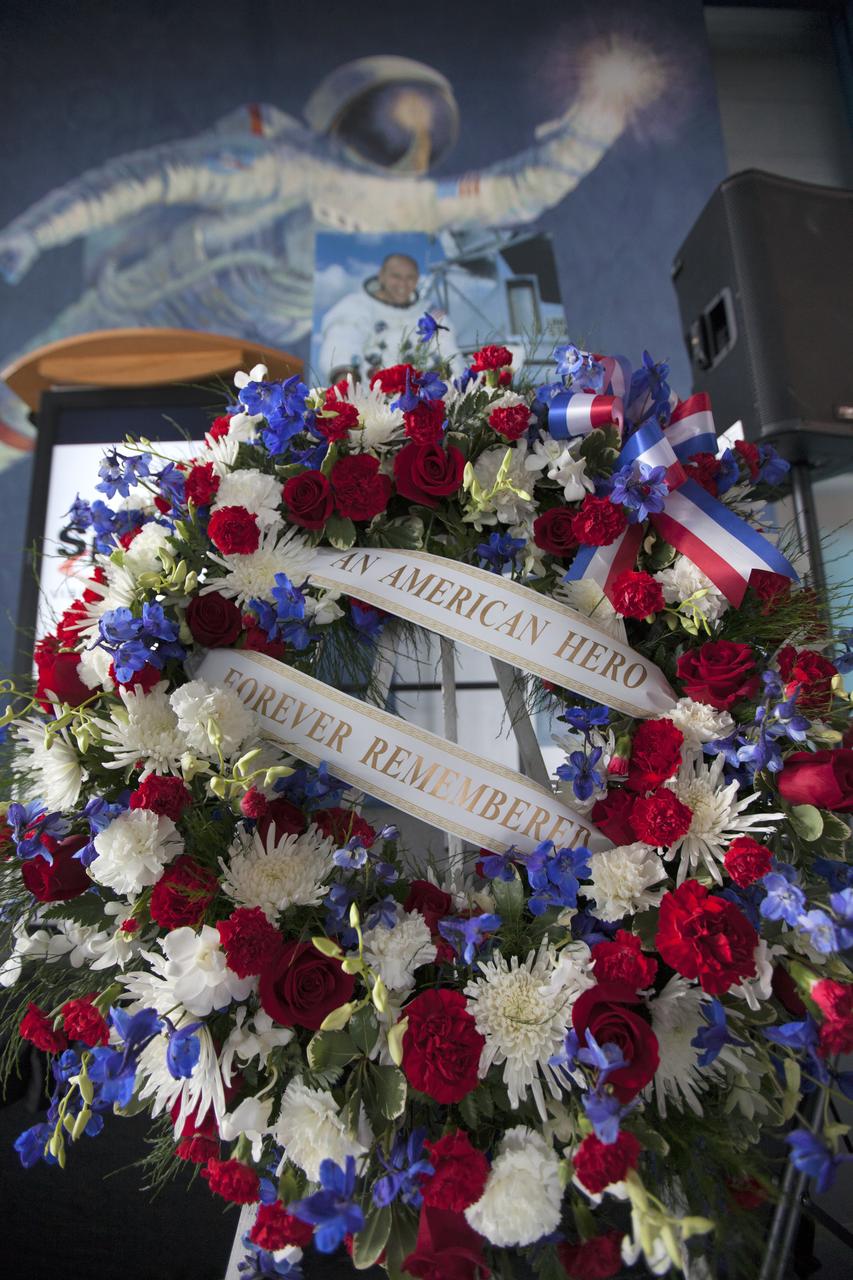
A memorial wreath placed in the Apollo-Saturn V Center of the Kennedy Space Center Visitor Complex on Wednesday, May 30, 2018, honors former NASA astronaut Alan Bean. He was the fourth person to walk on the Moon as lunar module pilot on Apollo 12 in November 1969. He went on to command the 59-day Skylab 3 mission in 1973. He died in Houston on May 26, 2018, at the age of 86.
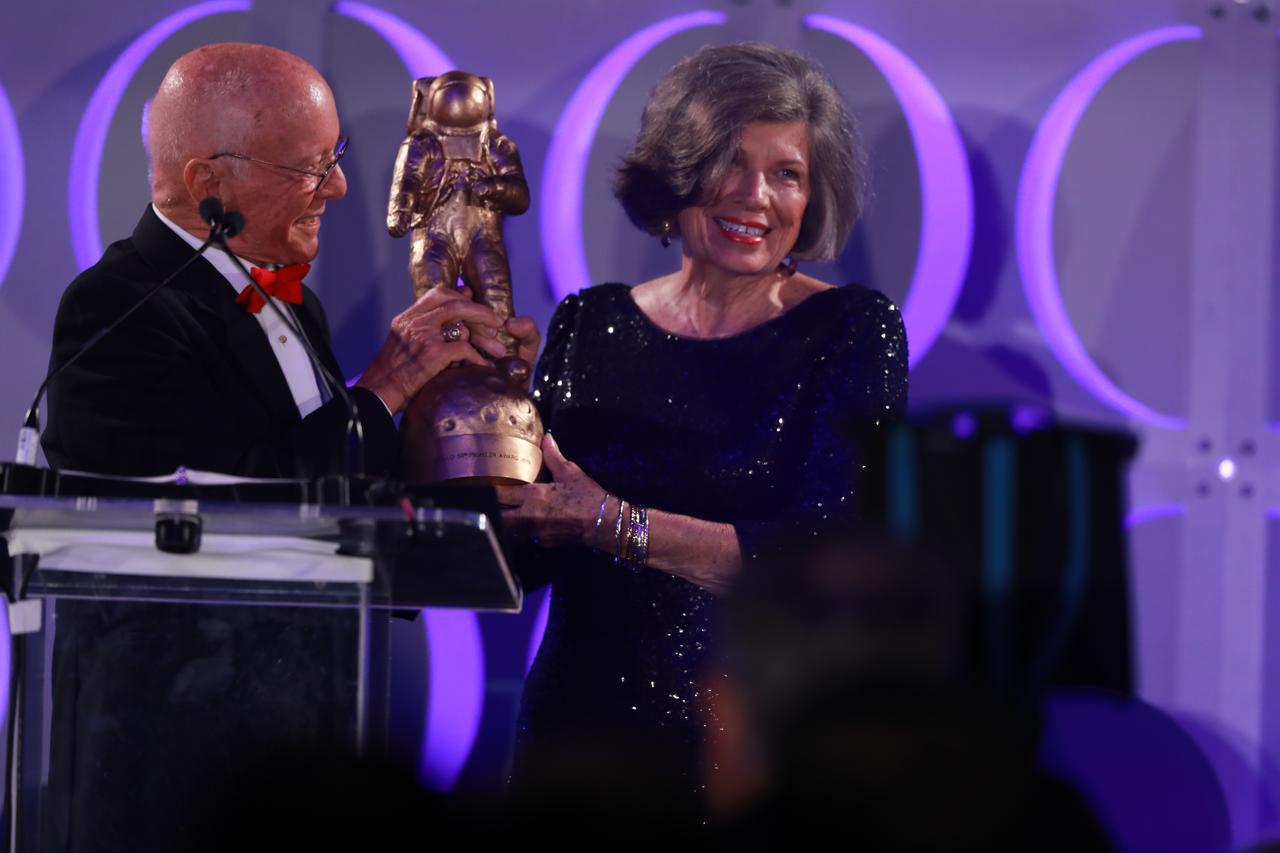
Gerry Griffin, Apollo flight director, left, presents the Pioneer Award to JoAnn Morgan, retired NASA engineer, during the Apollo 11 50th Gala, on July 16, 2019. The gala, presented by Northrop Grumman, was held inside the Apollo/Saturn V Center at the Kennedy Space Center Visitor Comples in Florida. Morgan was the first woman engineer on console at Kennedy Space Center and the only woman in the firing room during the Apollo 11 launch countdown and launch.
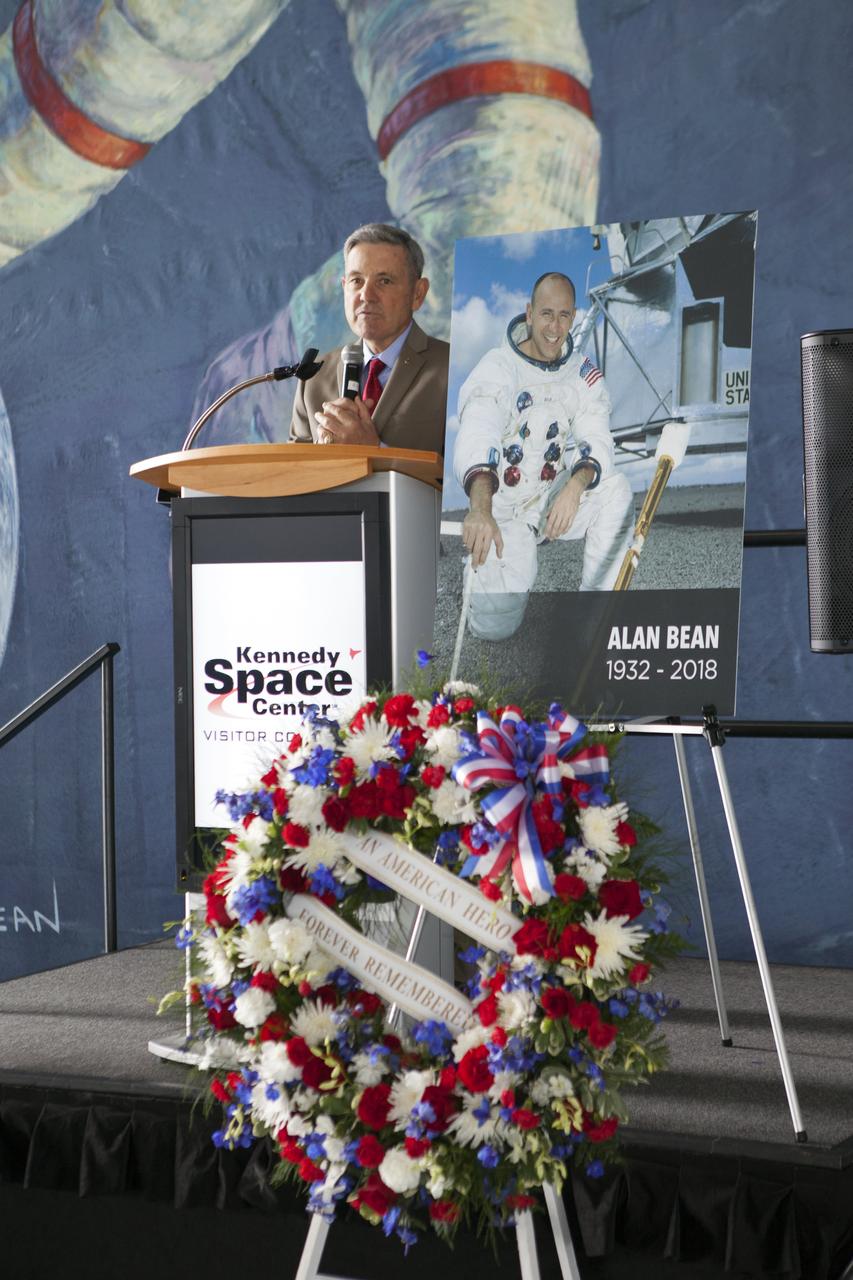
Kennedy Space Center Director Bob Cabana speaks to guests in the Apollo-Saturn V Center at the spaceport's visitor complex on Wednesday, May 30, 2018. The ceremony is honoring the memory of former NASA astronaut Alan Bean. As lunar module pilot on Apollo 12, Bean was the fourth person to walk on the Moon in November 1969. He went on to command the 59-day Skylab 3 mission in 1973. He died in Houston on May 26, 2018, at the age of 86.
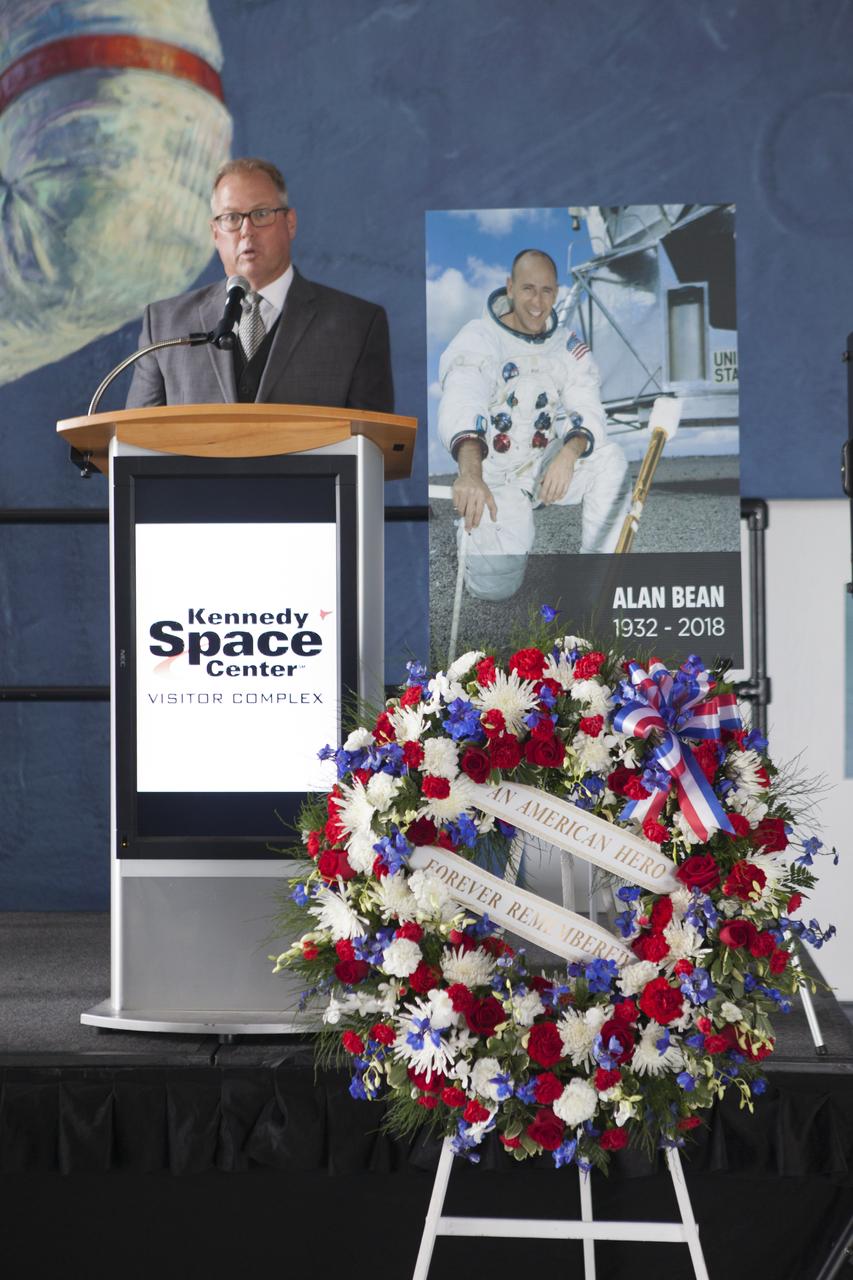
Therrin Protze, COO at the Kennedy Space Center Visitor Complex, speaks in the Apollo-Saturn V Center during a ceremony on Wednesday, May 30, 2018, honoring former NASA astronaut Alan Bean. As lunar module pilot on Apollo 12, Bean was the fourth person to walk on the Moon in November 1969. He went on to command the 59-day Skylab 3 mission in 1973. He died in Houston on May 26, 2018, at the age of 86.
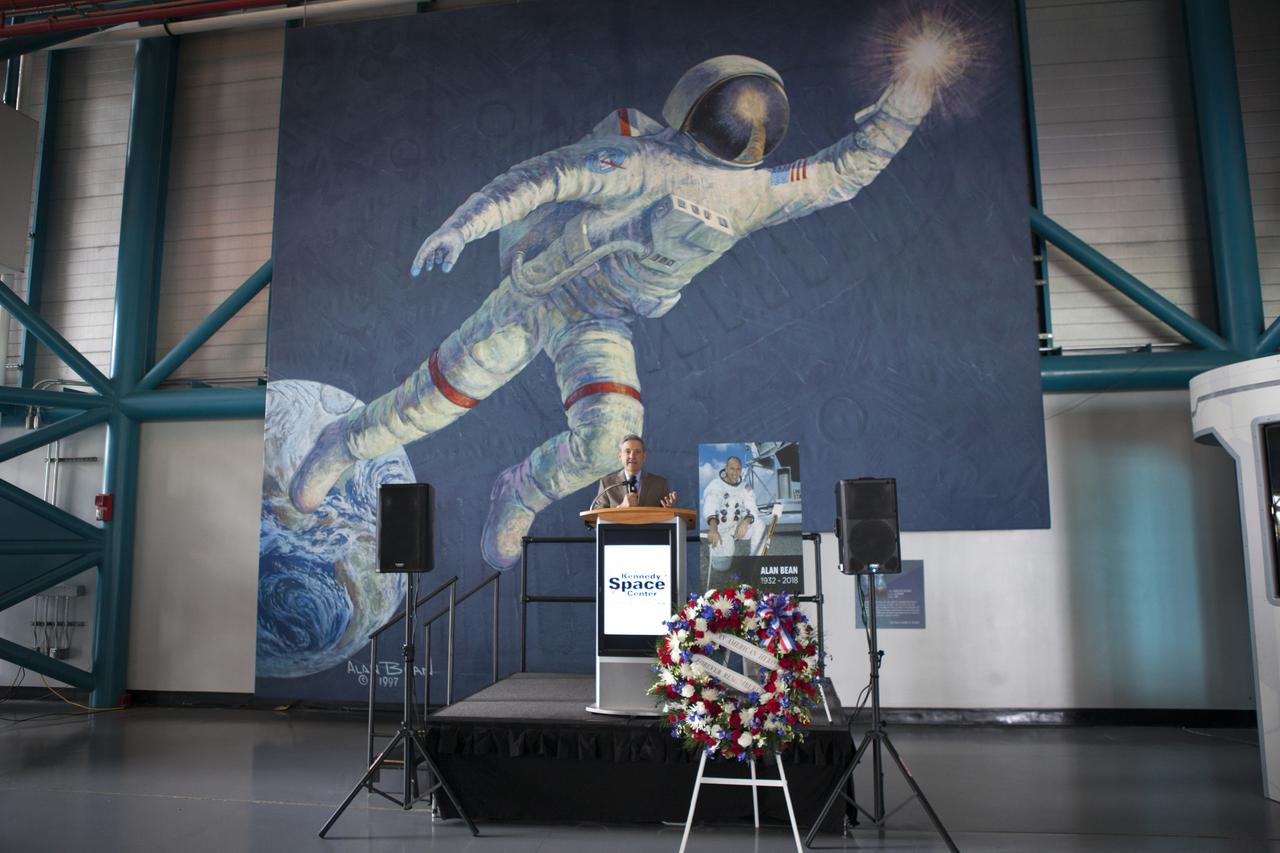
A memorial wreath placed in the Apollo-Saturn V Center of the Kennedy Space Center Visitor Complex on Wednesday, May 30, 2018, honors former NASA astronaut Alan Bean. He was the fourth person to walk on the Moon as lunar module pilot on Apollo 12 in November 1969. He went on to command the 59-day Skylab 3 mission in 1973. In the background is a large mural of a painting by Bean who became an accomplished artist after leaving NASA. He died in Houston on May 26, 2018, at the age of 86.
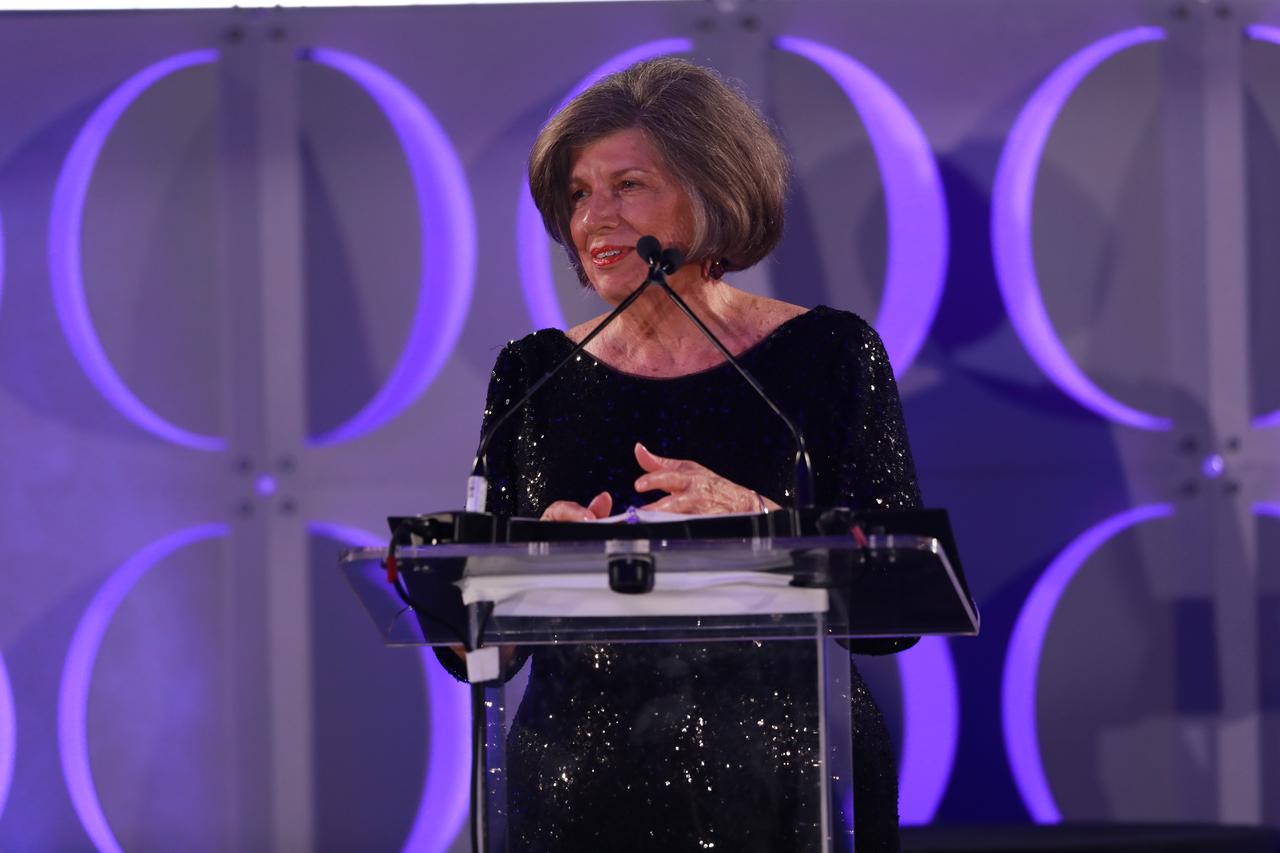
JoAnn Morgan, retired NASA engineer, makes remarks after receiving the Pioneer Award during the Apollo 11 50th Gala on July 16, 2019. The gala, presented by Northrop Grumman, was held inside the Apollo/Saturn V Center at the Kennedy Space Center Visitor Complex in Florida. Morgan was the first woman engineer on console at Kennedy Space Center and the only woman in the firing room during the Apollo 11 launch countdown and launch.
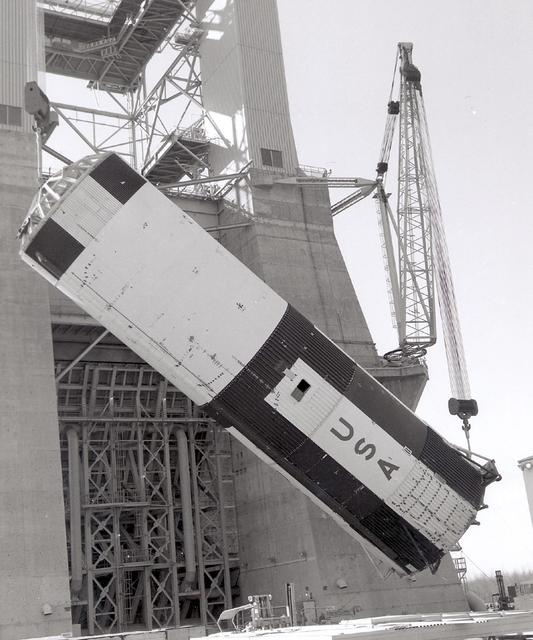
This vintage photograph shows the 138-foot long first stage of the Saturn V being lowered to the ground following a successful static test firing at Marshall Space flight Center's S-1C test stand. The firing provided NASA engineers information on the booster's systems. The towering 363-foot Saturn V was a multi-stage, multi-engine launch vehicle standing taller than the Statue of Liberty. Altogether, the Saturn V engines produced as much power as 85 Hoover Dams.
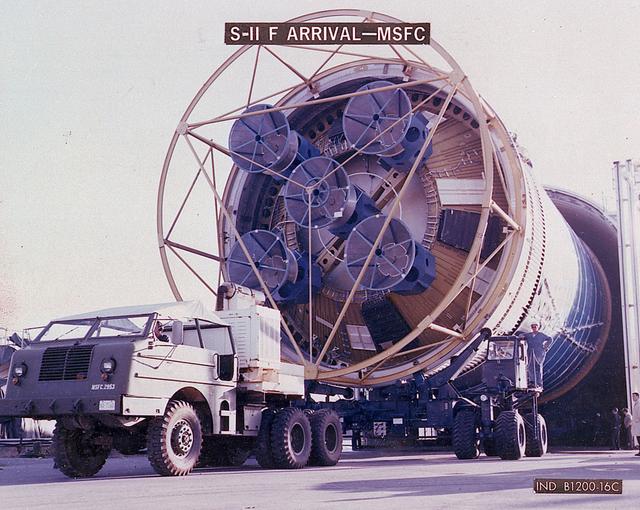
The business end of a Second Stage (S-II) slowly emerges from the shipping container as workers prepare to transport the Saturn V component to the testing facility at MSFC. The Second Stage (S-II) underwent vibration and engine firing tests. The towering 363-foot Saturn V was a multi-stage, multi-engine launch vehicle standing taller than the Statue of Liberty. Altogether, the Saturn V engines produced as much power as 85 Hoover Dams.
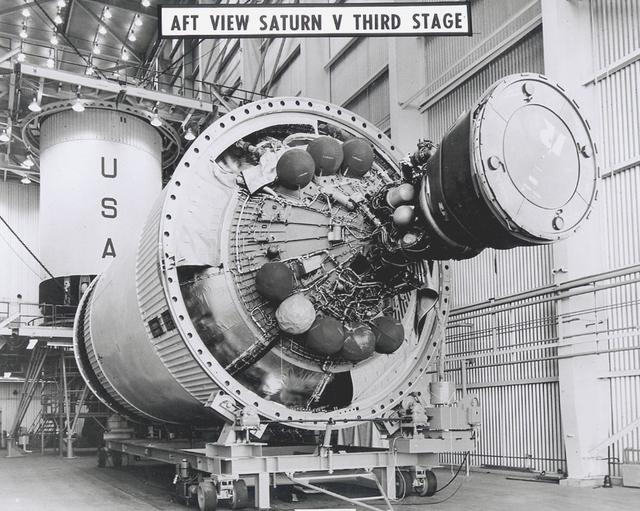
The powerful J-2 engine is prominent in this photograph of a Saturn V Third Stage (S-IVB) resting on a transporter in the Manufacturing Facility at Marshall Space Flight Center in Huntsville, Alabama. The towering 363-foot Saturn V was a multi-stage, multi-engine launch vehicle standing taller than the Statue of Liberty. Altogether, the Saturn V engines produced as much power as 85 Hoover Dams.
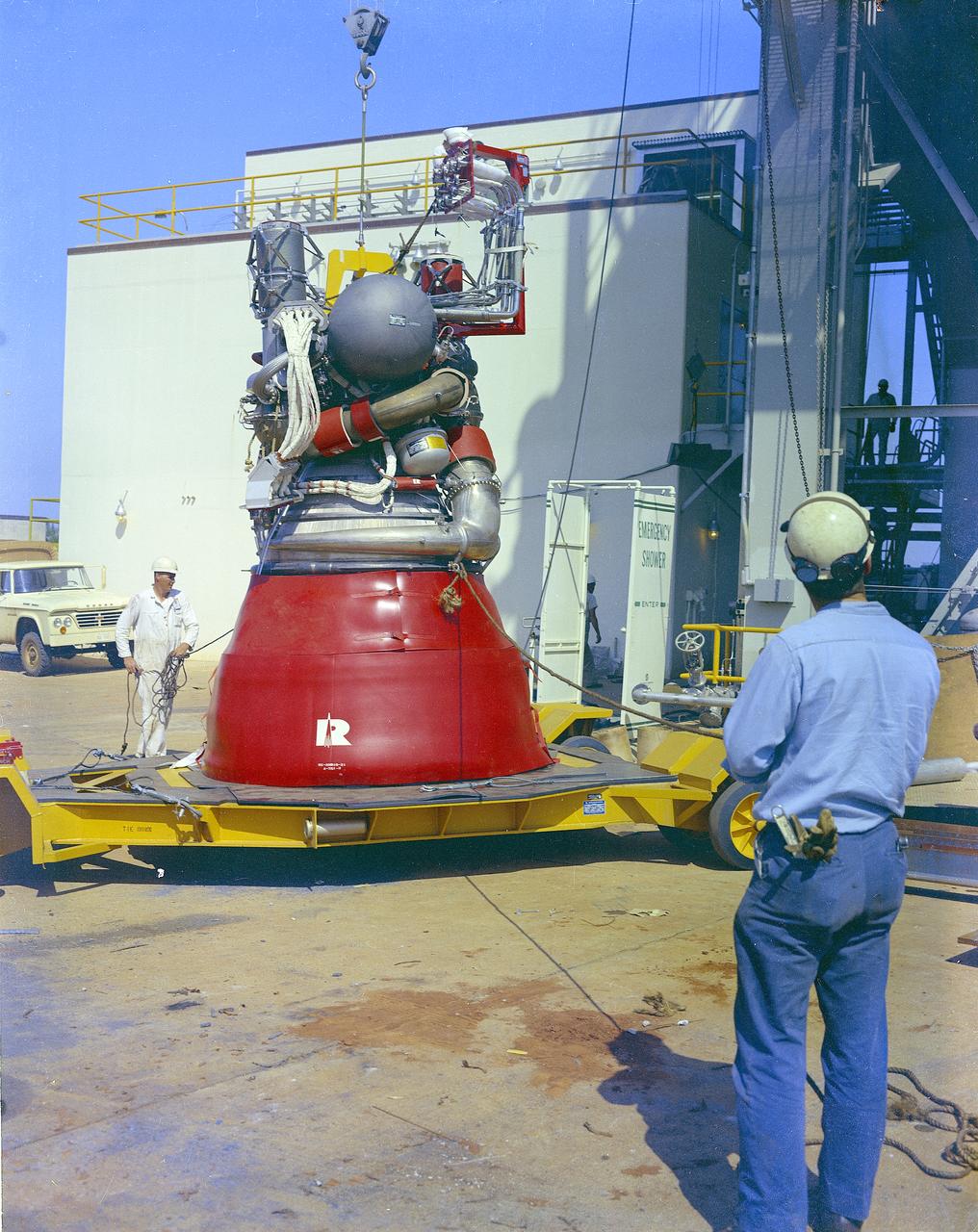
Two technicians watch carefully as cables prepare to lift a J-2 engine into a test stand. The J-2 powered the second stage and the third stage of the Saturn V moon rocket. The towering 363-foot Saturn V was a multi-stage, multi-engine launch vehicle standing taller than the Statue of Liberty. Altogether, the Saturn V engines produced as much power as 85 Hoover Dams.
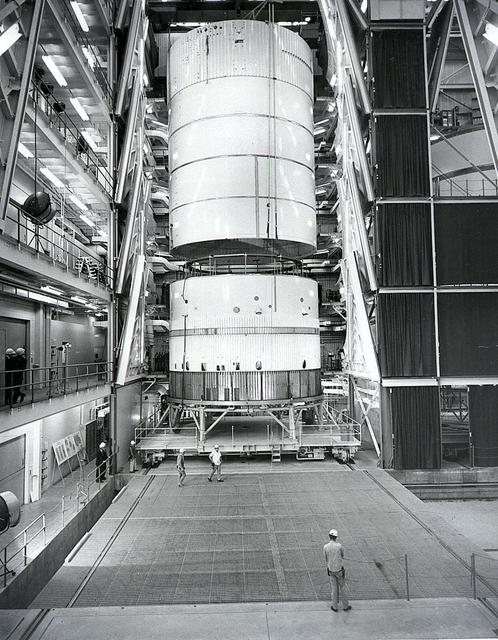
The hydrogen-powered second stage is being lowered into place during the final phase of fabrication of the Saturn V moon rocket at North American's Seal Beach, California facility. The towering 363-foot Saturn V was a multi-stage, multi-engine launch vehicle standing taller than the Statue of Liberty. Altogether, the Saturn V engines produced as much power as 85 Hoover Dams.
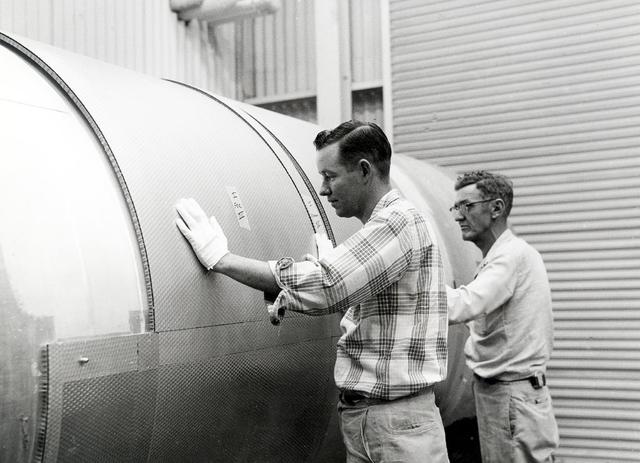
Two technicians apply insulation to the outer surface of the S-II second stage booster for the Saturn V moon rocket. The towering 363-foot Saturn V was a multi-stage, multi-engine launch vehicle standing taller than the Statue of Liberty. Altogether, the Saturn V engines produced as much power as 85 Hoover Dams.
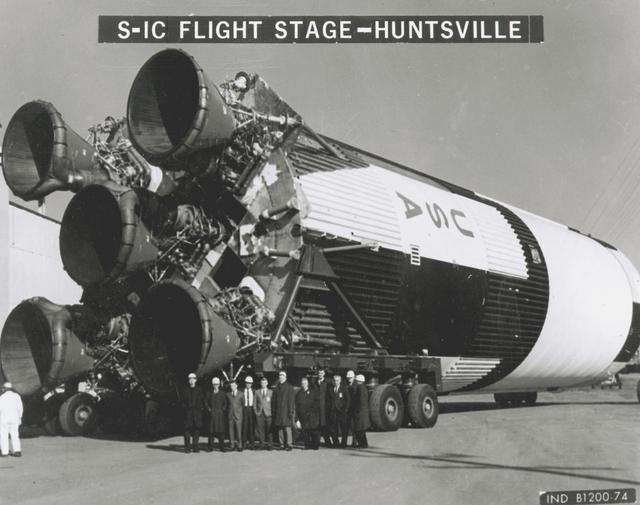
This small group of unidentified officials is dwarfed by the gigantic size of the Saturn V first stage (S-1C) at the shipping area of the Manufacturing Engineering Laboratory at Marshall Space Flight Center in Huntsville, Alabama. The towering 363-foot Saturn V was a multi-stage, multi-engine launch vehicle standing taller than the Statue of Liberty. Altogether, the Saturn V engines produced as much power as 85 Hoover Dams.
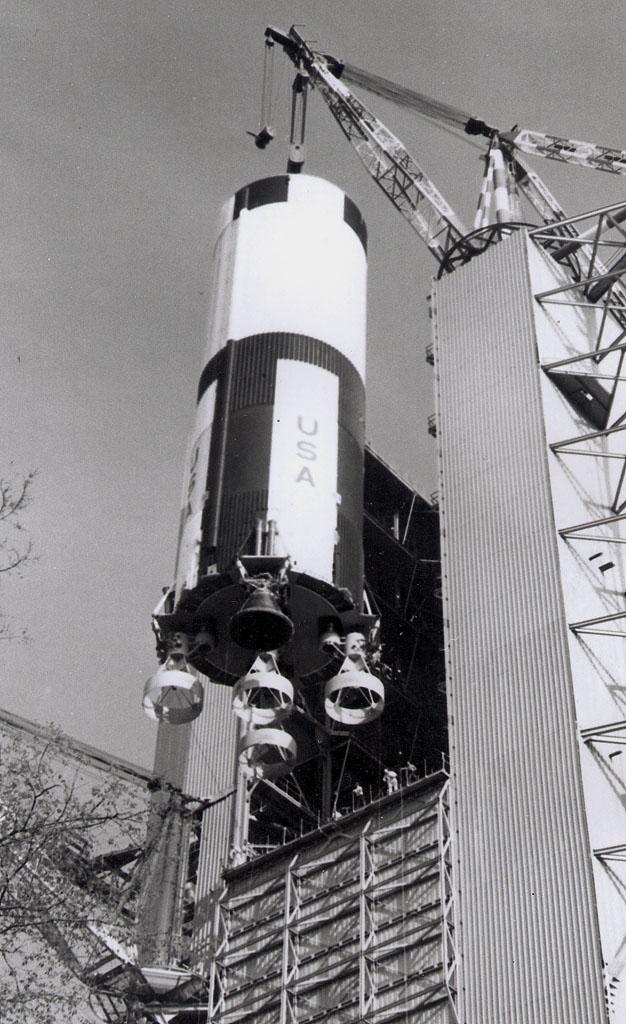
This photo shows the Saturn V first stage being lowered to the ground following a successful test to determine the effects of continual vibrations simulating the effects of an actual launch. The towering 363-foot Saturn V was a multi-stage, multi-engine launch vehicle standing taller than the Statue of Liberty. Altogether, the Saturn V engines produced as much power as 85 Hoover Dams.
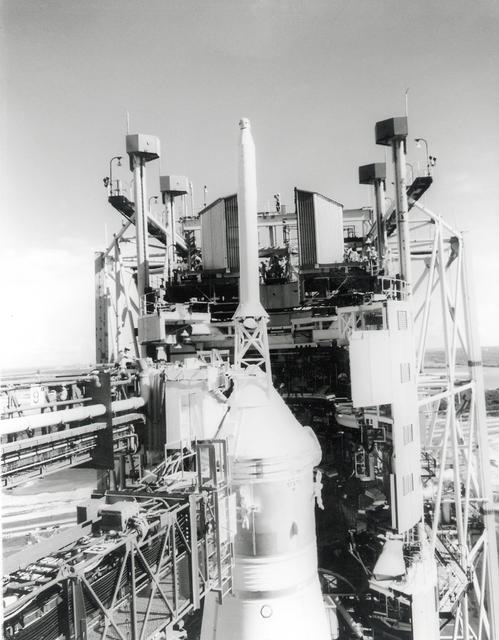
A technician can be seen working atop the white room across from the escape tower of the Apollo 11 spacecraft a few days prior to the launch of the Saturn V moon rocket. The towering 363-foot Saturn V was a multi-stage, multi-engine launch vehicle standing taller than the Statue of Liberty. Altogether, the Saturn V engines produced as much power as 85 Hoover Dams
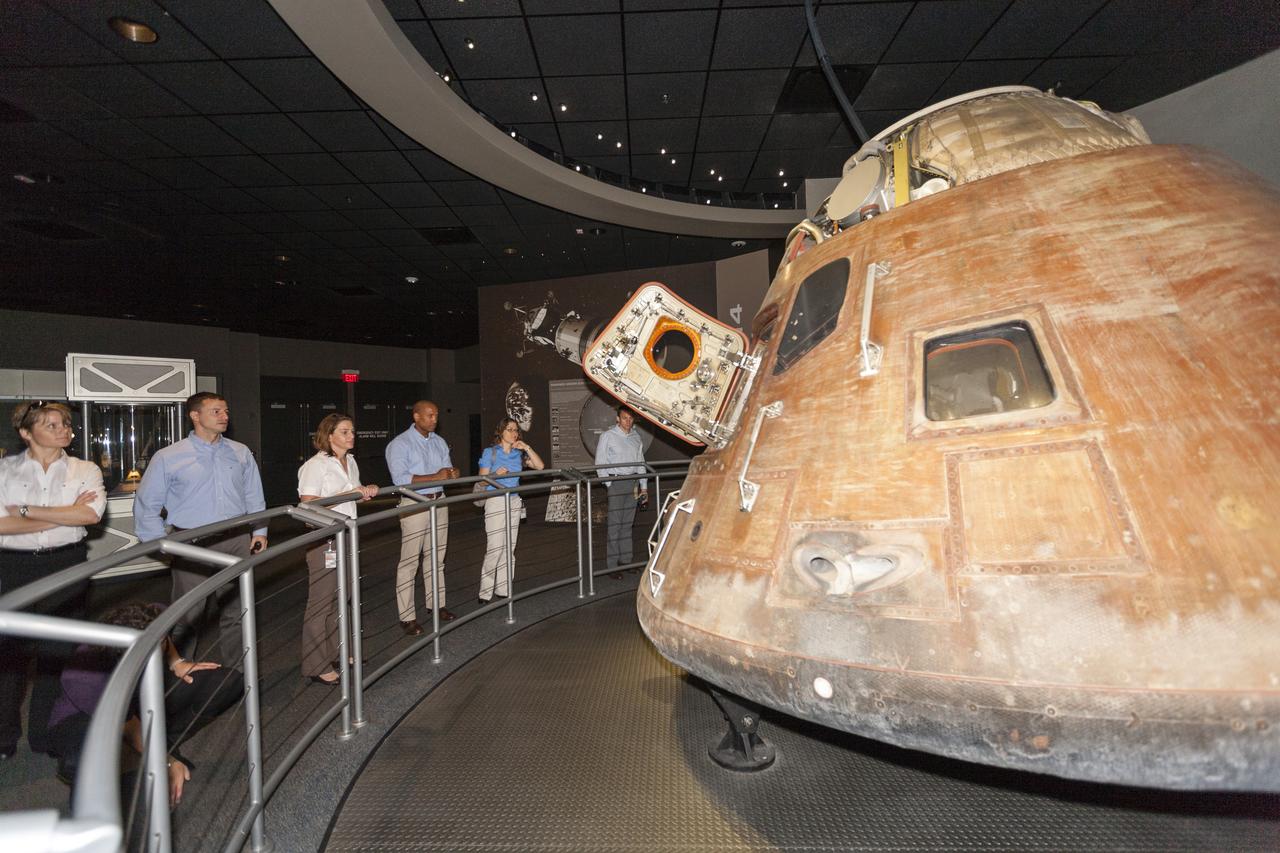
CAPE CANAVERAL, Fla. – NASA astronaut candidates Anne McClain, from left, Andrew Morgan, Nicole Mann, Victor Glover, Christina Hammock and Josh Cassada observe the Apollo 14 command module which carried astronauts Alan Shepard, Stu Roosa and Edgar Mitchell on their lunar landing mission in 1971.The astronauts toured the Apollo Saturn V Center at Kennedy Space Center in Florida during a daylong set of briefings and tours of different facilities at NASA's primary launch center. The astronaut class of 2013 was selected by NASA after an extensive year-and-a-half search. The new group will help the agency push the boundaries of exploration and travel to new destinations in the solar system. To learn more about the astronaut class of 2013, visit: http://www.nasa.gov/astronauts/2013astroclass.html Photo credit: NASA/Kim Shiflett
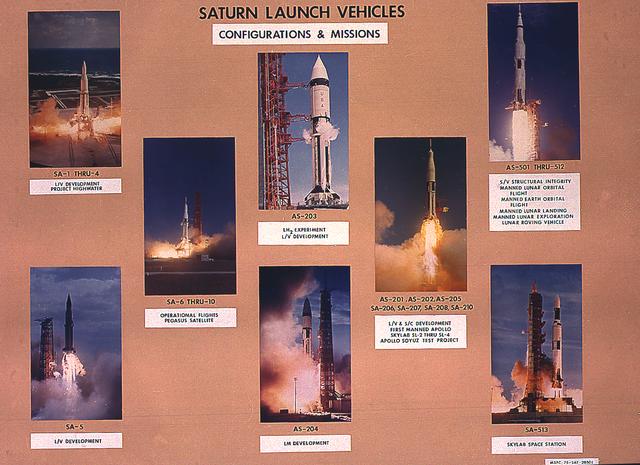
This montage illustrates the various configurations and missions of the three classes of the Saturn vehicles developed by the Marshall Space Flight Center. The missions for the Saturn I included atmospheric science investigations and the deployment of the Pegasus meteroid-detection satellite as well as launch vehicle development. The Saturn IB vehicle tested the Apollo spacecraft and launched the three marned Skylab missions as well as the Apollo Soyuz test project. The Saturn V vehicle launched the manned lunar orbital/landing missions, and the Skylab Orbital Workshop in 1973.
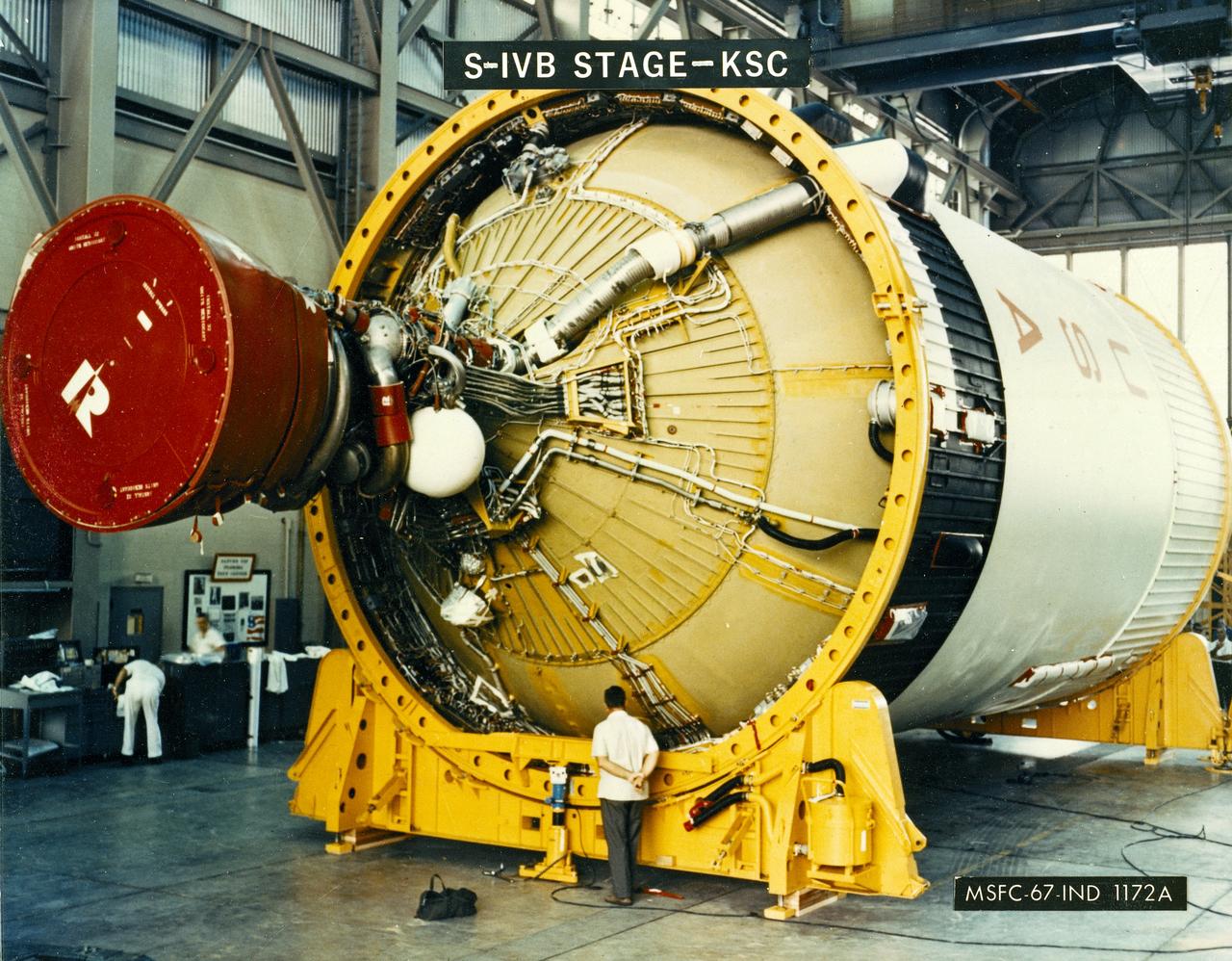
A NASA technician is dwarfed by the gigantic Third Stage (S-IVB) as it rests on supports in a facility at KSC. The towering 363-foot Saturn V was a multi-stage, multi-engine launch vehicle standing taller than the Statue of Liberty. Altogether, the Saturn V engines produced as much power as 85 Hoover Dams.
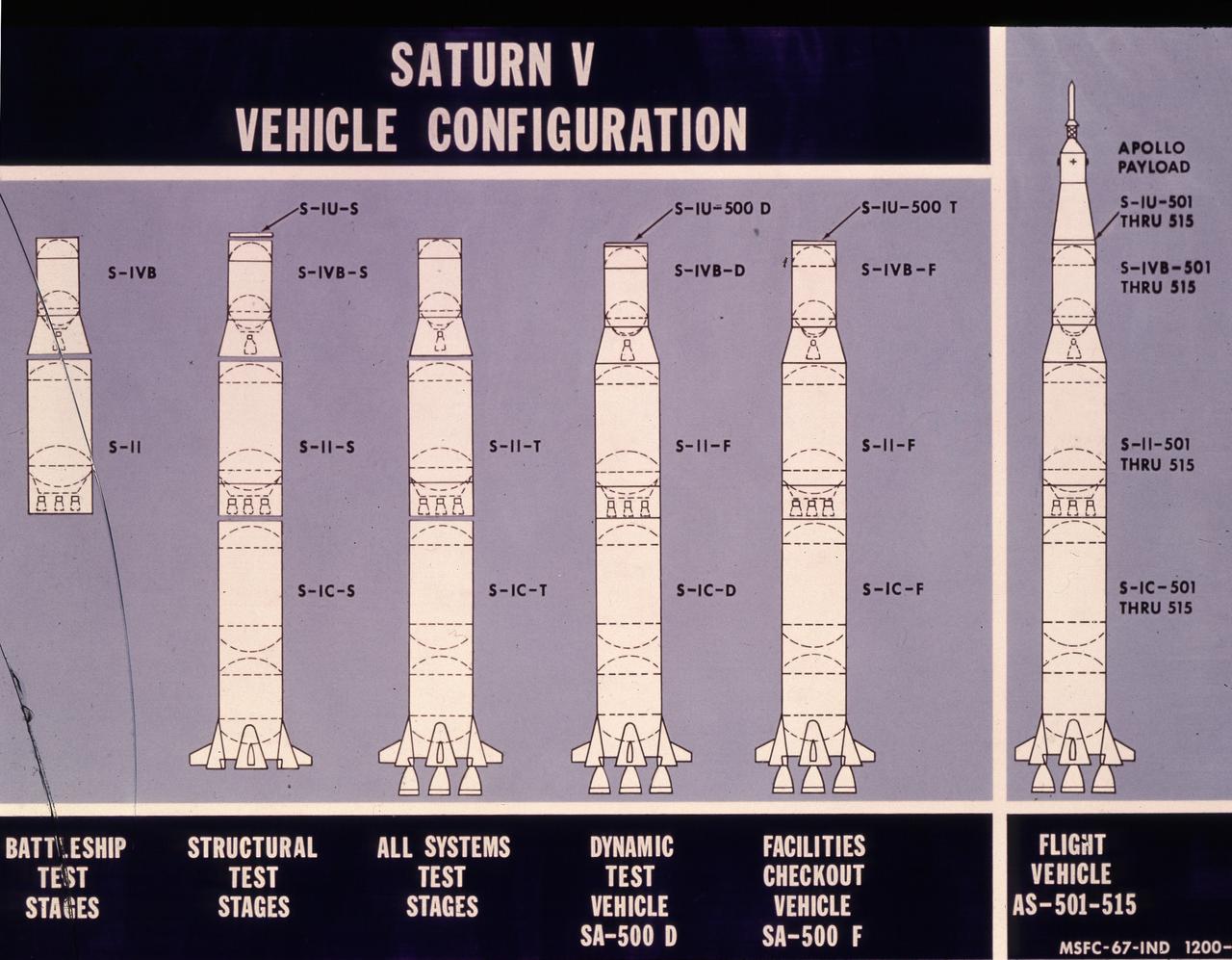
This illustration shows different configurations of the Saturn V test vehicles and flight vehicle.
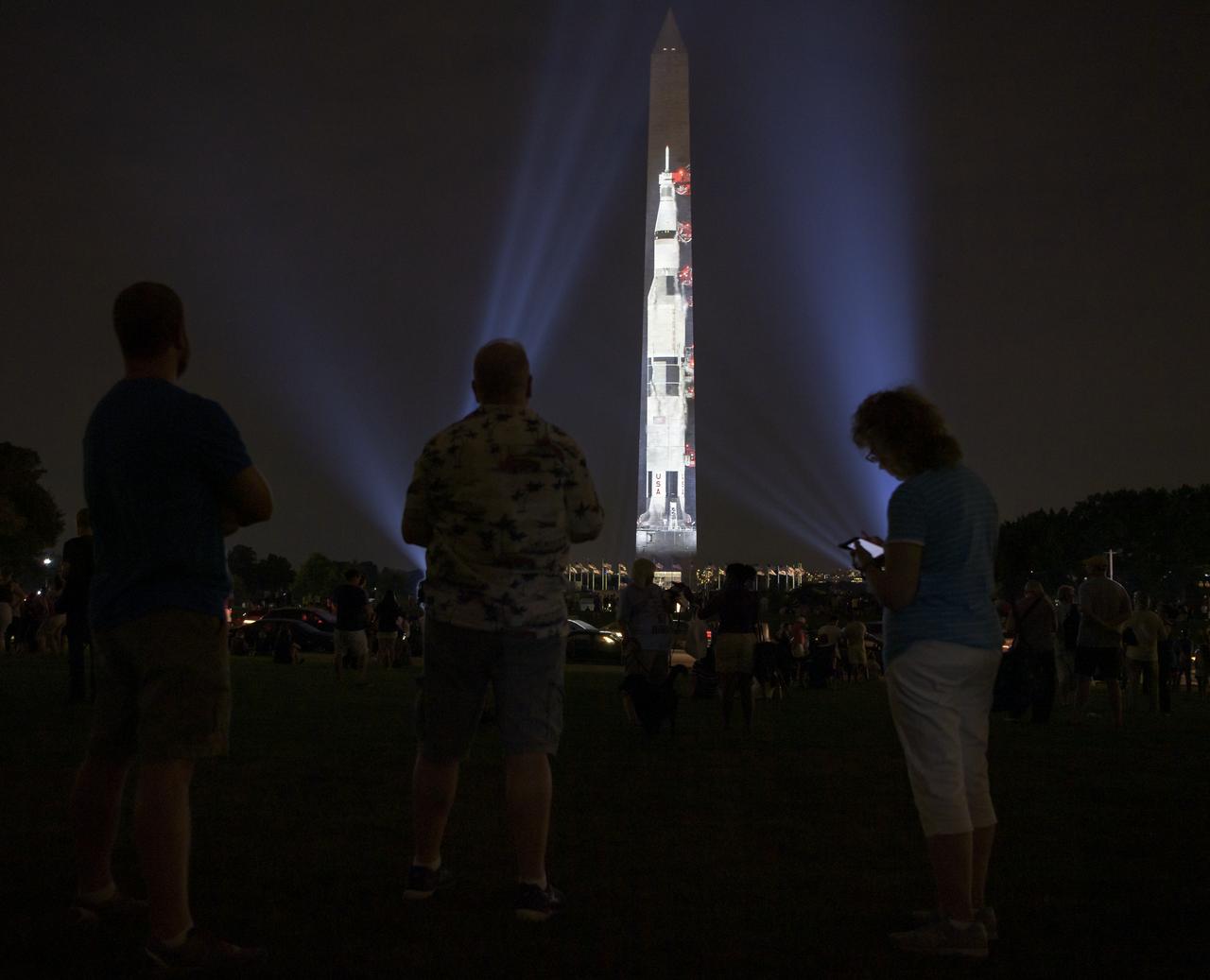
A full-sized, 363-foot Saturn V rocket is projected onto the east face of the Washington Monument 50 years to the day after astronauts Neil Armstrong, Michael Collins, and Buzz Aldrin launched on Apollo 11, the first mission to land astronauts on the Moon, Tuesday, July 16, 2019. On Friday, July 19, and Saturday, July 20, a special 17-minute show, “Apollo 50: Go for the Moon” will combine full-motion projection-mapping artwork on the monument and archival footage to recreate the launch of Apollo 11 and tell the story of the first moon landing. Photo Credit: (NASA/Bill Ingalls)
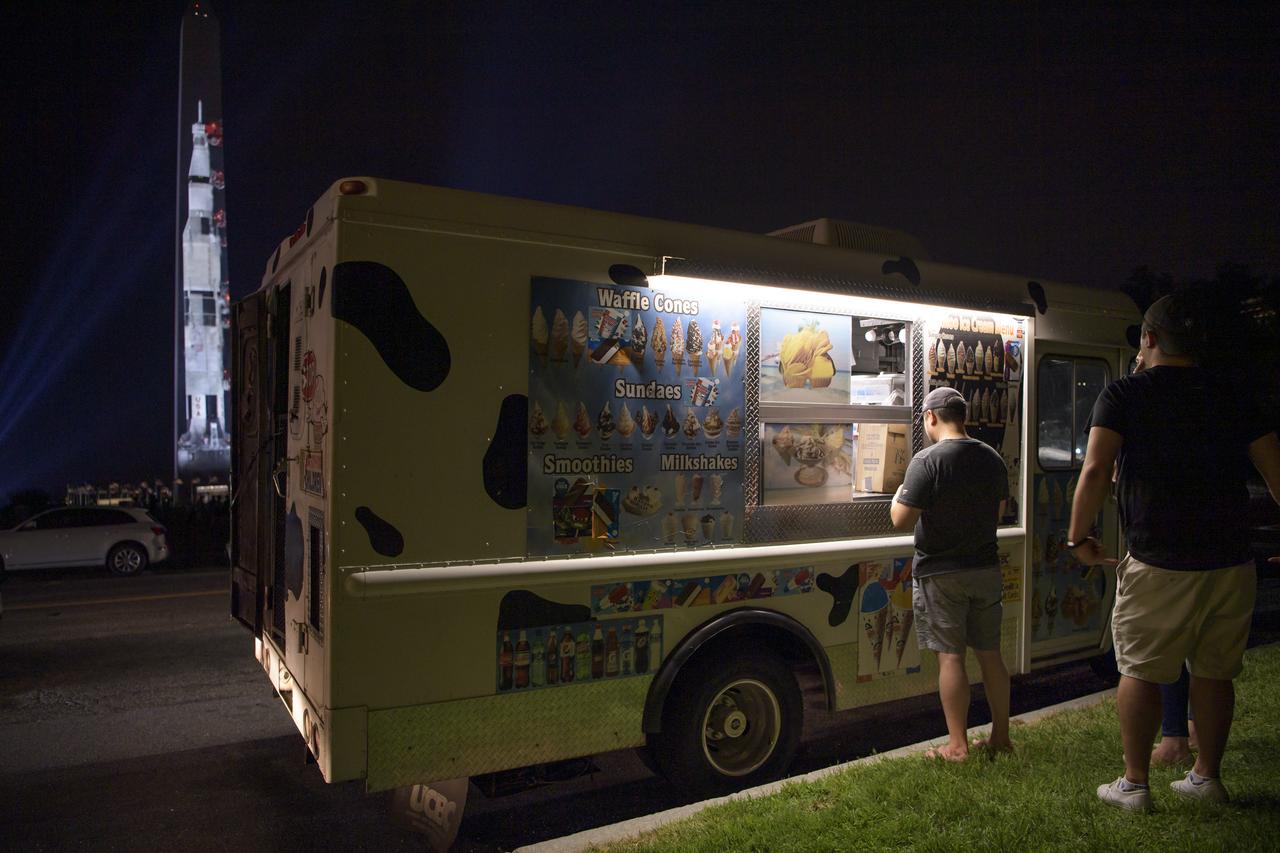
A full-sized, 363-foot Saturn V rocket is projected onto the east face of the Washington Monument 50 years to the day after astronauts Neil Armstrong, Michael Collins, and Buzz Aldrin launched on Apollo 11, the first mission to land astronauts on the Moon, Tuesday, July 16, 2019. On Friday, July 19, and Saturday, July 20, a special 17-minute show, “Apollo 50: Go for the Moon” will combine full-motion projection-mapping artwork on the monument and archival footage to recreate the launch of Apollo 11 and tell the story of the first moon landing. Photo Credit: (NASA/Bill Ingalls)
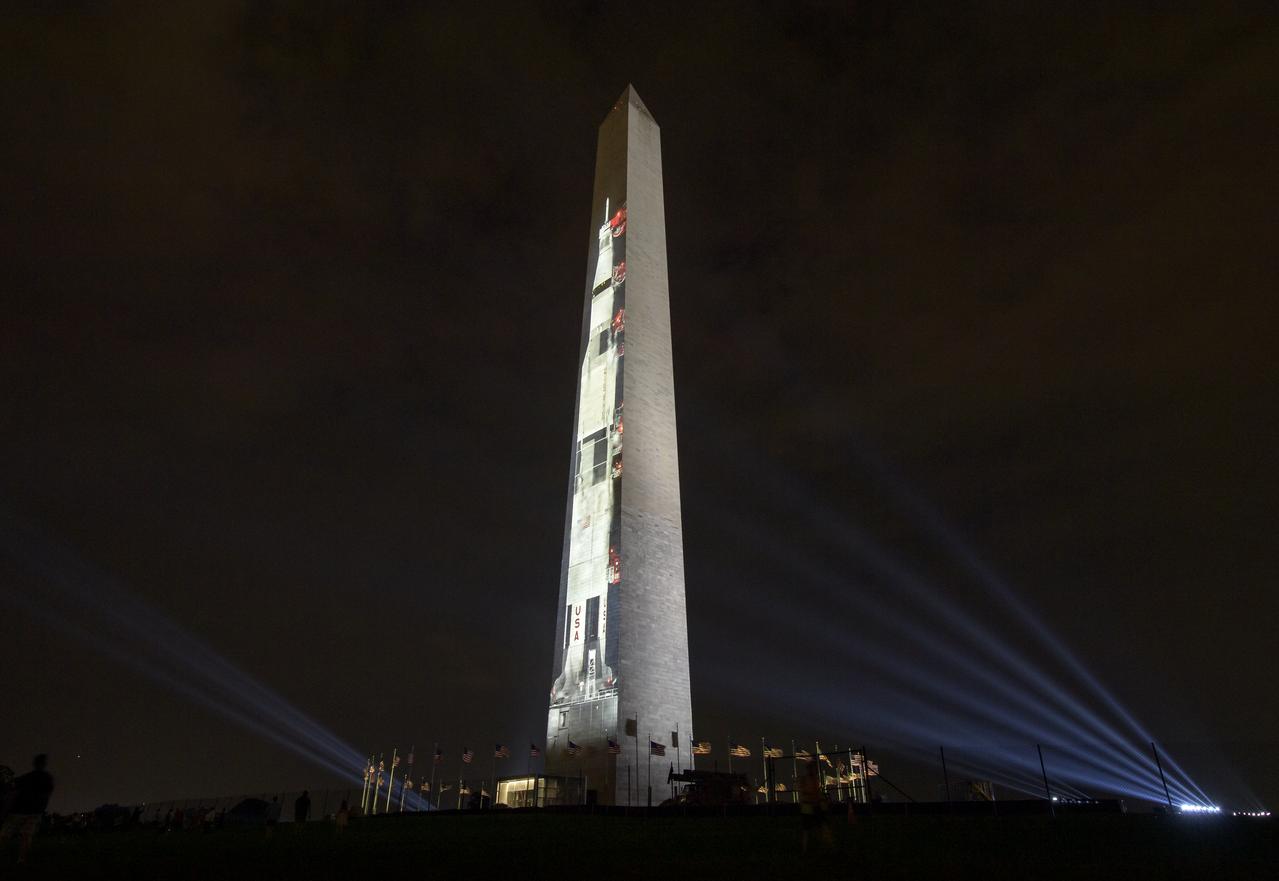
A full-sized, 363-foot Saturn V rocket is projected onto the east face of the Washington Monument 50 years to the day after astronauts Neil Armstrong, Michael Collins, and Buzz Aldrin launched on Apollo 11, the first mission to land astronauts on the Moon, Tuesday, July 16, 2019. On Friday, July 19, and Saturday, July 20, a special 17-minute show, “Apollo 50: Go for the Moon” will combine full-motion projection-mapping artwork on the monument and archival footage to recreate the launch of Apollo 11 and tell the story of the first moon landing. Photo Credit: (NASA/Bill Ingalls)
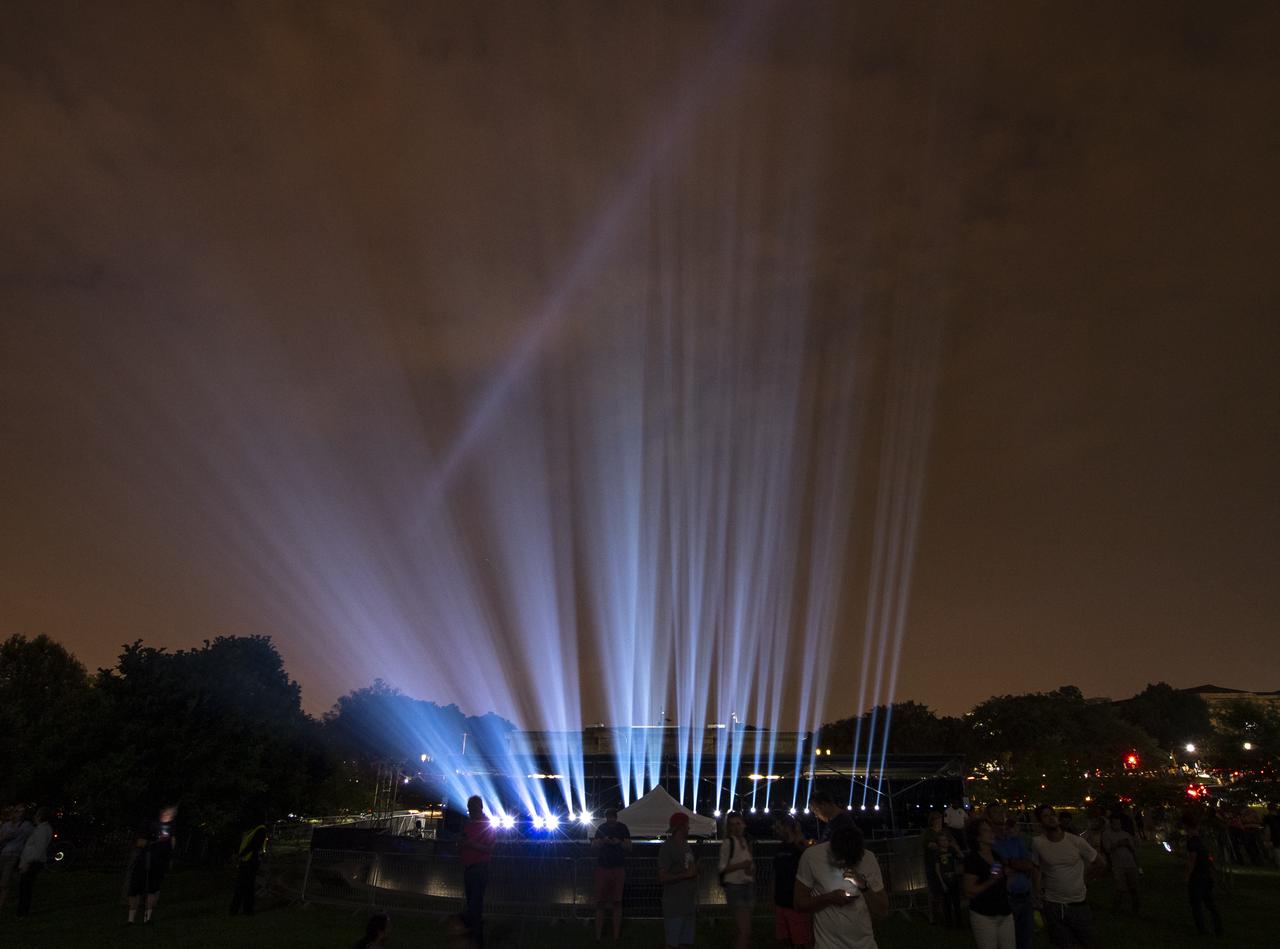
Projectors used to display a full-sized, 363-foot Saturn V rocket at the Washington Monument are seen 50 years to the day after astronauts Neil Armstrong, Michael Collins, and Buzz Aldrin launched on Apollo 11, the first mission to land astronauts on the Moon, Tuesday, July 16, 2019. On Friday, July 19, and Saturday, July 20, a special 17-minute show, “Apollo 50: Go for the Moon” will combine full-motion projection-mapping artwork on the monument and archival footage to recreate the launch of Apollo 11 and tell the story of the first moon landing. Photo Credit: (NASA/Bill Ingalls)
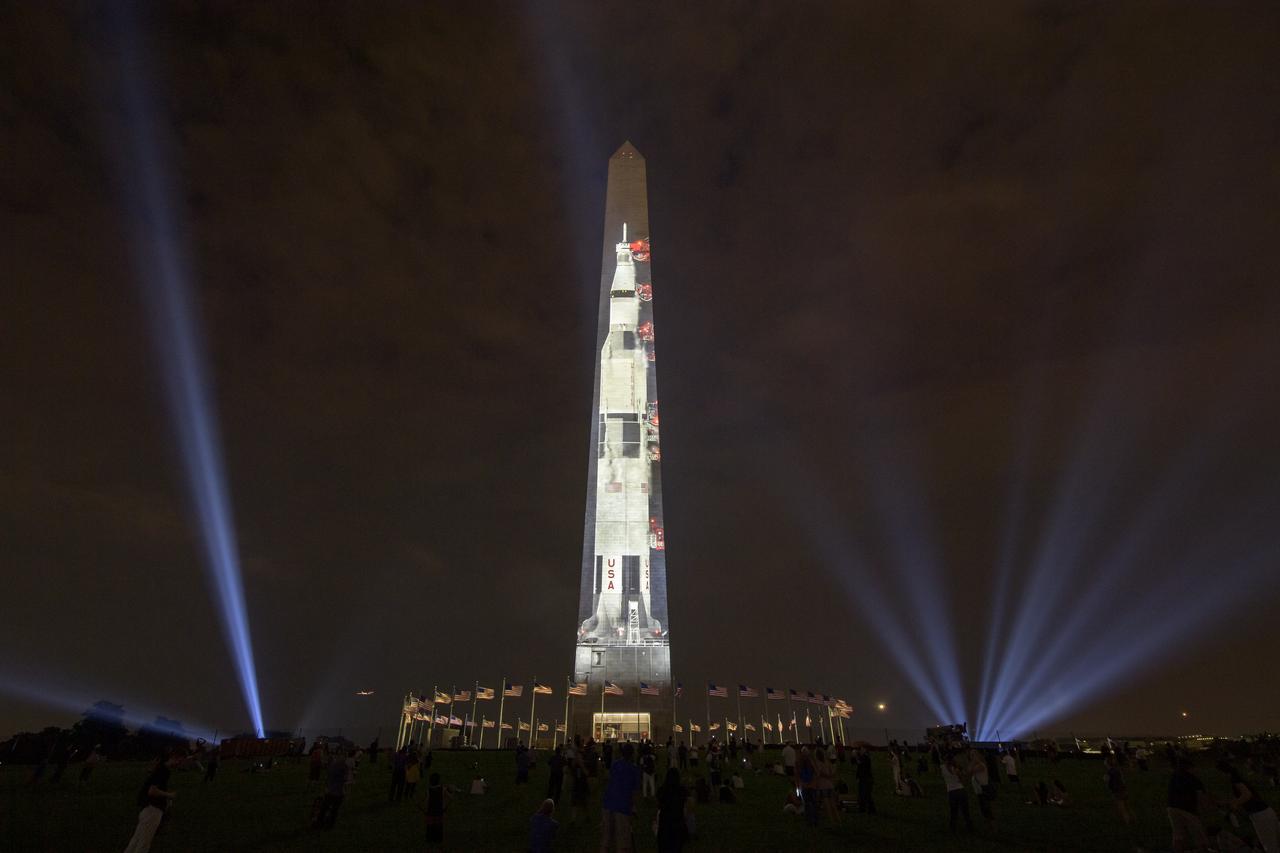
A full-sized, 363-foot Saturn V rocket is projected onto the east face of the Washington Monument 50 years to the day after astronauts Neil Armstrong, Michael Collins, and Buzz Aldrin launched on Apollo 11, the first mission to land astronauts on the Moon, Tuesday, July 16, 2019. On Friday, July 19, and Saturday, July 20, a special 17-minute show, “Apollo 50: Go for the Moon” will combine full-motion projection-mapping artwork on the monument and archival footage to recreate the launch of Apollo 11 and tell the story of the first moon landing. Photo Credit: (NASA/Bill Ingalls)
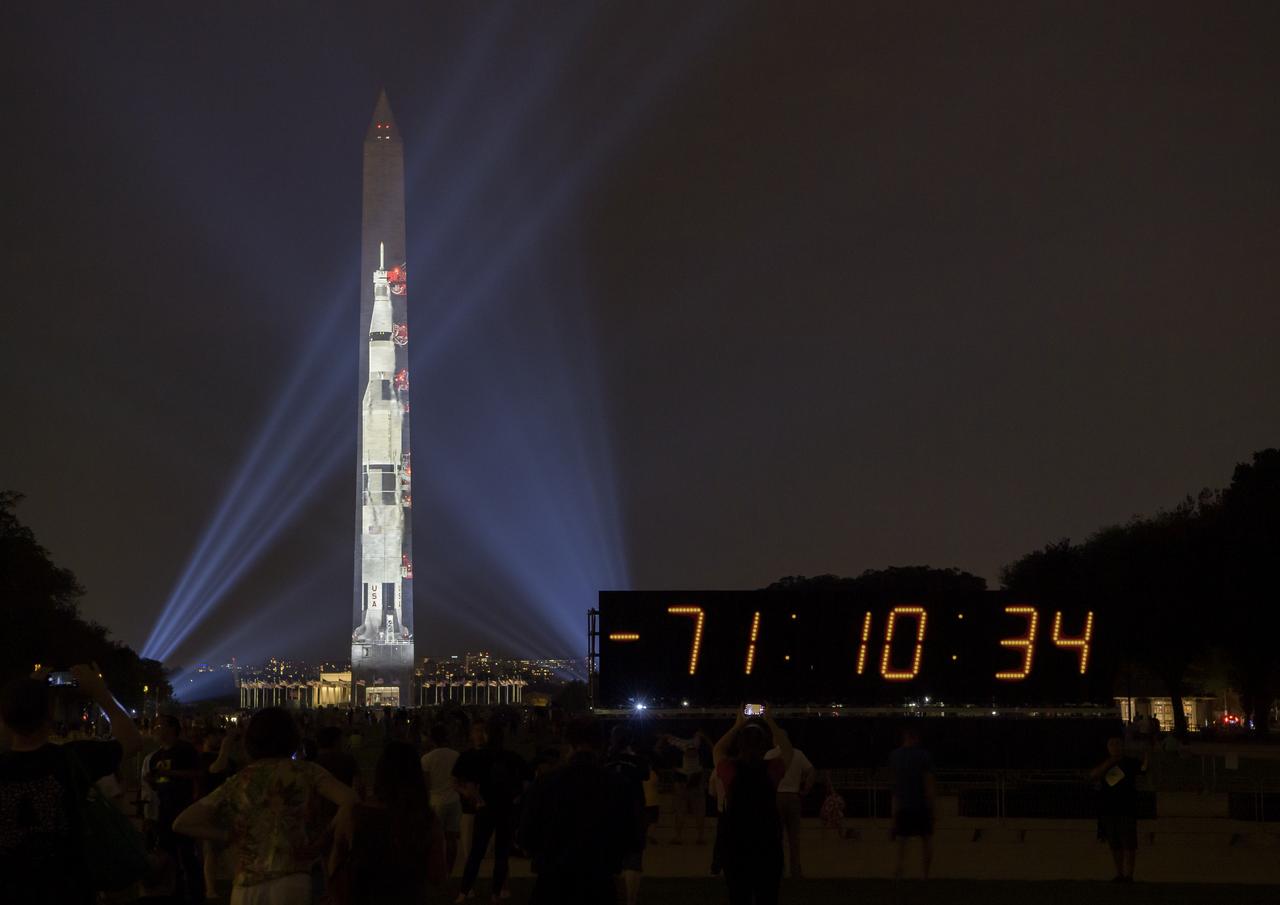
A full-sized, 363-foot Saturn V rocket is projected onto the east face of the Washington Monument 50 years to the day after astronauts Neil Armstrong, Michael Collins, and Buzz Aldrin launched on Apollo 11, the first mission to land astronauts on the Moon, Tuesday, July 16, 2019. On Friday, July 19, and Saturday, July 20, a special 17-minute show, “Apollo 50: Go for the Moon” will combine full-motion projection-mapping artwork on the monument and archival footage to recreate the launch of Apollo 11 and tell the story of the first moon landing. Photo Credit: (NASA/Bill Ingalls)
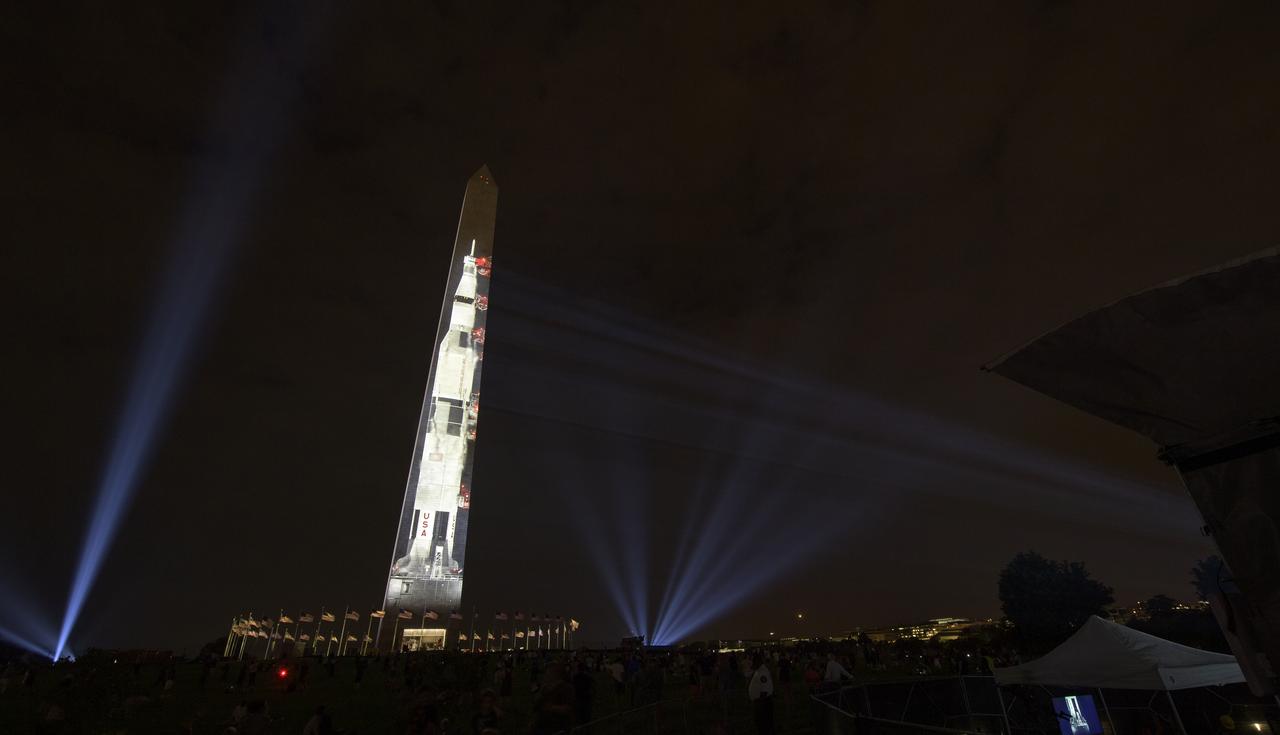
A full-sized, 363-foot Saturn V rocket is projected onto the east face of the Washington Monument 50 years to the day after astronauts Neil Armstrong, Michael Collins, and Buzz Aldrin launched on Apollo 11, the first mission to land astronauts on the Moon, Tuesday, July 16, 2019. On Friday, July 19, and Saturday, July 20, a special 17-minute show, “Apollo 50: Go for the Moon” will combine full-motion projection-mapping artwork on the monument and archival footage to recreate the launch of Apollo 11 and tell the story of the first moon landing. Photo Credit: (NASA/Bill Ingalls)
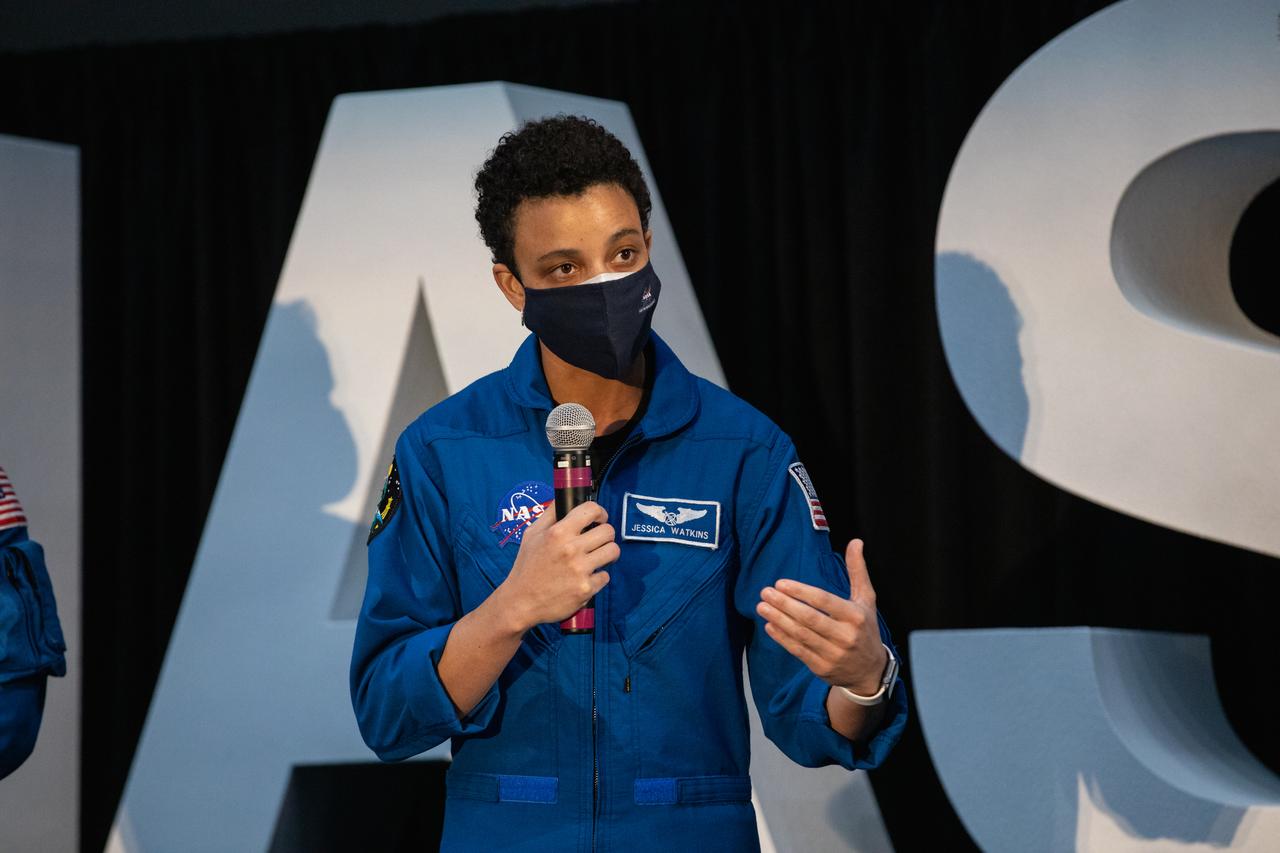
NASA astronaut Jessica Watkins speaks to members of the news media during a question-and-answer session Dec. 9, 2020, following a National Space Council meeting inside the Apollo/Saturn V Center at the Kennedy Space Center Visitor Complex in Florida. Vice President Mike Pence chaired the meeting, at which he announced the initial team of 18 astronauts eligible for early Artemis missions on and around the Moon. A Colorado native, Watkins was selected as a NASA astronaut in 2017. She was joined at the event by fellow astronauts Joseph Acaba, Matthew Dominick, Jessica Meir, and Anne McClain. Under the Artemis program, NASA will land the first woman and the next man on the Moon in 2024.
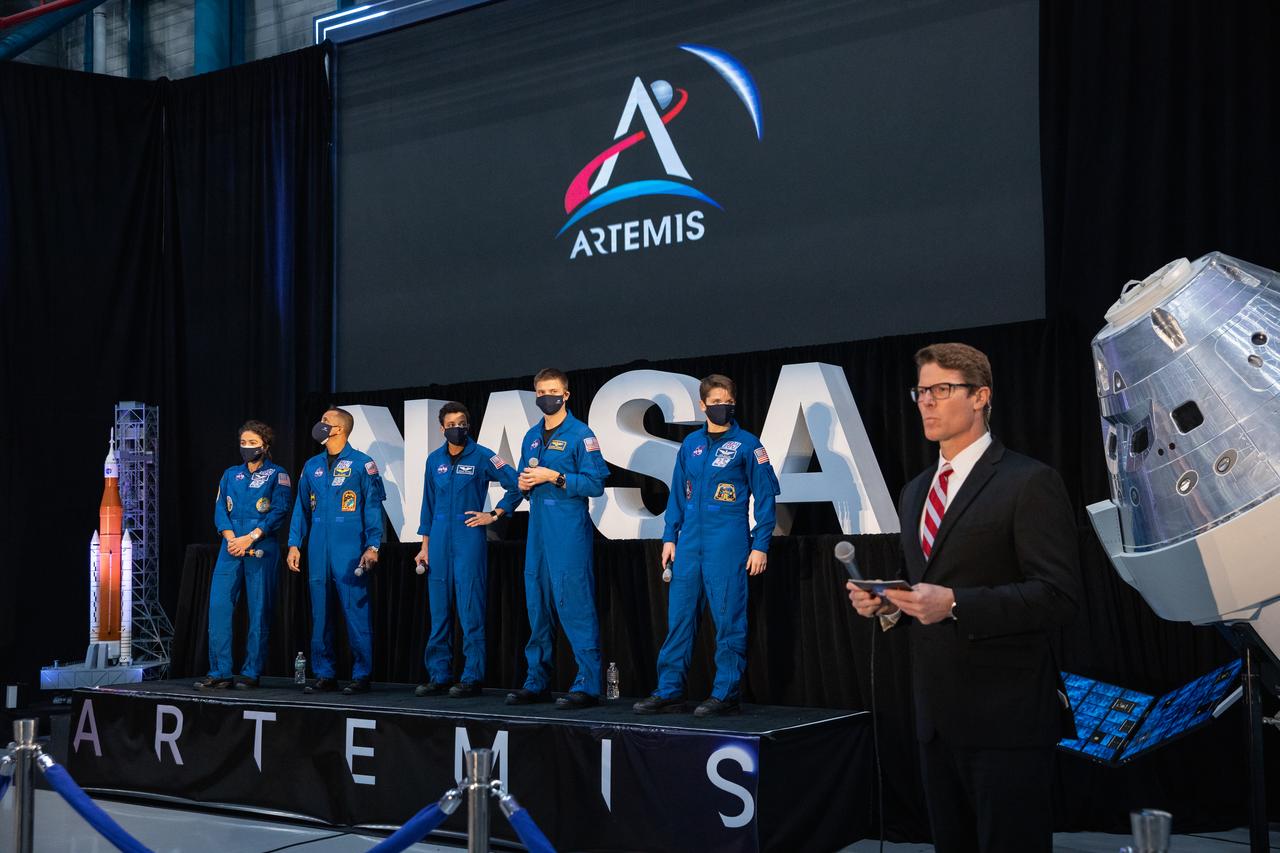
From left, NASA astronauts Jessica Meir, Joseph Acaba, Jessica Watkins, Matthew Dominick, and Anne McClain, along with NASA Communications’ Derrol Nail, listen to a question from a member of the news media during a question-and-answer session Dec. 9, 2020, following a National Space Council meeting inside the Apollo/Saturn V Center at the Kennedy Space Center Visitor Complex in Florida. Vice President Mike Pence chaired the meeting, at which he announced the initial team of 18 astronauts eligible for early Artemis missions on and around the Moon. Under the Artemis program, NASA will land the first woman and the next man on the Moon in 2024.
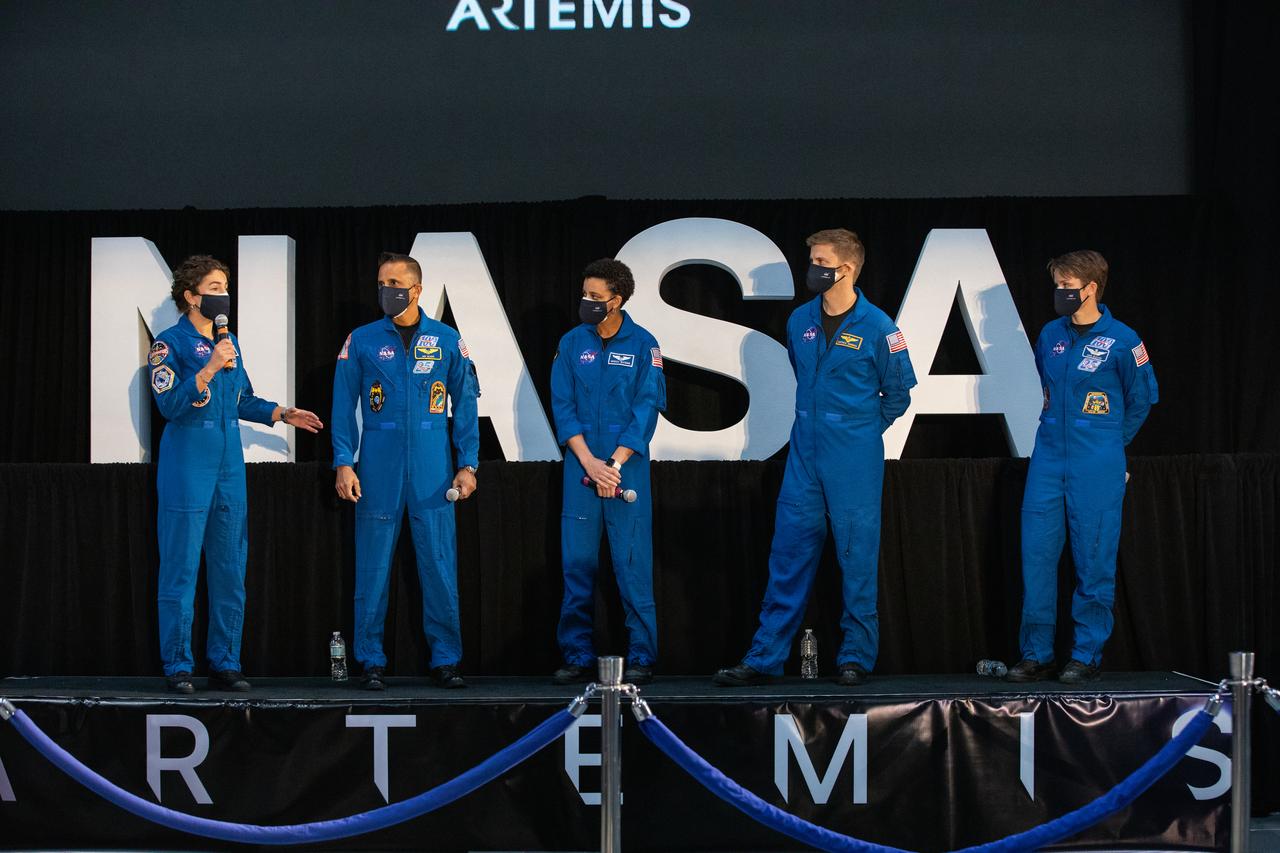
NASA astronaut Jessica Meir speaks to members of the news media during a question-and-answer session Dec. 9, 2020, following a National Space Council meeting inside the Apollo/Saturn V Center at the Kennedy Space Center Visitor Complex in Florida. Vice President Mike Pence chaired the meeting, at which he announced the initial team of 18 astronauts eligible for early Artemis missions on and around the Moon. On stage with Meir, from left, are fellow astronauts Joseph Acaba, Jessica Watkins, Matthew Dominick, and Anne McClain. Under the Artemis program, NASA will land the first woman and the next man on the Moon in 2024.
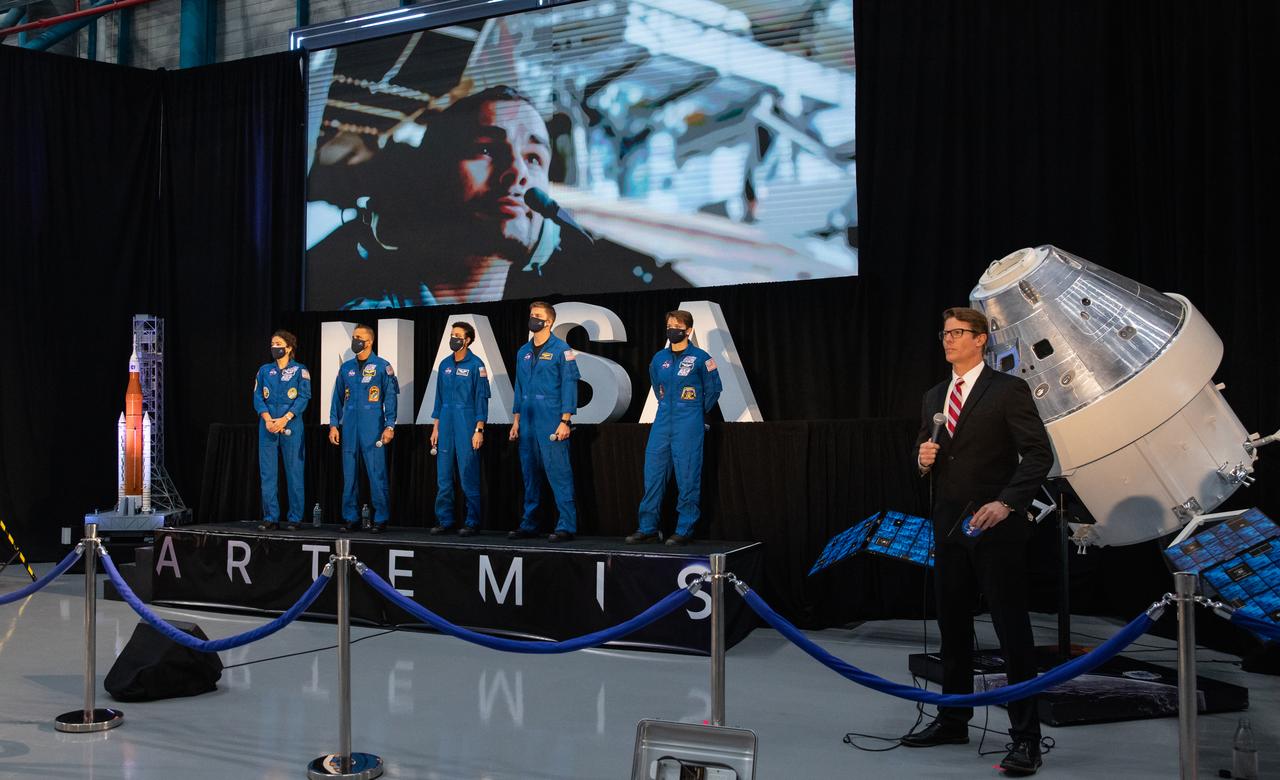
From left, NASA astronauts Jessica Meir, Joseph Acaba, Jessica Watkins, Matthew Dominick, and Anne McClain, along with NASA Communications’ Derrol Nail, listen to a question from a member of the news media during a question-and-answer session Dec. 9, 2020, following a National Space Council meeting inside the Apollo/Saturn V Center at the Kennedy Space Center Visitor Complex in Florida. Vice President Mike Pence chaired the meeting, at which he announced the initial team of 18 astronauts eligible for early Artemis missions on and around the Moon. Under the Artemis program, NASA will land the first woman and the next man on the Moon in 2024.
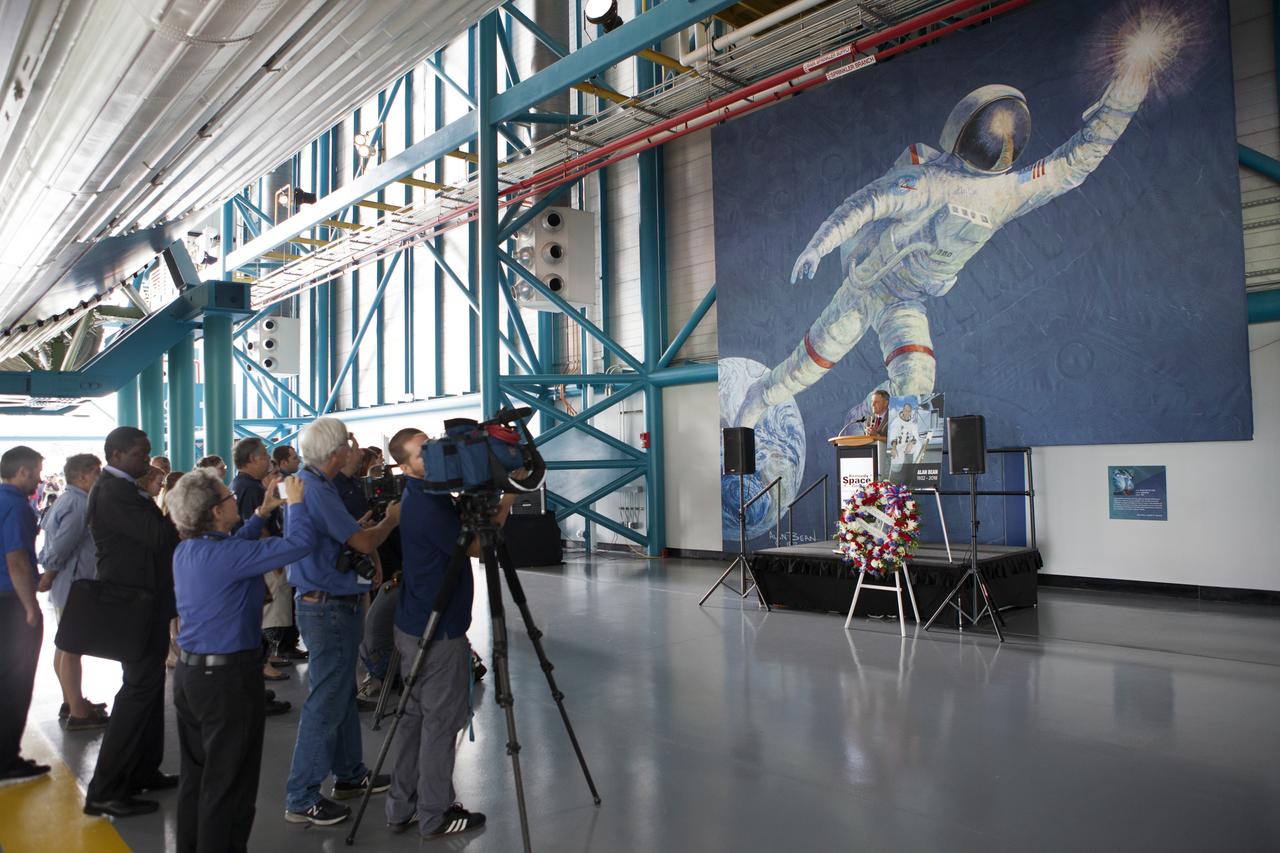
Members of the news media assemble to cover a ceremony on Wednesday, May 30, 2018, during which a memorial wreath is placed in the Apollo-Saturn V Center of the Kennedy Space Center Visitor Complex honoring former NASA astronaut Alan Bean. In the background is a large mural of a painting by Alan Bean who became an accomplished artist after leaving NASA. Bean was the fourth person to walk on the Moon as lunar module pilot on Apollo 12 in November 1969. He went on to command the 59-day Skylab 3 mission in 1973. He died in Houston on May 26, 2018, at the age of 86.
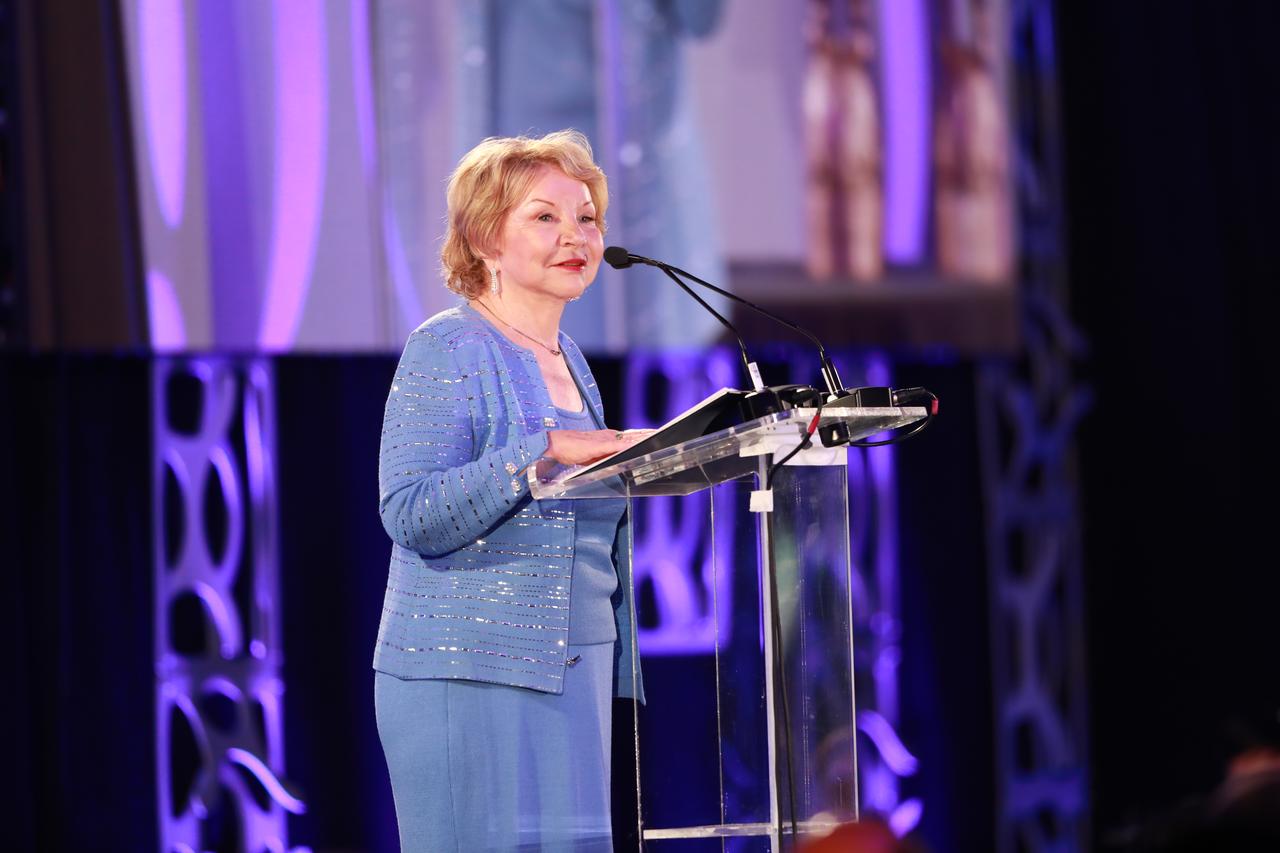
June Scobee Rodgers receives the Education Award during the Apollo 50th Gala, presented by Northrop Grumman, inside the Apollo/Saturn V Center at the Kennedy Space Center Visitor Complex in Florida on July 16, 2019. Scobbee Rodgers is the founding chairman of the Challenger Center for Space Science Education, established in 1986 following the Space Shuttle Challenger accident to continue the legacy of the Challenger crew.
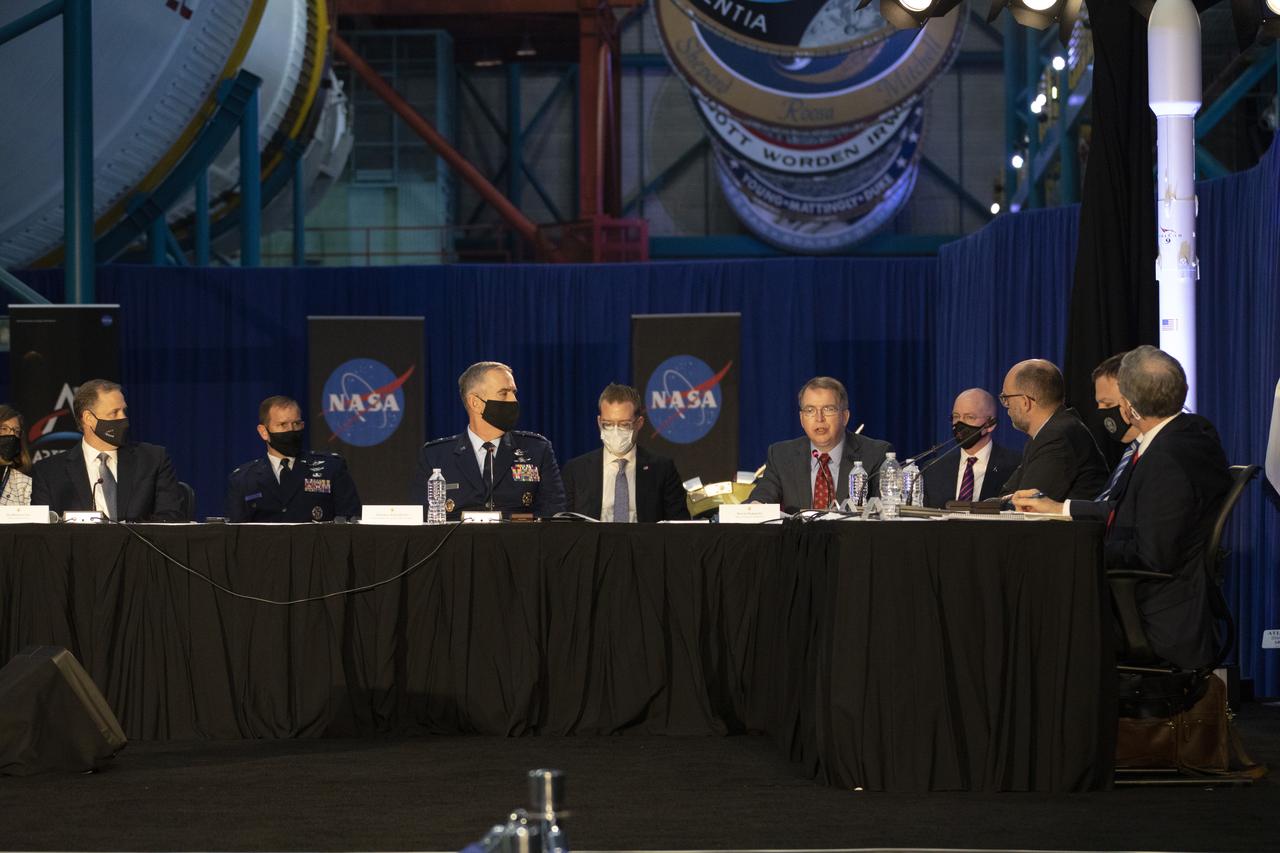
The National Space Council meets inside the Apollo/Saturn V Center at the Kennedy Space Center Visitor Complex in Florida on Dec. 9, 2020. The council's role is to advise the president regarding national space policy and strategy and to review the nation's long-range goals for space activities. Vice President Mike Pence chaired the meeting, at which he announced the initial team of 18 astronauts eligible for early Artemis missions on and around the Moon. Under the Artemis program, NASA will land the first woman and the next man on the Moon in 2024.
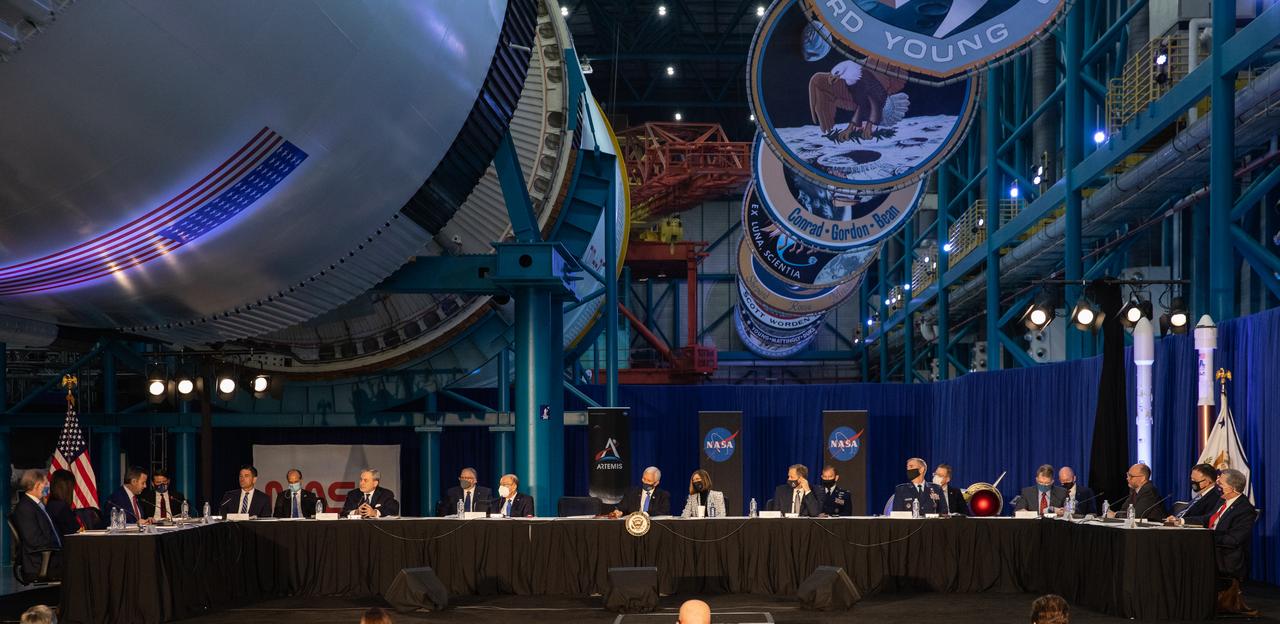
The National Space Council meets inside the Apollo/Saturn V Center at the Kennedy Space Center Visitor Complex in Florida on Dec. 9, 2020. The council's role is to advise the president regarding national space policy and strategy, and to review the nation's long-range goals for space activities. Vice President Mike Pence chaired the meeting, at which he announced the initial team of 18 astronauts eligible for early Artemis missions on and around the Moon. Under the Artemis program, NASA will land the first woman and the next man on the Moon in 2024.
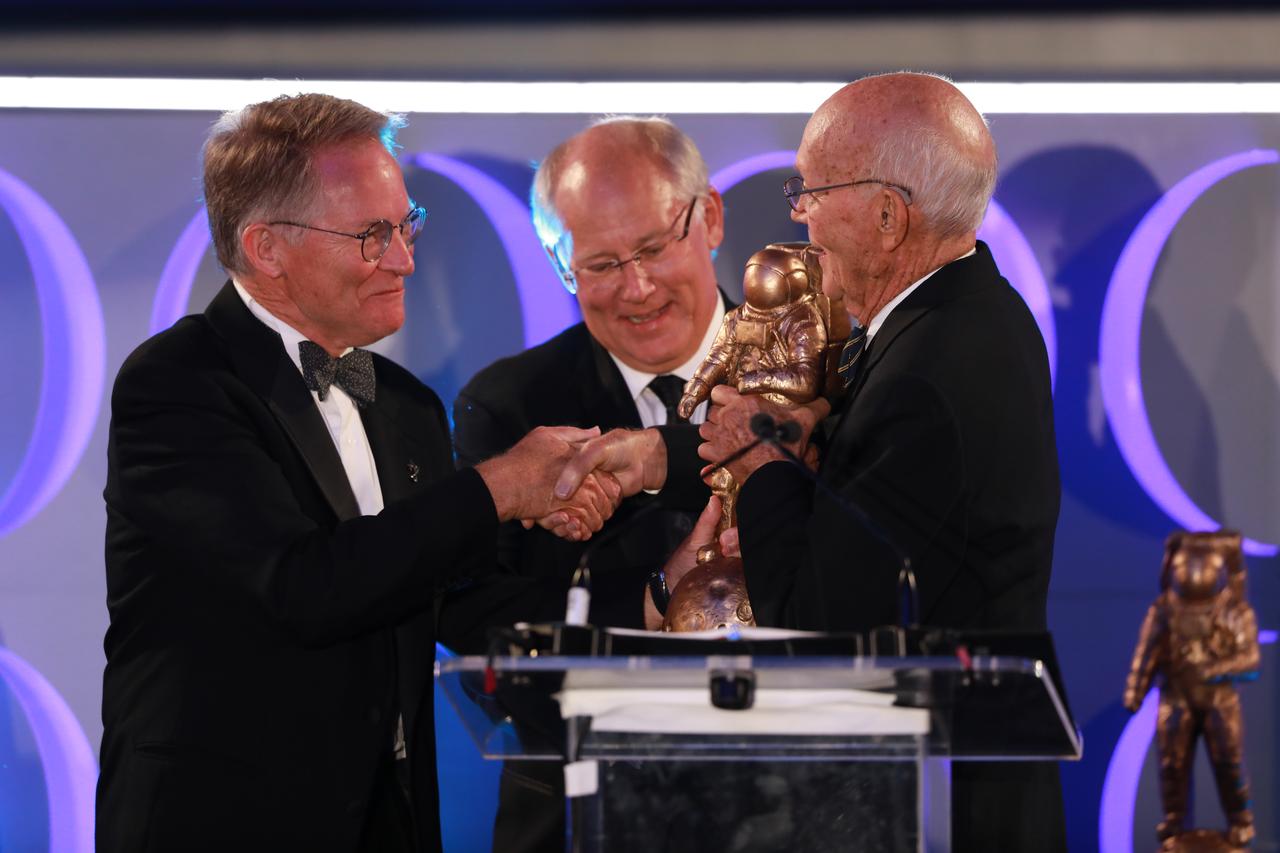
Michael Collins; right; Apollo 11 astronaut; presents the Innovation Award to David Thompson; left; founder; president and CEO of Orbital Sciences Corp (later known as Orbital ATK); during the Apollo 50th Gala on July 16; 2019. The event; presented by Northrop Grumman; was held inside the Apollo/Saturn V Center at the Kennedy Space Center Visitor Comples in Florida. In the center at the podium is Andy Aldrin; son of Apollo 11 astronaut Buzz Aldrin.
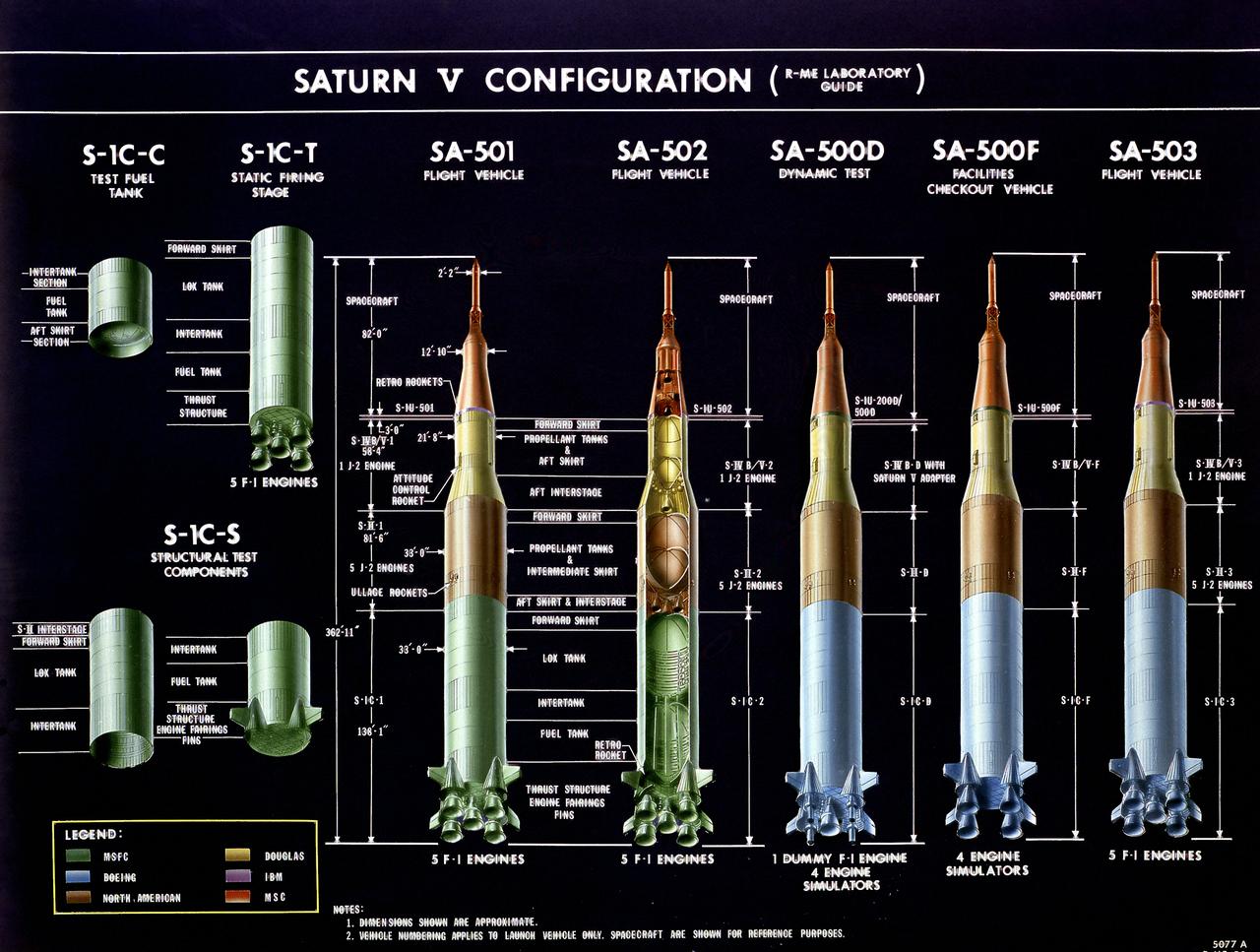
This chart illustrates the testing vehicle and flight vehicle configurations, in addition to the approximate dimensions of the stages of the Saturn V launch vehicle.
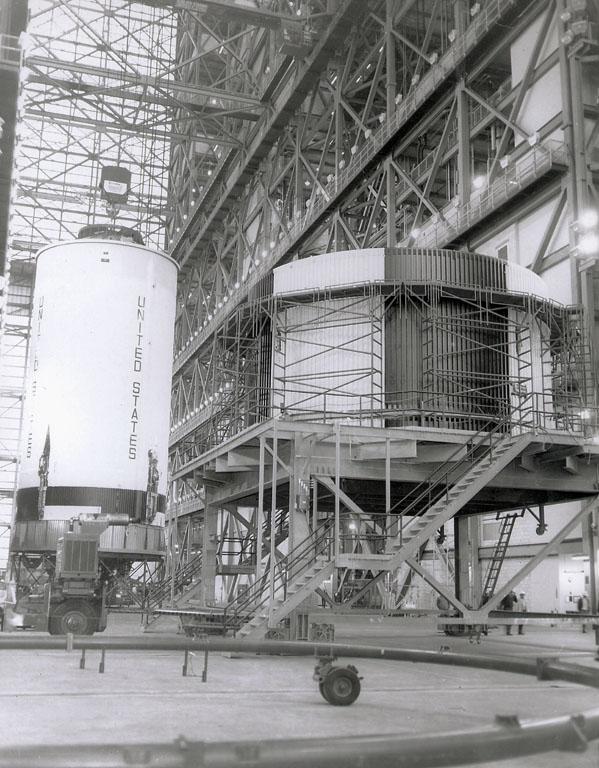
This Saturn V S-II (second) stage is being lifted into position for a test at the Vehicle Assembly Building at the Kennedy Space Center. When the Saturn V booster stage (S-IC) burned out and dropped away, power for the Saturn was provided by the 82-foot-long and 33-foot-diameter S-II stage. Developed by the Space Division of North American Aviation under the direction of the Marshall Space Flight Center, the stage utilized five J-2 engines, each producing 200,000 pounds of thrust. The engines used liquid oxygen and liquid hydrogen as propellants. The towering 363-foot Saturn V was a multi-stage, multi-engine launch vehicle standing taller than the Statue of Liberty. Altogether, the Saturn V engines produced as much power as 85 Hoover Dams.
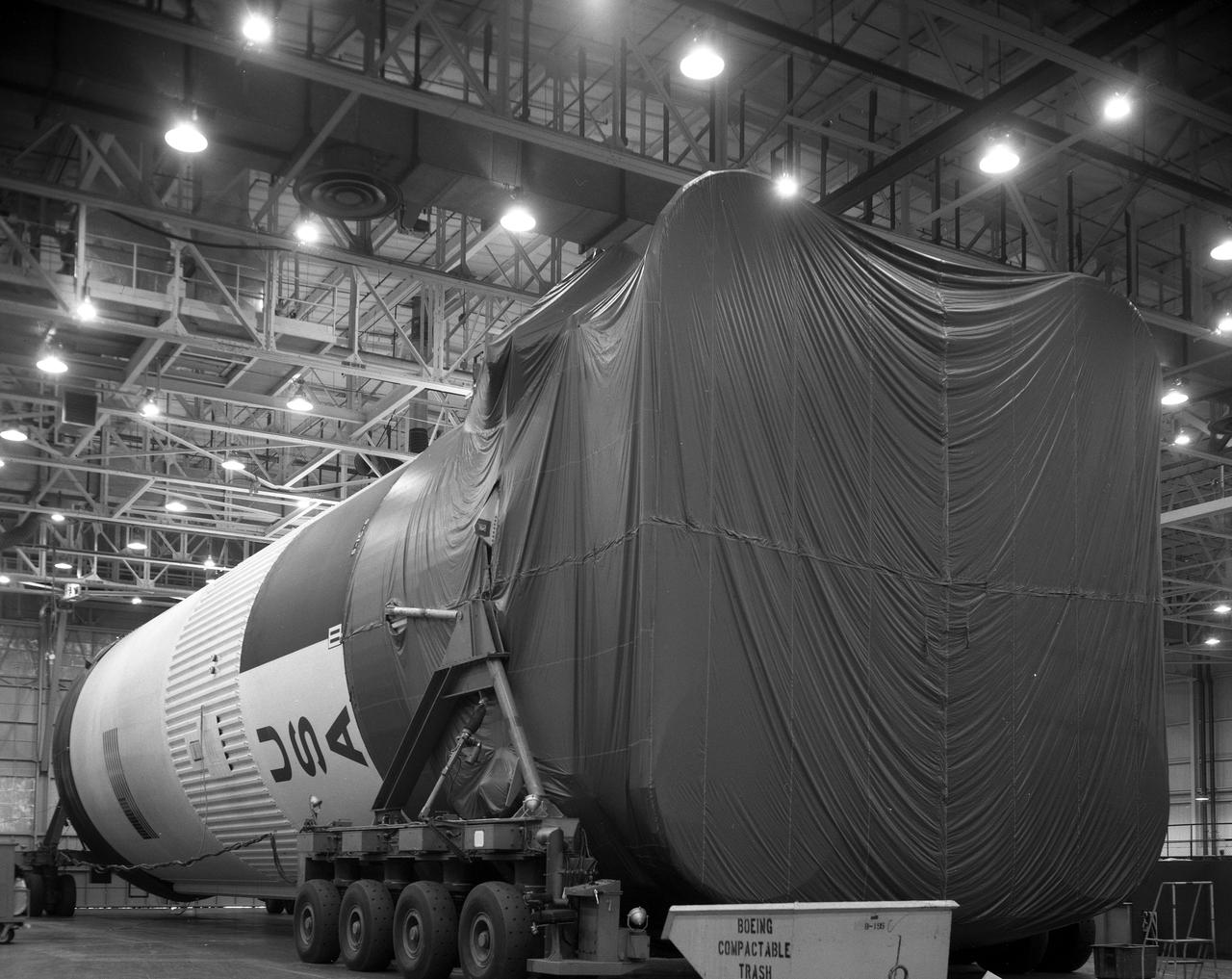
The first stage of the Apollo 11 Saturn V (S-1C-6) rocket awaits its departure from the Michoud Assembly Facility in New Orleans, LA. Image dated 11-6-1967.
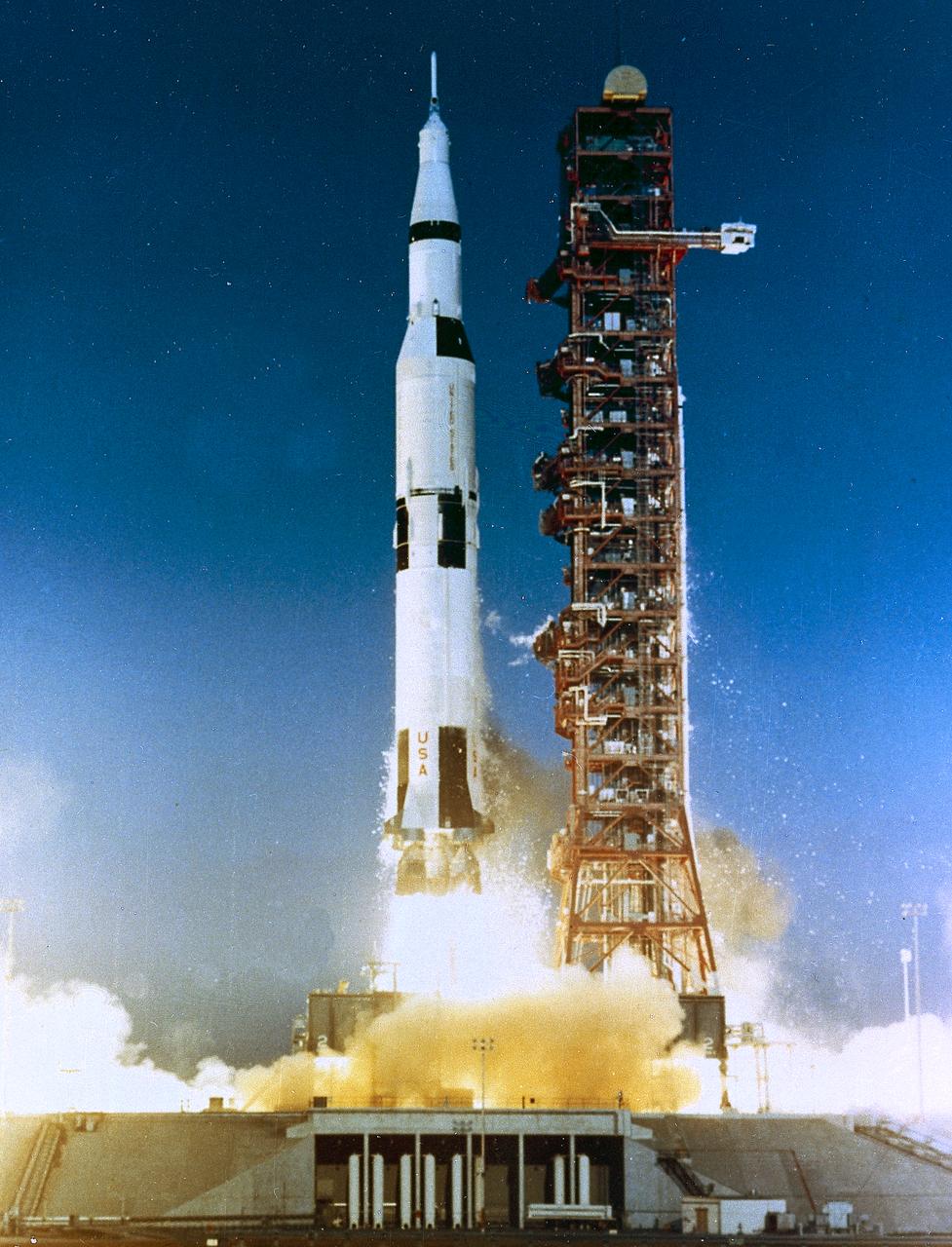
The second Saturn V launch vehicle (SA-502) for the Apollo 6 mission lifted off from the Kennedy Space Center launch complex on April 4, 1968. This unmanned Saturn V launch vehicle tested the emergency detection system in closed loop configuration.
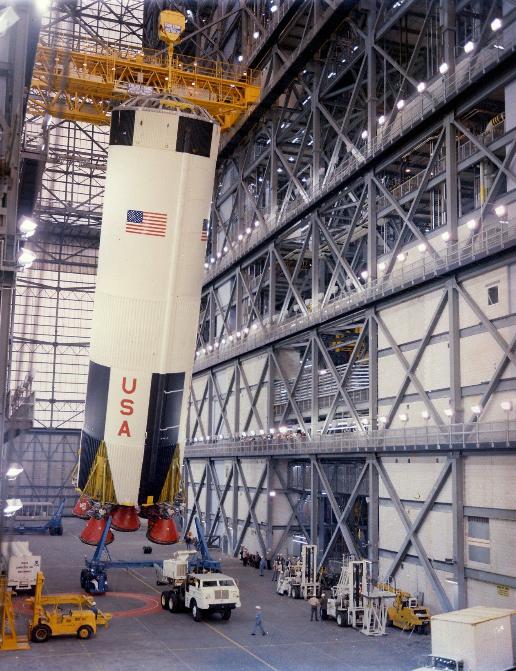
Teams lift the first stage of the Apollo 8 Saturn V rocket inside the transfer aisle of the Vehicle Assembly Building at NASA’s Kennedy Space Center in Florida on Feb. 1, 1968, and prepare to place it atop the mobile launcher. Apollo 8 was the first crewed spacecraft to successfully orbit the Moon and return to Earth, setting the stage for Apollo 11 – the first crewed lunar landing. Apollo 8 launched on Dec. 21, 1968, and the crew members consisted of Frank Borman, William A. Anders, and James A. Lovell Jr.

This photograph shows an early moment of the first test flight of the Saturn V vehicle for the Apollo 4 mission, photographed by a ground tracking camera, on the morning of November 9, 1967. This mission was the first launch of the Saturn V launch vehicle. Objectives of the unmarned Apollo 4 test flight were to obtain flight information on launch vehicle and spacecraft structural integrity and compatibility, flight loads, stage separation, and subsystems operation including testing of restart of the S-IVB stage, and to evaluate the Apollo command module heat shield.
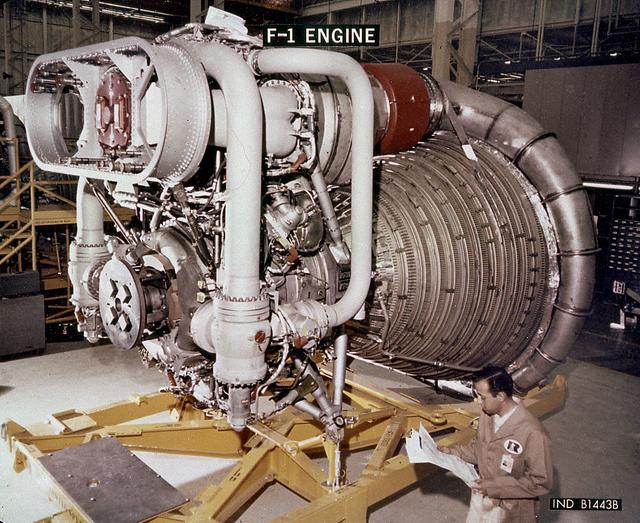
This close-up view of the F-1 engine for the Saturn V S-IC (first) stage shows the engine's complexity, and also its large size as it dwarfs the technician. Developed by Rocketdyne, under the direction of the Marshall Space Flight Center, the F-1 engine was utilized in a cluster of five engines to propel the Saturn V's first stage, the S-IC. Liquid oxygen and kerosene were used as its propellant. Initially rated at 1,500,000 pounds of thrust, the engine was later uprated to 1,522,000 pounds of thrust after the third Saturn V launch (Apollo 8, the first marned Saturn V mission) in December 1968. The cluster of five F-1 engines burned over 15 tons of propellant per second, during its two and one-half minutes of operation, to take the vehicle to a height of about 36 miles and to a speed of about 6,000 miles per hour.
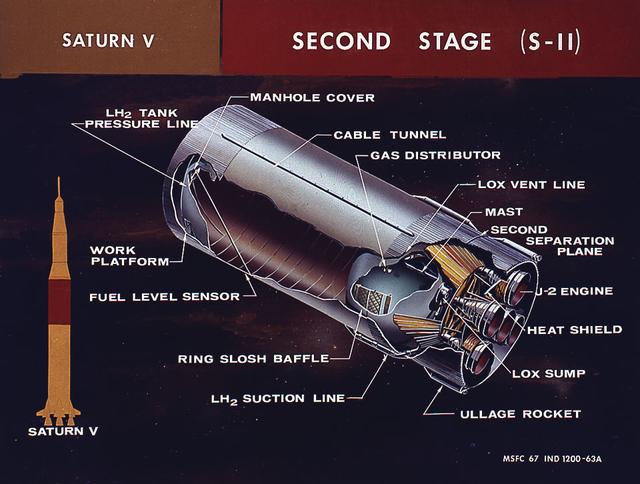
This cutaway illustration shows the Saturn V S-II (second) stage with callouts of major components. When the Saturn V first stage burns out and drops away, power for the Saturn was provided by the S-II (second) stage with five J-2 engines which produced a total of 1,150,000 pounds of thrust. Four outer engines are placed in a square pattern with gimbaling capability for control and guidance, with the fifth engine fixed rigidly in the center.
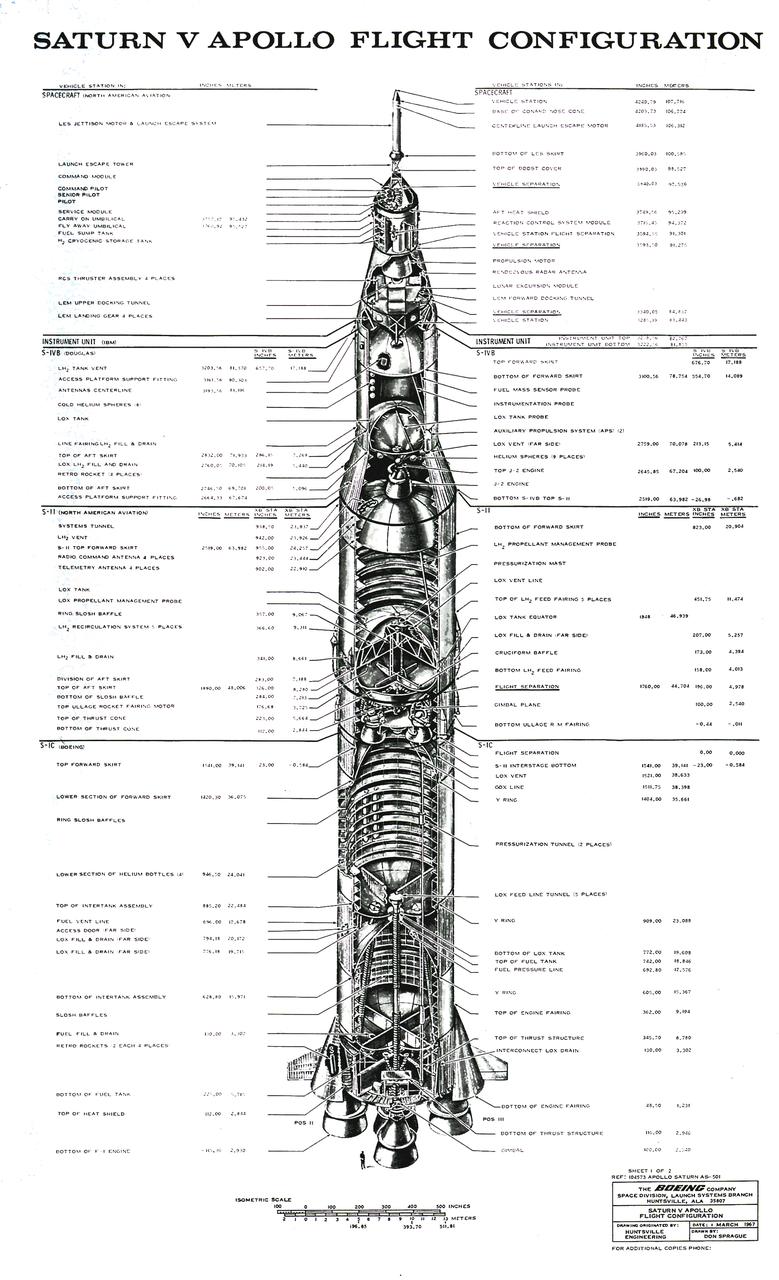
The Saturn V configuration is shown in inches and meters as illustrated by the Boeing Company. The Saturn V vehicle consisted of three stages: the S-IC (first) stage powered by five F-1 engines, the S-II (second) stage powered by five J-2 engines, the S-IVB (third) stage powered by one J-2 engine. A top for the first three stages was designed to contain the instrument unit, the guidance system, the Apollo spacecraft, and the escape system. The Apollo spacecraft consisted of the lunar module, the service module, and the command module. The Saturn V was designed perform lunar and planetary missions and it was capable of placing 280,000 pounds into Earth orbit.
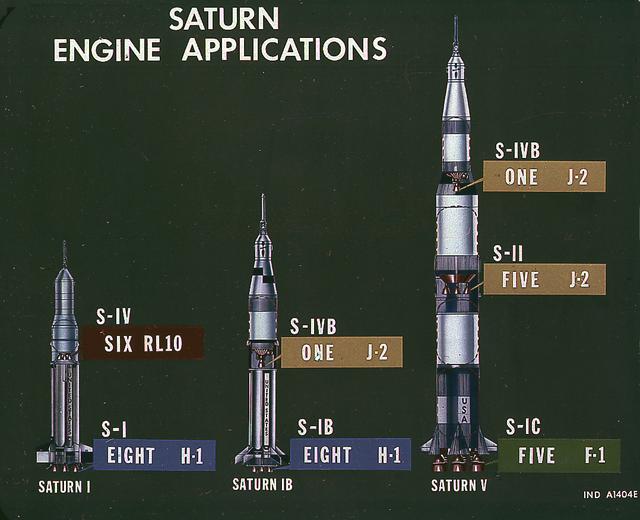
This image illustrates the basic differences between the three Saturn launch vehicles developed by the Marshall Space Flight Center. The Saturn I, consisted of two stages, the S-I (eight H-1 engines) and the S-IV (six RL-10 engines). The Saturn IB (center) also consisted of two stages, the S-IB (eight H-1 engines) and the S-IVB (one J-2 engine). The Saturn V consisted of three stages, the S-IC (five F-1 engines), the S-II (five J-2 engines), and the S-IVB (one J-2 engine).
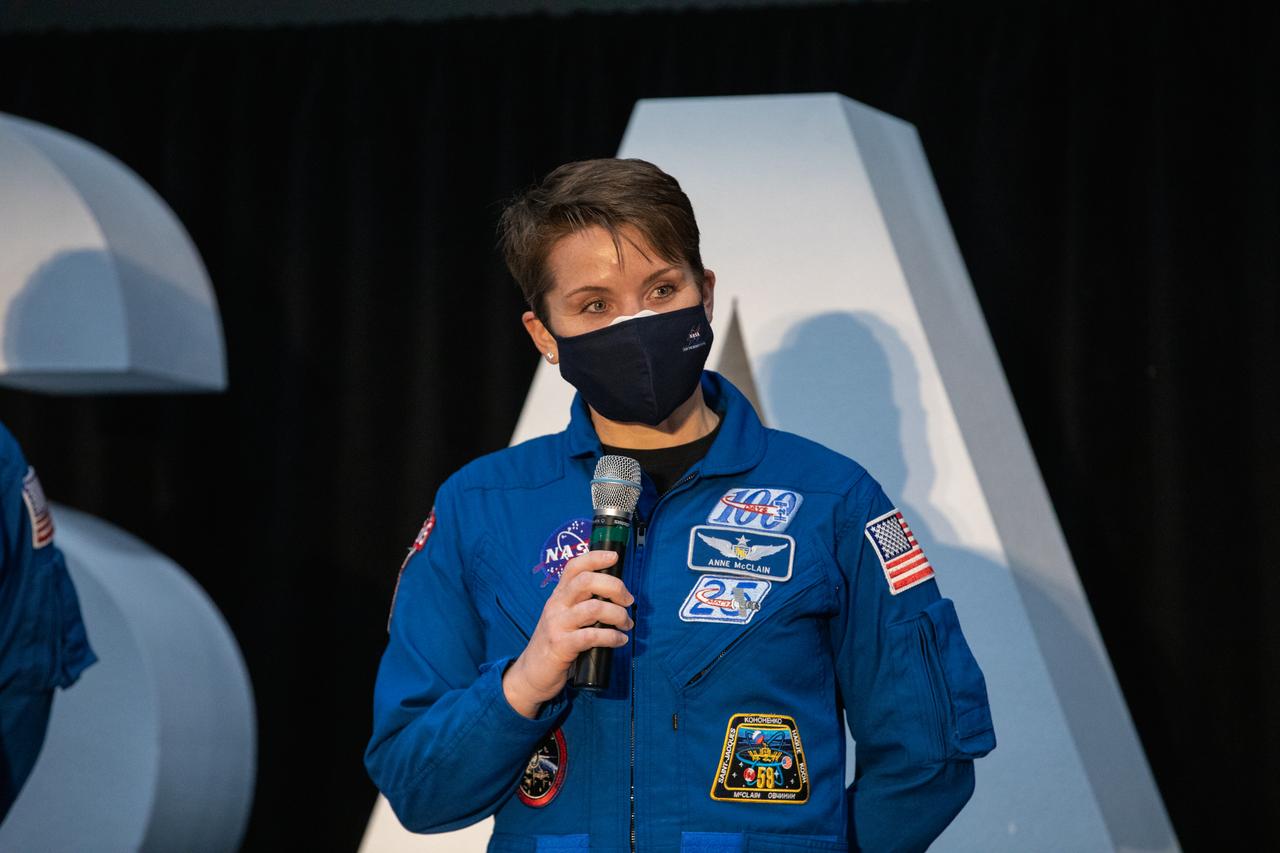
NASA astronaut Anne McClain speaks to members of the news media during a question-and-answer session Dec. 9, 2020, following a National Space Council meeting inside the Apollo/Saturn V Center at the Kennedy Space Center Visitor Complex in Florida. Vice President Mike Pence chaired the meeting, at which he announced the initial team of 18 astronauts eligible for early Artemis missions on and around the Moon. A native of the state of Washington, McClain was selected as a NASA astronaut in 2013 and has spent 204 days in space on one previous flight. She was joined at the event by fellow astronauts Joseph Acaba, Matthew Dominick, Jessica Meir, and Jessica Watkins. Under the Artemis program, NASA will land the first woman and the next man on the Moon in 2024.
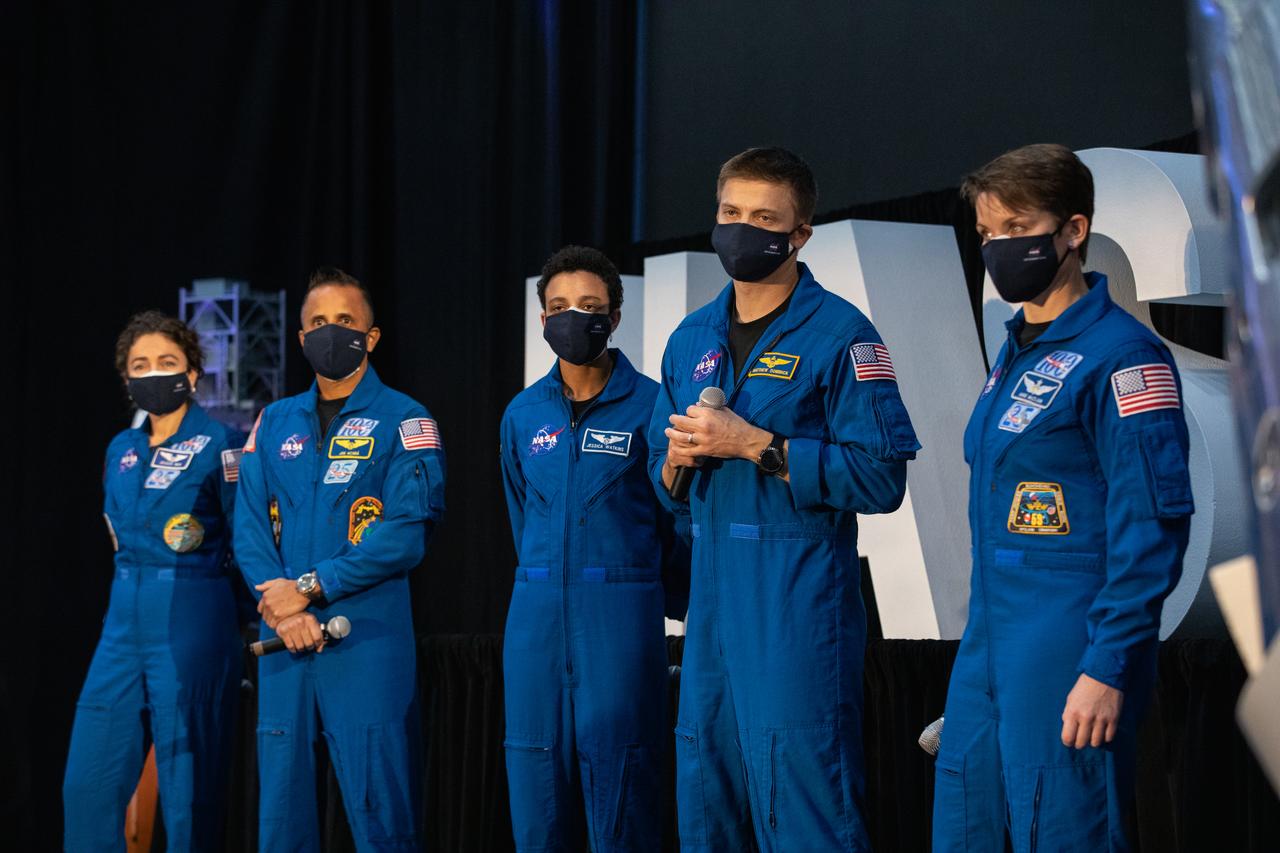
NASA astronaut Matthew Dominick, second from right, listens to a question from a member of the news media during a question-and-answer session Dec. 9, 2020, following a National Space Council meeting inside the Apollo/Saturn V Center at the Kennedy Space Center Visitor Complex in Florida. Vice President Mike Pence chaired the meeting at which he announced the initial team of 18 astronauts eligible for early Artemis missions on and around the Moon. A Colorado native, Dominick was selected as a NASA astronaut in 2017. He was joined at the event by fellow astronauts, from left, Jessica Meir, Joseph Acaba, Jessica Watkins, and Anne McClain. Under the Artemis program, NASA will land the first woman and the next man on the Moon in 2024.
NASA astronaut Matthew Dominick, second from right, speaks to members of the news media during a question-and-answer session Dec. 9, 2020, following a National Space Council meeting inside the Apollo/Saturn V Center at the Kennedy Space Center Visitor Complex in Florida. Vice President Mike Pence chaired the meeting at which he announced the initial team of 18 astronauts eligible for early Artemis missions on and around the Moon. A Colorado native, Dominick was selected as a NASA astronaut in 2017. He was joined at the event by fellow astronauts, from left, Jessica Meir, Joseph Acaba, Jessica Watkins, and Anne McClain. Under the Artemis program, NASA will land the first woman and the next man on the Moon in 2024.
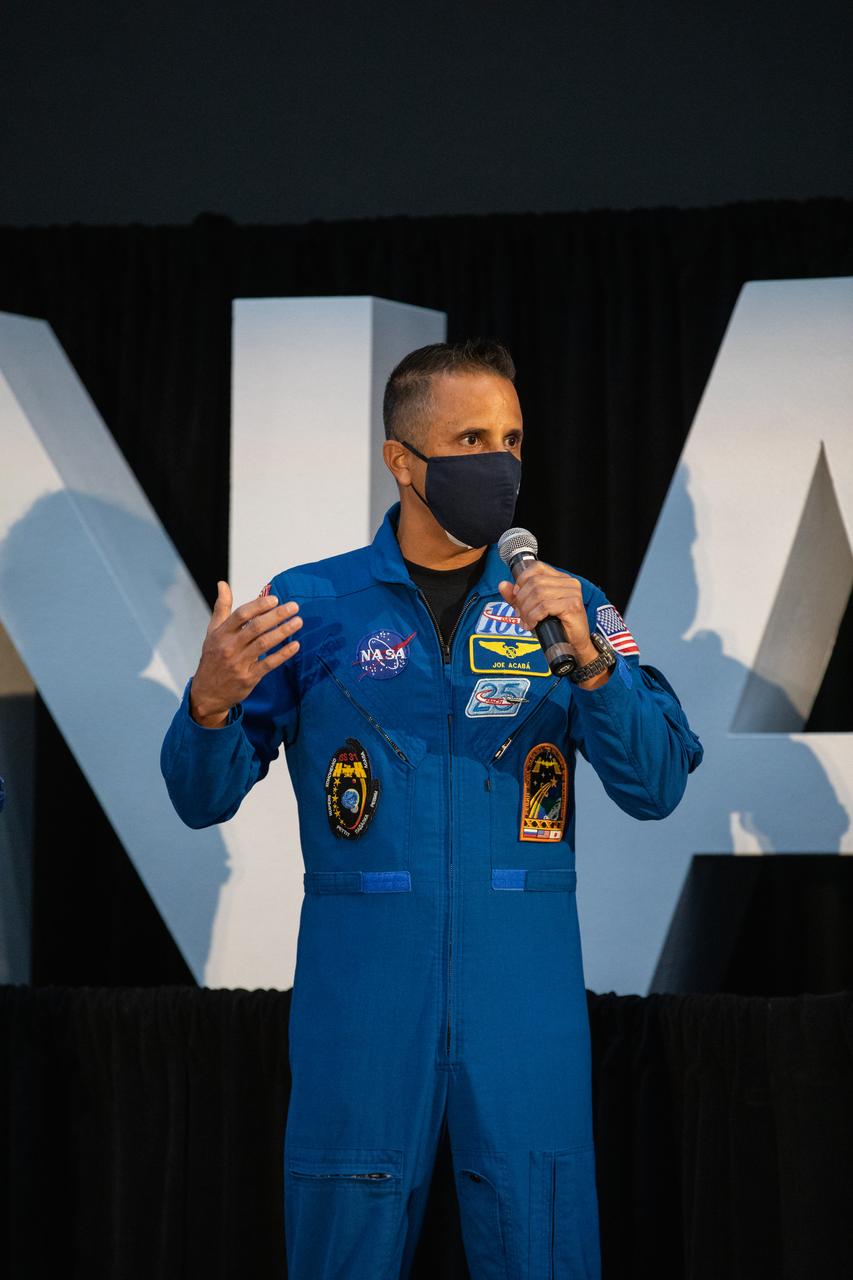
NASA astronaut Joseph Acaba speaks to members of the news media during a question-and-answer session Dec. 9, 2020, following a National Space Council meeting inside the Apollo/Saturn V Center at the Kennedy Space Center Visitor Complex in Florida. Vice President Mike Pence chaired the meeting at which he announced the initial team of 18 astronauts eligible for early Artemis missions on and around the Moon. A California native, Acaba was selected as a NASA astronaut in 2004 and has logged a total of 306 days in space on three flights. He was joined at the event by fellow astronauts Matthew Dominick, Jessica Meir, Anne McClain, and Jessica Watkins. Under the Artemis program, NASA will land the first woman and the next man on the Moon in 2024.
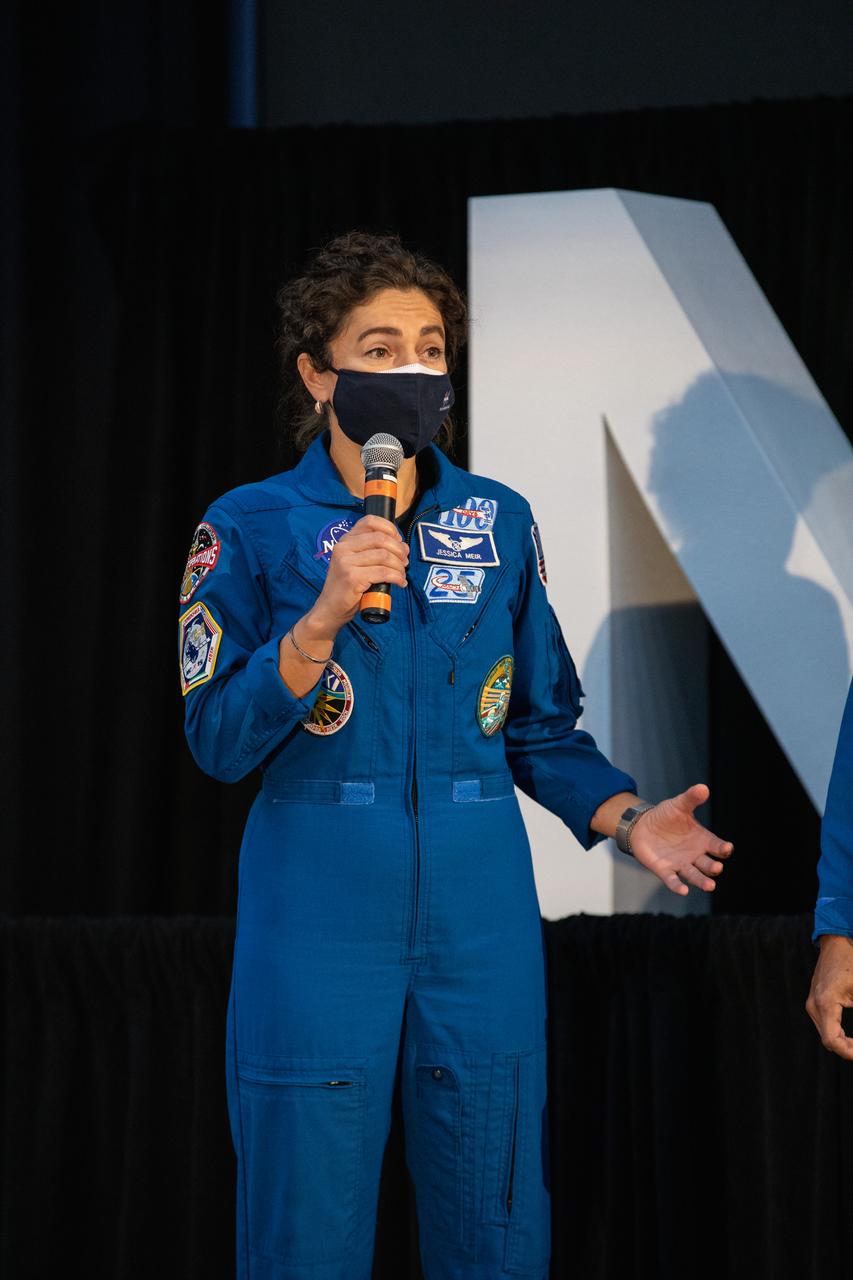
NASA astronaut Jessica Meir speaks to members of the news media during a question-and-answer session Dec. 9, 2020, following a National Space Council meeting inside the Apollo/Saturn V Center at the Kennedy Space Center Visitor Complex in Florida. Vice President Mike Pence chaired the meeting, at which he announced the initial team of 18 astronauts eligible for early Artemis missions on and around the Moon. A Maine native, Meir was selected as a NASA astronaut in 2013 and has spent 205 days in space on one previous flight. She was joined at the event by fellow astronauts Joseph Acaba, Matthew Dominick, Anne McClain, and Jessica Watkins. Under the Artemis program, NASA will land the first woman and the next man on the Moon in 2024.
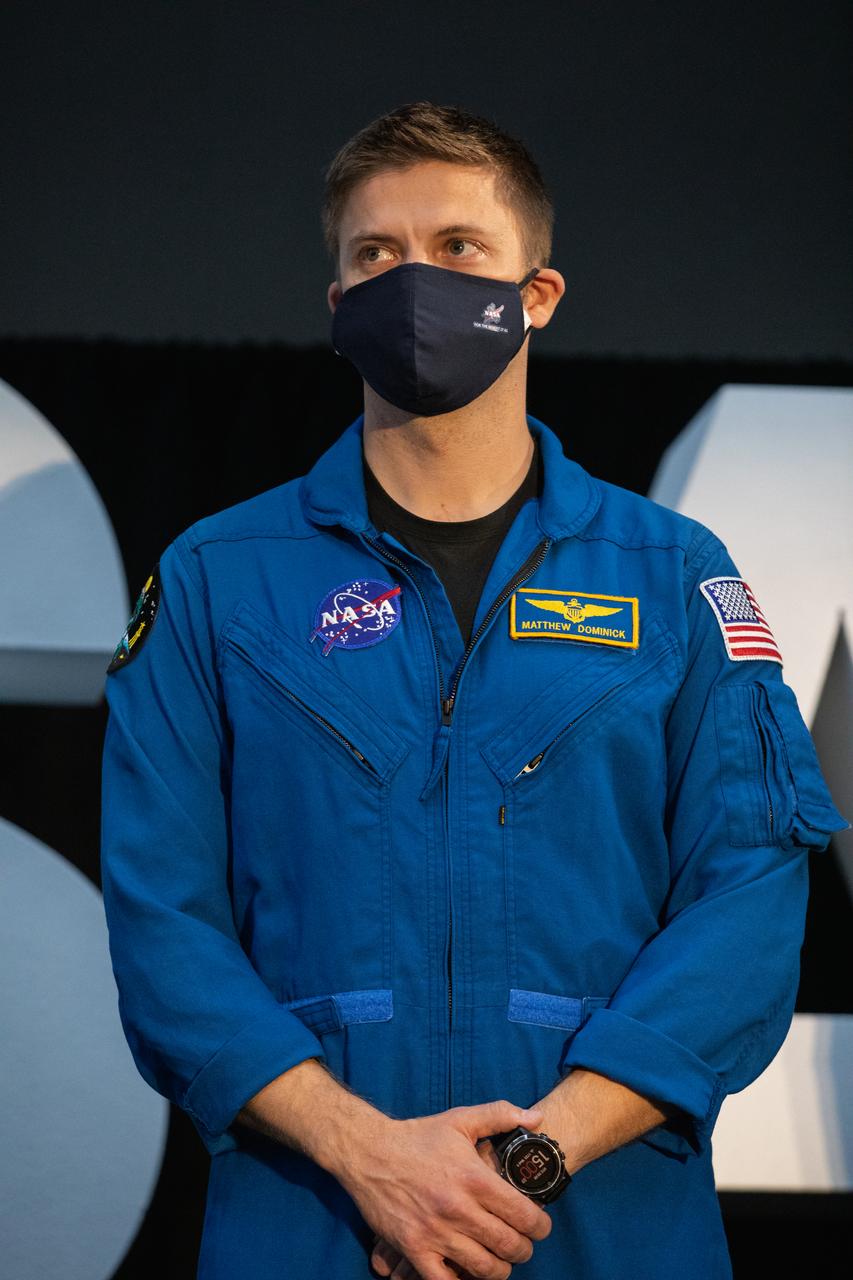
NASA astronaut Matthew Dominick attends an announcement Dec. 9, 2020, that he is one of the initial team of 18 astronauts eligible for early Artemis missions on and around the Moon. A Colorado native, Dominick was selected as a NASA astronaut in 2017. Joining him at the event were fellow astronauts Joseph Acaba, Jessica Meir, Anne McClain, and Jessica Watkins. Vice President Mike Pence made the announcement at the close of a National Space Council meeting he chaired in the Apollo/Saturn V Center at the Kennedy Space Center Visitor Complex in Florida. Under the Artemis program, NASA will land the first woman and the next man on the Moon in 2024.
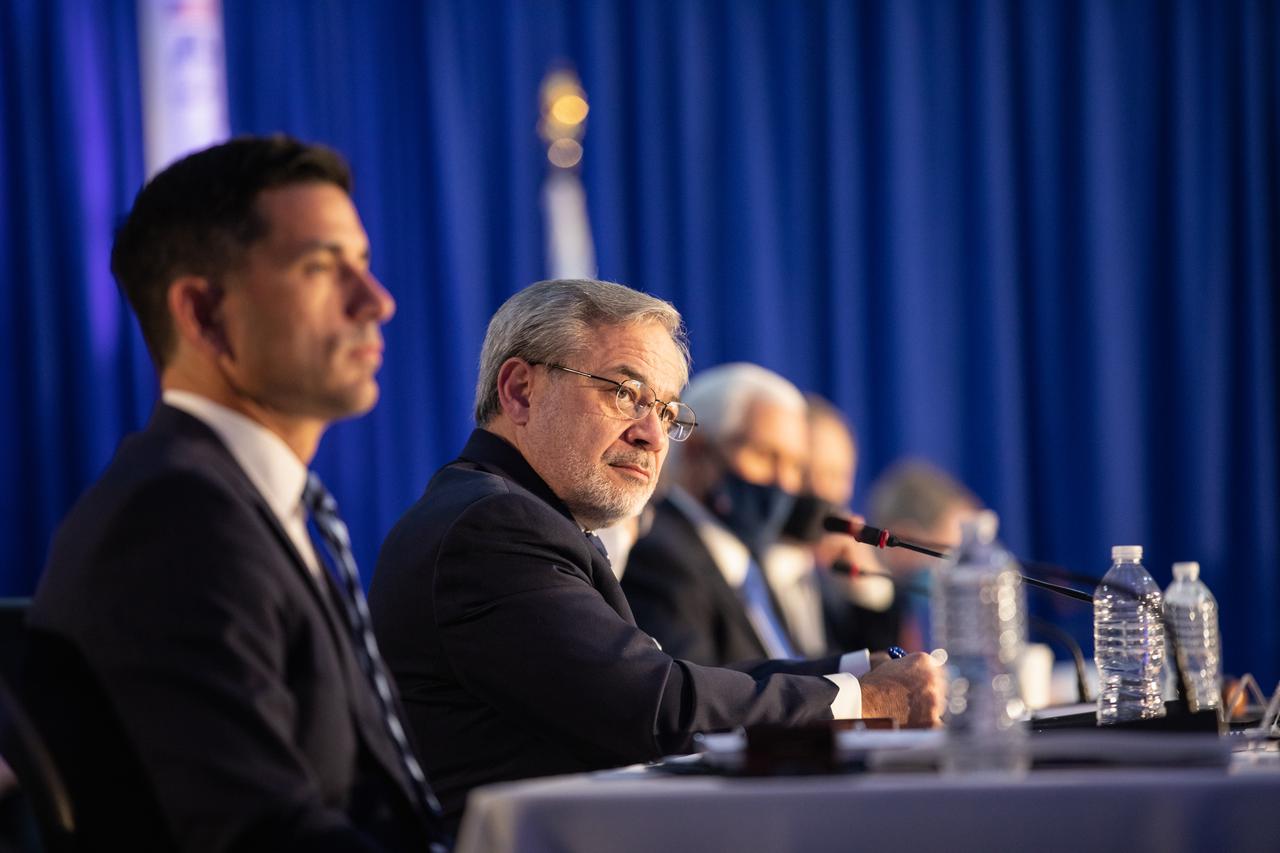
From left, Chad Wolf, acting secretary of Homeland Security, and Dan Brouillette, Secretary of Energy, attend a meeting of the National Space Council inside the Apollo/Saturn V Center at the Kennedy Space Center Visitor Complex in Florida on Dec. 9, 2020. The council's role is to advise the president regarding national space policy and strategy, and to review the nation's long-range goals for space activities. Vice President Mike Pence chaired the meeting, at which he announced the initial team of 18 astronauts eligible for early Artemis missions on and around the Moon. Under the Artemis program, NASA will land the first woman and the next man on the Moon in 2024.
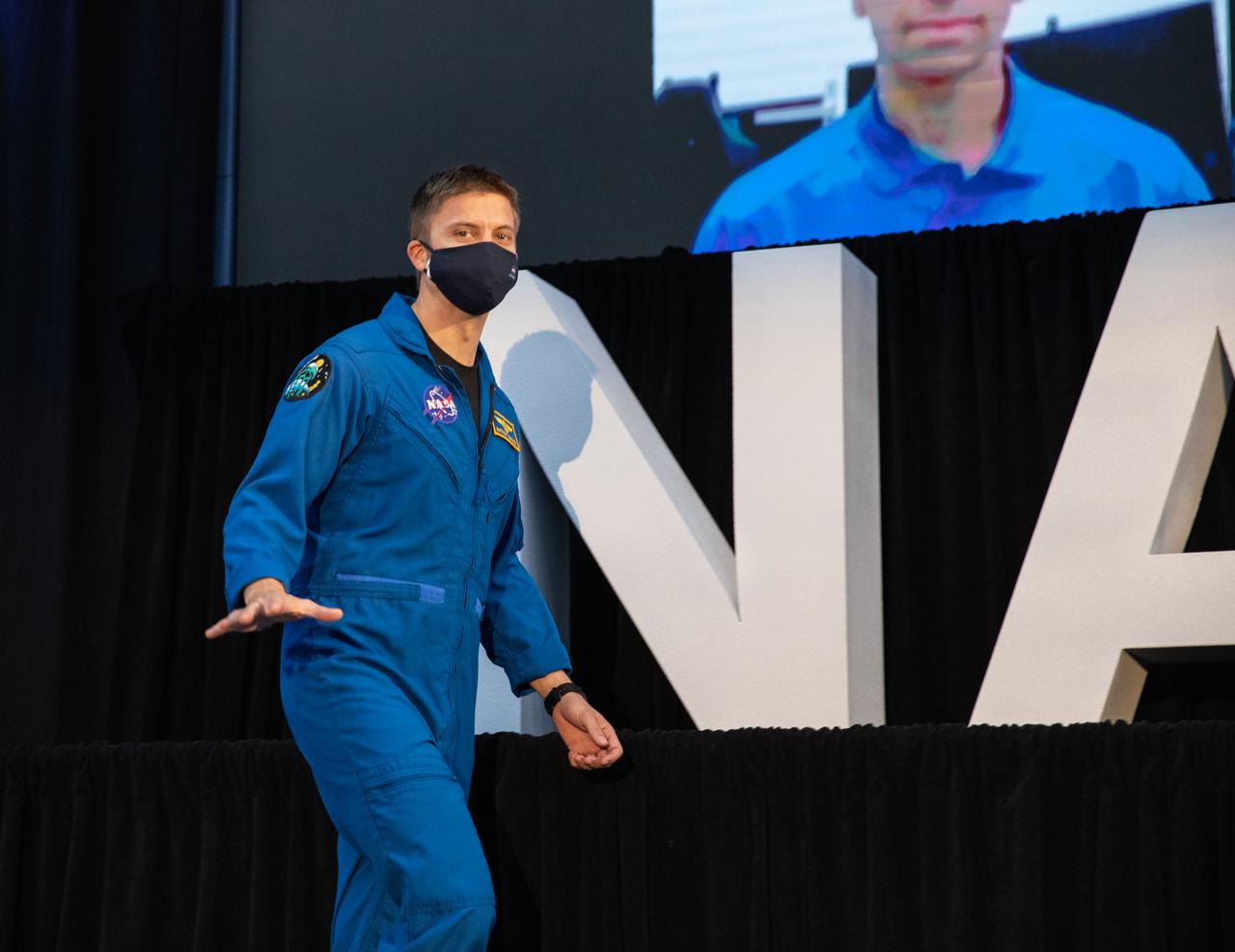
NASA astronaut Matthew Dominick waves during an announcement Dec. 9, 2020, that he is one of the initial team of 18 astronauts eligible for early Artemis missions on and around the Moon. A Colorado native, Dominick was selected as a NASA astronaut in 2017. Joining him at the event were fellow astronauts Joseph Acaba, Jessica Meir, Anne McClain, and Jessica Watkins. Vice President Mike Pence made the announcement at the close of a National Space Council meeting he chaired in the Apollo/Saturn V Center at the Kennedy Space Center Visitor Complex in Florida. Under the Artemis program, NASA will land the first woman and the next man on the Moon in 2024.
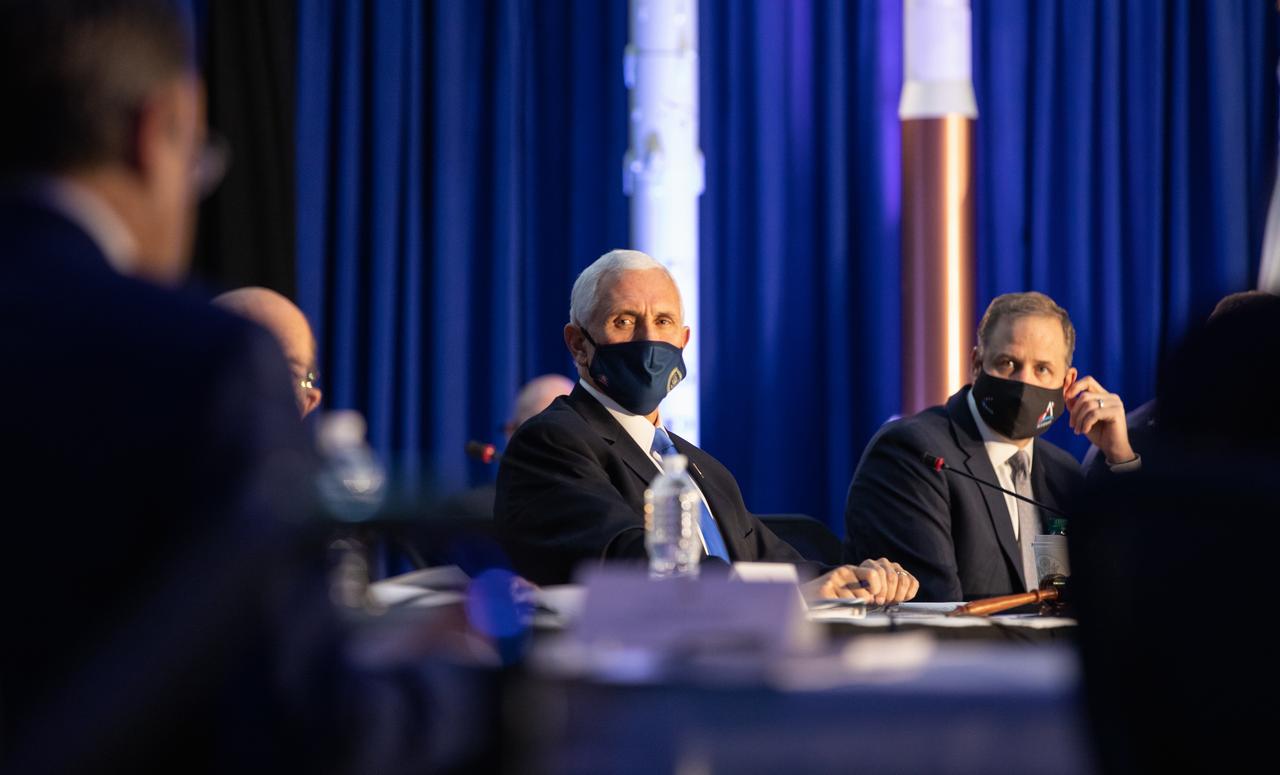
Vice President Mike Pence listens during a meeting of the National Space Council inside the Apollo/Saturn V Center at the Kennedy Space Center Visitor Complex in Florida on Dec. 9, 2020. The council's role is to advise the president regarding national space policy and strategy and to review the nation's long-range goals for space activities. At the close of the meeting, Pence announced the initial team of 18 astronauts eligible for early Artemis missions on and around the Moon. Under the Artemis program, NASA will land the first woman and the next man on the Moon in 2024.
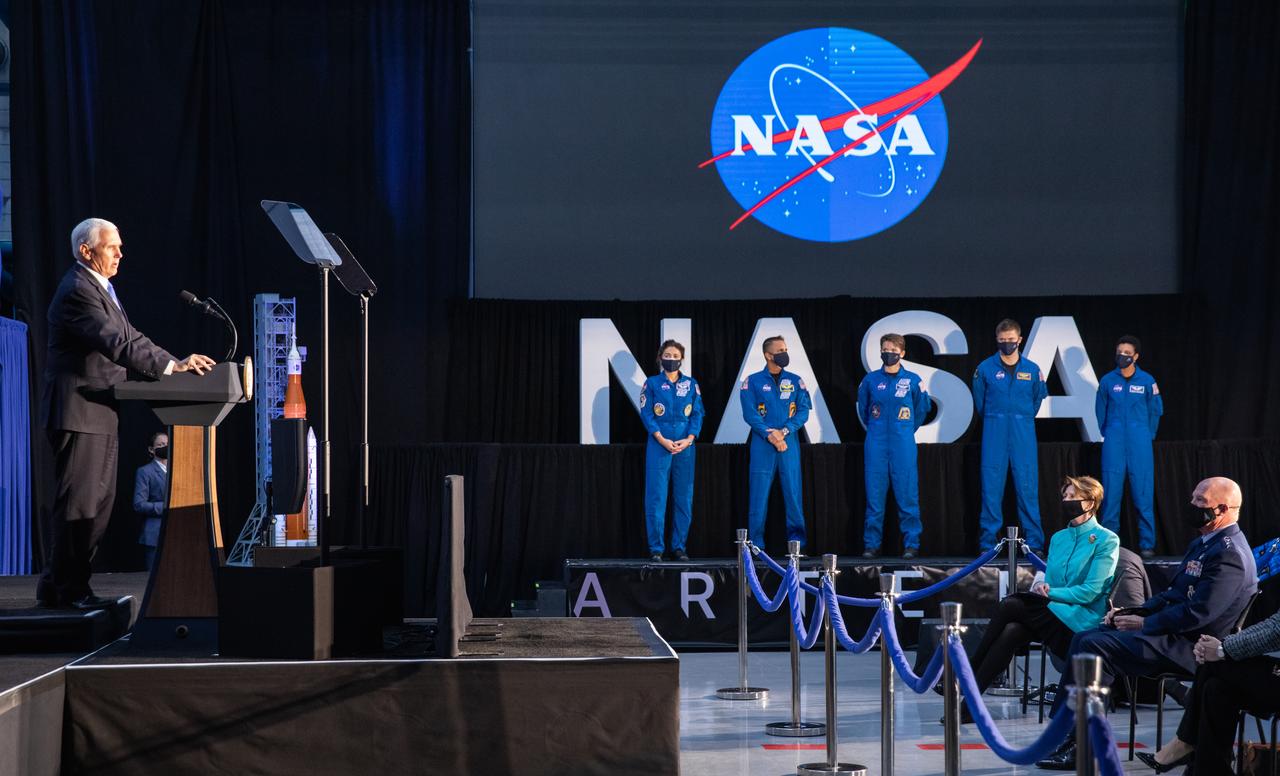
Vice President Mike Pence introduces NASA astronauts, from left, Jessica Meir, Joseph Acaba, Anne McClain, Matthew Dominick, and Jessica Watkins, during a meeting of the National Space Council inside the Apollo/Saturn V Center at the Kennedy Space Center Visitor Complex in Florida on Dec. 9, 2020. Meir, Acaba, McClain, Dominick, and Watkins are among the initial team of 18 astronauts eligible for early Artemis missions on and around the Moon. Under the Artemis program, NASA will land the first woman and the next man on the Moon in 2024.
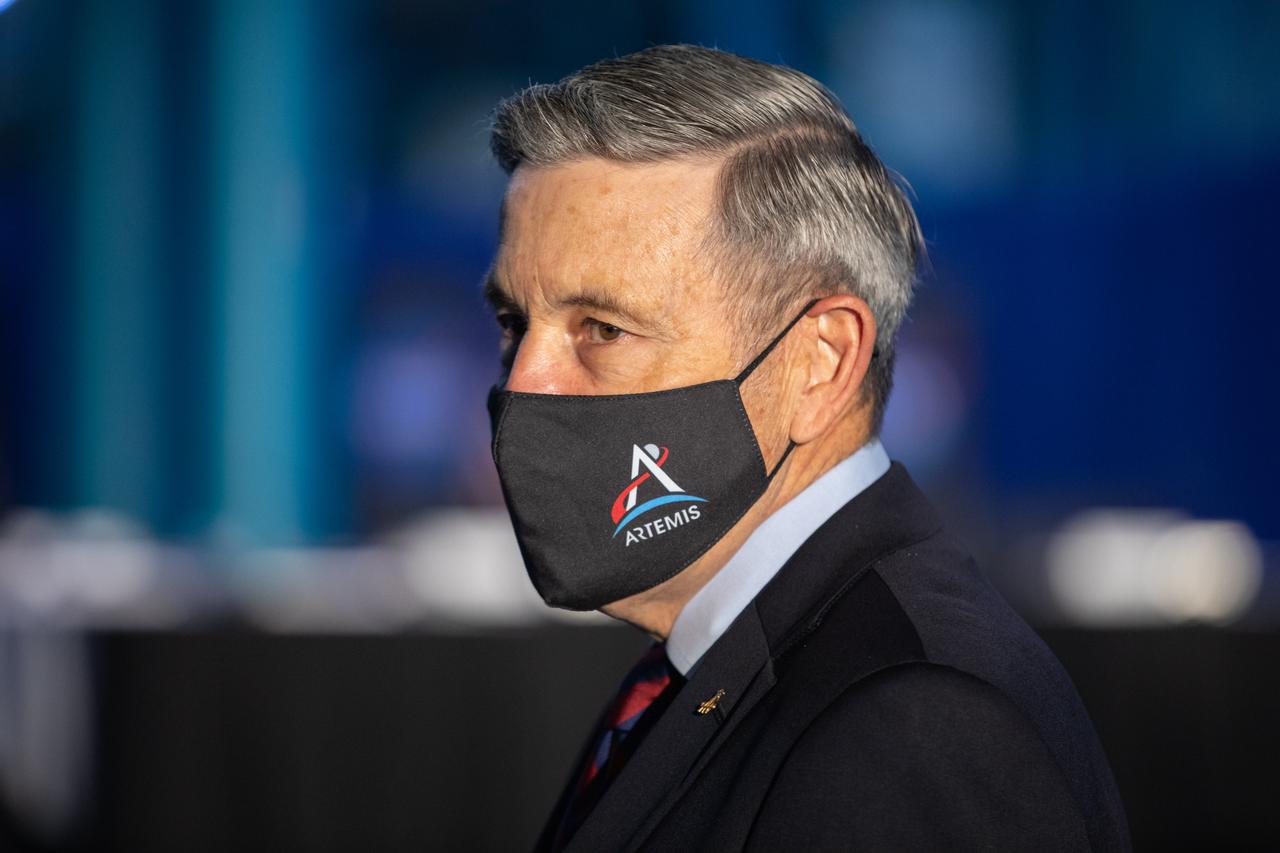
Kennedy Space Center Director Bob Cabana attends a meeting of the National Space Council inside the Apollo/Saturn V Center at the Kennedy Visitor Complex in Florida on Dec. 9, 2020. The council's role is to advise the president regarding national space policy and strategy and to review the nation's long-range goals for space activities. Vice President Mike Pence chaired the meeting, at which he announced the initial team of 18 astronauts eligible for early Artemis missions on and around the Moon. Under the Artemis program, NASA will land the first woman and the next man on the Moon in 2024.
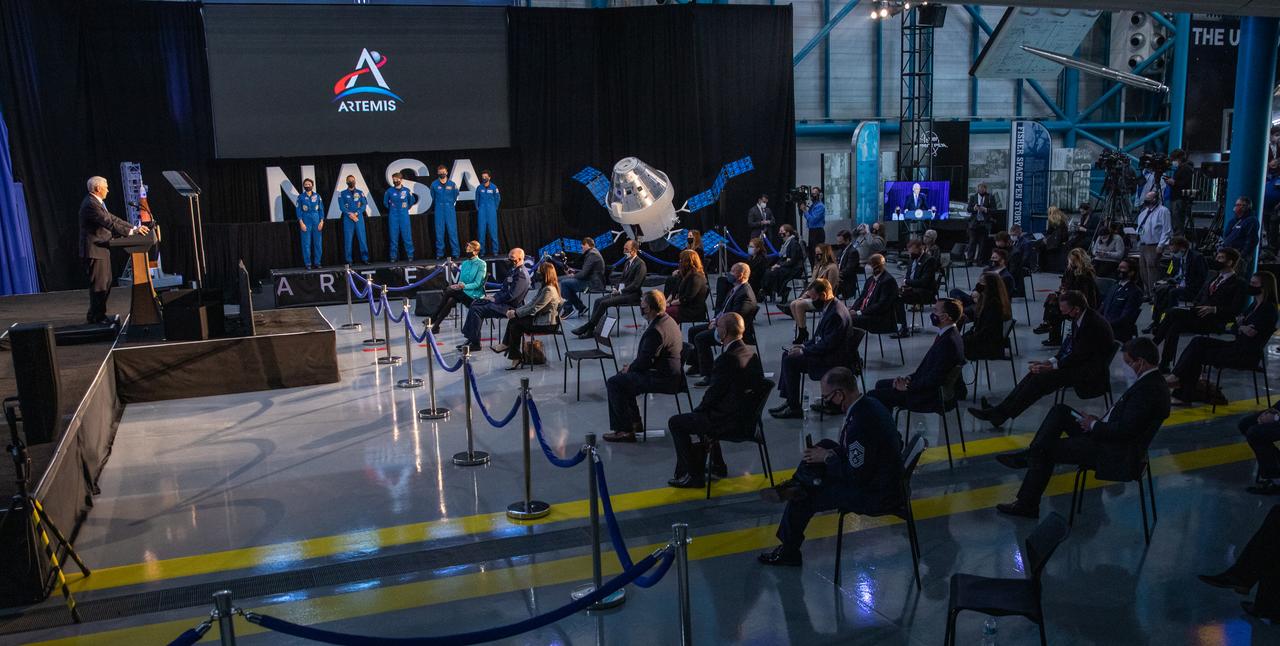
Vice President Mike Pence introduces NASA astronauts, from left, Jessica Meir, Joseph Acaba, Anne McClain, Matthew Dominick, and Jessica Watkins, during a meeting of the National Space Council inside the Apollo/Saturn V Center at the Kennedy Space Center Visitor Complex in Florida on Dec. 9, 2020. Meir, Acaba, McClain, Dominick, and Watkins are among the initial team of 18 astronauts eligible for early Artemis missions on and around the Moon. Under the Artemis program, NASA will land the first woman and the next man on the Moon in 2024.
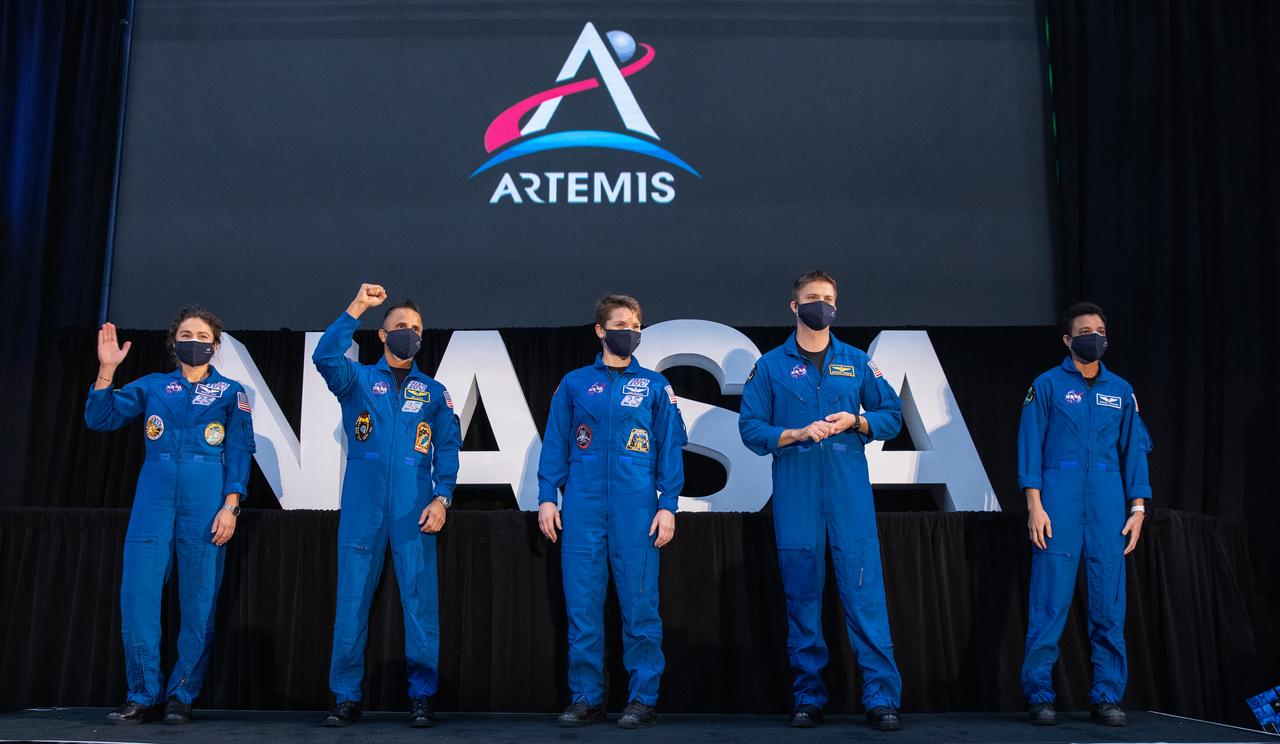
From left, NASA astronauts Jessica Meir, Joseph Acaba, Anne McClain, Matthew Dominick, and Jessica Watkins are introduced during a National Space Council meeting inside the Apollo/Saturn V Center at the Kennedy Space Center Visitor Complex in Florida on Dec. 9, 2020. The five are among an initial team of 18 astronauts eligible for early Artemis missions on and around the Moon. Vice President Mike Pence, who chaired the meeting, introduced the astronauts. Under the Artemis program, NASA will land the first woman and the next man on the Moon in 2024.

NASA Administrator Jim Bridenstine speaks during the National Space Council meeting inside the Apollo/Saturn V Center at the Kennedy Space Center Visitor Complex in Florida on Dec. 9, 2020. The council's role is to advise the president regarding national space policy and strategy and to review the nation's long-range goals for space activities. Vice President Mike Pence chaired the meeting, at which he announced the initial team of 18 astronauts eligible for early Artemis missions on and around the Moon. Under the Artemis program, NASA will land the first woman and the next man on the Moon in 2024.
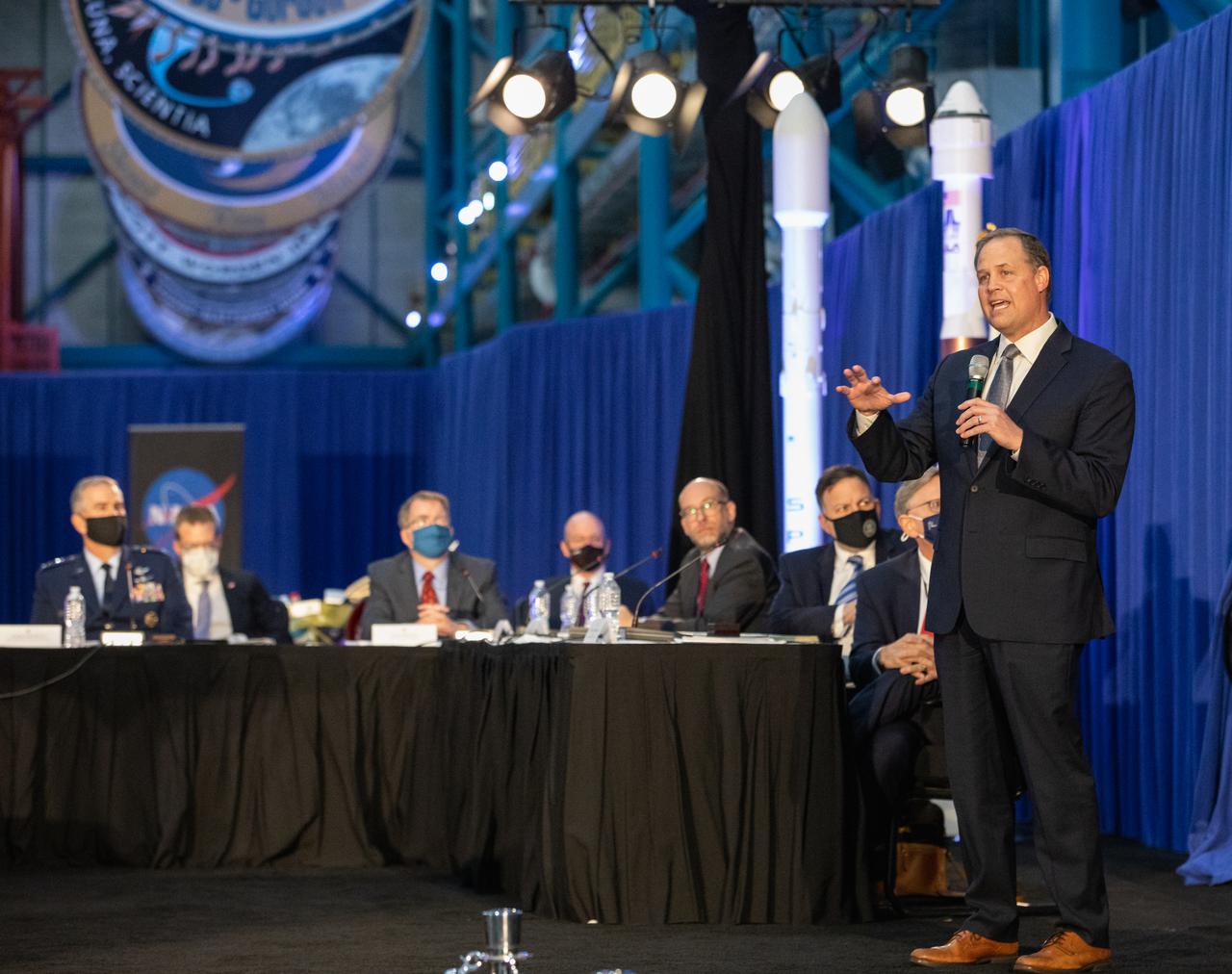
NASA Administrator Jim Bridenstine speaks during the National Space Council meeting inside the Apollo/Saturn V Center at the Kennedy Space Center Visitor Complex in Florida on Dec. 9, 2020. The council's role is to advise the president regarding national space policy and strategy and to review the nation's long-range goals for space activities. Vice President Mike Pence chaired the meeting, at which he announced the initial team of 18 astronauts eligible for early Artemis missions on and around the Moon. Under the Artemis program, NASA will land the first woman and the next man on the Moon in 2024.
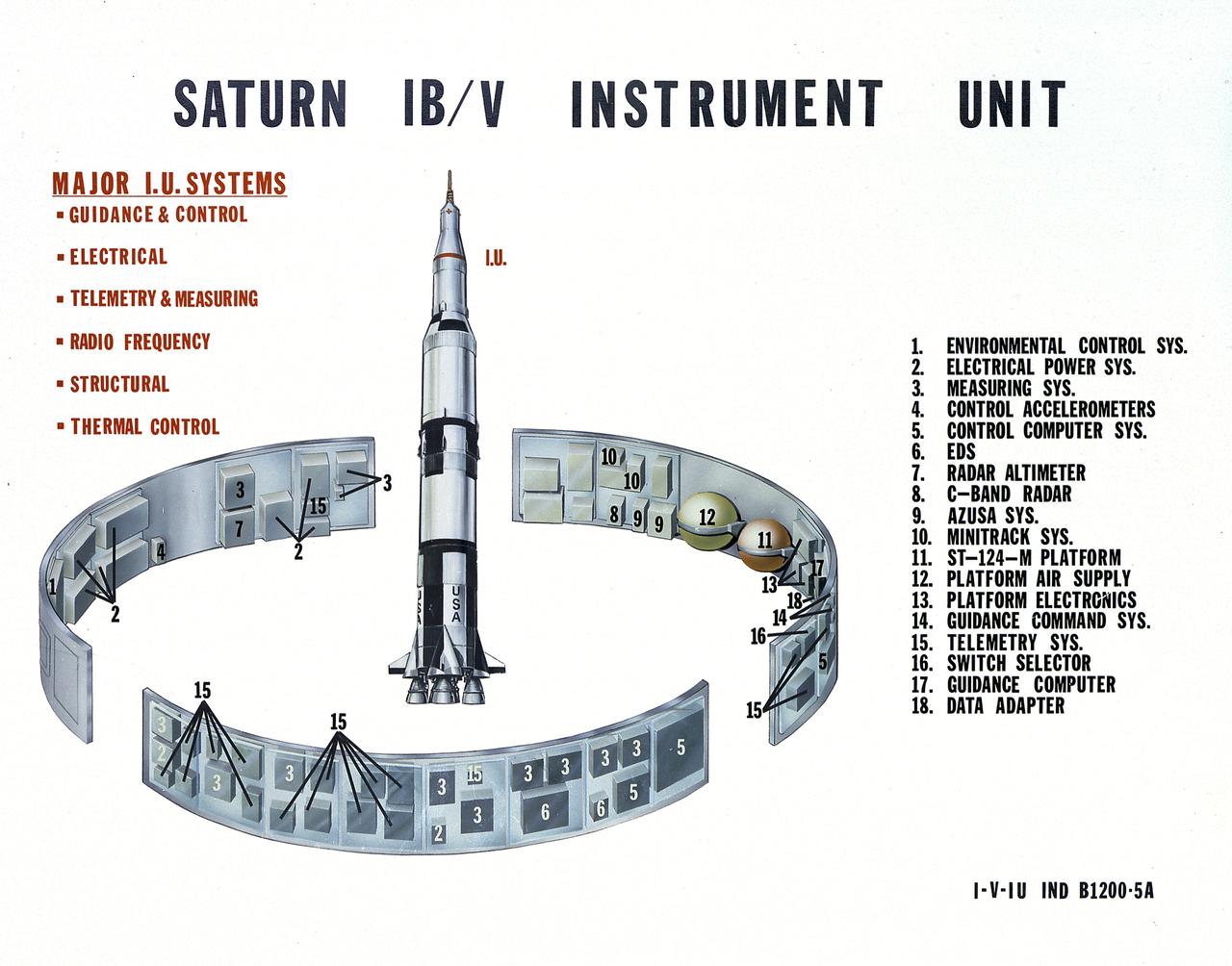
This undated chart provides a description of the Saturn IB and Saturn V's Instrument Unit (IU) and its major components. Designed by NASA at the Marshall Space Flight Center (MSFC), the Instrument Unit, sandwiched between the S-IVB stage and the Apollo spacecraft, served as the Saturn's "nerve center" providing guidance and control, command and sequence of vehicle functions, telemetry, and environmental control.
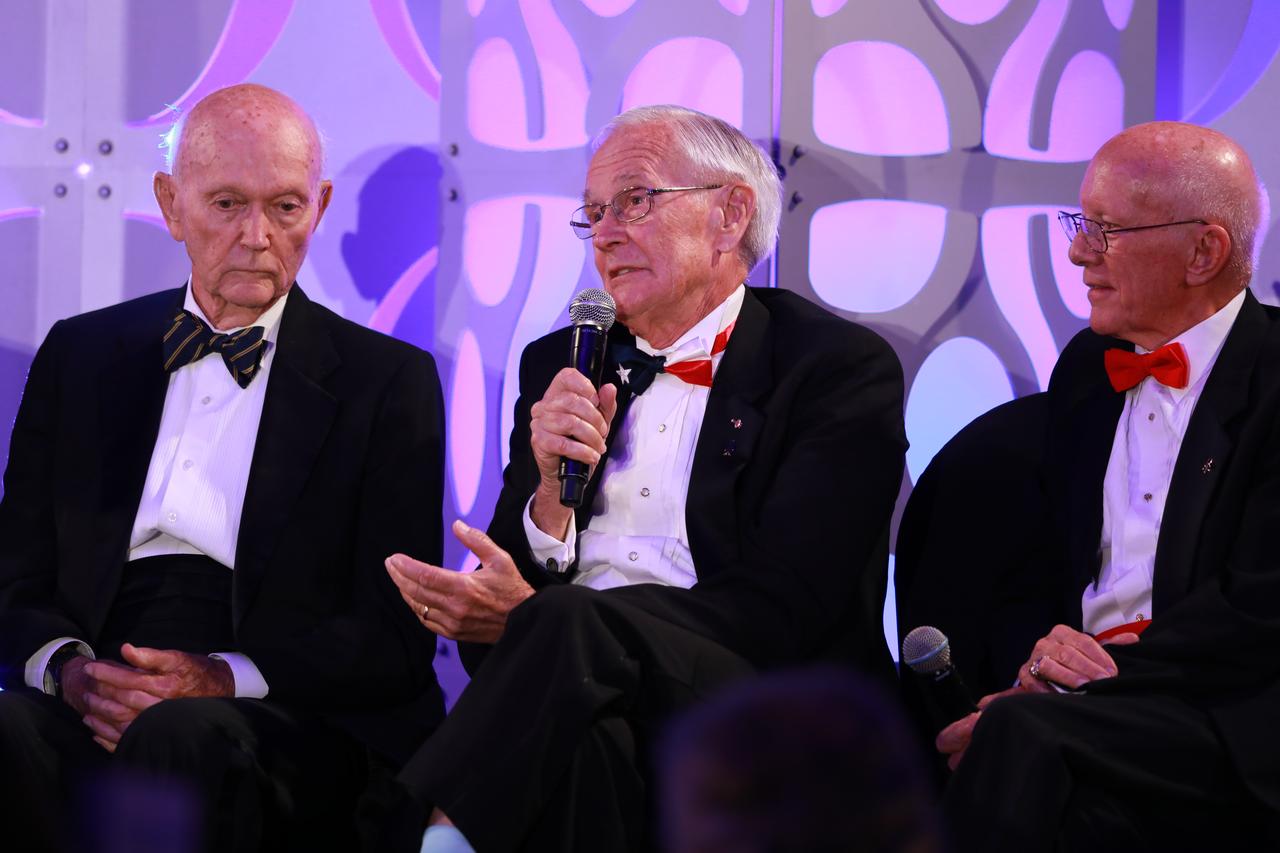
Retired NASA astronauts participate in a panel discussion during the Apollo 11 50th Gala, presented by Northrop Grumman, on July 16, 2019. The gala was held inside the Apollo/Saturn V Center at the Kennedy Space Center Visitor Complex in Florida. From left, are Apollo 11 astronaut Michael Collins, Apollo 16 astronaut Charlie Duke, and Apollo Flight Director Gerry Griffin.
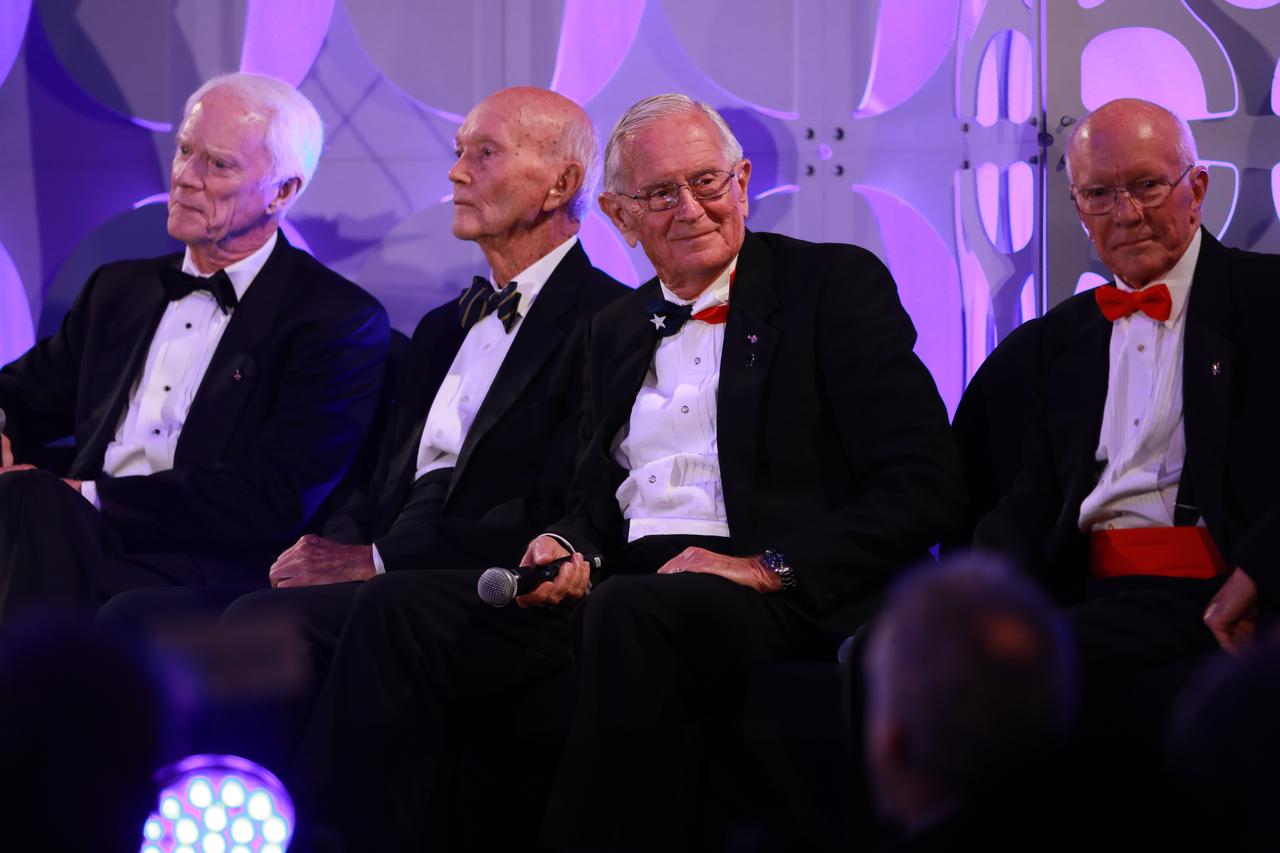
A panel discussion with Apollo astronauts took place during the Apollo 11 50th Gala, present by Northop Grumman, inside the Apollo/Saturn V Center at the Kennedy Space Center Visitor Complex in Florida on July 16, 2019. From left, are Apollo 9 astronaut Rusty Schweickart, Apollo 11 astronaut Michael Collins, Apollo 16 astronaut Charlie Duke, and Apollo Flight Director Gerry Griffin.

Physicist Brian Cox serves as the moderator for a panel discussion with Apollo astronauts during the Apollo 11 50th Gala on July 16, 2019. The gala, presented by Northrop Grumman, was held inside the Apollo/Saturn V Center at the Kennedy Space Center Visitor Complex. From left, are Apollo 9 astronaut Rusty Schweichart, Apollo 11 astronaut Michael Collins, Apollo 16 astronaut Charlie Duke, and Apollo Flight Director Gerry Griffin.
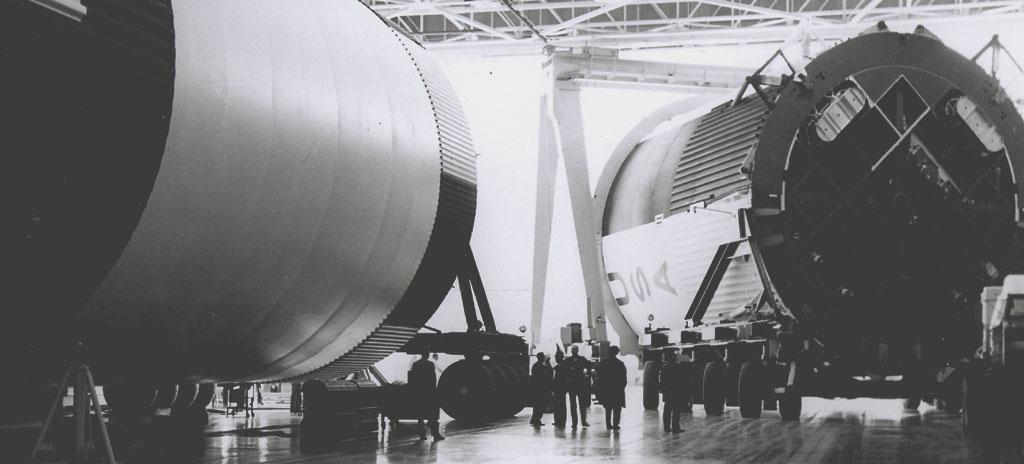
This photograph shows the Saturn V assembled LOX (Liquid Oxygen) and fuel tanks ready for transport from the Manufacturing Engineering Laboratory at Marshall Space Flight Center in Huntsville, Alabama. The tanks were then shipped to the launch site at Kennedy Space Center for a flight. The towering 363-foot Saturn V was a multi-stage, multi-engine launch vehicle standing taller than the Statue of Liberty. Altogether, the Saturn V engines produced as much power as 85 Hoover Dams.
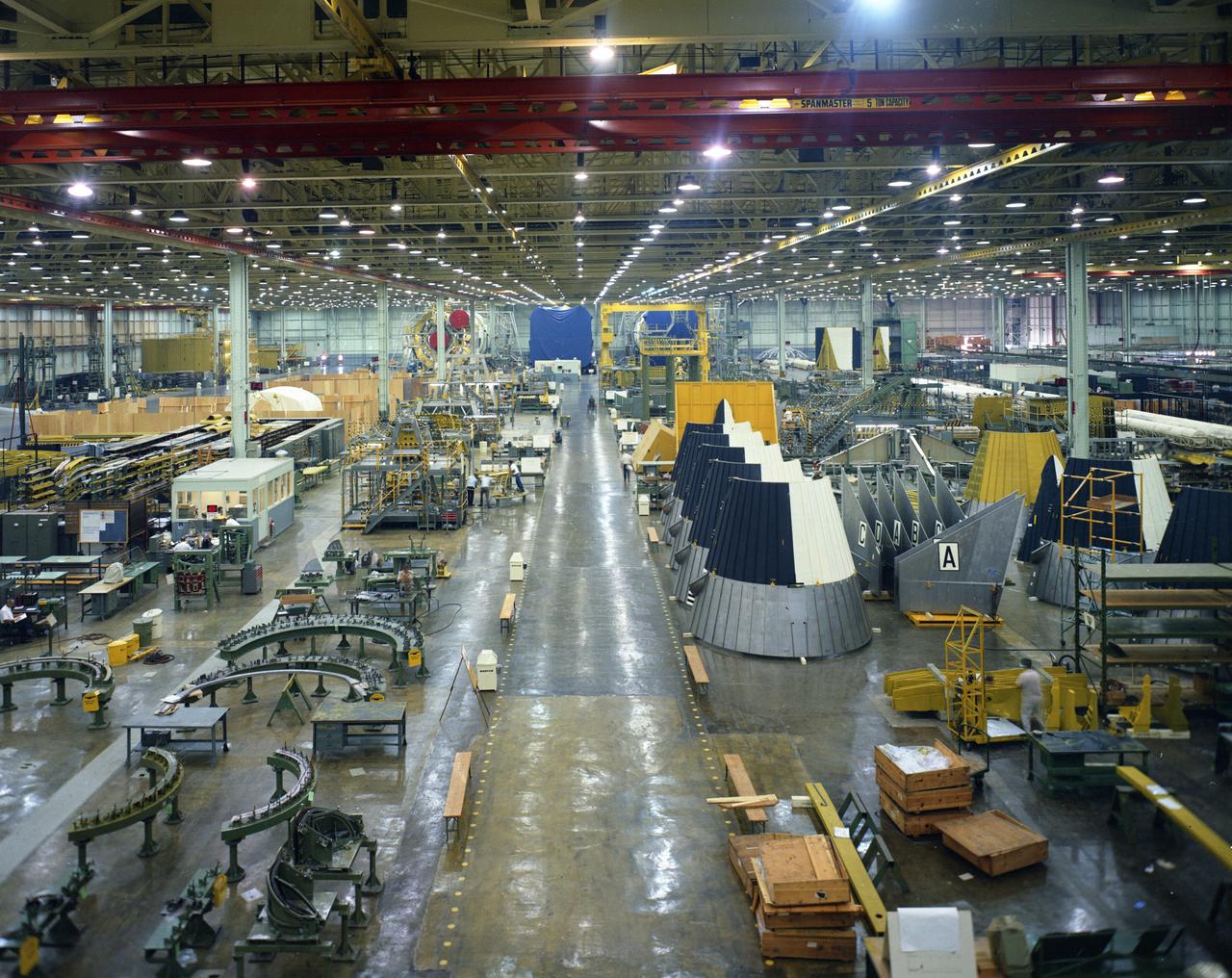
New Orleans, LA - Parts of the Saturn V first stage await assembly at NASA’s Michoud Assembly Facility in October of 1967. In the far end of the image, S-1C stages are nearing completion. Image dated 10-5-1967.
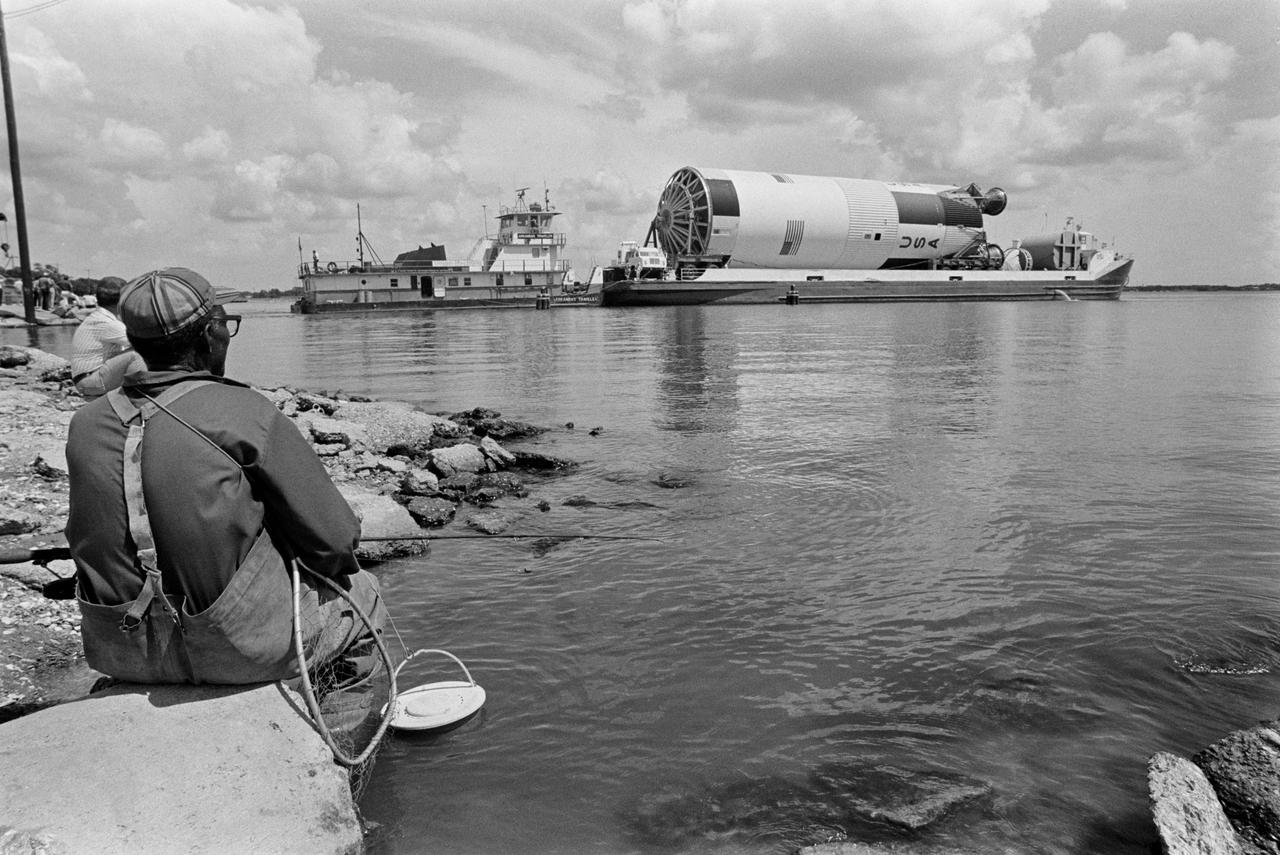
Views documenting the arrival of the Saturn V first stage at the Clear Lake dock near JSC after being transported via barge from Michoud Facility to be put on exhibit at JSC near Building 14. Barge approach with fisherman and others onshore watching. Houston, TX
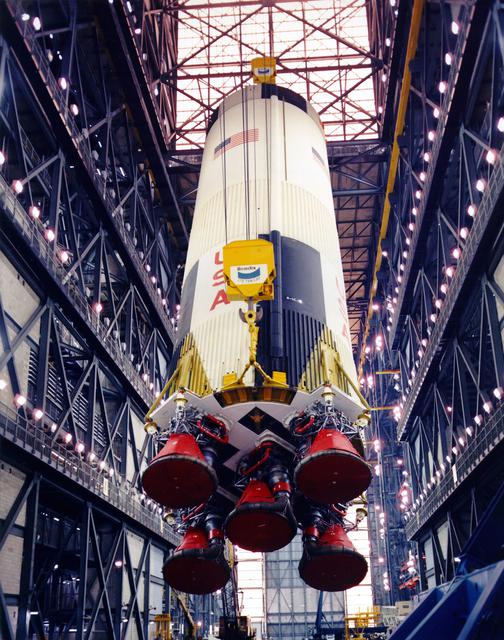
Teams lift the first stage of the Apollo 10 Saturn V rocket by crane inside High Bay 3 of the Vehicle Assembly Building at NASA’s Kennedy Space Center in Florida on Dec. 3, 1968, in preparation for stacking on the mobile launcher. The 138-foot-long stage generated 7.5 million pounds of thrust when it launched Apollo 10 astronauts Thomas P. Stafford, John W. Young, and Eugene A. Cernan. The mission launched on May 18, 1969, and was the first flight of a complete, crewed Apollo spacecraft to operate around the Moon.
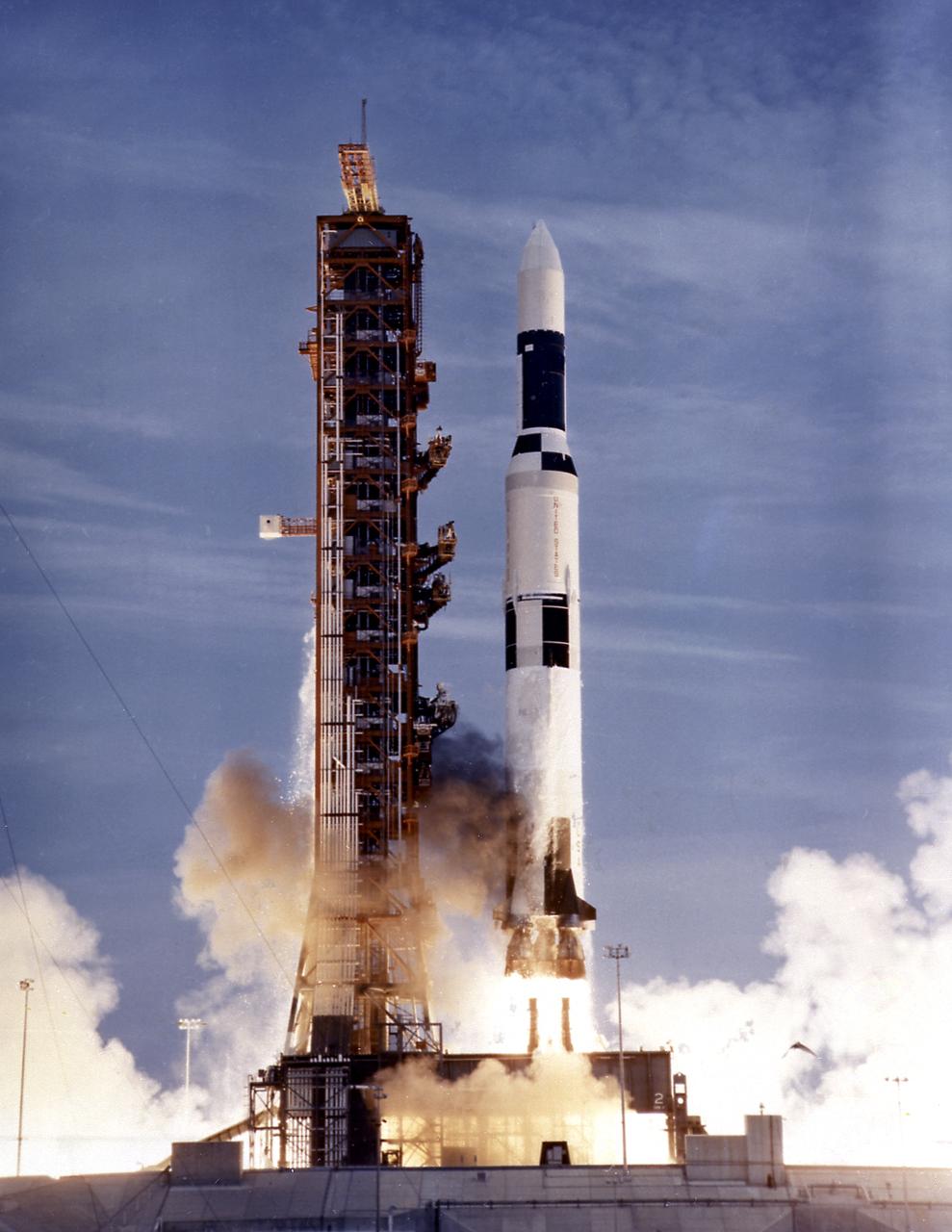
This photograph shows the launch of the SA-513, a modified unmarned two-stage Saturn V vehicle for the Skylab-1 mission, which placed the Skylab cluster into the Earth orbit on May 14, 1973. The initial step in the Skylab mission was the launch of a two-stage Saturn V booster, consisting of the S-IC first stage and the S-II second stage, from Launch Complex 39A at the Kennedy Space Center in Florida. Its payload was the unmanned Skylab, which consisted of the Orbital Workshop, the Airlock Module, the Multiple Docking Adapter, the Apollo Telescope Mount and an Instrument Unit.
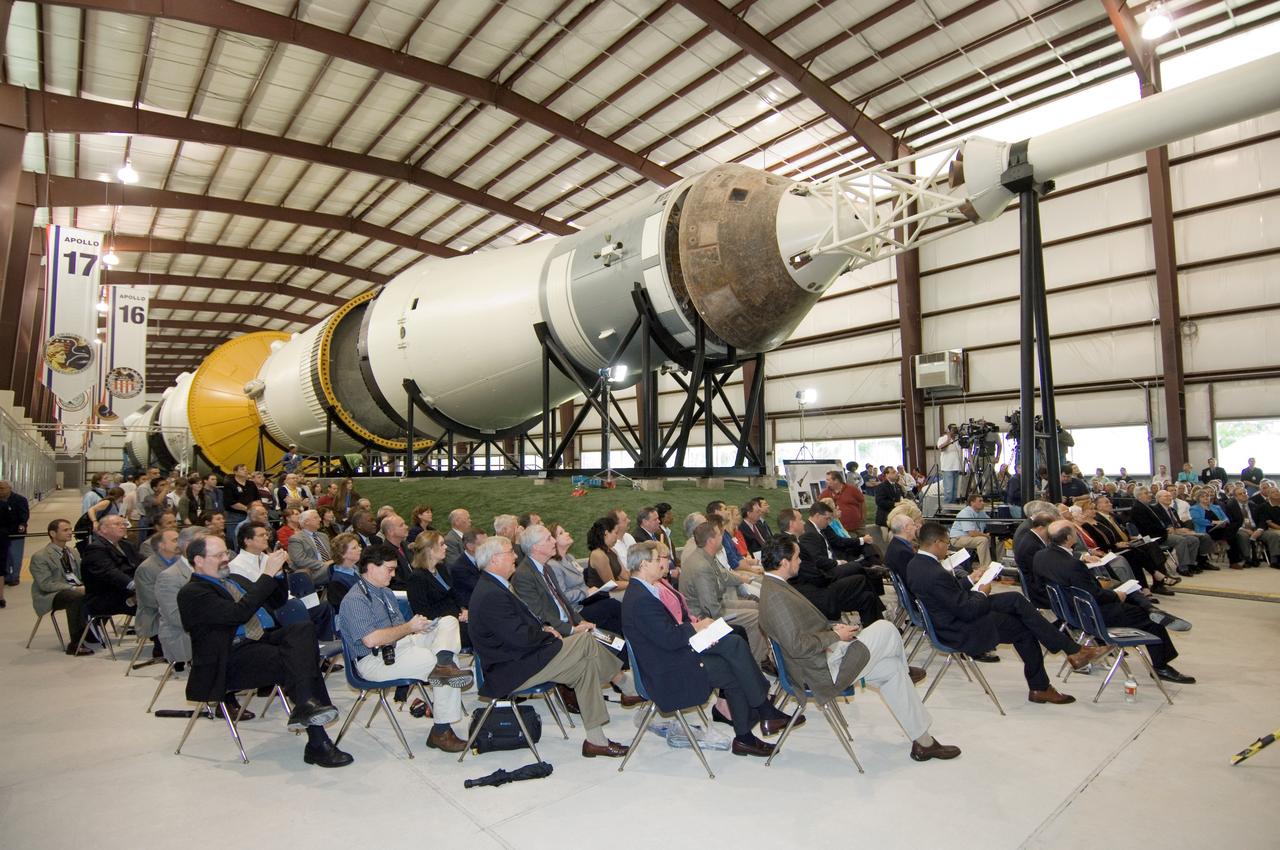
VIP Event including ribbon cutting at the Saturn V Facility. Overview of visitors.
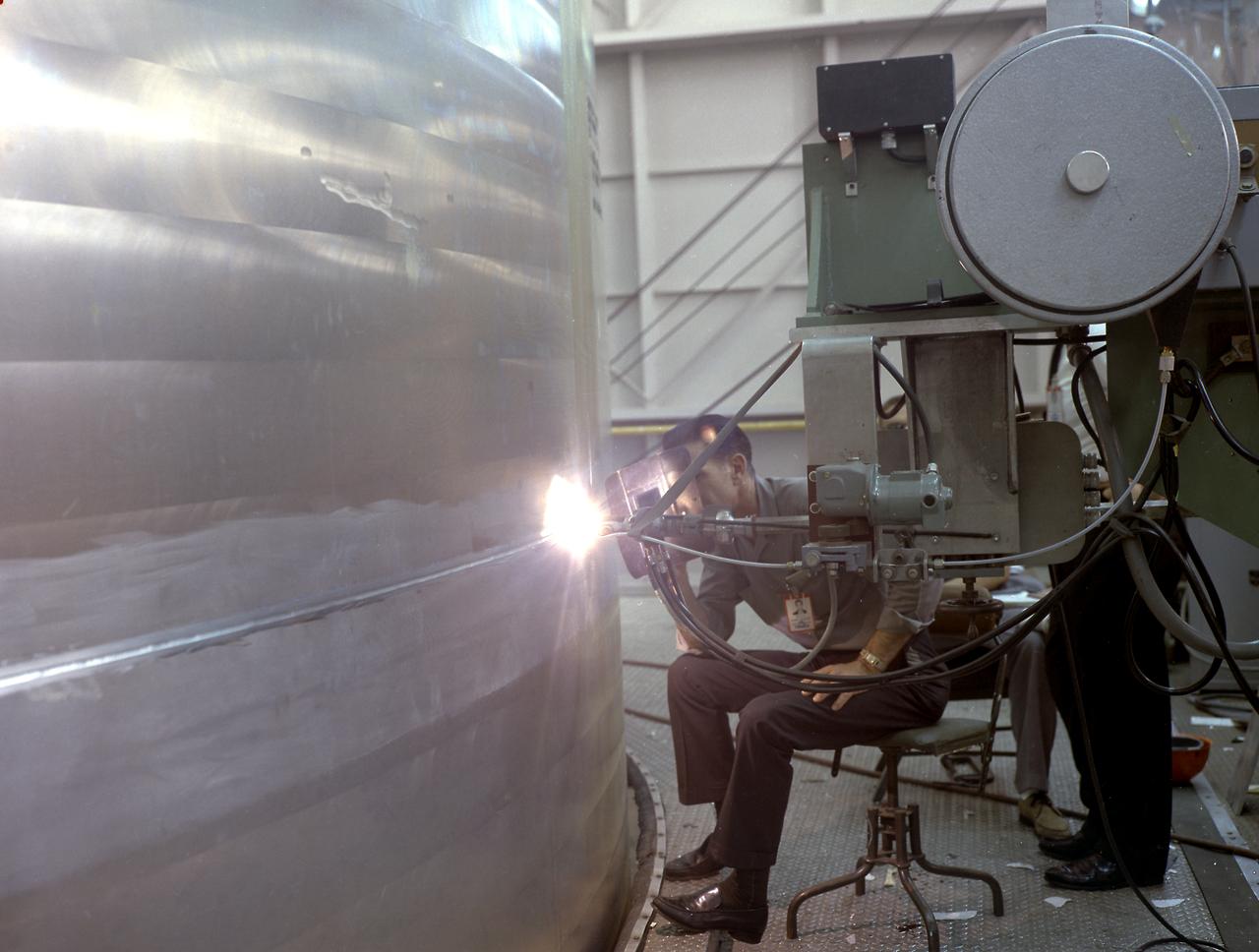
This photo shows the closeout welding operation of the liquid oxygen (LOX) tank for the Saturn V SA-501 vehicle for the Apollo 4 mission.