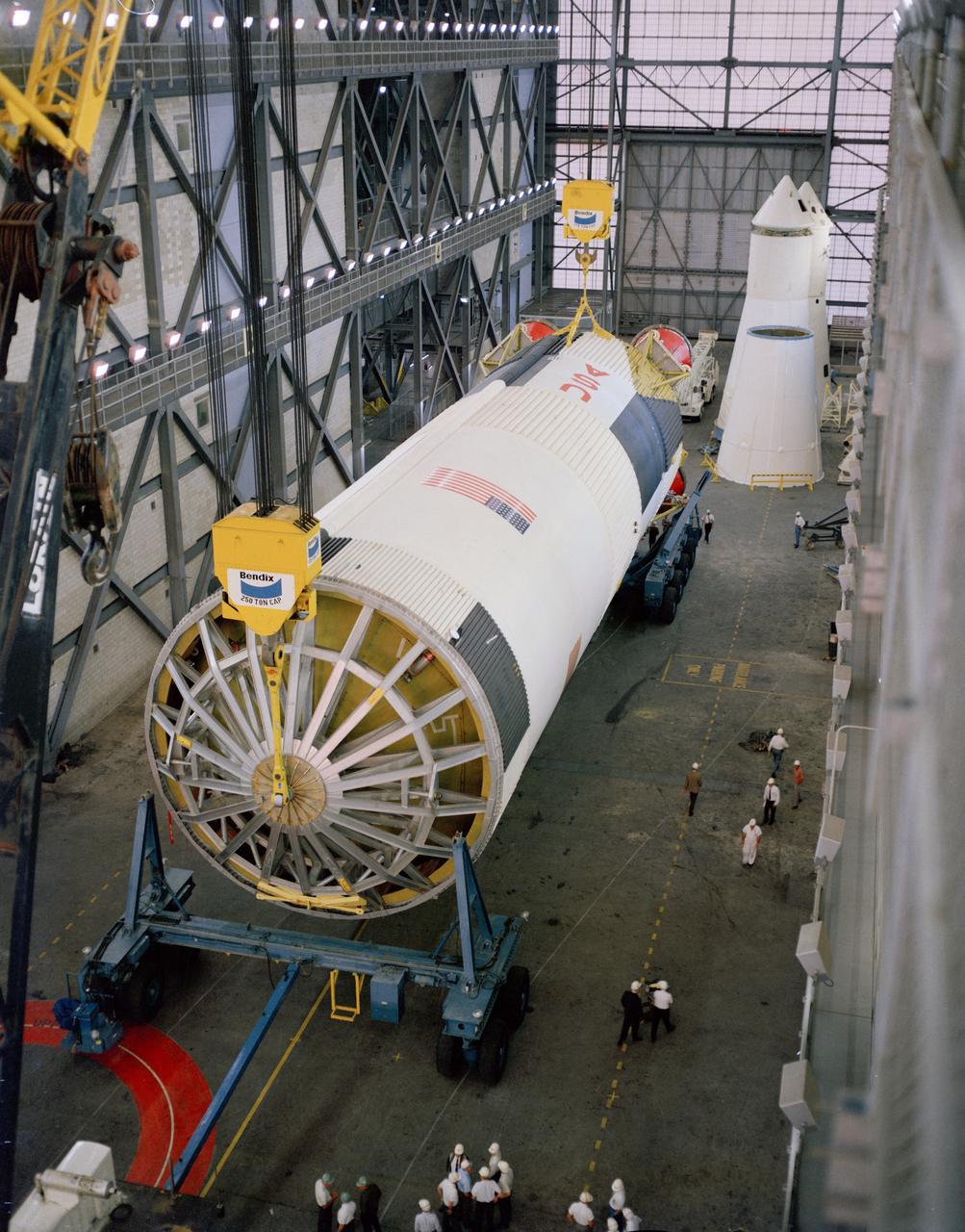
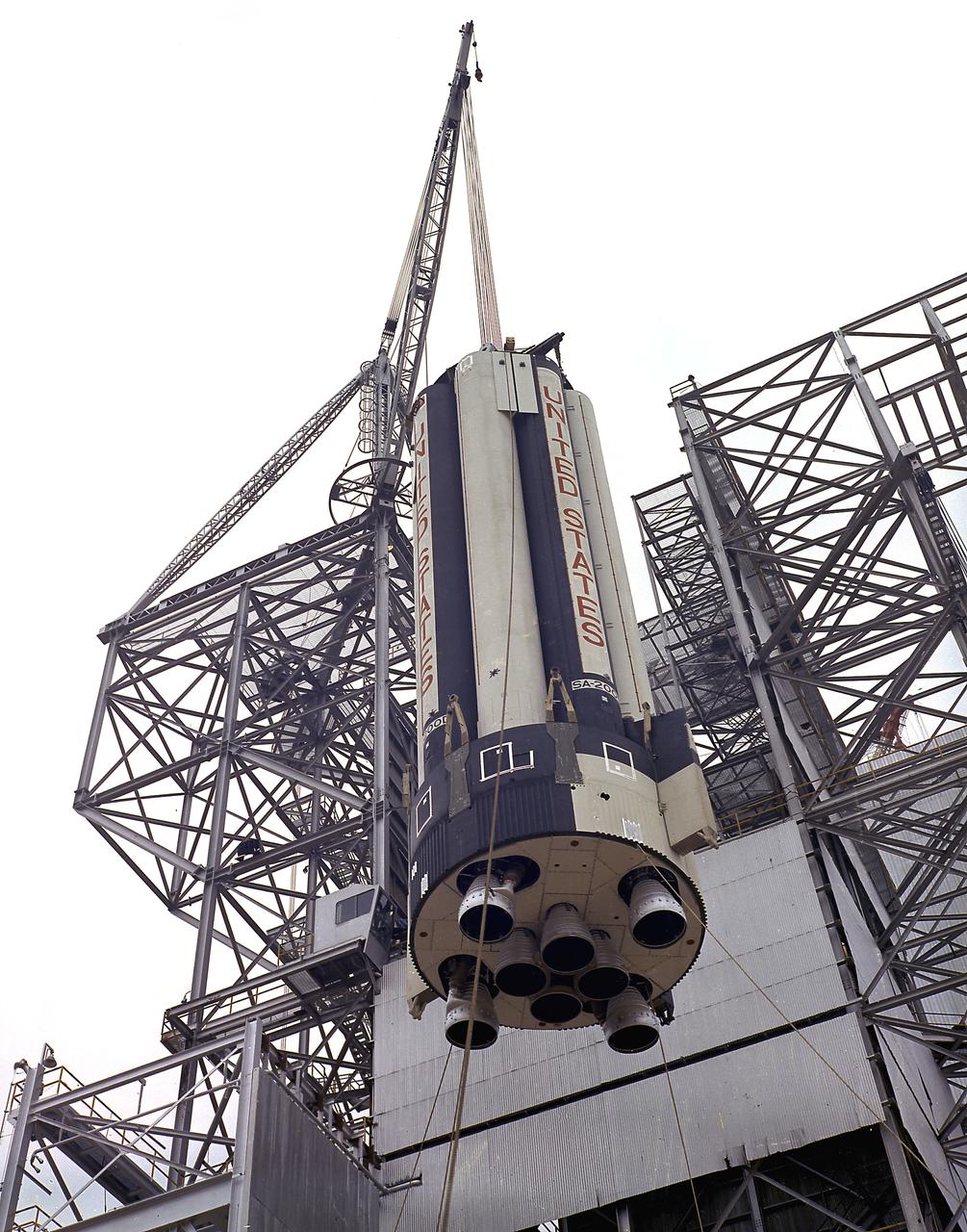
S68-55034 (3 Dec. 1968) --- The first (S-1C) stage of the Saturn 505 launch vehicle being prepared for erection in the high bay area of the Kennedy Space Center's (KSC) Vehicle Assembly Building (VAB). Saturn 505 is the launch vehicle for the Apollo 10 mission.
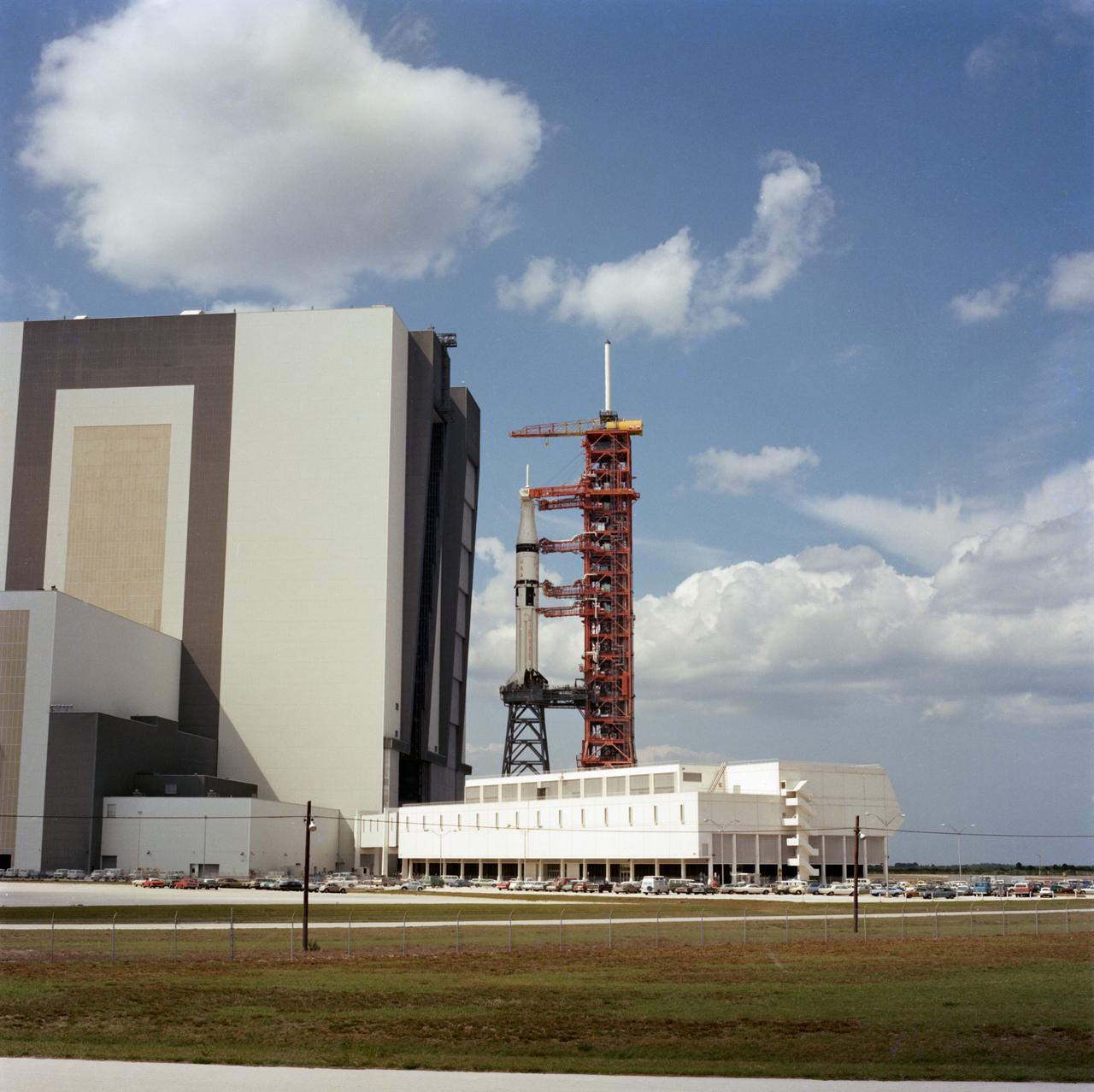
S75-24007 (24 March 1975) --- The Saturn 1B space vehicle for the Apollo-Soyuz Test Project mission, with its launch umbilical tower, rides atop a huge crawler-transporter as it moves slowly away from the Vehicle Assembly Building on its 4.24-mile journey to Pad B, Launch Complex 39, at NASA's Kennedy Space Center. The ASTP vehicle is composed of a Saturn 1B (first) stage, a Saturn IVB (second) stage, and a payload consisting of a Command/Service Module and a Docking Module. The joint U.S.-USSR ASTP docking mission in Earth orbit is scheduled for July 1975.
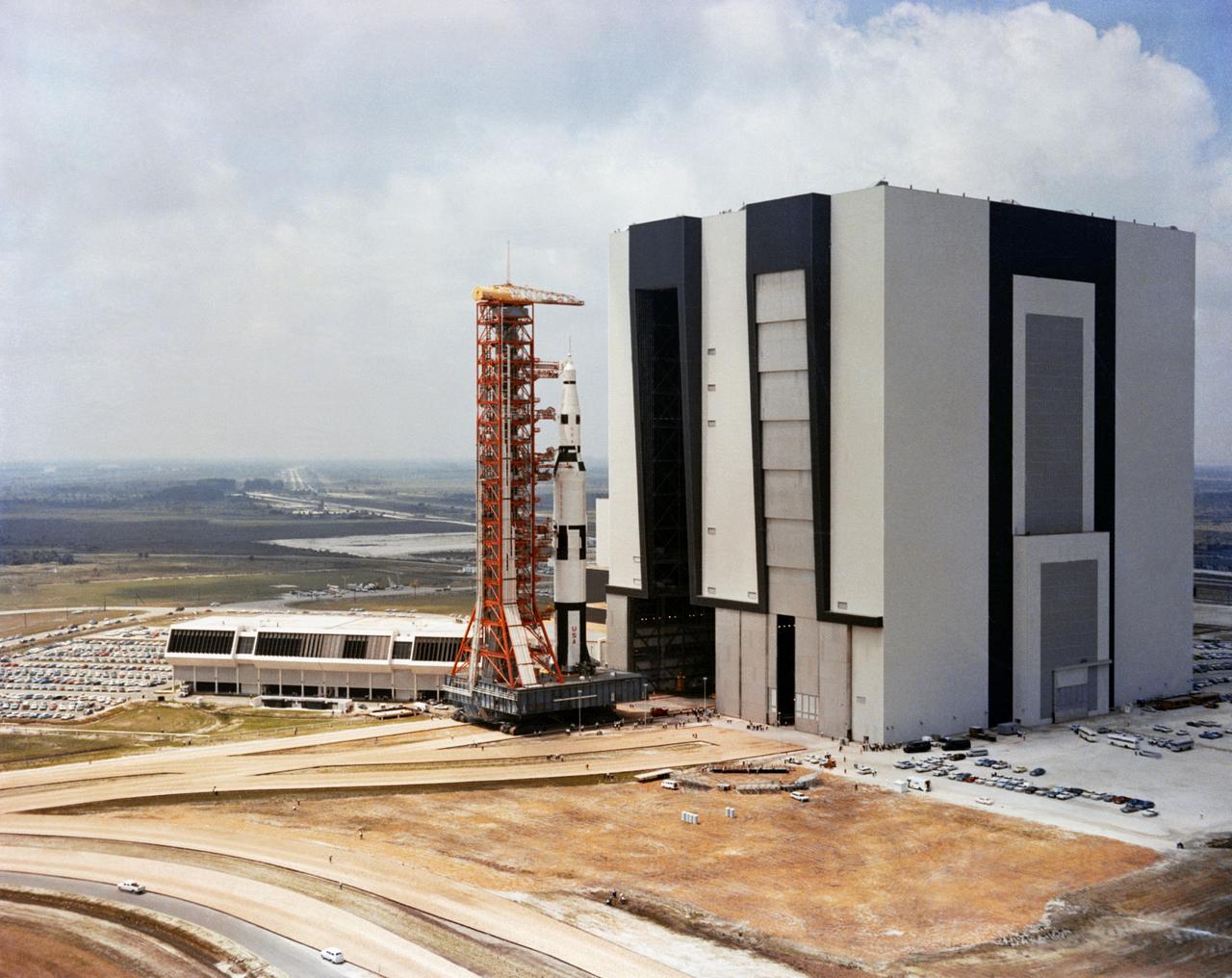
An Apollo/Saturn V facilities Test Vehicle and Launch Umbilical Tower (LUT) atop a crawler-transporter move from the Vehicle Assembly Building (VAB) on the way to Pad A. This test vehicle, designated the Apollo/Saturn 500-F, is being used to verify launch facilities, train launch crews, and develop test and checkout procedures.
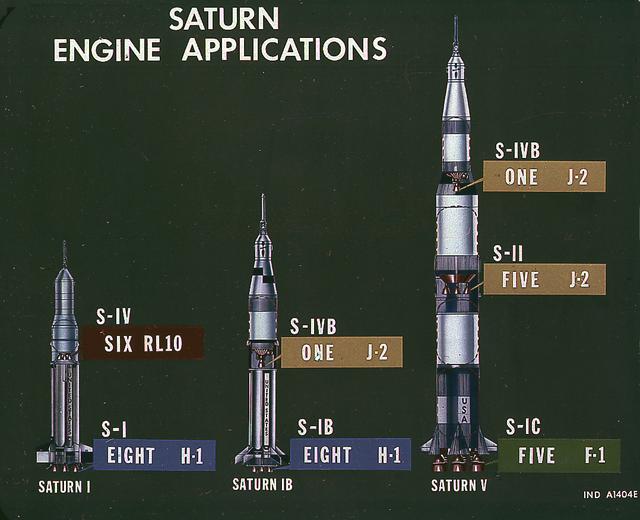
This image illustrates the basic differences between the three Saturn launch vehicles developed by the Marshall Space Flight Center. The Saturn I, consisted of two stages, the S-I (eight H-1 engines) and the S-IV (six RL-10 engines). The Saturn IB (center) also consisted of two stages, the S-IB (eight H-1 engines) and the S-IVB (one J-2 engine). The Saturn V consisted of three stages, the S-IC (five F-1 engines), the S-II (five J-2 engines), and the S-IVB (one J-2 engine).
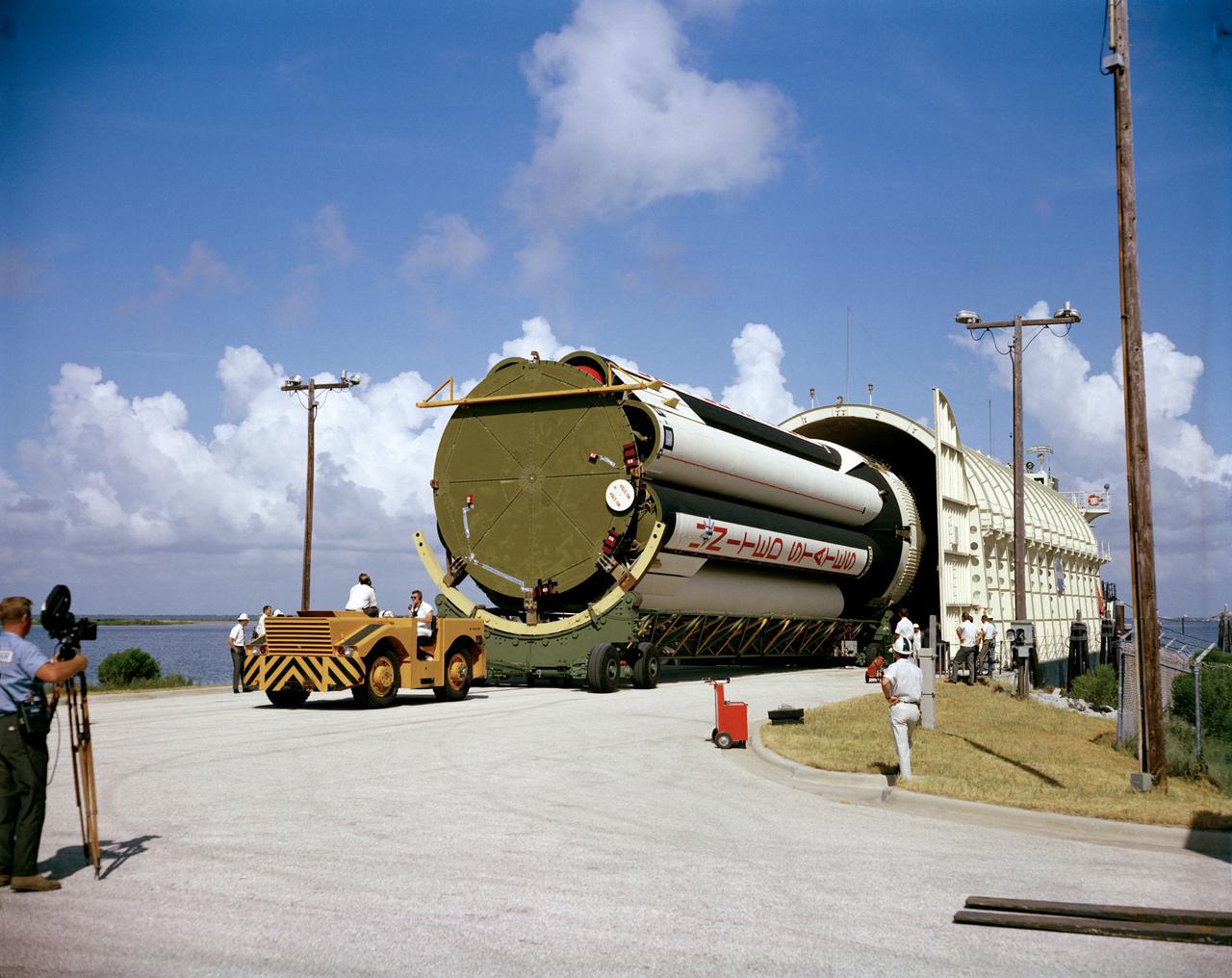
S66-50152 (1966) --- A stage of the uprated Saturn 1 launch vehicle unloaded from NASA barge Promise after arrival at Cape Kennedy. Launch vehicle for Apollo/Saturn 204 mission.
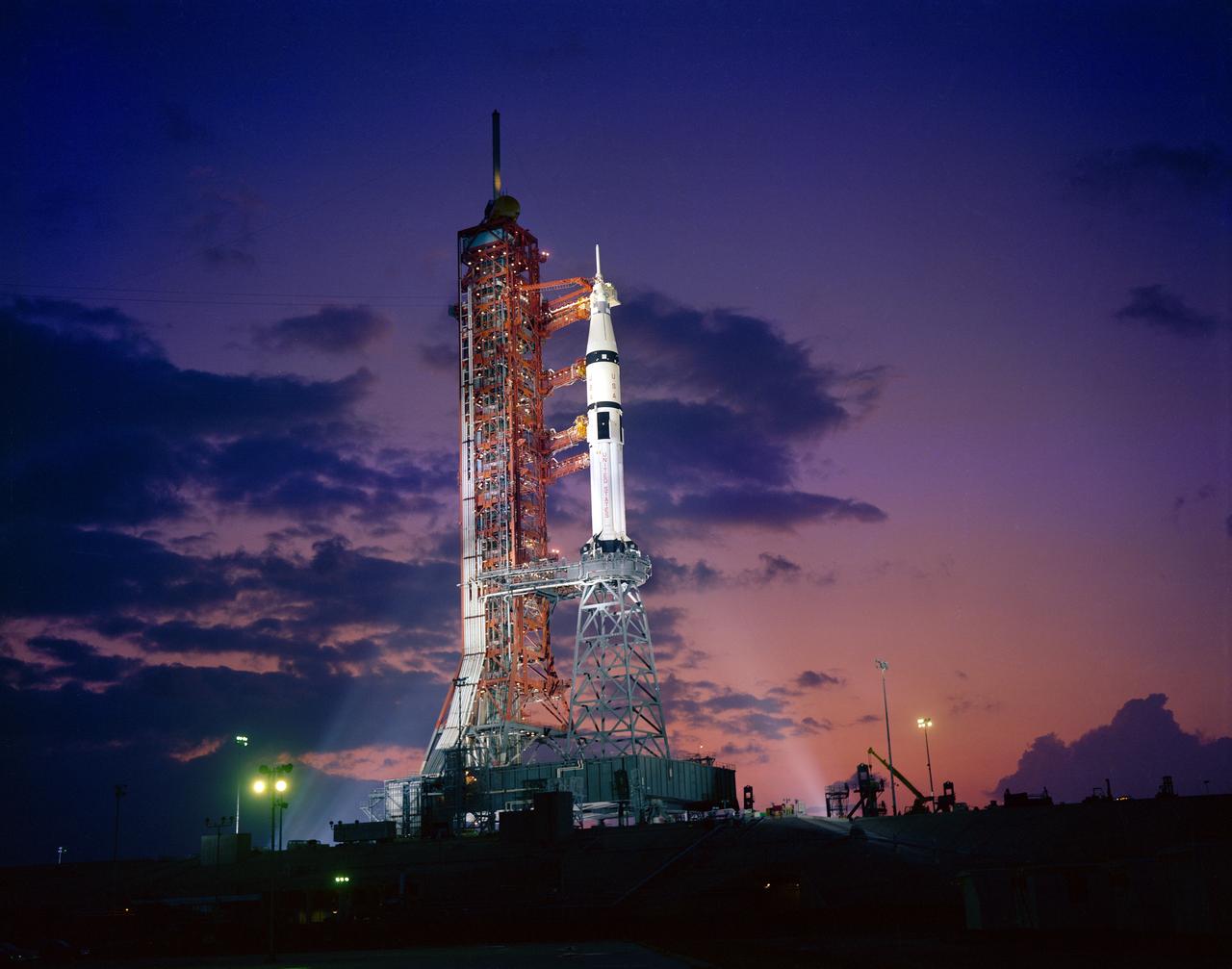
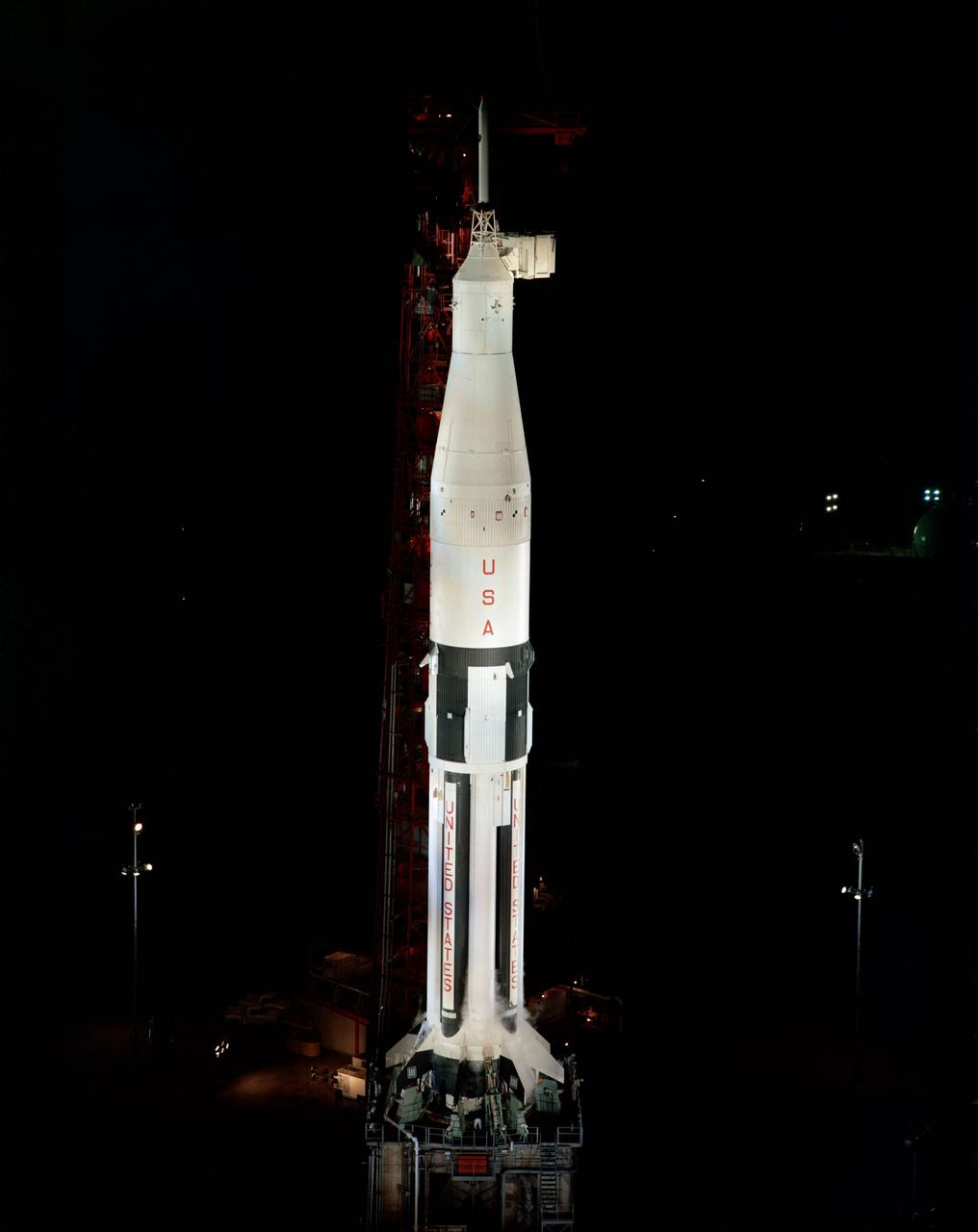
S75-28386 (2 July 1975) --- An early morning view of Pad B, Launch Complex 39, Kennedy Space Center, showing the ASTP Apollo/Saturn 1B space vehicle on the pad during Apollo-Soyuz Test Project prelaunch preparations. An ASTP countdown demonstration "wet" test (CDDT) was being conducted at KSC when this photograph was taken. The liftoff was on July 15, 1975.
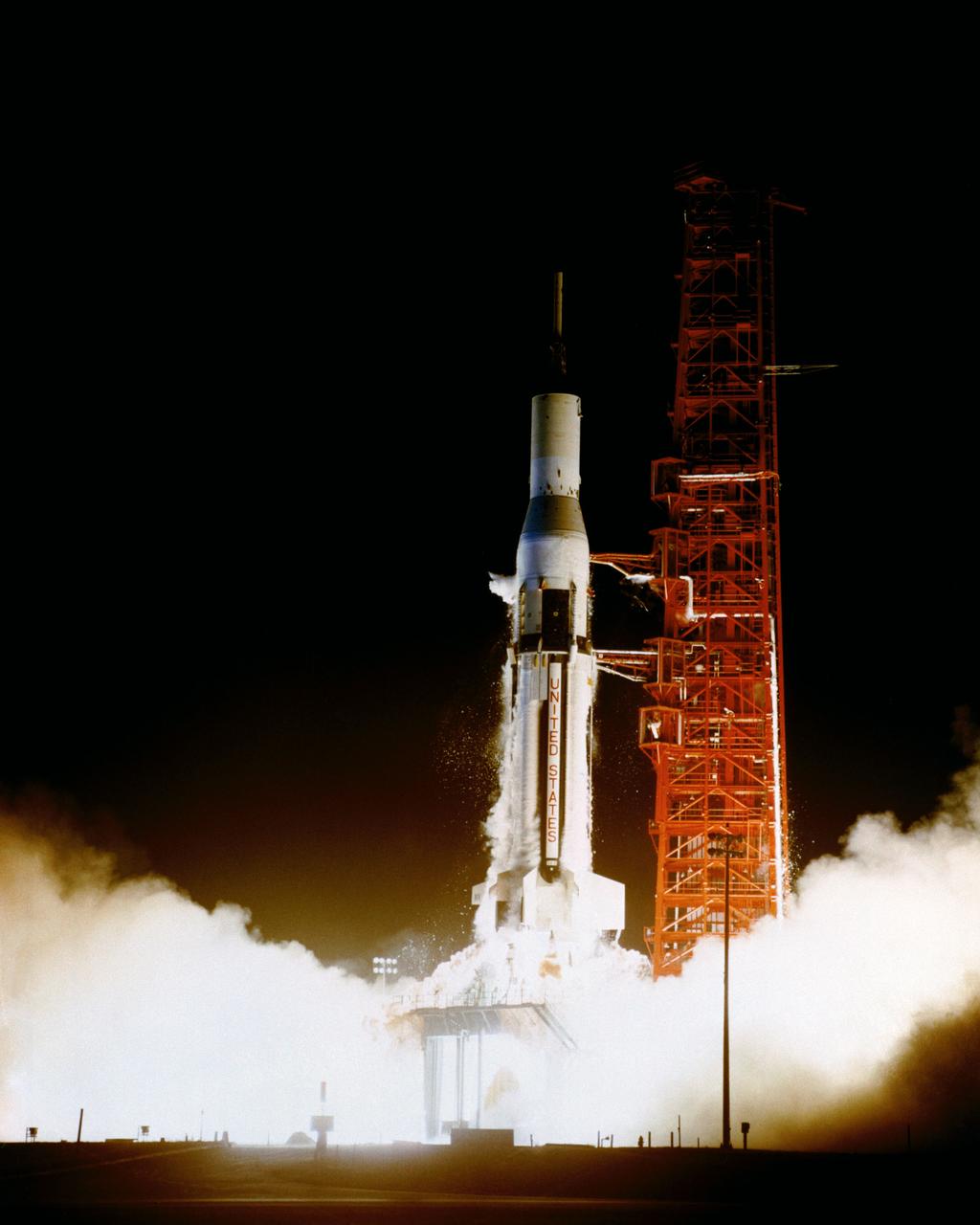
First night time launching of a Saturn I launch vehicle took place at 2:35 a.m., May 25, 1965, with the launch of the second Pegasus meteoroid detection satellite from Complex 37, Cape Kennedy, Florida.

This photograph depicts the Saturn V vehicle (SA-501) for the Apollo 4 mission in the Vehicle Assembly Building (VAB) at the Kennedy Space Center (KSC). After the completion of the assembly operation, the work platform was retracted and the vehicle was readied to rollout from the VAB to the launch pad. The Apollo 4 mission was the first launch of the Saturn V launch vehicle. Objectives of the unmanned Apollo 4 test flight were to obtain flight information on launch vehicle and spacecraft structural integrity and compatibility, flight loads, stage separation, and subsystems operation including testing of restart of the S-IVB stage, and to evaluate the Apollo command module heat shield. The Apollo 4 was launched on November 9, 1967 from KSC.
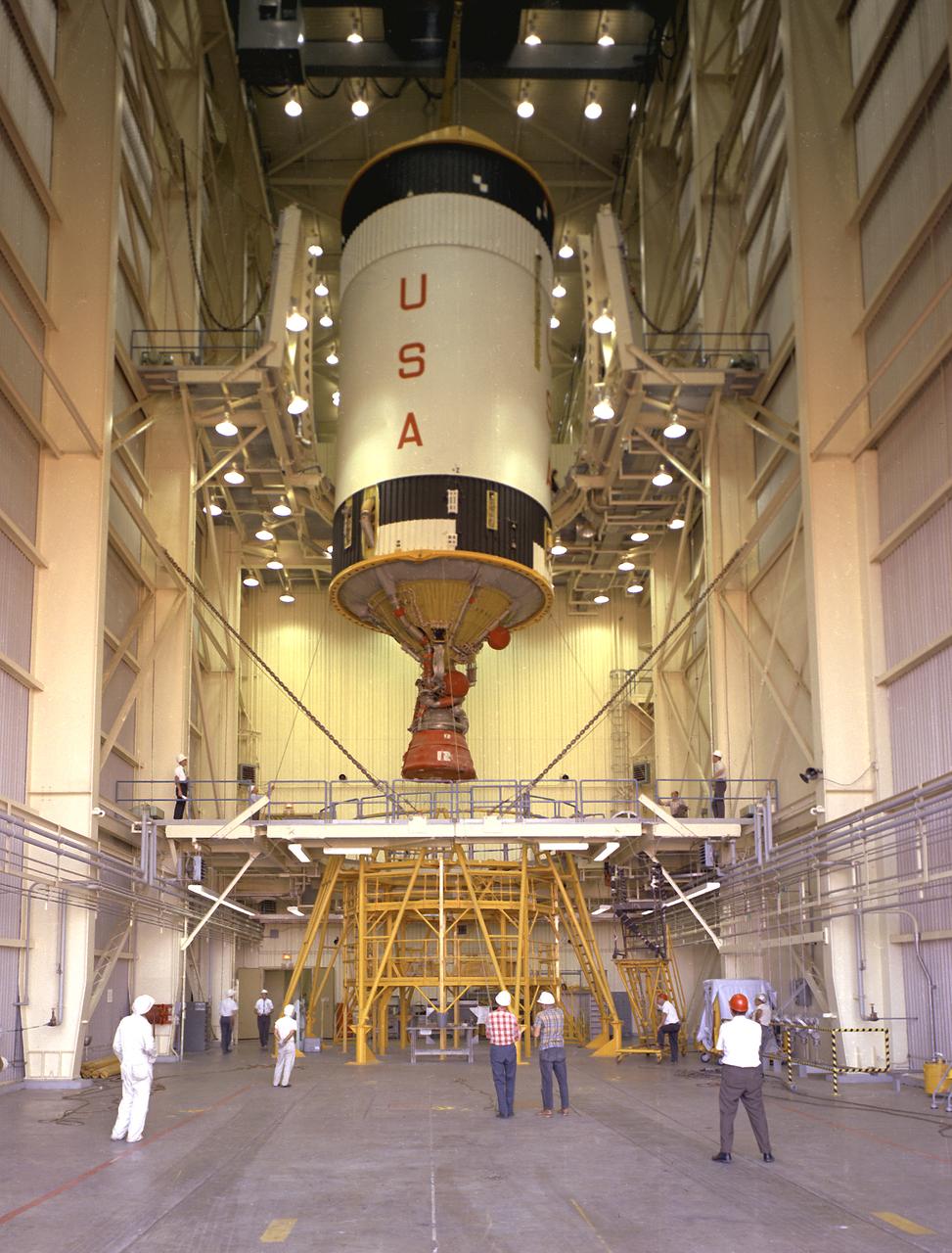
Workmen remove the Saturn IB S-IVB-206, the second flight stage for the Skylab 2 mission, from the vehicle assembly building at the Kennedy Space Center. Designed and developed by the Marshall Space Flight Center and the Douglas Aircraft Company in Sacramento, California, the stage was powered by a single J-2 engine, which produced 200,000 pounds of thrust, later uprated to 230,000 pounds for the Saturn V launch vehicle.
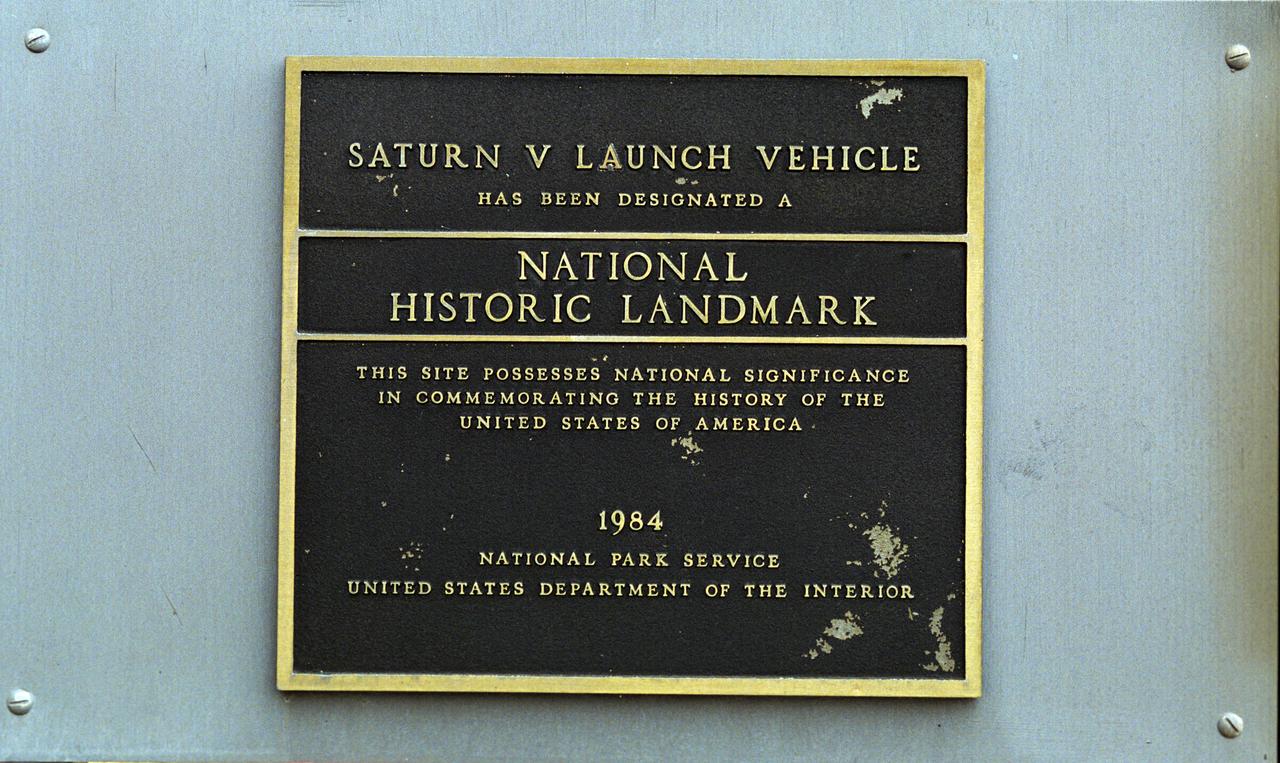
This plaque, displayed on the grounds of Marshall Space Flight Center in Huntsville, Alabama, commemorates the Saturn V Launch Vehicle as a National Historic Landmark. The site was designated as such in 1984 by the National Park Service of the United States Department of the Interior.
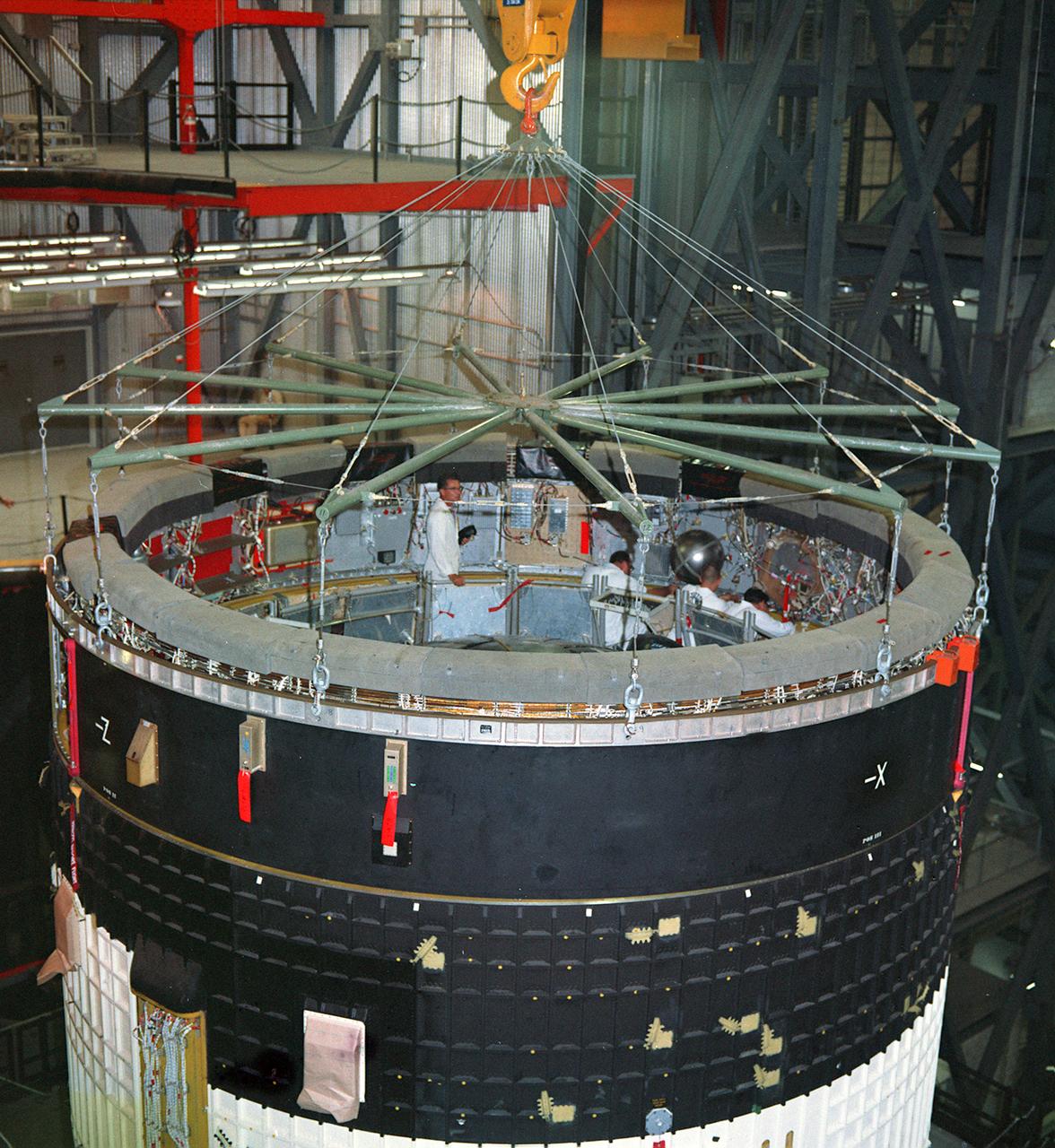
This photograph was taken during the final assembly operation of the Saturn V launch vehicle for the Apollo 4 (SA 501) mission. The instrument unit (IU) was mated atop the S-IC/S-II assembly in the Vehicle Assembly Building high bay at the Kennedy Space Center. The Apollo 4 mission was the first launch of the Saturn V launch vehicle. Objectives of the unmanned Apollo 4 test flight were to obtain flight information on launch vehicle and spacecraft structural integrity and compatibility, flight loads, stage separation, and subsystems operation including testing of restart of the S-IVB stage, and to evaluate the Apollo command module heat shield. The Apollo 4 was launched on November 9, 1967 from KSC.
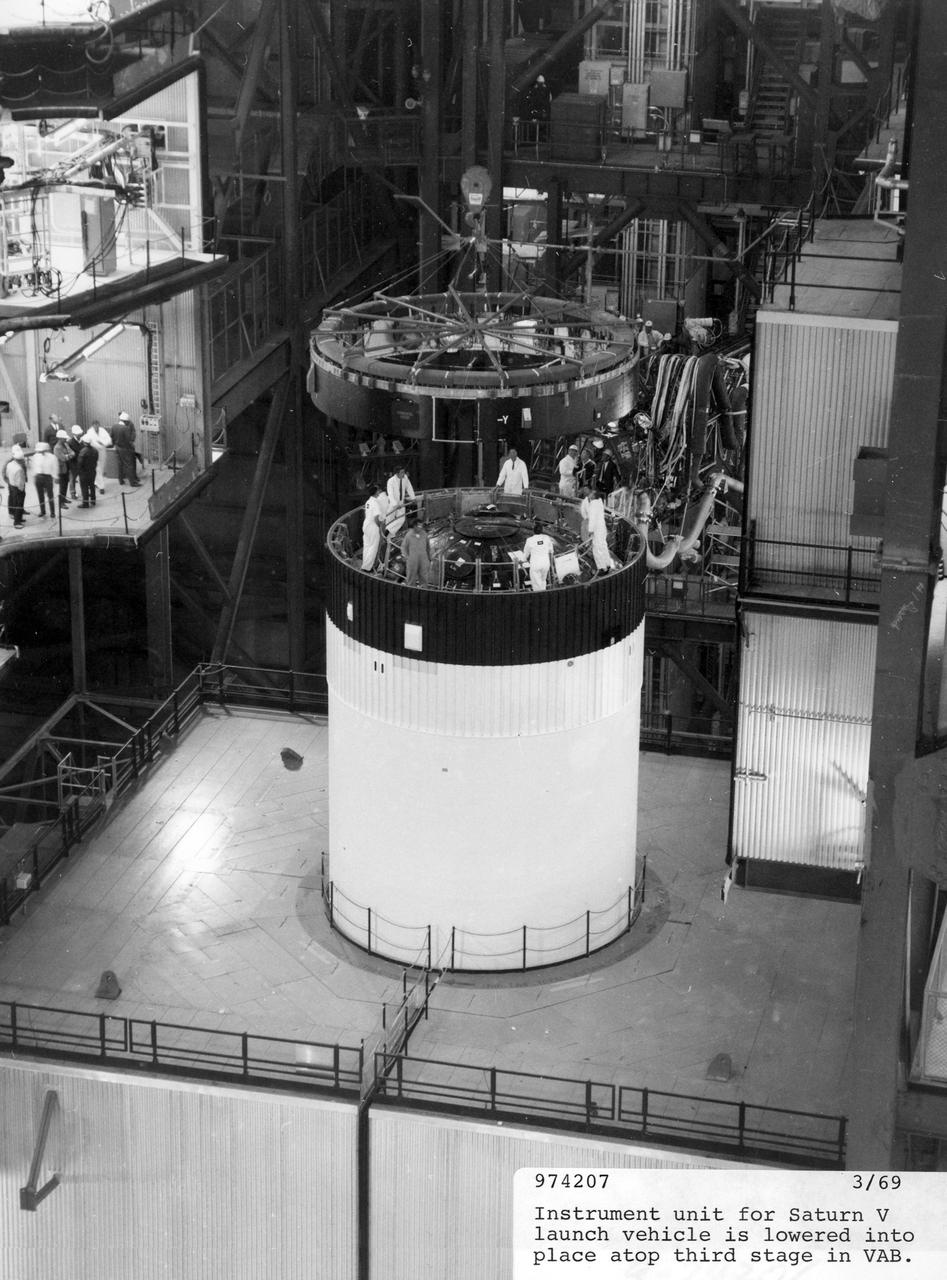
The instrument unit for the Saturn V launch vehicle, AS-506, used to propel the Apollo 11 lunar landing mission, is lowered into place atop the third (S-IVB) stage in the vehicle assembly building at the NASA Kennedy Space Center (KSC). Designed by the NASA Marshall Space Flight Center (MSFC), the instrument unit served as the Saturn’s “nerve center” providing guidance and control, command and sequence of vehicle functions, telemetry, and environmental control. The Apollo 11 mission launched from KSC in Florida via the MSFC developed Saturn V launch vehicle on July 16, 1969 and safely returned to Earth on July 24, 1969. Astronauts onboard included Neil A. Armstrong, commander; Michael Collins, Command Module (CM) pilot; and Edwin E. Aldrin, Jr., Lunar Module (LM) pilot. The CM, “Columbia”, piloted by Collins, remained in a parking orbit around the Moon while the LM, “Eagle’’, carrying astronauts Armstrong and Aldrin, landed on the Moon. On July 20, 1969, Armstrong was the first human to ever stand on the lunar surface, followed by Aldrin. During 2½ hours of surface exploration, the crew collected 47 pounds of lunar surface material for analysis back on Earth. With the success of Apollo 11, the national objective to land men on the Moon and return them safely to Earth had been accomplished
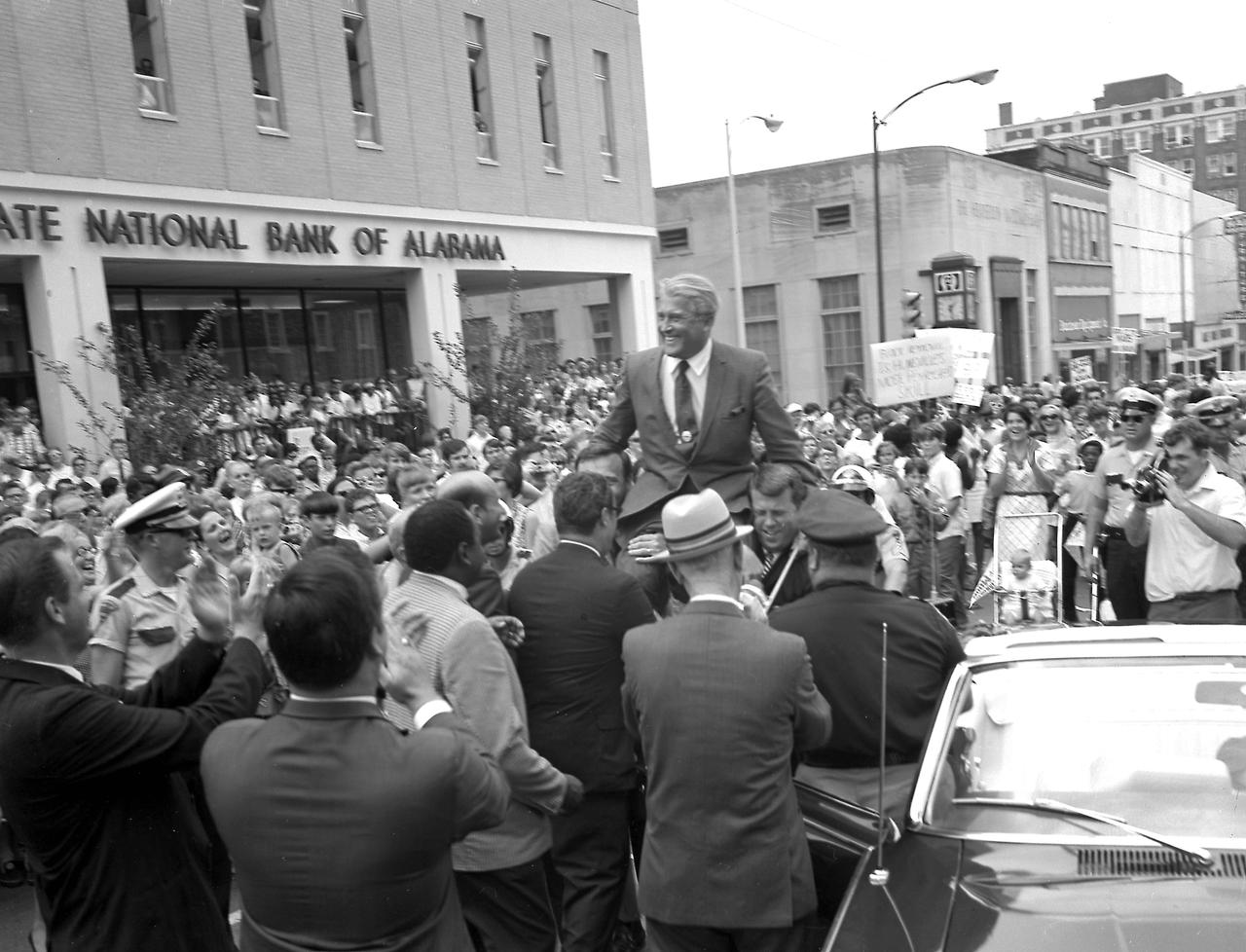
Dr. von Braun is carried aloft on the shoulders of Huntsville city officials during the Apollo 11 celebration in Huntsville, Alabama, on July 24, 1969. Huntsville, Alabama is the home of the Marshall Space Flight Center which developed the Saturn vehicles under the direction of Dr. von Braun. The Apollo 11 lifted off in July and made the first marned lunar landing on the Moon.

S73-25140 (16 April 1973) --- A ground-level view of Pad A, Launch Complex 39, Kennedy Space Center, Florida, showing the 341-feet tall Skylab 1/Saturn V space vehicle on the pad soon after being rolled out from the Vehicle Assembly Building (VAB). The vehicle is composed of the Saturn V first (S-1C) stage, the Apollo Telescope Mount (ATM), the Multiple Docking Adapter (MDA), the Airlock Module (AM), and the Orbital Workshop (OWS). Photo credit: NASA
This picture shows the Saturn V vehicle (AS-501), for the Apollo 4 mission on the Crawler Transporter Vehicle. It was rolled out from the Vehicle Assembly Building and slowly (1 mph) moved to the launch pad at the Kennedy Space Center (KSC). The Apollo 4 mission was the first launch of the Saturn V launch vehicle. Objectives of the unmanned Apollo 4 test flight were to obtain flight information on launch vehicle and spacecraft structural integrity and compatibility, flight loads, stage separation, and subsystems operation including testing of restart of the S-IVB stage, and to evaluate the Apollo command module heat shield. The Apollo 4 was launched on November 9, 1967 from KSC.
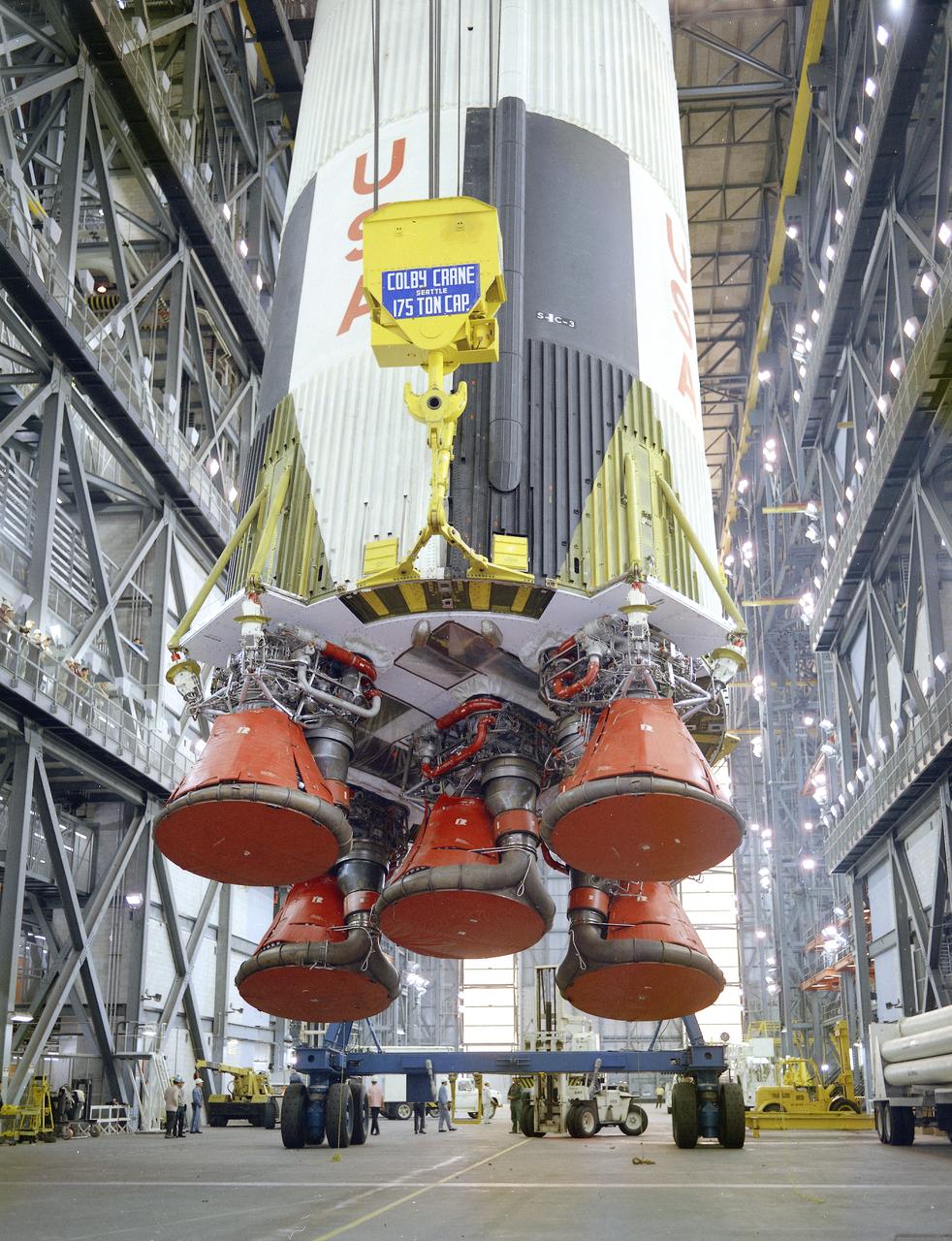
The S-IC stage being erected for the final assembly of the Saturn V launch vehicle for the Apollo 8 mission (AS-503), is photographed in the Vehicle Assembly Building (VAB) high bay at the Kennedy Space Center. The Apollo 8 mission was the first Saturn V manned mission with astronauts Frank Borman, James A. Lovell, and William Anders. They escaped Earth's gravity and traveled to lunar vicinity. The launch of Apollo 8 occurred on December 21, 1968.
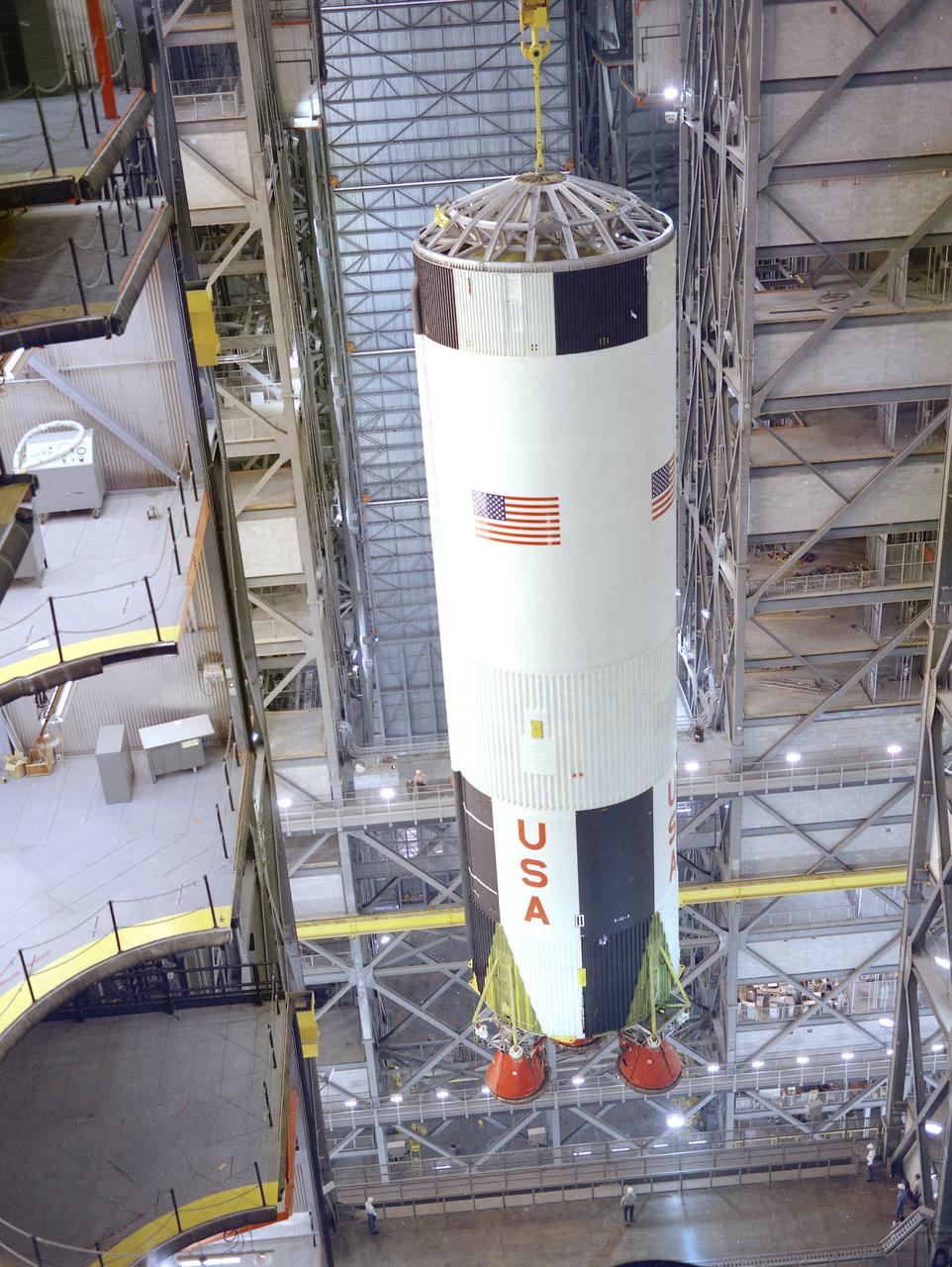
The S-IC stage being erected for the final assembly of the Saturn V launch vehicle for the Apollo 8 mission (AS-503), is photographed in the Vehicle Assembly Building (VAB) high bay at the Kennedy Space Center. The Apollo 8 mission was the first Saturn V manned mission with astronauts Frank Borman, James A. Lovell, and William Anders. They escaped Earth's gravity and traveled to lunar vicinity. The launch of Apollo 8 occurred on December 21, 1968.
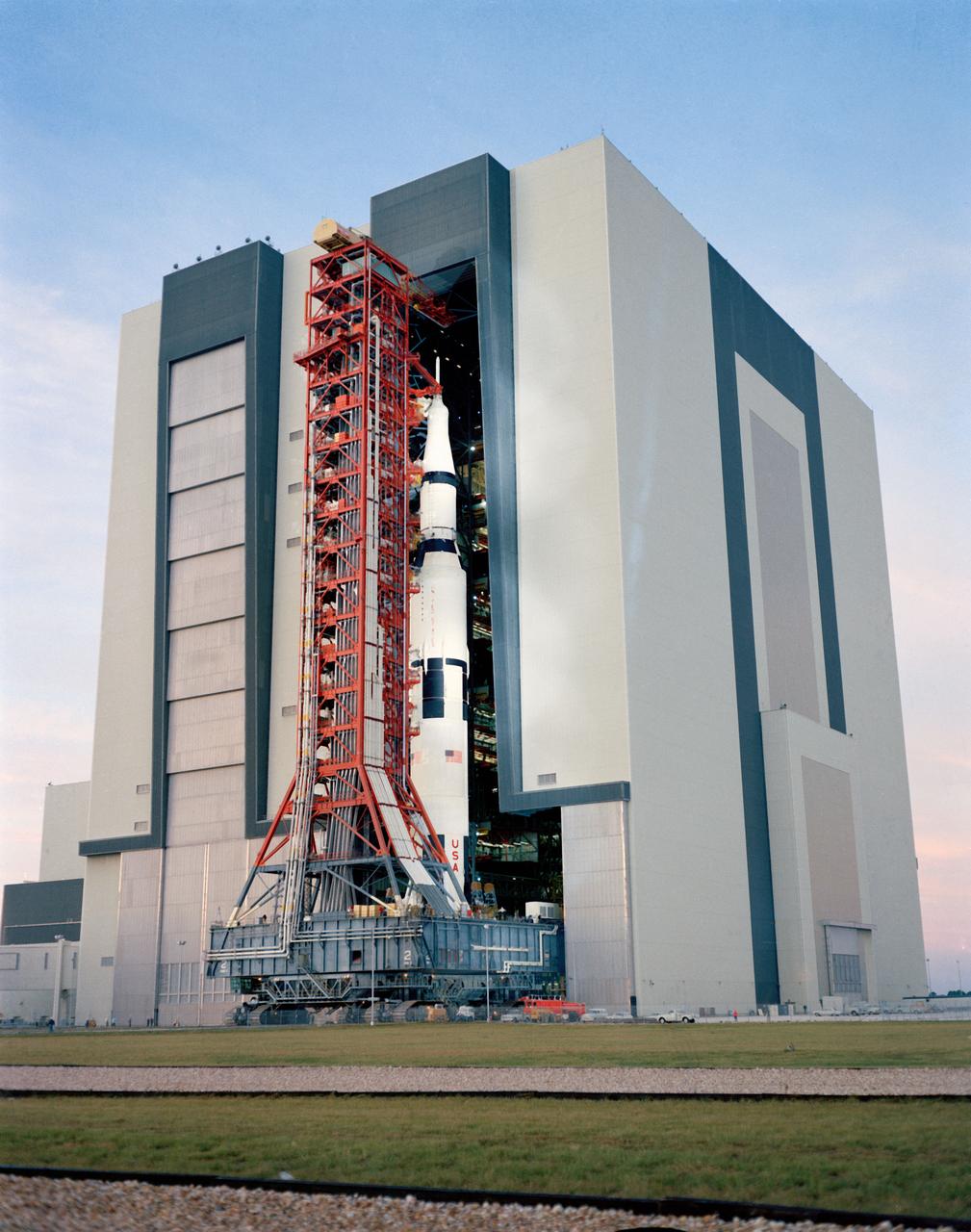
S70-54121 (9 Nov. 1970) --- A ground level view at Launch Complex 39, Kennedy Space Center (KSC), showing the Apollo 14 (Spacecraft 110/Lunar Module 8/Saturn 509) space vehicle leaving the Vehicle Assembly Building (VAB). The Saturn V stack and its mobile launch tower, atop a huge crawler-transporter, were rolled out to Pad A. The Apollo 14 crewmen will be astronauts Alan B. Shepard Jr., commander; Stuart A. Roosa, command module pilot; and Edgar D. Mitchell, lunar module pilot.
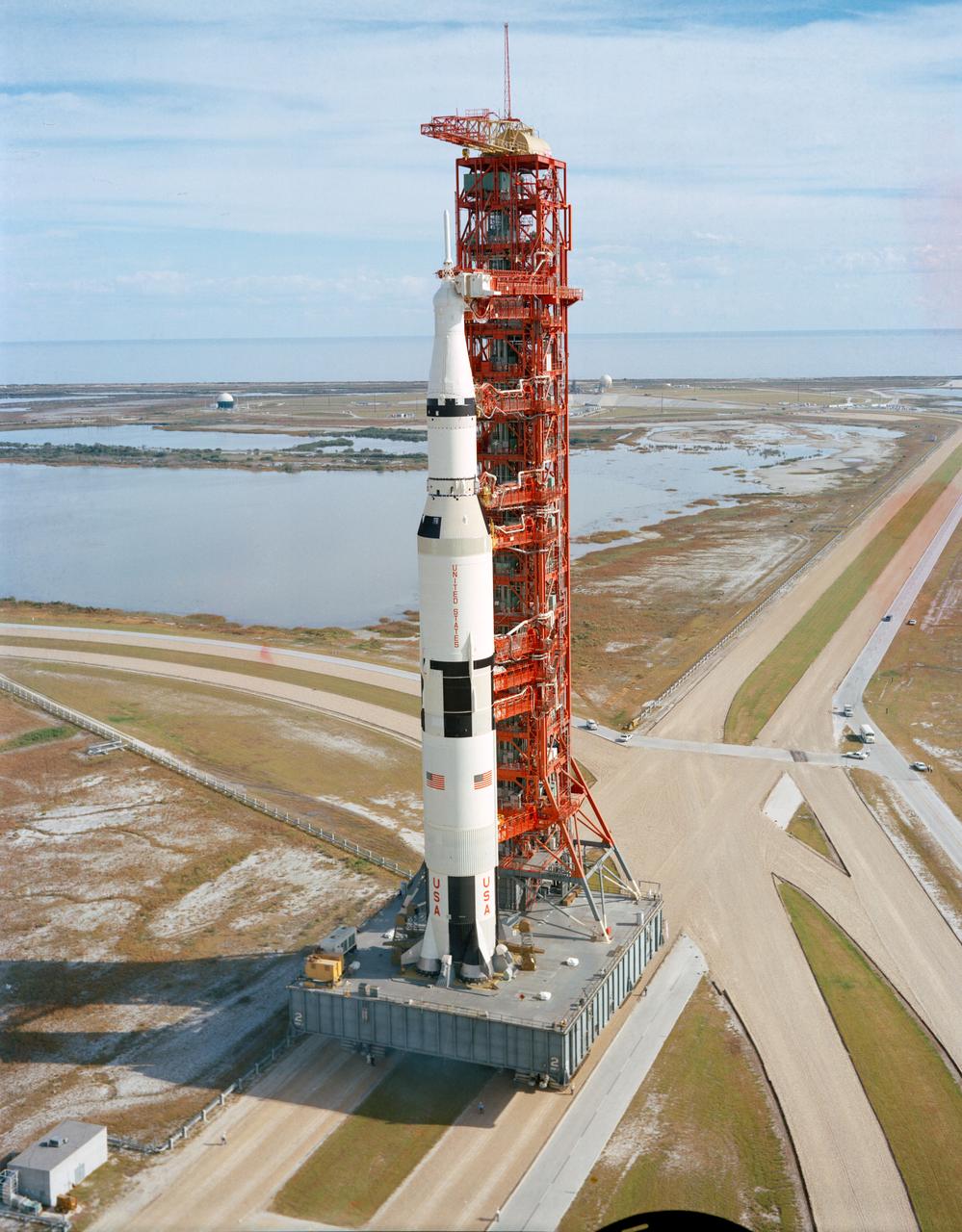
S70-54127 (9 Nov. 1970) --- A high-angle view at Launch Complex 39, Kennedy Space Center (KSC), showing the Apollo 14 (Spacecraft 110/Lunar Module 8/Saturn 509) space vehicle on the way from the Vehicle Assembly Building (VAB) to Pad A. The Saturn V stack and its mobile launch tower sit atop a huge crawler-transporter. The Apollo 14 crewmen will be astronauts Alan B. Shepard Jr., commander; Stuart A. Roosa, command module pilot; and Edgar D. Mitchell, lunar module pilot.
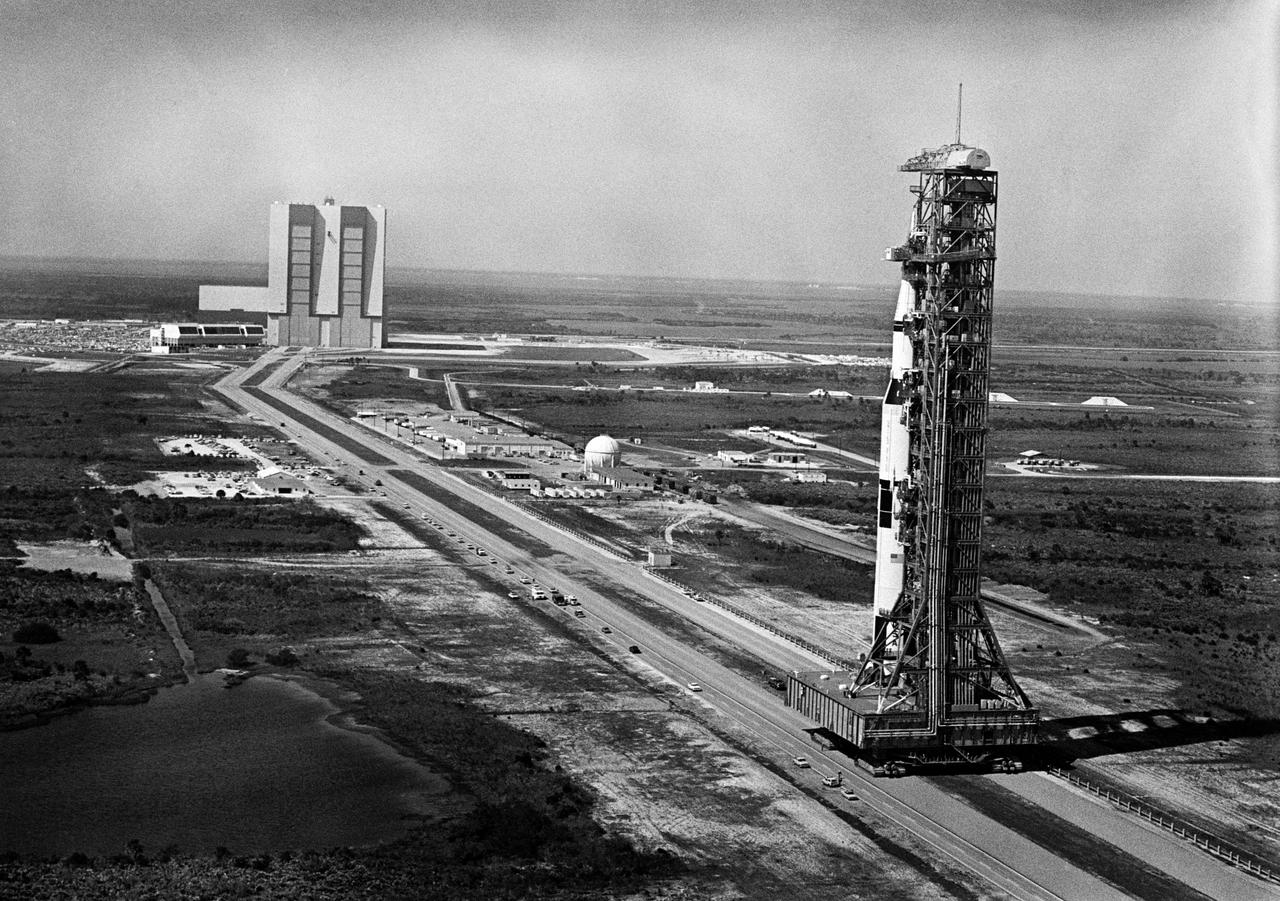
S69-27741 (11 March 1969) --- Aerial view at Launch Complex 39, Kennedy Space Center, showing the 363-feet tall Apollo 10 (Spacecraft 106/Lunar Module-4/Saturn 505) space vehicle on its way to Pad B. The Vehicle Assembly Building is in the background. The Saturn V stack and its mobile launch tower are atop a huge crawler-transporter. The Apollo 10 flight is schedule as a lunar orbit mission. The Apollo 10 crew will be astronauts Thomas P. Stafford, commander; John W. Young, command module pilot; and Eugene A. Cernan, lunar module pilot.
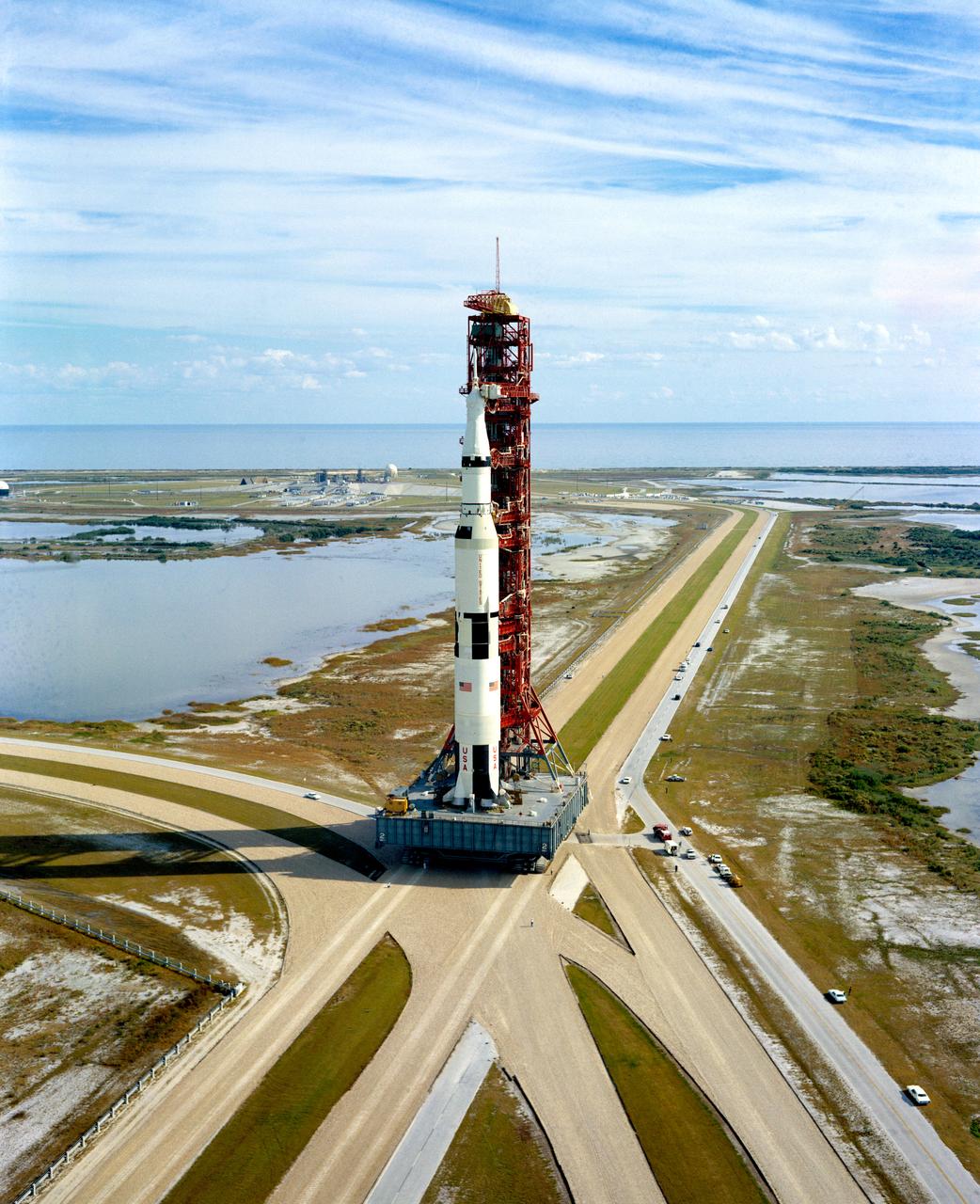
S70-54119 (9 Nov. 1970) --- A high-angle view at Launch Complex 39, Kennedy Space Center (KSC), showing the Apollo 14 (Spacecraft 110/Lunar Module 8/Saturn 509) space vehicle on the way from the Vehicle Assembly Building (VAB) to Pad A. The Saturn V stack and its mobile launch tower sit atop a huge crawler-transporter. The Apollo 14 crewmen will be astronauts Alan B. Shepard Jr., commander; Stuart A. Roosa, command module pilot; and Edgar D. Mitchell, lunar module pilot.
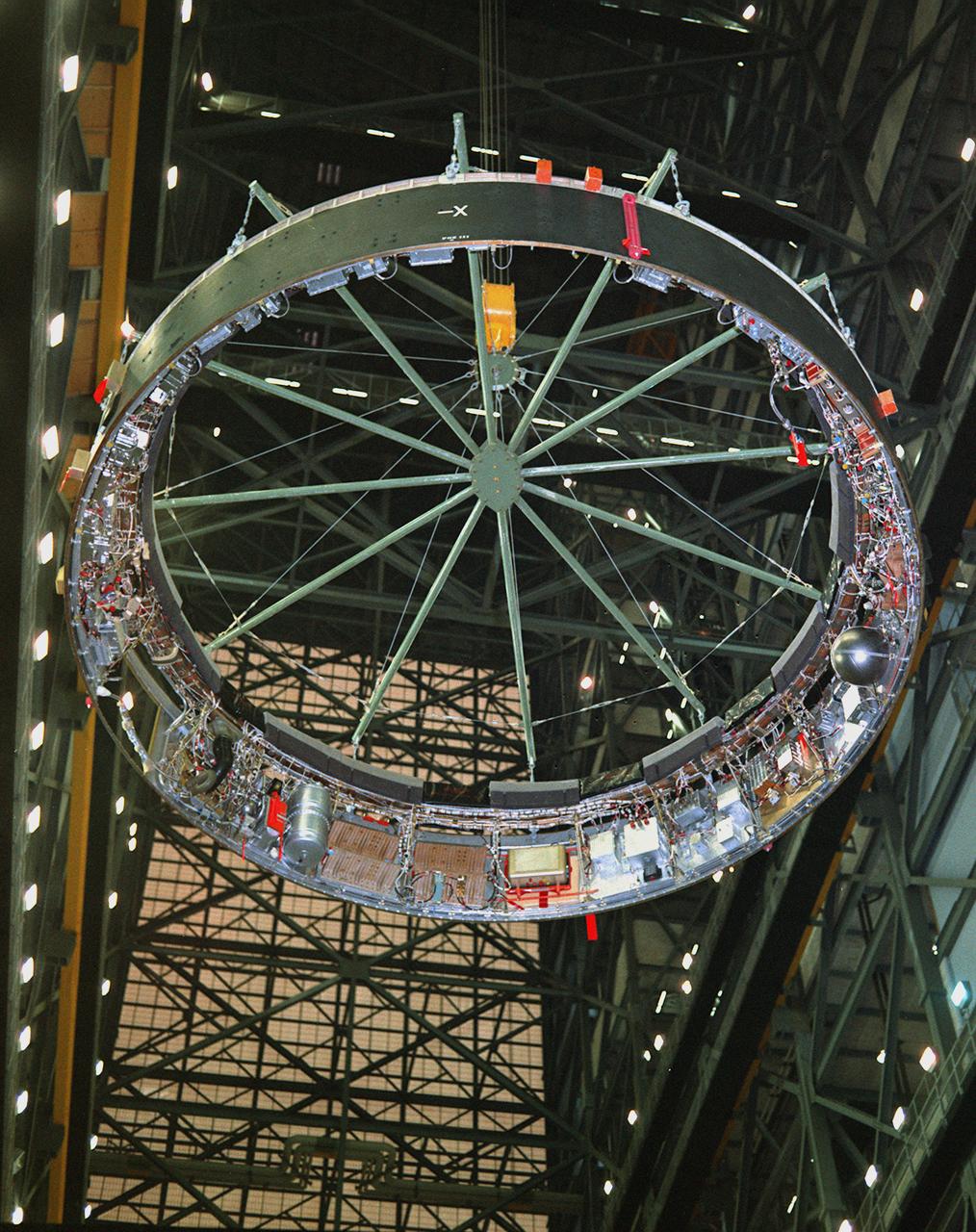
This photograph was taken during the final assembly operation of the Saturn V launch vehicle for the Apollo 4 (SA 501) mission. The instrument unit (IU) was hoisted to be mated to the S-IC/S-II assembly in the Vehicle Assembly Building high bay at the Kennedy Space Center. The Apollo 4 mission was the first launch of the Saturn V launch vehicle. Objectives of the unmanned Apollo 4 test flight were to obtain flight information on launch vehicle and spacecraft structural integrity and compatibility, flight loads, stage separation, and subsystems operation including testing of restart of the S-IVB stage, and to evaluate the Apollo command module heat shield. The Apollo 4 was launched on November 9, 1967 from KSC.
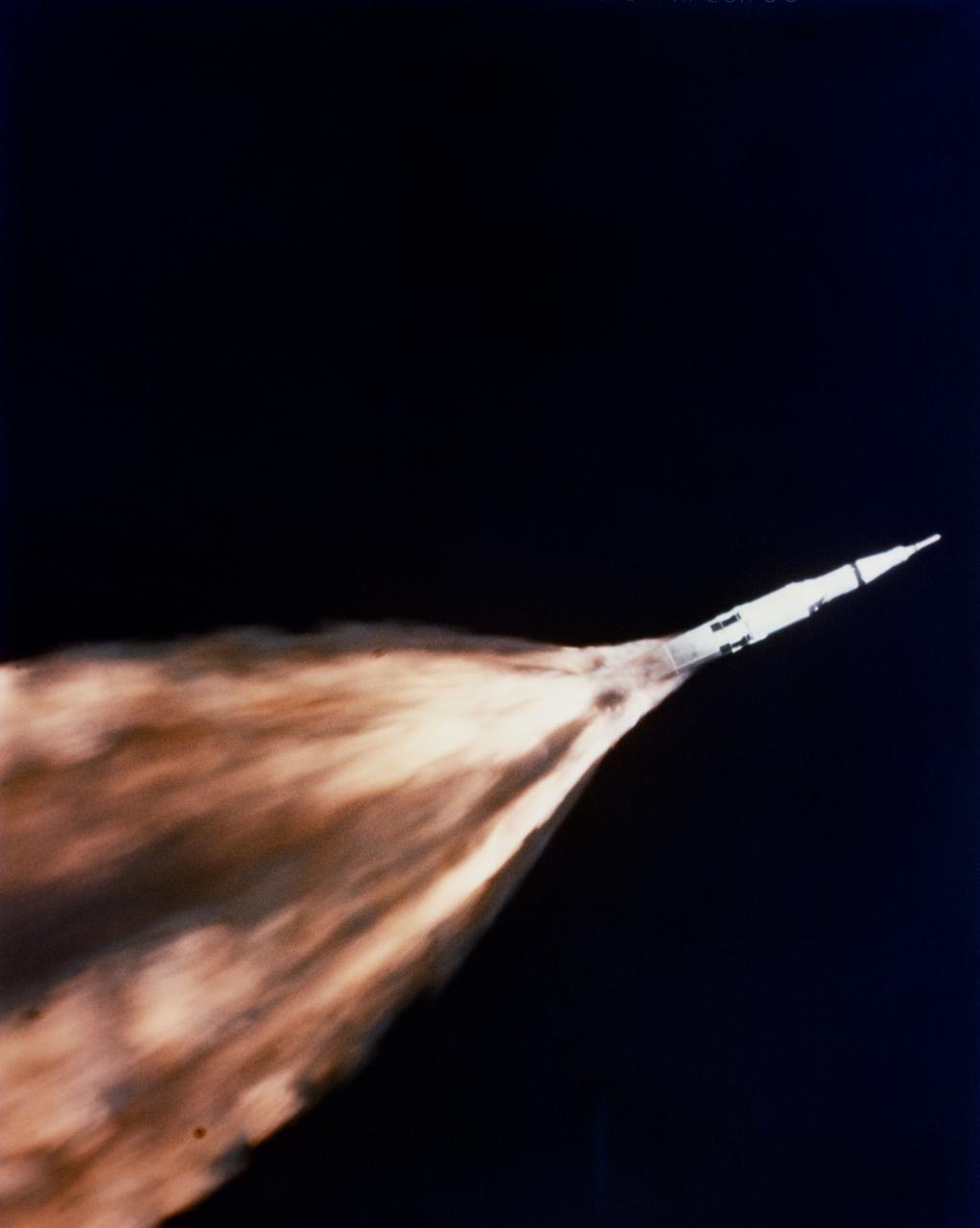
S68-27365 (4 April 1968) --- The five F-1 engines of the huge Apollo/Saturn V space vehicle's first (S-IC) stage leave a gigantic trail of flame in the sky above the Kennedy Space Center seconds after liftoff. The launch of the Apollo 6 (Spacecraft 020/Saturn 502) unmanned space mission occurred at 07:00:01.5 (EST), April 4, 1968. This view of the Apollo 6 launch was taken from a chase plane.
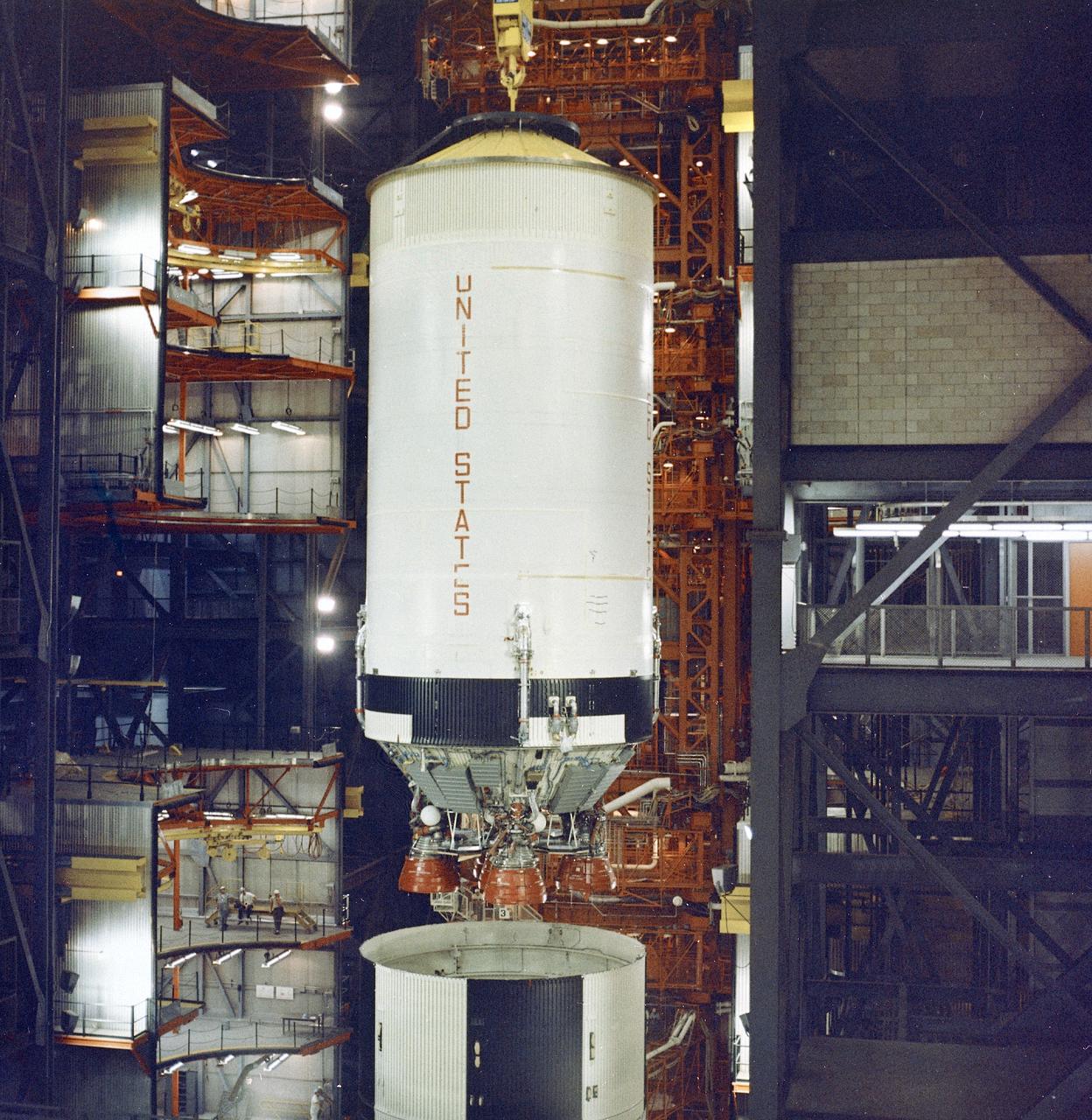
This photograph shows the Saturn V S-II (second) stage of the Apollo 6 mission being lowered atop of the S-IC (first) stage during the final assembly operations in the Vehicle Assembly Building (VAB) at the Kennedy Space Center. The Apollo 6 mission was the second Saturn V unmanned flight for testing an emergency detection system. The launch occurred on April 4, 1968.

S69-27916 (11 March 1969) --- Aerial view at Launch Complex 39, Kennedy Space Center, showing the Apollo 10 (Spacecraft 106/Lunar Module-4/Saturn 505) space vehicle on its way to Pad B. The Saturn V stack and its mobile launch tower are atop a huge crawler-transporter. The Apollo 10 flight is scheduled as a lunar orbit mission. The Apollo 10 crew will be astronauts Thomas P. Stafford, commander; John W. Young, command module pilot; and Eugene A. Cernan, lunar module pilot.
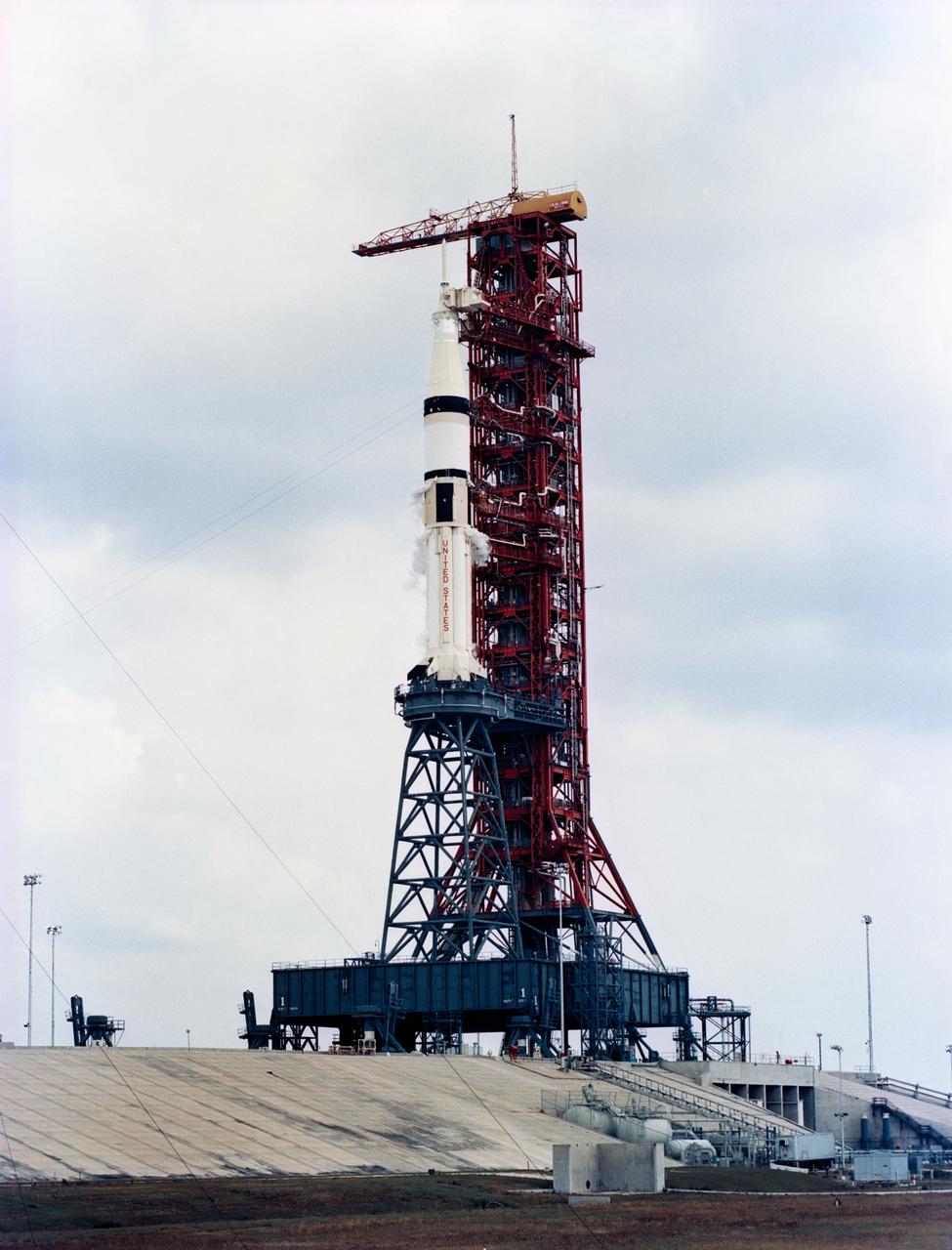
S73-25696 (15 May 1973) --- An overall view of Pad B, Launch Complex 39, Kennedy Space Center, Florida, showing the Skylab 2/Saturn 1B space vehicle during a Countdown Demonstration Test (CDDT). This is the launch vehicle for the first manned Skylab mission. The vapor being emitted from the vehicle is the venting of cryogenic propellants. Photo credit: NASA
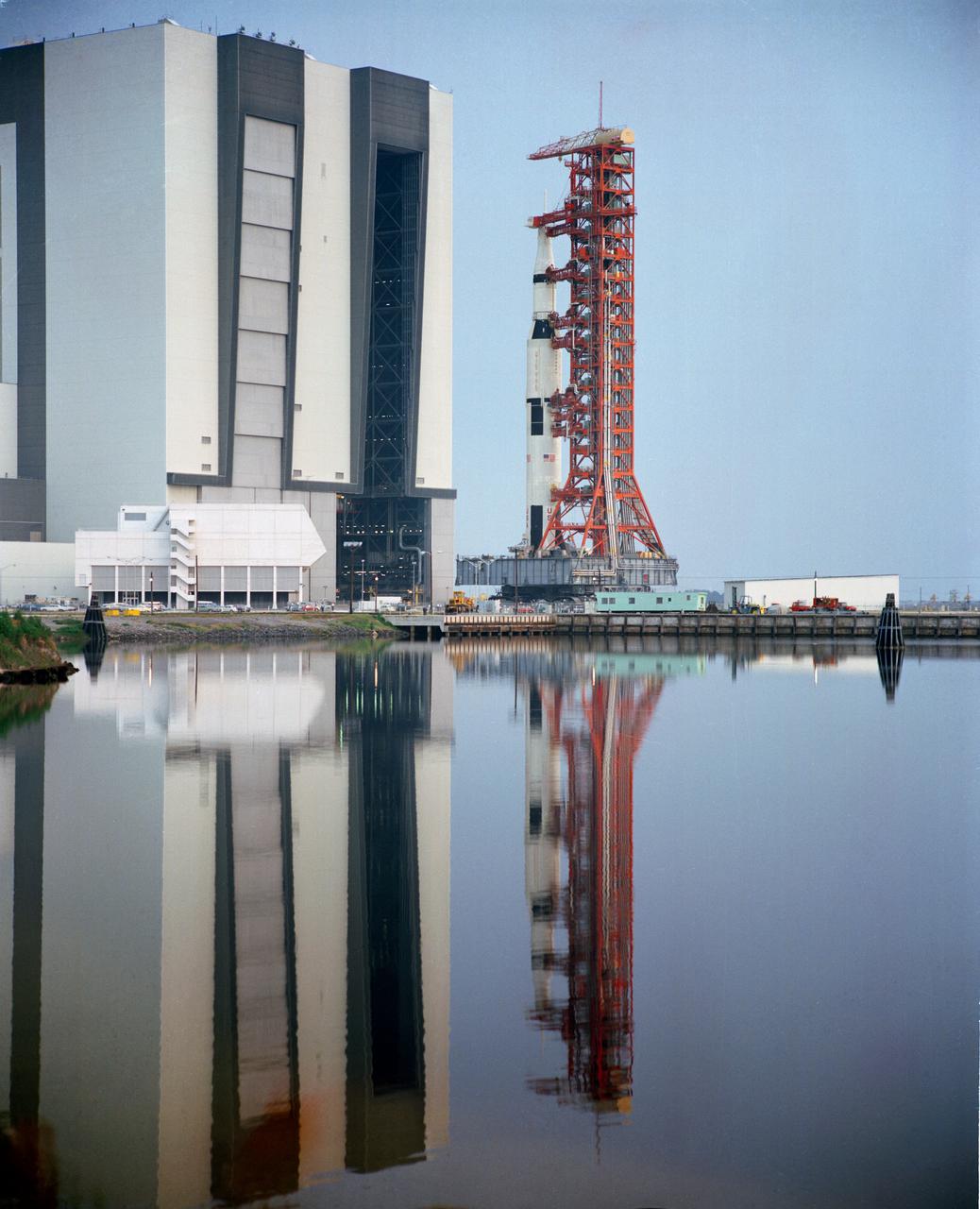
S71-33786 (11 May 1971) --- The 363-feet tall Apollo (Spacecraft 112/Lunar Module 10/Saturn 510) space vehicle which leaves the Vehicle Assembly Building (VAB) to Pad A, Launch Complex 39, Kennedy Space Center (KSC). The Saturn V stack and its mobile launch tower are atop a huge crawler-transporter. Apollo 15 is scheduled as the fourth manned lunar landing mission by the National Aeronautics and Space Administration (NASA) and is scheduled to lift off on July 26, 1971. The crew men will be astronauts David R. Scott, commander; Alfred M. Worden, command module pilot; and James B. Irwin, lunar module pilot. While astronaut Scott and Irwin will descend in the Lunar Module (LM) to explore the moon, astronaut Worden will remain with the Command and Service Modules (CSM) in lunar orbit.
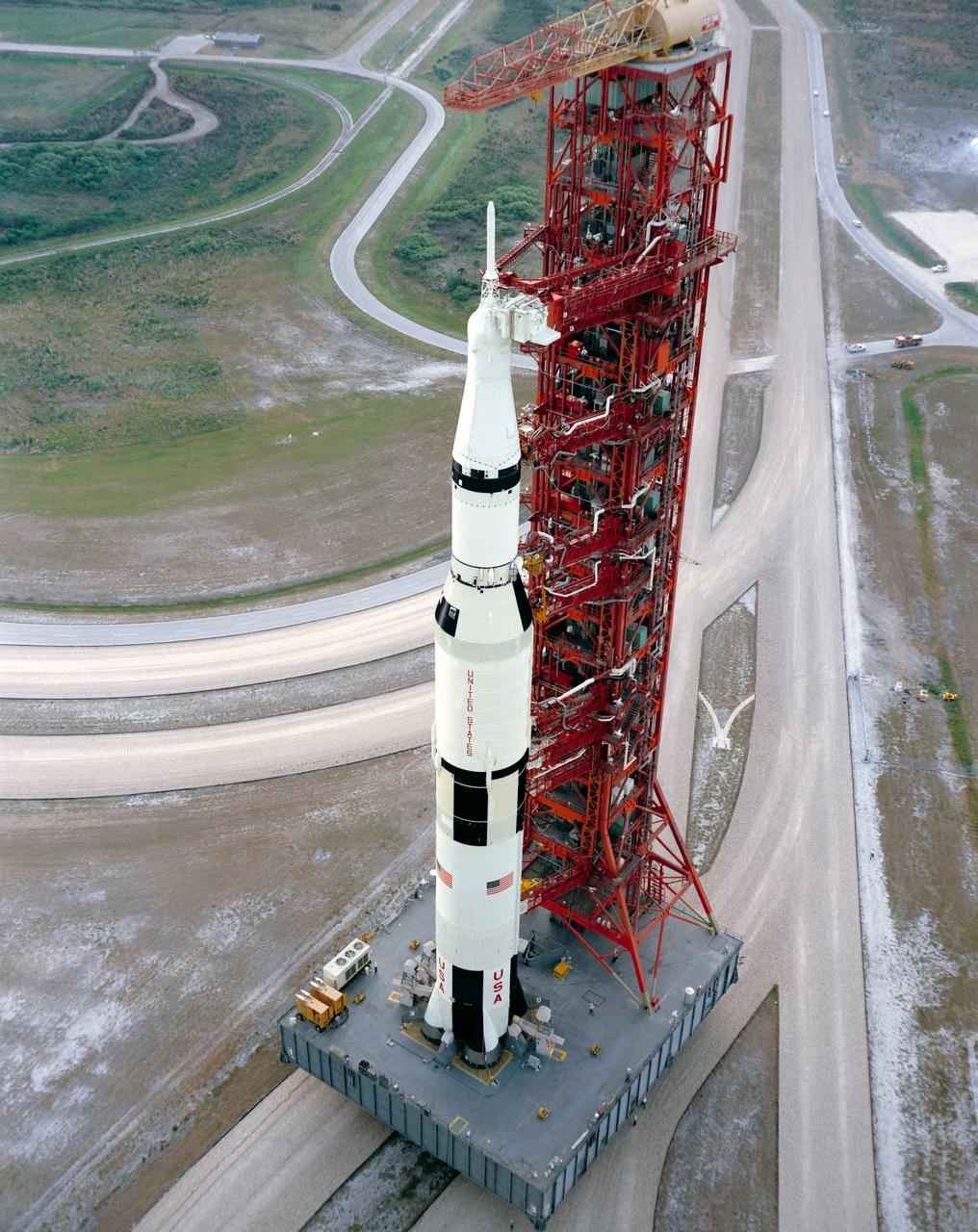
S71-33781 (11 May 1971) --- High angle view showing the Apollo 15 (Spacecraft 112/Lunar Module 10/Saturn 510) space vehicle on the way from the Vehicle Assembly Building (VAB) to Pad A, Launch Complex 39, Kennedy Space Center (KSC). The Saturn V stack and its mobile launch tower are atop a huge crawler-transporter. Apollo 15 is scheduled as the fourth manned lunar landing mission by the National Aeronautics and Space Administration (NASA). The crew men will be astronauts David R. Scott, commander; Alfred M. Worden, command module pilot; and James B. Irwin, lunar module pilot. While astronauts Scott and Irwin descend in the Lunar Module (LM) to explore the moon, astronaut Worden will remain with the Command and Service Modules (CSM) in lunar orbit.
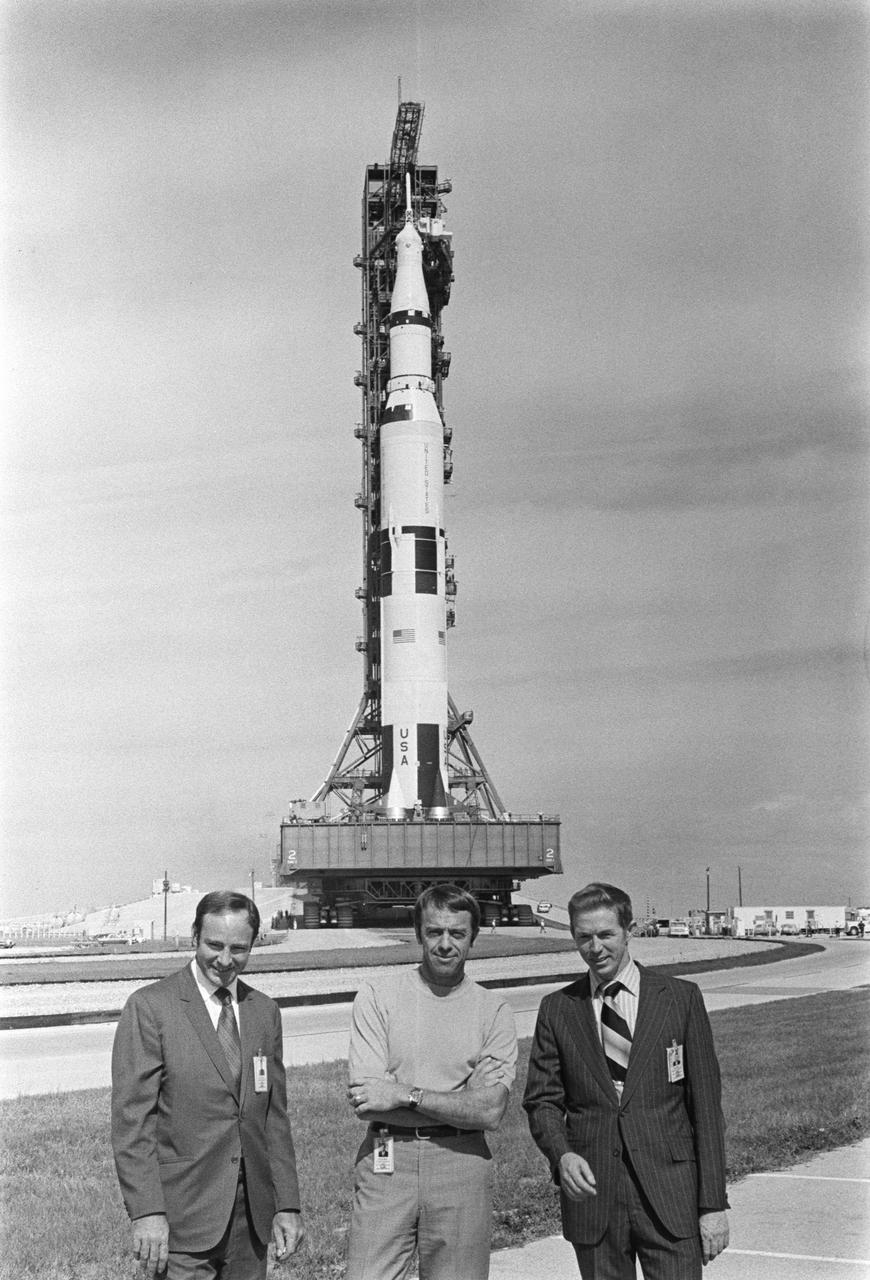
S70-55689 (9 Nov. 1970) --- The Apollo 14 (Spacecraft 110/Lunar Module 8/Saturn 509) space vehicle arrives at Pad A, Launch Complex 39, during the Apollo 14 roll out from the Kennedy Space Center's Vehicle Assembly Building. The Saturn V stack and its mobile launch tower atop a huge crawler-transporter. The three members of the Apollo 14 prime crew are in the foreground. They are (left to right) astronauts Edgar D. Mitchell, lunar module pilot; Alan B. Shepard Jr., commander; and Stuart A. Roosa, command module pilot.
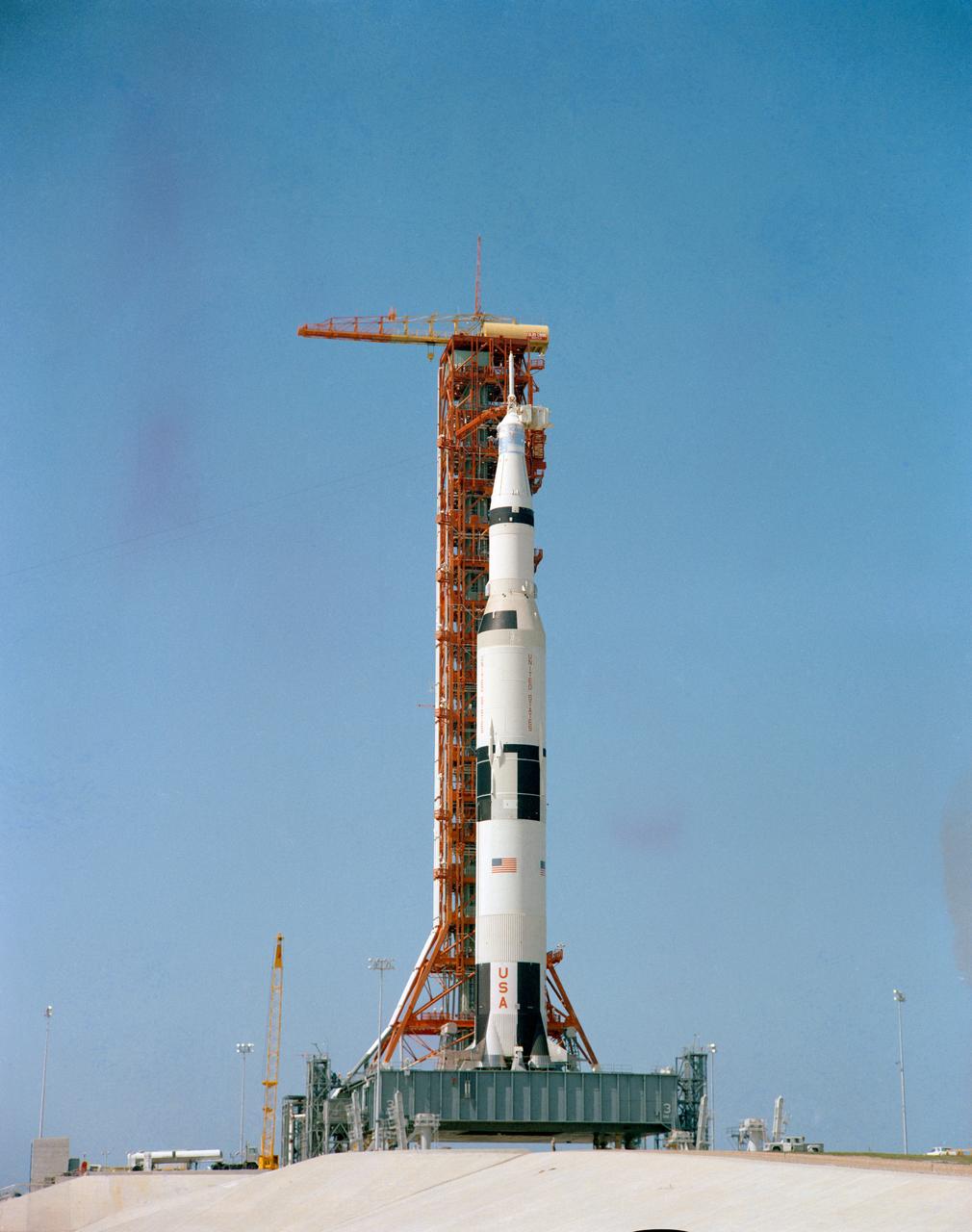
S69-33853 (4 May 1969) --- Ground-level view of the Apollo 10 (Spacecraft 106/Lunar Module 4/Saturn 505) space vehicle on Pad B, Launch Complex 39, Kennedy Space Center, Florida. This photograph of the 363-feet tall Apollo/Saturn V stack was taken during Countdown Demonstration Test (CDDT) activity. The Apollo 10 crew will be astronauts Thomas P. Stafford, commander; John W. Young, command module pilot; and Eugene A. Cernan, lunar module pilot.
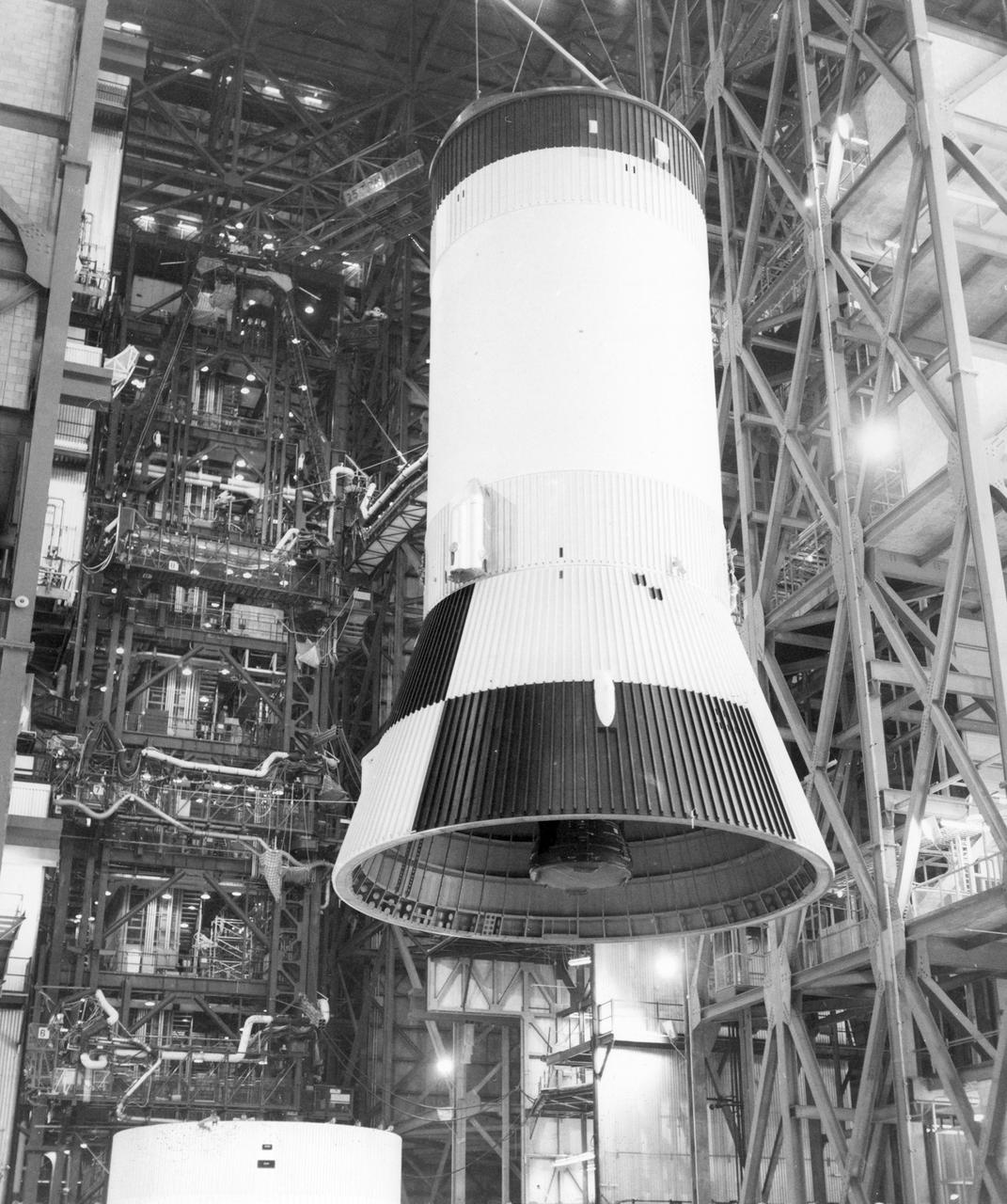
The third stage (S-IVB) of the Saturn V launch vehicle for the Apollo 11 lunar landing mission is hoisted in the vehicle assembly building at the NASA Kennedy Space Center (KSC) for mating with the second stage (S-II). The vehicle, designated as AS-506, projected the first lunar landing mission, Apollo 11, on a trajectory for the Moon. The Apollo 11 mission launched from KSC in Florida via the Marshall Space Flight Center (MSFC) developed Saturn V launch vehicle on July 16, 1969 and safely returned to Earth on July 24, 1969. Astronauts onboard included Neil A. Armstrong, commander; Michael Collins, Command Module (CM) pilot; and Edwin E. Aldrin, Jr., Lunar Module (LM) pilot. The CM, “Columbia”, piloted by Collins, remained in a parking orbit around the Moon while the LM, “Eagle’’, carrying astronauts Armstrong and Aldrin, landed on the Moon. On July 20, 1969, Armstrong was the first human to ever stand on the lunar surface, followed by Aldrin. During 2½ hours of surface exploration, the crew collected 47 pounds of lunar surface material for analysis back on Earth. With the success of Apollo 11, the national objective to land men on the Moon and return them safely to Earth had been accomplished.

S68-56001 (21 Dec. 1968) --- The Apollo 8 (Spacecraft 103/Saturn 503) space vehicle is launched from Pad A, Launch Complex 39, Kennedy Space Center, at 7:51 a.m. (EST), Dec. 21, 1968. The crew of the Apollo 8 lunar orbit mission is astronauts Frank Borman, commander; James A. Lovell Jr., command module pilot; and William A. Anders, lunar module pilot. Apollo 8 was the first manned Saturn V launch. (Just after ignition)
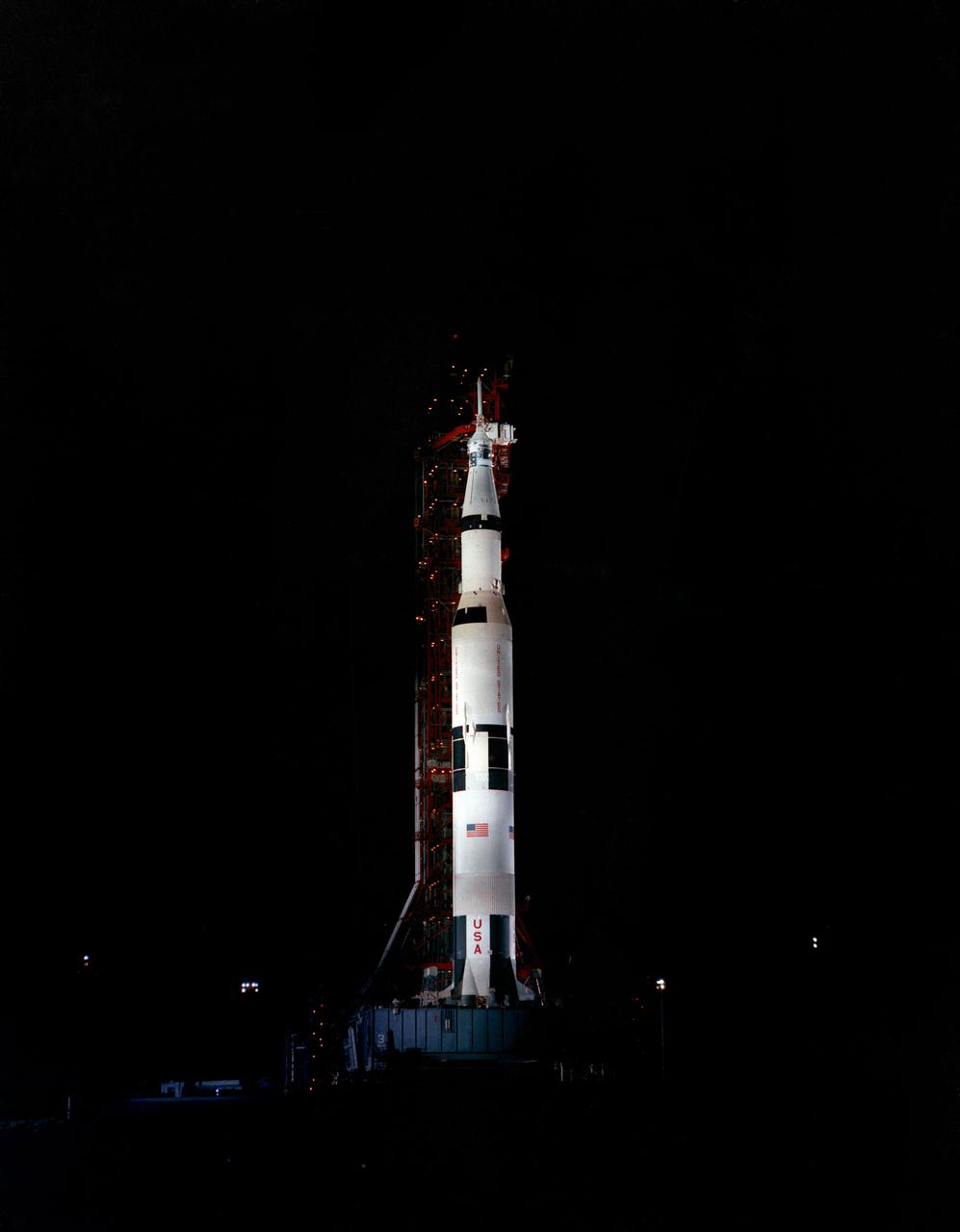
S69-33855 (4 May 1969) --- Nighttime, ground-level view of the Apollo 10 (Spacecraft 106/Lunar Module 4/Saturn 505) space vehicle on Pad B, Launch Complex 39, Kennedy Space Center. This photograph of the 363-feet tall Apollo/Saturn V stack was taken during pull back of the mobile service structure. The Apollo 10 crew will be astronauts Thomas P. Stafford, John W. Young, and Eugene A. Cernan.
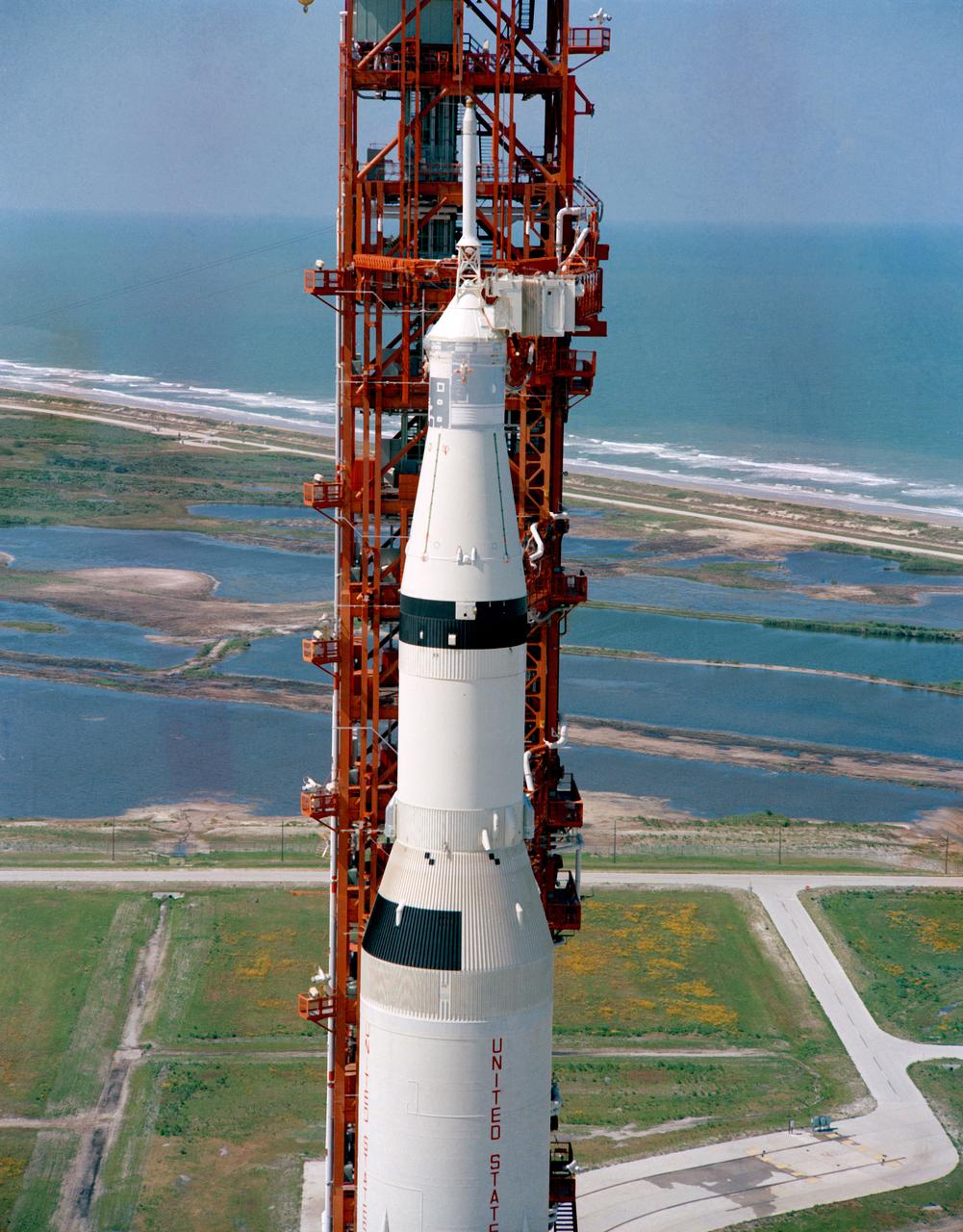
S69-33854 (4 May 1969) --- Aerial (high-angle, clasp) view of the Apollo 10 (Spacecraft 106/Lunar Module 4/Saturn 505) space vehicle on Pad B, Launch Complex 39, Kennedy Space Center. This photograph of the 363-feet tall Apollo/Saturn V stack was taken during pull back of the mobile service structure. The Apollo 10 crew will be astronauts Thomas P. Stafford, John W. Young, and Eugene A. Cernan.
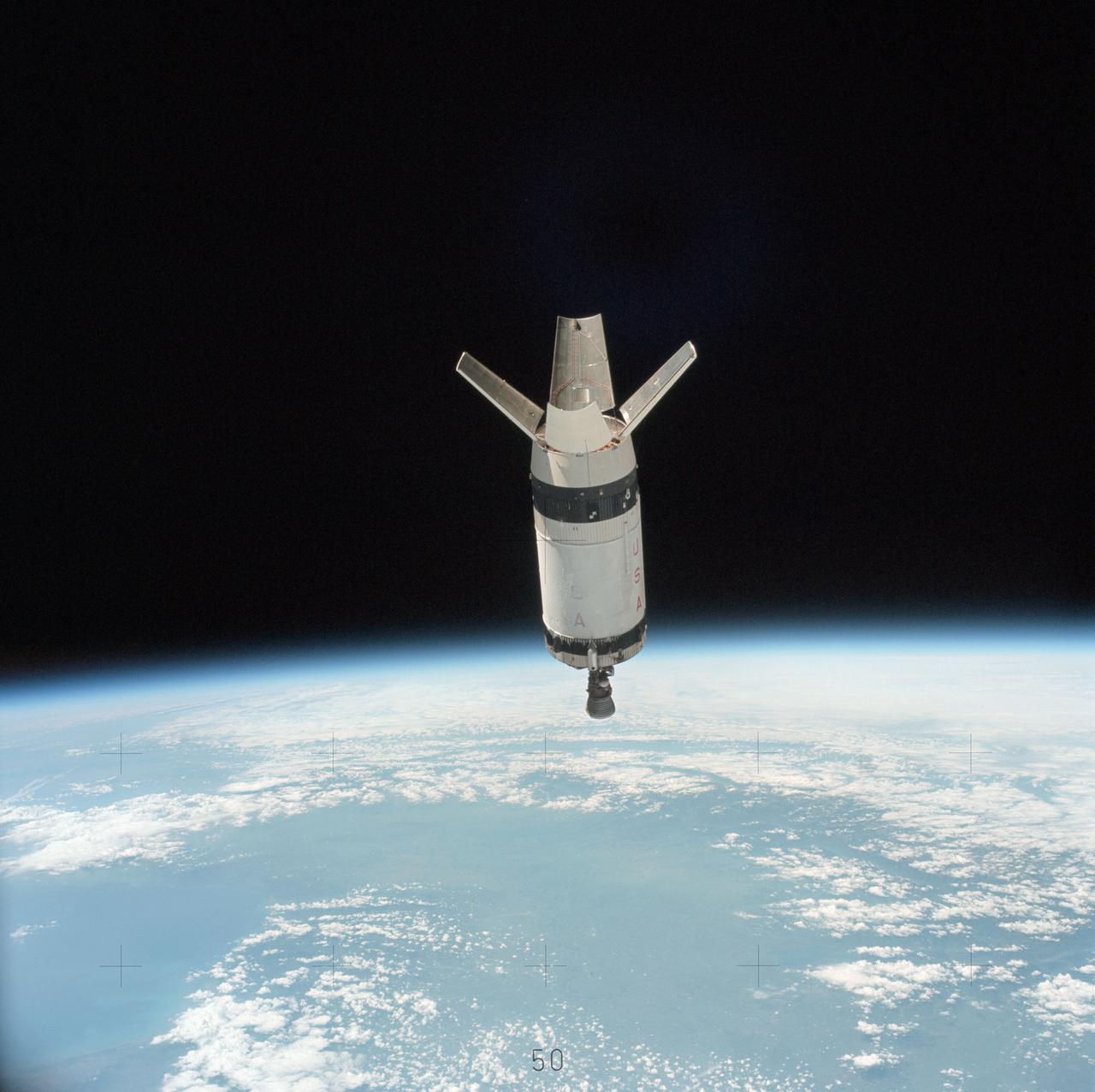
SL3-114-1625 (July-September 1973) --- An excellent view of the expended S-IVB second stage of the Skylab 3/Saturn 1B space vehicle is seen in this photograph taken from the Skylab 3 Command and Service Module (CSM) in Earth orbit. The land mass below is Italy and France, with part of the Mediterranean Sea visible. This photograph was taken with a handheld 70mm Hasselblad camera using a 100mm lens, and medium speed Ektachrome film. Photo credit: NASA
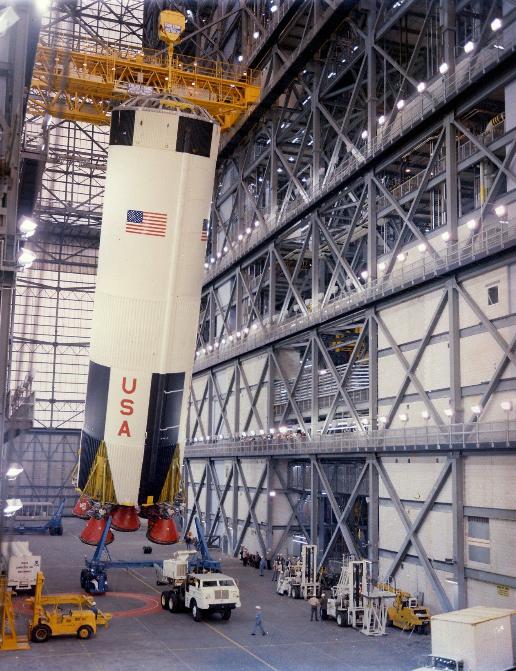
Teams lift the first stage of the Apollo 8 Saturn V rocket inside the transfer aisle of the Vehicle Assembly Building at NASA’s Kennedy Space Center in Florida on Feb. 1, 1968, and prepare to place it atop the mobile launcher. Apollo 8 was the first crewed spacecraft to successfully orbit the Moon and return to Earth, setting the stage for Apollo 11 – the first crewed lunar landing. Apollo 8 launched on Dec. 21, 1968, and the crew members consisted of Frank Borman, William A. Anders, and James A. Lovell Jr.
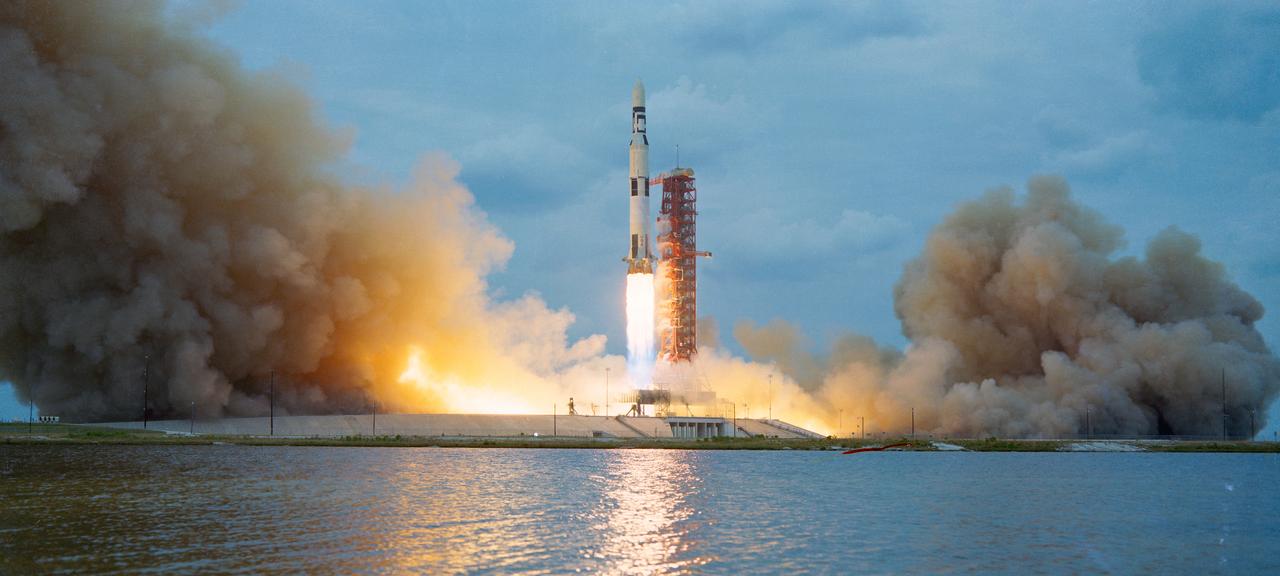
S73-26912 (14 May 1973) --- The unmanned Skylab 1/Saturn V space vehicle is launched from Pad A, Launch Complex 39, Kennedy Space Center, Florida, at 12:00 noon (EDT), May 14, 1973, to place the Skylab space station cluster in Earth orbit. The Skylab 1 payload included four of the five major components of the space station Orbital Workshop, Apollo Telescope Mount, Multiple Docking Adapter, and Airlock Module. In addition to the payload, the Skylab 1/Saturn V second (S-11) stage. The fifth major component of the space station, the Command Service Module with the Skylab 2 crew aboard, was launched at a later date by a Saturn 1B from Pad B. Photo credit: NASA
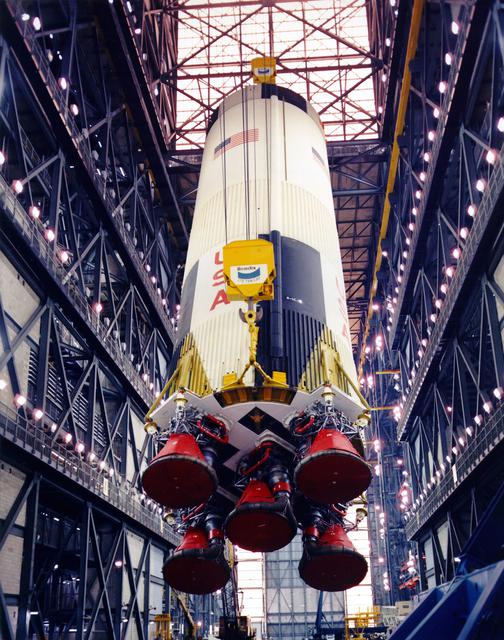
Teams lift the first stage of the Apollo 10 Saturn V rocket by crane inside High Bay 3 of the Vehicle Assembly Building at NASA’s Kennedy Space Center in Florida on Dec. 3, 1968, in preparation for stacking on the mobile launcher. The 138-foot-long stage generated 7.5 million pounds of thrust when it launched Apollo 10 astronauts Thomas P. Stafford, John W. Young, and Eugene A. Cernan. The mission launched on May 18, 1969, and was the first flight of a complete, crewed Apollo spacecraft to operate around the Moon.
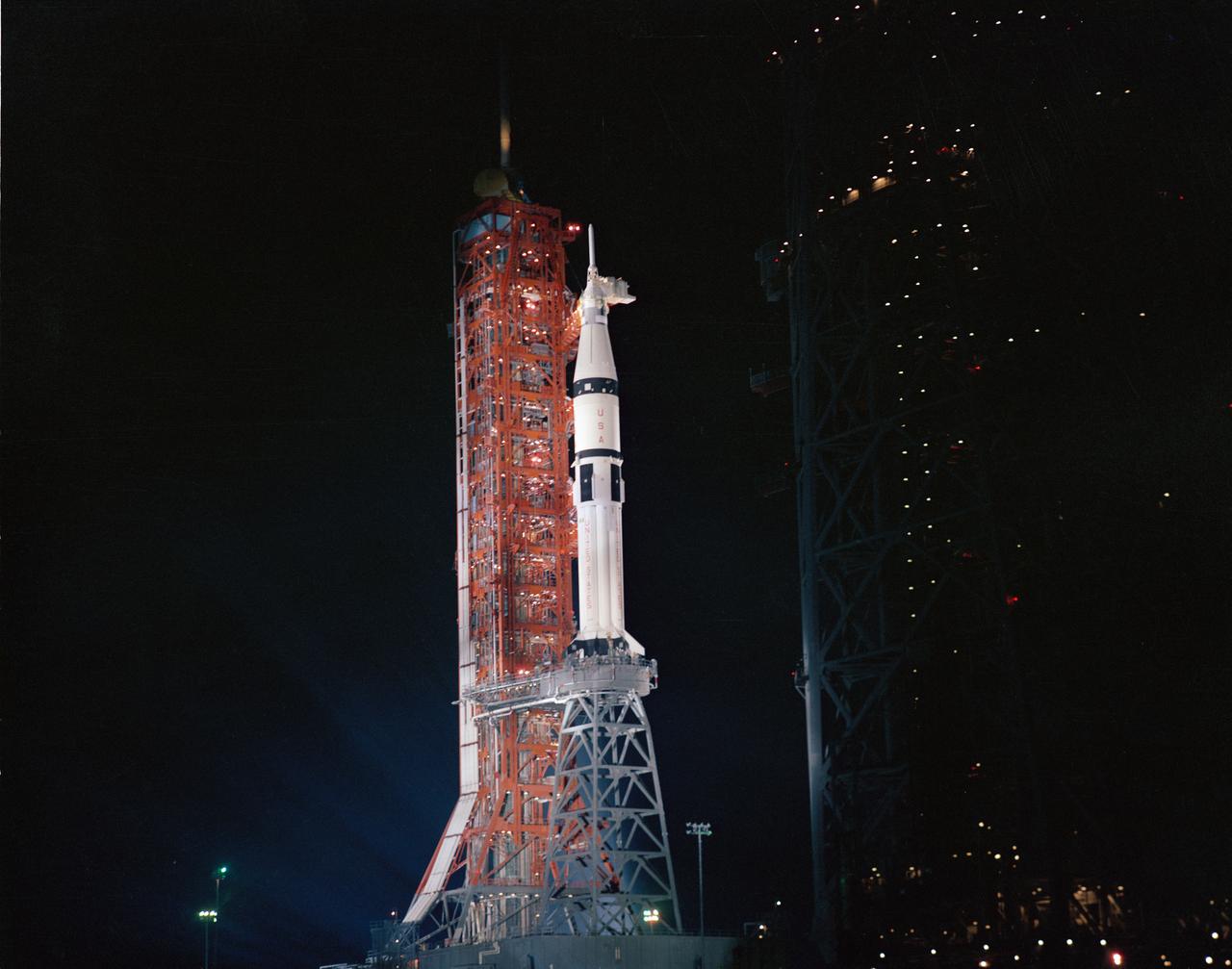
S75-28387 (2 July 1975) --- A nighttime view of Pad B, Launch Complex 39, Kennedy Space Center, showing the ASTP Apollo/Saturn 1B space vehicle on the pad during Apollo-Soyuz Test Project prelaunch preparations. An ASTP countdown demonstration ?wet? test (CDDT) was being conducted at KSC when this photograph was taken. The liftoff was on July 15, 1975.
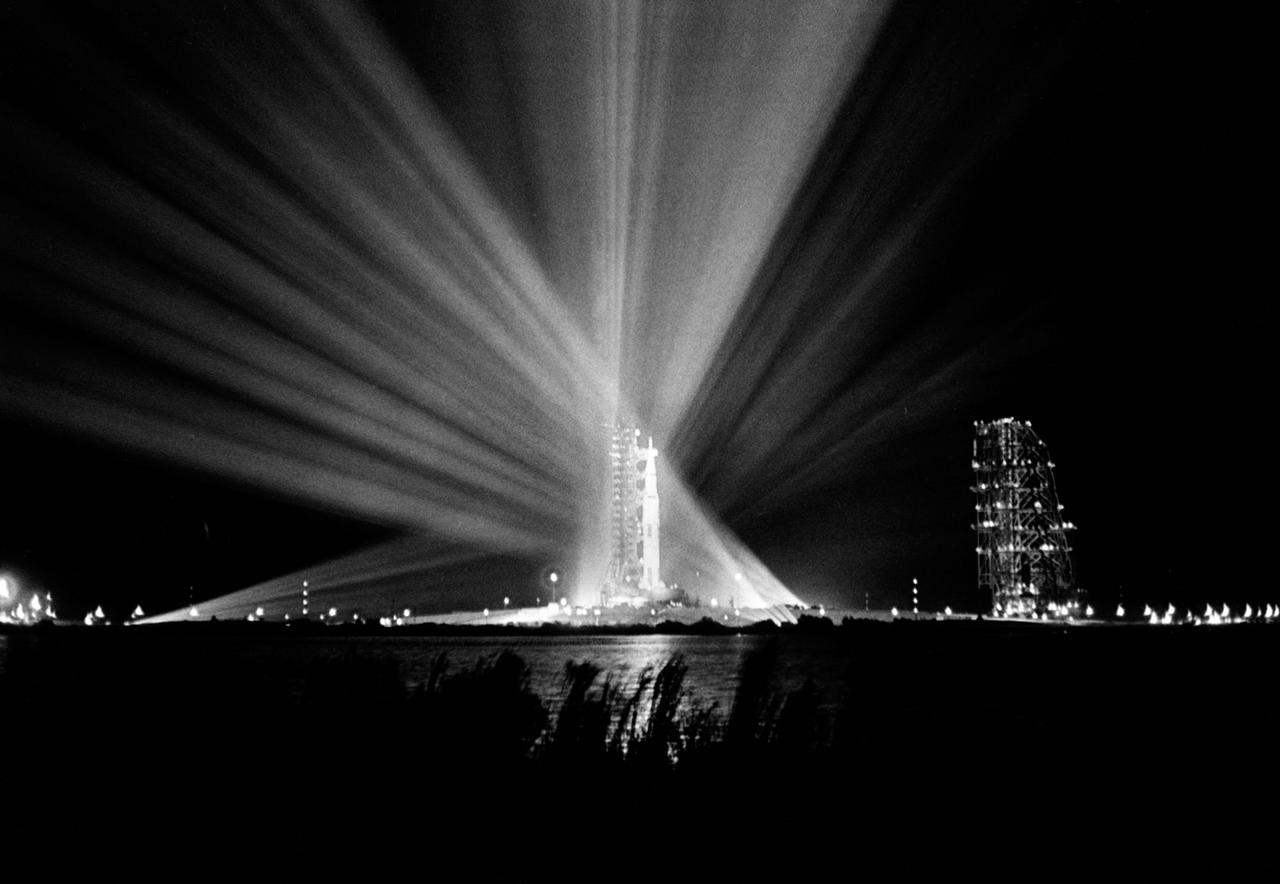
S69-25879 (23 Feb. 1969) --- Nighttime view of the 363-feet-high Apollo 9 space vehicle at Pad A, Launch Complex 39, Kennedy Space Center, during preparations for the scheduled 10-day Earth-orbital space mission. The crew of the Apollo 9 (Spacecraft 104/Lunar Module 3/Saturn 504) space flight will be astronauts James A. McDivitt, David R. Scott, and Russell L. Schweickart.
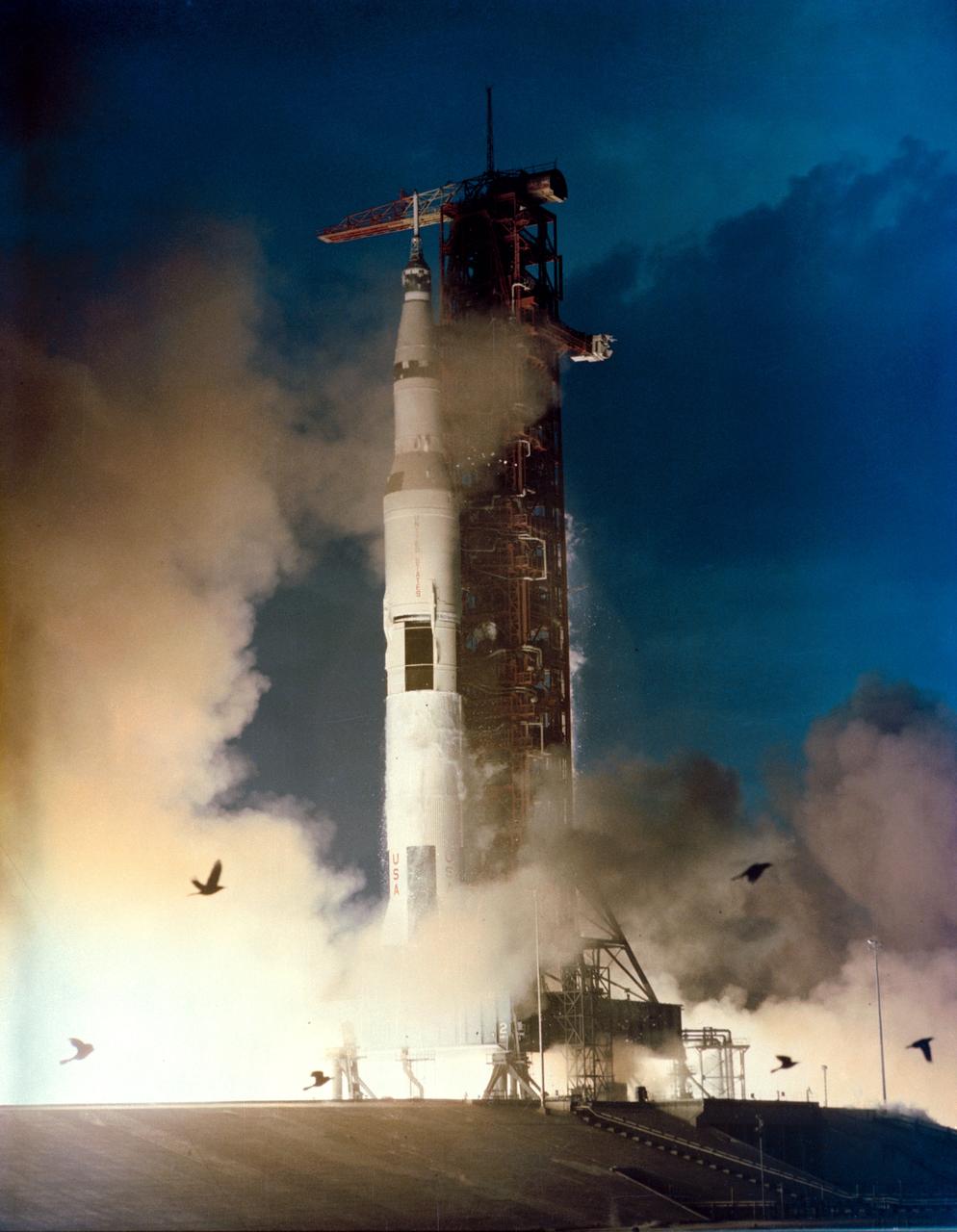
S71-18395 (31 Jan. 1971) --- The huge, 363-feet tall Apollo 14 (Spacecraft 110/Lunar Module 8/Saturn 509) space vehicle is launched from Pad A, Launch Complex 39, Kennedy Space Center (KSC), Florida at 4:03:02 p.m. (EST), Jan. 31, 1971, on a lunar landing mission. Aboard the Apollo 14 spacecraft were astronauts Alan B. Shepard Jr., commander; Stuart A. Roosa, command module pilot; and Edgar D. Mitchell, lunar module pilot.
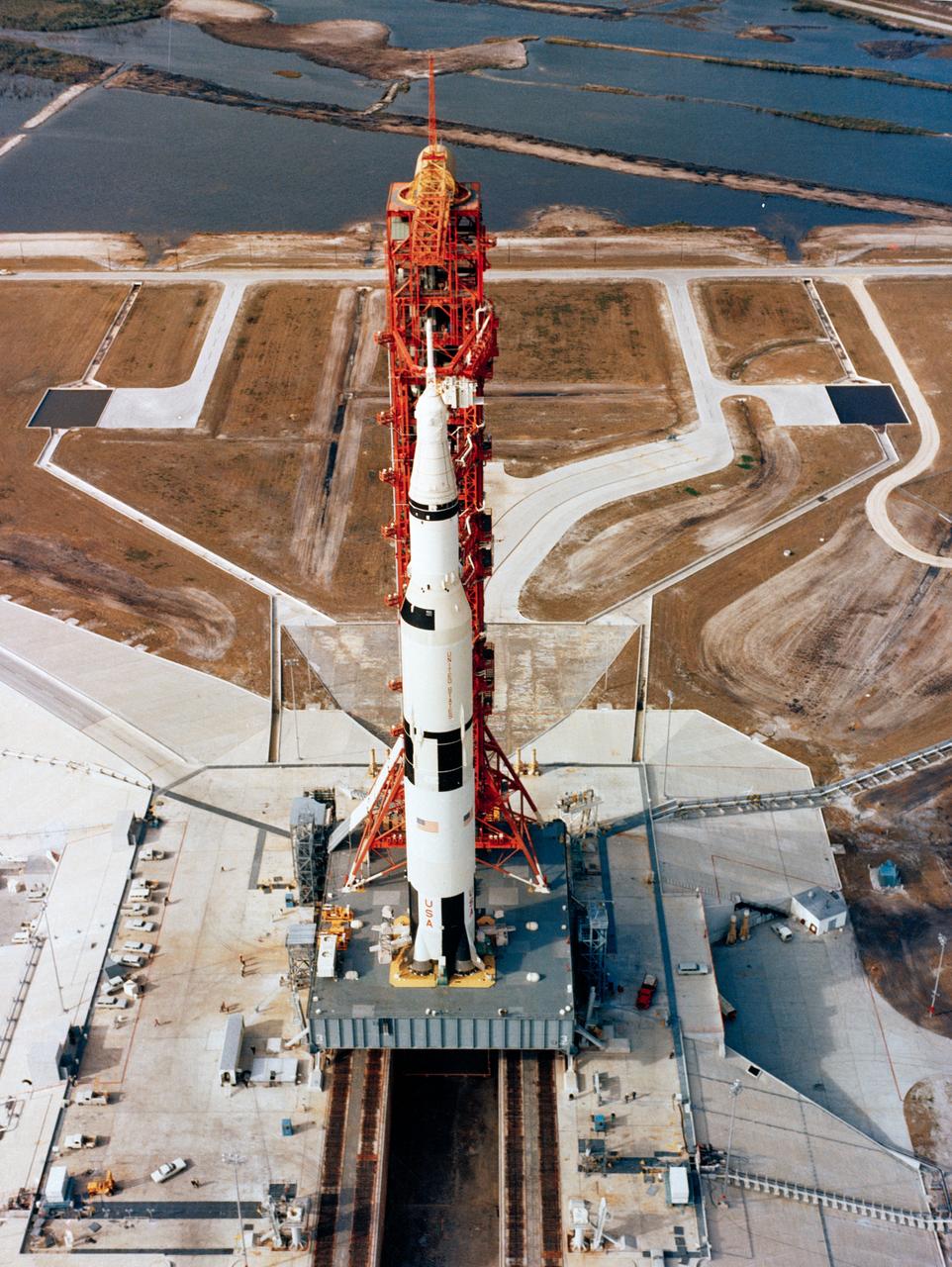
S69-34327 (13 May 1969) --- Aerial, high-angle, view of the Apollo 10 (Spacecraft 106/Lunar Module 4/Saturn 505) space vehicle at Pad B, Launch Complex 39, Kennedy Space Center, Florida. The crew of the Apollo 10 lunar orbit mission will be astronauts Thomas P. Stafford, commander; John W. Young, command module pilot; and Eugene A. Cernan, lunar module pilot.
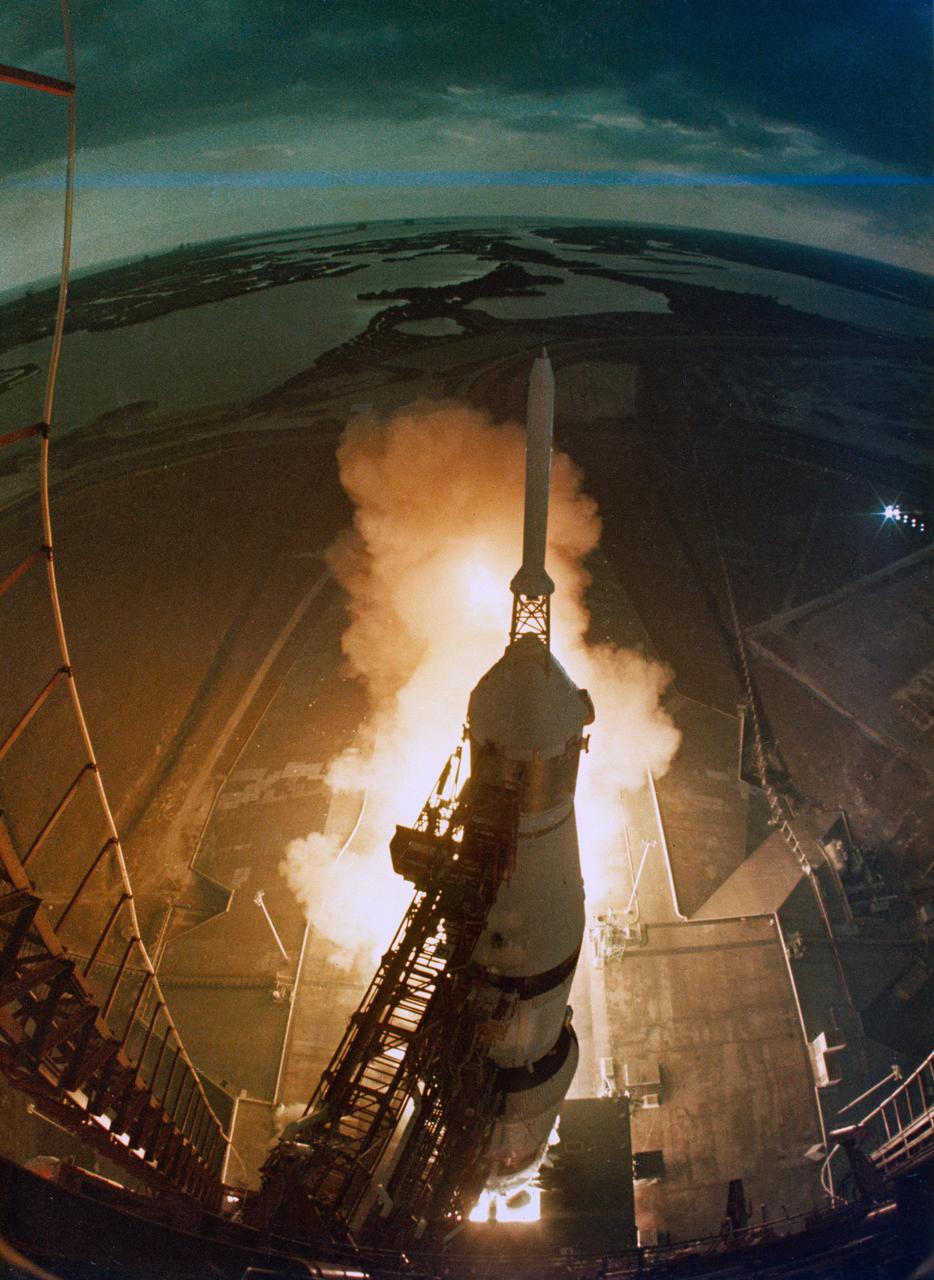
S71-17620 (31 Jan. 1971) --- The huge, 363-feet tall Apollo 14 (Spacecraft 110/Lunar Module 8/Saturn 509) space vehicle is launched from Pad A, Launch Complex 39, Kennedy Space Center, Florida, at 4:03:02 p.m. (EST), Jan. 31, 1981, on a lunar landing mission. This view of the liftoff was taken by a camera mounted on the mobile launch tower. Aboard the Apollo 14 spacecraft were astronauts Alan B. Shepard Jr., commander; Stuart A. Roosa, command module pilot; and Edgar D. Mitchell, lunar module pilot.
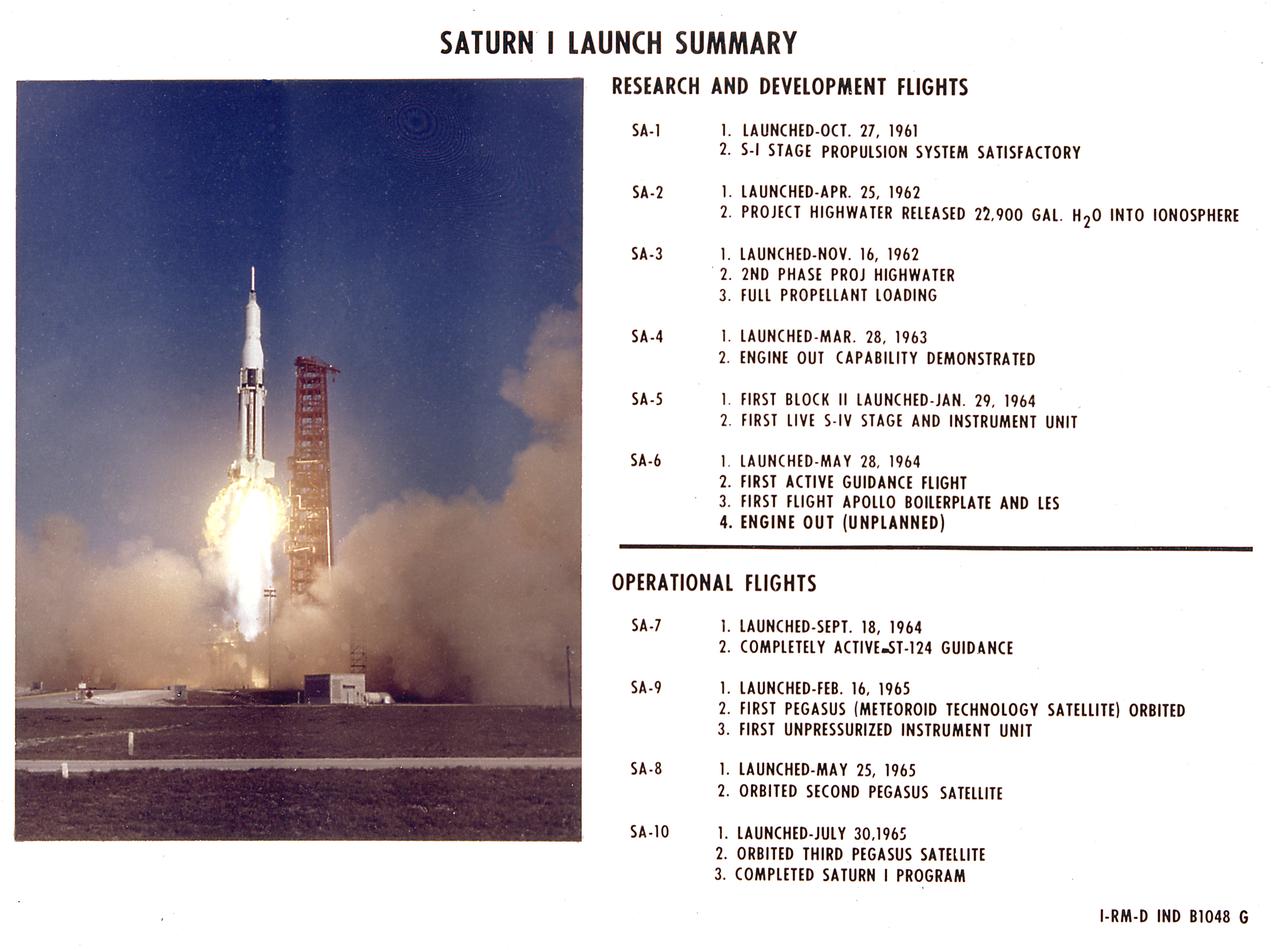
Saturn 1 Launch summary of research and development flights and operational flights. NASA's initial development plan for the Saturn program had called for the Saturn I to serve as a stepping stone to the development of larger Saturn vehicles ultimately known as the Saturn IB and Saturn V. The Saturn I launch vehicle proved the feasibility of the clustered engines and provided significant new payload lifting capabilities.
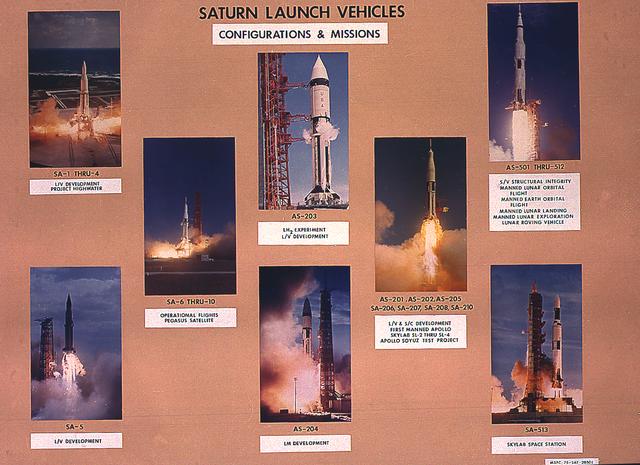
This montage illustrates the various configurations and missions of the three classes of the Saturn vehicles developed by the Marshall Space Flight Center. The missions for the Saturn I included atmospheric science investigations and the deployment of the Pegasus meteroid-detection satellite as well as launch vehicle development. The Saturn IB vehicle tested the Apollo spacecraft and launched the three marned Skylab missions as well as the Apollo Soyuz test project. The Saturn V vehicle launched the manned lunar orbital/landing missions, and the Skylab Orbital Workshop in 1973.
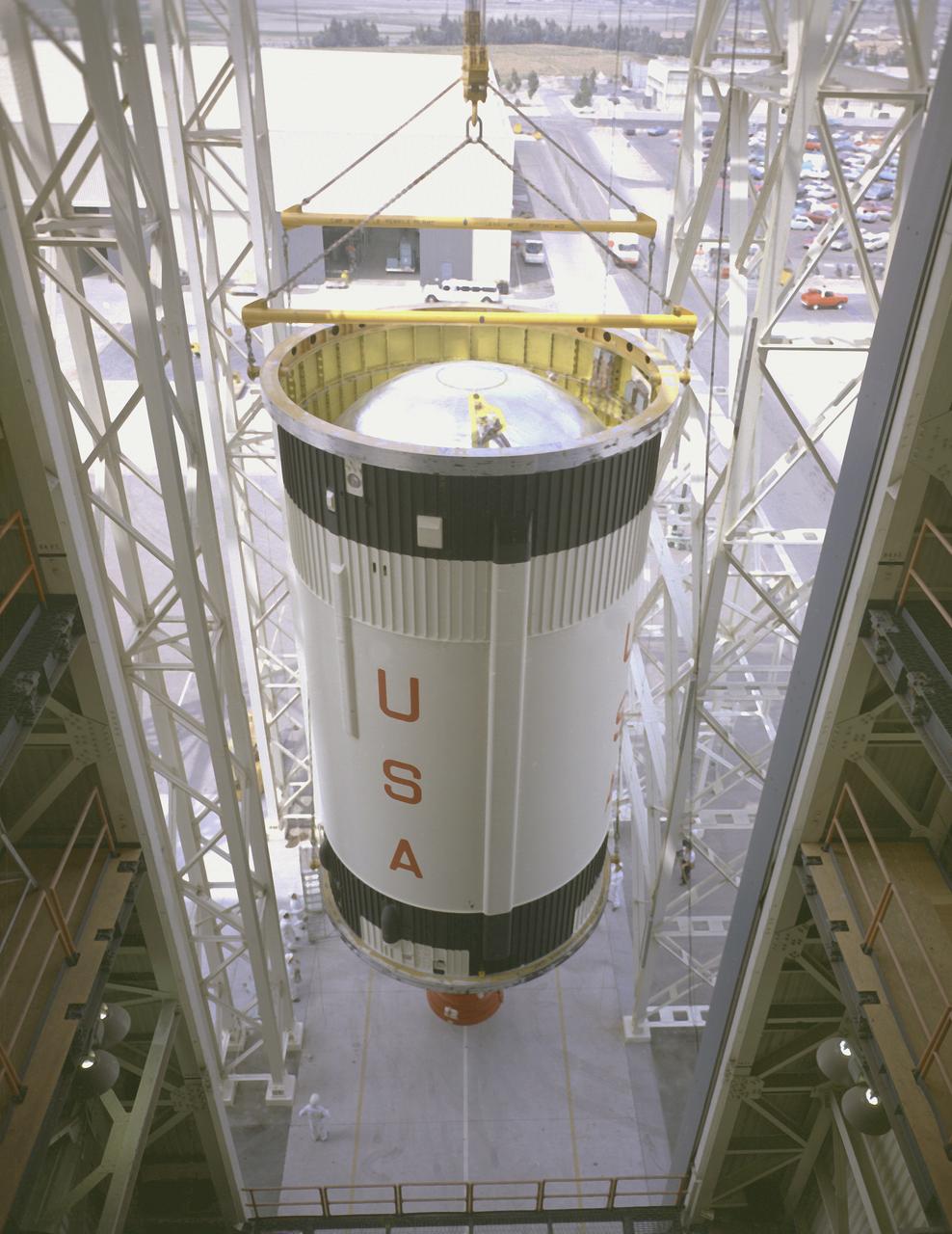
Workers at McDornel-Douglas install the Saturn IB S-IVB (second) stage for the Apollo-Soyuz mission into the company's S-IVB assembly and checkout tower in Huntington Beach, California. The Saturn IB launch vehicle was developed by the Marshall Space Flight Center (MSFC) as an interim vehicle in its "building block" approach to Saturn rocket development. This vehicle utilized the Saturn I technology to further develop and refine the capabilities of a larger booster and the Apollo spacecraft required for the manned lunar missions. The S-IVB stage, later used as the third stage of the Saturn V launch vehicle, was powered by a single J-2 engine initially capable of 200,000 pounds of thrust.
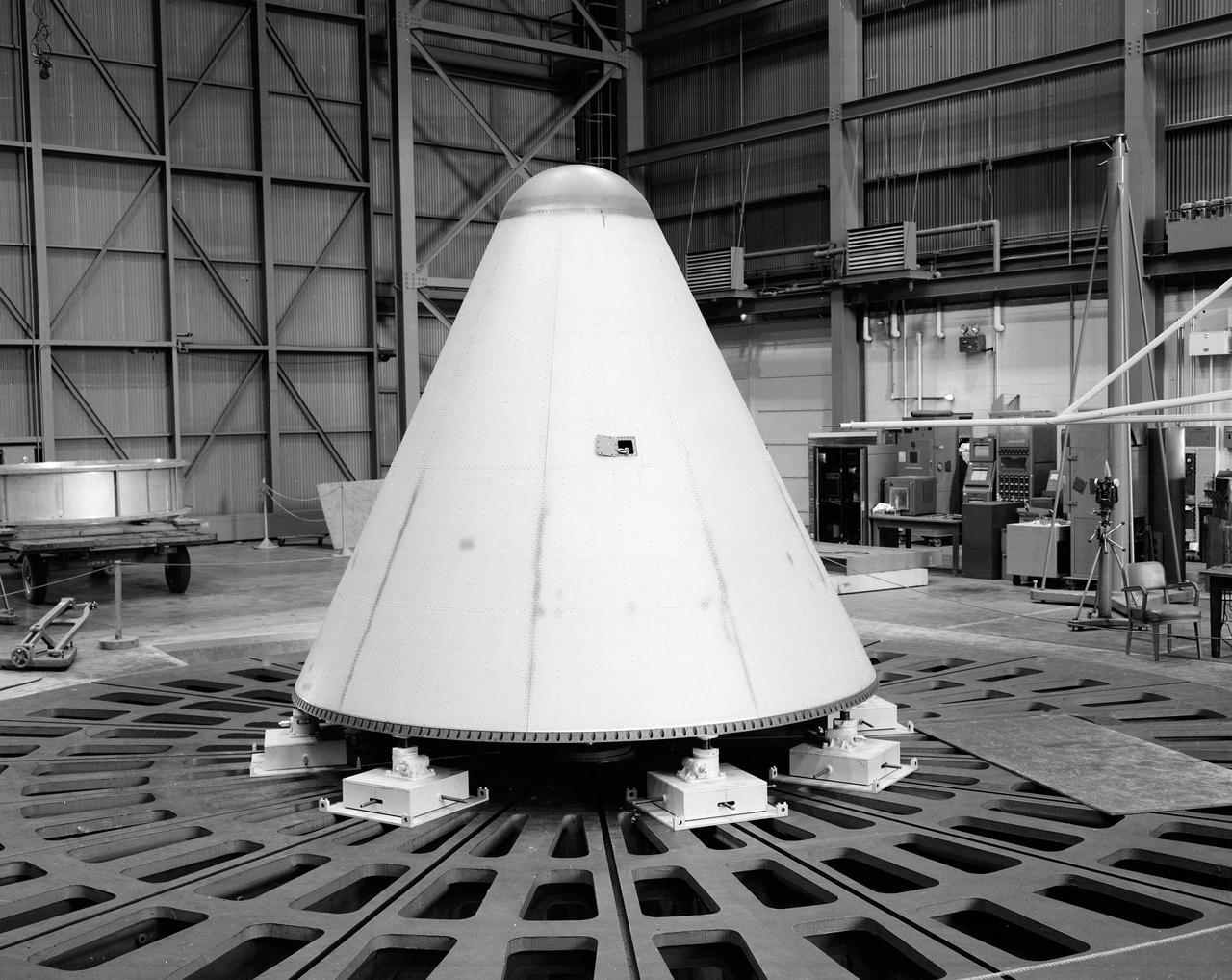
Developed by the Marshall Space Flight Center (MSFC) as an interim vehicle in MSFC’s “building block” approach to the Saturn rocket development, the Saturn IB utilized Saturn I technology to further develop and refine the larger boosters and the Apollo spacecraft capabilities required for the manned lunar missions. The Saturn IB vehicle was a two-stage rocket and had a payload capability about 50 percent greater than the Saturn I vehicle. The first stage, S-IB stage, was a redesigned first stage of the Saturn I. This photograph is of the S-IB nose cone #3 during assembly in building 4752.
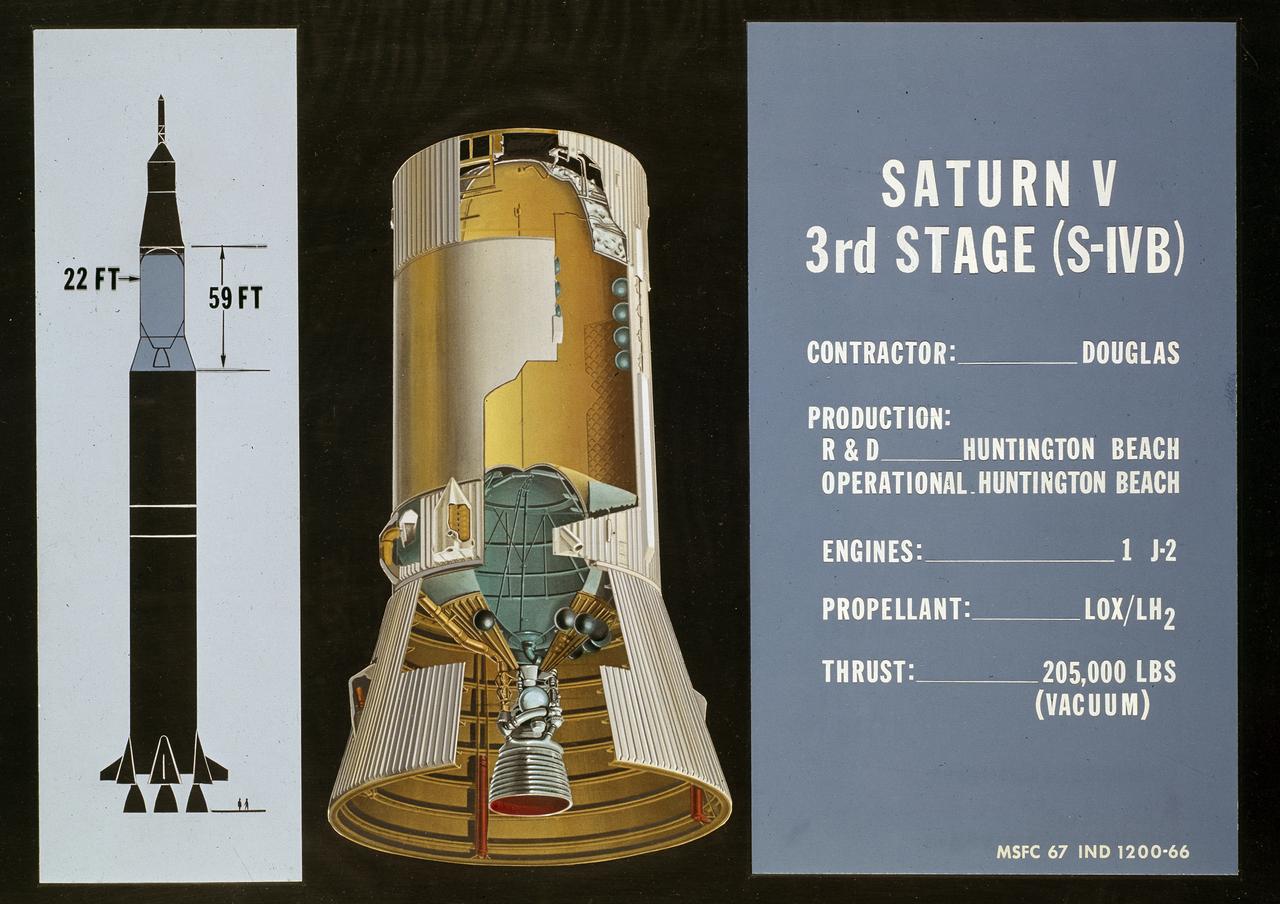
This cutaway drawing shows the S-IVB (third stage) of the Saturn V launch vehicle. As a part of the Marshall Space Flight Center’s (MSFC) “building block” approach to the Saturn development, the S-IVB stage was utilized in the Saturn IB launch vehicle as a second stage and, later, the Saturn V launch vehicle as a third stage. The 59 foot long and 22 feet diameter stage was powered by a single J-2 engine, initially capable of 200,000 pounds of thrust.
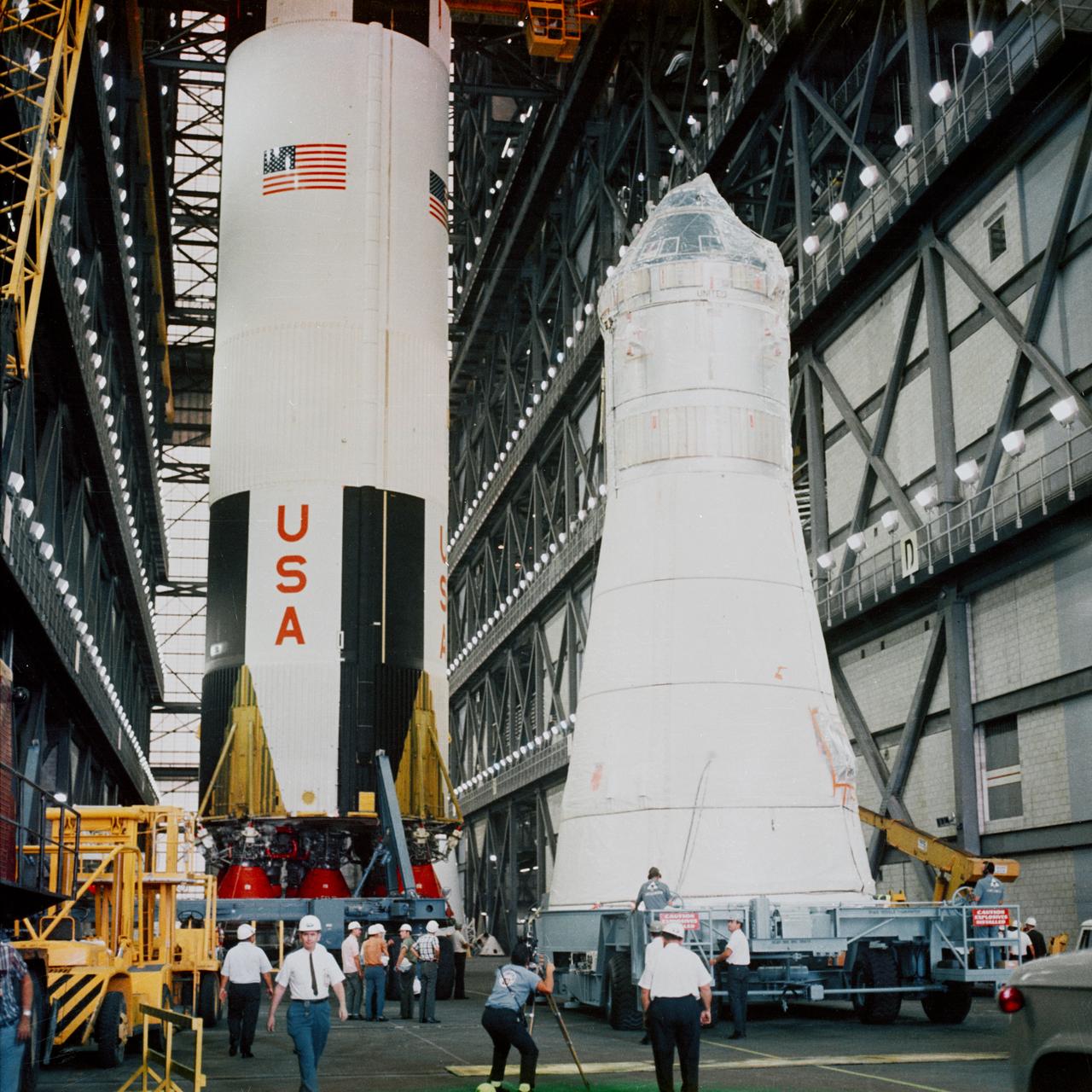
Apollo Spacecraft 104 Command/Service Module and Lunar Module 3 arrive at the Vehicle Assembly Building (VAB) for mating atop the Saturn 504 launch vehicle. The Saturn 504 stack is out of view. The Saturn V first (S-IC) stage in left background is scheduled for a later flight.
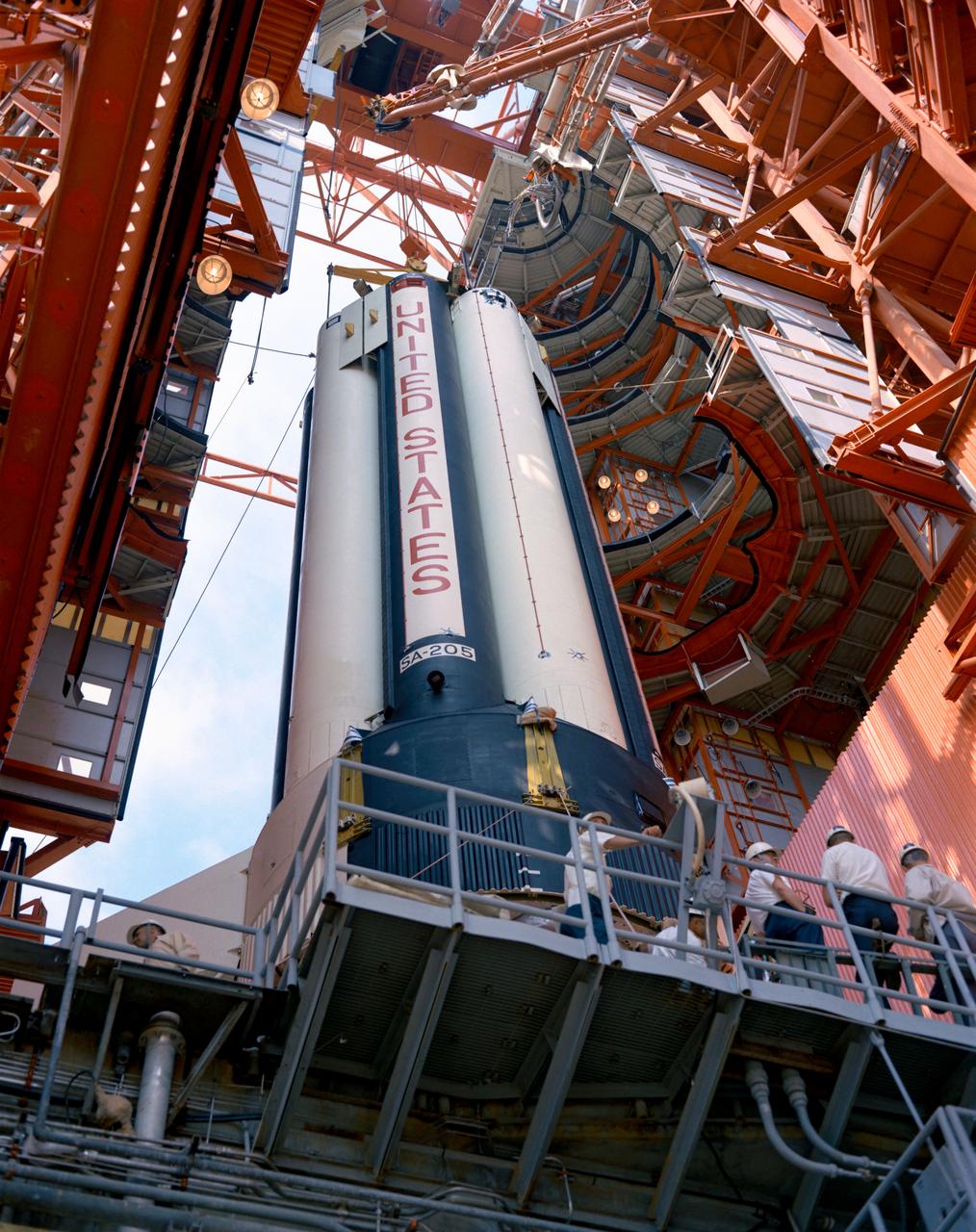
S68-29781 (22 April 1968) --- Low angle view at the Kennedy Space Center's Pad 34 showing the erection of the first stage of the Saturn 205 launch vehicle. The two-stage Saturn IB will be the launch vehicle for the first unmanned Apollo space mission, Apollo 7 (Spacecraft 101/Saturn 205).
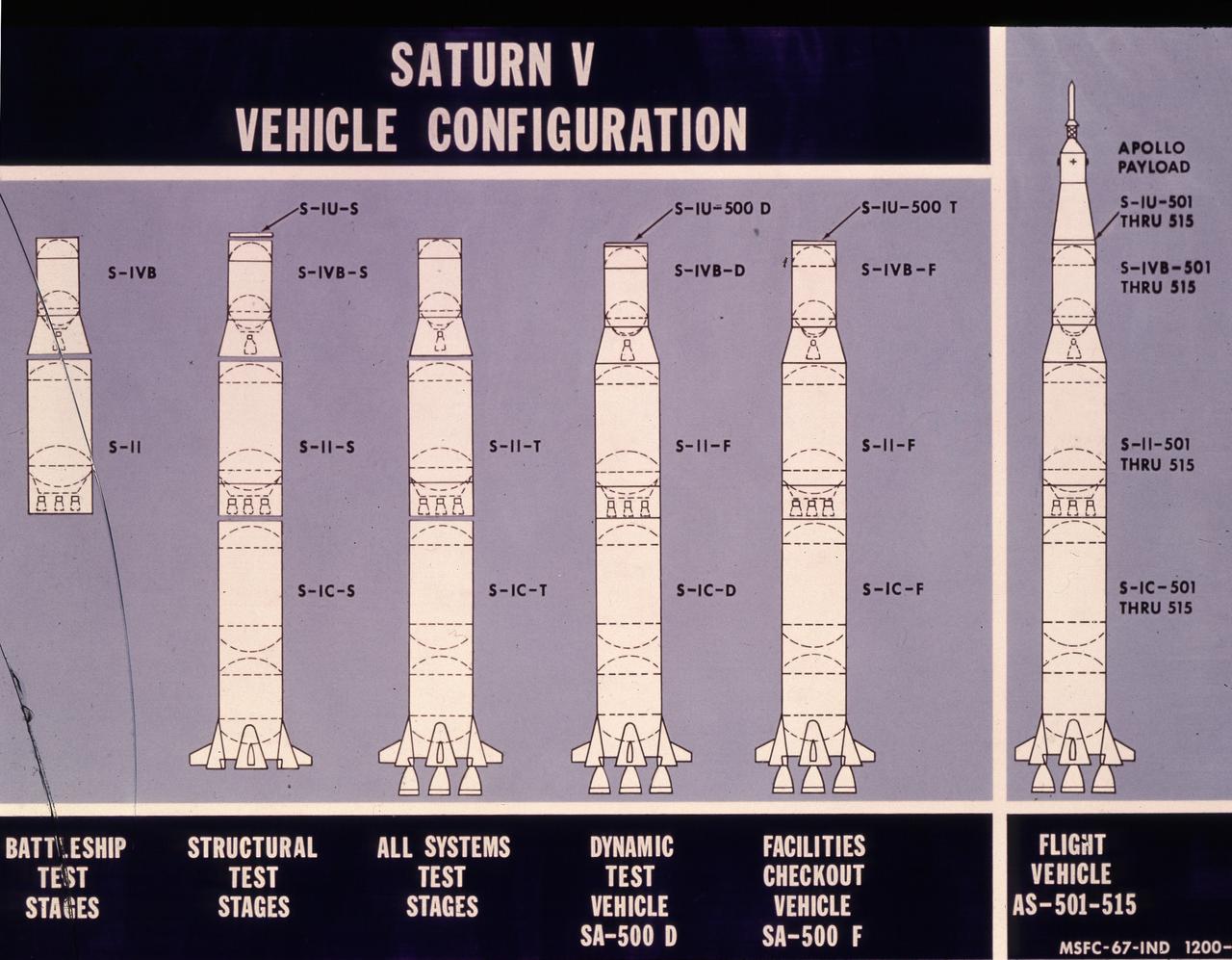
This illustration shows different configurations of the Saturn V test vehicles and flight vehicle.
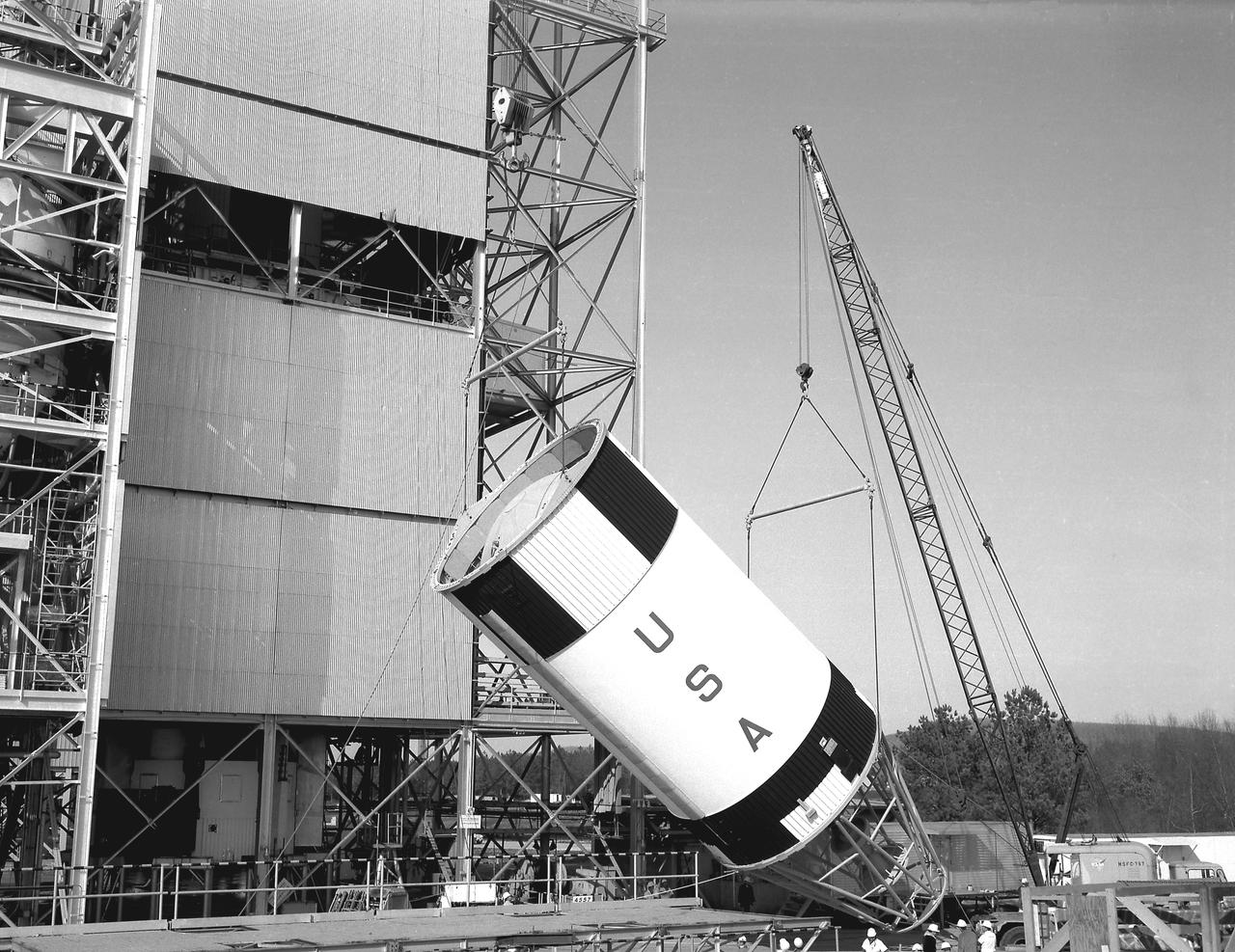
Marshall Space Flight Center (MSFC) workers hoist a dynamic test version of the S-IVB stage, the Saturn IB launch vehicle's second stage, into the Center's Dynamic Test Stand on January 18, 1965. MSFC Test Laboratory persornel assembled a complete Saturn IB to test the launch vehicle's structural soundness. Developed by the MSFC as an interim vehicle in MSFC's "building block" approach to the Saturn rocket development, the Saturn IB utilized Saturn I technology to further develop and refine the larger boosters and the Apollo spacecraft capabilities required for the manned lunar missions.
Workers at the Marshall Space Flight Center's (MSFC) Dynamic Test Stand install S-IB-200D, a dynamic test version of the Saturn IB launch vehicle's first stage, on January 11, 1965. MSFC Test Laboratory persornel assembled a complete Saturn IB to test the launch vehicle's structural soundness. Developed by the MSFC as an interim vehicle in MSFC's "building block" approach to the Saturn rocket development, the Saturn IB utilized Saturn I technology to further develop and refine the larger boosters and the Apollo spacecraft capabilities required for the manned lunar missions.
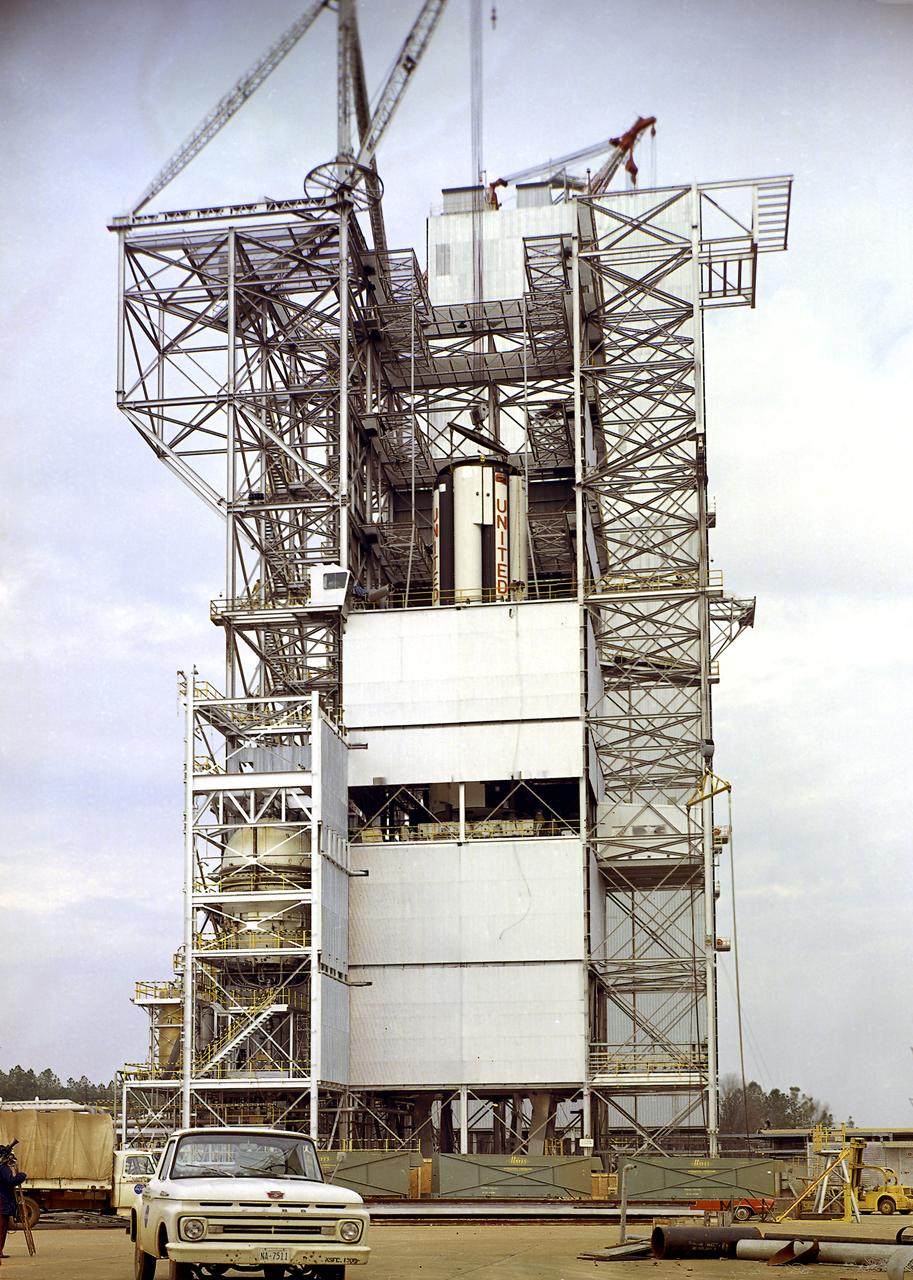
Marshall Space Flight Center (MSFC) workers lower S-IB-200D, a dynamic test version of the Saturn IB launch vehicle's first stage (S-IB stage), into the Center's Dynamic Test Stand on January 12, 1965. Test Laboratory persornel assembled a complete Saturn IB to test the structural soundness of the launch vehicle. Developed by the MSFC as an interim vehicle in MSFC's "building block" approach to Saturn rocket development, the Saturn IB utilized Saturn I technology to further develop and refine large boosters and the Apollo spacecraft capabilities required for the manned lunar missions.
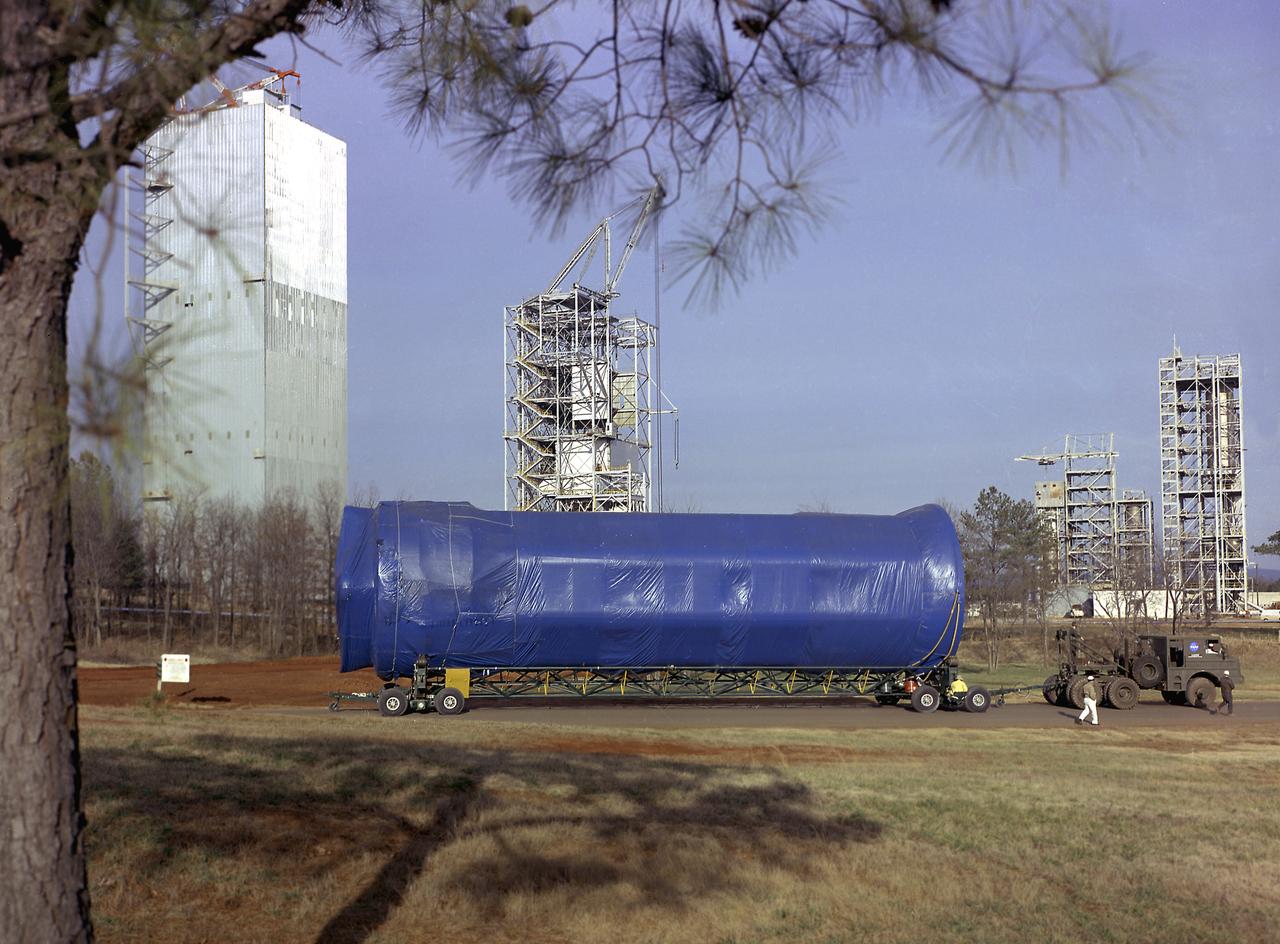
S-IB-200D, a dynamic test version of the Saturn IB launch vehicle's first stage (S-IB), makes its way to the Marshall Space Flight Center (MSFC) East Test Area on January 4, 1965. Test Laboratory persornel assembled a complete Saturn IB to test the structural soundness of the launch vehicle in the Dynamic Test Stand. Developed by the MSFC as an interim vehicle in MSFC's "building block" approach to the Saturn rocket development, the Saturn IB utilized Saturn I technology to further develop and refine the larger boosters and the Apollo spacecraft capabilities required for the manned lunar missions.
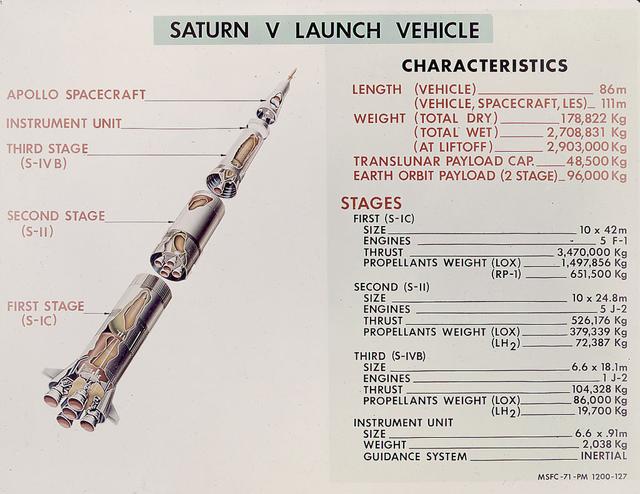
This is a good cutaway diagram of the Saturn V launch vehicle showing the three stages, the instrument unit, and the Apollo spacecraft. The chart on the right presents the basic technical data in clear metric detail. The Saturn V is the largest and most powerful launch vehicle in the United States. The towering, 111 meter, Saturn V was a multistage, multiengine launch vehicle standing taller than the Statue of Liberty. Altogether, the Saturn V engines produced as much power as 85 Hoover Dams. Development of the Saturn V was the responsibility of the Marshall Space Flight Center at Huntsville, Alabama, directed by Dr. Wernher von Braun.
Apollo Spacecraft 009 atop the Saturn 1B launch vehicle is seen at Launch Complex 34 during the Saturn 1B countdown demonstration. Preparations are continuing for the Apollo Saturn 201 Test Flight. CAPE KENNEDY, FL CN
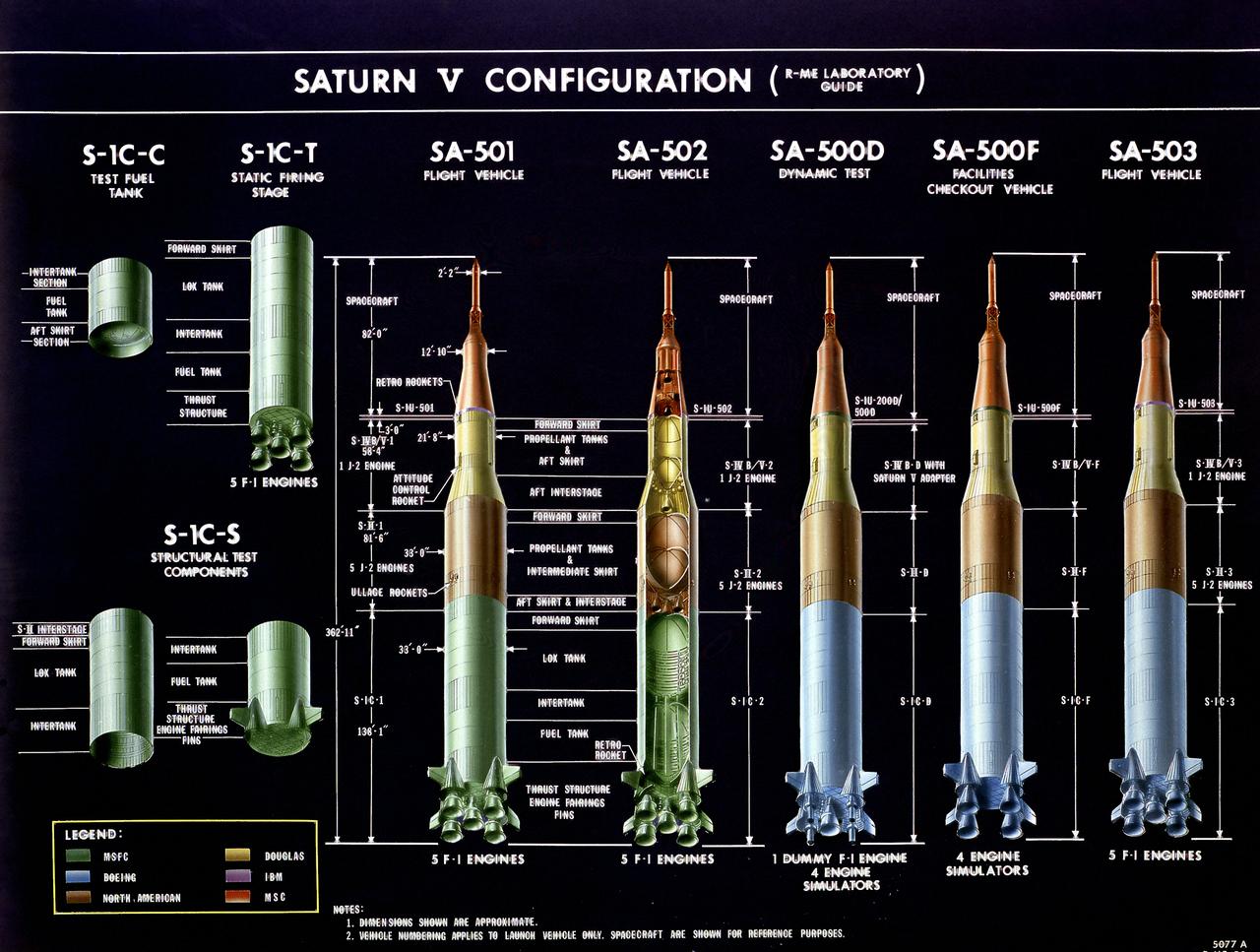
This chart illustrates the testing vehicle and flight vehicle configurations, in addition to the approximate dimensions of the stages of the Saturn V launch vehicle.
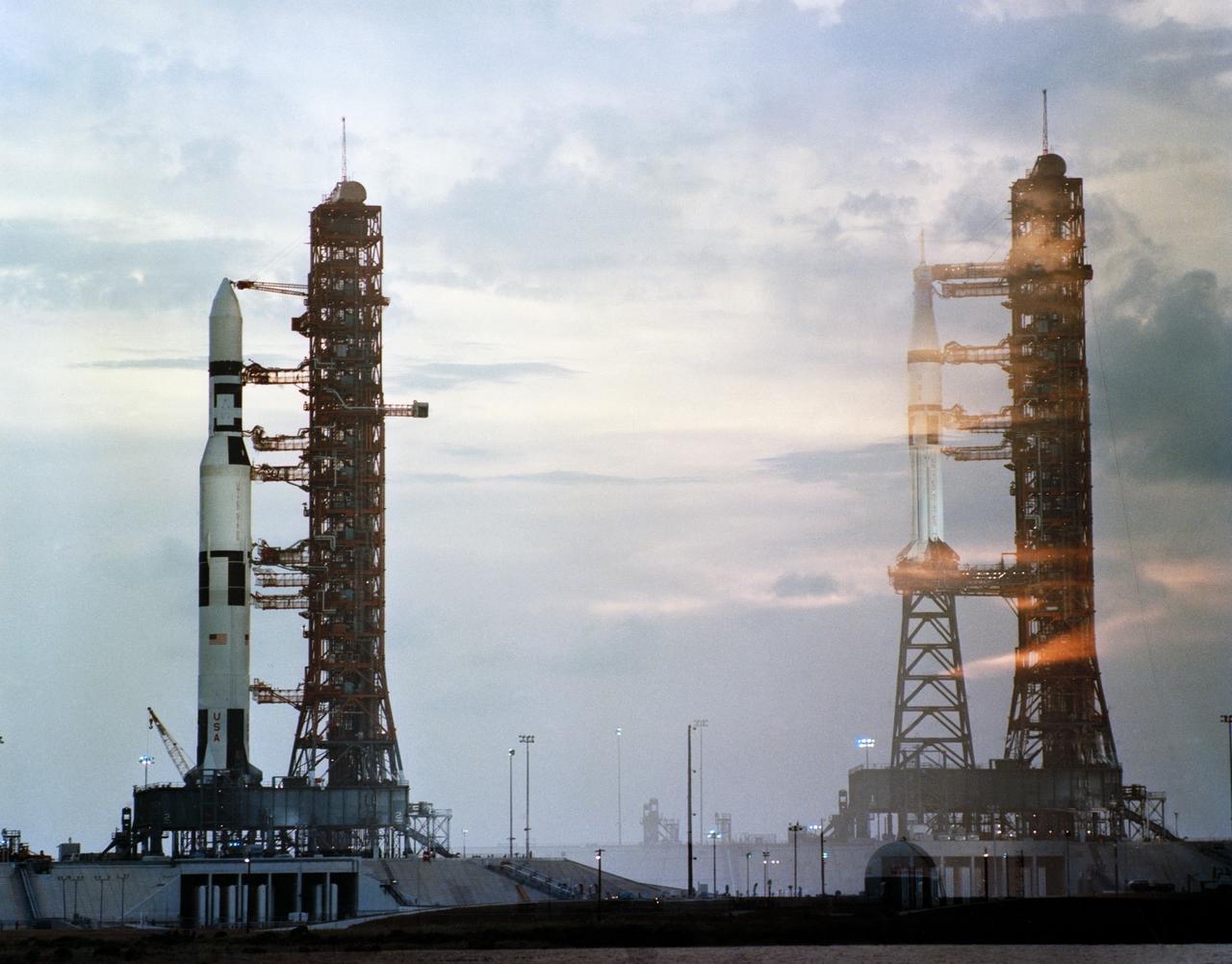
S73-25654 (7 May 1973) --- A deliberate double exposure to help illustrate the comparative sizes and configurations of the Skylab 1 and Skylab 2 space vehicles at Launch Complex 39, Kennedy Space Center, Florida. The double exposure creates an illusion that the rockets are side by side, though actually they are one and a half miles apart. The Skylab 1/ Saturn 1B space vehicle on Pad A is on the left. On the right is the Skylab 2/ Saturn 1B space vehicle on Pad B. The Skylab 1 payload is the space station cluster. The Skylab 2 payload will be an Apollo Command/Service Module (CSM) with astronauts Charles Conrad Jr., Joseph P. Kerwin and Paul J. Weitz aboard. The Saturn V launch vehicle is composed of a Saturn V first (S-1C) stage, a Saturn V second (S-11) stage, and the Skylab payload. The Saturn 1B launch vehicle consists of a Saturn 1B first (S-1B) stage, a Saturn 1B second (S-1VB) stage, and the CSM payload including its launch escape system. Photo credit: NASA
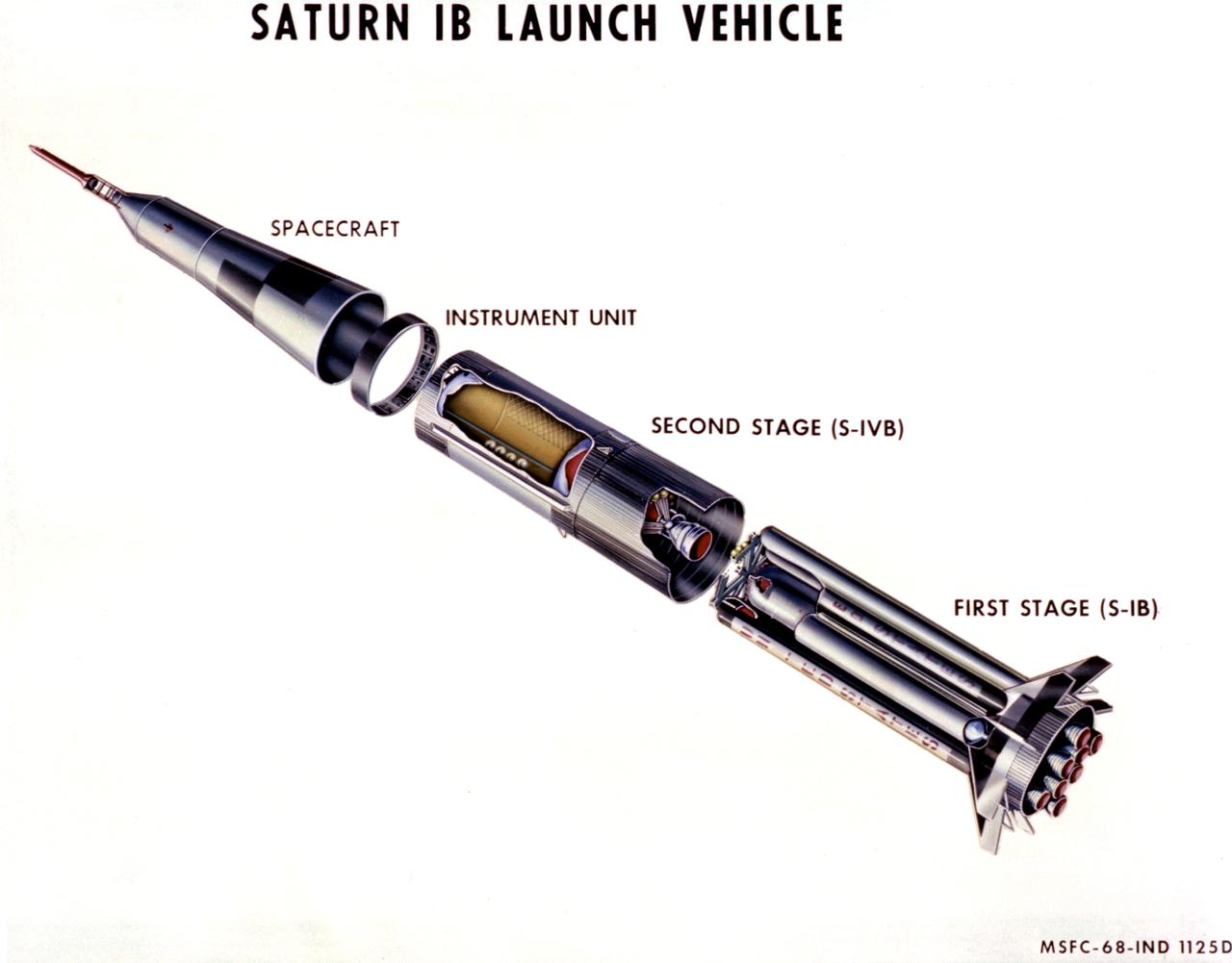
This 1968 cutaway drawing illustrates the Saturn IB launch vehicle with its two booster stages, the S-IB and S-IVB. Developed by the Marshall Space Flight Center (MSFC) as an interim vehicle in MSFC's "building block" approach to the Saturn rocket development, the Saturn IB utilized Saturn I technology to further develop and refine the larger boosters and the Apollo spacecraft capabilities required for the marned lunar mission.
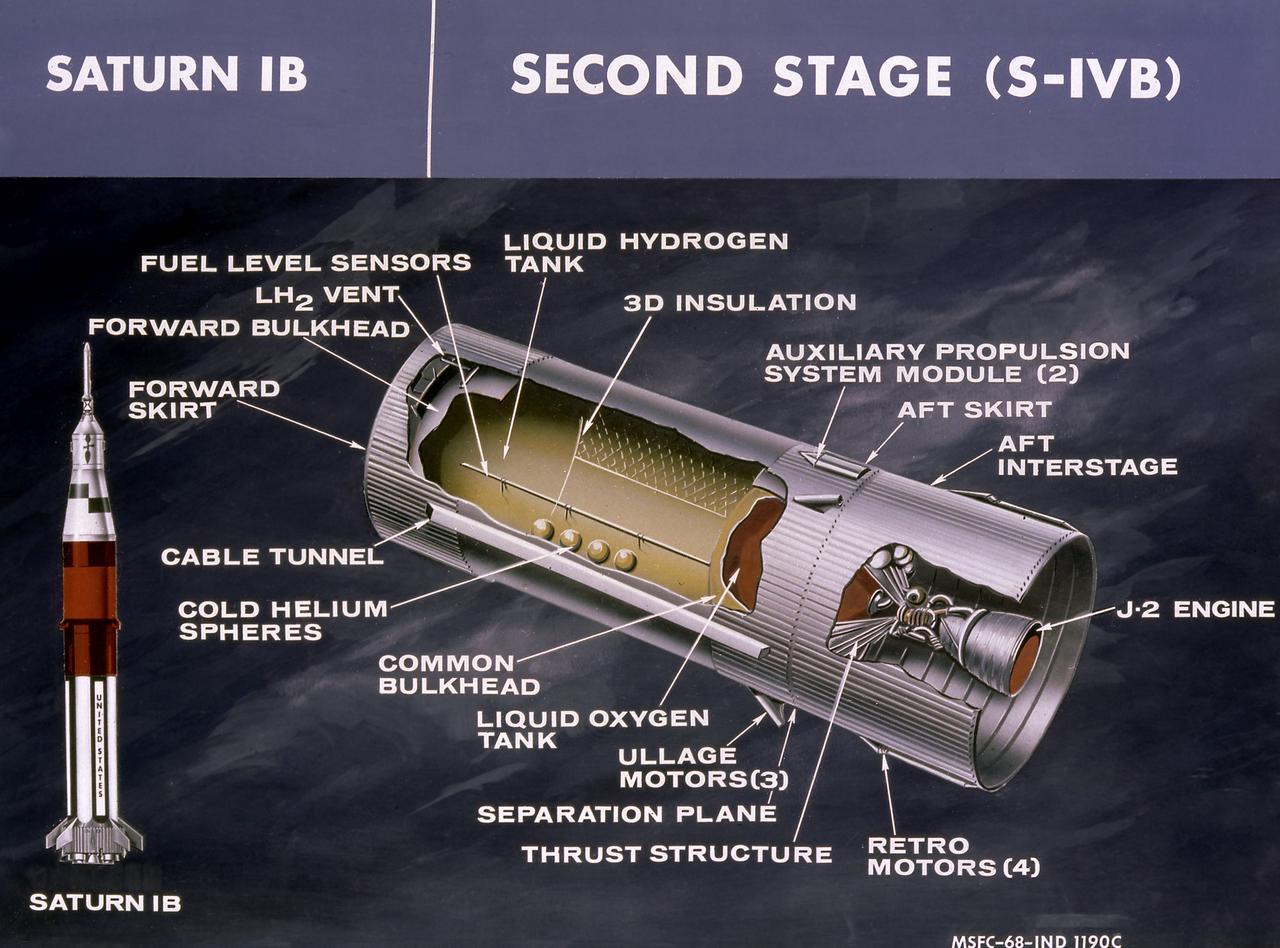
This cutaway drawing shows the S-IVB stage in its Saturn IB configuration. As a part of the Marshall Space Flight Center's (MSFC) "building block" approach to the Saturn development, the S-IVB stage was utilized in the Saturn IB launch vehicle as a second stage and, later, the Saturn V launch vehicle as a third stage. The stage was powered by a single J-2 engine, initially capable of 200,000 pounds of thrust.

Workmen at the Kennedy Space Center position the nose cone for the 204LM-1, an unmanned Apollo mission that tested the Apollo Lunar Module (LM) in Earth orbit. Also known as Apollo 5, the spacecraft was launched on the fourth Saturn IBC launch vehicle. Developed by the Marshall Space Flight Center (MSFC) as an interim vehicle in MSFC's "building block" approach to the Saturn rocket development, the Saturn IBC utilized Saturn I technology to further develop and refine a larger booster and the Apollo spacecraft capabilities required for the manned lunar missions.

Workmen at the Kennedy Space Center position the nose cone for the 204LM-1, an unmanned Apollo mission that tested the Apollo Lunar Module (LM) in Earth orbit. Also known as Apollo 5, the spacecraft was launched on the fourth Saturn IBC launch vehicle. Developed by the Marshall Space Flight Center (MSFC) as an interim vehicle in MSFC's "building block" approach to the Saturn rocket development, the Saturn IBC utilized Saturn I technology to further develop and refine a larger booster and the Apollo spacecraft capabilities required for the manned lunar missions.
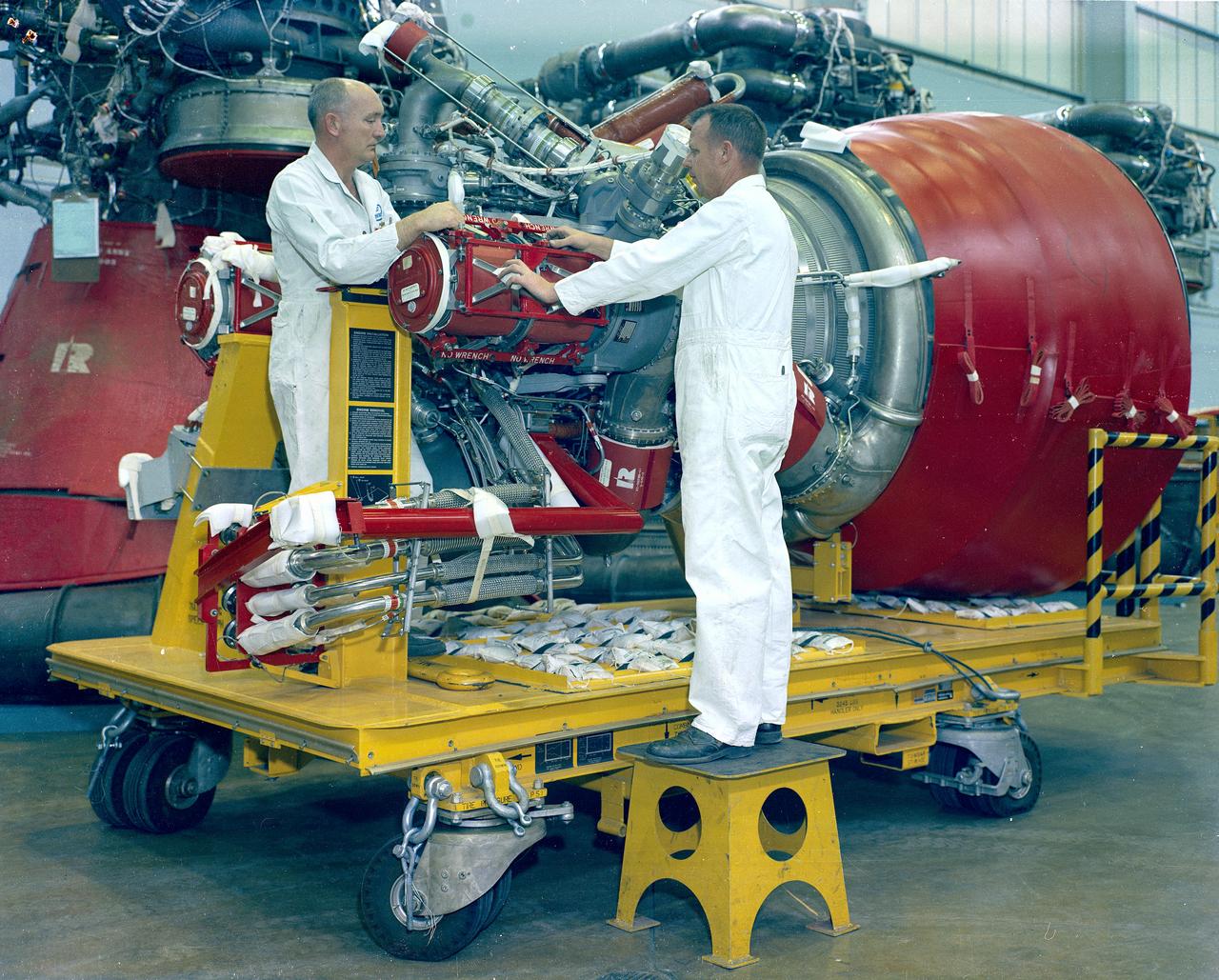
Pictured is a J-2 engine being processed at Marshall Space Flight Center (MSFC). A single J-2 engine was utilized on the S-IVB stage, the second stage of the Saturn IB and the third stage of the Saturn V vehicles, while a cluster of five J-2 engines powered the second (S-II) stage of the Saturn V launch vehicle. The Saturn V was designed, developed, and tested by engineers at MSFC.
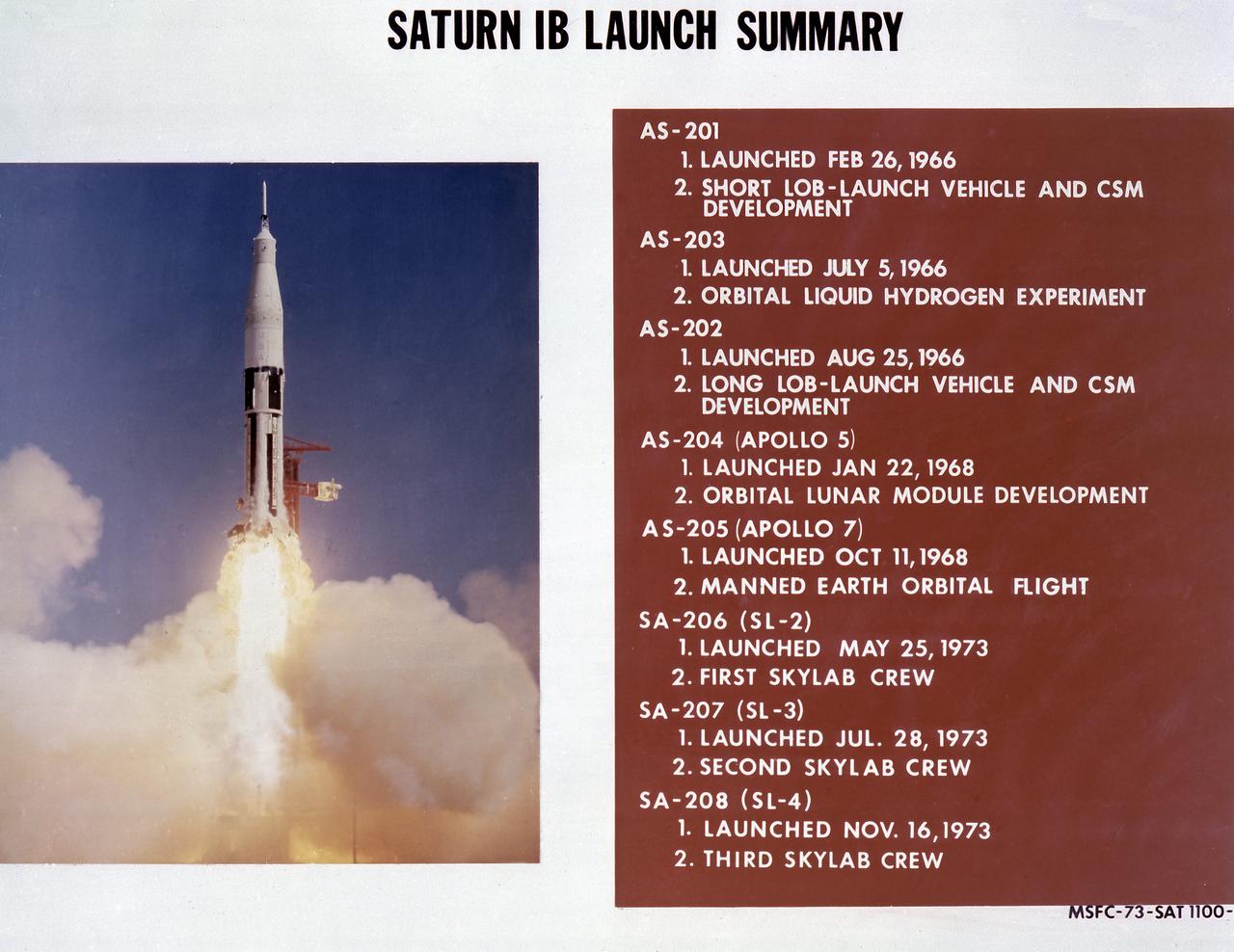
This chart provides a launch summary of the Saturn IB launch vehicle as of 1973. Developed by the Marshall Space Flight Center (MSFC) as an interim vehicle in MSFC's "building block" approach to the Saturn rocket development, the Saturn IB utilized Saturn I technology to further develop and refine the larger boosters and the Apollo spacecraft capabilities required for the marned lunar missions.
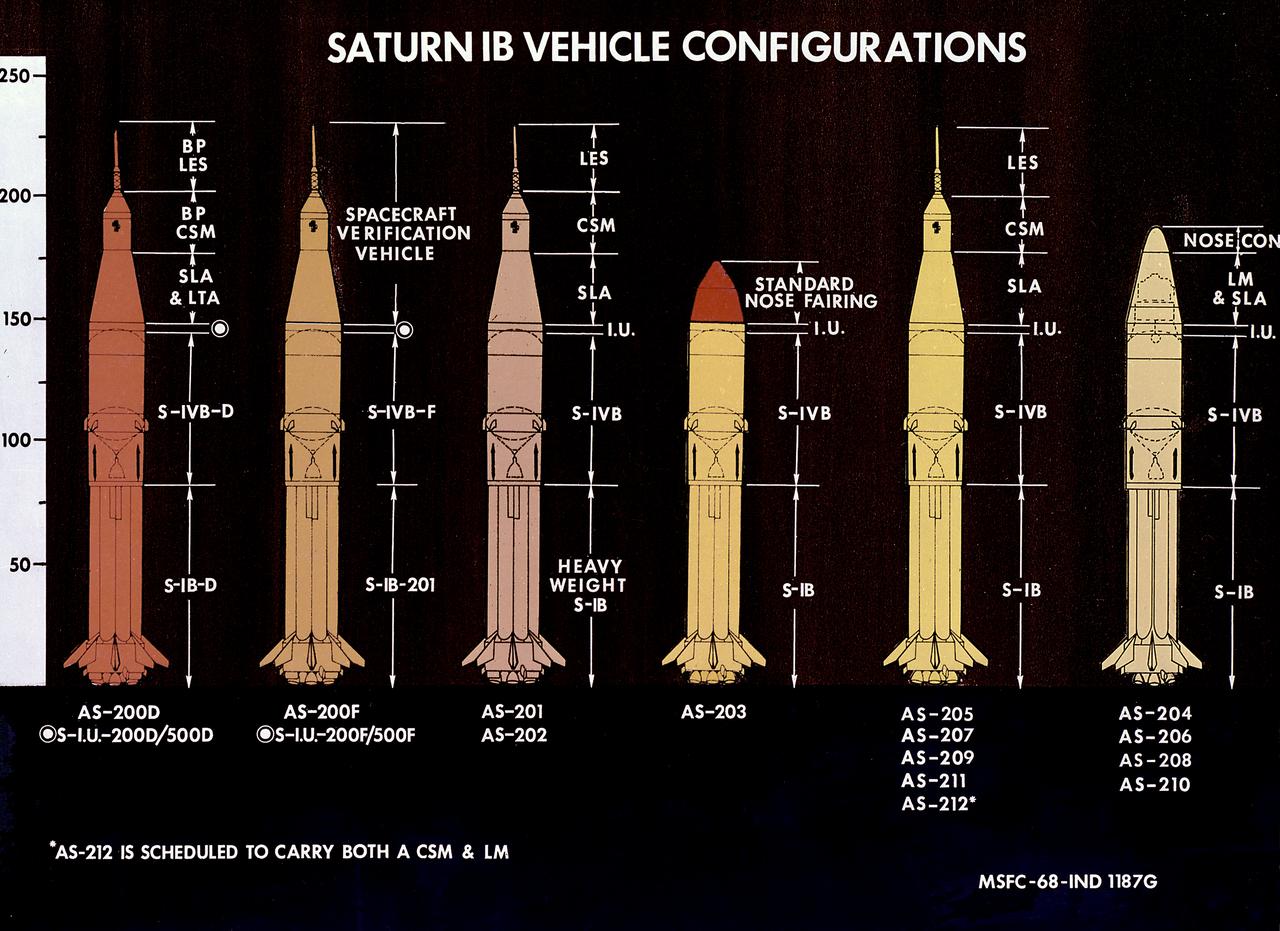
This 1968 chart depicts the various mission configurations for the Saturn IB launch vehicle. Developed by the Marshall Space Flight Center (MSFC) as an interim vehicle in MSFC's "building block" approach to the Saturn rocket development, the Saturn IB utilized Saturn I technology to further develop and refine the larger boosters and the Apollo spacecraft capabilities required for the marned lunar missions.
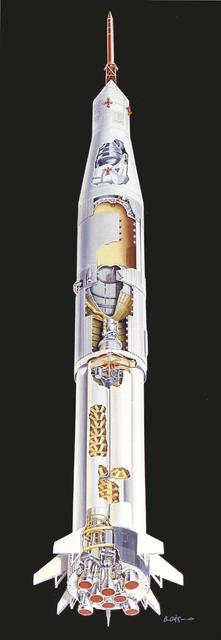
This undated cutaway drawing illustrates the Saturn IB launch vehicle with its two booster stages, the S-IB and S-IVB. Developed by the Marshall Space Flight Center (MSFC) as an interim vehicle in MSFC's "building block" approach to the Saturn rocket development, the Saturn IB utilized Saturn I technology to further develop and refine the larger boosters and the Apollo spacecraft capabilities required for the marned lunar missions.
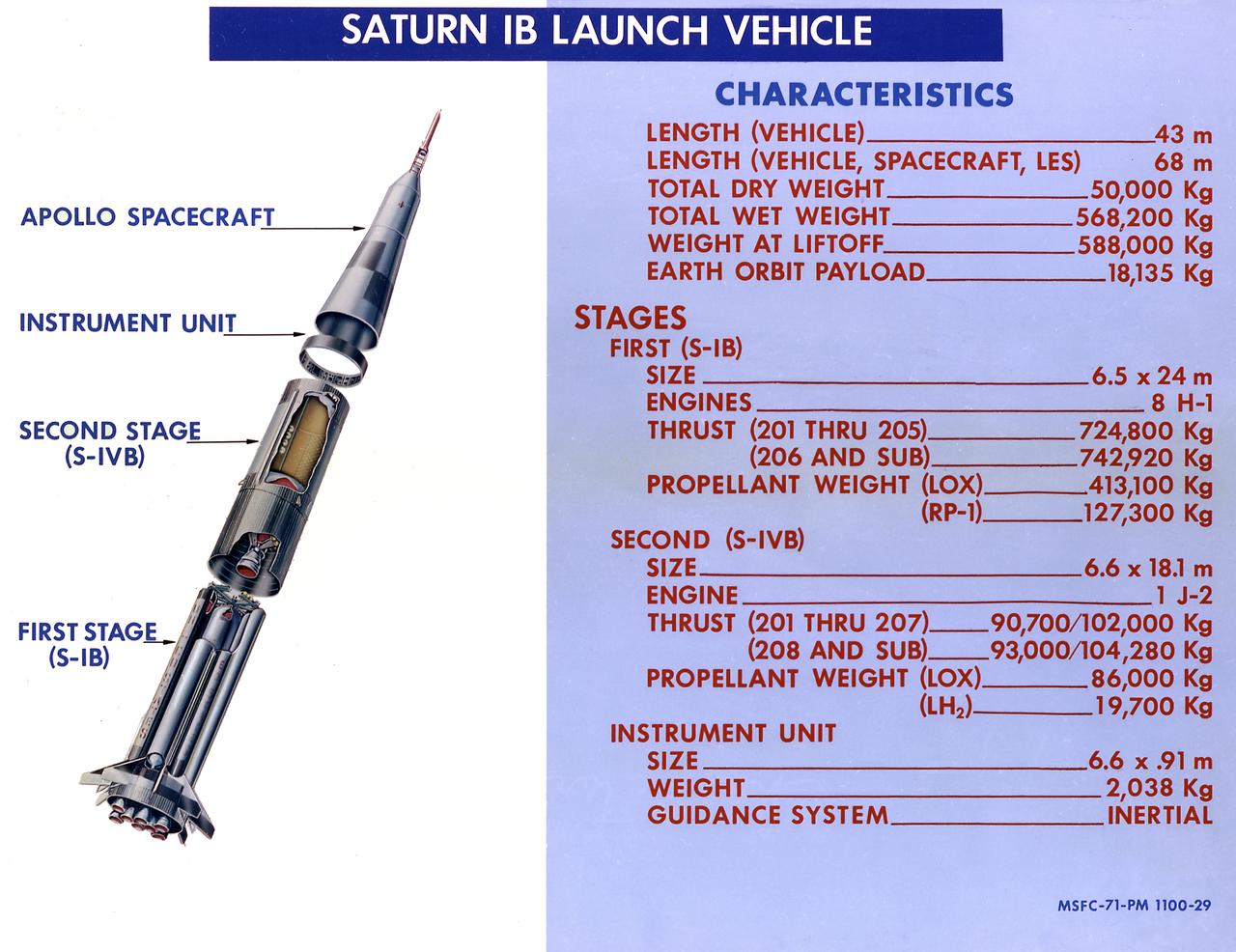
This 1968 cutaway drawing illustrates the Saturn IB launch vehicle with its two booster stages, the S-IB (first stage) and S-IVB (second stage), and provides the vital statistics in metric units. Developed by the Marshall Space Flight Center (MSFC) as an interim vehicle in MSFC's "building block" approach to the Saturn rocket development, the Saturn IB utilized Saturn I technology to further develop and refine the larger boosters and the Apollo spacecraft capabilities required for the marned lunar missions.
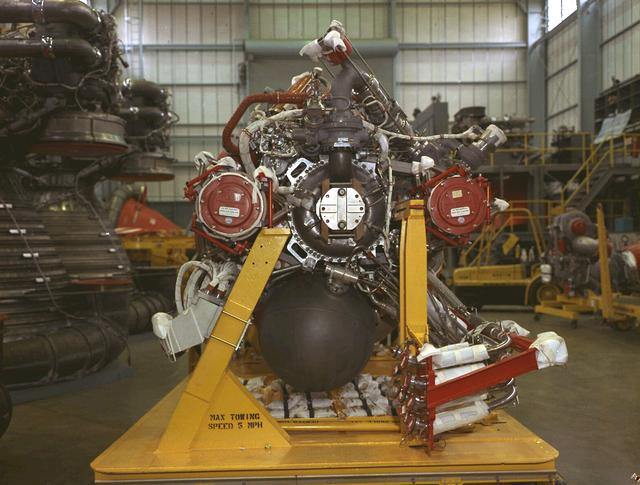
Pictured is a J-2 engine being processed at Marshall Space Flight Center (MSFC). A single J-2 engine was utilized on the S-IVB stage, the second stage of the Saturn IB and the third stage of the Saturn V vehicles, while a cluster of five J-2 engines powered the second (S-II) stage of the Saturn V launch vehicle. The Saturn V was designed, developed, and tested by engineers at MSFC.
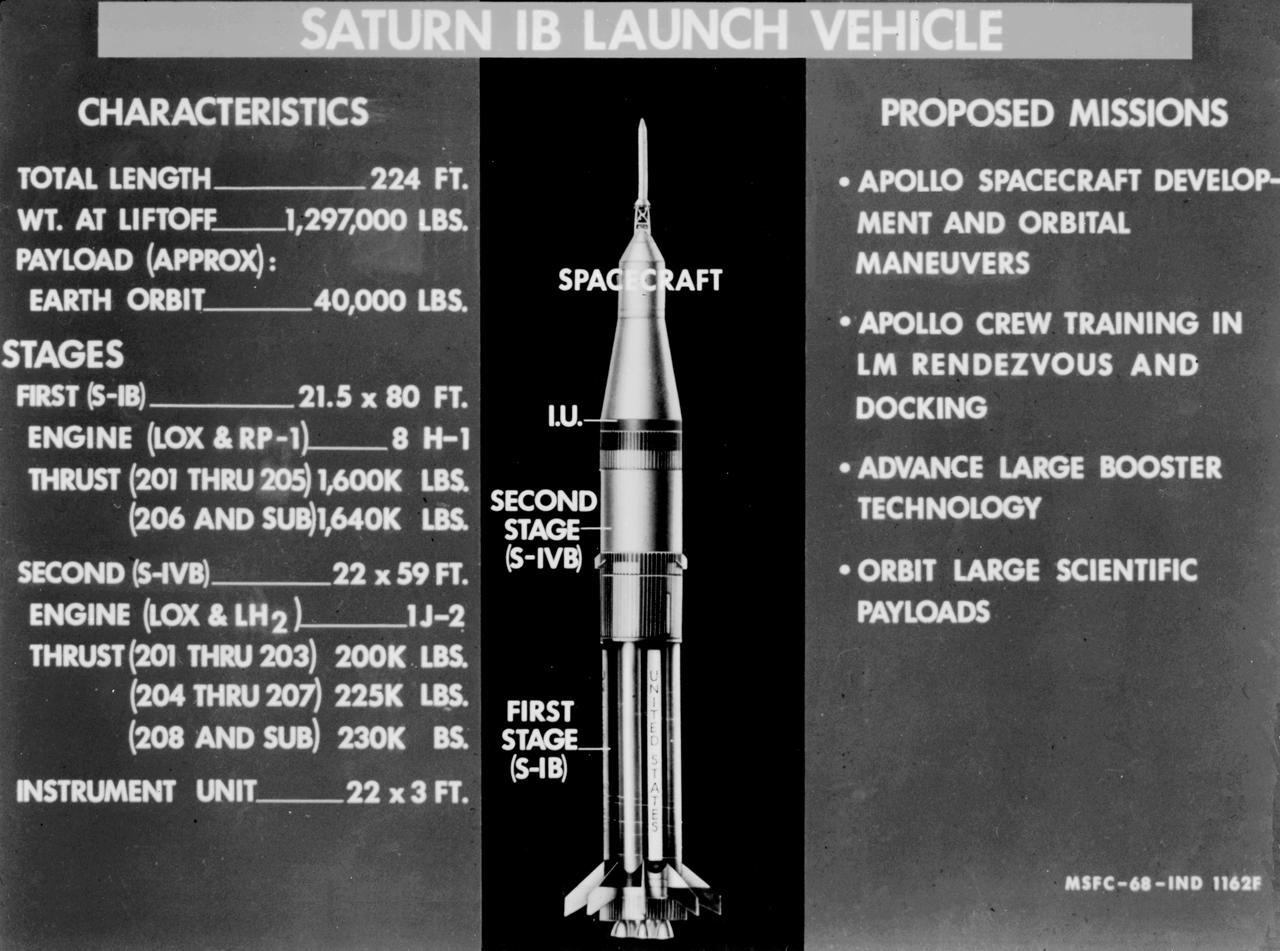
This 1968 chart illustrates the characteristics and proposed missions for the Saturn IB launch vehicle. Developed by the Marshall Space Flight Center (MSFC) as an interim vehicle in MSFC's "building block" approach to the Saturn rocket development, the Saturn IB utilized Saturn I technology to further develop and refine the larger boosters and the Apollo spacecraft capabilities required for the marned lunar missions.

Workmen at the Kennedy Space Center hoist the Saturn Lunar Module (LM) Adapter into position during assembly of the 204LM-1, an unmanned Apollo mission that tested the Apollo Lunar Module in Earth orbit. Also known as Apollo 5, the spacecraft was launched on the fourth Saturn IB launch vehicle. Developed by the Marshall Space Flight Center (MSFC) as an interim vehicle in MSFC's "building block" approach to the Saturn rocket development, the Saturn IB utilized Saturn I technology to further develop and refine a larger booster and the Apollo spacecraft capabilities required for the manned lunar missions.
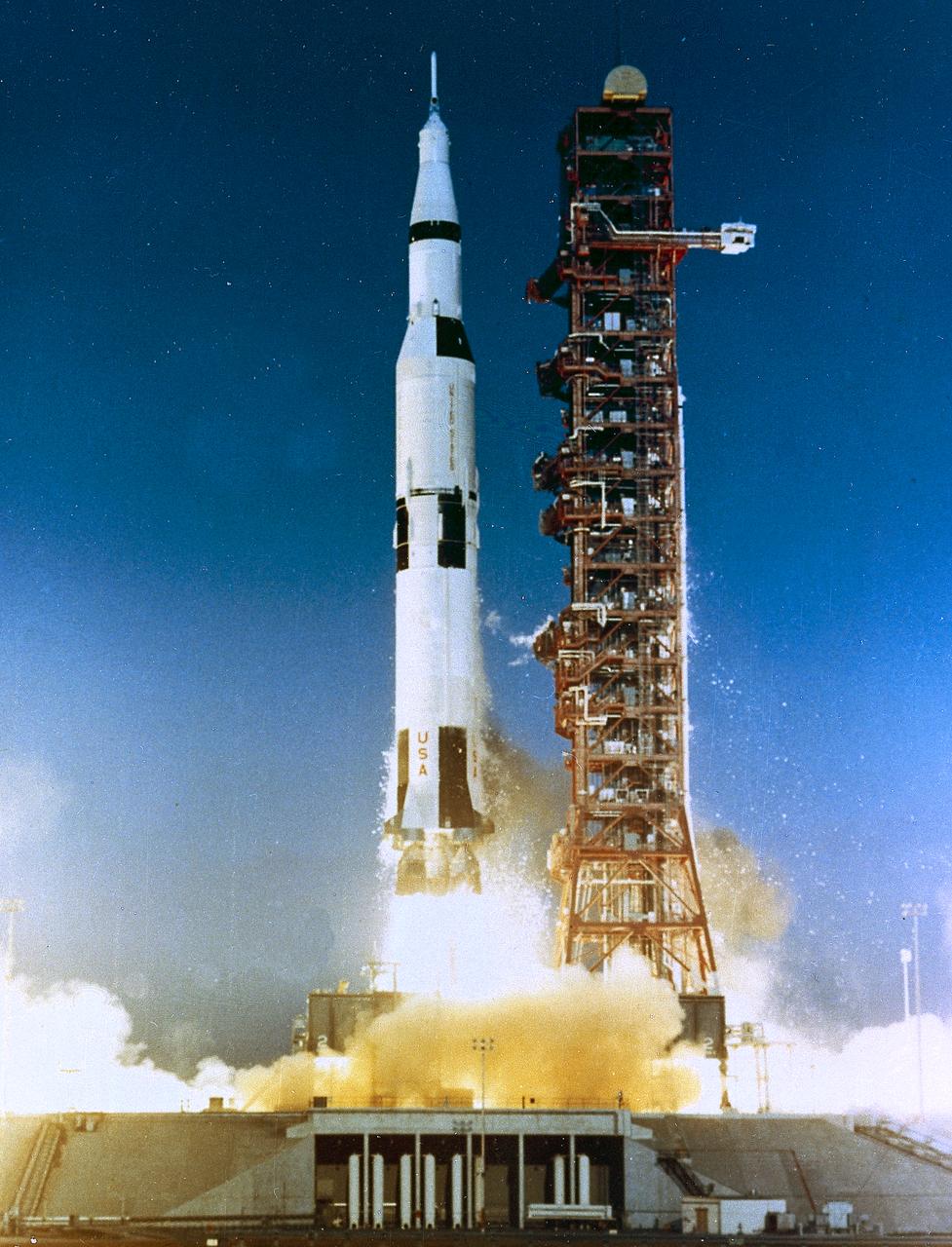
The second Saturn V launch vehicle (SA-502) for the Apollo 6 mission lifted off from the Kennedy Space Center launch complex on April 4, 1968. This unmanned Saturn V launch vehicle tested the emergency detection system in closed loop configuration.
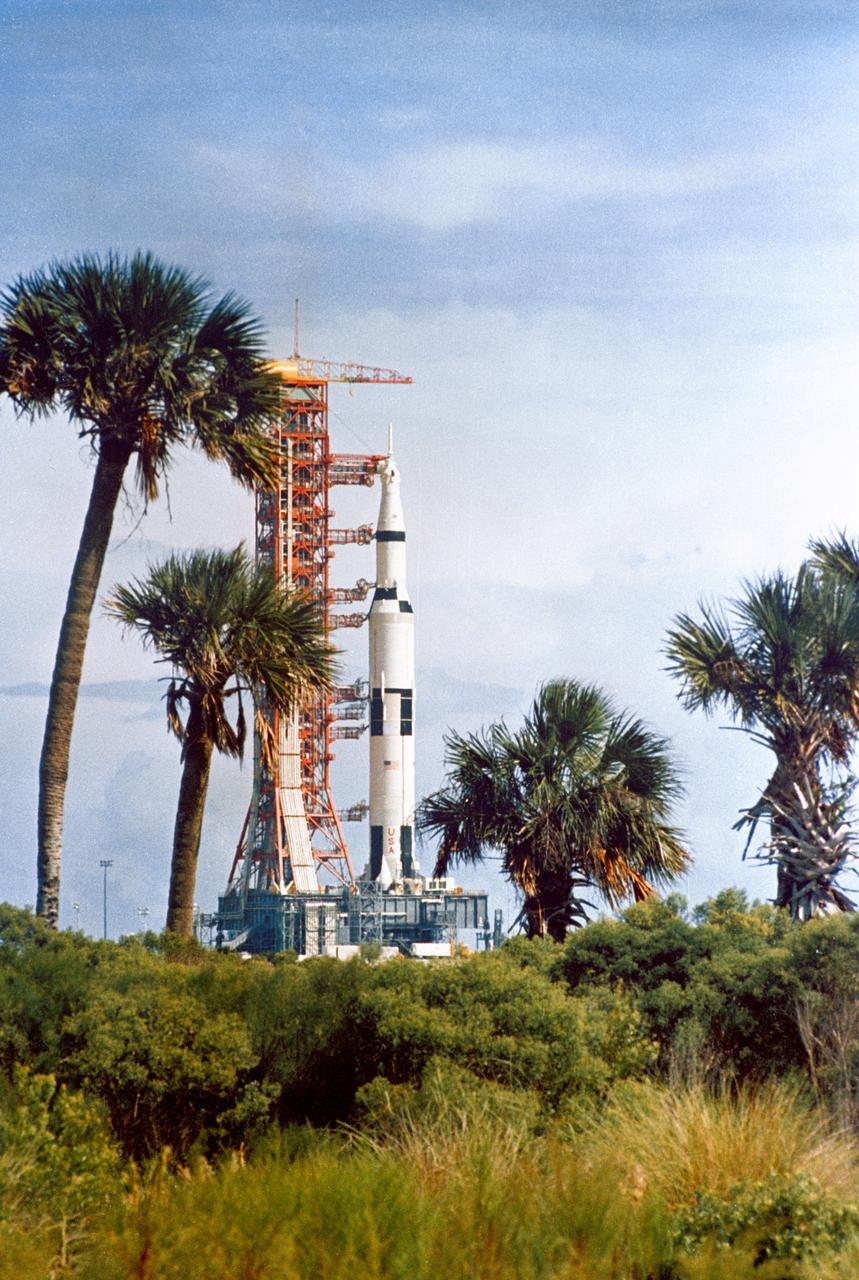
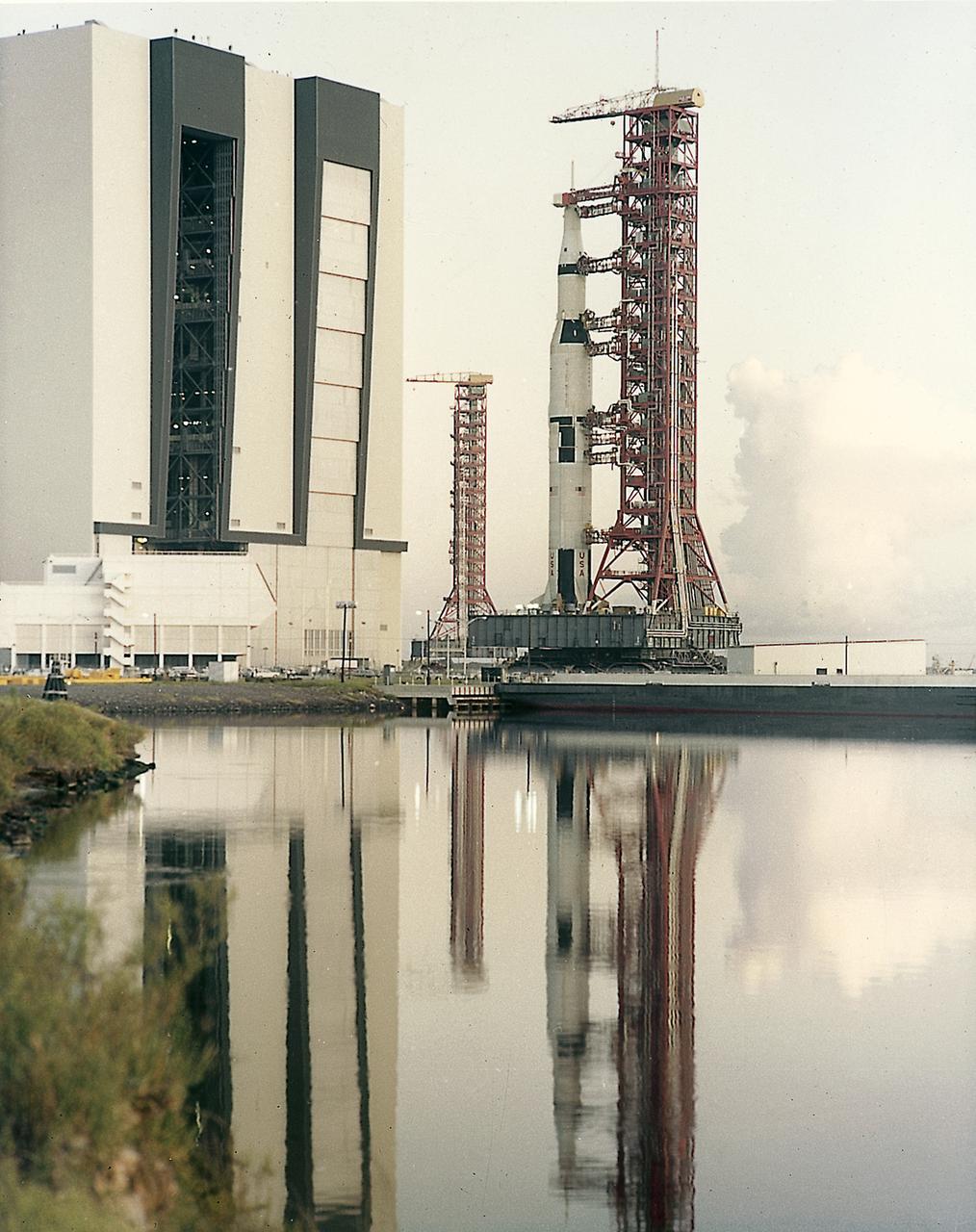
S68-49399 (9 Oct. 1968) --- The Apollo 8 (Spacecraft 103/Saturn 503) space vehicle on the way from the Kennedy Space Center's (KSC) Vehicle Assembly Building (VAB) to Pad A, Launch Complex 39. The Saturn V stack and its mobile launch tower are atop a huge crawler-transporter.
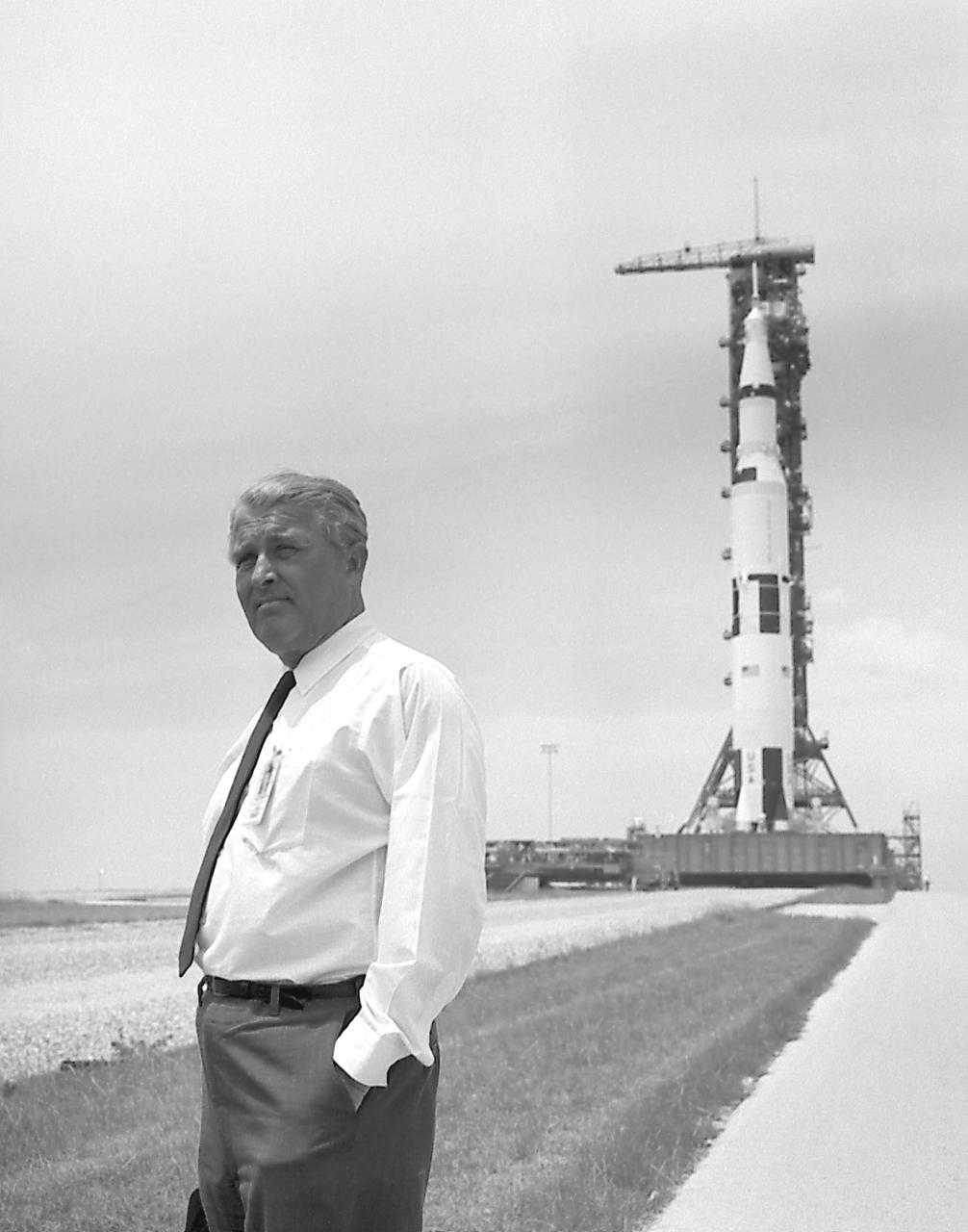
Dr. von Braun pauses in front of the Saturn V vehicle being readied for the historic Apollo 11 lunar landing mission at the Kennedy Space Center (KSC). The Saturn V vehicle was developed by the Marshall Space Flight Center (MSFC) under the direction of Dr. von Braun.

S67-36022 (20 June 1967) --- Apollo Spacecraft 017 is moved into position in the Vehicle Assembly Building's high bay area for mating with the Saturn V launch vehicle. S/C 017 will be flown on the Spacecraft 017/Saturn 501 (Apollo 4) space mission.
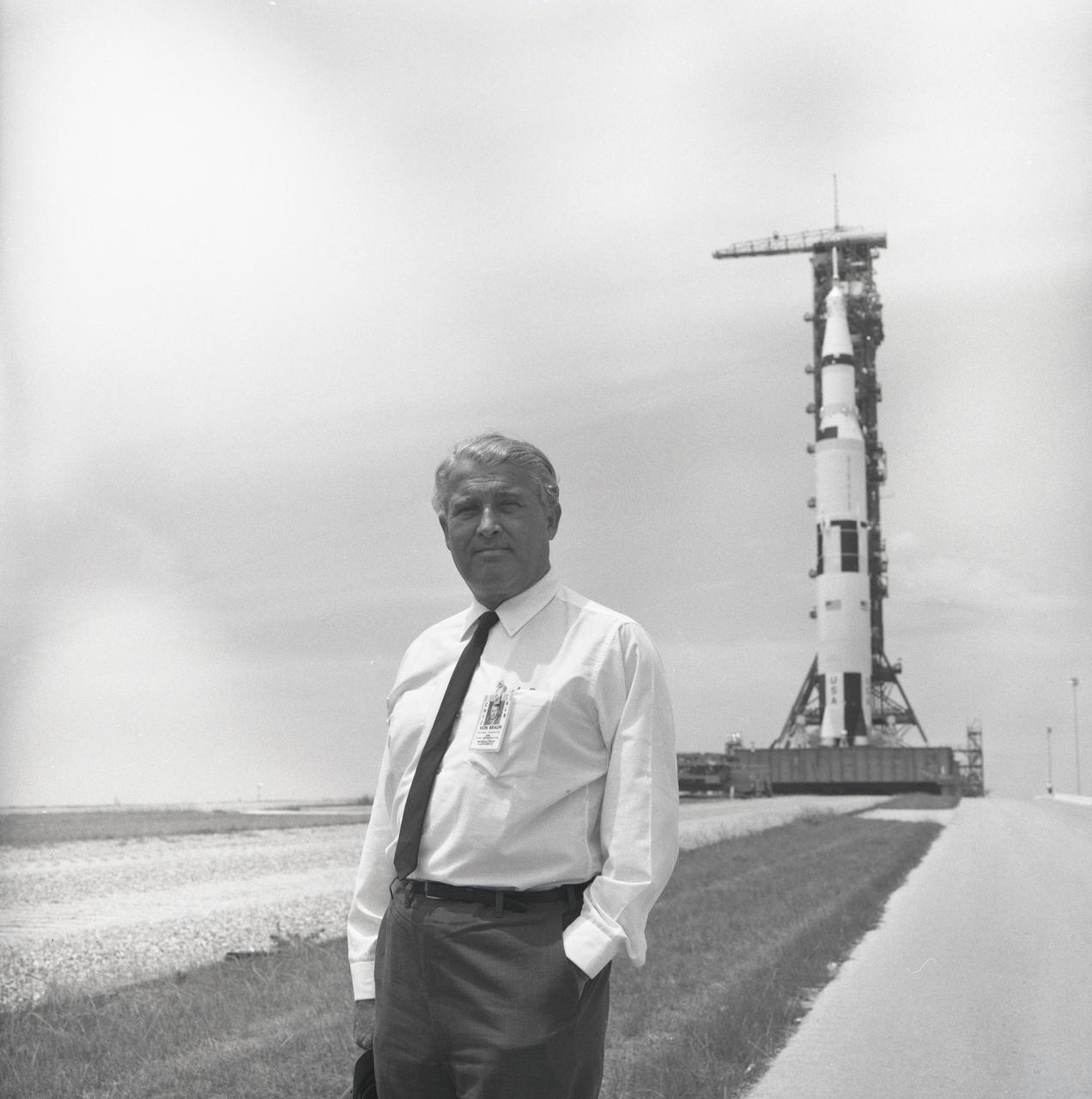
Dr. von Braun pauses in front of the Saturn V vehicle being readied for the historic Apollo 11 lunar landing mission at the Kennedy Space Center (KSC). The Saturn V vehicle was developed by the Marshall Space Flight Center (MSFC) under the direction of Dr. von Braun.
![Apollo spacecraft 017 leaves the Manned Spacecraft Operations Building at Kennedy Space Center on its way to the Vehicle Assembly Building where it will be mated with the Saturn 501 launch vehicle. The first flight of the Saturn V [AS-501], an unmanned mission, is scheduled for this fall.](https://images-assets.nasa.gov/image/KSC-67P-0259/KSC-67P-0259~medium.jpg)
Apollo spacecraft 017 leaves the Manned Spacecraft Operations Building at Kennedy Space Center on its way to the Vehicle Assembly Building where it will be mated with the Saturn 501 launch vehicle. The first flight of the Saturn V [AS-501], an unmanned mission, is scheduled for this fall.
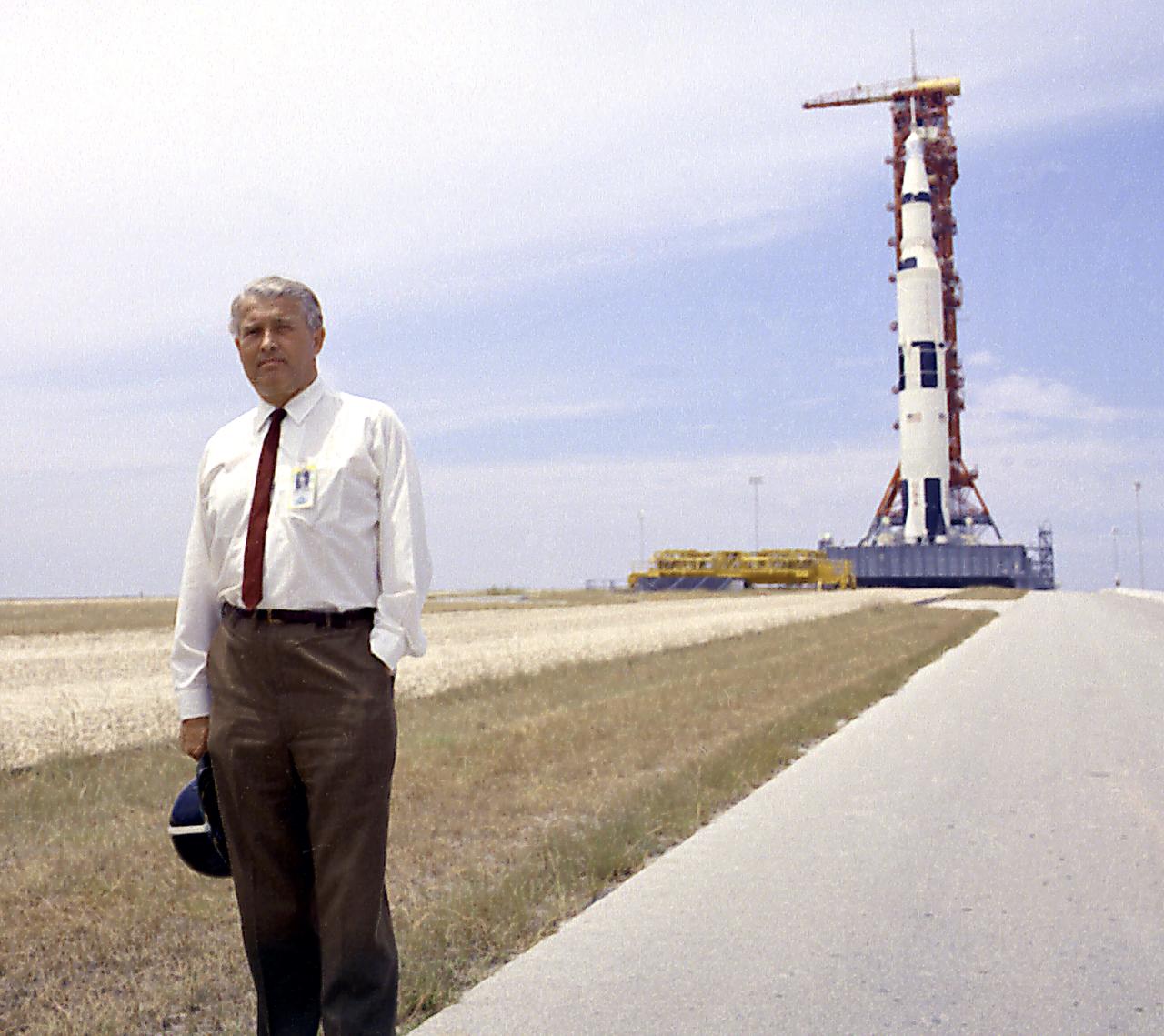
Dr. von Braun pauses in front of the Saturn V vehicle being readied for the historic Apollo 11 lunar landing mission at the Kennedy Space Center (KSC). The Saturn V vehicle was developed by the Marshall Space Flight Center (MSFC) under the direction of Dr. von Braun.
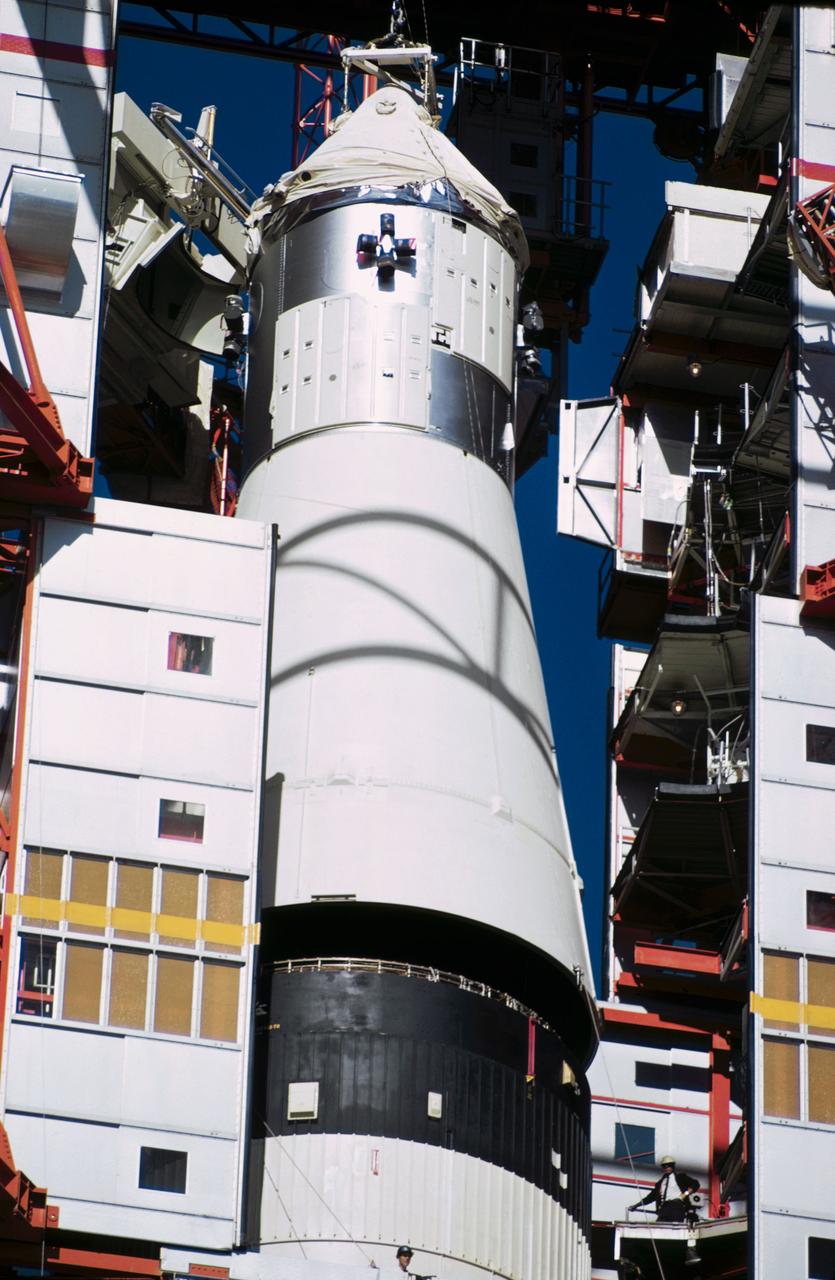
S67-17042 (1967) --- Apollo Spacecraft 012 is hoisted to the top of the gantry at Pad 34 during the Apollo/Saturn Mission 204 erection. S/C 012 will be mated with the uprated Saturn I launch vehicle.
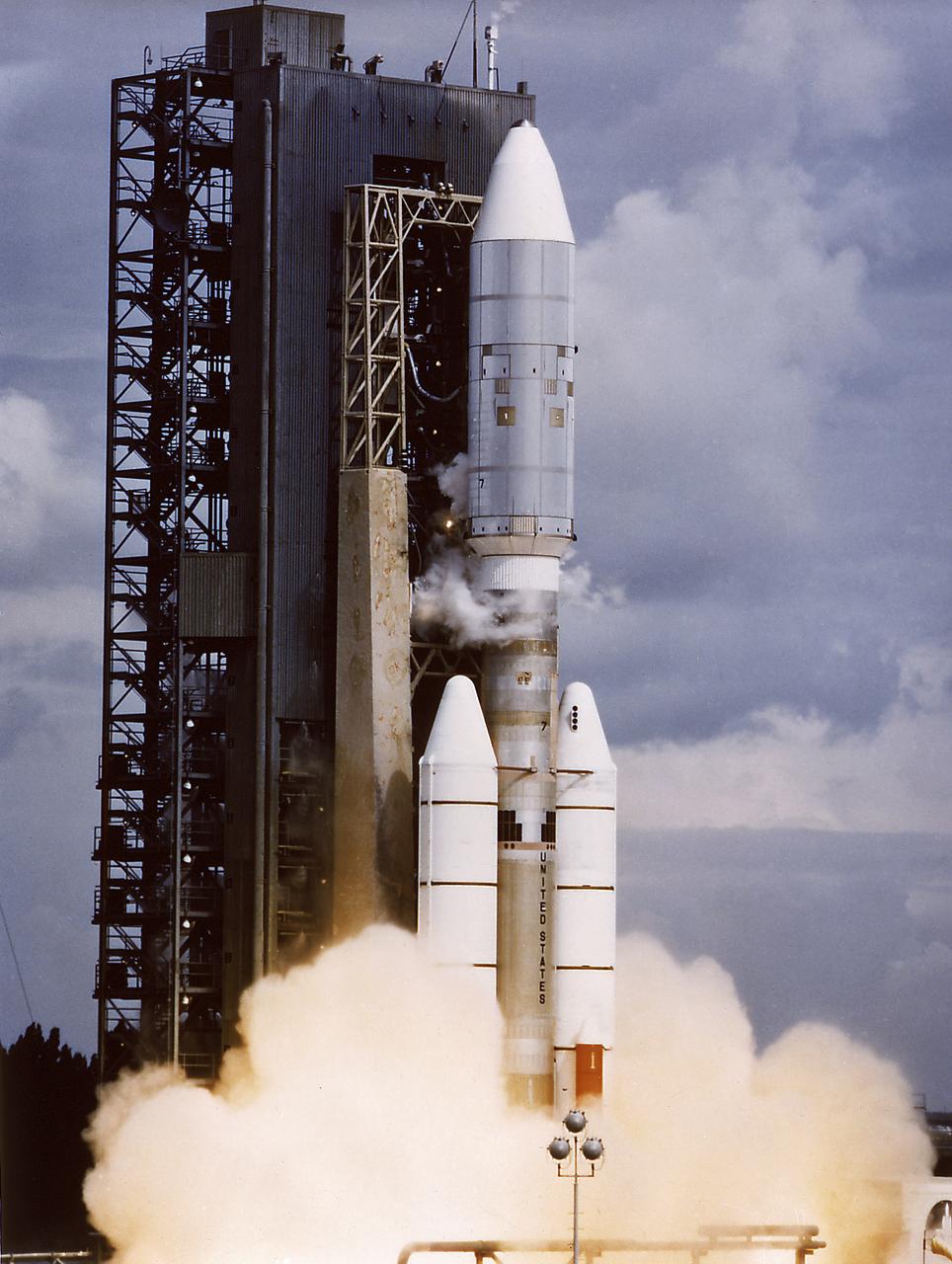
The Voyager 2 aboard Titan III-Centaur launch vehicle lifted off on August 20, 1977. The Voyager 2 was a scientific satellite to study the Jupiter and the Saturn planetary systems including their satellites and Saturn's rings.
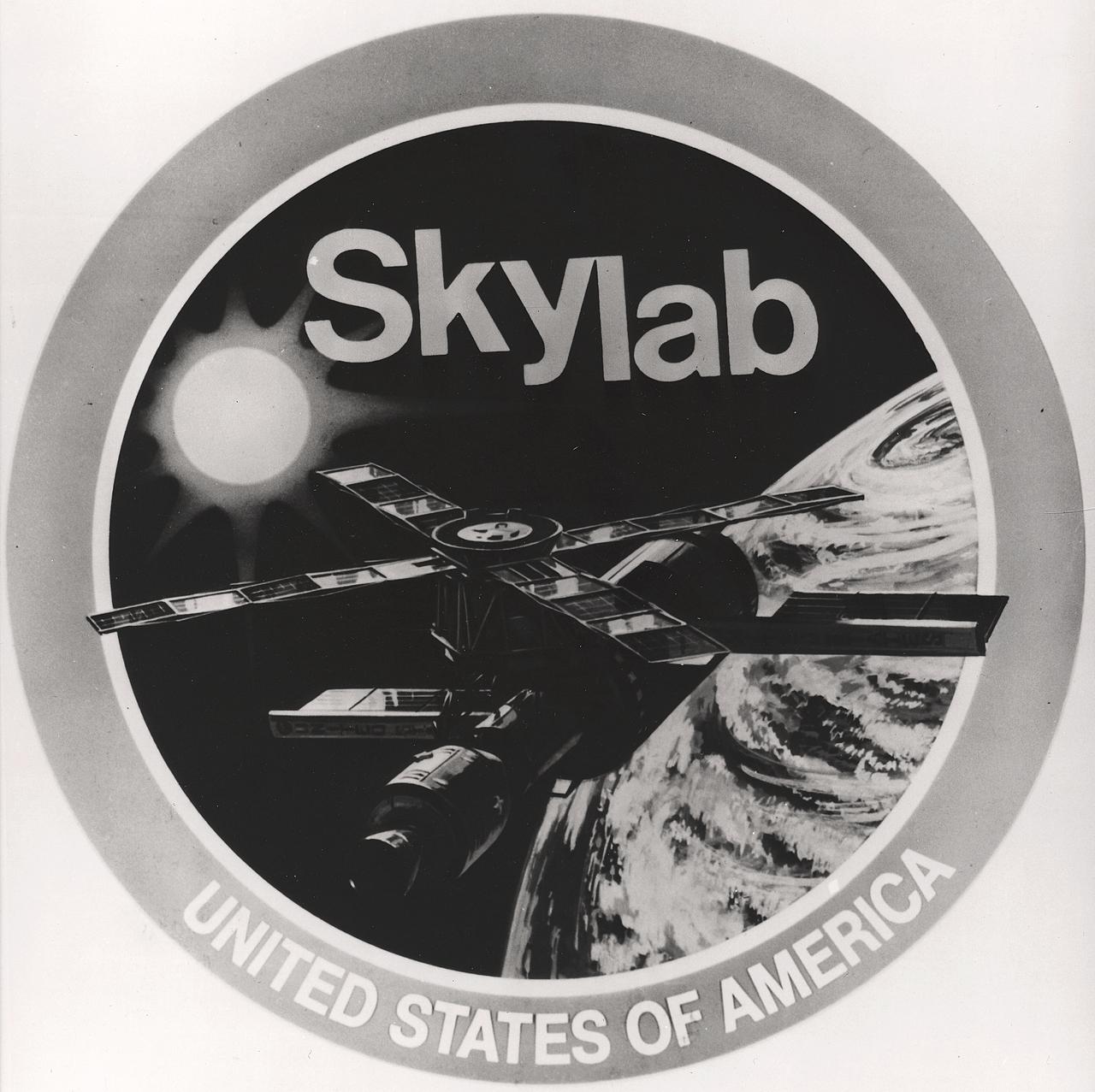
In 1973, Skylab, America's first space station, was launched aboard a two-stage Saturn V vehicle. Saturn IB rockets were used to launch three different three-man crews to the Skylab space station.
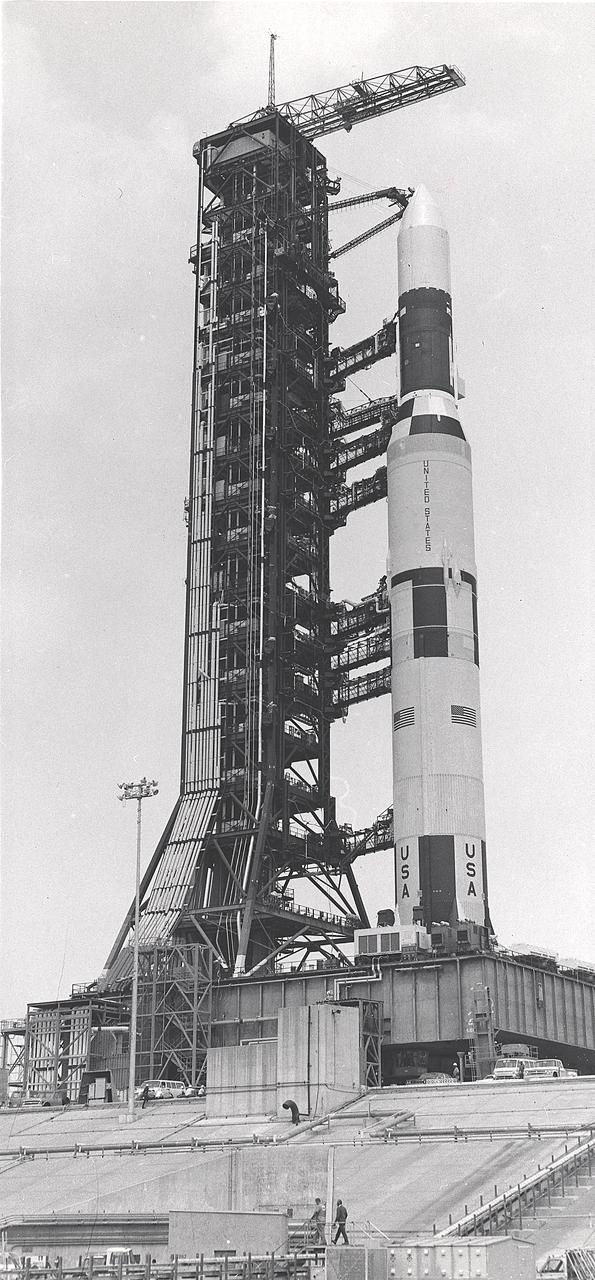
In 1973, Skylab, America's first space station, was launched aboard a two-stage Saturn V vehicle. Saturn IB rockets were used to launch three different three-man crews to the Skylab space station.
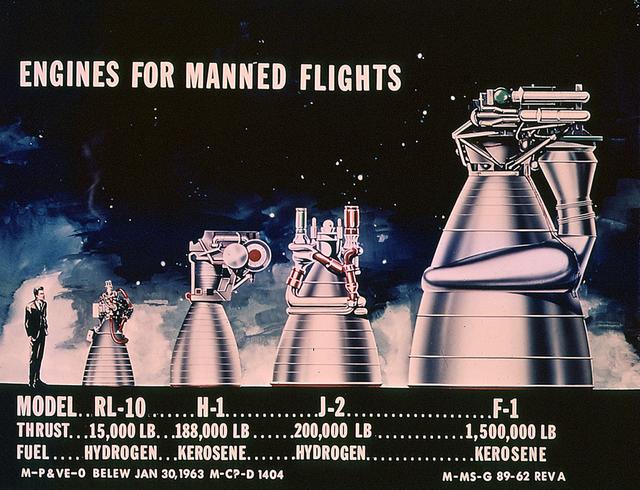
This drawing clearly shows the comparative sizes of the rocket engines used to launch the Saturn vehicles. The RL-10 and the H-1 engines were used to launch the Saturn I rockets. The J-2 engine was used on the second stage of Saturn IB and the second and third stages of Saturn V. The F-1 engine was used on the first stage of the Saturn V.
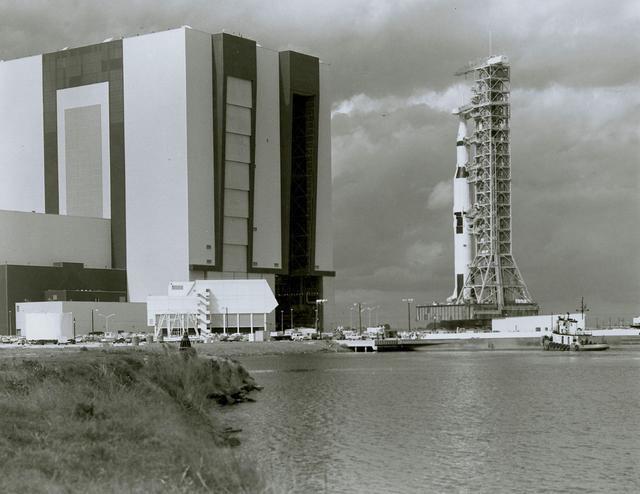
Apollo 6, the second and last of the unmarned Saturn V test flights, is slowly transported past the Vehicle Assembly Building on the way to launch pad 39-A. The towering 363-foot Saturn V was a multi-stage, multi-engine launch vehicle standing taller than the Statue of Liberty. Altogether, the Saturn V engines produced as much power as 85 Hoover Dams.
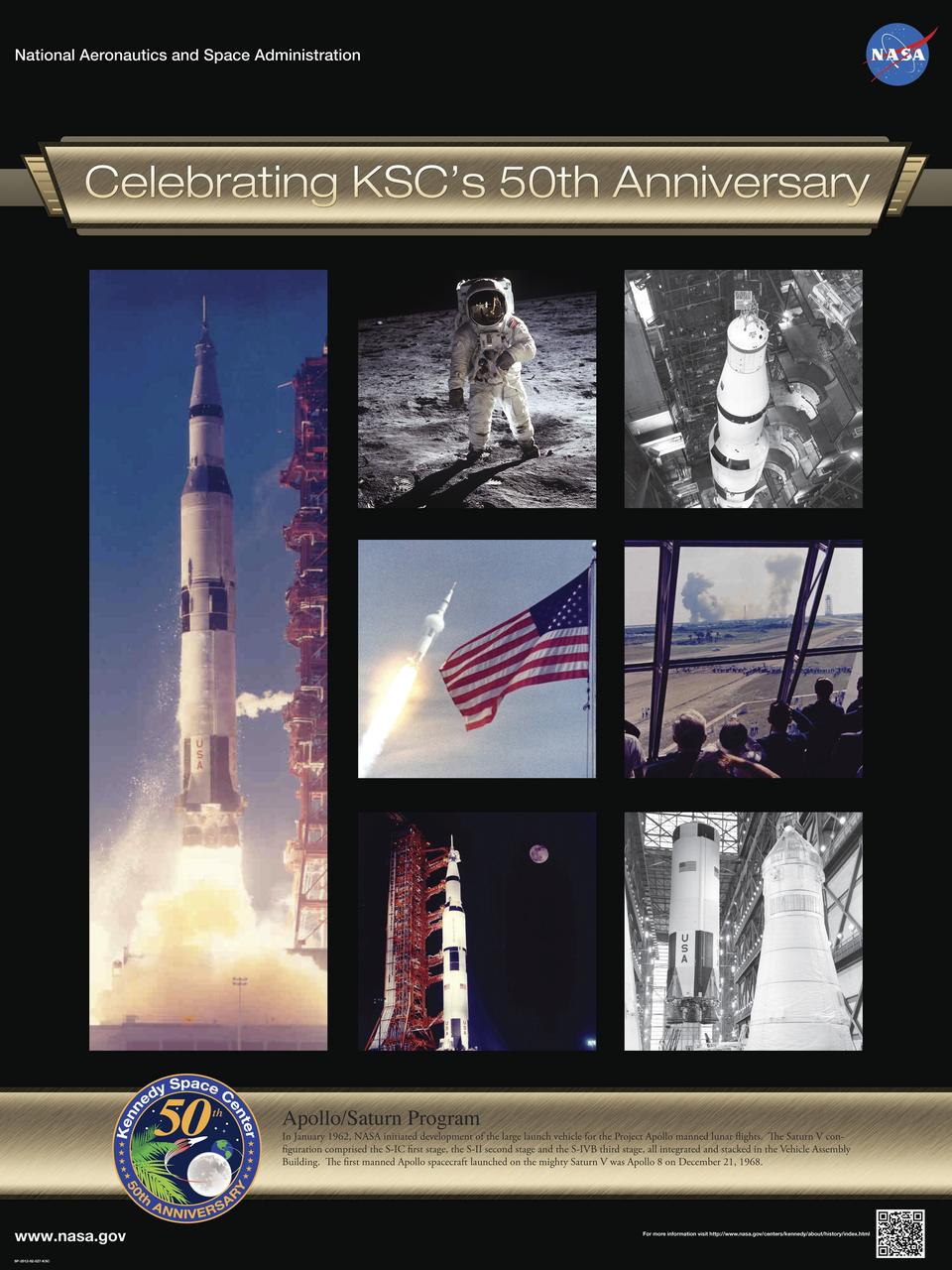
Apollo/Saturn Program: In January 1962, NASA initiated development of the large launch vehicle for the Project Apollo manned lunar flights. The Saturn V configuration comprised the S-IC first stage, the S-II second stage and the S-IVB third stage, all integrated and stacked in the Vehicle Assembly Building. The first manned Apollo spacecraft launched on the mighty Saturn V was Apollo 8 on December 21, 1968. Poster designed by Kennedy Space Center Graphics Department/Greg Lee. Credit: NASA
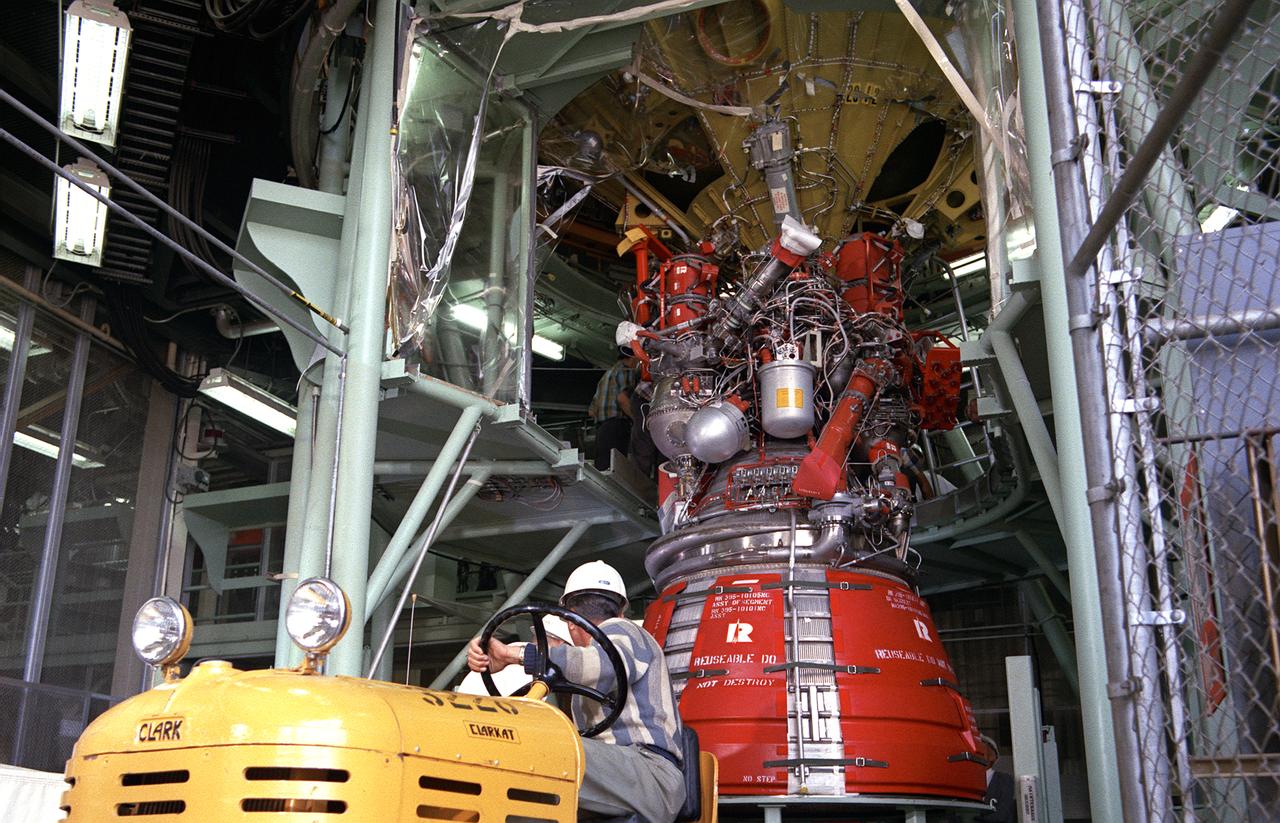
Workmen secure a J-2 engine onto the S-IVB (second) stage thrust structure. As part of Marshall Space Center's "building block" approach to the Saturn development, the S-IVB was utilized in the Saturn IBC launch vehicle as a second stage and the Saturn V launch vehicle as a third stage. The booster, built for NASA by McDornell Douglas Corporation, was powered by a single J-2 engine, initially capable of 200,000 pounds of thrust.
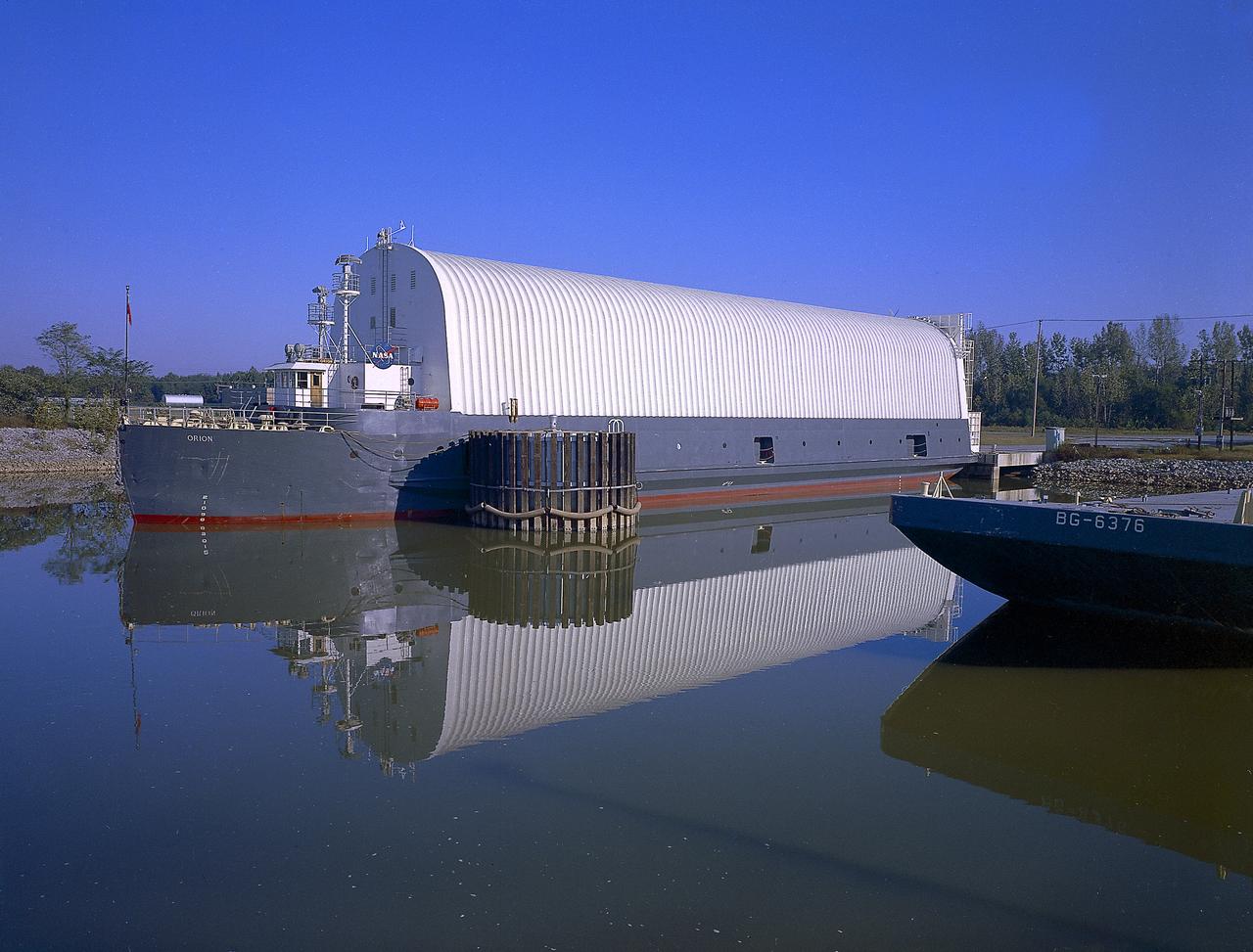
NASA used barges for transporting full-sized stages for the Saturn I, Saturn IB, and Saturn V vehicles between the Marshall Space Flight Center (MSFC), the manufacturing plant at the Michoud Assembly Facility (MAF), the Mississippi Test Facility for testing, and the Kennedy Space Center. The barges traveled from the MSFC dock to the MAF, a total of 1,086.7 miles up the Tennessee River and down the Mississippi River. The barges also transported the assembled stages of the Saturn vehicle from the MAF to the Kennedy Space Center, a total of 932.4 miles along the Gulf of Mexico and up along the Atlantic Ocean, for the final assembly and the launch. This photograph shows the barge Orion at the MSFC dock.
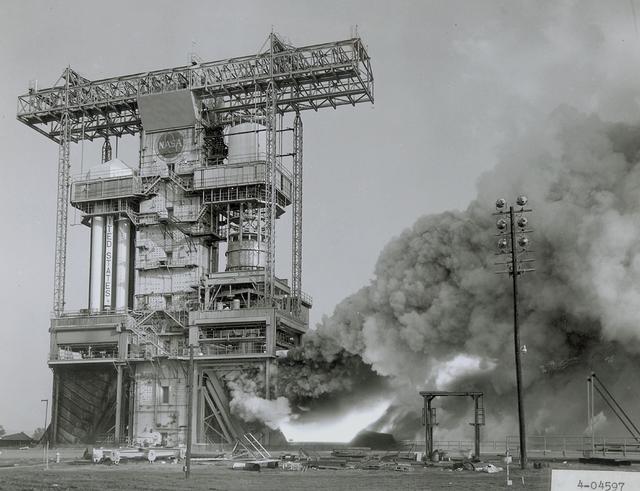
The flame and exhaust from the test firing of an F-1 engine blast out from the Saturn S-IB Static Test Stand in the east test area of the Marshall Space Flight Center. A Cluster of five F-1 engines, located in the S-IC (first) stage of the Saturn V vehicle, provided over 7,500,000 pounds of thrust to launch the giant rocket. The towering 363-foot Saturn V was a multistage, multiengine launch vehicle standing taller than the Statue of Liberty. Altogether, the Saturn V engines produced as much power as 85 Hoover Dams.
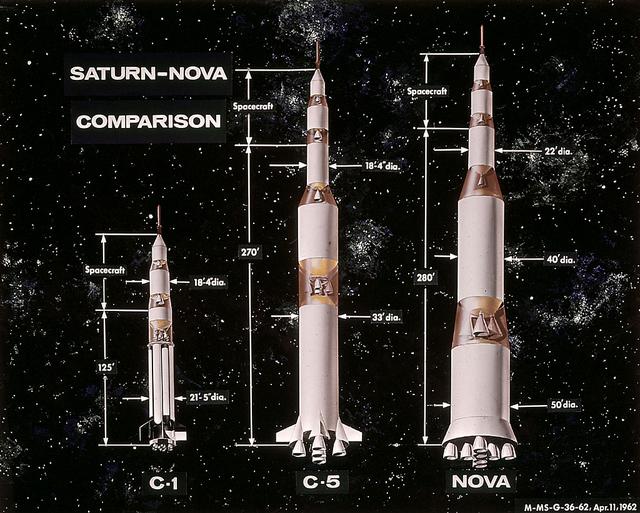
In this 1962 artist's concept , a proposed Nova rocket, shown at right, is compared to a Saturn C-1, left, and a Saturn C-5, center. The Marshall Space Flight Center directed studies of Nova configuration from 1960 to 1962 as a means of achieving a marned lunar landing with a direct flight to the Moon. Various configurations of the vehicle were examined, the largest being a five-stage vehicle using eight F-1 engines in the first stage. Although the program was effectively cancelled in 1962 when NASA planners selected the lunar-orbital rendezvous mode, the proposed F-1 engine was eventually used to propel the first stage of the Saturn V launch vehicle in the Apollo Program.
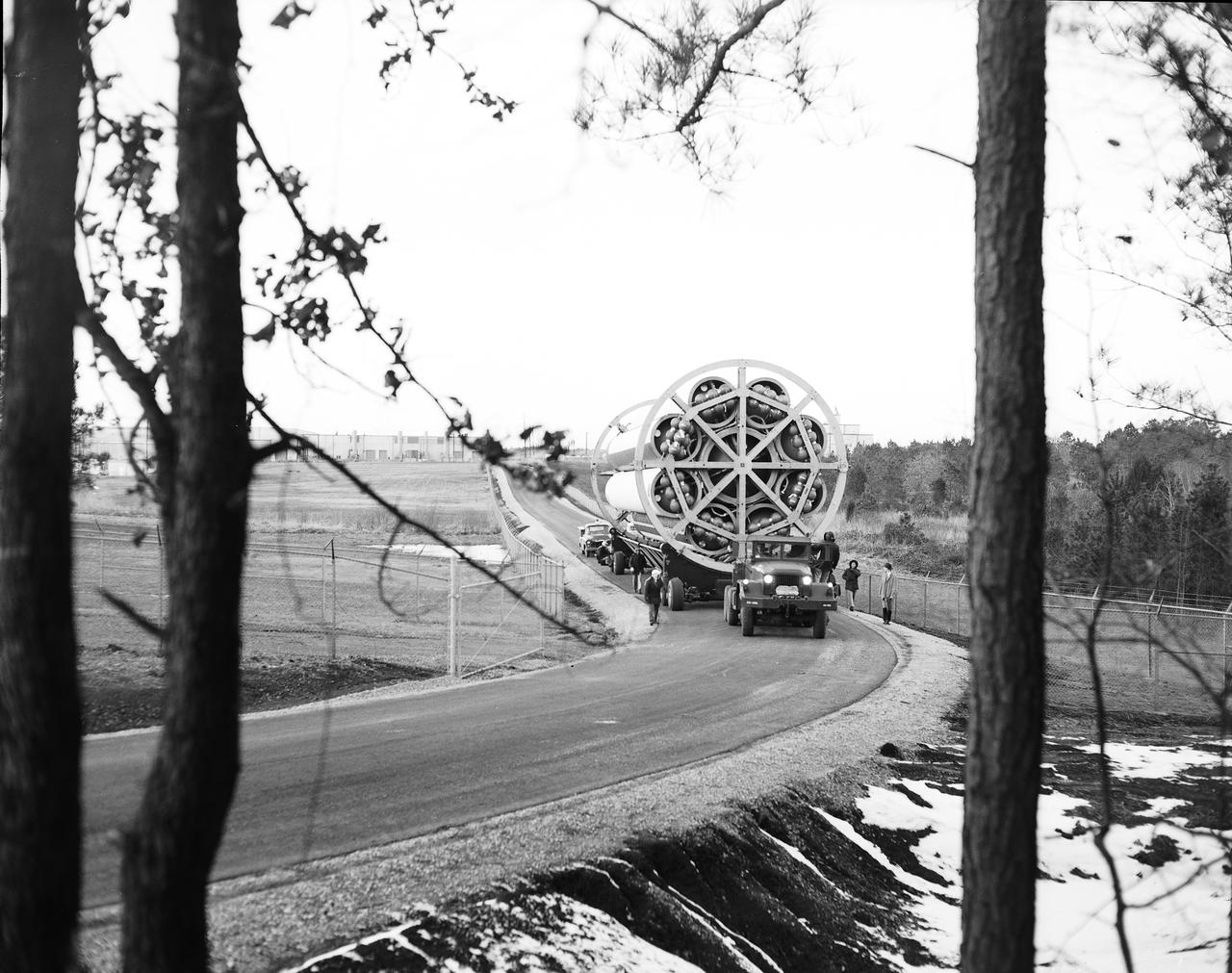
This photograph shows the Saturn-I first stage (S-1 stage) being transported to the test stand for a static test firing at the Marshall Space Flight Center. Soon after NASA began operations in October 1958, it was evident that sending people and substantial equipment beyond the Earth's gravitational field would require launch vehicles with weight-lifting capabilities far beyond any developed to that time. In early 1959, NASA accepted the proposal of Dr. Wernher von Braun for a multistage rocket, with a number of engines clustered in one or more of the stages to provide a large total thrust. The initiation of the Saturn launch vehicle program ultimately led to the study and preliminary plarning of many different configurations and resulted in production of three Saturn launch vehicles, the Saturn-I, Saturn I-B, and Saturn V. The Saturn family of launch vehicles began with the Saturn-I, a two-stage vehicle originally designated C-1. The research and development program was planned in two phases, or blocks: one for first stage development (Block I) and the second for both first and second stage development (Block-II). Saturn I had a low-earth-orbit payload capability of approximately 25,000 pounds. The design of the first stage (S-1 stage) used a cluster of propellant tanks containing liquid oxygen (LOX) and kerosene (RP-1), and eight H-1 engines, yielding a total thrust of 1,500,000 pounds. Of the ten Saturn-Is planned, the first eight were designed and built at the Marshall Space Flight Center, and the remaining two were built by the Chrysler Corporation.
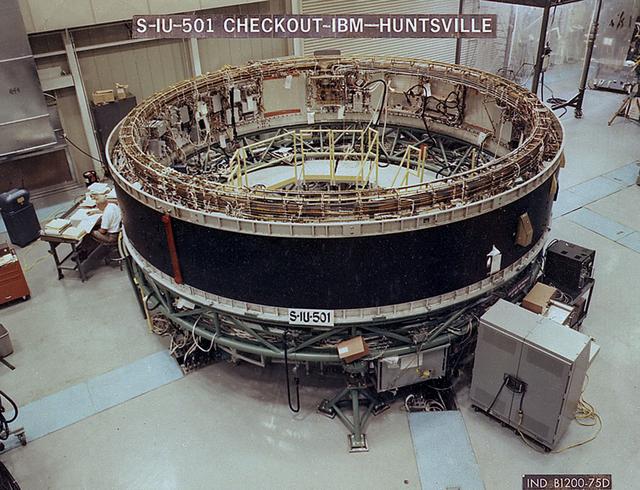
A technician checks the systems of the Saturn V instrument unit in a test facility in Huntsville. This instrument unit was flown aboard Apollo 4 on November 7, 1967, which was the first test flight of the Saturn V. The towering 363-foot Saturn V was a multi-stage, multi-engine launch vehicle standing taller than the Statue of Liberty. Altogether, the Saturn V engines produced as much power as 85 Hoover Dams.

This photograph shows an early moment of the first test flight of the Saturn V vehicle for the Apollo 4 mission, photographed by a ground tracking camera, on the morning of November 9, 1967. This mission was the first launch of the Saturn V launch vehicle. Objectives of the unmarned Apollo 4 test flight were to obtain flight information on launch vehicle and spacecraft structural integrity and compatibility, flight loads, stage separation, and subsystems operation including testing of restart of the S-IVB stage, and to evaluate the Apollo command module heat shield.
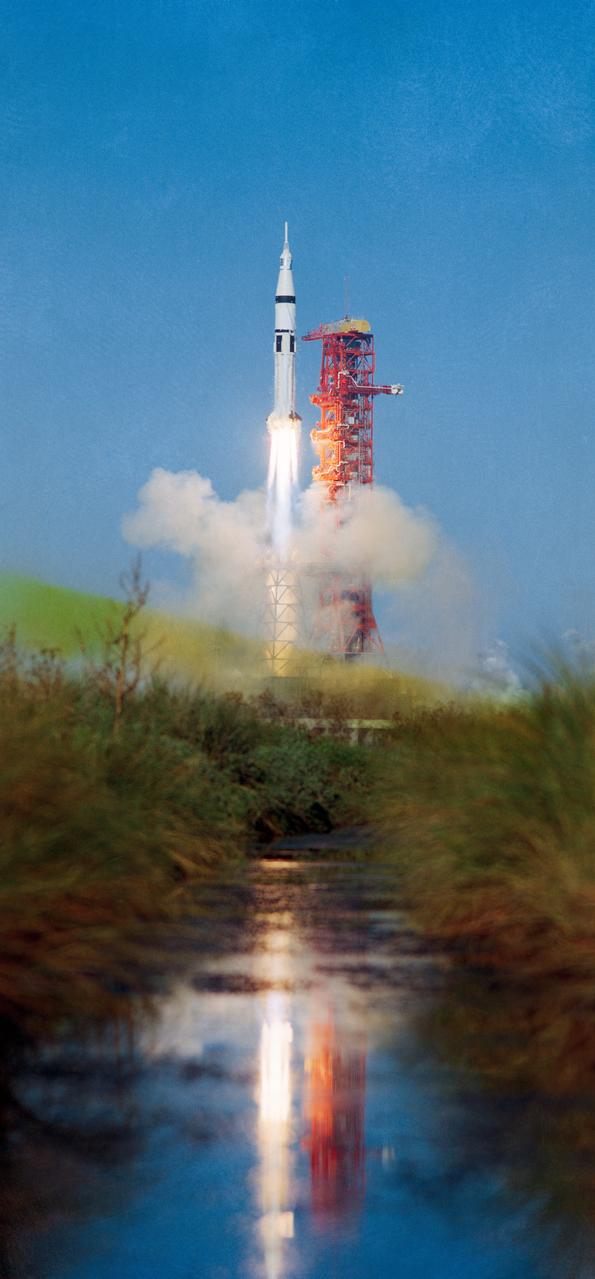
S73-37285 (16 Nov. 1973) --- The Skylab 4/Saturn 1B space vehicle is launched from Pad B, Launch Complex 39, Kennedy Space Center, Florida, at 9:01:23 a.m. (EST), Friday, Nov. 16, 1973. Skylab 4 is the third and last of three scheduled manned Skylab missions. Aboard the Skylab 4 Command/Service Module were astronauts Gerald P. Carr, Edward G. Gibson and William R. Pogue. In addition to the CSM and its launch escape system, the Skylab 4 space vehicle consisted of the Saturn 1B first (S-1B) stage and the Saturn 1B second (S-IVB) stage. (The Skylab 1/Saturn V unmanned space vehicle with the space station payload was launched from Pad A on May 14, 1973). Photo credit: NASA
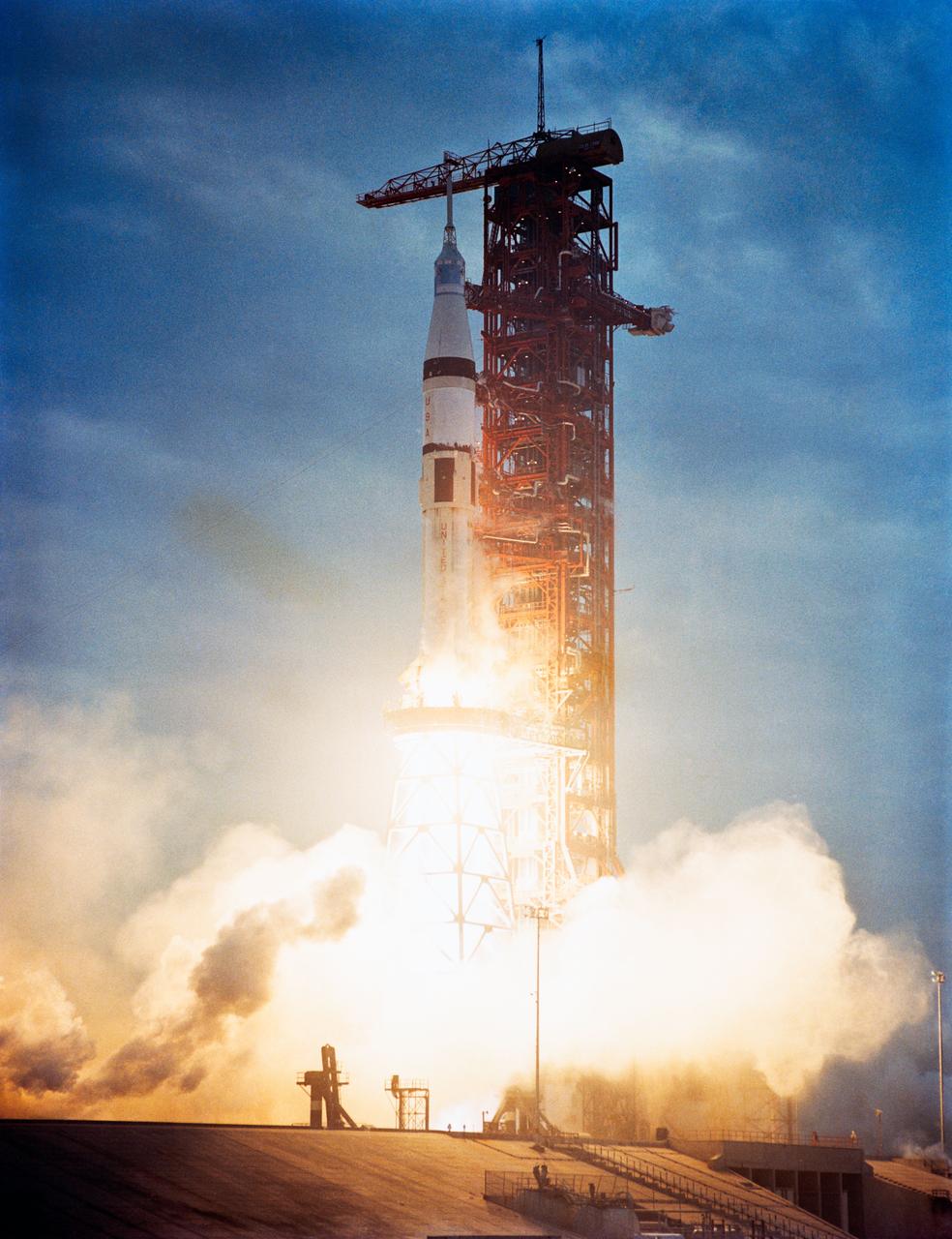
S73-32570 (28 July 1973) --- The Skylab 3/Saturn 1B space vehicle is launched from Pad B, Launch Complex 39, Kennedy Space Center, Florida, at 7:11 a.m. (EDT), Saturday, July 28, 1973. Skylab 3 is the second of three scheduled Skylab manned missions. Aboard the Skylab 3 Command/Service Module were astronauts Alan L. Bean, Owen K. Garriott and Jack R. Lousma. The Skylab 3 CSM later docked with the Skylab space station cluster in Earth orbit. In addition to the CSM and its launch escape system, the Skylab 3 space vehicle consisted of the Saturn 1B first (S-1B) stage and the Saturn 1B second (S-1VB) stage. (The Skylab 1/Saturn V space vehicle with the space station payload was launched from Pad A on May 14, 1973). Photo credit: NASA
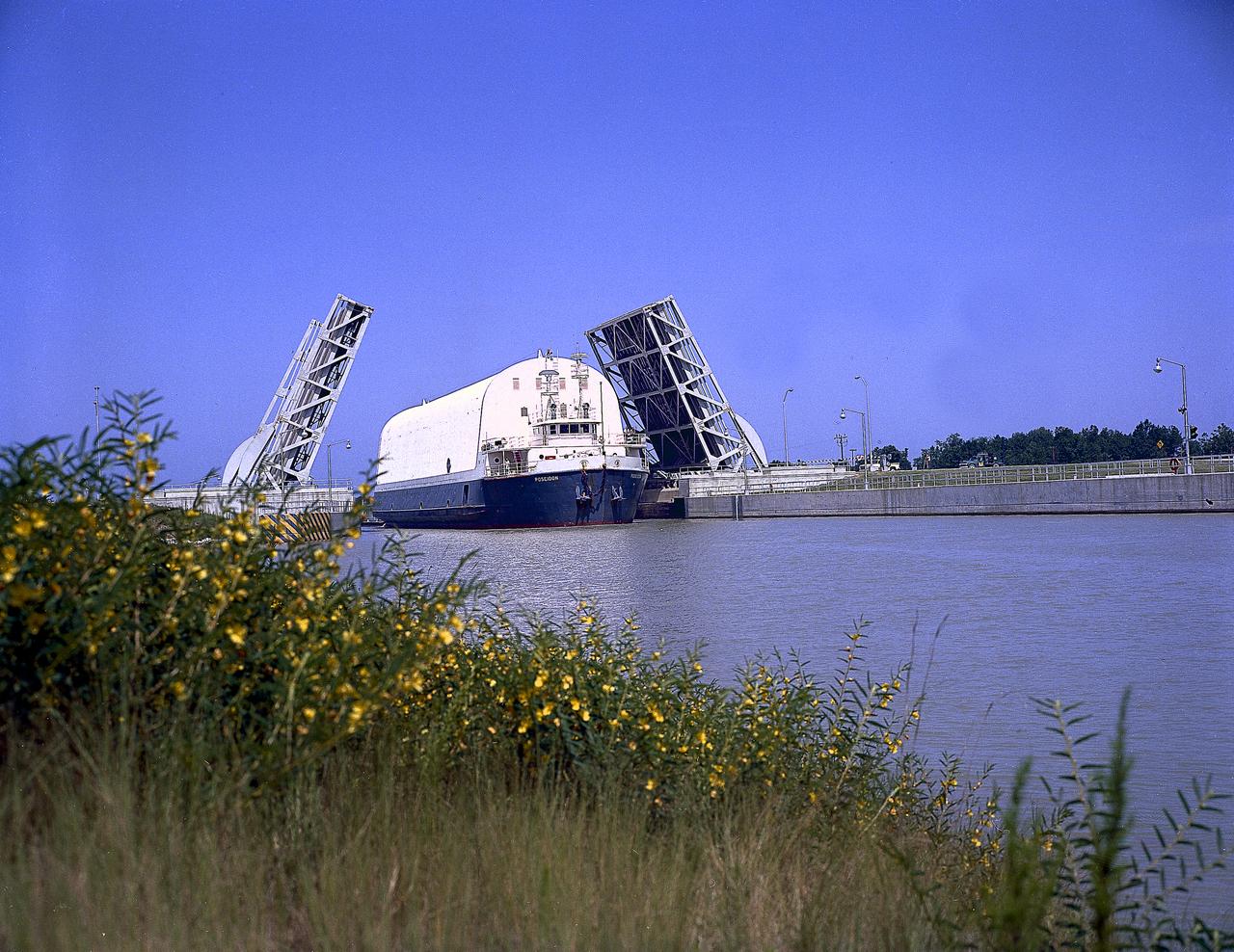
NASA used barges for transporting full-sized stages for the Saturn I, Saturn IB, and Saturn V vehicles between the Marshall Space Flight Center (MSFC), the manufacturing plant at the Michoud Assembly Facility (MAF), the Mississippi Test Facility for testing, and the Kennedy Space Center. The barges traveled from the MSFC dock to the MAF, a total of 1,086.7 miles up the Tennessee River and down the Mississippi River. The barges also transported the assembled stages of the Saturn vehicle from the MAF to the Kennedy Space Center, a total of 932.4 miles along the Gulf of Mexico and up along the Atlantic Ocean, for the final assembly and the launch. This photograph shows the barge Poseidon loaded with the Saturn V S-II (second) stage passing through a bascule bridge.
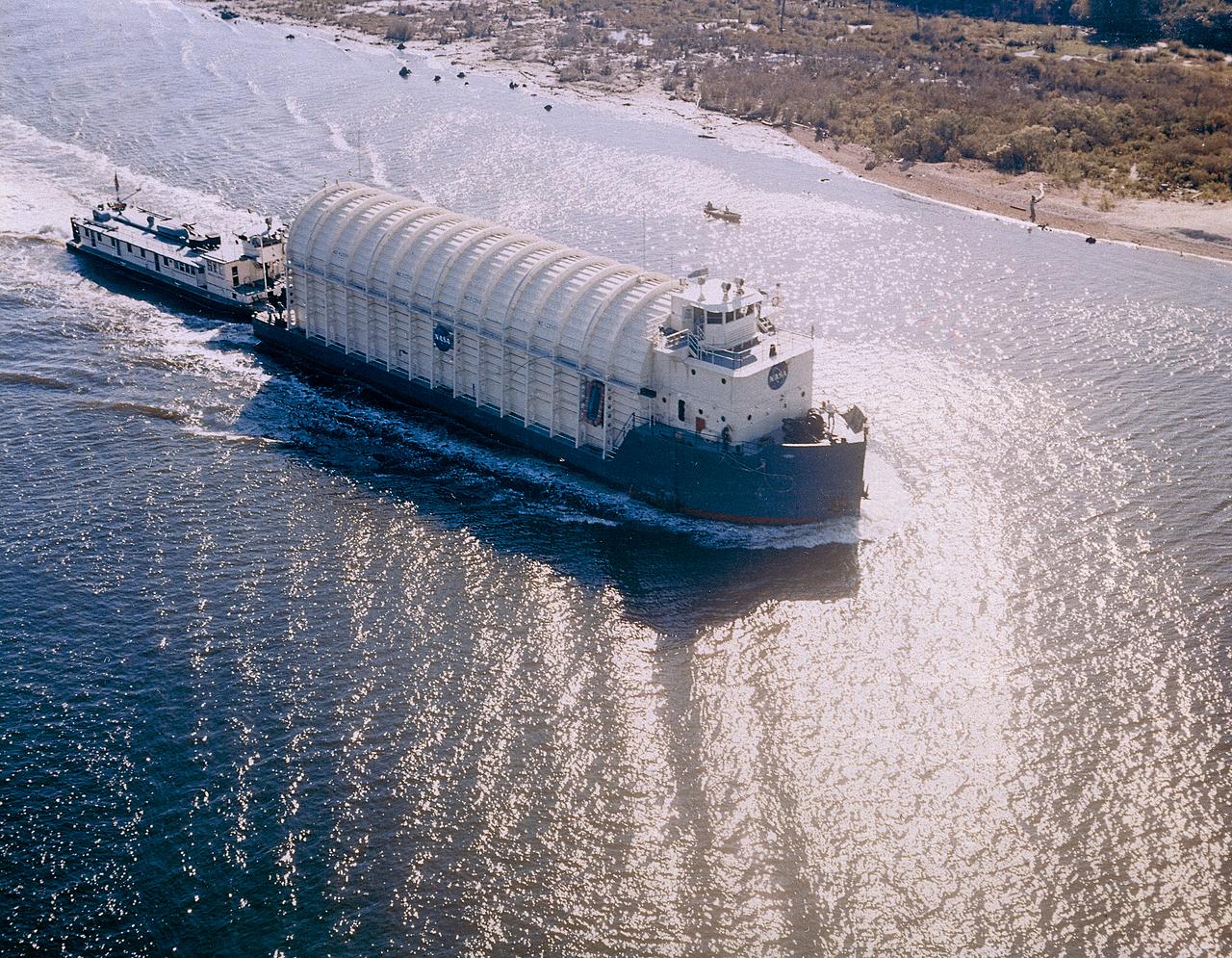
NASA used barges for transporting full-sized stages for the Saturn I, Saturn IB, and Saturn V vehicles between the Marshall Space Flight Center (MSFC), the manufacturing plant at the Michoud Assembly Facility (MAF), the Mississippi Test Facility for testing, and the Kennedy Space Center. The barges traveled from the MSFC dock to the MAF, a total of 1,086.7 miles up the Tennessee River and down the Mississippi River. The barges also transported the assembled stages of the Saturn vehicle from the MAF to the Kennedy Space Center, a total of 932.4 miles along the Gulf of Mexico and up along the Atlantic Ocean, for the final assembly and the launch. Pictured is the barge Palaemon carrying Saturn IV S-IB flight stage enroute to MSFC.
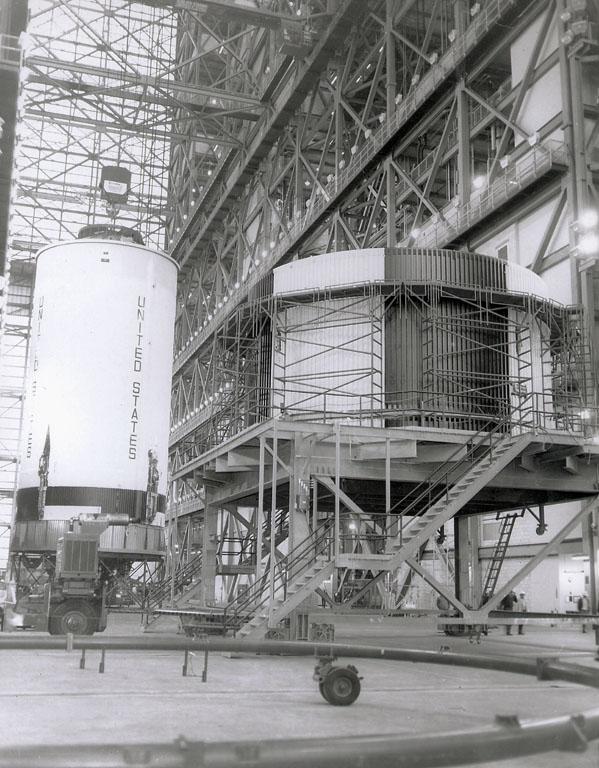
This Saturn V S-II (second) stage is being lifted into position for a test at the Vehicle Assembly Building at the Kennedy Space Center. When the Saturn V booster stage (S-IC) burned out and dropped away, power for the Saturn was provided by the 82-foot-long and 33-foot-diameter S-II stage. Developed by the Space Division of North American Aviation under the direction of the Marshall Space Flight Center, the stage utilized five J-2 engines, each producing 200,000 pounds of thrust. The engines used liquid oxygen and liquid hydrogen as propellants. The towering 363-foot Saturn V was a multi-stage, multi-engine launch vehicle standing taller than the Statue of Liberty. Altogether, the Saturn V engines produced as much power as 85 Hoover Dams.
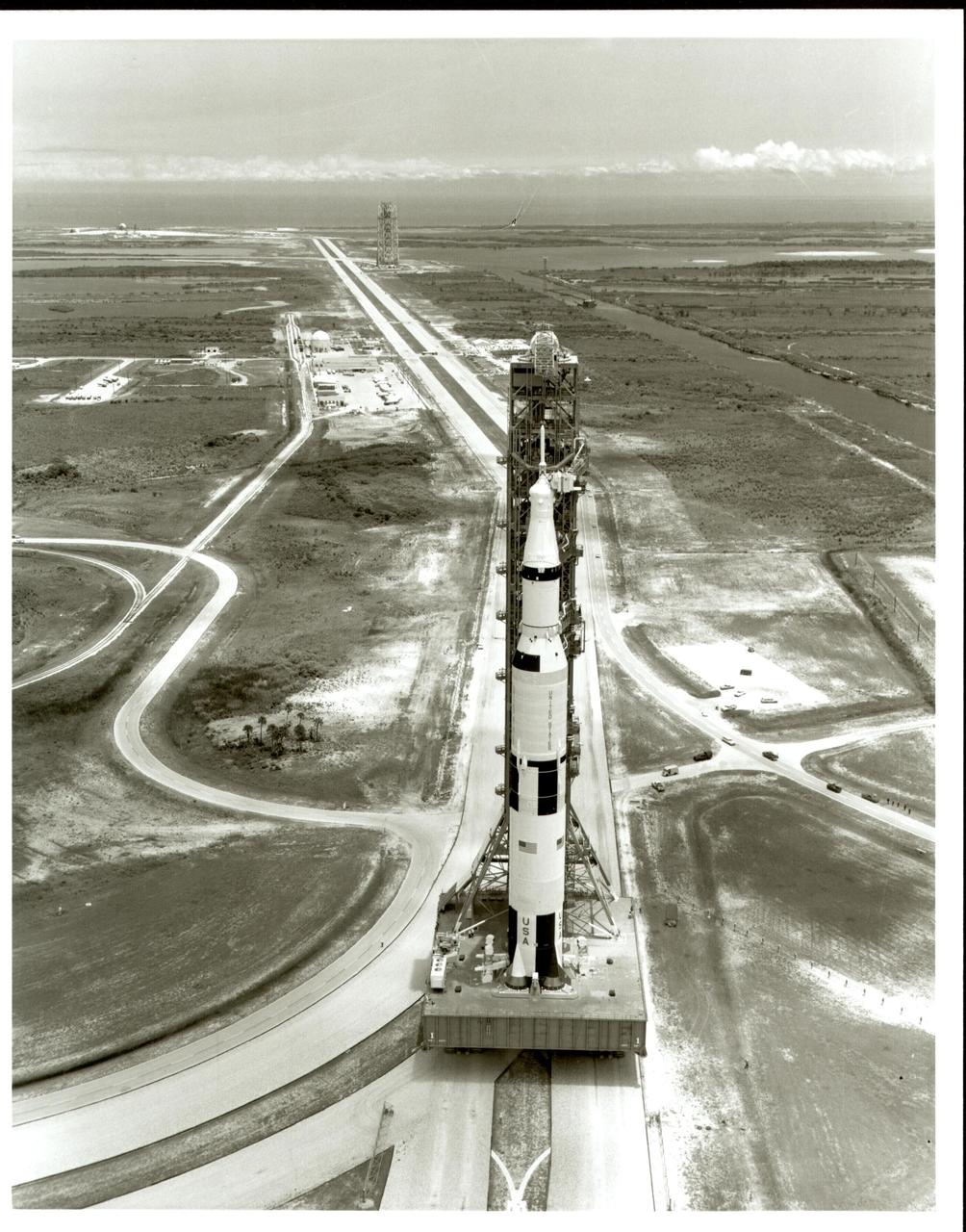
KENNEDY SPACE CENTER, FLA. - Rollout of Apollo 11 Saturn V space vehicle from the Vehicle Assembly Building's High Bay #1 to Launch Complex 39A.
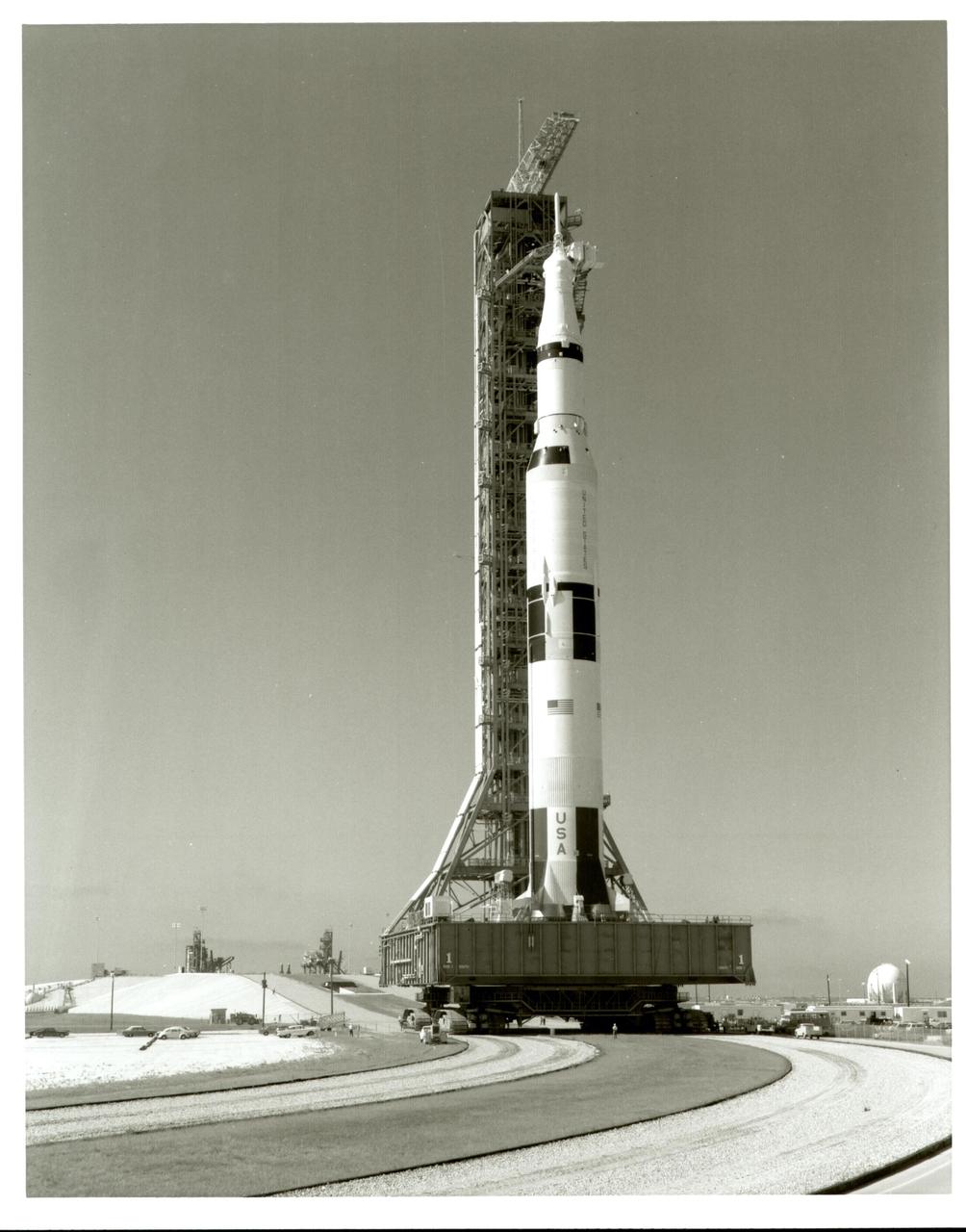
KENNEDY SPACE CENTER, FLA. - Rollout of Apollo 11 Saturn V space vehicle from the Vehicle Assembly Building's High Bay #1 to Launch Complex 39A.
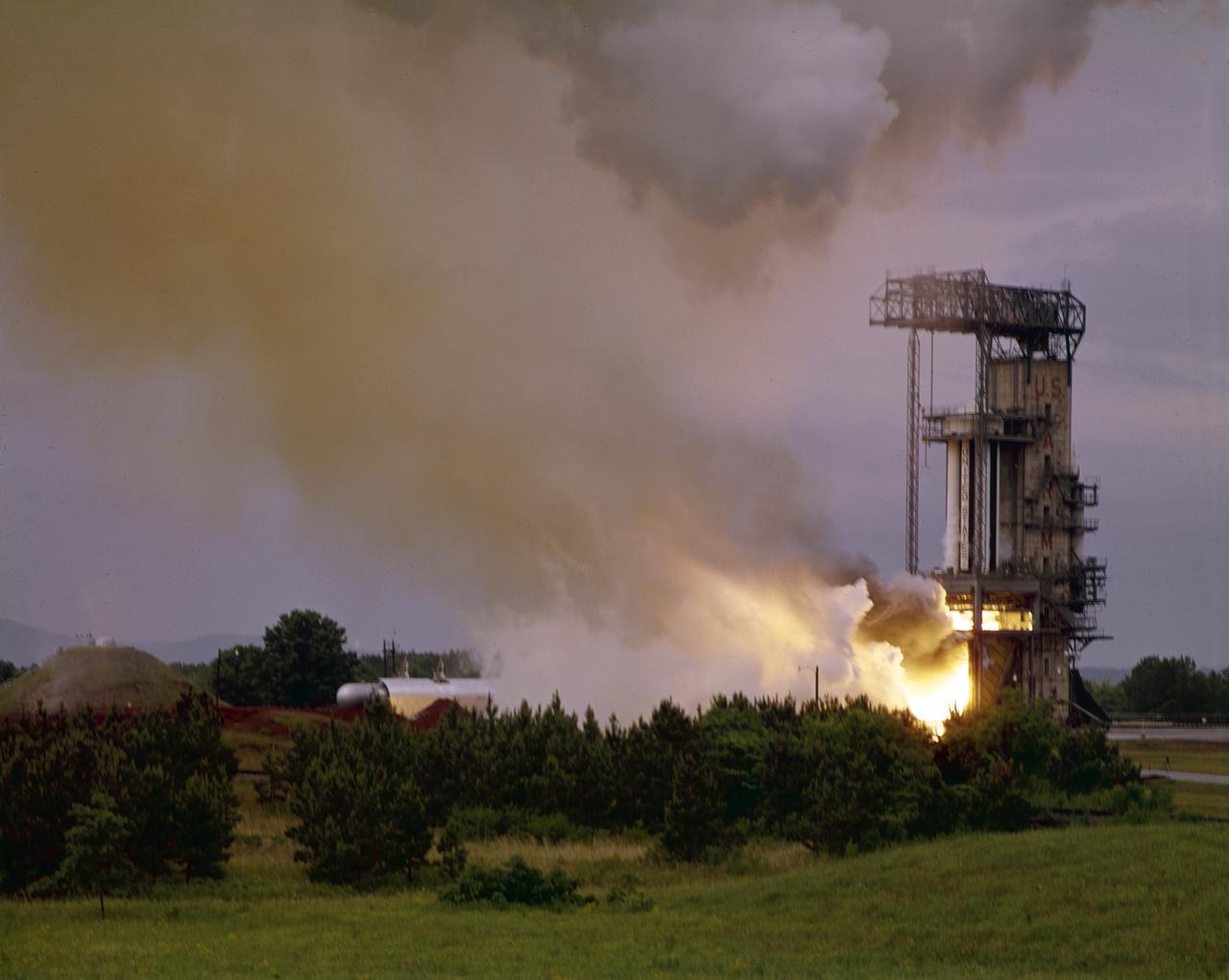
Pictured is one of the earliest testing of the Saturn I S-I (first) stage, with a cluster of eight H-1 engines, at the Marshall Space Flight Center (MSFC). It was a part of the test program to prove out the clustered-booster concept. MSFC was responsible for designing and development the Saturn launch vehicles.