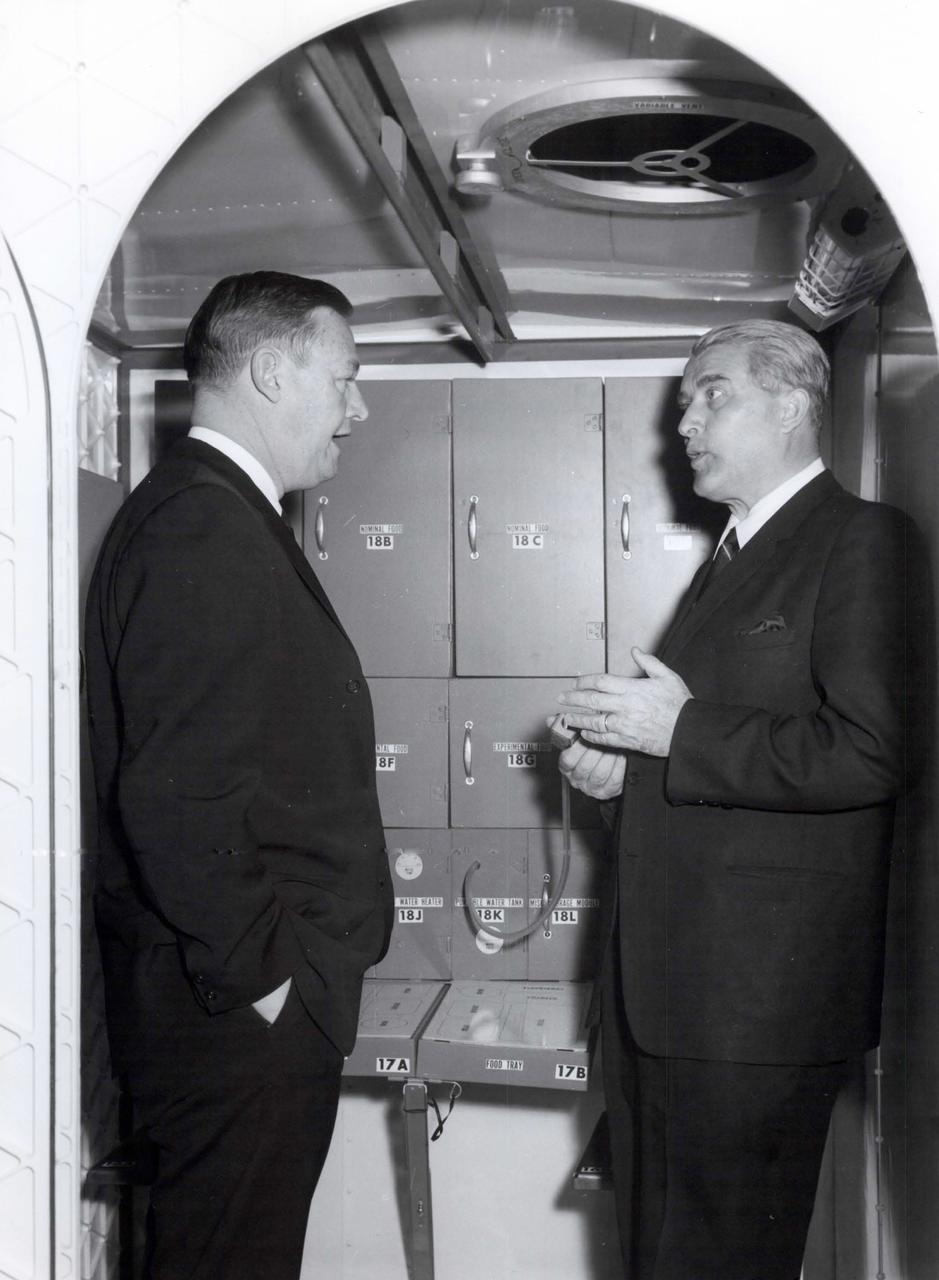
U.S. Representative Armistead Seldon (D.-Al) inspects the food preparation area of the Saturn I workshop mockup during a visit to the Marshall Space Flight Center. Explaining the operation of the food preparation area to the congressman is Dr. Wernher Von Braun, Marshall Space Flight Center director.
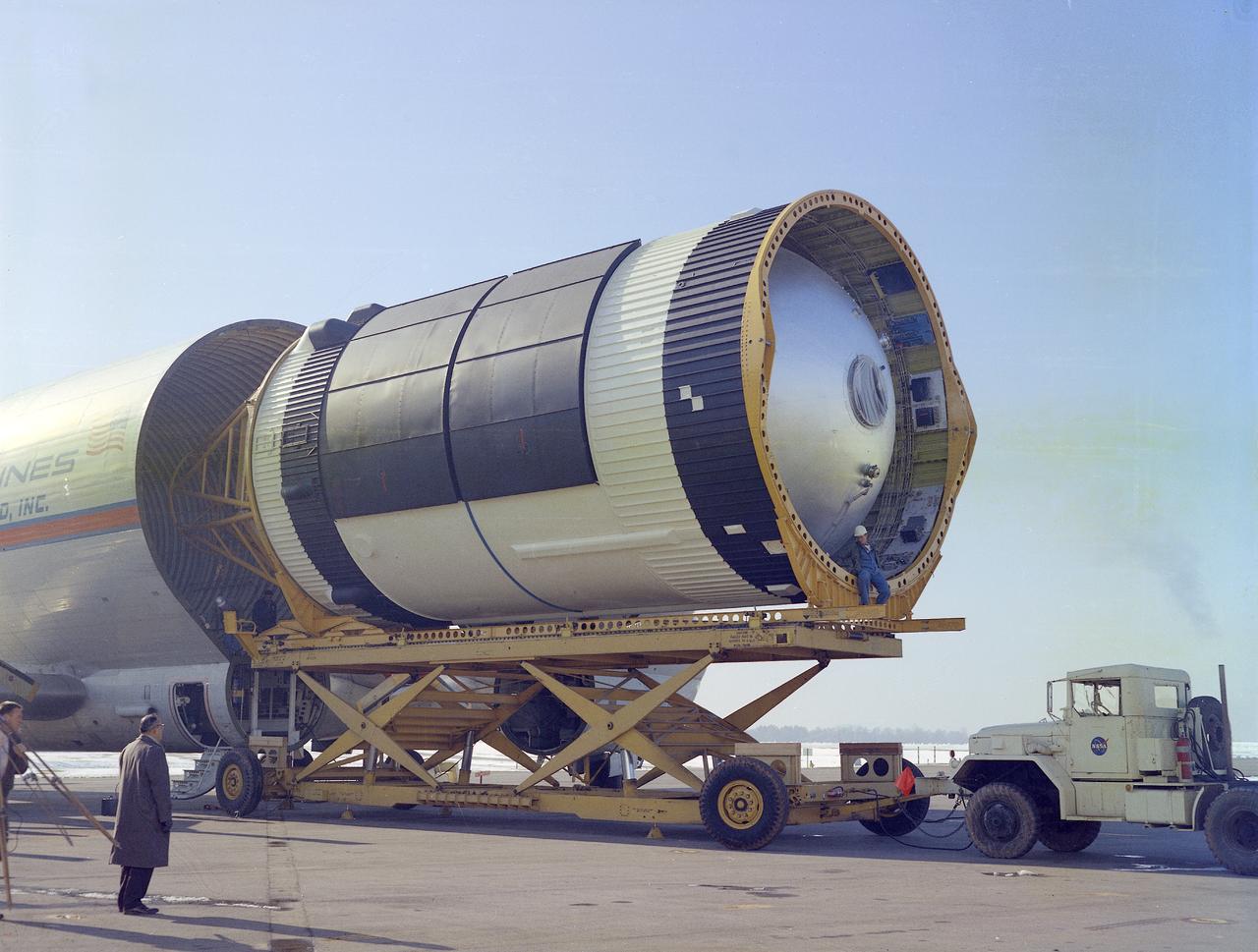
This photograph was taken at the Redstone airfield, Huntsville, Alabama, during the unloading of the Saturn V S-IVB stage that housed the Orbital Workshop (OWS) from the Super Guppy, the NASA plane that was specially built to carry oversized cargo. The OWS measured 22 feet (6.7 m) in diameter, and 48 feet (14.6 m) in length. The Saturn V S-IVB stage was modified at the McDornell Douglas facility at Huntington Beach, California, for a new role, which was to house the OWS. In addition to the test articles, engineering mockups, and flight equipment, both McDonnell Douglas and Martin Marietta built 0-G trainers, neutral buoyancy trainers, and high-fidelity mockups for the 1-G trainer to be used in the KC-135 aircraft. The Marshall Space Flight Center had program management responsibility for the development of Skylab hardware and experiments.
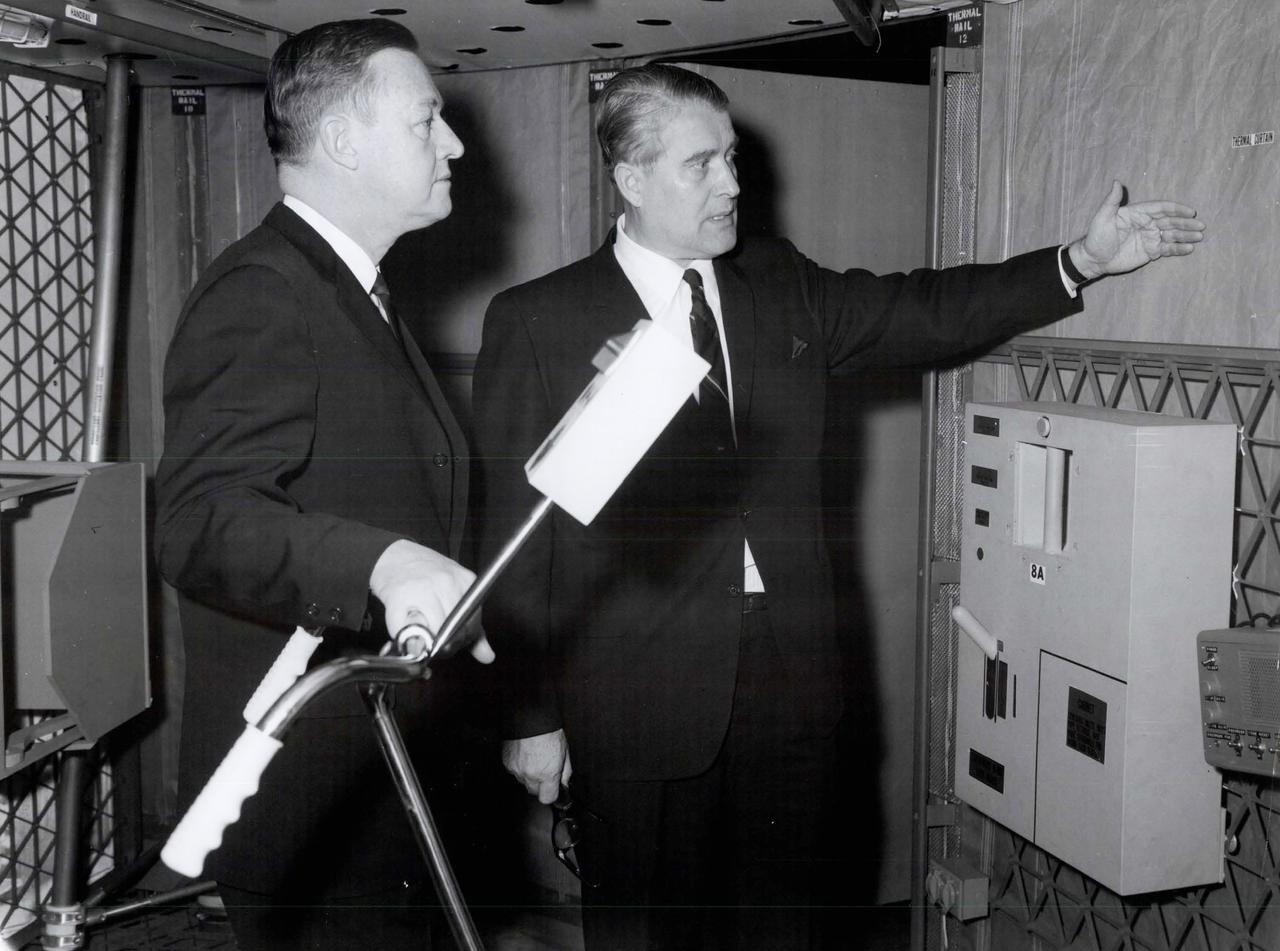
Dr. Wernher von Braun, Director of the Marshall Space Flight Center, explains the purpose of a thermal curtain in the mockup of a Saturn I workshop to U.S. Representative Armistead Seldon of Alabama. The Congressman visited the Marshall Center on March 2, 1968 to tour the workshop and to visit Marshall Center facilities.
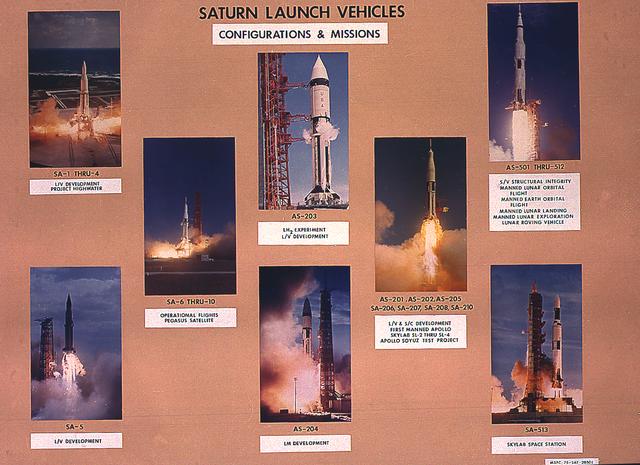
This montage illustrates the various configurations and missions of the three classes of the Saturn vehicles developed by the Marshall Space Flight Center. The missions for the Saturn I included atmospheric science investigations and the deployment of the Pegasus meteroid-detection satellite as well as launch vehicle development. The Saturn IB vehicle tested the Apollo spacecraft and launched the three marned Skylab missions as well as the Apollo Soyuz test project. The Saturn V vehicle launched the manned lunar orbital/landing missions, and the Skylab Orbital Workshop in 1973.
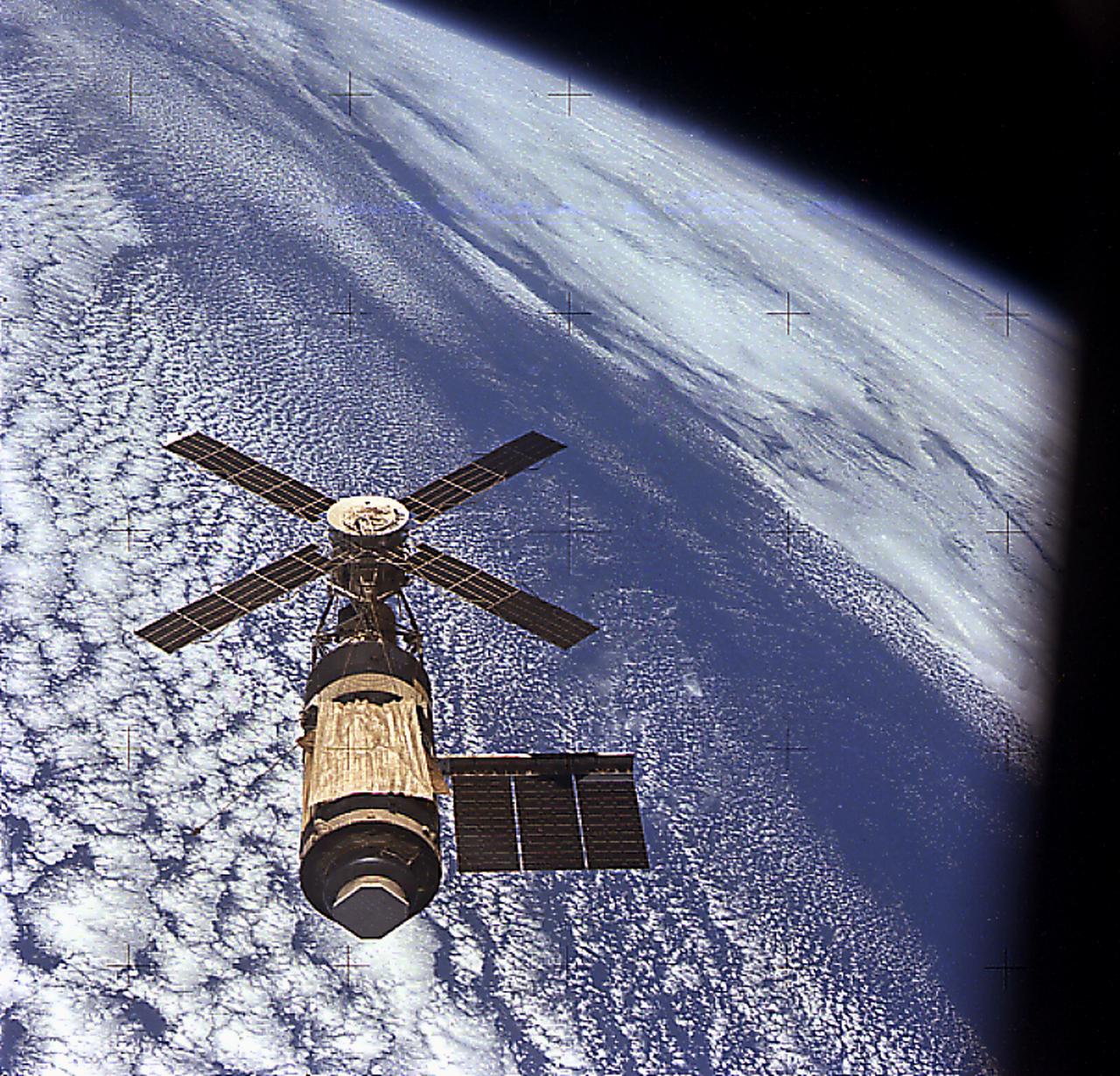
The idea that ultimately became Skylab first surfaced in 1962 as a proposal to convert a spent Saturn upper stage (Saturn V S-II stage) into an orbital workshop. In 1968, the Marshall Space Flight Center proposed an alternative to the wet workshop concept of refurbishing a space station in orbit. Instead, a fully equipped dry workshop could be launched as a complete unit ready for occupancy. Skylab became the free world's first space station. Launched in May 1973, the Skylab space station was occupied in succession by three teams of three crewmembers. These crews spent 28, 59, and 84 days respectively, orbiting the Earth and performing nearly 300 experiments. This view of Skylab in orbit was taken by the Skylab 4 (the last Skylab mission) crew.
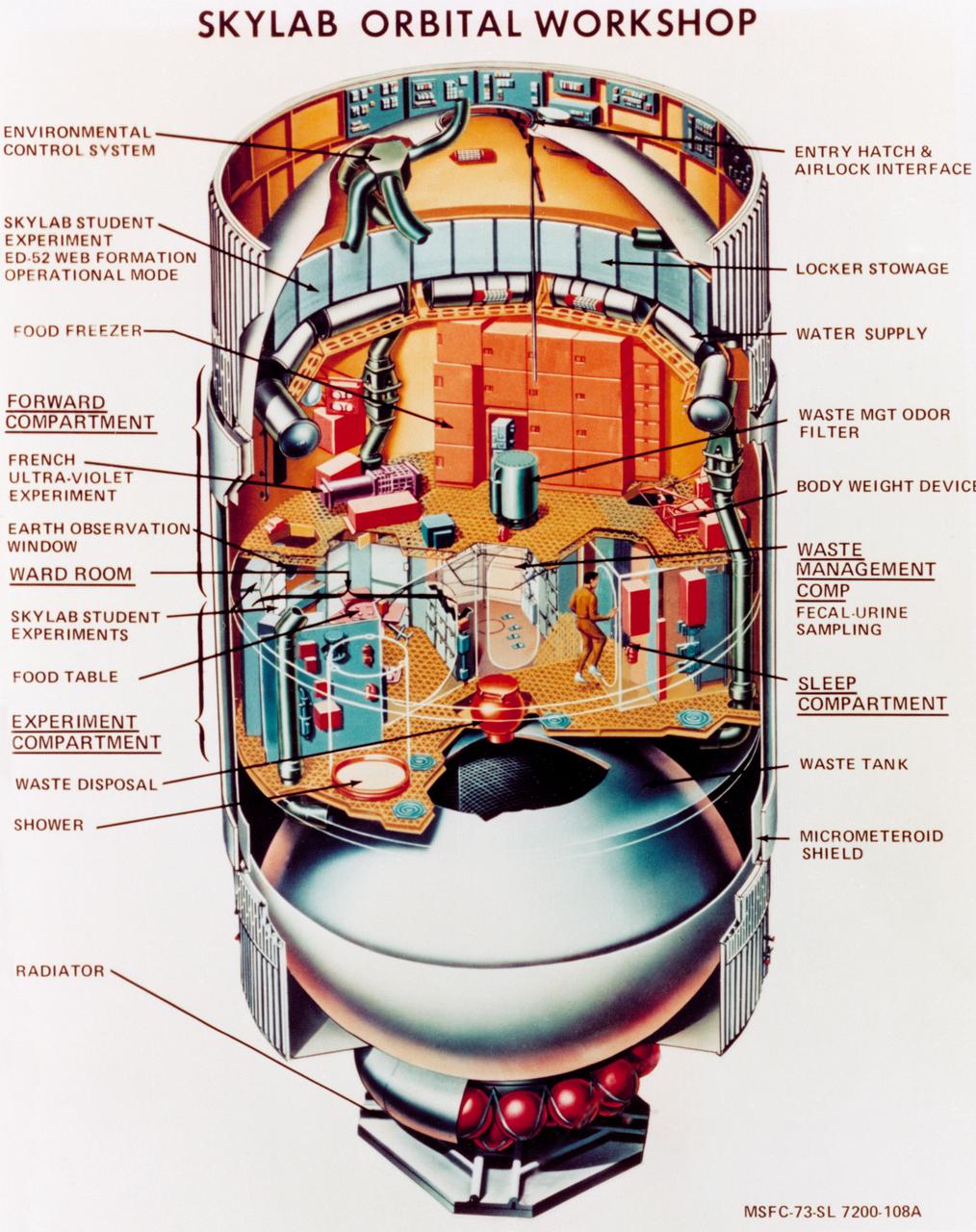
S73-23919 (May 1973) --- An artist's concept illustrating a cutaway view of the Skylab 1 Orbital Workshop (OWS). The OWS is one of the five major components of the Skylab 1 space station cluster which was launched by a Saturn V on May 14, 1973 into Earth orbit. Photo credit: NASA
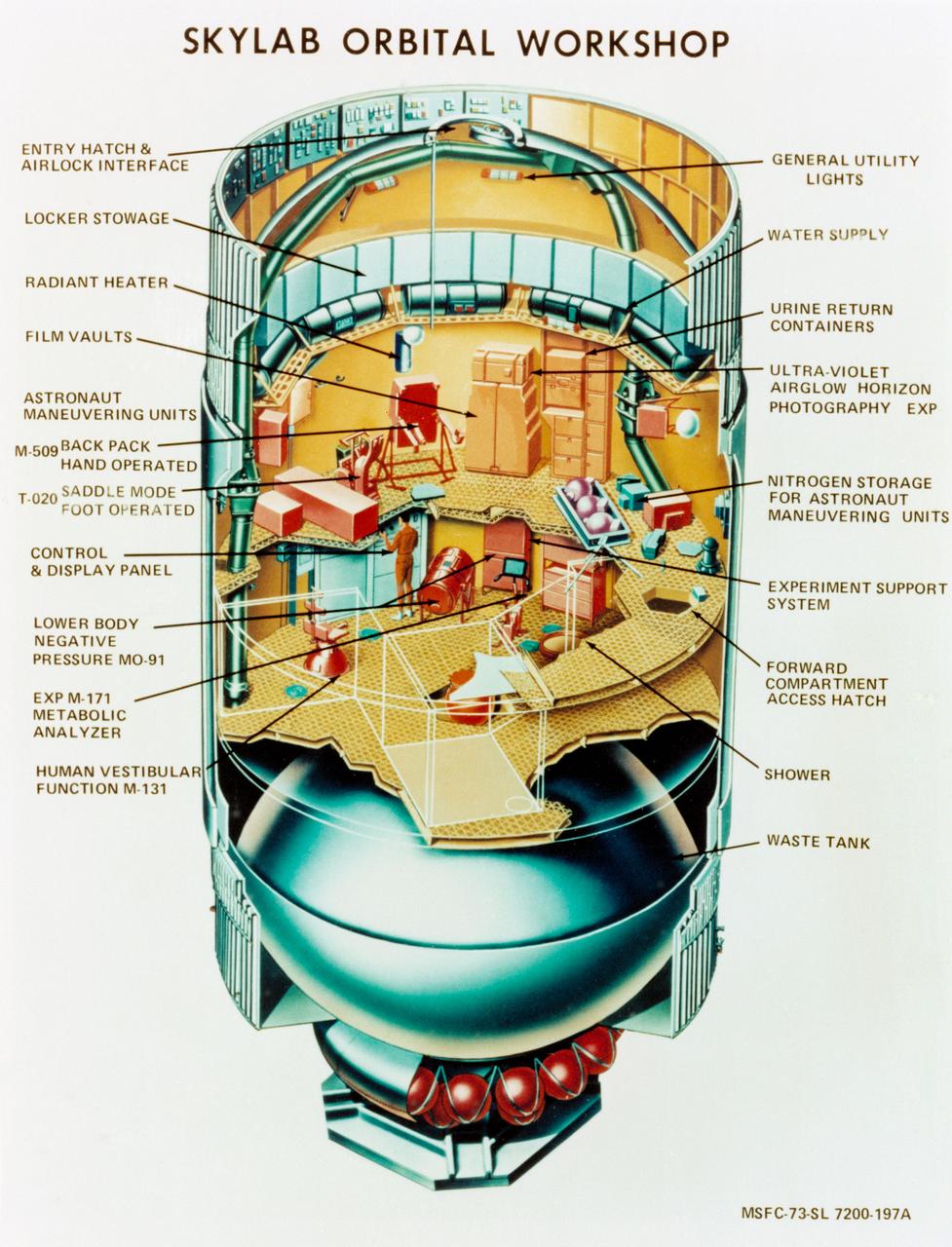
S73-23918 (May 1973) --- An artist's concept illustrating a cutaway view of the Skylab 1 Orbital Workshop (OWS). The OWS is one of the five major components of the Skylab 1 space station cluster which was launched by a Saturn V on May 14, 1973 into Earth orbit. Photo credit: NASA
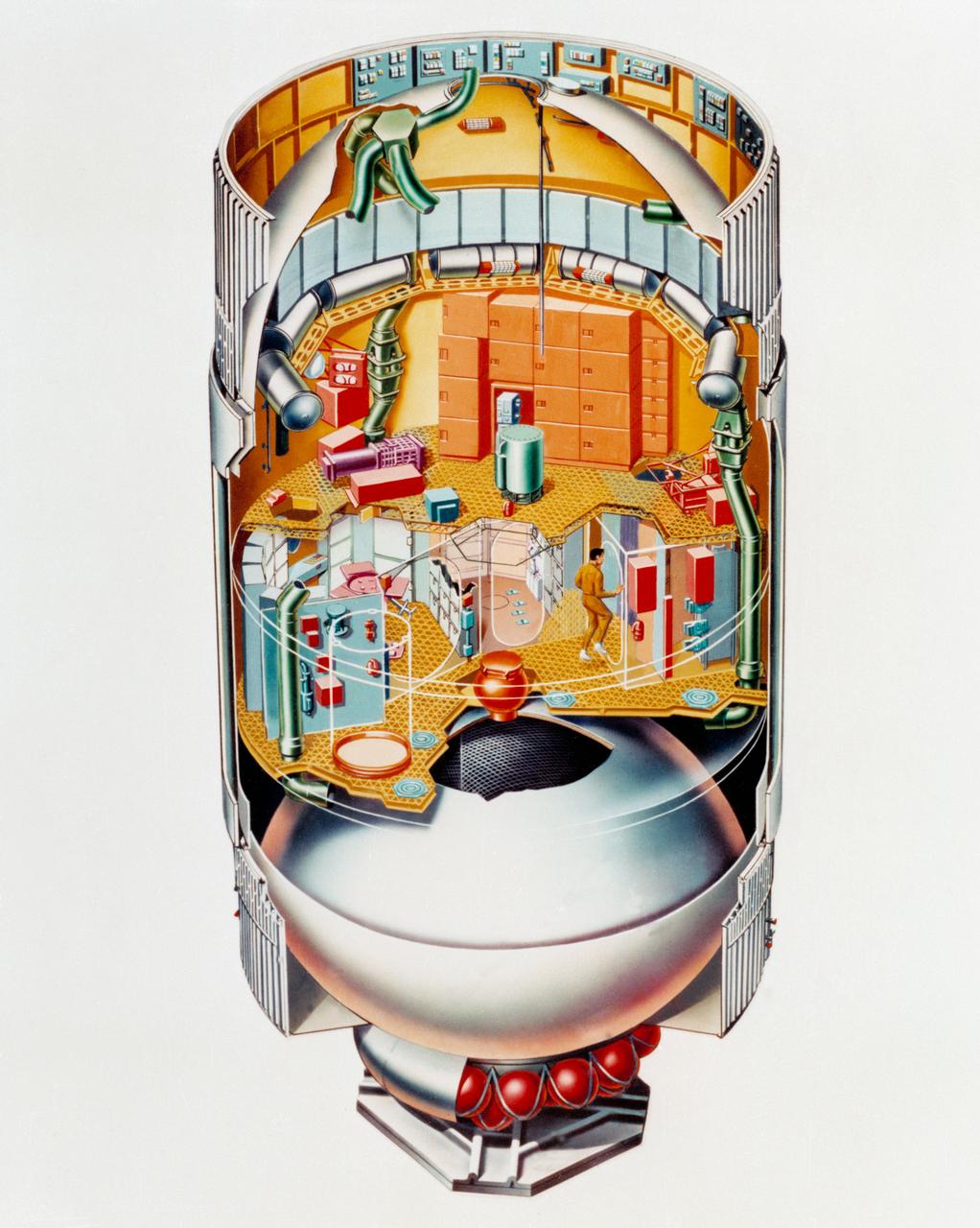
S73-24316 (May 1973) --- An artist's concept illustrating a cutaway view of the Skylab 1 Orbital Workshop (OWS). The OWS is one of the five major components of the Skylab 1 space station cluster which was launched by a Saturn V on May 14, 1973 into Earth orbit. Photo credit: NASA

S73-25140 (16 April 1973) --- A ground-level view of Pad A, Launch Complex 39, Kennedy Space Center, Florida, showing the 341-feet tall Skylab 1/Saturn V space vehicle on the pad soon after being rolled out from the Vehicle Assembly Building (VAB). The vehicle is composed of the Saturn V first (S-1C) stage, the Apollo Telescope Mount (ATM), the Multiple Docking Adapter (MDA), the Airlock Module (AM), and the Orbital Workshop (OWS). Photo credit: NASA
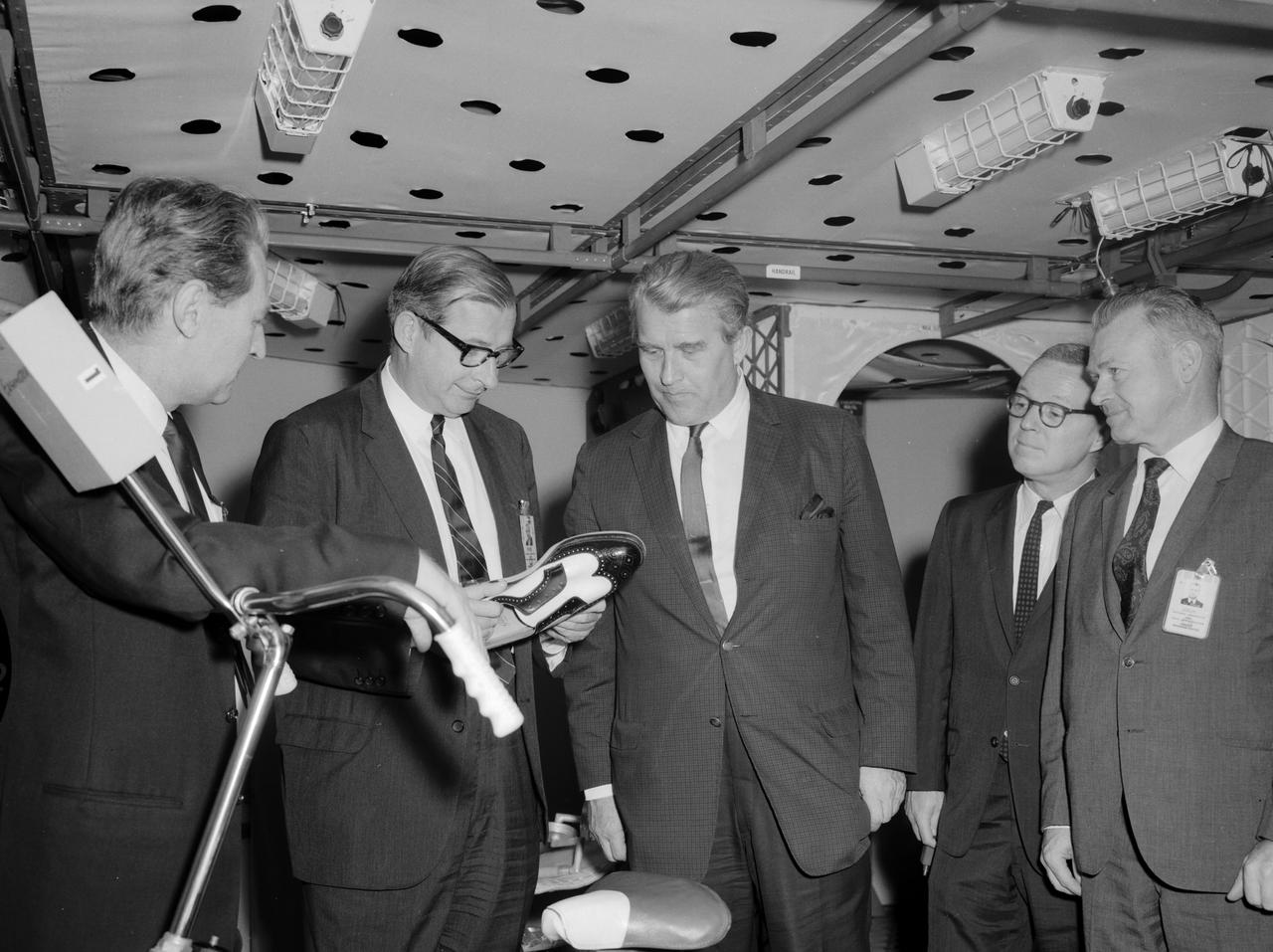
Pictured from the left, in the Saturn I mockup, are: William Brooksbank, Marshall Space Flight Center (MSFC) Propulsion and Vehicle Engineering Laboratory; Dr. Thomas O. Paine, Deputy Administrator of the National Aeronautics and Space Administration (NASA); Dr. Wernher von Braun, MSFC director; Colonel Clare F. Farley, executive officer of the Office of the Administrator; and Charles J. Donlan, newly appointed deputy associate administrator for Manned Space Flight, technical. The party examined an ordinary man’s shoe (held by Paine) outfitted for use in the Saturn I Workshop. The shoe had a unique fastener built into the sole to allow an astronaut to move about the workshop floor and to remain in one position if he desired. Dr. Paine and his party indulged in a two-day tour at the Marshall Space Flight Center getting acquainted with Marshall personnel and programs. It was Paine’s first visit to the center since assuming the NASA post on February 1, 1968.
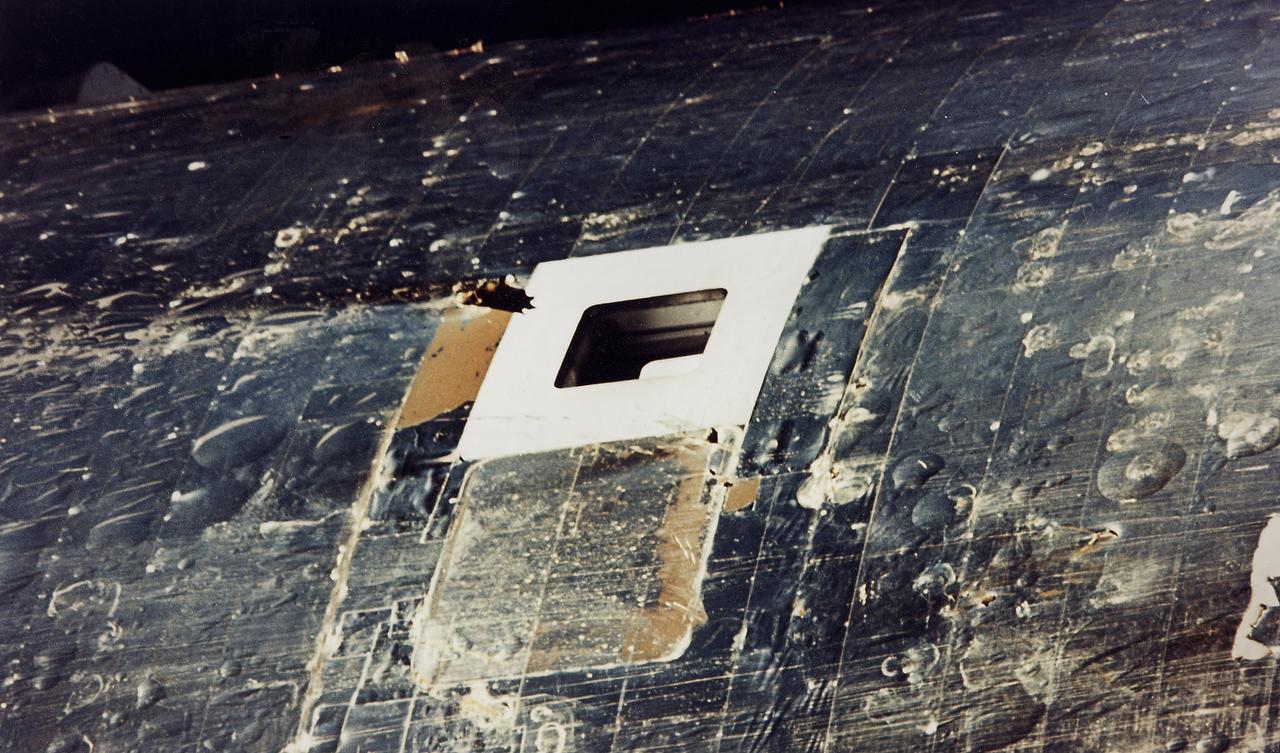
The Saturn V vehicle, carrying the unmarned orbital workshop for the Skylab-1 mission, lifted off successfully and all systems performed normally. Sixty-three seconds into flight, engineers in the operation support and control center saw an unexpected telemetry indication that signalled that damages occurred on one solar array and the micrometeoroid shield during the launch. The micrometeoroid shield, a thin protective cylinder surrounding the workshop protecting it from tiny space particles and the sun's scorching heat, ripped loose from its position around the workshop. This caused the loss of one solar wing and jammed the other. Still unoccupied, the Skylab was stricken with the loss of the heat shield and sunlight beat mercilessly on the lab's sensitive skin. Internal temperatures soared, rendering the the station uninhabitable, threatening foods, medicines, films, and experiments. This image shows the sun-ravaged skin of the Orbital Workshop, bared by the missing heat shield, with blister scars and tarnish from temperatures that reached 300 degrees F. The rectangular opening at the upper center is the scientific airlock through which the parasol to protect the workshop from sun's rays was later deployed. This view was taken during a fly-around inspection by the Skylab-2 crew. The Marshall Space Flight Center had a major role in developing the procedures to repair the damaged Skylab.
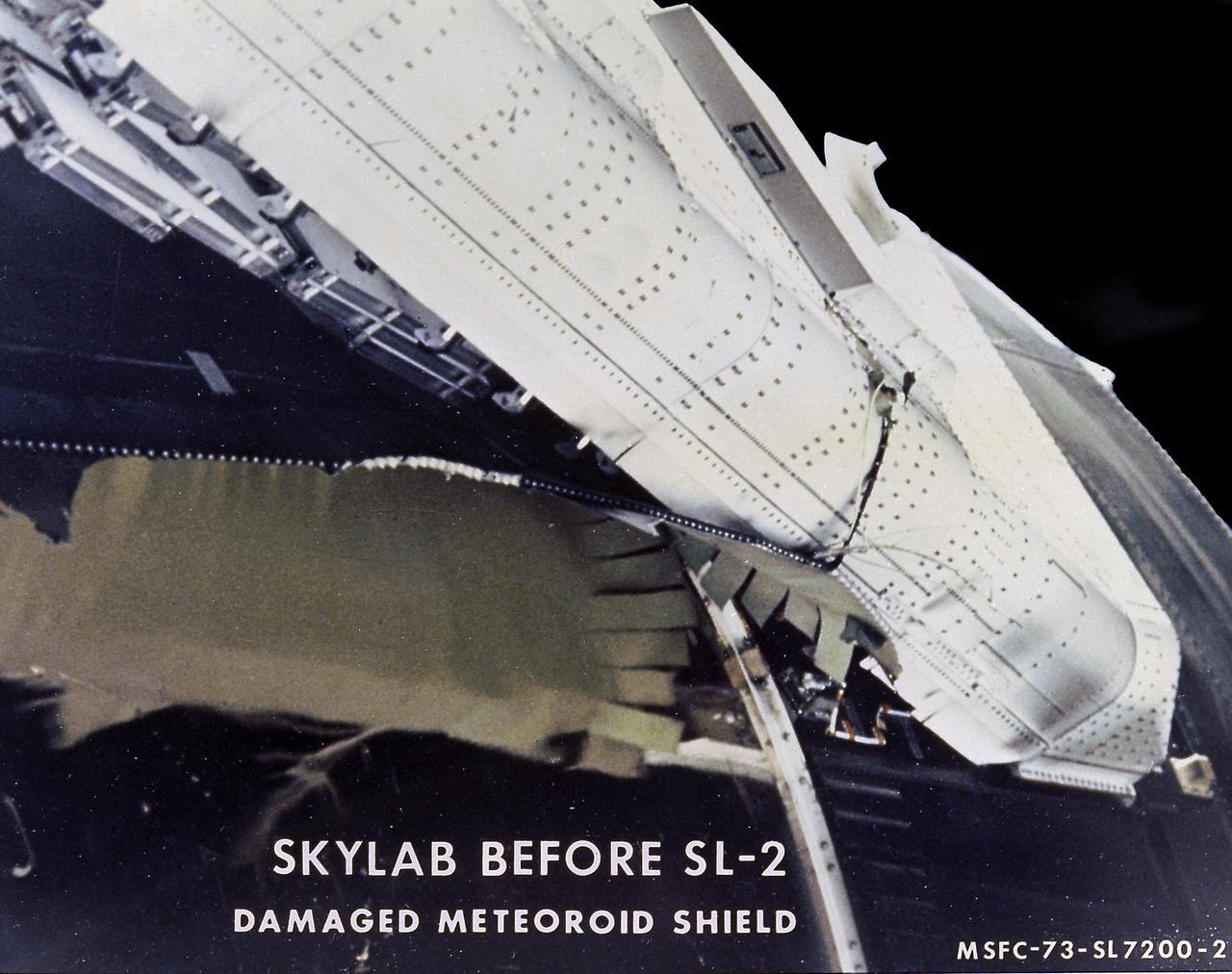
The Saturn V vehicle, carrying the unmarned orbital workshop for the Skylab-1 mission, lifted off successfully and all systems performed normally. Sixty-three seconds into flight, engineers in the operation support and control center saw an unexpected telemetry indication that signalled that damages occurred on one solar array and the micrometeoroid shield during the launch. The micrometeoroid shield, a thin protective cylinder surrounding the workshop protecting it from tiny space particles and the sun's scorching heat, ripped loose from its position around the workshop. This caused the loss of one solar wing and jammed the other. Still unoccupied, the Skylab was stricken with the loss of the heat shield and sunlight beat mercilessly on the lab's sensitive skin. Internal temperatures soared, rendering the station uninhabitable, threatening foods, medicines, films, and experiments. This image, taken during a fly-around inspection by the Skylab-2 crew, shows the damaged meteoroid shield being held by a thin aluminum strap entangled with green-hued remnants of the lost heat shield. The Marshall Space Flight Center (MSFC) developed, tested, rehearsed, and approved three repair options. These options included a parasol sunshade and a twin-pole sunshade to restore the temperature inside the workshop, and a set of metal cutting tools to free the jammed solar panel.
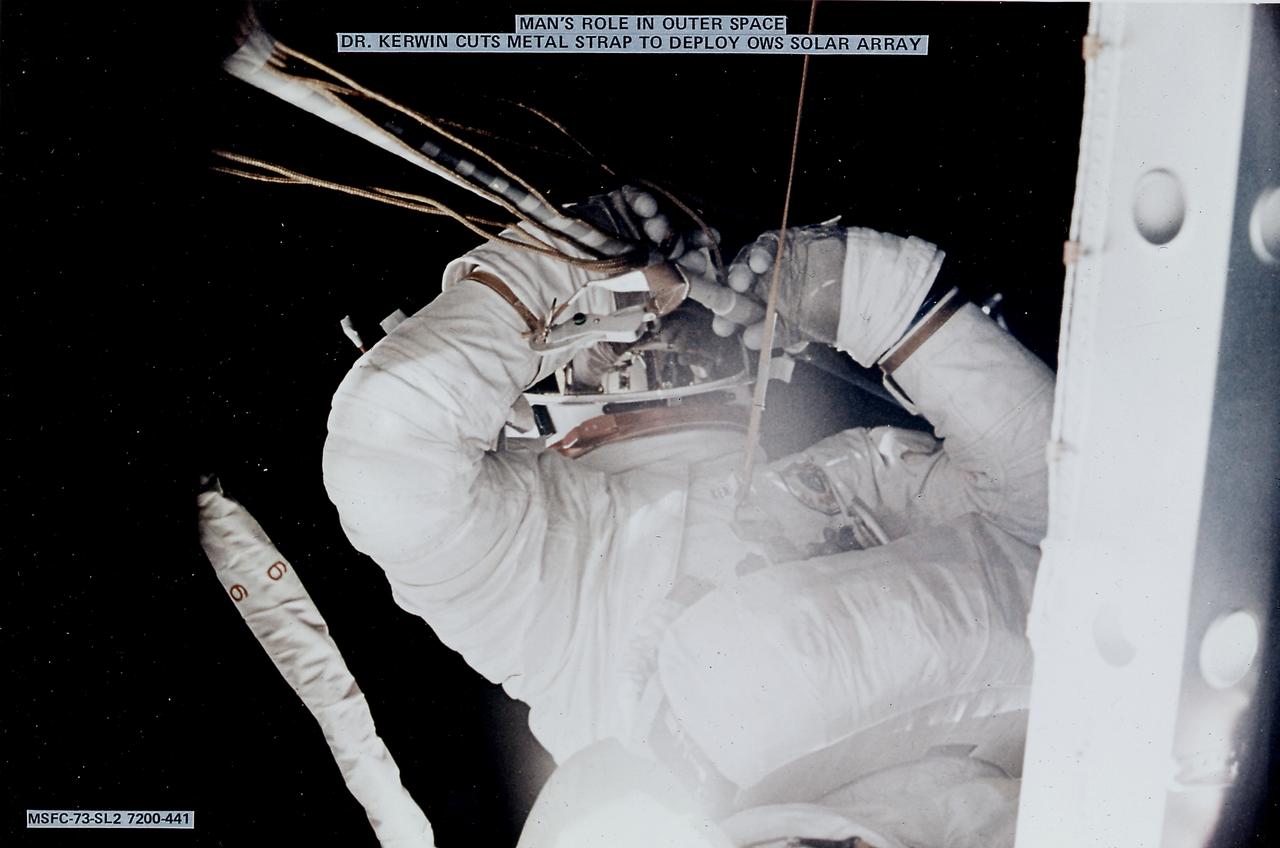
The Saturn V vehicle, carrying the unmarned orbital workshop for the Skylab-1 mission, lifted off successfully and all systems performed normally. Sixty-three seconds into the flight, engineers in the operation support and control center saw an unexpected telemetry indication that signalled that damages occurred on one solar array and the micrometeoroid shield during the launch. The micrometeoroid shield, a thin protective cylinder surrounding the workshop protecting it from tiny space particles and the sun's scorching heat, ripped loose from its position around the workshop. This caused the loss of one solar wing and jammed the other. Still unoccupied, the Skylab was stricken with the loss of the heat shield and sunlight beat mercilessly on the lab's sensitive skin. Intrnal temperatures soared, rendering the station uninhabitable, threatening foods, medicines, films, and experiments. This image shows astronaut Kerwin cutting the metal strap to free and deploy the Orbital Workshop solar array. Kerwin used special cutting tools developed by engineers at the Marshall Space Flight Center (MSFC). The MSFC had a major role in developing the procedures to repair the damaged Skylab.
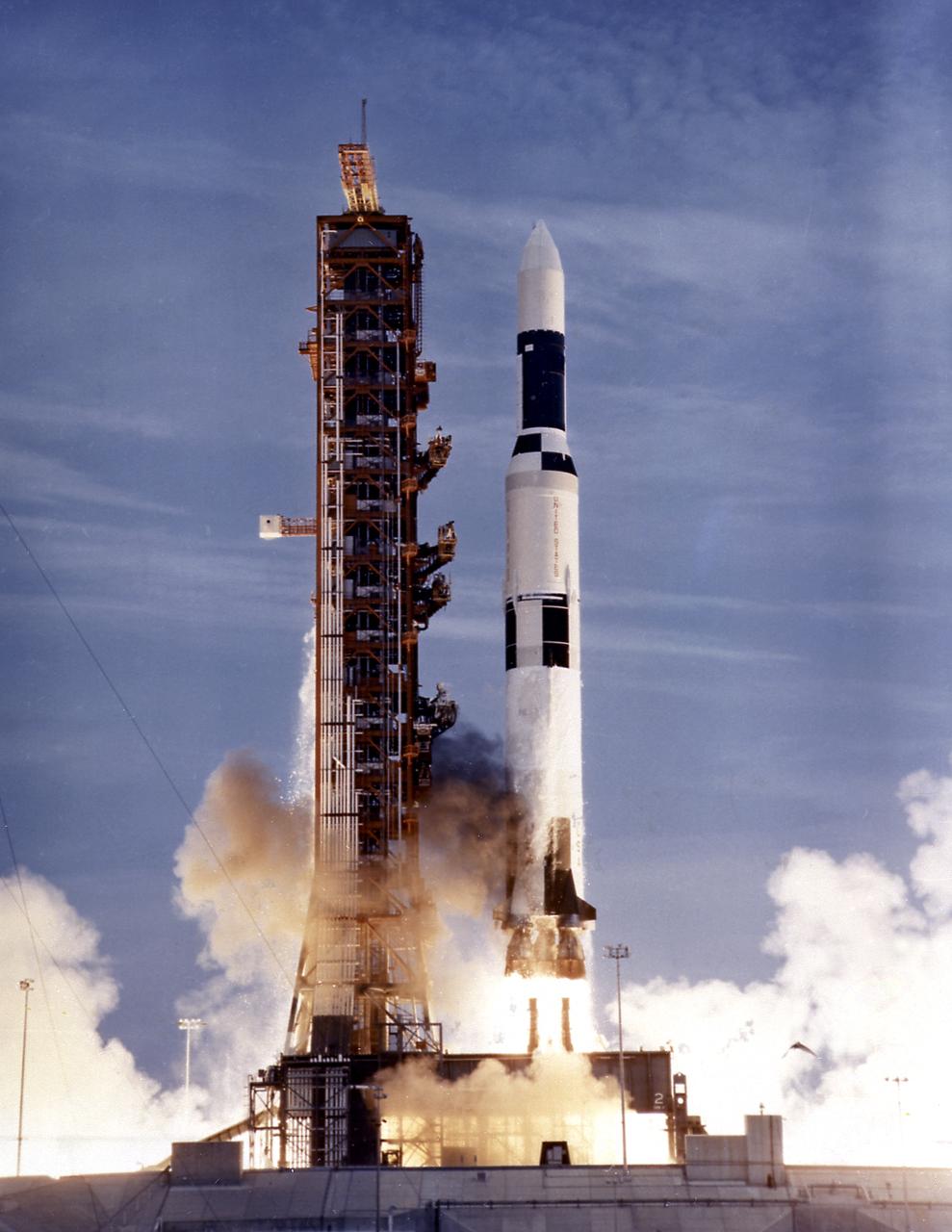
This photograph shows the launch of the SA-513, a modified unmarned two-stage Saturn V vehicle for the Skylab-1 mission, which placed the Skylab cluster into the Earth orbit on May 14, 1973. The initial step in the Skylab mission was the launch of a two-stage Saturn V booster, consisting of the S-IC first stage and the S-II second stage, from Launch Complex 39A at the Kennedy Space Center in Florida. Its payload was the unmanned Skylab, which consisted of the Orbital Workshop, the Airlock Module, the Multiple Docking Adapter, the Apollo Telescope Mount and an Instrument Unit.
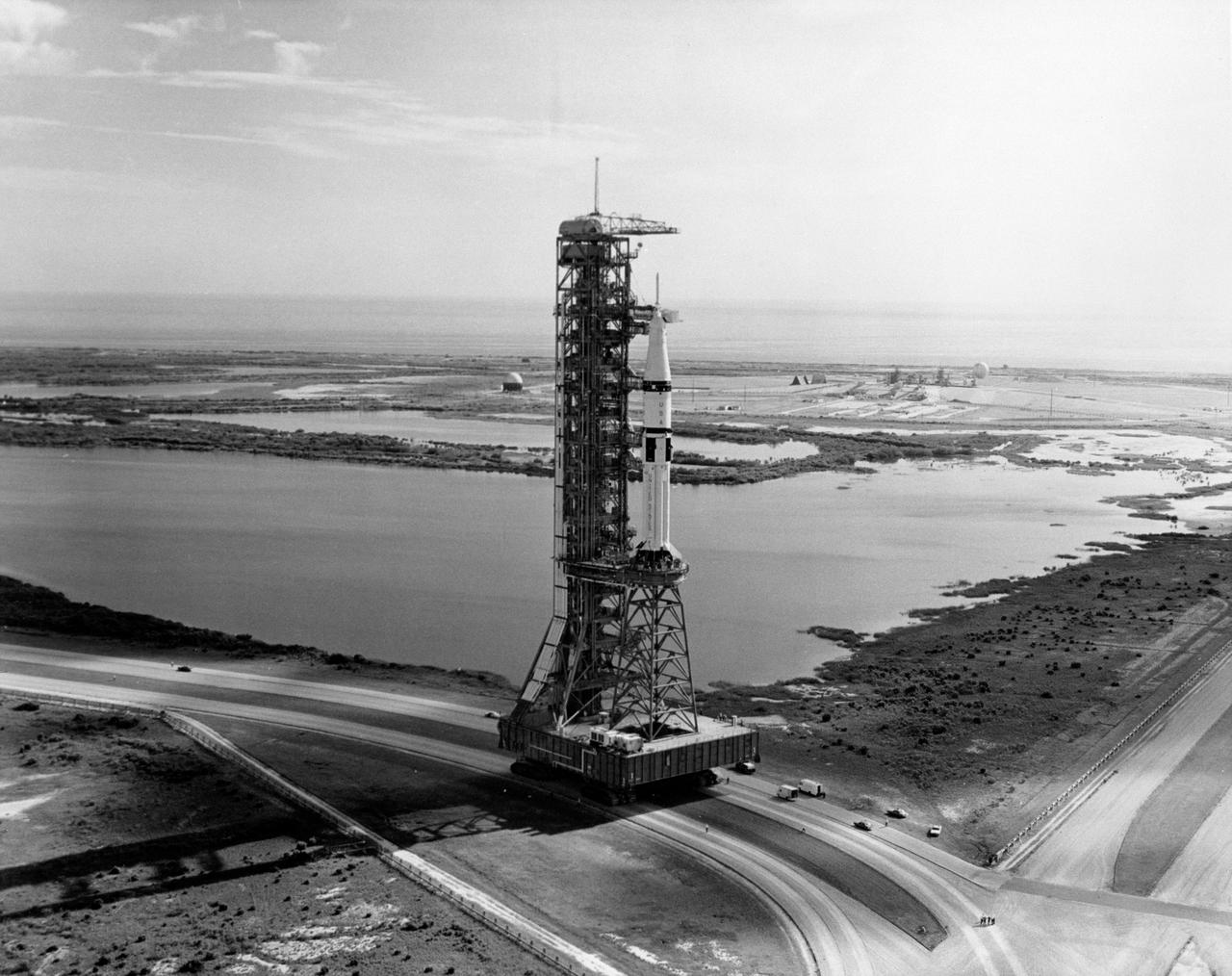
S73-34369 (14 Aug. 1973) --- A Saturn 1B launch vehicle is rolled to Launch Complex 39, Pad B. The space vehicle, to be launched by the Saturn 1B, will carry the third Skylab crew (Skylab 4) to the now-orbiting Orbital Workshop (OWS) and the other four components making up the cluster. The Skylab crewmen, astronaut Gerald P. Carr, commander; scientist-astronaut Edward G. Gibson, science pilot; and astronaut William R. Pogue, pilot, are scheduled to be launched from here in November 1973. Photo credit: NASA
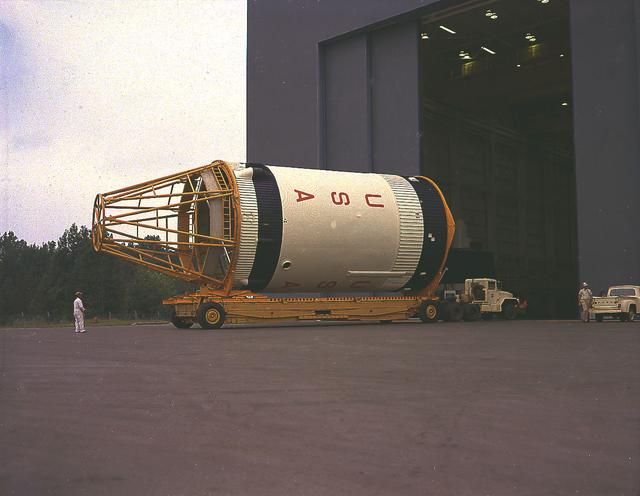
This September 1967 photograph shows workmen removing a mockup of the Saturn V S-IVB stage that housed the Skylab Orbital Workshop (OWS) from the Marshall Space Flight Center (MSFC), building 4755. The mockup was shipped to McDornell Douglas in Huntington, California for design modifications. NASA used the mockup as an engineering design tool to plan structures, equipment, and experiments for Skylab, an orbiting space laboratory. The MSFC had program management responsibility for the development of Skylab hardware and experiments, including the OWS.
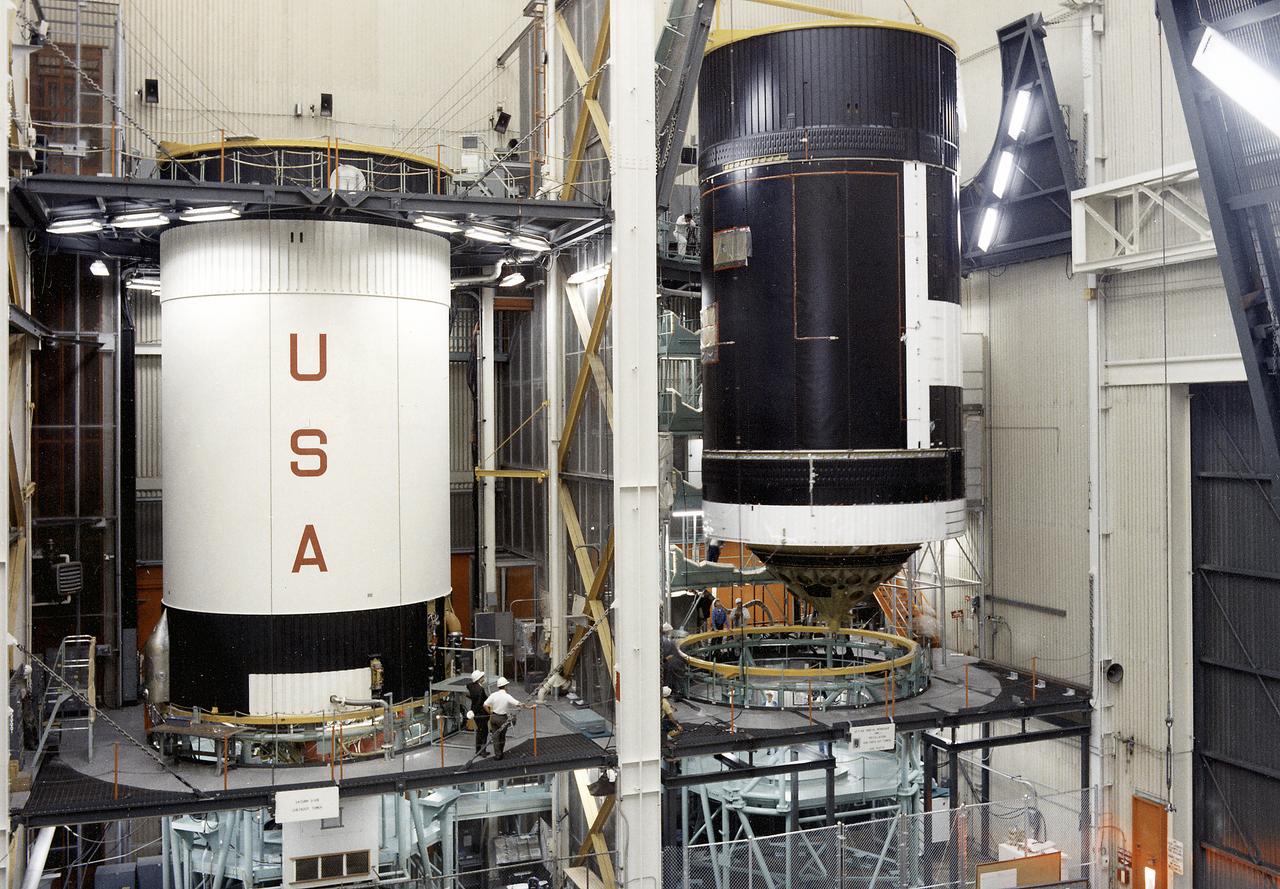
This photograph shows activities during assembly of the Skylab cluster at the Vehicle Assembly/Checkout building. The Saturn V S-IVB stage is shown at left, and right is the Orbital Workshop (OWS) being readied for mating to the thruster. The S-IVB stage was modified to house the OWS, which provided living and working quarters for the Skylab crews. The Marshall Space Flight Center had responsibilities for the design and development of the Skylab hardware, and management of experiments.
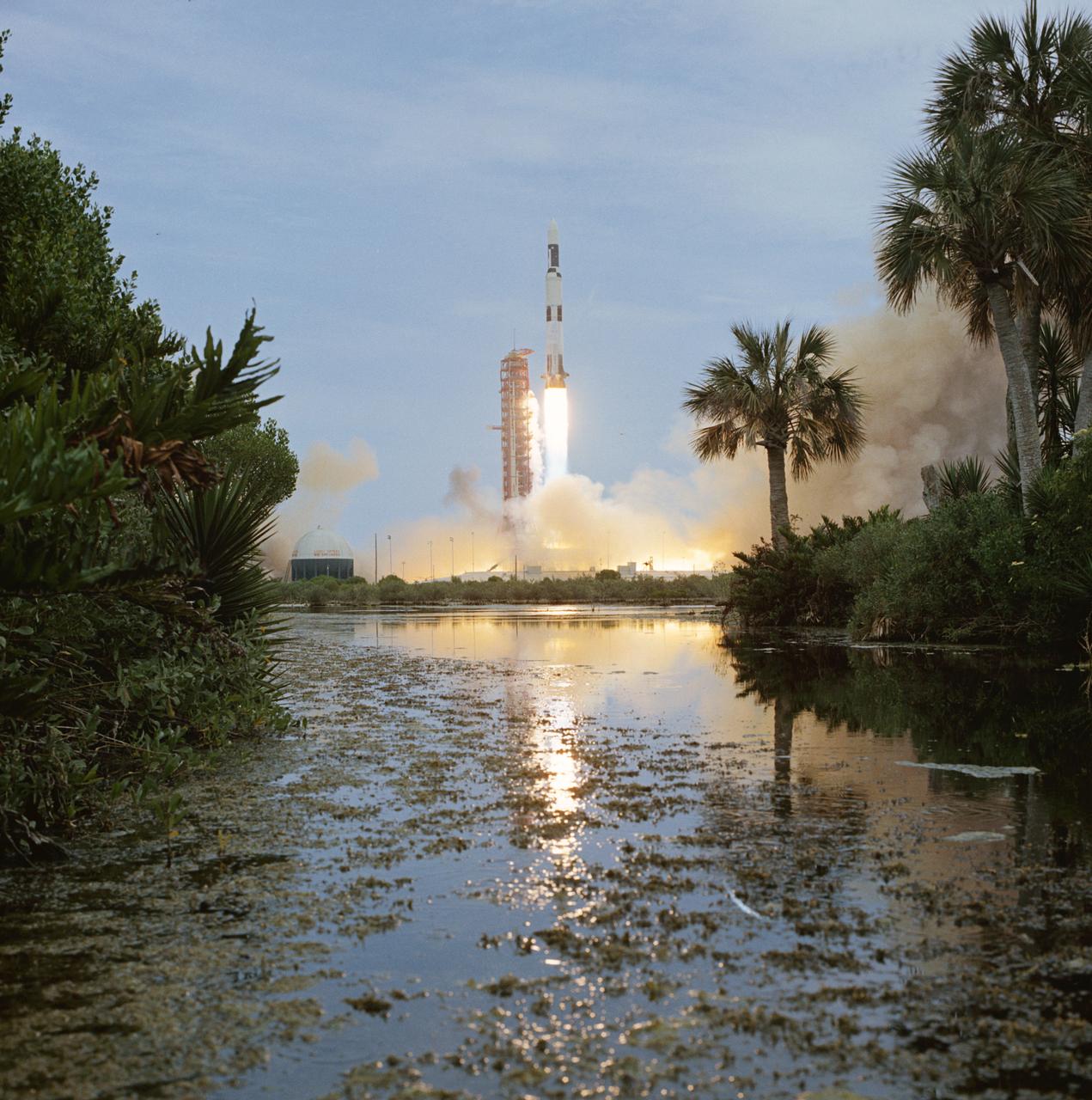
S73-26913 (14 May 1973) --- The unmanned Skylab 1/Saturn V space vehicle is launched from Pad A, Launch Complex 39, Kennedy Space Center, Florida, at 12:00 noon (EDT), May 14, 1973, to place the Skylab space station cluster in Earth orbit. The Skylab 1 payload included four of the five major components of the space station Orbital Workshop, Apollo Telescope Mount, Multiple Docking Adapter, and Airlock Module. In addition to the payload, the Skylab 1/Saturn V second (S-11) stage. The fifth major component of the space station, the Command Service Module with the Skylab 2 crew aboard, was launched at a later date by a Saturn 1B from Pad B. Photo credit: NASA
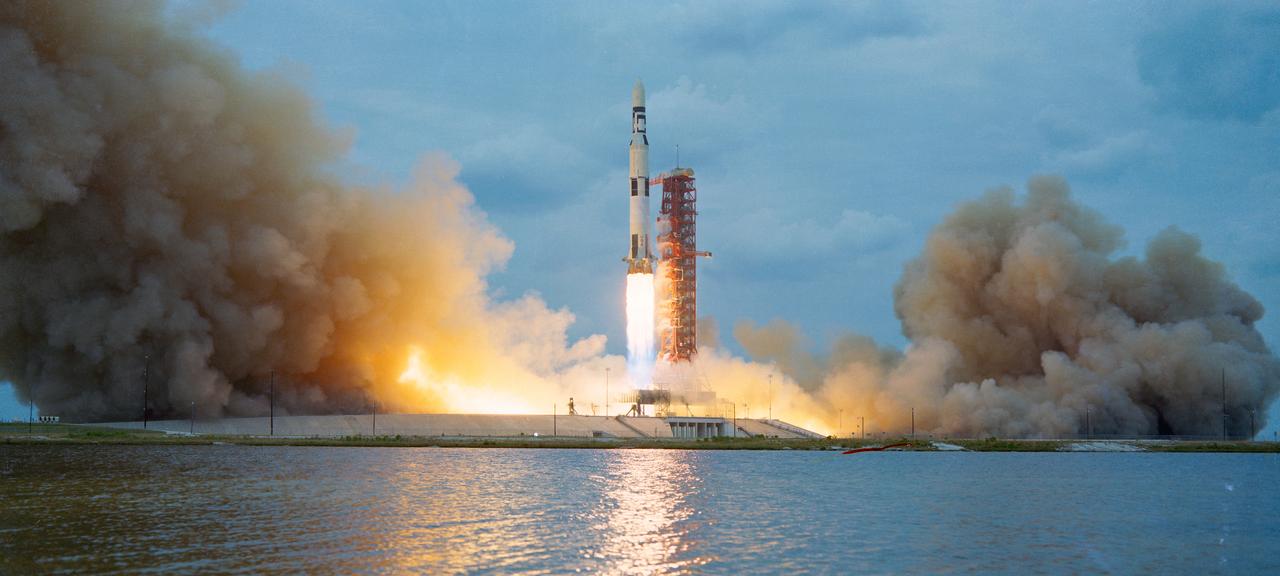
S73-26912 (14 May 1973) --- The unmanned Skylab 1/Saturn V space vehicle is launched from Pad A, Launch Complex 39, Kennedy Space Center, Florida, at 12:00 noon (EDT), May 14, 1973, to place the Skylab space station cluster in Earth orbit. The Skylab 1 payload included four of the five major components of the space station Orbital Workshop, Apollo Telescope Mount, Multiple Docking Adapter, and Airlock Module. In addition to the payload, the Skylab 1/Saturn V second (S-11) stage. The fifth major component of the space station, the Command Service Module with the Skylab 2 crew aboard, was launched at a later date by a Saturn 1B from Pad B. Photo credit: NASA
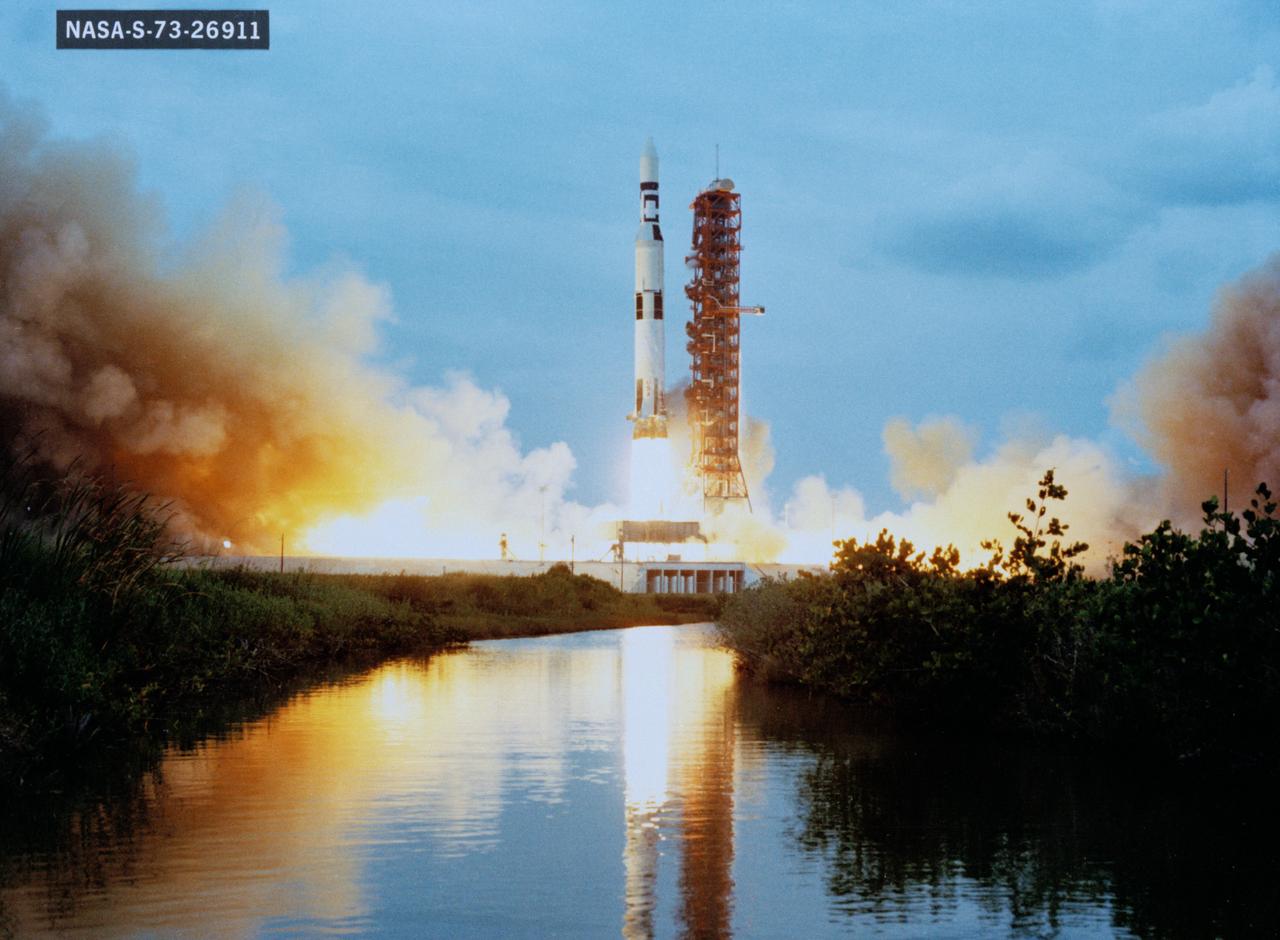
S73-26911 (14 May 1973) --- The unmanned Skylab 1/Saturn V space vehicle is launched from Pad A, Launch Complex 39, Kennedy Space Center, Florida, at 12:00 noon (EDT), May 14, 1973, to place the Skylab space station cluster in Earth orbit. The Skylab 1 payload included four of the five major components of the space station-Orbital Workshop, Apollo Telescope Mount, Multiple Docking Adapter, and Airlock Module. In addition to the payload, the Skylab 1/Saturn V second (S-11) stage. The fifth major component of the space station, the Command Service Module with the Skylab 2 crew aboard, was launched at a later date by a Saturn 1B from Pad B. Photo credit: NASA
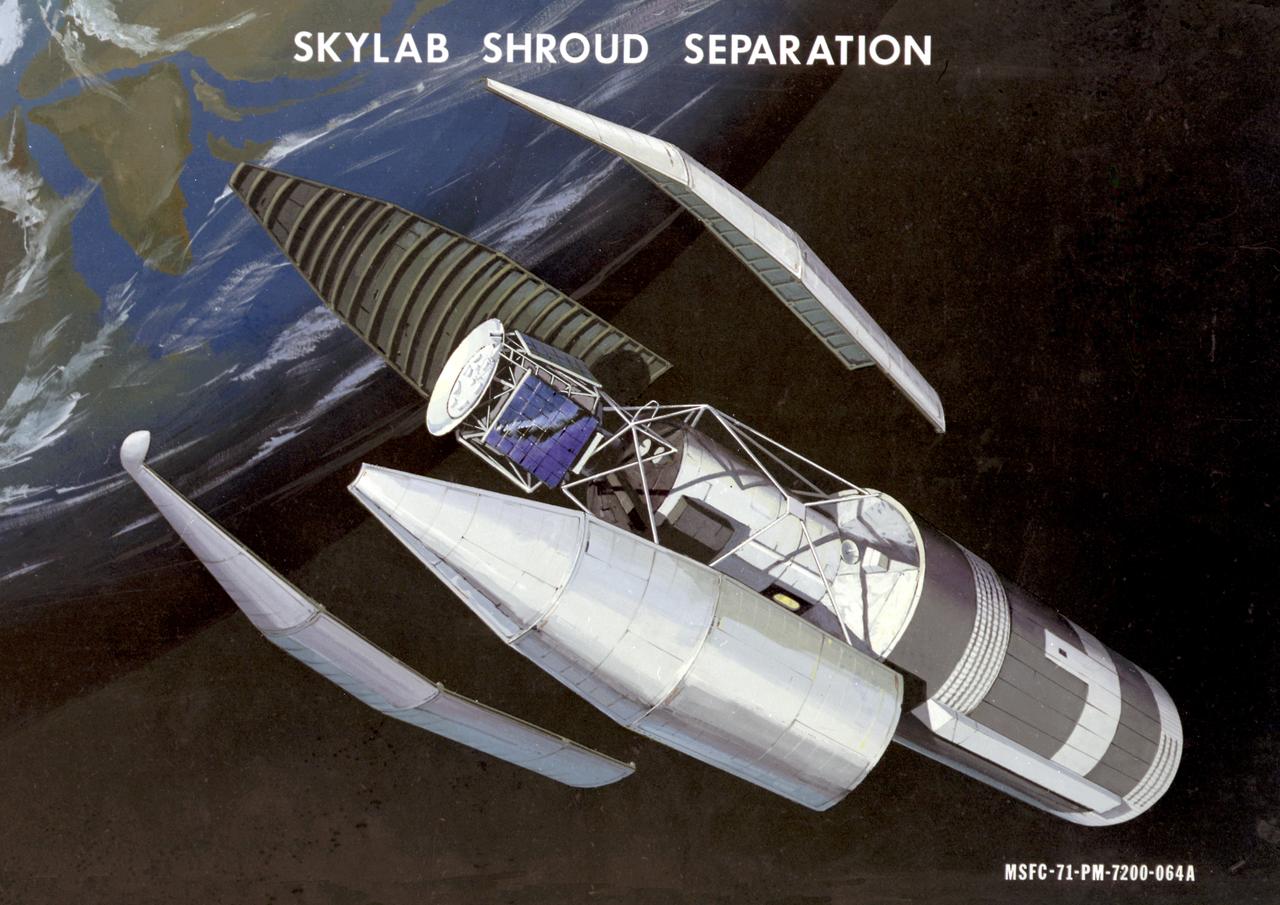
This artist's concept depicts the separation of the Skylab payload shroud. The payload shroud was both an environmental shield and an aerodynamic fairing. Attached to the forward end of the fixed airlock shroud, it protected the airlock, the docking adapter, and the solar observatory before and during launch. It also provided structural support for the solar observatory in the launch configuration. The payload shroud was jettisoned once Skylab reached orbit after separation of the S-II second stage of the Saturn V vehicle. Five major assemblies clustered together made up the orbiting space station called Skylab. The largest of these was the orbital workshop, that housed the crew quarters and a major experiment area. The airlock module, attached to the forward end of the workshop, enabled crewmembers to make excursions outside Skylab. The docking adapter, attached to the forward end of the airlock module, provided the docking port for the Apollo command and service module. The Apollo Telescope Mount was the first marned astronomical observatory designed for solar research from Earth orbit.
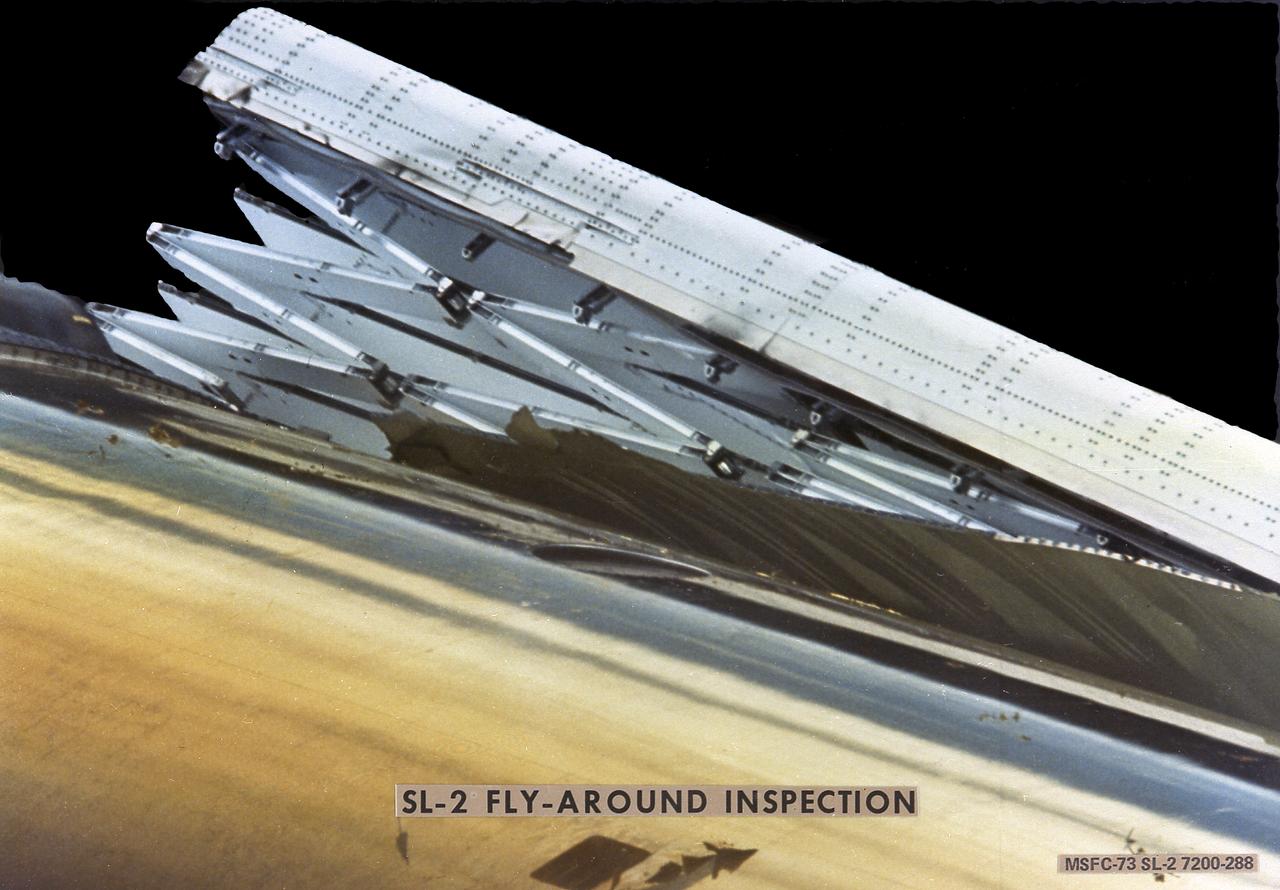
The Saturn V vehicle, carrying the unmarned orbital workshop for the Skylab-1 mission, lifted off successfully and all systems performed normally. Sixty-three seconds into the flight, engineers in the operation support and control center saw an unexpected telemetry indication that signalled that damages occurred on one solar array and the micrometeoroid shield during the launch. The micrometeoroid shield, a thin protective cylinder surrounding the workshop protecting it from tiny space particles and the sun's scorching heat, ripped loose from its position around the workshop. This caused the loss of one solar wing and jammed the other. Still unoccupied, the Skylab was stricken with the loss of the heat shield and sunlight beat mercilessly on the lab's sensitive skin. Internal temperatures soared, rendering the station uninhabitable, threatening foods, medicines, films, and experiments. This image, taken during a fly-around inspection by the Skylab-2 crew, shows the station's remaining solar panel jammed against its side. The Marshall Space Flight Center had a major role in developing the procedures to repair the damaged Skylab.
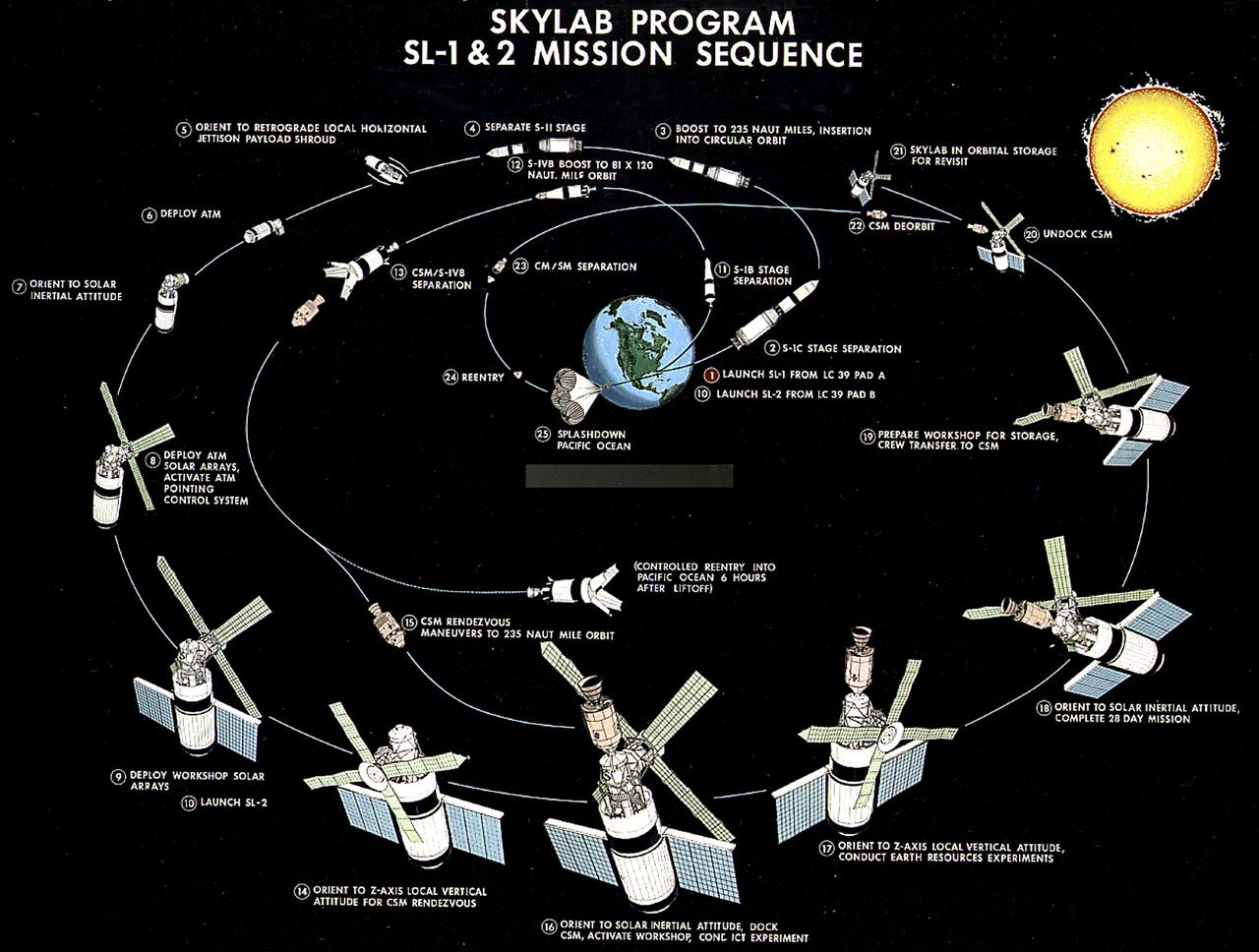
This illustration depicts the Skylab-1 and Skylab-2 mission sequence. The goals of the Skylab were to enrich our scientific knowledge of the Earth, the Sun, the stars, and cosmic space; to study the effects of weightlessness on living organisms, including man; to study the effects of the processing and manufacturing of materials utilizing the absence of gravity; and to conduct Earth resource observations. The Skylab also conducted 19 selected experiments submitted by high school students. Skylab's 3 different 3-man crews spent up to 84 days in Earth orbit. The Marshall Space Flight Center (MSFC) had responsibility for developing and integrating most of the major components of the Skylab: the Orbital Workshop (OWS), Airlock Module (AM), Multiple Docking Adapter (MDA), Apollo Telescope Mount (ATM), Payload Shroud (PS), and most of the experiments. MSFC was also responsible for providing the Saturn IB launch vehicles for three Apollo spacecraft and crews and a Saturn V launch vehicle for the Skylab.
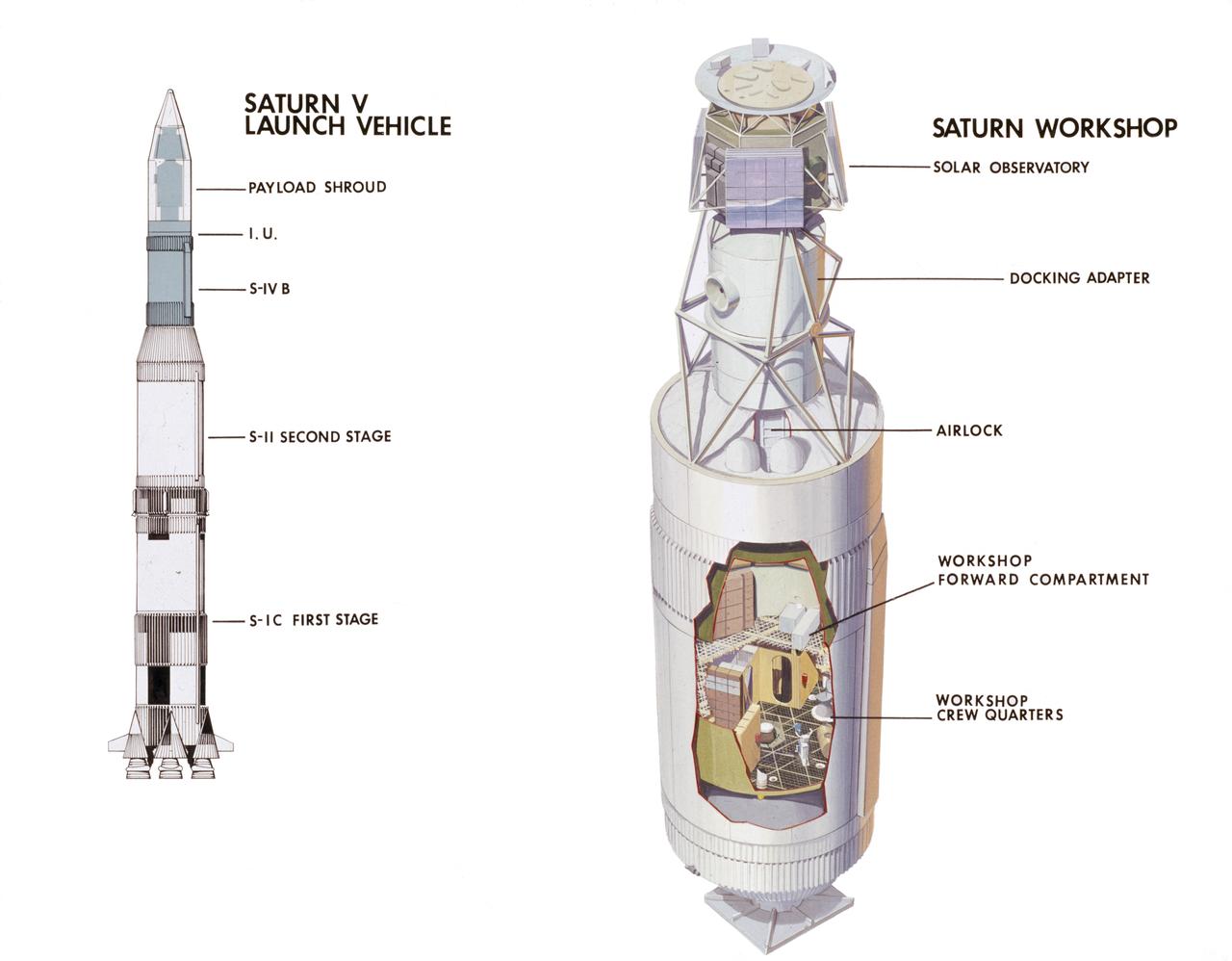
This cutaway drawing illustrates major Skylab components in launch configuration on top of the Saturn V. In an early effort to extend the use of Apollo for further applications, NASA established the Apollo Applications Program (AAP) in August of 1965. The AAP was to include long duration Earth orbital missions during which astronauts would carry out scientific, technological, and engineering experiments in space by utilizing modified Saturn launch vehicles and the Apollo spacecraft. Established in 1970, the Skylab Program was the forerurner of the AAP. The goals of the Skylab were to enrich our scientific knowledge of the Earth, the Sun, the stars, and cosmic space; to study the effects of weightlessness on living organisms, including man; to study the effects of the processing and manufacturing of materials utilizing the absence of gravity; and to conduct Earth resource observations. The Skylab also conducted 19 selected experiments submitted by high school students. Skylab's 3 different 3-man crews spent up to 84 days in Earth orbit. The Marshall Space Flight Center (MSFC) had responsibility for developing and integrating most of the major components of the Skylab: the Orbital Workshop (OWS), Airlock Module (AM), Multiple Docking Adapter (MDA), Apollo Telescope Mount (ATM), Payload Shroud (PS), and most of the experiments. MSFC was also responsible for providing the Saturn IB launch vehicles for three Apollo spacecraft and crews and a Saturn V launch vehicle for the Skylab.
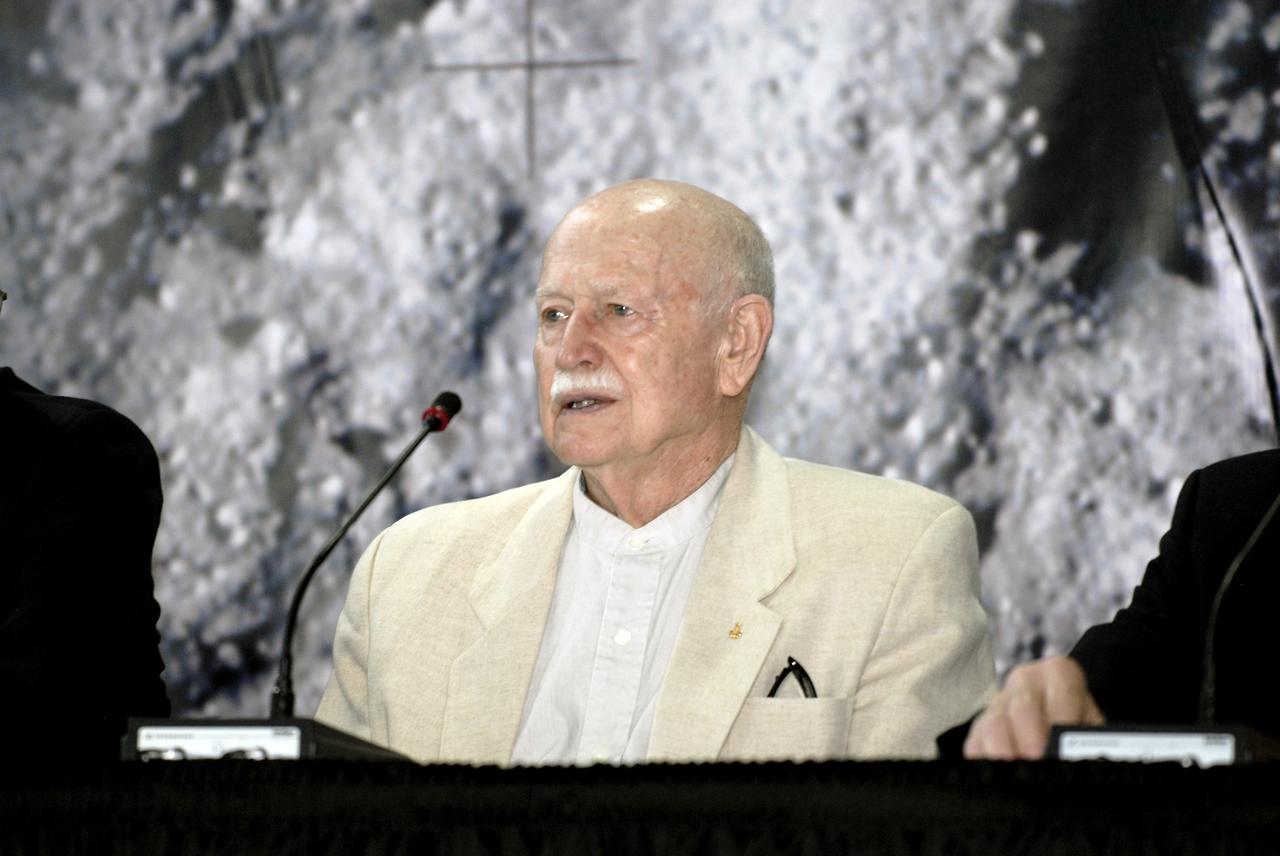
CAPE CANAVERAL, Fla. – At the Apollo/Saturn V Center at NASA's Kennedy Space Center in Florida, Apollo astronaut Gerald Carr shares his experiences with spectators crowd gathered for NASA's 40th Anniversary of Apollo Celebration of the July 1969 launch and landing on the moon. Carr served as CAPCOM for the Apollo 8 and 12 flights, and was involved in the development and testing of the lunar roving vehicle which was used on the lunar surface by Apollo flight crews. He also was commander of Skylab 4 launched in 1973 on the third and final manned visit to the Skylab Orbital Workshop. Photo credit: NASA/Kim Shiflett
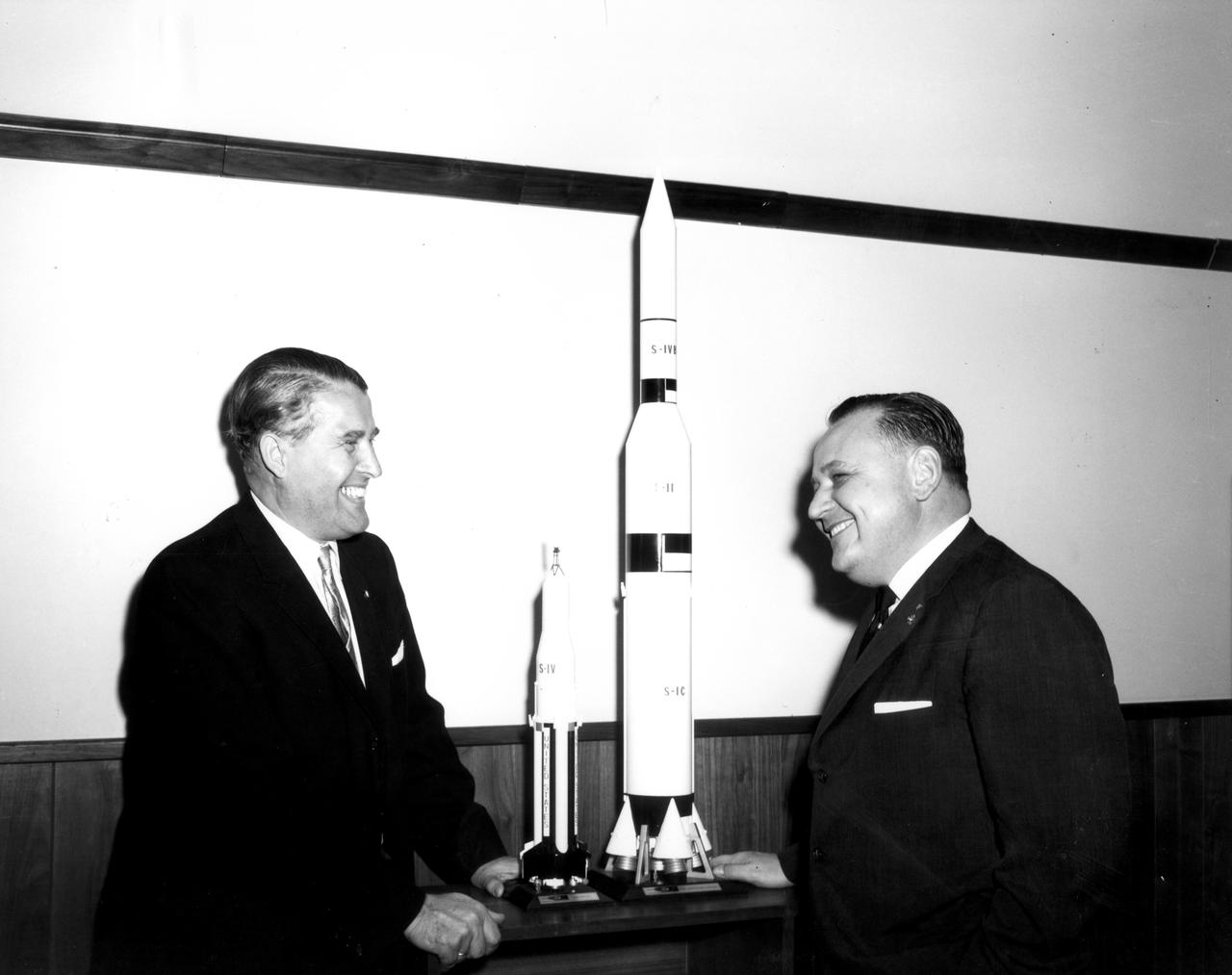
The members of the House Committee on Science and Astronautics visited the Marshall Space Flight Center (MSFC) on March 9, 1962 to gather firsthand information of the nation’s space exploration program. The congressional group was composed of members of the Subcommittee on Manned Space Flight. The subcommittee was briefed on MSFC’s manned space efforts earlier in the day and then inspected mockups of the Saturn I Workshop and the Apollo Telescope Mount, two projects developed by MSFC for the post-Apollo program. In this photograph, MSFC Director, Dr. Wernher von Braun and Richard L. Roudebush, Republican representative of Indiana, discuss Apollo models.
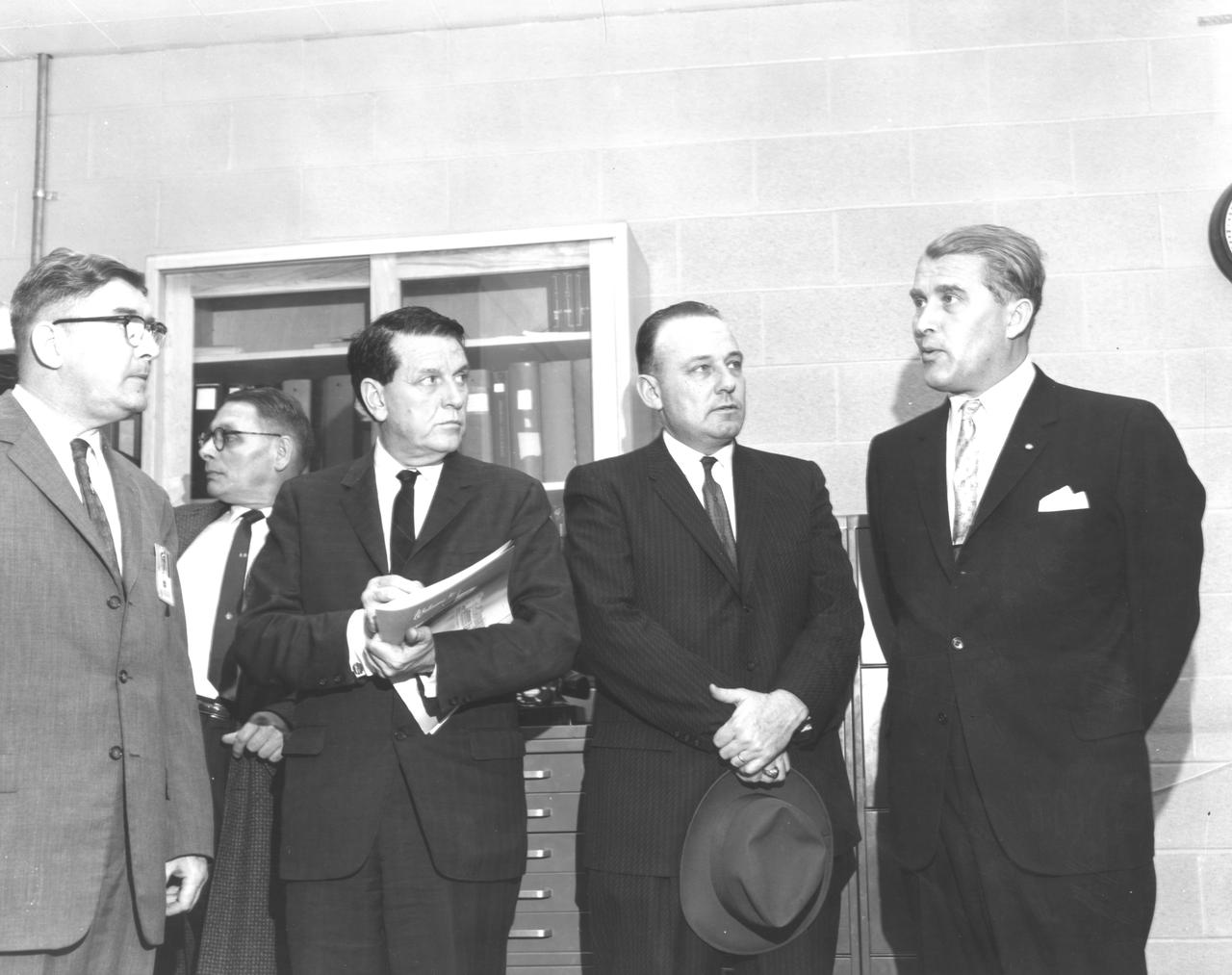
The members of the House Committee on Science and Astronautics visited the Marshall Space Flight Center (MSFC) on March 9, 1962 to gather firsthand information of the nation's space exploration program. The congressional group was composed of members of the Subcommittee on Manned Space Flight. They were briefed on MSFC's manned space efforts earlier in the day and then inspected mockups of the Saturn I Workshop and the Apollo Telescope Mount, two projects developed by MSFC for the post-Apollo program. Pictured left-to-right are Dieter Grau, MSFC; Konrad Dannenberg, MSFC; James G. Fulton, Republican representative for Pennsylvania; Joe Waggoner, Democratic representative for Louisiana; and Dr. Wernher von Braun, Director of MSFC.
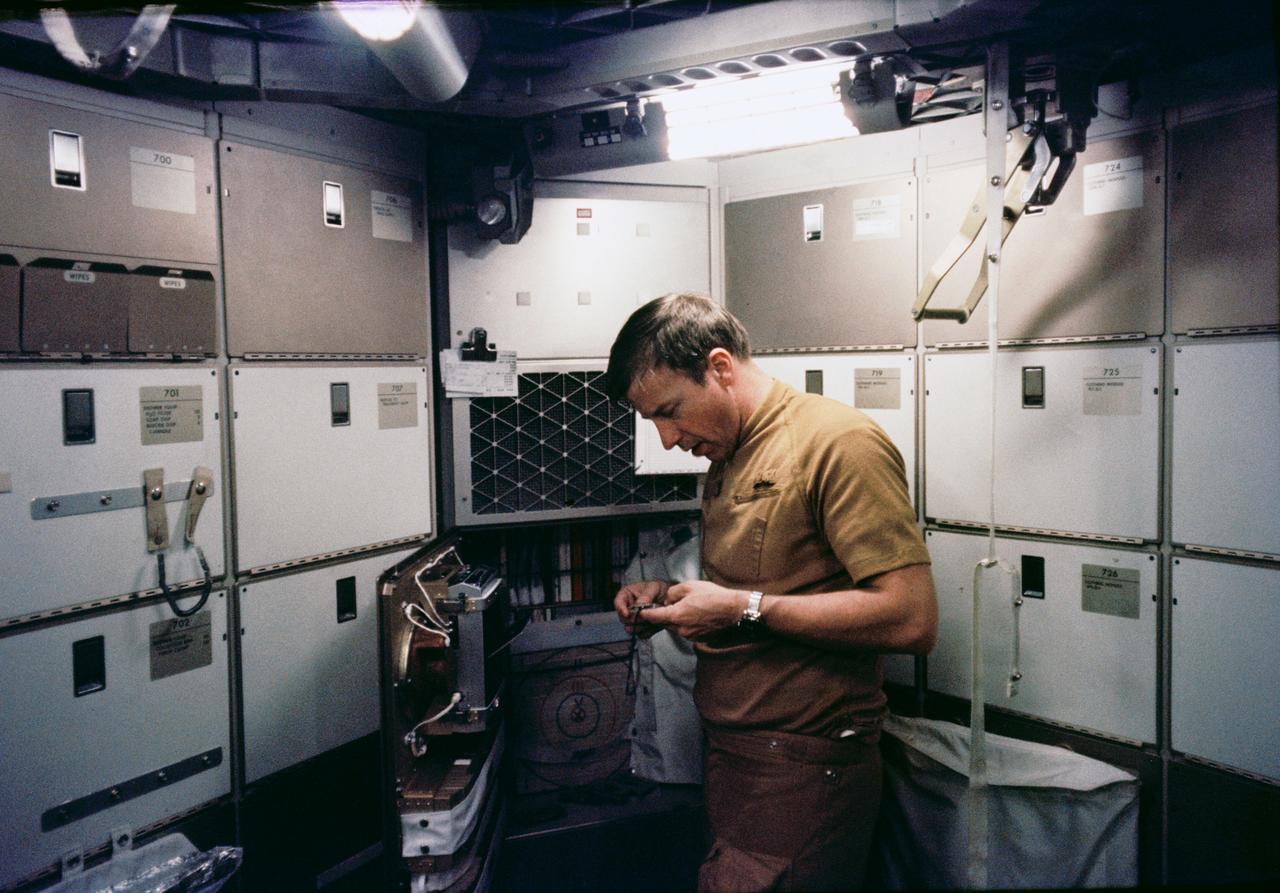
S73-17859 (January 1973) --- Astronaut Paul J. Weitz, pilot for Skylab 2 (first Skylab manned) mission, looks over off-duty recreational equipment in the crew quarters of the Skylab Orbital Workshop (OWS) trainer during Skylab simulation activity at the Manned Spacecraft Center. The equipment includes such items as tape decks and stereo music equipment, playing cards, darts, etc. The OWS is a component of the Skylab space station cluster which will be launched unmanned aboard a Saturn V in summer of 1973, and will be visited three times by three-man crews over an eight month period. Photo credit: NASA
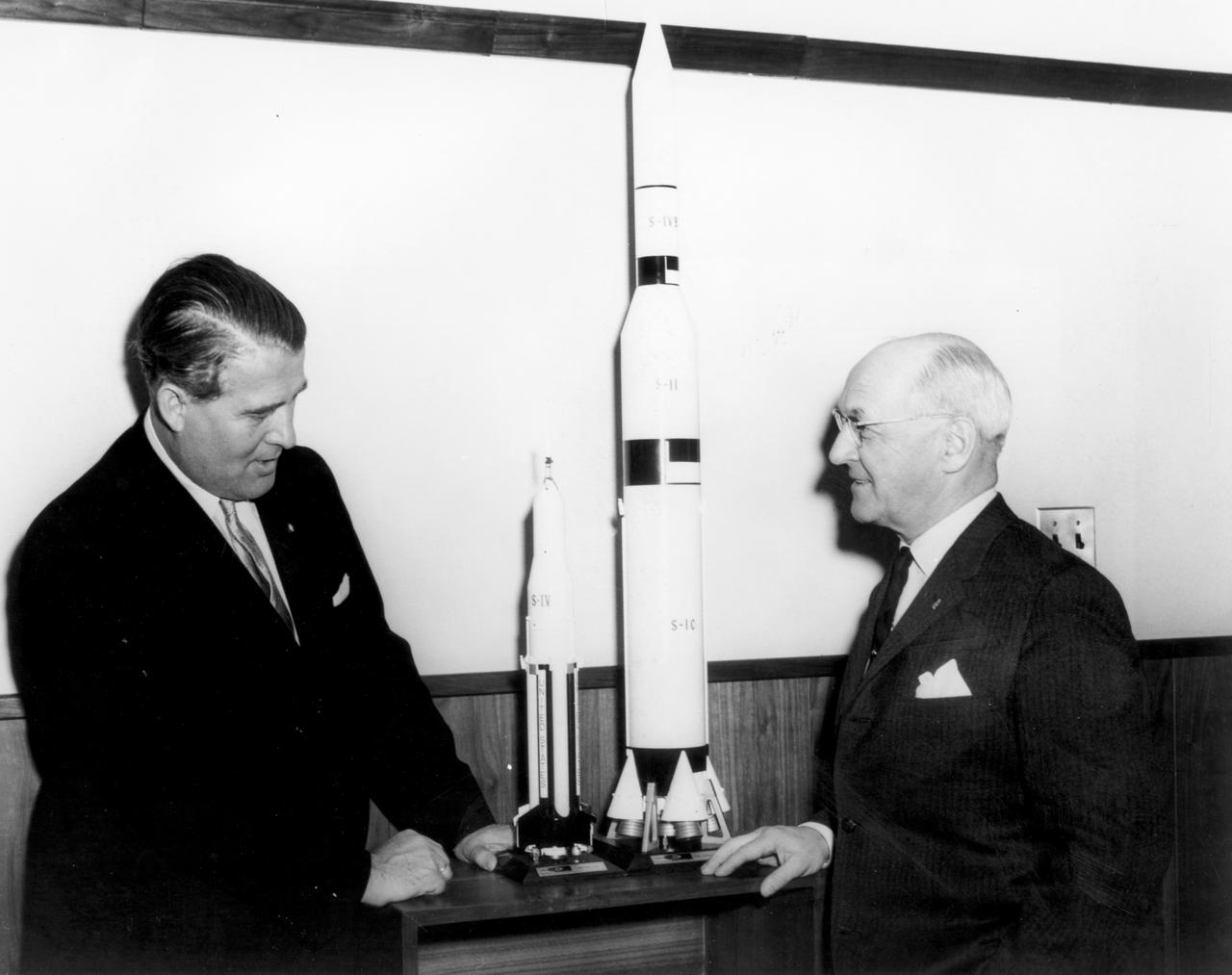
The members of the House Committee on Science and Astronautics visited the Marshall Space Flight Center (MSFC) on March 9, 1962 to gather firsthand information of the nation’s space exploration program. The congressional group was composed of members of the Subcommittee on Manned Space Flight. The subcommittee was briefed on MSFC’s manned space efforts earlier in the day and then inspected mockups of the Saturn I Workshop and the Apollo Telescope Mount, two projects developed by MSFC for the post-Apollo program. In this photograph, MSFC Director, Dr. Wernher von Braun and R. Walter Riehlman, Republican representative of New York, discuss Apollo models.
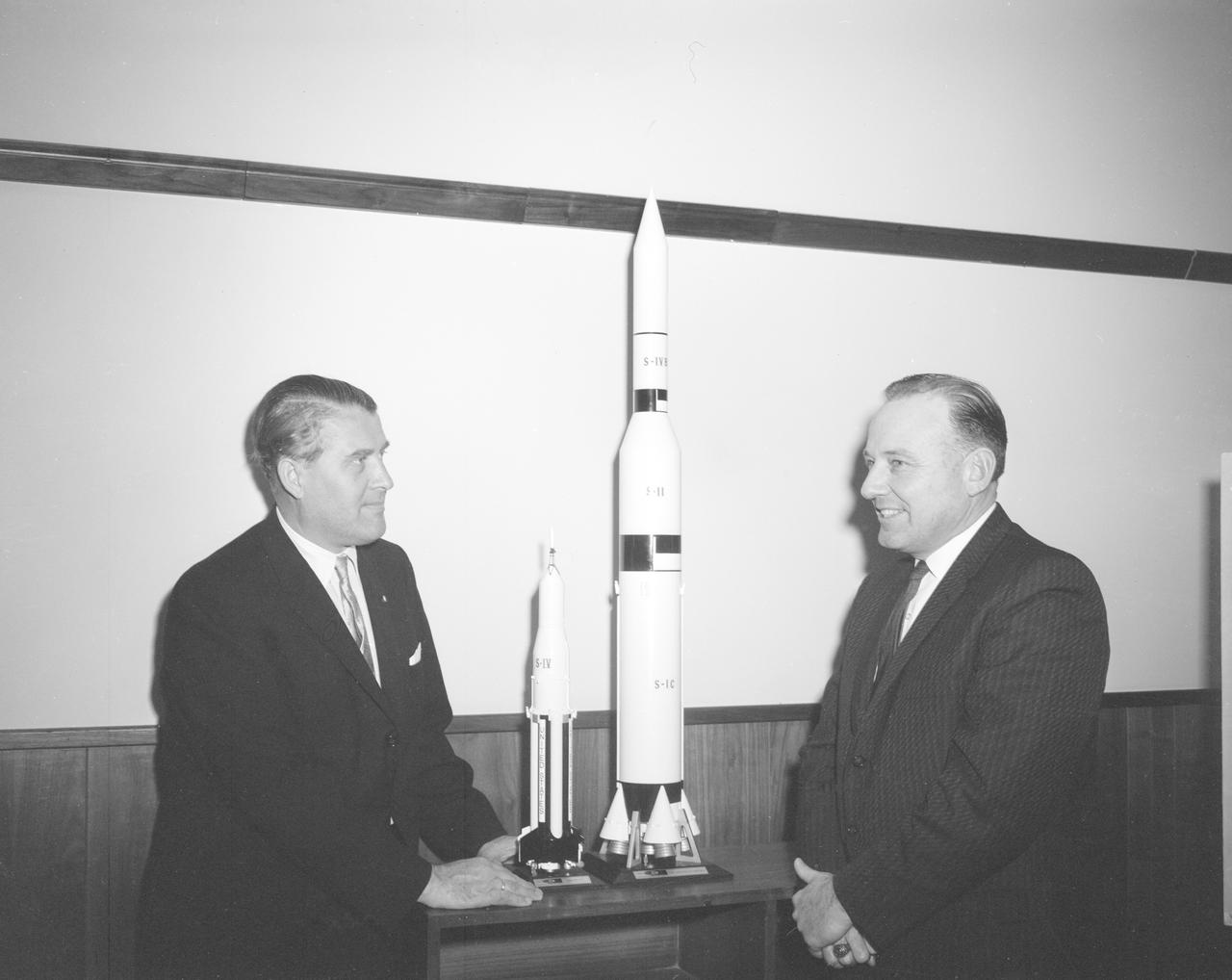
The members of the House Committee on Science and Astronautics visited the Marshall Space Flight Center (MSFC) on March 9, 1962 to gather firsthand information of the nation’s space exploration program. The congressional group was composed of members of the Subcommittee on Manned Space Flight. The subcommittee was briefed on MSFC’s manned space efforts earlier in the day and then inspected mockups of the Saturn I Workshop and the Apollo Telescope Mount, two projects developed by MSFC for the post-Apollo program. In this photograph, MSFC Director, Dr. Wernher von Braun and Joe Waggoner, Democratic representative of Louisiana, discuss Apollo models.
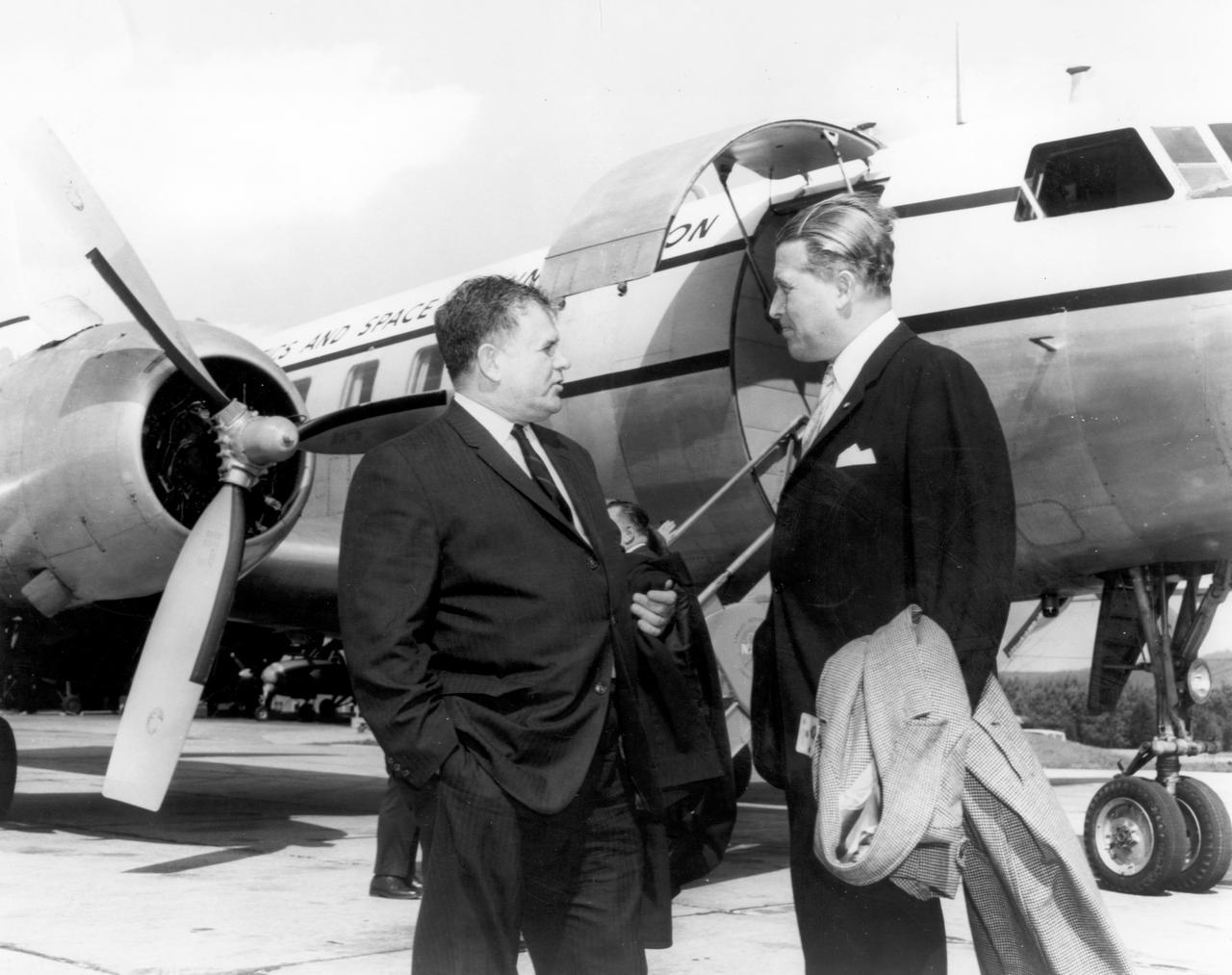
The members of the House Committee on Science and Astronautics visited the Marshall Space Flight Center (MSFC) on March 9, 1962 to gather firsthand information of the nation’s space exploration program. The congressional group was composed of members of the Subcommittee on Manned Space Flight. The subcommittee was briefed on MSFC’s manned space efforts earlier in the day and then inspected mockups of the Saturn I Workshop and the Apollo Telescope Mount, two projects developed by MSFC for the post-Apollo program. In this photograph, MSFC Director, Dr. Wernher von Braun, bids farewell to Texas Democratic Representative Olin E. Teague before departure at the Redstone Arsenal Airstrip.
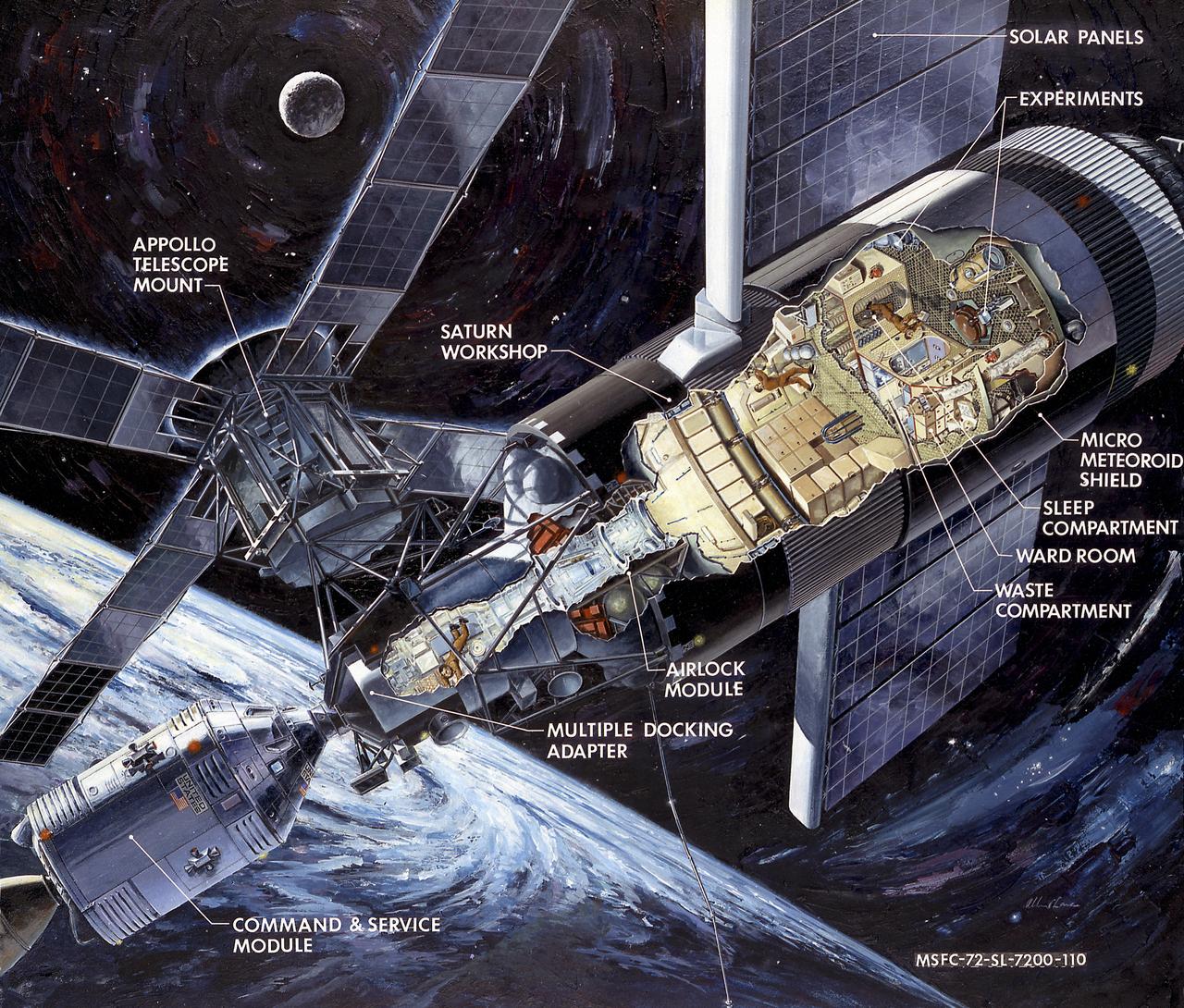
This artist's concept is a cutaway illustration of the Skylab with the Command/Service Module being docked to the Multiple Docking Adapter. In an early effort to extend the use of Apollo for further applications, NASA established the Apollo Applications Program (AAP) in August of 1965. The AAP was to include long duration Earth orbital missions during which astronauts would carry out scientific, technological, and engineering experiments in space by utilizing modified Saturn launch vehicles and the Apollo spacecraft. Established in 1970, the Skylab Program was the forerurner of the AAP. The goals of the Skylab were to enrich our scientific knowledge of the Earth, the Sun, the stars, and cosmic space; to study the effects of weightlessness on living organisms, including man; to study the effects of the processing and manufacturing of materials utilizing the absence of gravity; and to conduct Earth resource observations. The Skylab also conducted 19 selected experiments submitted by high school students. Skylab's 3 different 3-man crews spent up to 84 days in Earth orbit. The Marshall Space Flight Center (MSFC) had responsibility for developing and integrating most of the major components of the Skylab: the Orbital Workshop (OWS), Airlock Module (AM), Multiple Docking Adapter (MDA), Apollo Telescope Mount (ATM), Payload Shroud (PS), and most of the experiments. MSFC was also responsible for providing the Saturn IB launch vehicles for three Apollo spacecraft and crews and a Saturn V launch vehicle for the Skylab.
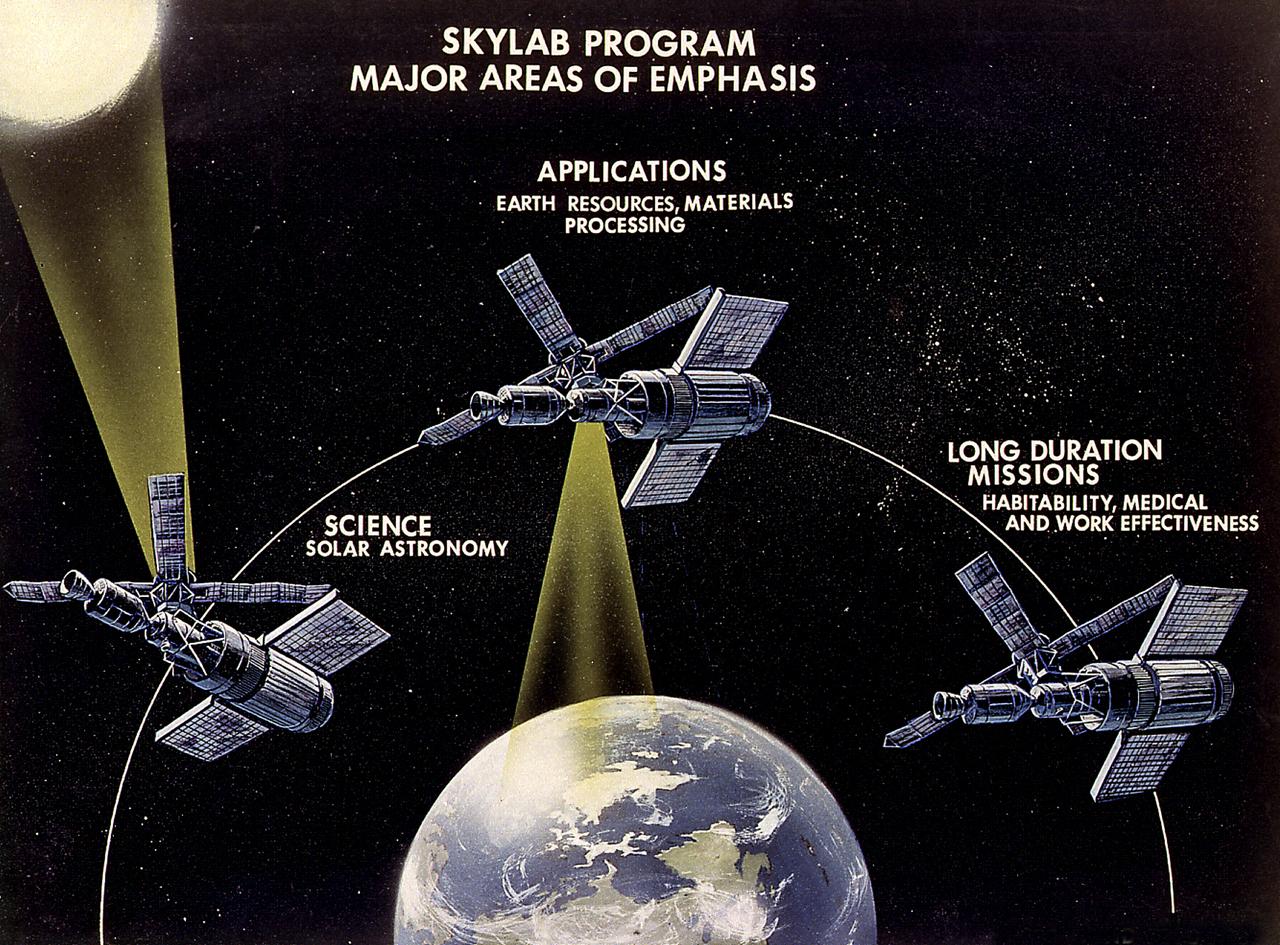
This image illustrates major areas of emphasis of the Skylab Program. In an early effort to extend the use of Apollo for further applications, NASA established the Apollo Applications Program (AAP) in August of 1965. The AAP was to include long duration Earth orbital missions during which astronauts would carry out scientific, technological, and engineering experiments in space by utilizing modified Saturn launch vehicles and the Apollo spacecraft. Established in 1970, the Skylab Program was the forerurner of the AAP. The goals of the Skylab were to enrich our scientific knowledge of the Earth, the Sun, the stars, and cosmic space; to study the effects of weightlessness on living organisms, including man; to study the effects of the processing and manufacturing of materials utilizing the absence of gravity; and to conduct Earth resource observations. The Skylab also conducted 19 selected experiments submitted by high school students. Skylab's 3 different 3-man crews spent up to 84 days in Earth orbit. The Marshall Space Flight Center (MSFC) had responsibility for developing and integrating most of the major components of the Skylab: the Orbital Workshop (OWS), Airlock Module (AM), Multiple Docking Adapter (MDA), Apollo Telescope Mount (ATM), Payload Shroud (PS), and most of the experiments. MSFC was also responsible for providing the Saturn IB launch vehicles for three Apollo spacecraft and crews and a Saturn V launch vehicle for the Skylab.
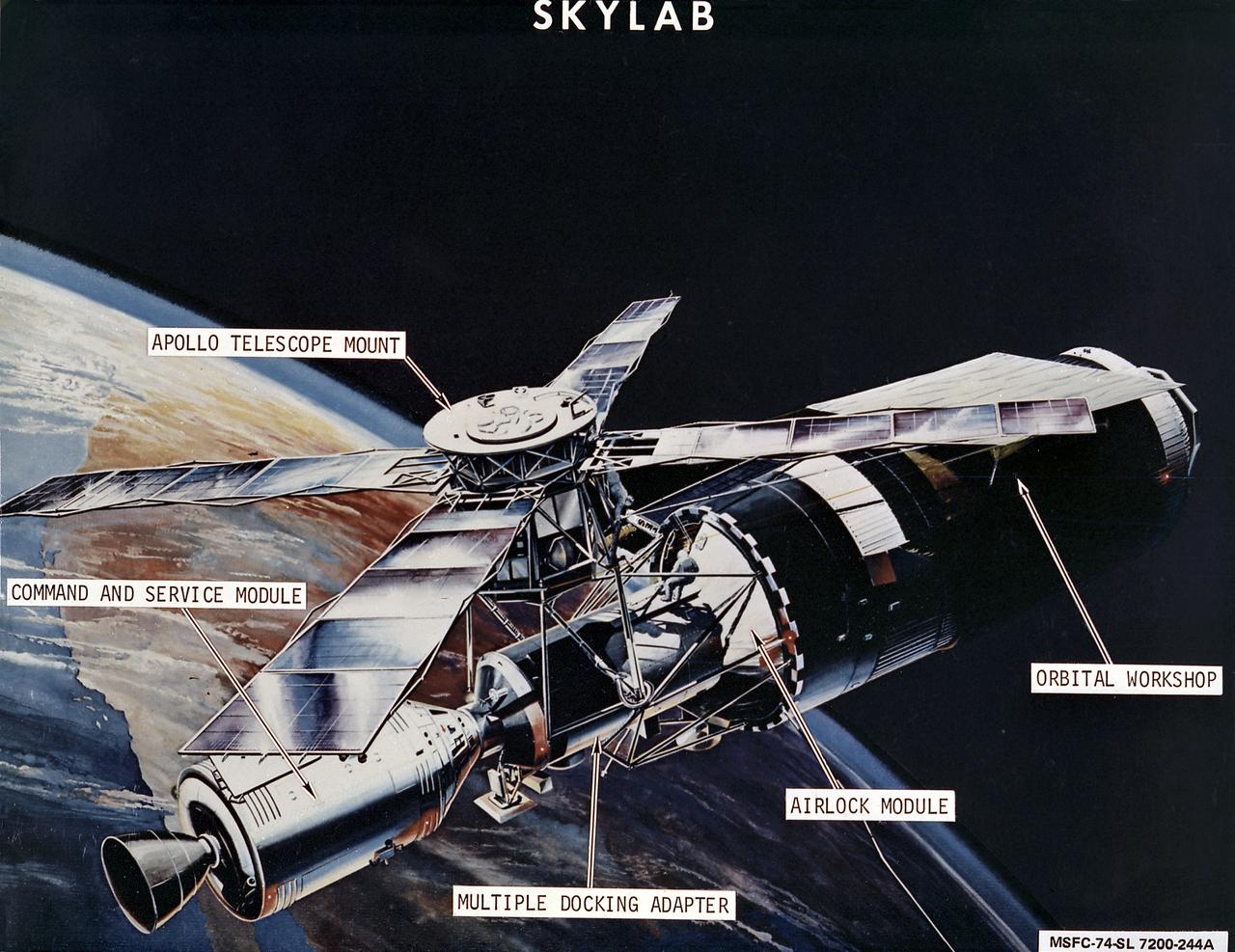
This image is an artist's concept of the Skylab in orbit with callouts of its major components. In an early effort to extend the use of Apollo for further applications, NASA established the Apollo Applications Program (AAP) in August of 1965. The AAP was to include long duration Earth orbital missions during which astronauts would carry out scientific, technological, and engineering experiments in space by utilizing modified Saturn launch vehicles and the Apollo spacecraft. Established in 1970, the Skylab Program was the forerurner of the AAP. The goals of the Skylab were to enrich our scientific knowledge of the Earth, the Sun, the stars, and cosmic space; to study the effects of weightlessness on living organisms, including man; to study the effects of the processing and manufacturing of materials utilizing the absence of gravity; and to conduct Earth resource observations. The Skylab also conducted 19 selected experiments submitted by high school students. Skylab's 3 different 3-man crews spent up to 84 days in Earth orbit. The Marshall Space Flight Center (MSFC) had responsibility for developing and integrating most of the major components of the Skylab: the Orbital Workshop (OWS), Airlock Module (AM), Multiple Docking Adapter (MDA), Apollo Telescope Mount (ATM), Payload Shroud (PS), and most of the experiments. MSFC was also responsible for providing the Saturn IB launch vehicles for three Apollo spacecraft and crews and a Saturn V launch vehicle for the Skylab.
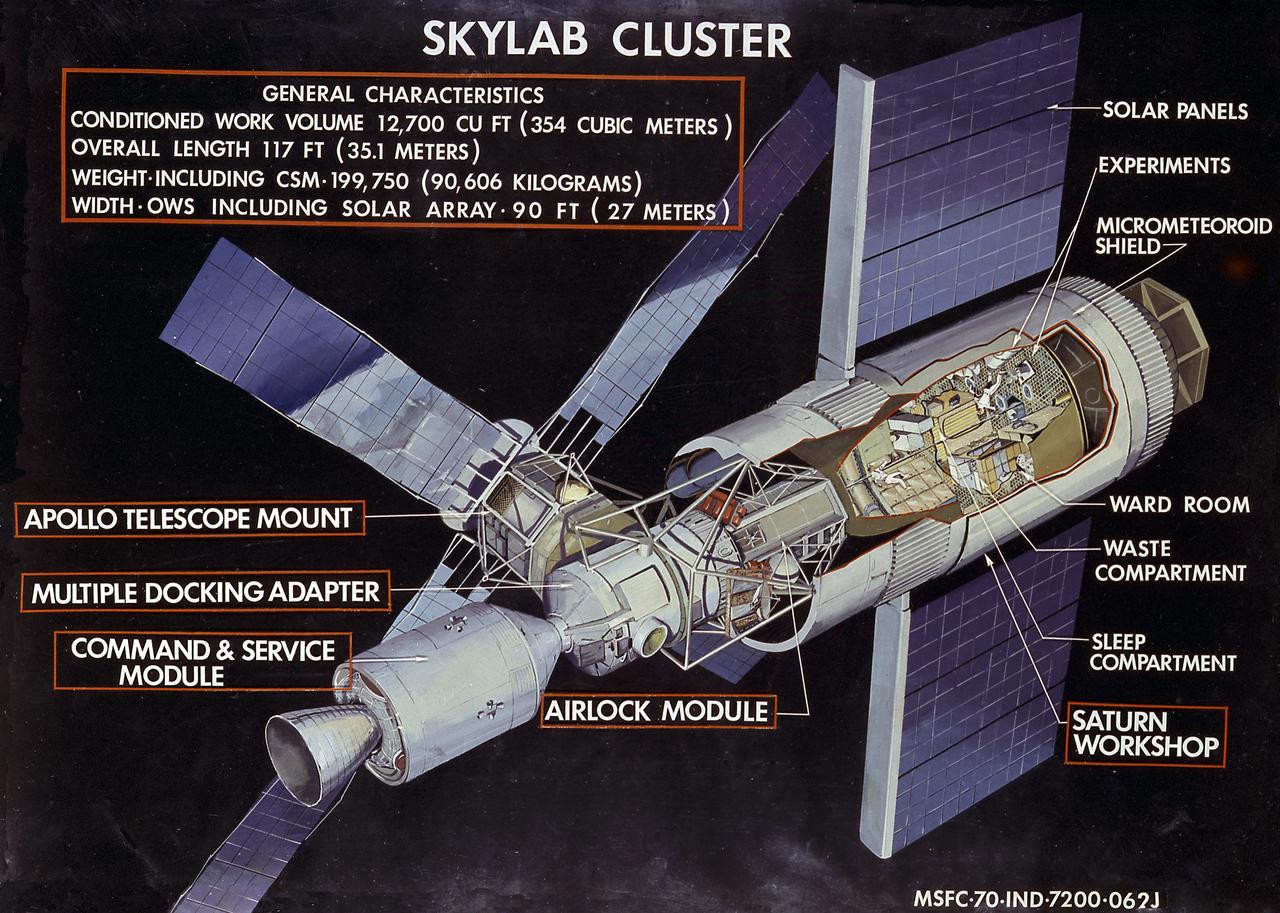
This illustration shows general characteristics of the Skylab with callouts of its major components. In an early effort to extend the use of Apollo for further applications, NASA established the Apollo Applications Program (AAP) in August of 1965. The AAP was to include long duration Earth orbital missions during which astronauts would carry out scientific, technological, and engineering experiments in space by utilizing modified Saturn launch vehicles and the Apollo spacecraft. Established in 1970, the Skylab Program was the forerurner of the AAP. The goals of the Skylab were to enrich our scientific knowledge of the Earth, the Sun, the stars, and cosmic space; to study the effects of weightlessness on living organisms, including man; to study the effects of the processing and manufacturing of materials utilizing the absence of gravity; and to conduct Earth resource observations. The Skylab also conducted 19 selected experiments submitted by high school students. Skylab's 3 different 3-man crews spent up to 84 days in Earth orbit. The Marshall Space Flight Center (MSFC) had responsibility for developing and integrating most of the major components of the Skylab: the Orbital Workshop (OWS), Airlock Module (AM), Multiple Docking Adapter (MDA), Apollo Telescope Mount (ATM), Payload Shroud (PS), and most of the experiments. MSFC was also responsible for providing the Saturn IB launch vehicles for three Apollo spacecraft and crews and a Saturn V launch vehicle for the Skylab.
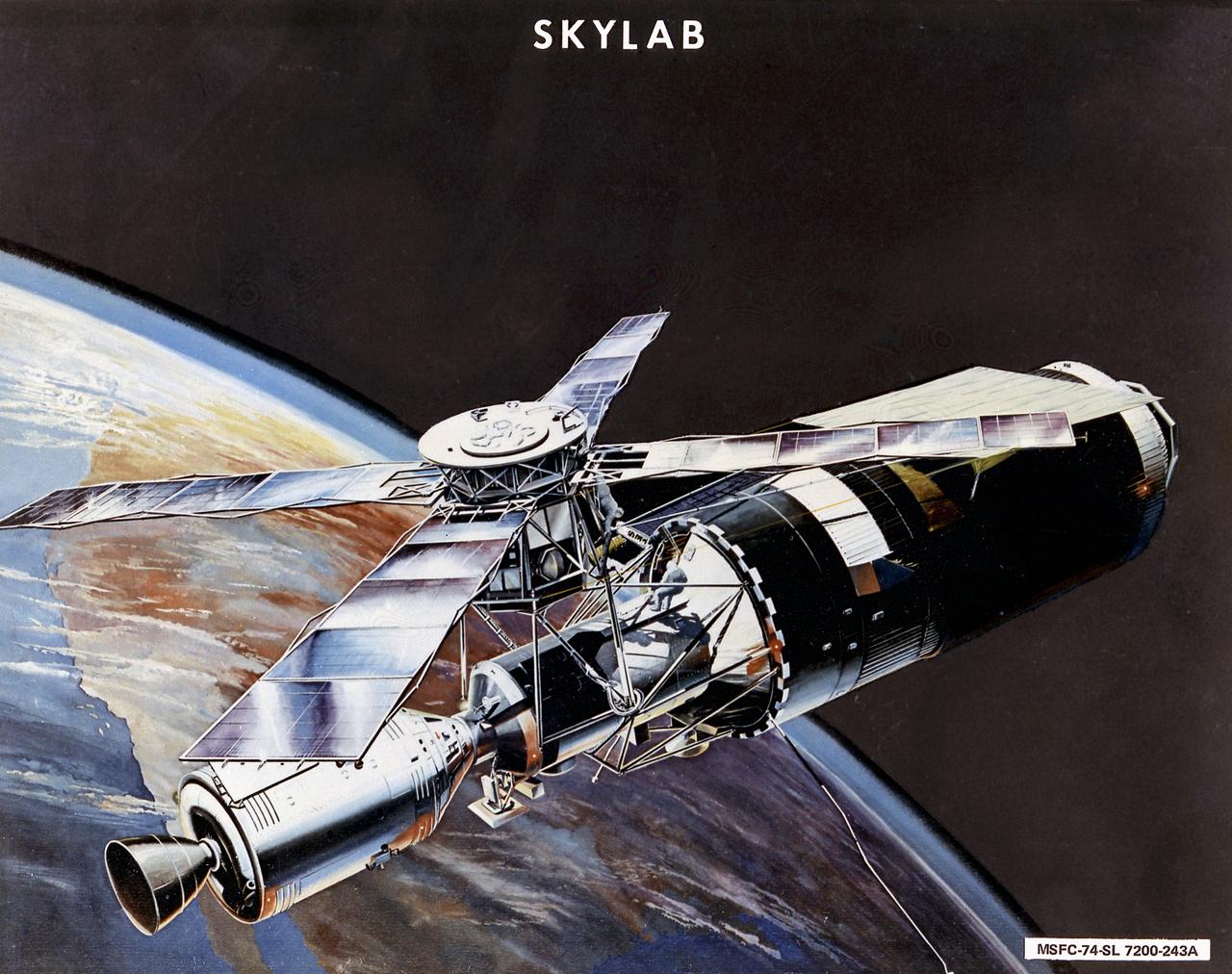
This image is an artist's concept of the Skylab in orbit. In an early effort to extend the use of Apollo for further applications, NASA established the Apollo Applications Program (AAP) in August of 1965. The AAP was to include long duration Earth orbital missions during which astronauts would carry out scientific, technological, and engineering experiments in space by utilizing modified Saturn launch vehicles and the Apollo spacecraft. Established in 1970, the Skylab program was the forerurner of the AAP. The goals of the Skylab were to enrich our scientific knowledge of the Earth, the Sun, the stars, and cosmic space; to study the effects of weightlessness on living organisms, including man; to study the effects of the processing and manufacturing of materials utilizing the absence of gravity; and to conduct Earth resource observations. The Skylab also conducted 19 selected experiments submitted by high school students. Skylab's 3 different 3-man crews spent up to 84 days in Earth orbit. The Marshall Space Flight Center (MSFC) had responsibility for developing and integrating most of the major components of the Skylab: the Orbital Workshop (OWS), Airlock Module (AM), Multiple Docking Adapter (MDA), Apollo Telescope Mount (ATM), Payload Shroud (PS), and most of the experiments. MSFC was also responsible for providing the Saturn IB launch vehicles for three Apollo spacecraft and crews and a Saturn V launch vehicle for the Skylab.
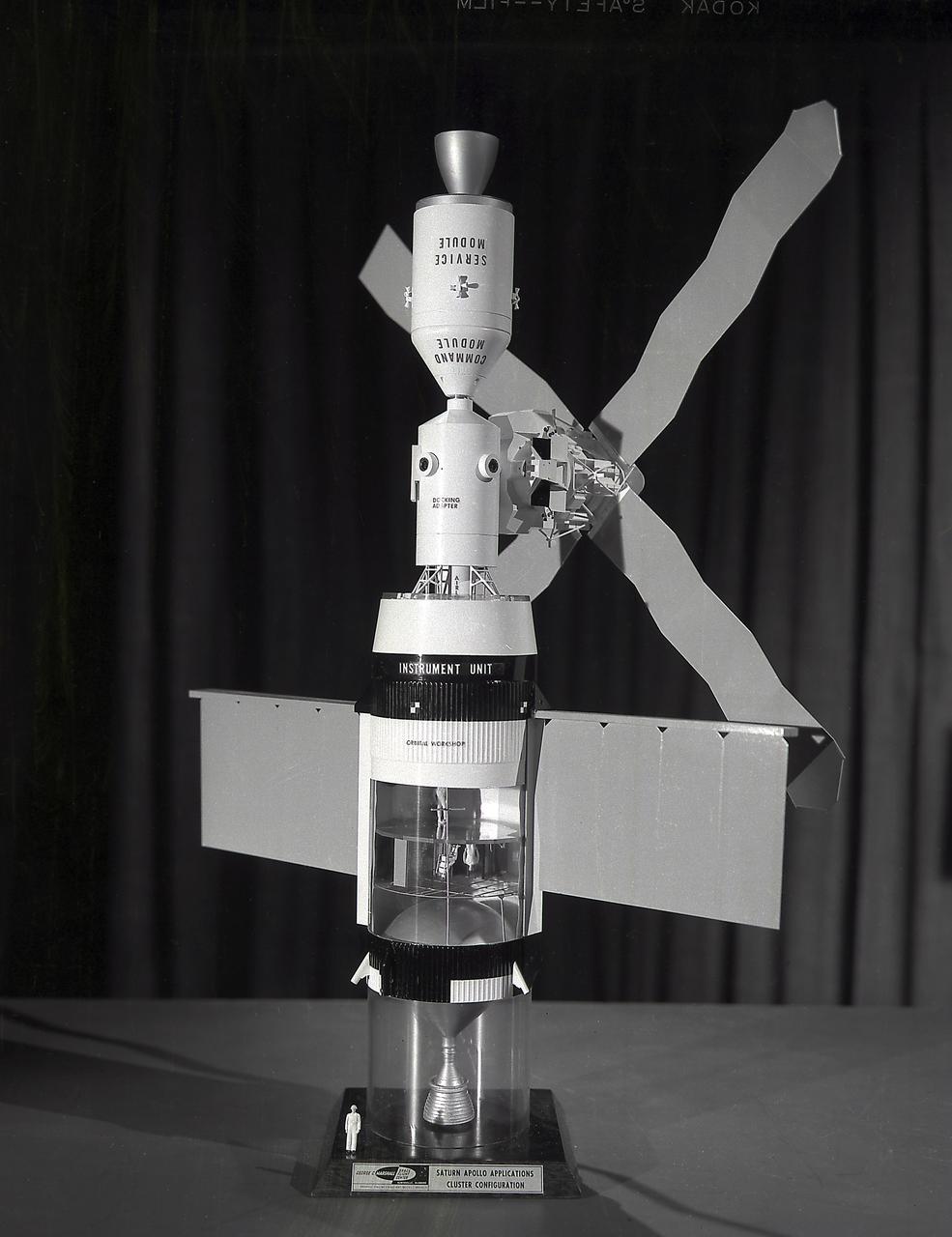
This photograph is of a model of the Skylab with the Command/Service Module being docked. In an early effort to extend the use of Apollo for further applications, NASA established the Apollo Applications Program (AAP) in August of 1965. The AAP was to include long duration Earth orbital missions during which astronauts would carry out scientific, technological, and engineering experiments in space by utilizing modified Saturn launch vehicles and the Apollo spacecraft. Established in 1970, the Skylab Program was the forerurner of the AAP. The goals of the Skylab were to enrich our scientific knowledge of the Earth, the Sun, the stars, and cosmic space; to study the effects of weightlessness on living organisms, including man; to study the effects of the processing and manufacturing of materials utilizing the absence of gravity; and to conduct Earth resource observations. The Skylab also conducted 19 selected experiments submitted by high school students. Skylab's 3 different 3-man crews spent up to 84 days in Earth orbit. The Marshall Space Flight Center (MSFC) had responsibility for developing and integrating most of the major components of the Skylab: the Orbital Workshop (OWS), Airlock Module (AM), Multiple Docking Adapter (MDA), Apollo Telescope Mount (ATM), Payload Shroud (PS), and most of the experiments. MSFC was also responsible for providing the Saturn IB launch vehicles for three Apollo spacecraft and crews and a Saturn V launch vehicle for the Skylab.
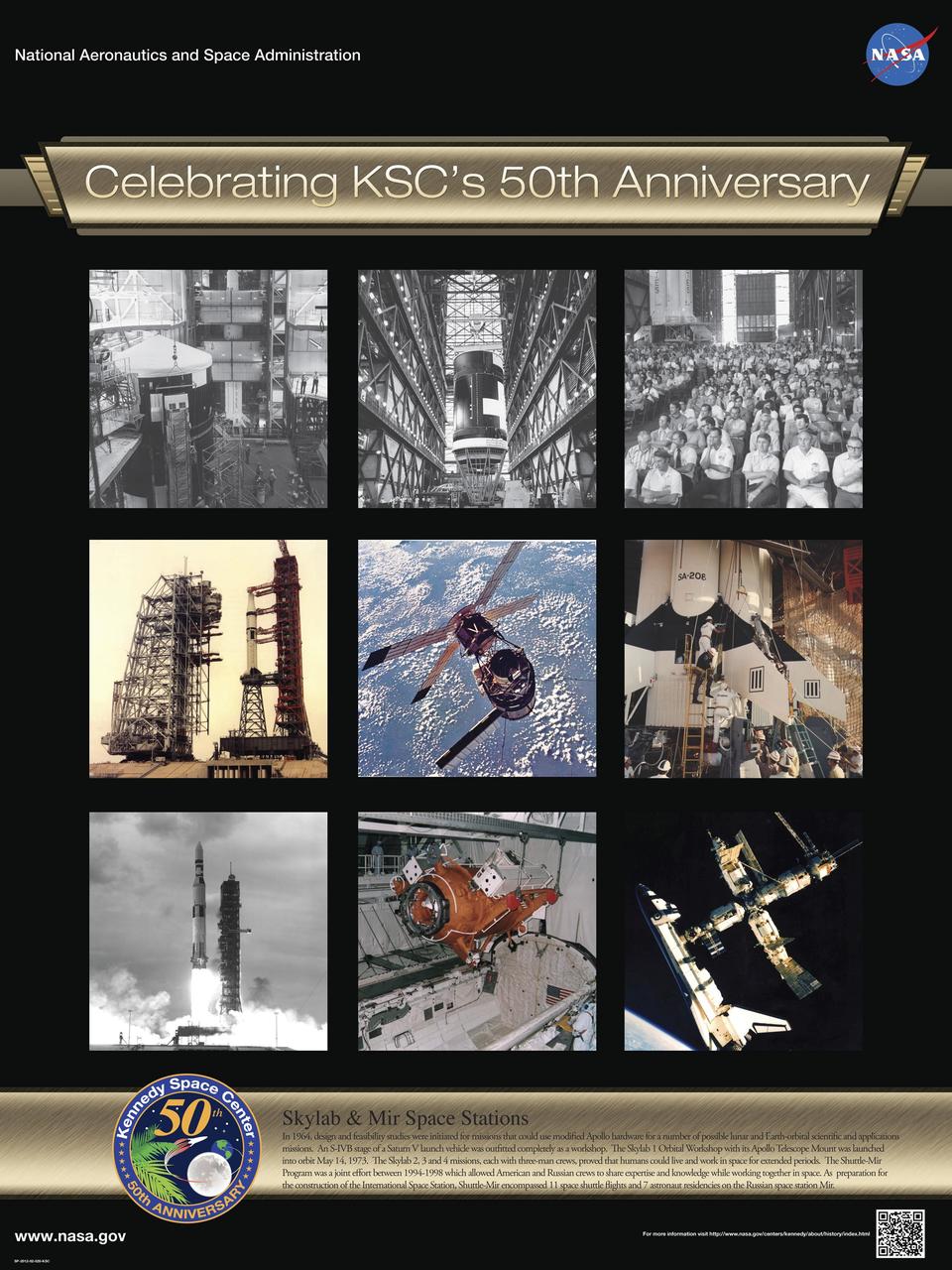
Skylab and Mir Space Stations: In 1964, design and feasibility studies were initiated for missions that could use modified Apollo hardware for a number of possible lunar and Earth-orbital scientific and applications missions. An S-IVB stage of a Saturn V launch vehicle was outfitted completely as a workshop. The Skylab 1 Orbital Workshop with its Apollo Telescope Mount was launched into orbit May 14, 1973. The Skylab 2, 3 and 4 missions, each with three-man crews, proved that humans could live and work in space for extended periods. The Shuttle-Mir Program was a joint effort between 1994-1998 which allowed American and Russian crews to share expertise and knowledge while working together in space. As preparation for the construction of the International Space Station, Shuttle-Mir encompassed 11 space shuttle flights and 7 astronaut residencies on the Russian space station Mir. Poster designed by Kennedy Space Center Graphics Department/Greg Lee. Credit: NASA
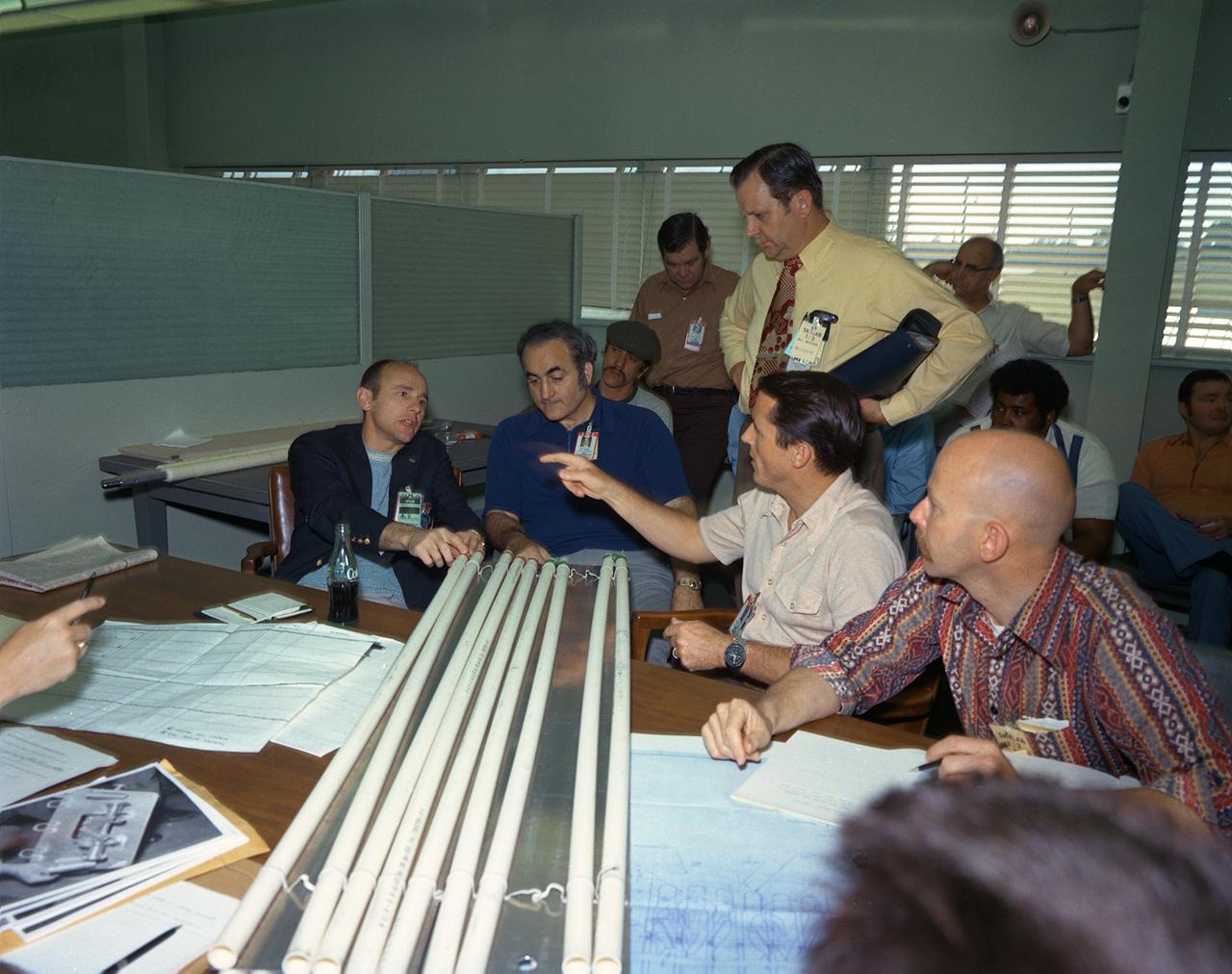
Sixty-three seconds after the launch of the modified Saturn V vehicle carrying the Skylab cluster, engineers in the operation support and control center saw an unexpected telemetry indication that signalled that damages occurred on one solar array and the micrometeoroid shield during the launch. Still unoccupied, the Skylab was stricken with the loss of the heat shield and sunlight beat mercilessly on the lab's sensitive skin. Internal temperatures soared, rendering the the station uninhabitable, threatening foods, medicines, films, and experiments. The launch of the first marned Skylab (Skylab-2) mission was delayed until methods were devised to repair and salvage the workshop. Personnel from other NASA Centers and industries quickly joined the Marshall Space Flight Center (MSFC) in efforts to save the damaged Skylab. They worked day and night for the next several days. Eventually the MSFC developed, tested, rehearsed, and approved three repair options. These options included a parasol sunshade and a twin-pole sunshade to restore the temperature inside the workshop, and a set of metal cutting tools to free the jammed solar panel. This photograph was taken during a discussion of the methods of the twin-pole Sun shield by (left to right) Astronaut Alan Bean, MSFC Director Dr. Rocco Petrone, Astronaut Edward Gibson, and MSFC engineer Richard Heckman. Dr. William Lucas, who became MSFC Director after Dr. Petrone left MSFC in March of 1974, is standing.
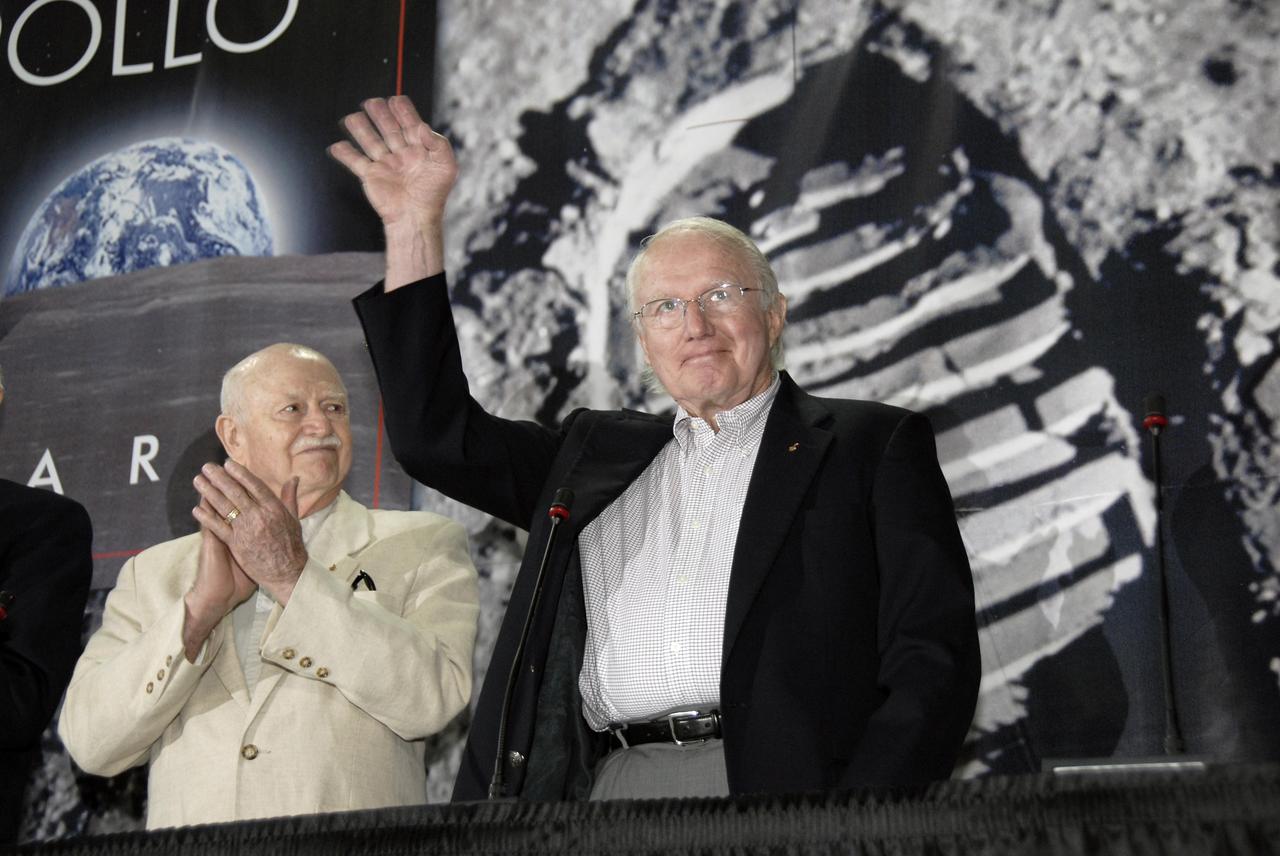
CAPE CANAVERAL, Fla. – At the Apollo/Saturn V Center at NASA's Kennedy Space Center in Florida, Apollo astronaut Gerald Carr (right) joins Vance Brand (left) and six other Apollo astronauts for NASA's 40th Anniversary of Apollo Celebration of the July 1969 launch and landing on the moon. Carr served as CAPCOM for the Apollo 8 and 12 flights, and was involved in the development and testing of the lunar roving vehicle which was used on the lunar surface by Apollo flight crews. He also was commander of Skylab 4 launched in 1973 on the third and final manned visit to the Skylab Orbital Workshop. It was the longest manned flight (84 days, 1 hour, 15minutes) in history at that date. Photo credit: NASA/Kim Shiflett
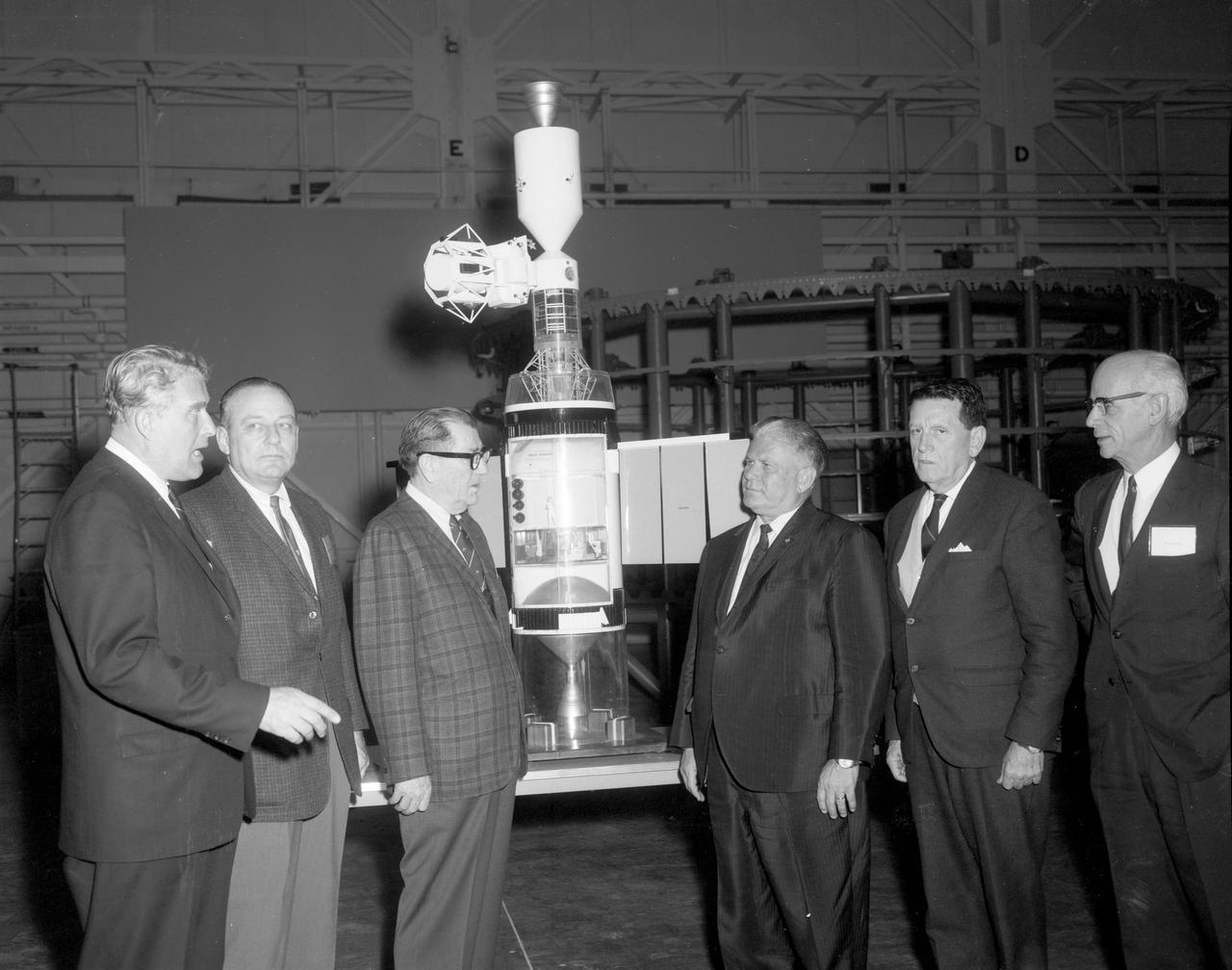
The members of the House Committee on Science and Astronautics visited the Marshall Space Flight Center (MSFC) on March 9, 1962 to gather firsthand information of the nation’s space exploration program. The congressional group was composed of members of the Subcommittee on Manned Space Flight. Standing at the Apollo Applications Program Cluster Model in building 4745 are (left-to-right): Dr. Wernher von Braun, MSFC; Congressman Joe D. Waggoner, Democratic representative of Louisiana; Congressman Earle Cabell, Democratic representative of Texas; Subcommittee Chairman Olin E. Teague, Democratic representative of Texas; Congressman James G. Fulton, Republican representative of Pennsylvania; and Dr. Ernst Stuhlinger, associate MSFC director for science. The subcommittee was briefed on MSFC’s manned space efforts earlier in the day and then inspected mockups of the Saturn I Workshop and the Apollo Telescope Mount, two projects developed by MSFC for the post-Apollo program.
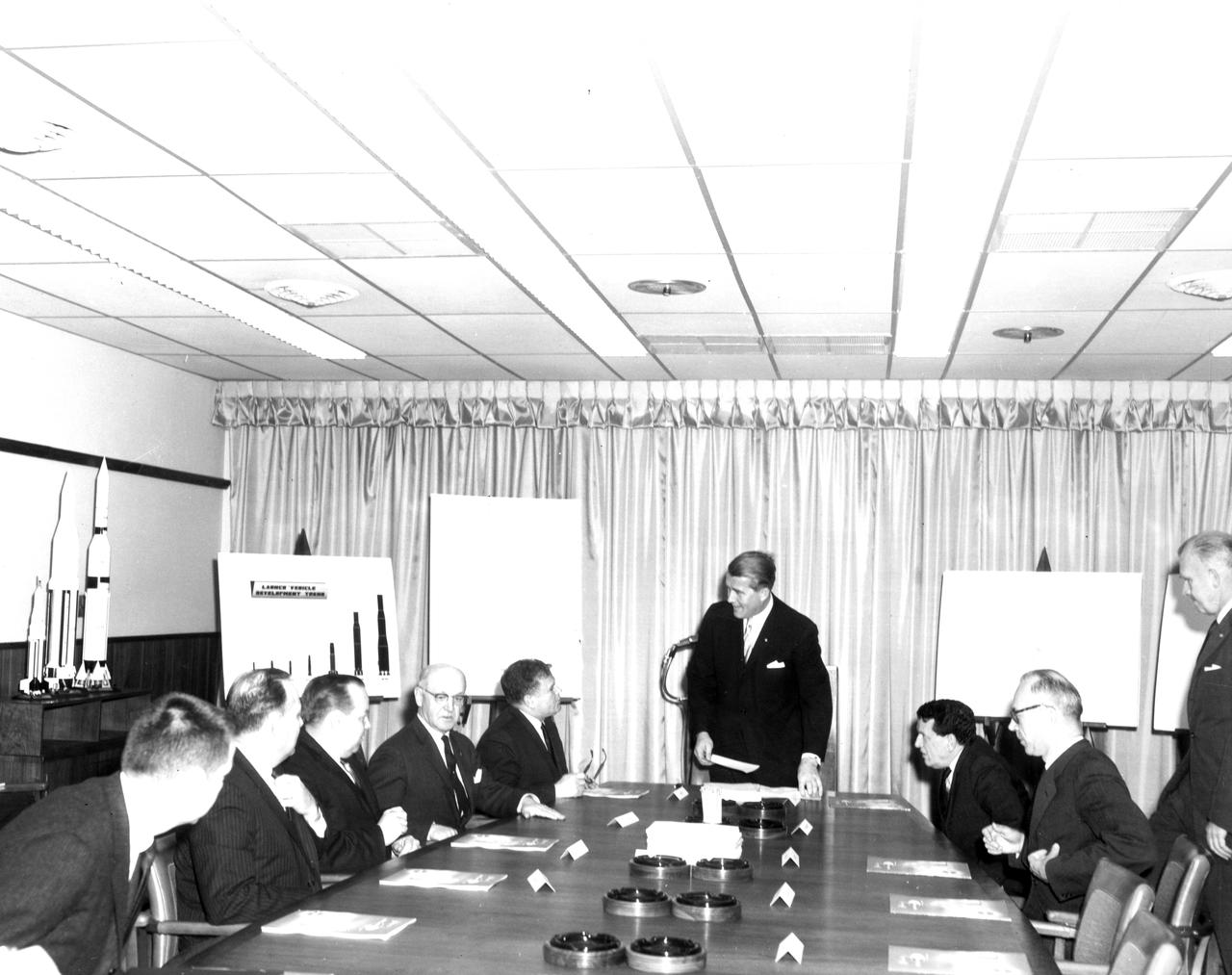
The members of the House Committee on Science and Astronautics visited the Marshall Space Flight Center (MSFC) on March 9, 1962 to gather firsthand information of the nation’s space exploration program. The congressional group was composed of members of the Subcommittee on Manned Space Flight. The subcommittee was briefed on MSFC’s manned space efforts earlier in the day and then inspected mockups of the Saturn I Workshop and the Apollo Telescope Mount, two projects developed by MSFC for the post-Apollo program. In this photograph, MSFC Director, Dr. Wernher von Braun meets with Congressmen in the MSFC boardroom. Pictured from left to right are: Jack Cramer, NASA Headquarters; Joe Waggoner, Democratic representative of Louisiana; John W. Davis, Democratic representative of Georgia; R. Walter Riehlman, Republican representative of New York; Olin E. Teague, Democratic representative of Texas; Dr. Wernher von Braun, Director of MSFC; James G. Fulton, Republican representative of Pennsylvania; Ken Hechler, Democratic representative of West Virginia; and Erich Neubert of MSFC.
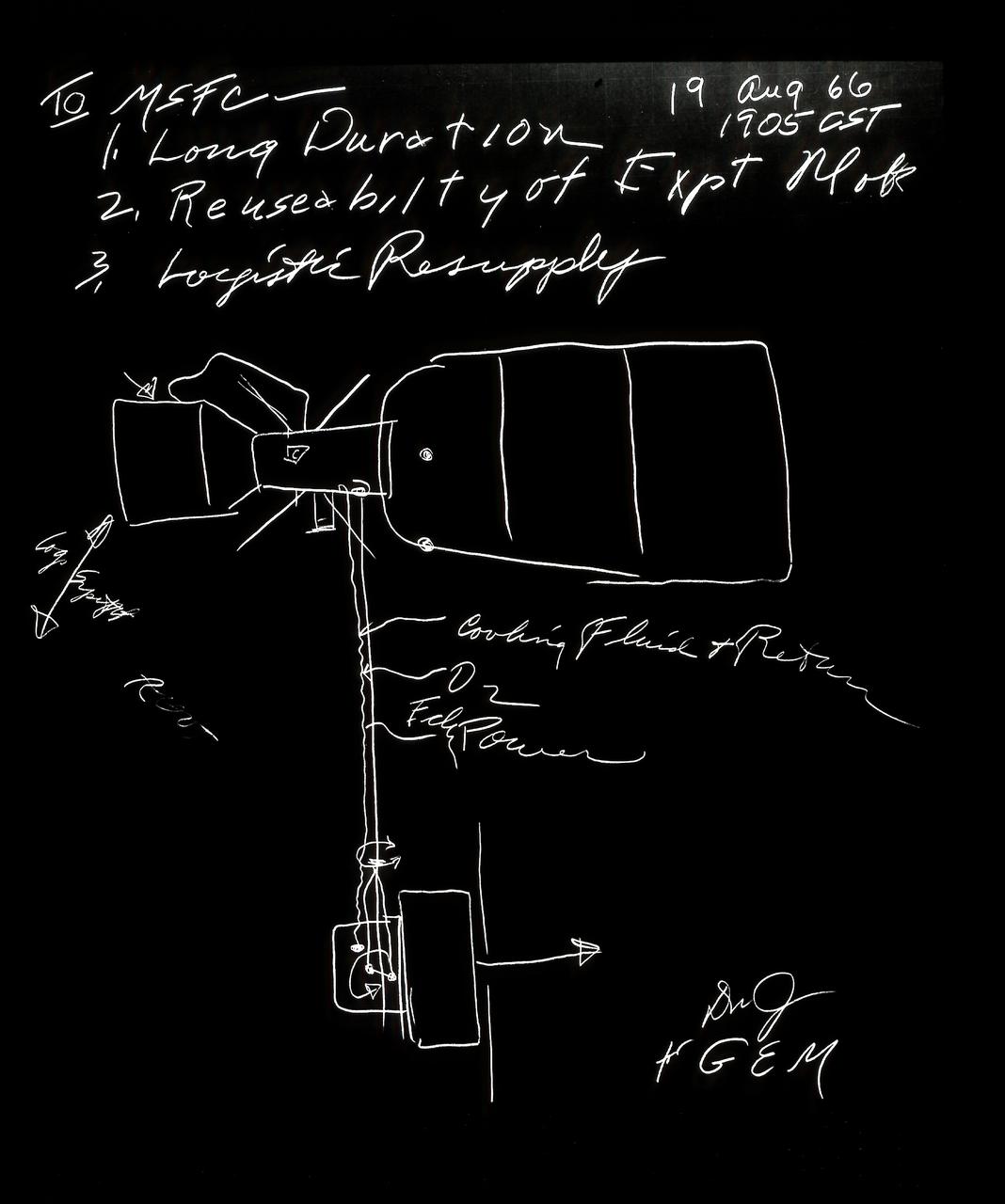
Seldom in aerospace history has a major decision been as promptly and concisely recorded as with the Skylab shown in this sketch. At a meeting at the Marshall Space Flight Center on August 19, 1966, George E. Mueller, NASA Associate Administrator for Marned Space Flight, used a felt pen and poster paper to pin down the final conceptual layout for the budding space station's (established as the Skylab in 1970) major elements. General Davy Jones, first program director, added his initials and those of Dr. Mueller in the lower right corner. The goals of the Skylab were to enrich our scientific knowledge of the Earth, the Sun, the stars, and cosmic space; to study the effects of weightlessness on living organisms, including man; to study the effects of the processing and manufacturing of materials utilizing the absence of gravity; and to conduct Earth resource observations. The Skylab also conducted 19 selected experiments submitted by high school students. Skylab's 3 different 3-man crews spent up to 84 days in Earth orbit. The Marshall Space Flight Center (MSFC) had responsibility for developing and integrating most of the major components of the Skylab: the Orbital Workshop (OWS), Airlock Module (AM), Multiple Docking Adapter (MDA), Apollo Telescope Mount (ATM), Payload Shroud (PS), and most of the experiments. MSFC was also responsible for providing the Saturn IB launch vehicles for three Apollo spacecraft and crews and a Saturn V launch vehicle for the Skylab.