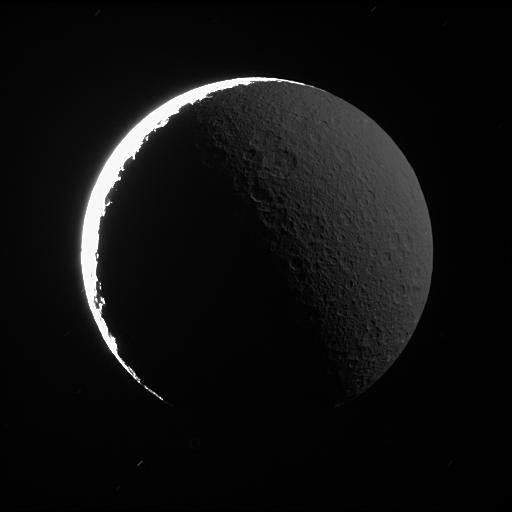
Rhea in Saturnshine

Although we are used to seeing Saturn's moons lit directly by the Sun, sometimes we can catch them illuminated by "Saturnshine." Here, we see Mimas (upper right) lit by light reflected off of Saturn. With each reflection, the intensity of the illumination is decreased significantly. To better illustrate the effect of Saturnshine, in this image Mimas (246 miles, 396 kilometers across), has had its brightness enhanced by a factor of 2.5 relative to the rings. This view looks toward the trailing hemisphere of Mimas. North on Mimas is up and rotated 8 degrees to the right. The image was taken in visible light with the Cassini spacecraft narrow-angle camera on Feb. 16, 2015. The view was obtained at a distance of approximately 1.6 million miles (2.5 million kilometers) from Mimas and at a Sun-Mimas-spacecraft, or phase, angle of 148 degrees. Image scale is 9 miles (15 kilometers) per pixel. http://photojournal.jpl.nasa.gov/catalog/pia18312
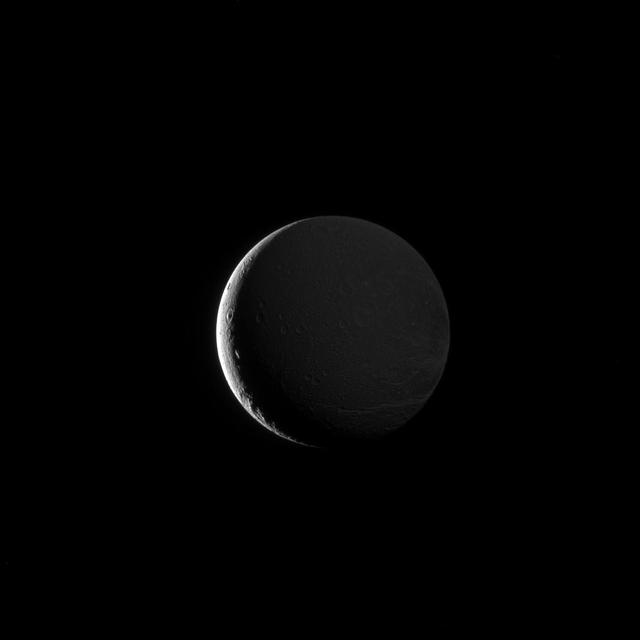
Dione lit hemisphere faces away from NASA Cassini spacecraft camera, yet the moon darkened surface features are dimly illuminated in this image, due to Saturnshine. Although direct sunlight provides the best illumination for imaging, light reflected off of Saturn can do the job as well. In this image, Dione (698 miles or 1,123 kilometers across) is above Saturn's day side, and the moon's night side is faintly illuminated by sunlight reflected off the planet's disk. This view looks toward the Saturn-facing side of Dione. North on Dione is up and rotated 8 degrees to the right. The image was taken in visible light with the Cassini spacecraft narrow-angle camera on Oct. 23, 2016. The view was obtained at a distance of approximately 313,000 miles (504,000 kilometers) from Dione. Image scale is 1.8 miles (3 kilometers) per pixel. http://photojournal.jpl.nasa.gov/catalog/PIA20514
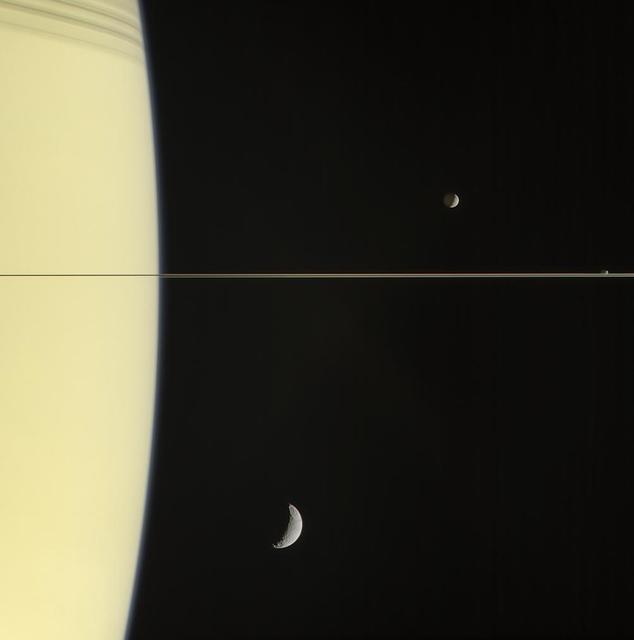
On March 13, 2006 Cassini's narrow-angle camera captured this look at Saturn and its rings, seen here nearly edge on. The frame also features Mimas and tiny Janus (above the rings), and Tethys (below the rings). "Above" and "below" the rings is mostly a matter of perspective here. All three moons and the rings orbit Saturn in roughly the same plane. The night side of Mimas is gently illuminated by "Saturnshine," sunlight reflected from the planet's cloud tops. Images taken using red, green and blue spectral filters were combined to create this natural color view, taken at a distance of approximately 1.7 million miles (2.7 million kilometers) from Saturn. The Cassini spacecraft ended its mission on Sept. 15, 2017. https://photojournal.jpl.nasa.gov/catalog/PIA18323
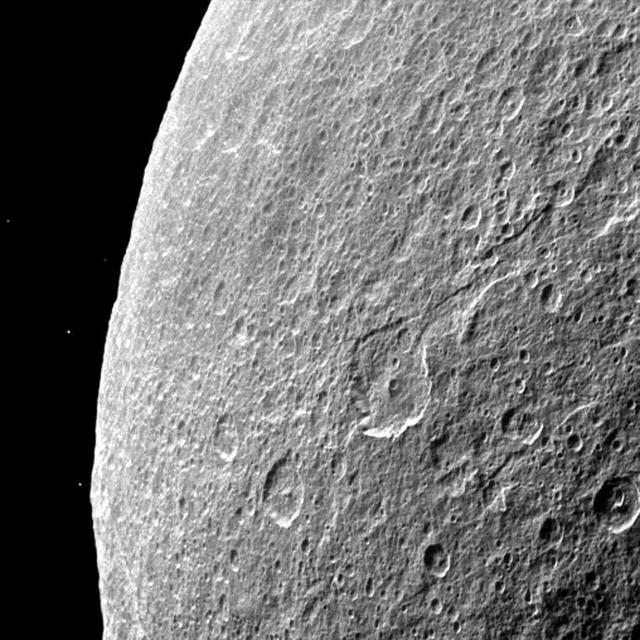
Southern terrain on Saturn moon Rhea is dimly illuminated by Saturnshine in this view of the dark side of the moon captured by NASA Cassini spacecraft.
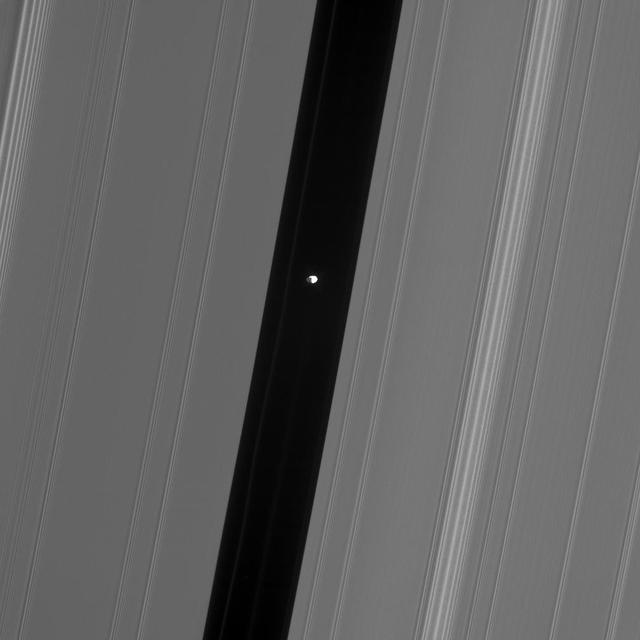
This Cassini spacecraft view of Pan in the Encke gap shows hints of detail on the moon dark side, which is lit by saturnshine -- sunlight reflected off Saturn.
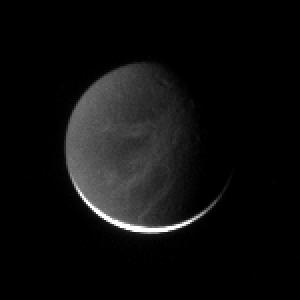
The wispy fractured terrain on Dione is illuminated here by Saturnshine -- dim reflected light from the planet
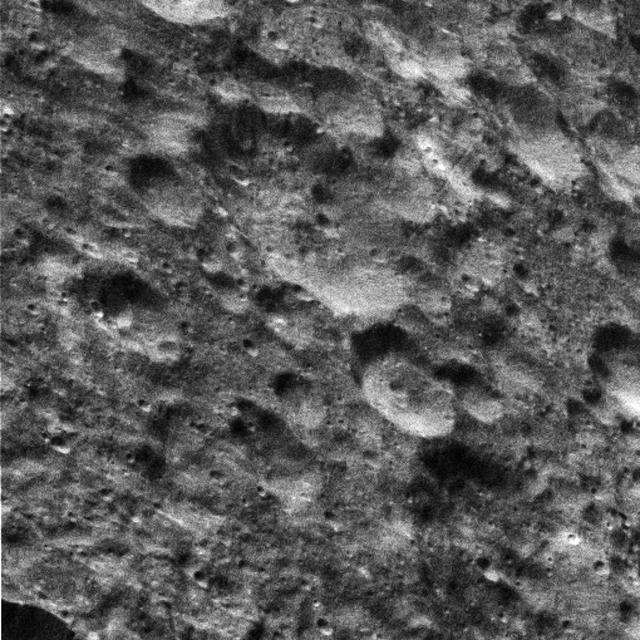
This view from NASA Cassini spacecraft shows terrain on Saturn moon Dione that is entirely lit by reflected light from Saturn, called Saturnshine. Imaging scientists set a relatively short exposure time (10 milliseconds) for this and other views obtained during this fast flyby in order to avoid smearing the images. Despite the short exposure time, the light from Saturn was sufficient to provide a good look at features on the moon's night side. The image was acquired in visible light with the Cassini spacecraft wide-angle camera during a close flyby of the icy moon on Aug. 17, 2015. The view was acquired at an altitude of approximately 600 miles (970 kilometers) above Dione and has an image scale of about 190 feet (58 meters) per pixel. North on Dione is toward lower left. http://photojournal.jpl.nasa.gov/catalog/PIA19652
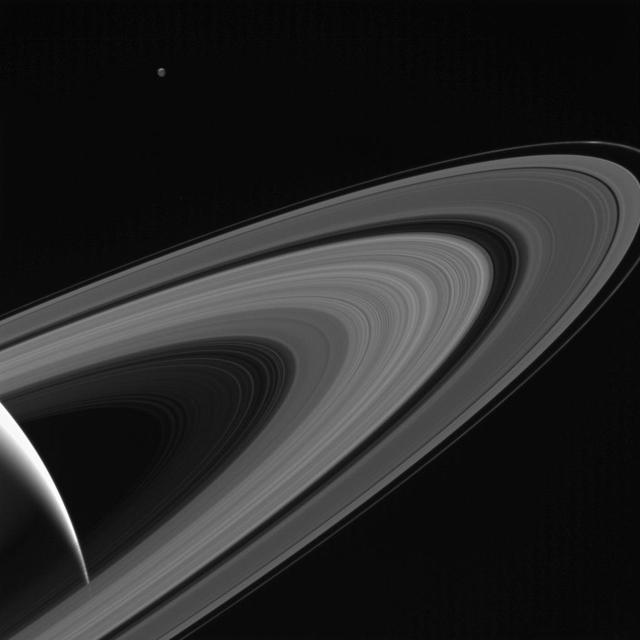
NASA's Cassini gazes across the icy rings of Saturn toward the icy moon Tethys, whose night side is illuminated by Saturnshine, or sunlight reflected by the planet. Tethys was on the far side of Saturn with respect to Cassini here; an observer looking upward from the moon's surface toward Cassini would see Saturn's illuminated disk filling the sky. Tethys was brightened by a factor of two in this image to increase its visibility. A sliver of the moon's sunlit northern hemisphere is seen at top. A bright wedge of Saturn's sunlit side is seen at lower left. This view looks toward the sunlit side of the rings from about 10 degrees above the ring plane. The image was taken in visible light with the Cassini spacecraft wide-angle camera on May 13, 2017. The view was acquired at a distance of approximately 750,000 miles (1.2 million kilometers) from Saturn and at a Sun-Saturn-spacecraft, or phase, angle of 140 degrees. Image scale is 43 miles (70 kilometers) per pixel on Saturn. The distance to Tethys was about 930,000 miles (1.5 million kilometers). The image scale on Tethys is about 56 miles (90 kilometers) per pixel. https://photojournal.jpl.nasa.gov/catalog/PIA21342