
S122-E-009914 (18 Feb. 2008) --- European Space Agency (ESA) astronaut Hans Schlegel, STS-122 mission specialist, poses for a photo near a window on the aft flight deck of Space Shuttle Atlantis shortly after undocking from the International Space Station, which is visible through the window.
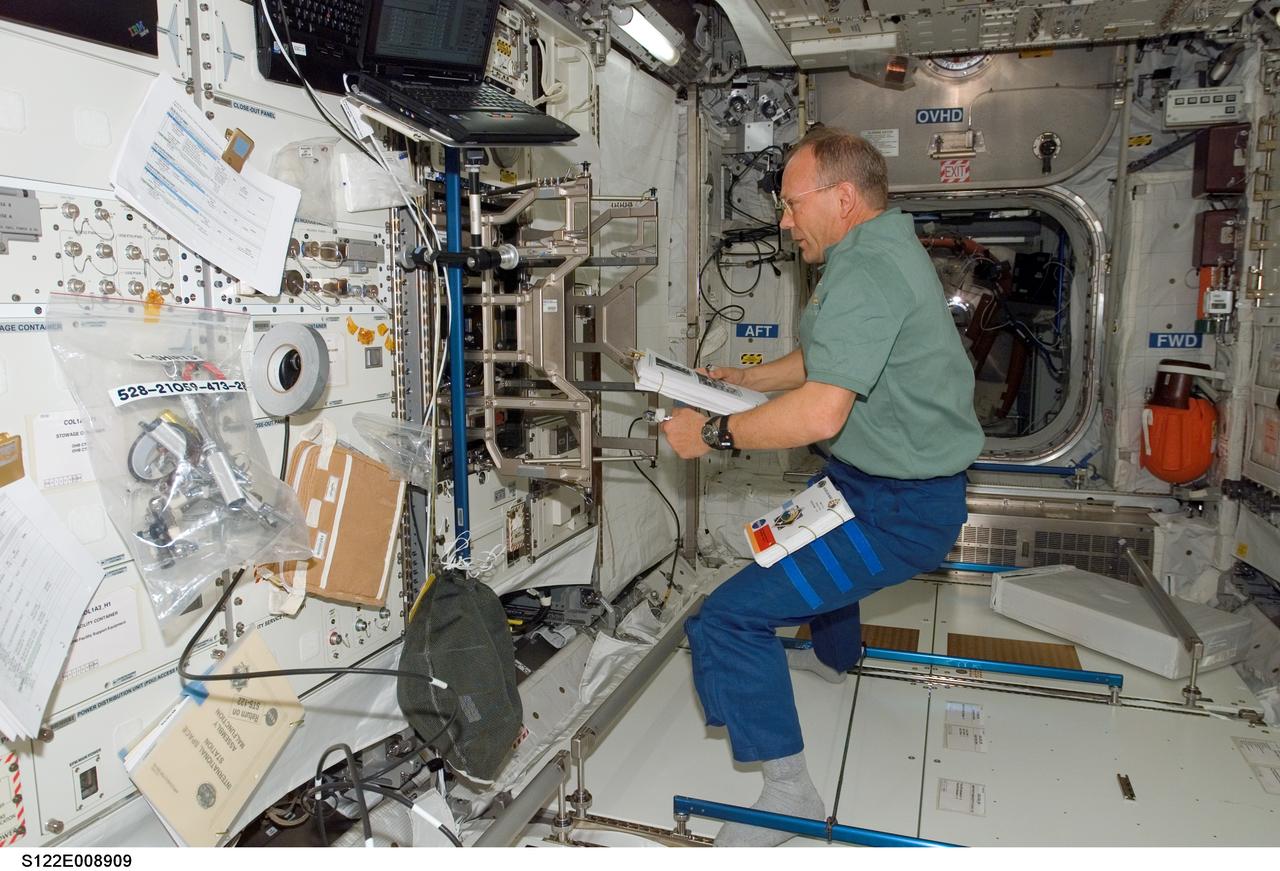
S122-E-008909 (15 Feb. 2008) --- European Space Agency astronaut Hans Schlegel, STS-122 mission specialist, continues work aimed toward readying the agency's new Columbus laboratory for duty aboard the International Space Station. A pictorial guidebook assists the astronaut in installing the lab's experiment racks.
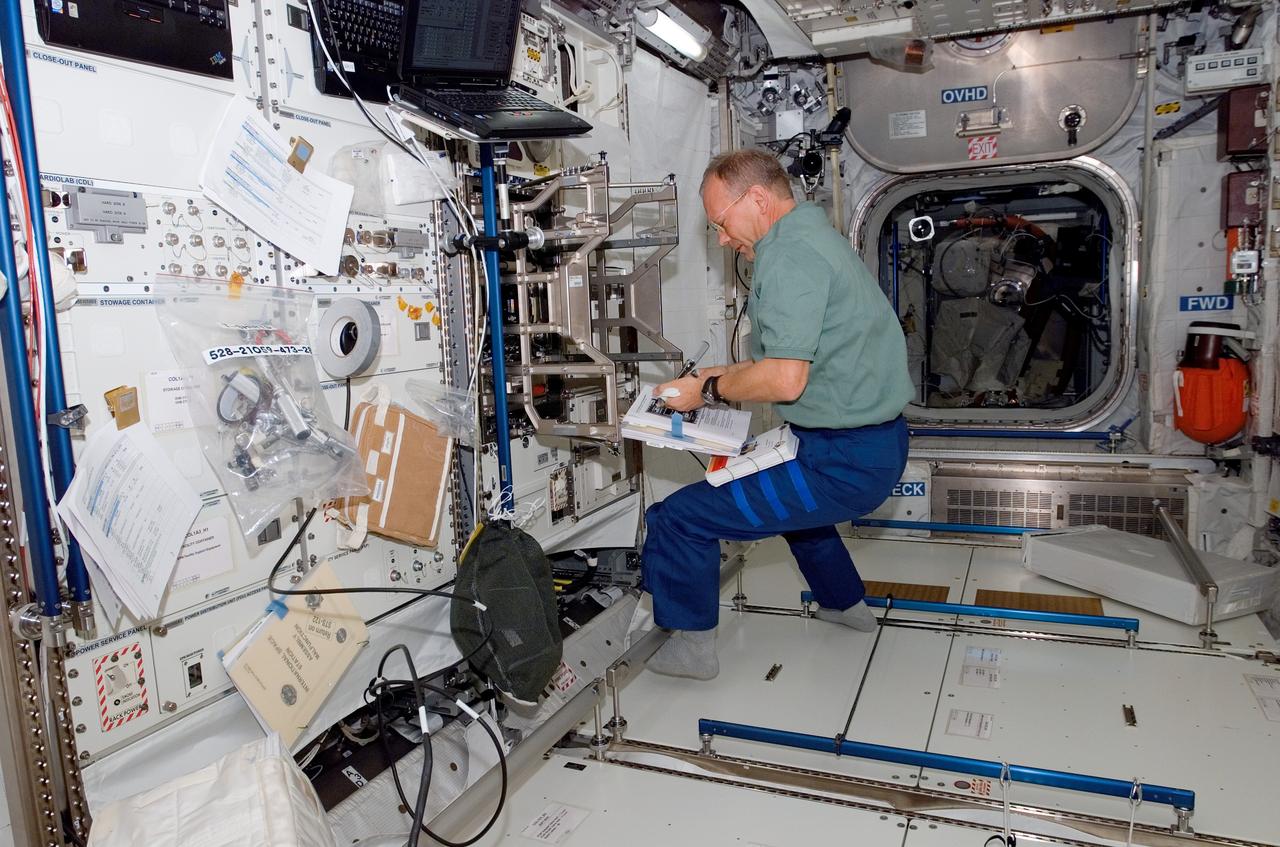
S122-E-008911 (15 Feb. 2008) --- European Space Agency astronaut Hans Schlegel, STS-122 mission specialist, continues work aimed toward readying the agency's new Columbus laboratory for duty aboard the International Space Station. A pictorial guidebook assists the astronaut in installing the lab's experiment racks.
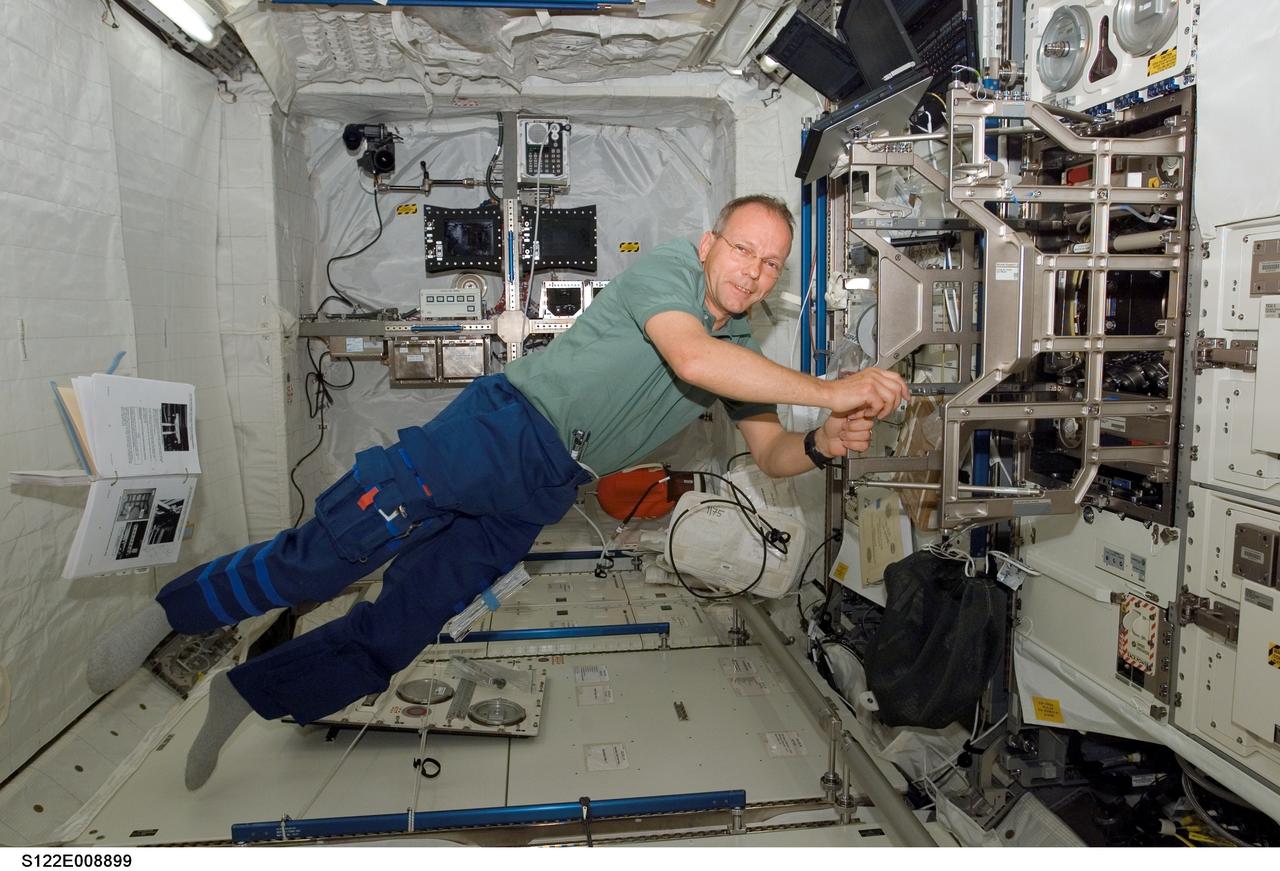
S122-E-008899 (15 Feb. 2008) --- European Space Agency astronaut Hans Schlegel, STS-122 mission specialist, continues work aimed toward readying the agency's new Columbus laboratory for duty aboard the International Space Station.
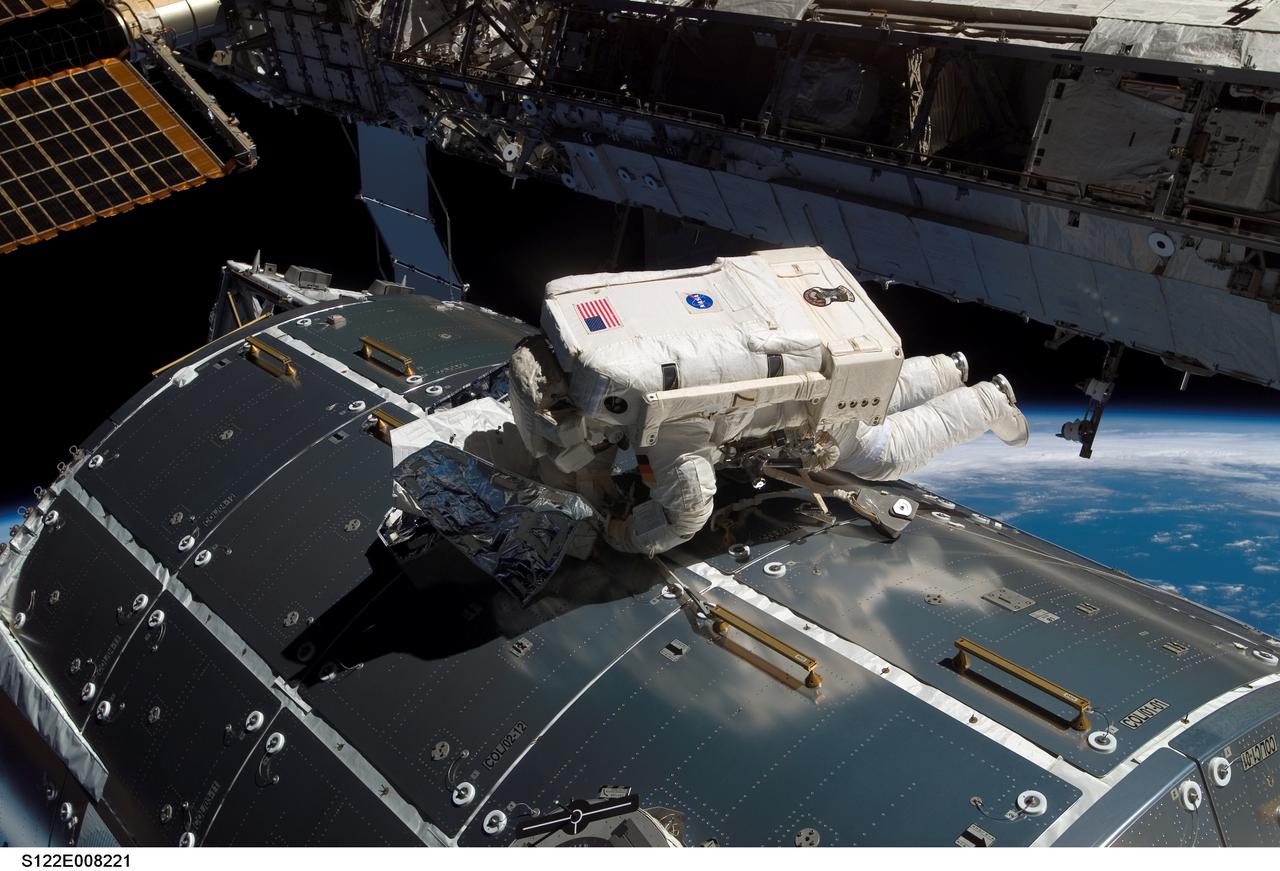
S122-E-008221 (13 Feb. 2008) --- European Space Agency (ESA) astronaut Hans Schlegel, STS-122 mission specialist, works on the new Columbus laboratory as he participates in the mission's second scheduled session of extravehicular activity (EVA) as construction and maintenance continue on the International Space Station. During the six-hour, 45-minute spacewalk, among other tasks, Schlegel and NASA astronaut Rex Walheim (out of frame), mission specialist, worked to replace a nitrogen tank used to pressurize the station's ammonia cooling system.
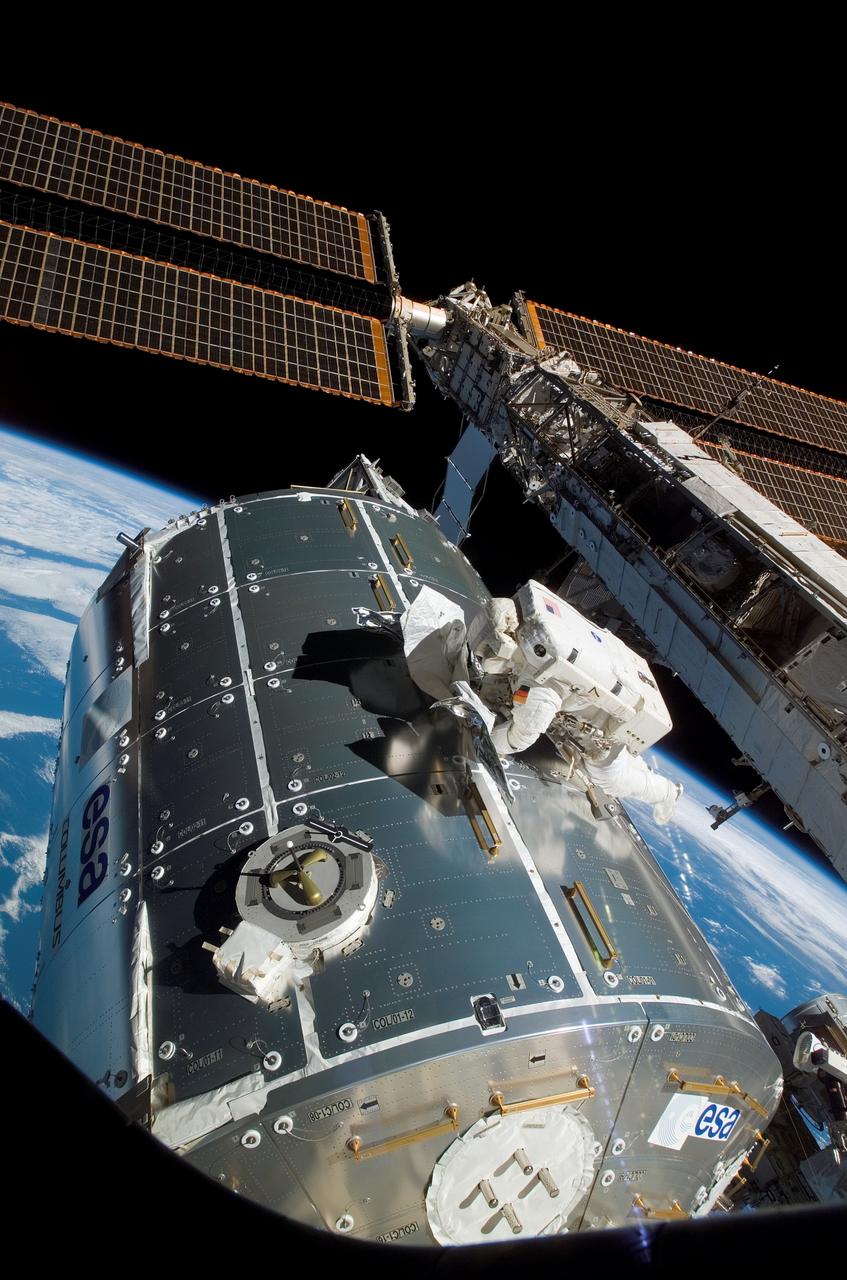
S122-E-008222 (13 Feb. 2008) --- European Space Agency (ESA) astronaut Hans Schlegel, STS-122 mission specialist, works on the new Columbus laboratory as he participates in the mission's second scheduled session of extravehicular activity (EVA) as construction and maintenance continue on the International Space Station. During the six-hour, 45-minute spacewalk, among other tasks, Schlegel and NASA astronaut Rex Walheim (out of frame), mission specialist, worked to replace a nitrogen tank used to pressurize the station's ammonia cooling system.
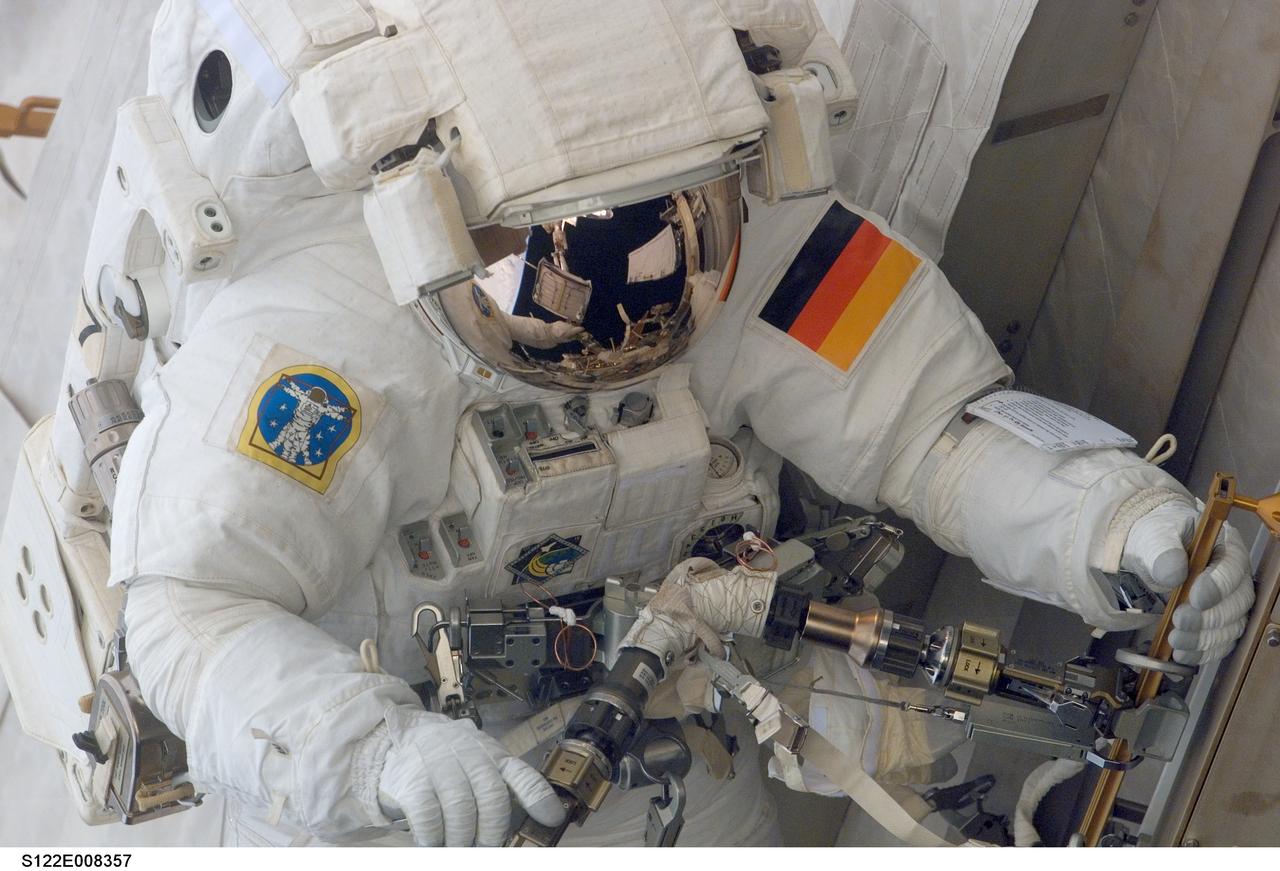
S122-E-008357 (13 Feb. 2008) --- European Space Agency (ESA) astronaut Hans Schlegel, STS-122 mission specialist, participates in the mission's second scheduled session of extravehicular activity (EVA) as construction and maintenance continue on the International Space Station. During the six-hour, 45-minute spacewalk, among other tasks, Schlegel and NASA astronaut Rex Walheim (out of frame), mission specialist, worked to replace a nitrogen tank used to pressurize the station's ammonia cooling system.

S122-E-008401 (13 Feb. 2008) --- European Space Agency (ESA) astronaut Hans Schlegel, STS-122 mission specialist, participates in the mission's second scheduled session of extravehicular activity (EVA) as construction and maintenance continue on the International Space Station. During the six-hour, 45-minute spacewalk, among other tasks, Schlegel and NASA astronaut Rex Walheim (out of frame), mission specialist, worked to replace a nitrogen tank used to pressurize the station's ammonia cooling system.
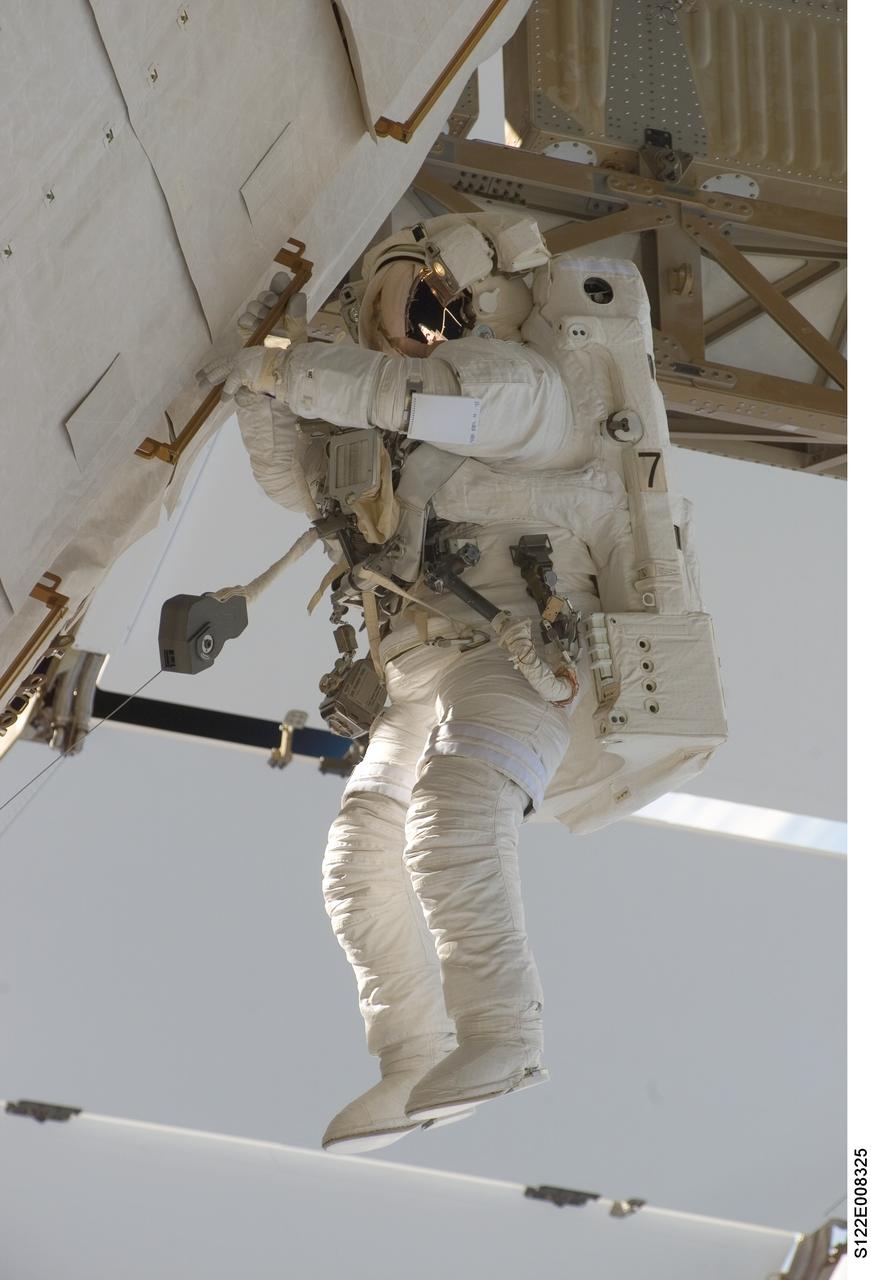
S122-E-008325 (13 Feb. 2008) --- European Space Agency (ESA) astronaut Hans Schlegel, STS-122 mission specialist, participates in the mission's second scheduled session of extravehicular activity (EVA) as construction and maintenance continue on the International Space Station. During the six-hour, 45-minute spacewalk, among other tasks, Schlegel and NASA astronaut Rex Walheim (out of frame), mission specialist, worked to replace a nitrogen tank used to pressurize the station's ammonia cooling system.
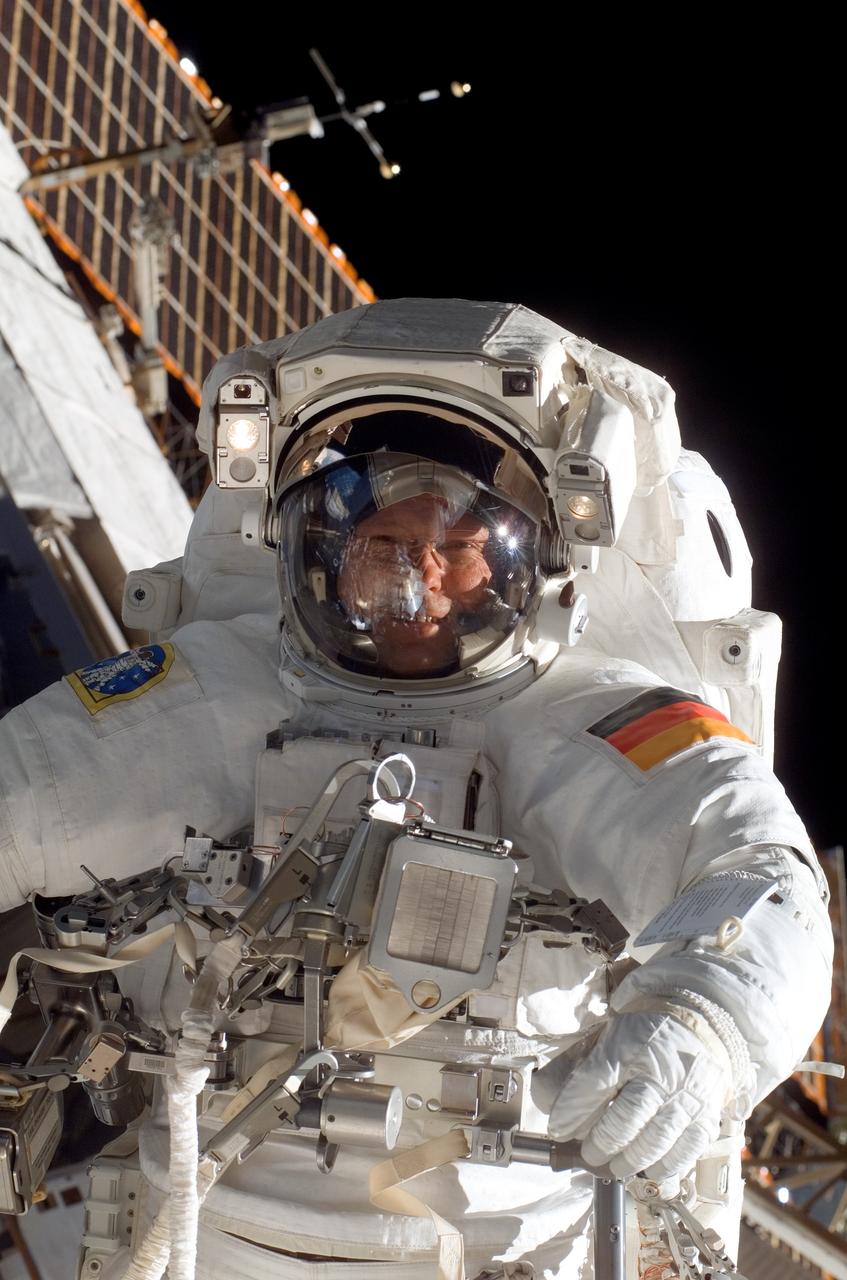
S122-E-008218 (13 Feb. 2008) --- European Space Agency (ESA) astronaut Hans Schlegel, STS-122 mission specialist, participates in the mission's second scheduled session of extravehicular activity (EVA) as construction and maintenance continue on the International Space Station. During the six-hour, 45-minute spacewalk, among other tasks, Schlegel and NASA astronaut Rex Walheim (out of frame), mission specialist, worked to replace a nitrogen tank used to pressurize the station's ammonia cooling system.
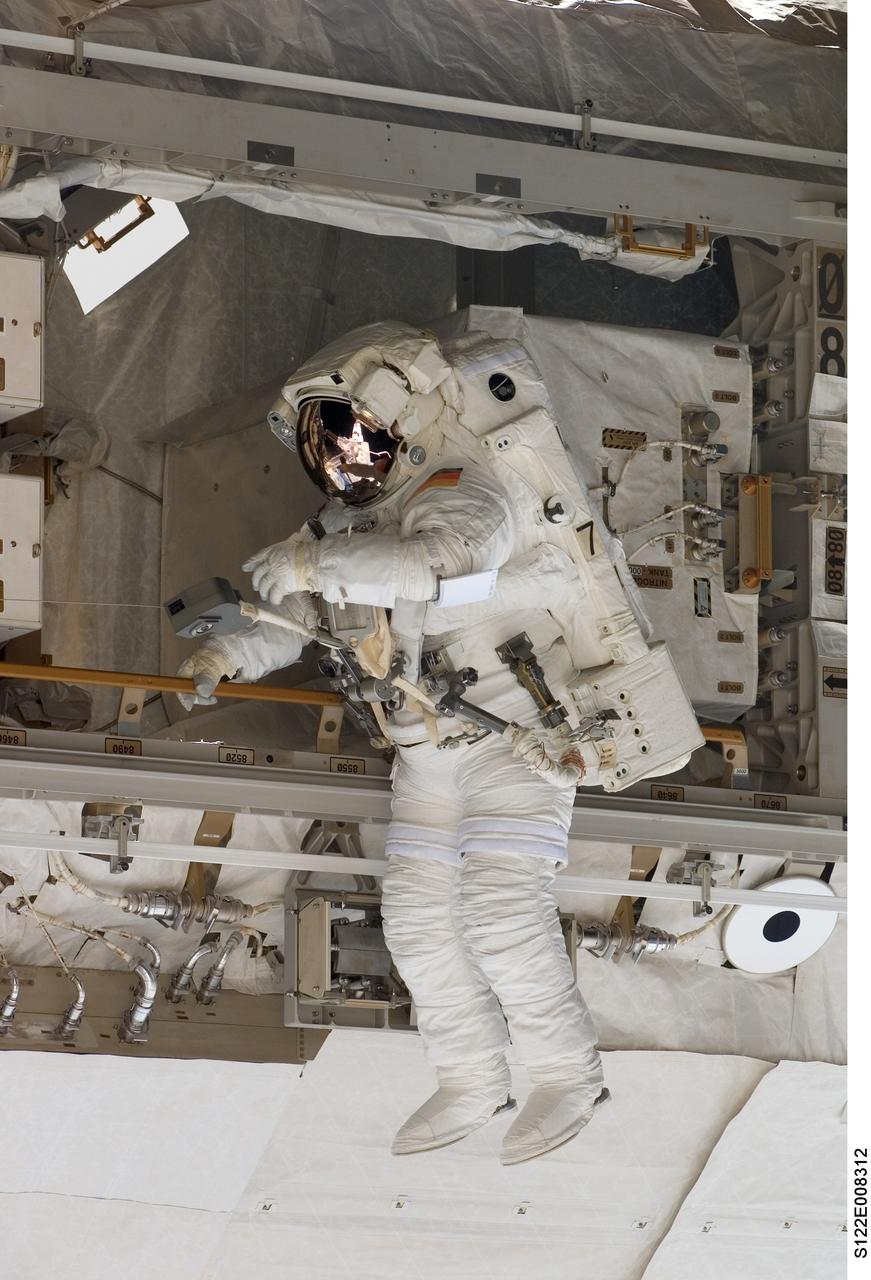
S122-E-008312 (13 Feb. 2008) --- European Space Agency (ESA) astronaut Hans Schlegel, STS-122 mission specialist, participates in the mission's second scheduled session of extravehicular activity (EVA) as construction and maintenance continue on the International Space Station. During the six-hour, 45-minute spacewalk, among other tasks, Schlegel and NASA astronaut Rex Walheim (out of frame), mission specialist, worked to replace a nitrogen tank used to pressurize the station's ammonia cooling system.
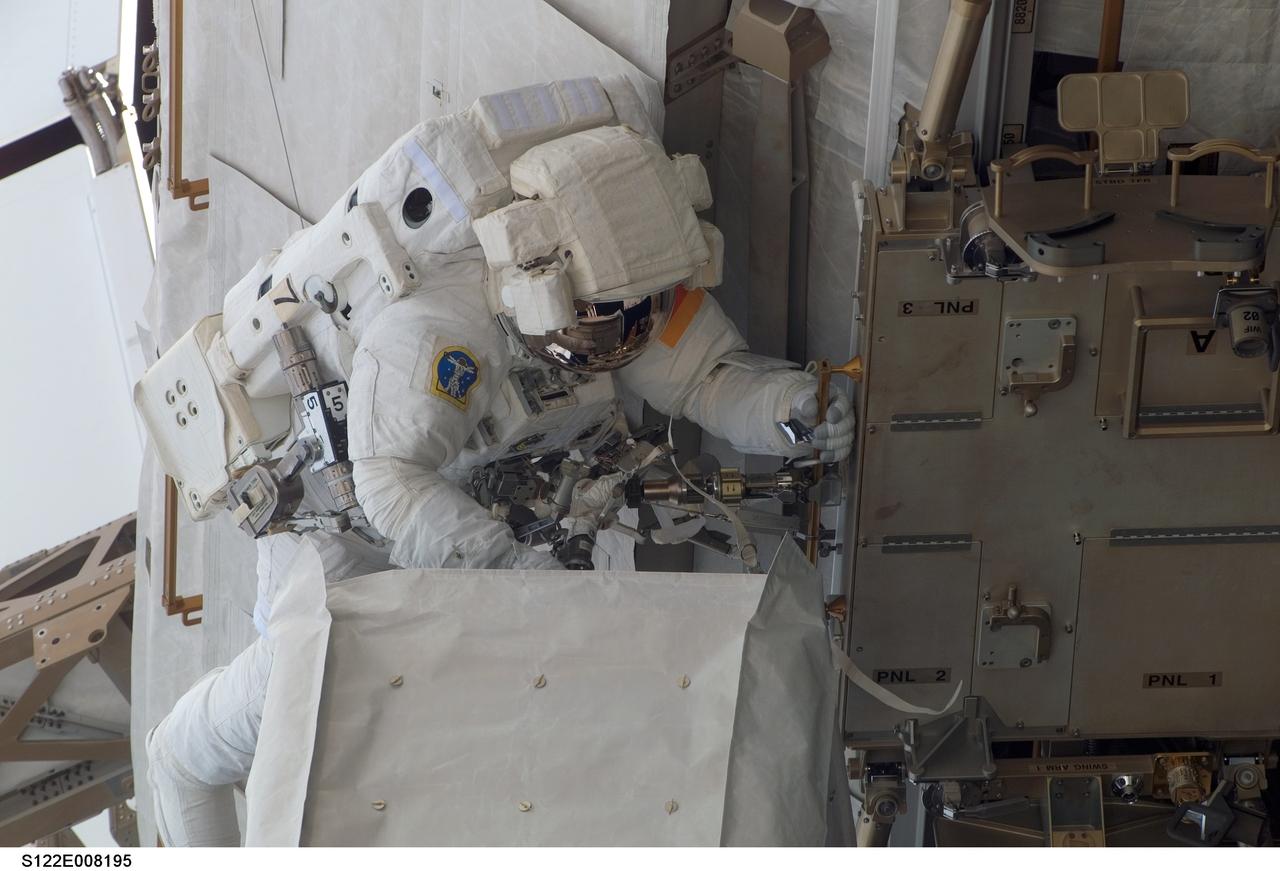
S122-E-008195 (13 Feb. 2008) --- European Space Agency (ESA) astronaut Hans Schlegel, STS-122 mission specialist, participates in the mission's second scheduled session of extravehicular activity (EVA) as construction and maintenance continue on the International Space Station. During the six-hour, 45-minute spacewalk, among other tasks, Schlegel and NASA astronaut Rex Walheim (out of frame), mission specialist, worked to replace a nitrogen tank used to pressurize the station's ammonia cooling system.
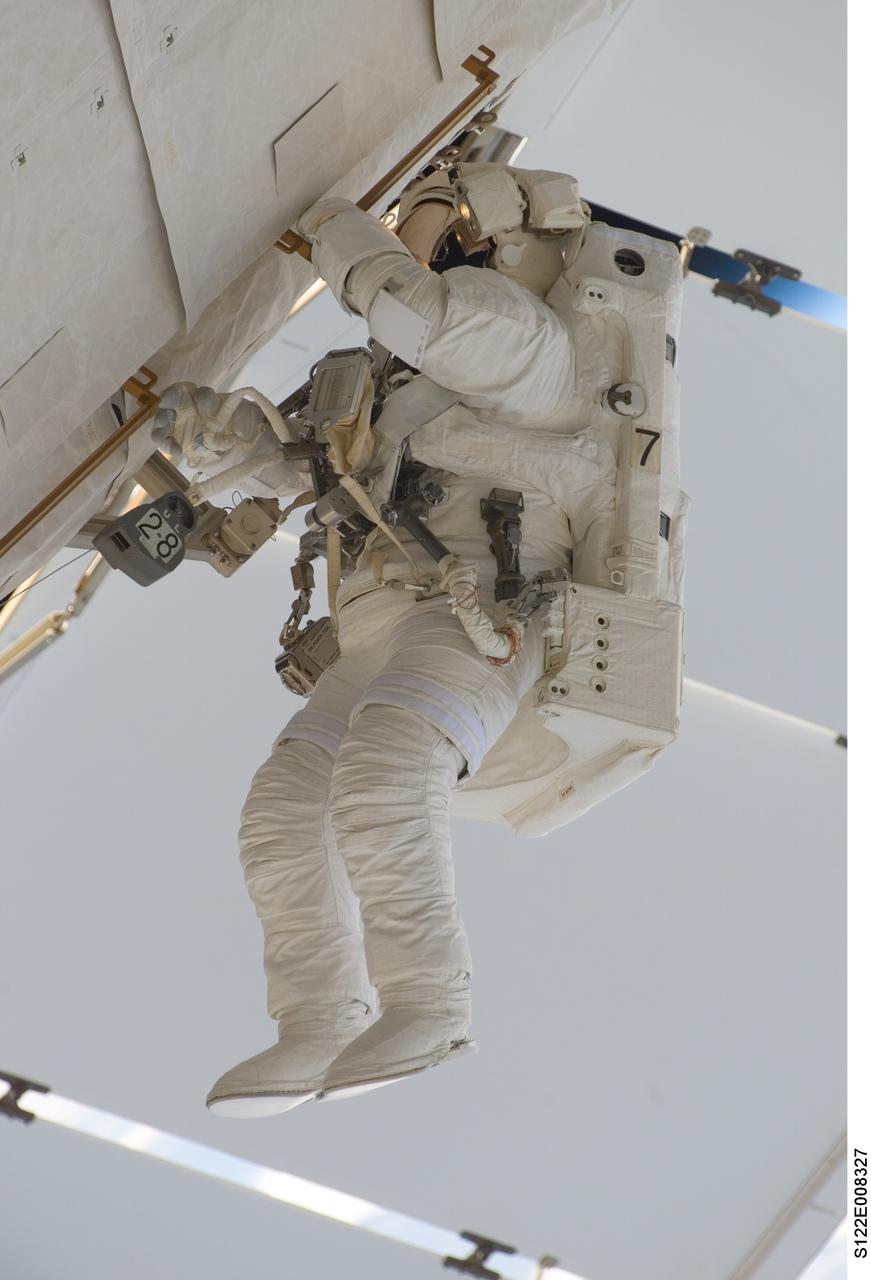
S122-E-008327 (13 Feb. 2008) --- European Space Agency (ESA) astronaut Hans Schlegel, STS-122 mission specialist, participates in the mission's second scheduled session of extravehicular activity (EVA) as construction and maintenance continue on the International Space Station. During the six-hour, 45-minute spacewalk, among other tasks, Schlegel and NASA astronaut Rex Walheim (out of frame), mission specialist, worked to replace a nitrogen tank used to pressurize the station's ammonia cooling system.

S122-E-008315 (13 Feb. 2008) --- European Space Agency (ESA) astronaut Hans Schlegel, STS-122 mission specialist, participates in the mission's second scheduled session of extravehicular activity (EVA) as construction and maintenance continue on the International Space Station. During the six-hour, 45-minute spacewalk, among other tasks, Schlegel and NASA astronaut Rex Walheim (out of frame), mission specialist, worked to replace a nitrogen tank used to pressurize the station's ammonia cooling system.
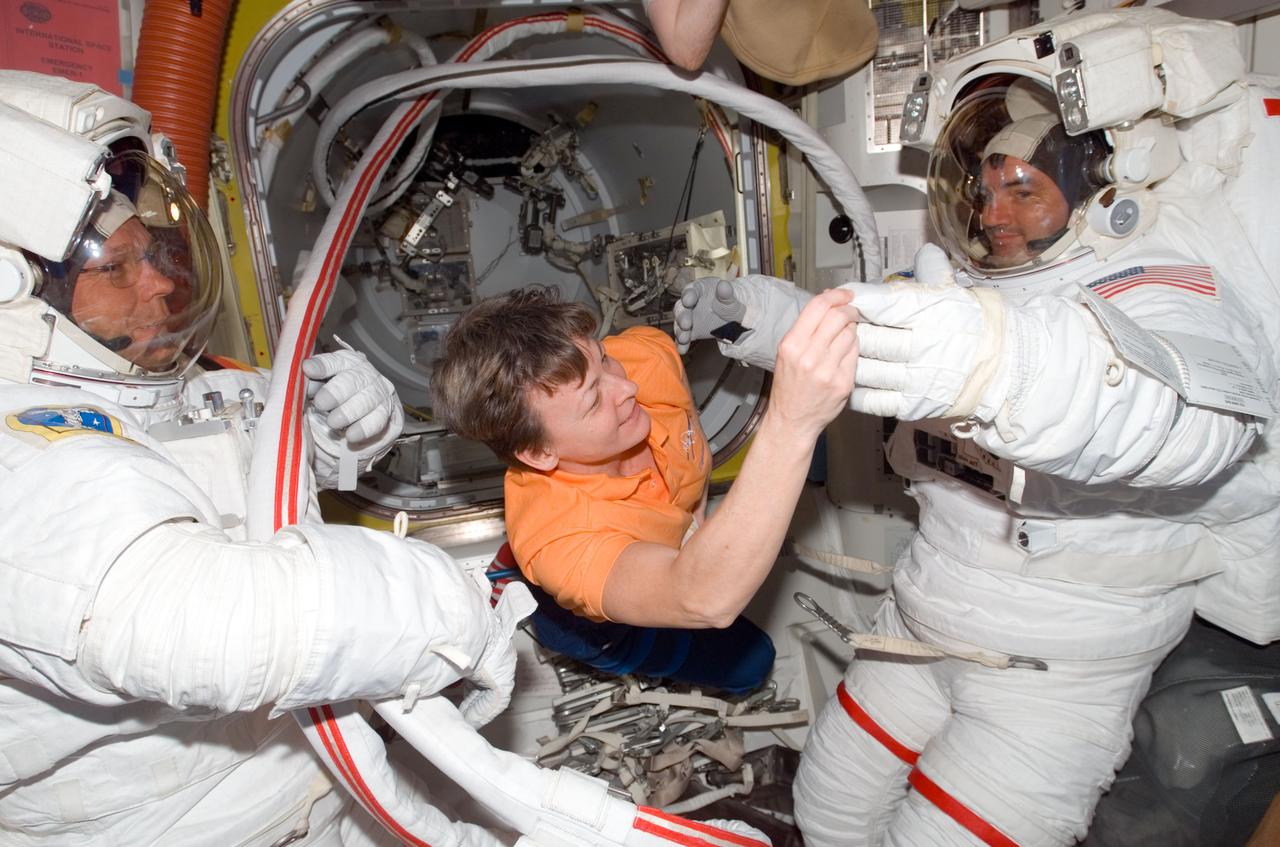
S122-E-008297 (13 Feb. 2008) --- Attired in their Extravehicular Mobility Unit (EMU) spacesuits, European Space Agency (ESA) astronaut Hans Schlegel (left) and NASA astronaut Rex Walheim, both STS-122 mission specialists, are pictured in the Quest Airlock of the International Space Station as the mission's second spacewalk draws to a close. NASA astronaut Peggy Whitson, Expedition 16 commander, assisted Schlegel and Walheim.
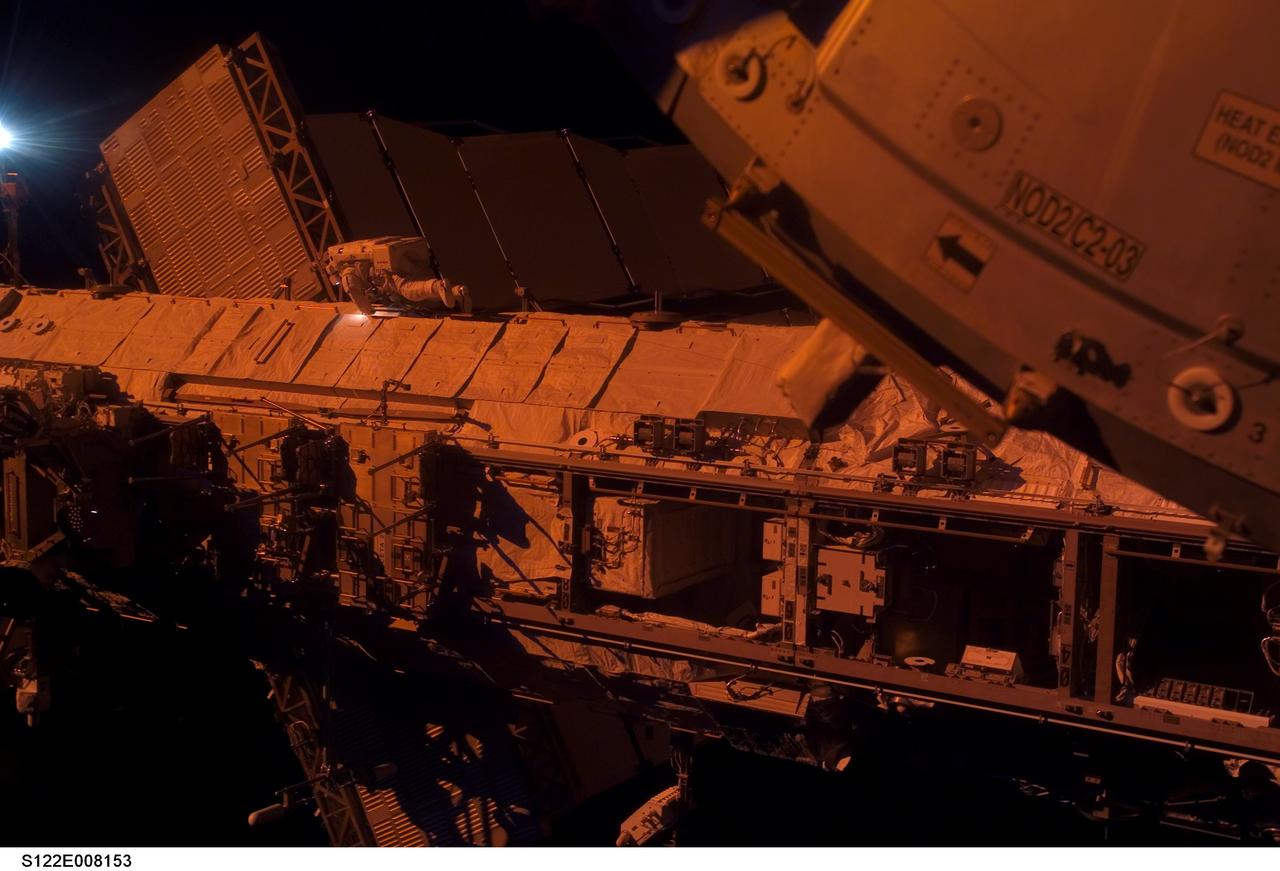
S122-E-008153 (13 Feb. 2008) --- In the darkness of space, European Space Agency (ESA) astronaut Hans Schlegel, STS-122 mission specialist, participates in the mission's second scheduled session of extravehicular activity (EVA) as construction and maintenance continue on the International Space Station. During the six-hour, 45-minute spacewalk, among other tasks, Schlegel and NASA astronaut Rex Walheim (out of frame), mission specialist, worked to replace a nitrogen tank used to pressurize the station's ammonia cooling system.
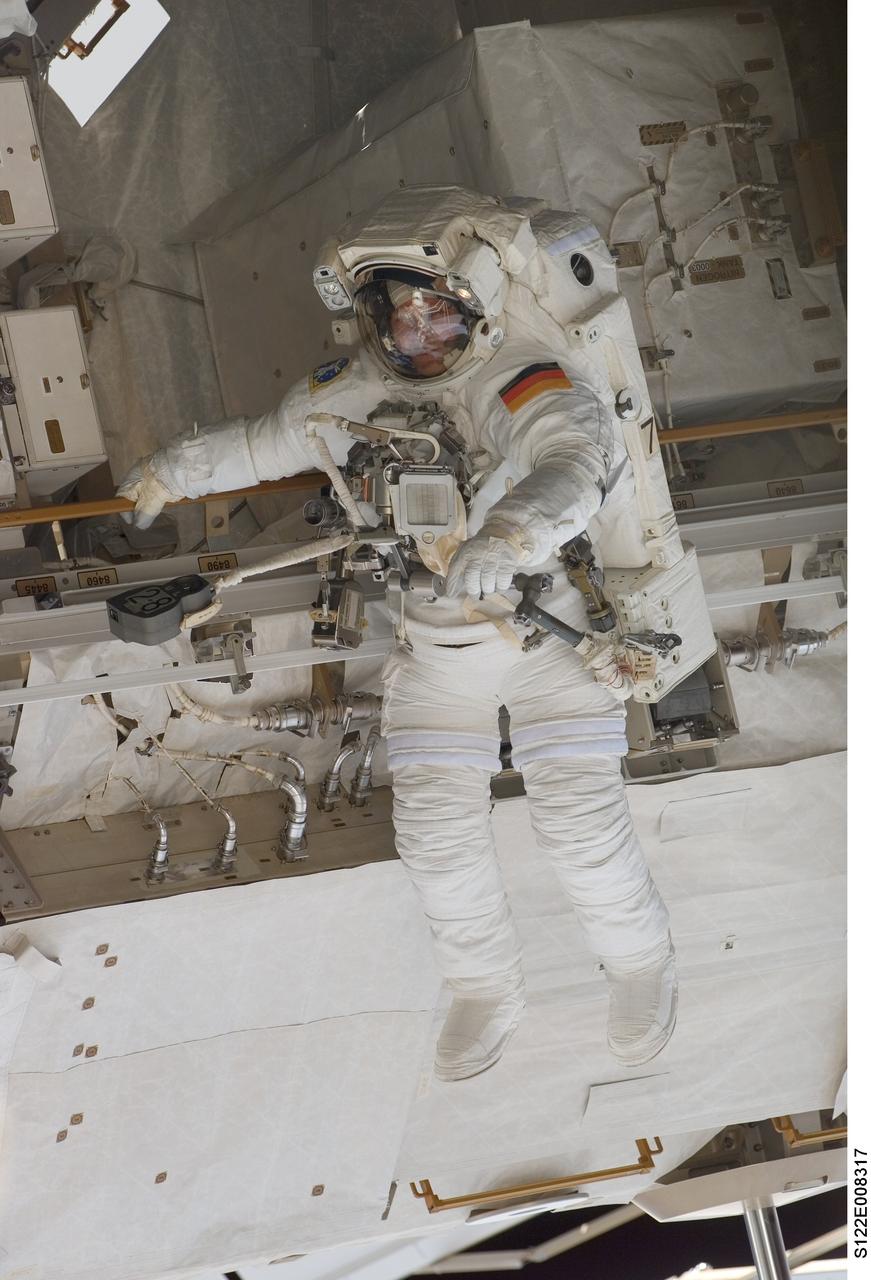
S122-E-008317 (13 Feb. 2008) --- European Space Agency (ESA) astronaut Hans Schlegel, STS-122 mission specialist, participates in the mission's second scheduled session of extravehicular activity (EVA) as construction and maintenance continue on the International Space Station. During the six-hour, 45-minute spacewalk, among other tasks, Schlegel and NASA astronaut Rex Walheim (out of frame), mission specialist, worked to replace a nitrogen tank used to pressurize the station's ammonia cooling system.

S122-E-008219 (13 Feb. 2008) --- European Space Agency (ESA) astronaut Hans Schlegel, STS-122 mission specialist, participates in the mission's second scheduled session of extravehicular activity (EVA) as construction and maintenance continue on the International Space Station. During the six-hour, 45-minute spacewalk, among other tasks, Schlegel and NASA astronaut Rex Walheim (out of frame), mission specialist, worked to replace a nitrogen tank used to pressurize the station's ammonia cooling system.
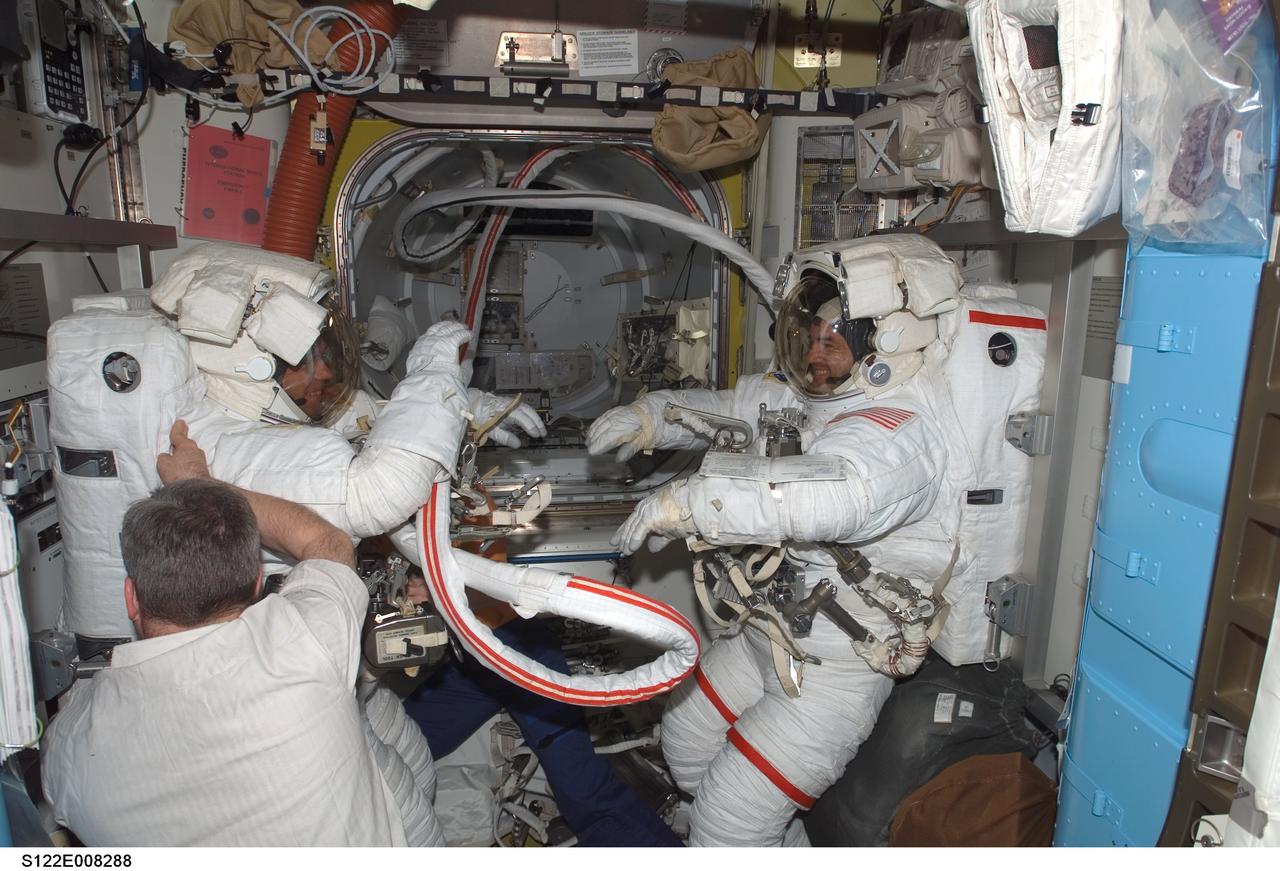
S122-E-008288 (13 Feb. 2008) --- Attired in their Extravehicular Mobility Unit (EMU) spacesuits, European Space Agency (ESA) astronaut Hans Schlegel (left) and NASA astronaut Rex Walheim, both STS-122 mission specialists, are pictured in the Quest Airlock of the International Space Station as the mission's second spacewalk draws to a close. NASA astronaut Steve Frick, commander, assisted Schlegel and Walheim.
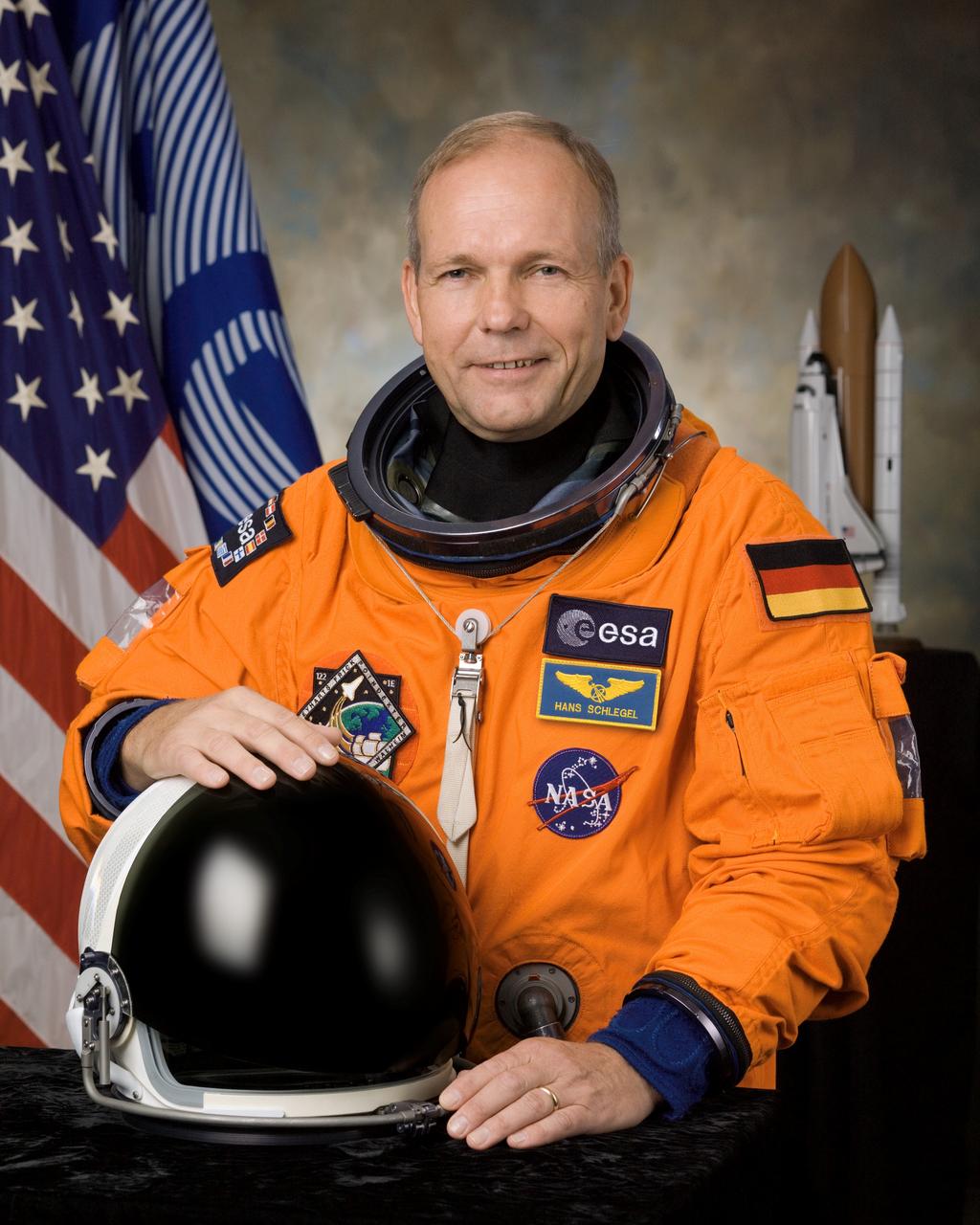
JSC2007-E-47687 (28 Sept. 2007) --- Astronaut Hans Schlegel, mission specialist representing the European Space Agency (ESA)
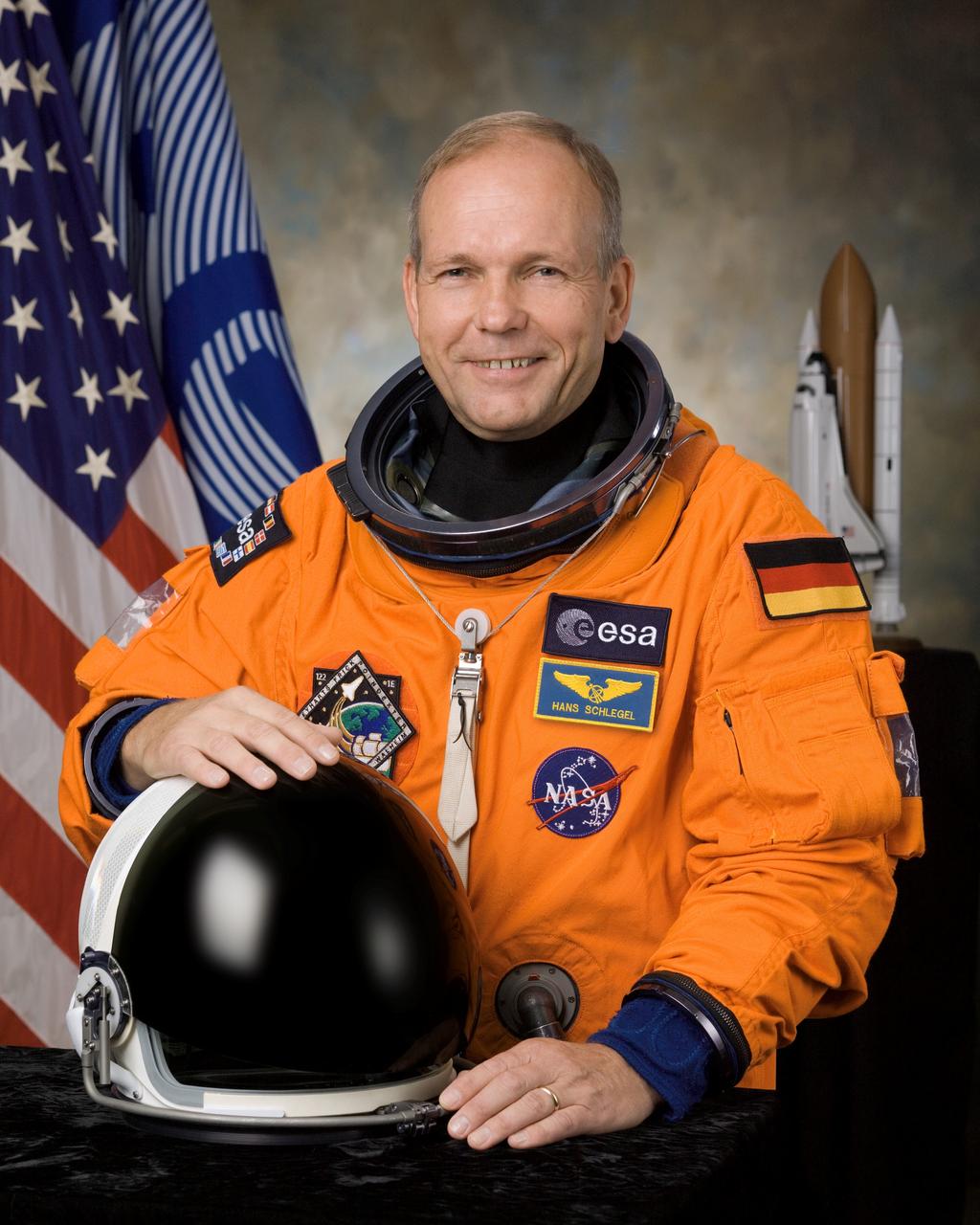
JSC2007-E-47688 (28 Sept. 2007) --- Astronaut Hans Schlegel, mission specialist representing the European Space Agency (ESA)
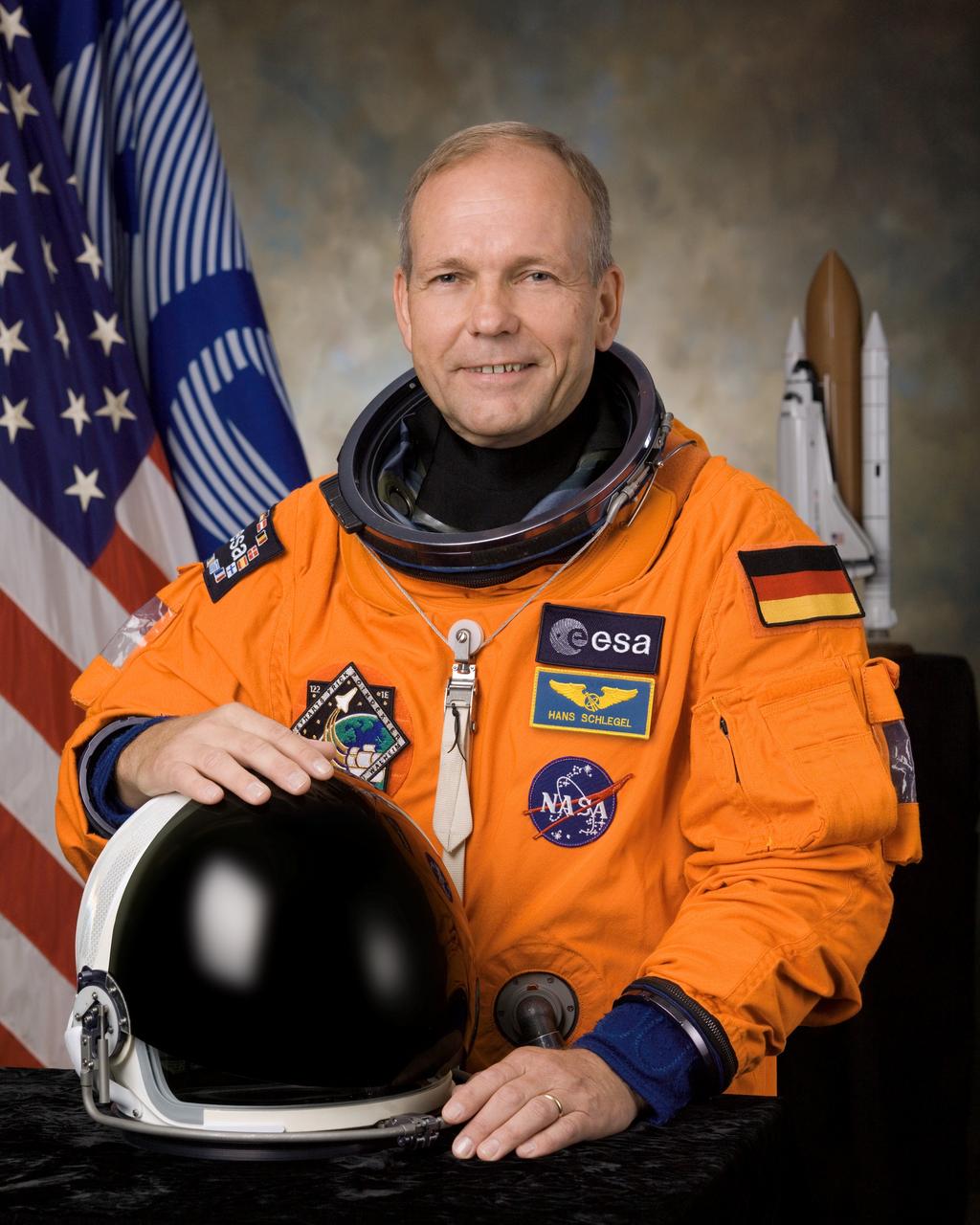
JSC2007-E-47686 (28 Sept. 2007) --- Astronaut Hans Schlegel, mission specialist representing the European Space Agency (ESA)
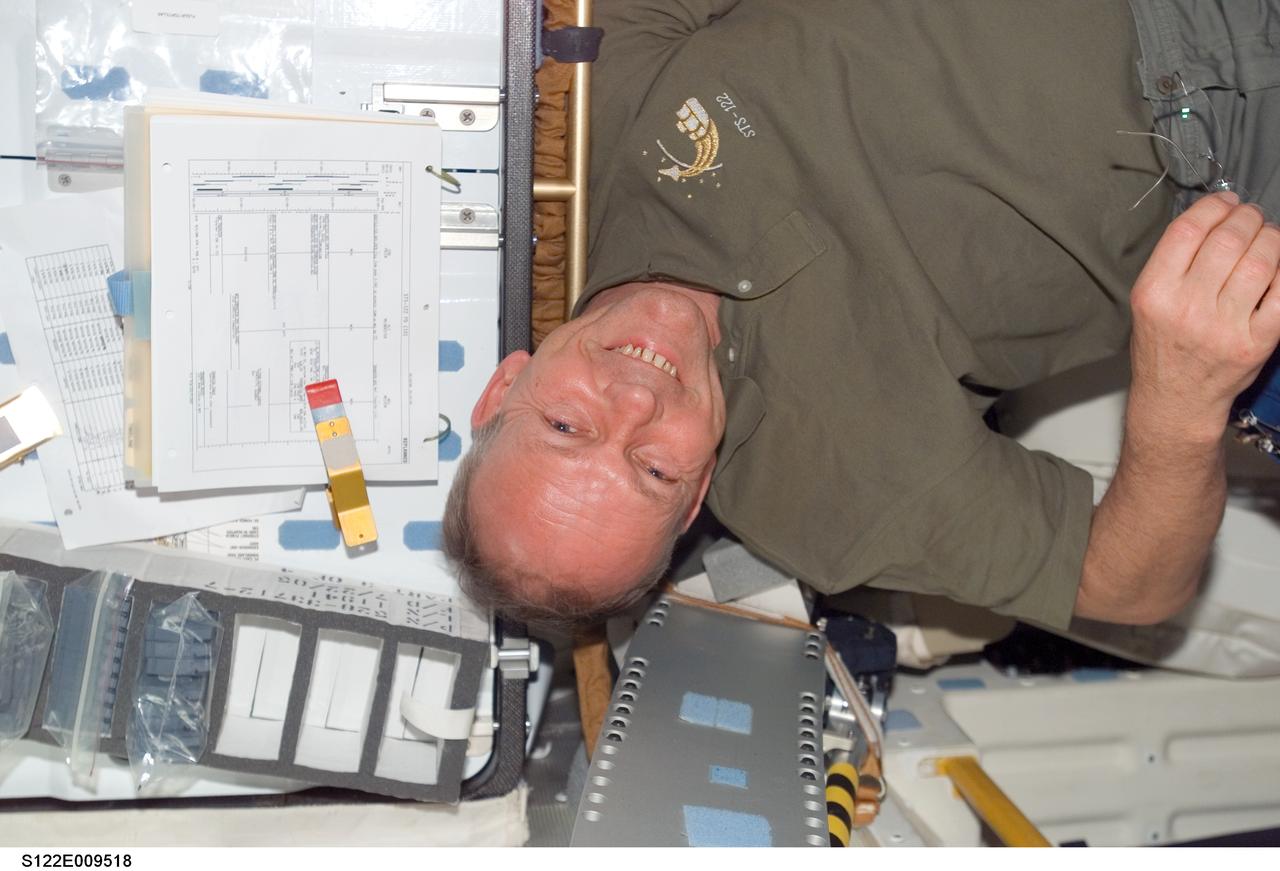
S122-E-009518 (16 Feb. 2008) --- European Space Agency (ESA) astronaut Hans Schlegel, STS-122 mission specialist, is pictured on the middeck of Space Shuttle Atlantis while docked with the International Space Station.
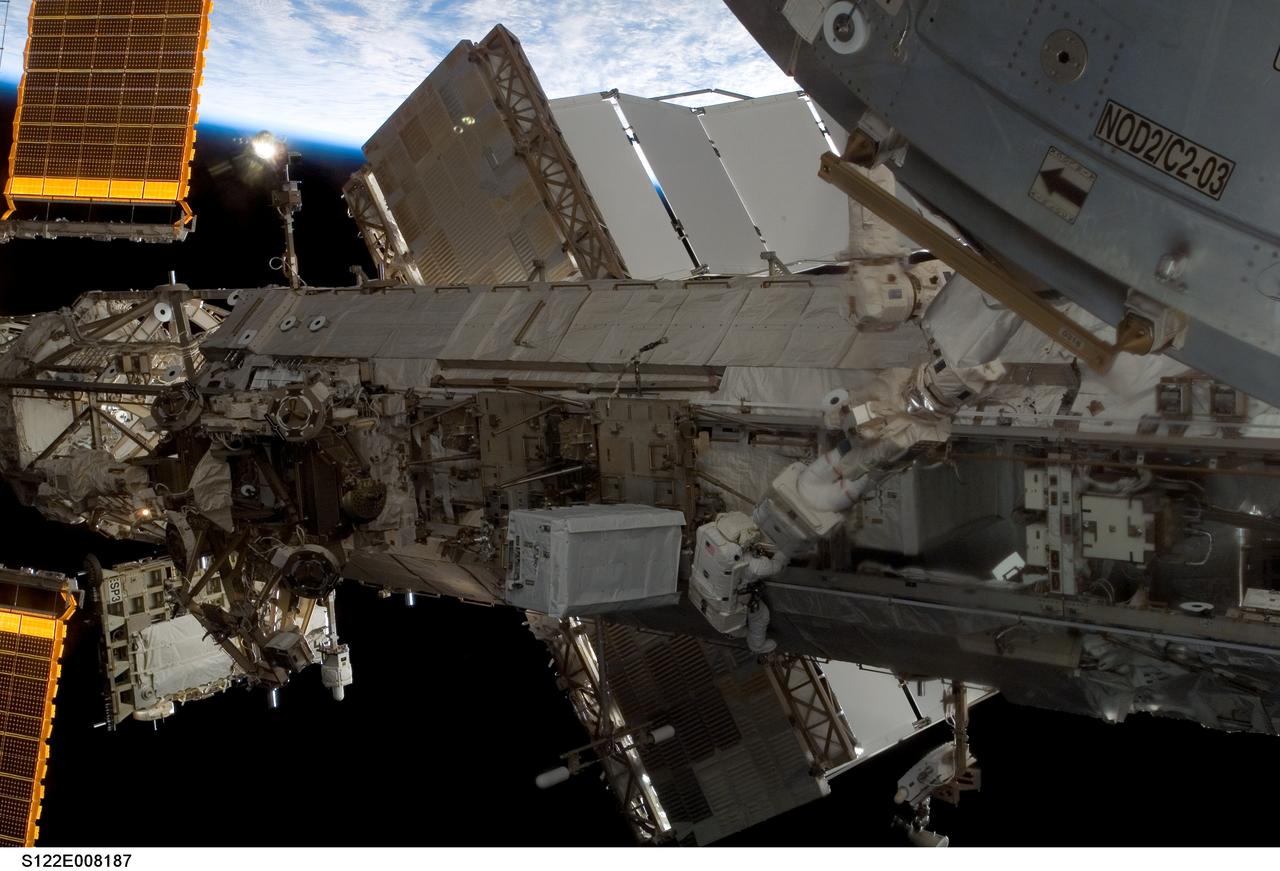
S122-E-008187 (13 Feb. 2008) --- European Space Agency (ESA) astronaut Hans Schlegel (left) and NASA astronaut Rex Walheim, both STS-122 mission specialists, participate in the mission's second scheduled session of extravehicular activity (EVA) as construction and maintenance continue on the International Space Station. During the six-hour, 45-minute spacewalk, among other tasks, Walheim and Schlegel worked to replace a nitrogen tank used to pressurize the station's ammonia cooling system.
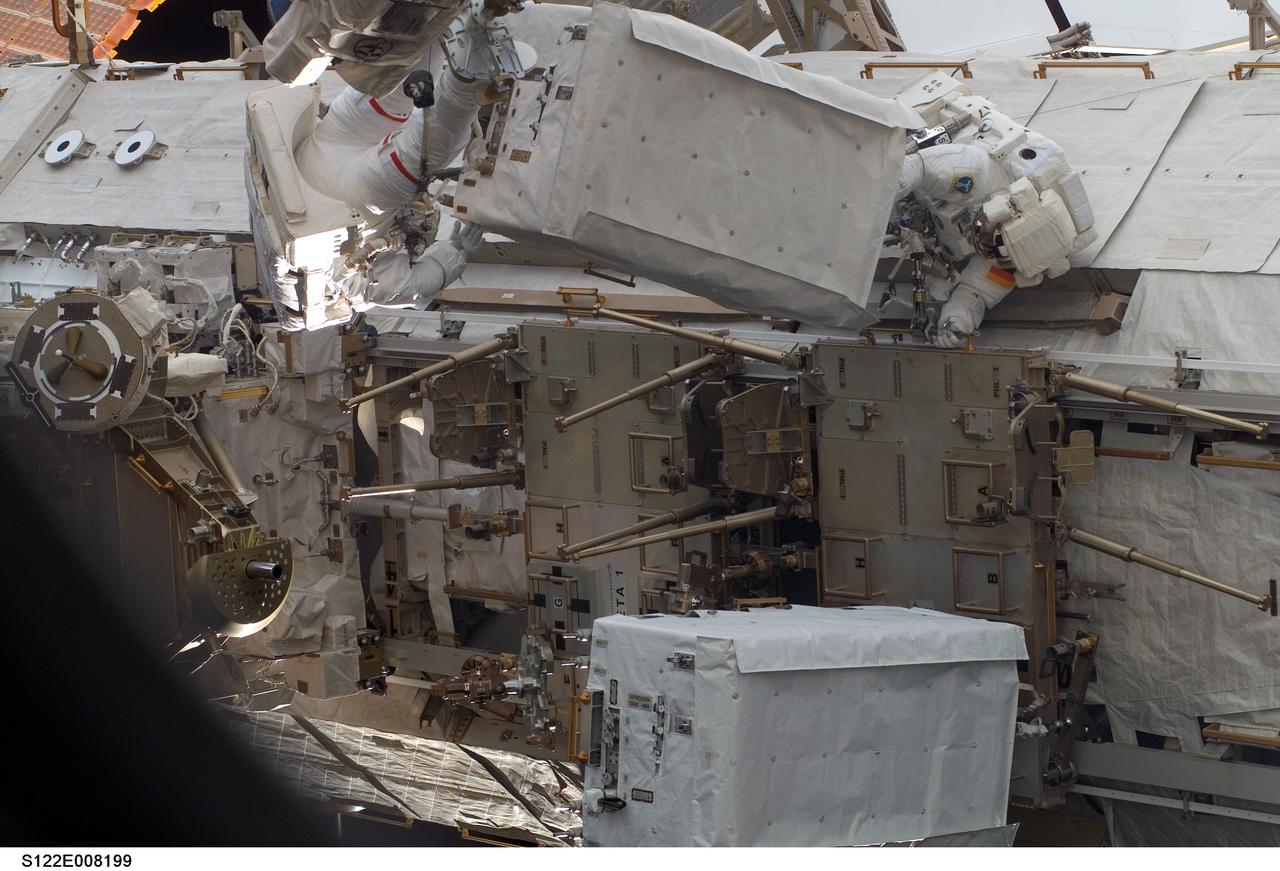
S122-E-008199 (13 Feb. 2008) --- European Space Agency (ESA) astronaut Hans Schlegel (right) and NASA astronaut Rex Walheim, both STS-122 mission specialists, participate in the mission's second scheduled session of extravehicular activity (EVA) as construction and maintenance continue on the International Space Station. During the six-hour, 45-minute spacewalk, among other tasks, Walheim and Schlegel worked to replace a nitrogen tank used to pressurize the station's ammonia cooling system.
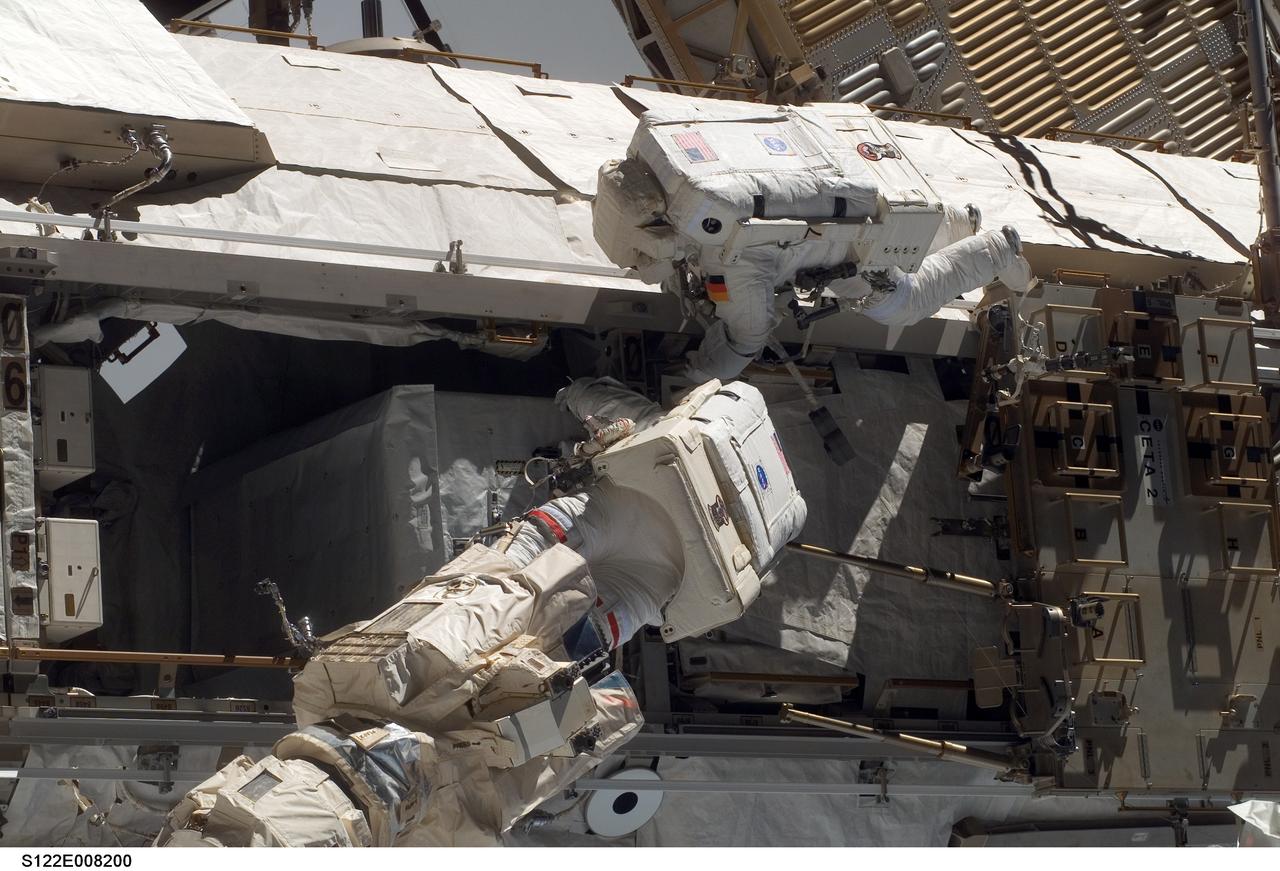
S122-E-008200 (13 Feb. 2008) --- European Space Agency (ESA) astronaut Hans Schlegel (top) and NASA astronaut Rex Walheim, both STS-122 mission specialists, participate in the mission's second scheduled session of extravehicular activity (EVA) as construction and maintenance continue on the International Space Station. During the six-hour, 45-minute spacewalk, among other tasks, Walheim and Schlegel worked to replace a nitrogen tank used to pressurize the station's ammonia cooling system.
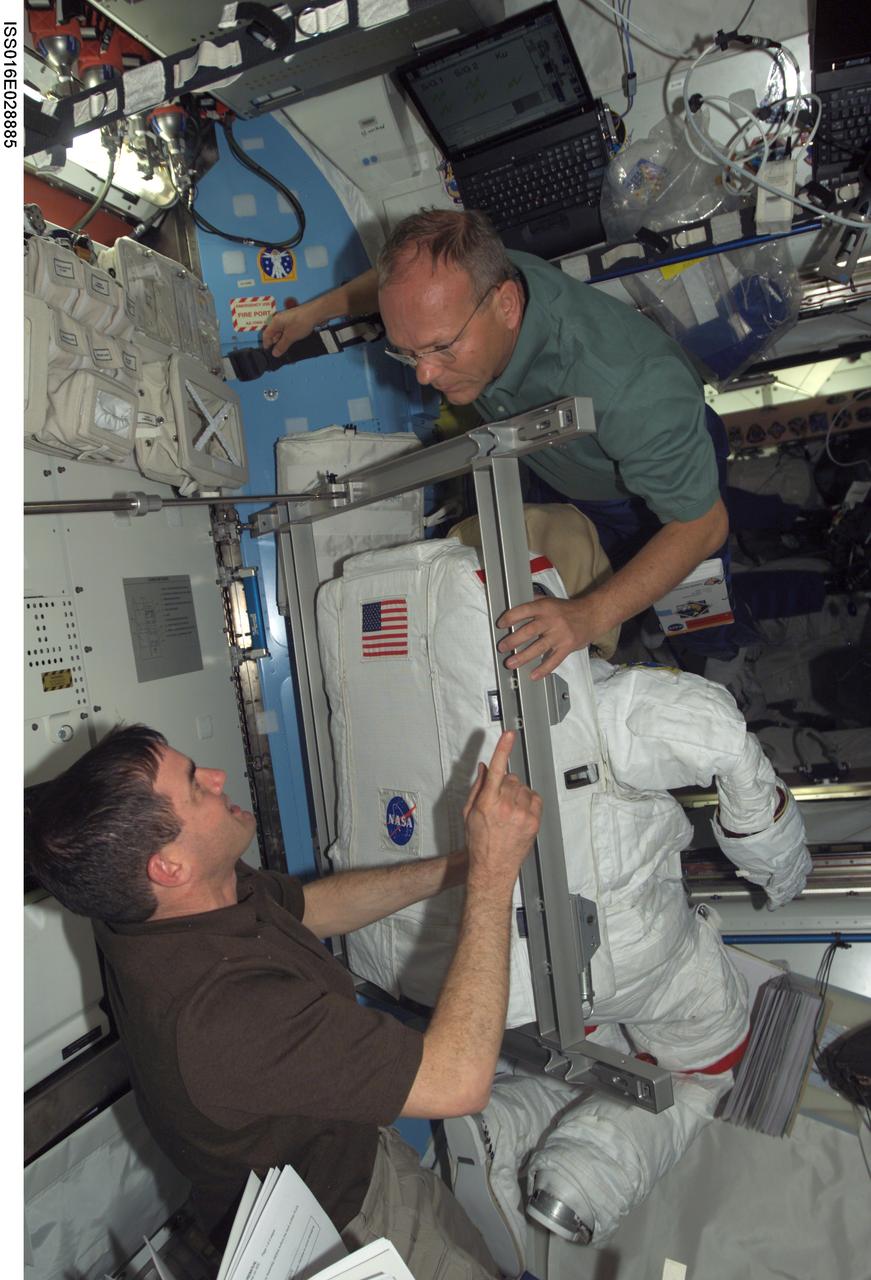
ISS016-E-028885 (9 Feb. 2008) --- NASA astronaut Rex Walheim (left) and European Space Agency (ESA) astronaut Hans Schlegel, both STS-122 mission specialists, work with Extravehicular Mobility Unit (EMU) spacesuits in the Quest Airlock of the International Space Station while Space Shuttle Atlantis is docked with the station.
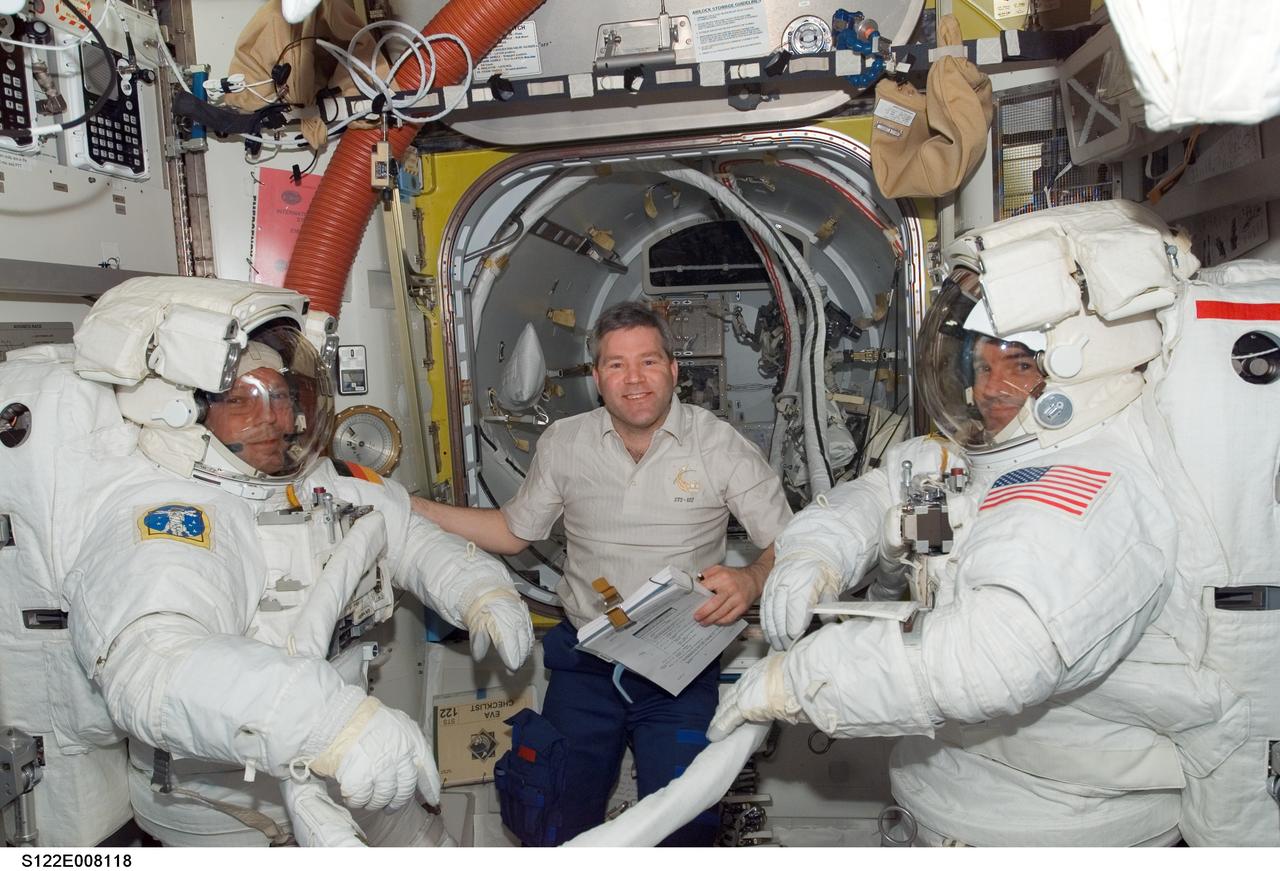
S122-E-008118 (13 Feb. 2008) --- Attired in their Extravehicular Mobility Unit (EMU) spacesuits, European Space Agency (ESA) astronaut Hans Schlegel (left) and NASA astronaut Rex Walheim, both STS-122 mission specialists, prepare for the mission's second session of extravehicular activity (EVA) in the Quest Airlock of the International Space Station while Space Shuttle Atlantis is docked with the station. NASA astronaut Steve Frick, commander, assisted Schlegel and Walheim.
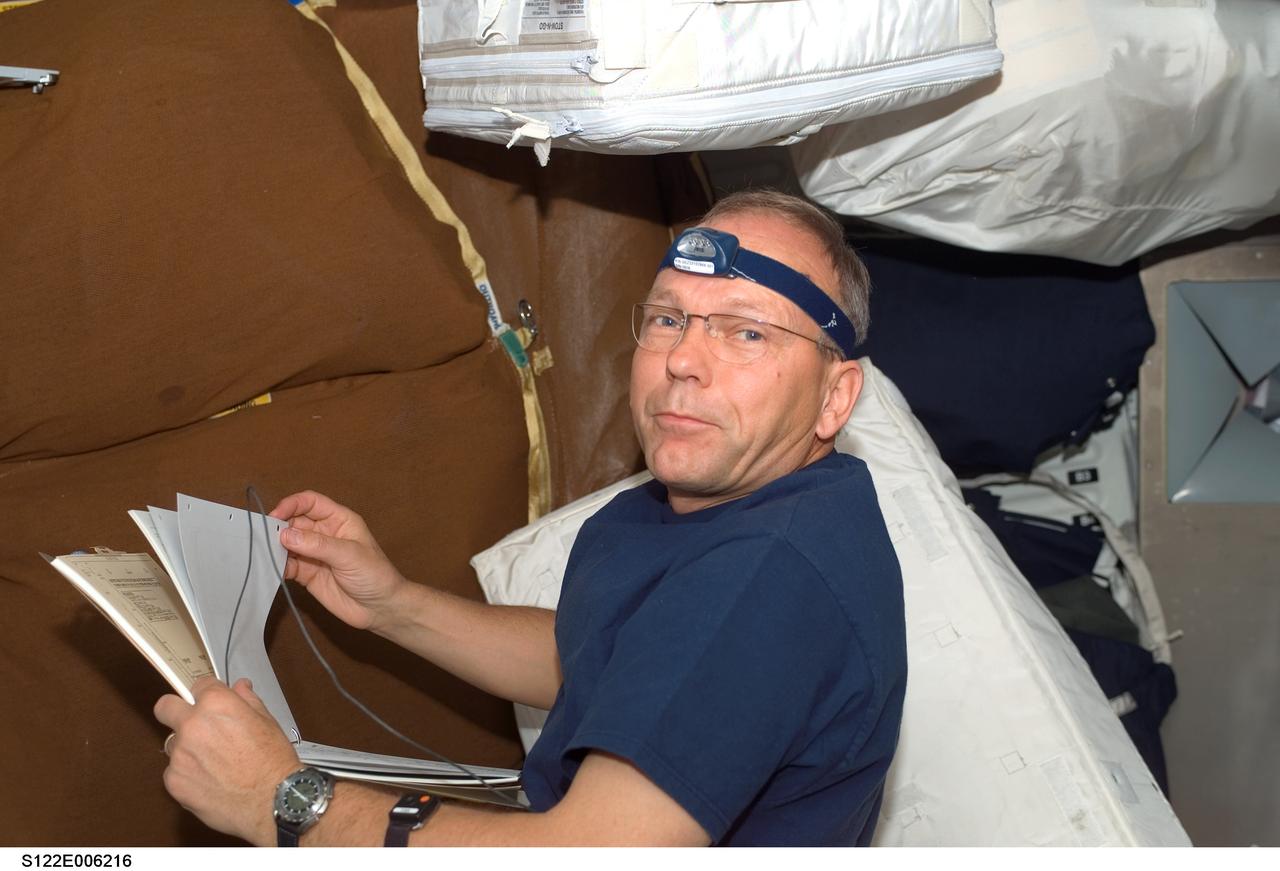
S122-E-006216 (8 Feb. 2008) --- European Space Agency (ESA) astronaut Hans Schlegel, STS-122 mission specialist, is surrounded by equipment and supplies destined for the International Space Station while working on the middeck of Space Shuttle Atlantis during flight day two activities.
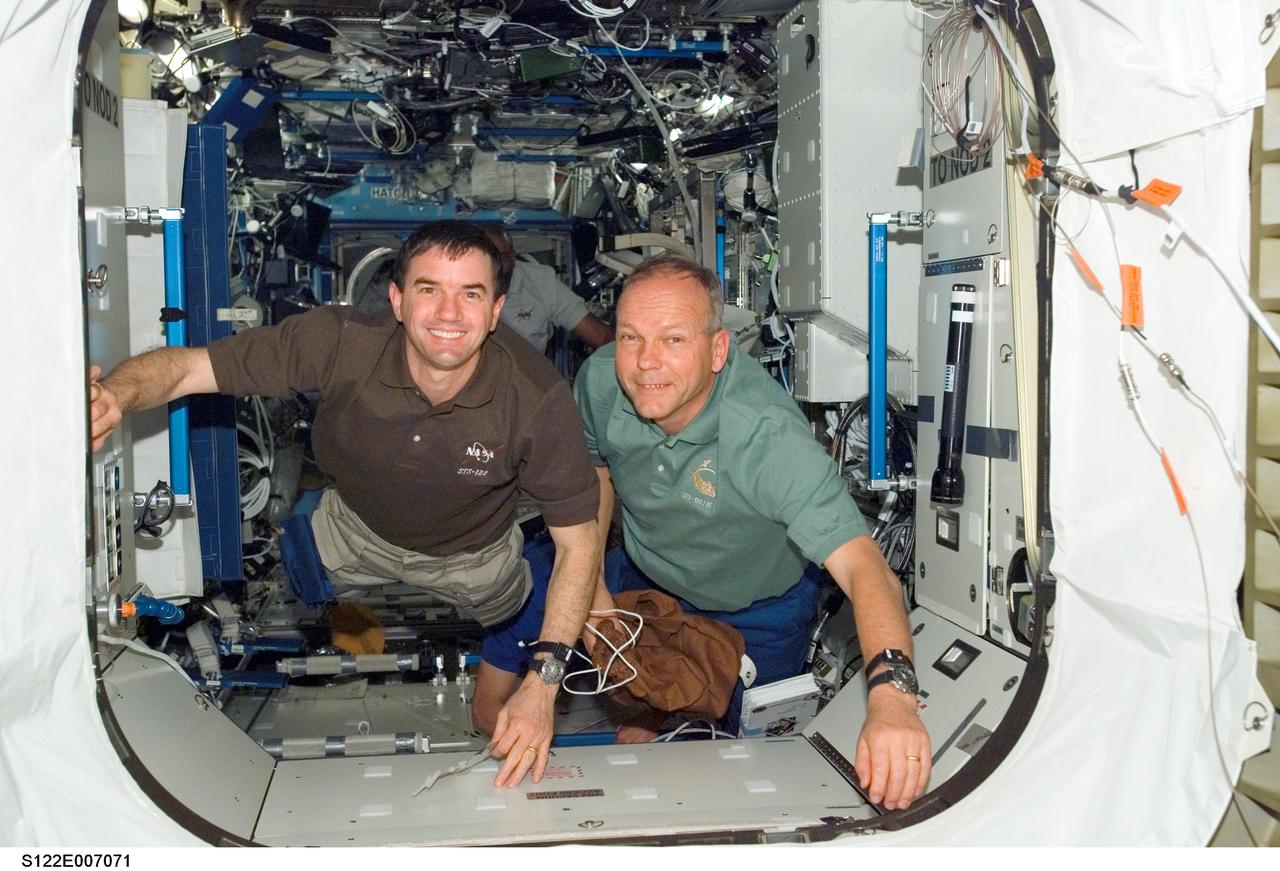
S122-E-007071 (9 Feb. 2008) --- Astronaut Rex Walheim (left) and European Space Agency astronaut Hans Schlegel prepare to join seven other astronauts and a cosmonaut for a special reunion onboard the International Space Station soon after the hatches were opened between the orbital outpost and the Space Shuttle Atlantis on docking day.
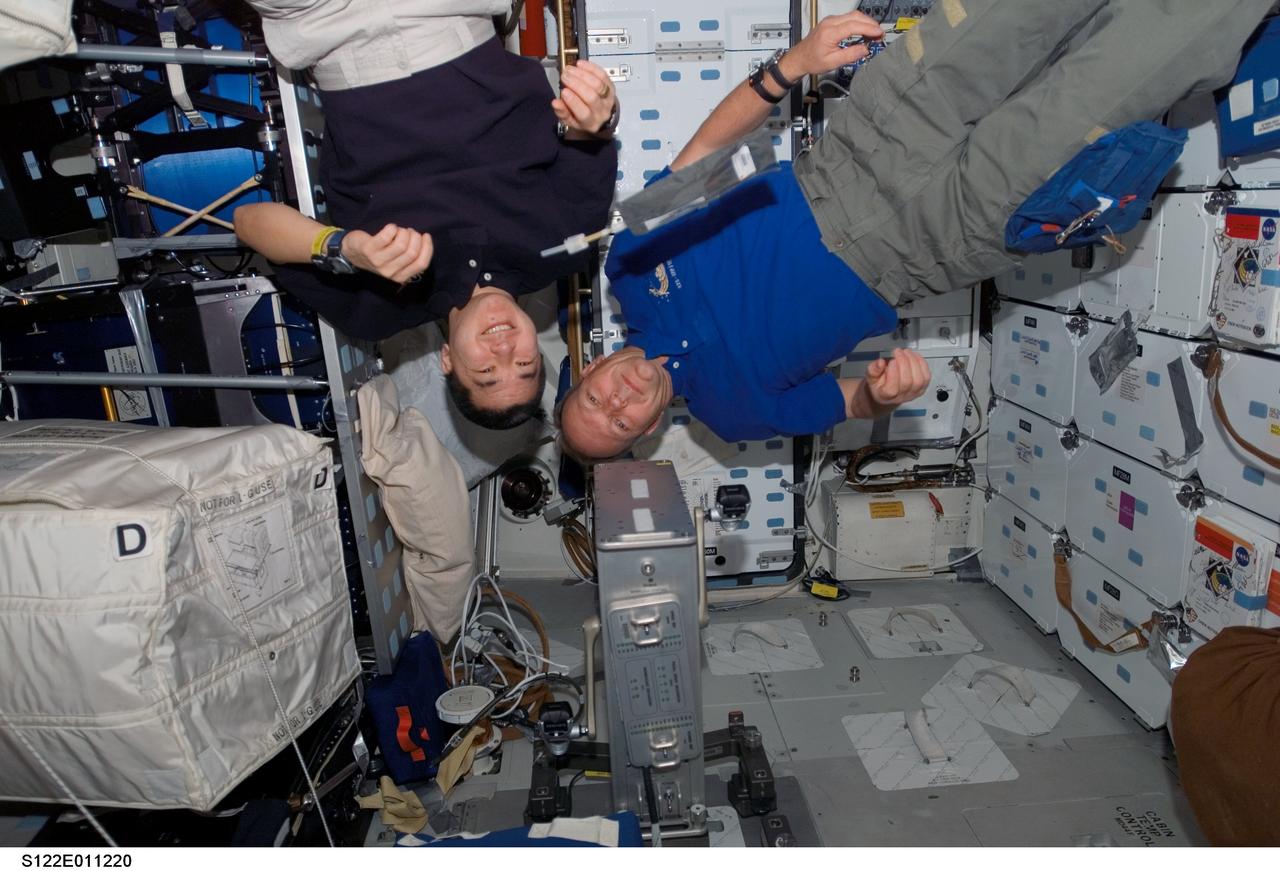
S122-E-011220 (18 Feb. 2008) --- NASA astronaut Daniel Tani (left) and European Space Agency (ESA) astronaut Hans Schlegel, both STS-122 mission specialists, pose for a photo as they float on the middeck of Space Shuttle Atlantis. A beverage container floats freely in the foreground. The shuttle's bicycle ergometer is visible at bottom center.
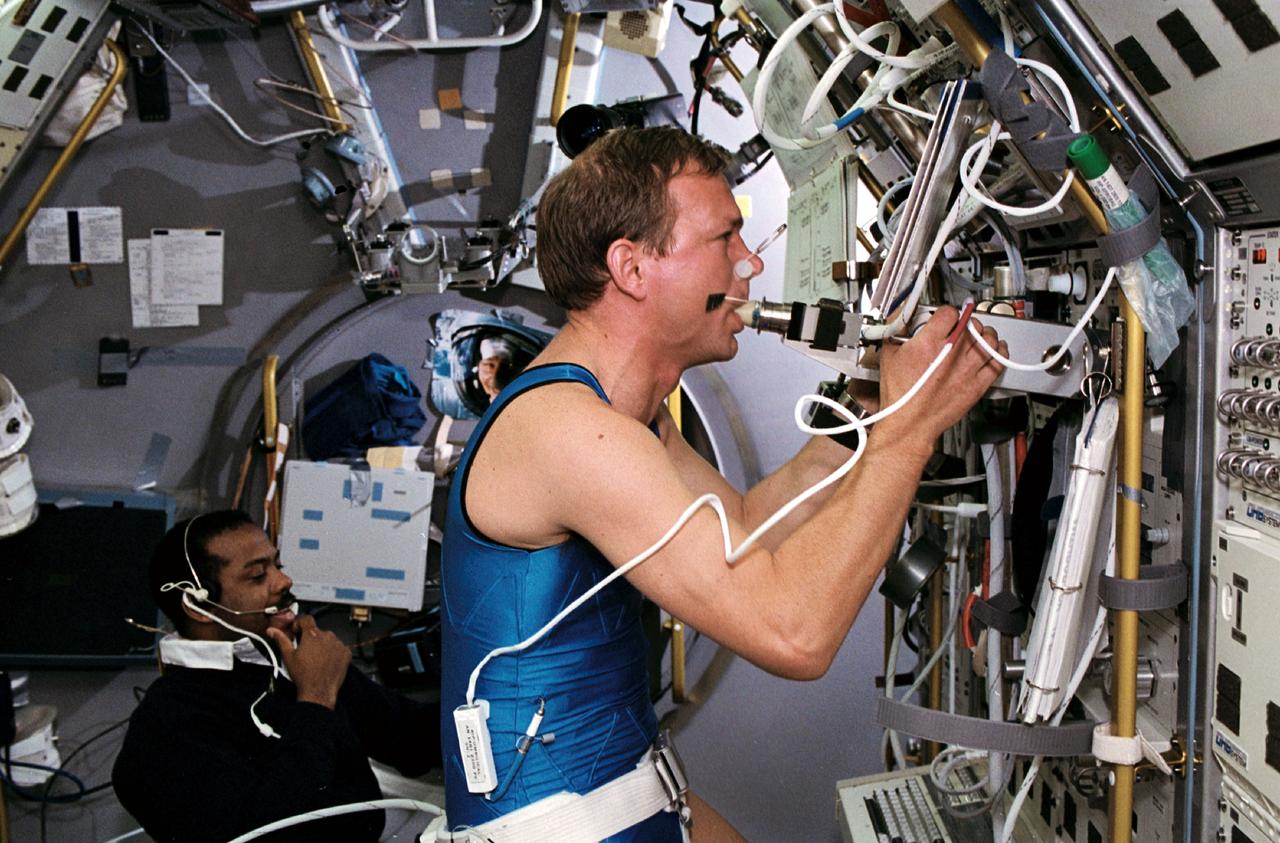
STS055-45-017 (26 April-6 May 1993) --- Hans Schlegel (foreground) participates in the ongoing investigation of human physiology under microgravity conditions as he works out on the ergometer at the Anthrorack. Monitoring the "run" is astronaut Bernard A. Harris, Jr., STS-55 mission specialist. Schlegel is one of two payload specialists representing the German Aerospace Research Establishment (DLR) on the Spacelab D-2 mission.
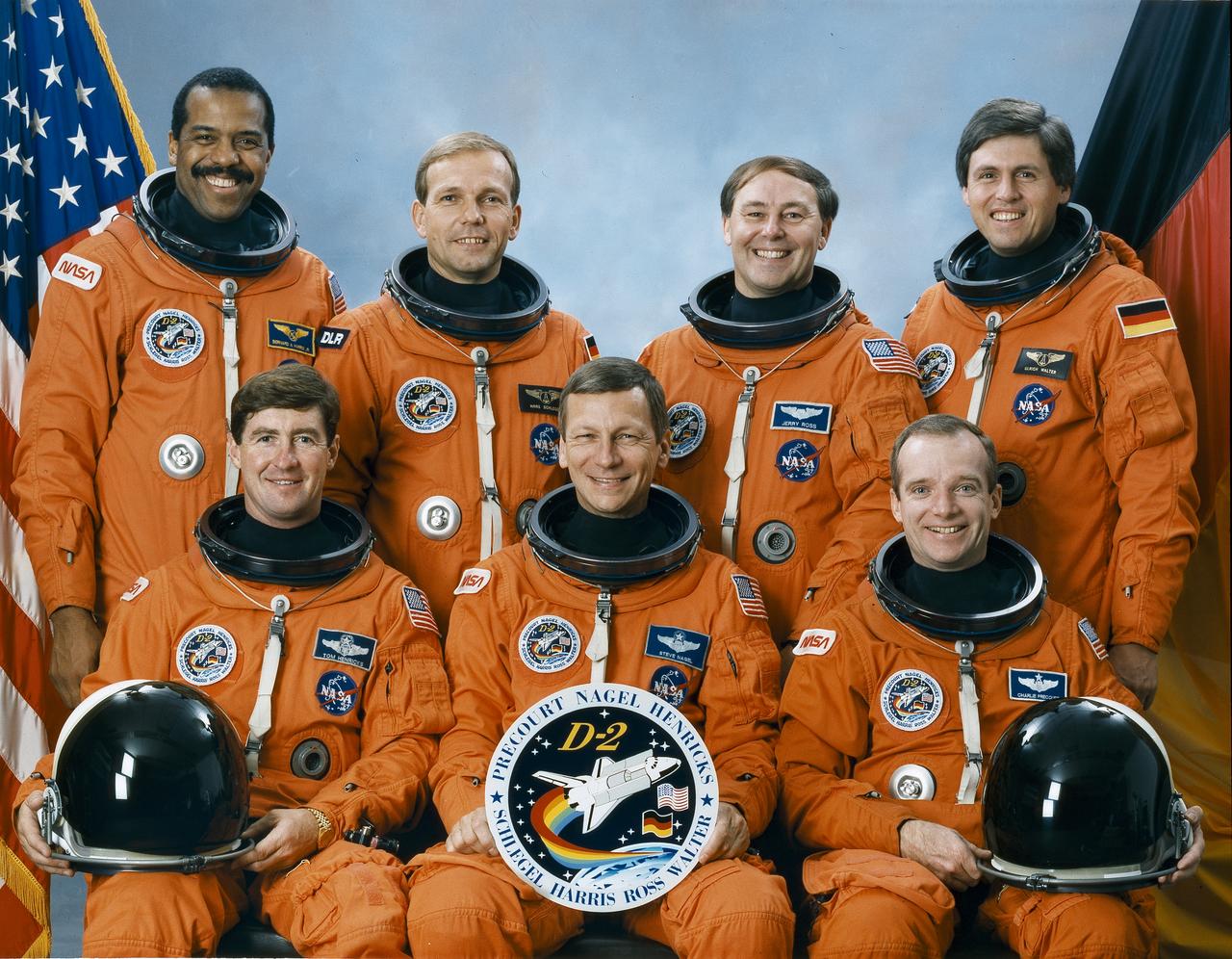
The seven astronauts included in the STS-55 crew portrait are: (front left to right) Terence (Tom) Henricks, pilot; Steven R. Negal, commander; and Charles J. Precourt, mission specialist. On the back row, from left to right, are Bernard A. Harris, mission specialist; Hans Schlegel, payload specialist; Jerry L. Ross, mission specialist; and Ulrich Walter, payload specialist. The crew launched aboard the Space Shuttle Columbia on April 26, 1993 at 10:50:00 am (EDT). The major payload was the German Dedicated Spacelab, D2.
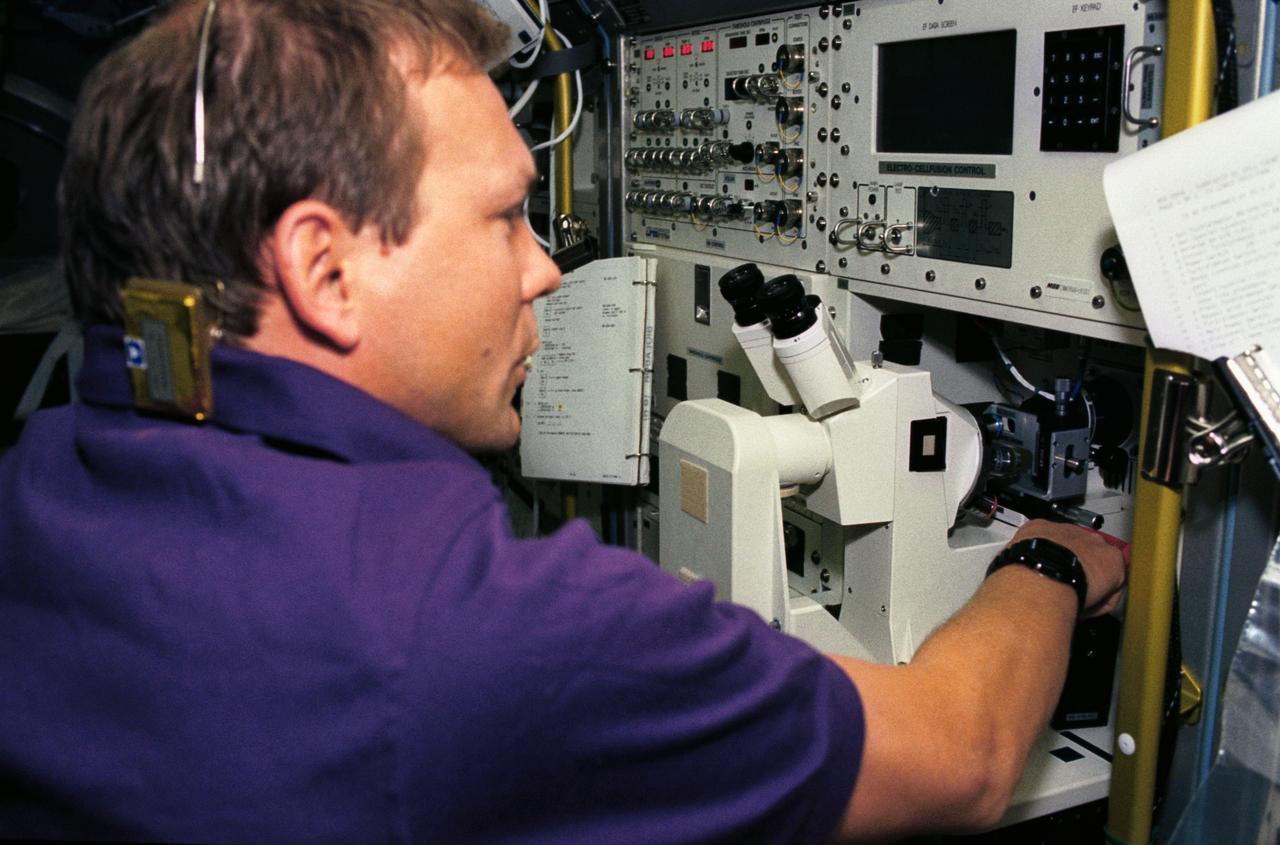
STS055-233-025 (26 April-6 May 1993) --- German payload specialist Hans Schlegel uses a microscope at the Biolabor workstation in the Spacelab D-2 science module. The Biolabor facility is a life sciences and biotechnology research device developed by Germany (MBB/ERNO) for use aboard Spacelab. Schlegel was joined by five NASA astronauts and a fellow German payload specialist for the 10-day mission aboard the Space Shuttle Columbia.
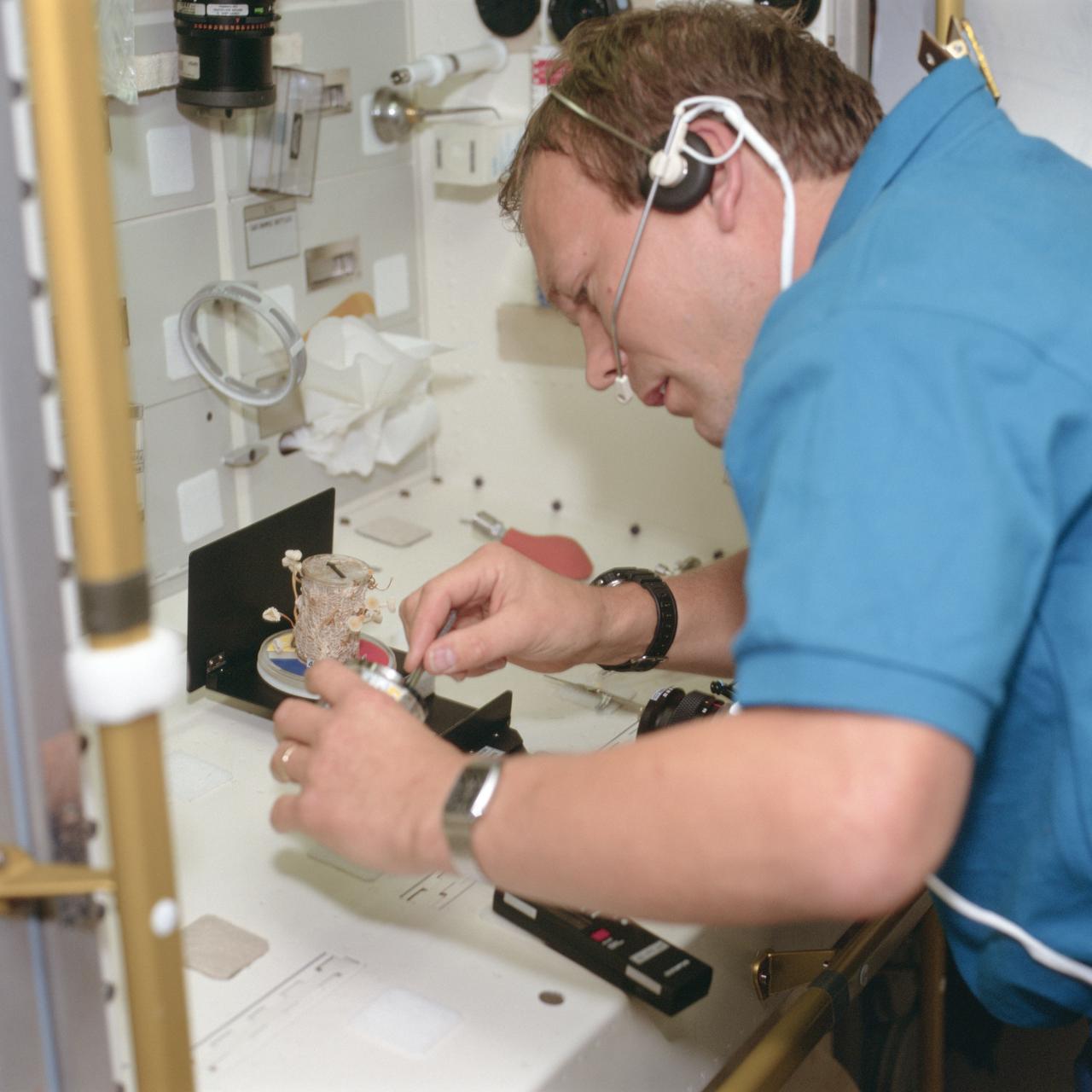
STS055-106-037 (26 April-6 May 1993) --- Hans Schlegel works with a fungi experiment in the Spacelab D-2 Science Module onboard the Earth-orbiting Space Shuttle Columbia. Schlegel was one of two payload specialists representing the German Aerospace Research Establishment (DLR) on the 10-day Spacelab D-2 mission.
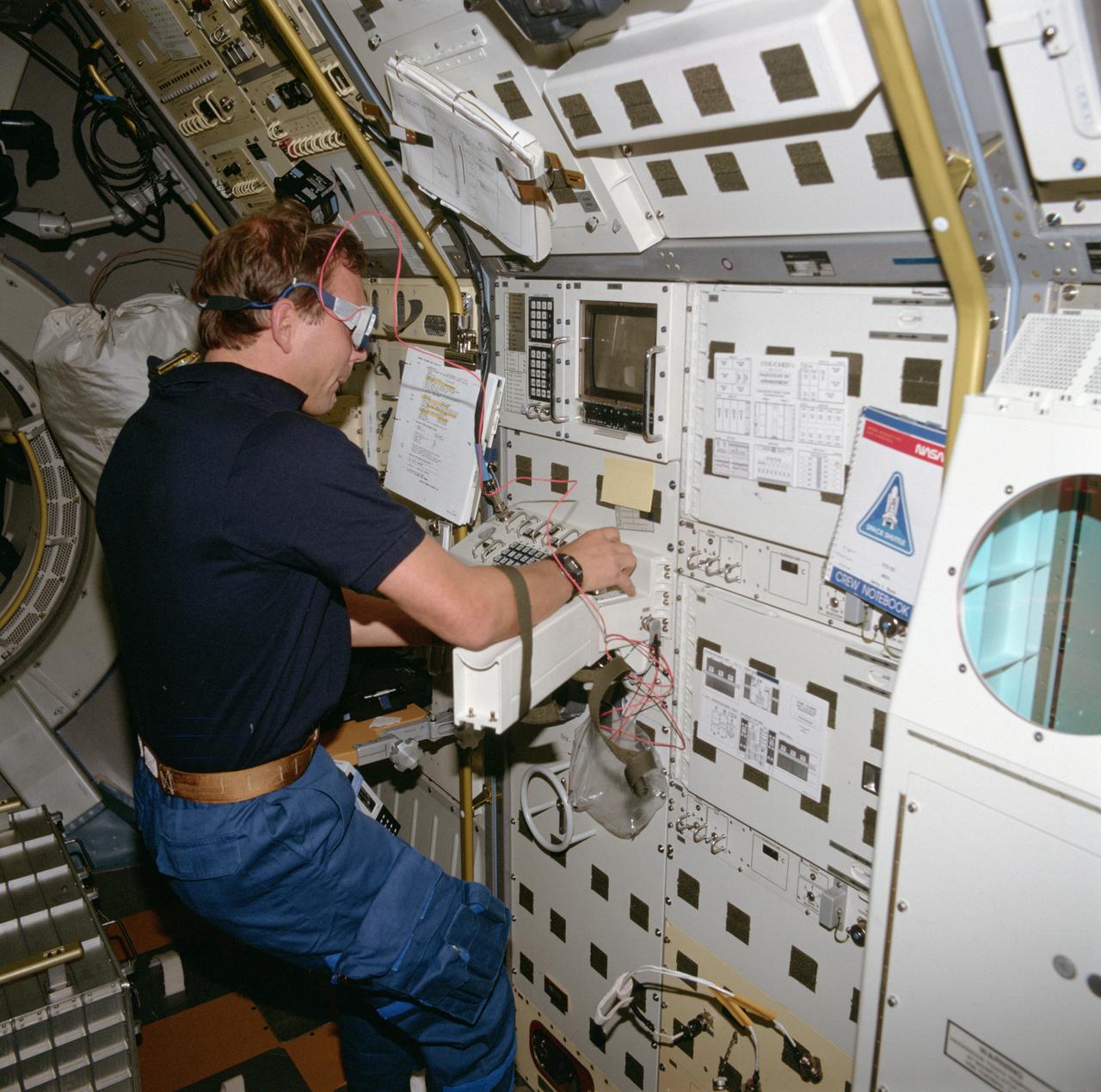
STS055-106-100 (26 April-6 May 1993) --- Hans Schlegel, wearing special glasses, works at the Robotics Experiment (ROTEX) workstation in the science module aboard the Earth-orbiting Space Shuttle Columbia. Schlegel was one of two payload specialists representing the German Aerospace Research Establishment (DLR) on the 10-day Spacelab D-2 mission. ROTEX is a robotic arm that operates within an enclosed workcell in rack 6 of the Spacelab module and uses teleoperation from both an onboard station located nearby in rack 4 and from a station on the ground. The device uses teleprogramming and artificial intelligence to look at the design, verification and operation of advanced autonomous systems for use in future applications.
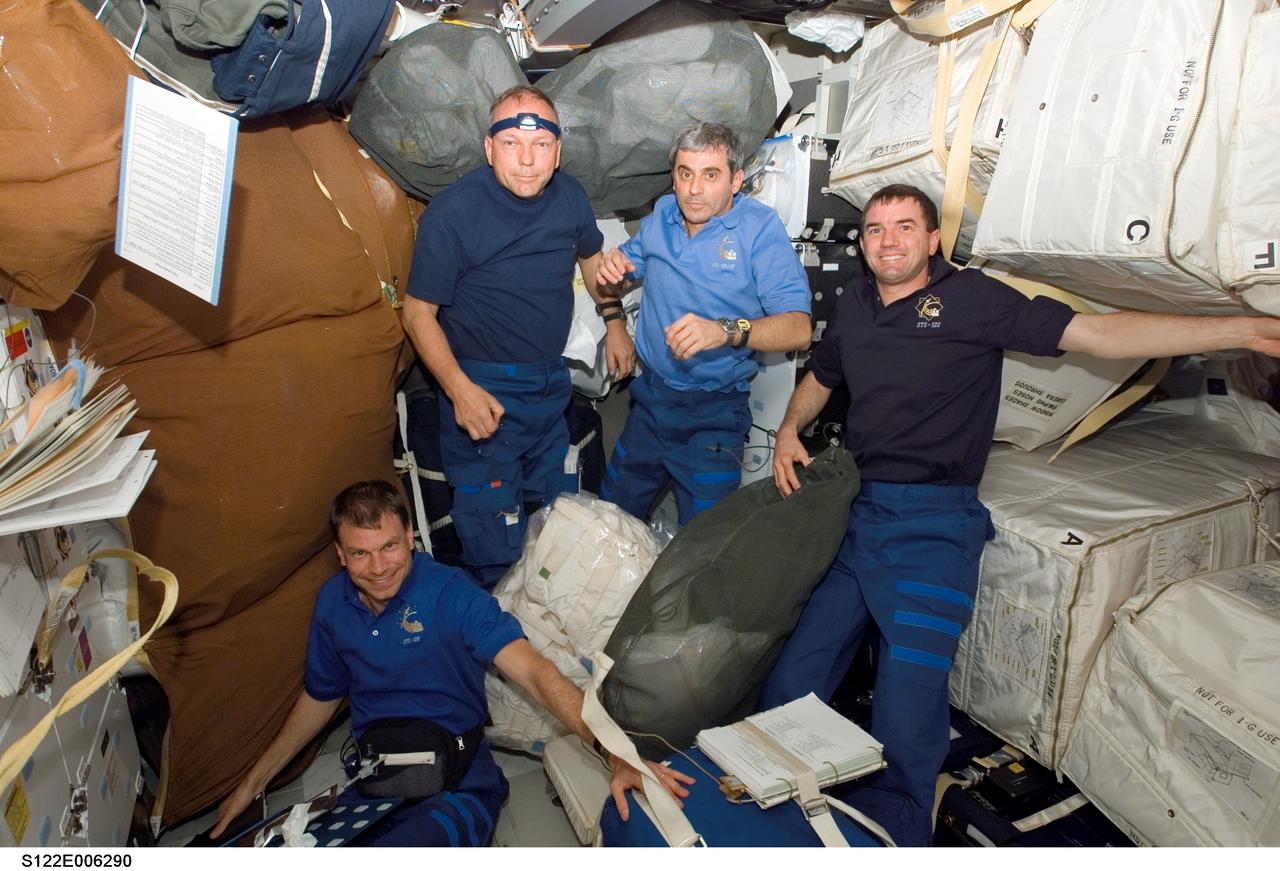
S122-E-006290 (8 Feb. 2008) --- European Space Agency (ESA) astronauts Hans Schlegel (left center) and Leopold Eyharts (center right); NASA astronauts Stanley Love (left) and Rex Walheim, all STS-122 mission specialists, work on the middeck of Space Shuttle Atlantis during flight day two activities. After docking with the International Space Station, Eyharts will join Expedition 16 in progress to serve as a flight engineer.
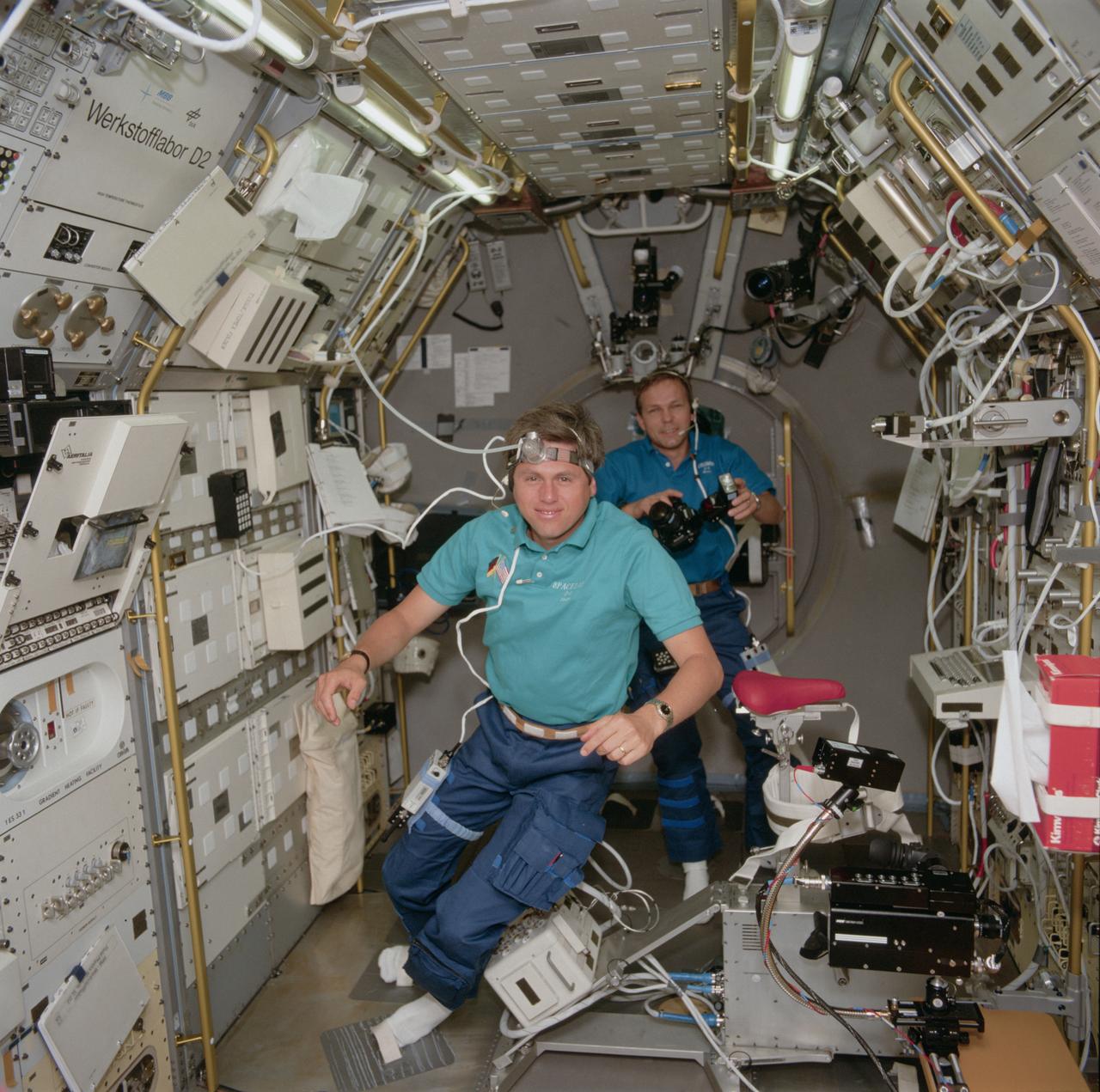
STS055-106-056 (26 April-6 May 1993) --- Ulrich Walter, one of two payload specialists representing the German Aerospace Research Establishment (DLR) onboard Columbia, plants his socked feet into temporary foot restraints. Walter's headwear telltales his participation in a Tissue experiment. Fellow payload specialist Hans Schlegel prepares to take a photo in the background.
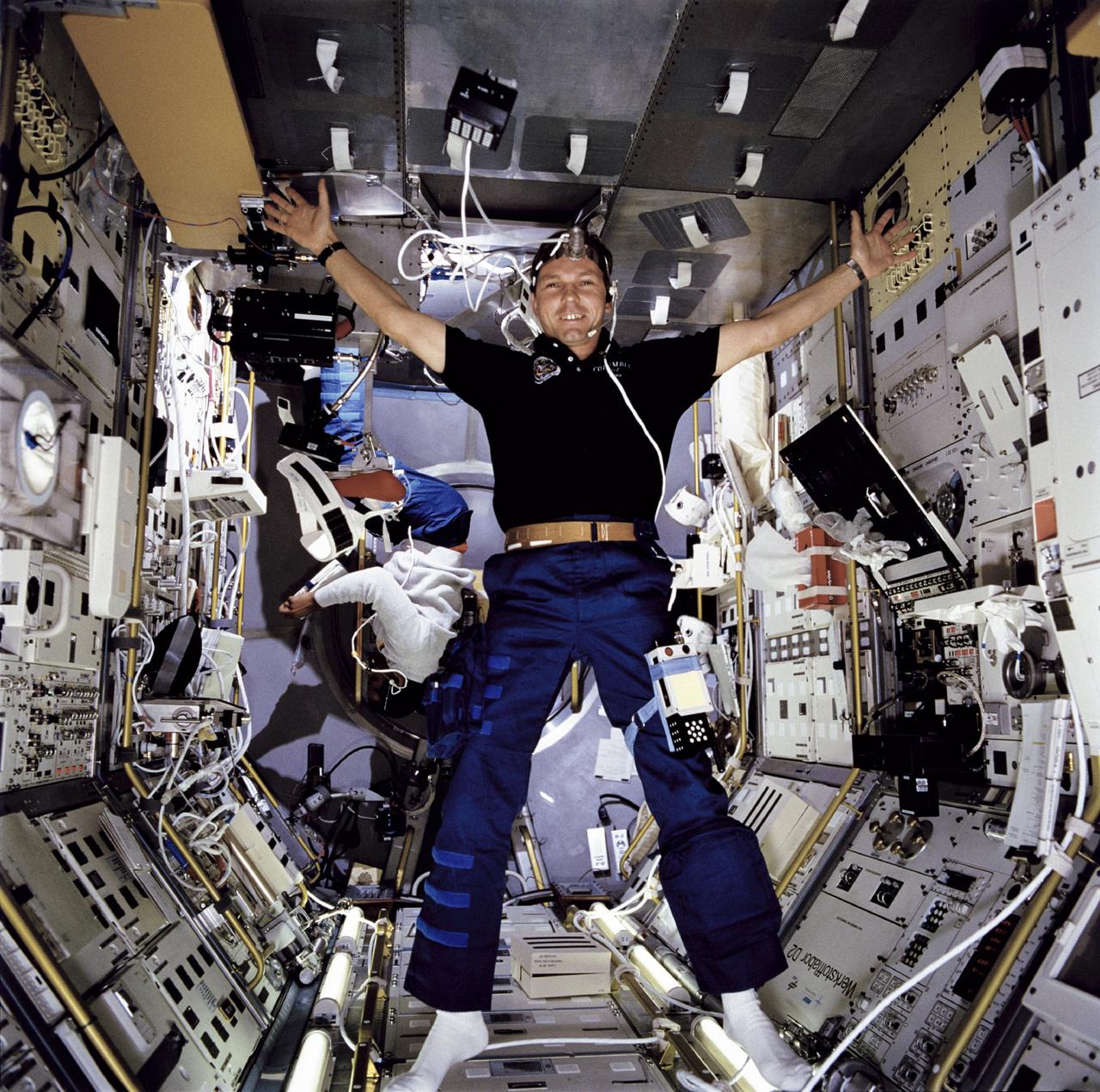
STS055-106-090 (26 April- 6 May 1993) --- Hans Schlegel, one of two STS-55 payload specialists representing the German Aerospace Research Establishment (DLR) onboard the Space Shuttle Columbia, finds plenty of room to "spread out" while participating in a Tissue experiment. Astronaut Bernard A. Harris, Jr., mission specialist, monitors an experiment in the background.
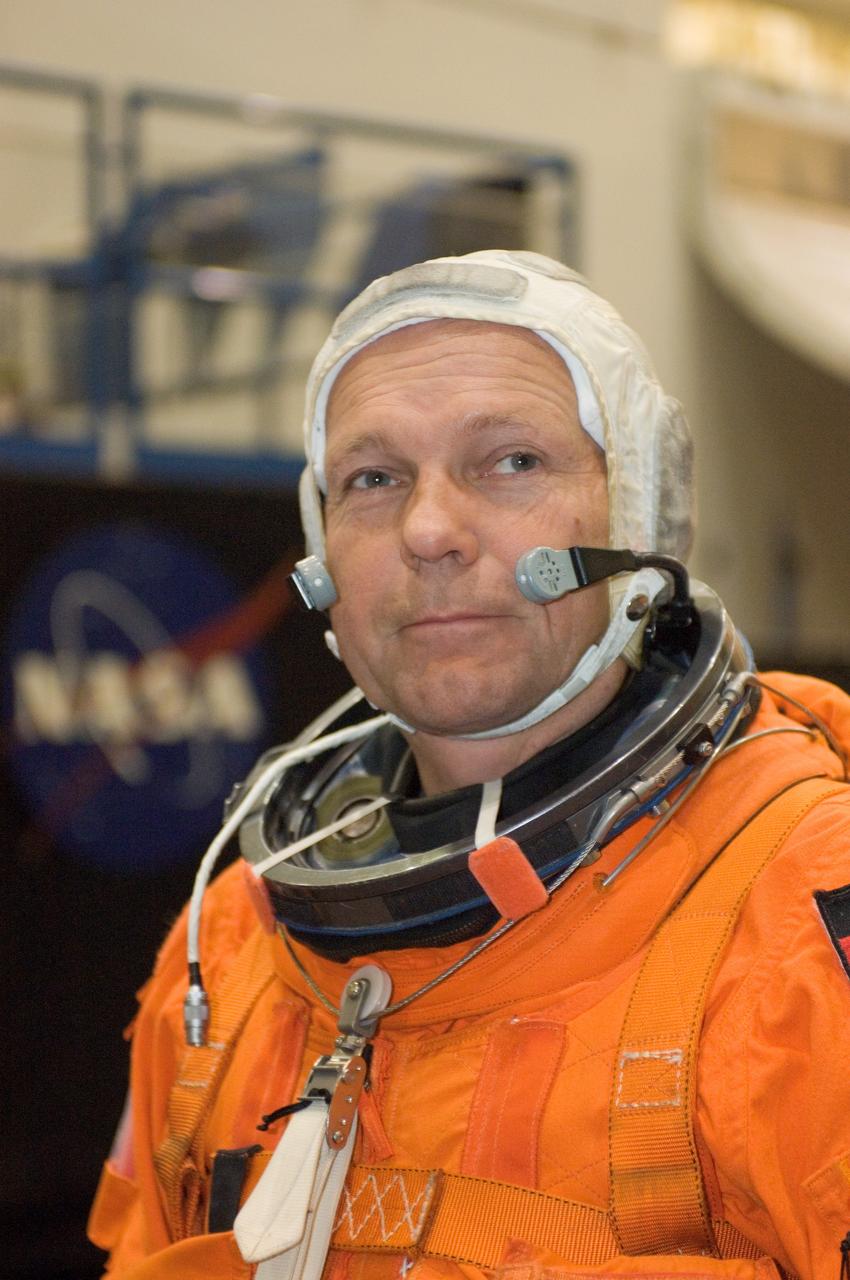
JSC2008-E-006641 (23 Jan. 2008) --- European Space Agency (ESA) astronaut Hans Schlegel, STS-122 mission specialist, awaits the start of a training session in the Space Vehicle Mockup Facility at the Johnson Space Center. Schlegel is wearing a training version of his shuttle launch and entry suit.
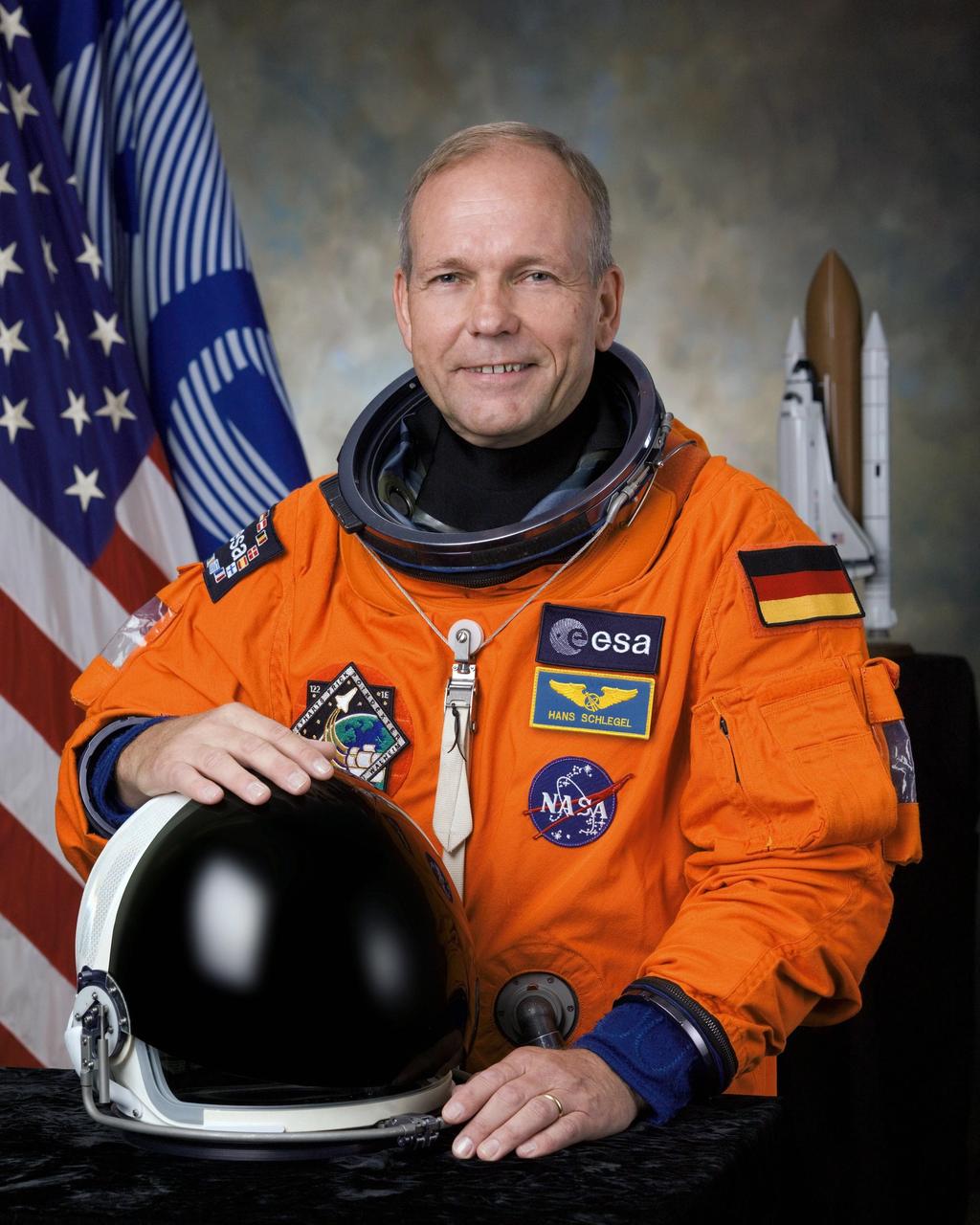
JOHNSON SPACE CENTER, Houston -- JSC2007-E-47686-- Astronaut Hans Schlegel, mission specialist representing the European Space Agency, or ESA
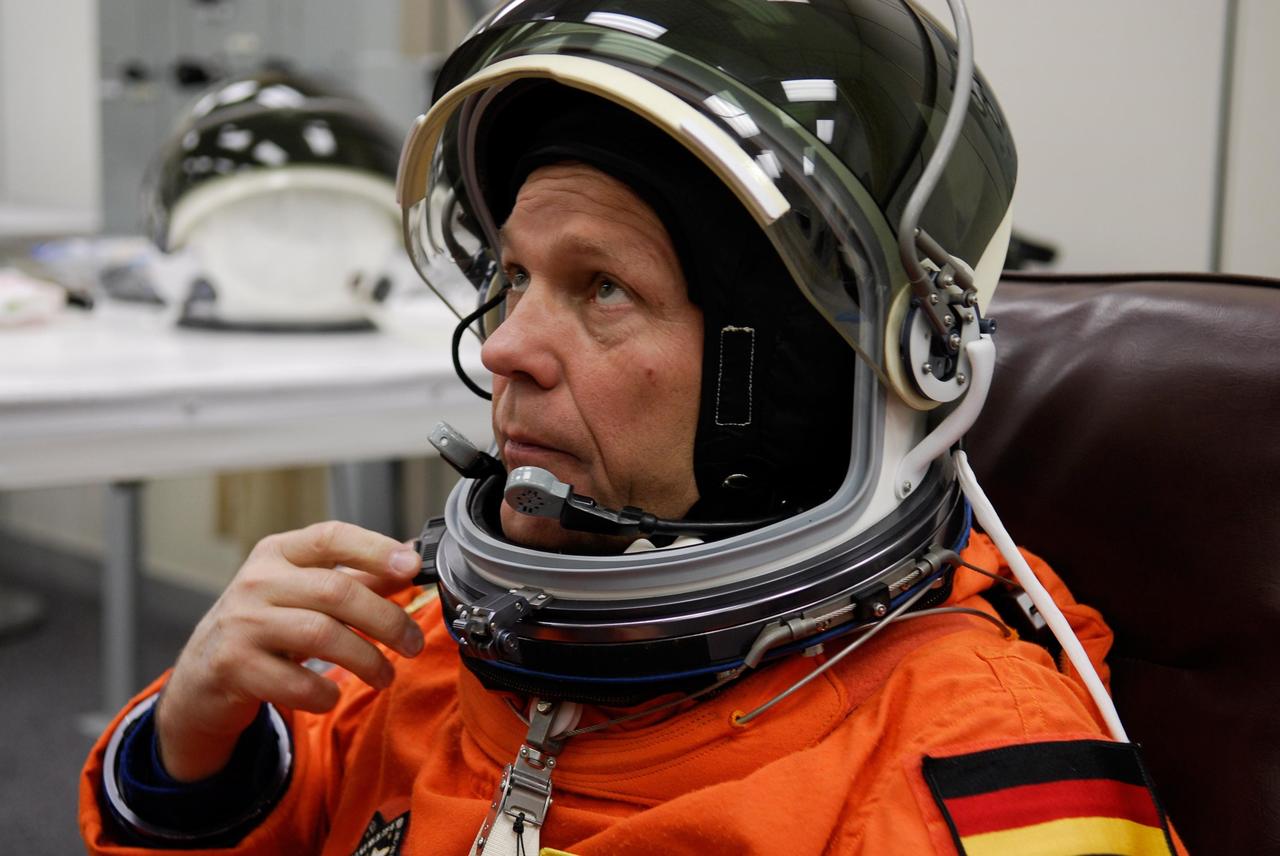
KENNEDY SPACE CENTER, FLA. -- Mission Specialist Hans Schlegel dons his helmet for launch of space shuttle Atlantis on the STS-122 mission. Schlegel represents the European Space Agency. The launch, scheduled for 2:45 p.m. EST, will be the third attempt for Atlantis since December 2007 to carry the European Space Agency's Columbus laboratory to the International Space Station. During the 11-day mission, the crew's prime objective is to attach the laboratory to the Harmony module, adding to the station's size and capabilities. Photo credit: NASA/Kim Shiflett
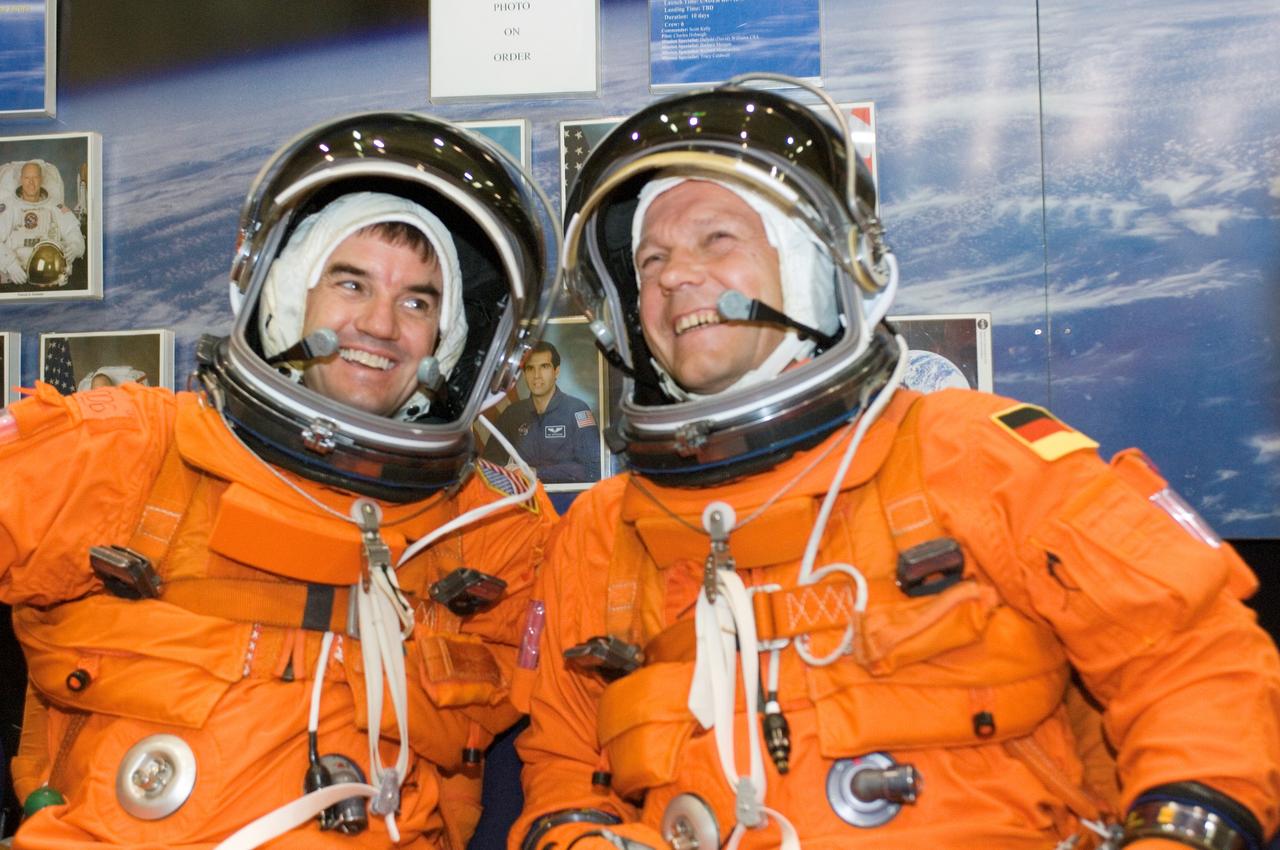
JSC2007-E-21201 (1 May 2007) --- Astronaut Rex J. Walheim (left) and European Space Agency (ESA) astronaut Hans Schlegel, STS-122 mission specialists, enjoy a light moment as they await the start of an emergency egress training session in the Space Vehicle Mockup Facility at Johnson Space Center. Walheim and Schlegel are wearing training versions of their shuttle launch and entry suits.
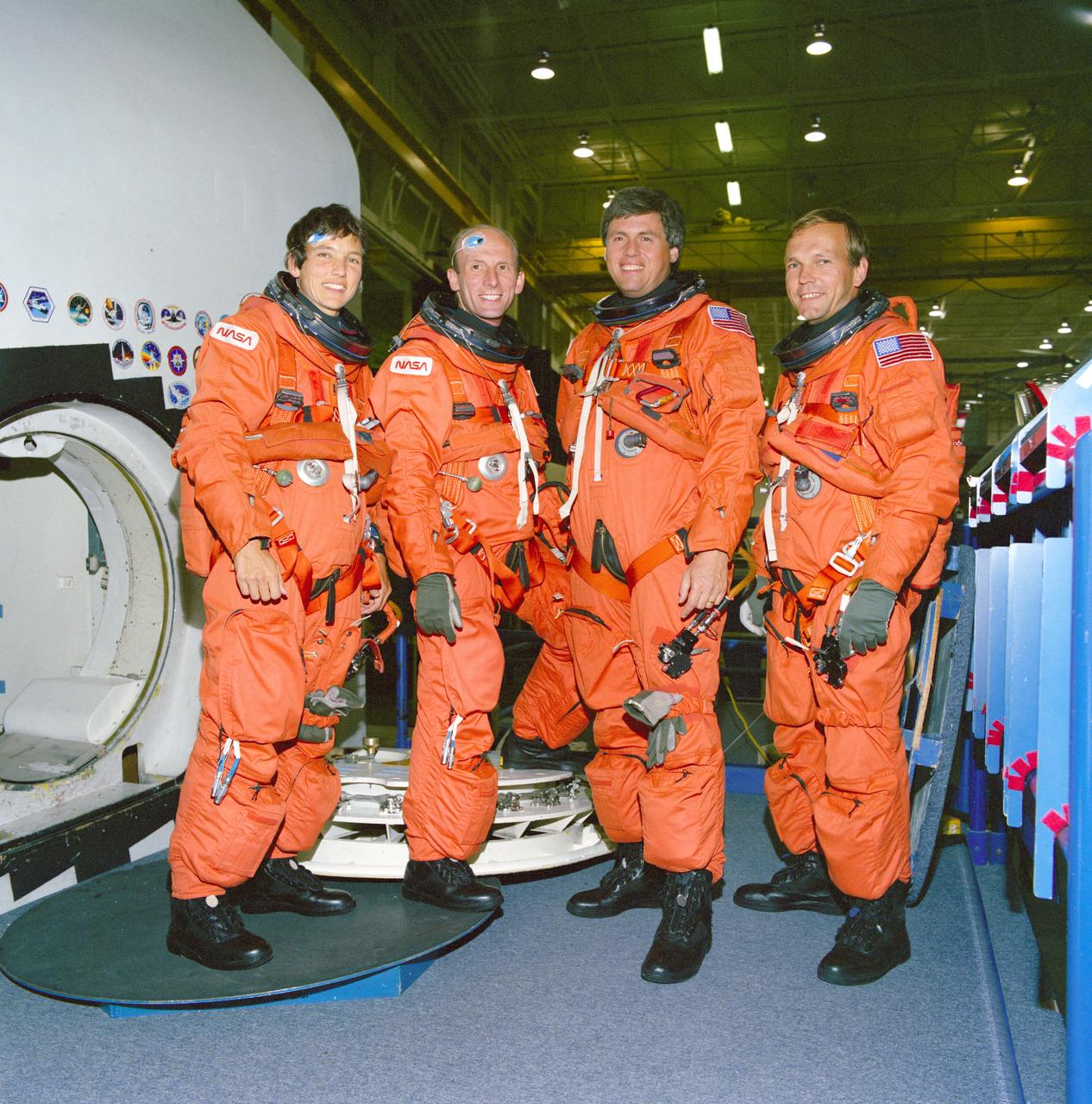
S92-48735 (18 Sept 1992) --- These four Germans have been assigned as payload specialists to support the STS-55\Spacelab D-2 mission. Left to right are Renate Brummer, Gerhard Thiele, Ulrich Walter and Hans Schlegel. Walter and Schlegel are scheduled to fly aboard the Space Shuttle Columbia for the mission, while Brummer and Thiele will serve as alternates and fill supportive roles on the ground. They are seen during a break in training in the Shuttle mockup and integration laboratory at the Johnson Space Center.
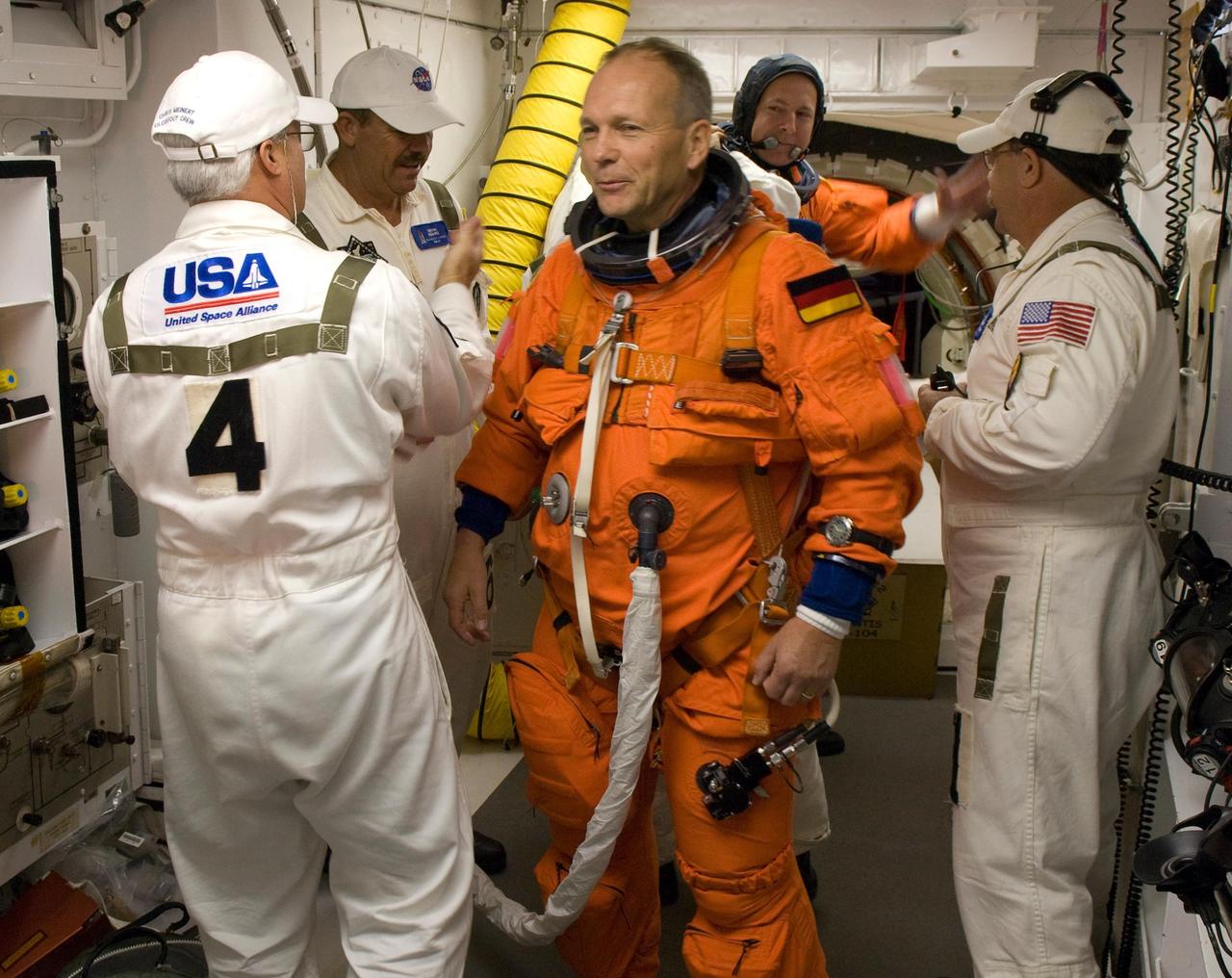
KENNEDY SPACE CENTER, FLA. -- In the White Room on Launch Pad 39A at NASA's Kennedy Space Center, the closeout crew helps STS-122 Mission Specialist Hans Schlegel with his launch and entry suit before entering space shuttle Atlantis for liftoff at 2:45 p.m. EST. Schlegel, who represents the European Space Agency, is making his second shuttle flight. Behind Schlegel is Pilot Alan Poindexter. The launch will be the third attempt for Atlantis since December 2007 to carry the European Space Agency's Columbus laboratory to the International Space Station. During the 11-day mission, the crew's prime objective is to attach the laboratory to the Harmony module, adding to the station's size and capabilities. Photo credit: NASA/Scott Haun, Rick Prickett
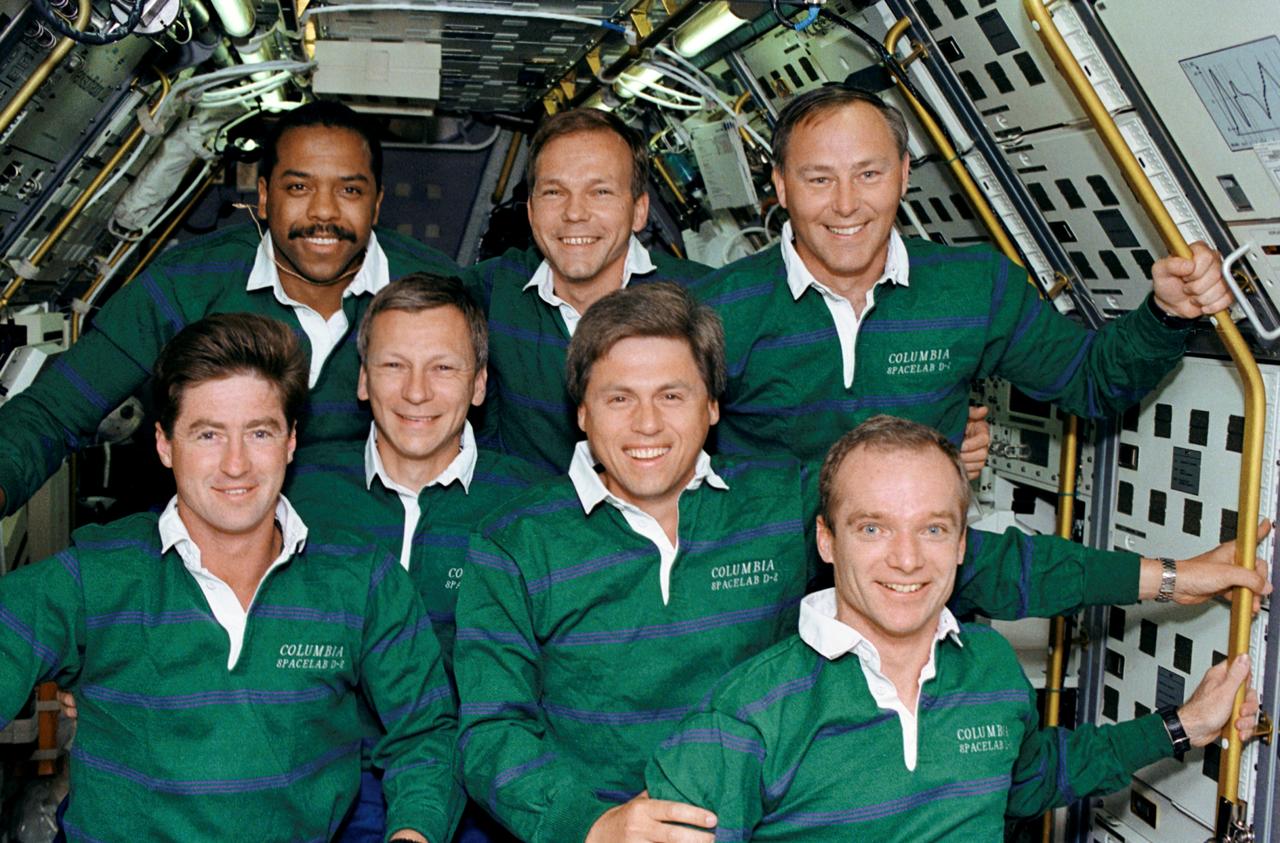
STS055-203-009 (26 April-6 May 1993) --- The seven crew members who spent 10 days aboard the space shuttle Columbia pose for the traditional in-flight portrait in the Spacelab D-2 Science Module. Front, left to right, are Terence T. (Tom) Henricks, Steven R. Nagel, Ulrich Walter and Charles J. Precourt. In the rear are (left to right) Bernard A. Harris Jr., Hans Schlegel and Jerry L. Ross. Nagel served as mission commander; Henricks was the pilot and Ross, the payload commander. Harris and Precourt were mission specialists and Schlegel and Walter were payload specialists representing the German Aerospace Research Establishment (DLR). Photo credit: NASA
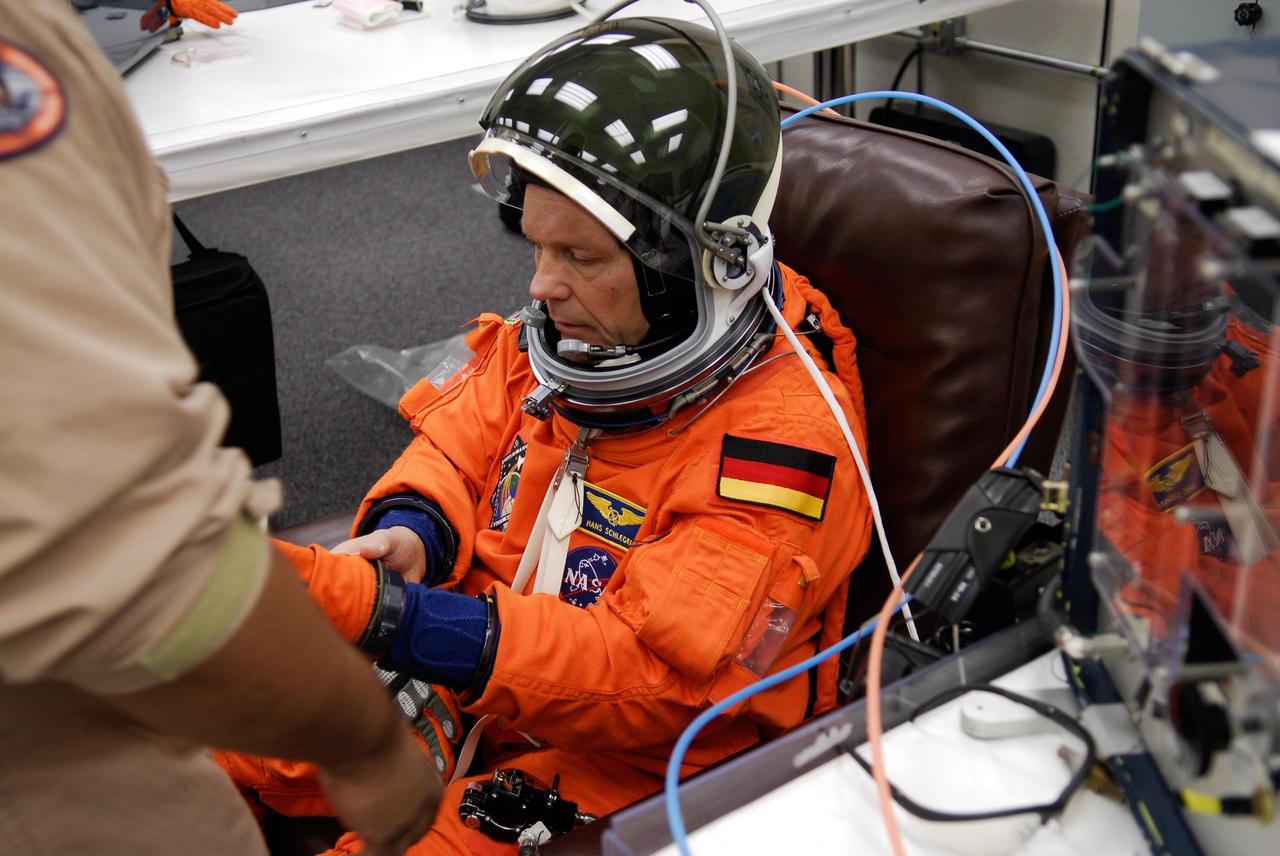
KENNEDY SPACE CENTER, FLA. -- Mission Specialist Hans Schlegel is helped with his gloves while suiting up for launch of space shuttle Atlantis on the STS-122 mission. Schlegel represents the European Space Agency. The launch, scheduled for 2:45 p.m. EST, will be the third attempt for Atlantis since December 2007 to carry the European Space Agency's Columbus laboratory to the International Space Station. During the 11-day mission, the crew's prime objective is to attach the laboratory to the Harmony module, adding to the station's size and capabilities. Photo credit: NASA/Kim Shiflett
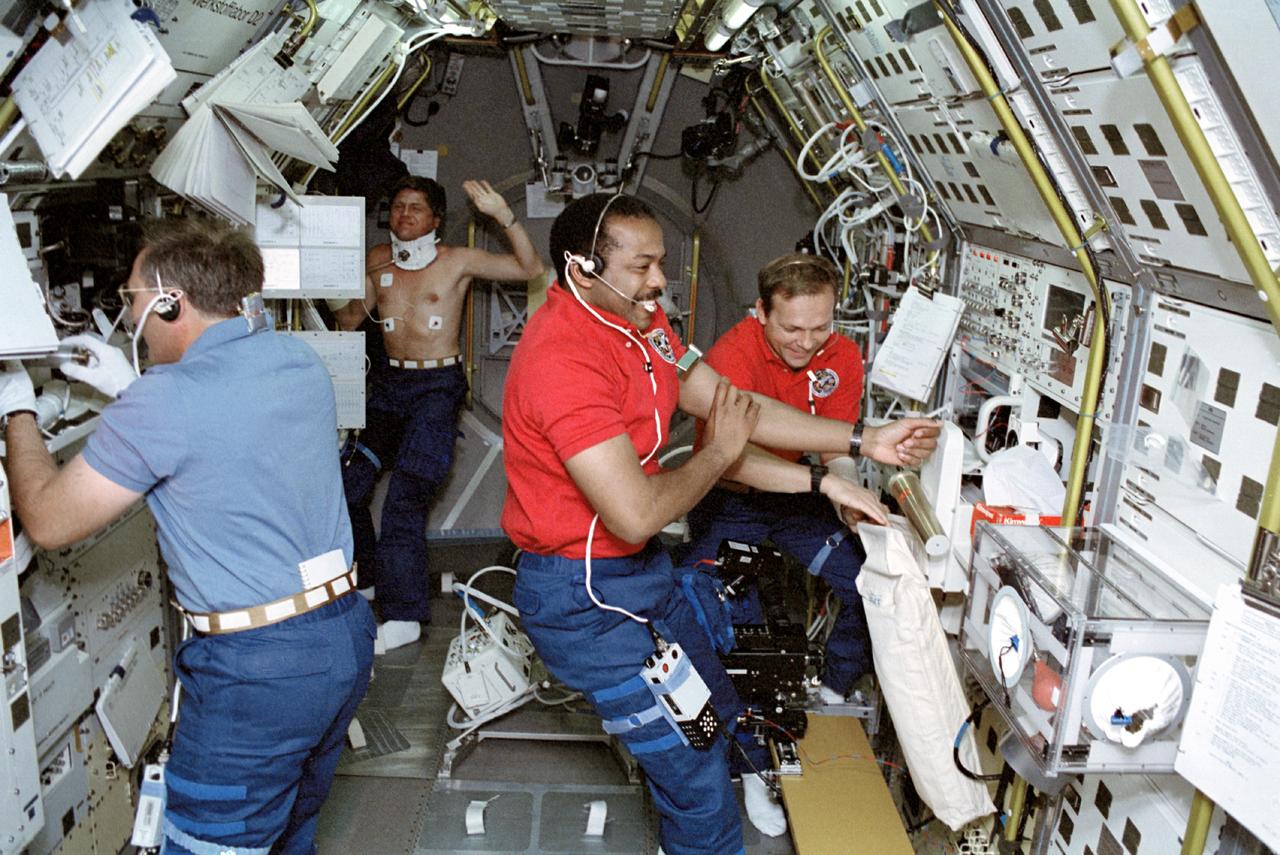
STS055-22-004 (26 April-6 May 1993) --- Four of the seven crew members who spent 10 days aboard the Space Shuttle Columbia are pictured during a brief shift overlap period in the Spacelab D-2 Science Module. Left to right are Jerry L. Ross, Ulrich Walter, Bernard A. Harris, Jr. and Hans Schlegel. Ross, STS-55 payload commander, is changing a sample in a materials processing furnace; Walter, a German payload specialist is in the midst of a baroreflex test and fellow payload specialist Schlegel assists mission specialist and physician Harris with a physiological test at the "Anthrorack".
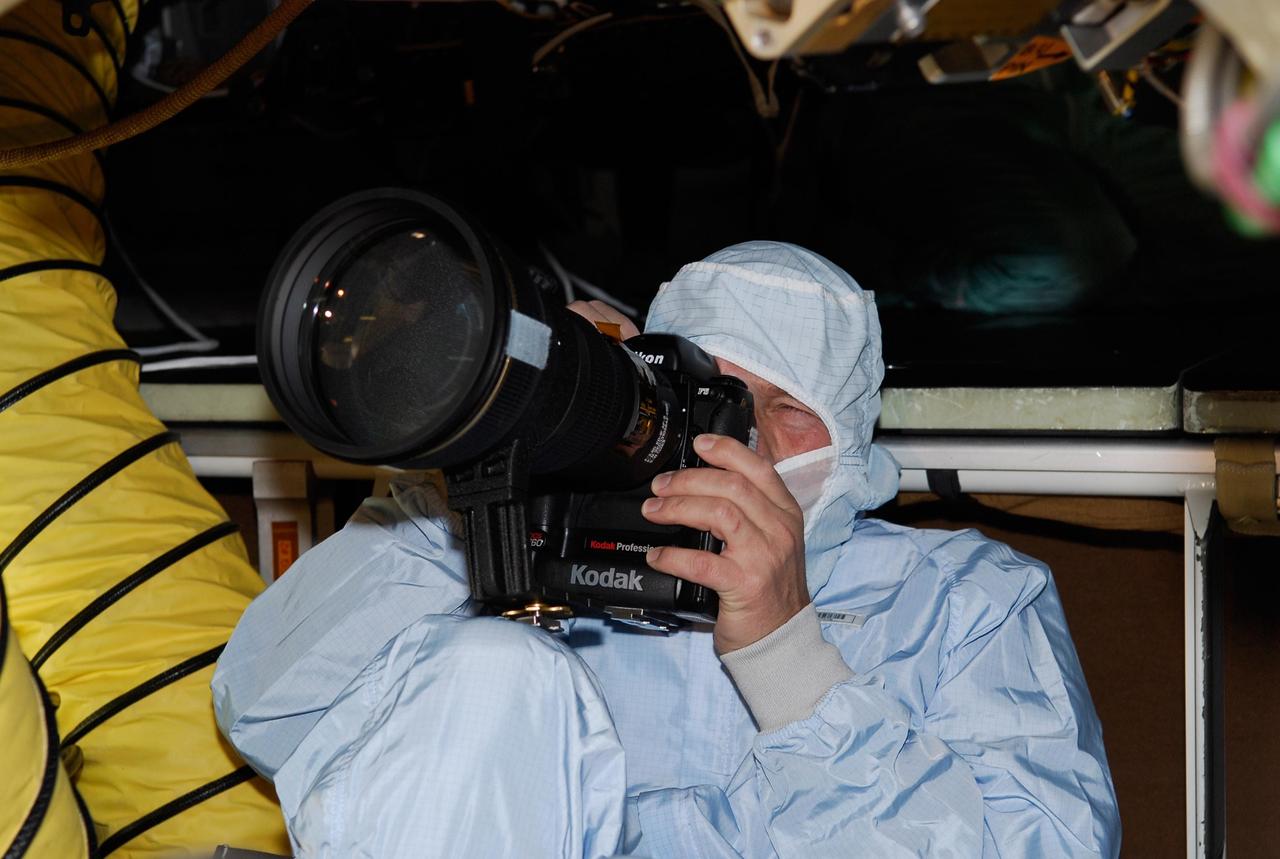
KENNEDY SPACE CENTER, FLA. -- On the flight deck of space shuttle Atlantis, STS-122 Mission Specialist Hans Schlegel handles the camera to be used during the mission. Schlegel represents the European Space Agency. The STS-122 mission to the International Space Station is scheduled to launch at 2:45 p.m. Feb. 7 with a crew of seven. Atlantis will carry the Columbus Laboratory, Europe's largest contribution to the construction of the station. Columbus will support scientific and technological research in a microgravity environment. Columbus is a multifunctional, pressurized laboratory that will be permanently attached to the Harmony module to carry out experiments in materials science, fluid physics and biosciences, as well as to perform a number of technological applications. Photo credit: NASA/Kim Shiflett

KENNEDY SPACE CENTER, FLA. -- On the flight deck of space shuttle Atlantis, STS-122 Mission Specialist Hans Schlegel handles the camera to be used during the mission. Schlegel represents the European Space Agency. The STS-122 mission to the International Space Station is scheduled to launch at 2:45 p.m. Feb. 7 with a crew of seven. Atlantis will carry the Columbus Laboratory, Europe's largest contribution to the construction of the station. Columbus will support scientific and technological research in a microgravity environment. Columbus is a multifunctional, pressurized laboratory that will be permanently attached to the Harmony module to carry out experiments in materials science, fluid physics and biosciences, as well as to perform a number of technological applications. Photo credit: NASA/Kim Shiflett
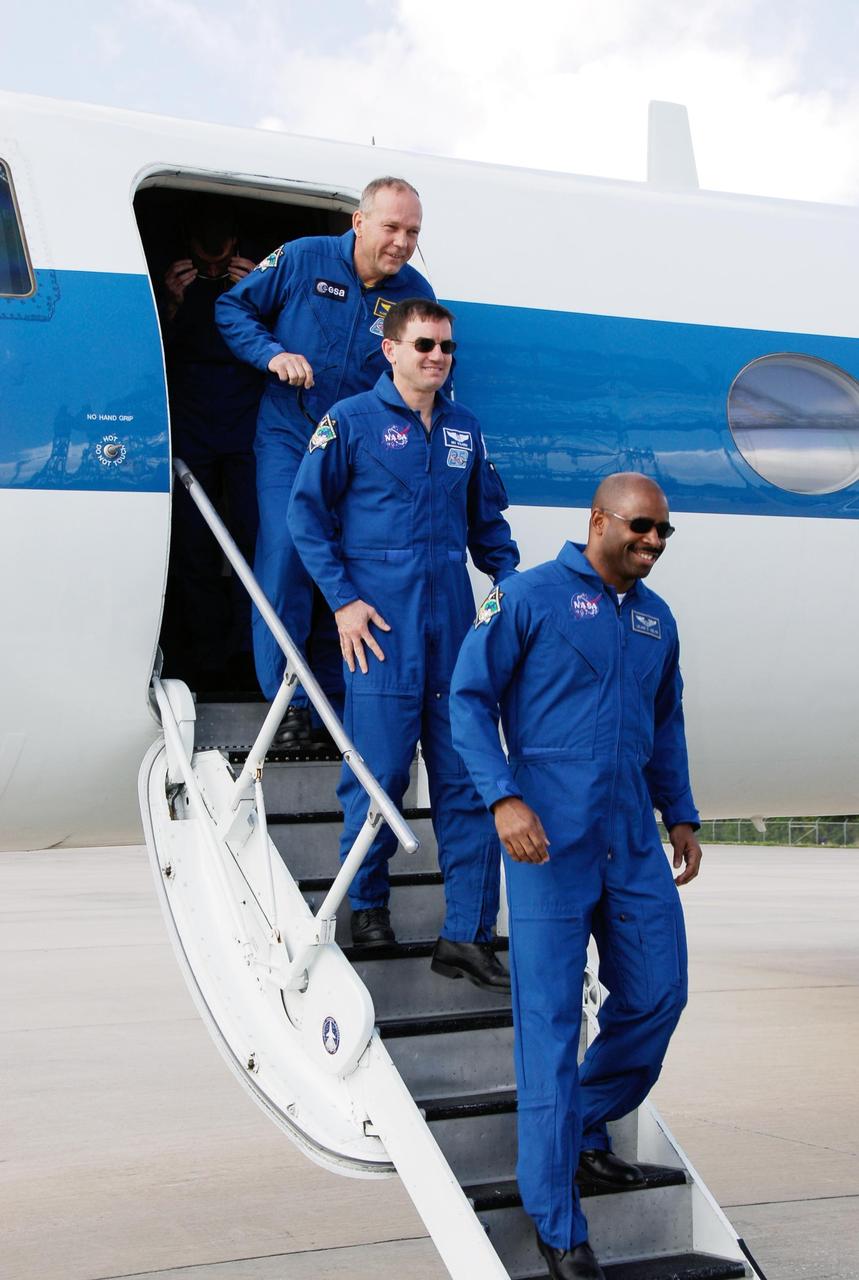
KENNEDY SPACE CENTER, FLA. -- At NASA's Kennedy Space Center, STS-122 mission specialists disembark from a shuttle training aircraft. From left are Hans Schlegel, Rex Walheim and Leland Melvin. Schlegel represents the European Space Agency. Schlegel represents the European Space Agency. The crew's arrival signals the imminent launch of space shuttle Atlantis' STS-122 mission, at 2:45 p.m. Feb. 7. This will be the third launch attempt for the mission. Some of the tank's ECO sensors gave failed readings during propellant tanking for launch attempts on Dec. 6 and Dec. 9, subsequently scrubbing further attempts until the cause could be found and repairs made. Atlantis will carry the Columbus module, Europe's largest contribution to the construction of the International Space Station. It will support scientific and technological research in a microgravity environment. Columbus is a multifunctional, pressurized laboratory that will be permanently attached to the Harmony module of the space station to carry out experiments in materials science, fluid physics and biosciences, as well as to perform a number of technological applications. Photo credit: NASA/Kim Shiflett
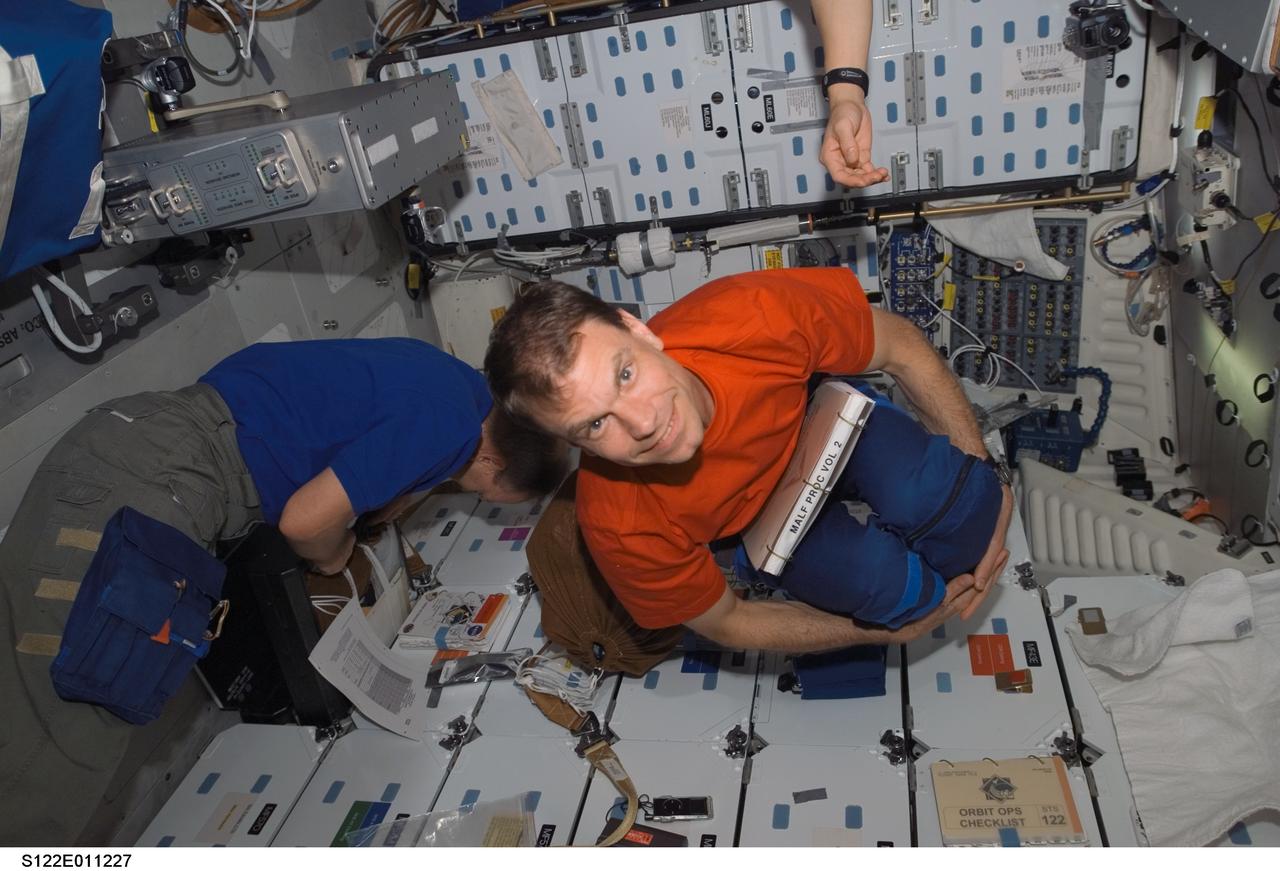
S122-E-011227 (18 Feb. 2008) --- NASA astronaut Stanley Love, STS-122 mission specialist, poses for a photo as he floats on the middeck of Space Shuttle Atlantis. European Space Agency (ESA) astronaut Hans Schlegel, mission specialist, is visible at left.
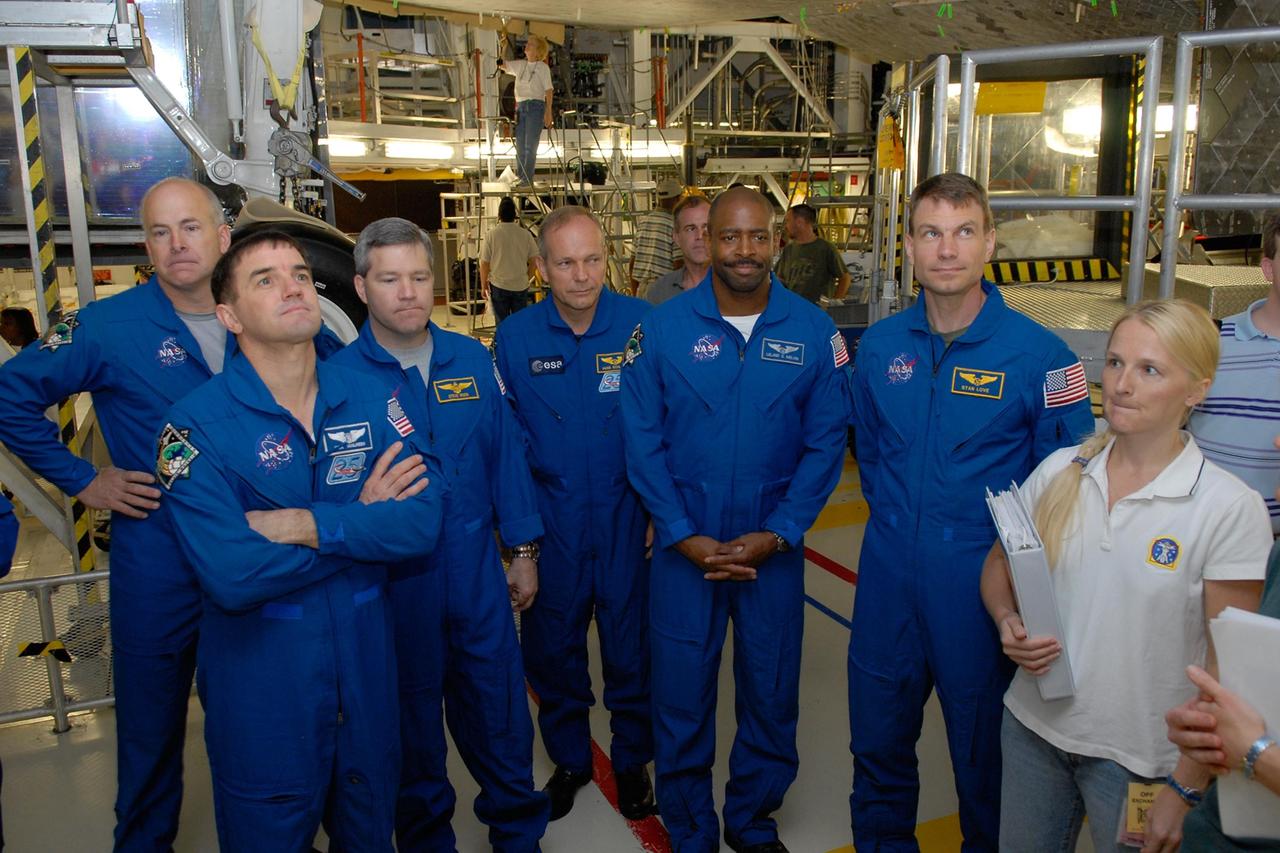
KENNEDY SPACE CENTER, FLA. -- In the Orbiter Processing Facility, members of the STS-122 crew get information about the thermal protection system on space shuttle Atlantis (overhead). From left are Pilot Alan Poindexter, Mission Specialists Rex Walheim, Commander Stephen Frick, and Mission Specialists Hans Schlegel, Leland Melvin and Stanley Love. Schlegel represents the European Space Agency. The crew is at Kennedy to take part in a crew equipment interface test, or CEIT, which helps familiarize them with equipment and payloads for the mission. Among the activities standard to a CEIT are harness training, inspection of the thermal protection system and camera operation for planned extravehicular activities, or EVAs. STS-122 is targeted for launch in December. Photo credit: NASA/Kim Shiflett
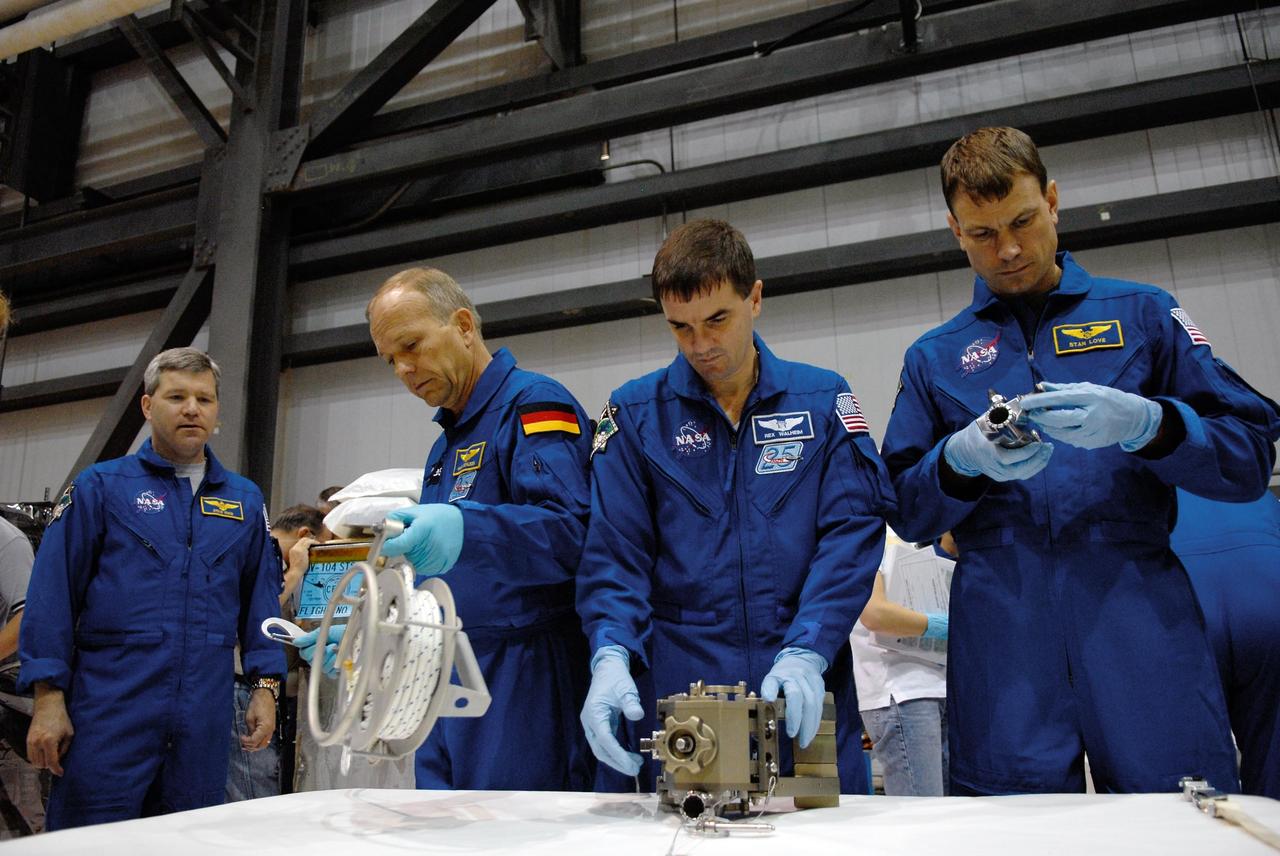
KENNEDY SPACE CENTER, FLA. -- In the Orbiter Processing Facility, STS-122 crew members practice working with equipment for the mission. From left are Commander Stephen Frick and Mission Specialists Hans Schlegel, Rex Walheim and Stanley Love. Schlegel represents the European Space Agency. The crew is at Kennedy Space Center to take part in a crew equipment interface test, which includes equipment familiarization. The mission will carry and install the Columbus Lab, a multifunctional, pressurized laboratory that will be permanently attached to Node 2 of the space station to carry out experiments in materials science, fluid physics and biosciences, as well as to perform a number of technological applications. It is Europe’s largest contribution to the construction of the International Space Station and will support scientific and technological research in a microgravity environment. STS-122 is targeted for launch in December. Photo credit: NASA/Kim Shiflett
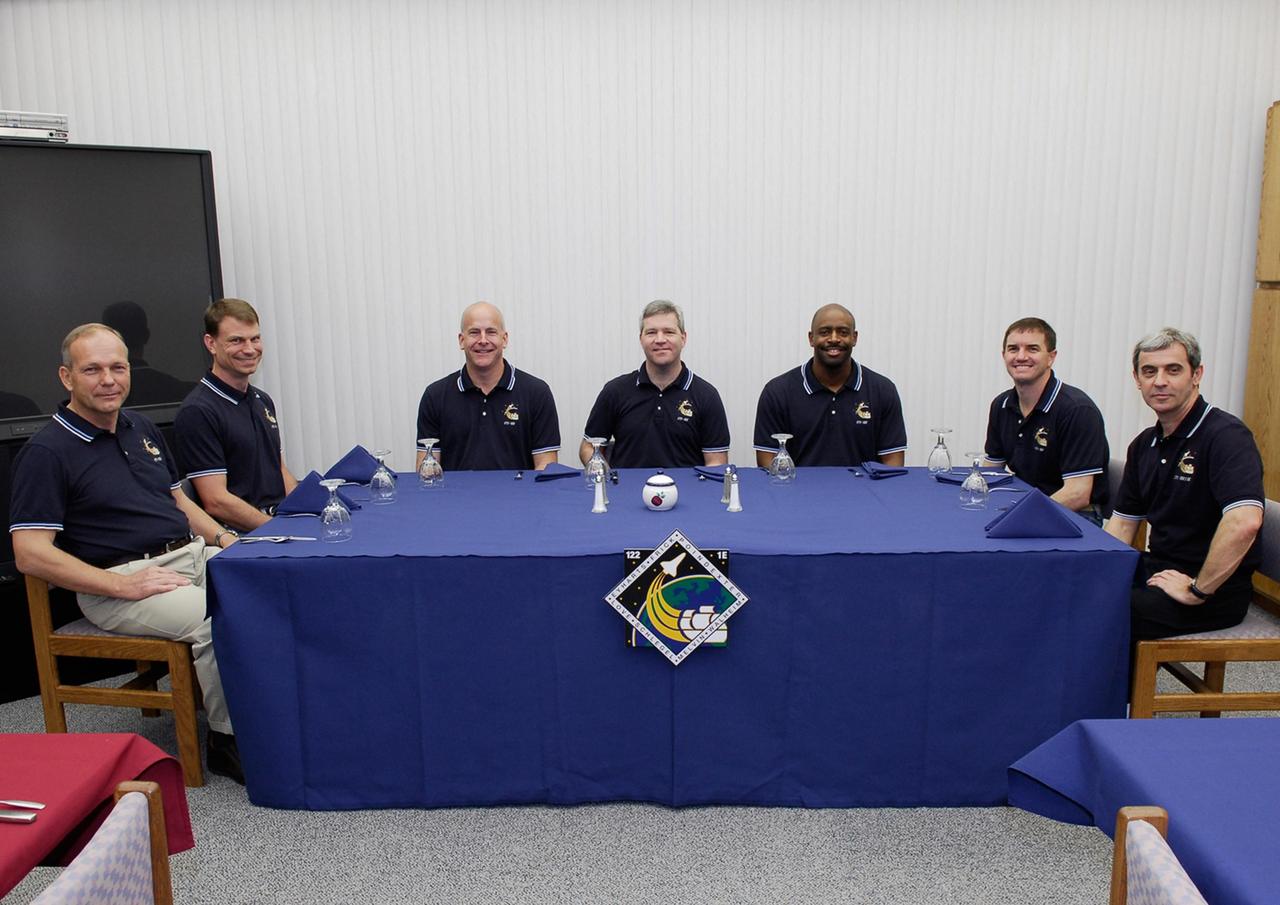
KENNEDY SPACE CENTER, FLA. -- At NASA's Kennedy Space Center, the STS-122 mission crew members have gathered for the traditional breakfast before they launch today on space shuttle Atlantis to the International Space Station. Around the table, from left, are Mission Specialists Hans Schlegel and Stanley Love, Pilot Alan Poindexter, Commander Steve Frick, and Mission Specialists Leland Melvin, Rex Walheim and Leopold Eyharts. Schlegel and Eyharts represent the European Space Agency. The launch is scheduled for 2:45 p.m. EST. It will be the third launch attempt for Atlantis since December 2007 to carry the European Space Agency's Columbus laboratory to the International Space Station. During the 11-day mission, the crew's prime objective is to attach the laboratory to the Harmony module, adding to the station's size and capabilities. Photo credit: NASA/Kim Shiflett
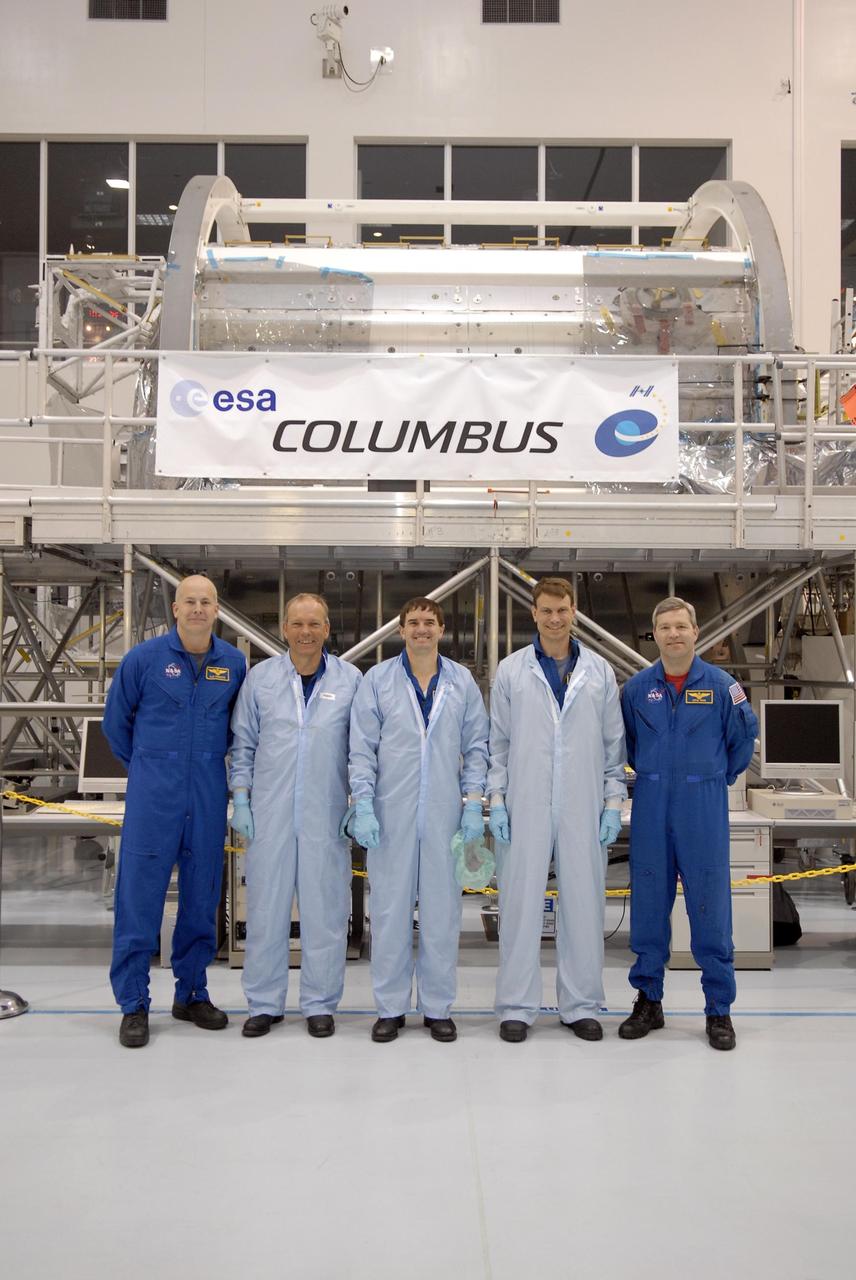
KENNEDY SPACE CENTER, FLA. -- In the Space Station Processing Facility, STS-122 crew members pause for a photo in front of the Columbus European Laboratory, part of the payload on their mission. From left are Pilot Alan Poindexter, Mission Specialists Hans Schlegel, Rex Walheim and Stan Love, and Commander Steve Frick. Schlegel represents the European Space Agency. The crew is participating in a crew equipment interface test that provides opportunities for hands-on experience with payloads and equipment. The 24th mission to the International Space Station, STS-122 will also include the Multi-Purpose Experiment Support Structure - Non-Deployable (MPESS-ND). Launch of STS-122 on Space Shuttle Discovery is scheduled no earlier than October. Photo credit: NASA/Kim Shiflett

KENNEDY SPACE CENTER, FLA. -- STS-122 Mission Specialist Hans Schlegel checks the helmet to his launch and entry suit for a final fitting before space shuttle Atlantis' launch scheduled for 4:31 p.m. EST on Dec. 6. Schlegel, who represents the European Space Agency, will make his second shuttle flight. Atlantis will carry the Columbus Lab, Europe’s largest contribution to the construction of the International Space Station. It will support scientific and technological research in a microgravity environment. Columbus, a program of ESA, is a multifunctional, pressurized laboratory that will be permanently attached to Node 2 of the space station to carry out experiments in materials science, fluid physics and biosciences, as well as to perform a number of technological applications. Photo credit: NASA/Kim Shiflett
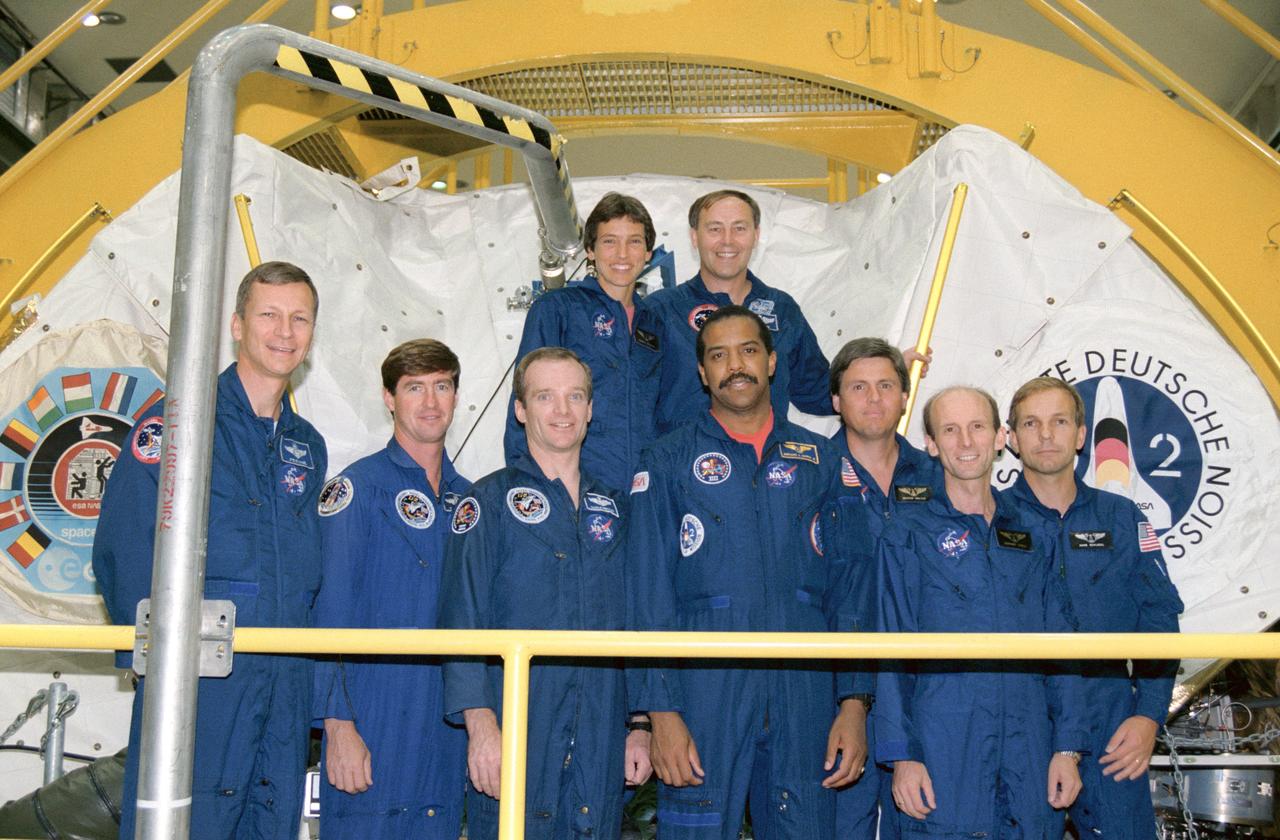
S92-49373 (8 Dec 1992) --- The seven prime flight crewmembers and two alternates assigned to support the STS-55\Spacelab D-2 mission pose with their science module. Left to right (front) are Steven R. Nagel, Terence T. (Tom) Henricks, Charles J. Precourt, Bernard A. Harris Jr., Ulrich Walter, Gerhard Thiele and Hans Schlegel; and (back) Renate Brummer and Jerry L. Ross. Nagel is mission commander; Henricks, pilot; and Ross, payload commander. Harris and Precourt will serve as mission specialists. Walter and Schlegel are scheduled to represent the DLR as payload specialists for the mission, while Brummer and Thiele will serve as alternates and fill supportive roles on the ground. The crew was photographed during a tour of the science module before its integration at Kennedy Space Center (KSC).

KENNEDY SPACE CENTER, FLA. -- At NASA's Kennedy Space Center, the STS-122 mission crew members stride out of the Operations and Checkout Building, eager to ride to the launch pad and take their seats in space shuttle Atlantis for the planned launch today at 2:45 p.m. EST. Seen on the right, front to back, are Commander Steve Frick and Mission Specialists Rex Walheim and Hans Schlegel. On the left, front to back, are Pilot Alan Poindexter, followed by Mission Specialists Leland Melvin, Stanley Love and Leopold Eyharts. Schlegel and Eyharts represent the European Space Agency. The launch will be the third attempt for Atlantis since December 2007 to carry the European Space Agency's Columbus laboratory to the International Space Station. During the 11-day mission, the crew's prime objective is to attach the laboratory to the Harmony module, adding to the station's size and capabilities. Photo credit: NASA/Kim Shiflett
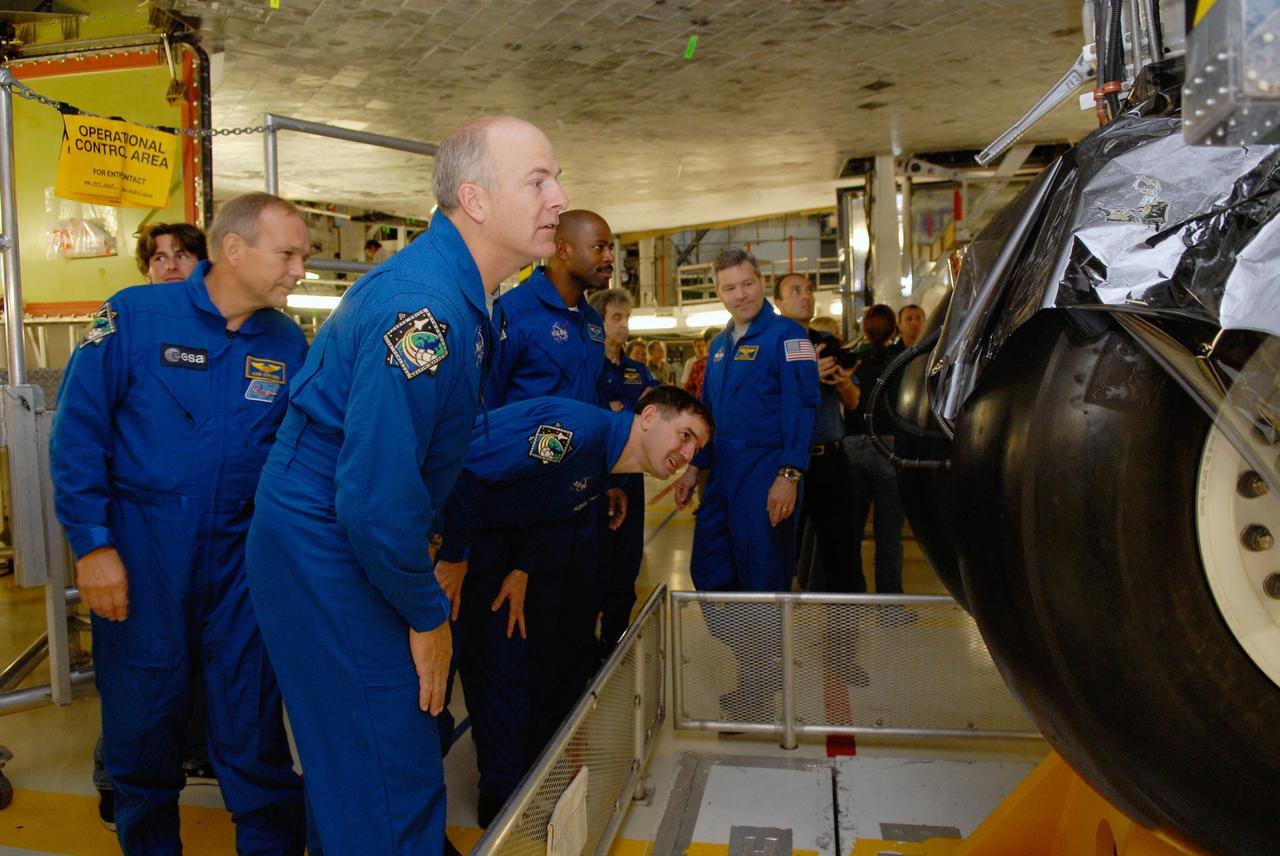
KENNEDY SPACE CENTER, FLA. -- In the Orbiter Processing Facility, members of the STS-122 crew get a close look at the landing gear on space shuttle Atlantis. From left are Mission Specialist Hans Schlegel, Pilot Alan Poindexter, Mission Specialists Rex Walheim and Leland Melvin and Commander Stephen Frick. Schlegel represents the European Space Agency. The crew is at Kennedy to take part in a crew equipment interface test, or CEIT, which helps familiarize them with equipment and payloads for the mission. Among the activities standard to a CEIT are harness training, inspection of the thermal protection system and camera operation for planned extravehicular activities, or EVAs. STS-122 is targeted for launch in December. Photo credit: NASA/Kim Shiflett
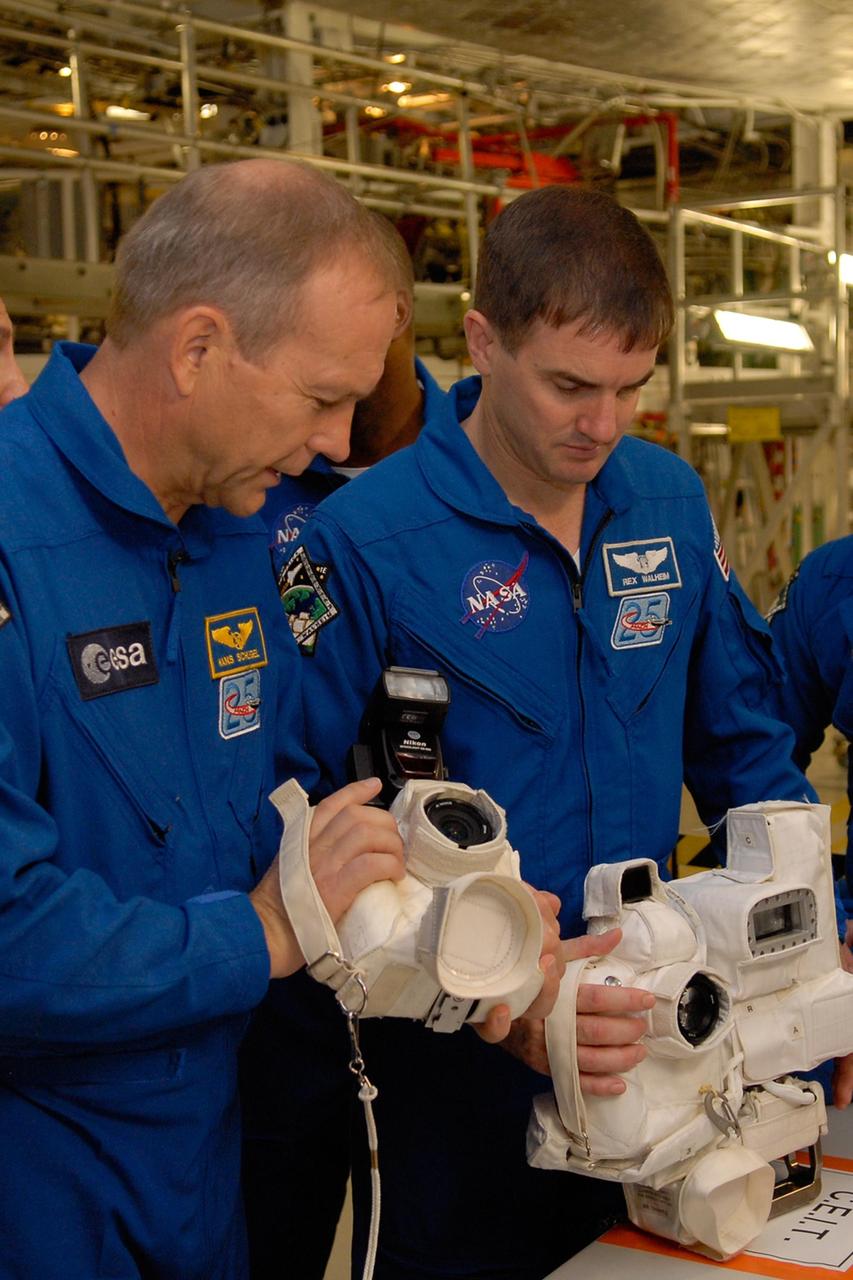
KENNEDY SPACE CENTER, FLA. -- In the Orbiter Processing Facility, members of the STS-122 crew look over cameras that will be used during the mission. From left are Mission Specialists Hans Schlegel and Rex Walheim. Schlegel represents the European Space Agency. The crew is at Kennedy Space Center to take part in a crew equipment interface test, which helps familiarize them with equipment and payloads for the mission. Among the activities standard to a CEIT are harness training, inspection of the thermal protection system and camera operation for planned extravehicular activities, or EVAs. The mission will carry and install the Columbus Lab, a multifunctional, pressurized laboratory that will be permanently attached to Node 2 of the space station to carry out experiments in materials science, fluid physics and biosciences, as well as to perform a number of technological applications. It is Europe’s largest contribution to the construction of the International Space Station and will support scientific and technological research in a microgravity environment. STS-122 is targeted for launch in December. Photo credit: NASA/Kim Shiflett

KENNEDY SPACE CENTER, FLA. -- After the mission STS-122 crew's arrival at NASA's Kennedy Space Center, Mission Specialist Hans Schlegel is introduced during a media opportunity on the Shuttle Landing Facility. Schlegel represents the European Space Agency. The crew's arrival signals the imminent launch of space shuttle Atlantis on mission STS-122. The launch countdown begins at 7 p.m. Dec. 3. Launch is scheduled for 4:31 p.m. EST on Dec. 6. Atlantis will carry the Columbus Lab, Europe's largest contribution to the construction of the International Space Station. It will support scientific and technological research in a microgravity environment. Columbus, a program of ESA, is a multifunctional, pressurized laboratory that will be permanently attached to Node 2 of the space station to carry out experiments in materials science, fluid physics and biosciences, as well as to perform a number of technological applications. Photo credit: NASA/Kim Shiflett
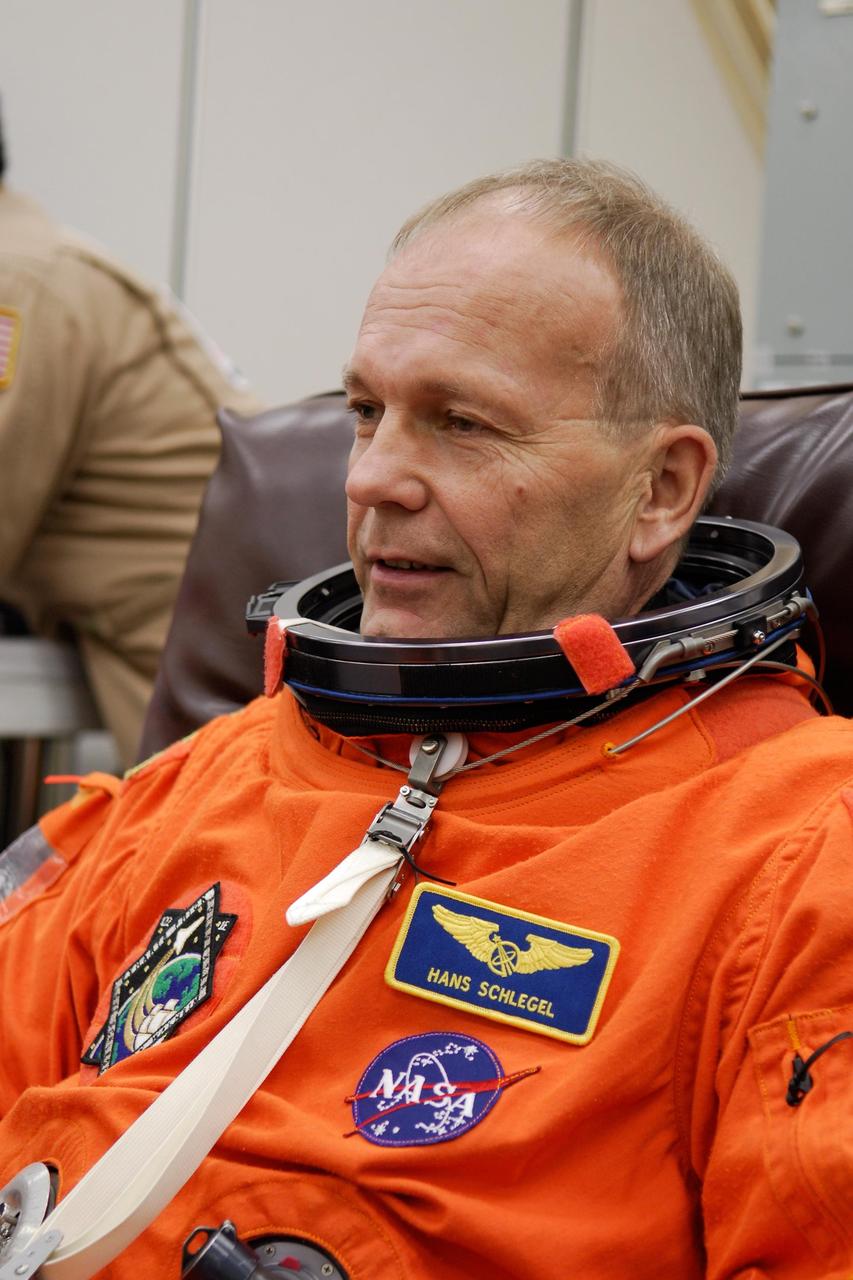
KENNEDY SPACE CENTER, FLA. -- STS-122 Mission Specialist Hans Schlegel dons his launch and entry suit for a final fitting before space shuttle Atlantis' launch scheduled for 4:31 p.m. EST on Dec. 6. Schlegel, who represents the European Space Agency, will make his second shuttle flight. Atlantis will carry the Columbus Lab, Europe’s largest contribution to the construction of the International Space Station. It will support scientific and technological research in a microgravity environment. Columbus, a program of ESA, is a multifunctional, pressurized laboratory that will be permanently attached to Node 2 of the space station to carry out experiments in materials science, fluid physics and biosciences, as well as to perform a number of technological applications. Photo credit: NASA/Kim Shiflett
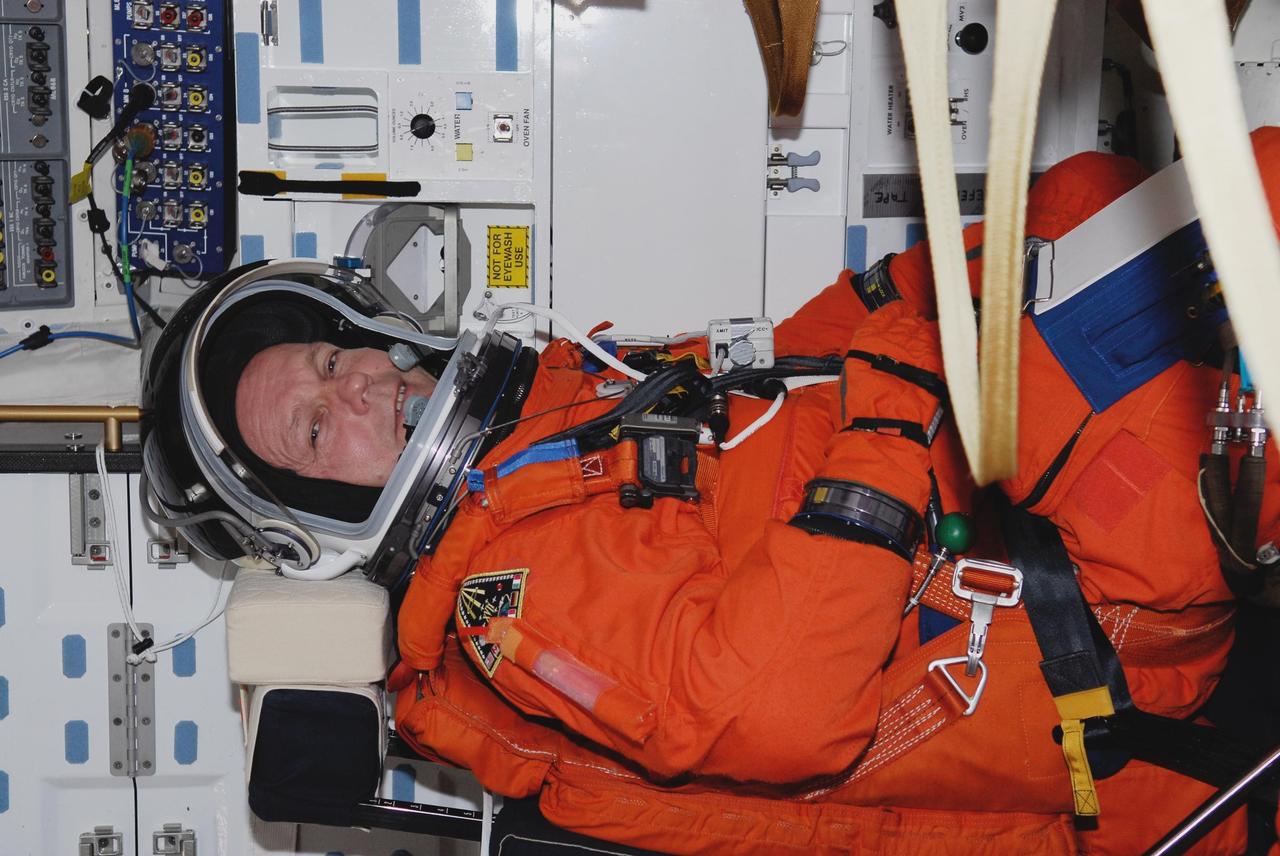
KENNEDY SPACE CENTER, FLA. -- Space shuttle Atlantis STS-122 Mission Specialist Hans Schlegel is strapped into his seat on Atlantis' fight deck during a simulated launch countdown. Schlegel is with the European Space Agency. The exercise is part of terminal countdown demonstration test, or TCDT, activities at NASA's Kennedy Space Center. The TCDT is a dress rehearsal for launch and also provides astronauts and ground crews with equipment familiarization and emergency egress training. On mission STS-122, Atlantis will deliver the Columbus module to the International Space Station. The European Space Agency's largest single contribution to the station, Columbus is a multifunctional, pressurized laboratory that will be permanently attached to U.S. Node 2, called Harmony. The laboratory will expand the research facilities aboard the station, providing crew members and scientists from around the world the ability to conduct a variety of experiments in the physical, materials and life sciences. Atlantis' launch is targeted for Dec. 6. Photo credit: NASA/Kim Shiflett
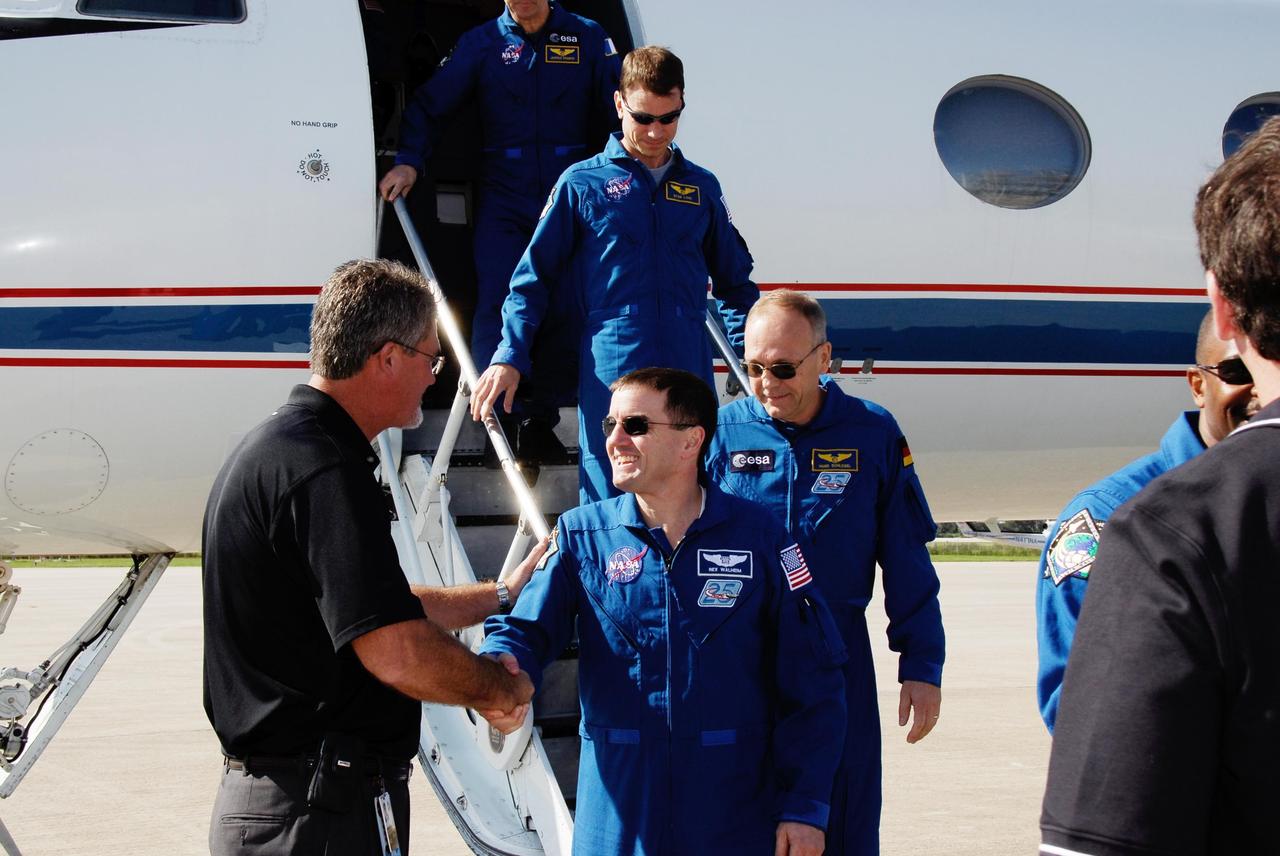
KENNEDY SPACE CENTER, FLA. -- Center Director Bill Parsons welcomes STS-122 Mission Specialist Rex Walheim after the mission crew's arrival at NASA's Kennedy Space Center. Behind Walheim are Mission Specialists Hans Schlegel and Stanley Love. Schlegel represents the European Space Agency. The crew's arrival signals the imminent launch of space shuttle Atlantis on mission STS-122. The launch countdown begins at 7 p.m. Dec. 3. Launch is scheduled for 4:31 p.m. EST on Dec. 6. Atlantis will carry the Columbus Lab, Europe's largest contribution to the construction of the International Space Station. It will support scientific and technological research in a microgravity environment. Columbus, a program of ESA, is a multifunctional, pressurized laboratory that will be permanently attached to Node 2 of the space station to carry out experiments in materials science, fluid physics and biosciences, as well as to perform a number of technological applications. Photo credit: NASA/Kim Shiflett
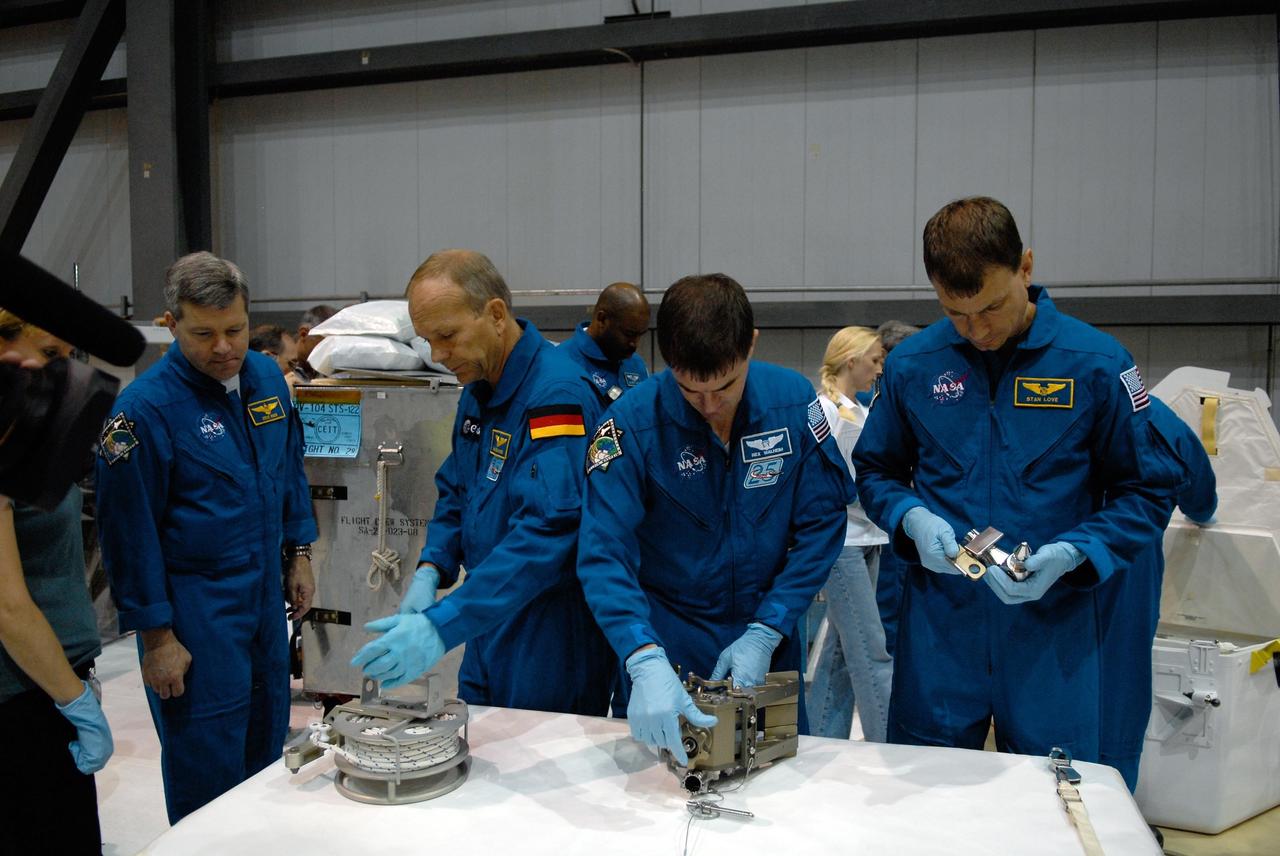
KENNEDY SPACE CENTER, FLA. -- In the Orbiter Processing Facility, STS-122 crew members practice working with equipment for the mission. From left are Commander Stephen Frick and Mission Specialists Hans Schlegel, Leland Melvin (behind), Rex Walheim and Stanley Love. Schlegel represents the European Space Agency. The crew is at Kennedy Space Center to take part in a crew equipment interface test, which includes equipment familiarization. The mission will carry and install the Columbus Lab, a multifunctional, pressurized laboratory that will be permanently attached to Node 2 of the space station to carry out experiments in materials science, fluid physics and biosciences, as well as to perform a number of technological applications. It is Europe’s largest contribution to the construction of the International Space Station and will support scientific and technological research in a microgravity environment. STS-122 is targeted for launch in December. Photo credit: NASA/Kim Shiflett
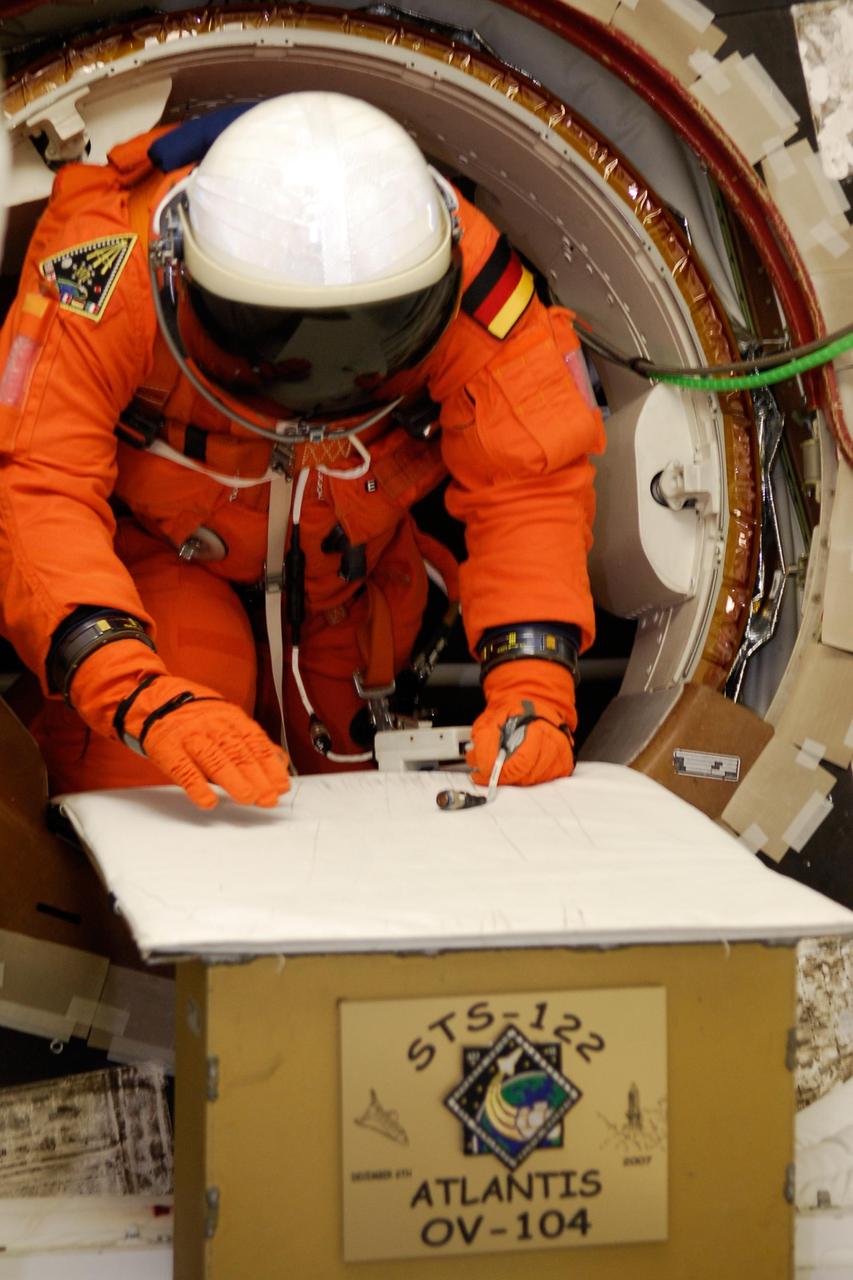
KENNEDY SPACE CENTER, FLA. -- Space shuttle Atlantis STS-122 Mission Specialist Hans Schlegel exits Atlantis' fight deck following a simulated launch countdown at Launch Pad 39A. Schlegel is with the European Space Agency. The exercise is part of terminal countdown demonstration test, or TCDT, activities at NASA's Kennedy Space Center. The TCDT is a dress rehearsal for launch and also provides astronauts and ground crews with equipment familiarization and emergency egress training. On mission STS-122, Atlantis will deliver the Columbus module to the International Space Station. The European Space Agency's largest single contribution to the station, Columbus is a multifunctional, pressurized laboratory that will be permanently attached to U.S. Node 2, called Harmony. The laboratory will expand the research facilities aboard the station, providing crew members and scientists from around the world the ability to conduct a variety of experiments in the physical, materials and life sciences. Atlantis' launch is targeted for Dec. 6. Photo credit: NASA/Kim Shiflett
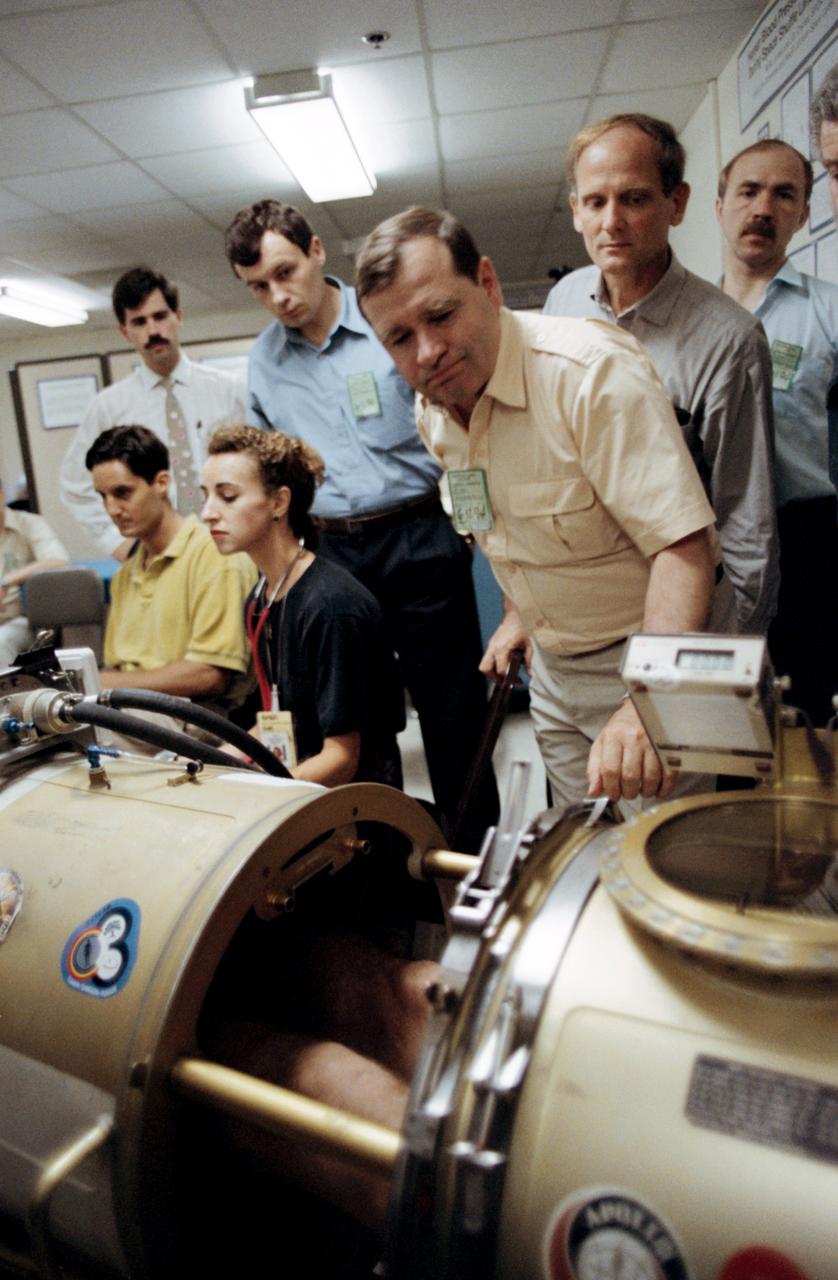
Astronaut Norman E. Thagard (right center), a guest researcher on Russia's Mir 18 mission, monitors a test of a subject (out of frame) in the Lower Body Negative Pressure (LBNP) device. Others pictured, left to right, are Todd Schlegel (seated) of the Medical Sciences Division at JSC, unidentified trainer, Linda Barrows of Krug; cosmonaut Vladimir N. Dezhurov, mission commander; cosmonaut Gennadiy M. Strekalov, Thagard and cosmonaut Alexsandr F. Poleshchuk, Mir 18 reserve flight engineer.
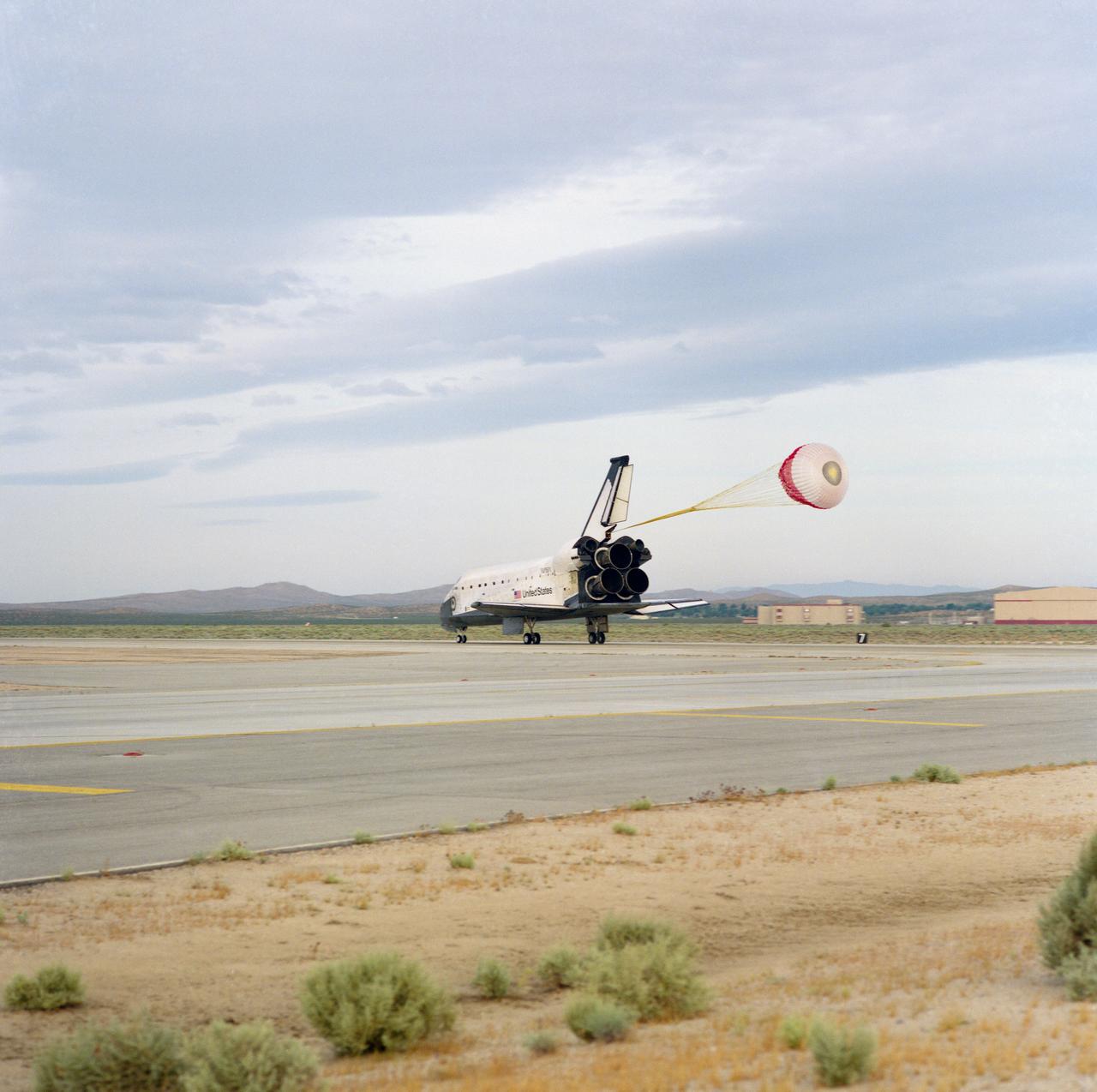
STS055-S-089 (6 May 1993) --- The main drag chute on the Space Shuttle Columbia is almost fully deployed in this three-quarter aft view of the vehicle's runway landing at Edwards Air Force Base in California. Landing occurred at 7:30 a.m. (PDT), May 6, 1993. Onboard the spacecraft were astronauts Steven R. Nagel, Terence T. (Tom) Henricks, Jerry L. Ross, Bernard Harris Jr. and Charles J. Precourt, along with German payload specialists Hans Schlegel and Ulrich Walter.
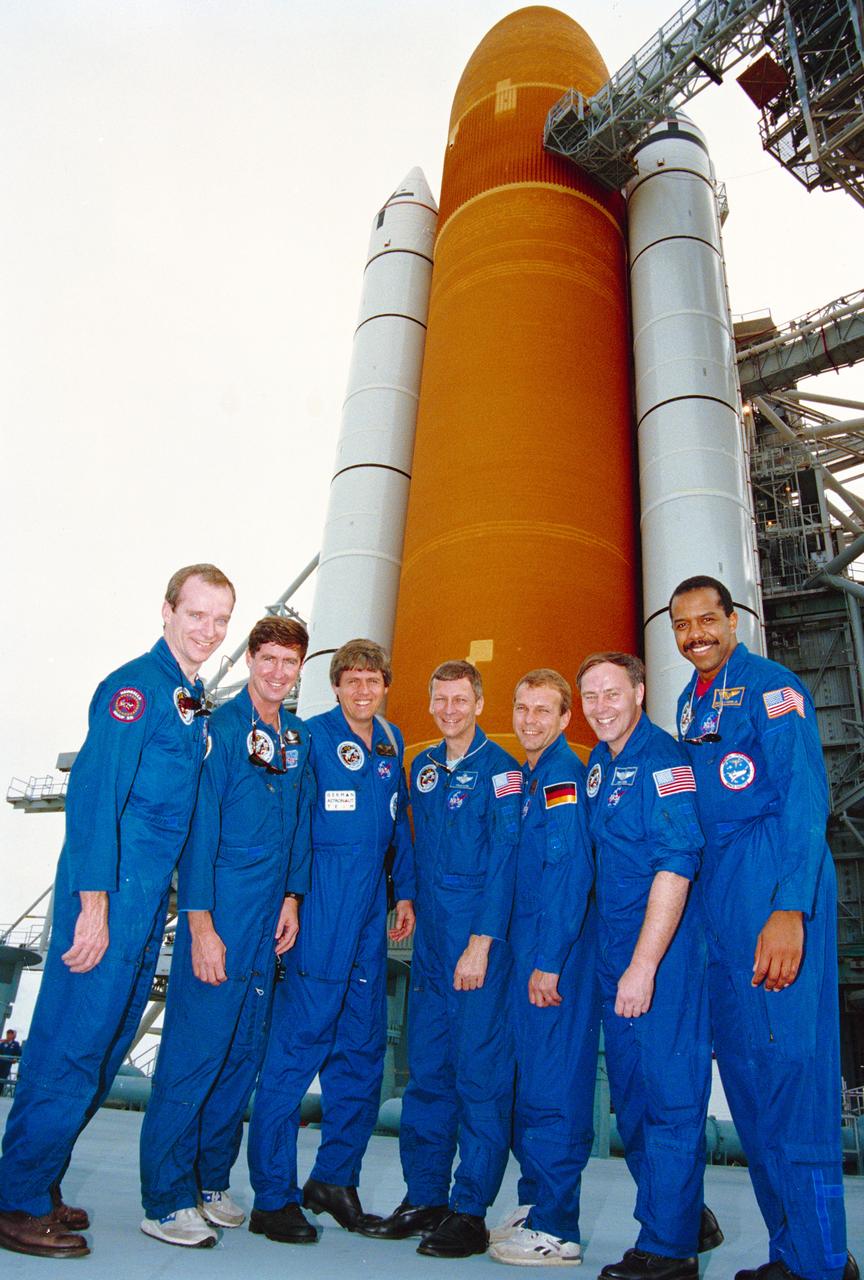
S93-29860 (11 Feb 1993) --- The STS-55 crew poses for a group portrait next to the Space Shuttle Columbia at Launch Pad 39A. From left are mission specialist Charles J. Precourt; pilot Terence T. Henricks; payload specialist Ulrich Walter, mission commander Steven R. Nagel; payload specialist Hans Schlegel; payload commander Jerry L. Ross; and mission specialist Bernard A. Harris Jr.. The crew is at KSC for the Terminal Countdown Demonstration Test (TCDT), a dress rehearsal for launch.
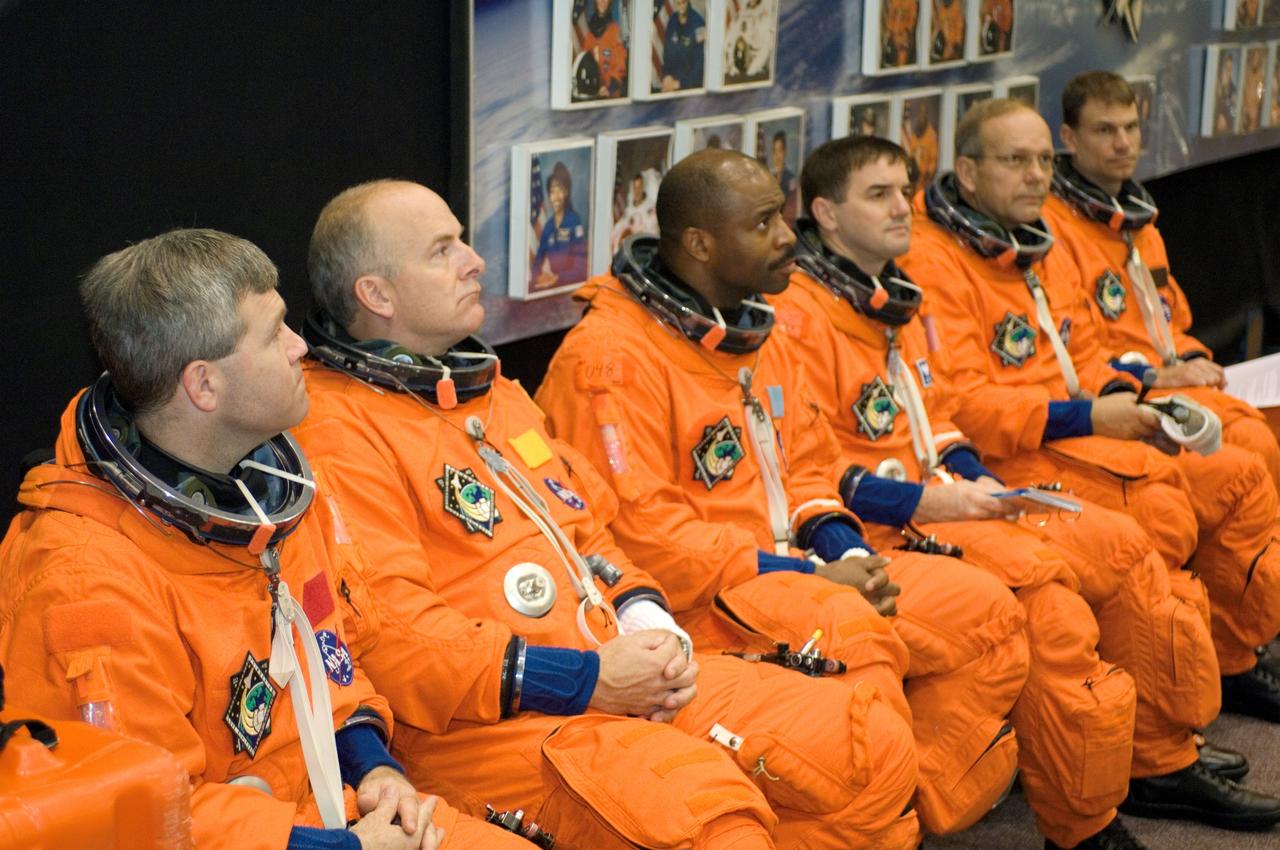
JSC2007-E-49821 (3 Oct. 2007) --- Astronauts Stephen N. Frick (left), STS-122 commander; Alan G. Poindexter, pilot; Leland D. Melvin, Rex J. Walheim, European Space Agency's (ESA) Hans Schlegel and Stanley G. Love, all mission specialists, await the start of a training session in the Space Vehicle Mockup Facility at the Johnson Space Center. The crewmembers are attired in training versions of their shuttle launch and entry suits.
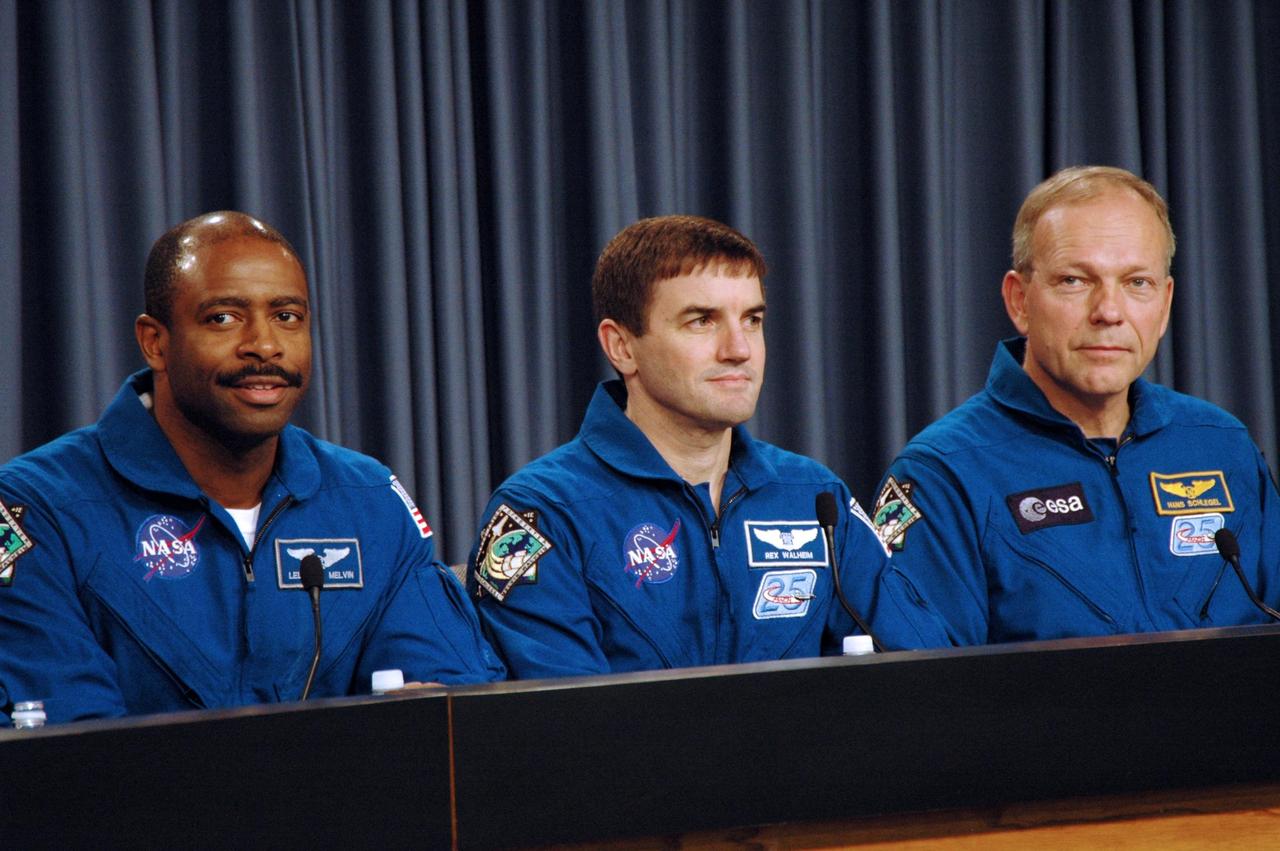
KENNEDY SPACE CENTER, FLA. -- The STS-122 crew discusses its mission at a post-landing conference. Seen here, from left, are Mission Specialists Leland Melvin, Rex Walheim and Hans Schlegel, who represents the European Space Agency. After a round trip of nearly 5.3 million miles, space shuttle Atlantis and crew returned to Earth with a landing at 9:07 a.m. EST on Runway 15 at NASA's Kennedy Space Center. Photo credit: NASA/Jack Pfaller
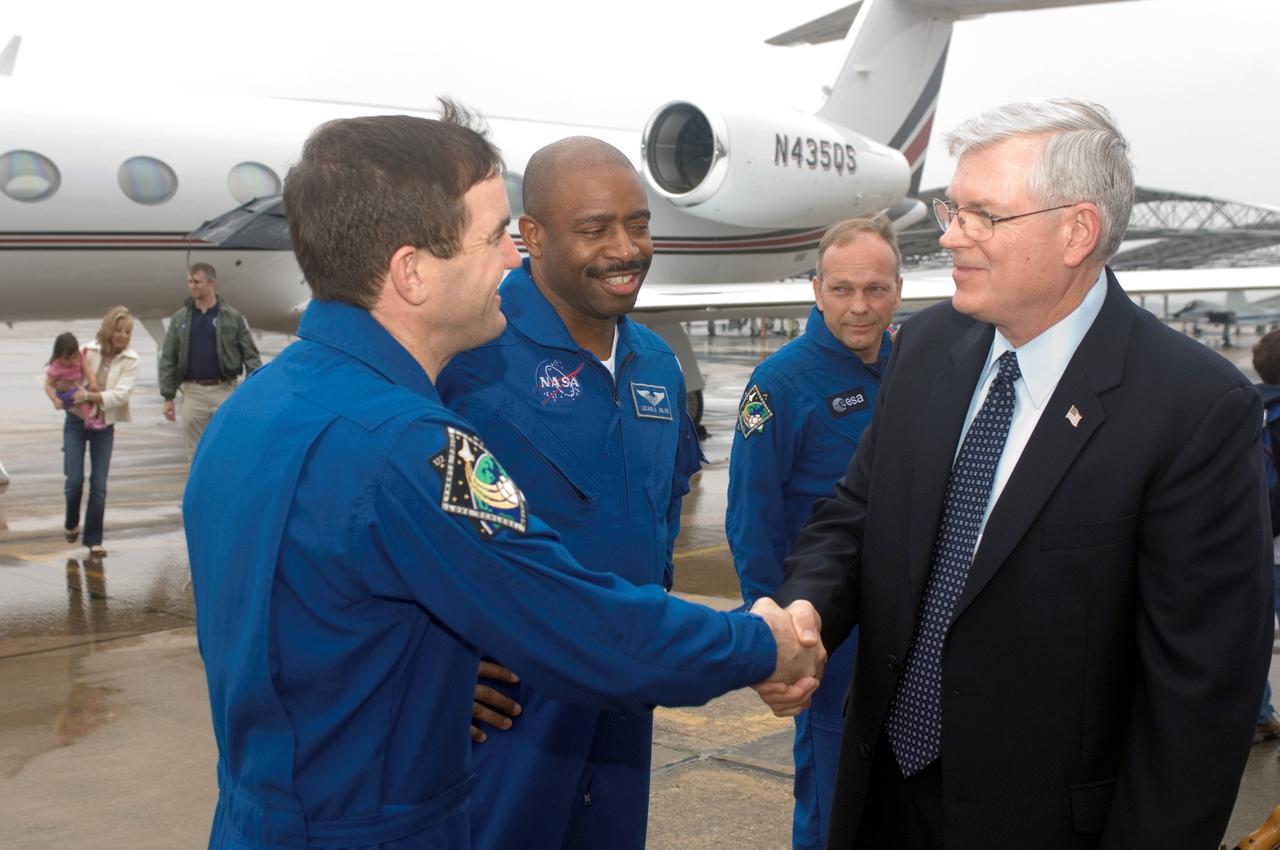
JSC2008-E-014908 (21 Feb. 2008) --- Johnson Space Center's (JSC) director Michael L. Coats (right) greets astronauts Rex Walheim (left) and Leland Melvin, STS-122 mission specialists, at Ellington Field near JSC prior to the STS-122 crew return ceremonies. European Space Agency (ESA) astronaut Hans Schlegel, mission specialist, is visible in the background.
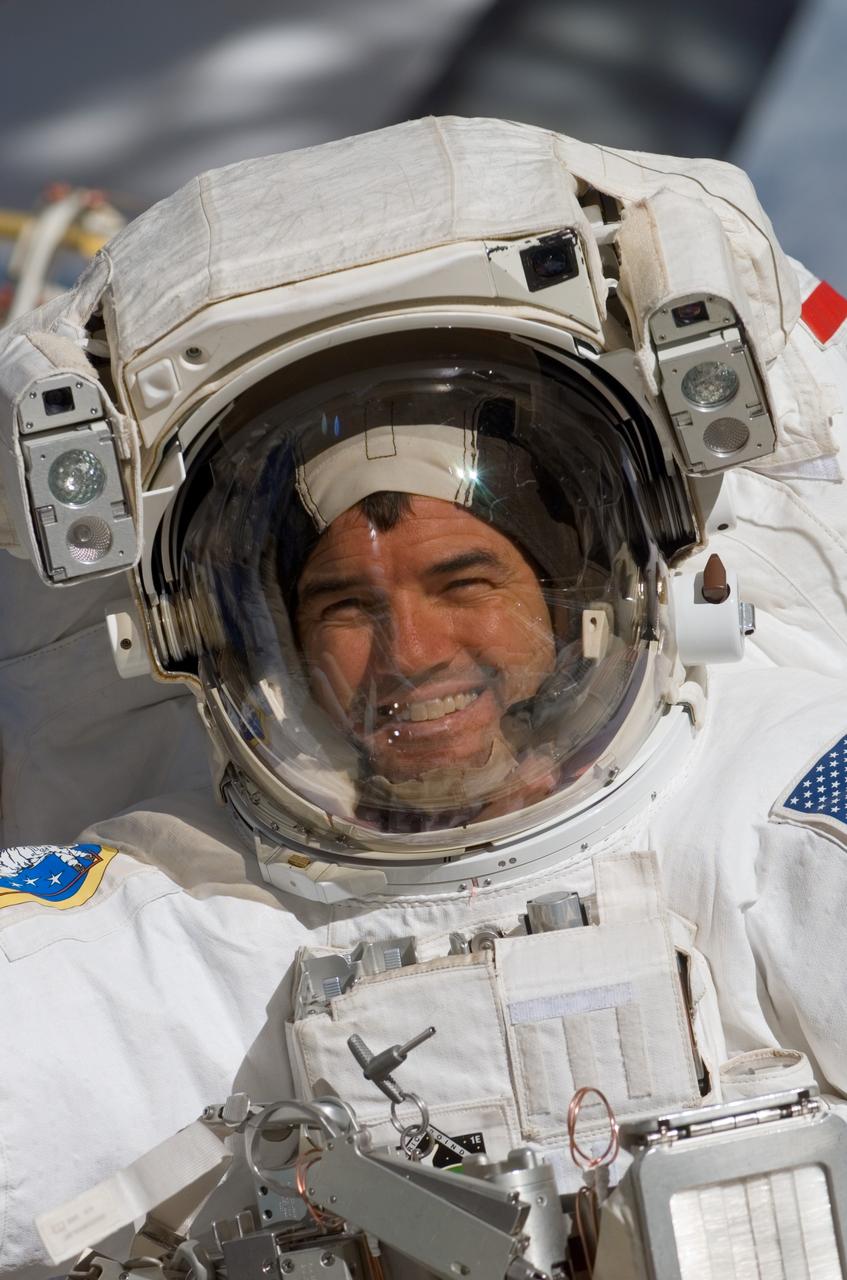
S122-E-008323 (13 Feb. 2008) --- Astronaut Rex Walheim, STS-122 mission specialist, participates in the mission's second scheduled session of extravehicular activity (EVA) as construction and maintenance continue on the International Space Station. During the six-hour, 45-minute spacewalk, among other tasks, Walheim and European Space Agency (ESA) astronaut Hans Schlegel (out of frame), mission specialist, worked to replace a nitrogen tank used to pressurize the station's ammonia cooling system.

JSC2007-E-49826 (3 Oct. 2007) --- Attired in training versions of their shuttle launch and entry suits, the STS-122 crewmembers take a moment to pose for a photo during a training session in the Space Vehicle Mockup Facility at the Johnson Space Center. From the right are astronauts Stephen N. Frick, commander; Alan G. Poindexter, pilot; Leland D. Melvin, Rex J. Walheim, European Space Agency's (ESA) Hans Schlegel and Stanley G. Love, all mission specialists.
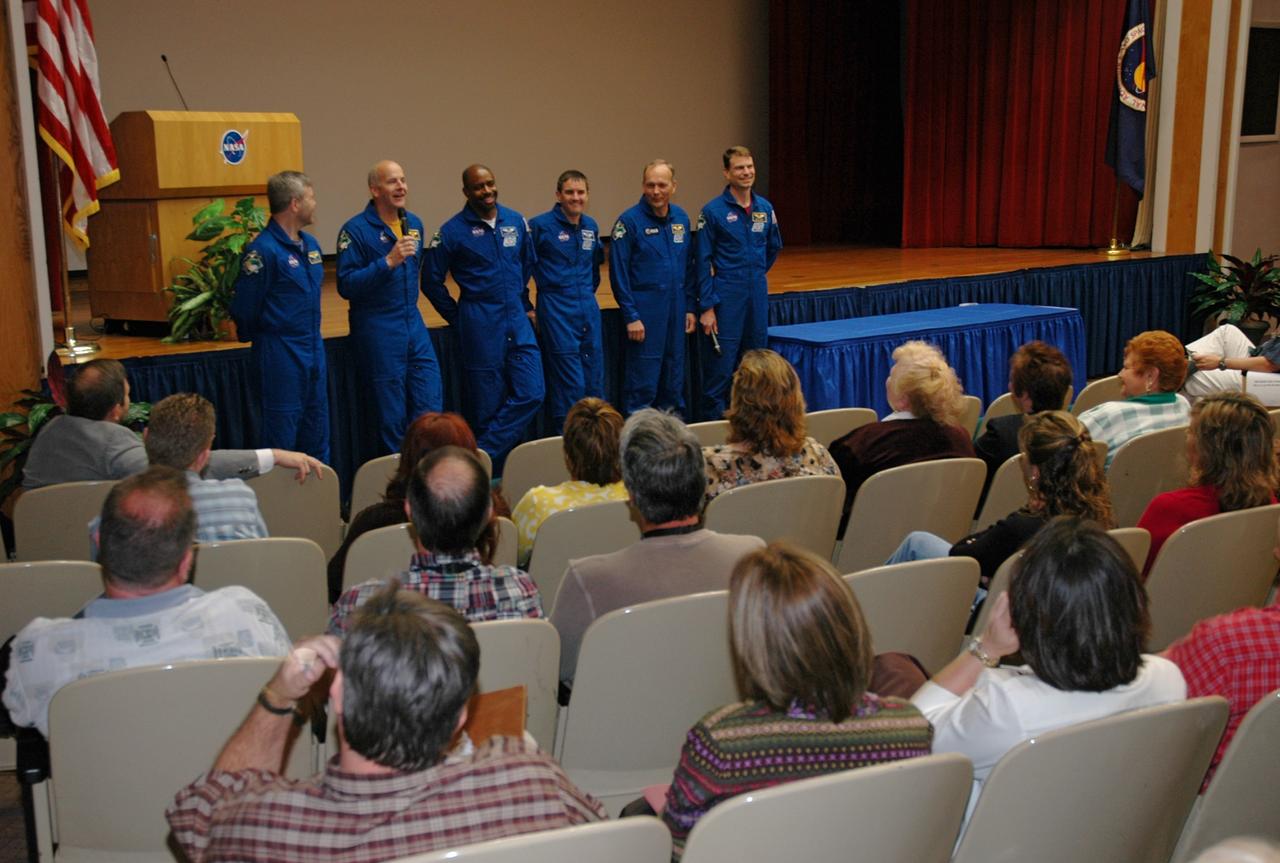
CAPE CANAVERAL, Fla. -- The STS-122 crew returns to NASA's Kennedy Space Center for a presentation in the Training Auditorium. Having completed their successful 13-day mission to the International Space Station, (from left) Commander Steve Frick, Pilot Alan Poindexter, and Mission Specialists Leland Melvin, Rex Walheim, Hans Schlegel and Stanley Love share personal stories, photos and videos of their challenging mission. Photo credit: NASA/Cory Huston

S122-E-008395 (13 Feb. 2008) --- Astronaut Rex Walheim, STS-122 mission specialist, participates in the mission's second scheduled session of extravehicular activity (EVA) as construction and maintenance continue on the International Space Station. During the six-hour, 45-minute spacewalk, among other tasks, Walheim and European Space Agency (ESA) astronaut Hans Schlegel (out of frame), mission specialist, worked to replace a nitrogen tank used to pressurize the station's ammonia cooling system.
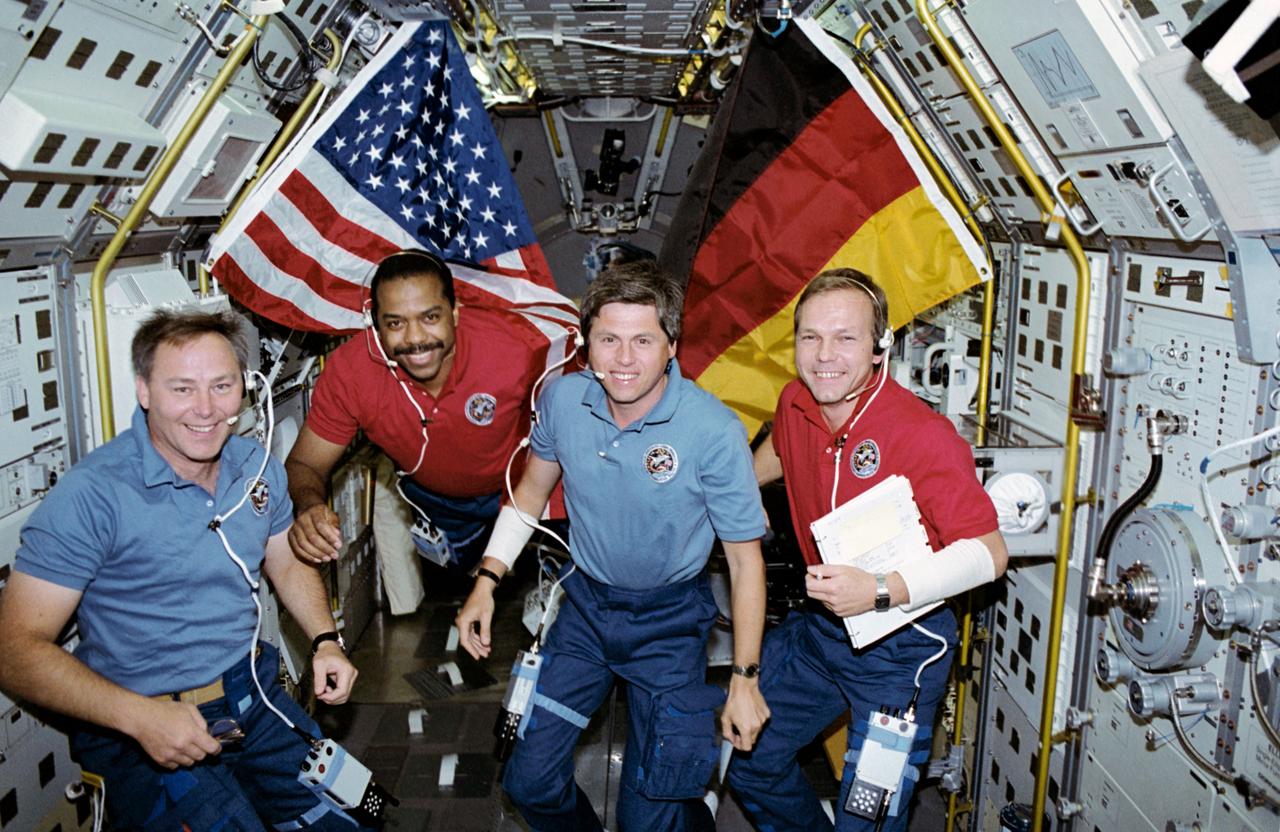
STS-55 crewmembers pose with United States and German flags inside the Spacelab Deutsche 2 (SL-D2) science module located in the payload bay (PLB) of Columbia, Orbiter Vehicle (OV) 102. Wearing communications kit assembly headsets (HDSTs) are (left to right) Mission Specialist 1 (MS1) and Payload Commander (PLC) Jerry L. Ross, MS3 Bernard A. Harris, Jr, German Payload Specialist 1 Ulrich Walter, and Payload Specialist 2 Hans Schlegel.
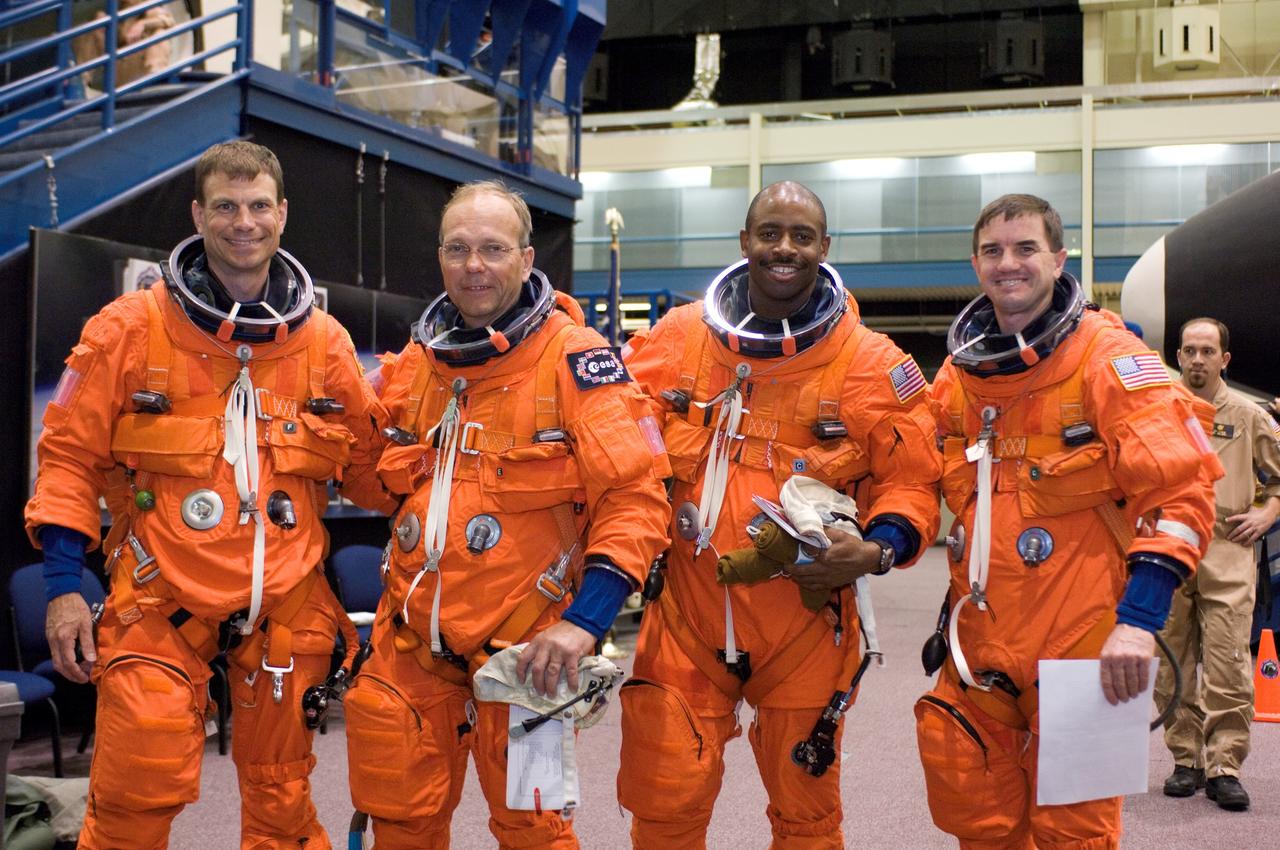
JSC2007-E-14481 (20 March 2007) --- Attired in training versions of their shuttle launch and entry suits, astronauts Stanley G. Love (left), European Space Agency's (ESA) Hans Schlegel, Leland D. Melvin and Rex J. Walheim, all STS-122 mission specialists, take a moment to pose for a photo as they prepare for a post insertion/de-orbit training session in one of the full-scale trainers (out of frame) in the Space Vehicle Mockup Facility at Johnson Space Center.
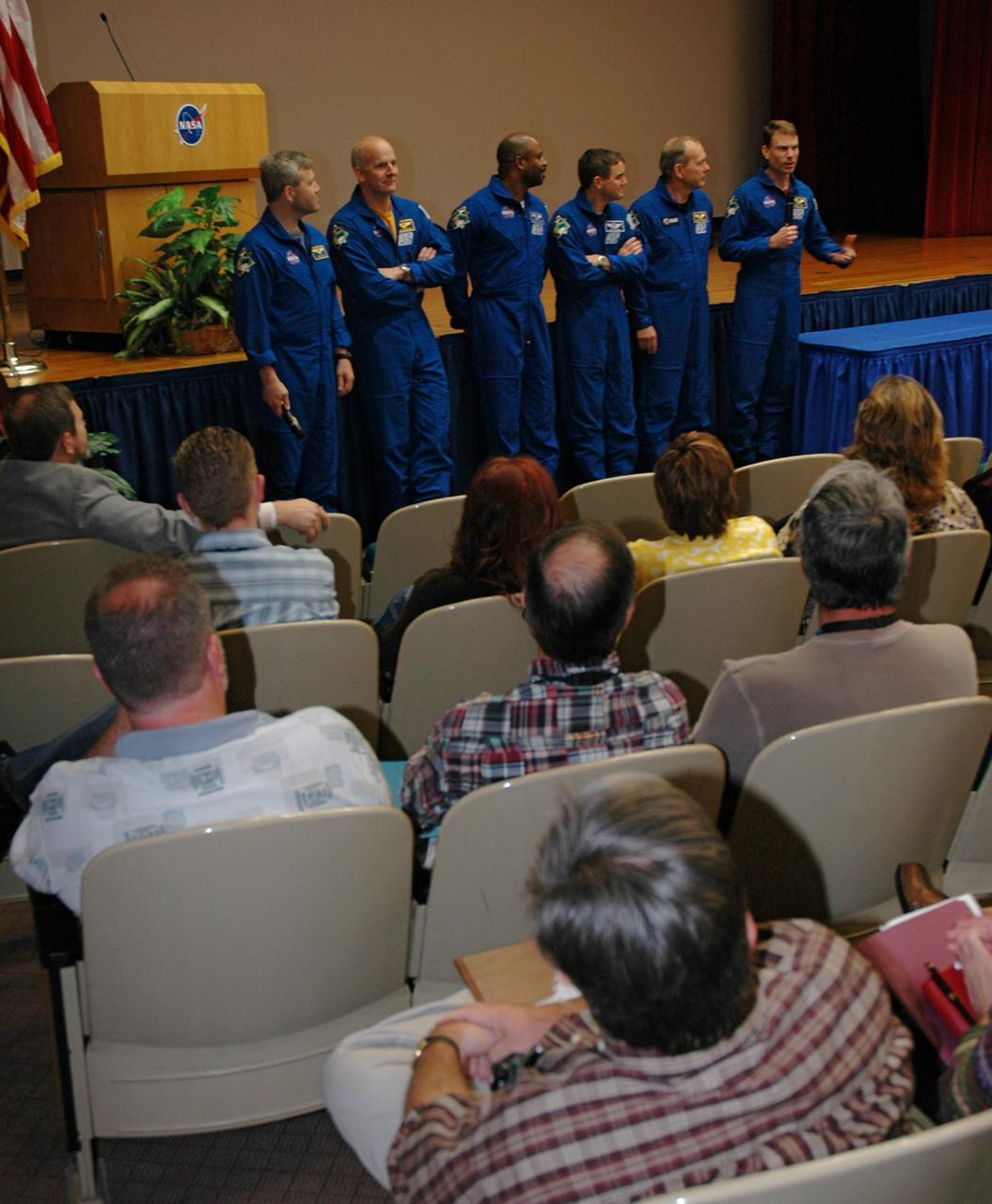
CAPE CANAVERAL, Fla. -- The STS-122 crew returns to NASA's Kennedy Space Center for a presentation in the Training Auditorium. Having completed their successful 13-day mission to the International Space Station, (from left) Commander Steve Frick, Pilot Alan Poindexter, and Mission Specialists Leland Melvin, Rex Walheim, Hans Schlegel and Stanley Love share personal stories, photos and videos of their challenging mission. Photo credit: NASA/Cory Huston

CAPE CANAVERAL, Fla. -- Following the presentation in the Training Auditorium at NASA's Kennedy Space Center, the STS-122 crew signs autographs for employees. At right is Mission Specialist Hans Schlegel; behind him is Mission Specialist Rex Walheim. The crew members shared personal stories, photos and videos of their challenging mission. Photo credit: NASA/Cory Huston
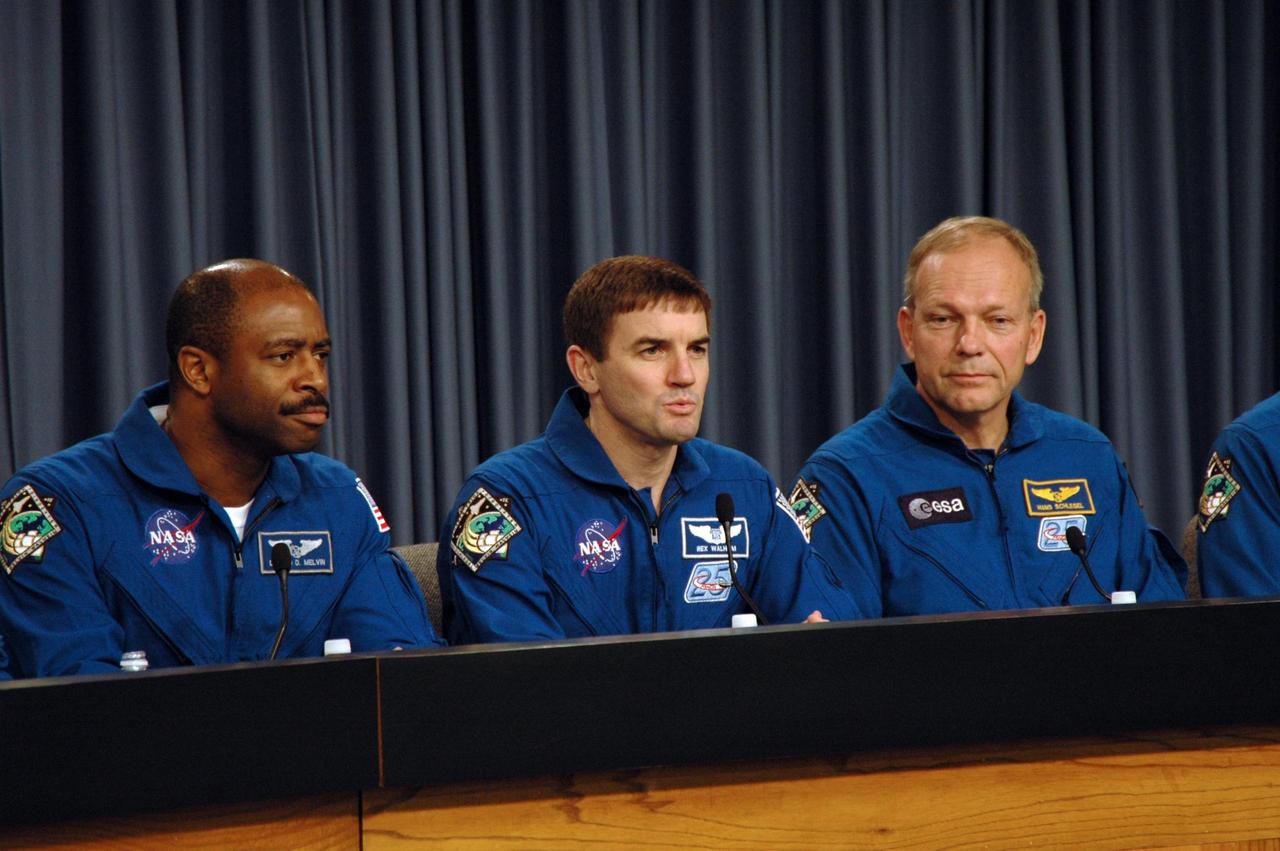
KENNEDY SPACE CENTER, FLA. -- The STS-122 crew discusses its mission at a post-landing conference. Seen here, from left, are Mission Specialists Leland Melvin, Rex Walheim and Hans Schlegel, who represents the European Space Agency. After a round trip of nearly 5.3 million miles, space shuttle Atlantis and crew returned to Earth with a landing at 9:07 a.m. EST on Runway 15 at NASA's Kennedy Space Center. Photo credit: NASA/Jack Pfaller

CAPE CANAVERAL, Fla. -- The STS-122 crew returns to NASA's Kennedy Space Center for a presentation in the Training Auditorium. Here, Mission Specialist Rex Walheim (with microphone) shares a personal story about his experiences. With him are (from left) Mission Specialists Leland Melvin, Hans Schlegel and Stanley Love. Photo credit: NASA/Cory Huston

CAPE CANAVERAL, Fla. -- The STS-122 crew returns to NASA's Kennedy Space Center for a presentation in the Training Auditorium. At center, Mission Specialist Rex Walheim (with microphone) shares a personal story about his experiences. The other crew members are (from left) Commander Steven Frick, Pilot Alan Poindexter, Mission Specialists Leland Melvin, Hans Schlegel and Stanley Love. Photo credit: NASA/Cory Huston
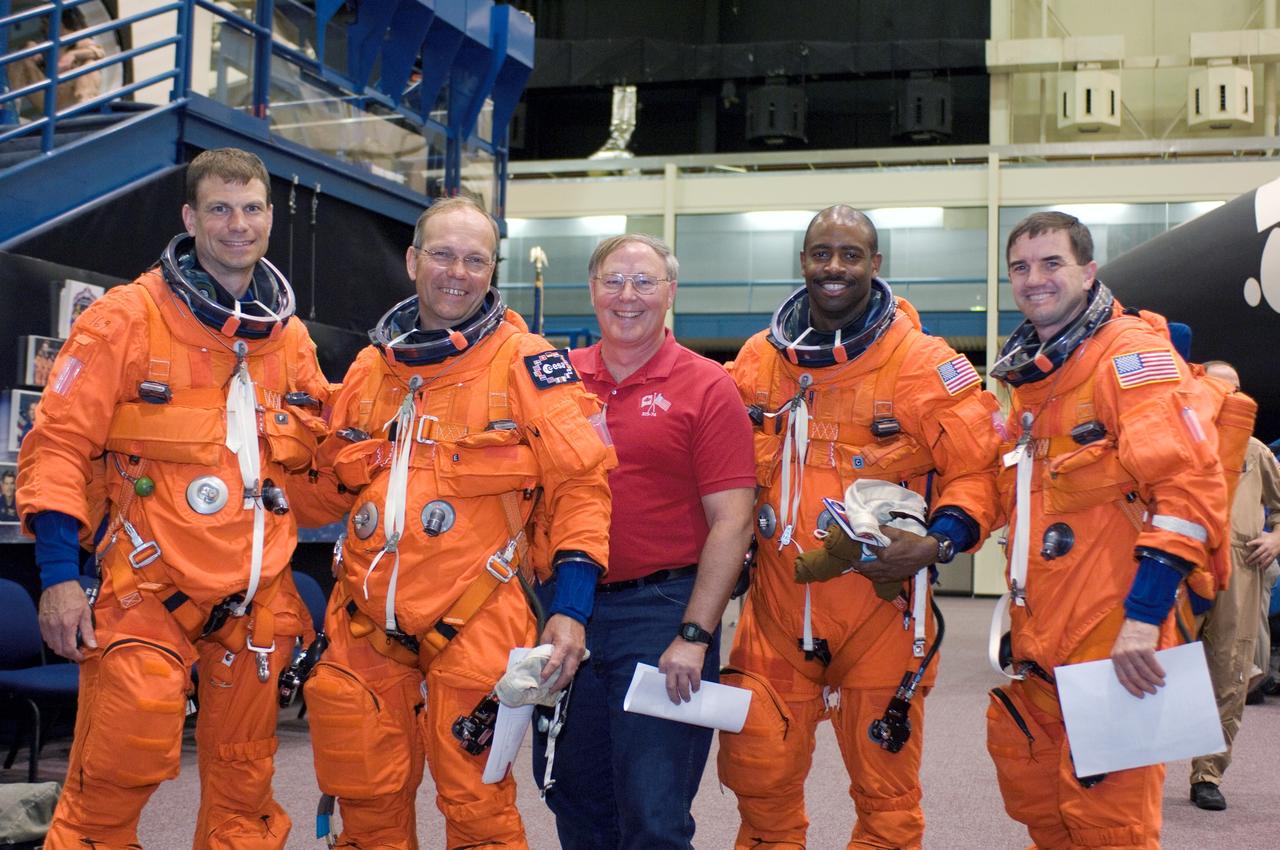
JSC2007-E-14482 (20 March 2007) --- Jerry L. Ross (center), chief, vehicle integration test office, poses for a photo with astronauts Stanley G. Love (left), European Space Agency's (ESA) Hans Schlegel, Leland D. Melvin and Rex J. Walheim, STS-122 mission specialists, as they prepare for a post insertion/de-orbit training session in one of the full-scale trainers (out of frame) in the Space Vehicle Mockup Facility at Johnson Space Center.
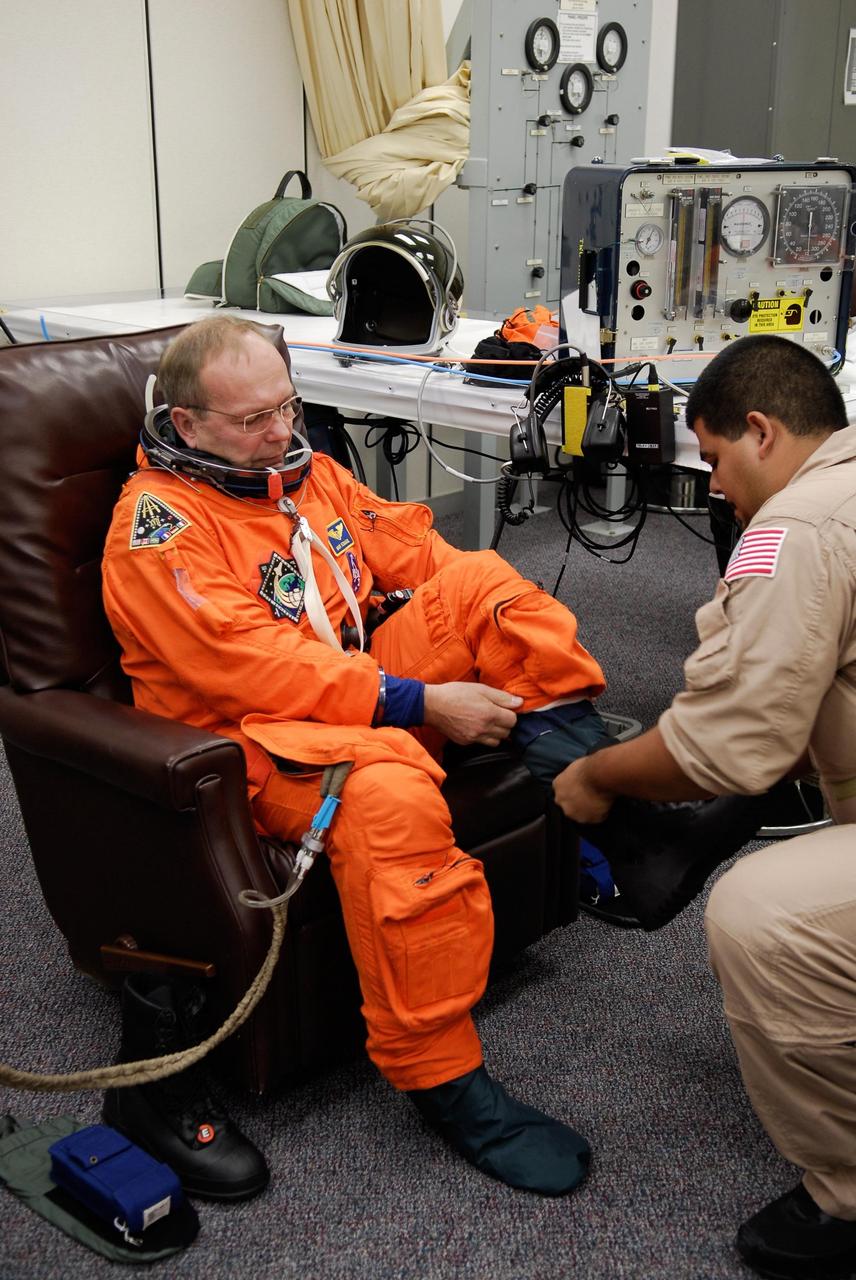
KENNEDY SPACE CENTER, FLA. -- A suit technician helps space shuttle Atlantis STS-122 Mission Specialist Hans Schlegel put on his launch and entry suit, in astronaut crew quarters. Schlegel is with the European Space Agency. The STS-122 crew is preparing for a simulated launch countdown aboard Atlantis, part of terminal countdown demonstration test, or TCDT, activities at NASA's Kennedy Space Center. The TCDT is a dress rehearsal for launch and also provides astronauts and ground crews with equipment familiarization and emergency egress training. On mission STS-122, Atlantis will deliver the Columbus module to the International Space Station. The European Space Agency's largest single contribution to the station, Columbus is a multifunctional, pressurized laboratory that will be permanently attached to U.S. Node 2, called Harmony. The laboratory will expand the research facilities aboard the station, providing crew members and scientists from around the world the ability to conduct a variety of experiments in the physical, materials and life sciences. Launch is targeted for Dec. 6. Photo credit: NASA/Kim Shiflett
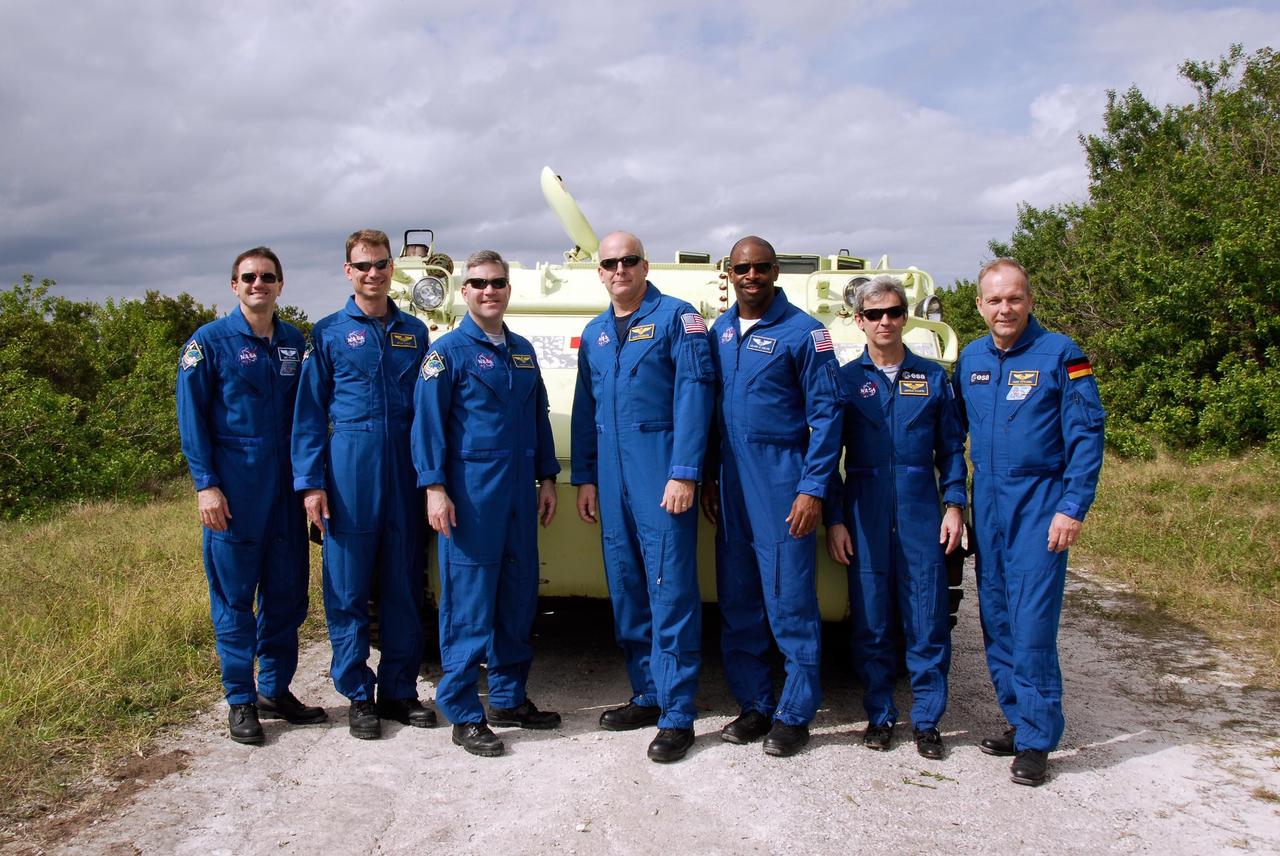
KENNEDY SPACE CENTER, FLA. -- The STS-122 crew poses for a group portrait near Launch Pad 39B following a training session on the operation of the M-113 armored personnel carrier. An M-113 will be available to transport the crew to safety in the event of an emergency on the pad before their launch. From left are Mission Specialists Rex Walheim and Stanley Love; Commander Steve Frick; Pilot Alan Poindexter; and Mission Specialists Leland Melvin, Leopold Eyharts and Hans Schlegel. Eyharts and Schlegel are with the European Space Agency. Eyharts will remain on the International Space Station as a flight engineer for Expedition 16 following the STS-122 mission. The crew is participating in Terminal Countdown Demonstration Test activities, a standard part of launch preparations. The TCDT provides astronauts and ground crews with equipment familiarization, emergency egress training and a simulated launch countdown. On mission STS-122, Atlantis will deliver the European Space Agency's Columbus module to the International Space Station. Columbus is a multifunctional, pressurized laboratory that will be permanently attached to U.S. Node 2, called Harmony, and will expand the research facilities aboard the station. Launch is targeted for Dec. 6. Photo credit: NASA/Kim Shiflett
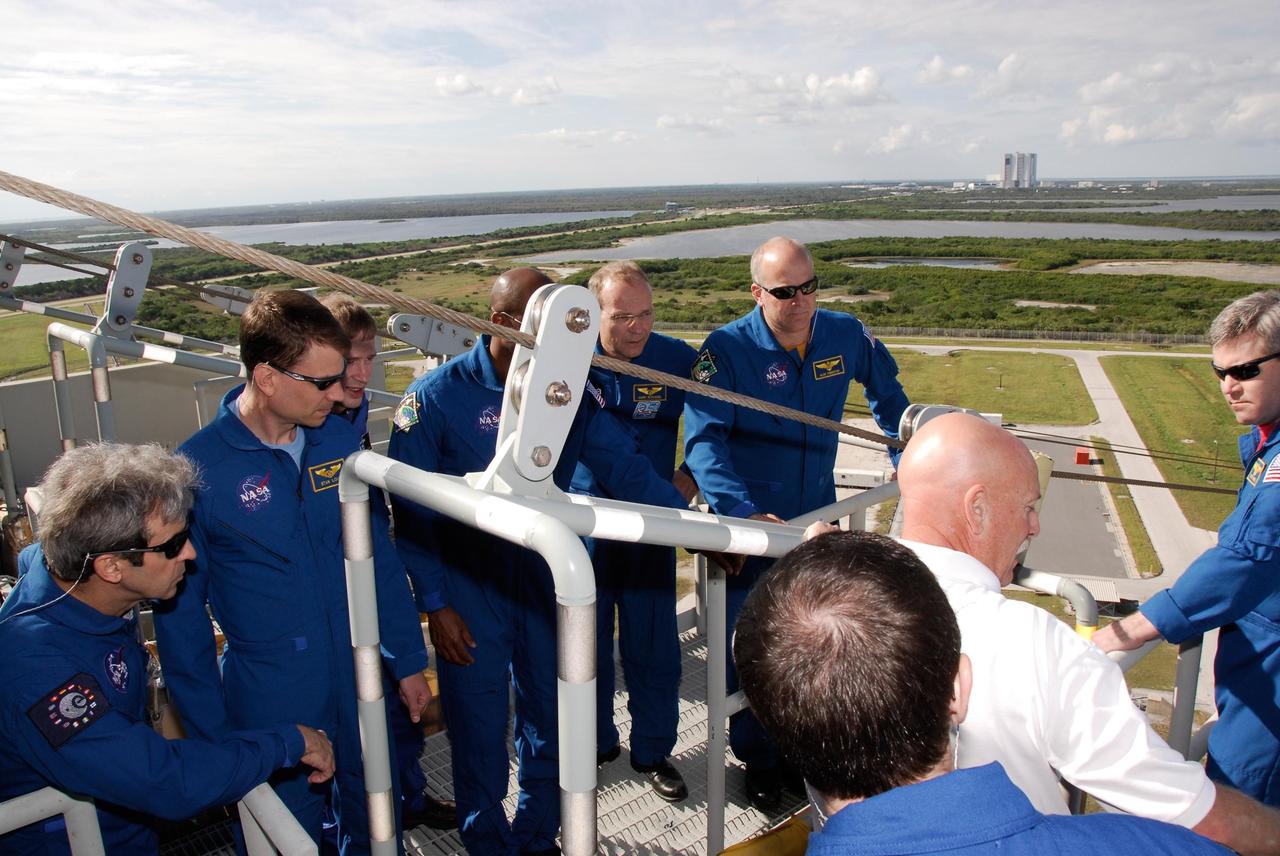
KENNEDY SPACE CENTER, FLA. -- The space shuttle Atlantis STS-122 crew receives instruction on emergency exit from the fixed service structure on Launch Pad 39A. Clockwise, from left, are Mission Specialists Leopold Eyharts and Stanley Love, Eyharts' backup Frank De Winne, Mission Specialists Leland Melvin and Hans Schlegel, Pilot Alan Poindexter, Commander Steve Frick and Mission Specialist Rex Walheim with his back to the camera. Schlegel, Eyharts and De Winne are with the European Space Agency. Eyharts will remain on the International Space Station as a flight engineer for Expedition 16 following the STS-122 mission. The STS-122 crew is at NASA's Kennedy Space Center to take part in terminal countdown demonstration test, or TCDT, activities, a standard part of launch preparations. The TCDT provides astronauts and ground crews with equipment familiarization and a simulated launch countdown before launch. On mission STS-122, Atlantis will deliver the European Space Agency's Columbus module to the International Space Station. Columbus is a multifunctional, pressurized laboratory that will be permanently attached to U.S. Node 2, called Harmony, and will expand the research facilities aboard the station. Launch is targeted for Dec. 6. Photo credit: NASA/Kim Shiflett
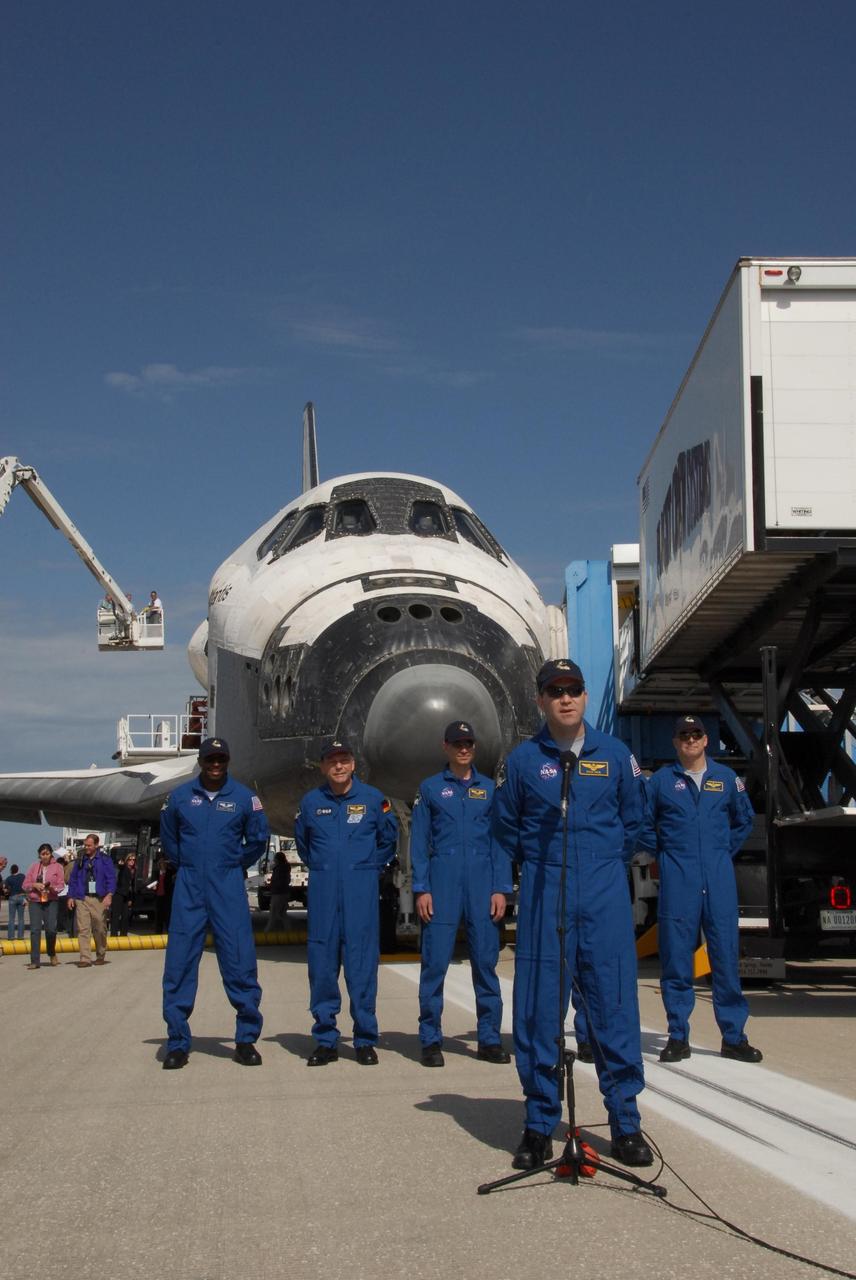
KENNEDY SPACE CENTER, FLA. -- After exiting the crew transport vehicle on the Shuttle Landing Facility at NASA's Kennedy Space Center, the STS-122 crew stands in front of space shuttle Atlantis to greet the media and guests. At the microphone is Commander Steve Frick. Behind him, left to right, are Mission Specialists Leland Melvin, Hans Schlegel, Rex Walheim (not visible) and Stanley Love, and Pilot Alan Poindexter. Schlegel represents the European Space Agency. After a round trip of nearly 5.3 million miles, space shuttle Atlantis and crew returned to Earth with a landing at 9:07 a.m. EST. The shuttle landed on orbit 202 to complete the 13-day STS-122 mission. Main gear touchdown was 9:07:10 a.m. Nose gear touchdown was 9:07:20 a.m. Wheel stop was at 9:08:08 a.m. Mission elapsed time was 12 days, 18 hours, 21 minutes and 44 seconds. During the mission, Atlantis' crew installed the new Columbus laboratory, leaving a larger space station and one with increased science capabilities. The Columbus Research Module adds nearly 1,000 cubic feet of habitable volume and affords room for 10 experiment racks, each an independent science lab. Photo credit: NASA/Jack Pfaller

KENNEDY SPACE CENTER, FLA. -- At the slidewire basket landing on Launch Pad 39A, the space shuttle Atlantis STS-122 crew poses for a group photo following a press conference. From left are Commander Steve Frick; Pilot Alan Poindexter; and Mission Specialists Leland Melvin, Rex Walheim, Hans Schlegel, Stanley Love and Leopold Eyharts. Schlegel and Eyharts are with the European Space Agency. Eyharts will remain on the International Space Station as a flight engineer for Expedition 16 following the STS-122 mission. The STS-122 crew is at NASA's Kennedy Space Center to take part in terminal countdown demonstration test, or TCDT, activities, a standard part of launch preparations. The TCDT provides astronauts and ground crews with equipment familiarization, emergency egress training and a simulated launch countdown. On mission STS-122, Atlantis will deliver the European Space Agency's Columbus module to the International Space Station. Columbus is a multifunctional, pressurized laboratory that will be permanently attached to U.S. Node 2, called Harmony, and will expand the research facilities aboard the station. Launch is targeted for Dec. 6. Photo credit: NASA/Kim Shiflett
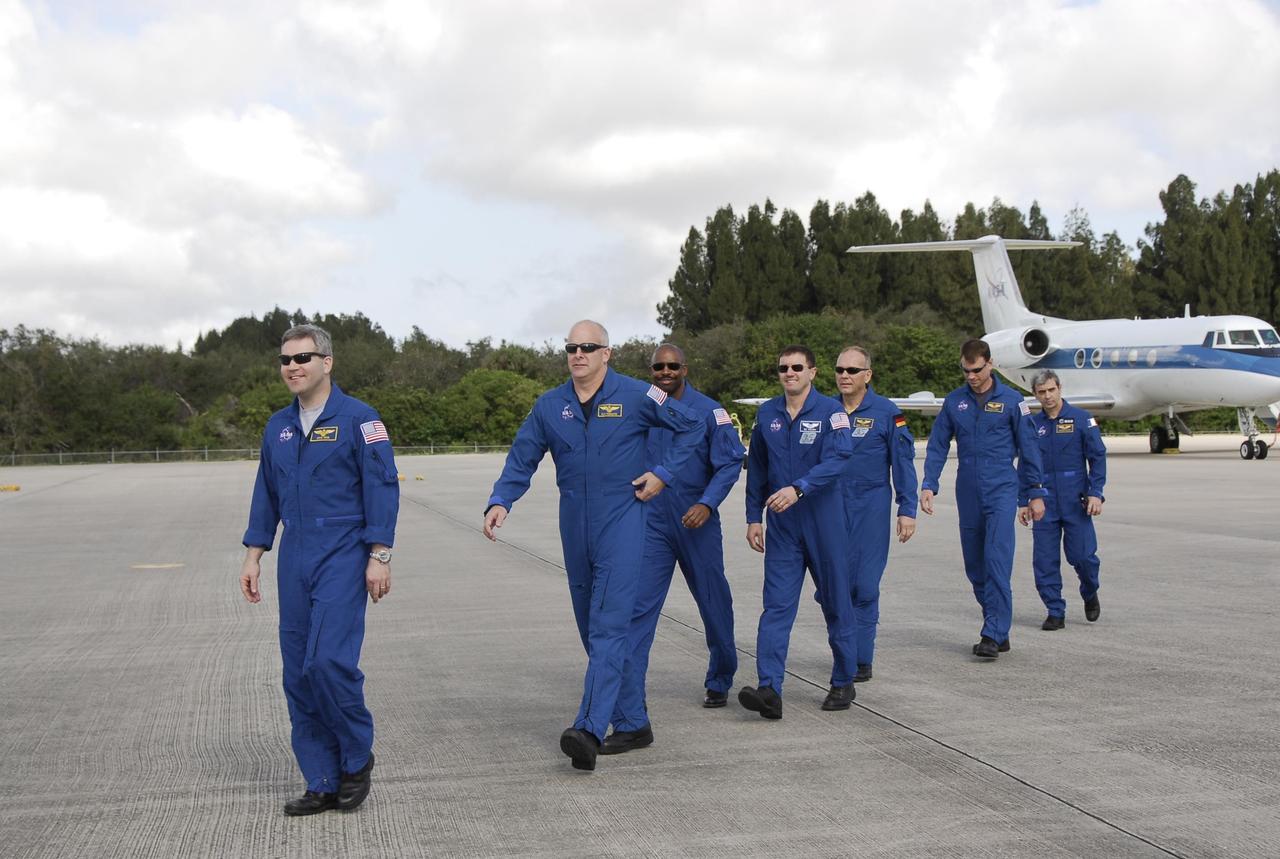
KENNEDY SPACE CENTER, FLA. -- After their arrival at NASA's Kennedy Space Center, the STS-122 crew heads for a microphone to greet the media waiting for them. From left are Commander Steve Frick, Pilot Alan Poindexter, and Mission Specialists Leland Melvin, Rex Walheim, Hans Schlegel, Stanley Love and Leopold Eyharts. Eyharts and Schlegel represent the European Space Agency. The crew's arrival signals the imminent launch of space shuttle Atlantis' STS-122 mission, at 2:45 p.m. Feb. 7. This will be the third launch attempt for the mission. Some of the tank's ECO sensors gave failed readings during propellant tanking for launch attempts on Dec. 6 and Dec. 9, subsequently scrubbing further attempts until the cause could be found and repairs made. Atlantis will carry the Columbus module, Europe's largest contribution to the construction of the International Space Station. It will support scientific and technological research in a microgravity environment. Columbus is a multifunctional, pressurized laboratory that will be permanently attached to the Harmony module of the space station to carry out experiments in materials science, fluid physics and biosciences, as well as to perform a number of technological applications. Photo credit: NASA/Kim Shiflett
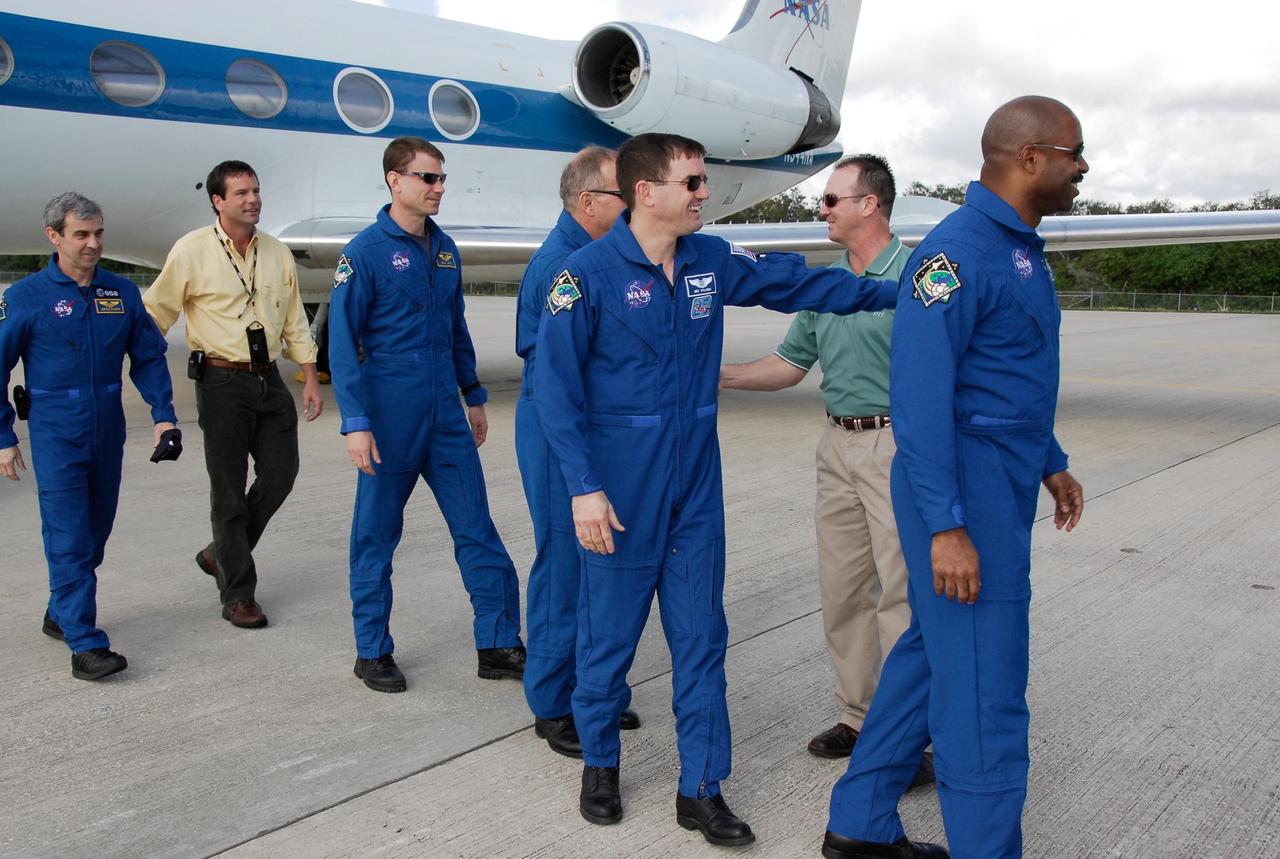
KENNEDY SPACE CENTER, FLA. -- At NASA's Kennedy Space Center, members of the STS-122 crew arrive for launch. From left are Mission Specialists Leopold Eyharts, Stanley Love, Hans Schlegel, Rex Walheim and Leland Melvin. They were greeted by Doug Lyons (left, yellow shirt), launch director for the mission, and Pete Nickolenko (right, green shirt), lead shuttle test director. Eyharts and Schlegel represent the European Space Agency. The crew's arrival signals the imminent launch of space shuttle Atlantis' STS-122 mission, at 2:45 p.m. Feb. 7. This will be the third launch attempt for the mission. Some of the tank's ECO sensors gave failed readings during propellant tanking for launch attempts on Dec. 6 and Dec. 9, subsequently scrubbing further attempts until the cause could be found and repairs made. Atlantis will carry the Columbus module, Europe's largest contribution to the construction of the International Space Station. It will support scientific and technological research in a microgravity environment. Columbus is a multifunctional, pressurized laboratory that will be permanently attached to the Harmony module of the space station to carry out experiments in materials science, fluid physics and biosciences, as well as to perform a number of technological applications. Photo credit: NASA/Kim Shiflett
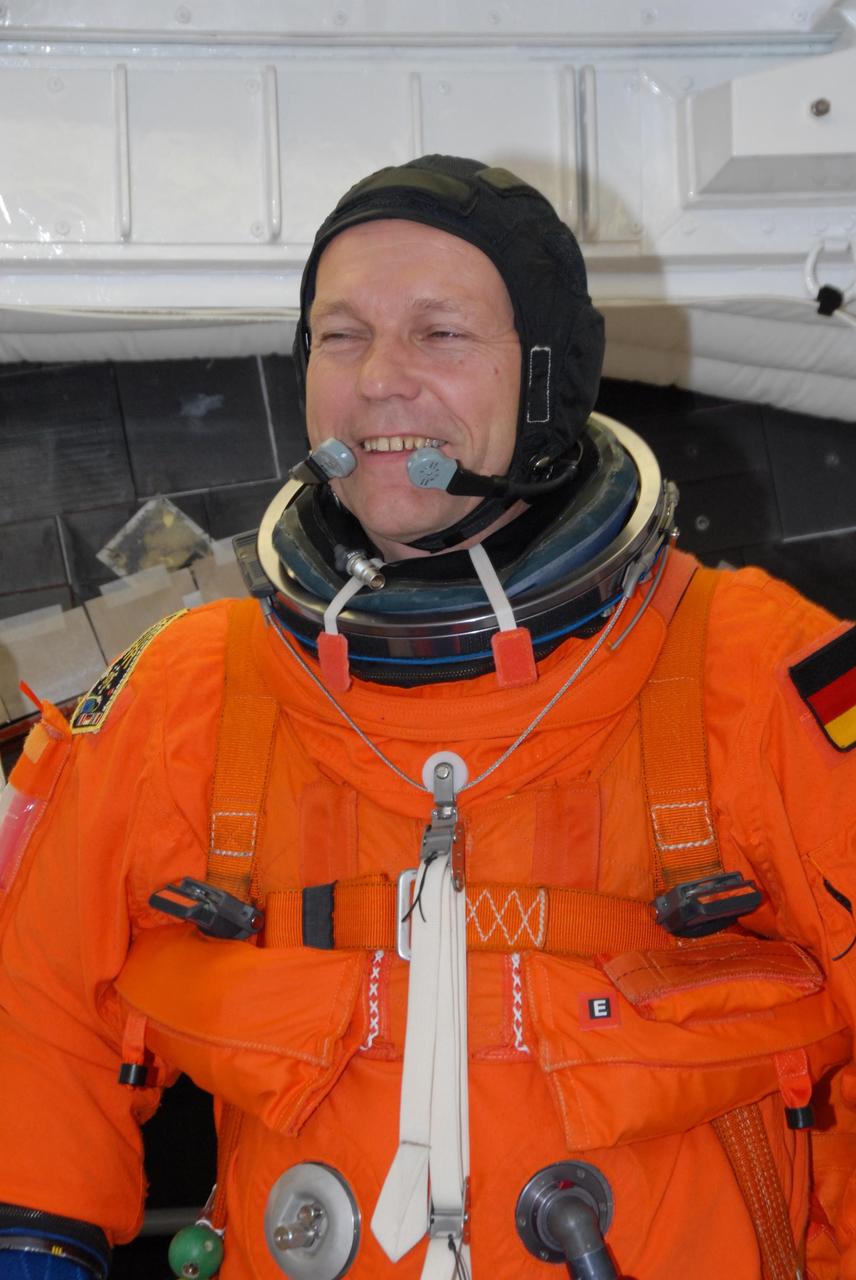
KENNEDY SPACE CENTER, FLA. -- In the White Room on Launch Pad 39A, space shuttle Atlantis STS-122 Mission Specialist Hans Schlegel prepares for his entry onto Atlantis' flight deck. Schlegel is with the European Space Agency. The exercise is part of terminal countdown demonstration test, or TCDT, activities at NASA's Kennedy Space Center. The TCDT is a dress rehearsal for launch and also provides astronauts and ground crews with equipment familiarization and emergency egress training. On mission STS-122, Atlantis will deliver the Columbus module to the International Space Station. The European Space Agency's largest single contribution to the station, Columbus is a multifunctional, pressurized laboratory that will be permanently attached to U.S. Node 2, called Harmony. The laboratory will expand the research facilities aboard the station, providing crew members and scientists from around the world the ability to conduct a variety of experiments in the physical, materials and life sciences. Atlantis' launch is targeted for Dec. 6. Photo credit: NASA/George Shelton
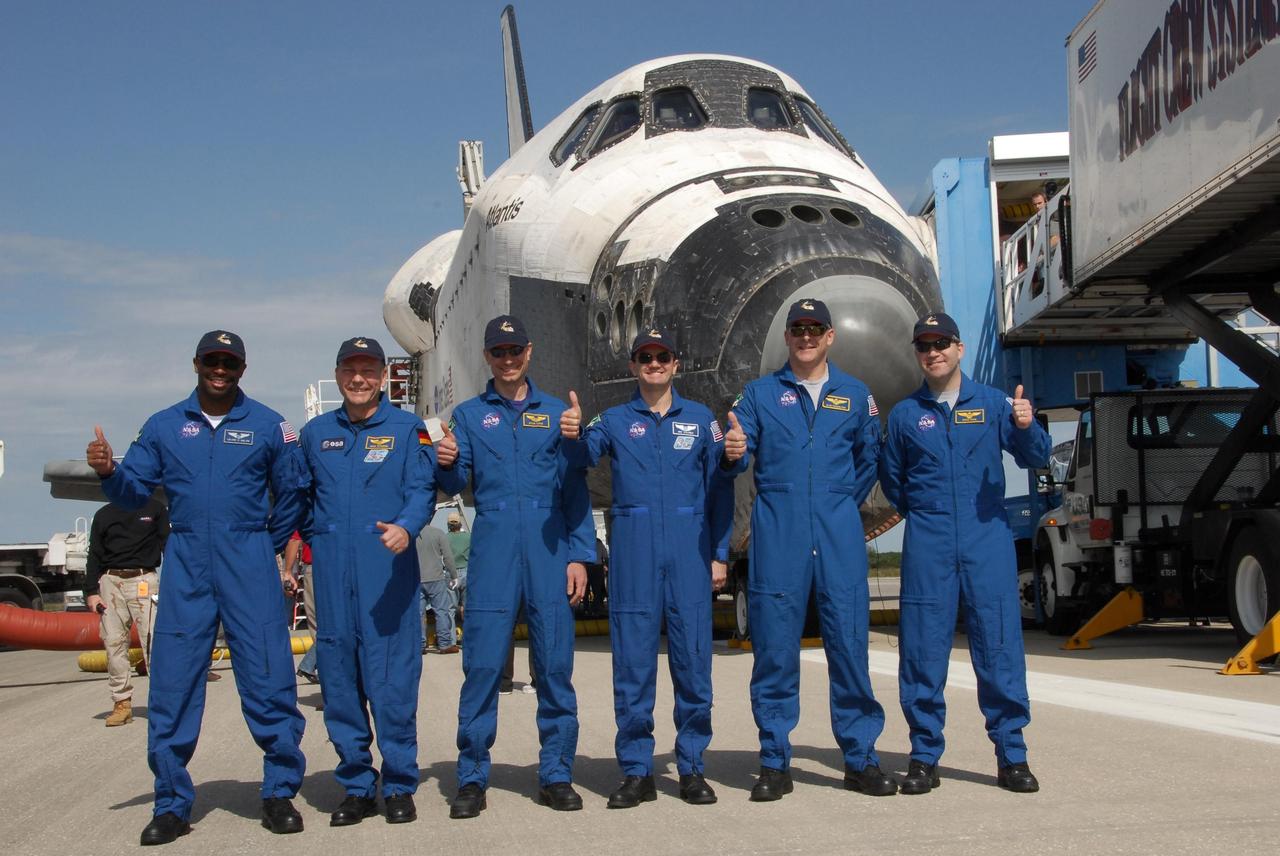
KENNEDY SPACE CENTER, FLA. -- After greeting the media on the Shuttle Landing Facility at NASA's Kennedy Space Center, the STS-122 crew signals a successful mission and landing. From left are Mission Specialists Leland Melvin, Hans Schlegel, Rex Walheim and Stanley Love, Pilot Alan Poindexter and Commander Steve Frick. Schlegel represents the European Space Agency. After a round trip of nearly 5.3 million miles, space shuttle Atlantis and crew returned to Earth with a landing at 9:07 a.m. EST. The shuttle landed on orbit 202 to complete the 13-day STS-122 mission. Main gear touchdown was 9:07:10 a.m. Nose gear touchdown was 9:07:20 a.m. Wheel stop was at 9:08:08 a.m. Mission elapsed time was 12 days, 18 hours, 21 minutes and 44 seconds. During the mission, Atlantis' crew installed the new Columbus laboratory, leaving a larger space station and one with increased science capabilities. The Columbus Research Module adds nearly 1,000 cubic feet of habitable volume and affords room for 10 experiment racks, each an independent science lab. Photo credit: NASA/Jack Pfaller
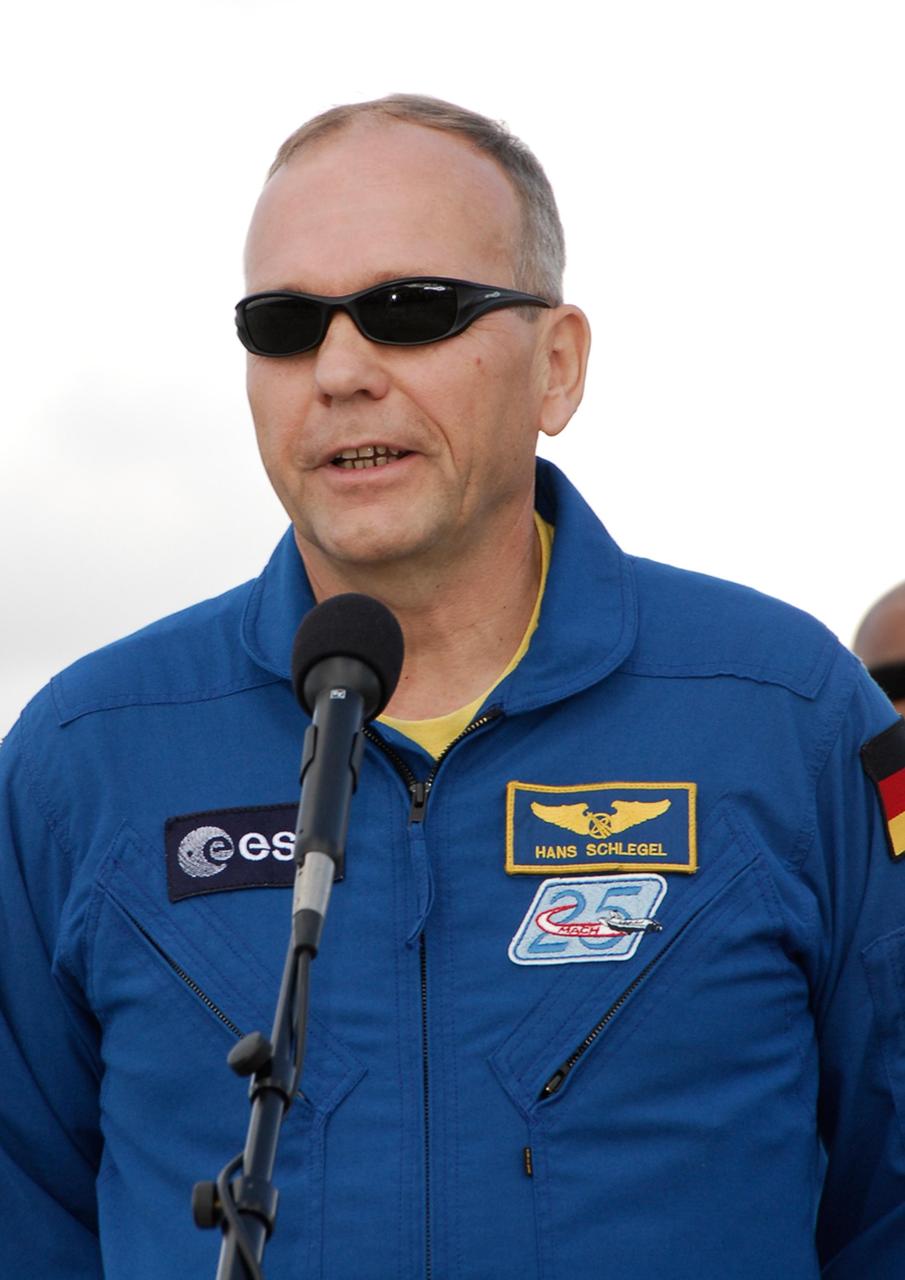
KENNEDY SPACE CENTER, FLA. -- After his arrival at NASA's Kennedy Space Center, STS-122 Mission Specialist Hans Schlegel tells the media he is grateful for the hard work and dedication of workers in getting Atlantis and Columbus ready for flight. Schlegel represents the European Space Agency. The crew's arrival signals the imminent launch of space shuttle Atlantis' STS-122 mission, at 2:45 p.m. Feb. 7. This will be the third launch attempt for the mission. Some of the tank's ECO sensors gave failed readings during propellant tanking for launch attempts on Dec. 6 and Dec. 9, subsequently scrubbing further attempts until the cause could be found and repairs made. Atlantis will carry the Columbus module, Europe's largest contribution to the construction of the International Space Station. It will support scientific and technological research in a microgravity environment. Columbus is a multifunctional, pressurized laboratory that will be permanently attached to the Harmony module of the space station to carry out experiments in materials science, fluid physics and biosciences, as well as to perform a number of technological applications. Photo credit: NASA/Kim Shiflett
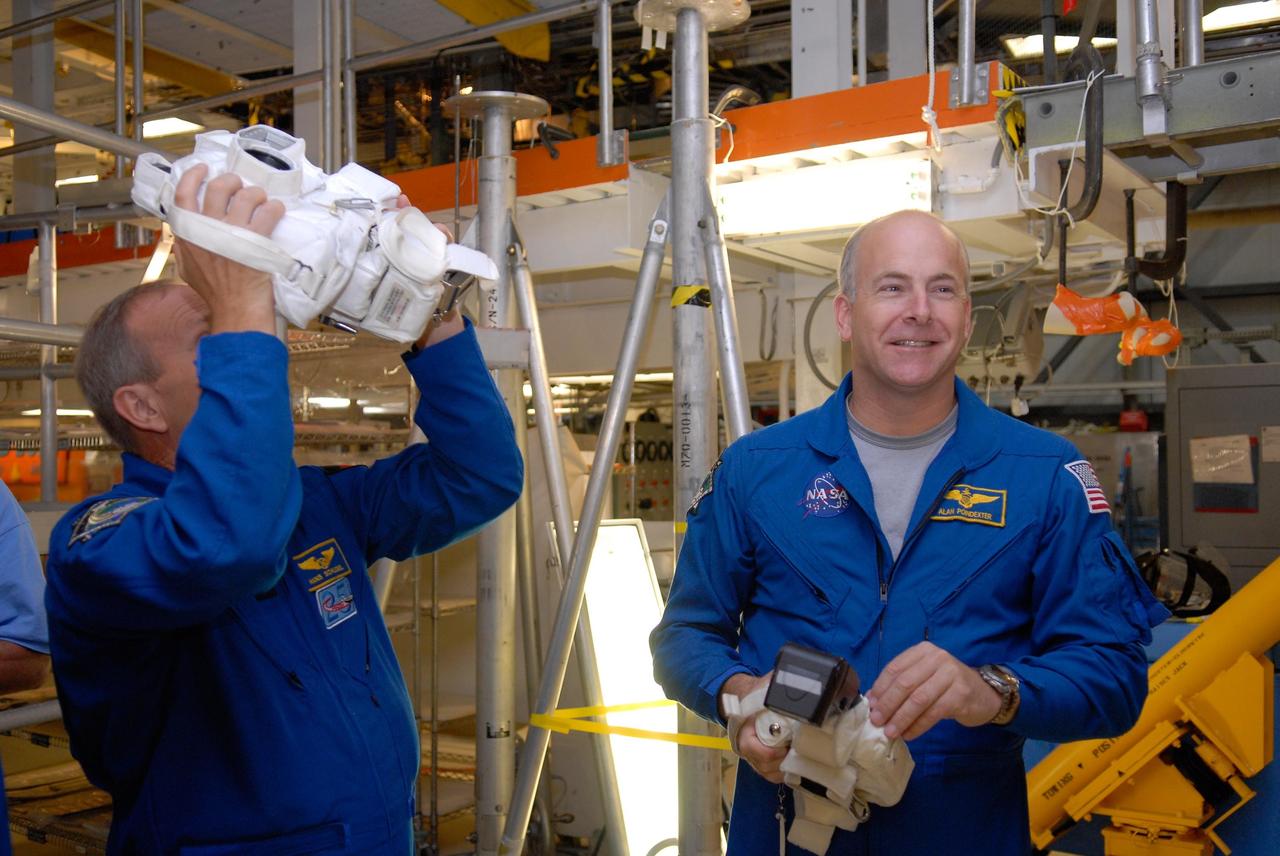
KENNEDY SPACE CENTER, FLA. -- In the Orbiter Processing Facility, members of the STS-122 crew practice handling cameras that will be used during the mission. At left is Mission Specialist Hans Schlegel. At right is Pilot Alan Poindexter. Schlegel represents the European Space Agency. The crew is at Kennedy Space Center to take part in a crew equipment interface test, which helps familiarize them with equipment and payloads for the mission. Among the activities standard to a CEIT are harness training, inspection of the thermal protection system and camera operation for planned extravehicular activities, or EVAs. The mission will carry and install the Columbus Lab, a multifunctional, pressurized laboratory that will be permanently attached to Node 2 of the space station to carry out experiments in materials science, fluid physics and biosciences, as well as to perform a number of technological applications. It is Europe’s largest contribution to the construction of the International Space Station and will support scientific and technological research in a microgravity environment. STS-122 is targeted for launch in December. Photo credit: NASA/Kim Shiflett
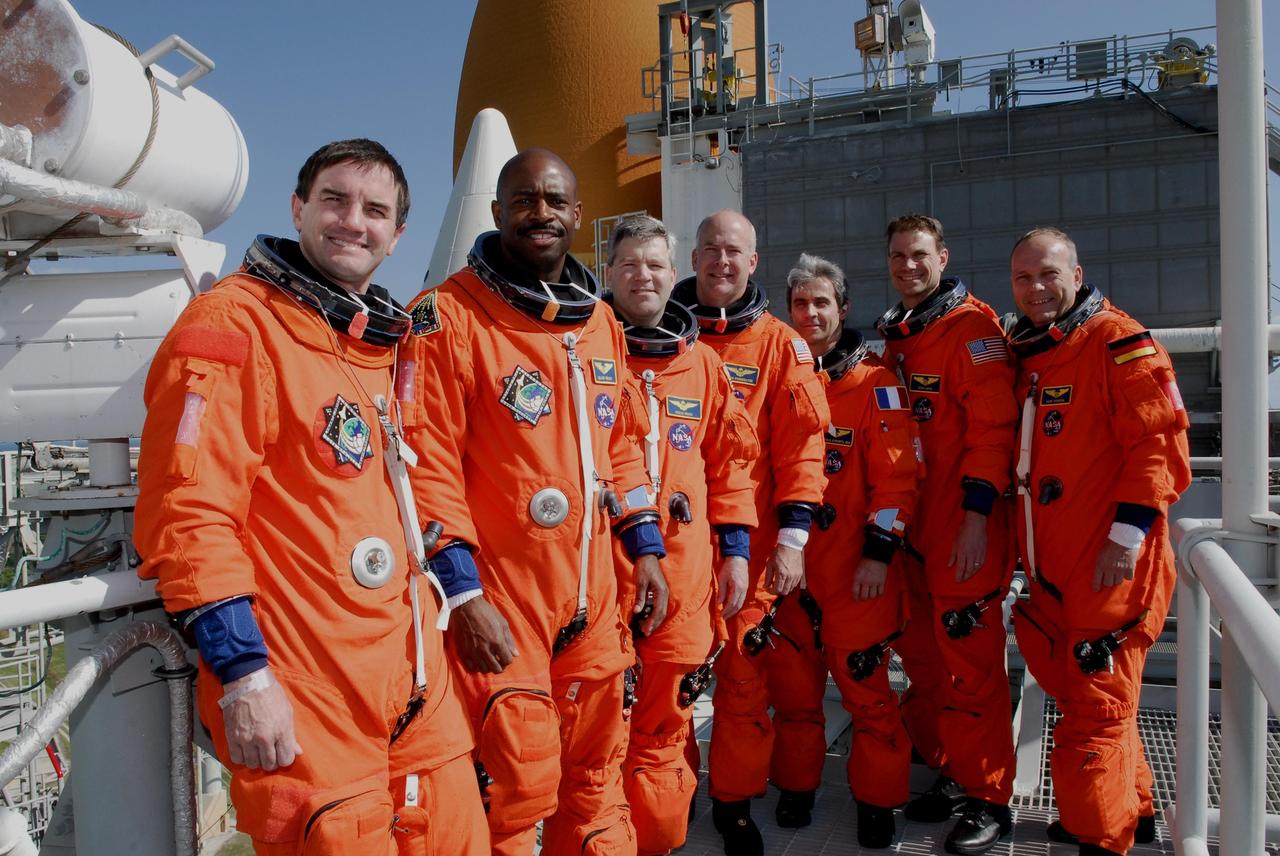
KENNEDY SPACE CENTER, FLA. -- Members of space shuttle Atlantis' STS-122 crew pose for a group portrait in front of Atlantis' external tank following a simulated launch countdown at Launch Pad 39A. From left are Mission Specialists Rex Walheim and Leland Melvin; Commander Steve Frick; Pilot Alan Poindexter; and Mission Specialists Leopold Eyharts, Stanley Love and Hans Schlegel. Schlegel and Eyharts are with the European Space Agency. Eyharts will remain on the International Space Station as a flight engineer for Expedition 16 following the STS-122 mission. The exercise is part of terminal countdown demonstration test, or TCDT, activities at NASA's Kennedy Space Center. The TCDT is a dress rehearsal for launch and also provides astronauts and ground crews with equipment familiarization and emergency egress training. On mission STS-122, Atlantis will deliver the Columbus module to the International Space Station. The European Space Agency's largest single contribution to the station, Columbus is a multifunctional, pressurized laboratory that will be permanently attached to U.S. Node 2, called Harmony. The laboratory will expand the research facilities aboard the station, providing crew members and scientists from around the world the ability to conduct a variety of experiments in the physical, materials and life sciences. Atlantis' launch is targeted for Dec. 6. Photo credit: NASA/Kim Shiflett
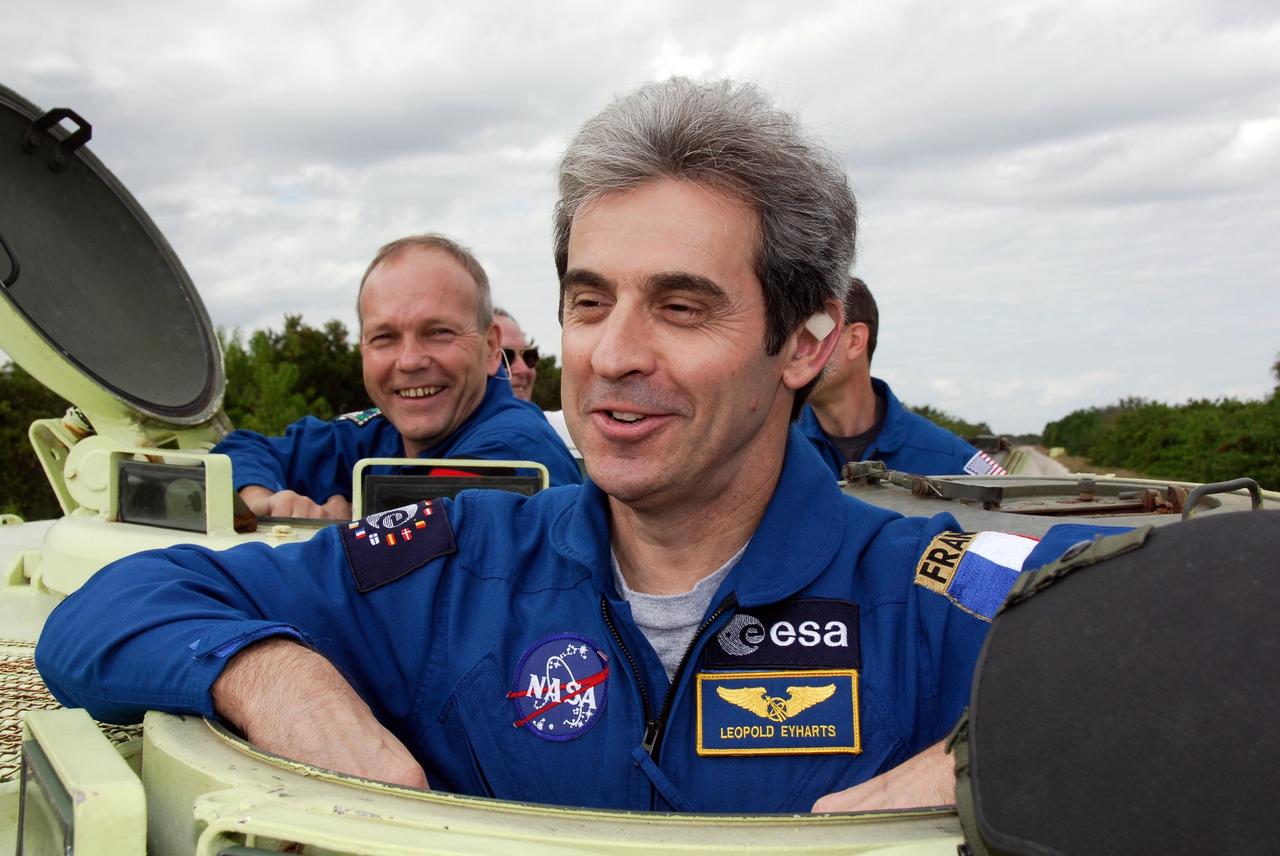
KENNEDY SPACE CENTER, FLA. -- STS-122 Mission Specialist Leopold Eyharts takes time out from driving practice of the M-113 armored personnel carrier to pose for a photo as Mission Specialist Hans Schlegel, behind him on the left, prepares to ride along. Both Eyharts and Schlegel are with the European Space Agency, but Eyharts will remain on the International Space Station as a flight engineer for Expedition 16 following the STS-122 mission. The practice near Launch Pad 39B is part of training on emergency egress procedures. An M-113 will be available to transport the crew to safety in the event of a contingency on the pad before their launch. The crew is participating in Terminal Countdown Demonstration Test activities, a standard part of launch preparations. The TCDT provides astronauts and ground crews with equipment familiarization, emergency egress training and a simulated launch countdown. On mission STS-122, Atlantis will deliver the European Space Agency's Columbus module to the International Space Station. Columbus is a multifunctional, pressurized laboratory that will be permanently attached to U.S. Node 2, called Harmony, and will expand the research facilities aboard the station. Launch is targeted for Dec. 6. Photo credit: NASA/Kim Shiflett

KENNEDY SPACE CENTER, FLA. -- The STS-122 crew members pose on the Shuttle Landing Facility at NASA's Kennedy Space Center after their arrival for launch. From left are Mission Specialists Leopold Eyharts, Stanley Love, Hans Schlegel, Rex Walheim and Leland Melvin, and Pilot Alan Poindexter and Commander Steve Frick. Eyharts and Schlegel represent the European Space Agency. Eyharts will remain on the International Space Station while Atlantis returns flight engineer Daniel Tani. The crew's arrival signals the imminent launch of space shuttle Atlantis' STS-122 mission, at 2:45 p.m. Feb. 7. This will be the third launch attempt for the mission. Some of the tank's ECO sensors gave failed readings during propellant tanking for launch attempts on Dec. 6 and Dec. 9, subsequently scrubbing further attempts until the cause could be found and repairs made. Atlantis will carry the Columbus module, Europe's largest contribution to the construction of the International Space Station. It will support scientific and technological research in a microgravity environment. Columbus is a multifunctional, pressurized laboratory that will be permanently attached to the Harmony module of the space station to carry out experiments in materials science, fluid physics and biosciences, as well as to perform a number of technological applications. Photo credit: NASA/Kim Shiflett
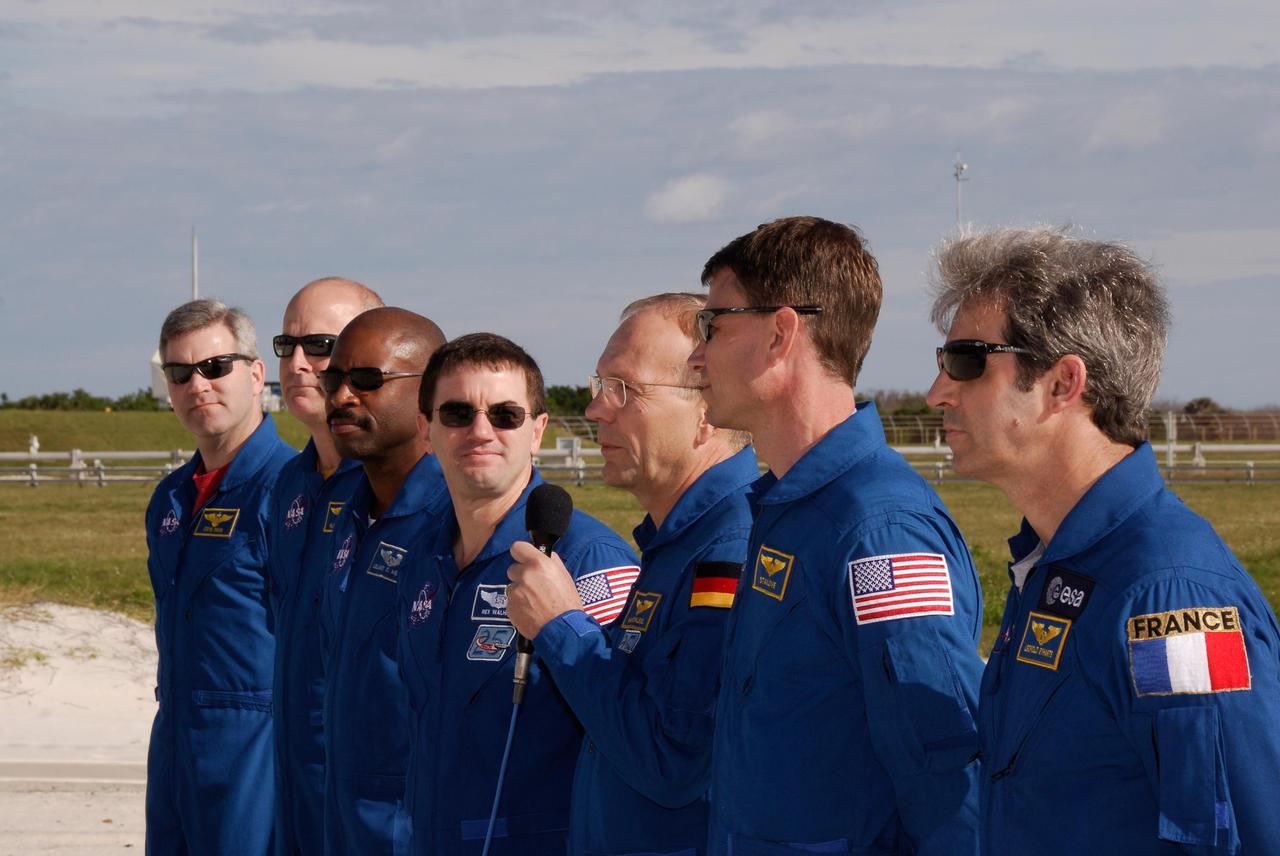
KENNEDY SPACE CENTER, FLA. -- At the slidewire basket landing on Launch Pad 39A, the space shuttle Atlantis STS-122 crew responds to questions from the media. From left are Commander Steve Frick; Pilot Alan Poindexter; and Mission Specialists Leland Melvin, Rex Walheim, Hans Schlegel (with the microphone), Stanley Love and Leopold Eyharts. Schlegel and Eyharts are with the European Space Agency. Eyharts will remain on the International Space Station as a flight engineer for Expedition 16 following the STS-122 mission. The STS-122 crew is at NASA's Kennedy Space Center to take part in terminal countdown demonstration test, or TCDT, activities, a standard part of launch preparations. The TCDT provides astronauts and ground crews with equipment familiarization, emergency egress training and a simulated launch countdown. On mission STS-122, Atlantis will deliver the European Space Agency's Columbus module to the International Space Station. Columbus is a multifunctional, pressurized laboratory that will be permanently attached to U.S. Node 2, called Harmony, and will expand the research facilities aboard the station. Launch is targeted for Dec. 6. Photo credit: NASA/Kim Shiflett