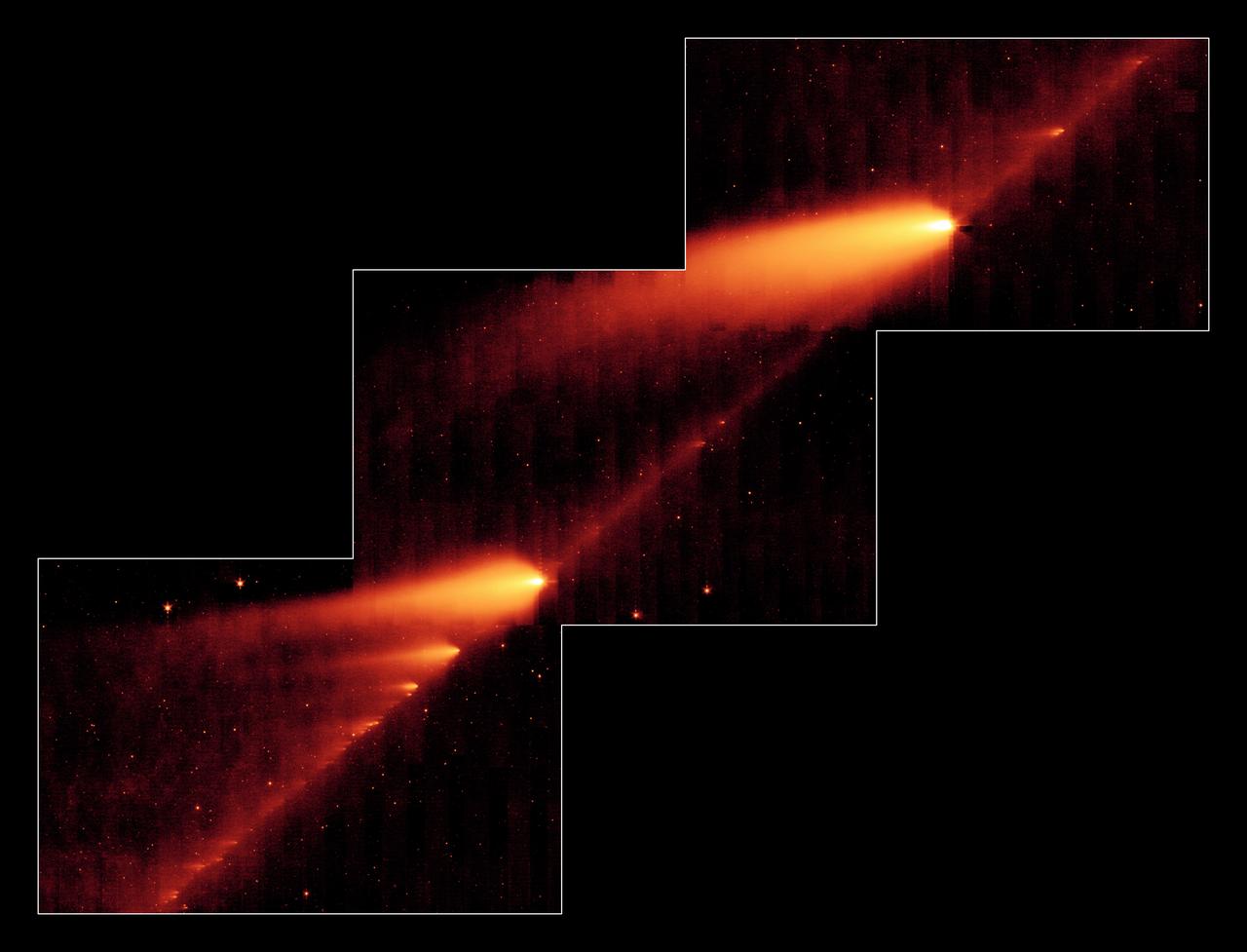
This infrared image from NASA Spitzer Space Telescope shows the broken Comet 73P/Schwassman-Wachmann 3 skimming along a trail of debris left during its multiple trips around the sun.
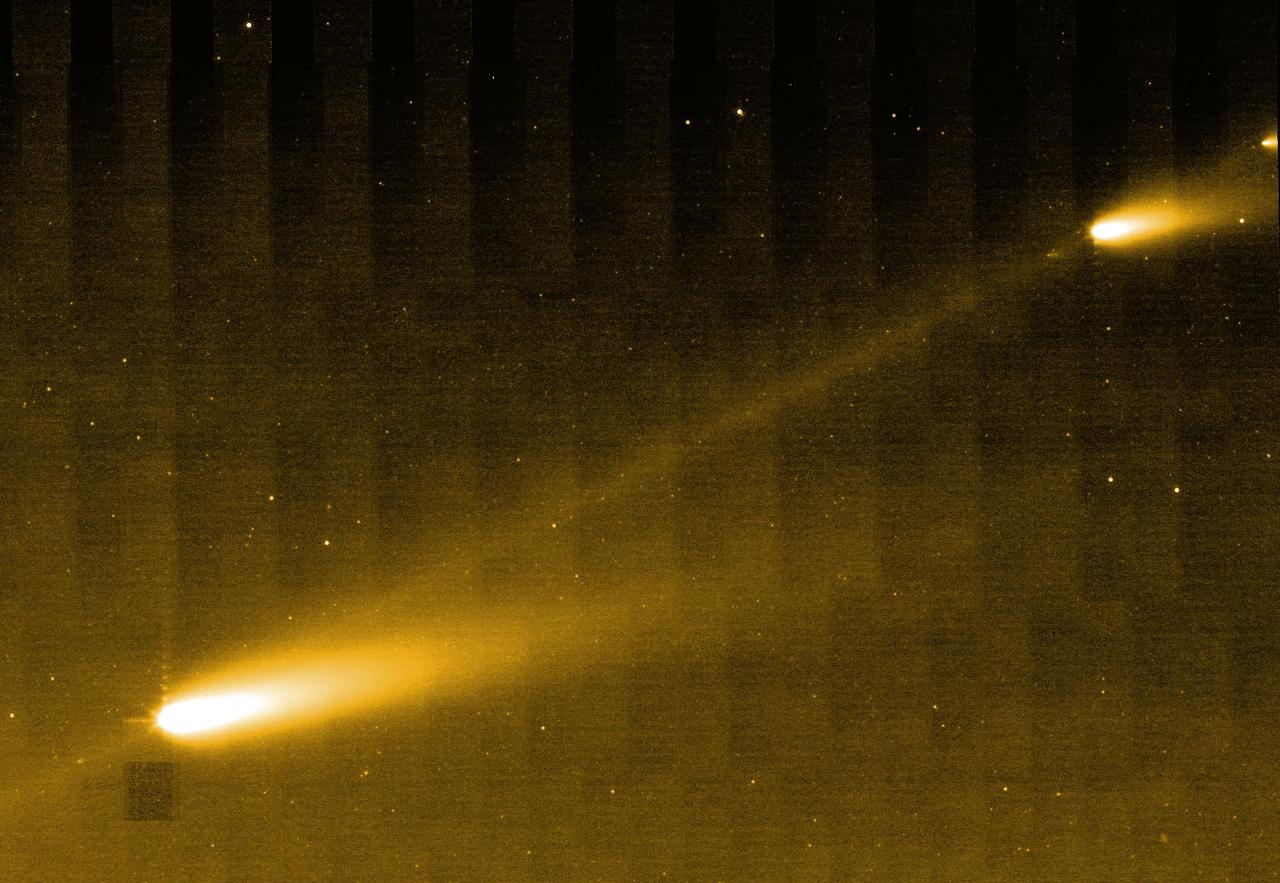
NASA Spitzer Space Telescope shows three of the many fragments making up Comet 73P/Schwassman-Wachmann 3. The picture also provides the best look yet at the crumbling comet trail of debris.
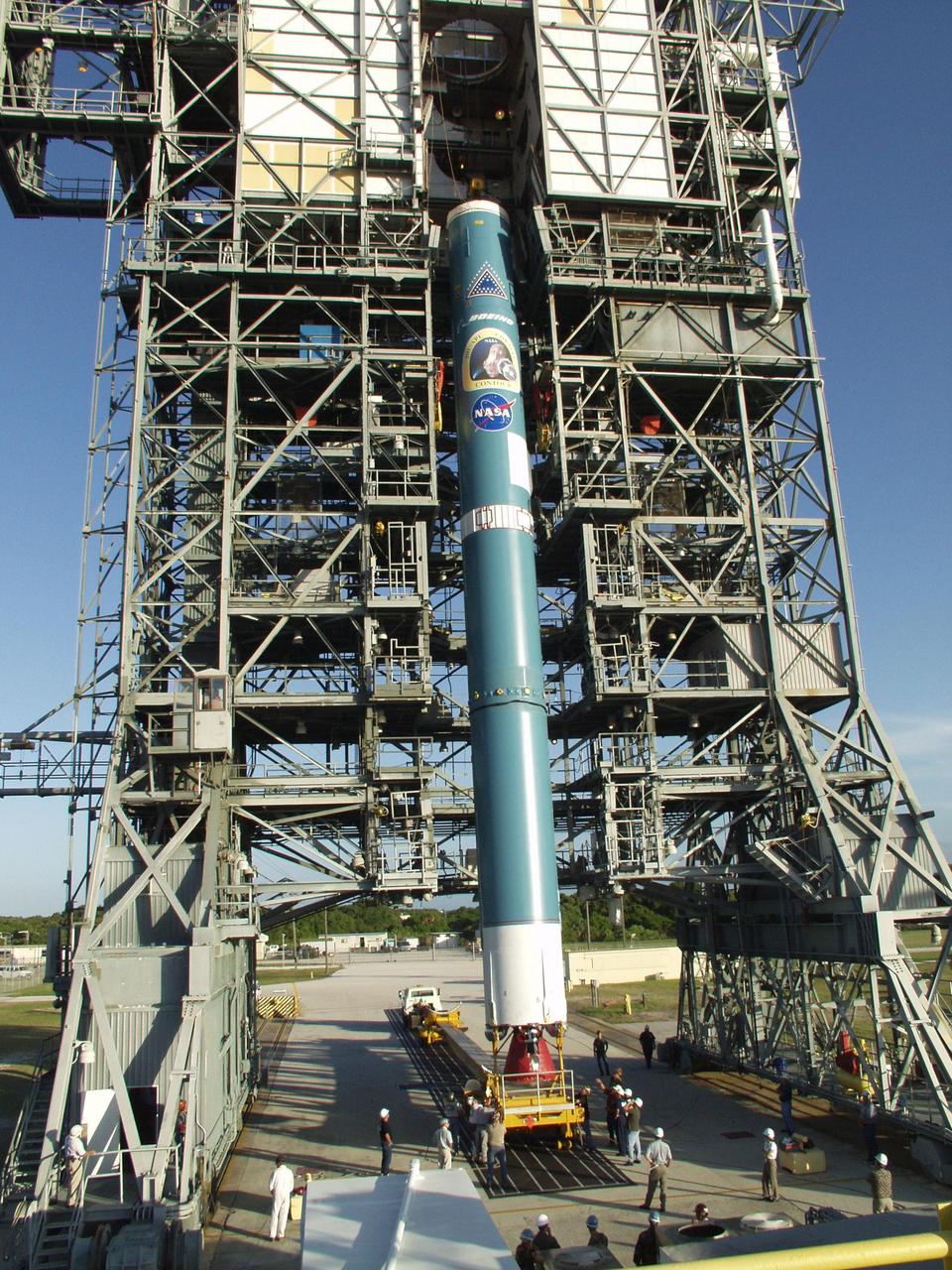
KENNEDY SPACE CENTER, FLA. -- The Boeing Delta II rocket nears a vertical position as it is lifted from the gantry. The rocket is the launch vehicle for the CONTOUR spacecraft, scheduled to launch July 1. CONTOUR will provide the first detailed look into the heart of a comet -- the nucleus. The spacecraft will fly close to at least two comets, Encke and Schwassmann-Wachmann 3, taking pictures of the nucleus while analyzing the gas and dust that surround these rocky, icy building blocks of the solar system.
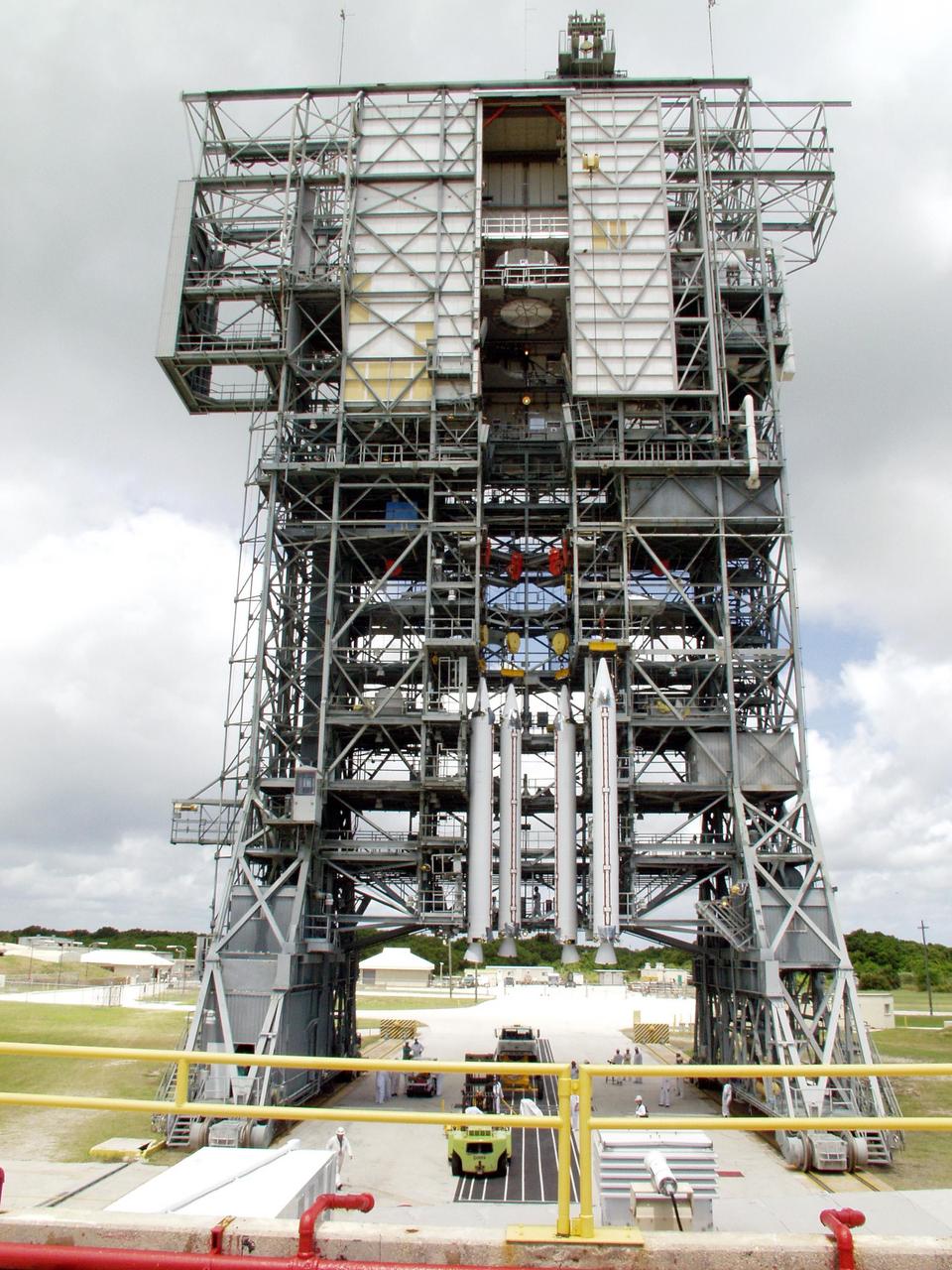
KENNEDY SPACE CENTER, FLA. -- On Launch Pad 17-A, Cape Canaveral Air Force Station, four solid rocket boosters are lifted for mating to a Boeing Delta II rocket. The rocket will be the launch vehicle for the CONTOUR spacecraft, scheduled to launch July 1. CONTOUR will provide the first detailed look into the heart of a comet -- the nucleus. The spacecraft will fly close to at least two comets, Encke and Schwassmann-Wachmann 3, taking pictures of the nucleus while analyzing the gas and dust that surround these rocky, icy building blocks of the solar system.
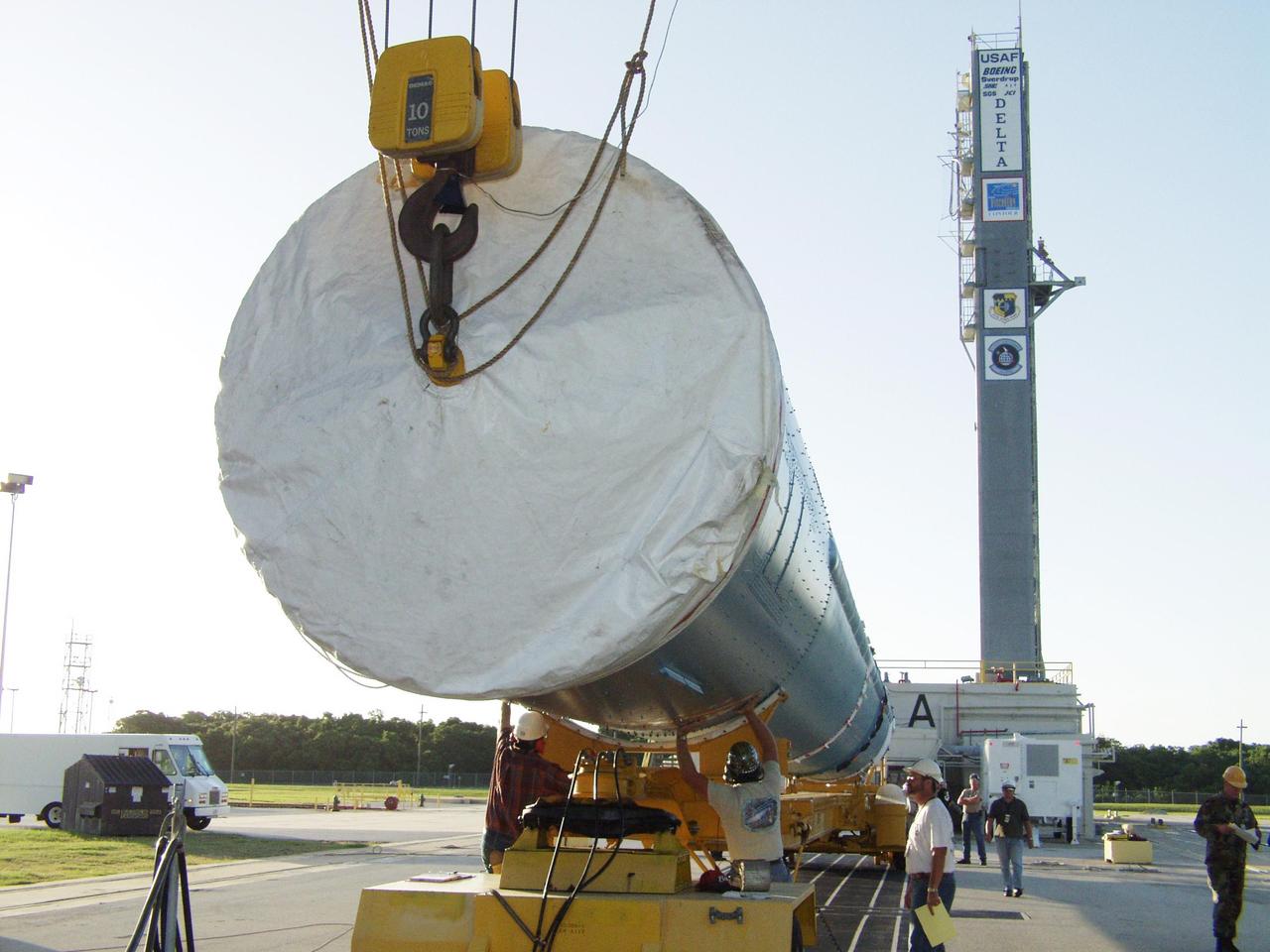
KENNEDY SPACE CENTER, FLA. - On Cape Canaveral Air Force Station Pad 17-A, the first stage of a Delta II rocket is lifted to vertical. The rocket is the launch vehicle for the CONTOUR spacecraft, scheduled to launch July 1. CONTOUR will provide the first detailed look into the heart of a comet -- the nucleus. The spacecraft will fly close to at least two comets, Encke and Schwassmann-Wachmann 3, taking pictures of the nucleus while analyzing the gas and dust that surround these rocky, icy building blocks of the solar system.
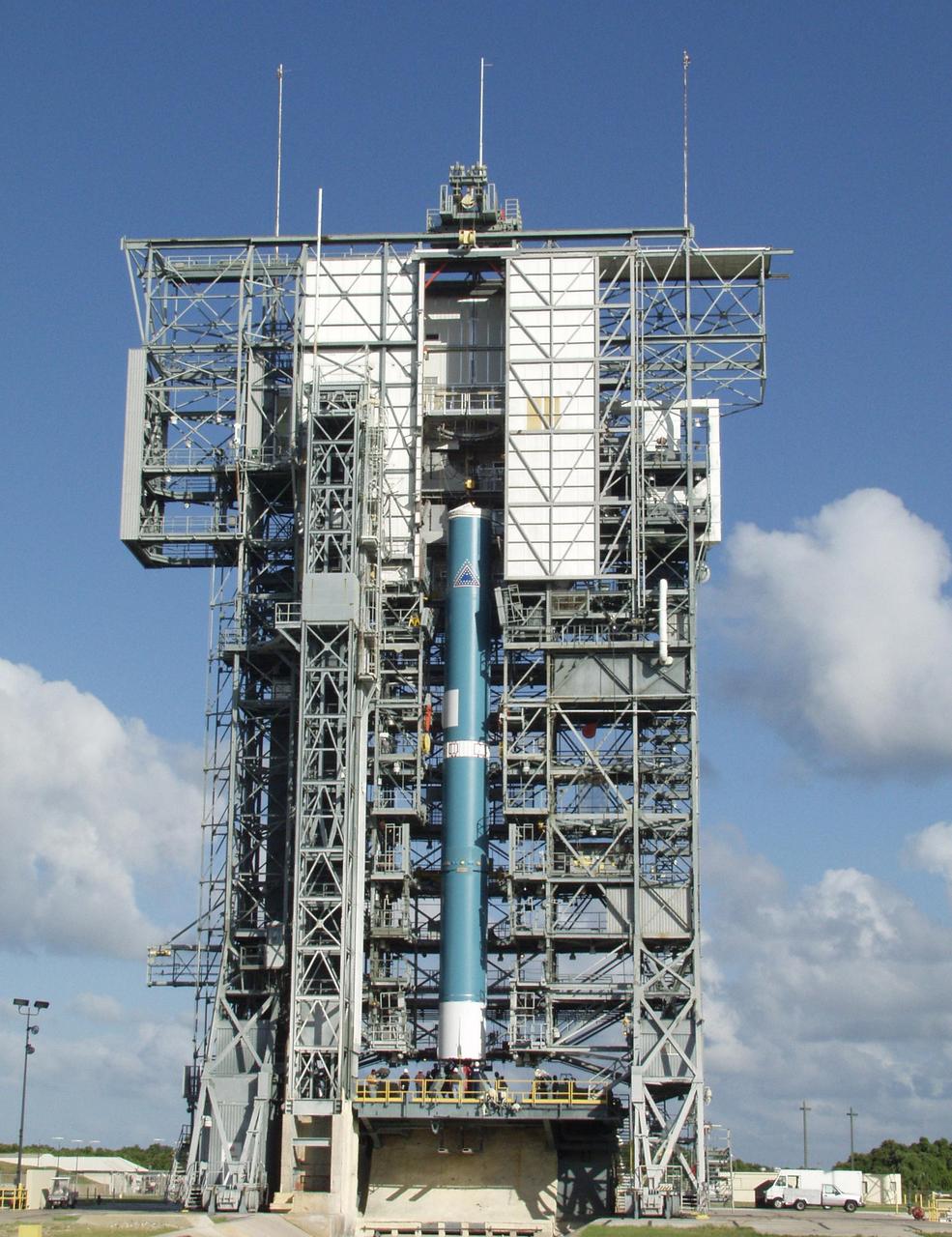
KENNEDY SPACE CENTER, FLA. -- On Launch Pad 17-A, Cape Canaveral Air Force Station, the Boeing Delta II rocket is lifted up the gantry. The rocket is the launch vehicle for the CONTOUR spacecraft, scheduled to launch July 1. CONTOUR will provide the first detailed look into the heart of a comet -- the nucleus. The spacecraft will fly close to at least two comets, Encke and Schwassmann-Wachmann 3, taking pictures of the nucleus while analyzing the gas and dust that surround these rocky, icy building blocks of the solar system.
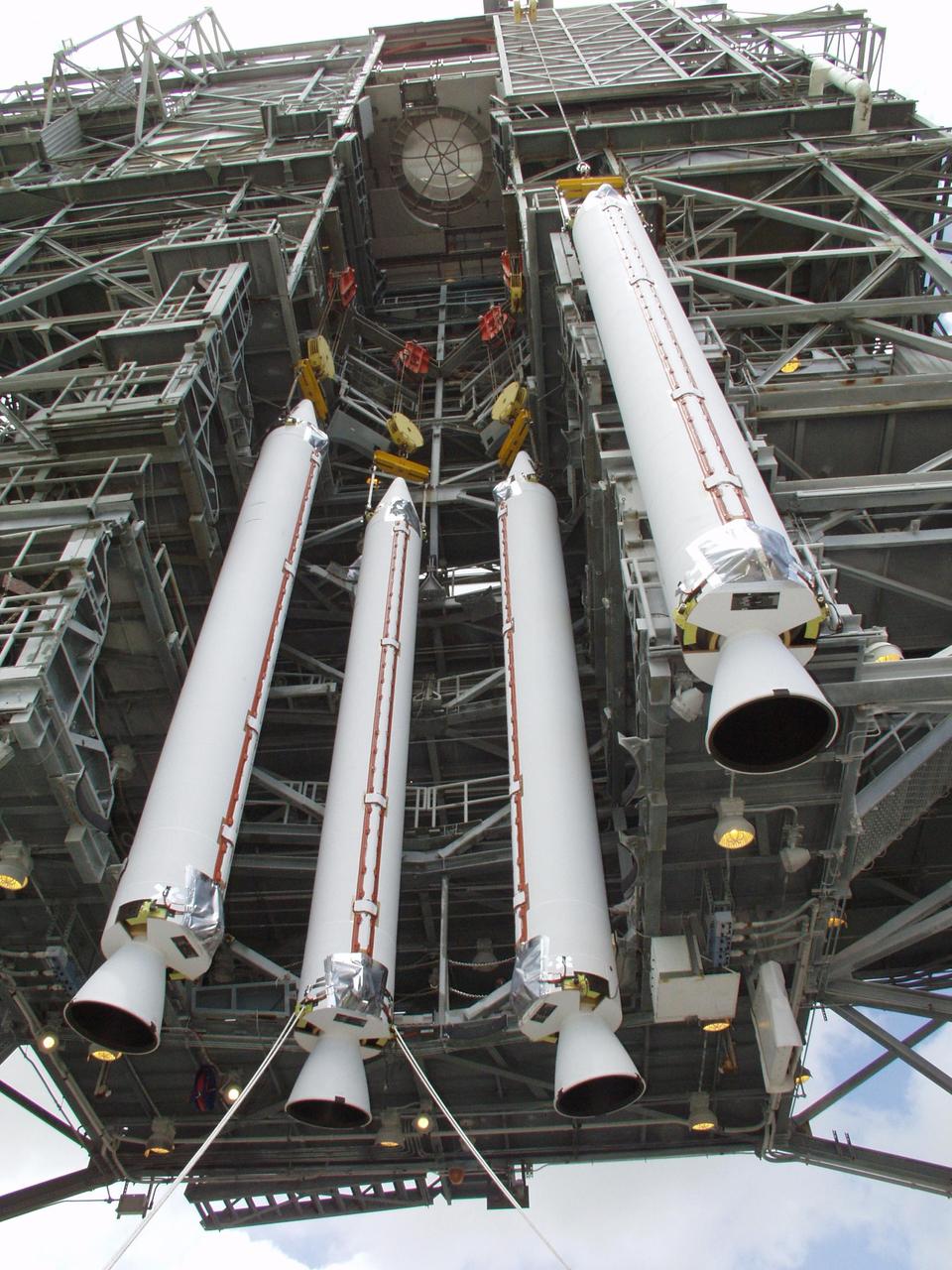
KENNEDY SPACE CENTER, FLA. -- On Launch Pad 17-A, Cape Canaveral Air Force Station, four solid rocket boosters are lifted for mating to a Boeing Delta II rocket. The rocket will be the launch vehicle for the CONTOUR spacecraft, scheduled to launch July 1. CONTOUR will provide the first detailed look into the heart of a comet -- the nucleus. The spacecraft will fly close to at least two comets, Encke and Schwassmann-Wachmann 3, taking pictures of the nucleus while analyzing the gas and dust that surround these rocky, icy building blocks of the solar system.

KENNEDY SPACE CENTER, FLA. -- On Launch Pad 17-A, Cape Canaveral Air Force Station, a technician works beneath the Boeing Delta II rocket that will be the launch vehicle for the CONTOUR spacecraft, scheduled to launch July 1. CONTOUR will provide the first detailed look into the heart of a comet -- the nucleus. The spacecraft will fly close to at least two comets, Encke and Schwassmann-Wachmann 3, taking pictures of the nucleus while analyzing the gas and dust that surround these rocky, icy building blocks of the solar system.

KENNEDY SPACE CENTER, FLA. -- On Cape Canaveral Air Force Station Pad 17-A, the Boeing Delta II rocket is lifted up the gantry. The rocket is the launch vehicle for the CONTOUR spacecraft, scheduled to launch July 1. CONTOUR will provide the first detailed look into the heart of a comet -- the nucleus. The spacecraft will fly close to at least two comets, Encke and Schwassmann-Wachmann 3, taking pictures of the nucleus while analyzing the gas and dust that surround these rocky, icy building blocks of the solar system.
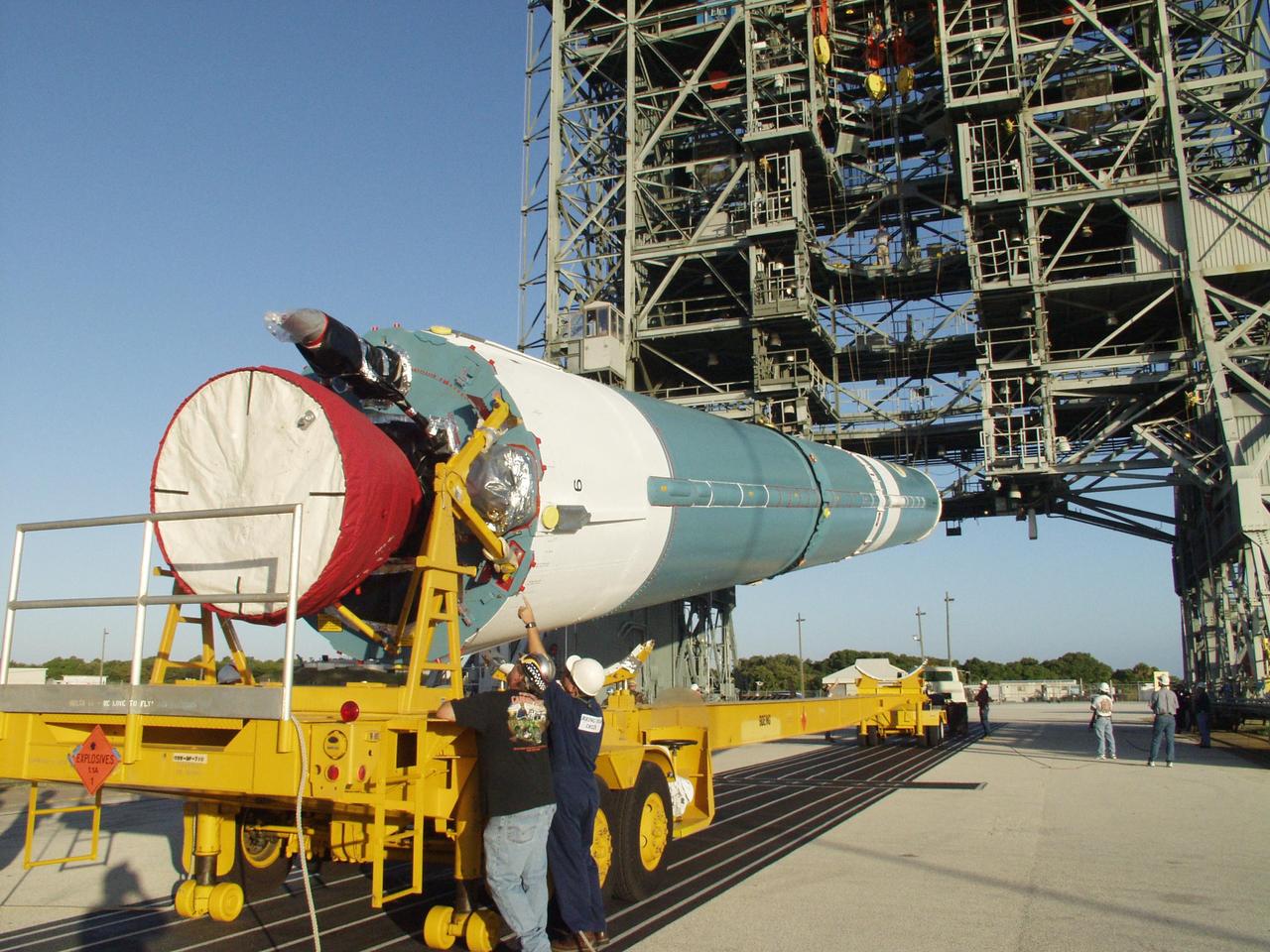
KENNEDY SPACE CENTER, FLA. - On Cape Canaveral Air Force Station Pad 17-A, workers check the lower portion of the Boeing Delta II rocket as it is lifted off the transporter. The rocket is the launch vehicle for the CONTOUR spacecraft, scheduled to launch July 1. CONTOUR will provide the first detailed look into the heart of a comet -- the nucleus. The spacecraft will fly close to at least two comets, Encke and Schwassmann-Wachmann 3, taking pictures of the nucleus while analyzing the gas and dust that surround these rocky, icy building blocks of the solar system.
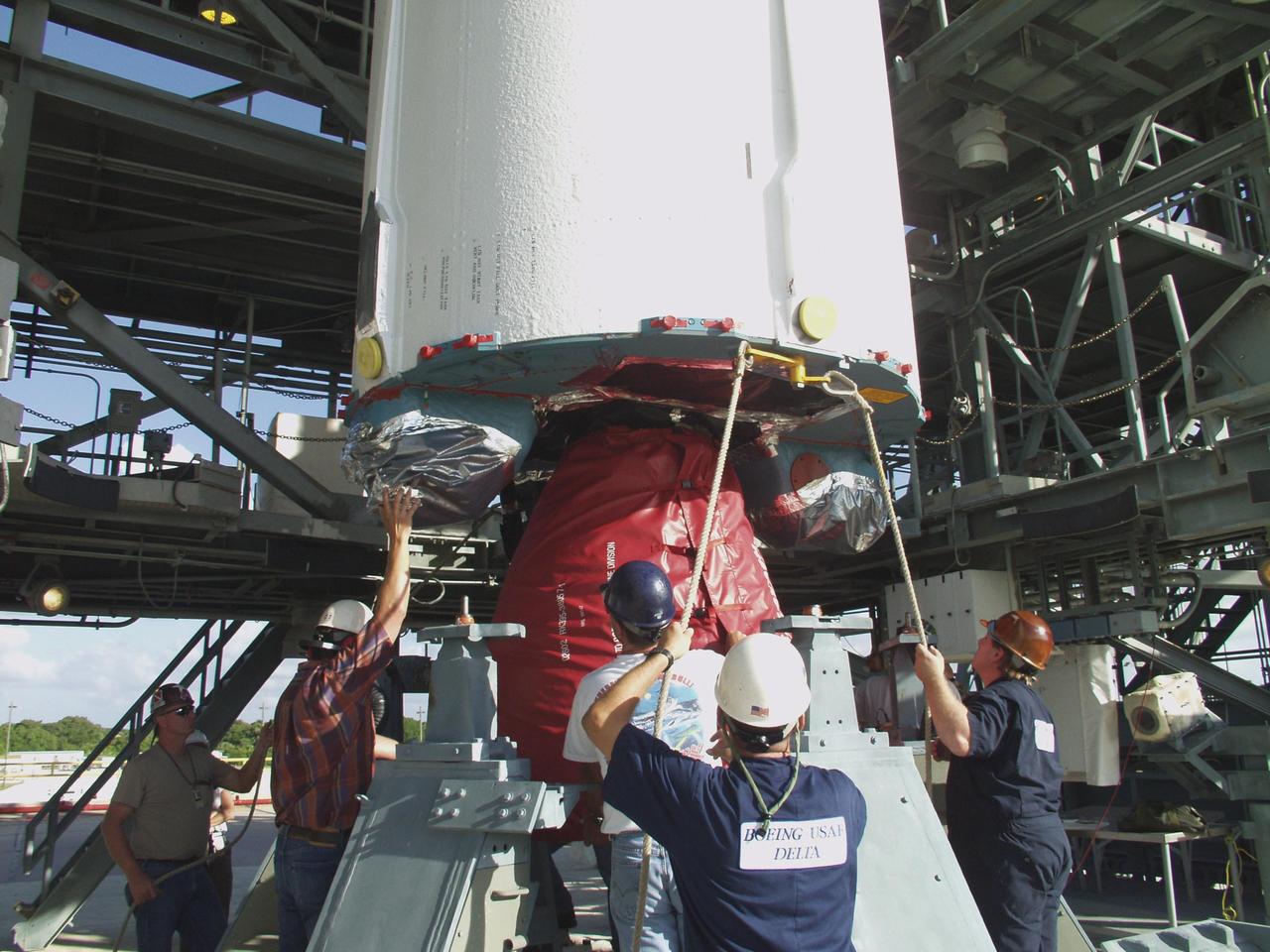
KENNEDY SPACE CENTER, FLA. -- On Launch Pad 17-A, Cape Canaveral Air Force Station, workers oversee the lifting of the Boeing Delta II rocket into the gantry above. The rocket is the launch vehicle for the CONTOUR spacecraft, scheduled to launch July 1. CONTOUR will provide the first detailed look into the heart of a comet -- the nucleus. The spacecraft will fly close to at least two comets, Encke and Schwassmann-Wachmann 3, taking pictures of the nucleus while analyzing the gas and dust that surround these rocky, icy building blocks of the solar system.
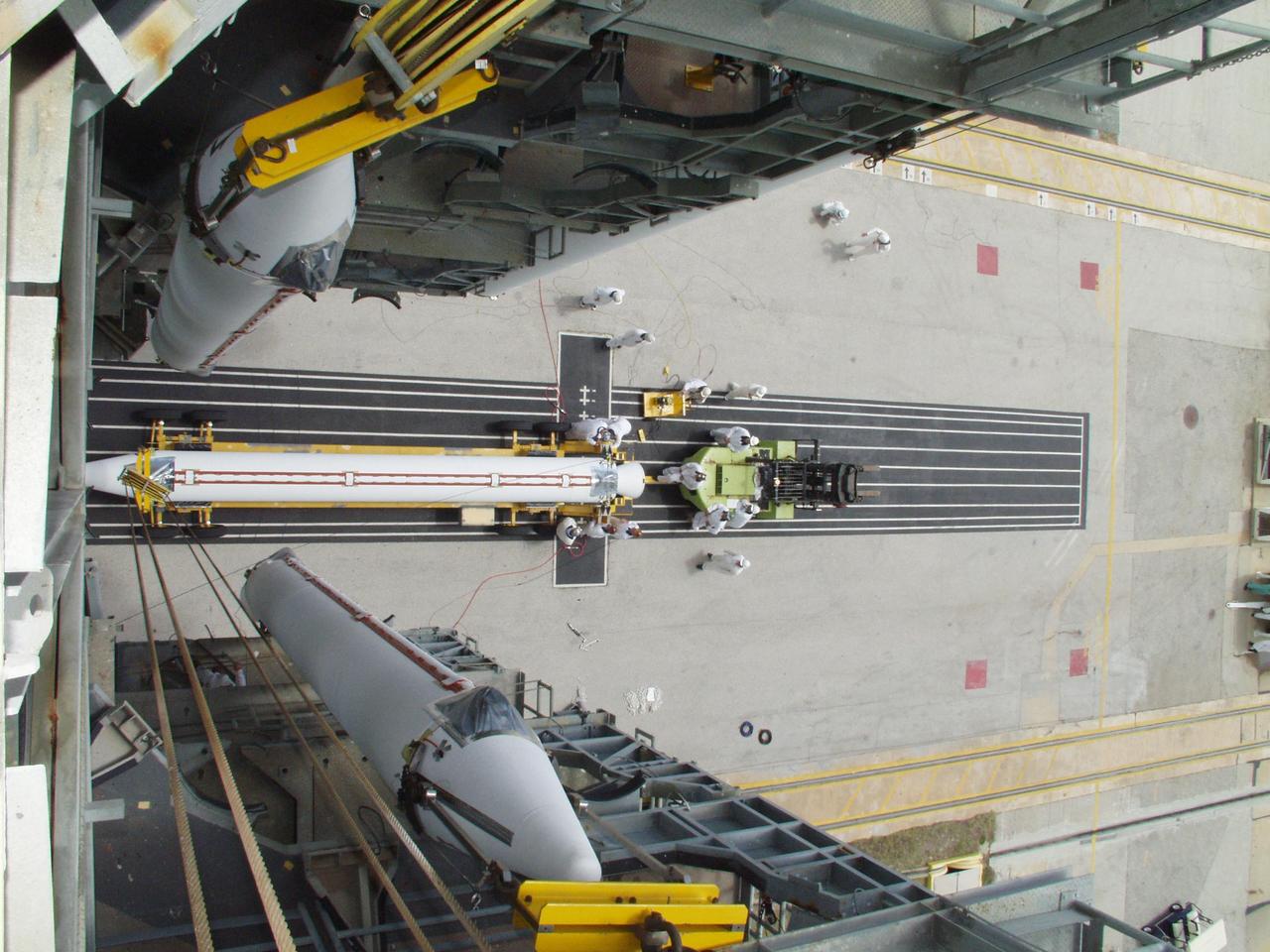
KENNEDY SPACE CENTER, FLA. -- Viewed from the top of Launch Pad 17-A, Cape Canaveral Air Force Station, two solid rocket boosters are lifted for mating to a Boeing Delta II rocket, as another waits its turn on the transporter below. The rocket will be the launch vehicle for the CONTOUR spacecraft, scheduled to launch July 1. CONTOUR will provide the first detailed look into the heart of a comet -- the nucleus. The spacecraft will fly close to at least two comets, Encke and Schwassmann-Wachmann 3, taking pictures of the nucleus while analyzing the gas and dust that surround these rocky, icy building blocks of the solar system.
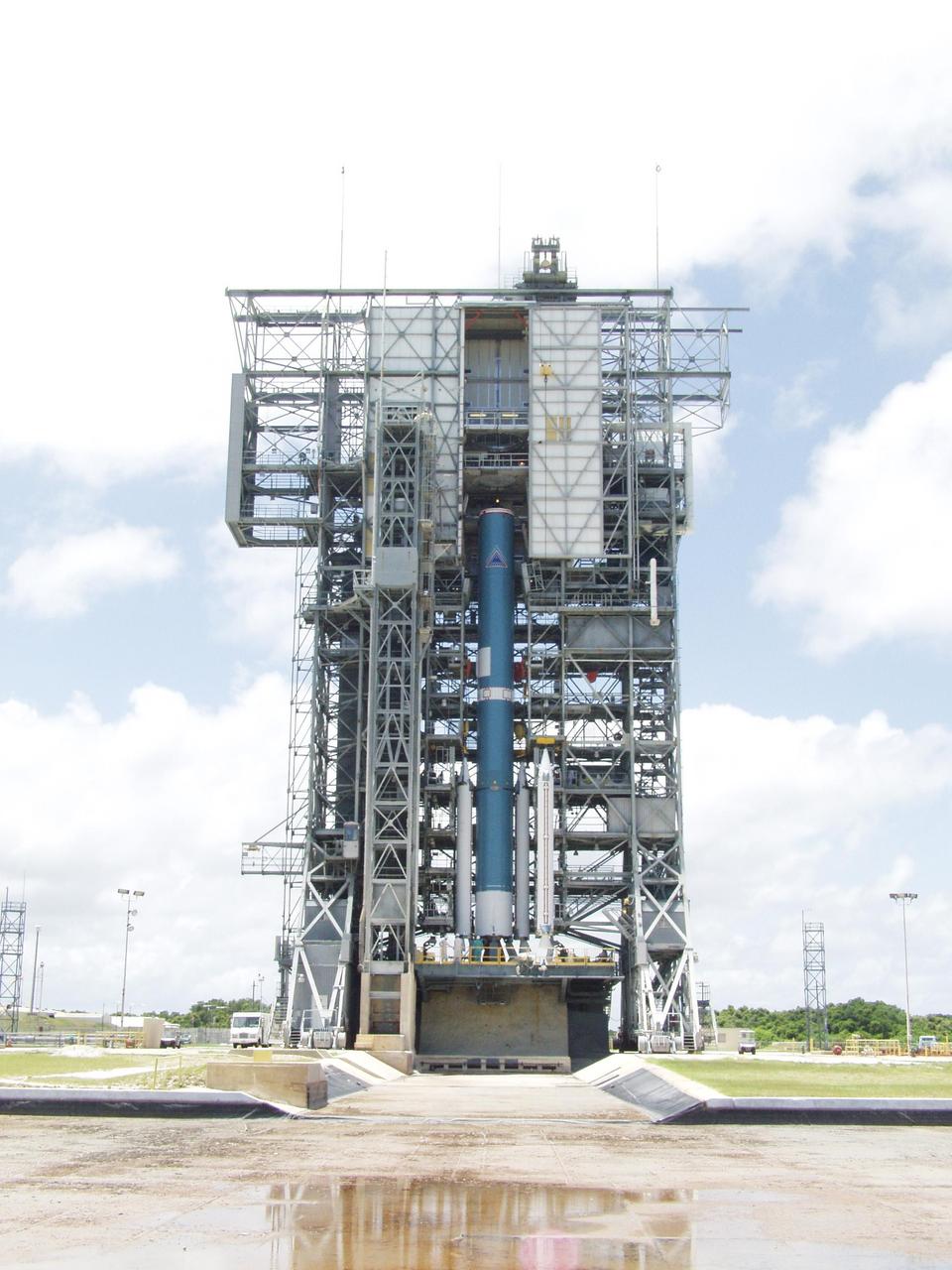
KENNEDY SPACE CENTER, FLA. -- On Launch Pad 17-A, Cape Canaveral Air Force Station, the solid rocket boosters have been installed on the first stage of a Boeing Delta II rocket. The rocket will be the launch vehicle for the CONTOUR spacecraft, scheduled to launch July 1. CONTOUR will provide the first detailed look into the heart of a comet -- the nucleus. The spacecraft will fly close to at least two comets, Encke and Schwassmann-Wachmann 3, taking pictures of the nucleus while analyzing the gas and dust that surround these rocky, icy building blocks of the solar system.
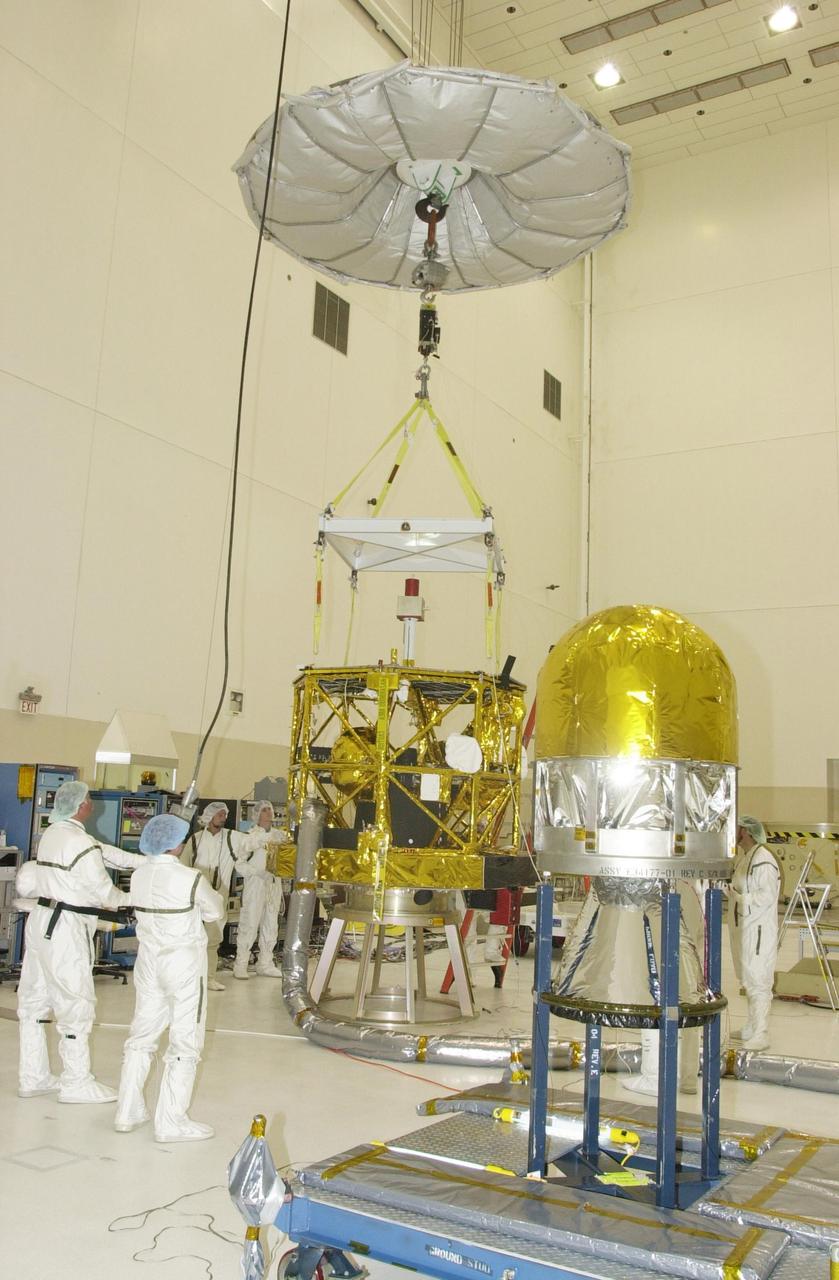
KENNEDY SPACE CENTER, FLA. - An overhead crane is lowered onto the CONTOUR spacecraft in the Spacecraft Assembly and Encapsulation Facility 2. The crane will move it over to the apogee kick motor nearby where it will be attached. CONTOUR will provide the first detailed look into the heart of a comet -- the nucleus. The spacecraft will fly close to at least two comets, Encke and Schwassmann-Wachmann 3, taking pictures of the nucleus while analyzing the gas and dust that surround these rocky, icy building blocks of the solar system. The Applied Physics Laboratory of Johns Hopkins University, Baltimore, Md., built CONTOUR and will also be in control of the spacecraft after launch, scheduled for July 1, 2002, from LC 17A at Cape Canaveral Air Force Station
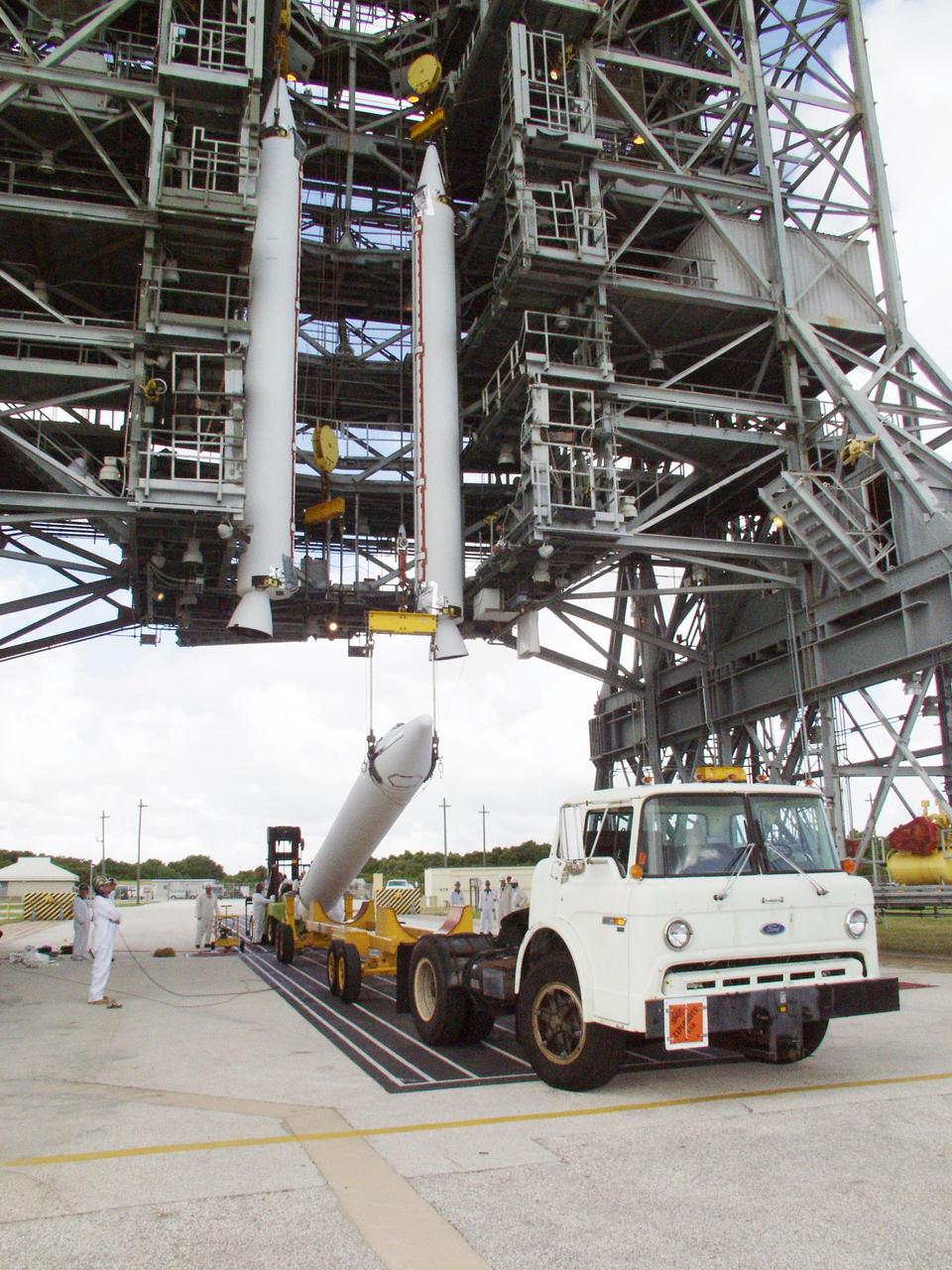
KENNEDY SPACE CENTER, FLA. -- On Launch Pad 17-A, Cape Canaveral Air Force Station, two solid rocket boosters are lifted for mating to a Boeing Delta II rocket, as another waits its turn on the transporter below. The rocket will be the launch vehicle for the CONTOUR spacecraft, scheduled to launch July 1. CONTOUR will provide the first detailed look into the heart of a comet -- the nucleus. The spacecraft will fly close to at least two comets, Encke and Schwassmann-Wachmann 3, taking pictures of the nucleus while analyzing the gas and dust that surround these rocky, icy building blocks of the solar system.
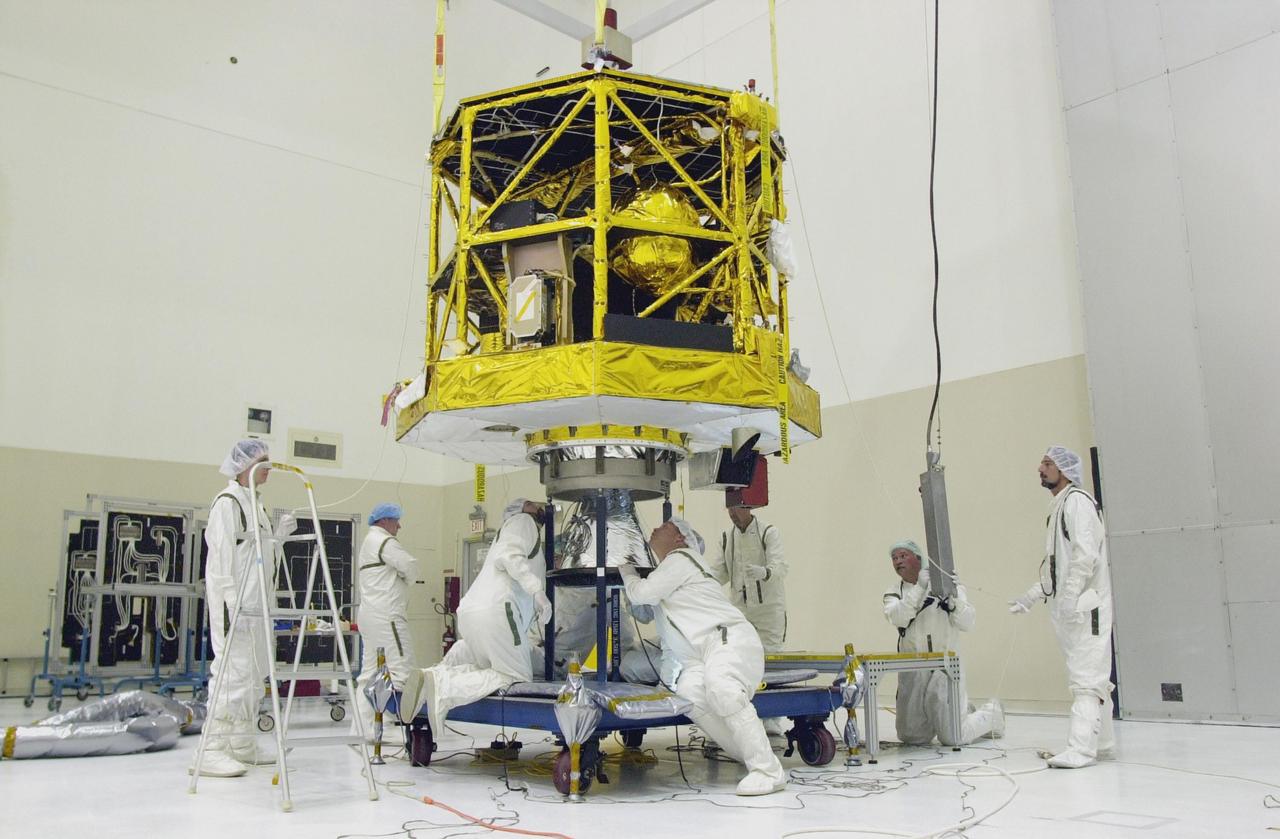
KENNEDY SPACE CENTER, FLA. - Workers in the Spacecraft Assembly and Encapsulation Facility 2 check the position of the CONTOUR spacecraft as it is lowered over the apogee kick motor to which it will be attached. CONTOUR will provide the first detailed look into the heart of a comet -- the nucleus. The spacecraft will fly close to at least two comets, Encke and Schwassmann-Wachmann 3, taking pictures of the nucleus while analyzing the gas and dust that surround these rocky, icy building blocks of the solar system. The Applied Physics Laboratory of Johns Hopkins University, Baltimore, Md., built CONTOUR and will also be in control of the spacecraft after launch, scheduled for July 1, 2002, from LC 17A at Cape Canaveral Air Force Station
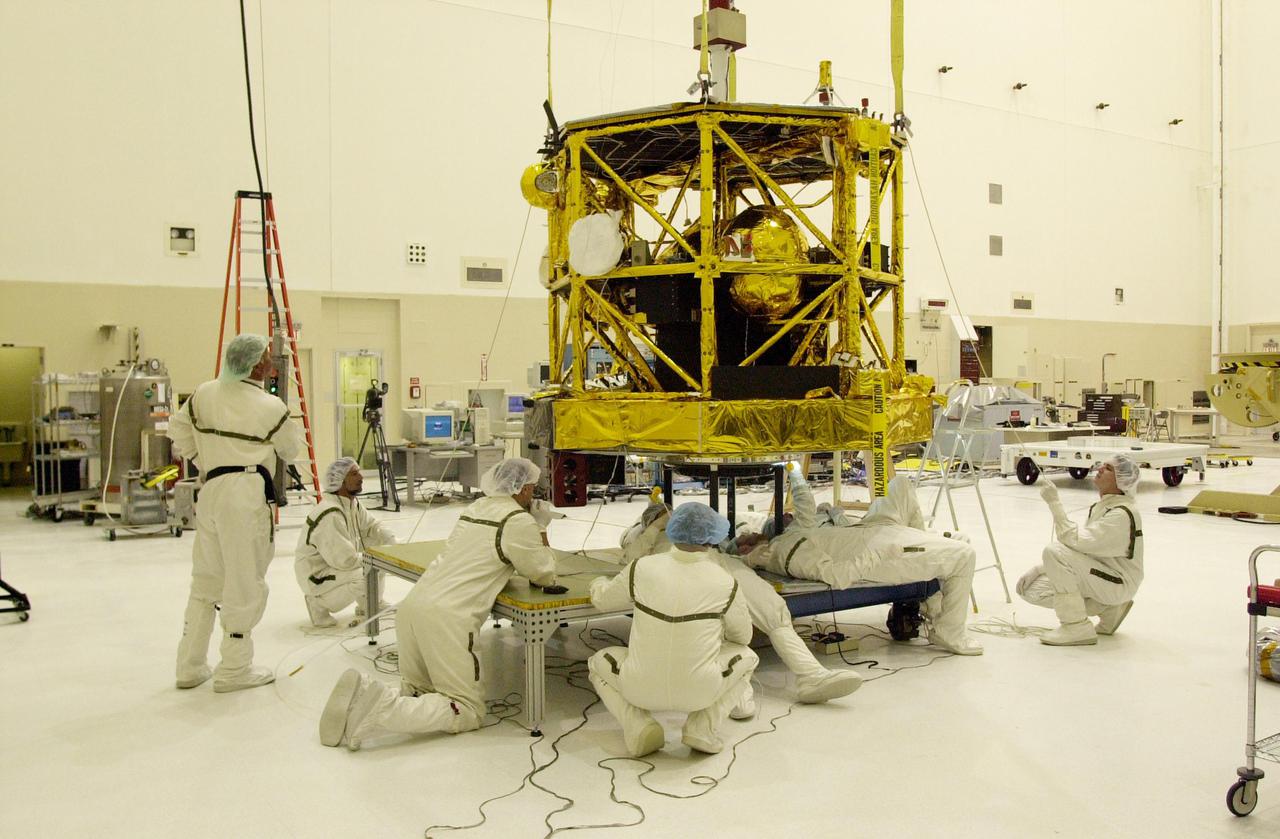
KENNEDY SPACE CENTER, FLA. -- In the Spacecraft Assembly and Encapsulation Facility 2, workers watch closely as the CONTOUR spacecraft is lowered into place over the apogee kick motor to which it will be attached. CONTOUR will provide the first detailed look into the heart of a comet -- the nucleus. The spacecraft will fly close to at least two comets, Encke and Schwassmann-Wachmann 3, taking pictures of the nucleus while analyzing the gas and dust that surround these rocky, icy building blocks of the solar system. The Applied Physics Laboratory of Johns Hopkins University, Baltimore, Md., built CONTOUR and will also be in control of the spacecraft after launch, scheduled for July 1, 2002, from LC 17A at Cape Canaveral Air Force Station
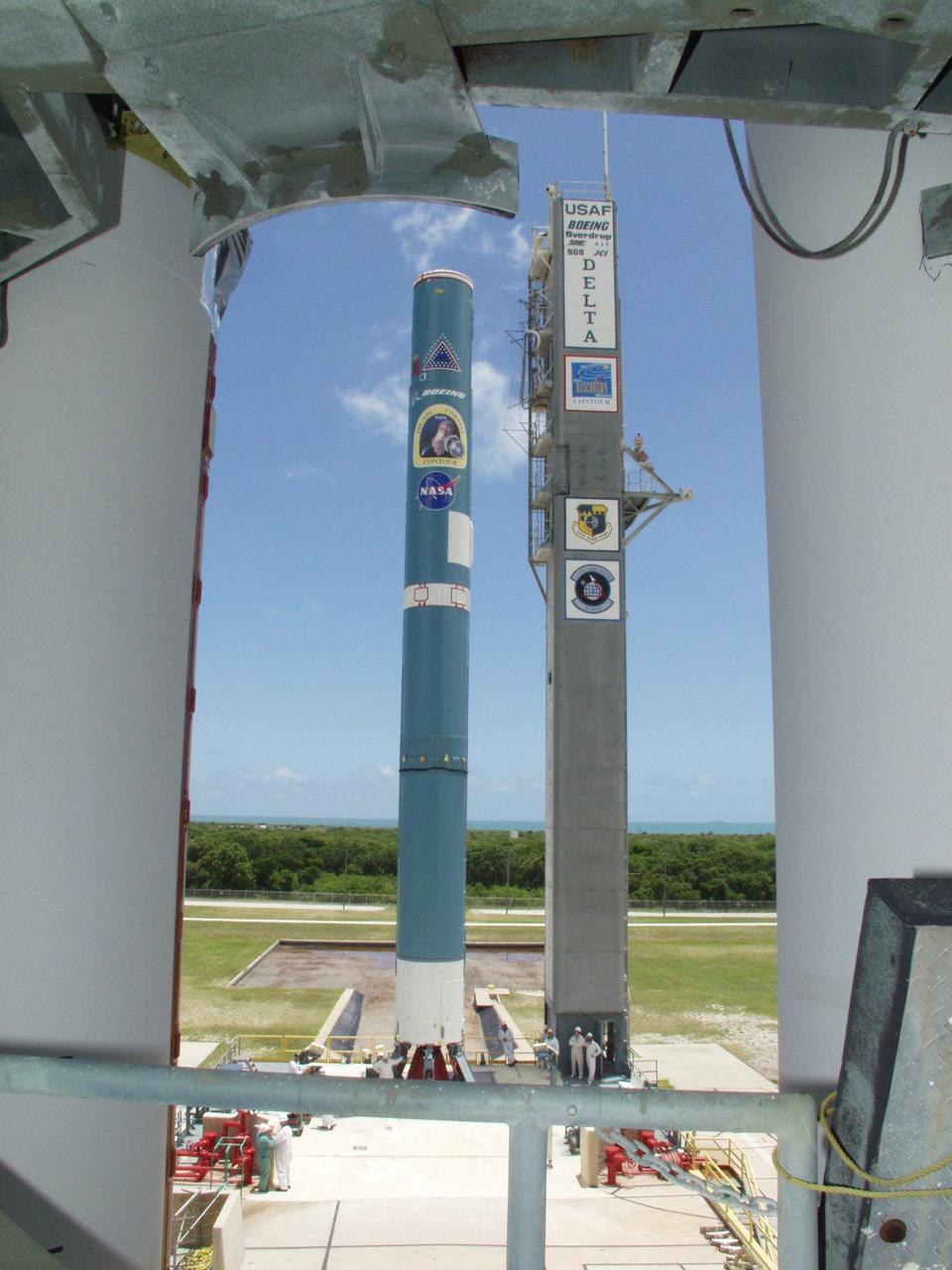
KENNEDY SPACE CENTER, FLA. -- On Launch Pad 17-A, Cape Canaveral Air Force Station, a view of the first stage of a Boeing Delta II rocket is captured between two of the solid rocket boosters that will be mated to it. The rocket will be the launch vehicle for the CONTOUR spacecraft, scheduled to launch July 1. CONTOUR will provide the first detailed look into the heart of a comet -- the nucleus. The spacecraft will fly close to at least two comets, Encke and Schwassmann-Wachmann 3, taking pictures of the nucleus while analyzing the gas and dust that surround these rocky, icy building blocks of the solar system.
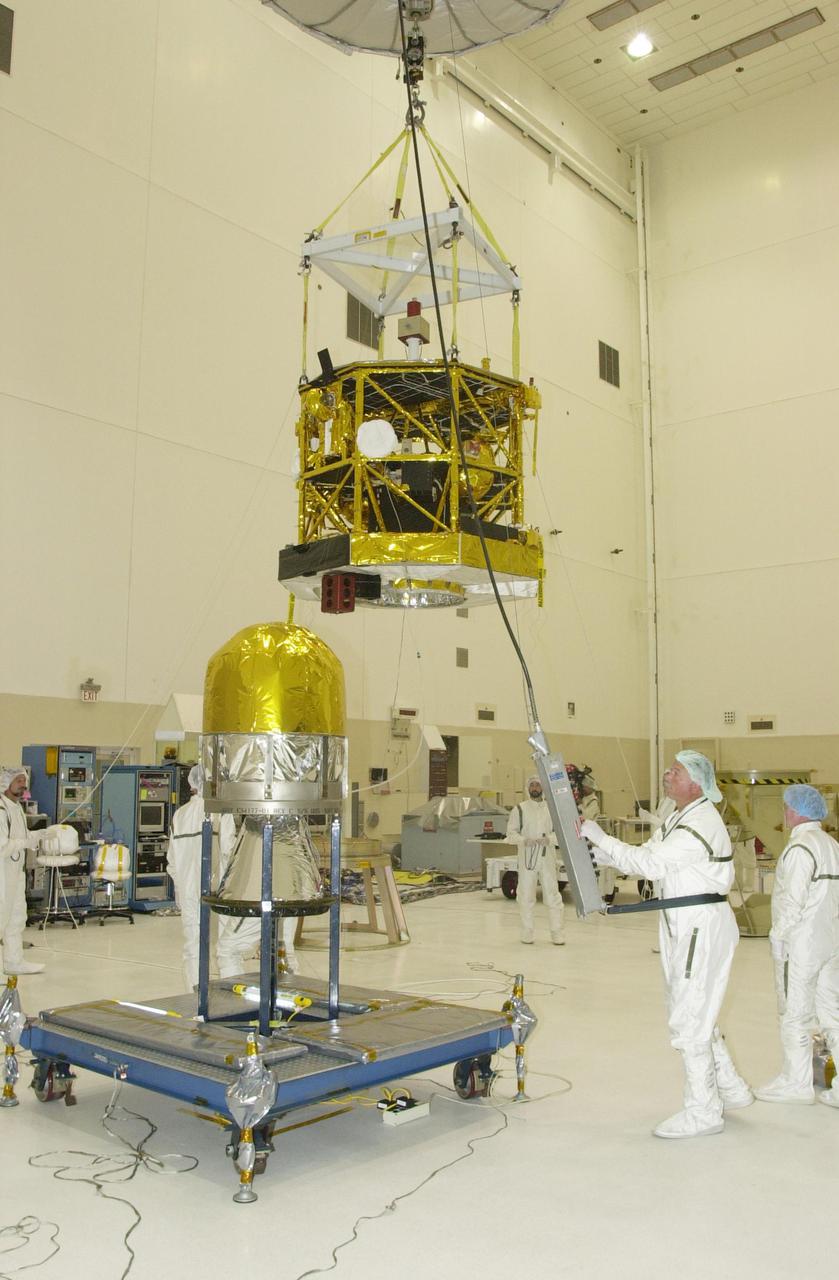
KENNEDY SPACE CENTER, FLA. - In the Spacecraft Assembly and Encapsulation Facility 2, the CONTOUR spacecraft is carried by an overhead crane to the apogee kick motor sitting on a stand below. The spacecraft will be attached to the motor for launch. CONTOUR will provide the first detailed look into the heart of a comet -- the nucleus. The spacecraft will fly close to at least two comets, Encke and Schwassmann-Wachmann 3, taking pictures of the nucleus while analyzing the gas and dust that surround these rocky, icy building blocks of the solar system. The Applied Physics Laboratory of Johns Hopkins University, Baltimore, Md., built CONTOUR and will also be in control of the spacecraft after launch, scheduled for July 1, 2002, from LC 17A at Cape Canaveral Air Force Station
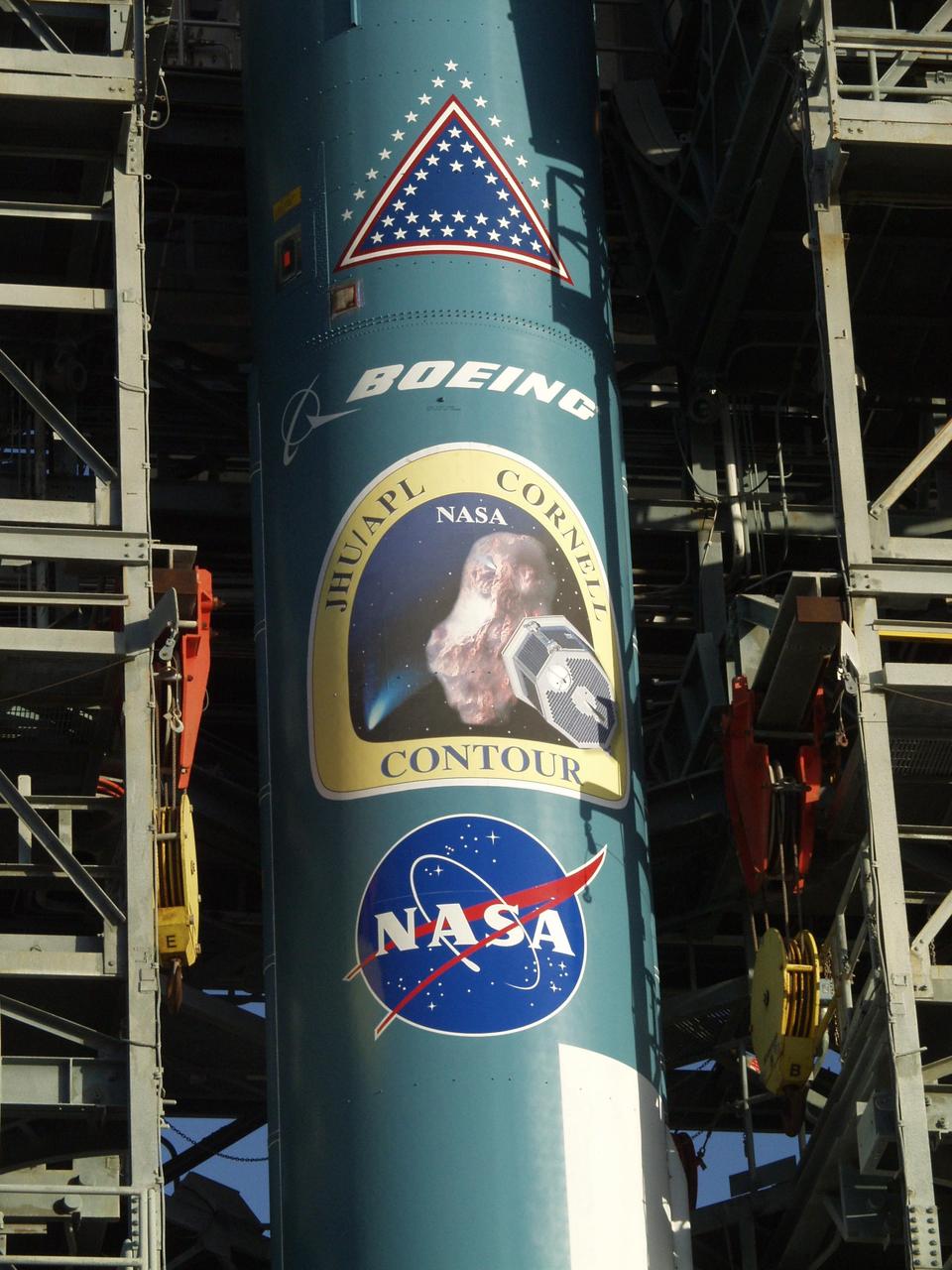
KENNEDY SPACE CENTER, FLA. - This closeup of the Boeing Delta II rocket on Launch Pad 17-A, Cape Canaveral Air Force Station, shows the CONTOUR project logo and the NASA emblem below it. The rocket is the launch vehicle for the CONTOUR spacecraft, scheduled to launch July 1. CONTOUR will provide the first detailed look into the heart of a comet -- the nucleus. The spacecraft will fly close to at least two comets, Encke and Schwassmann-Wachmann 3, taking pictures of the nucleus while analyzing the gas and dust that surround these rocky, icy building blocks of the solar system.
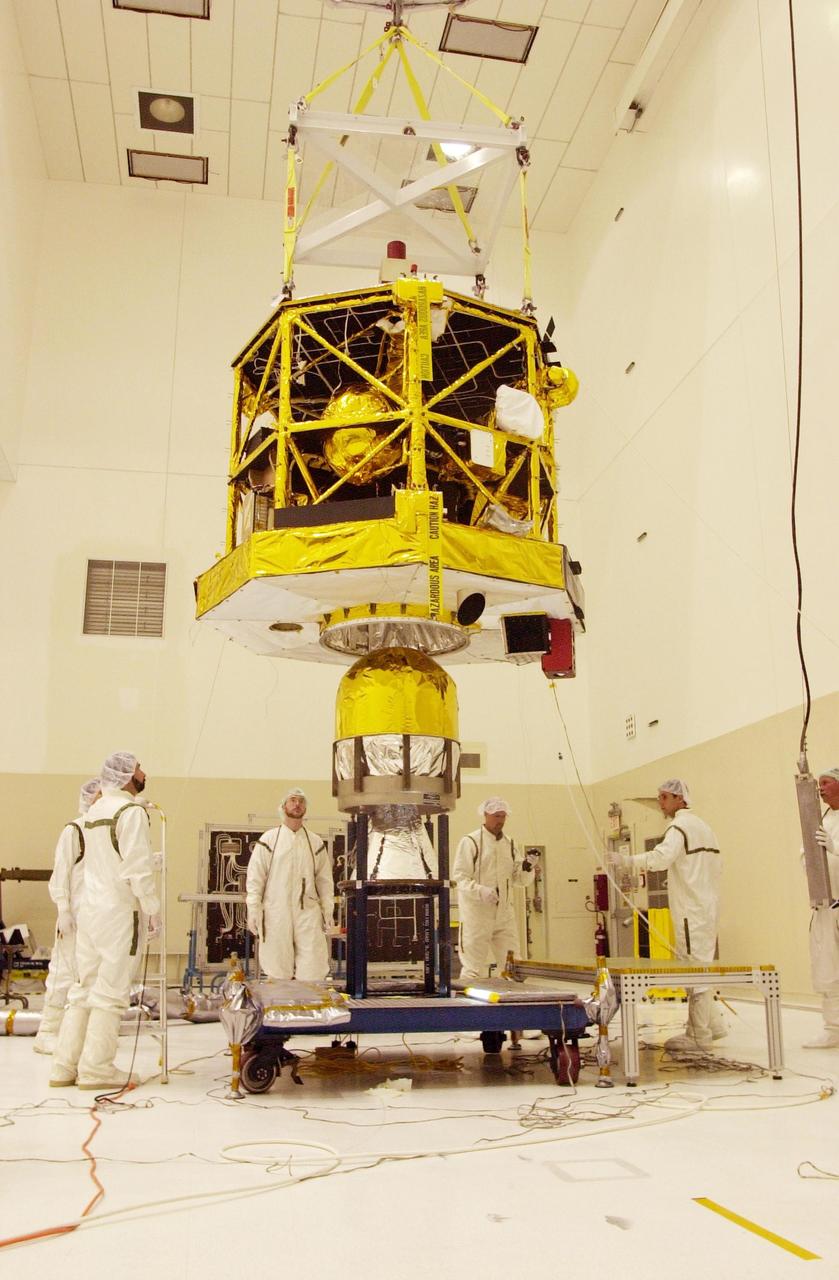
KENNEDY SPACE CENTER, FLA. -- In the Spacecraft Assembly and Encapsulation Facility 2, workers watch closely as the CONTOUR spacecraft is lowered toward the apogee kick motor to which it will be attached. CONTOUR will provide the first detailed look into the heart of a comet -- the nucleus. The spacecraft will fly close to at least two comets, Encke and Schwassmann-Wachmann 3, taking pictures of the nucleus while analyzing the gas and dust that surround these rocky, icy building blocks of the solar system. The Applied Physics Laboratory of Johns Hopkins University, Baltimore, Md., built CONTOUR and will also be in control of the spacecraft after launch, scheduled for July 1, 2002, from LC 17A at Cape Canaveral Air Force Station
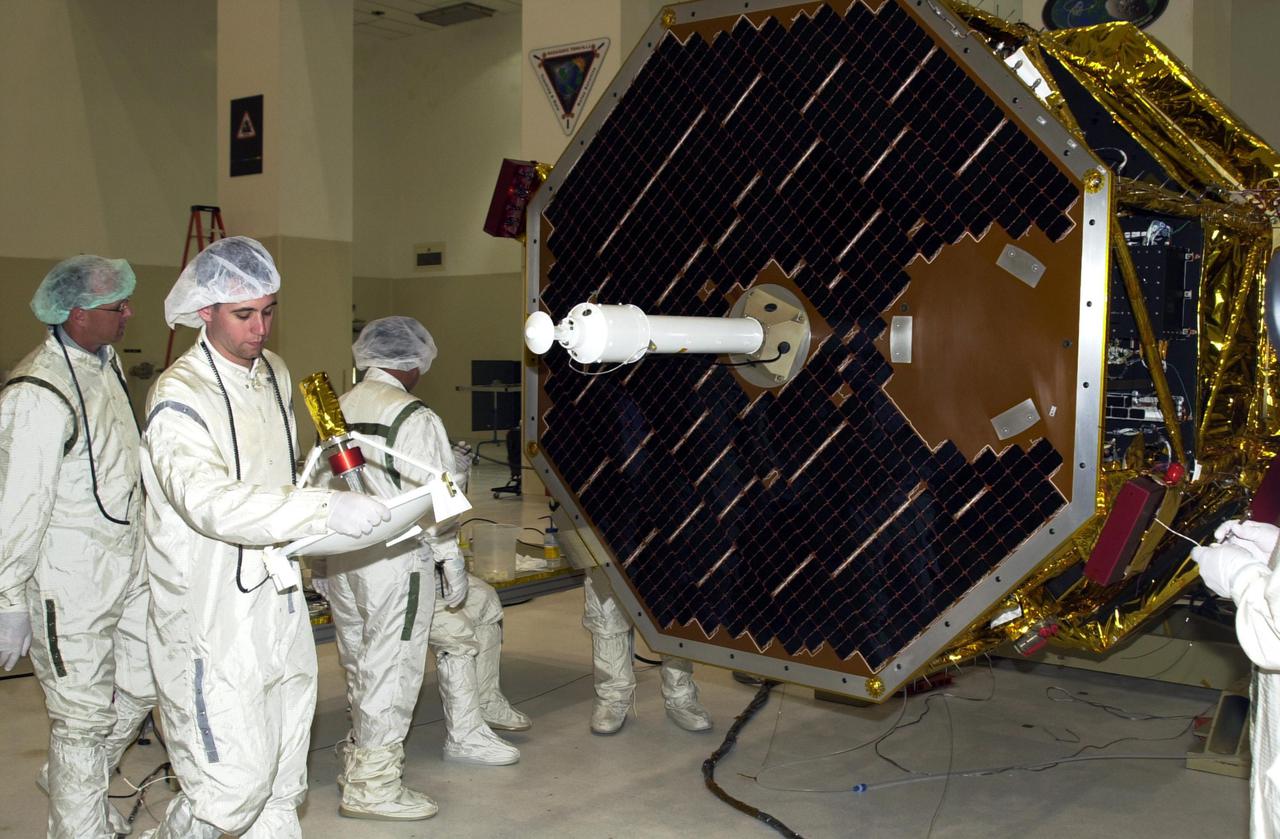
KENNEDY SPACE CENTER, FLA. -- A worker carries the high gain antenna toward the Comet Nucleus Tour (CONTOUR) spacecraft where it will be attached on the solar panel next to the larger antenna (seen in the center of the panel). CONTOUR, scheduled for launch July 1, 2002, from LC 17A at Cape Canaveral Air Force Station, will provide the first detailed look into the heart of a comet -- the nucleus. The spacecraft will fly as close as 60 miles (100 kilometers) to at least two comets, Encke and Schwassmann-Wachmann 3. It will take the sharpest pictures yet of the nucleus while analyzing the gas and dust that surround these rocky, icy building blocks of the solar system. The Applied Physics Laboratory of Johns Hopkins University, Baltimore, Md., built CONTOUR and will also be in control of the spacecraft after launch
KENNEDY SPACE CENTER, FLA. -- Workers attach the solar panel and attached antenna to the Comet Nucleus Tour (CONTOUR) spacecraft in the Spacecraft Assembly and Encapsulation Facility 2 (SAEF-2). Scheduled for launch July 1, 2002, from LC 17A at Cape Canaveral Air Force Station, CONTOUR will provide the first detailed look into the heart of a comet -- the nucleus. The spacecraft will fly as close as 60 miles (100 kilometers) to at least two comets, Encke and Schwassmann-Wachmann 3. It will take the sharpest pictures yet of the nucleus while analyzing the gas and dust that surround these rocky, icy building blocks of the solar system. The Applied Physics Laboratory of Johns Hopkins University, Baltimore, Md., built CONTOUR and will also be in control of the spacecraft after launch
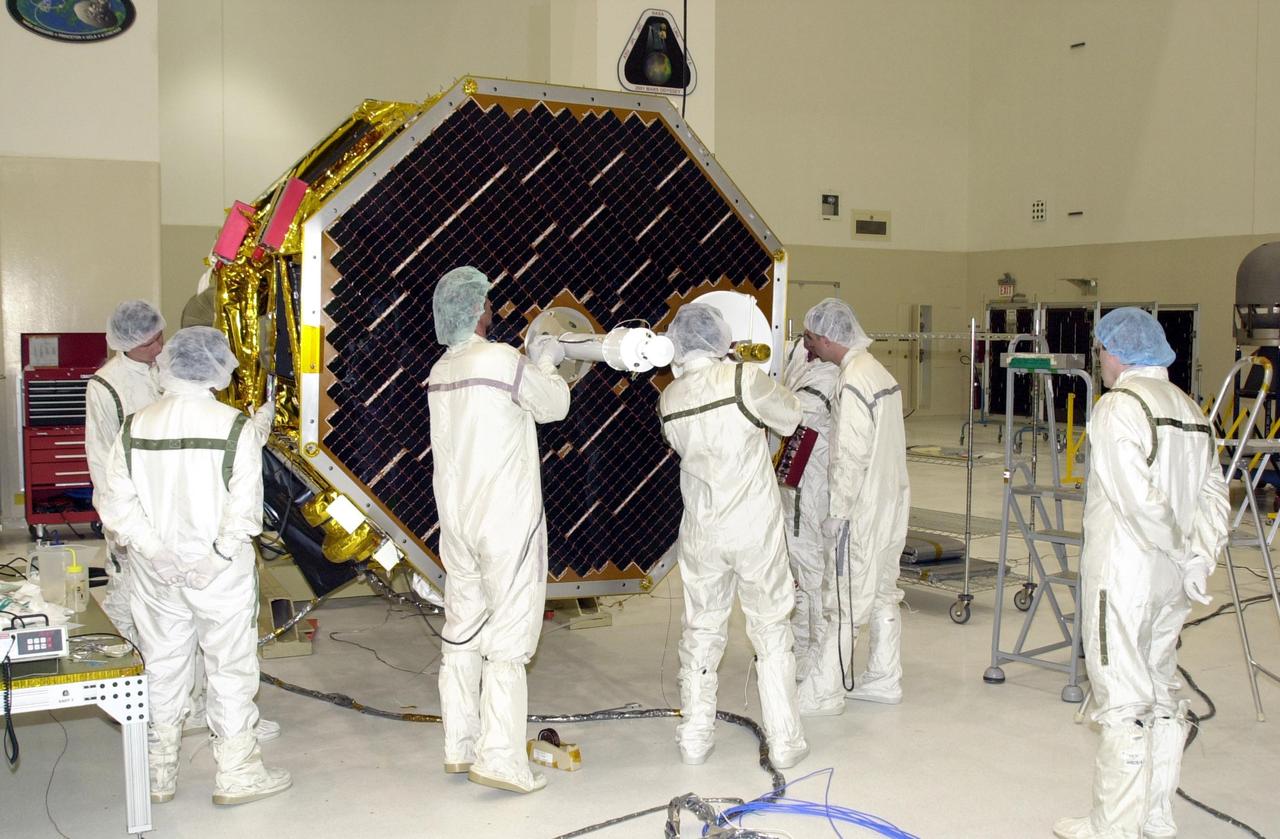
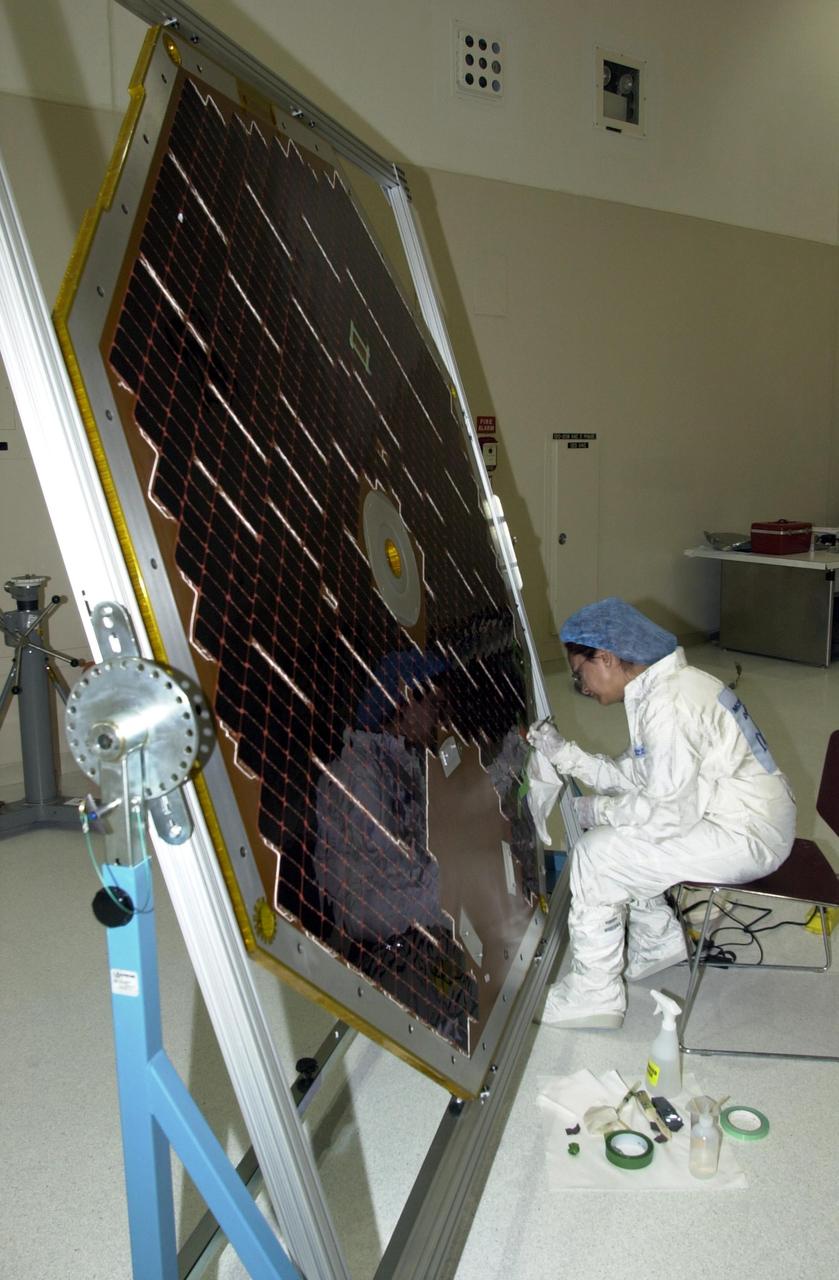
KENNEDY SPACE CENTER, FLA. -- Workers in the Spacecraft Assembly and Encapsulation Facility 2 (SAEF-2) make adjustments to the two antennas installed on the solar panel of the Comet Nucleus Tour (CONTOUR) spacecraft. Scheduled for launch July 1, 2002, from LC 17A at Cape Canaveral Air Force Station, CONTOUR will provide the first detailed look into the heart of a comet -- the nucleus. The spacecraft will fly as close as 60 miles (100 kilometers) to at least two comets, Encke and Schwassmann-Wachmann 3. It will take the sharpest pictures yet of the nucleus while analyzing the gas and dust that surround these rocky, icy building blocks of the solar system. The Applied Physics Laboratory of Johns Hopkins University, Baltimore, Md., built CONTOUR and will also be in control of the spacecraft after launch
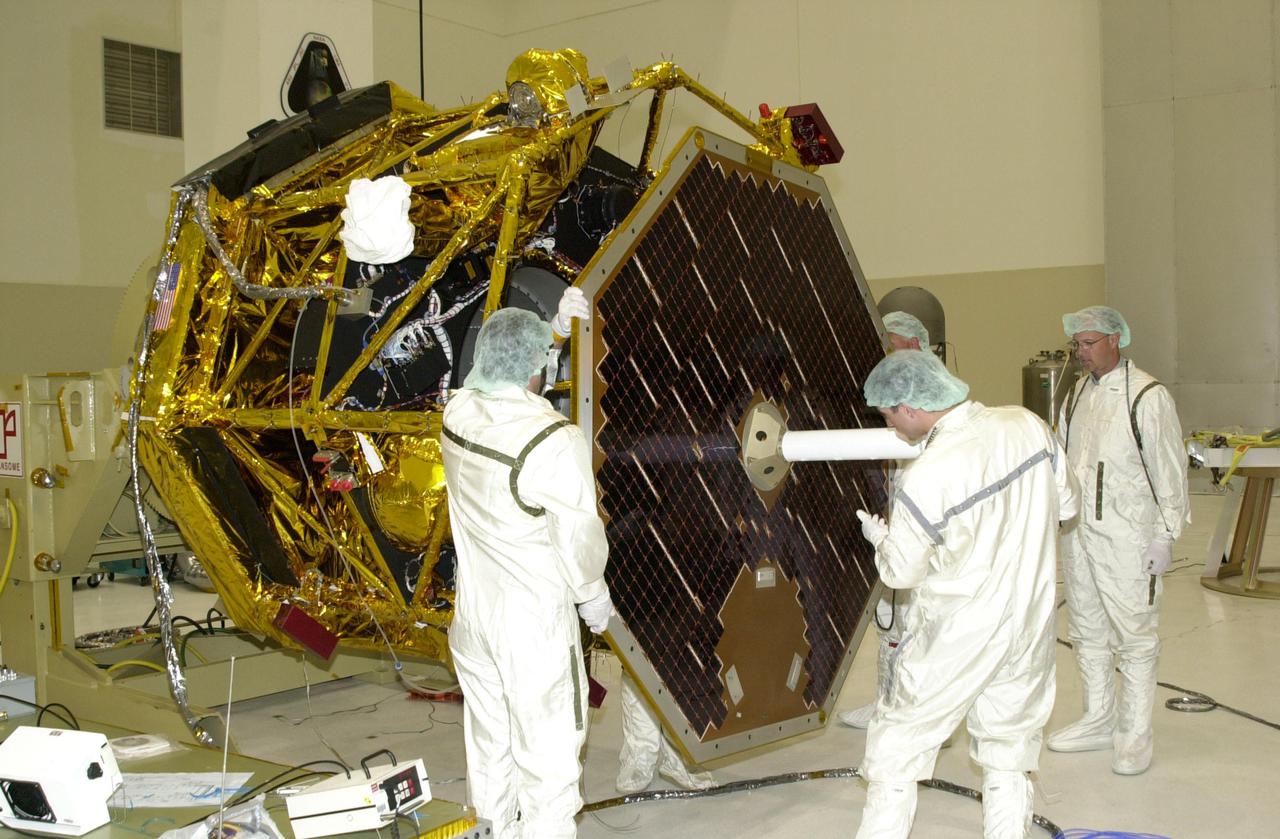
KENNEDY SPACE CENTER, FLA. -- In the Spacecraft Assembly and Encapsulation Facility 2 (SAEF-2), workers check placement of the solar panel and attached antenna before attaching it to the Comet Nucleus Tour (CONTOUR) spacecraft. Scheduled for launch July 1, 2002, from LC 17A at Cape Canaveral Air Force Station, CONTOUR will provide the first detailed look into the heart of a comet -- the nucleus. The spacecraft will fly as close as 60 miles (100 kilometers) to at least two comets, Encke and Schwassmann-Wachmann 3. It will take the sharpest pictures yet of the nucleus while analyzing the gas and dust that surround these rocky, icy building blocks of the solar system. The Applied Physics Laboratory of Johns Hopkins University, Baltimore, Md., built CONTOUR and will also be in control of the spacecraft after launch
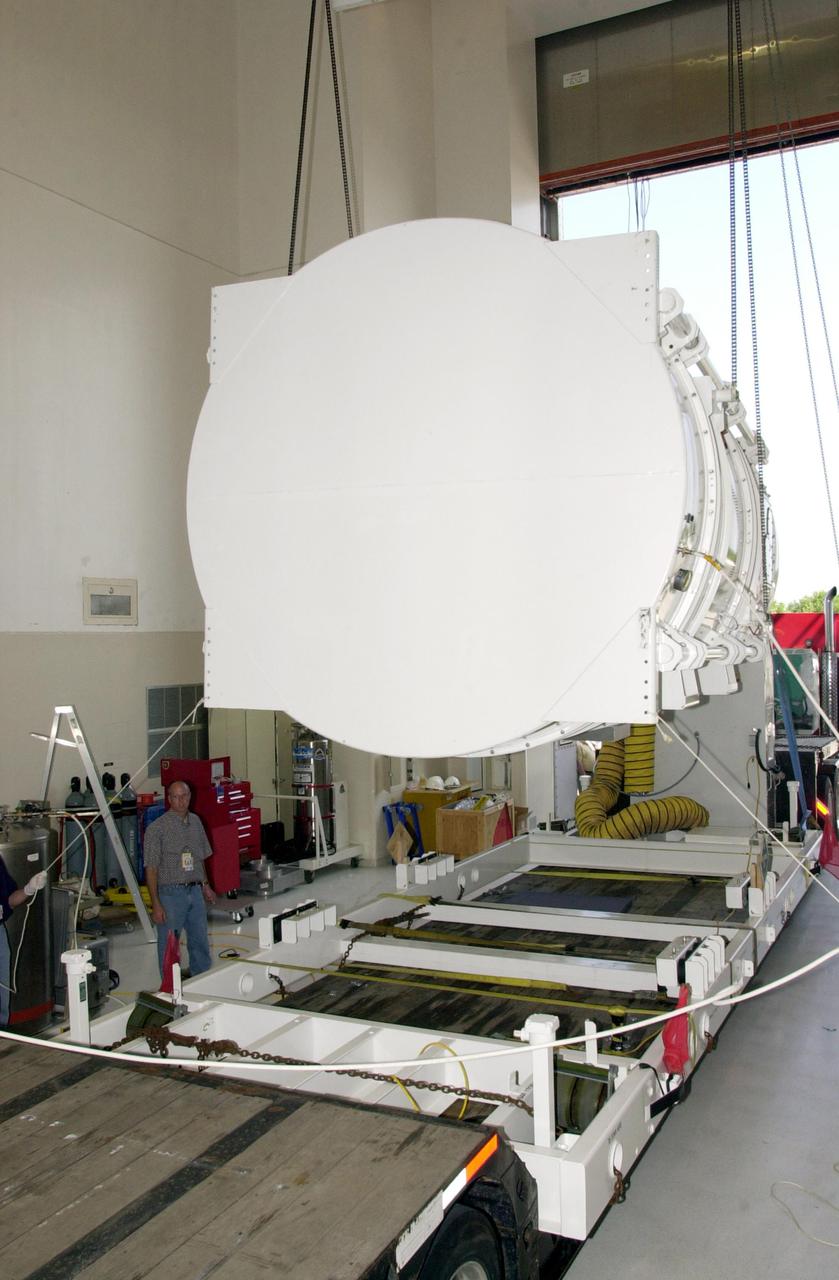
KENNEDY SPACE CENTER, FLA. -- The NASA Comet Nucleus Tour (CONTOUR) spacecraft arrived at KSC on April 24 and was transported to the Spacecraft Assembly and Encapsulation Facility-2 (SAEF-2) to begin final preparations for launch. CONTOUR will provide the first detailed look into the heart of a comet - the nucleus. The spacecraft will fly as close as 60 miles (100 kilometers) to at least two comets, Encke and Schwassmann-Wachmann 3, taking the sharpest pictures yet of the nucleus while analyzing the gas and dust that surround these rocky, icy building blocks of the solar system. The Applied Physics Laboratory of Johns Hopkins University, Baltimore, Md., built CONTOUR and will also be in control of the spacecraft after launch, scheduled for July 1, 2002, from LC 17A at Cape Canaveral Air Force Station
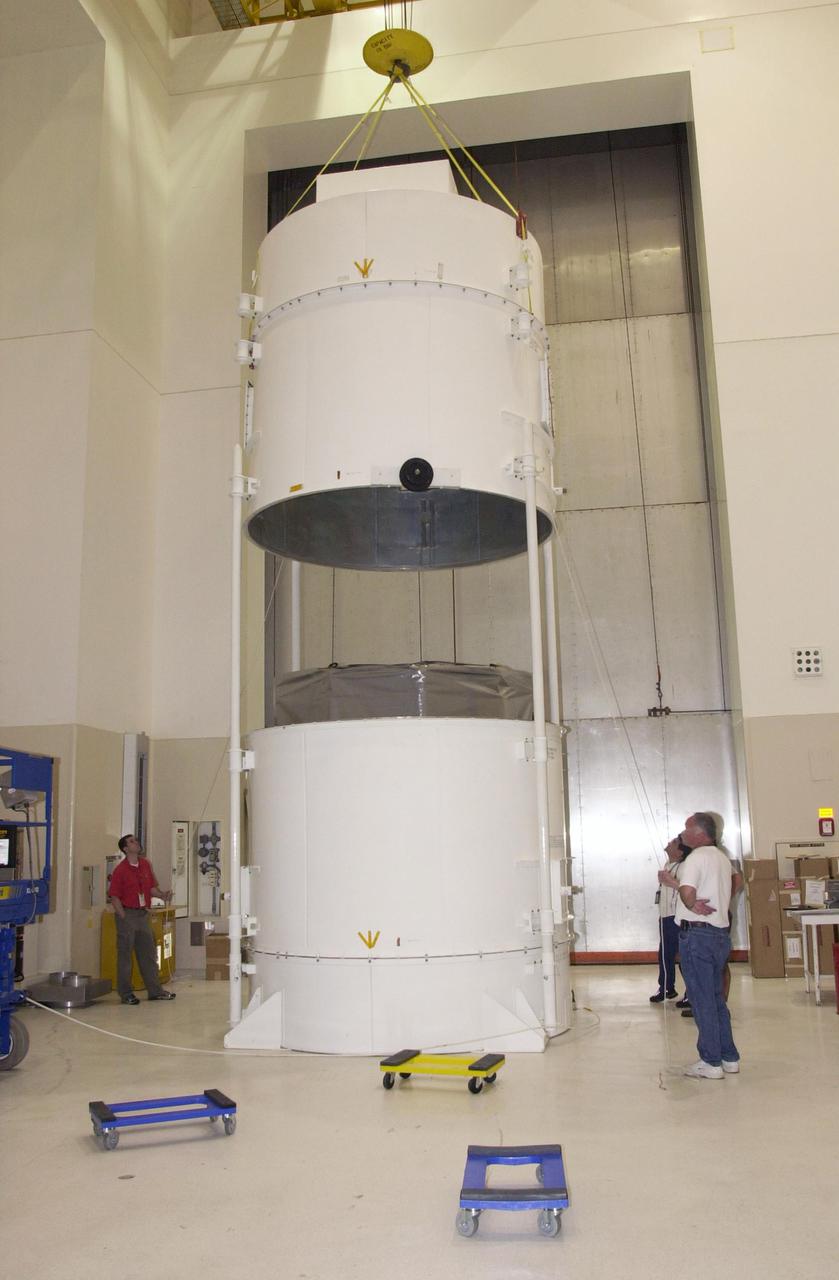
KENNEDY SPACE CENTER, FLA. -- The NASA Comet Nucleus Tour (CONTOUR) spacecraft arrived at KSC on April 24 and was transported to the Spacecraft Assembly and Encapsulation Facility-2 (SAEF-2) to begin final preparations for launch. CONTOUR will provide the first detailed look into the heart of a comet - the nucleus. The spacecraft will fly as close as 60 miles (100 kilometers) to at least two comets, Encke and Schwassmann-Wachmann 3, taking the sharpest pictures yet of the nucleus while analyzing the gas and dust that surround these rocky, icy building blocks of the solar system. The Applied Physics Laboratory of Johns Hopkins University, Baltimore, Md., built CONTOUR and will also be in control of the spacecraft after launch, scheduled for July 1, 2002, from LC 17A at Cape Canaveral Air Force Station
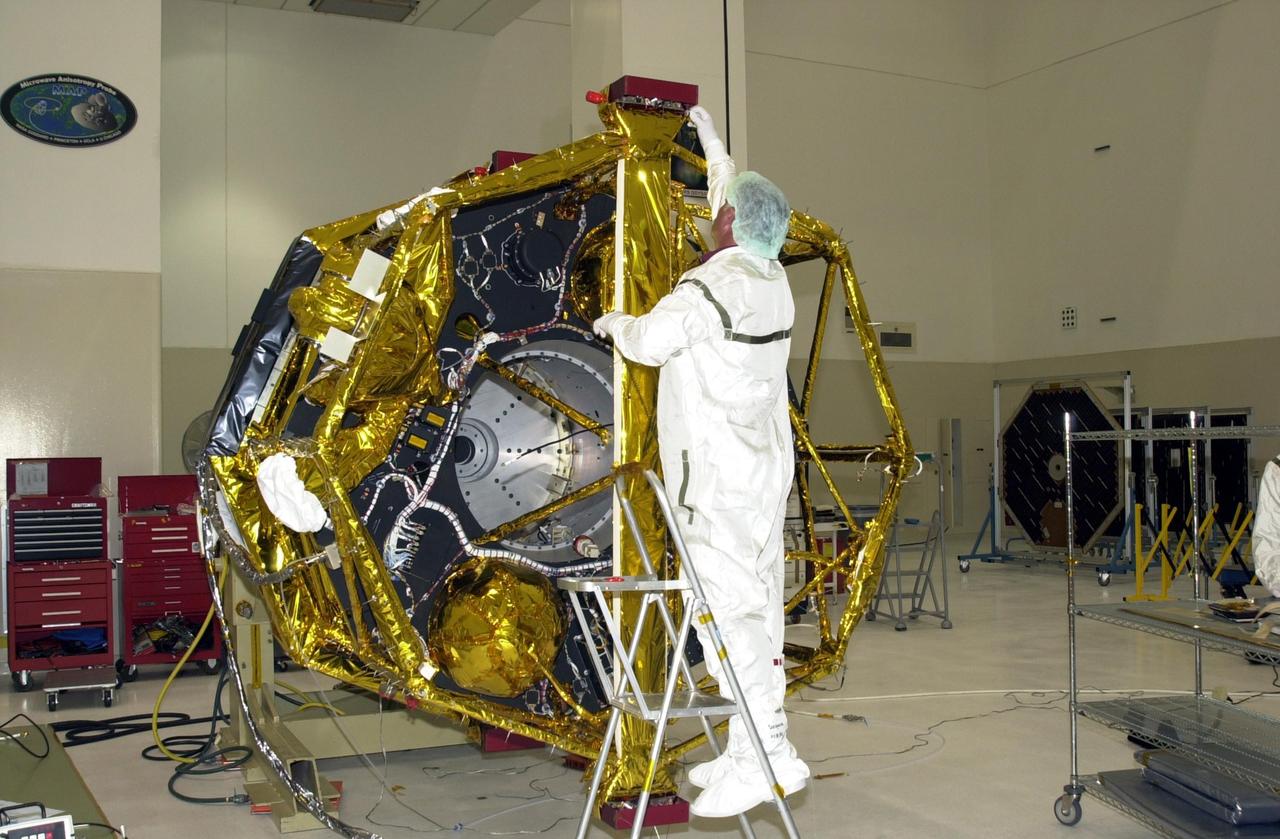
KENNEDY SPACE CENTER, FLA. -- In the Spacecraft Assembly and Encapsulation Facility 2 (SAEF-2), a worker prepares the Comet Nucleus Tour (CONTOUR) spacecraft for antenna and solar panel installation. CONTOUR will provide the first detailed look into the heart of a comet -- the nucleus. The spacecraft will fly as close as 60 miles (100 kilometers) to at least two comets, Encke and Schwassmann-Wachmann 3. It will take the sharpest pictures yet of the nucleus while analyzing the gas and dust that surround these rocky, icy building blocks of the solar system. The Applied Physics Laboratory of Johns Hopkins University, Baltimore, Md., built CONTOUR and will also be in control of the spacecraft after launch, which is scheduled for July 1, 2002, from LC 17A at Cape Canaveral Air Force Station
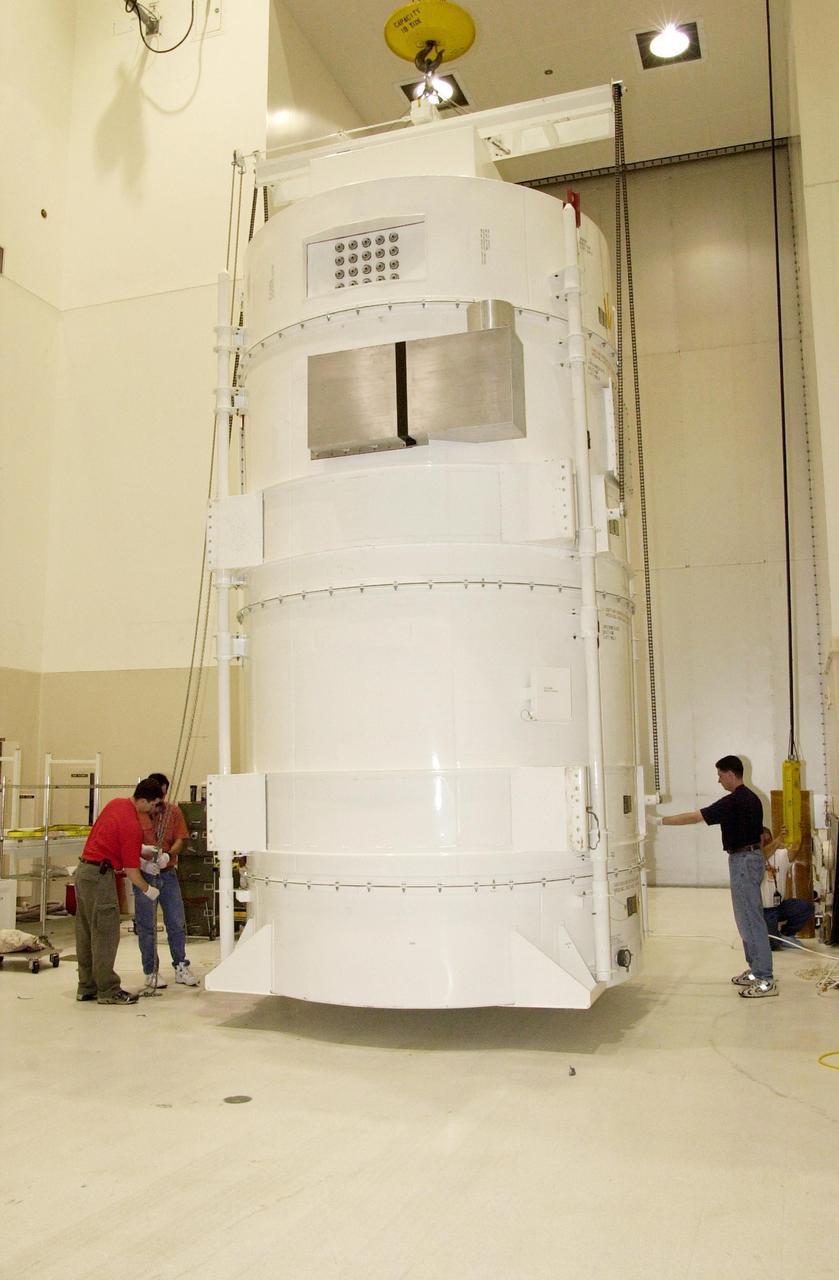
KENNEDY SPACE CENTER, FLA. -- The NASA Comet Nucleus Tour (CONTOUR) spacecraft arrived at KSC on April 24 and was transported to the Spacecraft Assembly and Encapsulation Facility-2 (SAEF-2) to begin final preparations for launch. CONTOUR will provide the first detailed look into the heart of a comet - the nucleus. The spacecraft will fly as close as 60 miles (100 kilometers) to at least two comets, Encke and Schwassmann-Wachmann 3, taking the sharpest pictures yet of the nucleus while analyzing the gas and dust that surround these rocky, icy building blocks of the solar system. The Applied Physics Laboratory of Johns Hopkins University, Baltimore, Md., built CONTOUR and will also be in control of the spacecraft after launch, scheduled for July 1, 2002, from LC 17A at Cape Canaveral Air Force Station
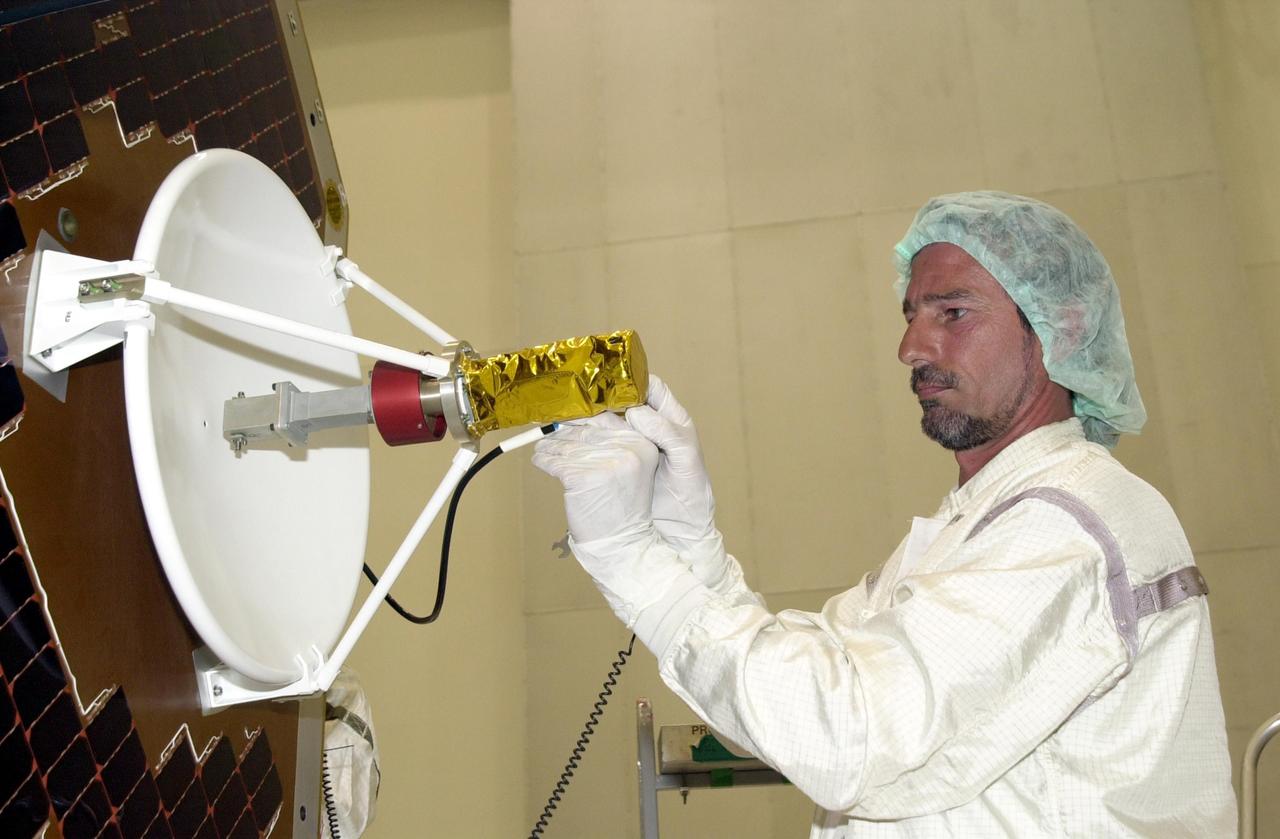
KENNEDY SPACE CENTER, FLA. -- In the Spacecraft Assembly and Encapsulation Facility 2 (SAEF-2), a worker makes a final adjustment to the high gain antenna just installed on the solar panel of the Comet Nucleus Tour (CONTOUR) spacecraft. Scheduled for launch July 1, 2002, from LC 17A at Cape Canaveral Air Force Station, CONTOUR will provide the first detailed look into the heart of a comet -- the nucleus. The spacecraft will fly as close as 60 miles (100 kilometers) to at least two comets, Encke and Schwassmann-Wachmann 3. It will take the sharpest pictures yet of the nucleus while analyzing the gas and dust that surround these rocky, icy building blocks of the solar system. The Applied Physics Laboratory of Johns Hopkins University, Baltimore, Md., built CONTOUR and will also be in control of the spacecraft after launch
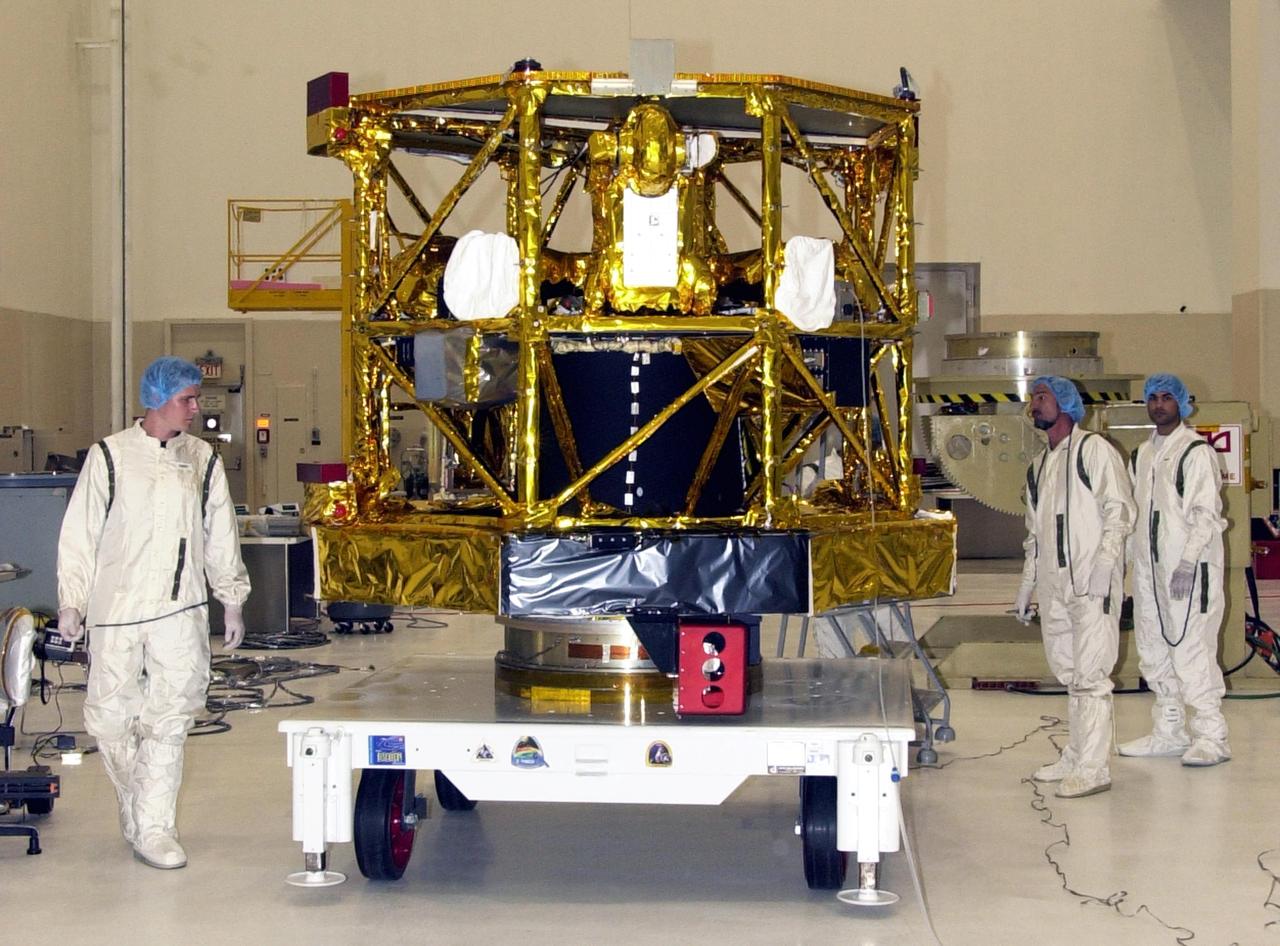
KENNEDY SPACE CENTER, FLA. -- The NASA Comet Nucleus Tour (CONTOUR) spacecraft arrived at KSC on April 24 and was transported to the Spacecraft Assembly and Encapsulation Facility-2 (SAEF-2) to begin final preparations for launch. CONTOUR will provide the first detailed look into the heart of a comet - the nucleus. The spacecraft will fly as close as 60 miles (100 kilometers) to at least two comets, Encke and Schwassmann-Wachmann 3, taking the sharpest pictures yet of the nucleus while analyzing the gas and dust that surround these rocky, icy building blocks of the solar system. The Applied Physics Laboratory of Johns Hopkins University, Baltimore, Md., built CONTOUR and will also be in control of the spacecraft after launch, scheduled for July 1, 2002, from LC 17A at Cape Canaveral Air Force Station
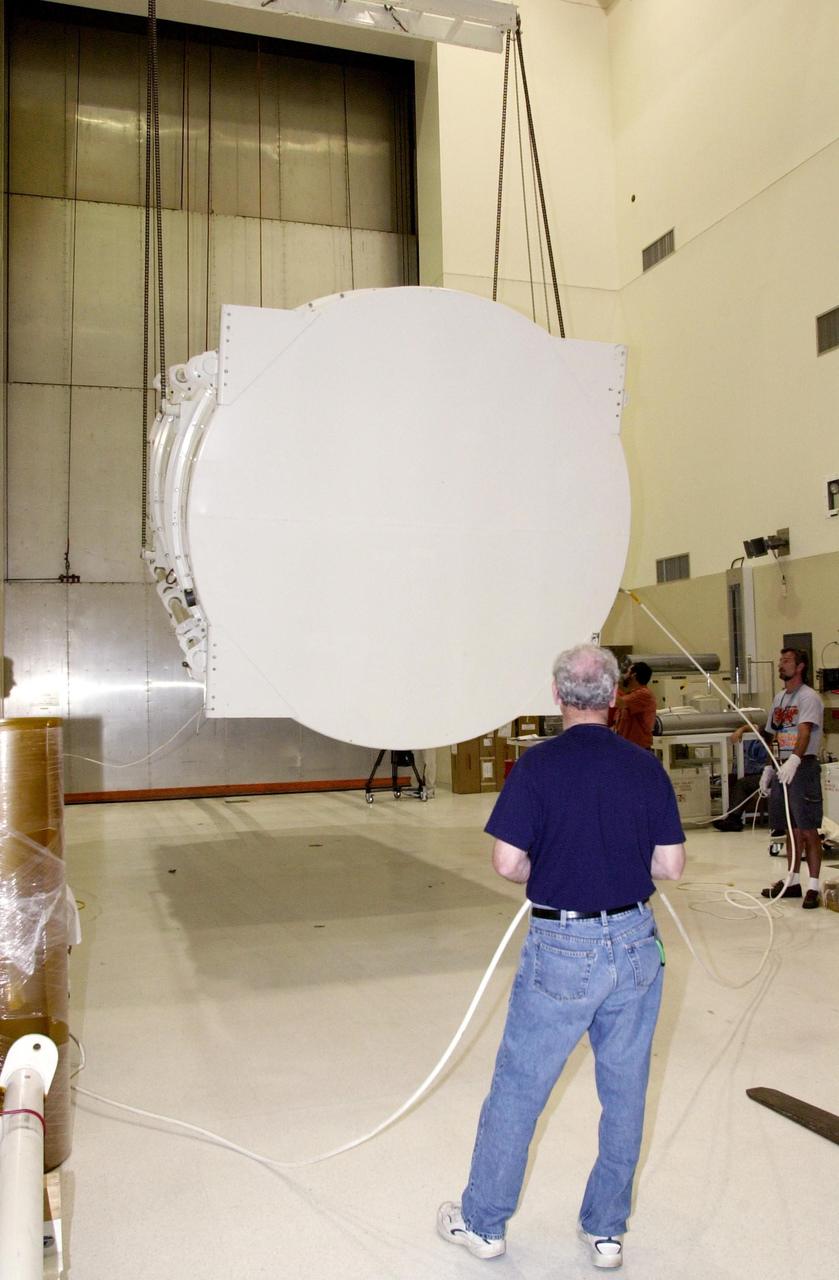
KENNEDY SPACE CENTER, FLA. -- The NASA Comet Nucleus Tour (CONTOUR) spacecraft arrived at KSC on April 24 and was transported to the Spacecraft Assembly and Encapsulation Facility-2 (SAEF-2) to begin final preparations for launch. CONTOUR will provide the first detailed look into the heart of a comet - the nucleus. The spacecraft will fly as close as 60 miles (100 kilometers) to at least two comets, Encke and Schwassmann-Wachmann 3, taking the sharpest pictures yet of the nucleus while analyzing the gas and dust that surround these rocky, icy building blocks of the solar system. The Applied Physics Laboratory of Johns Hopkins University, Baltimore, Md., built CONTOUR and will also be in control of the spacecraft after launch, scheduled for July 1, 2002, from LC 17A at Cape Canaveral Air Force Station
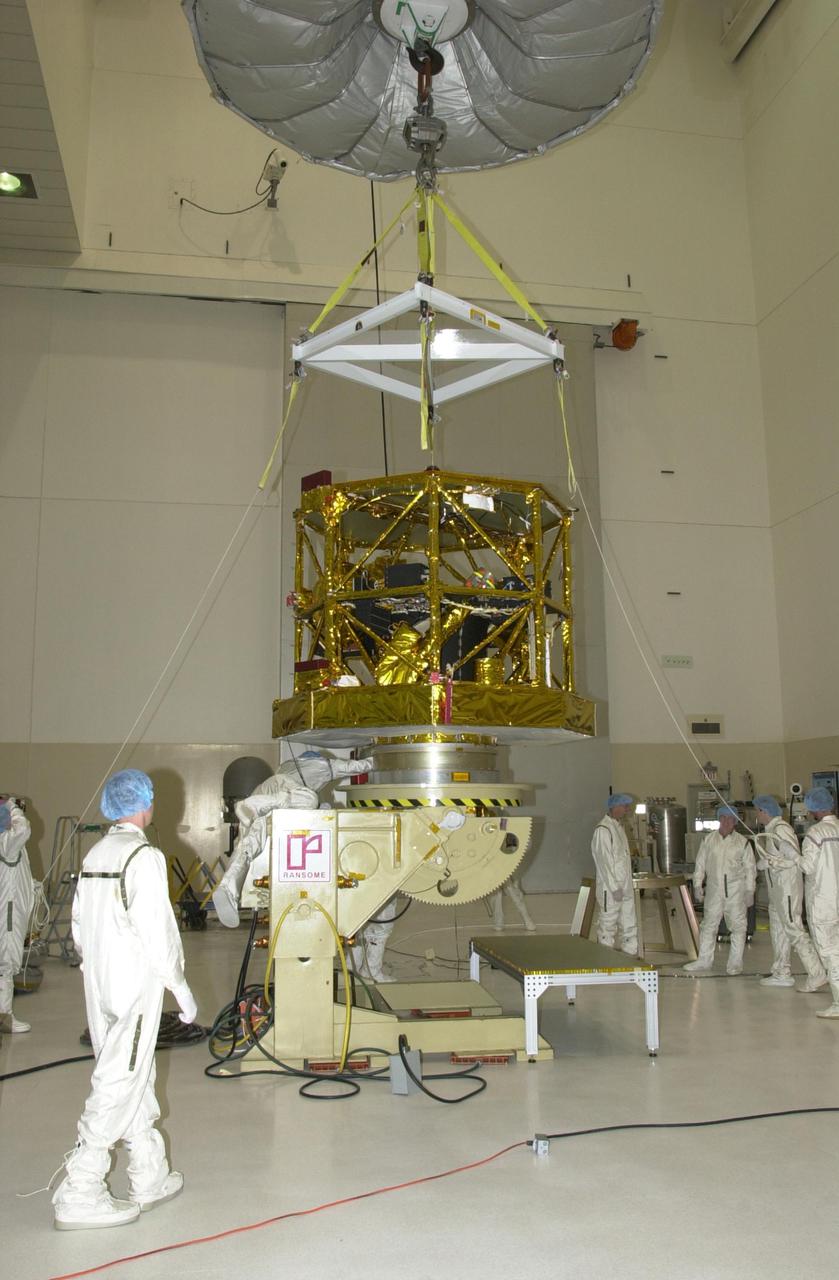
KENNEDY SPACE CENTER, FLA. -- The NASA Comet Nucleus Tour (CONTOUR) spacecraft arrived at KSC on April 24 and was transported to the Spacecraft Assembly and Encapsulation Facility-2 (SAEF-2) to begin final preparations for launch. CONTOUR will provide the first detailed look into the heart of a comet - the nucleus. The spacecraft will fly as close as 60 miles (100 kilometers) to at least two comets, Encke and Schwassmann-Wachmann 3, taking the sharpest pictures yet of the nucleus while analyzing the gas and dust that surround these rocky, icy building blocks of the solar system. The Applied Physics Laboratory of Johns Hopkins University, Baltimore, Md., built CONTOUR and will also be in control of the spacecraft after launch, scheduled for July 1, 2002, from LC 17A at Cape Canaveral Air Force Station
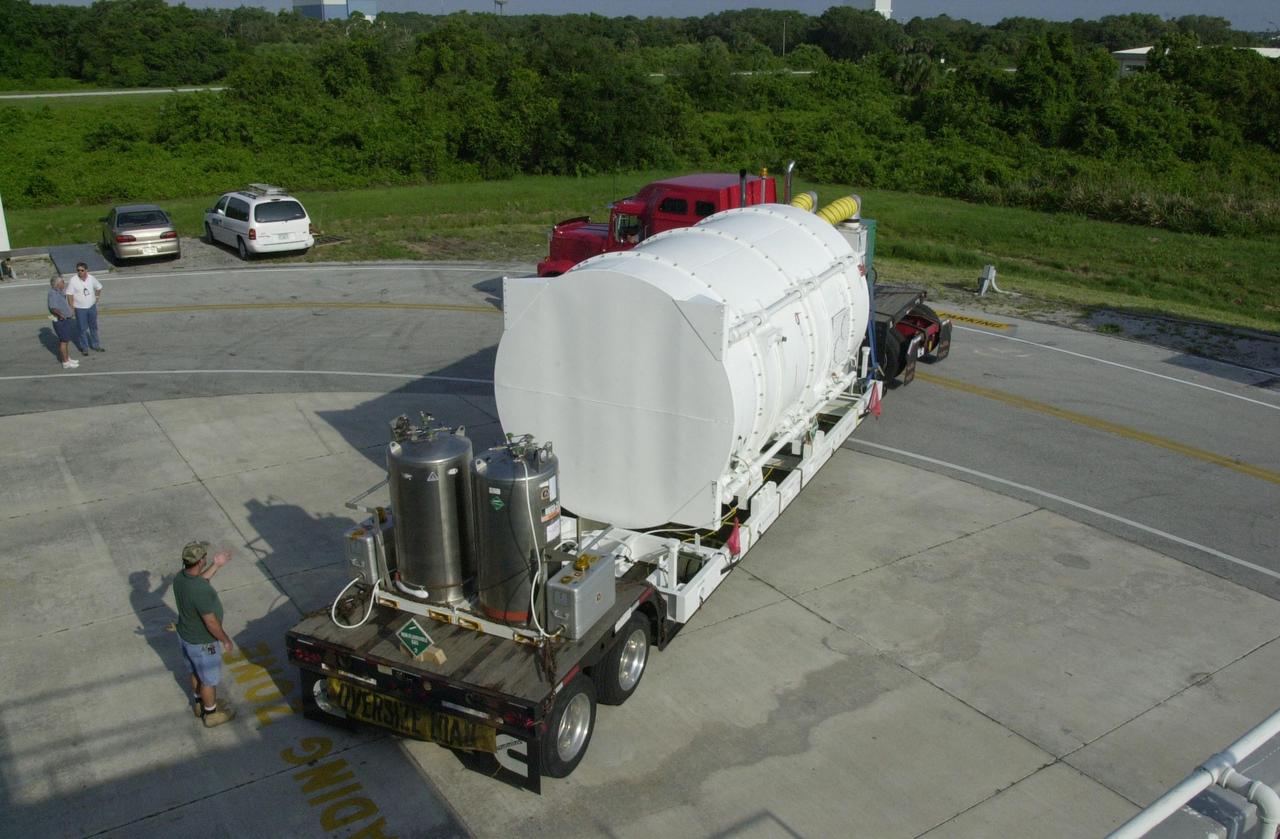
KENNEDY SPACE CENTER, FLA. -- The NASA Comet Nucleus Tour (CONTOUR) spacecraft arrived at KSC on April 24 and was transported to the Spacecraft Assembly and Encapsulation Facility-2 (SAEF-2) to begin final preparations for launch. CONTOUR will provide the first detailed look into the heart of a comet - the nucleus. The spacecraft will fly as close as 60 miles (100 kilometers) to at least two comets, Encke and Schwassmann-Wachmann 3, taking the sharpest pictures yet of the nucleus while analyzing the gas and dust that surround these rocky, icy building blocks of the solar system. The Applied Physics Laboratory of Johns Hopkins University, Baltimore, Md., built CONTOUR and will also be in control of the spacecraft after launch, scheduled for July 1, 2002, from LC 17A at Cape Canaveral Air Force Station
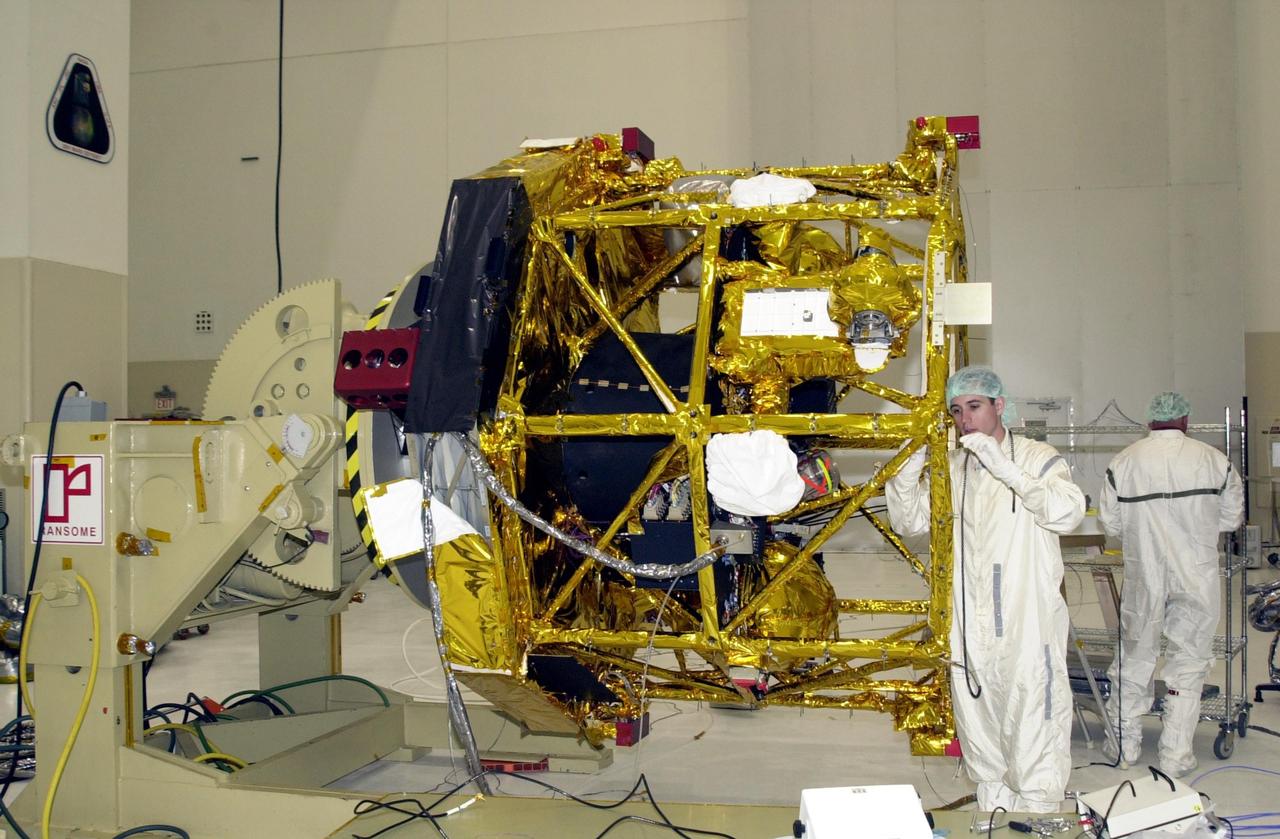
KENNEDY SPACE CENTER, FLA. - Workers in the Spacecraft Assembly and Encapsulation Facility 2 (SAEF-2) prepare the Comet Nucleus Tour (CONTOUR) spacecraft for antenna and solar panel installation. CONTOUR will provide the first detailed look into the heart of a comet -- the nucleus. The spacecraft will fly as close as 60 miles (100 kilometers) to at least two comets, Encke and Schwassmann-Wachmann 3. It will take the sharpest pictures yet of the nucleus while analyzing the gas and dust that surround these rocky, icy building blocks of the solar system. The Applied Physics Laboratory of Johns Hopkins University, Baltimore, Md., built CONTOUR and will also be in control of the spacecraft after launch, which is scheduled for July 1, 2002, from LC 17A at Cape Canaveral Air Force Station
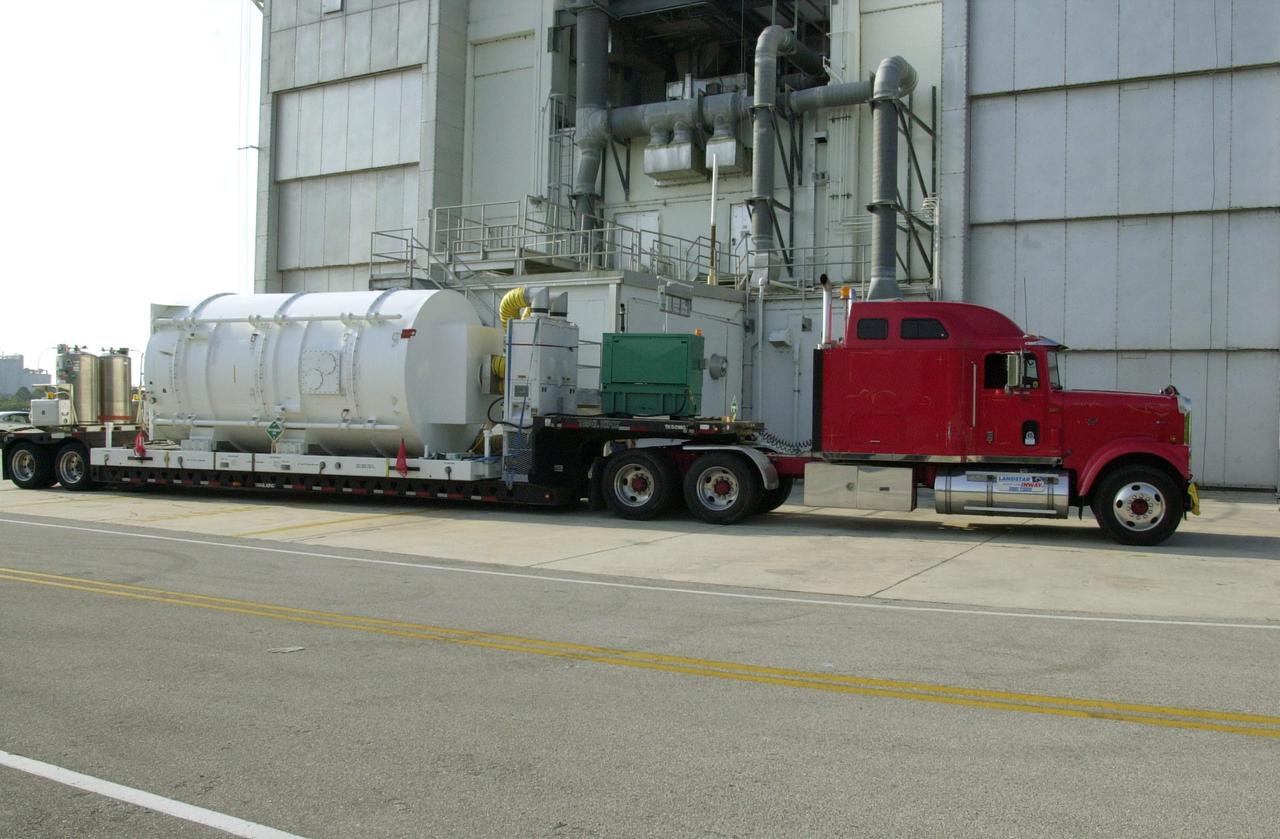
KENNEDY SPACE CENTER, FLA. -- The NASA Comet Nucleus Tour (CONTOUR) spacecraft arrived at KSC on April 24 and was transported to the Spacecraft Assembly and Encapsulation Facility-2 (SAEF-2) to begin final preparations for launch. CONTOUR will provide the first detailed look into the heart of a comet - the nucleus. The spacecraft will fly as close as 60 miles (100 kilometers) to at least two comets, Encke and Schwassmann-Wachmann 3, taking the sharpest pictures yet of the nucleus while analyzing the gas and dust that surround these rocky, icy building blocks of the solar system. The Applied Physics Laboratory of Johns Hopkins University, Baltimore, Md., built CONTOUR and will also be in control of the spacecraft after launch, scheduled for July 1, 2002, from LC 17A at Cape Canaveral Air Force Station
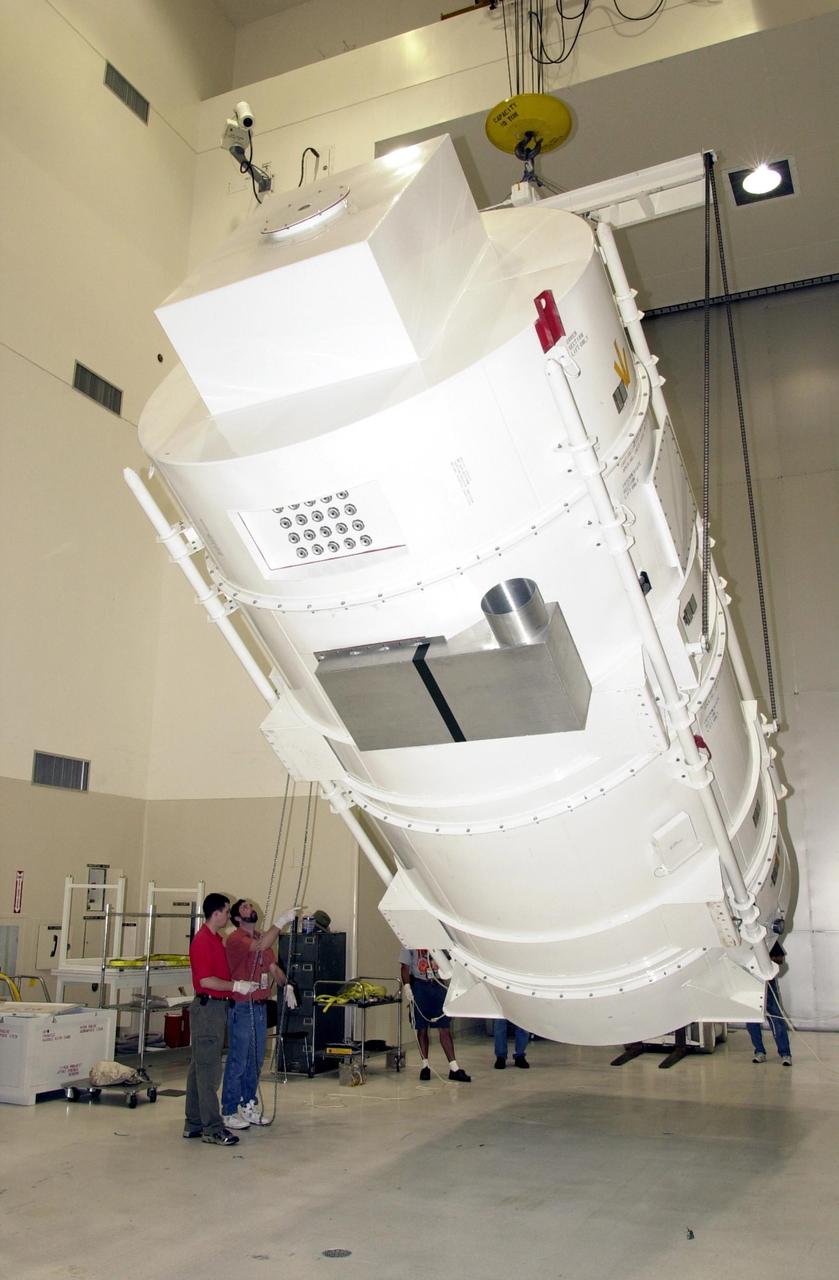
KENNEDY SPACE CENTER, FLA. -- The NASA Comet Nucleus Tour (CONTOUR) spacecraft arrived at KSC on April 24 and was transported to the Spacecraft Assembly and Encapsulation Facility-2 (SAEF-2) to begin final preparations for launch. CONTOUR will provide the first detailed look into the heart of a comet - the nucleus. The spacecraft will fly as close as 60 miles (100 kilometers) to at least two comets, Encke and Schwassmann-Wachmann 3, taking the sharpest pictures yet of the nucleus while analyzing the gas and dust that surround these rocky, icy building blocks of the solar system. The Applied Physics Laboratory of Johns Hopkins University, Baltimore, Md., built CONTOUR and will also be in control of the spacecraft after launch, scheduled for July 1, 2002, from LC 17A at Cape Canaveral Air Force Station
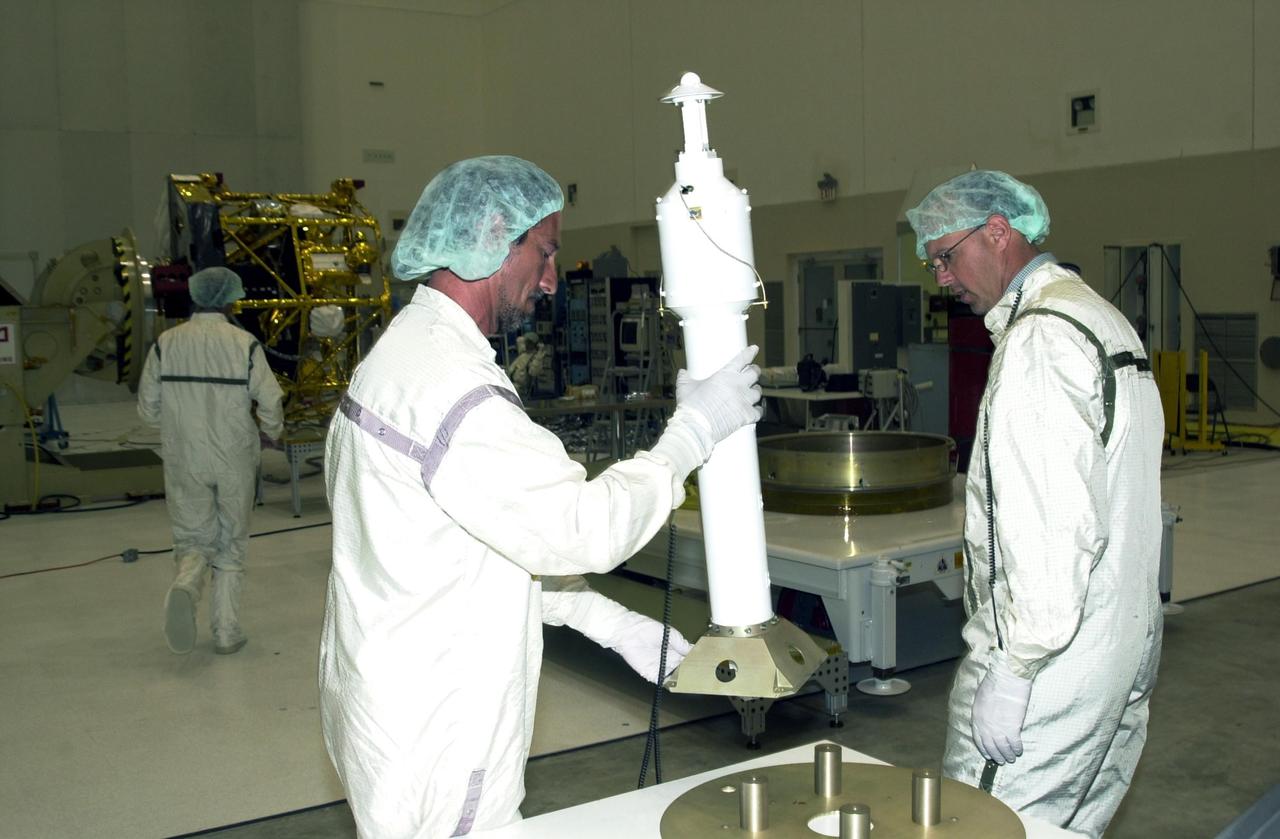
KENNEDY SPACE CENTER, FLA. -- Workers in the Spacecraft Assembly and Encapsulation Facility 2 (SAEF-2) move the antenna that is to be installed on the solar panel for the Comet Nucleus Tour (CONTOUR) spacecraft (seen in the background). CONTOUR will provide the first detailed look into the heart of a comet -- the nucleus. The spacecraft will fly as close as 60 miles (100 kilometers) to at least two comets, Encke and Schwassmann-Wachmann 3. It will take the sharpest pictures yet of the nucleus while analyzing the gas and dust that surround these rocky, icy building blocks of the solar system. The Applied Physics Laboratory of Johns Hopkins University, Baltimore, Md., built CONTOUR and will also be in control of the spacecraft after launch, which is scheduled for July 1, 2002, from LC 17A at Cape Canaveral Air Force Station
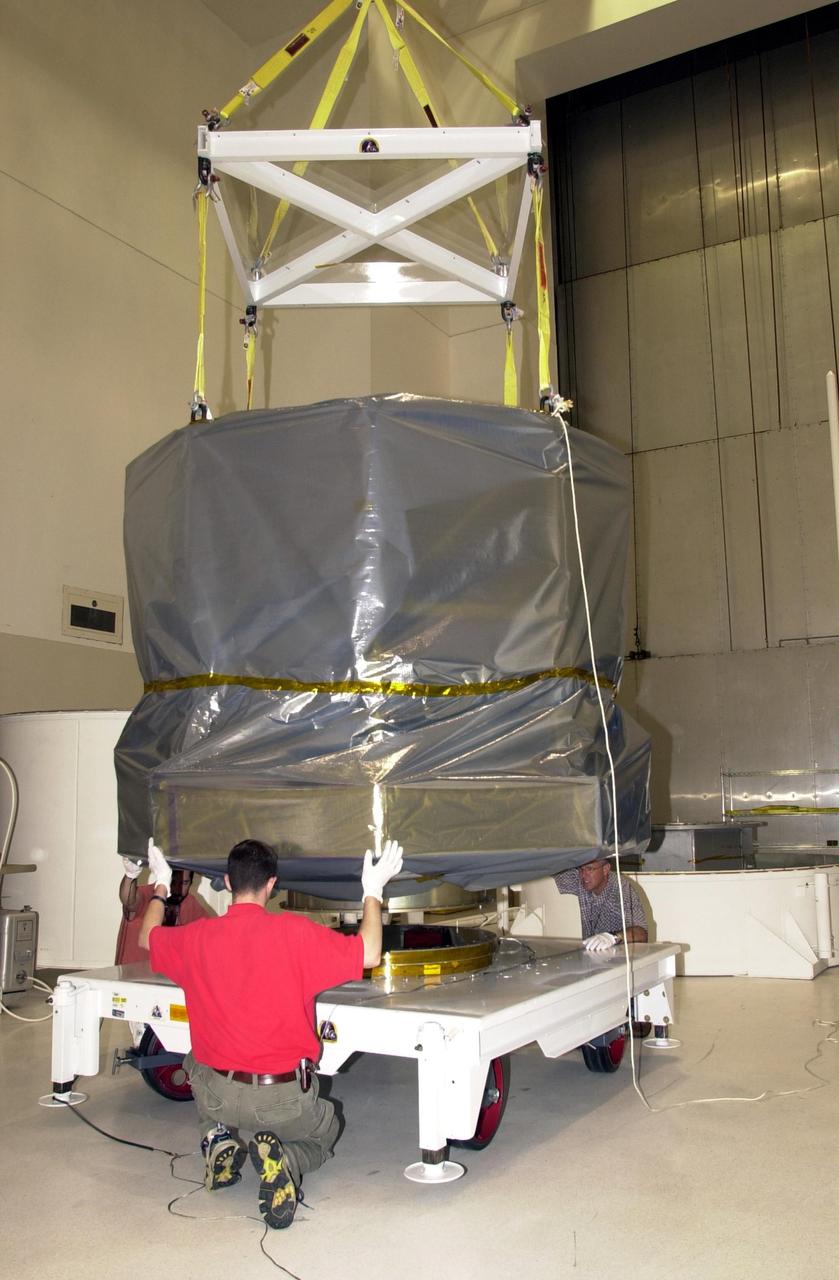
KENNEDY SPACE CENTER, FLA. -- The NASA Comet Nucleus Tour (CONTOUR) spacecraft arrived at KSC on April 24 and was transported to the Spacecraft Assembly and Encapsulation Facility-2 (SAEF-2) to begin final preparations for launch. CONTOUR will provide the first detailed look into the heart of a comet - the nucleus. The spacecraft will fly as close as 60 miles (100 kilometers) to at least two comets, Encke and Schwassmann-Wachmann 3, taking the sharpest pictures yet of the nucleus while analyzing the gas and dust that surround these rocky, icy building blocks of the solar system. The Applied Physics Laboratory of Johns Hopkins University, Baltimore, Md., built CONTOUR and will also be in control of the spacecraft after launch, scheduled for July 1, 2002, from LC 17A at Cape Canaveral Air Force Station
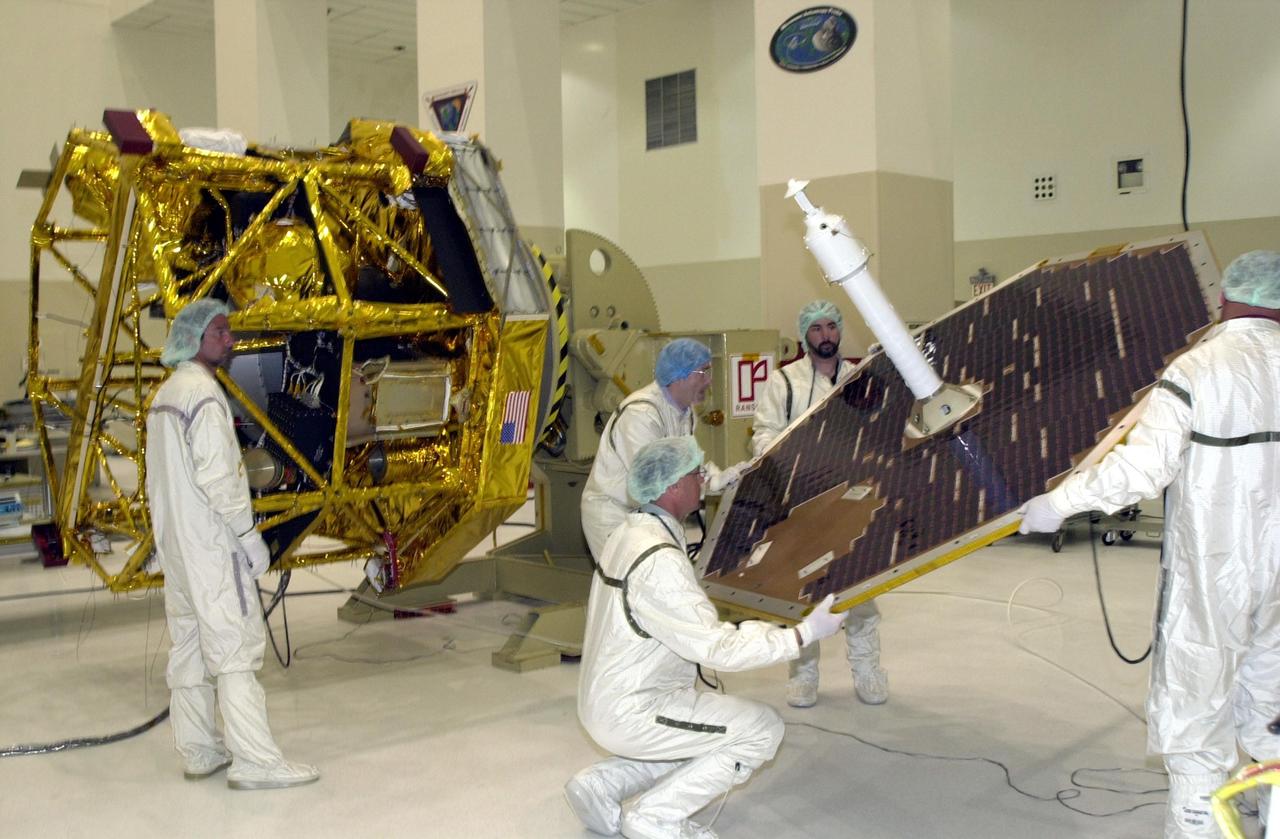
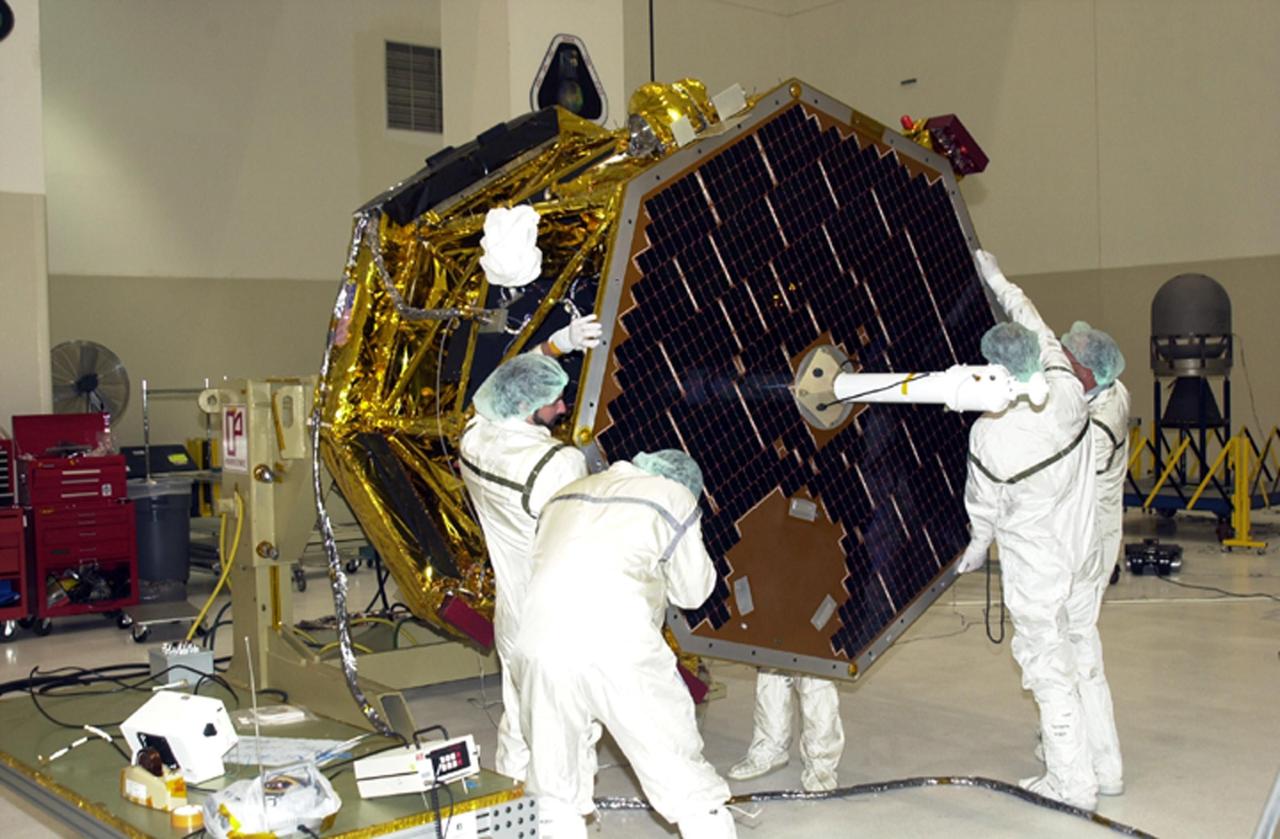
KENNEDY SPACE CENTER, FLA. -- In the Spacecraft Assembly and Encapsulation Facility 2 (SAEF-2), workers lift the solar panel and attached antenna to move it to the Comet Nucleus Tour (CONTOUR) spacecraft at left. Scheduled for launch July 1, 2002, from LC 17A at Cape Canaveral Air Force Station, CONTOUR will provide the first detailed look into the heart of a comet -- the nucleus. The spacecraft will fly as close as 60 miles (100 kilometers) to at least two comets, Encke and Schwassmann-Wachmann 3. It will take the sharpest pictures yet of the nucleus while analyzing the gas and dust that surround these rocky, icy building blocks of the solar system. The Applied Physics Laboratory of Johns Hopkins University, Baltimore, Md., built CONTOUR and will also be in control of the spacecraft after launch
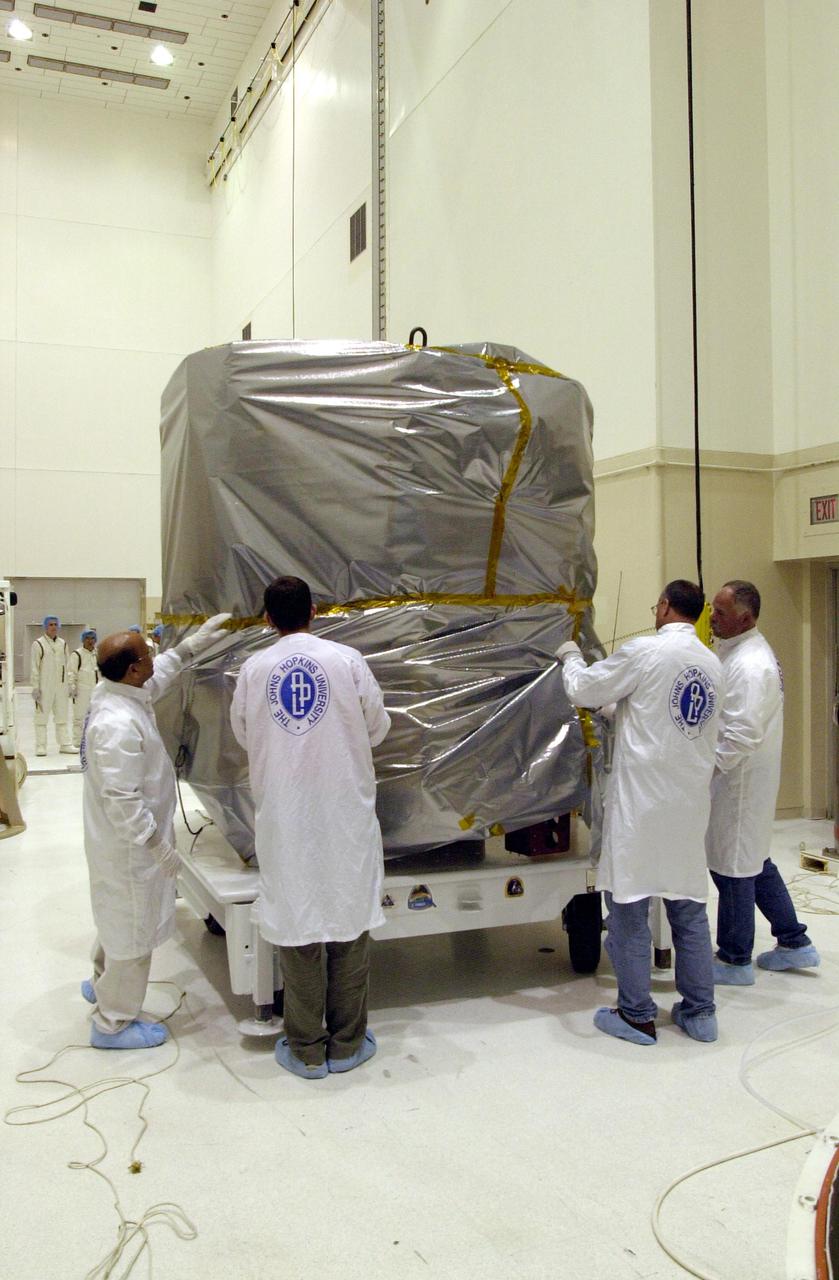
KENNEDY SPACE CENTER, FLA. -- The NASA Comet Nucleus Tour (CONTOUR) spacecraft arrived at KSC on April 24 and was transported to the Spacecraft Assembly and Encapsulation Facility-2 (SAEF-2) to begin final preparations for launch. CONTOUR will provide the first detailed look into the heart of a comet - the nucleus. The spacecraft will fly as close as 60 miles (100 kilometers) to at least two comets, Encke and Schwassmann-Wachmann 3, taking the sharpest pictures yet of the nucleus while analyzing the gas and dust that surround these rocky, icy building blocks of the solar system. The Applied Physics Laboratory of Johns Hopkins University, Baltimore, Md., built CONTOUR and will also be in control of the spacecraft after launch, scheduled for July 1, 2002, from LC 17A at Cape Canaveral Air Force Station
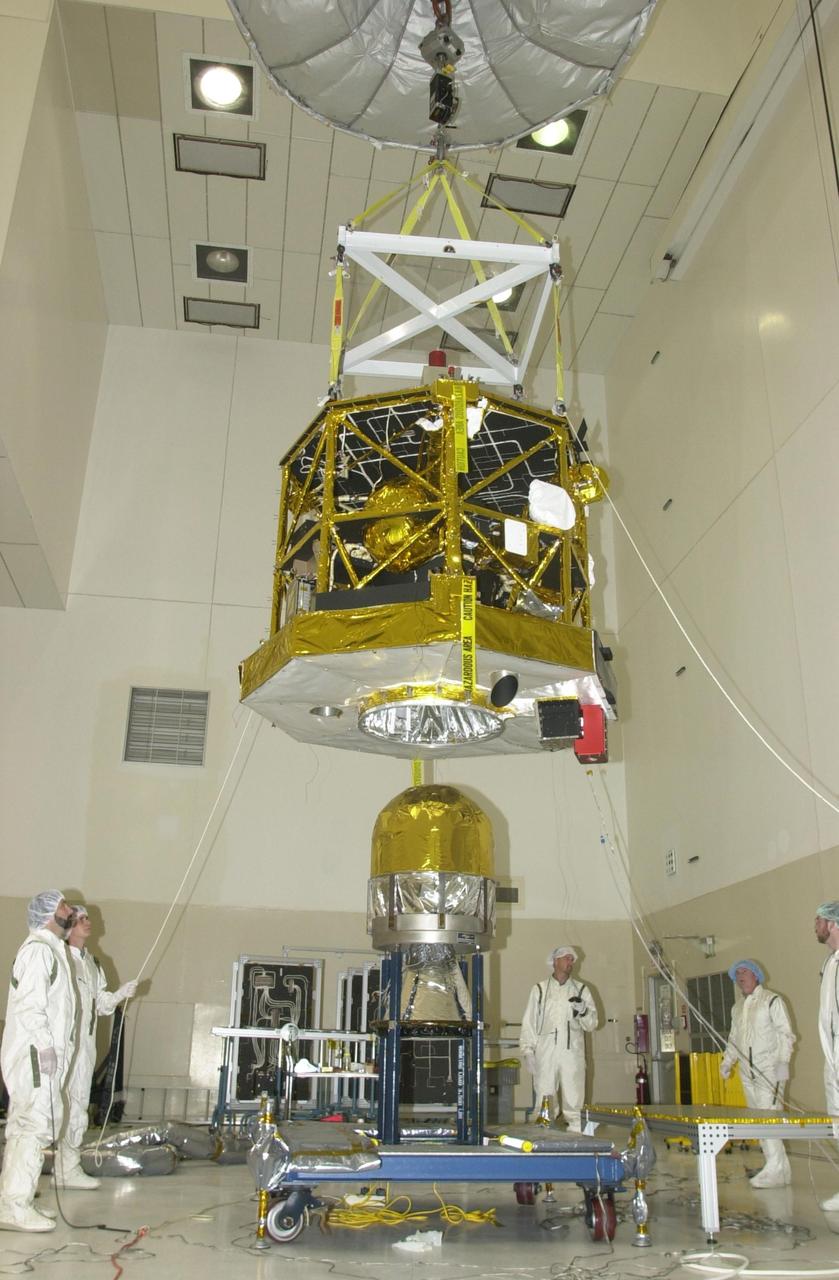
KENNEDY SPACE CENTER, FLA. - In the Spacecraft Assembly and Encapsulation Facility 2, the CONTOUR spacecraft is lowered toward the apogee kick motor to which it will be attached. CONTOUR will provide the first detailed look into the heart of a comet -- the nucleus. The spacecraft will fly close to at least two comets, Encke and Schwassmann-Wachmann 3, taking pictures of the nucleus while analyzing the gas and dust that surround these rocky, icy building blocks of the solar system. The Applied Physics Laboratory of Johns Hopkins University, Baltimore, Md., built CONTOUR and will also be in control of the spacecraft after launch, scheduled for July 1, 2002, from LC 17A at Cape Canaveral Air Force Station.CONTOUR and will also be in control of the spacecraft after launch, scheduled for July 1, 2002, from LC 17A at Cape Canaveral Air Force Station
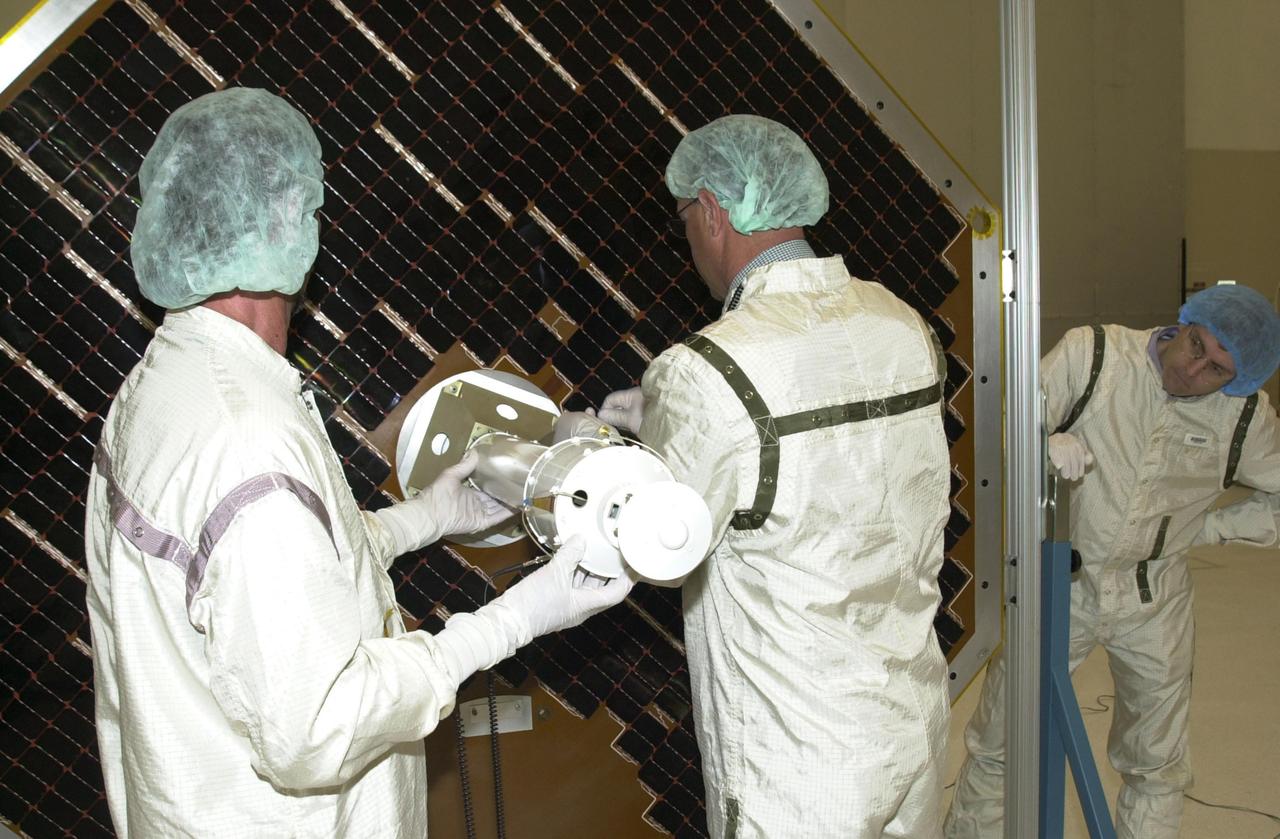
KENNEDY SPACE CENTER, FLA. -- Workers in the Spacecraft Assembly and Encapsulation Facility 2 (SAEF-2) attach the antenna to the solar panel for the Comet Nucleus Tour (CONTOUR) spacecraft (seen in the background). CONTOUR will provide the first detailed look into the heart of a comet -- the nucleus. The spacecraft will fly as close as 60 miles (100 kilometers) to at least two comets, Encke and Schwassmann-Wachmann 3. It will take the sharpest pictures yet of the nucleus while analyzing the gas and dust that surround these rocky, icy building blocks of the solar system. The Applied Physics Laboratory of Johns Hopkins University, Baltimore, Md., built CONTOUR and will also be in control of the spacecraft after launch, which is scheduled for July 1, 2002, from LC 17A at Cape Canaveral Air Force Station
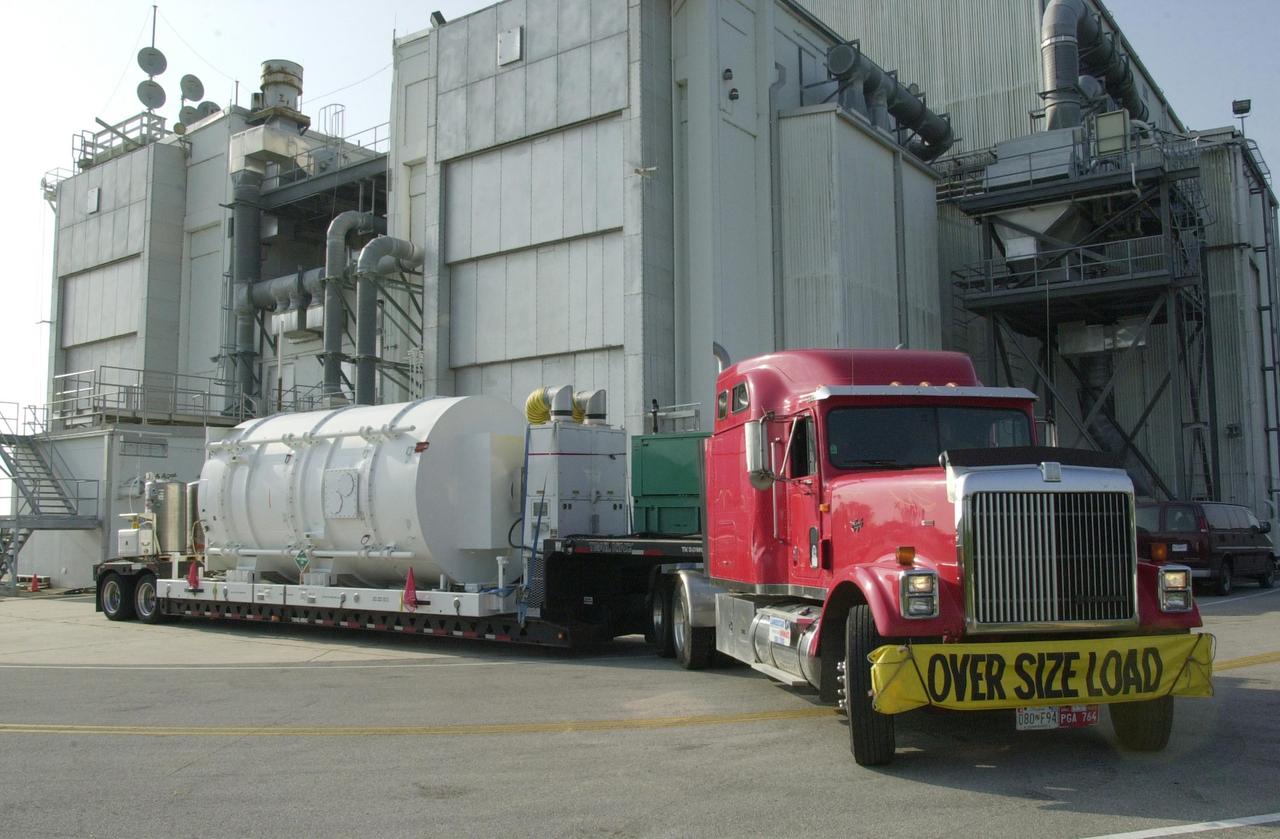
KENNEDY SPACE CENTER, FLA. -- The NASA Comet Nucleus Tour (CONTOUR) spacecraft arrived at KSC on April 24 and was transported to the Spacecraft Assembly and Encapsulation Facility-2 (SAEF-2) to begin final preparations for launch. CONTOUR will provide the first detailed look into the heart of a comet - the nucleus. The spacecraft will fly as close as 60 miles (100 kilometers) to at least two comets, Encke and Schwassmann-Wachmann 3, taking the sharpest pictures yet of the nucleus while analyzing the gas and dust that surround these rocky, icy building blocks of the solar system. The Applied Physics Laboratory of Johns Hopkins University, Baltimore, Md., built CONTOUR and will also be in control of the spacecraft after launch, scheduled for July 1, 2002, from LC 17A at Cape Canaveral Air Force Station
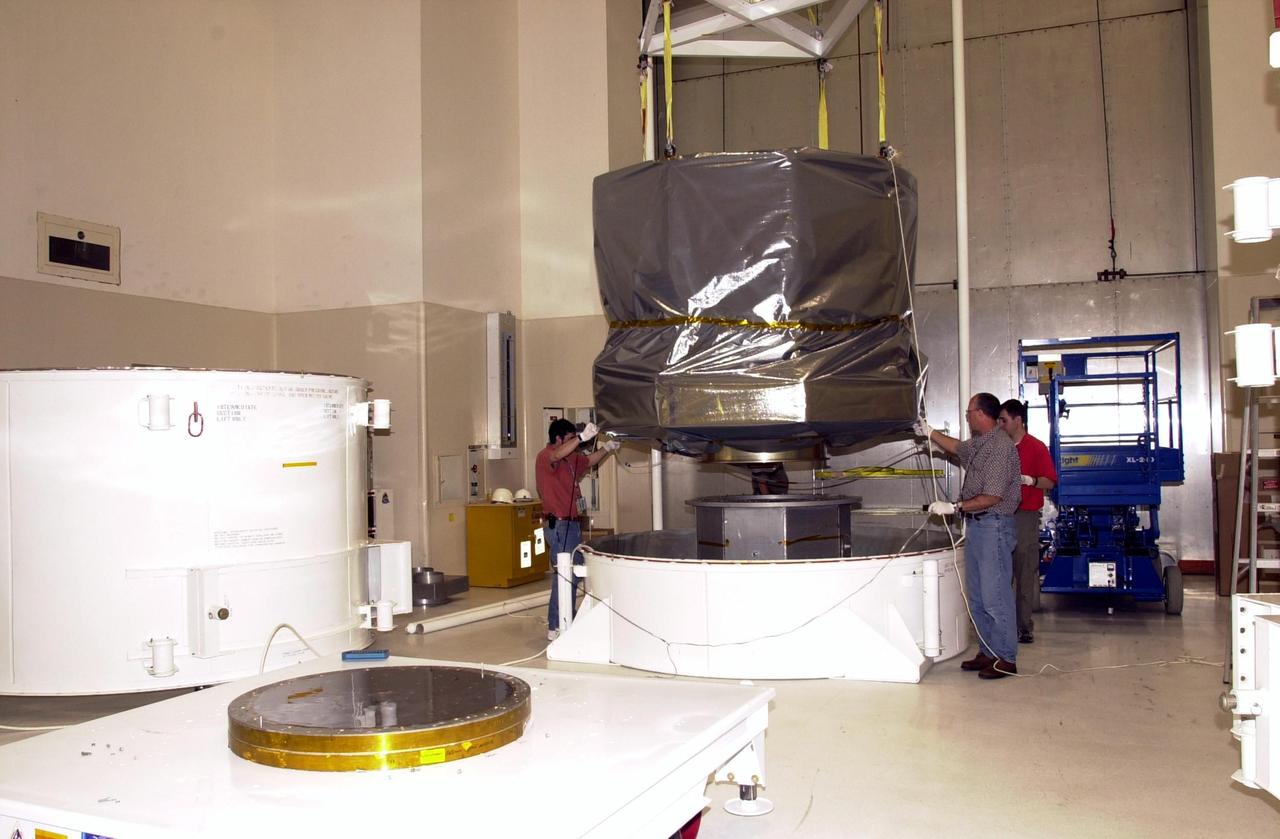
KENNEDY SPACE CENTER, FLA. -- The NASA Comet Nucleus Tour (CONTOUR) spacecraft arrived at KSC on April 24 and was transported to the Spacecraft Assembly and Encapsulation Facility-2 (SAEF-2) to begin final preparations for launch. CONTOUR will provide the first detailed look into the heart of a comet - the nucleus. The spacecraft will fly as close as 60 miles (100 kilometers) to at least two comets, Encke and Schwassmann-Wachmann 3, taking the sharpest pictures yet of the nucleus while analyzing the gas and dust that surround these rocky, icy building blocks of the solar system. The Applied Physics Laboratory of Johns Hopkins University, Baltimore, Md., built CONTOUR and will also be in control of the spacecraft after launch, scheduled for July 1, 2002, from LC 17A at Cape Canaveral Air Force Station
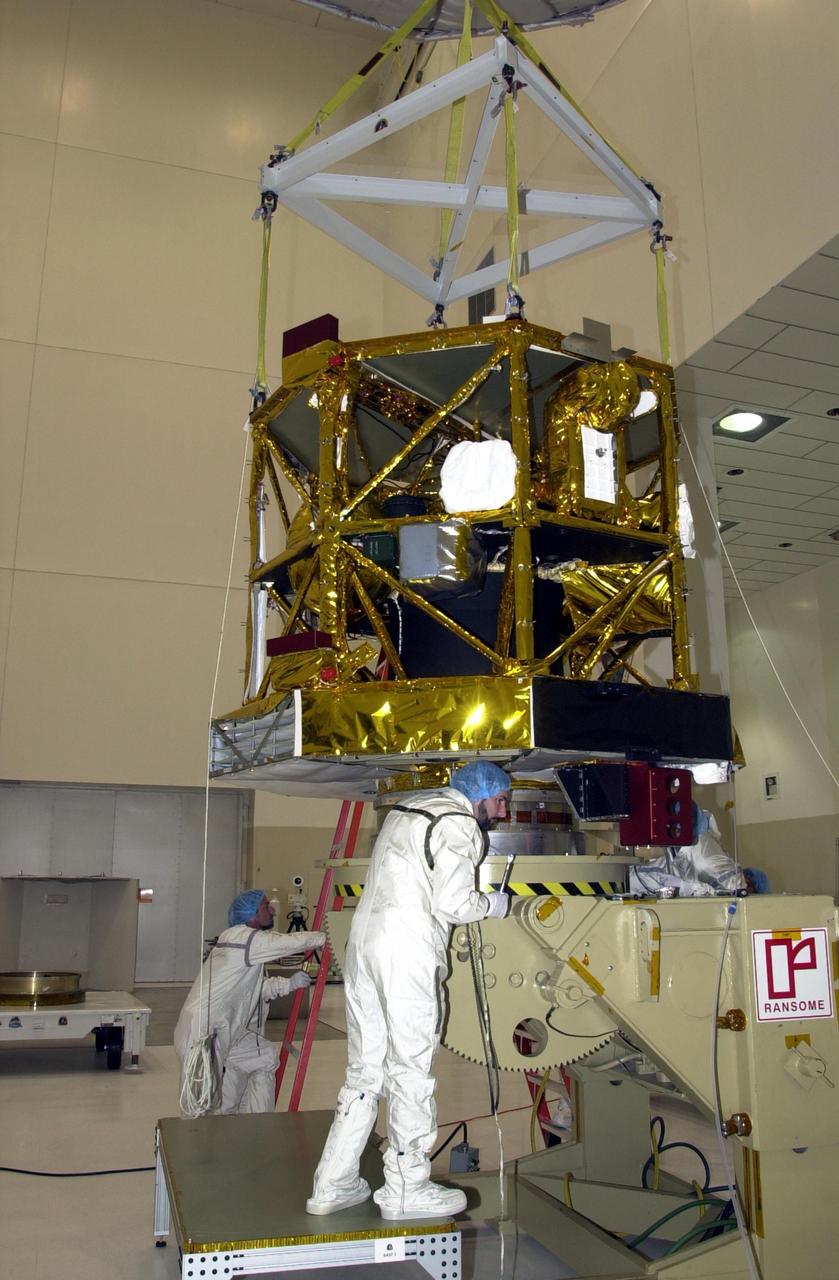
KENNEDY SPACE CENTER, FLA. -- The NASA Comet Nucleus Tour (CONTOUR) spacecraft arrived at KSC on April 24 and was transported to the Spacecraft Assembly and Encapsulation Facility-2 (SAEF-2) to begin final preparations for launch. CONTOUR will provide the first detailed look into the heart of a comet - the nucleus. The spacecraft will fly as close as 60 miles (100 kilometers) to at least two comets, Encke and Schwassmann-Wachmann 3, taking the sharpest pictures yet of the nucleus while analyzing the gas and dust that surround these rocky, icy building blocks of the solar system. The Applied Physics Laboratory of Johns Hopkins University, Baltimore, Md., built CONTOUR and will also be in control of the spacecraft after launch, scheduled for July 1, 2002, from LC 17A at Cape Canaveral Air Force Station
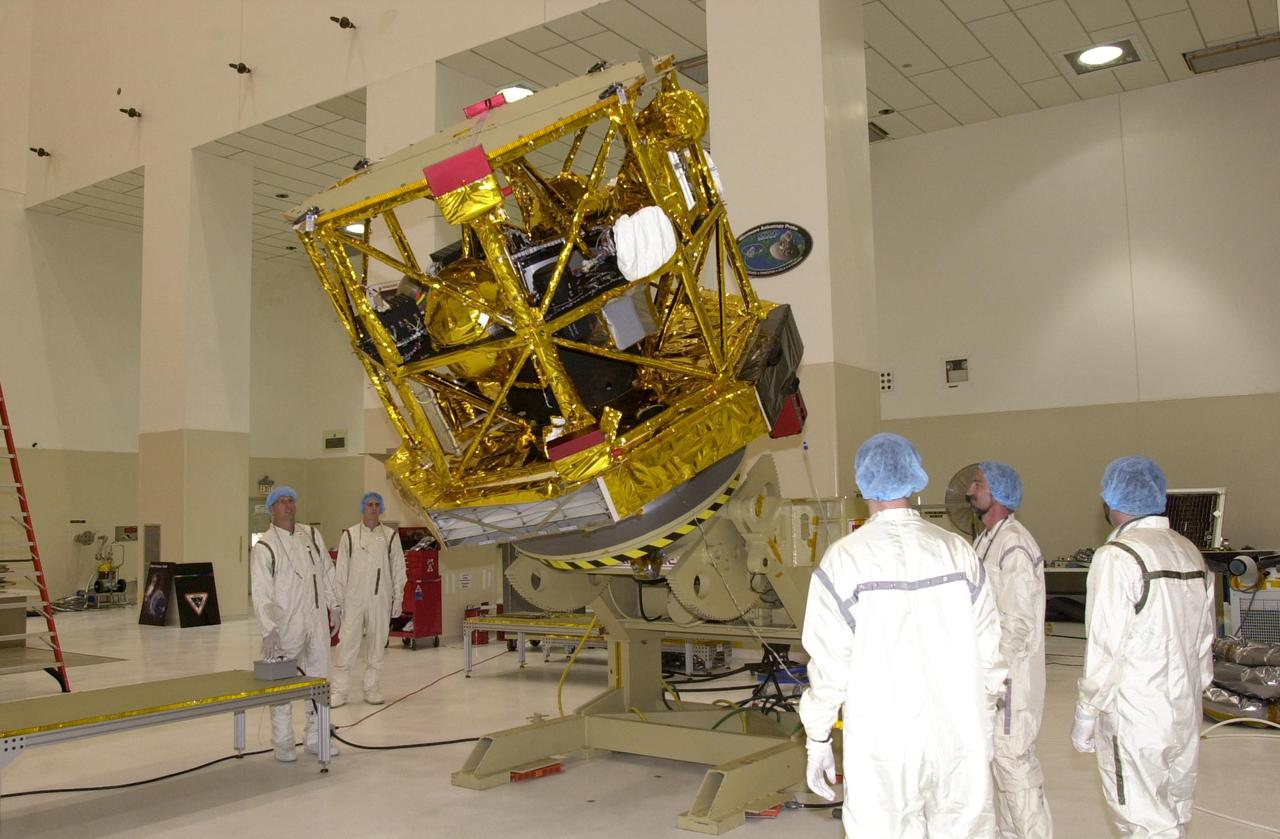
KENNEDY SPACE CENTER, FLA. -- The NASA Comet Nucleus Tour (CONTOUR) spacecraft arrived at KSC on April 24 and was transported to the Spacecraft Assembly and Encapsulation Facility-2 (SAEF-2) to begin final preparations for launch. CONTOUR will provide the first detailed look into the heart of a comet - the nucleus. The spacecraft will fly as close as 60 miles (100 kilometers) to at least two comets, Encke and Schwassmann-Wachmann 3, taking the sharpest pictures yet of the nucleus while analyzing the gas and dust that surround these rocky, icy building blocks of the solar system. The Applied Physics Laboratory of Johns Hopkins University, Baltimore, Md., built CONTOUR and will also be in control of the spacecraft after launch, scheduled for July 1, 2002, from LC 17A at Cape Canaveral Air Force Station
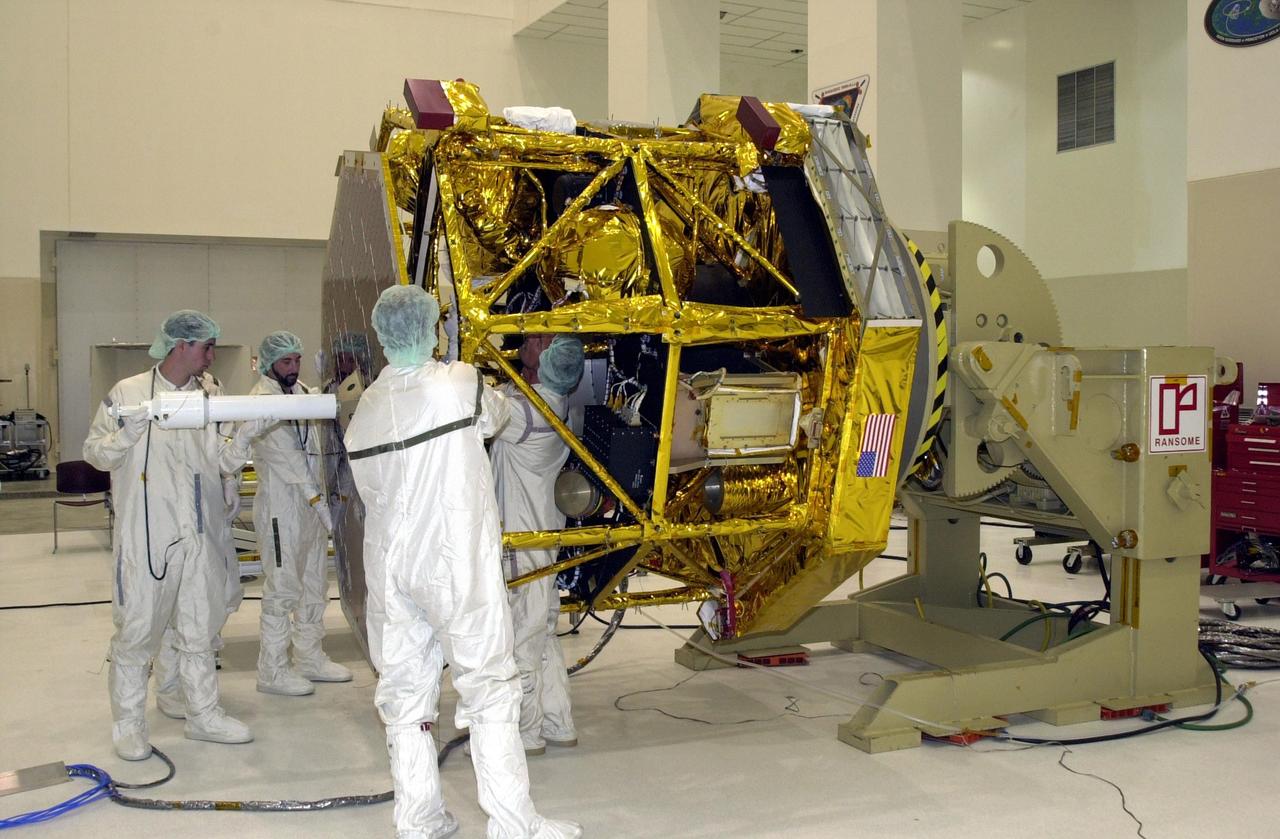
KENNEDY SPACE CENTER, FLA. -- In the Spacecraft Assembly and Encapsulation Facility 2 (SAEF-2), workers at left hold the antenna and solar panel steady while make adjustments before attaching it to the Comet Nucleus Tour (CONTOUR) spacecraft. Scheduled for launch July 1, 2002, from LC 17A at Cape Canaveral Air Force Station, CONTOUR will provide the first detailed look into the heart of a comet -- the nucleus. The spacecraft will fly as close as 60 miles (100 kilometers) to at least two comets, Encke and Schwassmann-Wachmann 3. It will take the sharpest pictures yet of the nucleus while analyzing the gas and dust that surround these rocky, icy building blocks of the solar system. The Applied Physics Laboratory of Johns Hopkins University, Baltimore, Md., built CONTOUR and will also be in control of the spacecraft after launch
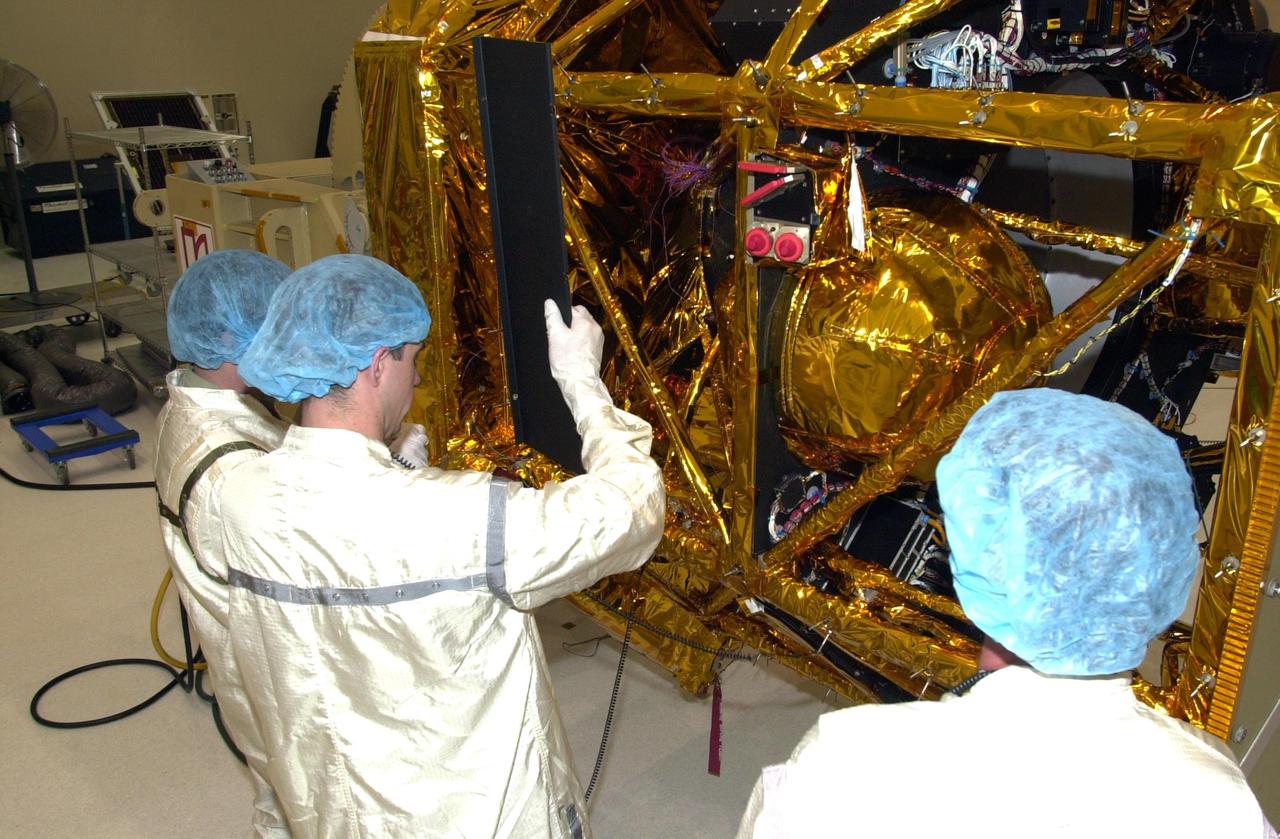
KENNEDY SPACE CENTER, FLA. -- The NASA Comet Nucleus Tour (CONTOUR) spacecraft arrived at KSC on April 24 and was transported to the Spacecraft Assembly and Encapsulation Facility-2 (SAEF-2) to begin final preparations for launch. CONTOUR will provide the first detailed look into the heart of a comet - the nucleus. The spacecraft will fly as close as 60 miles (100 kilometers) to at least two comets, Encke and Schwassmann-Wachmann 3, taking the sharpest pictures yet of the nucleus while analyzing the gas and dust that surround these rocky, icy building blocks of the solar system. The Applied Physics Laboratory of Johns Hopkins University, Baltimore, Md., built CONTOUR and will also be in control of the spacecraft after launch, scheduled for July 1, 2002, from LC 17A at Cape Canaveral Air Force Station
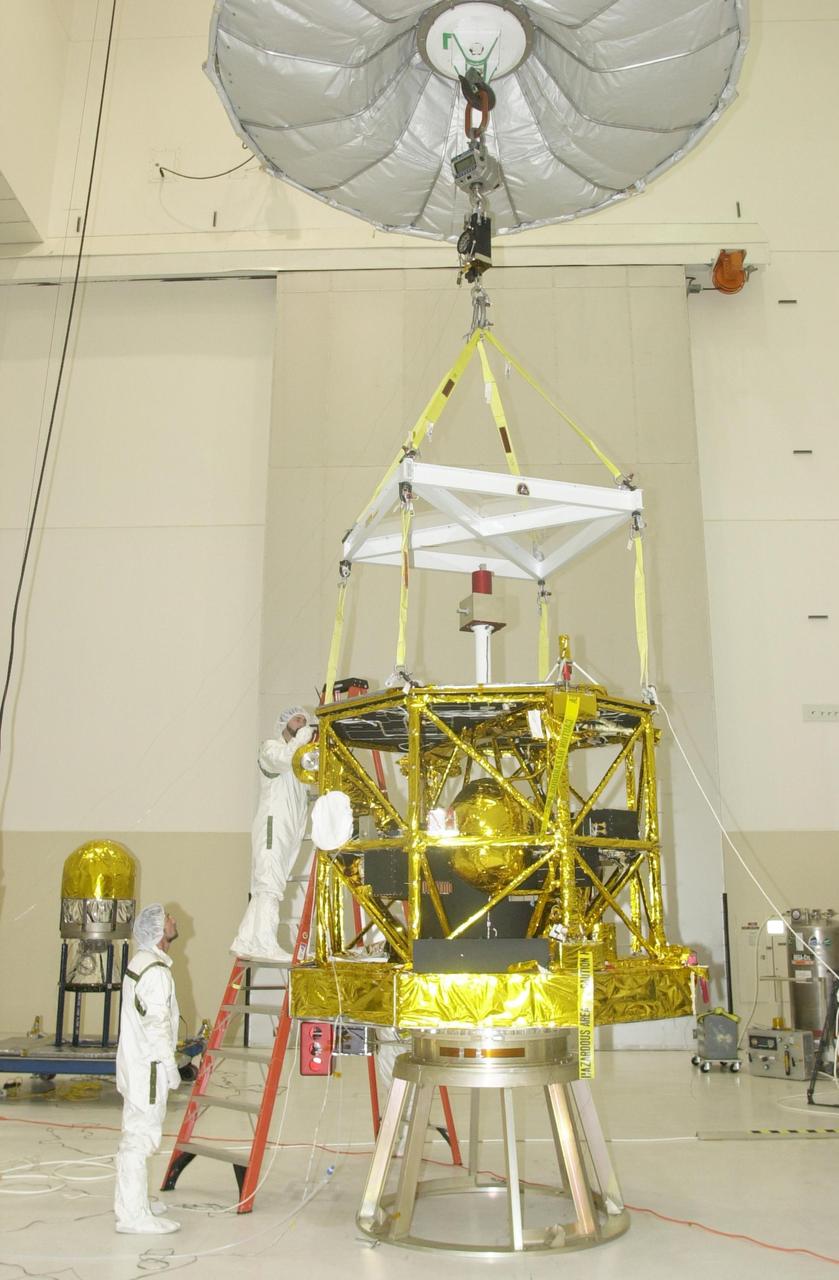
KENNEDY SPACE CENTER, FLA. - Workers in the Spacecraft Assembly and Encapsulation Facility 2 check the attachment of an overhead crane to the CONTOUR spacecraft. The crane will move it over to the apogee kick motor nearby where it will be attached. CONTOUR will provide the first detailed look into the heart of a comet -- the nucleus. The spacecraft will fly close to at least two comets, Encke and Schwassmann-Wachmann 3, taking pictures of the nucleus while analyzing the gas and dust that surround these rocky, icy building blocks of the solar system. The Applied Physics Laboratory of Johns Hopkins University, Baltimore, Md., built CONTOUR and will also be in control of the spacecraft after launch, scheduled for July 1, 2002, from LC 17A at Cape Canaveral Air Force Station
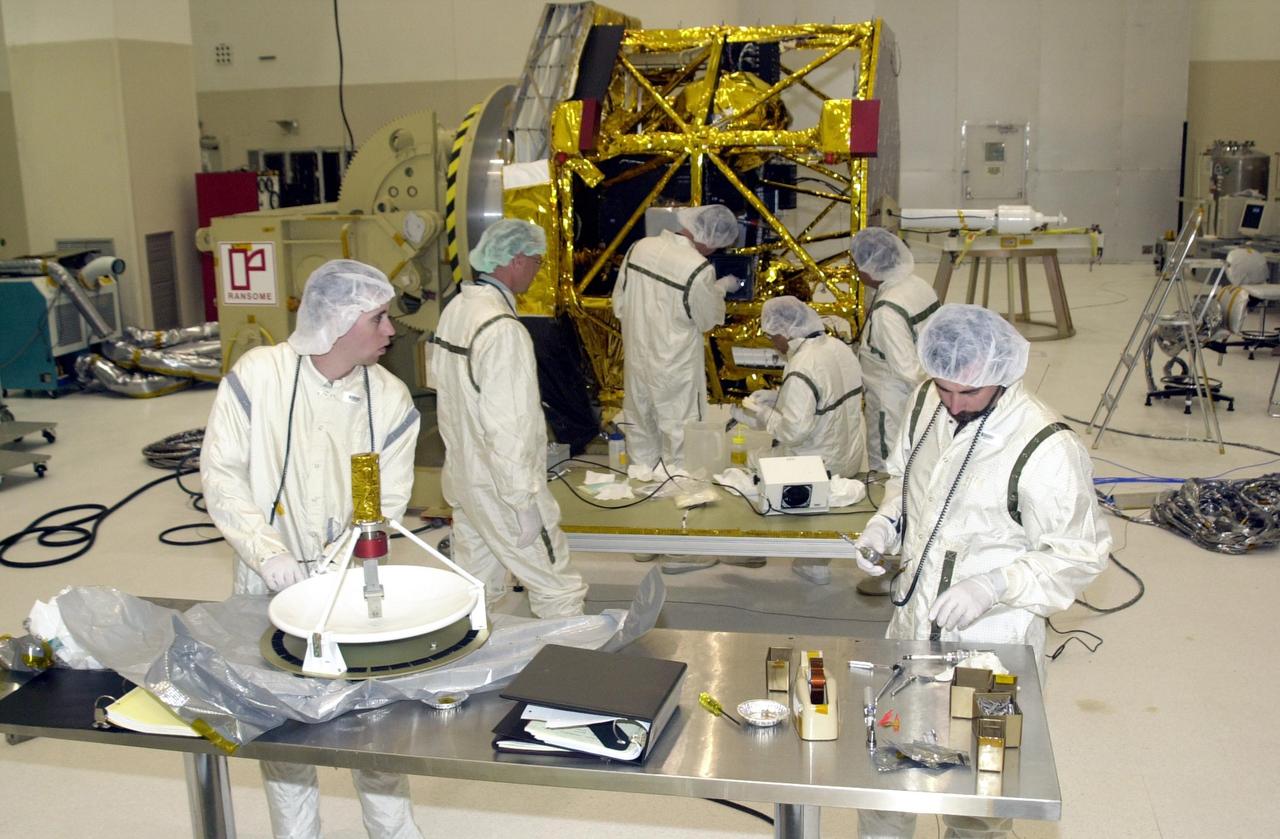
KENNEDY SPACE CENTER, FLA. -- Workers prepare the high gain antenna (foreground, on table) for installation on the Comet Nucleus Tour (CONTOUR) spacecraft in the Spacecraft Assembly and Encapsulation Facility 2 (SAEF-2). This second antenna will be installed near the larger antenna already attached. CONTOUR, scheduled for launch July 1, 2002, from LC 17A at Cape Canaveral Air Force Station, will provide the first detailed look into the heart of a comet -- the nucleus. The spacecraft will fly as close as 60 miles (100 kilometers) to at least two comets, Encke and Schwassmann-Wachmann 3. It will take the sharpest pictures yet of the nucleus while analyzing the gas and dust that surround these rocky, icy building blocks of the solar system. The Applied Physics Laboratory of Johns Hopkins University, Baltimore, Md., built CONTOUR and will also be in control of the spacecraft after launch
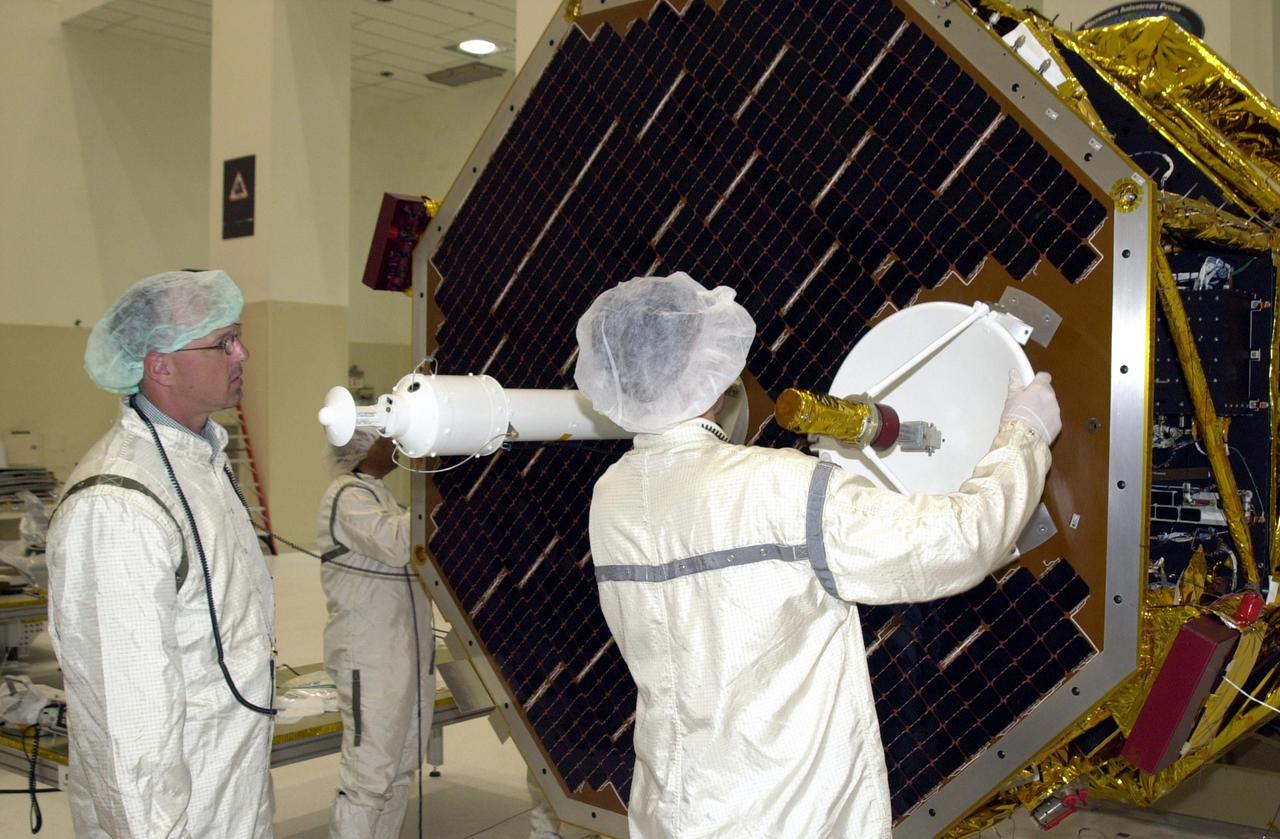
KENNEDY SPACE CENTER, FLA. -- While a co-worker (left) looks on, a worker (right) places the high gain antenna onto the solar panel of the Comet Nucleus Tour (CONTOUR) spacecraft. Scheduled for launch July 1, 2002, from LC 17A at Cape Canaveral Air Force Station, CONTOUR will provide the first detailed look into the heart of a comet -- the nucleus. The spacecraft will fly as close as 60 miles (100 kilometers) to at least two comets, Encke and Schwassmann-Wachmann 3. It will take the sharpest pictures yet of the nucleus while analyzing the gas and dust that surround these rocky, icy building blocks of the solar system. The Applied Physics Laboratory of Johns Hopkins University, Baltimore, Md., built CONTOUR and will also be in control of the spacecraft after launch
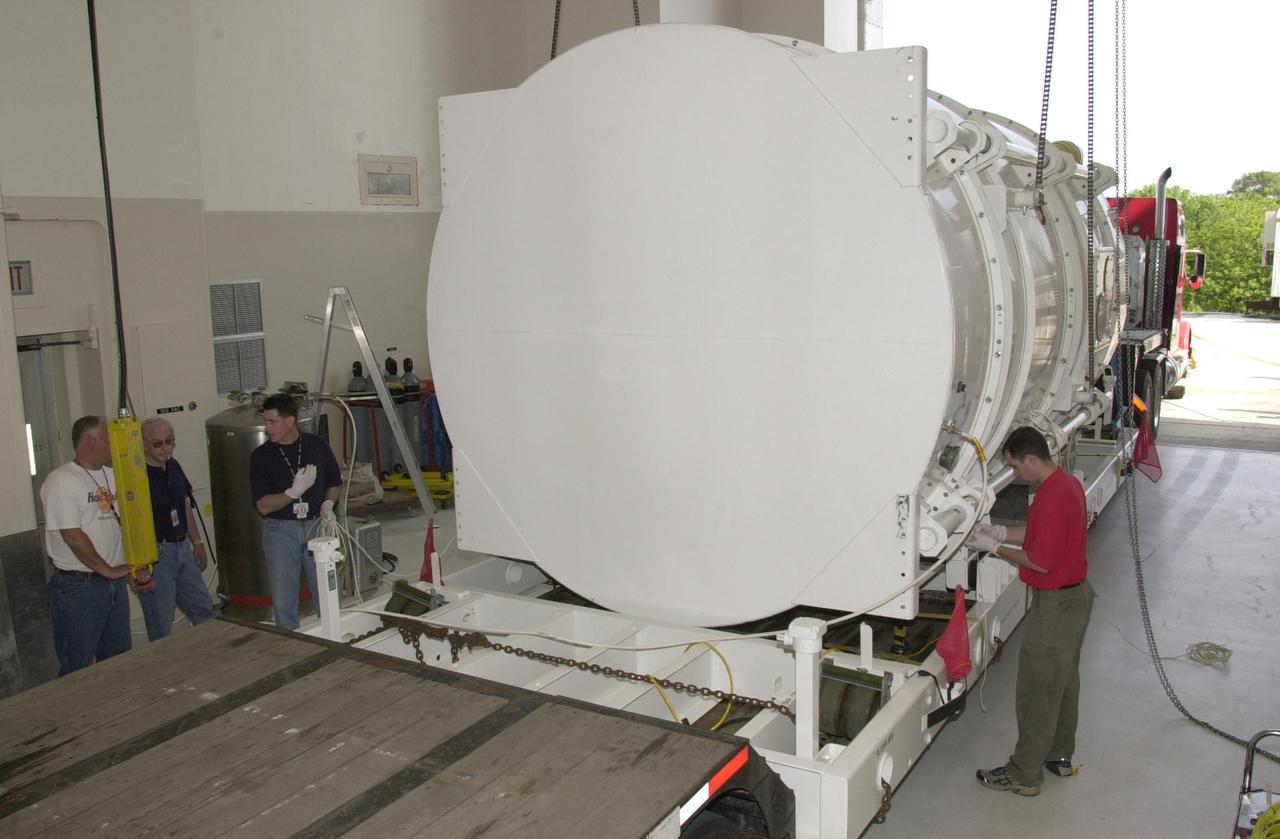
KENNEDY SPACE CENTER, FLA. -- The NASA Comet Nucleus Tour (CONTOUR) spacecraft arrived at KSC on April 24 and was transported to the Spacecraft Assembly and Encapsulation Facility-2 (SAEF-2) to begin final preparations for launch. CONTOUR will provide the first detailed look into the heart of a comet - the nucleus. The spacecraft will fly as close as 60 miles (100 kilometers) to at least two comets, Encke and Schwassmann-Wachmann 3, taking the sharpest pictures yet of the nucleus while analyzing the gas and dust that surround these rocky, icy building blocks of the solar system. The Applied Physics Laboratory of Johns Hopkins University, Baltimore, Md., built CONTOUR and will also be in control of the spacecraft after launch, scheduled for July 1, 2002, from LC 17A at Cape Canaveral Air Force Station
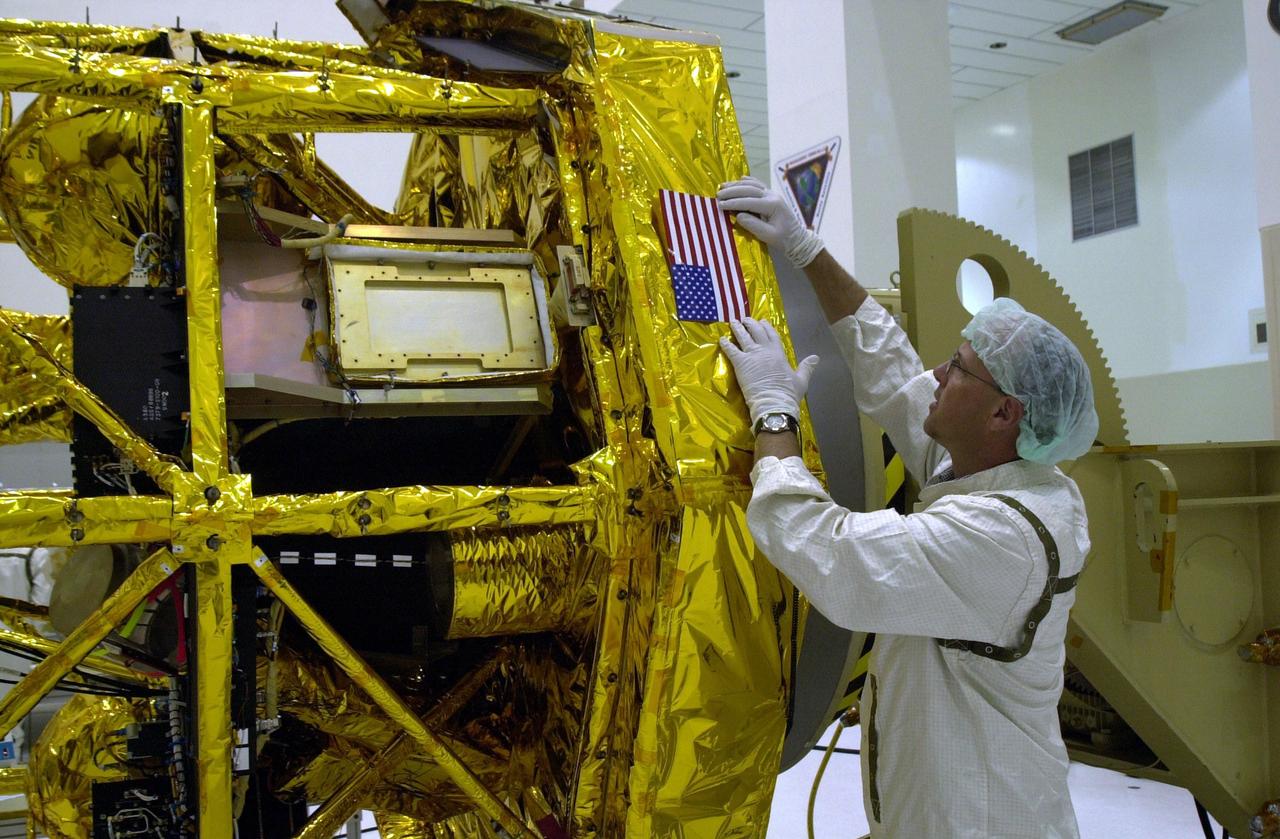
KENNEDY SPACE CENTER, FLA. -- In the Spacecraft Assembly and Encapsulation Facility 2 (SAEF-2), a worker places a replica of the United States flag onto the Comet Nucleus Tour (CONTOUR) spacecraft. CONTOUR is being prepared for antenna and solar panel installation. CONTOUR will provide the first detailed look into the heart of a comet -- the nucleus. The spacecraft will fly as close as 60 miles (100 kilometers) to at least two comets, Encke and Schwassmann-Wachmann 3. It will take the sharpest pictures yet of the nucleus while analyzing the gas and dust that surround these rocky, icy building blocks of the solar system. The Applied Physics Laboratory of Johns Hopkins University, Baltimore, Md., built CONTOUR and will also be in control of the spacecraft after launch, which is scheduled for July 1, 2002, from LC 17A at Cape Canaveral Air Force Station
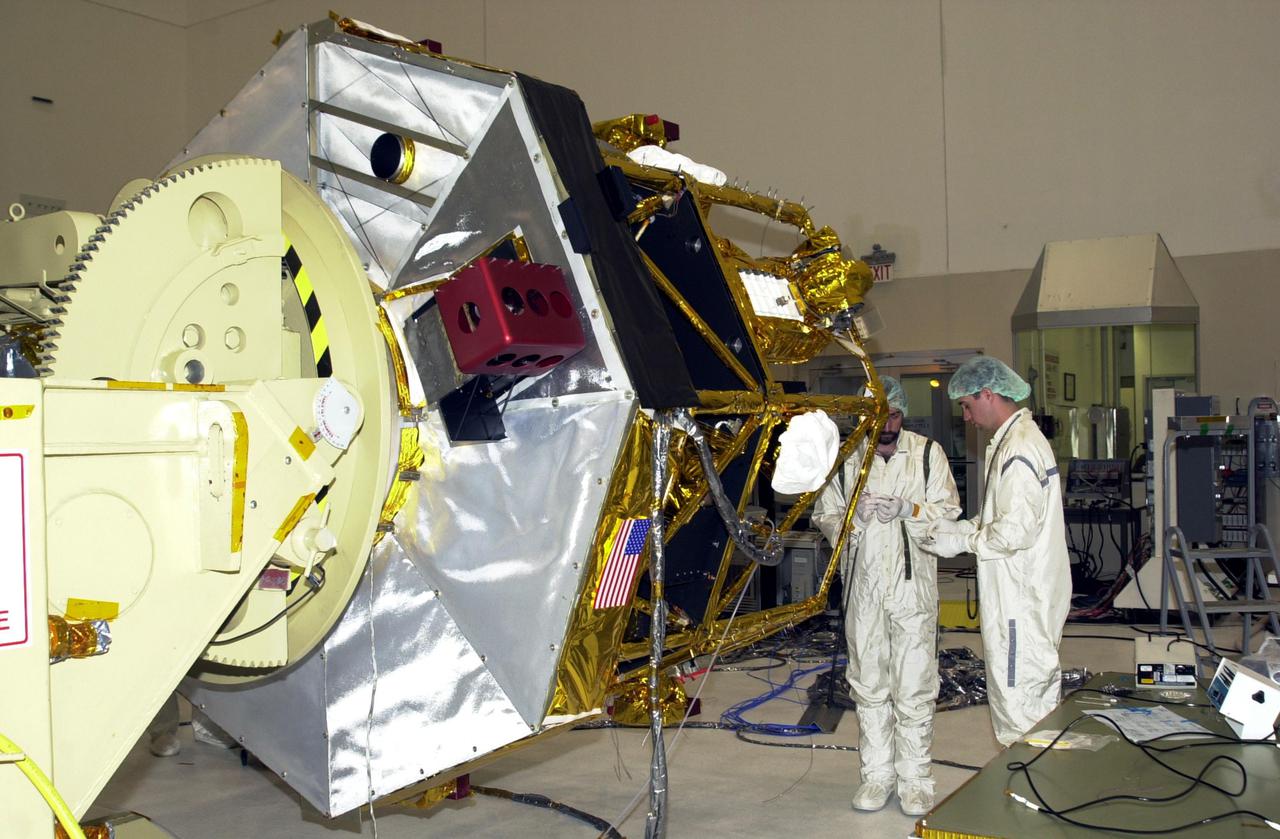
KENNEDY SPACE CENTER, FLA. -- In the Spacecraft Assembly and Encapsulation Facility 2 (SAEF-2), the Comet Nucleus Tour (CONTOUR) spacecraft is ready for installation of the antenna and solar panel. At left is seen the mechanism that enables rotation of the spacecraft for whatever procedures are needed. CONTOUR will provide the first detailed look into the heart of a comet -- the nucleus. The spacecraft will fly as close as 60 miles (100 kilometers) to at least two comets, Encke and Schwassmann-Wachmann 3. It will take the sharpest pictures yet of the nucleus while analyzing the gas and dust that surround these rocky, icy building blocks of the solar system. The Applied Physics Laboratory of Johns Hopkins University, Baltimore, Md., built CONTOUR and will also be in control of the spacecraft after launch, which is scheduled for July 1, 2002, from LC 17A at Cape Canaveral Air Force Station
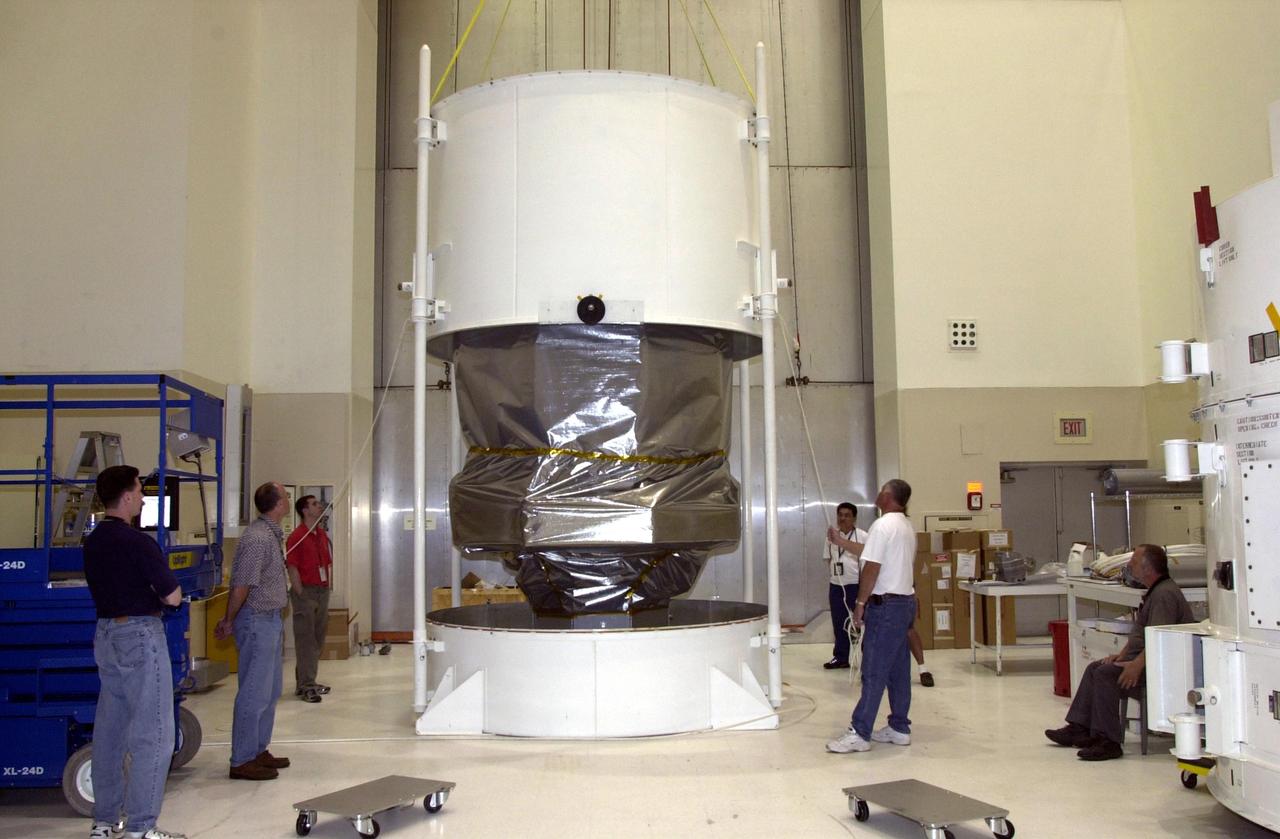
KENNEDY SPACE CENTER, FLA. -- The NASA Comet Nucleus Tour (CONTOUR) spacecraft arrived at KSC on April 24 and was transported to the Spacecraft Assembly and Encapsulation Facility-2 (SAEF-2) to begin final preparations for launch. CONTOUR will provide the first detailed look into the heart of a comet - the nucleus. The spacecraft will fly as close as 60 miles (100 kilometers) to at least two comets, Encke and Schwassmann-Wachmann 3, taking the sharpest pictures yet of the nucleus while analyzing the gas and dust that surround these rocky, icy building blocks of the solar system. The Applied Physics Laboratory of Johns Hopkins University, Baltimore, Md., built CONTOUR and will also be in control of the spacecraft after launch, scheduled for July 1, 2002, from LC 17A at Cape Canaveral Air Force Station
KENNEDY SPACE CENTER, FLA. -- The NASA Comet Nucleus Tour (CONTOUR) spacecraft arrived at KSC on April 24 and was transported to the Spacecraft Assembly and Encapsulation Facility-2 (SAEF-2) to begin final preparations for launch. CONTOUR will provide the first detailed look into the heart of a comet - the nucleus. The spacecraft will fly as close as 60 miles (100 kilometers) to at least two comets, Encke and Schwassmann-Wachmann 3, taking the sharpest pictures yet of the nucleus while analyzing the gas and dust that surround these rocky, icy building blocks of the solar system. The Applied Physics Laboratory of Johns Hopkins University, Baltimore, Md., built CONTOUR and will also be in control of the spacecraft after launch, scheduled for July 1, 2002, from LC 17A at Cape Canaveral Air Force Station
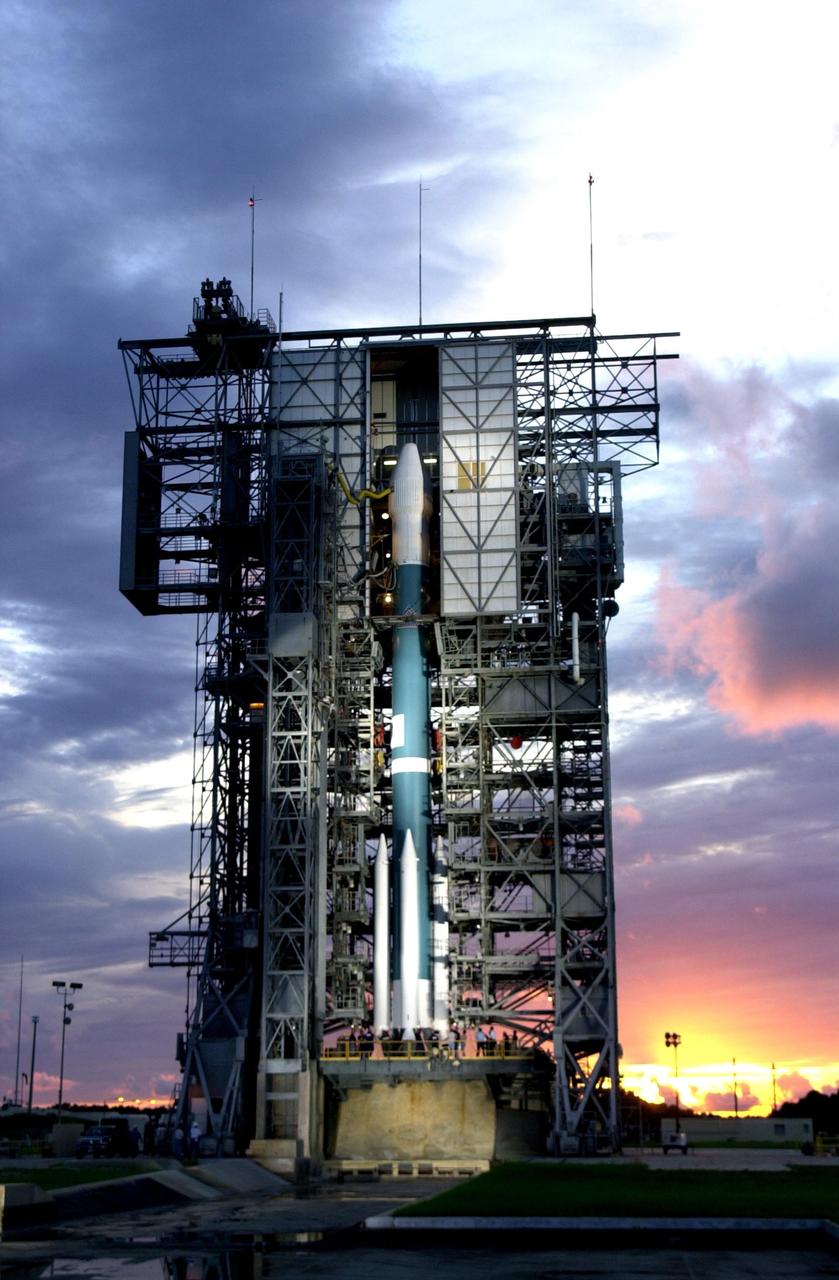
KENNEDY SPACE CENTER, FLA. -- The setting sun casts purple and pink shades in the sky as the launch tower on pad 17-A, Cape Canaveral Air Force Station, rolls back to reveal the Boeing Delta II rocket with NASA's Comet Nucleus Tour (CONTOUR) spacecraft attached. The launch is scheduled for 2:47 a.m. EDT July 3. Designed and built by The Johns Hopkins University Applied Physics Laboratory (APL) in Laurel, Md., the 2,138-pound (970-kilogram) spacecraft will be placed into an elliptical Earth orbit until Aug. 15, when it is scheduled to fire its main engine and enter a comet-chasing orbit around the sun. The mission's flexible four-year plan includes encounters with comets Encke (Nov. 12, 2003) and Schwassmann-Wachmann 3 (June 19, 2006), though it can add an encounter with a "new" and scientifically valuable comet from the outer solar system, should one be discovered in time for CONTOUR to fly past it. CONTOUR's four scientific instruments will take detailed pictures and measure the chemical makeup of each comet's nucleus -- a chunk of ice and rock -- while analyzing the surrounding gas and dust.
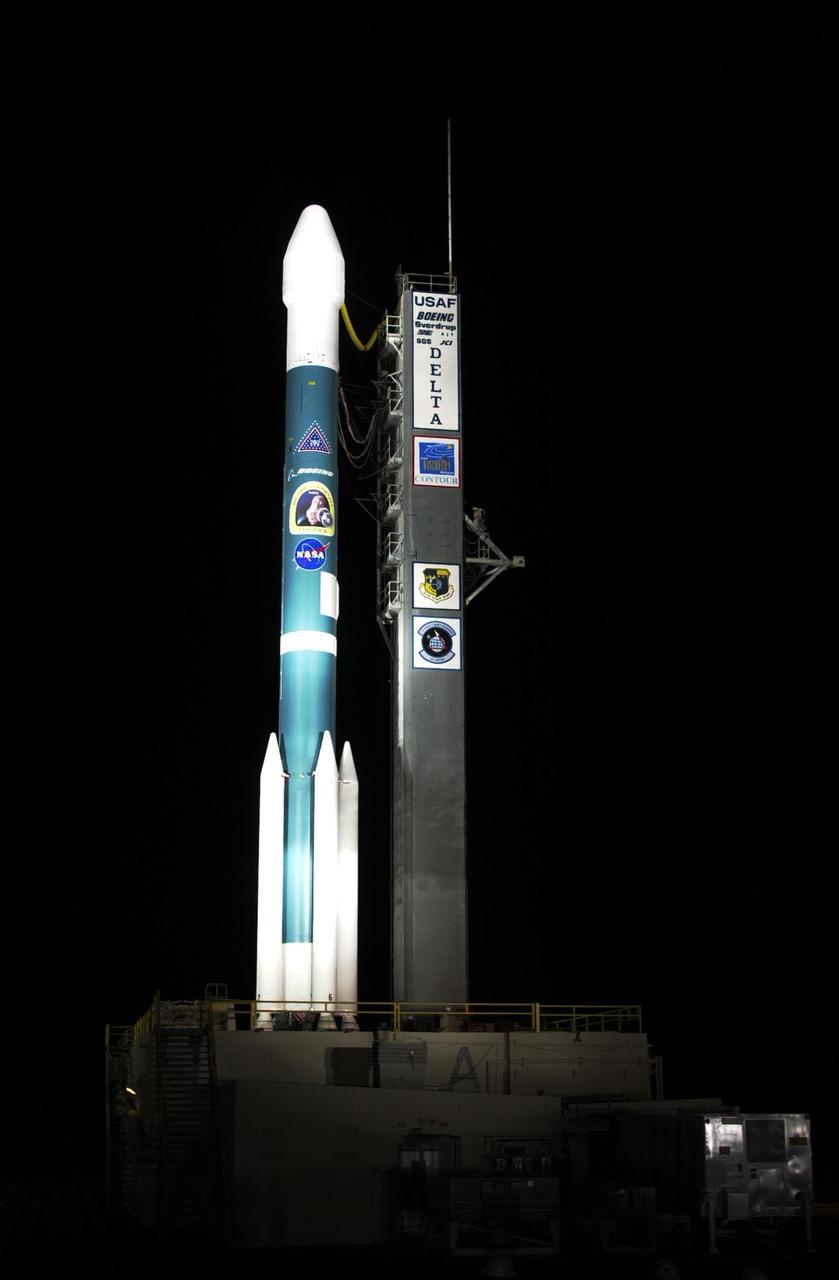
KENNEDY SPACE CENTER, FLA. -- The Boeing Delta II rocket with NASA's Comet Nucleus Tour (CONTOUR) spacecraft attached is bathed in light as it sits on pad 17-A, Cape Canaveral Air Force Station. The launch is scheduled for 2:47 a.m. EDT July 3. Designed and built by The Johns Hopkins University Applied Physics Laboratory (APL) in Laurel, Md., the 2,138-pound (970-kilogram) spacecraft will be placed into an elliptical Earth orbit until Aug. 15, when it is scheduled to fire its main engine and enter a comet-chasing orbit around the sun. The mission's flexible four-year plan includes encounters with comets Encke (Nov. 12, 2003) and Schwassmann-Wachmann 3 (June 19, 2006), though it can add an encounter with a "new" and scientifically valuable comet from the outer solar system, should one be discovered in time for CONTOUR to fly past it. CONTOUR's four scientific instruments will take detailed pictures and measure the chemical makeup of each comet's nucleus -- a chunk of ice and rock -- while analyzing the surrounding gas and dust.
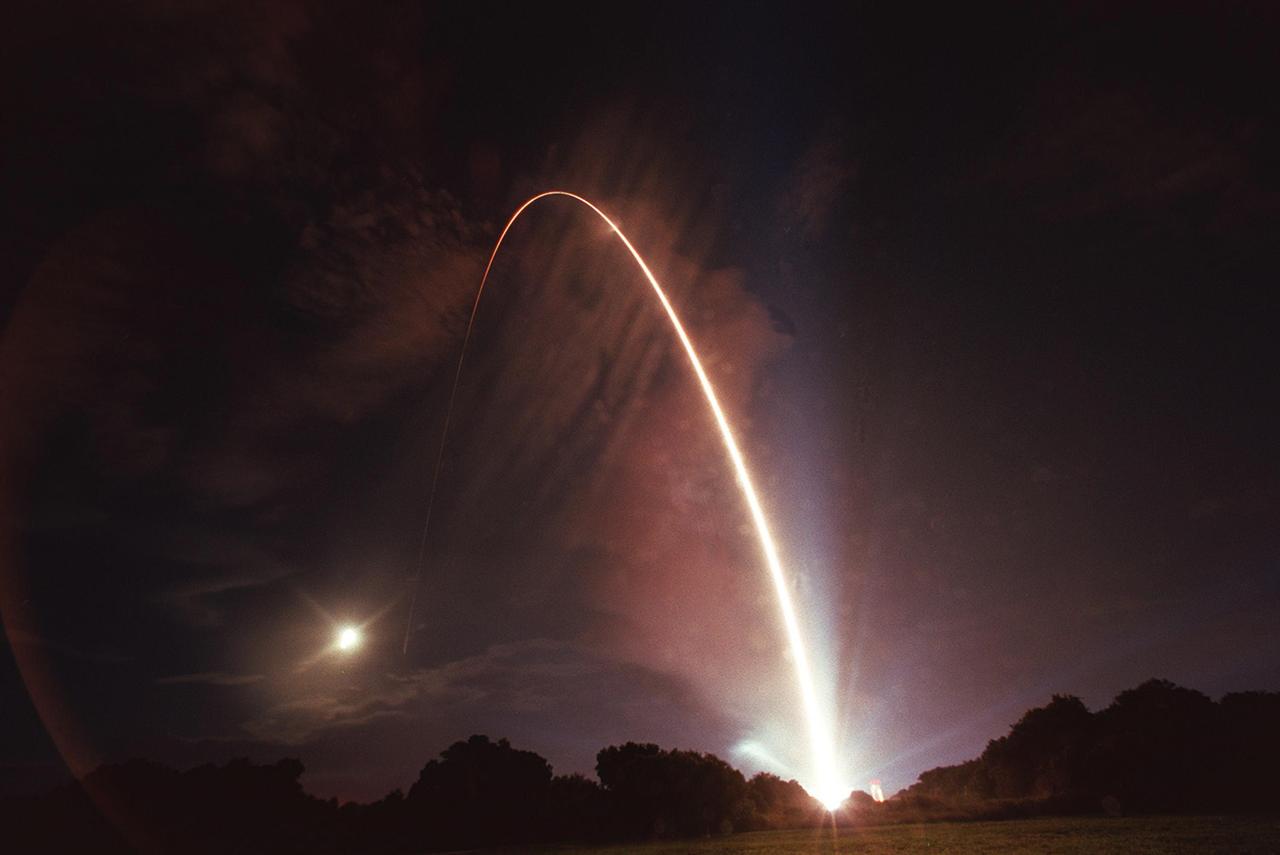
KENNEDY SPACE CENTER, FLA. -- The Boeing Delta II rocket carrying NASA's Comet Nucleus Tour (CONTOUR) spacecraft streaks across the night sky above pad 17-A, Cape Canaveral Air Force Station. The launch took place at 2:47:41 a.m. EDT July 3. Designed and built by The Johns Hopkins University Applied Physics Laboratory (APL) in Laurel, Md., the 2,138-pound (970-kilogram) spacecraft will be placed into an elliptical Earth orbit until Aug. 15, when it is scheduled to fire its main engine and enter a comet-chasing orbit around the sun. The mission's flexible four-year plan includes encounters with comets Encke (Nov. 12, 2003) and Schwassmann-Wachmann 3 (June 19, 2006), though it can add an encounter with a "new" and scientifically valuable comet from the outer solar system, should one be discovered in time for CONTOUR to fly past it. CONTOUR's four scientific instruments will take detailed pictures and measure the chemical makeup of each comet's nucleus -- a chunk of ice and rock -- while analyzing the surrounding gas and dust.
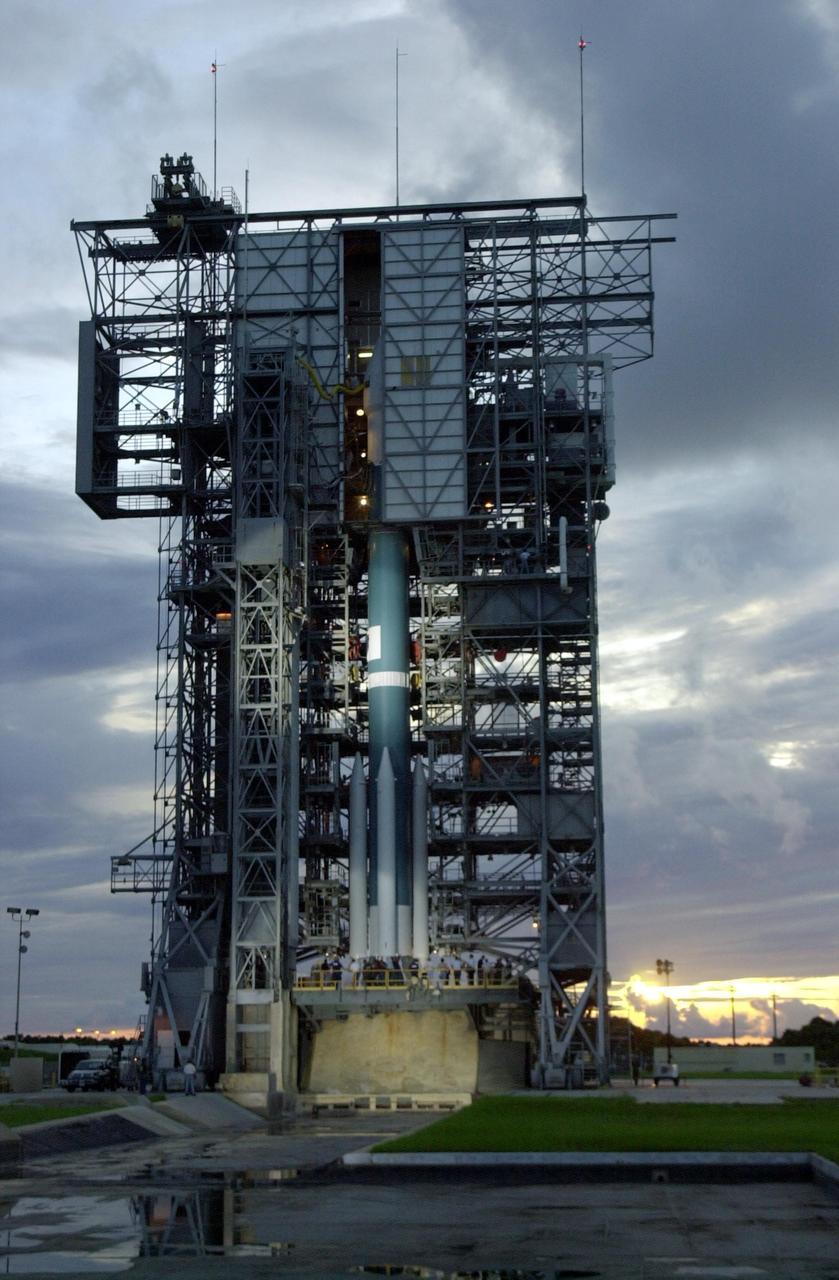
KENNEDY SPACE CENTER, FLA. - The Boeing Delta II rocket with NASA's Comet Nucleus Tour (CONTOUR) spacecraft attached is becoming visible as the launch tower is prepared for rollback. The launch is scheduled for 2:47 a.m. EDT July 3 from Cape Canaveral Air Force Station, Fla. Designed and built by The Johns Hopkins University Applied Physics Laboratory (APL) in Laurel, Md., the 2,138-pound (970-kilogram) spacecraft will be placed into an elliptical Earth orbit until Aug. 15, when it is scheduled to fire its main engine and enter a comet-chasing orbit around the sun. The mission's flexible four-year plan includes encounters with comets Encke (Nov. 12, 2003) and Schwassmann-Wachmann 3 (June 19, 2006), though it can add an encounter with a "new" and scientifically valuable comet from the outer solar system, should one be discovered in time for CONTOUR to fly past it. CONTOUR's four scientific instruments will take detailed pictures and measure the chemical makeup of each comet's nucleus -- a chunk of ice and rock -- while analyzing the surrounding gas and dust.

KENNEDY SPACE CENTER, FLA. - Sunset-shaded clouds of purple and pink fill the sky as the launch tower on pad 17-A, Cape Canaveral Air Force Station, rolls back to reveal the Boeing Delta II rocket with NASA's Comet Nucleus Tour (CONTOUR) spacecraft attached. The launch is scheduled for 2:47 a.m. EDT July 3. Designed and built by The Johns Hopkins University Applied Physics Laboratory (APL) in Laurel, Md., the 2,138-pound (970-kilogram) spacecraft will be placed into an elliptical Earth orbit until Aug. 15, when it is scheduled to fire its main engine and enter a comet-chasing orbit around the sun. The mission's flexible four-year plan includes encounters with comets Encke (Nov. 12, 2003) and Schwassmann-Wachmann 3 (June 19, 2006), though it can add an encounter with a "new" and scientifically valuable comet from the outer solar system, should one be discovered in time for CONTOUR to fly past it. CONTOUR's four scientific instruments will take detailed pictures and measure the chemical makeup of each comet's nucleus -- a chunk of ice and rock -- while analyzing the surrounding gas and dust.
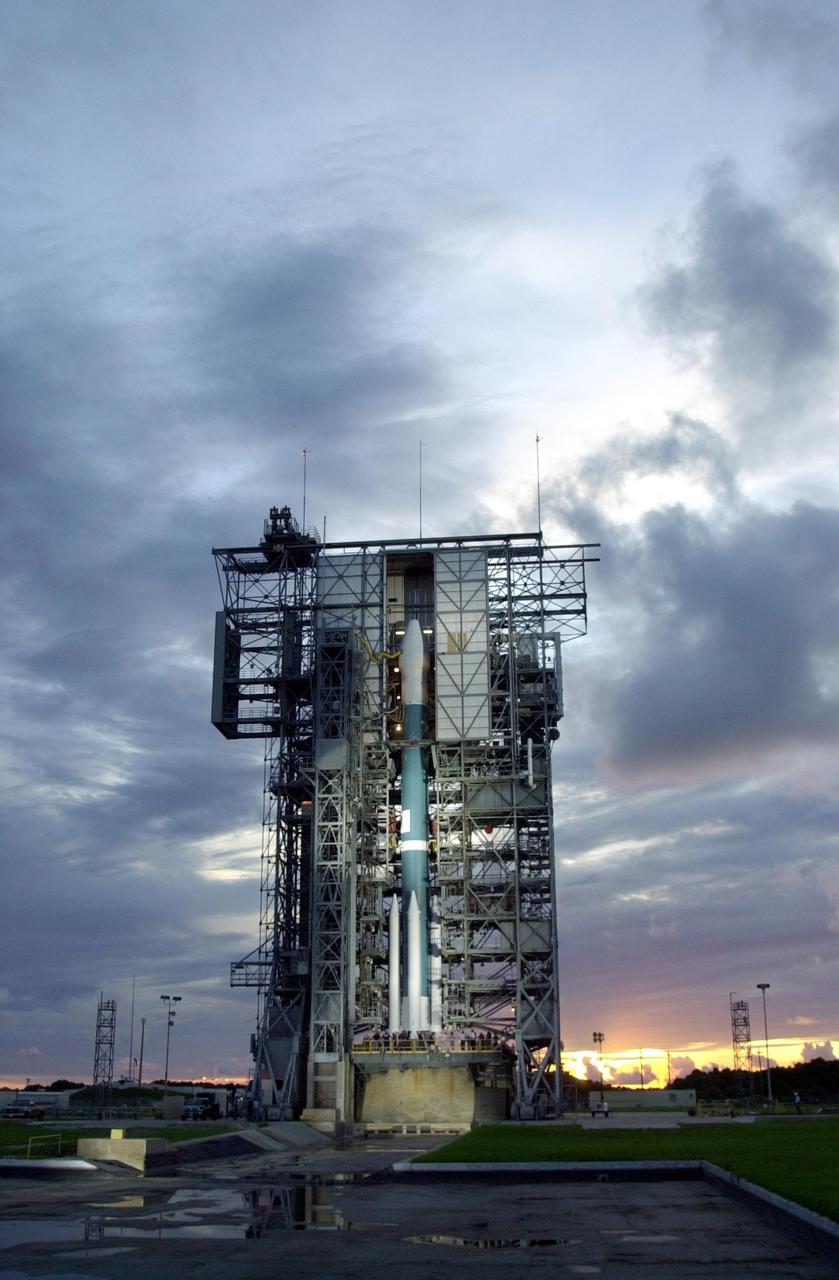
KENNEDY SPACE CENTER, FLA. -- The Boeing Delta II rocket with NASA's Comet Nucleus Tour (CONTOUR) spacecraft attached is visible as the launch tower is rolled back. The launch is scheduled for 2:47 a.m. EDT July 3 from Cape Canaveral Air Force Station, Fla. Designed and built by The Johns Hopkins University Applied Physics Laboratory (APL) in Laurel, Md., the 2,138-pound (970-kilogram) spacecraft will be placed into an elliptical Earth orbit until Aug. 15, when it is scheduled to fire its main engine and enter a comet-chasing orbit around the sun. The mission's flexible four-year plan includes encounters with comets Encke (Nov. 12, 2003) and Schwassmann-Wachmann 3 (June 19, 2006), though it can add an encounter with a "new" and scientifically valuable comet from the outer solar system, should one be discovered in time for CONTOUR to fly past it. CONTOUR's four scientific instruments will take detailed pictures and measure the chemical makeup of each comet's nucleus -- a chunk of ice and rock -- while analyzing the surrounding gas and dust.
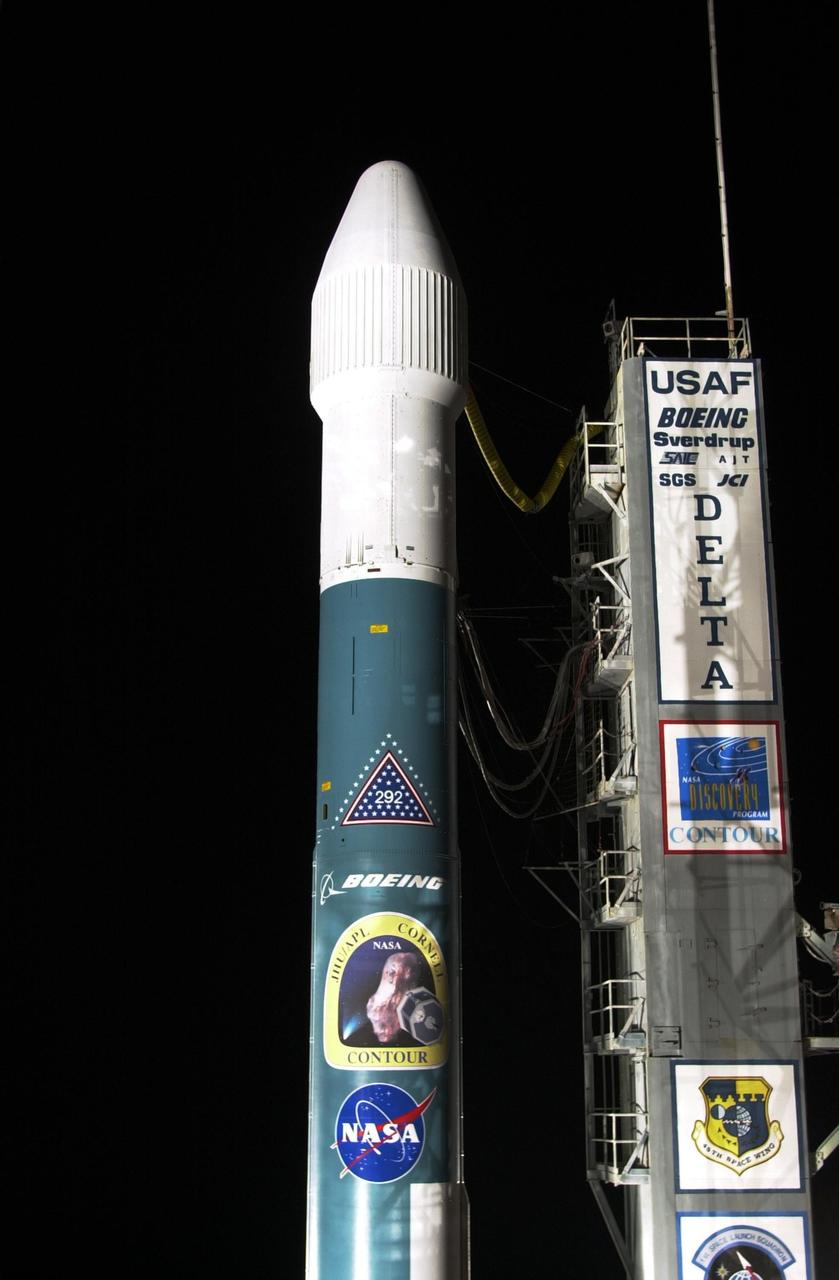
KENNEDY SPACE CENTER, FLA. -- After tower rollback, the Boeing Delta II rocket with NASA's Comet Nucleus Tour (CONTOUR) spacecraft attached is visible. The rocket exhibits several logos, including that of CONTOUR, Boeing and NASA. The launch is scheduled for 2:47 a.m. EDT July 3. Designed and built by The Johns Hopkins University Applied Physics Laboratory (APL) in Laurel, Md., the 2,138-pound (970-kilogram) spacecraft will be placed into an elliptical Earth orbit until Aug. 15, when it is scheduled to fire its main engine and enter a comet-chasing orbit around the sun. The mission's flexible four-year plan includes encounters with comets Encke (Nov. 12, 2003) and Schwassmann-Wachmann 3 (June 19, 2006), though it can add an encounter with a "new" and scientifically valuable comet from the outer solar system, should one be discovered in time for CONTOUR to fly past it. CONTOUR's four scientific instruments will take detailed pictures and measure the chemical makeup of each comet's nucleus -- a chunk of ice and rock -- while analyzing the surrounding gas and dust.
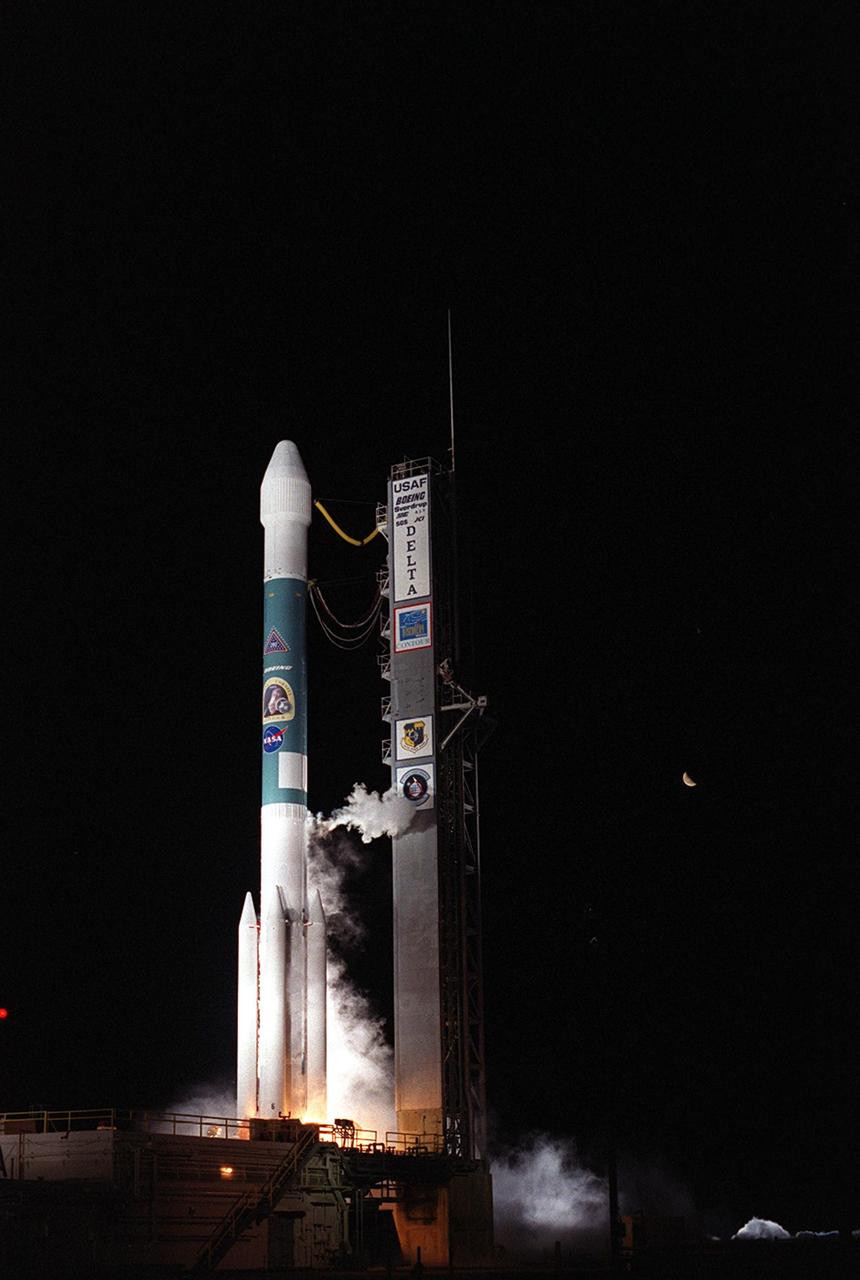
KENNEDY SPACE CENTER, FLA. -- NASA's Comet Nucleus Tour (CONTOUR) spacecraft successfully launches at 2:47:41 a.m. EDT aboard a Boeing Delta II rocket from Cape Canaveral Air Force Station, Fla. Designed and built by The Johns Hopkins University Applied Physics Laboratory (APL) in Laurel, Md., the 2,138-pound (970-kilogram) spacecraft was placed into an elliptical Earth orbit 63 minutes after launch. About 19 minutes later the mission operations team at APL acquired a signal from the spacecraft through the Deep Space Network antenna station in Goldstone, Calif., and by 5:45 a.m. EDT Mission Director Dr. Robert W. Farquhar of the Applied Physics Lab confirmed the craft was operating normally and ready to carry out its early orbit maneuvers. CONTOUR will orbit Earth until Aug. 15, when it is scheduled to fire its main engine and enter a comet-chasing orbit around the sun. The mission's flexible four-year plan includes encounters with comets Encke (Nov. 12, 2003) and Schwassmann-Wachmann 3 (June 19, 2006), though it can add an encounter with a "new" and scientifically valuable comet from the outer solar system, should one be discovered in time for CONTOUR to fly past it. CONTOUR's four scientific instruments will take detailed pictures and measure the chemical makeup of each comet's nucleus -- a chunk of ice and rock -- while analyzing the surrounding gas and dust.
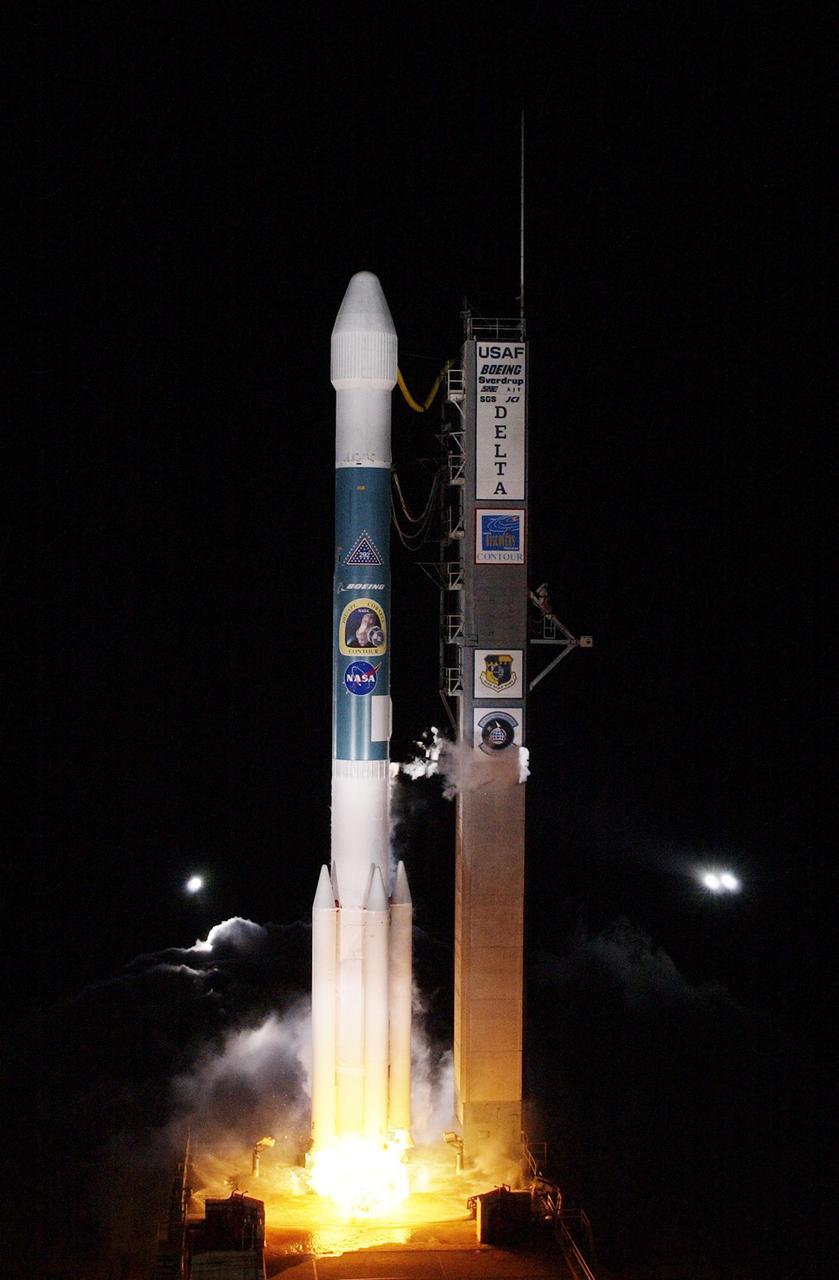
KENNEDY SPACE CENTER, FLA. -- NASA's Comet Nucleus Tour (CONTOUR) spacecraft successfully launches at 2:47 a.m. EDT aboard a Boeing Delta II rocket from Cape Canaveral Air Force Station, Fla. Designed and built by The Johns Hopkins University Applied Physics Laboratory (APL) in Laurel, Md., the 2,138-pound (970-kilogram) spacecraft was placed into an elliptical Earth orbit 63 minutes after launch. About 19 minutes later the mission operations team at APL acquired a signal from the spacecraft through the Deep Space Network antenna station in Goldstone, Calif., and by 5:45 a.m. EDT Mission Director Dr. Robert W. Farquhar of the Applied Physics Lab confirmed the craft was operating normally and ready to carry out its early orbit maneuvers. CONTOUR will orbit Earth until Aug. 15, when it is scheduled to fire its main engine and enter a comet-chasing orbit around the sun. The mission's flexible four-year plan includes encounters with comets Encke (Nov. 12, 2003) and Schwassmann-Wachmann 3 (June 19, 2006), though it can add an encounter with a "new" and scientifically valuable comet from the outer solar system, should one be discovered in time for CONTOUR to fly past it. CONTOUR's four scientific instruments will take detailed pictures and measure the chemical makeup of each comet's nucleus -- a chunk of ice and rock -- while analyzing the surrounding gas and dust.
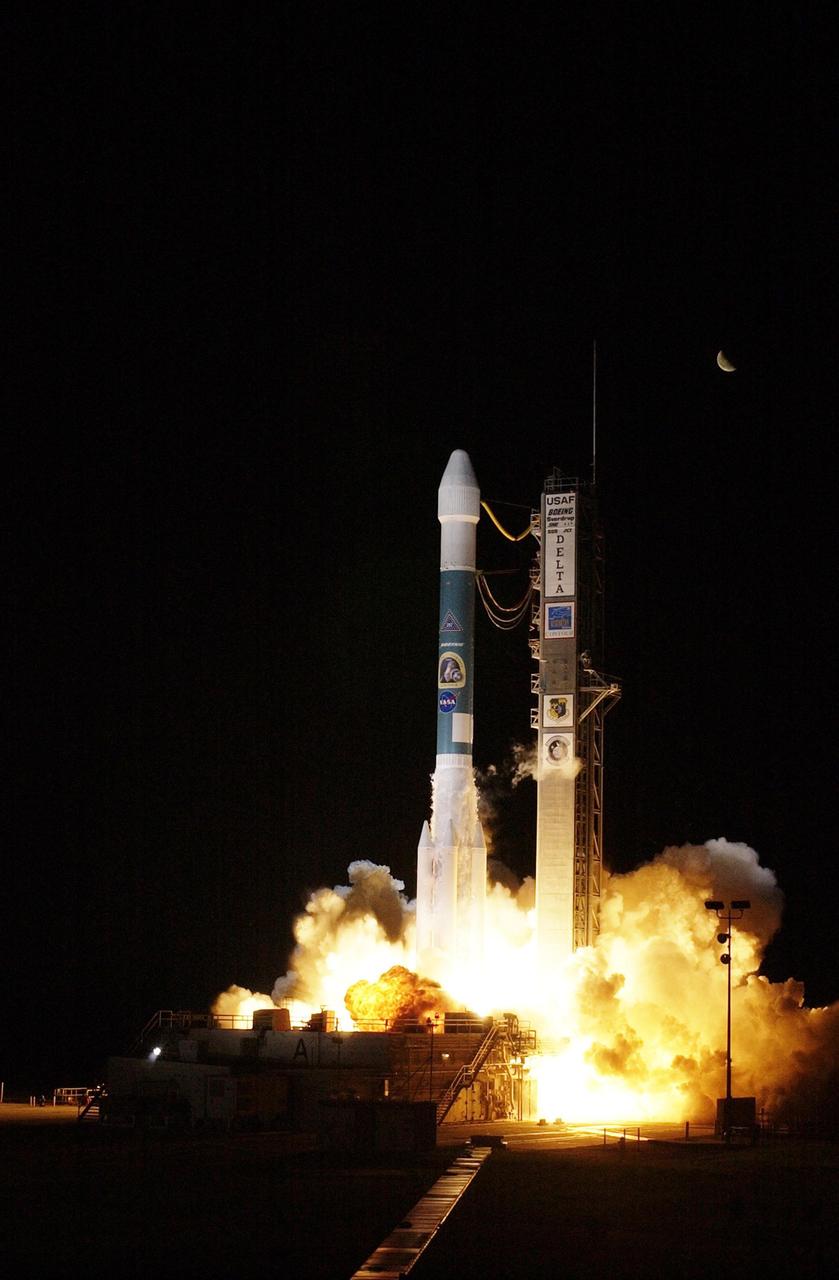
KENNEDY SPACE CENTER, FLA. - A third-quarter moon is the only visible element in the sky as NASA's Comet Nucleus Tour (CONTOUR) spacecraft successfully launches at 2:47 a.m. EDT aboard a Boeing Delta II rocket from Cape Canaveral Air Force Station, Fla. Designed and built by The Johns Hopkins University Applied Physics Laboratory (APL) in Laurel, Md., the 2,138-pound (970-kilogram) spacecraft was placed into an elliptical Earth orbit 63 minutes after launch. About 19 minutes later the mission operations team at APL acquired a signal from the spacecraft through the Deep Space Network antenna station in Goldstone, Calif., and by 5:45 a.m. EDT Mission Director Dr. Robert W. Farquhar of the Applied Physics Lab confirmed the craft was operating normally and ready to carry out its early orbit maneuvers. CONTOUR will orbit Earth until Aug. 15, when it is scheduled to fire its main engine and enter a comet-chasing orbit around the sun. The mission's flexible four-year plan includes encounters with comets Encke (Nov. 12, 2003) and Schwassmann-Wachmann 3 (June 19, 2006), though it can add an encounter with a "new" and scientifically valuable comet from the outer solar system, should one be discovered in time for CONTOUR to fly past it. CONTOUR's four scientific instruments will take detailed pictures and measure the chemical makeup of each comet's nucleus -- a chunk of ice and rock -- while analyzing the surrounding gas and dust.
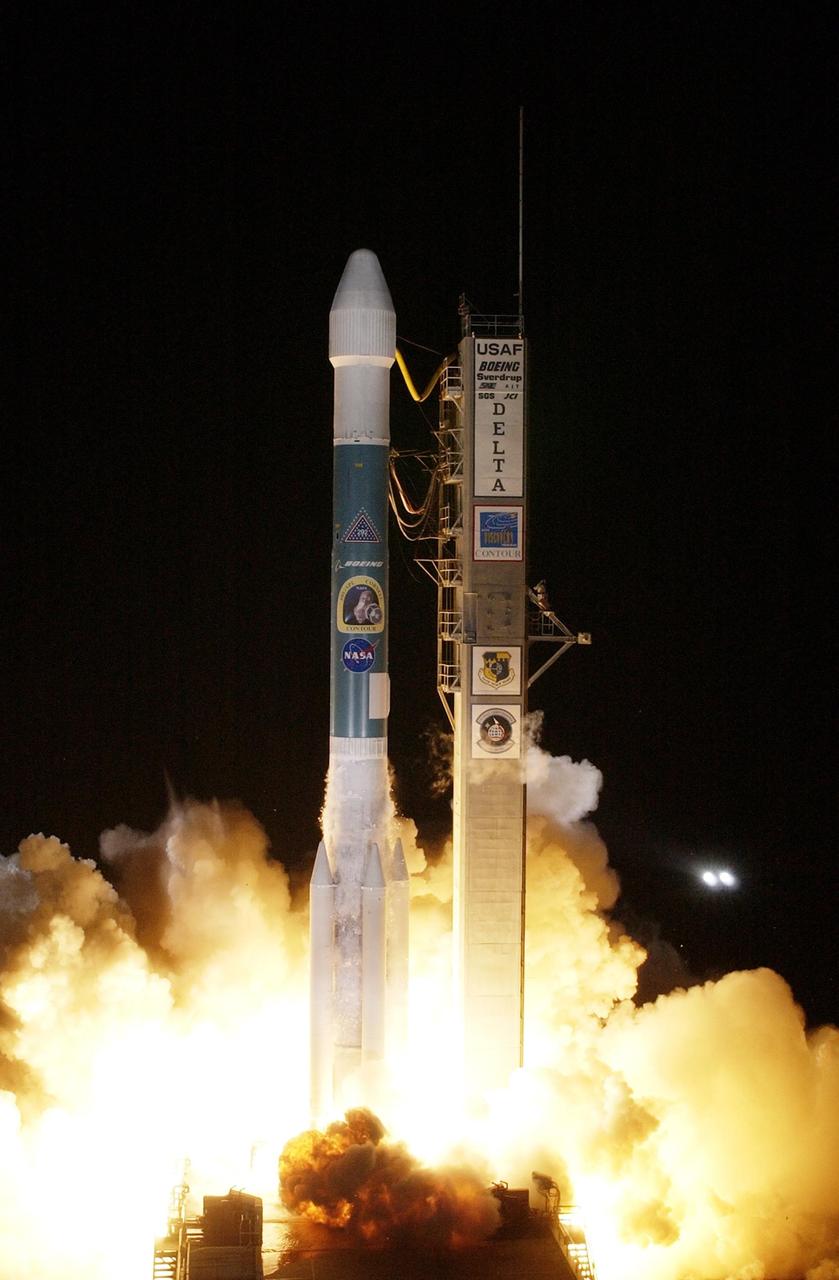
KENNEDY SPACE CENTER, FLA. -- NASA's Comet Nucleus Tour (CONTOUR) spacecraft successfully launches at 2:47 a.m. EDT aboard a Boeing Delta II rocket from Cape Canaveral Air Force Station, Fla. Designed and built by The Johns Hopkins University Applied Physics Laboratory (APL) in Laurel, Md., the 2,138-pound (970-kilogram) spacecraft was placed into an elliptical Earth orbit 63 minutes after launch. About 19 minutes later the mission operations team at APL acquired a signal from the spacecraft through the Deep Space Network antenna station in Goldstone, Calif., and by 5:45 a.m. EDT Mission Director Dr. Robert W. Farquhar of the Applied Physics Lab confirmed the craft was operating normally and ready to carry out its early orbit maneuvers. CONTOUR will orbit Earth until Aug. 15, when it is scheduled to fire its main engine and enter a comet-chasing orbit around the sun. The mission's flexible four-year plan includes encounters with comets Encke (Nov. 12, 2003) and Schwassmann-Wachmann 3 (June 19, 2006), though it can add an encounter with a "new" and scientifically valuable comet from the outer solar system, should one be discovered in time for CONTOUR to fly past it. CONTOUR's four scientific instruments will take detailed pictures and measure the chemical makeup of each comet's nucleus -- a chunk of ice and rock -- while analyzing the surrounding gas and dust.
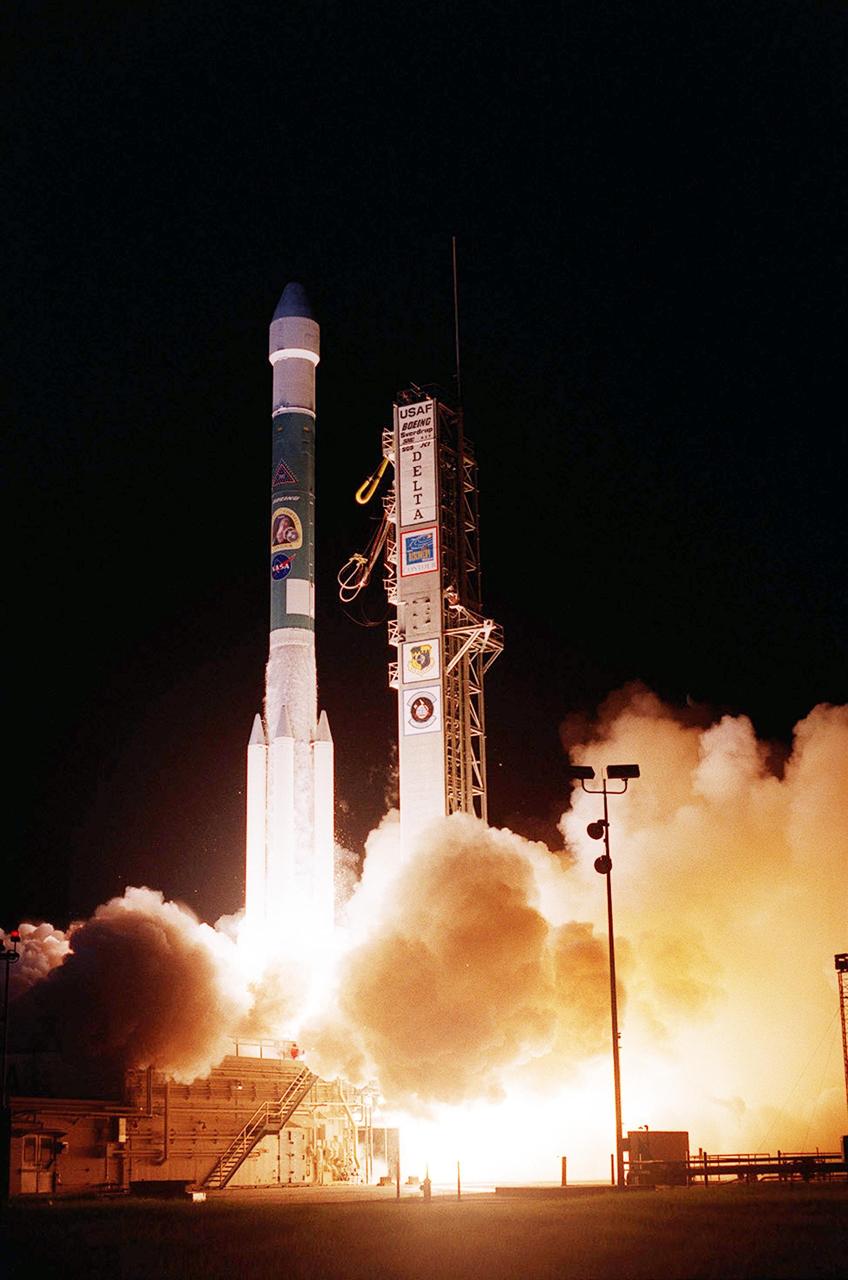
KENNEDY SPACE CENTER, FLA. -- NASA's Comet Nucleus Tour (CONTOUR) spacecraft successfully launches at 2:47:41 a.m. EDT aboard a Boeing Delta II rocket from Cape Canaveral Air Force Station, Fla. Designed and built by The Johns Hopkins University Applied Physics Laboratory (APL) in Laurel, Md., the 2,138-pound (970-kilogram) spacecraft was placed into an elliptical Earth orbit 63 minutes after launch. About 19 minutes later the mission operations team at APL acquired a signal from the spacecraft through the Deep Space Network antenna station in Goldstone, Calif., and by 5:45 a.m. EDT Mission Director Dr. Robert W. Farquhar of the Applied Physics Lab confirmed the craft was operating normally and ready to carry out its early orbit maneuvers. CONTOUR will orbit Earth until Aug. 15, when it is scheduled to fire its main engine and enter a comet-chasing orbit around the sun. The mission's flexible four-year plan includes encounters with comets Encke (Nov. 12, 2003) and Schwassmann-Wachmann 3 (June 19, 2006), though it can add an encounter with a "new" and scientifically valuable comet from the outer solar system, should one be discovered in time for CONTOUR to fly past it. CONTOUR's four scientific instruments will take detailed pictures and measure the chemical makeup of each comet's nucleus -- a chunk of ice and rock -- while analyzing the surrounding gas and dust.