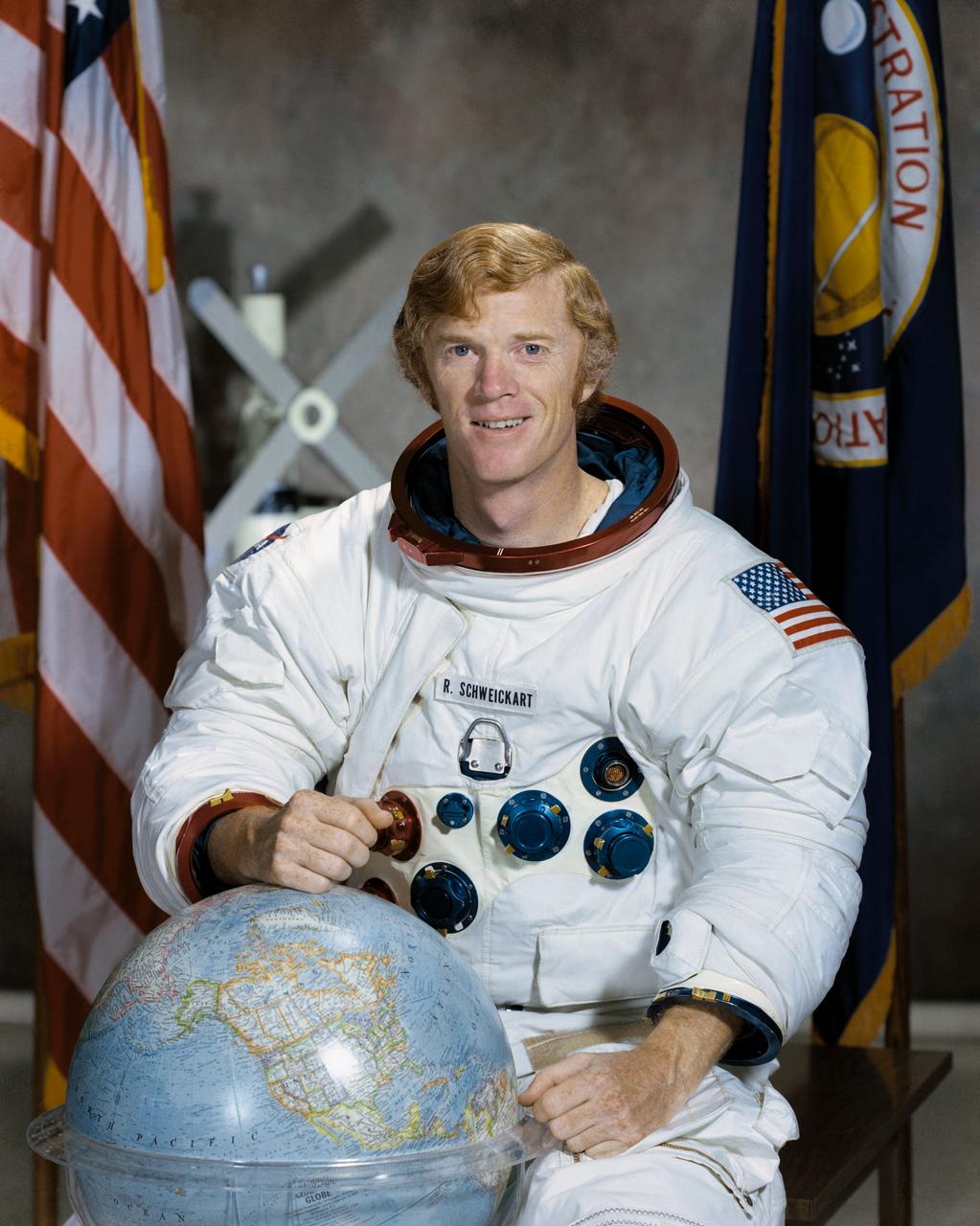
S71-51265 (1971) --- Astronaut Russell L. "Rusty" Schweickart Jr.
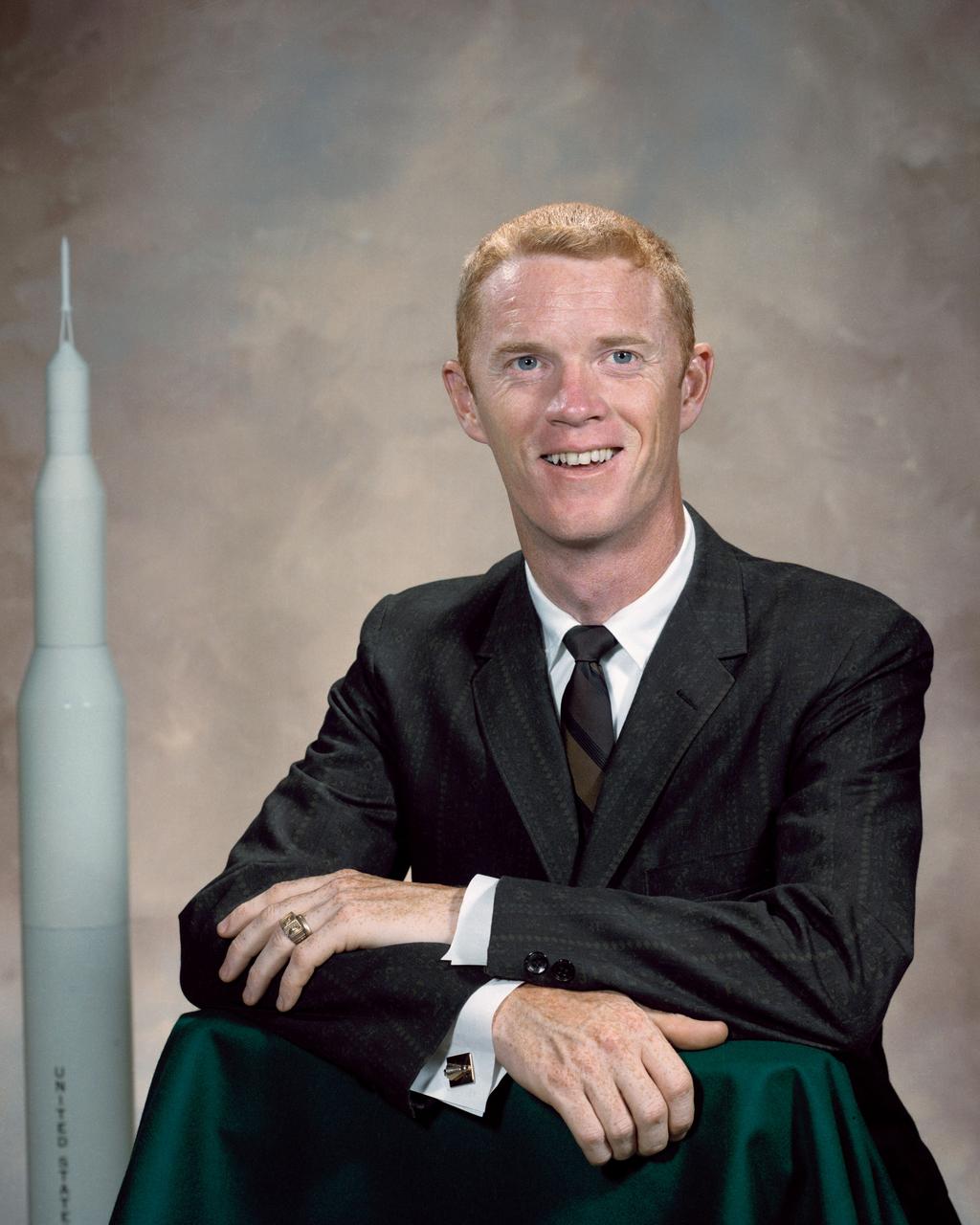
S64-29936 (10 Sept. 1964) --- Astronaut Russell L. "Rusty" Schweickart, Jr.
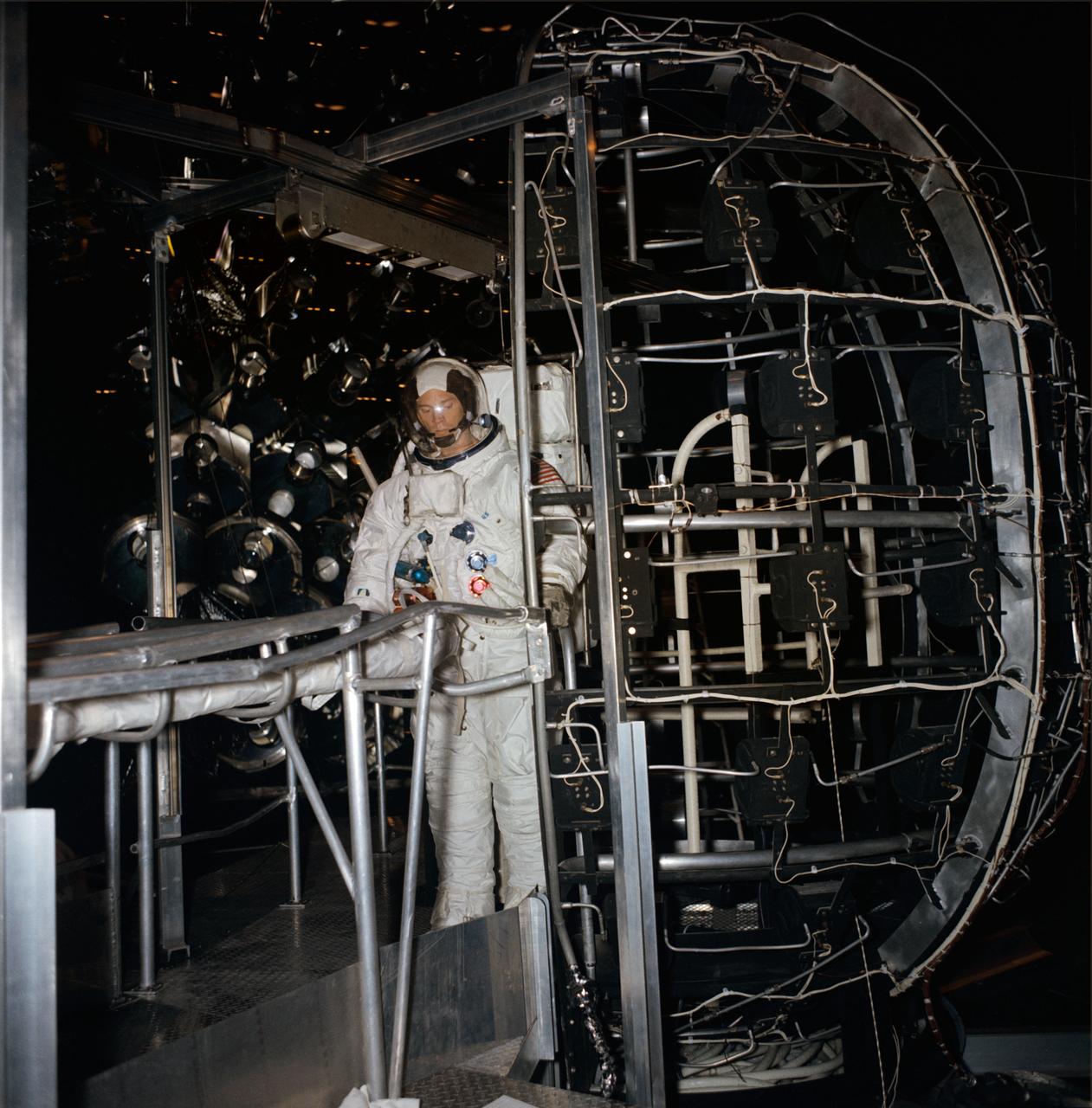
S68-55391 (11 Dec. 1968) --- Astronaut Russell L. Schweickart, lunar module pilot of the Apollo 9 (Spacecraft 104/Lunar Module 3/Saturn 504) space mission, is seen inside Chamber "A," Space Environment Simulation Laboratory, Building 32, participating in dry run activity in preparation for extravehicular activity which is scheduled in Chamber "A." The purpose of the scheduled training is to familiarize the crewmen with the operation of EVA equipment in a simulated space environment. In addition, metabolic and workload profiles will be simulated on each crewman. Astronauts Schweickart and Alan L. Bean, backup lunar module pilot, are scheduled to receive thermal-vacuum training simulating Earth-orbital EVA.
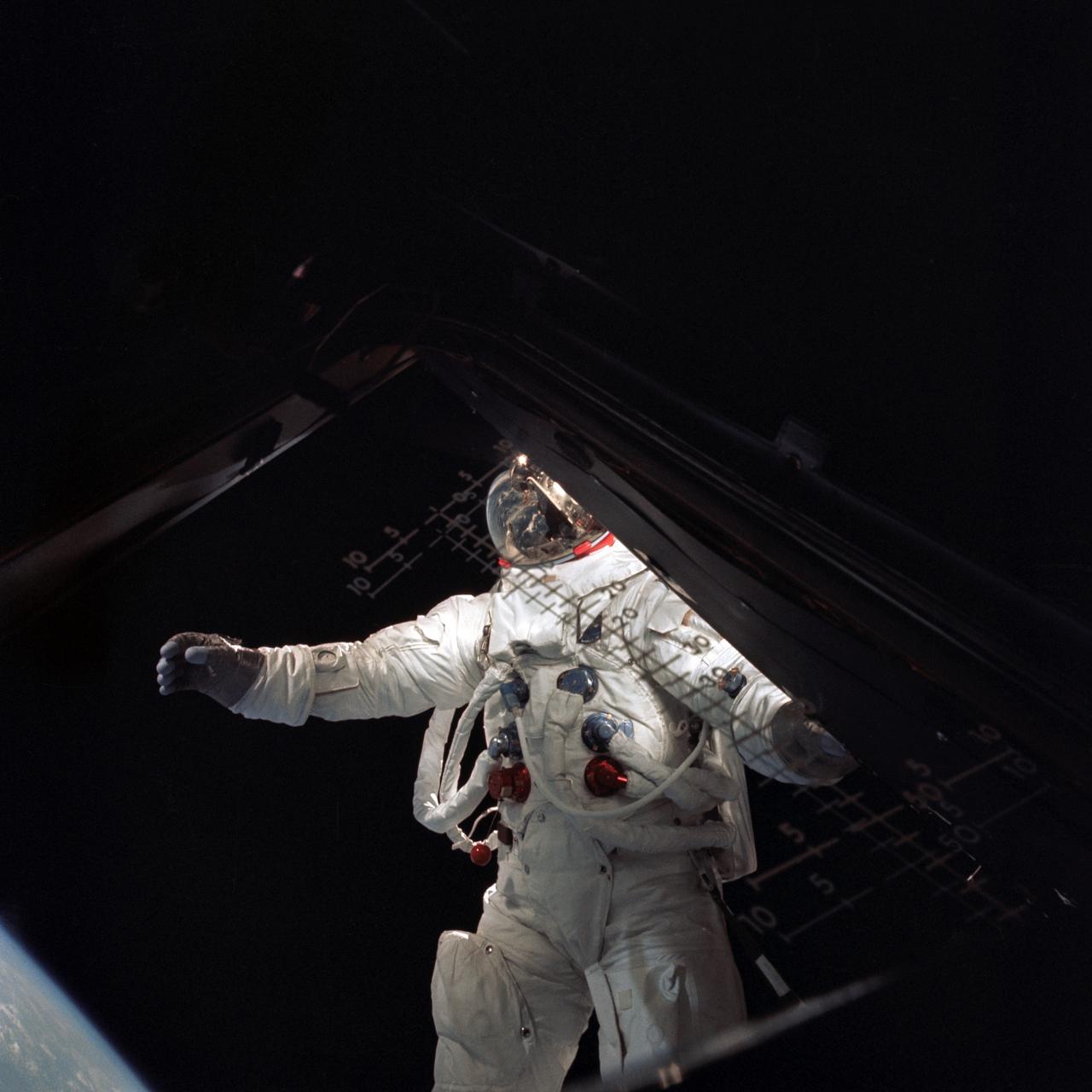
AS09-20-3094 (6 March 1969) --- Astronaut Russell L. Schweickart, lunar module pilot, stands in "golden slippers" on the Lunar Module porch during his extravehicular activity on the fourth day of the Apollo 9 Earth-orbital mission. This photograph was taken from inside the Lunar Module "Spider". The Command and Service Modules were docked to the LM. Schweickart is wearing an Extravehicular Mobility Unit (EMU). Inside the "Spider" was astronaut James A. McDivitt, Apollo 9 crew commander. Astronaut David R. Scott, command module pilot, remained at the controls of the Command Module, "Gumdrop."
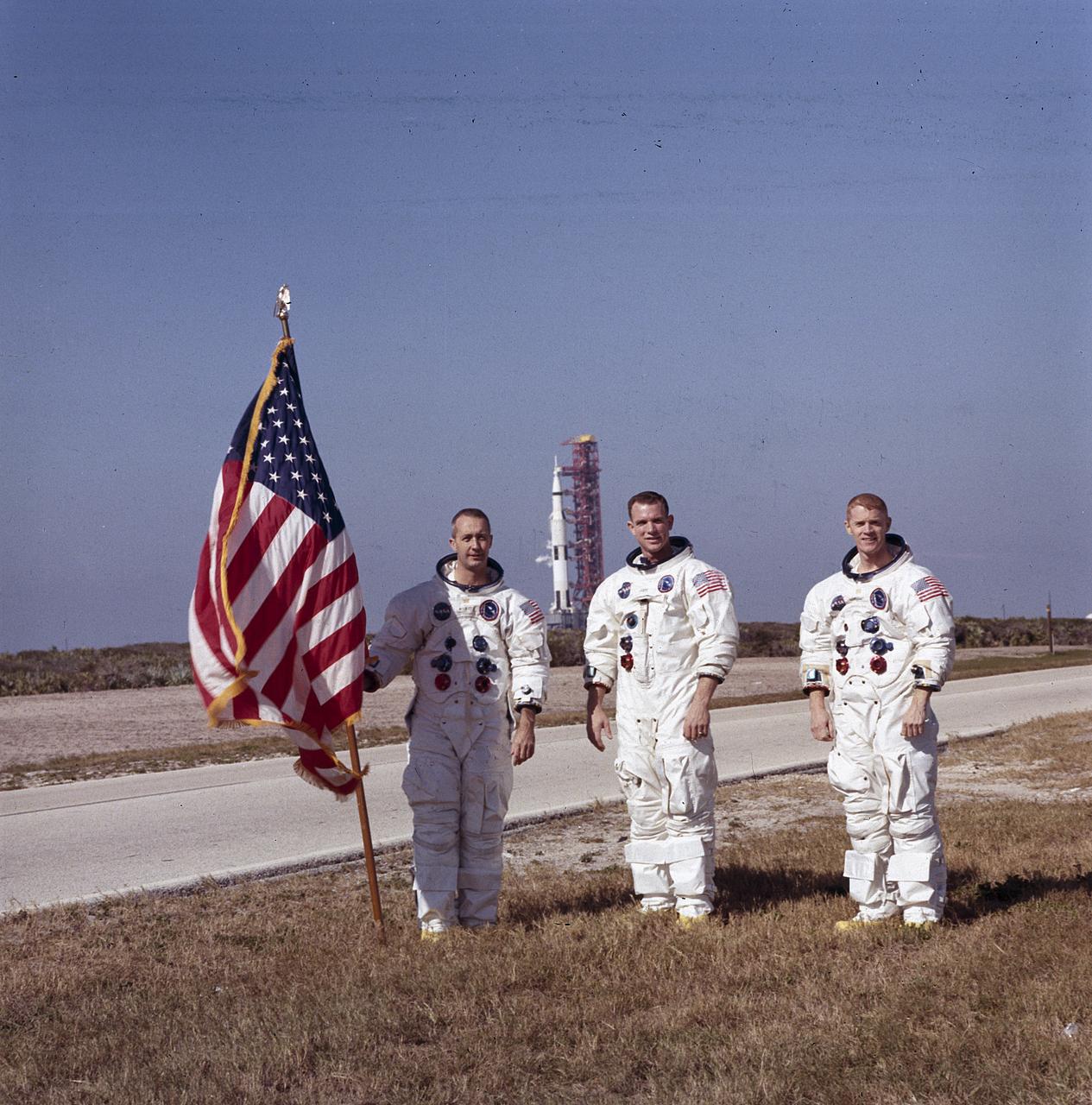
Pictured from left to right, the Apollo 9 astronauts, James A. McDivitt, David R. Scott, and Russell L. Schweickart, pause in front of the Apollo/Saturn V space vehicle that would launch the Apollo 8 crew. The launch of the Apollo 9 (Saturn V launch vehicle, SA-504) took place on March 3, 1968. The Apollo 9 spacecraft, in the lunar mission configuration, was tested in Earth orbit. The mission was designed to rehearse all the steps and reproduce all the events of the Apollo 11 mission with the exception of the lunar touchdown, stay, and liftoff. The command and service modules, and the lunar module were used in flight procedures identical to those that would later take similar vehicles to the Moon, and a landing. The flight mechanics, mission support systems, communications, and recording of data were tested in a final round of verification. Astronauts Scott and Schweickart conducted Extravehicular Activity during this mission.
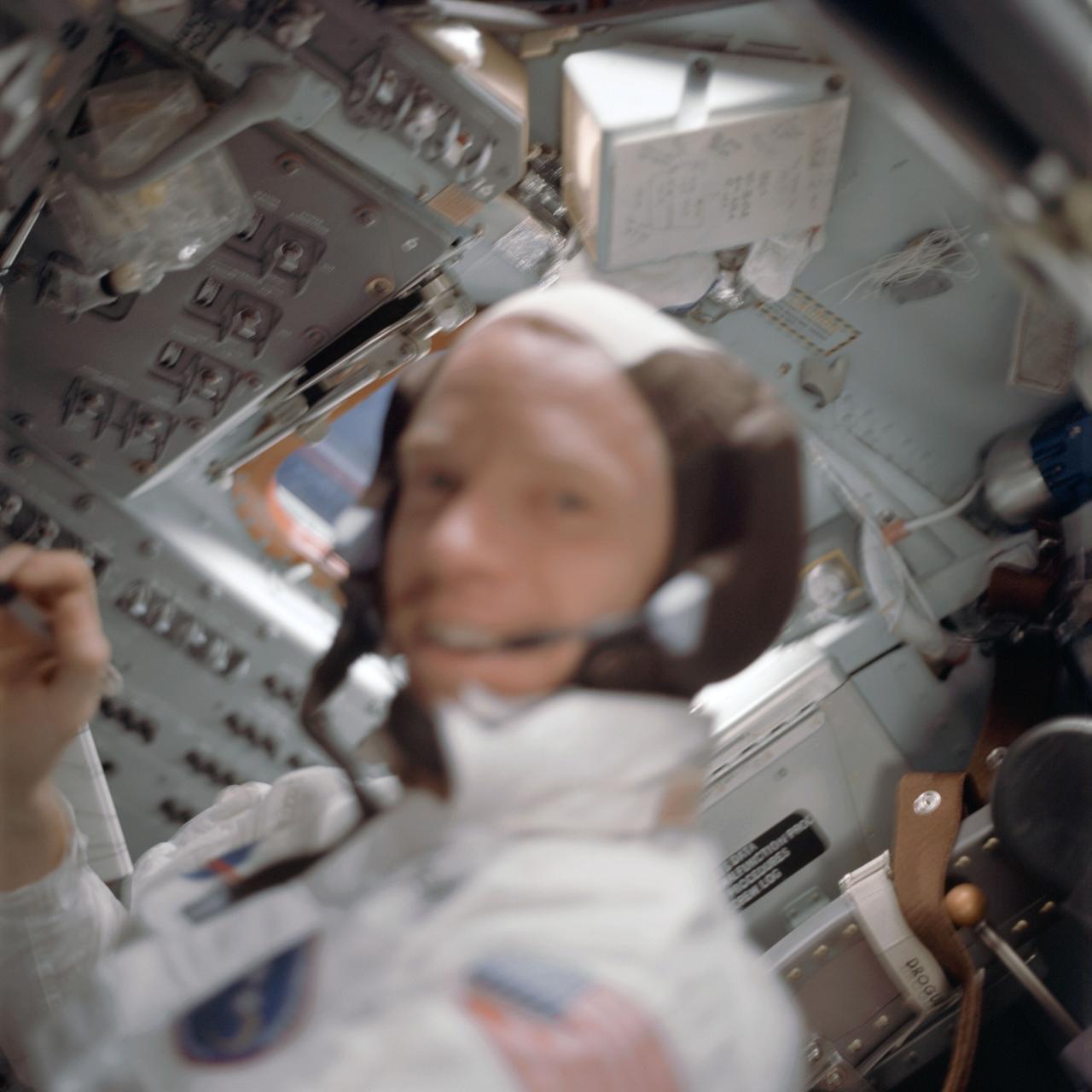
Astronaut Russell Schweickart, Apollo 9 Lunar Module pilot, is photographed inside Lunar Module "Spider" during the Apollo 9 earth-orbital mission.
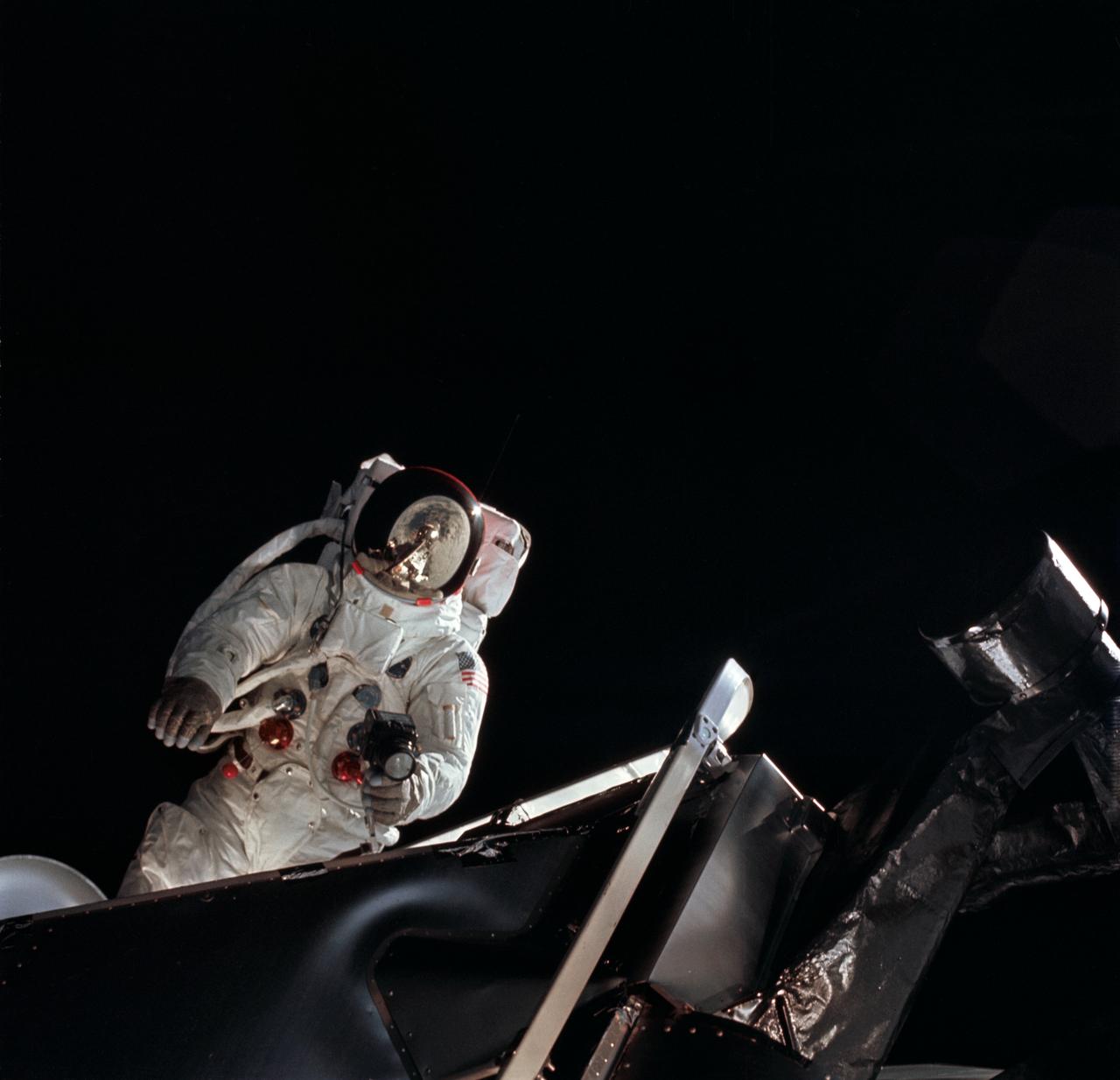
AS09-19-2983 (6 March 1969) --- Astronaut Russell L. Schweickart, lunar module pilot, operates a 70mm Hasselblad camera during his extravehicular activity (EVA) on the fourth day of the Apollo 9 Earth-orbital mission. The Command and Service Modules (CSM) and Lunar Module (LM) "Spider" are docked. This view was taken from the Command Module (CM) "Gumdrop". Schweickart, wearing an Extravehicular Mobility Unit (EMU), is standing in "golden slippers" on the LM porch. On his back, partially visible, are a Portable Life Support System (PLSS) and an Oxygen Purge System (OPS). Astronaut James A. McDivitt, Apollo 9 commander, was inside the "Spider". Astronaut David R. Scott, command module pilot, remained at the controls in the CM.
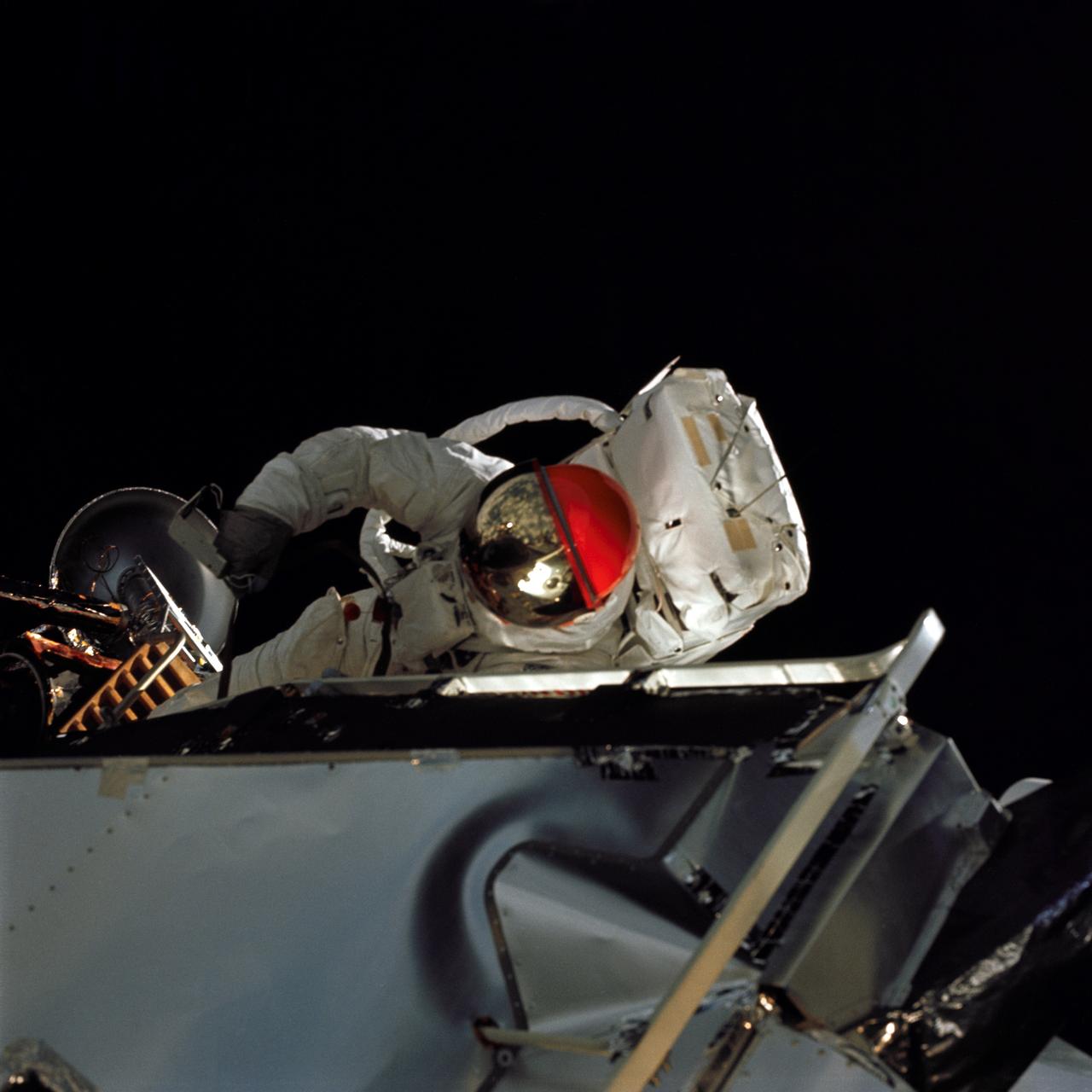
AS09-19-2994 (6 March 1969) --- Astronaut Russell L. Schweickart, lunar module pilot, is photographed from the Command Module (CM) "Gumdrop" during his extravehicular activity (EVA) on the fourth day of the Apollo 9 Earth-orbital mission. He holds, in his right hand, a thermal sample which he is retrieving from the Lunar Module (LM) exterior. The Command and Service Modules (CSM) and LM "Spider" are docked. Schweickart, wearing an Extravehicular Mobility Unit (EMU), is standing in "golden slippers" on the LM porch. Visible on his back are the Portable Life Support System (PLSS) and Oxygen Purge System (OPS). Astronaut James A. McDivitt, Apollo 9 commander, was inside the "Spider". Astronaut David R. Scott, command module pilot, remained at the controls in the CM "Gumdrop".
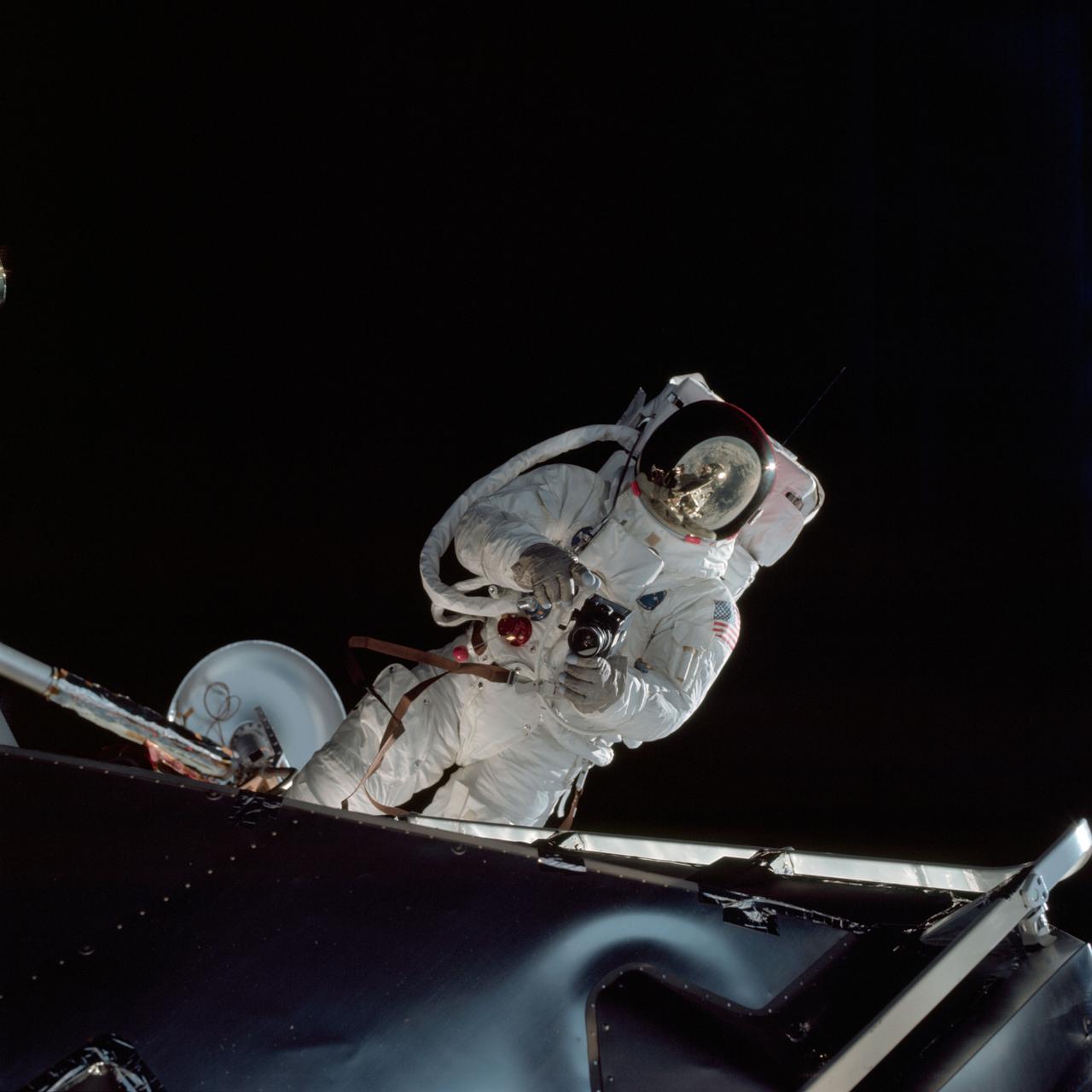
Astronaut Russell L. Schweickart, lunar module pilot, operates a 70mm Hasselblad camera during his extravehicular activity on the fourth day of the Apollo 9 earth-orbital mission. The Command/Service Module and the Lunar Module 3 "Spider" are docked. This view was taken form the Command Module "Gumdrop". Schweickart, wearing an Extravehicular Mobility Unit (EMU), is standing in "golden slippers" on the Lunar Module porch. On his back, partially visible, are a Portable Life Support System (PLSS) and an Oxygen Purge System (OPS). Film magazine was A,film type was SO-368 Ektachrome with 0.460 - 0.710 micrometers film / filter transmittance response and haze filter,80mm lens.
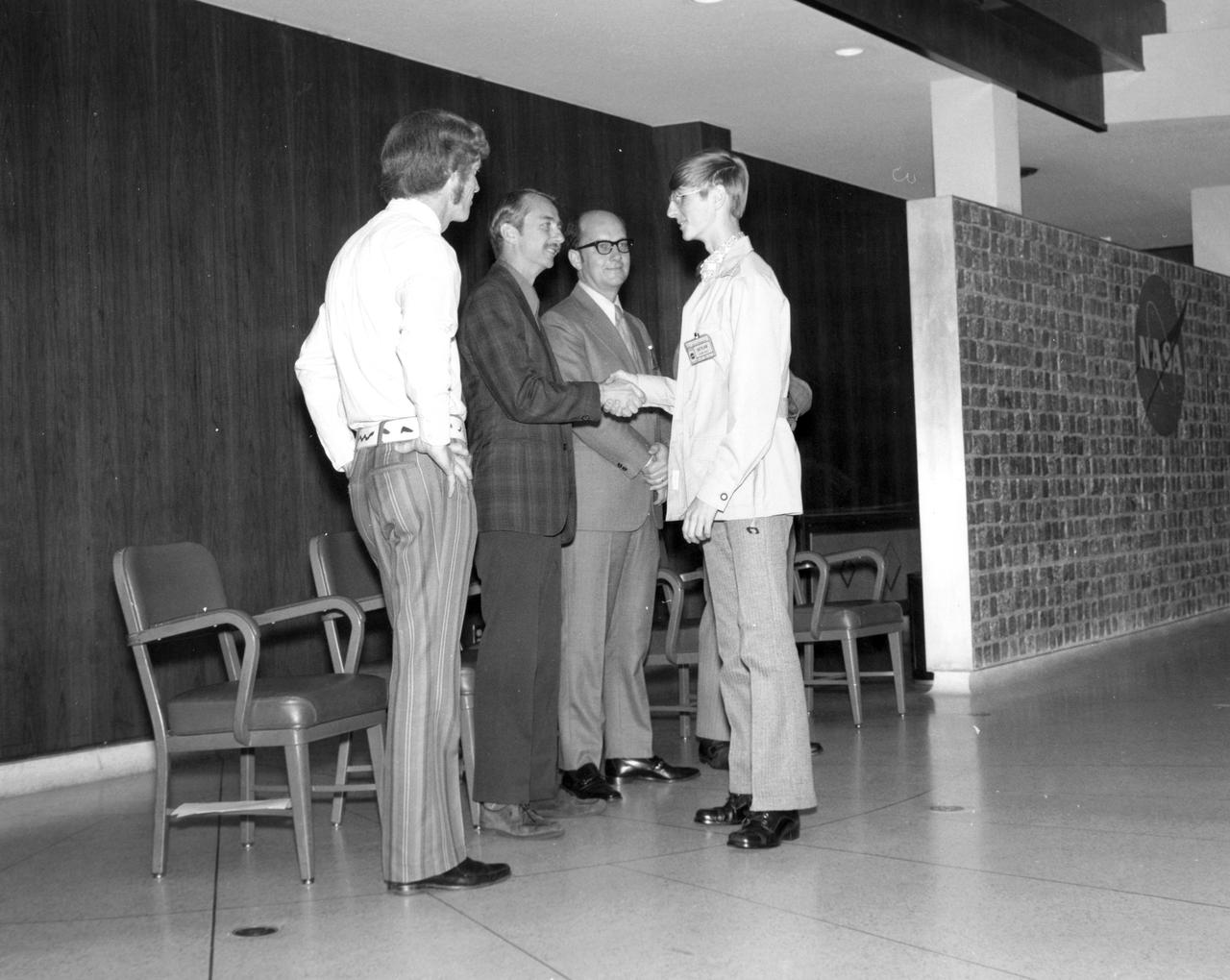
West Point, Nebraska high school student, Joel C. Wordekemper, is greeted by (left to right): Astronauts Russell L. Schweickart, and Owen K. Garriott; Marshall Space Flight Center (MSFC) Skylab Program Manager, Leland Belew; and MSFC Director of Administration and Technical Services, David Newby, during a tour of MSFC. Wordekemper was among 25 winners of a contest in which some 3,500 high school students proposed experiments for the following year’s Skylab mission. The nationwide scientific competition was sponsored by the National Science Teachers Association and the National Aeronautics and Space Administration (NASA). The winning students, along with their parents and sponsor teachers, visited MSFC where they met with scientists and engineers, participated in design reviews for their experiments, and toured MSFC facilities. Of the 25 students, 6 did not see their experiments conducted on Skylab because the experiments were not compatible with Skylab hardware and timelines. Of the 19 remaining, 11 experiments required the manufacture of additional equipment.
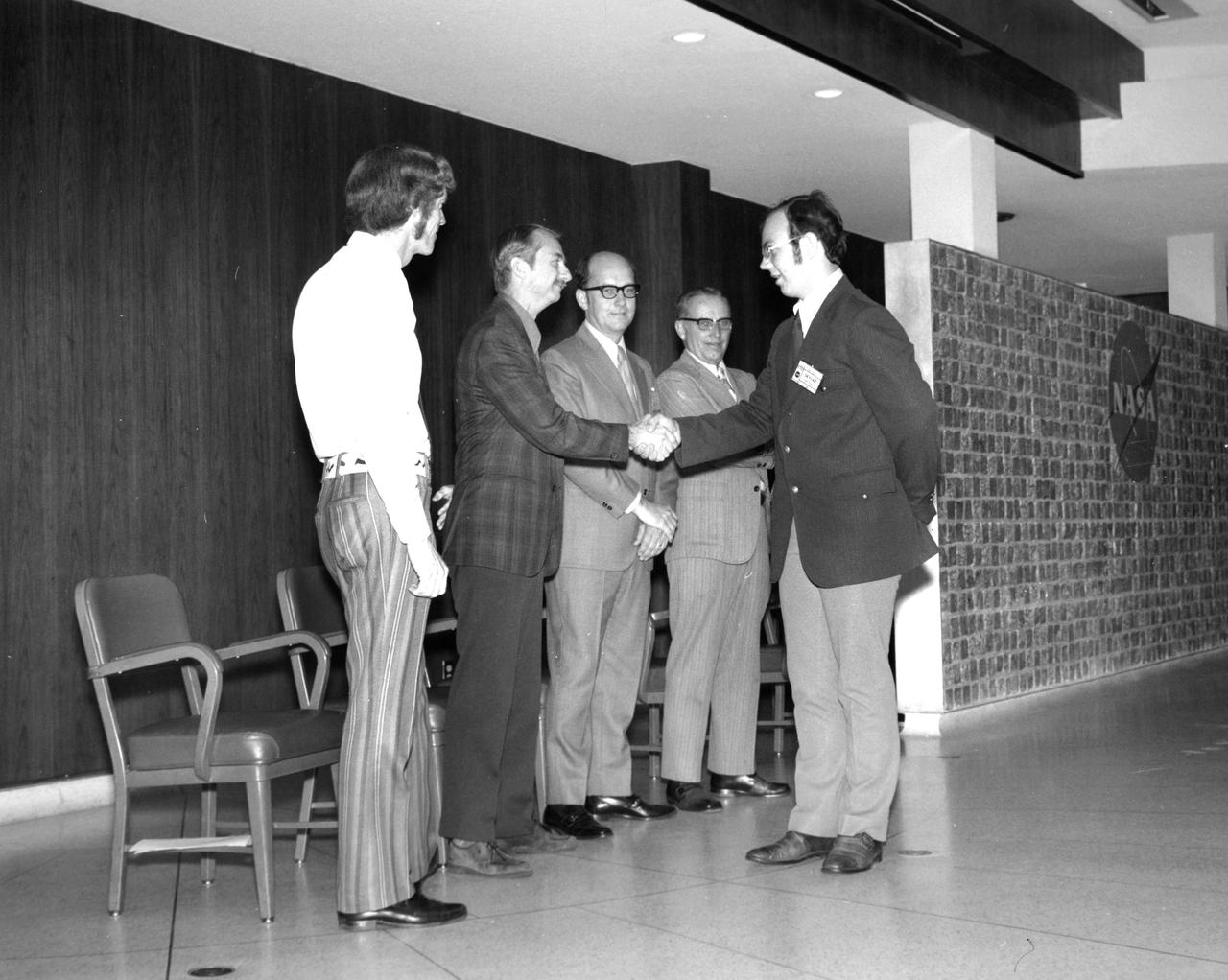
Baton Rouge, Louisiana high school student, Joe W. Reihs, is greeted by (left to right): Astronauts Russell L. Schweickart, and Owen K. Garriott; Marshall Space Flight Center (MSFC) Skylab Program Manager, Leland Belew; and MSFC Director of Administration and Technical Services, David Newby, during a tour of MSFC. Reihs was among 25 winners of a contest in which some 3,500 high school students proposed experiments for the following year’s Skylab mission. The nationwide scientific competition was sponsored by the National Science Teachers Association and the National Aeronautics and Space Administration (NASA). The winning students, along with their parents and sponsor teachers, visited MSFC where they met with scientists and engineers, participated in design reviews for their experiments, and toured MSFC facilities. Of the 25 students, 6 did not see their experiments conducted on Skylab because the experiments were not compatible with Skylab hardware and timelines. Of the 19 remaining, 11 experiments required the manufacture of additional equipment.
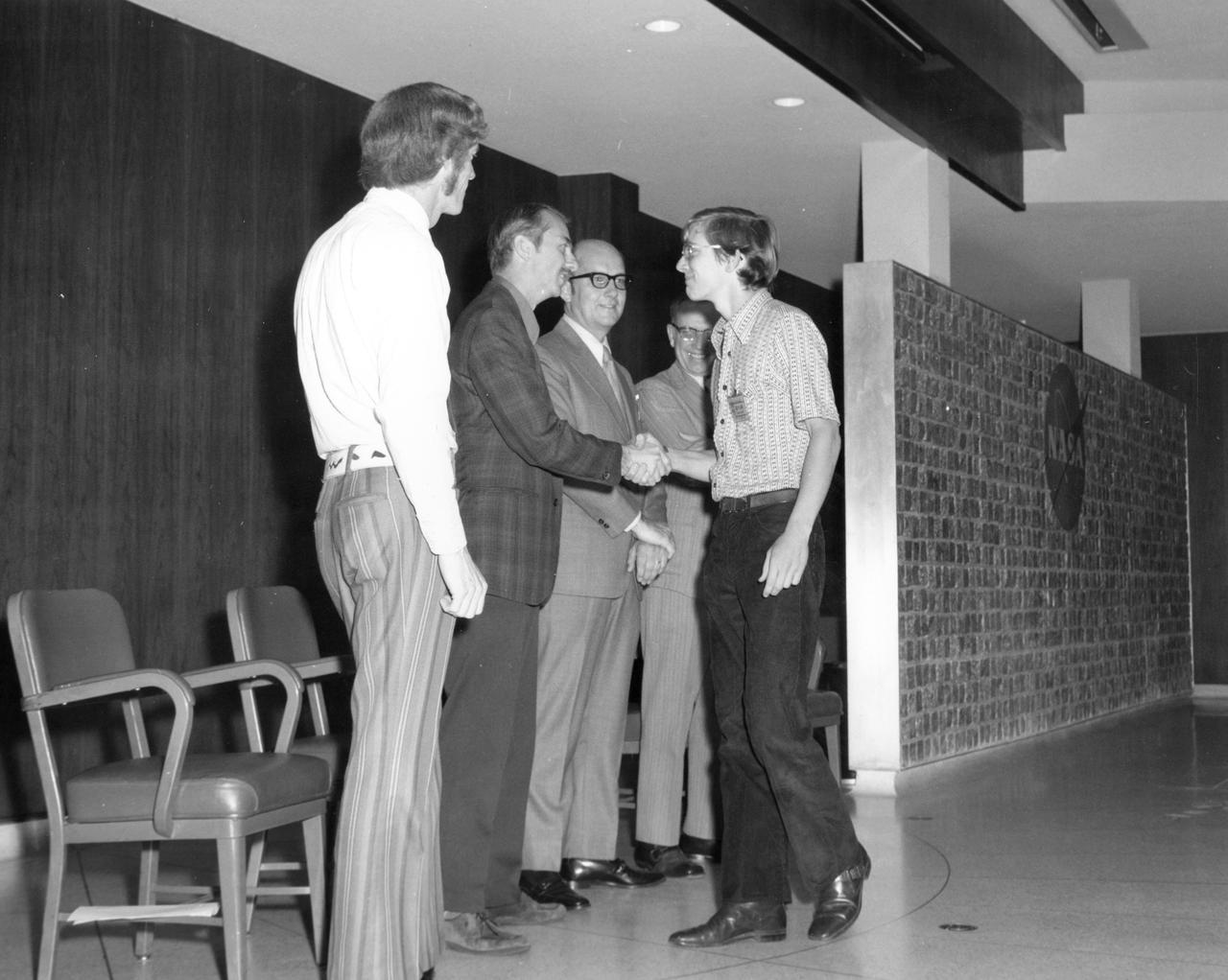
Downey, California high school student, Donald W. Shellack, is greeted by (left to right): Astronauts Russell L. Schweickart, and Owen K. Garriott; Marshall Space Flight Center (MSFC) Skylab Program Manager, Leland Belew; and MSFC Director of Administration and Technical Services, David Newby, during a tour of MSFC. Shellack was among 25 winners of a contest in which some 3,500 high school students proposed experiments for the following year’s Skylab mission. The nationwide scientific competition was sponsored by the National Science Teachers Association and the National Aeronautics and Space Administration (NASA). The winning students, along with their parents and sponsor teachers, visited MSFC where they met with scientists and engineers, participated in design reviews for their experiments, and toured MSFC facilities. Of the 25 students, 6 did not see their experiments conducted on Skylab because the experiments were not compatible with Skylab hardware and timelines. Of the 19 remaining, 11 experiments required the manufacture of additional equipment.
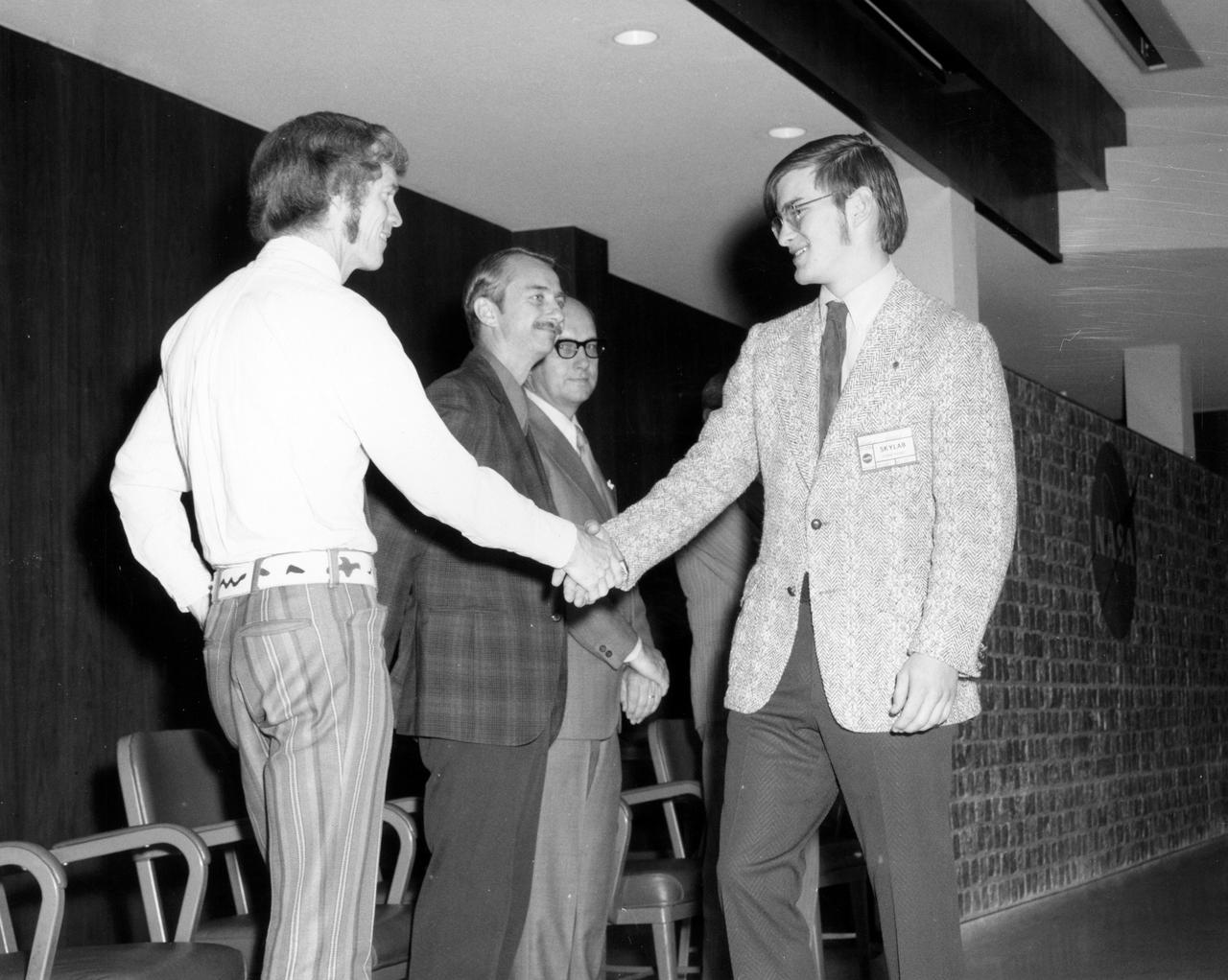
Bayport, New York high school student, James E. Healy, is greeted by (left to right): Astronauts Russell L. Schweickart, and Owen K. Garriott; Marshall Space Flight Center (MSFC) Skylab Program Manager, Leland Belew; and MSFC Director of Administration and Technical Services, David Newby, during a tour of MSFC. Healy was among 25 winners of a contest in which some 3,500 high school students proposed experiments for the following year’s Skylab mission. The nationwide scientific competition was sponsored by the National Science Teachers Association and the National Aeronautics and Space Administration (NASA). The winning students, along with their parents and sponsor teachers, visited MSFC where they met with scientists and engineers, participated in design reviews for their experiments, and toured MSFC facilities. Of the 25 students, 6 did not see their experiments conducted on Skylab because the experiments were not compatible with Skylab hardware and timelines. Of the 19 remaining, 11 experiments required the manufacture of additional equipment.
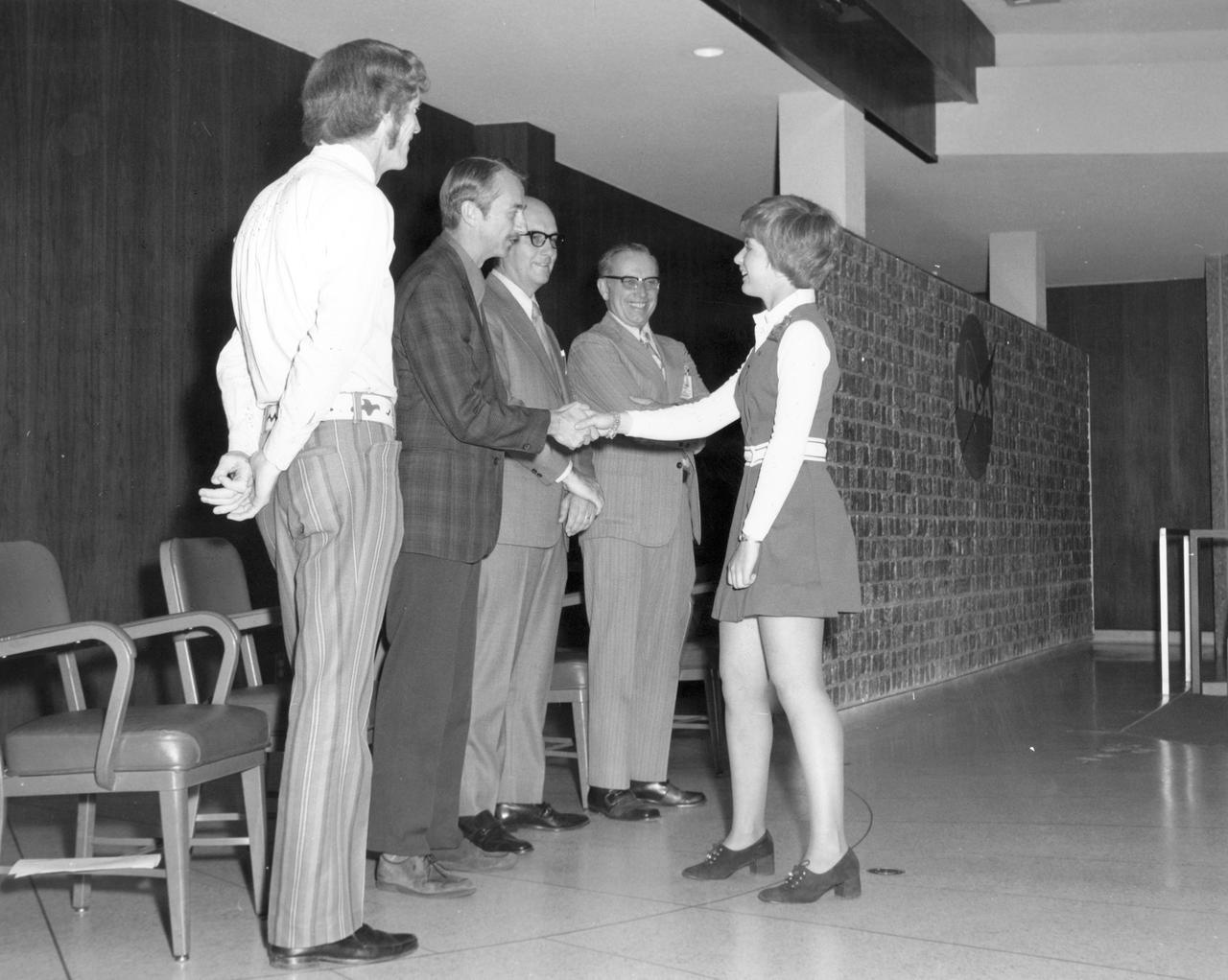
Littleton, Colorado high school student, Cheryl A. Peltz, is greeted by (left to right): Astronauts Russell L. Schweickart, and Owen K. Garriott; Marshall Space Flight Center (MSFC) Skylab Program Manager, Leland Belew; and MSFC Director of Administration and Technical Services, David Newby, during a tour of MSFC. Peltz was among 25 winners of a contest in which some 3,500 high school students proposed experiments for the following year’s Skylab mission. The nationwide scientific competition was sponsored by the National Science Teachers Association and the National Aeronautics and Space Administration (NASA). The winning students, along with their parents and sponsor teachers, visited MSFC where they met with scientists and engineers, participated in design reviews for their experiments, and toured MSFC facilities. Of the 25 students, 6 did not see their experiments conducted on Skylab because the experiments were not compatible with Skylab hardware and timelines. Of the 19 remaining, 11 experiments required the manufacture of additional equipment.
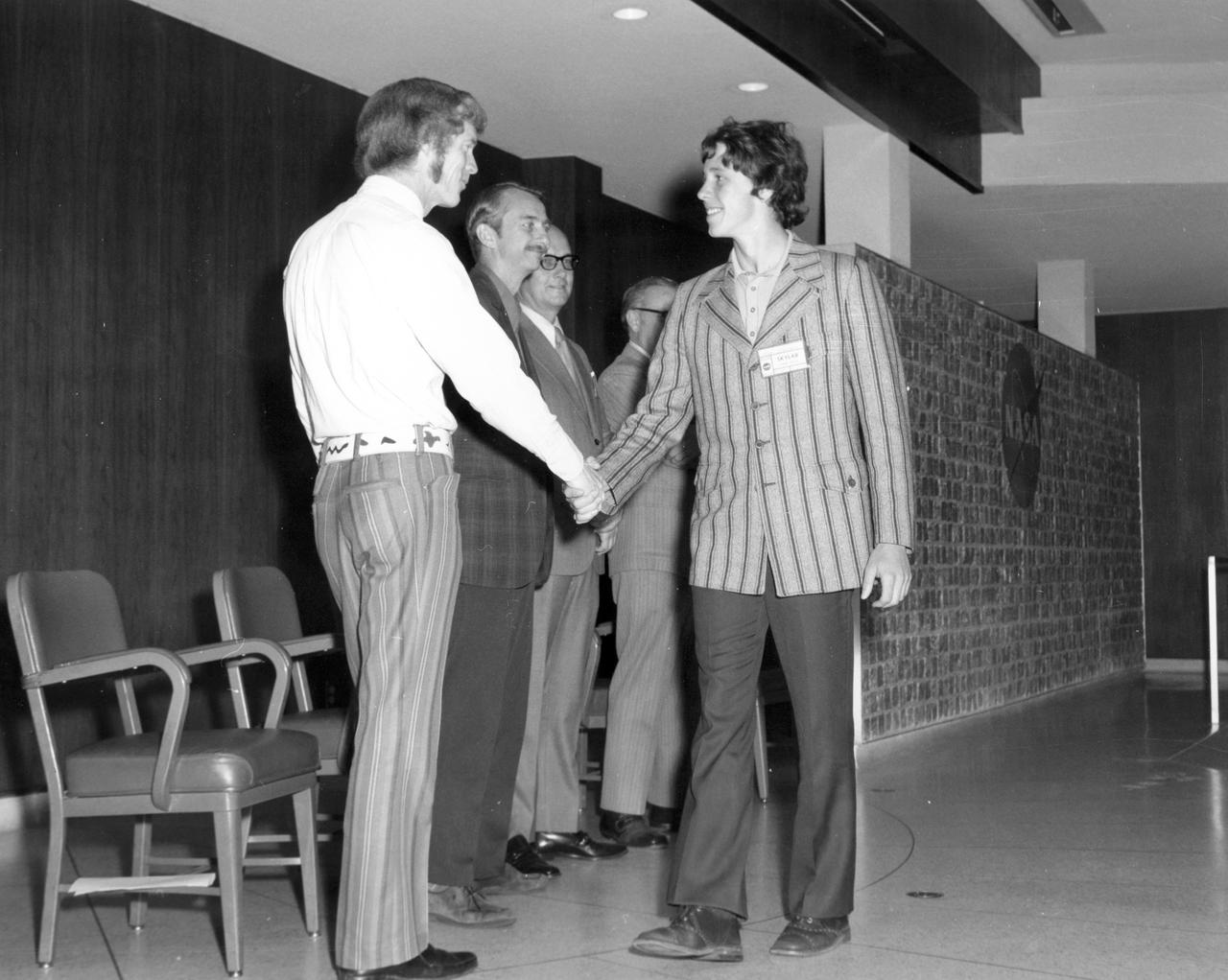
Oshkosh, Wisconsin high school student, Joe B. Zmolek, is greeted by (left to right): Astronauts Russell L. Schweickart, and Owen K. Garriott; Marshall Space Flight Center (MSFC) Skylab Program Manager, Leland Belew; and MSFC Director of Administration and Technical Services, David Newby, during a tour of MSFC. Zmolek was among 25 winners of a contest in which some 3,500 high school students proposed experiments for the following year’s Skylab mission. The nationwide scientific competition was sponsored by the National Science Teachers Association and the National Aeronautics and Space Administration (NASA). The winning students, along with their parents and sponsor teachers, visited MSFC where they met with scientists and engineers, participated in design reviews for their experiments, and toured MSFC facilities. Of the 25 students, 6 did not see their experiments conducted on Skylab because the experiments were not compatible with Skylab hardware and timelines. Of the 19 remaining, 11 experiments required the manufacture of additional equipment.
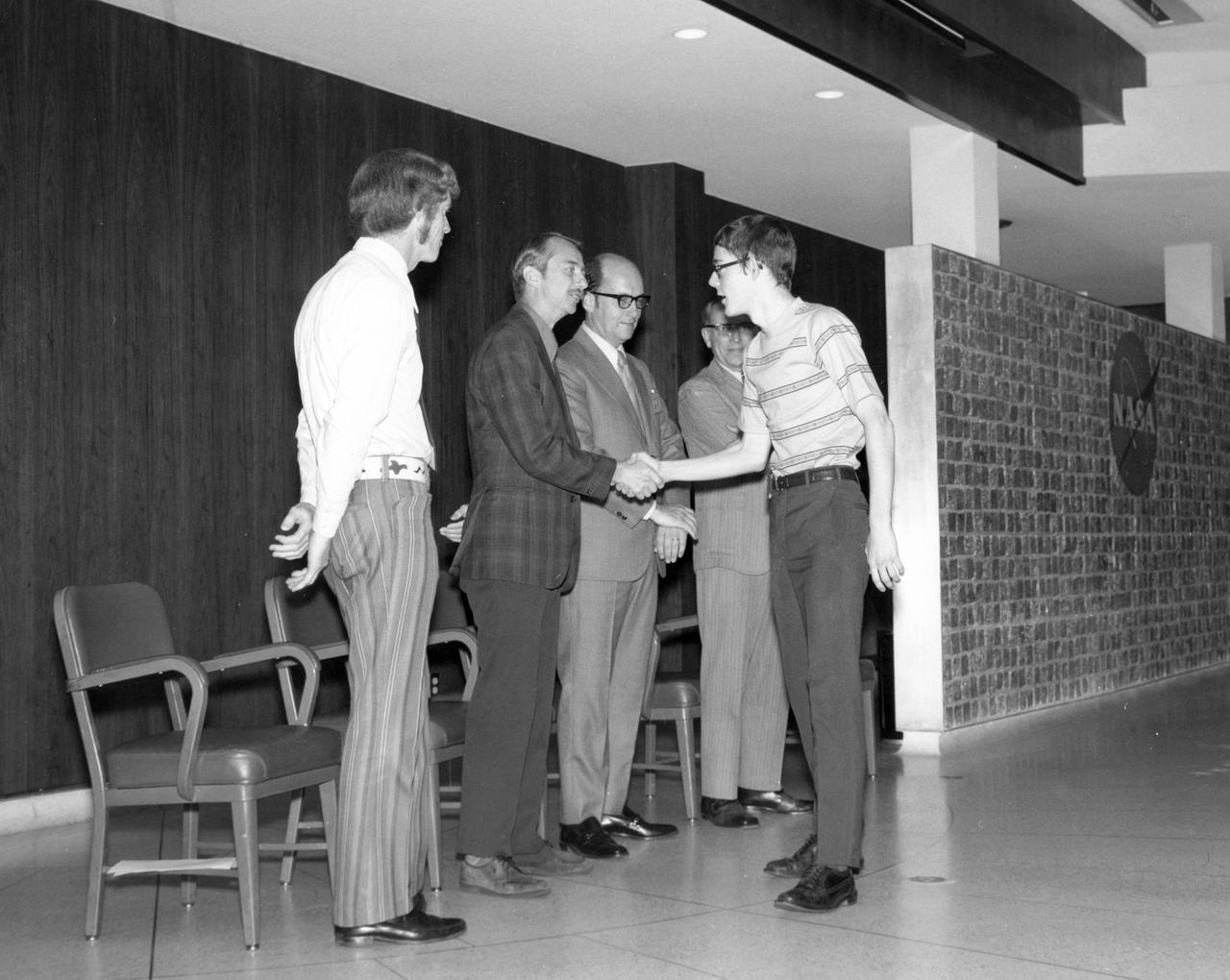
St. Paul, Minnesota high school student, Roger Johnston, is greeted by (left to right): Astronauts Russell L. Schweickart, and Owen K. Garriott; Marshall Space Flight Center (MSFC) Skylab Program Manager, Leland Belew; and MSFC Director of Administration and Technical Services, David Newby, during a tour of MSFC. Johnston was among 25 winners of a contest in which some 3,500 high school students proposed experiments for the following year’s Skylab mission. The nationwide scientific competition was sponsored by the National Science Teachers Association and the National Aeronautics and Space Administration (NASA). The winning students, along with their parents and sponsor teachers, visited MSFC where they met with scientists and engineers, participated in design reviews for their experiments, and toured MSFC facilities. Of the 25 students, 6 did not see their experiments conducted on Skylab because the experiments were not compatible with Skylab hardware and timelines. Of the 19 remaining, 11 experiments required the manufacture of additional equipment.
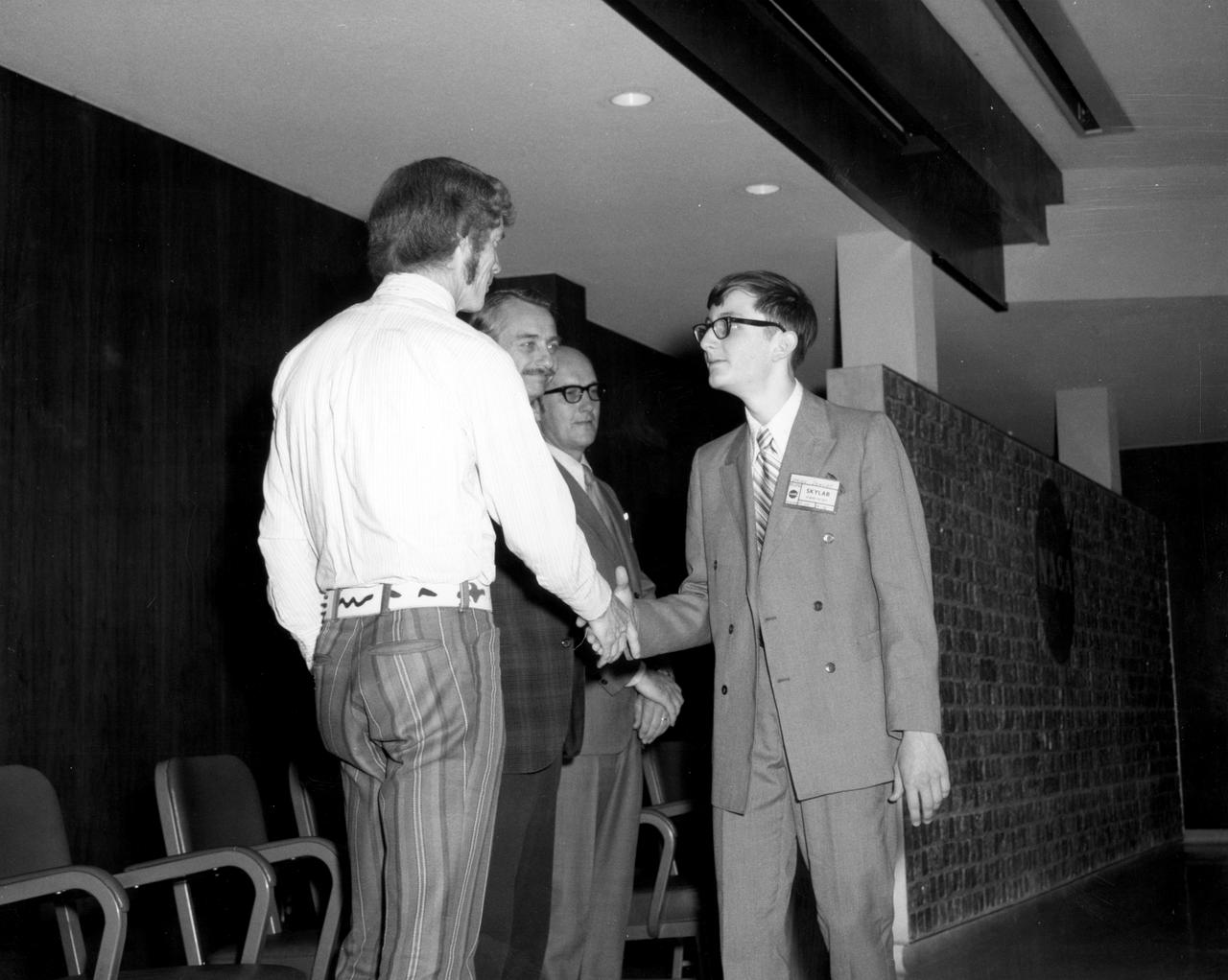
Youngstown, Ohio high school student, W. Brian Dunlap, is greeted by (left to right): Astronauts Russell L. Schweickart, and Owen K. Garriott; Marshall Space Flight Center (MSFC) Skylab Program Manager, Leland Belew; and MSFC Director of Administration and Technical Services, David Newby, during a tour of MSFC. Dunlap was among 25 winners of a contest in which some 3,500 high school students proposed experiments for the following year’s Skylab mission. The nationwide scientific competition was sponsored by the National Science Teachers Association and the National Aeronautics and Space Administration (NASA). The winning students, along with their parents and sponsor teachers, visited MSFC where they met with scientists and engineers, participated in design reviews for their experiments, and toured MSFC facilities. Of the 25 students, 6 did not see their experiments conducted on Skylab because the experiments were not compatible with Skylab hardware and timelines. Of the 19 remaining, 11 experiments required the manufacture of additional equipment.
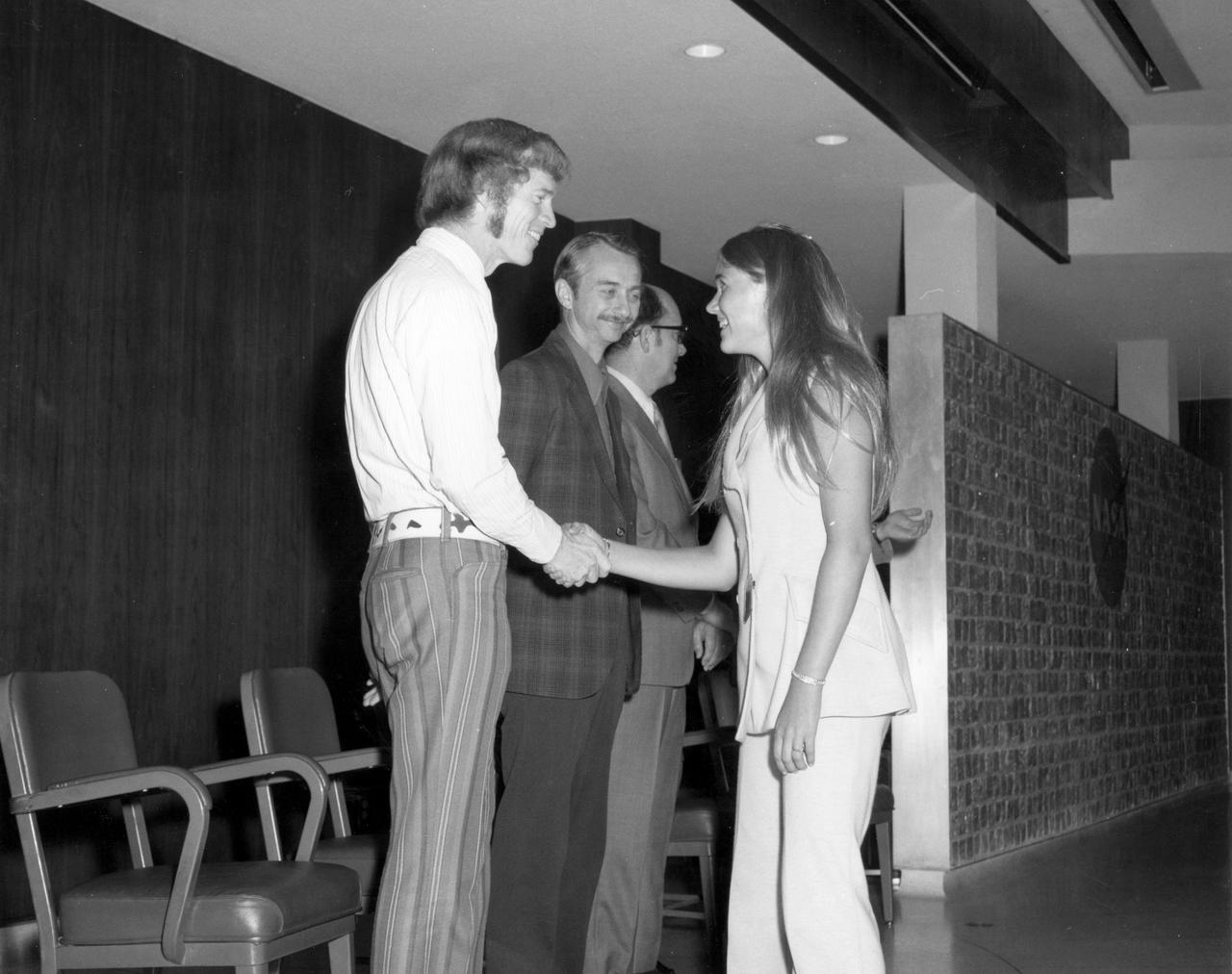
Houston, Texas high school student, Kathy L. Jackson, is greeted by astronauts Russell L. Schweickart (left) and Owen K. Garriott (center), and Marshall Space Flight Center (MSFC) Skylab Program Manager, Leland Belew during a tour of the Marshall Space Flight Center (MSFC). Jackson was among 25 winners of a contest in which some 3,500 high school students proposed experiments for the following year’s Skylab mission. The nationwide scientific competition was sponsored by the National Science Teachers Association and the National Aeronautics and Space Administration (NASA). The winning students, along with their parents and sponsor teachers, visited MSFC where they met with scientists and engineers, participated in design reviews for their experiments, and toured MSFC facilities. Of the 25 students, 6 did not see their experiments conducted on Skylab because the experiments were not compatible with Skylab hardware and timelines. Of the 19 remaining, 11 experiments required the manufacture of additional equipment.
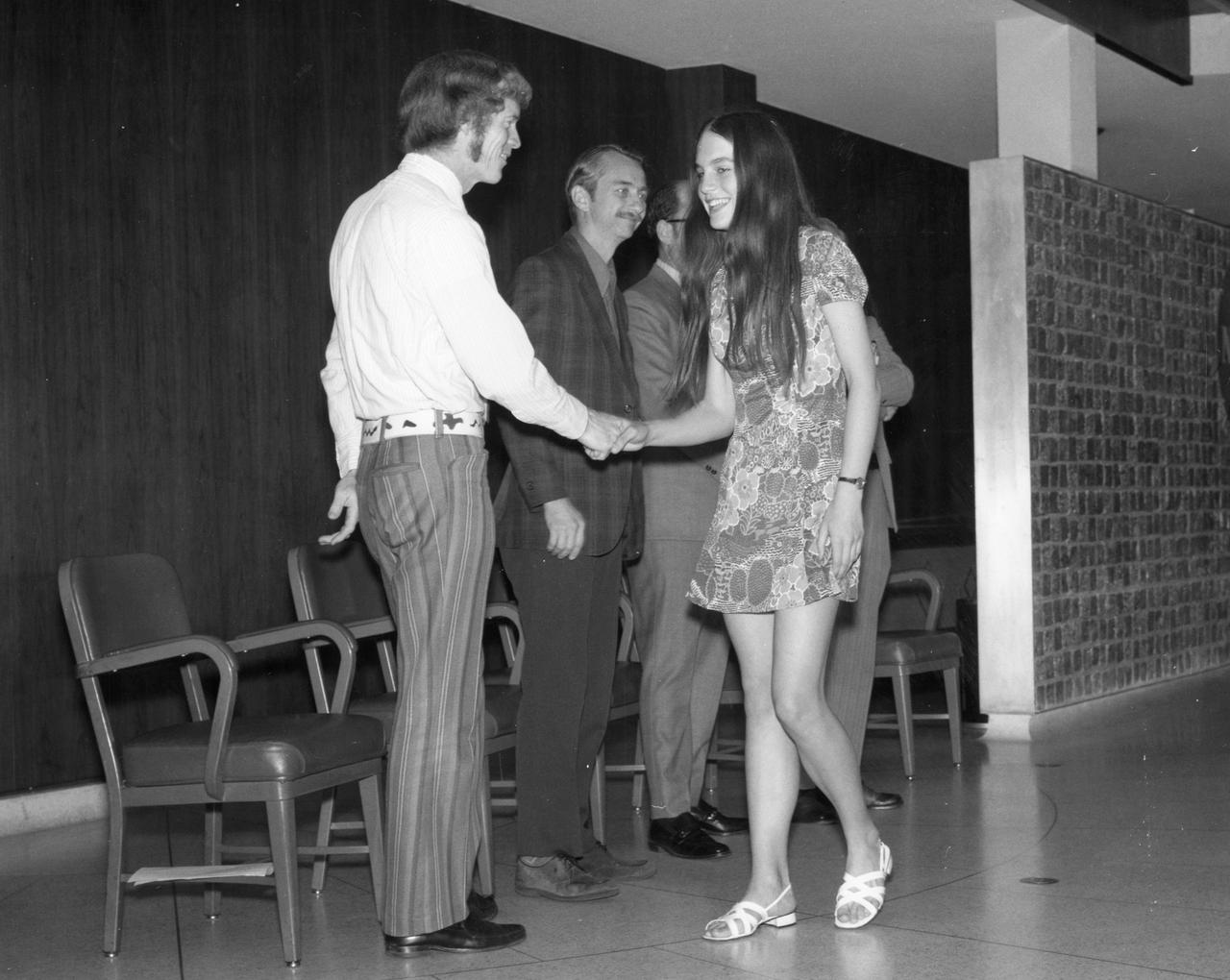
Princeton, New Jersey high school student, Alison Hopfield, is greeted by astronauts Russell L. Schweickart (left) and Owen K. Garriott (center) during a tour of the Marshall Space Flight Center (MSFC). Hopfield was among 25 winners of a contest in which some 3,500 high school students proposed experiments for the following year’s Skylab mission. The nationwide scientific competition was sponsored by the National Science Teachers Association and the National Aeronautics and Space Administration (NASA). The winning students, along with their parents and sponsor teachers, visited MSFC where they met with scientists and engineers, participated in design reviews for their experiments, and toured MSFC facilities. Of the 25 students, 6 did not see their experiments conducted on Skylab because the experiments were not compatible with Skylab hardware and timelines. Of the 19 remaining, 11 experiments required the manufacture of additional equipment.
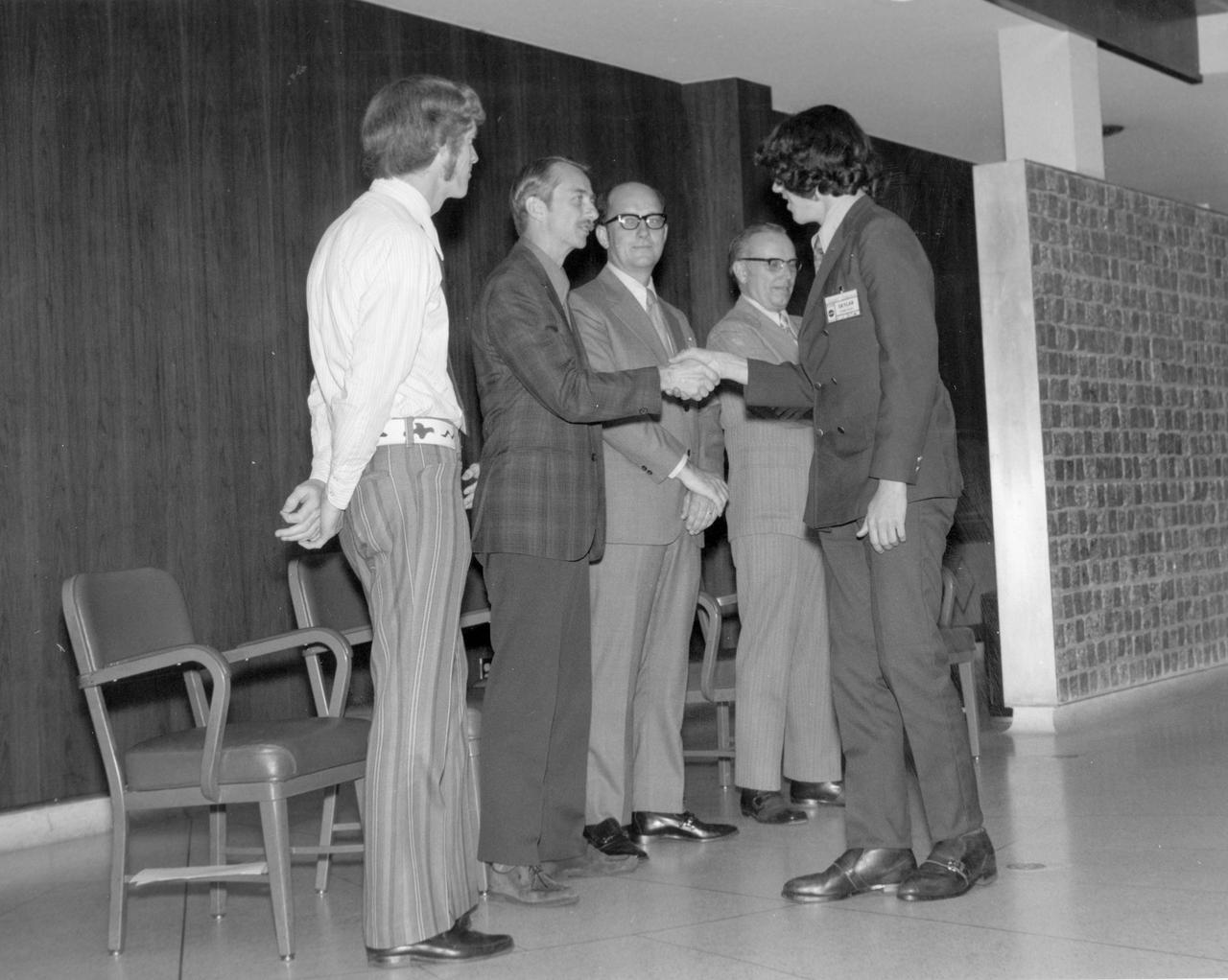
North Rochester, New York high school student, Robert L. Staehle, is greeted by (left to right): Astronauts Russell L. Schweickart, and Owen K. Garriott; Marshall Space Flight Center (MSFC) Skylab Program Manager, Leland Belew; and MSFC Director of Administration and Technical Services, David Newby, during a tour of MSFC. Staehle was among 25 winners of a contest in which some 3,500 high school students proposed experiments for the following year’s Skylab mission. The nationwide scientific competition was sponsored by the National Science Teachers Association and the National Aeronautics and Space Administration (NASA). The winning students, along with their parents and sponsor teachers, visited MSFC where they met with scientists and engineers, participated in design reviews for their experiments, and toured MSFC facilities. Of the 25 students, 6 did not see their experiments conducted on Skylab because the experiments were not compatible with Skylab hardware and timelines. Of the 19 remaining, 11 experiments required the manufacture of additional equipment.
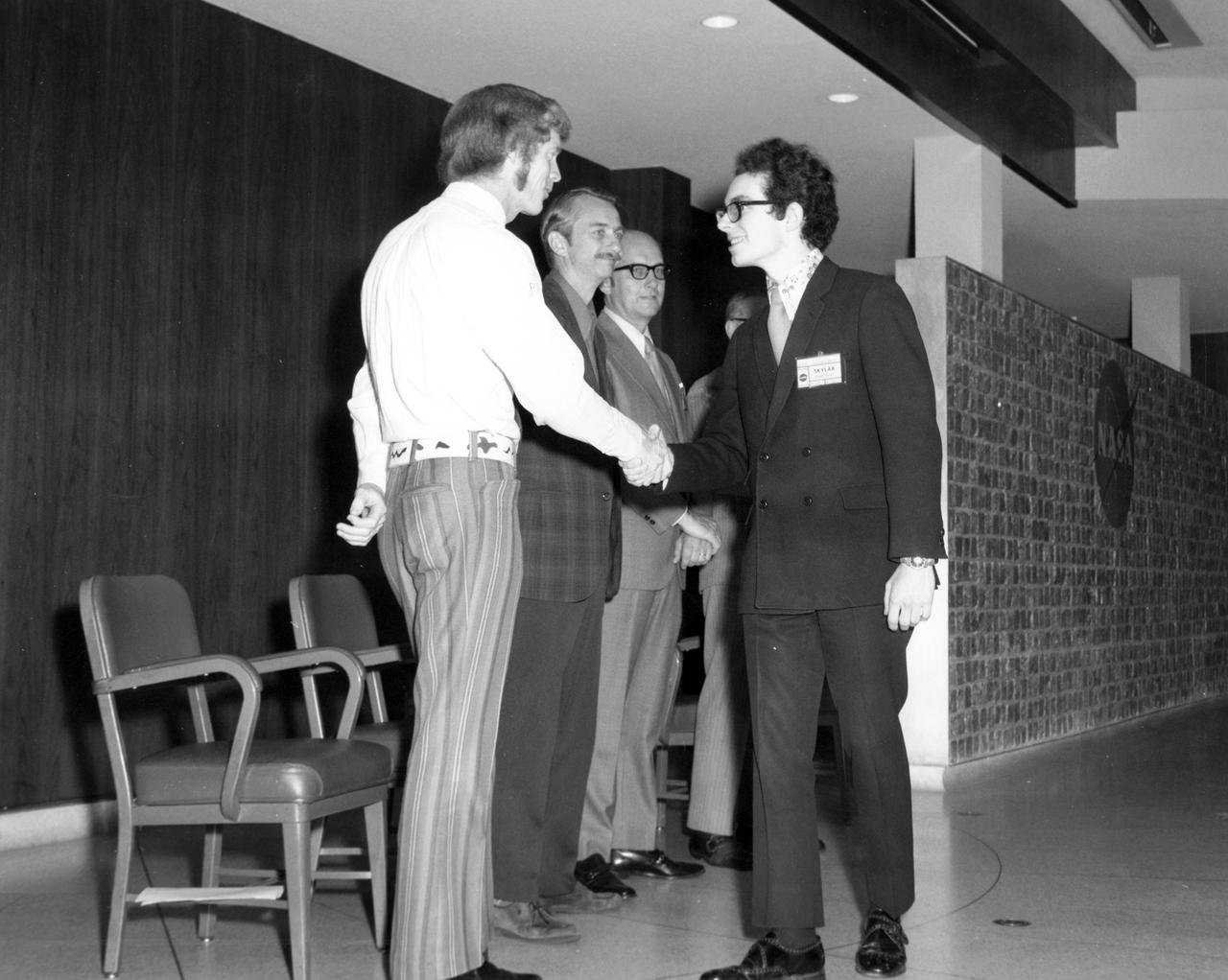
Berkley, Michigan high school student, Kirk M. Sherhart, is greeted by (left to right): Astronauts Russell L. Schweickart, and Owen K. Garriott; Marshall Space Flight Center (MSFC) Skylab Program Manager, Leland Belew; and MSFC Director of Administration and Technical Services, David Newby, during a tour of MSFC. Sherhart was among 25 winners of a contest in which some 3,500 high school students proposed experiments for the following year’s Skylab mission. The nationwide scientific competition was sponsored by the National Science Teachers Association and the National Aeronautics and Space Administration (NASA). The winning students, along with their parents and sponsor teachers, visited MSFC where they met with scientists and engineers, participated in design reviews for their experiments, and toured MSFC facilities. Of the 25 students, 6 did not see their experiments conducted on Skylab because the experiments were not compatible with Skylab hardware and timelines. Of the 19 remaining, 11 experiments required the manufacture of additional equipment.
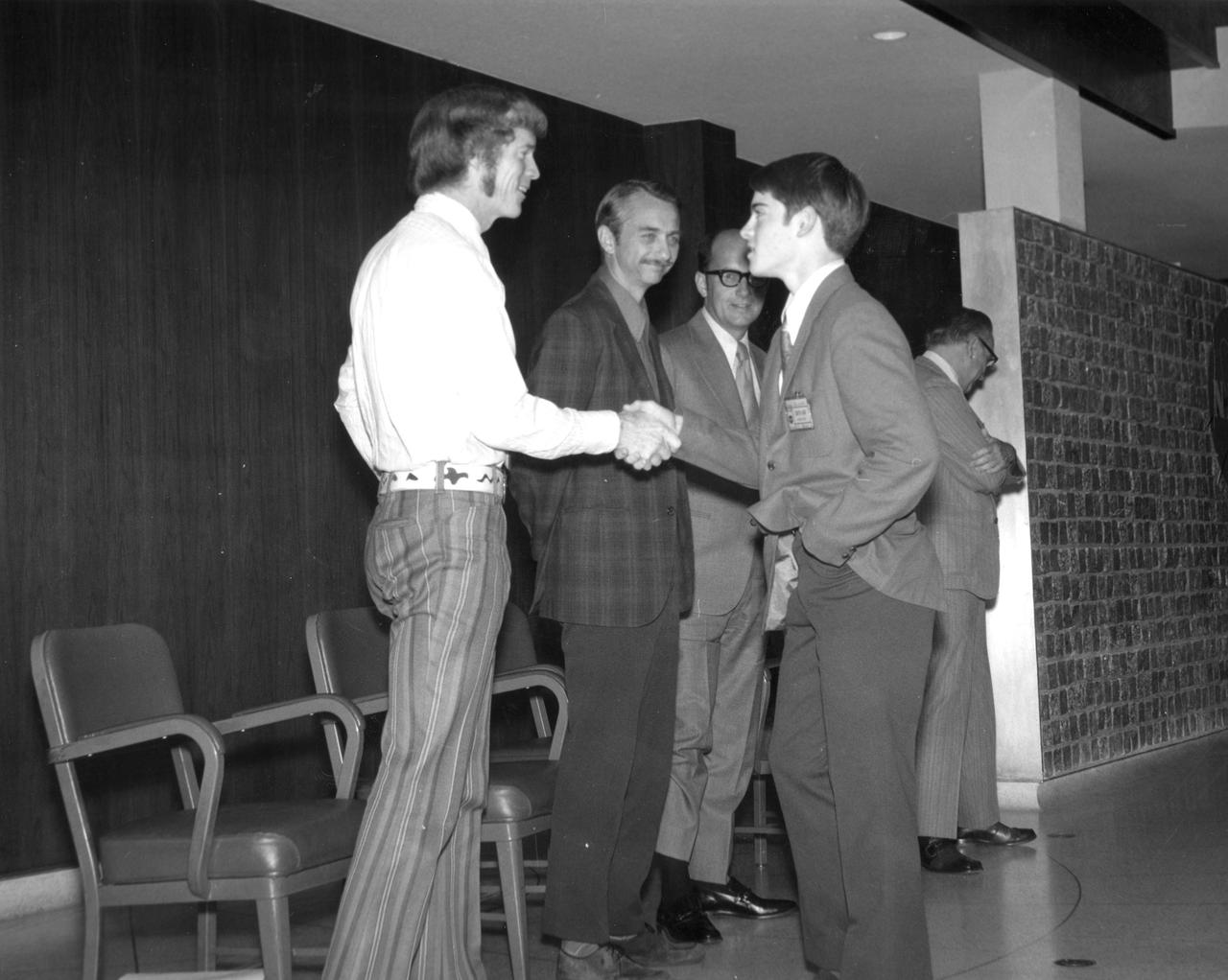
Silverton, Oregon high school student, Daniel C. Bochsler, is greeted by (left to right): Astronauts Russell L. Schweickart, and Owen K. Garriott; Marshall Space Flight Center (MSFC) Skylab Program Manager, Leland Belew; and MSFC Director of Administration and Technical Services, David Newby, during a tour of MSFC. Bochsler was among 25 winners of a contest in which some 3,500 high school students proposed experiments for the following year’s Skylab mission. The nationwide scientific competition was sponsored by the National Science Teachers Association and the National Aeronautics and Space Administration (NASA). The winning students, along with their parents and sponsor teachers, visited MSFC where they met with scientists and engineers, participated in design reviews for their experiments, and toured MSFC facilities. Of the 25 students, 6 did not see their experiments conducted on Skylab because the experiments were not compatible with Skylab hardware and timelines. Of the 19 remaining, 11 experiments required the manufacture of additional equipment.
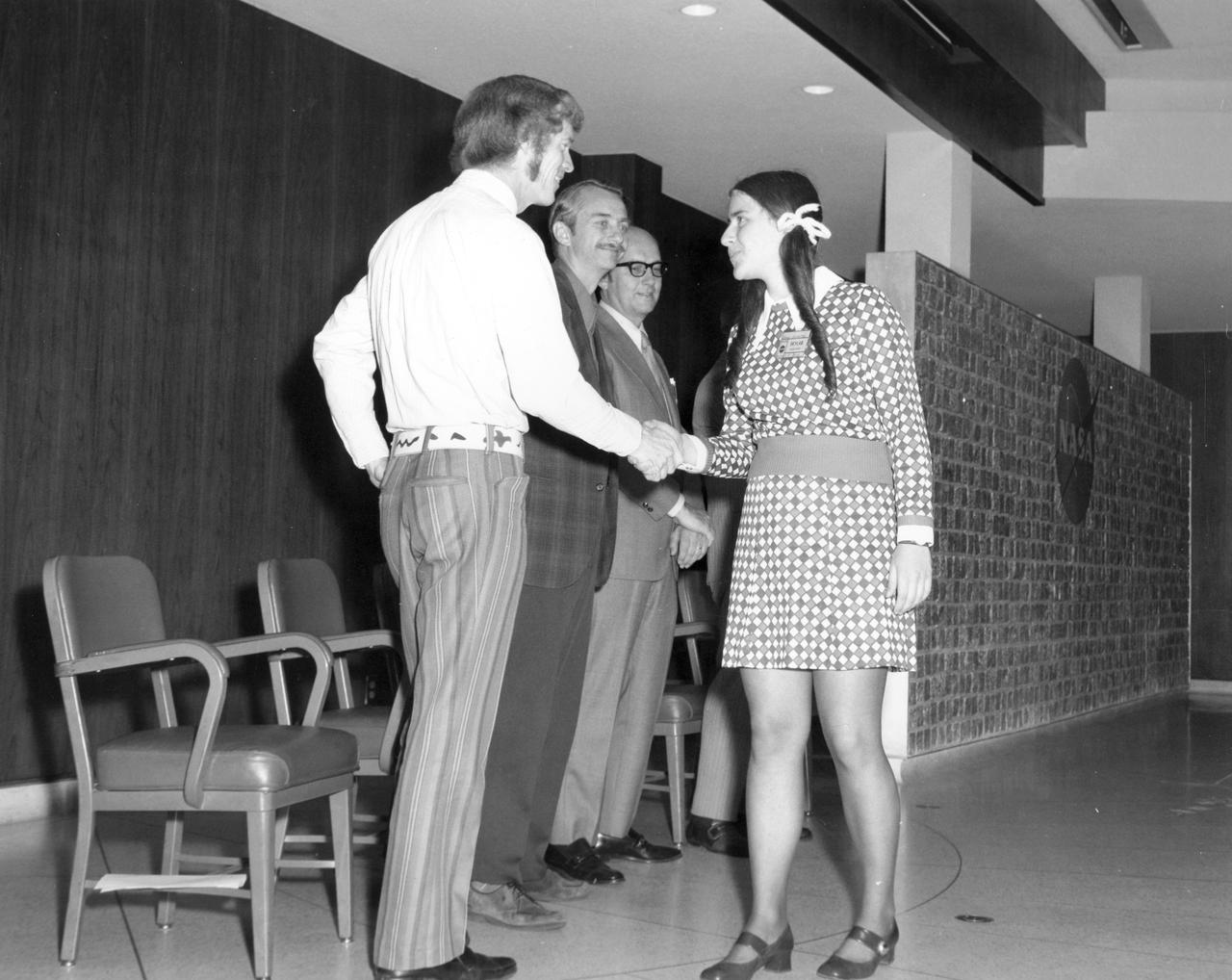
Berkley, California high school student, Jeanne L. Leventhal, is greeted by (left to right): Astronauts Russell L. Schweickart, and Owen K. Garriott; and Marshall Space Flight Center (MSFC) Skylab Program Manager, Leland Belew during a tour of MSFC. Leventhal was among 25 winners of a contest in which some 3,500 high school students proposed experiments for the following year’s Skylab mission. The nationwide scientific competition was sponsored by the National Science Teachers Association and the National Aeronautics and Space Administration (NASA). The winning students, along with their parents and sponsor teachers, visited MSFC where they met with scientists and engineers, participated in design reviews for their experiments, and toured MSFC facilities. Of the 25 students, 6 did not see their experiments conducted on Skylab because the experiments were not compatible with Skylab hardware and timelines. Of the 19 remaining, 11 experiments required the manufacture of additional equipment.
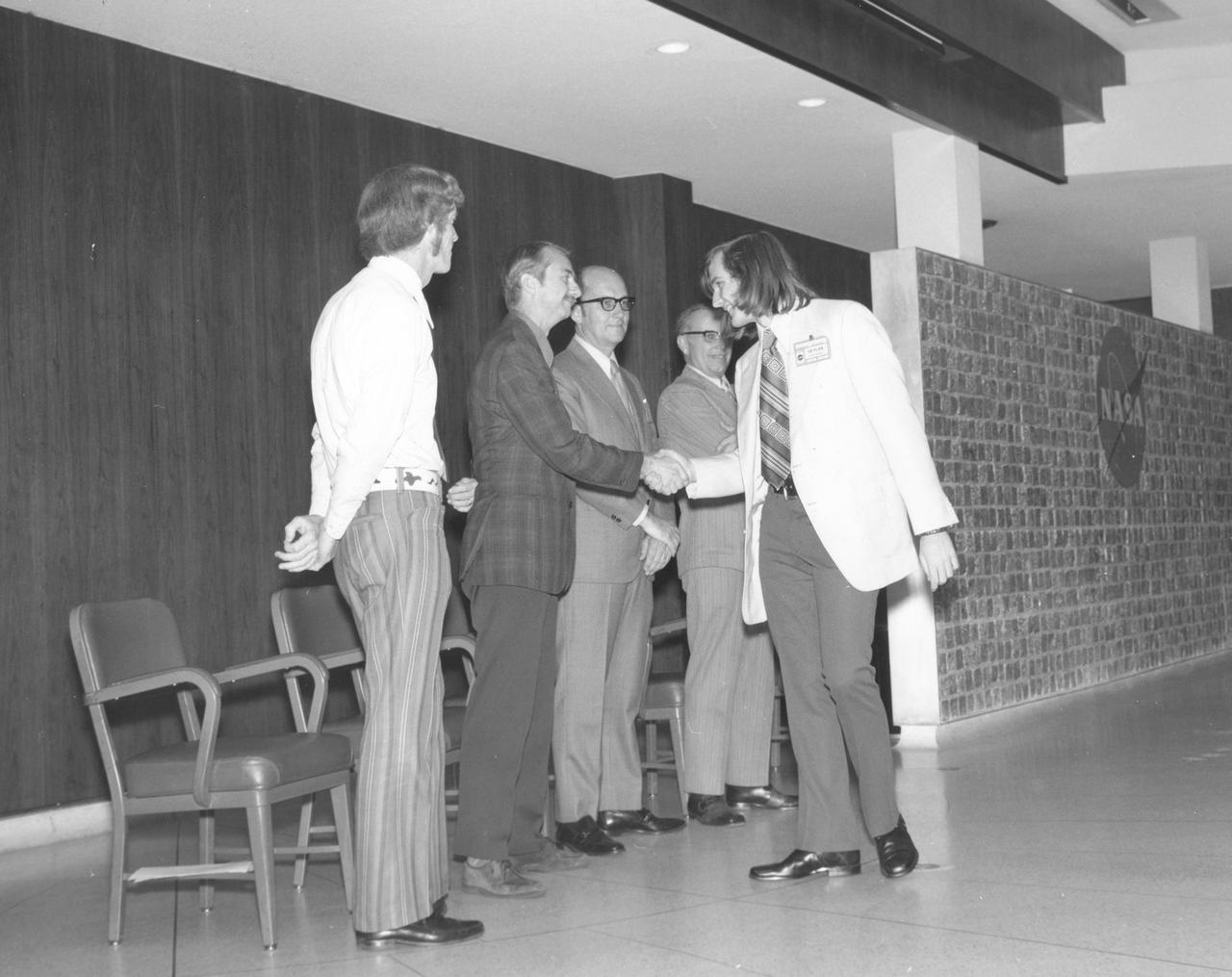
Springfield, Massachusetts high school student, Gregory A. Merkel, is greeted by (left to right): Astronauts Russell L. Schweickart, and Owen K. Garriott; Marshall Space Flight Center (MSFC) Skylab Program Manager, Leland Belew; and MSFC Director of Administration and Technical Services, David Newby, during a tour of MSFC. Merkel was among 25 winners of a contest in which some 3,500 high school students proposed experiments for the following year’s Skylab Mission. The nationwide scientific competition was sponsored by the National Science Teachers Association and the National Aeronautics and Space Administration (NASA). The winning students, along with their parents and sponsor teachers, visited MSFC where they met with scientists and engineers, participated in design reviews for their experiments, and toured MSFC facilities. Of the 25 students, 6 did not see their experiments conducted on Skylab because the experiments were not compatible with Skylab hardware and timelines. Of the 19 remaining, 11 experiments required the manufacture of additional equipment.
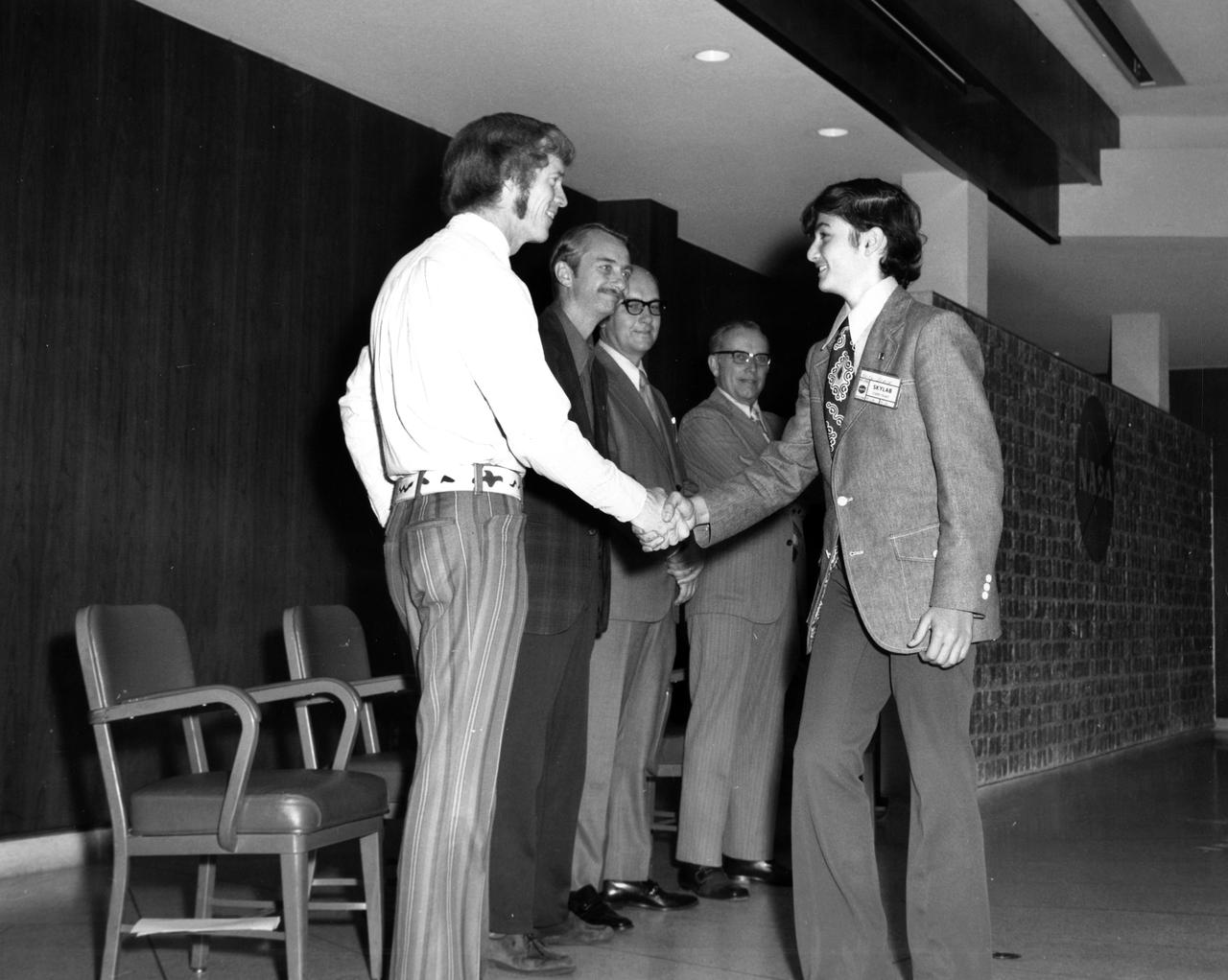
Westbury, New York high school student, Keith L.Stein , is greeted by (left to right): Astronauts Russell L. Schweickart, and Owen K. Garriott; Marshall Space Flight Center (MSFC) Skylab Program Manager, Leland Belew; and MSFC Director of Administration and Technical Services, David Newby, during a tour of MSFC. Stein was among 25 winners of a contest in which some 3,500 high school students proposed experiments for the following year’s Skylab mission. The nationwide scientific competition was sponsored by the National Science Teachers Association and the National Aeronautics and Space Administration (NASA). The winning students, along with their parents and sponsor teachers, visited MSFC where they met with scientists and engineers, participated in design reviews for their experiments, and toured MSFC facilities. Of the 25 students, 6 did not see their experiments conducted on Skylab because the experiments were not compatible with Skylab hardware and timelines. Of the 19 remaining, 11 experiments required the manufacture of additional equipment.

Atlanta, Georgia high school student, Neal W. Shannon, is greeted by (left to right): Astronauts Russell L. Schweickart, and Owen K. Garriott; Marshall Space Flight Center (MSFC) Skylab Program Manager, Leland Belew; and MSFC Director of Administration and Technical Services, David Newby, during a tour of MSFC. Shannon was among 25 winners of a contest in which some 3,500 high school students proposed experiments for the following year’s Skylab mission. The nationwide scientific competition was sponsored by the National Science Teachers Association and the National Aeronautics and Space Administration (NASA). The winning students, along with their parents and sponsor teachers, visited MSFC where they met with scientists and engineers, participated in design reviews for their experiments, and toured MSFC facilities. Of the 25 students, 6 did not see their experiments conducted on Skylab because the experiments were not compatible with Skylab hardware and timelines. Of the 19 remaining, 11 experiments required the manufacture of additional equipment.
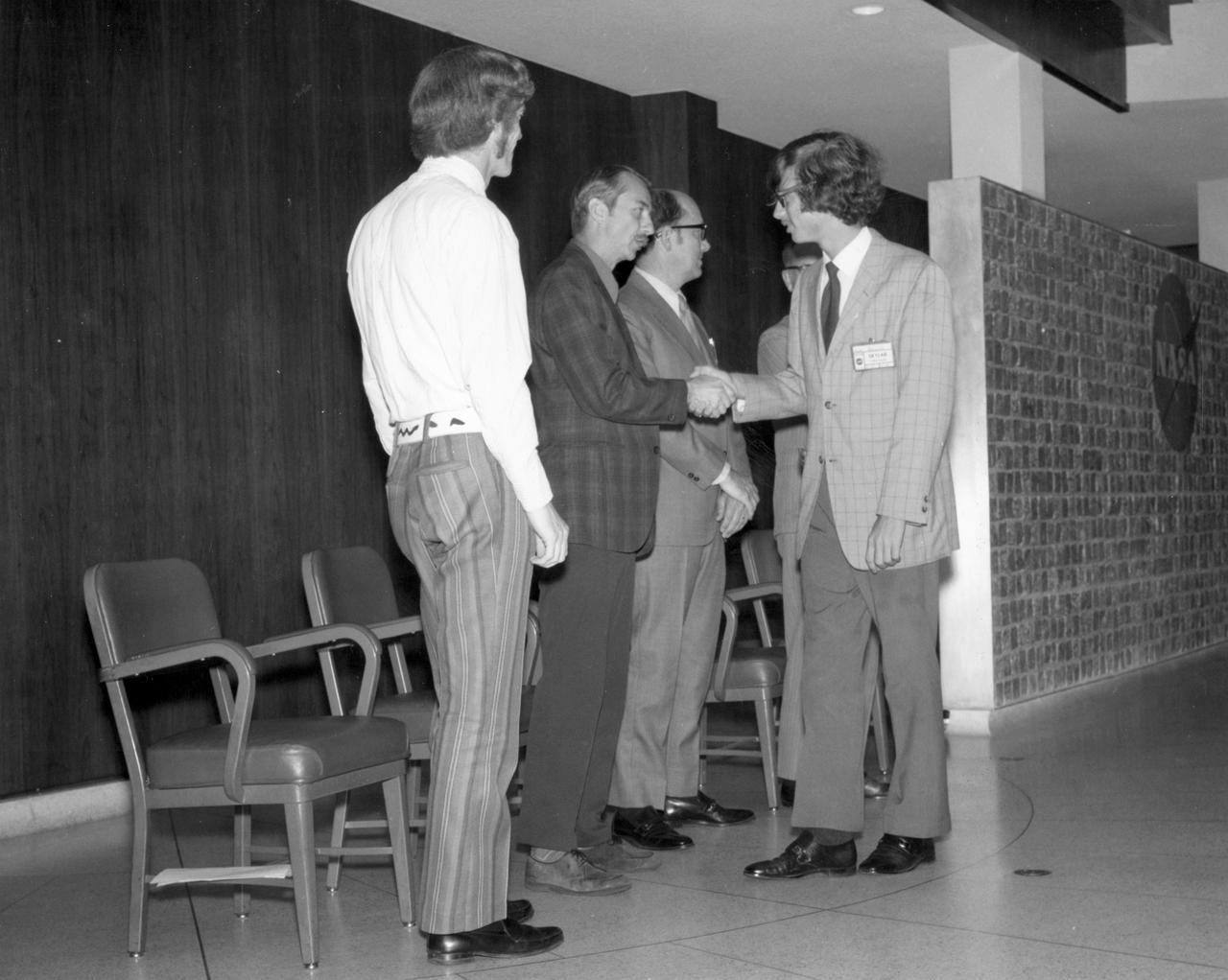
Aiea, Hawaii high school student, John C. Hamilton, is greeted by (left to right): Astronauts Russell L. Schweickart, and Owen K. Garriott; Marshall Space Flight Center (MSFC) Skylab Program Manager, Leland Belew; and MSFC Director of Administration and Technical Services, David Newby, during a tour of MSFC. Hamilton was among 25 winners of a contest in which some 3,500 high school students proposed experiments for the following year’s Skylab mission. The nationwide scientific competition was sponsored by the National Science Teachers Association and the National Aeronautics and Space Administration (NASA). The winning students, along with their parents and sponsor teachers, visited MSFC where they met with scientists and engineers, participated in design reviews for their experiments, and toured MSFC facilities. Of the 25 students, 6 did not see their experiments conducted on Skylab because the experiments were not compatible with Skylab hardware and timelines. Of the 19 remaining, 11 experiments required the manufacture of additional equipment.
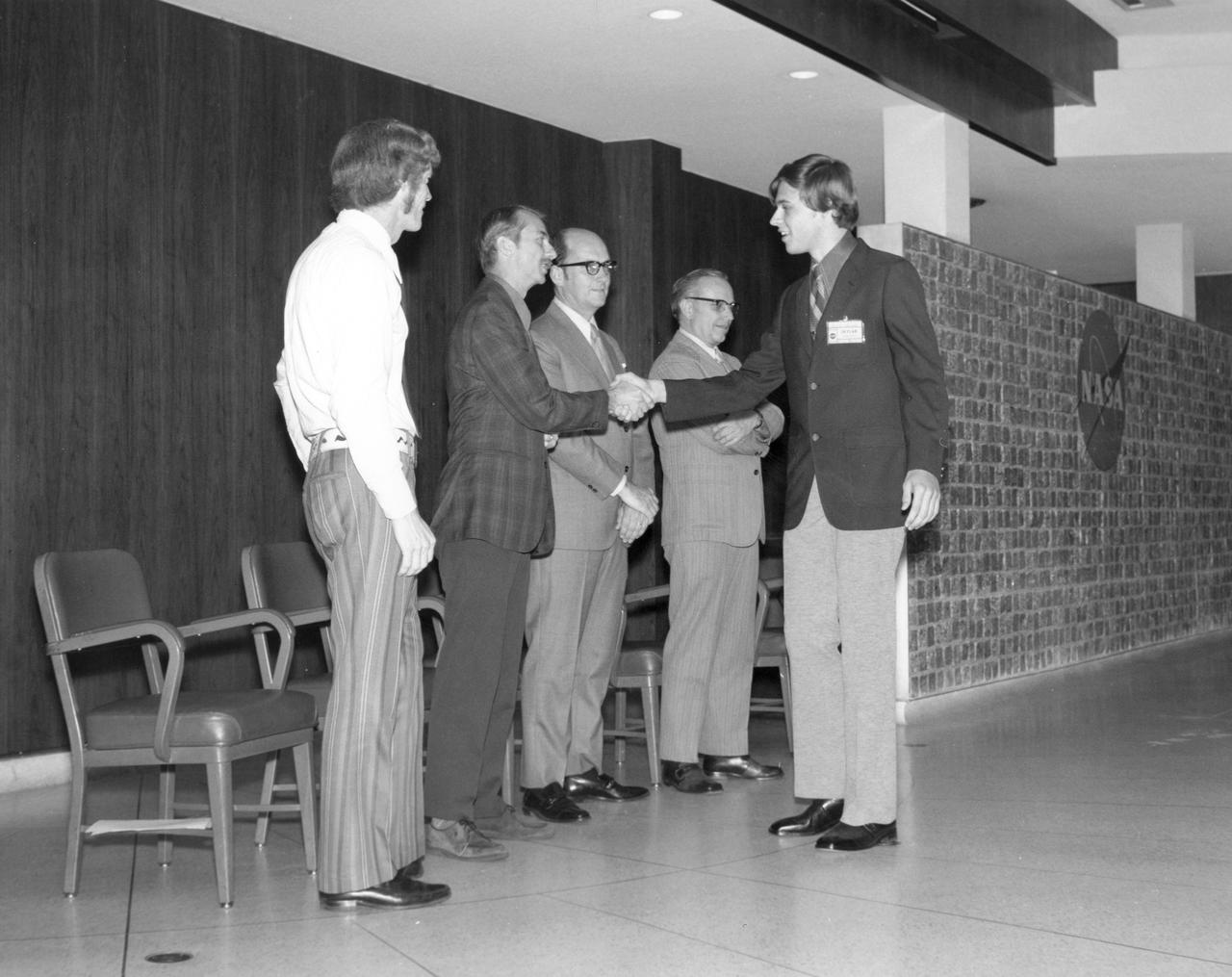
Garland, Texas high school student, Keith D. McGee, is greeted by (left to right): Astronauts Russell L. Schweickart, and Owen K. Garriott; Marshall Space Flight Center (MSFC) Skylab Program Manager, Leland Belew; and MSFC Director of Administration and Technical Services, David Newby, during a tour of MSFC. McGee was among 25 winners of a contest in which some 3,500 high school students proposed experiments for the following year’s Skylab Mission. The nationwide scientific competition was sponsored by the National Science Teachers Association and the National Aeronautics and Space Administration (NASA). The winning students, along with their parents and sponsor teachers, visited MSFC where they met with scientists and engineers, participated in design reviews for their experiments, and toured MSFC facilities. Of the 25 students, 6 did not see their experiments conducted on Skylab because the experiments were not compatible with Skylab hardware and timelines. Of the 19 remaining, 11 experiments required the manufacture of additional equipment.
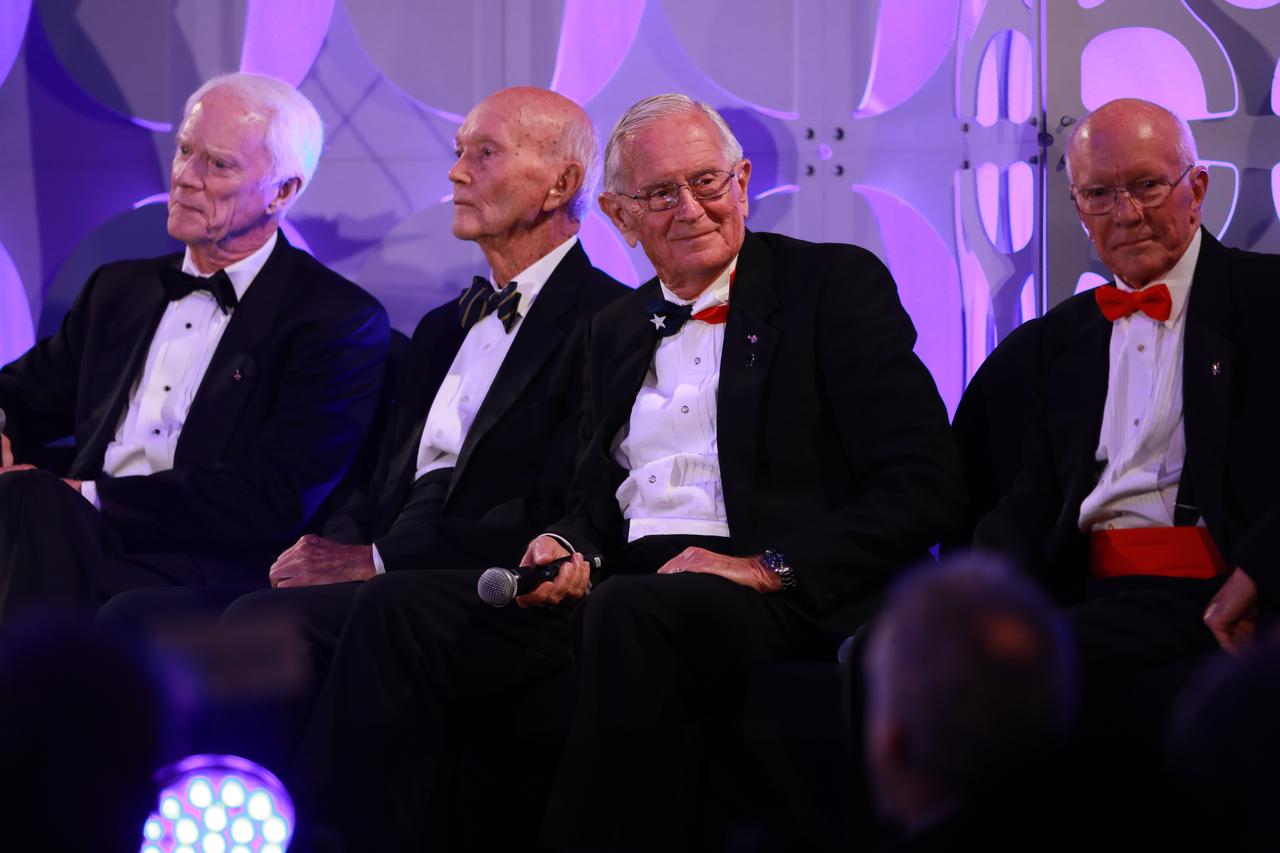
A panel discussion with Apollo astronauts took place during the Apollo 11 50th Gala, present by Northop Grumman, inside the Apollo/Saturn V Center at the Kennedy Space Center Visitor Complex in Florida on July 16, 2019. From left, are Apollo 9 astronaut Rusty Schweickart, Apollo 11 astronaut Michael Collins, Apollo 16 astronaut Charlie Duke, and Apollo Flight Director Gerry Griffin.
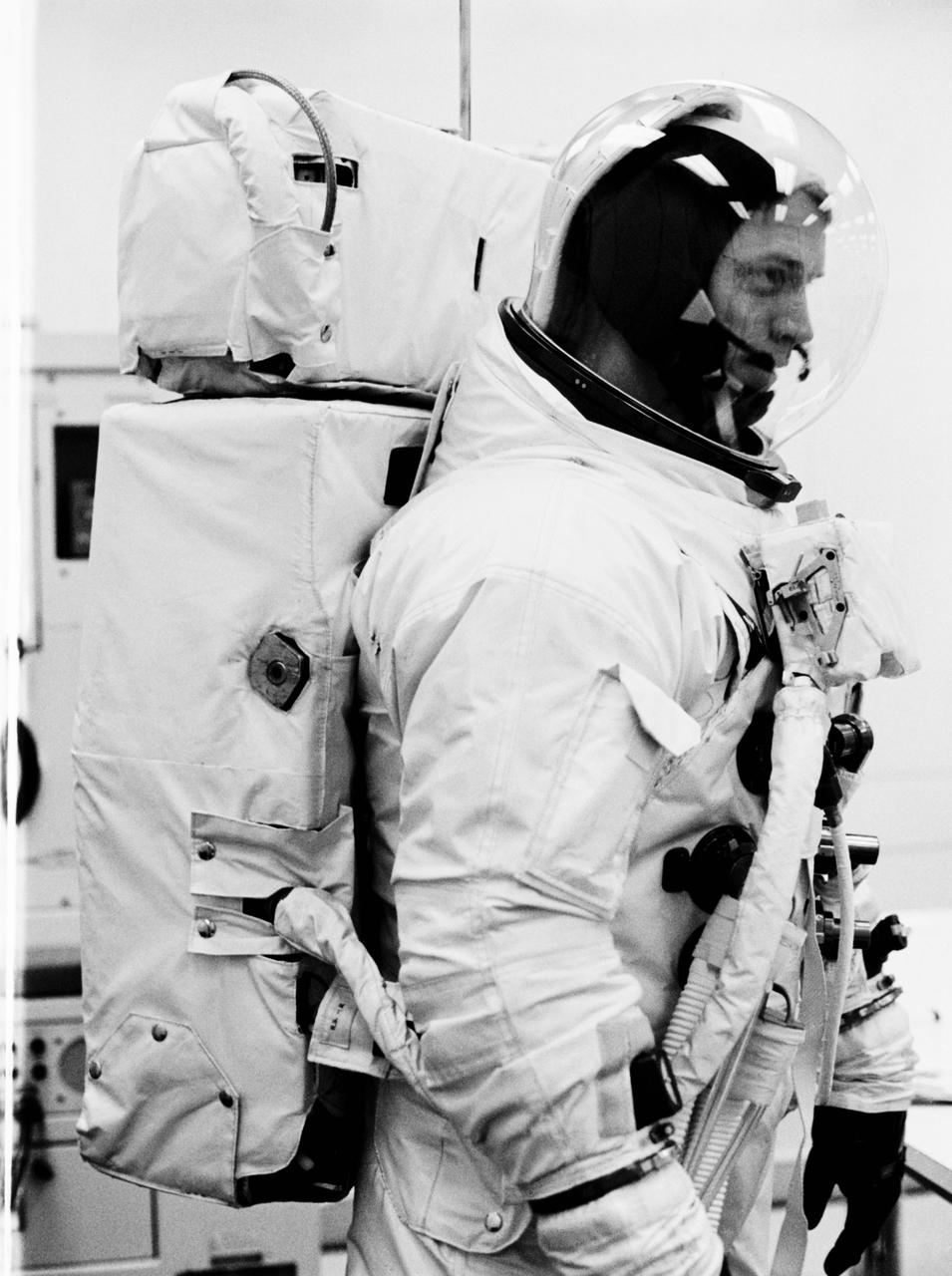
S69-25878 (23 Feb. 1969) --- Astronaut Russell L. Schweickart, lunar module pilot of the Apollo 9 prime crew, wears the Extravehicular Mobility Unit (EMU) which he will use during his scheduled Apollo 9 extravehicular activity. In addition to the space suit and bubble helmet, the EMU also includes a Portable Life Support System back pack, an Oxygen Purge System (seen atop the PLSS), and a Remote Control Unit on his chest. This equipment will be completely independent of the spacecraft during Schweickart's EVA. He will be secured only by a tether line. When this photograph was taken, Schweickart was suited to participate in an Apollo 9 Countdown Demonstration Test.
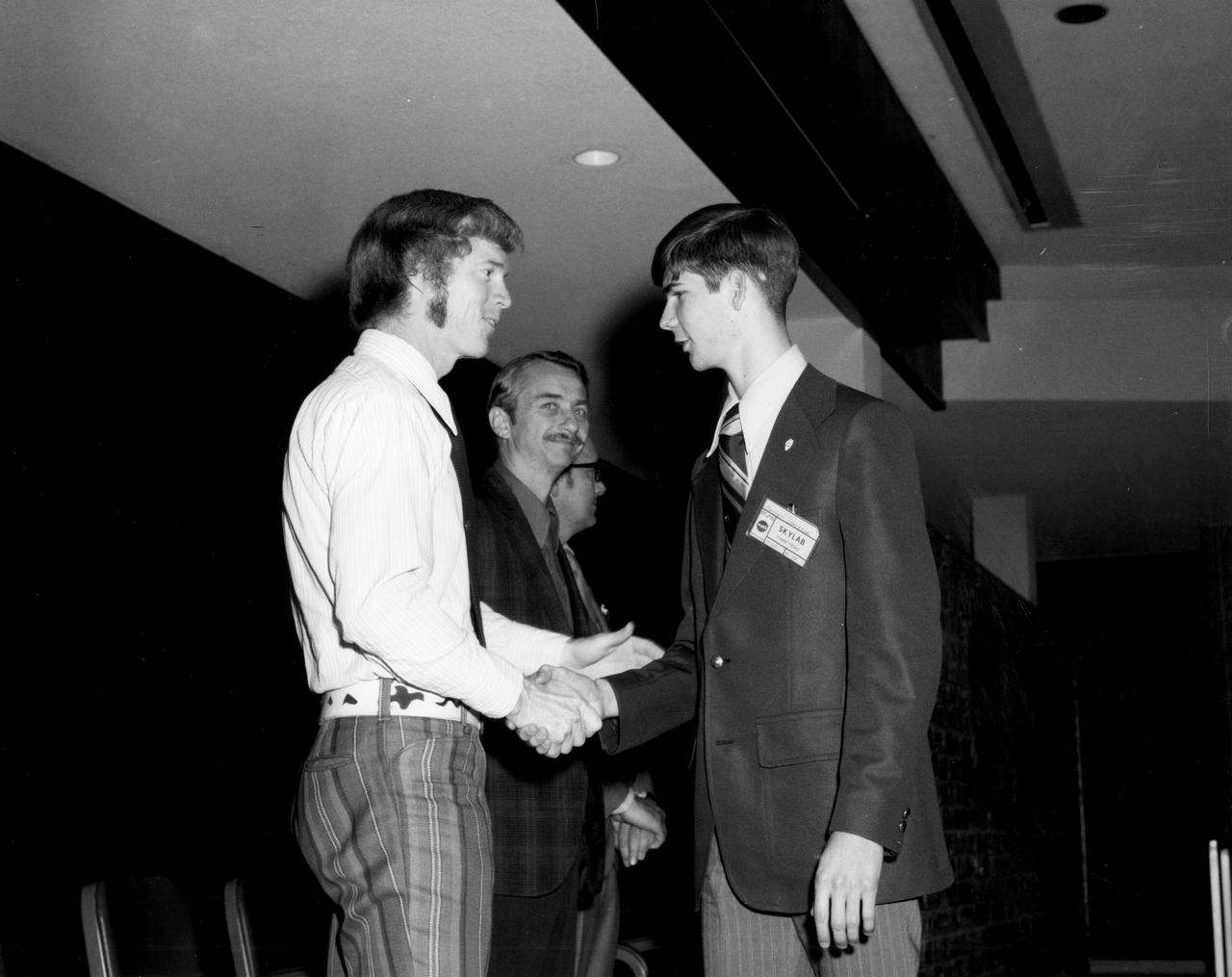
Rockford, Illinois high school student, Vincent Converse (right), is greeted by astronauts Russell L. Schweickart and Owen K. Garriott during a tour of the Marshall Space Flight Center (MSFC). Converse was among 25 winners of a contest in which some 3,500 high school students proposed experiments for the following year’s Skylab mission. His experiment, “Zero Gravity Mass Measurement” used a simple leaf spring with the mass to be weighed attached to the end. An electronic package oscillated the spring at a specific rate and the results were recorded electronically. The nationwide scientific competition was sponsored by the National Science Teachers Association and the National Aeronautics and Space Administration (NASA). The winning students, along with their parents and sponsor teachers, visited MSFC where they met with scientists and engineers, participated in design reviews for their experiments, and toured MSFC facilities. Of the 25 students, 6 did not see their experiments conducted on Skylab because the experiments were not compatible with Skylab hardware and timelines. Of the 19 remaining, 11 experiments required the manufacture of additional equipme
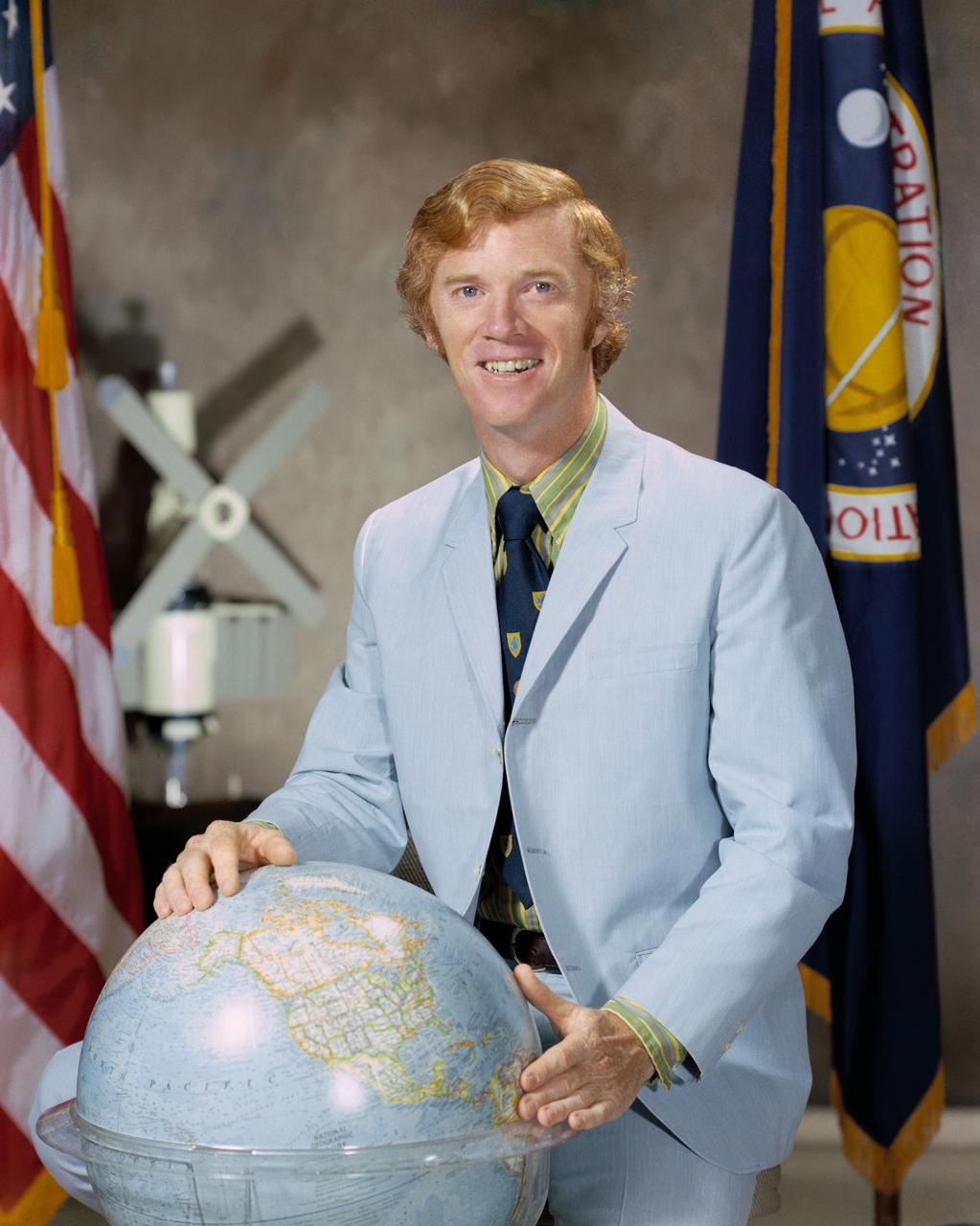
S71-51266 (21 Sept. 1971) --- Astronaut Russell "Rusty" L. Schweickart Jr.
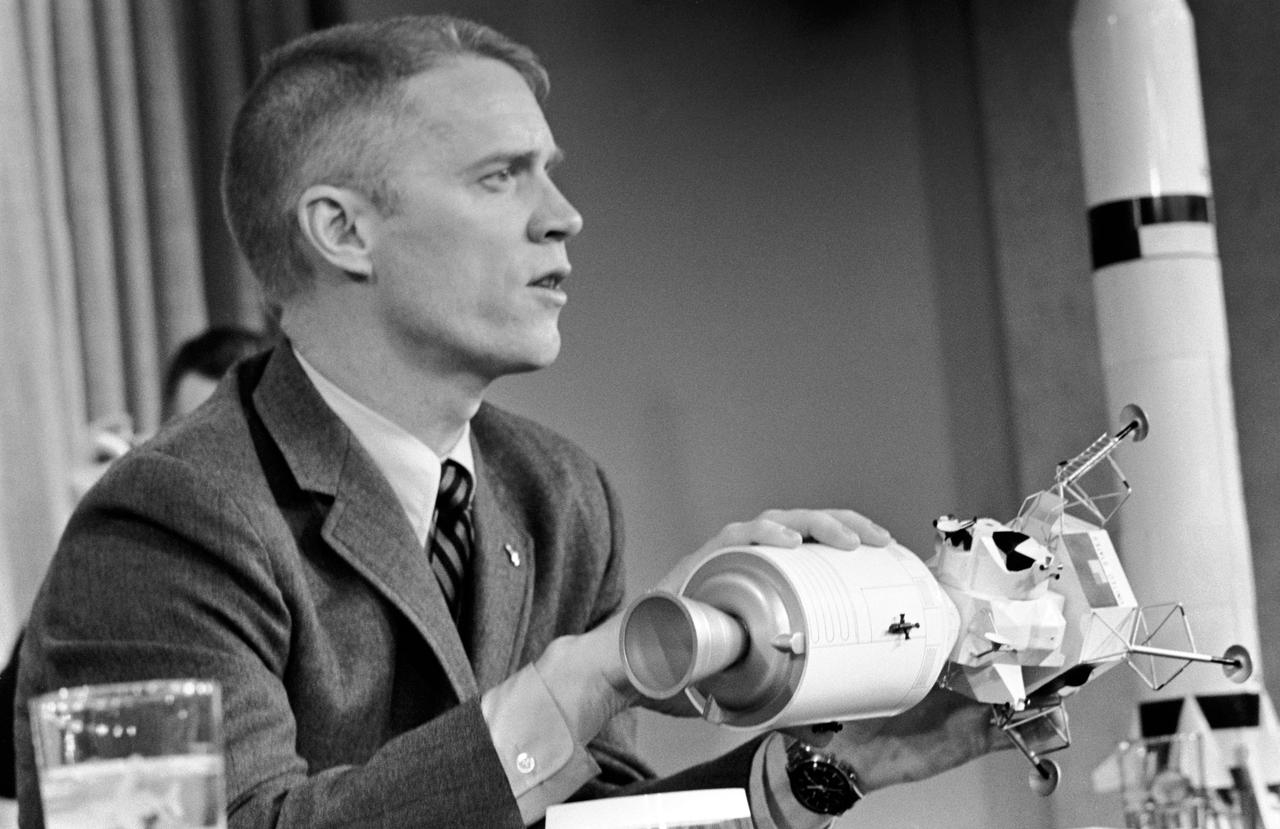
S69-17615 (25 Jan. 1969) --- Astronaut Russell L. Schweickart, lunar module pilot of the Apollo 9 prime crew, participates in a press conference at the Grumman Aircraft Engineering Corporation. Grumman is the contractor to NASA for the Lunar Module. Schweickart is holding a model of a docked Lunar Module/Command and Service Modules. The Apollo 9 mission will evaluate spacecraft lunar module systems performance during manned Earth-orbital flight.
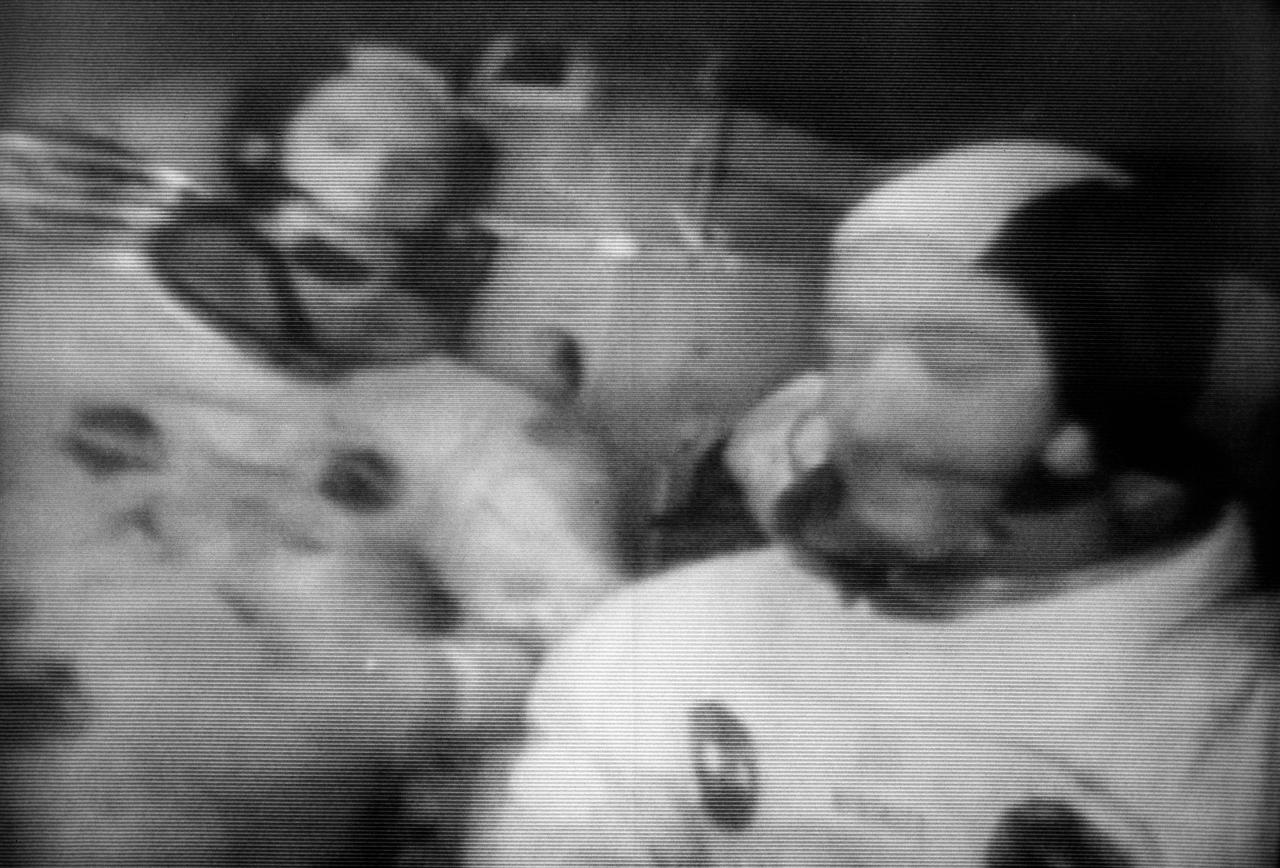
S69-26148 (6 March 1969) --- This photograph from the second live television transmission from Apollo 9 was made early Thursday afternoon on the fourth day in space. Though of poor quality, this view shows the interior of the Lunar Module "Spider" with astronauts James A. McDivitt (foreground) and Russell L. Schweickart at their crew stations. McDivitt is the Apollo 9 commander; and Schweickart is the lunar module pilot. At this moment Apollo 9 was orbiting Earth with the Command and Service Modules docked nose-to-nose with the Lunar Module. Astronaut David R. Scott, command module pilot, remained at the controls in the Command Module "Gumdrop" while the other two astronauts checked out the Lunar Module. McDivitt and Schweickart moved into the Lunar Module from the Command Module by way of the docking tunnel.
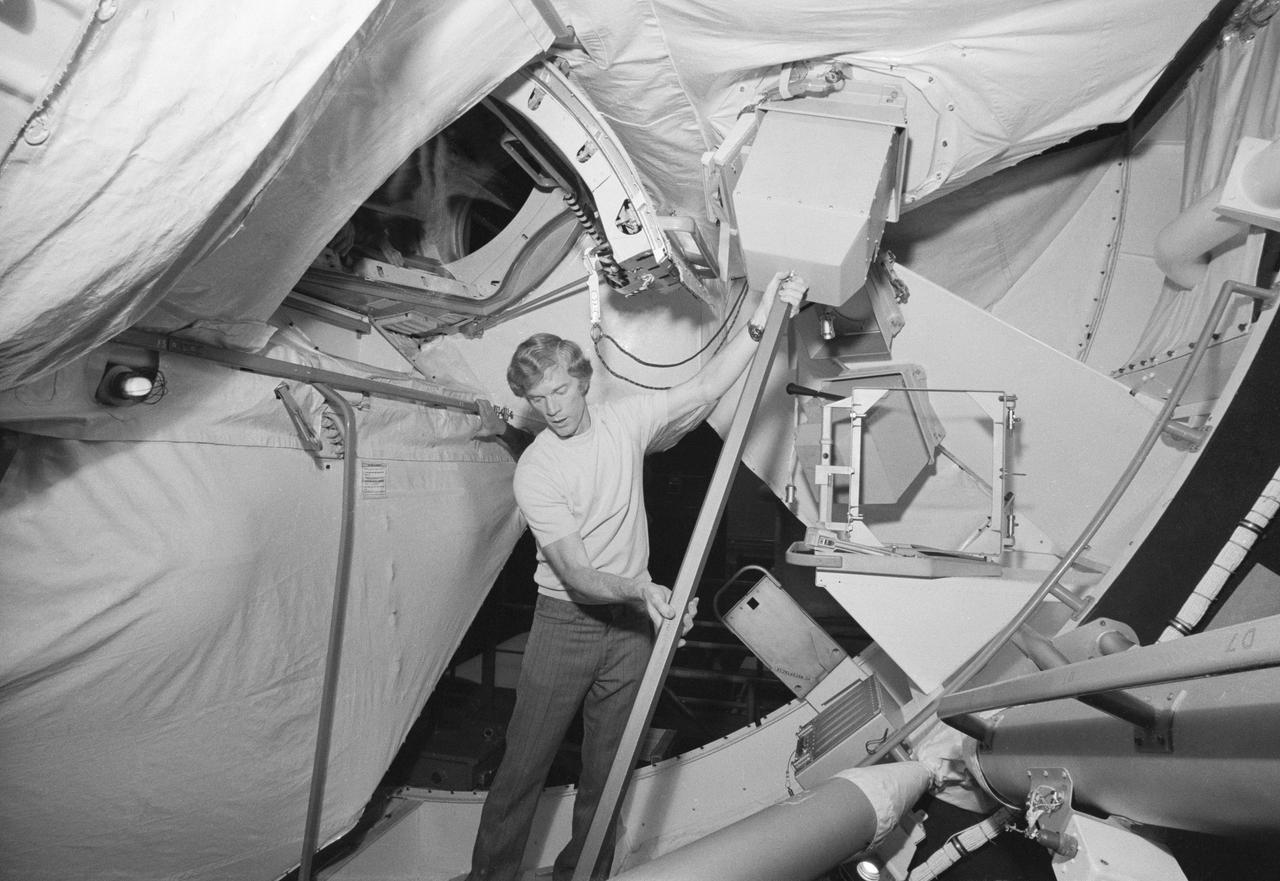
S73-25884 (1973) --- Astronaut Russell Schweickart in Orbital Workshop Simulator (OWS) working out procedure to be used for repair of damaged thermal protection cover on Skylab 2 spacecraft. Photo credit: NASA
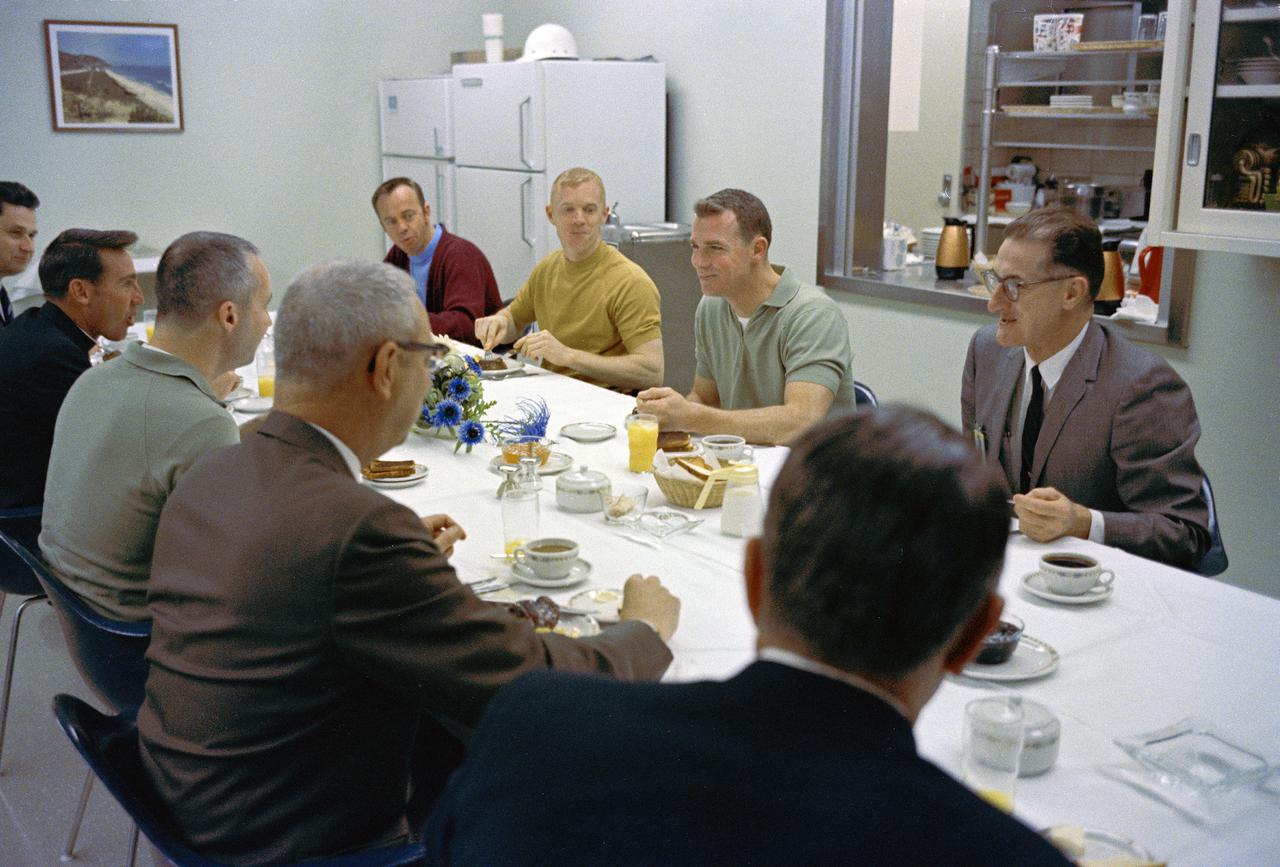
CAPE CANAVERAL, Fla. -- Apollo 9 Astronauts James A. McDivitt, David R. Scott, and Russell L. Schweickart breakfast with guests in their crew quarters of few hours before their launch into Earth orbit to test the Lunar Module spacecraft. Left to right across the table are Brig. Gen. C.H. Bolender, Scott, Schweickart, and Alan Shepard, Chief of the Astronaut Office and America's first man in space. Foreground, second from left, is Kenneth Kleinknect astronaut McDivitt his clergyman from Nassau Bay, Texas, The Rev. Laurence Connelly and George Skurla, Grumman Aircraft base manager at the spaceport. Grumman builds the Lunar Module spacecraft. Photo credit: NASA
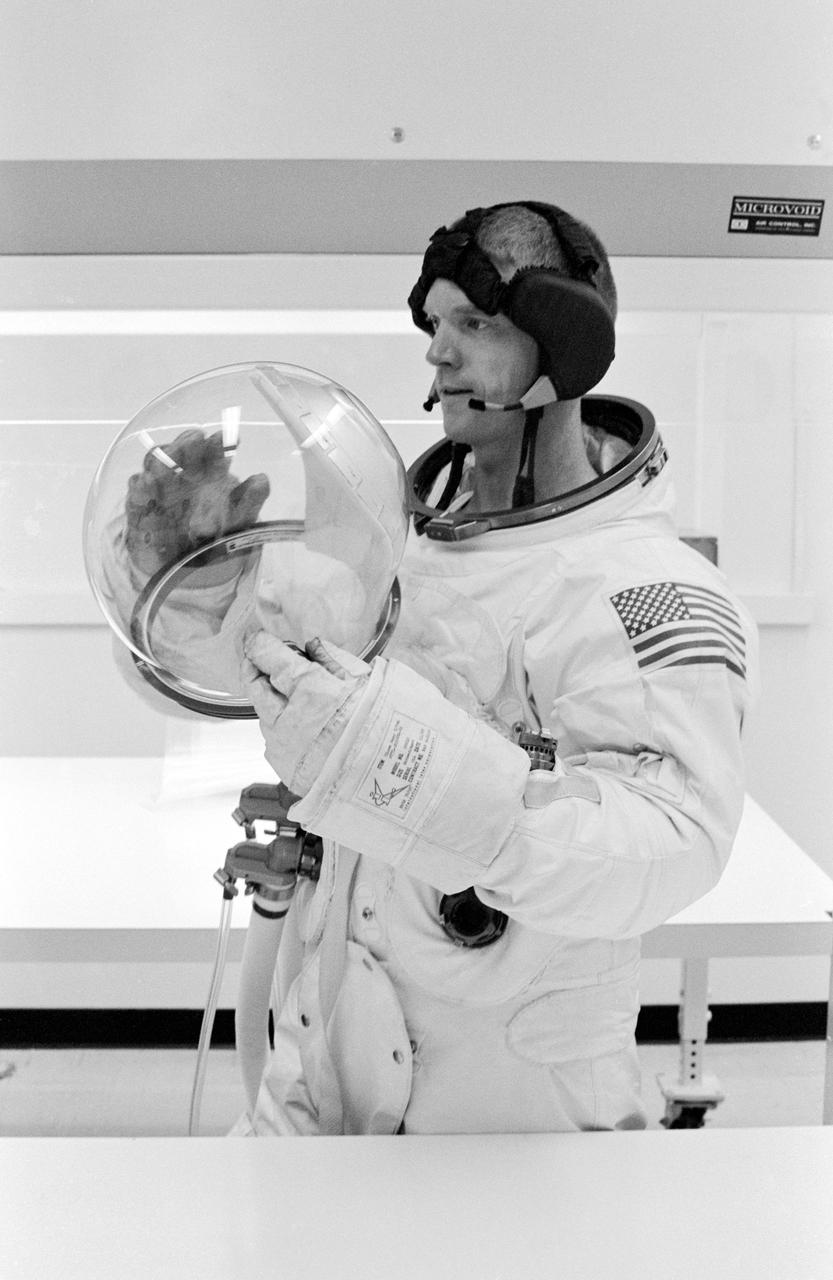
S68-38051 (29 June 1968) --- Astronaut Russell L. Schweickart suits up to participate in an altitude verification test of the Apollo Portable Life Support System flight unit in Crew Systems Division's 8-ft altitude chamber in Building 7.
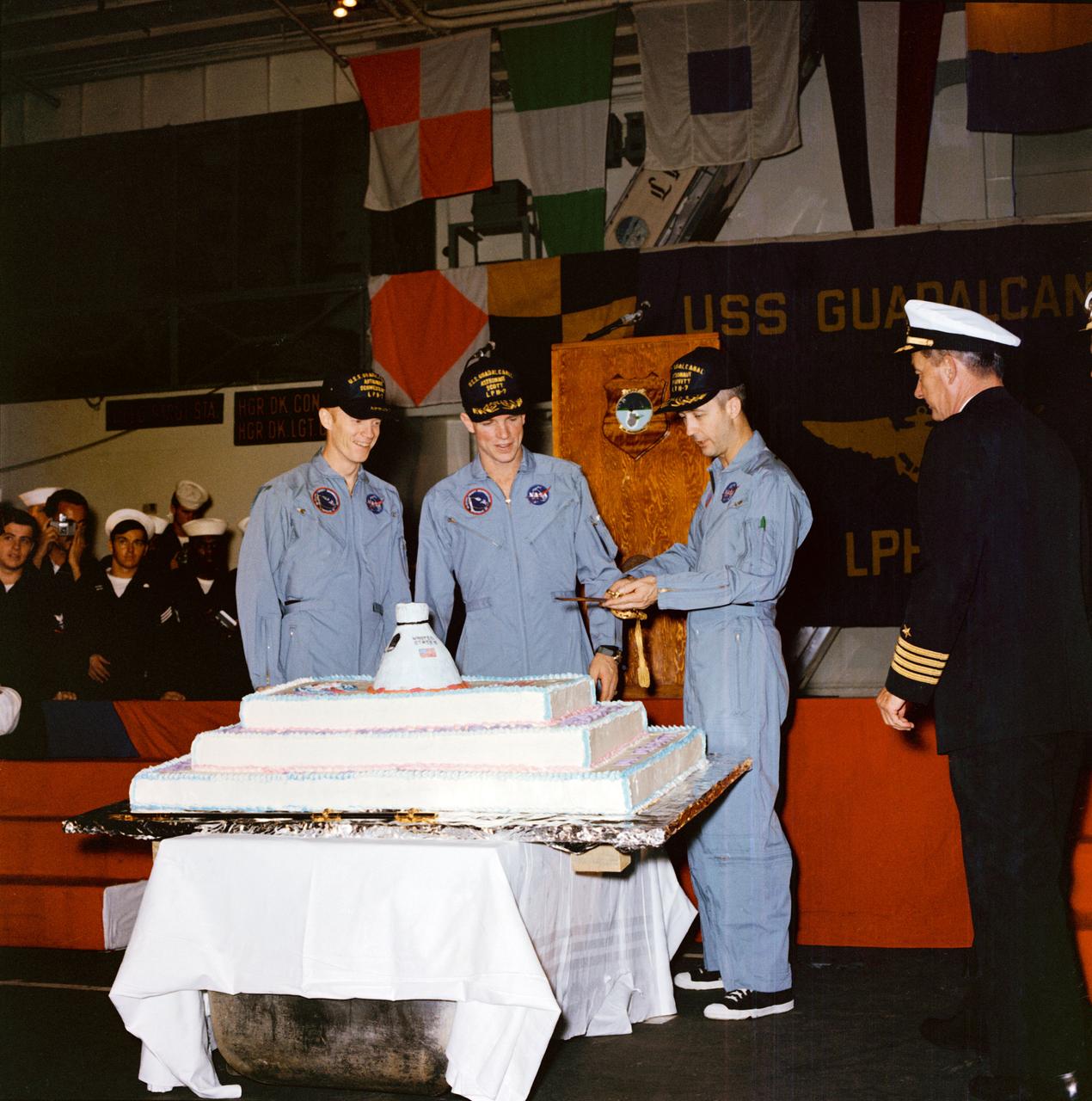
The Apollo 9 crew prepares to cut the 350-pound cake which was baked on the U.S.S. Guadalcanal in their honor. Left to right, are Astronauts Russell L. Schweickart, David R. Scott, and James A. McDivitt. Looking on at right is Capt. Roy M. Sudduth, commanding officer of the U.S.S. Guadalcanal.
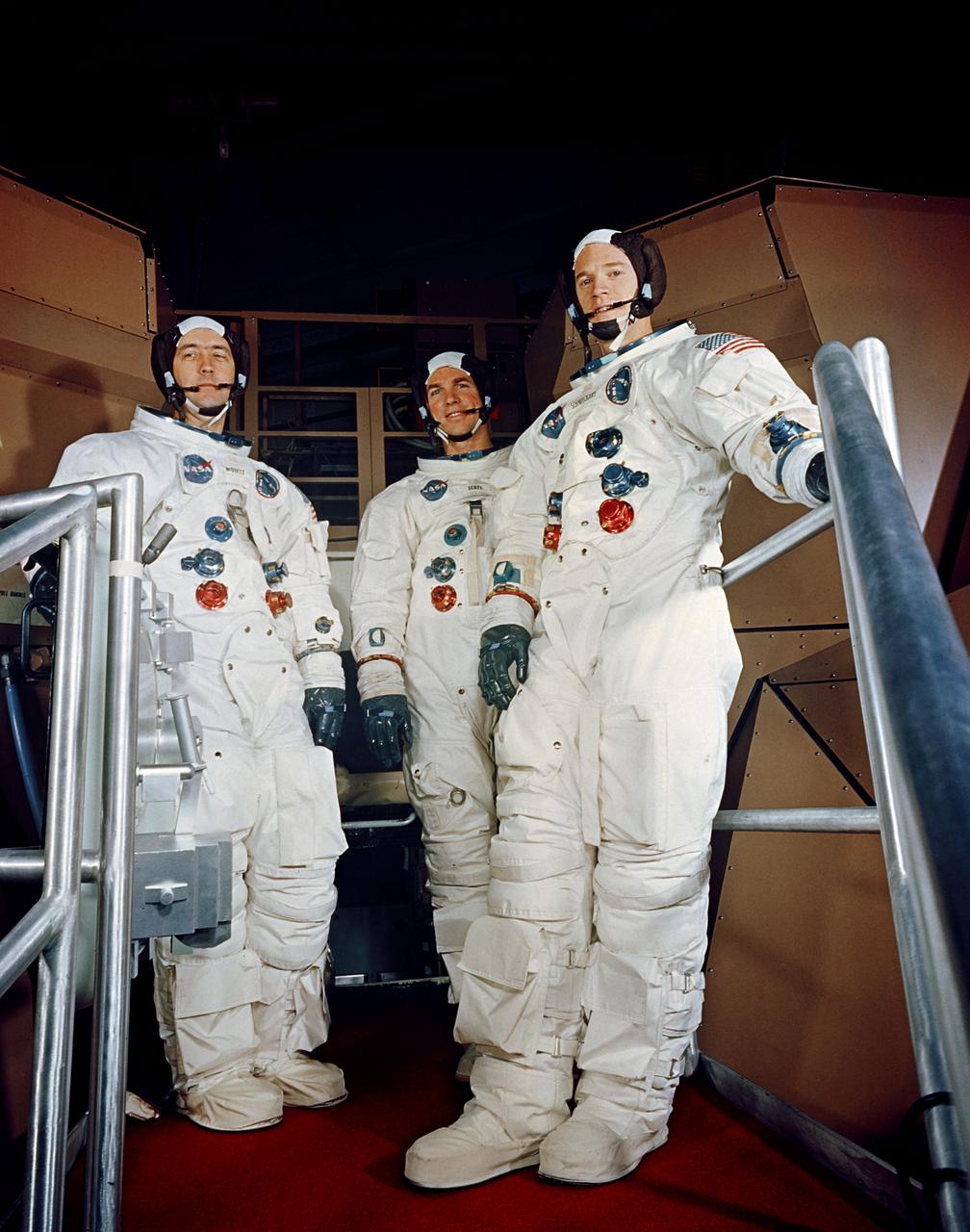
S69-19983 (17 Feb. 1969) --- The Apollo 9 crew is shown suited up for a simulated flight in the Apollo Mission Simulator at the Kennedy Space Center (KSC). Left to right are astronauts James A. McDivitt, commander; David R. Scott, command module pilot; and Russell L. Schweickart, lunar module pilot.
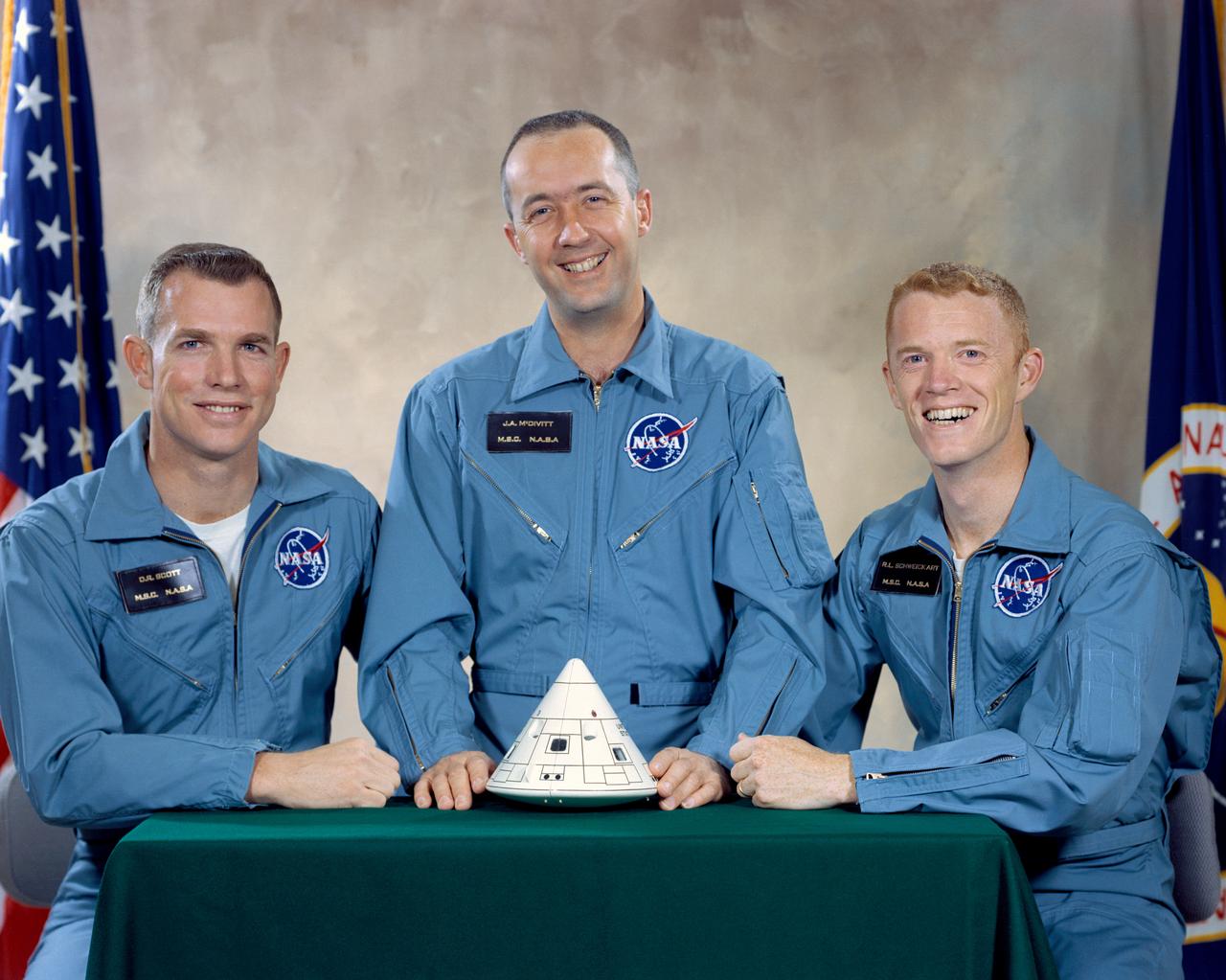
S66-30237 (March 1966) --- These three astronauts have been named as the prime crew of the Apollo 9 mission. They are (left to right) David R. Scott, command module pilot; James A. McDivitt, commander; and Russell L. Schweickart, lunar module pilot.
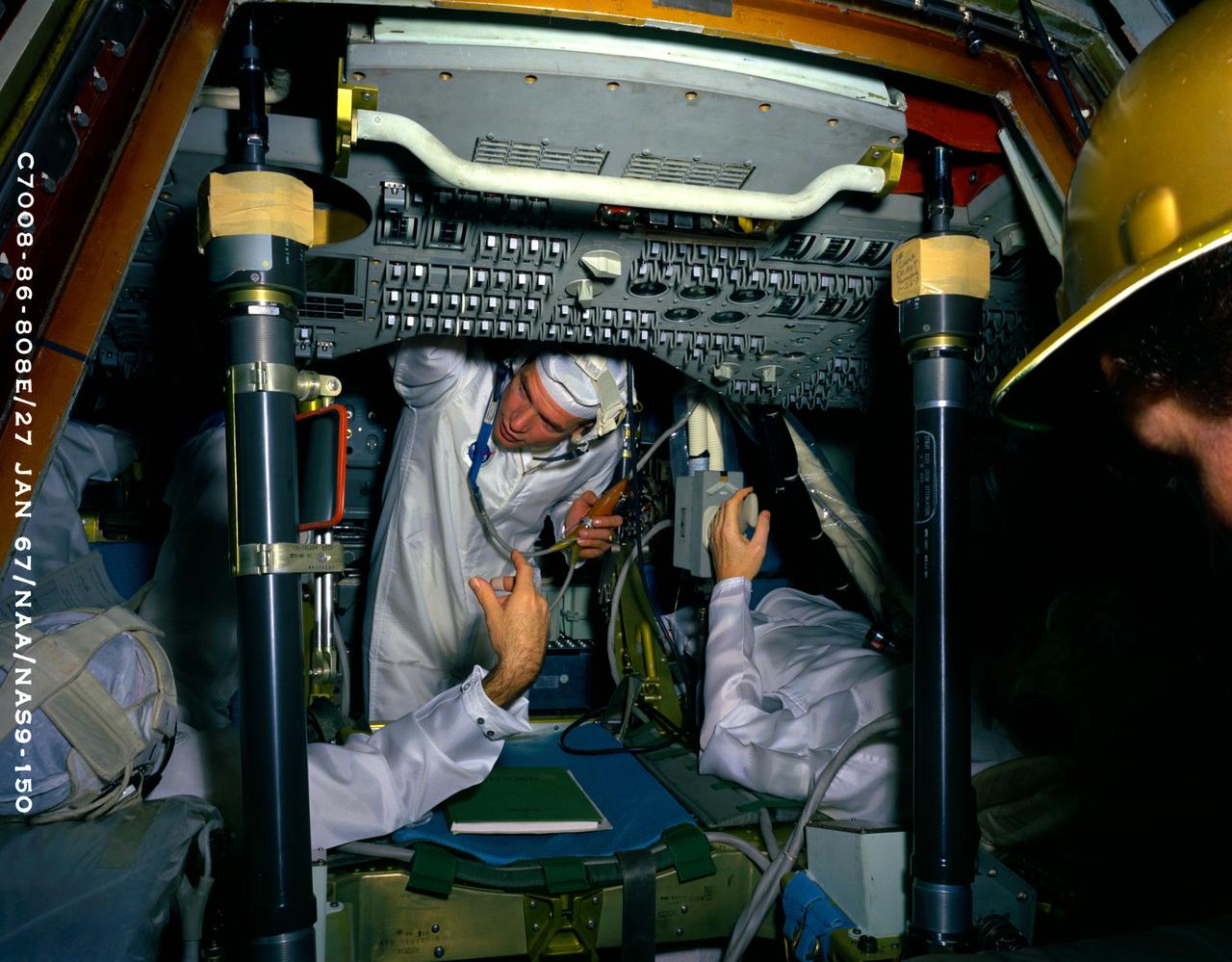
S67-23078 (27 Jan. 1967) --- Three astronauts (later to be named the Apollo 9 prime crew) in Apollo spacecraft 101 Command module during Apollo crew compartment fit and function test. Left to right are astronauts James A. McDivitt, David R. Scott, and Russell L. Schweickart.
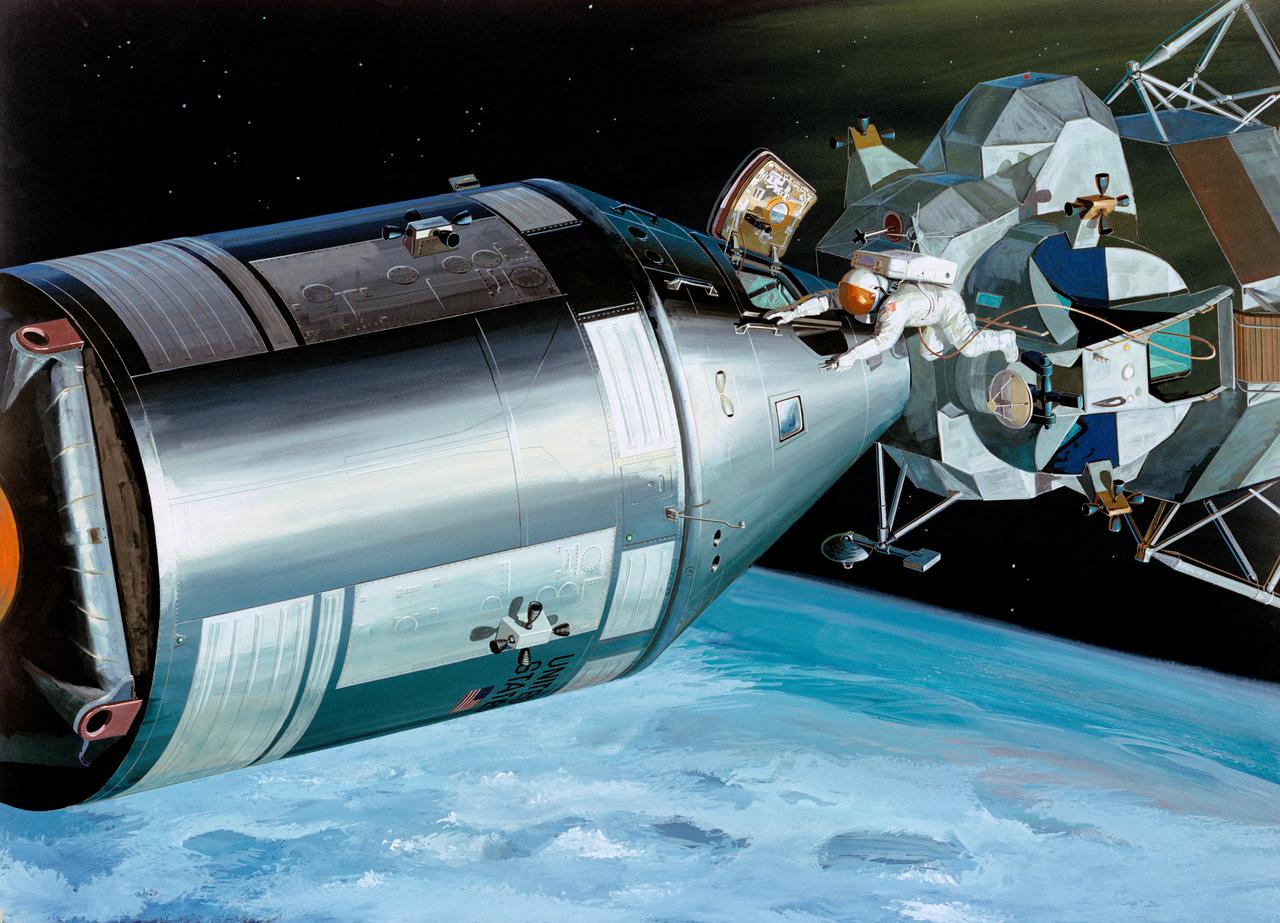
S69-18547 (1969) --- North American Rockwell artist's concept illustrating a part of the planned Apollo 9 extravehicular activity on the fourth day of the mission as the Command and Service Modules are docked to the Lunar Module. The figure performing the EVA represents astronaut Russell L. Schweickart, Apollo 9 lunar module pilot.
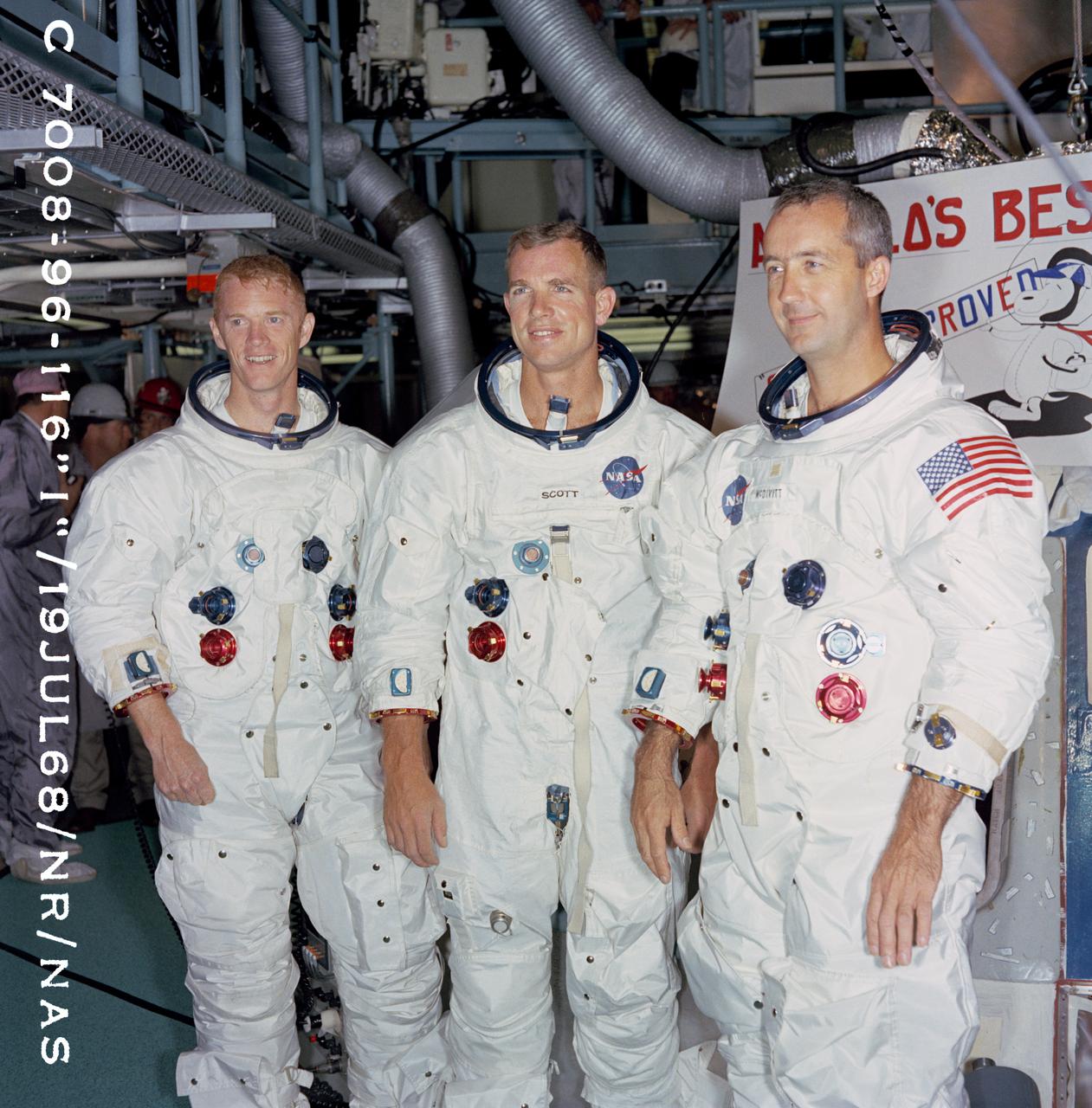
S68-42164 (19 July 1968) --- The prime crew of the third manned Apollo space mission stands in front of the Apollo Command Module 103 after egress during crew compartment fit and function test activity. Left to right are astronauts Russell L. Schweickart, David R. Scott, and James A. McDivitt.

S69-17590 (18 Dec. 1968) --- These three astronauts are the prime crew of the Apollo 9 (Spacecraft 104/ Lunar Module 3/ Saturn 504) space mission. Left to right, are James A. McDivitt, commander; David R. Scott, command module pilot; and Russell L. Schweickart, lunar module pilot.
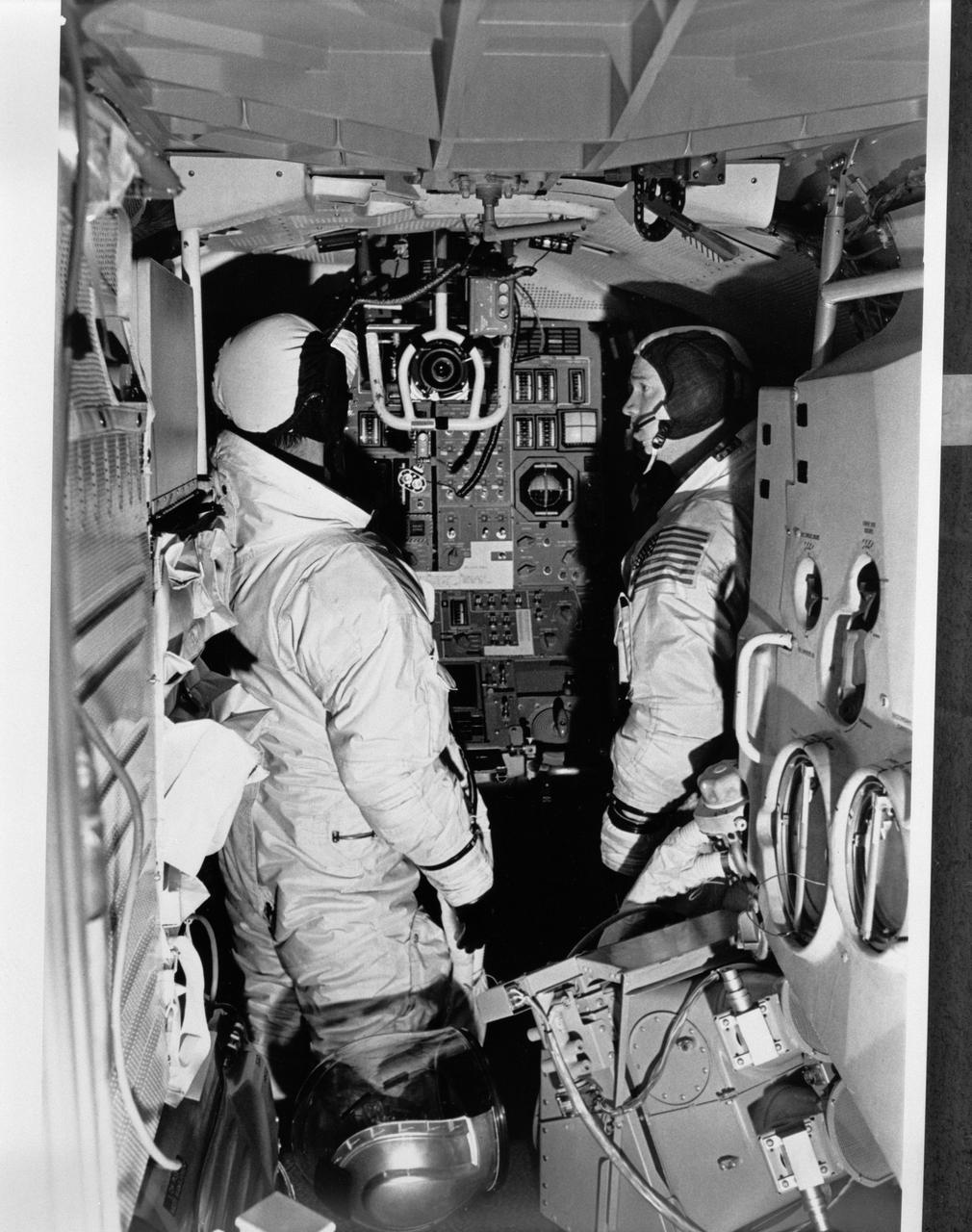
S69-19858 (December 1968) --- Two members of the Apollo 9 prime crew participate in simulation training in the Apollo Lunar Module Mission Simulator (LMMS) at the Kennedy Space Center (KSC). On the left is astronaut James A. McDivitt, commander; and on the right is astronaut Russell L. Schweickart, lunar module pilot.
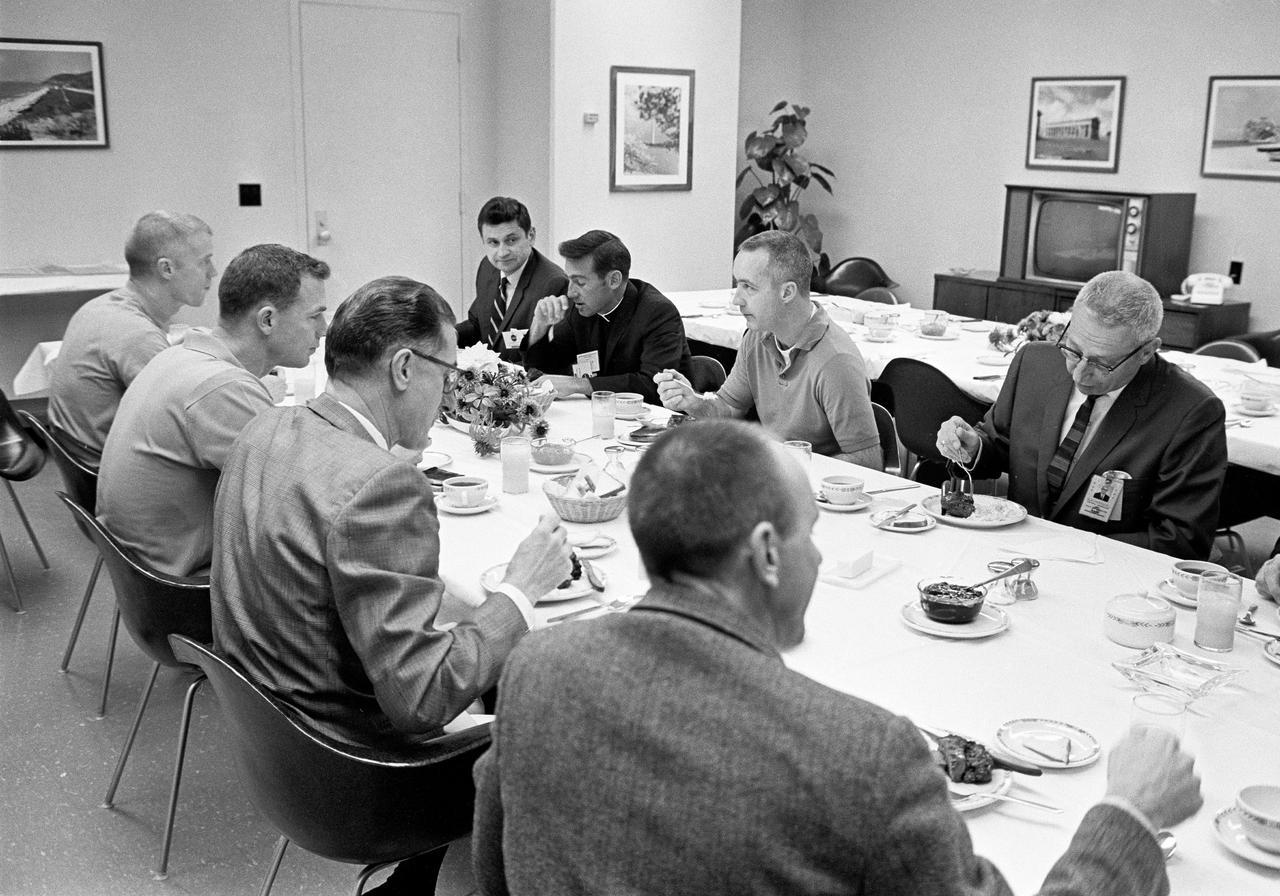
CAPE CANAVERAL, Fla. -- Apollo 9 astronauts James A. McDivitt, David R. Scott, and Russell L. Schweickart breakfast today with mission officials in their crew quarters at the Kennedy Space Center a few hours prior to their scheduled launch into Earth orbit. Seated in the foreground, left to right, are astronauts Schweickart and Scott Brig. Gen. C. H. Bolendar, manager, Lunar Module and backup Lunar Module Pilot Alan L. Bean. Across the table, left to right, George Skurla, Grumman Aircraft Base Manager at the Spaceport McDivitt's clergyman from his home church at Nassau Bay, Texas, The Rev. Laurence Connelly McDivitt and Kenneth Kleinknecht, manager, Command and Service Modules at the Manned Spacecraft Center. Grumman builds the two-man lunar module spacecraft that will be tested during the planned 10-day space mission. Photo credit: NASA
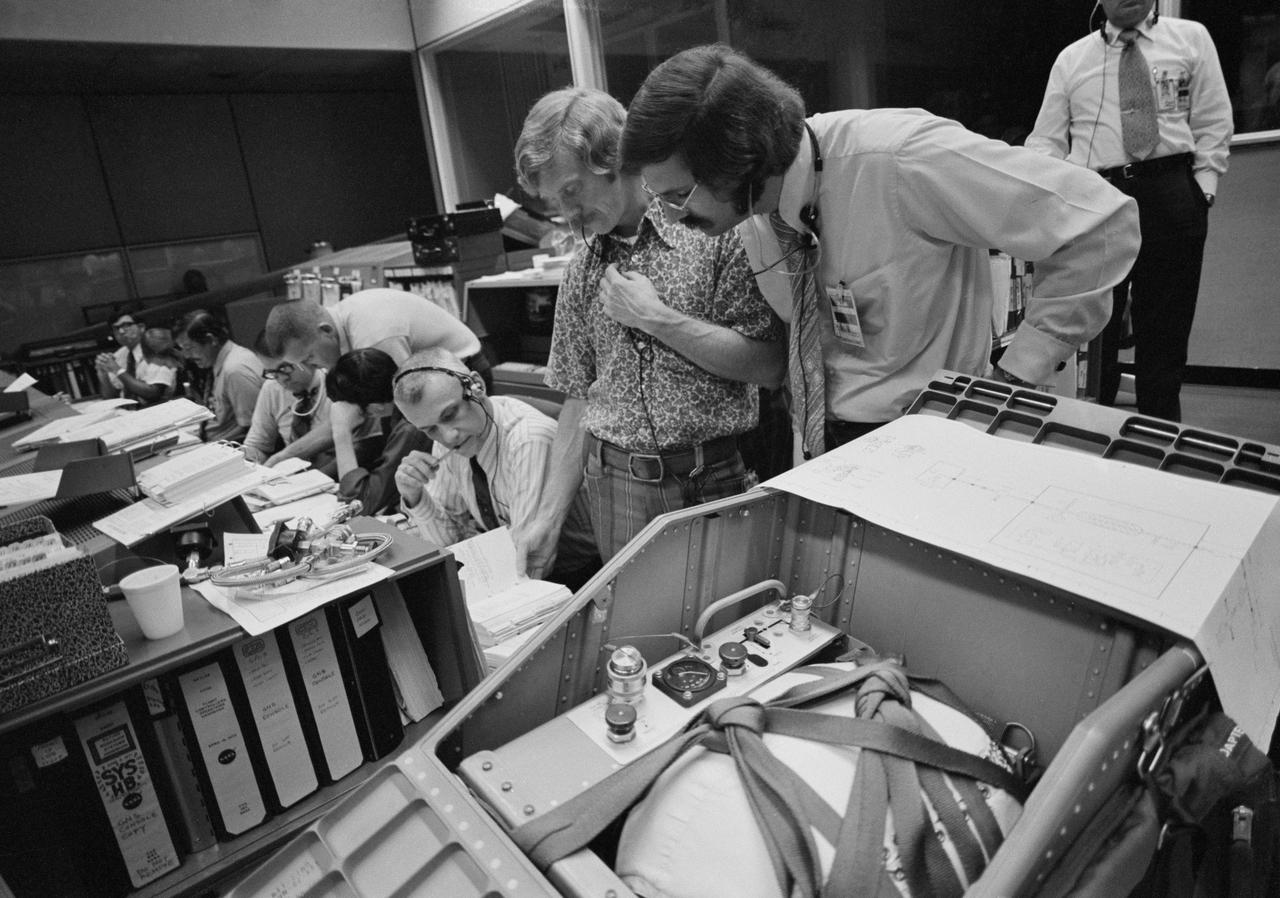
S73-37030 (November 1973) --- The procedures for repairing the coolant system aboard the Airlock Module of the Skylab space station in Earth orbit are discussed by flight controllers in the Mission Operations Control Room in the Mission Control Center at Johnson Space Center. Skylab 4 flight director Neil Hutchinson is on the right. Astronaut Russell L. Schweickart is wearing the sports shirt. Astronaut Bruce McCandless II, a Skylab 4 CAPCOM, is seated next to Schweickart. Items of equipment in the foreground are similar to components of a special coolant re-servicing kit which was taken to Earth orbit by the Skylab 4 crewmen. The kit consists of a tank containing 42 pounds of COOLANOL, a series of saddle valves, bolts and spacers, and leak-check hoses. The re-supply tank is a modified command module reaction control subsystem (RCS) fuel tank. Photo credit: NASA
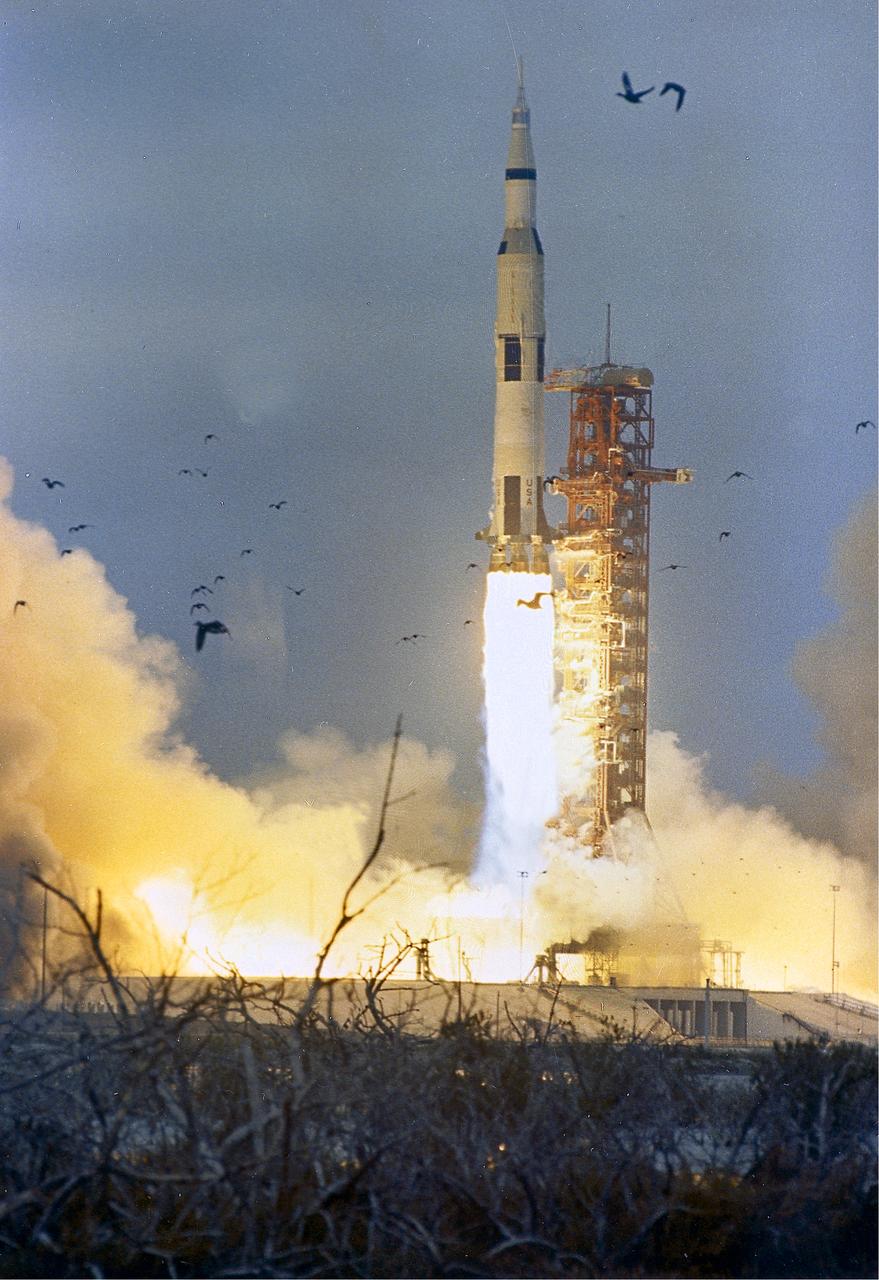
The launch of the Apollo 9 (Saturn V launch vehicle, SA-504), with astronauts James A. McDivitt, David R. Scott, and Russell L. Schweickart, took place on March 3, 1968. The Apollo 9 spacecraft, in the lunar mission configuration, was tested in Earth orbit. The mission was designed to rehearse all the steps and reproduce all the events of the Apollo 11 mission with the exception of the lunar touchdown, stay, and liftoff. The command and service modules, and the lunar module were used in flight procedures identical to those that would later take similar vehicles to the Moon, and a landing. The flight mechanics, mission support systems, communications, and recording of data were tested in a final round of verification. Astronauts Scott and Schweickart conducted Extravehicular Activity during this mission.
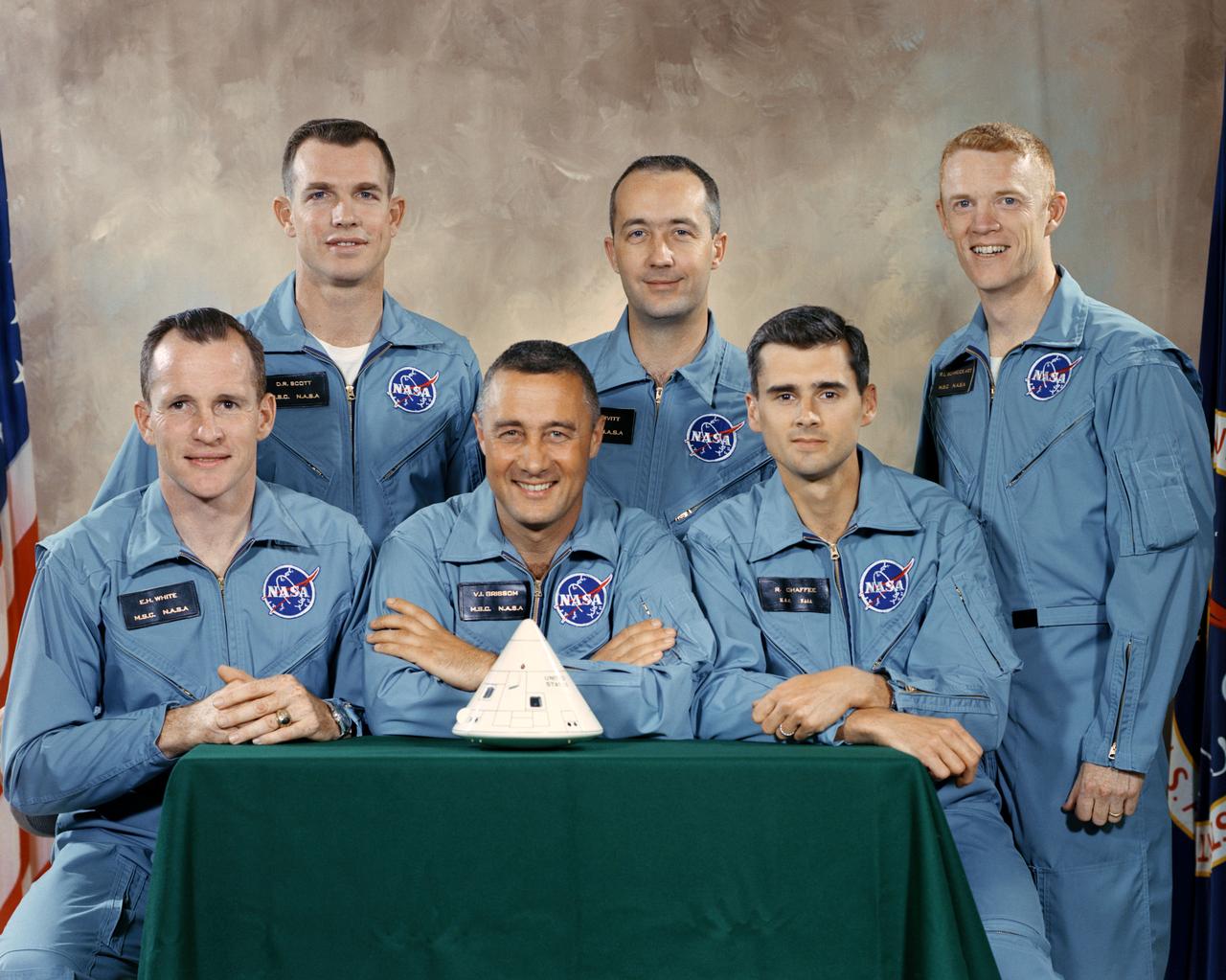
S66-30238 (1 April 1966) --- The National Aeronautics and Space Administration (NASA) has named these astronauts as the prime crew of the first manned Apollo Space Flight. Left to right, are Edward H. White II, command module pilot; Virgil I. Grissom, mission commander; and Roger B. Chaffee, lunar module pilot. On the second row are the Apollo 1 backup crew members, astronauts David R. Scott, James A. McDivitt and Russell L. Schweickart. EDITOR'S NOTE: Astronauts Grissom, White and Chaffee lost their lives in a Jan. 27, 1967 fire in the Apollo CM during testing at Cape Canaveral. McDivitt, Scott and Schweickart later served as crewmembers for the Apollo 9 Earth-orbital mission, which was one of the important stair-step missions leading up to the Apollo 11 manned lunar landing mission of July 1969.
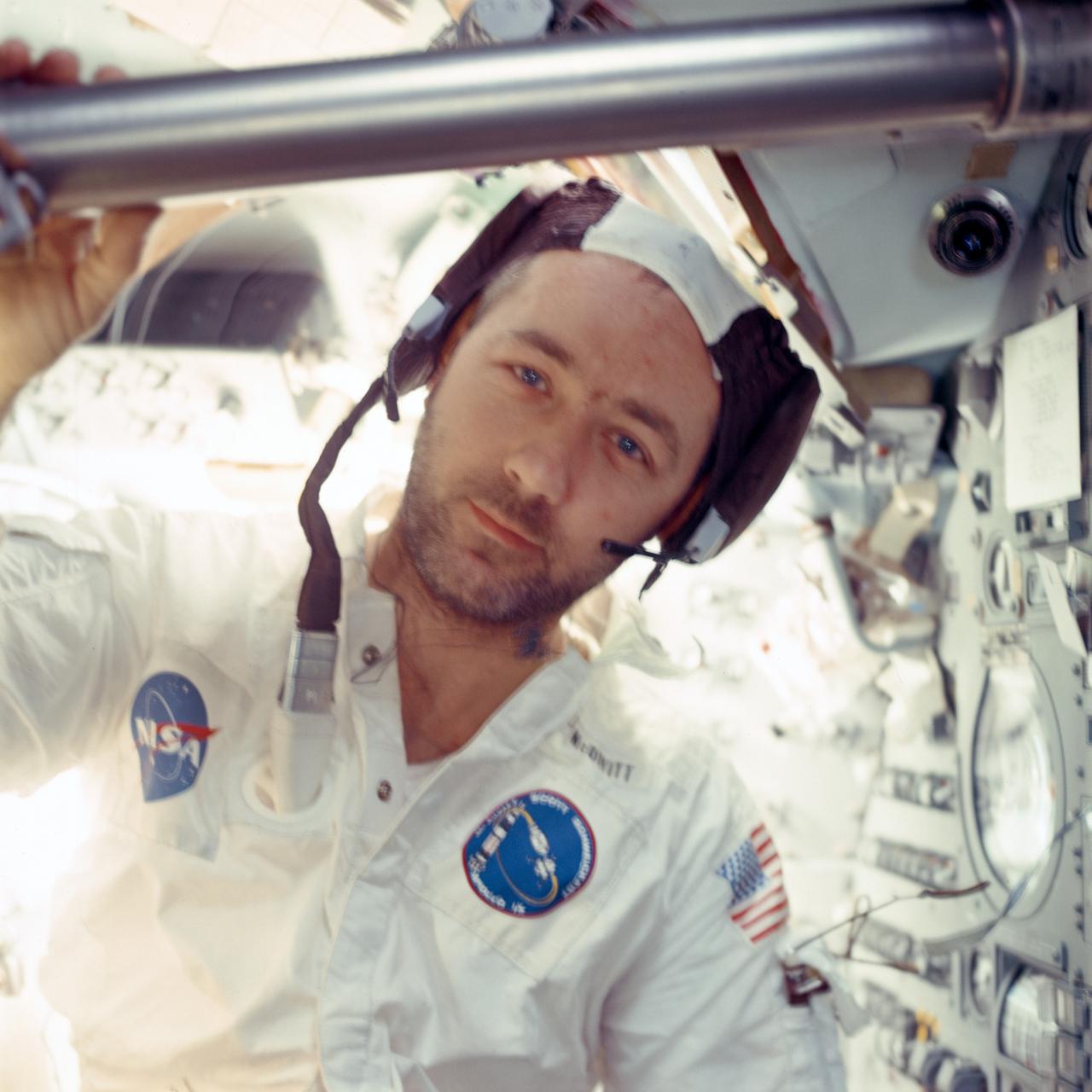
AS09-20-3154 (3-13 March 1969) --- This close-up view of astronaut James A. McDivitt shows several days' beard growth. The Apollo 9 mission commander was onboard the Lunar Module (LM) "Spider" in Earth orbit, near the end of the flight. He was joined on the mission by astronauts David R. Scott, command module pilot, and Russell L. Schweickart, lunar module pilot. Schweickart took this picture while Scott remained in the Command Module (CM) "Gumdrop." In Earth orbit, the three tested the transposition and docking systems of the lunar module and command module. On a scheduled lunar landing mission later this year, a team of three astronauts and ground controllers will use what this crew and its support staff have learned in handling the systems of the two spacecraft.
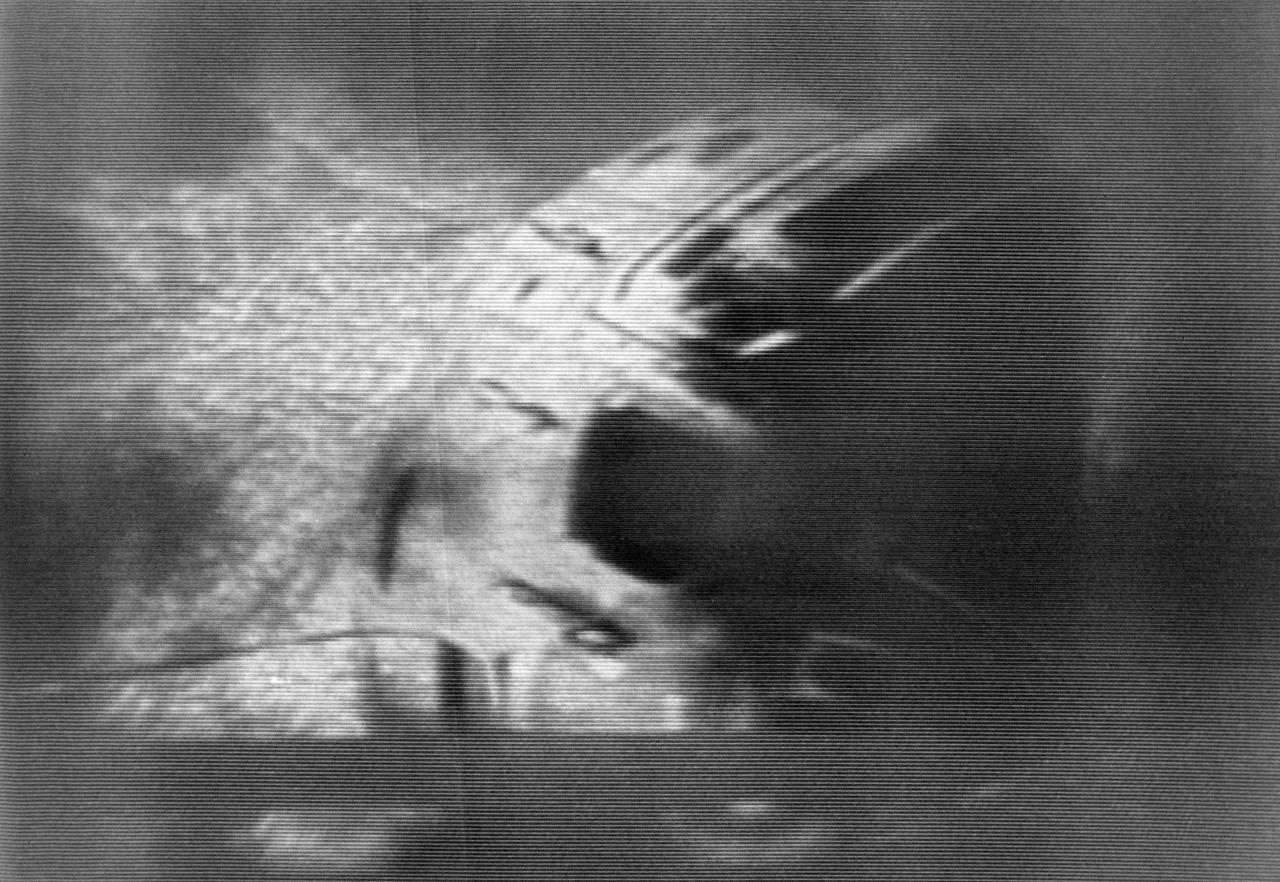
S69-26150 (6 March 1969) --- Television watchers on Earth saw this view of the Apollo 9 Command Module during the second live telecast from Apollo 9 early Thursday afternoon on the fourth day in space. This view is looking through the docking window of the Lunar Module. The cloud-covered Earth can be seen in the background. Inside the Lunar Module "Spider" were Astronauts James A. McDivitt, Apollo 9 commander; and Russell L. Schweickart, lunar module pilot. At this moment Apollo 9 was orbiting Earth with the Command and Service Modules docked nose-to-nose with the Lunar Module. Astronaut David R. Scott, command module pilot, remained at the controls in the Command Module "Gumdrop" while the other two astronauts checked out the Lunar Module. McDivitt and Schweickart moved into the Lunar Module from the Command Module by way of the docking tunnel.

S69-26149 (6 March 1969) --- Astronaut James A. McDivitt, Apollo 9 commander, is seen inside the Lunar Module "Spider" drinking from a hand water dispenser in this photograph from the second live television transmission from Apollo 9. Astronaut Russell L. Schweickart, lunar module pilot, is in the left background. The telecast was made early Thursday afternoon on the fourth day in space. At this moment Apollo 9 was orbiting Earth with the Command and Service Modules docked nose-to-nose with the Lunar Module. Astronaut David R. Scott, command module pilot, remained at the controls in the Command Module "Gumdrop" while the other two astronauts checked out the Lunar Module. McDivitt and Schweickart moved into the Lunar Module from the Command Module by way of the docking tunnel.
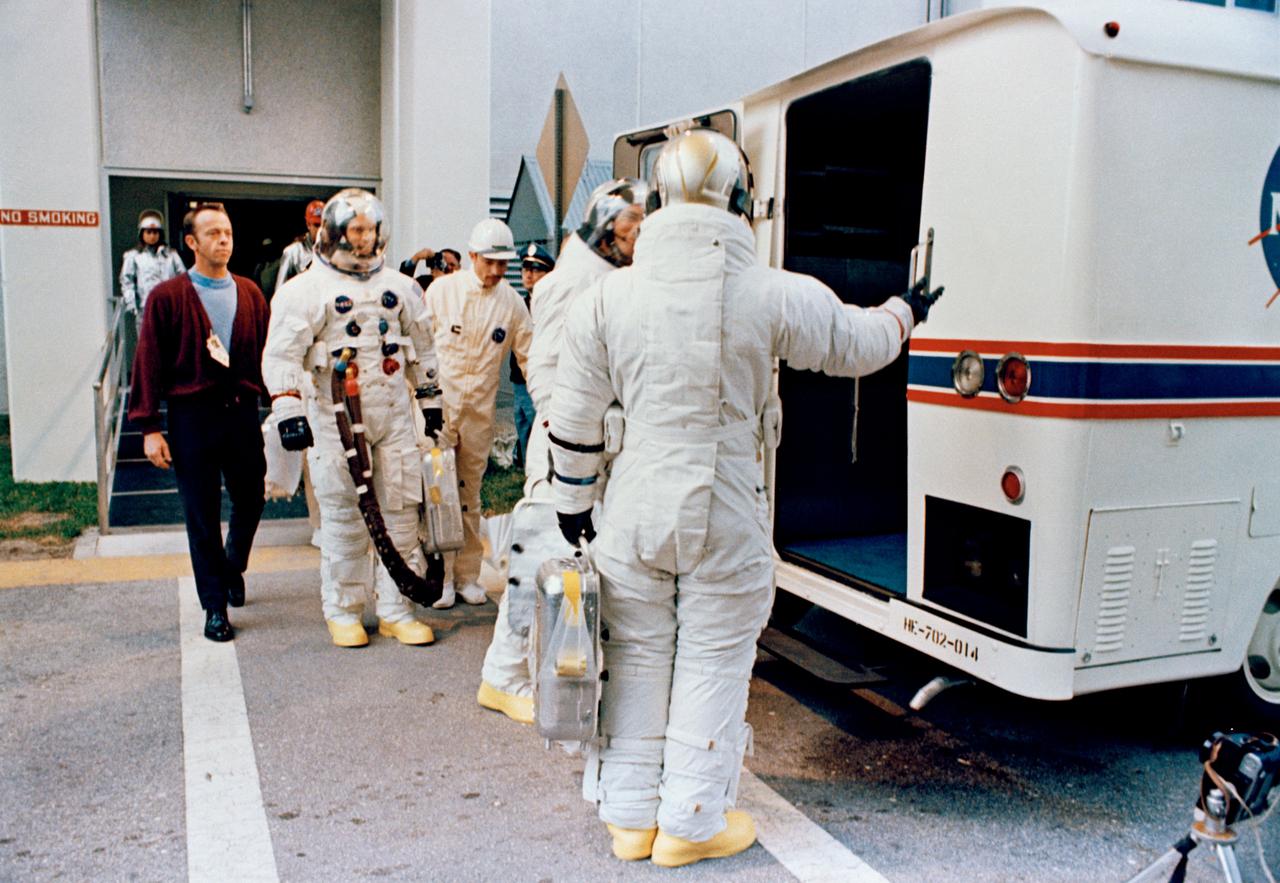
S69-25881 (3 March 1969) --- The Apollo 9 crew leaves the Kennedy Space Center's Manned Spacecraft Operations Building during the Apollo 9 prelaunch countdown. The crewman entered the special transfer van which transported them to their waiting spacecraft at Pad A, Launch Complex 39. Astronaut James A. McDivitt (back to camera) is the commander. McDivitt appears to be inviting astronaut David R. Scott, command module pilot, to step first into van. In background is astronaut Russell L. Schweickart, lunar module pilot. Walking along almost behind Schweickart is astronaut Alan B. Shepard Jr., chief, Astronaut Office, Manned Spacecraft Center. Apollo 9 was launched at 11 a.m. (EST), March 3, 1969, on a 10-day Earth-orbital mission.
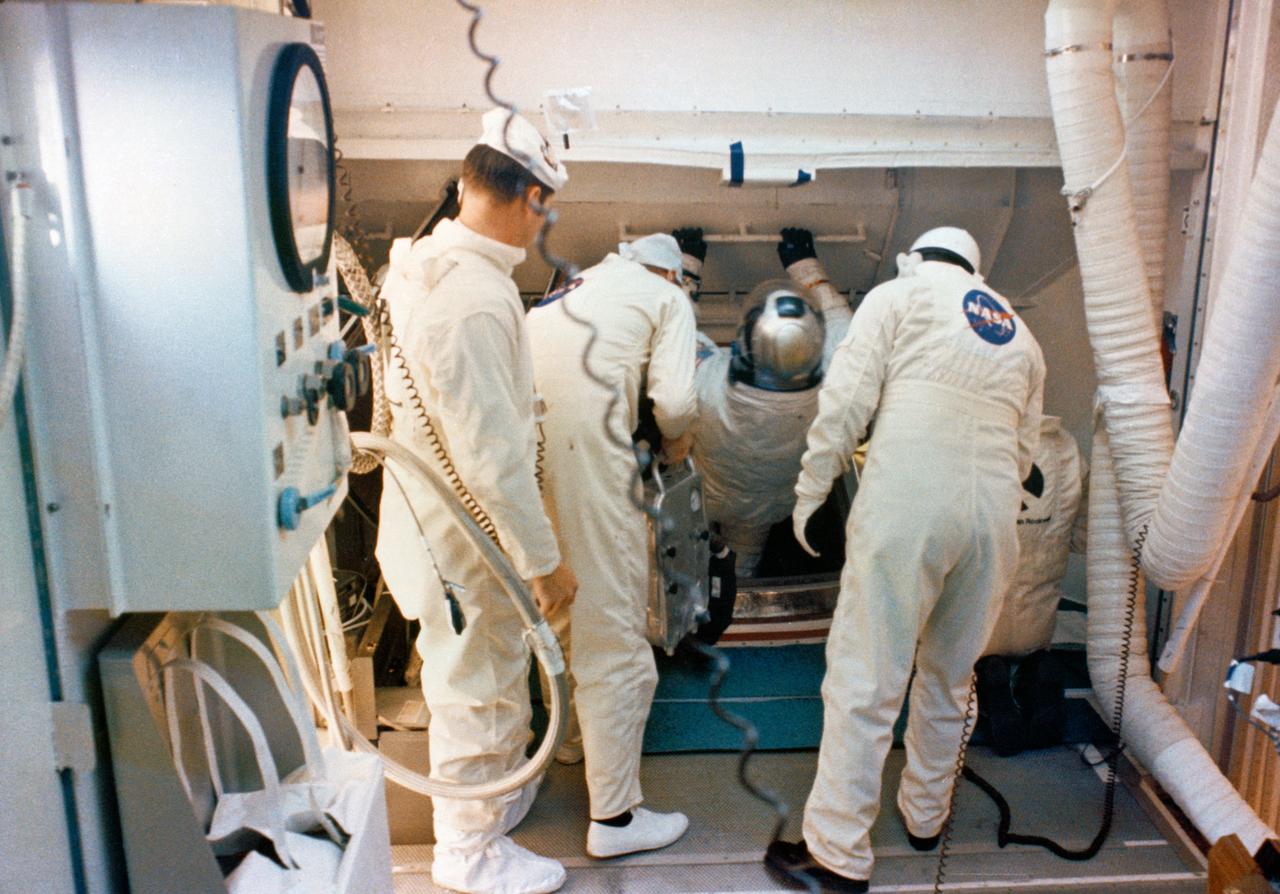
S69-25488 (23 Feb. 1969) --- Interior view of the White Room at Pad A, Launch Complex 39, Kennedy Space Center (KSC), during an Apollo 9 Countdown Demonstration Test (CDDT). Astronauts James A. McDivitt, commander; David R. Scott, command module pilot; and Russell L. Schweickart, lunar module pilot, were participating in a dress rehearsal in preparation for their scheduled 10-day Earth-orbital space mission.
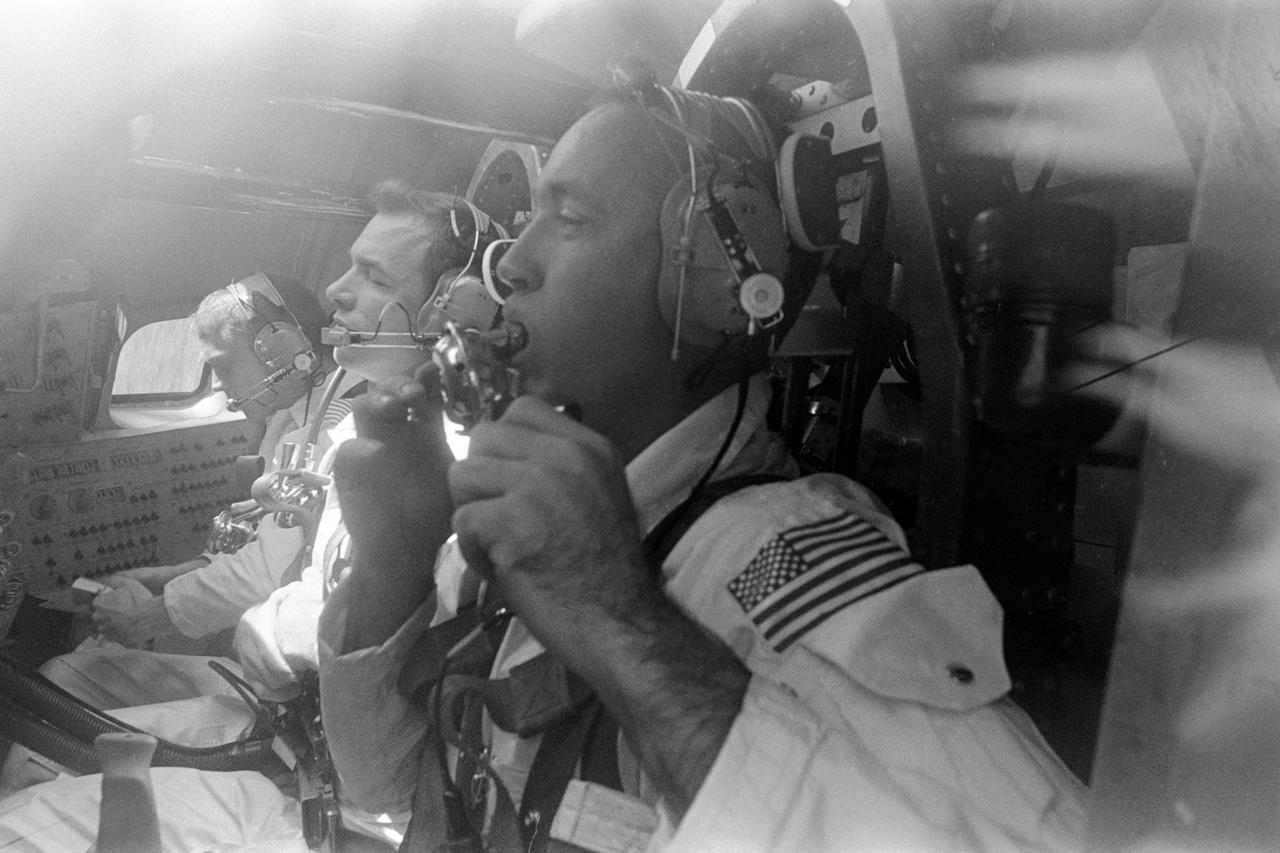
S68-54850 (5 Nov. 1968) --- The prime crew of the Apollo 9 (Spacecraft 104/Lunar Module 3/Saturn 504) space mission are seen inside an Apollo command module boilerplate during water egress training activity in the Gulf of Mexico. From foreground, are astronauts James A. McDivitt, commander; David R. Scott, command module pilot; and Russell L. Schweickart, lunar module pilot.
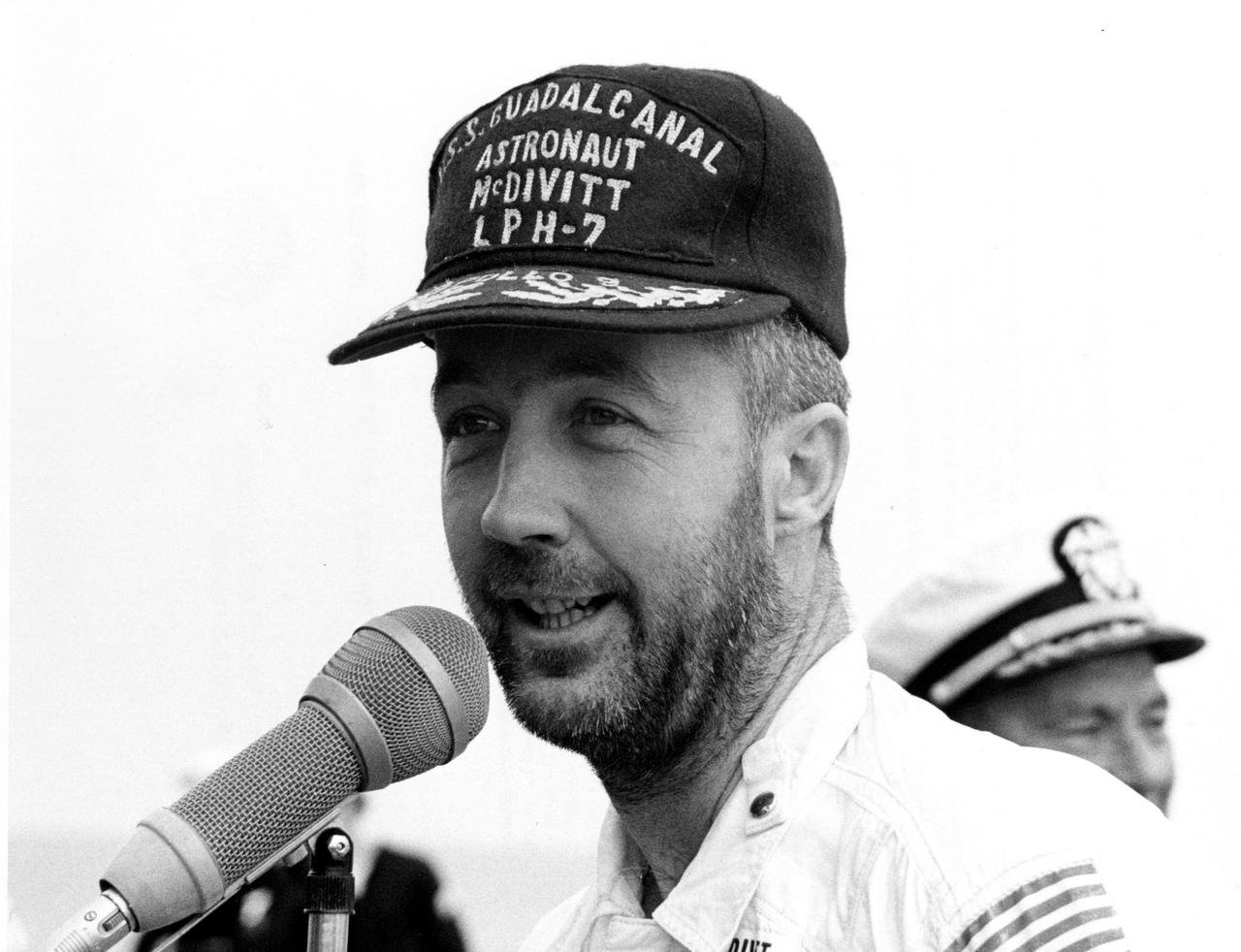
ABOARD THE USS GUADALCANAL -- Bearded Apollo 9 commander James A. McDivitt speaks to personnel aboard the USS Guadalcanal, prime recovery ship, an hour after he and astronauts David R. Scott and Russell L. Schweickart splashed down today in the Atlantic Ocean, 780 nautical miles southeast of Cape Kennedy. Their 10-day Earth orbital flight verified a lunar landing later this year. The National Aeronautics and Space Administration directs the Apollo program.
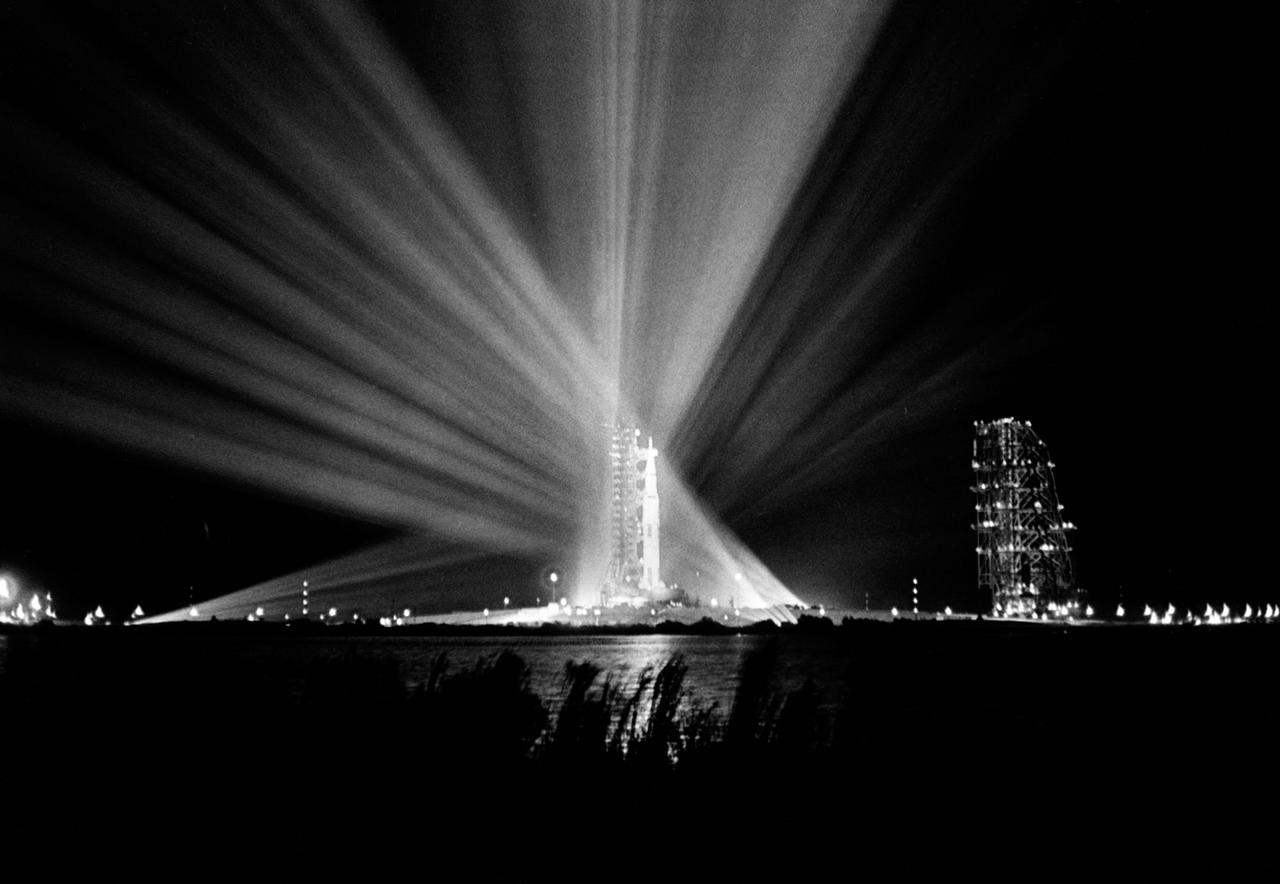
S69-25879 (23 Feb. 1969) --- Nighttime view of the 363-feet-high Apollo 9 space vehicle at Pad A, Launch Complex 39, Kennedy Space Center, during preparations for the scheduled 10-day Earth-orbital space mission. The crew of the Apollo 9 (Spacecraft 104/Lunar Module 3/Saturn 504) space flight will be astronauts James A. McDivitt, David R. Scott, and Russell L. Schweickart.
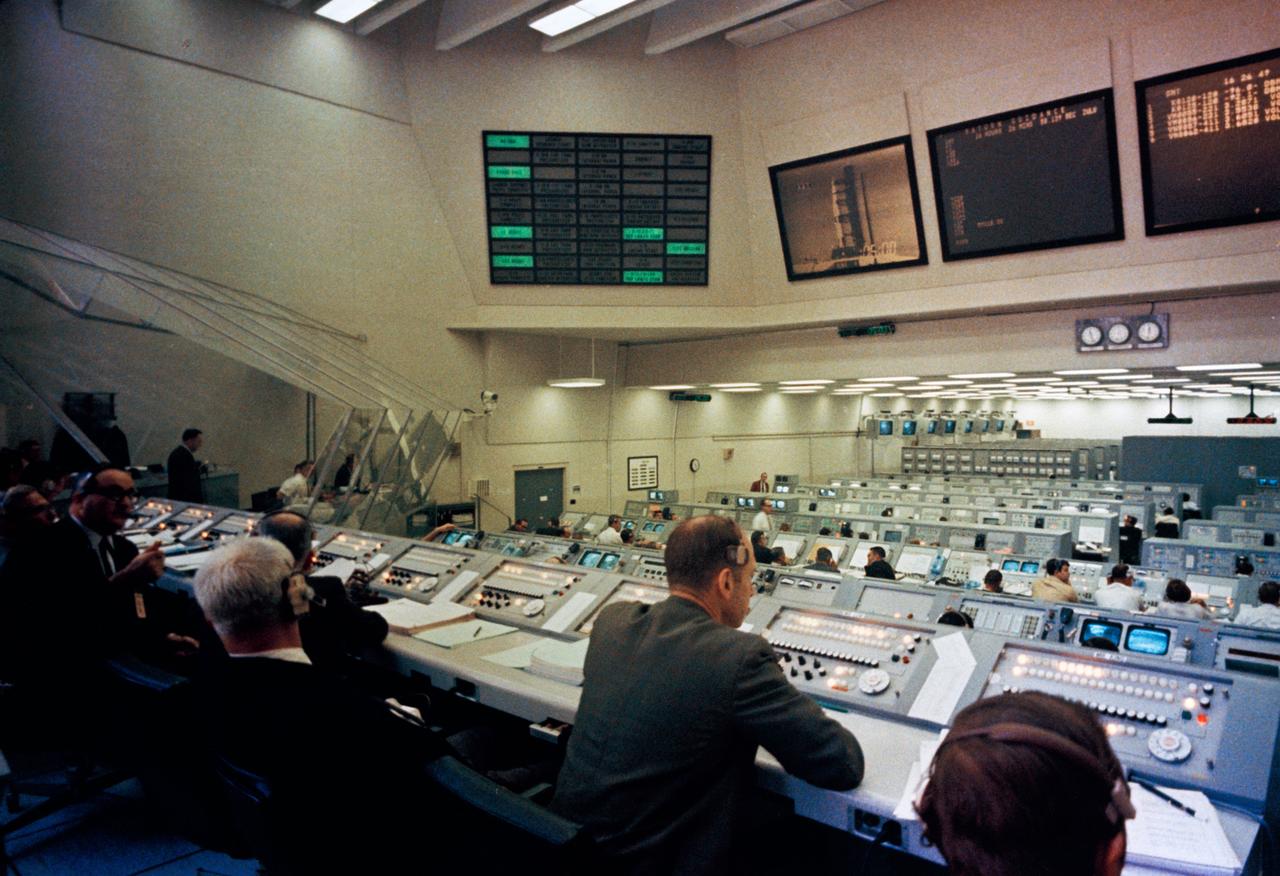
S69-25880 (23 Feb. 1969) --- Overall view of Firing Room 2 in the Launch Control Center, Launch Complex 39, Kennedy Space Center, during an Apollo 9 Countdown Demonstration Test. Astronauts James A. McDivitt, David R. Scott, and Russell L. Schweickart were participating in a training exercise in preparation for their scheduled 10-day Earth-orbital space mission.
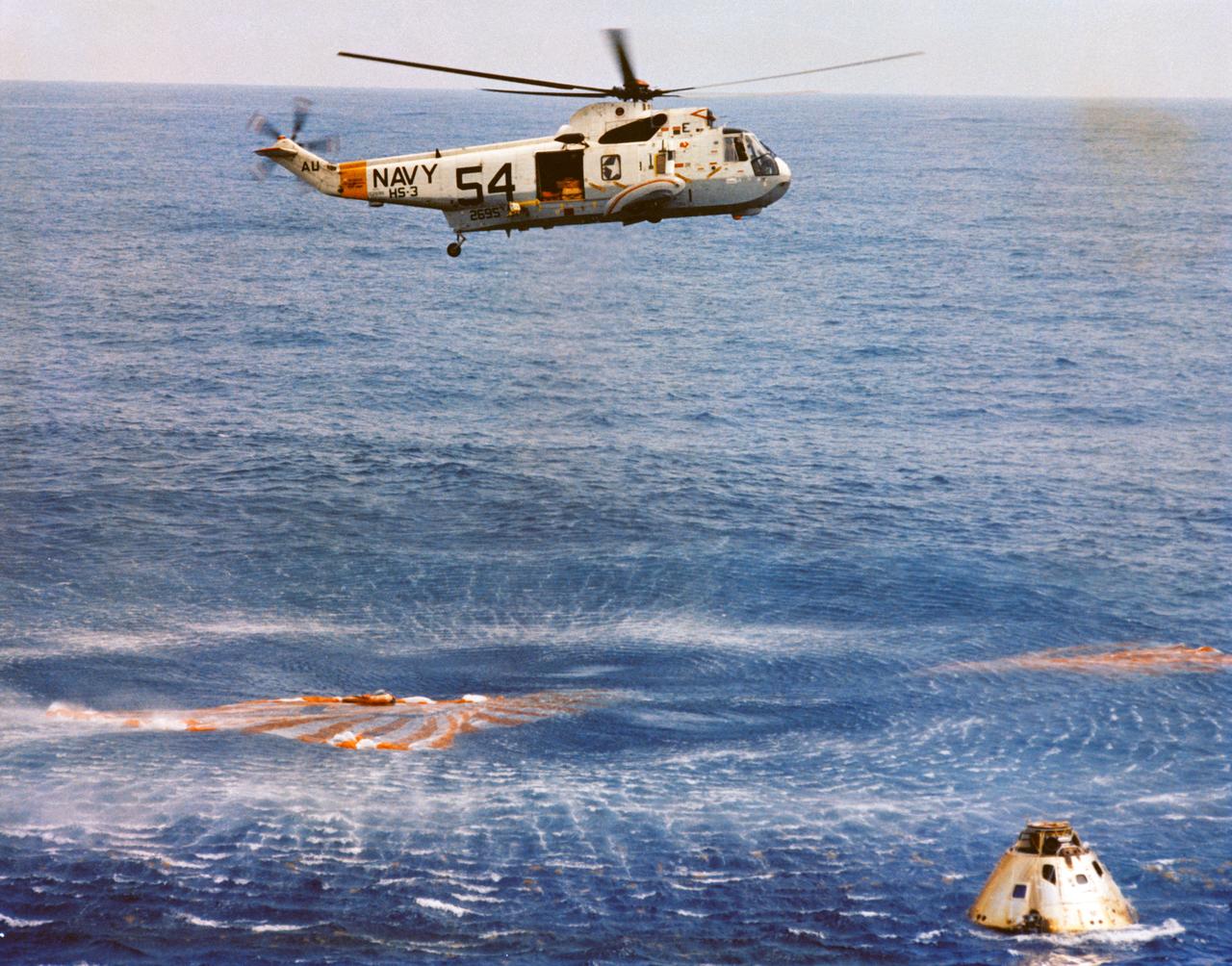
S69-27919 (13 March 1969) --- Immediately after splashdown a recovery helicopter from the USS Guadalcanal hovers over the Apollo 9 spacecraft. Still inside the Command Module (CM) are astronauts James A. McDivitt, David R. Scott, and Russell L. Schweickart. Splashdown occurred at 12:00:53 p.m. (EST), March 13, 1969, only 4.5 nautical miles from the USS Guadalcanal, the prime recovery ship, to conclude a successful 10-day Earth-orbital mission in space.
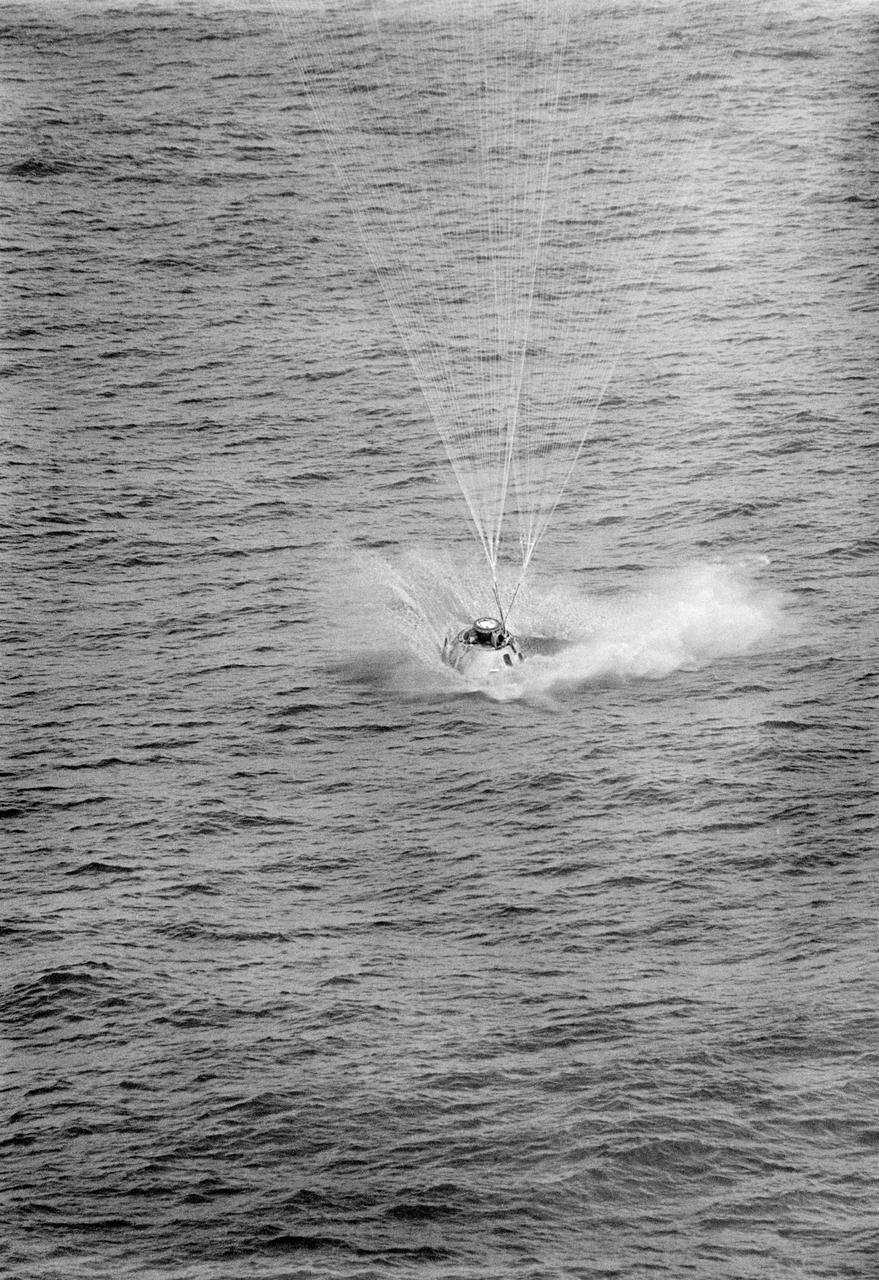
S69-27466 (13 March 1969) --- The Apollo 9 spacecraft, with astronauts James A. McDivitt, David R. Scott, and Russell L. Schweickart aboard, touches down in the Atlantic recovery area to conclude a successful 10-day Earth-orbital space mission. Splashdown occurred at 12:00:53 p.m. (EST), March 13, 1969, only 4.5 nautical miles from the prime recovery ship, USS Guadalcanal.

S69-20364 (13 March 1969) --- The Apollo 9 spacecraft, with astronauts James A. McDivitt, David R. Scott, and Russell L. Schweickart aboard, approaches touchdown in the Atlantic recovery area to conclude a successful 10-day Earth-orbital space mission. Splashdown occurred at 12:00:53 p.m. (EST), March 13, 1969, only 4.5 nautical miles from the prime recovery ship, USS Guadalcanal.
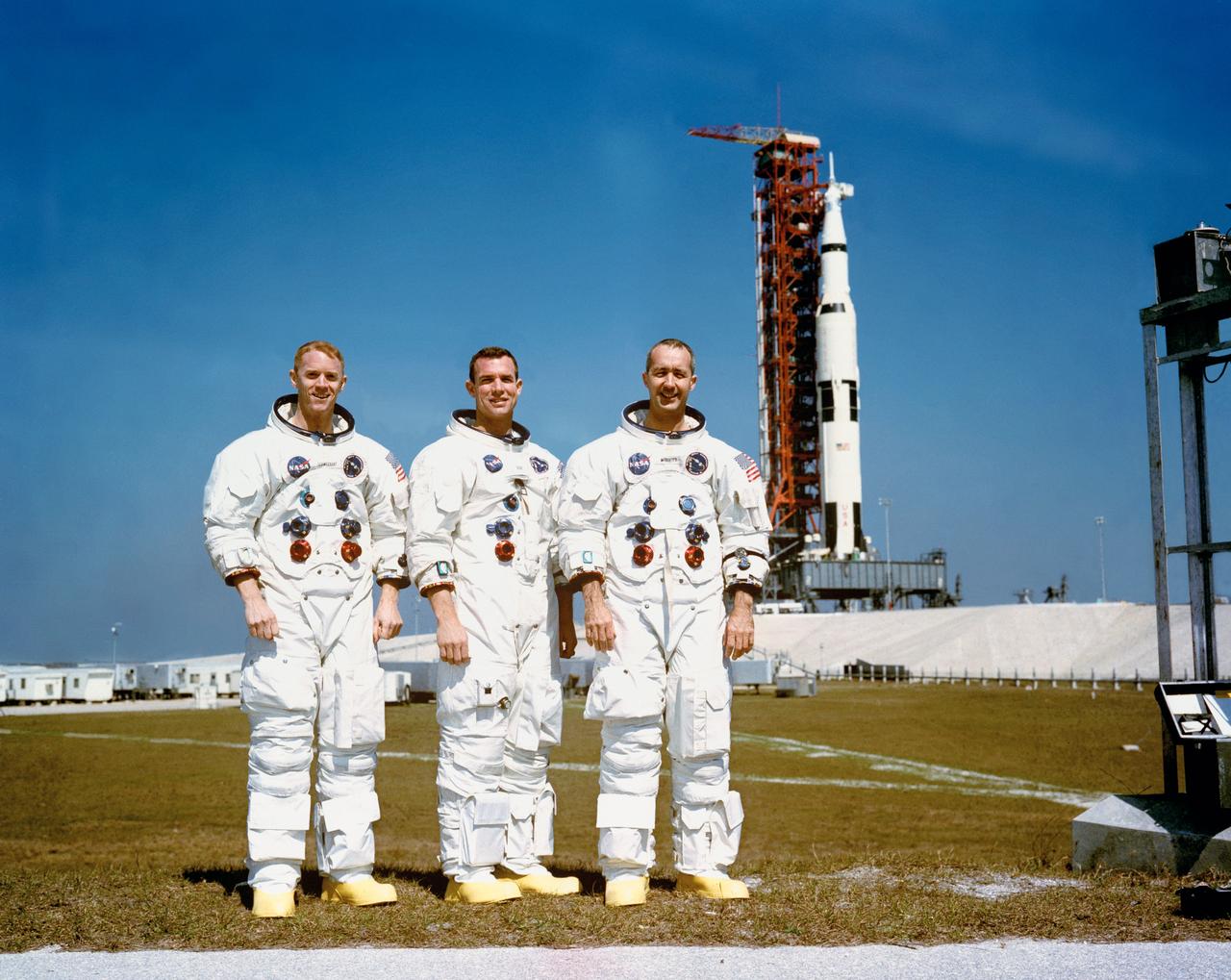
S69-25478 (23 Feb. 1969) --- These three astronauts are the prime crew of the Apollo 9 Earth-orbital space mission. Left to right, are Russell L. Schweickart, lunar module pilot; David R. Scott, command module pilot; and James A. McDivitt, commander. In the right background is the Apollo 9 space vehicle on Pad A, Launch Complex 39, Kennedy Space Center (KSC). They are pausing momentarily during training for their scheduled 10-day mission.
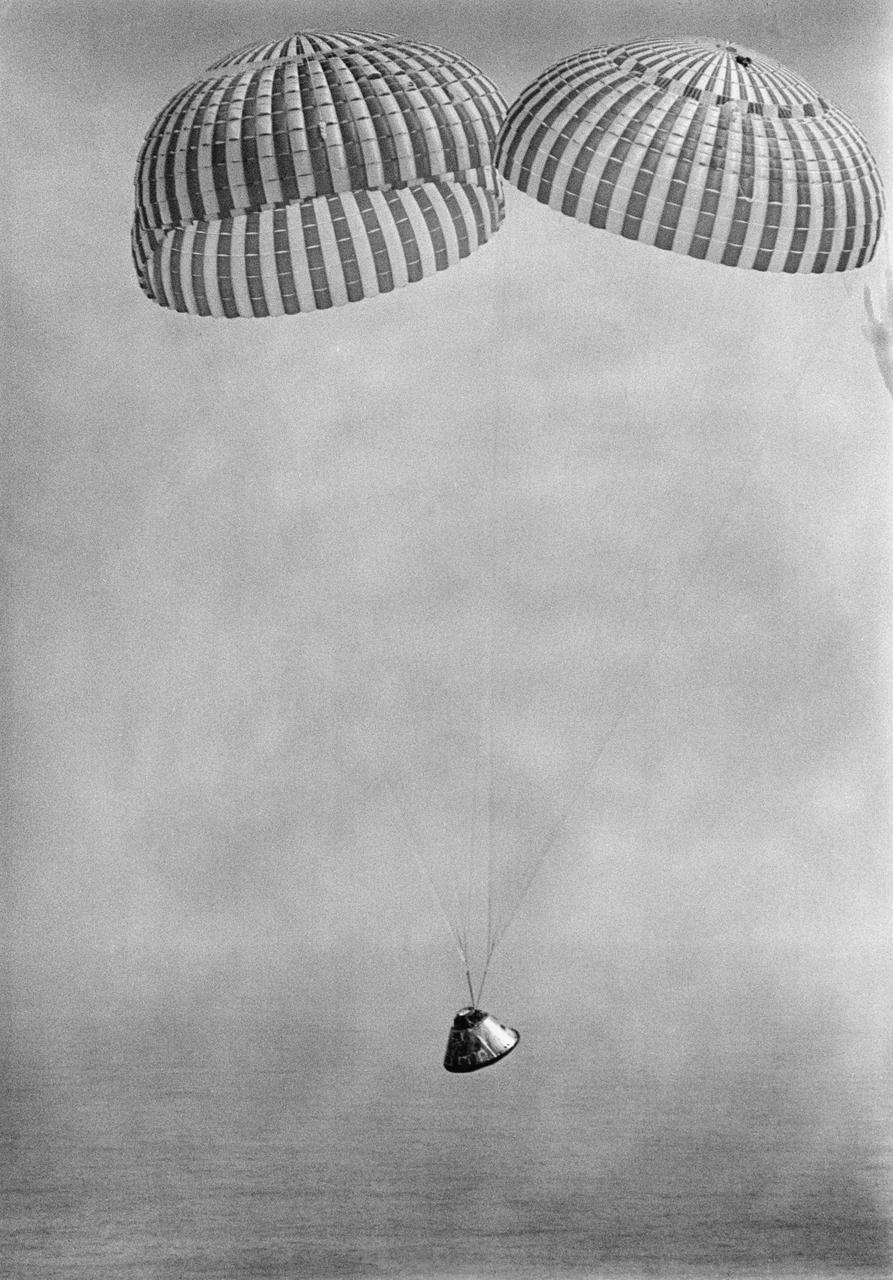
S69-27467 (13 March 1969) --- The Apollo 9 spacecraft, with astronauts James A. McDivitt, David R. Scott, and Russell L. Schweickart aboard, approaches touchdown in the Atlantic recovery area. Splashdown occurred at 12:00:53 p.m. (EST), March 13, 1969, only 4.5 nautical miles from the prime recovery ship, USS Guadalcanal. Photo credit: NASA
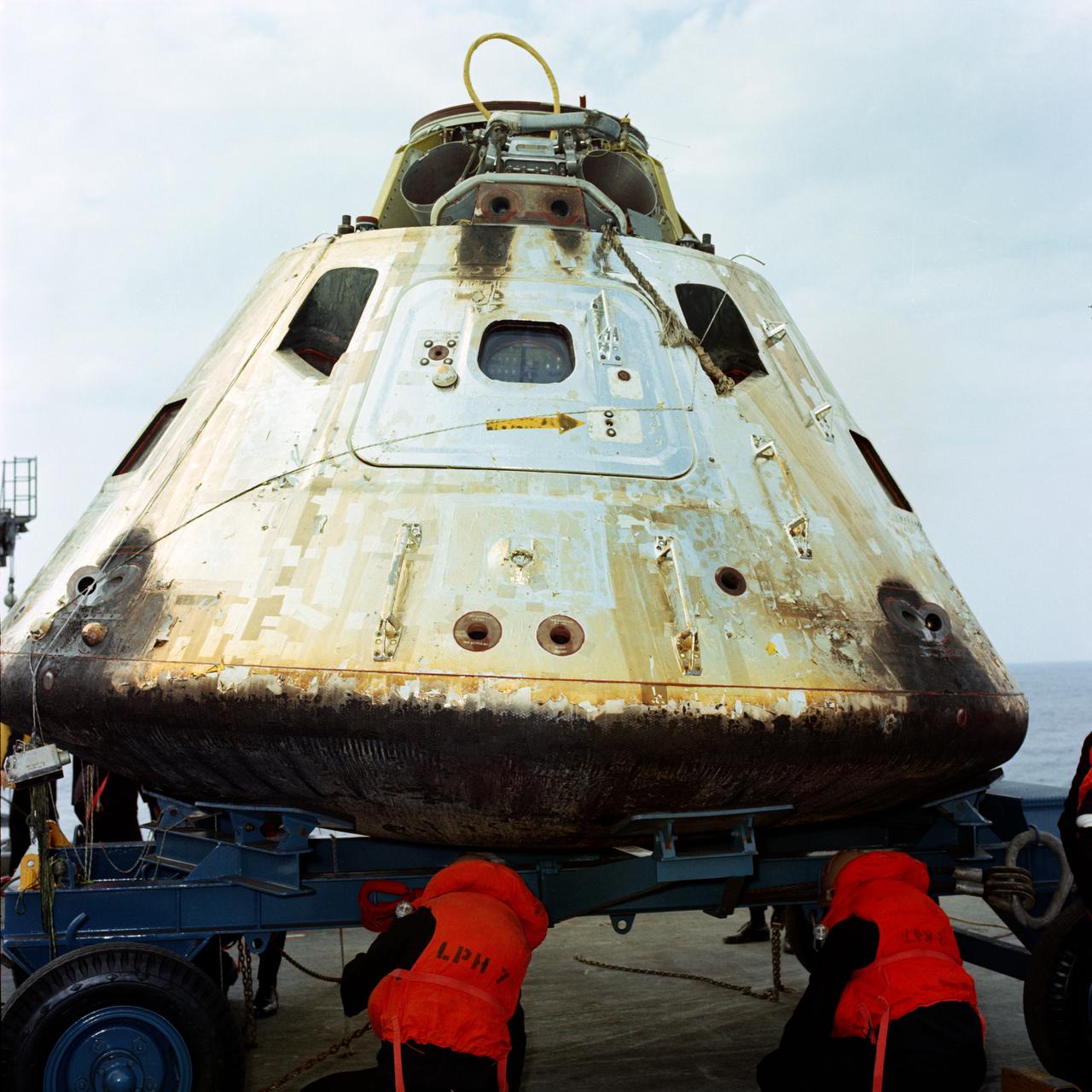
S69-20239 (13 March 1969) --- Close-up view of the Apollo 9 Command Module (CM) as it sets on dolly on the deck of the USS Guadalcanal just after being hoisted from the water. The Apollo 9 spacecraft, with astronauts James A. McDivitt, David R. Scott, and Russell L. Schweickart aboard, splashed down at 12:00:53 p.m. (EST), March 13, 1969, only 4.5 nautical miles from the aircraft carrier to conclude a successful 10-day Earth-orbital mission in space.
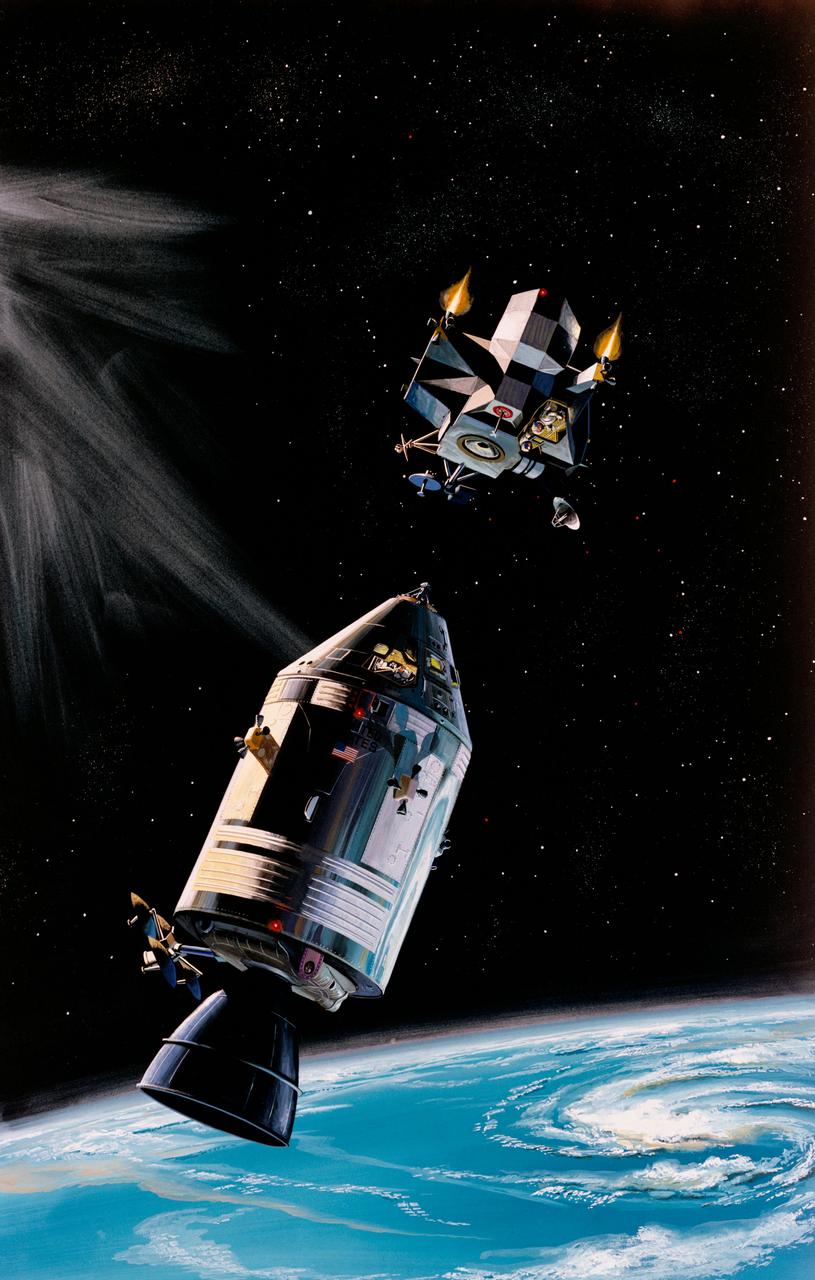
S69-18546 (February 1969) --- North American Rockwell artist's concept illustrating the docking of the Lunar Module ascent stage with the Command and Service Modules during the Apollo 9 mission. The two figures in the Lunar Module represent astronauts James A. McDivitt, Apollo 9 commander; and Russell L. Schweickart, lunar module pilot. The figure in the Command Module represents astronaut David R. Scott, command module pilot. The Apollo 9 mission will evaluate spacecraft lunar module systems performance during manned Earth-orbital flight.
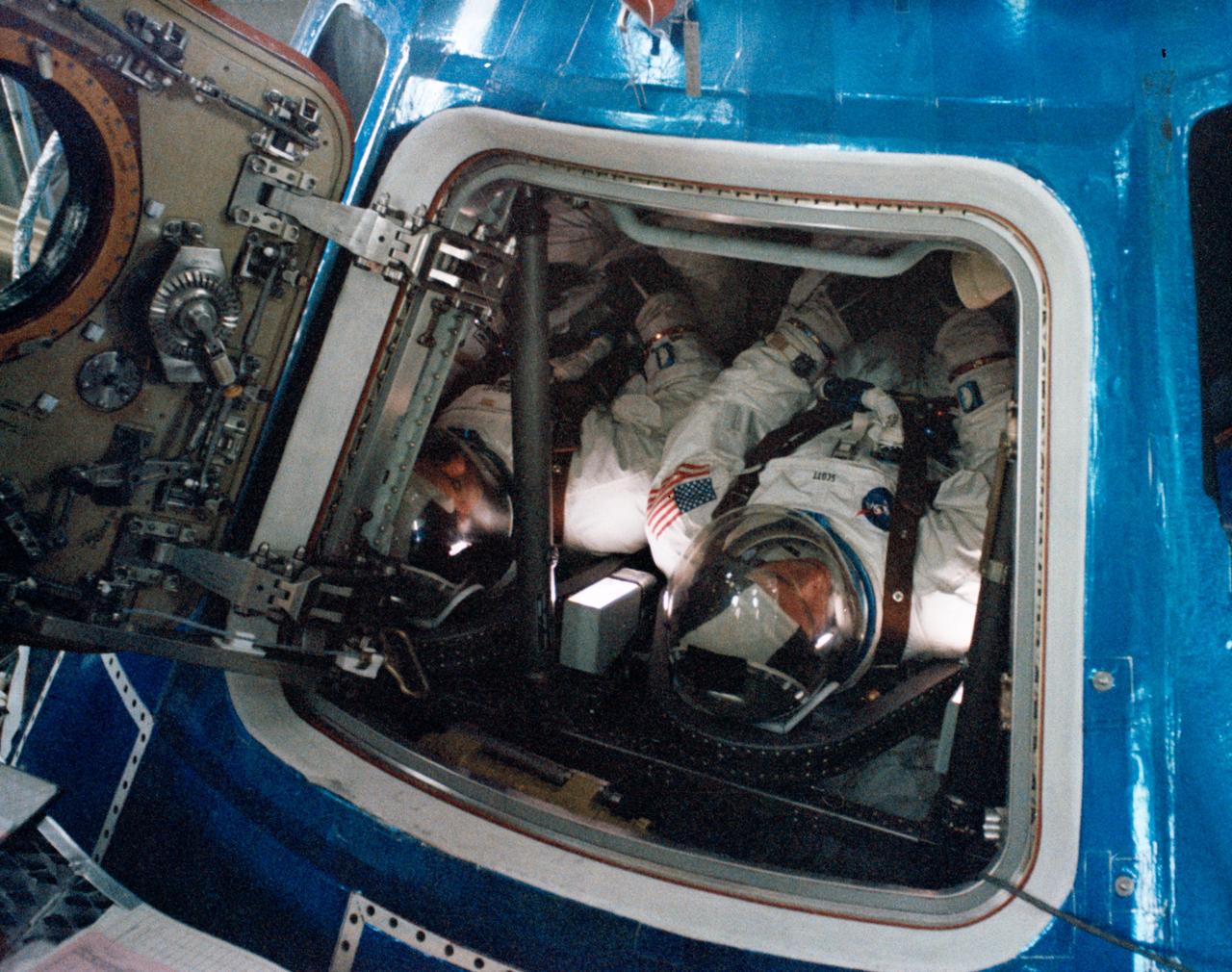
S68-55272 (15 Nov. 1968) --- The Apollo 9 prime crew is seen inside the Apollo 9 spacecraft in the Kennedy Space Center's Manned Spacecraft Operations Building during manned altitude chamber test activity. Left to right, are astronauts James A. McDivitt, commander; David R. Scott, command module pilot; and Russell L. Schweickart (out of view to far right), lunar module pilot.
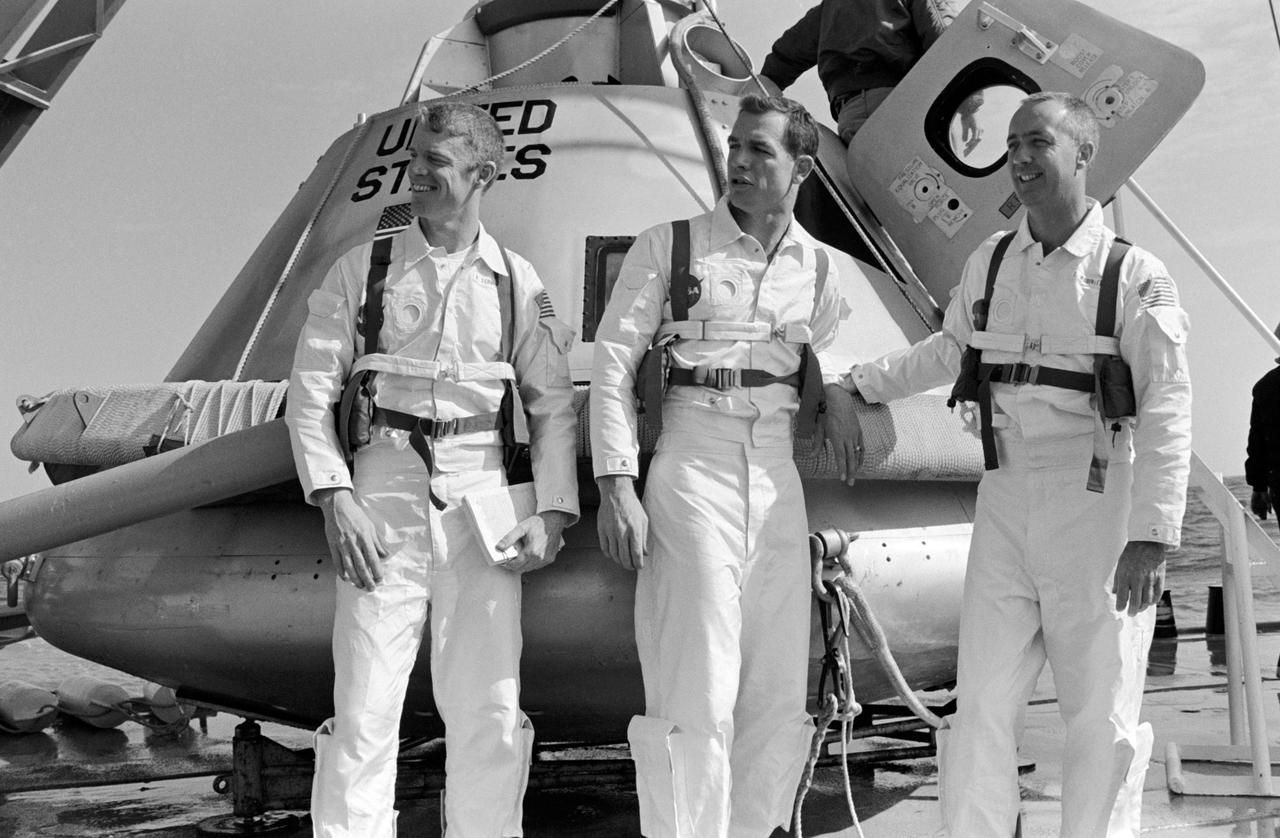
S68-54841 (5 Nov. 1968) --- The prime crew of the Apollo 9 (Spacecraft 104/Lunar Module 3/Saturn 504) space mission stands on the deck of the NASA Motor Vessel Retriever (MVR) prior to participating in water egress training in the Gulf of Mexico. Left to right, are astronauts Russell L. Schweickart, lunar module pilot; David R. Scott, command module pilot; and James A. McDivitt, commander. In background is the Apollo Command Module (CM) boilerplate which was used in the training exercise.
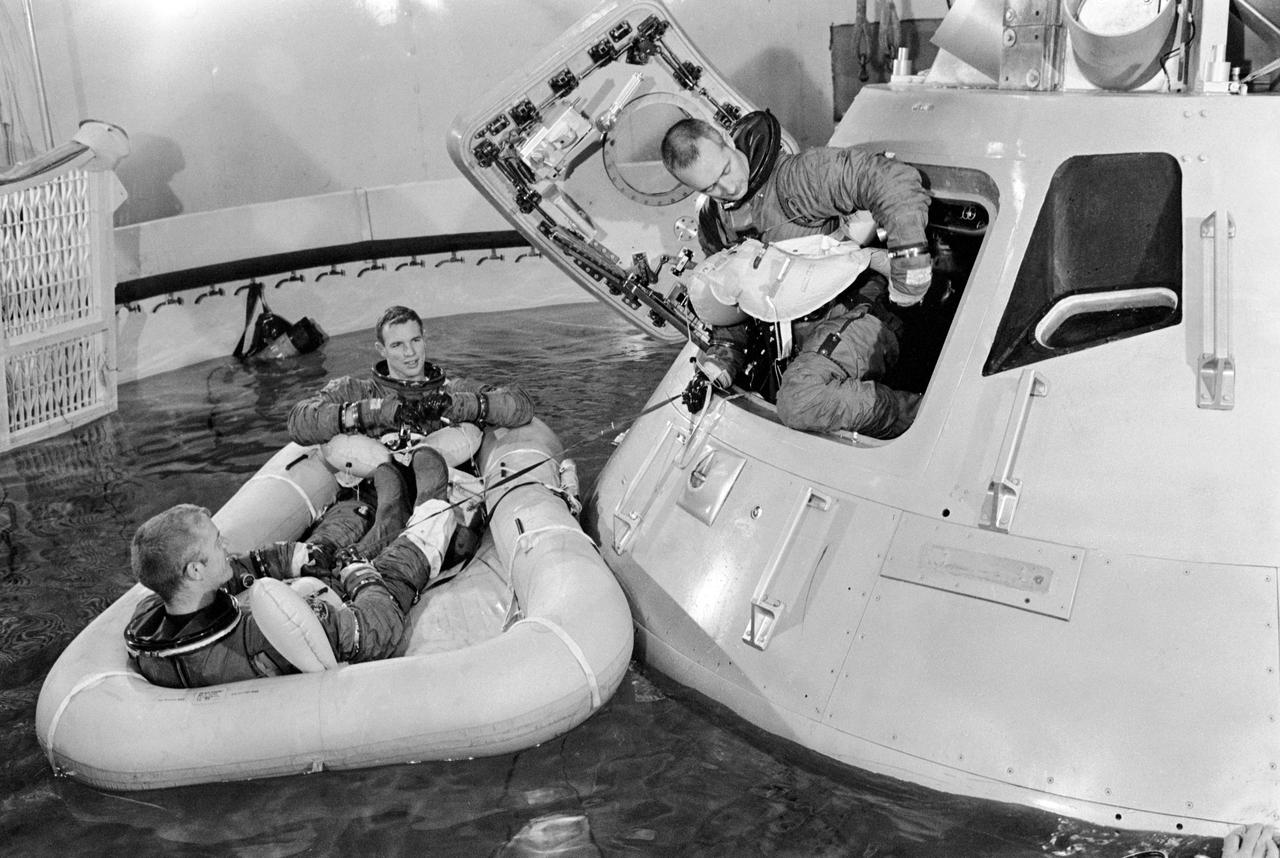
S68-54859 (November 1968) --- The prime crew of the Apollo 9 (Spacecraft 104/Lunar Module 3/Saturn 504) space mission participates in water egress training in a tank in Building 260 at the Manned Spacecraft Center. Egressing the Apollo command module boilerplate is astronaut James A. McDivitt, commander. In life raft are astronauts David R. Scott (background), command module pilot; and Russell L. Schweickart, lunar module pilot.
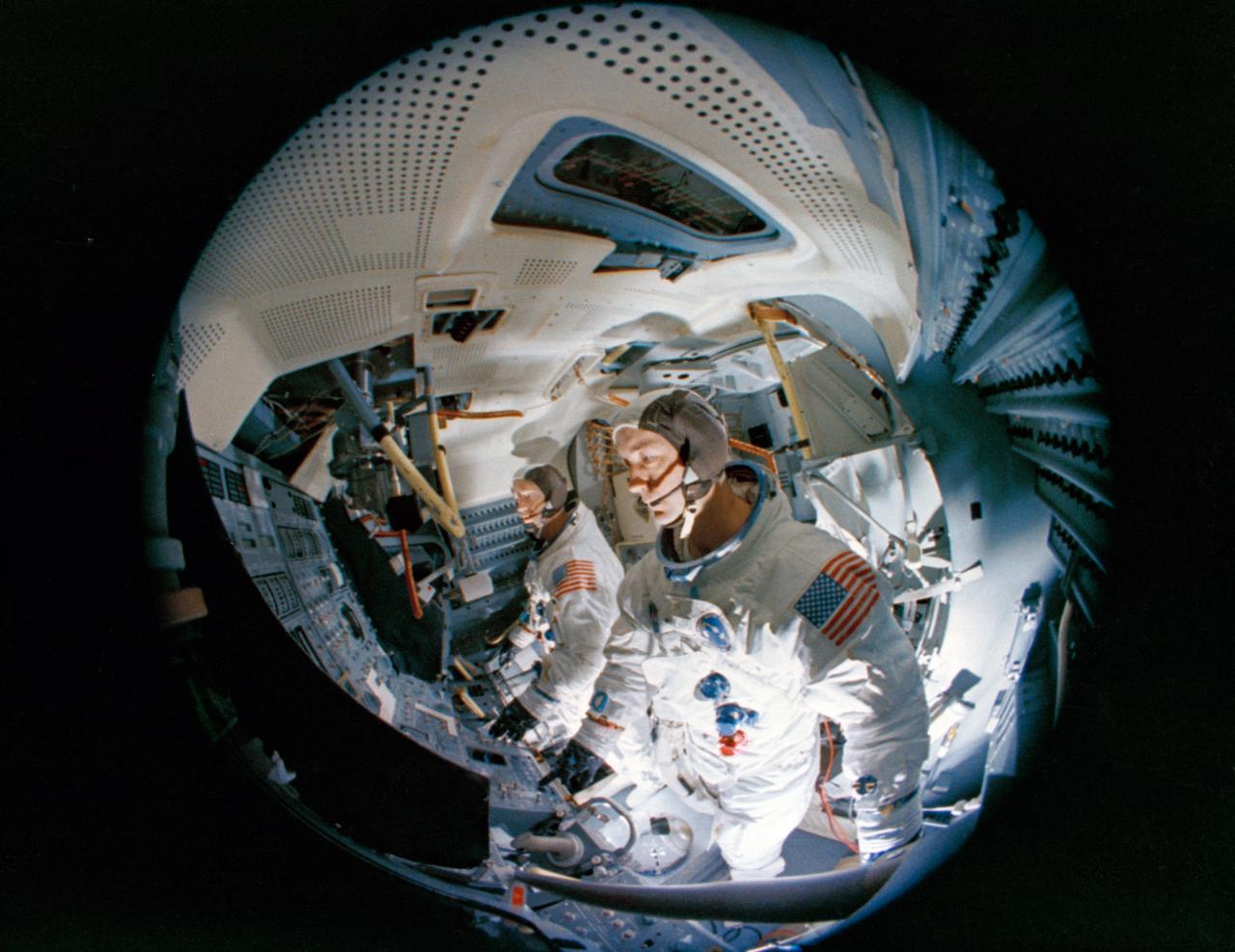
S69-19981 (23 Feb. 1969) --- Fish-eye camera lens view of the interior of the Apollo Lunar Module Mission Simulator (LMMS) at the Kennedy Space Center (KSC) during Apollo 9 simulation training. In the foreground is astronaut James A. McDivitt, prime crew commander; and in background is astronaut Russell L. Schweickart, lunar module pilot.
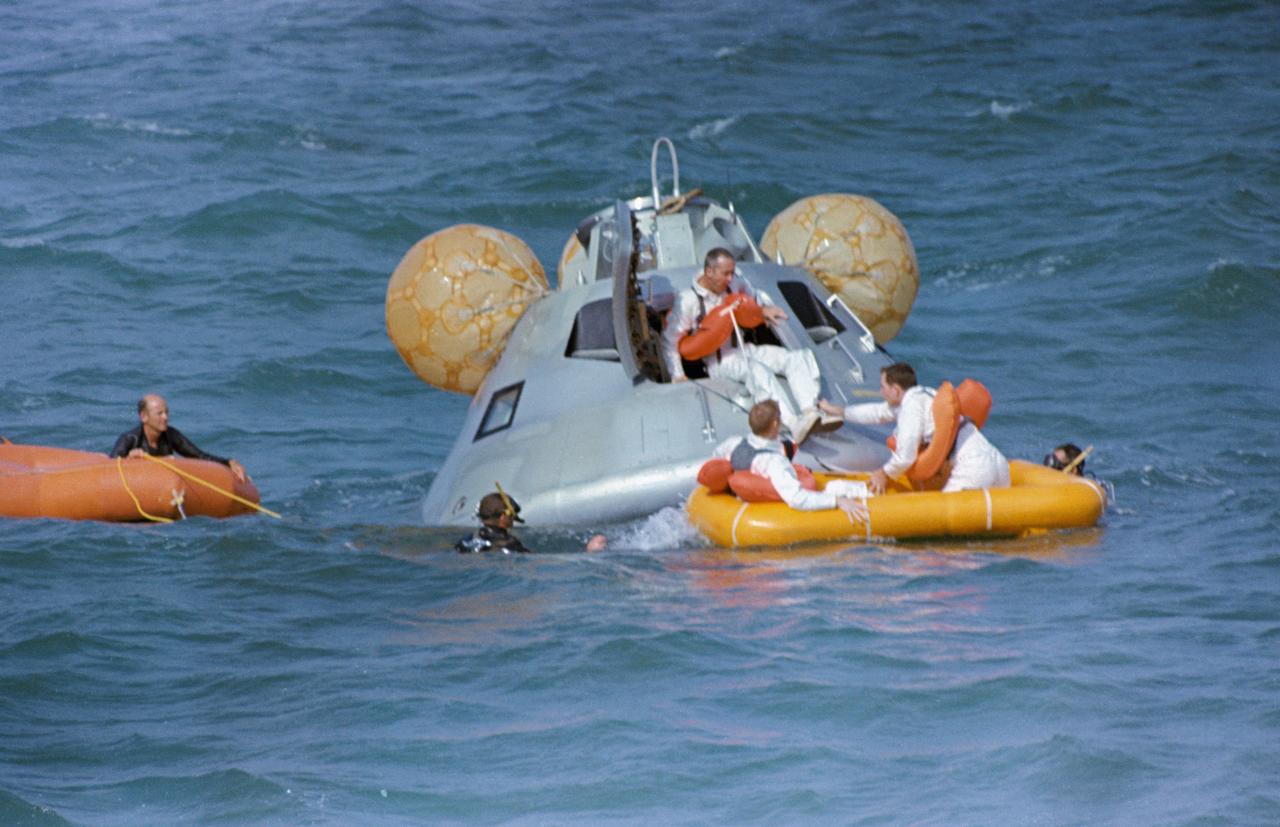
S68-50967 (20 Nov. 1968) --- The Apollo 9 prime crew participates in water egress training in the Gulf of Mexico. Apollo Command Module (CM) Boilerplate 1102 was used in the training. Egressing boilerplate is astronaut James A. McDivitt, commander. In life raft are astronauts Russell L. Schweickart (on left), lunar pilot; and David R. Scott, command pilot. A team of MSC swimmers assisted in the exercise. The inflated bags were used to upright the boilerplate prior to egress.

S68-50977 (20 Nov. 1968) --- The Apollo 9 prime crew participates in water egress training in the Gulf of Mexico. Apollo Command Module Boilerplate 1102 was used in the training. Egressing the boilerplate is astronaut David R. Scott, command module pilot. Inside the boilerplate, out of view, are astronauts James A. McDivitt, commander; and Russell L. Schweickart, lunar module pilot. A team of MSC swimmers assisted in the exercise. The inflated bags were used to upright the boilerplate prior to egress.
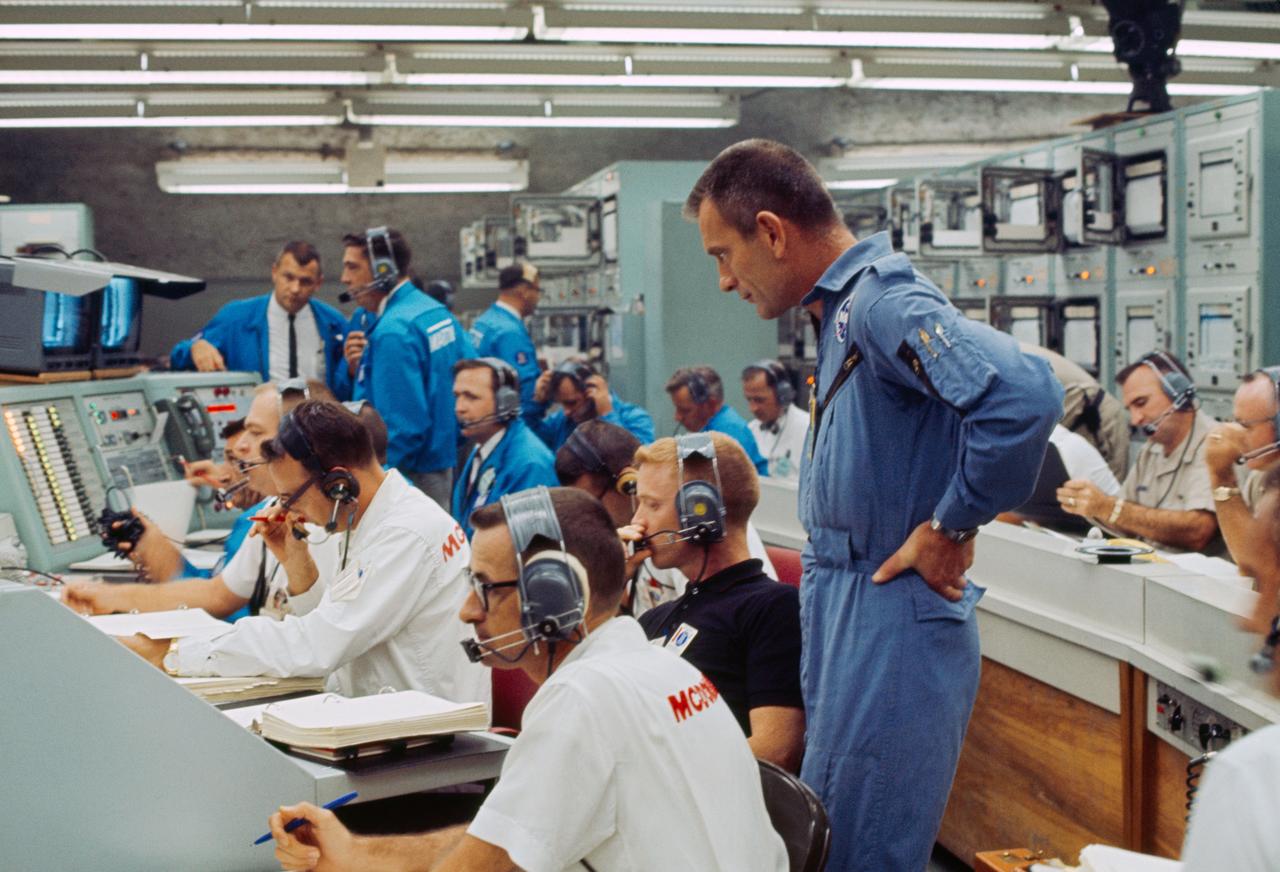
S65-28742 (21 Aug. 1965) --- View of Mission Control Center at Cape Kennedy, Florida, moments after the Gemini-5 spacecraft was launched from Pad 19 on Aug. 21, 1965. Standing at right is astronaut Donald K. Slayton, assistant director for Flight Crew Operations, Manned Spacecraft Center. Seated (wearing dark shirt) is astronaut Russell L. Schweickart. Other NASA and McDonnell Aircraft Col. personnel also monitor the progress of the flight.
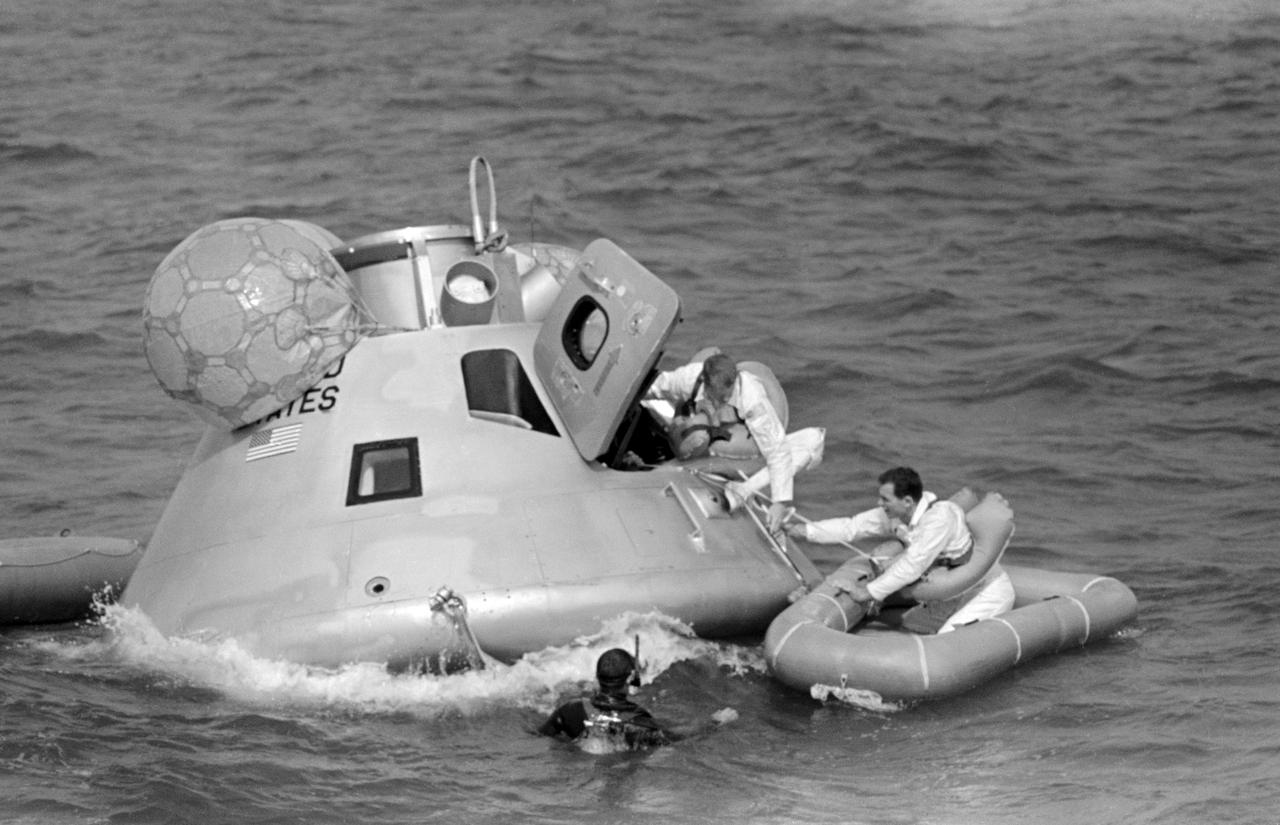
S68-50960 (20 Nov. 1968) --- The Apollo 9 prime crew participates in water egress training in the Gulf of Mexico. Apollo Command Module Boilerplate 1102 was used in the training. In life raft is astronaut David R. Scott, command module pilot. Egressing the boilerplate is astronaut Russell L. Schweickart, lunar module pilot. Still inside boilerplate, out of view, is astronaut James A. McDivitt, commander. A team of MSC swimmers assisted in the exercise. The inflated bags were used to upright the boilerplate prior to egress.
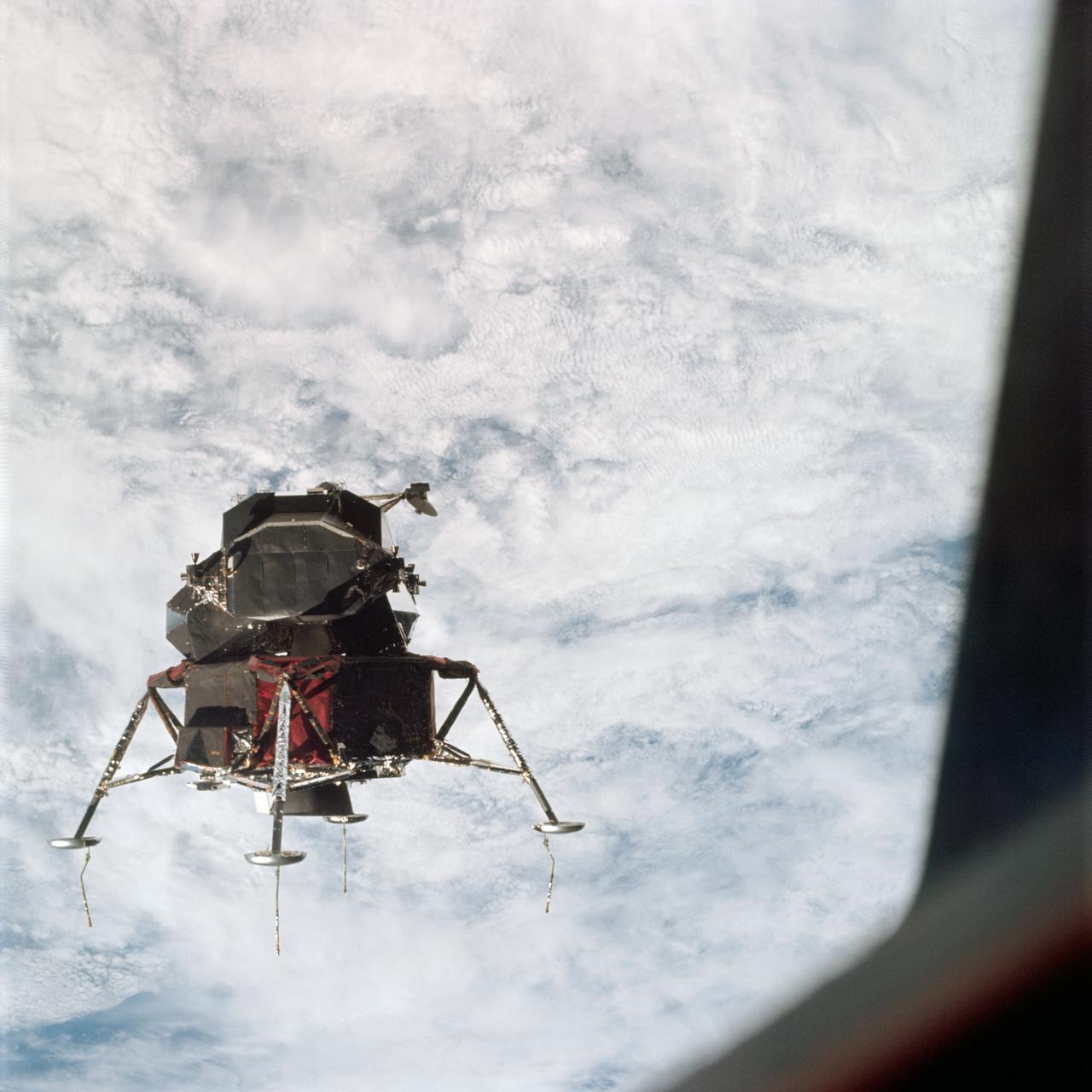
AS09-21-3197 (7 March 1969) --- A view of the Apollo 9 Lunar Module (LM) "Spider" in a lunar landing configuration, as photographed from the Command and Service Modules (CSM) on the fifth day of the Apollo 9 Earth-orbital mission. The landing gear on the "Spider" has been deployed. Lunar surface probes (sensors) extend out from the landing gear foot pads. Inside the "Spider" were astronauts James A. McDivitt, Apollo 9 commander; and Russell L. Schweickart, lunar module pilot. Astronaut David R. Scott, command module pilot, remained at the controls in the Command Module (CM), "Gumdrop," while the other two astronauts checked out the LM. Schweickart, lunar module pilot, is photographed from the CM "Gumdrop" during his extravehicular activity (EVA) on the fourth day of the Apollo 9 Earth-orbital mission. The CSM is docked with the LM. Astronaut James A. McDivitt, Apollo 9 commander, was inside the LM "Spider." Astronaut David R. Scott, command module pilot, remained at the controls in the CM.
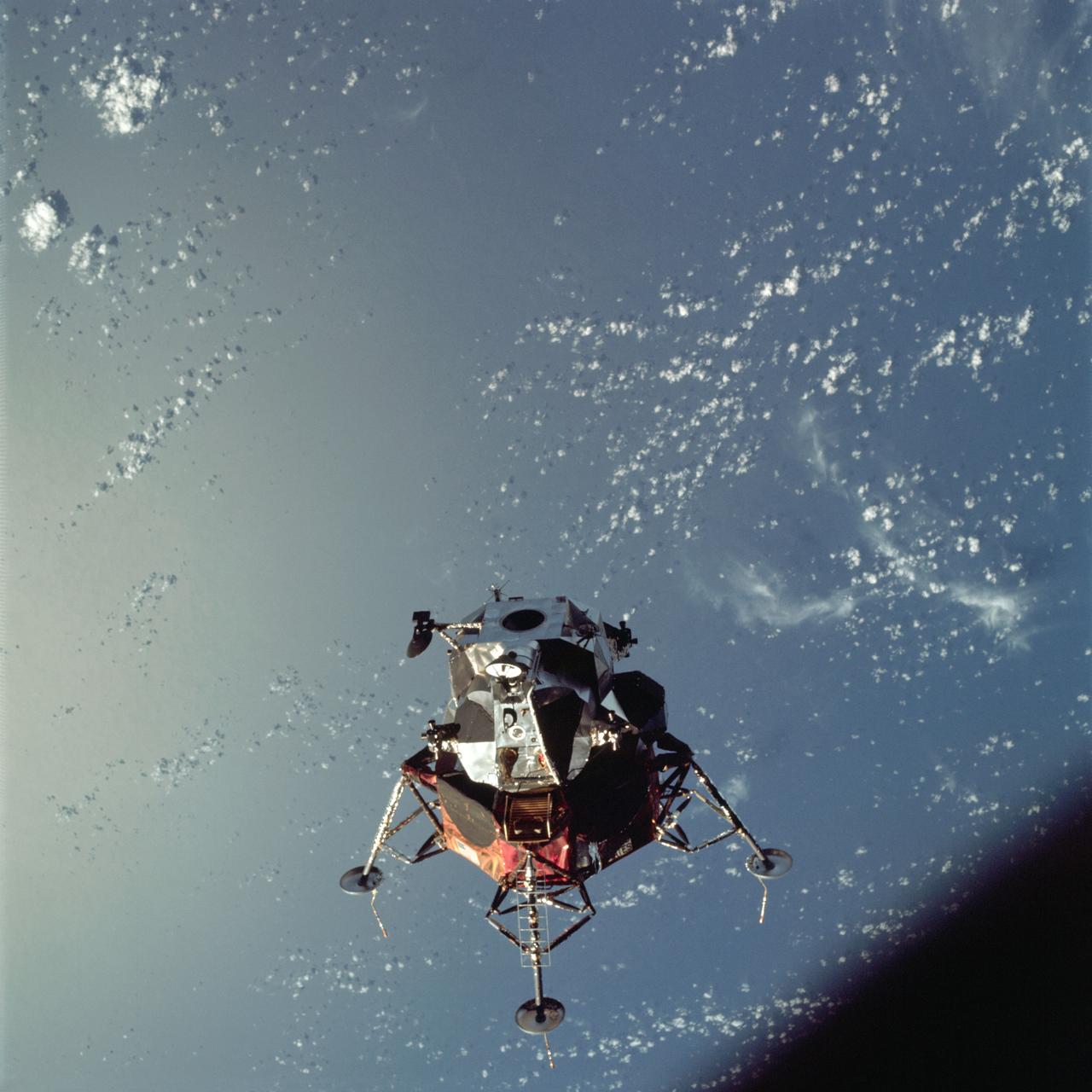
AS09-21-3183 (7 March 1969) --- A view of the Apollo 9 Lunar Module (LM) "Spider" in a lunar landing configuration, as photographed from the Command and Service Modules (CSM) on the fifth day of the Apollo 9 Earth-orbital mission. The landing gear on the "Spider" has been deployed. Lunar surface probes (sensors) extend out from the landing gear foot pads. Inside the "Spider" were astronauts James A. McDivitt, Apollo 9 commander; and Russell L. Schweickart, lunar module pilot. Astronaut David R. Scott, command module pilot, remained at the controls in the Command Module (CM), "Gumdrop," while the other two astronauts checked out the LM. Schweickart, lunar module pilot, is photographed from the CM "Gumdrop" during his extravehicular activity (EVA) on the fourth day of the Apollo 9 Earth-orbital mission. The CSM is docked with the LM. Astronaut James A. McDivitt, Apollo 9 commander, was inside the LM "Spider." Astronaut David R. Scott, command module pilot, remained at the controls in the CM.
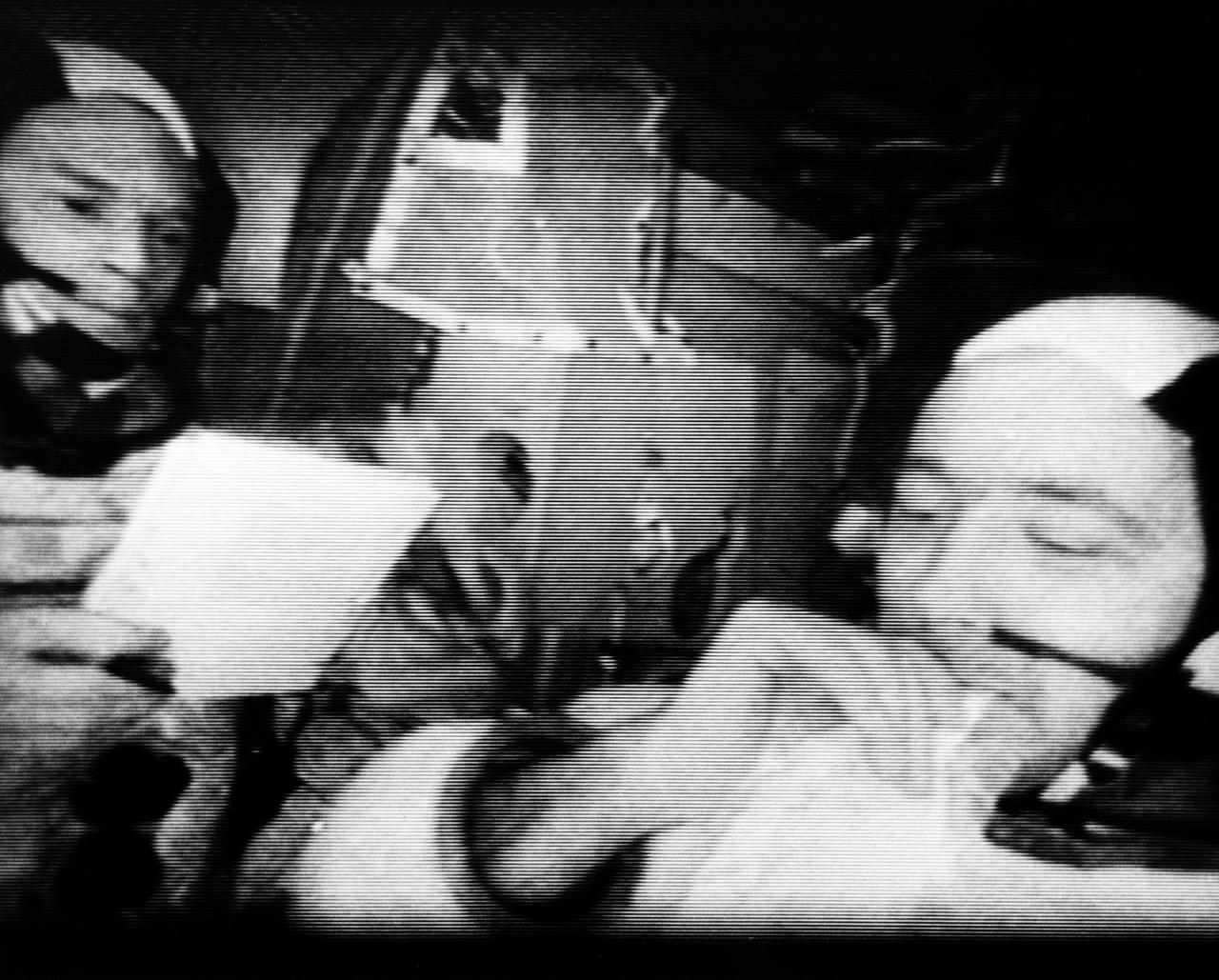
S69-26698 (March 1969) --- A photograph from a live television transmission from Apollo 9. This view shows the interior of the Lunar Module "Spider." Astronaut James A. McDivitt, Apollo 9 commander, is in right foreground. In left background is astronaut Russell L. Schweickart, lunar module pilot. At this moment Apollo 9 was orbiting Earth with the Command Module docked nose-to-nose with the Lunar Module. Astronaut David R. Scott, command module pilot, remained at the controls in the Command Module "Gumdrop" while the other two astronauts checked out the Lunar Module.
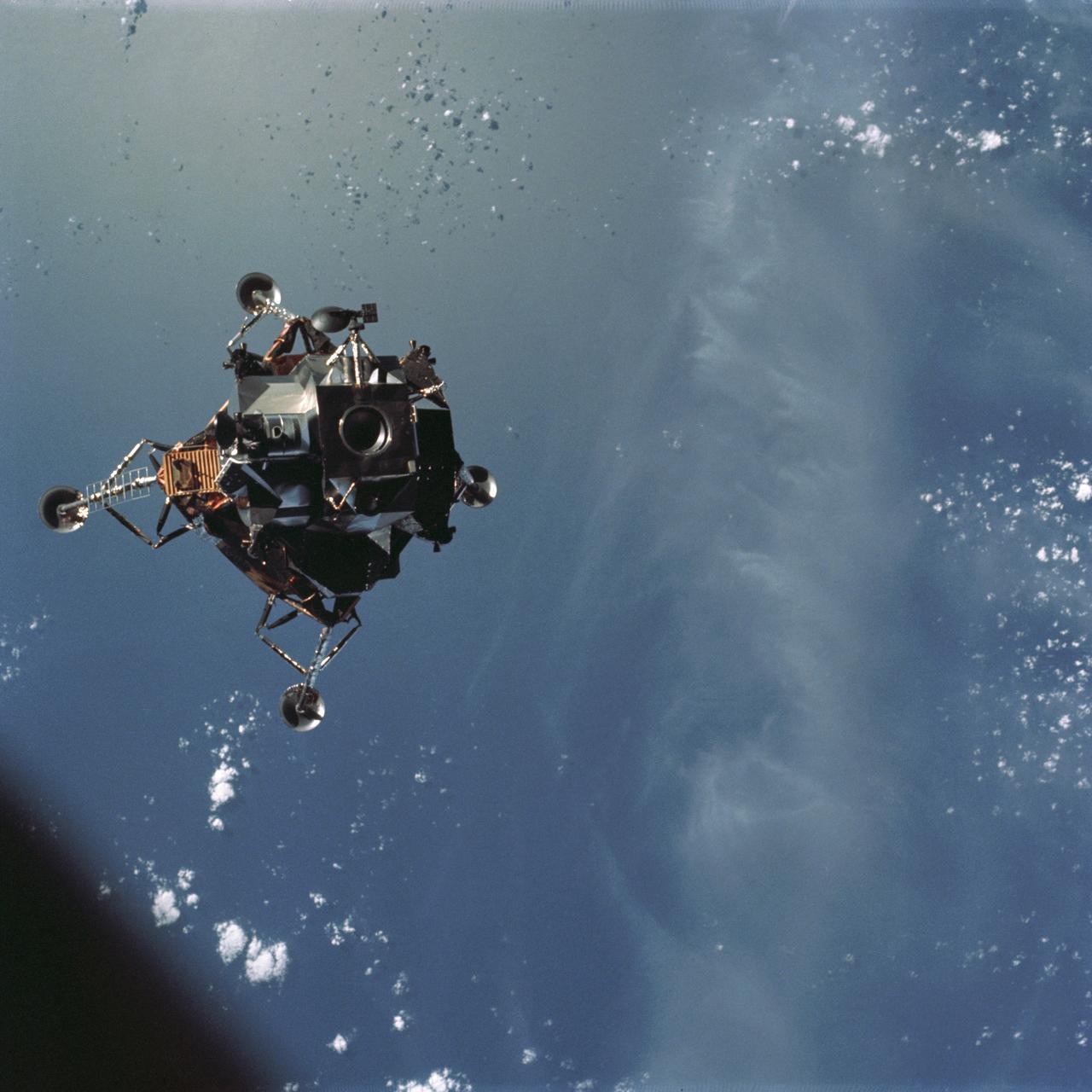
AS09-21-3181 (7 March 1969) --- A View of the Apollo 9 Lunar Module (LM), "Spider," in a lunar lading configuration, as photographed from the Command and Service Modules (CSM) on the fifth day of the Apollo 9 Earth-orbital mission. The landing gear on the "Spider" has been deployed. Inside the "Spider" were astronauts James A. McDivitt, Apollo 9 commander; and Russell L. Schweickart, lunar module pilot. Astronaut David R. Scott, command module pilot, remained at the controls in the Command Module (CM), "Gumdrop," while the other two astronauts checked out the LM.

S69-27746 (13 March 1969) --- The Apollo 9 crew awaits the arrival of a recovery helicopter from the USS Guadalcanal, prime recovery ship for the Apollo 9 10-day Earth-orbital space mission. Astronaut James A. McDivitt, commander, stands in hatch of spacecraft. Already in life raft are astronauts Russell L. Schweickart (foreground), lunar module pilot, and David R. Scott, command module pilot. Scott is taking a picture of McDivitt. Splashdown occurred at 12:00:53 p.m. (EST), March 13, 1969, only 4.5 nautical miles from the USS Guadalcanal. U.S. Navy underwater demolition team swimmers assist in the recovery operations.
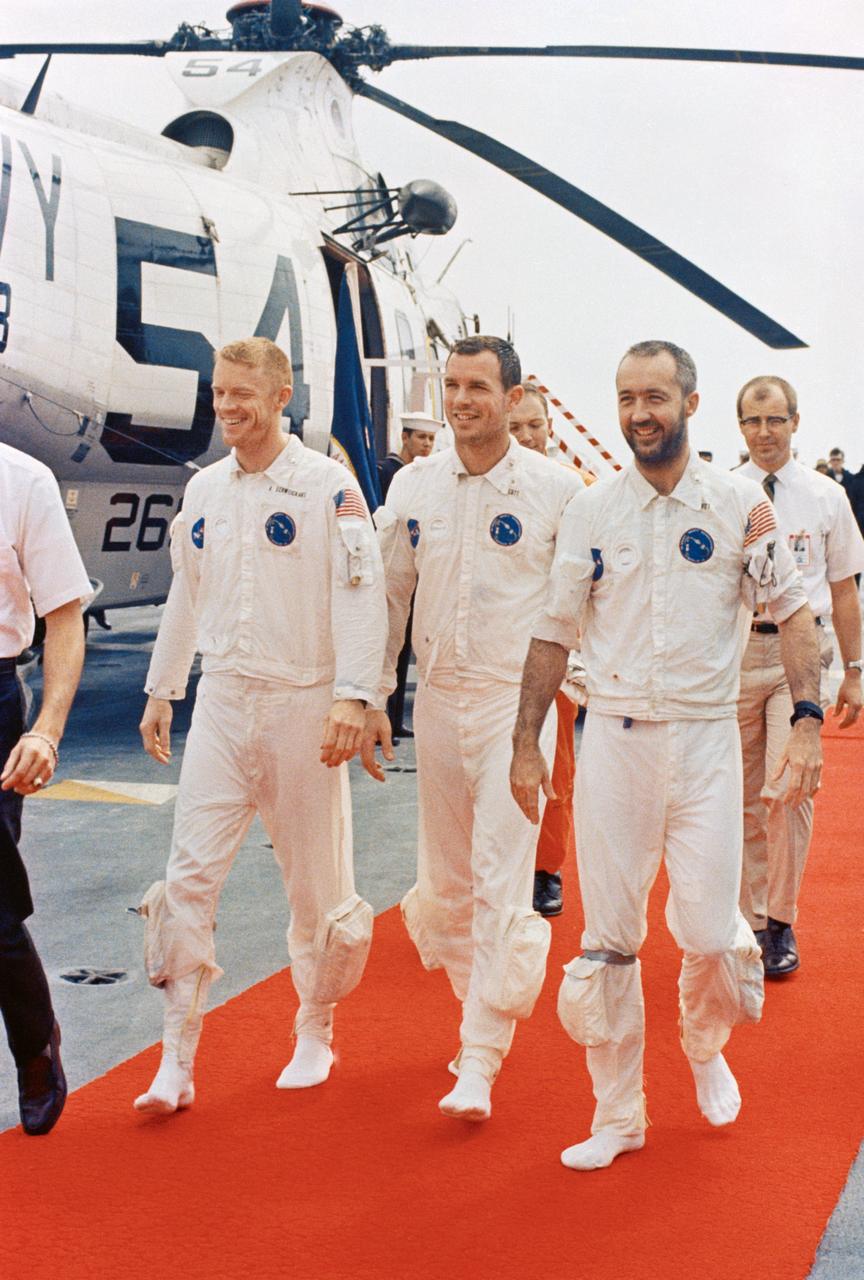
S69-27920 (13 March 1969) --- The Apollo 9 crew men walk on a red carpet after arriving aboard the prime recovery ship, USS Guadalcanal. Left to right, are astronauts Russell L. Schweickart, David R. Scott, and James A. McDivitt. They are walking from the recovery helicopter which picked them up from the splashdown area. Splashdown occurred at 12:00:53 p.m. (EST), March 13, 1969, only 4.5 nautical miles from the USS Guadalcanal to conclude a successful 10-day Earth-orbital space mission.
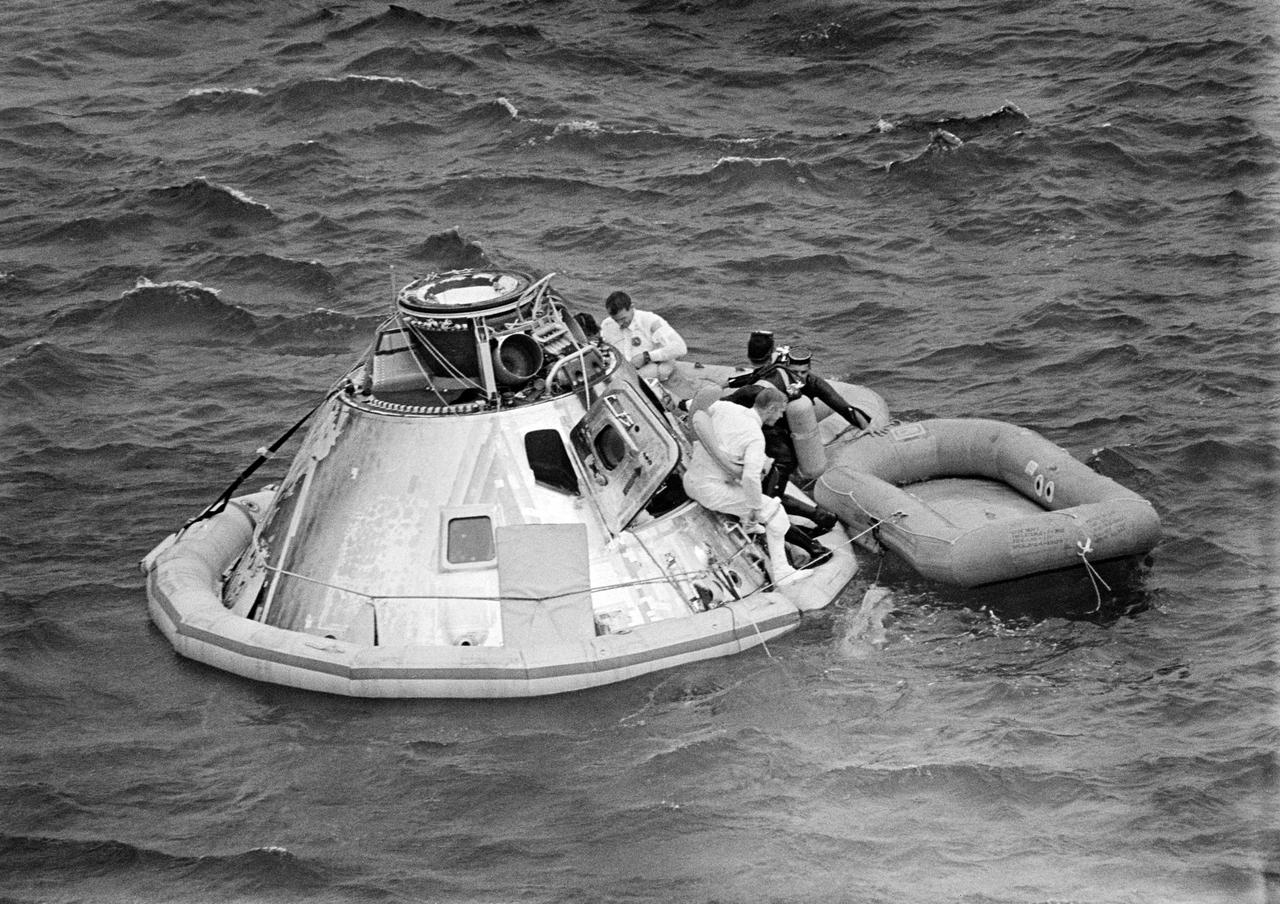
S69-27468 (13 March 1969) --- U.S. Navy underwater demolition team swimmers assist the Apollo 9 crew during recovery operations just after splashdown. They have already attached a flotation collar to the Command Module (CM). Astronaut Russell L. Schweickart, lunar module pilot, is about to climb into raft. In background is astronaut David R. Scott, command module pilot. Still inside the spacecraft is astronaut James A. McDivitt, commander. Splashdown occurred at 12:00:53 p.m. (EST), March 13, 1969, only 4.5 nautical miles from the prime recovery ship, USS Guadalcanal, to conclude a successful 10-day Earth-orbital mission in space.
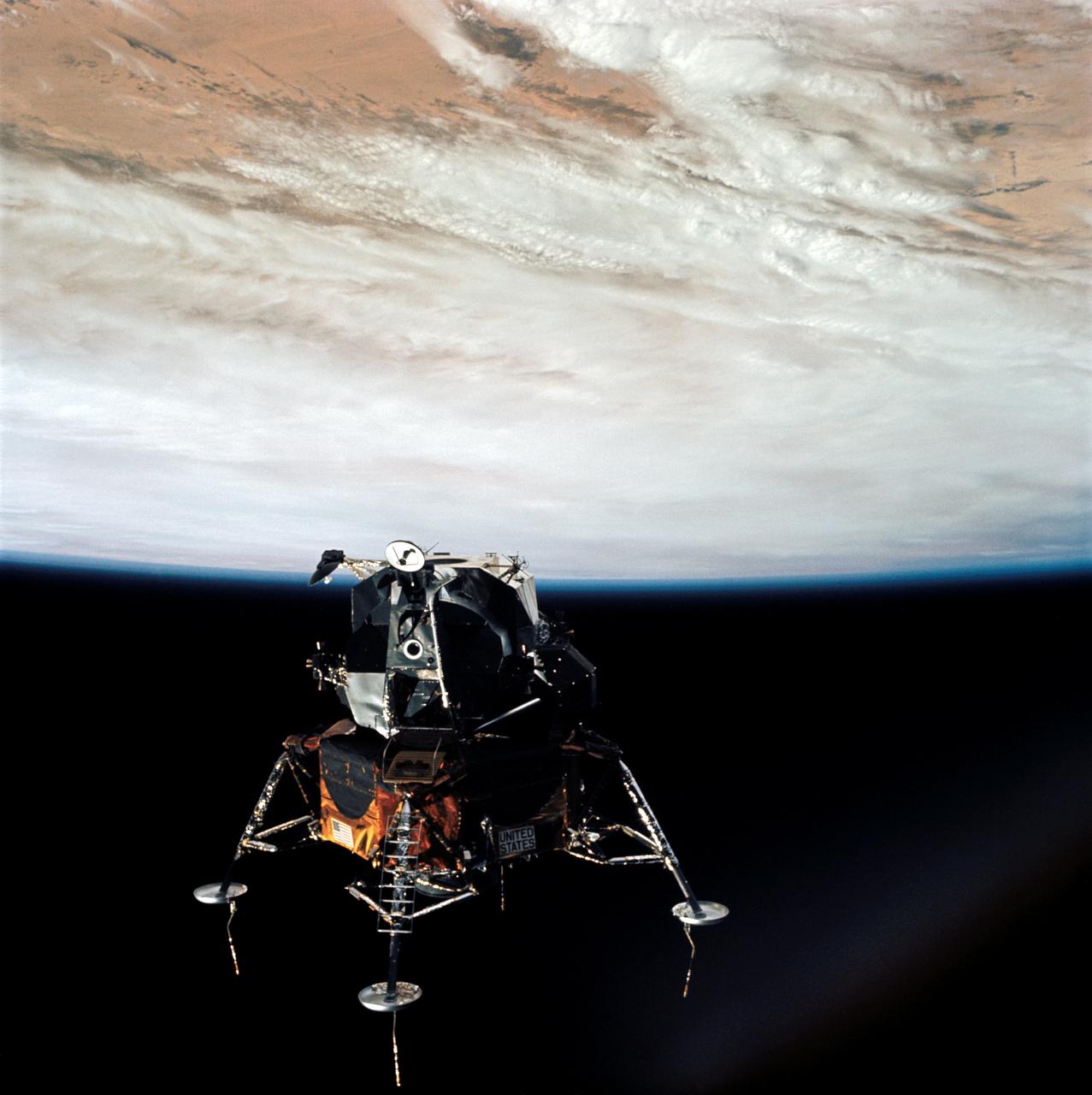
AS09-21-3212 (7 March 1969) --- A view of the Apollo 9 Lunar Module (LM), "Spider", in a lunar landing configuration, as photographed from the Command and Service Modules (CSM) on the fifth day of the Apollo 9 Earth-orbital mission. The landing gear on the "Spider" has been deployed. Lunar surface probes (sensors) extend out from landing gear foot pads. Inside the "Spider" were astronauts James A. McDivitt, Apollo 9 commander, and Russell L. Schweickart, lunar module pilot. Astronaut David R. Scott, command module pilot, remained at the controls in the Command Module (CM), "Gumdrop", while the other two astronauts checked out the Lunar Module.
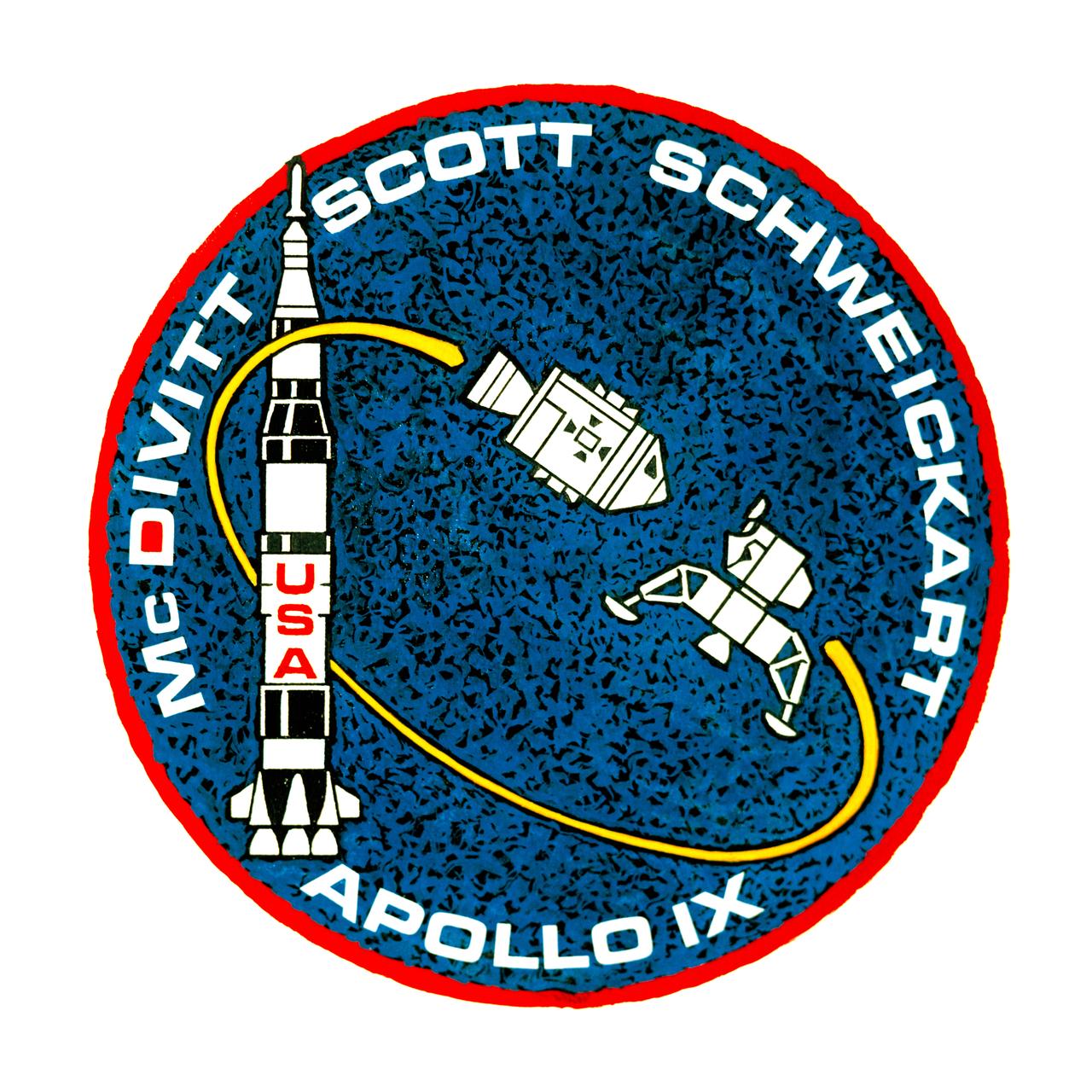
S69-18569 (February 1969) --- The insignia of the Apollo 9 space mission. The crew consist of astronauts James A. McDivitt, commander; David R. Scott, command module pilot; and Russell L. Schweickart, lunar module pilot. The Apollo 9 mission will evaluate spacecraft lunar module systems performance during manned Earth-orbital flight. The NASA insignia design for Apollo flights is reserved for use by the astronauts and for other official use as the NASA Administrator may authorize. Public availability has been approved only in the form of illustrations by the various news media. When and if there is any change in this policy, which we do not anticipate, it will be publicly announced.
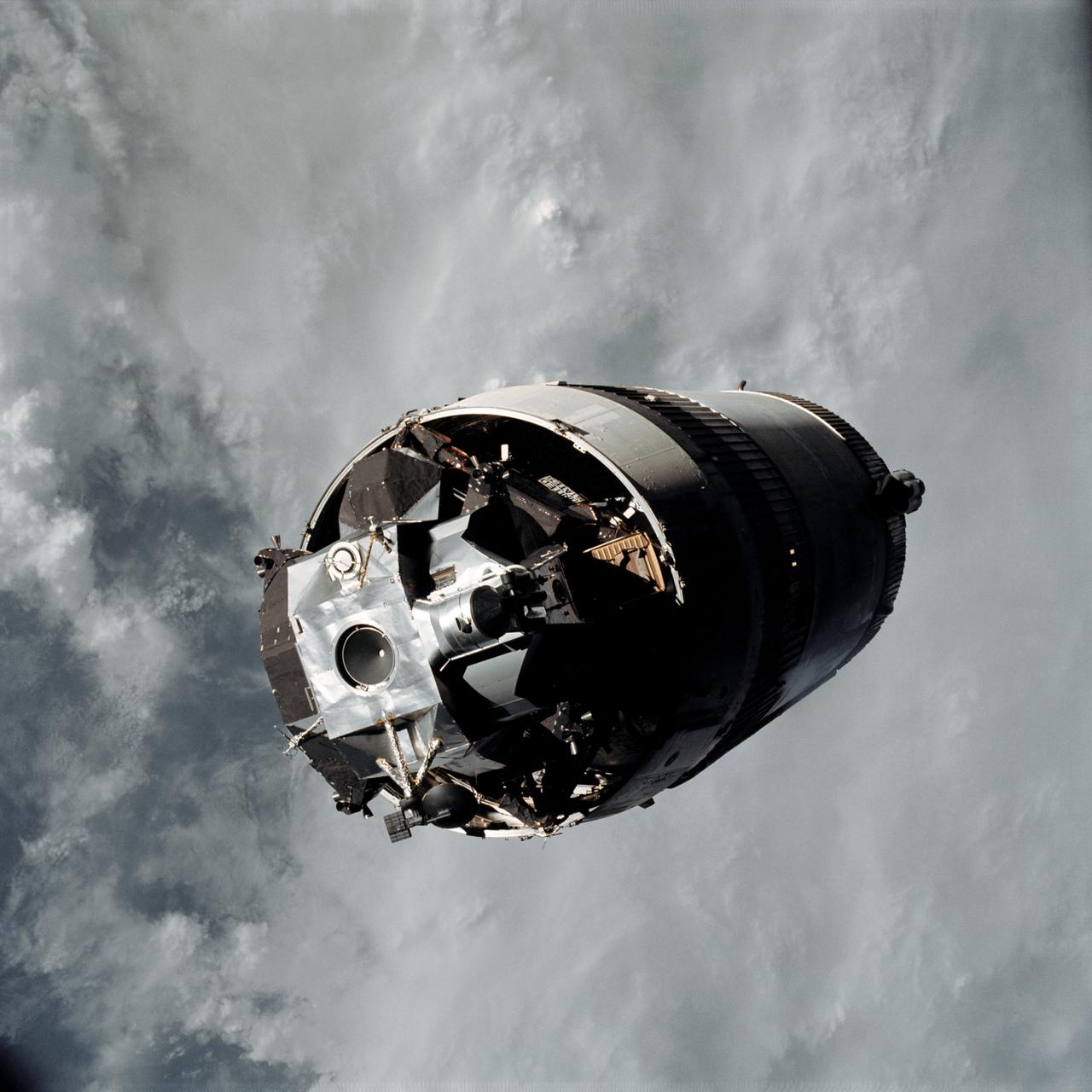
AS09-19-2919 (3 March 1969) --- The Lunar Module (LM) "Spider", still attached to the Saturn V third (S-IVB) stage, is photographed from the Command and Service Modules (CSM) "Gumdrop" on the first day of the Apollo 9 Earth-orbital mission. This picture was taken following CSM/LM-S-IVB separation and prior to LM extraction from the S-IVB. The Spacecraft Lunar Module Adapter (SLA) panels have already been jettisoned. Inside the Command Module were astronauts James A. McDivitt, commander; David R. Scott, command module pilot; and Russell L. Schweickart, lunar module pilot.
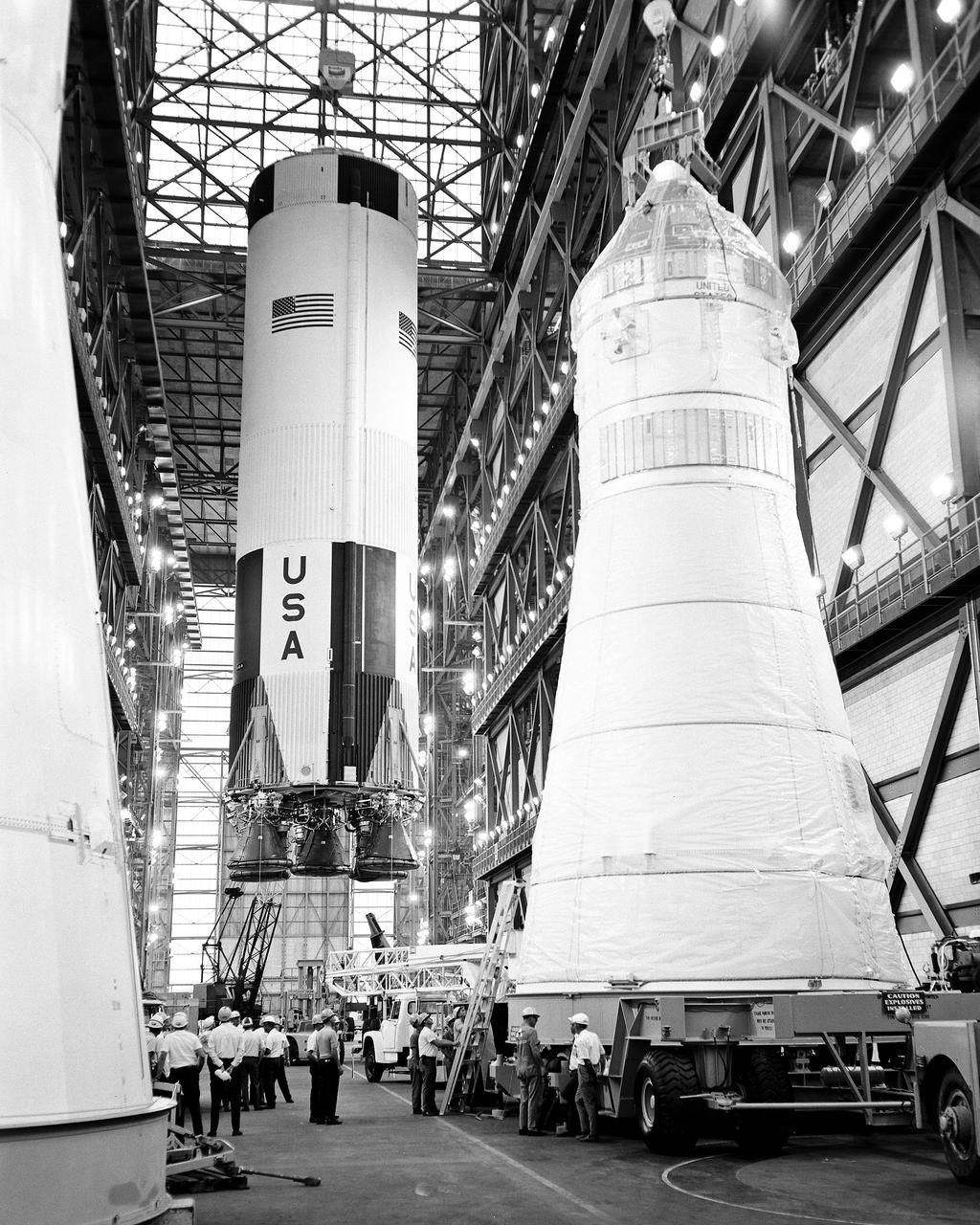
CAPE CANAVERAL, Fla. – The first stage of the Apollo 10 Saturn V space vehicle is hoisted above the transfer aisle in preparation for erection on a mobile launcher within High Bay 2 of the Vehicle Assembly Building. The erection of the 138-foot-long stage marked the first use of mobile launcher 3 and high bay 2. Apollo 10 will be piloted by astronauts Thomas Stafford, John Young and Eugene Cernan. In the foreground are the mated command, service and lunar modules the latter enclosed within the adapter for the Apollo 9 flight of James McDivitt, David Scott and Russel Schweickart. Photo credit: NASA
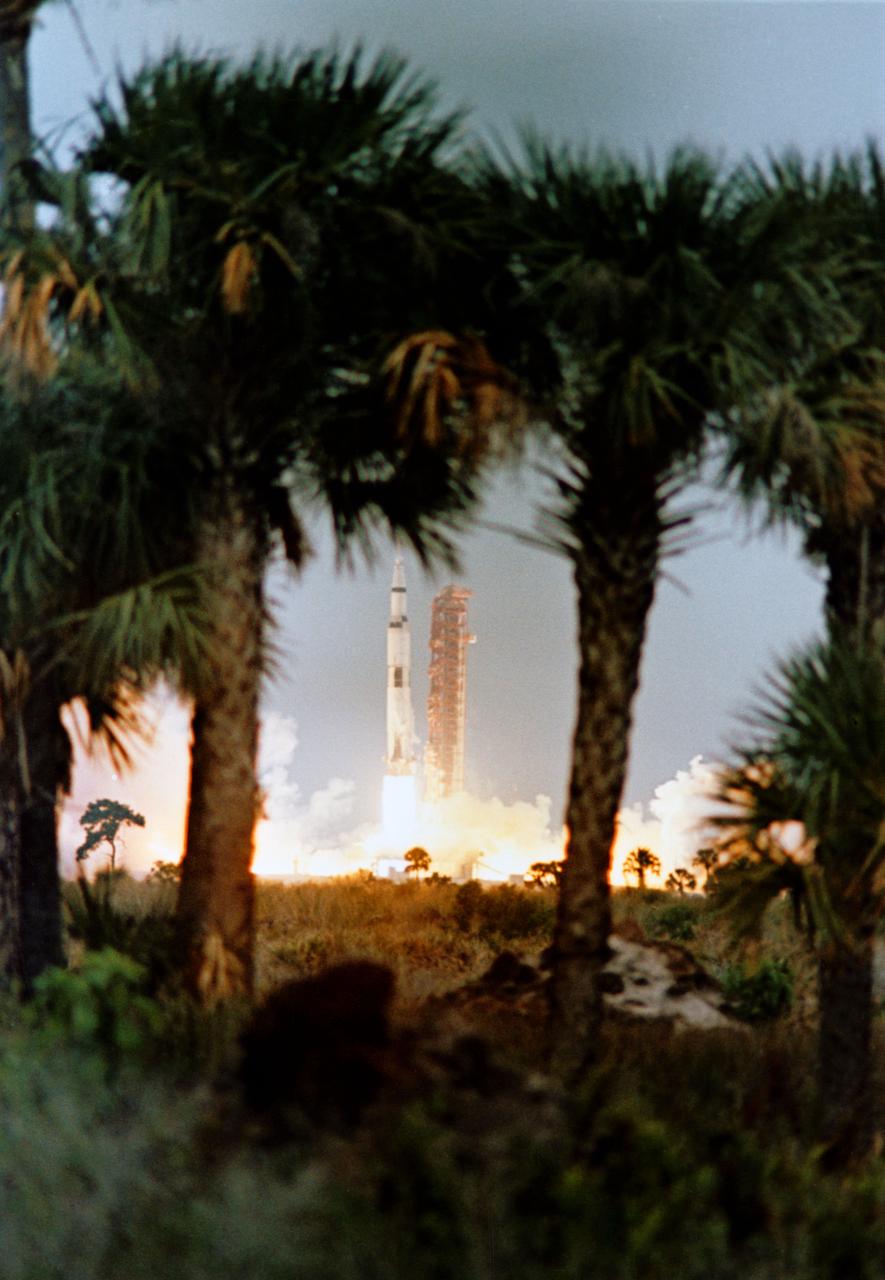
S69-25862 (3 March 1969) --- Framed by palm trees in the foreground, the Apollo 9 (Spacecraft 104/Lunar Module 3/ Saturn 504) space vehicle is launched from Pad A, Launch Complex 39, Kennedy Space Center (KSC) at 11 a.m. (EST), March 3, 1969. Aboard the spacecraft are astronauts James A. McDivitt, commander; David R. Scott, command module pilot; and Russell L. Schweickart, lunar module pilot. The Apollo 9 mission will evaluate spacecraft lunar module systems performance during manned Earth-orbital flight. Apollo 9 is the second manned Saturn V mission.
![S68-56621 (18 Dec. 1968) --- These three astronauts are the prime crew of the Apollo 9 (Spacecraft 104/Lunar Module 3/Saturn 504) space mission. Left to right, are James A. McDivitt, commander; David R. Scott, command module pilot: and Russell L. Schweickart, lunar module pilot. The Apollo 9 launch is scheduled no earlier than February 28, 1969. In the background is the Apollo 8 space vehicle on Pad A, Launch Complex 39, Kennedy Space Center, which was launched on December 21, 1968. (Gaseous liquid oxygen is venting from the vehicle’s first [S-1C] stage during a countdown demonstration test). McDivitt holds a U.S. flag.](https://images-assets.nasa.gov/image/S68-56621/S68-56621~medium.jpg)
S68-56621 (18 Dec. 1968) --- These three astronauts are the prime crew of the Apollo 9 (Spacecraft 104/Lunar Module 3/Saturn 504) space mission. Left to right, are James A. McDivitt, commander; David R. Scott, command module pilot: and Russell L. Schweickart, lunar module pilot. The Apollo 9 launch is scheduled no earlier than February 28, 1969. In the background is the Apollo 8 space vehicle on Pad A, Launch Complex 39, Kennedy Space Center, which was launched on December 21, 1968. (Gaseous liquid oxygen is venting from the vehicle’s first [S-1C] stage during a countdown demonstration test). McDivitt holds a U.S. flag.
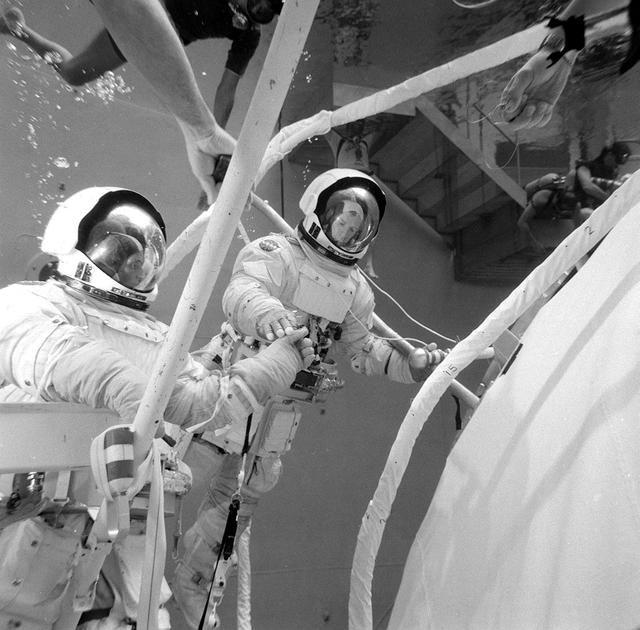
This photograph was taken during testing of an emergency procedure to free jammed solar array panels on the Skylab workshop. A metal strap became tangled over one of the folded solar array panels when Skylab lost its micrometeoroid shield during the launch. This photograph shows astronauts Schweickart and Gibson in the Marshall Space Flight Center (MSFC) Neutral Buoyancy Simulator (NBS) using various cutting tools and methods developed by the MSFC to free the jammed solar wing. Extensive testing and many hours of practice in simulators such as the NBS tank helped prepare the Skylab crewmen for extravehicular performance in the weightless environment. This huge water tank simulated the weightless environment that the astronauts would encounter in space.
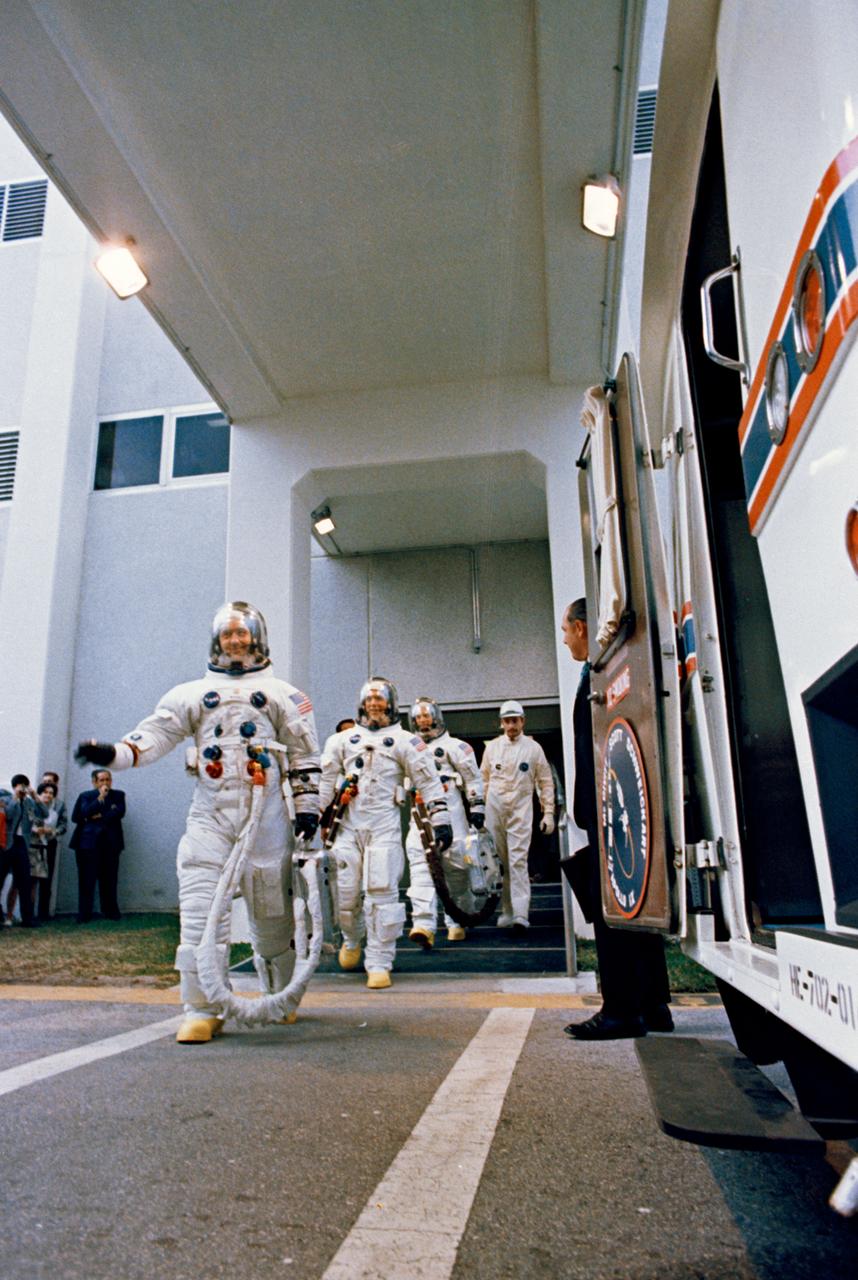
S69-25883 (3 March 1969) --- The Apollo 9 crew leaves the Kennedy Space Center's Manned Spacecraft Operations Building during the Apollo 9 prelaunch countdown. Leading is astronaut James A. McDivitt, commander; followed by astronaut David R. Scott, command module pilot; and Russell L. Schweickart, lunar module pilot. Moments later they entered the special transfer van which transported them to their waiting spacecraft at Pad A, Launch Complex 39. Apollo 9 was launched at 11 a.m. (EST), March 3, 1969, on a 10-day Earth-orbital mission.
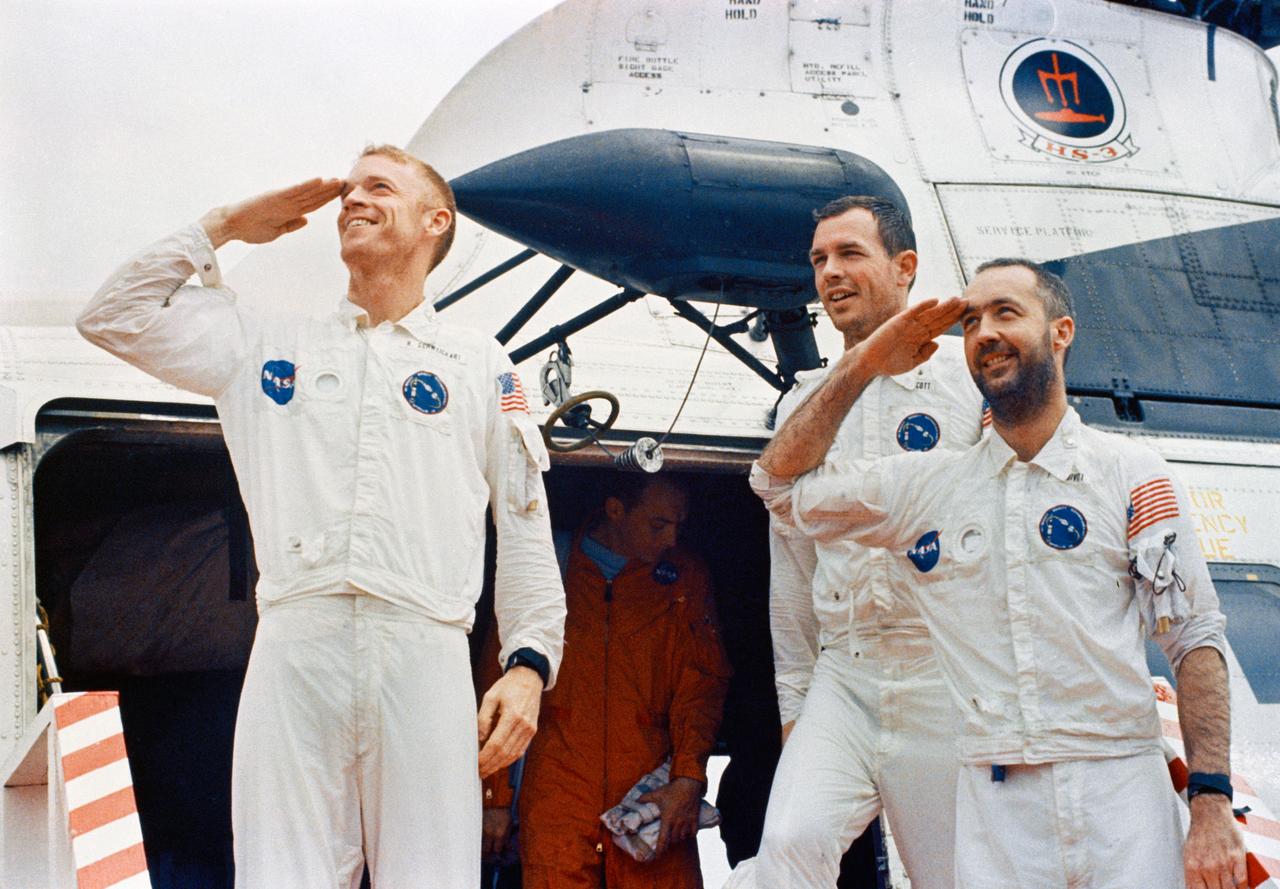
S69-27921 (13 March 1969) --- The Apollo 9 crewmen arrive aboard the USS Guadalcanal as they step from a helicopter to receive a red-carpet welcome. Two of the crewmen salute the crowd of newsmen, Navy and NASA personnel gathered to greet them. Left to right, are astronauts Russell L. Schweickart, David R. Scott, and James A. McDivitt. Splashdown occurred at 12:00:53 p.m. (EST), March 13, 1969, only 4.5 nautical miles from the USS Guadalcanal, prime recovery ship, to conclude a successful 10-day Earth-orbital space mission. Photo credit: NASA

AS09-20-3064 (6 March 1969) --- Excellent view of the docked Apollo 9 Command and Service Modules (CSM) and Lunar Module (LM), with Earth in the background, during astronaut David R. Scott's stand-up extravehicular activity (EVA), on the fourth day of the Apollo 9 Earth-orbital mission. Scott, command module pilot, is standing in the open hatch of the Command Module (CM). Astronaut Russell L. Schweickart, lunar module pilot, took this photograph of Scott from the porch of the LM. Inside the LM was astronaut James A. McDivitt, Apollo 9 commander.
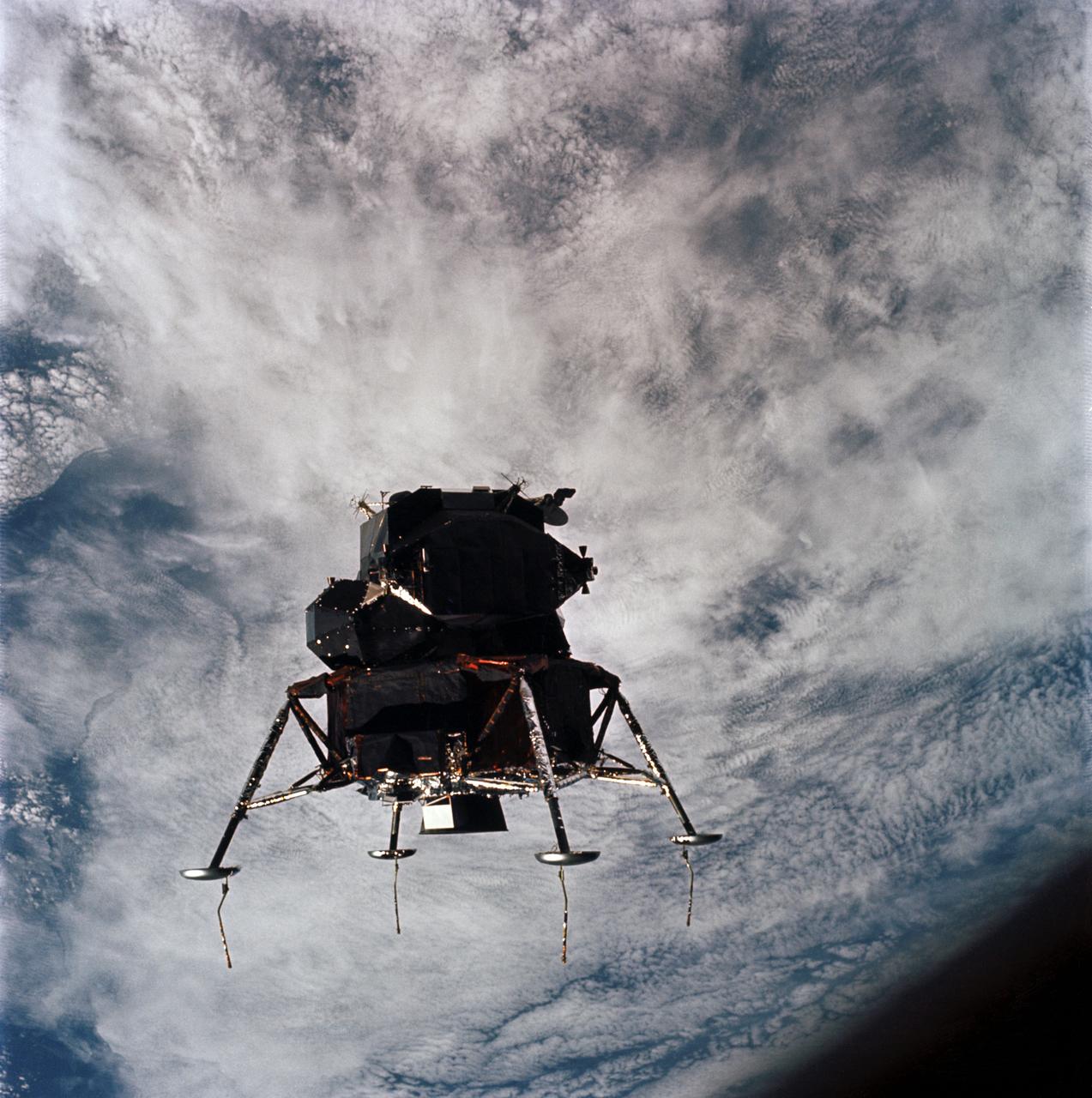
AS09-21-3199 (7 March 1969) --- Excellent view of the Apollo 9 Lunar Module, "Spider," in a lunar landing configuration, as photographed from the Command and Service Modules on the fifth day of the Apollo 9 Earth-orbital mission. The landing gear on the "Spider" has been deployed. Lunar surface probes (sensors) extend out from the landing gear foot pads. Inside the "Spider" were astronauts James A. McDivitt, Apollo 9 commander; and Russell L. Schweickart, lunar module pilot. Astronaut David R. Scott, command module pilot, remained at the controls in the Command Module, "Gumdrop," while the other two astronauts checked out the Lunar Module.
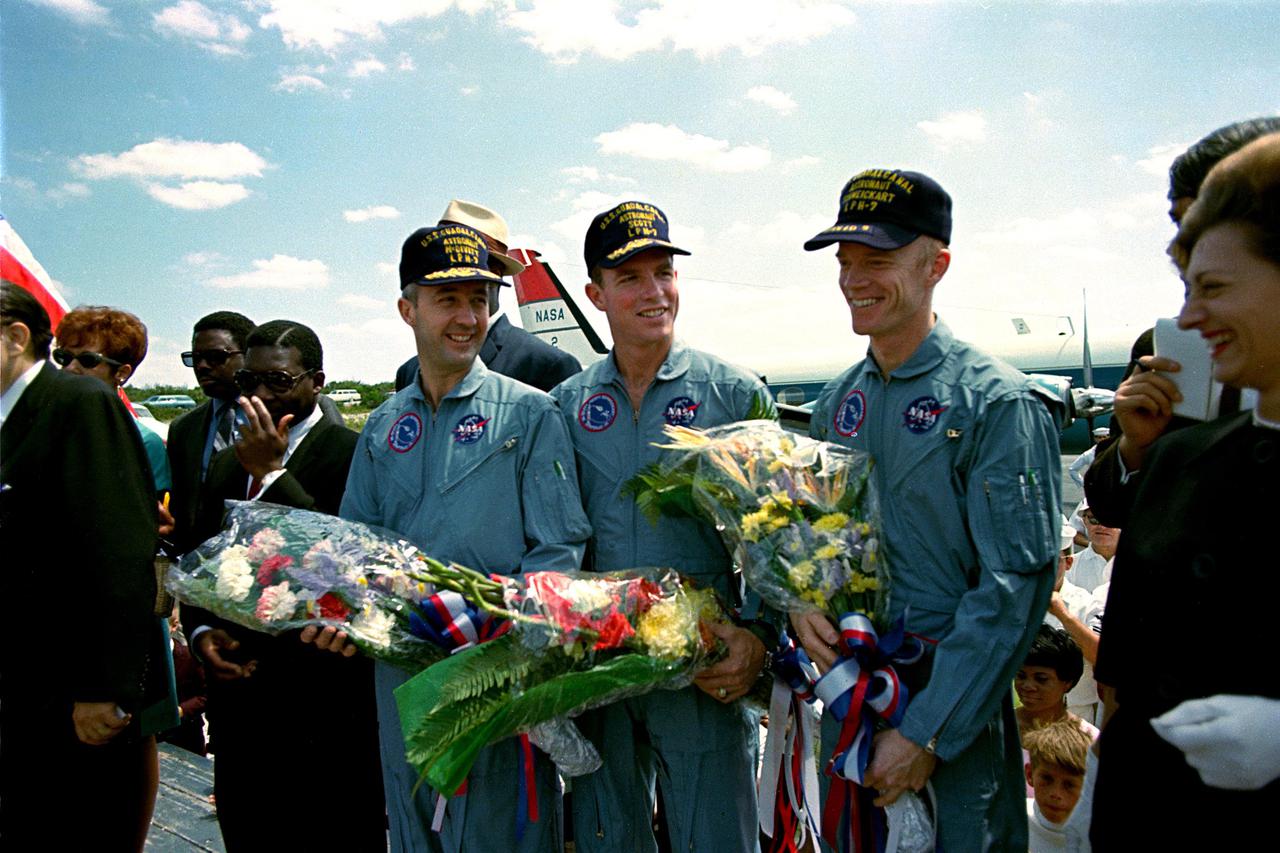
KENNEDY SPACE CENTER, FLA. - The Apollo 9 astronauts, left to right, James R. McDivitt, David R. Scott, and Russell L. Schweickart, receive flowers during a brief stopover on this Bahamian island while enroute back to Cape Kennedy. The three astronauts were launched from Cape Kennedy on March 3 from Launch Pad 39A and spent 10days in Earth orbit to test the Lunar Module Spacecraft in preparation for the upcoming manned lunar landings. Following their splashdown yesterday about 780 nautical miles southeast of Cape Kennedy, the three astronauts and their spacecraft were picked up by the USS Guadalcanal.
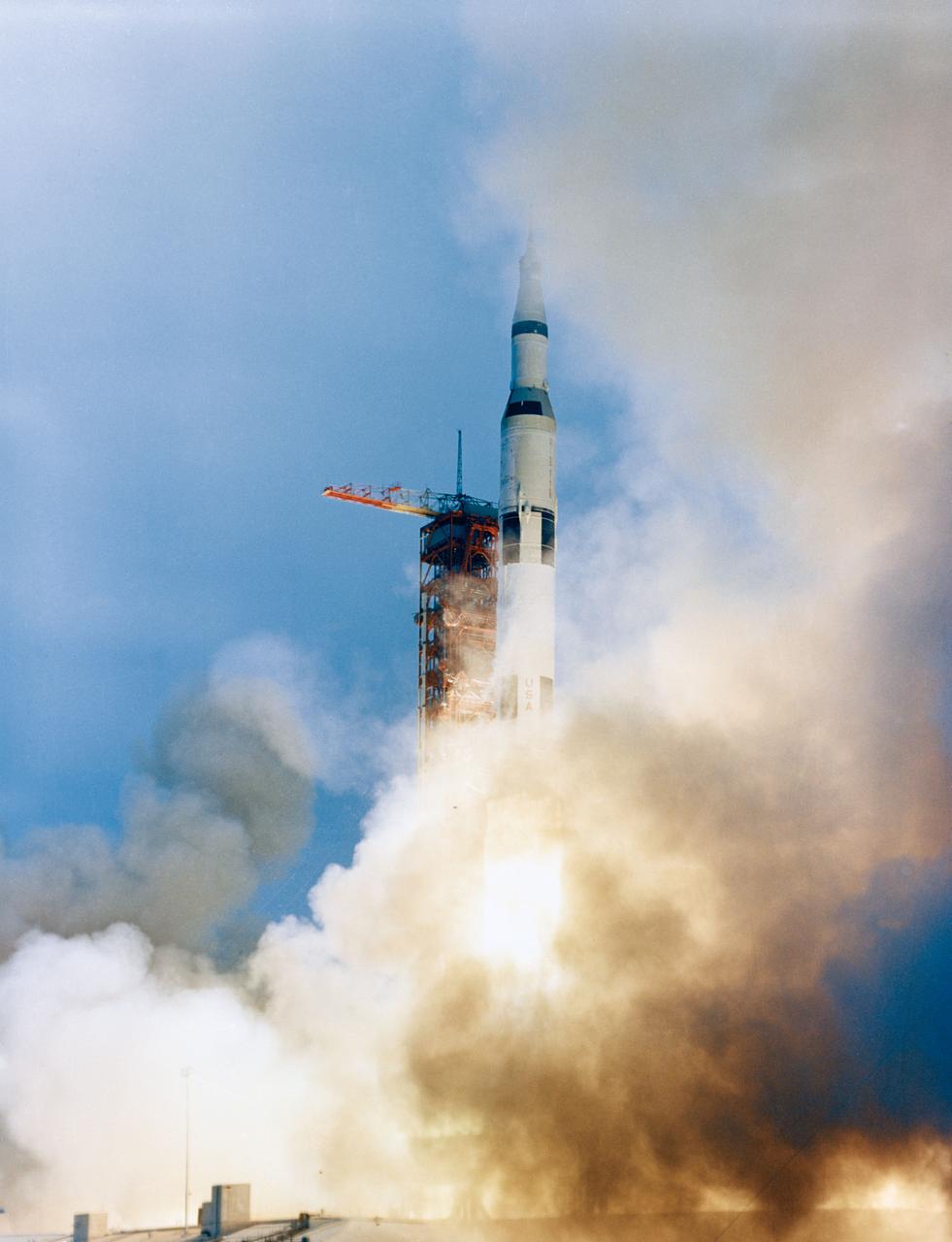
S69-25864 (3 March 1969) --- The Apollo 9 (Spacecraft 104/Lunar Module 3/Saturn 504) space vehicle is launched from Pad A, Launch Complex 39, Kennedy Space Center (KSC) at 11 a.m. (EST), March 3, 1969. Aboard the spacecraft are astronauts James A. McDivitt, commander; David R. Scott, command module pilot; and Russell L. Schweickart, lunar module pilot. The Apollo 9 mission will evaluate spacecraft lunar module systems performance during manned Earth-orbital flight. Apollo 9 is the second manned Saturn V mission.

S69-20086 (13 March 1969) --- The Apollo 9 Command Module (CM), with flotation collar still attached, is hoisted aboard the prime recovery ship, USS Guadalcanal, during recovery operations. The Apollo 9 crew, astronauts James A. McDivitt, David R. Scott, and Russell L. Schweickart, had already been picked up earlier by helicopter and flown to the dock of the carrier. Splashdown occurred at 12:00:53 p.m. (EST), March 13, 1969, only 4.5 nautical miles from the aircraft carrier, to conclude a successful 10-day Earth-orbital space mission.
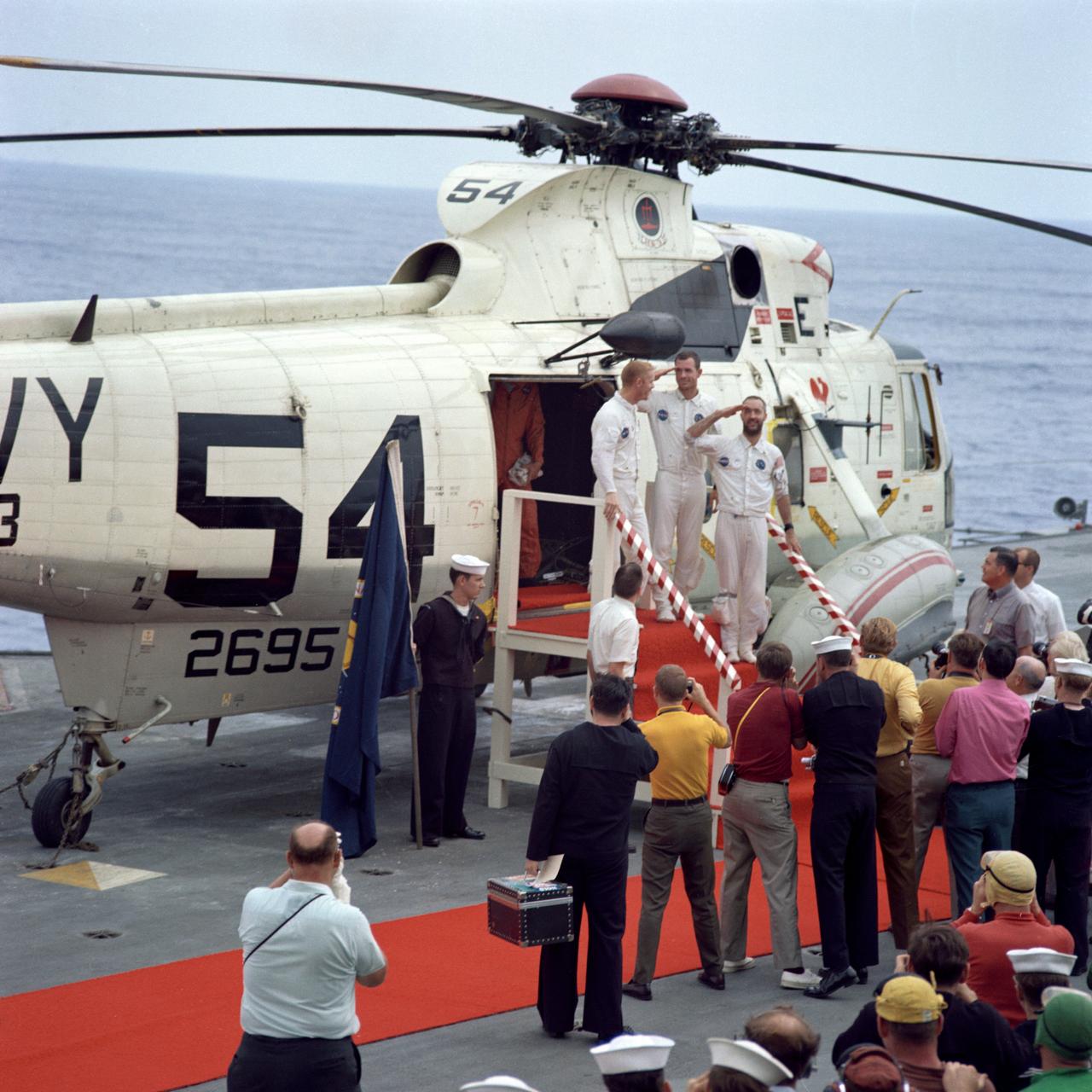
S69-20060 (13 March 1969) --- The Apollo 9 crewmen arrive aboard the USS Guadalcanal as they step from a helicopter to receive a red-carpet welcome. Two of the crewmen salute the crowd of newsmen, Navy and NASA personnel gathered to greet them. Left to right, are astronauts Russell L. Schweickart, lunar module pilot; David R. Scott (in back), command module pilot; and James A. McDivitt, commander. Splashdown occurred at 12:00:53 p.m. (EST), March 13, 1969, only 4.5 nautical miles from the USS Guadalcanal, prime recovery ship, to conclude a successful 10-day Earth-orbital space mission.
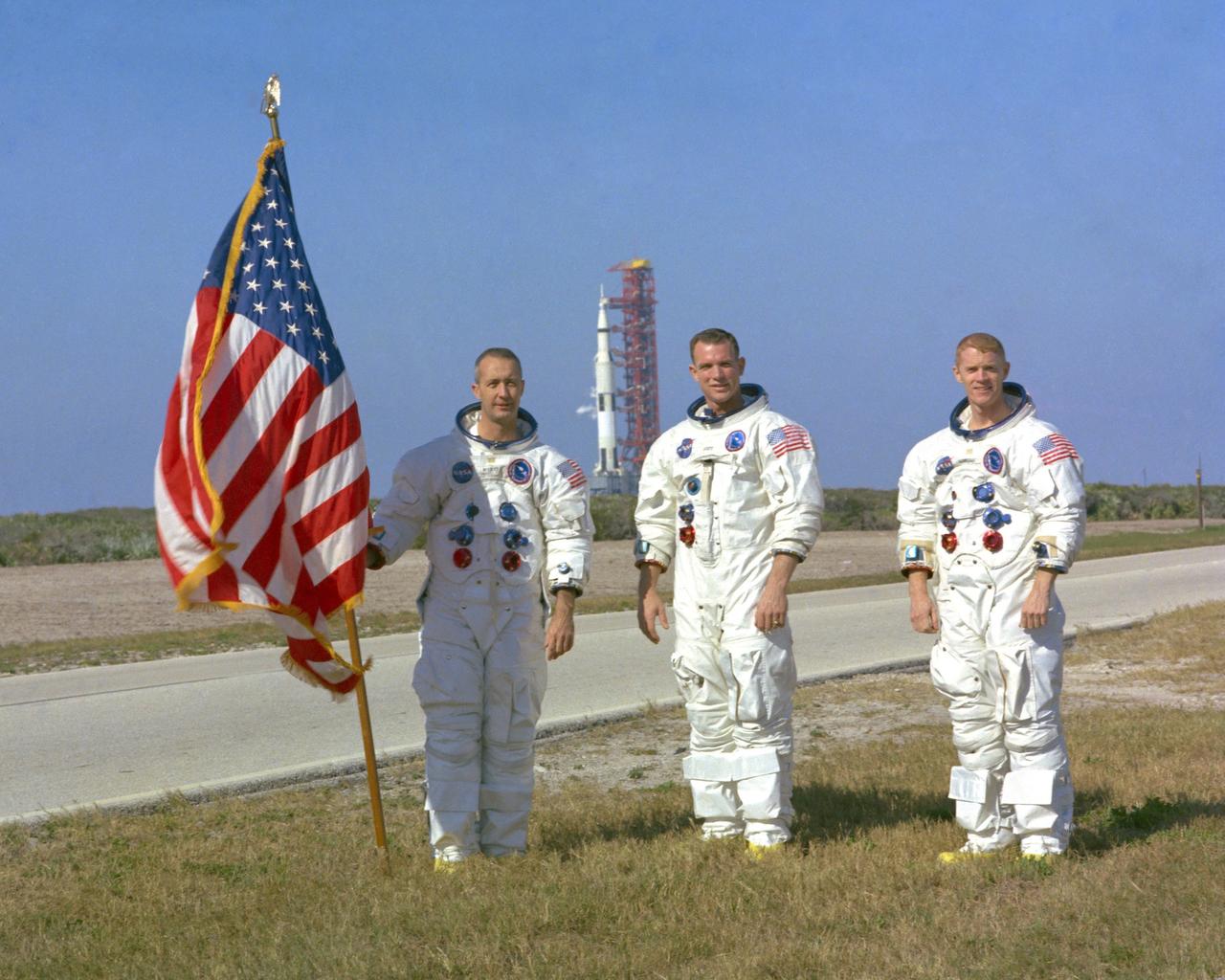
CAPE CANAVERAL, Fla. – Apollo 9 astronauts, left to right, James McDivitt, David Scott and Russell Schweickart pause in front of the Apollo/Saturn V space vehicle that will launch Apollo 8 space pilots Frank Borman, James Lovell and William Anders on a planned lunar orbital mission. The 363-foot-high space vehicle will lift off from the Kennedy Space Center's Launch Complex 39A. Gaseous liquid oxygen is venting from the vehicle's first stage during recent Countdown Demonstration Test. Photo credit: NASA
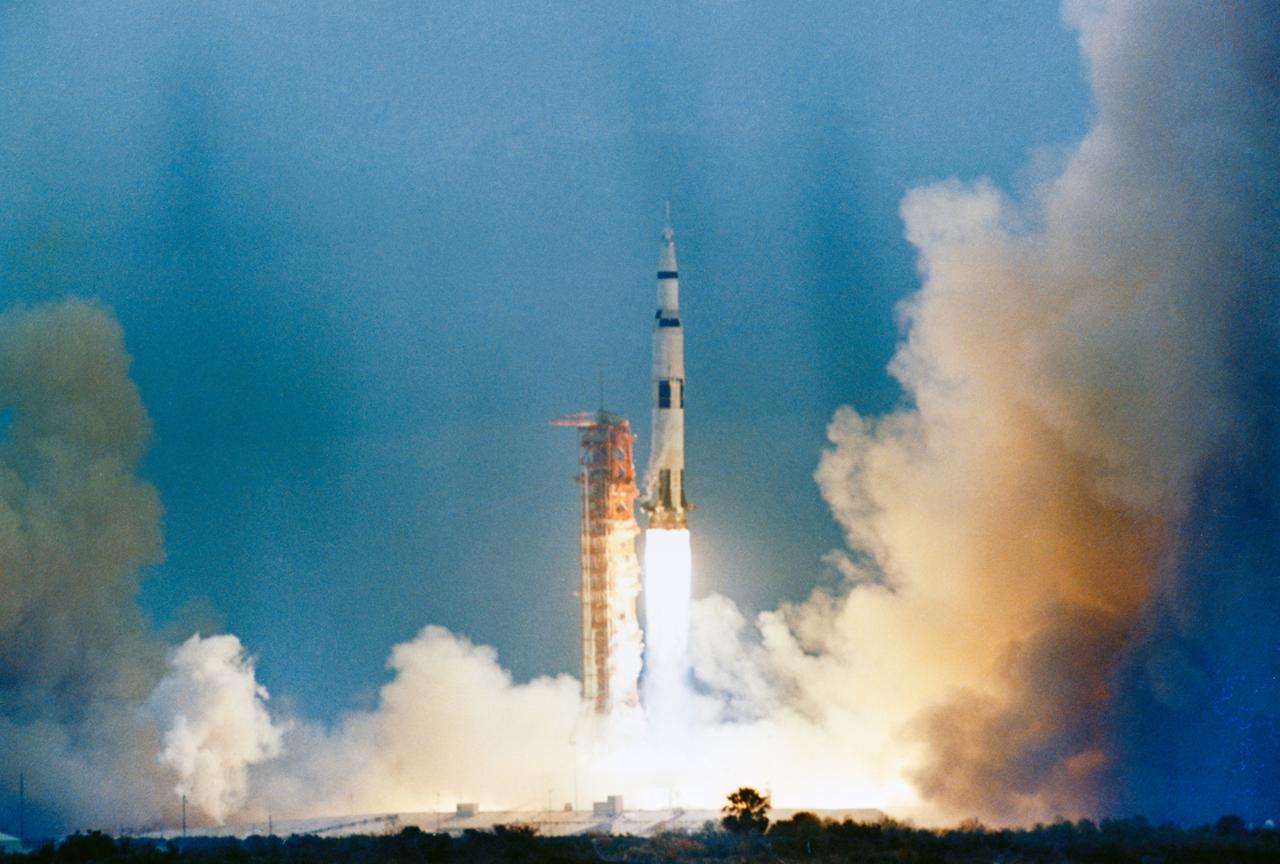
S69-25861 (3 March 1969) --- The Apollo 9 (Spacecraft 104/Lunar Module 3/ Saturn 504) space vehicle is launched from Pad A, Launch Complex 39, Kennedy Space Center (KSC) at 11 a.m. (EST), March 3, 1969. Aboard the spacecraft are astronauts James A. McDivitt, commander; David R. Scott, command module pilot; and Russell L. Schweickart, lunar module pilot. The Apollo 9 mission will evaluate spacecraft lunar module systems performance during manned Earth-orbital flight. Apollo 9 is the second manned Saturn V mission.
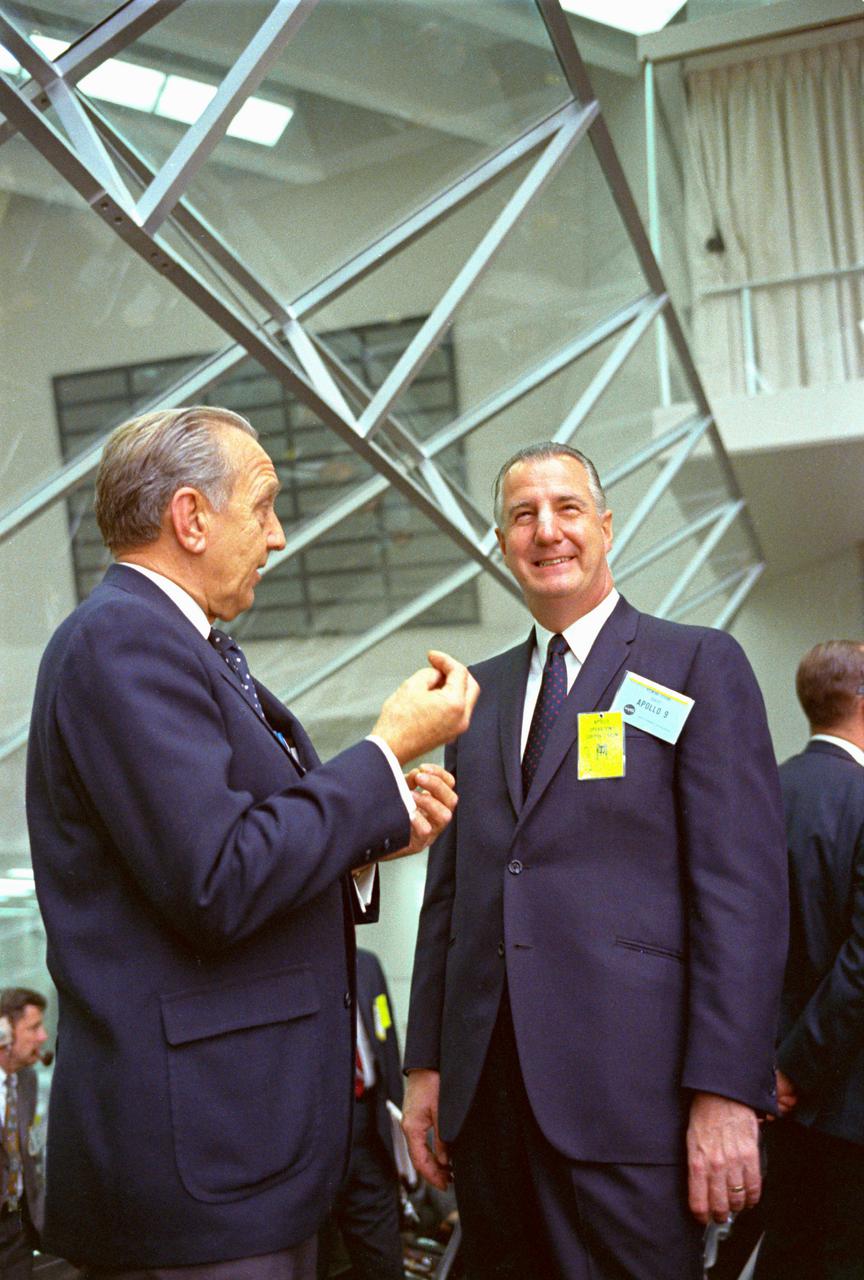
KENNEDY SPACE CENTER, FLA. -- Within the Launch Control Center, Vice President Spiro T. Agnew listens to Dr. Kurt H. Debus, director, Kennedy Space Center, explain highlights of the Apollo Program. The Vice President viewed the launch of Apollo 9 astronauts James A. McDivitt, David R. Scott and Russell L. Schweickart today. They were sent on a planned 10-day Earth orbital flight to put a lunar module spacecraft through extensive tests to qualify it for a possible manned lunar landing later this year. The National Aeronautics and Space Administration directs the Apollo Program.
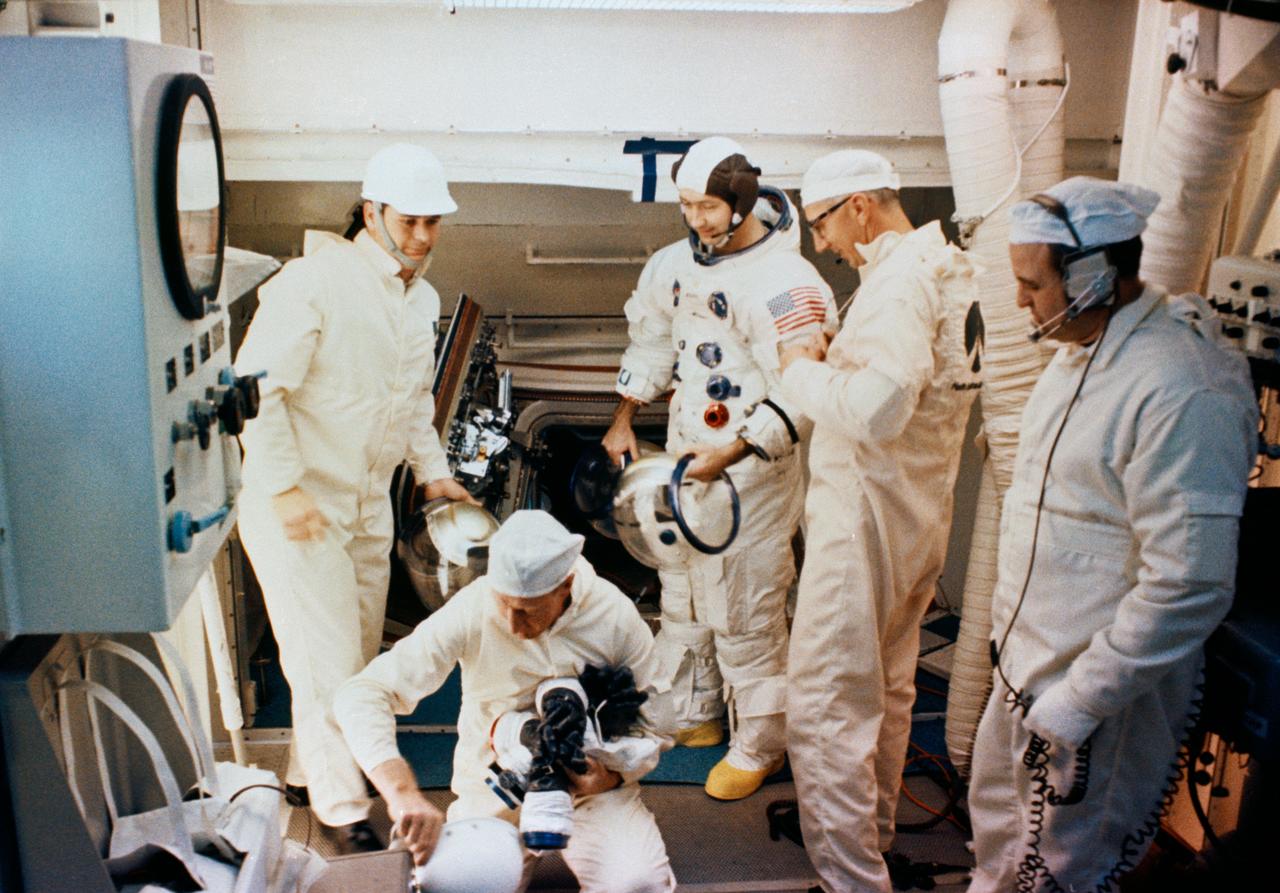
S69-25884 (23 Feb. 1969) --- Interior view of the white room atop Pad A, Launch Complex 39, Kennedy Space Center, during Apollo 9 Countdown Demonstration Test activity. Standing next to spacecraft hatch is astronaut James A. McDivitt, commander. Also, taking part in the training exercise were astronauts David R. Scott, command module pilot; and Russell L. Schweickart, lunar module pilot. The Apollo 9 mission will evaluate spacecraft lunar module systems performance during manned Earth-orbital flight. Apollo 9 will be the second manned Saturn V mission.
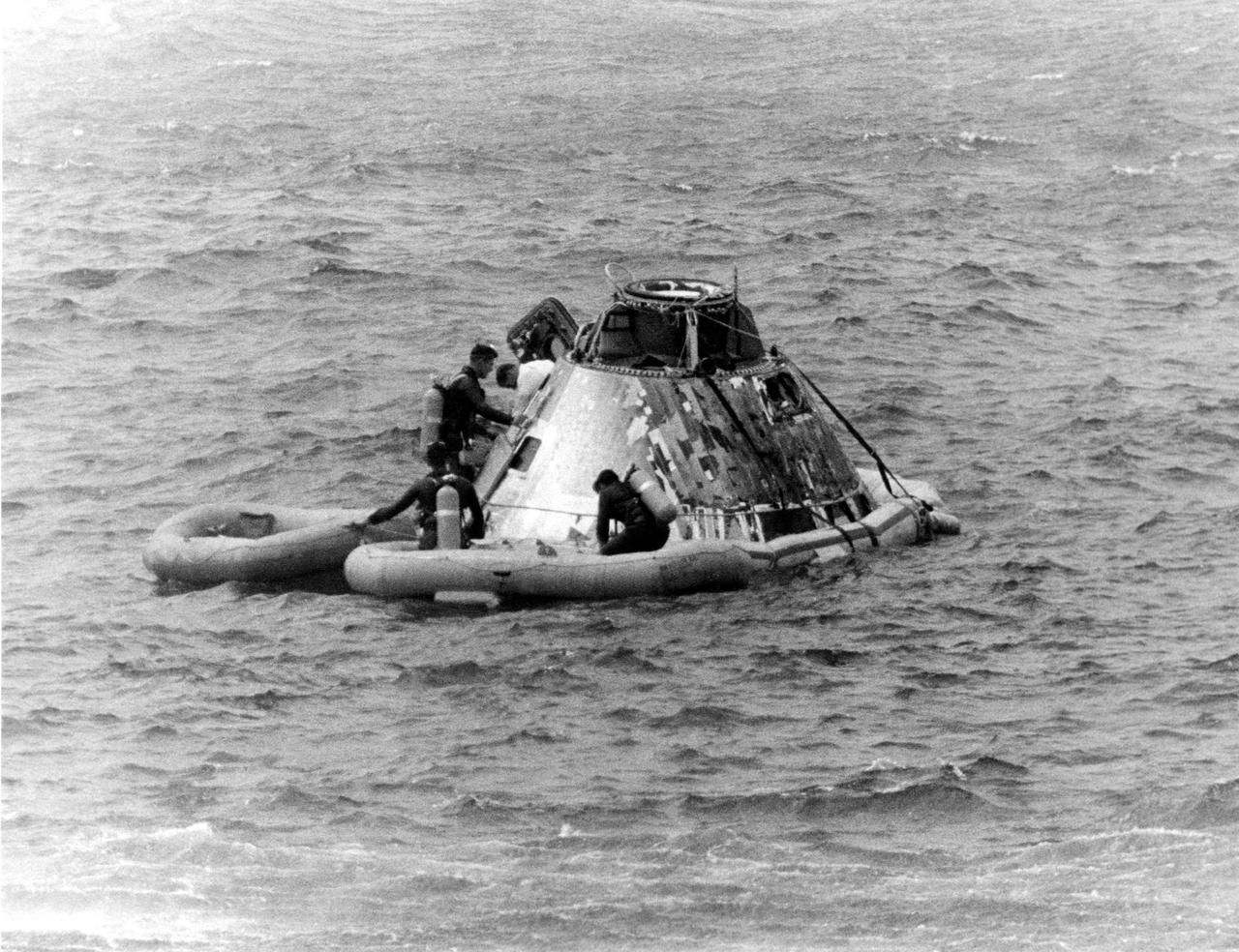
KENNEDY SPACE CENTER, FLA. -- Pararescueman helps Apollo 9 Command Module Pilot David R. Scott from the spacecraft today during recovery at completion of the 10-day Earth orbital flight with James A. McDivitt and Russell L. Schweickart, still in the spacecraft. The astronauts splashed down less than five miles from the USS Guadalcanal, prime recovery ship, at the beginning of their 152nd revolution. During the highly successful flight, they extensively tested the lunar module spacecraft, paving the way for a similar one to carry Americans to the Moon later this year. They were lalunched March 3 by an Apollo_Saturn V space vehicle from the Kennedy Space Center at the start of NASA's third manned mission using an Apollo spacecraft.