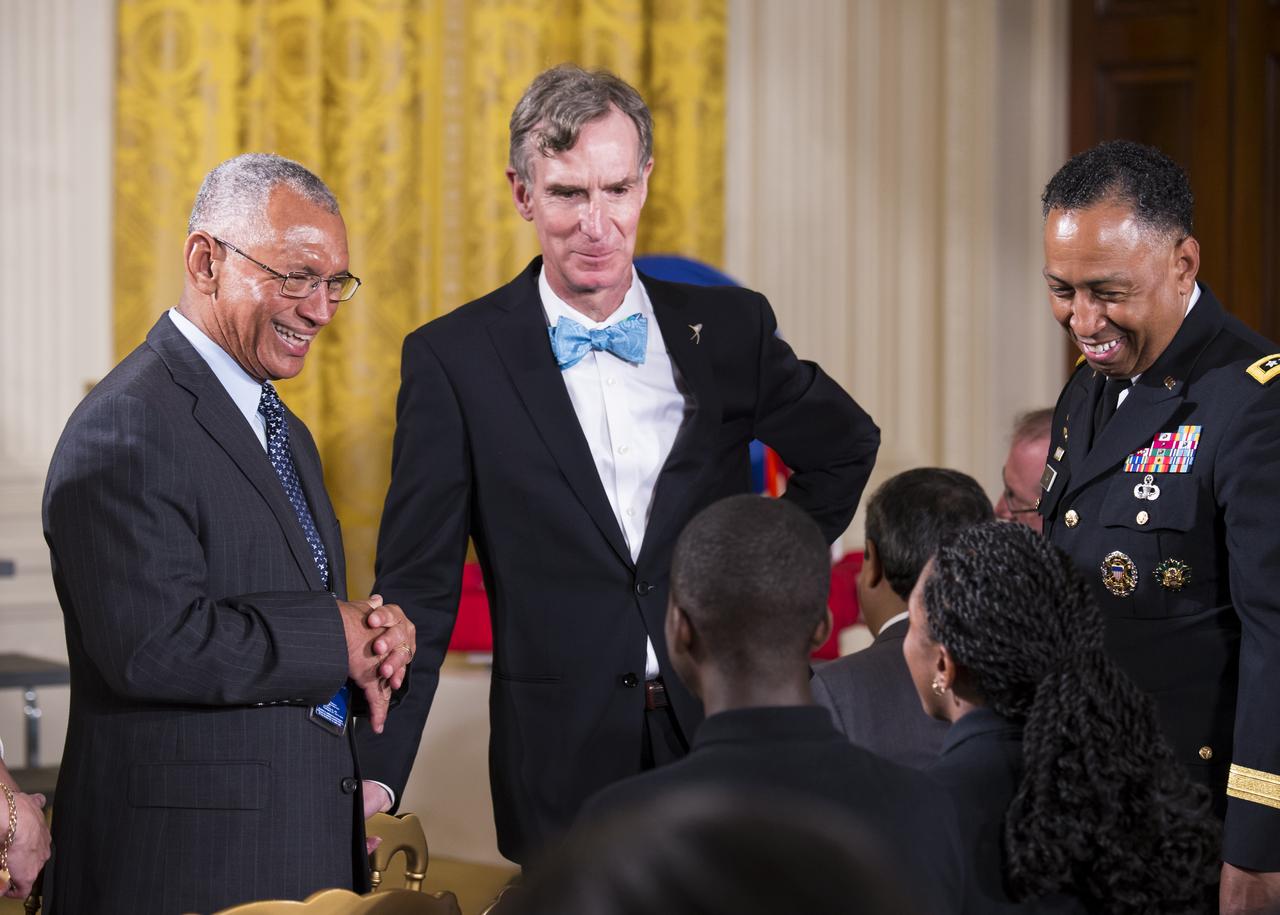
NASA Administrator Charles Bolden (left) and Bill Nye, The Science Guy, speak with some students that participated in the White House Science Fair. The fourth White House Science Fair was held at the White House on May 27, 2014 and included 100 students from more than 30 different states who competed in science, technology, engineering, and math (STEM) competitions. (Photo Credit: NASA/Aubrey Gemignani)
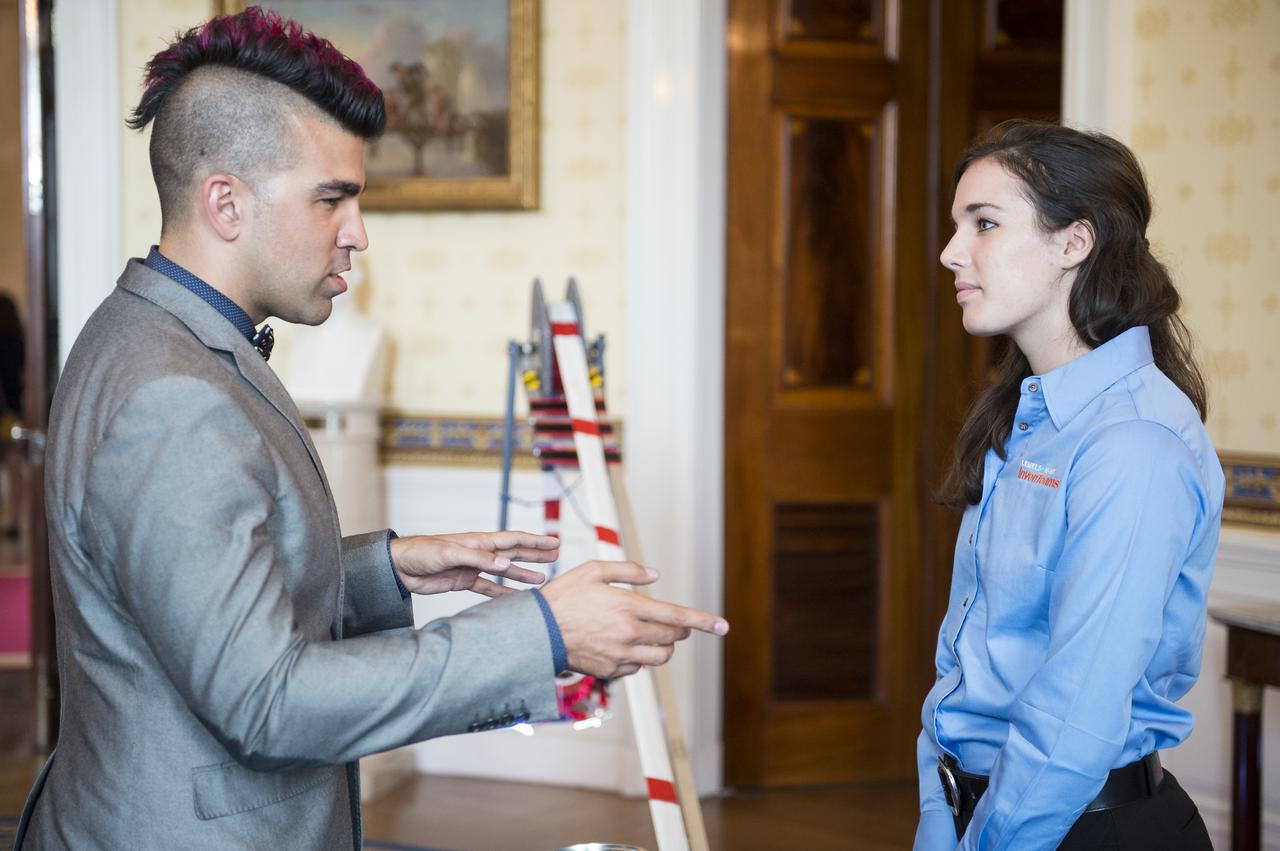
Bobak Ferdowsi, a system's engineer at NASA's Jet Propulsion Laboratory who became widely known for his mohawk hairstyle during the broadcast of the Curiosity landing on Mars, is seen here discussing a project with a participant in the White House Science Fair. The fourth White House Science Fair was held at the White House and included 100 students from more than 30 different states who competed in science, technology, engineering, and math (STEM) competitions. (Photo Credit: NASA/Aubrey Gemignani)
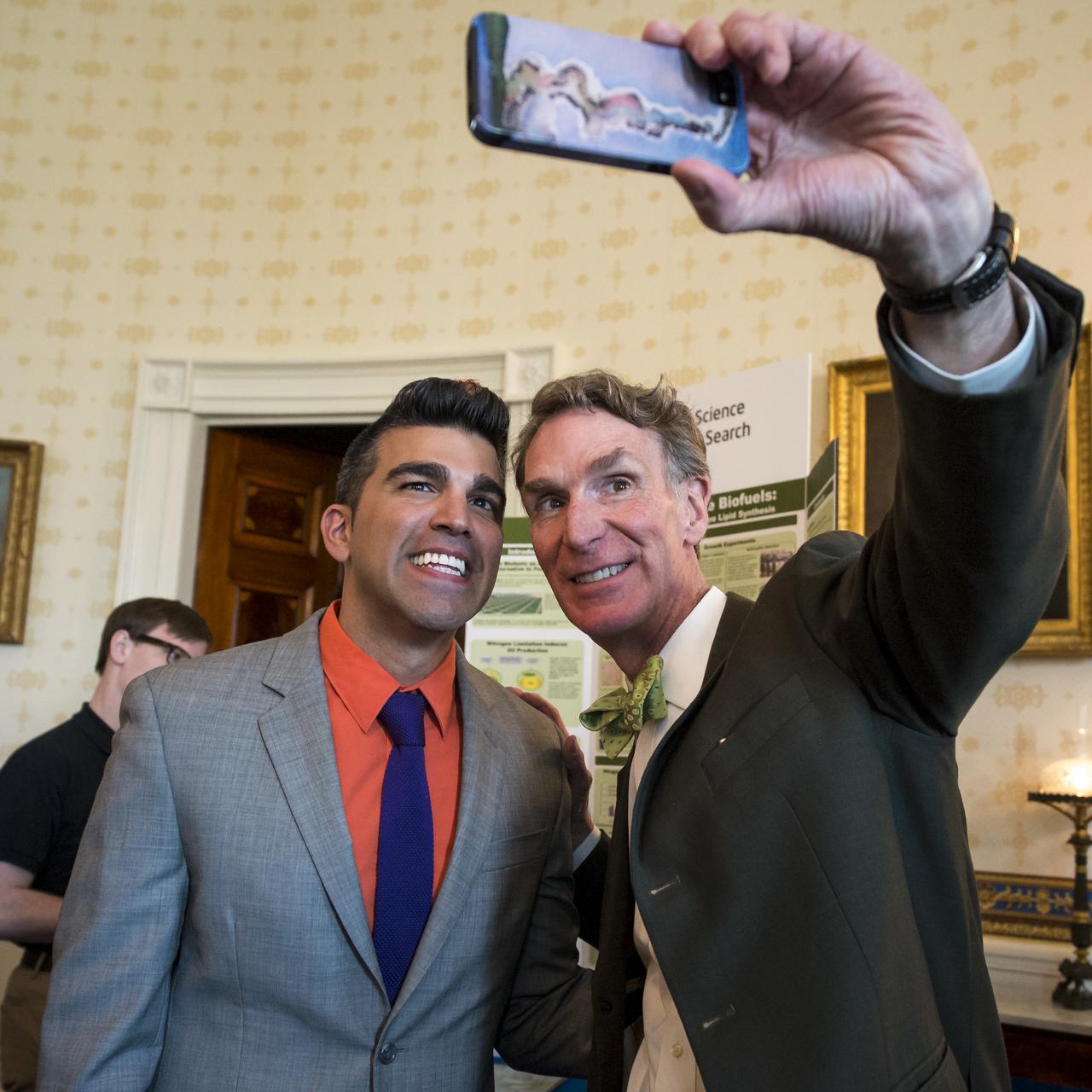
Planetary Society Executive Director and “Bill Nye the Science Guy” host Bill Nye, right, photographs himself with NASA Mars Curiosity Landing mission controller, Bobak "Mohawk Guy" Ferdowsi, during the White House Science Fair held at the White House, April 22, 2013. The science fair celebrated student winners of a broad range of science, technology, engineering and math (STEM) competitions from across the country. Photo Credit: (NASA/Bill Ingalls)
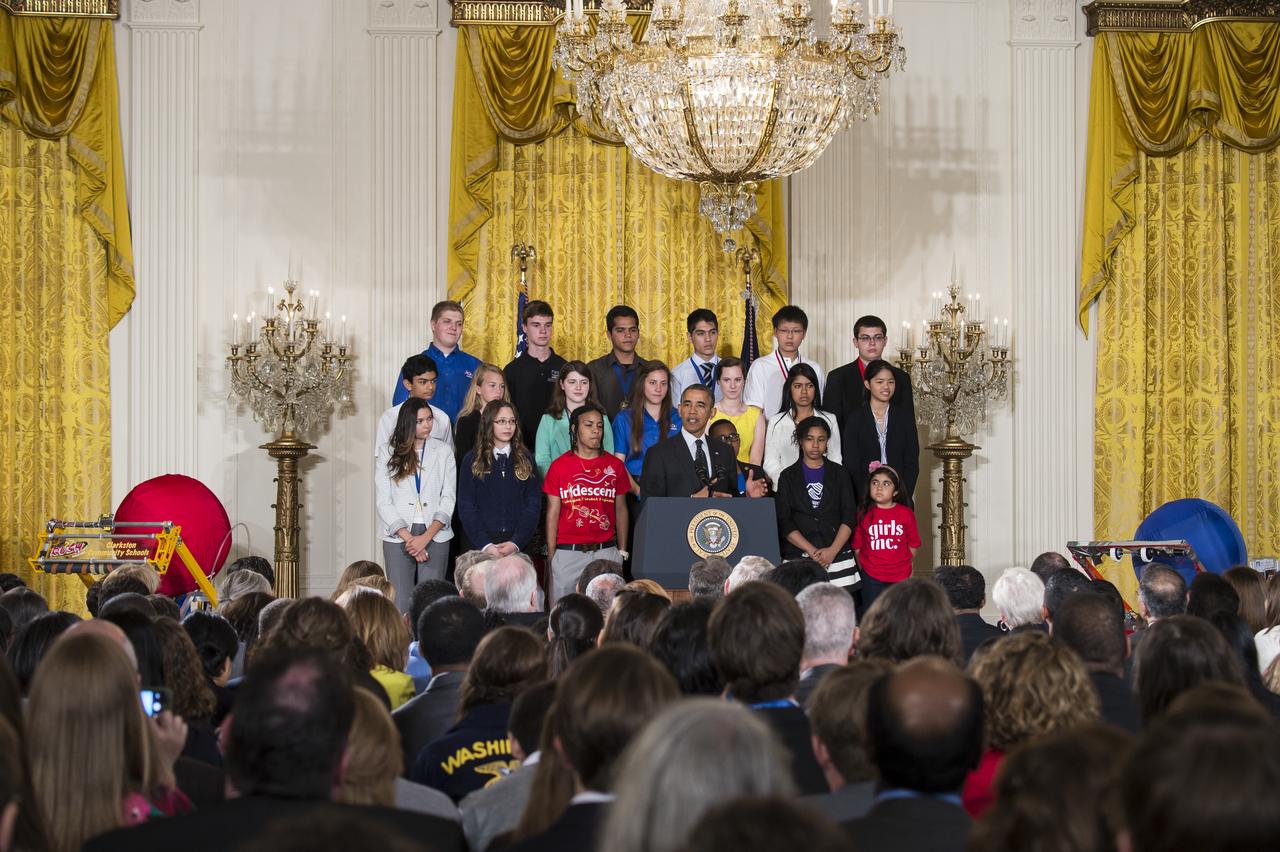
President Barack Obama spoke at the White House Science Fair Tuesday, May 27, 2014 at the White House. NASA Administrator Charles Bolden attended and was recognized by the President at the fourth White House Science Fair, which included 100 students from more than 30 different states who competed in science, technology, engineering, and math (STEM) competitions. (Photo Credit: NASA/Aubrey Gemignani)
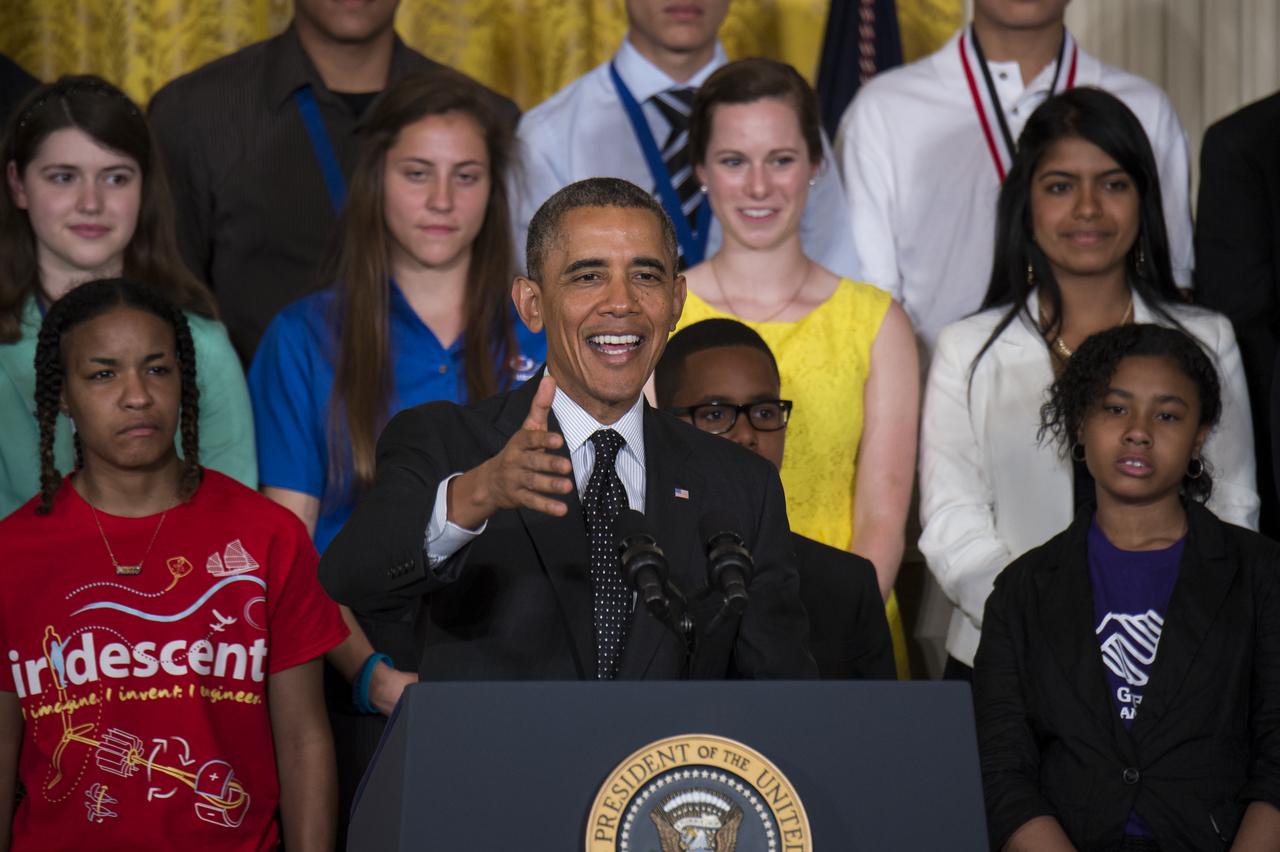
President Barack Obama spoke at the White House Science Fair Tuesday, May 27, 2014 at the White House. NASA Administrator Charles Bolden attended and was recognized by the President at the fourth White House Science Fair, which included 100 students from more than 30 different states who competed in science, technology, engineering, and math (STEM) competitions. (Photo Credit: NASA/Aubrey Gemignani)
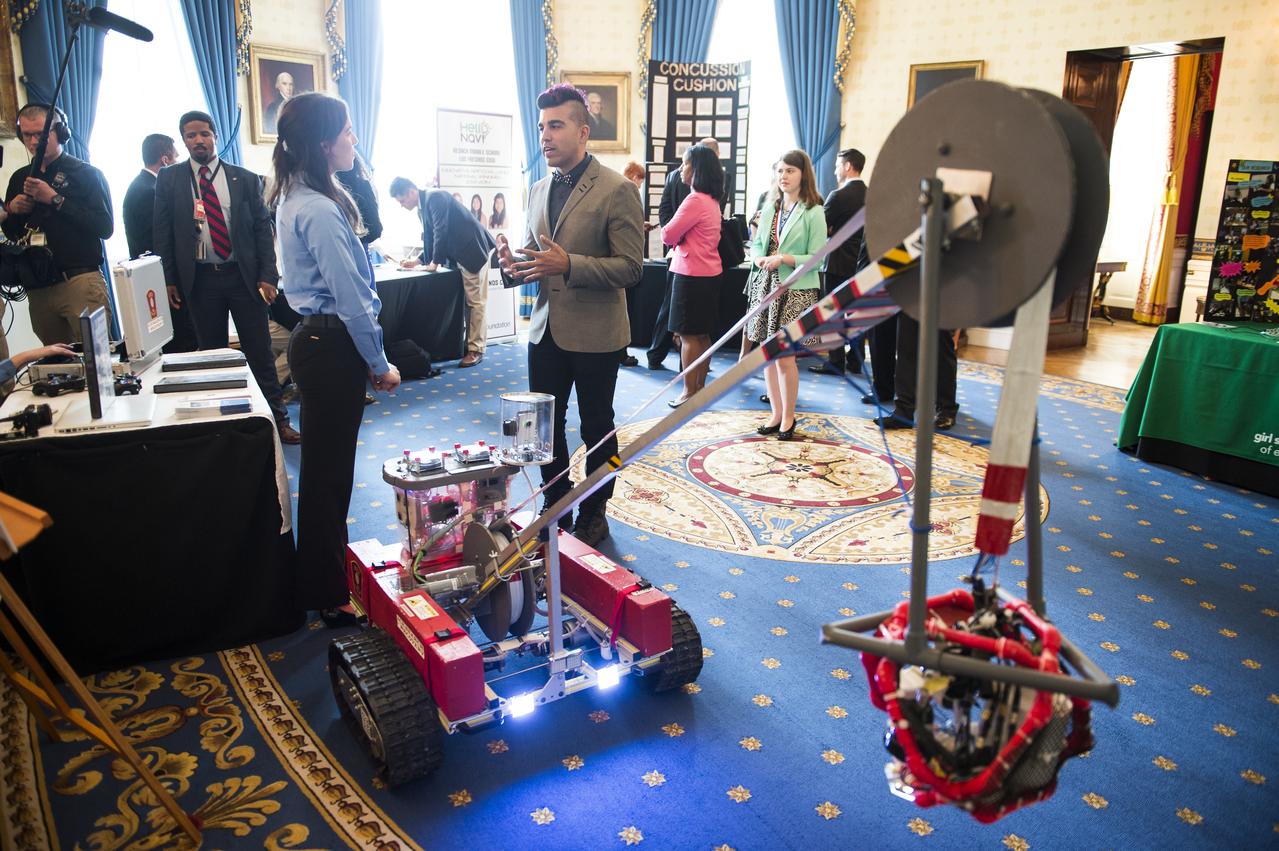
Bobak Ferdowsi, a system's engineer at NASA's Jet Propulsion Laboratory, speaks with a member of "invenTeam" at the White House Science Fair. Olivia Van Amsterdam, 16, Katelyn Sweeney, 17, and their team of student engineers from Natick, MA, invented a 120 lb remotely operated vehicle (ROV) that can help search-and-rescue dive teams search for bodies in dangerous, icy waters. The fourth White House Science Fair was held at the White House and included 100 students from more than 30 different states who competed in science, technology, engineering, and math (STEM) competitions. (Photo Credit: NASA/Aubrey Gemignani)

U.S. President Barack Obama speaks as he hosts the third-ever White House Science Fair in the East Room at the White House in Washington, April 22, 2013. The science fair celebrated student winners of a broad range of science, technology, engineering and math (STEM) competitions from across the country. Photo Credit: (NASA/Bill Ingalls)
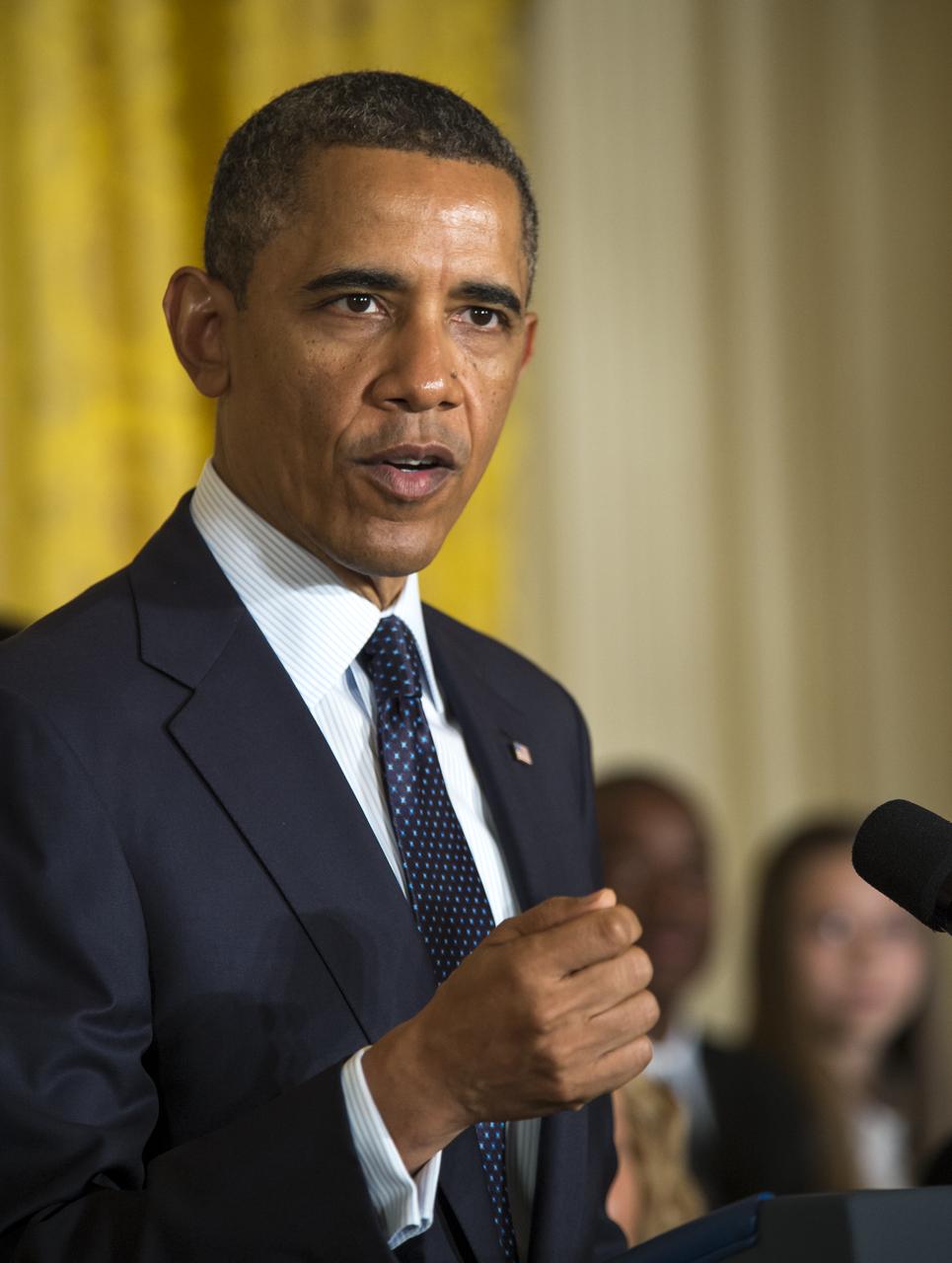
U.S. President Barack Obama speaks as he hosts the third-ever White House Science Fair in the East Room at the White House in Washington, April 22, 2013. The science fair celebrated student winners of a broad range of science, technology, engineering and math (STEM) competitions from across the country. Photo Credit: (NASA/Bill Ingalls)
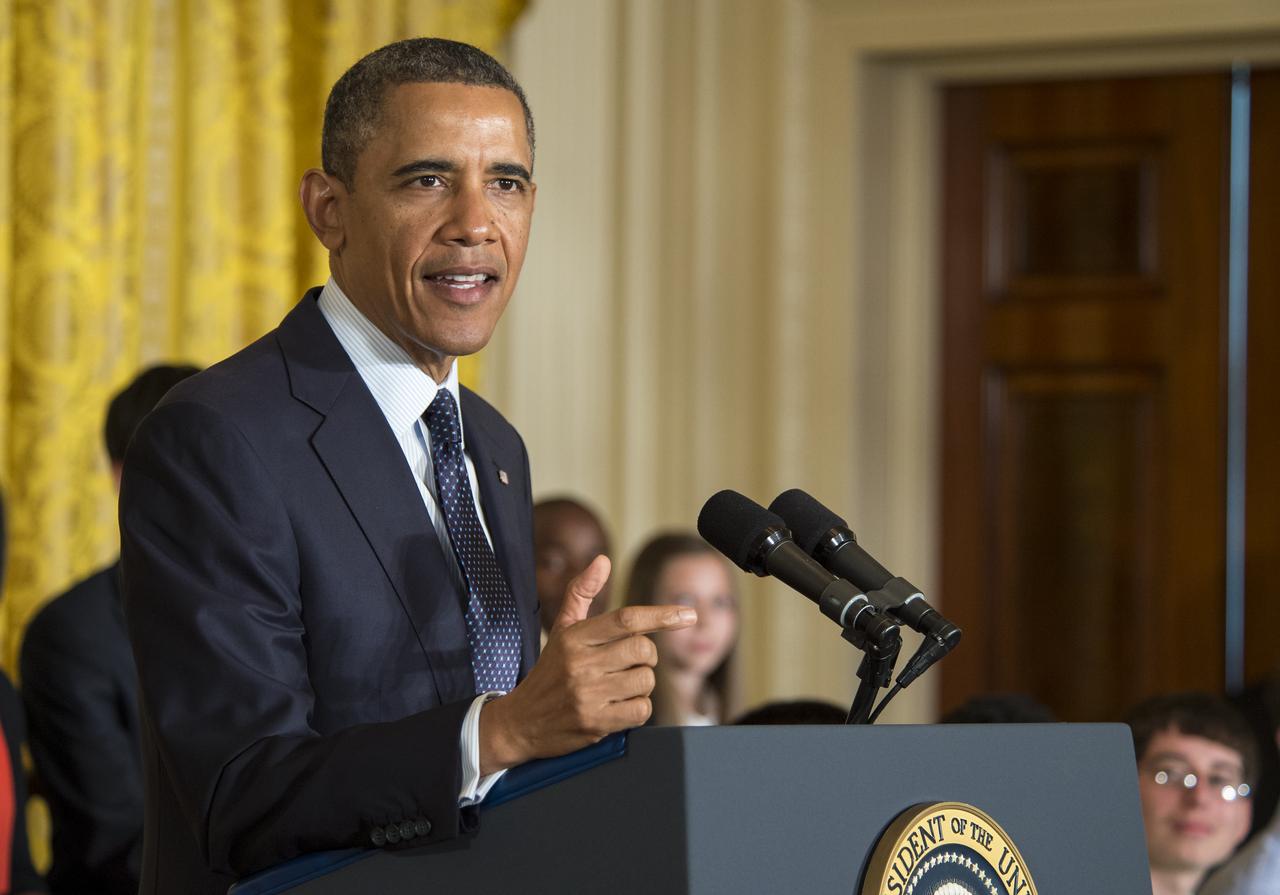
U.S. President Barack Obama speaks as he hosts the third-ever White House Science Fair in the East Room at the White House in Washington, April 22, 2013. The science fair celebrated student winners of a broad range of science, technology, engineering and math (STEM) competitions from across the country. Photo Credit: (NASA/Bill Ingalls)

U.S. President Obama recognizes NASA Administrator Charles Bolden during his remarks at the 3rd Annual White House Science Fair in the East Room of the White House on Monday, April 22, 2013. The science fair celebrated student winners of a broad range of science, technology, engineering and math (STEM) competitions from across the country. Photo Credit: (NASA/Bill Ingalls)
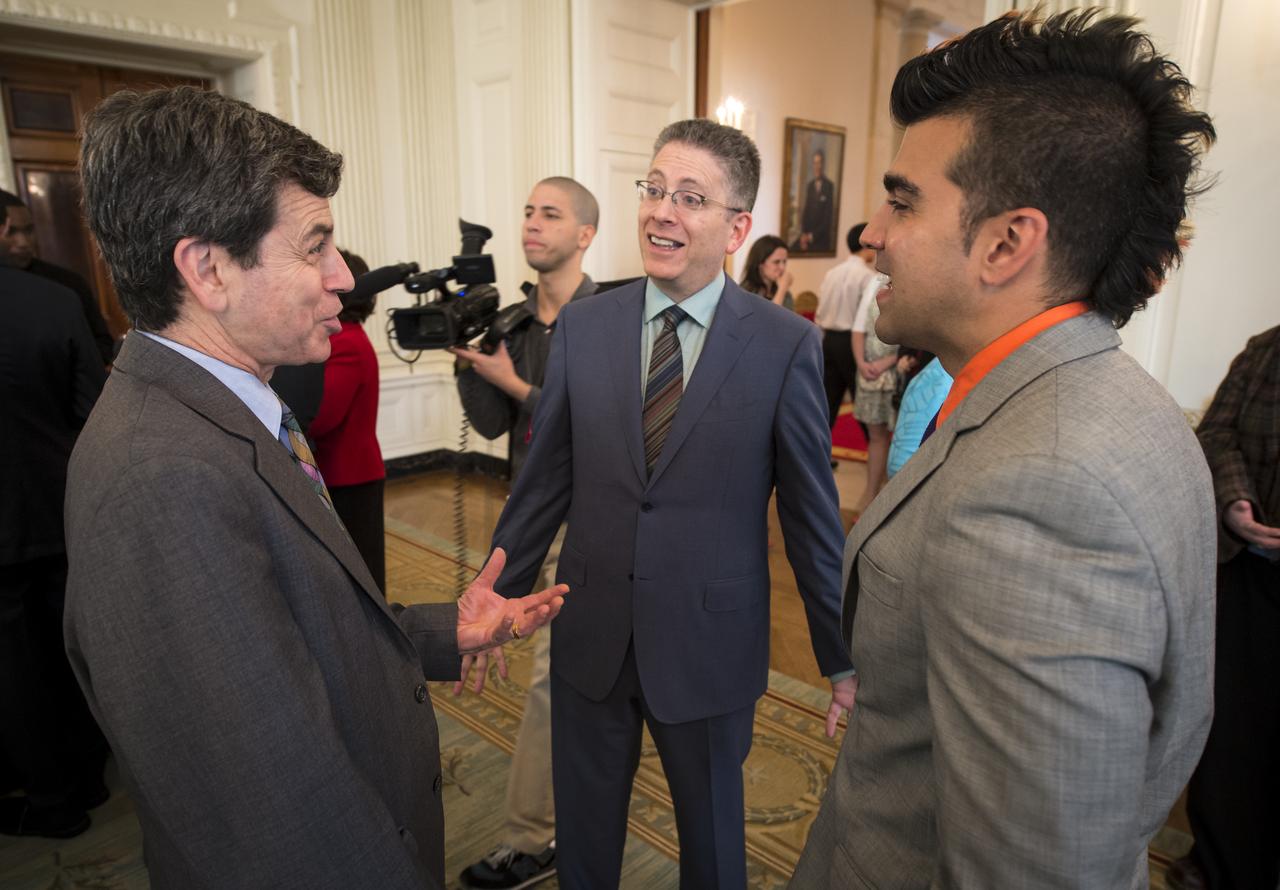
Director of Strategic Communications and Senior Science and Technology Policy Analyst, Office of Science and Technology Policy, Executive Office of the President, Rick Weiss, left, “Big Bang Theory” co-creator Bill Prady, center, and NASA Mars Curiosity Landing mission controller, Bobak "Mohawk Guy" Ferdowsi talk during the White House Science Fair held at the White House, April 22, 2013. The science fair celebrated student winners of a broad range of science, technology, engineering and math (STEM) competitions from across the country. Photo Credit: (NASA/Bill Ingalls)
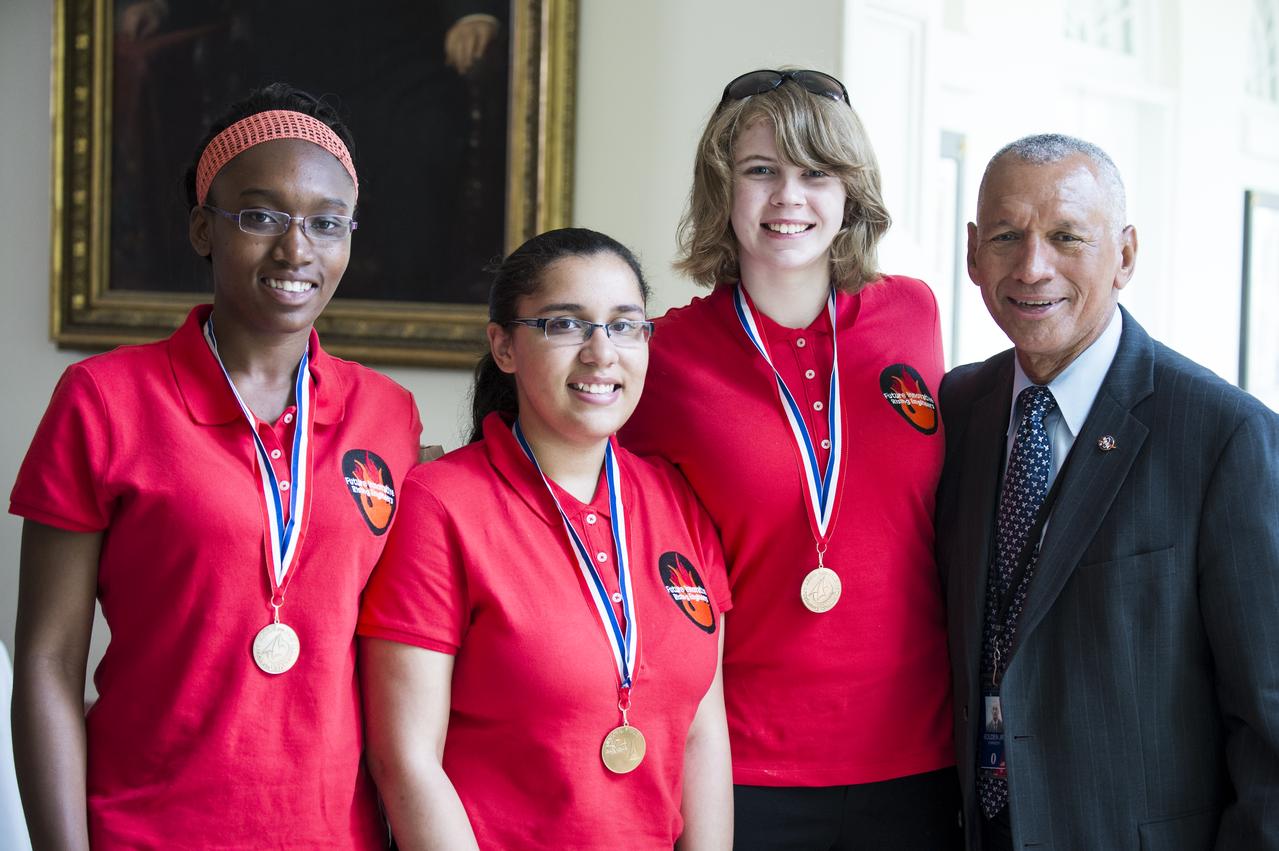
NASA Administrator Charles Bolden poses with an all-girl engineering team that participated in the White House Science Fair. "Team Rocket Power" was one of 100 teams that qualified for last year’s Team America Rocketry Challenge (TARC). Nia'mani Robinson, 15, Jasmyn Logan, 15, and Rebecca Chapin-Ridgely, 17, gave up their weekends and free time after school to build and test their bright purple rocket, which is designed to launch to an altitude of about 750 ft, and then return a “payload” (an egg) to the ground safely. The fourth White House Science Fair was held at the White House on May 27, 2014 and included 100 students from more than 30 different states who competed in science, technology, engineering, and math (STEM) competitions. (Photo Credit: NASA/Aubrey Gemignani)
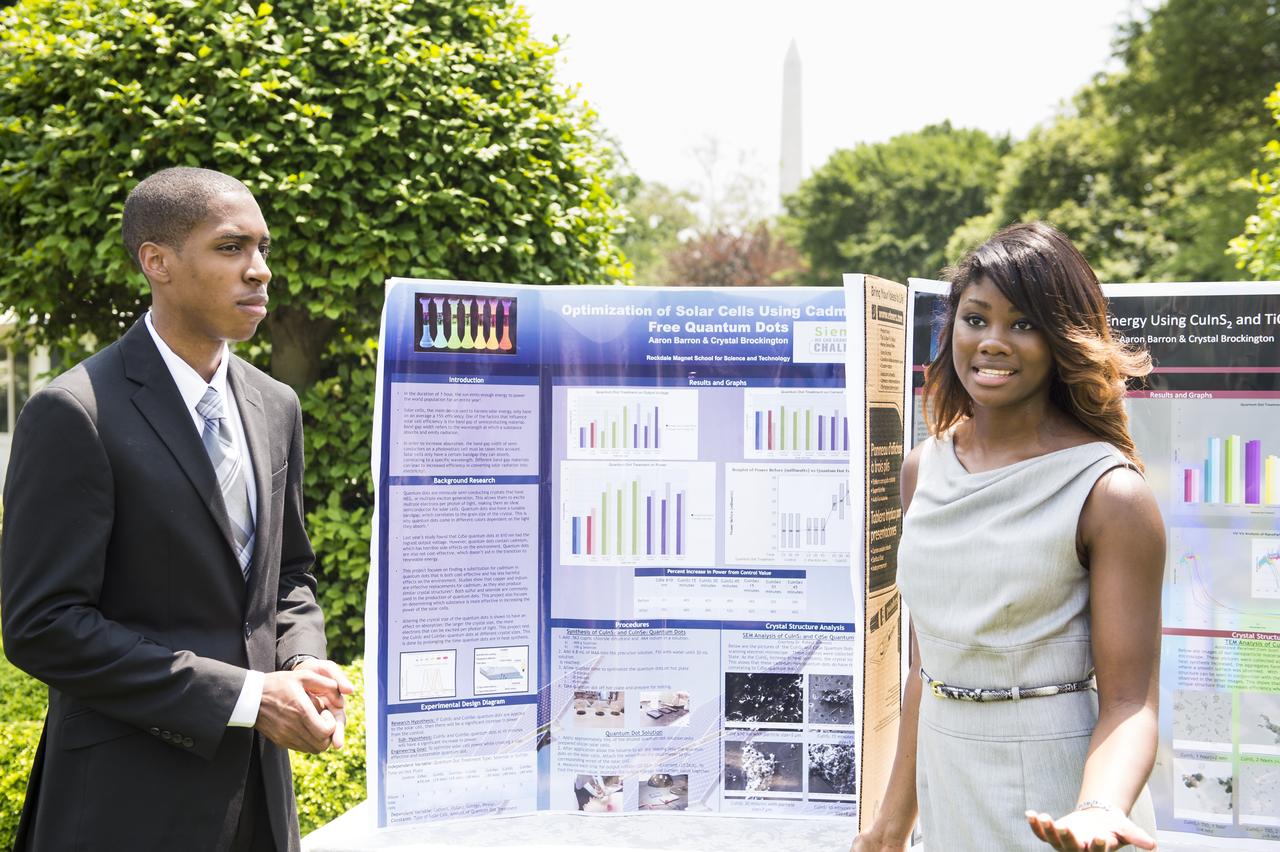
Crystal Brockington and Aaron Barron, both 18 years old, designed a more efficient and cost effective solar cell that harnesses energy without cadmium, which has been shown to be harmful to the environment. They were selected to participate in the White House Science Fair after they were awarded the High School Grand Prize at the Siemens We Can Change the World Challenge. The fourth White House Science Fair was held at the White House on May 27, 2014 and included 100 students from more than 30 different states who competed in science, technology, engineering, and math (STEM) competitions. (Photo Credit: NASA/Aubrey Gemignani)
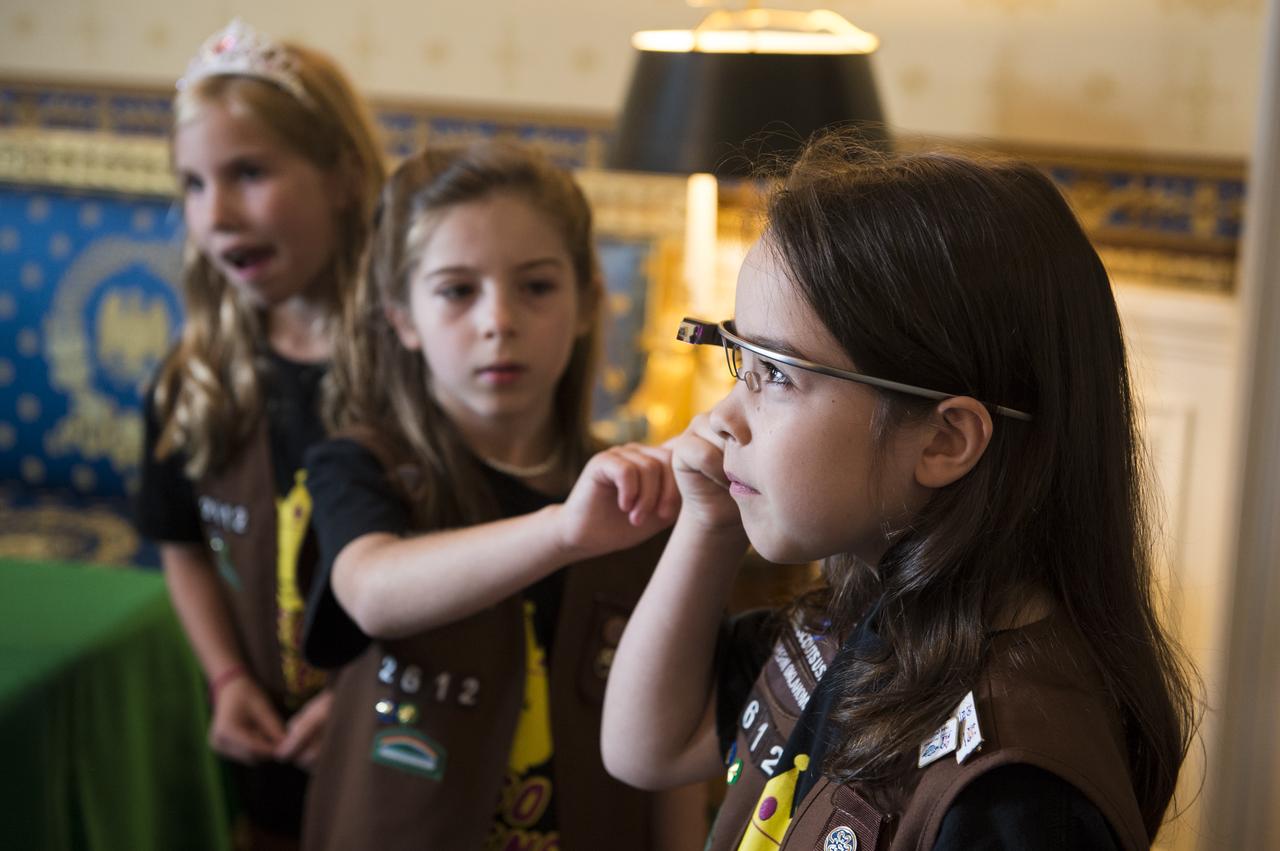
Girl Scout troop 2612 members from Tulsa, OK take photos of one another with Google Glass at the White House Science Fair Tuesday, May 27, 2014. Avery Dodson, 6; Natalie Hurley, 8; Miriam Schaffer, 8; Claire Winton, 8; and Lucy Claire Sharp, 8 participated in the Junior FIRST Lego League's Disaster Blaster Challenge, which invites elementary-school-aged students from across the country to explore how simple machines, engineering, and math can help solve problems posed by natural disasters. The girls invented the "Flood Proof Bridge" and built a model mechanizing the bridge using motors and developing a computer program to automatically retract the bridge when flood conditions are detected. The fourth White House Science Fair was held at the White House and included 100 students from more than 30 different states who competed in science, technology, engineering, and math (STEM) competitions. (Photo Credit: NASA/Aubrey Gemignani)
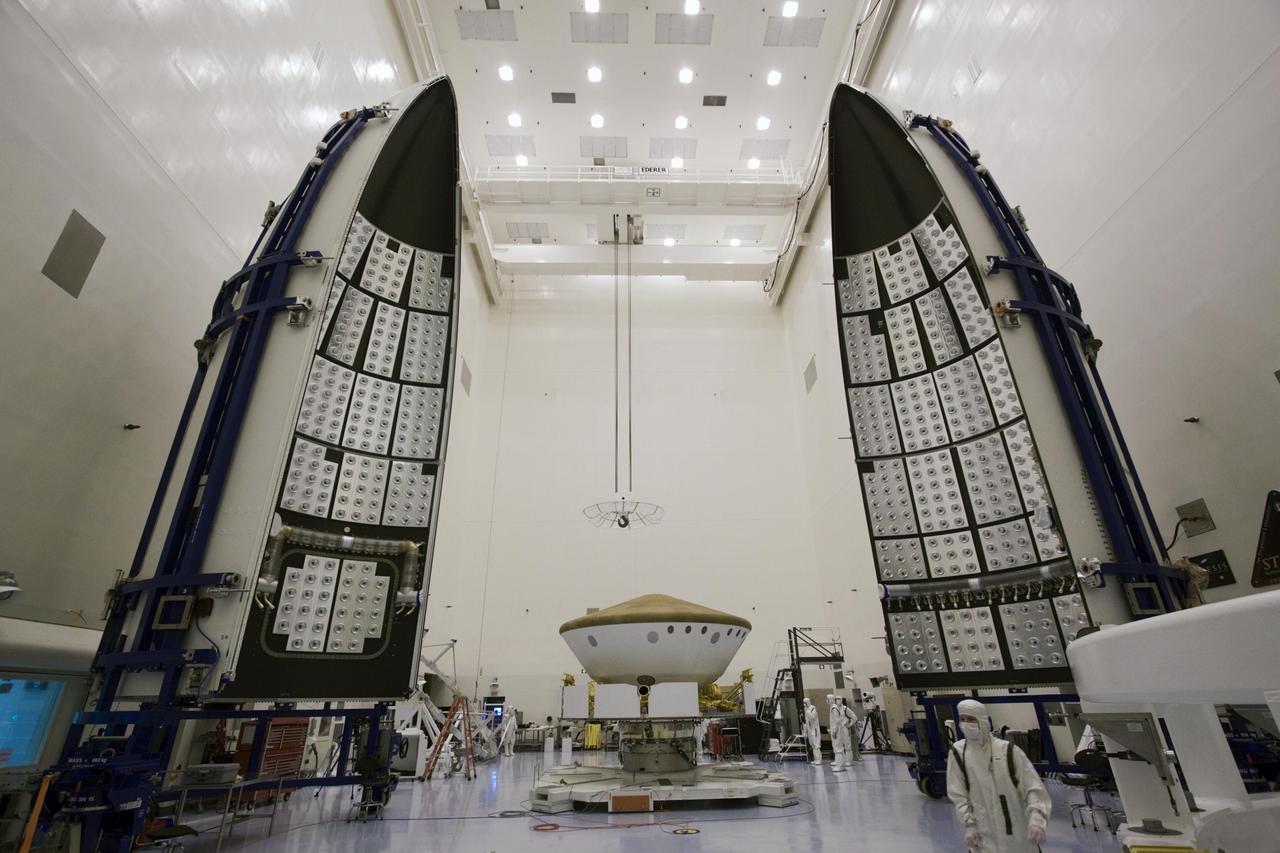
Preparations are under way to enclose NASA Mars Science Laboratory in an Atlas V rocket payload fairing. The fairing protects the spacecraft from the impact of aerodynamic pressure and heating during ascent.
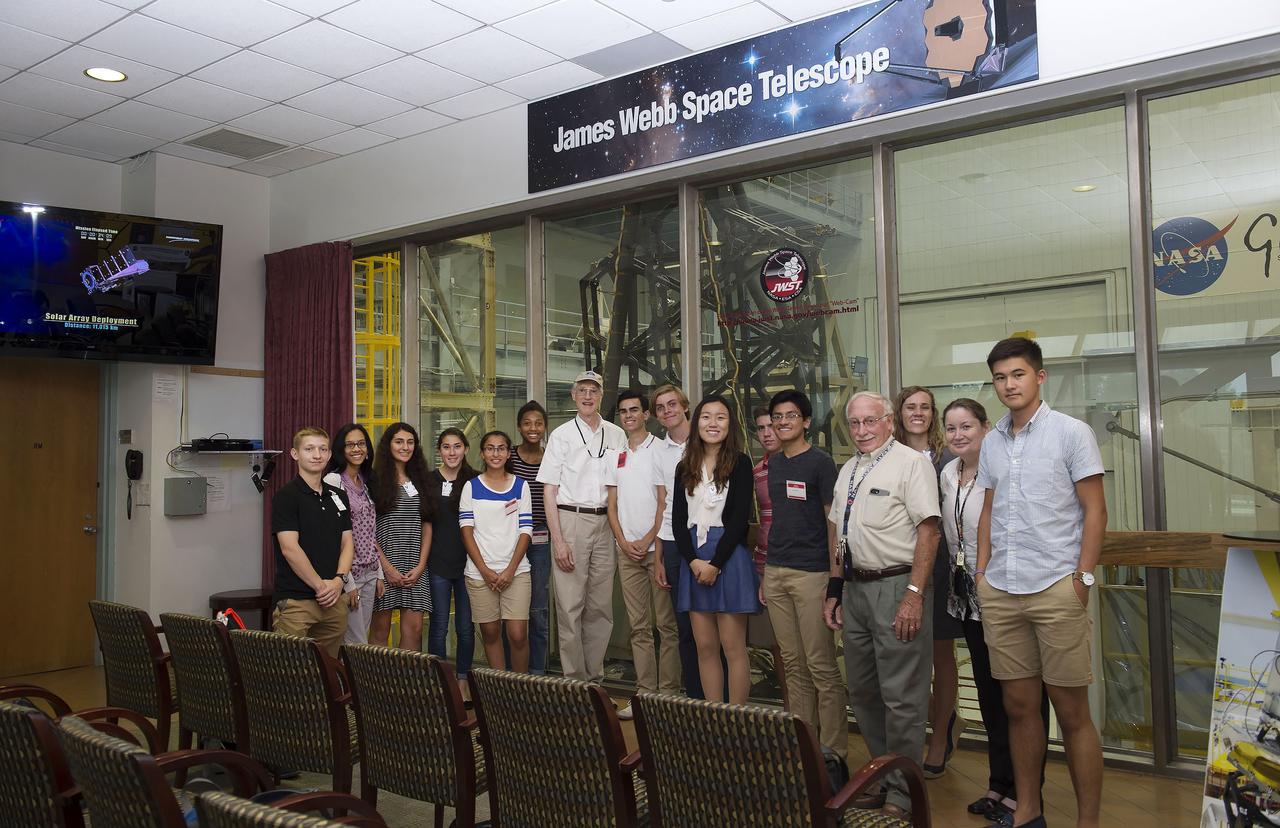
AIAA American Institute for Aeronautics and Astronautics science fair winners visited Goddard on July 17, 2017. Dr. John Mather, Nobel Prize winner, poses with group near JWST clean room.
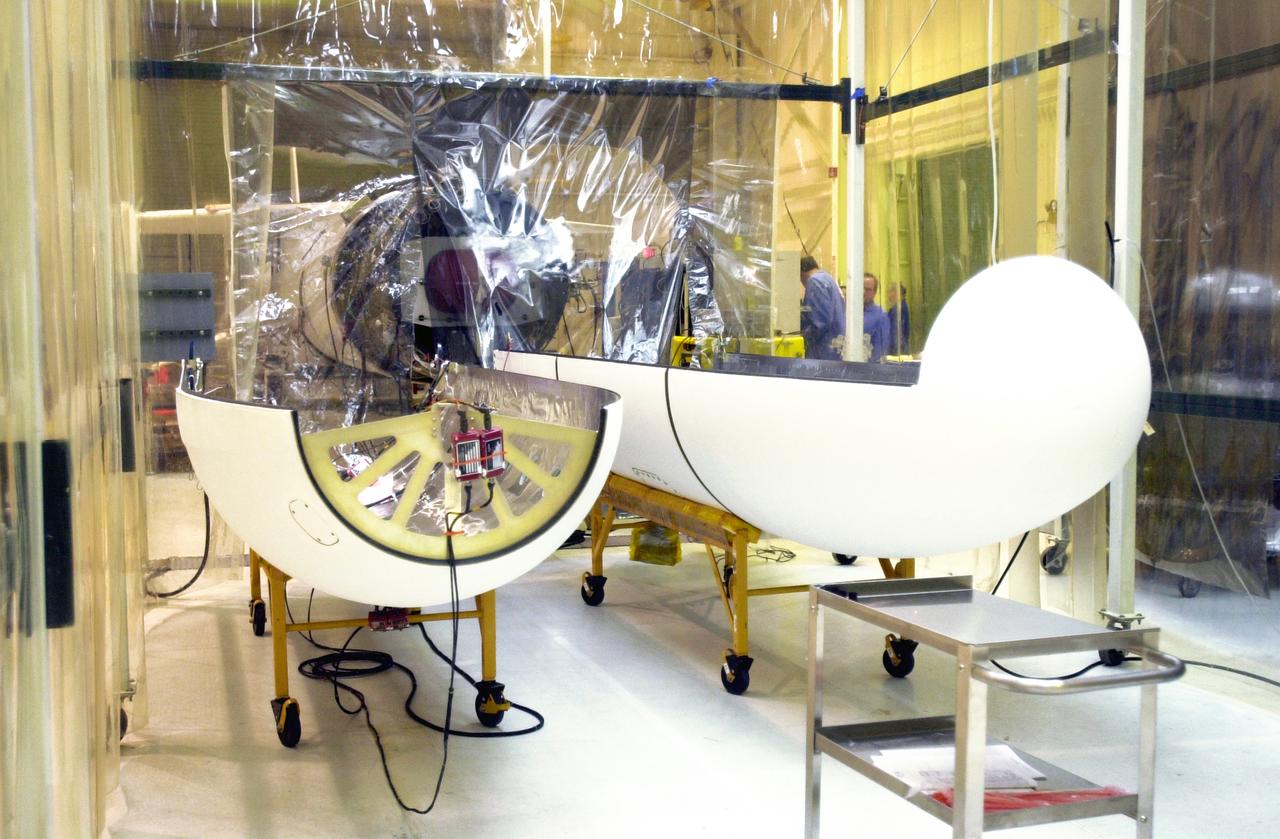
Seen at Vandenberg Air Force Base in California is the fairing (foreground) for the Orbital Sciences Pegasus XL rocket. In the background is the third stage, under the clean room tent. The rocket is the launch vehicle for NASA's Aeronomy of Ice in the Mesosphere, or AIM, spacecraft. AIM is the seventh Small Explorers mission under NASA's Explorer Program. The program provides frequent flight opportunities for world-class scientific investigations from space within heliophysics and astrophysics. The AIM spacecraft will fly three instruments designed to study polar mesospheric clouds located at the edge of space, 50 miles above the Earth's surface in the coldest part of the planet's atmosphere. The mission's primary goal is to explain why these clouds form and what has caused them to become brighter and more numerous and appear at lower latitudes in recent years. AIM's results will provide the basis for the study of long-term variability in the mesospheric climate and its relationship to global climate change. AIM is scheduled to be mated to the Pegasus XL during the second week of April, after which final inspections will be conducted. Launch is scheduled for April 25.
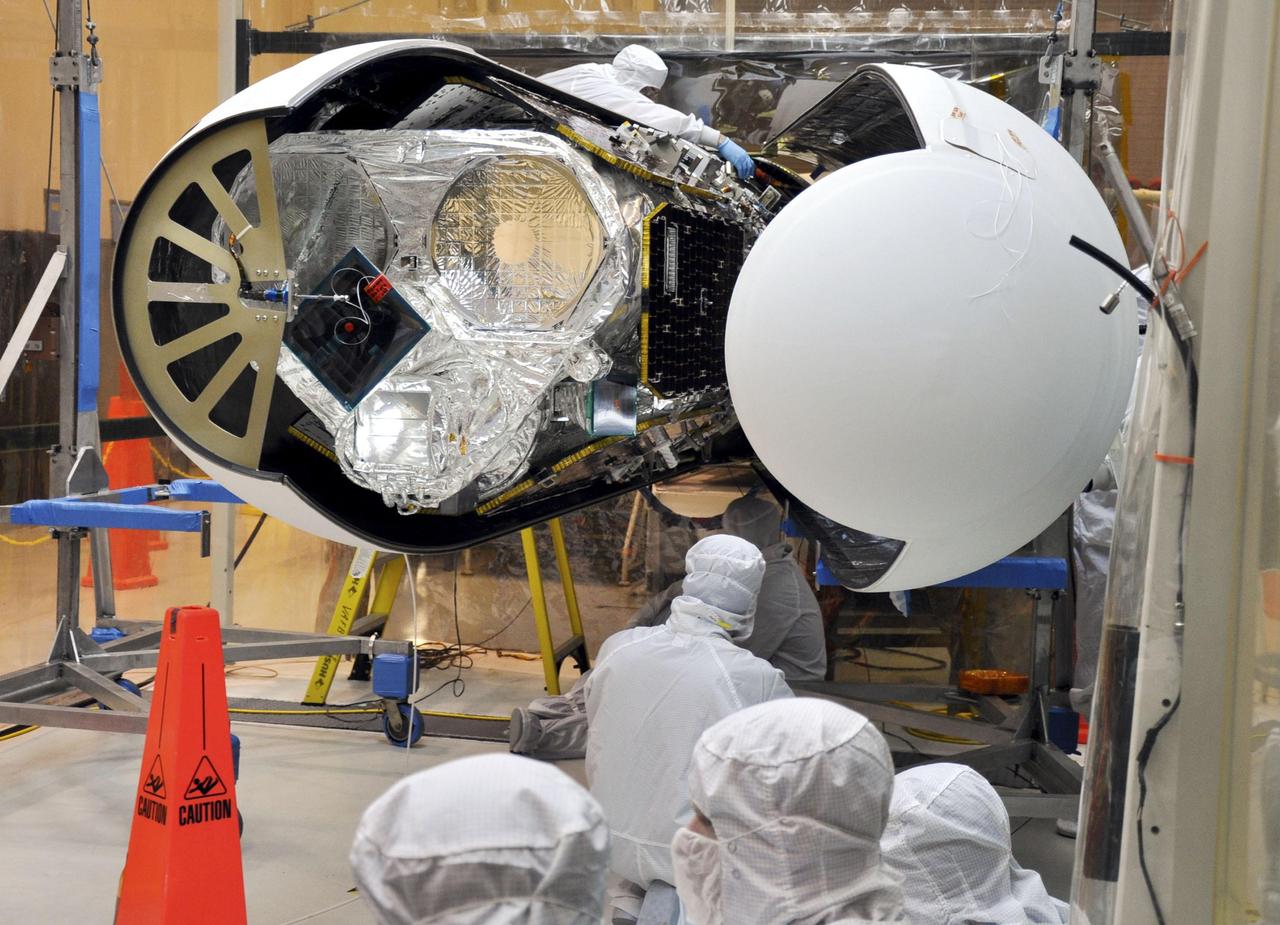
An Orbital Sciences technician completes final checks of NASA Nuclear Spectroscopic Telescope Array, or NuSTAR, before the Pegasus payload fairing is secured around it.
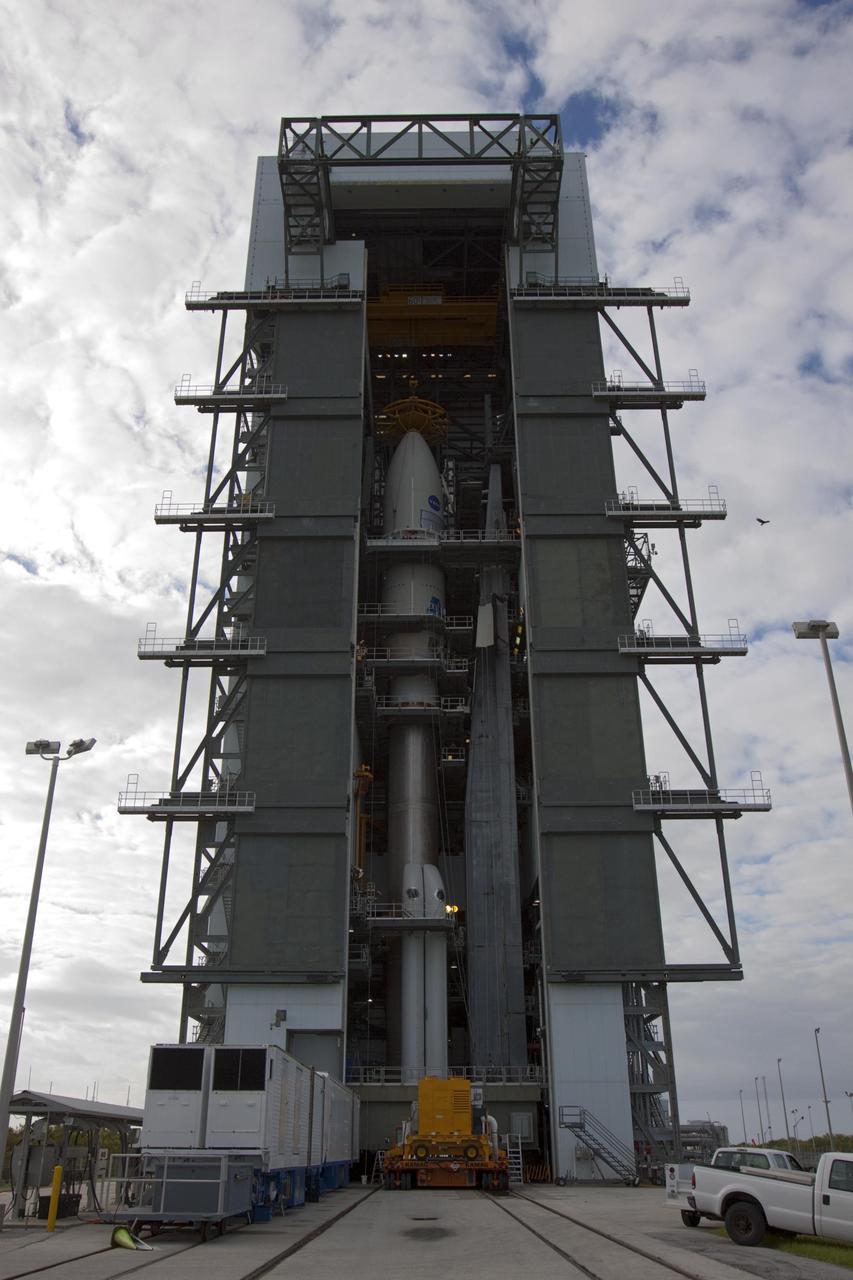
In the Vertical Integration Facility at Space Launch Complex 41, the payload fairing containing NASA Mars Science Laboratory spacecraft was attached to its Atlas V rocket on Nov. 3, 2011.
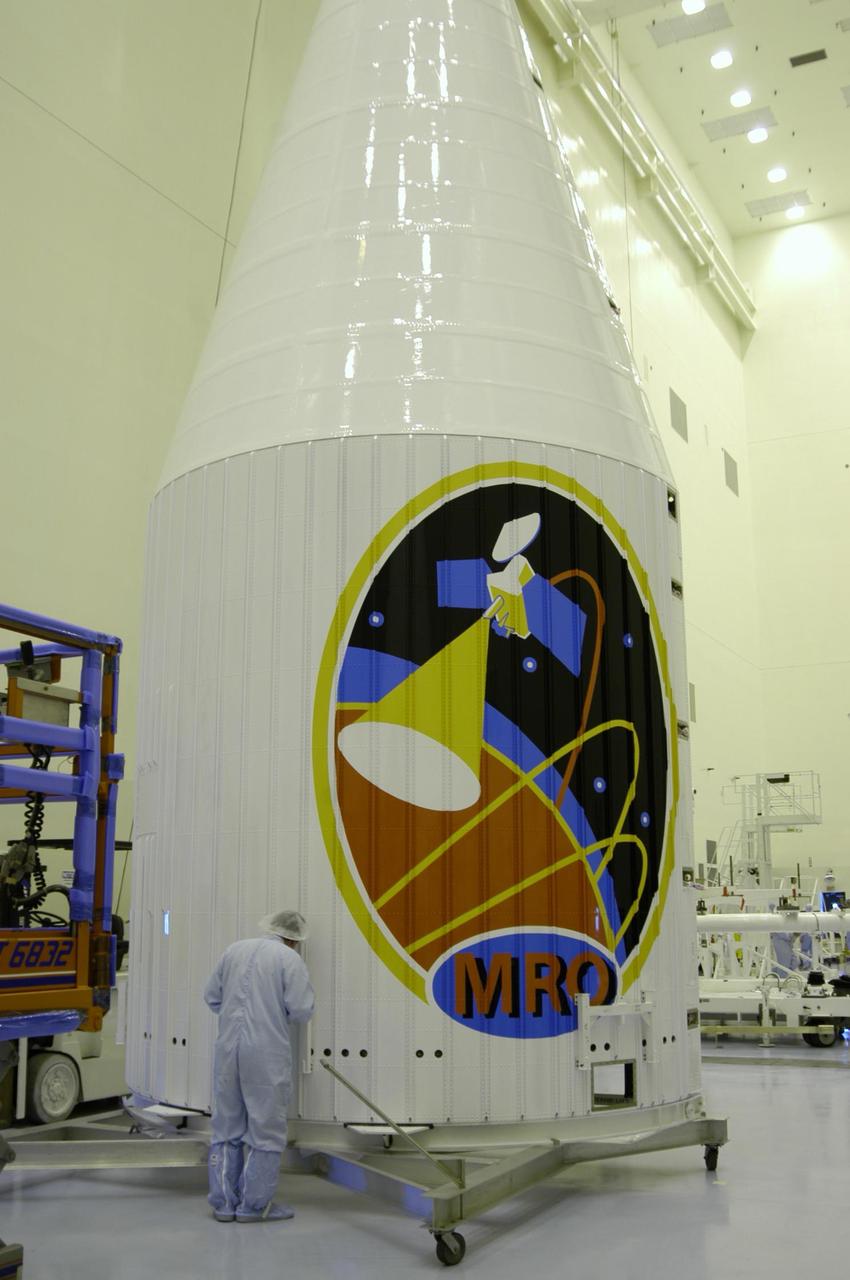
This image features the protective fairing that encapsulated NASA Mars Reconnaissance Orbiter atop an Atlas V rocket. The lively logo celebrates the intense science mission ahead of the orbiter.
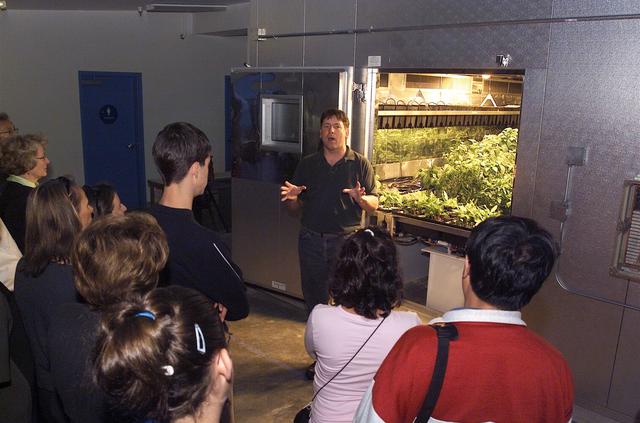
Space Day 2002; Directors Breakfast @ NASA Ames Visitors Center for student Winners of Santa Clara Valley Science & Engineering Fair and San Francisco Bay Aera Science Fair
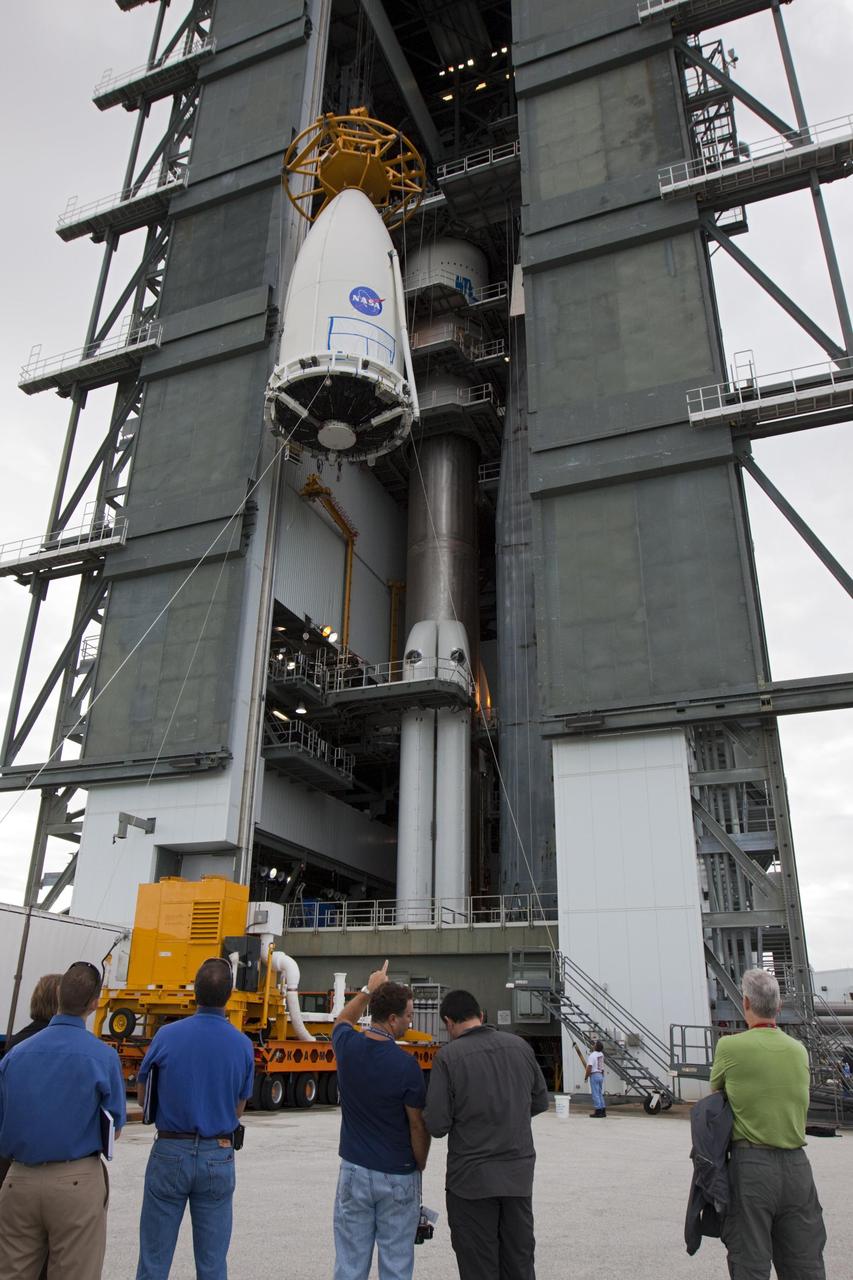
Employees at Space Launch Complex 41 of Cape Canaveral Air Force Station, Fla., keep watch as the payload fairing containing NASA Mars Science Laboratory spacecraft is lifted up the side of the Vertical Integration Facility on Nov. 3, 2011.
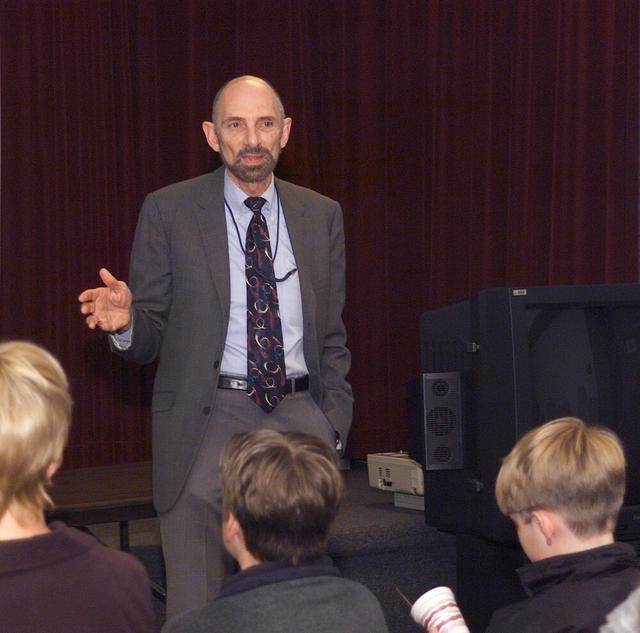
Space Day 2002; Directors Breakfast @ NASA Ames Visitors Center for student Winners of Santa Clara Valley Science & Engineering Fair and San Francisco Bay Aera Science Fair (Students are addressed by Bob Rosen, Ames Associate Director for Aerospace Programs)
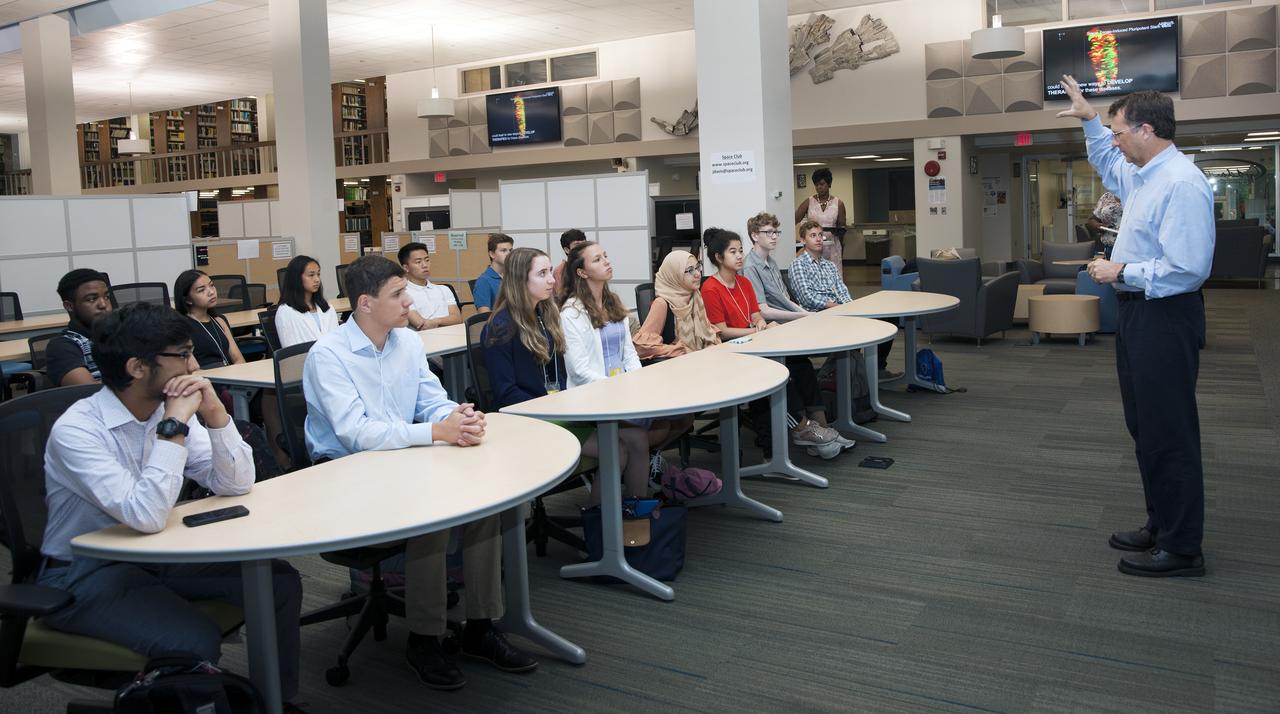
AIAA science fair winners visited Goddard July 23-26, 2019 Tupper Hyde speaks to group B21
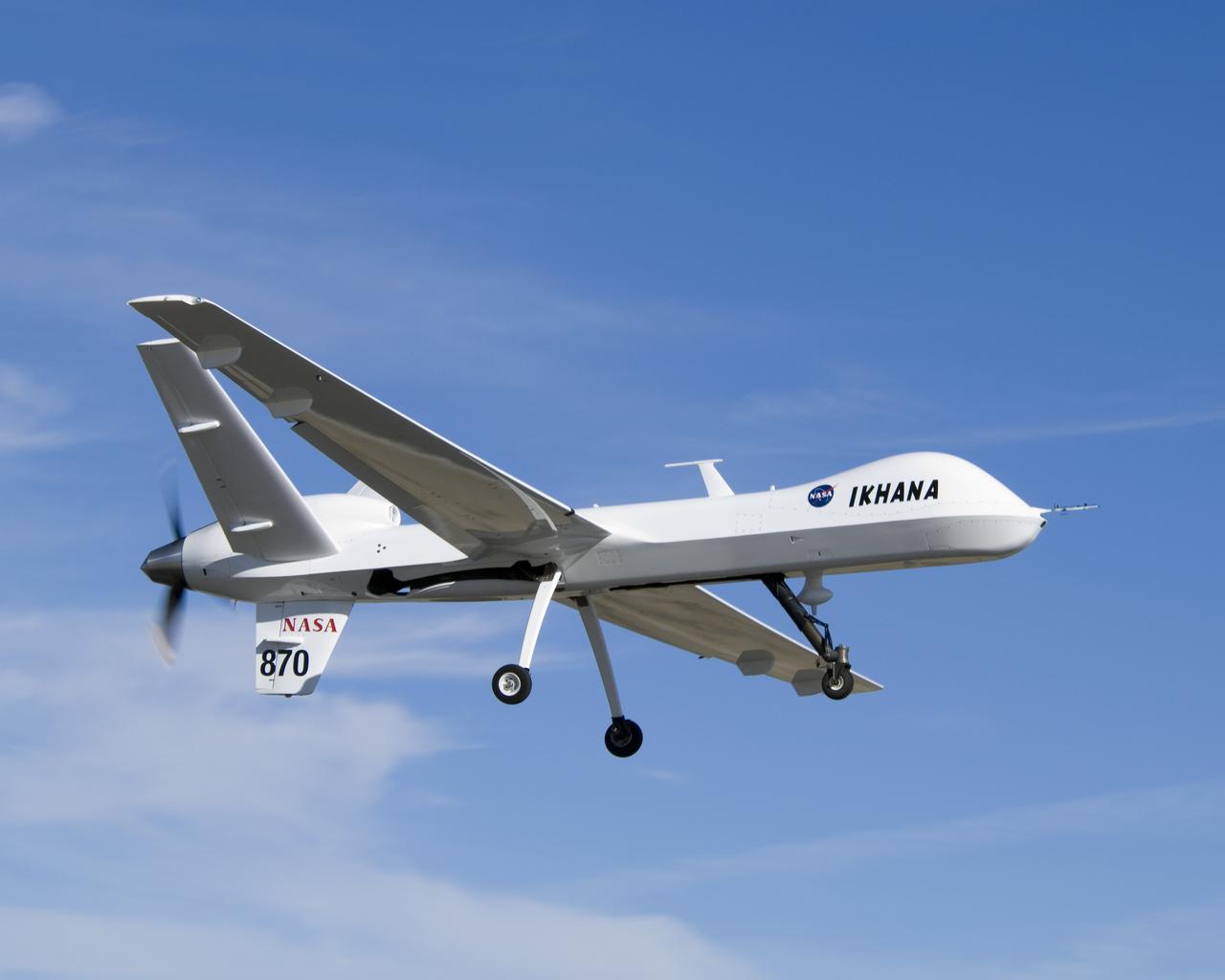
The bulging fairing atop the forward fuselage of NASA's Ikhana unmanned aircraft covers a variety of navigation, communications and science instruments.
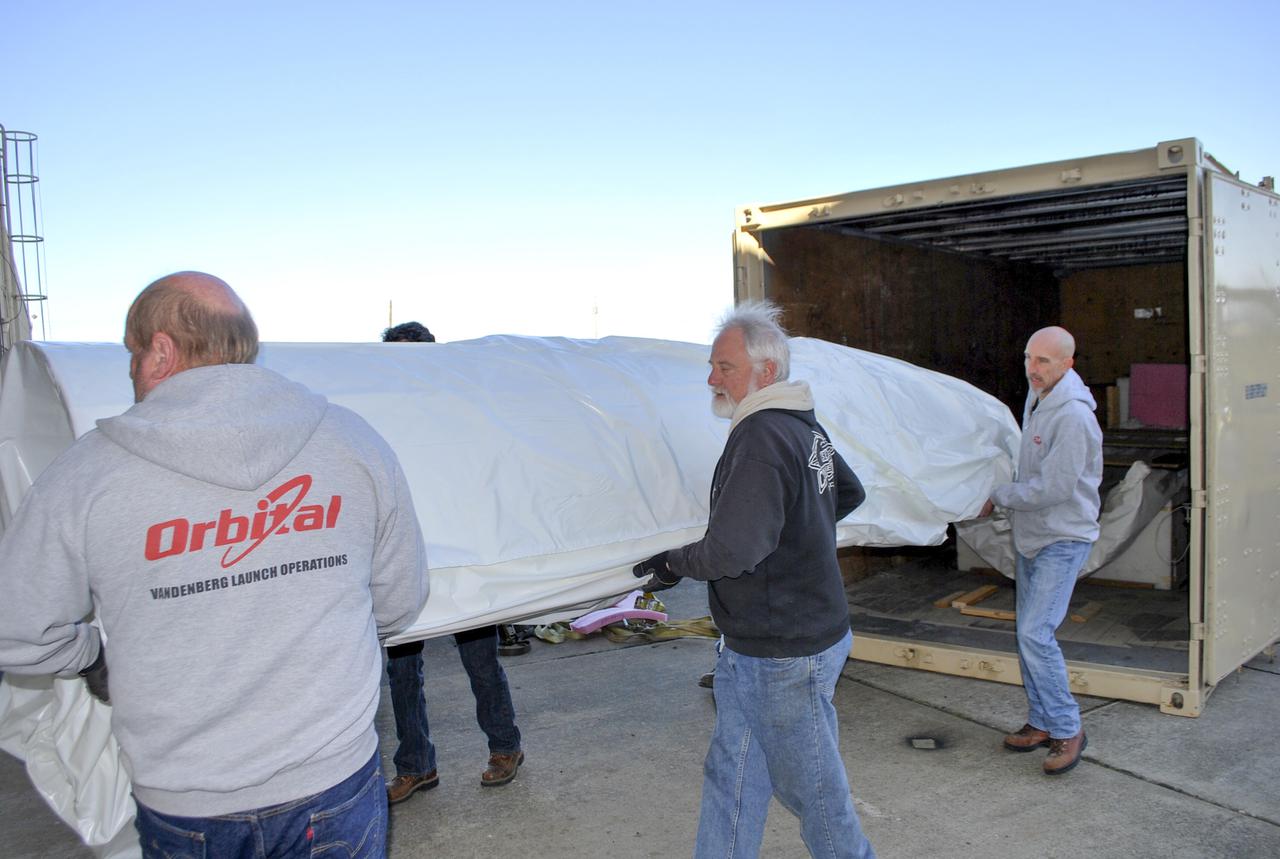
VANDENBERG AFB, Calif. – Workers carry half of a payload fairing into a hangar at Vandenberg Air Force Base in California where it will be processed and used for NASA's IRIS mission. The fairing will be fitted to the nose of an Orbital Sciences Pegasus rocket and will protect the IRIS spacecraft from atmospheric heating and stress during launch. Photo credit: VAFB_Randy Beaudoin
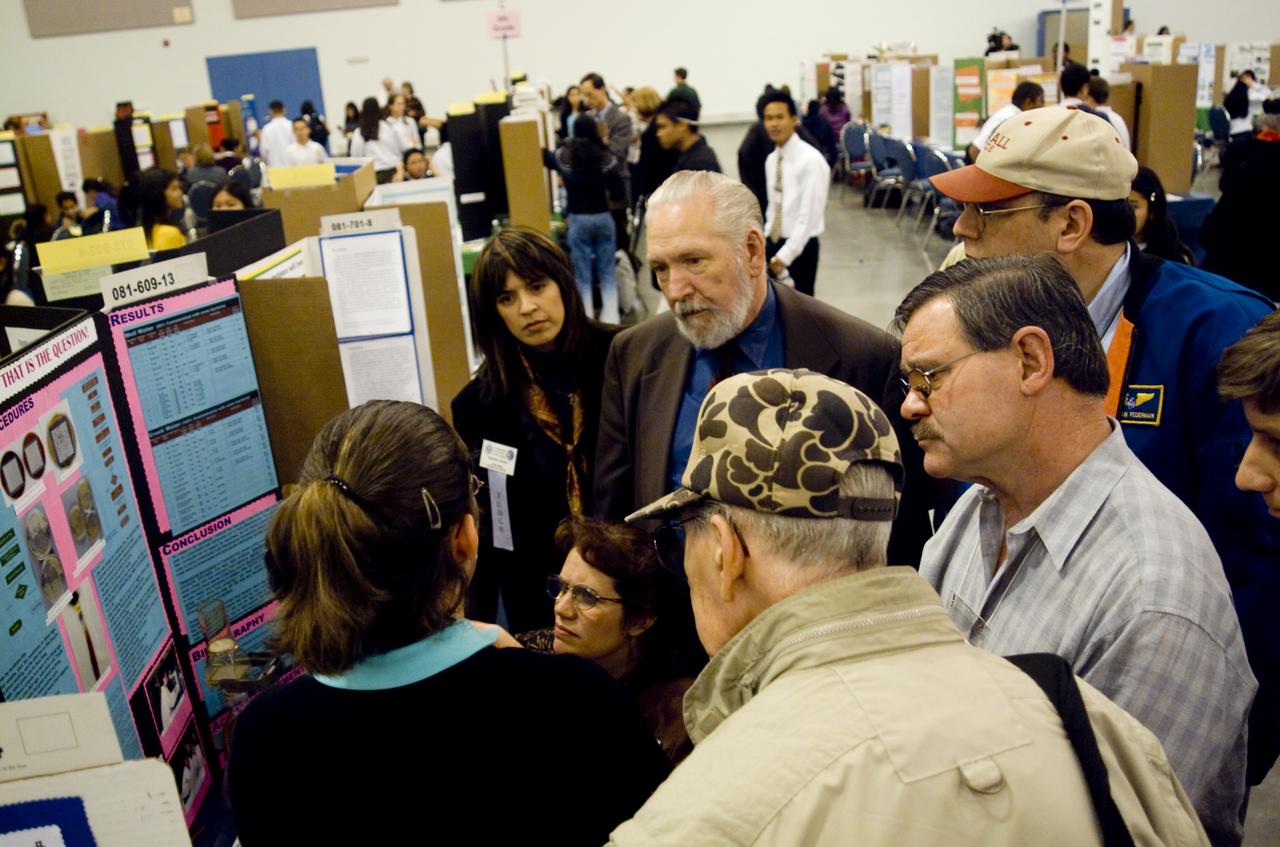
NASA Ames sends judging team (led by Paul Callahan, Code SLO) to 41st Annual Santa Clara Valley Science Fair
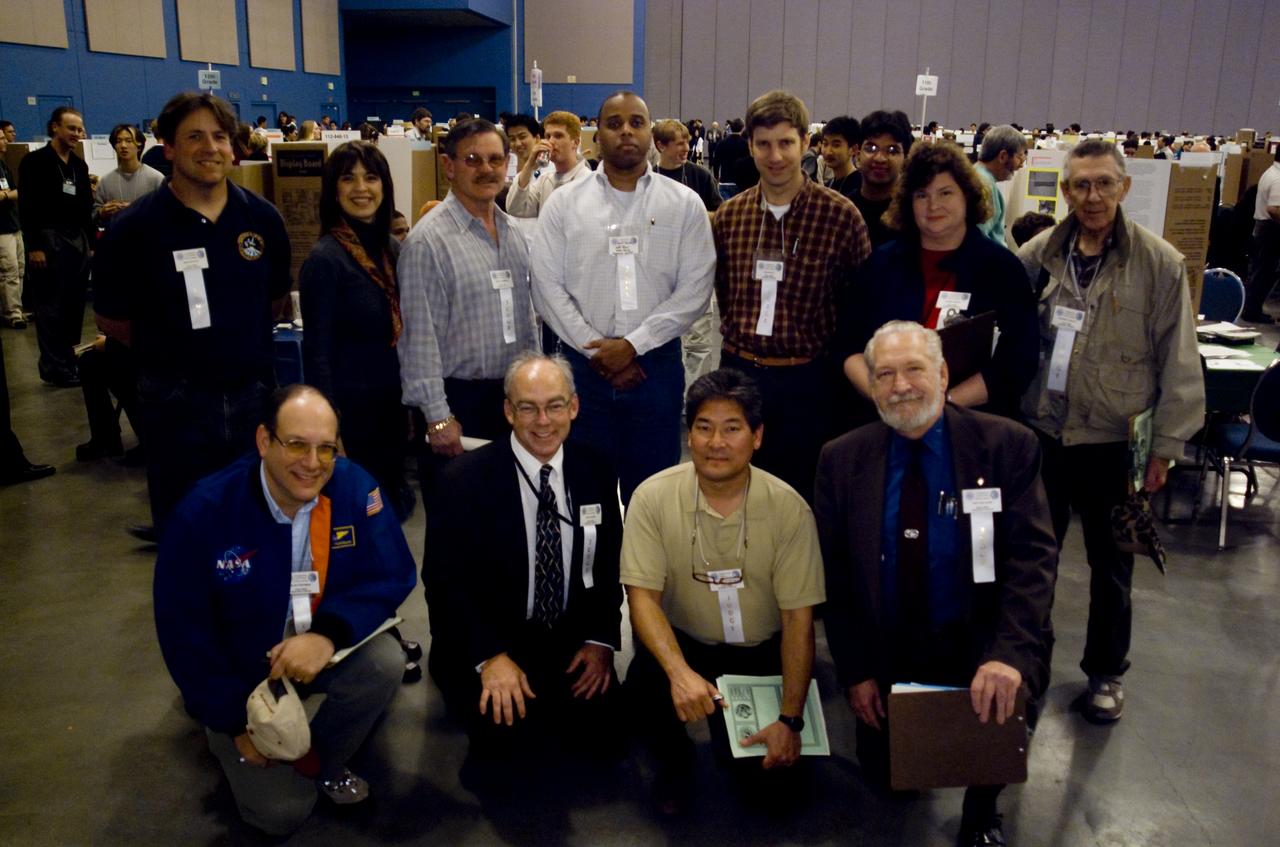
NASA Ames sends judging team (led by Paul Callahan, Code SLO) to 41st Annual Santa Clara Valley Science Fair
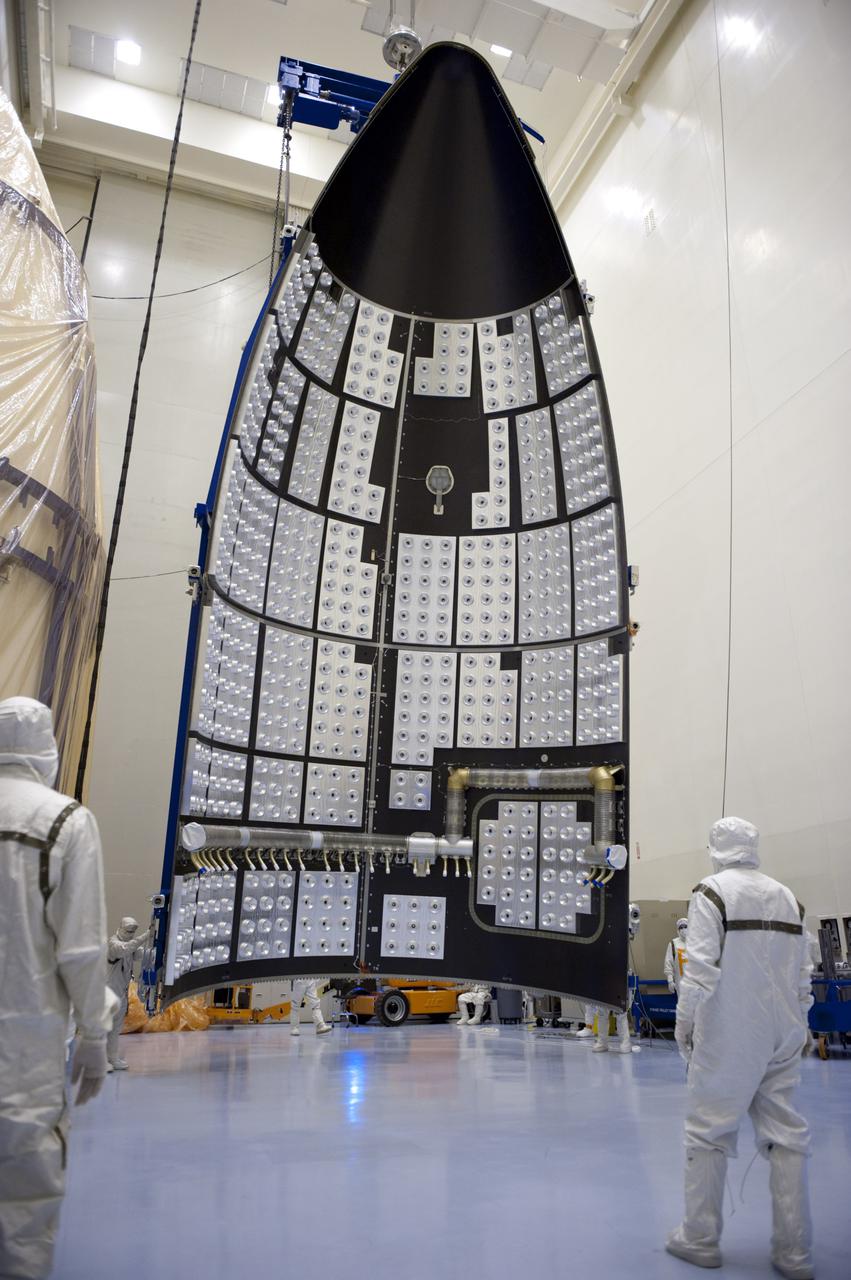
CAPE CANAVERAL, Fla. -- In the Payload Hazardous Servicing Facility at NASA's Kennedy Space Center in Florida, a section of the Atlas V payload fairing for NASA's Mars Science Laboratory (MSL) mission hangs vertically from the ceiling. The fairing has been uncovered, revealing the fairing acoustic protection (FAP) system lining its interior. The FAP protects the payload by dampening the sound created by the rocket during liftoff. Next, the fairing will be cleaned to meet NASA's planetary protection requirements. The fairing will protect the spacecraft from the impact of aerodynamic pressure and heating during ascent. Although jettisoned once the spacecraft is outside the Earth's atmosphere, the fairing must be cleaned to the same exacting standards as the laboratory to avoid the possibility of contaminating it. MSL's components include a compact car-sized rover, Curiosity, which has 10 science instruments designed to search for evidence on whether Mars has had environments favorable to microbial life, including the chemical ingredients for life. The unique rover will use a laser to look inside rocks and release its gasses so that the rover’s spectrometer can analyze and send the data back to Earth. Launch of MSL aboard a United Launch Alliance Atlas V rocket is planned for Nov. 25 from Space Launch Complex 41 on Cape Canaveral Air Force Station. For more information, visit http:__www.nasa.gov_msl. Photo credit: NASA_Kim Shiflett
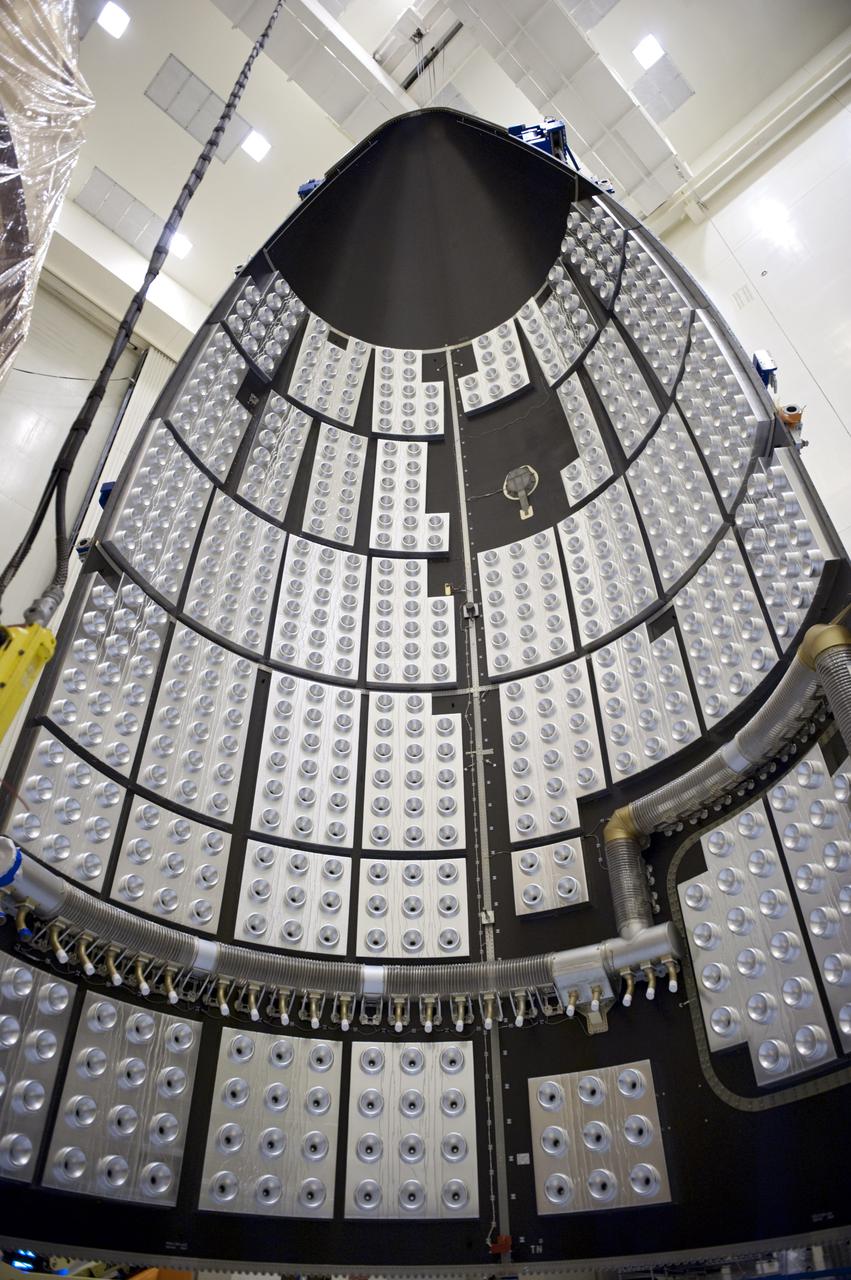
CAPE CANAVERAL, Fla. -- In the Payload Hazardous Servicing Facility at NASA's Kennedy Space Center in Florida, half of the Atlas V payload fairing for NASA's Mars Science Laboratory (MSL) mission hangs vertically from the ceiling. The interior of the fairing is lined with the fairing acoustic protection (FAP) system which protects the payload by dampening the sound created by the rocket during liftoff. As a precaution, the fairing next will be cleaned to meet NASA's planetary protection requirements. The fairing will protect the spacecraft from the impact of aerodynamic pressure and heating during ascent. Although jettisoned once the spacecraft is outside the Earth's atmosphere, the fairing must be cleaned to the same exacting standards as the laboratory to avoid the possibility of contaminating it. MSL's components include a compact car-sized rover, Curiosity, which has 10 science instruments designed to search for evidence on whether Mars has had environments favorable to microbial life, including the chemical ingredients for life. The unique rover will use a laser to look inside rocks and release its gasses so that the rover’s spectrometer can analyze and send the data back to Earth. Launch of MSL aboard a United Launch Alliance Atlas V rocket is planned for Nov. 25 from Space Launch Complex 41 on Cape Canaveral Air Force Station. For more information, visit http:__www.nasa.gov_msl. Photo credit: NASA_Kim Shiflett
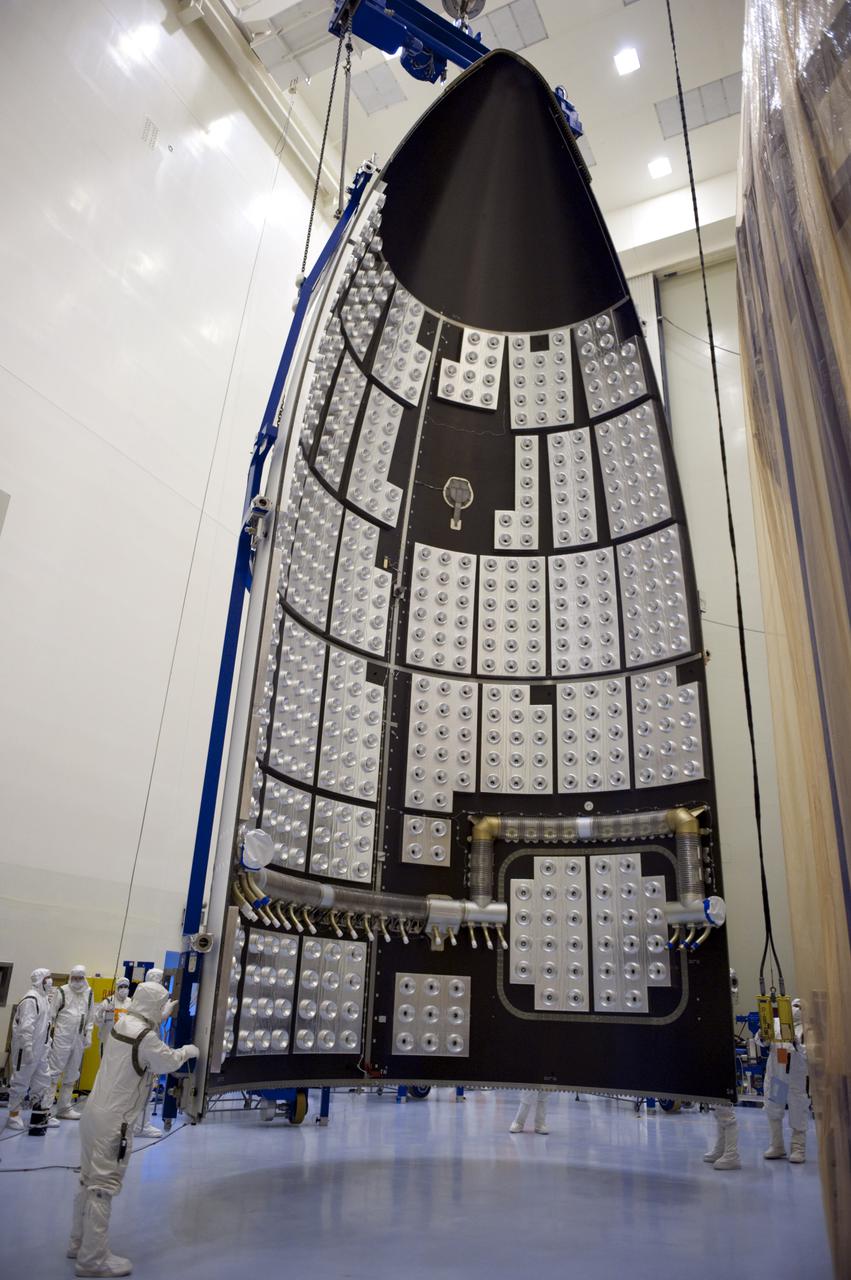
CAPE CANAVERAL, Fla. -- In the Payload Hazardous Servicing Facility at NASA's Kennedy Space Center in Florida, United Launch Alliance technicians steady half of the Atlas V payload fairing for NASA's Mars Science Laboratory (MSL) mission as it hangs vertically from the ceiling. The interior of the fairing is lined with the fairing acoustic protection (FAP) system which protects the payload by dampening the sound created by the rocket during liftoff. As a precaution, the fairing next will be cleaned to meet NASA's planetary protection requirements. The fairing will protect the spacecraft from the impact of aerodynamic pressure and heating during ascent. Although jettisoned once the spacecraft is outside the Earth's atmosphere, the fairing must be cleaned to the same exacting standards as the laboratory to avoid the possibility of contaminating it. MSL's components include a compact car-sized rover, Curiosity, which has 10 science instruments designed to search for evidence on whether Mars has had environments favorable to microbial life, including the chemical ingredients for life. The unique rover will use a laser to look inside rocks and release its gasses so that the rover’s spectrometer can analyze and send the data back to Earth. Launch of MSL aboard a United Launch Alliance Atlas V rocket is planned for Nov. 25 from Space Launch Complex 41 on Cape Canaveral Air Force Station. For more information, visit http:__www.nasa.gov_msl. Photo credit: NASA_Kim Shiflett
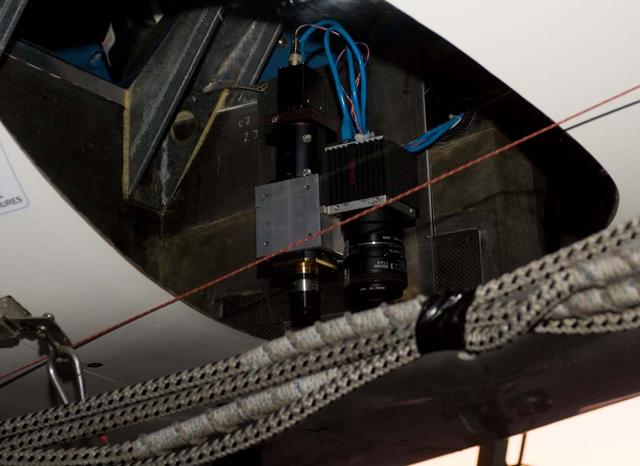
NASA Conducts Airborne Science Aboard Zeppelin Airship: equipped with two imaging instruments enabling remote sensing and atmospheric science measurements not previously practical. Hyperspectral imager and large format camera mounted inside the Zeppelin nose fairing.
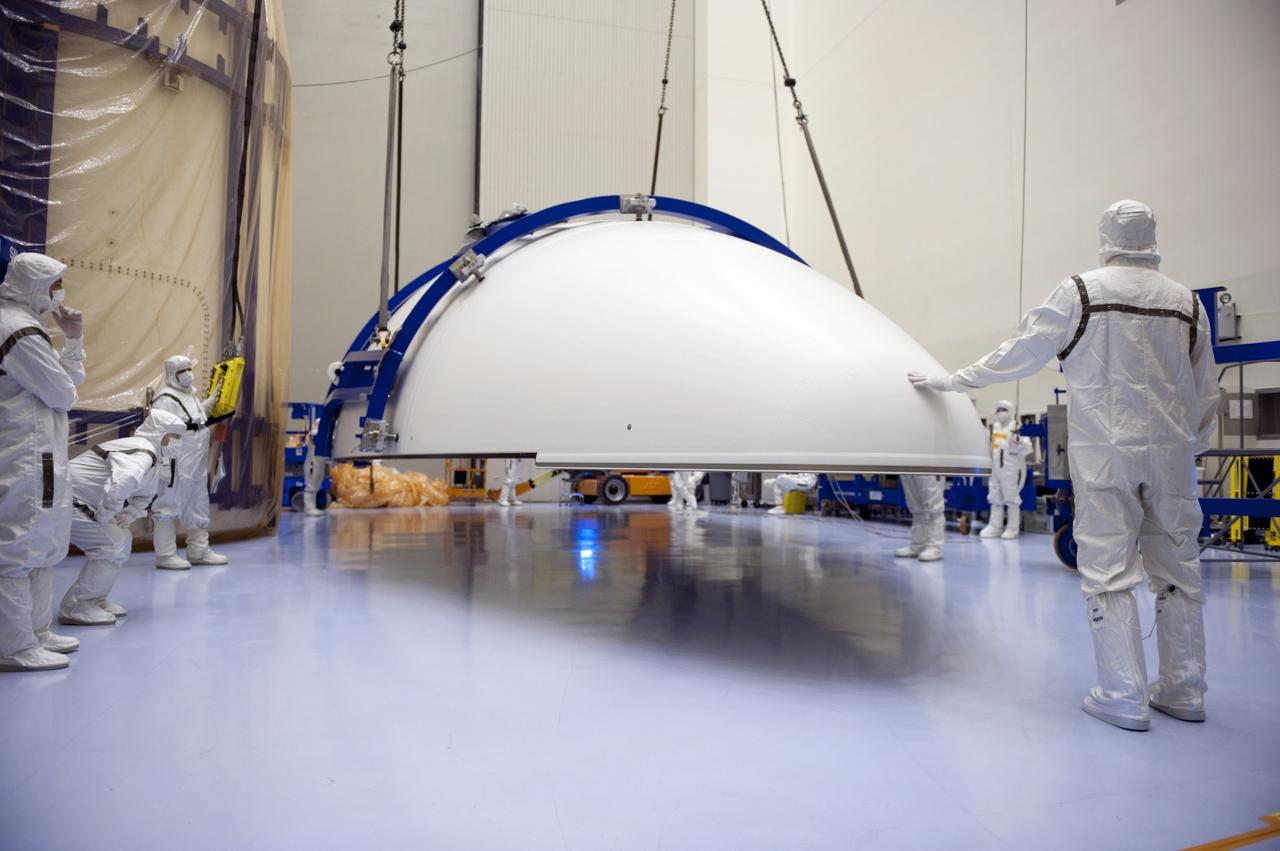
CAPE CANAVERAL, Fla. -- In the Payload Hazardous Servicing Facility at NASA's Kennedy Space Center in Florida, half of the Atlas V payload fairing for NASA's Mars Science Laboratory (MSL) mission hovers above the floor during operations to raise it into a vertical position. The fairing has been uncovered, and preparations are under way to clean it to meet NASA's planetary protection requirements. At left is the other half of the fairing, still uncovered. The fairing will protect the spacecraft from the impact of aerodynamic pressure and heating during ascent. Although jettisoned once the spacecraft is outside the Earth's atmosphere, the fairing must be cleaned to the same exacting standards as the laboratory to avoid the possibility of contaminating it. MSL's components include a compact car-sized rover, Curiosity, which has 10 science instruments designed to search for evidence on whether Mars has had environments favorable to microbial life, including the chemical ingredients for life. The unique rover will use a laser to look inside rocks and release its gasses so that the rover’s spectrometer can analyze and send the data back to Earth. Launch of MSL aboard a United Launch Alliance Atlas V rocket is planned for Nov. 25 from Space Launch Complex 41 on Cape Canaveral Air Force Station. For more information, visit http://www.nasa.gov/msl. Photo credit: NASA/Kim Shiflett
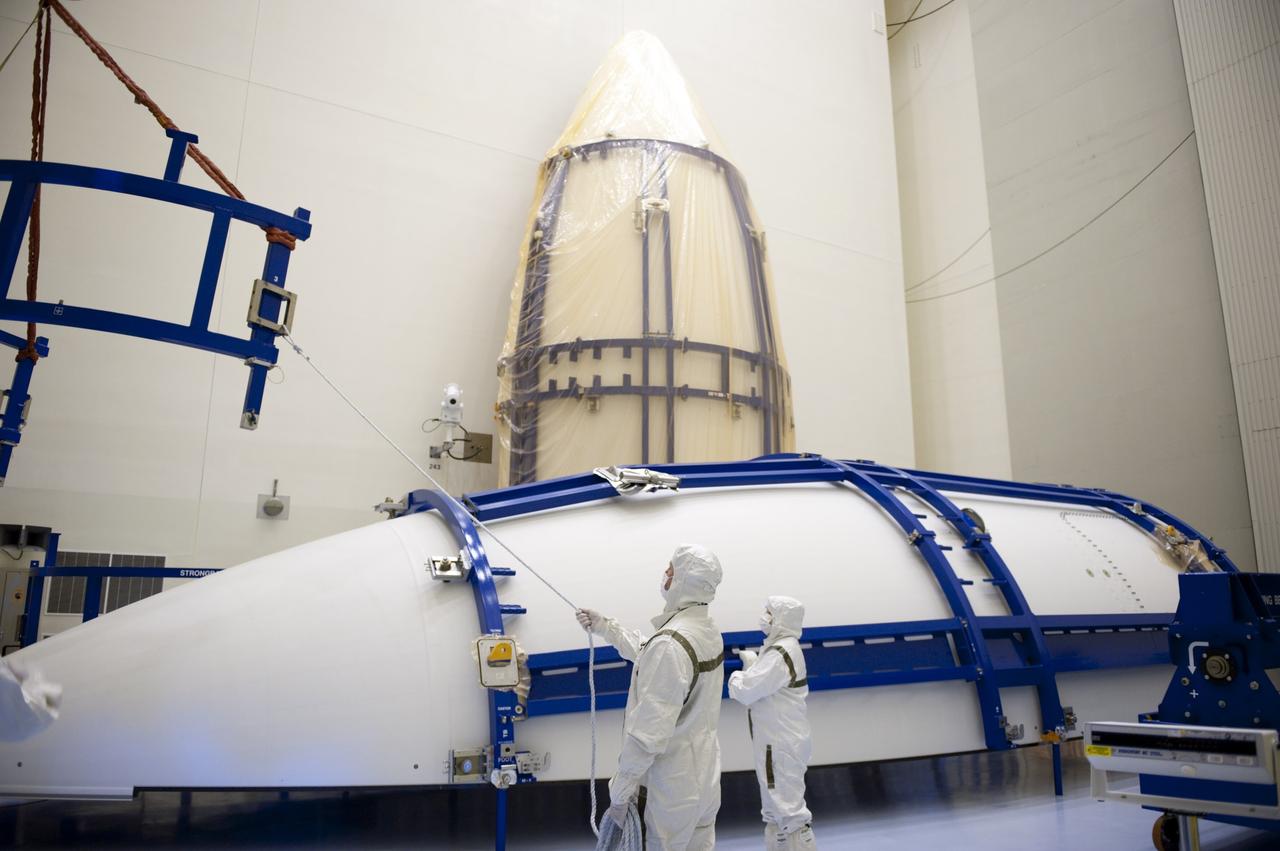
CAPE CANAVERAL, Fla. -- In the Payload Hazardous Servicing Facility at NASA's Kennedy Space Center in Florida, United Launch Alliance technicians guide a lifting device toward half of the Atlas V payload fairing for NASA's Mars Science Laboratory (MSL) mission. The fairing has been uncovered, and preparations are under way to clean it to meet NASA's planetary protection requirements. In the background is the other half of the fairing, still uncovered. The fairing will protect the spacecraft from the impact of aerodynamic pressure and heating during ascent. Although jettisoned once the spacecraft is outside the Earth's atmosphere, the fairing must be cleaned to the same exacting standards as the laboratory to avoid the possibility of contaminating it. MSL's components include a compact car-sized rover, Curiosity, which has 10 science instruments designed to search for evidence on whether Mars has had environments favorable to microbial life, including the chemical ingredients for life. The unique rover will use a laser to look inside rocks and release its gasses so that the rover’s spectrometer can analyze and send the data back to Earth. Launch of MSL aboard a United Launch Alliance Atlas V rocket is planned for Nov. 25 from Space Launch Complex 41 on Cape Canaveral Air Force Station. For more information, visit http://www.nasa.gov/msl. Photo credit: NASA/Kim Shiflett

CAPE CANAVERAL, Fla. -- In the Payload Hazardous Servicing Facility at NASA's Kennedy Space Center in Florida, the fairing acoustic protection (FAP) system lines the inside of the Atlas V payload fairing for NASA's Mars Science Laboratory (MSL) mission. This half of the fairing has been uncovered during preparations to clean it to meet NASA's planetary protection requirements. The FAP protects the payload by dampening the sound created by the rocket during liftoff. The fairing will protect the spacecraft from the impact of aerodynamic pressure and heating during ascent. Although jettisoned once the spacecraft is outside the Earth's atmosphere, the fairing must be cleaned to the same exacting standards as the laboratory to avoid the possibility of contaminating it. MSL's components include a compact car-sized rover, Curiosity, which has 10 science instruments designed to search for evidence on whether Mars has had environments favorable to microbial life, including the chemical ingredients for life. The unique rover will use a laser to look inside rocks and release its gasses so that the rover’s spectrometer can analyze and send the data back to Earth. Launch of MSL aboard a United Launch Alliance Atlas V rocket is planned for Nov. 25 from Space Launch Complex 41 on Cape Canaveral Air Force Station. For more information, visit http://www.nasa.gov/msl. Photo credit: NASA/Kim Shiflett
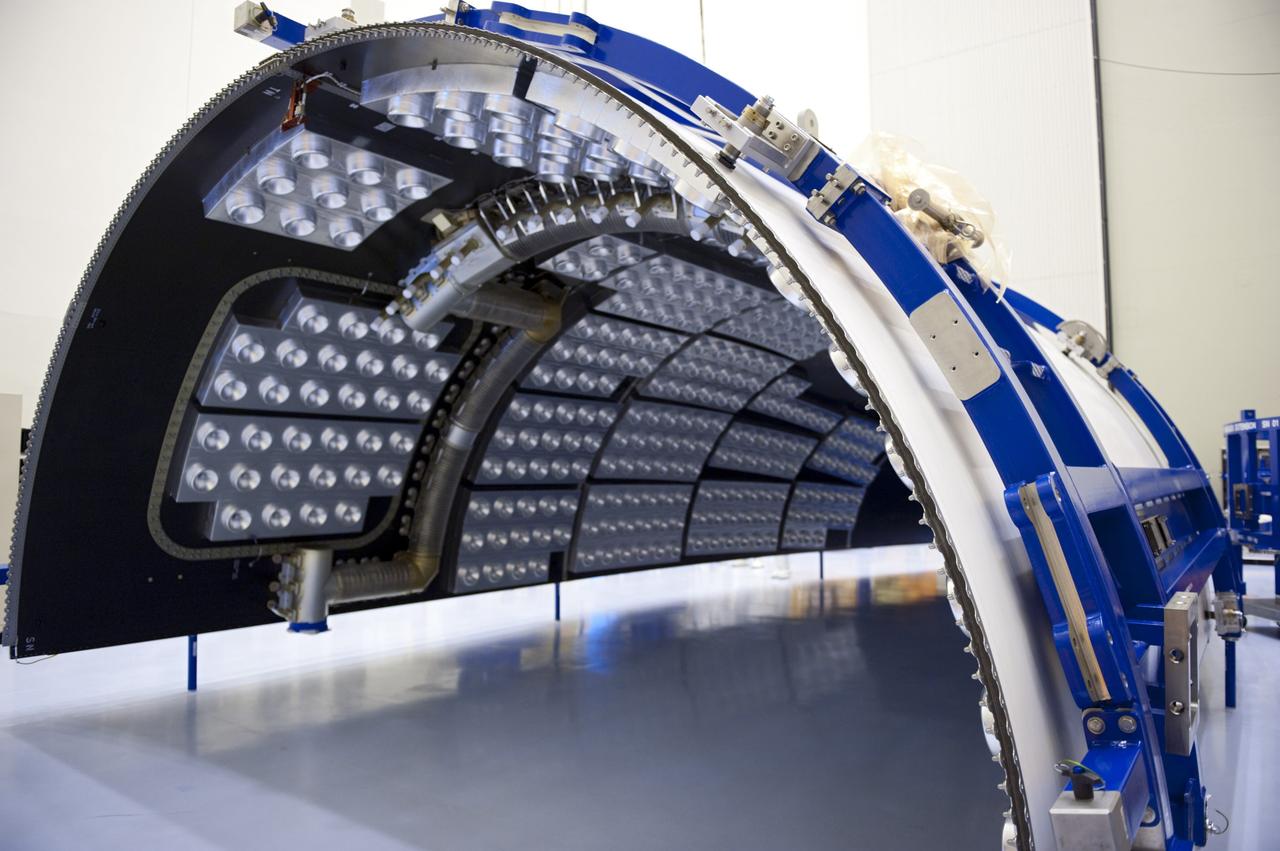
CAPE CANAVERAL, Fla. -- In the Payload Hazardous Servicing Facility at NASA's Kennedy Space Center in Florida, the fairing acoustic protection (FAP) system lining the inside of the Atlas V payload fairing for NASA's Mars Science Laboratory (MSL) mission is visible after the fairing is uncovered during preparations to clean it to meet NASA's planetary protection requirements. The FAP protects the payload by dampening the sound created by the rocket during liftoff. The fairing will protect the spacecraft from the impact of aerodynamic pressure and heating during ascent. Although jettisoned once the spacecraft is outside the Earth's atmosphere, the fairing must be cleaned to the same exacting standards as the laboratory to avoid the possibility of contaminating it. MSL's components include a compact car-sized rover, Curiosity, which has 10 science instruments designed to search for evidence on whether Mars has had environments favorable to microbial life, including the chemical ingredients for life. The unique rover will use a laser to look inside rocks and release its gasses so that the rover’s spectrometer can analyze and send the data back to Earth. Launch of MSL aboard a United Launch Alliance Atlas V rocket is planned for Nov. 25 from Space Launch Complex 41 on Cape Canaveral Air Force Station. For more information, visit http://www.nasa.gov/msl. Photo credit: NASA/Kim Shiflett
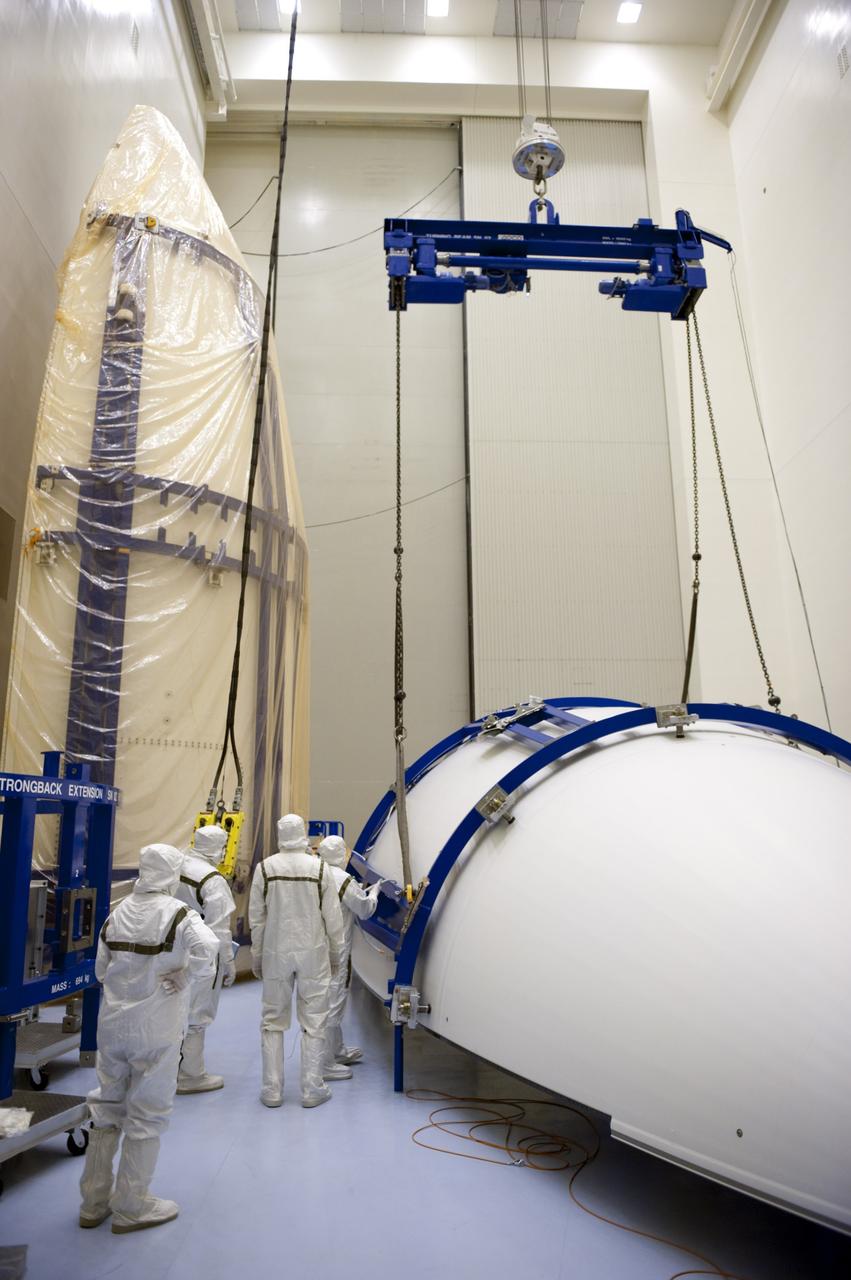
CAPE CANAVERAL, Fla. -- In the Payload Hazardous Servicing Facility at NASA's Kennedy Space Center in Florida, a lifting device is secured to half of the Atlas V payload fairing for NASA's Mars Science Laboratory (MSL) mission. The fairing has been uncovered, and preparations are under way to clean it to meet NASA's planetary protection requirements. At left is the other half of the fairing, still uncovered. The fairing will protect the spacecraft from the impact of aerodynamic pressure and heating during ascent. Although jettisoned once the spacecraft is outside the Earth's atmosphere, the fairing must be cleaned to the same exacting standards as the laboratory to avoid the possibility of contaminating it. MSL's components include a compact car-sized rover, Curiosity, which has 10 science instruments designed to search for evidence on whether Mars has had environments favorable to microbial life, including the chemical ingredients for life. The unique rover will use a laser to look inside rocks and release its gasses so that the rover’s spectrometer can analyze and send the data back to Earth. Launch of MSL aboard a United Launch Alliance Atlas V rocket is planned for Nov. 25 from Space Launch Complex 41 on Cape Canaveral Air Force Station. For more information, visit http://www.nasa.gov/msl. Photo credit: NASA/Kim Shiflett

VANDENBERG AIR FORCE BASE, Calif. -- With the fairing door off, Orbital Sciences' Glenn Weigle and Brett Gladish maneuver into position to take the GN2 flow reading from NASA's Orbiting Carbon Observatory, or OCO, spacecraft. At left, Jose Castillo and Mark Neuse stand by to replace the fairing door when the OCO operation is complete. The spacecraft sits atop Orbital Sciences' Taurus XL rocket. At right is a portion of the umbilical tower attached to the upper stack. The spacecraft sits atop Orbital Sciences' Taurus XL rocket. At right is a portion of the umbilical tower attached to the upper stack. The spacecraft will collect precise global measurements of carbon dioxide (CO2) in the Earth's atmosphere. Scientists will analyze OCO data to improve our understanding of the natural processes and human activities that regulate the abundance and distribution of this important greenhouse gas. Photo courtesy of Jim Stowers, Orbital Sciences
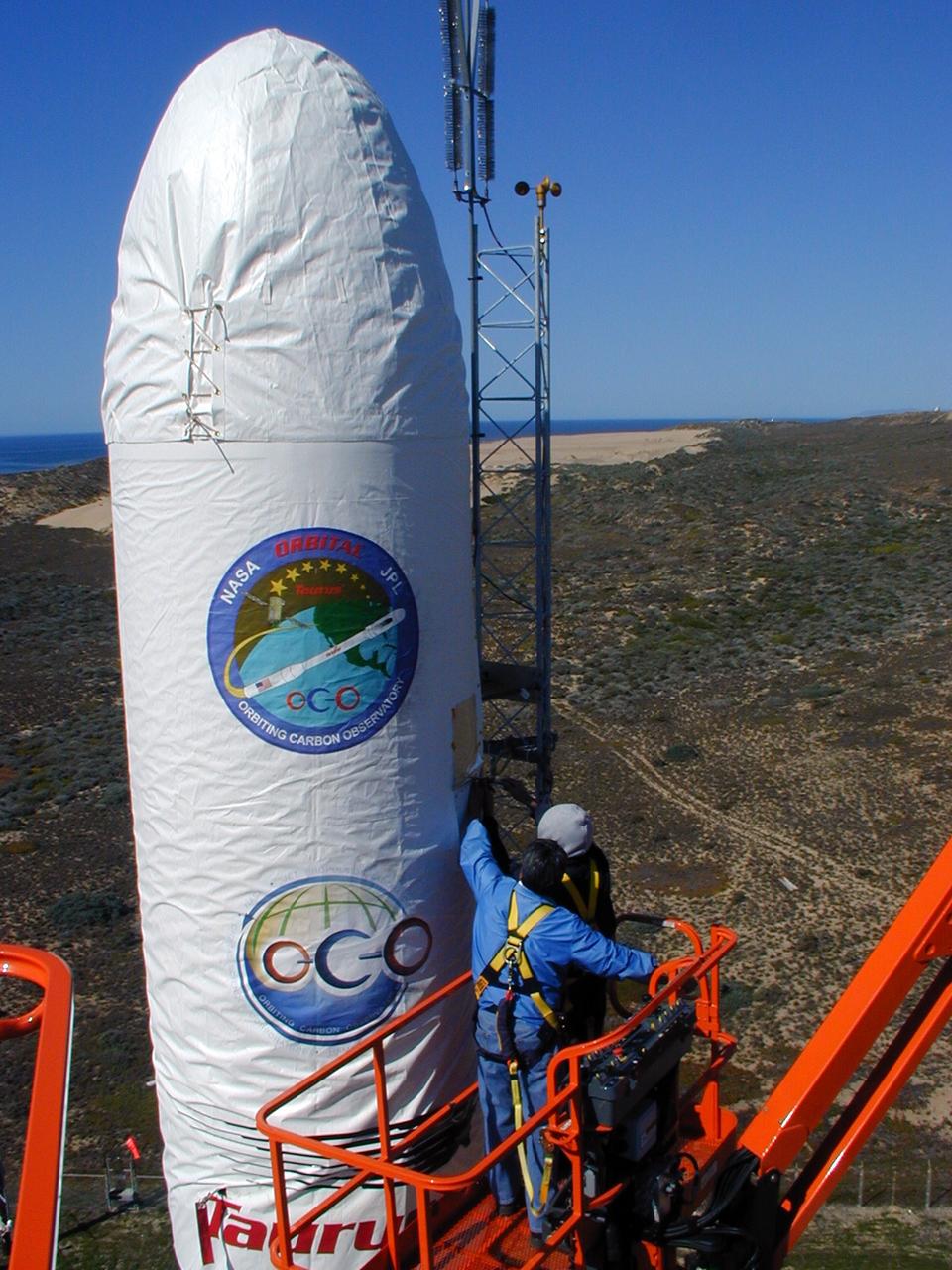
VANDENBERG AIR FORCE BASE, Calif. -- With the fairing door off, Orbital Science's Jose Castillo and Mark Neuse remove the fairing payload access door on NASA's Orbiting Carbon Observatory, or OCO, spacecraft on Launch Complex 576-E at Vandenberg Air Force Base in California. Orbital Science's Glenn Weigle and Brett Gladish stand by to take the GN2 flow reading The encapsulated OCO tops Orbital Sciences' Taurus XL rocket, which is scheduled to launch Feb. 24. The spacecraft will collect precise global measurements of carbon dioxide (CO2) in the Earth's atmosphere. Scientists will analyze OCO data to improve our understanding of the natural processes and human activities that regulate the abundance and distribution of this important greenhouse gas. Photo courtesy of Glenn Weigle, Orbital Sciences
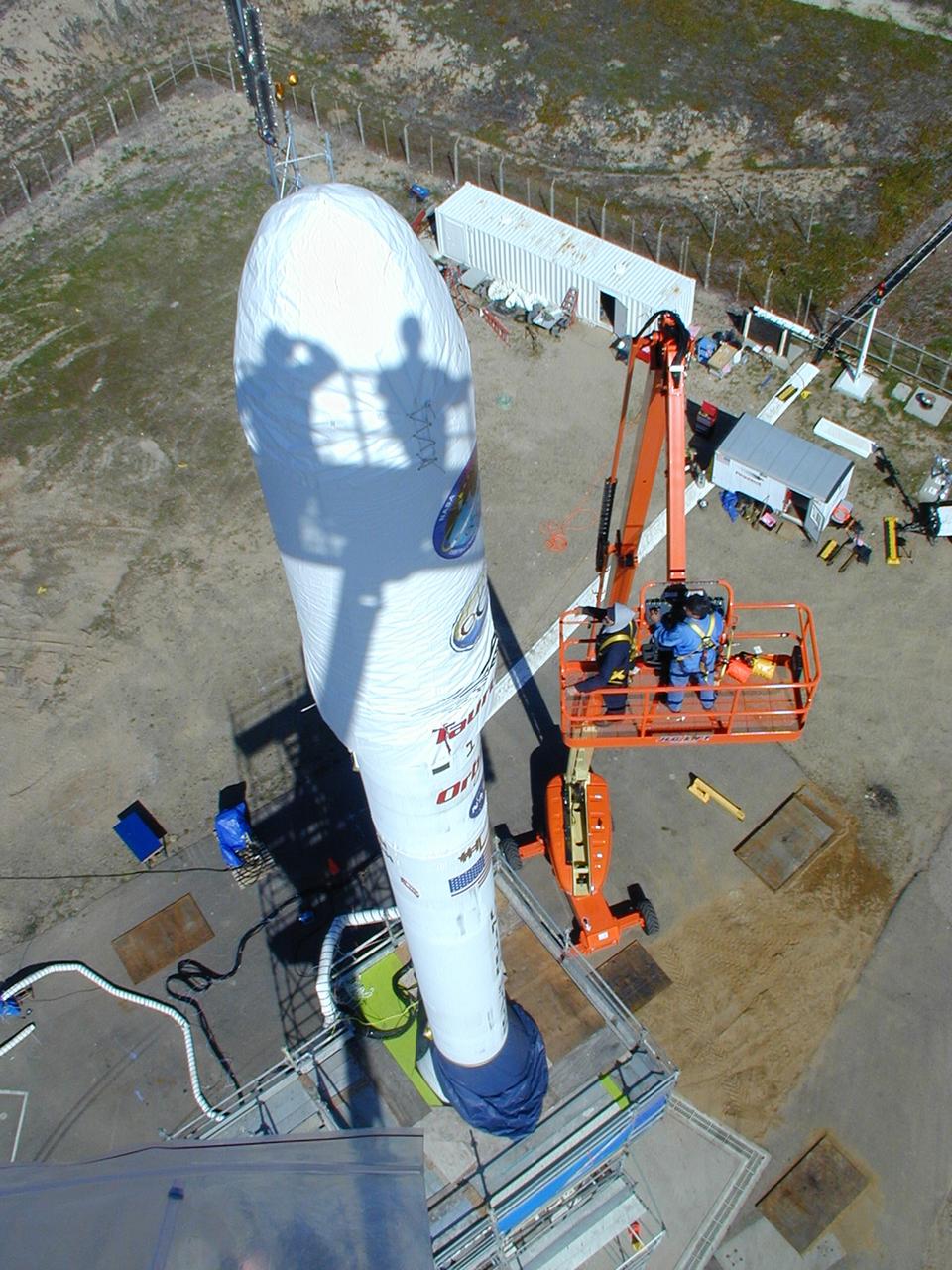
VANDENBERG AIR FORCE BASE, Calif. -- On Launch Complex 576-E at Vandenberg Air Force Base in California, Orbital Science's Jose Castillo and Mark Neuse (right) move in to remove the fairing payload access door on NASA's Orbiting Carbon Observatory, or OCO, spacecraft. Orbital Science's Glenn Weigle and Brett Gladish are nearby (shadows on the fairing) to take the GN2 flow reading. The encapsulated OCO tops Orbital Sciences' Taurus XL rocket, which is scheduled to launch Feb. 24. The spacecraft will collect precise global measurements of carbon dioxide (CO2) in the Earth's atmosphere. Scientists will analyze OCO data to improve our understanding of the natural processes and human activities that regulate the abundance and distribution of this important greenhouse gas. Photo courtesy of Glenn Weigle, Orbital Sciences
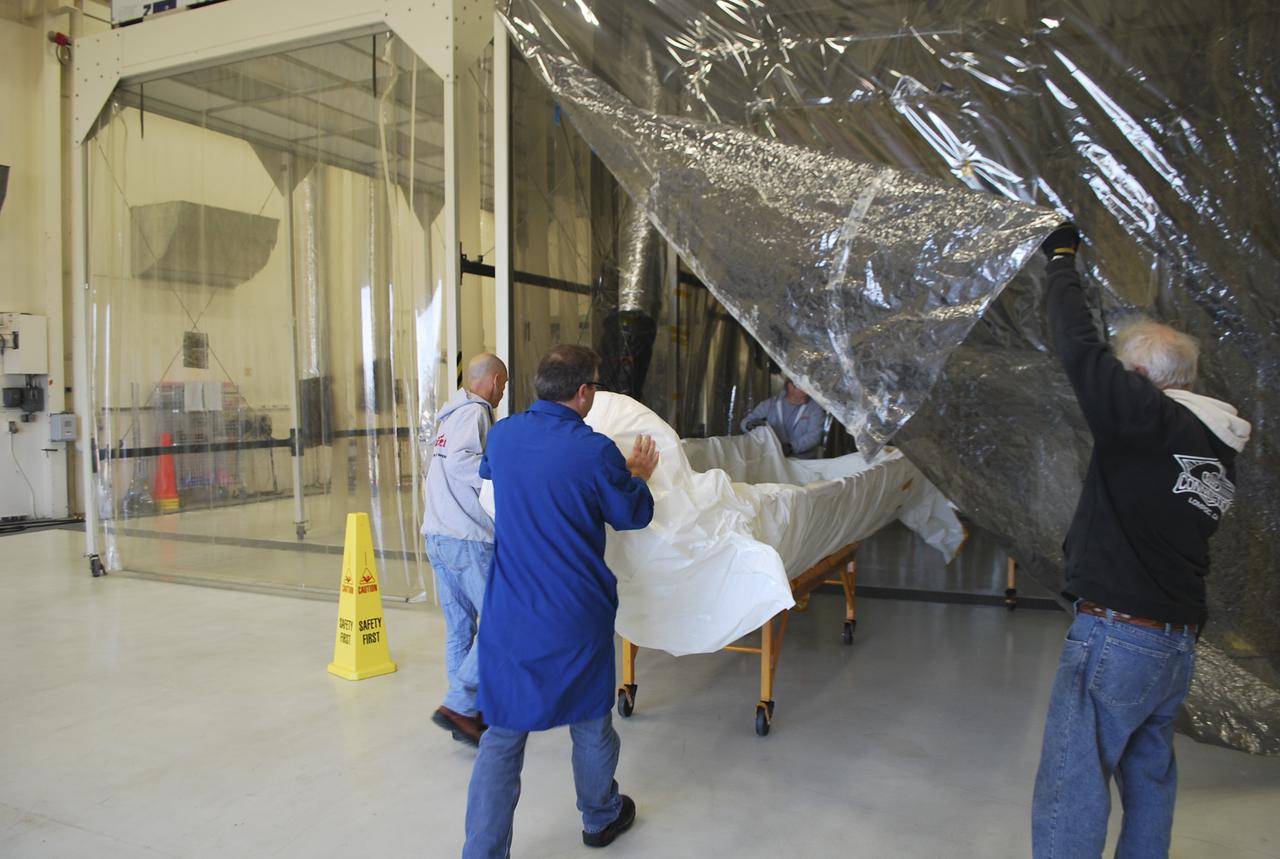
VANDENBERG AFB, Calif. – Workers load half of a payload fairing inside a hangar at Vandenberg Air Force Base in California where it will be processed and used for NASA's IRIS mission. The fairing will be fitted to the nose of an Orbital Sciences Pegasus rocket and will protect the IRIS spacecraft from atmospheric heating and stress during launch. Photo credit: VAFB_Randy Beaudoin
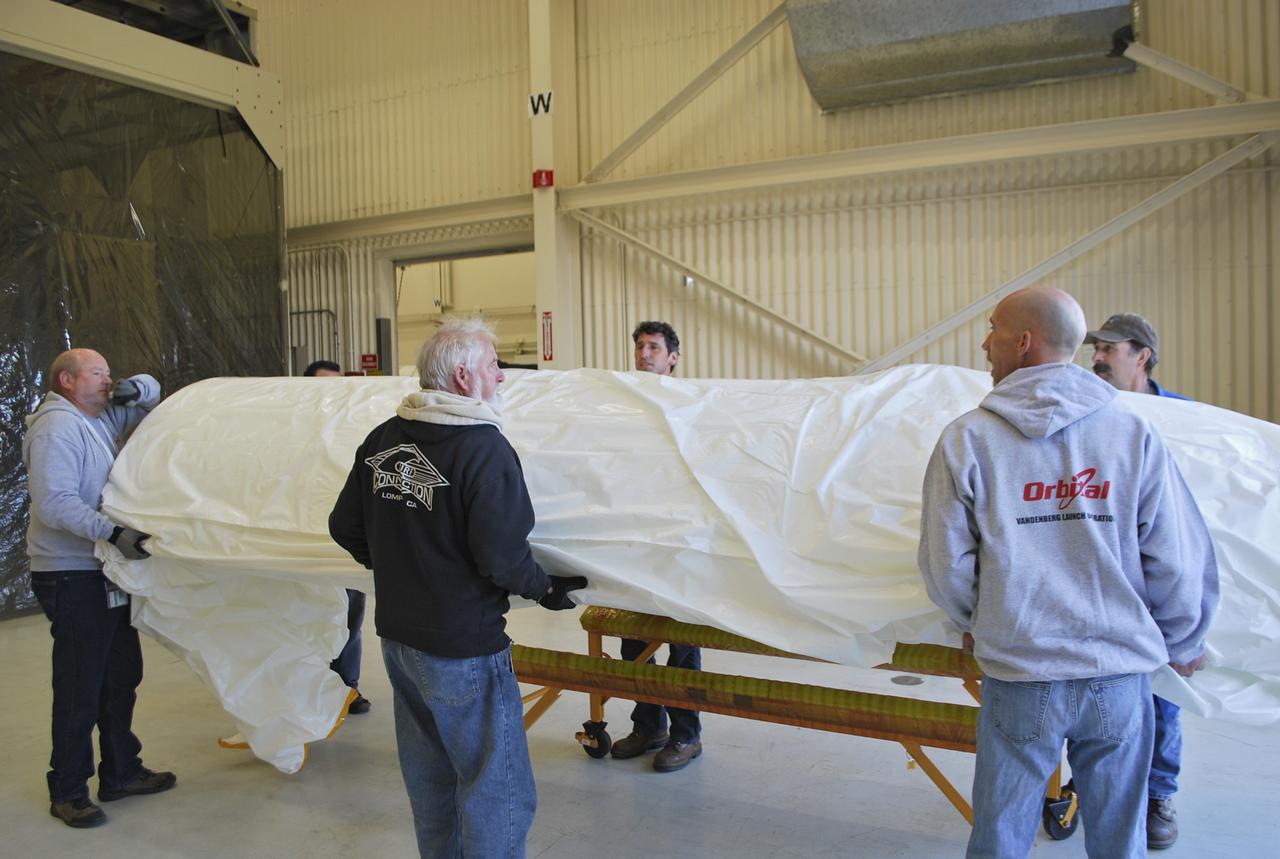
VANDENBERG AFB, Calif. – Workers load half of a payload fairing inside a hangar at Vandenberg Air Force Base in California where it will be processed and used for NASA's IRIS mission. The fairing will be fitted to the nose of an Orbital Sciences Pegasus rocket and will protect the IRIS spacecraft from atmospheric heating and stress during launch. Photo credit: VAFB_Randy Beaudoin
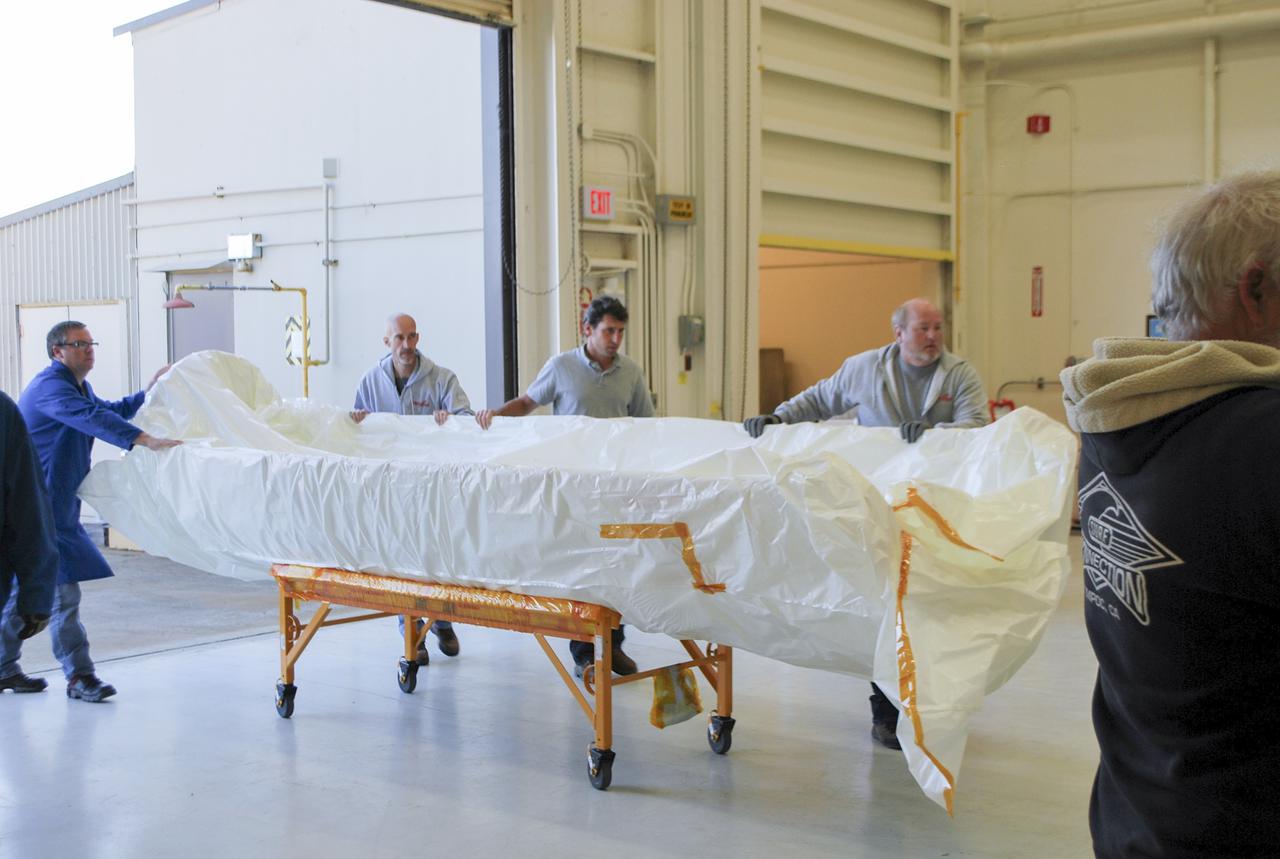
VANDENBERG AFB, Calif. – Workers load half of a payload fairing inside a hangar at Vandenberg Air Force Base in California where it will be processed and used for NASA's IRIS mission. The fairing will be fitted to the nose of an Orbital Sciences Pegasus rocket and will protect the IRIS spacecraft from atmospheric heating and stress during launch. Photo credit: VAFB_Randy Beaudoin
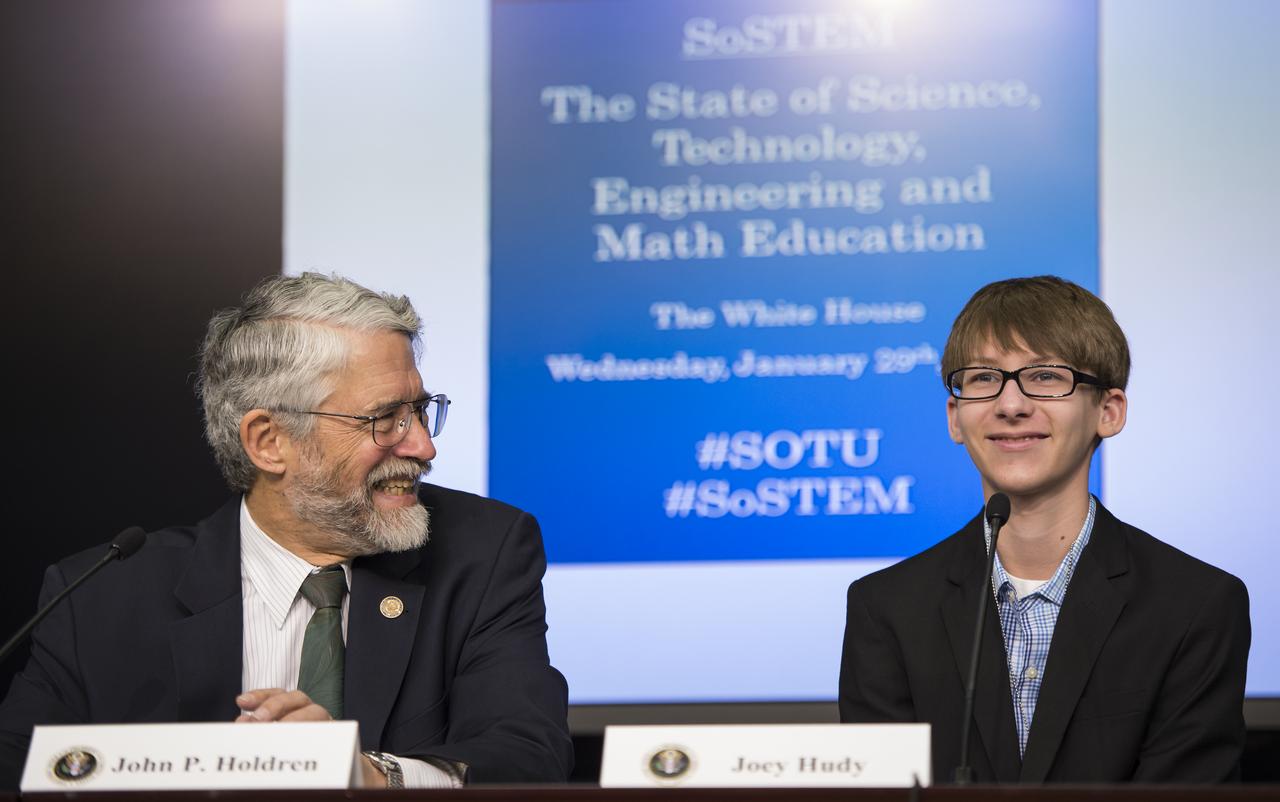
Dr. John P. Holdren, Assistant to the President for Science and Technology and Director of the White House Office of Science & Technology Policy, left, smiles along with 16-year-old Joey Hudy, a former White House Science Fair participant and self-described “Maker” at the annual White House State of Science, Technology, Engineering, and Math (SoSTEM) address, Wednesday, Jan. 29, 2014, in the South Court Auditorium in the Eisenhower Executive Office Building on the White House complex in Washington. Photo Credit: (NASA/Bill Ingalls)
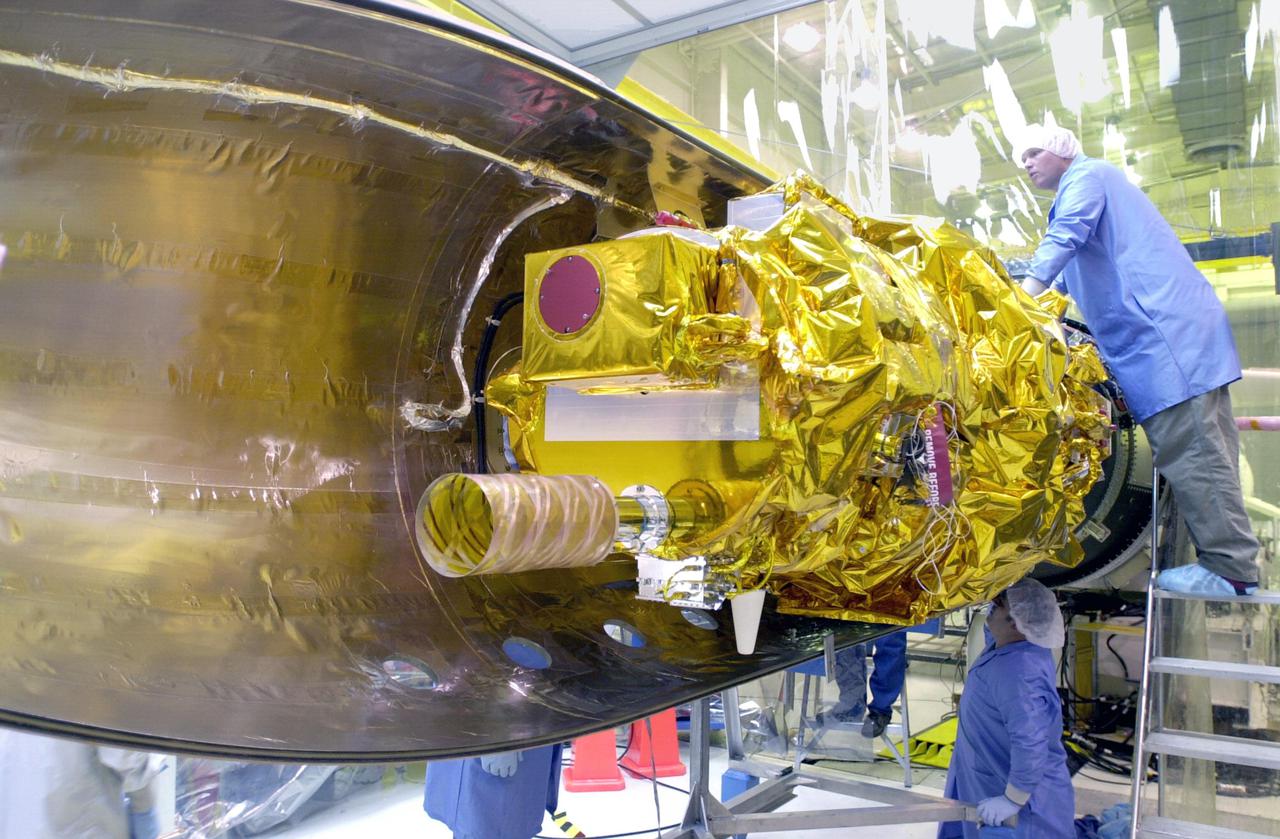
KENNEDY SPACE CENTER, FLA. - In preparation for launch, Orbital Sciences Corporation technicians at Vandenberg AFB in California check the placement of the first fairing half around the Demonstration of Autonomous Rendezvous Technology (DART) spacecraft. The fairing will encapsulate DART and protect it while on the launch pad and during ascent. DART was designed and built for NASA by Orbital Sciences as an advanced flight demonstrator to locate and maneuver near an orbiting satellite. The DART spacecraft weighs about 800 pounds and is nearly 6 feet long and 3 feet in diameter. From beneath the belly of the Orbital Sciences L-1011 aircraft, the Pegasus XL vehicle will launch DART into a circular polar orbit of approximately 475 miles. The DART satellite provides a key step in establishing autonomous rendezvous capabilities for the U.S. Space Program. While previous rendezvous and docking efforts have been piloted by astronauts, the unmanned DART satellite will have computers and cameras to perform its rendezvous functions.
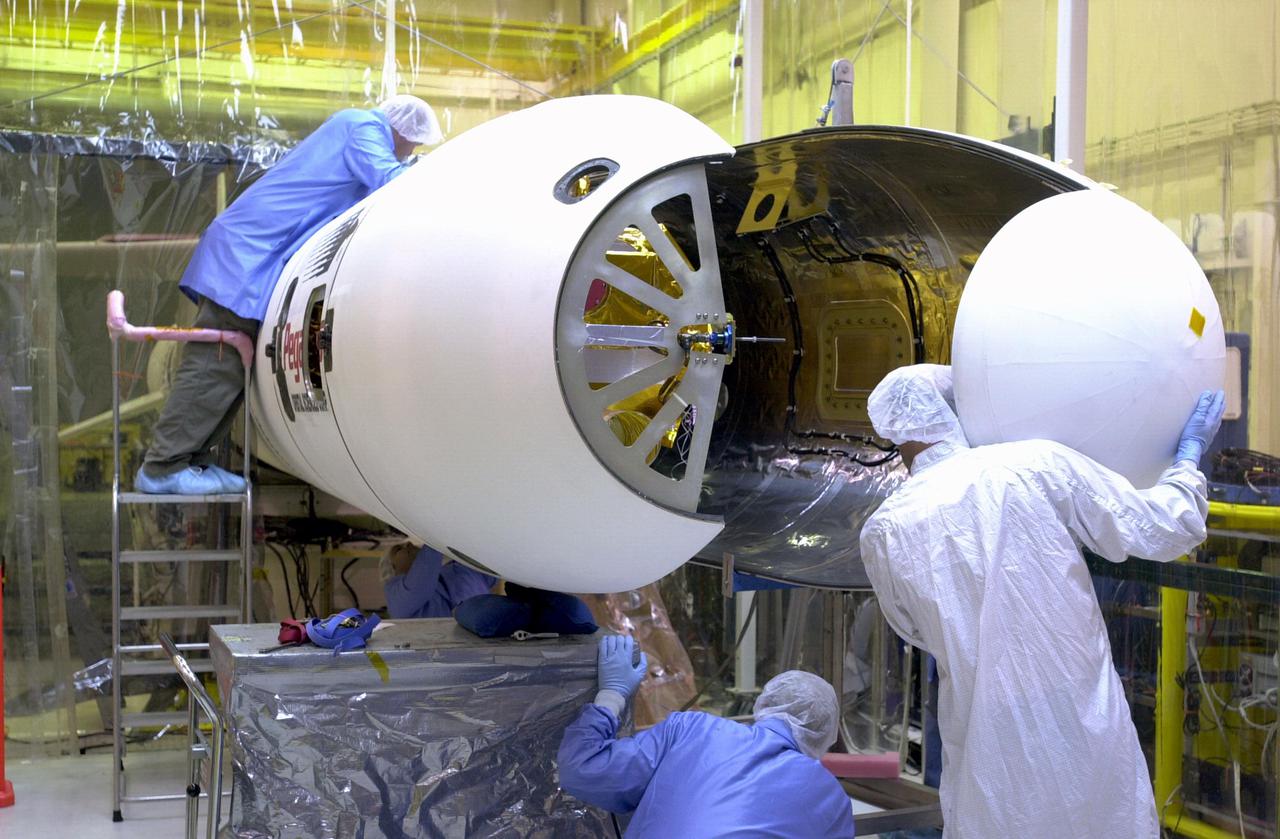
KENNEDY SPACE CENTER, FLA. - Orbital Sciences Corporation technicians at Vandenberg AFB in California maneuver the second fairing half into place around the Demonstration of Autonomous Rendezvous Technology (DART) spacecraft in preparation for launch. The fairing will encapsulate DART and protect it while on the launch pad and during ascent. DART was designed and built for NASA by Orbital Sciences as an advanced flight demonstrator to locate and maneuver near an orbiting satellite. The DART spacecraft weighs about 800 pounds and is nearly 6 feet long and 3 feet in diameter. From beneath the belly of the Orbital Sciences L-1011 aircraft, the Pegasus XL vehicle will launch DART into a circular polar orbit of approximately 475 miles. The DART satellite provides a key step in establishing autonomous rendezvous capabilities for the U.S. Space Program. While previous rendezvous and docking efforts have been piloted by astronauts, the unmanned DART satellite will have computers and cameras to perform its rendezvous functions.
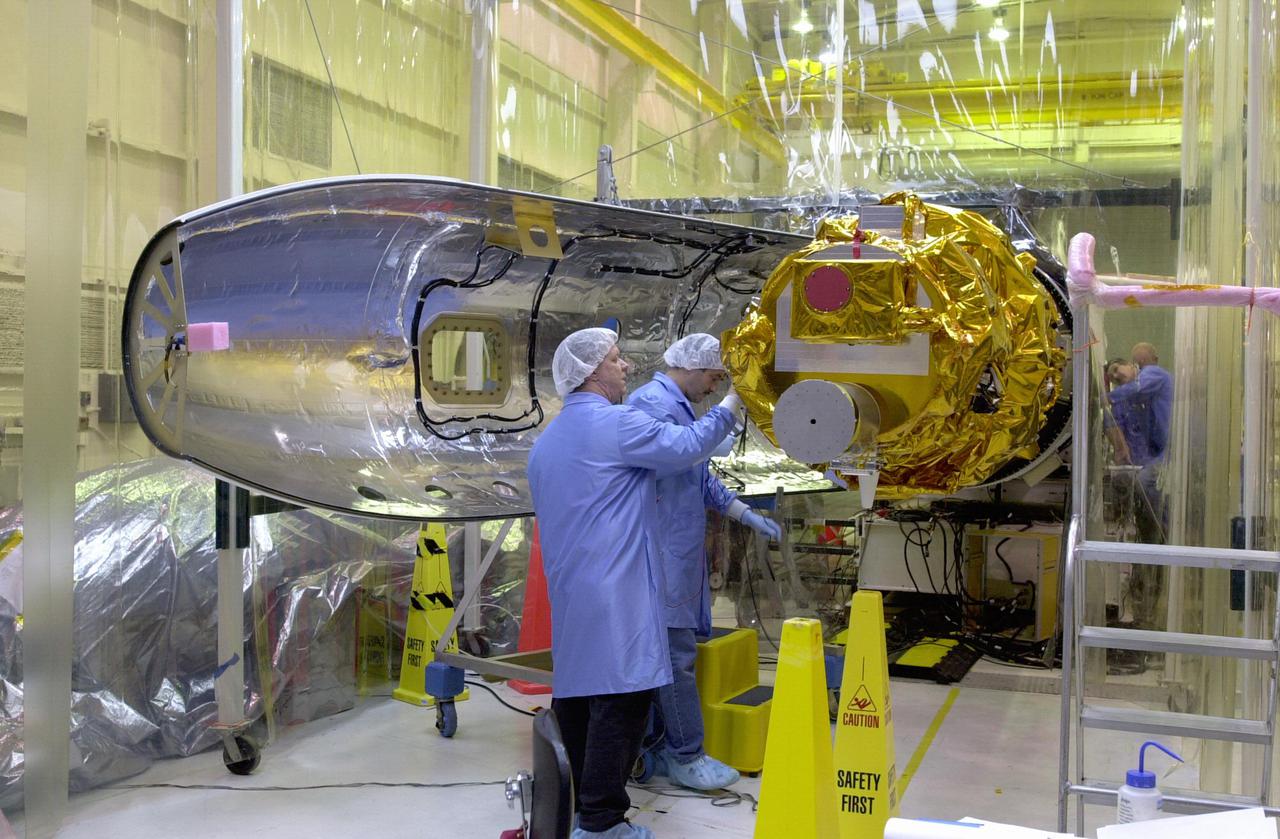
KENNEDY SPACE CENTER, FLA. - In preparation for launch, Orbital Sciences Corporation technicians at Vandenberg AFB in California get ready to place the first fairing half around the Demonstration of Autonomous Rendezvous Technology (DART) spacecraft. The fairing will encapsulate DART and protect it while on the launch pad and during ascent. DART was designed and built for NASA by Orbital Sciences as an advanced flight demonstrator to locate and maneuver near an orbiting satellite. The DART spacecraft weighs about 800 pounds and is nearly 6 feet long and 3 feet in diameter. From beneath the belly of the Orbital Sciences L-1011 aircraft, the Pegasus XL vehicle will launch DART into a circular polar orbit of approximately 475 miles. The DART satellite provides a key step in establishing autonomous rendezvous capabilities for the U.S. Space Program. While previous rendezvous and docking efforts have been piloted by astronauts, the unmanned DART satellite will have computers and cameras to perform its rendezvous functions.
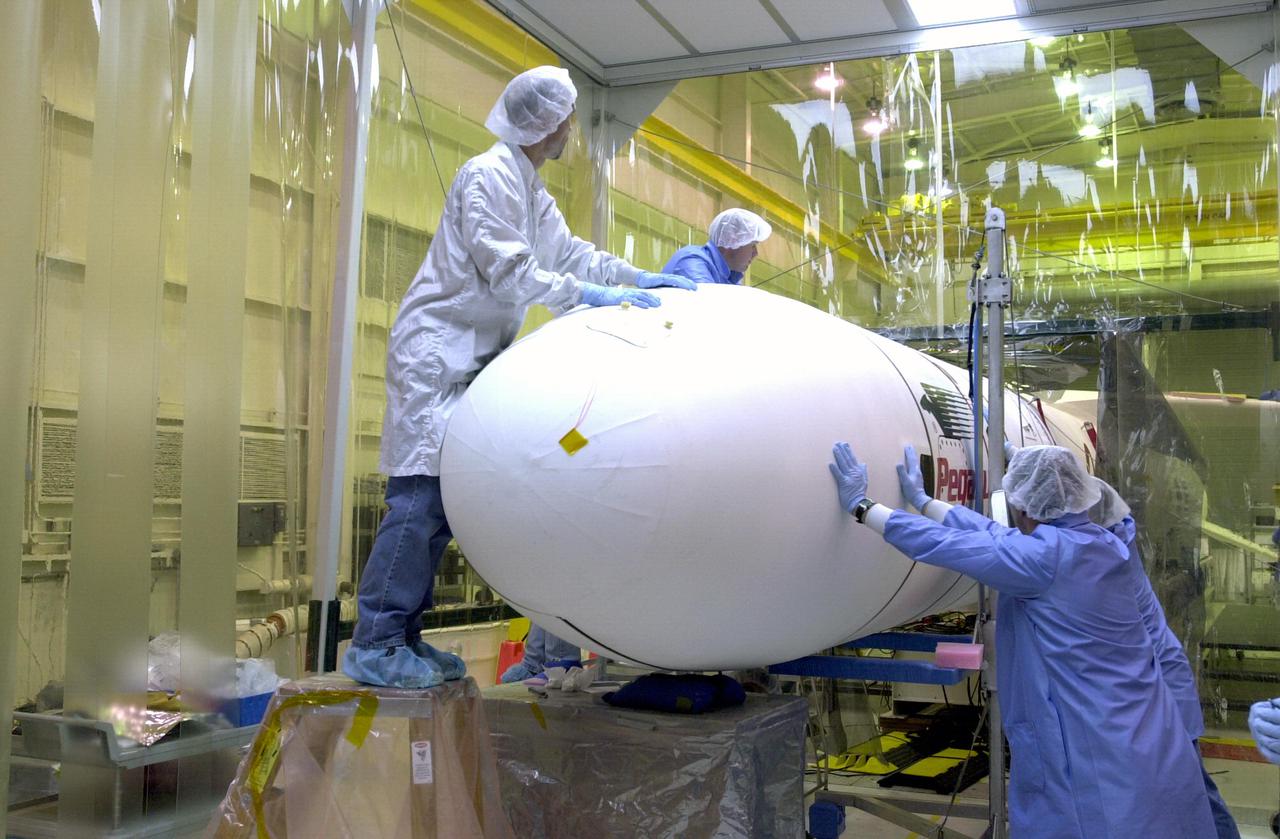
KENNEDY SPACE CENTER, FLA. - Orbital Sciences Corporation technicians at Vandenberg AFB in California finish installation of the fairing around the Demonstration of Autonomous Rendezvous Technology (DART) spacecraft in preparation for launch. The fairing will encapsulate DART and protect it while on the launch pad and during ascent. DART was designed and built for NASA by Orbital Sciences as an advanced flight demonstrator to locate and maneuver near an orbiting satellite. The DART spacecraft weighs about 800 pounds and is nearly 6 feet long and 3 feet in diameter. From beneath the belly of the Orbital Sciences L-1011 aircraft, the Pegasus XL vehicle will launch DART into a circular polar orbit of approximately 475 miles. The DART satellite provides a key step in establishing autonomous rendezvous capabilities for the U.S. Space Program. While previous rendezvous and docking efforts have been piloted by astronauts, the unmanned DART satellite will have computers and cameras to perform its rendezvous functions.
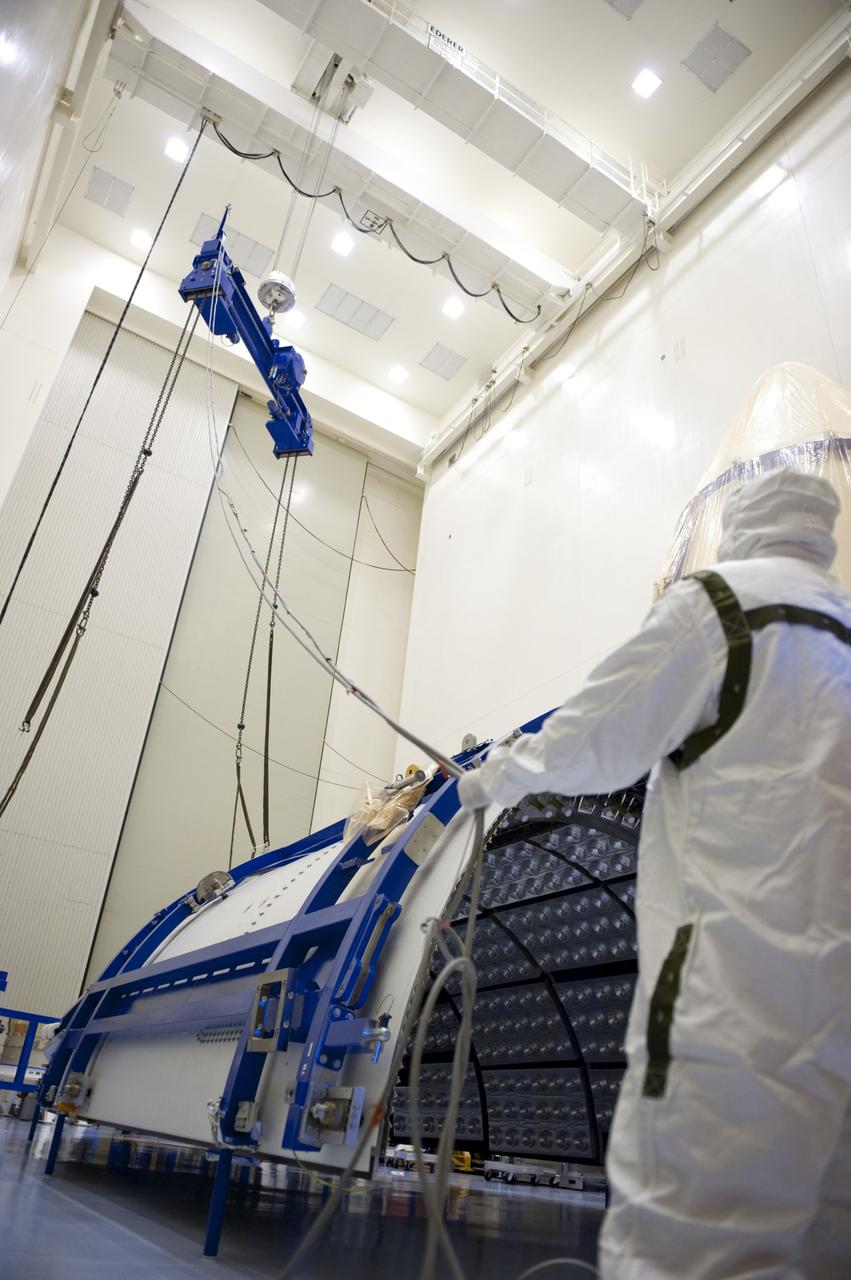
CAPE CANAVERAL, Fla. -- In the Payload Hazardous Servicing Facility at NASA's Kennedy Space Center in Florida, United Launch Alliance technicians lower a lifting device toward half of the Atlas V payload fairing for NASA's Mars Science Laboratory (MSL) mission. The fairing has been uncovered, and preparations are under way to clean it to meet NASA's planetary protection requirements. The fairing will protect the spacecraft from the impact of aerodynamic pressure and heating during ascent. Although jettisoned once the spacecraft is outside the Earth's atmosphere, the fairing must be cleaned to the same exacting standards as the laboratory to avoid the possibility of contaminating it. MSL's components include a compact car-sized rover, Curiosity, which has 10 science instruments designed to search for evidence on whether Mars has had environments favorable to microbial life, including the chemical ingredients for life. The unique rover will use a laser to look inside rocks and release its gasses so that the rover’s spectrometer can analyze and send the data back to Earth. Launch of MSL aboard a United Launch Alliance Atlas V rocket is planned for Nov. 25 from Space Launch Complex 41 on Cape Canaveral Air Force Station. For more information, visit http://www.nasa.gov/msl. Photo credit: NASA/Kim Shiflett
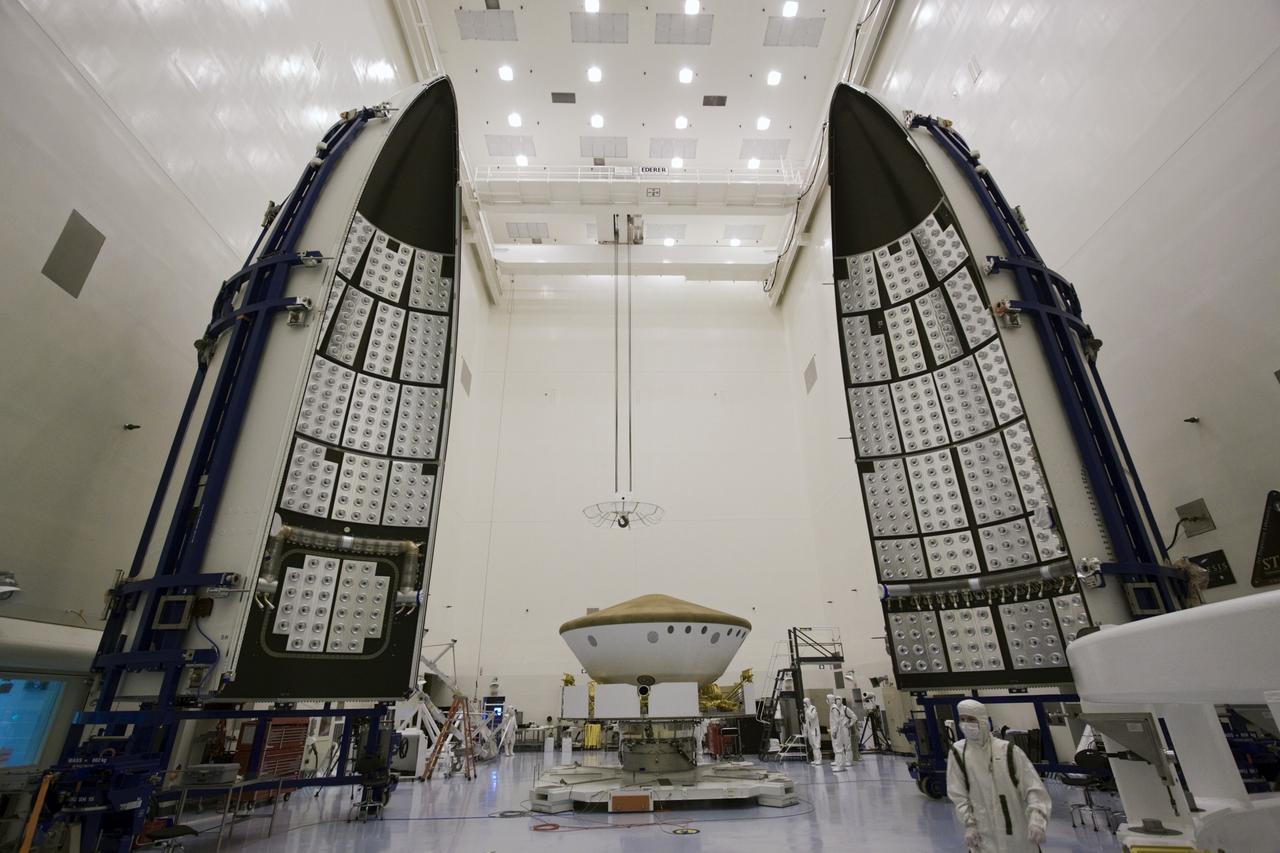
CAPE CANAVERAL, Fla. -- In the Payload Hazardous Servicing Facility at NASA's Kennedy Space Center in Florida, preparations are under way to enclose NASA's Mars Science Laboratory (MSL) in an Atlas V rocket payload fairing. The blocks on the interior of the fairing are components of the fairing acoustic protection (FAP) system, designed to protect the payload by dampening the sound created by the rocket during liftoff. The fairing will protect the spacecraft from the impact of aerodynamic pressure and heating during ascent. MSL's components include a compact car-sized rover, Curiosity, which has 10 science instruments designed to search for evidence on whether Mars has had environments favorable to microbial life, including the chemical ingredients for life. The unique rover will use a laser to look inside rocks and release its gasses so that the rover’s spectrometer can analyze and send the data back to Earth. Launch of MSL aboard a United Launch Alliance Atlas V rocket is planned for Nov. 25 from Space Launch Complex-41 on Cape Canaveral Air Force Station. For more information, visit http://www.nasa.gov/msl. Photo credit: NASA/Jim Grossmann
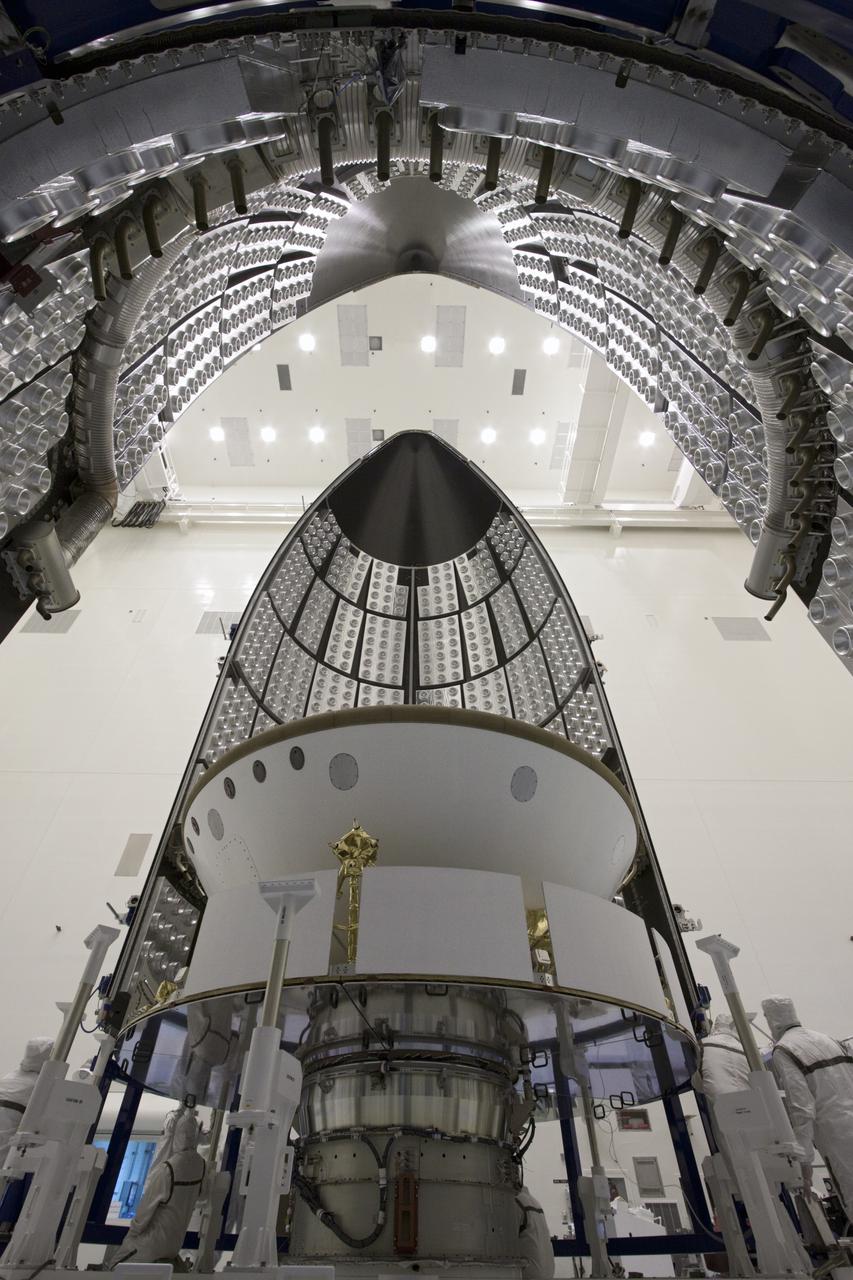
CAPE CANAVERAL, Fla. -- In the Payload Hazardous Servicing Facility at NASA's Kennedy Space Center in Florida, sections of an Atlas V rocket payload fairing engulf NASA's Mars Science Laboratory (MSL) as they close in around it. The blocks on the interior of the fairing are components of the fairing acoustic protection (FAP) system, designed to protect the payload by dampening the sound created by the rocket during liftoff. The fairing will protect the spacecraft from the impact of aerodynamic pressure and heating during ascent. MSL's components include a compact car-sized rover, Curiosity, which has 10 science instruments designed to search for evidence on whether Mars has had environments favorable to microbial life, including the chemical ingredients for life. The unique rover will use a laser to look inside rocks and release its gasses so that the rover’s spectrometer can analyze and send the data back to Earth. Launch of MSL aboard a United Launch Alliance Atlas V rocket is planned for Nov. 25 from Space Launch Complex-41 on Cape Canaveral Air Force Station. For more information, visit http://www.nasa.gov/msl. Photo credit: NASA/Jim Grossmann
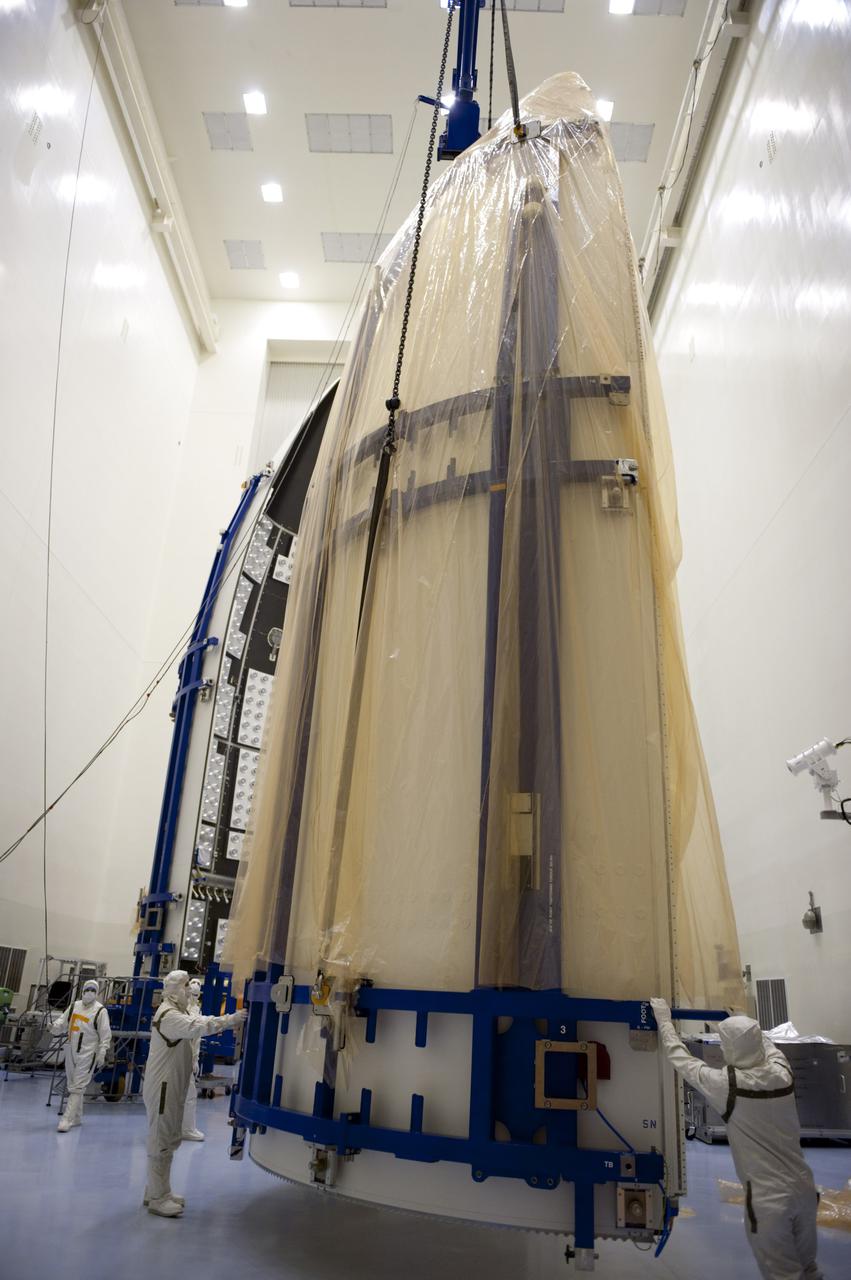
CAPE CANAVERAL, Fla. -- In the Payload Hazardous Servicing Facility at NASA's Kennedy Space Center in Florida, United Launch Alliance technicians steady half of the Atlas V payload fairing for NASA's Mars Science Laboratory (MSL) mission as it is lifted from the floor. Preparations are under way to lower it into a horizontal position to uncover and then clean it to meet NASA's planetary protection requirements. Behind it is the other half of the fairing, already uncovered. The fairing will protect the spacecraft from the impact of aerodynamic pressure and heating during ascent. Although jettisoned once the spacecraft is outside the Earth's atmosphere, the fairing must be cleaned to the same exacting standards as the laboratory to avoid the possibility of contaminating it. MSL's components include a compact car-sized rover, Curiosity, which has 10 science instruments designed to search for evidence on whether Mars has had environments favorable to microbial life, including the chemical ingredients for life. The unique rover will use a laser to look inside rocks and release its gasses so that the rover’s spectrometer can analyze and send the data back to Earth. Launch of MSL aboard a United Launch Alliance Atlas V rocket is planned for Nov. 25 from Space Launch Complex 41 on Cape Canaveral Air Force Station. For more information, visit http:__www.nasa.gov_msl. Photo credit: NASA_Kim Shiflett

CAPE CANAVERAL, Fla. -- In the Payload Hazardous Servicing Facility at NASA's Kennedy Space Center in Florida, NASA's Mars Science Laboratory (MSL) is ready to be enclosed in the Atlas V rocket payload fairing in the background. The blocks on the interior of the fairing are components of the fairing acoustic protection (FAP) system, designed to protect the payload by dampening the sound created by the rocket during liftoff. The fairing will protect the spacecraft from the impact of aerodynamic pressure and heating during ascent. MSL's components include a compact car-sized rover, Curiosity, which has 10 science instruments designed to search for evidence on whether Mars has had environments favorable to microbial life, including the chemical ingredients for life. The unique rover will use a laser to look inside rocks and release its gasses so that the rover’s spectrometer can analyze and send the data back to Earth. Launch of MSL aboard a United Launch Alliance Atlas V rocket is planned for Nov. 25 from Space Launch Complex-41 on Cape Canaveral Air Force Station. For more information, visit http://www.nasa.gov/msl. Photo credit: NASA/Jim Grossmann
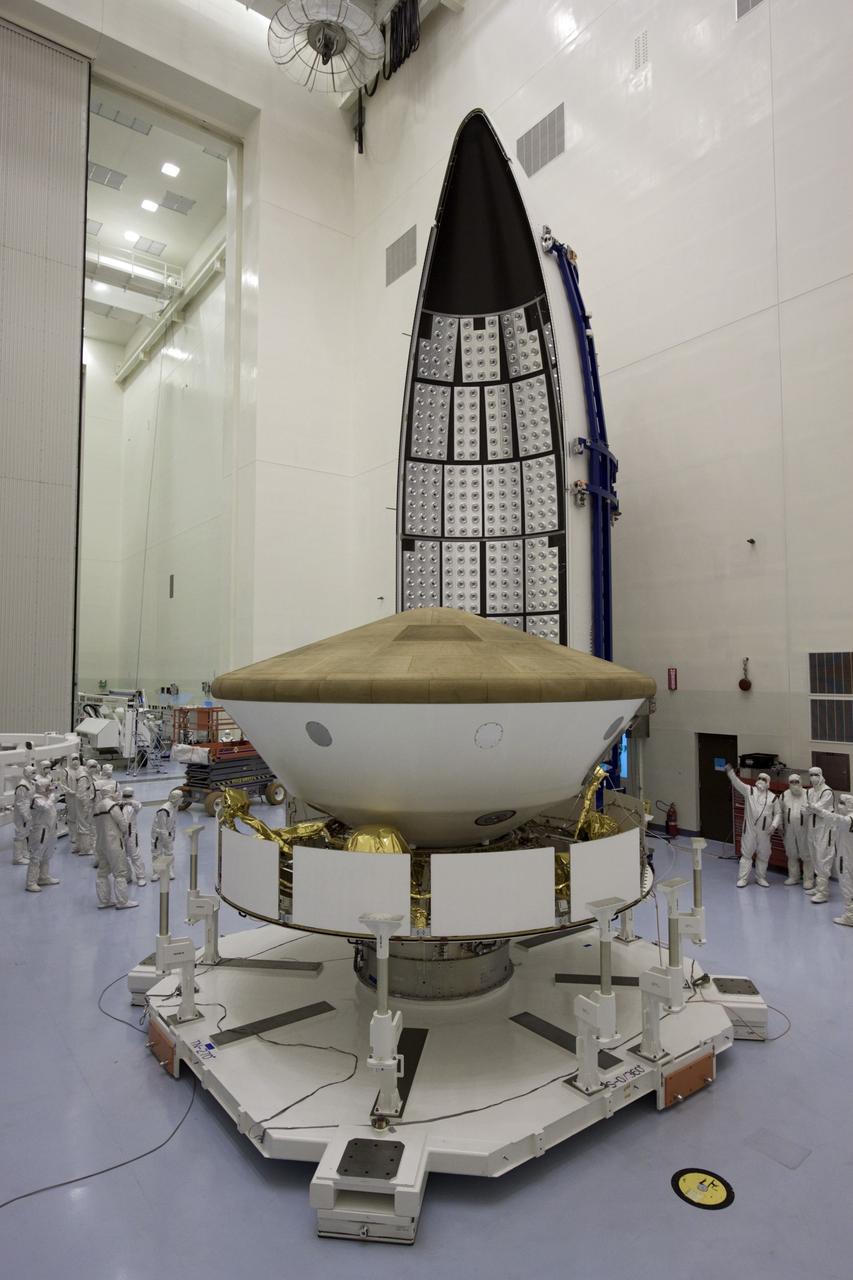
CAPE CANAVERAL, Fla. -- In the Payload Hazardous Servicing Facility at NASA's Kennedy Space Center in Florida, spacecraft technicians prepare to enclose NASA's Mars Science Laboratory (MSL) in an Atlas V rocket payload fairing. The blocks on the interior of the fairing are components of the fairing acoustic protection (FAP) system, designed to protect the payload by dampening the sound created by the rocket during liftoff. The fairing will protect the spacecraft from the impact of aerodynamic pressure and heating during ascent. MSL's components include a compact car-sized rover, Curiosity, which has 10 science instruments designed to search for evidence on whether Mars has had environments favorable to microbial life, including the chemical ingredients for life. The unique rover will use a laser to look inside rocks and release its gasses so that the rover’s spectrometer can analyze and send the data back to Earth. Launch of MSL aboard a United Launch Alliance Atlas V rocket is planned for Nov. 25 from Space Launch Complex-41 on Cape Canaveral Air Force Station. For more information, visit http://www.nasa.gov/msl. Photo credit: NASA/Jim Grossmann
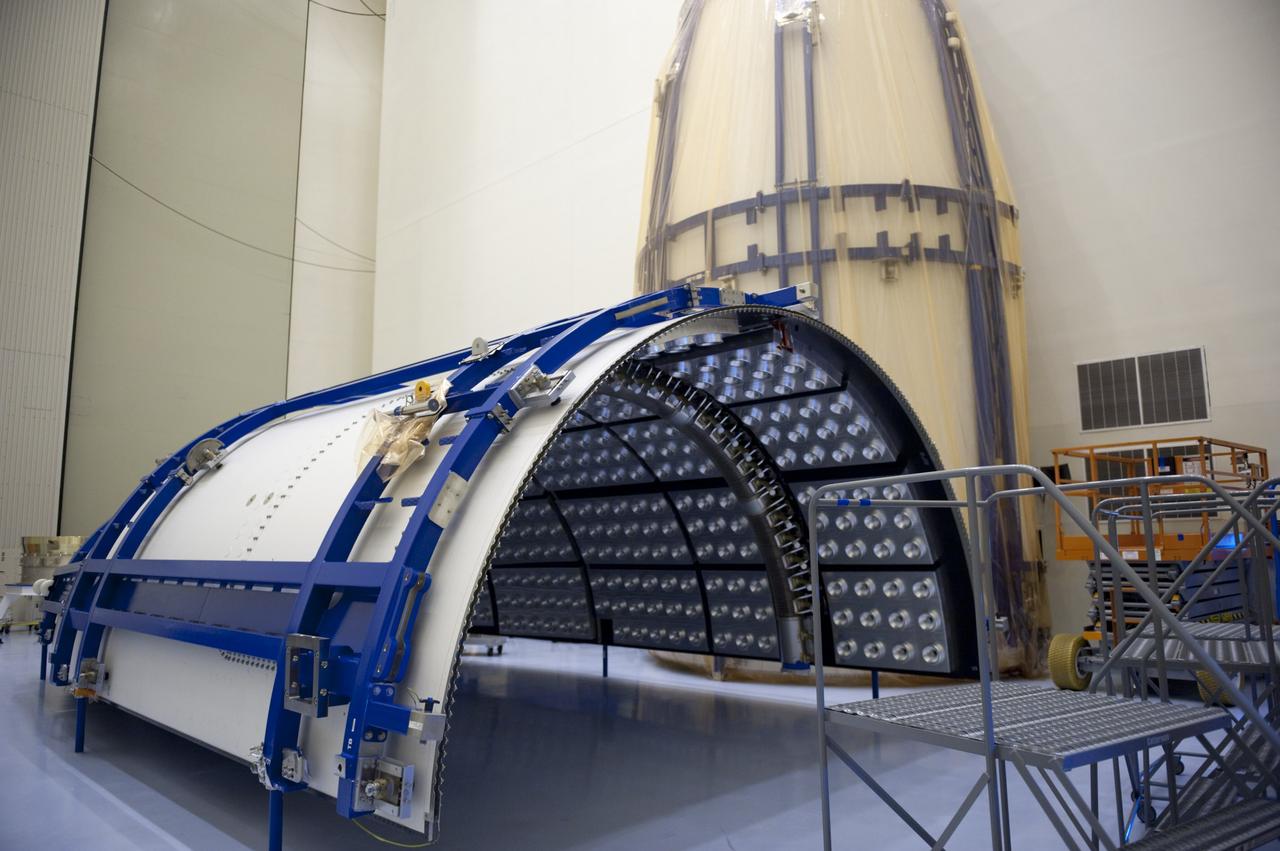
CAPE CANAVERAL, Fla. -- In the Payload Hazardous Servicing Facility at NASA's Kennedy Space Center in Florida, half of the Atlas V payload fairing for NASA's Mars Science Laboratory (MSL) mission is uncovered during preparations to clean it to meet NASA's planetary protection requirements. In the background is the other half of the fairing, still uncovered. The fairing will protect the spacecraft from the impact of aerodynamic pressure and heating during ascent. Although jettisoned once the spacecraft is outside the Earth's atmosphere, the fairing must be cleaned to the same exacting standards as the laboratory to avoid the possibility of contaminating it. MSL's components include a compact car-sized rover, Curiosity, which has 10 science instruments designed to search for evidence on whether Mars has had environments favorable to microbial life, including the chemical ingredients for life. The unique rover will use a laser to look inside rocks and release its gasses so that the rover’s spectrometer can analyze and send the data back to Earth. Launch of MSL aboard a United Launch Alliance Atlas V rocket is planned for Nov. 25 from Space Launch Complex 41 on Cape Canaveral Air Force Station. For more information, visit http://www.nasa.gov/msl. Photo credit: NASA/Kim Shiflett
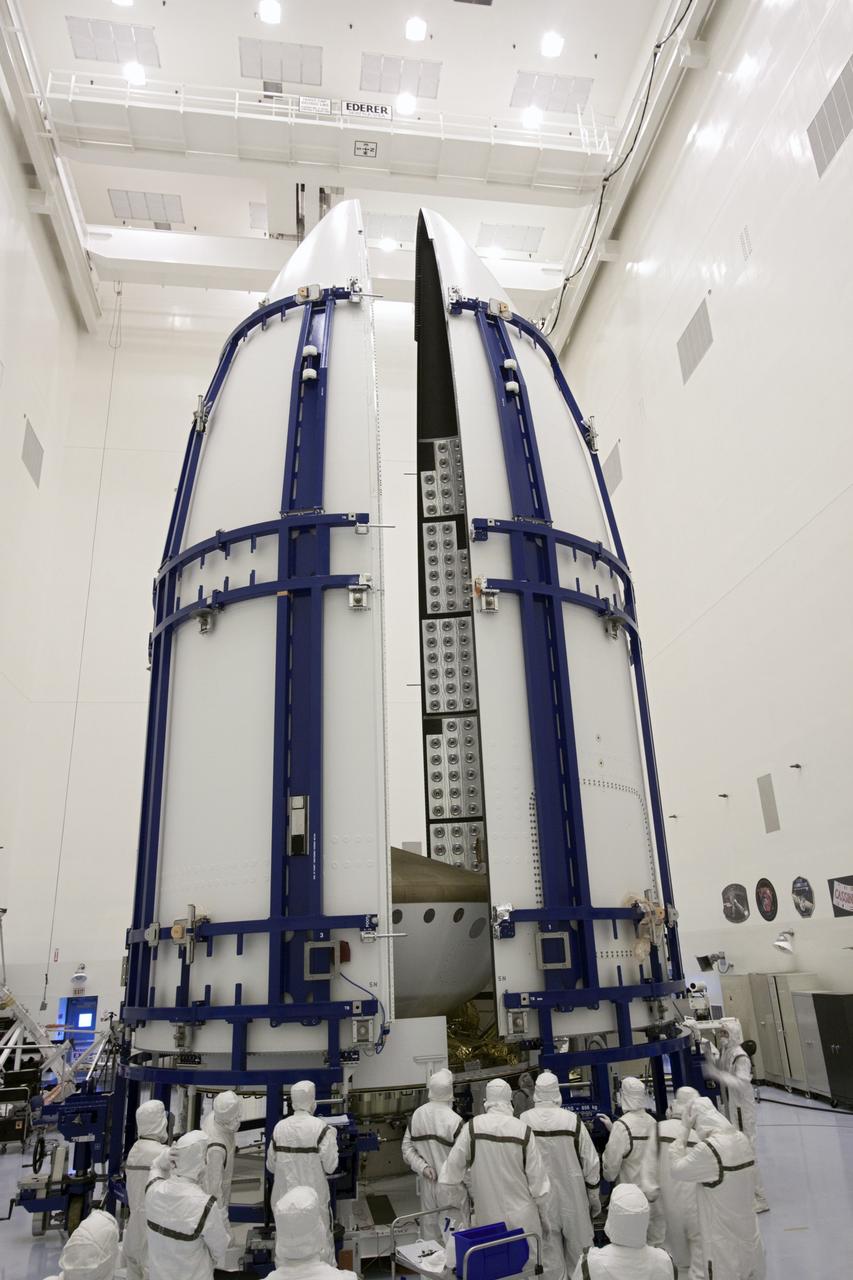
CAPE CANAVERAL, Fla. -- In the Payload Hazardous Servicing Facility at NASA's Kennedy Space Center in Florida, sections of an Atlas V rocket payload fairing obscure NASA's Mars Science Laboratory (MSL) from view as they close in around it. The blocks on the interior of the fairing are components of the fairing acoustic protection (FAP) system, designed to protect the payload by dampening the sound created by the rocket during liftoff. The fairing will protect the spacecraft from the impact of aerodynamic pressure and heating during ascent. MSL's components include a compact car-sized rover, Curiosity, which has 10 science instruments designed to search for evidence on whether Mars has had environments favorable to microbial life, including the chemical ingredients for life. The unique rover will use a laser to look inside rocks and release its gasses so that the rover’s spectrometer can analyze and send the data back to Earth. Launch of MSL aboard a United Launch Alliance Atlas V rocket is planned for Nov. 25 from Space Launch Complex-41 on Cape Canaveral Air Force Station. For more information, visit http://www.nasa.gov/msl. Photo credit: NASA/Jim Grossmann
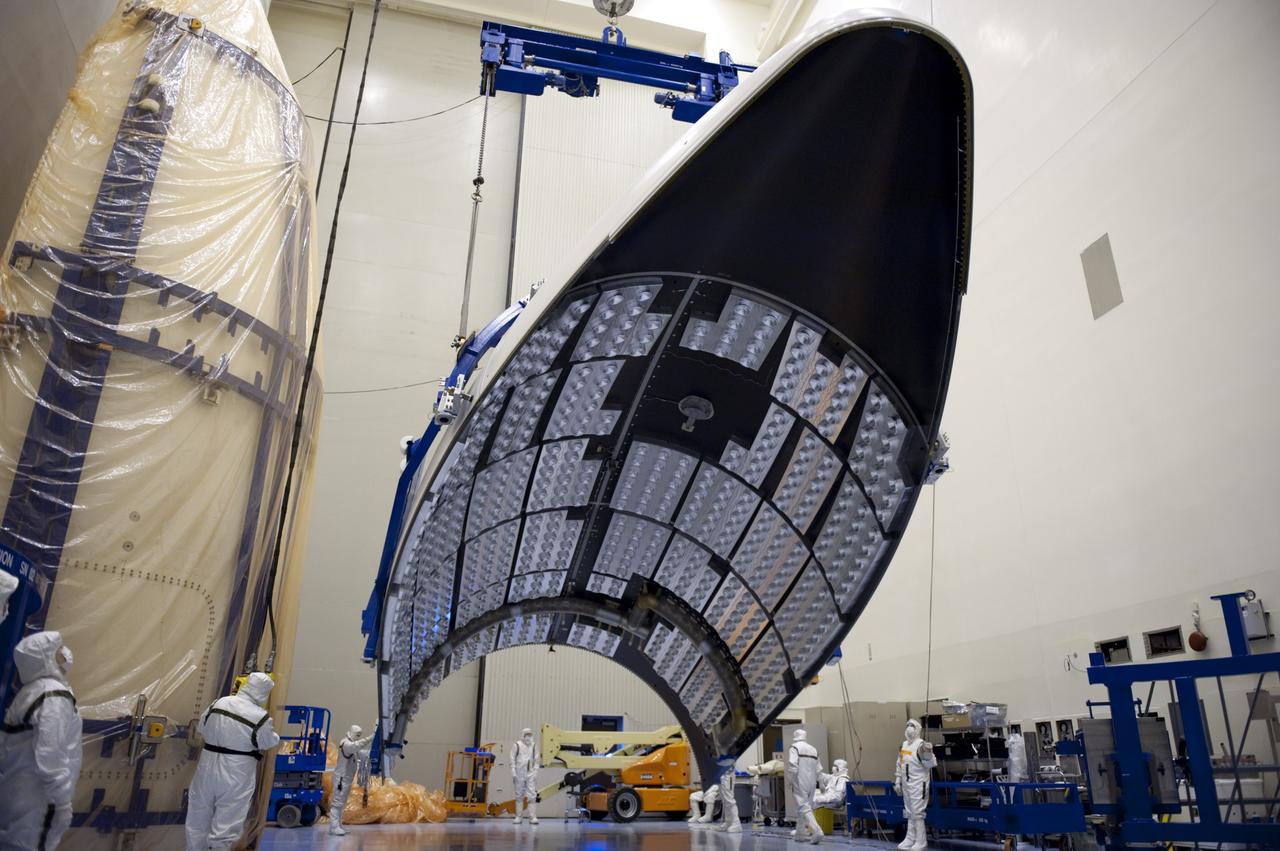
CAPE CANAVERAL, Fla. -- In the Payload Hazardous Servicing Facility at NASA's Kennedy Space Center in Florida, the fairing acoustic protection (FAP) system lining the inside of the Atlas V payload fairing for NASA's Mars Science Laboratory (MSL) mission is in view as the fairing is lifted into a vertical position. The FAP protects the payload by dampening the sound created by the rocket during liftoff. The fairing has been uncovered, and preparations are under way to clean it to meet NASA's planetary protection requirements. At left is the other half of the fairing, still uncovered. The fairing will protect the spacecraft from the impact of aerodynamic pressure and heating during ascent. Although jettisoned once the spacecraft is outside the Earth's atmosphere, the fairing must be cleaned to the same exacting standards as the laboratory to avoid the possibility of contaminating it. MSL's components include a compact car-sized rover, Curiosity, which has 10 science instruments designed to search for evidence on whether Mars has had environments favorable to microbial life, including the chemical ingredients for life. The unique rover will use a laser to look inside rocks and release its gasses so that the rover’s spectrometer can analyze and send the data back to Earth. Launch of MSL aboard a United Launch Alliance Atlas V rocket is planned for Nov. 25 from Space Launch Complex 41 on Cape Canaveral Air Force Station. For more information, visit http://www.nasa.gov/msl. Photo credit: NASA/Kim Shiflett
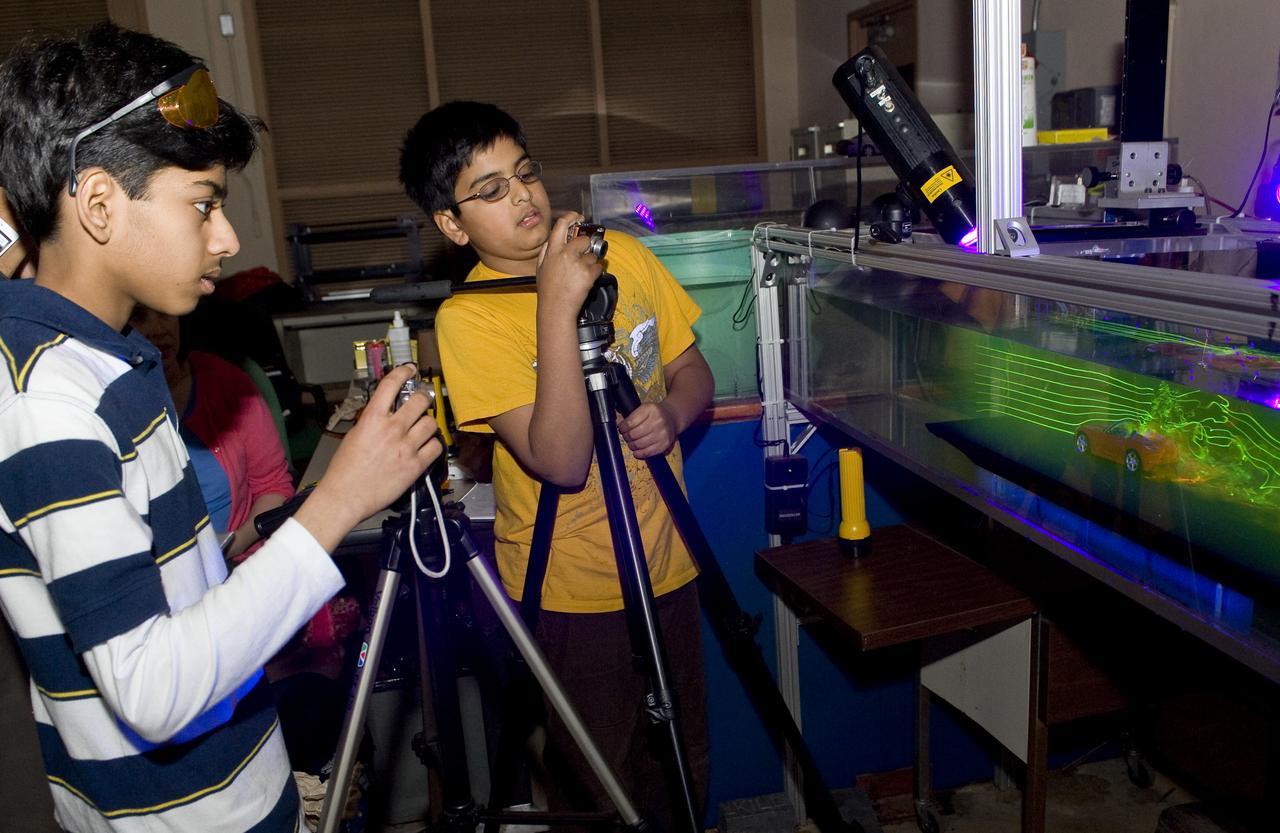
Students, Ajay Ramesh and Prithvi Aiyaswamy in 7th grade, Chaboya Middle School, San Jose, have entered the Intel Inernational Science Fair (May 2010) They are here at the Ames Research center to test the drag of race cars in the Fluid Mechanics Lab (FML)
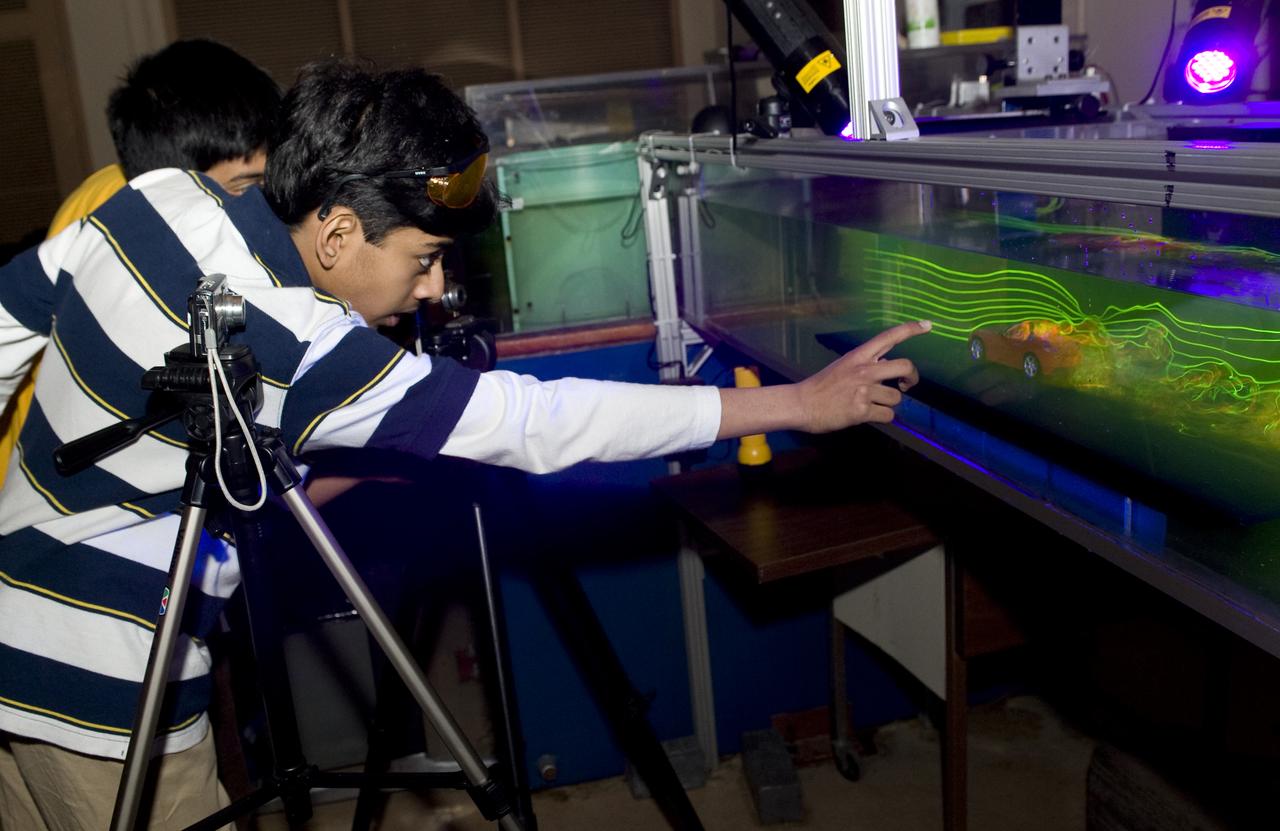
Students, Ajay Ramesh and Prithvi Aiyaswamy in 7th grade, Chaboya Middle School, San Jose, have entered the Intel Inernational Science Fair (May 2010) They are here at the Ames Research center to test the drag of race cars in the Fluid Mechanics Lab (FML)
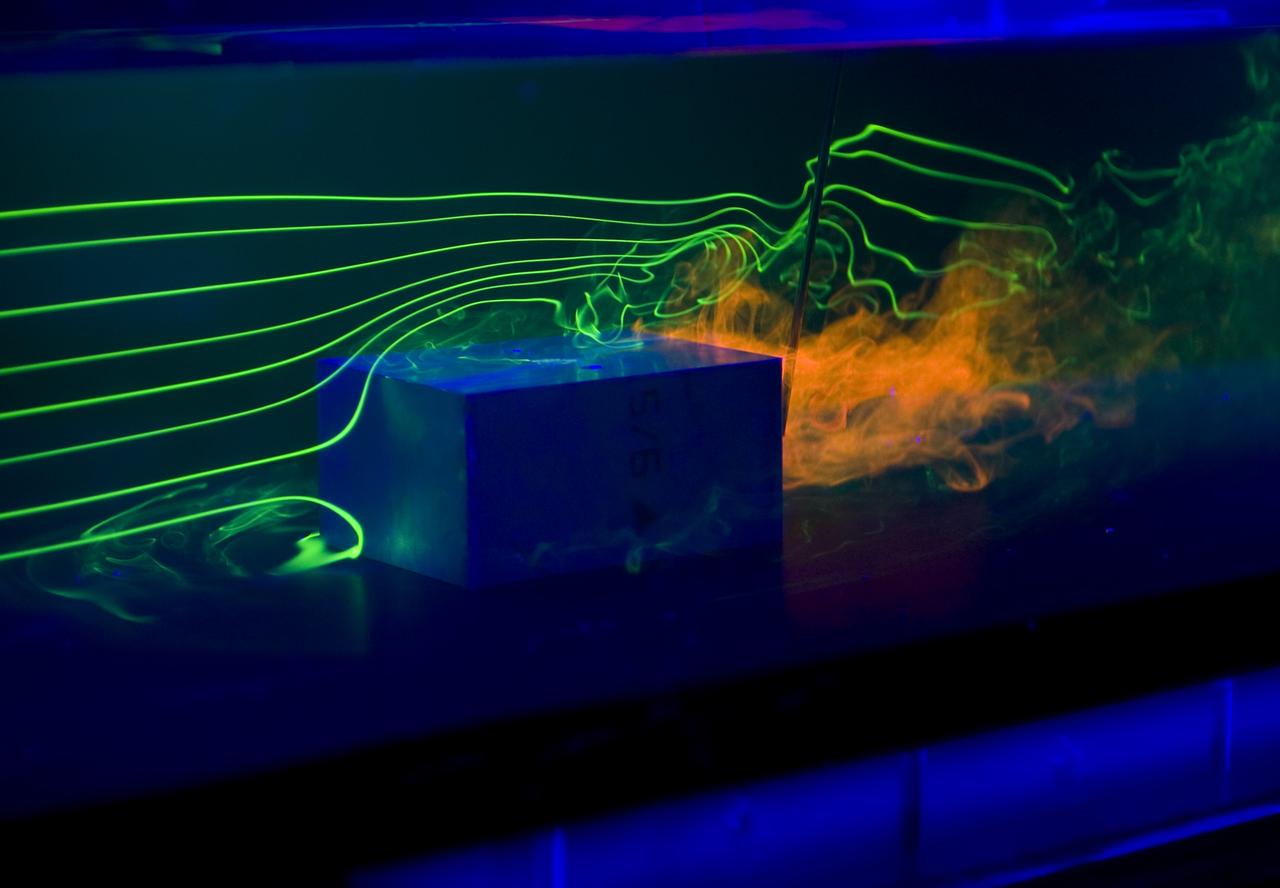
Students, Ajay Ramesh and Prithvi Aiyaswamy in 7th grade, Chaboya Middle School, San Jose, have entered the Intel Inernational Science Fair (May 2010) They are here at the Ames Research center to test the drag of race cars in the Fluid Mechanics Lab (FML)
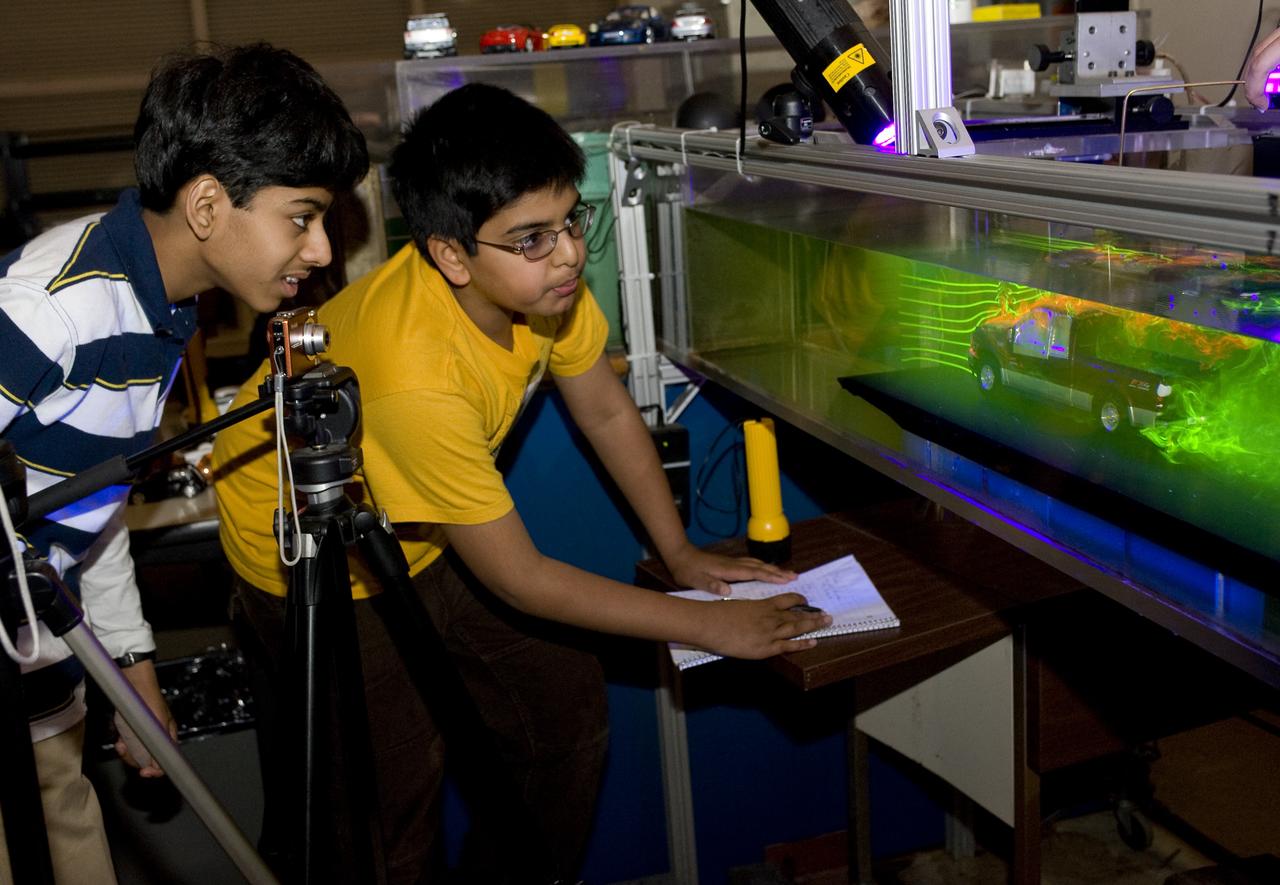
Students, Ajay Ramesh and Prithvi Aiyaswamy in 7th grade, Chaboya Middle School, San Jose, have entered the Intel Inernational Science Fair (May 2010) They are here at the Ames Research center to test the drag of race cars in the Fluid Mechanics Lab (FML)
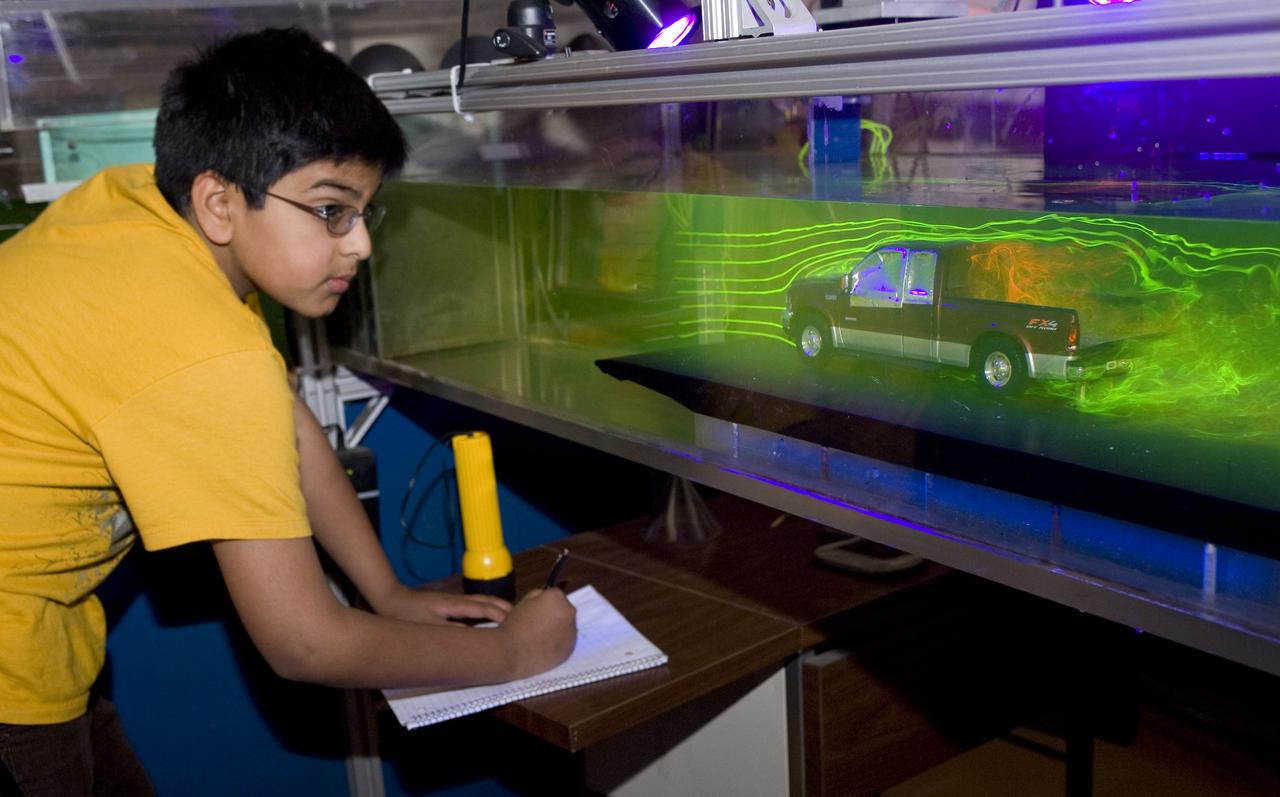
Students, Ajay Ramesh and Prithvi Aiyaswamy in 7th grade, Chaboya Middle School, San Jose, have entered the Intel Inernational Science Fair (May 2010) They are here at the Ames Research center to test the drag of race cars in the Fluid Mechanics Lab (FML)
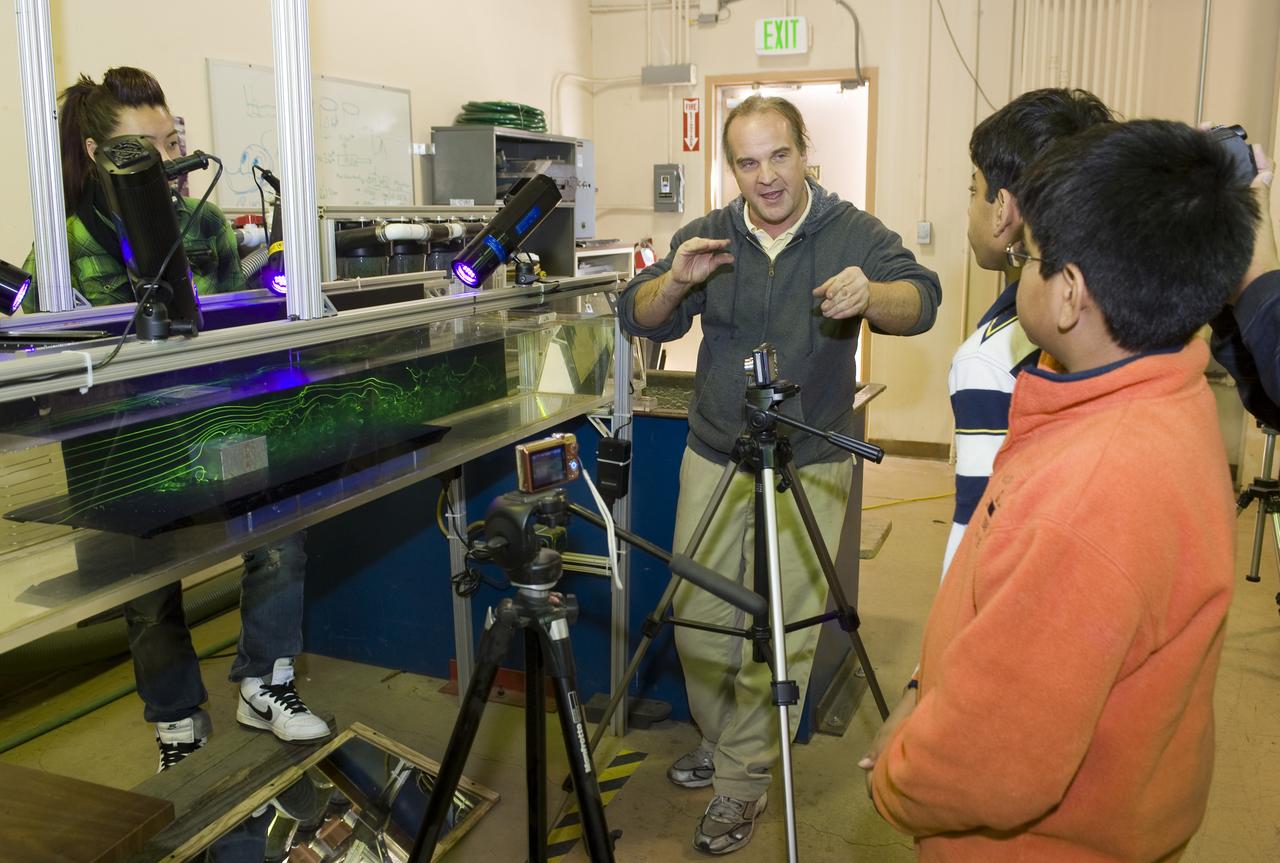
Students, Ajay Ramesh and Prithvi Aiyaswamy in 7th grade, Chaboya Middle School, San Jose, have entered the Intel Inernational Science Fair (May 2010) They are here at the Ames Research center to test the drag of race cars in the Fluid Mechanics Lab (FML) with the guidance of Kurt Long of the Experimental Aero-Physics Branch.
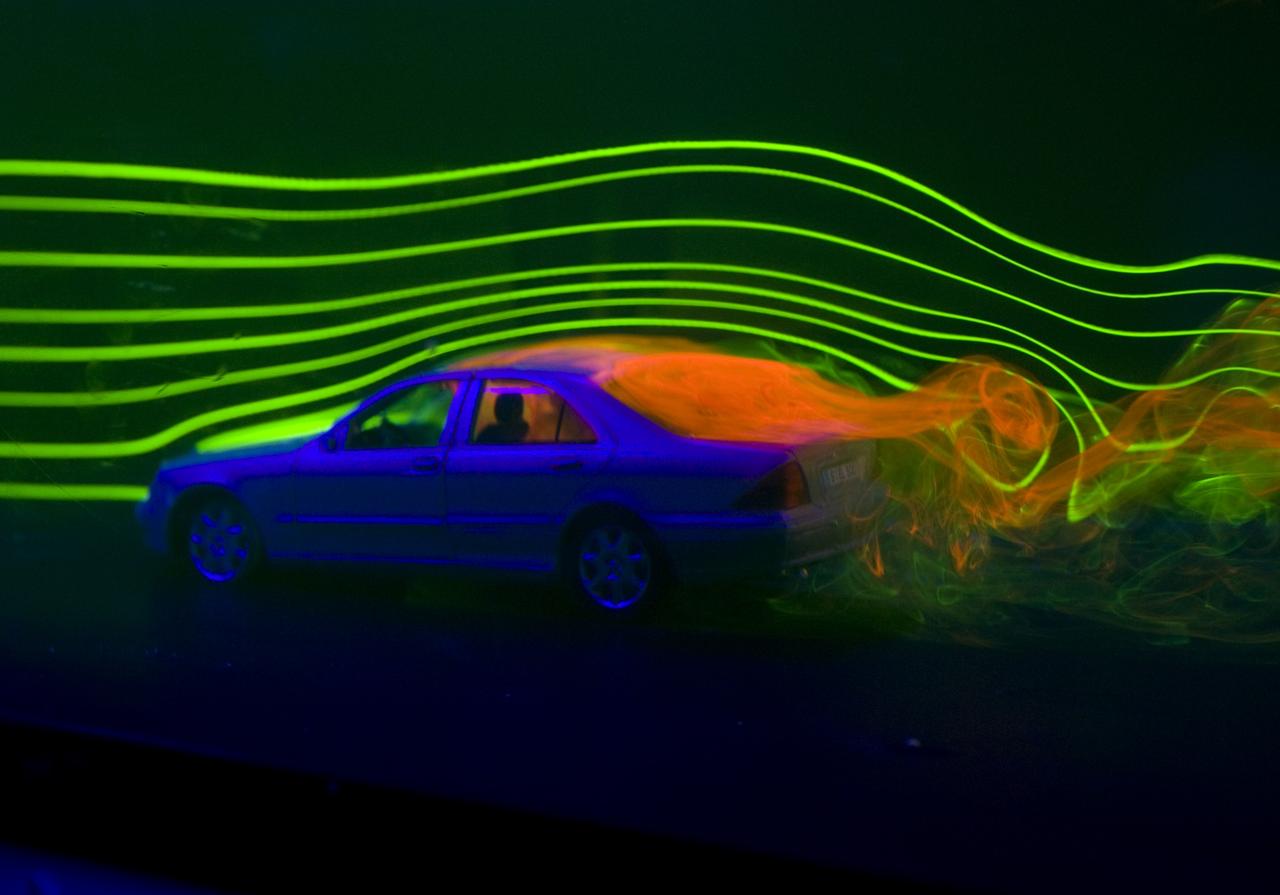
Students, Ajay Ramesh and Prithvi Aiyaswamy in 7th grade, Chaboya Middle School, San Jose, have entered the Intel Inernational Science Fair (May 2010) They are here at the Ames Research center to test the drag of race cars in the Fluid Mechanics Lab (FML)
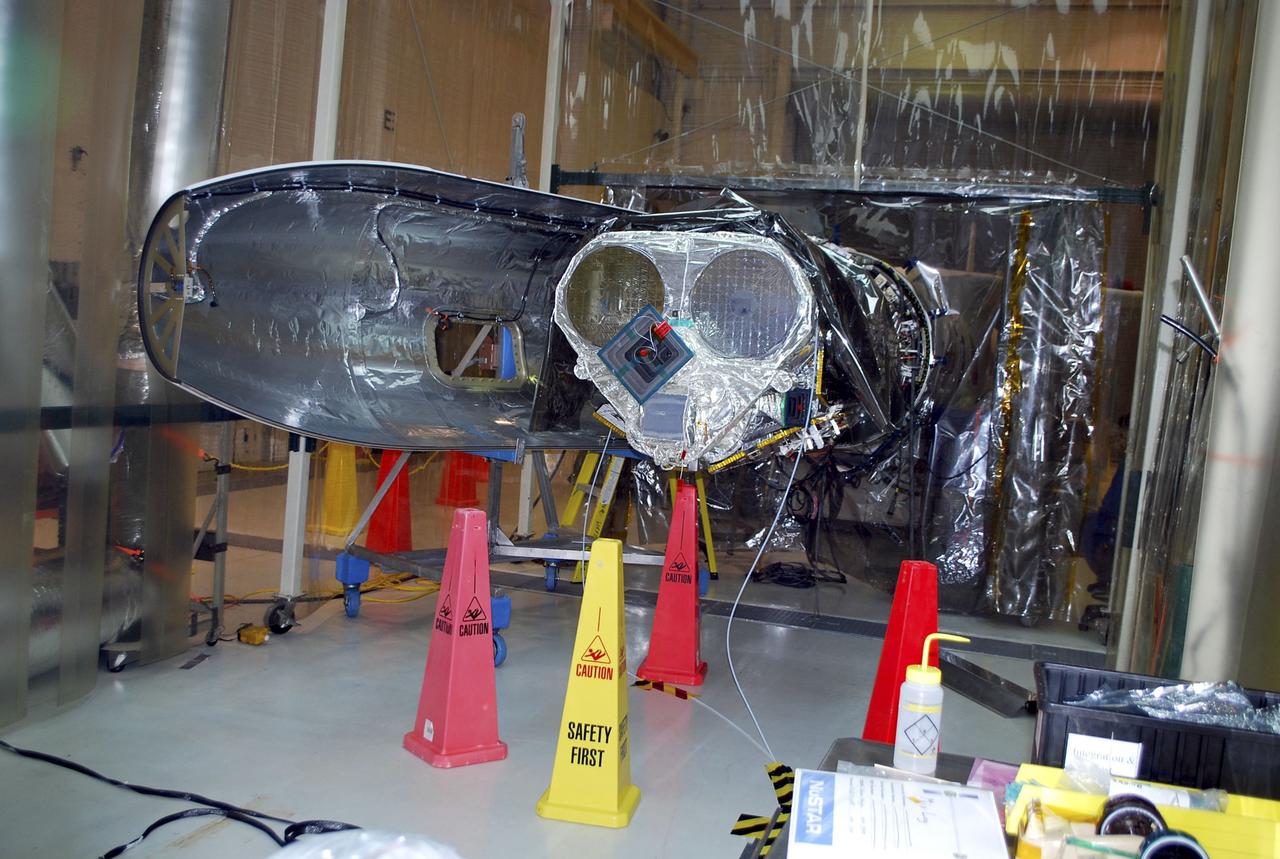
VANDENBERG AIR FORCE BASE, Calif. -- NASA's Nuclear Spectroscopic Telescope Array NuSTAR spacecraft is wrapped in its protective cover and half of its payload fairing is behind it in processing facility 1555 at Vandenberg Air Force Base in California. Technicians are performing fairing closeout work in preparation for fairing installation around the spacecraft, which is scheduled to begin March 2. The cover protecting NuSTAR's delicate instruments will be removed prior to the fairing installation. The fairing will protect the spacecraft from the heat and aerodynamic pressure generated during ascent to orbit aboard an Orbital Sciences Pegasus XL rocket. After processing of the rocket and spacecraft are complete, they will be flown on Orbital's L-1011 carrier aircraft from Vandenberg to the Ronald Reagan Ballistic Missile Defense Test Site on the Pacific Ocean’s Kwajalein Atoll for launch. The high-energy X-ray telescope will conduct a census of black holes, map radioactive material in young supernovae remnants, and study the origins of cosmic rays and the extreme physics around collapsed stars. For more information, visit http://www.nasa.gov/nustar. Photo credit: NASA/Randy Beaudoin, VAFB

“We did science fair projects in eighth grade. So my dad and I designed an experiment to look at what cooking oil is best for cooking popcorn. Now you go to science fairs and you see this experiment everywhere. But in 1989, it was like, ‘wow, a kid who knows the scientific method!’ “I made a lot of popcorn. My poor brothers had to eat it all. I measured volume popped and how many kernels were left unpopped. But I also measured the taste factor. For example, cooking popcorn in peanut oil actually has good yield but it doesn’t taste good. “In high school, I had this chemistry teacher named Carol Palmer. I’ll never forget her. The science fairs were really important to her. She had partnerships with laboratories in town, and through this program, I got to go to a stainless steel foundry. “Do you know what paper machines are like? Picture giant rolls, like the size of an 18-wheeler truckbed. This place made those things. This was the early 90s, so we were just starting to recycle paper. But the machines had begun falling apart because of all the corrosive chemicals added to the mix to remove ink. I was simulating that process in the laboratory through different experiments. And I won two years in a row at the state-level science fair: I won first prize in electrochemistry and I won first prize in chemistry. “It was all because of this teacher. And to be honest, I wouldn’t have known that materials science was a thing or that I should study it if I hadn’t had that opportunity. It really put me on course.” Kathleen Boggs, Systems and Technology Demonstration Manager in the International Space Station Division of the Human Exploration and Operations Mission Directorate, Thursday, March 5, 2020, at NASA Headquarters in Washington, DC. Photo Credit: (NASA/Joel Kowsky)
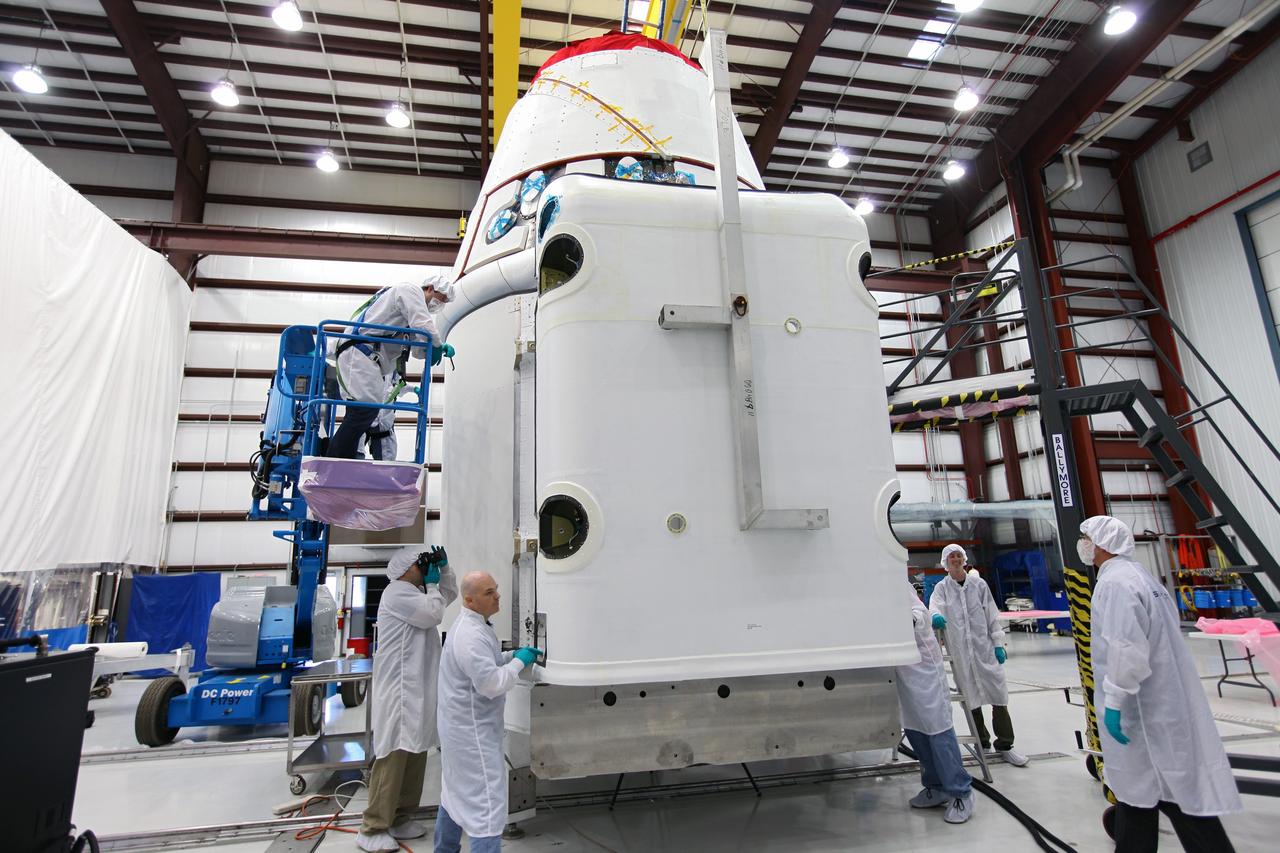
CAPE CANAVERAL, Fla. – Workers guide a solar array fairing into place inside the processing hangar used by Space Exploration Technologies, or SpaceX, at Cape Canaveral Air Force Station, Fla. The fairing will be installed on the Dragon spacecraft undergoing launch preparations inside the hangar. The spacecraft will launch on the upcoming SpaceX CRS-2 mission. The flight will be the second commercial resupply mission to the International Space Station by SpaceX. NASA has contracted for a total of 12 commercial resupply flights from SpaceX and eight from the Orbital Sciences Corp. Photo credit: NASA/Kim Shiflett
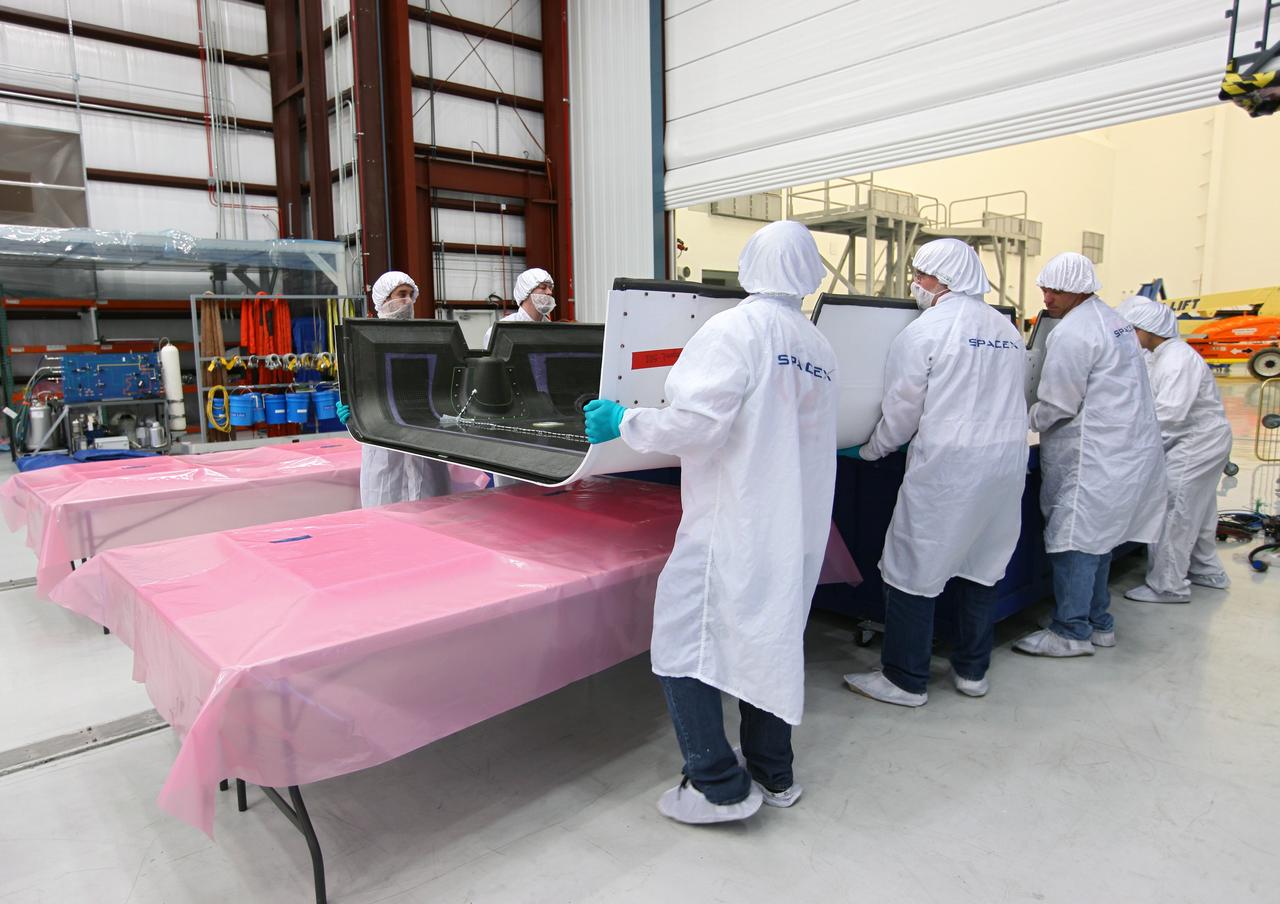
CAPE CANAVERAL, Fla. – Workers lift a solar array fairing at the processing hangar used by Space Exploration Technologies, or SpaceX, at Cape Canaveral Air Force Station, Fla. The fairings are to be installed on the Dragon spacecraft undergoing launch preparations inside the hangar. The spacecraft will launch on the upcoming SpaceX CRS-2 mission. The flight will be the second commercial resupply mission to the International Space Station by SpaceX. NASA has contracted for a total of 12 commercial resupply flights from SpaceX and eight from the Orbital Sciences Corp. Photo credit: NASA/Kim Shiflett
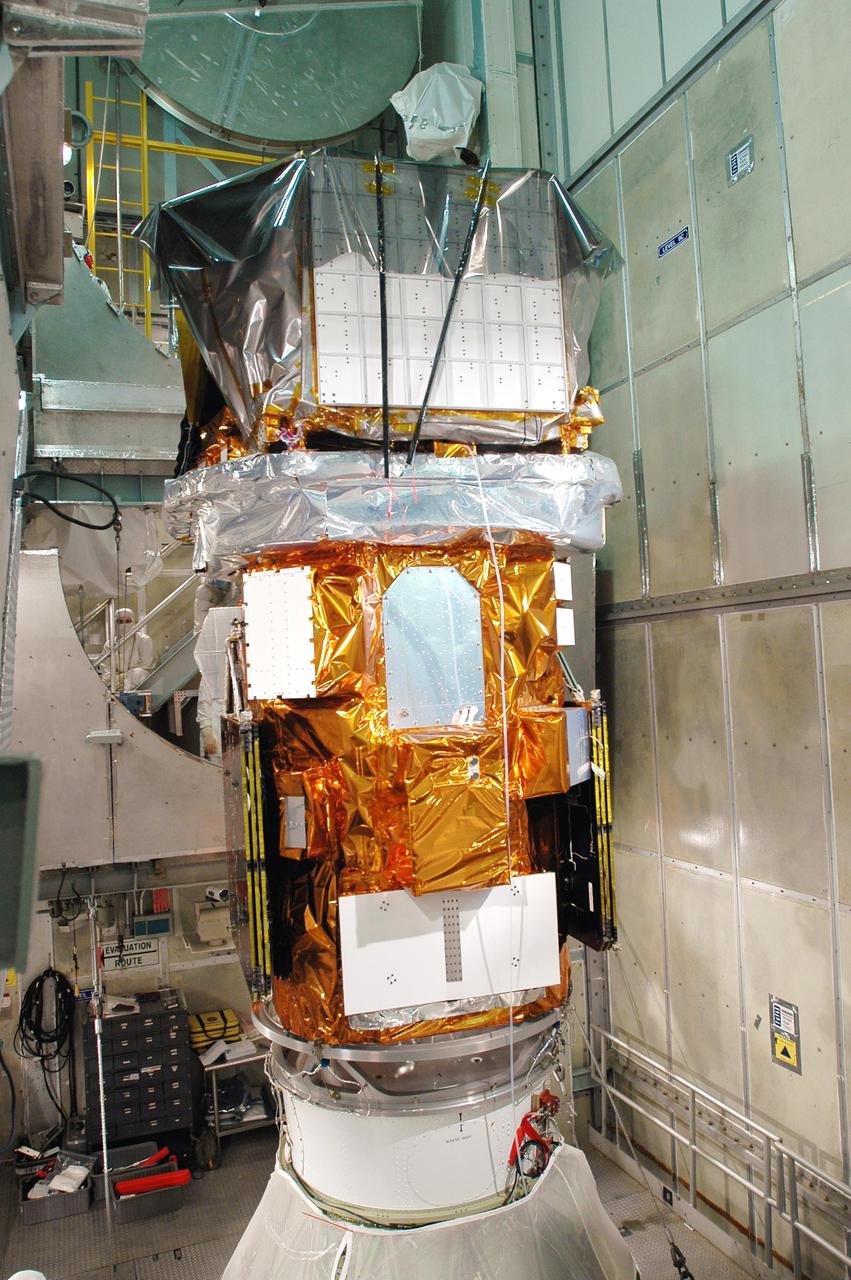
KENNEDY SPACE CENTER, FLA. - Inside the mobile service tower on Launch Pad 17-A, Cape Canaveral Air Force Station, the Swift spacecraft (on top) is ready for fairing encapsulation. The fairing is being installed around the payload for protection during launch and ascent. A Boeing Delta II rocket is the launch vehicle for the Swift spacecraft and its Gamma-Ray Burst Mission. Swift is a first-of-its-kind multi-wavelength observatory dedicated to the study of gamma-ray burst science. Its three instruments will work together to observe GRBs and afterglows in the gamma ray, X-ray, ultraviolet and optical wavebands. Swift is scheduled to launch Nov. 17 at 12:09 p.m. EST.
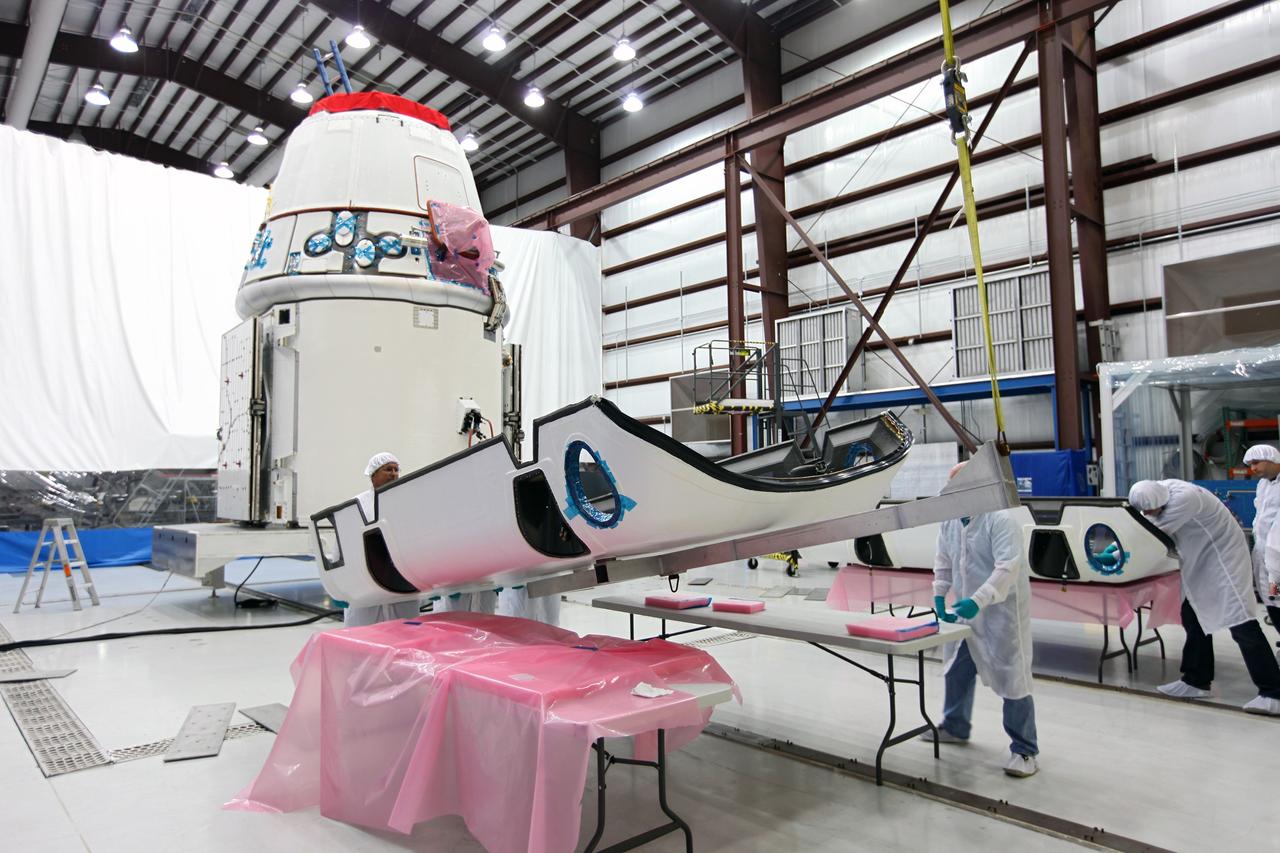
CAPE CANAVERAL, Fla. – Workers lift a solar array fairing at the processing hangar used by Space Exploration Technologies, or SpaceX, at Cape Canaveral Air Force Station, Fla. The fairing will be installed on the Dragon spacecraft undergoing launch preparations inside the hangar. The spacecraft will launch on the upcoming SpaceX CRS-2 mission. The flight will be the second commercial resupply mission to the International Space Station by SpaceX. NASA has contracted for a total of 12 commercial resupply flights from SpaceX and eight from the Orbital Sciences Corp. Photo credit: NASA/Kim Shiflett
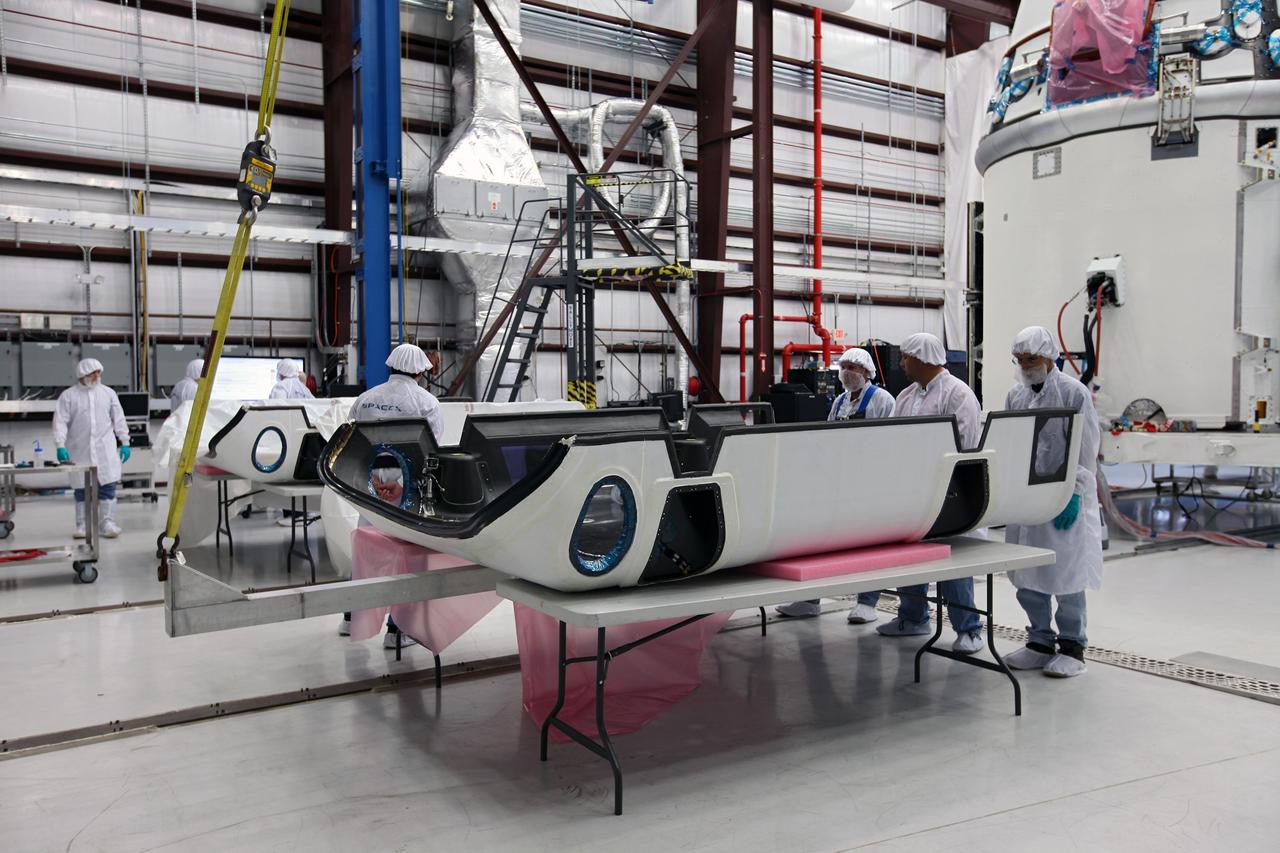
CAPE CANAVERAL, Fla. – Workers prepare to lift a solar array fairing at the processing hangar used by Space Exploration Technologies, or SpaceX, at Cape Canaveral Air Force Station, Fla. The fairing will be installed on the Dragon spacecraft undergoing launch preparations inside the hangar. The spacecraft will launch on the upcoming SpaceX CRS-2 mission. The flight will be the second commercial resupply mission to the International Space Station by SpaceX. NASA has contracted for a total of 12 commercial resupply flights from SpaceX and eight from the Orbital Sciences Corp. Photo credit: NASA/Kim Shiflett
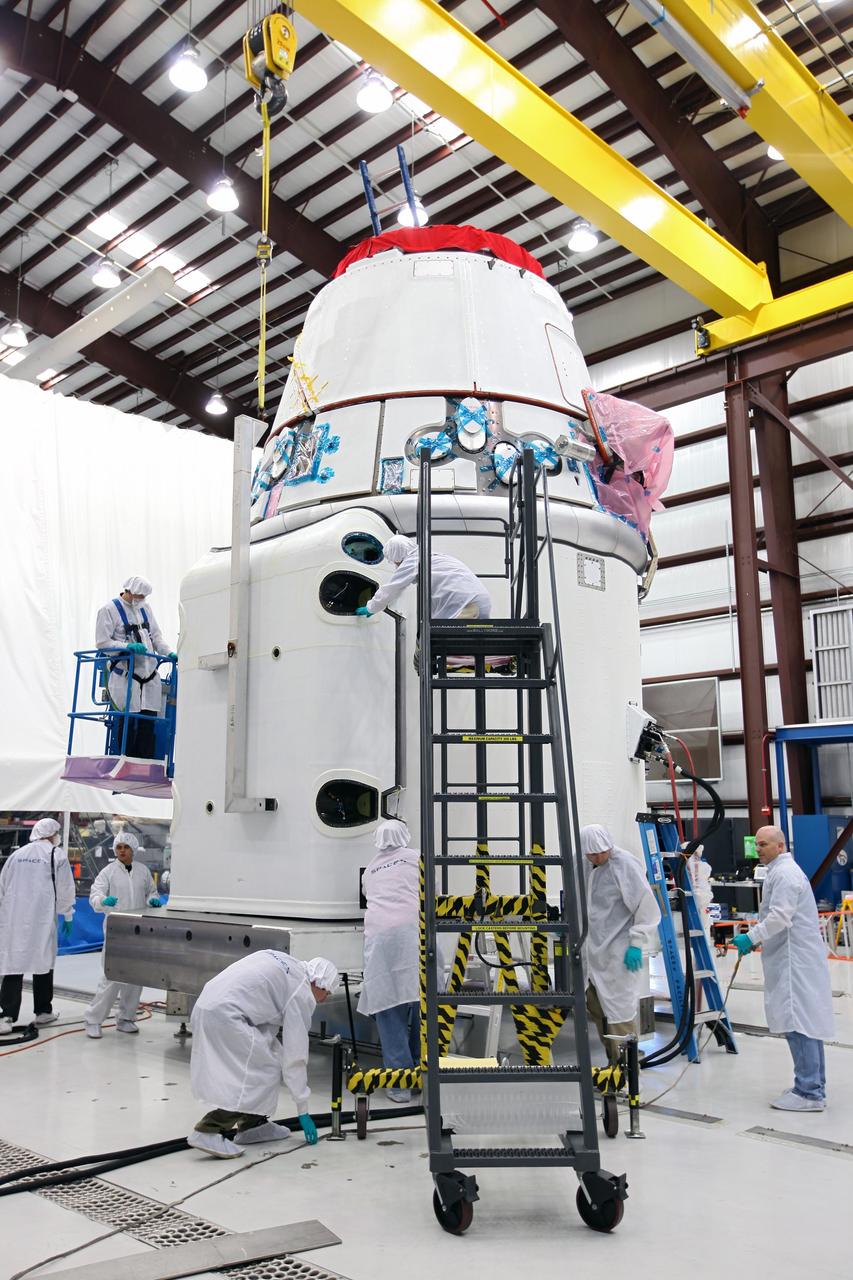
CAPE CANAVERAL, Fla. – Workers guide a solar array fairing into place inside the processing hangar used by Space Exploration Technologies, or SpaceX, at Cape Canaveral Air Force Station, Fla. The fairing will be installed on the Dragon spacecraft undergoing launch preparations inside the hangar. The spacecraft will launch on the upcoming SpaceX CRS-2 mission. The flight will be the second commercial resupply mission to the International Space Station by SpaceX. NASA has contracted for a total of 12 commercial resupply flights from SpaceX and eight from the Orbital Sciences Corp. Photo credit: NASA/Kim Shiflett
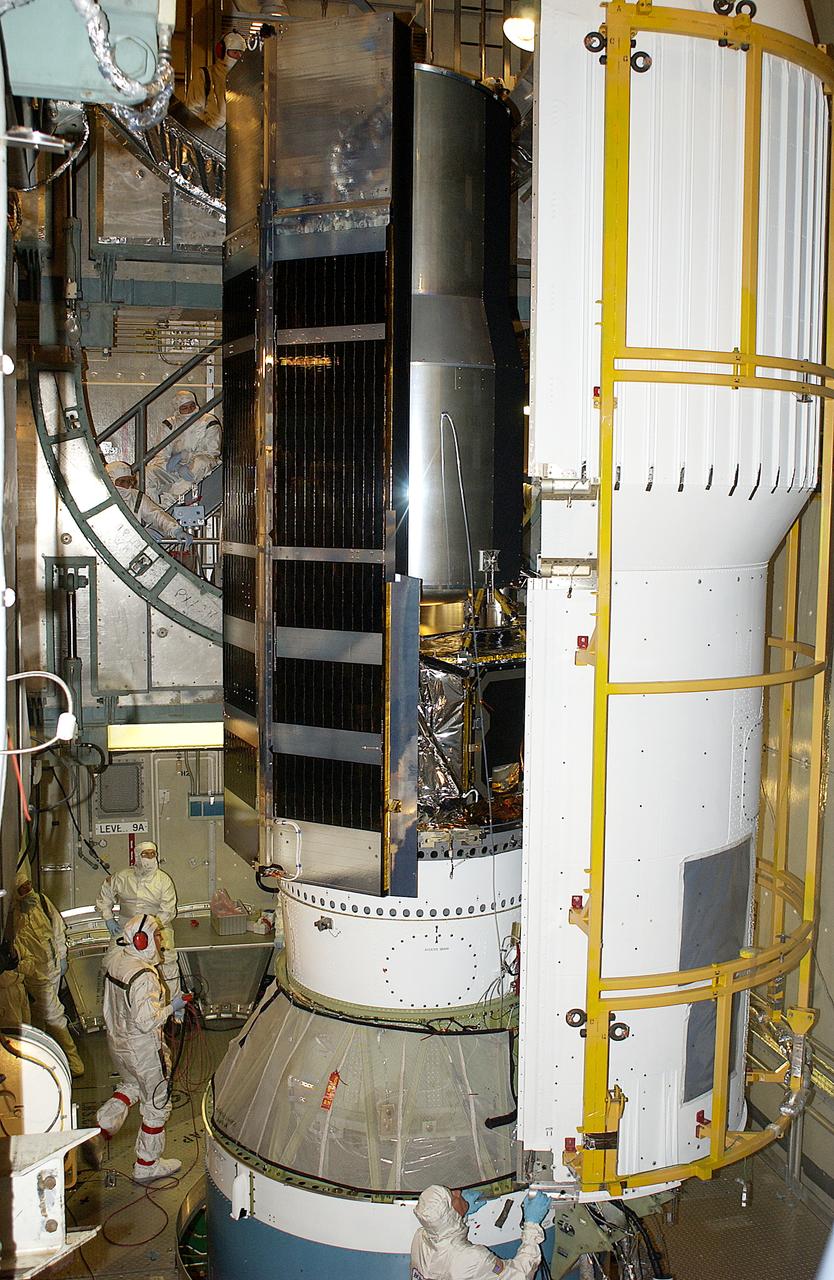
In the launch tower on Launch Complex 17-B, Cape Canaveral Air Force Station, the first part of the fairing is place around the Space Infrared Telescope Facility (SIRTF). The fairing protects the spacecraft during launch. SIRTF will obtain images and spectra by detecting the infrared energy, or heat, radiated by objects in space. Most of this infrared radiation is blocked by the Earth's atmosphere and cannot be observed from the ground. Consisting of an 0.85-meter telescope and three cryogenically cooled science instruments, SIRTF is one of NASA's largest infrared telescopes to be launched. SIRTF is currently scheduled for launch April 18 aboard a Delta II rocket from Launch Complex 17-B, Cape Canaveral Air Force Station.
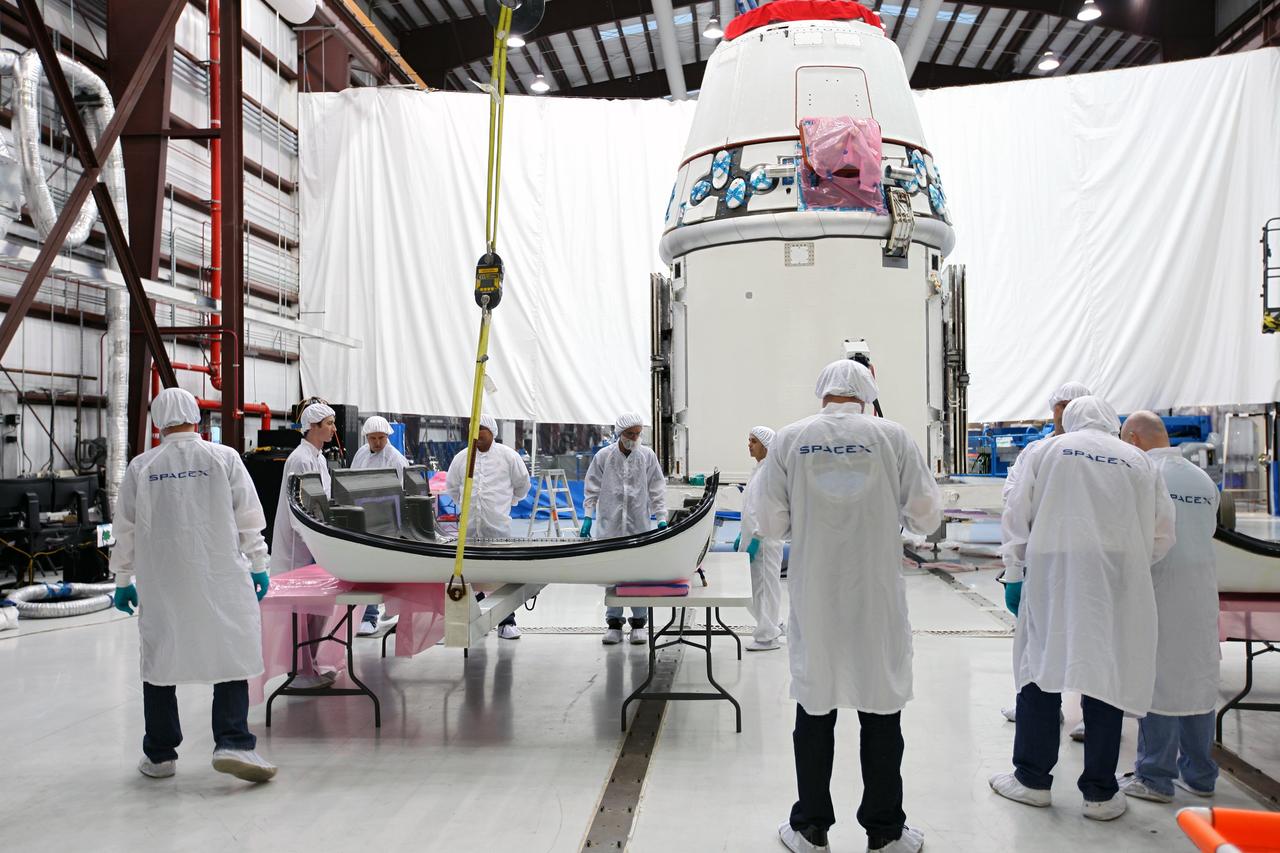
CAPE CANAVERAL, Fla. – Workers prepare to lift a solar array fairing at the processing hangar used by Space Exploration Technologies, or SpaceX, at Cape Canaveral Air Force Station, Fla. The fairing will be installed on the Dragon spacecraft undergoing launch preparations inside the hangar. The spacecraft will launch on the upcoming SpaceX CRS-2 mission. The flight will be the second commercial resupply mission to the International Space Station by SpaceX. NASA has contracted for a total of 12 commercial resupply flights from SpaceX and eight from the Orbital Sciences Corp. Photo credit: NASA/Kim Shiflett
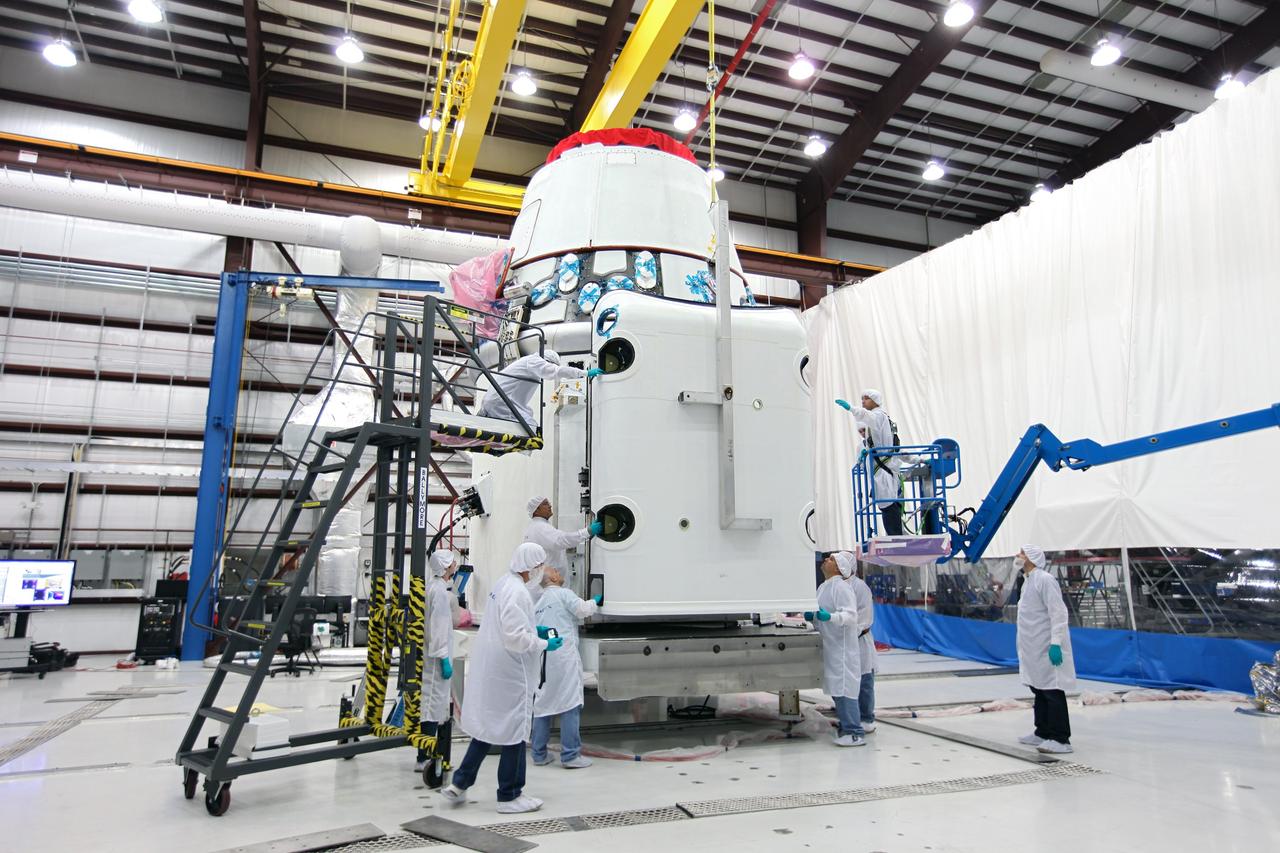
CAPE CANAVERAL, Fla. – Workers guide a solar array fairing into place inside the processing hangar used by Space Exploration Technologies, or SpaceX, at Cape Canaveral Air Force Station, Fla. The fairing will be installed on the Dragon spacecraft undergoing launch preparations inside the hangar. The spacecraft will launch on the upcoming SpaceX CRS-2 mission. The flight will be the second commercial resupply mission to the International Space Station by SpaceX. NASA has contracted for a total of 12 commercial resupply flights from SpaceX and eight from the Orbital Sciences Corp. Photo credit: NASA/Kim Shiflett
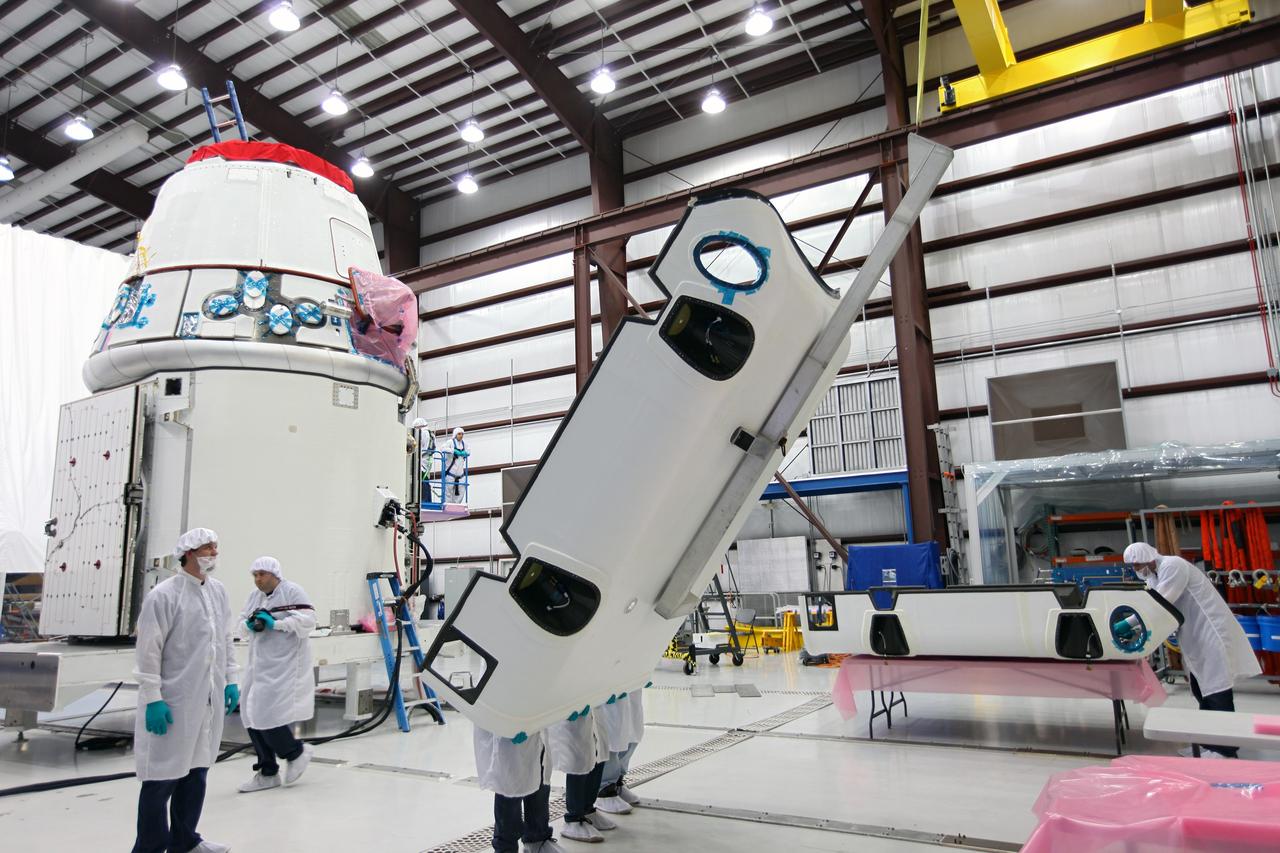
CAPE CANAVERAL, Fla. – Workers lift a solar array fairing at the processing hangar used by Space Exploration Technologies, or SpaceX, at Cape Canaveral Air Force Station, Fla. The fairing will be installed on the Dragon spacecraft undergoing launch preparations inside the hangar. The spacecraft will launch on the upcoming SpaceX CRS-2 mission. The flight will be the second commercial resupply mission to the International Space Station by SpaceX. NASA has contracted for a total of 12 commercial resupply flights from SpaceX and eight from the Orbital Sciences Corp. Photo credit: NASA/Kim Shiflett
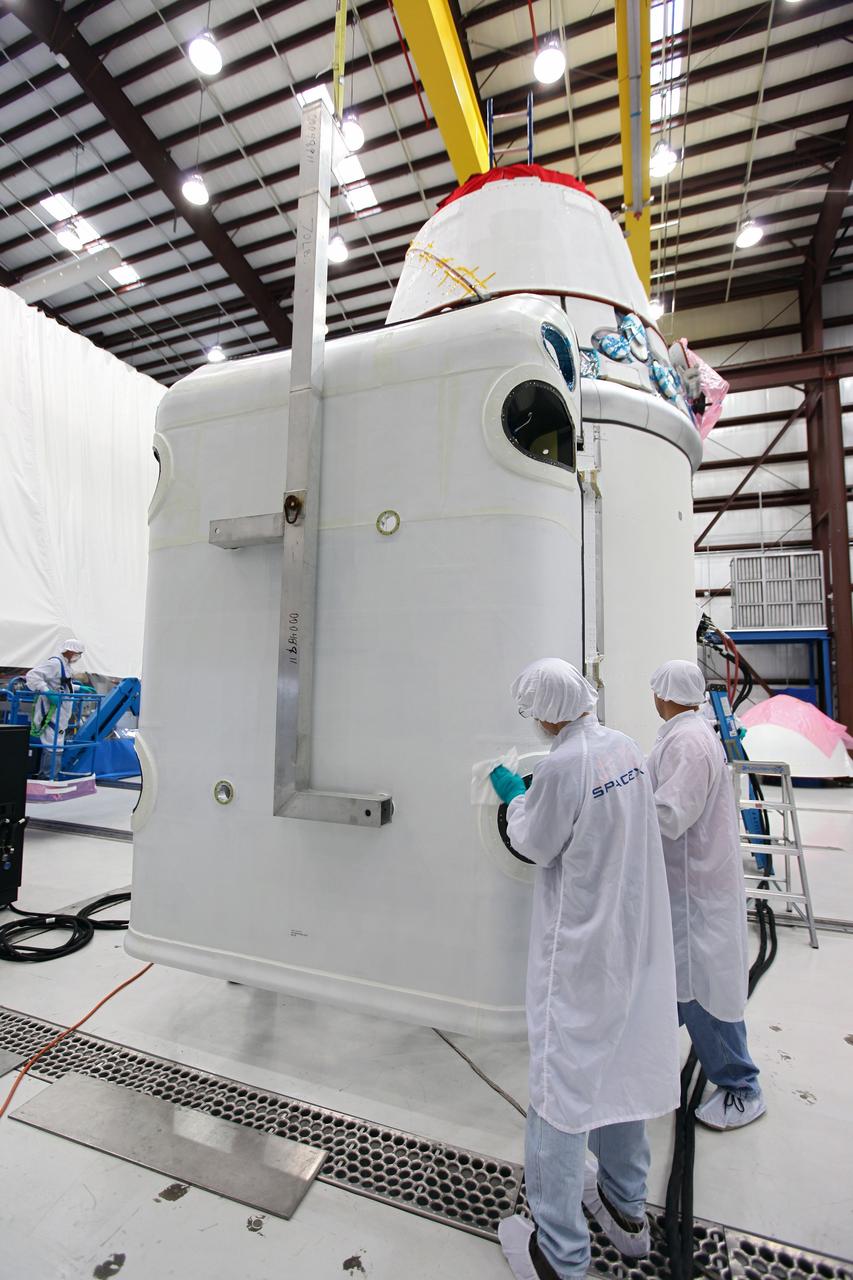
CAPE CANAVERAL, Fla. – Workers guide a solar array fairing into place inside the processing hangar used by Space Exploration Technologies, or SpaceX, at Cape Canaveral Air Force Station, Fla. The fairing will be installed on the Dragon spacecraft undergoing launch preparations inside the hangar. The spacecraft will launch on the upcoming SpaceX CRS-2 mission. The flight will be the second commercial resupply mission to the International Space Station by SpaceX. NASA has contracted for a total of 12 commercial resupply flights from SpaceX and eight from the Orbital Sciences Corp. Photo credit: NASA/Kim Shiflett

CAPE CANAVERAL, Fla. – Workers prepare solar array fairings at the processing hangar used by Space Exploration Technologies, or SpaceX, at Cape Canaveral Air Force Station, Fla. The fairings are to be installed on the Dragon spacecraft undergoing launch preparations inside the hangar. The spacecraft will launch on the upcoming SpaceX CRS-2 mission. The flight will be the second commercial resupply mission to the International Space Station by SpaceX. NASA has contracted for a total of 12 commercial resupply flights from SpaceX and eight from the Orbital Sciences Corp. Photo credit: NASA/Kim Shiflett
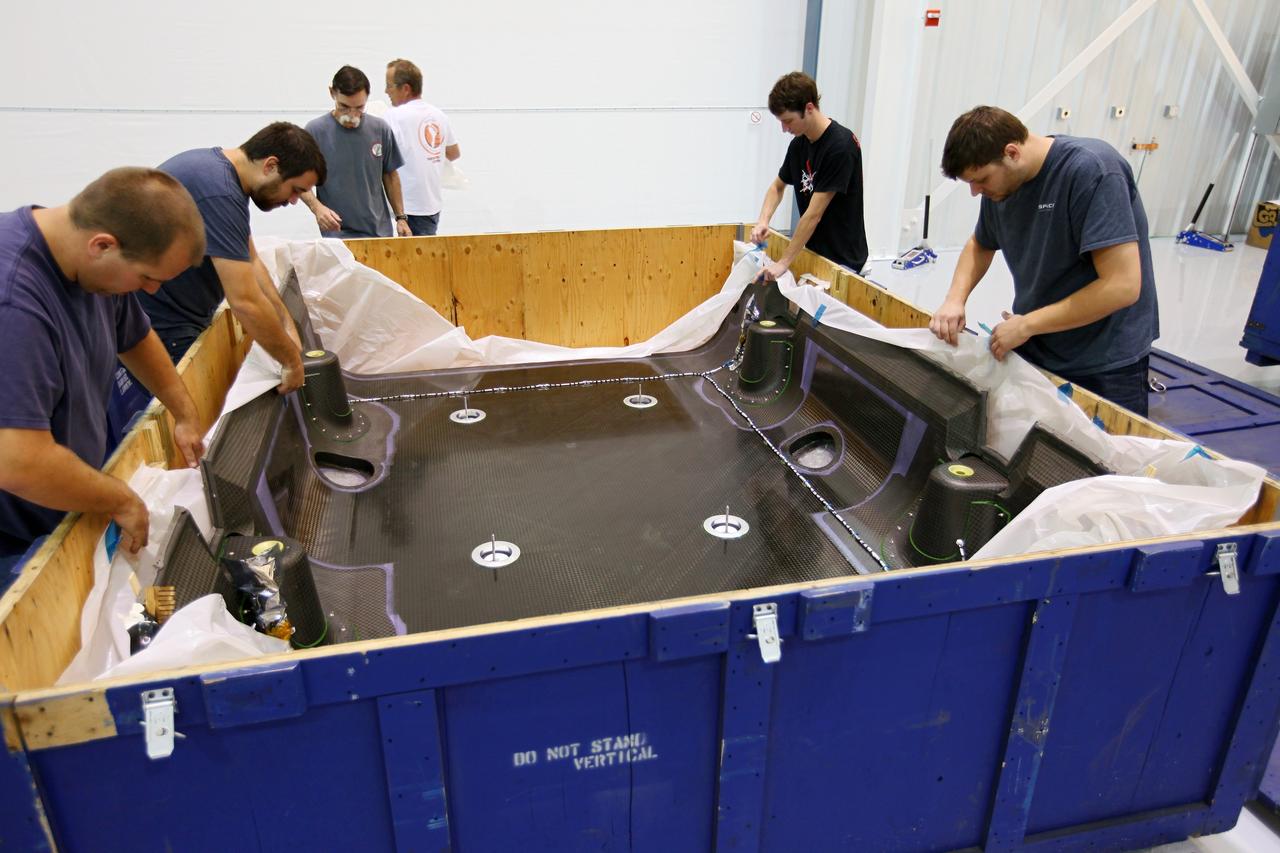
CAPE CANAVERAL, Fla. – Workers inspect a solar array fairing at the processing hangar used by Space Exploration Technologies, or SpaceX, at Cape Canaveral Air Force Station, Fla. The fairings are to be installed on the Dragon spacecraft undergoing launch preparations inside the hangar. The spacecraft will launch on the upcoming SpaceX CRS-2 mission. The flight will be the second commercial resupply mission to the International Space Station by SpaceX. NASA has contracted for a total of 12 commercial resupply flights from SpaceX and eight from the Orbital Sciences Corp. Photo credit: NASA/Kim Shiflett
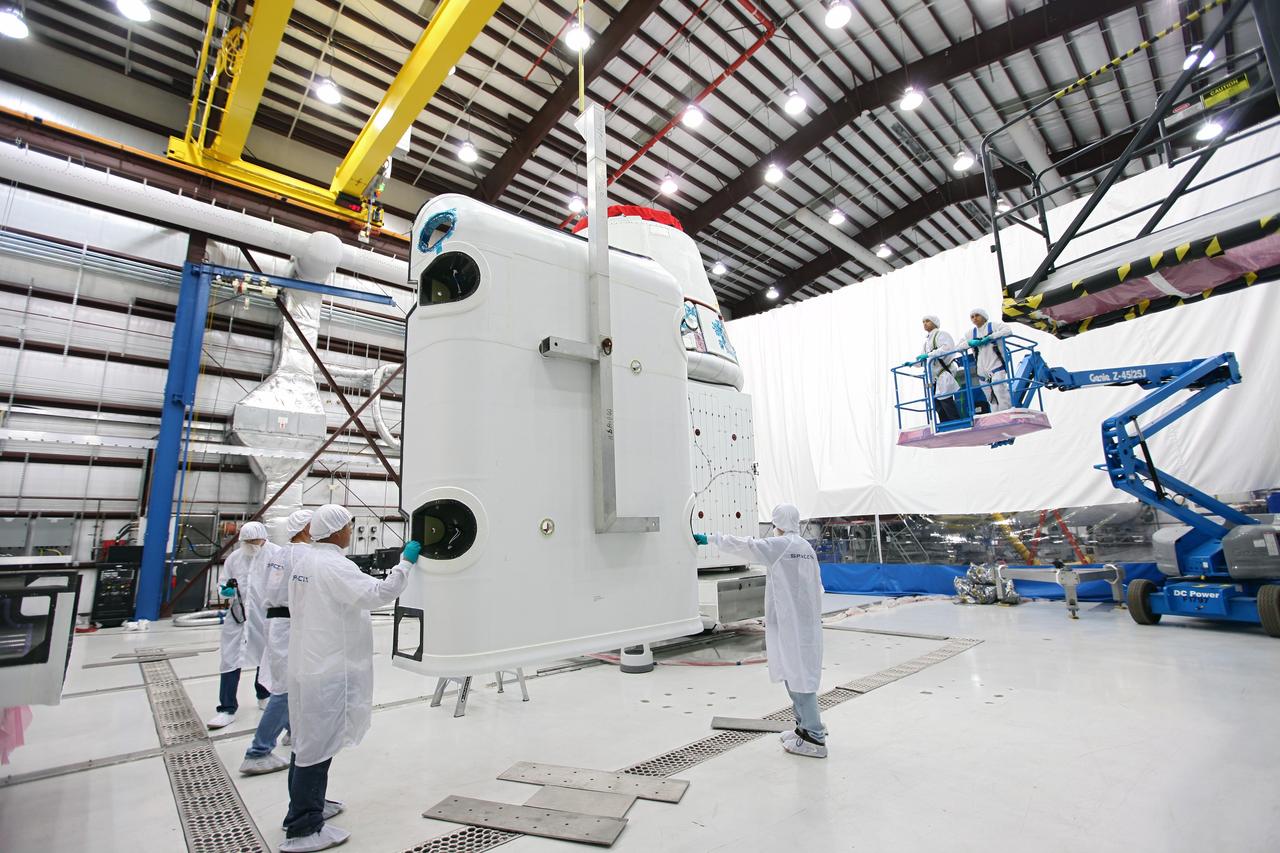
CAPE CANAVERAL, Fla. – Workers guide a solar array fairing into place inside the processing hangar used by Space Exploration Technologies, or SpaceX, at Cape Canaveral Air Force Station, Fla. The fairing will be installed on the Dragon spacecraft undergoing launch preparations inside the hangar. The spacecraft will launch on the upcoming SpaceX CRS-2 mission. The flight will be the second commercial resupply mission to the International Space Station by SpaceX. NASA has contracted for a total of 12 commercial resupply flights from SpaceX and eight from the Orbital Sciences Corp. Photo credit: NASA/Kim Shiflett

CAPE CANAVERAL, Fla. – Workers guide a solar array fairing into place inside the processing hangar used by Space Exploration Technologies, or SpaceX, at Cape Canaveral Air Force Station, Fla. The fairing will be installed on the Dragon spacecraft undergoing launch preparations inside the hangar. The spacecraft will launch on the upcoming SpaceX CRS-2 mission. The flight will be the second commercial resupply mission to the International Space Station by SpaceX. NASA has contracted for a total of 12 commercial resupply flights from SpaceX and eight from the Orbital Sciences Corp. Photo credit: NASA/Kim Shiflett
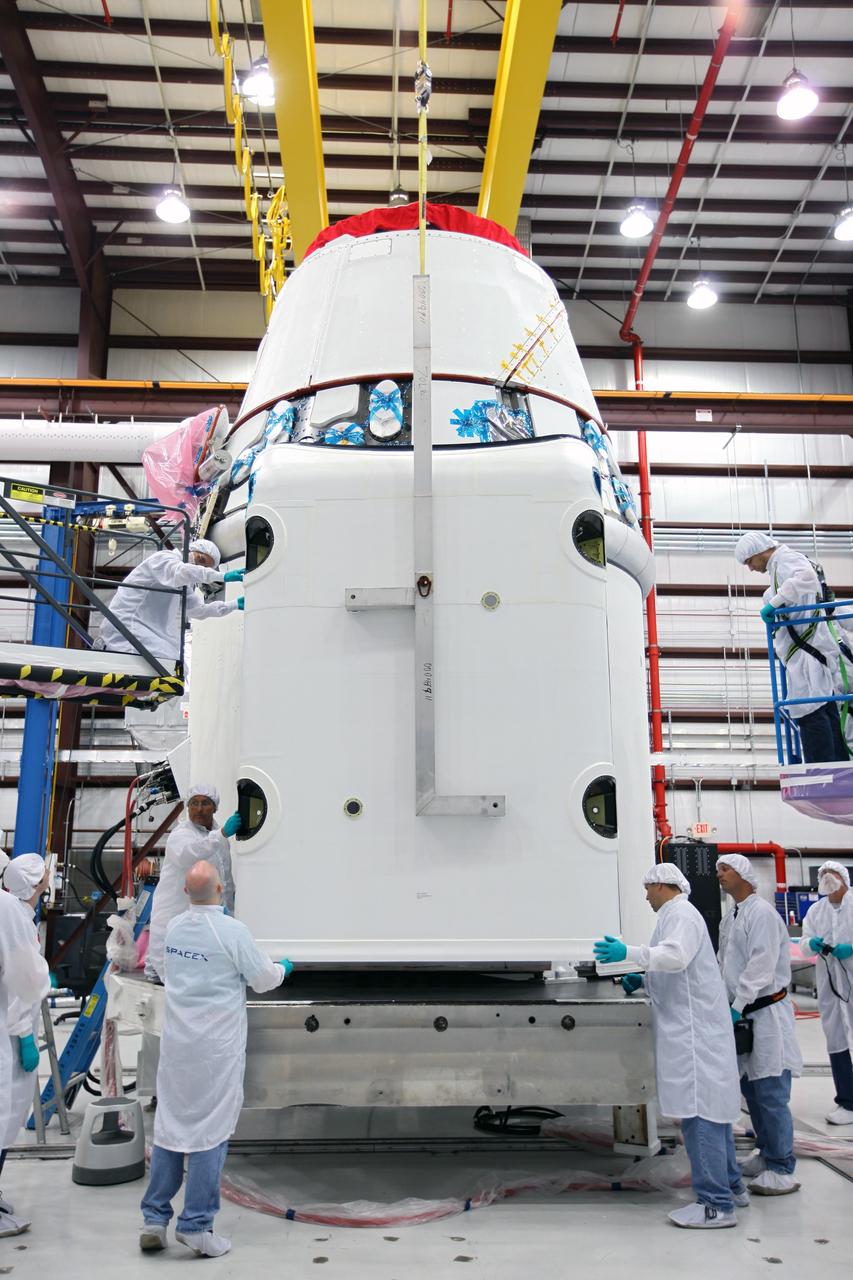
CAPE CANAVERAL, Fla. – Workers guide a solar array fairing into place inside the processing hangar used by Space Exploration Technologies, or SpaceX, at Cape Canaveral Air Force Station, Fla. The fairing will be installed on the Dragon spacecraft undergoing launch preparations inside the hangar. The spacecraft will launch on the upcoming SpaceX CRS-2 mission. The flight will be the second commercial resupply mission to the International Space Station by SpaceX. NASA has contracted for a total of 12 commercial resupply flights from SpaceX and eight from the Orbital Sciences Corp. Photo credit: NASA/Kim Shiflett
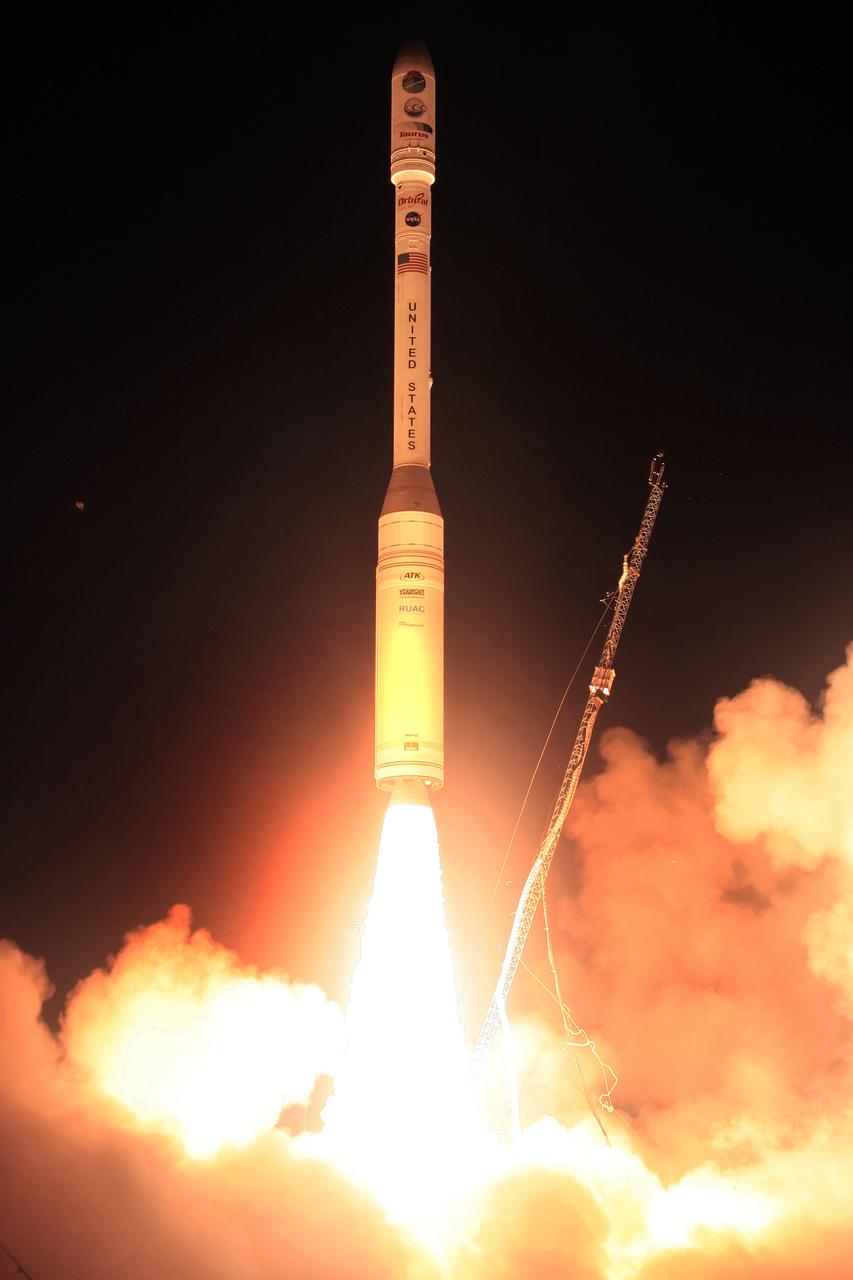
VANDENBERG AIR FORCE BASE, Calif. -- NASA’s Orbiting Carbon Observatory and its Taurus booster lift off Feb. 24 from Vandenberg Air Force Base in California at 4:55 a.m. EST. A contingency was declared a few minutes later and the satellite failed to reach orbit after liftoff. Preliminary indications are that the fairing on the Taurus XL launch vehicle failed to separate. The fairing is a clamshell structure that encapsulates the satellite as it travels through the atmosphere. A Mishap Investigation Board is being set up to determine the cause of the launch failure. Photo courtesy of Orbital Sciences
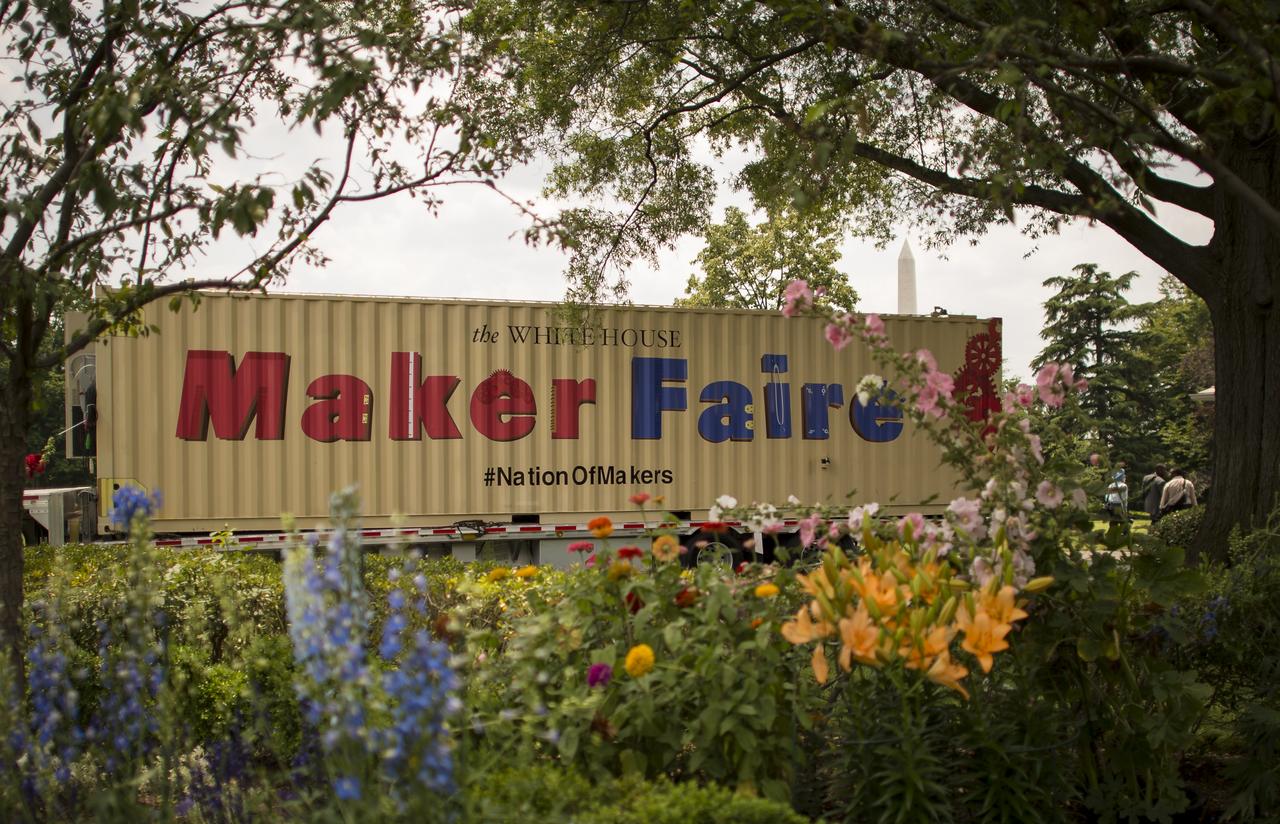
The Maker Faire trailer is seen outside the rose garden during the first ever White House Maker Faire, which brings together students, entrepreneurs, and everyday citizens who are using new tools and techniques to launch new businesses, learn vital skills in science, technology, engineering, and math (STEM), and fuel the renaissance in American manufacturing, at the White House, Wednesday, June 18, 2014 in Washington. The President announced new steps the Administration and its partners are taking to support the ability of more Americans, young and old, to have to access to these tools and techniques and brings their ideas to life. Photo Credit: (NASA/Bill Ingalls)
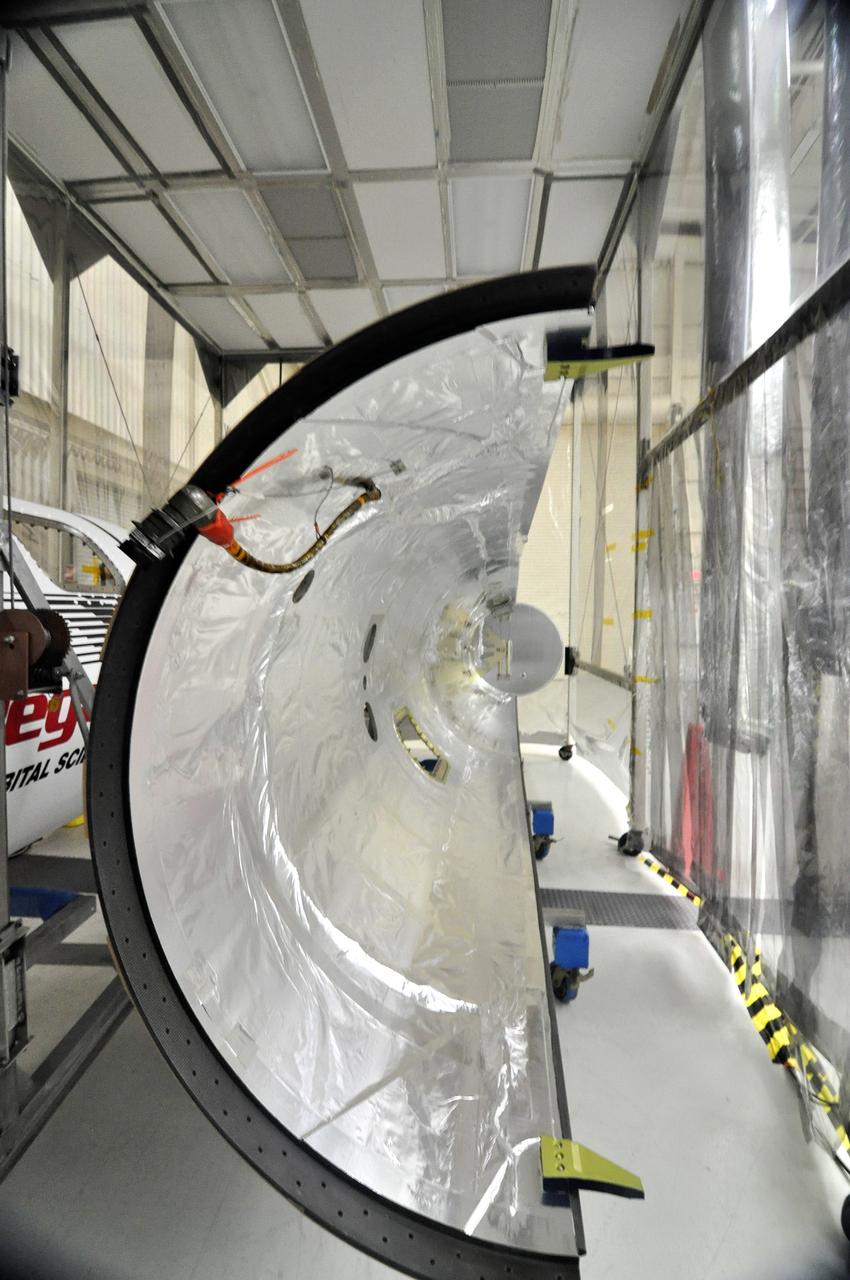
VANDENBERG AIR FORCE BASE, Calif. -- Half of the fairing that will be fitted to the nose of the Orbital Sciences Corp. Pegasus XL rocket is ready for its installation around the Interface Region Imaging Spectrograph, or IRIS, spacecraft. The fairing will protect the spacecraft from atmospheric heating and stress during launch. IRIS will open a new window of discovery by tracing the flow of energy and plasma through the chromospheres and transition region into the sun’s corona using spectrometry and imaging. IRIS fills a crucial gap in our ability to advance studies of the sun-to-Earth connection by tracing the flow of energy and plasma through the foundation of the corona and the region around the sun known as the heliosphere. Photo credit: VAFB/Randy Beaudoin
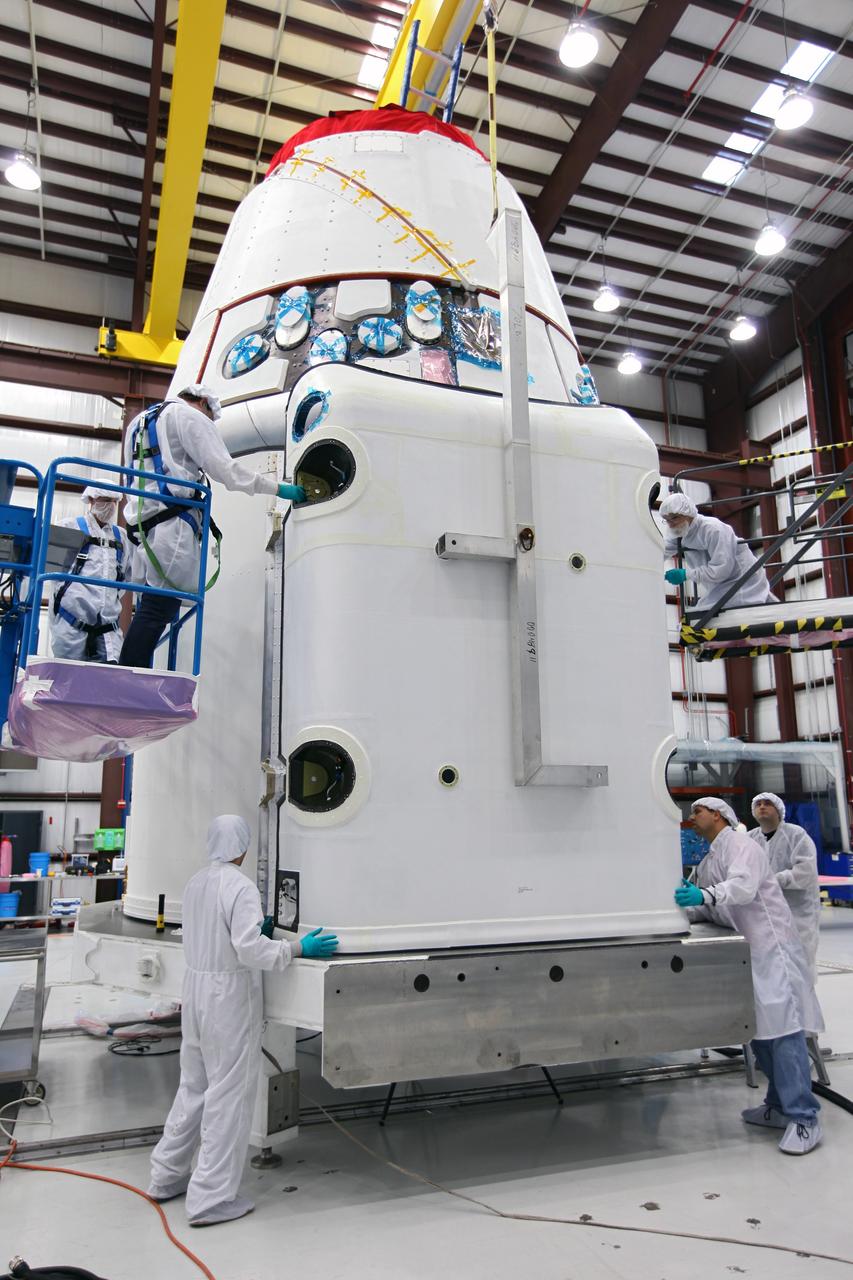
CAPE CANAVERAL, Fla. – Workers guide a solar array fairing into place inside the processing hangar used by Space Exploration Technologies, or SpaceX, at Cape Canaveral Air Force Station, Fla. The fairing will be installed on the Dragon spacecraft undergoing launch preparations inside the hangar. The spacecraft will launch on the upcoming SpaceX CRS-2 mission. The flight will be the second commercial resupply mission to the International Space Station by SpaceX. NASA has contracted for a total of 12 commercial resupply flights from SpaceX and eight from the Orbital Sciences Corp. Photo credit: NASA/Kim Shiflett
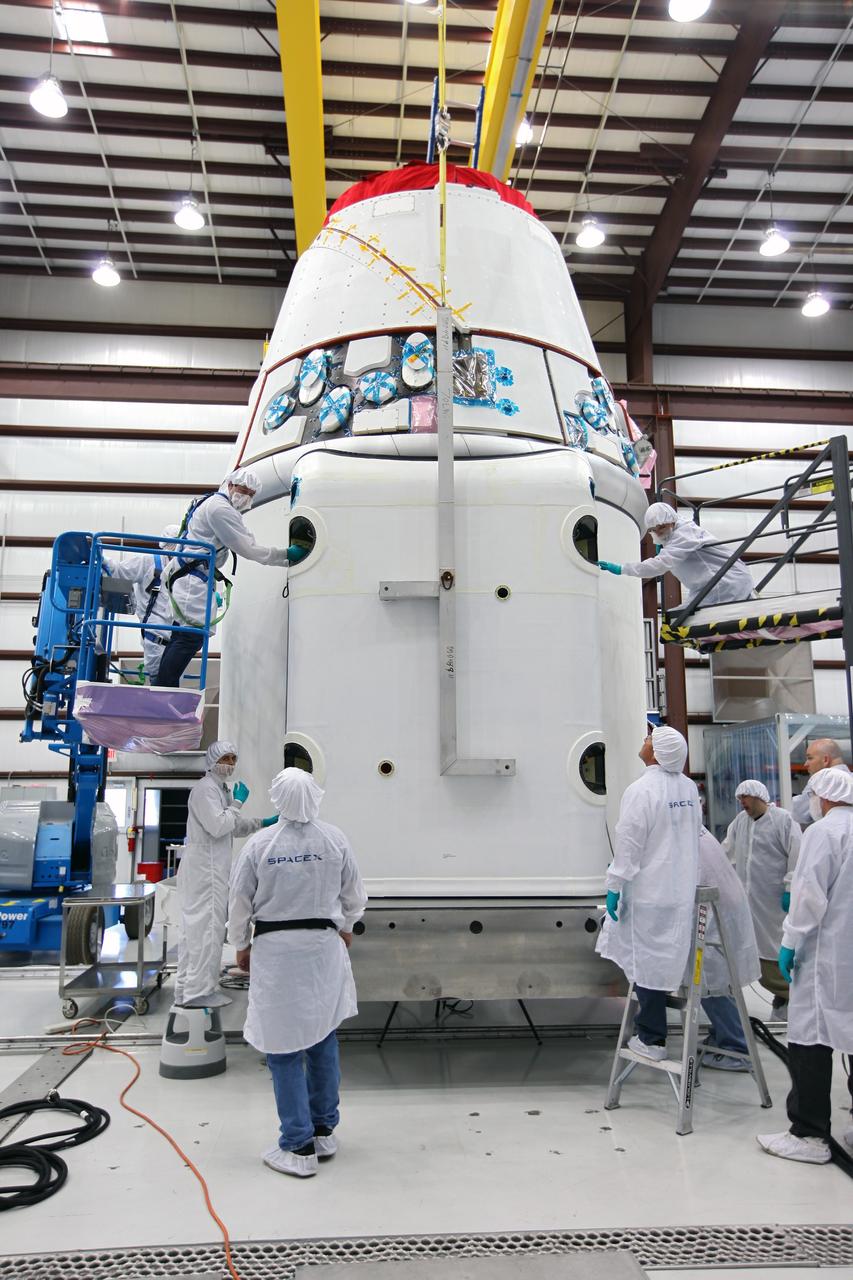
CAPE CANAVERAL, Fla. – Workers guide a solar array fairing into place inside the processing hangar used by Space Exploration Technologies, or SpaceX, at Cape Canaveral Air Force Station, Fla. The fairing will be installed on the Dragon spacecraft undergoing launch preparations inside the hangar. The spacecraft will launch on the upcoming SpaceX CRS-2 mission. The flight will be the second commercial resupply mission to the International Space Station by SpaceX. NASA has contracted for a total of 12 commercial resupply flights from SpaceX and eight from the Orbital Sciences Corp. Photo credit: NASA/Kim Shiflett
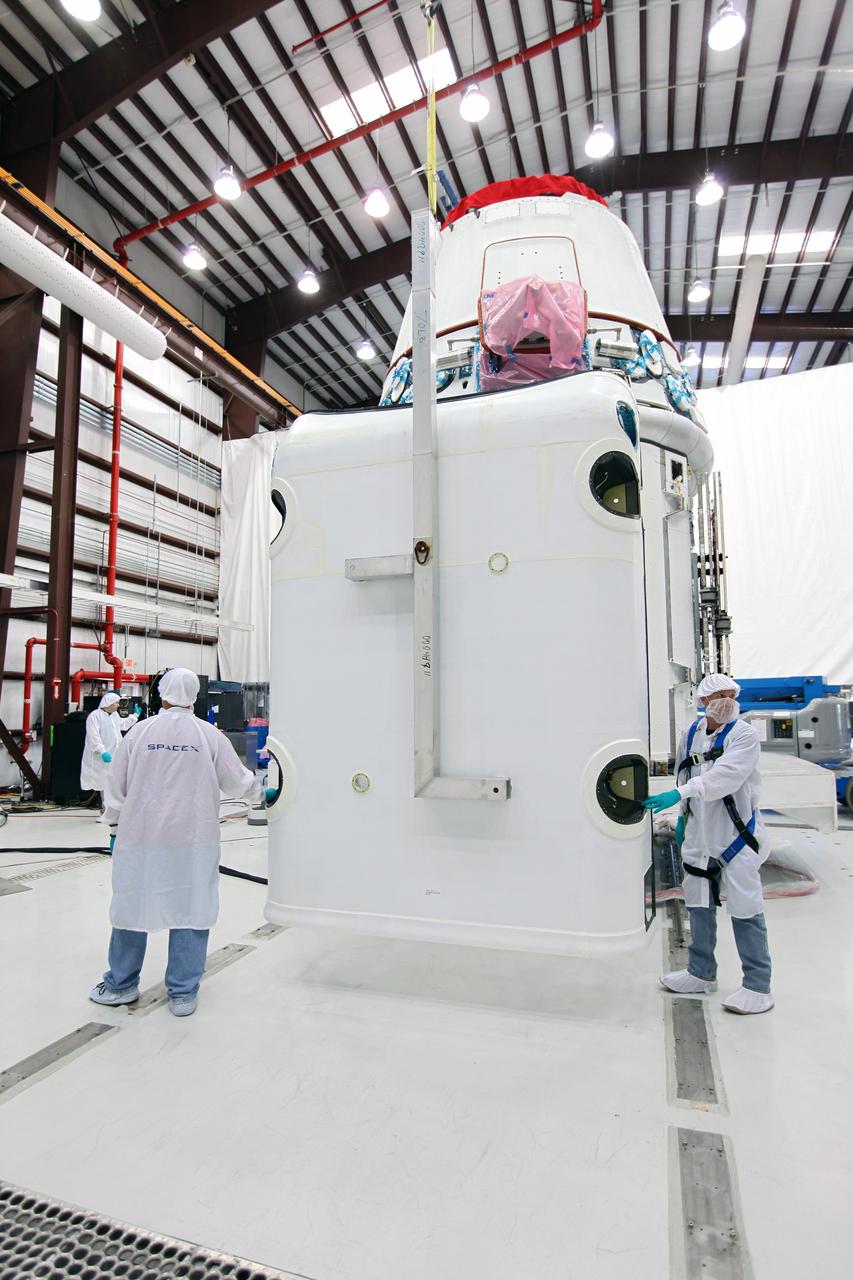
CAPE CANAVERAL, Fla. – Workers guide a solar array fairing into place inside the processing hangar used by Space Exploration Technologies, or SpaceX, at Cape Canaveral Air Force Station, Fla. The fairing will be installed on the Dragon spacecraft undergoing launch preparations inside the hangar. The spacecraft will launch on the upcoming SpaceX CRS-2 mission. The flight will be the second commercial resupply mission to the International Space Station by SpaceX. NASA has contracted for a total of 12 commercial resupply flights from SpaceX and eight from the Orbital Sciences Corp. Photo credit: NASA/Kim Shiflett

CAPE CANAVERAL, Fla. – Workers lift a solar array fairing while another is prepared inside the processing hangar used by Space Exploration Technologies, or SpaceX, at Cape Canaveral Air Force Station, Fla. The fairing will be installed on the Dragon spacecraft undergoing launch preparations inside the hangar. The spacecraft will launch on the upcoming SpaceX CRS-2 mission. The flight will be the second commercial resupply mission to the International Space Station by SpaceX. NASA has contracted for a total of 12 commercial resupply flights from SpaceX and eight from the Orbital Sciences Corp. Photo credit: NASA/Kim Shiflett
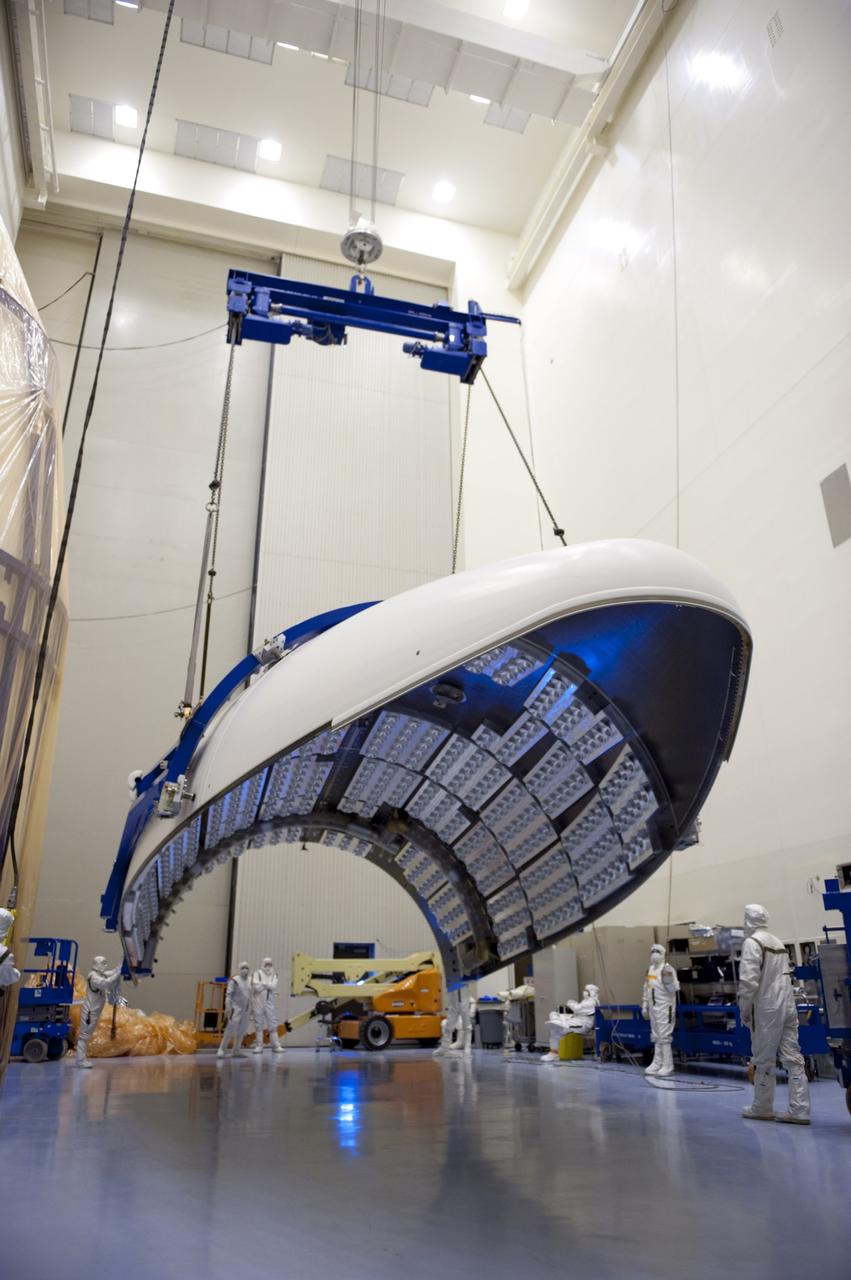
CAPE CANAVERAL, Fla. -- In the Payload Hazardous Servicing Facility at NASA's Kennedy Space Center in Florida, the fairing acoustic protection (FAP) system lining the inside of the Atlas V payload fairing for NASA's Mars Science Laboratory (MSL) mission comes into view as the fairing is lifted into a vertical position. The FAP protects the payload by dampening the sound created by the rocket during liftoff. The fairing has been uncovered, and preparations are under way to clean it to meet NASA's planetary protection requirements. The fairing will protect the spacecraft from the impact of aerodynamic pressure and heating during ascent. Although jettisoned once the spacecraft is outside the Earth's atmosphere, the fairing must be cleaned to the same exacting standards as the laboratory to avoid the possibility of contaminating it. MSL's components include a compact car-sized rover, Curiosity, which has 10 science instruments designed to search for evidence on whether Mars has had environments favorable to microbial life, including the chemical ingredients for life. The unique rover will use a laser to look inside rocks and release its gasses so that the rover’s spectrometer can analyze and send the data back to Earth. Launch of MSL aboard a United Launch Alliance Atlas V rocket is planned for Nov. 25 from Space Launch Complex 41 on Cape Canaveral Air Force Station. For more information, visit http://www.nasa.gov/msl. Photo credit: NASA/Kim Shiflett
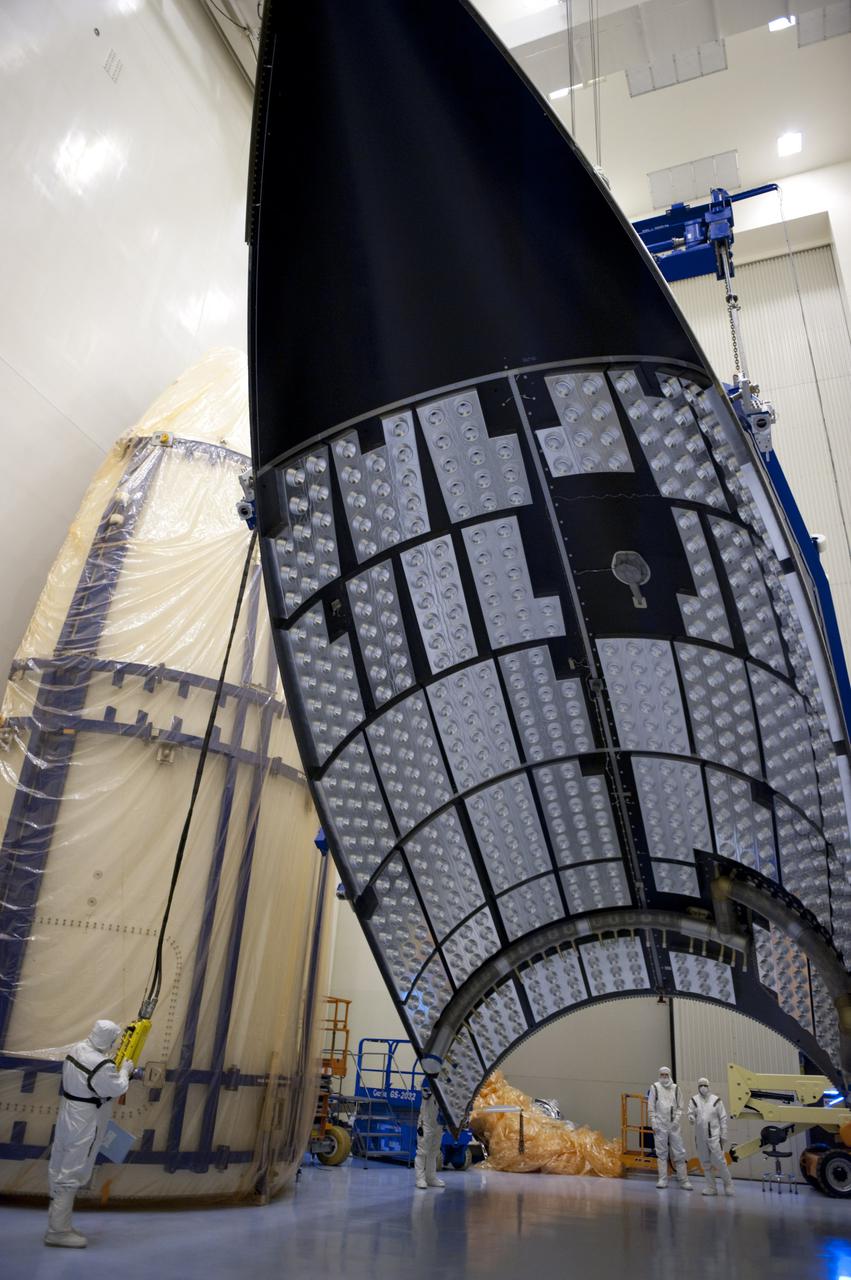
CAPE CANAVERAL, Fla. -- In the Payload Hazardous Servicing Facility at NASA's Kennedy Space Center in Florida, half of the Atlas V payload fairing for NASA's Mars Science Laboratory (MSL) mission rises into a vertical position. The fairing has been uncovered, revealing the fairing acoustic protection (FAP) system lining its insides, and preparations are under way to clean it to meet NASA's planetary protection requirements. The FAP protects the payload by dampening the sound created by the rocket during liftoff. At left is the other half of the fairing, still uncovered. The fairing will protect the spacecraft from the impact of aerodynamic pressure and heating during ascent. Although jettisoned once the spacecraft is outside the Earth's atmosphere, the fairing must be cleaned to the same exacting standards as the laboratory to avoid the possibility of contaminating it. MSL's components include a compact car-sized rover, Curiosity, which has 10 science instruments designed to search for evidence on whether Mars has had environments favorable to microbial life, including the chemical ingredients for life. The unique rover will use a laser to look inside rocks and release its gasses so that the rover’s spectrometer can analyze and send the data back to Earth. Launch of MSL aboard a United Launch Alliance Atlas V rocket is planned for Nov. 25 from Space Launch Complex 41 on Cape Canaveral Air Force Station. For more information, visit http:__www.nasa.gov_msl. Photo credit: NASA_Kim Shiflett
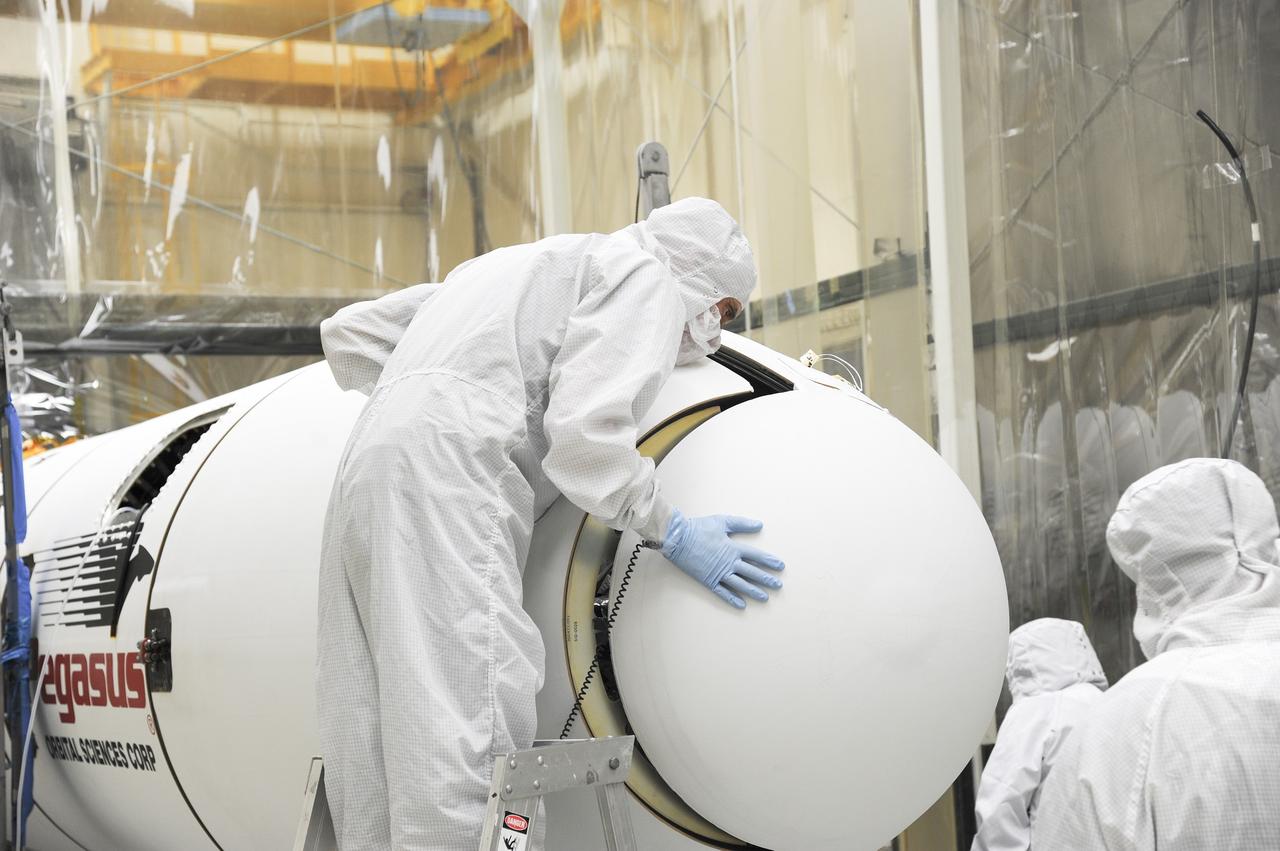
VANDENBERG AFB – Orbital Sciences engineers connect the payload fairing over NASA's IRIS spacecraft. The fairing connects to the nose of the Orbital Sciences Pegasus XL rocket that will lift the solar observatory into orbit in June. The work is taking place in a hangar at Vandenberg Air Force Base where IRIS, short for Interface Region Imaging Spectrograph, is being prepared for launch on a Pegasus XL rocket. Scheduled for launch from Vandenberg June 26, IRIS will open a new window of discovery by tracing the flow of energy and plasma through the chromospheres and transition region into the sun’s corona using spectrometry and imaging. IRIS fills a crucial gap in our ability to advance studies of the sun-to-Earth connection by tracing the flow of energy and plasma through the foundation of the corona and the region around the sun known as the heliosphere. Photo credit: NASA/Tony Vauclin
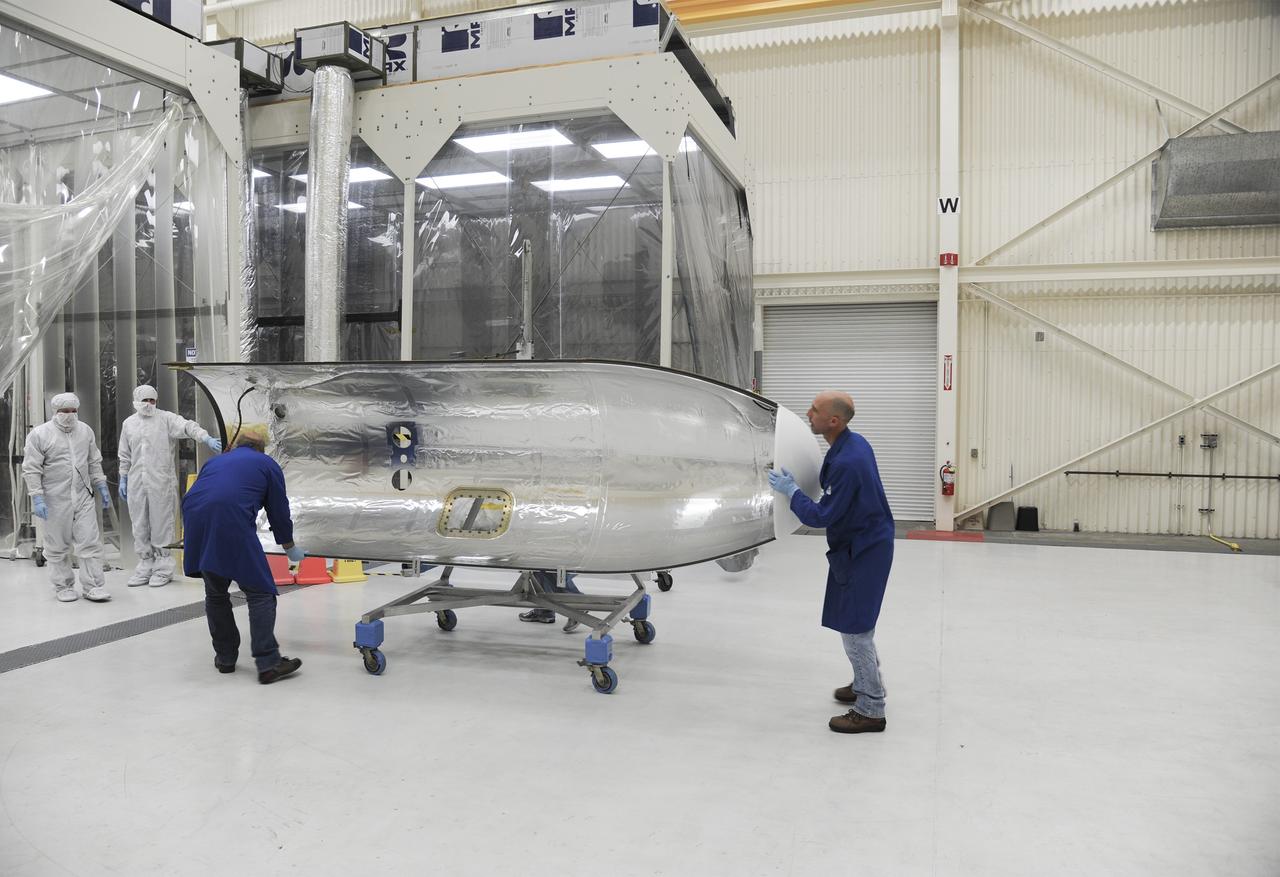
VANDENBERG AFB – Orbital Sciences team members move the second half of the payload fairing before it is placed over NASA's IRIS spacecraft. The fairing connects to the nose of the Orbital Sciences Pegasus XL rocket that will lift the solar observatory into orbit in June. The work is taking place in a hangar at Vandenberg Air Force Base where IRIS, short for Interface Region Imaging Spectrograph, is being prepared for launch on a Pegasus XL rocket. Scheduled for launch from Vandenberg June 26, IRIS will open a new window of discovery by tracing the flow of energy and plasma through the chromospheres and transition region into the sun’s corona using spectrometry and imaging. IRIS fills a crucial gap in our ability to advance studies of the sun-to-Earth connection by tracing the flow of energy and plasma through the foundation of the corona and the region around the sun known as the heliosphere. Photo credit: NASA/Tony Vauclin
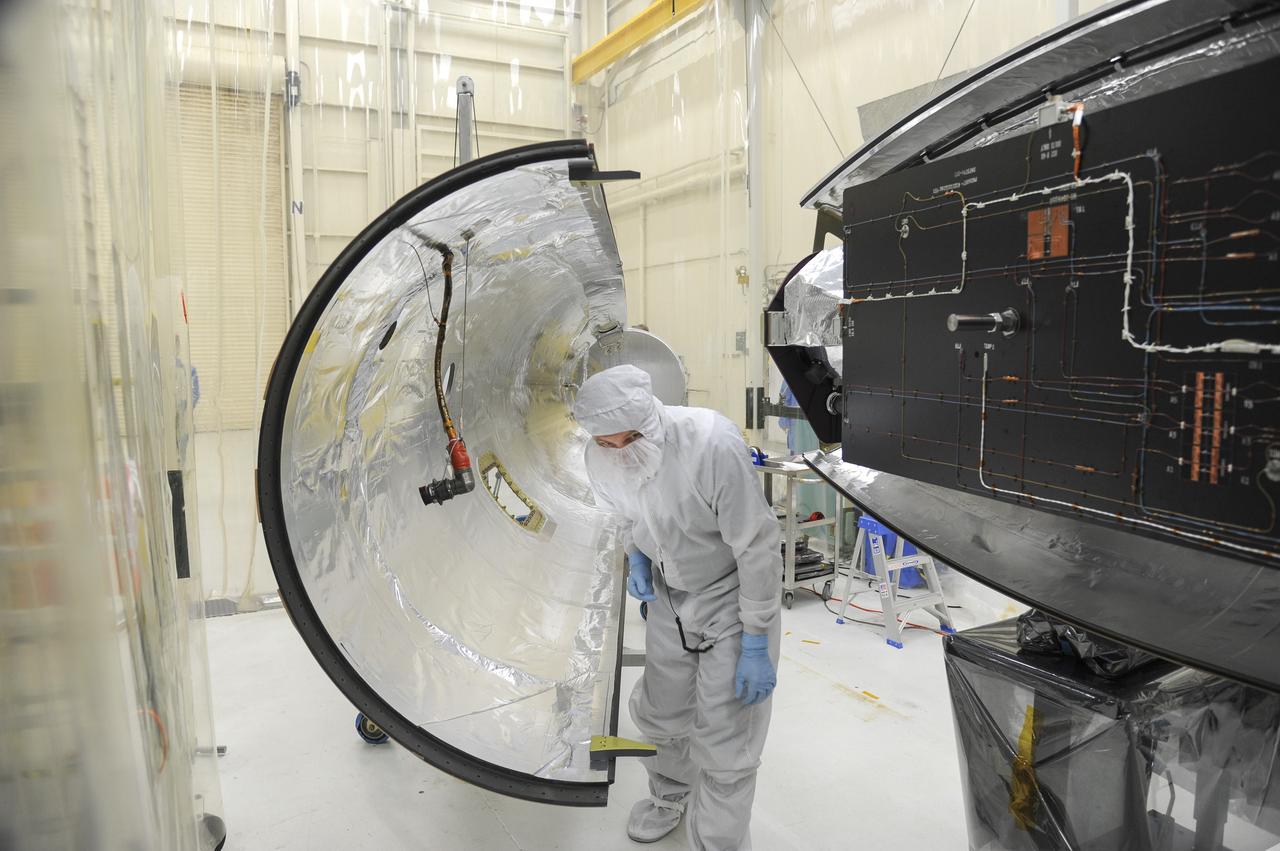
VANDENBERG AFB – Orbital Sciences team members move the second half of the payload fairing before it is placed over NASA's IRIS spacecraft. The fairing connects to the nose of the Orbital Sciences Pegasus XL rocket that will lift the solar observatory into orbit in June. The work is taking place in a hangar at Vandenberg Air Force Base where IRIS, short for Interface Region Imaging Spectrograph, is being prepared for launch on a Pegasus XL rocket. Scheduled for launch from Vandenberg June 26, IRIS will open a new window of discovery by tracing the flow of energy and plasma through the chromospheres and transition region into the sun’s corona using spectrometry and imaging. IRIS fills a crucial gap in our ability to advance studies of the sun-to-Earth connection by tracing the flow of energy and plasma through the foundation of the corona and the region around the sun known as the heliosphere. Photo credit: NASA/Tony Vauclin
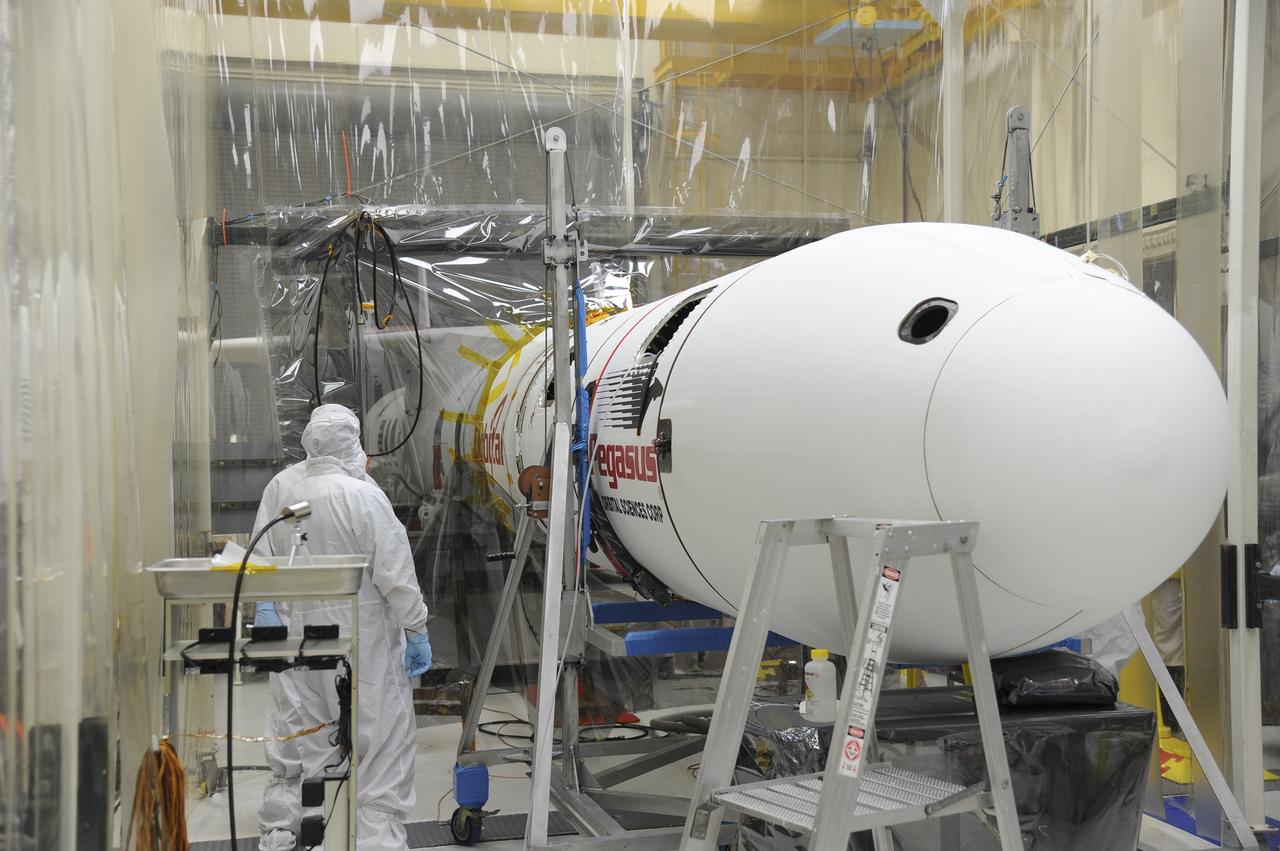
VANDENBERG AFB – Orbital Sciences engineers monitor the connection of the payload fairing over NASA's IRIS spacecraft. The fairing connects to the nose of the Orbital Sciences Pegasus XL rocket that will lift the solar observatory into orbit in June. The work is taking place in a hangar at Vandenberg Air Force Base where IRIS, short for Interface Region Imaging Spectrograph, is being prepared for launch on a Pegasus XL rocket. Scheduled for launch from Vandenberg June 26, IRIS will open a new window of discovery by tracing the flow of energy and plasma through the chromospheres and transition region into the sun’s corona using spectrometry and imaging. IRIS fills a crucial gap in our ability to advance studies of the sun-to-Earth connection by tracing the flow of energy and plasma through the foundation of the corona and the region around the sun known as the heliosphere. Photo credit: NASA/Tony Vauclin
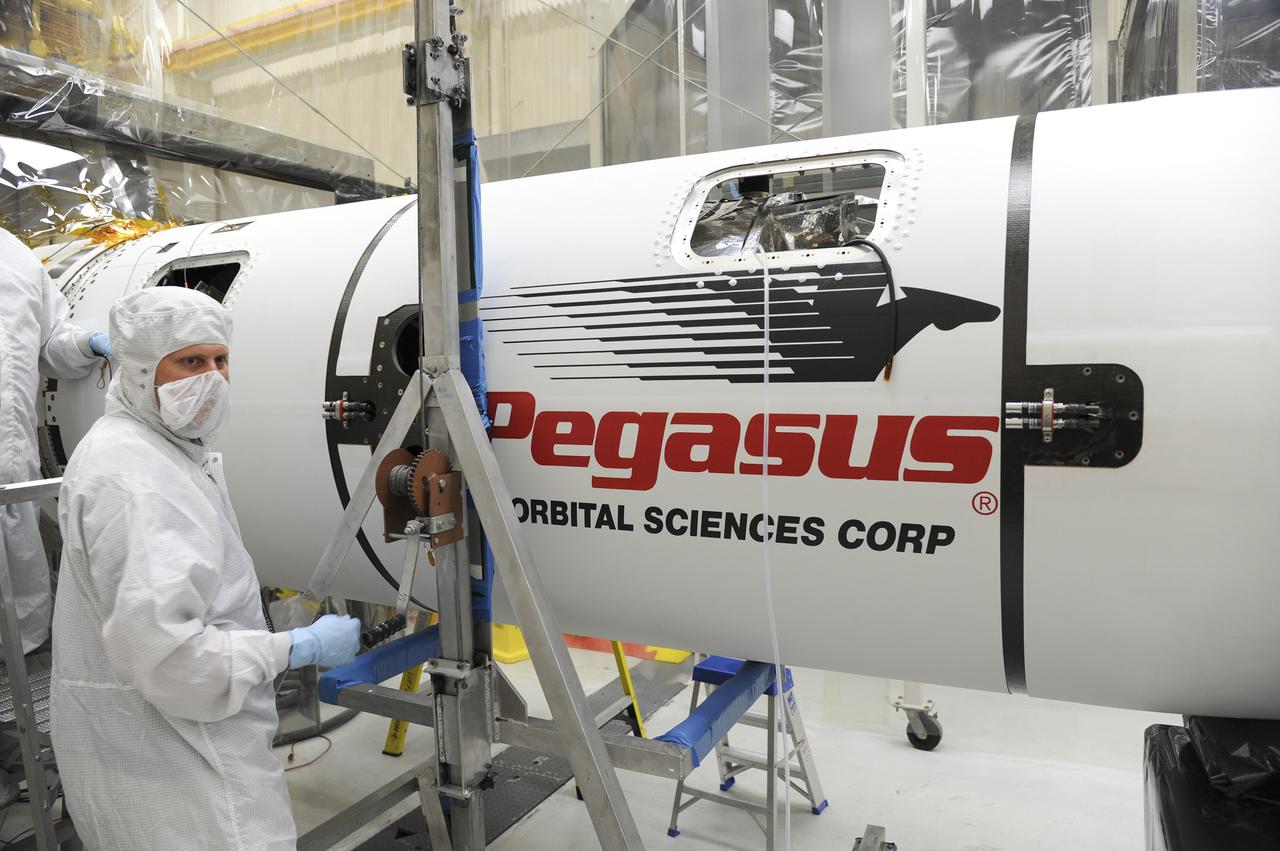
VANDENBERG AFB - Orbital Sciences engineers connect the payload fairing over NASA's IRIS spacecraft. The fairing connects to the nose of the Orbital Sciences Pegasus XL rocket that will lift the solar observatory into orbit in June. The work is taking place in a hangar at Vandenberg Air Force Base where IRIS, short for Interface Region Imaging Spectrograph, is being prepared for launch on a Pegasus XL rocket. Scheduled for launch from Vandenberg June 26, IRIS will open a new window of discovery by tracing the flow of energy and plasma through the chromospheres and transition region into the sun’s corona using spectrometry and imaging. IRIS fills a crucial gap in our ability to advance studies of the sun-to-Earth connection by tracing the flow of energy and plasma through the foundation of the corona and the region around the sun known as the heliosphere. Photo credit: NASA/Tony Vauclin
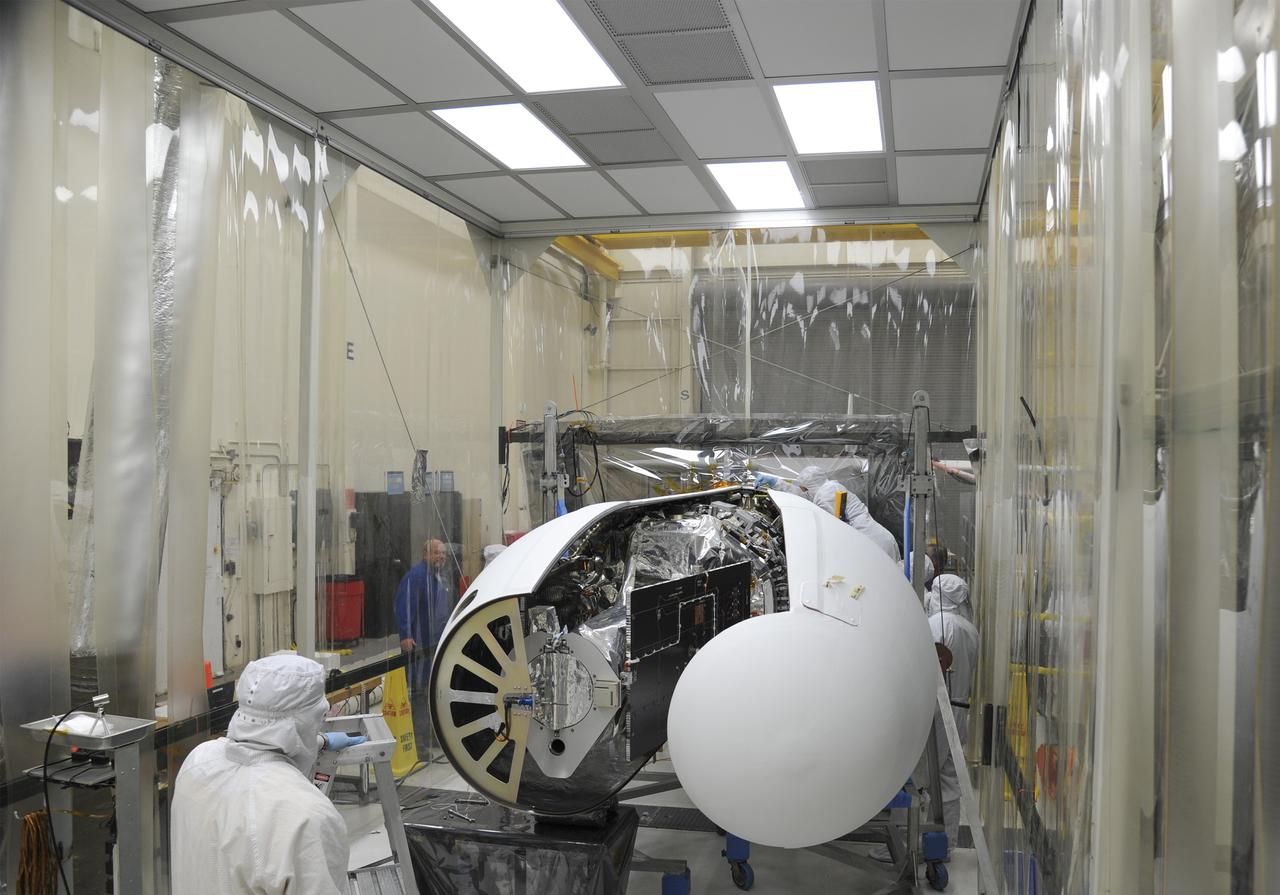
VANDENBERG AFB – Orbital Sciences engineers connect the payload fairing over NASA's IRIS spacecraft. The fairing connects to the nose of the Orbital Sciences Pegasus XL rocket that will lift the solar observatory into orbit in June. The work is taking place in a hangar at Vandenberg Air Force Base where IRIS, short for Interface Region Imaging Spectrograph, is being prepared for launch on a Pegasus XL rocket. Scheduled for launch from Vandenberg June 26, IRIS will open a new window of discovery by tracing the flow of energy and plasma through the chromospheres and transition region into the sun’s corona using spectrometry and imaging. IRIS fills a crucial gap in our ability to advance studies of the sun-to-Earth connection by tracing the flow of energy and plasma through the foundation of the corona and the region around the sun known as the heliosphere. Photo credit: NASA/Tony Vauclin
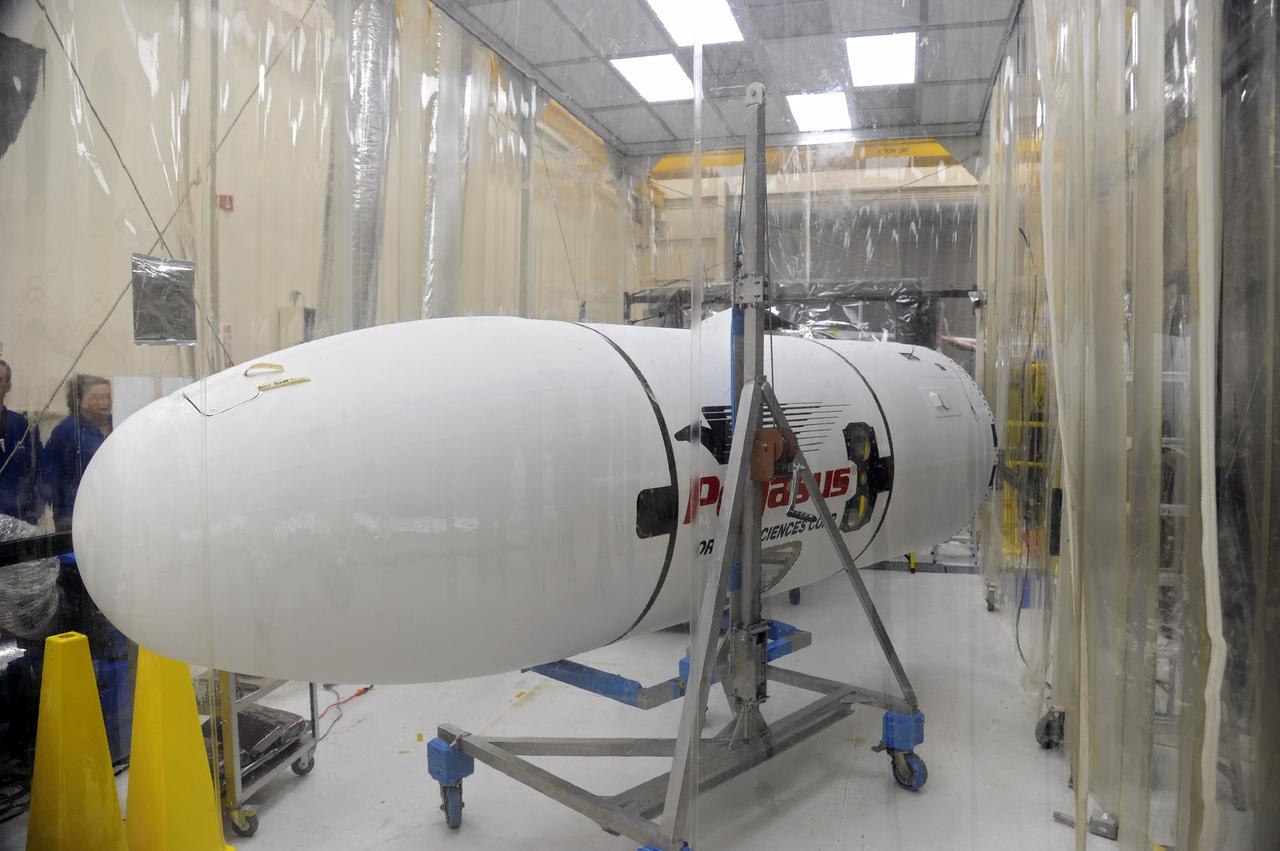
VANDENBERG AFB – Orbital Sciences team members move the second half of the payload fairing before it is placed over NASA's IRIS spacecraft. The fairing connects to the nose of the Orbital Sciences Pegasus XL rocket that will lift the solar observatory into orbit in June. The work is taking place in a hangar at Vandenberg Air Force Base where IRIS, short for Interface Region Imaging Spectrograph, is being prepared for launch on a Pegasus XL rocket. Scheduled for launch from Vandenberg June 26, IRIS will open a new window of discovery by tracing the flow of energy and plasma through the chromospheres and transition region into the sun’s corona using spectrometry and imaging. IRIS fills a crucial gap in our ability to advance studies of the sun-to-Earth connection by tracing the flow of energy and plasma through the foundation of the corona and the region around the sun known as the heliosphere. Photo credit: NASA/Tony Vauclin
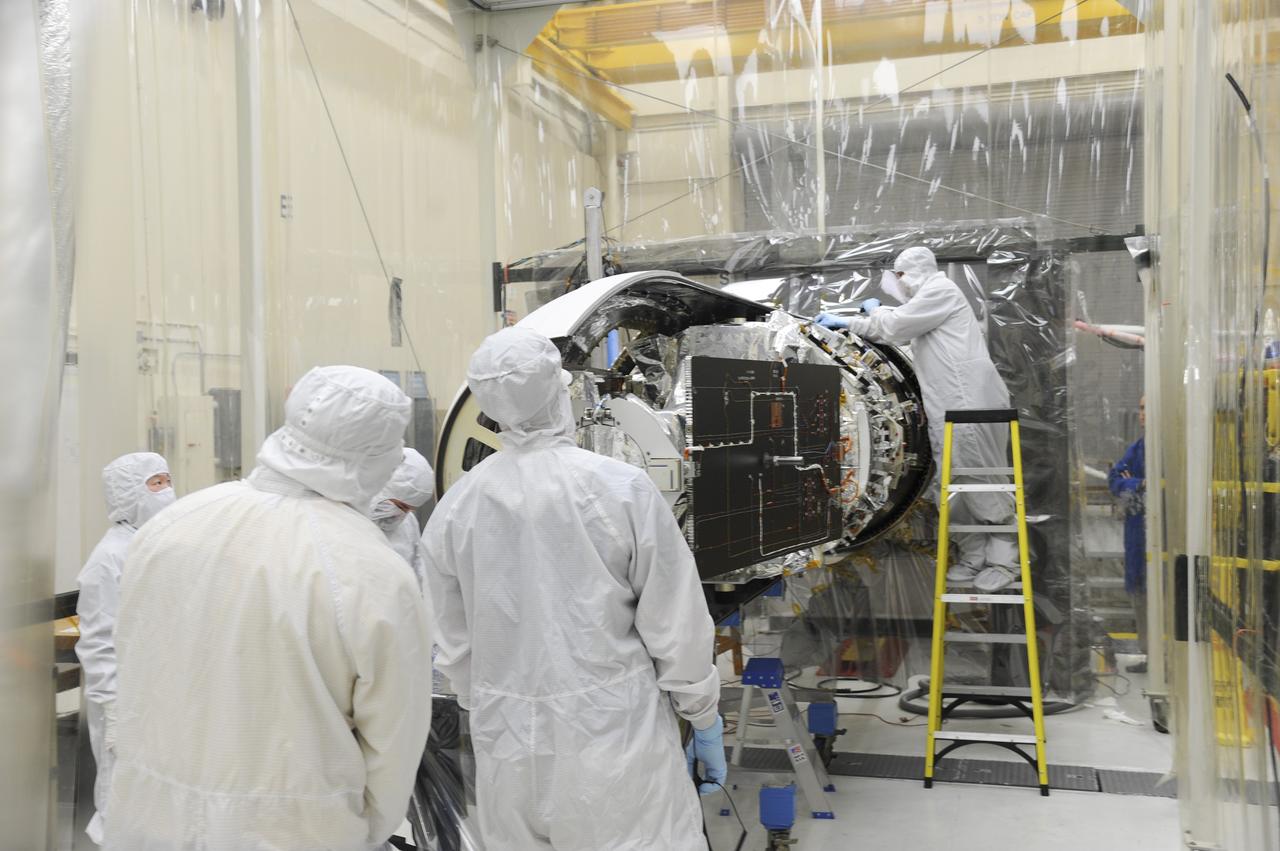
VANDENBERG AFB – Orbital Sciences engineers connect the payload fairing over NASA's IRIS spacecraft. The fairing connects to the nose of the Orbital Sciences Pegasus XL rocket that will lift the solar observatory into orbit in June. The work is taking place in a hangar at Vandenberg Air Force Base where IRIS, short for Interface Region Imaging Spectrograph, is being prepared for launch on a Pegasus XL rocket. Scheduled for launch from Vandenberg June 26, IRIS will open a new window of discovery by tracing the flow of energy and plasma through the chromospheres and transition region into the sun’s corona using spectrometry and imaging. IRIS fills a crucial gap in our ability to advance studies of the sun-to-Earth connection by tracing the flow of energy and plasma through the foundation of the corona and the region around the sun known as the heliosphere. Photo credit: NASA/Tony Vauclin
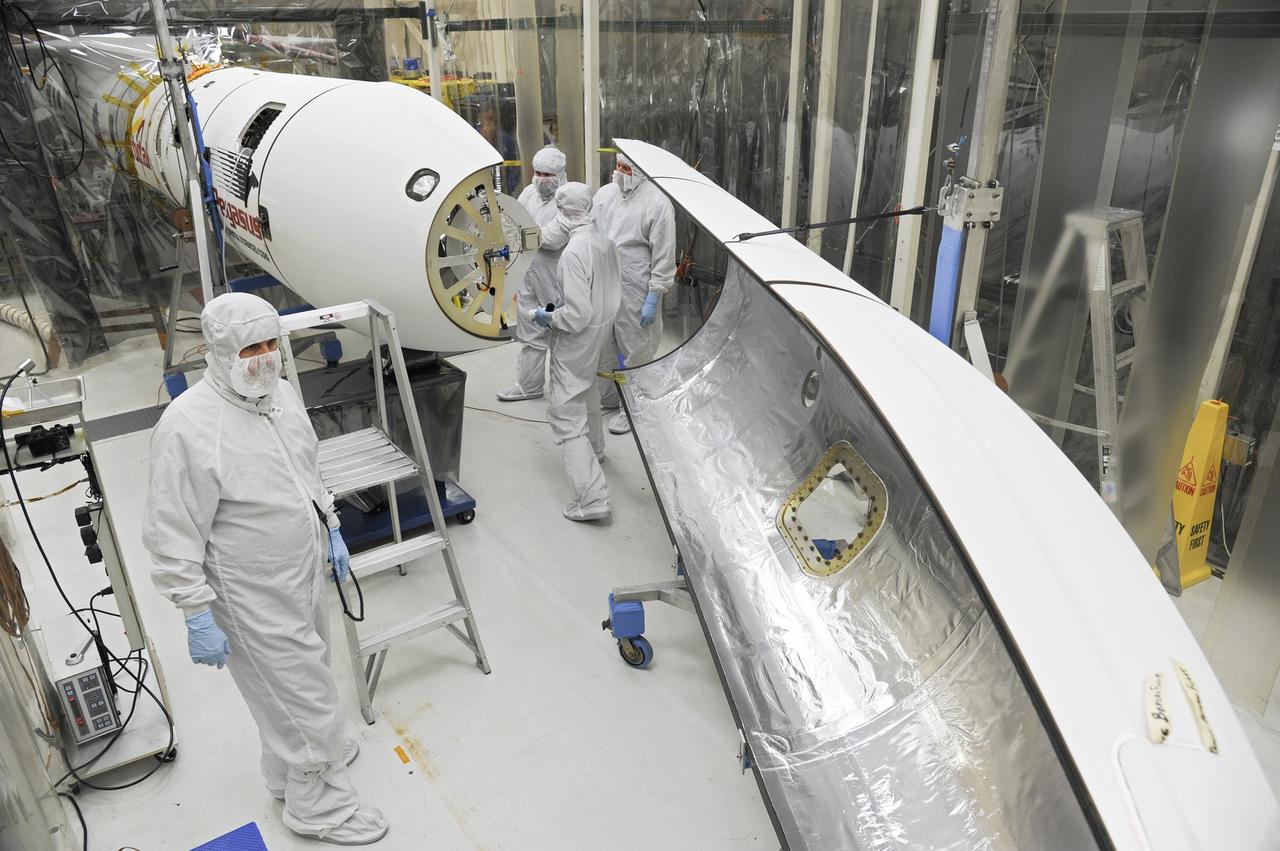
VANDENBERG AFB – Orbital Sciences team members move the second half of the payload fairing before it is placed over NASA's IRIS spacecraft. The fairing connects to the nose of the Orbital Sciences Pegasus XL rocket that will lift the solar observatory into orbit in June. The work is taking place in a hangar at Vandenberg Air Force Base where IRIS, short for Interface Region Imaging Spectrograph, is being prepared for launch on a Pegasus XL rocket. Scheduled for launch from Vandenberg June 26, IRIS will open a new window of discovery by tracing the flow of energy and plasma through the chromospheres and transition region into the sun’s corona using spectrometry and imaging. IRIS fills a crucial gap in our ability to advance studies of the sun-to-Earth connection by tracing the flow of energy and plasma through the foundation of the corona and the region around the sun known as the heliosphere. Photo credit: NASA/Tony Vauclin