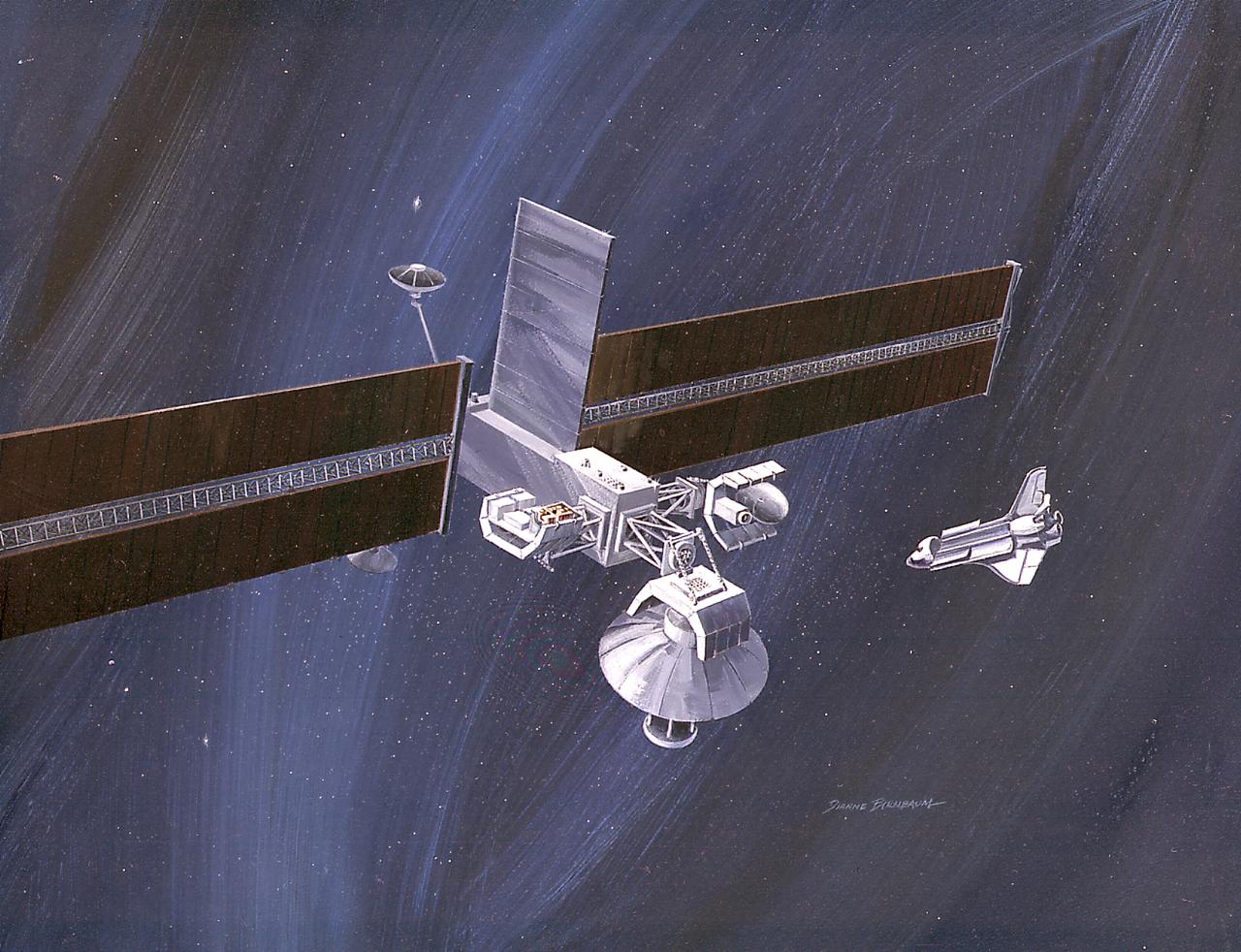
In the late 1970s, NASA, the Marshall Space Flight Center, and its contractors began focusing on designs for Shuttle-tended space platforms capable of extended periods in space and utilizing a variety of temporarily emplaced payloads. As a result, McDornell Douglas studied the Science and Applications Space Platform (SASP). The emphasis was placed on payloads that did not require a crewman's presence during normal operations. Most of the payloads would occupy one or more Spacelab-like pallets. This artist concept depicts the SASP.
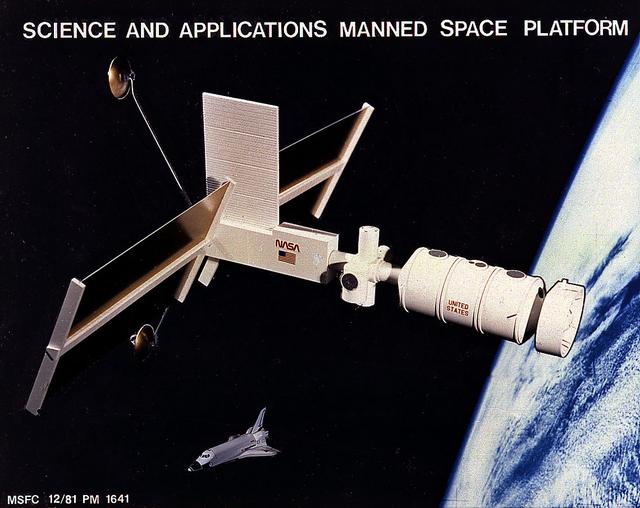
During 1980 and the first half of 1981, the Marshall Space Flight Center conducted studies concerned with a relatively low-cost, near-term, manned space platform to satisfy current user needs, yet capable of evolutionary growth to meet future needs. The Science and Application Manned Space Platform (SAMSP) studies were to serve as a test bed for developing scientific and operational capabilities required by later, more advanced manned platforms while accomplishing early science and operations. This concept illustrates a manned space platform.
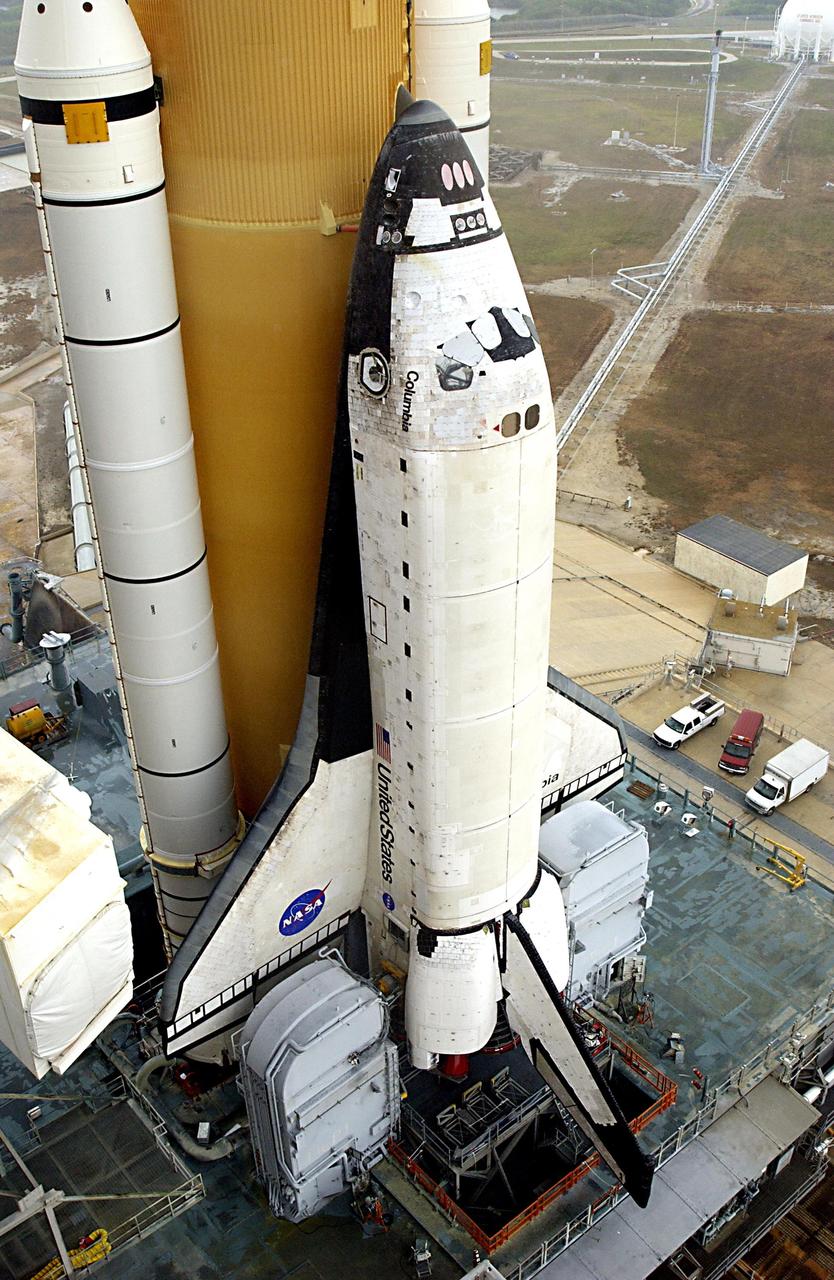
KENNEDY SPACE CENTER, FLA. -- Space Shuttle Columbia sits on Launch Pad 39A, atop the Mobile Launcher Platform. The STS-107 research mission comprises experiments ranging from material sciences to life sciences, plus the Fast Reaction Experiments Enabling Science, Technology, Applications and Research (FREESTAR) that incorporates eight high priority secondary attached shuttle experiments. Mission STS-107 is scheduled to launch Jan. 16, 2003.
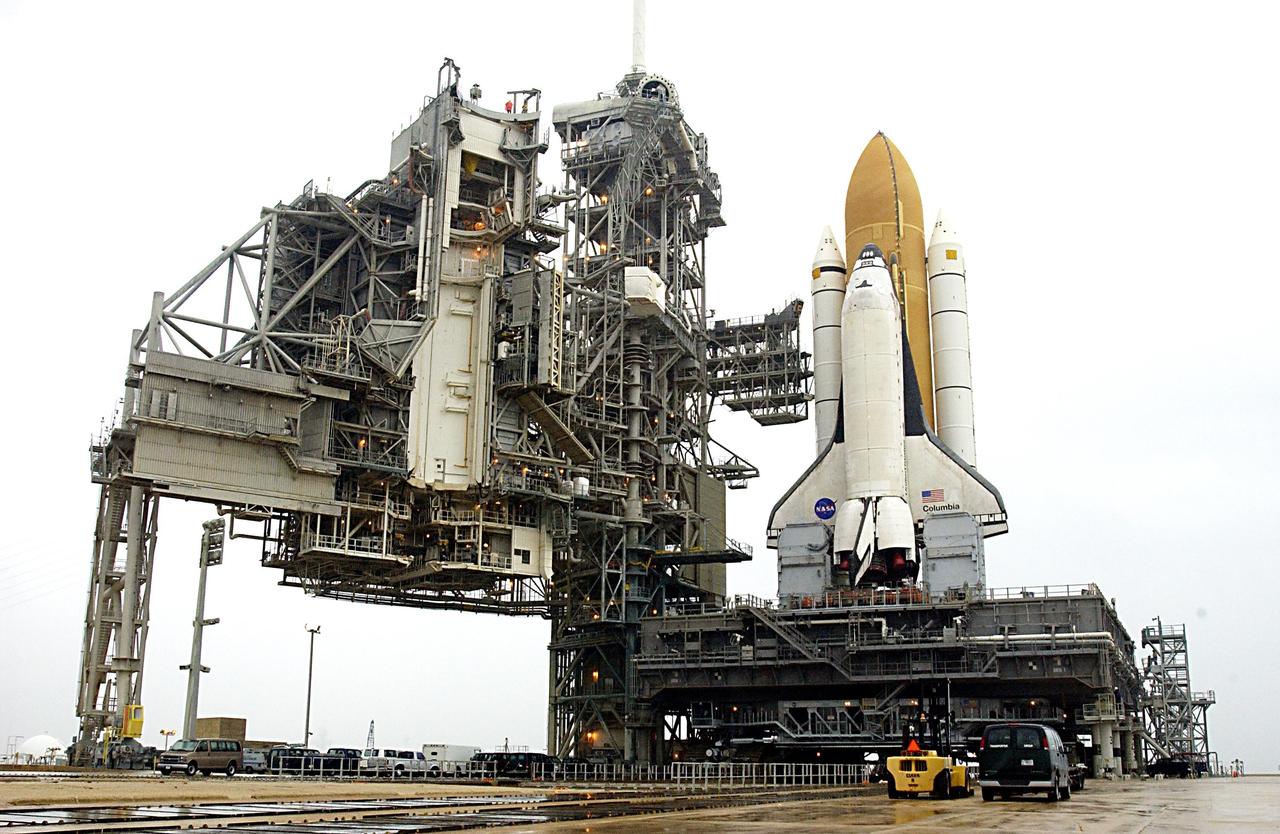
KENNEDY SPACE CENTER, FLA. -- Space Shuttle Columbia sits on Launch Pad 39A, atop the Mobile Launcher Platform. The STS-107 research mission comprises experiments ranging from material sciences to life sciences, plus the Fast Reaction Experiments Enabling Science, Technology, Applications and Research (FREESTAR) that incorporates eight high priority secondary attached shuttle experiments. Mission STS-107 is scheduled to launch Jan. 16, 2003.
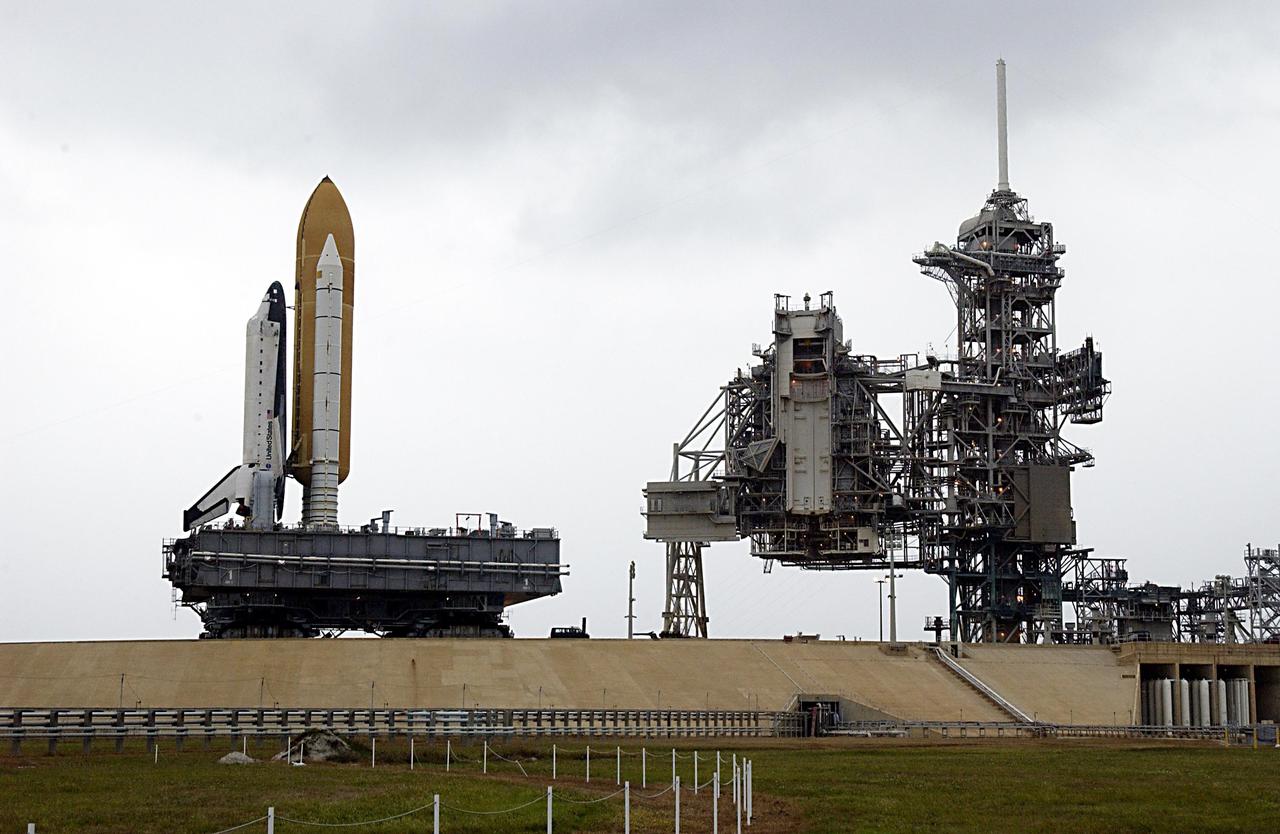
KENNEDY SPACE CENTER, FLA. -- Space Shuttle Columbia approaches Launch Pad 39A, sitting atop the Mobile Launcher Platform, which in turn is carried by the crawler-transporter underneath. The STS-107 research mission comprises experiments ranging from material sciences to life sciences (many rats), plus the Fast Reaction Experiments Enabling Science, Technology, Applications and Research (FREESTAR) that incorporates eight high priority secondary attached shuttle experiments. Mission STS-107 is scheduled to launch Jan. 16, 2003.
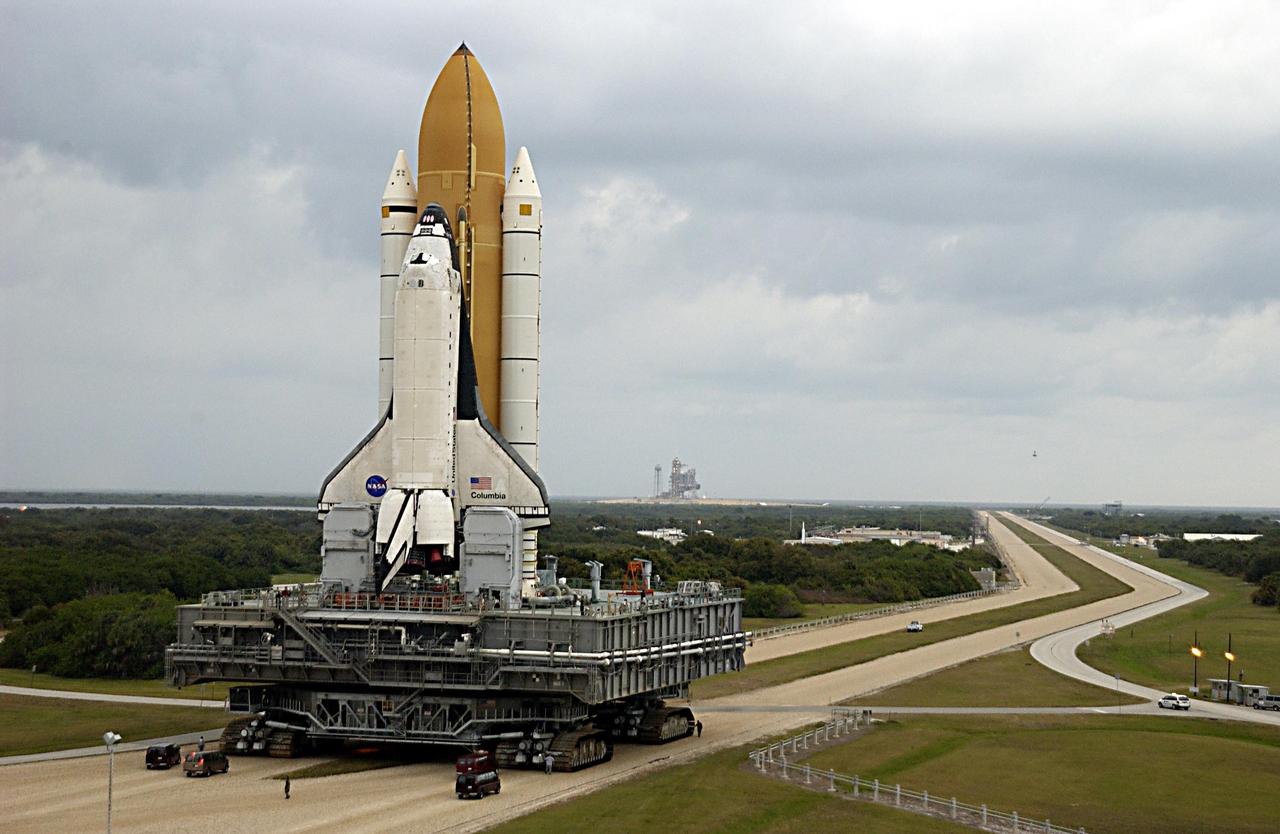
KENNEDY SPACE CENTER, FLA. -- Space Shuttle Columbia rolls towards Launch Pad 39A, sitting atop the Mobile Launcher Platform, which in turn is carried by the crawler-transporter underneath. The STS-107 research mission comprises experiments ranging from material sciences to life sciences (many rats), plus the Fast Reaction Experiments Enabling Science, Technology, Applications and Research (FREESTAR) that incorporates eight high priority secondary attached shuttle experiments. Mission STS-107 is scheduled to launch Jan. 16, 2003.
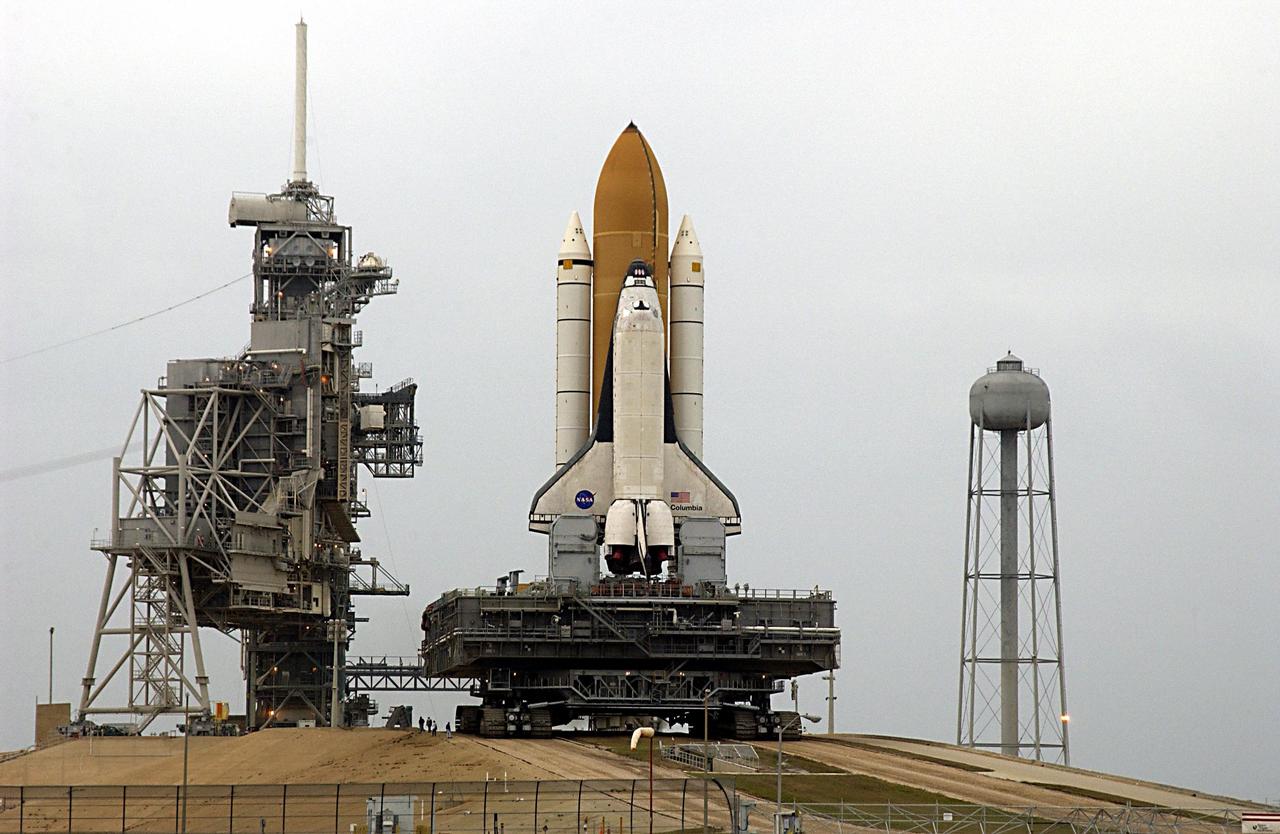
KENNEDY SPACE CENTER, FLA. -- Space Shuttle Columbia, atop the Mobile Launcher Platform, approaches the top of Launch Pad 39A where it will undergo preparations for launch. The STS-107 research mission comprises experiments ranging from material sciences to life sciences, plus the Fast Reaction Experiments Enabling Science, Technology, Applications and Research (FREESTAR) that incorporates eight high priority secondary attached shuttle experiments. Mission STS-107 is scheduled to launch Jan. 16, 2003.
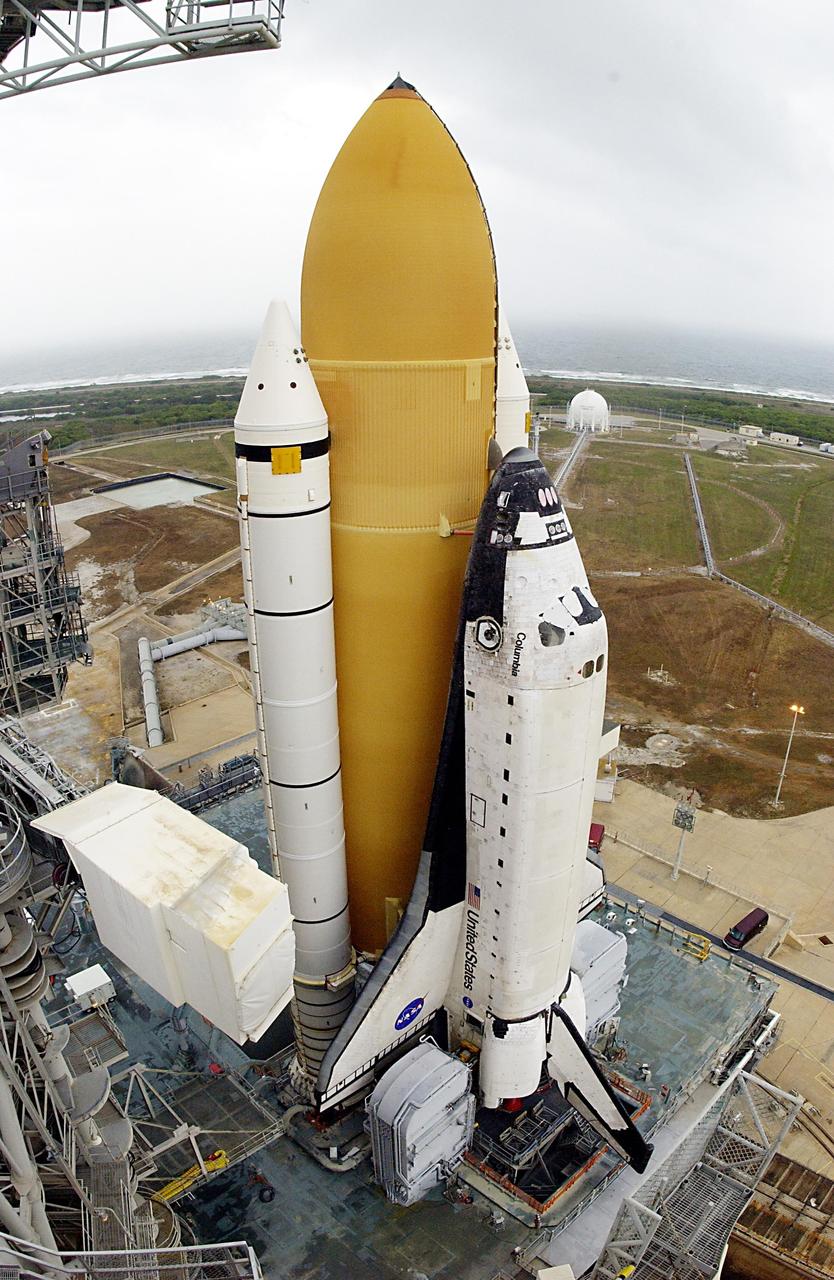
KENNEDY SPACE CENTER, FLA. -- Space Shuttle Columbia sits on Launch Pad 39A, atop the Mobile Launcher Platform. The STS-107 research mission comprises experiments ranging from material sciences to life sciences (many rats), plus the Fast Reaction Experiments Enabling Science, Technology, Applications and Research (FREESTAR) that incorporates eight high priority secondary attached shuttle experiments. Mission STS-107 is scheduled to launch Jan. 16, 2003.
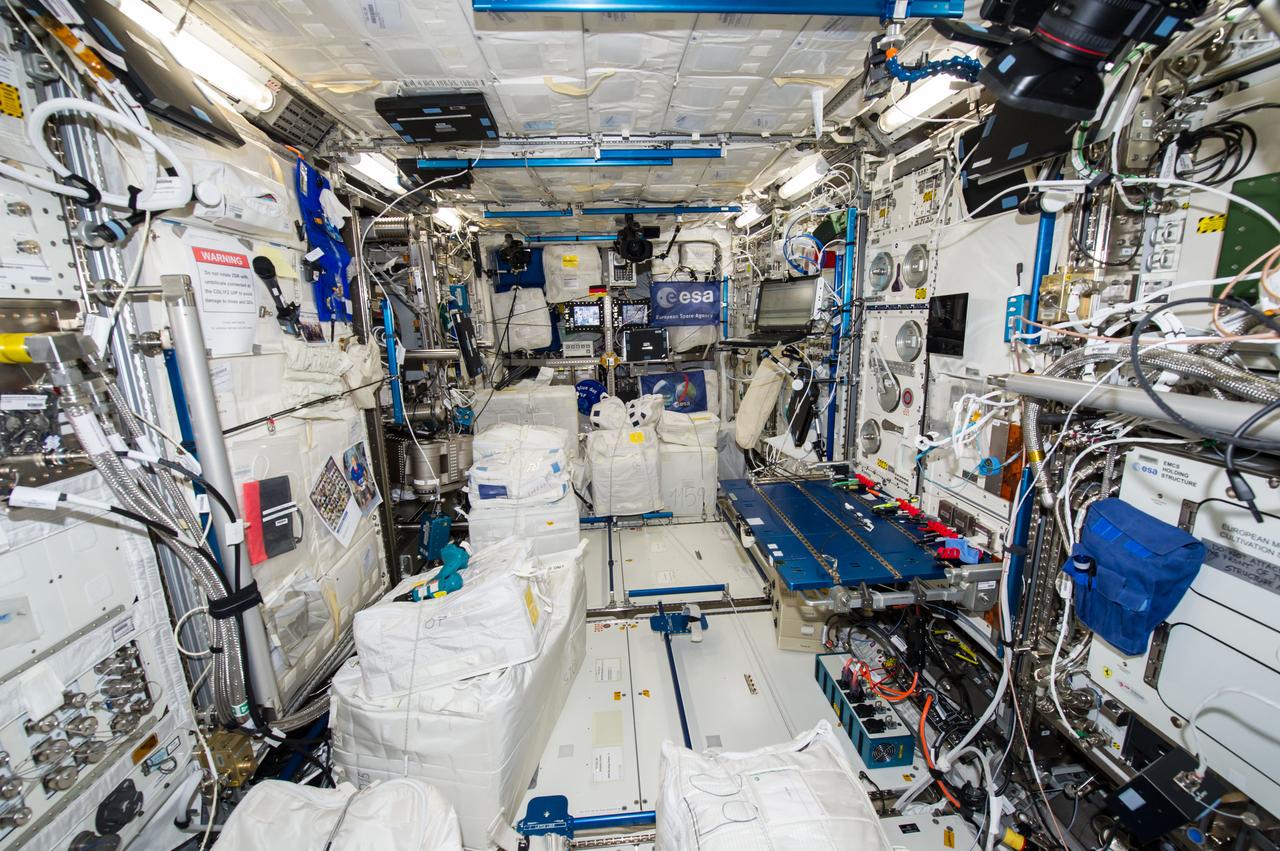
iss041e000170 (9/11/2020) --- A view of the Columbus Module aboard the International Space Stations (ISS). The Columbus laboratory is Europe’s largest contribution to the International Space Station. Columbus is a multifunctional pressurized laboratory permanently attached to the Harmony Module. The lab allows researchers on the ground, aided by the station’s crew, to conduct a wide variety of research in a weightless environment. In addition, experiments and applications can be conducted outside the module in the vacuum of space, thanks to four exterior mounting platforms that can accommodate external payloads in space science, Earth observation and technology.
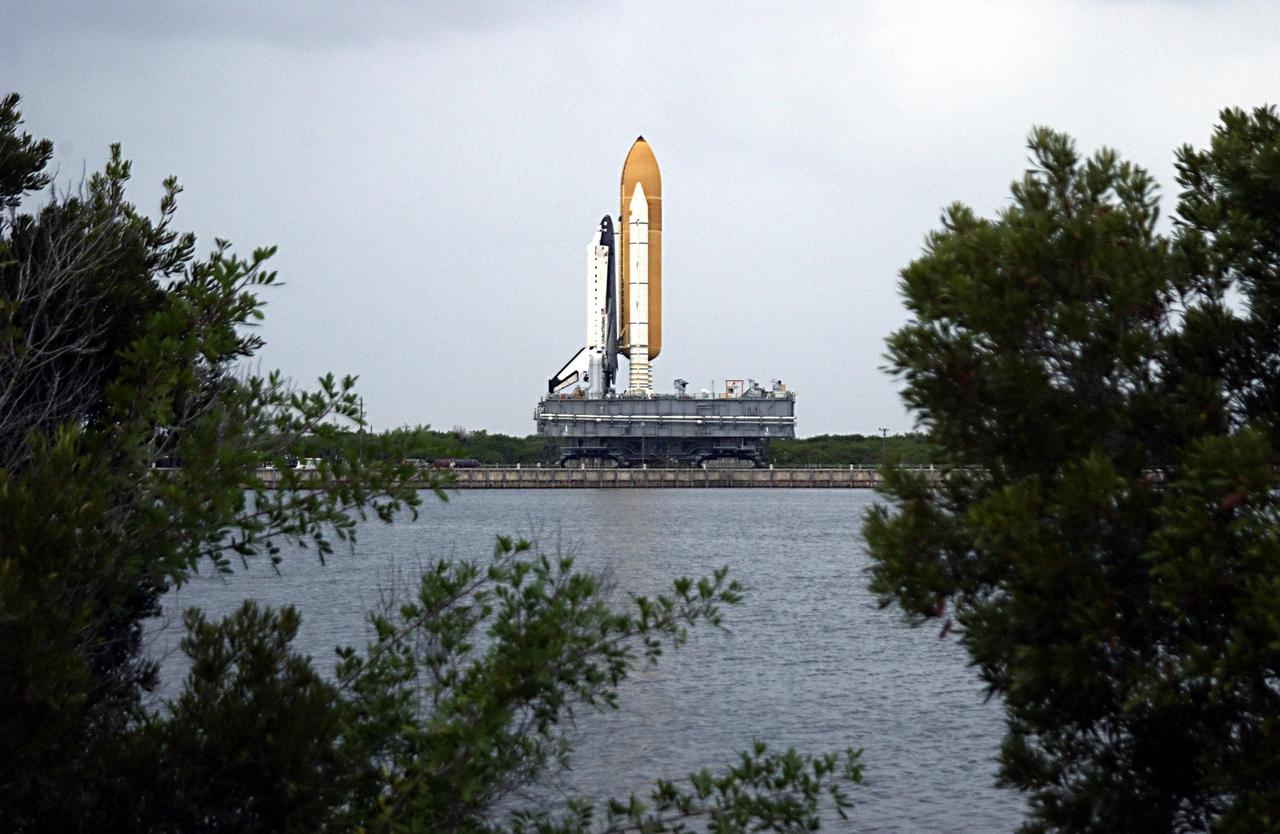
KENNEDY SPACE CENTER, FLA. -- Space Shuttle Columbia, framed by trees near the Banana River, rolls towards Launch Pad 39A, sitting atop the Mobile Launcher Platform, which in turn is carried by the crawler-transporter underneath. The STS-107 research mission comprises experiments ranging from material sciences to life sciences (many rats), plus the Fast Reaction Experiments Enabling Science, Technology, Applications and Research (FREESTAR) that incorporates eight high priority secondary attached shuttle experiments. Mission STS-107 is scheduled to launch Jan. 16, 2003.

KENNEDY SPACE CENTER, FLA. -- Space Shuttle Columbia rolls out from the Vehicle Assembly Building on its way to Launch Pad 39A. Columbia sits atop the Mobile Launcher Platform, which in turn is carried by the crawler-transporter underneath for the long, slow journey to the pad. The STS-107 research mission comprises experiments ranging from material sciences to life sciences (many rats), plus the Fast Reaction Experiments Enabling Science, Technology, Applications and Research (FREESTAR) that incorporates eight high priority secondary attached shuttle experiments. Mission STS-107 is scheduled to launch Jan. 16, 2003.

KENNEDY SPACE CENTER, FLA. -- Space Shuttle Columbia begins the trek from the Vehicle Assembly Building to Launch Pad 39A, sitting atop the Mobile Launcher Platform, which in turn is carried by the crawler-transporter underneath. The STS-107 research mission comprises experiments ranging from material sciences to life sciences (many rats), plus the Fast Reaction Experiments Enabling Science, Technology, Applications and Research (FREESTAR) that incorporates eight high priority secondary attached shuttle experiments. Mission STS-107 is scheduled to launch Jan. 16, 2003.
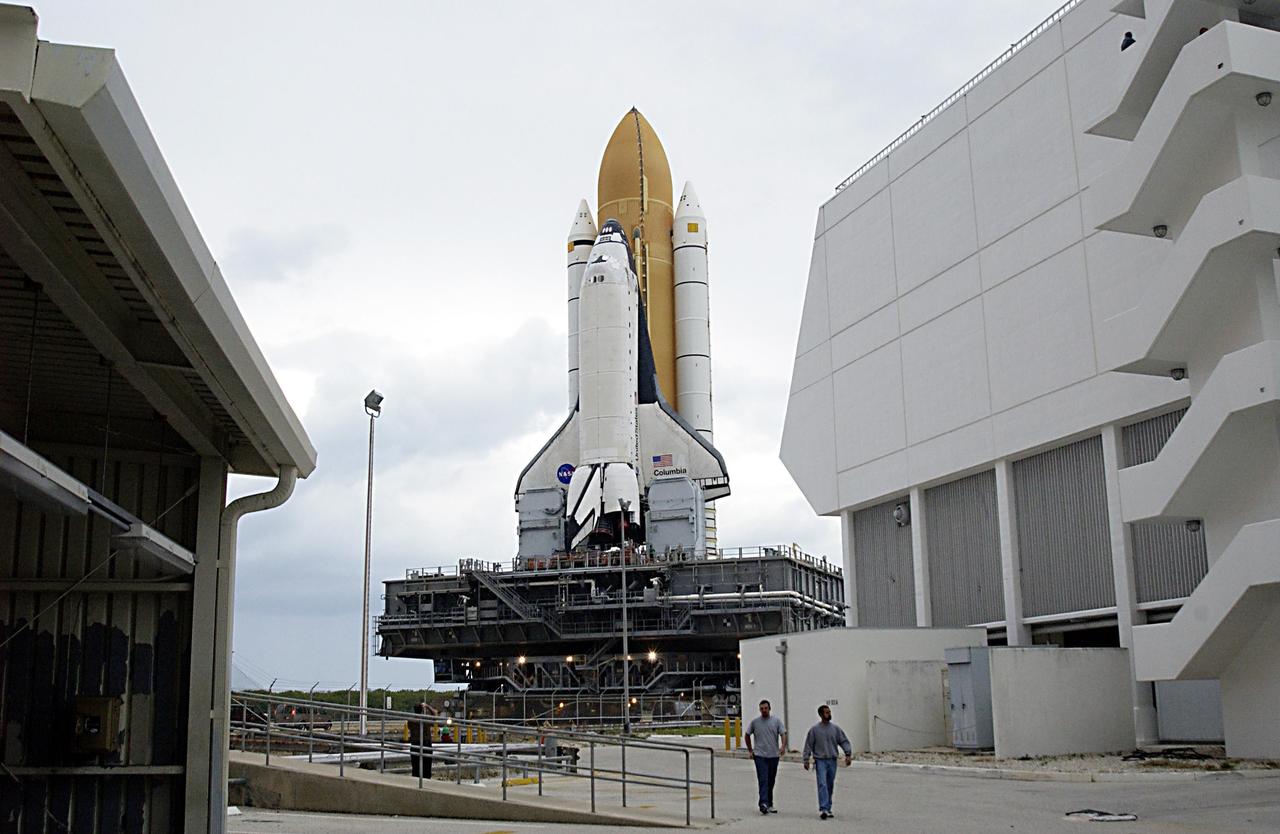
KENNEDY SPACE CENTER, FLA. -- Space Shuttle Columbia, sitting atop the Mobile Launcher Platform, which in turn is carried by the crawler-transporter underneath, makes the journey past the Launch Control Center on its way to Launch Pad 39A. The STS-107 research mission comprises experiments ranging from material sciences to life sciences (many rats), plus the Fast Reaction Experiments Enabling Science, Technology, Applications and Research (FREESTAR) that incorporates eight high priority secondary attached shuttle experiments. Mission STS-107 is scheduled to launch Jan. 16, 2003.
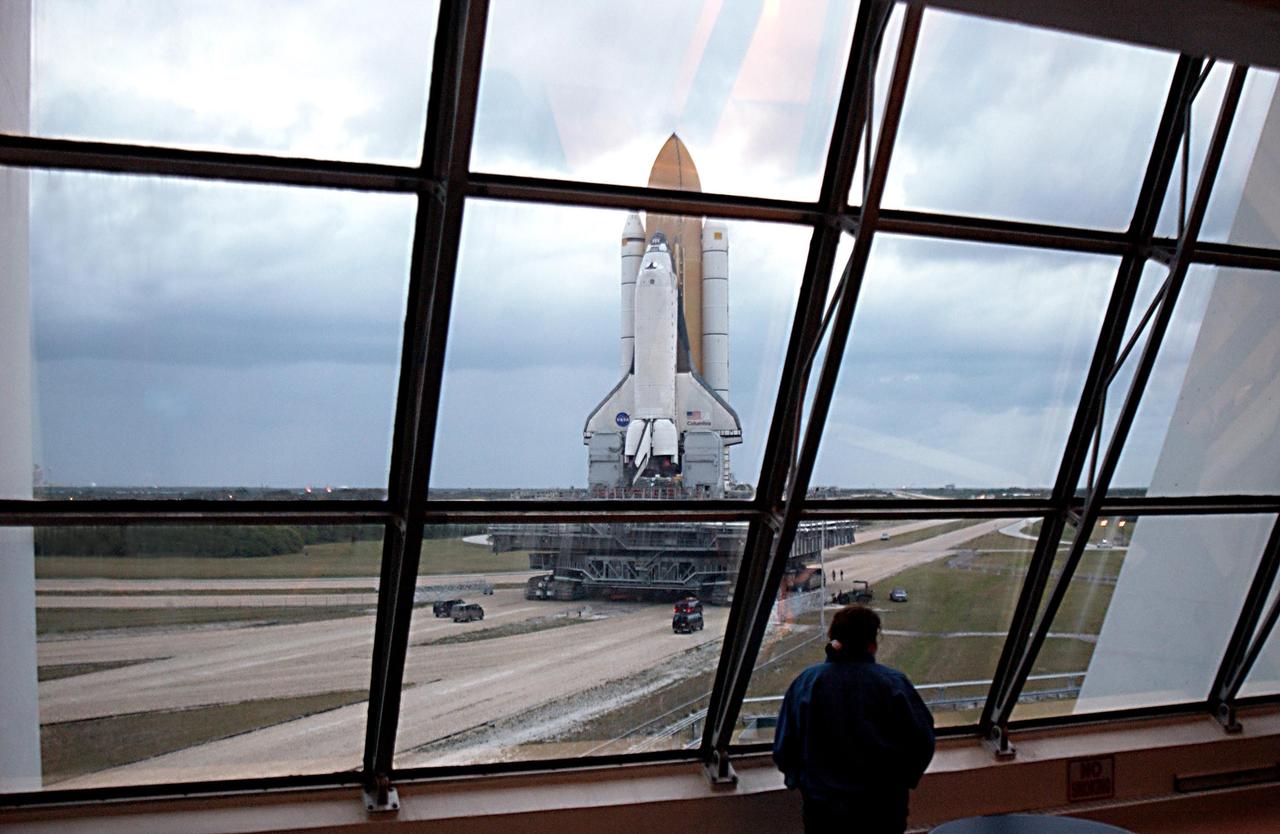
KENNEDY SPACE CENTER, FLA. -- A view from inside the Launch Control Center shows Space Shuttle Columbia rolling to Launch Pad 39A, sitting atop the Mobile Launcher Platform, which in turn is carried by the crawler-transporter underneath. The STS-107 research mission comprises experiments ranging from material sciences to life sciences (many rats), plus the Fast Reaction Experiments Enabling Science, Technology, Applications and Research (FREESTAR) that incorporates eight high priority secondary attached shuttle experiments. Mission STS-107 is scheduled to launch Jan. 16, 2003.
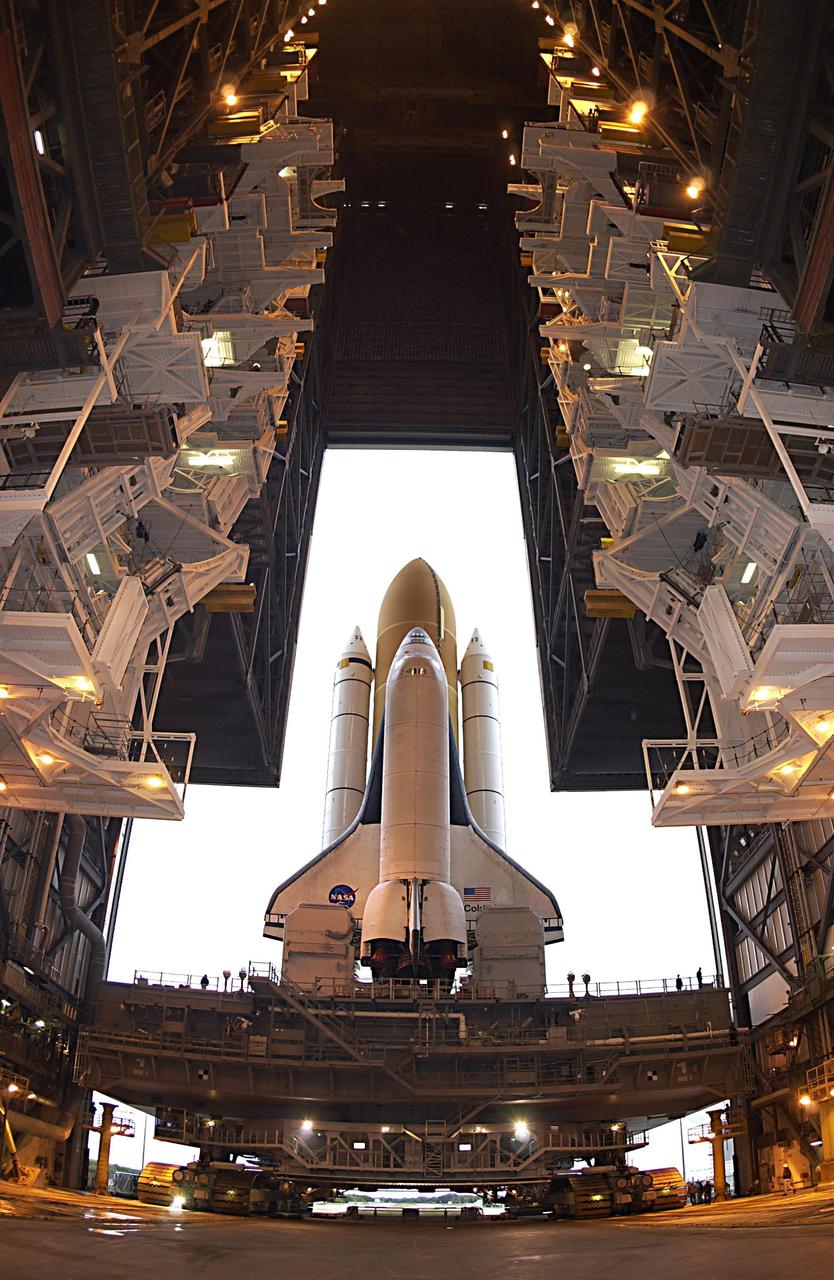
KENNEDY SPACE CENTER, FLA. -- Space Shuttle Columbia rolls out from the Vehicle Assembly Building on its way to Launch Pad 39A. Columbia sits atop the Mobile Launcher Platform, which in turn is carried by the crawler-transporter underneath for the long, slow journey to the pad. The STS-107 research mission comprises experiments ranging from material sciences to life sciences (many rats), plus the Fast Reaction Experiments Enabling Science, Technology, Applications and Research (FREESTAR) that incorporates eight high priority secondary attached shuttle experiments. Mission STS-107 is scheduled to launch Jan. 16, 2003.
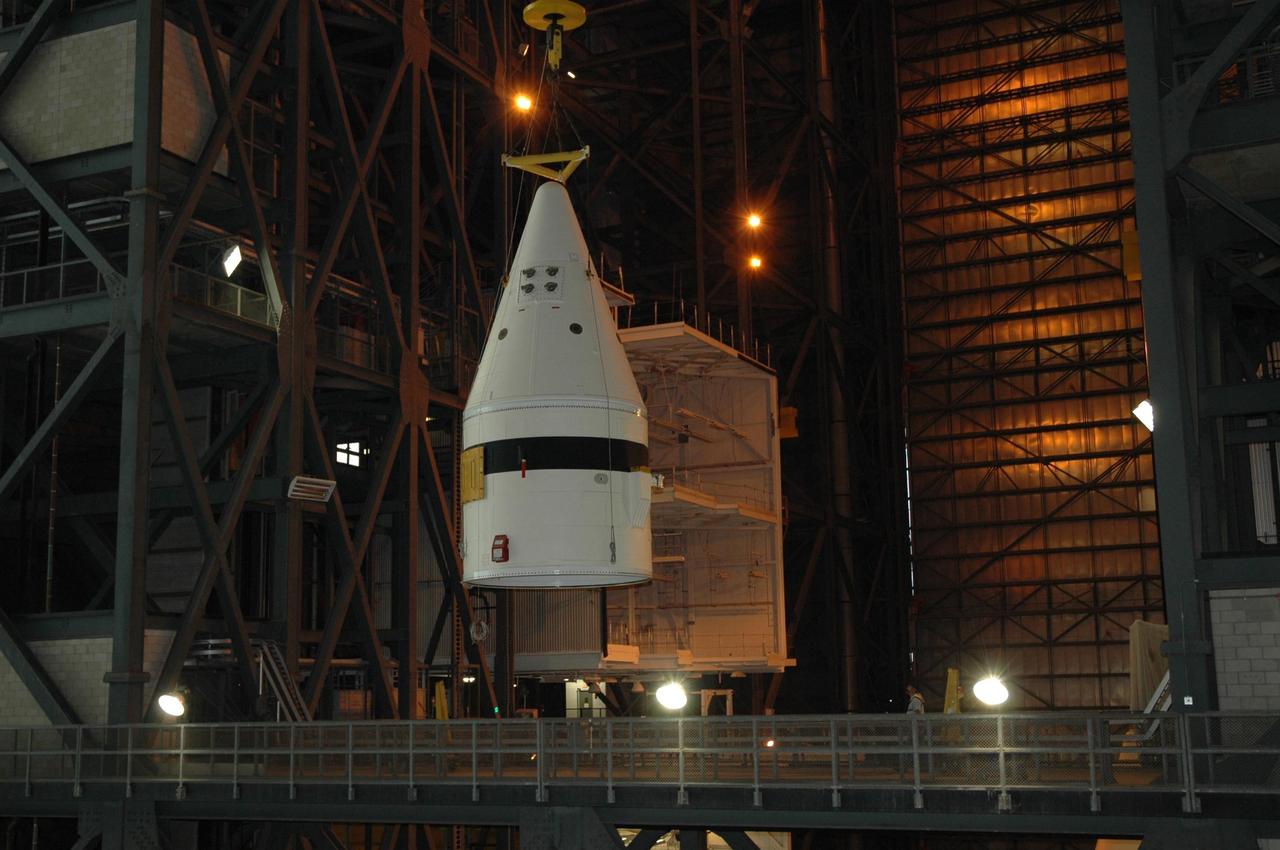
KENNEDY SPACE CENTER, FLA. -- In the Vehicle Assembly Building at NASA's Kennedy Space Center, a crane lifts a frustum over platforms into a high bay. The solid rocket booster segment is being moved into a high bay where it will be added to the stack being prepared for space shuttle mission STS-122, targeted for launch in December. On this mission, Atlantis will carry the Columbus Laboratory, the European Space Agency's largest contribution to the International Space Station. Columbus is a multifunctional, pressurized laboratory that will be permanently attached to U.S. Node 2, also called Harmony, to carry out experiments in materials science, fluid physics and biosciences, as well as to support a number of technological applications. Photo credit: NASA/Jack Pfaller
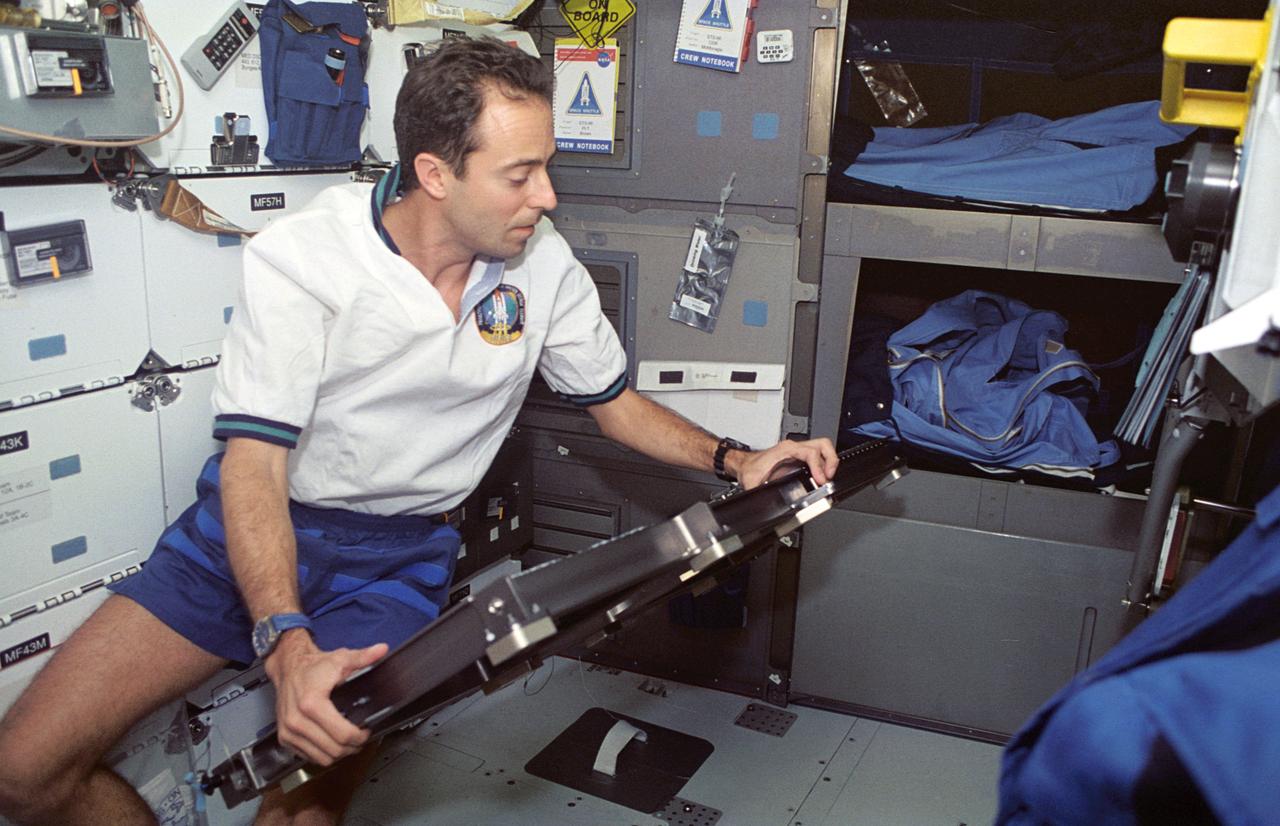
STS066-66-005 (3-14 Nov 1994) --- On the Space Shuttle Atlantis' flight deck, Jean-François Clervoy, mission specialist representing the European Space Agency (ESA), moves a platform for the recumbent seat device which was being evaluated for a future Space Shuttle flight. The platform is just part of the mid-deck arrangement designed to accommodate crew members when the Space Shuttle docks with Russia's Mir Space Station next year. Other crew members onboard Atlantis for the 11-day day Atmospheric Laboratory for Applications and Science (ATLAS-3) mission were astronauts Donald R. McMonagle, Curtis L. Brown, Jr., Ellen Ochoa, Scott E. Parazynski and Joseph R. Tanner.
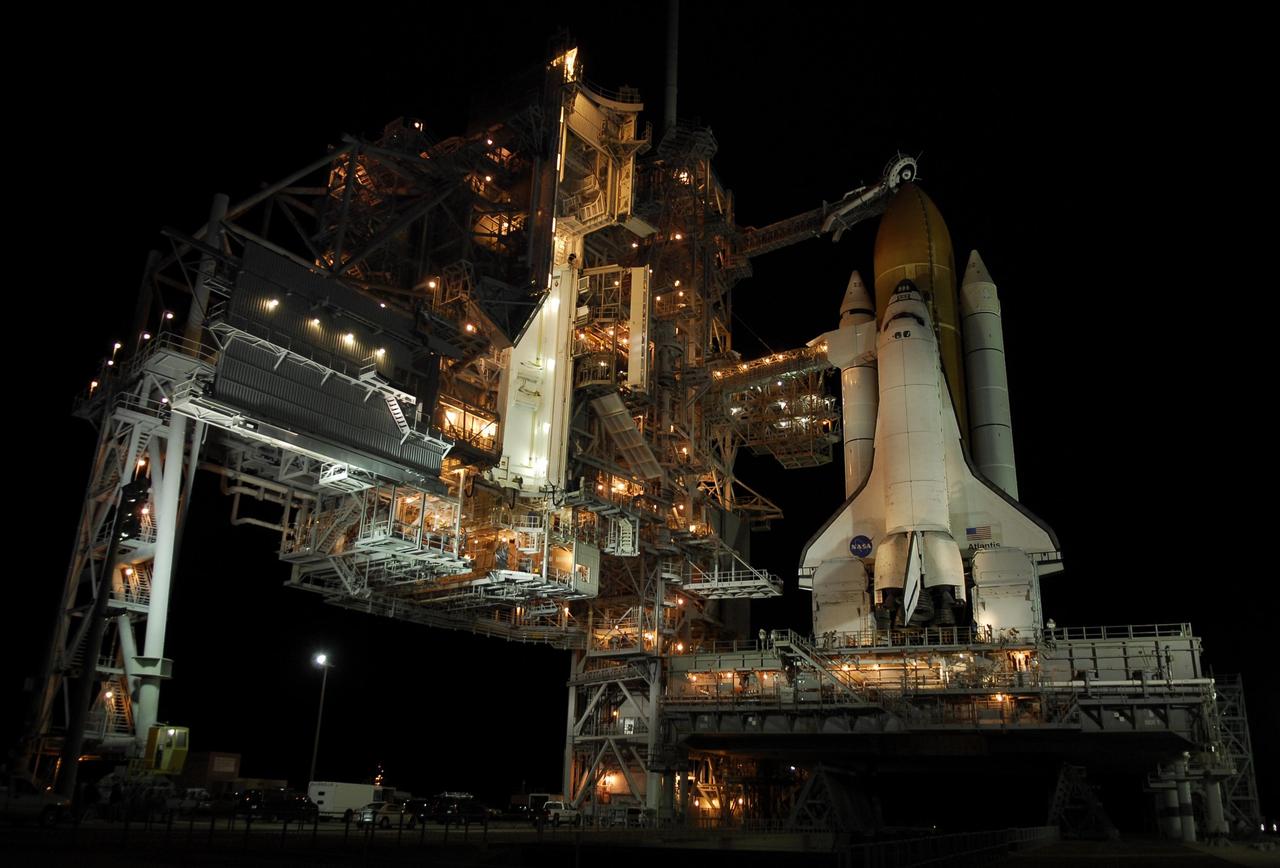
KENNEDY SPACE CENTER, FLA. -- Space shuttle Atlantis is revealed on Launch Pad 39A at NASA's Kennedy Space Center after the rotating service structure, or RSS, at left of the pad is rolled back. Rollback was complete at 8:44 p.m. EST. The RSS provides protected access to the orbiter for crew entry and servicing of payloads at the pad. Rollback of the pad's RSS is one of the milestones in preparation for the launch of mission STS-122, scheduled for 4:31 p.m. EST on Dec. 6. Beneath the shuttle is the mobile launcher platform which supports the shuttle until liftoff. Atlantis will carry the Columbus Laboratory, the European Space Agency's largest contribution to the construction of the International Space Station. It will support scientific and technological research in a microgravity environment. Permanently attached to Node 2 of the space station, the laboratory will carry out experiments in materials science, fluid physics and biosciences, as well as perform a number of technological applications. Photo credit: NASA/Kim Shiflett
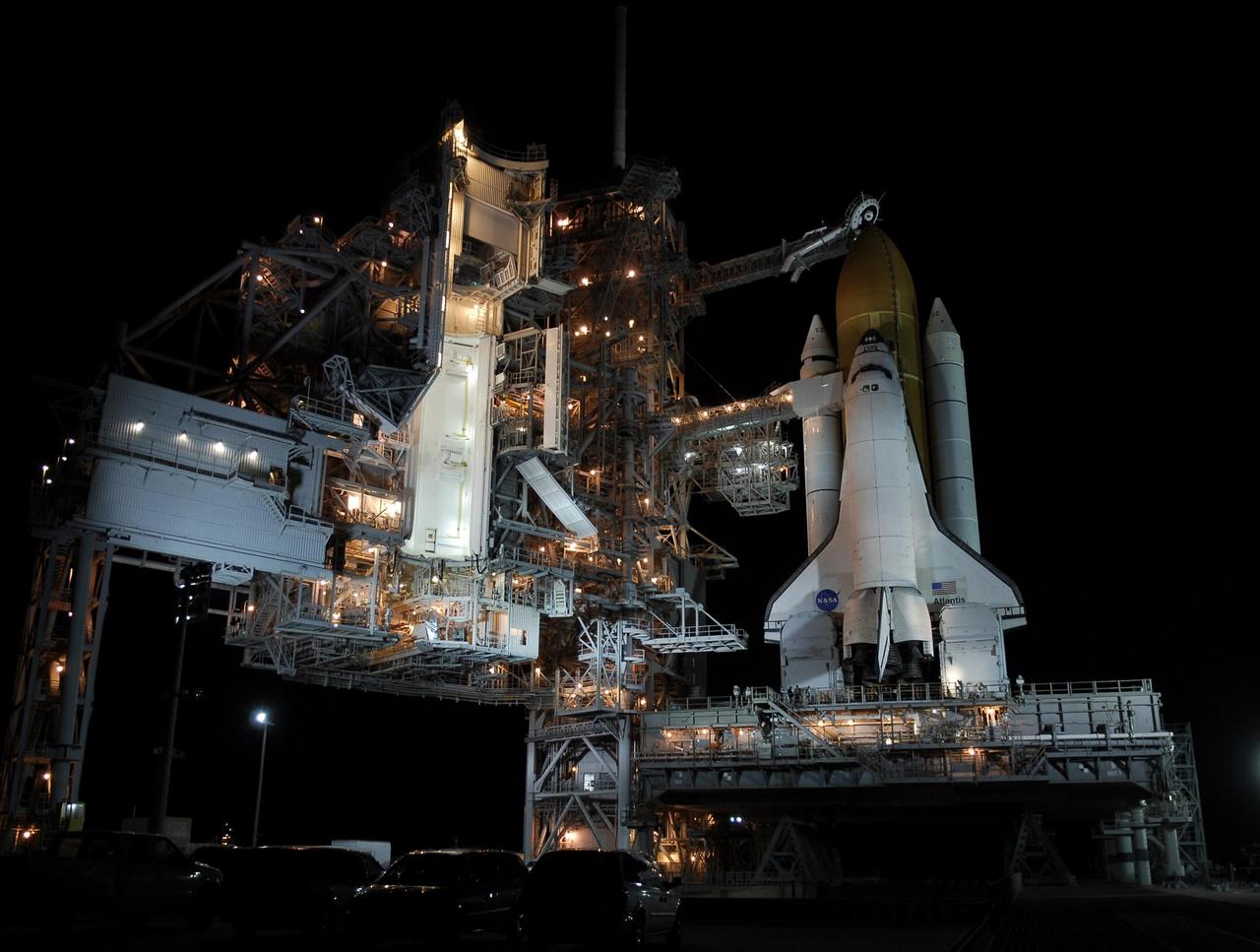
KENNEDY SPACE CENTER, FLA. -- Space shuttle Atlantis is revealed on Launch Pad 39A at NASA's Kennedy Space Center after the rotating service structure, or RSS, at left of the pad is rolled back. Rollback was complete at 8:44 p.m. EST. The RSS provides protected access to the orbiter for crew entry and servicing of payloads at the pad. Rollback of the pad's RSS is one of the milestones in preparation for the launch of mission STS-122, scheduled for 4:31 p.m. EST on Dec. 6. Beneath the shuttle is the mobile launcher platform which supports the shuttle until liftoff. Atlantis will carry the Columbus Laboratory, the European Space Agency's largest contribution to the construction of the International Space Station. It will support scientific and technological research in a microgravity environment. Permanently attached to Node 2 of the space station, the laboratory will carry out experiments in materials science, fluid physics and biosciences, as well as perform a number of technological applications. Photo credit: NASA/Kim Shiflett
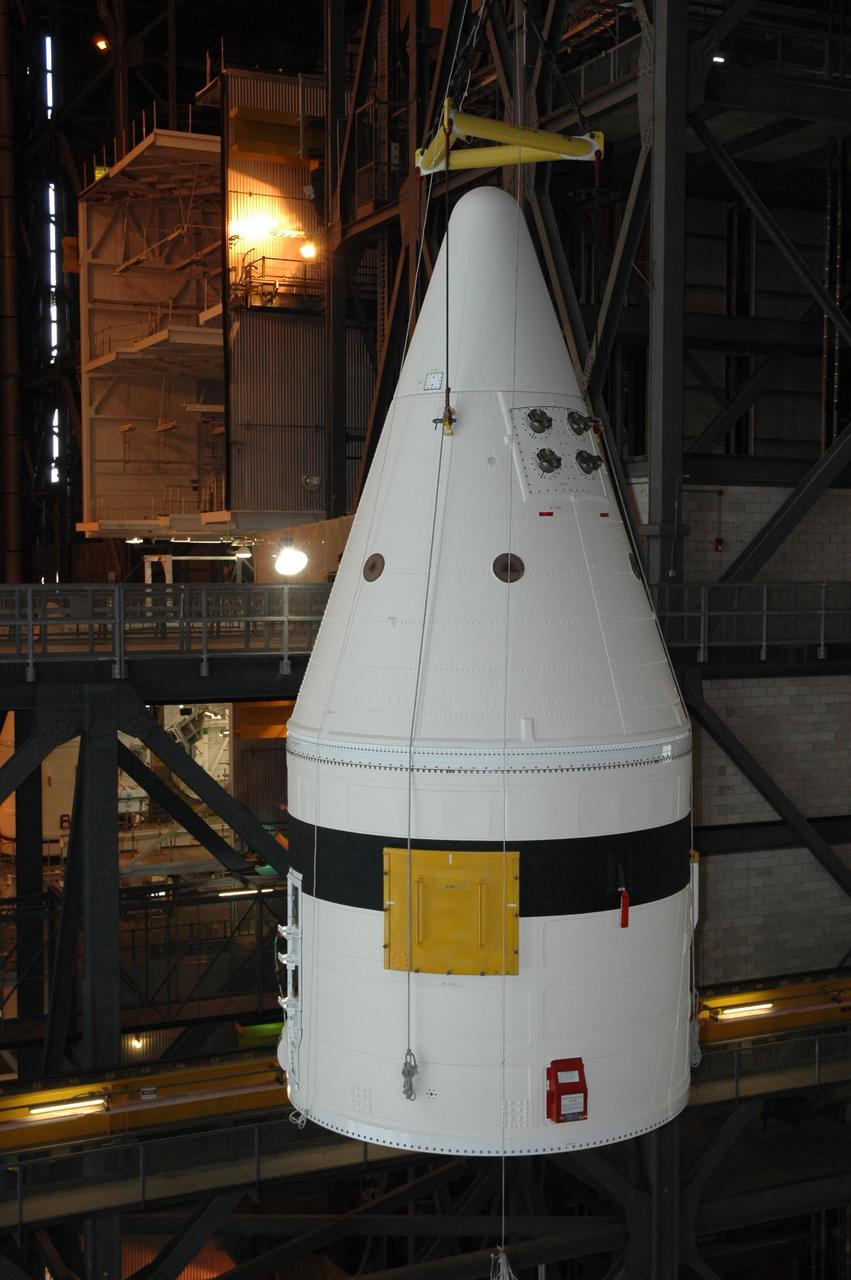
KENNEDY SPACE CENTER, FLA. -- In the Vehicle Assembly Building at NASA's Kennedy Space Center, a crane lifts a frustum towards platforms separating the transfer aisle from a high bay. The solid rocket booster segment is being moved into a high bay where it will be added to the stack being prepared for space shuttle mission STS-122, targeted for launch in December. On this mission, Atlantis will carry the Columbus Laboratory, the European Space Agency's largest contribution to the International Space Station. Columbus is a multifunctional, pressurized laboratory that will be permanently attached to U.S. Node 2, also called Harmony, to carry out experiments in materials science, fluid physics and biosciences, as well as to support a number of technological applications. Photo credit: NASA/Jack Pfaller
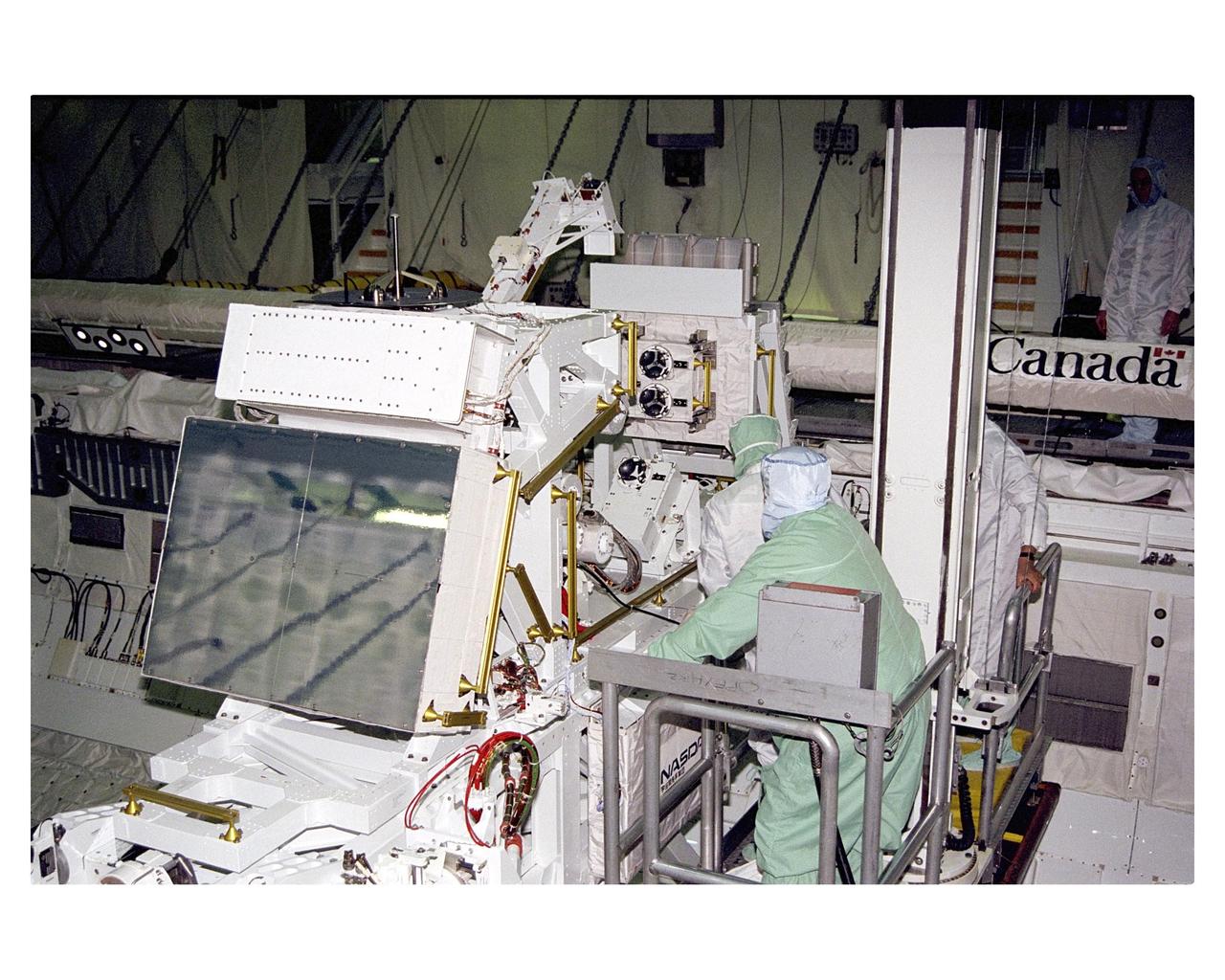
The Manipulator Flight Demonstration (MFD) payload is installed into the payload bay of the Space Shuttle Orbiter Discovery in Orbiter Processing Facility 2. The MFD is one of several payloads that will fly on the STS-85 mission. This payload is designed to test the operational capability of the Japanese Experiment Module Remote Manipulator System (JEM RMS) Small Fine Arm (SFA), which can be seen atop its Multi-Purpose Experiment Support Structure (MPESS) carrier that will serve as a platform in the payload bay for the robotic arm experiment. The arm, which will be a part of the JEM element of the International Space Station, will be operated from the orbiter’s aft flight deck during the 11-day mission. Other payloads that will be aboard Discovery on this space flight include the Cryogenic Infrared Spectrometers and Telescopes for the Atmosphere-Shuttle Pallet Satellite-2 (CRISTA- SPAS-2), Technology Applications and Science-1 (TAS-1) and International Extreme Ultraviolet Hitchhiker (IEH-2) experiments
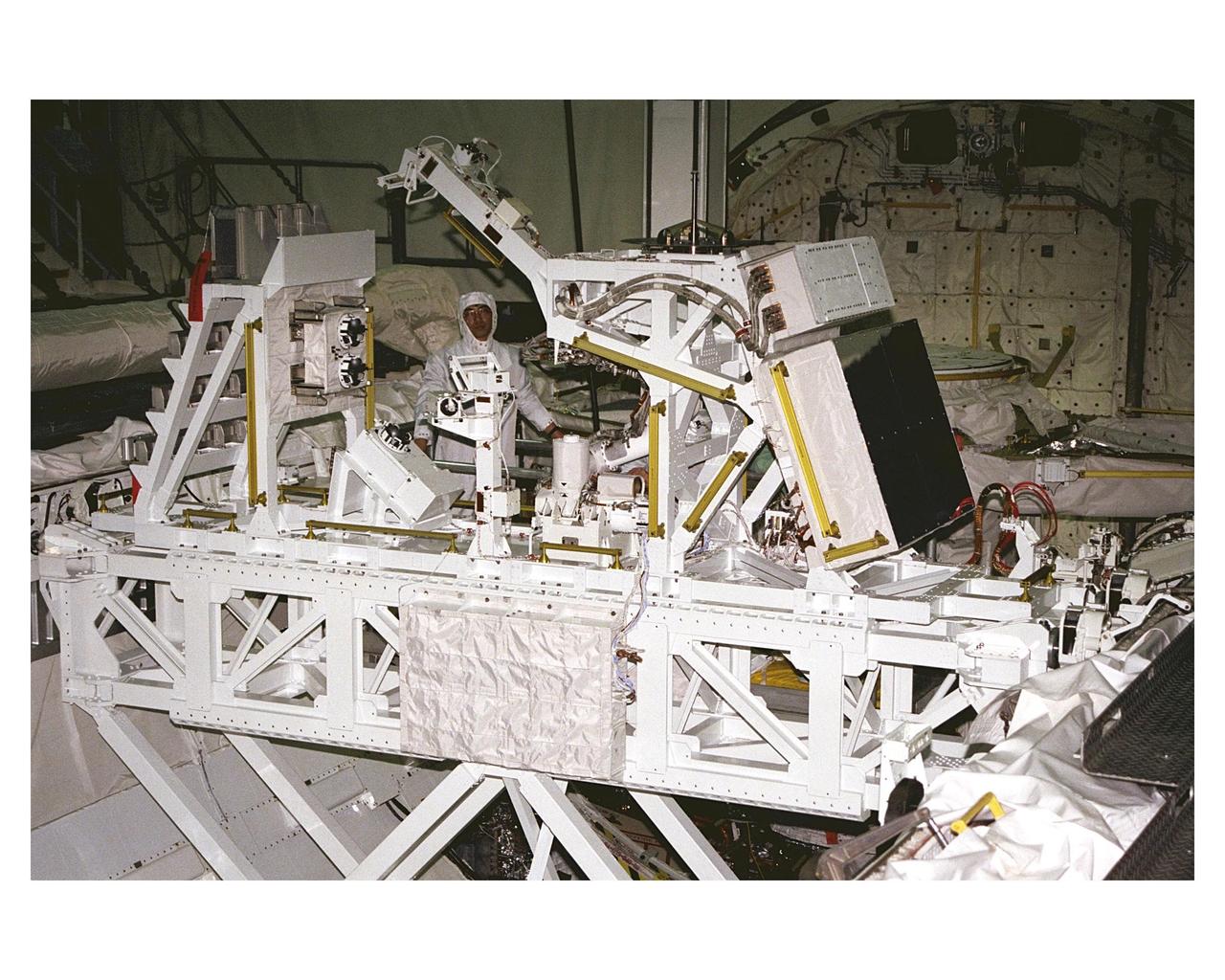
The Manipulator Flight Demonstration (MFD) payload is installed into the payload bay of the Space Shuttle Orbiter Discovery in Orbiter Processing Facility 2. The MFD is one of several payloads that will fly on the STS-85 mission. This payload is designed to test the operational capability of the Japanese Experiment Module Remote Manipulator System (JEM RMS) Small Fine Arm (SFA), which can be seen atop its Multi-Purpose Experiment Support Structure (MPESS) carrier that will serve as a platform in the payload bay for the robotic arm experiment. The arm, which will be a part of the JEM element of the International Space Station, will be operated from the orbiter’s aft flight deck during the 11-day mission. Other payloads that will be aboard Discovery on this space flight include the Cryogenic Infrared Spectrometers and Telescopes for the Atmosphere-Shuttle Pallet Satellite-2 (CRISTA- SPAS-2), Technology Applications and Science-1 (TAS-1) and International Extreme Ultraviolet Hitchhiker (IEH-2) experiments
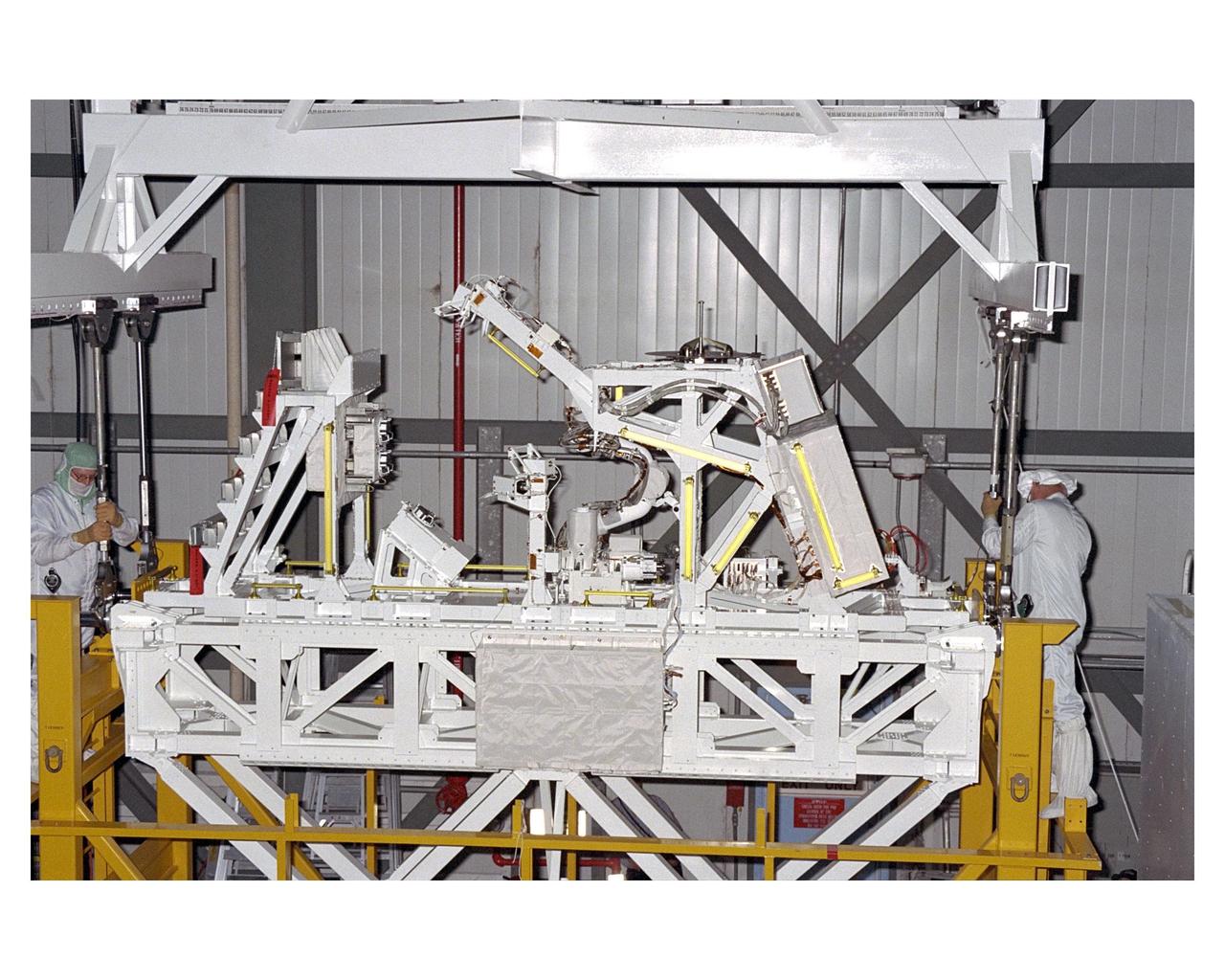
The Manipulator Flight Demonstration (MFD) payload is prepared for hoisting and installation into the payload bay of the Space Shuttle Orbiter Discovery in Orbiter Processing Facility 2. The MFD is one of several payloads that will fly on the STS-85 mission. This payload is designed to test the operational capability of the Japanese Experiment Module Remote Manipulator System (JEM RMS) Small Fine Arm (SFA), which can be seen atop its Multi-Purpose Experiment Support Structure (MPESS) carrier that will serve as a platform in the payload bay for the robotic arm experiment. The arm, which will be a part of the JEM element of the International Space Station, will be operated from the orbiter’s aft flight deck during the 11-day mission. Other payloads that will be aboard Discovery on this space flight include the Cryogenic Infrared Spectrometers and Telescopes for the Atmosphere-Shuttle Pallet Satellite-2 (CRISTA-SPAS-2), Technology Applications and Science-1 (TAS-1) and International Extreme Ultraviolet Hitchhiker (IEH-2) experiments
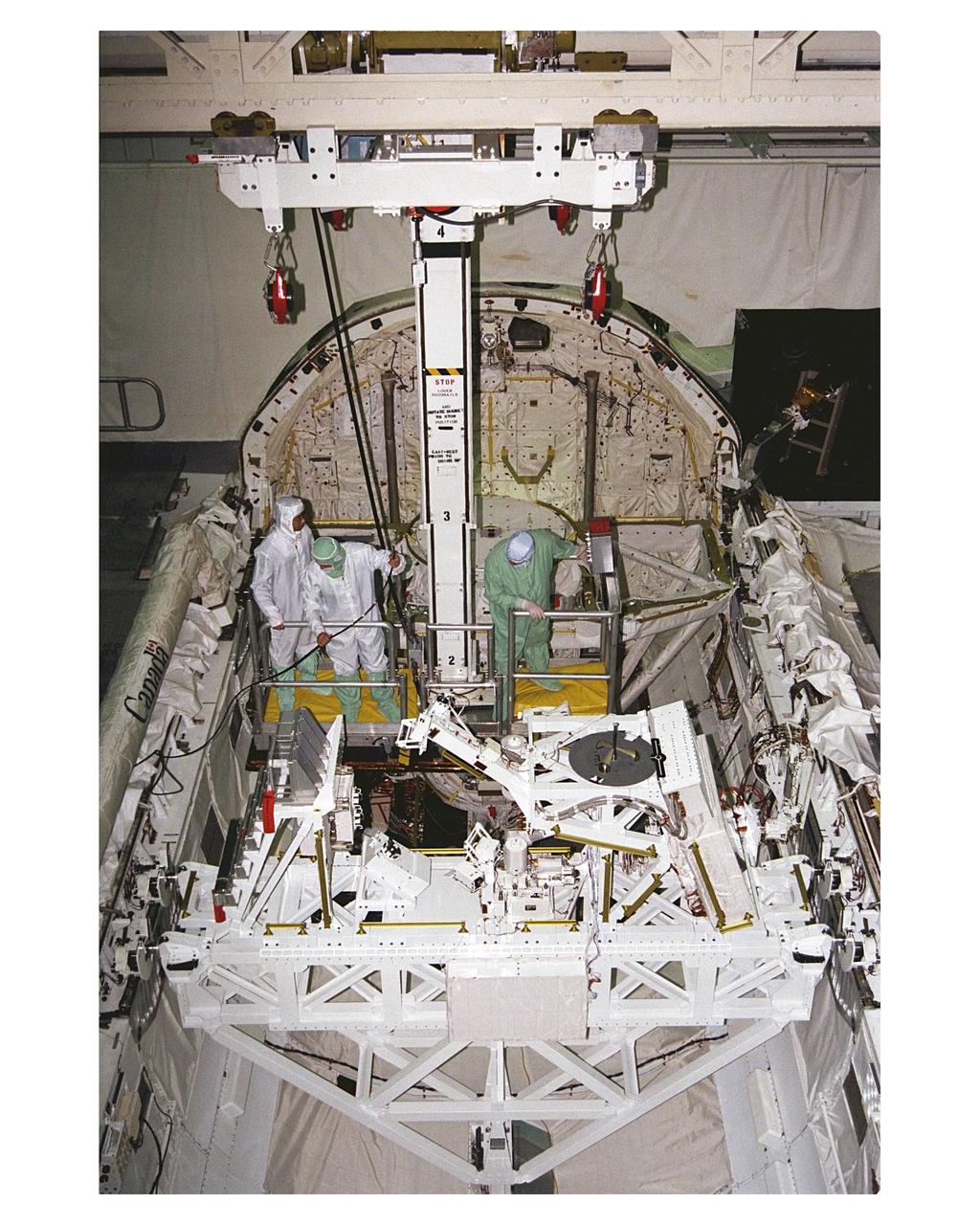
The Manipulator Flight Demonstration (MFD) payload is lowered into the payload bay of the Space Shuttle Orbiter Discovery in Orbiter Processing Facility 2. The MFD is one of several payloads that will fly on the STS-85 mission. This payload is designed to test the operational capability of the Japanese Experiment Module Remote Manipulator System (JEM RMS) Small Fine Arm (SFA), which can be seen atop its Multi-Purpose Experiment Support Structure (MPESS) carrier that will serve as a platform in the payload bay for the robotic arm experiment. The arm, which will be a part of the JEM element of the International Space Station, will be operated from the orbiter’s aft flight deck during the 11-day mission. Other payloads that will be aboard Discovery on this space flight include the Cryogenic Infrared Spectro-meters and Telescopes for the Atmosphere-Shuttle Pallet Satellite-2 (CRISTA-SPAS-2), Technology Applications and Science-1 (TAS-1) and International Extreme Ultraviolet Hitchhiker (IEH-2) experiments
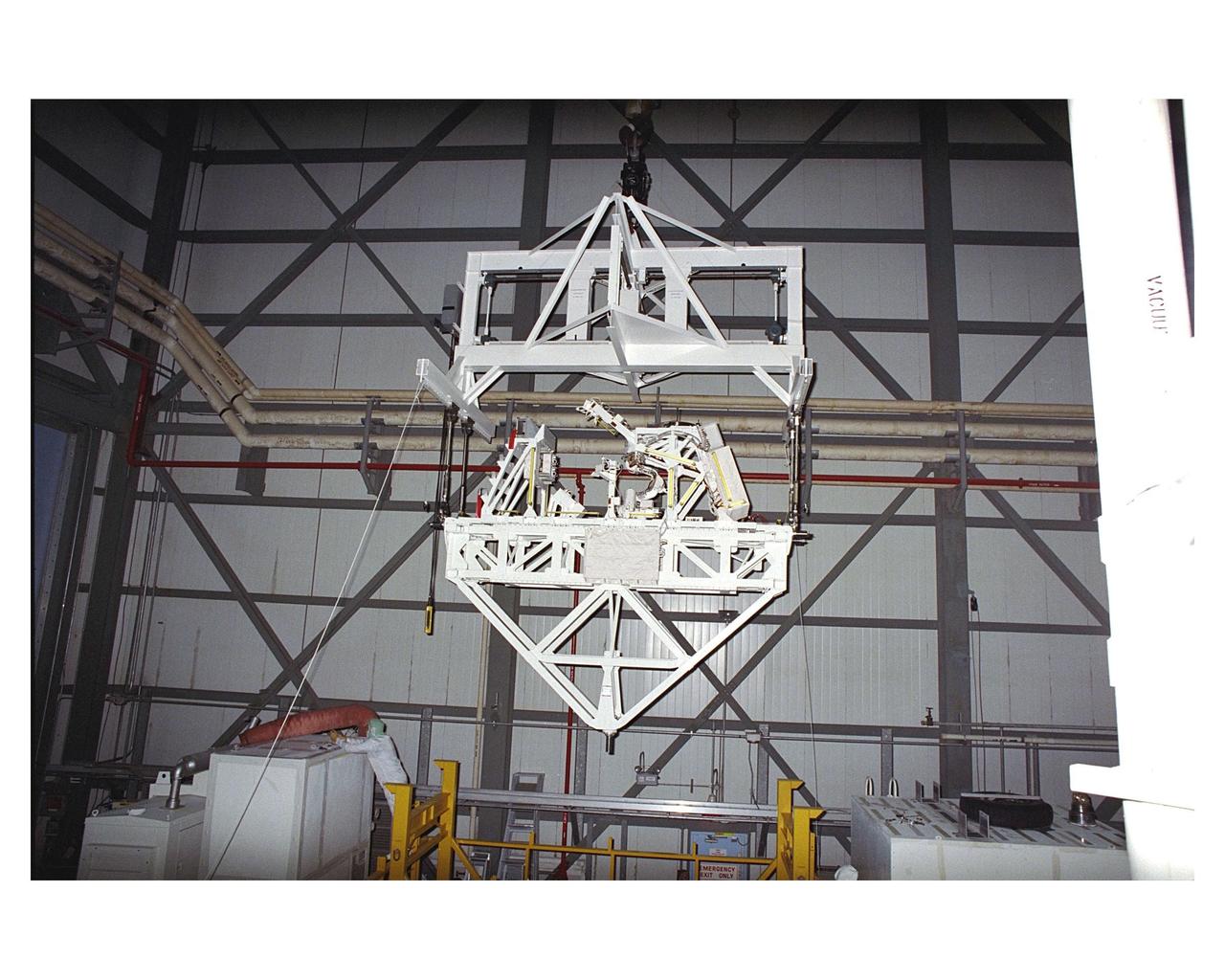
The Manipulator Flight Demonstration (MFD) payload is hoisted for installation into the payload bay of the Space Shuttle Orbiter Discovery in Orbiter Processing Facility 2. The MFD is one of several payloads that will fly on the STS-85 mission. This payload is designed to test the operational capability of the Japanese Experiment Module Remote Manipulator System (JEM RMS) Small Fine Arm (SFA), which can be seen atop its Multi-Purpose Experiment Support Structure (MPESS) carrier that will serve as a platform in the payload bay for the robotic arm experiment. The arm, which will be a part of the JEM element of the International Space Station, will be operated from the orbiter’s aft flight deck during the 11-day mission. Other payloads that will be aboard Discovery on this space flight include the Cryogenic Infrared Spectrometers and Telescopes for the Atmosphere-Shuttle Pallet Satellite-2 (CRISTA-SPAS-2), Technology Applications and Science-1 (TAS-1) and International Extreme Ultraviolet Hitchhiker (IEH-2) experiments
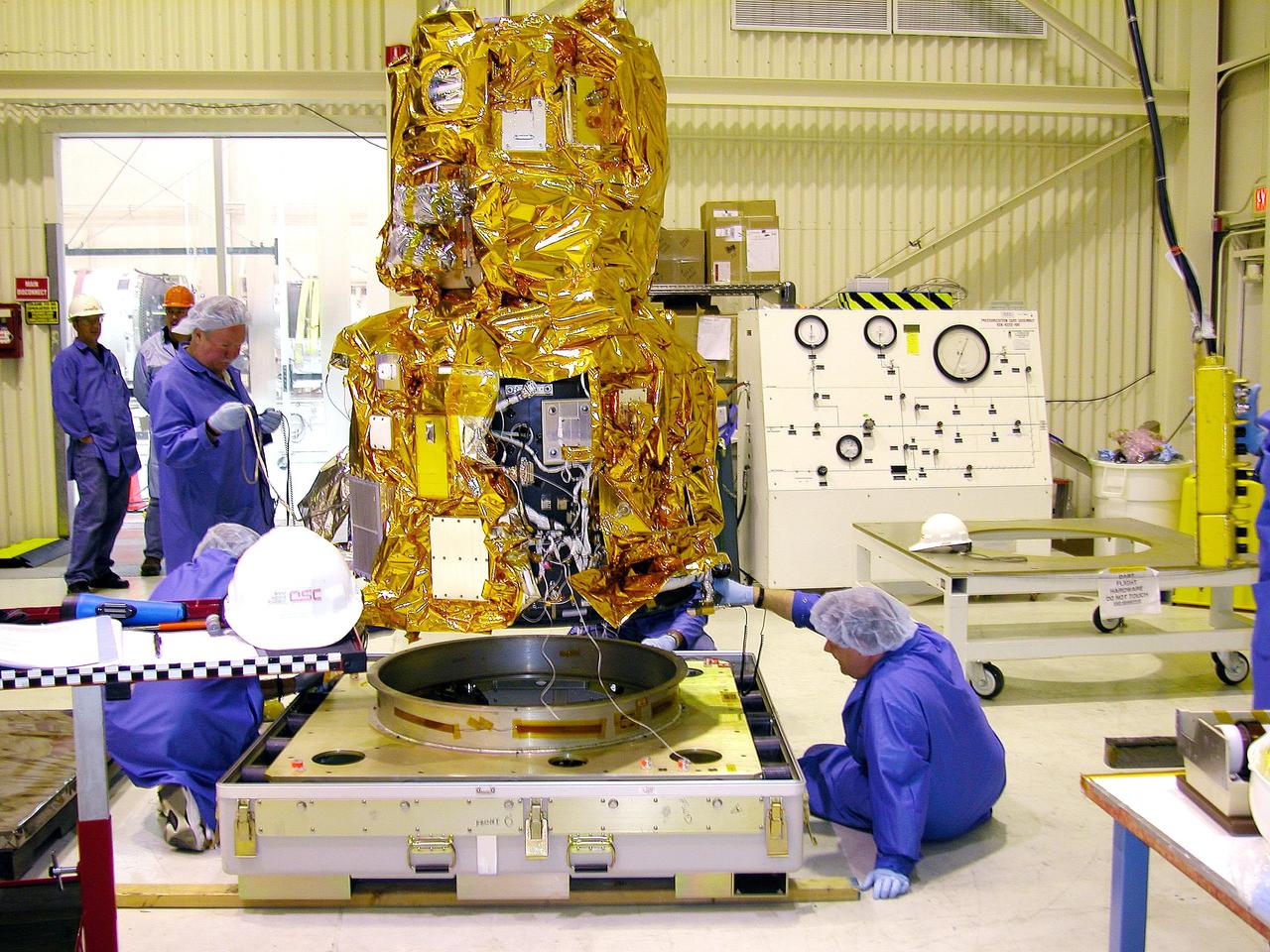
KENNEDY SPACE CENTER, FLA. - At Vandenberg Air Force Base in California, Orbital Sciences technicians check the bottom of the DART (Demonstration for Autonomous Rendezvous Technology) flight demonstrator as it is raised of its platform. The spacecraft was developed to prove technologies for locating and maneuvering near an orbiting satellite. Future applications of technologies developed by the DART project will benefit the nation in future space-vehicle systems development requiring in-space assembly, services or other autonomous rendezvous operations. Designed and developed for NASA by Orbital Sciences Corporation in Dulles, Va., the DART spacecraft will be launched on a Pegasus launch vehicle. At about 40,000 feet over the Pacific Ocean, the Pegasus will be released from Orbital’s Stargazer L-1011 aircraft, fire its rocket motors and boost DART into a polar orbit approximately 472 miles by 479 miles. Once in orbit, DART will rendezvous with a target satellite, the Multiple Paths, Beyond-Line-of-Site Communications satellite, also built by Orbital Sciences. DART will then perform several close proximity operations, such as moving toward and away from the satellite using navigation data provided by onboard sensors. DART is scheduled for launch no earlier than Oct. 18.

KENNEDY SPACE CENTER, FLA. - At Vandenberg Air Force Base in California, Orbital Sciences technicians check the bottom of the DART (Demonstration for Autonomous Rendezvous Technology) flight demonstrator as it is raised off its platform. The spacecraft was developed to prove technologies for locating and maneuvering near an orbiting satellite. Future applications of technologies developed by the DART project will benefit the nation in future space-vehicle systems development requiring in-space assembly, services or other autonomous rendezvous operations. Designed and developed for NASA by Orbital Sciences Corporation in Dulles, Va., the DART spacecraft will be launched on a Pegasus launch vehicle. At about 40,000 feet over the Pacific Ocean, the Pegasus will be released from Orbital’s Stargazer L-1011 aircraft, fire its rocket motors and boost DART into a polar orbit approximately 472 miles by 479 miles. Once in orbit, DART will rendezvous with a target satellite, the Multiple Paths, Beyond-Line-of-Site Communications satellite, also built by Orbital Sciences. DART will then perform several close proximity operations, such as moving toward and away from the satellite using navigation data provided by onboard sensors. DART is scheduled for launch no earlier than Oct. 18.
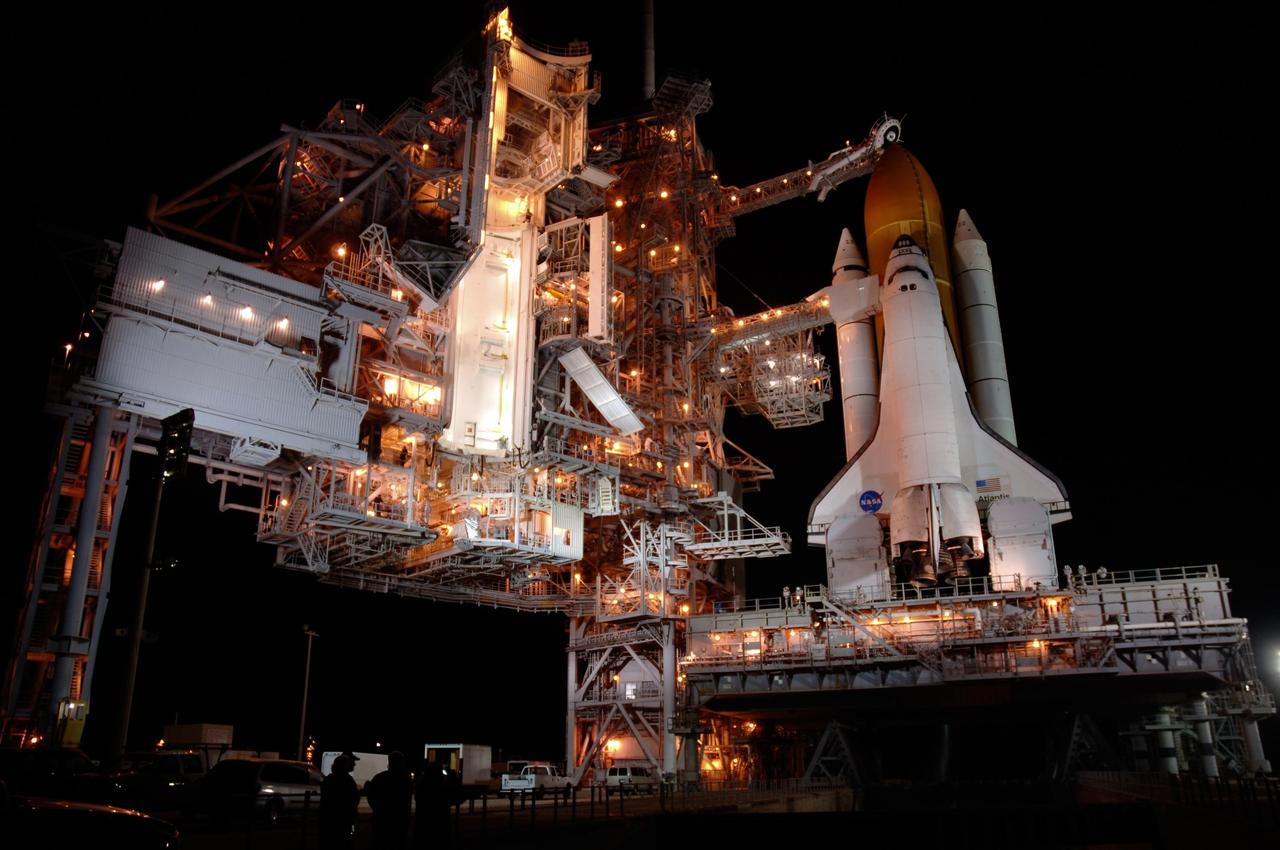
KENNEDY SPACE CENTER, FLA. -- Space shuttle Atlantis is revealed on Launch Pad 39A at NASA's Kennedy Space Center after the rotating service structure, or RSS, at left of the pad was rolled back. Rollback was complete at 9:49 p.m. EST. The RSS provides protected access to the orbiter for crew entry and servicing of payloads at the pad. Beneath the shuttle is the mobile launcher platform which supports the shuttle until liftoff. Rollback of the pad's RSS is one of the milestones in preparation for the launch of mission STS-122. Launch was originally set for Dec. 6 but was rescheduled to 3:21 p.m. Dec. 9. The delay was caused by problems with the external tank's engine cutoff sensor system that arose during tanking on Dec. 6. Atlantis will carry the Columbus Laboratory, the European Space Agency's largest contribution to the construction of the International Space Station. It will support scientific and technological research in a microgravity environment. Permanently attached to the Harmony node of the space station, the laboratory will carry out experiments in materials science, fluid physics and biosciences, as well as perform a number of technological applications. Photo credit: NASA/Amanda Diller
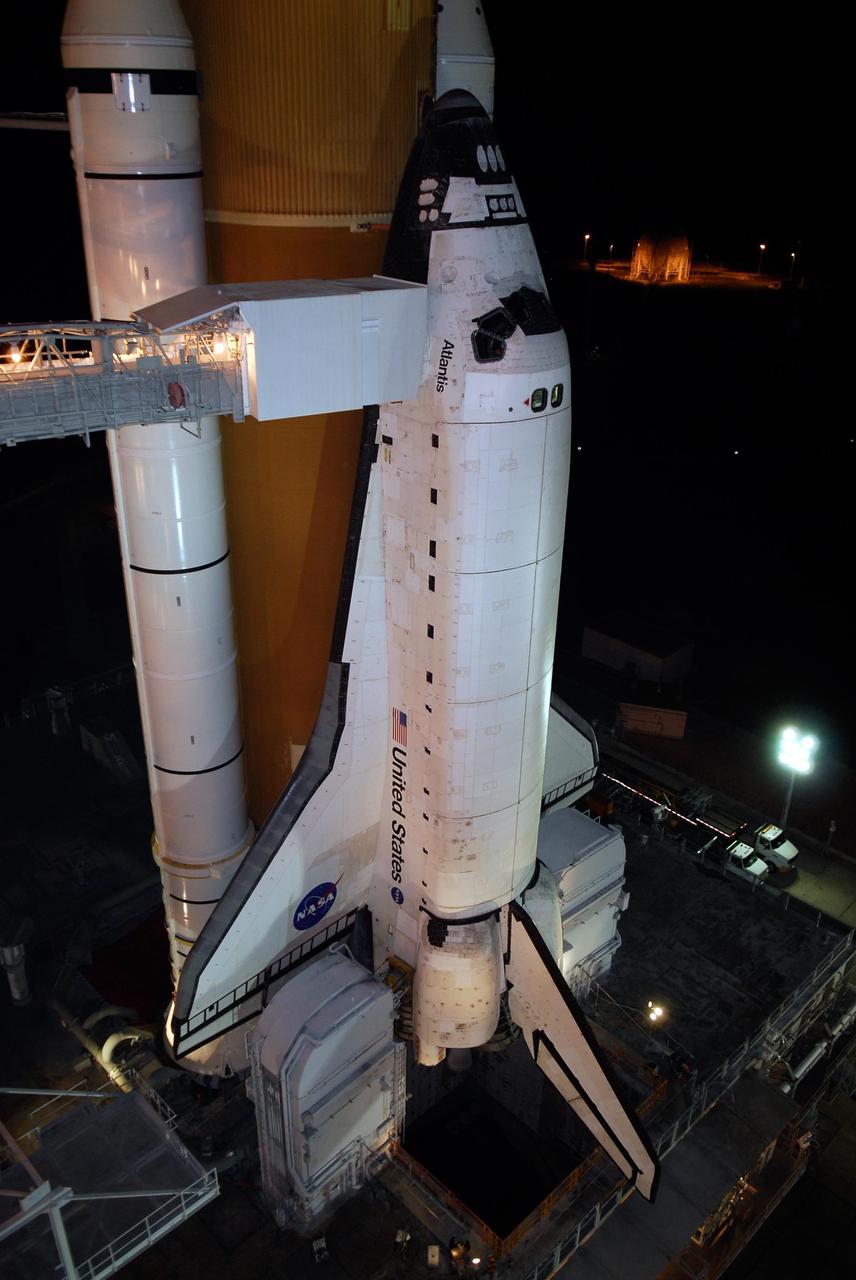
KENNEDY SPACE CENTER, FLA. -- Space shuttle Atlantis is revealed on Launch Pad 39A at NASA's Kennedy Space Center after the rotating service structure, or RSS, is rolled back. Rollback was complete at 8:44 p.m. EST. The White Room at the end of the orbiter access arm, at left, provides the crew with an entryway into the crew compartment. The RSS also provides protected access to the orbiter for changeout and servicing of payloads at the pad. Rollback of the pad's RSS is one of the milestones in preparation for the launch of mission STS-122, scheduled for 4:31 p.m. EST on Dec. 6. Beneath the shuttle is the mobile launcher platform which supports the shuttle until liftoff. Atlantis will carry the Columbus Laboratory, the European Space Agency's largest contribution to the construction of the International Space Station. It will support scientific and technological research in a microgravity environment. Permanently attached to Node 2 of the space station, the laboratory will carry out experiments in materials science, fluid physics and biosciences, as well as perform a number of technological applications. Photo credit: NASA/Kim Shiflett
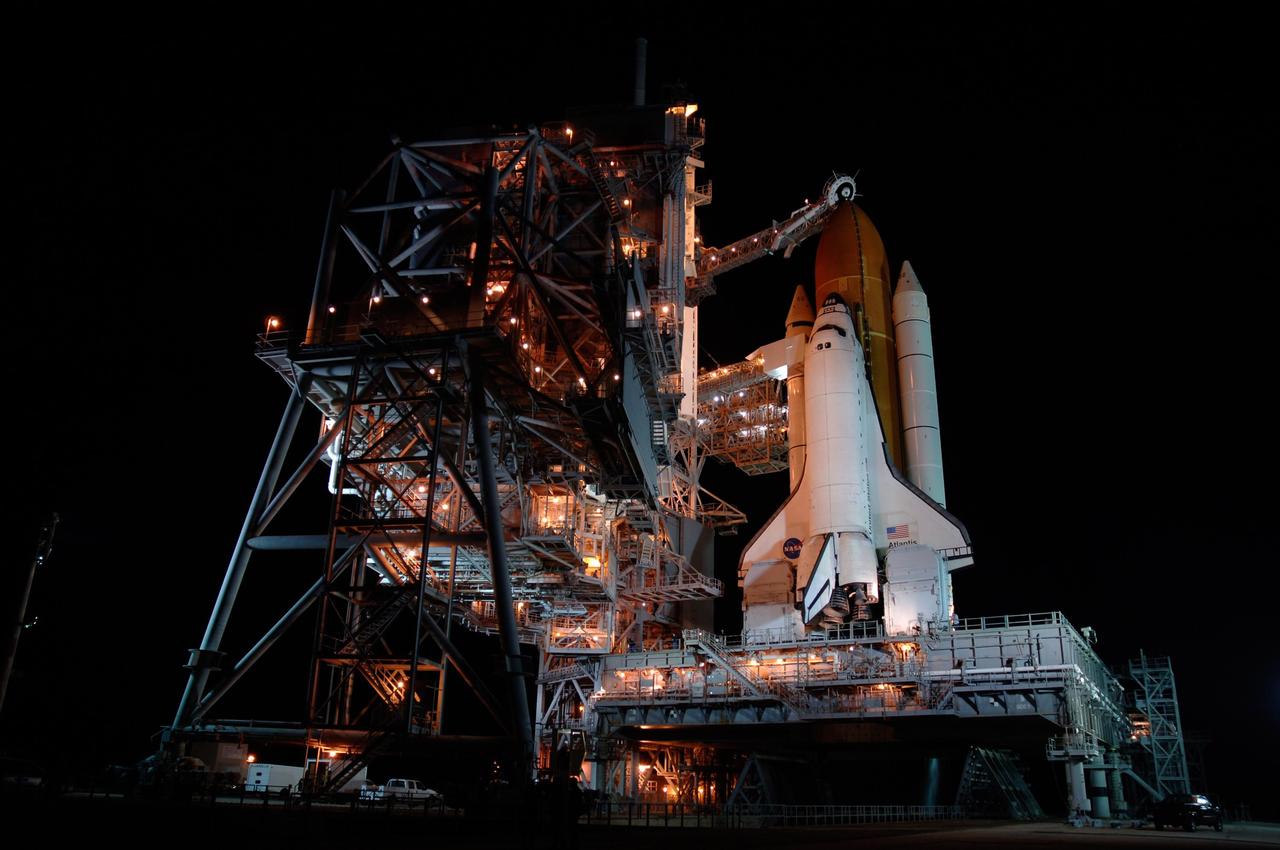
KENNEDY SPACE CENTER, FLA. -- Space shuttle Atlantis is revealed on Launch Pad 39A at NASA's Kennedy Space Center after the rotating service structure, or RSS, at left of the pad was rolled back. Rollback was complete at 9:49 p.m. EST. The RSS provides protected access to the orbiter for crew entry and servicing of payloads at the pad. Beneath the shuttle is the mobile launcher platform which supports the shuttle until liftoff. Rollback of the pad's RSS is one of the milestones in preparation for the launch of mission STS-122. Launch was originally set for Dec. 6 but was rescheduled to 3:21 p.m. Dec. 9. The delay was caused by problems with the external tank's engine cutoff sensor system that arose during tanking on Dec. 6. Atlantis will carry the Columbus Laboratory, the European Space Agency's largest contribution to the construction of the International Space Station. It will support scientific and technological research in a microgravity environment. Permanently attached to the Harmony node of the space station, the laboratory will carry out experiments in materials science, fluid physics and biosciences, as well as perform a number of technological applications. Photo credit: NASA/Amanda Diller
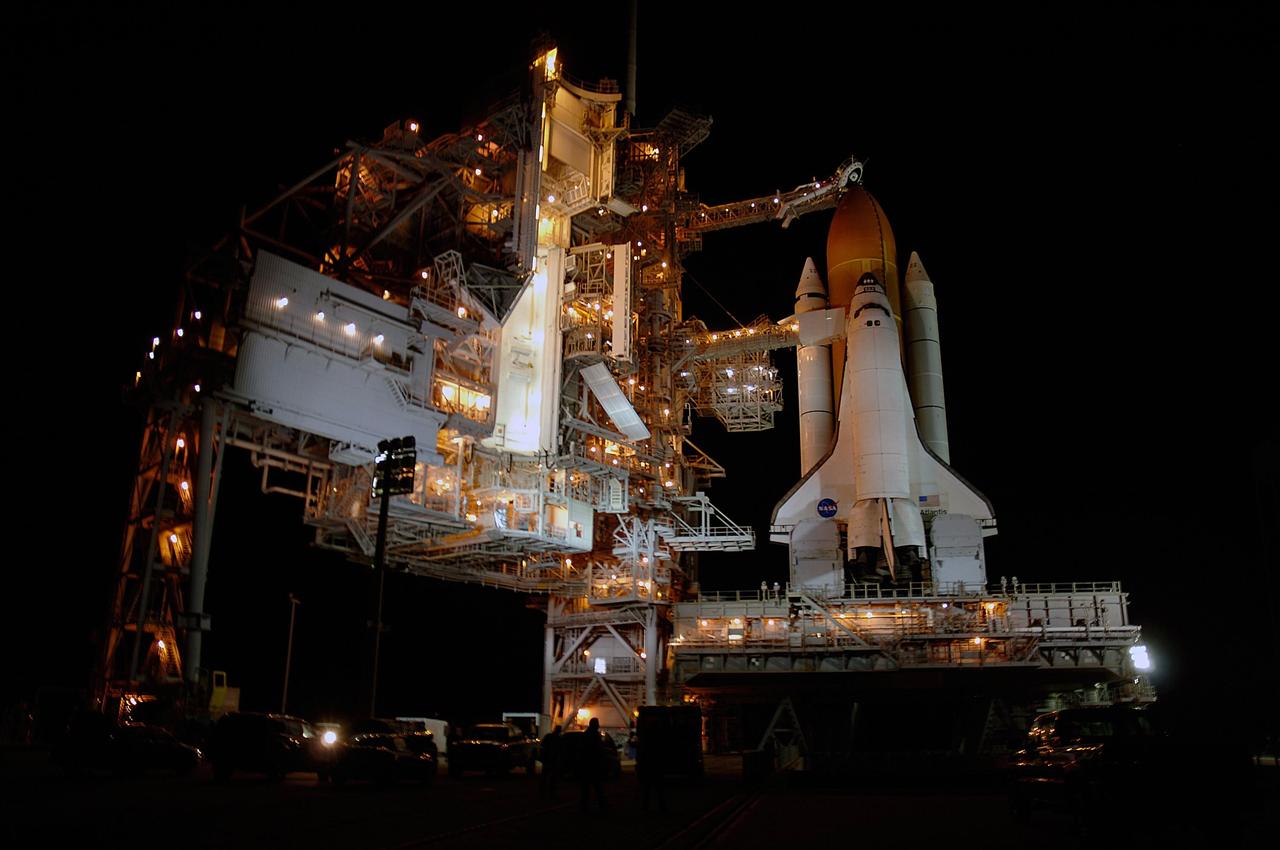
KENNEDY SPACE CENTER, FLA. -- Space shuttle Atlantis is revealed on Launch Pad 39A at NASA's Kennedy Space Center after the rotating service structure, or RSS, at left of the pad was rolled back. Rollback was complete at 9:49 p.m. EST. The RSS provides protected access to the orbiter for crew entry and servicing of payloads at the pad. Beneath the shuttle is the mobile launcher platform which supports the shuttle until liftoff. Rollback of the pad's RSS is one of the milestones in preparation for the launch of mission STS-122. Launch was originally set for Dec. 6 but was rescheduled to 3:21 p.m. Dec. 9. The delay was caused by problems with the external tank's engine cutoff sensor system that arose during tanking on Dec. 6. Atlantis will carry the Columbus Laboratory, the European Space Agency's largest contribution to the construction of the International Space Station. It will support scientific and technological research in a microgravity environment. Permanently attached to the Harmony node of the space station, the laboratory will carry out experiments in materials science, fluid physics and biosciences, as well as perform a number of technological applications. Photo credit: NASA/Amanda Diller
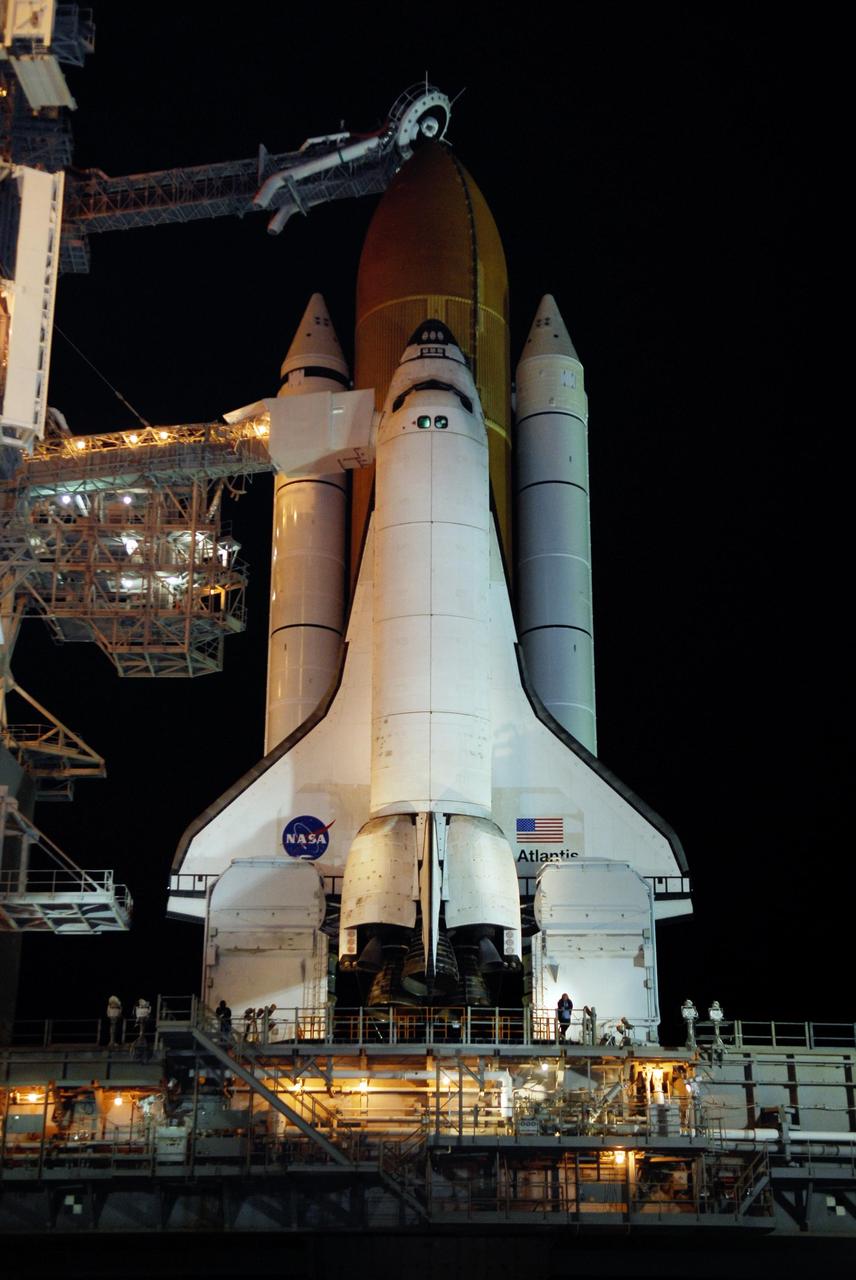
KENNEDY SPACE CENTER, FLA. -- Lights on Launch Pad 39A at NASA's Kennedy Space Center reveal space shuttle Atlantis following the rollback of the rotating service structure, or RSS. Rollback was complete at 8:44 p.m. EST. The orbiter access arm, at left, extends from the structure to a position next to Atlantis' crew compartment. The White Room at the end of the arm provides the crew with an entryway into the orbiter. The RSS also provides protected access to the orbiter for changeout and servicing of payloads at the pad. Rollback of the pad's RSS is one of the milestones in preparation for the launch of mission STS-122, scheduled for 4:31 p.m. EST on Dec. 6. Beneath the shuttle is the mobile launcher platform which supports the shuttle until liftoff. Atlantis will carry the Columbus Laboratory, the European Space Agency's largest contribution to the construction of the International Space Station. It will support scientific and technological research in a microgravity environment. Permanently attached to Node 2 of the space station, the laboratory will carry out experiments in materials science, fluid physics and biosciences, as well as perform a number of technological applications. Photo credit: NASA/Kim Shiflett
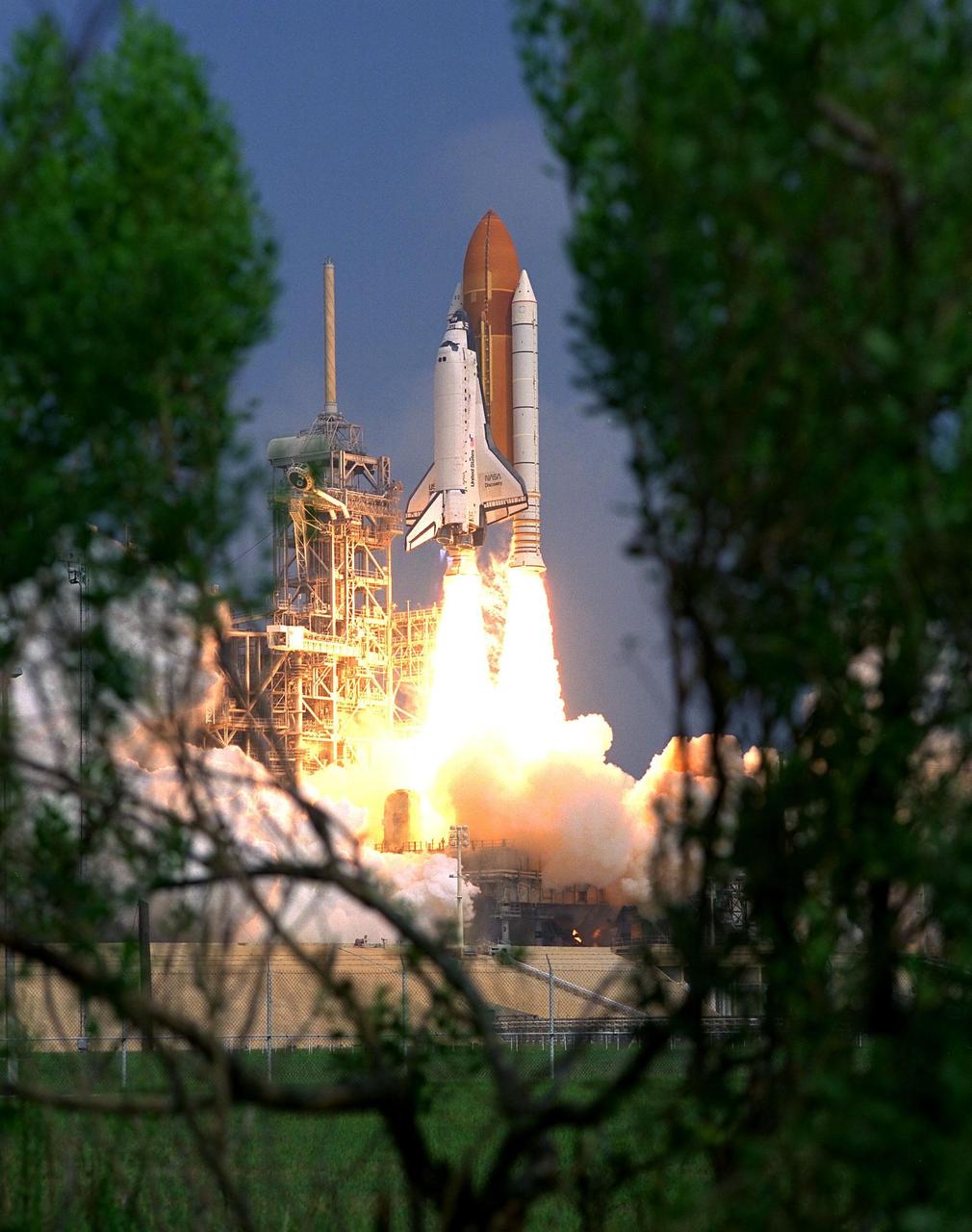
KENNEDY SPACE CENTER, Fla. -- Blasting through the hazy late morning sky, the Space Shuttle Discovery soars from Launch Pad 39A at 10:41 a.m. EDT Aug. 7 on the 11-day STS-85 mission. Aboard Discovery are Commander Curtis L. Brown, Jr.; Pilot Kent V. Rominger, Payload Commander N. Jan Davis, Mission Specialist Robert L. Curbeam, Jr., Mission Specialist Stephen K. Robinson and Payload Specialist Bjarni V. Tryggvason, a Canadian Space Agency astronaut . The primary payload aboard the Space Shuttle orbiter Discovery is the Cryogenic Infrared Spectrometers and Telescopes for the Atmosphere-Shuttle Pallet Satellite-2 (CRISTA-SPAS-2) free-flyer. The CRISTA-SPAS-2 will be deployed on flight day 1 to study trace gases in the Earth’s atmosphere as a part of NASA’s Mission to Planet Earth program. Also aboard the free-flying research platform will be the Middle Atmosphere High Resolution Spectrograph Instrument (MAHRSI). Other payloads on the 11-day mission include the Manipulator Flight Demonstration (MFD), a Japanese Space Agency-sponsored experiment. Also in Discovery’s payload bay are the Technology Applications and Science-1 (TAS-1) and International Extreme Ultraviolet Hitchhiker-2 (IEH-2) experiments
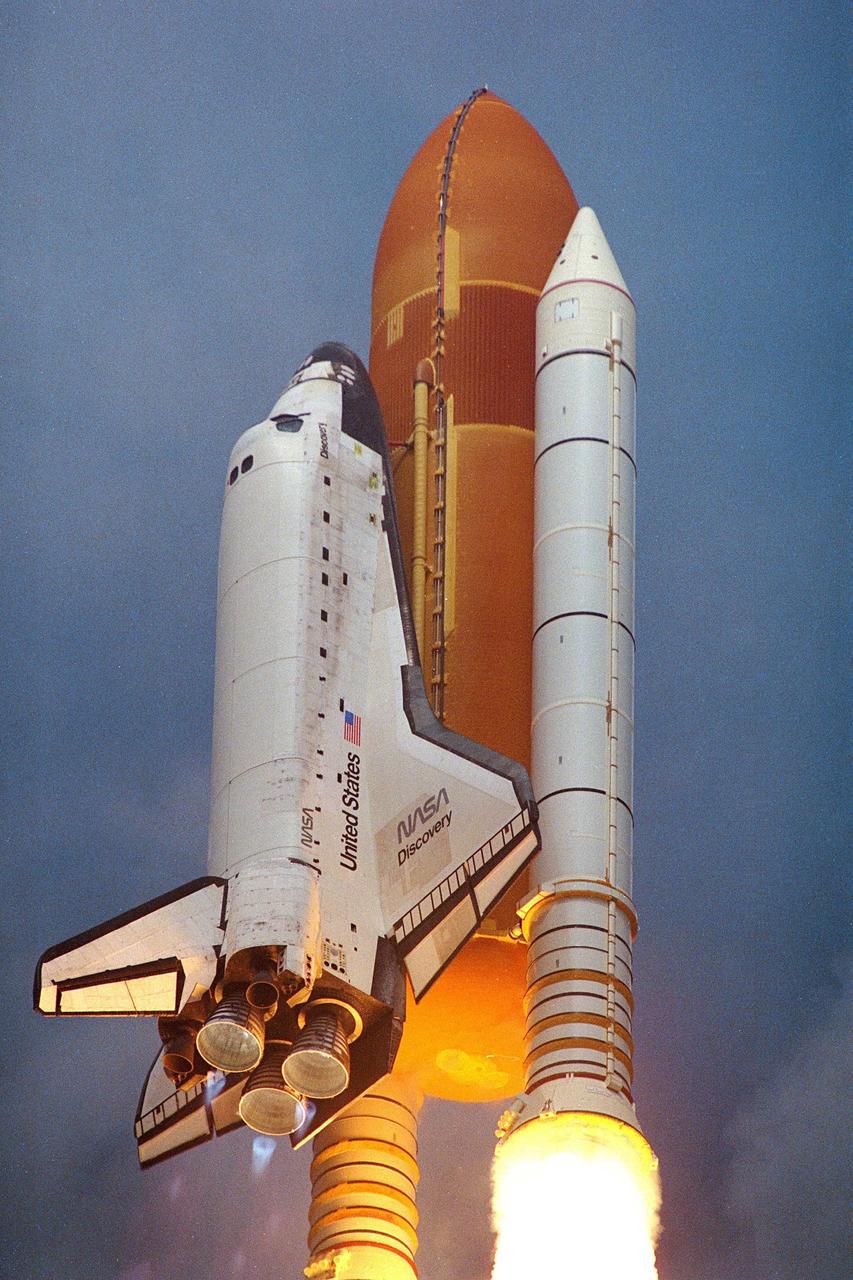
KENNEDY SPACE CENTER, Fla. -- Blasting through the hazy late morning sky, the Space Shuttle Discovery soars from Launch Pad 39A at 10:41 a.m. EDT Aug. 7 on the 11-day STS-85 mission. Aboard Discovery are Commander Curtis L. Brown, Jr.; Pilot Kent V. Rominger, Payload Commander N. Jan Davis, Mission Specialist Robert L. Curbeam, Jr., Mission Specialist Stephen K. Robinson and Payload Specialist Bjarni V. Tryggvason, a Canadian Space Agency astronaut . The primary payload aboard the Space Shuttle orbiter Discovery is the Cryogenic Infrared Spectrometers and Telescopes for the Atmosphere-Shuttle Pallet Satellite-2 (CRISTA-SPAS-2) free-flyer. The CRISTA-SPAS-2 will be deployed on flight day 1 to study trace gases in the Earth’s atmosphere as a part of NASA’s Mission to Planet Earth program. Also aboard the free-flying research platform will be the Middle Atmosphere High Resolution Spectrograph Instrument (MAHRSI). Other payloads on the 11-day mission include the Manipulator Flight Demonstration (MFD), a Japanese Space Agency-sponsored experiment. Also in Discovery’s payload bay are the Technology Applications and Science-1 (TAS-1) and International Extreme Ultraviolet Hitchhiker-2 (IEH-2) experiments
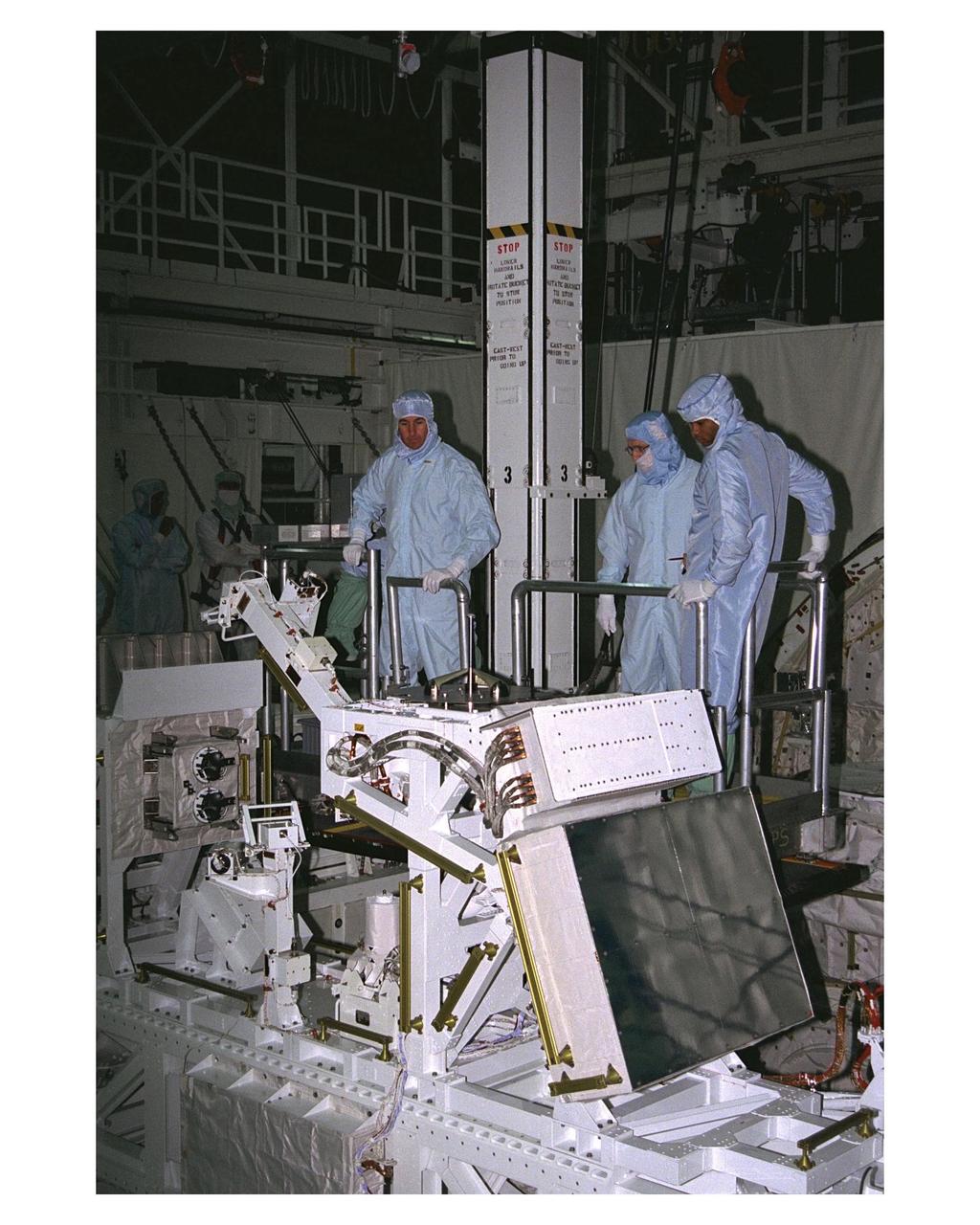
KENNEDY SPACE CENTER, FLA. -- Members of the STS-85 flight crew examine the Manipulator Flight Demonstraton (MFD) payload in the payload bay of the Space Shuttle Orbiter Discovery during Crew Equipment Interface Test (CEIT) activities for that mission. They are (left) Mission Specialists Stephen K. Robinson and Robert L. Curbeam Jr. (right). They are accompanied by a United Space Alliance (USA) payload technician. The MFD is one of several payloads that will fly on the STS-85 mission. This payload is designed to test the operational capability of the Japanese Experiment Module Remote Manipulator System (JEM RMS) Small Fine Arm (SFA), which can be seen atop its Multi-Purpose Experiment Support Structure (MPES) carrier that will serve as a platform in the payload bay for the robotic arm experiment. The arm, which will be a part of the JEM element of the Interntional Space Station, will be operated from the orbiter's aft flight deck during the 11-day mission. Other payloads that will be aboard Discovery on this space flight include the Cryogenic Infrared Spectrometers and Telescopes for the Atmosphere-Shuttle Pallet Satellite-2 (CRISTA-SPAS-2) Technology Applications and Science-1 (TAS-1) and International Extreme Ultraviolet Hitchhhiker (IEH-2) experiments.
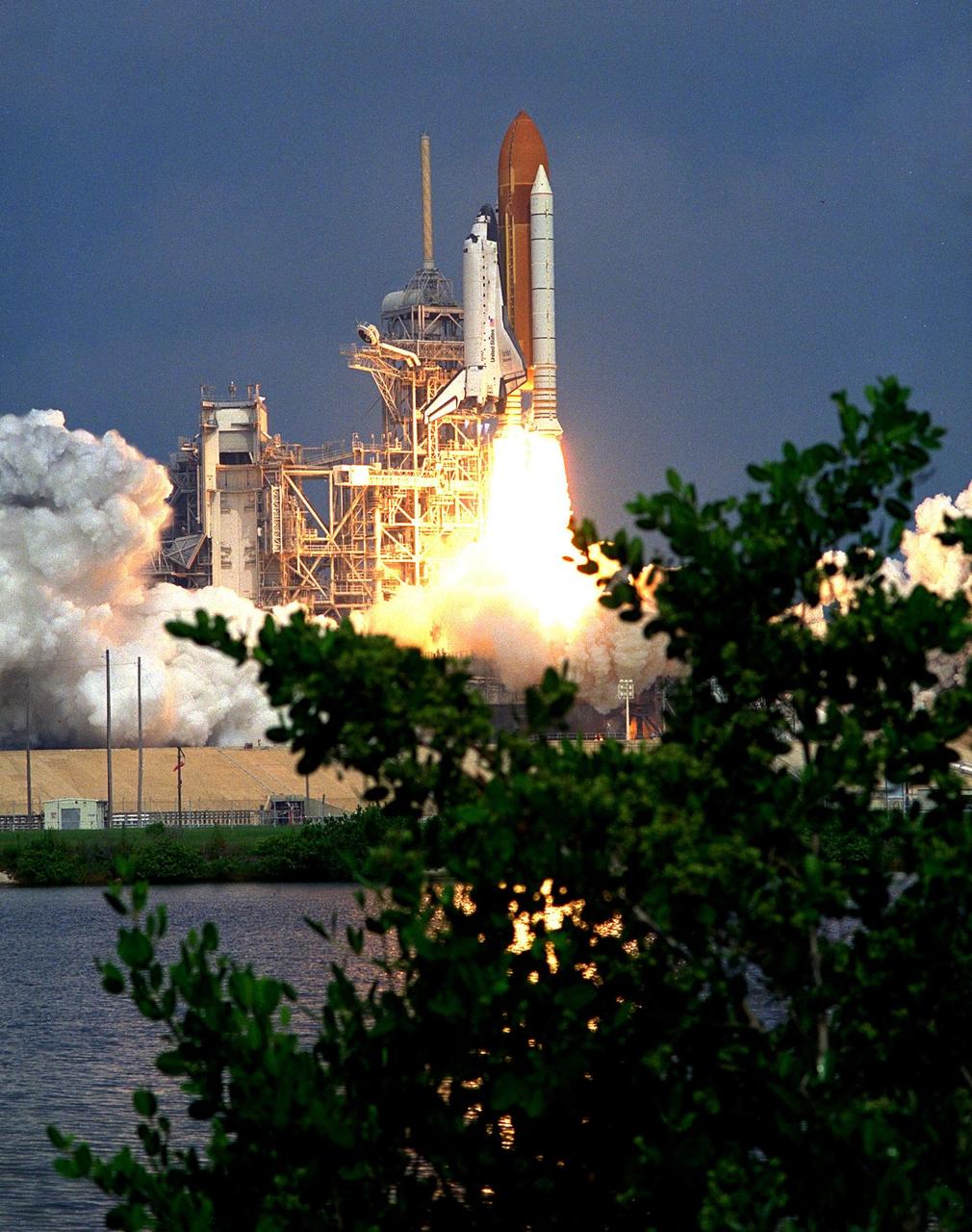
KENNEDY SPACE CENTER, Fla. -- Blasting through the hazy late morning sky, the Space Shuttle Discovery soars from Launch Pad 39A at 10:41 a.m. EDT Aug. 7 on the 11-day STS-85 mission. Aboard Discovery are Commander Curtis L. Brown, Jr.; Pilot Kent V. Rominger, Payload Commander N. Jan Davis, Mission Specialist Robert L. Curbeam, Jr., Mission Specialist Stephen K. Robinson and Payload Specialist Bjarni V. Tryggvason, a Canadian Space Agency astronaut . The primary payload aboard the Space Shuttle orbiter Discovery is the Cryogenic Infrared Spectrometers and Telescopes for the Atmosphere-Shuttle Pallet Satellite-2 (CRISTA-SPAS-2) free-flyer. The CRISTA-SPAS-2 will be deployed on flight day 1 to study trace gases in the Earth’s atmosphere as a part of NASA’s Mission to Planet Earth program. Also aboard the free-flying research platform will be the Middle Atmosphere High Resolution Spectrograph Instrument (MAHRSI). Other payloads on the 11-day mission include the Manipulator Flight Demonstration (MFD), a Japanese Space Agency-sponsored experiment. Also in Discovery’s payload bay are the Technology Applications and Science-1 (TAS-1) and International Extreme Ultraviolet Hitchhiker-2 (IEH-2) experiments
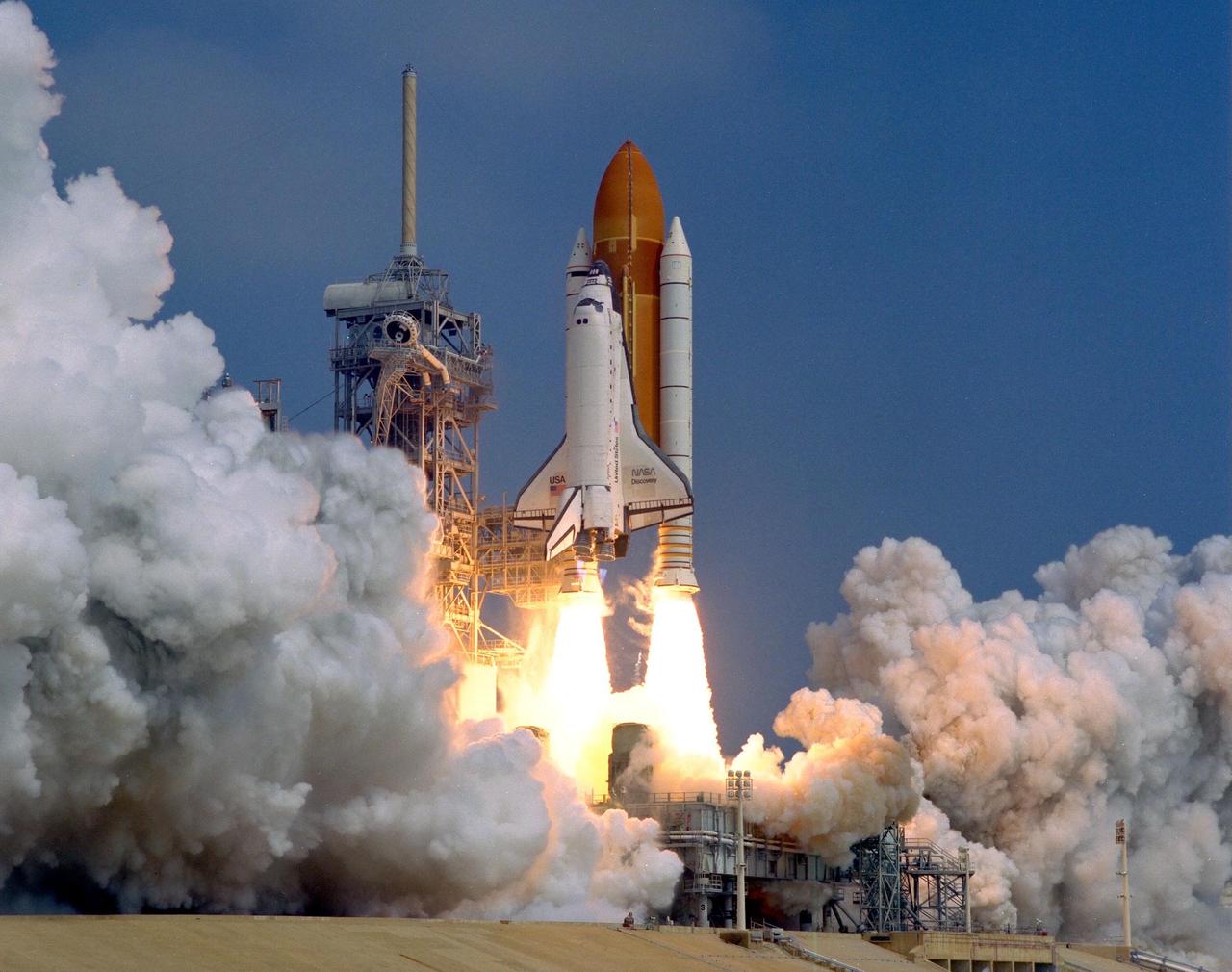
KENNEDY SPACE CENTER, Fla. -- Blasting through the hazy late morning sky, the Space Shuttle Discovery soars from Launch Pad 39A at 10:41 a.m. EDT Aug. 7 on the 11-day STS-85 mission. Aboard Discovery are Commander Curtis L. Brown, Jr.; Pilot Kent V. Rominger, Payload Commander N. Jan Davis, Mission Specialist Robert L. Curbeam, Jr., Mission Specialist Stephen K. Robinson and Payload Specialist Bjarni V. Tryggvason, a Canadian Space Agency astronaut . The primary payload aboard the Space Shuttle orbiter Discovery is the Cryogenic Infrared Spectrometers and Telescopes for the Atmosphere-Shuttle Pallet Satellite-2 (CRISTA-SPAS-2) free-flyer. The CRISTA-SPAS-2 will be deployed on flight day 1 to study trace gases in the Earth’s atmosphere as a part of NASA’s Mission to Planet Earth program. Also aboard the free-flying research platform will be the Middle Atmosphere High Resolution Spectrograph Instrument (MAHRSI). Other payloads on the 11-day mission include the Manipulator Flight Demonstration (MFD), a Japanese Space Agency-sponsored experiment. Also in Discovery’s payload bay are the Technology Applications and Science-1 (TAS-1) and International Extreme Ultraviolet Hitchhiker-2 (IEH-2) experiments
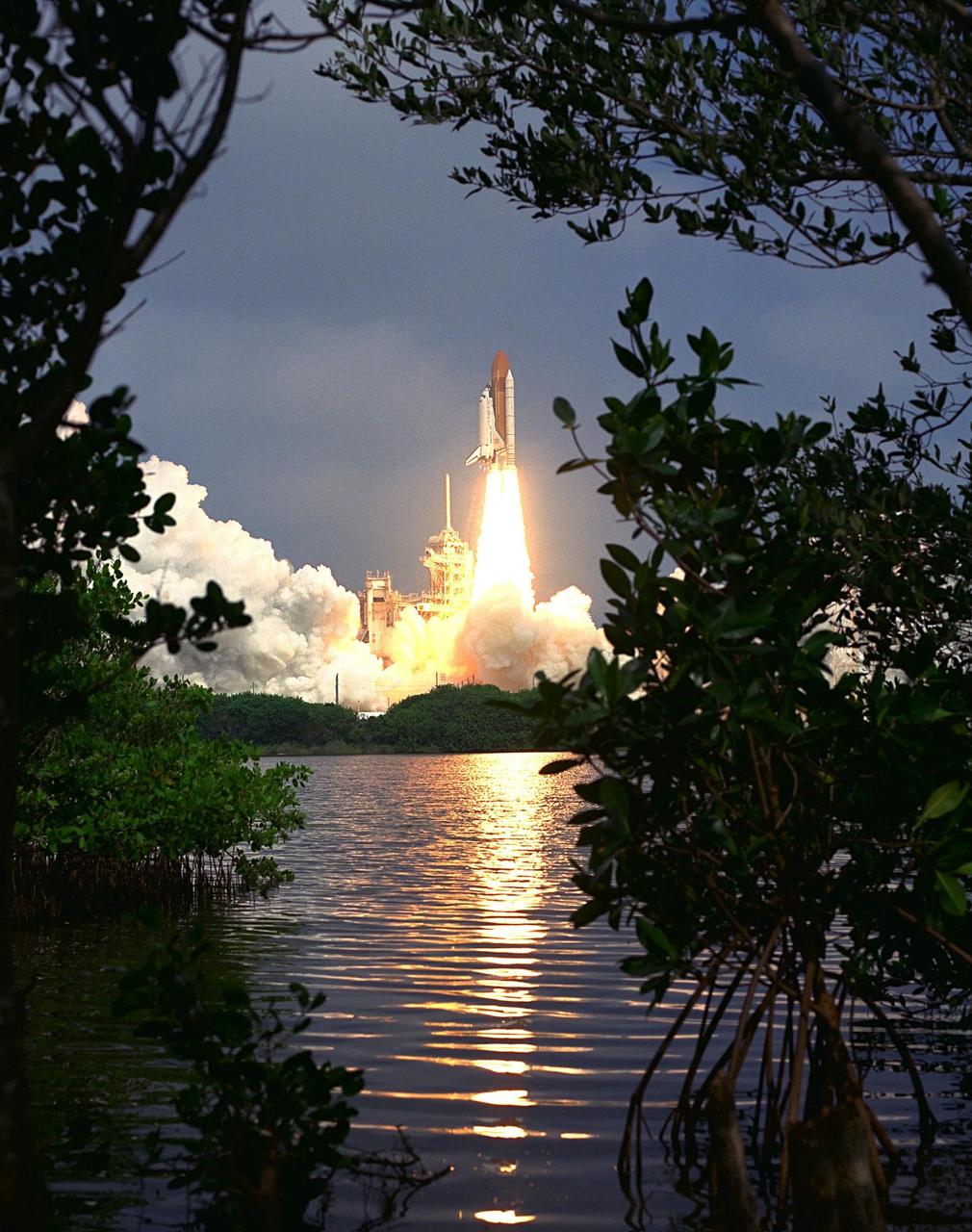
KENNEDY SPACE CENTER, Fla. -- Blasting through the hazy late morning sky, the Space Shuttle Discovery soars from Launch Pad 39A at 10:41 a.m. EDT Aug. 7 on the 11-day STS-85 mission. Aboard Discovery are Commander Curtis L. Brown, Jr.; Pilot Kent V. Rominger, Payload Commander N. Jan Davis, Mission Specialist Robert L. Curbeam, Jr., Mission Specialist Stephen K. Robinson and Payload Specialist Bjarni V. Tryggvason, a Canadian Space Agency astronaut . The primary payload aboard the Space Shuttle orbiter Discovery is the Cryogenic Infrared Spectrometers and Telescopes for the Atmosphere-Shuttle Pallet Satellite-2 (CRISTA-SPAS-2) free-flyer. The CRISTA-SPAS-2 will be deployed on flight day 1 to study trace gases in the Earth’s atmosphere as a part of NASA’s Mission to Planet Earth program. Also aboard the free-flying research platform will be the Middle Atmosphere High Resolution Spectrograph Instrument (MAHRSI). Other payloads on the 11-day mission include the Manipulator Flight Demonstration (MFD), a Japanese Space Agency-sponsored experiment. Also in Discovery’s payload bay are the Technology Applications and Science-1 (TAS-1) and International Extreme Ultraviolet Hitchhiker-2 (IEH-2) experiments
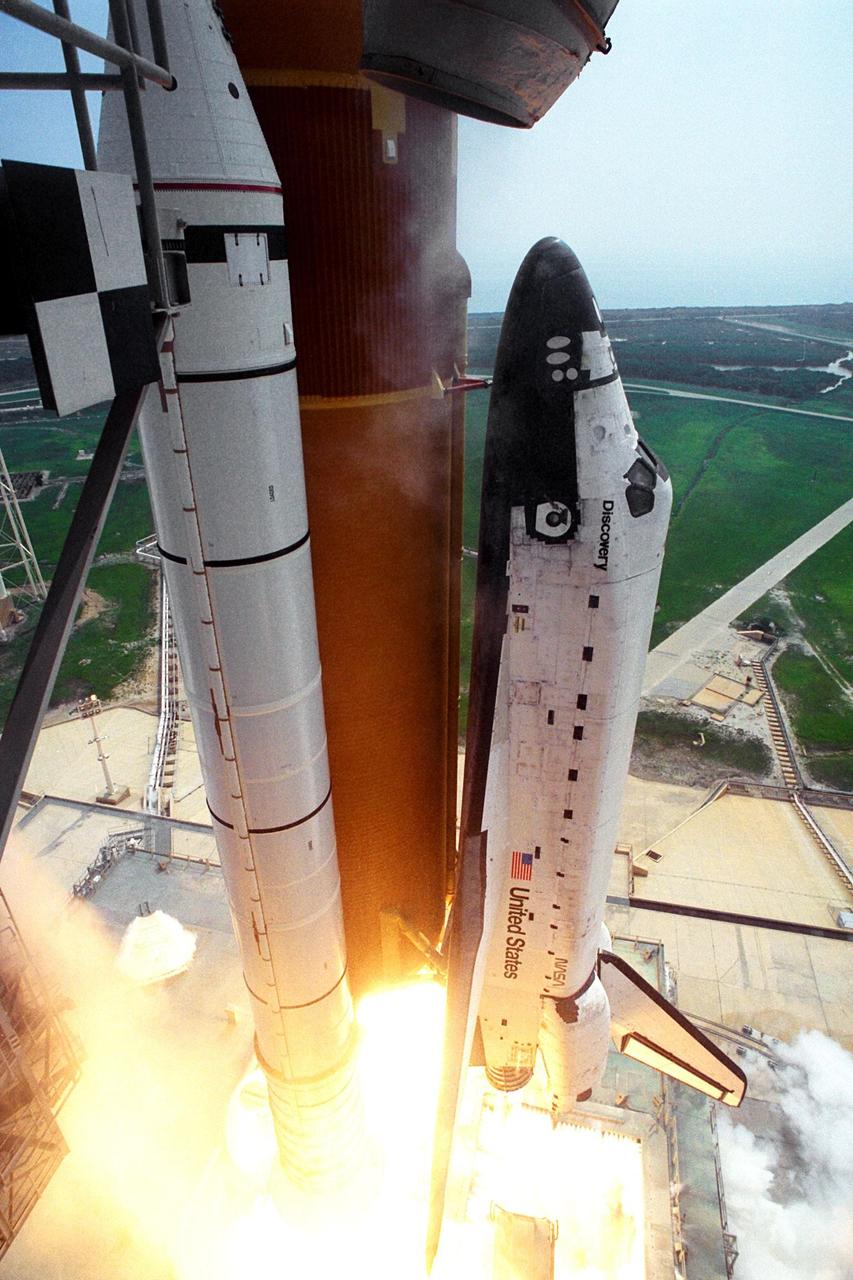
KENNEDY SPACE CENTER, Fla. -- Blasting through the hazy late morning sky, the Space Shuttle Discovery soars from Launch Pad 39A at 10:41 a.m. EDT Aug. 7 on the 11-day STS-85 mission. Aboard Discovery are Commander Curtis L. Brown, Jr.; Pilot Kent V. Rominger, Payload Commander N. Jan Davis, Mission Specialist Robert L. Curbeam, Jr., Mission Specialist Stephen K. Robinson and Payload Specialist Bjarni V. Tryggvason, a Canadian Space Agency astronaut . The primary payload aboard the Space Shuttle orbiter Discovery is the Cryogenic Infrared Spectrometers and Telescopes for the Atmosphere-Shuttle Pallet Satellite-2 (CRISTA-SPAS-2) free-flyer. The CRISTA-SPAS-2 will be deployed on flight day 1 to study trace gases in the Earth’s atmosphere as a part of NASA’s Mission to Planet Earth program. Also aboard the free-flying research platform will be the Middle Atmosphere High Resolution Spectrograph Instrument (MAHRSI). Other payloads on the 11-day mission include the Manipulator Flight Demonstration (MFD), a Japanese Space Agency-sponsored experiment. Also in Discovery’s payload bay are the Technology Applications and Science-1 (TAS-1) and International Extreme Ultraviolet Hitchhiker-2 (IEH-2) experiments
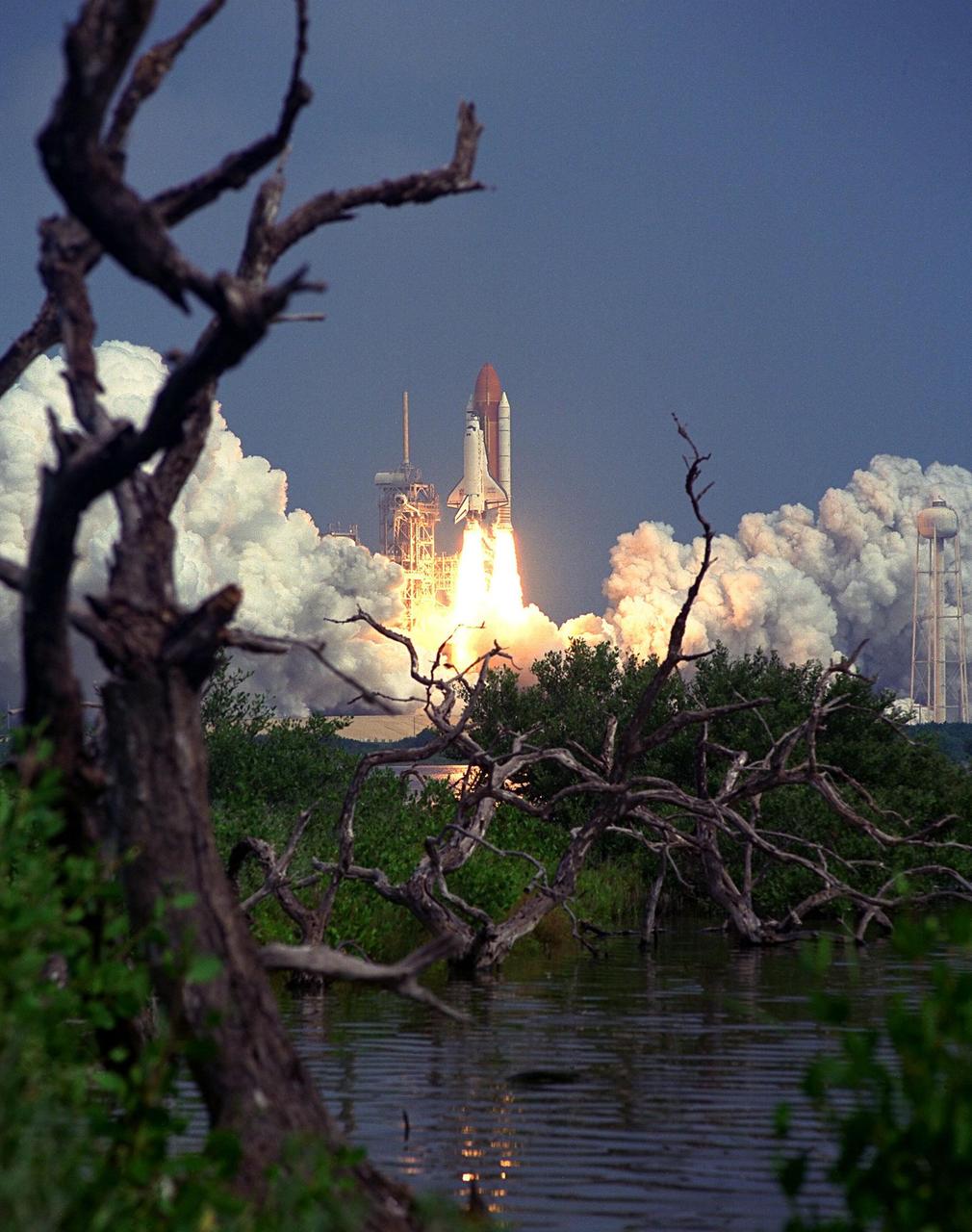
KENNEDY SPACE CENTER, Fla. -- Blasting through the hazy late morning sky, the Space Shuttle Discovery soars from Launch Pad 39A at 10:41 a.m. EDT Aug. 7 on the 11-day STS-85 mission. Aboard Discovery are Commander Curtis L. Brown, Jr.; Pilot Kent V. Rominger, Payload Commander N. Jan Davis, Mission Specialist Robert L. Curbeam, Jr., Mission Specialist Stephen K. Robinson and Payload Specialist Bjarni V. Tryggvason, a Canadian Space Agency astronaut . The primary payload aboard the Space Shuttle orbiter Discovery is the Cryogenic Infrared Spectrometers and Telescopes for the Atmosphere-Shuttle Pallet Satellite-2 (CRISTA-SPAS-2) free-flyer. The CRISTA-SPAS-2 will be deployed on flight day 1 to study trace gases in the Earth’s atmosphere as a part of NASA’s Mission to Planet Earth program. Also aboard the free-flying research platform will be the Middle Atmosphere High Resolution Spectrograph Instrument (MAHRSI). Other payloads on the 11-day mission include the Manipulator Flight Demonstration (MFD), a Japanese Space Agency-sponsored experiment. Also in Discovery’s payload bay are the Technology Applications and Science-1 (TAS-1) and International Extreme Ultraviolet Hitchhiker-2 (IEH-2) experiments
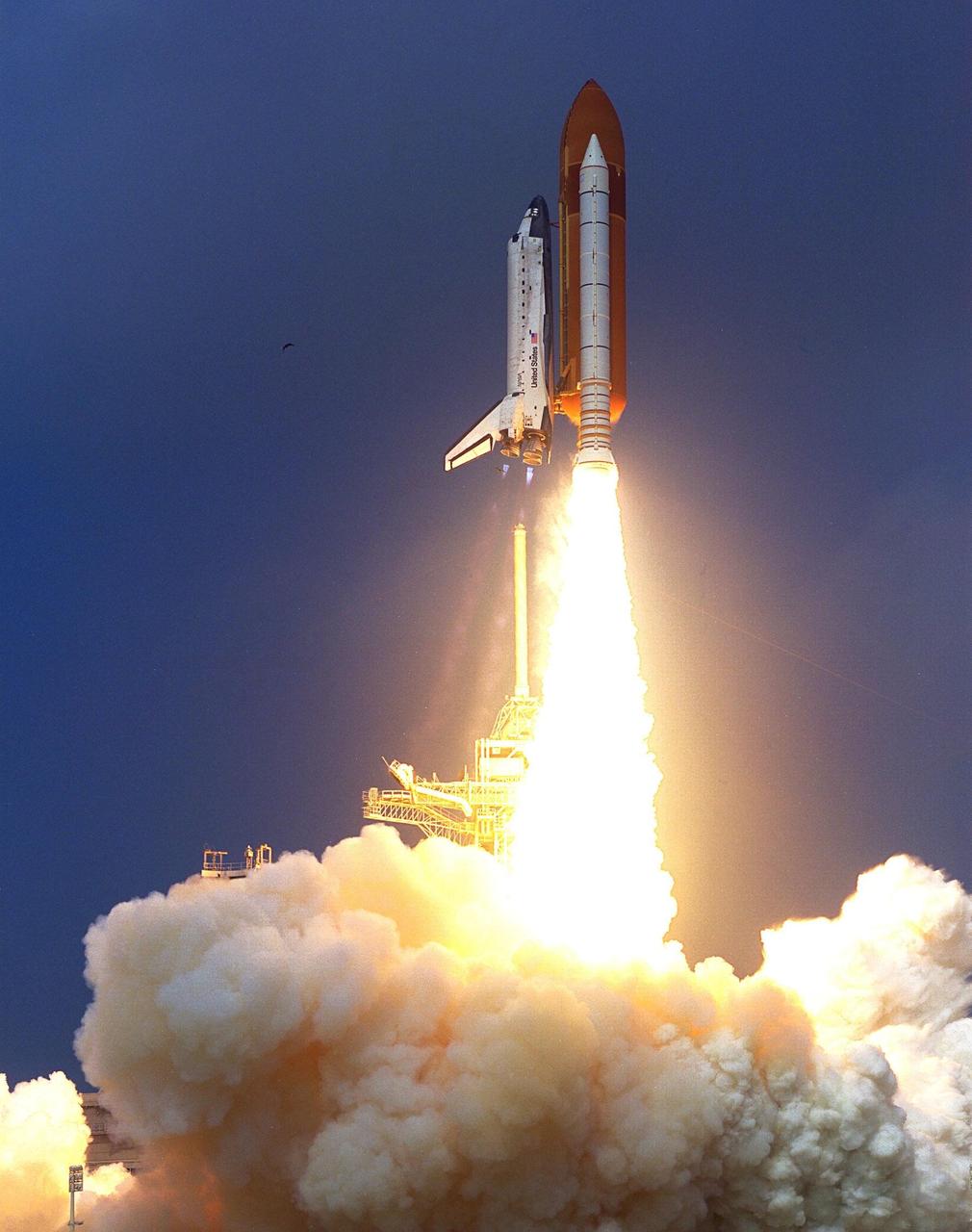
KENNEDY SPACE CENTER, Fla. -- Blasting through the hazy late morning sky, the Space Shuttle Discovery soars from Launch Pad 39A at 10:41 a.m. EDT Aug. 7 on the 11-day STS-85 mission. Aboard Discovery are Commander Curtis L. Brown, Jr.; Pilot Kent V. Rominger, Payload Commander N. Jan Davis, Mission Specialist Robert L. Curbeam, Jr., Mission Specialist Stephen K. Robinson and Payload Specialist Bjarni V. Tryggvason, a Canadian Space Agency astronaut . The primary payload aboard the Space Shuttle orbiter Discovery is the Cryogenic Infrared Spectrometers and Telescopes for the Atmosphere-Shuttle Pallet Satellite-2 (CRISTA-SPAS-2) free-flyer. The CRISTA-SPAS-2 will be deployed on flight day 1 to study trace gases in the Earth’s atmosphere as a part of NASA’s Mission to Planet Earth program. Also aboard the free-flying research platform will be the Middle Atmosphere High Resolution Spectrograph Instrument (MAHRSI). Other payloads on the 11-day mission include the Manipulator Flight Demonstration (MFD), a Japanese Space Agency-sponsored experiment. Also in Discovery’s payload bay are the Technology Applications and Science-1 (TAS-1) and International Extreme Ultraviolet Hitchhiker-2 (IEH-2) experiments
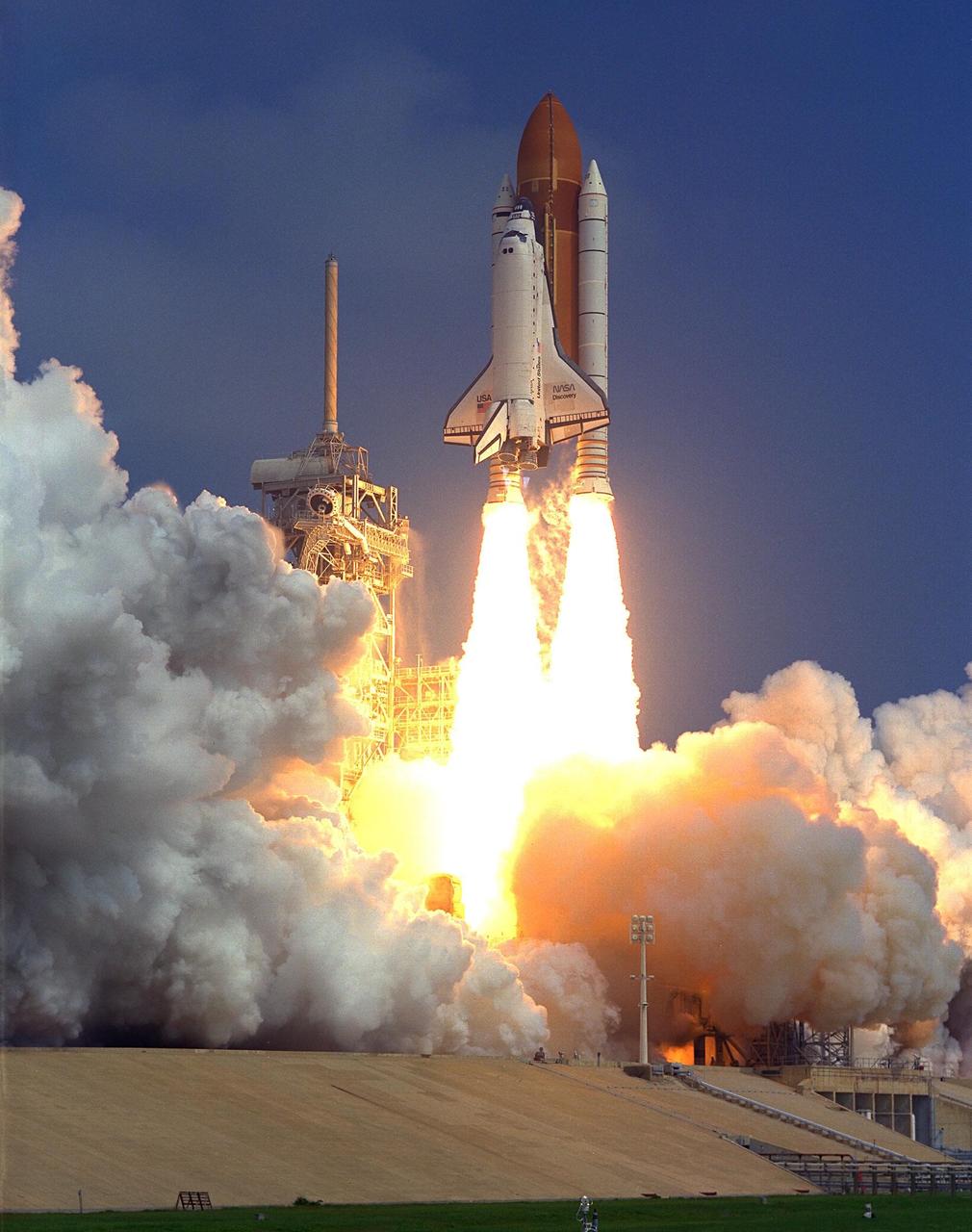
KENNEDY SPACE CENTER, Fla. -- Blasting through the hazy late morning sky, the Space Shuttle Discovery soars from Launch Pad 39A at 10:41 a.m. EDT Aug. 7 on the 11-day STS-85 mission. Aboard Discovery are Commander Curtis L. Brown, Jr.; Pilot Kent V. Rominger, Payload Commander N. Jan Davis, Mission Specialist Robert L. Curbeam, Jr., Mission Specialist Stephen K. Robinson and Payload Specialist Bjarni V. Tryggvason, a Canadian Space Agency astronaut . The primary payload aboard the Space Shuttle orbiter Discovery is the Cryogenic Infrared Spectrometers and Telescopes for the Atmosphere-Shuttle Pallet Satellite-2 (CRISTA-SPAS-2) free-flyer. The CRISTA-SPAS-2 will be deployed on flight day 1 to study trace gases in the Earth’s atmosphere as a part of NASA’s Mission to Planet Earth program. Also aboard the free-flying research platform will be the Middle Atmosphere High Resolution Spectrograph Instrument (MAHRSI). Other payloads on the 11-day mission include the Manipulator Flight Demonstration (MFD), a Japanese Space Agency-sponsored experiment. Also in Discovery’s payload bay are the Technology Applications and Science-1 (TAS-1) and International Extreme Ultraviolet Hitchhiker-2 (IEH-2) experiments
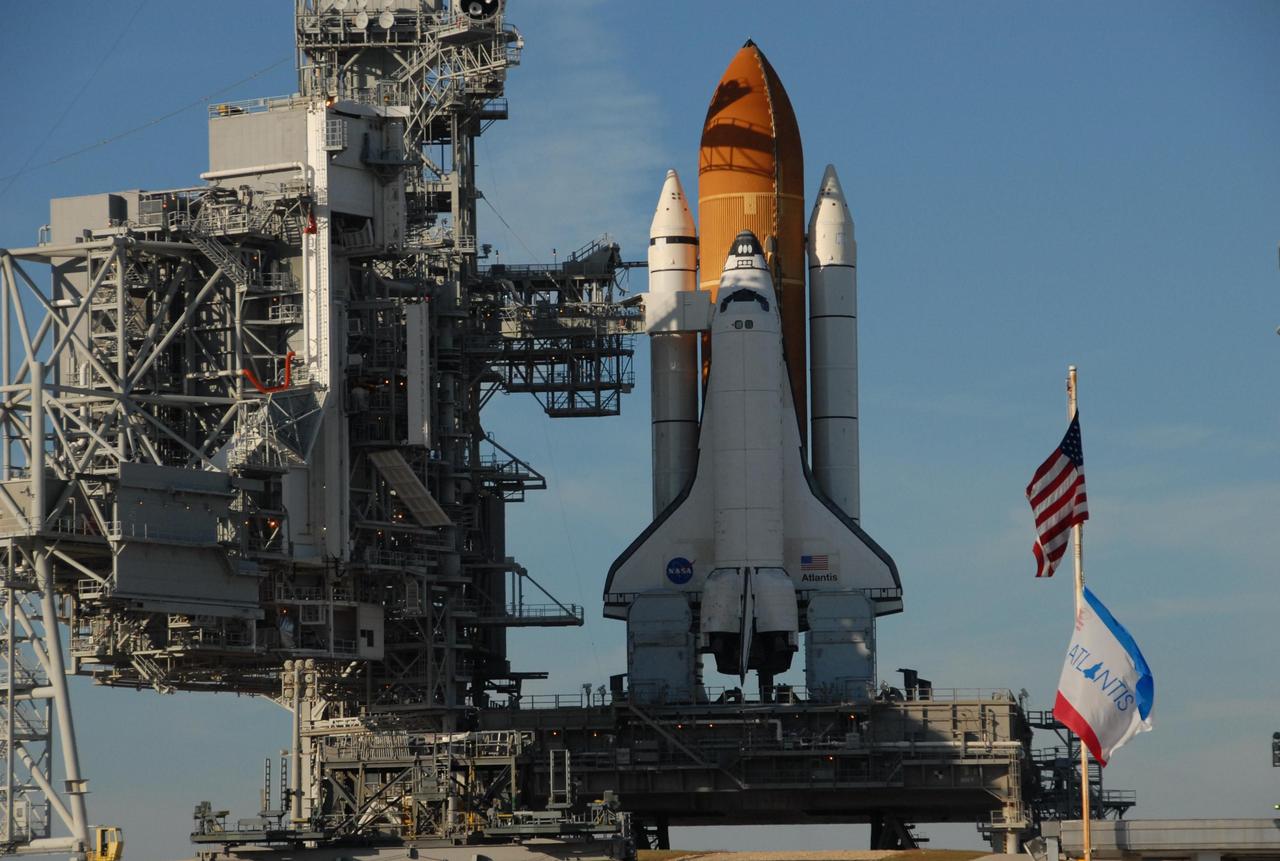
KENNEDY SPACE CENTER, FLA. -- In the late afternoon shadows, space shuttle Atlantis is still poised on the pad after its launch on mission STS-122 was postponed Thursday. It sits atop the mobile launcher platform. Shuttle program managers decided at 9:56 a.m. to postpone the launch because of an issue with a fuel cut-off sensor system inside the external fuel tank. This is one of several systems that protect the shuttle's main engines by triggering their shut down if fuel runs unexpectedly low. During countdown activities this morning, two sensors failed a routine prelaunch check. There are four engine cut-off, or ECO, sensors inside the liquid hydrogen section of the tank, and Launch Commit Criteria require three of the four sensor systems to be functioning properly. The tank's liquid oxygen and liquid hydrogen was drained from the tank, and preparations will begin for a possible launch attempt Friday. NASA's launch rules have a preplanned procedure that states in the case of ECO sensor system failure, engineers need to drain the tank and verify all the sensors are working as they go dry. Atlantis carries the Columbus Laboratory, the European Space Agency's largest contribution to the construction of the space station. When permanently attached to Node 2, the laboratory will carry out experiments in materials science, fluid physics and biosciences, as well as perform a number of technological applications, in a microgravity environment. Photo credit: NASA/George Shelton
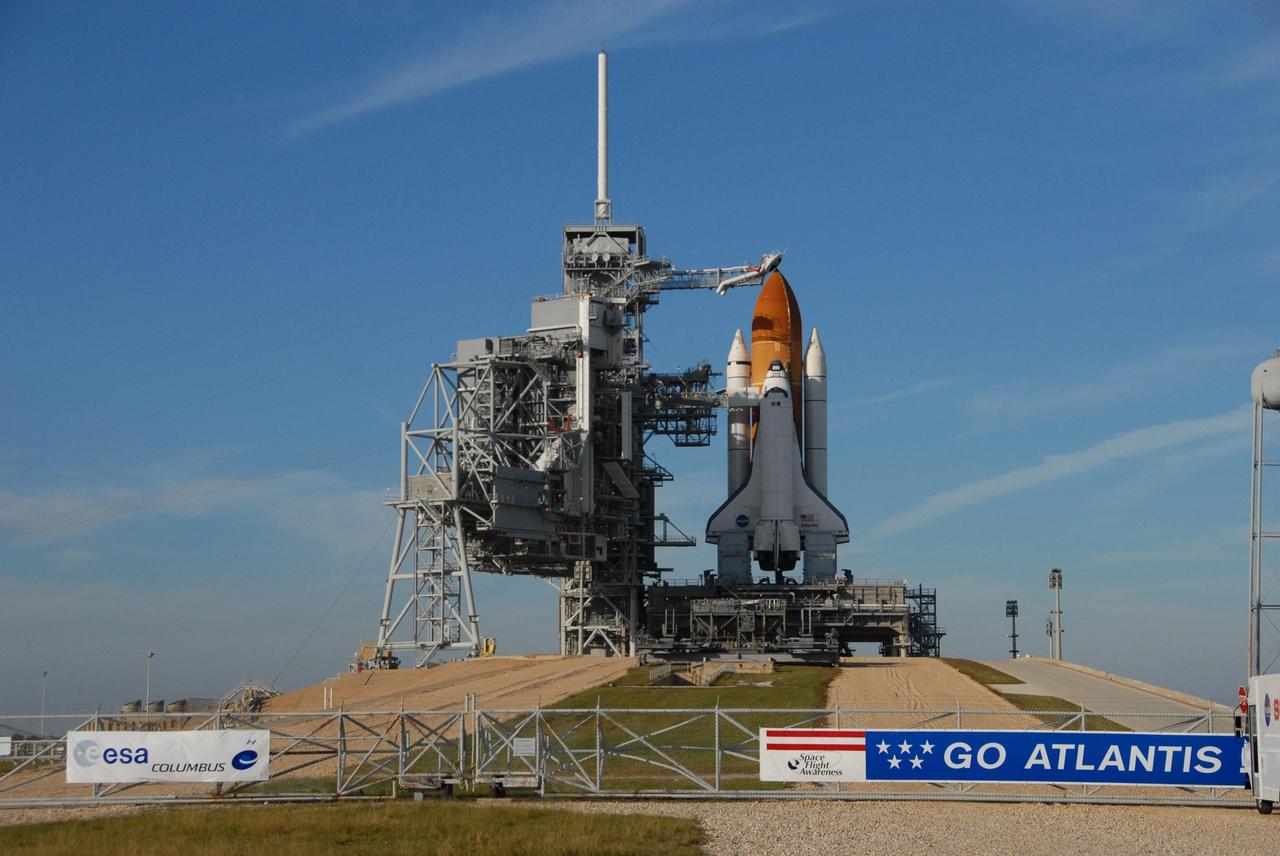
KENNEDY SPACE CENTER, FLA. -- Shadows spill across space shuttle Atlantis, still poised on the pad after its launch on mission STS-122 was postponed Thursday. It sits atop the mobile launcher platform. Shuttle program managers decided at 9:56 a.m. to postpone the launch because of an issue with a fuel cut-off sensor system inside the external fuel tank. This is one of several systems that protect the shuttle's main engines by triggering their shut down if fuel runs unexpectedly low. During countdown activities this morning, two sensors failed a routine prelaunch check. There are four engine cut-off, or ECO, sensors inside the liquid hydrogen section of the tank, and Launch Commit Criteria require three of the four sensor systems to be functioning properly. The tank's liquid oxygen and liquid hydrogen was drained from the tank, and preparations will begin for a possible launch attempt Friday. NASA's launch rules have a preplanned procedure that states in the case of ECO sensor system failure, engineers need to drain the tank and verify all the sensors are working as they go dry. Atlantis carries the Columbus Laboratory, the European Space Agency's largest contribution to the construction of the space station. When permanently attached to Node 2, the laboratory will carry out experiments in materials science, fluid physics and biosciences, as well as perform a number of technological applications, in a microgravity environment. Photo credit: NASA/George Shelton
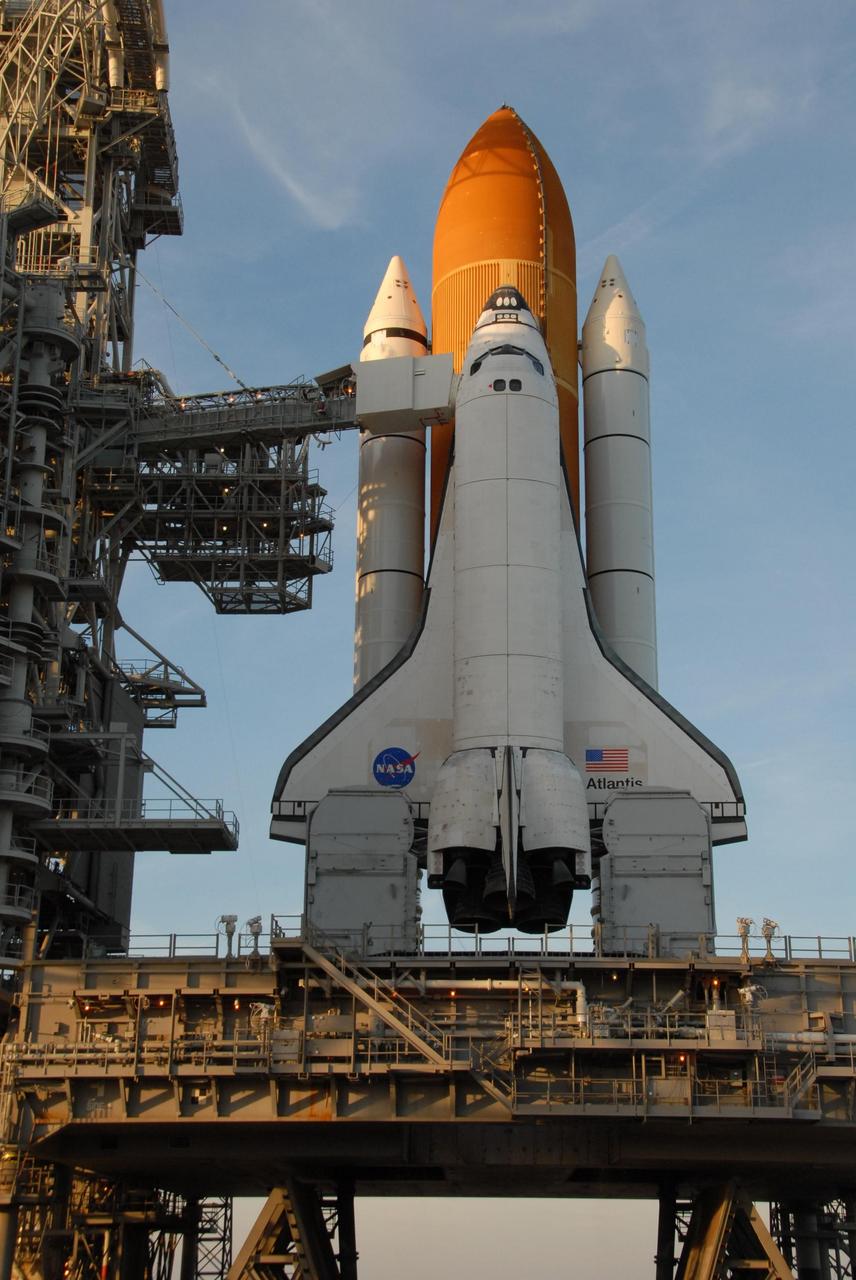
KENNEDY SPACE CENTER, FLA. -- In the late afternoon shadows, space shuttle Atlantis is still poised on the pad after its launch on mission STS-122 was postponed Thursday. It sits atop the mobile launcher platform. Shuttle program managers decided at 9:56 a.m. to postpone the launch because of an issue with a fuel cut-off sensor system inside the external fuel tank. This is one of several systems that protect the shuttle's main engines by triggering their shut down if fuel runs unexpectedly low. During countdown activities this morning, two sensors failed a routine prelaunch check. There are four engine cut-off, or ECO, sensors inside the liquid hydrogen section of the tank, and Launch Commit Criteria require three of the four sensor systems to be functioning properly. The tank's liquid oxygen and liquid hydrogen was drained from the tank, and preparations will begin for a possible launch attempt Friday. NASA's launch rules have a preplanned procedure that states in the case of ECO sensor system failure, engineers need to drain the tank and verify all the sensors are working as they go dry. Atlantis carries the Columbus Laboratory, the European Space Agency's largest contribution to the construction of the space station. When permanently attached to Node 2, the laboratory will carry out experiments in materials science, fluid physics and biosciences, as well as perform a number of technological applications, in a microgravity environment. Photo credit: NASA/George Shelton
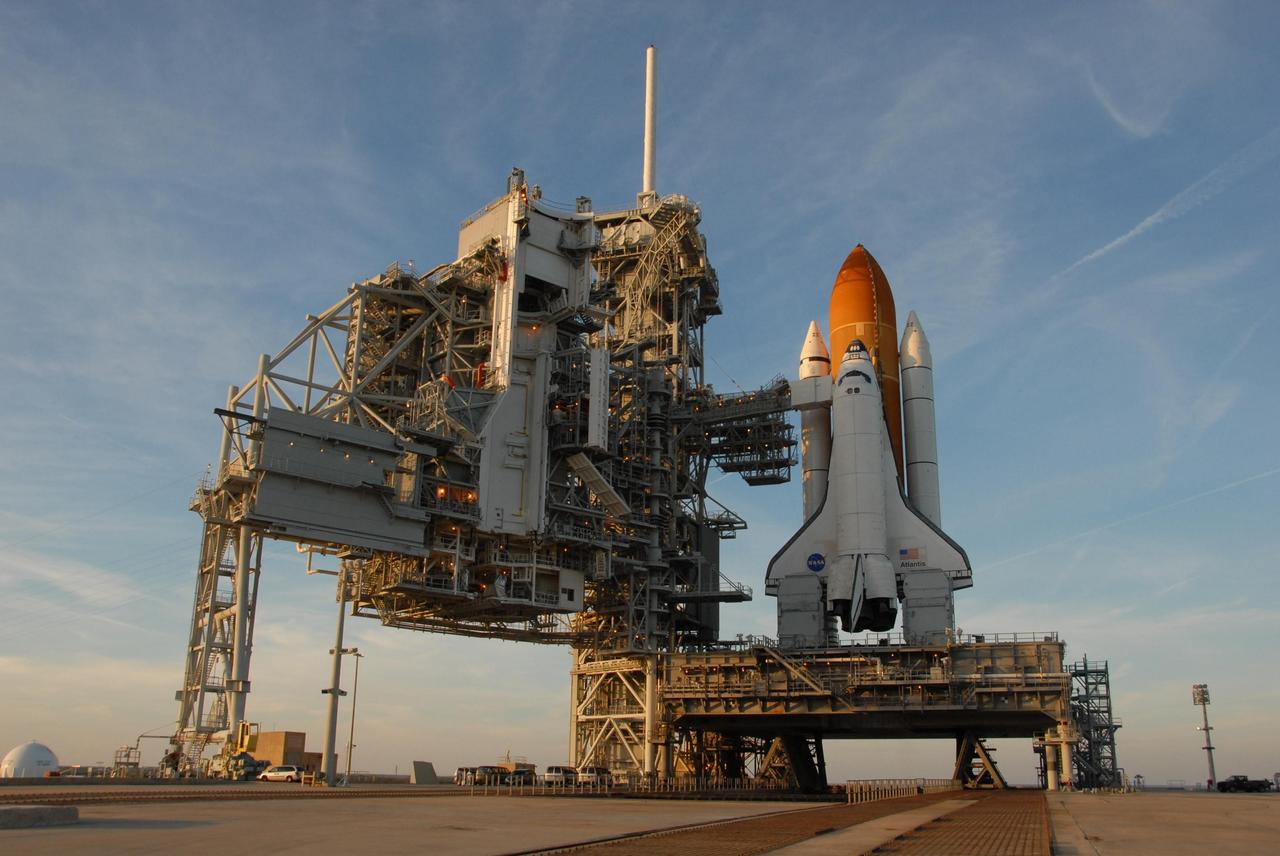
KENNEDY SPACE CENTER, FLA. -- In the late afternoon shadows, space shuttle Atlantis is still poised on the pad after its launch on mission STS-122 was postponed Thursday. It sits atop the mobile launcher platform. At left is seen the rotating service structure, which was rolled away for the launch. Shuttle program managers decided at 9:56 a.m. to postpone the launch because of an issue with a fuel cut-off sensor system inside the external fuel tank. This is one of several systems that protect the shuttle's main engines by triggering their shut down if fuel runs unexpectedly low. During countdown activities this morning, two sensors failed a routine prelaunch check. There are four engine cut-off, or ECO, sensors inside the liquid hydrogen section of the tank, and Launch Commit Criteria require three of the four sensor systems to be functioning properly. The tank's liquid oxygen and liquid hydrogen was drained from the tank, and preparations will begin for a possible launch attempt Friday. NASA's launch rules have a preplanned procedure that states in the case of ECO sensor system failure, engineers need to drain the tank and verify all the sensors are working as they go dry. Atlantis carries the Columbus Laboratory, the European Space Agency's largest contribution to the construction of the space station. When permanently attached to Node 2, the laboratory will carry out experiments in materials science, fluid physics and biosciences, as well as perform a number of technological applications, in a microgravity environment. Photo credit: NASA/George Shelton