
Surging to take advantage of near-perfect launch conditions, NASA’s Scientific Balloon Team launched two balloons within 24 hours Sept. 27-28 from the Agency’s launch site at Fort Sumner, New Mexico. Clear, calm weather paved the way for launching a balloon technology test flight at 8:20 a.m. MDT, Sept. 28, via a 29.47 million-cubic-foot scientific balloon. Just less than 24 hours earlier, the balloon team launched the Jet Propulsion Laboratory (JPL) Remote payload via a 29.47-million-cubic-foot scientific balloon at 8:28 a.m. MDT, Sept. 27. Technicians successfully completed the JPL Remote mission at 10:28 p.m. MDT, Sept. 27, issuing flight termination commands to safely return the balloon material and payload back to Earth. “An enormous amount of planning, coordination, and labor goes into every balloon launch,” said Debbie Fairbrother, NASA’s Balloon Program Office chief. “To do two in a day’s time is nothing short of phenomenal work by an incredible team.” Read more: <a href="http://go.nasa.gov/2cLgslt" rel="nofollow">go.nasa.gov/2cLgslt</a> Credit: NASA/Wallops/Jeremy Eggers <b><a href="http://www.nasa.gov/audience/formedia/features/MP_Photo_Guidelines.html" rel="nofollow">NASA image use policy.</a></b> <b><a href="http://www.nasa.gov/centers/goddard/home/index.html" rel="nofollow">NASA Goddard Space Flight Center</a></b> enables NASA’s mission through four scientific endeavors: Earth Science, Heliophysics, Solar System Exploration, and Astrophysics. Goddard plays a leading role in NASA’s accomplishments by contributing compelling scientific knowledge to advance the Agency’s mission. <b>Follow us on <a href="http://twitter.com/NASAGoddardPix" rel="nofollow">Twitter</a></b> <b>Like us on <a href="http://www.facebook.com/pages/Greenbelt-MD/NASA-Goddard/395013845897?ref=tsd" rel="nofollow">Facebook</a></b> <b>Find us on <a href="http://instagrid.me/nasagoddard/?vm=grid" rel="nofollow">Instagram</a></b>

Cosmic rays and the chemicals and atoms that make up the interstellar space between stars are the focus of this year’s NASA Antarctica Long Duration Balloon Flight Campaign, which kicked into high gear with the launch of the Boron And Carbon Cosmic rays in the Upper Stratosphere (BACCUS) payload Nov. 28. The University of Maryland’s BACCUS mission is the first of three payloads taking flight from a balloon launch site on Antarctica’s Ross Ice Shelf near McMurdo Station with support from the National Science Foundation’s United States Antarctic Program. Read more: <a href="http://go.nasa.gov/2gCMtyP" rel="nofollow">go.nasa.gov/2gCMtyP</a> <b><a href="http://www.nasa.gov/audience/formedia/features/MP_Photo_Guidelines.html" rel="nofollow">NASA image use policy.</a></b> <b><a href="http://www.nasa.gov/centers/goddard/home/index.html" rel="nofollow">NASA Goddard Space Flight Center</a></b> enables NASA’s mission through four scientific endeavors: Earth Science, Heliophysics, Solar System Exploration, and Astrophysics. Goddard plays a leading role in NASA’s accomplishments by contributing compelling scientific knowledge to advance the Agency’s mission. <b>Follow us on <a href="http://twitter.com/NASAGoddardPix" rel="nofollow">Twitter</a></b> <b>Like us on <a href="http://www.facebook.com/pages/Greenbelt-MD/NASA-Goddard/395013845897?ref=tsd" rel="nofollow">Facebook</a></b> <b>Find us on <a href="http://instagrid.me/nasagoddard/?vm=grid" rel="nofollow">Instagram</a></b>

After years of tests and development, NASA’s Balloon Program team is on the cusp of expanding the envelope in high-altitude, heavy-lift ballooning with its super pressure balloon (SPB) technology. NASA’s scientific balloon experts are in Wanaka, New Zealand, prepping for the fourth flight of an 18.8 million-cubic-foot (532,000 cubic-meter) balloon, with the ambitious goal of achieving an ultra-long-duration flight of up to 100 days at mid-latitudes. Launch of the pumpkin-shaped, football stadium-size balloon is scheduled for sometime after April 1, 2016, from Wanaka Airport, pending final checkouts and flight readiness of the balloon and supporting systems. Once launched, the SPB, which is made from 22-acres of polyethylene film – similar to a sandwich bag, but stronger and more durable – will ascend to a nearly constant float altitude of 110,000 feet (33.5 km). The balloon will travel eastward carrying a 2,260-pound (1,025 kg) payload consisting of tracking, communications and scientific instruments. NASA expects the SPB to circumnavigate the globe once every one to three weeks, depending on wind speeds in the stratosphere. Read more: <a href="http://go.nasa.gov/1p56xKR" rel="nofollow">go.nasa.gov/1p56xKR</a> <b><a href="http://www.nasa.gov/audience/formedia/features/MP_Photo_Guidelines.html" rel="nofollow">NASA image use policy.</a></b> <b><a href="http://www.nasa.gov/centers/goddard/home/index.html" rel="nofollow">NASA Goddard Space Flight Center</a></b> enables NASA’s mission through four scientific endeavors: Earth Science, Heliophysics, Solar System Exploration, and Astrophysics. Goddard plays a leading role in NASA’s accomplishments by contributing compelling scientific knowledge to advance the Agency’s mission. <b>Follow us on <a href="http://twitter.com/NASAGoddardPix" rel="nofollow">Twitter</a></b> <b>Like us on <a href="http://www.facebook.com/pages/Greenbelt-MD/NASA-Goddard/395013845897?ref=tsd" rel="nofollow">Facebook</a></b> <b>Find us on <a href="http://instagrid.me/nasagoddard/?vm=grid" rel="nofollow">Instagram</a></b>

After years of tests and development, NASA’s Balloon Program team is on the cusp of expanding the envelope in high-altitude, heavy-lift ballooning with its super pressure balloon (SPB) technology. NASA’s scientific balloon experts are in Wanaka, New Zealand, prepping for the fourth flight of an 18.8 million-cubic-foot (532,000 cubic-meter) balloon, with the ambitious goal of achieving an ultra-long-duration flight of up to 100 days at mid-latitudes. Launch of the pumpkin-shaped, football stadium-size balloon is scheduled for sometime after April 1, 2016, from Wanaka Airport, pending final checkouts and flight readiness of the balloon and supporting systems. Once launched, the SPB, which is made from 22-acres of polyethylene film – similar to a sandwich bag, but stronger and more durable – will ascend to a nearly constant float altitude of 110,000 feet (33.5 km). The balloon will travel eastward carrying a 2,260-pound (1,025 kg) payload consisting of tracking, communications and scientific instruments. NASA expects the SPB to circumnavigate the globe once every one to three weeks, depending on wind speeds in the stratosphere. Read more: <a href="http://go.nasa.gov/1p56xKR" rel="nofollow">go.nasa.gov/1p56xKR</a> <b><a href="http://www.nasa.gov/audience/formedia/features/MP_Photo_Guidelines.html" rel="nofollow">NASA image use policy.</a></b> <b><a href="http://www.nasa.gov/centers/goddard/home/index.html" rel="nofollow">NASA Goddard Space Flight Center</a></b> enables NASA’s mission through four scientific endeavors: Earth Science, Heliophysics, Solar System Exploration, and Astrophysics. Goddard plays a leading role in NASA’s accomplishments by contributing compelling scientific knowledge to advance the Agency’s mission. <b>Follow us on <a href="http://twitter.com/NASAGoddardPix" rel="nofollow">Twitter</a></b> <b>Like us on <a href="http://www.facebook.com/pages/Greenbelt-MD/NASA-Goddard/395013845897?ref=tsd" rel="nofollow">Facebook</a></b> <b>Find us on <a href="http://instagrid.me/nasagoddard/?vm=grid" rel="nofollow">Instagram</a></b>
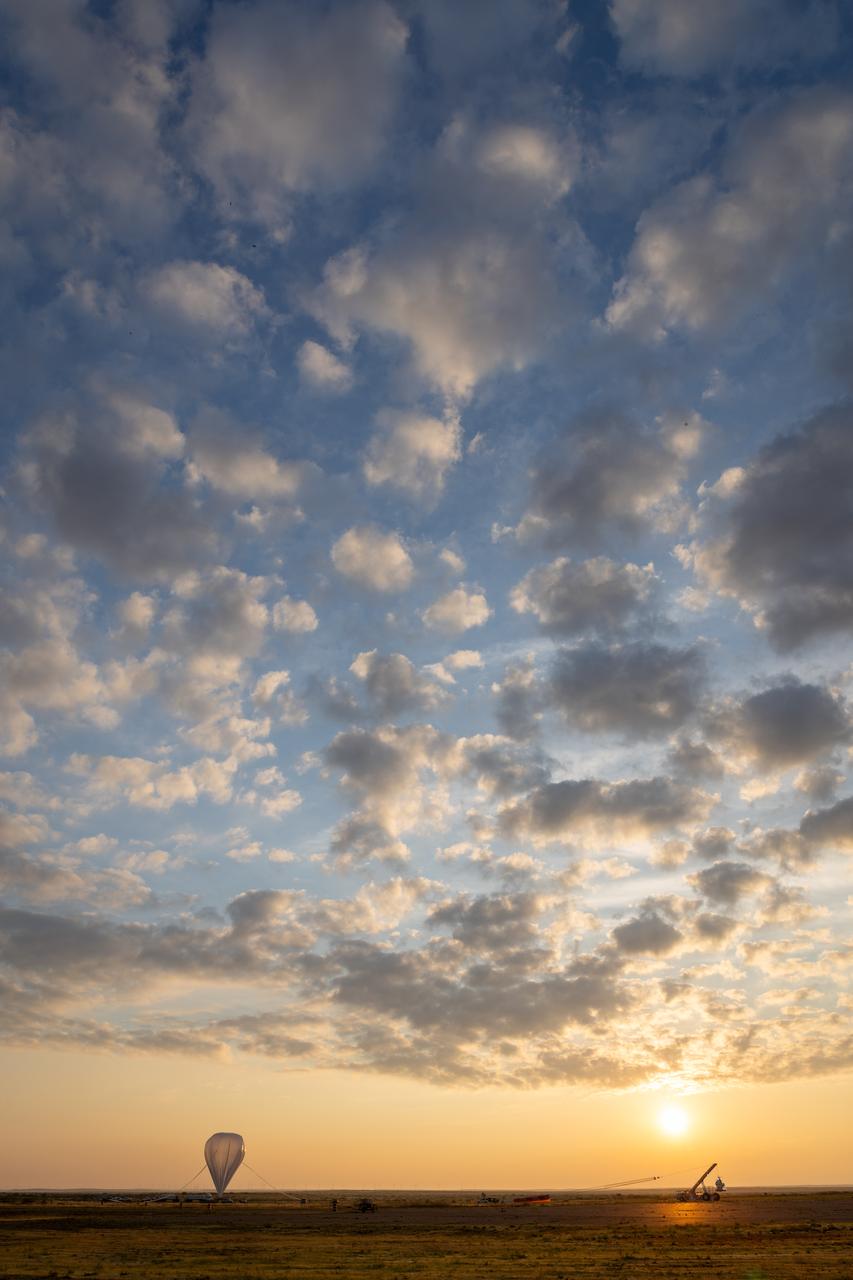
It takes around an hour to fill a 39-million-cubic-foot scientific balloon with helium. The EXCITE telescope is poised for launch as the day breaks on August 31st, 2024.
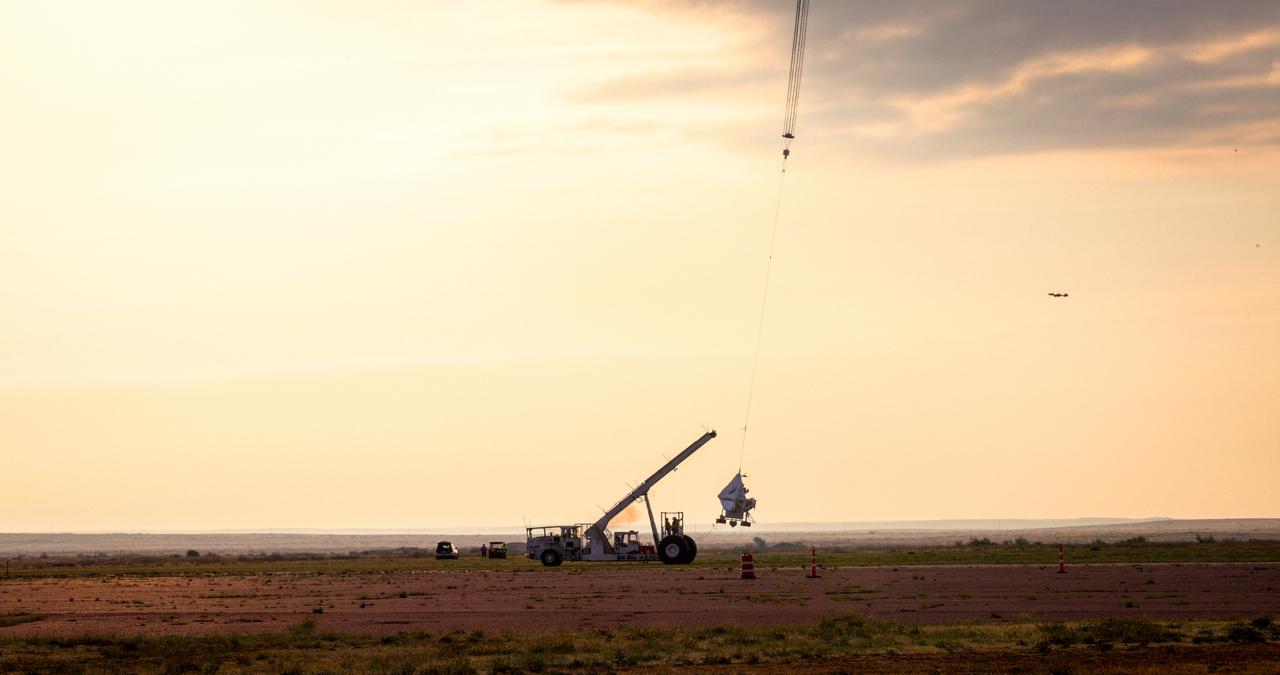
This is EXCITE’s moment of release. On August 31, 2024, the EXCITE (EXoplanet Climate Infrared TElescope) team conducted a test flight of their telescope from NASA’s Columbia Scientific Balloon Facility in Fort Sumner, New Mexico. This photo was taken moments after the telescope was released from the tractor vehicle (called Big Bill). Unseen above is the helium-filled scientific balloon that carried the telescope to the edge of space.
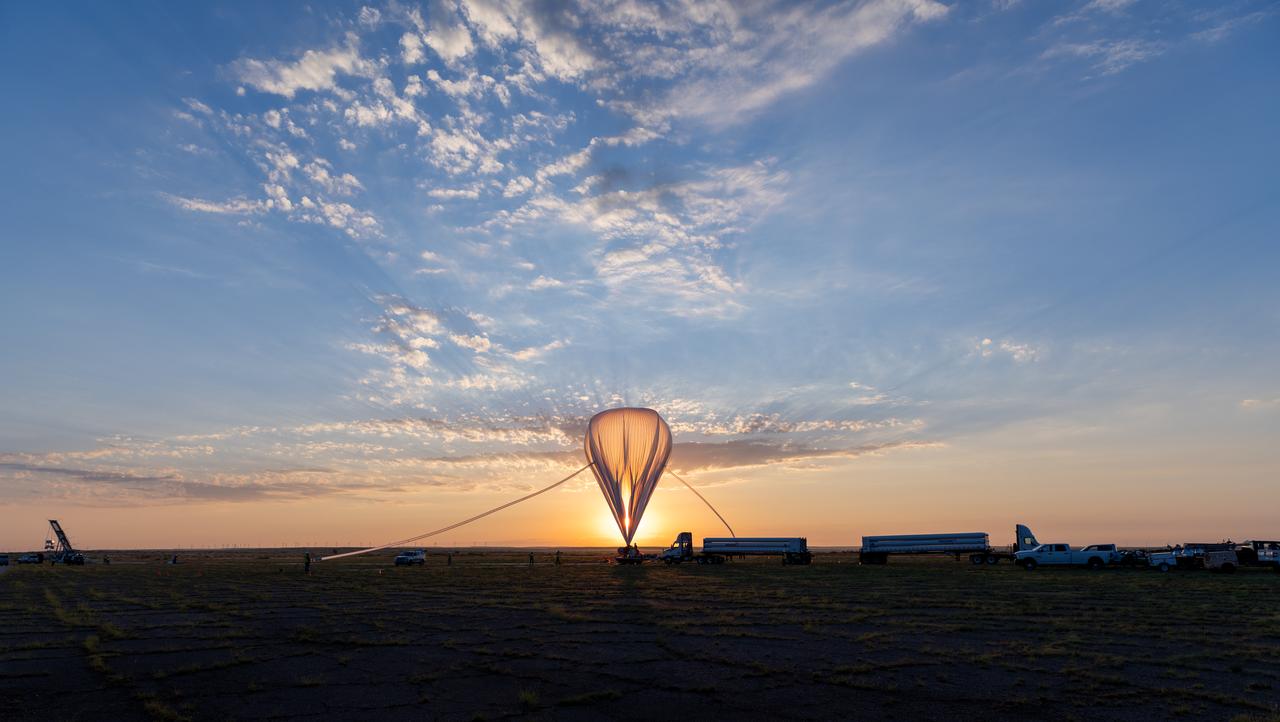
The Scientific balloon eclipses the sun as it fills with helium, and the High Altitude Student Platform awaits launch. On August 28, 2024, the student-run mission launched from a 4-million-cubic-foot balloon for its second flight.

Matthew Mullin and Bobby Meazell, Orbital ATK/Columbia Scientific Balloon Facility technicians, conduct compatibility testing on NASA Langley Research Center’s Radiation Dosimetry Experiment payload Wednesday, Sept. 9, at Fort Sumner, N.M. The successful compatibility test was a key milestone in ensuring the flight readiness of RaD-X, which is scheduled to launch on an 11-million-cubic-foot NASA scientific balloon no earlier than Friday, Sept. 11, from the agency’s balloon launching facility in Fort Sumner. RaD-X will measure cosmic ray energy at two separate altitude regions in the stratosphere—above 110,000 feet and between 69,000 to 88,500 feet. The data is key to confirming Langley’s Nowcast of Atmospheric Ionizing Radiation for Aviation Safety (NAIRAS) model, which is a physics-based model that determines solar radiation and galactic cosmic ray exposure globally in real-time. The NAIRAS modeling tool will be used to help enhance aircraft safety as well as safety procedures for the International Space Station. In addition to the primary payload, 100 small student experiments will fly on the RaD-X mission as part of the Cubes in Space program. The program provides 11- to 18-year-old middle and high school students a no-cost opportunity to design and compete to launch an experiment into space or into the near-space environment. The cubes measure just 4 centimeters by 4 centimeters. NASA’s scientific balloons offer low-cost, near-space access for scientific payloads weighing up to 8,000 pounds for conducting scientific investigations in fields such as astrophysics, heliophysics and atmospheric research. NASA’s Wallops Flight Facility in Virginia manages the agency’s scientific balloon program with 10 to 15 flights each year from launch sites worldwide. Orbital ATK provides program management, mission planning, engineering services and field operations for NASA’s scientific balloon program. The program is executed from the Columbia Scientific Balloon Facility in Palestine, Texas. The Columbia team has launched more than 1,700 scientific balloons in over 35 years of operation. Anyone may track the progress of the Fort Sumner flights, which includes a map showing the balloon’s real-time location, at: <a href="http://towerfts.csbf.nasa.gov/" rel="nofollow">towerfts.csbf.nasa.gov/</a> For more information on the balloon program, see: <a href="http://www.nasa.gov/scientificballoons" rel="nofollow">www.nasa.gov/scientificballoons</a> <b><a href="http://www.nasa.gov/audience/formedia/features/MP_Photo_Guidelines.html" rel="nofollow">NASA image use policy.</a></b> <b><a href="http://www.nasa.gov/centers/goddard/home/index.html" rel="nofollow">NASA Goddard Space Flight Center</a></b> enables NASA’s mission through four scientific endeavors: Earth Science, Heliophysics, Solar System Exploration, and Astrophysics. Goddard plays a leading role in NASA’s accomplishments by contributing compelling scientific knowledge to advance the Agency’s mission. <b>Follow us on <a href="http://twitter.com/NASAGoddardPix" rel="nofollow">Twitter</a></b> <b>Like us on <a href="http://www.facebook.com/pages/Greenbelt-MD/NASA-Goddard/395013845897?ref=tsd" rel="nofollow">Facebook</a></b> <b>Find us on <a href="http://instagrid.me/nasagoddard/?vm=grid" rel="nofollow">Instagram</a></b>
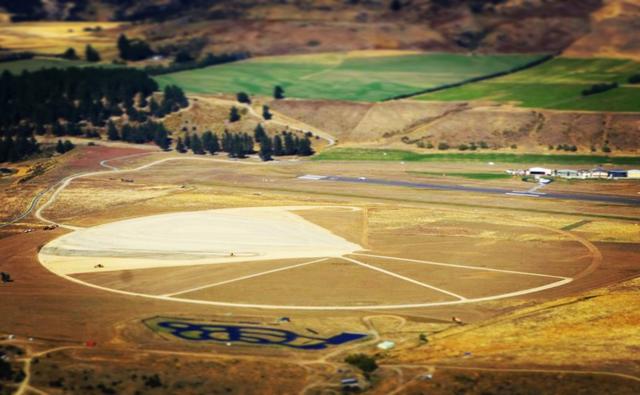
Aviators, skydivers and other altitude-seeking enthusiasts flying out of Wanaka Airport, New Zealand, are double taking at a new topographical feature reminiscent of an alien crop circle. Rest assured, the nearly 2,000-foot (600-meter) diameter circle with a pie-shaped wedge on one side and spokes on the other is no extraterrestrial footprint and it’s definitely no hoax. It’s NASA’s newest launch pad for launching the agency’s most advanced high-altitude, heavy-lift scientific balloon: the super pressure balloon. The four spokes emanating from the center and toward the west, each nearly 1,000 feet (300 meters) long, align with magnetic compass directions at 240, 260, 290 and 320 degrees. On launch day, balloon flight experts from NASA’s Columbia Scientific Balloon Facility will assess meteorological data and determine if the conditions are suitable to support a launch opportunity. The new pad is the first major project in developing a long-term super pressure balloon launch site in Wanaka. Earlier in 2017, NASA signed a 10-year lease with the Queenstown Airport Corporation to conduct balloon operations from a newly acquired piece of land adjacent to the Wanaka Airport. Credit: NASA/Dave Webb <b><a href="http://www.nasa.gov/audience/formedia/features/MP_Photo_Guidelines.html" rel="nofollow">NASA image use policy.</a></b> <b><a href="http://www.nasa.gov/centers/goddard/home/index.html" rel="nofollow">NASA Goddard Space Flight Center</a></b> enables NASA’s mission through four scientific endeavors: Earth Science, Heliophysics, Solar System Exploration, and Astrophysics. Goddard plays a leading role in NASA’s accomplishments by contributing compelling scientific knowledge to advance the Agency’s mission. <b>Follow us on <a href="http://twitter.com/NASAGoddardPix" rel="nofollow">Twitter</a></b> <b>Like us on <a href="http://www.facebook.com/pages/Greenbelt-MD/NASA-Goddard/395013845897?ref=tsd" rel="nofollow">Facebook</a></b> <b>Find us on <a href="http://instagrid.me/nasagoddard/?vm=grid" rel="nofollow">Instagram</a></b>

The BARREL team inflates the balloon to launch their fifth scientific payload from Esrange Space Center near Kiruna, Sweden, on Aug. 24, 2016. The BARREL team is at Esrange Space Center launching a series of six scientific payloads on miniature scientific balloons. The NASA-funded BARREL – which stands for Balloon Array for Radiation-belt Relativistic Electron Losses – primarily measures X-rays in Earth’s atmosphere near the North and South Poles. These X-rays are produced by electrons raining down into the atmosphere from two giant swaths of radiation that surround Earth, called the Van Allen belts. Learning about the radiation near Earth helps us to better protect our satellites. Several of the BARREL balloons also carry instruments built by undergraduate students to measure the total electron content of Earth’s ionosphere, as well as the low-frequency electromagnetic waves that help to scatter electrons into Earth’s atmosphere. Though about 90 feet in diameter, the BARREL balloons are much smaller than standard football stadium-sized scientific balloons. This is the fourth campaign for the BARREL mission. BARREL is led by Dartmouth College in Hanover, New Hampshire. The undergraduate student instrument team is led by the University of Houston and funded by the Undergraduate Student Instrument Project out of NASA’s Wallops Flight Facility. For more information on NASA’s scientific balloon program, visit: <a href="http://www.nasa.gov/scientificballoons" rel="nofollow">www.nasa.gov/scientificballoons</a>. Credit: NASA/University of Houston/Michael Greer <b><a href="http://www.nasa.gov/audience/formedia/features/MP_Photo_Guidelines.html" rel="nofollow">NASA image use policy.</a></b> <b><a href="http://www.nasa.gov/centers/goddard/home/index.html" rel="nofollow">NASA Goddard Space Flight Center</a></b> enables NASA’s mission through four scientific endeavors: Earth Science, Heliophysics, Solar System Exploration, and Astrophysics. Goddard plays a leading role in NASA’s accomplishments by contributing compelling scientific knowledge to advance the Agency’s mission. <b>Follow us on <a href="http://twitter.com/NASAGoddardPix" rel="nofollow">Twitter</a></b> <b>Like us on <a href="http://www.facebook.com/pages/Greenbelt-MD/NASA-Goddard/395013845897?ref=tsd" rel="nofollow">Facebook</a></b> <b>Find us on <a href="http://instagrid.me/nasagoddard/?vm=grid" rel="nofollow">Instagram</a></b>

The fourth BARREL balloon of this campaign sits on the launch pad shortly before it launched on Aug. 21, 2016. The BARREL team is at Esrange Space Center near Kiruna, Sweden, launching a series of six scientific payloads on miniature scientific balloons. The NASA-funded BARREL – which stands for Balloon Array for Radiation-belt Relativistic Electron Losses – primarily measures X-rays in Earth’s atmosphere near the North and South Poles. These X-rays are produced by electrons raining down into the atmosphere from two giant swaths of radiation that surround Earth, called the Van Allen belts. Learning about the radiation near Earth helps us to better protect our satellites. Several of the BARREL balloons also carry instruments built by undergraduate students to measure the total electron content of Earth’s ionosphere, as well as the low-frequency electromagnetic waves that help to scatter electrons into Earth’s atmosphere. Though about 90 feet in diameter, the BARREL balloons are much smaller than standard football stadium-sized scientific balloons. This is the fourth campaign for the BARREL mission. BARREL is led by Dartmouth College in Hanover, New Hampshire. The undergraduate student instrument team is led by the University of Houston and funded by the Undergraduate Student Instrument Project out of NASA’s Wallops Flight Facility. For more information on NASA’s scientific balloon program, visit: <a href="http://www.nasa.gov/scientificballoons" rel="nofollow">www.nasa.gov/scientificballoons</a>. Credit: NASA/University of Houston/Michael Greer <b><a href="http://www.nasa.gov/audience/formedia/features/MP_Photo_Guidelines.html" rel="nofollow">NASA image use policy.</a></b> <b><a href="http://www.nasa.gov/centers/goddard/home/index.html" rel="nofollow">NASA Goddard Space Flight Center</a></b> enables NASA’s mission through four scientific endeavors: Earth Science, Heliophysics, Solar System Exploration, and Astrophysics. Goddard plays a leading role in NASA’s accomplishments by contributing compelling scientific knowledge to advance the Agency’s mission. <b>Follow us on <a href="http://twitter.com/NASAGoddardPix" rel="nofollow">Twitter</a></b> <b>Like us on <a href="http://www.facebook.com/pages/Greenbelt-MD/NASA-Goddard/395013845897?ref=tsd" rel="nofollow">Facebook</a></b> <b>Find us on <a href="http://instagrid.me/nasagoddard/?vm=grid" rel="nofollow">Instagram</a></b>
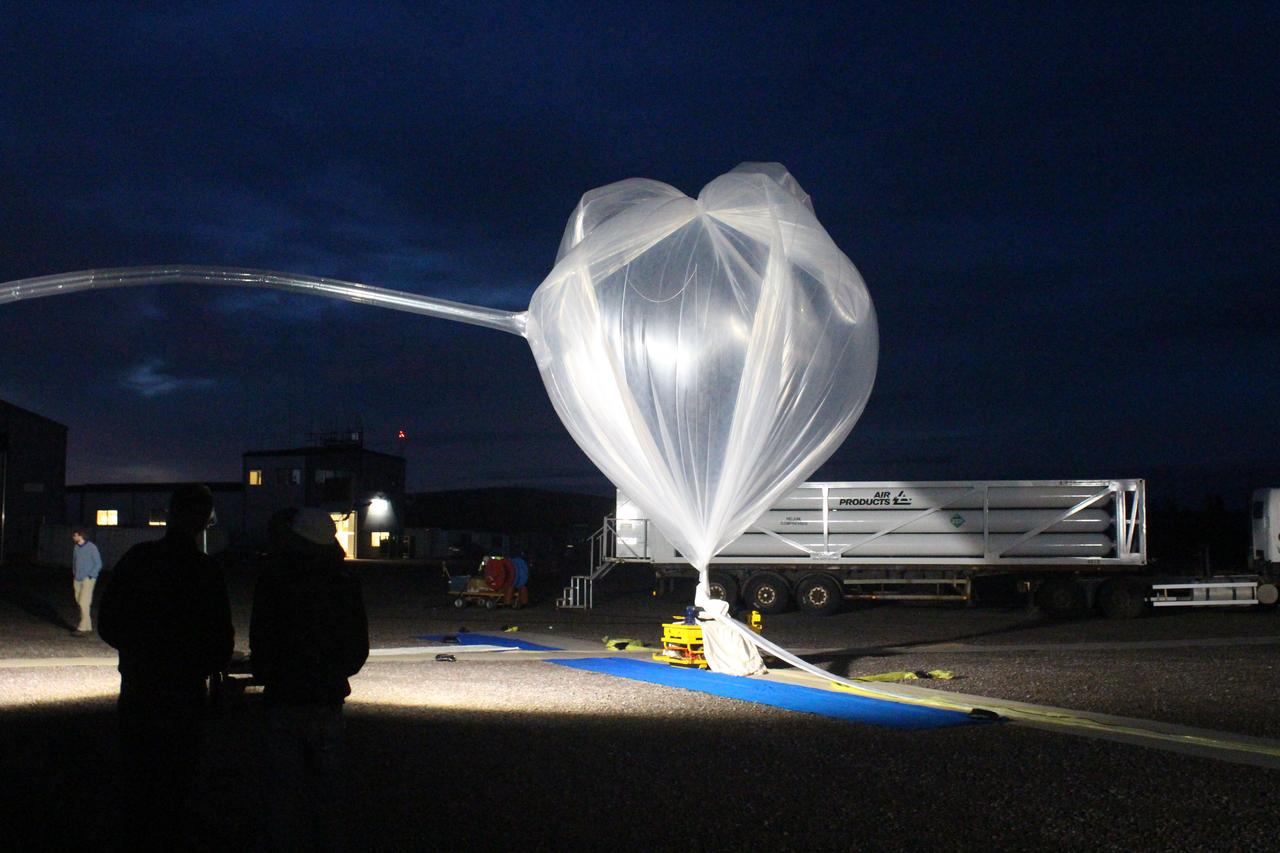
The first BARREL balloon is inflated just before its launch on Aug. 13, 2016, from Esrange Space Center near Kiruna, Sweden. The BARREL team is at Esrange Space Center launching a series of six scientific payloads on miniature scientific balloons. The NASA-funded BARREL – which stands for Balloon Array for Radiation-belt Relativistic Electron Losses – primarily measures X-rays in Earth’s atmosphere near the North and South Poles. These X-rays are produced by electrons raining down into the atmosphere from two giant swaths of radiation that surround Earth, called the Van Allen belts. Learning about the radiation near Earth helps us to better protect our satellites. Several of the BARREL balloons also carry instruments built by undergraduate students to measure the total electron content of Earth’s ionosphere, as well as the low-frequency electromagnetic waves that help to scatter electrons into Earth’s atmosphere. Though about 90 feet in diameter, the BARREL balloons are much smaller than standard football stadium-sized scientific balloons. This is the fourth campaign for the BARREL mission. BARREL is led by Dartmouth College in Hanover, New Hampshire. The undergraduate student instrument team is led by the University of Houston and funded by the Undergraduate Student Instrument Project out of NASA’s Wallops Flight Facility. For more information on NASA’s scientific balloon program, visit: <a href="http://www.nasa.gov/scientificballoons" rel="nofollow">www.nasa.gov/scientificballoons</a>. Image credit: NASA/University of Houston/Edgar Bering <b><a href="http://www.nasa.gov/audience/formedia/features/MP_Photo_Guidelines.html" rel="nofollow">NASA image use policy.</a></b> <b><a href="http://www.nasa.gov/centers/goddard/home/index.html" rel="nofollow">NASA Goddard Space Flight Center</a></b> enables NASA’s mission through four scientific endeavors: Earth Science, Heliophysics, Solar System Exploration, and Astrophysics. Goddard plays a leading role in NASA’s accomplishments by contributing compelling scientific knowledge to advance the Agency’s mission. <b>Follow us on <a href="http://twitter.com/NASAGoddardPix" rel="nofollow">Twitter</a></b> <b>Like us on <a href="http://www.facebook.com/pages/Greenbelt-MD/NASA-Goddard/395013845897?ref=tsd" rel="nofollow">Facebook</a></b> <b>Find us on <a href="http://instagrid.me/nasagoddard/?vm=grid" rel="nofollow">Instagram</a></b>
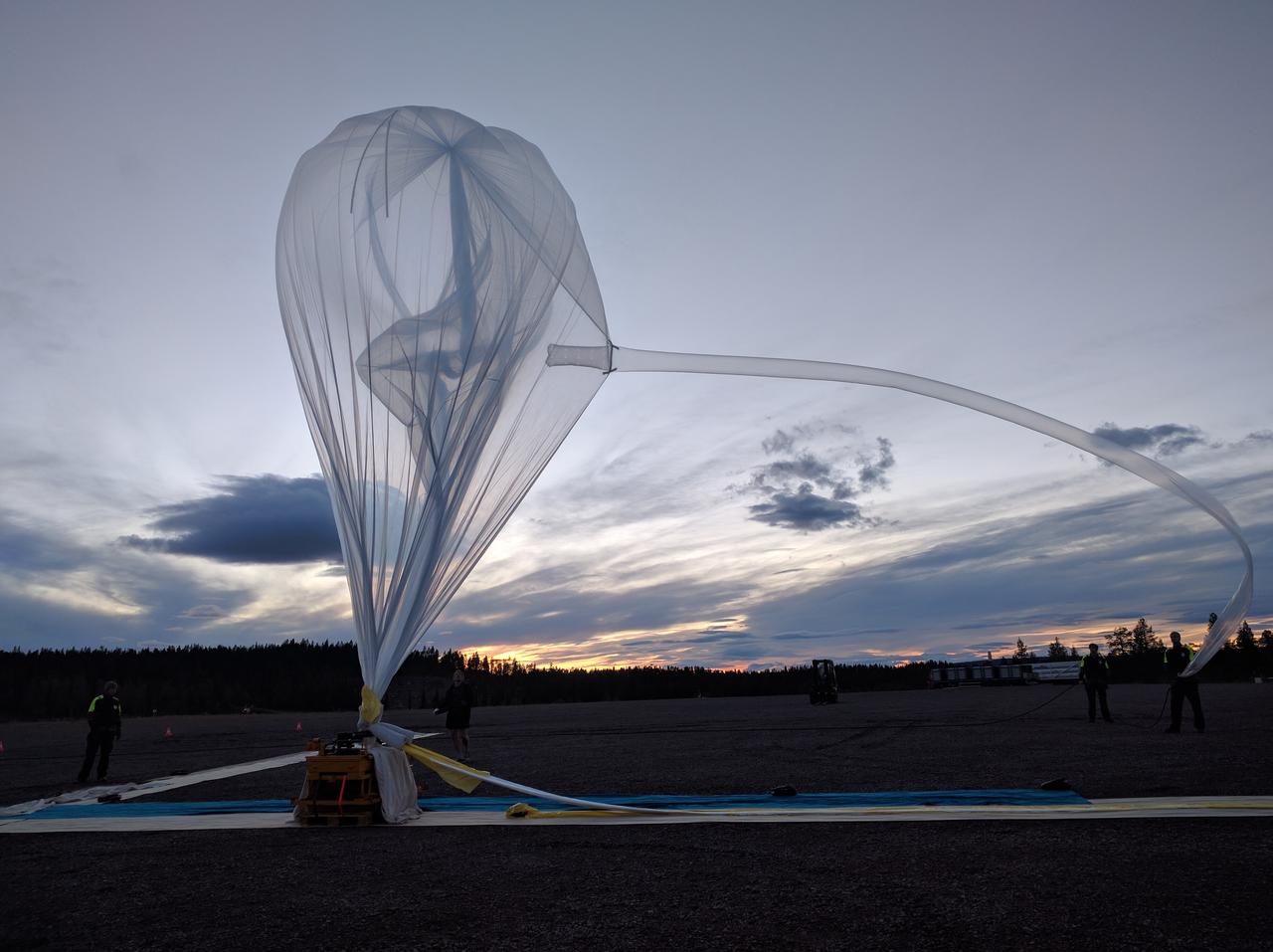
A BARREL balloon inflates on the launch pad at Esrange Space Center on Aug. 29, 2016. Throughout August 2016, the BARREL team was at Esrange Space Center near Kiruna, Sweden, launching a series of six scientific payloads on miniature scientific balloons. The NASA-funded BARREL – which stands for Balloon Array for Radiation-belt Relativistic Electron Losses – primarily measures X-rays in Earth’s atmosphere near the North and South Poles. These X-rays are produced by electrons raining down into the atmosphere from two giant swaths of radiation that surround Earth, called the Van Allen belts. Learning about the radiation near Earth helps us to better protect our satellites. Several of the BARREL balloons also carried instruments built by undergraduate students to measure the total electron content of Earth’s ionosphere, as well as the low-frequency electromagnetic waves that help to scatter electrons into Earth’s atmosphere. Though about 90 feet in diameter, the BARREL balloons are much smaller than standard football stadium-sized scientific balloons. This is the fourth campaign for the BARREL mission. BARREL is led by Dartmouth College in Hanover, New Hampshire. The undergraduate student instrument team is led by the University of Houston and funded by the Undergraduate Student Instrument Project out of NASA’s Wallops Flight Facility. For more information on NASA’s scientific balloon program, visit: <a href="http://www.nasa.gov/scientificballoons" rel="nofollow">www.nasa.gov/scientificballoons</a>. Credit: NASA/Dartmouth/Alexa Halford <b><a href="http://www.nasa.gov/audience/formedia/features/MP_Photo_Guidelines.html" rel="nofollow">NASA image use policy.</a></b> <b><a href="http://www.nasa.gov/centers/goddard/home/index.html" rel="nofollow">NASA Goddard Space Flight Center</a></b> enables NASA’s mission through four scientific endeavors: Earth Science, Heliophysics, Solar System Exploration, and Astrophysics. Goddard plays a leading role in NASA’s accomplishments by contributing compelling scientific knowledge to advance the Agency’s mission. <b>Follow us on <a href="http://twitter.com/NASAGoddardPix" rel="nofollow">Twitter</a></b> <b>Like us on <a href="http://www.facebook.com/pages/Greenbelt-MD/NASA-Goddard/395013845897?ref=tsd" rel="nofollow">Facebook</a></b> <b>Find us on <a href="http://instagrid.me/nasagoddard/?vm=grid" rel="nofollow">Instagram</a></b>

The third BARREL balloon floats towards the stratosphere on Aug. 21, 2016. This payload flew for nearly 30 hours, measuring X-rays in Earth’s atmosphere. The BARREL team is at Esrange Space Center near Kiruna, Sweden, launching a series of six scientific payloads on miniature scientific balloons. The NASA-funded BARREL – which stands for Balloon Array for Radiation-belt Relativistic Electron Losses – primarily measures X-rays in Earth’s atmosphere near the North and South Poles. These X-rays are produced by electrons raining down into the atmosphere from two giant swaths of radiation that surround Earth, called the Van Allen belts. Learning about the radiation near Earth helps us to better protect our satellites. Several of the BARREL balloons also carry instruments built by undergraduate students to measure the total electron content of Earth’s ionosphere, as well as the low-frequency electromagnetic waves that help to scatter electrons into Earth’s atmosphere. Though about 90 feet in diameter, the BARREL balloons are much smaller than standard football stadium-sized scientific balloons. This is the fourth campaign for the BARREL mission. BARREL is led by Dartmouth College in Hanover, New Hampshire. The undergraduate student instrument team is led by the University of Houston and funded by the Undergraduate Student Instrument Project out of NASA’s Wallops Flight Facility. For more information on NASA’s scientific balloon program, visit: <a href="http://www.nasa.gov/scientificballoons" rel="nofollow">www.nasa.gov/scientificballoons</a>. Credit: NASA/University of Houston/Michael Greer <b><a href="http://www.nasa.gov/audience/formedia/features/MP_Photo_Guidelines.html" rel="nofollow">NASA image use policy.</a></b> <b><a href="http://www.nasa.gov/centers/goddard/home/index.html" rel="nofollow">NASA Goddard Space Flight Center</a></b> enables NASA’s mission through four scientific endeavors: Earth Science, Heliophysics, Solar System Exploration, and Astrophysics. Goddard plays a leading role in NASA’s accomplishments by contributing compelling scientific knowledge to advance the Agency’s mission. <b>Follow us on <a href="http://twitter.com/NASAGoddardPix" rel="nofollow">Twitter</a></b> <b>Like us on <a href="http://www.facebook.com/pages/Greenbelt-MD/NASA-Goddard/395013845897?ref=tsd" rel="nofollow">Facebook</a></b> <b>Find us on <a href="http://instagrid.me/nasagoddard/?vm=grid" rel="nofollow">Instagram</a></b>
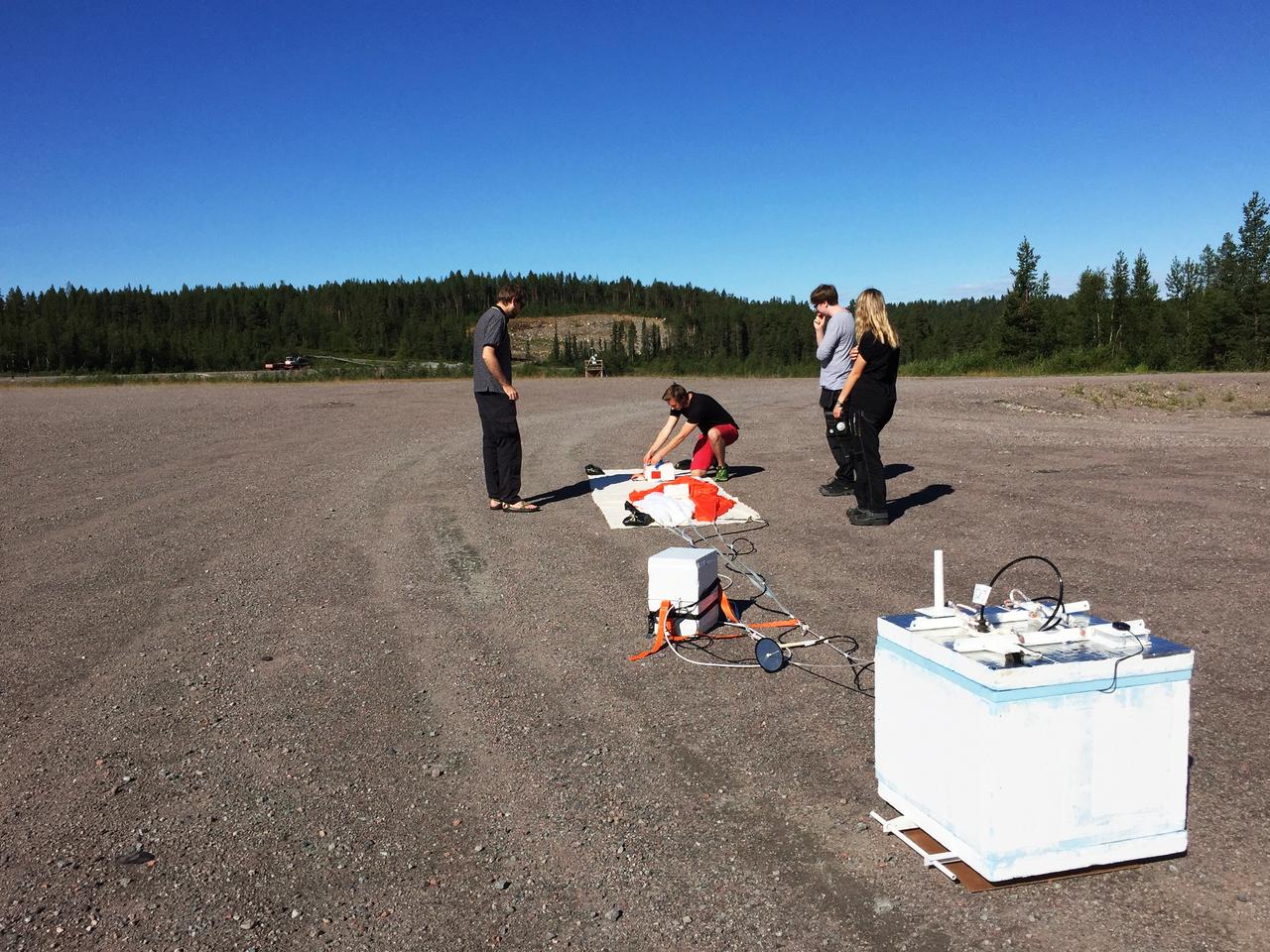
Prior to launch, the BARREL team works on the payload from the launch pad at Esrange Space Center near Kiruna, Sweden. The BARREL team is at Esrange Space Center launching a series of six scientific payloads on miniature scientific balloons. The NASA-funded BARREL – which stands for Balloon Array for Radiation-belt Relativistic Electron Losses – primarily measures X-rays in Earth’s atmosphere near the North and South Poles. These X-rays are produced by electrons raining down into the atmosphere from two giant swaths of radiation that surround Earth, called the Van Allen belts. Learning about the radiation near Earth helps us to better protect our satellites. Several of the BARREL balloons also carry instruments built by undergraduate students to measure the total electron content of Earth’s ionosphere, as well as the low-frequency electromagnetic waves that help to scatter electrons into Earth’s atmosphere. Though about 90 feet in diameter, the BARREL balloons are much smaller than standard football stadium-sized scientific balloons. This is the fourth campaign for the BARREL mission. BARREL is led by Dartmouth College in Hanover, New Hampshire. The undergraduate student instrument team is led by the University of Houston and funded by the Undergraduate Student Instrument Project out of NASA’s Wallops Flight Facility. For more information on NASA’s scientific balloon program, visit: <a href="http://www.nasa.gov/scientificballoons" rel="nofollow">www.nasa.gov/scientificballoons</a>. Image credit: NASA/Dartmouth/Robyn Millan <b><a href="http://www.nasa.gov/audience/formedia/features/MP_Photo_Guidelines.html" rel="nofollow">NASA image use policy.</a></b> <b><a href="http://www.nasa.gov/centers/goddard/home/index.html" rel="nofollow">NASA Goddard Space Flight Center</a></b> enables NASA’s mission through four scientific endeavors: Earth Science, Heliophysics, Solar System Exploration, and Astrophysics. Goddard plays a leading role in NASA’s accomplishments by contributing compelling scientific knowledge to advance the Agency’s mission. <b>Follow us on <a href="http://twitter.com/NASAGoddardPix" rel="nofollow">Twitter</a></b> <b>Like us on <a href="http://www.facebook.com/pages/Greenbelt-MD/NASA-Goddard/395013845897?ref=tsd" rel="nofollow">Facebook</a></b> <b>Find us on <a href="http://instagrid.me/nasagoddard/?vm=grid" rel="nofollow">Instagram</a></b>

Caption: A NASA Super Pressure Balloon with the COSI payload is ready for launch from McMurdo, Antarctica. Credit: NASA More info: NASA’s globetrotting Balloon Program Office is wrapping up its 2014-2015 Antarctic campaign while prepping for an around-the-world flight launching out of Wanaka, New Zealand, in March. After 16 days, 12 hours, and 56 minutes of flight, operators successfully conducted a planned flight termination of the Suborbital Polarimeter for Inflation Dust and the Epoch of Reionization (SPIDER) mission Saturday, Jan. 18, the final mission of the campaign. Other flights in the 2014-2015 Antarctic campaign included the Antarctic Impulsive Transient Antenna (ANITA-III) mission as well as the Compton Spectrometer and Imager (COSI) payload flown on the developmental Super Pressure Balloon (SPB). ANITA-III successfully wrapped up Jan. 9 after 22 days, 9 hours, and 14 minutes of flight. Flight controllers terminated the COSI flight 43 hours into the mission after detecting a small gas leak in the balloon. Crews are now working to recover all three instruments from different locations across the continent. The 6,480-pound SPIDER payload is stationary at a position about 290 miles from the United Kingdom’s Sky Blu Logistics Facility in Antarctica. The 4,601 pound ANITA-III payload, located about 100 miles from Australia’s Davis Station, and the 2,866 pound COSI payload, located about 340 miles from the United States McMurdo Station both had numerous key components recovered in the past few days. Beginning in late January, the Balloon Program Office will deploy a team to Wanaka, New Zealand, to begin preparations for an SPB flight, scheduled to launch in March. The Program Office seeks to fly the SPB more than 100 days, which would shatter the current flight duration record of 55 days, 1 hour, and 34 minutes for a large scientific balloon. “We’re looking forward to the New Zealand campaign and hopefully a history-making flight with the Super Pressure Balloon,” said Debbie Fairbrother, NASA’s Balloon Program Office Chief. Most scientific balloons see altitude variances based on temperature changes in the atmosphere at night and during the day. The SPB is capable of missions on the order of 100 days or more at constant float altitudes due to the pressurization of the balloon. “Stable, long-duration flights at near-space altitudes above more than 99 percent of the atmosphere are highly desirable in the science community, and we’re ready to deliver,” said Fairbrother. In addition to the SPB flight in March, the Balloon Program Office has 10 more balloon missions planned through September 2015 to include scheduled test flights of the Low-Density Supersonic Decelerator, which is testing new technologies for landing larger, heavier payloads on Mars. NASA’s Wallops Flight Facility manages the agency’s Scientific Balloon Program with 10 to 15 flights each year from launch sites worldwide. The balloons are massive in volume; the average-sized balloon could hold the volume of nearly 200 blimps. Previous work on balloons have contributed to confirming the Big Bang Theory. For more information on NASA’s Scientific Balloon Program, see: <a href="http://sites.wff.nasa.gov/code820/index.html" rel="nofollow">sites.wff.nasa.gov/code820/index.html</a> <b><a href="http://www.nasa.gov/audience/formedia/features/MP_Photo_Guidelines.html" rel="nofollow">NASA image use policy.</a></b> <b><a href="http://www.nasa.gov/centers/goddard/home/index.html" rel="nofollow">NASA Goddard Space Flight Center</a></b> enables NASA’s mission through four scientific endeavors: Earth Science, Heliophysics, Solar System Exploration, and Astrophysics. Goddard plays a leading role in NASA’s accomplishments by contributing compelling scientific knowledge to advance the Agency’s mission. <b>Follow us on <a href="http://twitter.com/NASAGoddardPix" rel="nofollow">Twitter</a></b> <b>Like us on <a href="http://www.facebook.com/pages/Greenbelt-MD/NASA-Goddard/395013845897?ref=tsd" rel="nofollow">Facebook</a></b> <b>Find us on <a href="http://instagram.com/nasagoddard?vm=grid" rel="nofollow">Instagram</a></b>
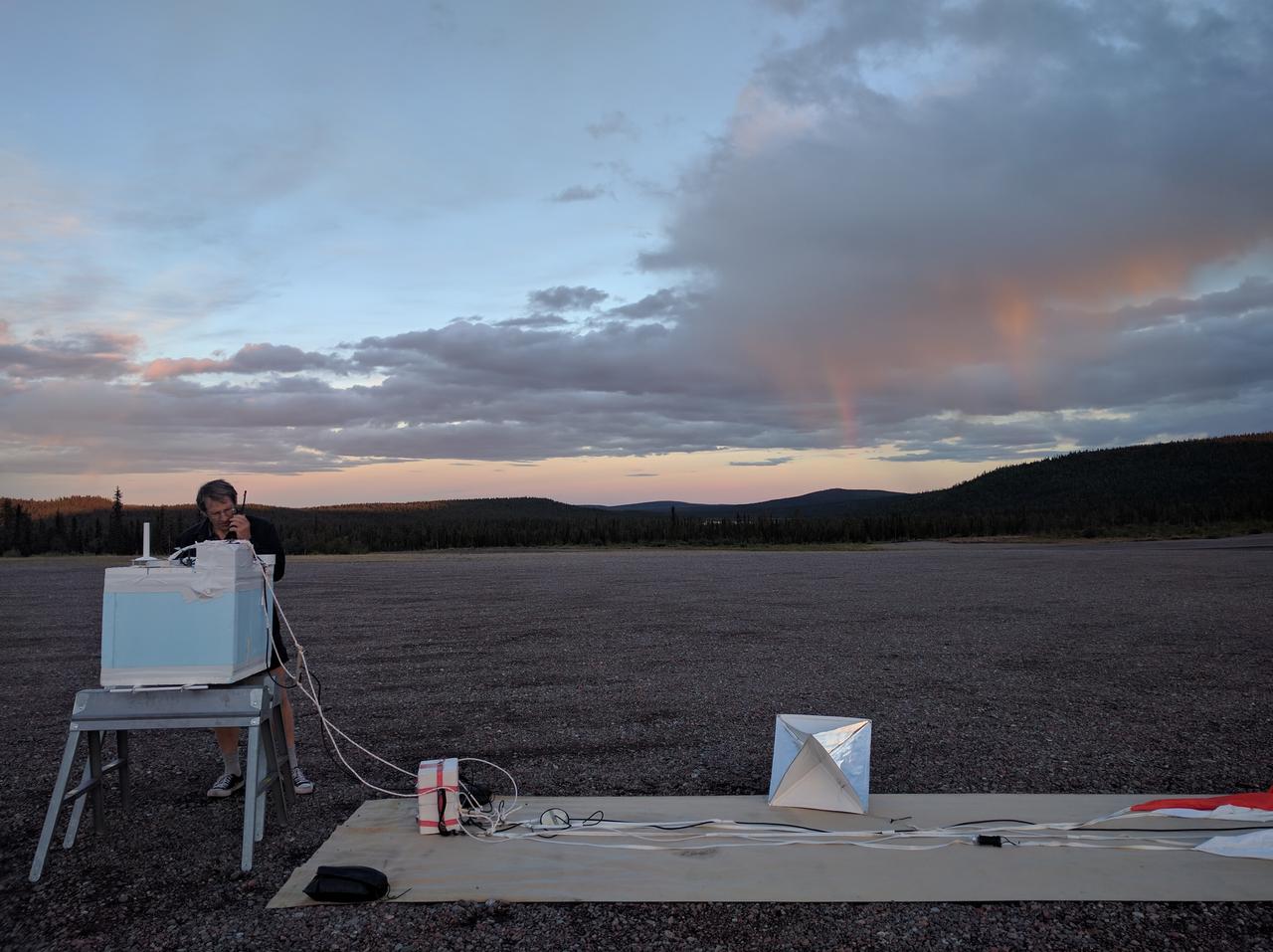
A member of the BARREL team prepares a payload for launch from Esrange Space Center on Aug. 29, 2016. Throughout August 2016, the BARREL team was at Esrange Space Center near Kiruna, Sweden, launching a series of six scientific payloads on miniature scientific balloons. The NASA-funded BARREL – which stands for Balloon Array for Radiation-belt Relativistic Electron Losses – primarily measures X-rays in Earth’s atmosphere near the North and South Poles. These X-rays are produced by electrons raining down into the atmosphere from two giant swaths of radiation that surround Earth, called the Van Allen belts. Learning about the radiation near Earth helps us to better protect our satellites. Several of the BARREL balloons also carried instruments built by undergraduate students to measure the total electron content of Earth’s ionosphere, as well as the low-frequency electromagnetic waves that help to scatter electrons into Earth’s atmosphere. Though about 90 feet in diameter, the BARREL balloons are much smaller than standard football stadium-sized scientific balloons. This is the fourth campaign for the BARREL mission. BARREL is led by Dartmouth College in Hanover, New Hampshire. The undergraduate student instrument team is led by the University of Houston and funded by the Undergraduate Student Instrument Project out of NASA’s Wallops Flight Facility. For more information on NASA’s scientific balloon program, visit: <a href="http://www.nasa.gov/scientificballoons" rel="nofollow">www.nasa.gov/scientificballoons</a>. Credit: NASA/Dartmouth/Alexa Halford <b><a href="http://www.nasa.gov/audience/formedia/features/MP_Photo_Guidelines.html" rel="nofollow">NASA image use policy.</a></b> <b><a href="http://www.nasa.gov/centers/goddard/home/index.html" rel="nofollow">NASA Goddard Space Flight Center</a></b> enables NASA’s mission through four scientific endeavors: Earth Science, Heliophysics, Solar System Exploration, and Astrophysics. Goddard plays a leading role in NASA’s accomplishments by contributing compelling scientific knowledge to advance the Agency’s mission. <b>Follow us on <a href="http://twitter.com/NASAGoddardPix" rel="nofollow">Twitter</a></b> <b>Like us on <a href="http://www.facebook.com/pages/Greenbelt-MD/NASA-Goddard/395013845897?ref=tsd" rel="nofollow">Facebook</a></b> <b>Find us on <a href="http://instagrid.me/nasagoddard/?vm=grid" rel="nofollow">Instagram</a></b>
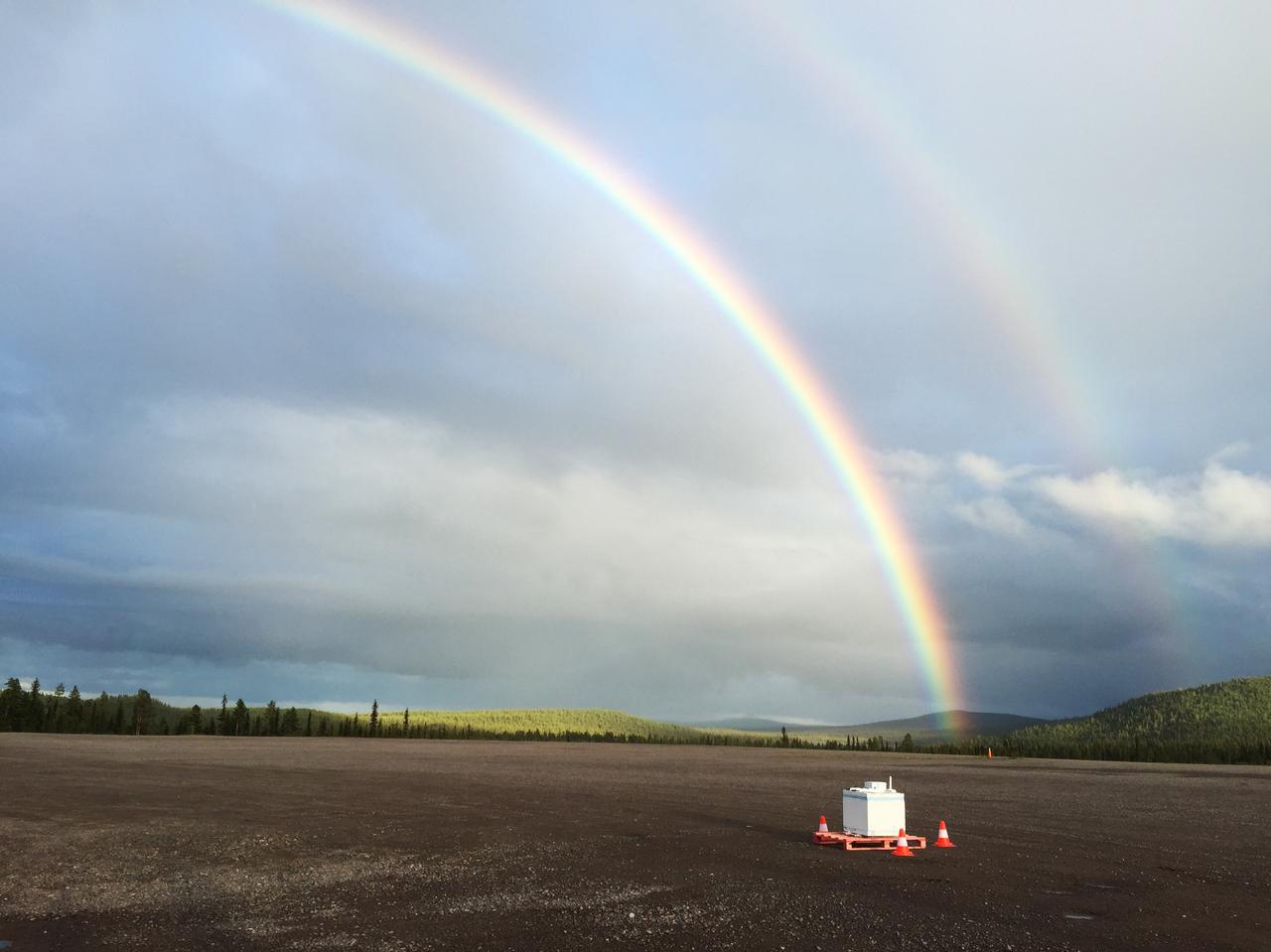
A BARREL payload sits on the launch pad at Esrange Space Center near Kiruna, Sweden. The BARREL team is at Esrange Space Center launching a series of six scientific payloads on miniature scientific balloons. The NASA-funded BARREL – which stands for Balloon Array for Radiation-belt Relativistic Electron Losses – primarily measures X-rays in Earth’s atmosphere near the North and South Poles. These X-rays are produced by electrons raining down into the atmosphere from two giant swaths of radiation that surround Earth, called the Van Allen belts. Learning about the radiation near Earth helps us to better protect our satellites. Several of the BARREL balloons also carry instruments built by undergraduate students to measure the total electron content of Earth’s ionosphere, as well as the low-frequency electromagnetic waves that help to scatter electrons into Earth’s atmosphere. Though about 90 feet in diameter, the BARREL balloons are much smaller than standard football stadium-sized scientific balloons. This is the fourth campaign for the BARREL mission. BARREL is led by Dartmouth College in Hanover, New Hampshire. The undergraduate student instrument team is led by the University of Houston and funded by the Undergraduate Student Instrument Project out of NASA’s Wallops Flight Facility. For more information on NASA’s scientific balloon program, visit: <a href="http://www.nasa.gov/scientificballoons" rel="nofollow">www.nasa.gov/scientificballoons</a>. Image credit: NASA/Dartmouth/Robyn Millan <b><a href="http://www.nasa.gov/audience/formedia/features/MP_Photo_Guidelines.html" rel="nofollow">NASA image use policy.</a></b> <b><a href="http://www.nasa.gov/centers/goddard/home/index.html" rel="nofollow">NASA Goddard Space Flight Center</a></b> enables NASA’s mission through four scientific endeavors: Earth Science, Heliophysics, Solar System Exploration, and Astrophysics. Goddard plays a leading role in NASA’s accomplishments by contributing compelling scientific knowledge to advance the Agency’s mission. <b>Follow us on <a href="http://twitter.com/NASAGoddardPix" rel="nofollow">Twitter</a></b> <b>Like us on <a href="http://www.facebook.com/pages/Greenbelt-MD/NASA-Goddard/395013845897?ref=tsd" rel="nofollow">Facebook</a></b> <b>Find us on <a href="http://instagrid.me/nasagoddard/?vm=grid" rel="nofollow">Instagram</a></b>
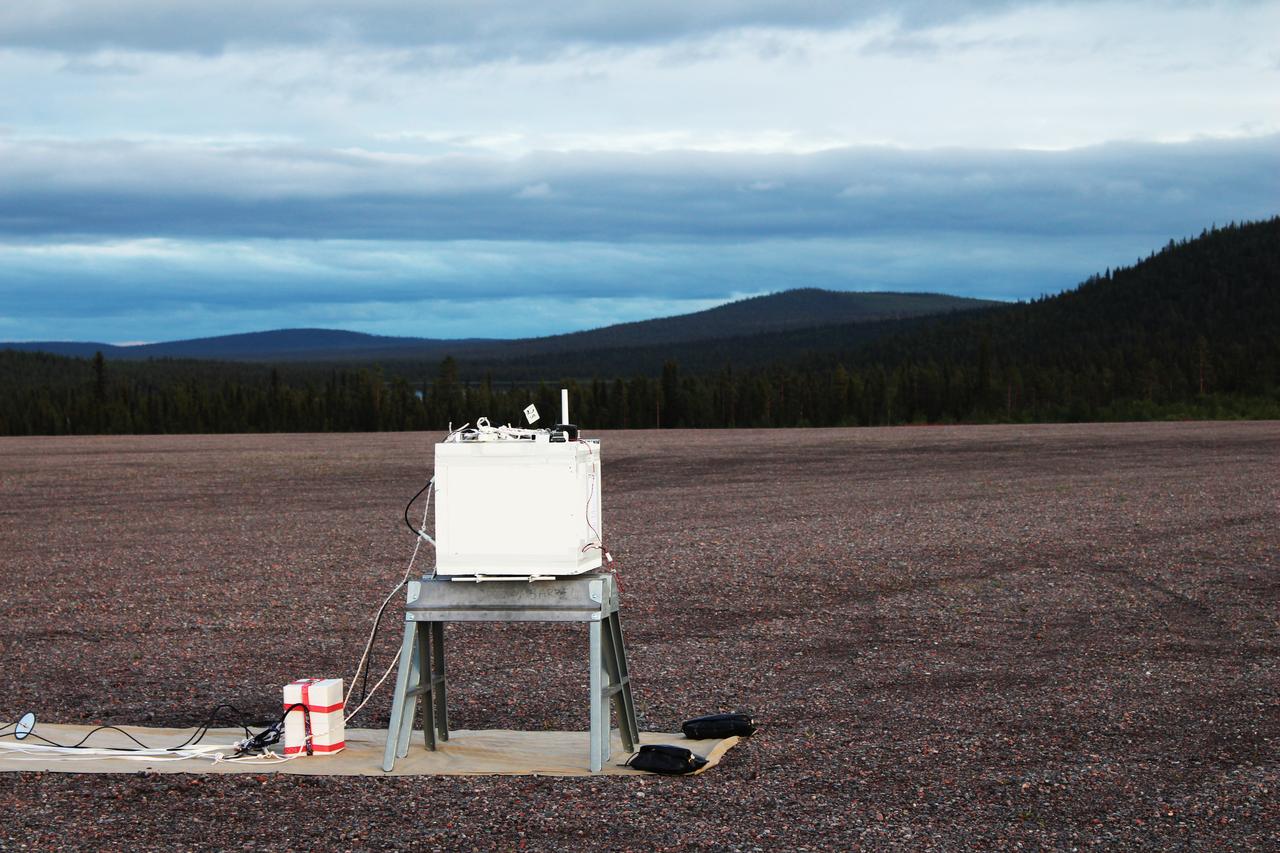
A BARREL payload sits on the launch pad at Esrange Space Center near Kiruna, Sweden. The BARREL team is at Esrange Space Center launching a series of six scientific payloads on miniature scientific balloons. The NASA-funded BARREL – which stands for Balloon Array for Radiation-belt Relativistic Electron Losses – primarily measures X-rays in Earth’s atmosphere near the North and South Poles. These X-rays are produced by electrons raining down into the atmosphere from two giant swaths of radiation that surround Earth, called the Van Allen belts. Learning about the radiation near Earth helps us to better protect our satellites. Several of the BARREL balloons also carry instruments built by undergraduate students to measure the total electron content of Earth’s ionosphere, as well as the low-frequency electromagnetic waves that help to scatter electrons into Earth’s atmosphere. Though about 90 feet in diameter, the BARREL balloons are much smaller than standard football stadium-sized scientific balloons. This is the fourth campaign for the BARREL mission. BARREL is led by Dartmouth College in Hanover, New Hampshire. The undergraduate student instrument team is led by the University of Houston and funded by the Undergraduate Student Instrument Project out of NASA’s Wallops Flight Facility. For more information on NASA’s scientific balloon program, visit: <a href="http://www.nasa.gov/scientificballoons" rel="nofollow">www.nasa.gov/scientificballoons</a>. Image credit: NASA/University of Houston/Edgar Bering <b><a href="http://www.nasa.gov/audience/formedia/features/MP_Photo_Guidelines.html" rel="nofollow">NASA image use policy.</a></b> <b><a href="http://www.nasa.gov/centers/goddard/home/index.html" rel="nofollow">NASA Goddard Space Flight Center</a></b> enables NASA’s mission through four scientific endeavors: Earth Science, Heliophysics, Solar System Exploration, and Astrophysics. Goddard plays a leading role in NASA’s accomplishments by contributing compelling scientific knowledge to advance the Agency’s mission. <b>Follow us on <a href="http://twitter.com/NASAGoddardPix" rel="nofollow">Twitter</a></b> <b>Like us on <a href="http://www.facebook.com/pages/Greenbelt-MD/NASA-Goddard/395013845897?ref=tsd" rel="nofollow">Facebook</a></b> <b>Find us on <a href="http://instagrid.me/nasagoddard/?vm=grid" rel="nofollow">Instagram</a></b>
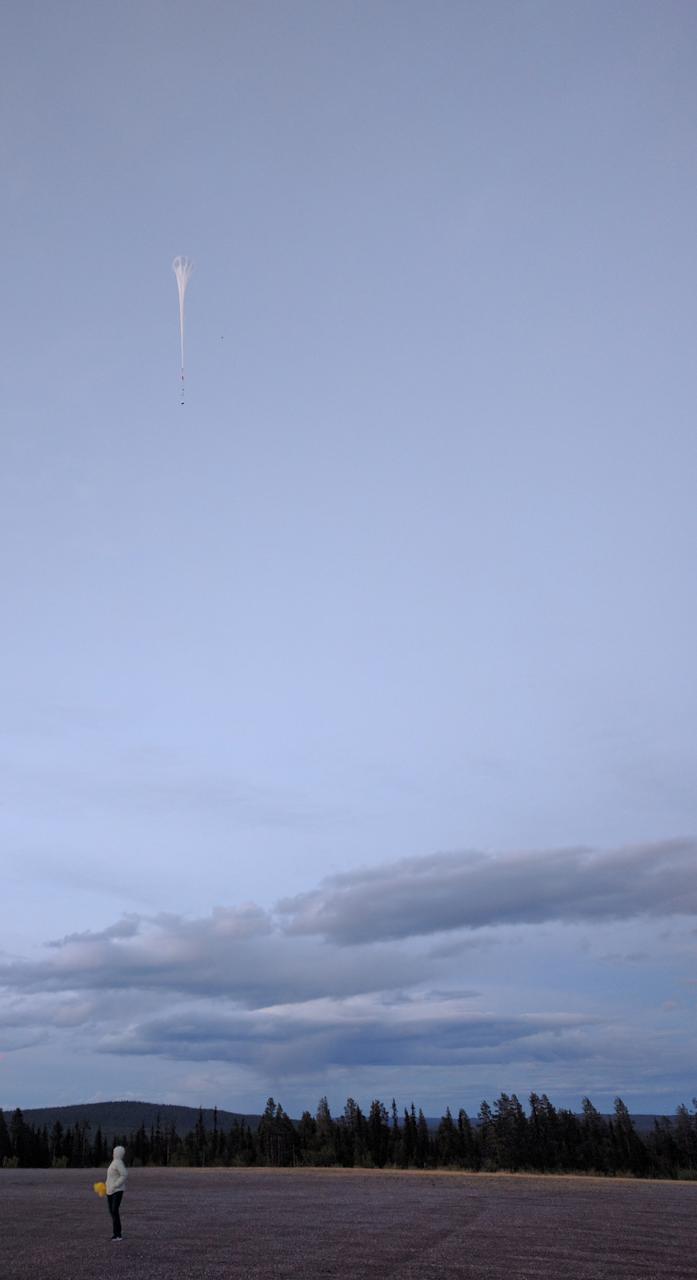
A BARREL team member watches as one of their payloads launches from Esrange Space Center on Aug. 29, 2016. Throughout August 2016, the BARREL team was at Esrange Space Center near Kiruna, Sweden, launching a series of six scientific payloads on miniature scientific balloons. The NASA-funded BARREL – which stands for Balloon Array for Radiation-belt Relativistic Electron Losses – primarily measures X-rays in Earth’s atmosphere near the North and South Poles. These X-rays are produced by electrons raining down into the atmosphere from two giant swaths of radiation that surround Earth, called the Van Allen belts. Learning about the radiation near Earth helps us to better protect our satellites. Several of the BARREL balloons also carried instruments built by undergraduate students to measure the total electron content of Earth’s ionosphere, as well as the low-frequency electromagnetic waves that help to scatter electrons into Earth’s atmosphere. Though about 90 feet in diameter, the BARREL balloons are much smaller than standard football stadium-sized scientific balloons. This is the fourth campaign for the BARREL mission. BARREL is led by Dartmouth College in Hanover, New Hampshire. The undergraduate student instrument team is led by the University of Houston and funded by the Undergraduate Student Instrument Project out of NASA’s Wallops Flight Facility. For more information on NASA’s scientific balloon program, visit: <a href="http://www.nasa.gov/scientificballoons" rel="nofollow">www.nasa.gov/scientificballoons</a>. Credit: NASA/Dartmouth/Alexa Halford <b><a href="http://www.nasa.gov/audience/formedia/features/MP_Photo_Guidelines.html" rel="nofollow">NASA image use policy.</a></b> <b><a href="http://www.nasa.gov/centers/goddard/home/index.html" rel="nofollow">NASA Goddard Space Flight Center</a></b> enables NASA’s mission through four scientific endeavors: Earth Science, Heliophysics, Solar System Exploration, and Astrophysics. Goddard plays a leading role in NASA’s accomplishments by contributing compelling scientific knowledge to advance the Agency’s mission. <b>Follow us on <a href="http://twitter.com/NASAGoddardPix" rel="nofollow">Twitter</a></b> <b>Like us on <a href="http://www.facebook.com/pages/Greenbelt-MD/NASA-Goddard/395013845897?ref=tsd" rel="nofollow">Facebook</a></b> <b>Find us on <a href="http://instagrid.me/nasagoddard/?vm=grid" rel="nofollow">Instagram</a></b>
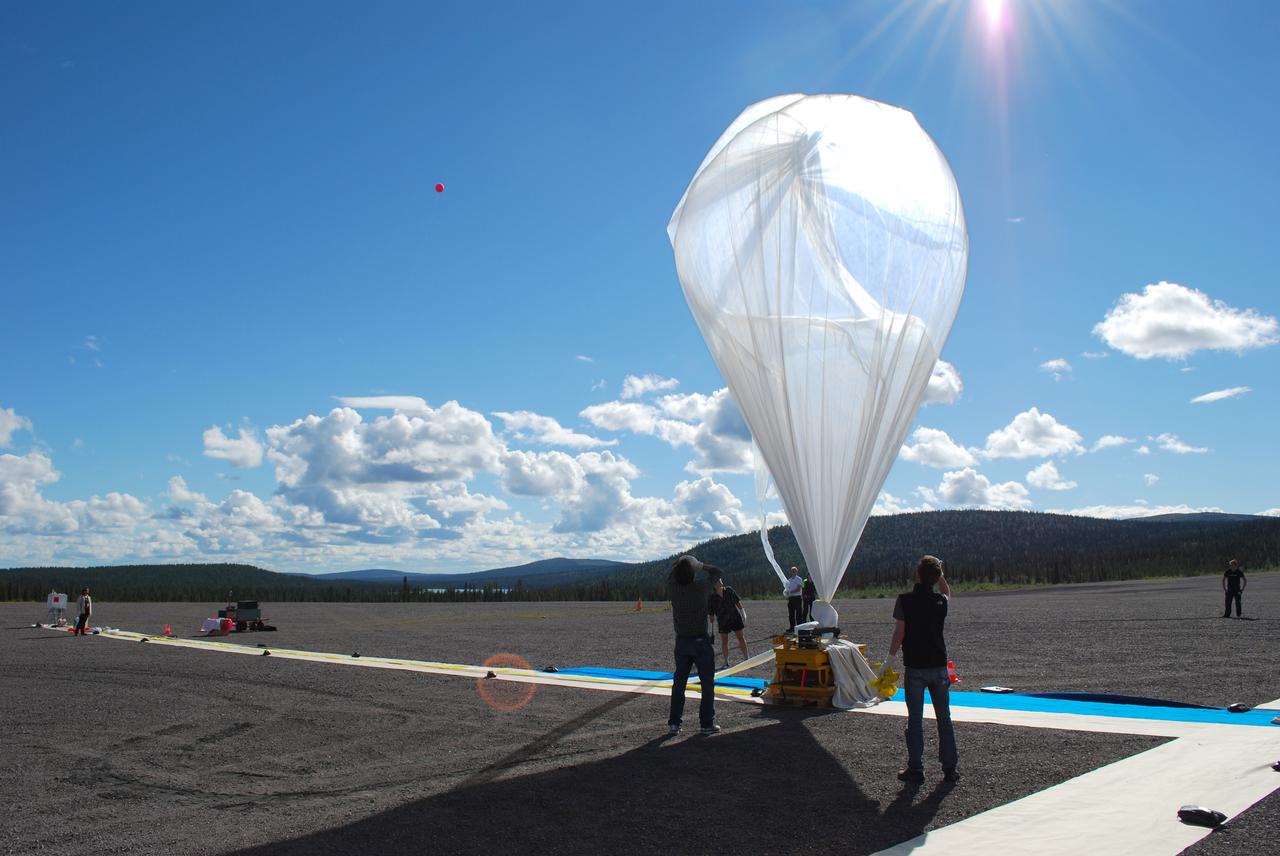
The BARREL team prepares to launch their third payload from Esrange Space Center near Kiruna, Sweden, on Aug. 21, 2016. The BARREL team is at Esrange Space Center launching a series of six scientific payloads on miniature scientific balloons. The NASA-funded BARREL – which stands for Balloon Array for Radiation-belt Relativistic Electron Losses – primarily measures X-rays in Earth’s atmosphere near the North and South Poles. These X-rays are produced by electrons raining down into the atmosphere from two giant swaths of radiation that surround Earth, called the Van Allen belts. Learning about the radiation near Earth helps us to better protect our satellites. Several of the BARREL balloons also carry instruments built by undergraduate students to measure the total electron content of Earth’s ionosphere, as well as the low-frequency electromagnetic waves that help to scatter electrons into Earth’s atmosphere. Though about 90 feet in diameter, the BARREL balloons are much smaller than standard football stadium-sized scientific balloons. This is the fourth campaign for the BARREL mission. BARREL is led by Dartmouth College in Hanover, New Hampshire. The undergraduate student instrument team is led by the University of Houston and funded by the Undergraduate Student Instrument Project out of NASA’s Wallops Flight Facility. For more information on NASA’s scientific balloon program, visit: <a href="http://www.nasa.gov/scientificballoons" rel="nofollow">www.nasa.gov/scientificballoons</a>. Credit: NASA/University of Houston/Michael Greer <b><a href="http://www.nasa.gov/audience/formedia/features/MP_Photo_Guidelines.html" rel="nofollow">NASA image use policy.</a></b> <b><a href="http://www.nasa.gov/centers/goddard/home/index.html" rel="nofollow">NASA Goddard Space Flight Center</a></b> enables NASA’s mission through four scientific endeavors: Earth Science, Heliophysics, Solar System Exploration, and Astrophysics. Goddard plays a leading role in NASA’s accomplishments by contributing compelling scientific knowledge to advance the Agency’s mission. <b>Follow us on <a href="http://twitter.com/NASAGoddardPix" rel="nofollow">Twitter</a></b> <b>Like us on <a href="http://www.facebook.com/pages/Greenbelt-MD/NASA-Goddard/395013845897?ref=tsd" rel="nofollow">Facebook</a></b> <b>Find us on <a href="http://instagrid.me/nasagoddard/?vm=grid" rel="nofollow">Instagram</a></b>
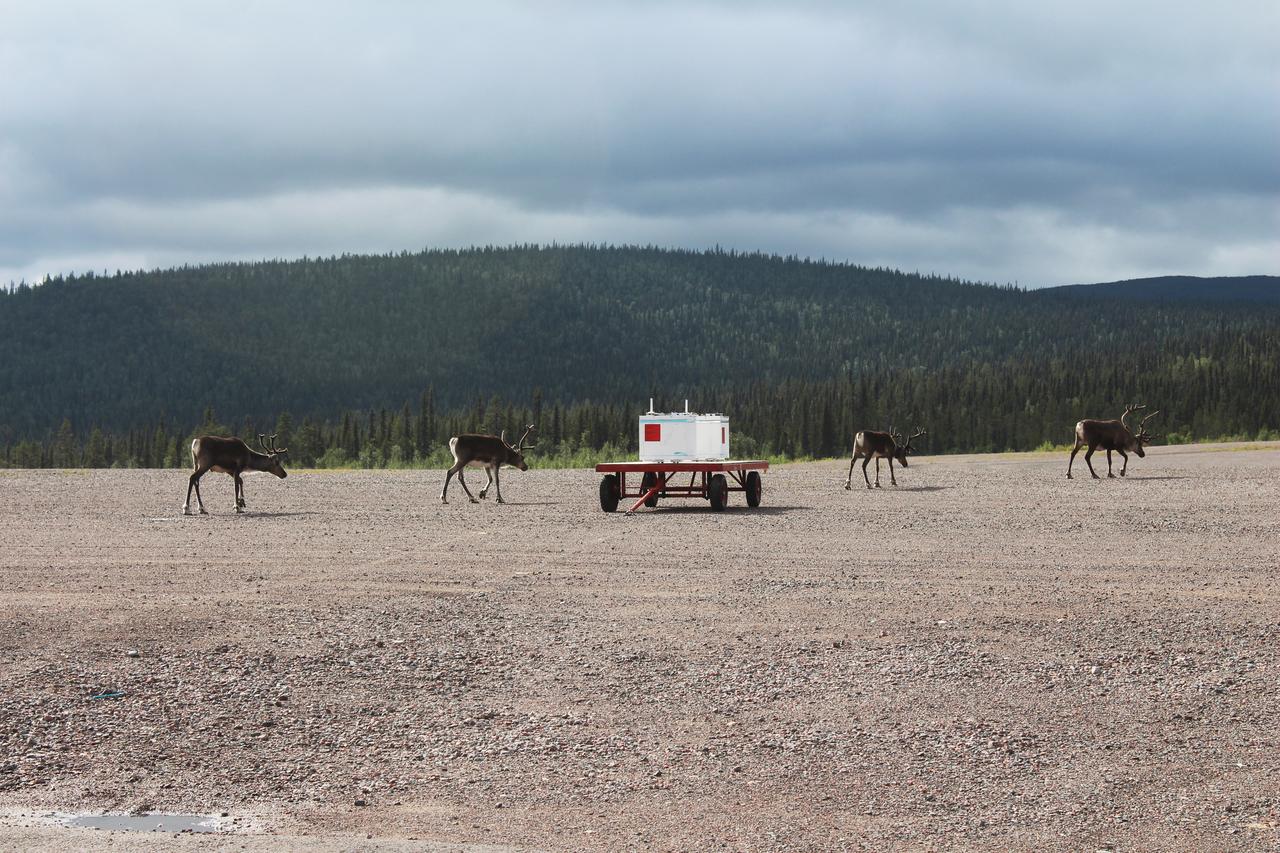
Four reindeer walk past the BARREL payload on the launch pad at Esrange Space Center near Kiruna, Sweden. The BARREL team is at Esrange Space Center launching a series of six scientific payloads on miniature scientific balloons. The NASA-funded BARREL – which stands for Balloon Array for Radiation-belt Relativistic Electron Losses – primarily measures X-rays in Earth’s atmosphere near the North and South Poles. These X-rays are produced by electrons raining down into the atmosphere from two giant swaths of radiation that surround Earth, called the Van Allen belts. Learning about the radiation near Earth helps us to better protect our satellites. Several of the BARREL balloons also carry instruments built by undergraduate students to measure the total electron content of Earth’s ionosphere, as well as the low-frequency electromagnetic waves that help to scatter electrons into Earth’s atmosphere. Though about 90 feet in diameter, the BARREL balloons are much smaller than standard football stadium-sized scientific balloons. This is the fourth campaign for the BARREL mission. BARREL is led by Dartmouth College in Hanover, New Hampshire. The undergraduate student instrument team is led by the University of Houston and funded by the Undergraduate Student Instrument Project out of NASA’s Wallops Flight Facility. For more information on NASA’s scientific balloon program, visit: <a href="http://www.nasa.gov/scientificballoons" rel="nofollow">www.nasa.gov/scientificballoons</a>. Image credit: NASA/University of Houston/Samar Mathur <b><a href="http://www.nasa.gov/audience/formedia/features/MP_Photo_Guidelines.html" rel="nofollow">NASA image use policy.</a></b> <b><a href="http://www.nasa.gov/centers/goddard/home/index.html" rel="nofollow">NASA Goddard Space Flight Center</a></b> enables NASA’s mission through four scientific endeavors: Earth Science, Heliophysics, Solar System Exploration, and Astrophysics. Goddard plays a leading role in NASA’s accomplishments by contributing compelling scientific knowledge to advance the Agency’s mission. <b>Follow us on <a href="http://twitter.com/NASAGoddardPix" rel="nofollow">Twitter</a></b> <b>Like us on <a href="http://www.facebook.com/pages/Greenbelt-MD/NASA-Goddard/395013845897?ref=tsd" rel="nofollow">Facebook</a></b> <b>Find us on <a href="http://instagrid.me/nasagoddard/?vm=grid" rel="nofollow">Instagram</a></b>
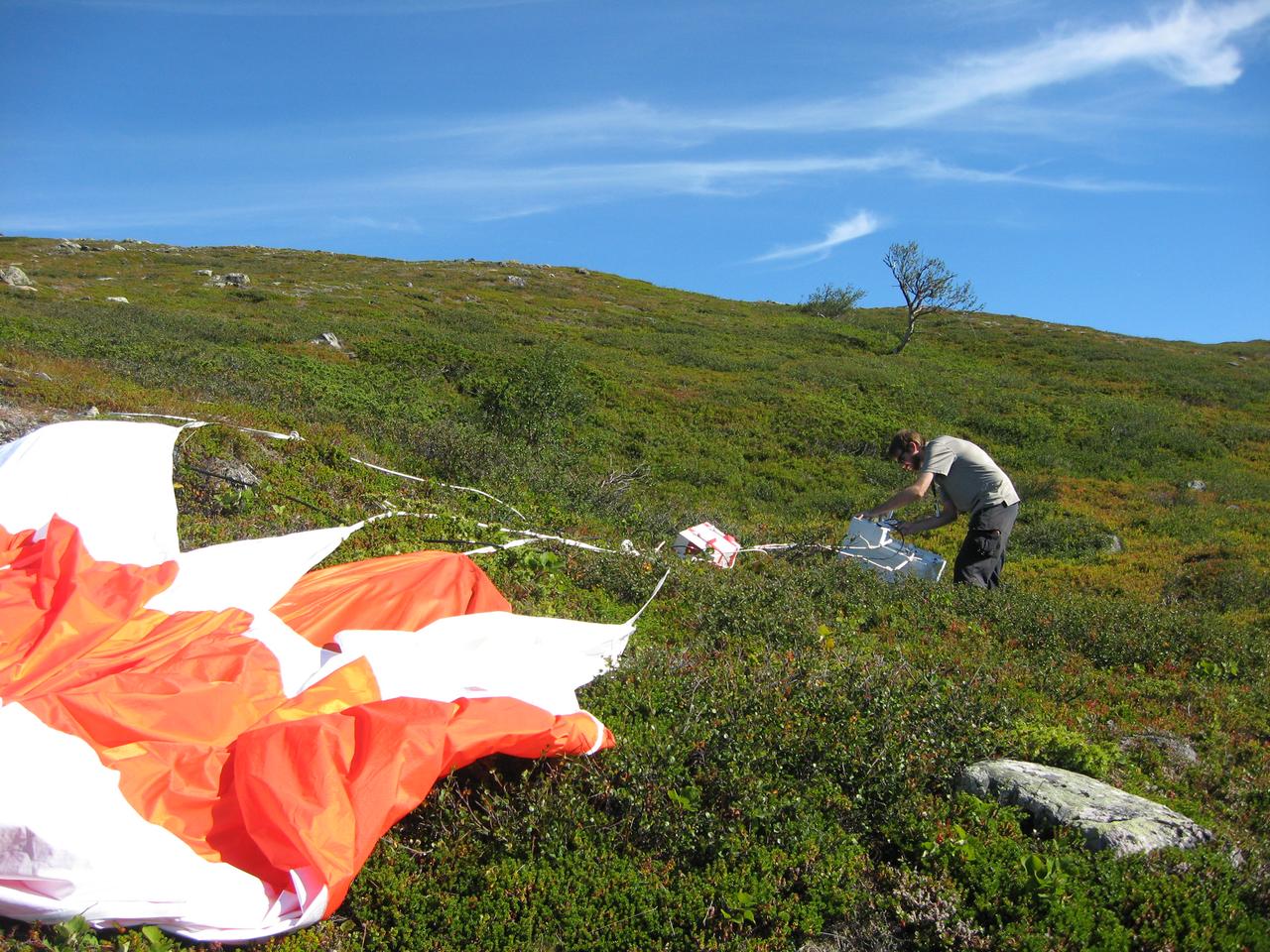
A BARREL team member recovers the second payload after it landed. The BARREL team is at Esrange Space Center near Kiruna, Sweden, launching a series of six scientific payloads on miniature scientific balloons. The NASA-funded BARREL – which stands for Balloon Array for Radiation-belt Relativistic Electron Losses – primarily measures X-rays in Earth’s atmosphere near the North and South Poles. These X-rays are produced by electrons raining down into the atmosphere from two giant swaths of radiation that surround Earth, called the Van Allen belts. Learning about the radiation near Earth helps us to better protect our satellites. Several of the BARREL balloons also carry instruments built by undergraduate students to measure the total electron content of Earth’s ionosphere, as well as the low-frequency electromagnetic waves that help to scatter electrons into Earth’s atmosphere. Though about 90 feet in diameter, the BARREL balloons are much smaller than standard football stadium-sized scientific balloons. This is the fourth campaign for the BARREL mission. BARREL is led by Dartmouth College in Hanover, New Hampshire. The undergraduate student instrument team is led by the University of Houston and funded by the Undergraduate Student Instrument Project out of NASA’s Wallops Flight Facility. For more information on NASA’s scientific balloon program, visit: <a href="http://www.nasa.gov/scientificballoons" rel="nofollow">www.nasa.gov/scientificballoons</a>. Image credit: NASA/Montana State University/Arlo Johnson <b><a href="http://www.nasa.gov/audience/formedia/features/MP_Photo_Guidelines.html" rel="nofollow">NASA image use policy.</a></b> <b><a href="http://www.nasa.gov/centers/goddard/home/index.html" rel="nofollow">NASA Goddard Space Flight Center</a></b> enables NASA’s mission through four scientific endeavors: Earth Science, Heliophysics, Solar System Exploration, and Astrophysics. Goddard plays a leading role in NASA’s accomplishments by contributing compelling scientific knowledge to advance the Agency’s mission. <b>Follow us on <a href="http://twitter.com/NASAGoddardPix" rel="nofollow">Twitter</a></b> <b>Like us on <a href="http://www.facebook.com/pages/Greenbelt-MD/NASA-Goddard/395013845897?ref=tsd" rel="nofollow">Facebook</a></b> <b>Find us on <a href="http://instagrid.me/nasagoddard/?vm=grid" rel="nofollow">Instagram</a></b>
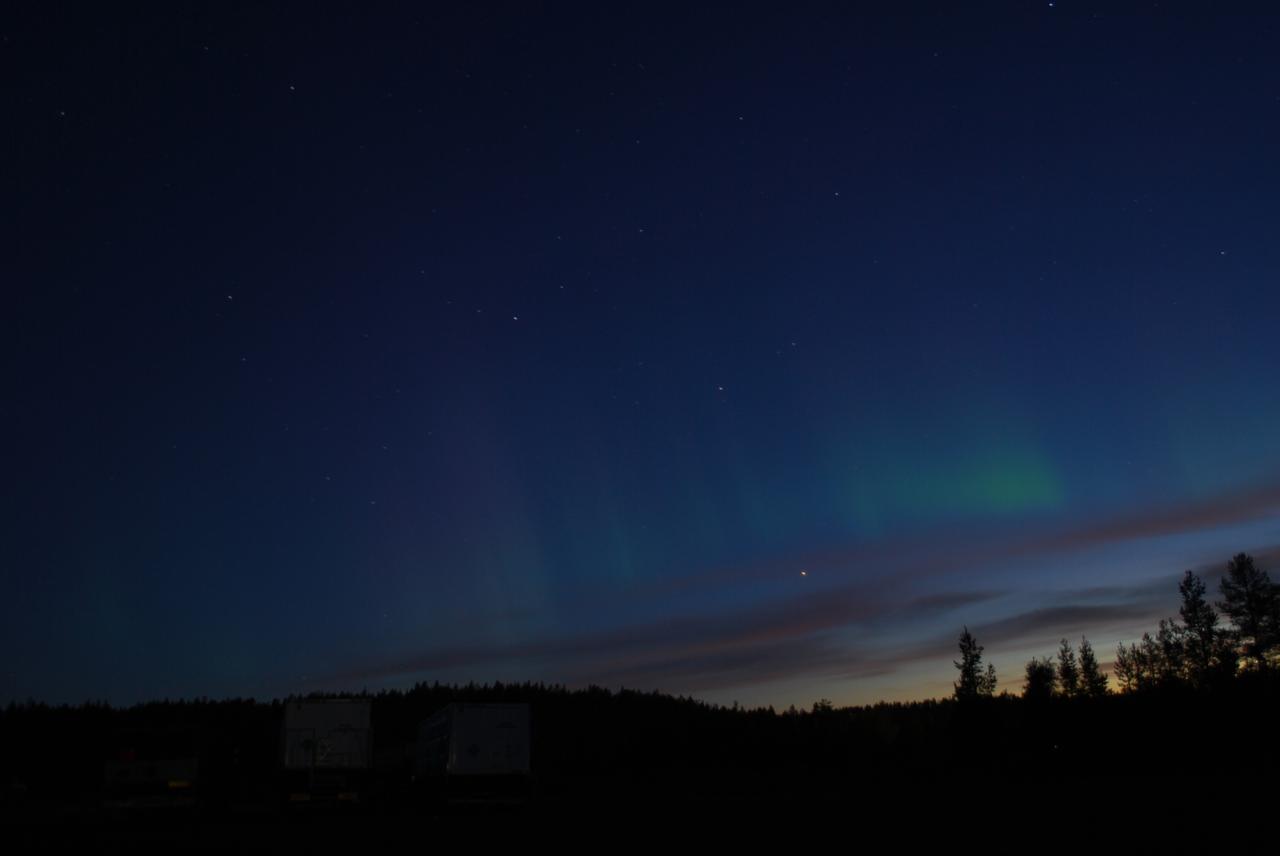
The faint green glow of aurora can be seen above the clouds at Esrange Space Center in this photo from Aug. 23, 2016. Auroras are created by energetic electrons, which rain down from Earth’s magnetic bubble and interact with particles in the upper atmosphere to create glowing lights that stretch across the sky. The BARREL team is at Esrange Space Center near Kiruna, Sweden, launching a series of six scientific payloads on miniature scientific balloons. The NASA-funded BARREL – which stands for Balloon Array for Radiation-belt Relativistic Electron Losses – primarily measures X-rays in Earth’s atmosphere near the North and South Poles. These X-rays are produced by electrons raining down into the atmosphere from two giant swaths of radiation that surround Earth, called the Van Allen belts. Learning about the radiation near Earth helps us to better protect our satellites. Several of the BARREL balloons also carry instruments built by undergraduate students to measure the total electron content of Earth’s ionosphere, as well as the low-frequency electromagnetic waves that help to scatter electrons into Earth’s atmosphere. Though about 90 feet in diameter, the BARREL balloons are much smaller than standard football stadium-sized scientific balloons. This is the fourth campaign for the BARREL mission. BARREL is led by Dartmouth College in Hanover, New Hampshire. The undergraduate student instrument team is led by the University of Houston and funded by the Undergraduate Student Instrument Project out of NASA’s Wallops Flight Facility. For more information on NASA’s scientific balloon program, visit: <a href="http://www.nasa.gov/scientificballoons" rel="nofollow">www.nasa.gov/scientificballoons</a>. Credit: NASA/University of Houston/Michael Greer <b><a href="http://www.nasa.gov/audience/formedia/features/MP_Photo_Guidelines.html" rel="nofollow">NASA image use policy.</a></b> <b><a href="http://www.nasa.gov/centers/goddard/home/index.html" rel="nofollow">NASA Goddard Space Flight Center</a></b> enables NASA’s mission through four scientific endeavors: Earth Science, Heliophysics, Solar System Exploration, and Astrophysics. Goddard plays a leading role in NASA’s accomplishments by contributing compelling scientific knowledge to advance the Agency’s mission. <b>Follow us on <a href="http://twitter.com/NASAGoddardPix" rel="nofollow">Twitter</a></b> <b>Like us on <a href="http://www.facebook.com/pages/Greenbelt-MD/NASA-Goddard/395013845897?ref=tsd" rel="nofollow">Facebook</a></b> <b>Find us on <a href="http://instagrid.me/nasagoddard/?vm=grid" rel="nofollow">Instagram</a></b>

Some of the BARREL balloon launches took place at the South African National Antarctic Expedition Research base, called SANAE IV, the others at Halley Research Station. This balloon is taking flight at SANAE IV. Credit: NASA --- In Antarctica in January, 2013 – the summer at the South Pole – scientists launched 20 balloons up into the air to study an enduring mystery of space weather: when the giant radiation belts surrounding Earth lose material, where do the extra particles actually go? The mission is called BARREL (Balloon Array for Radiation belt Relativistic Electron Losses) and it is led by physicist Robyn Millan of Dartmouth College in Hanover, NH. Millan provided photographs from the team’s time in Antarctica. The team launched a balloon every day or two into the circumpolar winds that circulate around the pole. Each balloon floated for anywhere from 3 to 40 days, measuring X-rays produced by fast-moving electrons high up in the atmosphere. BARREL works hand in hand with another NASA mission called the Van Allen Probes, which travels through the Van Allen radiation belts surrounding Earth. The belts wax and wane over time in response to incoming energy and material from the sun, sometimes intensifying the radiation through which satellites must travel. Scientists wish to understand this process better, and even provide forecasts of this space weather, in order to protect our spacecraft. As the Van Allen Probes were observing what was happening in the belts, BARREL tracked electrons that precipitated out of the belts and hurtled down Earth’s magnetic field lines toward the poles. By comparing data, scientists will be able to track how what’s happening in the belts correlates to the loss of particles – information that can help us understand this mysterious, dynamic region that can impact spacecraft. Having launched balloons in early 2013, the team is back at home building the next set of payloads. They will launch 20 more balloons in 2014. <b><a href="http://www.nasa.gov/audience/formedia/features/MP_Photo_Guidelines.html" rel="nofollow">NASA image use policy.</a></b> <b><a href="http://www.nasa.gov/centers/goddard/home/index.html" rel="nofollow">NASA Goddard Space Flight Center</a></b> enables NASA’s mission through four scientific endeavors: Earth Science, Heliophysics, Solar System Exploration, and Astrophysics. Goddard plays a leading role in NASA’s accomplishments by contributing compelling scientific knowledge to advance the Agency’s mission. <b>Follow us on <a href="http://twitter.com/NASA_GoddardPix" rel="nofollow">Twitter</a></b> <b>Like us on <a href="http://www.facebook.com/pages/Greenbelt-MD/NASA-Goddard/395013845897?ref=tsd" rel="nofollow">Facebook</a></b> <b>Find us on <a href="http://instagram.com/nasagoddard?vm=grid" rel="nofollow">Instagram</a></b>

NASA image captured December 25, 2011 A NASA scientific balloon awaits launch in McMurdo, Antarctica. The balloon, carrying Indiana University's Cosmic Ray Electron Synchrotron Telescope (CREST), was launched on December 25. After a circum-navigational flight around the South Pole, the payload landed on January 5. The CREST payload is one of two scheduled as part of this seasons' annual NASA Antarctic balloon Campaign which is conducted in cooperation with the National Science Foundation's Office of Polar Programs. The campaign's second payload is the University of Arizona's Stratospheric Terahertz Observatory (STO). You can follow the flights at the Columbia Scientific Balloon Facility's web site at <a href="http://www.csbf.nasa.gov/antarctica/ice.htm" rel="nofollow">www.csbf.nasa.gov/antarctica/ice.htm</a> Credit: NASA <b><a href="http://www.nasa.gov/audience/formedia/features/MP_Photo_Guidelines.html" rel="nofollow">NASA image use policy.</a></b> <b><a href="http://www.nasa.gov/centers/goddard/home/index.html" rel="nofollow">NASA Goddard Space Flight Center</a></b> enables NASA’s mission through four scientific endeavors: Earth Science, Heliophysics, Solar System Exploration, and Astrophysics. Goddard plays a leading role in NASA’s accomplishments by contributing compelling scientific knowledge to advance the Agency’s mission. <b>Follow us on <a href="http://twitter.com/NASA_GoddardPix" rel="nofollow">Twitter</a></b> <b>Like us on <a href="http://www.facebook.com/pages/Greenbelt-MD/NASA-Goddard/395013845897?ref=tsd" rel="nofollow">Facebook</a></b> <b>Find us on <a href="http://instagrid.me/nasagoddard/?vm=grid" rel="nofollow">Instagram</a></b>

NASA image captured December 25, 2011 A NASA scientific balloon awaits launch in McMurdo, Antarctica. The balloon, carrying Indiana University's Cosmic Ray Electron Synchrotron Telescope (CREST), was launched on December 25. After a circum-navigational flight around the South Pole, the payload landed on January 5. The CREST payload is one of two scheduled as part of this seasons' annual NASA Antarctic balloon Campaign which is conducted in cooperation with the National Science Foundation's Office of Polar Programs. The campaign's second payload is the University of Arizona's Stratospheric Terahertz Observatory (STO). You can follow the flights at the Columbia Scientific Balloon Facility's web site at <a href="http://www.csbf.nasa.gov/antarctica/ice.htm" rel="nofollow">www.csbf.nasa.gov/antarctica/ice.htm</a> Credit: NASA <b><a href="http://www.nasa.gov/audience/formedia/features/MP_Photo_Guidelines.html" rel="nofollow">NASA image use policy.</a></b> <b><a href="http://www.nasa.gov/centers/goddard/home/index.html" rel="nofollow">NASA Goddard Space Flight Center</a></b> enables NASA’s mission through four scientific endeavors: Earth Science, Heliophysics, Solar System Exploration, and Astrophysics. Goddard plays a leading role in NASA’s accomplishments by contributing compelling scientific knowledge to advance the Agency’s mission. <b>Follow us on <a href="http://twitter.com/NASA_GoddardPix" rel="nofollow">Twitter</a></b> <b>Like us on <a href="http://www.facebook.com/pages/Greenbelt-MD/NASA-Goddard/395013845897?ref=tsd" rel="nofollow">Facebook</a></b> <b>Find us on <a href="http://instagrid.me/nasagoddard/?vm=grid" rel="nofollow">Instagram</a></b>
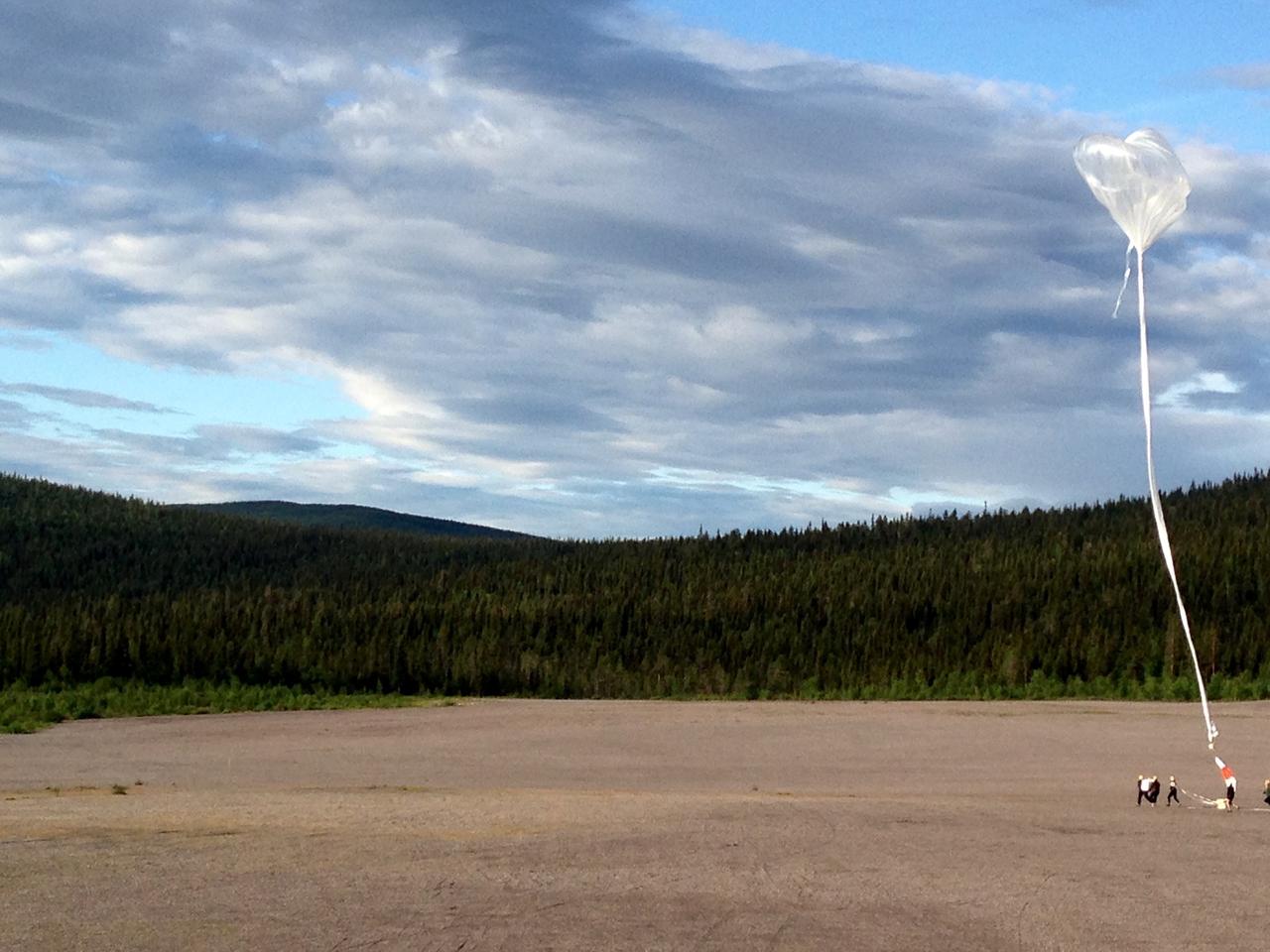
The BARREL team prepares to release the second scientific balloon in its Sweden campaign on Aug. 13, 2015. In addition to the instruments used in previous BARREL campaigns, this second balloon launched from the Esrange Space Center in Kiruna is carrying one of two instruments designed by a team from the University of Houston. With funding from the Undergraduate Student Instrument Program, or USIP, at NASA Goddard Space Flight Center’s Wallops Flight Facility, the team of 12 students, under the direction of Edgar Bering at the University of Houston, developed a magnetometer -- which measures magnetic fields -- and an instrument to measure electrons, which flew on this launch. To collect their data, the University of Houston team needs to recover their instrument after the balloon comes down. After this launch, the balloon began to drift toward the mountains, which would have impeded recovery. So the team terminated the flight at 1:18 pm EDT to bring the payload slowly and safely to the ground. The NASA-funded BARREL – which stands for Balloon Array for Radiation-belt Relativistic Electron Losses – measures electrons in the atmosphere near the poles. Such electrons rain down into the atmosphere from two giant radiation belts surrounding Earth, called the Van Allen belts. For its third campaign, BARREL is launching six balloons from the Esrange Space Center in Kiruna, Sweden. BARREL is led by Dartmouth College in Hanover, New Hampshire. Credit: NASA/University of Houston/Edgar Bering <b><a href="http://www.nasa.gov/audience/formedia/features/MP_Photo_Guidelines.html" rel="nofollow">NASA image use policy.</a></b> <b><a href="http://www.nasa.gov/centers/goddard/home/index.html" rel="nofollow">NASA Goddard Space Flight Center</a></b> enables NASA’s mission through four scientific endeavors: Earth Science, Heliophysics, Solar System Exploration, and Astrophysics. Goddard plays a leading role in NASA’s accomplishments by contributing compelling scientific knowledge to advance the Agency’s mission. <b>Follow us on <a href="http://twitter.com/NASAGoddardPix" rel="nofollow">Twitter</a></b> <b>Like us on <a href="http://www.facebook.com/pages/Greenbelt-MD/NASA-Goddard/395013845897?ref=tsd" rel="nofollow">Facebook</a></b> <b>Find us on <a href="http://instagrid.me/nasagoddard/?vm=grid" rel="nofollow">Instagram</a></b>

Pumping helium into the first BARREL balloon to launch from Halley Research Satation. Credit: NASA --- In Antarctica in January, 2013 – the summer at the South Pole – scientists launched 20 balloons up into the air to study an enduring mystery of space weather: when the giant radiation belts surrounding Earth lose material, where do the extra particles actually go? The mission is called BARREL (Balloon Array for Radiation belt Relativistic Electron Losses) and it is led by physicist Robyn Millan of Dartmouth College in Hanover, NH. Millan provided photographs from the team’s time in Antarctica. The team launched a balloon every day or two into the circumpolar winds that circulate around the pole. Each balloon floated for anywhere from 3 to 40 days, measuring X-rays produced by fast-moving electrons high up in the atmosphere. BARREL works hand in hand with another NASA mission called the Van Allen Probes, which travels through the Van Allen radiation belts surrounding Earth. The belts wax and wane over time in response to incoming energy and material from the sun, sometimes intensifying the radiation through which satellites must travel. Scientists wish to understand this process better, and even provide forecasts of this space weather, in order to protect our spacecraft. As the Van Allen Probes were observing what was happening in the belts, BARREL tracked electrons that precipitated out of the belts and hurtled down Earth’s magnetic field lines toward the poles. By comparing data, scientists will be able to track how what’s happening in the belts correlates to the loss of particles – information that can help us understand this mysterious, dynamic region that can impact spacecraft. Having launched balloons in early 2013, the team is back at home building the next set of payloads. They will launch 20 more balloons in 2014. <b><a href="http://www.nasa.gov/audience/formedia/features/MP_Photo_Guidelines.html" rel="nofollow">NASA image use policy.</a></b> <b><a href="http://www.nasa.gov/centers/goddard/home/index.html" rel="nofollow">NASA Goddard Space Flight Center</a></b> enables NASA’s mission through four scientific endeavors: Earth Science, Heliophysics, Solar System Exploration, and Astrophysics. Goddard plays a leading role in NASA’s accomplishments by contributing compelling scientific knowledge to advance the Agency’s mission. <b>Follow us on <a href="http://twitter.com/NASA_GoddardPix" rel="nofollow">Twitter</a></b> <b>Like us on <a href="http://www.facebook.com/pages/Greenbelt-MD/NASA-Goddard/395013845897?ref=tsd" rel="nofollow">Facebook</a></b> <b>Find us on <a href="http://instagram.com/nasagoddard?vm=grid" rel="nofollow">Instagram</a></b>

BARREL researchers get ready to release the top part of the balloon, called the bubble, as it fills with enough helium to support itself. Only the top part of the balloon is inflated before launch since the helium expands as the balloon ascends. Credit: NASA/Goddard/BARREL/Nicky Knox Read more: <a href="http://www.nasa.gov/content/goddard/nasas-barrel-returns-successful-from-antarctica" rel="nofollow">www.nasa.gov/content/goddard/nasas-barrel-returns-success...</a> -- Three months, 20 balloons, and one very successful campaign. The team for NASA's BARREL – short for Balloon Array for Radiation belt Relativistic Electron Losses -- mission returned from Antarctica in March 2014. BARREL's job is to help unravel the mysterious Van Allen belts, two gigantic donuts of radiation that surround Earth, which can shrink and swell in response to incoming energy and particles from the sun and sometimes expose satellites to harsh radiation. While in Antarctica, the team launched 20 balloons carrying instruments that sense charged particles that are scattered into the atmosphere from the belts, spiraling down the magnetic fields near the South Pole. Each balloon traveled around the pole for up to three weeks. The team will coordinate the BARREL data with observations from NASA's two Van Allen Probes to better understand how occurrences in the belts relate to bursts of particles funneling down toward Earth. BARREL team members will be on hand at the USA Science and Engineering Festival in DC on April 26 and 27, 2014 for the exhibit Space Balloons: Exploring the Extremes of Space Weather. <b><a href="http://www.nasa.gov/audience/formedia/features/MP_Photo_Guidelines.html" rel="nofollow">NASA image use policy.</a></b> <b><a href="http://www.nasa.gov/centers/goddard/home/index.html" rel="nofollow">NASA Goddard Space Flight Center</a></b> enables NASA’s mission through four scientific endeavors: Earth Science, Heliophysics, Solar System Exploration, and Astrophysics. Goddard plays a leading role in NASA’s accomplishments by contributing compelling scientific knowledge to advance the Agency’s mission. <b>Follow us on <a href="http://twitter.com/NASAGoddardPix" rel="nofollow">Twitter</a></b> <b>Like us on <a href="http://www.facebook.com/pages/Greenbelt-MD/NASA-Goddard/395013845897?ref=tsd" rel="nofollow">Facebook</a></b> <b>Find us on <a href="http://instagram.com/nasagoddard?vm=grid" rel="nofollow">Instagram</a></b>
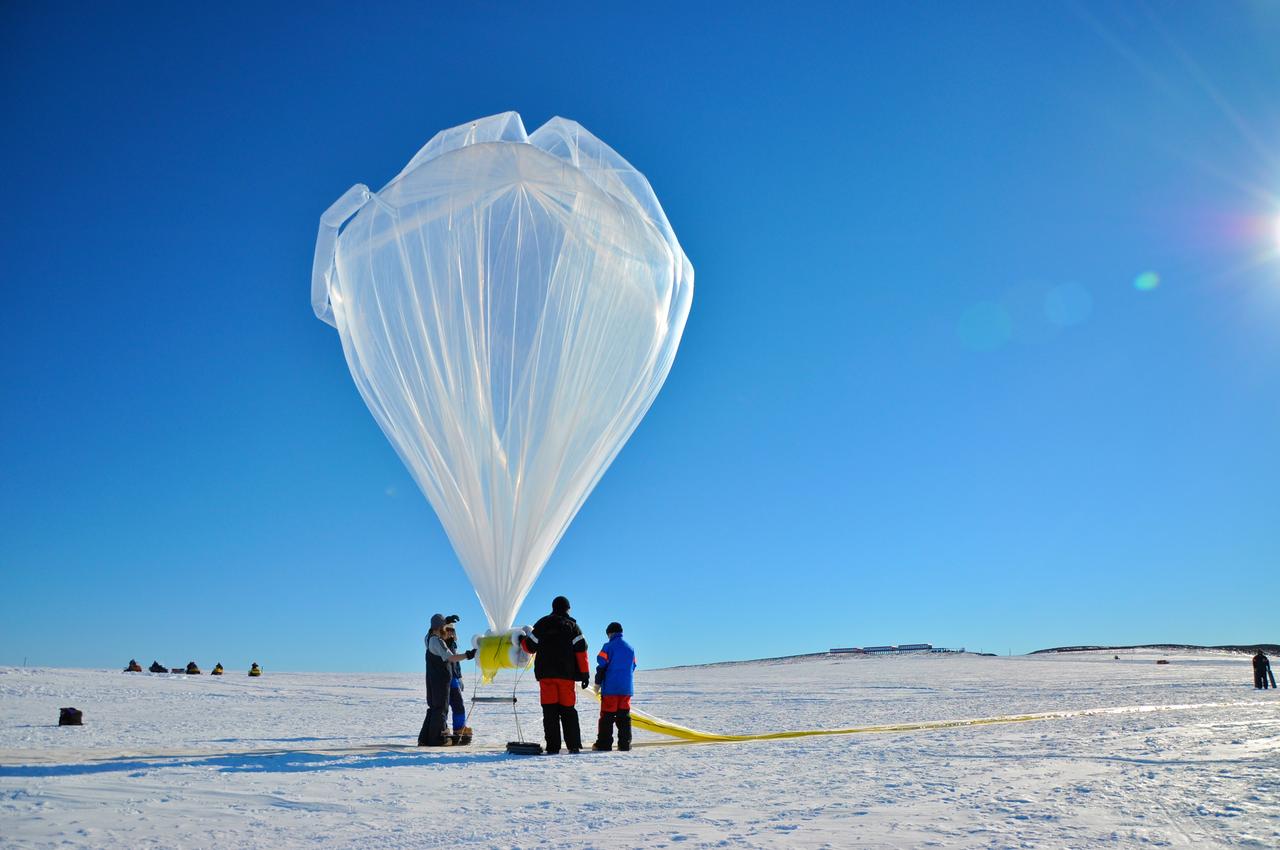
A BARREL balloon floats into the sky as it is partially filled. When fully inflated, each balloon is 90 feet in diameter and carries an instrument suite that weighs 50 pounds. This is small for an Antarctica balloon launch, which can have balloons Typical balloons l the size of a football field with payloads of some 3,000 pounds. Credit: NASA --- In Antarctica in January, 2013 – the summer at the South Pole – scientists launched 20 balloons up into the air to study an enduring mystery of space weather: when the giant radiation belts surrounding Earth lose material, where do the extra particles actually go? The mission is called BARREL (Balloon Array for Radiation belt Relativistic Electron Losses) and it is led by physicist Robyn Millan of Dartmouth College in Hanover, NH. Millan provided photographs from the team’s time in Antarctica. The team launched a balloon every day or two into the circumpolar winds that circulate around the pole. Each balloon floated for anywhere from 3 to 40 days, measuring X-rays produced by fast-moving electrons high up in the atmosphere. BARREL works hand in hand with another NASA mission called the Van Allen Probes, which travels through the Van Allen radiation belts surrounding Earth. The belts wax and wane over time in response to incoming energy and material from the sun, sometimes intensifying the radiation through which satellites must travel. Scientists wish to understand this process better, and even provide forecasts of this space weather, in order to protect our spacecraft. As the Van Allen Probes were observing what was happening in the belts, BARREL tracked electrons that precipitated out of the belts and hurtled down Earth’s magnetic field lines toward the poles. By comparing data, scientists will be able to track how what’s happening in the belts correlates to the loss of particles – information that can help us understand this mysterious, dynamic region that can impact spacecraft. Having launched balloons in early 2013, the team is back at home building the next set of payloads. They will launch 20 more balloons in 2014. <b><a href="http://www.nasa.gov/audience/formedia/features/MP_Photo_Guidelines.html" rel="nofollow">NASA image use policy.</a></b> <b><a href="http://www.nasa.gov/centers/goddard/home/index.html" rel="nofollow">NASA Goddard Space Flight Center</a></b> enables NASA’s mission through four scientific endeavors: Earth Science, Heliophysics, Solar System Exploration, and Astrophysics. Goddard plays a leading role in NASA’s accomplishments by contributing compelling scientific knowledge to advance the Agency’s mission. <b>Follow us on <a href="http://twitter.com/NASA_GoddardPix" rel="nofollow">Twitter</a></b> <b>Like us on <a href="http://www.facebook.com/pages/Greenbelt-MD/NASA-Goddard/395013845897?ref=tsd" rel="nofollow">Facebook</a></b> <b>Find us on <a href="http://instagram.com/nasagoddard?vm=grid" rel="nofollow">Instagram</a></b>
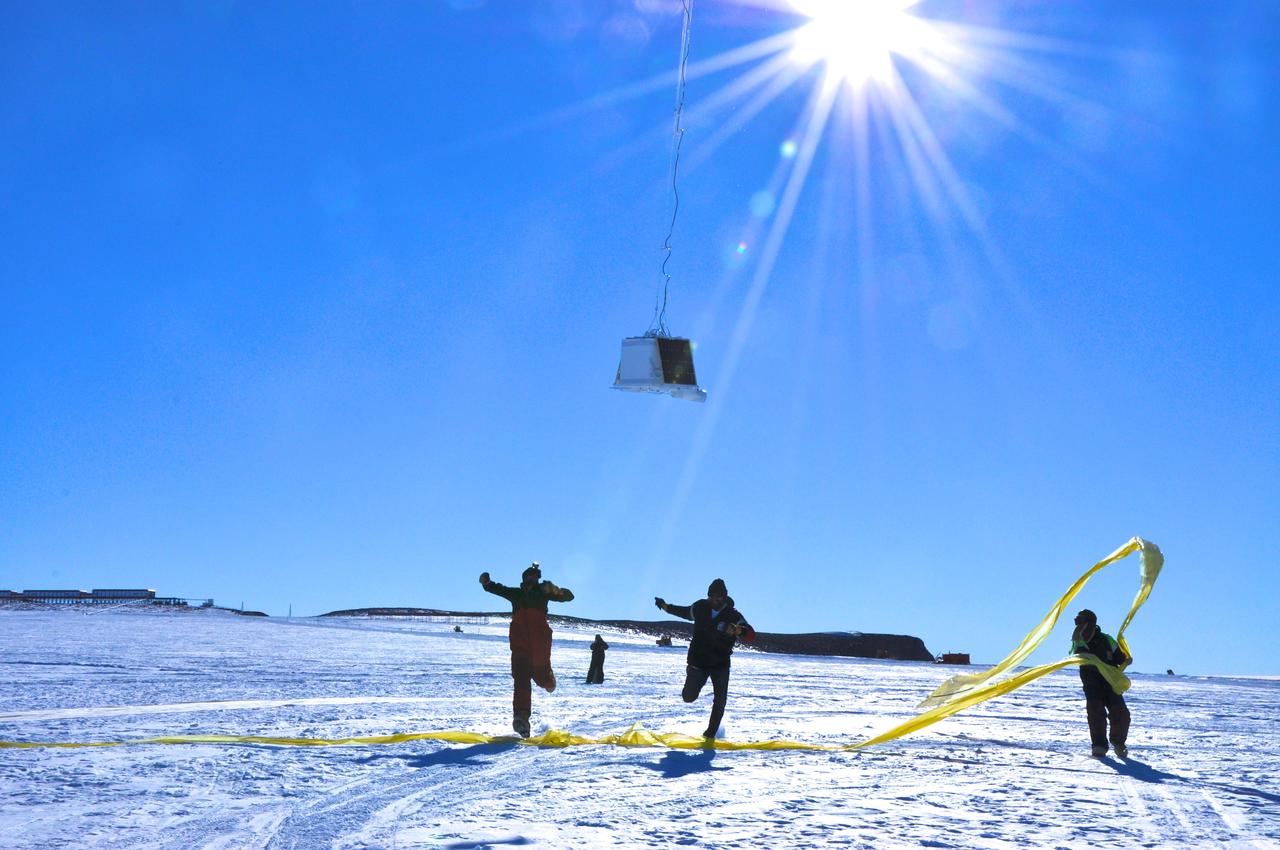
BARREL team members run under the payload as the balloon first takes flight at the SANAE IV research station in Antarctica. Credit: NASA --- In Antarctica in January, 2013 – the summer at the South Pole – scientists launched 20 balloons up into the air to study an enduring mystery of space weather: when the giant radiation belts surrounding Earth lose material, where do the extra particles actually go? The mission is called BARREL (Balloon Array for Radiation belt Relativistic Electron Losses) and it is led by physicist Robyn Millan of Dartmouth College in Hanover, NH. Millan provided photographs from the team’s time in Antarctica. The team launched a balloon every day or two into the circumpolar winds that circulate around the pole. Each balloon floated for anywhere from 3 to 40 days, measuring X-rays produced by fast-moving electrons high up in the atmosphere. BARREL works hand in hand with another NASA mission called the Van Allen Probes, which travels through the Van Allen radiation belts surrounding Earth. The belts wax and wane over time in response to incoming energy and material from the sun, sometimes intensifying the radiation through which satellites must travel. Scientists wish to understand this process better, and even provide forecasts of this space weather, in order to protect our spacecraft. As the Van Allen Probes were observing what was happening in the belts, BARREL tracked electrons that precipitated out of the belts and hurtled down Earth’s magnetic field lines toward the poles. By comparing data, scientists will be able to track how what’s happening in the belts correlates to the loss of particles – information that can help us understand this mysterious, dynamic region that can impact spacecraft. Having launched balloons in early 2013, the team is back at home building the next set of payloads. They will launch 20 more balloons in 2014. <b><a href="http://www.nasa.gov/audience/formedia/features/MP_Photo_Guidelines.html" rel="nofollow">NASA image use policy.</a></b> <b><a href="http://www.nasa.gov/centers/goddard/home/index.html" rel="nofollow">NASA Goddard Space Flight Center</a></b> enables NASA’s mission through four scientific endeavors: Earth Science, Heliophysics, Solar System Exploration, and Astrophysics. Goddard plays a leading role in NASA’s accomplishments by contributing compelling scientific knowledge to advance the Agency’s mission. <b>Follow us on <a href="http://twitter.com/NASA_GoddardPix" rel="nofollow">Twitter</a></b> <b>Like us on <a href="http://www.facebook.com/pages/Greenbelt-MD/NASA-Goddard/395013845897?ref=tsd" rel="nofollow">Facebook</a></b> <b>Find us on <a href="http://instagram.com/nasagoddard?vm=grid" rel="nofollow">Instagram</a></b>

A crane lowers two BARREL balloon payloads onto the platform at Halley Research Station in Antarctica. Credit: NASA --- In Antarctica in January, 2013 – the summer at the South Pole – scientists launched 20 balloons up into the air to study an enduring mystery of space weather: when the giant radiation belts surrounding Earth lose material, where do the extra particles actually go? The mission is called BARREL (Balloon Array for Radiation belt Relativistic Electron Losses) and it is led by physicist Robyn Millan of Dartmouth College in Hanover, NH. Millan provided photographs from the team’s time in Antarctica. The team launched a balloon every day or two into the circumpolar winds that circulate around the pole. Each balloon floated for anywhere from 3 to 40 days, measuring X-rays produced by fast-moving electrons high up in the atmosphere. BARREL works hand in hand with another NASA mission called the Van Allen Probes, which travels through the Van Allen radiation belts surrounding Earth. The belts wax and wane over time in response to incoming energy and material from the sun, sometimes intensifying the radiation through which satellites must travel. Scientists wish to understand this process better, and even provide forecasts of this space weather, in order to protect our spacecraft. As the Van Allen Probes were observing what was happening in the belts, BARREL tracked electrons that precipitated out of the belts and hurtled down Earth’s magnetic field lines toward the poles. By comparing data, scientists will be able to track how what’s happening in the belts correlates to the loss of particles – information that can help us understand this mysterious, dynamic region that can impact spacecraft. Having launched balloons in early 2013, the team is back at home building the next set of payloads. They will launch 20 more balloons in 2014. <b><a href="http://www.nasa.gov/audience/formedia/features/MP_Photo_Guidelines.html" rel="nofollow">NASA image use policy.</a></b> <b><a href="http://www.nasa.gov/centers/goddard/home/index.html" rel="nofollow">NASA Goddard Space Flight Center</a></b> enables NASA’s mission through four scientific endeavors: Earth Science, Heliophysics, Solar System Exploration, and Astrophysics. Goddard plays a leading role in NASA’s accomplishments by contributing compelling scientific knowledge to advance the Agency’s mission. <b>Follow us on <a href="http://twitter.com/NASA_GoddardPix" rel="nofollow">Twitter</a></b> <b>Like us on <a href="http://www.facebook.com/pages/Greenbelt-MD/NASA-Goddard/395013845897?ref=tsd" rel="nofollow">Facebook</a></b> <b>Find us on <a href="http://instagram.com/nasagoddard?vm=grid" rel="nofollow">Instagram</a></b>

Watching a BARREL balloon – and the instruments dangling below – float up over the SANAE IV research base in Antarctica. Credit: NASA --- In Antarctica in January, 2013 – the summer at the South Pole – scientists launched 20 balloons up into the air to study an enduring mystery of space weather: when the giant radiation belts surrounding Earth lose material, where do the extra particles actually go? The mission is called BARREL (Balloon Array for Radiation belt Relativistic Electron Losses) and it is led by physicist Robyn Millan of Dartmouth College in Hanover, NH. Millan provided photographs from the team’s time in Antarctica. The team launched a balloon every day or two into the circumpolar winds that circulate around the pole. Each balloon floated for anywhere from 3 to 40 days, measuring X-rays produced by fast-moving electrons high up in the atmosphere. BARREL works hand in hand with another NASA mission called the Van Allen Probes, which travels through the Van Allen radiation belts surrounding Earth. The belts wax and wane over time in response to incoming energy and material from the sun, sometimes intensifying the radiation through which satellites must travel. Scientists wish to understand this process better, and even provide forecasts of this space weather, in order to protect our spacecraft. As the Van Allen Probes were observing what was happening in the belts, BARREL tracked electrons that precipitated out of the belts and hurtled down Earth’s magnetic field lines toward the poles. By comparing data, scientists will be able to track how what’s happening in the belts correlates to the loss of particles – information that can help us understand this mysterious, dynamic region that can impact spacecraft. Having launched balloons in early 2013, the team is back at home building the next set of payloads. They will launch 20 more balloons in 2014. <b><a href="http://www.nasa.gov/audience/formedia/features/MP_Photo_Guidelines.html" rel="nofollow">NASA image use policy.</a></b> <b><a href="http://www.nasa.gov/centers/goddard/home/index.html" rel="nofollow">NASA Goddard Space Flight Center</a></b> enables NASA’s mission through four scientific endeavors: Earth Science, Heliophysics, Solar System Exploration, and Astrophysics. Goddard plays a leading role in NASA’s accomplishments by contributing compelling scientific knowledge to advance the Agency’s mission. <b>Follow us on <a href="http://twitter.com/NASA_GoddardPix" rel="nofollow">Twitter</a></b> <b>Like us on <a href="http://www.facebook.com/pages/Greenbelt-MD/NASA-Goddard/395013845897?ref=tsd" rel="nofollow">Facebook</a></b> <b>Find us on <a href="http://instagram.com/nasagoddard?vm=grid" rel="nofollow">Instagram</a></b>
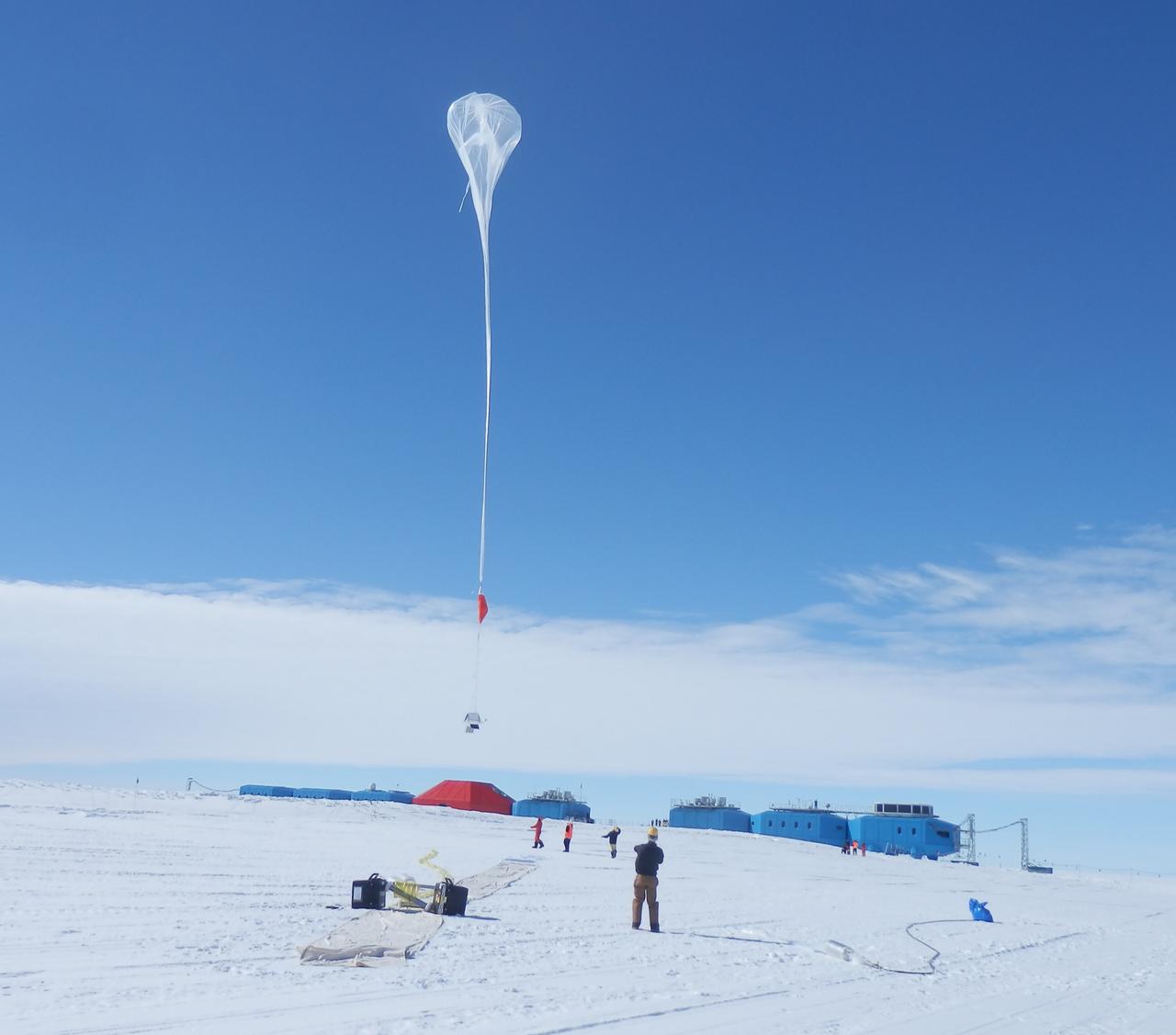
Liftoff! A balloon begins to rise over the brand new Halley VI Research Station, which had its grand opening in February 2013. Credit: NASA --- In Antarctica in January, 2013 – the summer at the South Pole – scientists launched 20 balloons up into the air to study an enduring mystery of space weather: when the giant radiation belts surrounding Earth lose material, where do the extra particles actually go? The mission is called BARREL (Balloon Array for Radiation belt Relativistic Electron Losses) and it is led by physicist Robyn Millan of Dartmouth College in Hanover, NH. Millan provided photographs from the team’s time in Antarctica. The team launched a balloon every day or two into the circumpolar winds that circulate around the pole. Each balloon floated for anywhere from 3 to 40 days, measuring X-rays produced by fast-moving electrons high up in the atmosphere. BARREL works hand in hand with another NASA mission called the Van Allen Probes, which travels through the Van Allen radiation belts surrounding Earth. The belts wax and wane over time in response to incoming energy and material from the sun, sometimes intensifying the radiation through which satellites must travel. Scientists wish to understand this process better, and even provide forecasts of this space weather, in order to protect our spacecraft. As the Van Allen Probes were observing what was happening in the belts, BARREL tracked electrons that precipitated out of the belts and hurtled down Earth’s magnetic field lines toward the poles. By comparing data, scientists will be able to track how what’s happening in the belts correlates to the loss of particles – information that can help us understand this mysterious, dynamic region that can impact spacecraft. Having launched balloons in early 2013, the team is back at home building the next set of payloads. They will launch 20 more balloons in 2014. <b><a href="http://www.nasa.gov/audience/formedia/features/MP_Photo_Guidelines.html" rel="nofollow">NASA image use policy.</a></b> <b><a href="http://www.nasa.gov/centers/goddard/home/index.html" rel="nofollow">NASA Goddard Space Flight Center</a></b> enables NASA’s mission through four scientific endeavors: Earth Science, Heliophysics, Solar System Exploration, and Astrophysics. Goddard plays a leading role in NASA’s accomplishments by contributing compelling scientific knowledge to advance the Agency’s mission. <b>Follow us on <a href="http://twitter.com/NASA_GoddardPix" rel="nofollow">Twitter</a></b> <b>Like us on <a href="http://www.facebook.com/pages/Greenbelt-MD/NASA-Goddard/395013845897?ref=tsd" rel="nofollow">Facebook</a></b> <b>Find us on <a href="http://instagram.com/nasagoddard?vm=grid" rel="nofollow">Instagram</a></b>

A view looking over the payload – the instruments that fly under a balloon – while the BARREL balloon inflates. The orange parachute lies on the ground in front of the payload, while most of the balloon length can be seen stretched along the ground toward the part being inflated. Credit: NASA/Goddard/BARREL Read more: <a href="http://www.nasa.gov/content/goddard/nasas-barrel-returns-successful-from-antarctica" rel="nofollow">www.nasa.gov/content/goddard/nasas-barrel-returns-success...</a> -- Three months, 20 balloons, and one very successful campaign. The team for NASA's BARREL – short for Balloon Array for Radiation belt Relativistic Electron Losses -- mission returned from Antarctica in March 2014. BARREL's job is to help unravel the mysterious Van Allen belts, two gigantic donuts of radiation that surround Earth, which can shrink and swell in response to incoming energy and particles from the sun and sometimes expose satellites to harsh radiation. While in Antarctica, the team launched 20 balloons carrying instruments that sense charged particles that are scattered into the atmosphere from the belts, spiraling down the magnetic fields near the South Pole. Each balloon traveled around the pole for up to three weeks. The team will coordinate the BARREL data with observations from NASA's two Van Allen Probes to better understand how occurrences in the belts relate to bursts of particles funneling down toward Earth. BARREL team members will be on hand at the USA Science and Engineering Festival in DC on April 26 and 27, 2014 for the exhibit Space Balloons: Exploring the Extremes of Space Weather. <b><a href="http://www.nasa.gov/audience/formedia/features/MP_Photo_Guidelines.html" rel="nofollow">NASA image use policy.</a></b><b><a href="http://www.nasa.gov/centers/goddard/home/index.html" rel="nofollow">NASA Goddard Space Flight Center</a></b> enables NASA’s mission through four scientific endeavors: Earth Science, Heliophysics, Solar System Exploration, and Astrophysics. Goddard plays a leading role in NASA’s accomplishments by contributing compelling scientific knowledge to advance the Agency’s mission.<b>Follow us on <a href="http://twitter.com/NASAGoddardPix" rel="nofollow">Twitter</a></b><b>Like us on <a href="http://www.facebook.com/pages/Greenbelt-MD/NASA-Goddard/395013845897?ref=tsd" rel="nofollow">Facebook</a></b><b>Find us on <a href="http://instagram.com/nasagoddard?vm=grid" rel="nofollow">Instagram</a></b>
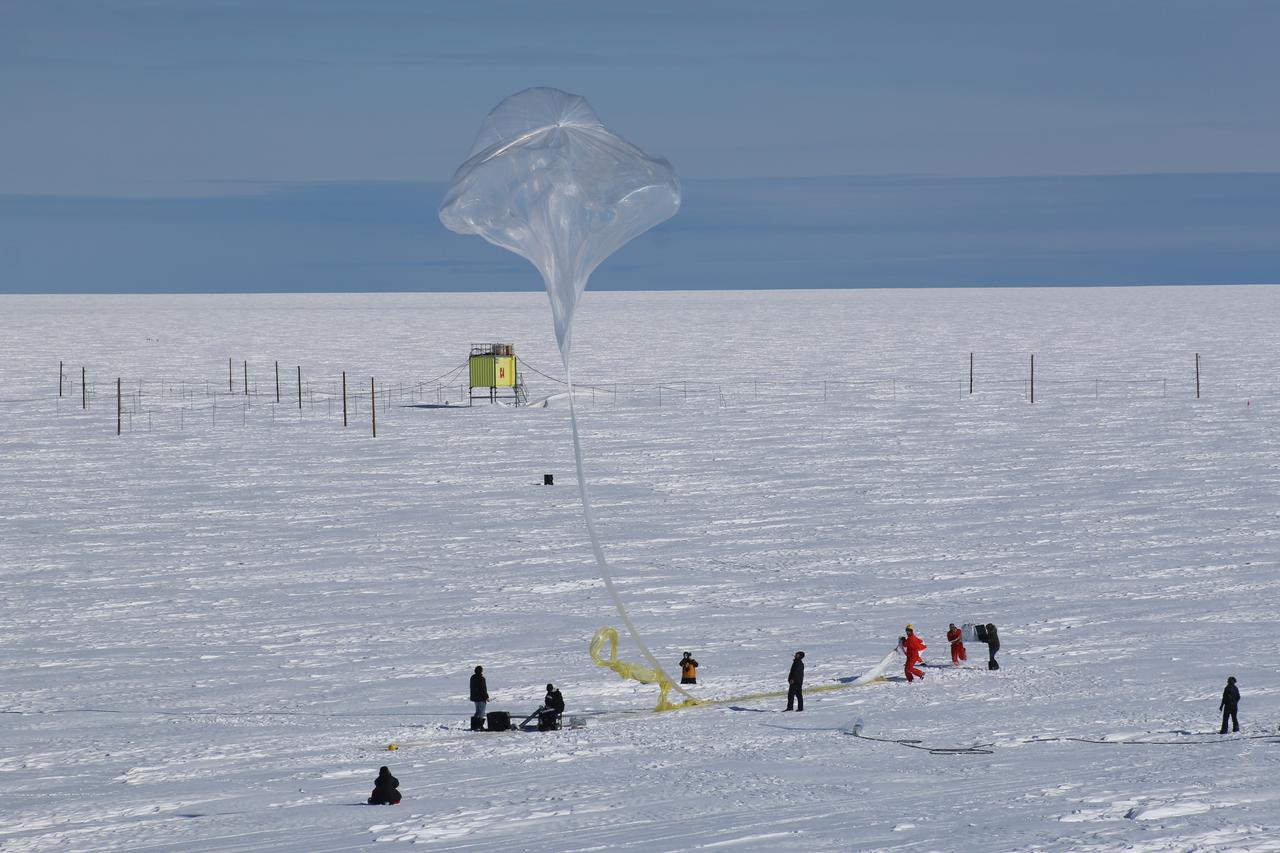
Release of a BARREL balloon. The launch crew can be seen on the right holding the payload as the top of the balloon moves overhead where they can release it. Credit: NASA/Goddard/BARREL Read more: <a href="http://www.nasa.gov/content/goddard/nasas-barrel-returns-successful-from-antarctica" rel="nofollow">www.nasa.gov/content/goddard/nasas-barrel-returns-success...</a> -- Three months, 20 balloons, and one very successful campaign. The team for NASA's BARREL – short for Balloon Array for Radiation belt Relativistic Electron Losses -- mission returned from Antarctica in March 2014. BARREL's job is to help unravel the mysterious Van Allen belts, two gigantic donuts of radiation that surround Earth, which can shrink and swell in response to incoming energy and particles from the sun and sometimes expose satellites to harsh radiation. While in Antarctica, the team launched 20 balloons carrying instruments that sense charged particles that are scattered into the atmosphere from the belts, spiraling down the magnetic fields near the South Pole. Each balloon traveled around the pole for up to three weeks. The team will coordinate the BARREL data with observations from NASA's two Van Allen Probes to better understand how occurrences in the belts relate to bursts of particles funneling down toward Earth. BARREL team members will be on hand at the USA Science and Engineering Festival in DC on April 26 and 27, 2014 for the exhibit Space Balloons: Exploring the Extremes of Space Weather. <b><a href="http://www.nasa.gov/audience/formedia/features/MP_Photo_Guidelines.html" rel="nofollow">NASA image use policy.</a></b><b><a href="http://www.nasa.gov/centers/goddard/home/index.html" rel="nofollow">NASA Goddard Space Flight Center</a></b> enables NASA’s mission through four scientific endeavors: Earth Science, Heliophysics, Solar System Exploration, and Astrophysics. Goddard plays a leading role in NASA’s accomplishments by contributing compelling scientific knowledge to advance the Agency’s mission.<b>Follow us on <a href="http://twitter.com/NASAGoddardPix" rel="nofollow">Twitter</a></b><b>Like us on <a href="http://www.facebook.com/pages/Greenbelt-MD/NASA-Goddard/395013845897?ref=tsd" rel="nofollow">Facebook</a></b><b>Find us on <a href="http://instagram.com/nasagoddard?vm=grid" rel="nofollow">Instagram</a></b>
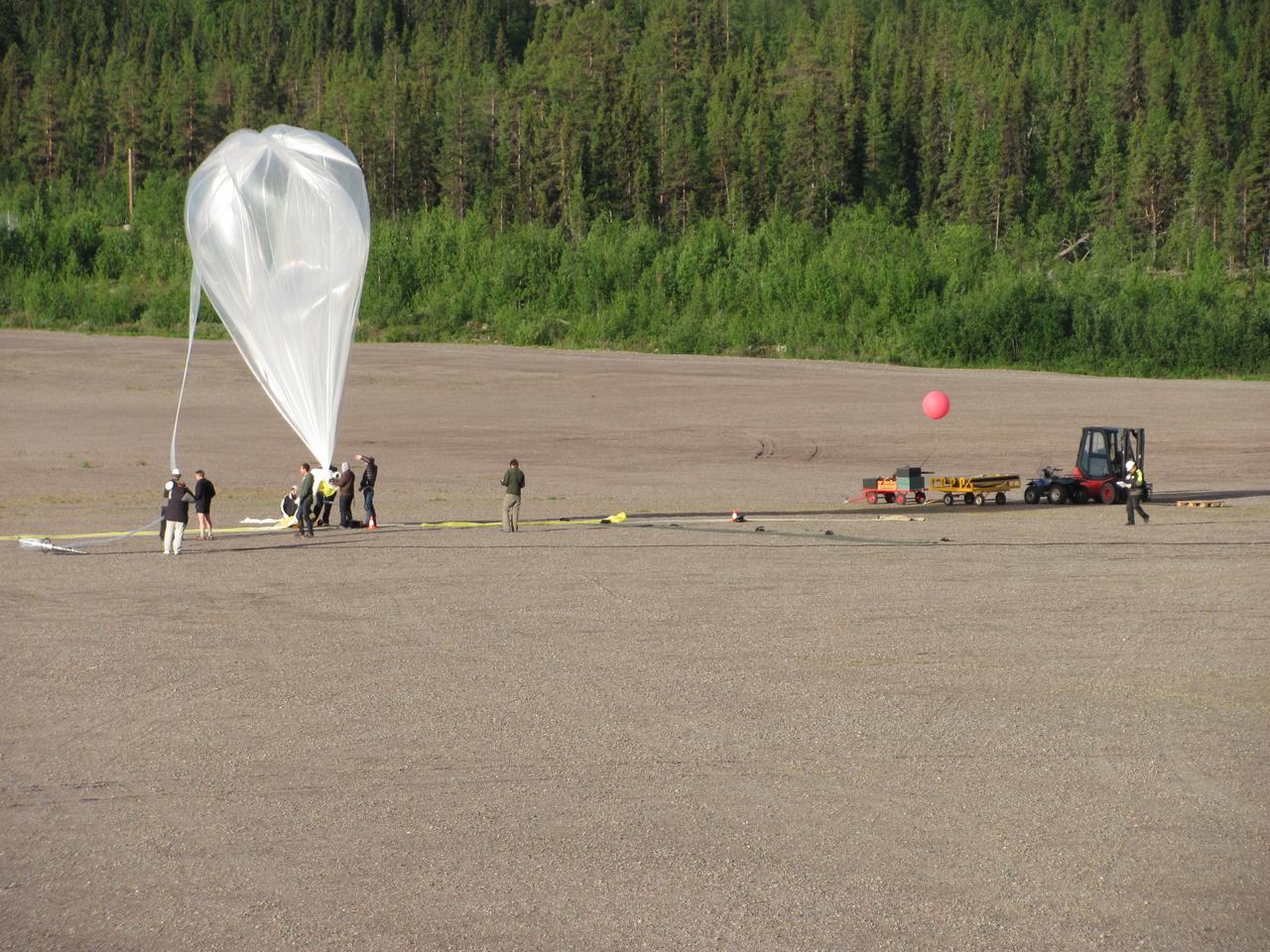
The BARREL team inflates their second balloon just before its launch on Aug. 13, 2015, from Kiruna, Sweden. The day before this launch, the BARREL team successfully recovered the payload from the first balloon launch on Aug. 10. Payload recovery is especially important for this second launch, which carries an instrument and recorded data from a University of Houston team of student scientists. The NASA-funded BARREL – which stands for Balloon Array for Radiation-belt Relativistic Electron Losses – measures electrons in the atmosphere near the poles. Such electrons rain down into the atmosphere from two giant radiation belts surrounding Earth, called the Van Allen belts. For its third campaign, BARREL is launching six balloons from the Esrange Space Center in Kiruna, Sweden. BARREL is led by Dartmouth College in Hanover, New Hampshire. Credit: NASA/Dartmouth/Alexa Halford <b><a href="http://www.nasa.gov/audience/formedia/features/MP_Photo_Guidelines.html" rel="nofollow">NASA image use policy.</a></b> <b><a href="http://www.nasa.gov/centers/goddard/home/index.html" rel="nofollow">NASA Goddard Space Flight Center</a></b> enables NASA’s mission through four scientific endeavors: Earth Science, Heliophysics, Solar System Exploration, and Astrophysics. Goddard plays a leading role in NASA’s accomplishments by contributing compelling scientific knowledge to advance the Agency’s mission. <b>Follow us on <a href="http://twitter.com/NASAGoddardPix" rel="nofollow">Twitter</a></b> <b>Like us on <a href="http://www.facebook.com/pages/Greenbelt-MD/NASA-Goddard/395013845897?ref=tsd" rel="nofollow">Facebook</a></b> <b>Find us on <a href="http://instagrid.me/nasagoddard/?vm=grid" rel="nofollow">Instagram</a></b>
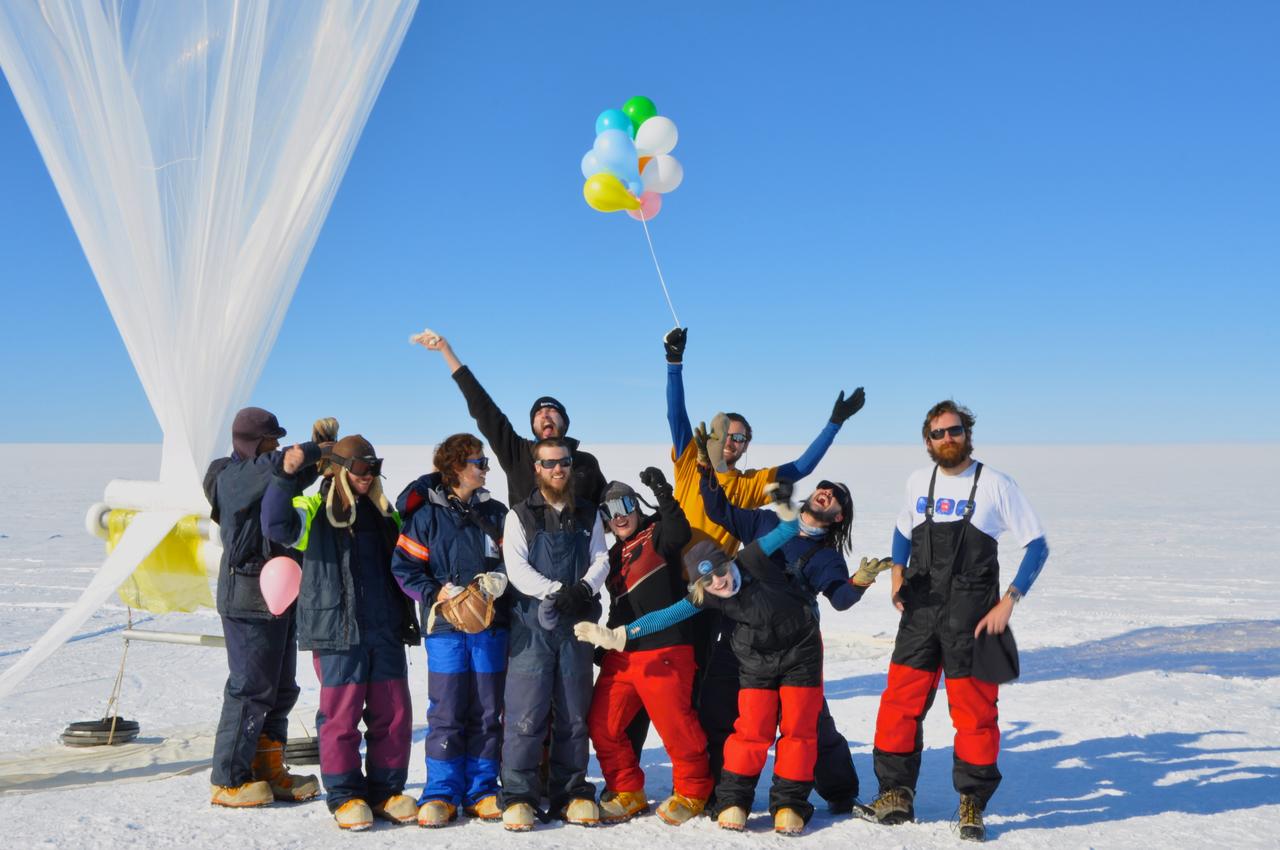
The BARREL team at the SANAE IV research station celebrates their final launch in the Antarctica sun. Credit: NASA --- In Antarctica in January, 2013 – the summer at the South Pole – scientists launched 20 balloons up into the air to study an enduring mystery of space weather: when the giant radiation belts surrounding Earth lose material, where do the extra particles actually go? The mission is called BARREL (Balloon Array for Radiation belt Relativistic Electron Losses) and it is led by physicist Robyn Millan of Dartmouth College in Hanover, NH. Millan provided photographs from the team’s time in Antarctica. The team launched a balloon every day or two into the circumpolar winds that circulate around the pole. Each balloon floated for anywhere from 3 to 40 days, measuring X-rays produced by fast-moving electrons high up in the atmosphere. BARREL works hand in hand with another NASA mission called the Van Allen Probes, which travels through the Van Allen radiation belts surrounding Earth. The belts wax and wane over time in response to incoming energy and material from the sun, sometimes intensifying the radiation through which satellites must travel. Scientists wish to understand this process better, and even provide forecasts of this space weather, in order to protect our spacecraft. As the Van Allen Probes were observing what was happening in the belts, BARREL tracked electrons that precipitated out of the belts and hurtled down Earth’s magnetic field lines toward the poles. By comparing data, scientists will be able to track how what’s happening in the belts correlates to the loss of particles – information that can help us understand this mysterious, dynamic region that can impact spacecraft. Having launched balloons in early 2013, the team is back at home building the next set of payloads. They will launch 20 more balloons in 2014. <b><a href="http://www.nasa.gov/audience/formedia/features/MP_Photo_Guidelines.html" rel="nofollow">NASA image use policy.</a></b> <b><a href="http://www.nasa.gov/centers/goddard/home/index.html" rel="nofollow">NASA Goddard Space Flight Center</a></b> enables NASA’s mission through four scientific endeavors: Earth Science, Heliophysics, Solar System Exploration, and Astrophysics. Goddard plays a leading role in NASA’s accomplishments by contributing compelling scientific knowledge to advance the Agency’s mission. <b>Follow us on <a href="http://twitter.com/NASA_GoddardPix" rel="nofollow">Twitter</a></b> <b>Like us on <a href="http://www.facebook.com/pages/Greenbelt-MD/NASA-Goddard/395013845897?ref=tsd" rel="nofollow">Facebook</a></b> <b>Find us on <a href="http://instagram.com/nasagoddard?vm=grid" rel="nofollow">Instagram</a></b>
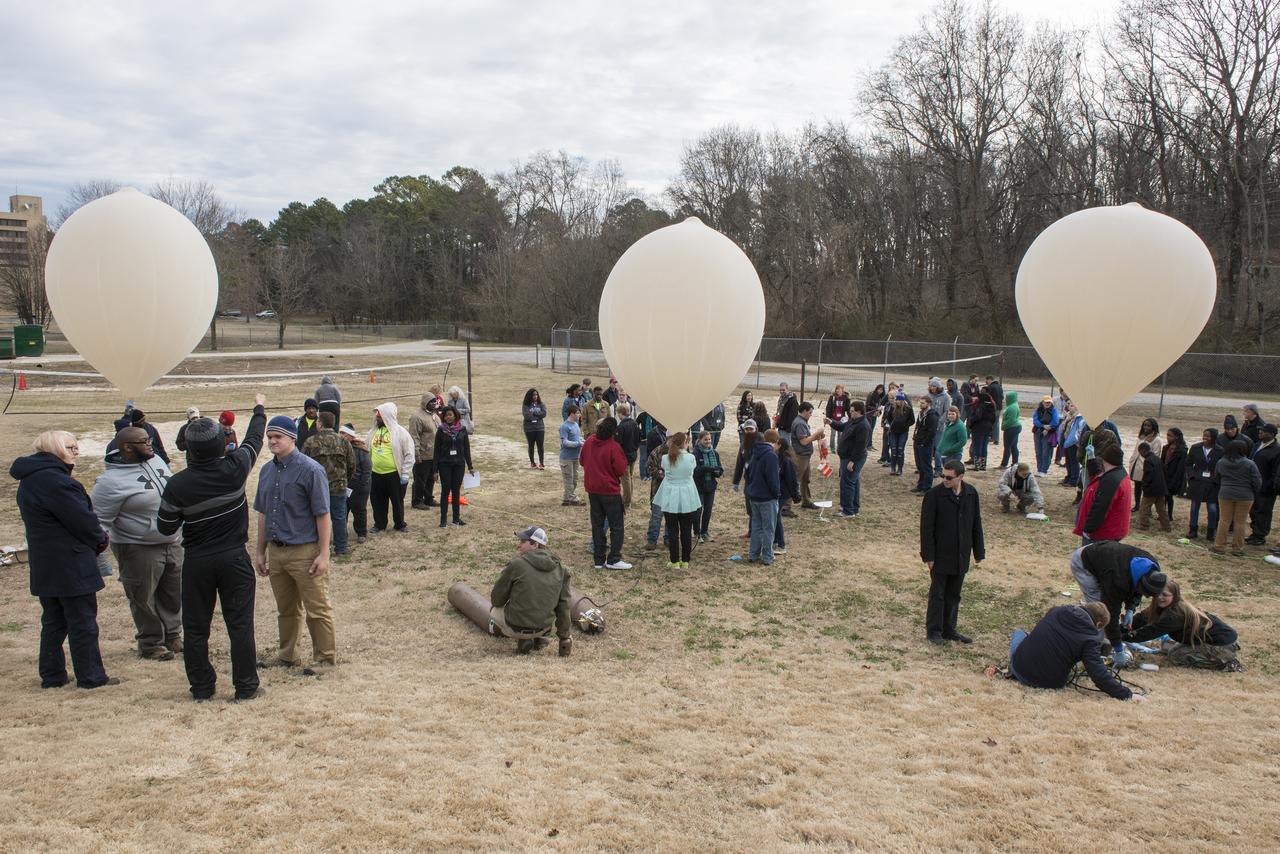
STUDENTS FROM COMMUNITY COLLEGES THROUGHOUT THE SOUTH CAME TOGETHER AT THE U.S. SPACE AND ROCKET CENTER FOR THE BALLOONSAT LAUNCH EVENT. EACH COMMUNITY COLLEGE TEAM ASSEMBLED ITS OWN PAYLOAD, DESIGNED TO DOWNLOAD SCIENTIFIC AND ATMOSPHERIC INFORMATION, AND THEN 2 WEATHER BALLOONS WERE SENT ALOFT TO APPROXIMATELY 100,000 FEET WITH THE PAYLOADS. THE PAYLOADS WERE RECOVERED IN N. GEORGIA AND TAKEN BACK TO THE INDIVIDUAL SCHOOLS FOR DOWNLOADING.
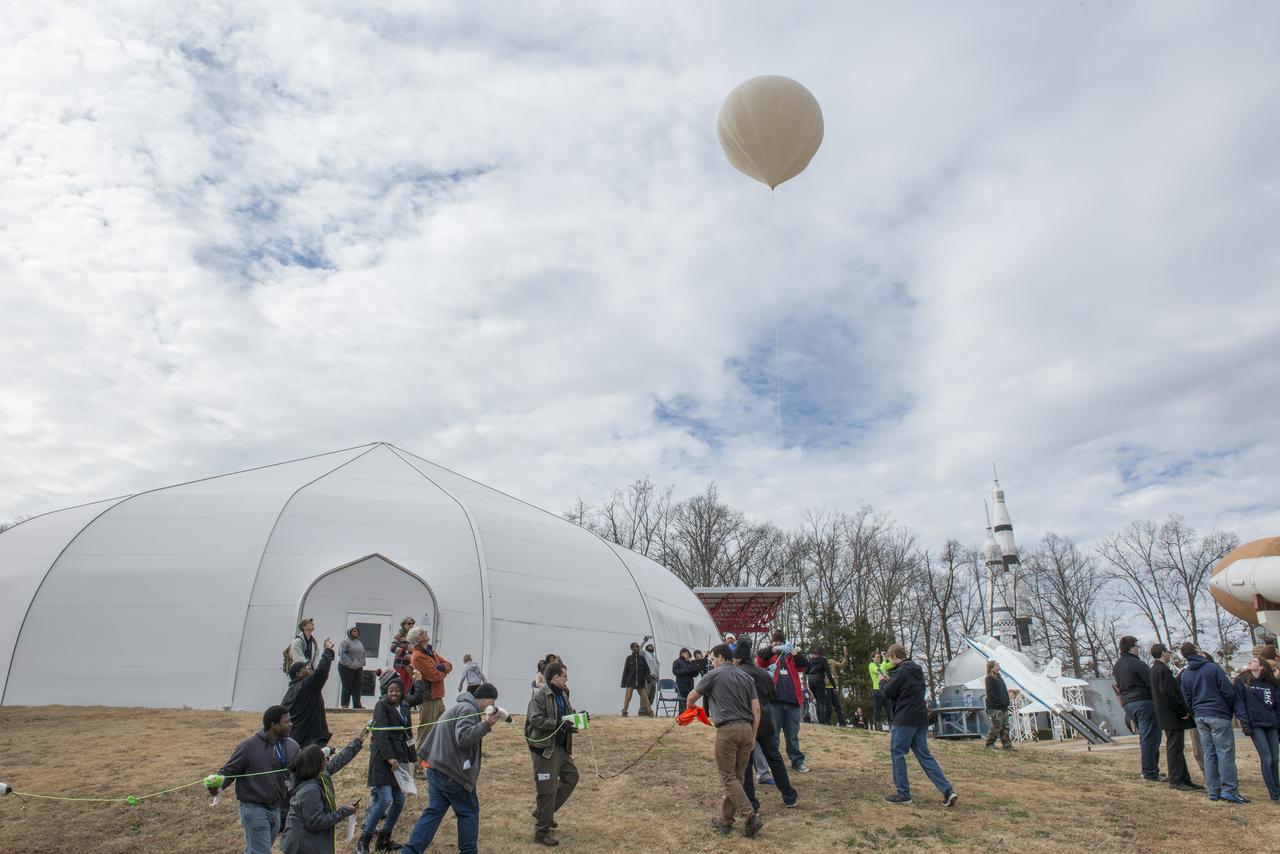
STUDENTS FROM COMMUNITY COLLEGES THROUGHOUT THE SOUTH CAME TOGETHER AT THE U.S. SPACE AND ROCKET CENTER FOR THE BALLOONSAT LAUNCH EVENT. EACH COMMUNITY COLLEGE TEAM ASSEMBLED ITS OWN PAYLOAD, DESIGNED TO DOWNLOAD SCIENTIFIC AND ATMOSPHERIC INFORMATION, AND THEN 2 WEATHER BALLOONS WERE SENT ALOFT TO APPROXIMATELY 100,000 FEET WITH THE PAYLOADS. THE PAYLOADS WERE RECOVERED IN N. GEORGIA AND TAKEN BACK TO THE INDIVIDUAL SCHOOLS FOR DOWNLOADING.
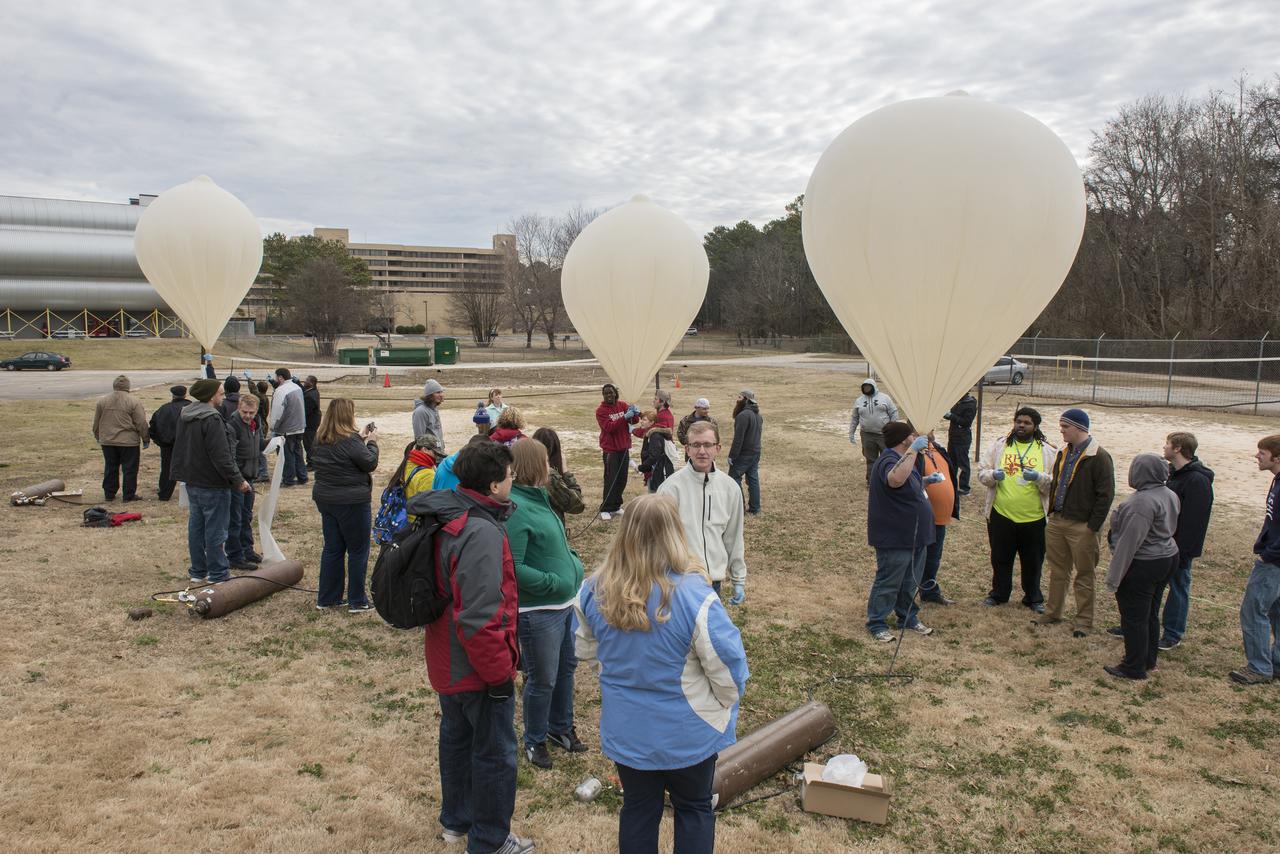
STUDENTS FROM COMMUNITY COLLEGES THROUGHOUT THE SOUTH CAME TOGETHER AT THE U.S. SPACE AND ROCKET CENTER FOR THE BALLOONSAT LAUNCH EVENT. EACH COMMUNITY COLLEGE TEAM ASSEMBLED ITS OWN PAYLOAD, DESIGNED TO DOWNLOAD SCIENTIFIC AND ATMOSPHERIC INFORMATION, AND THEN 2 WEATHER BALLOONS WERE SENT ALOFT TO APPROXIMATELY 100,000 FEET WITH THE PAYLOADS. THE PAYLOADS WERE RECOVERED IN N. GEORGIA AND TAKEN BACK TO THE INDIVIDUAL SCHOOLS FOR DOWNLOADING.
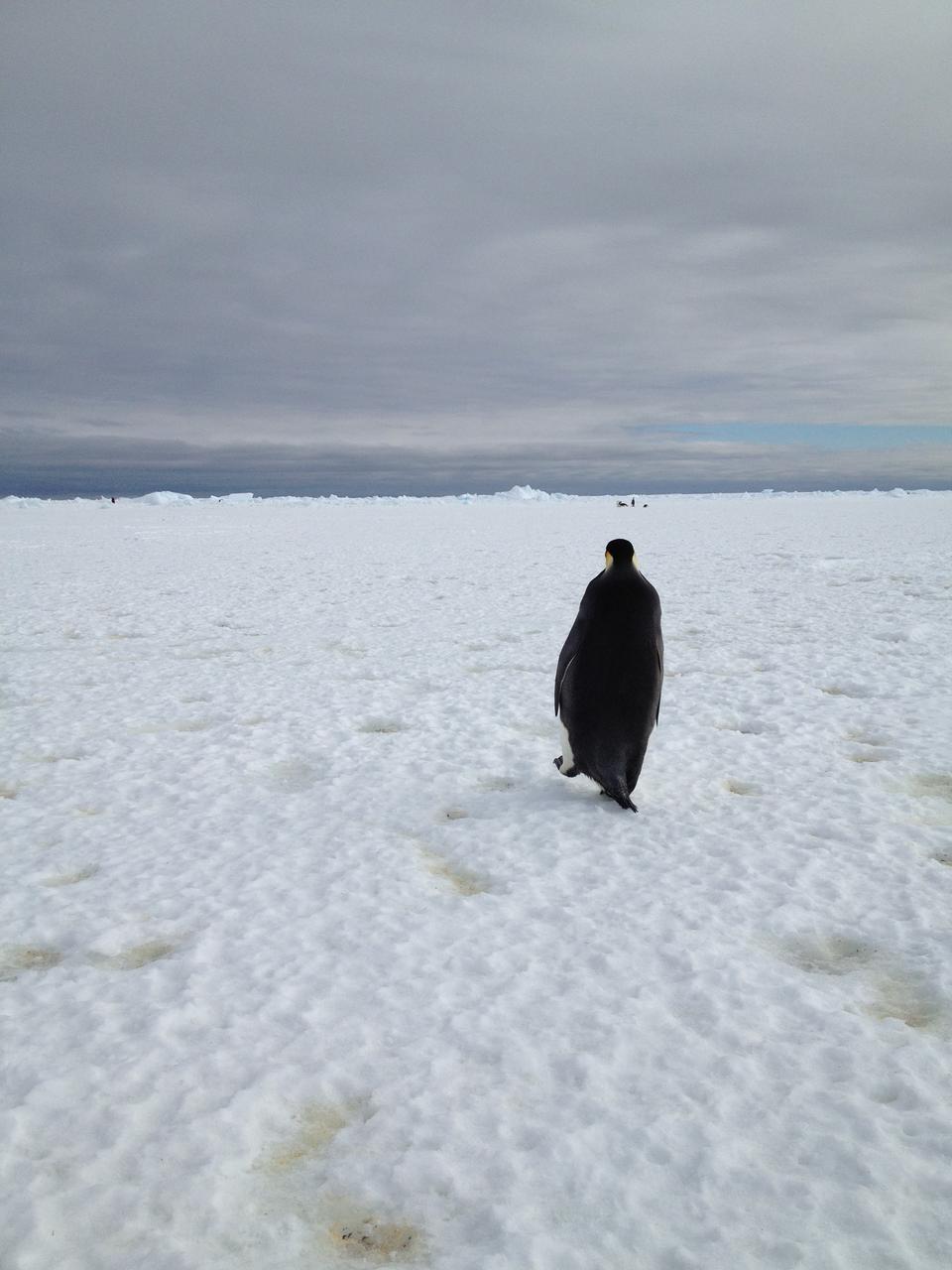
An emperor penguin waddles away on Christmas morning in Antarctica. On Christmas day, the BARREL team visited a penguin colony. Credit: NASA --- In Antarctica in January, 2013 – the summer at the South Pole – scientists launched 20 balloons up into the air to study an enduring mystery of space weather: when the giant radiation belts surrounding Earth lose material, where do the extra particles actually go? The mission is called BARREL (Balloon Array for Radiation belt Relativistic Electron Losses) and it is led by physicist Robyn Millan of Dartmouth College in Hanover, NH. Millan provided photographs from the team’s time in Antarctica. The team launched a balloon every day or two into the circumpolar winds that circulate around the pole. Each balloon floated for anywhere from 3 to 40 days, measuring X-rays produced by fast-moving electrons high up in the atmosphere. BARREL works hand in hand with another NASA mission called the Van Allen Probes, which travels through the Van Allen radiation belts surrounding Earth. The belts wax and wane over time in response to incoming energy and material from the sun, sometimes intensifying the radiation through which satellites must travel. Scientists wish to understand this process better, and even provide forecasts of this space weather, in order to protect our spacecraft. As the Van Allen Probes were observing what was happening in the belts, BARREL tracked electrons that precipitated out of the belts and hurtled down Earth’s magnetic field lines toward the poles. By comparing data, scientists will be able to track how what’s happening in the belts correlates to the loss of particles – information that can help us understand this mysterious, dynamic region that can impact spacecraft. Having launched balloons in early 2013, the team is back at home building the next set of payloads. They will launch 20 more balloons in 2014. <b><a href="http://www.nasa.gov/audience/formedia/features/MP_Photo_Guidelines.html" rel="nofollow">NASA image use policy.</a></b> <b><a href="http://www.nasa.gov/centers/goddard/home/index.html" rel="nofollow">NASA Goddard Space Flight Center</a></b> enables NASA’s mission through four scientific endeavors: Earth Science, Heliophysics, Solar System Exploration, and Astrophysics. Goddard plays a leading role in NASA’s accomplishments by contributing compelling scientific knowledge to advance the Agency’s mission. <b>Follow us on <a href="http://twitter.com/NASA_GoddardPix" rel="nofollow">Twitter</a></b> <b>Like us on <a href="http://www.facebook.com/pages/Greenbelt-MD/NASA-Goddard/395013845897?ref=tsd" rel="nofollow">Facebook</a></b> <b>Find us on <a href="http://instagram.com/nasagoddard?vm=grid" rel="nofollow">Instagram</a></b>
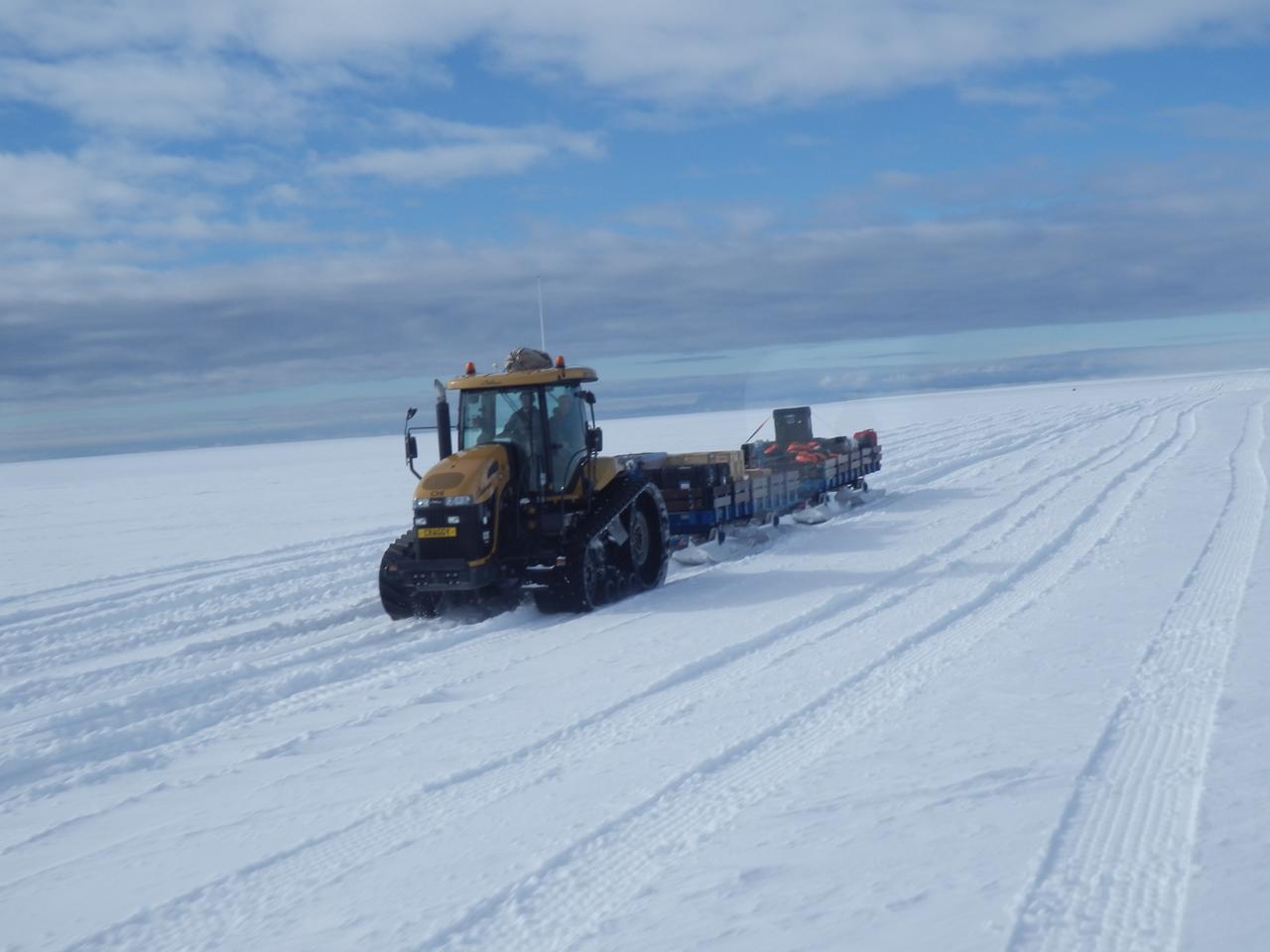
The BARREL cargo on its four-hour journey from the supply ship to the research station. Credit: NASA --- In Antarctica in January, 2013 – the summer at the South Pole – scientists launched 20 balloons up into the air to study an enduring mystery of space weather: when the giant radiation belts surrounding Earth lose material, where do the extra particles actually go? The mission is called BARREL (Balloon Array for Radiation belt Relativistic Electron Losses) and it is led by physicist Robyn Millan of Dartmouth College in Hanover, NH. Millan provided photographs from the team’s time in Antarctica. The team launched a balloon every day or two into the circumpolar winds that circulate around the pole. Each balloon floated for anywhere from 3 to 40 days, measuring X-rays produced by fast-moving electrons high up in the atmosphere. BARREL works hand in hand with another NASA mission called the Van Allen Probes, which travels through the Van Allen radiation belts surrounding Earth. The belts wax and wane over time in response to incoming energy and material from the sun, sometimes intensifying the radiation through which satellites must travel. Scientists wish to understand this process better, and even provide forecasts of this space weather, in order to protect our spacecraft. As the Van Allen Probes were observing what was happening in the belts, BARREL tracked electrons that precipitated out of the belts and hurtled down Earth’s magnetic field lines toward the poles. By comparing data, scientists will be able to track how what’s happening in the belts correlates to the loss of particles – information that can help us understand this mysterious, dynamic region that can impact spacecraft. Having launched balloons in early 2013, the team is back at home building the next set of payloads. They will launch 20 more balloons in 2014. <b><a href="http://www.nasa.gov/audience/formedia/features/MP_Photo_Guidelines.html" rel="nofollow">NASA image use policy.</a></b> <b><a href="http://www.nasa.gov/centers/goddard/home/index.html" rel="nofollow">NASA Goddard Space Flight Center</a></b> enables NASA’s mission through four scientific endeavors: Earth Science, Heliophysics, Solar System Exploration, and Astrophysics. Goddard plays a leading role in NASA’s accomplishments by contributing compelling scientific knowledge to advance the Agency’s mission. <b>Follow us on <a href="http://twitter.com/NASA_GoddardPix" rel="nofollow">Twitter</a></b> <b>Like us on <a href="http://www.facebook.com/pages/Greenbelt-MD/NASA-Goddard/395013845897?ref=tsd" rel="nofollow">Facebook</a></b> <b>Find us on <a href="http://instagram.com/nasagoddard?vm=grid" rel="nofollow">Instagram</a></b>
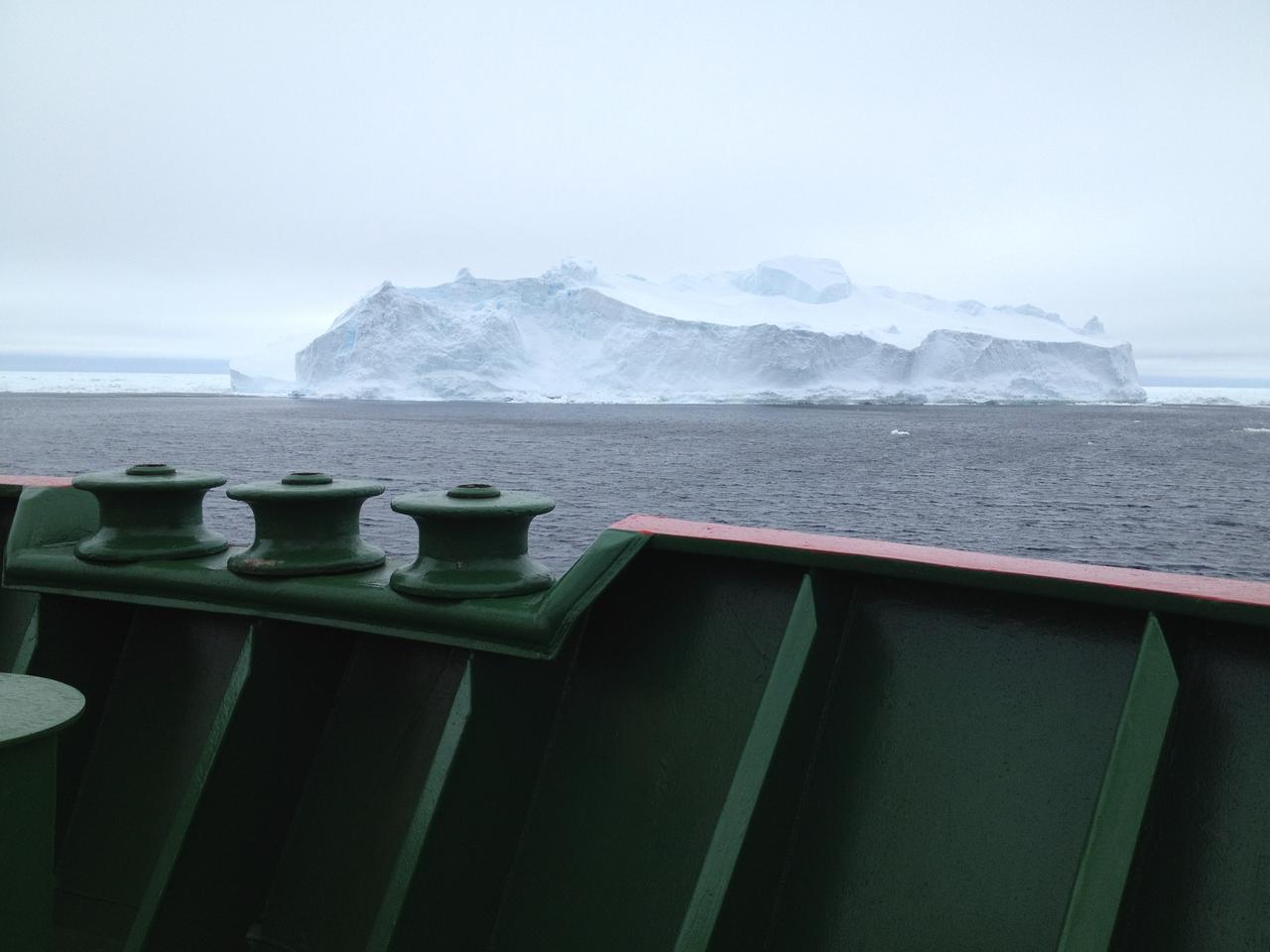
An iceberg as viewed from the bow of the RRS Ernest Shackleton a few days before the BARREL team reached Halley Research Station in Antarctica. This research vessel regularly carries scientists and supplies to Halley. Credit: NASA --- In Antarctica in January, 2013 – the summer at the South Pole – scientists launched 20 balloons up into the air to study an enduring mystery of space weather: when the giant radiation belts surrounding Earth lose material, where do the extra particles actually go? The mission is called BARREL (Balloon Array for Radiation belt Relativistic Electron Losses) and it is led by physicist Robyn Millan of Dartmouth College in Hanover, NH. Millan provided photographs from the team’s time in Antarctica. The team launched a balloon every day or two into the circumpolar winds that circulate around the pole. Each balloon floated for anywhere from 3 to 40 days, measuring X-rays produced by fast-moving electrons high up in the atmosphere. BARREL works hand in hand with another NASA mission called the Van Allen Probes, which travels through the Van Allen radiation belts surrounding Earth. The belts wax and wane over time in response to incoming energy and material from the sun, sometimes intensifying the radiation through which satellites must travel. Scientists wish to understand this process better, and even provide forecasts of this space weather, in order to protect our spacecraft. As the Van Allen Probes were observing what was happening in the belts, BARREL tracked electrons that precipitated out of the belts and hurtled down Earth’s magnetic field lines toward the poles. By comparing data, scientists will be able to track how what’s happening in the belts correlates to the loss of particles – information that can help us understand this mysterious, dynamic region that can impact spacecraft. Having launched balloons in early 2013, the team is back at home building the next set of payloads. They will launch 20 more balloons in 2014. <b><a href="http://www.nasa.gov/audience/formedia/features/MP_Photo_Guidelines.html" rel="nofollow">NASA image use policy.</a></b> <b><a href="http://www.nasa.gov/centers/goddard/home/index.html" rel="nofollow">NASA Goddard Space Flight Center</a></b> enables NASA’s mission through four scientific endeavors: Earth Science, Heliophysics, Solar System Exploration, and Astrophysics. Goddard plays a leading role in NASA’s accomplishments by contributing compelling scientific knowledge to advance the Agency’s mission. <b>Follow us on <a href="http://twitter.com/NASA_GoddardPix" rel="nofollow">Twitter</a></b> <b>Like us on <a href="http://www.facebook.com/pages/Greenbelt-MD/NASA-Goddard/395013845897?ref=tsd" rel="nofollow">Facebook</a></b> <b>Find us on <a href="http://instagram.com/nasagoddard?vm=grid" rel="nofollow">Instagram</a></b>
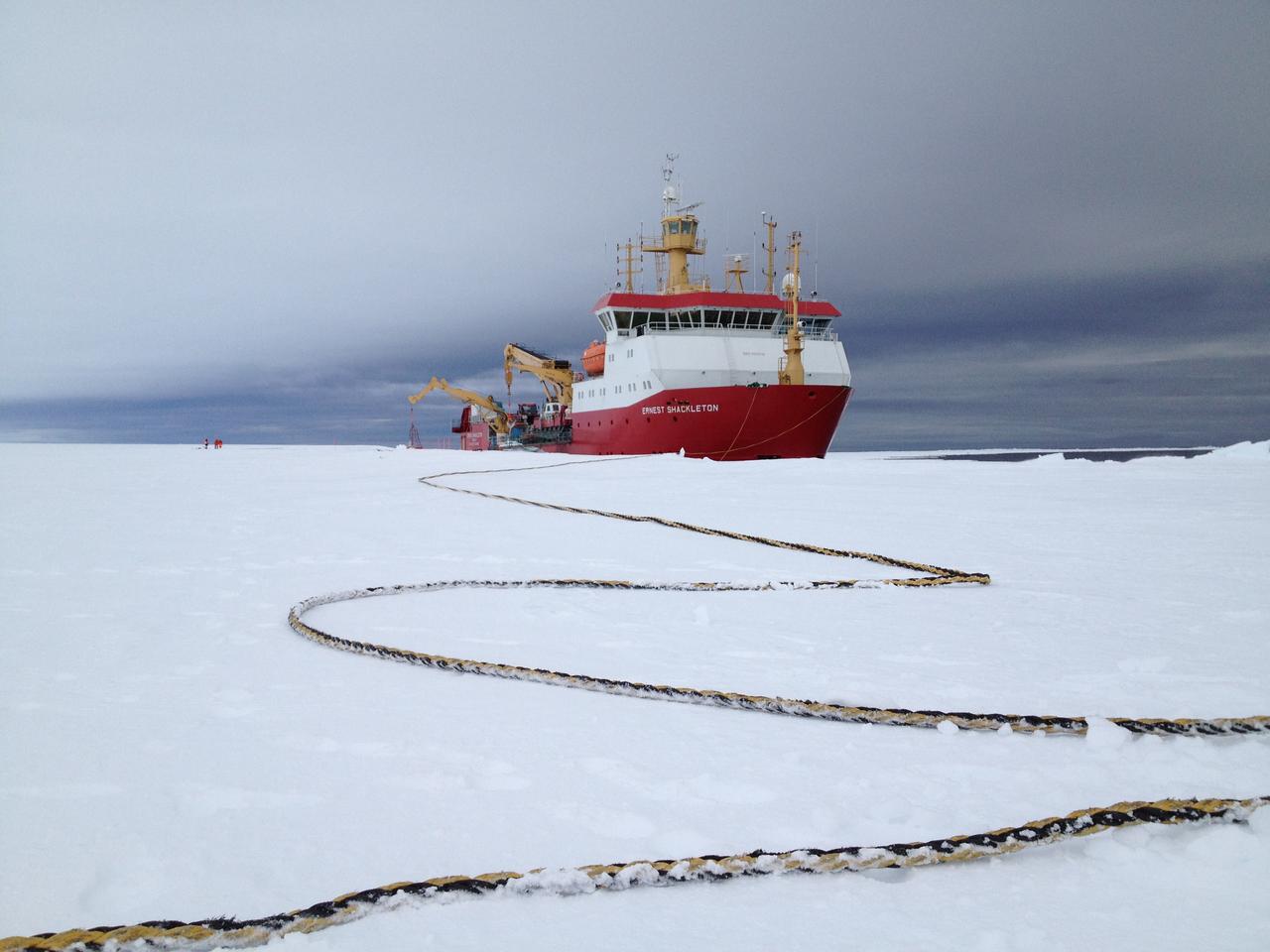
Arrival of the RRS Ernest Shackleton near Halley Research Station in Antarctica. The Shackleton is the regular resupply ship for the station and it also brought in some of the BARREL team scientists. The long tether is for the ship’s mooring. Credit: NASA --- In Antarctica in January, 2013 – the summer at the South Pole – scientists launched 20 balloons up into the air to study an enduring mystery of space weather: when the giant radiation belts surrounding Earth lose material, where do the extra particles actually go? The mission is called BARREL (Balloon Array for Radiation belt Relativistic Electron Losses) and it is led by physicist Robyn Millan of Dartmouth College in Hanover, NH. Millan provided photographs from the team’s time in Antarctica. The team launched a balloon every day or two into the circumpolar winds that circulate around the pole. Each balloon floated for anywhere from 3 to 40 days, measuring X-rays produced by fast-moving electrons high up in the atmosphere. BARREL works hand in hand with another NASA mission called the Van Allen Probes, which travels through the Van Allen radiation belts surrounding Earth. The belts wax and wane over time in response to incoming energy and material from the sun, sometimes intensifying the radiation through which satellites must travel. Scientists wish to understand this process better, and even provide forecasts of this space weather, in order to protect our spacecraft. As the Van Allen Probes were observing what was happening in the belts, BARREL tracked electrons that precipitated out of the belts and hurtled down Earth’s magnetic field lines toward the poles. By comparing data, scientists will be able to track how what’s happening in the belts correlates to the loss of particles – information that can help us understand this mysterious, dynamic region that can impact spacecraft. Having launched balloons in early 2013, the team is back at home building the next set of payloads. They will launch 20 more balloons in 2014. <b><a href="http://www.nasa.gov/audience/formedia/features/MP_Photo_Guidelines.html" rel="nofollow">NASA image use policy.</a></b> <b><a href="http://www.nasa.gov/centers/goddard/home/index.html" rel="nofollow">NASA Goddard Space Flight Center</a></b> enables NASA’s mission through four scientific endeavors: Earth Science, Heliophysics, Solar System Exploration, and Astrophysics. Goddard plays a leading role in NASA’s accomplishments by contributing compelling scientific knowledge to advance the Agency’s mission. <b>Follow us on <a href="http://twitter.com/NASA_GoddardPix" rel="nofollow">Twitter</a></b> <b>Like us on <a href="http://www.facebook.com/pages/Greenbelt-MD/NASA-Goddard/395013845897?ref=tsd" rel="nofollow">Facebook</a></b> <b>Find us on <a href="http://instagram.com/nasagoddard?vm=grid" rel="nofollow">Instagram</a></b>

While large compared to a human, BARREL balloons are actually much smaller than typical science balloons, which can be as large as a football field. Credit: NASA/Goddard/BARREL/Brett Anderson Read more: <a href="http://www.nasa.gov/content/goddard/nasas-barrel-returns-successful-from-antarctica" rel="nofollow">www.nasa.gov/content/goddard/nasas-barrel-returns-success...</a> -- Three months, 20 balloons, and one very successful campaign. The team for NASA's BARREL – short for Balloon Array for Radiation belt Relativistic Electron Losses -- mission returned from Antarctica in March 2014. BARREL's job is to help unravel the mysterious Van Allen belts, two gigantic donuts of radiation that surround Earth, which can shrink and swell in response to incoming energy and particles from the sun and sometimes expose satellites to harsh radiation. While in Antarctica, the team launched 20 balloons carrying instruments that sense charged particles that are scattered into the atmosphere from the belts, spiraling down the magnetic fields near the South Pole. Each balloon traveled around the pole for up to three weeks. The team will coordinate the BARREL data with observations from NASA's two Van Allen Probes to better understand how occurrences in the belts relate to bursts of particles funneling down toward Earth. BARREL team members will be on hand at the USA Science and Engineering Festival in DC on April 26 and 27, 2014 for the exhibit Space Balloons: Exploring the Extremes of Space Weather. <b><a href="http://www.nasa.gov/audience/formedia/features/MP_Photo_Guidelines.html" rel="nofollow">NASA image use policy.</a></b> <b><a href="http://www.nasa.gov/centers/goddard/home/index.html" rel="nofollow">NASA Goddard Space Flight Center</a></b> enables NASA’s mission through four scientific endeavors: Earth Science, Heliophysics, Solar System Exploration, and Astrophysics. Goddard plays a leading role in NASA’s accomplishments by contributing compelling scientific knowledge to advance the Agency’s mission. <b>Follow us on <a href="http://twitter.com/NASAGoddardPix" rel="nofollow">Twitter</a></b> <b>Like us on <a href="http://www.facebook.com/pages/Greenbelt-MD/NASA-Goddard/395013845897?ref=tsd" rel="nofollow">Facebook</a></b> <b>Find us on <a href="http://instagram.com/nasagoddard?vm=grid" rel="nofollow">Instagram</a></b>

Getting ready to lay out a BARREL balloon to prepare for inflation. The helium stillages used to fill the balloon can be seen in the background. Credit: NASA/Goddard/BARREL/Brett Anderson Read more: <a href="http://www.nasa.gov/content/goddard/nasas-barrel-returns-successful-from-antarctica" rel="nofollow">www.nasa.gov/content/goddard/nasas-barrel-returns-success...</a> -- Three months, 20 balloons, and one very successful campaign. The team for NASA's BARREL – short for Balloon Array for Radiation belt Relativistic Electron Losses -- mission returned from Antarctica in March 2014. BARREL's job is to help unravel the mysterious Van Allen belts, two gigantic donuts of radiation that surround Earth, which can shrink and swell in response to incoming energy and particles from the sun and sometimes expose satellites to harsh radiation. While in Antarctica, the team launched 20 balloons carrying instruments that sense charged particles that are scattered into the atmosphere from the belts, spiraling down the magnetic fields near the South Pole. Each balloon traveled around the pole for up to three weeks. The team will coordinate the BARREL data with observations from NASA's two Van Allen Probes to better understand how occurrences in the belts relate to bursts of particles funneling down toward Earth. BARREL team members will be on hand at the USA Science and Engineering Festival in DC on April 26 and 27, 2014 for the exhibit Space Balloons: Exploring the Extremes of Space Weather. <b><a href="http://www.nasa.gov/audience/formedia/features/MP_Photo_Guidelines.html" rel="nofollow">NASA image use policy.</a></b> <b><a href="http://www.nasa.gov/centers/goddard/home/index.html" rel="nofollow">NASA Goddard Space Flight Center</a></b> enables NASA’s mission through four scientific endeavors: Earth Science, Heliophysics, Solar System Exploration, and Astrophysics. Goddard plays a leading role in NASA’s accomplishments by contributing compelling scientific knowledge to advance the Agency’s mission. <b>Follow us on <a href="http://twitter.com/NASAGoddardPix" rel="nofollow">Twitter</a></b> <b>Like us on <a href="http://www.facebook.com/pages/Greenbelt-MD/NASA-Goddard/395013845897?ref=tsd" rel="nofollow">Facebook</a></b> <b>Find us on <a href="http://instagram.com/nasagoddard?vm=grid" rel="nofollow">Instagram</a></b>
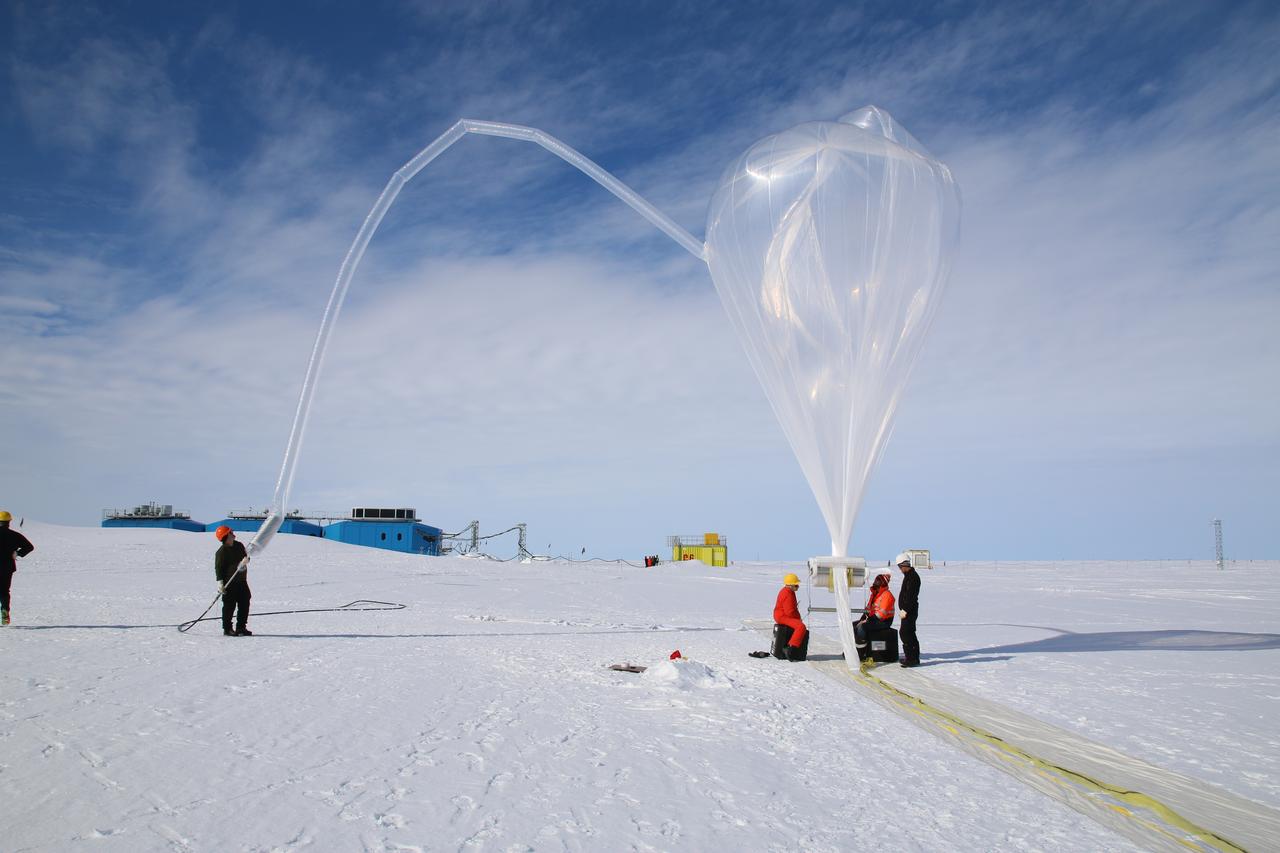
The BARREL team at Halley Research Station in Antarctica, work to inflate a balloon. The long tube on the left is the inflation tube used to fill the top of the balloon with helium. Credit: NASA/Goddard/BARREL Read more: <a href="http://www.nasa.gov/content/goddard/nasas-barrel-returns-successful-from-antarctica" rel="nofollow">www.nasa.gov/content/goddard/nasas-barrel-returns-success...</a> -- Three months, 20 balloons, and one very successful campaign. The team for NASA's BARREL – short for Balloon Array for Radiation belt Relativistic Electron Losses -- mission returned from Antarctica in March 2014. BARREL's job is to help unravel the mysterious Van Allen belts, two gigantic donuts of radiation that surround Earth, which can shrink and swell in response to incoming energy and particles from the sun and sometimes expose satellites to harsh radiation. While in Antarctica, the team launched 20 balloons carrying instruments that sense charged particles that are scattered into the atmosphere from the belts, spiraling down the magnetic fields near the South Pole. Each balloon traveled around the pole for up to three weeks. The team will coordinate the BARREL data with observations from NASA's two Van Allen Probes to better understand how occurrences in the belts relate to bursts of particles funneling down toward Earth. BARREL team members will be on hand at the USA Science and Engineering Festival in DC on April 26 and 27, 2014 for the exhibit Space Balloons: Exploring the Extremes of Space Weather. <b><a href="http://www.nasa.gov/audience/formedia/features/MP_Photo_Guidelines.html" rel="nofollow">NASA image use policy.</a></b><b><a href="http://www.nasa.gov/centers/goddard/home/index.html" rel="nofollow">NASA Goddard Space Flight Center</a></b> enables NASA’s mission through four scientific endeavors: Earth Science, Heliophysics, Solar System Exploration, and Astrophysics. Goddard plays a leading role in NASA’s accomplishments by contributing compelling scientific knowledge to advance the Agency’s mission.<b>Follow us on <a href="http://twitter.com/NASAGoddardPix" rel="nofollow">Twitter</a></b><b>Like us on <a href="http://www.facebook.com/pages/Greenbelt-MD/NASA-Goddard/395013845897?ref=tsd" rel="nofollow">Facebook</a></b><b>Find us on <a href="http://instagram.com/nasagoddard?vm=grid" rel="nofollow">Instagram</a></b>
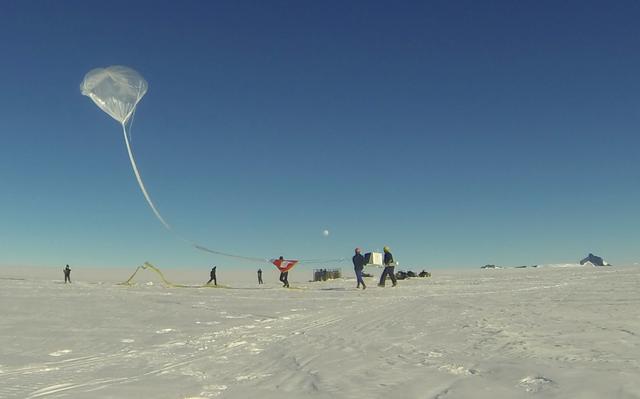
BARREL team members lift up the instrument box below an inflated BARREL balloon to help with launch. Credit: NASA/Goddard/Francois Read more: <a href="http://www.nasa.gov/content/goddard/nasas-barrel-returns-successful-from-antarctica" rel="nofollow">www.nasa.gov/content/goddard/nasas-barrel-returns-success...</a> -- Three months, 20 balloons, and one very successful campaign. The team for NASA's BARREL – short for Balloon Array for Radiation belt Relativistic Electron Losses -- mission returned from Antarctica in March 2014. BARREL's job is to help unravel the mysterious Van Allen belts, two gigantic donuts of radiation that surround Earth, which can shrink and swell in response to incoming energy and particles from the sun and sometimes expose satellites to harsh radiation. While in Antarctica, the team launched 20 balloons carrying instruments that sense charged particles that are scattered into the atmosphere from the belts, spiraling down the magnetic fields near the South Pole. Each balloon traveled around the pole for up to three weeks. The team will coordinate the BARREL data with observations from NASA's two Van Allen Probes to better understand how occurrences in the belts relate to bursts of particles funneling down toward Earth. BARREL team members will be on hand at the USA Science and Engineering Festival in DC on April 26 and 27, 2014 for the exhibit Space Balloons: Exploring the Extremes of Space Weather. <b><a href="http://www.nasa.gov/audience/formedia/features/MP_Photo_Guidelines.html" rel="nofollow">NASA image use policy.</a></b><b><a href="http://www.nasa.gov/centers/goddard/home/index.html" rel="nofollow">NASA Goddard Space Flight Center</a></b> enables NASA’s mission through four scientific endeavors: Earth Science, Heliophysics, Solar System Exploration, and Astrophysics. Goddard plays a leading role in NASA’s accomplishments by contributing compelling scientific knowledge to advance the Agency’s mission.<b>Follow us on <a href="http://twitter.com/NASAGoddardPix" rel="nofollow">Twitter</a></b><b>Like us on <a href="http://www.facebook.com/pages/Greenbelt-MD/NASA-Goddard/395013845897?ref=tsd" rel="nofollow">Facebook</a></b><b>Find us on <a href="http://instagram.com/nasagoddard?vm=grid" rel="nofollow">Instagram</a></b>
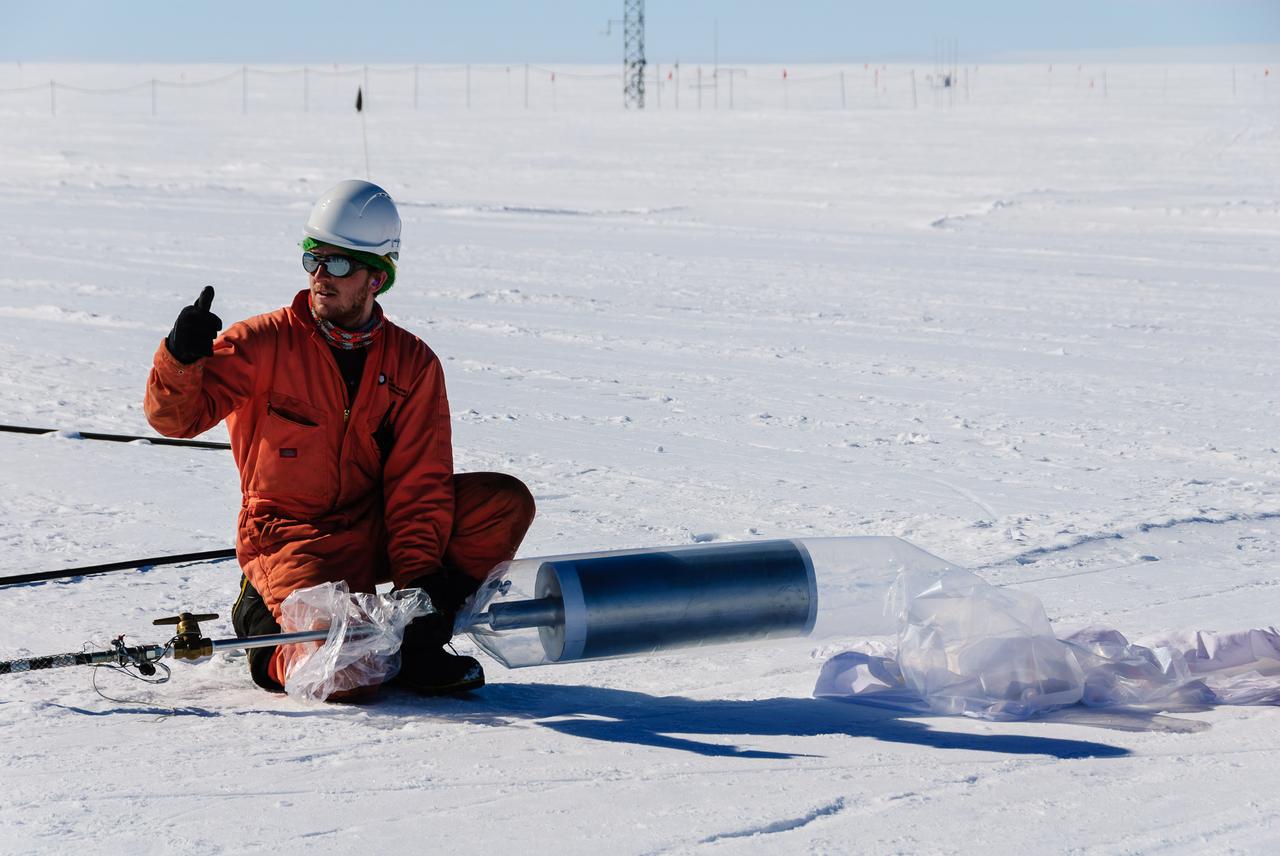
The Halley station team members assisted the BARREL team with the launches. Here, one gives the thumbs up to start inflating a BARREL balloon. Credit: NASA/Goddard/BARREL/M. Krzysztofowicz Read more: <a href="http://www.nasa.gov/content/nasas-barrel-returns-successful-from-antarctica/" rel="nofollow">www.nasa.gov/content/nasas-barrel-returns-successful-from...</a> -- Three months, 20 balloons, and one very successful campaign. The team for NASA's BARREL – short for Balloon Array for Radiation belt Relativistic Electron Losses -- mission returned from Antarctica in March 2014. BARREL's job is to help unravel the mysterious Van Allen belts, two gigantic donuts of radiation that surround Earth, which can shrink and swell in response to incoming energy and particles from the sun and sometimes expose satellites to harsh radiation. While in Antarctica, the team launched 20 balloons carrying instruments that sense charged particles that are scattered into the atmosphere from the belts, spiraling down the magnetic fields near the South Pole. Each balloon traveled around the pole for up to three weeks. The team will coordinate the BARREL data with observations from NASA's two Van Allen Probes to better understand how occurrences in the belts relate to bursts of particles funneling down toward Earth. BARREL team members will be on hand at the USA Science and Engineering Festival in DC on April 26 and 27, 2014 for the exhibit Space Balloons: Exploring the Extremes of Space Weather. <b><a href="http://www.nasa.gov/audience/formedia/features/MP_Photo_Guidelines.html" rel="nofollow">NASA image use policy.</a></b> <b><a href="http://www.nasa.gov/centers/goddard/home/index.html" rel="nofollow">NASA Goddard Space Flight Center</a></b> enables NASA’s mission through four scientific endeavors: Earth Science, Heliophysics, Solar System Exploration, and Astrophysics. Goddard plays a leading role in NASA’s accomplishments by contributing compelling scientific knowledge to advance the Agency’s mission. <b>Follow us on <a href="http://twitter.com/NASAGoddardPix" rel="nofollow">Twitter</a></b> <b>Like us on <a href="http://www.facebook.com/pages/Greenbelt-MD/NASA-Goddard/395013845897?ref=tsd" rel="nofollow">Facebook</a></b> <b>Find us on <a href="http://instagram.com/nasagoddard?vm=grid" rel="nofollow">Instagram</a></b>

A BARREL balloon launches up into the sky, destined to float on the circumpolar winds around the South Pole for up to three weeks while measuring Earth's magnetic field and energetic particles from the radiation belts. Credit: NASA/Goddard/BARREL/Brett Anderson Read more: <a href="http://www.nasa.gov/content/goddard/nasas-barrel-returns-successful-from-antarctica" rel="nofollow">www.nasa.gov/content/goddard/nasas-barrel-returns-success...</a> -- Three months, 20 balloons, and one very successful campaign. The team for NASA's BARREL – short for Balloon Array for Radiation belt Relativistic Electron Losses -- mission returned from Antarctica in March 2014. BARREL's job is to help unravel the mysterious Van Allen belts, two gigantic donuts of radiation that surround Earth, which can shrink and swell in response to incoming energy and particles from the sun and sometimes expose satellites to harsh radiation. While in Antarctica, the team launched 20 balloons carrying instruments that sense charged particles that are scattered into the atmosphere from the belts, spiraling down the magnetic fields near the South Pole. Each balloon traveled around the pole for up to three weeks. The team will coordinate the BARREL data with observations from NASA's two Van Allen Probes to better understand how occurrences in the belts relate to bursts of particles funneling down toward Earth. BARREL team members will be on hand at the USA Science and Engineering Festival in DC on April 26 and 27, 2014 for the exhibit Space Balloons: Exploring the Extremes of Space Weather. <b><a href="http://www.nasa.gov/audience/formedia/features/MP_Photo_Guidelines.html" rel="nofollow">NASA image use policy.</a></b> <b><a href="http://www.nasa.gov/centers/goddard/home/index.html" rel="nofollow">NASA Goddard Space Flight Center</a></b> enables NASA’s mission through four scientific endeavors: Earth Science, Heliophysics, Solar System Exploration, and Astrophysics. Goddard plays a leading role in NASA’s accomplishments by contributing compelling scientific knowledge to advance the Agency’s mission. <b>Follow us on <a href="http://twitter.com/NASAGoddardPix" rel="nofollow">Twitter</a></b> <b>Like us on <a href="http://www.facebook.com/pages/Greenbelt-MD/NASA-Goddard/395013845897?ref=tsd" rel="nofollow">Facebook</a></b> <b>Find us on <a href="http://instagram.com/nasagoddard?vm=grid" rel="nofollow">Instagram</a></b>
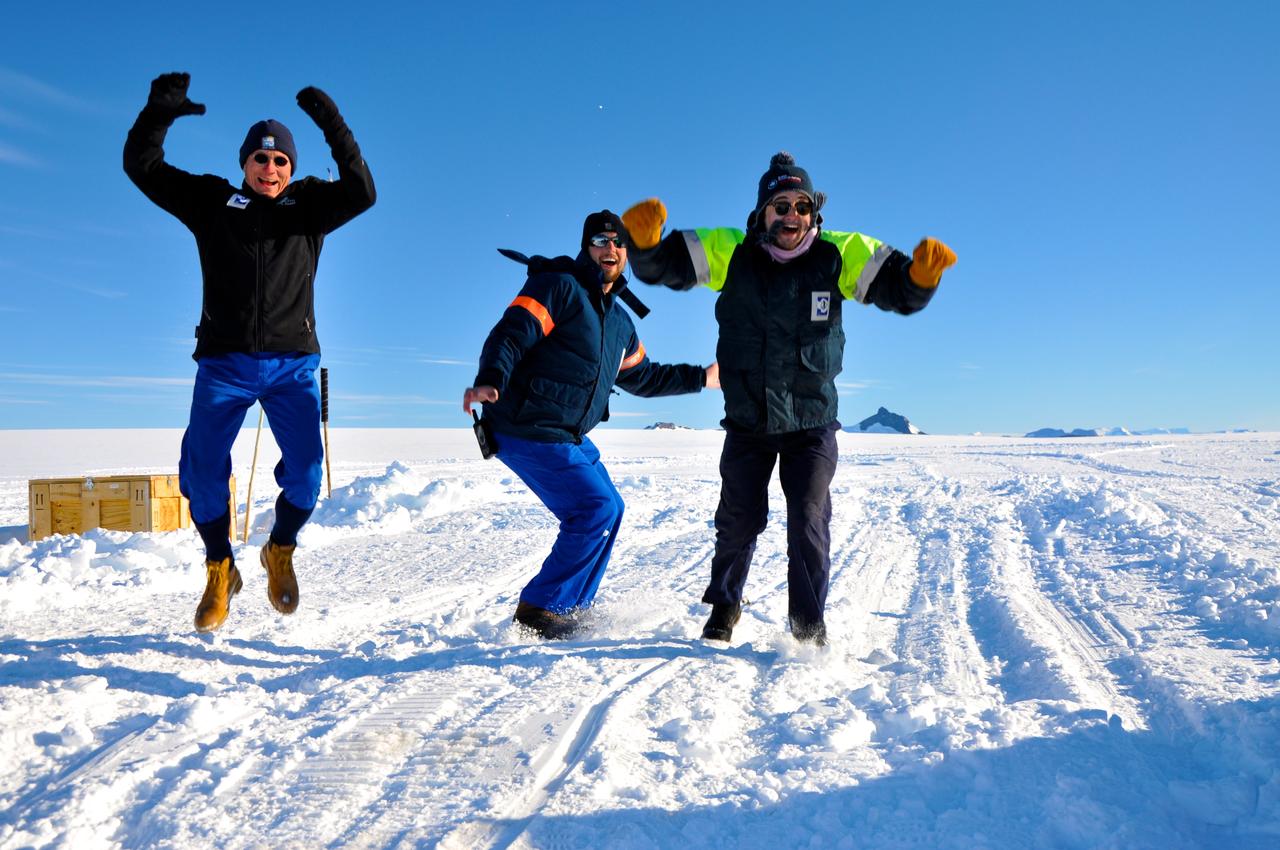
Members of the BARREL team in Antarctica jump up and down in what they call the Low Wind Dance as they hope for the low wind conditions needed to launch another balloon. Credit: NASA/Goddard/BARREL/Brett Anderson Read more: <a href="http://www.nasa.gov/content/goddard/nasas-barrel-returns-successful-from-antarctica" rel="nofollow">www.nasa.gov/content/goddard/nasas-barrel-returns-success...</a> -- Three months, 20 balloons, and one very successful campaign. The team for NASA's BARREL – short for Balloon Array for Radiation belt Relativistic Electron Losses -- mission returned from Antarctica in March 2014. BARREL's job is to help unravel the mysterious Van Allen belts, two gigantic donuts of radiation that surround Earth, which can shrink and swell in response to incoming energy and particles from the sun and sometimes expose satellites to harsh radiation. While in Antarctica, the team launched 20 balloons carrying instruments that sense charged particles that are scattered into the atmosphere from the belts, spiraling down the magnetic fields near the South Pole. Each balloon traveled around the pole for up to three weeks. The team will coordinate the BARREL data with observations from NASA's two Van Allen Probes to better understand how occurrences in the belts relate to bursts of particles funneling down toward Earth. BARREL team members will be on hand at the USA Science and Engineering Festival in DC on April 26 and 27, 2014 for the exhibit Space Balloons: Exploring the Extremes of Space Weather. <b><a href="http://www.nasa.gov/audience/formedia/features/MP_Photo_Guidelines.html" rel="nofollow">NASA image use policy.</a></b> <b><a href="http://www.nasa.gov/centers/goddard/home/index.html" rel="nofollow">NASA Goddard Space Flight Center</a></b> enables NASA’s mission through four scientific endeavors: Earth Science, Heliophysics, Solar System Exploration, and Astrophysics. Goddard plays a leading role in NASA’s accomplishments by contributing compelling scientific knowledge to advance the Agency’s mission. <b>Follow us on <a href="http://twitter.com/NASAGoddardPix" rel="nofollow">Twitter</a></b> <b>Like us on <a href="http://www.facebook.com/pages/Greenbelt-MD/NASA-Goddard/395013845897?ref=tsd" rel="nofollow">Facebook</a></b> <b>Find us on <a href="http://instagram.com/nasagoddard?vm=grid" rel="nofollow">Instagram</a></b>

The BARREL team at the South African research station, SANAE IV, lay out the 130-foot-long balloon on the ground to prepare for inflation. The entire set up and launch process takes three to four hours. Credit: NASA/Goddard/BARREL/Nicky Knox Read more: <a href="http://www.nasa.gov/content/goddard/nasas-barrel-returns-successful-from-antarctica" rel="nofollow">www.nasa.gov/content/goddard/nasas-barrel-returns-success...</a> -- Three months, 20 balloons, and one very successful campaign. The team for NASA's BARREL – short for Balloon Array for Radiation belt Relativistic Electron Losses -- mission returned from Antarctica in March 2014. BARREL's job is to help unravel the mysterious Van Allen belts, two gigantic donuts of radiation that surround Earth, which can shrink and swell in response to incoming energy and particles from the sun and sometimes expose satellites to harsh radiation. While in Antarctica, the team launched 20 balloons carrying instruments that sense charged particles that are scattered into the atmosphere from the belts, spiraling down the magnetic fields near the South Pole. Each balloon traveled around the pole for up to three weeks. The team will coordinate the BARREL data with observations from NASA's two Van Allen Probes to better understand how occurrences in the belts relate to bursts of particles funneling down toward Earth. BARREL team members will be on hand at the USA Science and Engineering Festival in DC on April 26 and 27, 2014 for the exhibit Space Balloons: Exploring the Extremes of Space Weather. <b><a href="http://www.nasa.gov/audience/formedia/features/MP_Photo_Guidelines.html" rel="nofollow">NASA image use policy.</a></b> <b><a href="http://www.nasa.gov/centers/goddard/home/index.html" rel="nofollow">NASA Goddard Space Flight Center</a></b> enables NASA’s mission through four scientific endeavors: Earth Science, Heliophysics, Solar System Exploration, and Astrophysics. Goddard plays a leading role in NASA’s accomplishments by contributing compelling scientific knowledge to advance the Agency’s mission. <b>Follow us on <a href="http://twitter.com/NASAGoddardPix" rel="nofollow">Twitter</a></b> <b>Like us on <a href="http://www.facebook.com/pages/Greenbelt-MD/NASA-Goddard/395013845897?ref=tsd" rel="nofollow">Facebook</a></b> <b>Find us on <a href="http://instagram.com/nasagoddard?vm=grid" rel="nofollow">Instagram</a></b>
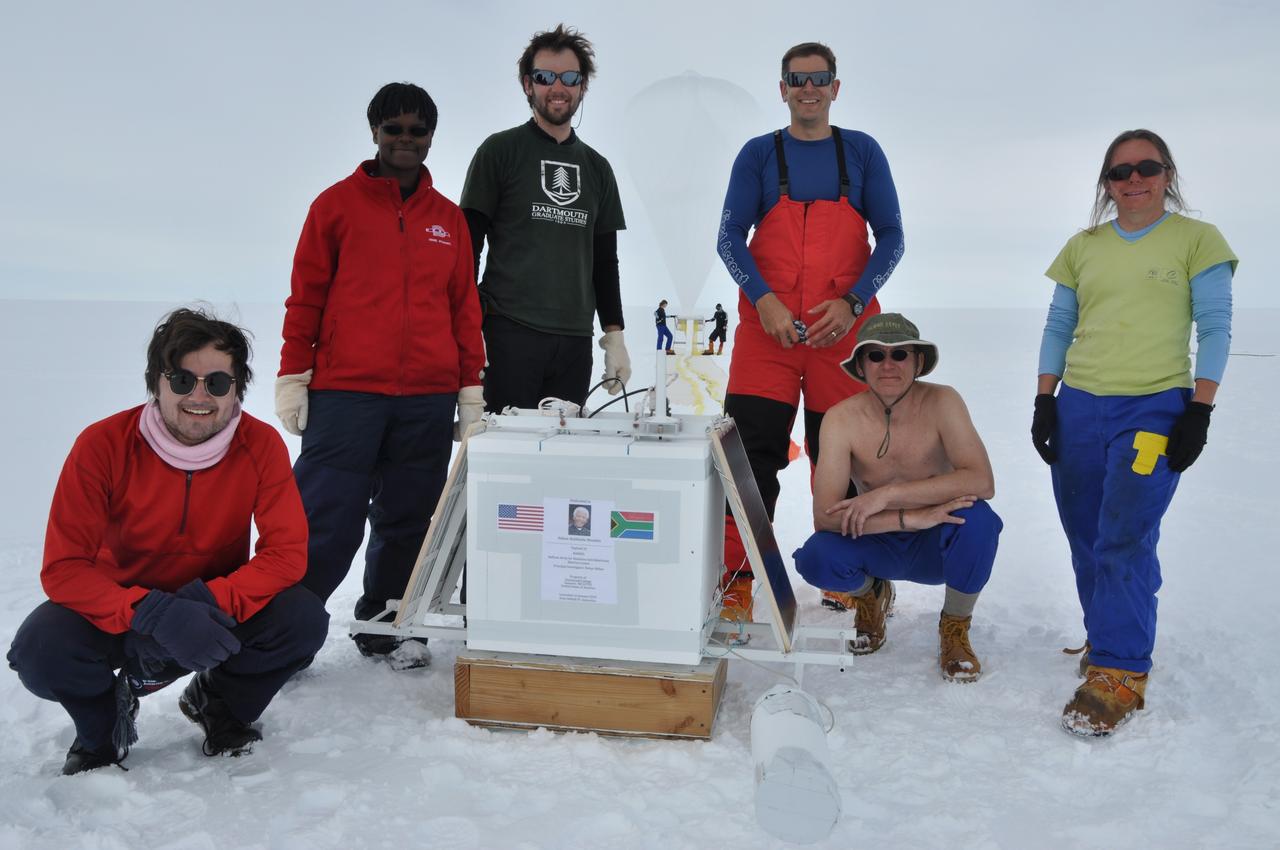
The BARREL team at the South African research station, SANAE IV, poses next to the instrument box, which will float in the atmosphere beneath the balloon that can be seen being inflated in the background. Credit: NASA/Goddard/BARREL/Brett Anderson Read more: <a href="http://www.nasa.gov/content/goddard/nasas-barrel-returns-successful-from-antarctica" rel="nofollow">www.nasa.gov/content/goddard/nasas-barrel-returns-success...</a> -- Three months, 20 balloons, and one very successful campaign. The team for NASA's BARREL – short for Balloon Array for Radiation belt Relativistic Electron Losses -- mission returned from Antarctica in March 2014. BARREL's job is to help unravel the mysterious Van Allen belts, two gigantic donuts of radiation that surround Earth, which can shrink and swell in response to incoming energy and particles from the sun and sometimes expose satellites to harsh radiation. While in Antarctica, the team launched 20 balloons carrying instruments that sense charged particles that are scattered into the atmosphere from the belts, spiraling down the magnetic fields near the South Pole. Each balloon traveled around the pole for up to three weeks. The team will coordinate the BARREL data with observations from NASA's two Van Allen Probes to better understand how occurrences in the belts relate to bursts of particles funneling down toward Earth. BARREL team members will be on hand at the USA Science and Engineering Festival in DC on April 26 and 27, 2014 for the exhibit Space Balloons: Exploring the Extremes of Space Weather. <b><a href="http://www.nasa.gov/audience/formedia/features/MP_Photo_Guidelines.html" rel="nofollow">NASA image use policy.</a></b> <b><a href="http://www.nasa.gov/centers/goddard/home/index.html" rel="nofollow">NASA Goddard Space Flight Center</a></b> enables NASA’s mission through four scientific endeavors: Earth Science, Heliophysics, Solar System Exploration, and Astrophysics. Goddard plays a leading role in NASA’s accomplishments by contributing compelling scientific knowledge to advance the Agency’s mission. <b>Follow us on <a href="http://twitter.com/NASAGoddardPix" rel="nofollow">Twitter</a></b> <b>Like us on <a href="http://www.facebook.com/pages/Greenbelt-MD/NASA-Goddard/395013845897?ref=tsd" rel="nofollow">Facebook</a></b> <b>Find us on <a href="http://instagram.com/nasagoddard?vm=grid" rel="nofollow">Instagram</a></b>
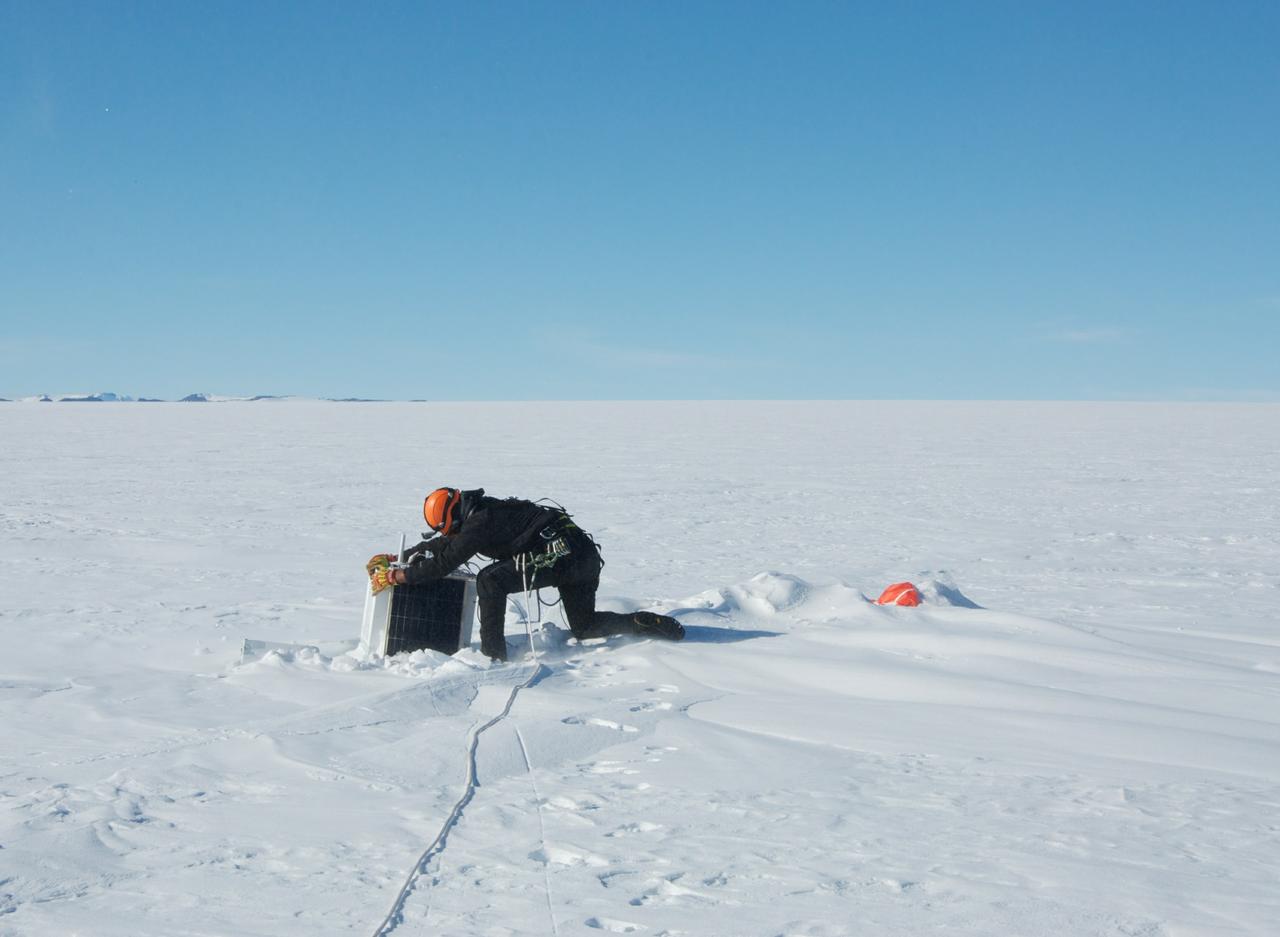
Recovery of a BARREL balloon payload after its flight. The recovery was carried out by helicopter. This area is known to be heavily crevassed so the base mountaineer is seen here with a safety rope. Credit: NASA/Goddard/BARREL/Brett Anderson Read more: <a href="http://www.nasa.gov/content/goddard/nasas-barrel-returns-successful-from-antarctica" rel="nofollow">www.nasa.gov/content/goddard/nasas-barrel-returns-success...</a> -- Three months, 20 balloons, and one very successful campaign. The team for NASA's BARREL – short for Balloon Array for Radiation belt Relativistic Electron Losses -- mission returned from Antarctica in March 2014. BARREL's job is to help unravel the mysterious Van Allen belts, two gigantic donuts of radiation that surround Earth, which can shrink and swell in response to incoming energy and particles from the sun and sometimes expose satellites to harsh radiation. While in Antarctica, the team launched 20 balloons carrying instruments that sense charged particles that are scattered into the atmosphere from the belts, spiraling down the magnetic fields near the South Pole. Each balloon traveled around the pole for up to three weeks. The team will coordinate the BARREL data with observations from NASA's two Van Allen Probes to better understand how occurrences in the belts relate to bursts of particles funneling down toward Earth. BARREL team members will be on hand at the USA Science and Engineering Festival in DC on April 26 and 27, 2014 for the exhibit Space Balloons: Exploring the Extremes of Space Weather. <b><a href="http://www.nasa.gov/audience/formedia/features/MP_Photo_Guidelines.html" rel="nofollow">NASA image use policy.</a></b> <b><a href="http://www.nasa.gov/centers/goddard/home/index.html" rel="nofollow">NASA Goddard Space Flight Center</a></b> enables NASA’s mission through four scientific endeavors: Earth Science, Heliophysics, Solar System Exploration, and Astrophysics. Goddard plays a leading role in NASA’s accomplishments by contributing compelling scientific knowledge to advance the Agency’s mission. <b>Follow us on <a href="http://twitter.com/NASAGoddardPix" rel="nofollow">Twitter</a></b> <b>Like us on <a href="http://www.facebook.com/pages/Greenbelt-MD/NASA-Goddard/395013845897?ref=tsd" rel="nofollow">Facebook</a></b> <b>Find us on <a href="http://instagram.com/nasagoddard?vm=grid" rel="nofollow">Instagram</a></b>

The BARREL instrument in Antarctica– prior to being encased in its protective box – destined to float beneath a giant balloon to study magnetic fields and energetic particles near the South Pole. Credit: NASA/Goddard/BARREL/Brett Anderson Read more: <a href="http://www.nasa.gov/content/goddard/nasas-barrel-returns-successful-from-antarctica" rel="nofollow">www.nasa.gov/content/goddard/nasas-barrel-returns-success...</a> -- Three months, 20 balloons, and one very successful campaign. The team for NASA's BARREL – short for Balloon Array for Radiation belt Relativistic Electron Losses -- mission returned from Antarctica in March 2014. BARREL's job is to help unravel the mysterious Van Allen belts, two gigantic donuts of radiation that surround Earth, which can shrink and swell in response to incoming energy and particles from the sun and sometimes expose satellites to harsh radiation. While in Antarctica, the team launched 20 balloons carrying instruments that sense charged particles that are scattered into the atmosphere from the belts, spiraling down the magnetic fields near the South Pole. Each balloon traveled around the pole for up to three weeks. The team will coordinate the BARREL data with observations from NASA's two Van Allen Probes to better understand how occurrences in the belts relate to bursts of particles funneling down toward Earth. BARREL team members will be on hand at the USA Science and Engineering Festival in DC on April 26 and 27, 2014 for the exhibit Space Balloons: Exploring the Extremes of Space Weather. <b><a href="http://www.nasa.gov/audience/formedia/features/MP_Photo_Guidelines.html" rel="nofollow">NASA image use policy.</a></b> <b><a href="http://www.nasa.gov/centers/goddard/home/index.html" rel="nofollow">NASA Goddard Space Flight Center</a></b> enables NASA’s mission through four scientific endeavors: Earth Science, Heliophysics, Solar System Exploration, and Astrophysics. Goddard plays a leading role in NASA’s accomplishments by contributing compelling scientific knowledge to advance the Agency’s mission. <b>Follow us on <a href="http://twitter.com/NASAGoddardPix" rel="nofollow">Twitter</a></b> <b>Like us on <a href="http://www.facebook.com/pages/Greenbelt-MD/NASA-Goddard/395013845897?ref=tsd" rel="nofollow">Facebook</a></b> <b>Find us on <a href="http://instagram.com/nasagoddard?vm=grid" rel="nofollow">Instagram</a></b>

Getting fuller! A BARREL balloon is filled with helium during the 2013-2014 mission campaign in Antarctica. Credit: NASA/Goddard/BARREL Read more: <a href="http://www.nasa.gov/content/goddard/nasas-barrel-returns-successful-from-antarctica" rel="nofollow">www.nasa.gov/content/goddard/nasas-barrel-returns-success...</a> -- Three months, 20 balloons, and one very successful campaign. The team for NASA's BARREL – short for Balloon Array for Radiation belt Relativistic Electron Losses -- mission returned from Antarctica in March 2014. BARREL's job is to help unravel the mysterious Van Allen belts, two gigantic donuts of radiation that surround Earth, which can shrink and swell in response to incoming energy and particles from the sun and sometimes expose satellites to harsh radiation. While in Antarctica, the team launched 20 balloons carrying instruments that sense charged particles that are scattered into the atmosphere from the belts, spiraling down the magnetic fields near the South Pole. Each balloon traveled around the pole for up to three weeks. The team will coordinate the BARREL data with observations from NASA's two Van Allen Probes to better understand how occurrences in the belts relate to bursts of particles funneling down toward Earth. BARREL team members will be on hand at the USA Science and Engineering Festival in DC on April 26 and 27, 2014 for the exhibit Space Balloons: Exploring the Extremes of Space Weather. <b><a href="http://www.nasa.gov/audience/formedia/features/MP_Photo_Guidelines.html" rel="nofollow">NASA image use policy.</a></b><b><a href="http://www.nasa.gov/centers/goddard/home/index.html" rel="nofollow">NASA Goddard Space Flight Center</a></b> enables NASA’s mission through four scientific endeavors: Earth Science, Heliophysics, Solar System Exploration, and Astrophysics. Goddard plays a leading role in NASA’s accomplishments by contributing compelling scientific knowledge to advance the Agency’s mission.<b>Follow us on <a href="http://twitter.com/NASAGoddardPix" rel="nofollow">Twitter</a></b><b>Like us on <a href="http://www.facebook.com/pages/Greenbelt-MD/NASA-Goddard/395013845897?ref=tsd" rel="nofollow">Facebook</a></b><b>Find us on <a href="http://instagram.com/nasagoddard?vm=grid" rel="nofollow">Instagram</a></b>

A team member from South African research station, SANAE IV, helps unwrap the balloon from its protective yellow plastic cover just prior to inflation. Credit: NASA/Goddard/BARREL/Nicky Knox Read more: <a href="http://www.nasa.gov/content/goddard/nasas-barrel-returns-successful-from-antarctica" rel="nofollow">www.nasa.gov/content/goddard/nasas-barrel-returns-success...</a> -- Three months, 20 balloons, and one very successful campaign. The team for NASA's BARREL – short for Balloon Array for Radiation belt Relativistic Electron Losses -- mission returned from Antarctica in March 2014. BARREL's job is to help unravel the mysterious Van Allen belts, two gigantic donuts of radiation that surround Earth, which can shrink and swell in response to incoming energy and particles from the sun and sometimes expose satellites to harsh radiation. While in Antarctica, the team launched 20 balloons carrying instruments that sense charged particles that are scattered into the atmosphere from the belts, spiraling down the magnetic fields near the South Pole. Each balloon traveled around the pole for up to three weeks. The team will coordinate the BARREL data with observations from NASA's two Van Allen Probes to better understand how occurrences in the belts relate to bursts of particles funneling down toward Earth. BARREL team members will be on hand at the USA Science and Engineering Festival in DC on April 26 and 27, 2014 for the exhibit Space Balloons: Exploring the Extremes of Space Weather. <b><a href="http://www.nasa.gov/audience/formedia/features/MP_Photo_Guidelines.html" rel="nofollow">NASA image use policy.</a></b> <b><a href="http://www.nasa.gov/centers/goddard/home/index.html" rel="nofollow">NASA Goddard Space Flight Center</a></b> enables NASA’s mission through four scientific endeavors: Earth Science, Heliophysics, Solar System Exploration, and Astrophysics. Goddard plays a leading role in NASA’s accomplishments by contributing compelling scientific knowledge to advance the Agency’s mission. <b>Follow us on <a href="http://twitter.com/NASAGoddardPix" rel="nofollow">Twitter</a></b> <b>Like us on <a href="http://www.facebook.com/pages/Greenbelt-MD/NASA-Goddard/395013845897?ref=tsd" rel="nofollow">Facebook</a></b> <b>Find us on <a href="http://instagram.com/nasagoddard?vm=grid" rel="nofollow">Instagram</a></b>
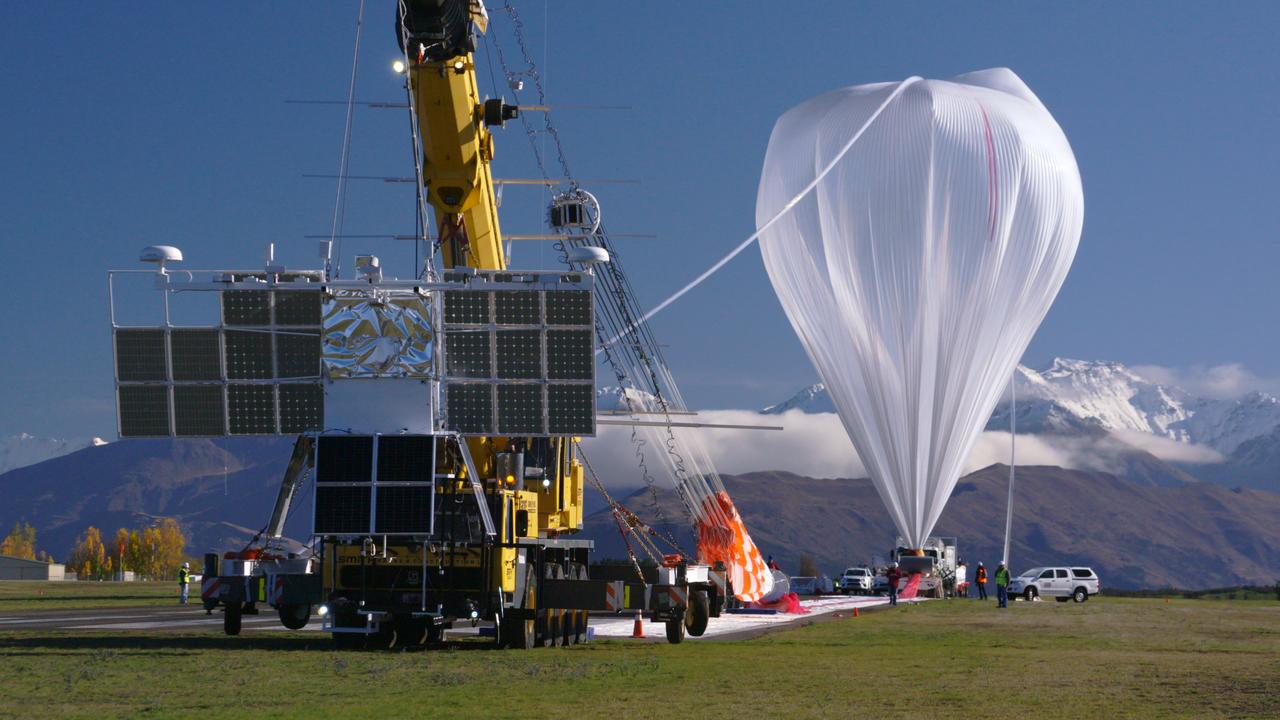
NASA successfully launched a super pressure balloon from Wanaka Airport, New Zealand, on Tuesday, May 17, on a potentially record-breaking, around-the-world test flight! The purpose of the flight is to test and validate the super pressure balloon technology with the goal of long-duration flight (100+ days) at mid-latitudes. In addition, the gondola is carrying the Compton Spectrometer and Imager (COSI) gamma-ray telescope as a mission of opportunity. Two hours and 8 minutes after lift-off, the 532,000-cubic-meter (18.8-million-cubic-foot) balloon reached its operational float altitude of 33.5 kilometers (110,000 feet) flying a trajectory taking it initially westward through southern Australia before entering into the eastward flowing winter stratospheric cyclone. NASA estimates the balloon will circumnavigate the globe about the southern hemisphere’s mid-latitudes once every one to three weeks, depending on wind speeds in the stratosphere. Credit: NASA/Bill Rodman <b><a href="http://www.nasa.gov/audience/formedia/features/MP_Photo_Guidelines.html" rel="nofollow">NASA image use policy.</a></b> <b><a href="http://www.nasa.gov/centers/goddard/home/index.html" rel="nofollow">NASA Goddard Space Flight Center</a></b> enables NASA’s mission through four scientific endeavors: Earth Science, Heliophysics, Solar System Exploration, and Astrophysics. Goddard plays a leading role in NASA’s accomplishments by contributing compelling scientific knowledge to advance the Agency’s mission. <b>Follow us on <a href="http://twitter.com/NASAGoddardPix" rel="nofollow">Twitter</a></b> <b>Like us on <a href="http://www.facebook.com/pages/Greenbelt-MD/NASA-Goddard/395013845897?ref=tsd" rel="nofollow">Facebook</a></b> <b>Find us on <a href="http://instagrid.me/nasagoddard/?vm=grid" rel="nofollow">Instagram</a></b> Read more: <a href="http://go.nasa.gov/1rRvmv8" rel="nofollow">go.nasa.gov/1rRvmv8</a>
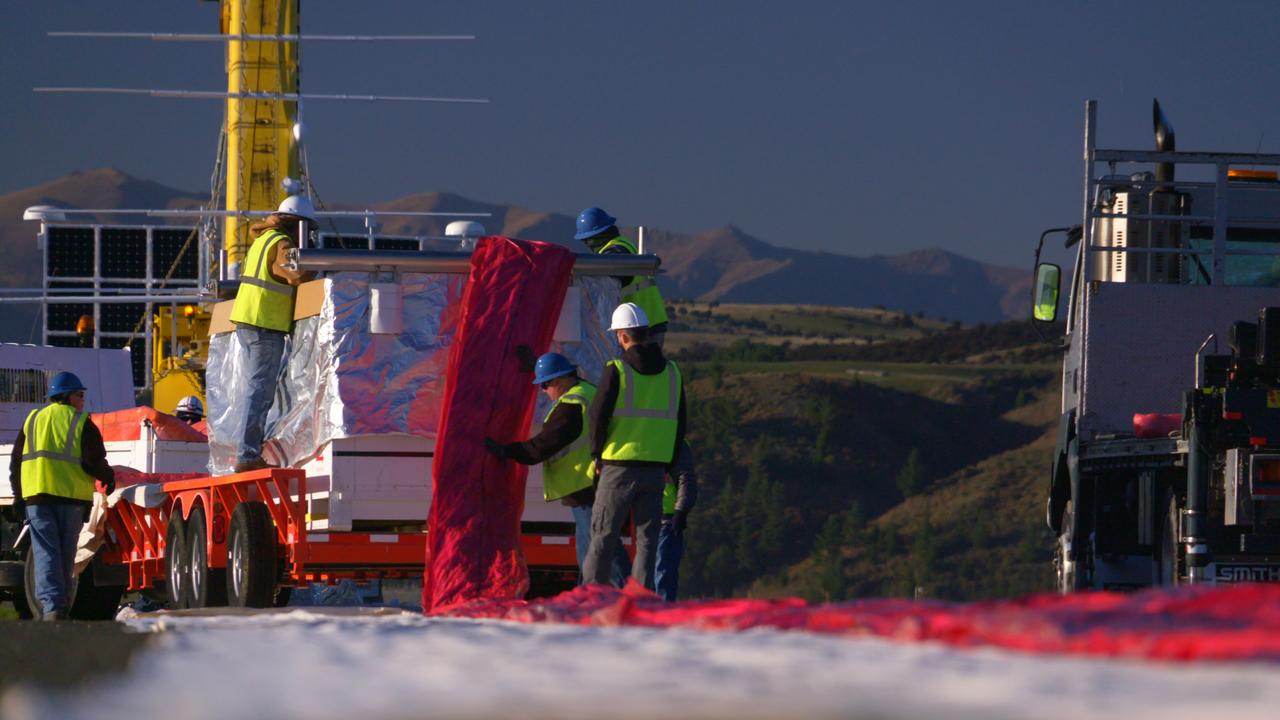
NASA successfully launched a super pressure balloon from Wanaka Airport, New Zealand, on Tuesday, May 17, on a potentially record-breaking, around-the-world test flight! The purpose of the flight is to test and validate the super pressure balloon technology with the goal of long-duration flight (100+ days) at mid-latitudes. In addition, the gondola is carrying the Compton Spectrometer and Imager (COSI) gamma-ray telescope as a mission of opportunity. Two hours and 8 minutes after lift-off, the 532,000-cubic-meter (18.8-million-cubic-foot) balloon reached its operational float altitude of 33.5 kilometers (110,000 feet) flying a trajectory taking it initially westward through southern Australia before entering into the eastward flowing winter stratospheric cyclone. NASA estimates the balloon will circumnavigate the globe about the southern hemisphere’s mid-latitudes once every one to three weeks, depending on wind speeds in the stratosphere. Credit: NASA/Bill Rodman <b><a href="http://www.nasa.gov/audience/formedia/features/MP_Photo_Guidelines.html" rel="nofollow">NASA image use policy.</a></b> <b><a href="http://www.nasa.gov/centers/goddard/home/index.html" rel="nofollow">NASA Goddard Space Flight Center</a></b> enables NASA’s mission through four scientific endeavors: Earth Science, Heliophysics, Solar System Exploration, and Astrophysics. Goddard plays a leading role in NASA’s accomplishments by contributing compelling scientific knowledge to advance the Agency’s mission. <b>Follow us on <a href="http://twitter.com/NASAGoddardPix" rel="nofollow">Twitter</a></b> <b>Like us on <a href="http://www.facebook.com/pages/Greenbelt-MD/NASA-Goddard/395013845897?ref=tsd" rel="nofollow">Facebook</a></b> <b>Find us on <a href="http://instagrid.me/nasagoddard/?vm=grid" rel="nofollow">Instagram</a></b> Read more: <a href="http://go.nasa.gov/1rRvmv8" rel="nofollow">go.nasa.gov/1rRvmv8</a>
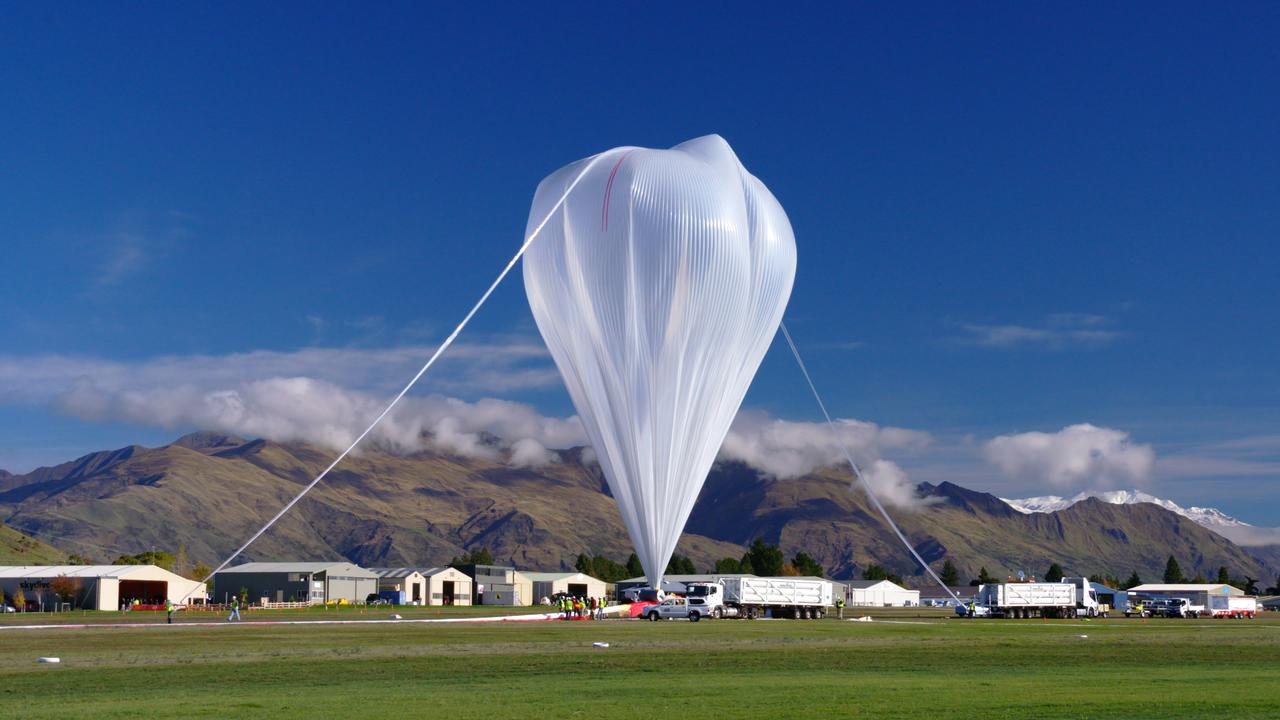
NASA successfully launched a super pressure balloon from Wanaka Airport, New Zealand, on Tuesday, May 17, on a potentially record-breaking, around-the-world test flight! The purpose of the flight is to test and validate the super pressure balloon technology with the goal of long-duration flight (100+ days) at mid-latitudes. In addition, the gondola is carrying the Compton Spectrometer and Imager (COSI) gamma-ray telescope as a mission of opportunity. Two hours and 8 minutes after lift-off, the 532,000-cubic-meter (18.8-million-cubic-foot) balloon reached its operational float altitude of 33.5 kilometers (110,000 feet) flying a trajectory taking it initially westward through southern Australia before entering into the eastward flowing winter stratospheric cyclone. NASA estimates the balloon will circumnavigate the globe about the southern hemisphere’s mid-latitudes once every one to three weeks, depending on wind speeds in the stratosphere. Credit: NASA/Bill Rodman <b><a href="http://www.nasa.gov/audience/formedia/features/MP_Photo_Guidelines.html" rel="nofollow">NASA image use policy.</a></b> <b><a href="http://www.nasa.gov/centers/goddard/home/index.html" rel="nofollow">NASA Goddard Space Flight Center</a></b> enables NASA’s mission through four scientific endeavors: Earth Science, Heliophysics, Solar System Exploration, and Astrophysics. Goddard plays a leading role in NASA’s accomplishments by contributing compelling scientific knowledge to advance the Agency’s mission. <b>Follow us on <a href="http://twitter.com/NASAGoddardPix" rel="nofollow">Twitter</a></b> <b>Like us on <a href="http://www.facebook.com/pages/Greenbelt-MD/NASA-Goddard/395013845897?ref=tsd" rel="nofollow">Facebook</a></b> <b>Find us on <a href="http://instagrid.me/nasagoddard/?vm=grid" rel="nofollow">Instagram</a></b> Read more: <a href="http://go.nasa.gov/1rRvmv8" rel="nofollow">go.nasa.gov/1rRvmv8</a>
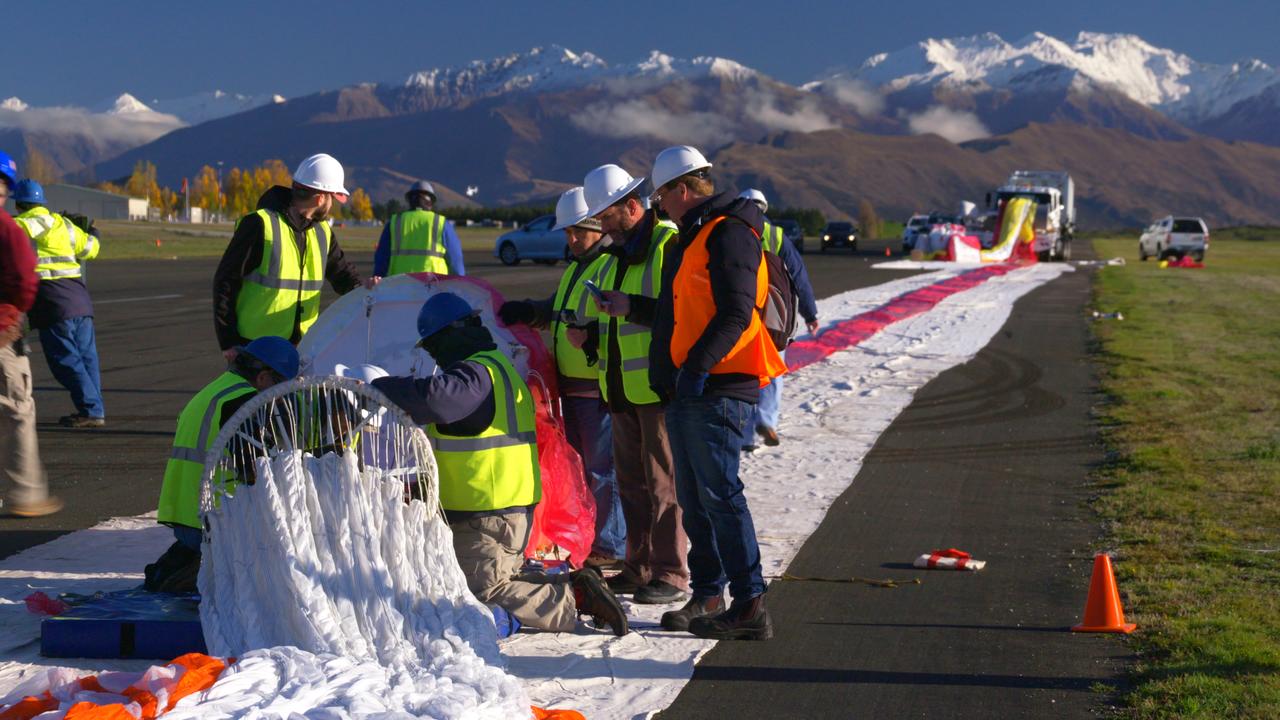
NASA successfully launched a super pressure balloon from Wanaka Airport, New Zealand, on Tuesday, May 17, on a potentially record-breaking, around-the-world test flight! The purpose of the flight is to test and validate the super pressure balloon technology with the goal of long-duration flight (100+ days) at mid-latitudes. In addition, the gondola is carrying the Compton Spectrometer and Imager (COSI) gamma-ray telescope as a mission of opportunity. Two hours and 8 minutes after lift-off, the 532,000-cubic-meter (18.8-million-cubic-foot) balloon reached its operational float altitude of 33.5 kilometers (110,000 feet) flying a trajectory taking it initially westward through southern Australia before entering into the eastward flowing winter stratospheric cyclone. NASA estimates the balloon will circumnavigate the globe about the southern hemisphere’s mid-latitudes once every one to three weeks, depending on wind speeds in the stratosphere. Credit: NASA/Bill Rodman <b><a href="http://www.nasa.gov/audience/formedia/features/MP_Photo_Guidelines.html" rel="nofollow">NASA image use policy.</a></b> <b><a href="http://www.nasa.gov/centers/goddard/home/index.html" rel="nofollow">NASA Goddard Space Flight Center</a></b> enables NASA’s mission through four scientific endeavors: Earth Science, Heliophysics, Solar System Exploration, and Astrophysics. Goddard plays a leading role in NASA’s accomplishments by contributing compelling scientific knowledge to advance the Agency’s mission. <b>Follow us on <a href="http://twitter.com/NASAGoddardPix" rel="nofollow">Twitter</a></b> <b>Like us on <a href="http://www.facebook.com/pages/Greenbelt-MD/NASA-Goddard/395013845897?ref=tsd" rel="nofollow">Facebook</a></b> <b>Find us on <a href="http://instagrid.me/nasagoddard/?vm=grid" rel="nofollow">Instagram</a></b> Read more: <a href="http://go.nasa.gov/1rRvmv8" rel="nofollow">go.nasa.gov/1rRvmv8</a>
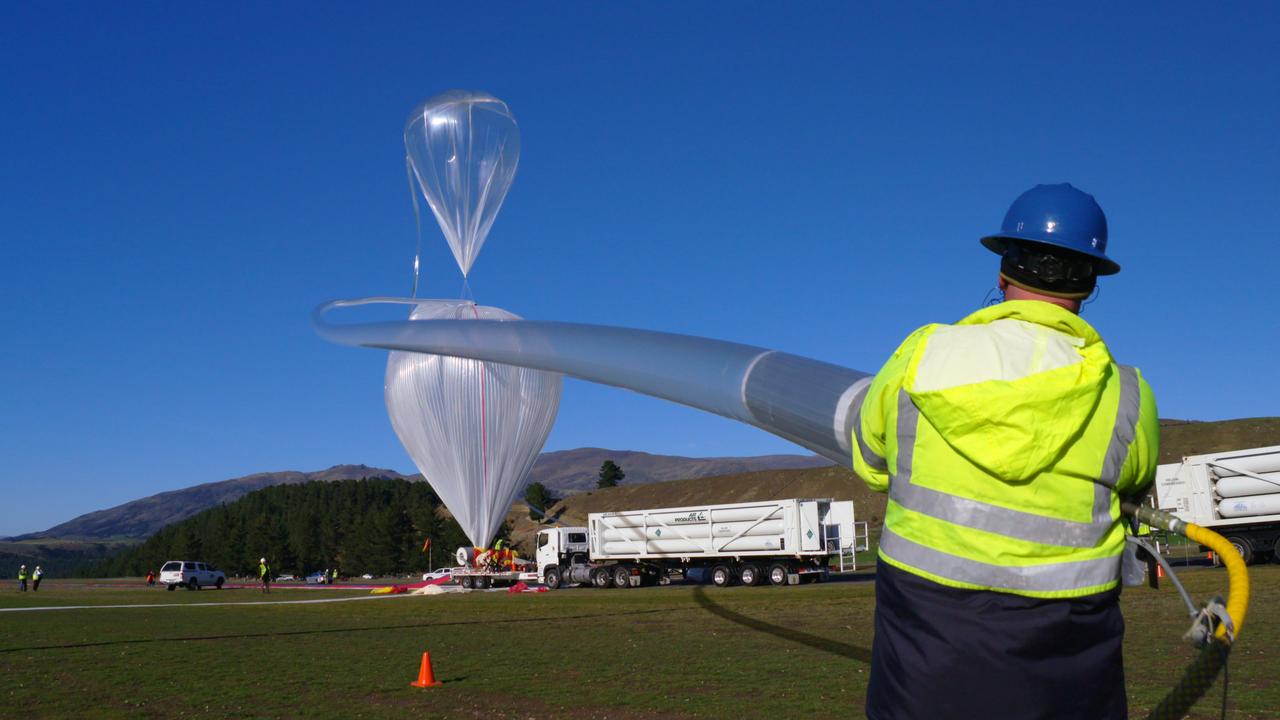
NASA successfully launched a super pressure balloon from Wanaka Airport, New Zealand, on Tuesday, May 17, on a potentially record-breaking, around-the-world test flight! The purpose of the flight is to test and validate the super pressure balloon technology with the goal of long-duration flight (100+ days) at mid-latitudes. In addition, the gondola is carrying the Compton Spectrometer and Imager (COSI) gamma-ray telescope as a mission of opportunity. Two hours and 8 minutes after lift-off, the 532,000-cubic-meter (18.8-million-cubic-foot) balloon reached its operational float altitude of 33.5 kilometers (110,000 feet) flying a trajectory taking it initially westward through southern Australia before entering into the eastward flowing winter stratospheric cyclone. NASA estimates the balloon will circumnavigate the globe about the southern hemisphere’s mid-latitudes once every one to three weeks, depending on wind speeds in the stratosphere. Credit: NASA/Bill Rodman <b><a href="http://www.nasa.gov/audience/formedia/features/MP_Photo_Guidelines.html" rel="nofollow">NASA image use policy.</a></b> <b><a href="http://www.nasa.gov/centers/goddard/home/index.html" rel="nofollow">NASA Goddard Space Flight Center</a></b> enables NASA’s mission through four scientific endeavors: Earth Science, Heliophysics, Solar System Exploration, and Astrophysics. Goddard plays a leading role in NASA’s accomplishments by contributing compelling scientific knowledge to advance the Agency’s mission. <b>Follow us on <a href="http://twitter.com/NASAGoddardPix" rel="nofollow">Twitter</a></b> <b>Like us on <a href="http://www.facebook.com/pages/Greenbelt-MD/NASA-Goddard/395013845897?ref=tsd" rel="nofollow">Facebook</a></b> <b>Find us on <a href="http://instagrid.me/nasagoddard/?vm=grid" rel="nofollow">Instagram</a></b> Read more: <a href="http://go.nasa.gov/1rRvmv8" rel="nofollow">go.nasa.gov/1rRvmv8</a>

NASA successfully launched a super pressure balloon from Wanaka Airport, New Zealand, on Tuesday, May 17, on a potentially record-breaking, around-the-world test flight! The purpose of the flight is to test and validate the super pressure balloon technology with the goal of long-duration flight (100+ days) at mid-latitudes. In addition, the gondola is carrying the Compton Spectrometer and Imager (COSI) gamma-ray telescope as a mission of opportunity. Two hours and 8 minutes after lift-off, the 532,000-cubic-meter (18.8-million-cubic-foot) balloon reached its operational float altitude of 33.5 kilometers (110,000 feet) flying a trajectory taking it initially westward through southern Australia before entering into the eastward flowing winter stratospheric cyclone. NASA estimates the balloon will circumnavigate the globe about the southern hemisphere’s mid-latitudes once every one to three weeks, depending on wind speeds in the stratosphere. Credit: NASA/Bill Rodman <b><a href="http://www.nasa.gov/audience/formedia/features/MP_Photo_Guidelines.html" rel="nofollow">NASA image use policy.</a></b> <b><a href="http://www.nasa.gov/centers/goddard/home/index.html" rel="nofollow">NASA Goddard Space Flight Center</a></b> enables NASA’s mission through four scientific endeavors: Earth Science, Heliophysics, Solar System Exploration, and Astrophysics. Goddard plays a leading role in NASA’s accomplishments by contributing compelling scientific knowledge to advance the Agency’s mission. <b>Follow us on <a href="http://twitter.com/NASAGoddardPix" rel="nofollow">Twitter</a></b> <b>Like us on <a href="http://www.facebook.com/pages/Greenbelt-MD/NASA-Goddard/395013845897?ref=tsd" rel="nofollow">Facebook</a></b> <b>Find us on <a href="http://instagrid.me/nasagoddard/?vm=grid" rel="nofollow">Instagram</a></b> Read more: <a href="http://go.nasa.gov/1rRvmv8" rel="nofollow">go.nasa.gov/1rRvmv8</a>
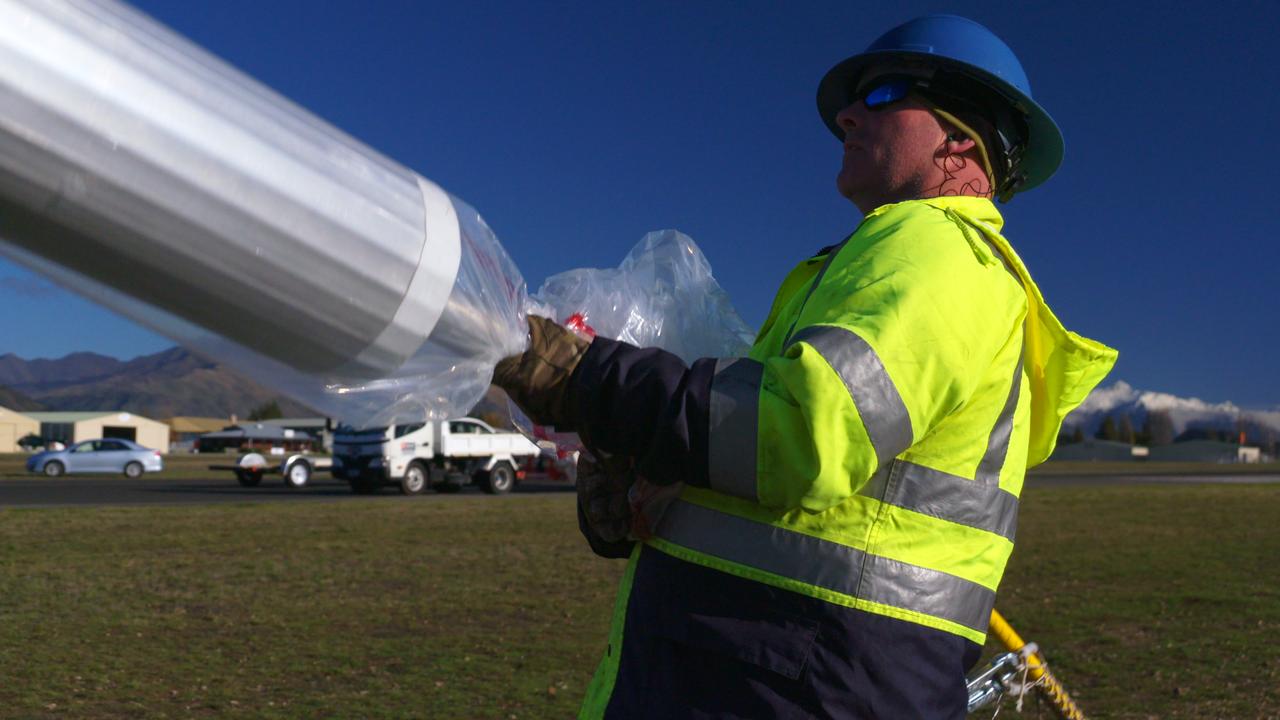
NASA successfully launched a super pressure balloon from Wanaka Airport, New Zealand, on Tuesday, May 17, on a potentially record-breaking, around-the-world test flight! The purpose of the flight is to test and validate the super pressure balloon technology with the goal of long-duration flight (100+ days) at mid-latitudes. In addition, the gondola is carrying the Compton Spectrometer and Imager (COSI) gamma-ray telescope as a mission of opportunity. Two hours and 8 minutes after lift-off, the 532,000-cubic-meter (18.8-million-cubic-foot) balloon reached its operational float altitude of 33.5 kilometers (110,000 feet) flying a trajectory taking it initially westward through southern Australia before entering into the eastward flowing winter stratospheric cyclone. NASA estimates the balloon will circumnavigate the globe about the southern hemisphere’s mid-latitudes once every one to three weeks, depending on wind speeds in the stratosphere. Credit: NASA/Bill Rodman <b><a href="http://www.nasa.gov/audience/formedia/features/MP_Photo_Guidelines.html" rel="nofollow">NASA image use policy.</a></b> <b><a href="http://www.nasa.gov/centers/goddard/home/index.html" rel="nofollow">NASA Goddard Space Flight Center</a></b> enables NASA’s mission through four scientific endeavors: Earth Science, Heliophysics, Solar System Exploration, and Astrophysics. Goddard plays a leading role in NASA’s accomplishments by contributing compelling scientific knowledge to advance the Agency’s mission. <b>Follow us on <a href="http://twitter.com/NASAGoddardPix" rel="nofollow">Twitter</a></b> <b>Like us on <a href="http://www.facebook.com/pages/Greenbelt-MD/NASA-Goddard/395013845897?ref=tsd" rel="nofollow">Facebook</a></b> <b>Find us on <a href="http://instagrid.me/nasagoddard/?vm=grid" rel="nofollow">Instagram</a></b> Read more: <a href="http://go.nasa.gov/1rRvmv8" rel="nofollow">go.nasa.gov/1rRvmv8</a>
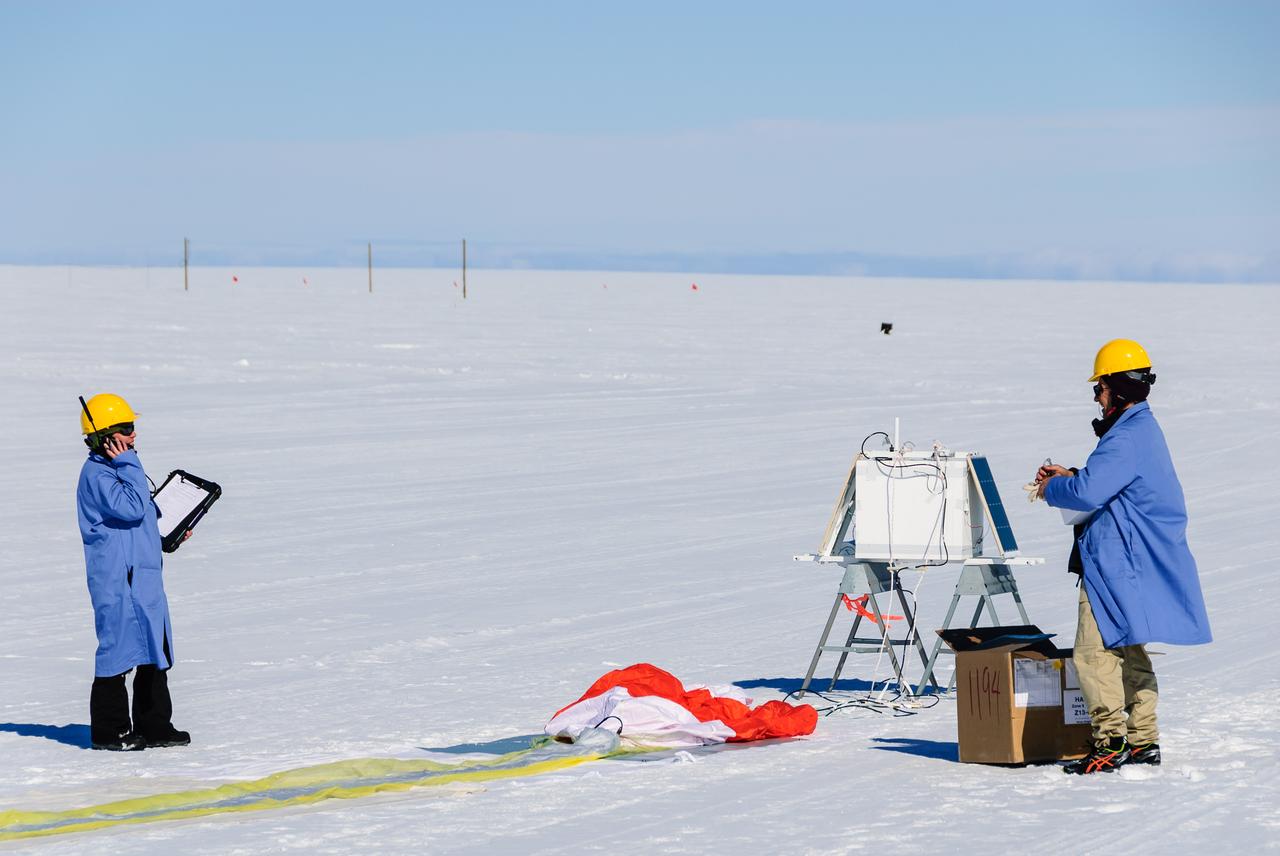
Researchers communicate with the BARREL ground station during preparations for launch. The white box in the background is the science payload and the orange and white parachute can be seen on the ground in front of it. On the left is BARREL Principal Investigator Robyn Millan of Dartmouth College in Hanover, N.H.; on the right is BARREL Co-Investigator Michael McCarthy of the University of Washington in Seattle. Credit: NASA/Goddard/BARREL/M. Krzysztofowicz Read more: <a href="http://www.nasa.gov/content/goddard/nasas-barrel-returns-successful-from-antarctica" rel="nofollow">www.nasa.gov/content/goddard/nasas-barrel-returns-success...</a> -- Three months, 20 balloons, and one very successful campaign. The team for NASA's BARREL – short for Balloon Array for Radiation belt Relativistic Electron Losses -- mission returned from Antarctica in March 2014. BARREL's job is to help unravel the mysterious Van Allen belts, two gigantic donuts of radiation that surround Earth, which can shrink and swell in response to incoming energy and particles from the sun and sometimes expose satellites to harsh radiation. While in Antarctica, the team launched 20 balloons carrying instruments that sense charged particles that are scattered into the atmosphere from the belts, spiraling down the magnetic fields near the South Pole. Each balloon traveled around the pole for up to three weeks. The team will coordinate the BARREL data with observations from NASA's two Van Allen Probes to better understand how occurrences in the belts relate to bursts of particles funneling down toward Earth. BARREL team members will be on hand at the USA Science and Engineering Festival in DC on April 26 and 27, 2014 for the exhibit Space Balloons: Exploring the Extremes of Space Weather. <b><a href="http://www.nasa.gov/audience/formedia/features/MP_Photo_Guidelines.html" rel="nofollow">NASA image use policy.</a></b> <b><a href="http://www.nasa.gov/centers/goddard/home/index.html" rel="nofollow">NASA Goddard Space Flight Center</a></b> enables NASA’s mission through four scientific endeavors: Earth Science, Heliophysics, Solar System Exploration, and Astrophysics. Goddard plays a leading role in NASA’s accomplishments by contributing compelling scientific knowledge to advance the Agency’s mission. <b>Follow us on <a href="http://twitter.com/NASAGoddardPix" rel="nofollow">Twitter</a></b> <b>Like us on <a href="http://www.facebook.com/pages/Greenbelt-MD/NASA-Goddard/395013845897?ref=tsd" rel="nofollow">Facebook</a></b> <b>Find us on <a href="http://instagram.com/nasagoddard?vm=grid" rel="nofollow">Instagram</a></b>
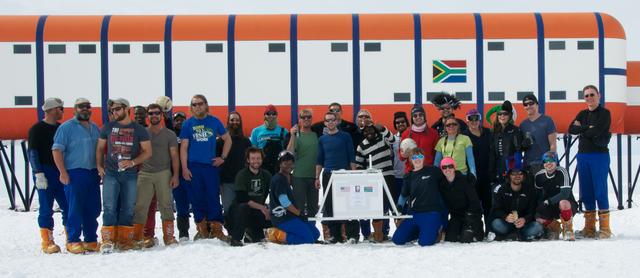
A group picture of all the researchers – from various science projects -- at the South African research station, SANAE IV, Antarctica, in the (Southern) summer 2013-2014. Credit: NASA/Goddard/BARREL/Brett Anderson Read more: <a href="http://www.nasa.gov/content/nasas-barrel-returns-successful-from-antarctica/" rel="nofollow">www.nasa.gov/content/nasas-barrel-returns-successful-from...</a> -- Three months, 20 balloons, and one very successful campaign. The team for NASA's BARREL – short for Balloon Array for Radiation belt Relativistic Electron Losses -- mission returned from Antarctica in March 2014. BARREL's job is to help unravel the mysterious Van Allen belts, two gigantic donuts of radiation that surround Earth, which can shrink and swell in response to incoming energy and particles from the sun and sometimes expose satellites to harsh radiation. While in Antarctica, the team launched 20 balloons carrying instruments that sense charged particles that are scattered into the atmosphere from the belts, spiraling down the magnetic fields near the South Pole. Each balloon traveled around the pole for up to three weeks. The team will coordinate the BARREL data with observations from NASA's two Van Allen Probes to better understand how occurrences in the belts relate to bursts of particles funneling down toward Earth. BARREL team members will be on hand at the USA Science and Engineering Festival in DC on April 26 and 27, 2014 for the exhibit Space Balloons: Exploring the Extremes of Space Weather. <b><a href="http://www.nasa.gov/audience/formedia/features/MP_Photo_Guidelines.html" rel="nofollow">NASA image use policy.</a></b> <b><a href="http://www.nasa.gov/centers/goddard/home/index.html" rel="nofollow">NASA Goddard Space Flight Center</a></b> enables NASA’s mission through four scientific endeavors: Earth Science, Heliophysics, Solar System Exploration, and Astrophysics. Goddard plays a leading role in NASA’s accomplishments by contributing compelling scientific knowledge to advance the Agency’s mission. <b>Follow us on <a href="http://twitter.com/NASAGoddardPix" rel="nofollow">Twitter</a></b> <b>Like us on <a href="http://www.facebook.com/pages/Greenbelt-MD/NASA-Goddard/395013845897?ref=tsd" rel="nofollow">Facebook</a></b> <b>Find us on <a href="http://instagram.com/nasagoddard?vm=grid" rel="nofollow">Instagram</a></b>
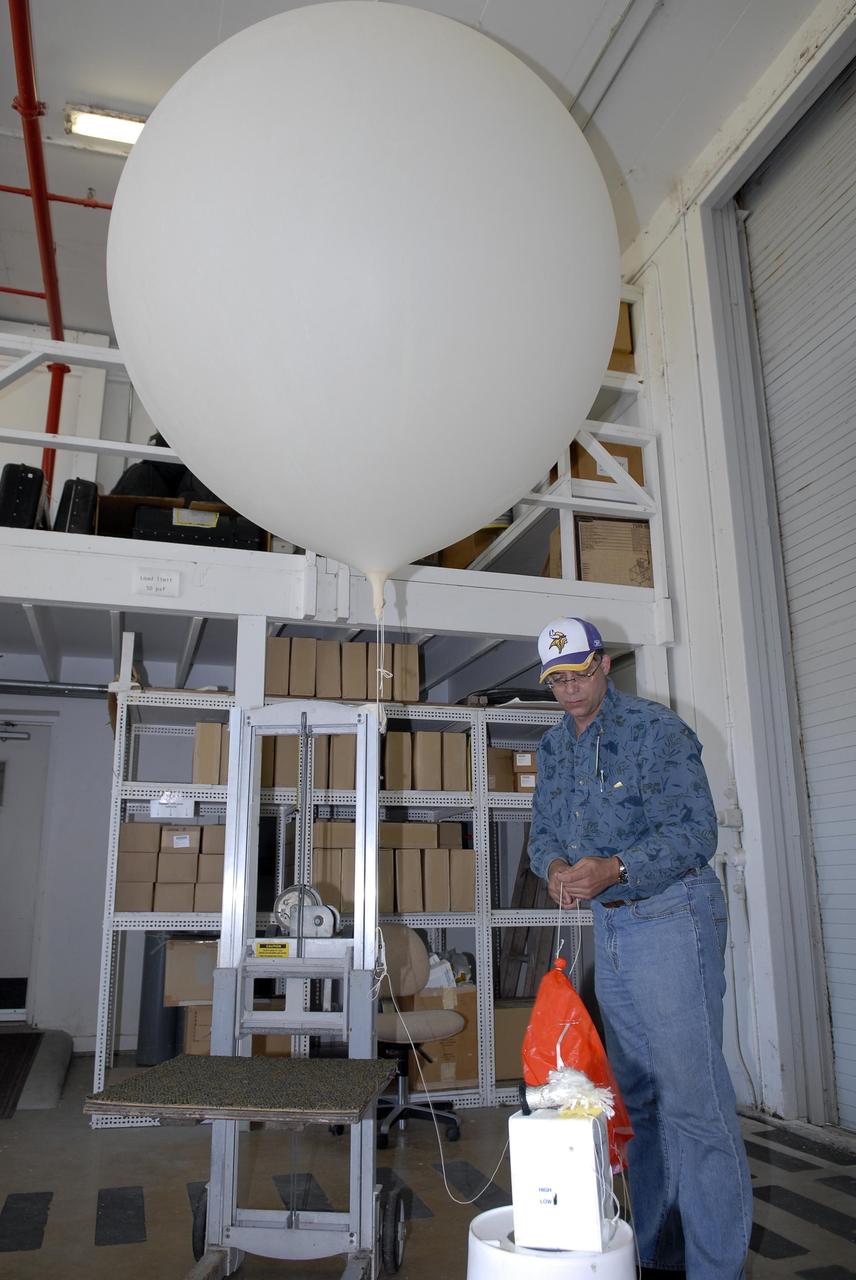
KENNEDY SPACE CENTER, FLA. -- A worker prepares a weather balloon for release at the Cape Canaveral Air Force Station weather station. The balloon is equipped with a radiosonde, an instrument that transmits measurements on atmospheric pressure, humidity, temperature and winds as it ascends. The data will be used to determine if conditions are acceptable for the launch of NASA's THEMIS mission. THEMIS, an acronym for Time History of Events and Macroscale Interactions during Substorms, consists of five identical probes that will track violent, colorful eruptions near the North Pole. This will be the largest number of scientific satellites NASA has ever launched into orbit aboard a single rocket. The THEMIS mission aims to unravel the mystery behind auroral substorms, an avalanche of magnetic energy powered by the solar wind that intensifies the northern and southern lights. The mission will investigate what causes auroras in the Earth’s atmosphere to dramatically change from slowly shimmering waves of light to wildly shifting streaks of bright color. Launch is planned from Pad 17-B in a window that extends from 6:01 to 6:19 p.m. EST. Photo credit: NASA/Kim Shiflett
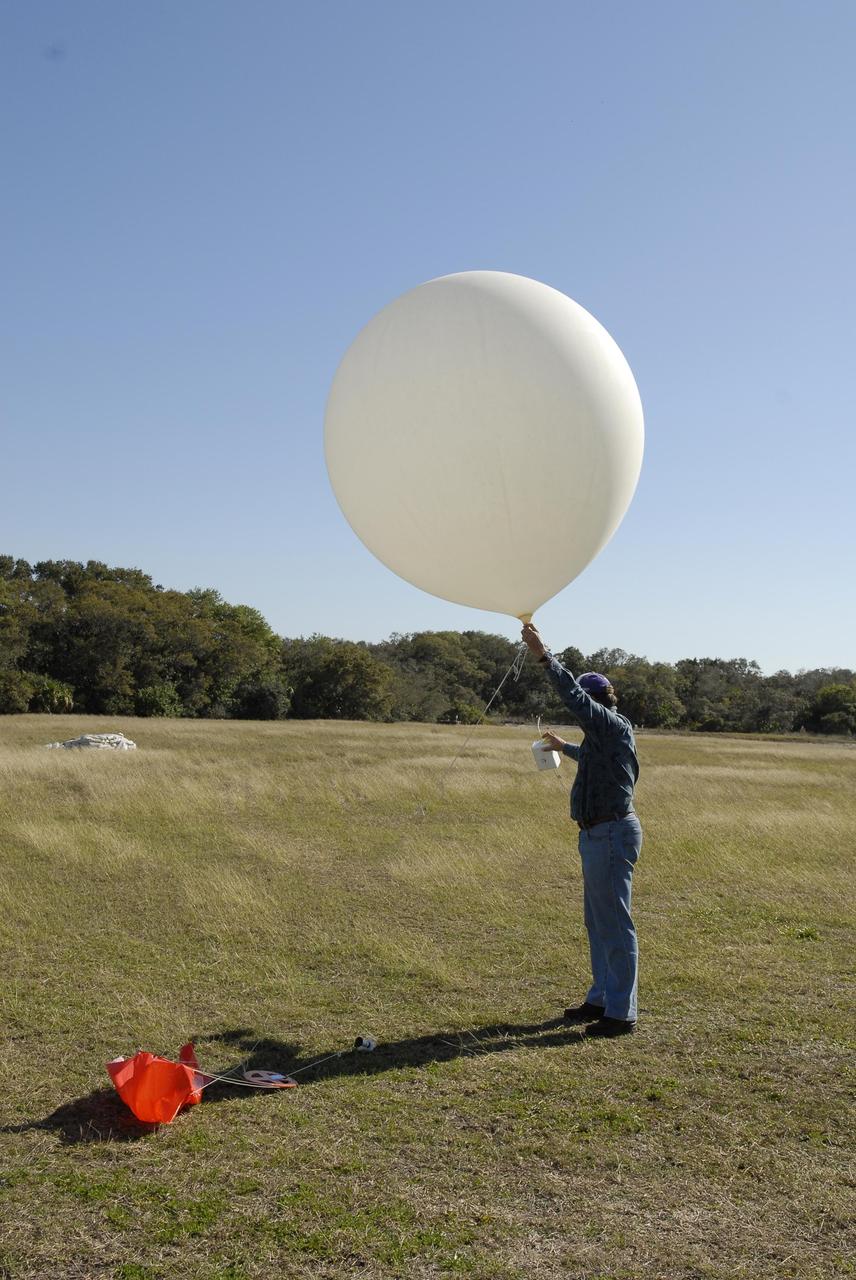
KENNEDY SPACE CENTER, FLA. -- A worker prepares to release a weather balloon outside the Cape Canaveral Air Force Station weather station. The balloon is equipped with a radiosonde, an instrument that transmits measurements on atmospheric pressure, humidity, temperature and winds as it ascends. The data will be used to determine if conditions are acceptable for the launch of NASA's THEMIS mission. THEMIS, an acronym for Time History of Events and Macroscale Interactions during Substorms, consists of five identical probes that will track violent, colorful eruptions near the North Pole. This will be the largest number of scientific satellites NASA has ever launched into orbit aboard a single rocket. The THEMIS mission aims to unravel the mystery behind auroral substorms, an avalanche of magnetic energy powered by the solar wind that intensifies the northern and southern lights. The mission will investigate what causes auroras in the Earth’s atmosphere to dramatically change from slowly shimmering waves of light to wildly shifting streaks of bright color. Launch is planned from Pad 17-B in a window that extends from 6:01 to 6:19 p.m. EST. Photo credit: NASA/Kim Shiflett
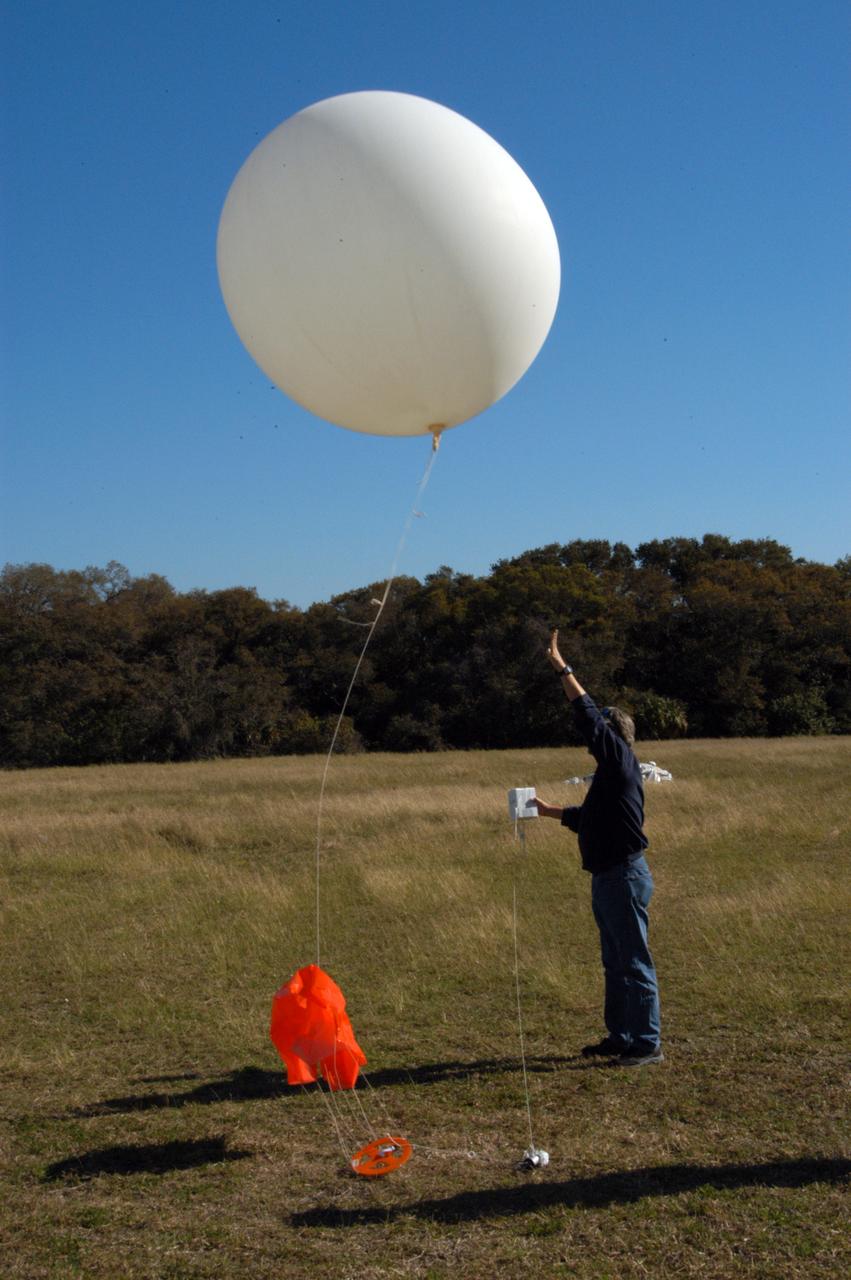
A worker releases a weather balloon at the Cape Canaveral Air Force Station weather station. The balloon is equipped with a radiosonde, an instrument that transmits measurements on atmospheric pressure, humidity, temperature and winds as it ascends. The data will be used to determine if conditions are acceptable for the launch of NASA's THEMIS mission. THEMIS, an acronym for Time History of Events and Macroscale Interactions during Substorms, consists of five identical probes that will track violent, colorful eruptions near the North Pole. This will be the largest number of scientific satellites NASA has ever launched into orbit aboard a single rocket. The THEMIS mission aims to unravel the mystery behind auroral substorms, an avalanche of magnetic energy powered by the solar wind that intensifies the northern and southern lights. The mission will investigate what causes auroras in the Earth’s atmosphere to dramatically change from slowly shimmering waves of light to wildly shifting streaks of bright color. Launch is planned from Pad 17-B in a window that extends from 6:01 to 6:19 p.m. EST.
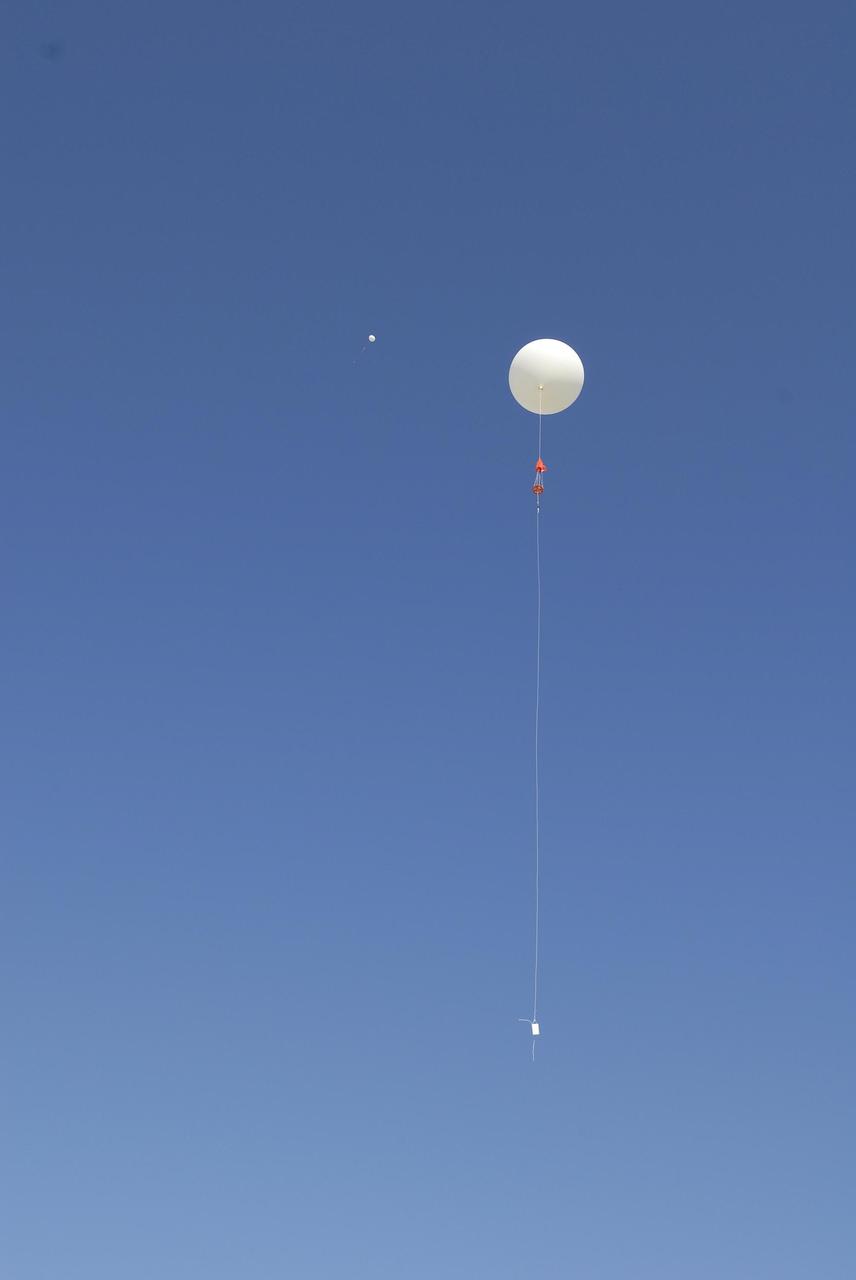
KENNEDY SPACE CENTER, FLA. -- Two weather balloons take flight from the Cape Canaveral Air Force Station weather station. Each balloon is equipped with a radiosonde, an instrument that transmits measurements on atmospheric pressure, humidity, temperature and winds as it ascends. The data will be used to determine if conditions are acceptable for the launch of NASA's THEMIS mission. THEMIS, an acronym for Time History of Events and Macroscale Interactions during Substorms, consists of five identical probes that will track violent, colorful eruptions near the North Pole. This will be the largest number of scientific satellites NASA has ever launched into orbit aboard a single rocket. The THEMIS mission aims to unravel the mystery behind auroral substorms, an avalanche of magnetic energy powered by the solar wind that intensifies the northern and southern lights. The mission will investigate what causes auroras in the Earth’s atmosphere to dramatically change from slowly shimmering waves of light to wildly shifting streaks of bright color. Launch is planned from Pad 17-B in a window that extends from 6:01 to 6:19 p.m. EST. Photo credit: NASA/Kim Shiflett
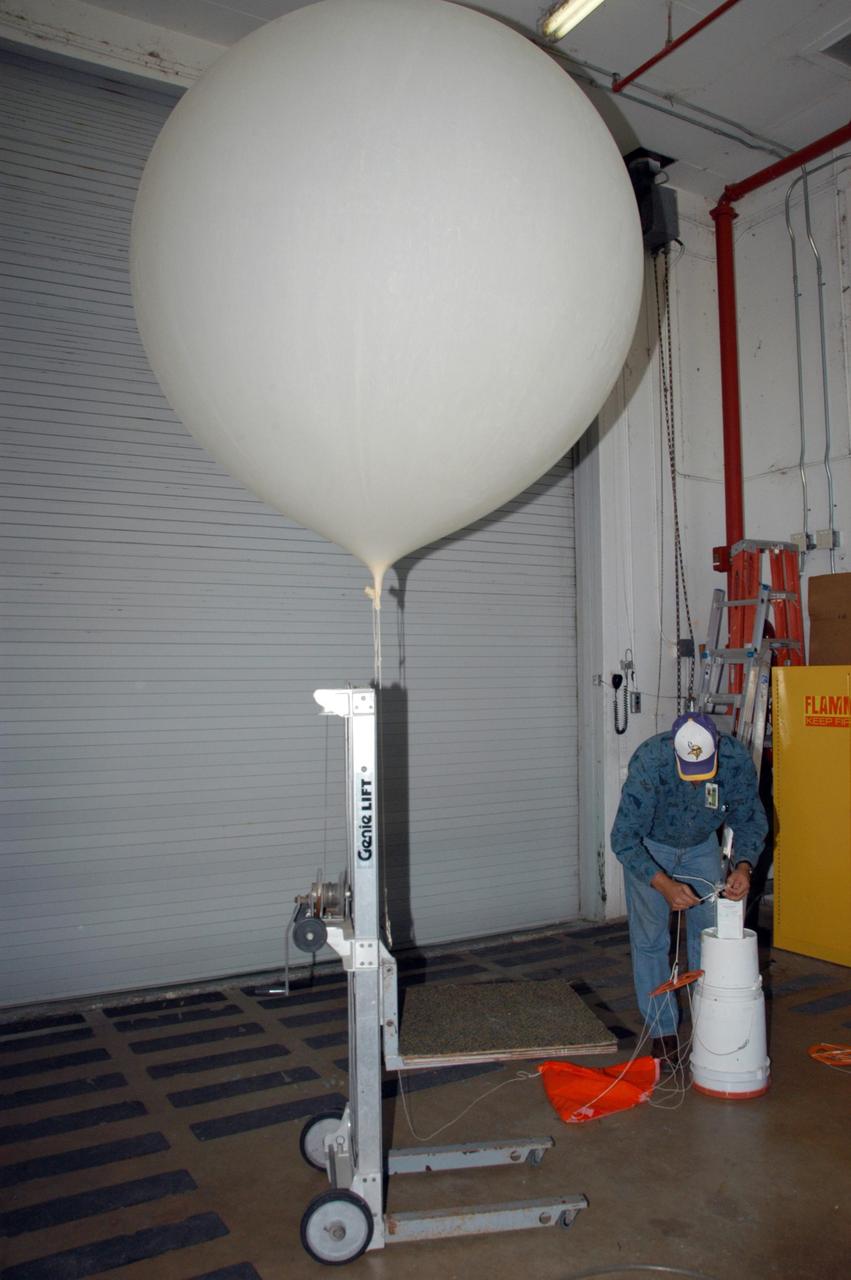
KENNEDY SPACE CENTER, FLA. -- A weather balloon is prepared for release at the Cape Canaveral Air Force Station weather station. The balloon is equipped with a radiosonde, an instrument that transmits measurements on atmospheric pressure, humidity, temperature and winds as it ascends. The data will be used to determine if conditions are acceptable for the launch of NASA's THEMIS mission. THEMIS, an acronym for Time History of Events and Macroscale Interactions during Substorms, consists of five identical probes that will track violent, colorful eruptions near the North Pole. This will be the largest number of scientific satellites NASA has ever launched into orbit aboard a single rocket. The THEMIS mission aims to unravel the mystery behind auroral substorms, an avalanche of magnetic energy powered by the solar wind that intensifies the northern and southern lights. The mission will investigate what causes auroras in the Earth’s atmosphere to dramatically change from slowly shimmering waves of light to wildly shifting streaks of bright color. Launch is planned from Pad 17-B in a window that extends from 6:01 to 6:19 p.m. EST. Photo credit: NASA/George Shelton
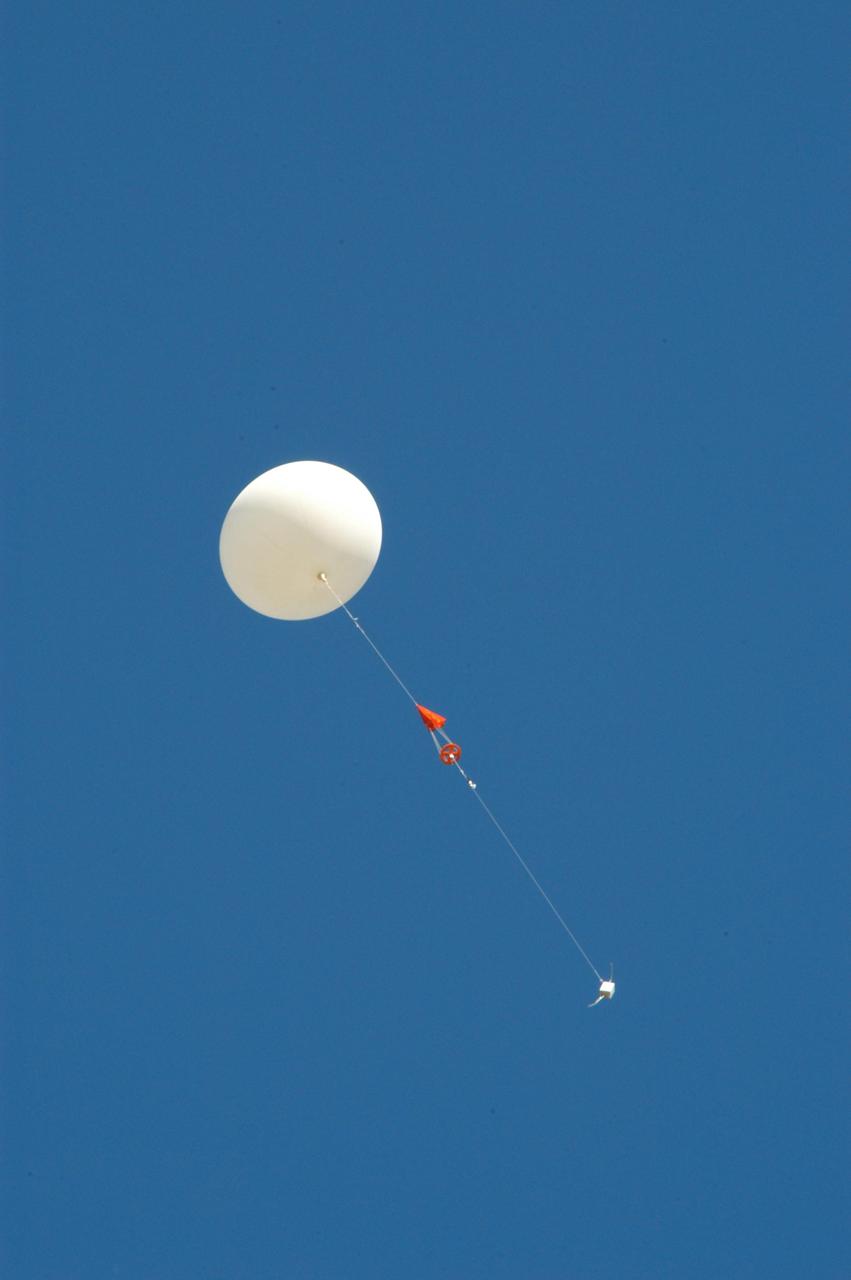
KENNEDY SPACE CENTER, FLA. -- A weather balloon takes flight from the Cape Canaveral Air Force Station weather station. The balloon is equipped with a radiosonde, an instrument that transmits measurements on atmospheric pressure, humidity, temperature and winds as it ascends. The data will be used to determine if conditions are acceptable for the launch of NASA's THEMIS mission. THEMIS, an acronym for Time History of Events and Macroscale Interactions during Substorms, consists of five identical probes that will track violent, colorful eruptions near the North Pole. This will be the largest number of scientific satellites NASA has ever launched into orbit aboard a single rocket. The THEMIS mission aims to unravel the mystery behind auroral substorms, an avalanche of magnetic energy powered by the solar wind that intensifies the northern and southern lights. The mission will investigate what causes auroras in the Earth’s atmosphere to dramatically change from slowly shimmering waves of light to wildly shifting streaks of bright color. Launch is planned from Pad 17-B in a window that extends from 6:01 to 6:19 p.m. EST. Photo credit: NASA/George Shelton
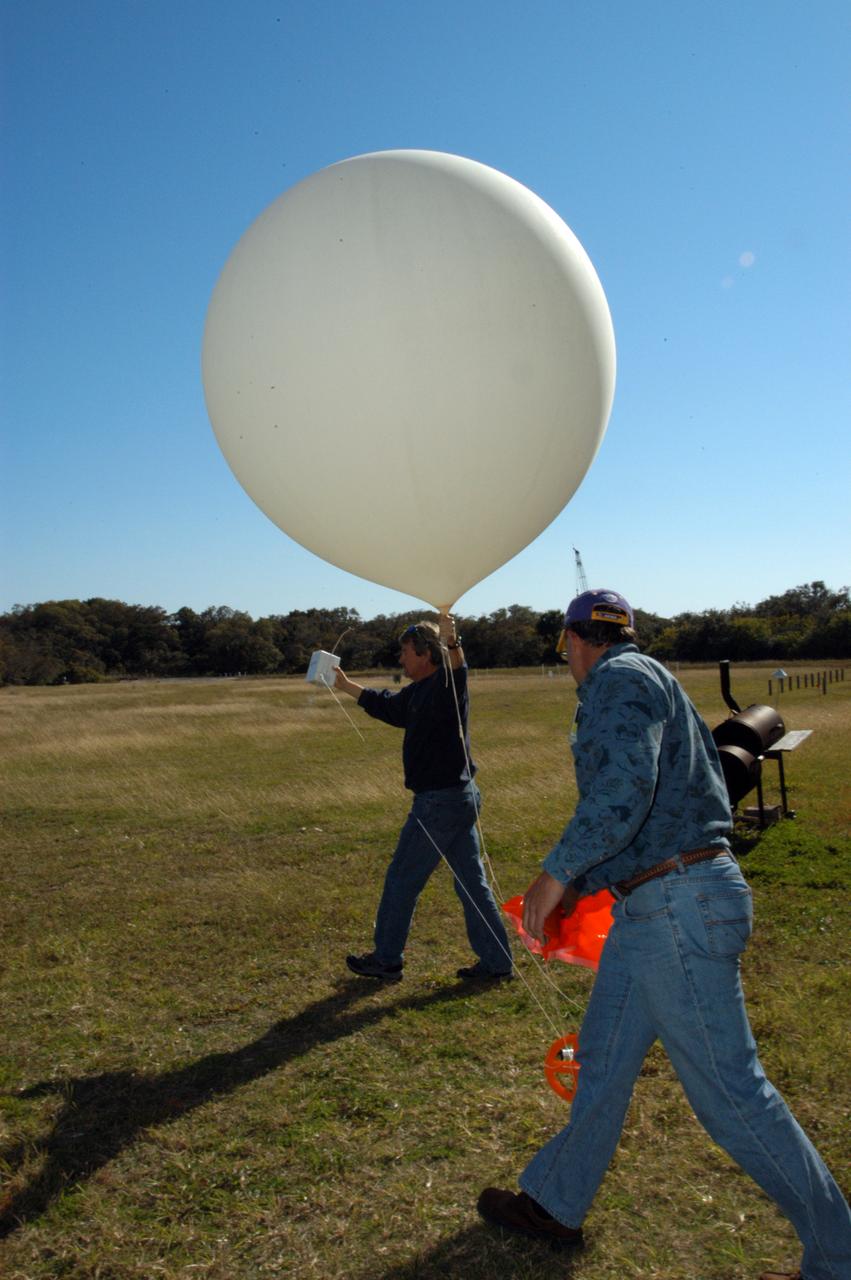
A worker releases a weather balloon at the Cape Canaveral Air Force Station weather station. The balloon is equipped with a radiosonde, an instrument that transmits measurements on atmospheric pressure, humidity, temperature and winds as it ascends. The data will be used to determine if conditions are acceptable for the launch of NASA's THEMIS mission. THEMIS, an acronym for Time History of Events and Macroscale Interactions during Substorms, consists of five identical probes that will track violent, colorful eruptions near the North Pole. This will be the largest number of scientific satellites NASA has ever launched into orbit aboard a single rocket. The THEMIS mission aims to unravel the mystery behind auroral substorms, an avalanche of magnetic energy powered by the solar wind that intensifies the northern and southern lights. The mission will investigate what causes auroras in the Earth’s atmosphere to dramatically change from slowly shimmering waves of light to wildly shifting streaks of bright color. Launch is planned from Pad 17-B in a window that extends from 6:01 to 6:19 p.m. EST.

KENNEDY SPACE CENTER, FLA. -- A worker prepares a weather balloon for release at the Cape Canaveral Air Force Station weather station. The balloon is equipped with a radiosonde, an instrument that transmits measurements on atmospheric pressure, humidity, temperature and winds as it ascends. The data will be used to determine if conditions are acceptable for the launch of NASA's THEMIS mission. THEMIS, an acronym for Time History of Events and Macroscale Interactions during Substorms, consists of five identical probes that will track violent, colorful eruptions near the North Pole. This will be the largest number of scientific satellites NASA has ever launched into orbit aboard a single rocket. The THEMIS mission aims to unravel the mystery behind auroral substorms, an avalanche of magnetic energy powered by the solar wind that intensifies the northern and southern lights. The mission will investigate what causes auroras in the Earth’s atmosphere to dramatically change from slowly shimmering waves of light to wildly shifting streaks of bright color. Launch is planned from Pad 17-B in a window that extends from 6:01 to 6:19 p.m. EST. Photo credit: NASA/Kim Shiflett

KENNEDY SPACE CENTER, FLA. -- A worker releases a weather balloon at the Cape Canaveral Air Force Station weather station. The balloon is equipped with a radiosonde, an instrument that transmits measurements on atmospheric pressure, humidity, temperature and winds as it ascends. The data will be used to determine if conditions are acceptable for the launch of NASA's THEMIS mission. THEMIS, an acronym for Time History of Events and Macroscale Interactions during Substorms, consists of five identical probes that will track violent, colorful eruptions near the North Pole. This will be the largest number of scientific satellites NASA has ever launched into orbit aboard a single rocket. The THEMIS mission aims to unravel the mystery behind auroral substorms, an avalanche of magnetic energy powered by the solar wind that intensifies the northern and southern lights. The mission will investigate what causes auroras in the Earth’s atmosphere to dramatically change from slowly shimmering waves of light to wildly shifting streaks of bright color. Launch is planned from Pad 17-B in a window that extends from 6:01 to 6:19 p.m. EST. Photo credit: NASA/George Shelton
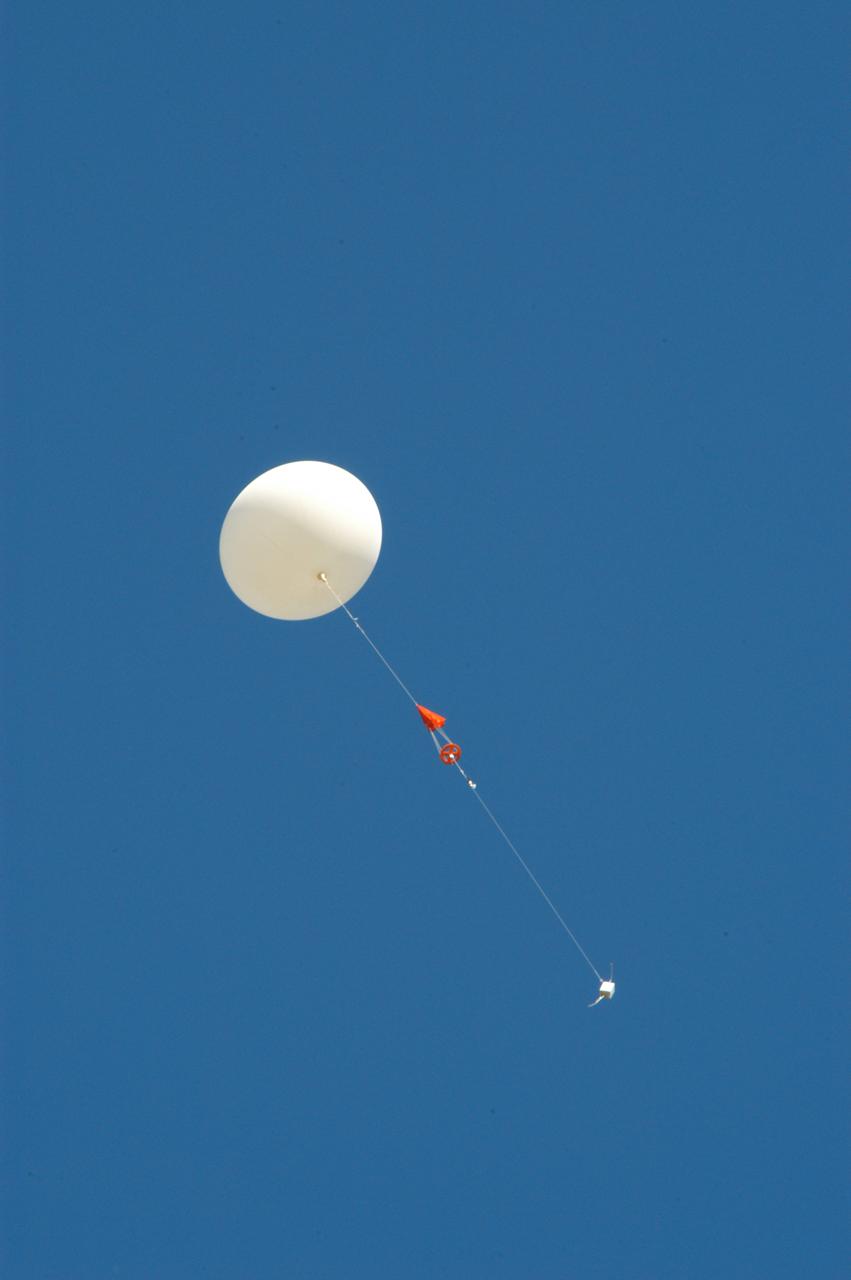
A weather balloon takes flight from the Cape Canaveral Air Force Station weather station. The balloon is equipped with a radiosonde, an instrument that transmits measurements on atmospheric pressure, humidity, temperature and winds as it ascends. The data will be used to determine if conditions are acceptable for the launch of NASA's THEMIS mission. THEMIS, an acronym for Time History of Events and Macroscale Interactions during Substorms, consists of five identical probes that will track violent, colorful eruptions near the North Pole. This will be the largest number of scientific satellites NASA has ever launched into orbit aboard a single rocket. The THEMIS mission aims to unravel the mystery behind auroral substorms, an avalanche of magnetic energy powered by the solar wind that intensifies the northern and southern lights. The mission will investigate what causes auroras in the Earth’s atmosphere to dramatically change from slowly shimmering waves of light to wildly shifting streaks of bright color. Launch is planned from Pad 17-B in a window that extends from 6:01 to 6:19 p.m. EST.
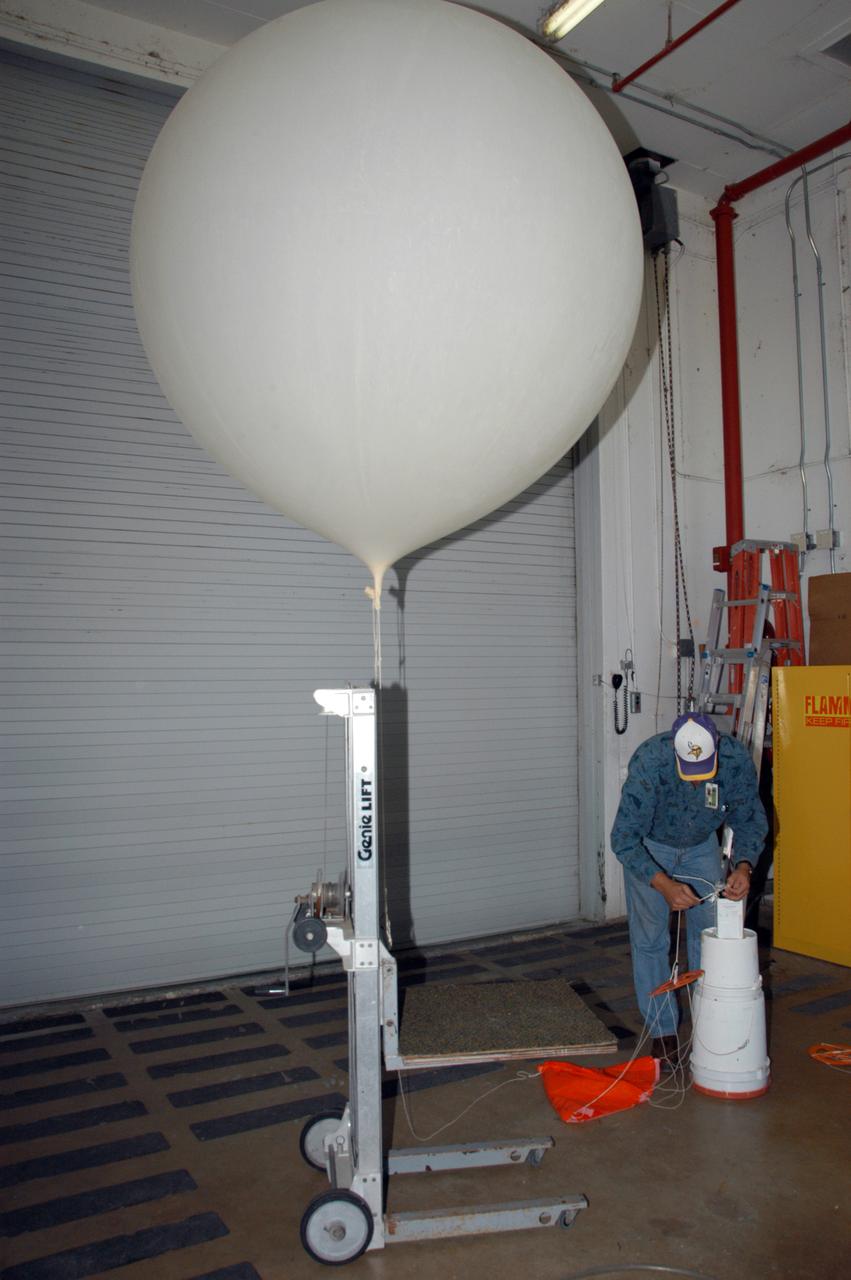
A weather balloon is prepared for release at the Cape Canaveral Air Force Station weather station. The balloon is equipped with a radiosonde, an instrument that transmits measurements on atmospheric pressure, humidity, temperature and winds as it ascends. The data will be used to determine if conditions are acceptable for the launch of NASA's THEMIS mission. THEMIS, an acronym for Time History of Events and Macroscale Interactions during Substorms, consists of five identical probes that will track violent, colorful eruptions near the North Pole. This will be the largest number of scientific satellites NASA has ever launched into orbit aboard a single rocket. The THEMIS mission aims to unravel the mystery behind auroral substorms, an avalanche of magnetic energy powered by the solar wind that intensifies the northern and southern lights. The mission will investigate what causes auroras in the Earth’s atmosphere to dramatically change from slowly shimmering waves of light to wildly shifting streaks of bright color. Launch is planned from Pad 17-B in a window that extends from 6:01 to 6:19 p.m. EST.
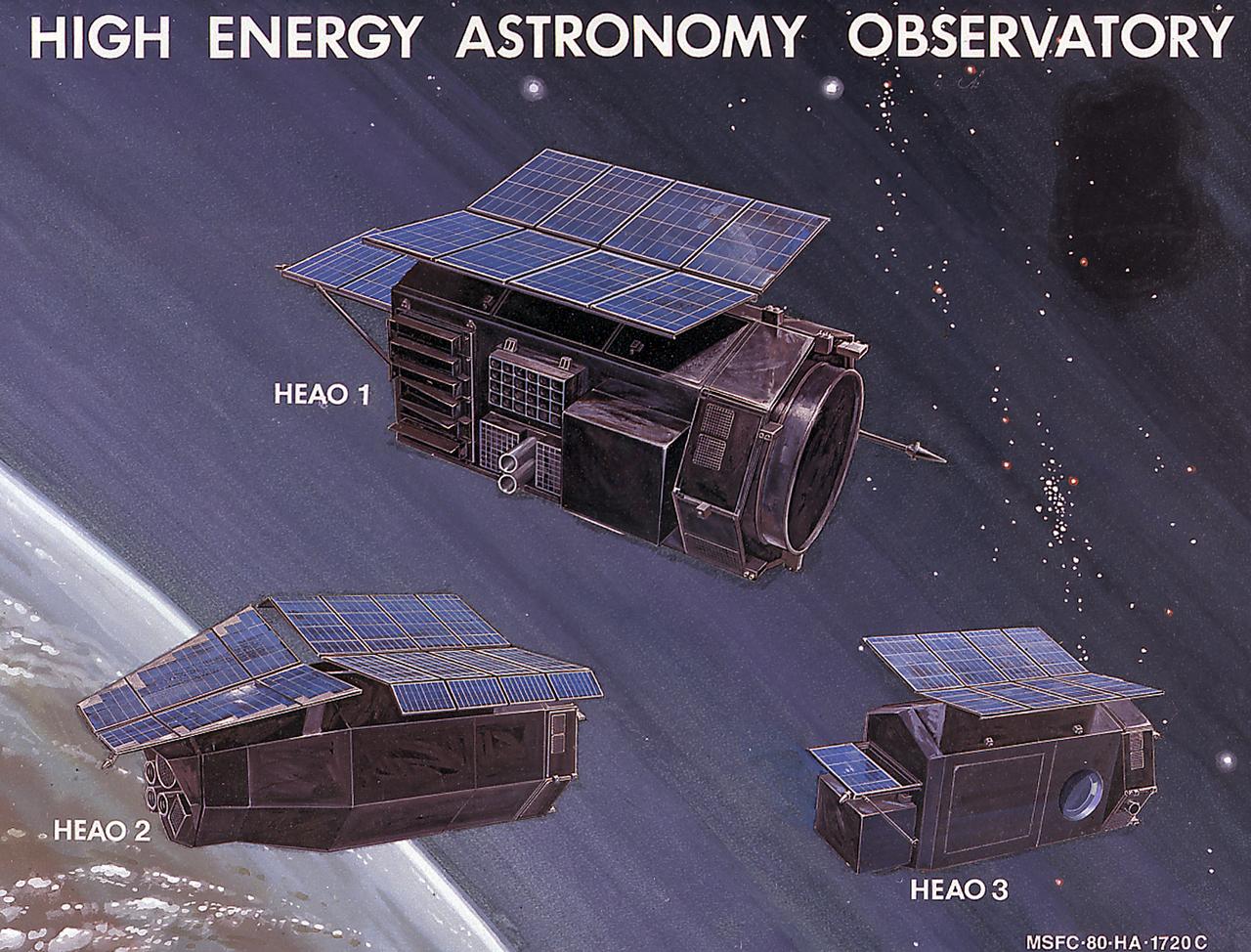
The family of High Energy Astronomy Observatory (HEAO) instruments consisted of three unmarned scientific observatories capable of detecting the x-rays emitted by the celestial bodies with high sensitivity and high resolution. The celestial gamma-ray and cosmic-ray fluxes were also collected and studied to learn more about the mysteries of the universe. High-Energy rays cannot be studied by Earth-based observatories because of the obscuring effects of the atmosphere that prevent the rays from reaching the Earth's surface. They had been observed initially by sounding rockets and balloons, and by small satellites that do not possess the needed instrumentation capabilities required for high data resolution and sensitivity. The HEAO carried the instrumentation necessary for this capability. In this photograph, an artist's concept of three HEAO spacecraft is shown: HEAO-1, launched on August 12, 1977; HEAO-2, launched on November 13, 1978; and HEAO-3, launched on September 20. 1979.
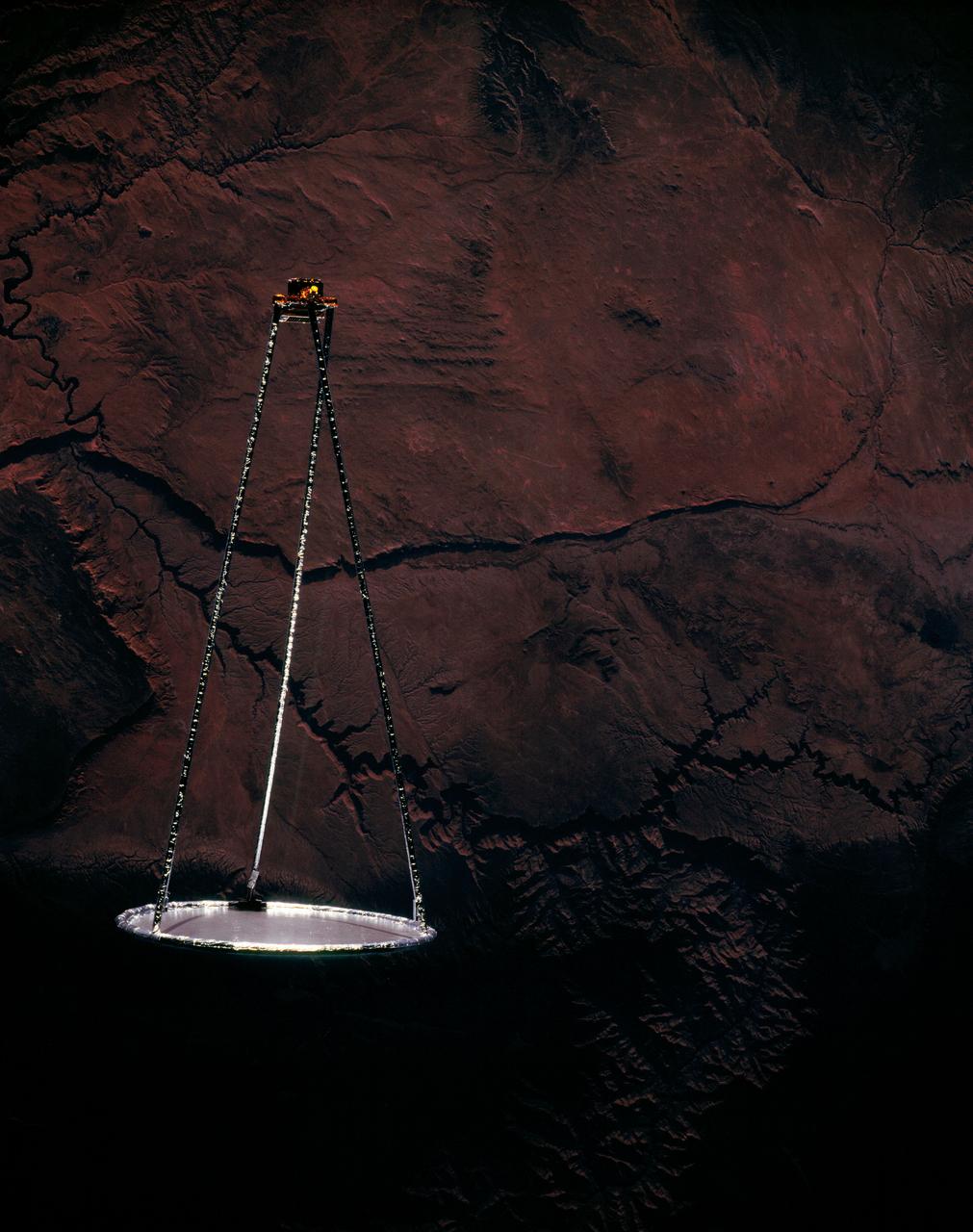
STS077-150-044 (20 May 1996) --- Following its deployment from the Space Shuttle Endeavour, the Spartan 207/Inflatable Antenna Experiment (IAE) payload is backdropped over the Grand Canyon. After the IAE completed its inflation process in free-flight, this view was photographed with a large format still camera. The activity came on the first full day of in-space operations by the six-member crew. Managed by Goddard Space Flight Center (GSFC), Spartan is designed to provide short-duration, free-flight opportunities for a variety of scientific studies. The Spartan configuration on this flight is unique in that the IAE is part of an additional separate unit which is ejected once the experiment is completed. The IAE experiment will lay the groundwork for future technology development in inflatable space structures, which will be launched and then inflated like a balloon on-orbit.
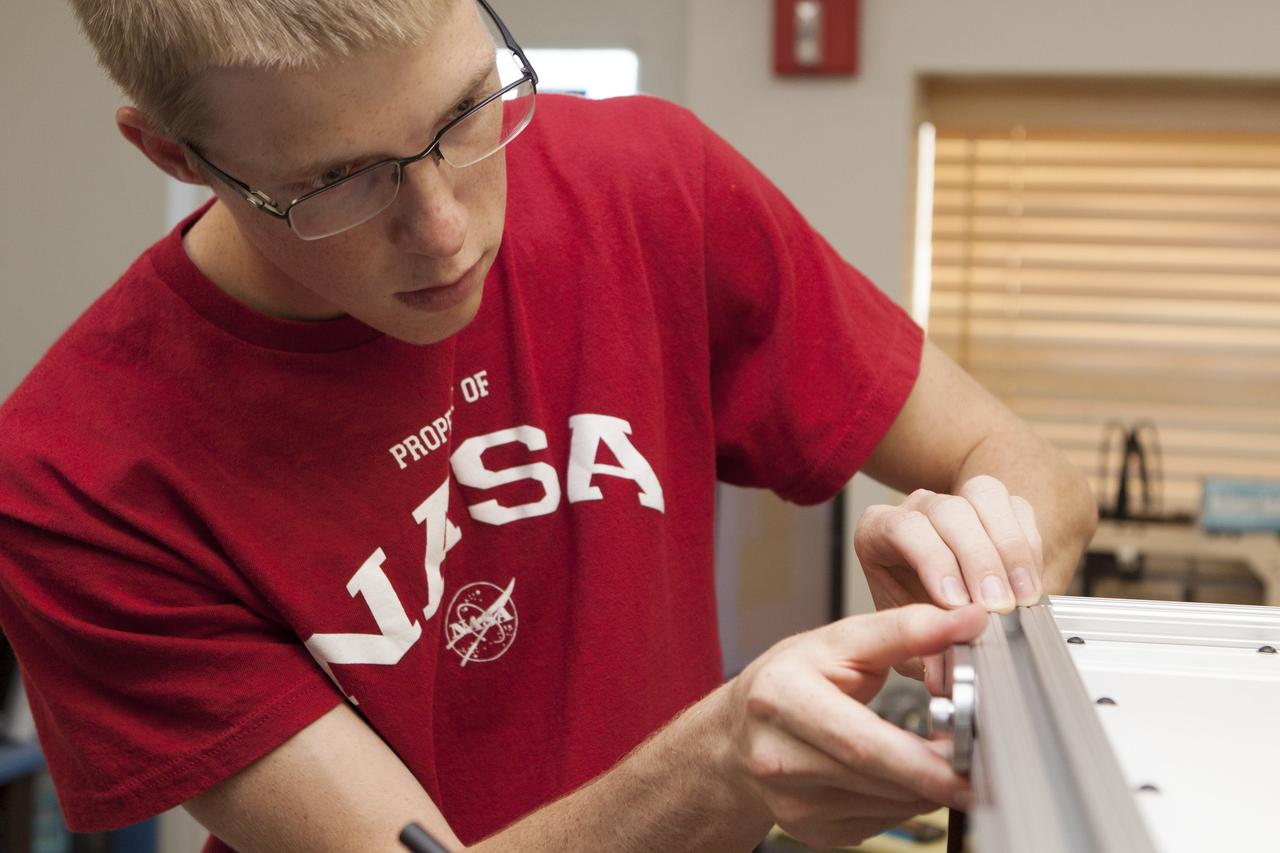
CAPE CANAVERAL, Fla. – Inside the Prototype Laboratory at NASA's Kennedy Space Center in Florida, Evan Williams, an Education intern from the University of Central Florida, prepares the experiment container for NASA's Exposing Microorganisms in the Stratosphere, or E-MIST, experiment. The container was designed and built at Kennedy. The 80-pound structure features four doors that rotate to expose up to 10 microbial samples each for a predetermined period of time in the Earth's stratosphere. The E-MIST experiment will launch on the exterior of a giant scientific balloon gondola at about 8 a.m. MST on Aug. 24 from Ft. Sumner, New Mexico. It will soar 125,000 feet above the Earth during a 5-hour journey over the desert to understand how spore-forming bacteria, commonly found in spacecraft assembly facilities can survive. Photo credit: NASA/Kim Shiflett
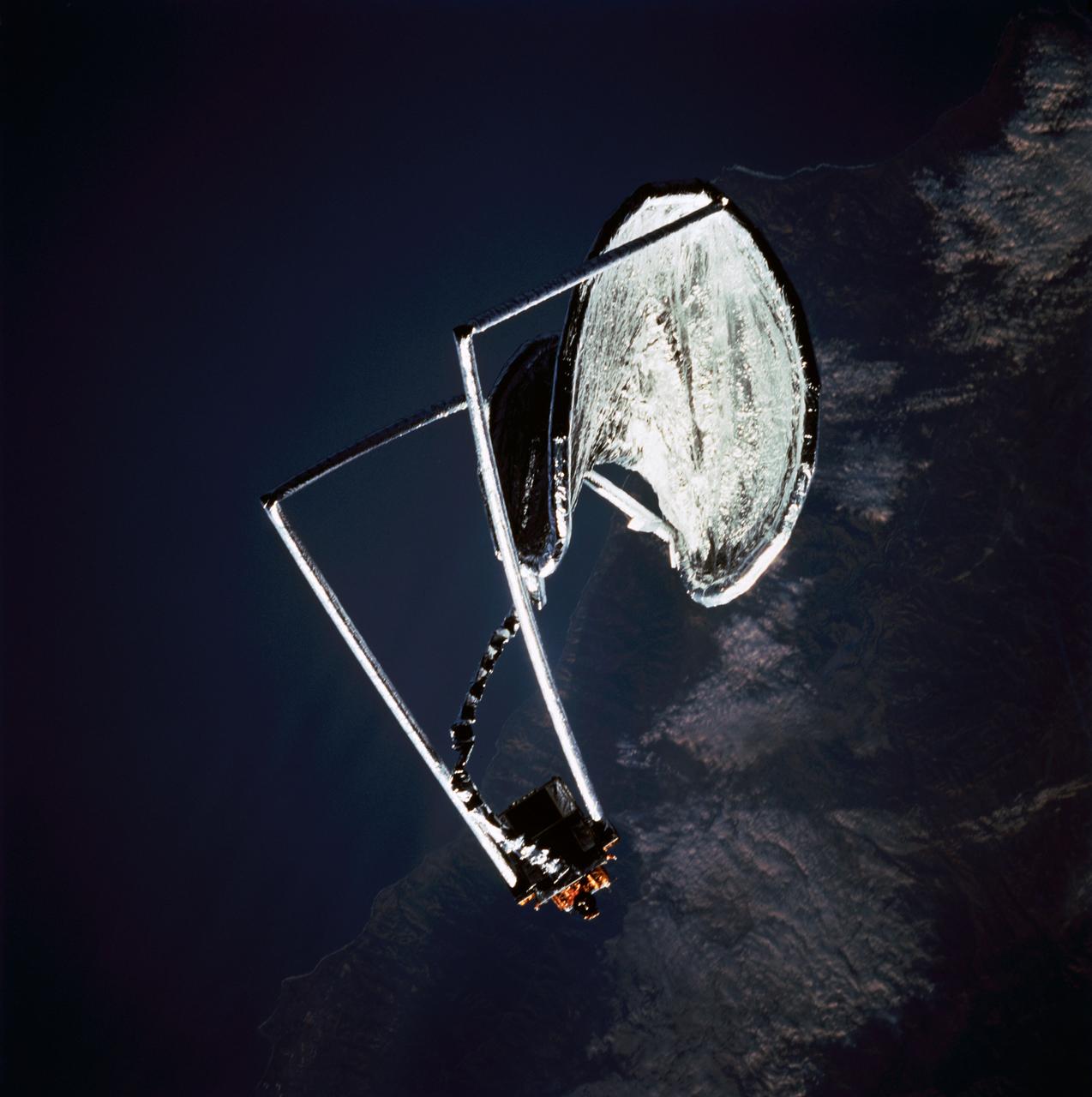
STS077-705-016 (20 May 1996) --- Following its deployment from the Space Shuttle Endeavour, the Inflatable Antenna Experiment (IAE) part of the Spartan 207 payload nears completion of its inflation process over California?s Pacific Coast near Santa Barbara and Point Conception. The view was photographed with a handheld 70mm camera during the first full day of orbital operations by the six-member crew. Managed by Goddard Space Flight Center (GSFC), Spartan is designed to provide short-duration, free-flight opportunities for a variety of scientific studies. The Spartan configuration on this flight is unique in that the IAE is part of an additional separate unit which is ejected once the experiment is completed. The IAE experiment will lay the groundwork for future technology development in inflatable space structures, which will be launched and then inflated like a balloon on-orbit.
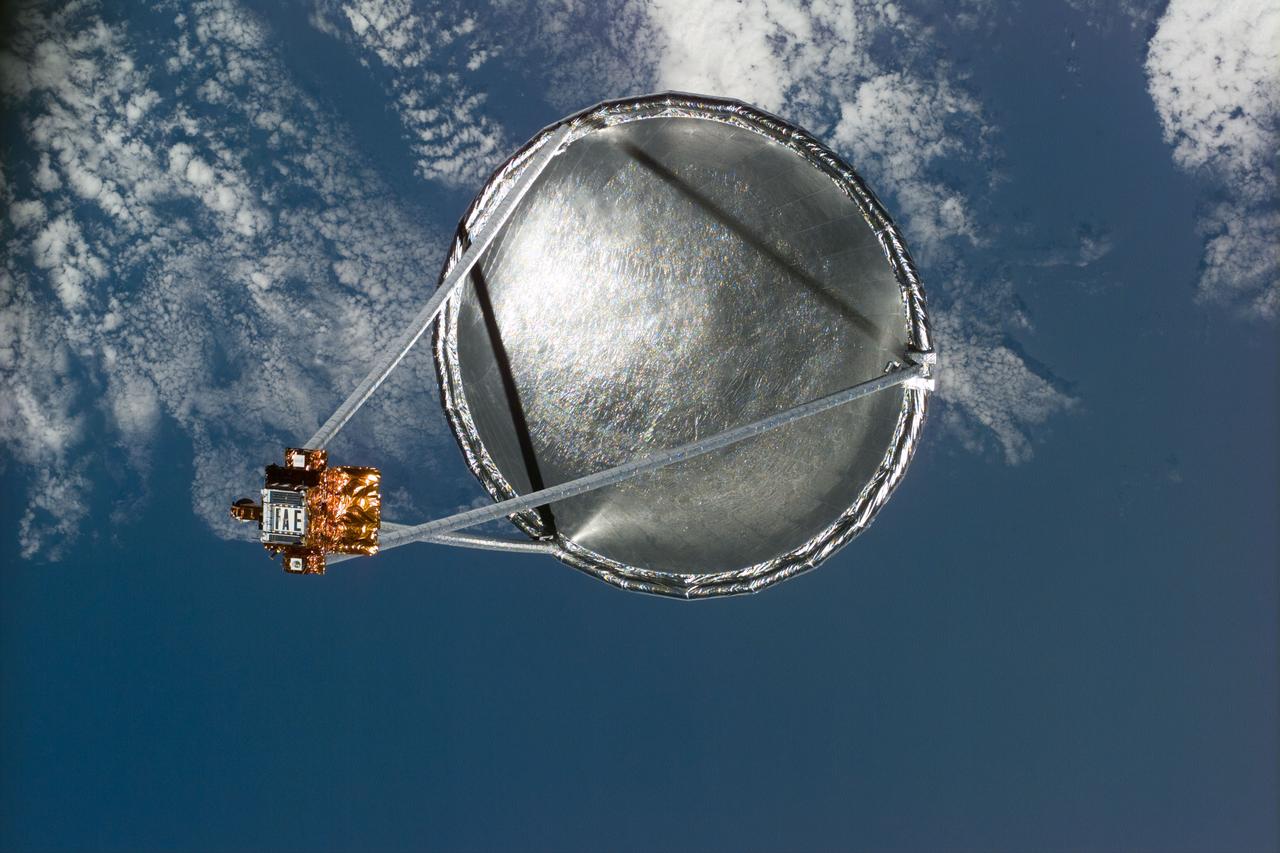
S77-E-5022 (20 May 1996)--- Following its deployment from the Space Shuttle Endeavour, the Spartan 207/Inflatable Antenna Experiment (IAE) payload is backdropped over clouds and water. The view was photographed with an Electronic Still Camera (ESC) and downlinked to flight controllers on the first full day of orbital operations by the six-member crew. Managed by Goddard Space Flight Center (GSFC), Spartan is designed to provide short-duration, free-flight opportunities for a variety of scientific studies. The Spartan configuration on this flight is unique in that the IAE is part of an additional separate unit which is ejected once the experiment is completed. The IAE experiment will lay the groundwork for future technology development in inflatable space structures, which will be launched and then inflated like a balloon on-orbit.
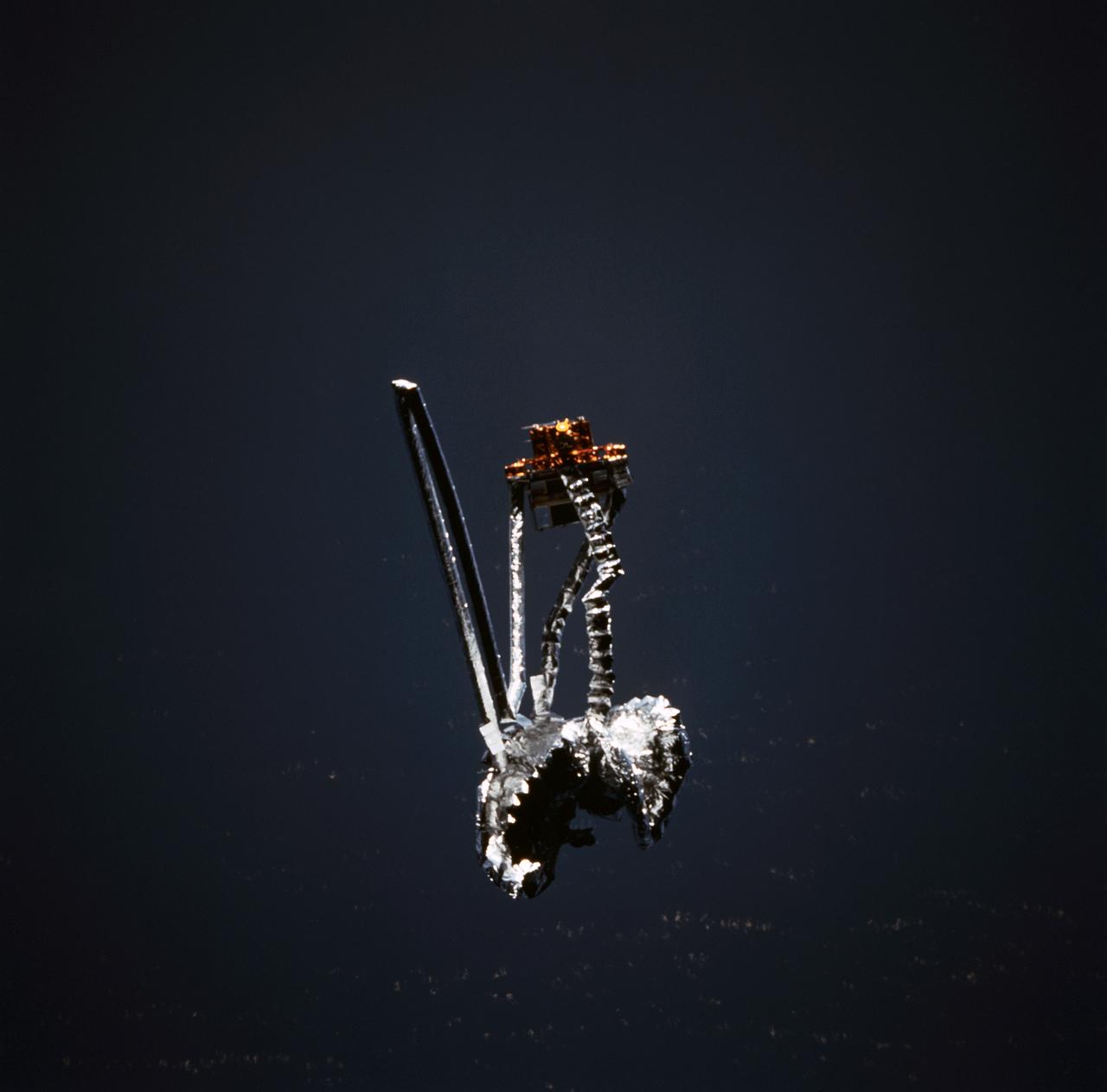
STS077-705-012 (20 May 1996) --- Following its deployment from the Space Shuttle Endeavour, the Inflatable Antenna Experiment (IAE) portion of the Spartan 207 payload is backdropped over Earth as it continues its inflation process. The view was photographed with a handheld 70mm camera during the first full day of orbital operations by the six-member crew. Managed by Goddard Space Flight Center (GSFC), Spartan is designed to provide short-duration, free-flight opportunities for a variety of scientific studies. The Spartan configuration on this flight is unique in that the IAE is part of an additional separate unit which is ejected once the experiment is completed. The IAE experiment will lay the groundwork for future technology development in inflatable space structures, which will be launched and then inflated like a balloon on-orbit.
STS077-150-010 (20 May 1996) --- Soon after leaving the cargo bay of the Space Shuttle Endeavour, the Spartan 207/Inflatable Antenna Experiment (IAE) payload goes through its inflation process, backdropped over clouds. The view was photographed with a large format still camera on the first full day of in-space operations by the six-member crew. Managed by Goddard Space Flight Center (GSFC), Spartan is designed to provide short-duration, free-flight opportunities for a variety of scientific studies. The Spartan configuration on this flight is unique in that the IAE is part of an additional separate unit which is ejected once the experiment is completed. The IAE experiment will lay the groundwork for future technology development in inflatable space structures, which will be launched and then inflated like a balloon on-orbit.
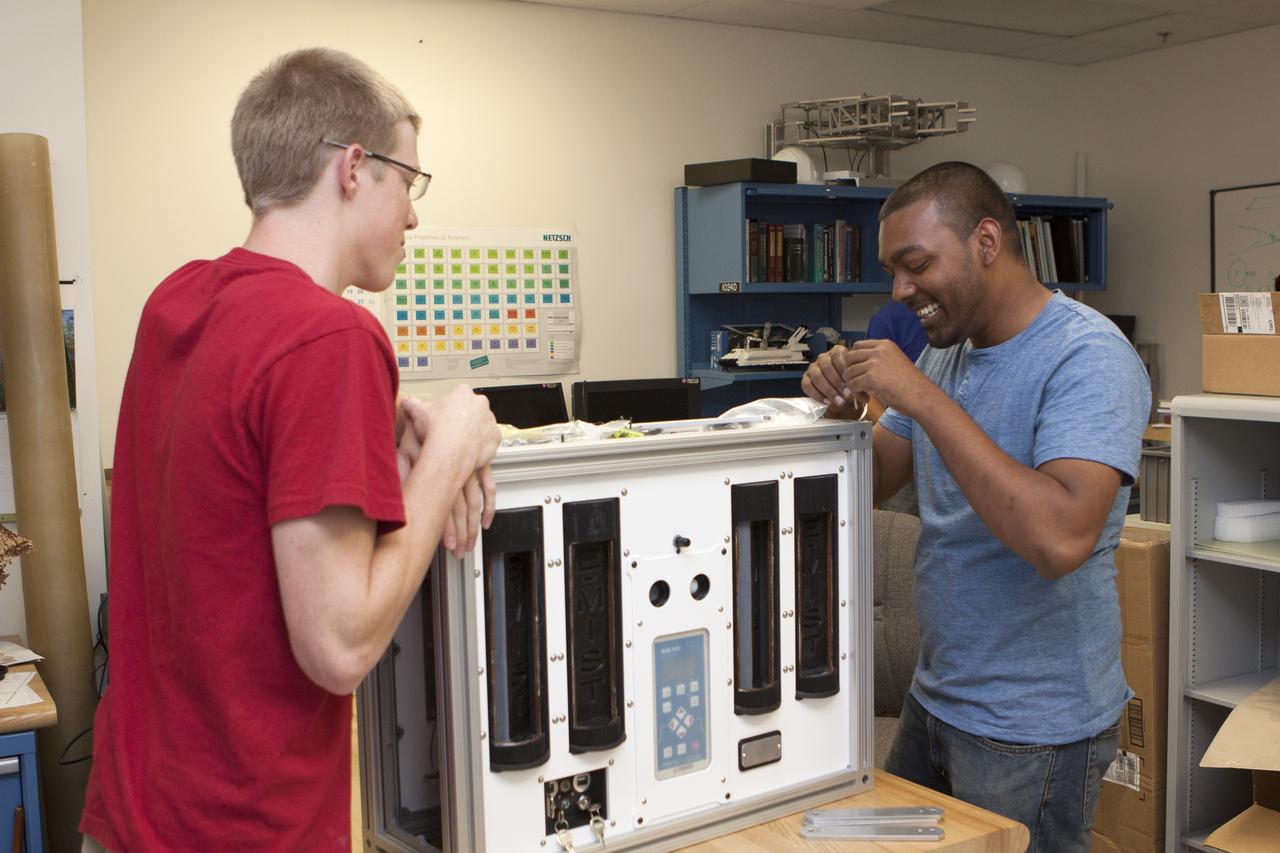
CAPE CANAVERAL, Fla. – Inside the Prototype Laboratory at NASA's Kennedy Space Center in Florida, Evan Williams, left, an Education intern from the University of Central Florida, and Anthony Bharrat, NASA avionics lead, prepare the experiment container for NASA's Exposing Microorganisms in the Stratosphere, or E-MIST, experiment. The container was designed and built at Kennedy. The 80-pound structure features four doors that rotate to expose up to 10 microbial samples each for a predetermined period of time in the Earth's stratosphere. The E-MIST experiment will launch on the exterior of a giant scientific balloon gondola at about 8 a.m. MST on Aug. 24 from Ft. Sumner, New Mexico. It will soar 125,000 feet above the Earth during a 5-hour journey over the desert to understand how spore-forming bacteria, commonly found in spacecraft assembly facilities can survive. Photo credit: NASA/Kim Shiflett
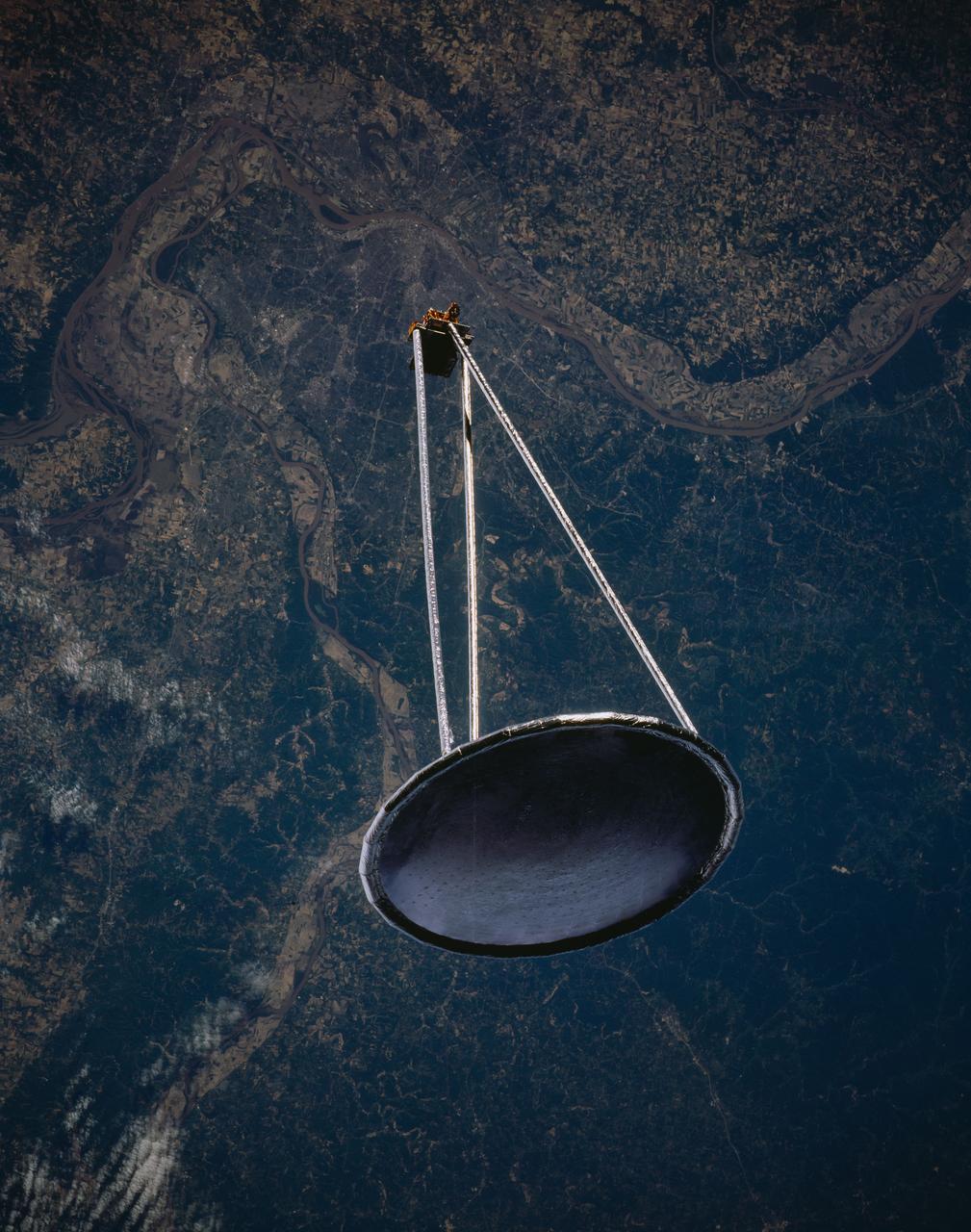
STS077-150-094 (20 May 1996) --- Following its deployment from the Space Shuttle Endeavour, the Spartan 207/Inflatable Antenna Experiment (IAE) payload is backdropped over the Mississippi River and metropolitan St. Louis. The metropolitan area lies just below the gold-colored Spartan at bottom of photo. The view was photographed with a large format still camera on the first full day of in-space operations by the six-member crew. Managed by Goddard Space Flight Center (GSFC), Spartan is designed to provide short-duration, free-flight opportunities for a variety of scientific studies. The Spartan configuration on this flight is unique in that the IAE is part of an additional separate unit which is ejected once the experiment is completed. The IAE experiment will lay the groundwork for future technology development in inflatable space structures, which will be launched and then inflated like a balloon on-orbit.
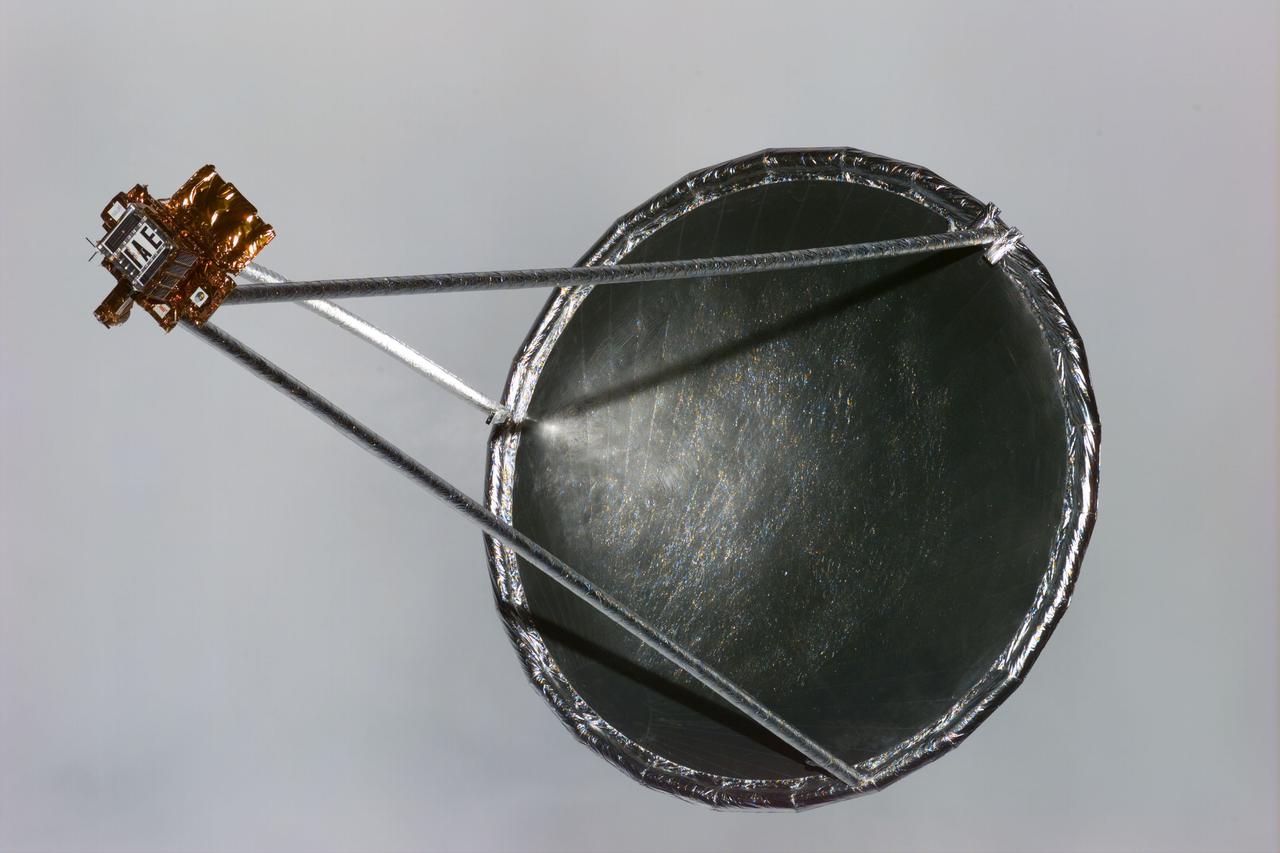
S77-E-5033 (20 May 1996) --- Following its deployment from the Space Shuttle Endeavour, the Spartan 207/Inflatable Antenna Experiment (IAE) payload is backdropped against a wall of grayish clouds. The view was photographed with an Electronic Still Camera (ESC) and downlinked to flight controllers on the first full day of orbital operations by the six-member crew. Managed by Goddard Space Flight Center (GSFC), Spartan is designed to provide short-duration, free-flight opportunities for a variety of scientific studies. The Spartan configuration on this flight is unique in that the IAE is part of an additional separate unit which is ejected once the experiment is completed. The IAE experiment will lay the groundwork for future technology development in inflatable space structures, which will be launched and then inflated like a balloon on-orbit.
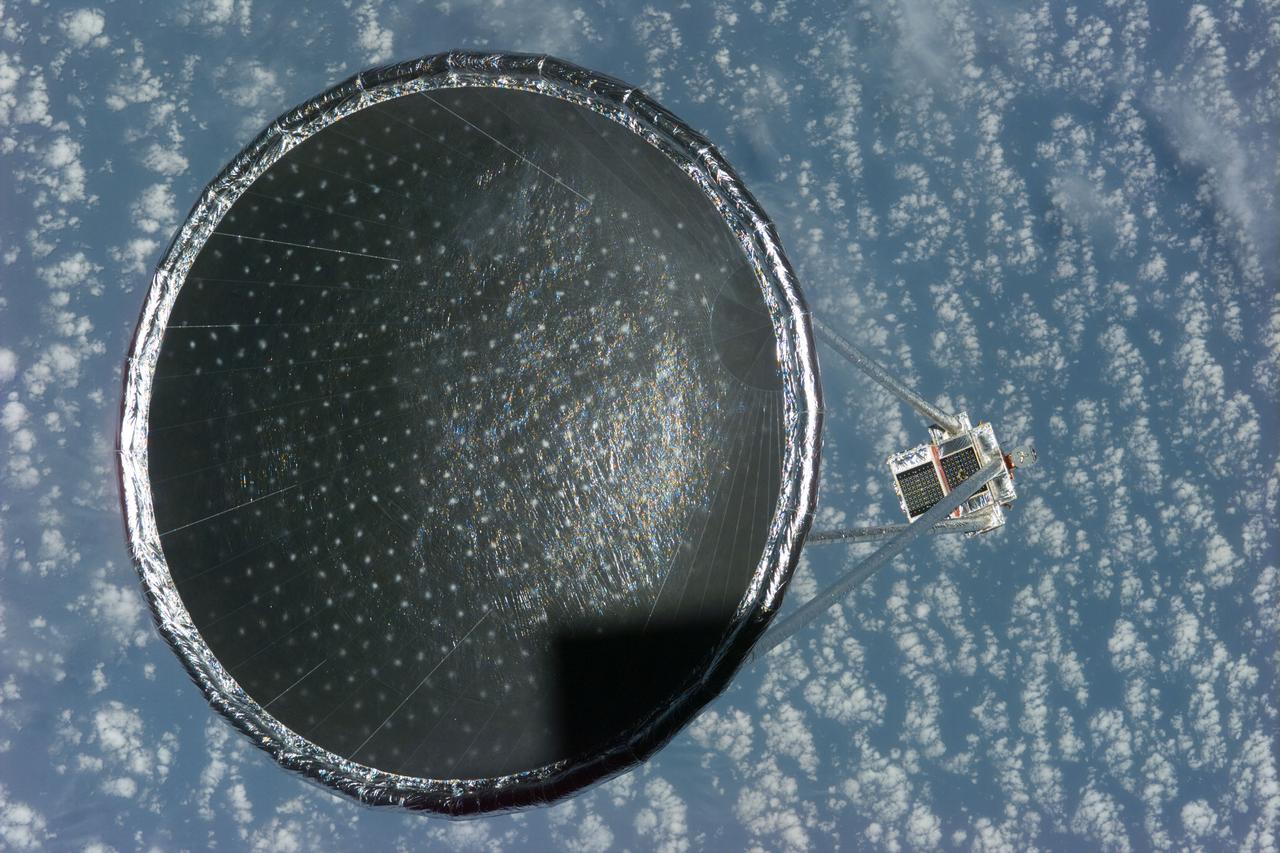
S77-E-5027 (20 May 1996)--- Following its deployment from the Space Shuttle Endeavour, the Spartan 207/Inflatable Antenna Experiment (IAE) payload is backdropped over clouds and water. The view was photographed with an Electronic Still Camera (ESC) and downlinked to flight controllers on the first full day of orbital operations by the six-member crew. Managed by Goddard Space Flight Center (GSFC), Spartan is designed to provide short-duration, free-flight opportunities for a variety of scientific studies. The Spartan configuration on this flight is unique in that the IAE is part of an additional separate unit which is ejected once the experiment is completed. The IAE experiment will lay the groundwork for future technology development in inflatable space structures, which will be launched and then inflated like a balloon on-orbit.
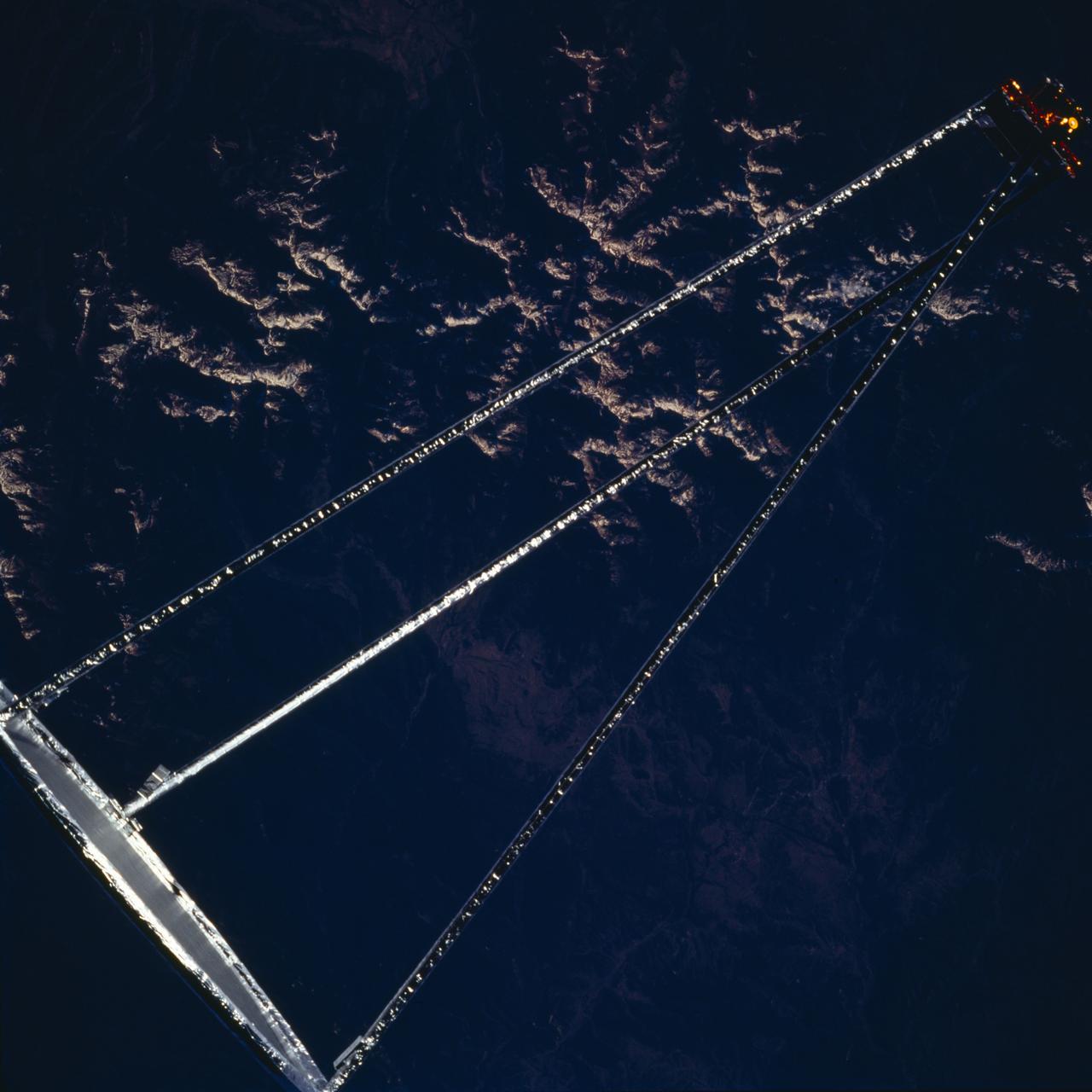
STS077-705-051 (20 May 1996) --- Following its deployment from the Space Shuttle Endeavour and its subsequent inflation process, the Spartan 207/Inflatable Antenna Experiment (IAE) payload is backdropped over mountains. The view was photographed with a handheld 70mm camera during the first full day of orbital operations by the six-member crew. Managed by Goddard Space Flight Center (GSFC), Spartan is designed to provide short-duration, free-flight opportunities for a variety of scientific studies. The Spartan configuration on this flight is unique in that the IAE is part of an additional separate unit which is ejected once the experiment is completed. The IAE experiment will lay the groundwork for future technology development in inflatable space structures, which will be launched and then inflated like a balloon on-orbit.
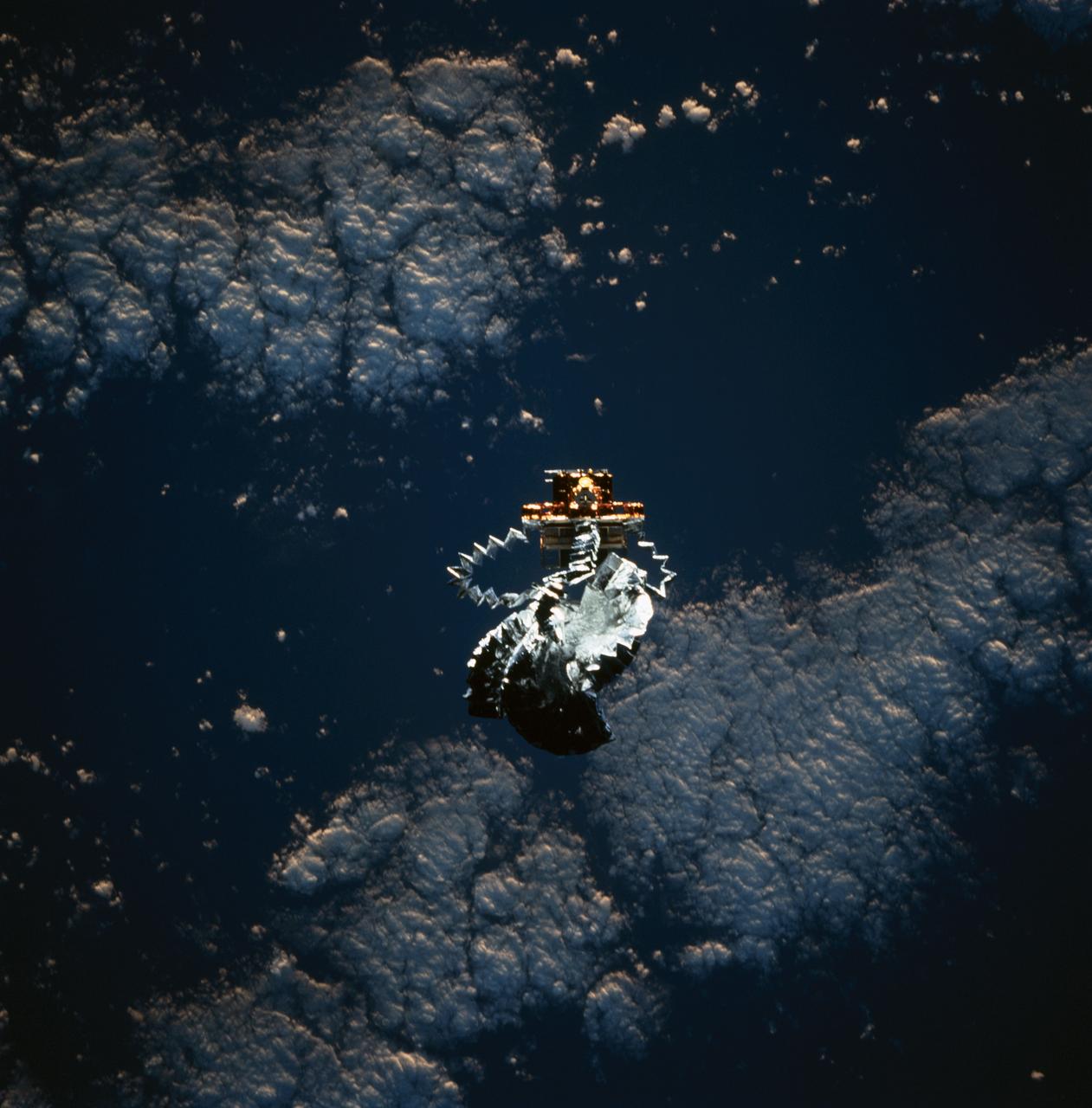
STS077-705-004 (20 May 1996) --- Following its deployment from the Space Shuttle Endeavour, the Inflatable Antenna Experiment (IAE) portion of the Spartan 207 payload begins to inflate, backdropped against clouds over the Pacific Ocean. The view was photographed with a handheld 70mm camera during the first full day of orbital operations by the six-member crew. Managed by Goddard Space Flight Center (GSFC), Spartan is designed to provide short-duration, free-flight opportunities for a variety of scientific studies. The Spartan configuration on this flight is unique in that the IAE is part of an additional separate unit which is ejected once the experiment is completed. The IAE experiment will lay the groundwork for future technology development in inflatable space structures, which will be launched and then inflated like a balloon on-orbit.
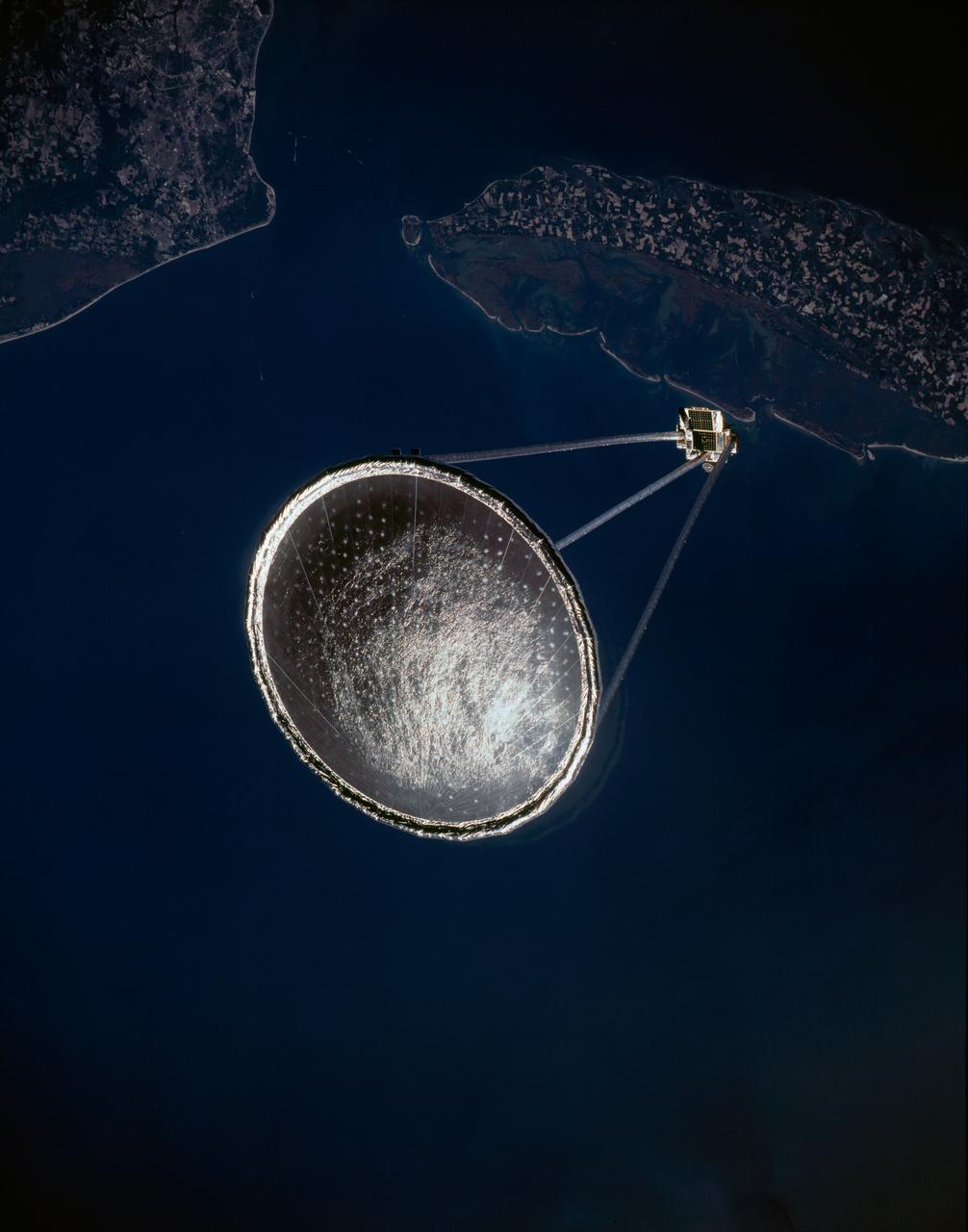
STS077-150-129 (20 May 1996) --- Following its deployment from the Space Shuttle Endeavour, the Spartan 207/Inflatable Antenna Experiment (IAE) payload is backdropped over the Atlantic Ocean and Hampton Roads, Virginia. (Hold photograph vertically with land mass at top.) Virginia Beach and part of Newport News can be delineated in the upper left quadrant of the frame. The view was photographed with a large format still camera on the first full day of in-space operations by the six-member crew. Managed by Goddard Space Flight Center (GSFC), Spartan is designed to provide short-duration, free-flight opportunities for a variety of scientific studies. The Spartan configuration on this flight is unique in that the IAE is part of an additional separate unit which is ejected once the experiment is completed. The IAE experiment will lay the groundwork for future technology development in inflatable space structures, which will be launched and then inflated like a balloon on-orbit.
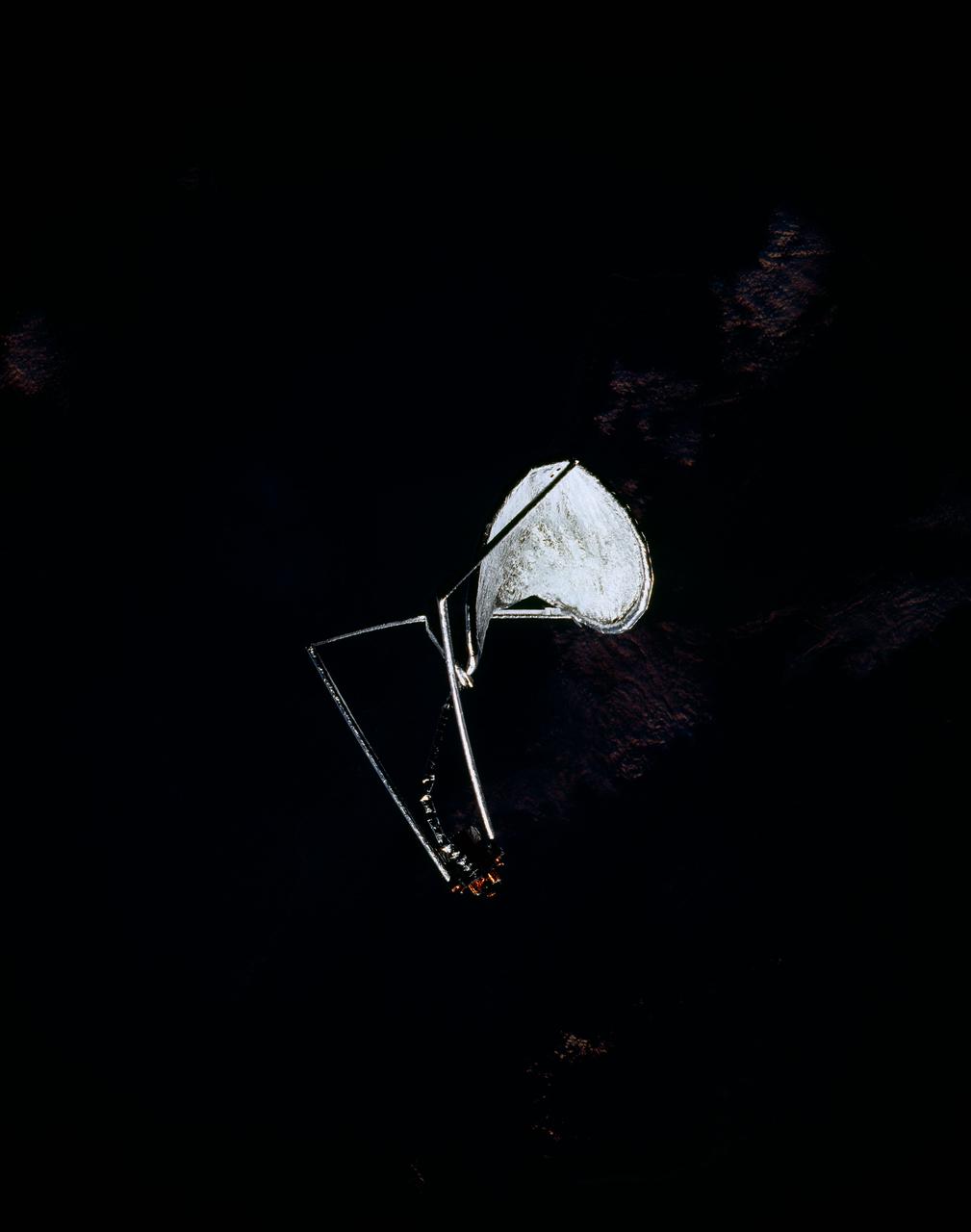
STS077-150-022 (20 May 1996) --- After leaving the cargo bay of the Space Shuttle Endeavour, the Spartan 207/Inflatable Antenna Experiment (IAE) payload goes through the final stages its inflation process, backdropped over clouds and blue water. The view was photographed with a large format still camera on the first full day of in-space operations by the six-member crew. Managed by Goddard Space Flight Center (GSFC), Spartan is designed to provide short-duration, free-flight opportunities for a variety of scientific studies. The Spartan configuration on this flight is unique in that the IAE is part of an additional separate unit which is ejected once the experiment is completed. The IAE experiment will lay the groundwork for future technology development in inflatable space structures, which will be launched and then inflated like a balloon on-orbit.
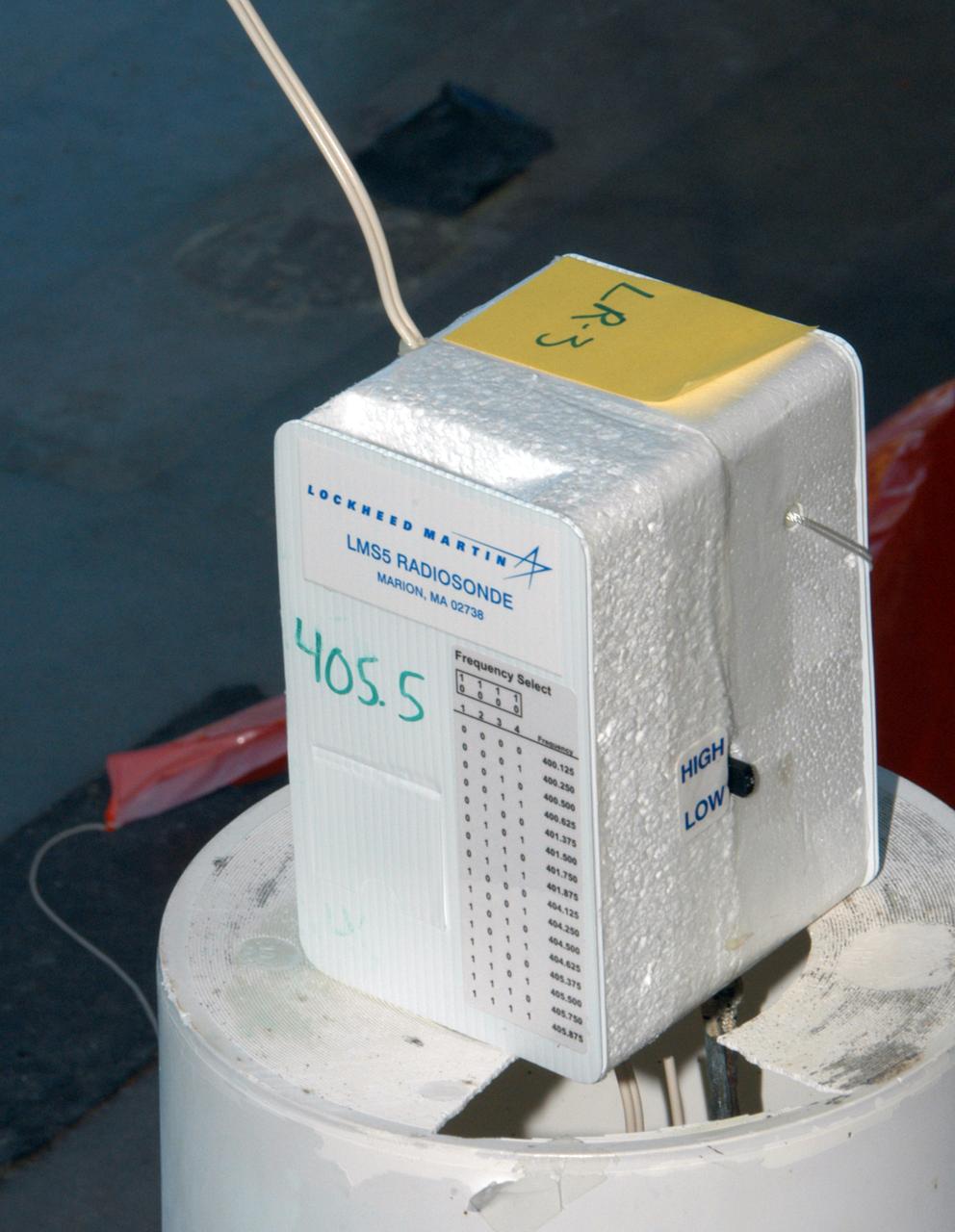
A radiosonde, an instrument that transmits measurements on atmospheric pressure, humidity, temperature and winds, is prepared for use on a weather balloon at the Cape Canaveral Air Force Station weather station. The data it returns will be used to determine if conditions are acceptable for the launch of NASA's THEMIS mission. THEMIS, an acronym for Time History of Events and Macroscale Interactions during Substorms, consists of five identical probes that will track violent, colorful eruptions near the North Pole. This will be the largest number of scientific satellites NASA has ever launched into orbit aboard a single rocket. The THEMIS mission aims to unravel the mystery behind auroral substorms, an avalanche of magnetic energy powered by the solar wind that intensifies the northern and southern lights. The mission will investigate what causes auroras in the Earth’s atmosphere to dramatically change from slowly shimmering waves of light to wildly shifting streaks of bright color. Launch is planned from Pad 17-B in a window that extends from 6:01 to 6:19 p.m. EST.
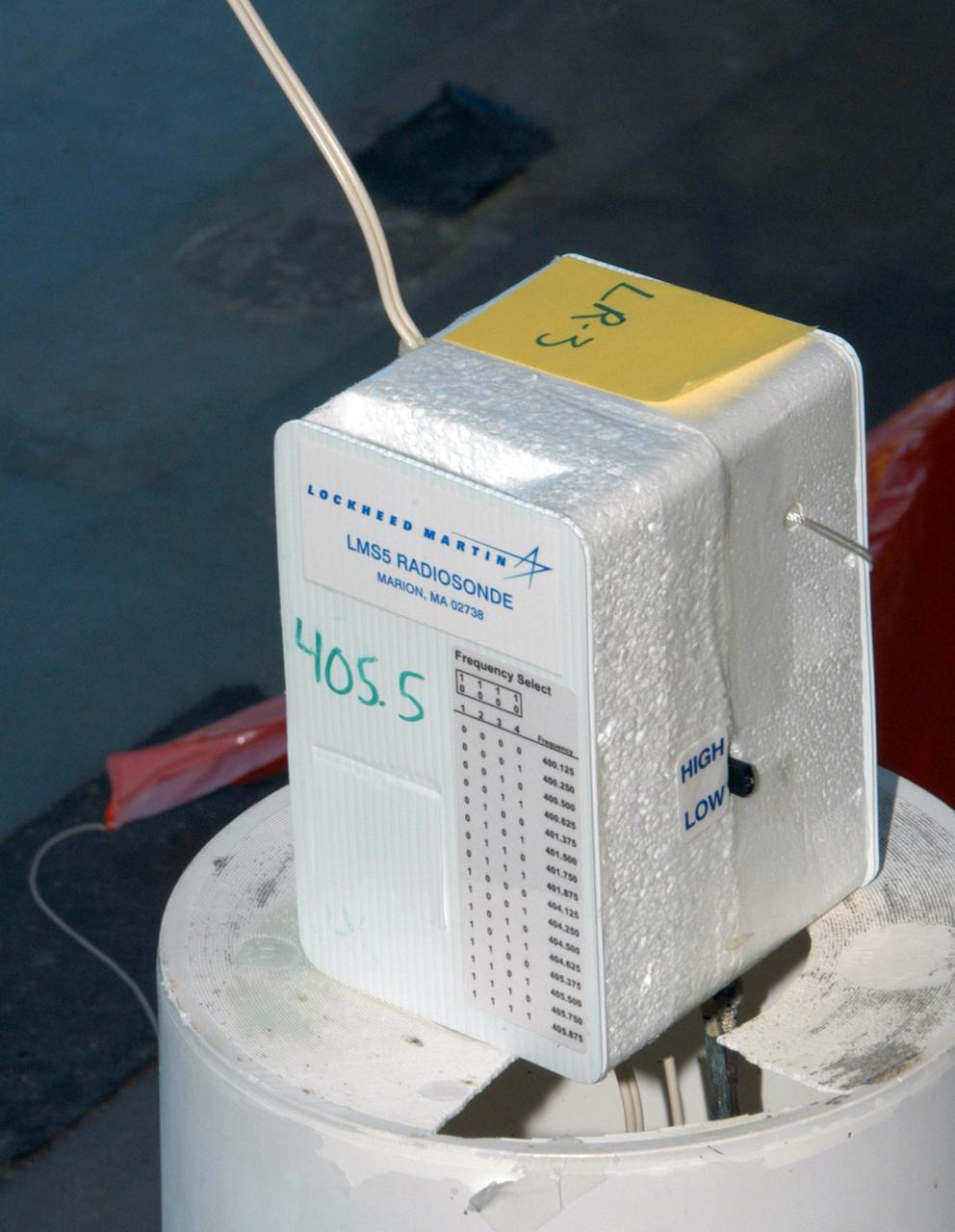
KENNEDY SPACE CENTER, FLA. -- A radiosonde, an instrument that transmits measurements on atmospheric pressure, humidity, temperature and winds, is prepared for use on a weather balloon at the Cape Canaveral Air Force Station weather station. The data it returns will be used to determine if conditions are acceptable for the launch of NASA's THEMIS mission. THEMIS, an acronym for Time History of Events and Macroscale Interactions during Substorms, consists of five identical probes that will track violent, colorful eruptions near the North Pole. This will be the largest number of scientific satellites NASA has ever launched into orbit aboard a single rocket. The THEMIS mission aims to unravel the mystery behind auroral substorms, an avalanche of magnetic energy powered by the solar wind that intensifies the northern and southern lights. The mission will investigate what causes auroras in the Earth’s atmosphere to dramatically change from slowly shimmering waves of light to wildly shifting streaks of bright color. Launch is planned from Pad 17-B in a window that extends from 6:01 to 6:19 p.m. EST. Photo credit: NASA/George Shelton
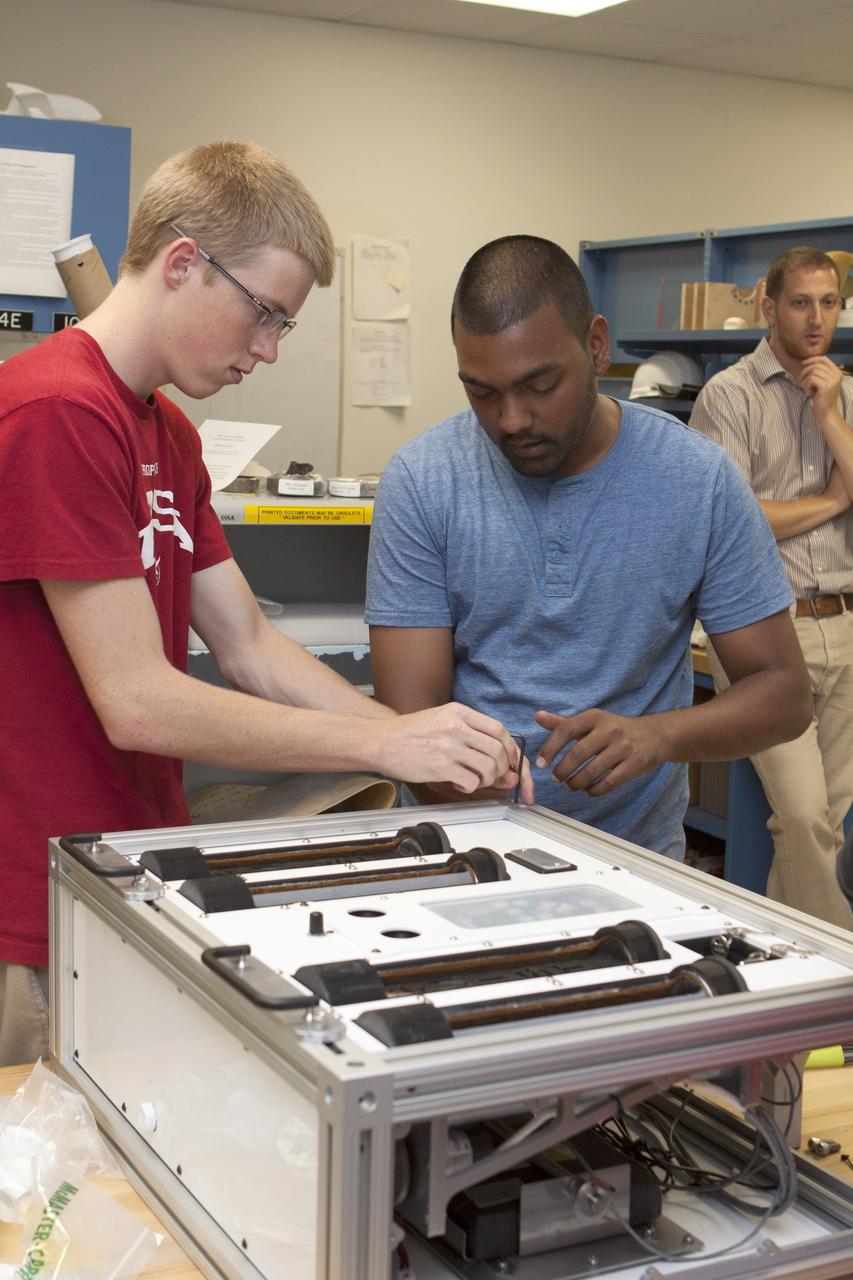
CAPE CANAVERAL, Fla. – Inside the Prototype Laboratory at NASA's Kennedy Space Center in Florida, Evan Williams, left, an Education intern from the University of Central Florida, and Anthony Bharrat, NASA avionics lead, prepare the experiment container for NASA's Exposing Microorganisms in the Stratosphere, or E-MIST, experiment. In the background is David J. Smith, Ph.D., NASA E-MIST principal investigator. The container was designed and built at Kennedy. The 80-pound structure features four doors that rotate to expose up to 10 microbial samples each for a predetermined period of time in the Earth's stratosphere. The E-MIST experiment will launch on the exterior of a giant scientific balloon gondola at about 8 a.m. MST on Aug. 24 from Ft. Sumner, New Mexico. It will soar 125,000 feet above the Earth during a 5-hour journey over the desert to understand how spore-forming bacteria, commonly found in spacecraft assembly facilities can survive. Photo credit: NASA/Kim Shiflett
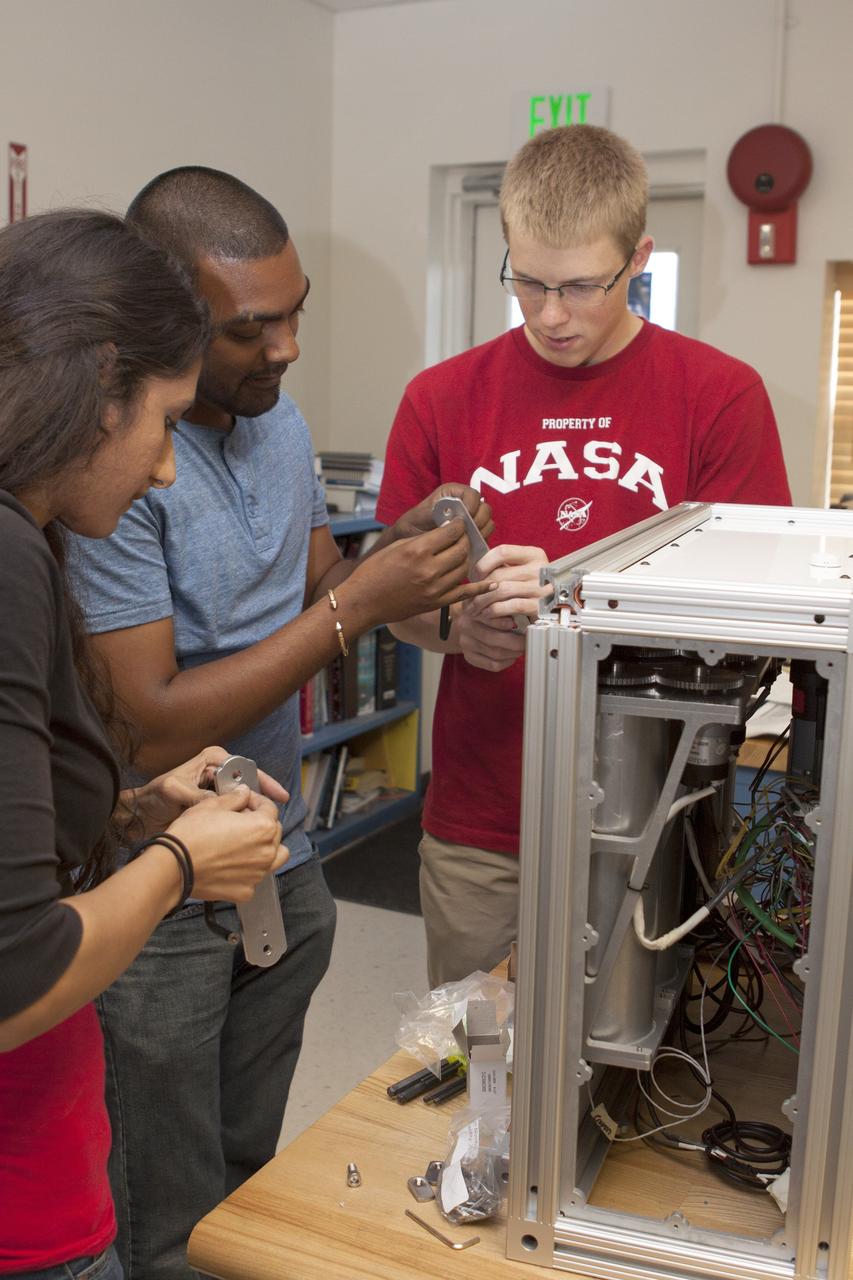
CAPE CANAVERAL, Fla. – Inside the Prototype Laboratory at NASA's Kennedy Space Center in Florida, Prital Thakrar, left, design lead and student engineer trainee from the University of Florida in Gainesville, Anthony Bharrat, NASA avionics lead, and Evan Williams, an Education intern from the University of Central Florida, prepare the experiment container for NASA's Exposing Microorganisms in the Stratosphere, or E-MIST, experiment. The container was designed and built at Kennedy. The 80-pound structure features four doors that rotate to expose up to 10 microbial samples each for a predetermined period of time in the Earth's stratosphere. The E-MIST experiment will launch on the exterior of a giant scientific balloon gondola at about 8 a.m. MST on Aug. 24 from Ft. Sumner, New Mexico. It will soar 125,000 feet above the Earth during a 5-hour journey over the desert to understand how spore-forming bacteria, commonly found in spacecraft assembly facilities can survive. Photo credit: NASA/Kim Shiflett
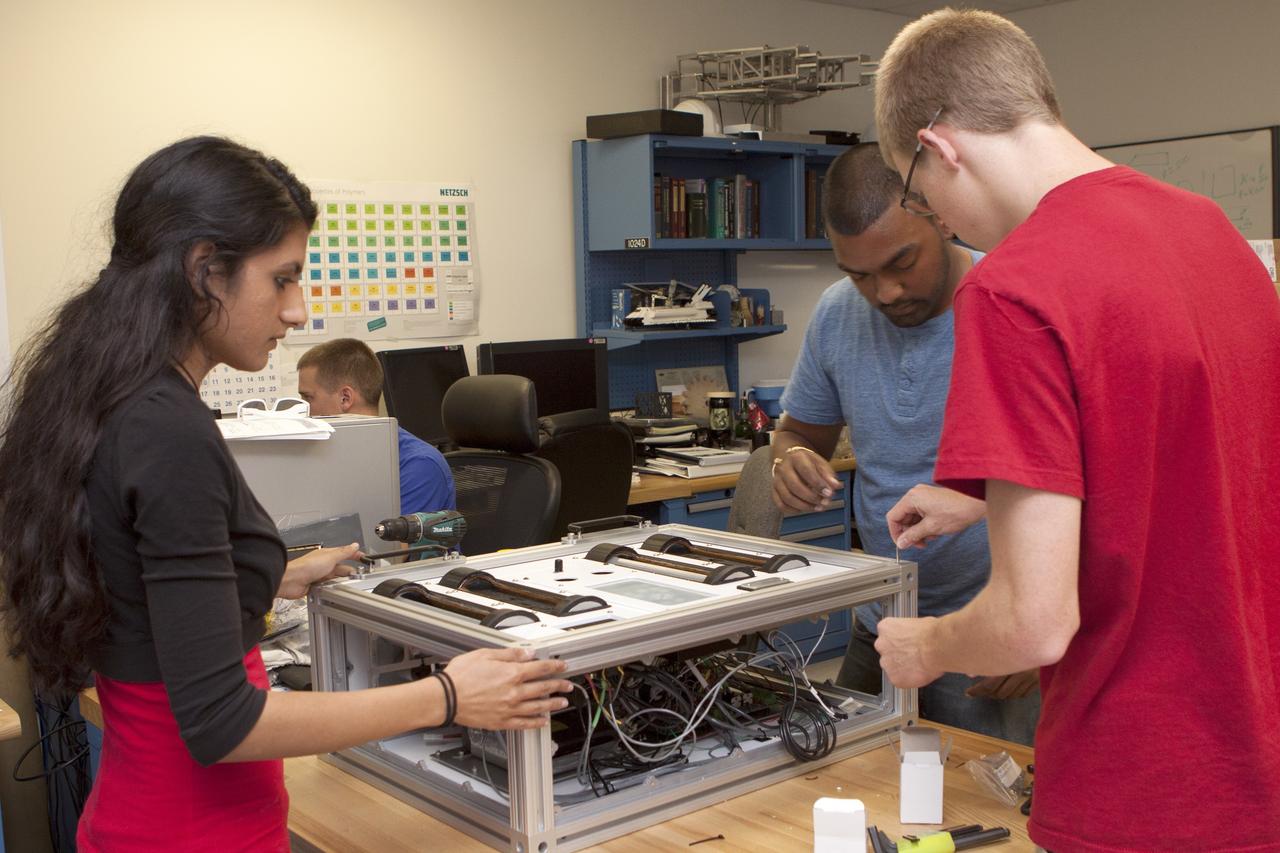
CAPE CANAVERAL, Fla. – Inside the Prototype Laboratory at NASA's Kennedy Space Center in Florida, Prital Thakrar, left, design lead and student engineer trainee from the University of Florida in Gainesville, Anthony Bharrat, NASA avionics lead, and Evan Williams, an Education intern from the University of Central Florida, prepare the experiment container for NASA's Exposing Microorganisms in the Stratosphere, or E-MIST, experiment. The container was designed and built at Kennedy. The 80-pound structure features four doors that rotate to expose up to 10 microbial samples each for a predetermined period of time in the Earth's stratosphere. The E-MIST experiment will launch on the exterior of a giant scientific balloon gondola at about 8 a.m. MST on Aug. 24 from Ft. Sumner, New Mexico. It will soar 125,000 feet above the Earth during a 5-hour journey over the desert to understand how spore-forming bacteria, commonly found in spacecraft assembly facilities can survive. Photo credit: NASA/Kim Shiflett