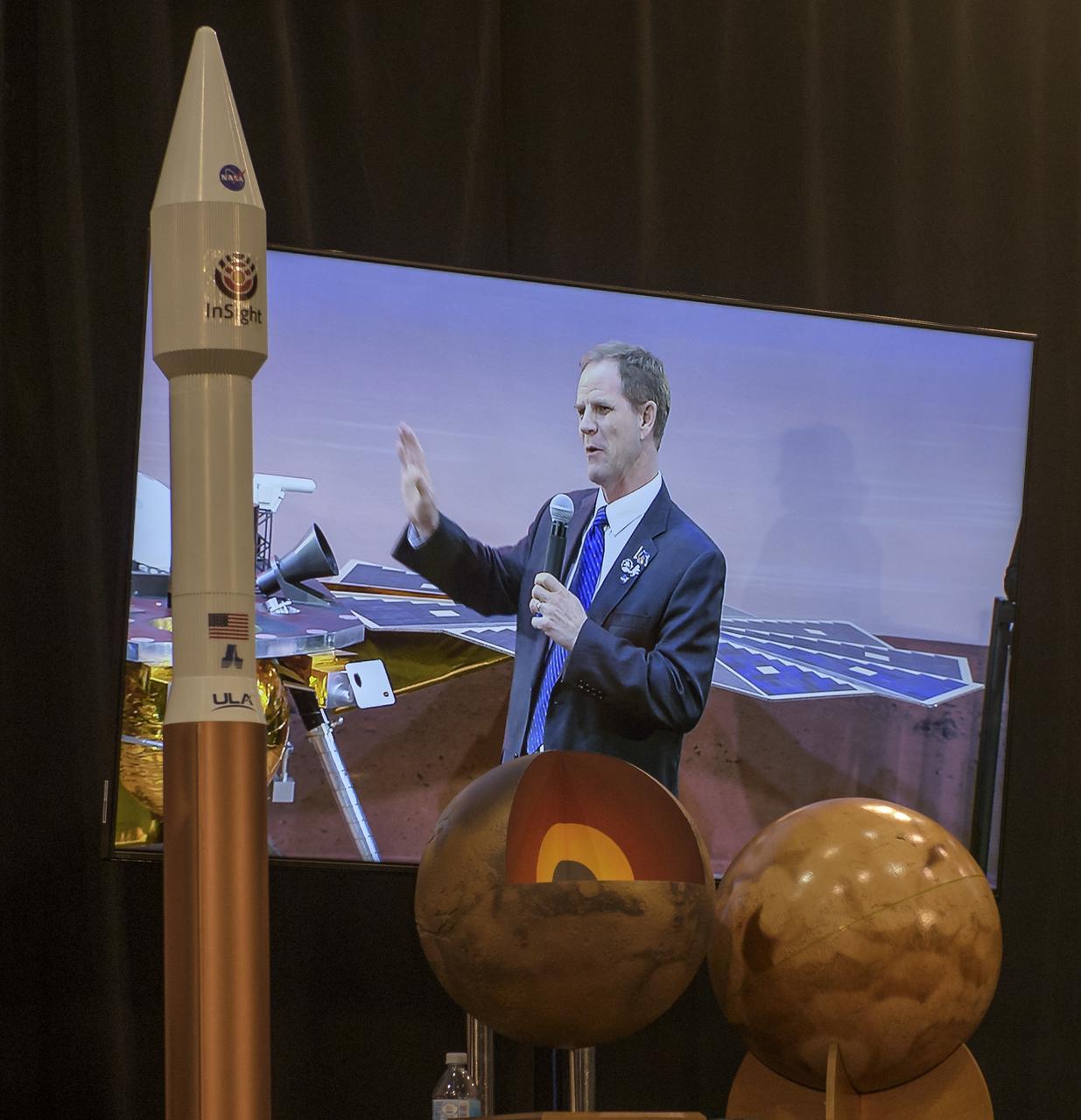
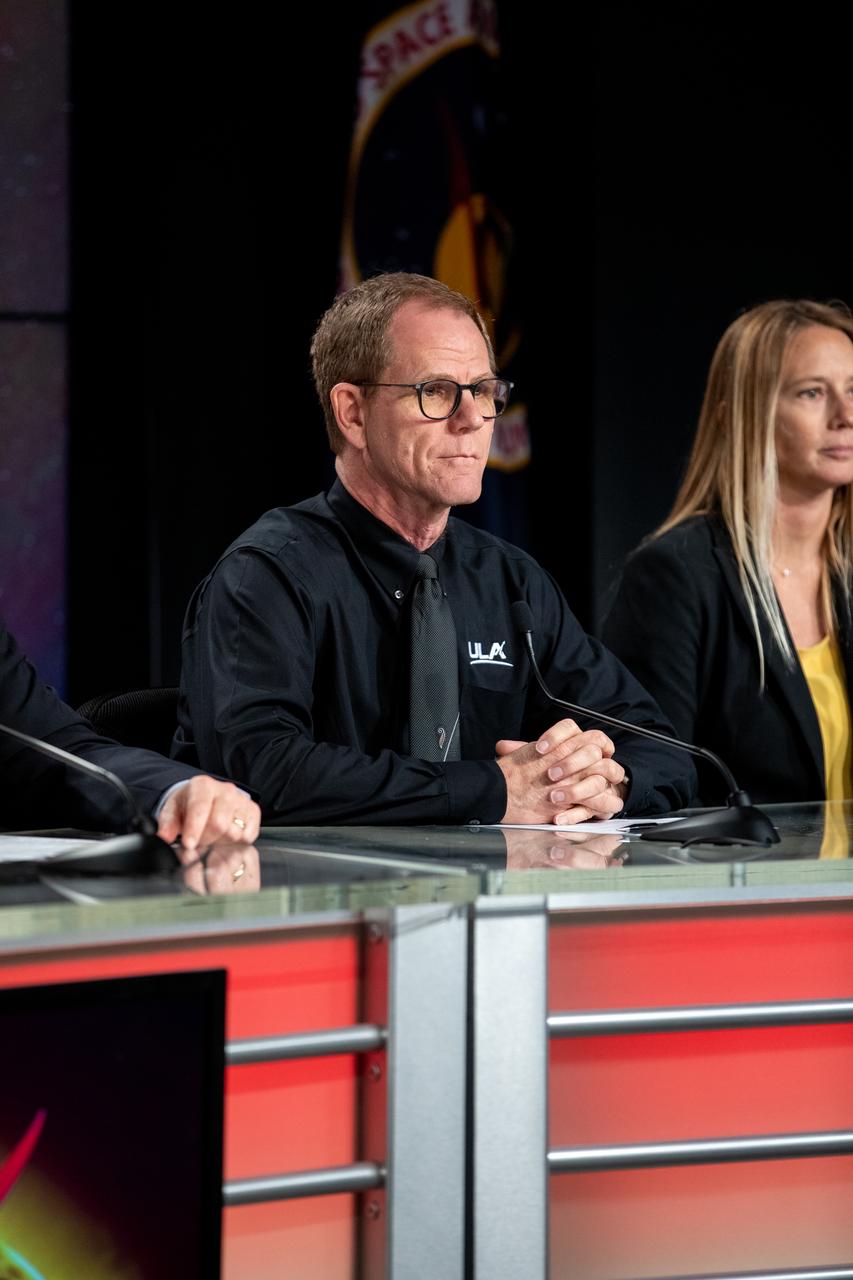
Scott Messer, United Launch Alliance program manager for NASA missions, is seen on a monitor as he discusses NASA's InSight mission during a prelaunch media briefing, Thursday, May 3, 2018, at Vandenberg Air Force Base in California. InSight, short for Interior Exploration using Seismic Investigations, Geodesy and Heat Transport, is a Mars lander designed to study the "inner space" of Mars: its crust, mantle, and core. Photo Credit: (NASA/Bill Ingalls)
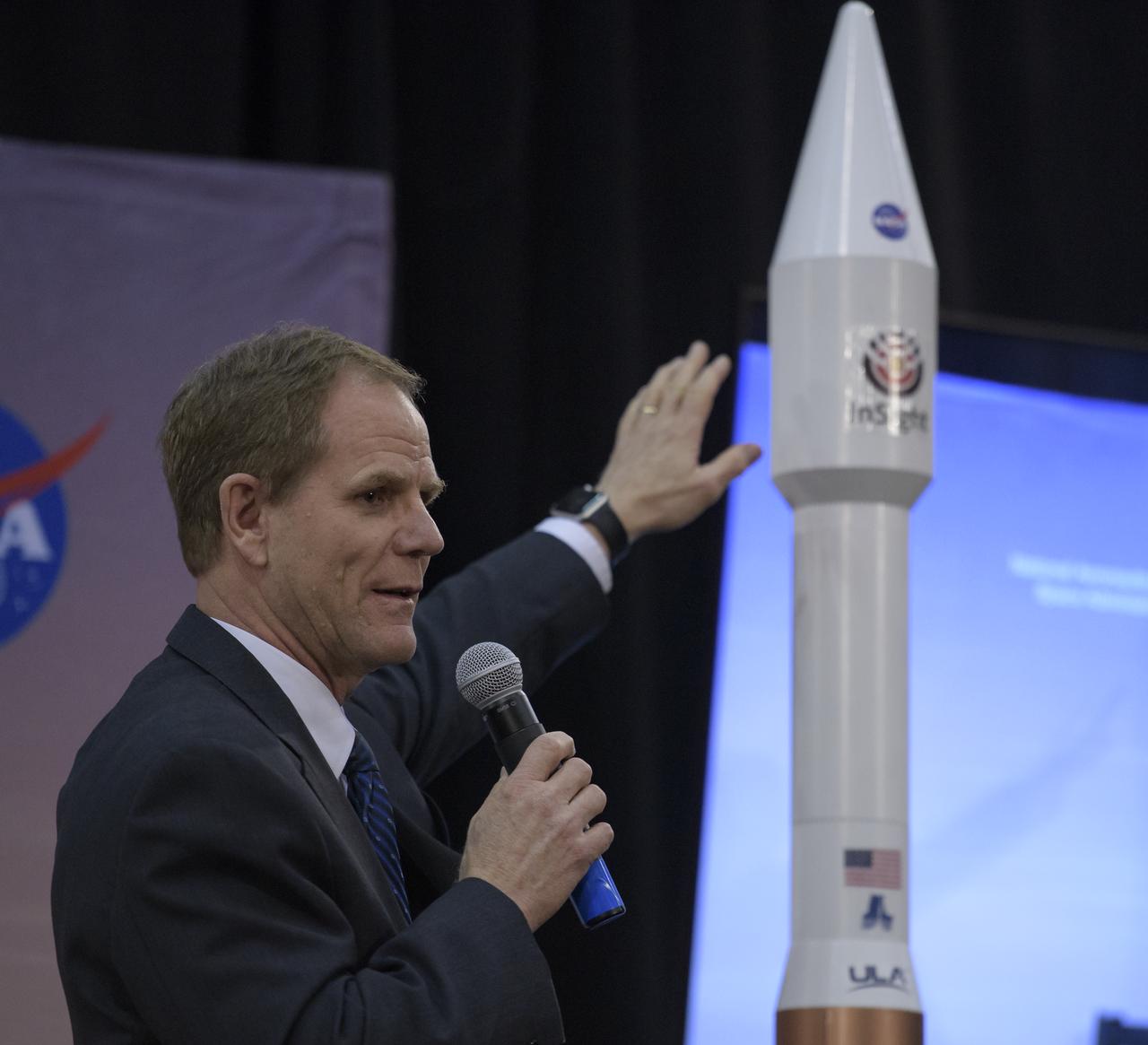
Scott Messer, United Launch Alliance program manager for NASA missions, discusses NASA's InSight mission during a prelaunch media briefing, Thursday, May 3, 2018, at Vandenberg Air Force Base in California. InSight, short for Interior Exploration using Seismic Investigations, Geodesy and Heat Transport, is a Mars lander designed to study the "inner space" of Mars: its crust, mantle, and core. Photo Credit: (NASA/Bill Ingalls)
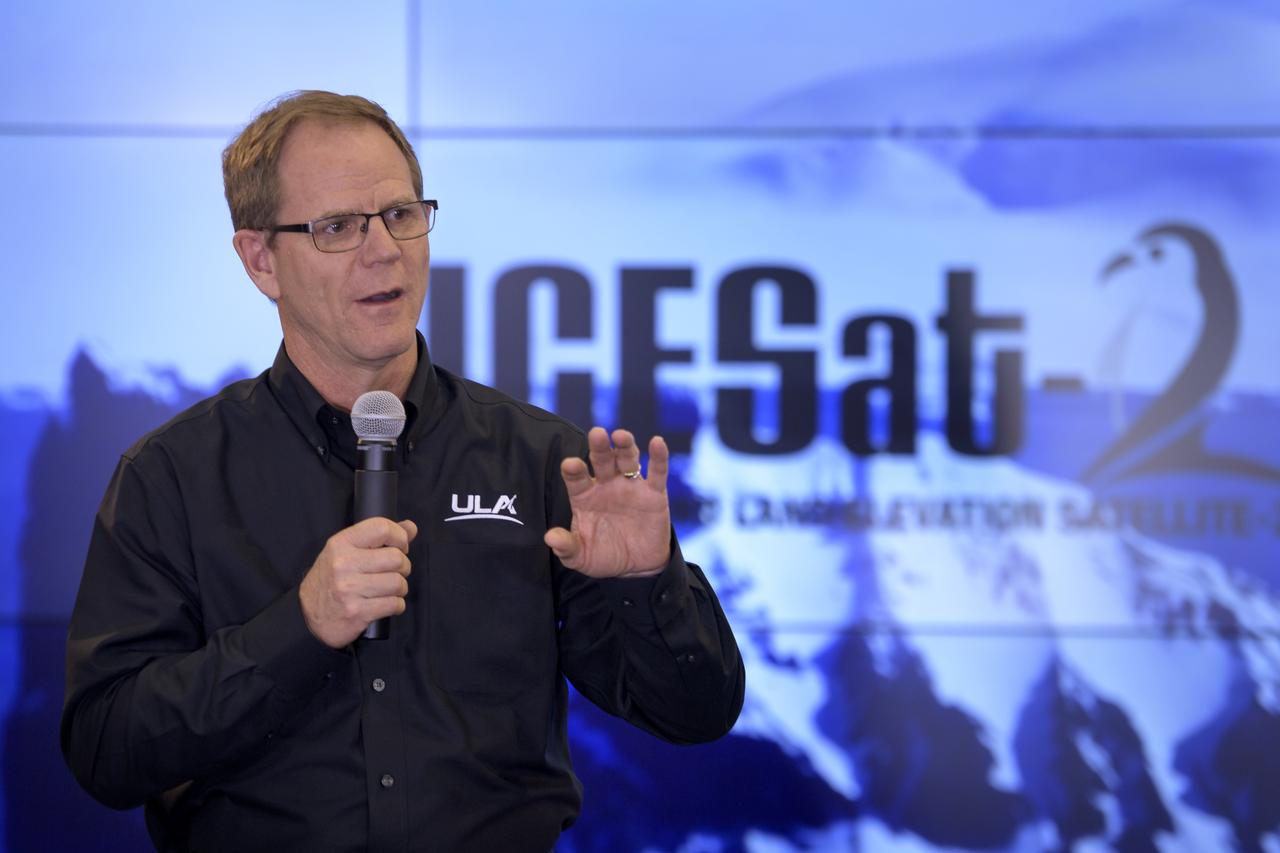
Scott Messer, Program Manager, United Launch Alliance, is seen during a NASA Ice, Cloud and land Elevation Satellite-2 (ICESat-2) prelaunch briefing, Thursday, Sept. 13, 2018, at Vandenberg Air Force Base in California. The ICESat-2 mission will measure the changing height of Earth's ice. Photo Credit: (NASA/Bill Ingalls)
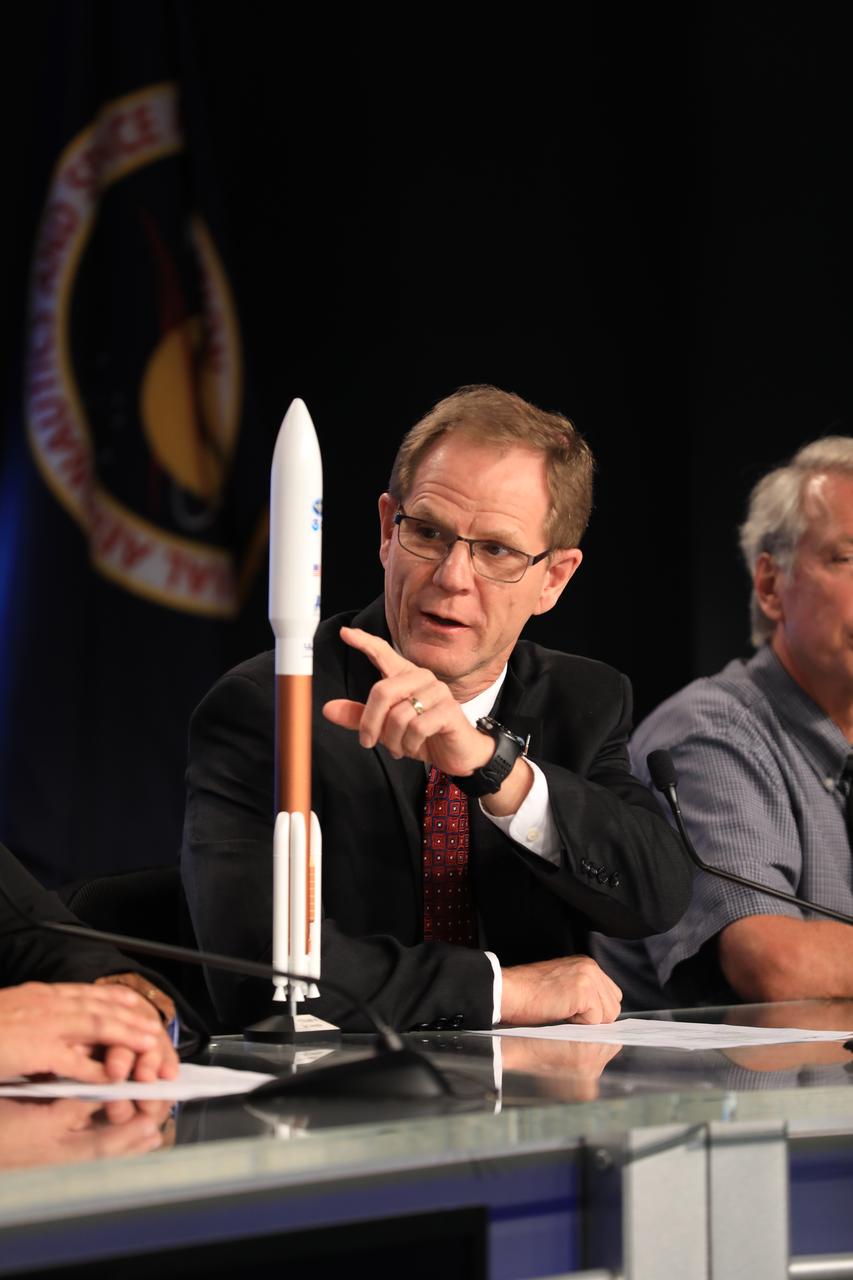
Scott Messer, program manager, NASA Missions, United Launch Alliance, speak to members of the news media during a Geostationary Operational Environmental Satellite (GOES-R) prelaunch news conference in the Kennedy Space Center's Press Site auditorium in Florida.
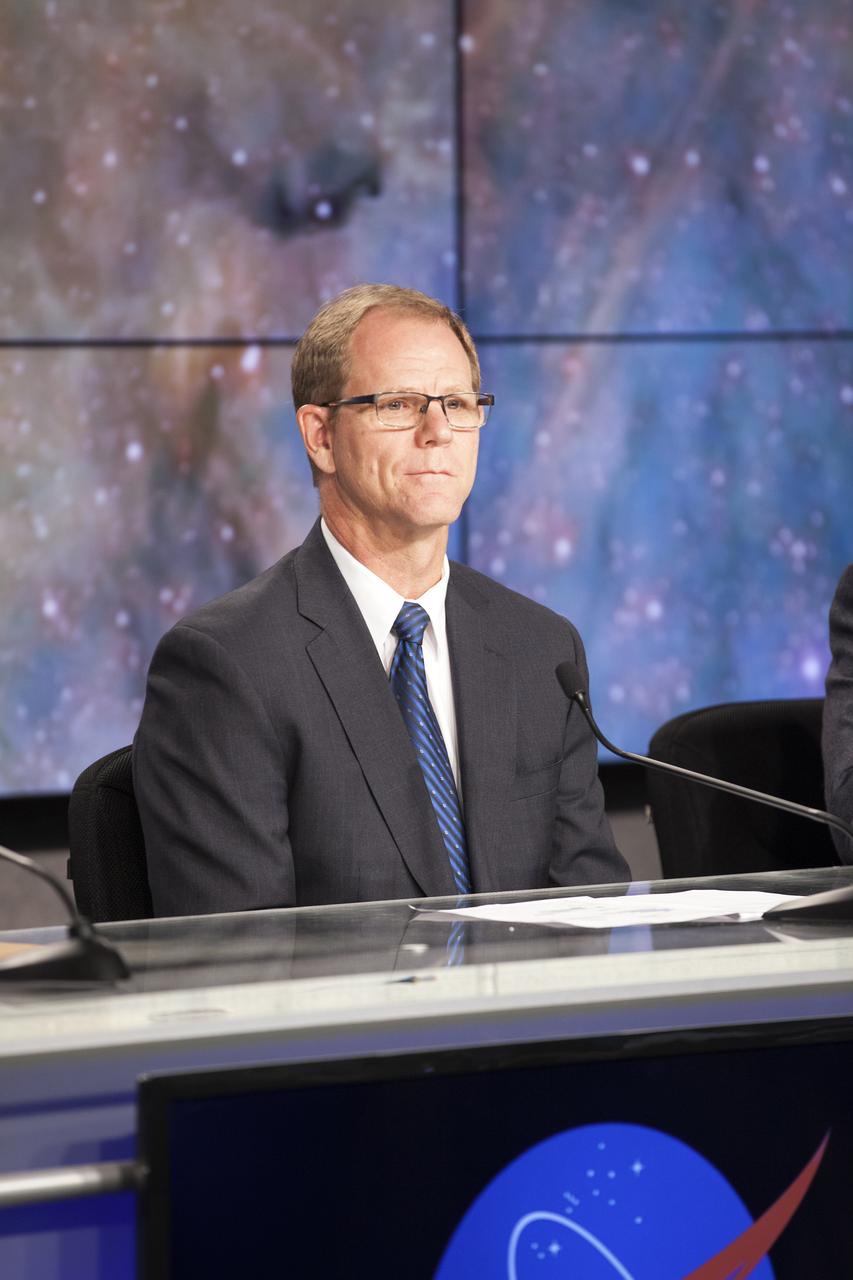
In the Kennedy Space Center’s Press Site auditorium, Scott Messer, program manager for NASA missions at United Launch Alliance in Centennial, Colorado, speaks to members of the media at a prelaunch news conference for the agency’s Origins, Spectral Interpretation, Resource Identification, Security-Regolith Explorer, or OSIRIS-REx spacecraft.

From left, Sandra Smalley, director, Joint Agency Satellite Division, NASA Headquarters; Omar Baez, launch director, NASA Kennedy; and Scott Messer, program manager, NASA Missions, United Launch Alliance, speak to members of the news media during a Geostationary Operational Environmental Satellite (GOES-R) prelaunch news conference in the Kennedy Space Center's Press Site auditorium in Florida.

In the Kennedy Space Center’s Press Site auditorium, NASA and industry leaders speak to members of the media at a prelaunch news conference for the agency’s Origins, Spectral Interpretation, Resource Identification, Security-Regolith Explorer, or OSIRIS-REx spacecraft. From left are: Dante Lauretta, OSIRIS-REx principal investigator at the University of Arizona, Tucson; Tim Dunn, NASA launch manager at Kennedy; and Scott Messer, program manager for NASA missions at United Launch Alliance in Centennial, Colorado.
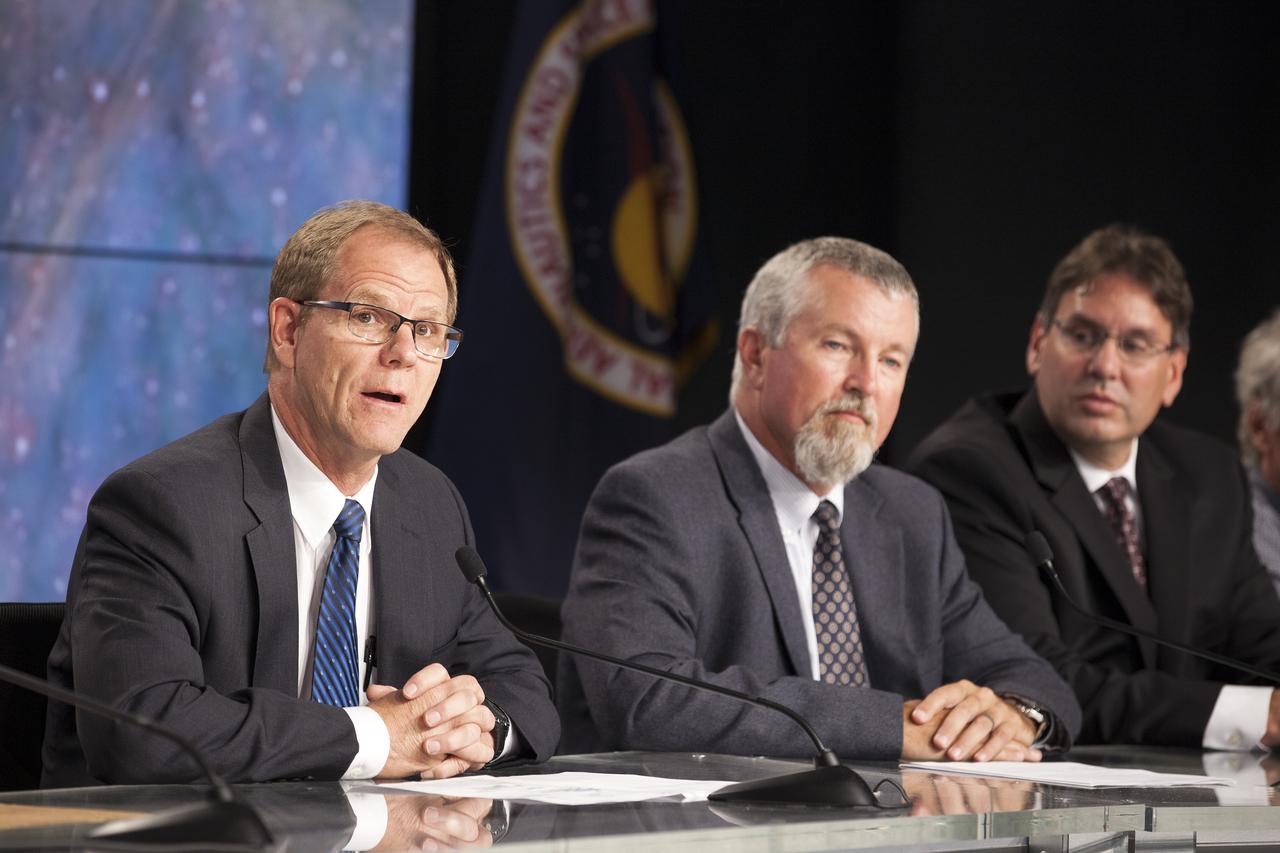
In the Kennedy Space Center’s Press Site auditorium, Scott Messer, program manager for NASA missions at United Launch Alliance in Centennial, Colorado; Michael Donnelly, OSIRIS-REx project manager at NASA’s Goddard Space Flight Center in Greenbelt, Maryland; and Rich Kuhns, OSIRIS-REx program manager for Lockheed Martin Space Systems in Denver; speak to members of the media at a prelaunch news conference for the agency’s Origins, Spectral Interpretation, Resource Identification, Security-Regolith Explorer, or OSIRIS-REx spacecraft.
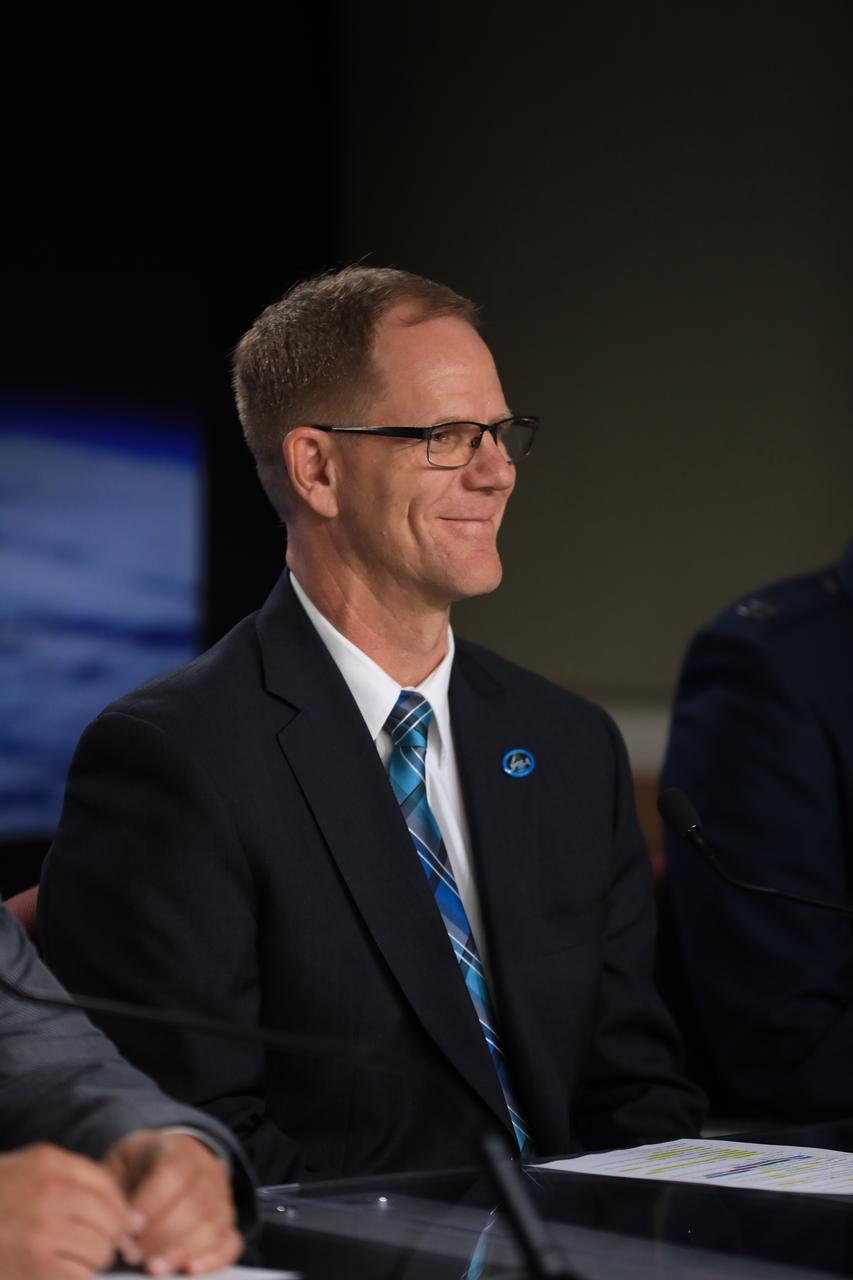
At Vandenberg Air Force Base in California, Scott Messer, United Launch Alliance program manager for NASA missions, speaks to members of the media at a prelaunch news conference for the Joint Polar Satellite System-1, or JPSS-1. Built by Ball Aerospace and Technologies Corp. of Boulder, Colorado, JPSS is the first in a series four next-generation environmental satellites in a collaborative program between the NOAA and NASA. Liftoff atop a United Launch Alliance Delta II rocket is scheduled to take place from Vandenberg's Space Launch Complex 2 at 1:47 a.m. PST (4:47 a.m. EST), on Nov. 14, 2017.
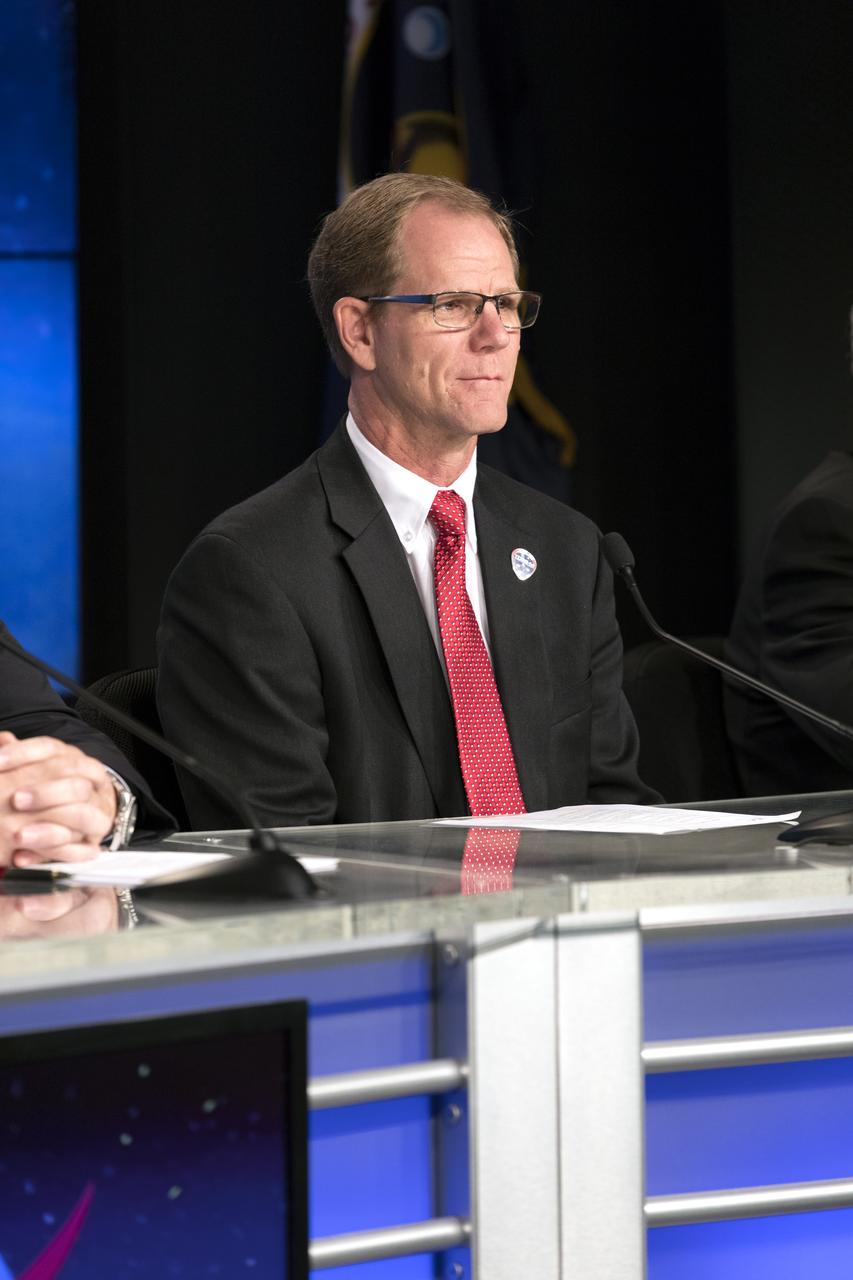
In the Kennedy Space Center's Press Site auditorium, Scott Messer, United Launch Alliance program manager for NASA missions, speaks to members of the media at a prelaunch news conference for NASA's Tracking and Data Relay Satellite, TDRS-M. It is the latest spacecraft destined for the agency's constellation of communications satellites that allows nearly continuous contact with orbiting spacecraft ranging from the International Space Station and Hubble Space Telescope to the array of scientific observatories. Liftoff atop a United Launch Alliance Atlas V rocket is scheduled to take place from Space Launch Complex 41 at Cape Canaveral Air Force Station at 8:03 a.m. EDT Aug. 18.
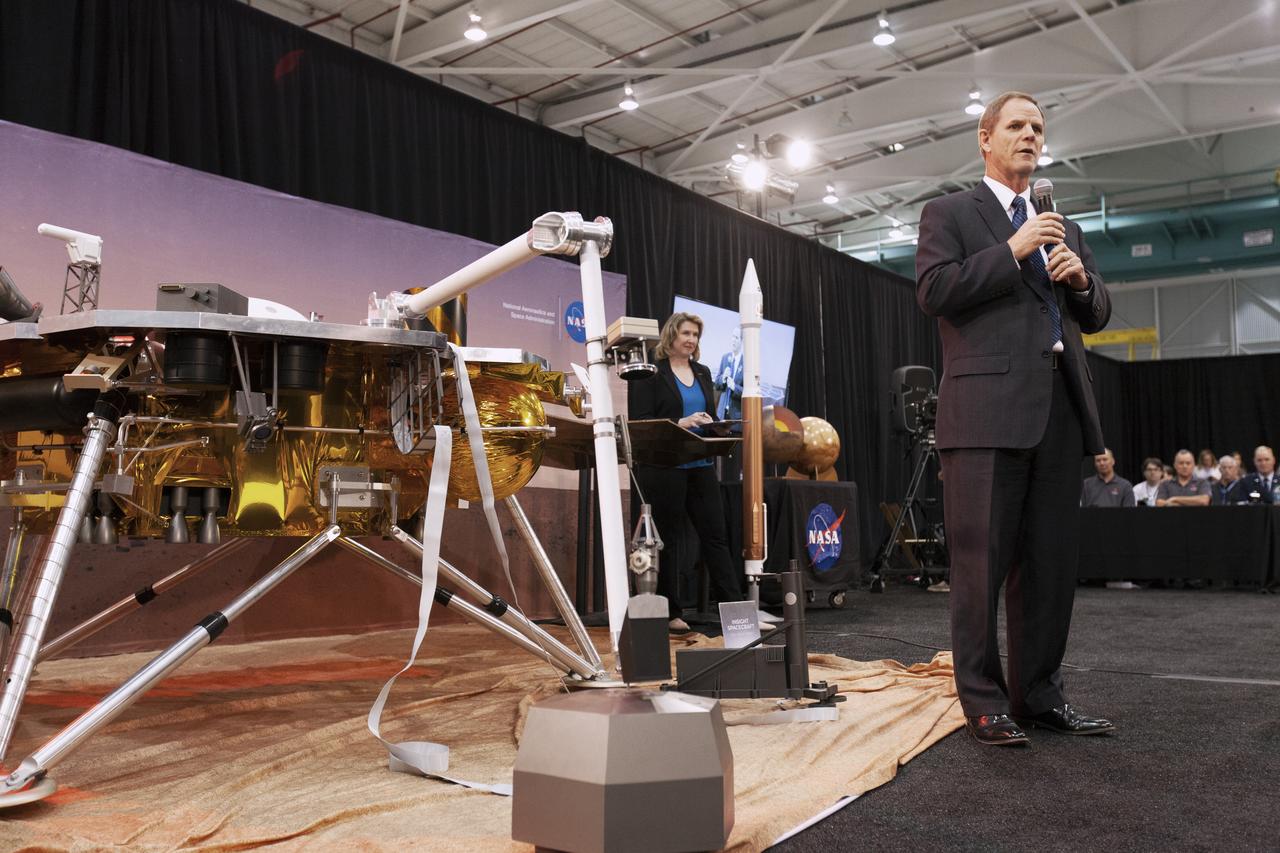
During a prelaunch briefing at Vandenberg Air Force Base in California, Scott Messer, United Launch Alliance's Program Manager for NASA Missions, speaks to members of the media. The presentation focused on NASA's Interior Exploration using Seismic Investigations, Geodesy and Heat Transport, or InSight, Mars lander. InSight is scheduled for liftoff May 5, 2018, atop a United Launch Alliance Atlas V rocket from Space Launch Complex 3 at Vandenberg. The spacecraft will be the first mission to look deep beneath the Martian surface studying the planet's interior by measuring its heat output and listen for marsquakes.

Scott Messer, program manager, NASA Programs, United Launch Alliance, speaks to members of the news media and social media participants during a prelaunch mission briefing for NASA's Ice, Cloud and land Elevation Satellite-2 (ICESat-2), a mission to measure the changing height of Earth's ice, on Sept. 13, 2018 at Vandenberg Air Force Base (VAFB) in California. ICESat-2 will launch aboard a United Launch Alliance Delta II, the rocket’s final mission, from Space Launch Complex 2 at VAFB. Launch is scheduled for 8:46 a.m. EDT (5:46 a.m. PDT).
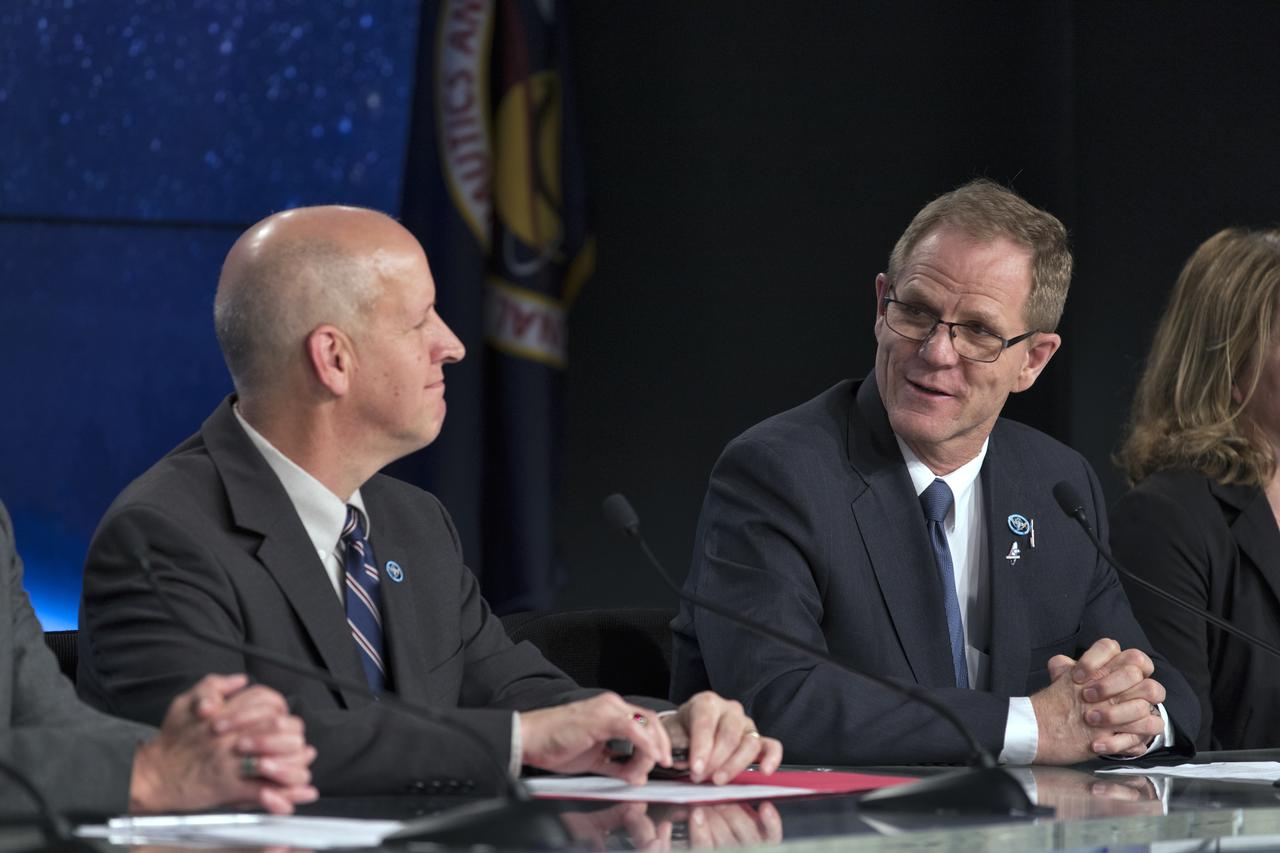
In the Kennedy Space Center's Press Site auditorium, Tim Dunn, NASA launch director at Kennedy, left, and Scott Messer, manager of NASA Programs for United launch Alliance, speak to members of the media at a prelaunch news conference about National Oceanic and Atmospheric Administration's, or NOAA's, Geostationary Operational Environmental Satellite, or GOES-S. The GOES series of satellites will significantly improve the detection and observation of environmental phenomena that directly affect public safety, protection of property and the nation's economic health and prosperity. GOES-S is slated to lift off at 5:02 p.m. EST on March 1, 2018 aboard a United Launch Alliance Atlas V rocket.
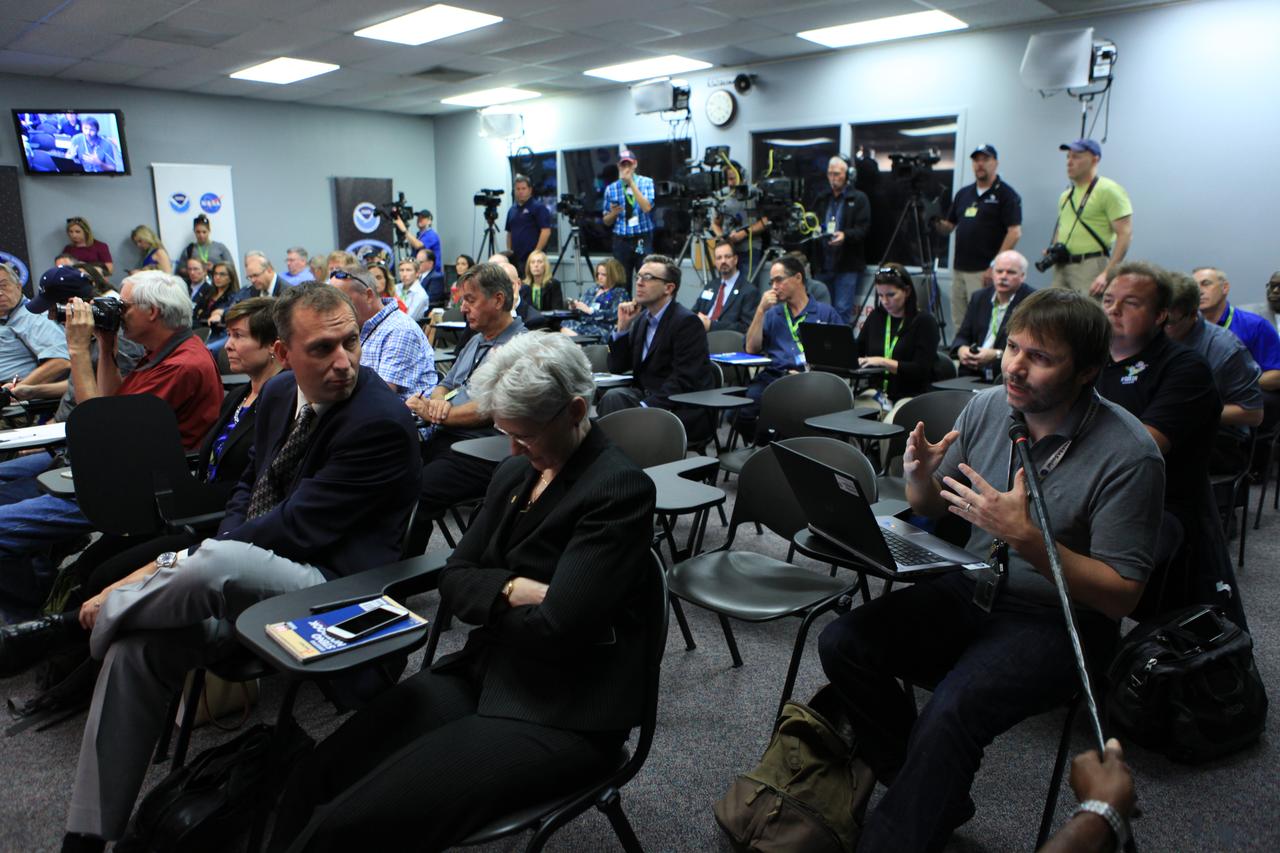
Members of the news media attend a Geostationary Operational Environmental Satellite (GOES-R) prelaunch news conference in the Kennedy Space Center's Press Site auditorium in Florida. NASA and industry leaders include: Michael Curie, of NASA Communications; Stephen Volz, assistant administrator for satellite and information services, National Oceanic and Atmospheric Administration (NOAA's); Greg Mandt, GOES-R system program director, NOAA; Sandra Smalley, director, Joint Agency Satellite Division, NASA Headquarters; Omar Baez, launch director, NASA Kennedy; Scott Messer, program manager, NASA Missions, United Launch Alliance; and Clay Flinn, launch weather officer, 4th Weather Squadron, Cape Canaveral Air Force Station.
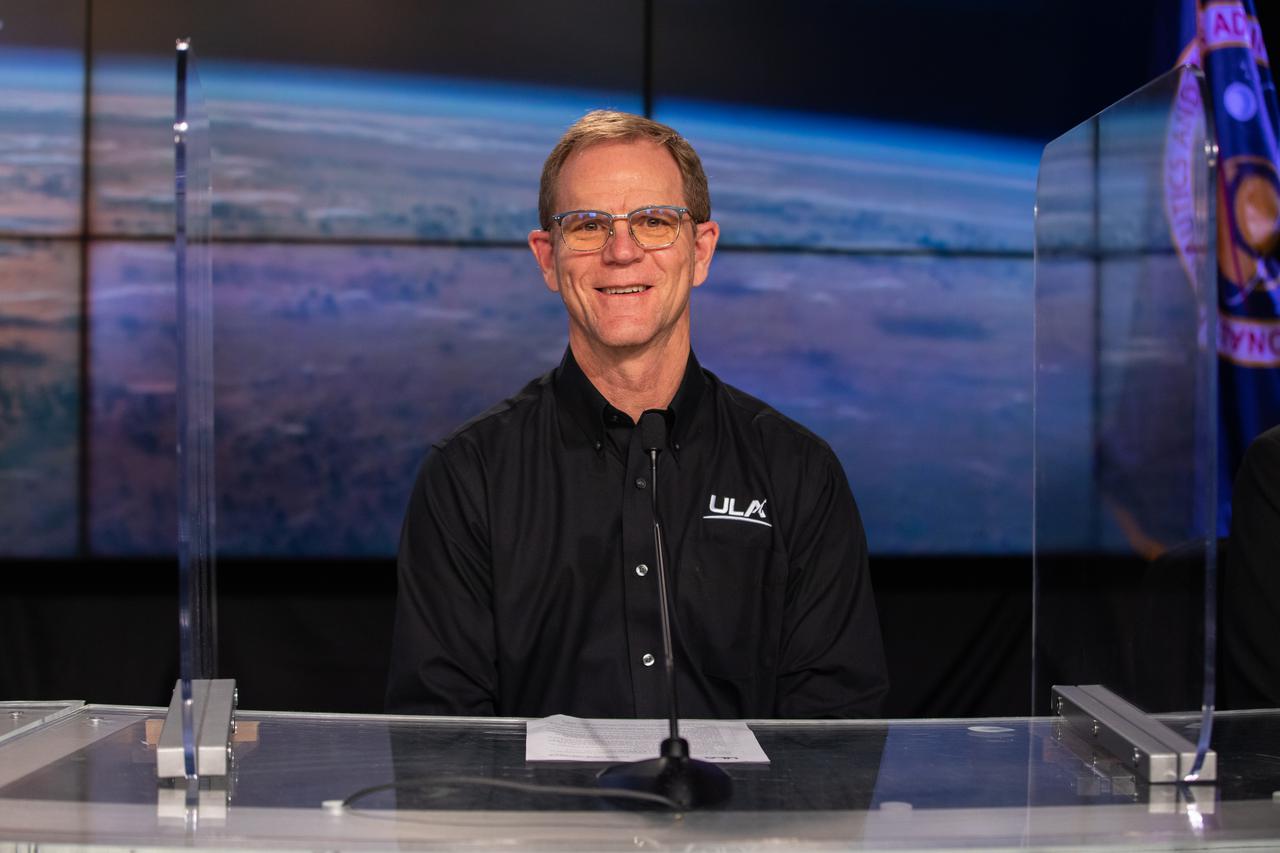
A prelaunch news conference for the National Oceanic and Atmospheric Administration’s (NOAA) Geostationary Operational Environmental Satellite-T (GOES-T) is held on Feb. 26, 2022, at NASA’s Kennedy Space Center in Florida. Scott Messer, program manager, NASA Launch Services, United Launch Alliance, answers questions during the news conference. GOES-T is scheduled to lift off on a United Launch Alliance Atlas V 541 rocket from Space Launch Complex 41 at Cape Canaveral Space Force Station in Florida on March 1, 2022, at 4:38 p.m. GOES-T is the third satellite in the GOES-R series that will continue to help meteorologists observe and predict local weather events that affect public safety. The launch is being managed by NASA’s Launch Services Program based at Kennedy Space Center in Florida, America’s multi-user spaceport.
From left, Scott Messer, NASA LSP Program manager, United Launch Alliance; and Jessica Williams, 45th Space Wing Weather officer, participate in a prelaunch news conference for the Solar Orbiter mission at NASA’s Kennedy Space Center in Florida on Feb. 7, 2020. Solar Orbiter is an international cooperative mission between ESA (European Space Agency) and NASA. The mission aims to study the Sun, its outer atmosphere and solar wind. The spacecraft will provide the first images of the Sun’s poles. The spacecraft was developed by Airbus Defence and Space. NASA’s Launch Services Program based at Kennedy is managing the launch. Solar Orbiter will launch aboard a United Launch Alliance Atlas V rocket on Feb. 9, 2020, from Space Launch Complex 41 at Cape Canaveral Air Force Station.
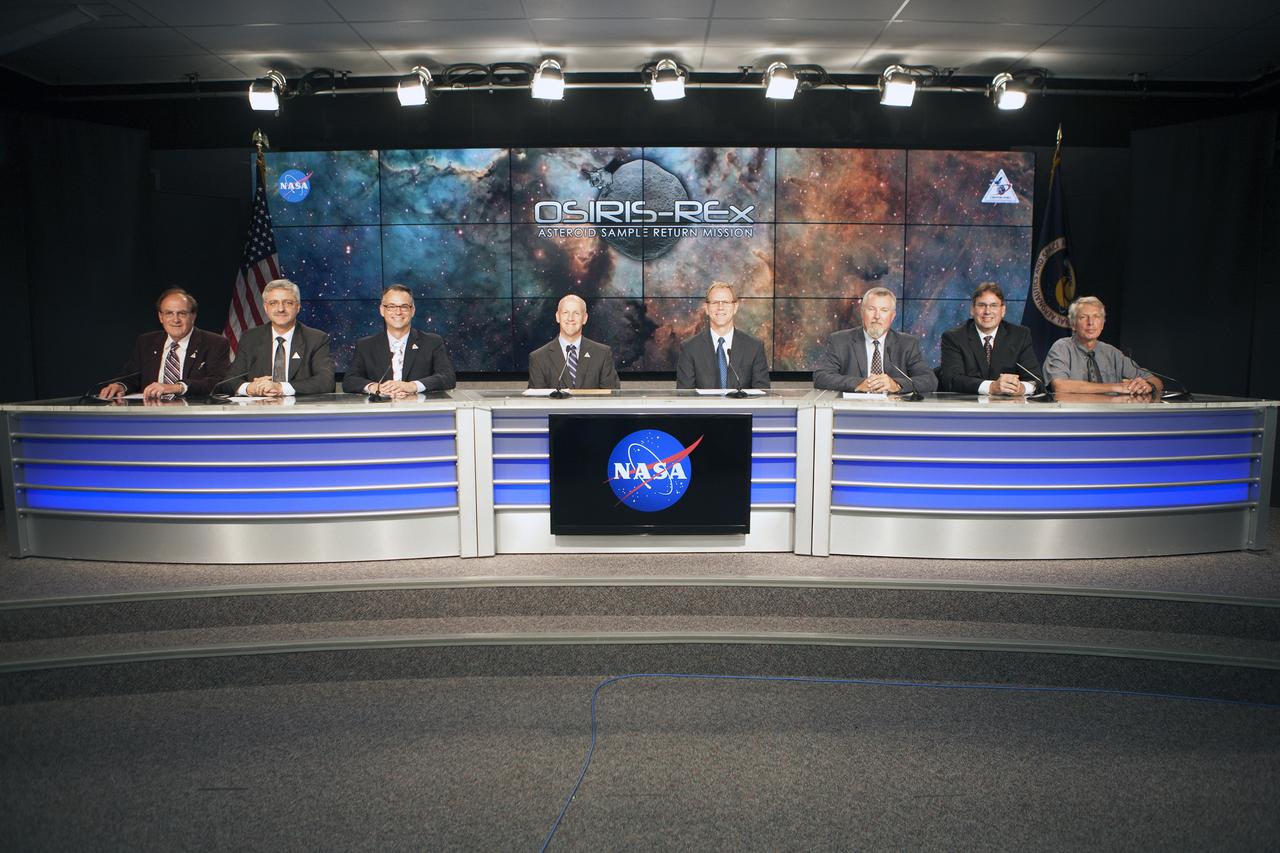
In the Kennedy Space Center’s Press Site auditorium, NASA and industry leaders speak to members of the media at a prelaunch news conference for the agency’s Origins, Spectral Interpretation, Resource Identification, Security-Regolith Explorer, or OSIRIS-REx spacecraft. From left are: George Diller of NASA Communications; Geoffrey Yoder, acting associate administrator of NASA’s Science Mission Directorate in Washington; Dante Lauretta, OSIRIS-REx principal investigator at the University of Arizona, Tucson; Tim Dunn, NASA launch manager at Kennedy; Scott Messer, program manager for NASA missions at United Launch Alliance in Centennial, Colorado; Michael Donnelly, OSIRIS-REx project manager at NASA’s Goddard Space Flight Center in Greenbelt, Maryland; Rich Kuhns, OSIRIS-REx program manager for Lockheed Martin Space Systems in Denver; and Clay Flinn, launch weather officer for the 45th Weather Squadron at Cape Canaveral Air Force Station, Florida.
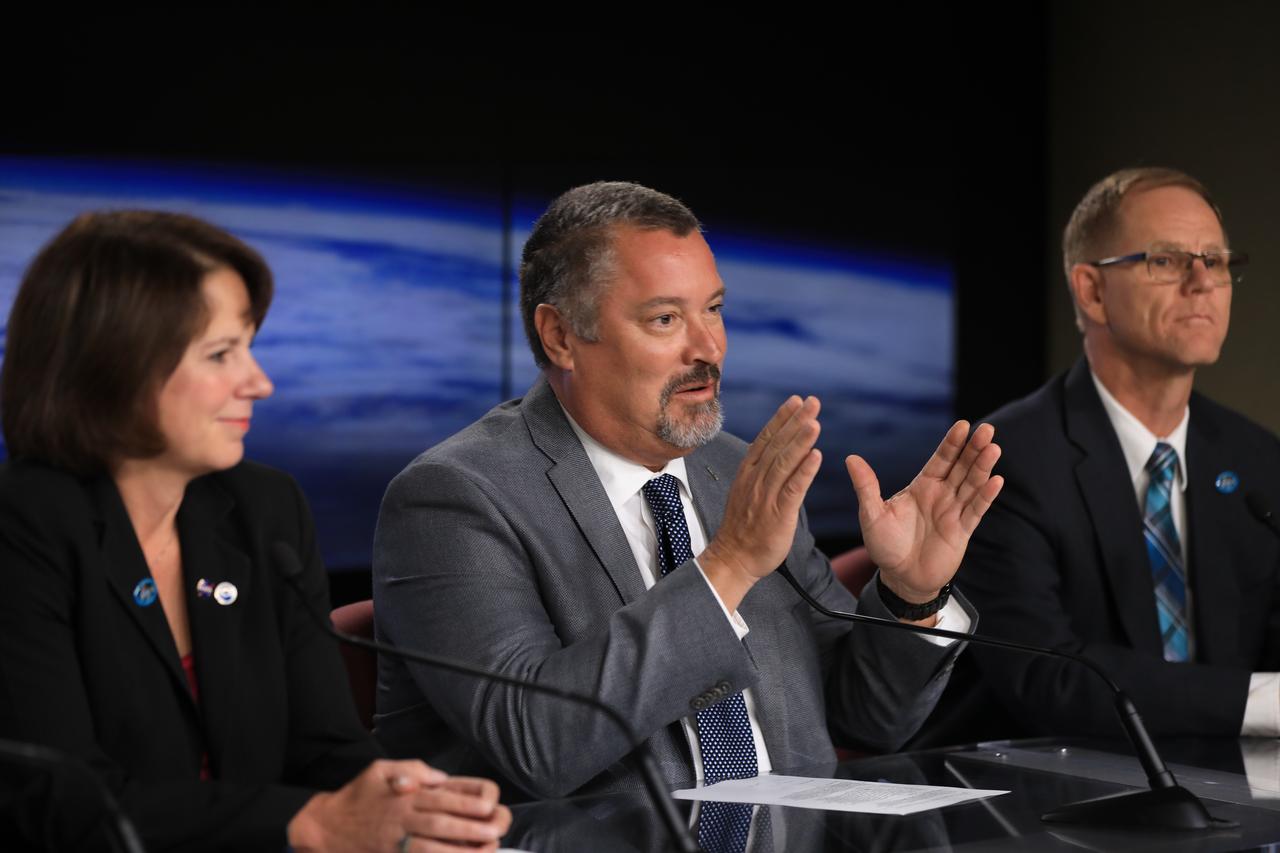
At Vandenberg Air Force Base in California, NASA and industry leaders speak to members of the media at a prelaunch news conference for the Joint Polar Satellite System-1, or JPSS-1. Participants, from left, are Sandra Smalley, director of the Joint Agency Satellite Division at NASA Headquarters, Omar Baez, NASA launch director, and Scott Messer, United Launch Alliance program manager for NASA missions. Built by Ball Aerospace and Technologies Corp. of Boulder, Colorado, JPSS is the first in a series four next-generation environmental satellites in a collaborative program between the NOAA and NASA. Liftoff atop a United Launch Alliance Delta II rocket is scheduled to take place from Vandenberg's Space Launch Complex 2 at 1:47 a.m. PST (4:47 a.m. EST), on Nov. 14, 2017.
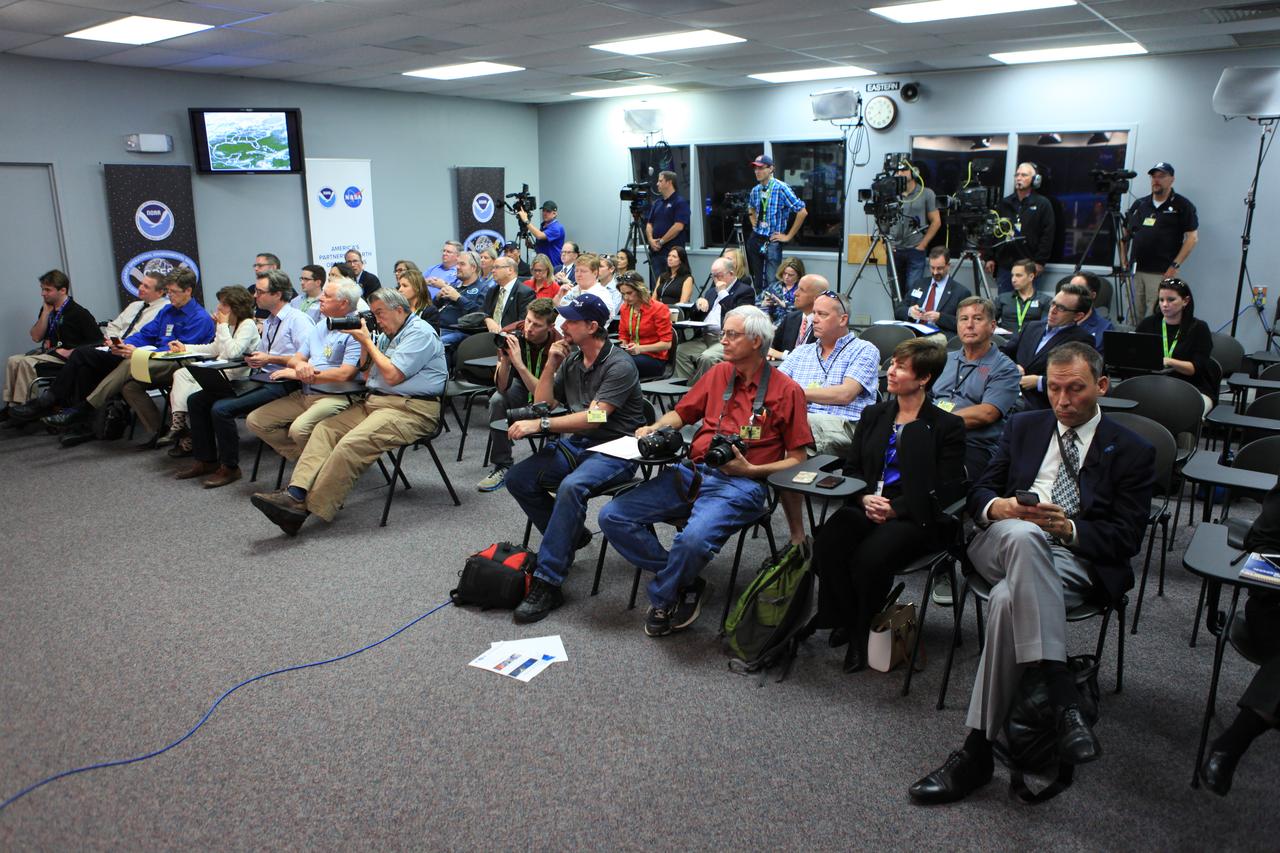
Members of the news media attend a Geostationary Operational Environmental Satellite (GOES-R) prelaunch news conference in the Kennedy Space Center's Press Site auditorium in Florida. NASA and industry leaders include: Michael Curie, of NASA Communications; Stephen Volz, assistant administrator for satellite and information services, National Oceanic and Atmospheric Administration (NOAA's); Greg Mandt, GOES-R system program director, NOAA; Sandra Smalley, director, Joint Agency Satellite Division, NASA Headquarters; Omar Baez, launch director, NASA Kennedy; Scott Messer, program manager, NASA Missions, United Launch Alliance; and Clay Flinn, launch weather officer, 4th Weather Squadron, Cape Canaveral Air Force Station.
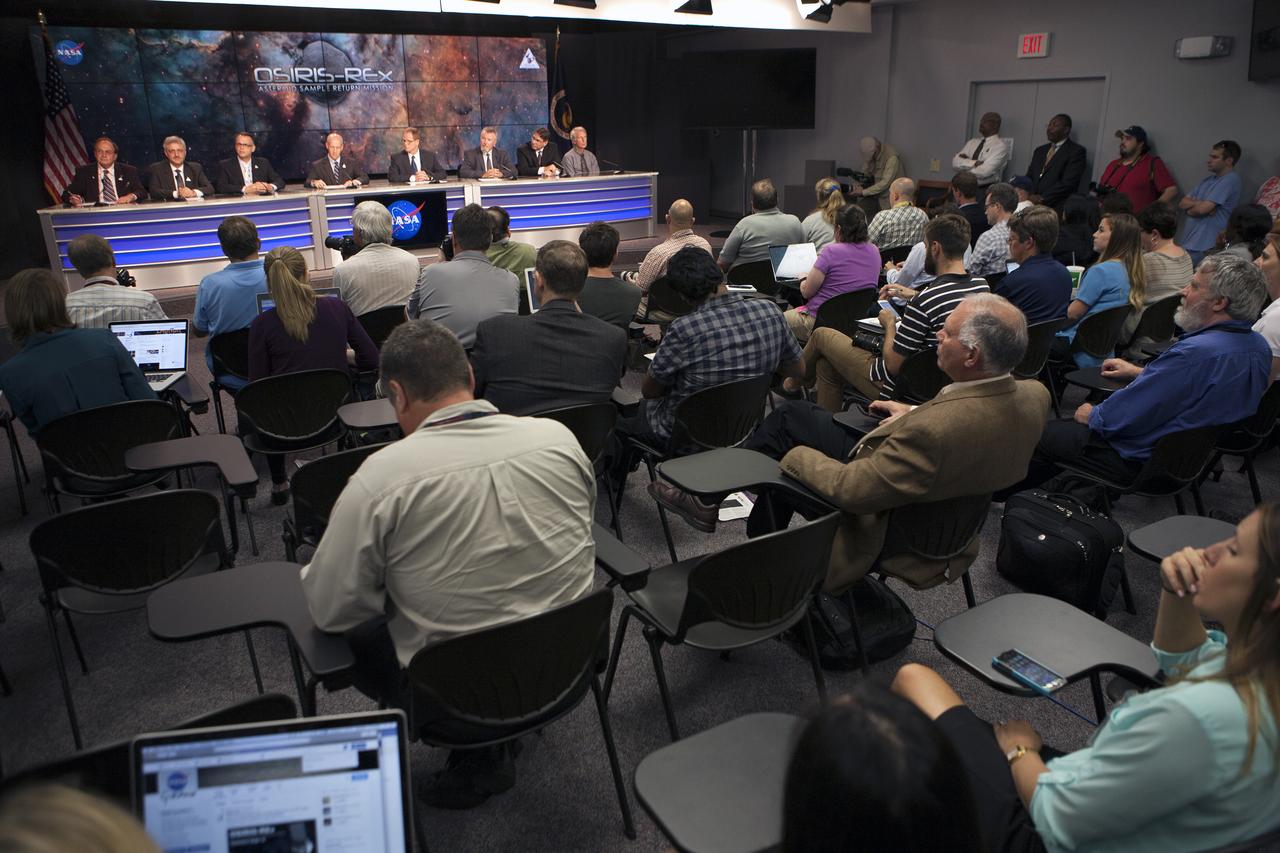
In the Kennedy Space Center’s Press Site auditorium, NASA and industry leaders speak to members of the media at a prelaunch news conference for the agency’s Origins, Spectral Interpretation, Resource Identification, Security-Regolith Explorer, or OSIRIS-REx spacecraft. From left are: George Diller of NASA Communications; Geoffrey Yoder, acting associate administrator of NASA’s Science Mission Directorate in Washington; Dante Lauretta, OSIRIS-REx principal investigator at the University of Arizona, Tucson; Tim Dunn, NASA launch manager at Kennedy; Scott Messer, program manager for NASA missions at United Launch Alliance in Centennial, Colorado; Michael Donnelly, OSIRIS-REx project manager at NASA’s Goddard Space Flight Center in Greenbelt, Maryland; Rich Kuhns, OSIRIS-REx program manager for Lockheed Martin Space Systems in Denver; and Clay Flinn, launch weather officer for the 45th Weather Squadron at Cape Canaveral Air Force Station, Florida.
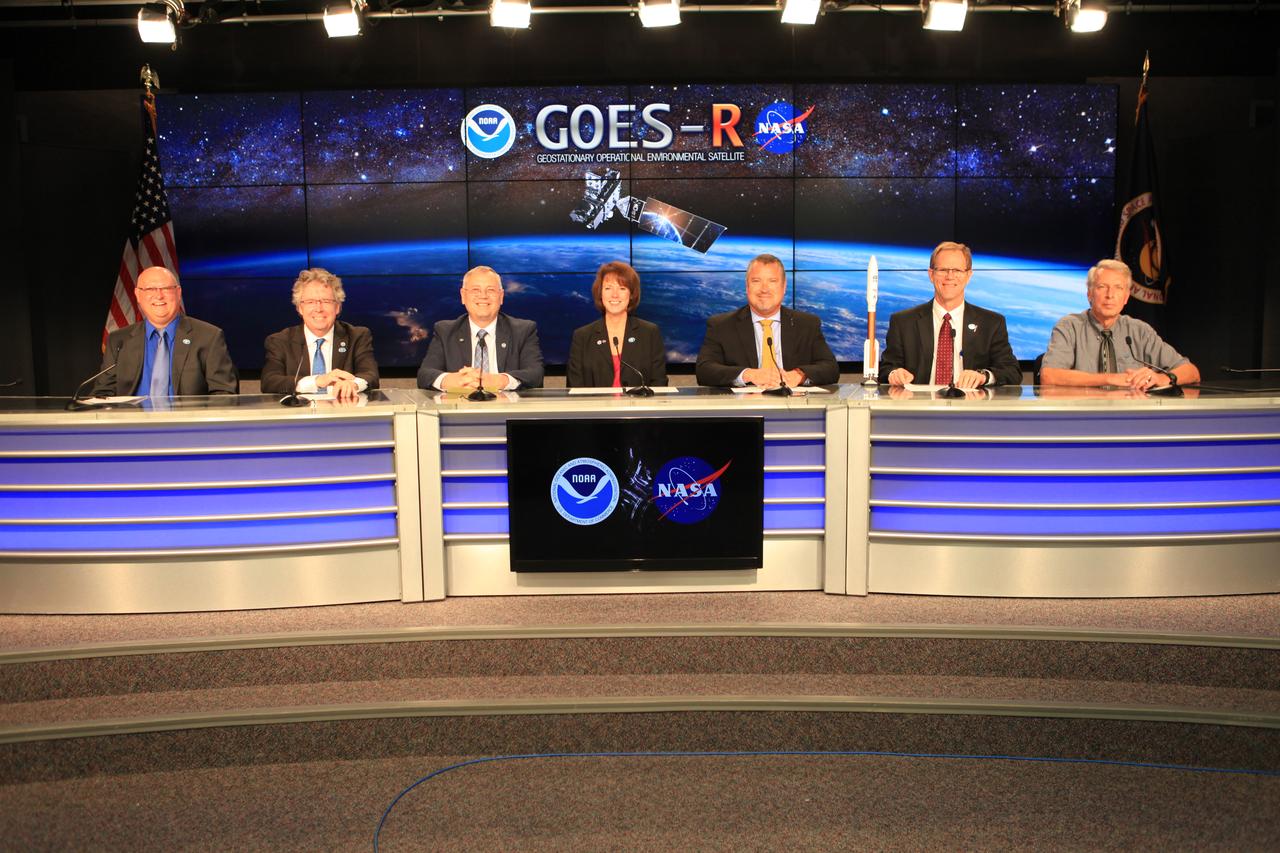
NASA and industry leaders participate in a Geostationary Operational Environmental Satellite (GOES-R), prelaunch news conference in the Kennedy Space Center's Press Site auditorium in Florida. NASA and industry leaders include: Michael Curie, of NASA Communications; Stephen Volz, assistant administrator for satellite and information services, National Oceanic and Atmospheric Administration (NOAA's); Greg Mandt, GOES-R system program director, NOAA; Sandra Smalley, director, Joint Agency Satellite Division, NASA Headquarters; Omar Baez, launch director, NASA Kennedy; Scott Messer, program manager, NASA Missions, United Launch Alliance; and Clay Flinn, launch weather officer, 4th Weather Squadron, Cape Canaveral Air Force Station.
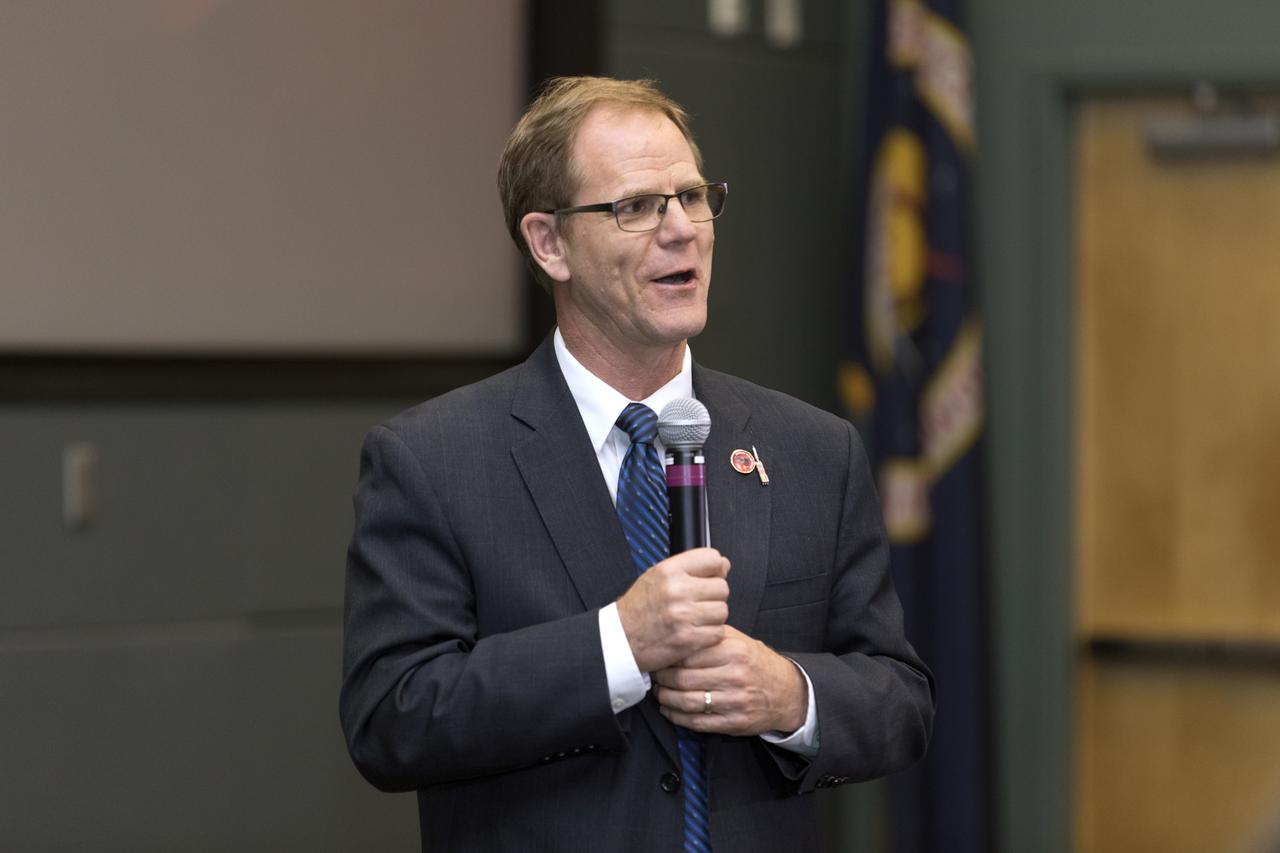
In the Kennedy Space Center's Operations and Support Building II, Thursday, Aug. 9, 2018, members of the media participate in a prelaunch mission briefing on NASA's Parker Solar Probe. Speaking to the media is Scott Messer, program manager, NASA Programs, United Launch Alliance. The Parker Solar Probe will lift off on a United Launch Alliance Delta IV Heavy rocket from Space Launch Complex 37 at Cape Canaveral Air Force Station in Florida. The spacecraft was built by Applied Physics Laboratory of Johns Hopkins University in Laurel, Maryland. The mission will perform the closest-ever observations of a star when it travels through the Sun's atmosphere, called the corona. The probe will rely on measurements and imaging to revolutionize our understanding of the corona and the Sun-Earth connection.
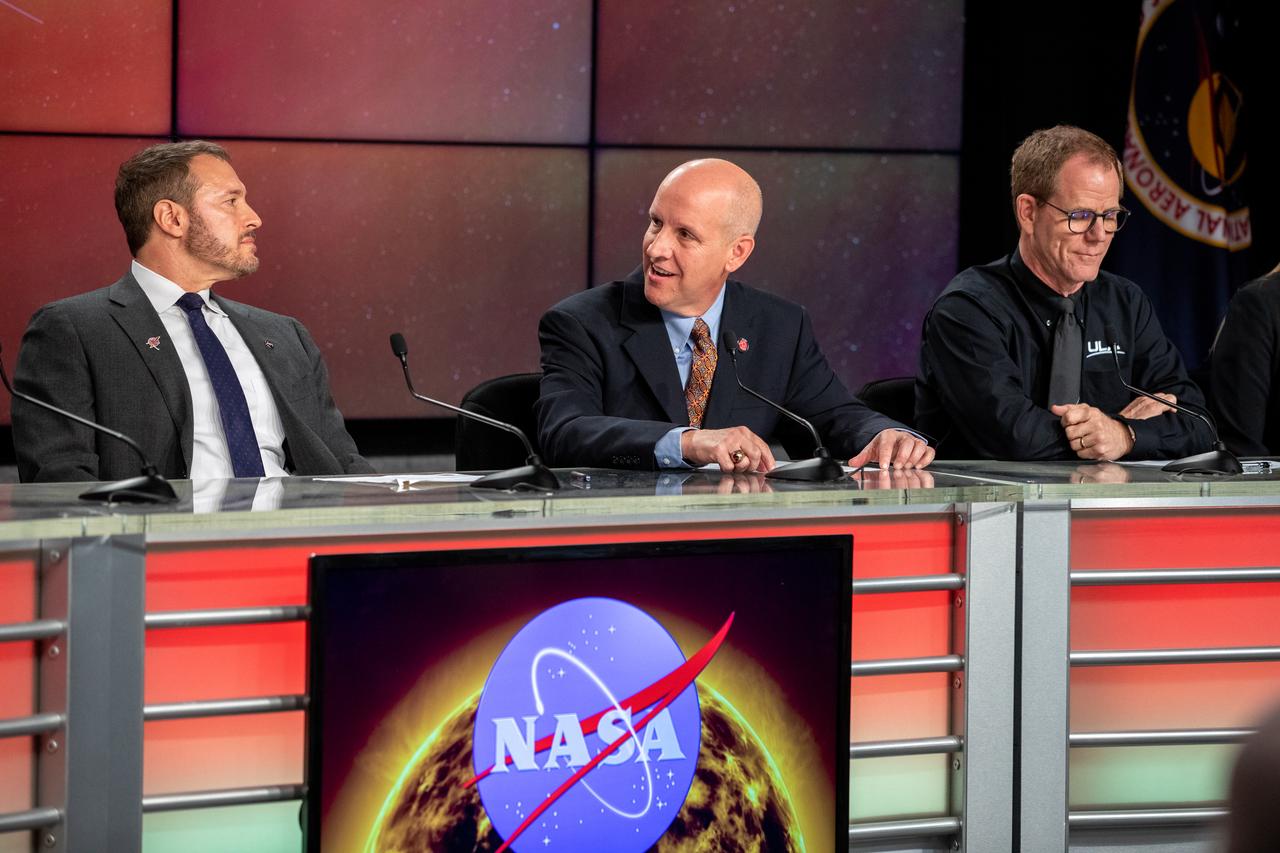
From left, Alan Zide, Solar Orbiter Program executive, NASA Headquarters; Tim Dunn, launch director, NASA Launch Services Program (LSP); and Scott Messer, NASA LSP Program Manager, United Launch Alliance, participate in a prelaunch news conference for the Solar Orbiter mission at NASA’s Kennedy Space Center in Florida on Feb. 7, 2020. Solar Orbiter is an international cooperative mission between ESA (European Space Agency) and NASA. The mission aims to study the Sun, its outer atmosphere and solar wind. The spacecraft will provide the first images of the Sun’s poles. The spacecraft was developed by Airbus Defence and Space. NASA’s Launch Services Program based at Kennedy is managing the launch. Solar Orbiter will launch aboard a United Launch Alliance Atlas V rocket on Feb. 9, 2020, from Space Launch Complex 41 at Cape Canaveral Air Force Station.
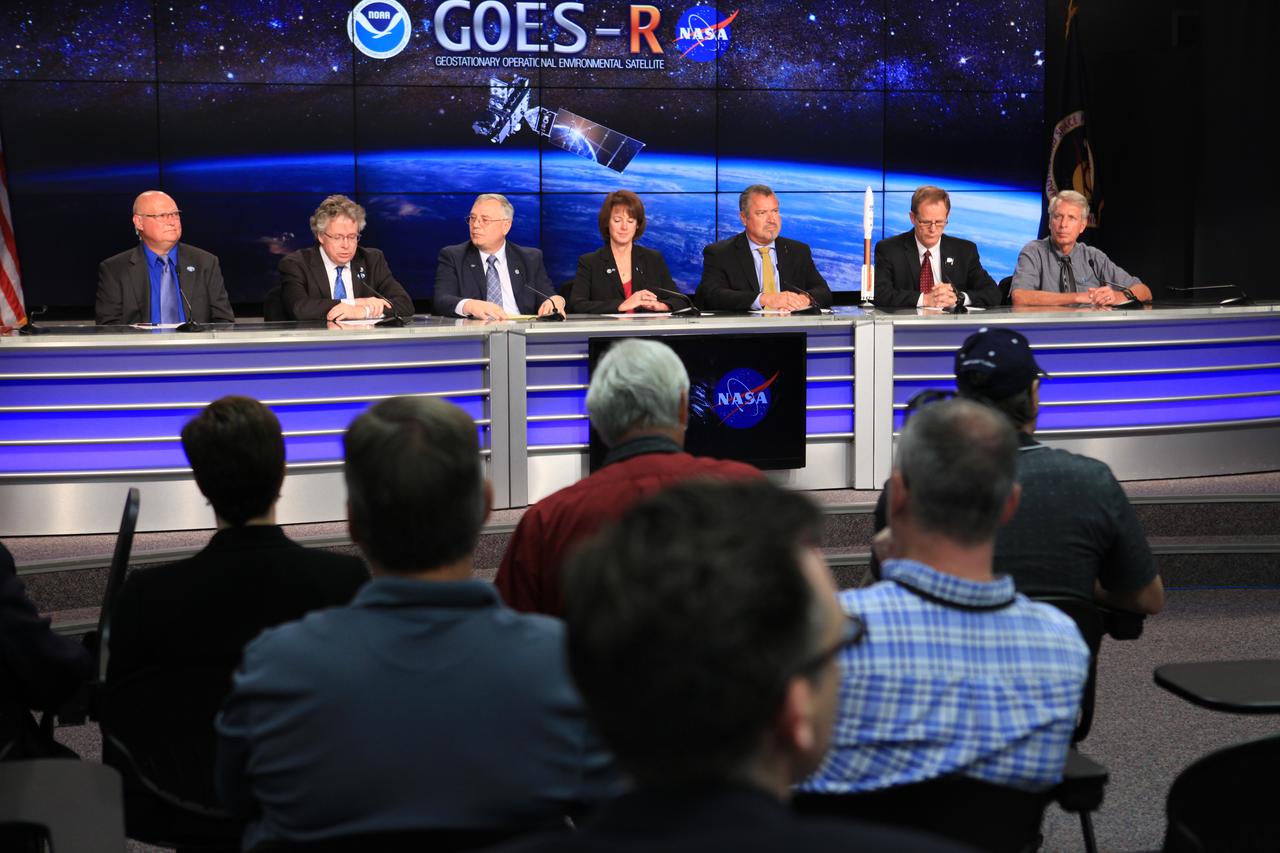
NASA and industry leaders participate in a Geostationary Operational Environmental Satellite (GOES-R), prelaunch news conference in the Kennedy Space Center's Press Site auditorium in Florida. NASA and industry leaders include: Michael Curie, of NASA Communications; Stephen Volz, assistant administrator for satellite and information services, National Oceanic and Atmospheric Administration (NOAA's); Greg Mandt, GOES-R system program director, NOAA; Sandra Smalley, director, Joint Agency Satellite Division, NASA Headquarters; Omar Baez, launch director, NASA Kennedy; Scott Messer, program manager, NASA Missions, United Launch Alliance; and Clay Flinn, launch weather officer, 4th Weather Squadron, Cape Canaveral Air Force Station.
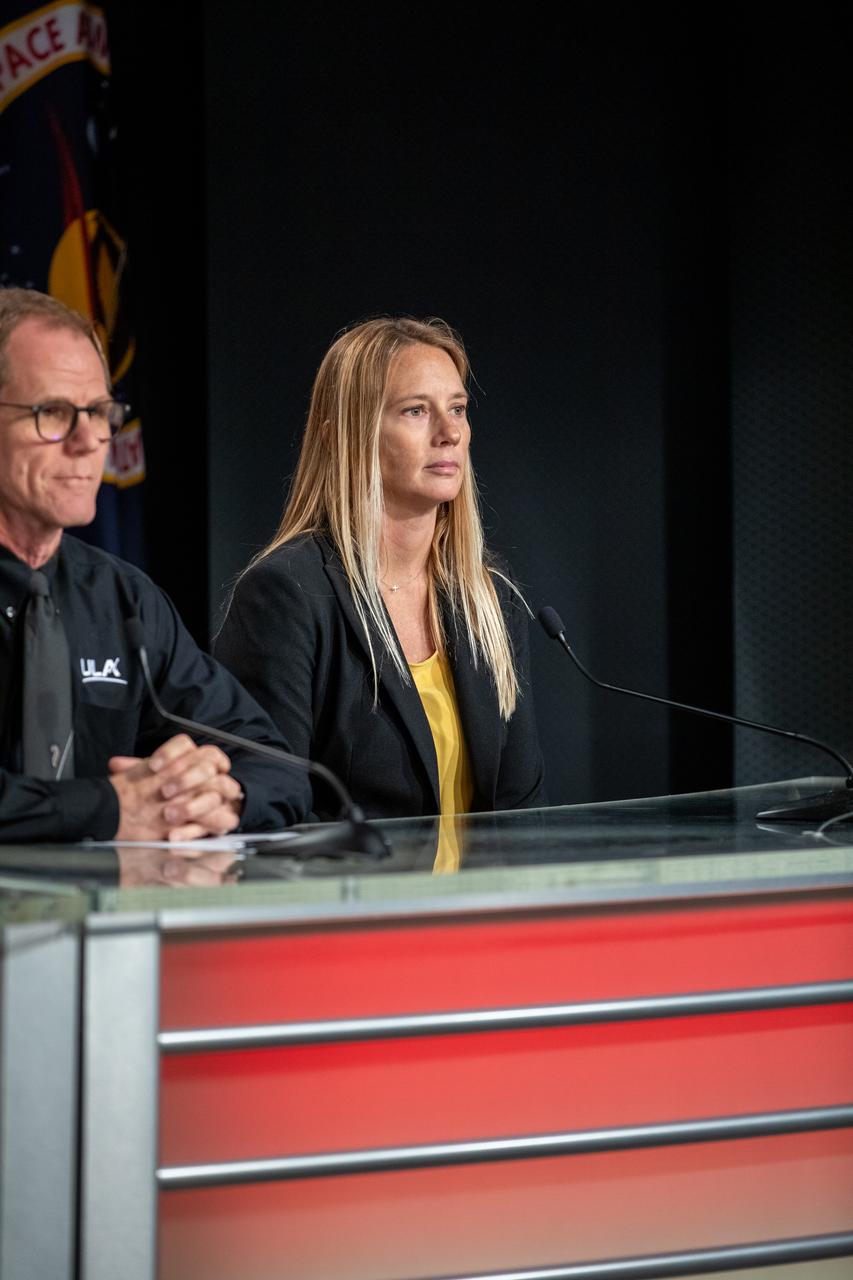
From left, Scott Messer, NASA LSP Program manager, United Launch Alliance; and Jessica Williams, 45th Space Wing Weather officer, participate in a prelaunch news conference for the Solar Orbiter mission at NASA’s Kennedy Space Center in Florida on Feb. 7, 2020. Solar Orbiter is an international cooperative mission between ESA (European Space Agency) and NASA. The mission aims to study the Sun, its outer atmosphere and solar wind. The spacecraft will provide the first images of the Sun’s poles. The spacecraft was developed by Airbus Defence and Space. NASA’s Launch Services Program based at Kennedy is managing the launch. Solar Orbiter will launch aboard a United Launch Alliance Atlas V rocket on Feb. 9, 2020, from Space Launch Complex 41 at Cape Canaveral Air Force Station.
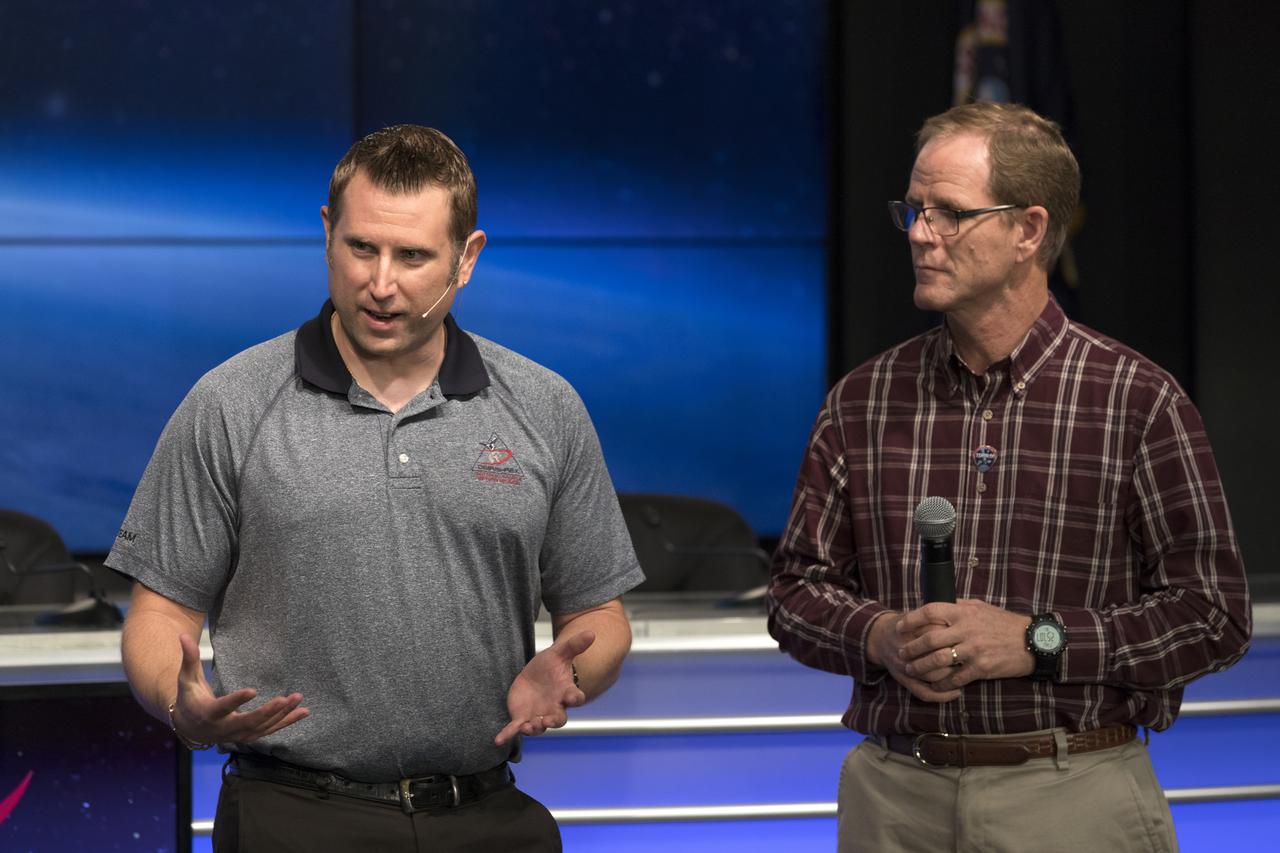
Skip Owen of NASA Launch Services, left and Scott Messer, United Launch Alliance program manager for NASA missions speak to members of social media in the Kennedy Space Center’s Press Site auditorium. The briefing focused on preparations to launch NASA's Tracking and Data Relay Satellite, TDRS-M. The latest spacecraft destined for the agency's constellation of communications satellites, TDRS-M will allow nearly continuous contact with orbiting spacecraft ranging from the International Space Station and Hubble Space Telescope to the array of scientific observatories. Liftoff atop a United Launch Alliance Atlas V rocket is scheduled to take place from Space Launch Complex 41 at Cape Canaveral Air Force Station at 8:03 a.m. EDT Aug. 18.
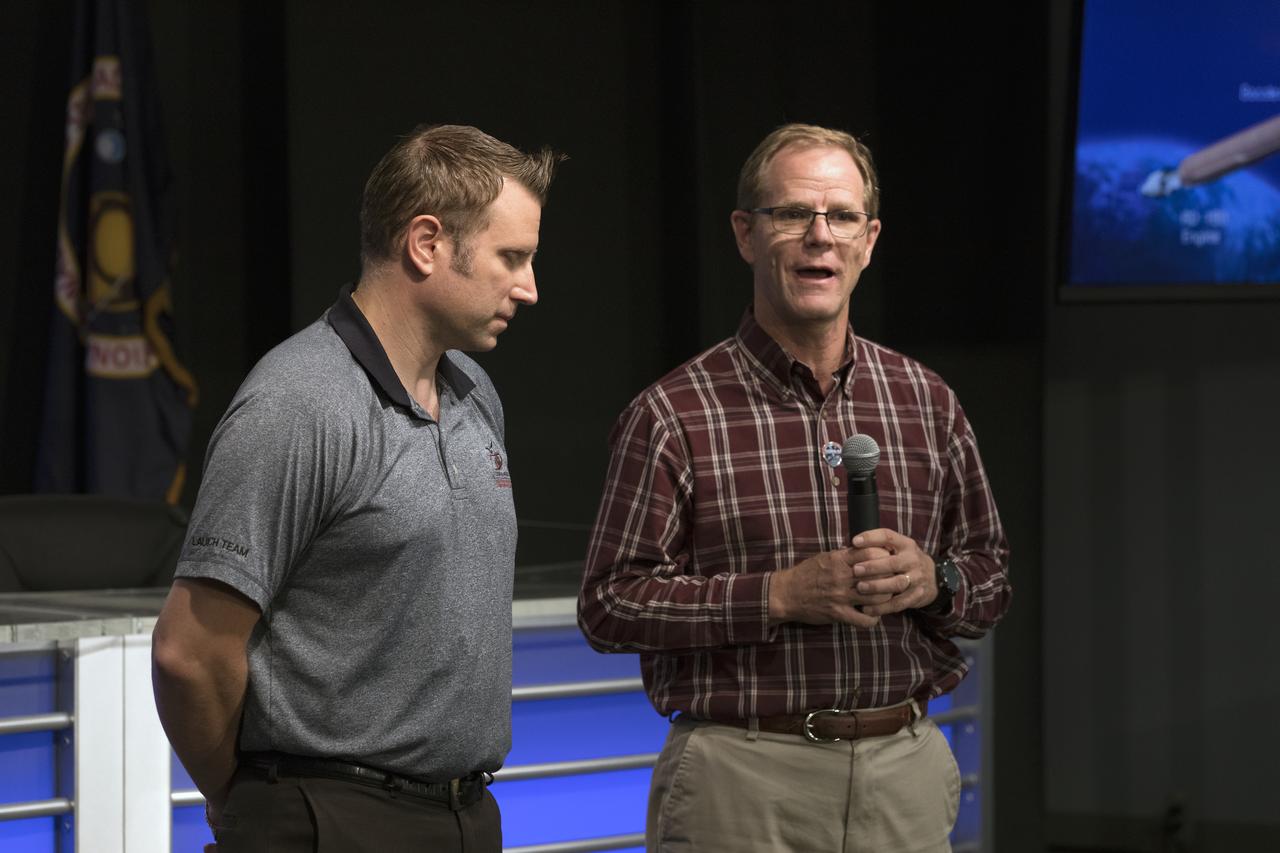
Skip Owen of NASA Launch Services, left and Scott Messer, United Launch Alliance program manager for NASA missions speak to members of social media in the Kennedy Space Center’s Press Site auditorium. The briefing focused on preparations to launch NASA's Tracking and Data Relay Satellite, TDRS-M. The latest spacecraft destined for the agency's constellation of communications satellites, TDRS-M will allow nearly continuous contact with orbiting spacecraft ranging from the International Space Station and Hubble Space Telescope to the array of scientific observatories. Liftoff atop a United Launch Alliance Atlas V rocket is scheduled to take place from Space Launch Complex 41 at Cape Canaveral Air Force Station at 8:03 a.m. EDT Aug. 18.
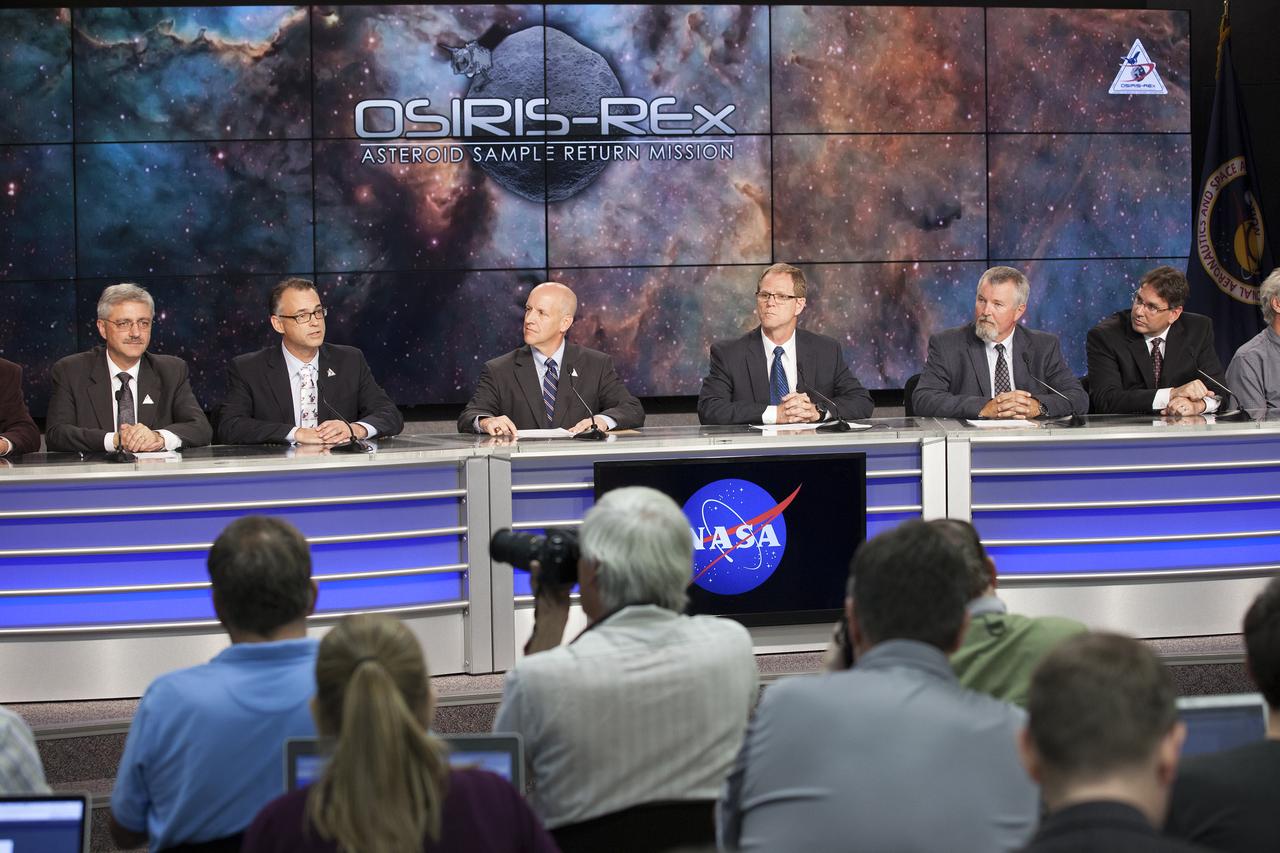
In the Kennedy Space Center’s Press Site auditorium, NASA and industry leaders speak to members of the media at a prelaunch news conference for the agency’s Origins, Spectral Interpretation, Resource Identification, Security-Regolith Explorer, or OSIRIS-REx spacecraft. From left are: Geoffrey Yoder, acting associate administrator of NASA’s Science Mission Directorate in Washington; Dante Lauretta, OSIRIS-REx principal investigator at the University of Arizona, Tucson; Tim Dunn, NASA launch manager at Kennedy; Scott Messer, program manager for NASA missions at United Launch Alliance in Centennial, Colorado; Michael Donnelly, OSIRIS-REx project manager at NASA’s Goddard Space Flight Center in Greenbelt, Maryland; and Rich Kuhns, OSIRIS-REx program manager for Lockheed Martin Space Systems in Denver.

At Vandenberg Air Force Base in California, NASA and industry leaders speak to members of the media at a prelaunch news conference for the Joint Polar Satellite System-1, or JPSS-1. Participants, from left, are Steve Volz, director of NOAA’s Satellite and Information Service, Greg Mandt, director of the NOAA Joint Polar Satellite System Program, Sandra Smalley, director of the Joint Agency Satellite Division at NASA Headquarters, Omar Baez, NASA launch director, and Scott Messer, United Launch Alliance program manager for NASA missions. Built by Ball Aerospace and Technologies Corp. of Boulder, Colorado, JPSS is the first in a series four next-generation environmental satellites in a collaborative program between the NOAA and NASA. Liftoff atop a United Launch Alliance Delta II rocket is scheduled to take place from Vandenberg's Space Launch Complex 2 at 1:47 a.m. PST (4:47 a.m. EST), on Nov. 14, 2017.
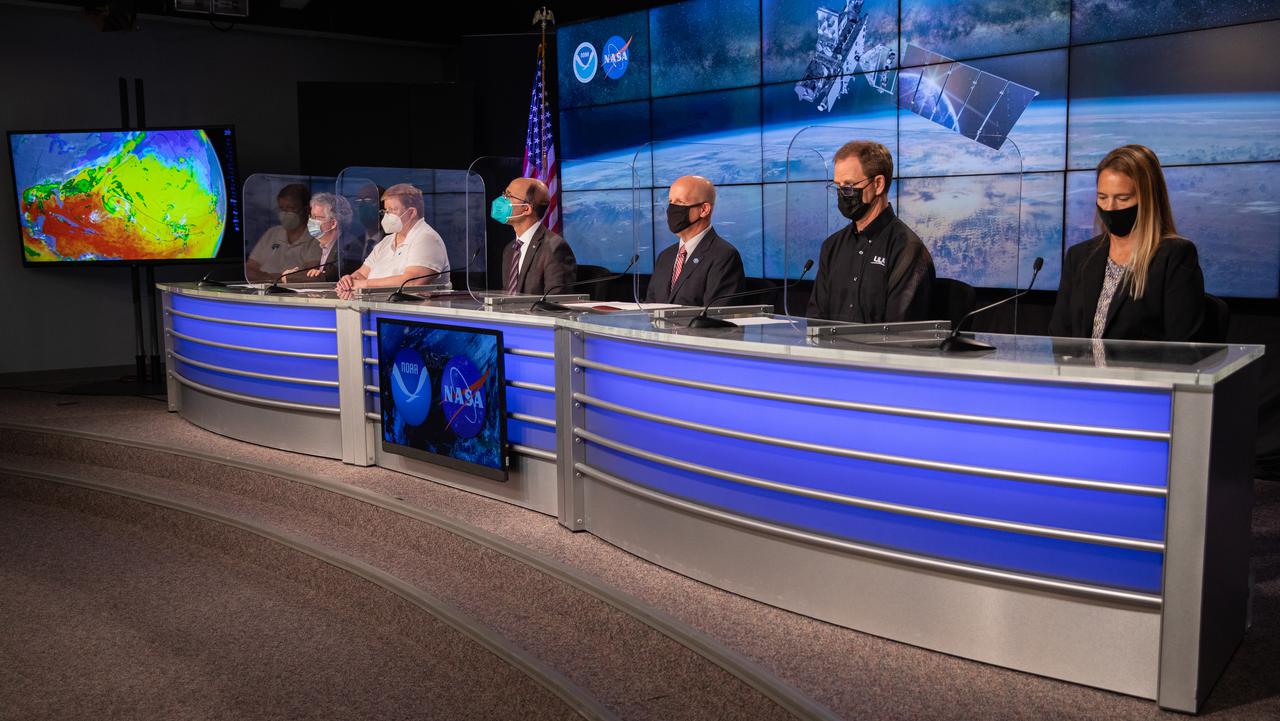
A prelaunch news conference for the National Oceanic and Atmospheric Administration’s (NOAA) Geostationary Operational Environmental Satellite-T (GOES-T) is held on Feb. 26, 2022, at NASA’s Kennedy Space Center in Florida. Participating, from left are Jasmine Hopkins, moderator, NASA Communications; Steve Volz, assistant administrator for Satellite and Information Services, NOAA; Pam Sullivan, director, GOES-R Program, NOAA; John Gagosian, director, Joint Agency Satellite Division, NASA Headquarters Science Mission Directorate; Tim Dunn, launch director, NASA’s Launch Services Program, Kennedy Space Center; Scott Messer, program manager, NASA Launch Services, United Launch Alliance; and Jessica Williams, launch weather officer, 45th Weather Squadron, Space Launch Delta 45. GOES-T is scheduled to lift off on a United Launch Alliance Atlas V 541 rocket from Space Launch Complex 41 at Cape Canaveral Space Force Station in Florida on March 1, 2022, at 4:38 p.m. GOES-T is the third satellite in the GOES-R series that will continue to help meteorologists observe and predict local weather events that affect public safety. The launch is being managed by NASA’s Launch Services Program based at Kennedy Space Center in Florida, America’s multi-user spaceport.
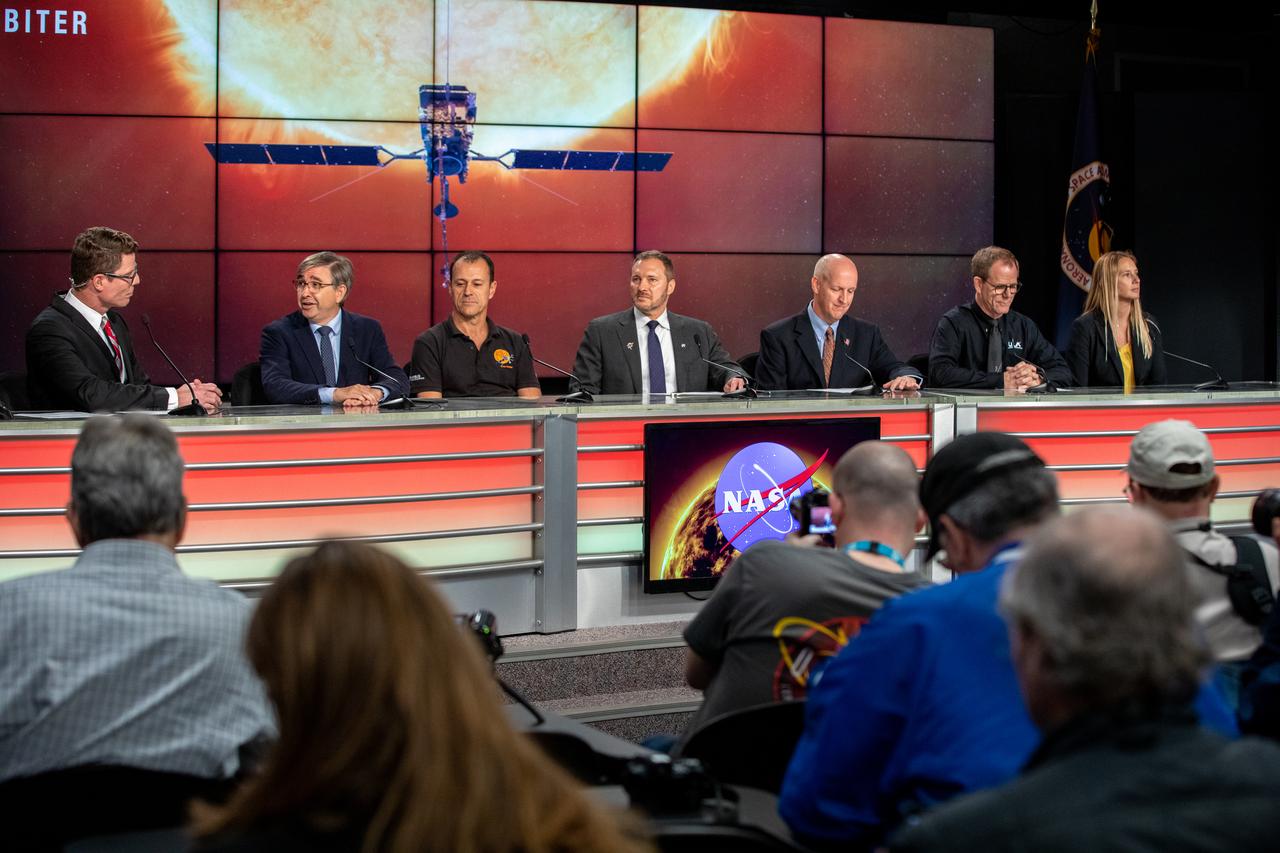
Derrol Nail, far left, NASA Communications, moderates a prelaunch news conference for the Solar Orbiter mission at NASA’s Kennedy Space Center in Florida on Feb. 7, 2020. From his left are Cesar Garcia, Solar Orbiter Project manager, European Space Agency; Ian Walters, Solar Orbiter project manager, Airbus Defence and Space; Alan Zide, Solar Orbiter Program executive, NASA Headquarters; Tim Dunn, Launch Director, NASA Launch Services Program (LSP); Scott Messer, NASA LSP Program manager, United Launch Alliance; and Jessica Williams, 45th Space Wing Weather officer. Solar Orbiter is an international cooperative mission between ESA (European Space Agency) and NASA. The mission aims to study the Sun, its outer atmosphere and solar wind. The spacecraft will provide the first images of the Sun’s poles. The spacecraft was developed by Airbus Defence and Space. NASA’s Launch Services Program based at Kennedy is managing the launch. Solar Orbiter will launch aboard a United Launch Alliance Atlas V rocket on Feb. 9, 2020, from Space Launch Complex 41 at Cape Canaveral Air Force Station.
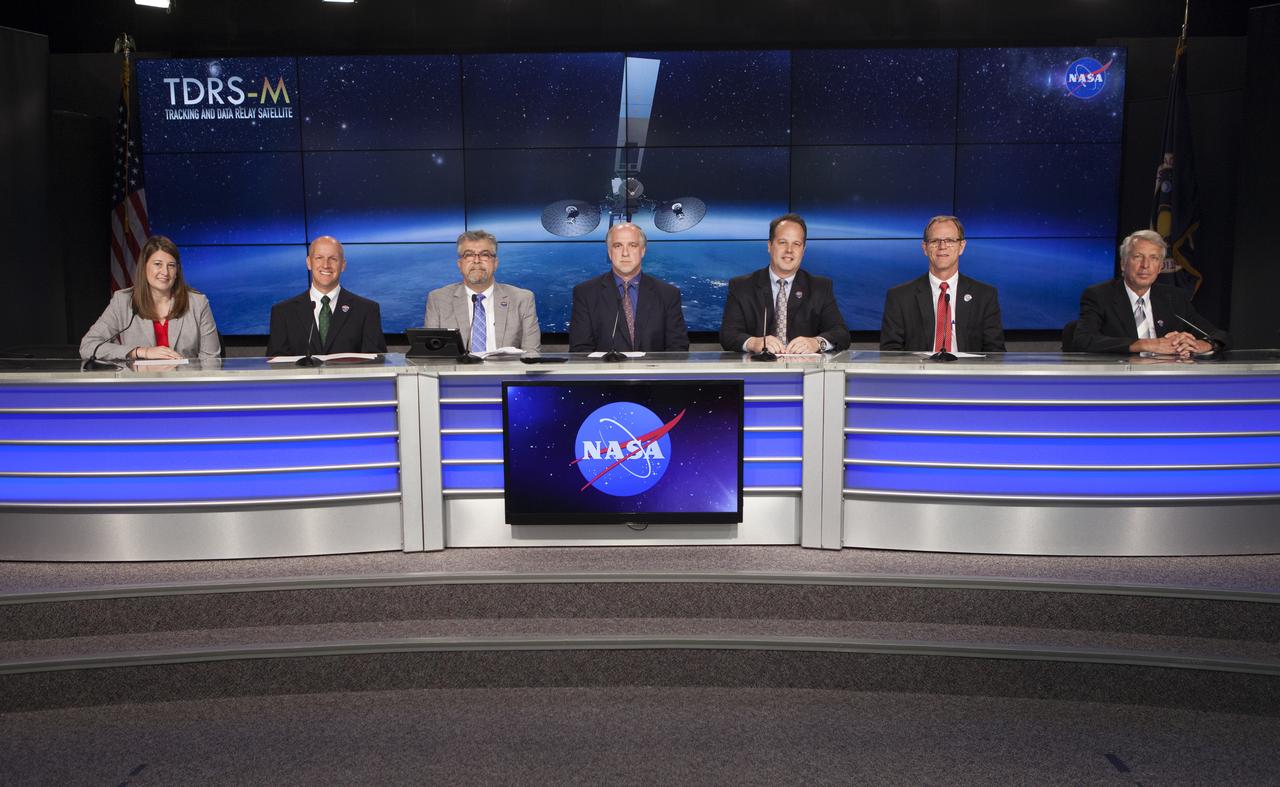
In the Kennedy Space Center's Press Site auditorium, NASA and industry leaders speak to members of the media at a prelaunch news conference for NASA's Tracking and Data Relay Satellite, TDRS-M. Participants from left are: Kathryn Hambleton of NASA Communications, Tim Dunn, launch director at NASA Kennedy, Badri Younes, deputy associate administrator for Space Communications and Navigation at NASA Headquarters in Washington, Dave Littmann, project manager for TDRS-M at NASA’s Goddard Space Flight Center in Greenbelt, Maryland, James Wilson III, Boeing program manager for NASA/Civil Space Programs, Scott Messer, United Launch Alliance program manager for NASA missions, and Clay Flinn, launch weather officer with the 45th Space Wing at Cape Canaveral Air Force Station. TDRS-M is the latest spacecraft destined for the agency's constellation of communications satellites that allows nearly continuous contact with orbiting spacecraft ranging from the International Space Station and Hubble Space Telescope to the array of scientific observatories. Liftoff atop a United Launch Alliance Atlas V rocket is scheduled to take place from Space Launch Complex 41 at Cape Canaveral Air Force Station at 8:03 a.m. EDT Aug. 18.
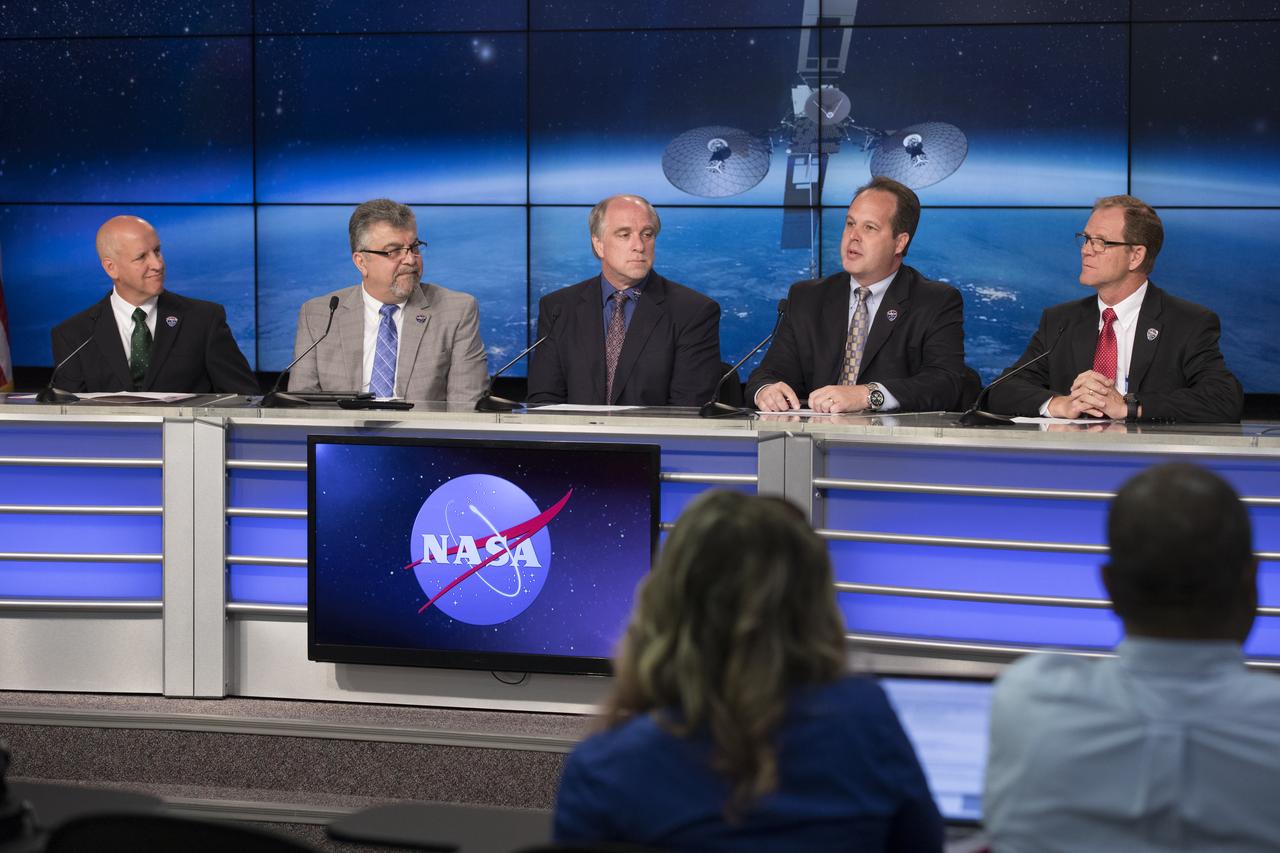
In the Kennedy Space Center's Press Site auditorium, NASA and industry leaders speak to members of the media at a prelaunch news conference for NASA's Tracking and Data Relay Satellite, TDRS-M. Participants from left are: Tim Dunn, launch director at NASA Kennedy, Badri Younes, deputy associate administrator for Space Communications and Navigation at NASA Headquarters in Washington, Dave Littmann, project manager for TDRS-M at NASA’s Goddard Space Flight Center in Greenbelt, Maryland, James Wilson III, Boeing program manager for NASA/Civil Space Programs, and Scott Messer, United Launch Alliance program manager for NASA missions. TDRS-M is the latest spacecraft destined for the agency's constellation of communications satellites that allows nearly continuous contact with orbiting spacecraft ranging from the International Space Station and Hubble Space Telescope to the array of scientific observatories. Liftoff atop a United Launch Alliance Atlas V rocket is scheduled to take place from Space Launch Complex 41 at Cape Canaveral Air Force Station at 8:03 a.m. EDT Aug. 18.
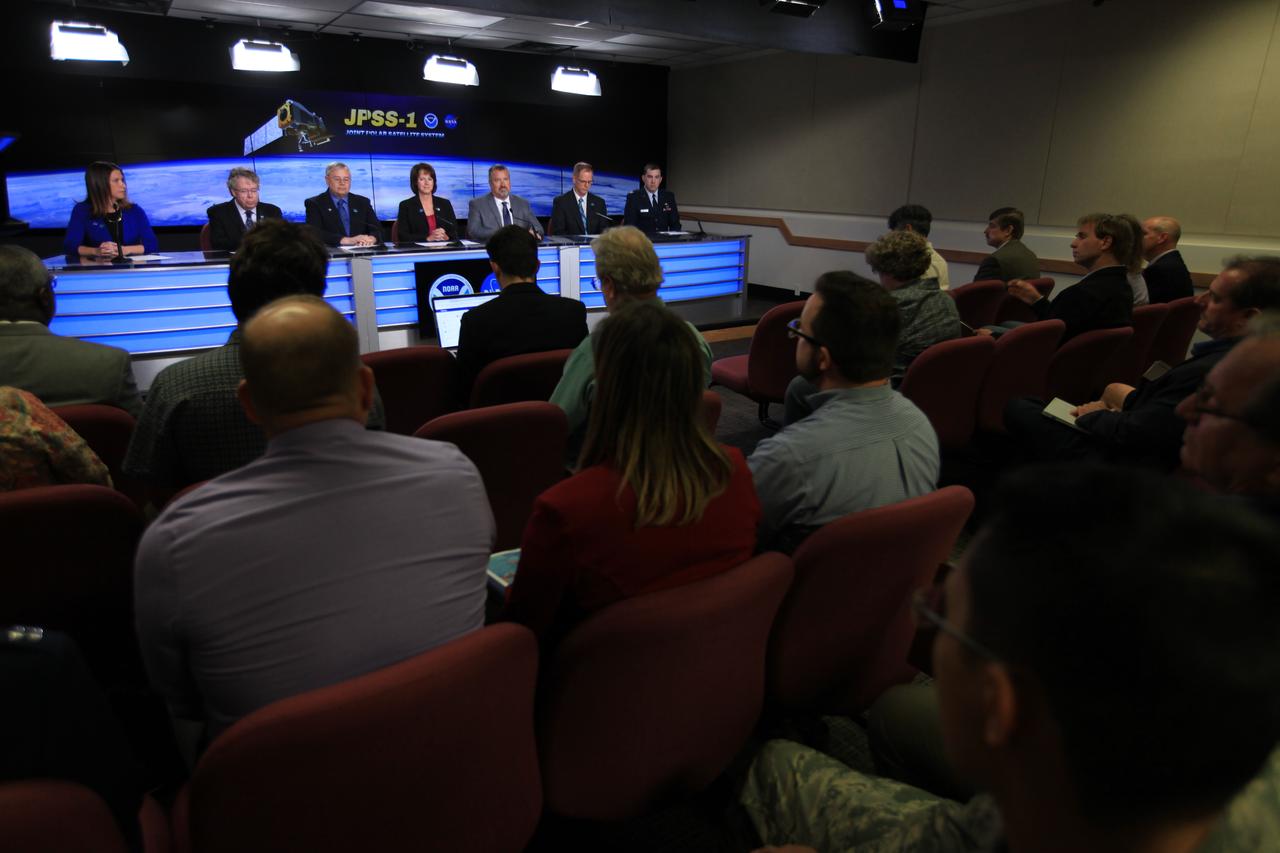
At Vandenberg Air Force Base in California, NASA and industry leaders speak to members of the media at a prelaunch news conference for the Joint Polar Satellite System-1, or JPSS-1. Participants, from left, are Tori McLendon of NASA Communications, Steve Volz, director of NOAA’s Satellite and Information Service, Greg Mandt, director of the NOAA Joint Polar Satellite System Program, Sandra Smalley, director of the Joint Agency Satellite Division at NASA Headquarters, Omar Baez, NASA launch director, Scott Messer, United Launch Alliance program manager for NASA missions, and U. S. Air Force Capt. Ross Malugani, launch weather officer at Vandenberg's 30th Space Wing. Built by Ball Aerospace and Technologies Corp. of Boulder, Colorado, JPSS is the first in a series four next-generation environmental satellites in a collaborative program between the NOAA and NASA. Liftoff atop a United Launch Alliance Delta II rocket is scheduled to take place from Vandenberg's Space Launch Complex 2 at 1:47 a.m. PST (4:47 a.m. EST), on Nov. 14, 2017.

Marie Lewis, NASA Communications, moderates a prelaunch news conference for NASA’s Landsat 9 mission at Vandenberg Space Force Base in California on Saturday, Sept. 25, 2021. Participants include Thomas Zurbuchen, associate administrator, NASA’s Science Mission Directorate; Karen St. Germain, director, NASA’s Earth Science Division; Tanya Trujillo, assistant secretary for water and science, U.S. Department of the Interior; Michael Egan, Landsat program executive, NASA’s Earth Science Division; Tim Dunn, launch director, NASA’s Launch Services Program; Scott Messer, United Launch Alliance program manager, NASA Launch Services Program; and Capt. Addison Nichols, weather officer, Space Launch Delta 30. Landsat 9 is scheduled to launch at 2:12 p.m. EDT (11:12 a.m. PDT) on Monday, Sept. 27, on a United Launch Alliance Atlas V 401 rocket from Space Launch Complex 3 at Vandenberg. The launch is managed by NASA’s Launch Services Program, based at the agency’s Kennedy Space Center in Florida. Landsat 9 will join its sister satellite, Landsat 8, in orbit in collecting images from across the planet every eight days. This calibrated data will continue the Landsat program’s critical role in monitoring the health of Earth and helping people manage essential resources, including crops, irrigation water, and forests.
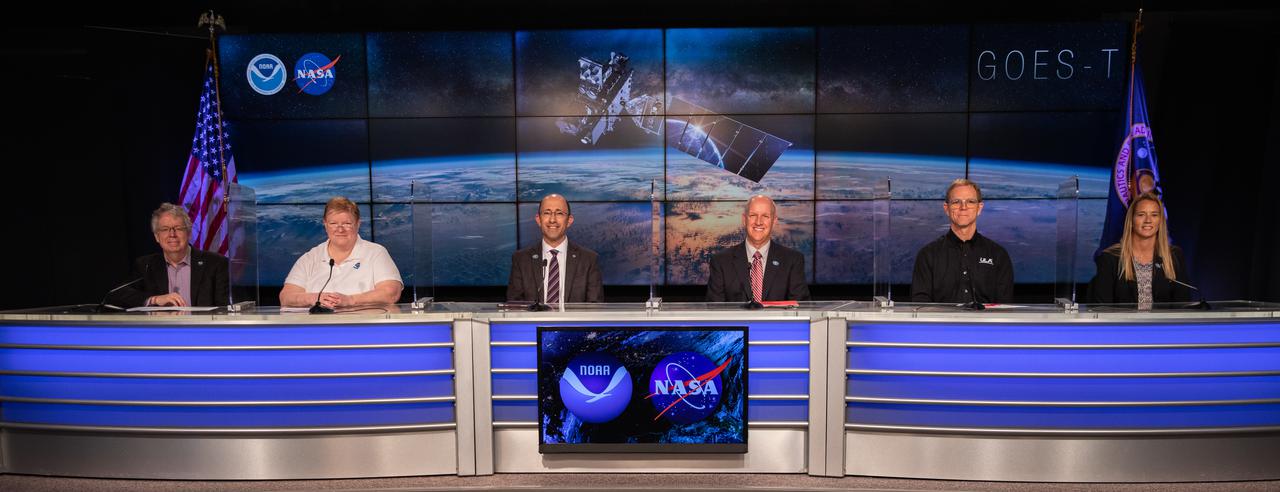
A prelaunch news conference for the National Oceanic and Atmospheric Administration’s (NOAA) Geostationary Operational Environmental Satellite-T (GOES-T) is held on Feb. 26, 2022, at NASA’s Kennedy Space Center in Florida. Participating, from left are Steve Volz, assistant administrator for Satellite and Information Services, NOAA; Pam Sullivan, director, GOES-R Program, NOAA; John Gagosian, director, Joint Agency Satellite Division, NASA Headquarters Science Mission Directorate; Tim Dunn, launch director, NASA’s Launch Services Program, Kennedy Space Center; Scott Messer, program manager, NASA Launch Services, United Launch Alliance; and Jessica Williams, launch weather officer, 45th Weather Squadron, Space Launch Delta 45. GOES-T is scheduled to lift off on a United Launch Alliance Atlas V 541 rocket from Space Launch Complex 41 at Cape Canaveral Space Force Station in Florida on March 1, 2022, at 4:38 p.m. GOES-T is the third satellite in the GOES-R series that will continue to help meteorologists observe and predict local weather events that affect public safety. The launch is being managed by NASA’s Launch Services Program based at Kennedy Space Center in Florida, America’s multi-user spaceport.
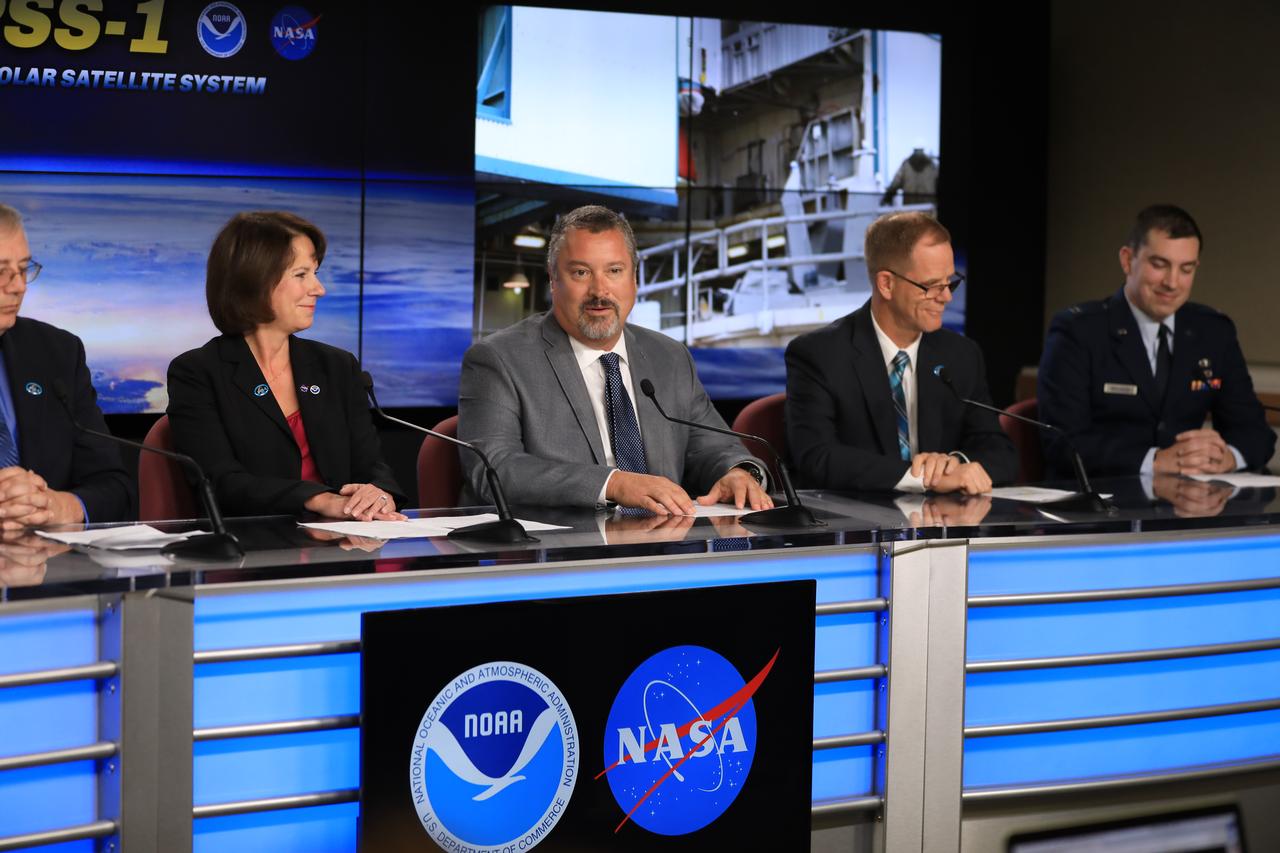
Vandenberg Air Force Base in California, NASA and industry leaders speak to members of the media at a prelaunch news conference for the Joint Polar Satellite System-1, or JPSS-1. Participants, from left, are Greg Mandt, director of the NOAA Joint Polar Satellite System Program, Sandra Smalley, director of the Joint Agency Satellite Division at NASA Headquarters, Omar Baez, NASA launch director, Scott Messer, United Launch Alliance program manager for NASA missions, and U. S. Air Force Capt. Ross Malugani, launch weather officer at Vandenberg's 30th Space Wing. Built by Ball Aerospace and Technologies Corp. of Boulder, Colorado, JPSS is the first in a series four next-generation environmental satellites in a collaborative program between the NOAA and NASA. Liftoff atop a United Launch Alliance Delta II rocket is scheduled to take place from Vandenberg's Space Launch Complex 2 at 1:47 a.m. PST (4:47 a.m. EST), on Nov. 14, 2017.
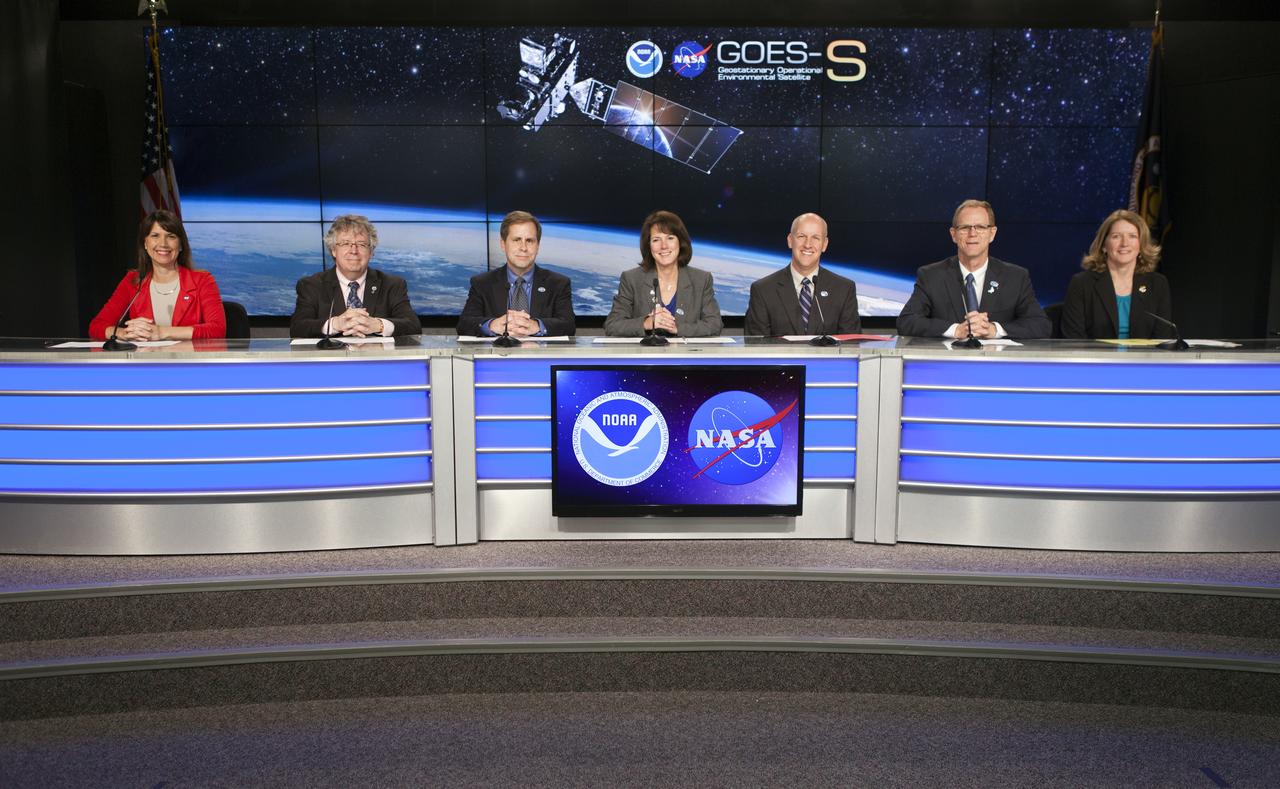
In the Kennedy Space Center's Press Site auditorium, NASA and industry leaders speak to members of the media at a prelaunch news conference about National Oceanic and Atmospheric Administration's, or NOAA's, Geostationary Operational Environmental Satellite, or GOES-S. Participants from left are: Tori McLendon of NASA Communications; Stephen Volz, director for Satellite and Information Services for NOAA; Tim Walsh, acting GOES-R System Program director for NOAA; Sandra Smalley, director of the Joint Agency Satellite Division at NASA Headquarters in Washington D.C.; Tim Dunn, NASA launch director at Kennedy; Scott Messer, manager of NASA Programs for United launch Alliance; and Kathy Winters, launch weather officer for the U.S. Air Force 45th Weather Squadron at Cape Canaveral Air Force Station. The GOES series of satellites will significantly improve the detection and observation of environmental phenomena that directly affect public safety, protection of property and the nation's economic health and prosperity. GOES-S is slated to lift off at 5:02 p.m. EST on March 1, 2018 aboard a United Launch Alliance Atlas V rocket.
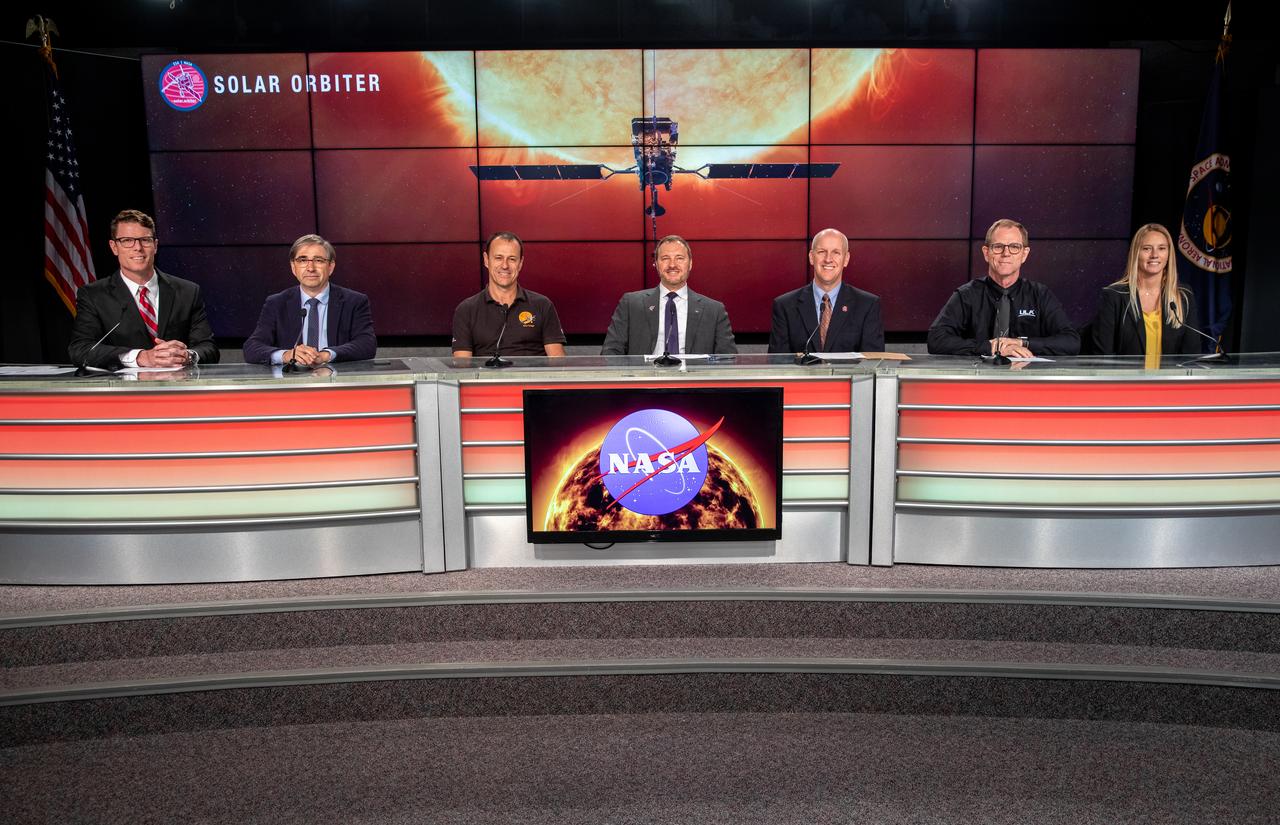
Derrol Nail, far left, NASA Communications, moderates a prelaunch news conference for the Solar Orbiter mission at NASA’s Kennedy Space Center in Florida on Feb. 7, 2020. From his left are Cesar Garcia, Solar Orbiter Project manager, European Space Agency; Ian Walters, Solar Orbiter project manager, Airbus Defence and Space; Alan Zide, Solar Orbiter Program executive, NASA Headquarters; Tim Dunn, Launch Director, NASA Launch Services Program (LSP); Scott Messer, NASA LSP Program manager, United Launch Alliance; and Jessica Williams, 45th Space Wing Weather officer. Solar Orbiter is an international cooperative mission between ESA (European Space Agency) and NASA. The mission aims to study the Sun, its outer atmosphere and solar wind. The spacecraft will provide the first images of the Sun’s poles. The spacecraft was developed by Airbus Defence and Space. NASA’s Launch Services Program based at Kennedy is managing the launch. Solar Orbiter will launch aboard a United Launch Alliance Atlas V rocket on Feb. 9, 2020, from Space Launch Complex 41 at Cape Canaveral Air Force Station.
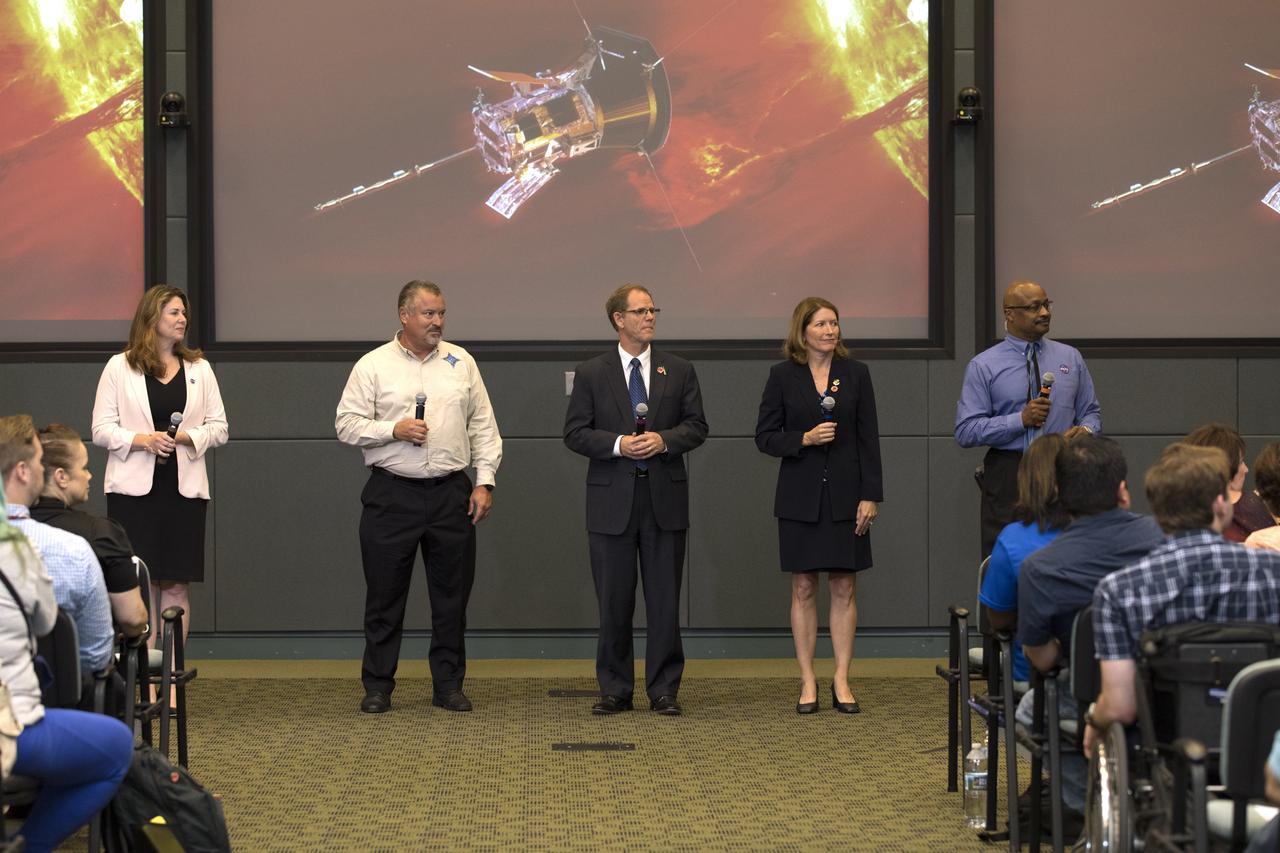
In the Kennedy Space Center's Operations and Support Building II, Thursday, Aug. 9, 2018, members of the media participate in a prelaunch mission briefing on NASA's Parker Solar Probe. Briefing moderators are Karen Fox, far left, Goddard Space Flight Center, and Dwayne Brown, far right, NASA Communications. Briefing participants are Omar Baez, launch director, NASA Kennedy Space Center; Scott Messer, program manager, NASA Programs, United Launch Alliance; and Kathy Rice, launch weather officer, 45th Weather Squadron, Cape Canaveral Air Force Station. The Parker Solar Probe will lift off on a United Launch Alliance Delta IV Heavy rocket from Space Launch Complex 37 at Cape Canaveral Air Force Station in Florida. The spacecraft was built by Applied Physics Laboratory of Johns Hopkins University in Laurel, Maryland. The mission will perform the closest-ever observations of a star when it travels through the Sun's atmosphere, called the corona. The probe will rely on measurements and imaging to revolutionize our understanding of the corona and the Sun-Earth connection.