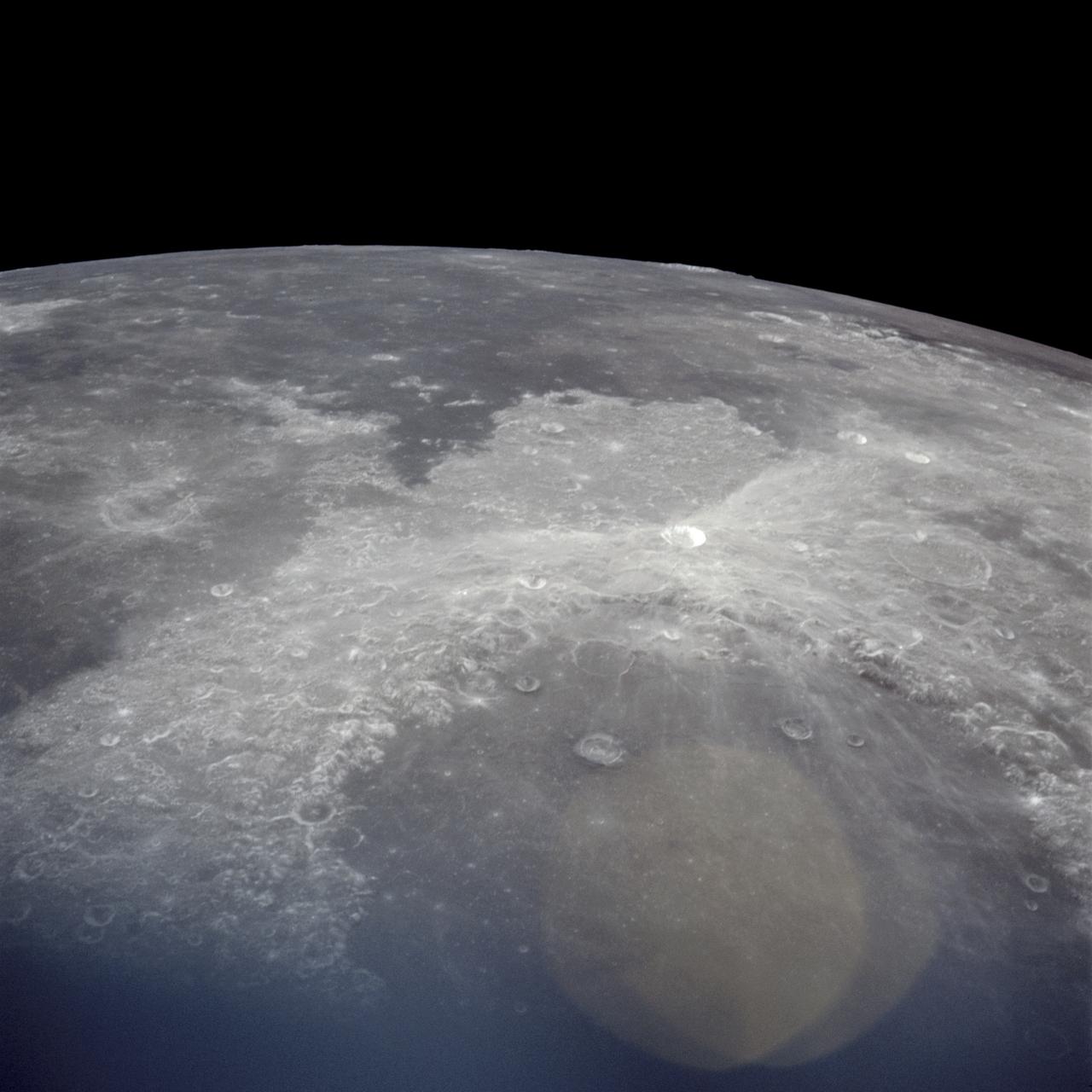
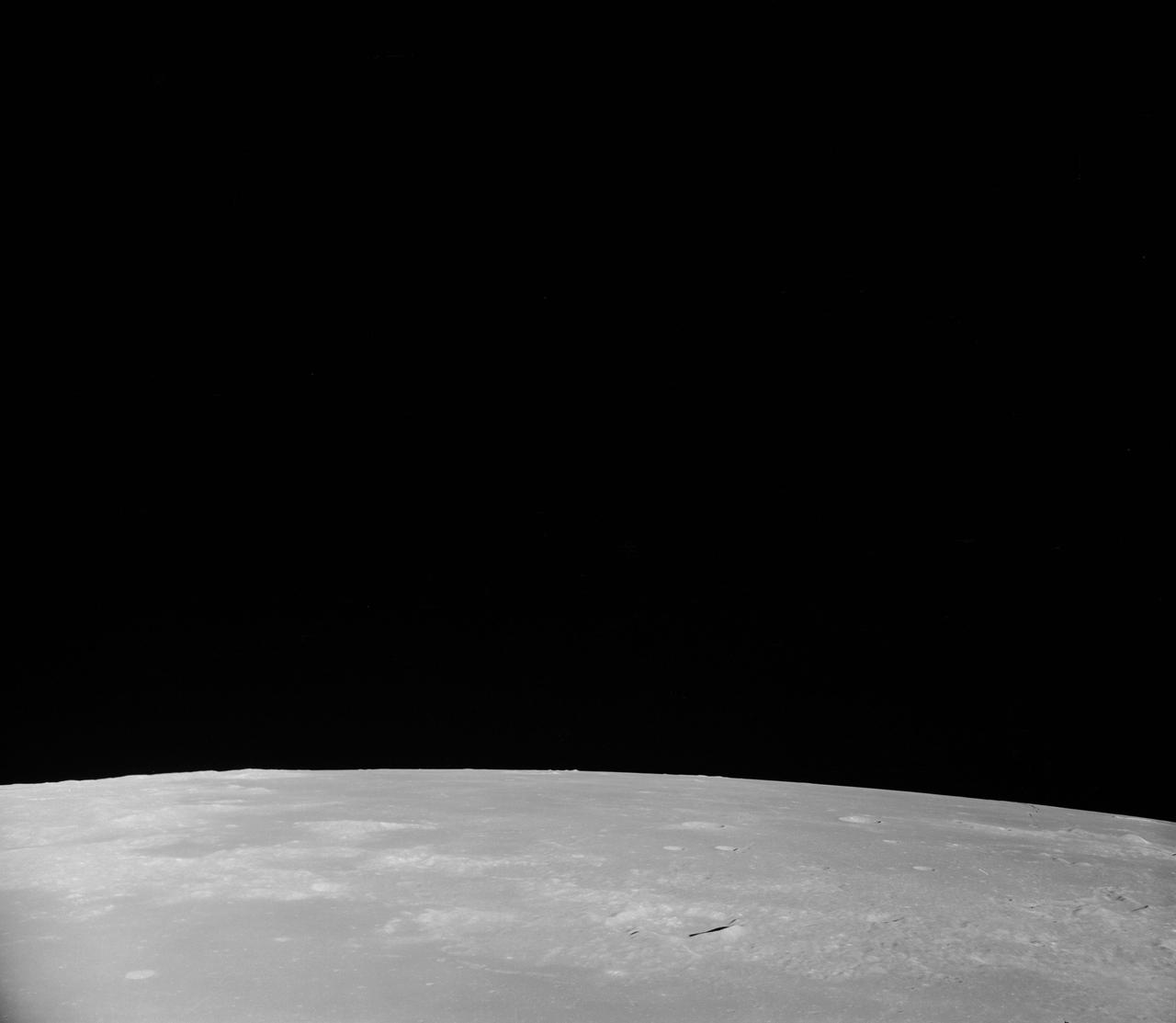
AS16-121-19438 (April 1972) --- An oblique view of a portion of the lunar nearside as photographed from the Apollo 16 spacecraft in lunar orbit, looking across the Sea of Crises southwesterly into the Sea of Tranquility. The conspicuous, bright-rayed crater is Proclus. The crater Taruntius in the northeasterly portion of the Sea of Fertility is near the left center edge. A portion of the Sea of Serenity is visible on the horizon at upper right.
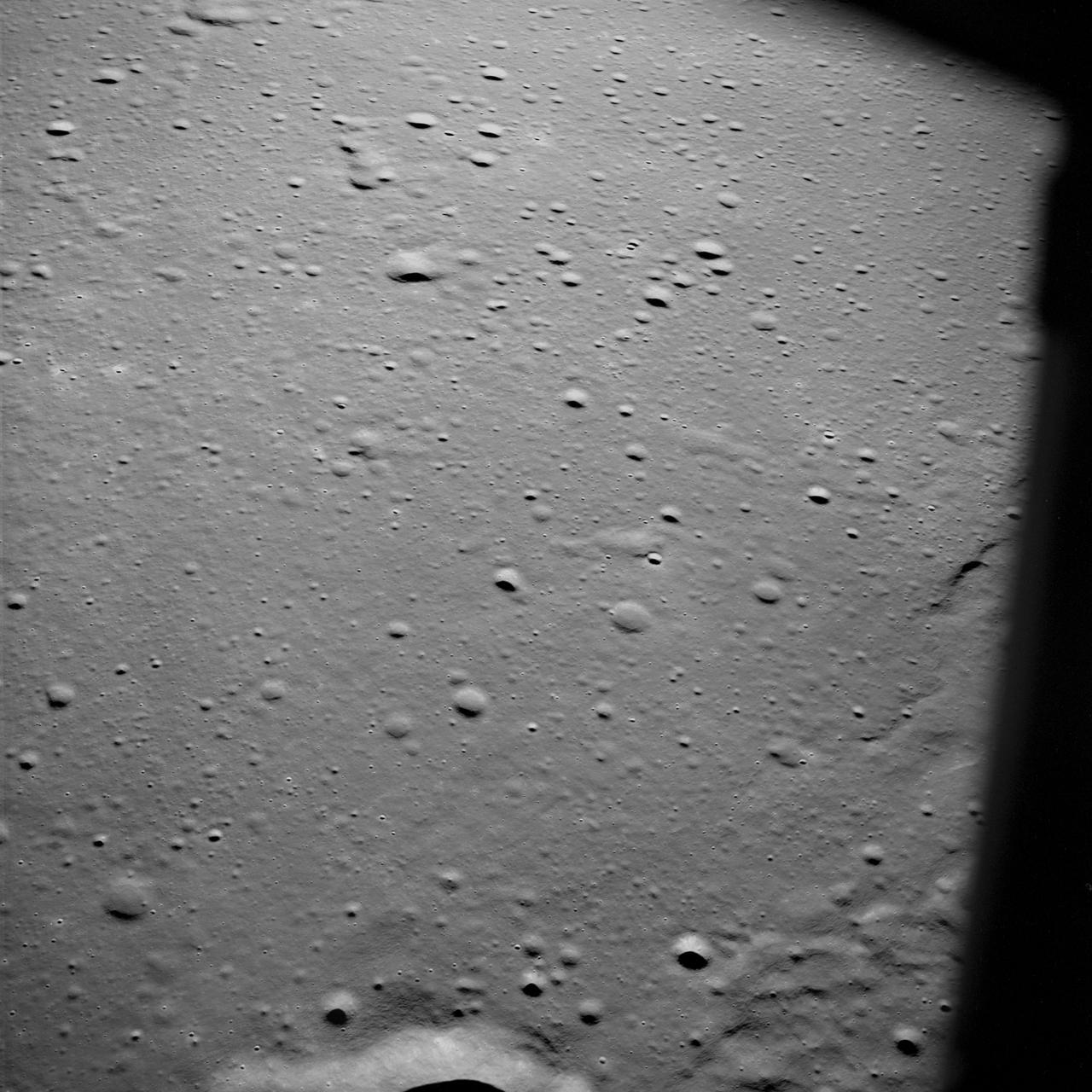
AS10-29-4321 (18-26 May 1969) --- An Apollo 10 oblique view of the western portion of the Sea of Tranquility. The area in the picture is located approximately 70 nautical miles east-southeast of Apollo Landing Site 2. The flat terrain pitted by moderate-sized craters is typical of this portion of Mare Tranquillitatis.
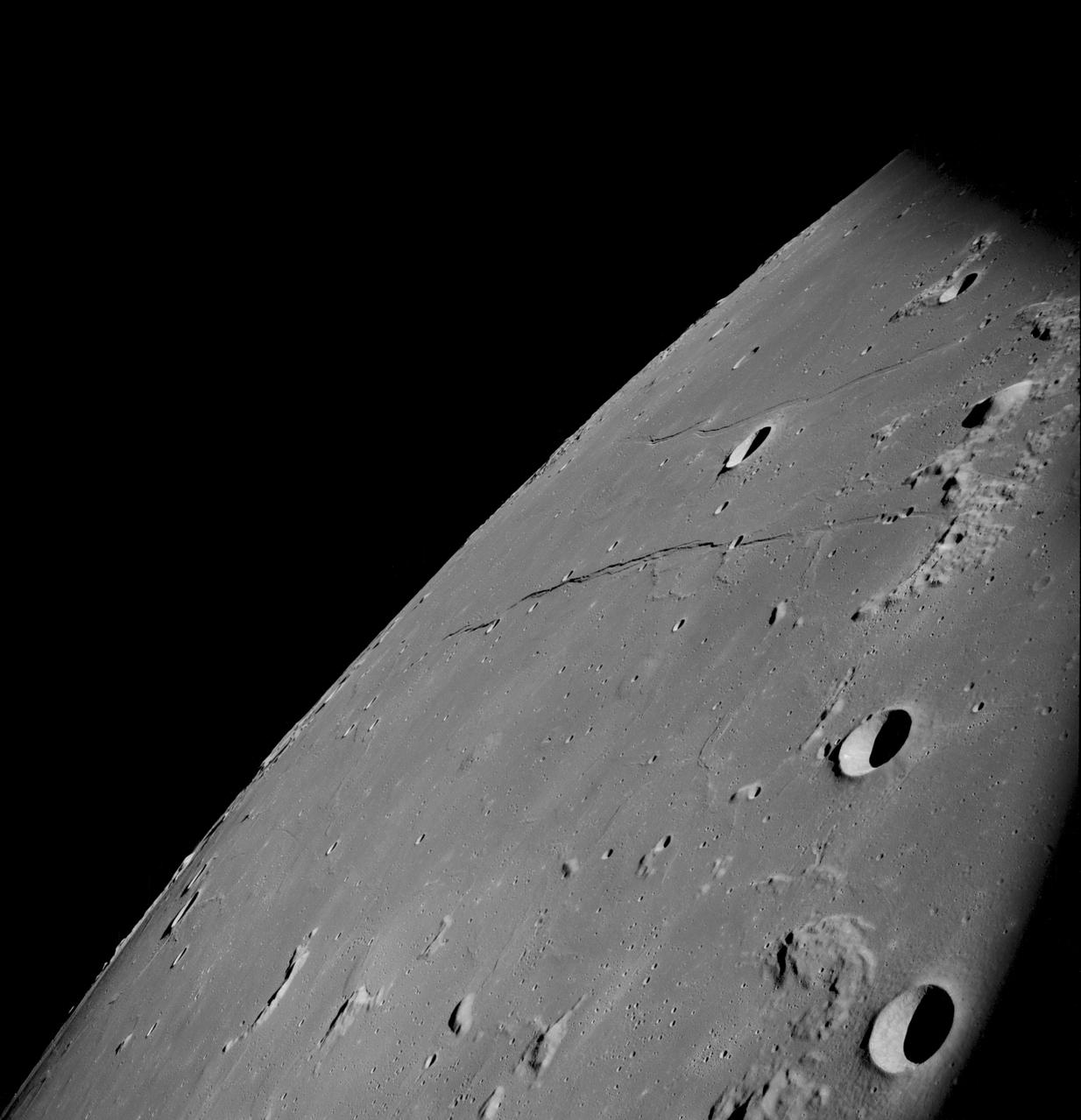
AS08-13-2344 (21-27 Dec. 1968) --- This oblique photograph looks generally northwest from the Apollo 8 spacecraft into the Sea of Tranquility. (HOLD PICTURE WITH LARGE TRIANGLE FORMED BY DARK SKY AT UPPER LEFT). The three prominent craters are Taruntius F in the lower right corner; Taruntius E in the center; and Cauchy between the two linear features. The Cauchy scarp, this side of the Cauchy crater, is formed by one to three faults stepped down toward the spacecraft. Cauchy Rille, on the other side of Cauchy crater, consists of several arcuate segments of a graben. Each of the three prominent craters is 10 to 15 kilometers (6 to 9 statute miles) across.
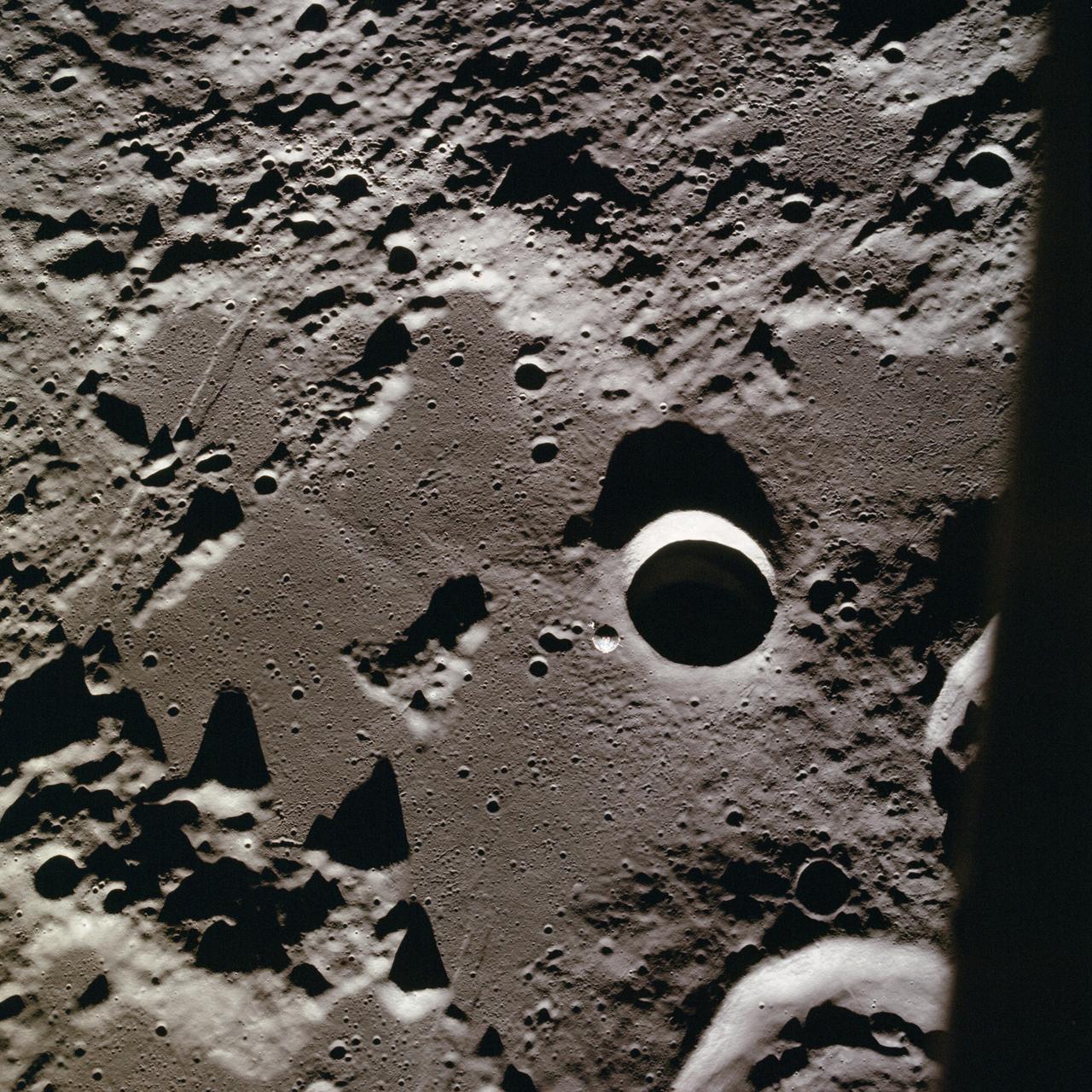
AS11-37-5448 (July 1969) --- The Apollo 11 Command and Service Modules (CSM) (tiny dot near quarter sized crater, center), with astronaut Michael Collins, command module pilot, aboard. The view overlooking the western Sea of Tranquility was photographed from the Lunar Module (LM). Astronauts Neil A. Armstrong, commander, and Edwin E. Aldrin Jr., lunar module pilot, manned the LM and made their historic lunar landing on July 20, 1969. Coordinates of the center of the terrain in the photograph are 18.5 degrees longitude and .5 degrees north latitude.
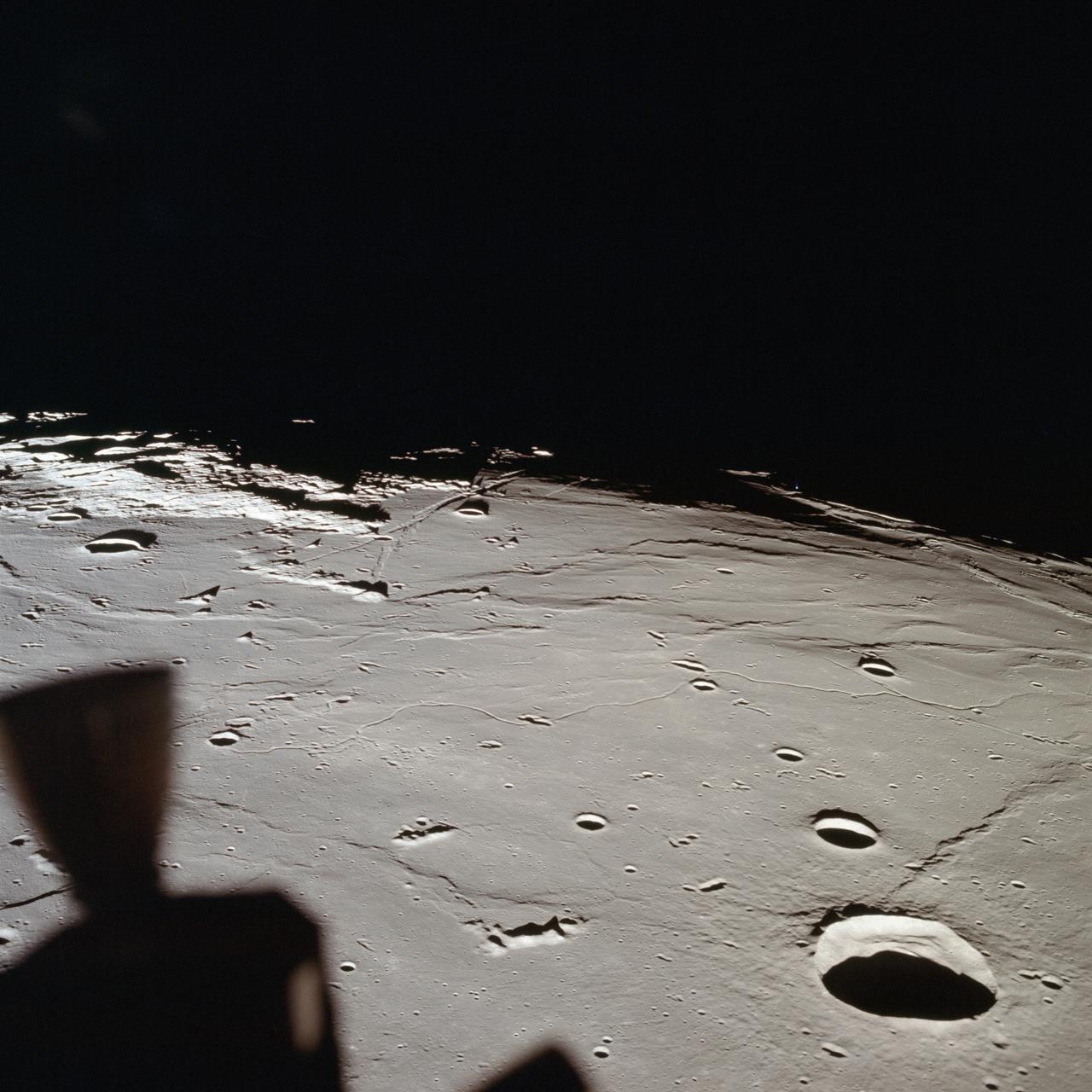
AS11-37-5437 (20 July 1969) --- The approach to Apollo Landing Site 2 in southwestern Sea of Tranquility is seen in this photograph taken from the Apollo 11 Lunar Module (LM) in lunar orbit. When this picture was made, the LM was still docked to the Command and Service Modules (CSM). Site 2 is located just right of center at the edge of the darkness. The crater Maskelyne is the large one at the lower right. Hypatia Rille (U.S. 1) is at upper left, with the crater Moltke just to the right (north) of it. Sidewinder Rille and Diamondback Rille extend from left to right across the center of the picture. This view looks generally west.
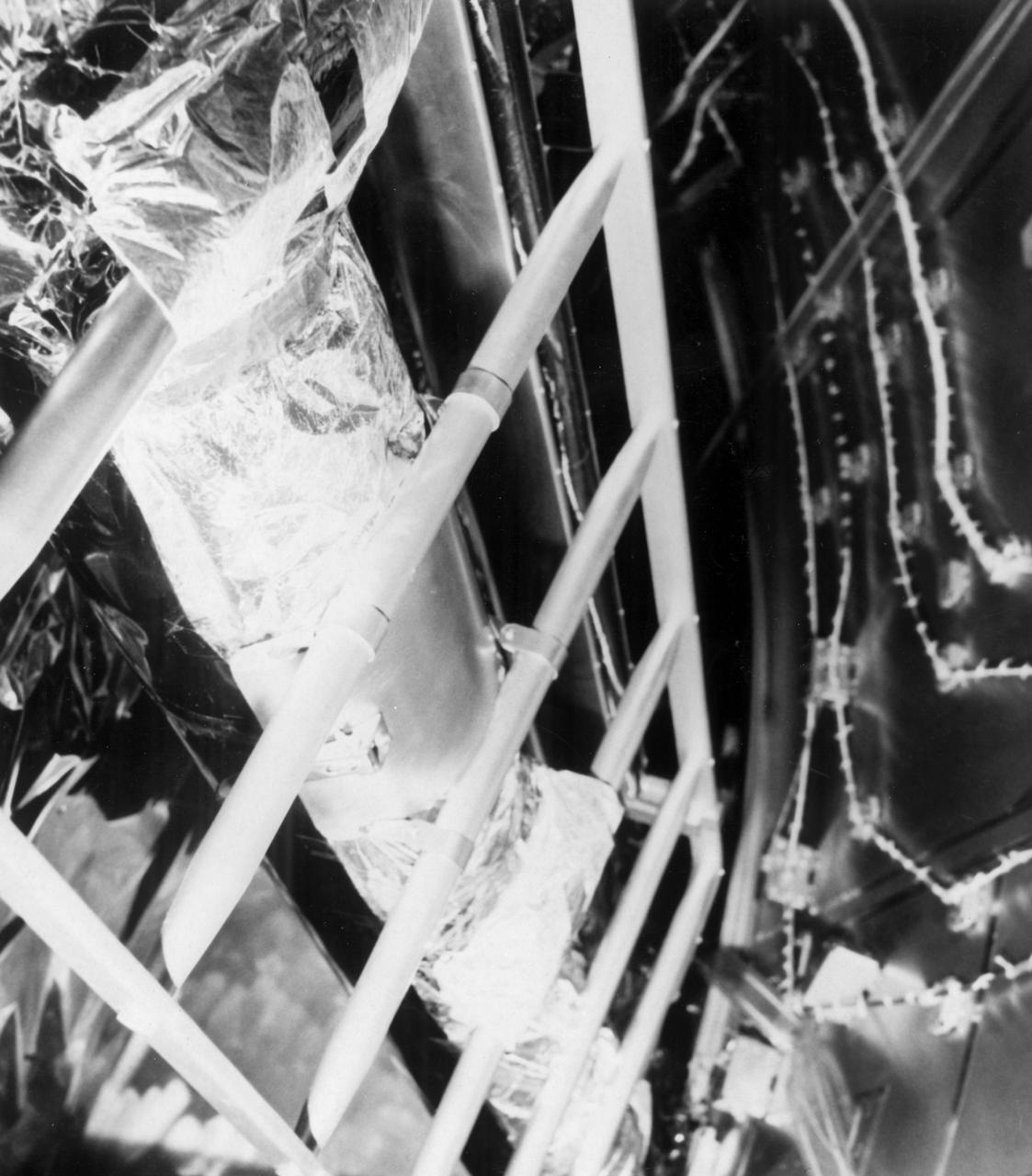
Millions of people on Earth watched via television as a message for all mankind was delivered to the Mare Tranquilitatis (Sea of Tranquility) region of the Moon during the historic Apollo 11 mission, where it still remains today. A commemorative plaque was attached to the leg of the Lunar Module (LM), Eagle, engraved with the following words: “Here men from the planet Earth first set foot upon the Moon July, 1969 A.D. We came in peace for all of mankind.” It bears the signatures of the Apollo 11 astronauts Neil A. Armstrong, commander; Michael Collins, Command Module (CM) pilot; and Edwin E. Aldrin, Jr., Lunar Module (LM) pilot along with the signature of the U.S. President Richard M. Nixon. The plaque, as shown here, covered with protective steel for the launch and journey to the moon, was uncovered by crew members after landing. The Apollo 11 mission launched from the Kennedy Space Center (KSC) in Florida via the Marshall Space Flight Center (MSFC) developed Saturn V launch vehicle on July 16, 1969 and safely returned to Earth on July 24, 1969. The CM, “Columbia”, piloted by Collins, remained in a parking orbit around the Moon while the LM, “Eagle’’, carrying astronauts Armstrong and Aldrin, landed on the Moon. On July 20, 1969, Armstrong was the first human to ever stand on the lunar surface, followed by Aldrin. During 2½ hours of surface exploration, the crew collected 47 pounds of lunar surface material for analysis back on Earth. With the success of Apollo 11, the national objective to land men on the Moon and return them safely to Earth had been accomplished.
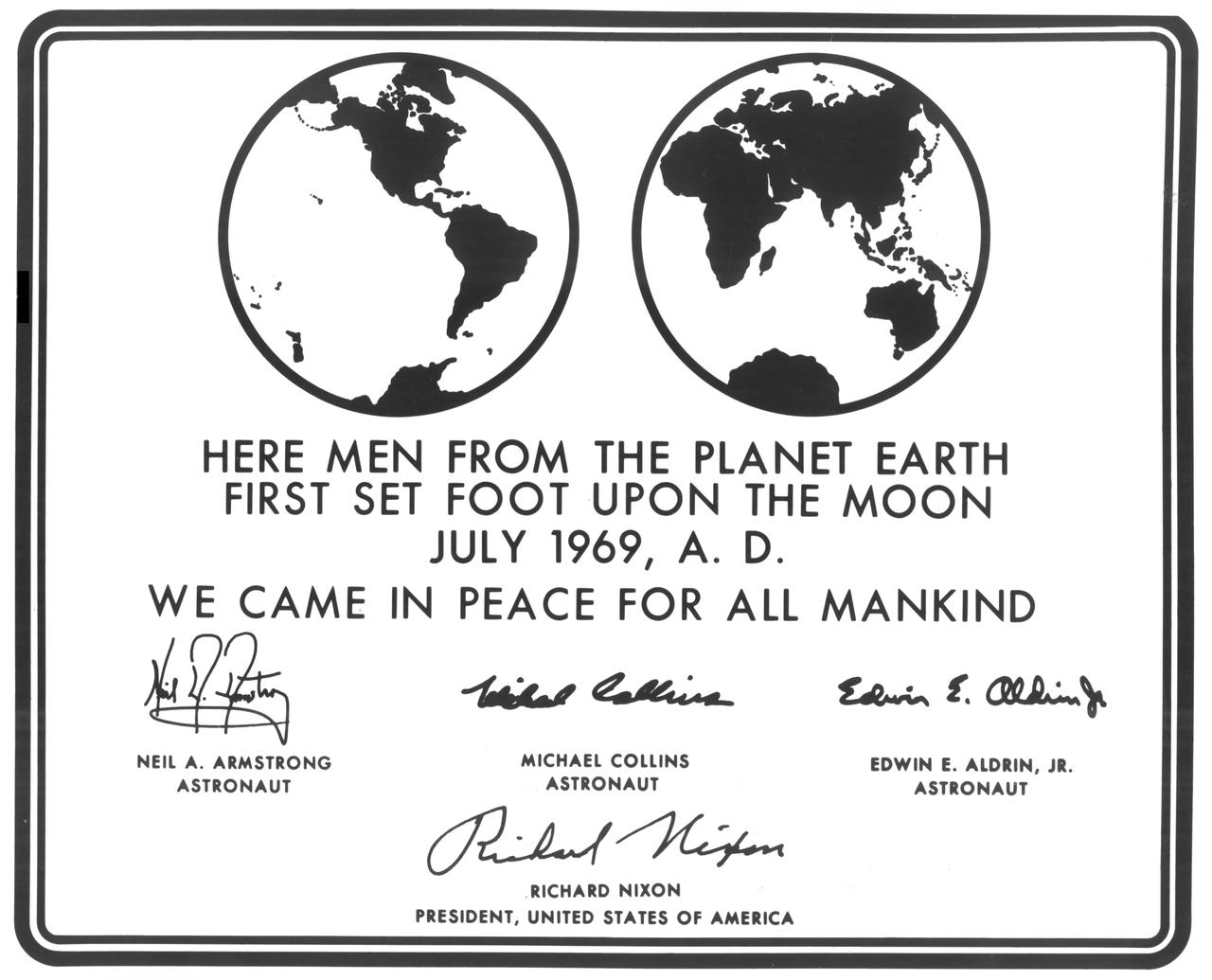
Millions of people on Earth watched via television as a message for all mankind was delivered to the Mare Tranquilitatis (Sea of Tranquility) region of the Moon during the historic Apollo 11 mission, where it still remains today. This photograph is a reproduction of the commemorative plaque that was attached to the leg of the Lunar Module (LM), Eagle, engraved with the following words: “Here men from the planet Earth first set foot upon the Moon July, 1969 A.D. We came in peace for all of mankind.” It bears the signatures of the Apollo 11 astronauts Neil A. Armstrong, commander; Michael Collins, Command Module (CM) pilot; and Edwin E. Aldrin, Jr., Lunar Module (LM) pilot along with the signature of the U.S. President Richard M. Nixon. The Apollo 11 mission launched from the Kennedy Space Center (KSC) in Florida via the Marshall Space Flight Center (MSFC) developed Saturn V launch vehicle on July 16, 1969 and safely returned to Earth on July 24, 1969. The CM, “Columbia”, piloted by Collins, remained in a parking orbit around the Moon while the LM, “Eagle’’, carrying astronauts Armstrong and Aldrin, landed on the Moon. On July 20, 1969, Armstrong was the first human to ever stand on the lunar surface, followed by Aldrin. During 2½ hours of surface exploration, the crew collected 47 pounds of lunar surface material for analysis back on Earth. With the success of Apollo 11, the national objective to land men on the Moon and return them safely to Earth had been accomplished.
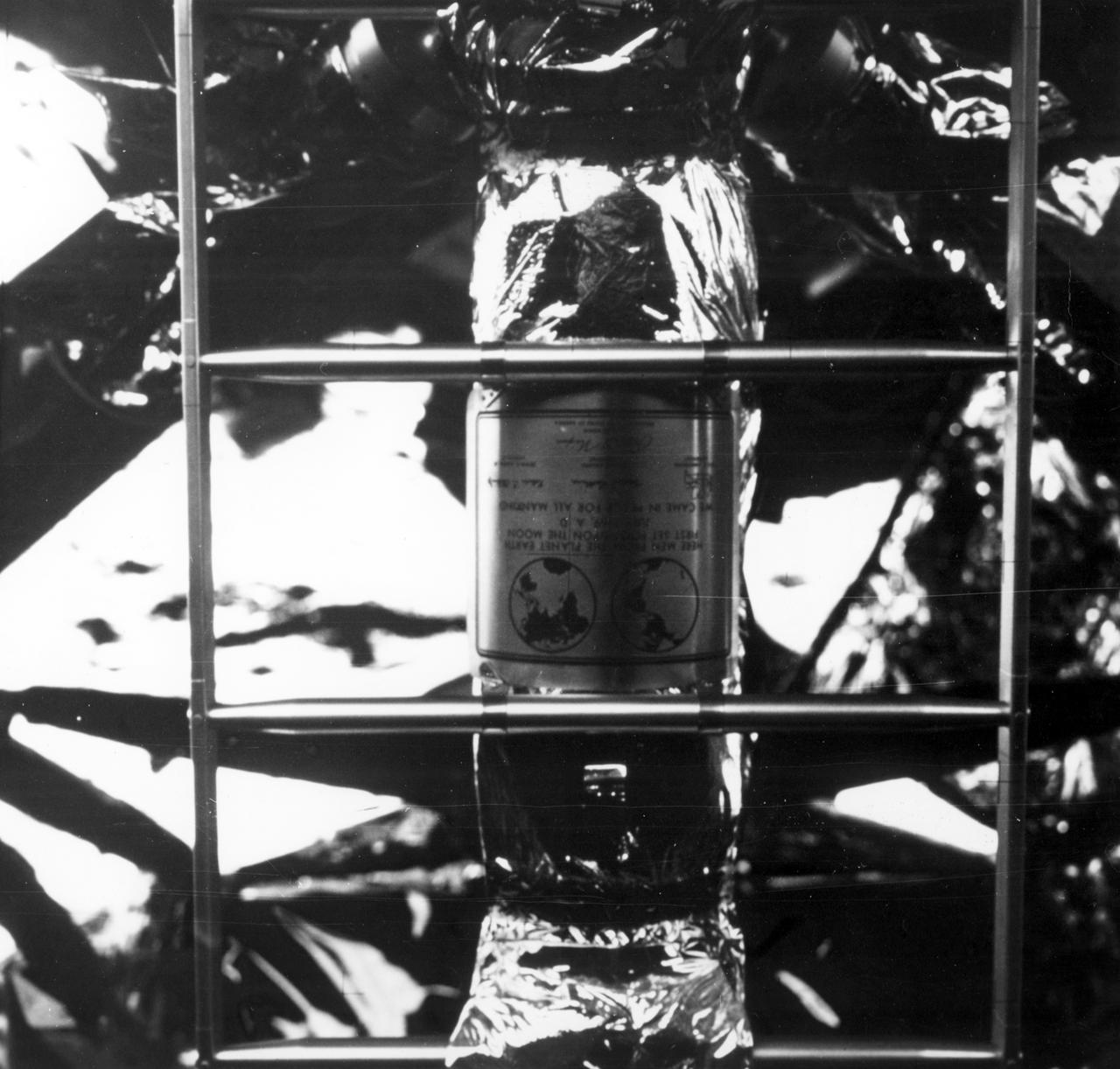
Millions of people on Earth watched via television as a message for all mankind was delivered to the Mare Tranquilitatis (Sea of Tranquility) region of the Moon during the historic Apollo 11 mission, where it still remains today. This commemorative plaque, attached to the leg of the Lunar Module (LM), Eagle, is engraved with the following words: “Here men from the planet Earth first set foot upon the Moon July, 1969 A.D. We came in peace for all of mankind.” It bears the signatures of the Apollo 11 astronauts Neil A. Armstrong, commander; Michael Collins, Command Module (CM) pilot; and Edwin E. Aldrin, Jr., Lunar Module (LM) pilot along with the signature of the U.S. President Richard M. Nixon. The Apollo 11 mission launched from the Kennedy Space Center (KSC) in Florida via the Marshall Space Flight Center (MSFC) developed Saturn V launch vehicle on July 16, 1969 and safely returned to Earth on July 24, 1969. The CM, “Columbia”, piloted by Collins, remained in a parking orbit around the Moon while the LM, “Eagle’’, carrying astronauts Armstrong and Aldrin, landed on the Moon. On July 20, 1969, Armstrong was the first human to ever stand on the lunar surface, followed by Aldrin. During 2½ hours of surface exploration, the crew collected 47 pounds of lunar surface material for analysis back on Earth. With the success of Apollo 11, the national objective to land men on the Moon and return them safely to Earth had been accomplished.
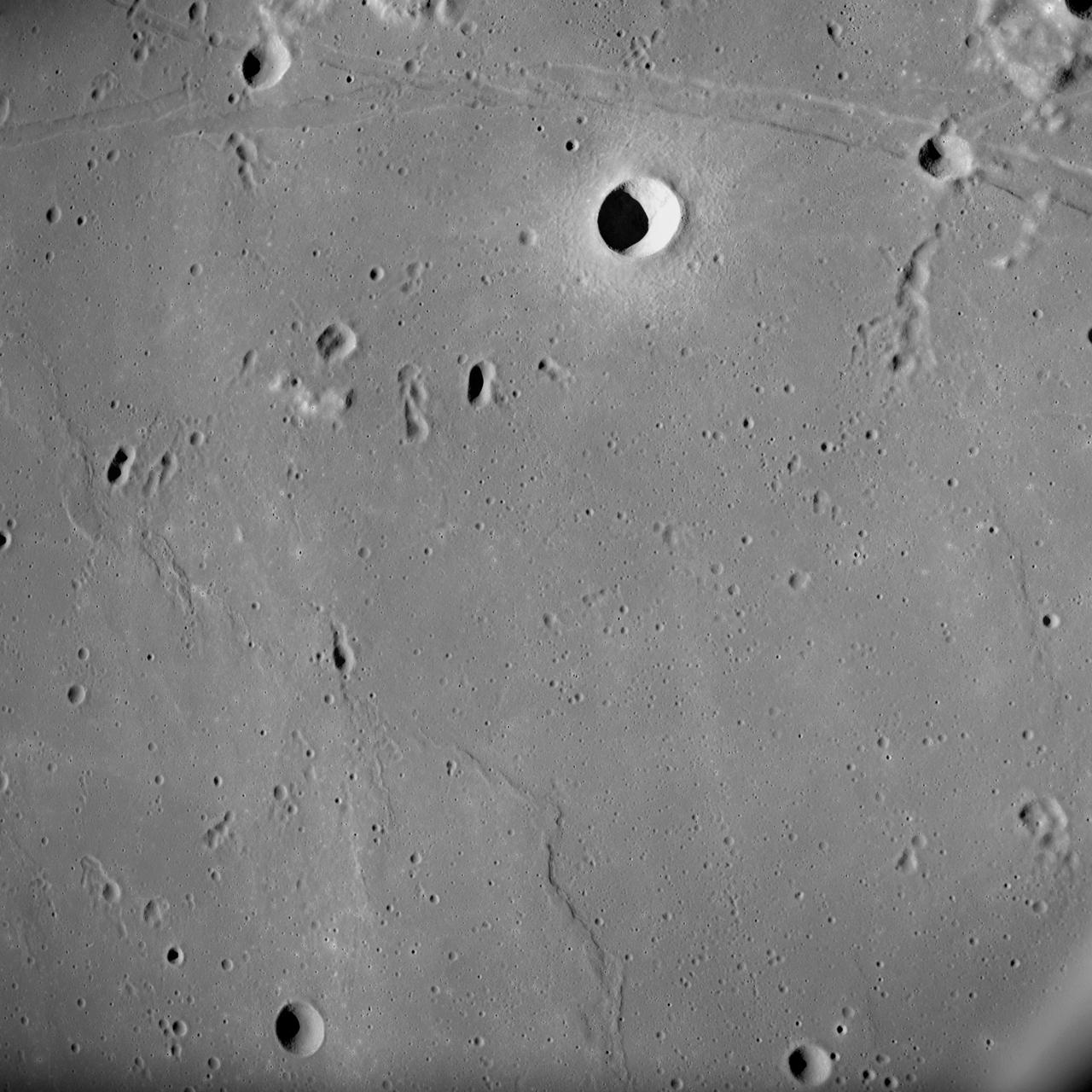
AS10-31-4537 (18-26 May 1969) --- This near vertical photograph taken from the Apollo 10 Command and Service Modules shows features typical of the Sea of Tranquility near Apollo Landing Site 2. HOLD PICTURE WITH PRONOUNCED LINEAR FEATURE PARALLEL TO LEFT MARGIN. The proposed landing area for Apollo 11 (Lunar Landing Site 2) is a relatively smooth maria area in the upper right quadrant of the photographed area. Apollo 10 traveled from the bottom to the top of the picture. The prominent linear feature at left is Hypatia Rille (called "U.S. 1" by the Apollo 10 crew). The prominent crater centered in Hypatia Rille at top left is Moltke AC (code name "Chuck Hole"). Moltke, the prominent crater to the right of Hypatia Rille, is centered near 24.2 degrees east longitude, and 0.6 degrees south latitude.
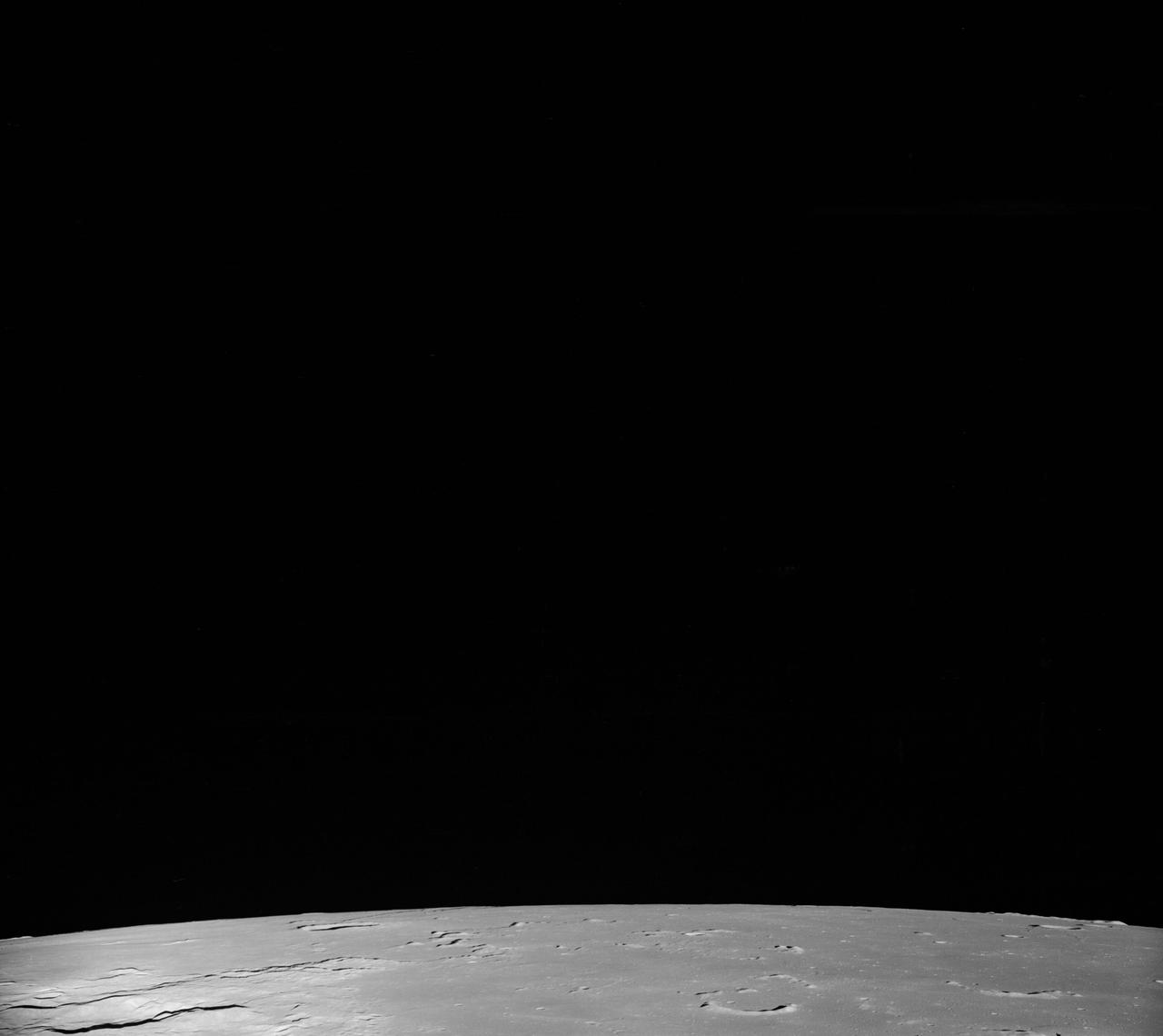
AS08-17-2821 (21-27 Dec. 1968) --- This oblique view of the lunar surface taken from the Apollo 8 spacecraft looking westward across the Sea of Tranquility shows Apollo Landing Site East 2 illuminated by a sun that is six to eight degrees above the eastern horizon. The landing site is on the dark gray, smooth surface of the Sea of Tranquility and north (to the right) of the bright highland terrain at the lower left corner of the photograph. The landing site is about four tenths of the distance from the left to right margin of the photograph.
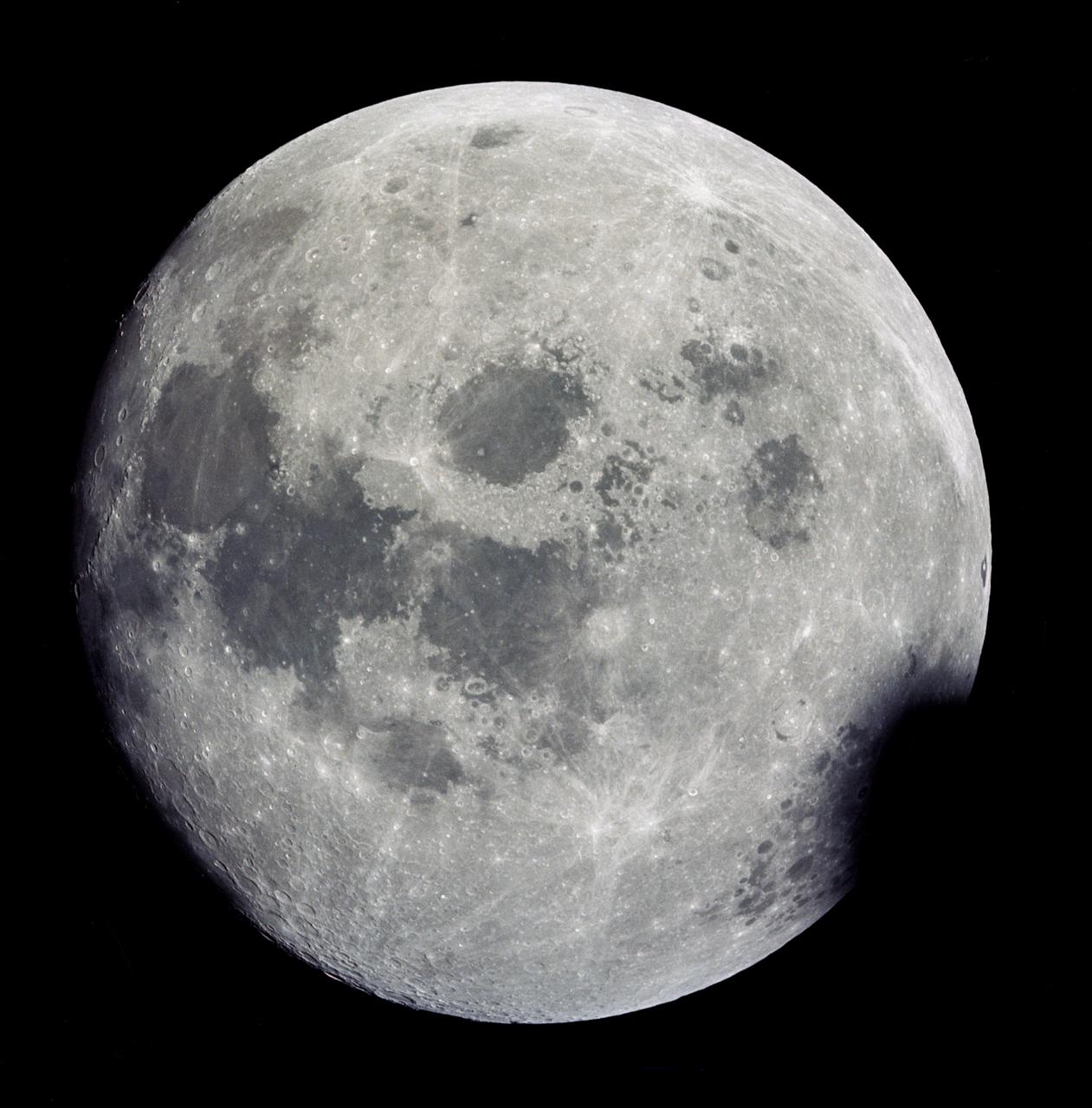
AS13-60-8703 (11-17 April 1970) --- This outstanding view of a near full moon was photographed from the Apollo 13 spacecraft during its trans-Earth journey homeward. Though the explosion of the oxygen tank in the Service Module (SM) forced the cancellation of the scheduled lunar landing, Apollo 13 made a pass around the moon prior to returning to Earth. Some of the conspicuous lunar features include the Sea of Crisis, the Sea of Fertility, the Sea of Tranquility, the Sea of Serenity, the Sea of Nectar, the Sea of Vapors, the Border Sea, Smyth's Sea, the crater Langrenus, and the crater Tsiolkovsky.
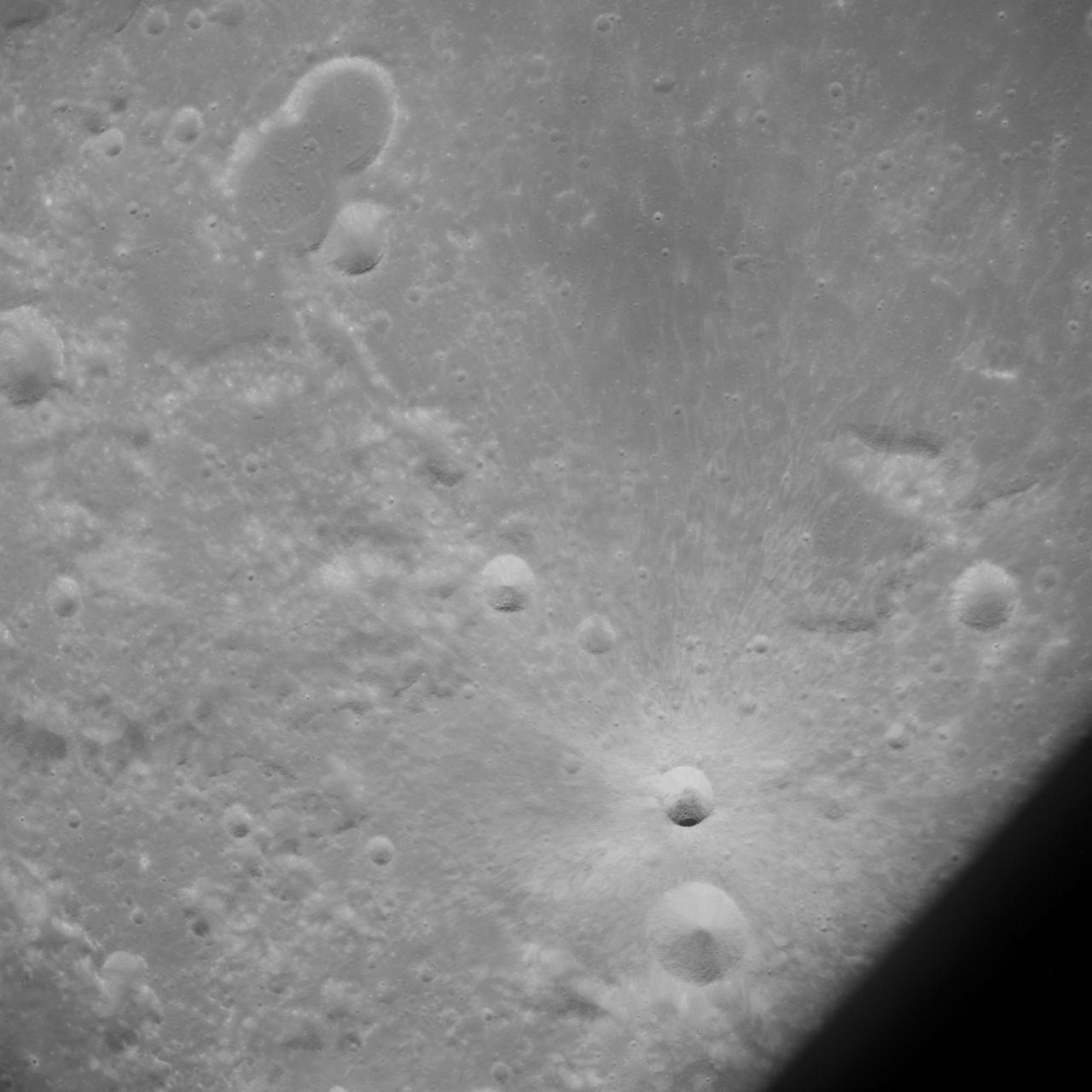
AS10-32-4845 (18-26 May 1969) --- An Apollo 10 southwest oblique view of the crater Censorinus which is located in the highland terrain bordering the Sea of Tranquility. HOLD PICUTRE WITH WINDOW FRAME AT LOWER LEFT. Censorinus is the bright crater in the lower left of the photograph. Censorinus is about 5 kilometers (about 3 statute miles) in diameter. Immediately to the left of Censorinus is the larger crater Censorinus A. The Sea of Tranquility is to the lower right of the photograph, which was taken from the Command and Service Modules. Censorinus is one of the brighter craters on the lunar surface.
AS08-17-2814 (21-27 Dec. 1968) --- This oblique view of the lunar surface taken from the Apollo 8 spacecraft looking westward across the Sea of Fertility into the Sea of Tranquility shows the terrain the astronauts will see as the approach Apollo Landing Site East 2. The landing site is at the horizon about one-third of the distance from the left to the right photograph margin. The prominent crater in the highlands near the center of the picture is Secchi, about 25 kilometers (15 statute miles) in diameter.
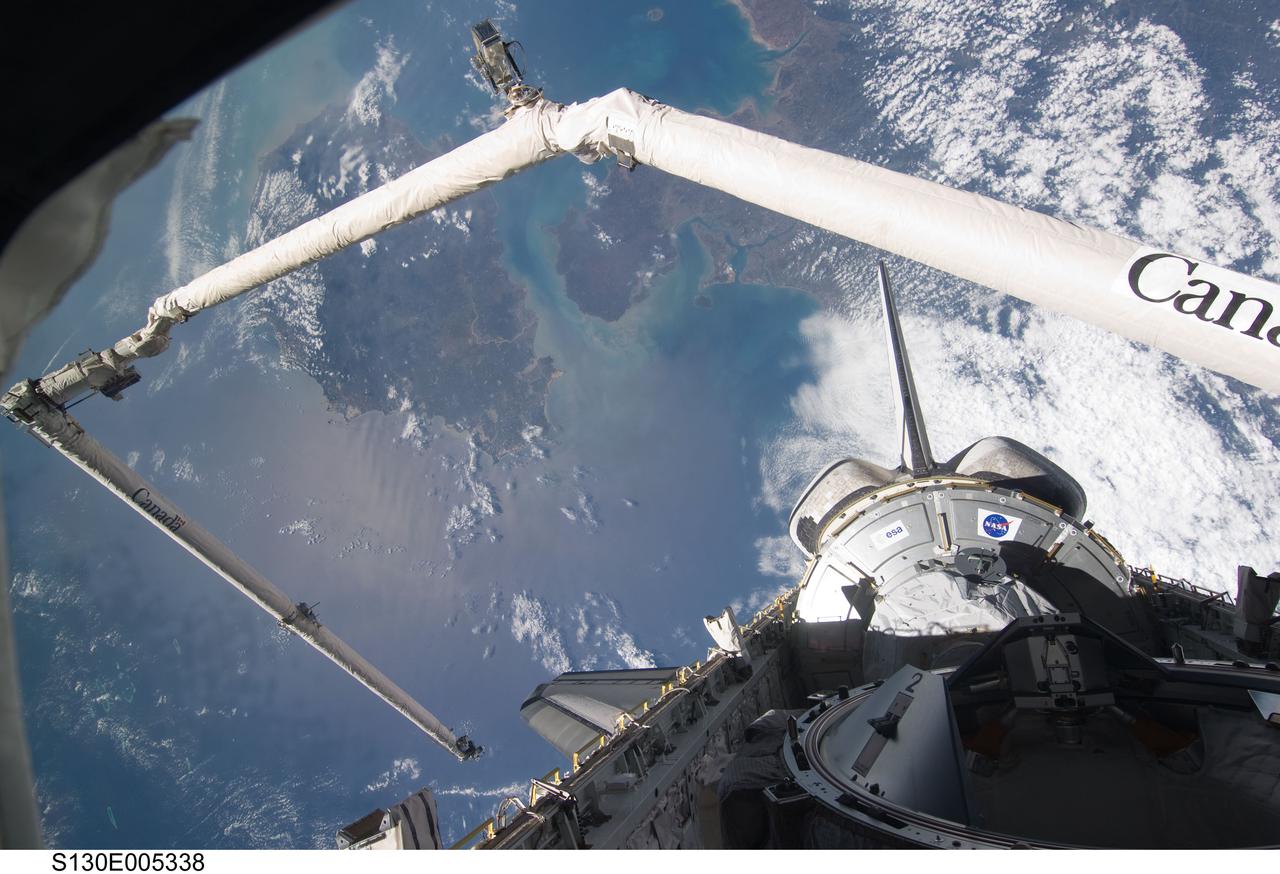
S130-E-005338 (8 Feb. 2010) --- Backdropped by the South China Sea and the Gulf of Tonkin, the Tranquility node in space shuttle Endeavour’s payload bay, vertical stabilizer, orbital maneuvering system (OMS) pods and a shadow-covered docking mechanism are featured in this image photographed by the STS-130 crew from an aft flight deck window. Hainan Island can be seen between the South China Sea (bottom) and Gulf of Tonkin (top). The Leizhou Peninsula of the Chinese mainland is on the upper right.
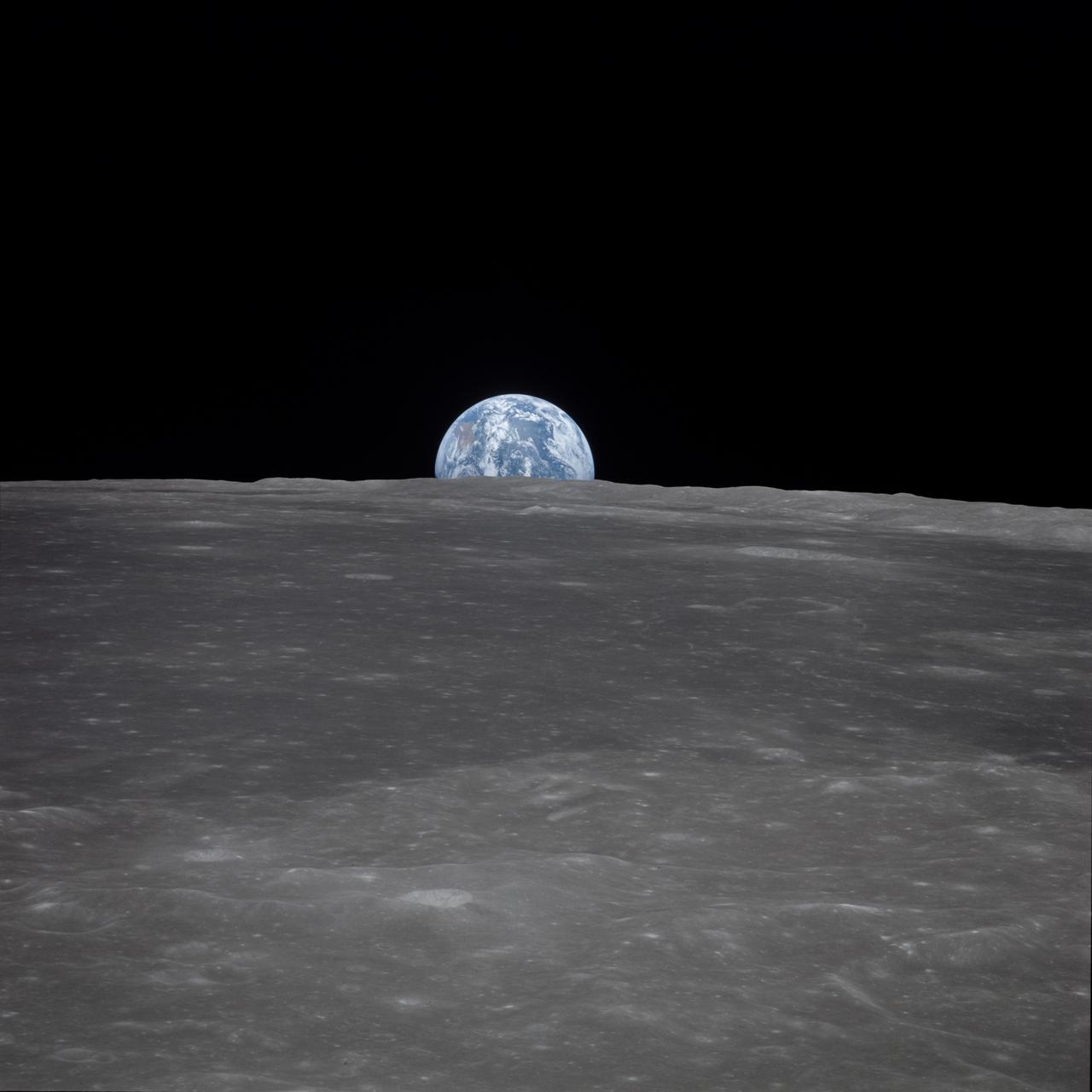
AS11-44-6548 (16-24 July 1969) --- This view from the Apollo 11 spacecraft shows Earth rising above the moon's horizon. The lunar terrain pictured is in the area of Smyth's Sea on the nearside. Coordinates of the center of the terrain are 86 degrees east longitude and 3 degrees north latitude. While astronauts Neil A. Armstrong, commander, and Edwin E. Aldrin Jr., lunar module pilot, descended in the Lunar Module (LM) "Eagle" to explore the Sea of Tranquility region of the moon, astronaut Michael Collins, command module pilot, remained with the Command and Service Modules (CSM) "Columbia" in lunar orbit.
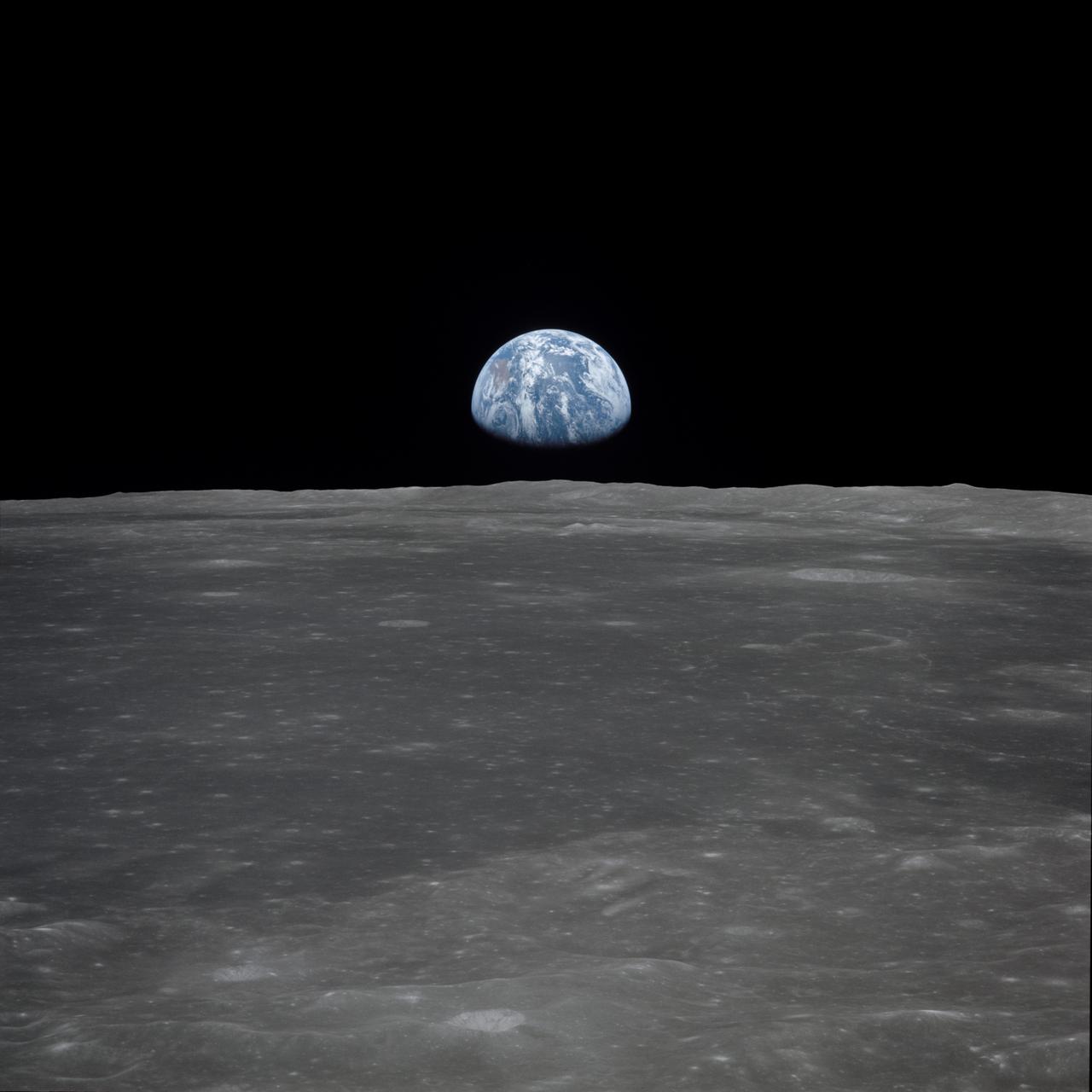
AS11-44-6550 (16-24 July 1969) --- This view from the Apollo 11 spacecraft shows Earth rising above the moon's horizon. The lunar terrain pictured is in the area of Smyth's Sea on the nearside. Coordinates of the center of the terrain are 86 degrees east longitude and 3 degrees north latitude. While astronauts Neil A. Armstrong, commander, and Edwin E. Aldrin Jr., lunar module pilot, descended in the Lunar Module (LM) "Eagle" to explore the Sea of Tranquility region of the moon, astronaut Michael Collins, command module pilot, remained with the Command and Service Modules (CSM) "Columbia" in lunar orbit. Apollo 11 was NASA's first lunar landing mission in the Apollo program.

AS11-44-6551 (July 1969) --- This view from the Apollo 11 spacecraft shows the Earth rising above the moon's horizon. The lunar terrain pictured is in the area of Smyth's Sea on the nearside. Coordinates of the center of the terrain are 85 degrees east longitude and 3 degrees north latitude. While astronauts Neil A. Armstrong, commander, and Edwin E. Aldrin Jr., lunar module pilot, descended in the Lunar Module (LM) "Eagle" to explore the Sea of Tranquility region of the moon, astronaut Michael Collins, command module pilot, remained with the Command and Service Modules (CSM) "Columbia" in lunar orbit.

AS11-44-6549 (16-24 July 1969) --- This view from the Apollo 11 spacecraft shows Earth rising above the moon's horizon. The lunar terrain pictured is in the area of Smyth's Sea on the nearside. Coordinates of the center of the terrain are 86 degrees east longitude and 3 degrees north latitude. While astronauts Neil A. Armstrong, commander, and Edwin E. Aldrin Jr., lunar module pilot, descended in the Lunar Module (LM) "Eagle" to explore the Sea of Tranquility region of the moon, astronaut Michael Collins, command module pilot, remained with the Command and Service Modules (CSM) "Columbia" in lunar orbit.
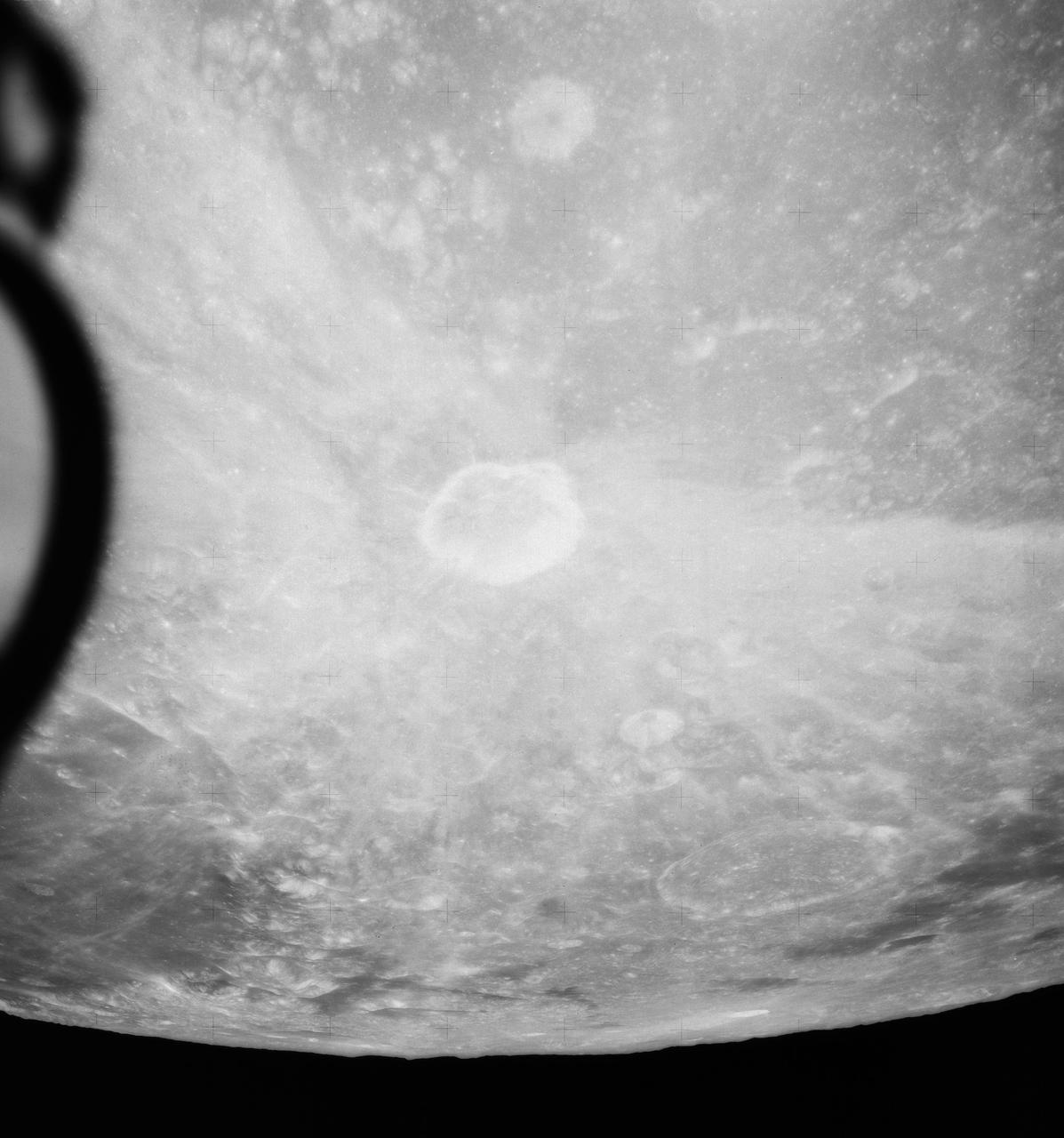
S71-44669 (31 July-2 Aug. 1971) --- An oblique view of the rayed crater Proclus on the lunar nearside, as photographed by the Fairchild metric camera in the SIM bay of the Apollo 15 Command and Service Modules (CSM) in lunar orbit. This view is looking north. The Sea of Crisis is at upper right. Proclus, which is 28 kilometers (16.58 statute miles) in diameter, is located at 47 degrees east longitude and 16 degrees north latitude. The Marsh of Sleep is at lower left. A small portion of the Sea of Tranquility can be seen at upper left. The crater Macrobius is located at upper left. The three-inch mapping camera was one of eight lunar orbital science experiments mounted in the SIM bay.

AS11-44-6552 (16-24 July 1969) --- This view of Earth rising over the moon's horizon was taken from the Apollo spacecraft. The lunar terrain pictured is in the area of Smyth's Sea on the nearside. Coordinates of the center of the terrain are 85 degrees east longitude and 3 degrees north latitude. While astronaut Neil A. Armstrong, commander; and Edwin E. Aldrin Jr., lunar module pilot, descended in the Lunar Module (LM) "Eagle" to explore the Sea of Tranquility region of the moon, astronaut Michael Collins remained with the Command and Service Modules (CSM) "Columbia" in lunar orbit.
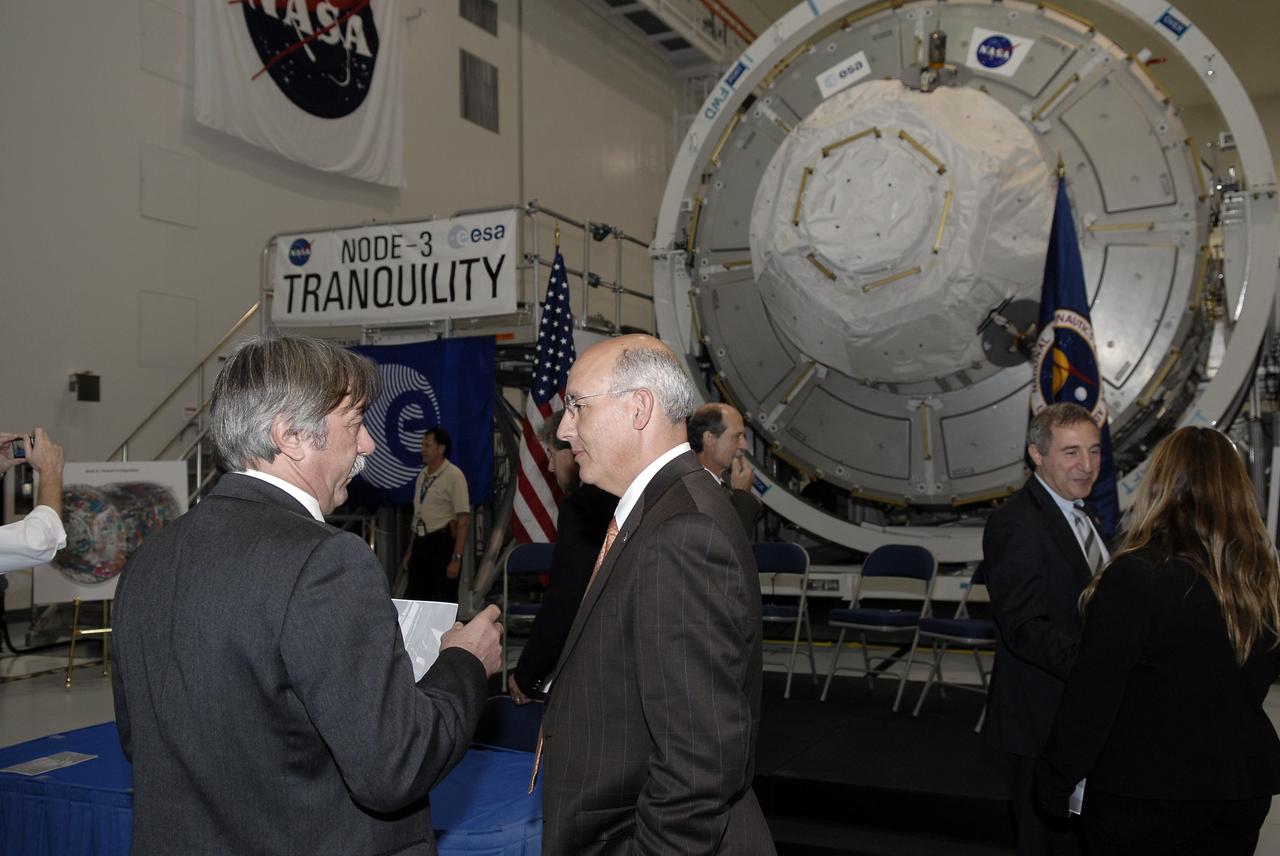
CAPE CANAVERAL, Fla. – In the Space Station Processing Facility at NASA's Kennedy Space Center in Florida, Secondino Brondolo, at left, head of the Space Infrastructure, Thales Alenia Space Italy, talks to Michael Suffredini, program manager, International Space Station, NASA, following a ceremony transferring the ownership of node 3 for the International Space Station from the European Space Agency, or ESA, to NASA. Node 3 is named "Tranquility" after the Sea of Tranquility, the lunar landing site of Apollo 11. The payload for the STS-130 mission, Tranquility is a pressurized module that will provide room for many of the International Space Station's life support systems. The module was built for ESA by Thales Alenia Space in Turin, Italy. Attached to one end of Tranquility is a cupola, a unique work station with six windows on its sides and one on top. The cupola resembles a circular bay window and will provide a vastly improved view of the station's exterior. Just under 10 feet in diameter, the module will accommodate two crew members and portable workstations that can control station and robotic activities. The multi-directional view will allow the crew to monitor spacewalks and docking operations, as well as provide a spectacular view of Earth and other celestial objects. Space shuttle Endeavour's STS-130 mission is targeted to launch Feb. 4, 2010. Photo credit: NASA/Kim Shiflett
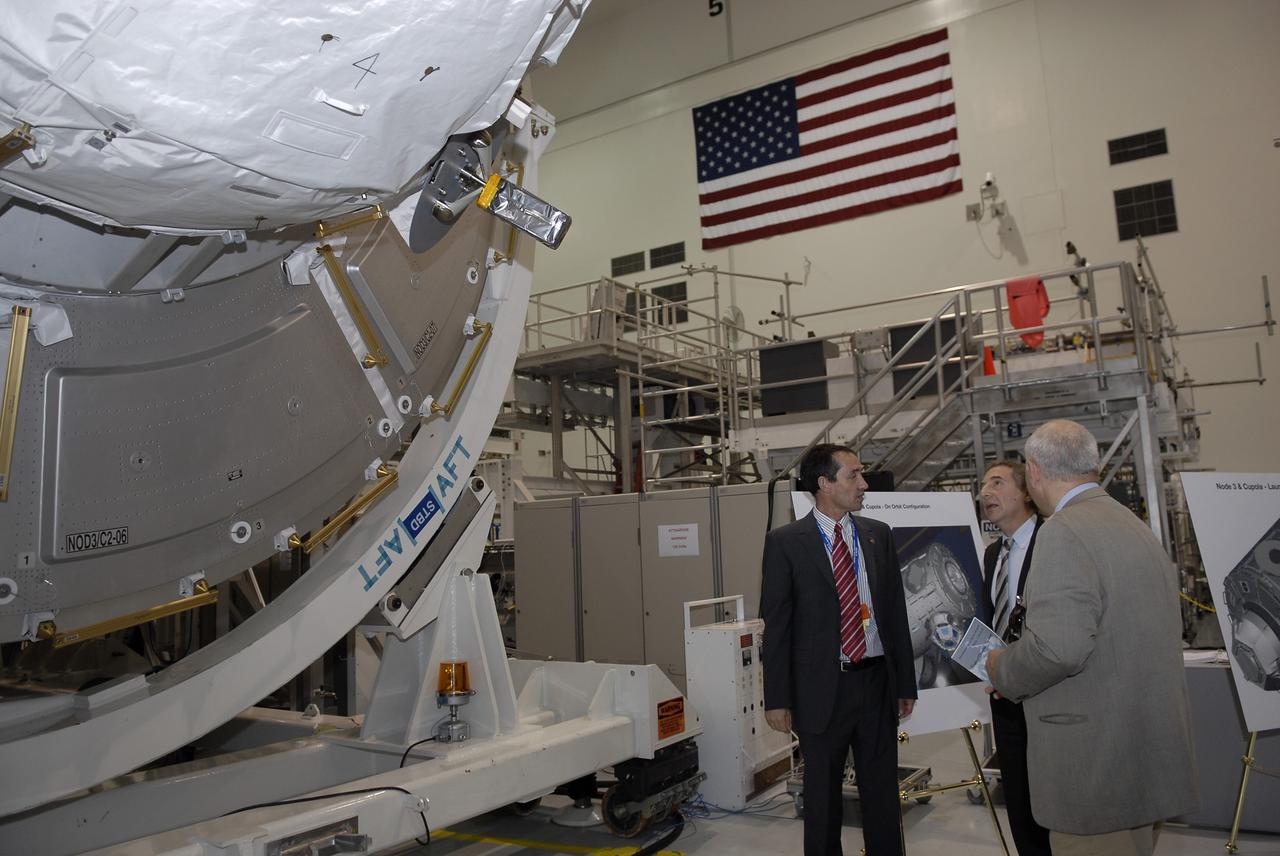
CAPE CANAVERAL, Fla. – In the Space Station Processing Facility at NASA's Kennedy Space Center in Florida, Bernardo Patti, center, head of International Space Station, Program Department, European Space Agency, or ESA, admires the node 3 for the International Space Station, which his agency provided, following a ceremony transferring the ownership of the node from ESA to NASA. Node 3 is named "Tranquility" after the Sea of Tranquility, the lunar landing site of Apollo 11. The payload for the STS-130 mission, Tranquility is a pressurized module that will provide room for many of the International Space Station's life support systems. The module was built for ESA by Thales Alenia Space in Turin, Italy. Attached to one end of Tranquility is a cupola, a unique work station with six windows on its sides and one on top. The cupola resembles a circular bay window and will provide a vastly improved view of the station's exterior. Just under 10 feet in diameter, the module will accommodate two crew members and portable workstations that can control station and robotic activities. The multi-directional view will allow the crew to monitor spacewalks and docking operations, as well as provide a spectacular view of Earth and other celestial objects. Space shuttle Endeavour's STS-130 mission is targeted to launch Feb. 4, 2010. Photo credit: NASA/Kim Shiflett
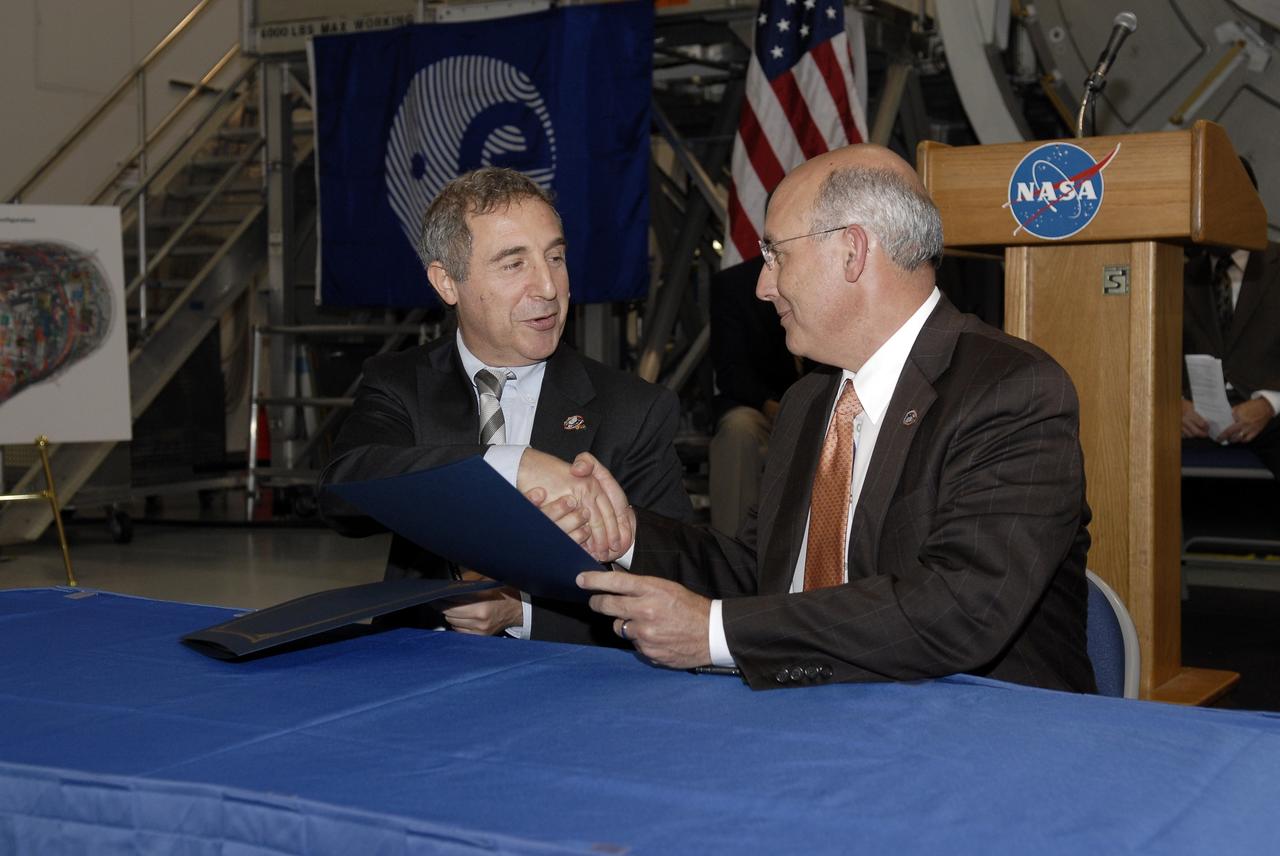
CAPE CANAVERAL, Fla. – In the Space Station Processing Facility at NASA's Kennedy Space Center in Florida, Bernardo Patti, at left, head of International Space Station, Program Department, European Space Agency, congratulates Michael Suffredini, program manager, International Space Station, NASA, upon transfer of the ownership of node 3 for the International Space Station from the European Space Agency, or ESA, to NASA. Node 3 is named "Tranquility" after the Sea of Tranquility, the lunar landing site of Apollo 11. The payload for the STS-130 mission, Tranquility is a pressurized module that will provide room for many of the International Space Station's life support systems. The module was built for ESA by Thales Alenia Space in Turin, Italy. Attached to one end of Tranquility is a cupola, a unique work station with six windows on its sides and one on top. The cupola resembles a circular bay window and will provide a vastly improved view of the station's exterior. Just under 10 feet in diameter, the module will accommodate two crew members and portable workstations that can control station and robotic activities. The multi-directional view will allow the crew to monitor spacewalks and docking operations, as well as provide a spectacular view of Earth and other celestial objects. Space shuttle Endeavour's STS-130 mission is targeted to launch Feb. 4, 2010. Photo credit: NASA/Kim Shiflett
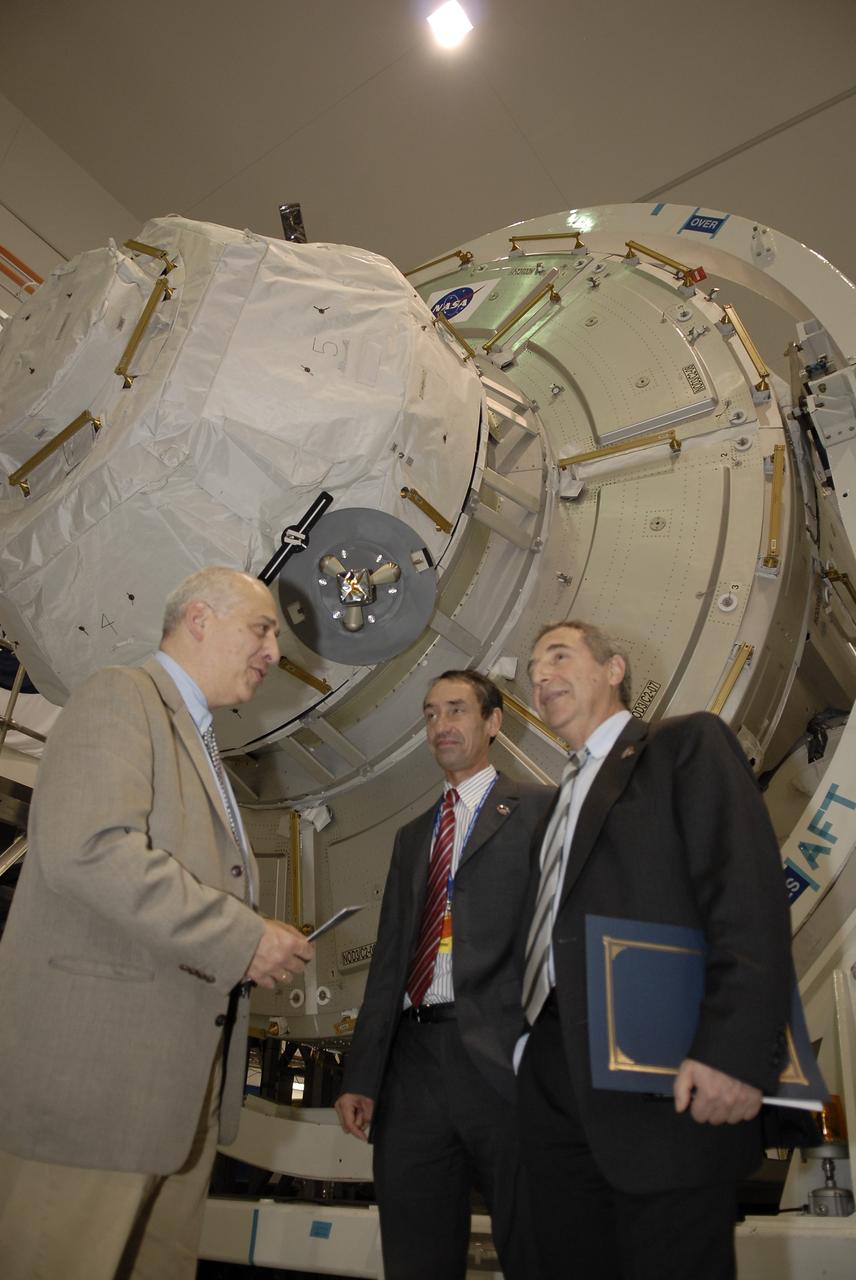
CAPE CANAVERAL, Fla. – In the Space Station Processing Facility at NASA's Kennedy Space Center in Florida, Bernardo Patti, right, head of International Space Station, Program Department, European Space Agency, or ESA, has a lot to smile about as he is photographed in front of the node 3 for the International Space Station following a ceremony transferring the ownership of the node from ESA to NASA. Node 3 is named "Tranquility" after the Sea of Tranquility, the lunar landing site of Apollo 11. The payload for the STS-130 mission, Tranquility is a pressurized module that will provide room for many of the International Space Station's life support systems. The module was built for ESA by Thales Alenia Space in Turin, Italy. Attached to one end of Tranquility is a cupola, a unique work station with six windows on its sides and one on top. The cupola resembles a circular bay window and will provide a vastly improved view of the station's exterior. Just under 10 feet in diameter, the module will accommodate two crew members and portable workstations that can control station and robotic activities. The multi-directional view will allow the crew to monitor spacewalks and docking operations, as well as provide a spectacular view of Earth and other celestial objects. Space shuttle Endeavour's STS-130 mission is targeted to launch Feb. 4, 2010. Photo credit: NASA/Kim Shiflett
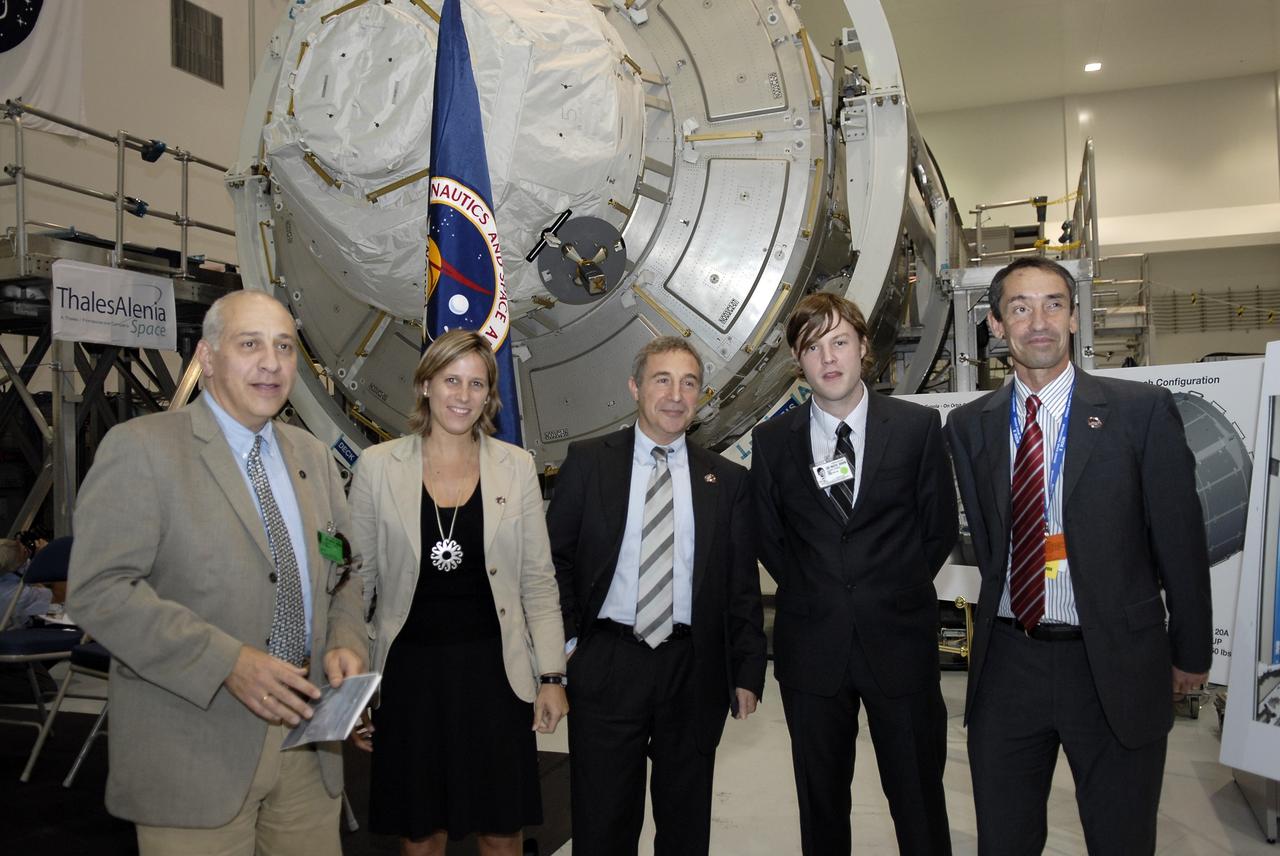
CAPE CANAVERAL, Fla. – In the Space Station Processing Facility at NASA's Kennedy Space Center in Florida, Bernardo Patti, head of International Space Station, Program Department, European Space Agency, or ESA, is photographed with invited guests of ESA in front of node 3 for the International Space Station following a ceremony transferring the ownership of the node from ESA to NASA. Node 3 is named "Tranquility" after the Sea of Tranquility, the lunar landing site of Apollo 11. The payload for the STS-130 mission, Tranquility is a pressurized module that will provide room for many of the International Space Station's life support systems. The module was built for ESA by Thales Alenia Space in Turin, Italy. Attached to one end of Tranquility is a cupola, a unique work station with six windows on its sides and one on top. The cupola resembles a circular bay window and will provide a vastly improved view of the station's exterior. Just under 10 feet in diameter, the module will accommodate two crew members and portable workstations that can control station and robotic activities. The multi-directional view will allow the crew to monitor spacewalks and docking operations, as well as provide a spectacular view of Earth and other celestial objects. Space shuttle Endeavour's STS-130 mission is targeted to launch Feb. 4, 2010. Photo credit: NASA/Kim Shiflett
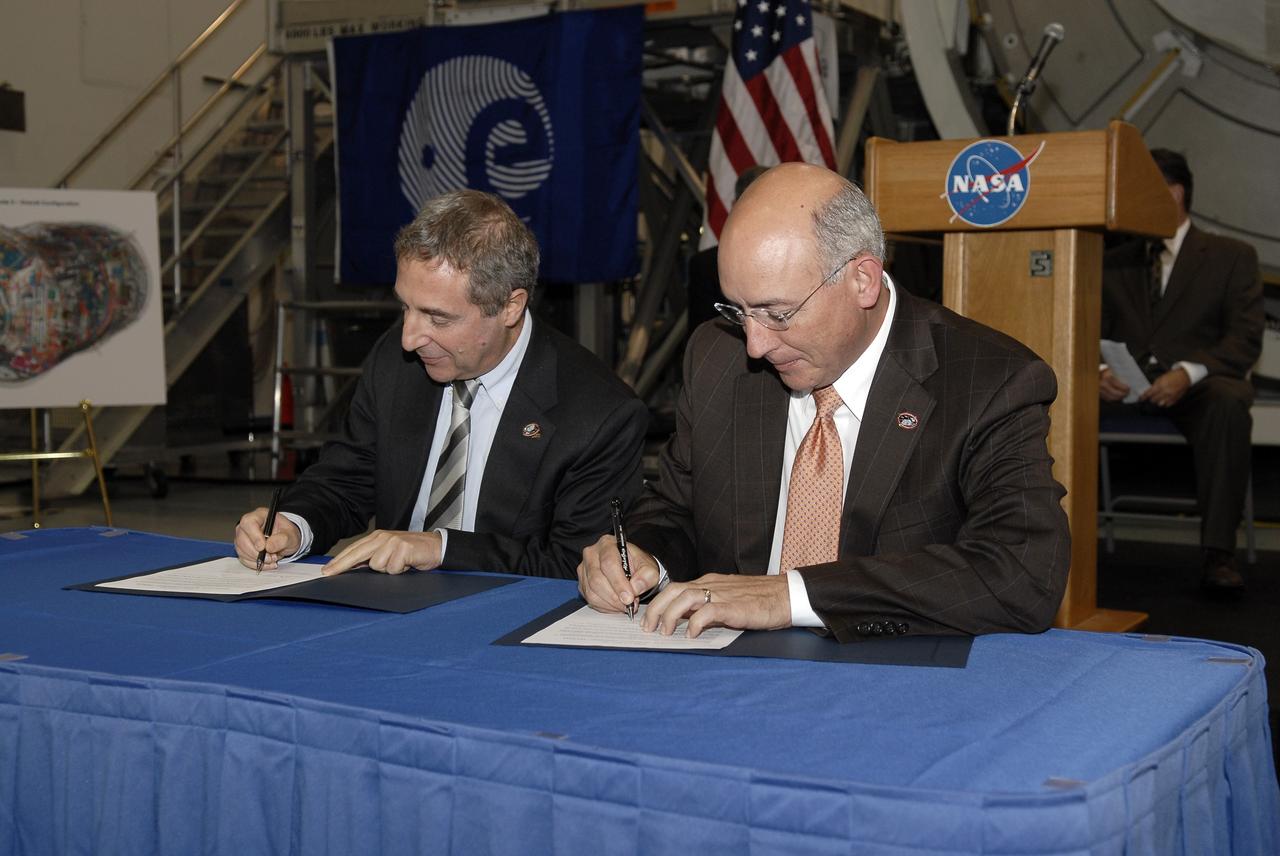
CAPE CANAVERAL, Fla. – In the Space Station Processing Facility at NASA's Kennedy Space Center in Florida, Bernardo Patti, at left, head of International Space Station, Program Department, European Space Agency, and Michael Suffredini, program manager, International Space Station, NASA, sign documents transferring the ownership of node 3 for the International Space Station from the European Space Agency, or ESA, to NASA. Node 3 is named "Tranquility" after the Sea of Tranquility, the lunar landing site of Apollo 11. The payload for the STS-130 mission, Tranquility is a pressurized module that will provide room for many of the International Space Station's life support systems. The module was built for ESA by Thales Alenia Space in Turin, Italy. Attached to one end of Tranquility is a cupola, a unique work station with six windows on its sides and one on top. The cupola resembles a circular bay window and will provide a vastly improved view of the station's exterior. Just under 10 feet in diameter, the module will accommodate two crew members and portable workstations that can control station and robotic activities. The multi-directional view will allow the crew to monitor spacewalks and docking operations, as well as provide a spectacular view of Earth and other celestial objects. Space shuttle Endeavour's STS-130 mission is targeted to launch Feb. 4, 2010. Photo credit: NASA/Kim Shiflett
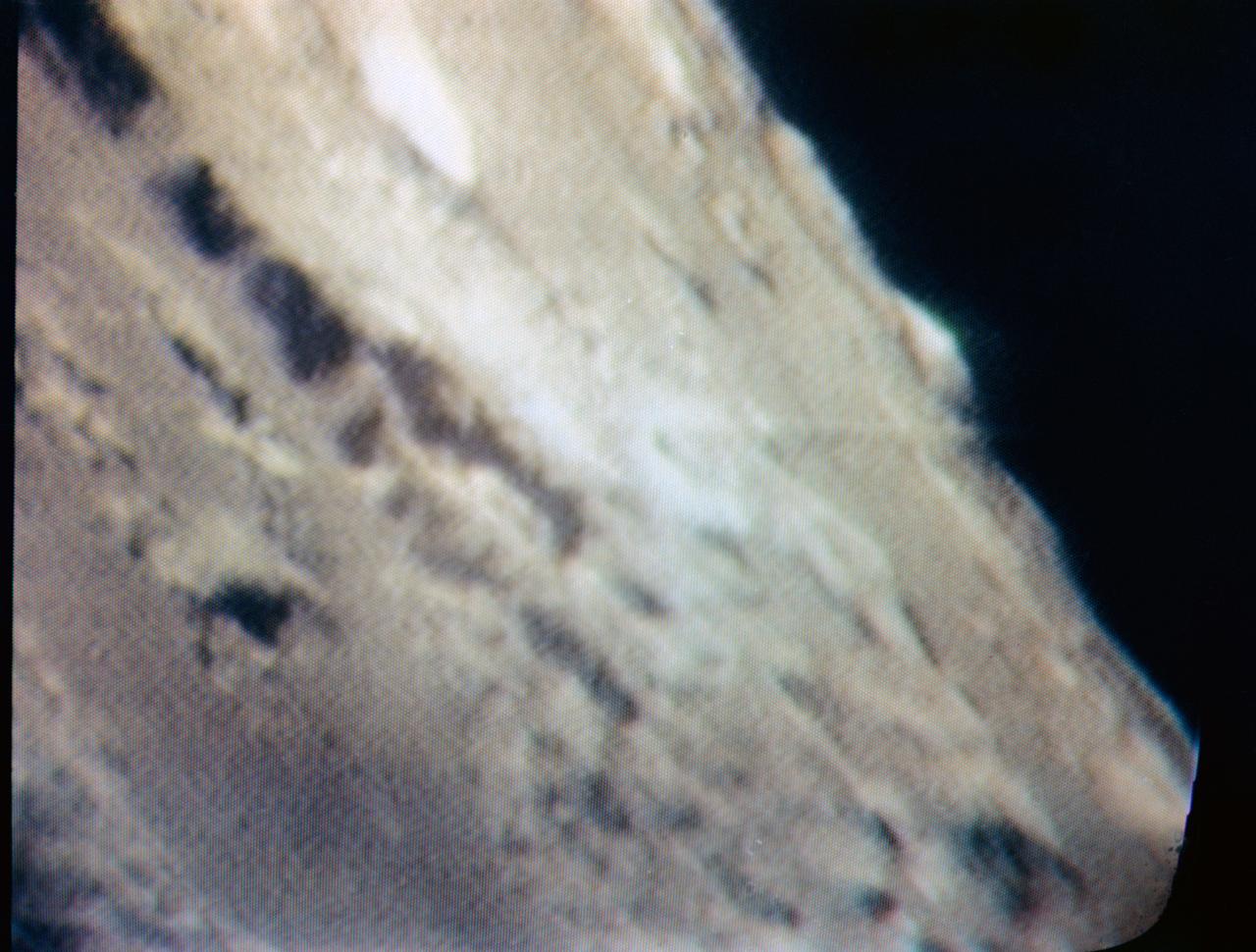
S69-34478 (21 May 1969) --- An oblique view of Barbara Mesa on the lunar nearside is seen in this color reproduction taken from a telecast made by the color television camera aboard the Apollo 10 spacecraft as it orbited the moon. This area is located generally east of Maskelyne crater on the southern edge of the Sea of Tranquility (Mare Tranquillitatis). Barbara Mesa is located at about 32 degrees 45 minutes east longitude and 1 degree 45 minutes north latitude.

S69-30520 (April 1969) --- A North American Rockwell Corporation artist's concept depicting the Apollo 10 Lunar Module descending to 50,000 feet for a close look at a lunar landing site. The Command and Service Modules remain in lunar orbit. The landing area is Site 2 on the east central part of the moon in southwestern Sea of Tranquility (Mare Tranquillitatis). The site is about 62 miles east of the rim of the crater Sabine and 118 miles west-southwest of the crater Maskelyne. Apollo 11 is scheduled to be the first lunar landing mission.
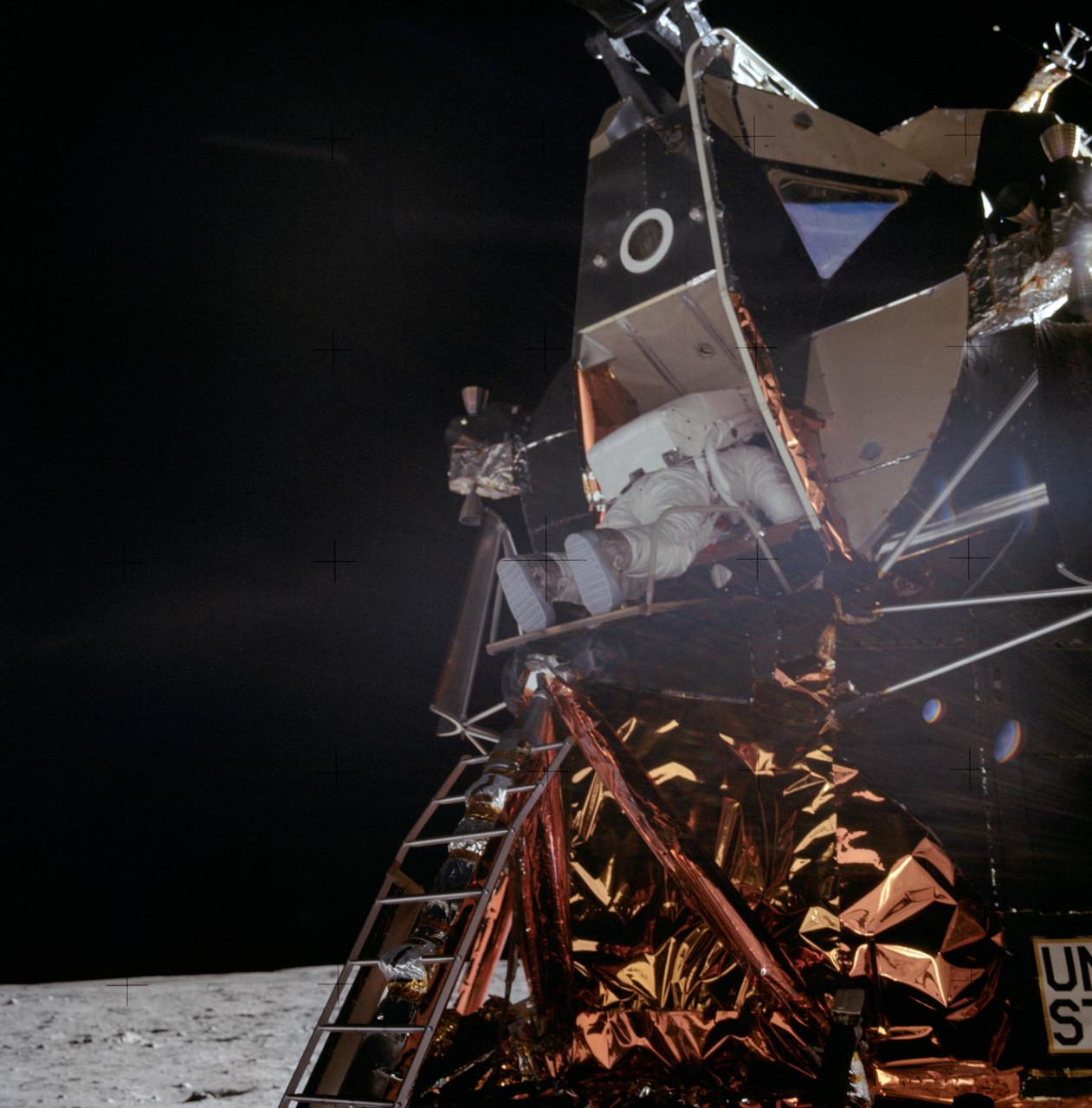
AS11-40-5863 (20 July 1969) --- Astronaut Edwin E. Aldrin Jr., lunar module pilot, is photographed egressing the Lunar Module (LM) during the Apollo 11 extravehicular activity (EVA) on the moon. This photograph was taken by astronaut Neil A. Armstrong, commander, with a 70mm lunar surface camera. While astronauts Armstrong and Aldrin descended in the Lunar Module (LM) "Eagle" to explore the Sea of Tranquility region of the moon, astronaut Michael Collins, command module pilot, remained with the Command and Service Modules (CSM) "Columbia" in lunar orbit.
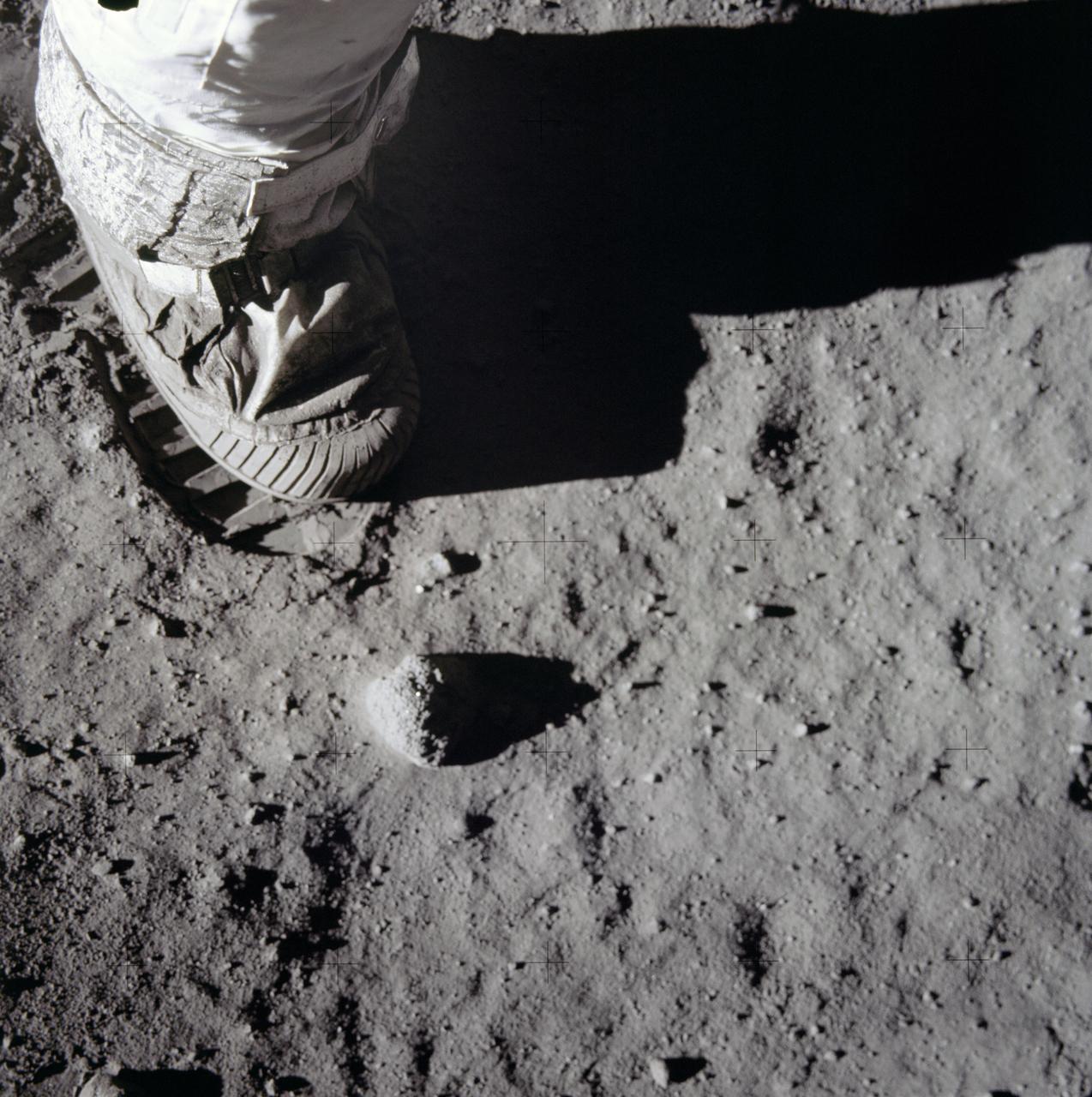
AS11-40-5880 (20 July 1969) --- A close-up view of an astronaut's boot and bootprint in the lunar soil, photographed with a 70mm lunar surface camera during the Apollo 11 lunar surface extravehicular activity (EVA). While astronauts Neil A. Armstrong, commander, and Edwin A. Aldrin Jr., lunar module pilot, descended in the Lunar Module (LM) "Eagle" to explore the Sea of Tranquility region of the moon, astronaut Michael Collins, command module pilot, remained with the Command and Service Modules (CSM)" Columbia" in lunar orbit.
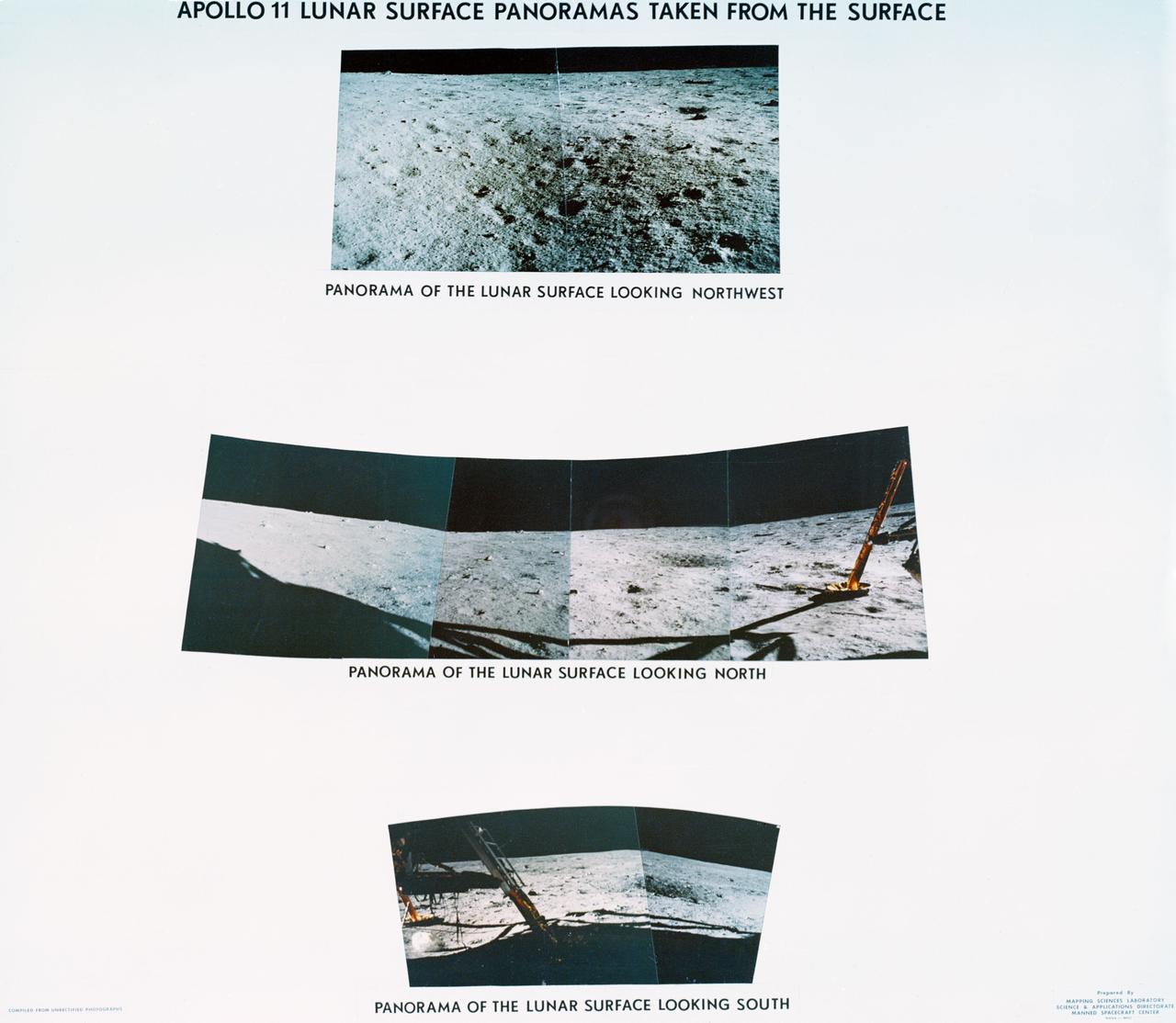
S69-44463 (July 1969) --- Astronaut Neil A. Armstrong took this series of pictures of the landing site of Apollo 11's Lunar Module (LM) Eagle on the lunar surface. These panoramic views of the lunar surface reveal the surface near where the LM touched down, in the southeastern Sea of Tranquility. Foot pads and shadows of the LM are visible in the two of the three panoramic views.
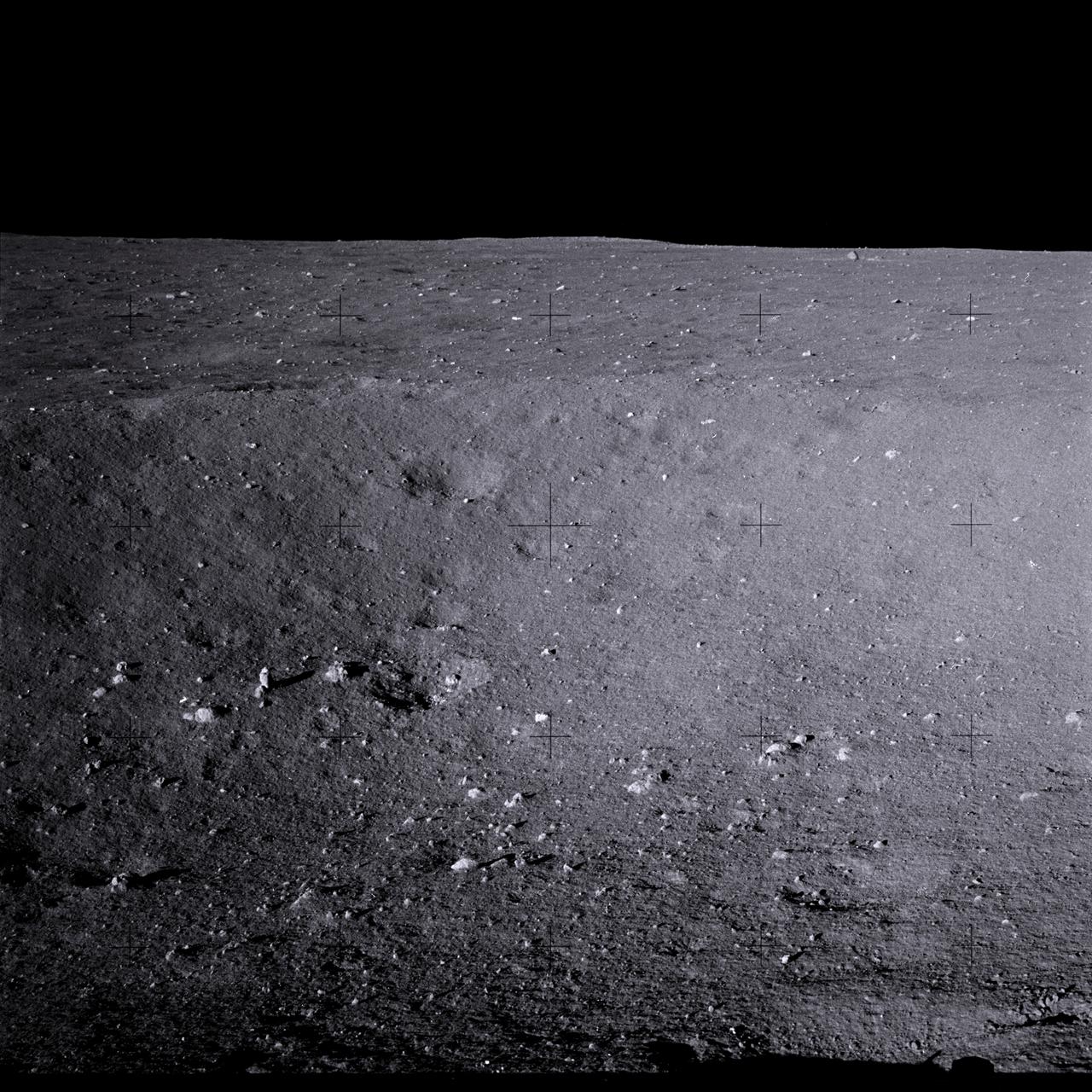
AS11-40-5881 (20 July 1969) --- This 70mm handheld camera's image on the Sea of Tranquility's lunar surface is the first of a multi-framed panorama photographed from a point some 30 or 40 feet west of the plus-Z (west) footpad of the Lunar Module "Eagle." The view is looking toward the southwest showing part of the horizon crater rim that was pointed out as being visible from the Eagle's window.
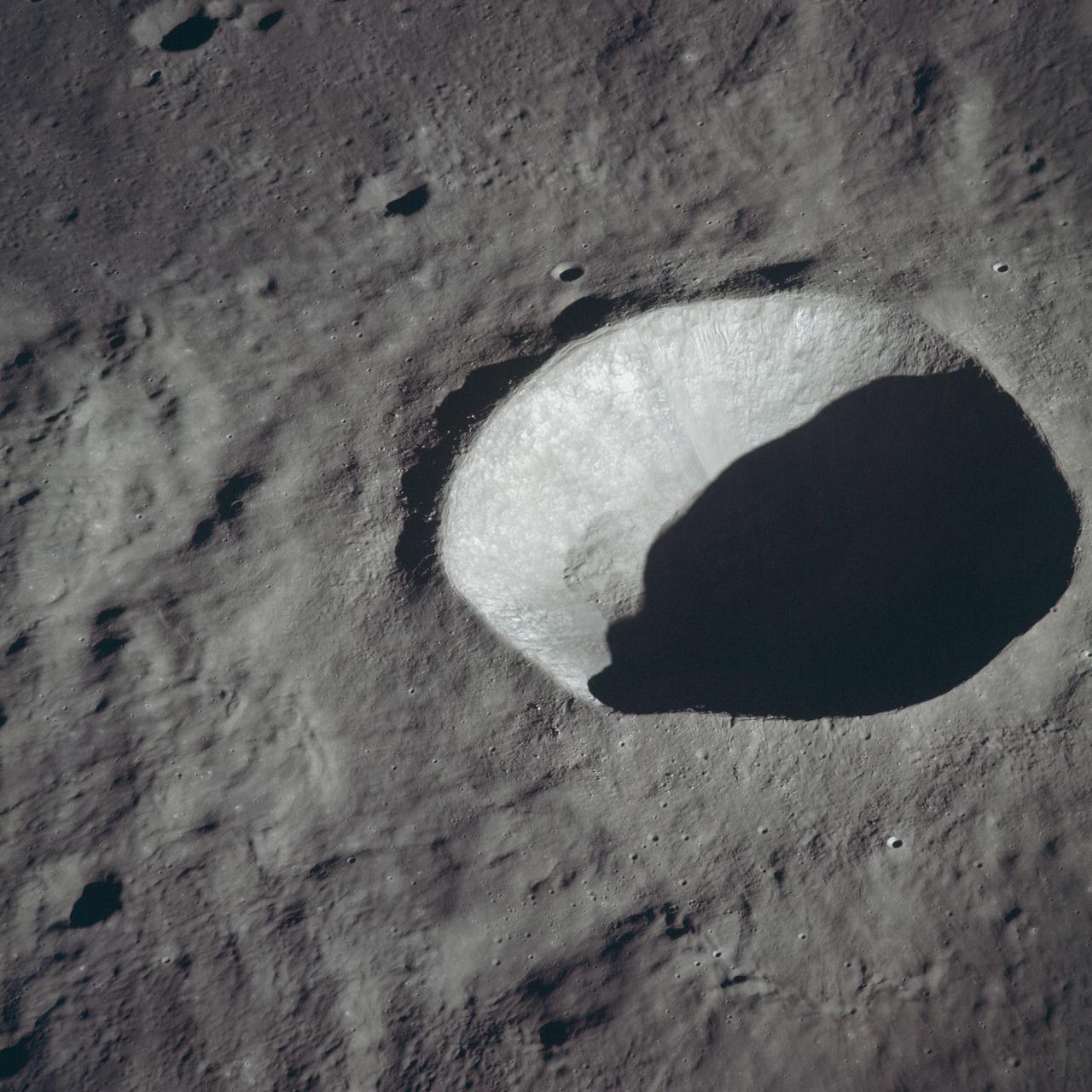
AS10-34-5162 (18-26 May 1969) --- An Apollo 10 view of crater Schmidt which is located at the western edge of the Sea of Tranquility. Schmidt, which has a diameter of 7 statute miles, is also located just south of the crater Ritter and immediately west of the crater Sabine. The coordinates of Schmidt are 18.8 degrees east longitude and 1.2 degrees north latitude. The shadowed area is on the east side of the crater.
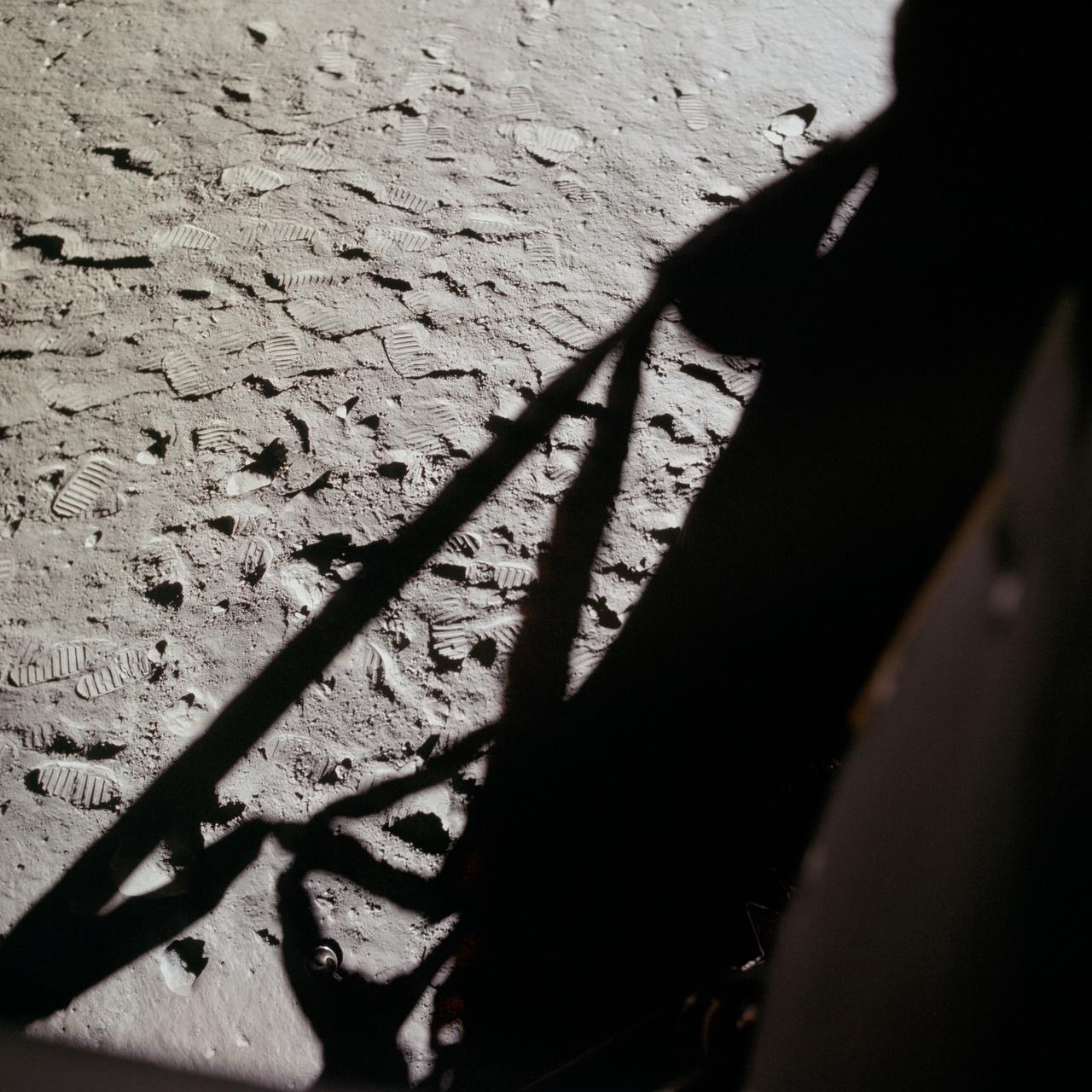
AS11-37-5505 (20 July 1969) --- This photograph shows in fine detail the impressions in the lunar soil made by astronauts Neil A. Armstrong and Edwin E. Aldrin Jr. during their lunar surface extravehicular activity (EVA). While astronauts Armstrong, commander, and Aldrin, lunar module pilot, descended in the Lunar Module (LM) "Eagle" to explore the Sea of Tranquility region of the moon, astronaut Michael Collins, command module pilot, remained with the Command and Service Modules (CSM) "Columbia" in lunar orbit.

AS11-36-5299 (16 July 1969) --- This view of Earth showing clouds over water was photographed from the Apollo 11 spacecraft following translunar injection. While astronauts Neil A. Armstrong, commander, and Edwin E. Aldrin Jr., lunar module pilot, descended in the Lunar Module (LM) "Eagle" to explore the Sea of Tranquility region of the moon, astronaut Michael Collins, command module pilot, remained with the Command and Service Modules (CSM) "Columbia" in lunar orbit.

AS11-40-5878 (20 July 1969) --- A close-up view of an astronaut's bootprint in the lunar soil, photographed with a 70mm lunar surface camera during the Apollo 11 extravehicular activity (EVA) on the moon. While astronauts Neil A. Armstrong, commander, and Edwin E. Aldrin Jr., lunar module pilot, descended in the Lunar Module (LM) "Eagle" to explore the Sea of Tranquility region of the moon, astronaut Michael Collins, command module pilot, remained with the Command and Service Modules (CSM) "Columbia" in lunar orbit.
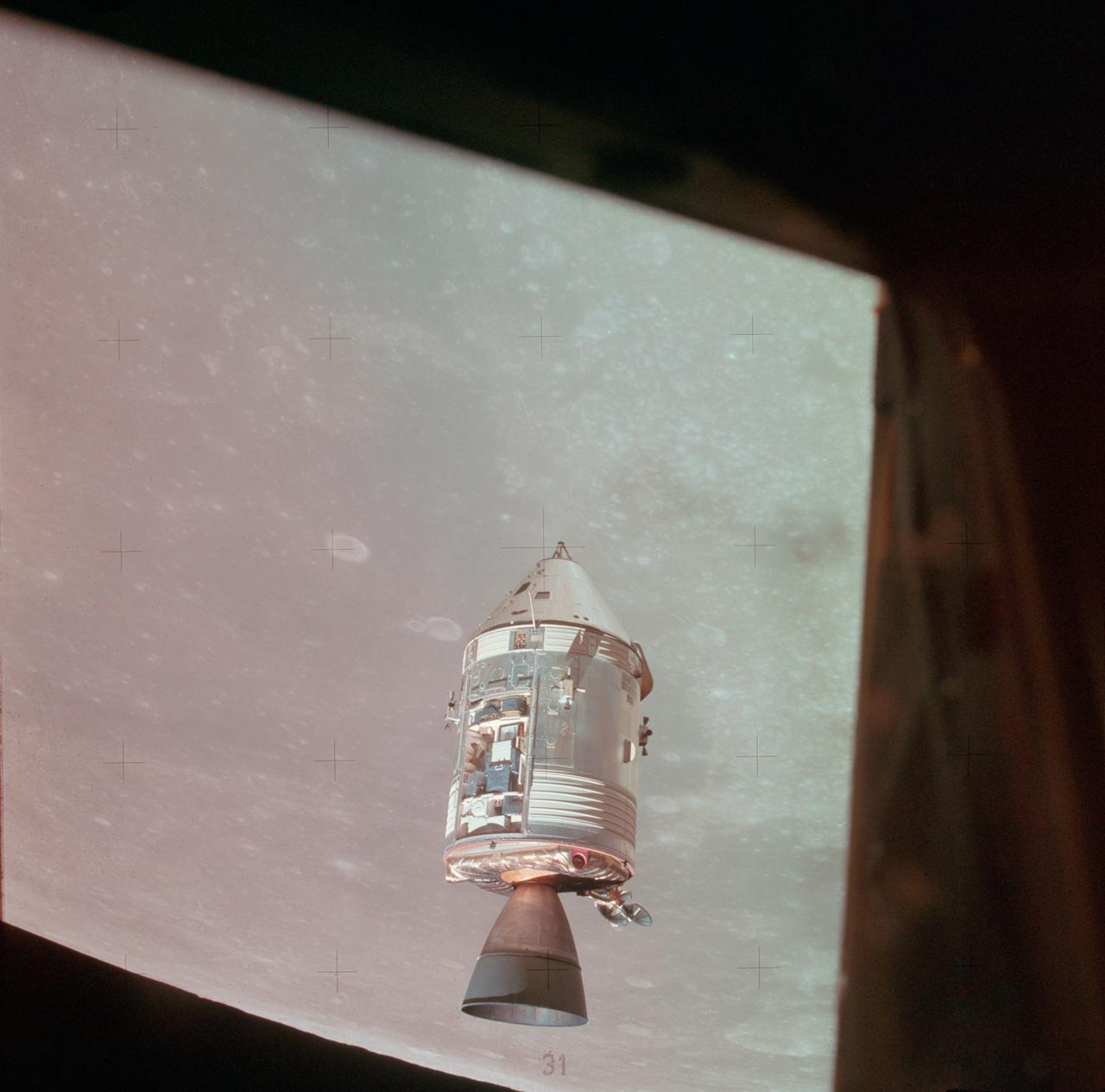
AS15-88-11968 (2 Aug. 1971) --- A view of the Apollo 15 Command and Service Modules (CSM) in lunar orbit as photographed from the Lunar Module (LM) "Falcon" just after rendezvous. The lunar features below are located on the east side of the Sea of Tranquility. While astronauts David R. Scott, commander; and James B. Irwin, lunar module pilot, descended in the LM to explore the moon, astronaut Alfred M. Worden, command module pilot, remained with the CSM in lunar orbit.
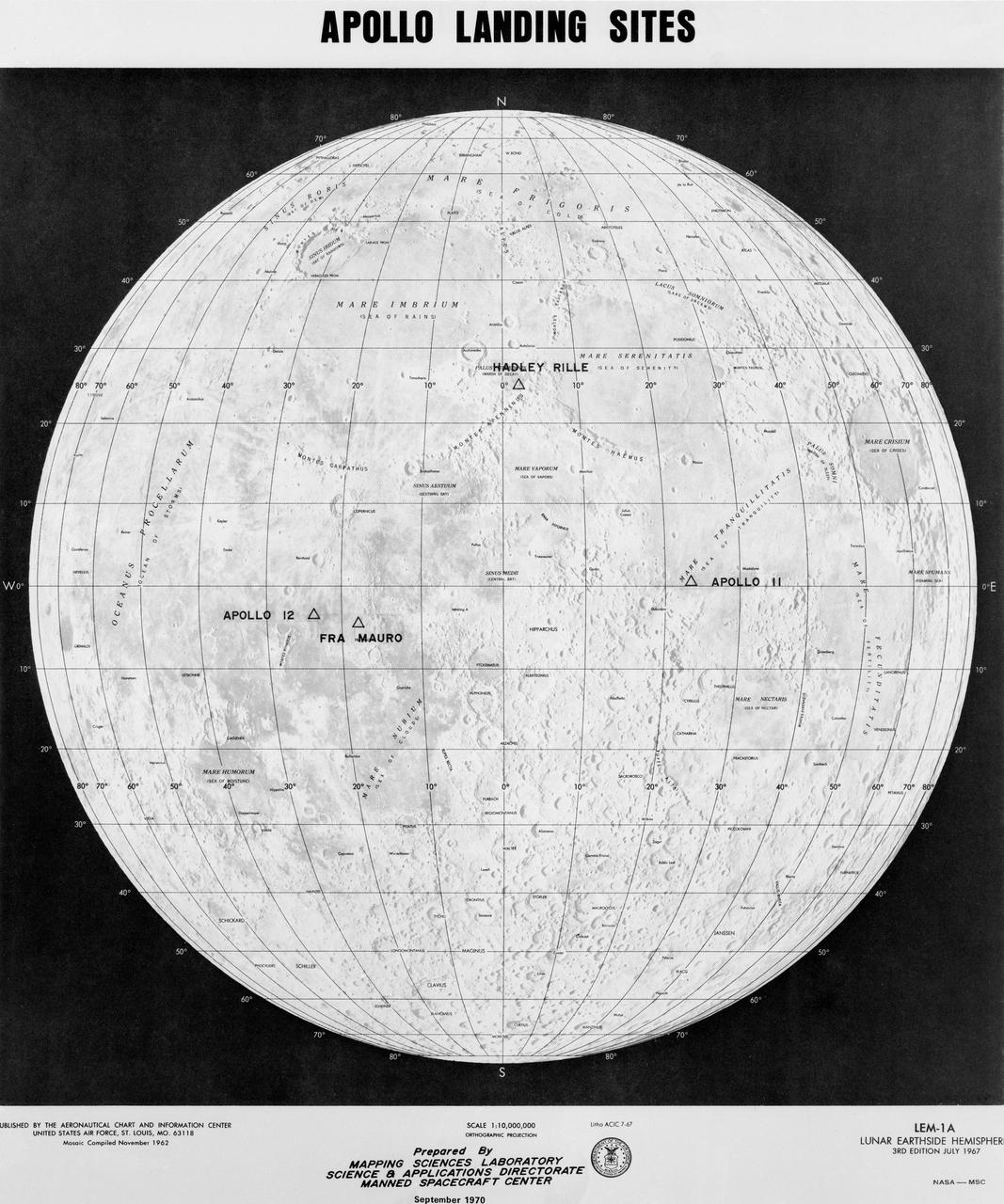
S70-50761 (September 1970) --- This map prepared by Mapping Sciences Laboratory, Science & Applications Directorate at the Manned Spacecraft Center, shows the projected Apollo landing sites. Apollo 11 completed a successful lunar landing mission in the Sea of Tranquility in July 1969. Apollo 12 completed a successful lunar landing mission in the Ocean of Storms in November 1969.
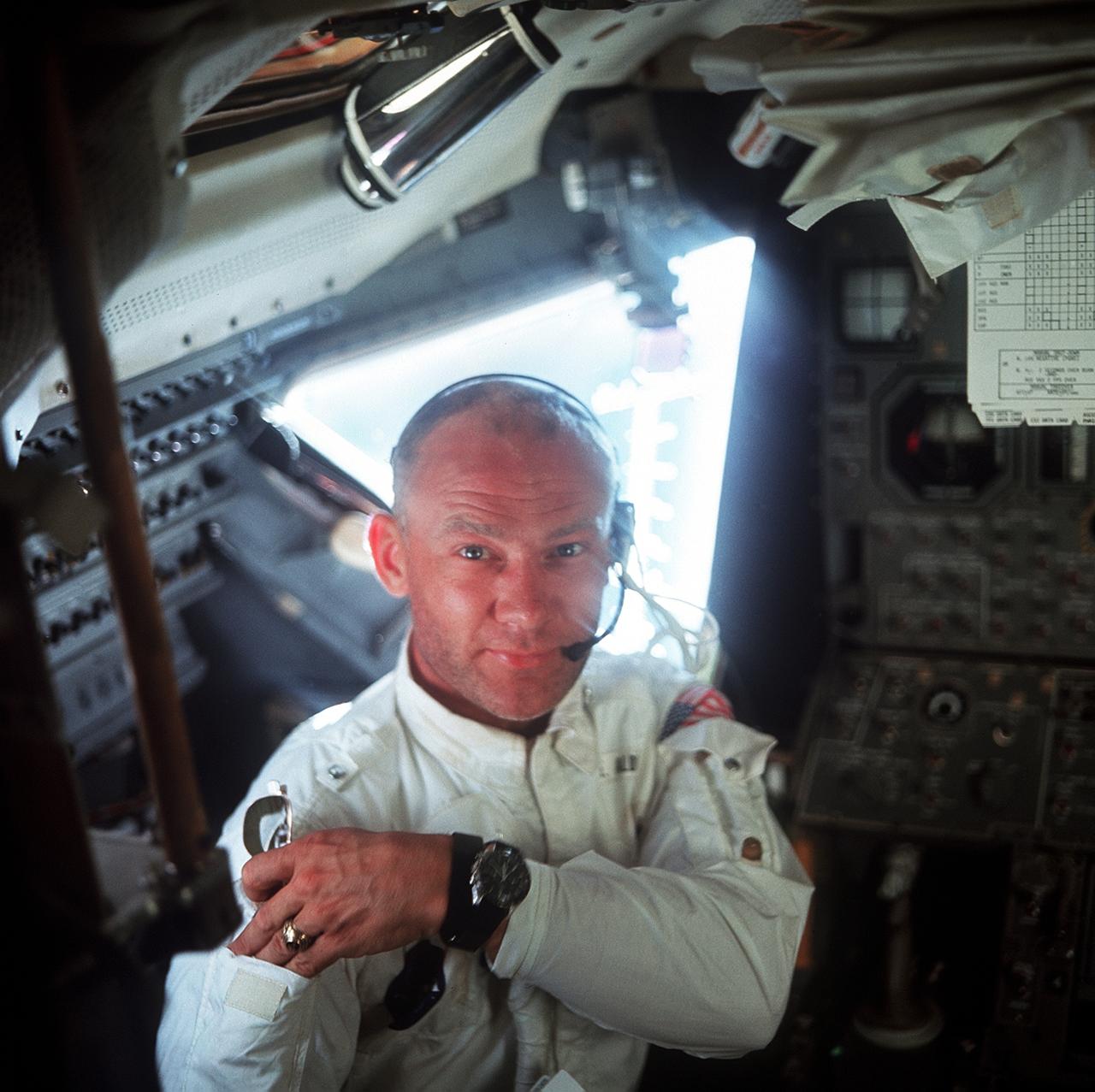
AS11-36-5390 (20 July 1969) --- This interior view of the Apollo 11 Lunar Module (LM) shows astronaut Edwin E. Aldrin Jr., lunar module pilot, during the lunar landing mission. This picture was taken by astronaut Neil A. Armstrong, commander. While astronauts Armstrong and Aldrin descended in the LM "Eagle" to explore the Sea of Tranquility region of the moon, astronaut Michael Collins, command module pilot, remained with the Command and Service Modules (CSM) "Columbia" in lunar orbit.
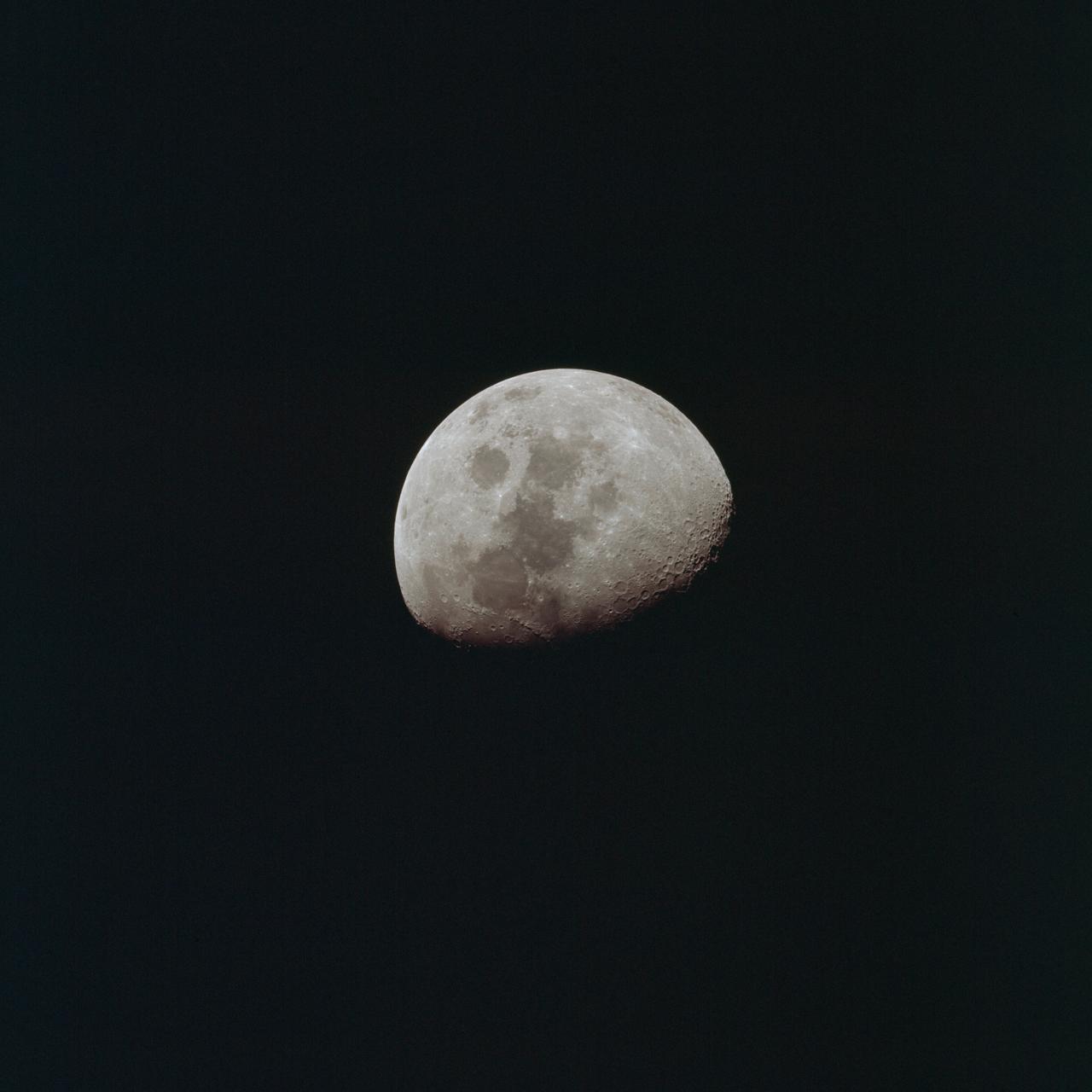
AS10-27-3956 (24 May 1969) --- This photograph of the moon was taken after trans-Earth insertion when the Apollo 10 spacecraft was high above the lunar equator near 27 degrees east longitude. North is about 20 degrees left of the top of the photograph. Apollo Landing Site 3 is on the lighted side of the terminator in a dark area just north of the equator. Apollo Landing Site 2 is near the lower left margin of the Sea of Tranquility (Mare Tranquillitatis), which is the large, dark area near the center of the photograph.
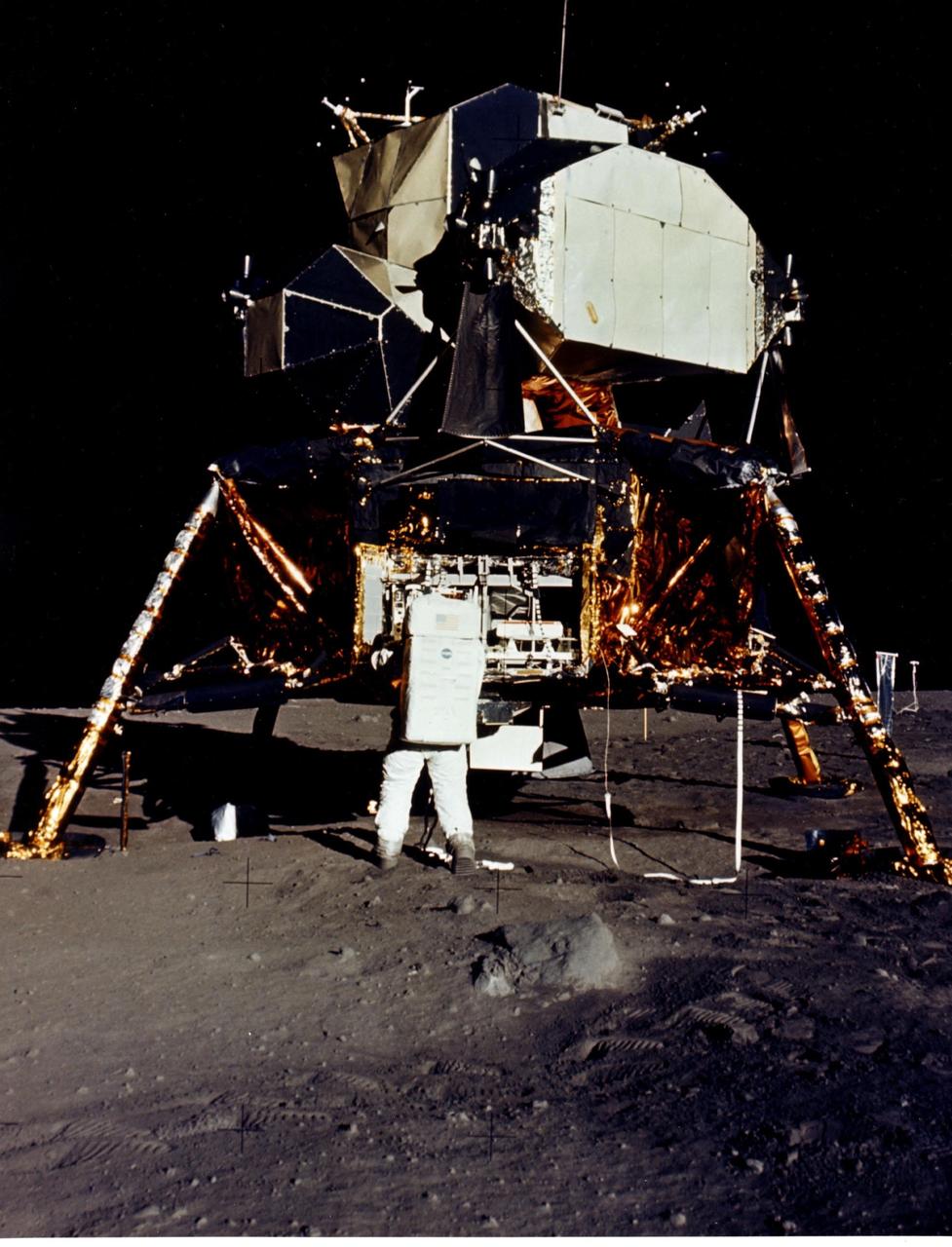
JOHNSON SPACE CENTER, HOUSTON, TEXAS - Man's first landing on the Moon was accomplished at 4:17 p.m. today as Lunar Module "Eagle" touched down gently on the Sea of Tranquility on the east side of the Moon. Astronaut Edwin E. Aldrin Jr., Lunar Module Pilot, removes scientific experiment packages from a stowage area in the Lunar Module's descent stage. Left behind on the lunar surface by Aldrin and Neil A. Armstrong, Apollo 11 commander, were a Passive Seismic Experiments Package and a Laser-Ranging Retro-Reflector.
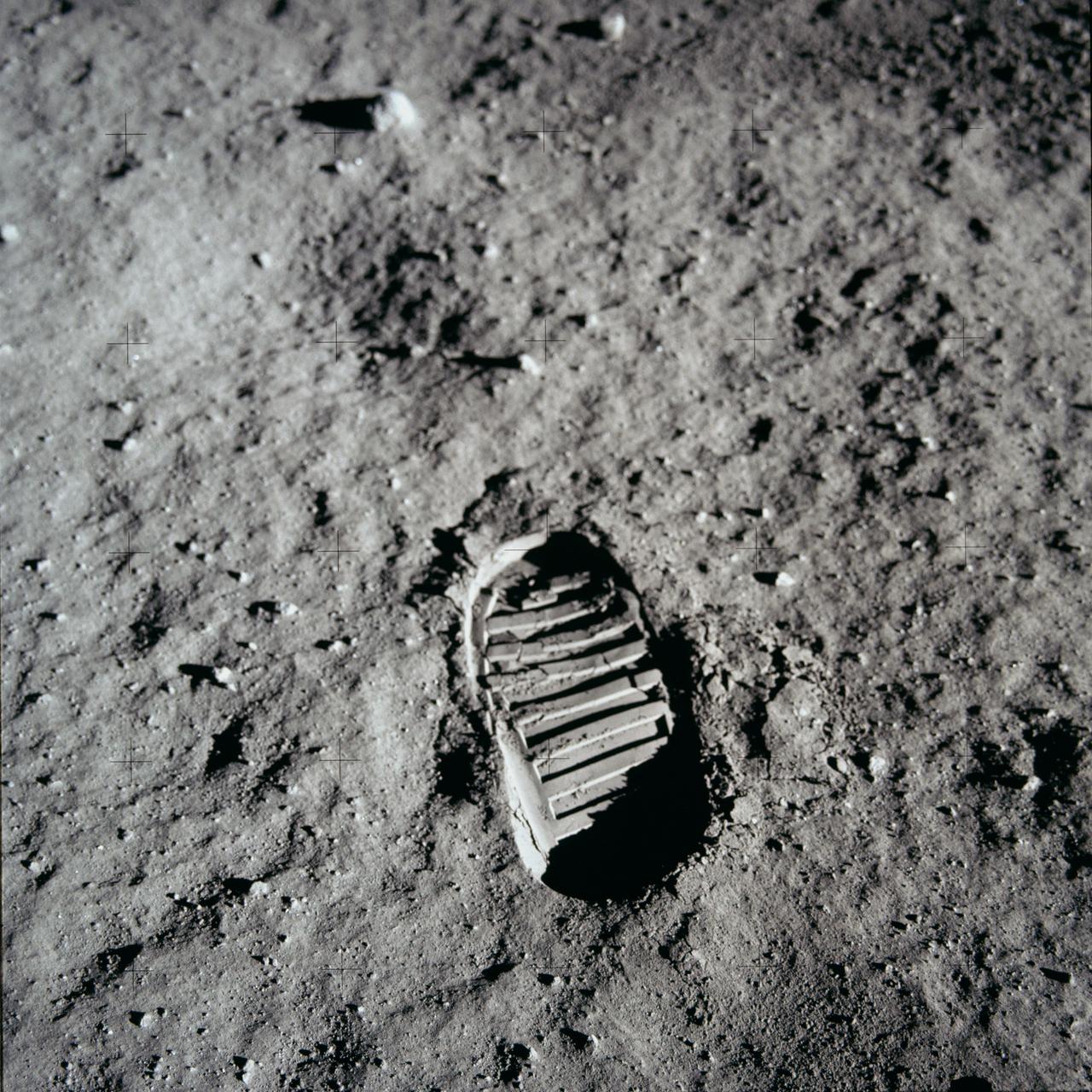
AS11-40-5877 (20 July 1969) --- A close-up view of an astronaut's bootprint in the lunar soil, photographed with a 70mm lunar surface camera during the Apollo 11 extravehicular activity (EVA) on the moon. While astronauts Neil A. Armstrong, commander, and Edwin E. Aldrin Jr., lunar module pilot, descended in the Lunar Module (LM) "Eagle" to explore the Sea of Tranquility region of the moon, astronaut Michael Collins, command module pilot, remained with the Command and Service Modules (CSM) "Columbia" in lunar orbit.
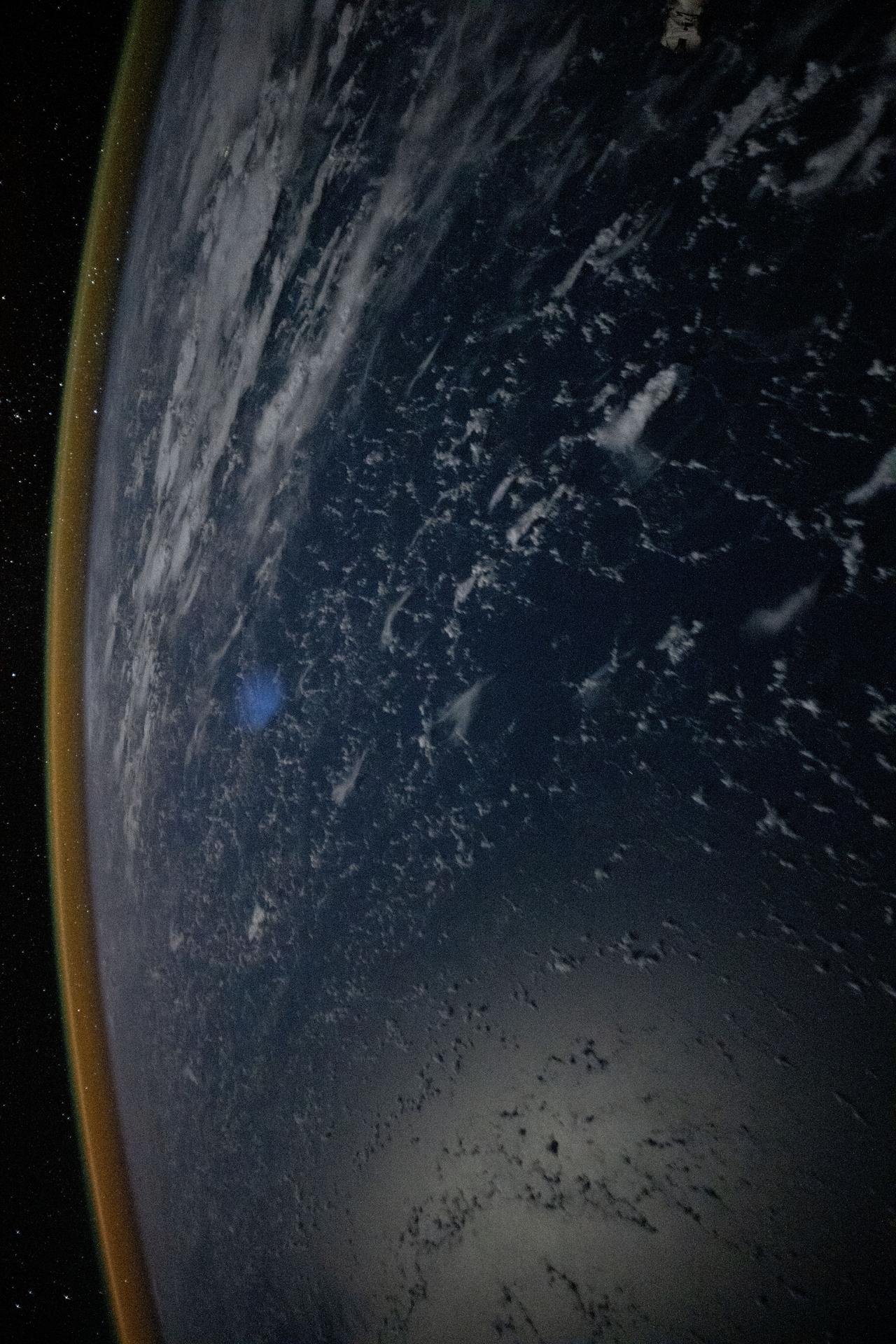
iss073e0824860 (Sept. 14, 2025) --- A red-yellow airglow blankets Earth's horizon above the tranquil, moonlit Philippine Sea in this photograph taken from the International Space Station at approximately 1:49 a.m. local time while orbiting 261 miles above Earth. This type of airglow is caused by chemical reactions in the upper atmosphere, often involving oxygen and hydroxyl molecules, and is typically visible in long-exposure imagery taken from orbit.
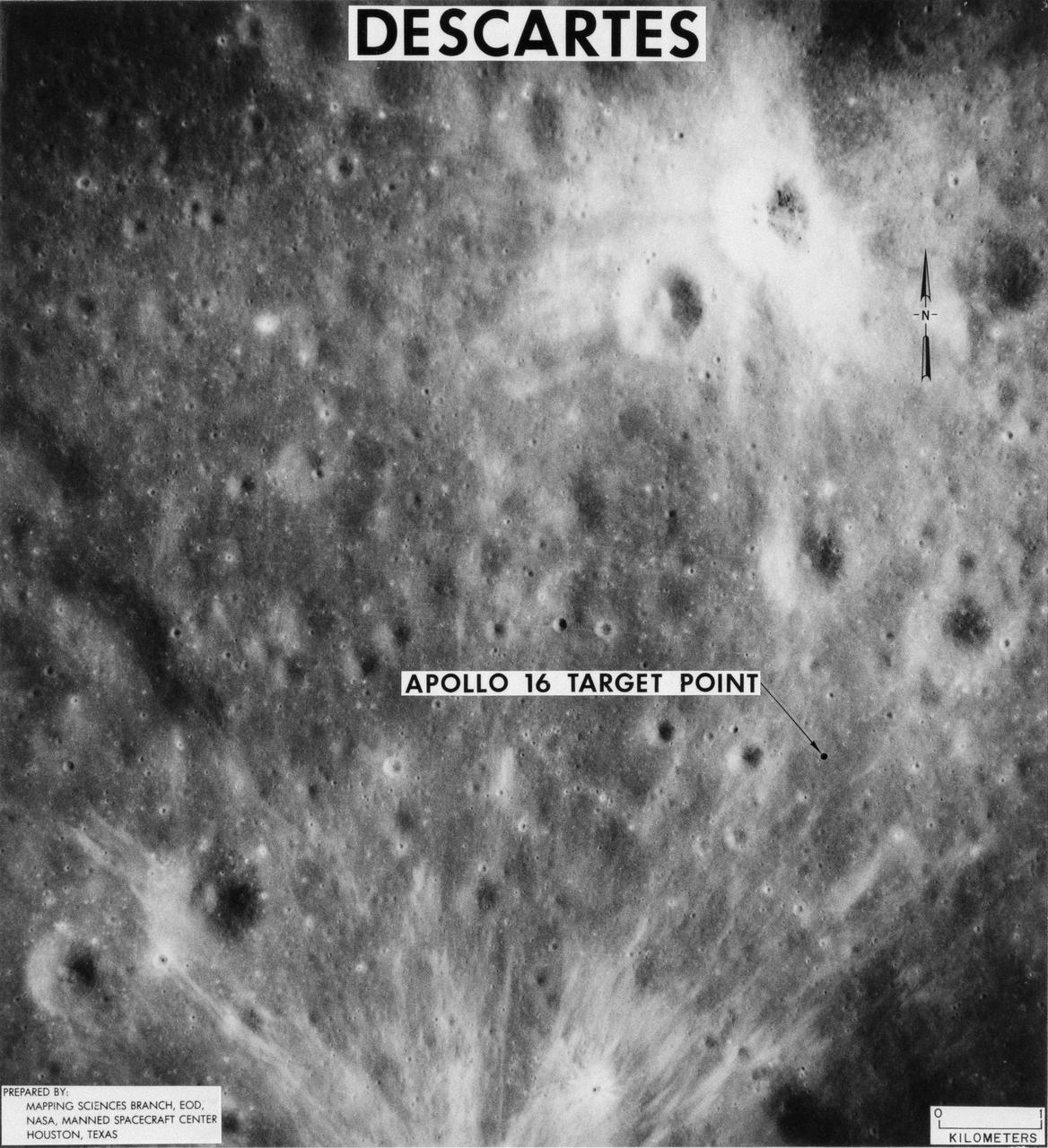
S71-44150 (February 1971) --- A vertical view of the Apollo 16 landing site located in the Descartes area on the lunar nearside. The overlay indicates the location of the proposed touchdown point for the Apollo 16 Lunar Module (LM). Descartes is located west of the Sea of Nectar and southwest of the Sea of Tranquility. This photograph was taken with a 500mm lens camera from lunar orbit by the Apollo 16 crew. Astronauts John W. Young, commander; and Charles M. Duke Jr., lunar module pilot; descended in the Apollo 16 LM "Orion" to explore the Descartes highlands landing site on the moon. Astronaut Thomas K. Mattingly II, command module pilot, remained with the Command and Service Modules (CSM) "Casper" in lunar orbit.

AS11-40-5875 (20 July 1969) --- Astronaut Edwin E. Aldrin Jr., lunar module pilot of the first lunar landing mission, poses for a photograph beside the deployed United States flag during an Apollo 11 extravehicular activity (EVA) on the lunar surface. The Lunar Module (LM) is on the left, and the footprints of the astronauts are clearly visible in the soil of the moon. Astronaut Neil A. Armstrong, commander, took this picture with a 70mm Hasselblad lunar surface camera. While astronauts Armstrong and Aldrin descended in the LM, the "Eagle", to explore the Sea of Tranquility region of the moon, astronaut Michael Collins, command module pilot, remained with the Command and Service Modules (CSM) "Columbia" in lunar orbit. Photo credit: NASA
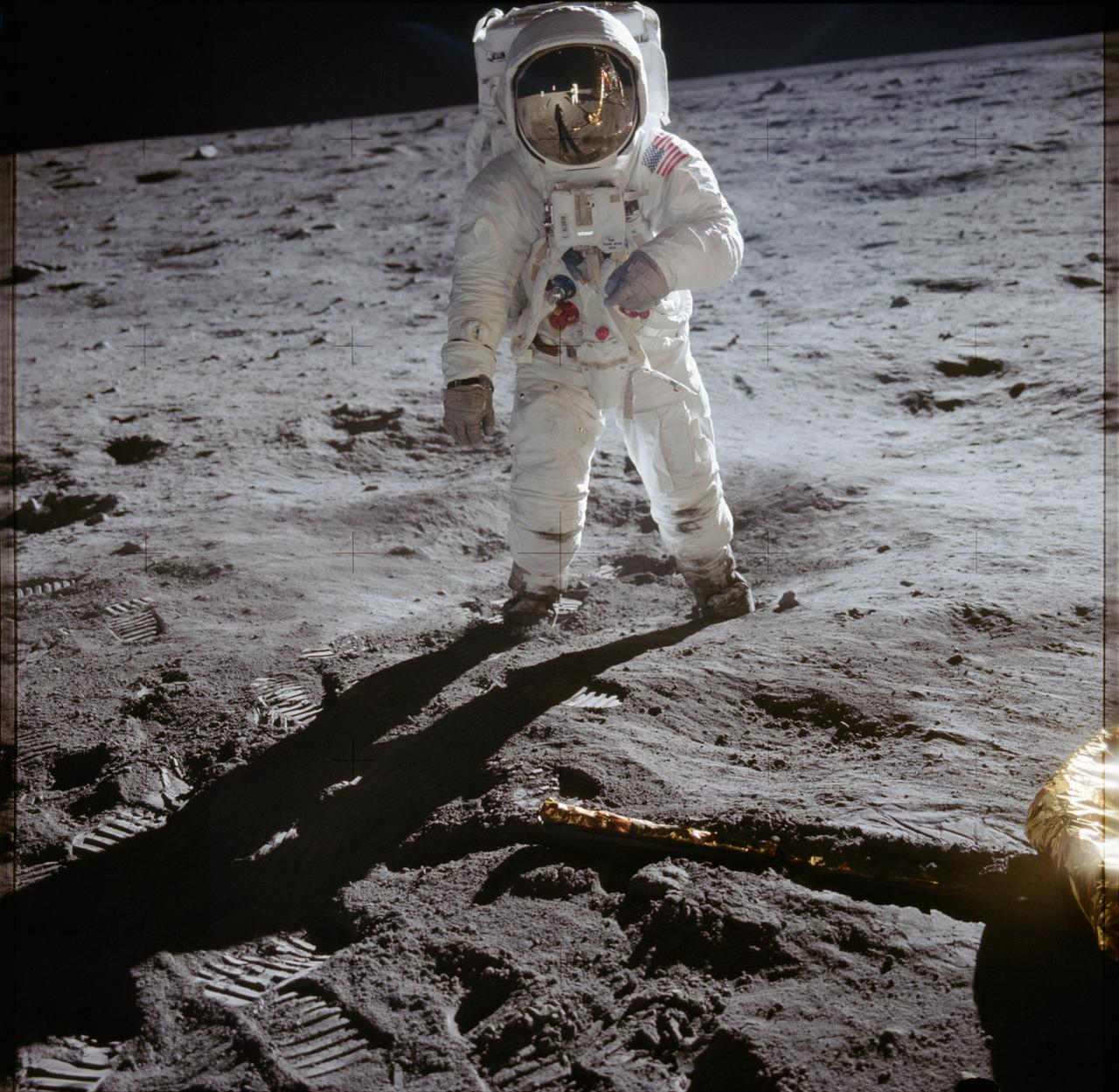
AS11-40-5903 (20 July 1969) --- Astronaut Edwin E. Aldrin Jr., lunar module pilot, walks on the surface of the moon near the leg of the Lunar Module (LM) "Eagle" during the Apollo 11 extravehicular activity (EVA). Astronaut Neil A. Armstrong, commander, took this photograph with a 70mm lunar surface camera. While astronauts Armstrong and Aldrin descended in the Lunar Module (LM) "Eagle" to explore the Sea of Tranquility region of the moon, astronaut Michael Collins, command module pilot, remained with the Command and Service Modules (CSM) "Columbia" in lunar orbit.
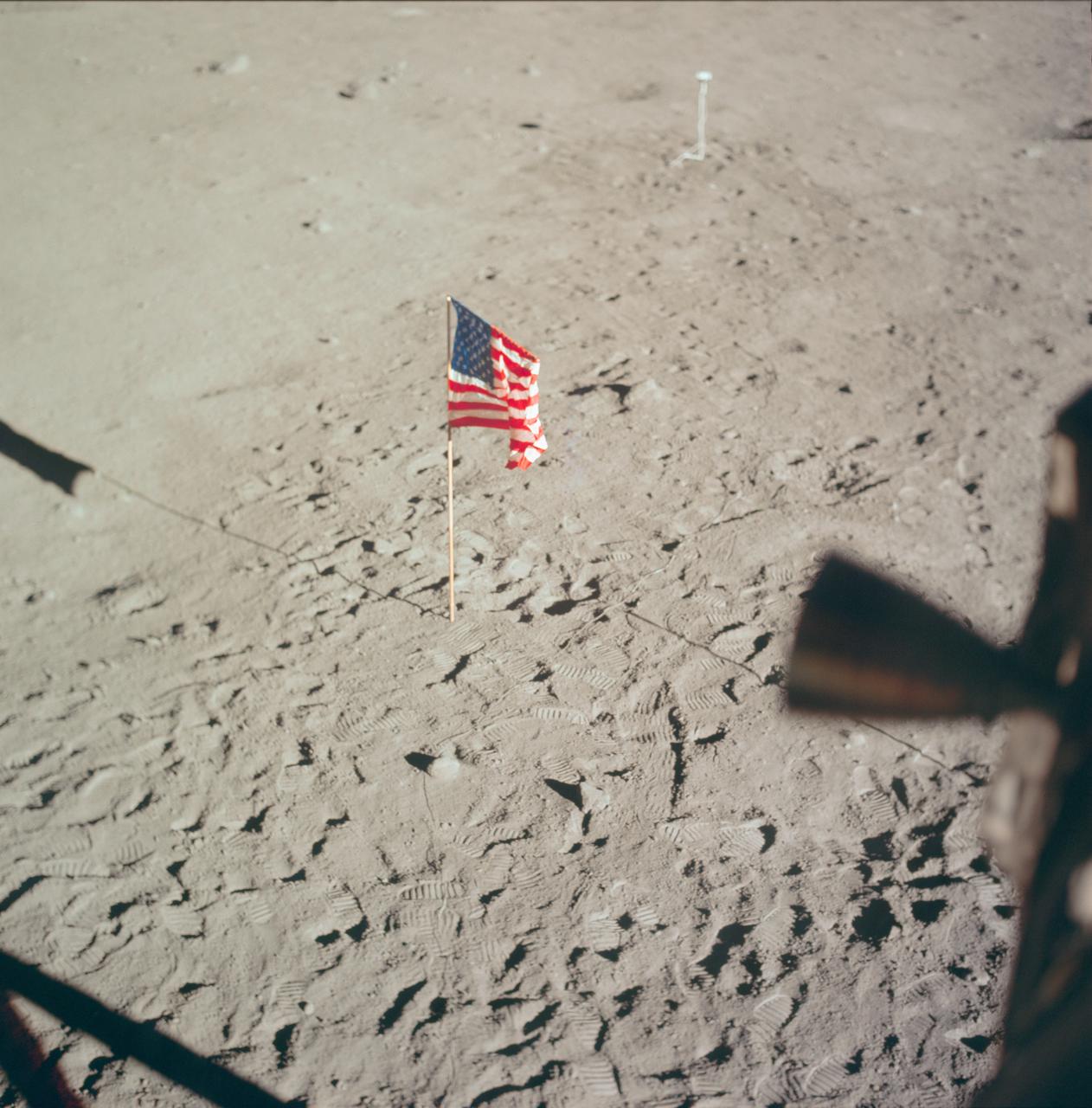
AS11-37-5545 (20 July 1969) --- The flag of the United States, deployed on the surface of the moon, dominates this photograph taken from inside the Lunar Module (LM). The footprints of astronauts Neil A. Armstrong and Edwin E. Aldrin Jr. stand out very clearly. In the far background is the deployed black and white lunar surface television camera which televised the Apollo 11 lunar surface extravehicular activity (EVA). While astronauts Armstrong, commander, and Aldrin, lunar module pilot, descended in the Lunar Module (LM) "Eagle" to explore the Sea of Tranquility region of the moon, astronaut Michael Collins, command module pilot, remained with the Command and Service Modules (CSM) "Columbia" in lunar orbit.
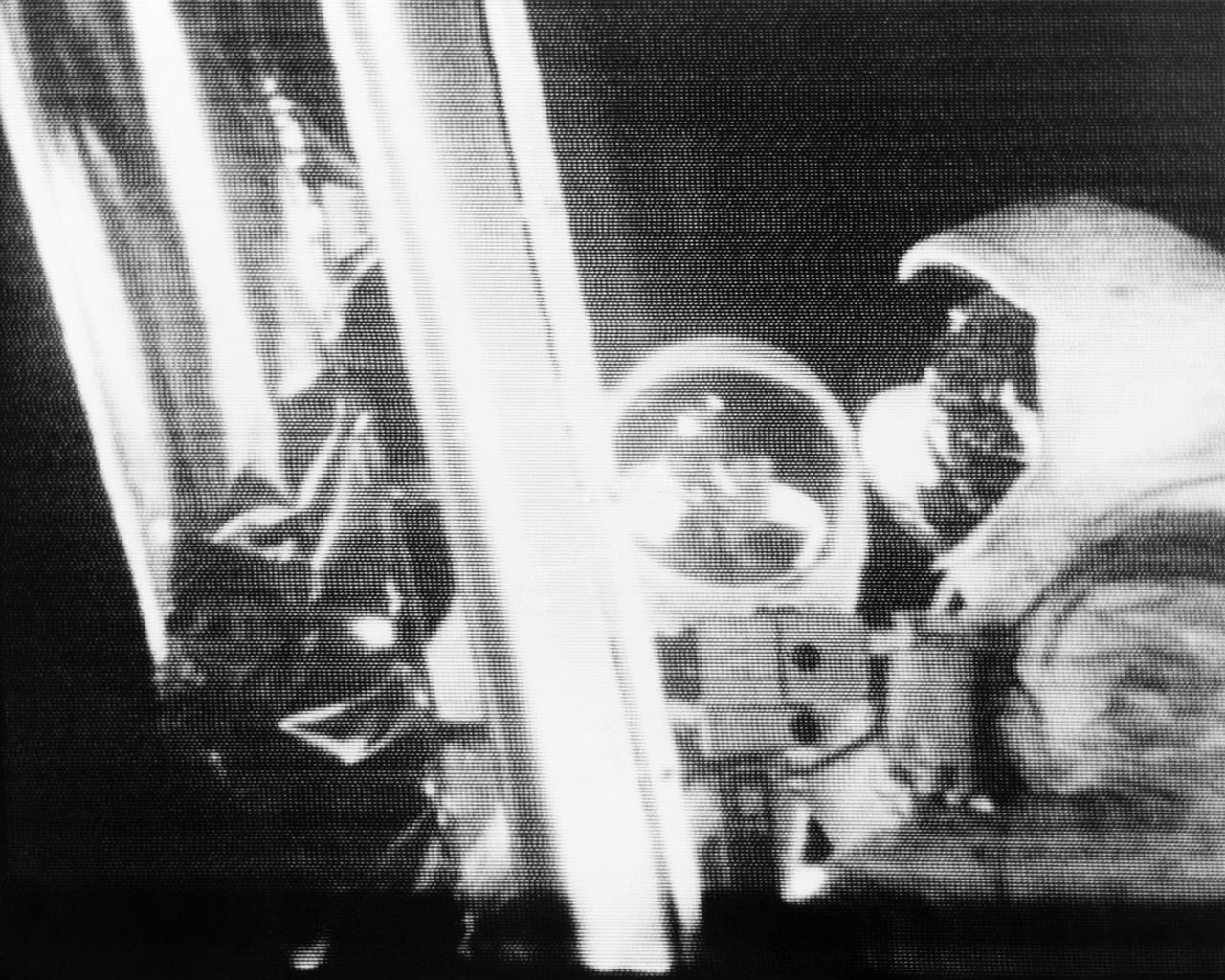
S69-39563 (20 July 1969) --- Astronauts Neil A. Armstrong (left), commander, and Edwin E. Aldrin Jr., lunar module pilot, are seen standing by the Lunar Module (LM) "Eagle" ladder in this black and white reproduction taken from a telecast by the Apollo 11 lunar surface television camera during the Apollo 11 extravehicular activity (EVA). This picture was made from a televised image received at the Deep Space Network (DSN) tracking station at Goldstone, California. While astronauts Armstrong and Aldrin descended in the "Eagle" to explore the Sea of Tranquility region of the moon, astronaut Michael Collins, command module pilot, remained with the Command and Service Modules (CSM) "Columbia" in lunar orbit.
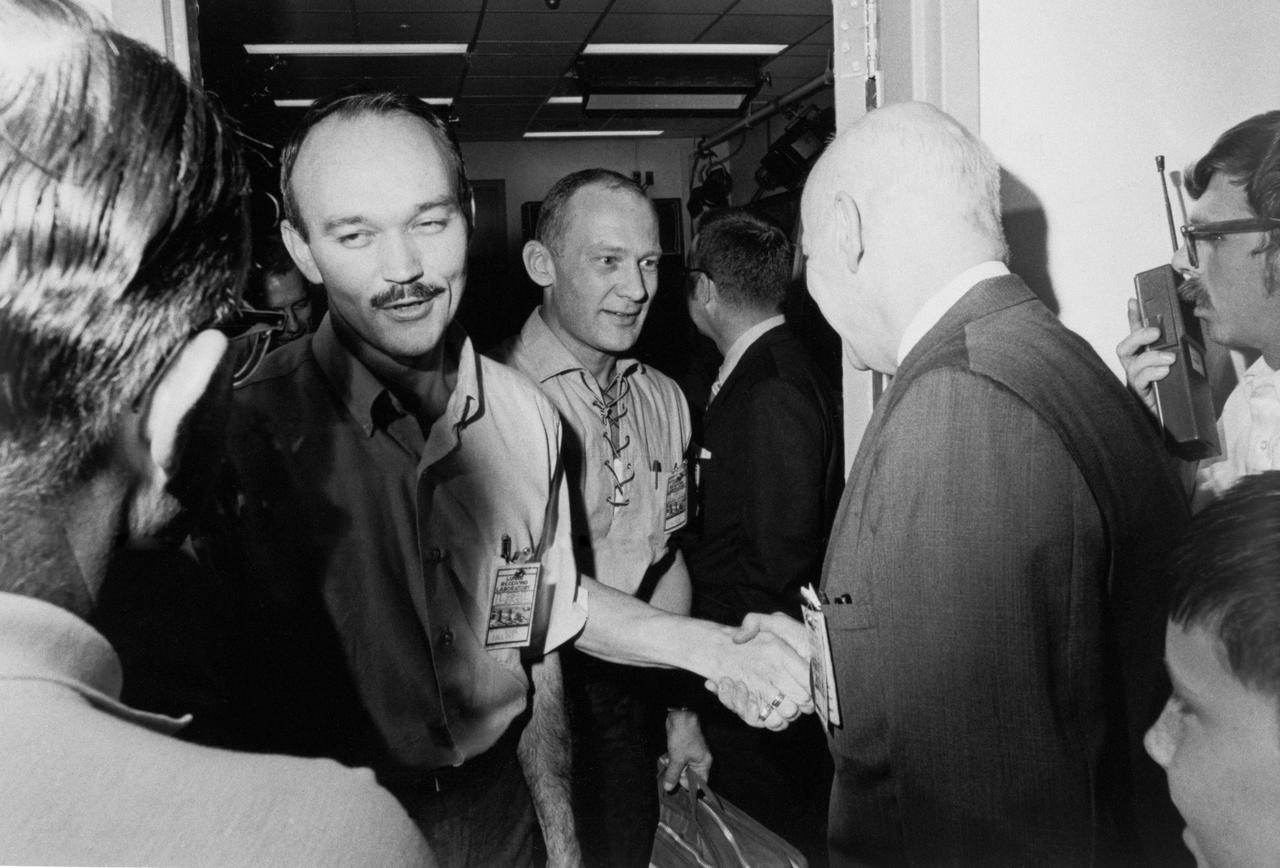
S69-41359 (10 Aug. 1969) --- Astronauts Michael Collins (left) and Edwin E. Aldrin Jr., are greeted by Dr. Robert R. Gilruth, director, Manned Spacecraft Center (MSC), and others upon their release from quarantine. The Apollo 11 crew left the Crew Reception Area (CRA) of the Lunar Receiving Laboratory (LRL) at 9 p.m., Aug. 10, 1969. While astronauts Neil A. Armstrong, commander, and Aldrin, lunar module pilot, descended in the Lunar Module (LM) "Eagle" to explore the Sea of Tranquility region of the moon, astronaut Collins, command module pilot, remained with the Command and Service Modules (CSM) "Columbia" in lunar orbit.
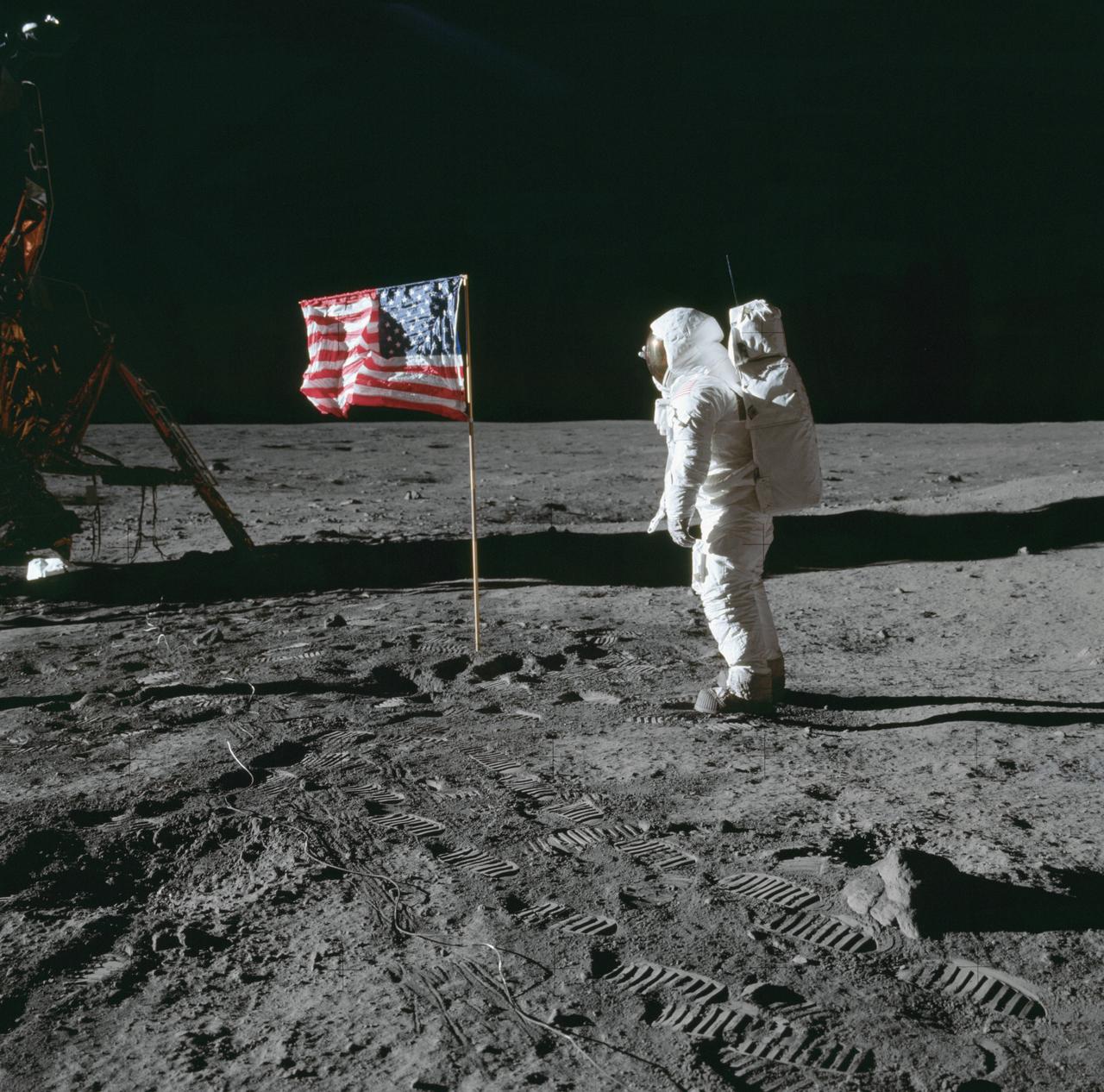
AS11-40-5874 (20 July 1969) --- Astronaut Edwin E. Aldrin Jr., lunar module pilot of the first lunar landing mission, poses for a photograph beside the deployed United States flag during Apollo 11 extravehicular activity (EVA) on the lunar surface. The Lunar Module (LM) is on the left, and the footprints of the astronauts are clearly visible in the soil of the moon. Astronaut Neil A. Armstrong, commander, took this picture with a 70mm Hasselblad lunar surface camera. While astronauts Armstrong and Aldrin descended in the LM the "Eagle" to explore the Sea of Tranquility region of the moon, astronaut Michael Collins, command module pilot, remained with the Command and Service Modules (CSM) "Columbia" in lunar orbit.
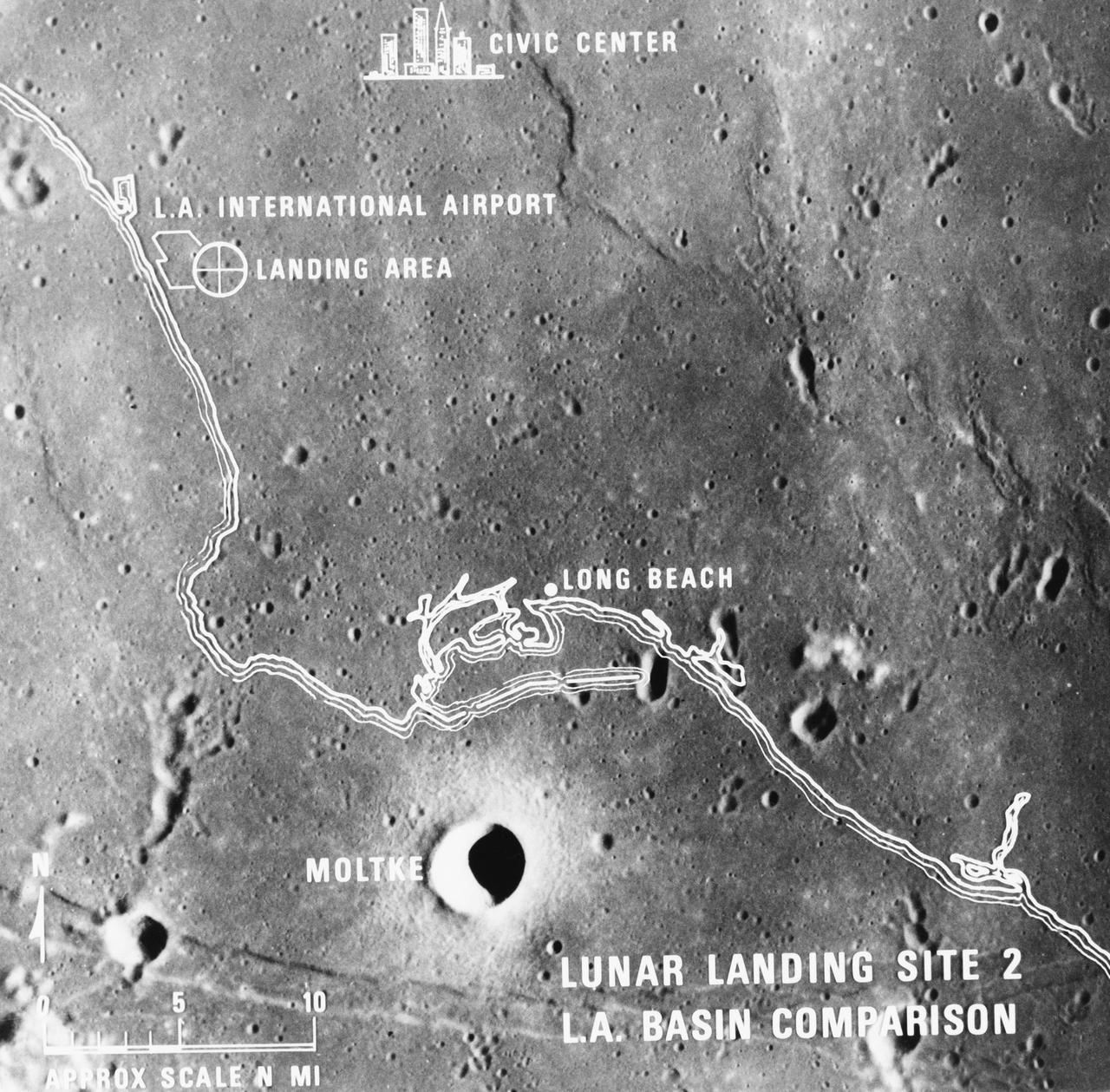
S69-38670 (July 1969) --- A photographic illustration comparing the size of Apollo Landing Site 2 with that of the metropolitan Los Angeles, California area. Site 2 is one of three Apollo 11 lunar landing sites. This will be the landing site if Apollo 11 is launched on July 16, 1969, as scheduled. Site 2 is located at 23 degrees 42 minutes 28 seconds east longitude and 0 degrees 42 minutes 50 seconds north latitude in southwestern Mare Tranquillitatis (Sea of Tranquility). (The white overlay is printed over a lunar surface photograph taken from Apollo 10 during its lunar orbit mission and is numbered AS10-31-4537.)

AS11-40-5902 (20 July 1969) --- Astronaut Edwin E. Aldrin Jr., lunar module pilot, walks on the surface of the moon near a leg of the Lunar Module during the Apollo 11 extravehicular activity (EVA). Astronaut Neil A. Armstrong, Apollo 11 commander, took this photograph with a 70mm lunar surface camera. The astronauts' bootprints are clearly visible in the foreground. While astronauts Armstrong and Aldrin descended in the Lunar Module (LM) "Eagle" to explore the Sea of Tranquility region of the moon, astronaut Michael Collins, command module pilot, remained with the Command and Service Modules (CSM) "Columbia" in lunar orbit.
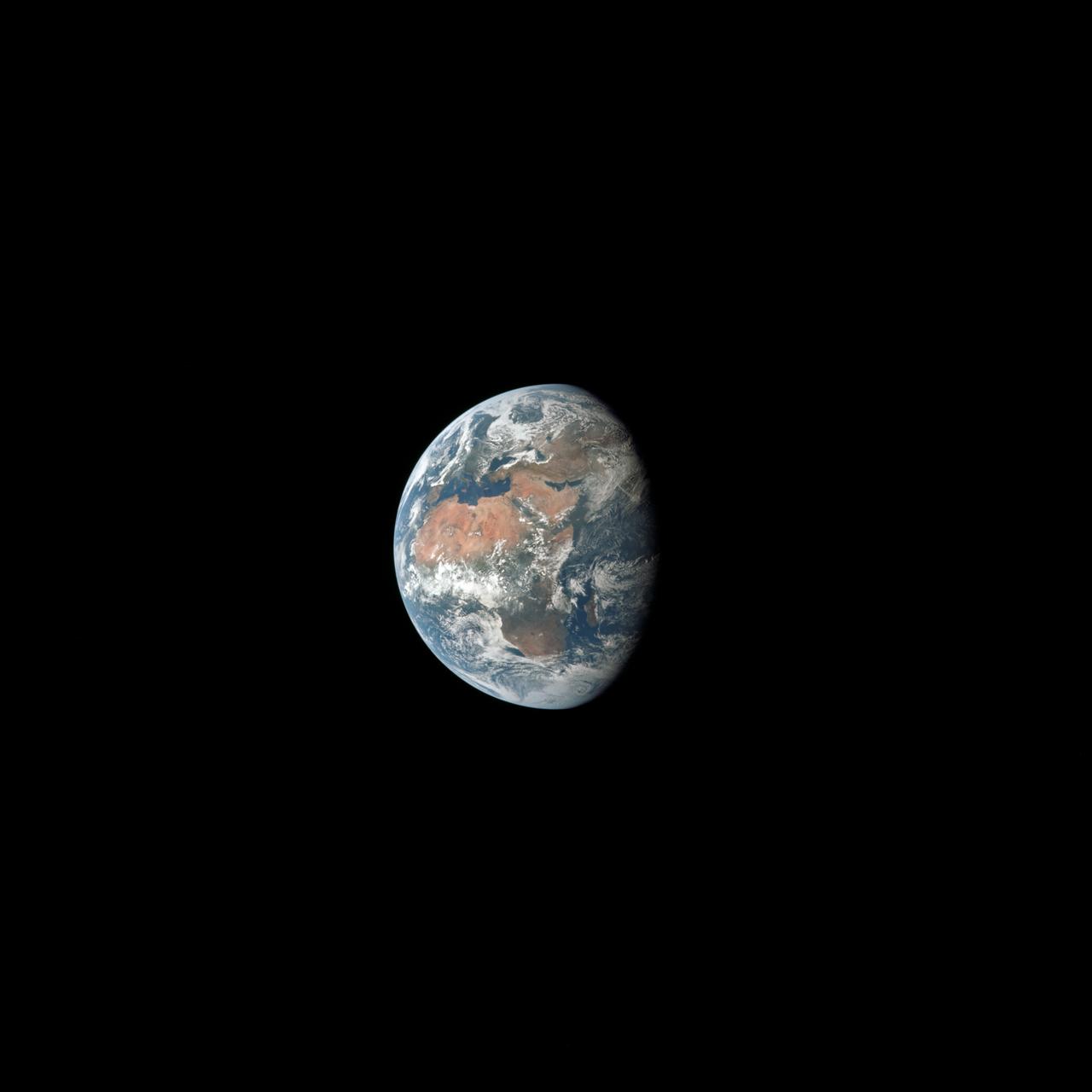
AS11-36-5355 (17 July 1969) --- Most of Africa and portions of Europe and Asia can be seen in this spectacular photograph taken from the Apollo 11 spacecraft during its trans-lunar coast toward the moon. Apollo 11, with astronauts Neil A. Armstrong, commander; Michael Collins, command module pilot; and Edwin E. Aldrin Jr., lunar module pilot, onboard was already 98,000 nautical miles from Earth when this picture was made. While astronauts Armstrong and Aldrin descended in the Lunar Module (LM) "Eagle" to explore the Sea of Tranquility region of the moon, astronaut Collins remained with the Command and Service Modules (CSM) "Columbia" in lunar orbit.
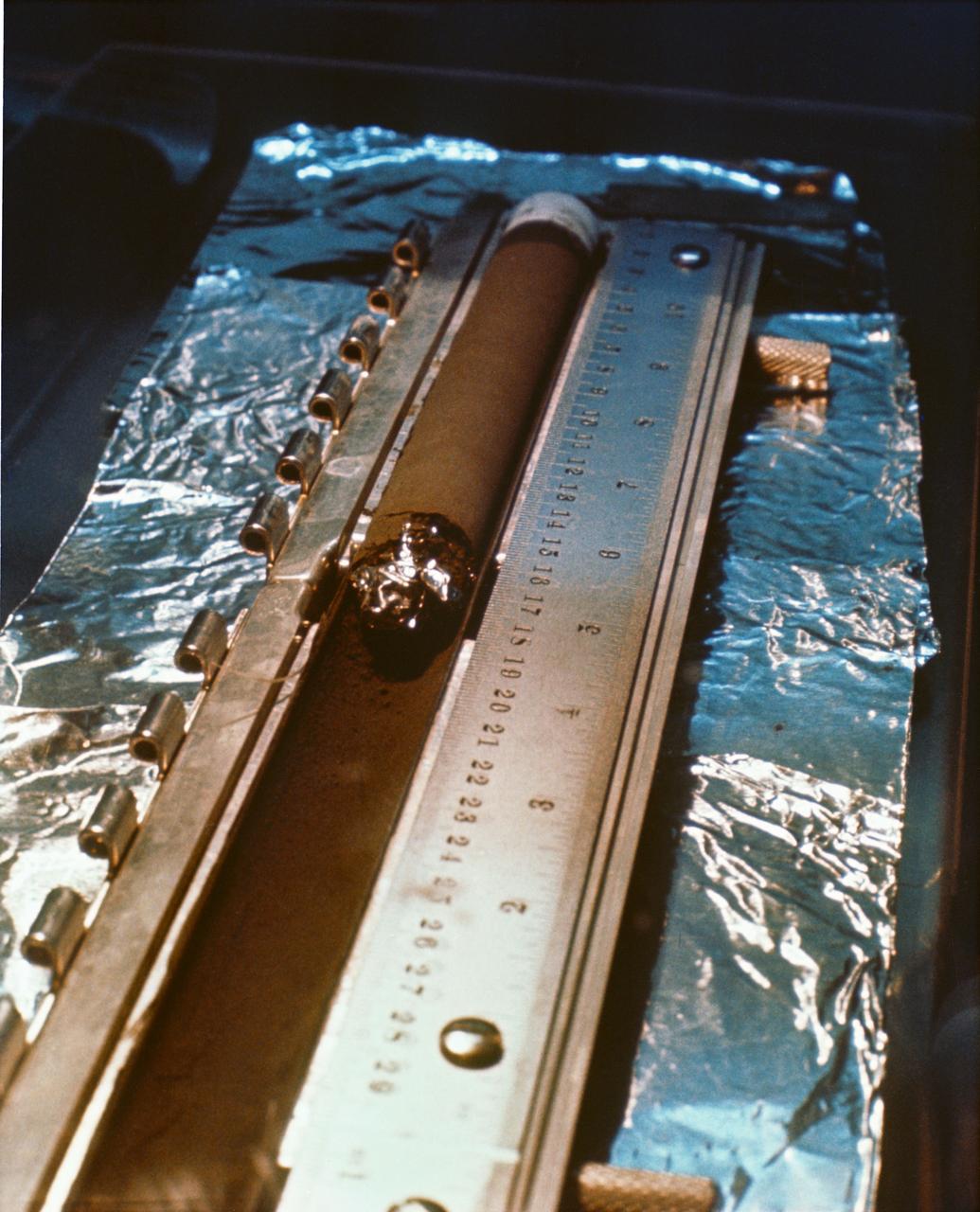
S69-40945 (August 1969) --- This is a core tube sample under study and examination in the Manned Spacecraft Center?s (MSC) Lunar Receiving Laboratory (LRL). The sample was among lunar soil and rock samples collected by astronauts Neil A. Armstrong and Edwin E. Aldrin Jr. during their extravehicular activity (EVA) on July 20, 1969. While astronauts Armstrong, commander; and Aldrin, lunar module pilot; descended in the Apollo 11 Lunar Module (LM) "Eagle" to explore the Sea of Tranquility landing site on the moon. Astronaut Michael Collins, command module pilot, remained with the Command and Service Modules (CSM) "Columbia" in lunar orbit.
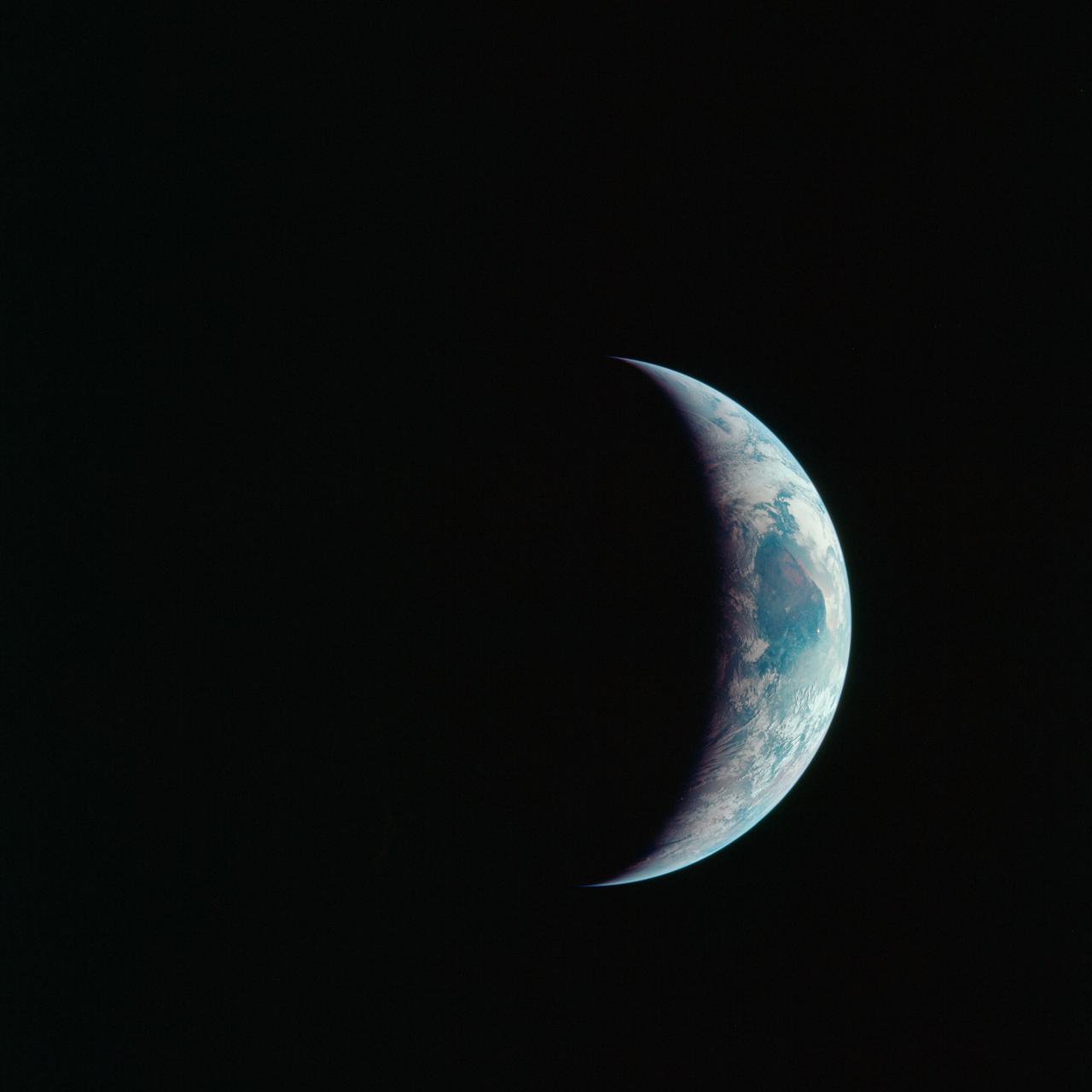
AS11-44-6689 (16-24 July 1969) --- One-third of the Earth's sphere illuminated, Earth's terminator, sunglint, a portion of east Africa, as photographed from the Apollo 11 spacecraft during its first lunar landing mission. While astronauts Neil A. Armstrong, commander, and Edwin E. Aldrin Jr., lunar module pilot, descended in the Lunar Module (LM) "Eagle" to explore the Sea of Tranquility region of the moon, astronaut Michael Collins, command module pilot, remained with the Command and Service Modules (CSM) "Columbia" in lunar orbit.
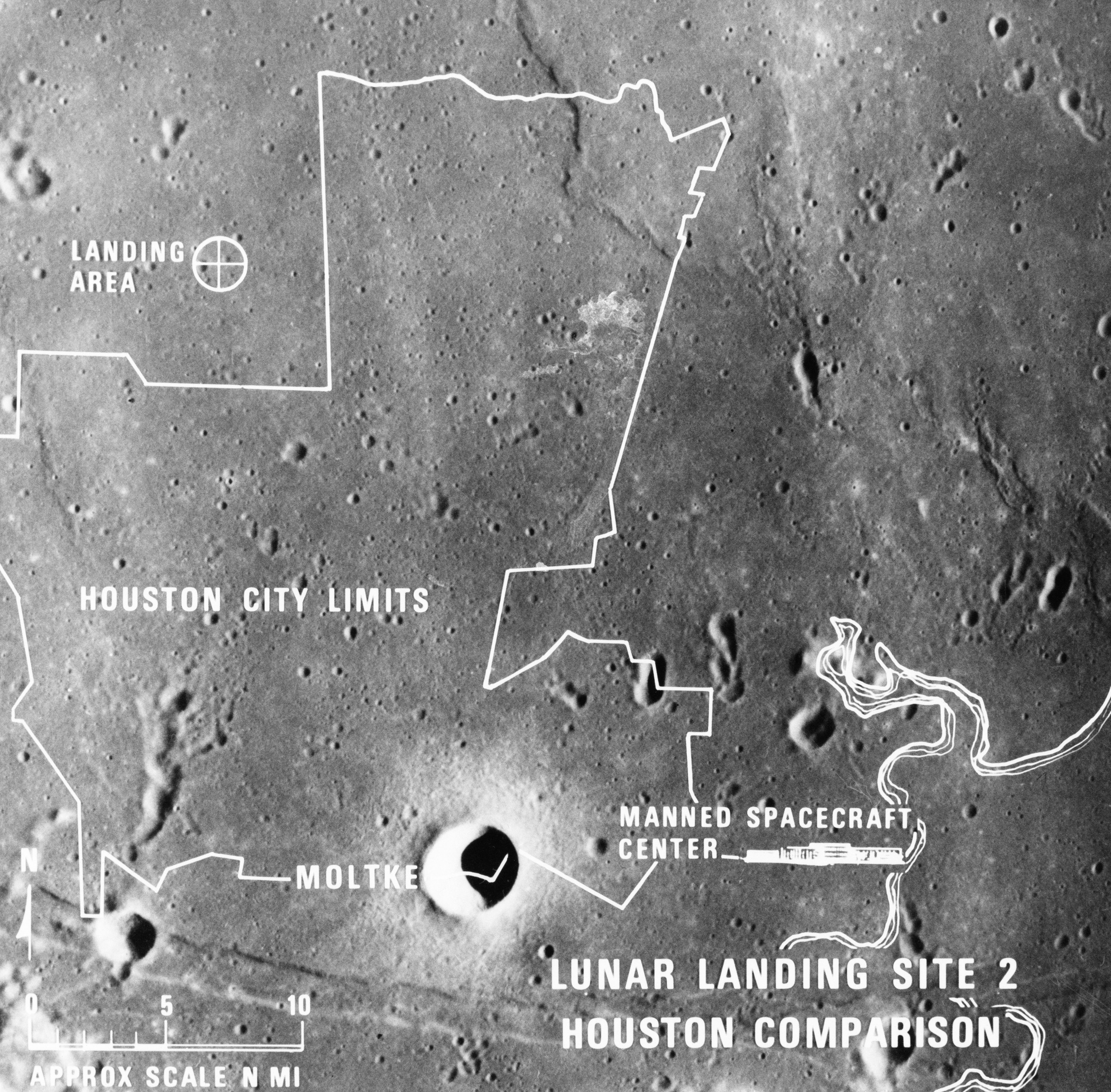
S69-38671 (July 1969) --- A photographic illustration comparing the size of Apollo Landing Site 2 with that of the metropolitan Houston, Texas area. Site 2 is one of three Apollo 11 lunar landing sites. This will be the landing site if Apollo 11 is launched on July 16, 1969, as scheduled. Site 2 is located at 23 degrees 42 minutes 28 seconds east longitude and 0 degrees 42 minutes 50 seconds north latitude in southwestern Mare Tranquillitatis (Sea of Tranquility). (The white overlay is printed over a lunar surface photograph taken from Apollo 10 during its lunar orbit mission and is numbered AS10-31-4537.)
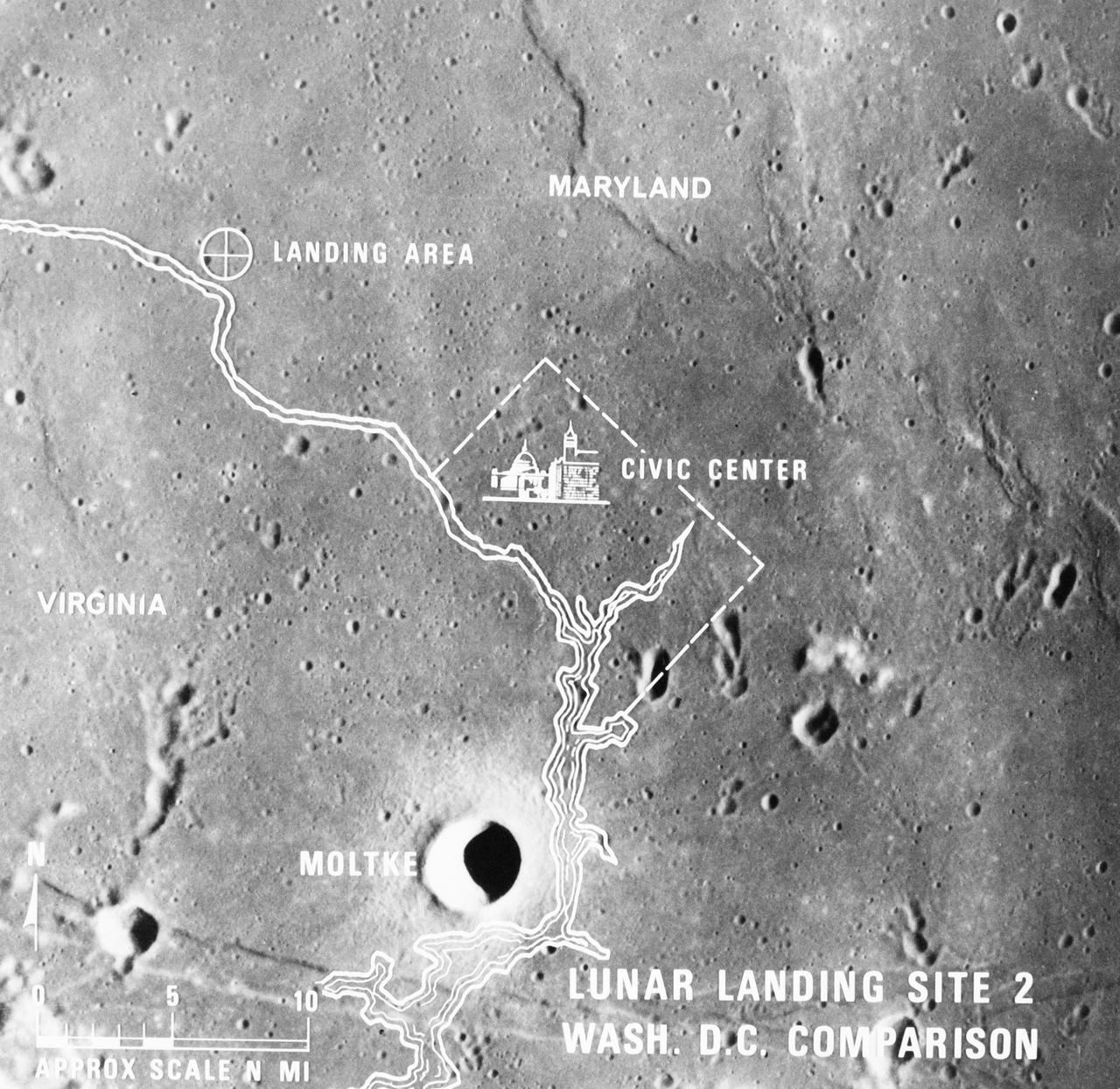
S69-38667 (July 1969) --- A photographic illustration comparing the size of Apollo Landing Site 2 with that of the metropolitan Washington, D.C. area. Site 2 is one of three Apollo 11 lunar landing sites. This will be the landing site if Apollo 11 is launched on July 16, 1969, as scheduled. Site 2 is located at 23 degrees 42 minutes 28 seconds east longitude and 0 degrees 42 minutes 50 seconds north latitude in southwestern Mare Tranquillitatis (Sea of Tranquility). (The white overlay is printed over a lunar surface photograph taken from Apollo 10 during its lunar orbit mission and is numbered AS10-31-4537.)
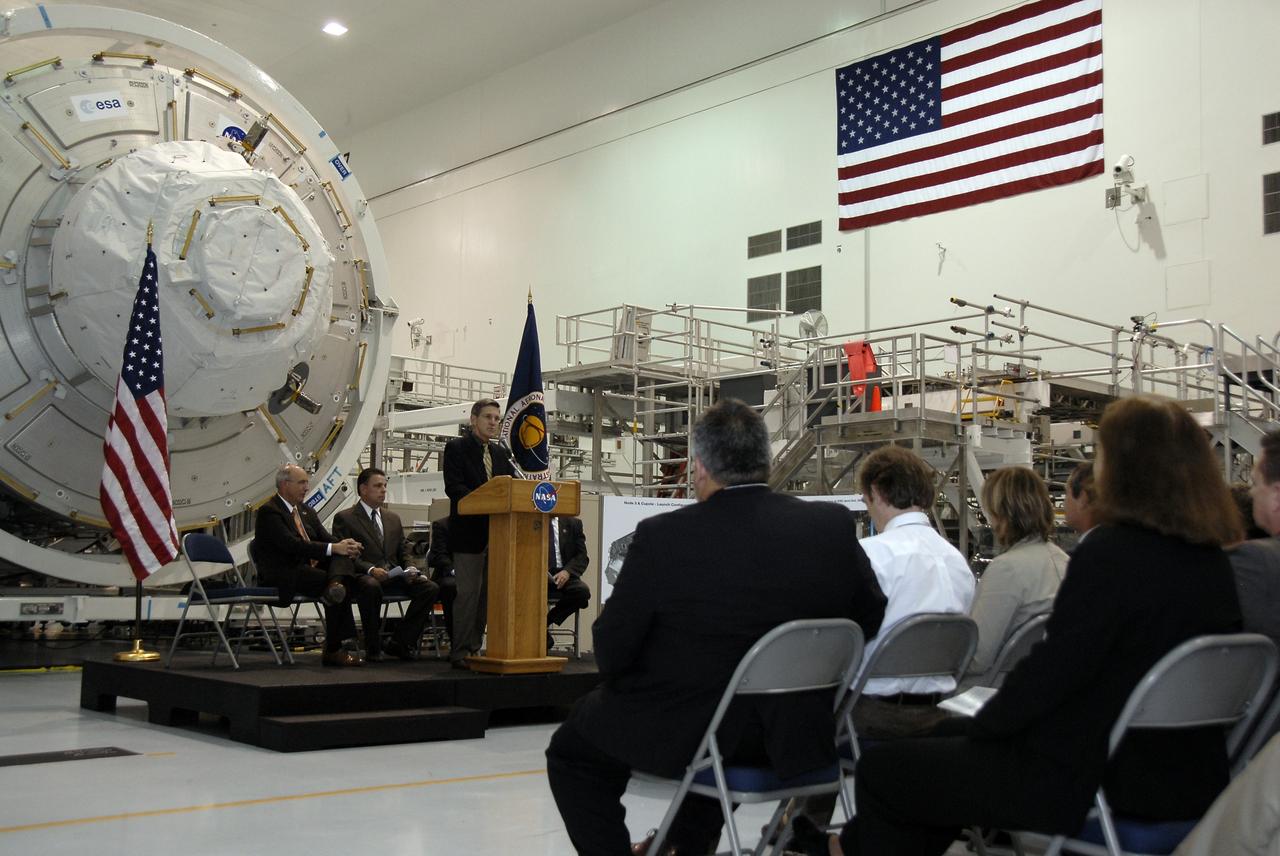
CAPE CANAVERAL, Fla. – In the Space Station Processing Facility at NASA's Kennedy Space Center in Florida, Kennedy Director Bob Cabana addresses the invited guests at a ceremony transferring the ownership of node 3 for the International Space Station, looming in the background, from the European Space Agency, or ESA, to NASA. Seated, from left, are Michael Suffredini, program manager, International Space Station, NASA, and William Dowdell, deputy for Operations, International Space Station and Spacecraft Processing, Kennedy. Node 3 is named "Tranquility" after the Sea of Tranquility, the lunar landing site of Apollo 11. The payload for the STS-130 mission, Tranquility is a pressurized module that will provide room for many of the International Space Station's life support systems. The module was built for ESA by Thales Alenia Space in Turin, Italy. Attached to one end of Tranquility is a cupola, a unique work station with six windows on its sides and one on top. The cupola resembles a circular bay window and will provide a vastly improved view of the station's exterior. Just under 10 feet in diameter, the module will accommodate two crew members and portable workstations that can control station and robotic activities. The multi-directional view will allow the crew to monitor spacewalks and docking operations, as well as provide a spectacular view of Earth and other celestial objects. Space shuttle Endeavour's STS-130 mission is targeted to launch Feb. 4, 2010. Photo credit: NASA/Kim Shiflett
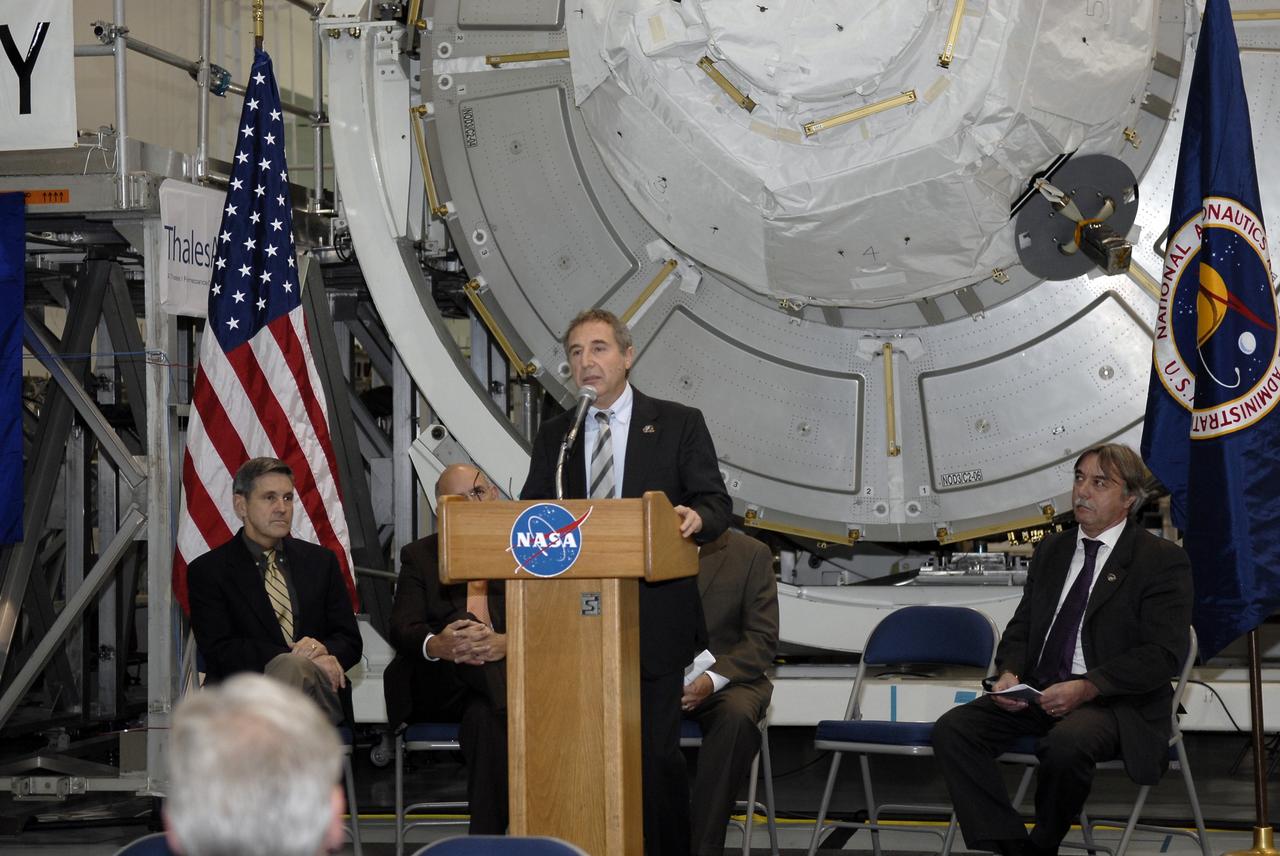
CAPE CANAVERAL, Fla. – In the Space Station Processing Facility at NASA's Kennedy Space Center in Florida, Bernardo Patti, head of International Space Station, Program Department, ESA, addresses the invited guests at a ceremony transferring the ownership of node 3 for the International Space Station, looming in the background, from the European Space Agency, or ESA, to NASA. Seated, from left, are Bob Cabana, Kennedy Space Center director, and Secondino Brondolo, head of the Space Infrastructure, Thales Alenia Space Italy. Node 3 is named "Tranquility" after the Sea of Tranquility, the lunar landing site of Apollo 11. The payload for the STS-130 mission, Tranquility is a pressurized module that will provide room for many of the International Space Station's life support systems. The module was built for ESA by Thales Alenia Space in Turin, Italy. Attached to one end of Tranquility is a cupola, a unique work station with six windows on its sides and one on top. The cupola resembles a circular bay window and will provide a vastly improved view of the station's exterior. Just under 10 feet in diameter, the module will accommodate two crew members and portable workstations that can control station and robotic activities. The multi-directional view will allow the crew to monitor spacewalks and docking operations, as well as provide a spectacular view of Earth and other celestial objects. Space shuttle Endeavour's STS-130 mission is targeted to launch Feb. 4, 2010. Photo credit: NASA/Kim Shiflett
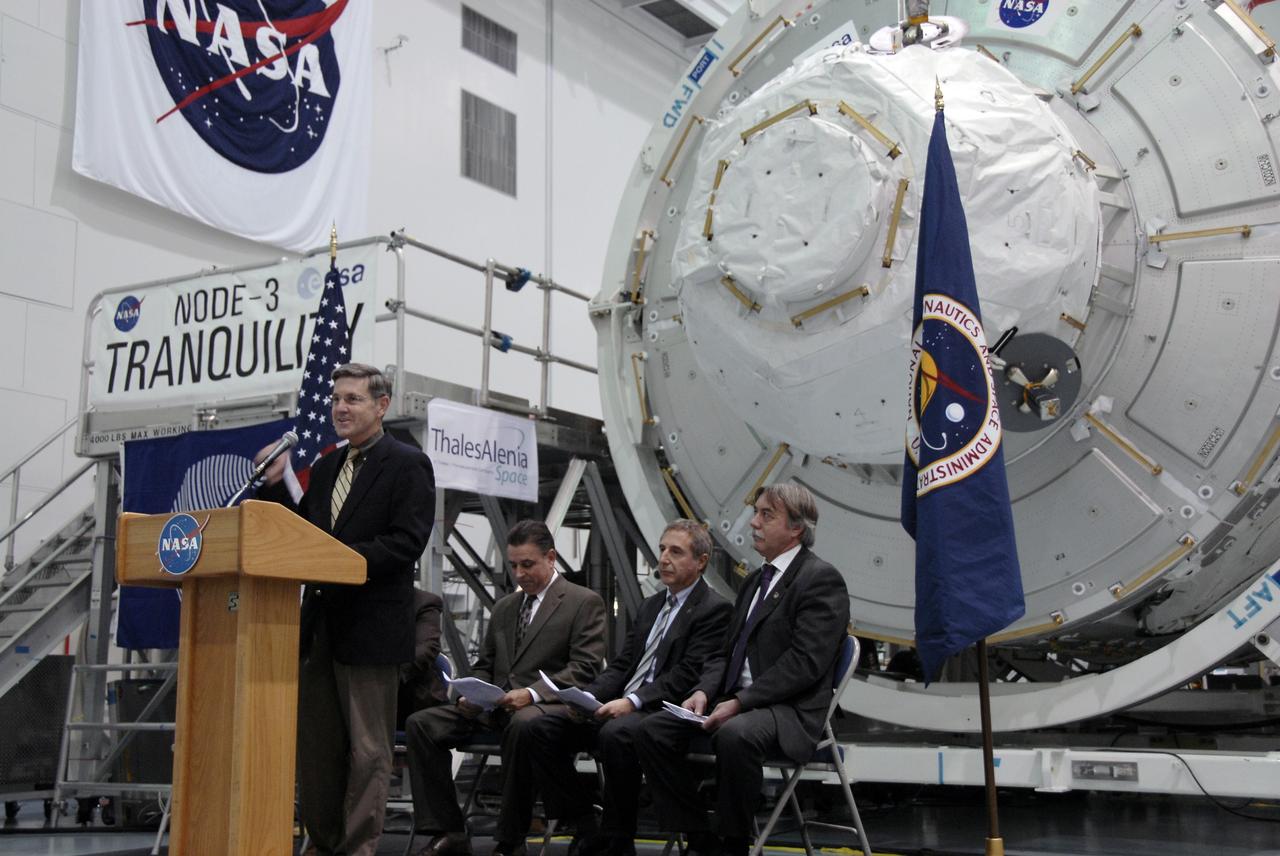
CAPE CANAVERAL, Fla. – In the Space Station Processing Facility at NASA's Kennedy Space Center in Florida, Kennedy Director Bob Cabana addresses the invited guests at a ceremony transferring the ownership of node 3 for the International Space Station, looming in the background, from the European Space Agency, or ESA, to NASA. Seated, from left, are William Dowdell, deputy for Operations, International Space Station and Spacecraft Processing, Kennedy; Bernardo Patti, head of International Space Station, Program Department, ESA; and Secondino Brondolo, head of the Space Infrastructure, Thales Alenia Space Italy. Node 3 is named "Tranquility" after the Sea of Tranquility, the lunar landing site of Apollo 11. The payload for the STS-130 mission, Tranquility is a pressurized module that will provide room for many of the International Space Station's life support systems. The module was built for ESA by Thales Alenia Space in Turin, Italy. Attached to one end of Tranquility is a cupola, a unique work station with six windows on its sides and one on top. The cupola resembles a circular bay window and will provide a vastly improved view of the station's exterior. Just under 10 feet in diameter, the module will accommodate two crew members and portable workstations that can control station and robotic activities. The multi-directional view will allow the crew to monitor spacewalks and docking operations, as well as provide a spectacular view of Earth and other celestial objects. Space shuttle Endeavour's STS-130 mission is targeted to launch Feb. 4, 2010. Photo credit: NASA/Kim Shiflett
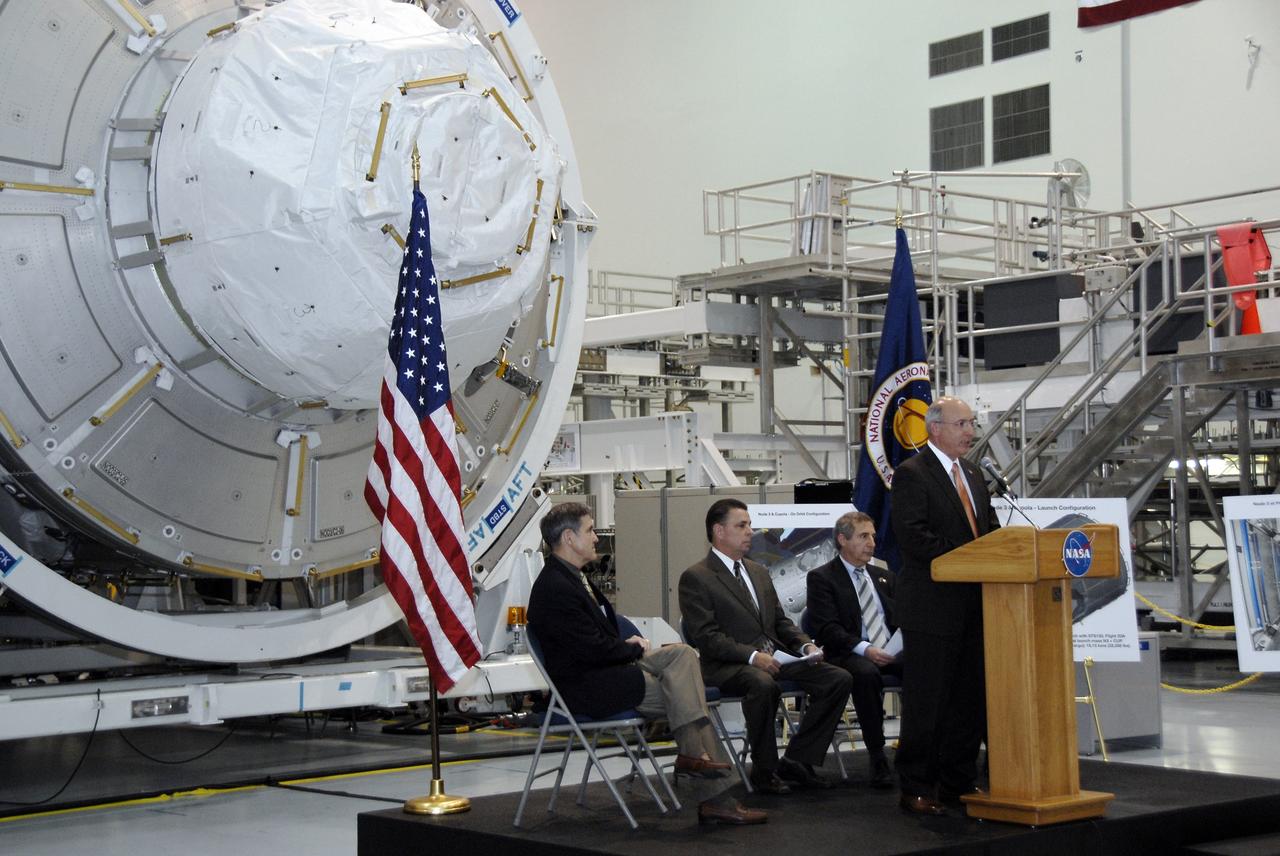
CAPE CANAVERAL, Fla. – In the Space Station Processing Facility at NASA's Kennedy Space Center in Florida, Michael Suffredini, program manager, International Space Station, NASA, addresses the invited guests at a ceremony transferring the ownership of node 3 for the International Space Station, looming in the background, from the European Space Agency, or ESA, to NASA. Seated, from left, are Michael Suffredini, program manager, International Space Station, NASA; William Dowdell, deputy for Operations, International Space Station and Spacecraft Processing, Kennedy; and Bernardo Patti, head of International Space Station, Program Department, ESA. Node 3 is named "Tranquility" after the Sea of Tranquility, the lunar landing site of Apollo 11. The payload for the STS-130 mission, Tranquility is a pressurized module that will provide room for many of the International Space Station's life support systems. The module was built for ESA by Thales Alenia Space in Turin, Italy. Attached to one end of Tranquility is a cupola, a unique work station with six windows on its sides and one on top. The cupola resembles a circular bay window and will provide a vastly improved view of the station's exterior. Just under 10 feet in diameter, the module will accommodate two crew members and portable workstations that can control station and robotic activities. The multi-directional view will allow the crew to monitor spacewalks and docking operations, as well as provide a spectacular view of Earth and other celestial objects. Space shuttle Endeavour's STS-130 mission is targeted to launch Feb. 4, 2010. Photo credit: NASA/Kim Shiflett
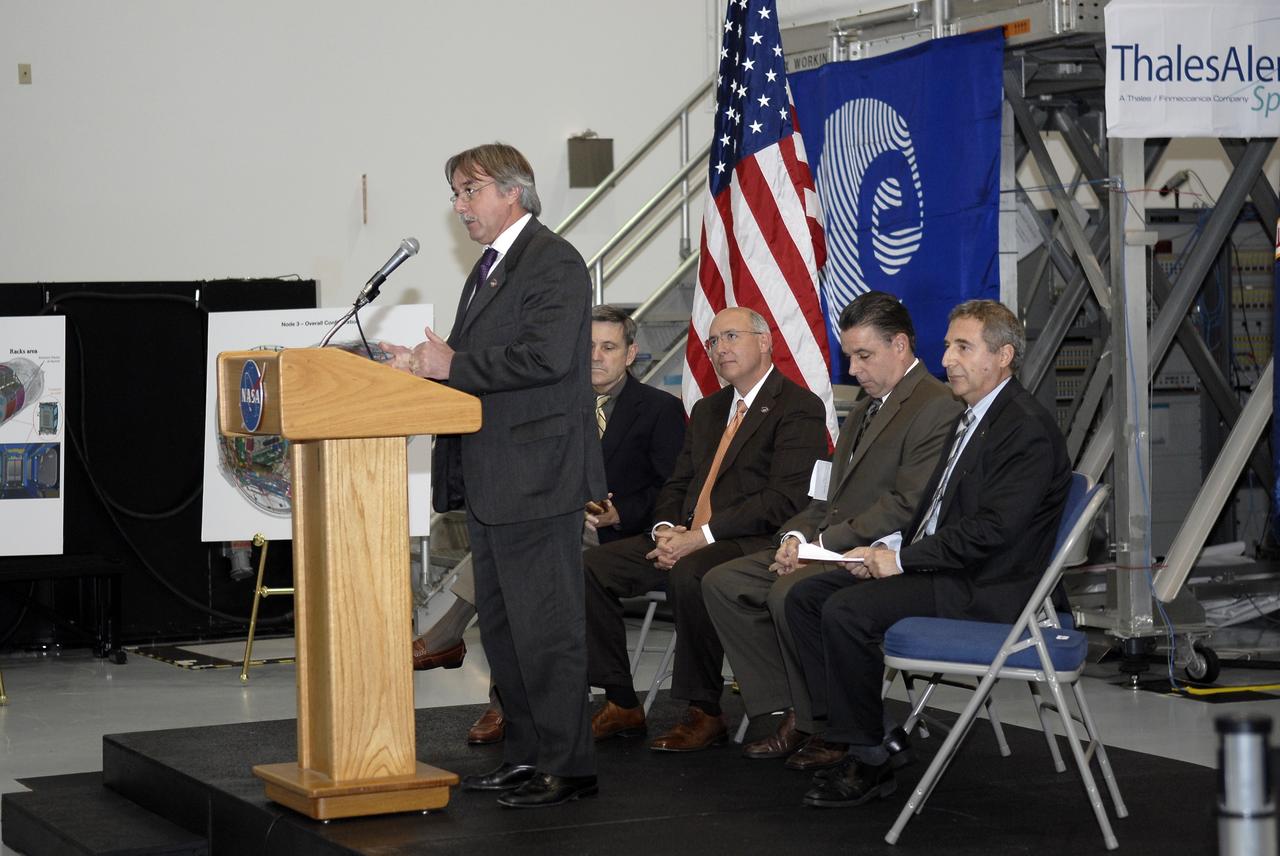
CAPE CANAVERAL, Fla. – In the Space Station Processing Facility at NASA's Kennedy Space Center in Florida, Secondino Brondolo, head of the Space Infrastructure, Thales Alenia Space Italy, addresses the invited guests at a ceremony transferring the ownership of node 3 for the International Space Station from the European Space Agency, or ESA, to NASA. Seated, from left, are Bob Cabana, Kennedy Space Center director; Michael Suffredini, program manager, International Space Station, NASA; William Dowdell, deputy for Operations, International Space Station and Spacecraft Processing, Kennedy; and Bernardo Patti, head of International Space Station, Program Department, ESA. Node 3 is named "Tranquility" after the Sea of Tranquility, the lunar landing site of Apollo 11. The payload for the STS-130 mission, Tranquility is a pressurized module that will provide room for many of the International Space Station's life support systems. The module was built for ESA by Thales Alenia Space in Turin, Italy. Attached to one end of Tranquility is a cupola, a unique work station with six windows on its sides and one on top. The cupola resembles a circular bay window and will provide a vastly improved view of the station's exterior. Just under 10 feet in diameter, the module will accommodate two crew members and portable workstations that can control station and robotic activities. The multi-directional view will allow the crew to monitor spacewalks and docking operations, as well as provide a spectacular view of Earth and other celestial objects. Space shuttle Endeavour's STS-130 mission is targeted to launch Feb. 4, 2010. Photo credit: NASA/Kim Shiflett
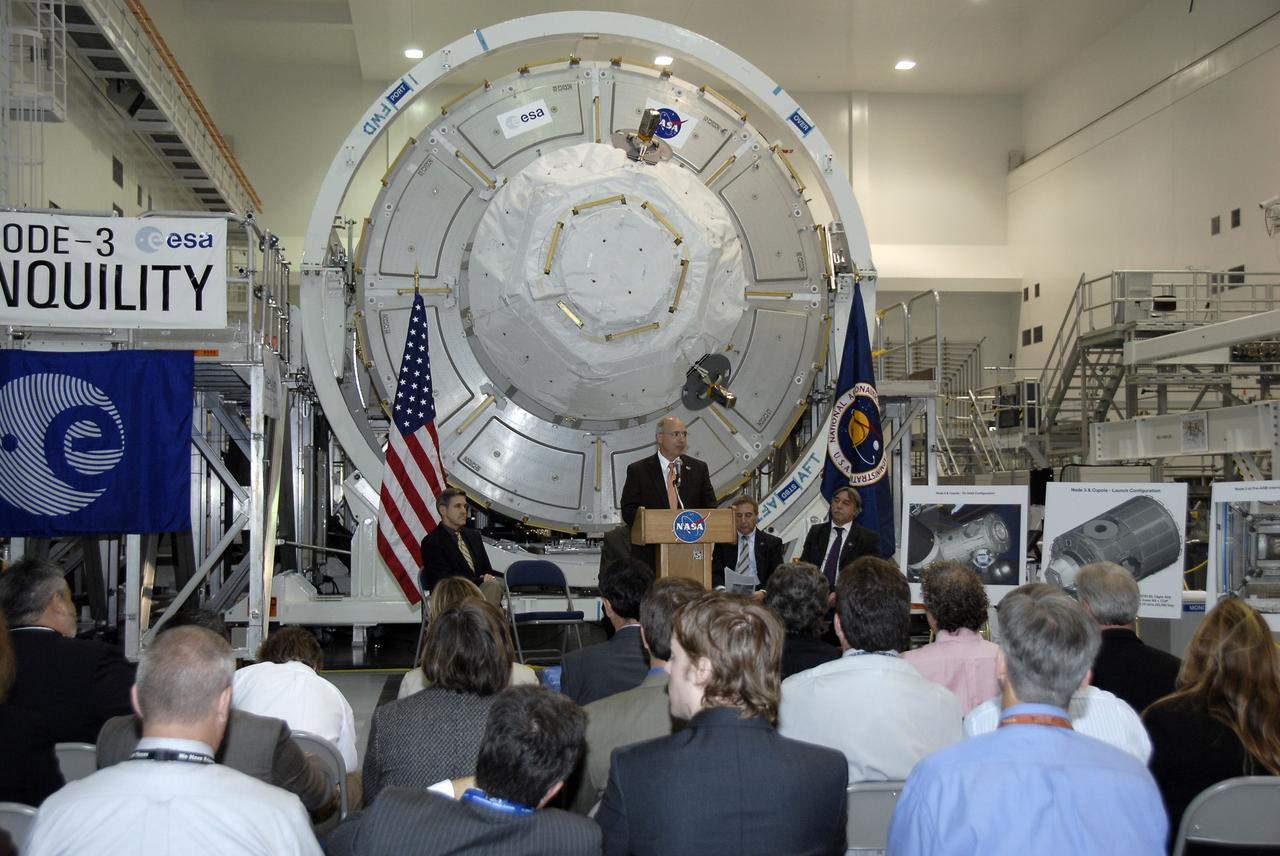
CAPE CANAVERAL, Fla. – In the Space Station Processing Facility at NASA's Kennedy Space Center in Florida, Michael Suffredini, program manager, International Space Station, NASA, addresses the invited guests at a ceremony transferring the ownership of node 3 for the International Space Station, looming in the background, from the European Space Agency, or ESA, to NASA. Seated, from left, are Bob Cabana, Kennedy Space Center director; Bernardo Patti, head of International Space Station, Program Department, ESA; and Secondino Brondolo, head of the Space Infrastructure, Thales Alenia Space Italy. Node 3 is named "Tranquility" after the Sea of Tranquility, the lunar landing site of Apollo 11. The payload for the STS-130 mission, Tranquility is a pressurized module that will provide room for many of the International Space Station's life support systems. The module was built for ESA by Thales Alenia Space in Turin, Italy. Attached to one end of Tranquility is a cupola, a unique work station with six windows on its sides and one on top. The cupola resembles a circular bay window and will provide a vastly improved view of the station's exterior. Just under 10 feet in diameter, the module will accommodate two crew members and portable workstations that can control station and robotic activities. The multi-directional view will allow the crew to monitor spacewalks and docking operations, as well as provide a spectacular view of Earth and other celestial objects. Space shuttle Endeavour's STS-130 mission is targeted to launch Feb. 4, 2010. Photo credit: NASA/Kim Shiflett
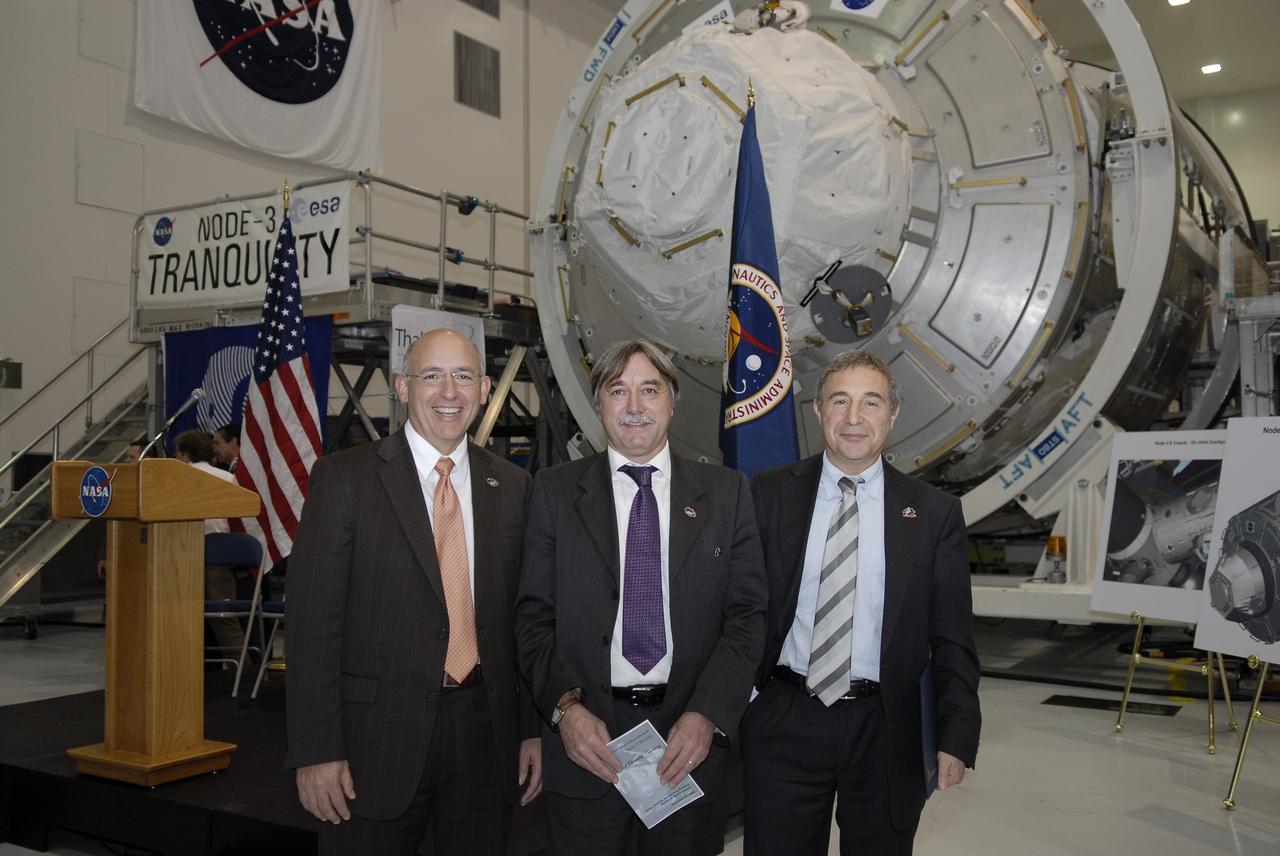
CAPE CANAVERAL, Fla. – In the Space Station Processing Facility at NASA's Kennedy Space Center in Florida, from left, Michael Suffredini, program manager, International Space Station, NASA; Secondino Brondolo, head of the Space Infrastructure, Thales Alenia Space Italy; and Bernardo Patti, head of International Space Station, Program Department, ESA, are photographed in front of node 3 for the International Space Station following a ceremony transferring the ownership of the node from the European Space Agency, or ESA, to NASA. Node 3 is named "Tranquility" after the Sea of Tranquility, the lunar landing site of Apollo 11. The payload for the STS-130 mission, Tranquility is a pressurized module that will provide room for many of the International Space Station's life support systems. The module was built for ESA by Thales Alenia Space in Turin, Italy. Attached to one end of Tranquility is a cupola, a unique work station with six windows on its sides and one on top. The cupola resembles a circular bay window and will provide a vastly improved view of the station's exterior. Just under 10 feet in diameter, the module will accommodate two crew members and portable workstations that can control station and robotic activities. The multi-directional view will allow the crew to monitor spacewalks and docking operations, as well as provide a spectacular view of Earth and other celestial objects. Space shuttle Endeavour's STS-130 mission is targeted to launch Feb. 4, 2010. Photo credit: NASA/Kim Shiflett
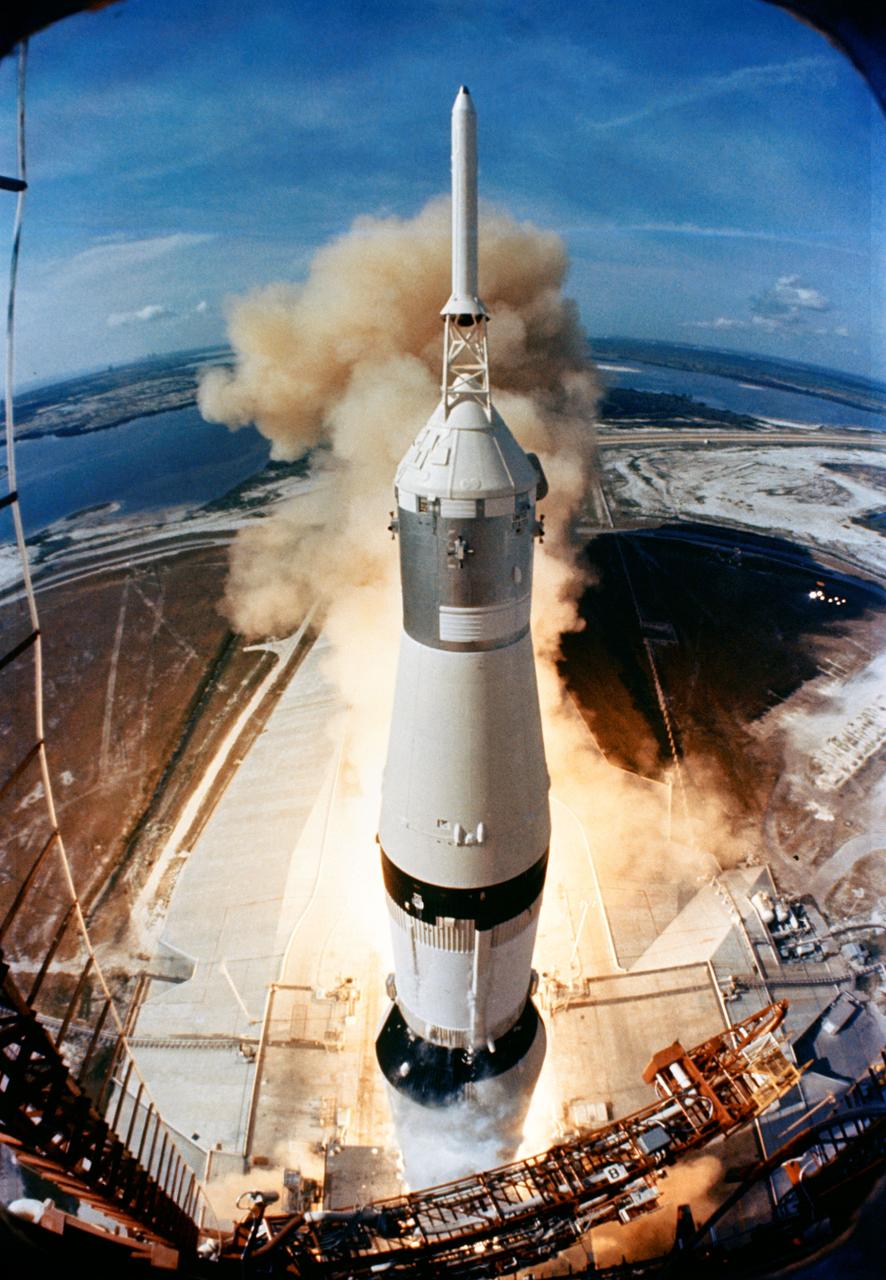
S69-39961 (16 July 1969) --- The huge, 363-feet tall Apollo 11 (Spacecraft 107/Lunar Module S/Saturn 506) space vehicle is launched from Pad A, Launch Complex 39, Kennedy Space Center (KSC), at 9:32 a.m. (EDT), July 16, 1969. Onboard the Apollo 11 spacecraft are astronauts Neil A. Armstrong, commander; Michael Collins, command module pilot; and Edwin E. Aldrin Jr., lunar module pilot. Apollo 11 is the United States' first lunar landing mission. While astronauts Armstrong and Aldrin descend in the Lunar Module (LM) "Eagle" to explore the Sea of Tranquility region of the moon, astronaut Collins will remain with the Command and Service Modules (CSM) "Columbia" in lunar orbit. Photo credit: NASA
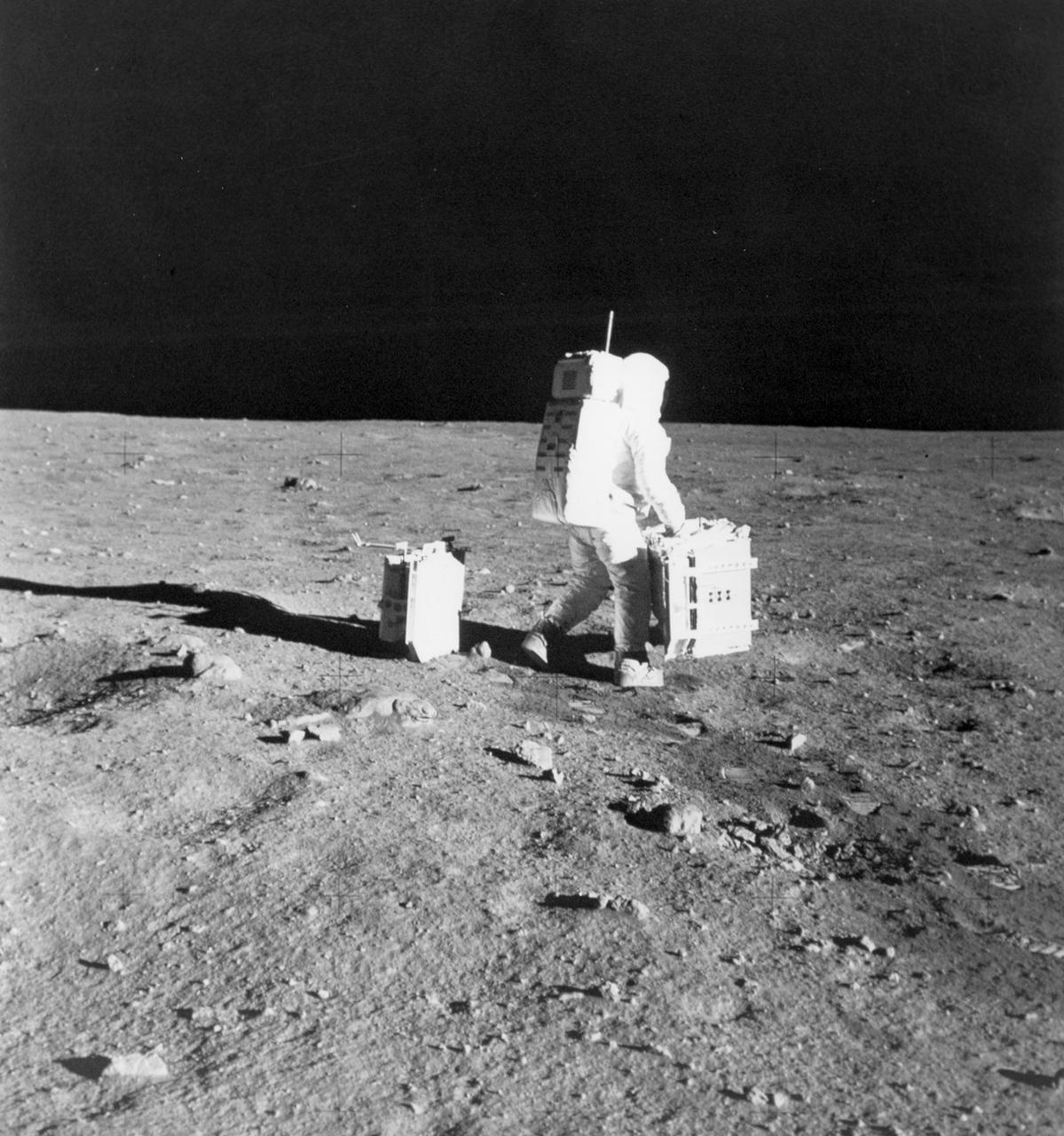
The first manned lunar landing mission, Apollo 11, launched from the Kennedy Space Center (KSC) in Florida via the Marshall Space Flight Center (MSFC) developed Saturn V launch vehicle on July 16, 1969 and safely returned to Earth on July 24, 1969. Aboard the space craft were astronauts Neil A. Armstrong, commander; Michael Collins, Command Module (CM) pilot; and Edwin E. (Buzz) Aldrin Jr., Lunar Module (LM) pilot. The CM, piloted by Michael Collins, remained in a parking orbit around the Moon, while the LM, named “Eagle’’, carrying astronauts Armstrong and Aldrin, landed on the Moon in the Sea of Tranquility. During 2½ hours of surface exploration, the crew set up experiments, collected 47 pounds of lunar surface material for analysis back on Earth, planted the U.S Flag, and left a message for all mankind. In this photograph, Aldrin is deploying the Early Apollo Scientific Experiment Package.
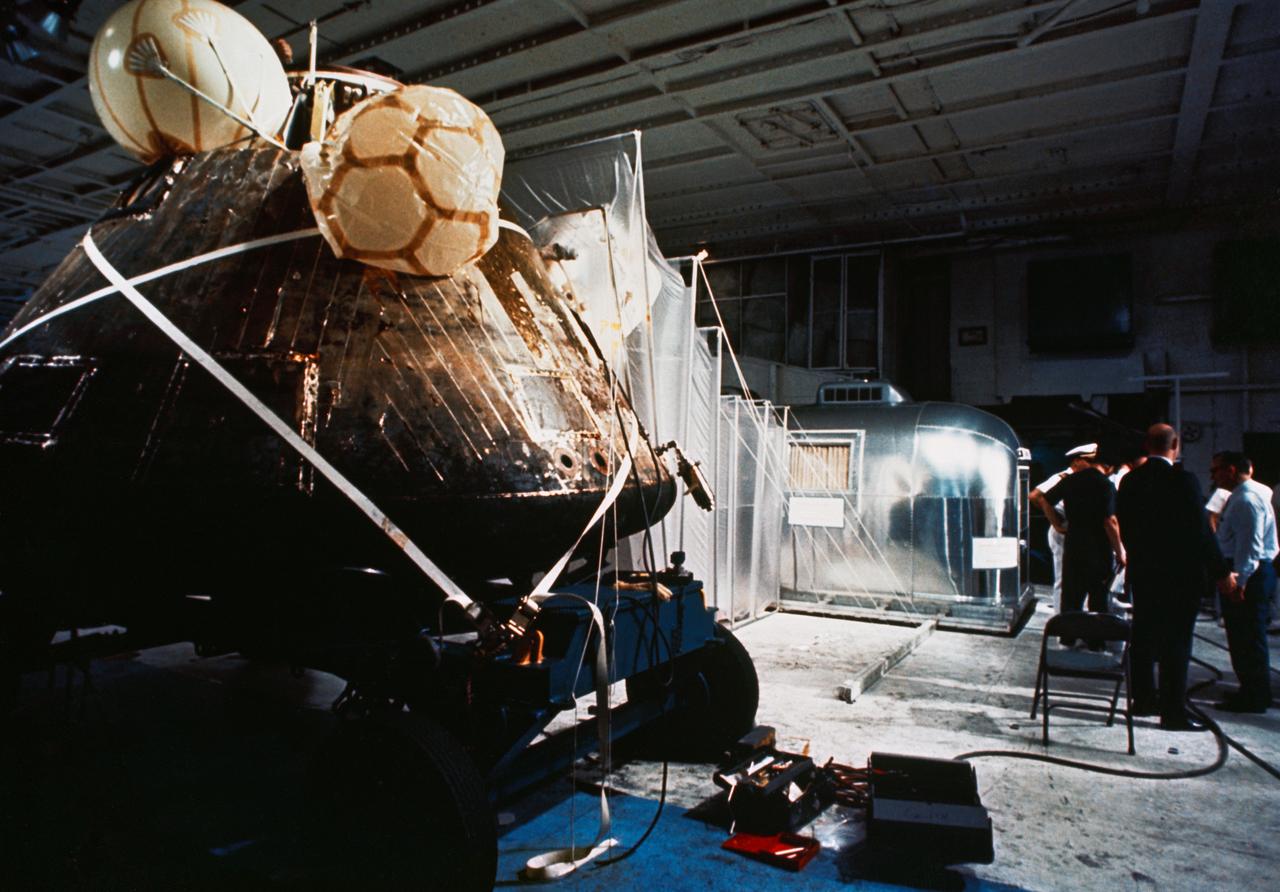
S69-40758 (24 July 1969) --- The Apollo 11 spacecraft Command Module (CM) and the Mobile Quarantine Facility (MQF) are photographed aboard the USS Hornet, prime recovery ship for the historic first lunar landing mission. The three crewmen are already in the MQF. Apollo 11 with astronauts Neil A. Armstrong, Michael Collins and Edwin E. Aldrin Jr. aboard splashed down at 11:49 a.m. (CDT), July 24, 1969, about 812 nautical miles southwest of Hawaii and only 12 nautical miles from the USS Hornet. While astronauts Armstrong, commander, and Aldrin, lunar module pilot, descended in the Lunar Module (LM) "Eagle" to explore the Sea of Tranquility region of the moon, astronaut Collins, command module pilot, remained with the Command and Service Modules (CSM) "Columbia" in lunar orbit.
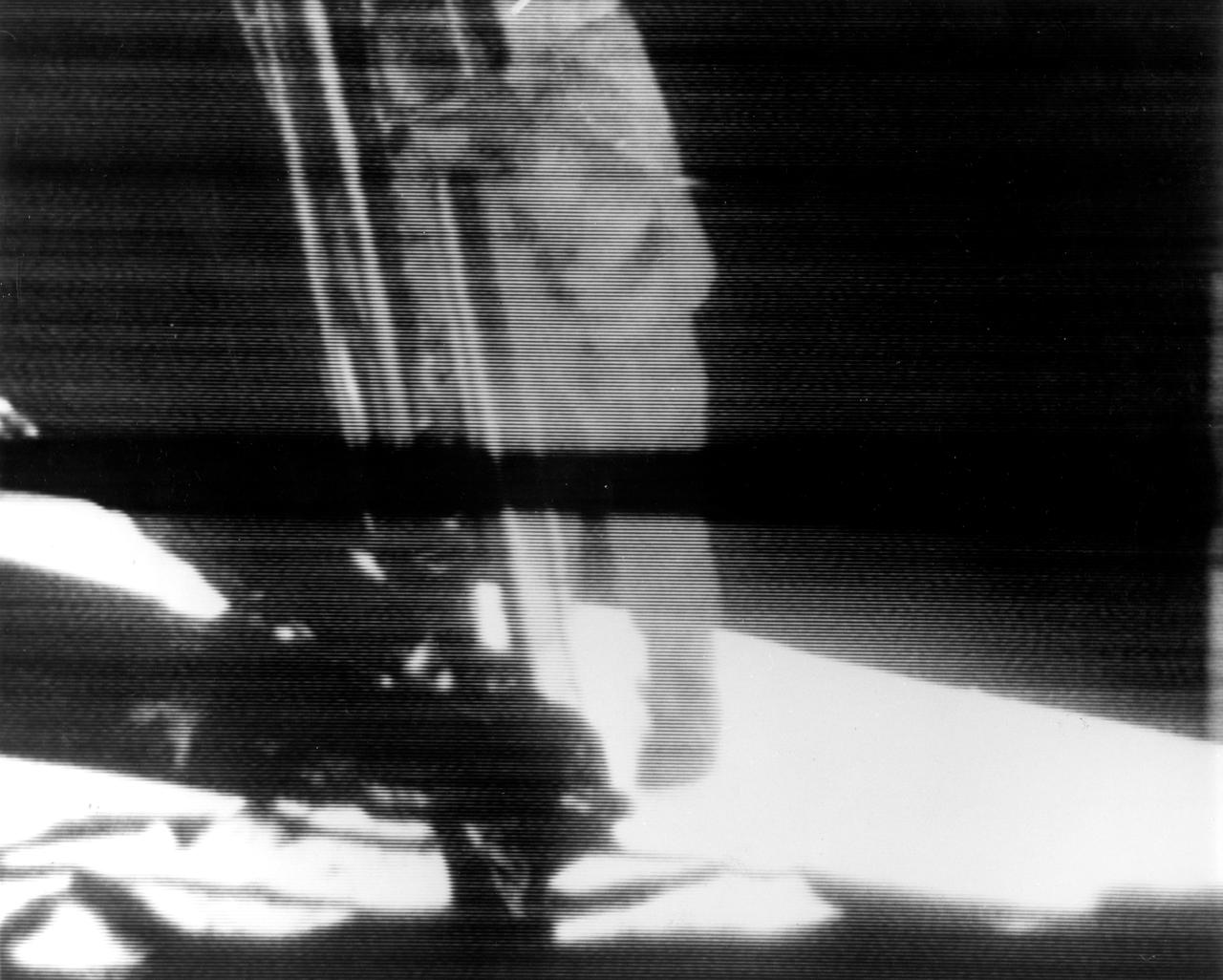
The first manned lunar landing mission, Apollo 11, launched from the Kennedy Space Flight Center (KSC) in Florida via the Marshall Space Flight Center (MSFC) developed Saturn V launch vehicle on July 16, 1969 and safely returned to Earth on July 24, 1969. Astronauts onboard included Neil A. Armstrong, commander; Michael Collins, Command Module (CM) pilot; and Edwin E. Aldrin, Jr., Lunar Module (LM) pilot. The CM, “Columbia”, piloted by Collins, remained in a parking orbit around the Moon while the LM, “Eagle’’, carrying astronauts Armstrong and Aldrin, landed on the Moon in the Sea of Tranquility. On July 20, 1969, Armstrong was the first human to ever stand on the lunar surface, followed by Aldrin. This is a reproduction of the television image that was transmitted to the world on July 20th, as Armstrong egressed the ladder to the lunar surface. The black bar running through the center of the photograph is an anomaly in the TV Ground Data System at Goldstone Tracking Station.

AS11-40-5948 (20 July 1969) --- Astronaut Edwin E. Aldrin Jr., lunar module pilot, is photographed during the Apollo 11 extravehicular activity (EVA) on the moon. He has just deployed the Early Apollo Scientific Experiments Package (EASEP). This is a good view of the deployed equipment. In the foreground is the Passive Seismic Experiment Package (PSEP); beyond it is the Laser Ranging Retro-Reflector (LR-3); in the center background is the United States flag; in the left background is the black and white lunar surface television camera; in the far right background is the Lunar Module (LM). Astronaut Neil A. Armstrong, commander, took this picture with a 70mm lunar surface camera. While astronauts Armstrong and Aldrin descended in the Lunar Module (LM) "Eagle" to explore the Sea of Tranquility region of the moon, astronaut Michael Collins, command module pilot, remained with the Command and Service Modules (CSM) "Columbia" in lunar orbit.
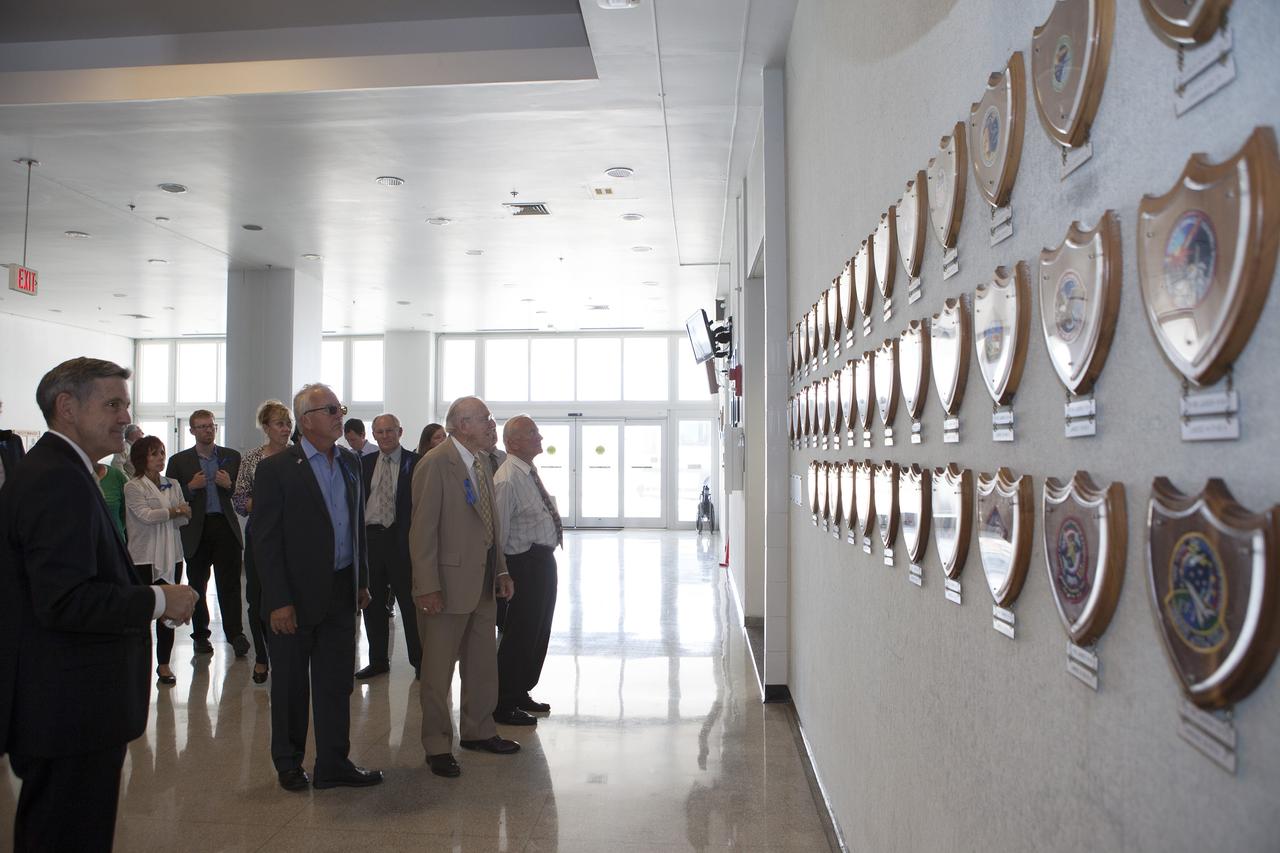
CAPE CANAVERAL, Fla. -- Apollo astronauts and their families examine the mission plaques mounted on the wall in the lobby of the Launch Control Center at NASA's Kennedy Space Center in Florida. The facility houses the firing rooms from which the Apollo countdowns were conducted. Kennedy Director Robert Cabana, at left, led the tour which followed a ceremony renaming the refurbished Operations and Checkout Building for Apollo 11 astronaut Neil Armstrong, the first person to set foot on the moon. The ceremony was part of NASA's 45th anniversary celebration of the Apollo 11 moon landing. As the world watched, Neil Armstrong and Buzz Aldrin landed in the moon's Sea of Tranquility on July 20, 1969, aboard the lunar module Eagle. Meanwhile, crewmate Michael Collins orbited above in the command module Columbia. For more, visit http://www.nasa.gov/press/2014/july/nasa-honors-historic-first-moon-landing-eyes-first-mars-mission. Photo credit: NASA/Kim Shiflett
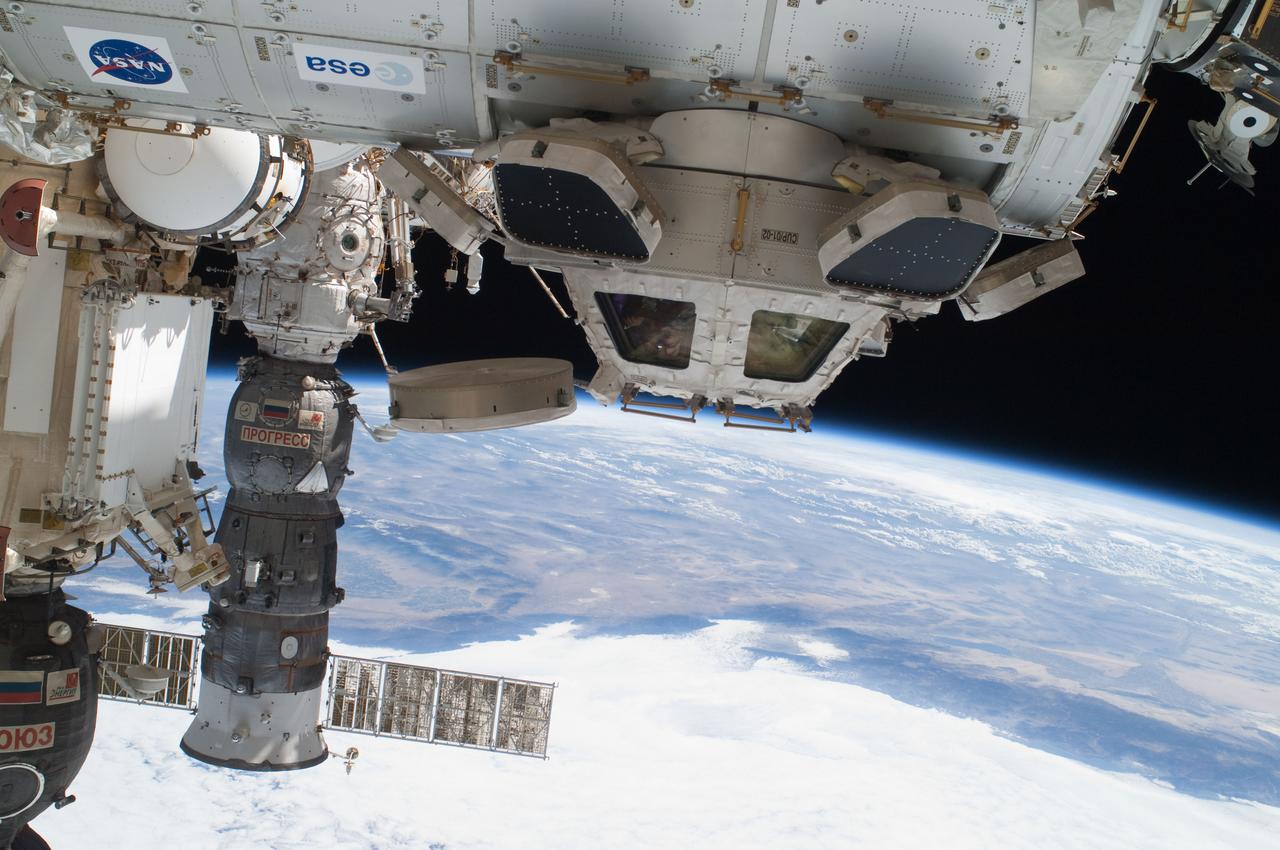
ISS028-E-016225 (12 July 2011) --- Components of the International Space Station, though moving along at 17,500 miles per hour, appear to hover above the Pacific Ocean just off the California coast. Ten cosmonauts and astronauts were working together when this photo was taken -- four of them as STS-135 visitors from the docked space shuttle Atlantis and six as members of the Expedition 28 crew. The Cupola, near center of frame, is attached to Node 3 or Tranquility. A Russian Soyuz and a Russian Progress spacecraft are parked at the station, left side of frame. While much of the coast is obscured by clouds, just inland from left to right, one can see the agriculture of the San Joaquin Valley, the southern Sierra Nevada, the Los Angeles Basin (center), the Mojave Desert, coastal mountains of southern California, the Salton Sea, the Imperial Valley, and the mouth of the Colorado River on the extreme right edge.
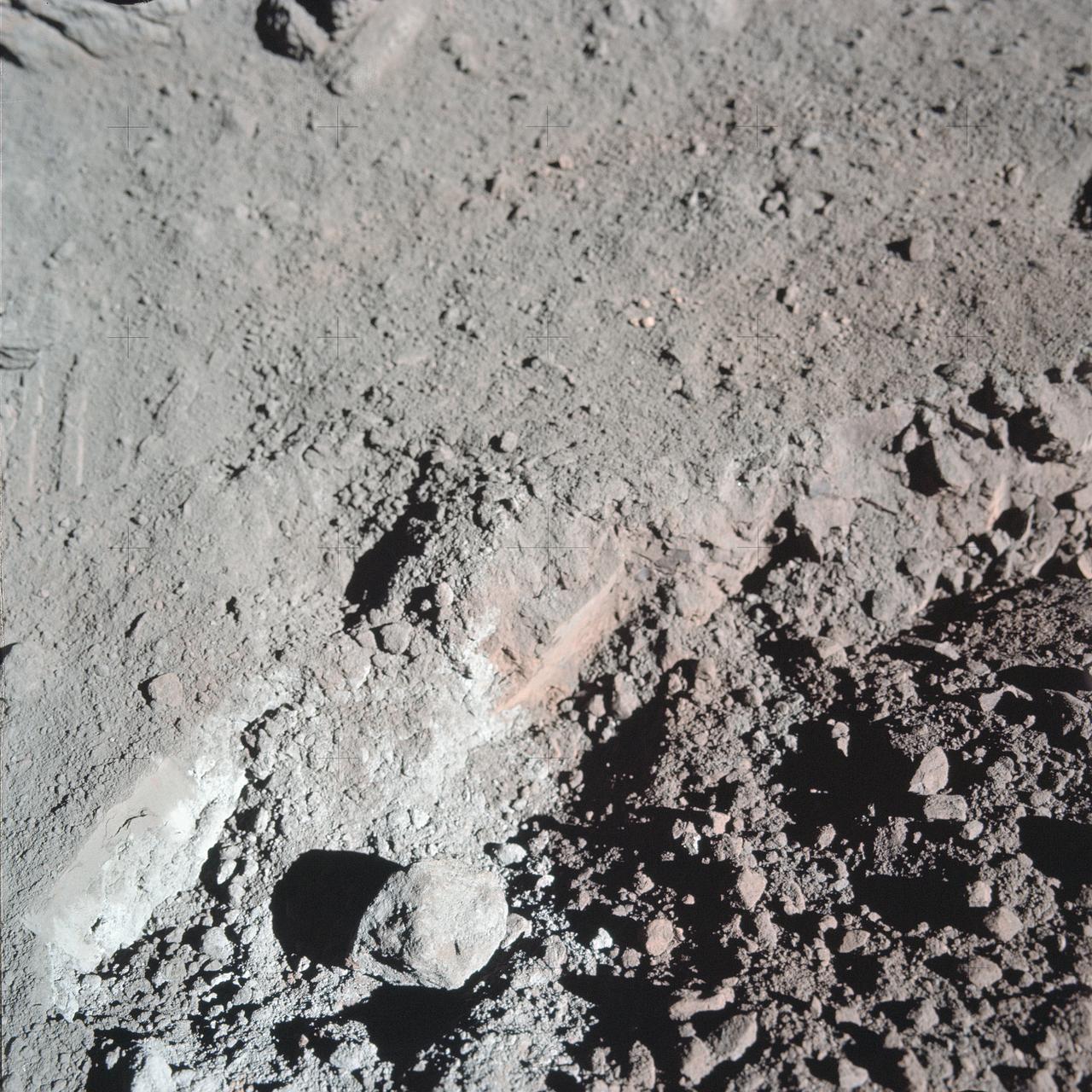
AS17-137-20989 (12 Dec. 1972) --- A close-up view of the much-publicized orange soil which the Apollo 17 crewmen found at Station 4 (Shorty Crater) during the second Apollo 17 extravehicular activity (EVA) at the Taurus-Littrow landing site. The orange soil was first spotted by scientist-astronaut Harrison H. Schmitt. While astronauts Schmitt and Eugene A. Cernan descended in the Lunar Module (LM) "Challenger" to explore the lunar surface, astronaut Ronald E. Evans remained with the Apollo 17 Command and Service Modules (CSM) in lunar orbit. The orange soil was never seen by the crewmen of the other lunar landing missions - Apollo 11 (Sea of Tranquility); Apollo 12 (Ocean of Storms); Apollo 14 (Fra Mauro); Apollo 15 (Hadley-Apennines); and Apollo 16 (Descartes).

S69-39527 (16 July 1969) --- The huge, 363-feet tall Apollo 11 (Spacecraft 107/ Lunar Module 5/Saturn 506) space vehicle is launched from Pad A, Launch Complex 39, Kennedy Space Center (KSC), at 9:32 a.m. (EDT), July 16, 1969. Aboard the Apollo 11 spacecraft are astronauts Neil A. Armstrong, commander; Michael Collins, command module pilot; and Edwin E. Aldrin Jr., lunar module pilot. Apollo 11 is the United States' first lunar landing mission. While Armstrong and Aldrin descend in the Lunar Module (LM) "Eagle" to explore the Sea of Tranquility region of the moon, astronaut Collins will remain with the Command and Service Modules (CSM) "Columbia" in lunar orbit.
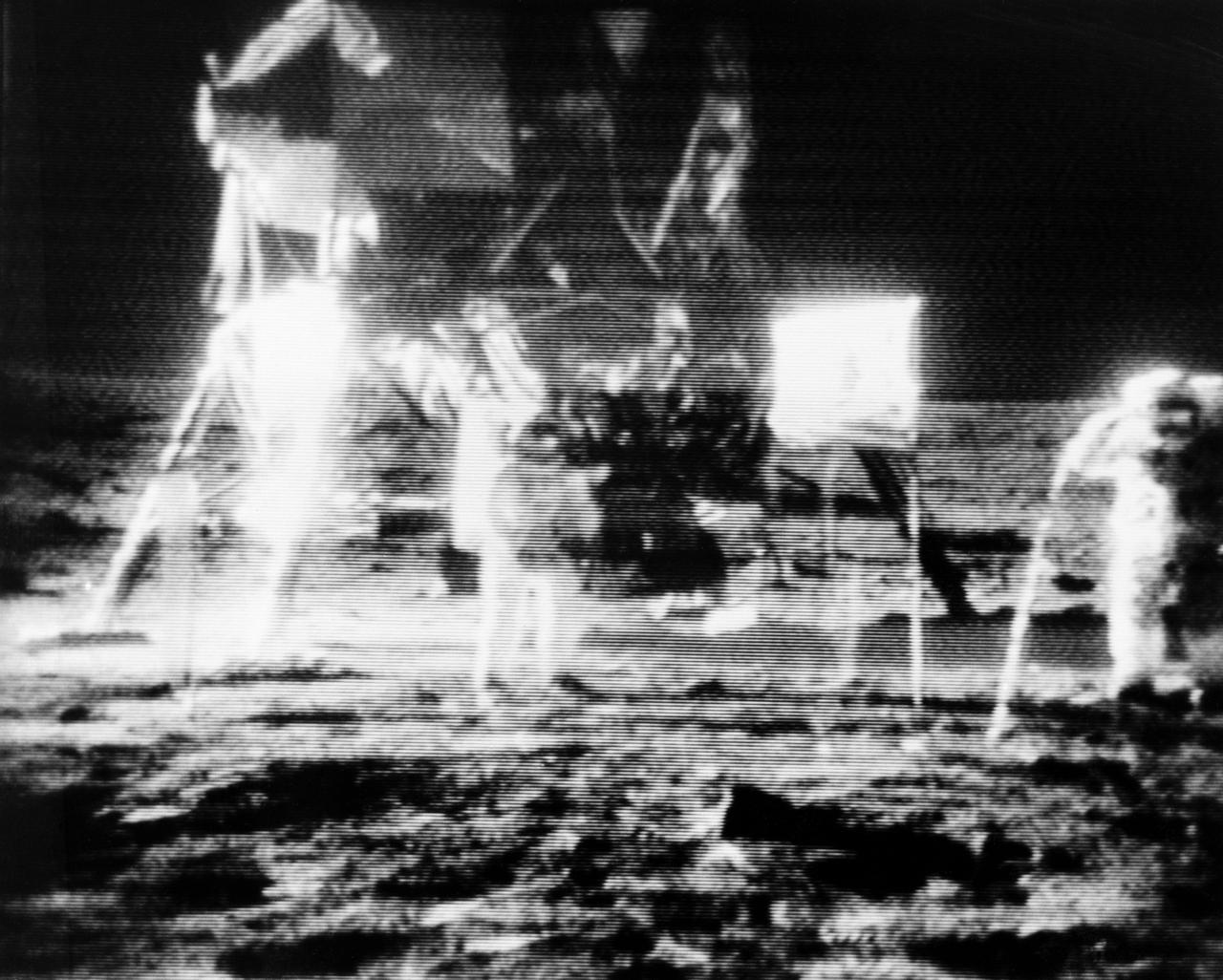
S69-39562 (20 July 1969) --- Astronauts Neil A. Armstrong (center), commander; and Edwin E. Aldrin Jr. (right), lunar module pilot, are seen standing near their Lunar Module (LM) in this black and white reproduction taken from a telecast by the Apollo 11 lunar surface camera during the Apollo 11 extravehicular activity (EVA). This picture was made from a televised image received at the Deep Space Network (DSN) tracking station at Goldstone, California. United States President Richard M. Nixon had just spoken to the two astronauts by radio. Aldrin, a Colonel in the United States Air Force, is saluting the Commander-in-Chief. While astronauts Armstrong and Aldrin descended in the LM "Eagle" to explore the Sea of Tranquility region of the moon, astronaut Michael Collins, command module pilot, remained with the Command and Service Modules (CSM) "Columbia" in lunar orbit.
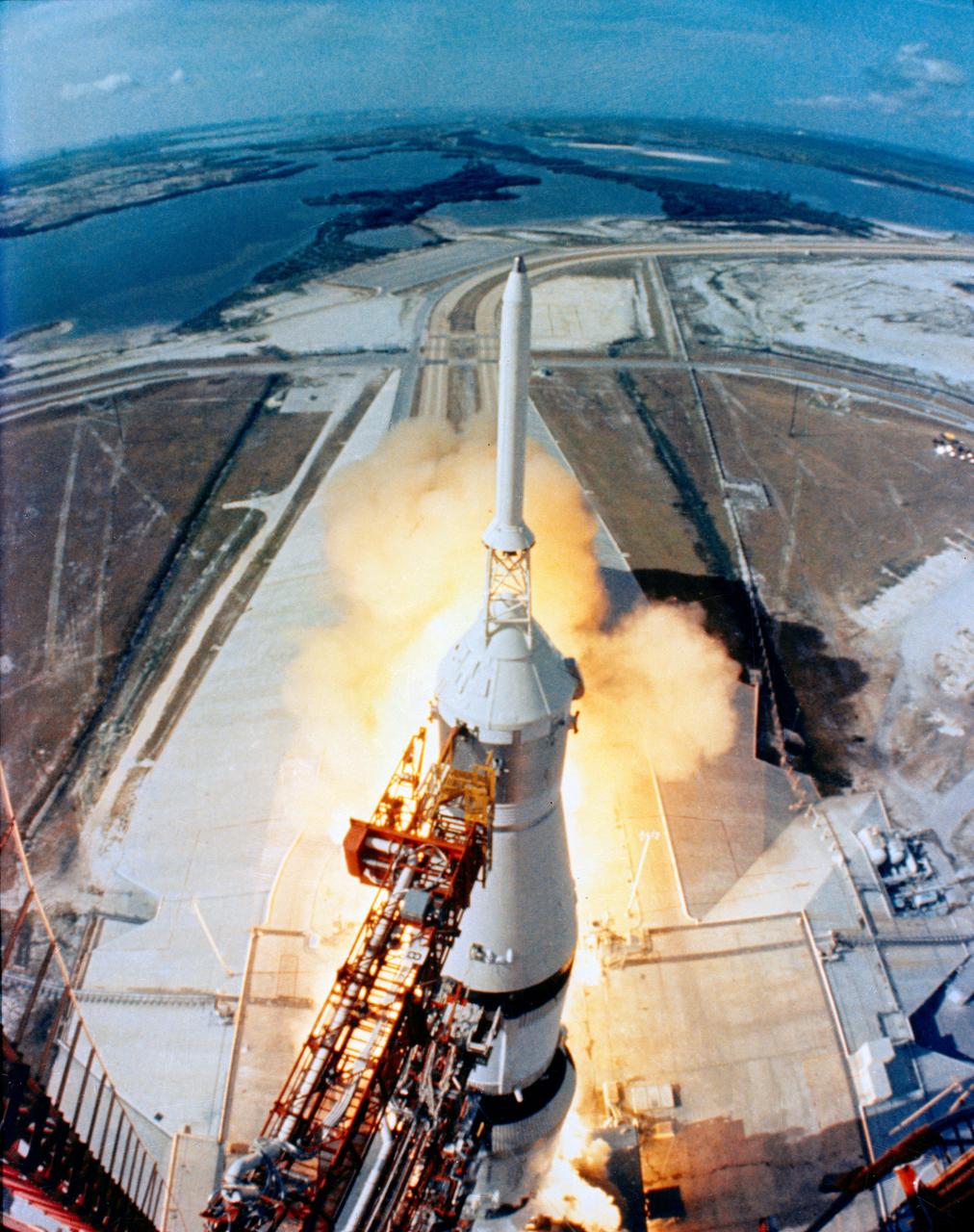
S69-39962 (16 July 1969) --- The huge, 363-feet tall Apollo 11 (Spacecraft 107/Lunar Module 5/Saturn 506) space vehicle is launched from Pad A, Launch Complex 39, Kennedy Space Center (KSC), at 9:32 a.m. (EDT), July 16, 1969. Aboard the Apollo 11 spacecraft were astronauts Neil A. Armstrong, commander; Michael Collins, command module pilot; and Edwin E. Aldrin Jr., lunar module pilot. Apollo 11 is the United States' first lunar landing mission. This view of the liftoff was taken by a camera mounted on the mobile launch tower. While astronauts Armstrong and Aldrin descend in the Lunar Module (LM) "Eagle" to explore the Sea of Tranquility region of the moon, astronaut Collins will remain with the Command and Service Modules (CSM) "Columbia" in lunar orbit.
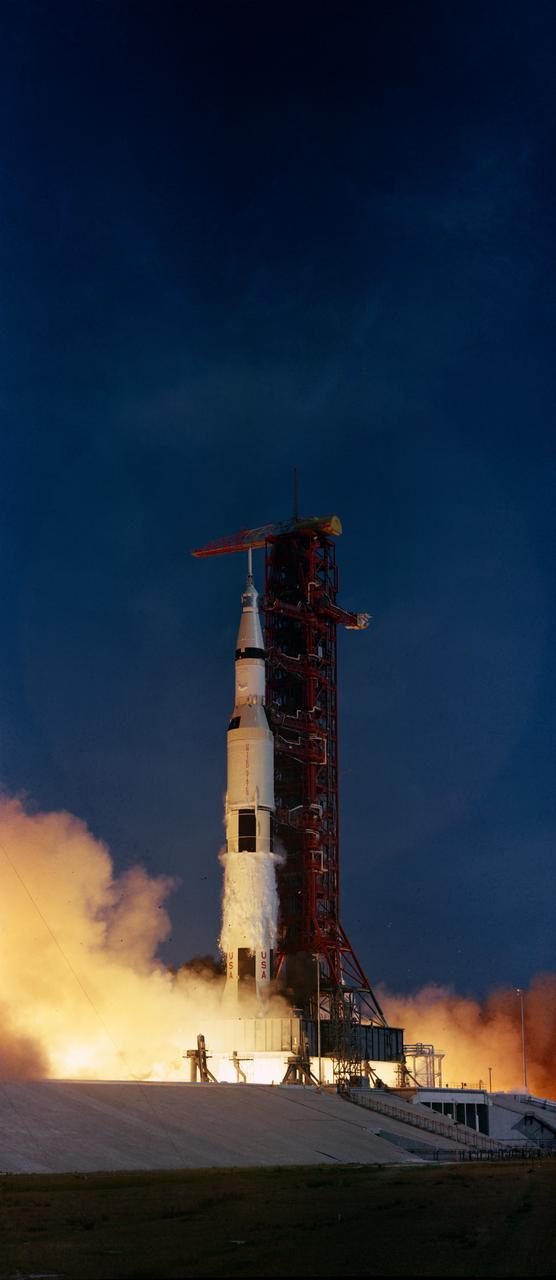
S69-39525 (16 July 1969) --- The huge, 363-feet tall Apollo 11 (Spacecraft 107/Lunar Module 5/Saturn 506) space vehicle is launched from Pad A, Launch Complex 39, Kennedy Space Center (KSC), at 9:32 a.m. (EDT), July 16, 1969. Onboard the Apollo 11 spacecraft were astronauts Neil A. Armstrong, commander; Michael Collins, command module pilot; and Edwin E. Aldrin Jr., lunar module pilot. Apollo 11 is the United States first lunar landing mission. While astronauts Armstrong and Aldrin descend in the Lunar Module (LM) "Eagle" to explore the Sea of Tranquility region of the moon, astronaut Collins will remain with the Command and Service Modules (CSM) "Columbia" in lunar orbit.
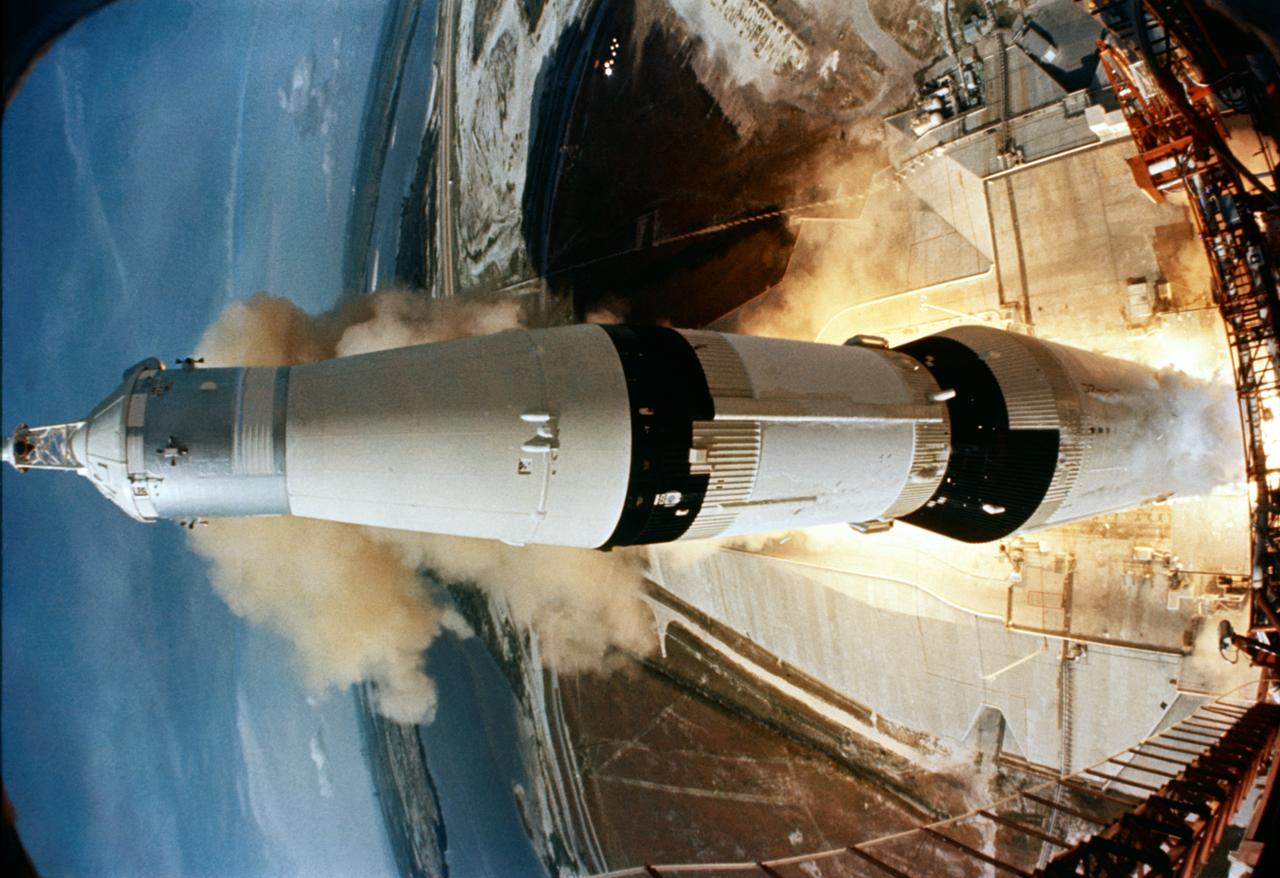
S69-39959 (16 July 1969) --- The huge, 363-feet tall Apollo 11 (Spacecraft 107/Lunar Module 5/ Saturn 506) space vehicle is launched from Pad A, Launch Complex 39, Kennedy Space Center (KSC), at 9:32 a.m. (EDT), July 16, 1969. Aboard the Apollo 11 spacecraft were astronauts Neil A. Armstrong, commander; Michael Collins, command module pilot; and Edwin E. Aldrin Jr., lunar module pilot. Apollo 11 is the United States' first lunar landing mission. This view of the liftoff was taken by a camera mounted on the mobile launch tower. While astronauts Armstrong and Aldrin descend in the Lunar Module (LM) "Eagle" to explore the Sea of Tranquility region of the moon, astronaut Collins will remain with the Command and Service Modules (CSM) "Columbia" in lunar orbit. Photo credit: NASA
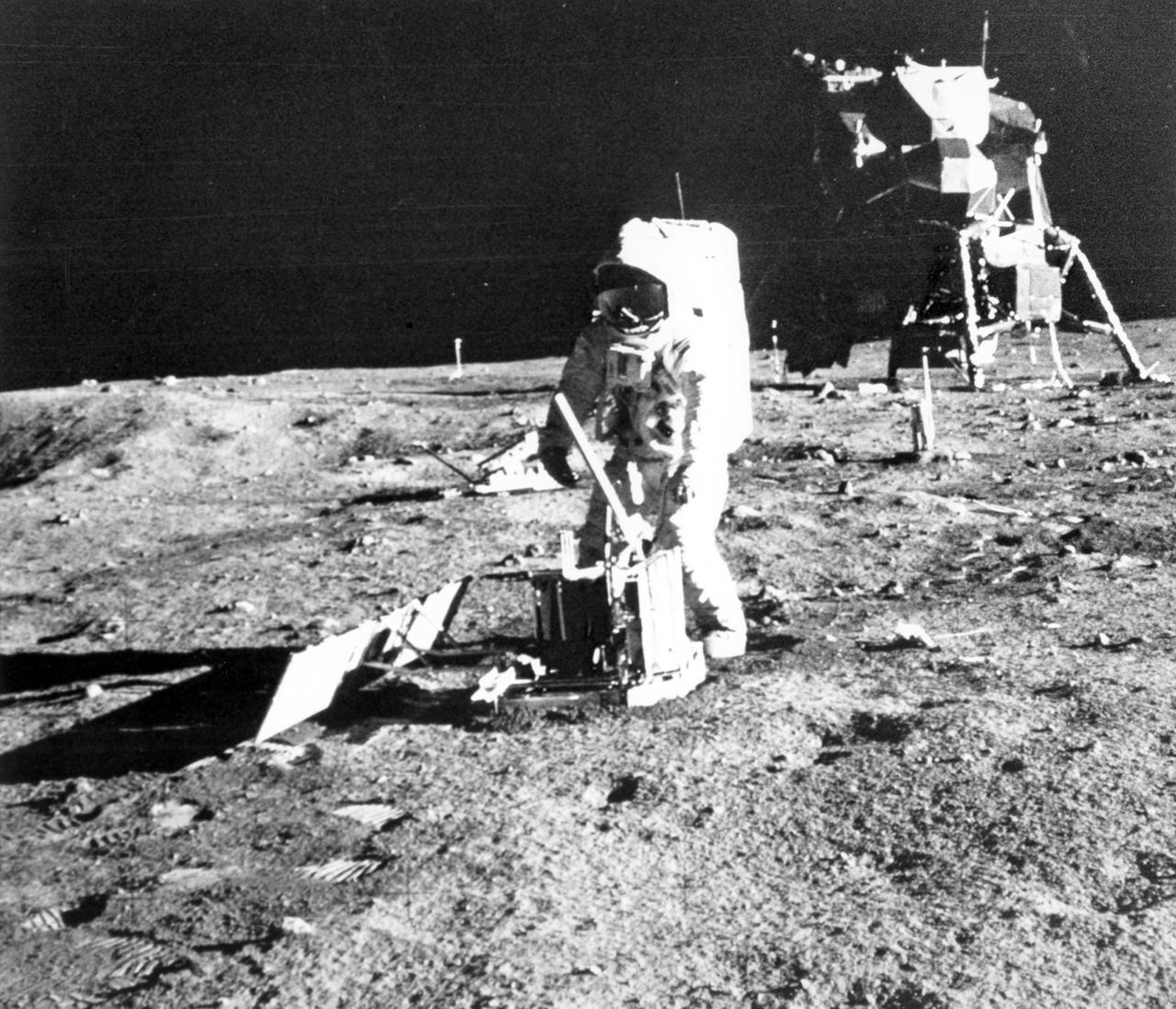
The first manned lunar landing mission, Apollo 11, launched from the Kennedy Space Center (KSC) in Florida via the Marshall Space Flight Center (MSFC) developed Saturn V launch vehicle on July 16, 1969 and safely returned to Earth on July 24, 1969. Aboard the space craft were astronauts Neil A. Armstrong, commander; Michael Collins, Command Module (CM) pilot; and Edwin E. (Buzz) Aldrin Jr., Lunar Module (LM) pilot. The CM, piloted by Michael Collins, remained in a parking orbit around the Moon, while the LM, named “Eagle’’, carrying astronauts Armstrong and Aldrin, landed on the Moon in the Sea of Tranquility. During 2½ hours of surface exploration, the crew set up experiments, collected 47 pounds of lunar surface material for analysis back on Earth, planted the U.S Flag, and left a message for all mankind. In this photograph, Aldrin is deploying the Passive Seismic Experiment Package (PSEP).
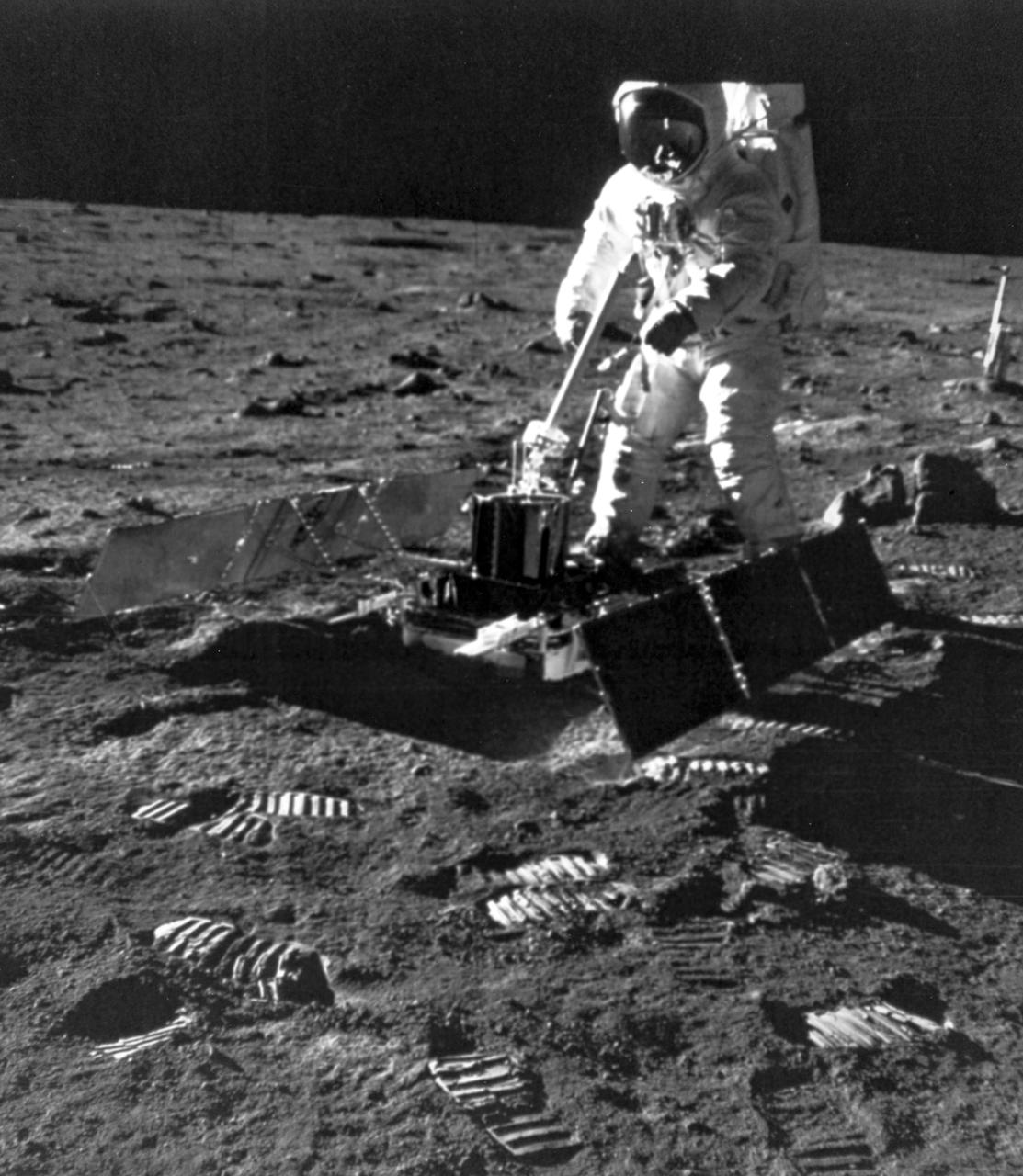
The Apollo 11 mission launched from the Kennedy Space Center (KSC) in Florida via the Marshall Space Flight Center (MSFC) developed Saturn V launch vehicle on July 16, 1969 and safely returned to Earth on July 24, 1969. Aboard the space craft were astronauts Neil A. Armstrong, commander; Michael Collins, Command Module (CM) pilot; and Edwin E. (Buzz) Aldrin Jr., Lunar Module (LM) pilot. The CM, piloted by Michael Collins, remained in a parking orbit around the Moon, while the LM, named “Eagle’’, carrying astronauts Armstrong and Aldrin, landed on the Moon in the Sea of Tranquility. During 2½ hours of surface exploration, the crew set up experiments, collected 47 pounds of lunar surface material for analysis back on Earth, planted the U.S Flag, and left a message for all mankind. In this photograph, Aldrin is deploying the Passive Seismic Experiment Package (PSEP).

S69-39529 (16 July 1969) --- The huge, 363-feet tall Apollo 11 (Spacecraft 107/Lunar Module 5/Saturn 506) space vehicle is launched from Pad A, Launch Complex 39, Kennedy Space Center (KSC), at 9:32 a.m. (EDT), July 16, 1969. Onboard the Apollo 11 spacecraft were astronauts Neil A. Armstrong, commander; Michael Collins, command module pilot; and Edwin E. Aldrin Jr., lunar module pilot. Apollo 11 is the United States first lunar landing mission. While astronauts Armstrong and Aldrin descend in the Lunar Module (LM) "Eagle" to explore the Sea of Tranquility region of the moon, astronaut Collins will remain with the Command and Service Modules (CSM) "Columbia" in lunar orbit.
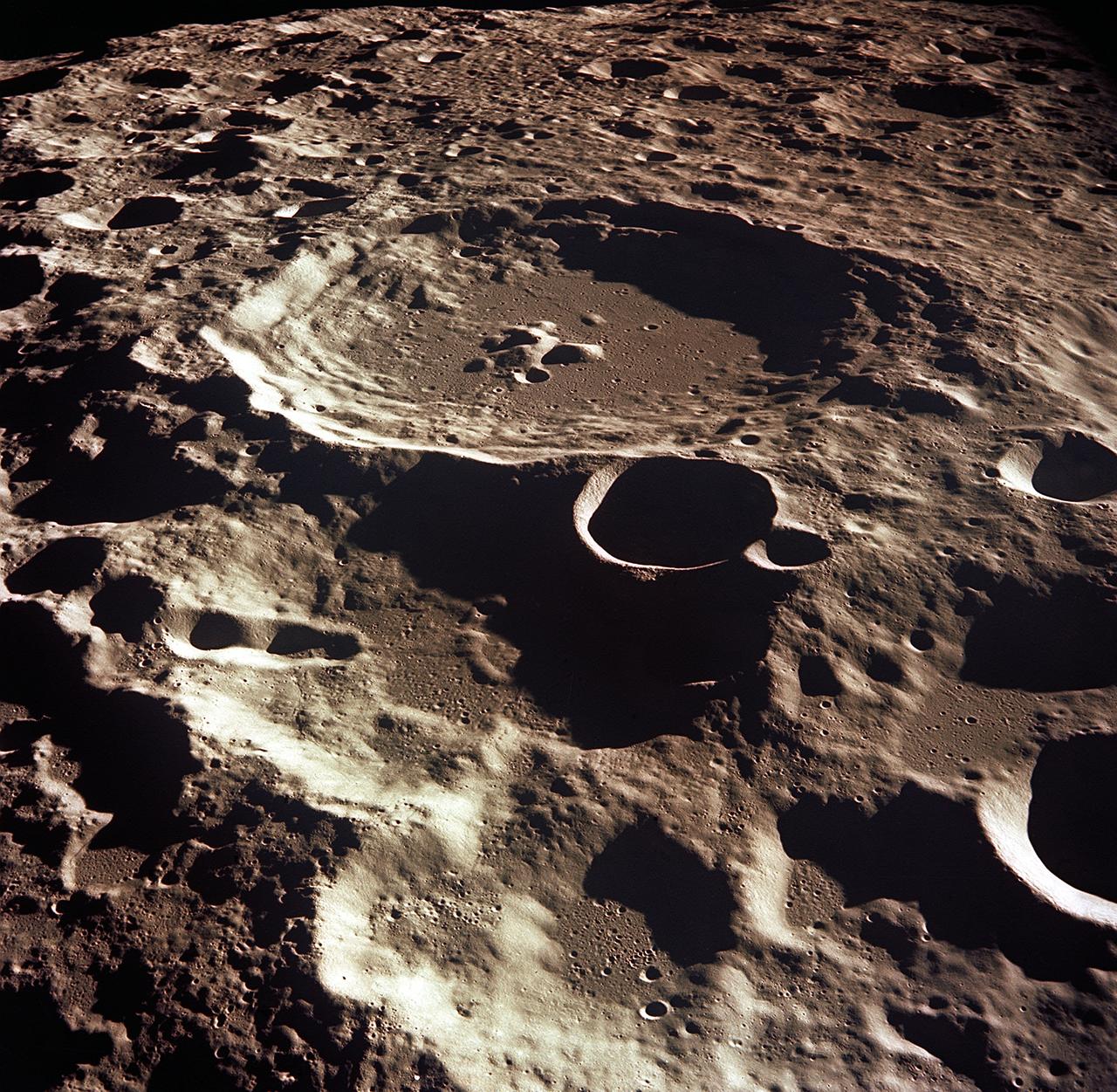
AS11-44-6609 (16-24 July 1969) --- An oblique of the Crater Daedalus on the lunar farside as seen from the Apollo 11 spacecraft in lunar orbit. The view looks southwest. Daedalus (formerly referred to as I.A.U. Crater No. 308) is located at 179 degrees east longitude and 5.5 degrees south latitude. Daedalus has a diameter of about 50 statute miles. This is a typical scene showing the rugged terrain on the farside of the moon. While astronauts Neil A. Armstrong, commander, and Edwin E. Aldrin Jr., lunar module pilot, descended in the Lunar Module (LM) "Eagle" to explore the Sea of Tranquility region of the moon, astronaut Michael Collins, command module pilot, remained with the Command and Service Modules (CSM) "Columbia" in lunar orbit.

S69-39526 (16 July 1969) --- The huge, 363-feet tall Apollo 11 (Spacecraft 107/Lunar Module 5/Saturn 506) space vehicle is launched from Pad A, Launch Complex 39 Kennedy Space Center (KSC), at 9:32 a.m. (EDT), July 16, 1969. Onboard the Apollo 11 spacecraft were astronauts Neil A. Armstrong, commander; Michael Collins, command module pilot; and Edwin E. Aldrin Jr., lunar module pilot. Apollo 11 is the United States first lunar landing mission. Astronauts Armstrong and Aldrin will descend in the Lunar Module (LM) "Eagle" to explore the Sea of Tranquility region of the moon, while astronaut Collins remains with the Command and Service Modules (CSM) "Columbia" in lunar orbit.

S69-21698 (24 July 1969) --- The three Apollo 11 crew men await pickup by a helicopter from the USS Hornet, prime recovery ship for the historic Apollo 11 lunar landing mission. The fourth man in the life raft is a United States Navy underwater demolition team swimmer. All four men are wearing biological isolation garments. Apollo 11, with astronauts Neil A. Armstrong, commander; Michael Collins, command module pilot; and Edwin E. Aldrin Jr., lunar module pilot, onboard, splashed down at 11:49 a.m. (CDT), July 24, 1969, about 812 nautical miles southwest of Hawaii and only 12 nautical miles from the USS Hornet. While astronauts Armstrong and Aldrin descended in the Lunar Module (LM) "Eagle" to explore the Sea of Tranquility region of the moon, astronaut Collins remained with the Command and Service Modules (CSM) "Columbia" in lunar orbit.
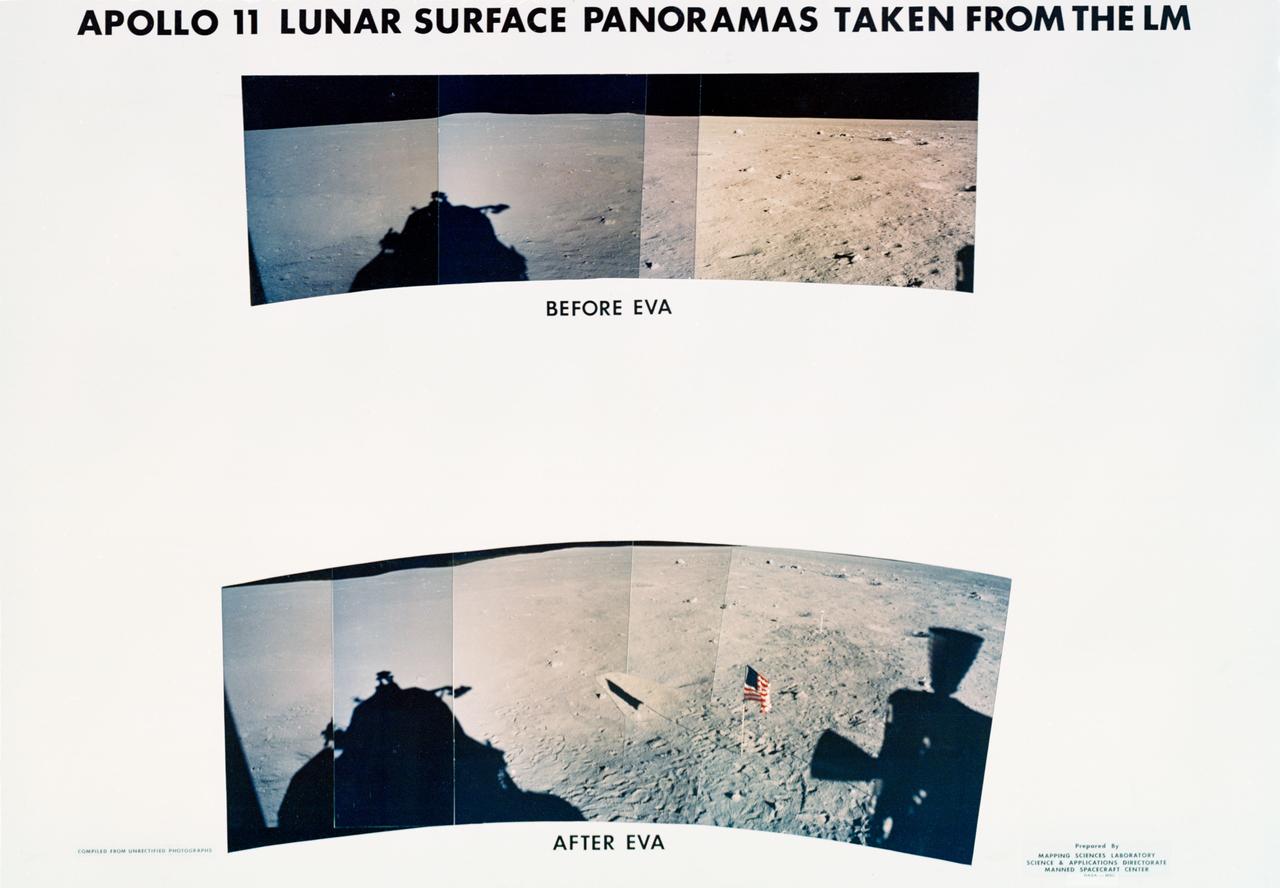
S69-44465 (20 July 1969) --- These panoramic views of the lunar surface, photographed from the Apollo 11 Lunar Module (LM) as it rested on the lunar surface. The views reveal the surface near where the LM touched down, in the southeastern Sea of Tranquility. The views are as it looked before and after astronauts Neil A. Armstrong and Edwin E. Aldrin Jr. participated in extravehicular activity (EVA). The United States flag is pictured in the bottom or "after" photo with the black and white lunar surface television camera pictured at the right of flag. Shadows of the LM are visible in the two panoramic views and a silhouette of part of a Reaction Control Subsystem thruster is seen in the bottom picture. Note the numerous footprints made by the two crewmen during the EVA period.
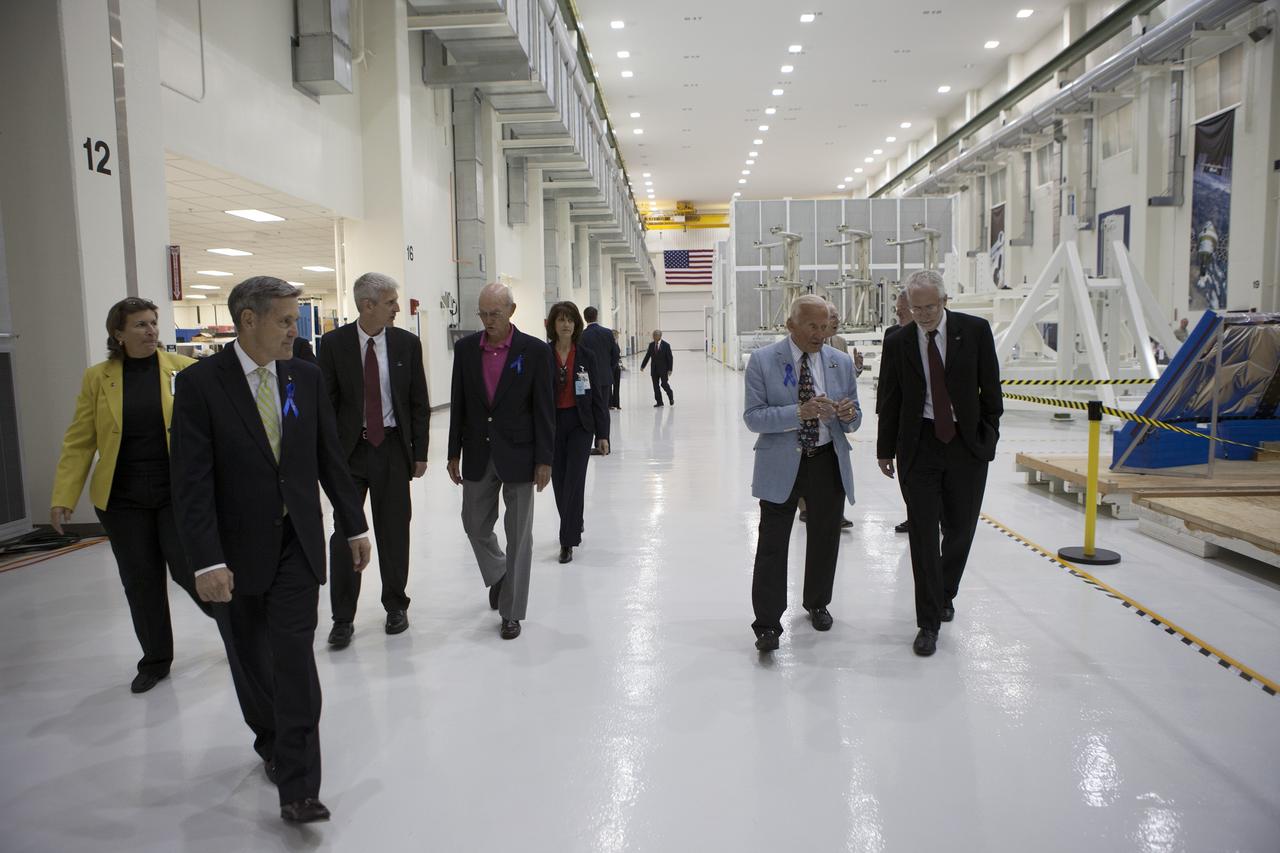
CAPE CANAVERAL, Fla. -- At the Kennedy Space Center in Florida, NASA officials and Apollo astronauts tour the refurbished Operations and Checkout Building, newly named for Apollo 11 astronaut Neil Armstrong, the first person to set foot on the moon. Leading the way at left is Kennedy Center Director Bob Cabana, Scott Wilson, manager, production operations for the Orion Program, and Apollo 11 astronaut Michael Collins. At right is Apollo 11 astronaut Buzz Aldrin, and Mark Geyer, Orion Program manager. The building's high bay is being used to support the agency's new Orion spacecraft, which will lift off atop the Space Launch System. Orion is designed to take humans farther than they've ever gone before, serving as the exploration vehicle that will carry astronauts to deep space and sustain the crew during travel to destinations such as an asteroid or Mars. The visit of the former astronauts was part of NASA's 45th anniversary celebration of the moon landing. As the world watched, Neil Armstrong and Aldrin landed in the moon's Sea of Tranquility aboard the lunar module Eagle on July 20, 1969. Meanwhile, crewmate Collins orbited above in the command module Columbia. For more, visit http://www.nasa.gov/press/2014/july/nasa-honors-historic-first-moon-landing-eyes-first-mars-mission. Photo credit: NASA/Kim Shiflett

CAPE CANAVERAL, Fla. -- At the Kennedy Space Center in Florida, NASA officials showcase the modifications underway at Launch Pad 39 B to Apollo astronauts visiting the center. From left are NASA Administrator Charles Bolden, Apollos 8 and 13 astronaut Jim Lovell, Apollo 11 astronauts Buzz Aldrin and Mike Collins, and Center Director Bob Cabana. The pad is being modified to support the agency's new Orion spacecraft which will lift off atop the Space Launch System rocket. Orion is designed to take humans farther than they’ve ever gone before, serving as the exploration vehicle that will carry astronauts to deep space and sustain the crew during travel to destinations such as an asteroid or Mars. The visit of the former astronauts was part of NASA's 45th anniversary celebration of the Apollo 11 moon landing. As the world watched, Neil Armstrong and Aldrin landed in the moon's Sea of Tranquility aboard the lunar module Eagle on July 20, 1969. Meanwhile, crewmate Collins orbited above in the command module Columbia. For more, visit http://www.nasa.gov/press/2014/july/nasa-honors-historic-first-moon-landing-eyes-first-mars-mission. Photo credit: NASA/Kim Shiflett
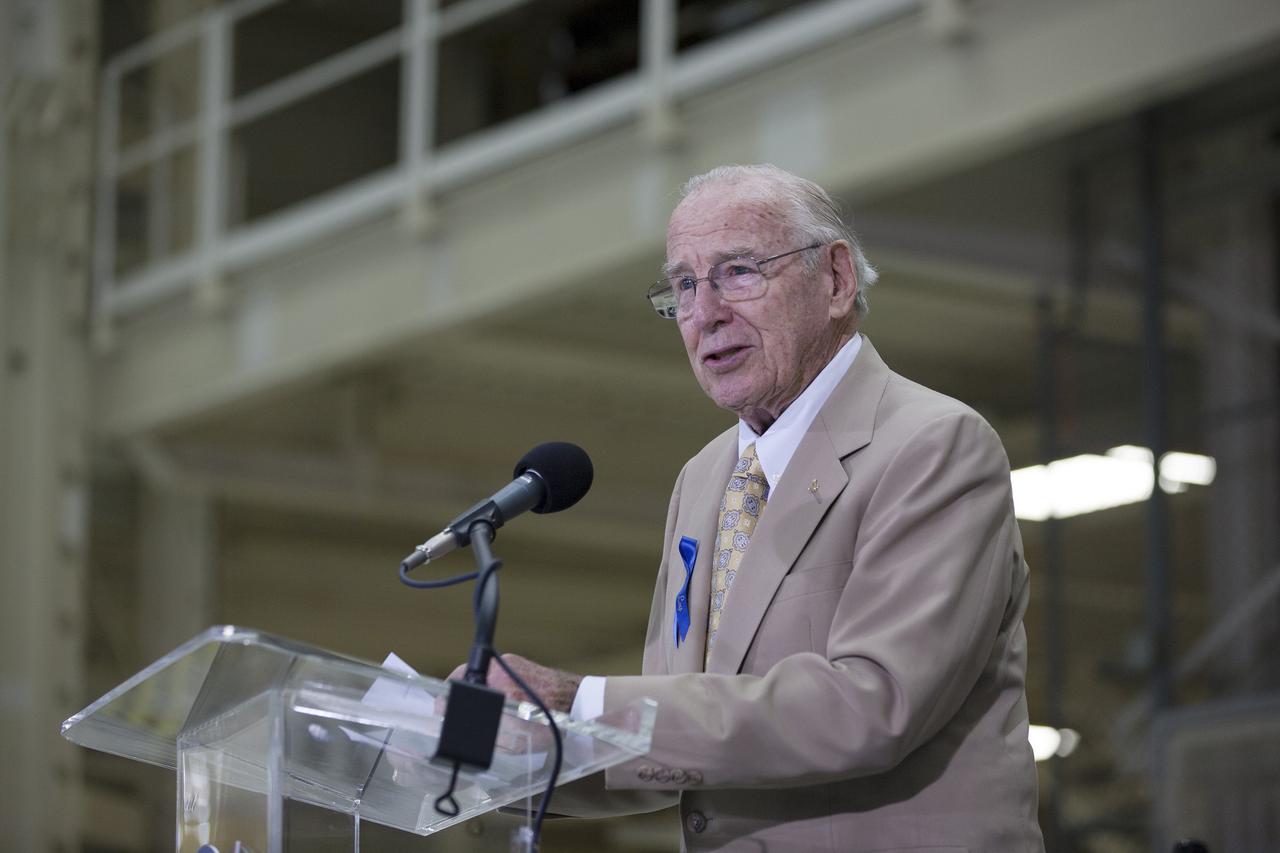
CAPE CANAVERAL, Fla. -- At the Kennedy Space Center in Florida, Apollo astronaut Jim Lovell addresses the audience at a ceremony renaming the refurbished Operations and Checkout Building for Apollo 11 astronaut Neil Armstrong, the first person to set foot on the moon. Lovell served on the crews of Apollo 8 and Apollo 13. The building's high bay is being used to support the agency's new Orion spacecraft and is the same spaceport facility where the Apollo 11 command/service module and lunar module were prepped for the first lunar landing mission in 1969. Orion is designed to take humans farther than they’ve ever gone before, serving as the exploration vehicle that will carry astronauts to deep space and sustain the crew during travel to destinations such as an asteroid or Mars. The ceremony was part of NASA's 45th anniversary celebration of the Apollo 11 moon landing. As the world watched, Neil Armstrong and Buzz Aldrin landed in the moon's Sea of Tranquility on July 20, 1969, aboard the lunar module Eagle. Meanwhile, crewmate Michael Collins orbited above in the command module Columbia. For more, visit http://www.nasa.gov/press/2014/july/nasa-honors-historic-first-moon-landing-eyes-first-mars-mission. Photo credit: NASA/Kim Shiflett

CAPE CANAVERAL, Fla. -- Apollo astronauts Jim Lovell, left, and Buzz Aldrin tour the astronaut crew quarters in the Operations and Checkout Building at NASA's Kennedy Space Center in Florida. The tour followed a ceremony renaming the refurbished Operations and Checkout Building for Apollo 11 astronaut Neil Armstrong, the first person to set foot on the moon. Besides housing the crew quarters, the building's high bay is being used to support the agency's new Orion spacecraft and is the same spaceport facility where the Apollo 11 command/service module and lunar module were prepped for the first lunar landing mission in 1969. Orion is designed to take humans farther than they’ve ever gone before, serving as the exploration vehicle that will carry astronauts to deep space and sustain the crew during travel to destinations such as an asteroid or Mars. The visit of the former astronauts was part of NASA's 45th anniversary celebration of the moon landing. As the world watched, Neil Armstrong and Aldrin landed in the moon's Sea of Tranquility aboard the lunar module Eagle on July 20, 1969. Meanwhile, crewmate Collins orbited above in the command module Columbia. For more, visit http://www.nasa.gov/press/2014/july/nasa-honors-historic-first-moon-landing-eyes-first-mars-mission. Photo credit: NASA/Kim Shiflett
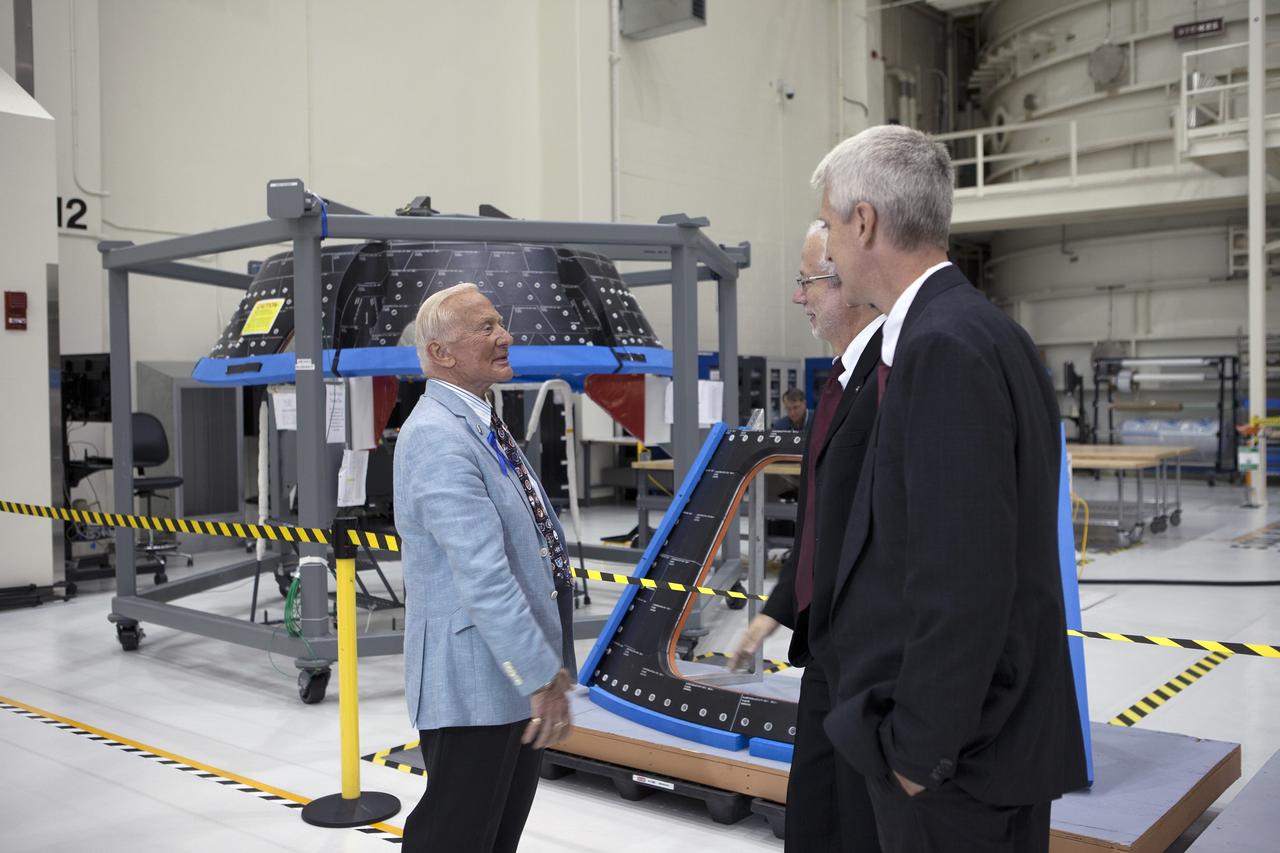
CAPE CANAVERAL, Fla. -- At the Kennedy Space Center in Florida, NASA officials and Apollo astronauts tour the refurbished Operations and Checkout Building, newly named for Apollo 11 astronaut Neil Armstrong, the first person to set foot on the moon. From left, are Apollo 11 astronaut Buzz Aldrin, Mark Geyer, Orion Program manager, and Scott Wilson, manager, production operations for the Orion Program. Also at the renaming ceremony were Apollo astronauts Michael Collins and Jim Lovell. The building's high bay is being used to support the agency's new Orion spacecraft, which will lift off atop the Space Launch System. Orion is designed to take humans farther than they've ever gone before, serving as the exploration vehicle that will carry astronauts to deep space and sustain the crew during travel to destinations such as an asteroid or Mars. The visit of the former astronauts was part of NASA's 45th anniversary celebration of the moon landing. As the world watched, Neil Armstrong and Aldrin landed in the moon's Sea of Tranquility aboard the lunar module Eagle on July 20, 1969. Meanwhile, crewmate Collins orbited above in the command module Columbia. For more, visit http://www.nasa.gov/press/2014/july/nasa-honors-historic-first-moon-landing-eyes-first-mars-mission. Photo credit: NASA/Kim Shiflett
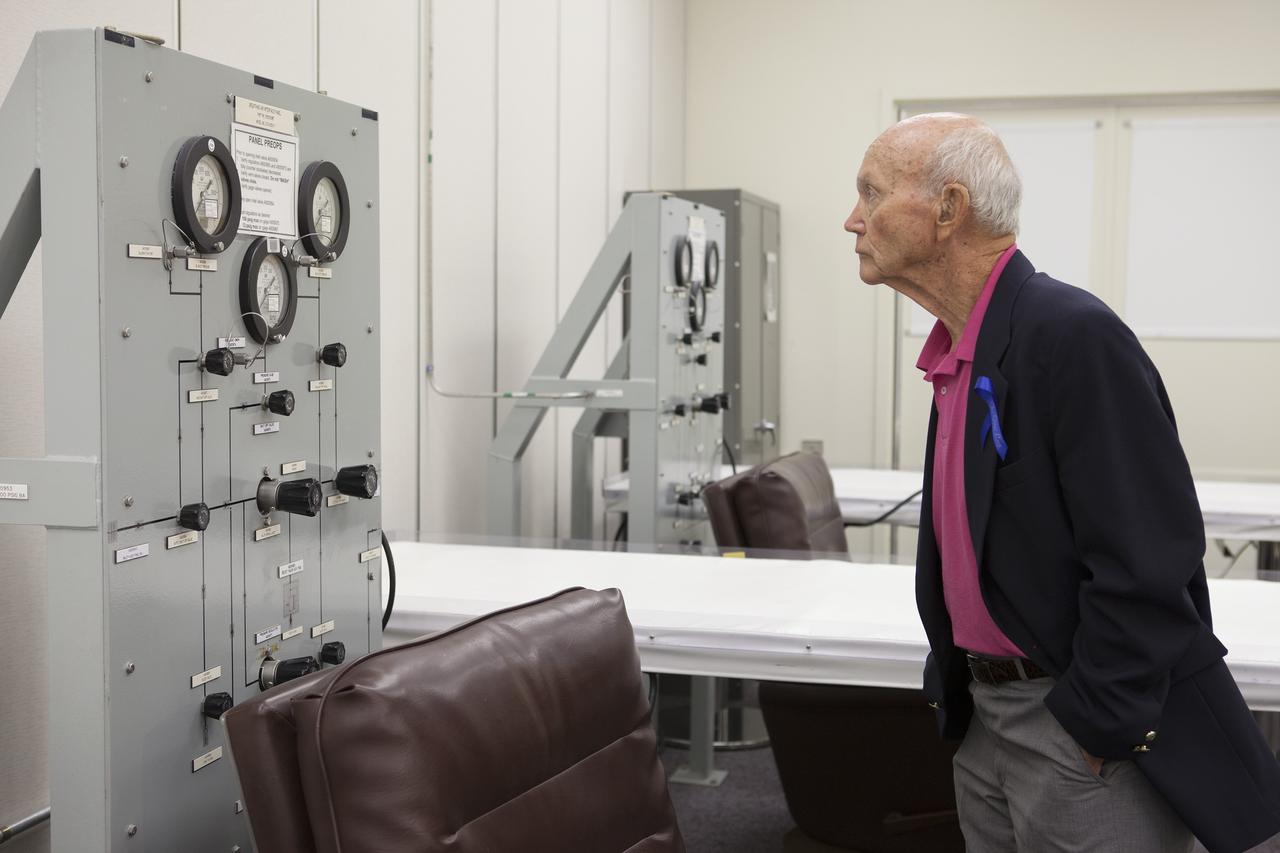
CAPE CANAVERAL, Fla. -- Apollo 11 astronaut Michael Collins checks out some equipment during a tour of the astronaut crew quarters in the Operations and Checkout Building at NASA's Kennedy Space Center in Florida. The tour followed a ceremony renaming the refurbished Operations and Checkout Building for Apollo 11 astronaut Neil Armstrong, the first person to set foot on the moon. Besides housing the crew quarters, the building's high bay is being used to support the agency's new Orion spacecraft and is the same spaceport facility where the Apollo 11 command/service module and lunar module were prepped for the first lunar landing mission in 1969. Orion is designed to take humans farther than they’ve ever gone before, serving as the exploration vehicle that will carry astronauts to deep space and sustain the crew during travel to destinations such as an asteroid or Mars. The visit of the former astronauts was part of NASA's 45th anniversary celebration of the moon landing. As the world watched, Neil Armstrong and Aldrin landed in the moon's Sea of Tranquility aboard the lunar module Eagle on July 20, 1969. Meanwhile, crewmate Collins orbited above in the command module Columbia. For more, visit http://www.nasa.gov/press/2014/july/nasa-honors-historic-first-moon-landing-eyes-first-mars-mission. Photo credit: NASA/Kim Shiflett
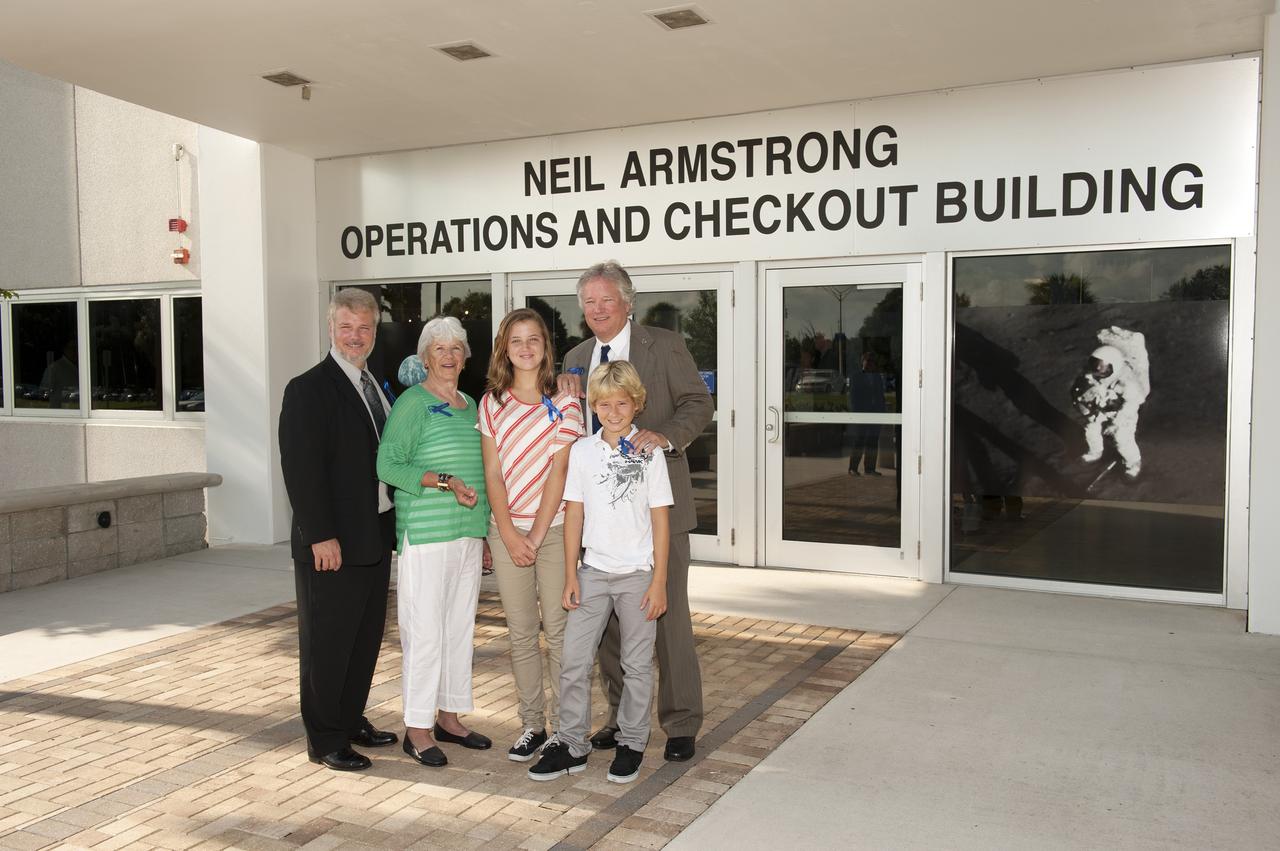
CAPE CANAVERAL, Fla. -- At the Kennedy Space Center in Florida, the family of Neil Armstrong poses for a group portrait in front of the refurbished Operations and Checkout Building. From left are Armstrong's son Mark, his former wife Janet, his granddaughter Lily, his son Rick and his grandson Bryce. Armstrong, an Apollo 11 astronaut, was the first person to set foot on the moon and for whom the facility is newly named. The building's high bay is being used to support the agency's new Orion spacecraft, which will lift off atop the Space Launch System rocket. Orion is designed to take humans farther than they’ve ever gone before, serving as the exploration vehicle that will carry astronauts to deep space and sustain the crew during travel to destinations such as an asteroid or Mars. The visit of the former astronauts was part of NASA's 45th anniversary celebration of the Apollo 11 moon landing. As the world watched, Neil Armstrong and Aldrin landed in the moon's Sea of Tranquility aboard the lunar module Eagle on July 20, 1969. Meanwhile, crewmate Collins orbited above in the command module Columbia. For more, visit http://www.nasa.gov/press/2014/july/nasa-honors-historic-first-moon-landing-eyes-first-mars-mission. Photo credit: NASA/Kevin O'Connell

CAPE CANAVERAL, Fla. -- At the Kennedy Space Center in Florida, media representatives turn out for a ceremony renaming the refurbished Operations and Checkout Building for Apollo 11 astronaut Neil Armstrong, the first person to set foot on the moon. The building's high bay, in which the ceremony was held, is being used to support the agency's new Orion spacecraft and is the same spaceport facility where the Apollo 11 command/service module and lunar module were prepped for the first lunar landing mission in 1969. Orion is designed to take humans farther than they’ve ever gone before, serving as the exploration vehicle that will carry astronauts to deep space and sustain the crew during travel to destinations such as an asteroid or Mars. The ceremony was part of NASA's 45th anniversary celebration of the Apollo 11 moon landing. As the world watched, Neil Armstrong and Buzz Aldrin landed in the moon's Sea of Tranquility on July 20, 1969, aboard the lunar module Eagle. Meanwhile, crewmate Michael Collins orbited above in the command module Columbia. For more, visit http://www.nasa.gov/press/2014/july/nasa-honors-historic-first-moon-landing-eyes-first-mars-mission. Photo credit: NASA/Kim Shiflett
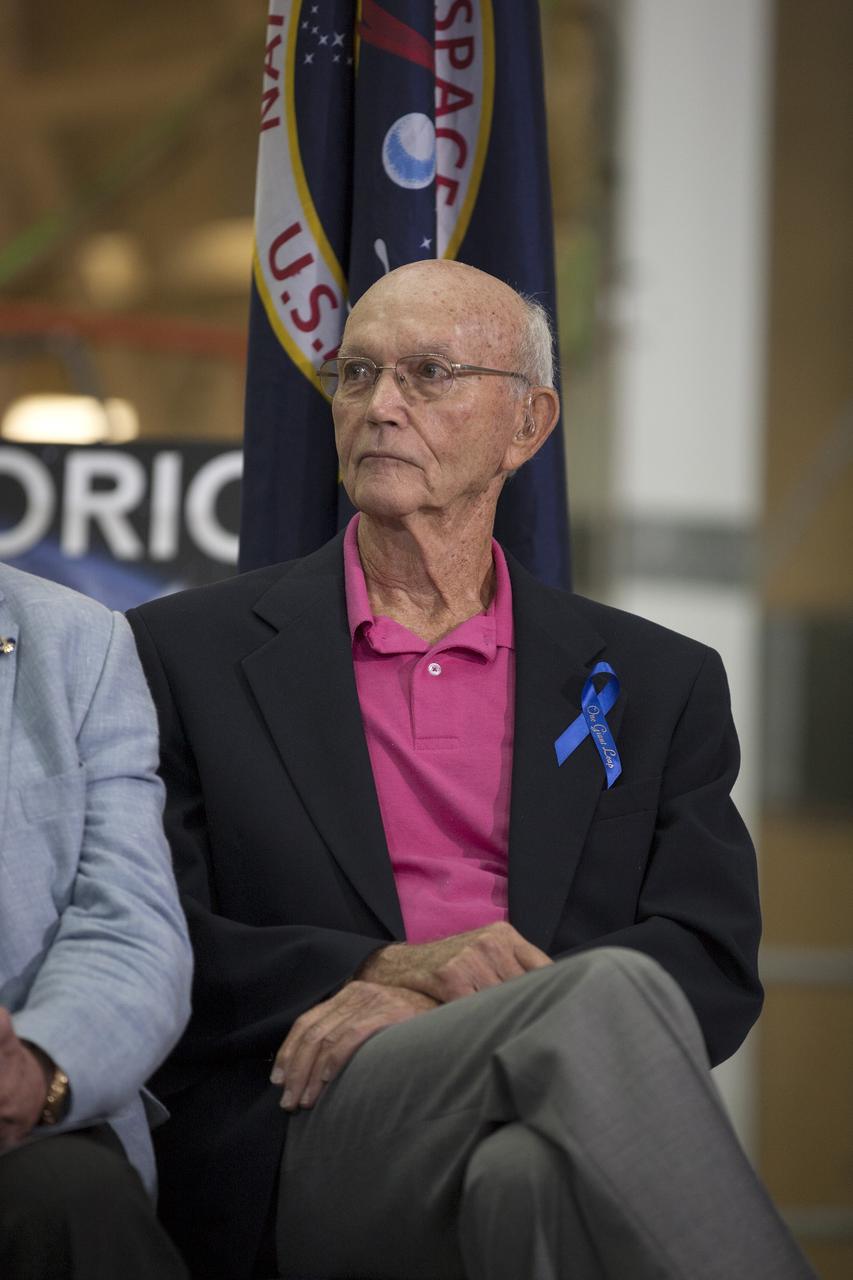
CAPE CANAVERAL, Fla. -- At the Kennedy Space Center in Florida, Apollo 11 astronaut Michael Collins participates in a ceremony renaming the refurbished Operations and Checkout Building for Apollo 11 astronaut Neil Armstrong, the first person to set foot on the moon. The building's high bay is being used to support the agency's new Orion spacecraft and is the same spaceport facility where the Apollo 11 command/service module and lunar module were prepped for the first lunar landing mission in 1969. Orion is designed to take humans farther than they’ve ever gone before, serving as the exploration vehicle that will carry astronauts to deep space and sustain the crew during travel to destinations such as an asteroid or Mars. The ceremony was part of NASA's 45th anniversary celebration of the Apollo 11 moon landing. As the world watched, Neil Armstrong and Buzz Aldrin landed in the moon's Sea of Tranquility on July 20, 1969, aboard the lunar module Eagle. Meanwhile, crewmate Michael Collins orbited above in the command module Columbia. For more, visit http://www.nasa.gov/press/2014/july/nasa-honors-historic-first-moon-landing-eyes-first-mars-mission. Photo credit: NASA/Kim Shiflett
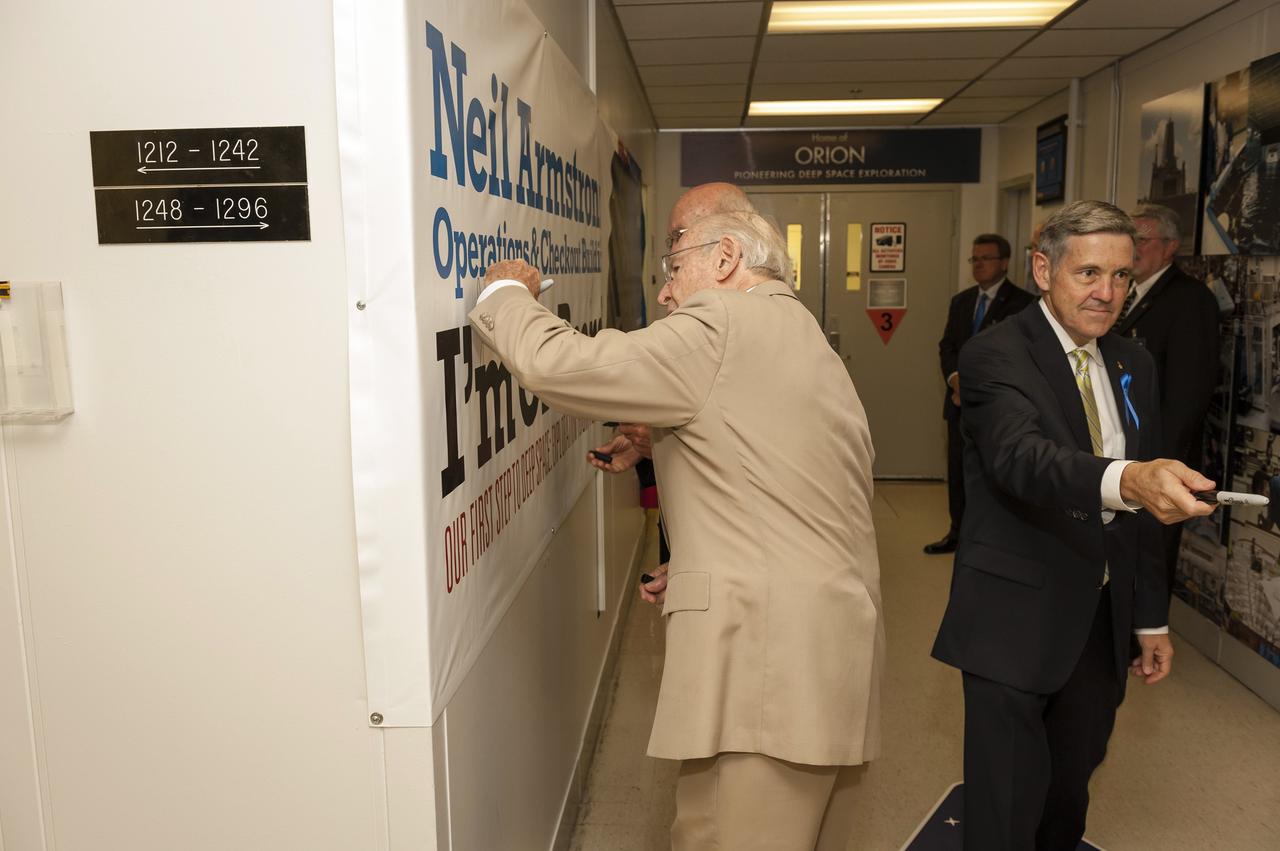
CAPE CANAVERAL, Fla. -- Apollo astronauts and their families receive a briefing in one of the remodeled firing rooms in the Launch Control Center at NASA's Kennedy Space Center in Florida. The facility's firing rooms were used to conduct the Saturn V countdowns during the Apollo Program. The tour followed a ceremony renaming the refurbished Operations and Checkout Building for Apollo 11 astronaut Neil Armstrong, the first person to set foot on the moon. Second from left is Apollo 11 moonwalker Buzz Aldrin and former astronaut Jim Lovell, a member of the Apollo 8 and Apollo 13 crews, standing next to him, at center. The ceremony was part of NASA's 45th anniversary celebration of the Apollo 11 moon landing. As the world watched, Neil Armstrong and Buzz Aldrin landed in the moon's Sea of Tranquility on July 20, 1969, aboard the lunar module Eagle. Meanwhile, crewmate Michael Collins orbited above in the command module Columbia. For more, visit http://www.nasa.gov/press/2014/july/nasa-honors-historic-first-moon-landing-eyes-first-mars-mission. Photo credit: NASA/Kevin O'Connell
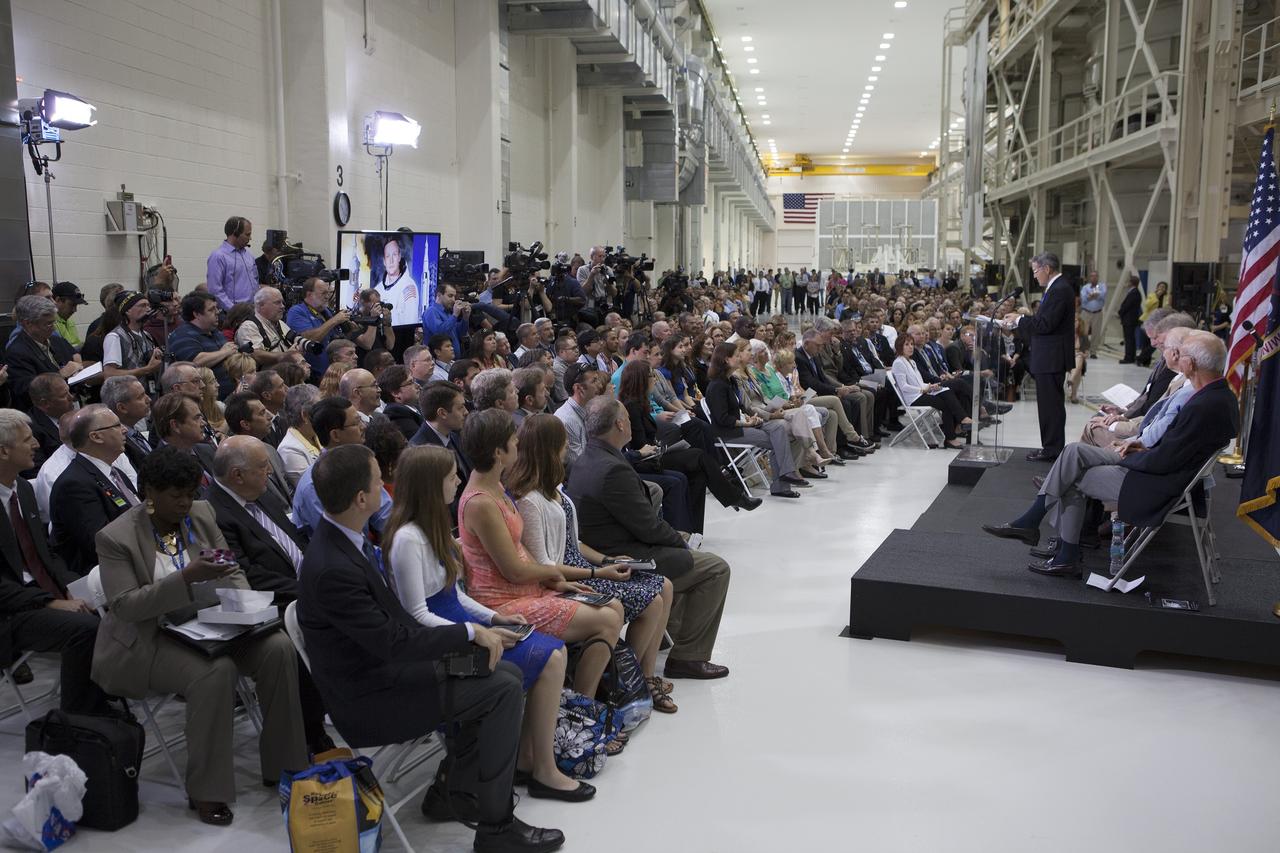
CAPE CANAVERAL, Fla. -- At the Kennedy Space Center in Florida, Center Director Robert Cabana addresses the audience at a ceremony renaming the refurbished Operations and Checkout Building for Apollo 11 astronaut Neil Armstrong, the first person to set foot on the moon. The building's high bay is being used to support the agency's new Orion spacecraft and is the same spaceport facility where the Apollo 11 command/service module and lunar module were prepped for the first lunar landing mission in 1969. Orion is designed to take humans farther than they’ve ever gone before, serving as the exploration vehicle that will carry astronauts to deep space and sustain the crew during travel to destinations such as an asteroid or Mars. The ceremony was part of NASA's 45th anniversary celebration of the Apollo 11 moon landing. As the world watched, Neil Armstrong and Buzz Aldrin landed in the moon's Sea of Tranquility on July 20, 1969, aboard the lunar module Eagle. Meanwhile, crewmate Michael Collins orbited above in the command module Columbia. For more, visit http://www.nasa.gov/press/2014/july/nasa-honors-historic-first-moon-landing-eyes-first-mars-mission. Photo credit: NASA/Kim Shiflett
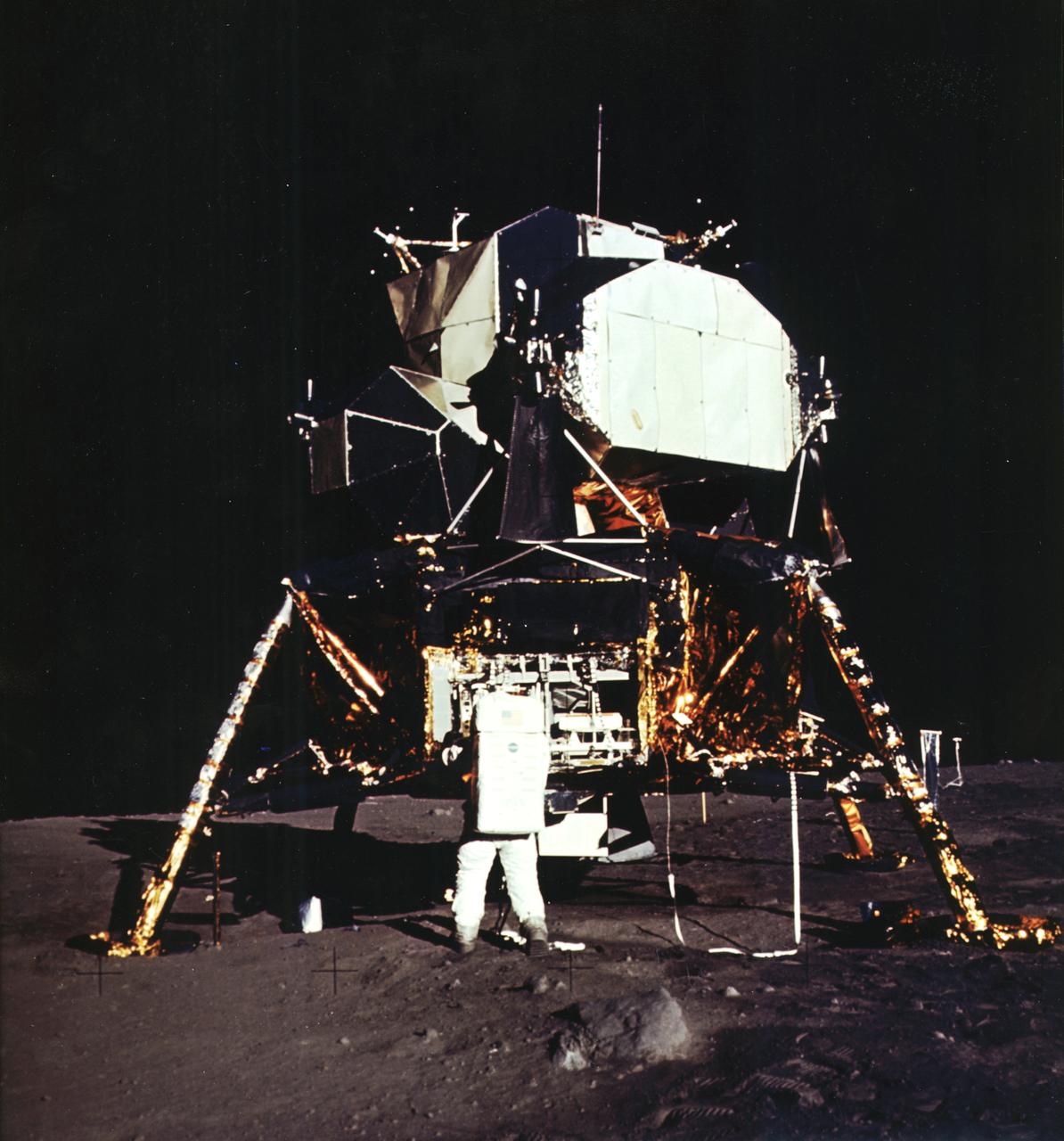
The first manned lunar landing mission, Apollo 11, launched from the Kennedy Space Center (KSC) in Florida via the Marshall Space Flight Center (MSFC) developed Saturn V launch vehicle on July 16, 1969 and safely returned to Earth on July 24, 1969. Aboard the space craft were astronauts Neil A. Armstrong, commander; Michael Collins, Command Module (CM) pilot; and Edwin E. (Buzz) Aldrin Jr., Lunar Module (LM) pilot. The CM, piloted by Michael Collins, remained in a parking orbit around the Moon while the LM, named “Eagle’’, carrying astronauts Armstrong and Aldrin, landed on the Moon in the Sea of Tranquility. The LM was a two part spacecraft. Its lower or descent stage had the landing gear, engines, and fuel needed for the landing. When the LM blasted off the Moon, the descent stage served as the launching pad for its companion ascent stage, which was also home for the two astronauts on the surface of the Moon. The LM was full of gear with which to communicate, navigate, and rendezvous. It also had its own propulsion system, and an engine to lift it off the Moon and send it on a course toward the orbiting CM. Aldrin is pictured here next to the LM on the lunar surface.
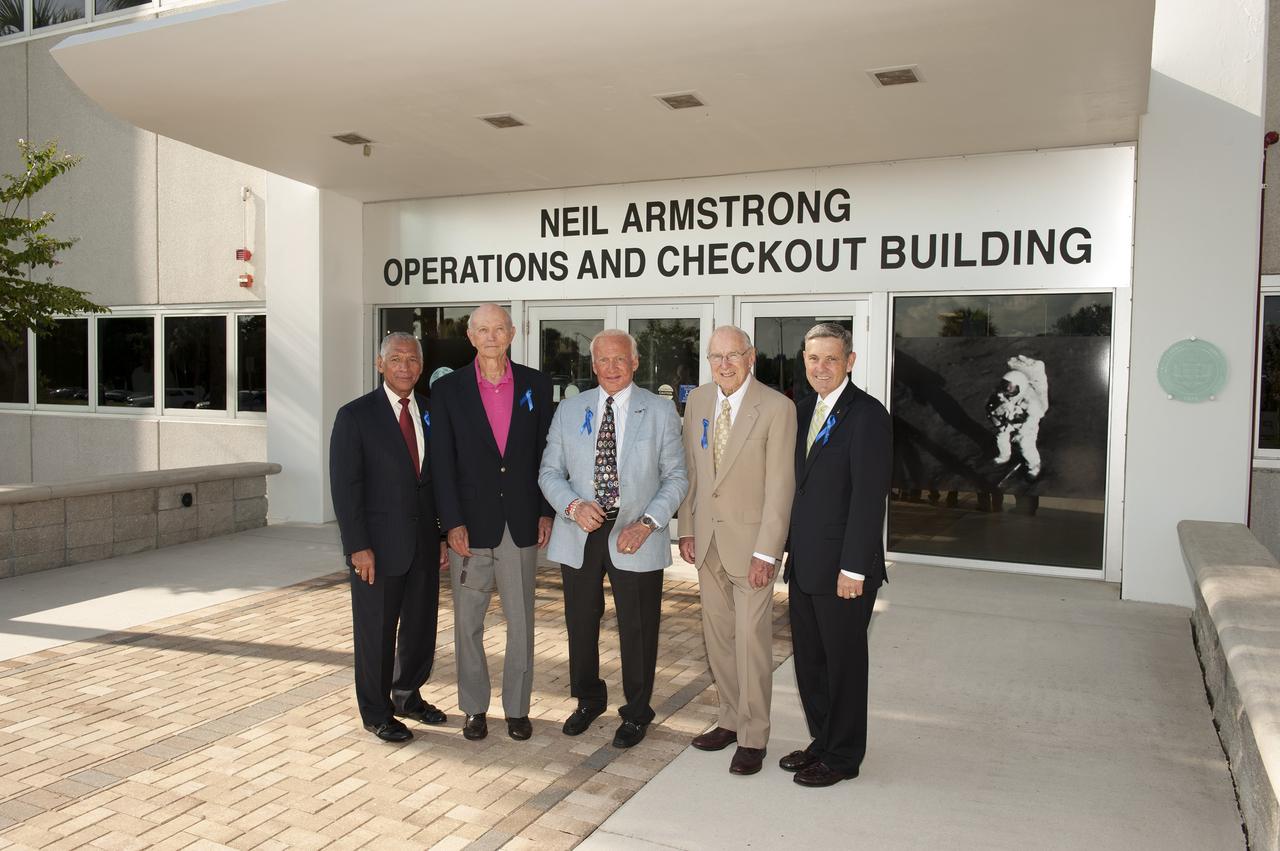
CAPE CANAVERAL, Fla. -- At the Kennedy Space Center in Florida, NASA officials and Apollo astronauts have a group portrait taken in front of the refurbished Operations and Checkout Building, newly named for Apollo 11 astronaut Neil Armstrong, the first person to set foot on the moon. From left are NASA Administrator Charles Bolden, Apollo astronauts Mike Collins, Buzz Aldrin and Jim Lovell, and Center Director Robert Cabana. The building's high bay is being used to support the agency's new Orion spacecraft, which will lift off atop the Space Launch System rocket. Orion is designed to take humans farther than they’ve ever gone before, serving as the exploration vehicle that will carry astronauts to deep space and sustain the crew during travel to destinations such as an asteroid or Mars. The visit of the former astronauts was part of NASA's 45th anniversary celebration of the Apollo 11 moon landing. As the world watched, Neil Armstrong and Aldrin landed in the moon's Sea of Tranquility aboard the lunar module Eagle on July 20, 1969. Meanwhile, crewmate Collins orbited above in the command module Columbia. For more, visit http://www.nasa.gov/press/2014/july/nasa-honors-historic-first-moon-landing-eyes-first-mars-mission. Photo credit: NASA/Kevin O'Connell
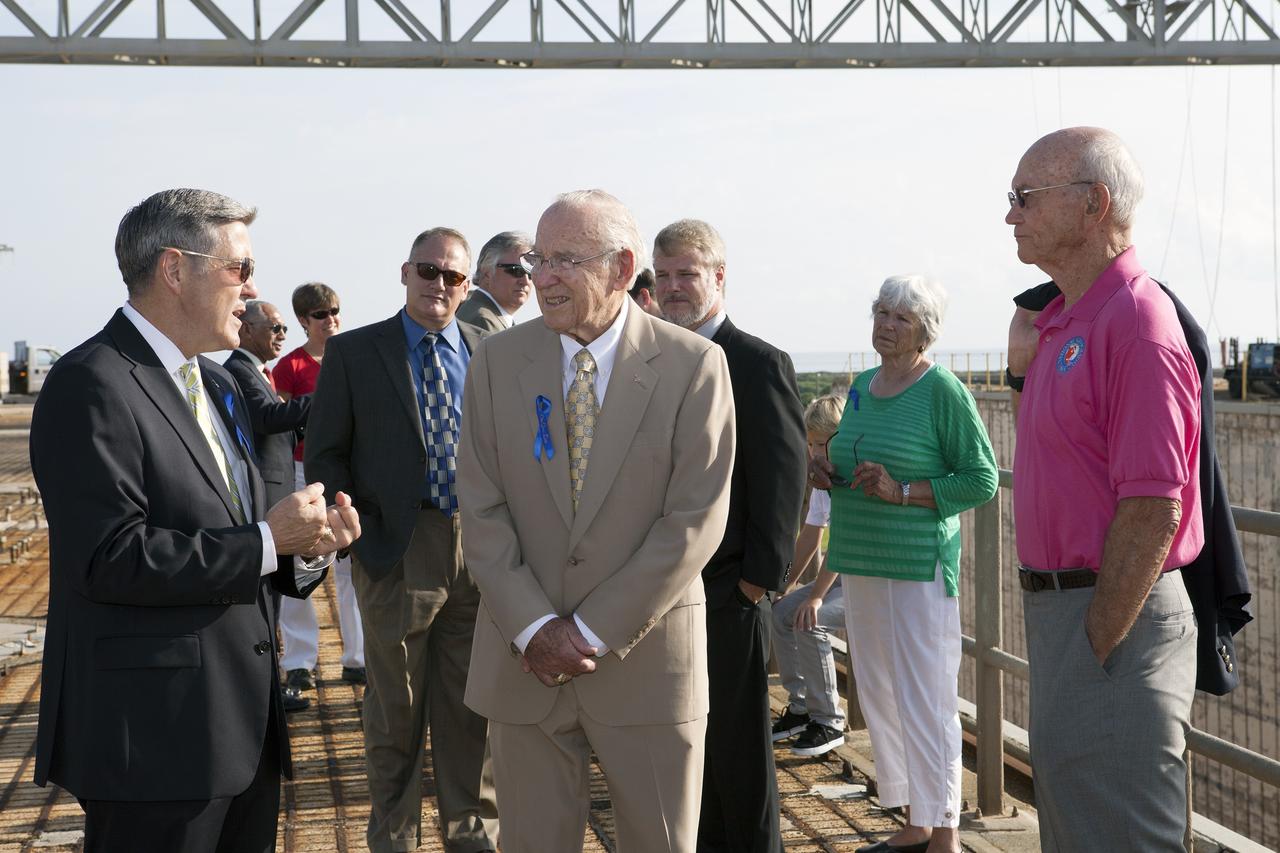
CAPE CANAVERAL, Fla. -- At the Kennedy Space Center in Florida, Center Director Robert Cabana, left, briefs Apollo astronauts Jim Lovell, center, and Mike Collins, right, on the changes underway to Launch Pad 39B. Behind them are the astronauts' families and friends. The pad is being modified to support the agency's new Orion spacecraft which will lift off atop the Space Launch System rocket. Orion is designed to take humans farther than they’ve ever gone before, serving as the exploration vehicle that will carry astronauts to deep space and sustain the crew during travel to destinations such as an asteroid or Mars. The visit of the former astronauts was part of NASA's 45th anniversary celebration of the Apollo 11 moon landing. As the world watched, the Apollo 11 astronauts landed in the moon's Sea of Tranquility aboard the lunar module Eagle on July 20, 1969. For more, visit http://www.nasa.gov/press/2014/july/nasa-honors-historic-first-moon-landing-eyes-first-mars-mission. Photo credit: NASA/Kim Shiflett
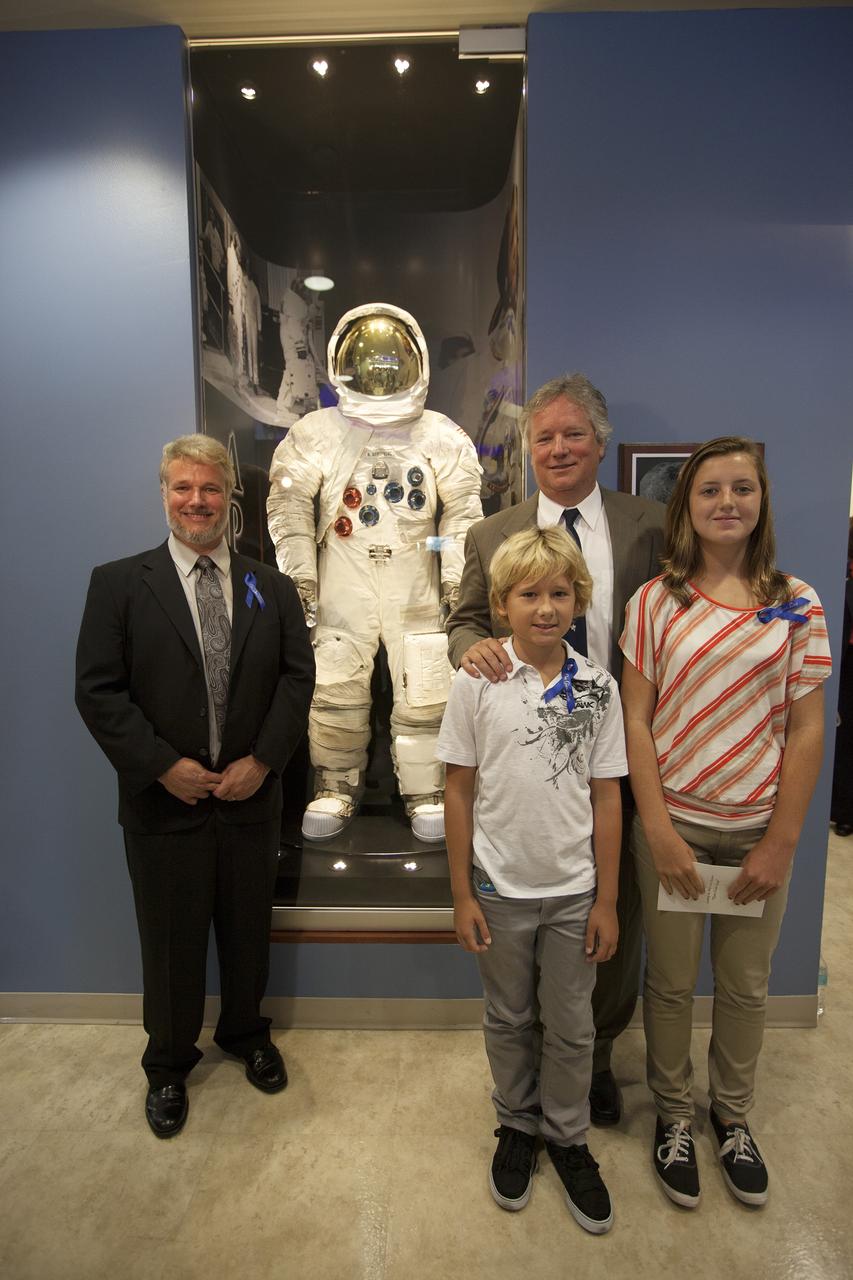
CAPE CANAVERAL, Fla. -- At the Kennedy Space Center in Florida, members of the Armstrong family pose for a portrait with an Apollo-era spacesuit following its unveiling in the lobby of the newly named Neil Armstrong Operations and Checkout Building. The facility has been renamed for Apollo 11 astronaut Neil Armstrong, the first person to set foot on the moon. From left are Armstrong's son Mark, his grandson Bryce, his son Rick and his granddaughter Lily. The building's high bay is being used to support the agency's new Orion spacecraft and is the same spaceport facility where the Apollo 11 command/service module and lunar module were prepped for the first lunar landing mission in 1969. Orion is designed to take humans farther than they’ve ever gone before, serving as the exploration vehicle that will carry astronauts to deep space and sustain the crew during travel to destinations such as an asteroid or Mars. The unveiling was part of NASA's 45th anniversary celebration of the Apollo 11 moon landing. As the world watched, Apollo 11 astronauts landed in the moon's Sea of Tranquility aboard the lunar module, Eagle, on July 20, 1969, as the command module, Columbia, orbited overhead. For more: http://www.nasa.gov/press/2014/july/nasa-honors-historic-first-moon-landing-eyes-first-mars-mission/ Photo credit: NASA/Kim Shiflett

CAPE CANAVERAL, Fla. -- At the Kennedy Space Center in Florida, Apollo astronauts, from left, Jim Lovell, Buzz Aldrin and Mike Collins pause during their tour of Launch Pad 39B for a group portrait. The pad is being modified to support the agency's new Orion spacecraft which will lift off atop the Space Launch System rocket. Orion is designed to take humans farther than they’ve ever gone before, serving as the exploration vehicle that will carry astronauts to deep space and sustain the crew during travel to destinations such as an asteroid or Mars. The visit of the former astronauts was part of NASA's 45th anniversary celebration of the Apollo 11 moon landing. As the world watched, Neil Armstrong and Aldrin landed in the moon's Sea of Tranquility aboard the lunar module Eagle on July 20, 1969. Meanwhile, crewmate Collins orbited above in the command module Columbia. For more, visit http://www.nasa.gov/press/2014/july/nasa-honors-historic-first-moon-landing-eyes-first-mars-mission. Photo credit: NASA/Kim Shiflett