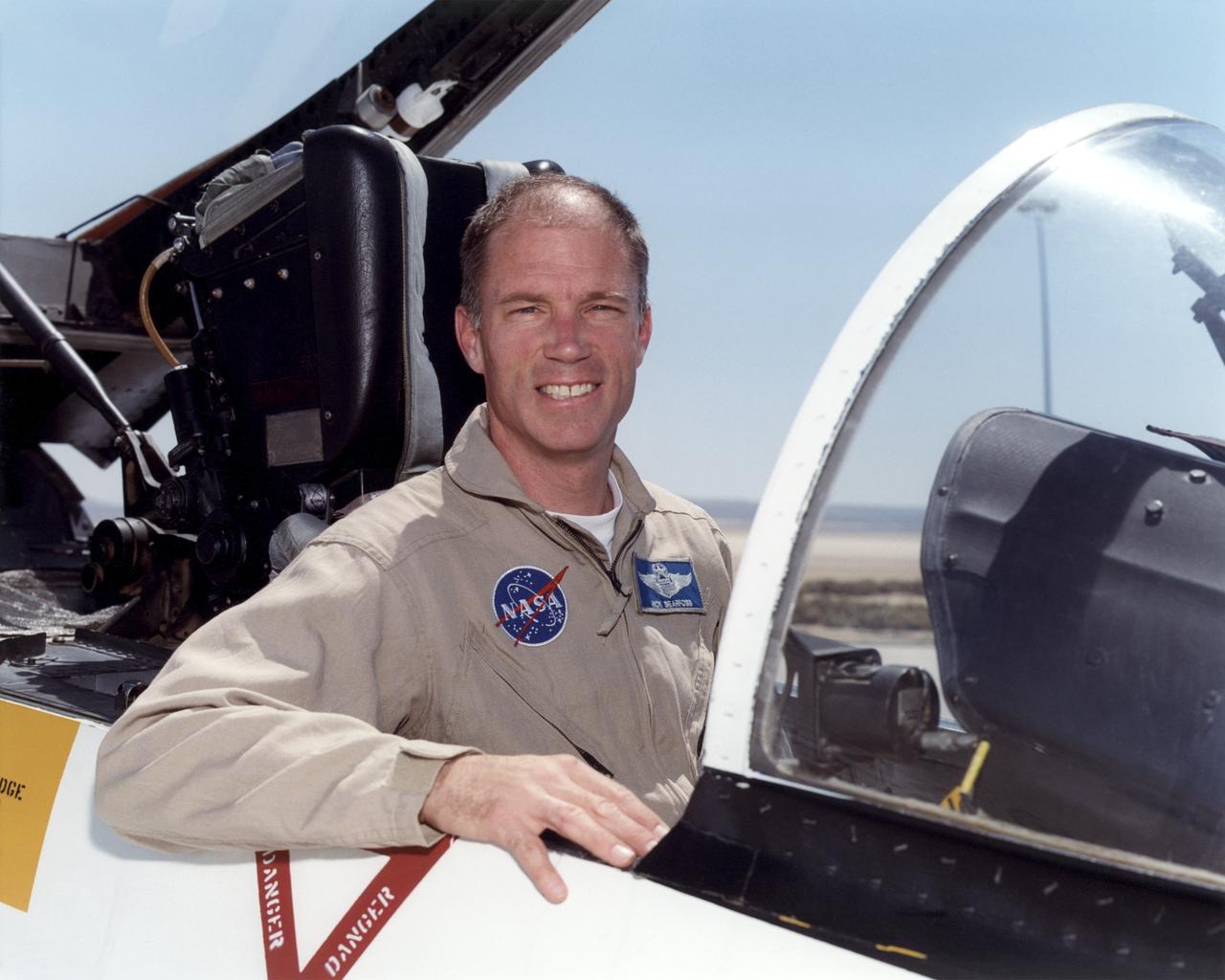
Richard A. Searfoss became a research pilot in the Flight Crew Branch of NASA's Dryden Flight Research Center, Edwards, Calif., in July 2001. He brought to Dryden more than 5,000 hours of military flying time and 939 hours in space. Searfoss served in the U.S. Air Force for more than 20 years, retiring with the rank of colonel. Following graduation in 1980 from Undergraduate Pilot Training at Williams Air Force Base, Ariz., Searfoss flew F-111s at RAF Lakenheath, England, and Mountain Home Air Force Base, Idaho. In 1988 he attended the U.S. Naval Test Pilot School, Patuxent River, Md., as a U.S. Air Force exchange officer. He was an instructor pilot at the U.S. Air Force Test Pilot School, Edwards Air Force Base, Calif., when selected for the astronaut program in January 1990. Searfoss became an astronaut in July 1991. A veteran of three space flights, Searfoss has logged 39 days in space. He served as STS-58 pilot on the seven-person life science research mission aboard Space Shuttle Columbia, launching from NASA's Kennedy Space Center, Fla., on Oct. 18, 1993, and landing at Edwards Air Force Base, Calif., on Nov. 1, 1993. The crew performed a number of medical experiments on themselves and 48 rats, expanding knowledge of human and animal physiology. Searfoss flew his second mission as pilot of STS-76 aboard the Space Shuttle Atlantis. During this nine-day mission, which launched March 22, 1996, the crew preformed the third docking of an American spacecraft with the Russian space station Mir. The crew transported to Mir nearly two tons of water, food, supplies, and scientific equipment, as well as U.S. Astronaut Shannon Lucid to begin her six-month stay in space. Completing 145 orbits, STS-76 landed at Edwards Air Force Base, Calif., on March 31, 1996. Searfoss commanded a seven-person crew on the STS-90 Neurolab mission launched on April 17, 1998. The crew served as both experiment subjects and operators for life science experiments focusing on the effects of m
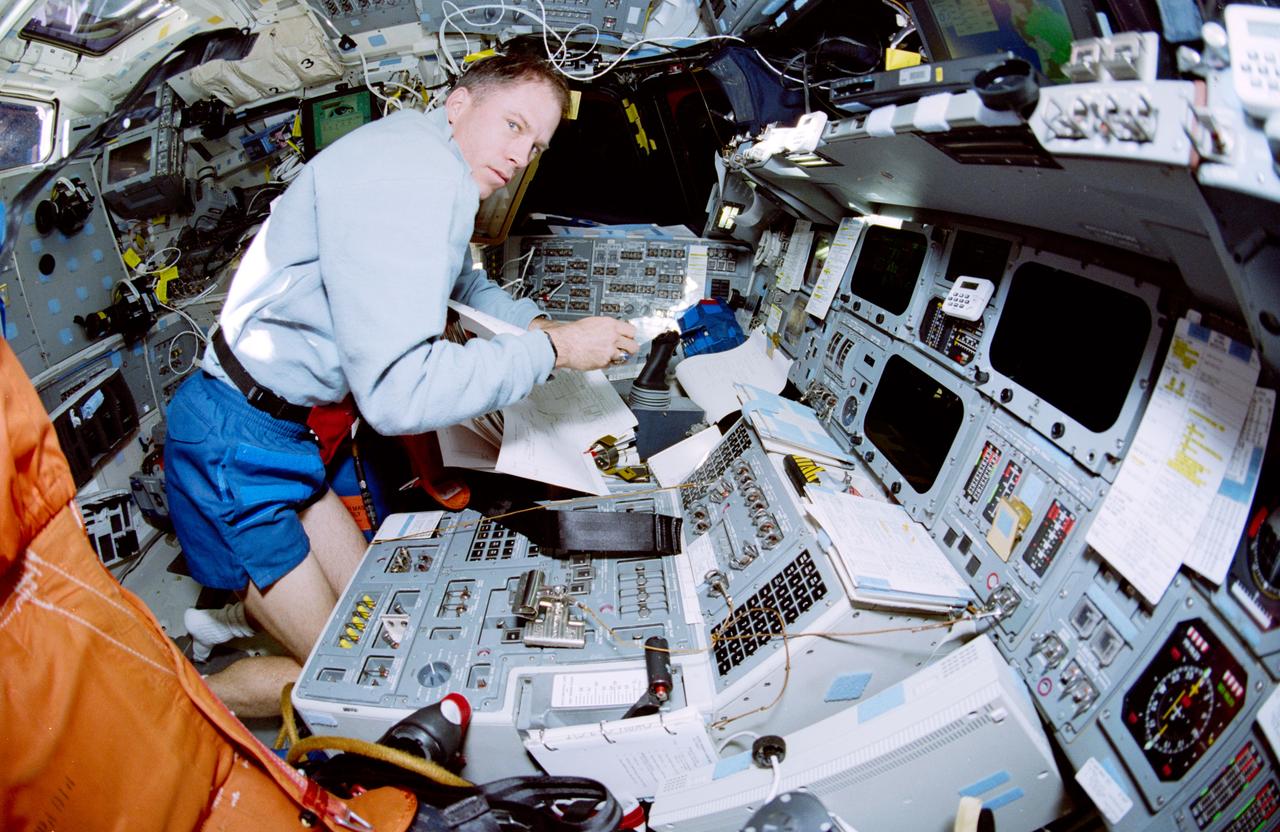
STS090-351-012 (17 April - 3 May 1998) --- A "fish-eye" lens on a 35mm camera records Richard A. Searfoss, mission commander, at the commander's station on forward flight deck of the Earth-orbiting Space Shuttle Columbia. The pilot's station is in the foreground.
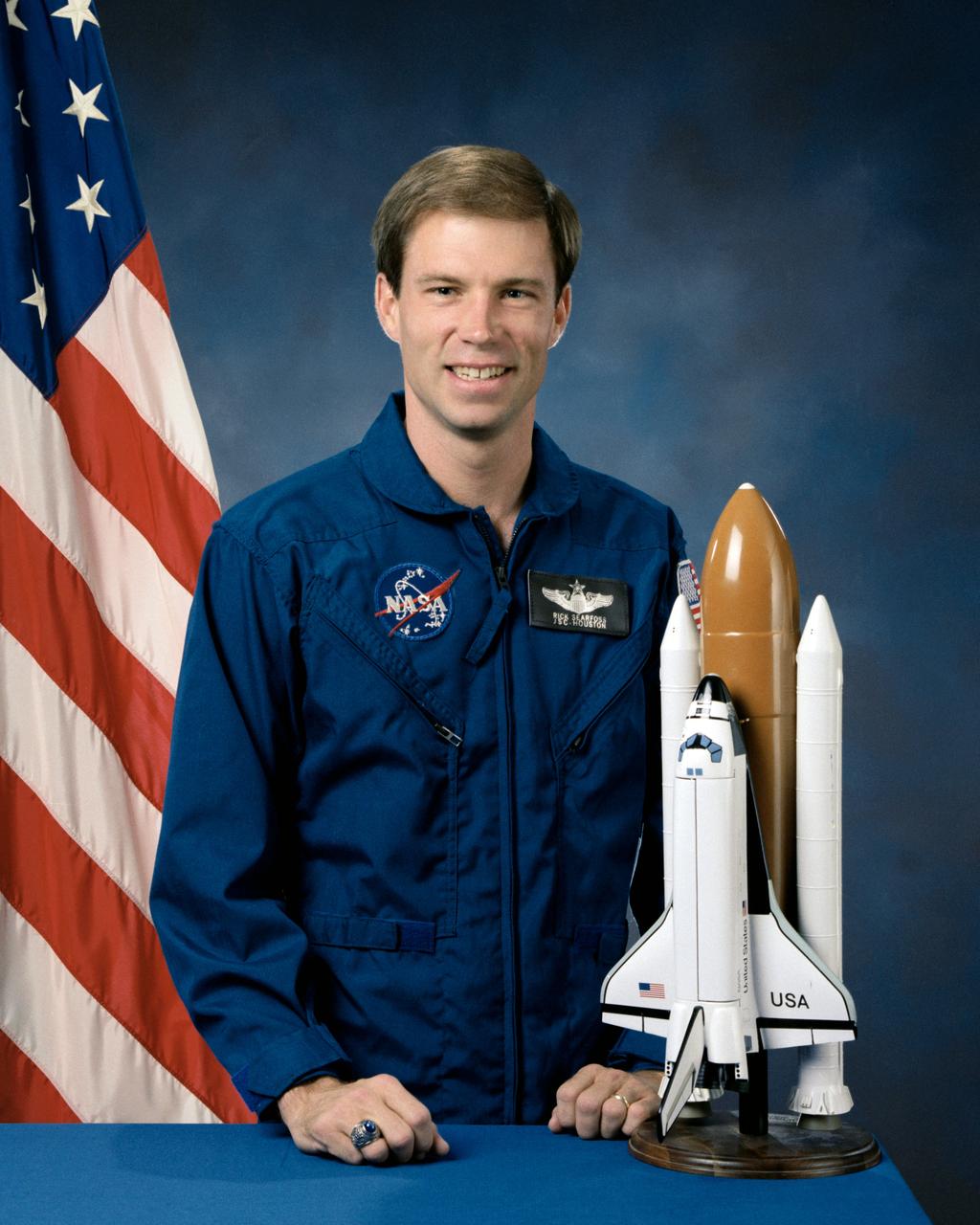
S90-46295 (17 Aug. 1990) --- Astronaut Richard A. Searfoss, pilot.
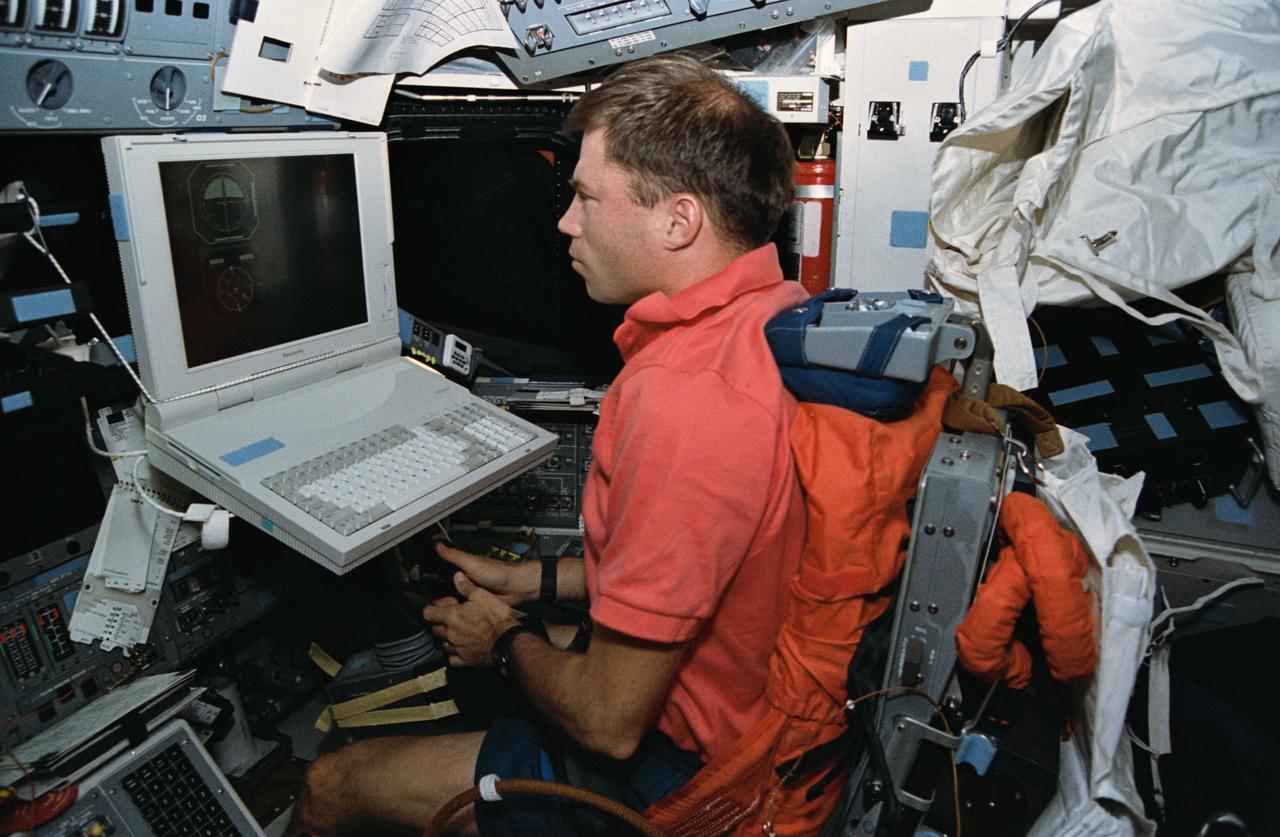
STS058-14-006 (18 Oct- 1 Nov 1993) --- Astronaut Richard A. Searfoss, pilot, participates in an experiment that measures the effects of space flight on pilot proficiency. Astronauts Searfoss (seen here at the pilot's station) and John E. Blaha, mission commander, are conducting the first tests of the Portable Inflight Landing Operations Trainer (PILOT). STS-58 is the first of six scheduled test flights of PILOT designed to determine its effectiveness as a training tool.
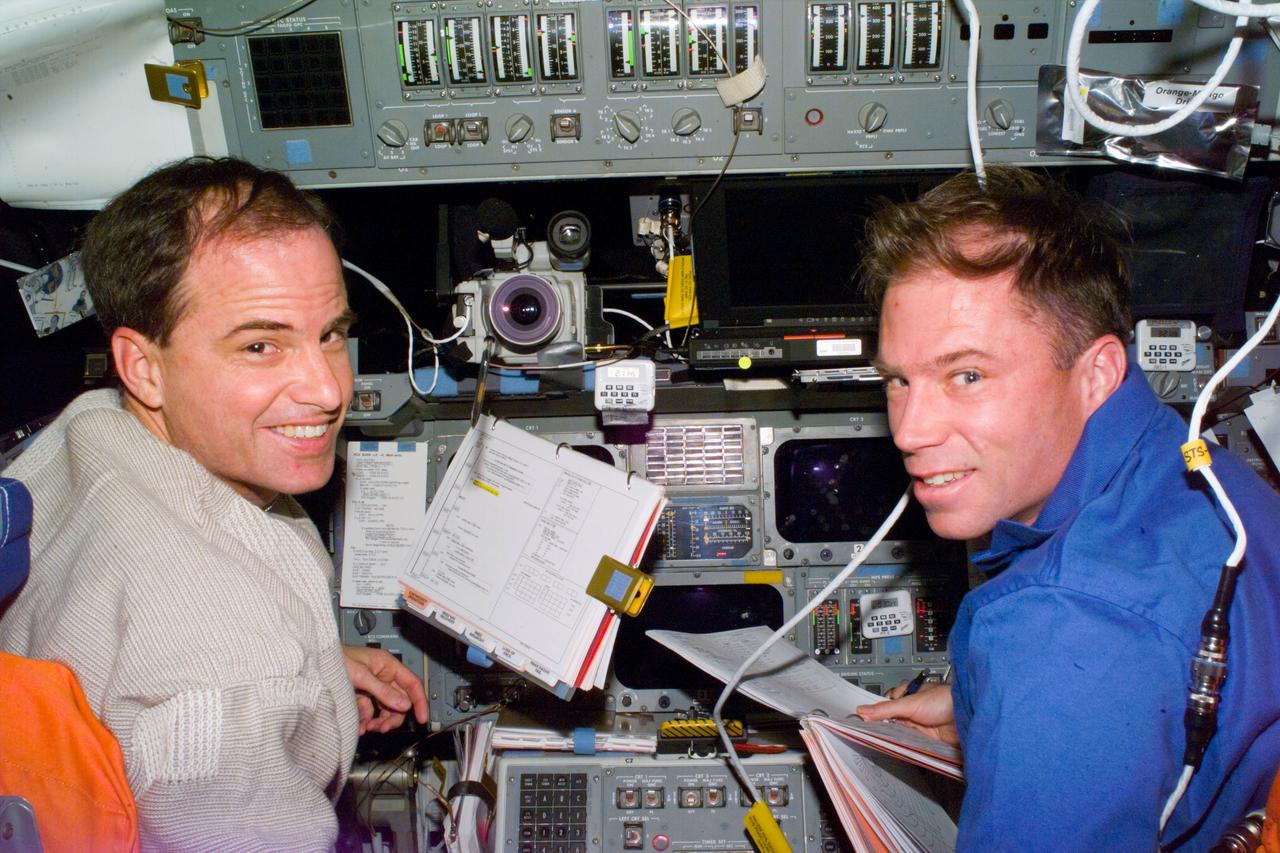
S76-E-5138 (24 March 1996) --- Astronauts Kevin P. Chilton (left) and Richard A. Searfoss man the commander and pilot stations, respectively, for the rendezvous and docking procedures with Russia's Mir Space Station. The image was recorded with a 35mm Electronic Still Camera (ESC) and downlinked at a later time to ground controllers in Houston, Texas.
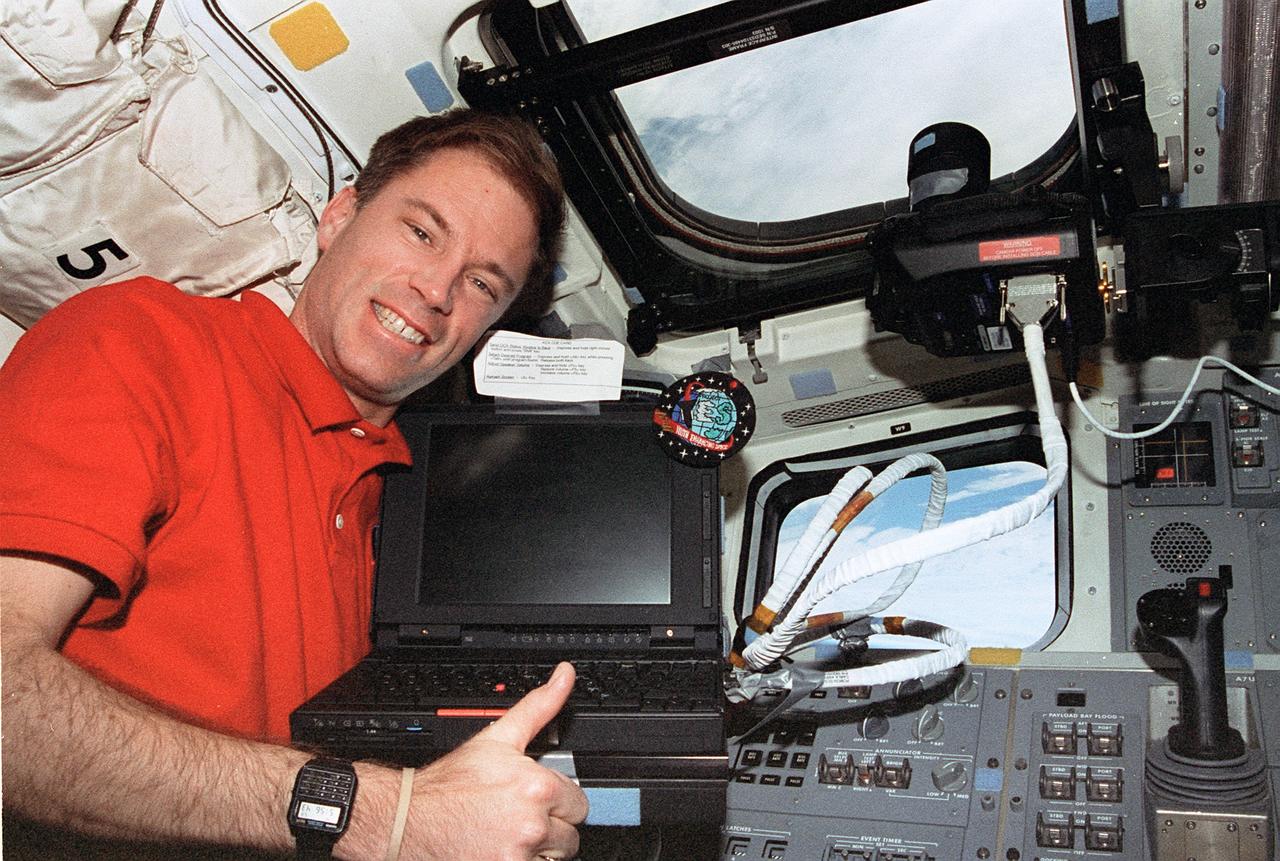
STS076-315-003 (22-31 March 1996) --- Onboard the aft flight deck of the Earth-orbiting space shuttle Atlantis, astronaut Richard A. Searfoss, pilot, signals approval of progress with the KidSat Project - a three year pilot program making its first flight in space. KidSat is to fly on the Space Shuttle once a year. An Electronic Still Camera (ESC) (upper right), aimed at Earth below, was controlled by students on the ground during the flight. A video camera (out of frame) was also utilized. The downlinked images are to be used as a basis for a broad scope of curriculum disciplines.
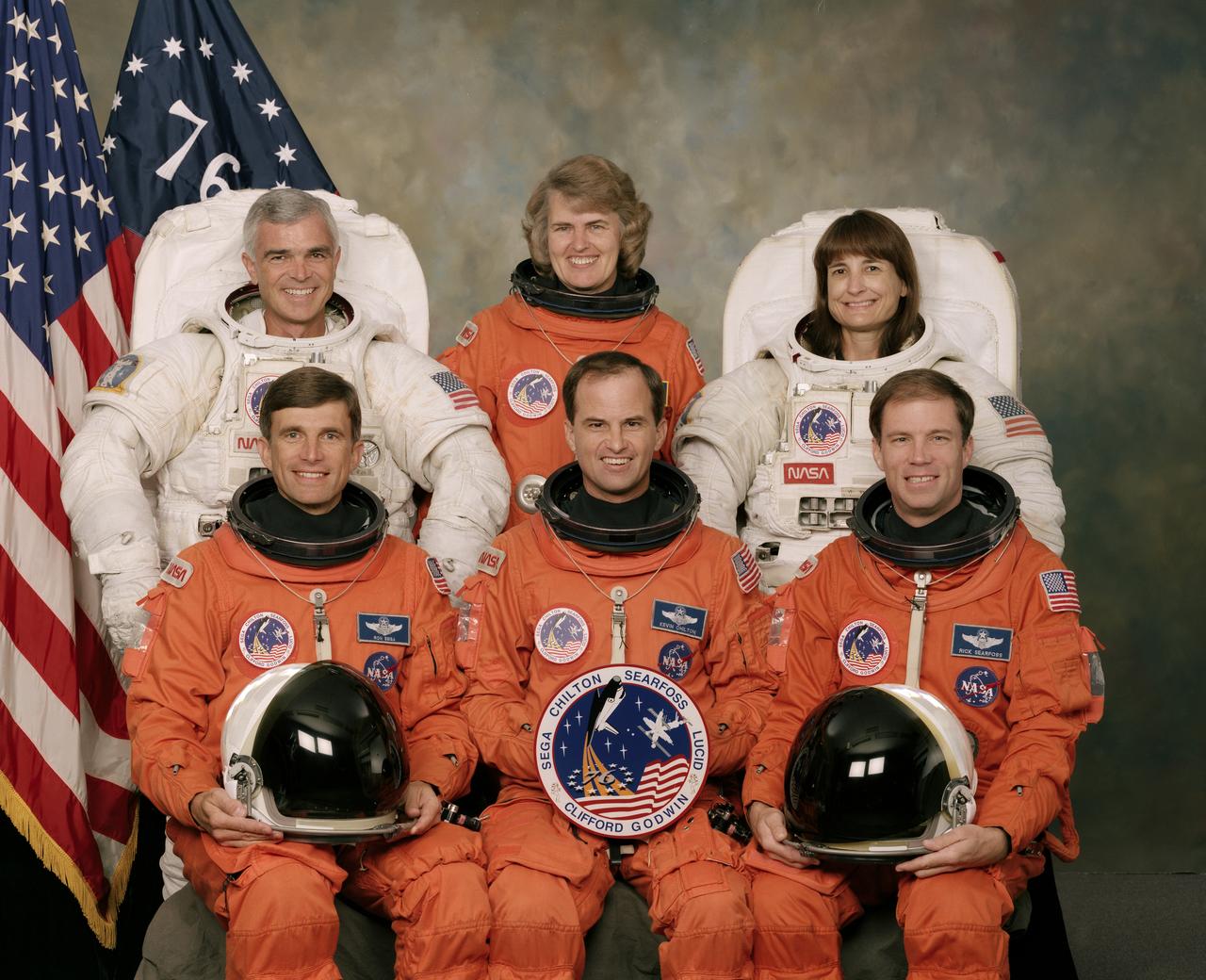
These six NASA astronauts launched into space aboard the Space Shuttle Atlantis on March 22, 1996 for the STS-76 mission. Pictured on the front row, left to right, are astronauts Ronald M. Sega, mission specialist; Kevin P. Chilton, mission commander; and Richard A. Searfoss, pilot. On the back row, left to right, are mission specialists Michael R. (Rich) Clifford, Shannon W. Lucid, and Linda M. Godwin. The third U.S. Shuttle-Mir docking, STS-76 began a new period of international cooperation in space exploration with the first Shuttle transport of a United States astronaut (Lucid) to Russia’s Mir Space Station for extended joint space research. Clifford and Godwin, pictured here in training versions of the Extravehicular Mobility Unit (EMU), performed the first Extravehicular Activity (EVA) during Mir-Shuttle docked operations.
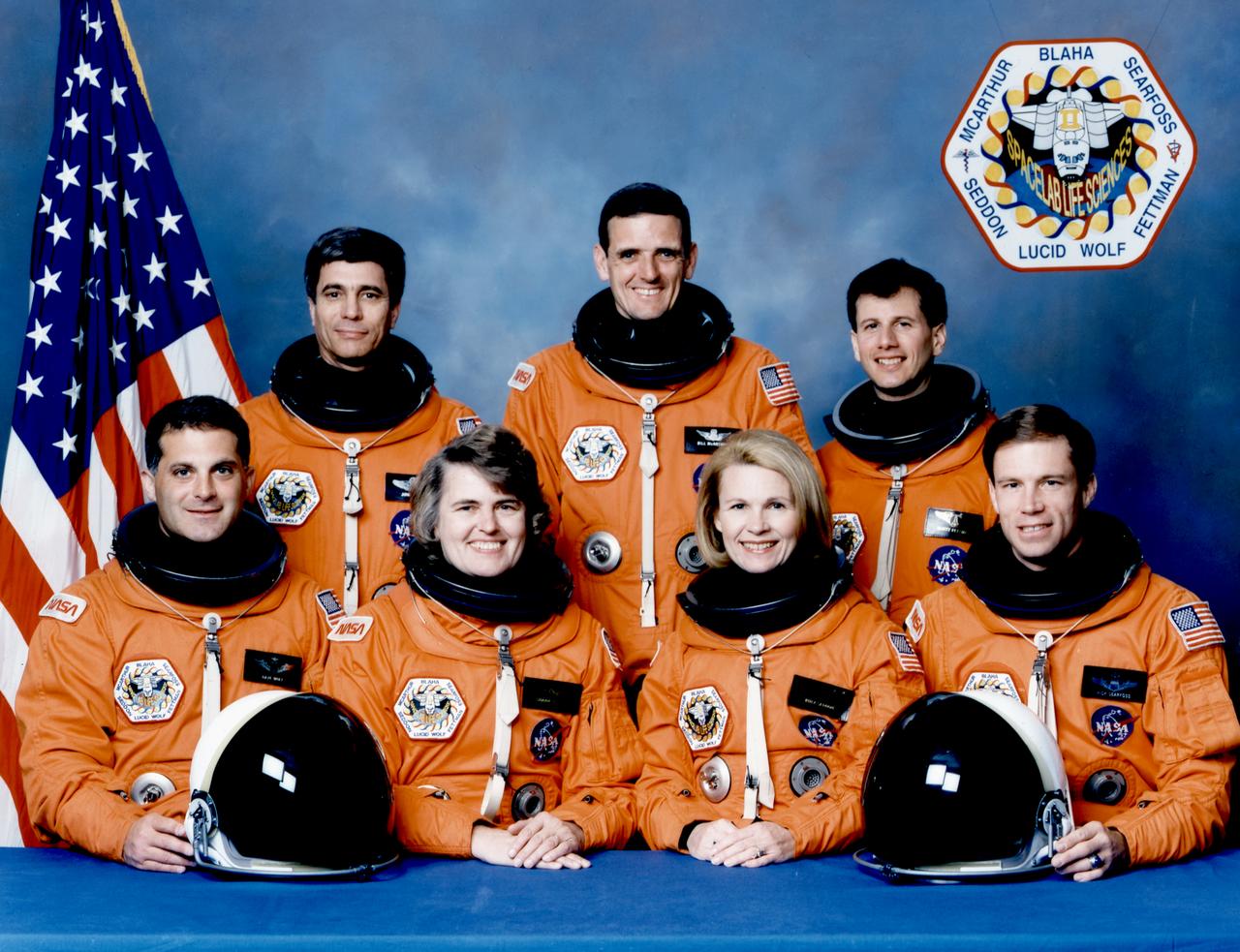
The STS-58 crew portrait includes astronauts (seated left to right) David A. Wolf, Shannon W. Lucid, and Rhea Seddon, all mission specialists; and Richard A. Searfoss, pilot. Standing in the rear, left to right, are John E. Blaha, commander; William S. McArthur, Jr., mission specialist; and Martin J. Fettmen, payload specialist. Launched aboard the Space Shuttle Columbia on October 18, 1993 at 10:53:10 a.m. (EDT), STS-58 served as the second dedicated Spacelab Life Sciences (SLS-2) mission.
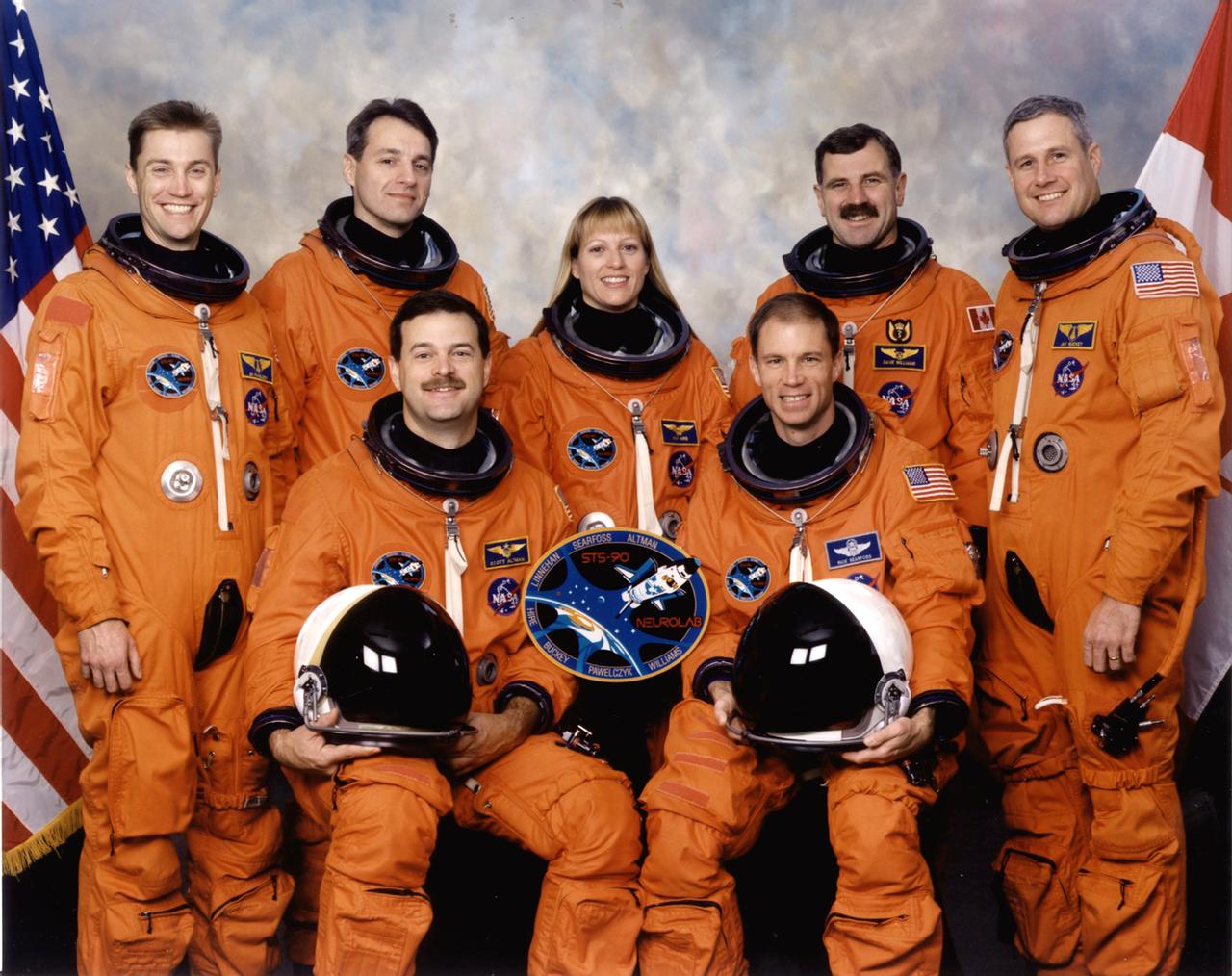
Five astronauts and two payload specialists take a break in training for the Neurolab mission to pause for a crew portrait. The Spacelab mission was conducted aboard the Space Shuttle Columbia on STS-90 which launched on April 17, 1998. Astronauts Richard A. Searfoss, commander (right front); and Scott D. Altman, pilot (left front). Other crew members (back row, left to right) are James A. (Jim) Pawelczyk, Ph.D., payload specialist; and astronauts Richard M. Linnehan, Kathryn P. Hire, and Dafydd R. (Dave) Williams, all mission specialists; along with payload specialist Jay C. Buckey, Jr., MD. Linnehan and Williams, alumnus of the 1995 class of astronaut candidates (ASCAN), represents the Canadian Space Agency (CSA).
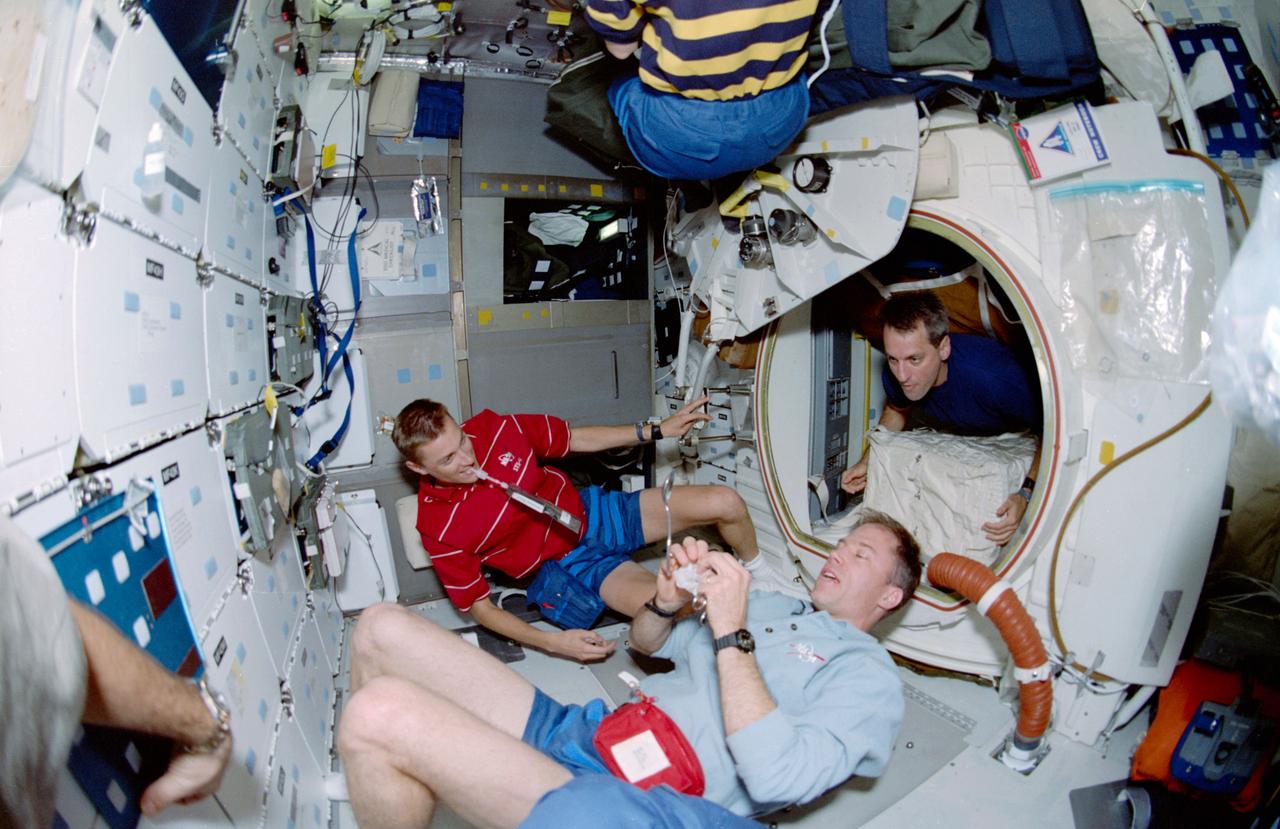
STS090-351-009 (17 April - 3 May 1998) --- Three members of the Neurolab crew were photographed during off-duty time on the mid-deck aboard the Earth-orbiting Space Shuttle Columbia. Left to right are James A. (Jim) Pawelczyk, payload specialist, and astronauts Richard A. Searfoss, mission commander; and Richard M. Linnehan, payload commander. Linnehan is in the hatchway of the tunnel that connected the crew members to the Spacelab Science Module in Columbia's cargo bay. A "fish-eye" lens on a 35mm camera gives the scene a slightly distorted look. Five NASA astronauts and two payload specialists went on to spend a little more than 16-days in Earth-orbit in support of the Neurolab mission.
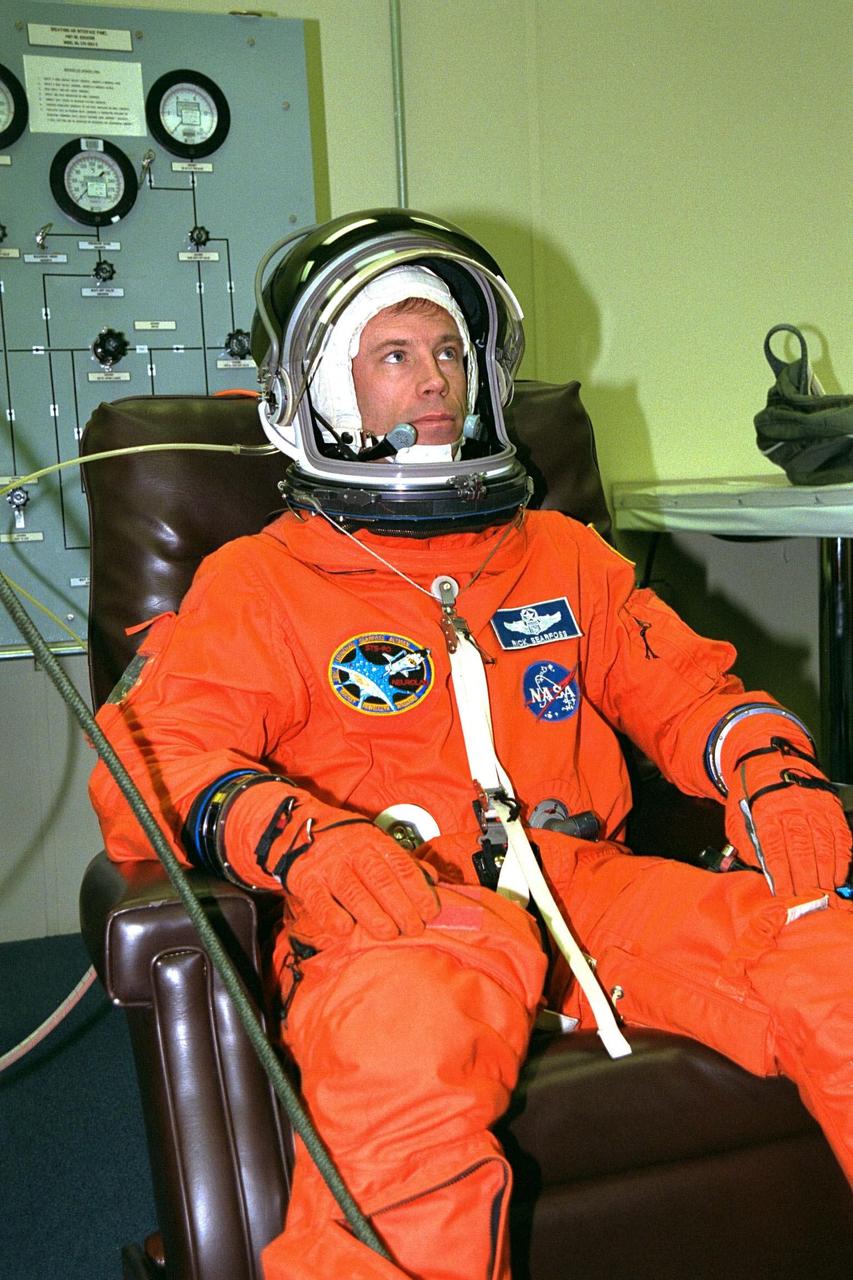
STS-90 Mission Commander Richard Searfoss sits in a chair during suitup activities in the Operations and Checkout Building. Searfoss and the rest of his flight crew will shortly depart for Launch Pad 39B, where the Space Shuttle Columbia awaits a second liftoff attempt at 2:19 p.m. EDT. His third trip into space, Searfoss commands this life sciences research flight that will focus on the most complex and least understood part of the human body the nervous system. Neurolab will examine the effects of spaceflight on the brain, spinal cord, peripheral nerves and sensory organs in the human body
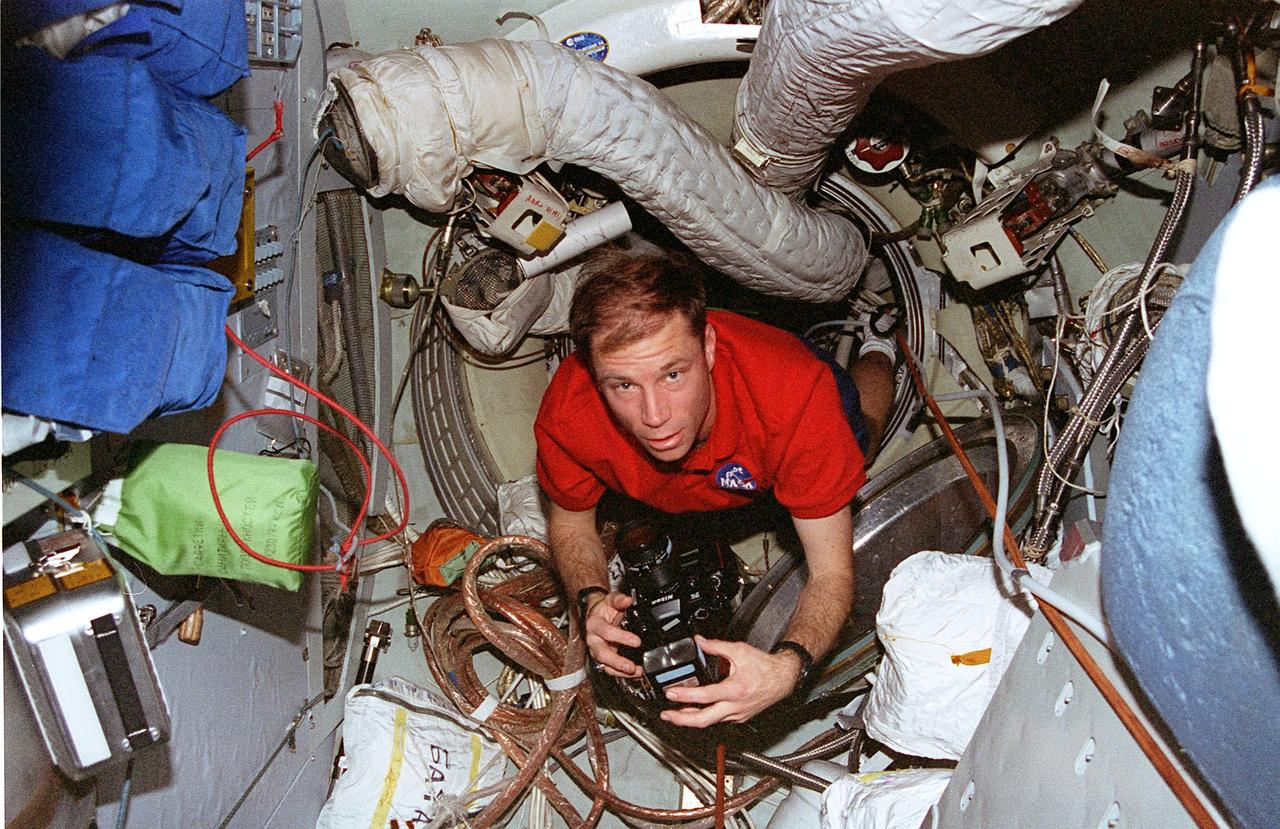
STS076-356-016 (22 - 31 March 1996) --- With camera in hand, astronaut Richard A. Searfoss, pilot, traverses the maze of modules on Russia's Mir Space Station. The photograph was taken with a 35mm camera by one of Searfoss' crew mates. The astronauts were aboard the Mir Space Station for a brief visit following the delivery of astronaut Shannon W. Lucid, cosmonaut guest researcher.
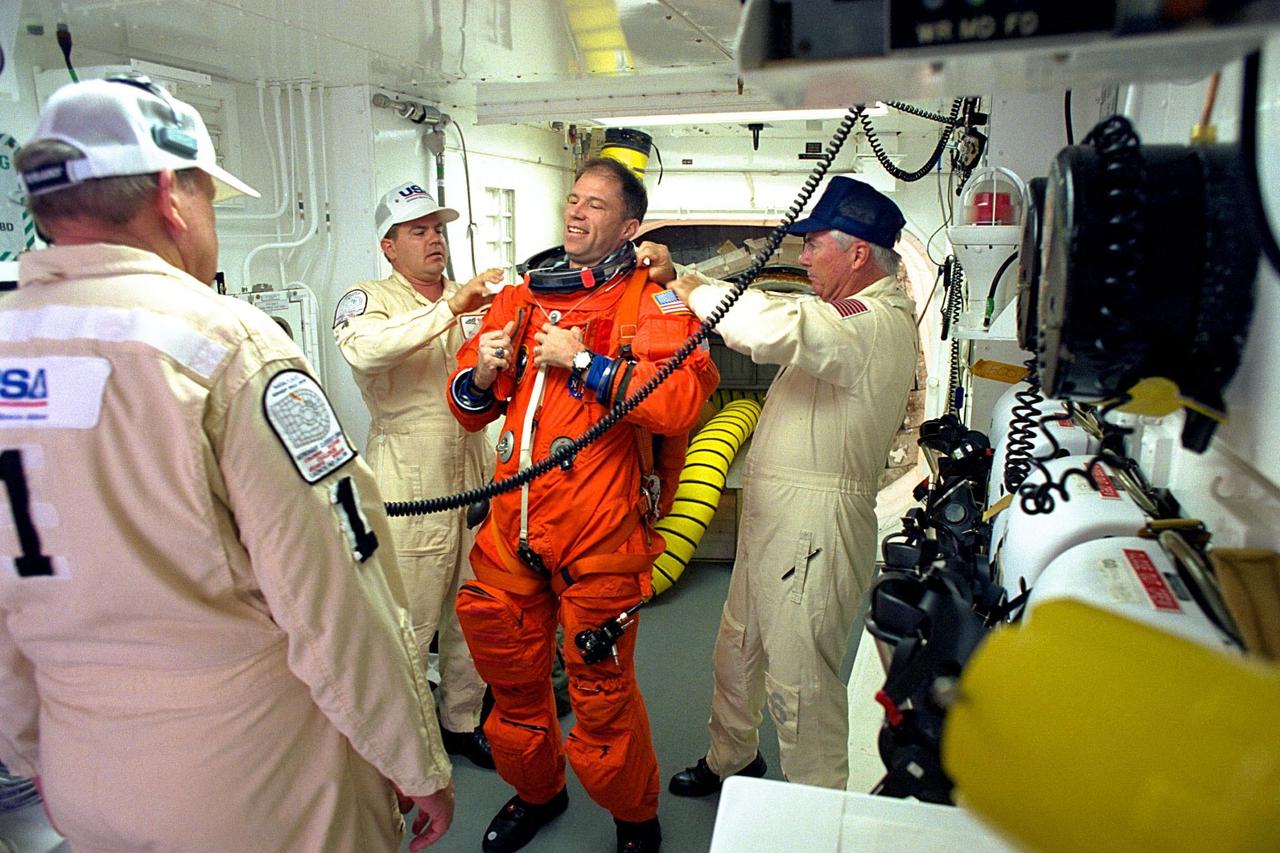
KENNEDY SPACE CENTER, FLA. -- STS-90 Commander Richard Searfoss is assisted by NASA and USA closeout crew members immediately preceding launch for the nearly 17-day Neurolab mission. Investigations during the Neurolab mission will focus on the effects of microgravity on the nervous system. Searfoss and his six fellow crew members will shortly enter the orbiter at KSC's Launch Pad 39B, where the Space Shuttle Columbia will lift off during a launch window that opens at 2:19 p.m. EDT, April 17
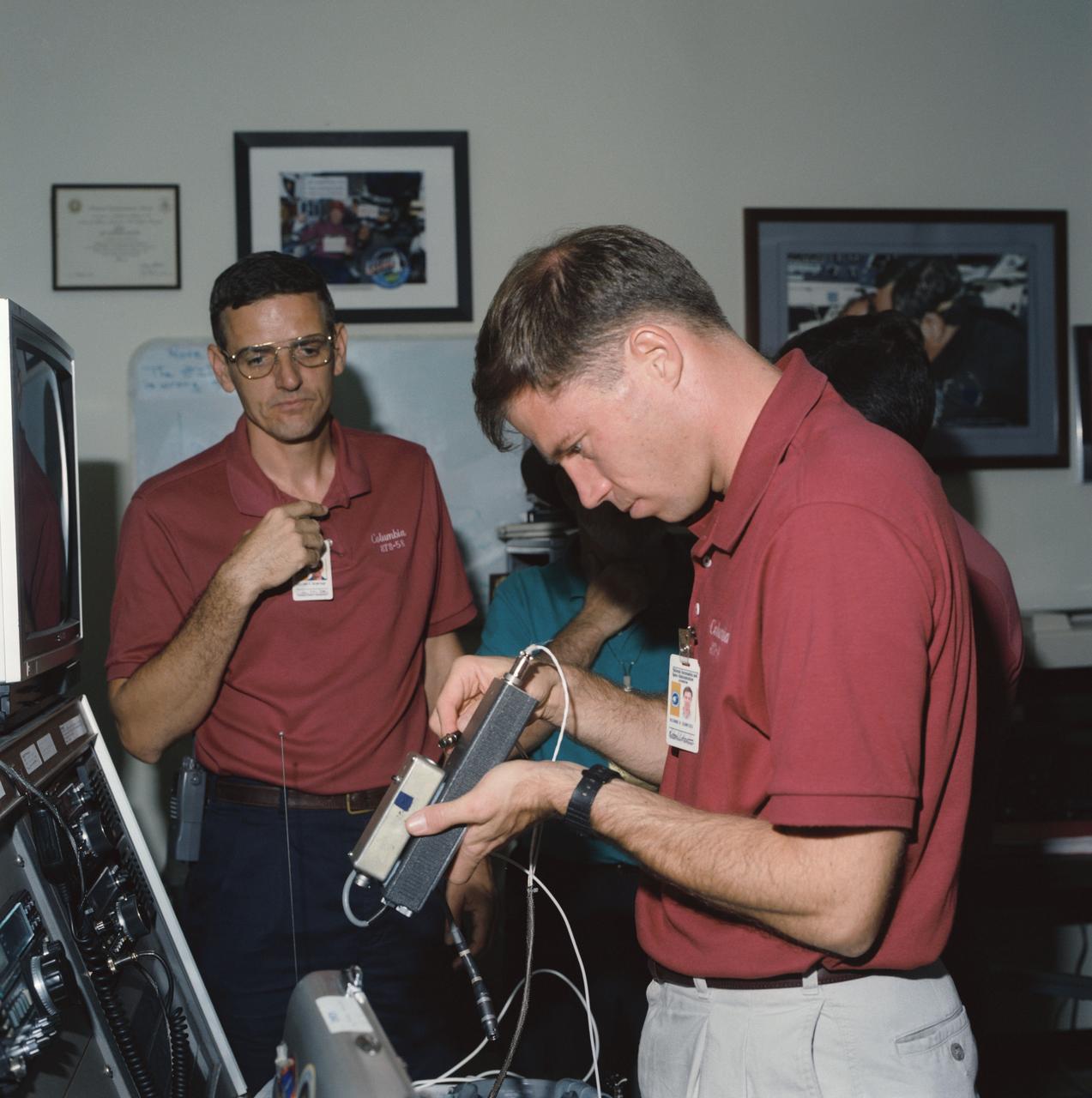
S93-45068 (22 Sept 1993) --- Two members of the STS-58 Spacelab Life Sciences (SLS-2) crew, train with amateur radio equipment at the Johnson Space Center (JSC). They are William S. McArthur (left), mission specialist, and Richard A. Searfoss, pilot. The STS-58 flight will carry the Shuttle Amateur Radio Experiment (SAREX) payload, configuration C, which includes FM voice and packet. Three of the seven crewmembers are licensed amateur radio operators. Searfoss' call letters are KC5CKM; McArthur, KC5ACR; and payload specialist Martin J. Fettman, KC5AXA. Licensed students at a number of schools around the country will have the opportunity to talk directly with the astronauts during the 14-day flight.
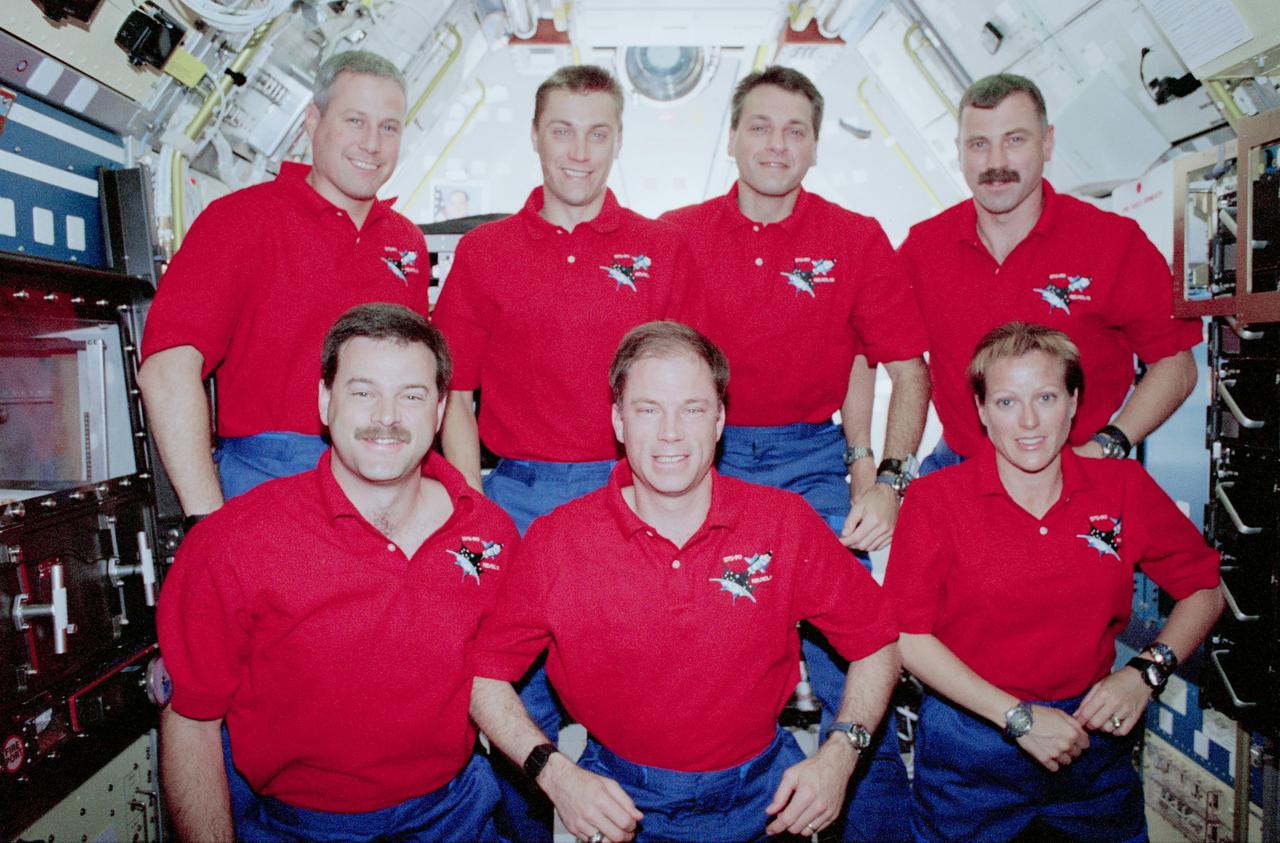
STS-90 crew crew portrait.. The various crew portraits were taken in the Spacelab module and include: back row (l.-r.) Payload specialists Jay Buckey and James Pawelczyk, Payload commander Richard Linnehan and Mission specialist Dafydd Rhys Williams. Bottom row (l.-r.) Pilot Scott Altman, Mission commander Richard Searfoss and Mission specialist Kathryn Hire. View 023 was selected by the crew for use in their postflight presentation.
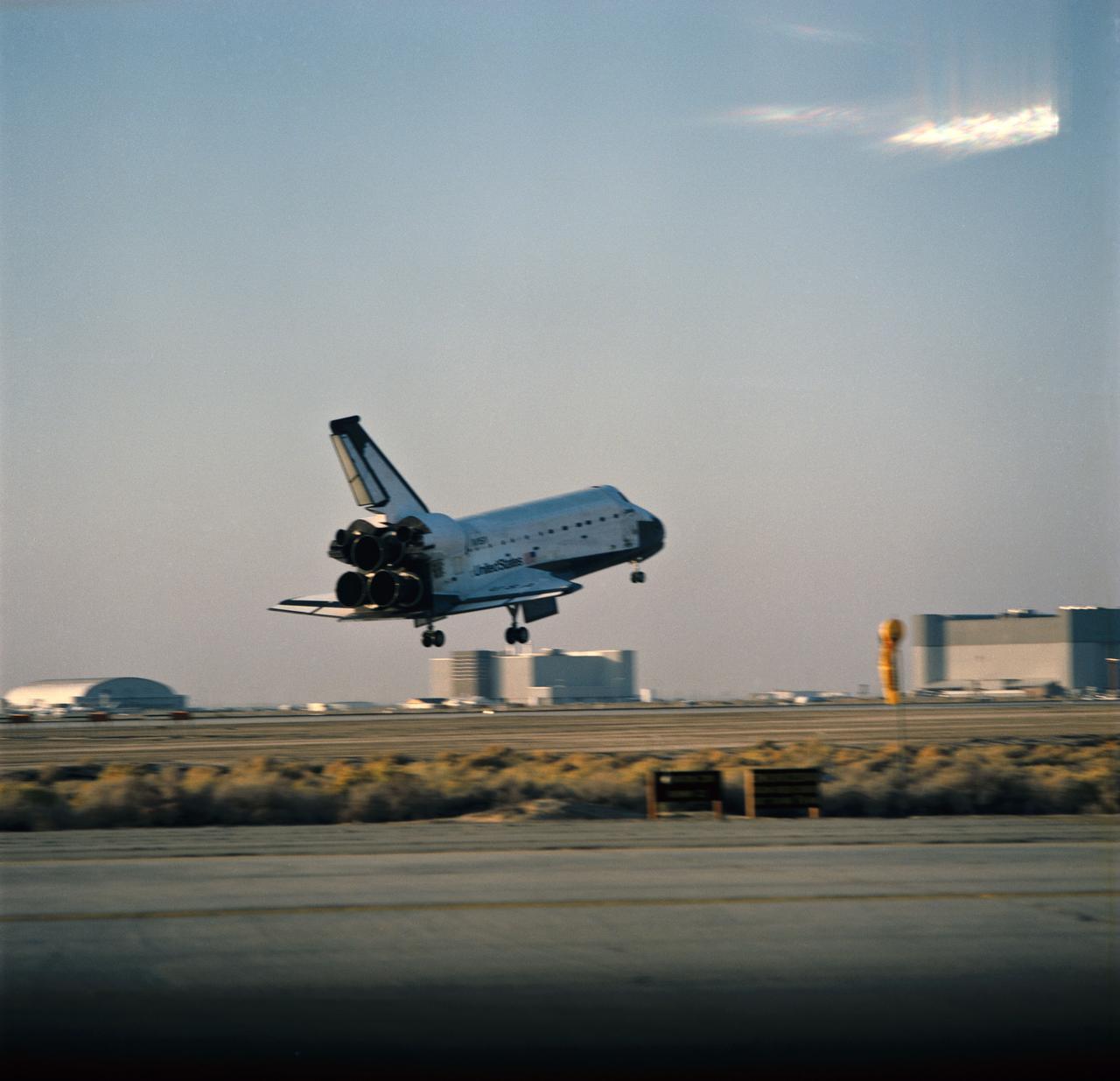
STS58-S-126 (1 Nov 1993) --- The Space Shuttle Columbia is about to touch down on the runway at Edwards Air Force Base (EAFB) in California. The landing, which occurred at 7:06 a.m. (PST), November 1, 1993, completed a two week mission in space devoted to medical research. Onboard the spacecraft were astronauts John E. Blaha, Richard A. Searfoss, Rhea Seddon, Shannon W. Lucid, David A. Wolf and William S. McArthur along with payload specialist Martin J. Fettman, DVM.
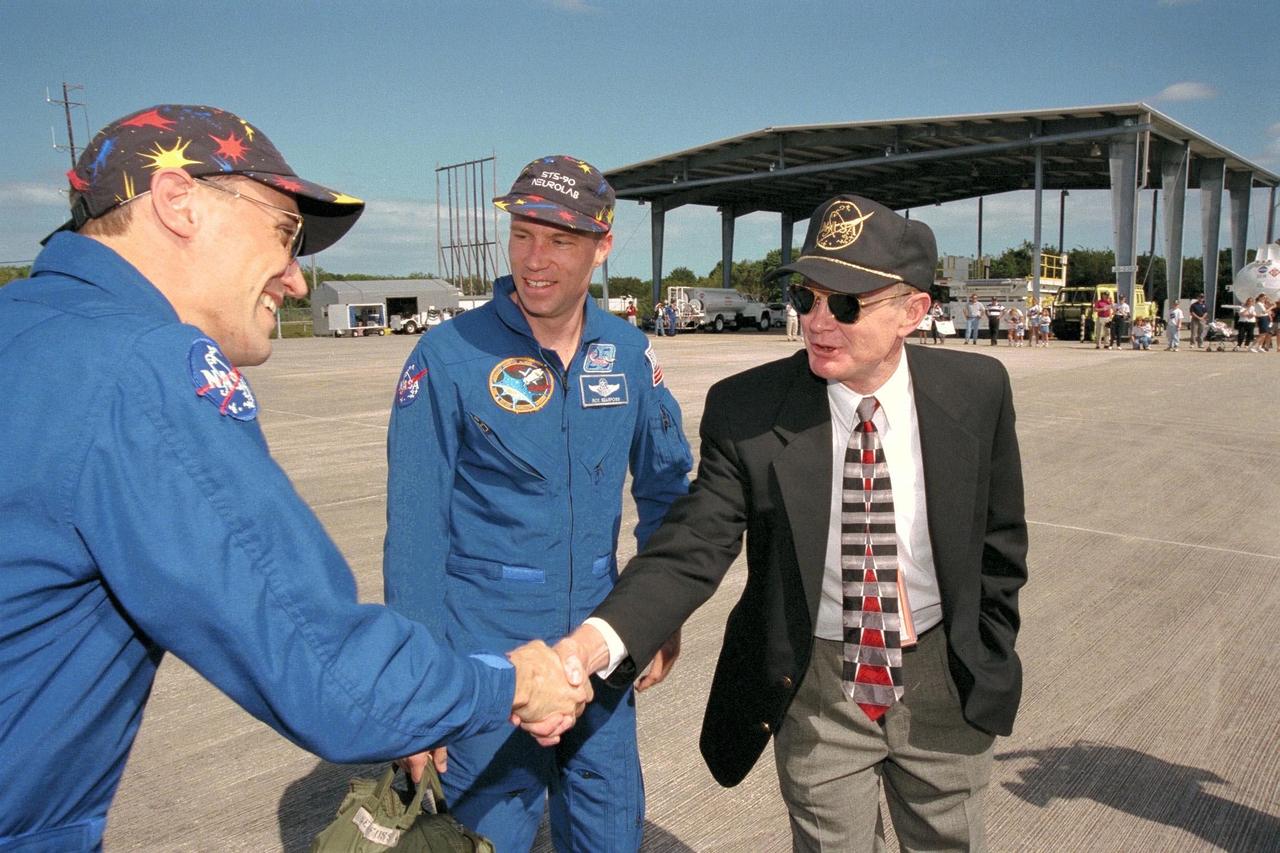
KENNEDY SPACE CENTER, FLA. -- STS-90 Payload Specialist James Pawelczyk, Ph.D. (at left), shakes the hand of KSC Director Roy Bridges as STS-90 Commander Richard Searfoss looks on shortly after the crew's arrival at Kennedy Space Center's Shuttle Landing Facility. The crew arrived to prepare for the launch of Columbia, scheduled for April 16 at 2:19 p.m. EDT from KSC's Launch Pad 39B. The launch of Neurolab on STS-90, which will be the second mission of 1998, is scheduled to last nearly 17 days
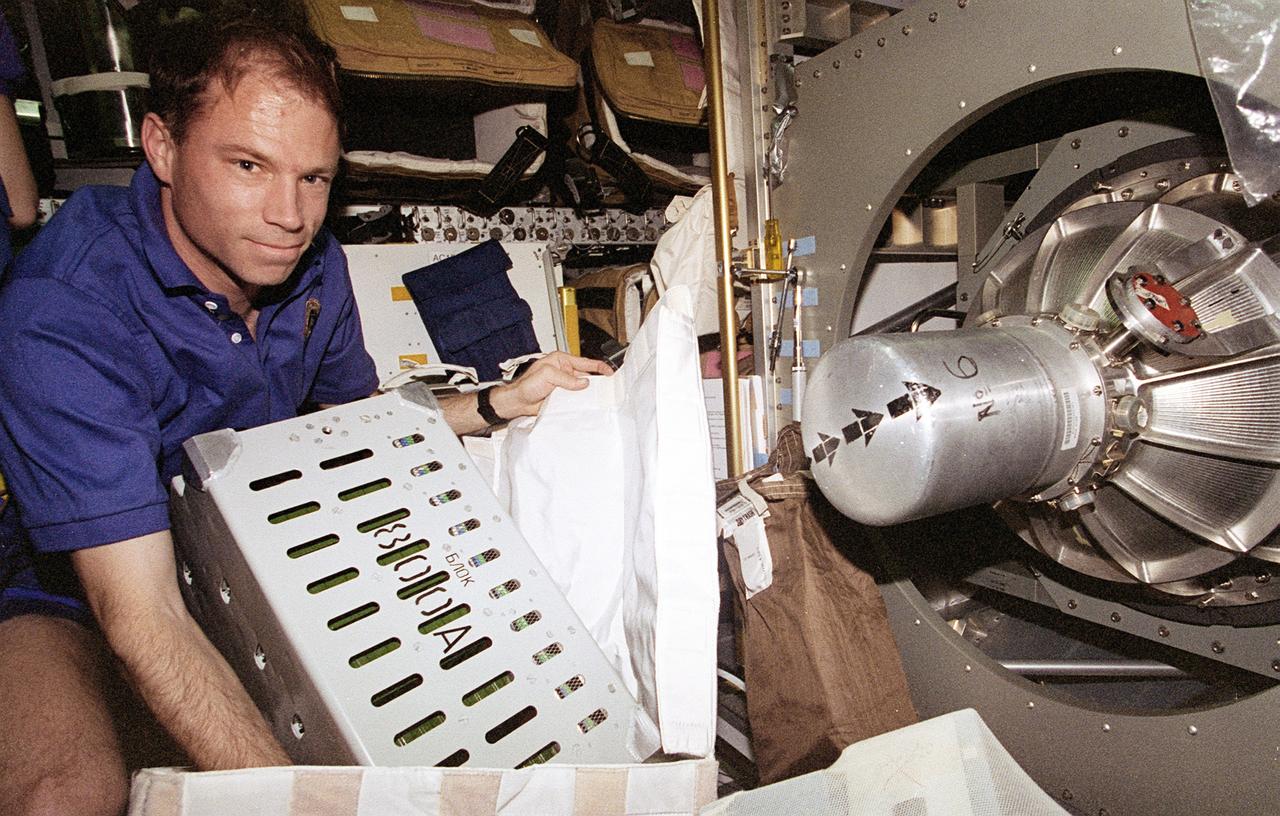
STS076-345-019 (22 - 31 March 1996) --- Onboard the Spacehab Module in the cargo bay of the Earth-orbiting Space Shuttle Atlantis, astronaut Richard A. Searfoss fetches a battery which is to be transferred to Russia's Mir Space Station. The pilot and his crew mates docked with Mir on March 23, 1996, and remained linked until March 28, 1996. At right is a stowed gyrodyne, which earlier had been replaced on Mir with a new one brought up from the ground by the STS-76 crew.
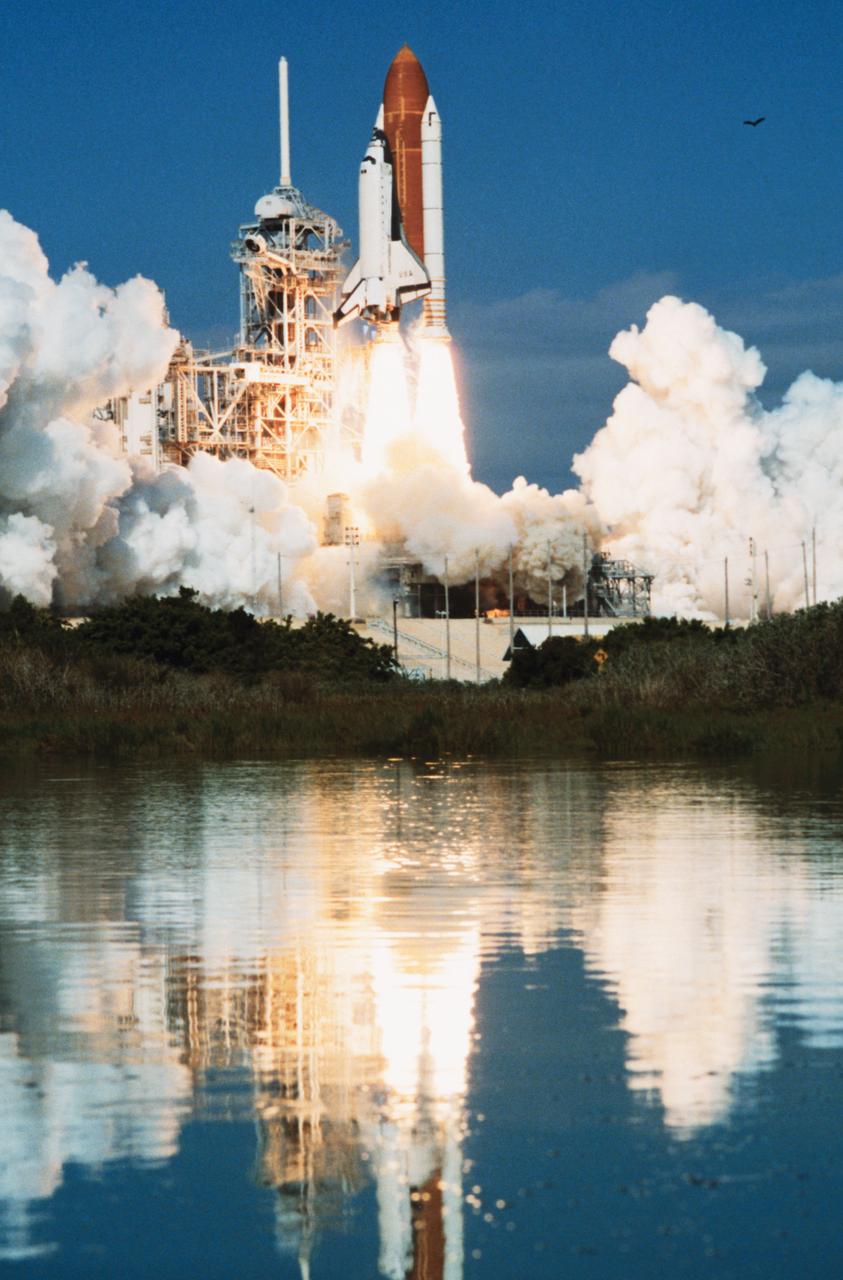
STS058-S-092 (18 Oct 1993) --- The Space Shuttle Columbia, with a crew of seven and a science module aboard, lifts off from Launch Complex 39 at Kennedy Space Center (KSC), leaving its reflection in nearby marsh. Launch occurred at 10:53 a.m. (EDT), October 18, 1993. Onboard were astronauts John E. Blaha, Richard A. Searfoss, Rhea Seddon, Shannon W. Lucid, David A. Wolf and William S. McArthur along with payload specialist Martin J. Fettman.
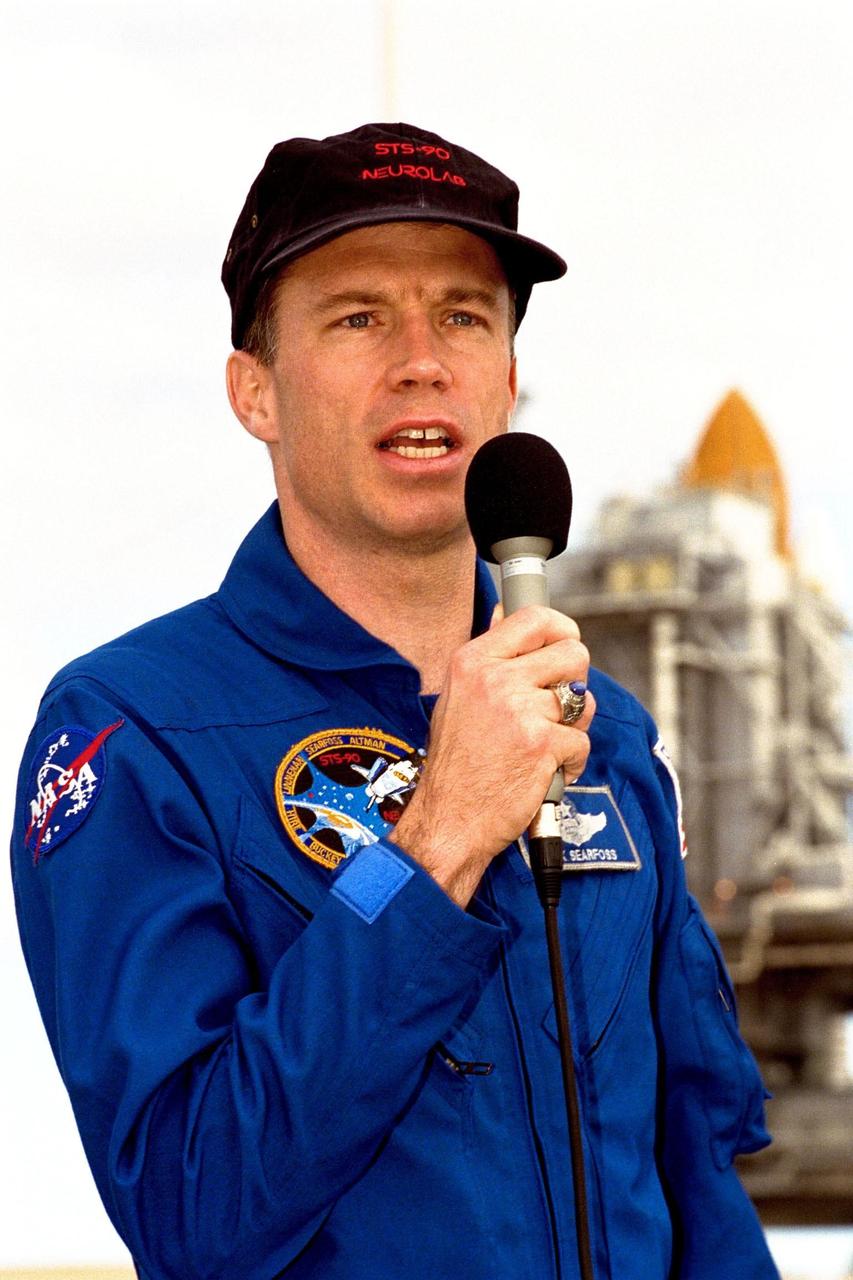
STS-90 Commander Richard Searfoss addresses the media at KSC's Launch Pad 39B, where the crew are participating in Terminal Countdown Demonstration Test (TCDT) activities. The TCDT is held at KSC prior to each Space Shuttle flight to provide crews with the opportunity to participate in simulated countdown activities. Columbia is targeted for launch of STS-90 on April 16 at 2:19 p.m. EDT and will be the second mission of 1998. The mission is scheduled to last nearly 17 days
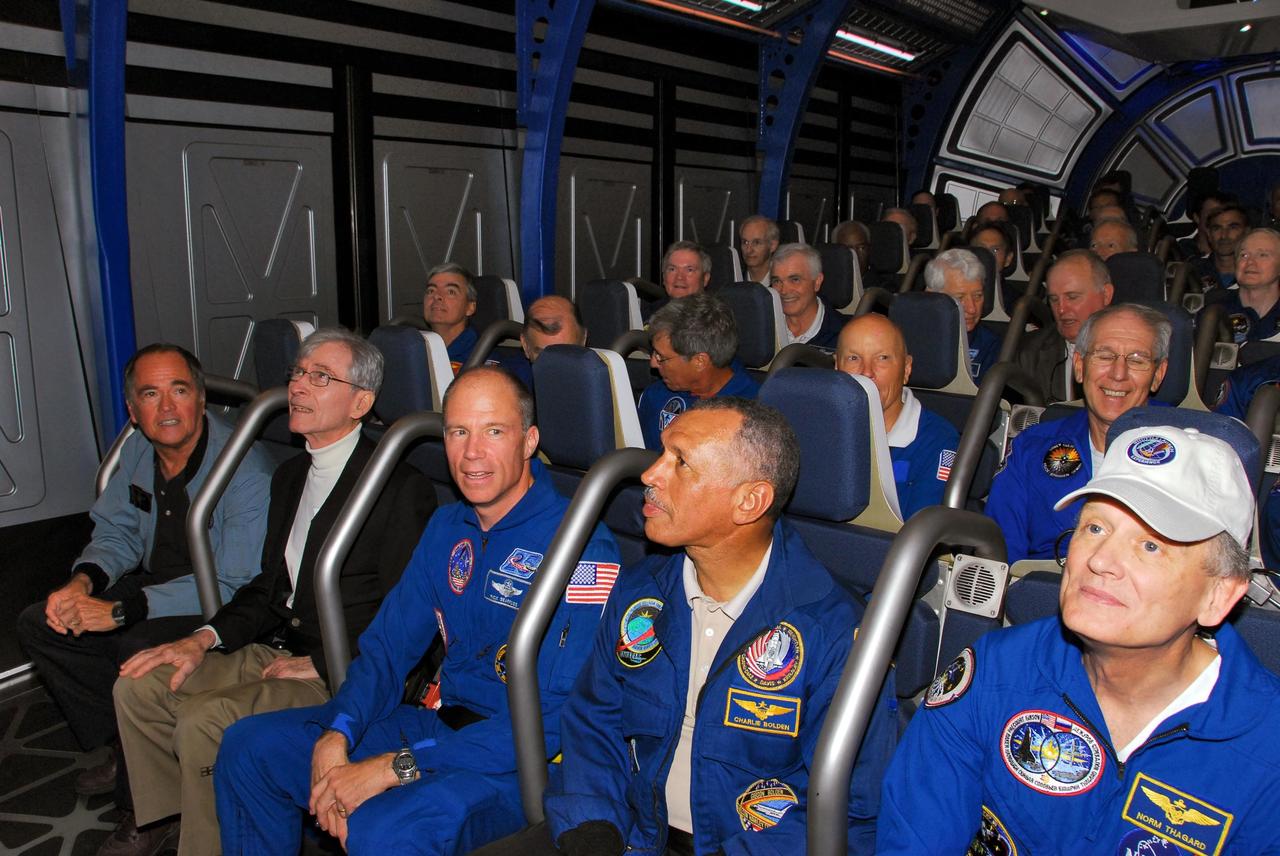
KENNEDY SPACE CENTER, FLA. -- Former astronauts take their seats in the newest attraction at Kennedy Space Center's Visitor Complex, the Shuttle Launch Experience. In the front row are (from left) Bob Crippen, John Young, Rick Searfoss, Charles Bolden and Norm Thagard. The attraction includes a simulated launch with the sights, sounds and sensations of launching into space. Find out more about the Visitor Complex and the Shuttle Launch Experience at <b>http://www.kennedyspacecenter.com/visitKSC/attractions/index.asp</b>. Photo credit: NASA/George Shelton
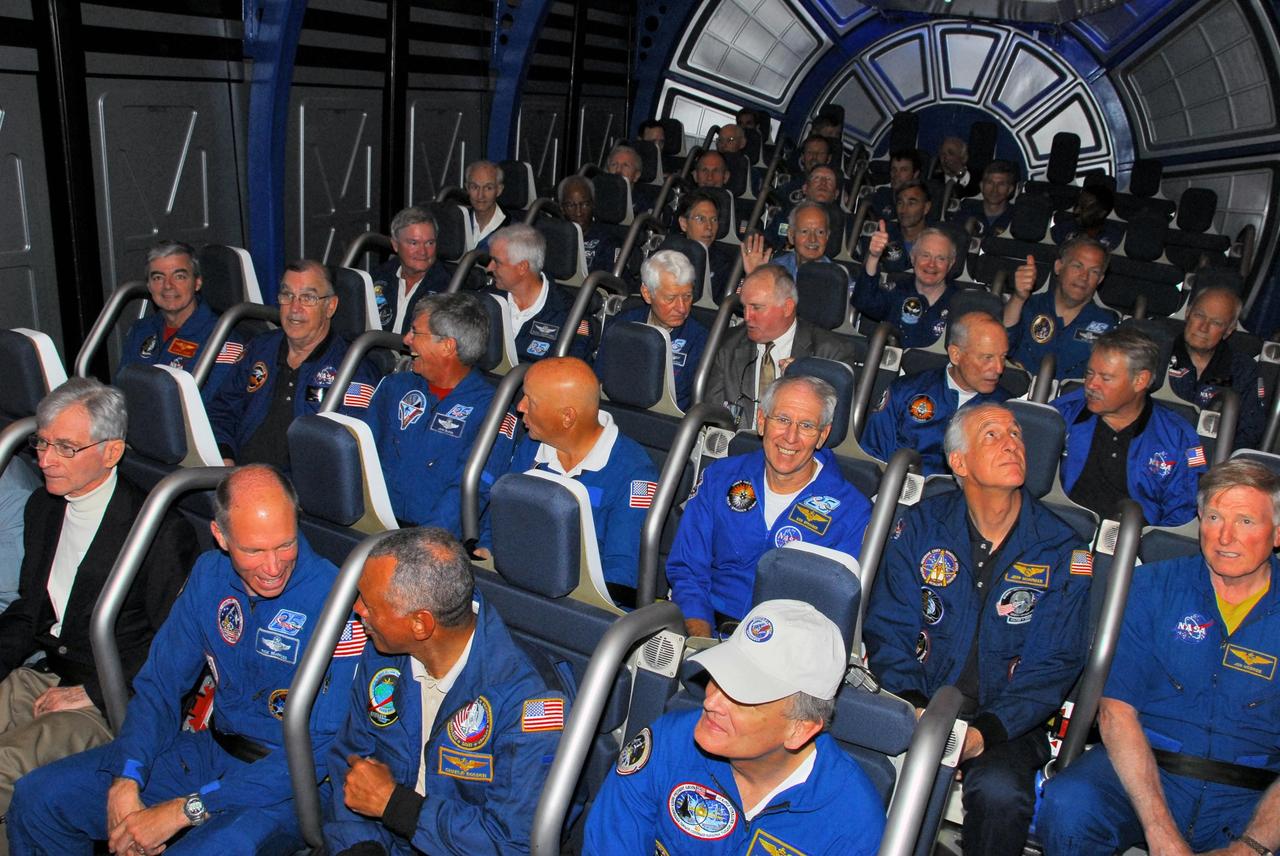
KENNEDY SPACE CENTER, FLA. -- Former astronauts take their seats in the newest attraction at Kennedy Space Center's Visitor Complex, the Shuttle Launch Experience. In the front row are (left to right) John Young, Rick Searfoss, Charles Bolden and Norm Thagard. The attraction includes a simulated launch with the sights, sounds and sensations of launching into space. Find out more about the Visitor Complex and the Shuttle Launch Experience at <b>http://www.kennedyspacecenter.com/visitKSC/attractions/index.asp</b>. Photo credit: NASA/George Shelton
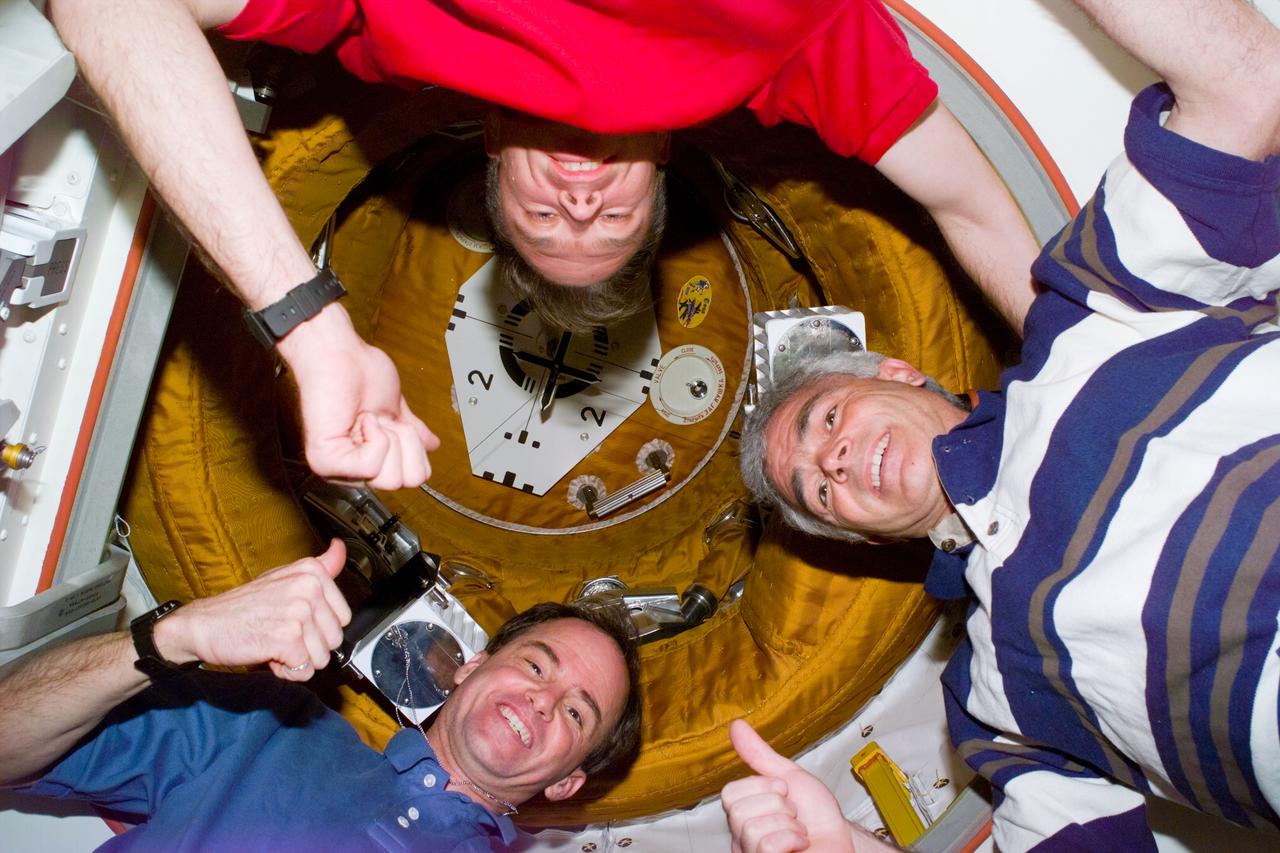
S76-E-5222 (28 March 1996) --- One would take this triumvirate of thumbs-up symbols to refer to a successful hatch closing, as the Space Shuttle Atlantis is about to be separated from its link with Russia's Mir Space Station. Hold photo with frame number and clock at bottom left. Astronaut Kevin P. Chilton, mission commander, is at lower left. Others are astronauts Richard A. Searfoss (top), pilot, and Michael R. (Rich) Clifford, mission specialist.
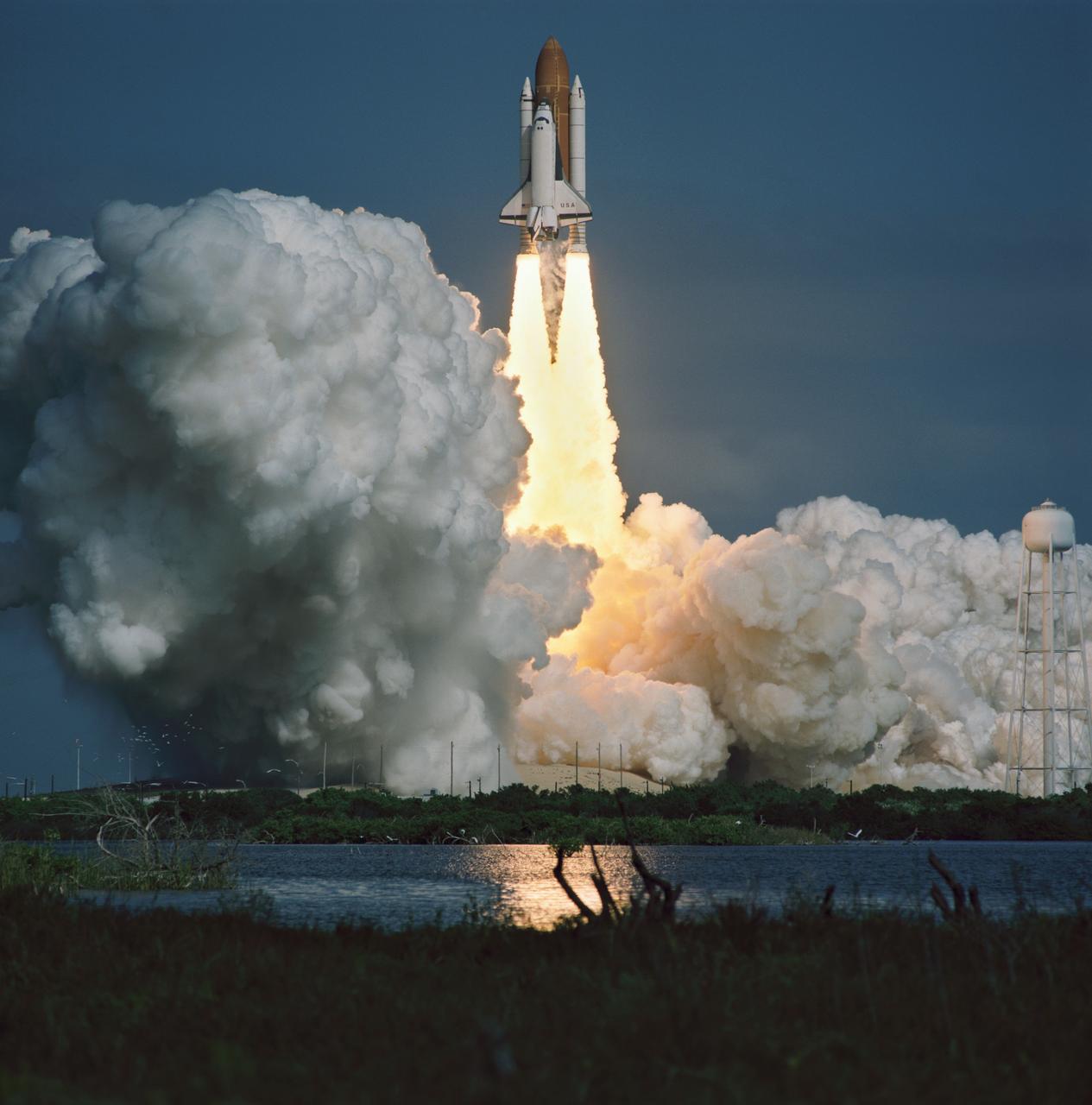
STS058-S-090 (18 Oct 1993) --- Creating large clouds of smoke the Space Shuttle Columbia lifts off from Launch Complex 39 at Kennedy Space Center (KSC). Liftoff occurred at 10:53 a.m. (EDT), October 18, 1993. Along with its Spacelab Life Sciences-2 payload, Columbia carries astronauts John E. Blaha, Richard A. Searfoss, Rhea Seddon, Shannon W. Lucid, David A. Wolf and William S. McArthur along with payload specialist Martin J. Fettman.
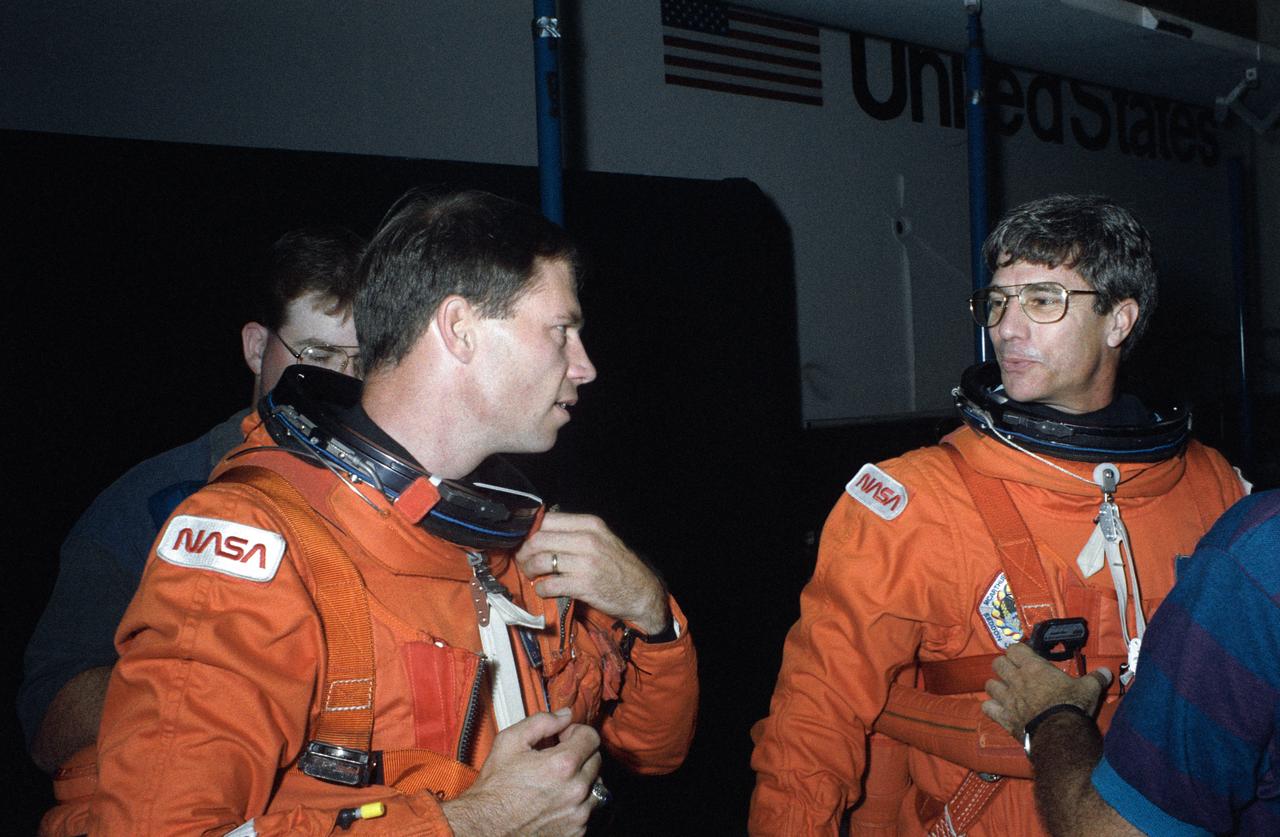
S93-38675 (20 July 1993) --- Wearing training versions of the partial pressure launch and entry garment, astronauts Richard A. Searfoss (left), pilot, and John E. Blaha, mission commander, prepare for a training exercise. The two, along with the four other NASA astronauts and a visiting payload specialist asssigned to the seven-member crew, later rehearsed contingency evacuation procedures. Most of the training session took part in the crew compartment and full fuselage trainers in the Space Shuttle mockup and integration laboratory.

KENNEDY SPACE CENTER, FLA. -- The Space Shuttle Columbia soars from Launch Pad 39B at 2:19 p.m. EDT Apr. 17 to begin the STS-90 Neurolab mission. The launch was delayed 24 hours due to difficulty with a network signal processor, which was replaced Apr. 16, on the orbiter. The crew members are Commander Richard Searfoss, Pilot Scott Altman, Mission Specialists Richard Linnehan, D.V.M., Dafydd (Dave) Williams, M.D., with the Canadian Space Agency, and Kathryn (Kay) Hire; and Payload Specialists Jay Buckey, M.D., and James Pawelczyk, Ph.D. Investigations during the Neurolab mission will focus on the effects of microgravity on the nervous system
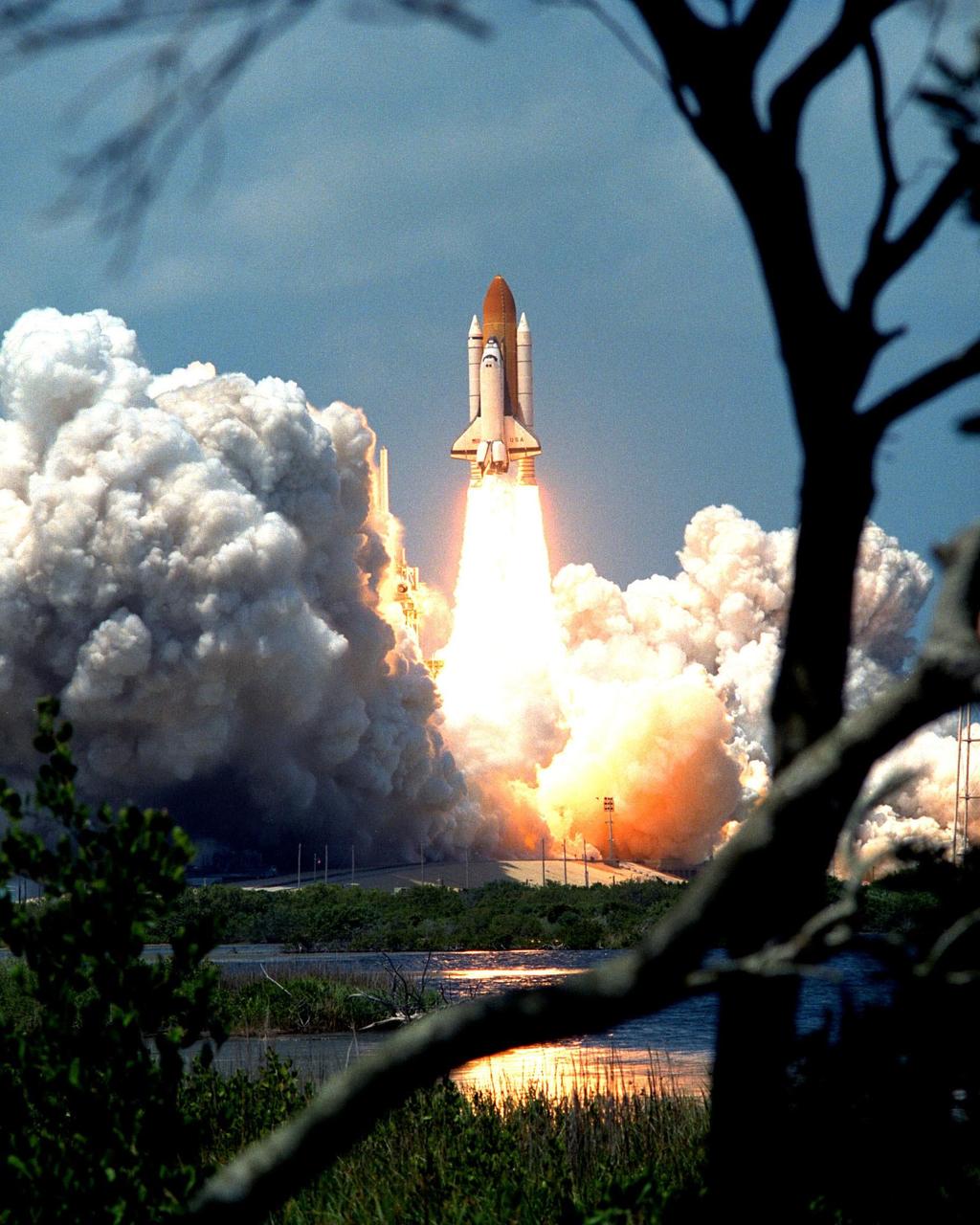
KENNEDY SPACE CENTER, FLA. -- The Space Shuttle Columbia soars from Launch Pad 39B at 2:19 p.m. EDT Apr. 17 to begin the nearly 17-day STS-90 Neurolab mission. The launch was delayed 24 hours due to difficulty with a network signal processor, which was replaced Apr. 16, on the orbiter. The crew members are Commander Richard Searfoss, Pilot Scott Altman, Mission Specialists Richard Linnehan, D.V.M., Dafydd (Dave) Williams, M.D., with the Canadian Space Agency, and Kathryn (Kay) Hire; and Payload Specialists Jay Buckey, M.D., and James Pawelczyk, Ph.D. Investigations during the Neurolab mission will focus on the effects of microgravity on the nervous system.
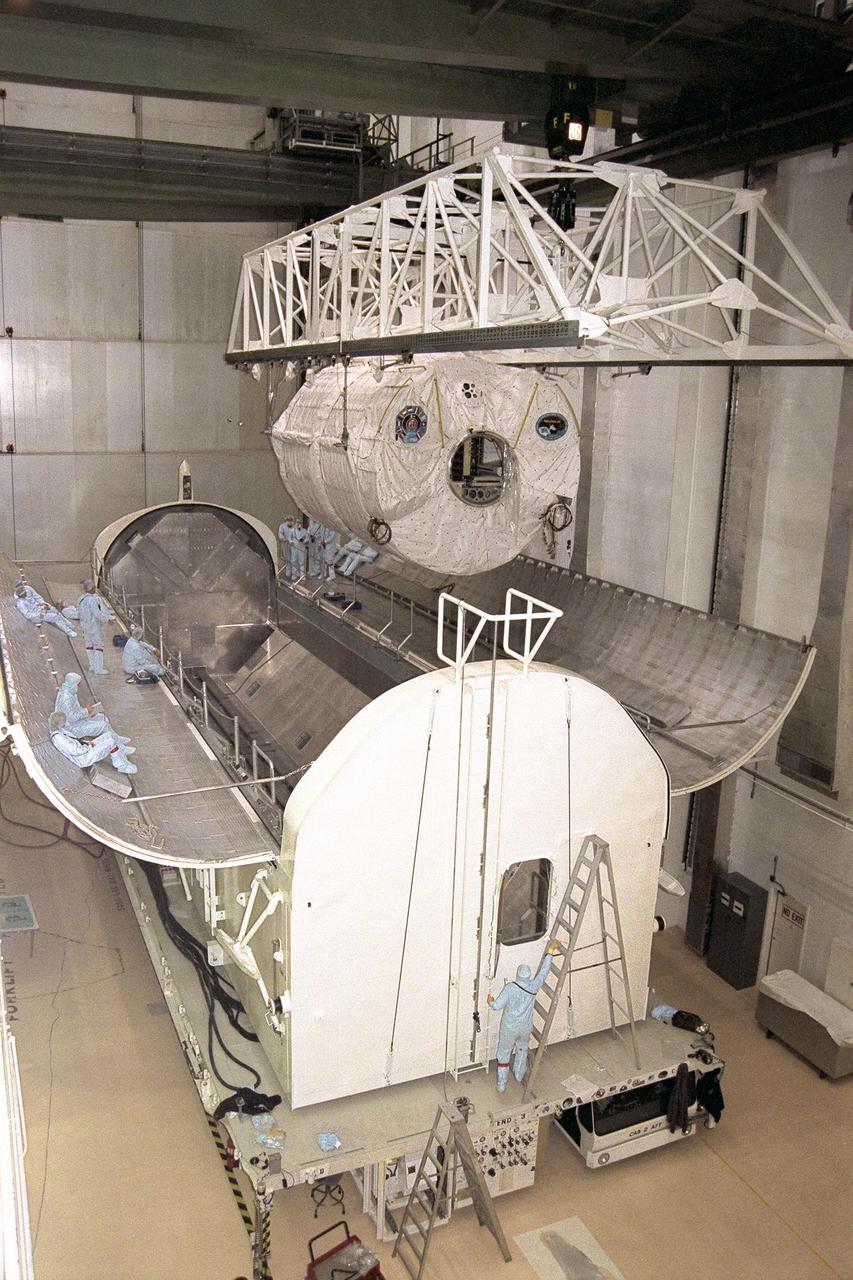
KENNEDY SPACE CENTER, FLA. -- The STS-90 Neurolab payload is lowered into its payload canister in KSC's Operations and Checkout Building. Investigations during the Neurolab mission will focus on the effects of microgravity on the nervous system. Specifically, experiments will study the adaptation of the vestibular system, the central nervous system, and the pathways that control the ability to sense location in the absence of gravity, as well as the effect of microgravity on a developing nervous system. The crew of STS-90, slated for launch in April, will include Commander Richard Searfoss, Pilot Scott Altman, Mission Specialists Richard Linnehan, Dafydd (Dave) Williams, M.D., and Kathryn (Kay) Hire, and Payload Specialists Jay Buckey, M.D., and James Pawelczyk, Ph.D
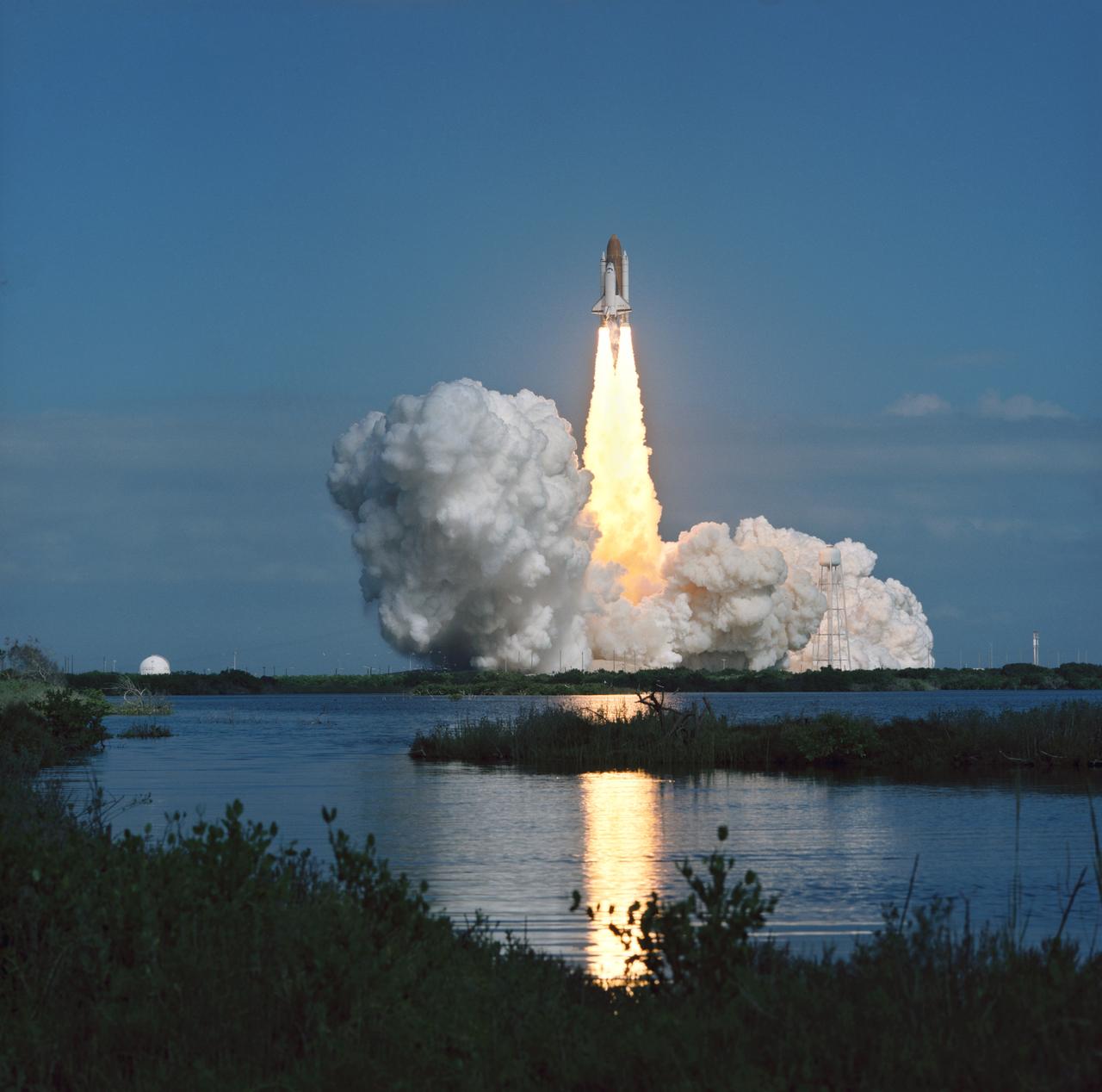
STS058-S-091 (18 Oct 1993) --- A distant shot shows the Space Shuttle Columbia, lifting off from Launch Complex 39 at Kennedy Space Center (KSC), reflecting its image in nearby marsh waters. Launch occurred at 10:53 a.m. (EDT), October 18, 1993. Along with six NASA astronauts and a veterinarian from the private sector, the Spacelab Life Sciences-2 (SLS-2) science module was aboard. Onboard were astronauts John E. Blaha, Richard A. Searfoss, Rhea Seddon, Shannon W. Lucid, David A. Wolf and William S. McArthur along with payload specialist Martin J. Fettman.

KENNEDY SPACE CENTER, FLA. -- Technicians gather around the STS-90 Neurolab payload during weight and center-of-gravity measurements in KSC's Operations and Checkout Building. Investigations during the Neurolab mission will focus on the effects of microgravity on the nervous system. Specifically, experiments will study the adaptation of the vestibular system, the central nervous system, and the pathways that control the ability to sense location in the absence of gravity, as well as the effect of microgravity on a developing nervous system. The crew of STS-90, slated for launch in April, will include Commander Richard Searfoss, Pilot Scott Altman, Mission Specialists Richard Linnehan, Dafydd (Dave) Williams, M.D., and Kathryn (Kay) Hire, and Payload Specialists Jay Buckey, M.D., and James Pawelczyk, Ph.D
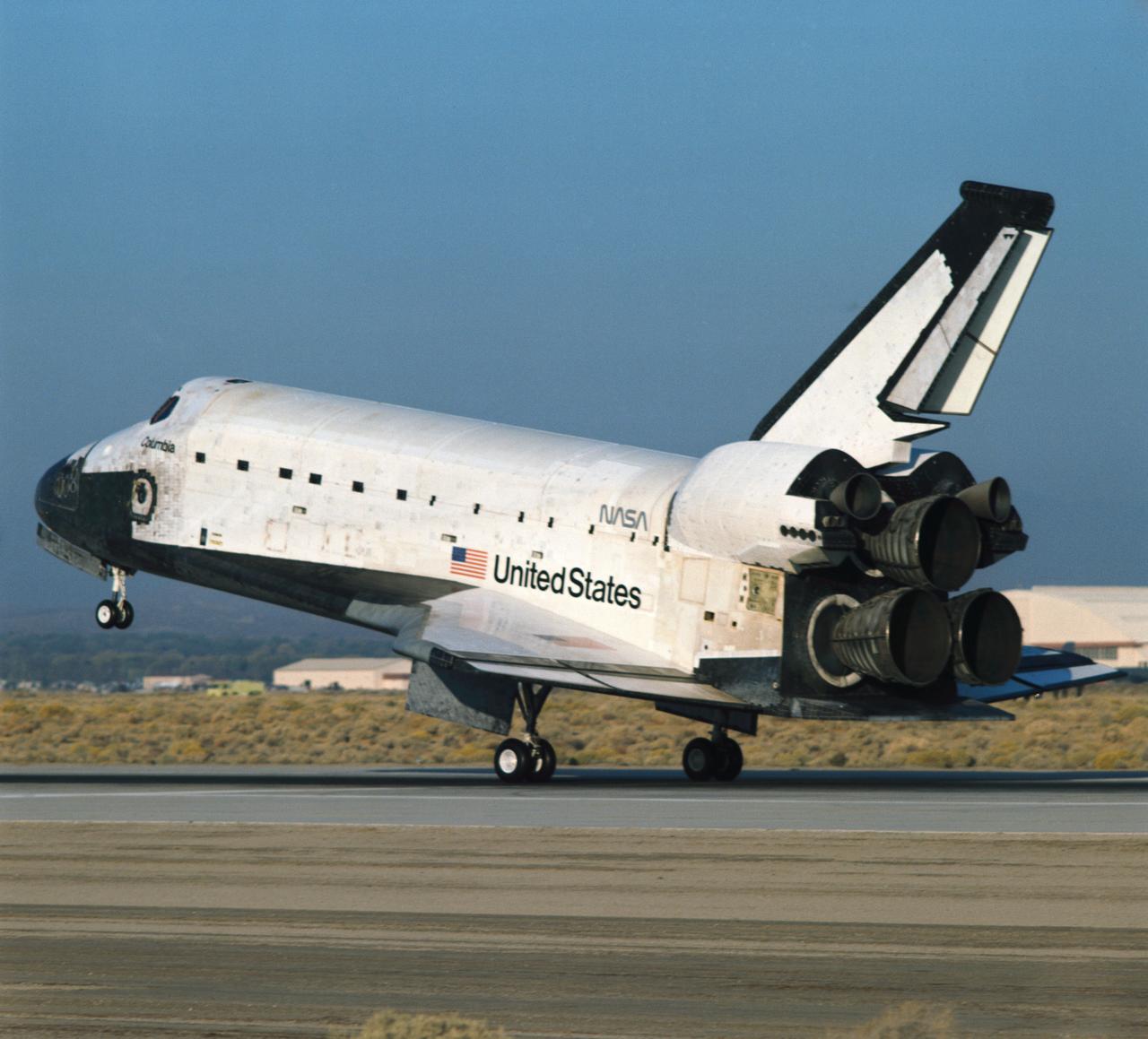
STS058-S-128 (1 Nov 1993) --- The nose gear of the Space Shuttle Columbia is about to touch down on the runway at Edwards Air Force Base (EAFB) in California. The landing, which occurred at 7:06 a.m. (PST), November 1, 1993, completed a two week mission in space devoted to medical research. Onboard the spacecraft were astronauts John E. Blaha, Richard A. Searfoss, Rhea Seddon, Shannon W. Lucid, David A. Wolf and William S. McArthur along with payload specialist Martin J. Fettman, DVM.

The STS-90 Neurolab payload is lowered into position into the cargo bay of Space Shuttle Columbia today in Orbiter Processing Facility bay 3. Investigations during the Neurolab mission will focus on the effects of microgravity on the nervous system. Specifically, experiments will study the adaptation of the vestibular system, the central nervous system, and the pathways that control the ability to sense location in the absence of gravity, as well as the effect of microgravity on a developing nervous system. The crew of STS-90, slated for launch in April, will include Commander Richard Searfoss, Pilot Scott Altman, Mission Specialists Richard Linnehan, Dafydd (Dave) Williams, M.D., and Kathryn (Kay) Hire, and Payload Specialists Jay Buckey, M.D., and James Pawelczyk, Ph.D
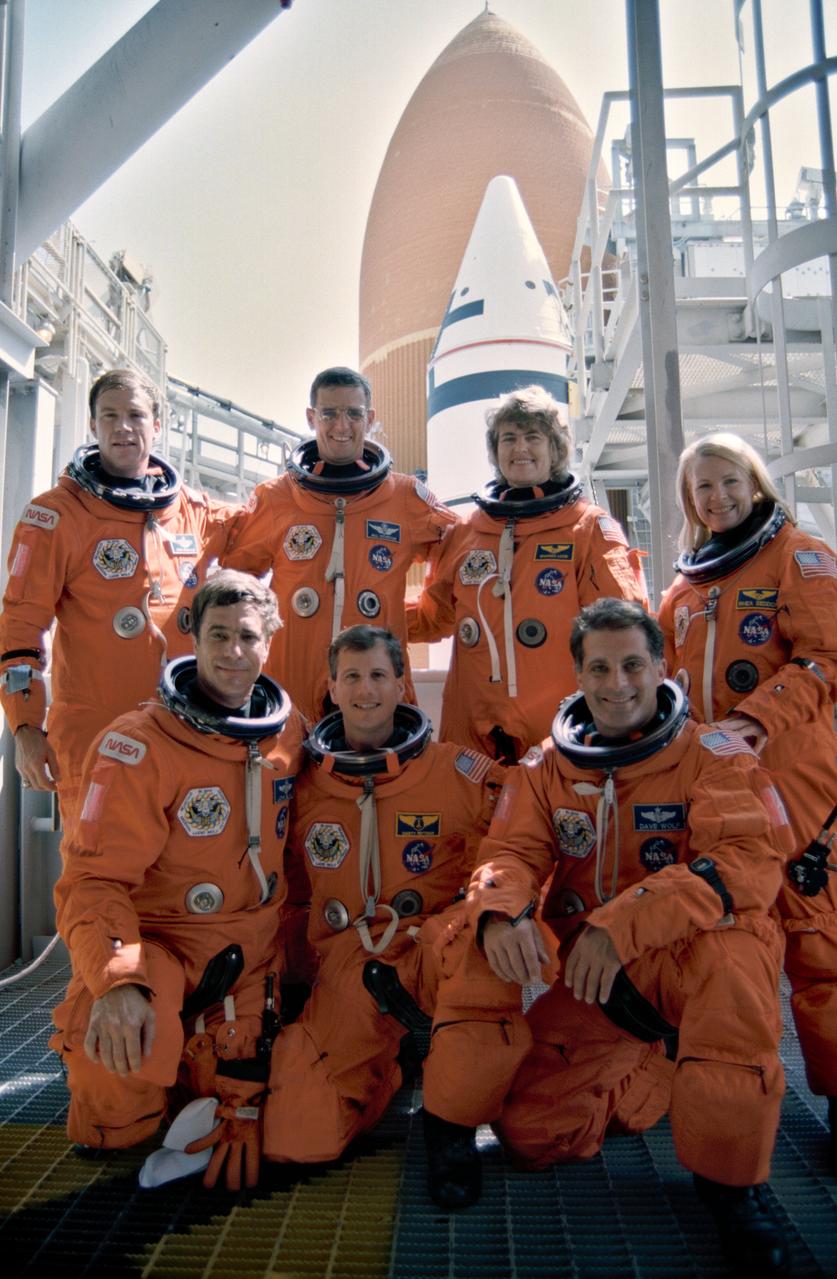
S93-45004 (20 Sept 1993) --- Posing for a crew portrait, with the Space Shuttle Columbia at Launch Pad 39B, are the seven STS-58 astronauts. They are, front row left to right, John E. Blaha, mission commander; Martin J. Fettman, payload specialist; and David A. Wolf, mission specialist. Back row, left to right, are Richard A. Searfoss, pilot; William S. McArthur and Shannon W. Lucid, mission specialists; and Rhea Seddon, payload commander. The crew was in Florida for the Terminal Countdown Demonstration Test (CDDT) in preparation for next month's launch aboard Columbia.
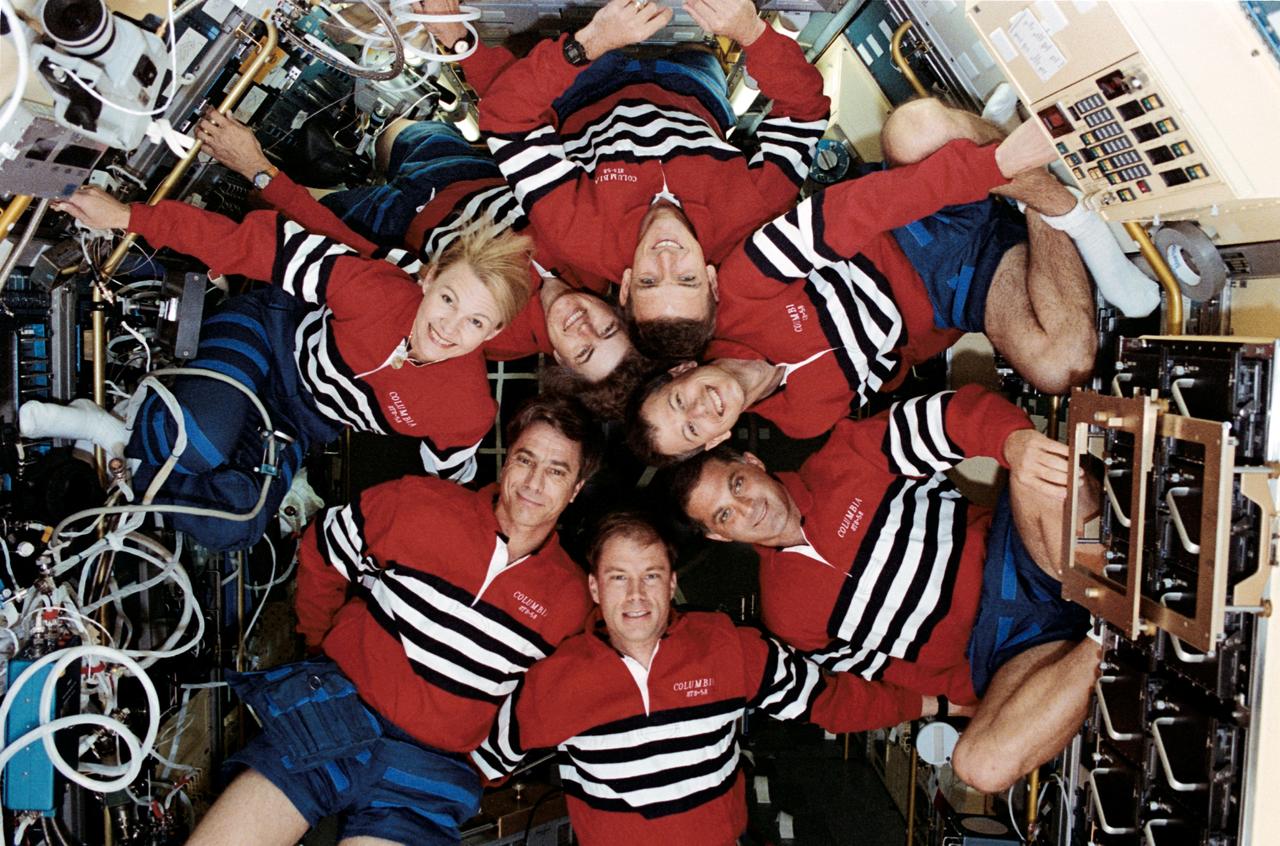
STS058-16-008 (18 Oct.-1 Nov. 1993) --- Inside the science module aboard the Earth-orbiting space shuttle Columbia, a pre-set 35mm camera recorded the traditional inflight portrait of the STS-58 crew. Pictured are (counter-clockwise from the roll of tape at upper right) payload specialist Martin J. Fettman, DVM; William S. McArthur and Shannon W. Lucid, mission specialists; Rhea Seddon, payload commander; John E. Blaha, mission commander; Richard A. Searfoss, pilot; and David A. Wolf, mission specialist. Photo credit: NASA
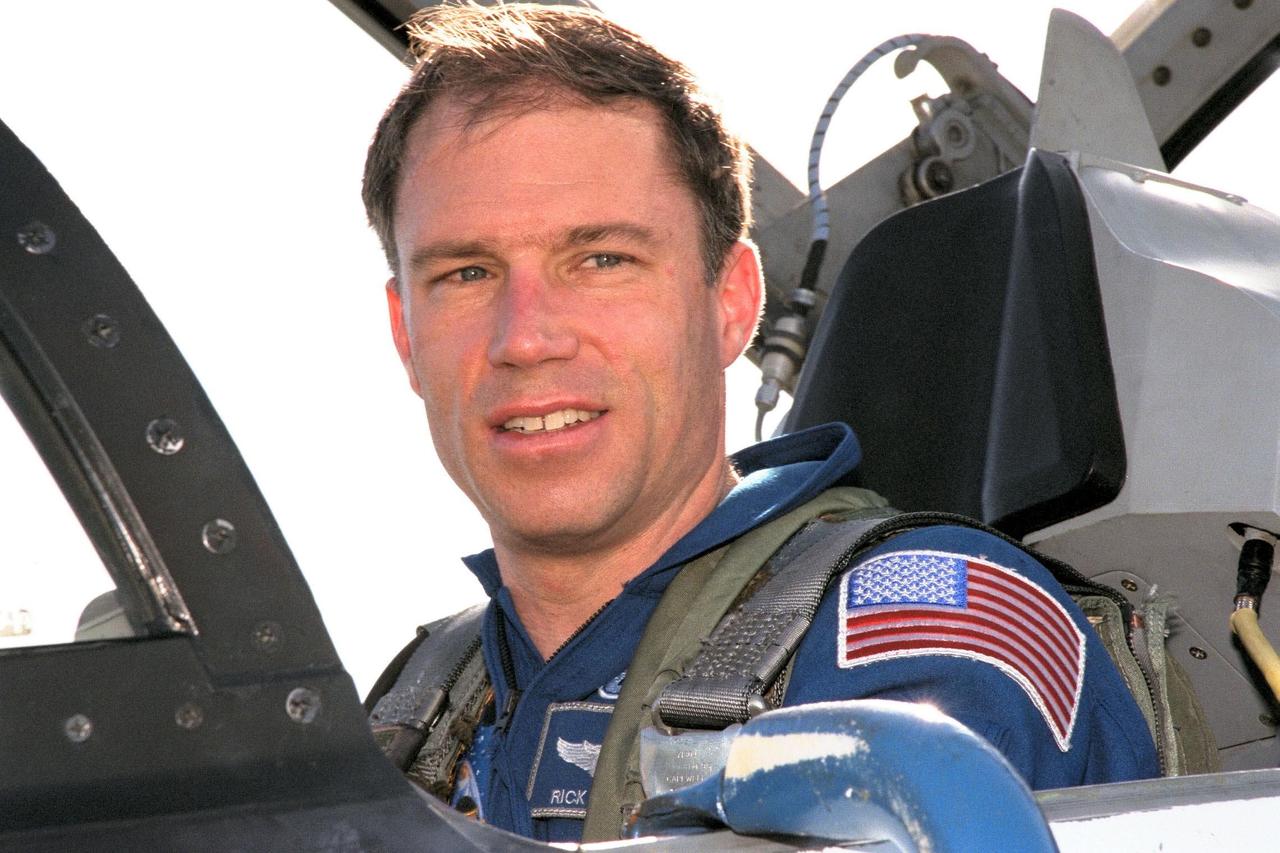
STS-90 Mission Commander Richard Searfoss poses in the cockpit of his T-38 jet trainer aircraft after arriving at the KSC Shuttle Landing Facility along with other members of the crew from NASA’s Johnson Space Center to begin Terminal Countdown Demonstration Test (TCDT) activities. The TCDT is held at KSC prior to each Space Shuttle flight to provide crews with the opportunity to participate in simulated countdown activities. Columbia is targeted for launch of STS-90 on April 16 at 2:19 p.m. EDT and will be the second mission of 1998. The mission is scheduled to last nearly 17 days
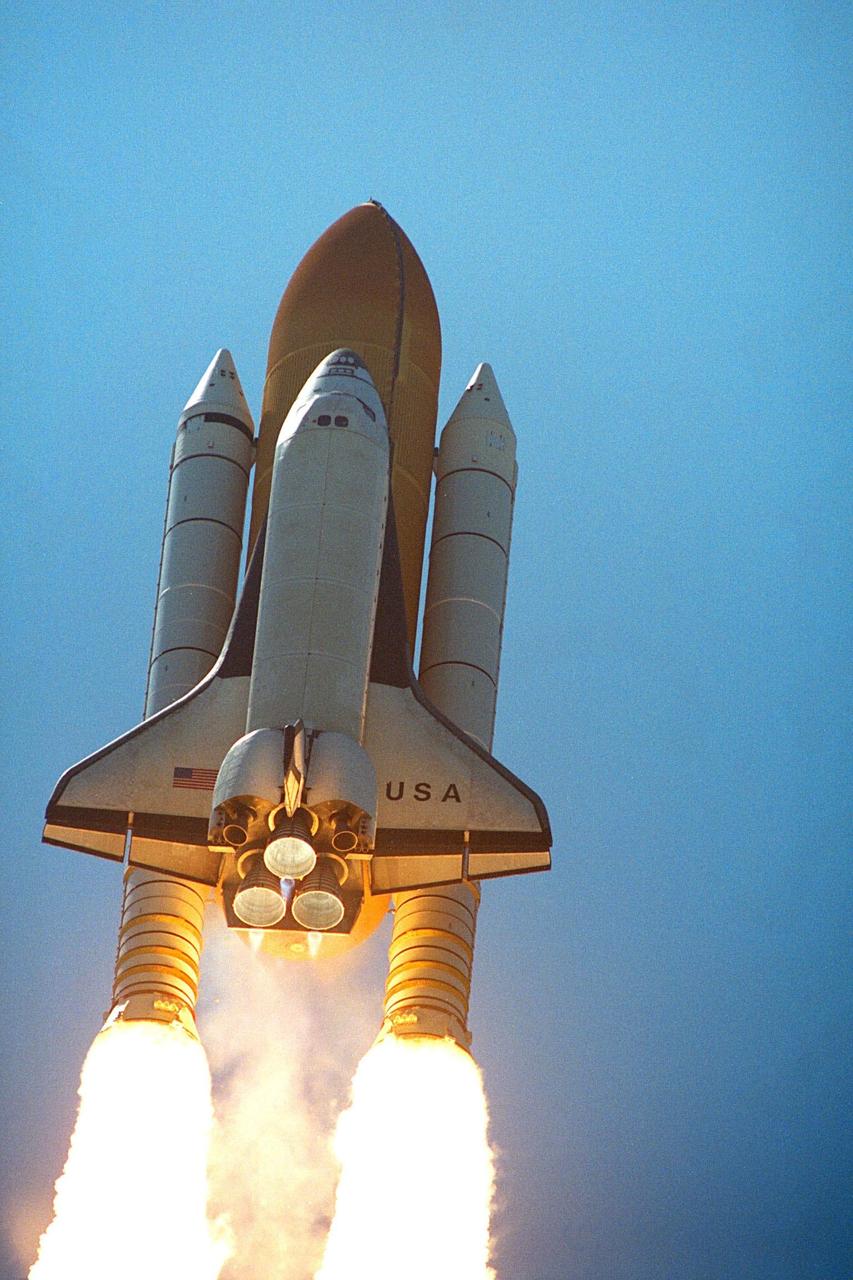
KENNEDY SPACE CENTER, FLA. -- The Space Shuttle Columbia surges skyward from Launch Pad 39B at 2:19 p.m. EDT Apr. 17 to begin the nearly 17-day STS-90 Neurolab mission. The launch was delayed 24 hours due to difficulty with a network signal processor, which was replaced Apr. 16, on the orbiter. The crew members on-board include Commander Richard Searfoss, Pilot Scott Altman, Mission Specialists Richard Linnehan, D.V.M., Dafydd (Dave) Williams, M.D., with the Canadian Space Agency, and Kathryn (Kay) Hire; and Payload Specialists Jay Buckey, M.D., and James Pawelczyk, Ph.D. Investigations during the Neurolab mission will focus on the effects of microgravity on the nervous system
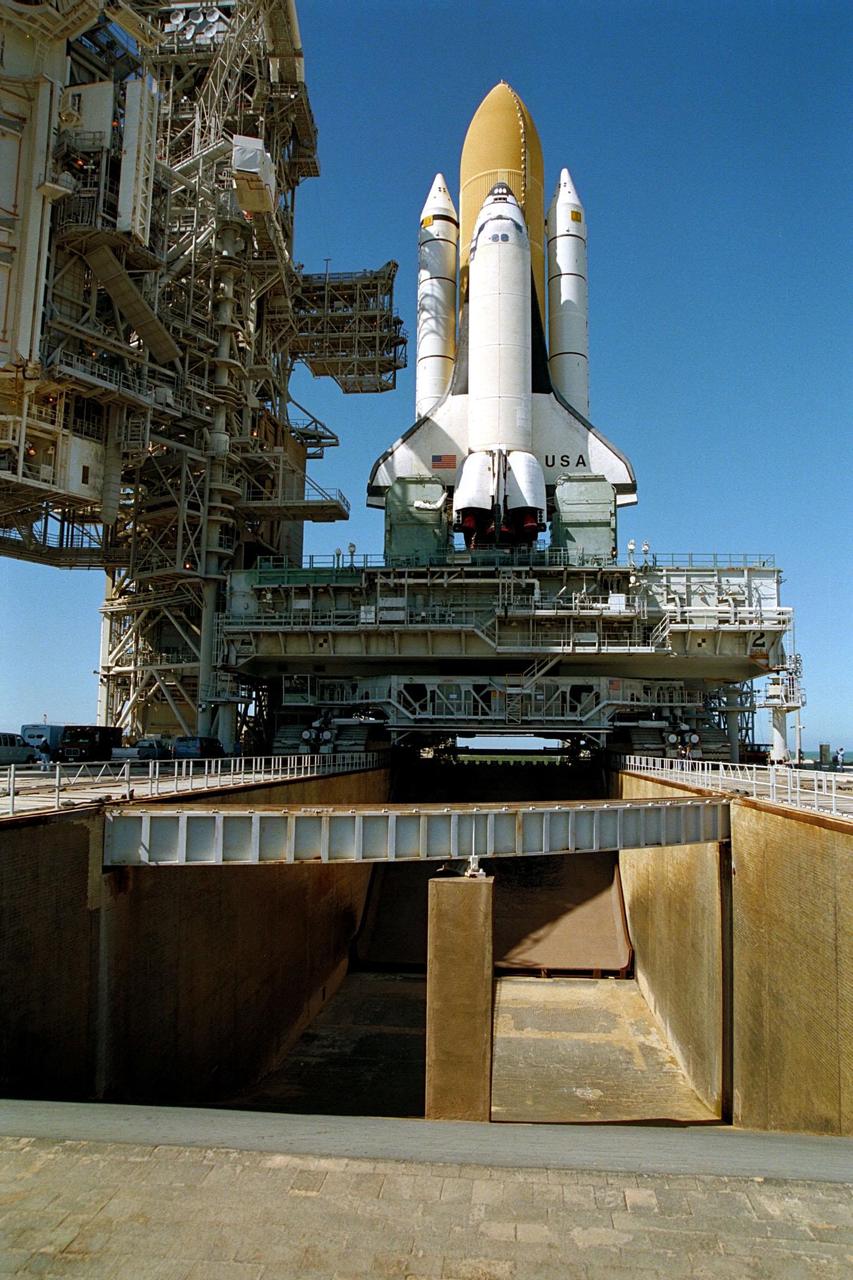
KENNEDY SPACE CENTER, FLA. -- The Space Shuttle Columbia arrives at the top of Launch Pad 39B after its morning rollout prior to STS-90. The Neurolab experiments are the primary payload on this nearly 17-day space flight. Investigations during the Neurolab mission will focus on the effects of microgravity on the nervous system. The crew of STS-90, slated for launch April 16 at 2:19 p.m. EDT, includes Commander Richard Searfoss, Pilot Scott Altman, Mission Specialists Richard Linnehan, Dafydd (Dave) Williams, M.D., and Kathryn (Kay) Hire, and Payload Specialists Jay Buckey, M.D., and James Pawelczyk, Ph.D
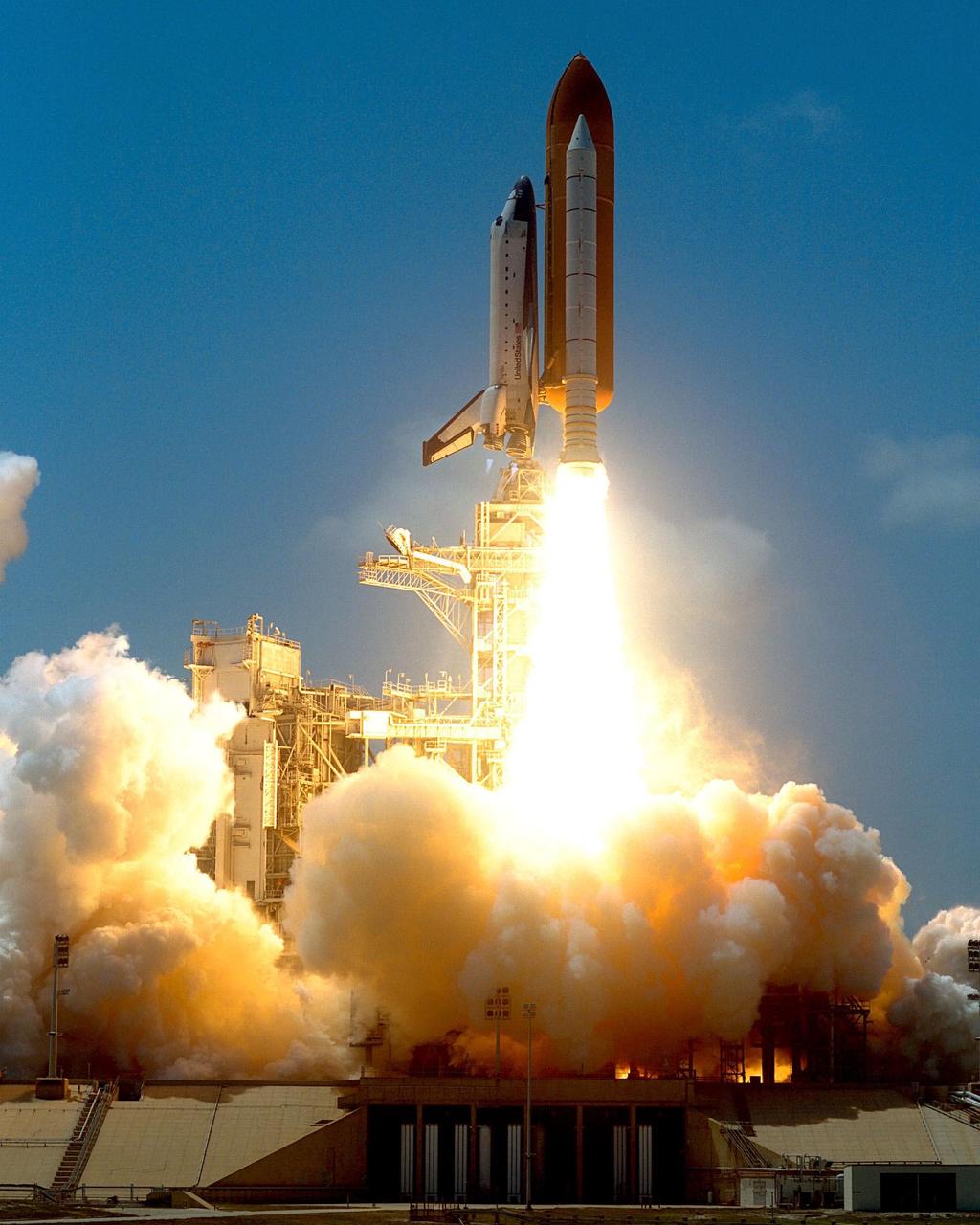
KENNEDY SPACE CENTER, FLA. -- The Space Shuttle Columbia lifts off from Launch Pad 39B at 2:19 p.m. EDT Apr. 17 to begin the nearly 17-day STS-90 Neurolab mission. The launch was delayed 24 hours due to difficulty with a network signal processor, which was replaced Apr. 16, on the orbiter. The crew members are Commander Richard Searfoss, Pilot Scott Altman, Mission Specialists Richard Linnehan, D.V.M., Dafydd (Dave) Williams, M.D., with the Canadian Space Agency, and Kathryn (Kay) Hire; and Payload Specialists Jay Buckey, M.D., and James Pawelczyk, Ph.D. Investigations during the Neurolab mission will focus on the effects of microgravity on the nervous system
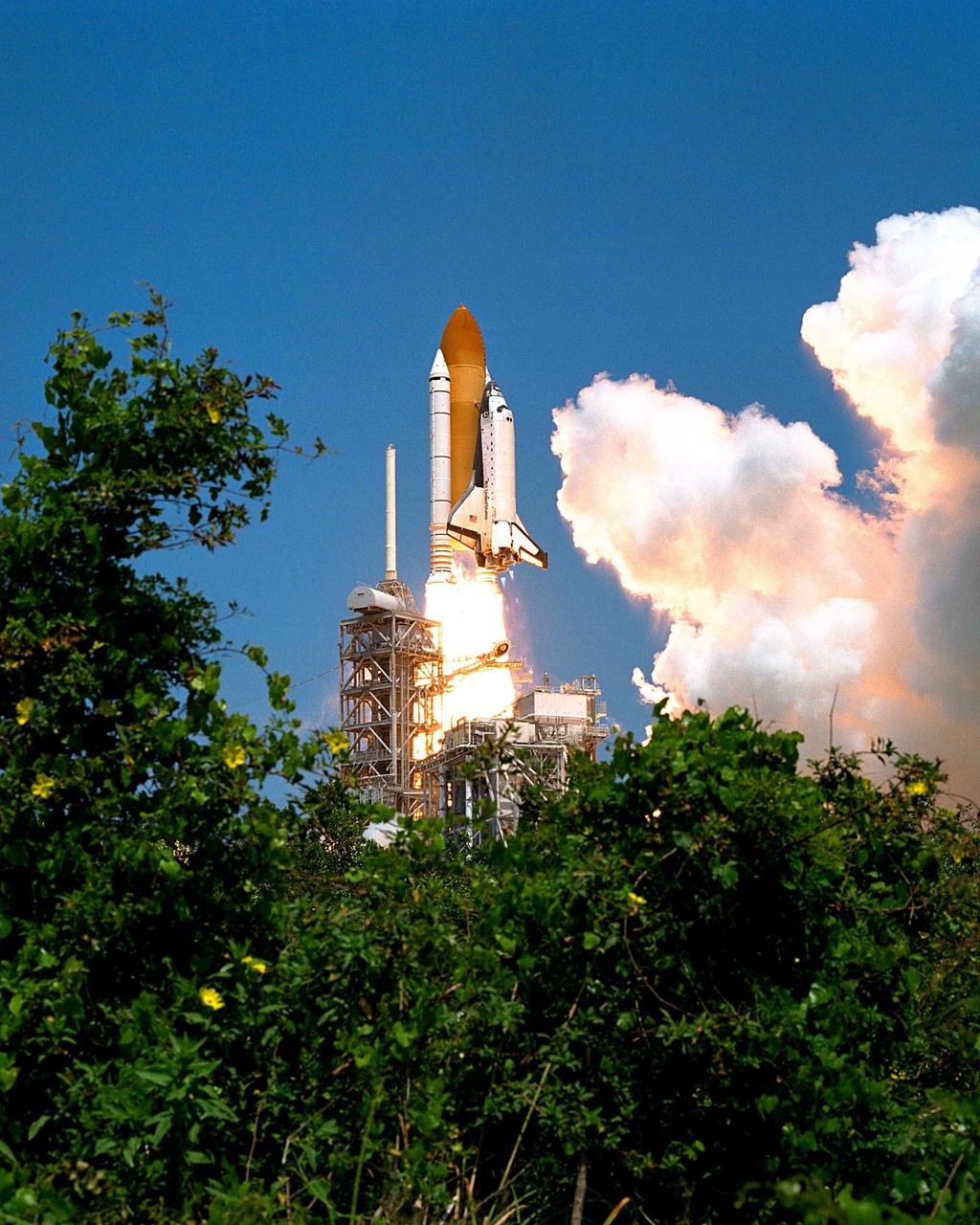
KENNEDY SPACE CENTER, FLA. -- The Space Shuttle Columbia soars from Launch Pad 39B at 2:19 p.m. EDT Apr. 17 to begin the STS-90 Neurolab mission. The launch was delayed 24 hours due to difficulty with a network signal processor, which was replaced Apr. 16, on the orbiter. The crew members are Commander Richard Searfoss, Pilot Scott Altman, Mission Specialists Richard Linnehan, D.V.M., Dafydd (Dave) Williams, M.D., with the Canadian Space Agency, and Kathryn (Kay) Hire; and Payload Specialists Jay Buckey, M.D., and James Pawelczyk, Ph.D. Investigations during the Neurolab mission will focus on the effects of microgravity on the nervous system
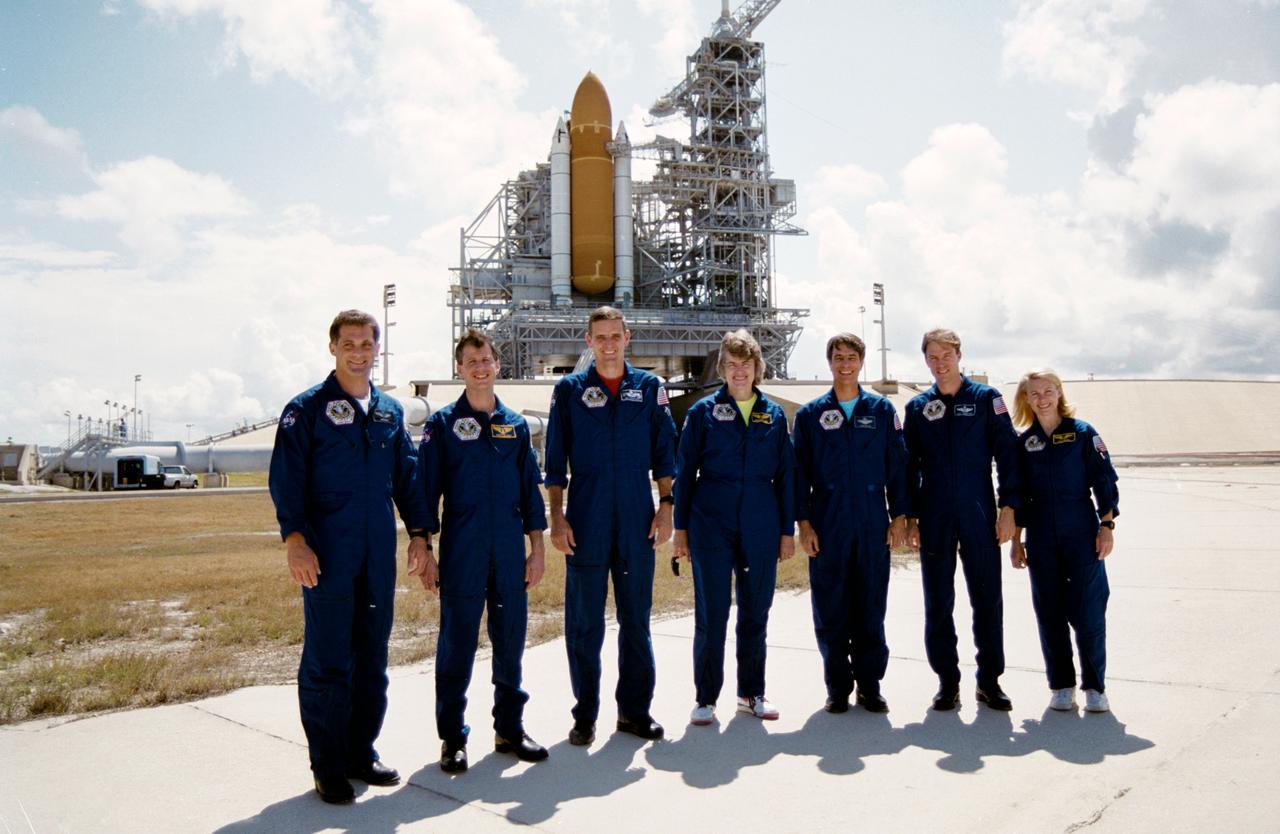
S93-45003 (20 Sept 1993) --- Posing for a crew portrait, in front of the Space Shuttle Columbia at Launch Pad 39B, are the seven STS-58 astronauts. They are, left to right, David A. Wolf, mission specialist; Martin J. Fettman, payload specialist; William S. McArthur and Shannon W. Lucid, mission specialists; John E. Blaha, mission commander; Richard A. Searfoss, pilot; and Rhea Seddon, payload commander. The crew was in Florida for the Terminal Countdown Demonstration Test (CDDT) in preparation for next month's launch aboard Columbia. (Kennedy Space Center Photo ID: KSC-93-PC-1253)
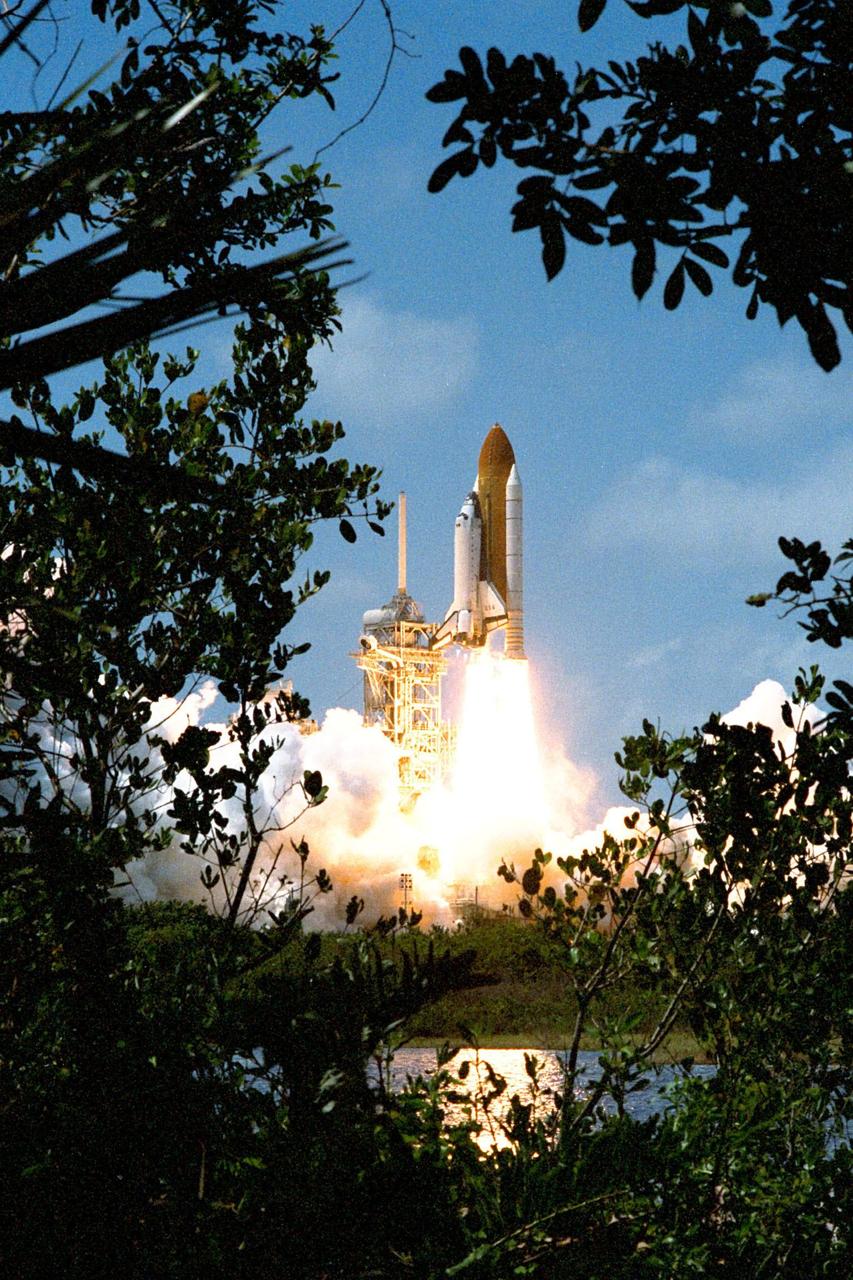
Framed by native Floridian foliage, the Space Shuttle Columbia soars from Launch Pad 39B at 2:19 p.m. EDT Apr. 17 to begin the nearly 17-day STS-90 Neurolab mission. The launch was delayed 24 hours due to difficulty with a network signal processor, which was replaced Apr. 16, on the orbiter. The crew members are Commander Richard Searfoss, Pilot Scott Altman, Mission Specialists Richard Linnehan, D.V.M., Dafydd (Dave) Williams, M.D., with the Canadian Space Agency, and Kathryn (Kay) Hire; and Payload Specialists Jay Buckey, M.D., and James Pawelczyk, Ph.D. Investigations during the Neurolab mission will focus on the effects of microgravity on the nervous system
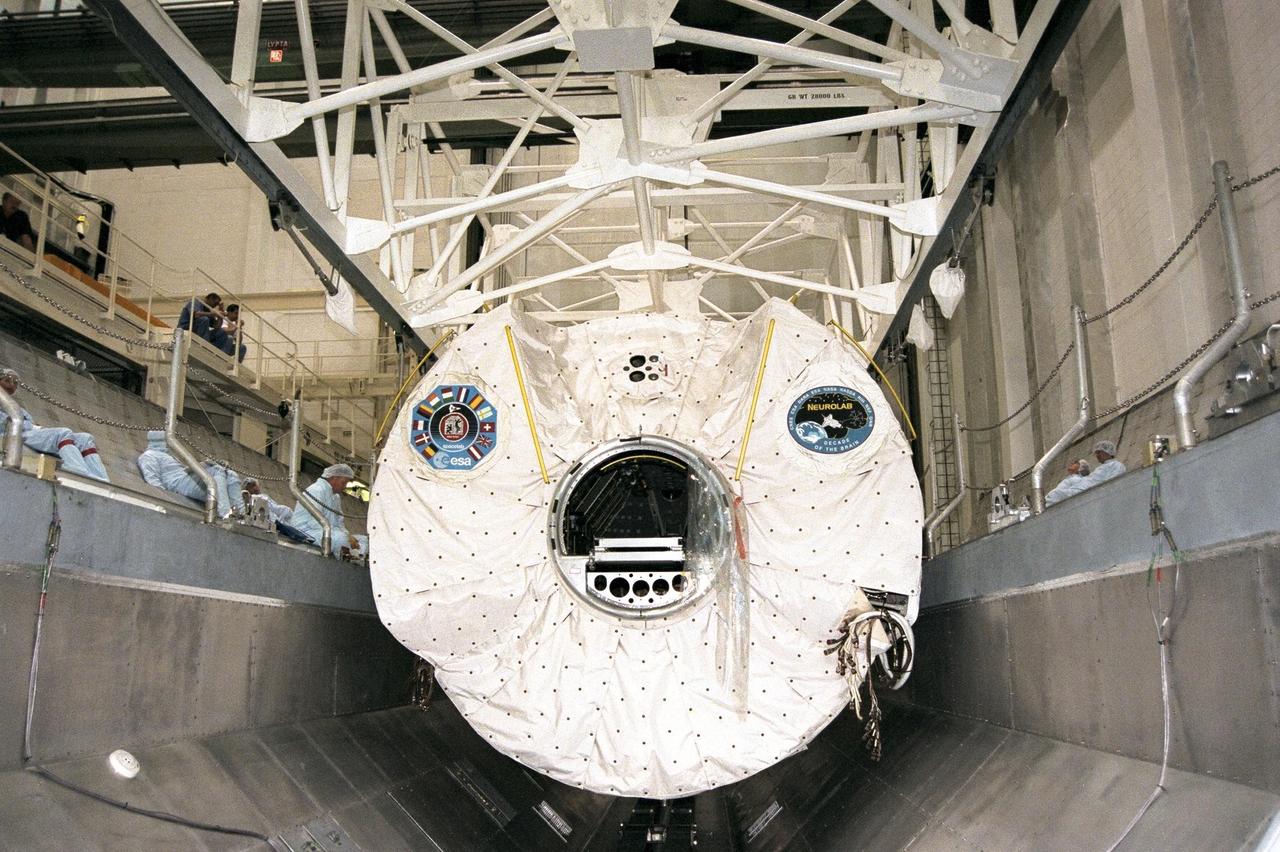
KENNEDY SPACE CENTER, FLA. -- The STS-90 Neurolab payload is lowered into its payload canister in KSC's Operations and Checkout Building. Investigations during the Neurolab mission will focus on the effects of microgravity on the nervous system. Specifically, experiments will study the adaptation of the vestibular system, the central nervous system, and the pathways that control the ability to sense location in the absence of gravity, as well as the effect of microgravity on a developing nervous system. The crew of STS-90, slated for launch in April, will include Commander Richard Searfoss, Pilot Scott Altman, Mission Specialists Richard Linnehan, Dafydd (Dave) Williams, M.D., and Kathryn (Kay) Hire, and Payload Specialists Jay Buckey, M.D., and James Pawelczyk, Ph.D
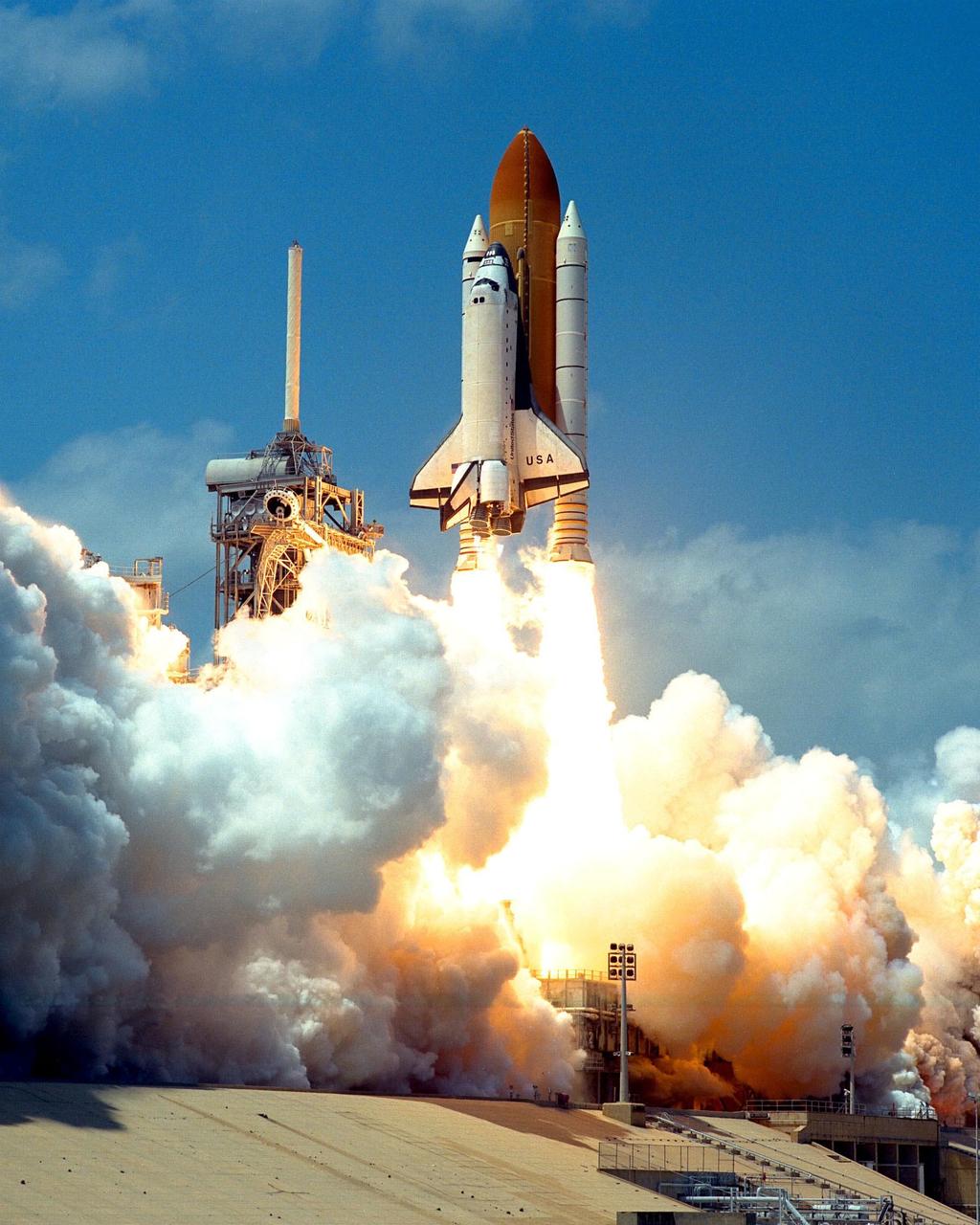
KENNEDY SPACE CENTER, FLA. -- The Space Shuttle Columbia soars from Launch Pad 39B at 2:19 p.m. EDT Apr. 17 to begin the nearly 17-day STS-90 Neurolab mission. The launch was delayed 24 hours due to difficulty with a network signal processor, which was replaced Apr. 16, on the orbiter. The crew members are Commander Richard Searfoss, Pilot Scott Altman, Mission Specialists Richard Linnehan, D.V.M., Dafydd (Dave) Williams, M.D., with the Canadian Space Agency, and Kathryn (Kay) Hire; and Payload Specialists Jay Buckey, M.D., and James Pawelczyk, Ph.D. Investigations during the Neurolab mission will focus on the effects of microgravity on the nervous system
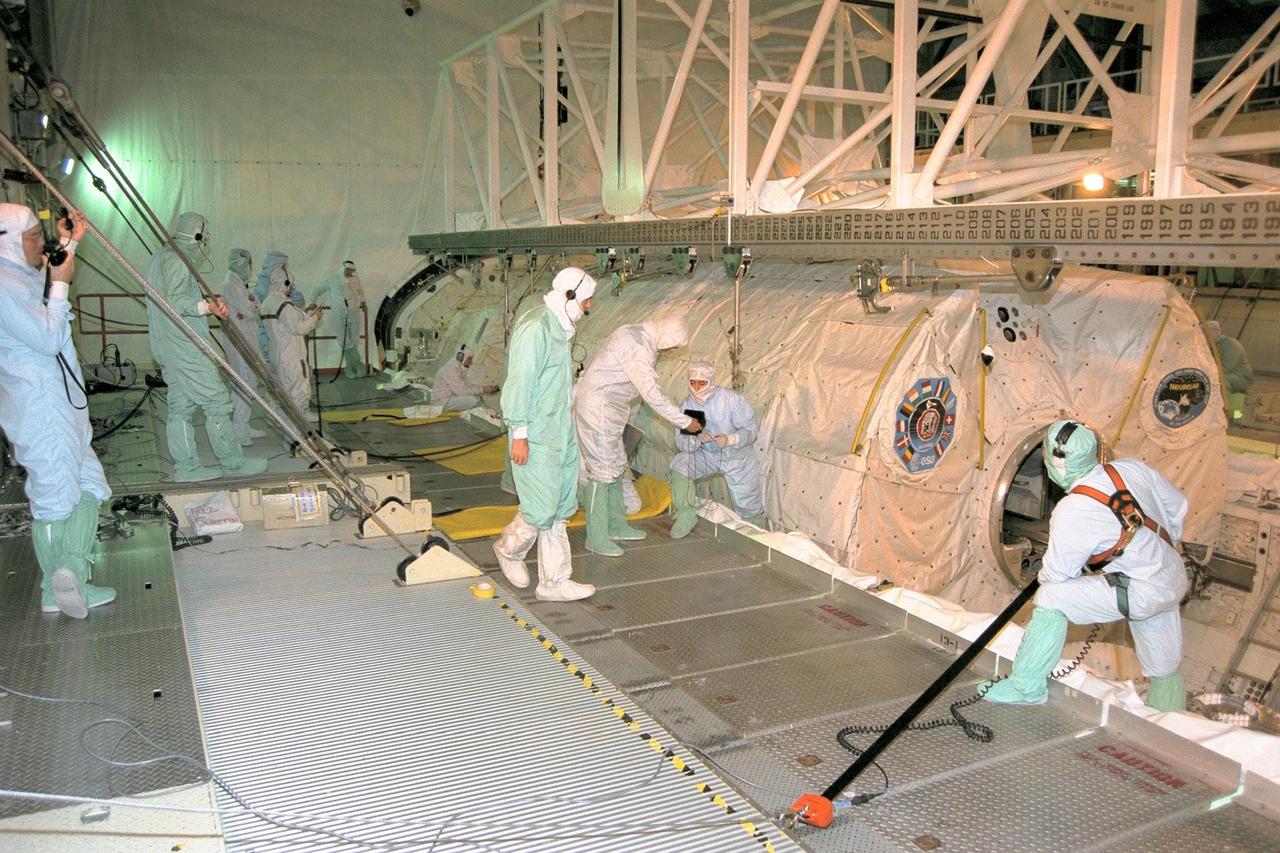
The STS-90 Neurolab payload is positioned into the cargo bay of Space Shuttle Columbia today in Orbiter Processing Facility bay 3. Investigations during the Neurolab mission will focus on the effects of microgravity on the nervous system. Specifically, experiments will study the adaptation of the vestibular system, the central nervous system, and the pathways that control the ability to sense location in the absence of gravity, as well as the effect of microgravity on a developing nervous system. The crew of STS-90, slated for launch in April, will include Commander Richard Searfoss, Pilot Scott Altman, Mission Specialists Richard Linnehan, Dafydd (Dave) Williams, M.D., and Kathryn (Kay) Hire, and Payload Specialists Jay Buckey, M.D., and James Pawelczyk, Ph.D
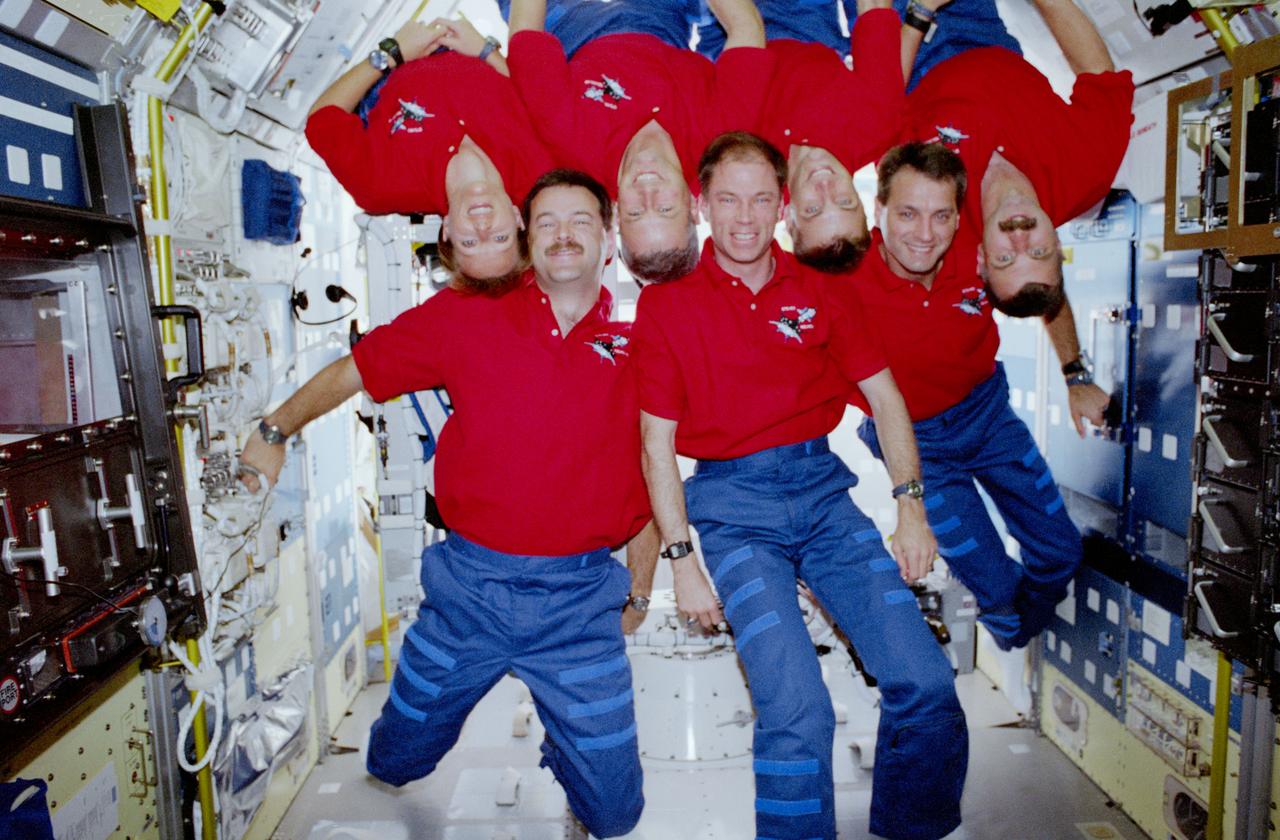
STS090-378-019 (17 April - 3 May 1998) --- The Neurolab crew takes advantage of the weightlessness in the Spacelab Science Module to add a unique twist to one of their traditional in-flight space portraits. From the left (with feet toward the floor) are Scott D. Altman, pilot; Richard A. Searfoss, mission commander; and Richard M. Linnehan, payload commander. Others, from the left, are Kathryn P. Hire, mission specialist; Jay C. Buckey, Jr. and James A. (Jim) Pawelczyk, both payload specialists; and Dafydd R. (Dave) Williams, mission specialist representing the Canadian Space Agency (CSA).
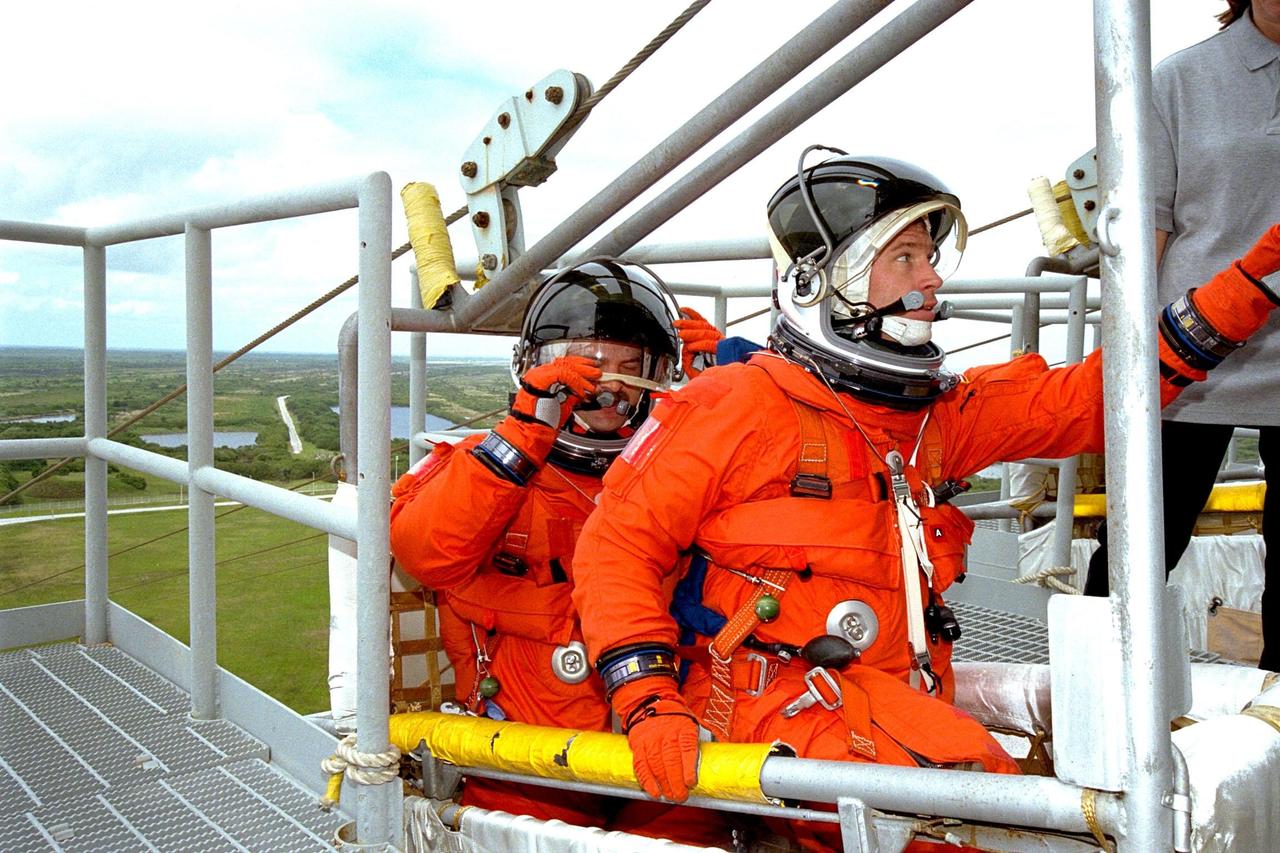
Members of the STS-90 crew participate in mock emergency egress activities during the Terminal Countdown Demonstration Test (TCDT) at KSC's Launch Pad 39B. The TCDT is held at KSC prior to each Space Shuttle flight to provide crews with the opportunity to participate in simulated countdown activities. The STS-90 crew members shown here are Commander Richard Searfoss (front) and Pilot Scott Altman. Columbia is targeted for launch of STS-90 on April 16 at 2:19 p.m. EDT and will be the second mission of 1998. The mission is scheduled to last nearly 17 days
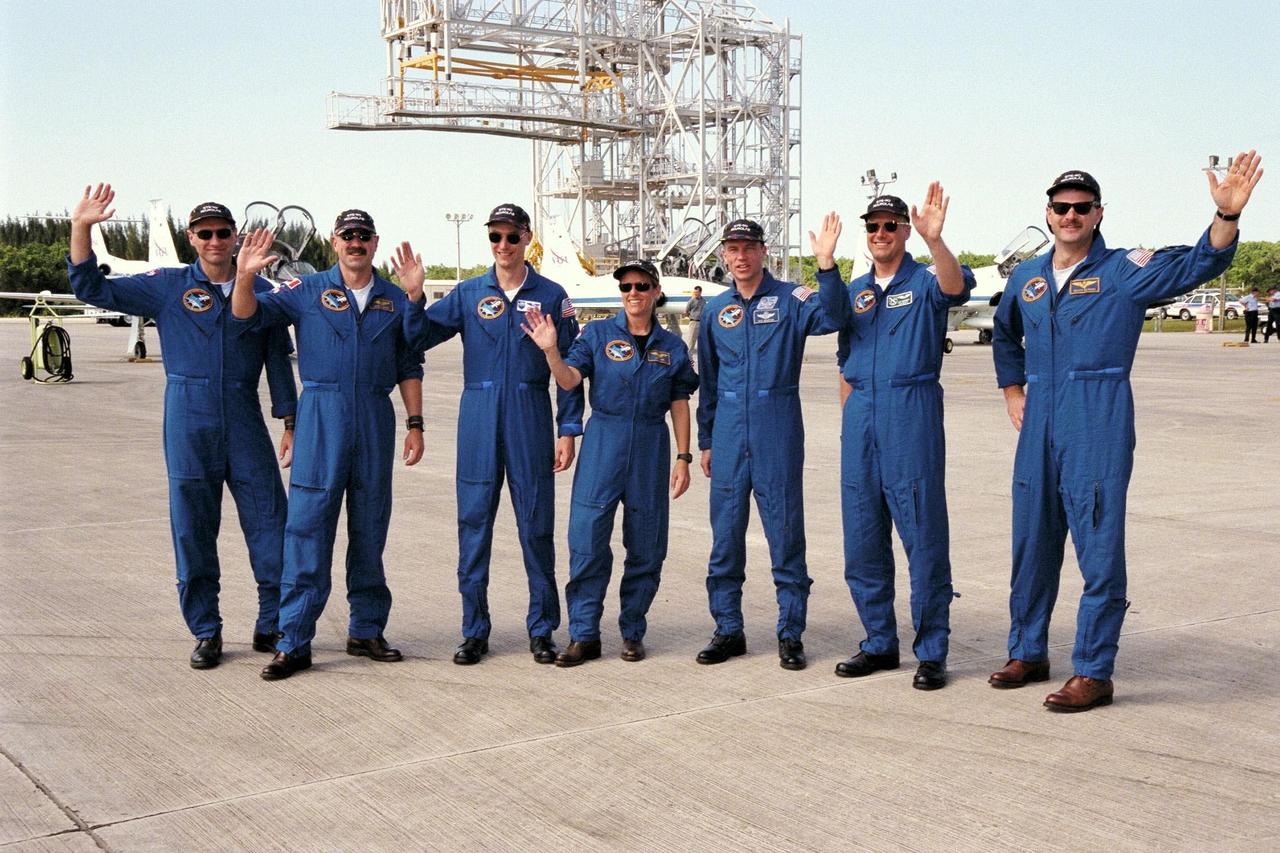
KENNEDY SPACE CENTER, FLA. -- The STS-90 crew arrive at Kennedy Space Center's Shuttle Landing Facility in preparation for the launch of Columbia on April 16 at 2:19 p.m. EDT from KSC's Launch Pad 39B. The crew of STS-90 are, left to right, Mission Specialist Richard Linnehan, D.V.M.; Mission Specialist Dafydd (Dave) Williams with the Canadian Space Agency; Payload Specialist James Pawelczyk, Ph.D.; Mission Specialist Kathryn (Kay) Hire; Commander Richard Searfoss; Payload Specialist Jay Buckey, M.D.; and Pilot Scott Altman. STS-90, which will be the second mission of 1998, is scheduled to last nearly 17 days
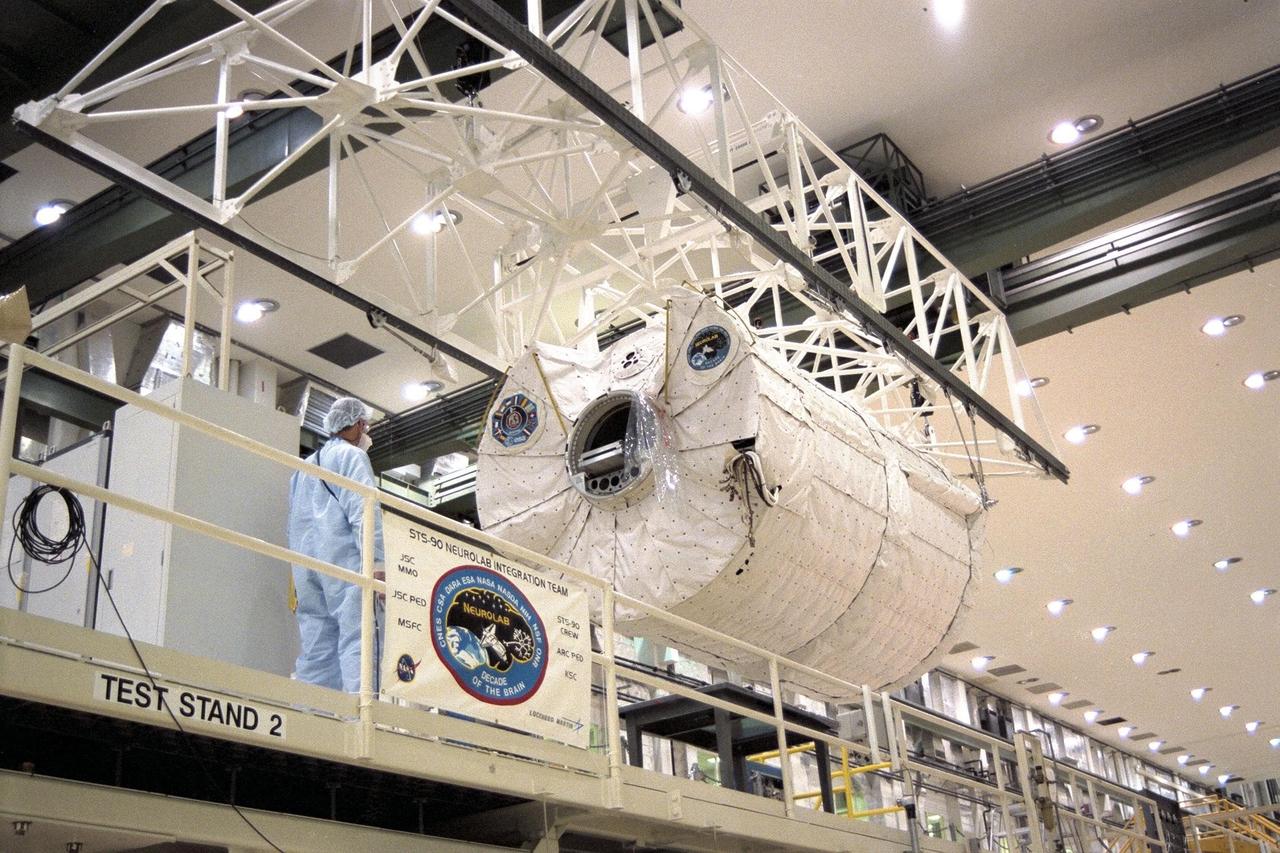
KENNEDY SPACE CENTER, FLA. -- A technician looks at the STS-90 Neurolab payload as it is moved from its test stand in KSC's Operations and Checkout Building. Investigations during the Neurolab mission will focus on the effects of microgravity on the nervous system. Specifically, experiments will study the adaptation of the vestibular system, the central nervous system, and the pathways that control the ability to sense location in the absence of gravity, as well as the effect of microgravity on a developing nervous system. The crew of STS-90, slated for launch in April, will include Commander Richard Searfoss, Pilot Scott Altman, Mission Specialists Richard Linnehan, Dafydd (Dave) Williams, M.D., and Kathryn (Kay) Hire, and Payload Specialists Jay Buckey, M.D., and James Pawelczyk, Ph.D
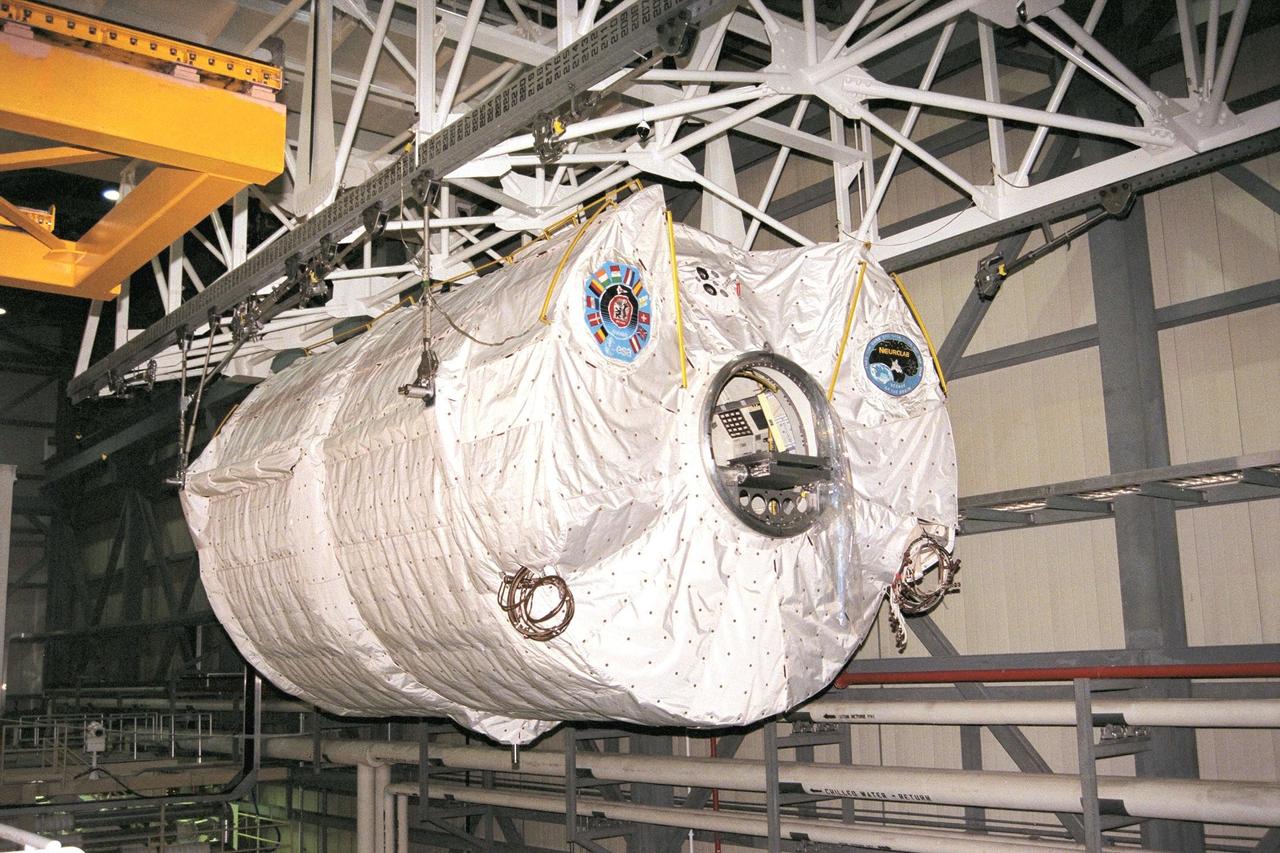
The STS-90 Neurolab payload is prepared to be positioned into the cargo bay of Space Shuttle Columbia today in Orbiter Processing Facility bay 3. Investigations during the Neurolab mission will focus on the effects of microgravity on the nervous system. Specifically, experiments will study the adaptation of the vestibular system, the central nervous system, and the pathways that control the ability to sense location in the absence of gravity, as well as the effect of microgravity on a developing nervous system. The crew of STS-90, slated for launch in April, will include Commander Richard Searfoss, Pilot Scott Altman, Mission Specialists Richard Linnehan, Dafydd (Dave) Williams, M.D., and Kathryn (Kay) Hire, and Payload Specialists Jay Buckey, M.D., and James Pawelczyk, Ph.D
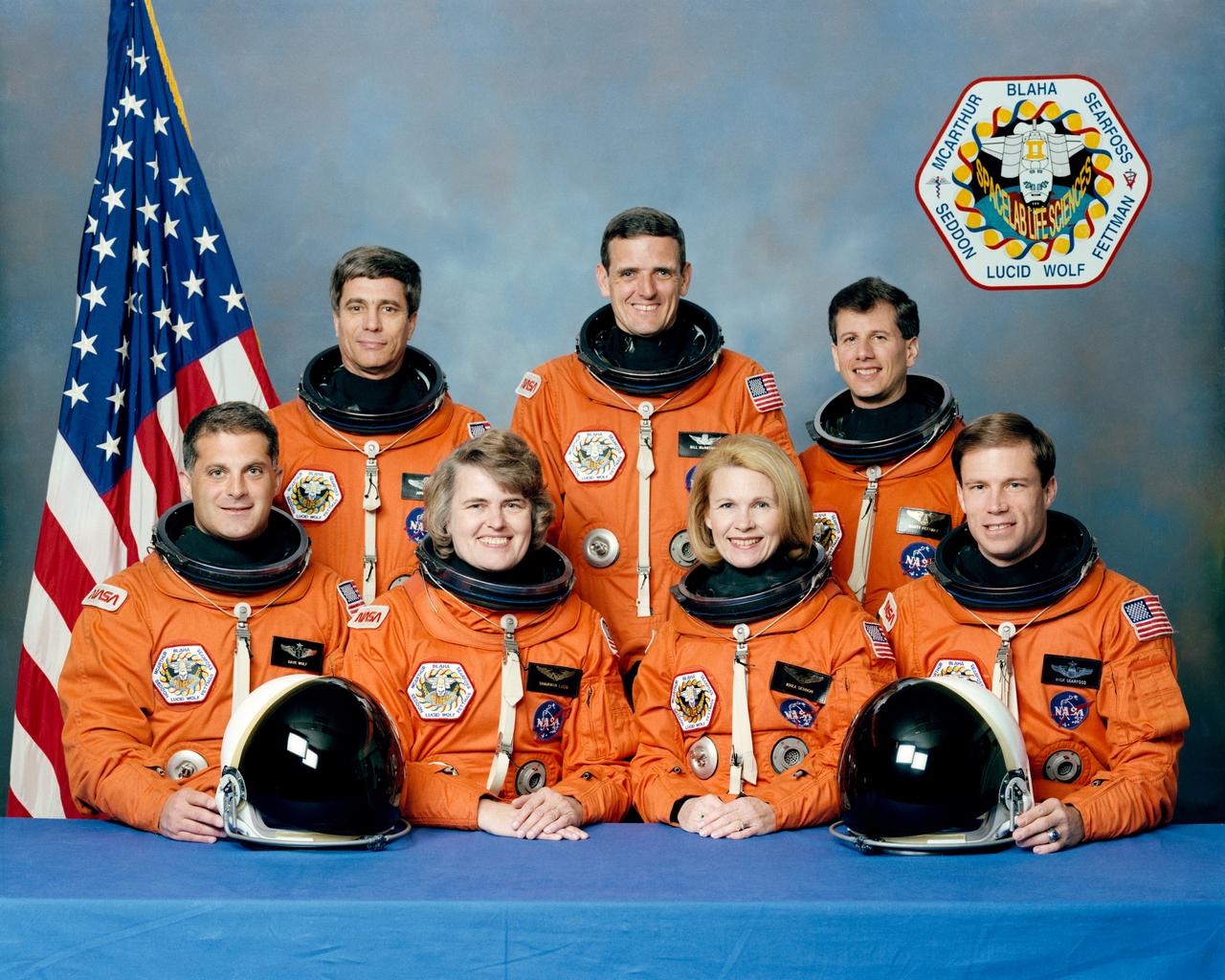
STS058-S-002 (May 1993) --- Wearing training versions of their launch and entry garments, the seven crew members assigned to the Spacelab Life Sciences (SLS-2) mission are pictured in the traditional pre-flight crew portrait. Left to right (front) are David A. Wolf, and Shannon W. Lucid, both mission specialists; Rhea Seddon, payload commander; and Richard A. Searfoss, pilot. Left to right (rear) are John E. Blaha, mission commander; William S. McArthur Jr., mission specialist; and payload specialist Martin J. Fettman, DVM.
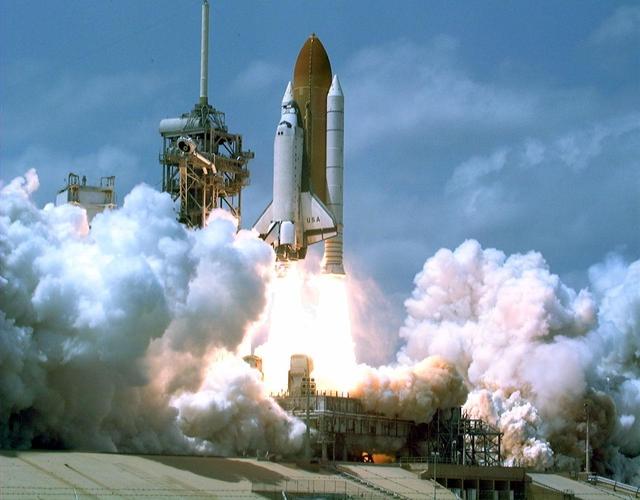
The Space Shuttle Columbia soars from Launch Pad 39B at 2:19 p.m. EDT Apr. 17 to begin the nearly 17-day STS-90 Neurolab mission. The launch was delayed 24 hours due to difficulty with a network signal processor, which was replaced Apr. 16, on the orbiter. The crew members are Commander Richard Searfoss, Pilot Scott Altman, Mission Specialists Richard Linnehan, D.V.M., Dafydd (Dave) Williams, M.D., with the Canadian Space Agency, and Kathryn (Kay) Hire; and Payload Specialists Jay Buckey, M.D., and James Pawelczyk, Ph.D. Investigations during the Neurolab mission will focus on the effects of microgravity on the nervous system
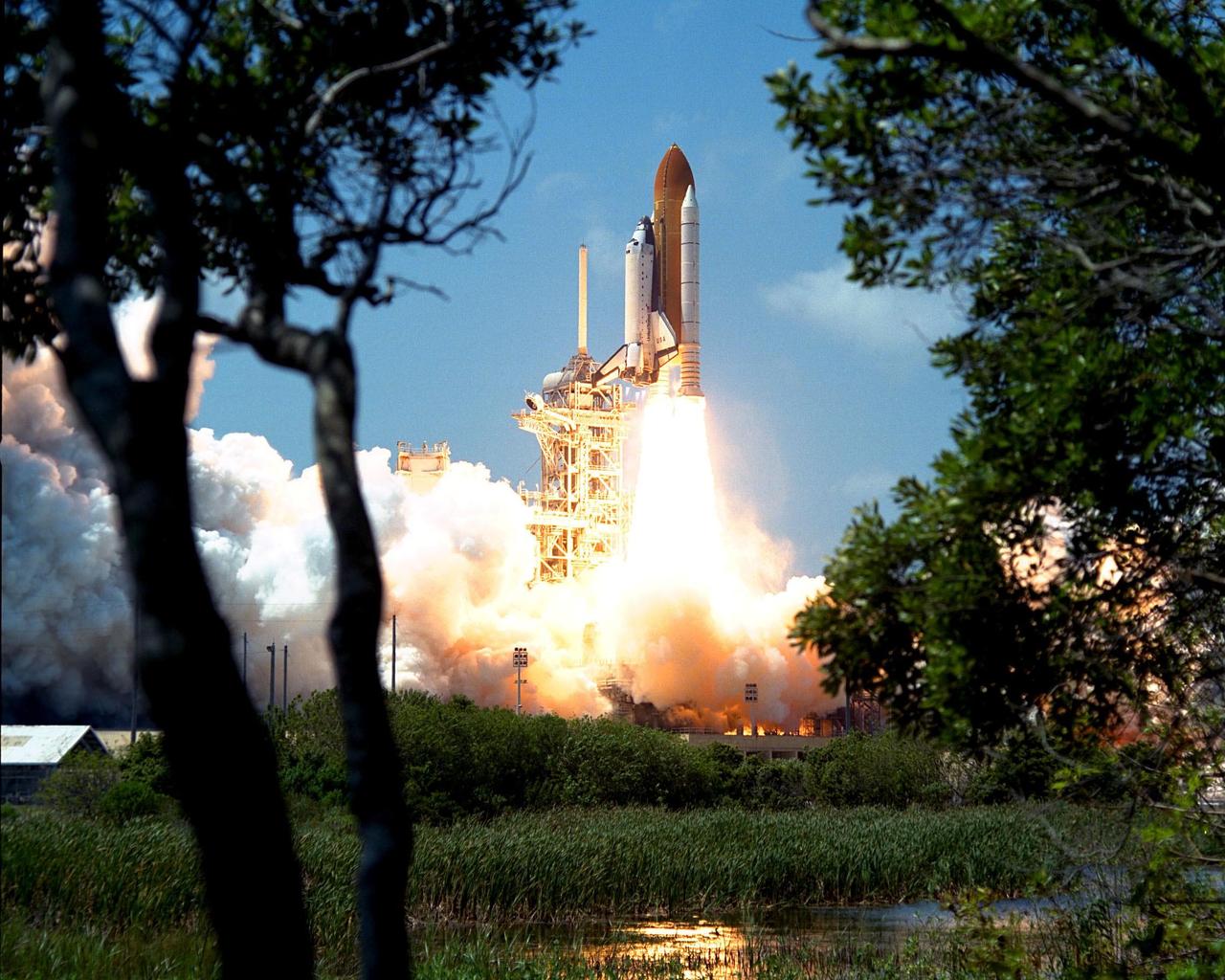
Framed by native Floridian foliage, the Space Shuttle Columbia soars from Launch Pad 39B at 2:19 p.m. EDT Apr. 17 to begin the nearly 17-day STS-90 Neurolab mission. The launch was delayed 24 hours due to difficulty with a network signal processor, which was replaced Apr. 16, on the orbiter. The crew members are Commander Richard Searfoss, Pilot Scott Altman, Mission Specialists Richard Linnehan, D.V.M., Dafydd (Dave) Williams, M.D., with the Canadian Space Agency, and Kathryn (Kay) Hire; and Payload Specialists Jay Buckey, M.D., and James Pawelczyk, Ph.D. Investigations during the Neurolab mission will focus on the effects of microgravity on the nervous system
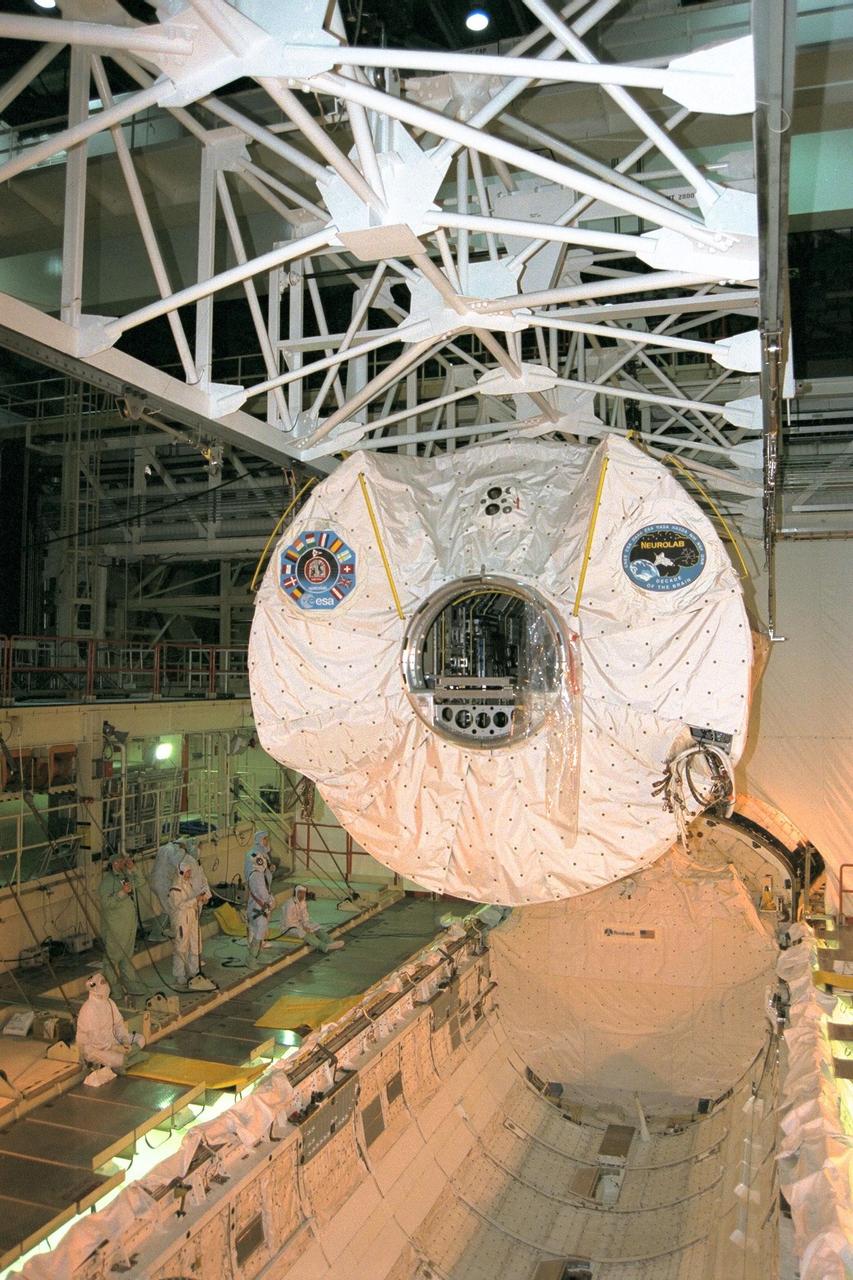
The STS-90 Neurolab payload is lowered into position into the cargo bay of Space Shuttle Columbia today in Orbiter Processing Facility bay 3. Investigations during the Neurolab mission will focus on the effects of microgravity on the nervous system. Specifically, experiments will study the adaptation of the vestibular system, the central nervous system, and the pathways that control the ability to sense location in the absence of gravity, as well as the effect of microgravity on a developing nervous system. The crew of STS-90, slated for launch in April, will include Commander Richard Searfoss, Pilot Scott Altman, Mission Specialists Richard Linnehan, Dafydd (Dave) Williams, M.D., and Kathryn (Kay) Hire, and Payload Specialists Jay Buckey, M.D., and James Pawelczyk, Ph.D
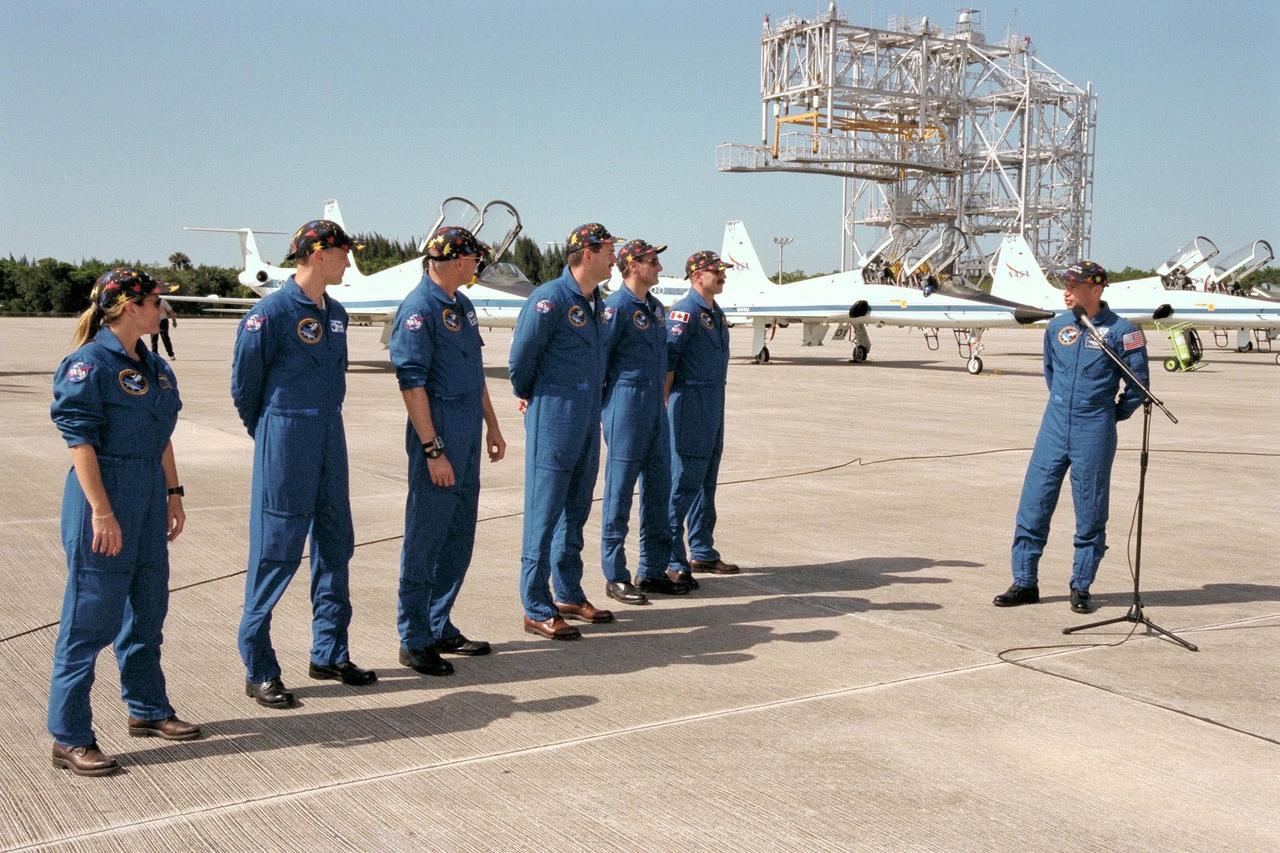
KENNEDY SPACE CENTER, FLA. -- The STS-90 crew arrive at Kennedy Space Center's Shuttle Landing Facility in preparation for the launch of Columbia on April 16 at 2:19 p.m. EDT from KSC's Launch Pad 39B. The crew of STS-90 are, left to right, Mission Specialist Kathryn (Kay) Hire; Payload Specialist James Pawelczyk, Ph.D.; Payload Specialist Jay Buckey, M.D.; Pilot Scott Altman; Mission Specialist Richard Linnehan, D.V.M.; Mission Specialist Dafydd (Dave) Williams with the Canadian Space Agency; and Commander Richard Searfoss. STS-90, which will be the second mission of 1998, is scheduled to last nearly 17 days
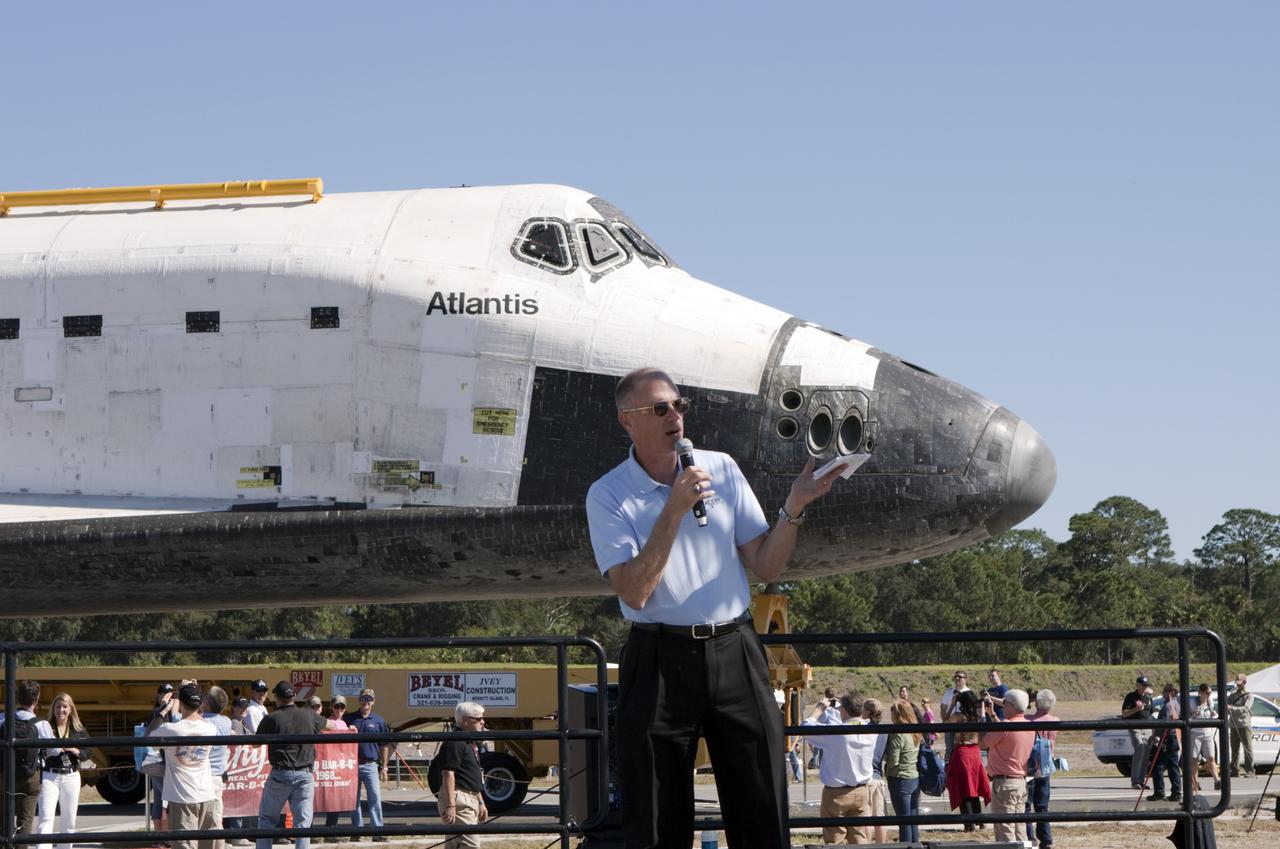
CAPE CANAVERAL, Fla. – Former space shuttle astronaut Rick Searfoss, now representing XCOR Aerospace, speaks to guests at Space Florida's Exploration Park where the space shuttle Atlantis pauses during its 10-mile journey to the Kennedy Visitor Complex. As part of transition and retirement of the Space Shuttle Program, Atlantis is to be displayed at Kennedy's visitor complex beginning in the summer of 2013. Over the course of its 26-year career, Atlantis traveled 125,935,769 miles during 307 days in space over 33 missions. For more information, visit http://www.nasa.gov/transition. Photo credit: NASA/Jim Grossmann
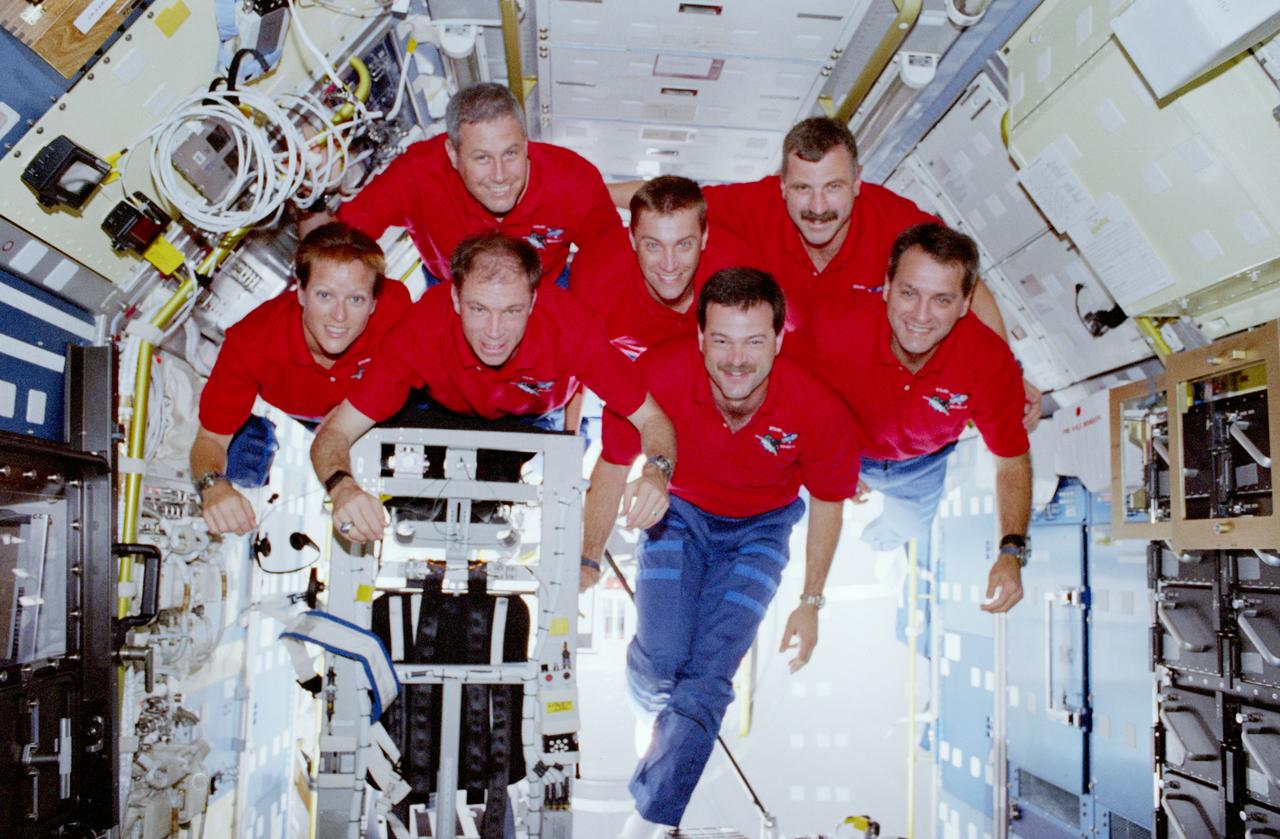
STS090-378-022 (17 April - 3 May 1998) --- During a change of shift for Neurolab duty, the crew floats as a unit onboard the Spacelab Science Module on the Space Shuttle Columbia. From the left are Kathryn P. Hire, mission specialist; Jay C. Buckey, Jr. (top), payload specialist; Richard A. Searfoss, mission commander; James A. (Jim) Pawelczyk, payload specialist; Scott D. Altman, pilot; Dafydd R. (Dave) Williams, mission specialist (top); and Richard M. Linnehan, payload commander. Williams represents the Canadian Space Agency (CSA).
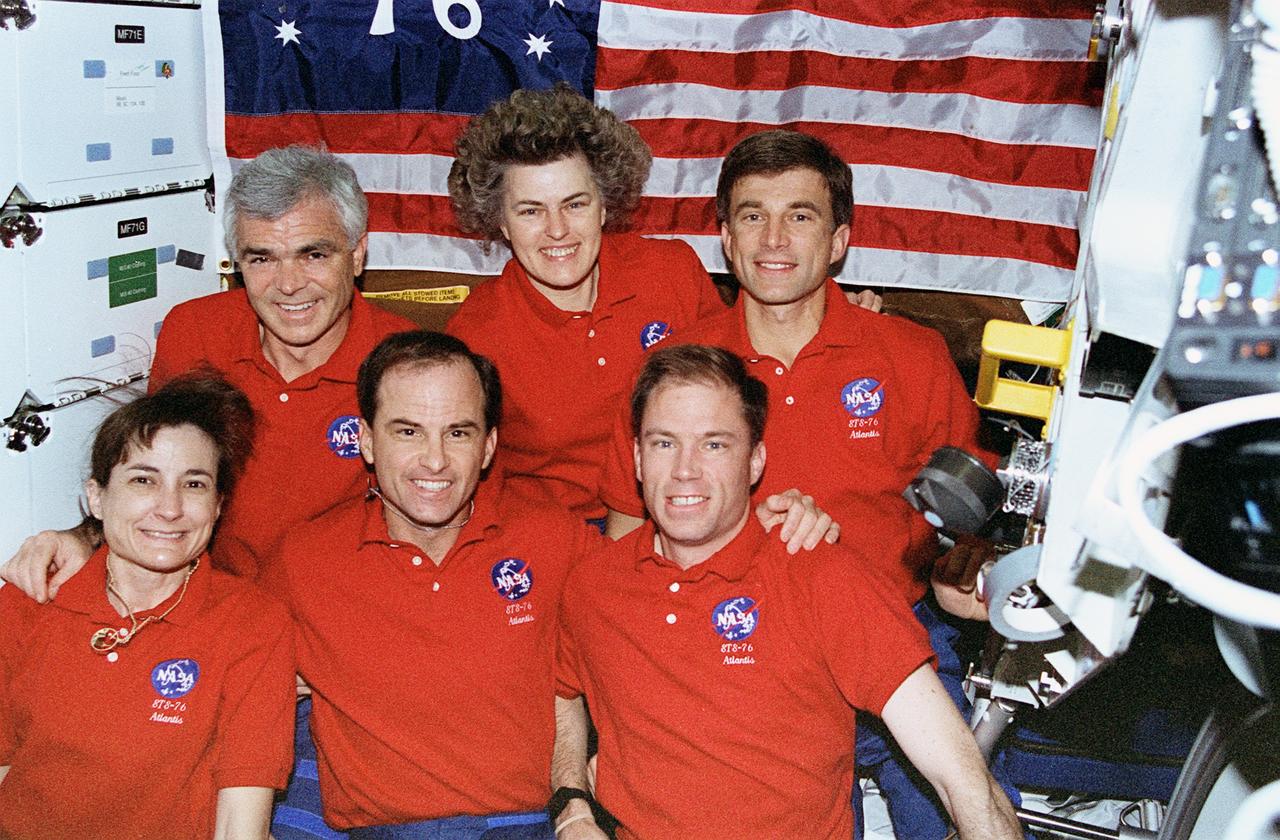
STS076-371-002 (25 March 1996) --- The crew of the Space Shuttle Atlantis poses for a traditional inflight portrait on the mid deck. Shannon W. Lucid (rear center) later joined the Mir-21 crew to begin the first leg of her five-month stay aboard Russia's Mir Space Station. From the left on front row are astronauts Linda M. Godwin, mission specialist; Kevin P. Chilton, mission commander; and Richard A. Searfoss, pilot. Left to right on the back row are astronauts Michael R. (Rich) Clifford, Lucid and payload commander Ronald M. Sega, all mission specialists.
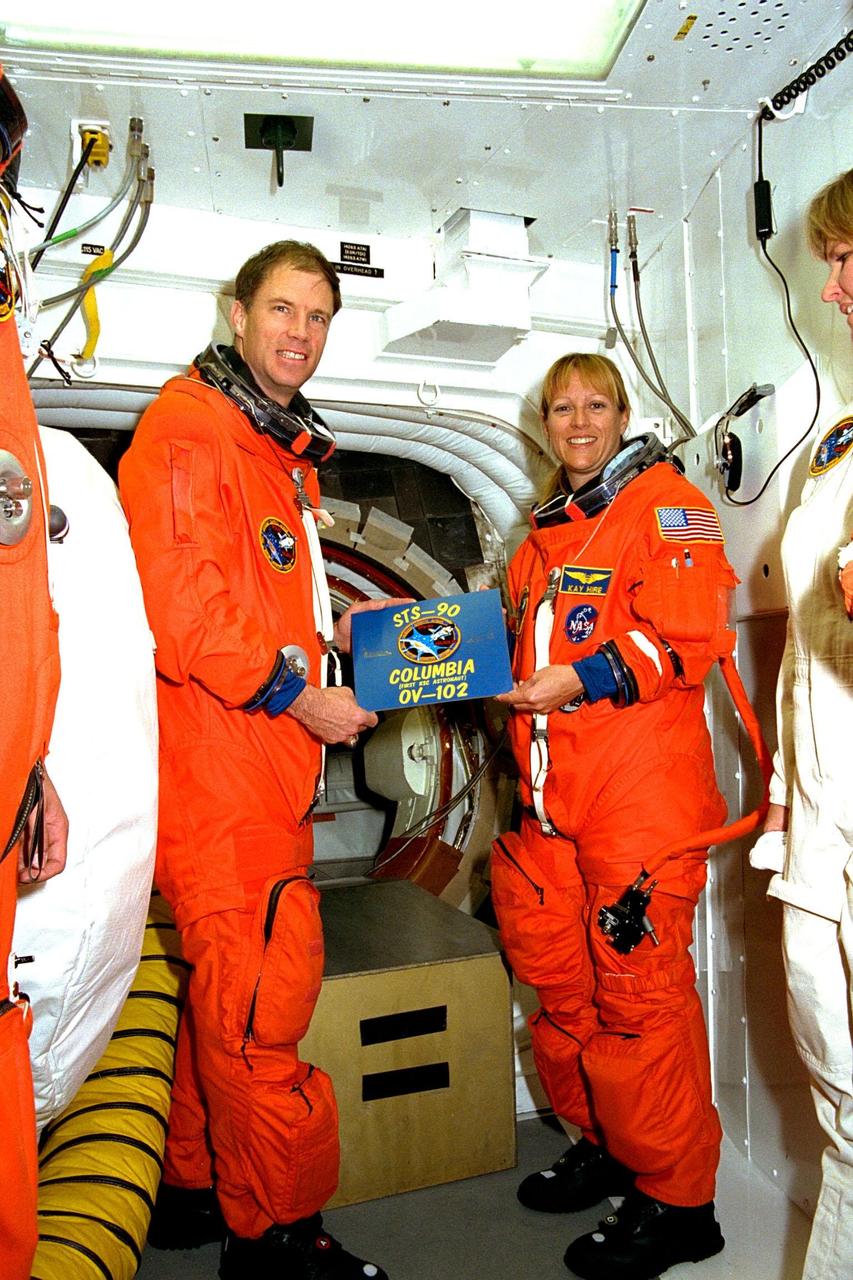
The crew of STS-90 participate in Terminal Countdown Demonstration Test (TCDT) activities at KSC's Launch Pad 39B. The TCDT is held at KSC prior to each Space Shuttle flight to provide crews with the opportunity to participate in simulated countdown activities. Here, STS-90 Commander Richard Searfoss and Mission Specialist Kathryn (Kay) Hire hold the mission patch with orbiter information. Columbia is targeted for launch of STS-90 on April 16 at 2:19 p.m. EDT and will be the second mission of 1998. The mission is scheduled to last nearly 17 days

The Space Shuttle Columbia soars from Launch Pad 39B at 2:19 p.m. EDT Apr. 17 to begin the nearly 17-day STS-90 Neurolab mission. The launch was delayed 24 hours due to difficulty with a network signal processor, which was replaced Apr. 16, on the orbiter. The crew members are Commander Richard Searfoss, Pilot Scott Altman, Mission Specialists Richard Linnehan, D.V.M., Dafydd (Dave) Williams, M.D., with the Canadian Space Agency, and Kathryn (Kay) Hire; and Payload Specialists Jay Buckey, M.D., and James Pawelczyk, Ph.D. Investigations during the Neurolab mission will focus on the effects of microgravity on the nervous system
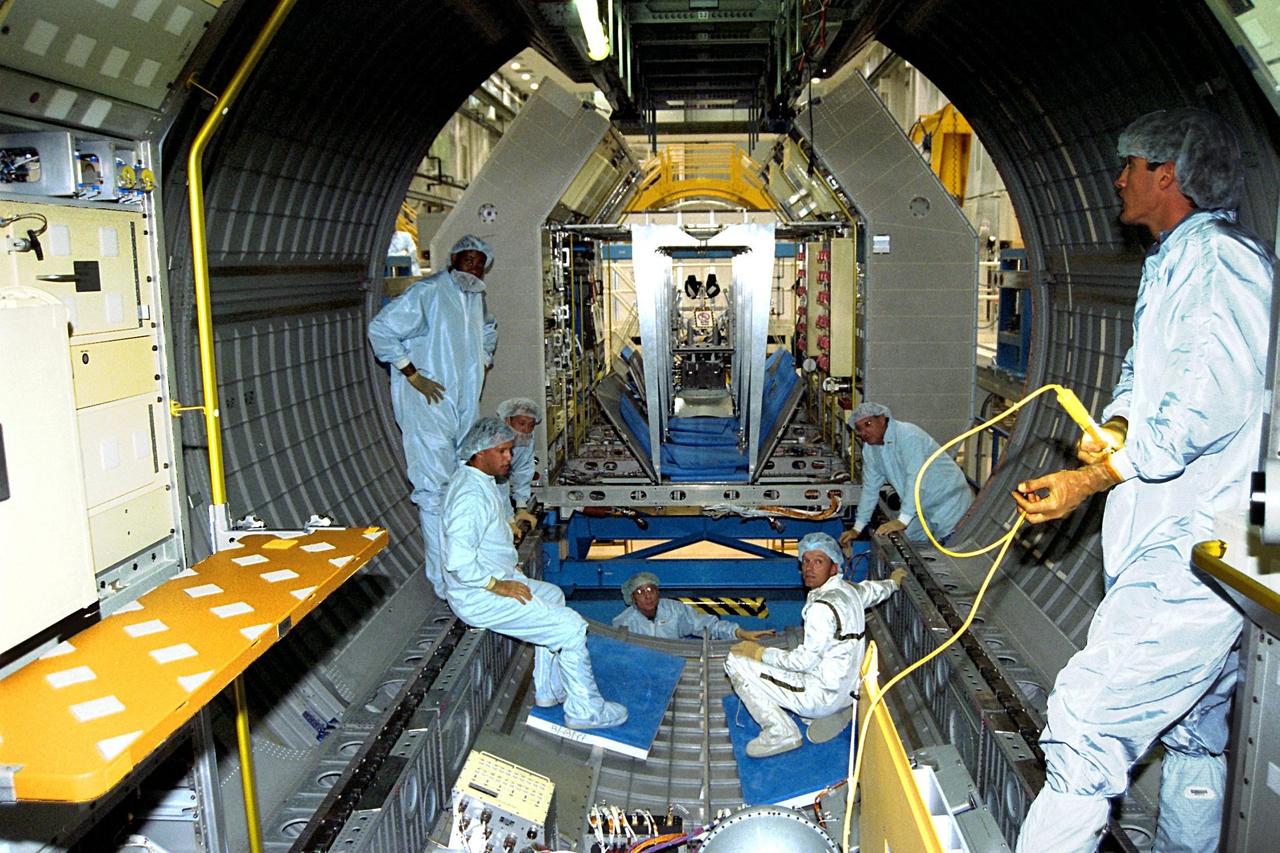
The Neurolab payload for STS-90, scheduled to launch aboard the Shuttle Columbia from Kennedy Space Center (KSC) on April 2, 1998, is installed in the Spacelab module by Boeing technicians in the Operations and Checkout Building at KSC. Investigations during the Neurolab mission will focus on the effects of microgravity on the nervous system. Specifically, experiments will study the adaptation of the vestibular system, the central nervous system, and the pathways that control the ability to sense location in the absence of gravity, as well as the effect of microgravity on a developing nervous system. The crew of STS-90 will include Commander Richard Searfoss, Pilot Scott Altman, Mission Specialists Richard Linnehan, Dafydd (Dave) Williams, M.D., and Kathryn (Kay) Hire, and Payload Specialists Jay Buckey, M.D., and James Pawelczyk, Ph.D

The crew of STS-90 pose in the white room at KSC's Launch Pad 39B, where they are participating in Terminal Countdown Demonstration Test (TCDT) activities. The TCDT is held at KSC prior to each Space Shuttle flight to provide crews with the opportunity to participate in simulated countdown activities. The crew include, left to right, Commander Richard Searfoss, Pilot Scott Altman, Mission Specialist Kathryn (Kay) Hire, Richard Linnehan, D.V.M., Payload Specialists James Pawelczyk, Ph.D., and Jay Buckey, M.D., and Mission Specialist Dafydd (Dave) Williams, M.D., with the Canadian Space Agency. Columbia is targeted for launch of STS-90 on April 16 at 2:19 p.m. EDT and will be the second mission of 1998. The mission is scheduled to last nearly 17 days
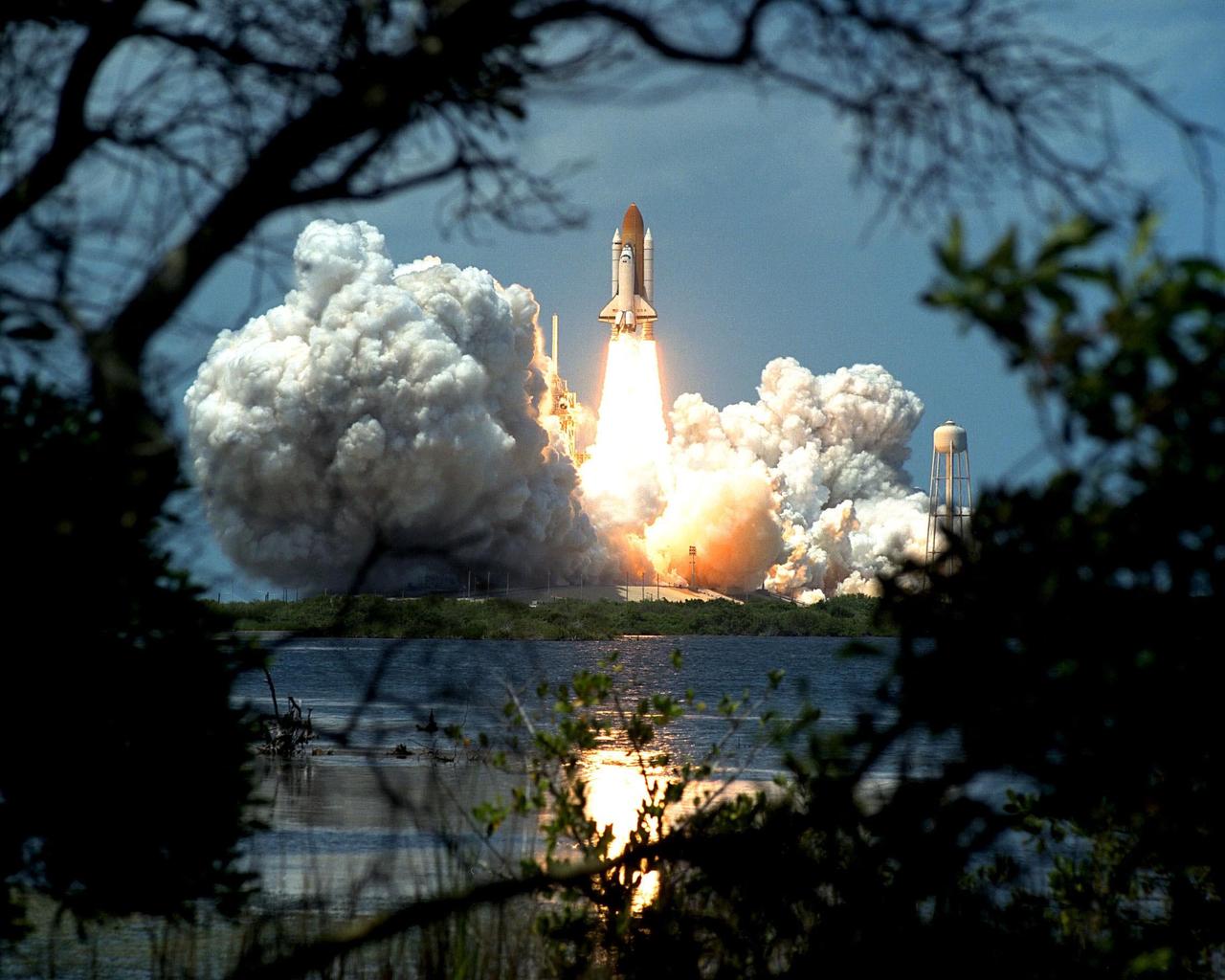
KENNEDY SPACE CENTER, FLA. -- Framed by native Floridian foliage, the Space Shuttle Columbia soars from Launch Pad 39B at 2:19 p.m. EDT Apr. 17 to begin the nearly 17-day STS-90 Neurolab mission. The launch was delayed 24 hours due to difficulty with a network signal processor, which was replaced Apr. 16, on the orbiter. The crew members are Commander Richard Searfoss, Pilot Scott Altman, Mission Specialists Richard Linnehan, D.V.M., Dafydd (Dave) Williams, M.D., with the Canadian Space Agency, and Kathryn (Kay) Hire; and Payload Specialists Jay Buckey, M.D., and James Pawelczyk, Ph.D. Investigations during the Neurolab mission will focus on the effects of microgravity on the nervous system

NM21-401-012 (28 March 1996) --- The Space Shuttle Atlantis is backdropped over the darkness of space, and partially over clouds and open ocean waters on Earth, as it and Russia’s Mir Space Station begin their relative separation following several days of joint operations. This 35mm film was exposed by astronaut Shannon W. Lucid as she was beginning her record-setting stay aboard Mir, as a cosmonaut guest researcher. Onboard with Lucid were her Mir-21 crew mates, cosmonauts Yuriy I. Onufriyenko, commander; and Yuriy V. Usachov, flight engineer. Onboard Atlantis were Kevin P. Chilton, STS-76 mission commander; Richard A. Searfoss, pilot; along with Linda M. Godwin, Ronald M. Sega and Michael R. (Rich) Clifford, mission specialists.
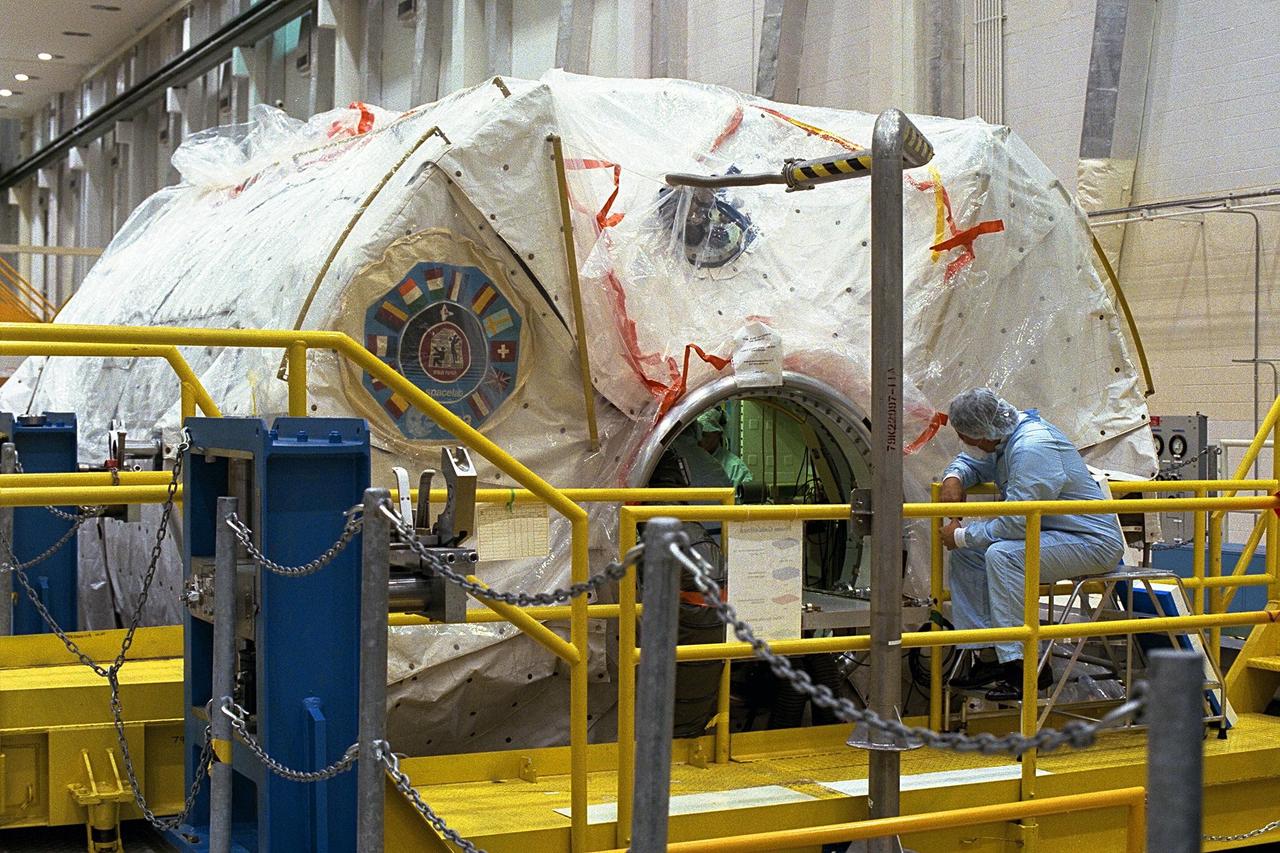
The Neurolab payload for STS-90, scheduled to launch aboard the Shuttle Columbia from Kennedy Space Center (KSC) on April 2, 1998, undergoes further processing in the Operations and Checkout Building at KSC. Investigations during the Neurolab mission will focus on the effects of microgravity on the nervous system. Specifically, experiments will study the adaptation of the vestibular system, the central nervous system, and the pathways that control the ability to sense location in the absence of gravity, as well as the effect of microgravity on a developing nervous system. The crew of STS-90 will include Commander Richard Searfoss, Pilot Scott Altman, Mission Specialists Richard Linnehan, Dafydd (Dave) Williams, M.D., and Kathryn (Kay) Hire, and Payload Specialists Jay Buckey, M.D., and James Pawelczyk, Ph.D
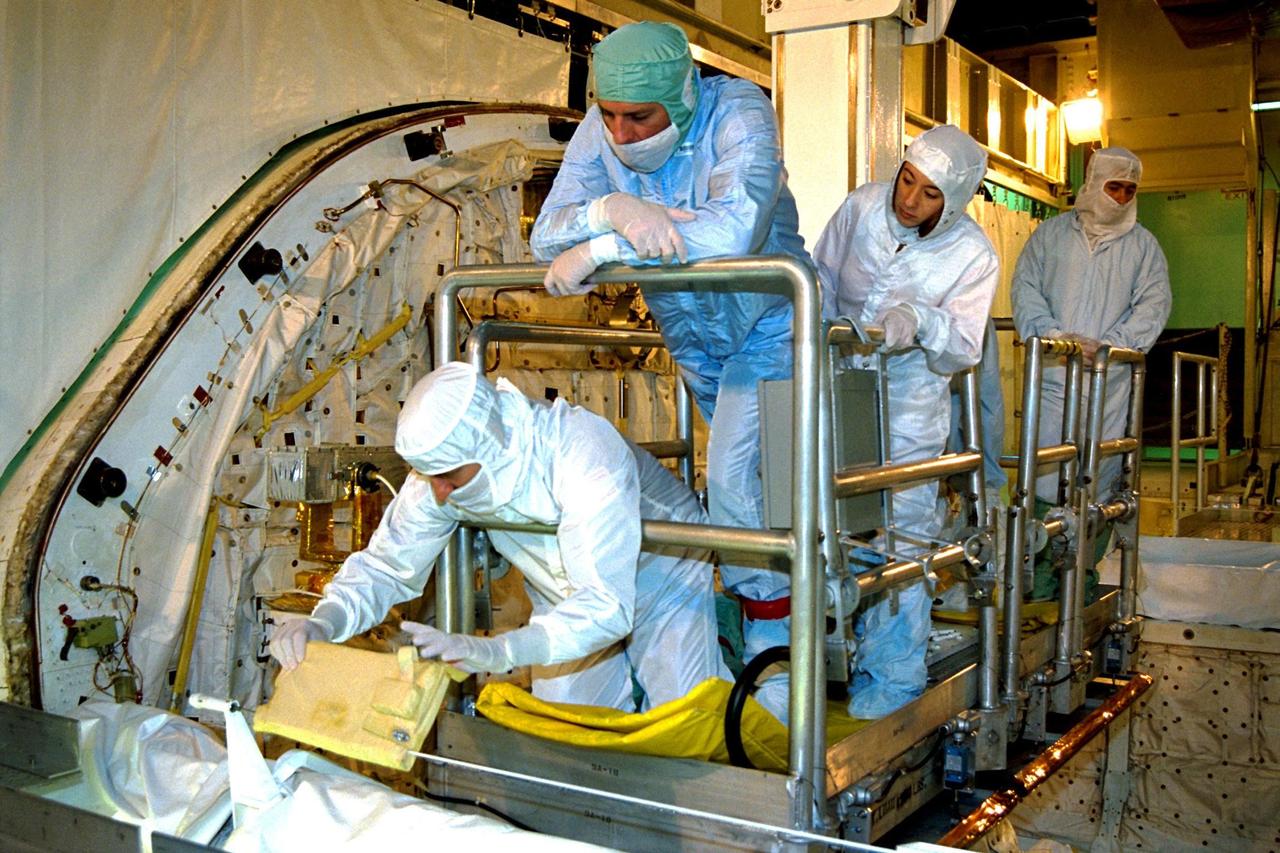
Members of the STS-90 crew participate in the Crew Equipment Interface Test (CEIT) in Kennedy Space Center's Orbiter Processing Facility Bay 3. The CEIT gives astronauts an opportunity to get a hands-on look at the payloads with which they will be working on-orbit. Investigations during the STS-90 Neurolab mission will focus on the effects of microgravity on the nervous system. Specifically, experiments will study the adaptation of the vestibular system, the central nervous system, and the pathways that control the ability to sense location in the absence of gravity, as well as the effect of microgravity on a developing nervous system. The crew of STS-90, slated for launch in April, will include Commander Richard Searfoss, Pilot Scott Altman, Mission Specialists Richard Linnehan, Dafydd (Dave) Williams, M.D., and Kathryn (Kay) Hire, and Payload Specialists Jay Buckey, M.D., and James Pawelczyk, Ph.D
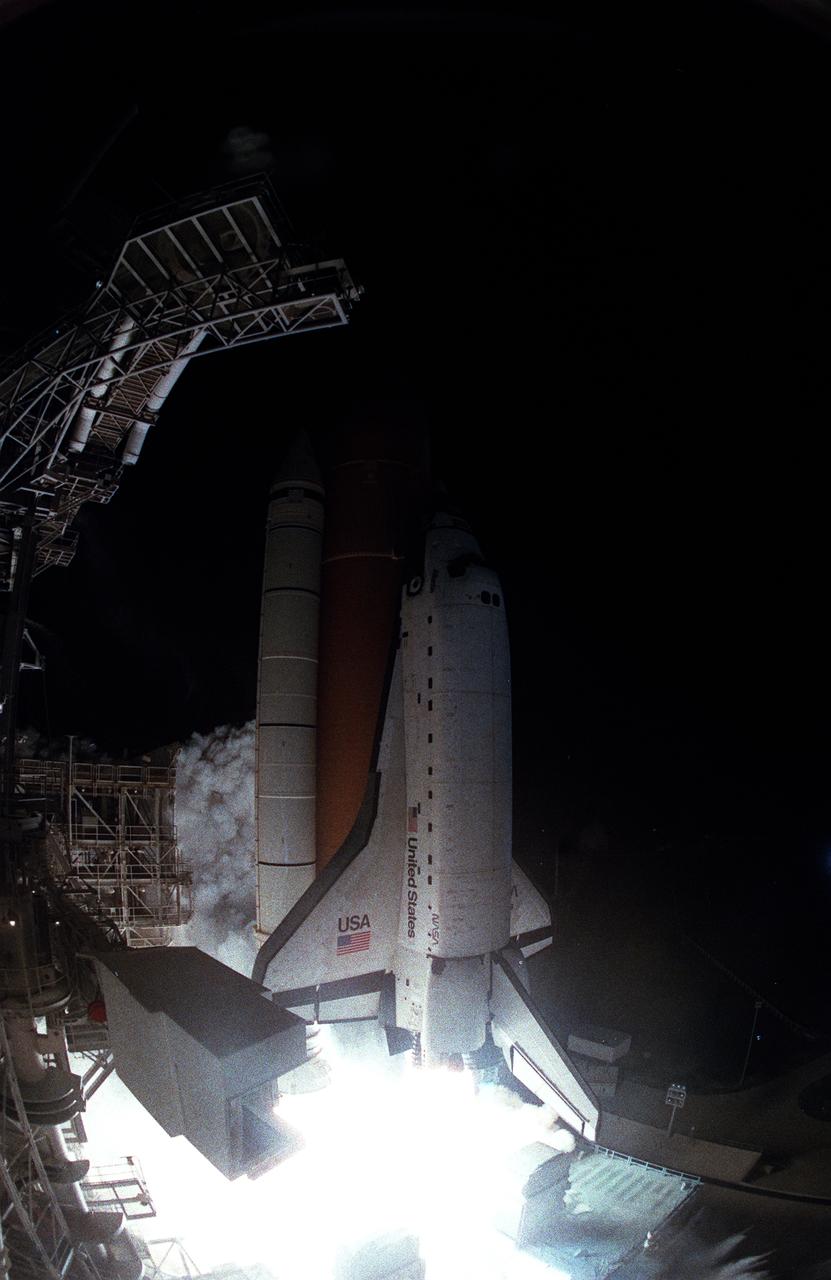
STS076-S-008 (22 March 1996) --- As represented in this fish-eye view from the Kennedy Space Center's (KSC) Launch Pad 39B, the space shuttle Atlantis heads toward Earth-orbit and an eventual docking with Russia's Mir Space Station. Mir has been in space for ten years and a two man crew (Mir-21) currently awaits the arrival of Atlantis. The on-time launch occurred at 3:13:04 a.m. (EST) on March 22, 1996. Onboard for STS-76 are astronauts Kevin P. Chilton, Richard A. Searfoss, Ronald M. Sega, Michael R. (Rich) Clifford, Linda M. Godwin and Shannon W. Lucid. Lucid will remain onboard Mir for just under five months time. Photo credit: NASA or National Aeronautics and Space Administration
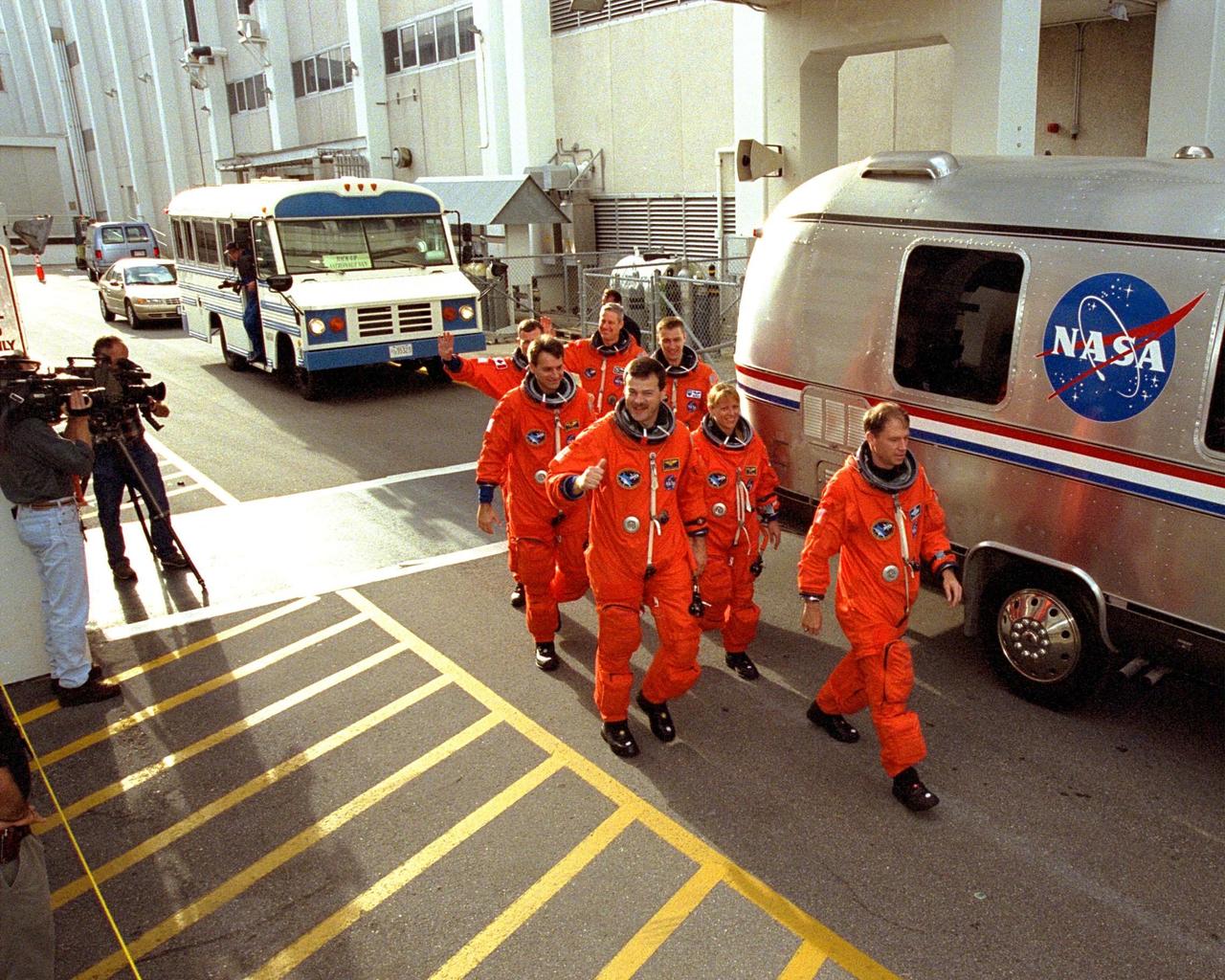
The crew of STS-90 leave the Operations and Checkout Building for Launch Pad 39B during Terminal Countdown Demonstration Test (TCDT) activities. The TCDT is held at KSC prior to each Space Shuttle flight to provide crews with the opportunity to participate in simulated countdown activities. The STS-90 crew members are, front to back and left to right, Commander Richard Searfoss, Pilot Scott Altman, Mission Specialist Kathryn (Kay) Hire, Mission Specialist Richard Linnehan, D.V.M., Payload Specialist James Pawelczyk, Ph.D., Mission Specialist Dafydd (Dave) Williams with the Canadian Space Agency, and Payload Specialist Jay Buckey, M.D. Columbia is targeted for launch of STS-90 on April 16 at 2:19 p.m. EDT and will be the second mission of 1998. The mission is scheduled to last nearly 17 days
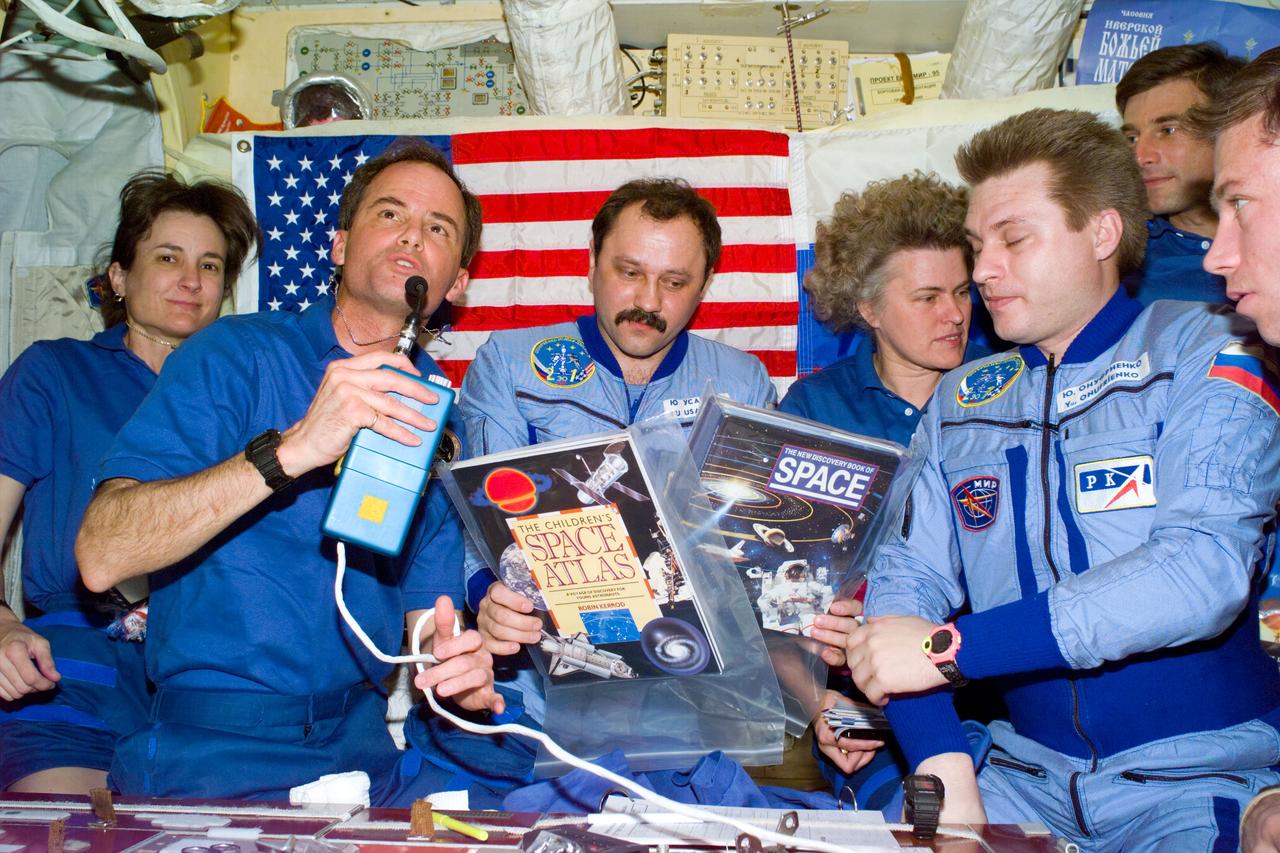
S76-E-5157 (24 March 1996) --- Two Russian cosmonauts and five of six NASA astronauts exchange gifts soon after reuniting in the Base Block Module of Russia's Mir Space Station. From the left are Linda M. Godwin, Kevin P. Chilton, Yury V. Usachev, Shannon W. Lucid, Yury I. Onufrienko, Ronald M. Sega and Richard A. Searfoss. Not pictured is astronaut Michael R. (Rich) Clifford. In a light moment around this time, ground controllers informed Chilton, the STS-76 mission commander, that Lucid, who will spend several months onboard Mir as a cosmonaut guest researcher, should now be considered a Mir-21 crew member, along with Onufrienko and Usachev, Mir-21 flight engineer. The image was recorded with a 35mm Electronic Still Camera (ESC) and downlinked at a later time to ground controllers in Houston, Texas.
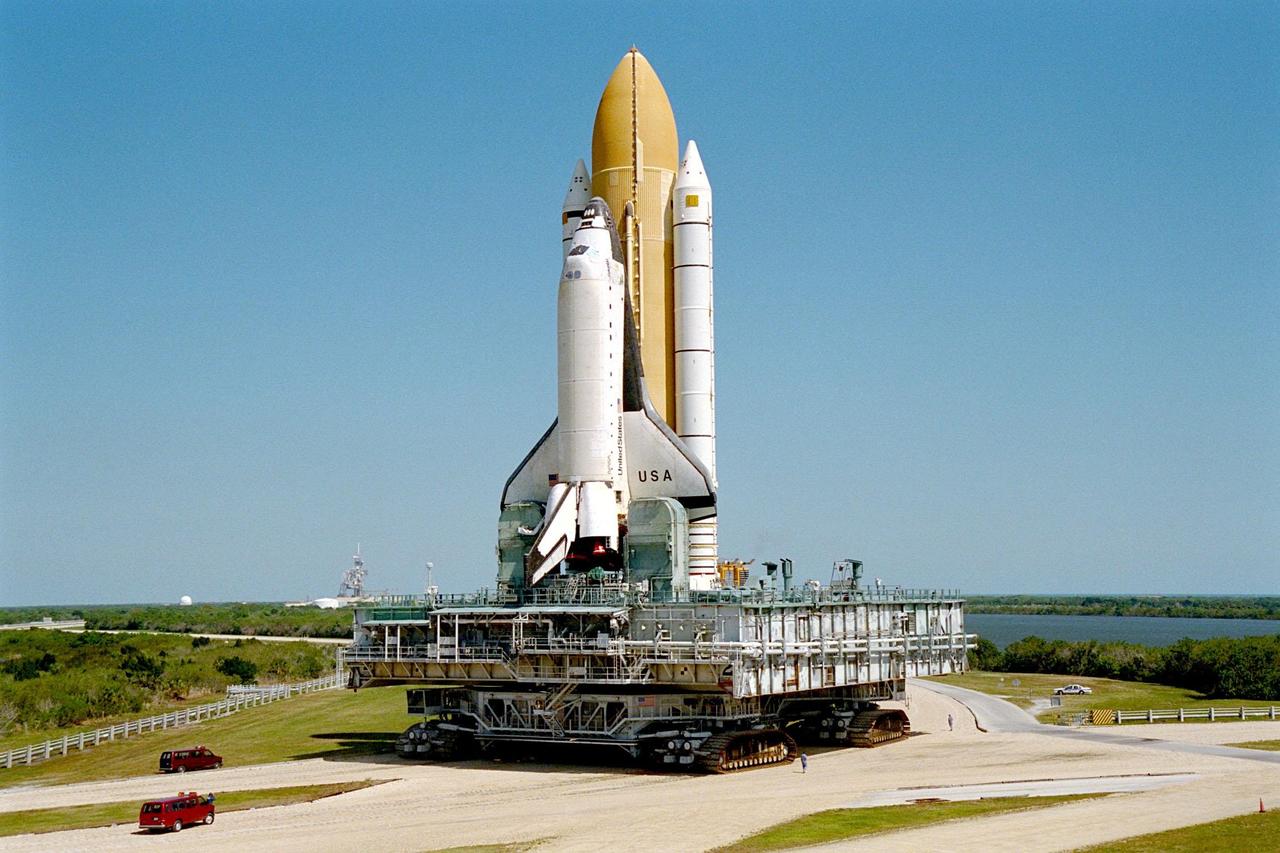
KENNEDY SPACE CENTER, FLA. -- The Space Shuttle Columbia continues its morning rollout from the Vehicle Assembly Building to Launch Pad 39B in preparation for the STS-90 mission. The Neurolab experiments are the primary payload on this nearly 17-day space flight. Investigations during the Neurolab mission will focus on the effects of microgravity on the nervous system. Specifically, experiments will study the adaptation of the vestibular system, the central nervous system, and the pathways that control the ability to sense location in the absence of gravity, as well as the effect of microgravity on a developing nervous system. The crew of STS-90, slated for launch April 16 at 2:19 p.m. EDT, includes Commander Richard Searfoss, Pilot Scott Altman, Mission Specialists Richard Linnehan, Dafydd (Dave) Williams, M.D., and Kathryn (Kay) Hire, and Payload Specialists Jay Buckey, M.D., and James Pawelczyk, Ph.D
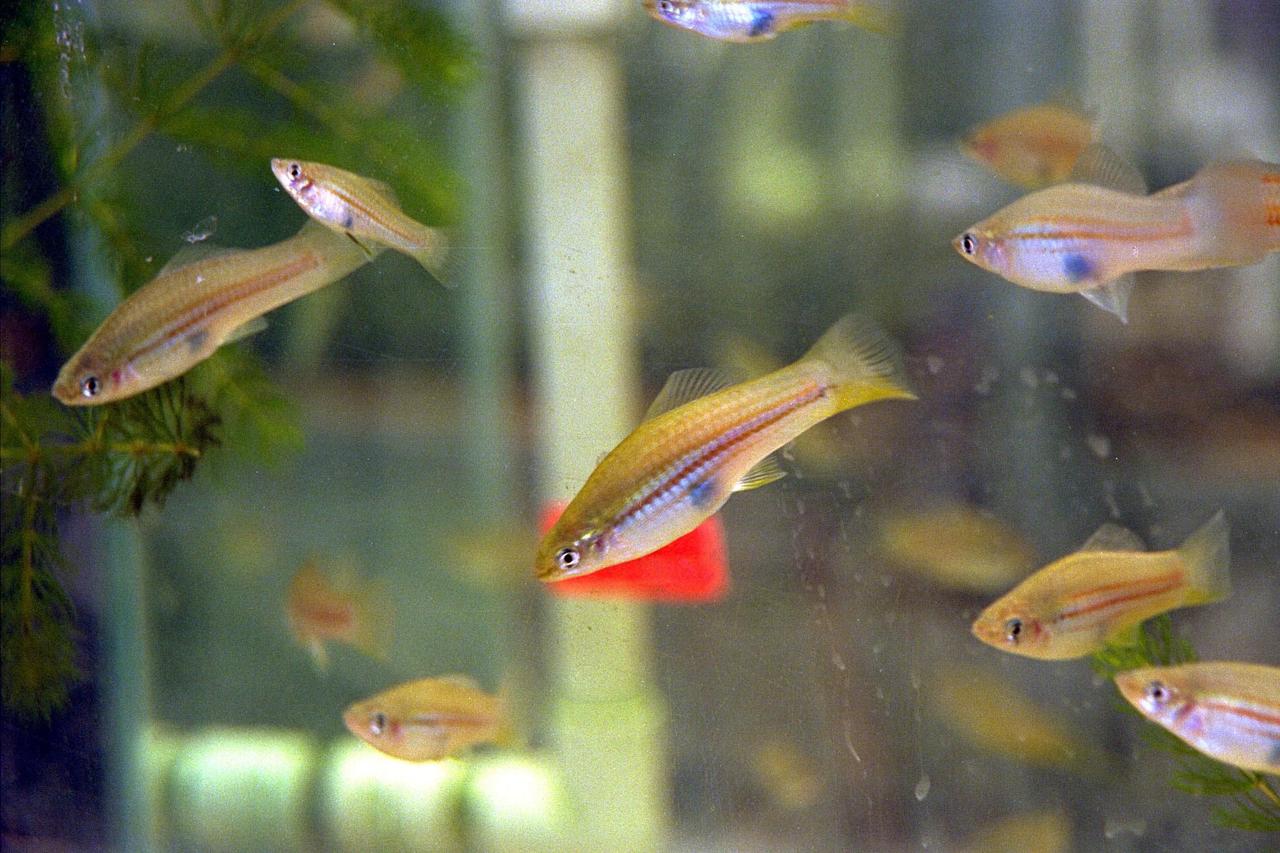
KENNEDY SPACE CENTER, FLA. -- Swordtail fish (Xiphophorus helleri), like those that are part of the Neurolab payload on Space Shuttle Mission STS-90, are shown in their holding tank in the Operations and Checkout Building. The fish will fly in the Closed Equilibrated Biological Aquatic System (CEBAS) Minimodule, a middeck locker-sized fresh water habitat, designed to allow the controlled incubation of aquatic species in a self-stabilizing, artifical ecosystem for up to three weeks under space conditions. Investigations during the Neurolab mission will focus on the effects of microgravity on the nervous system. The crew of STS-90, slated for launch April 16 at 2:19 p.m. EDT, include Commander Richard Searfoss, Pilot Scott Altman, Mission Specialists Richard Linnehan, D.V.M., Dafydd (Dave) Williams, M.D., and Kathryn (Kay) Hire, and Payload Specialists Jay Buckey, M.D., and James Pawelczyk, Ph.D.
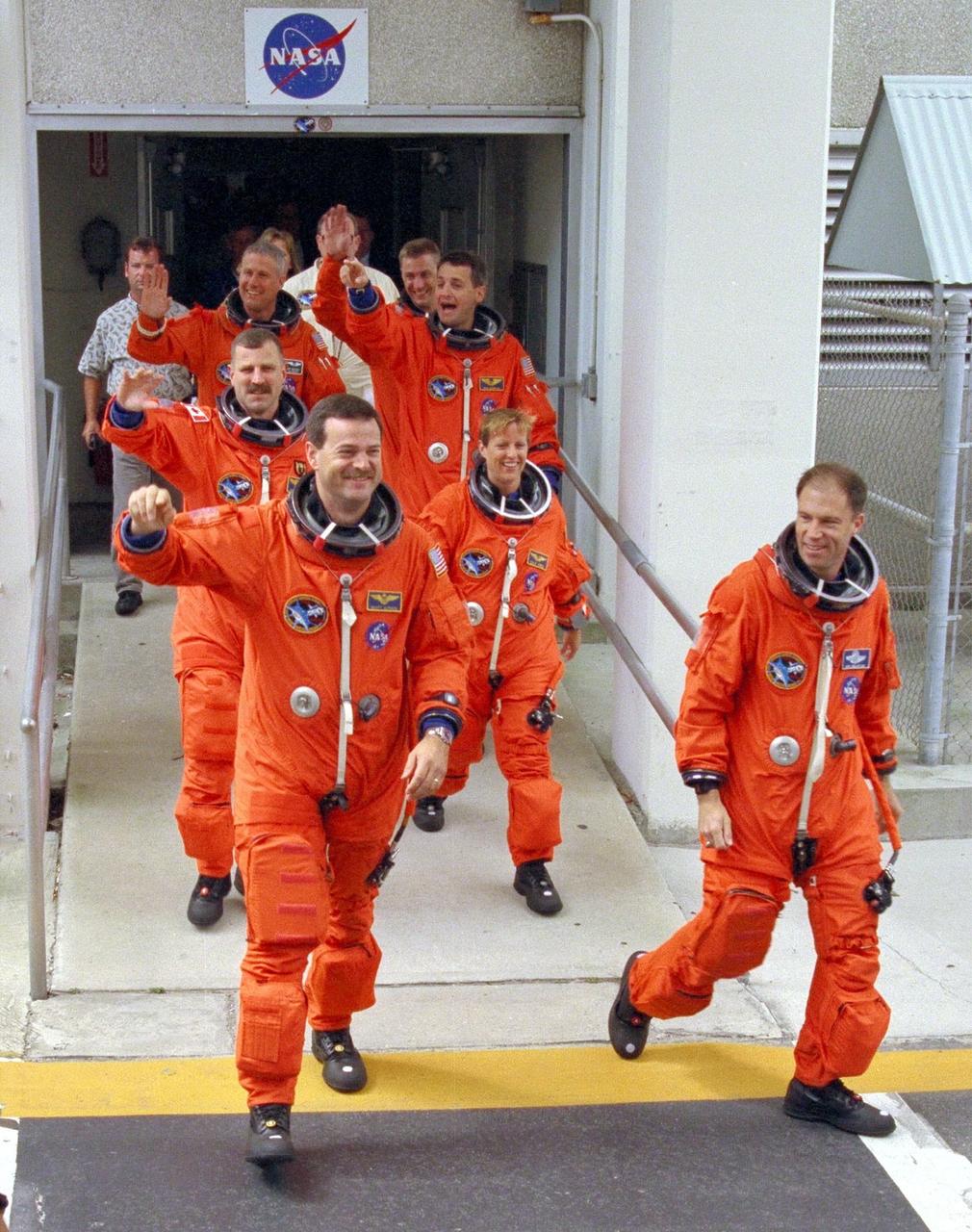
KENNEDY SPACE CENTER, FLA. -- Greeted by cheers from wellwishers at KSC and eager for their venture into space on the Neurolab mission, the STS-90 astronauts depart the Operations and Checkout Building on their way to Launch Pad 39B. Leading the seven-member crew is Mission Commander Richard Searfoss (far right), with Pilot Scott Altman by his side. Behind Altman are Mission Specialist Dafydd (Dave) Williams, M.D., (waving) with the Canadian Space Agency, and Mission Specialist Kathryn (Kay) Hire. Behind Hire is Mission Specialist Richard Linnehan, D.V.M., and next to Linnehan is Payload Specialist Jay Buckey, M.D. At the rear behind Linnehan is Payload Specialist James Pawelczyk, Ph.D. Their trip to the pad will take about 25 minutes aboard the Astrovan. Once there, they will take their positions in the crew cabin of the Space Shuttle Columbia to await a liftoff during a two-and-a-half hour window that will open at 2:19 p.m. EDT

The Neurolab payload for STS-90, scheduled to launch aboard the Shuttle Columbia from Kennedy Space Center (KSC) on April 2, 1998, is moved to its workstand in the Operations and Checkout Building at KSC. Investigations during the Neurolab mission will focus on the effects of microgravity on the nervous system. Specifically, experiments will study the adaptation of the vestibular system, the central nervous system, and the pathways that control the ability to sense location in the absence of gravity, as well as the effect of microgravity on a developing nervous system. The crew of STS-90 will include Commander Richard Searfoss, Pilot Scott Altman, Mission Specialists Richard Linnehan, Dafydd (Dave) Williams, M.D., and Kathryn (Kay) Hire, and Payload Specialists Jay Buckey, M.D., and James Pawelczyk, Ph.D
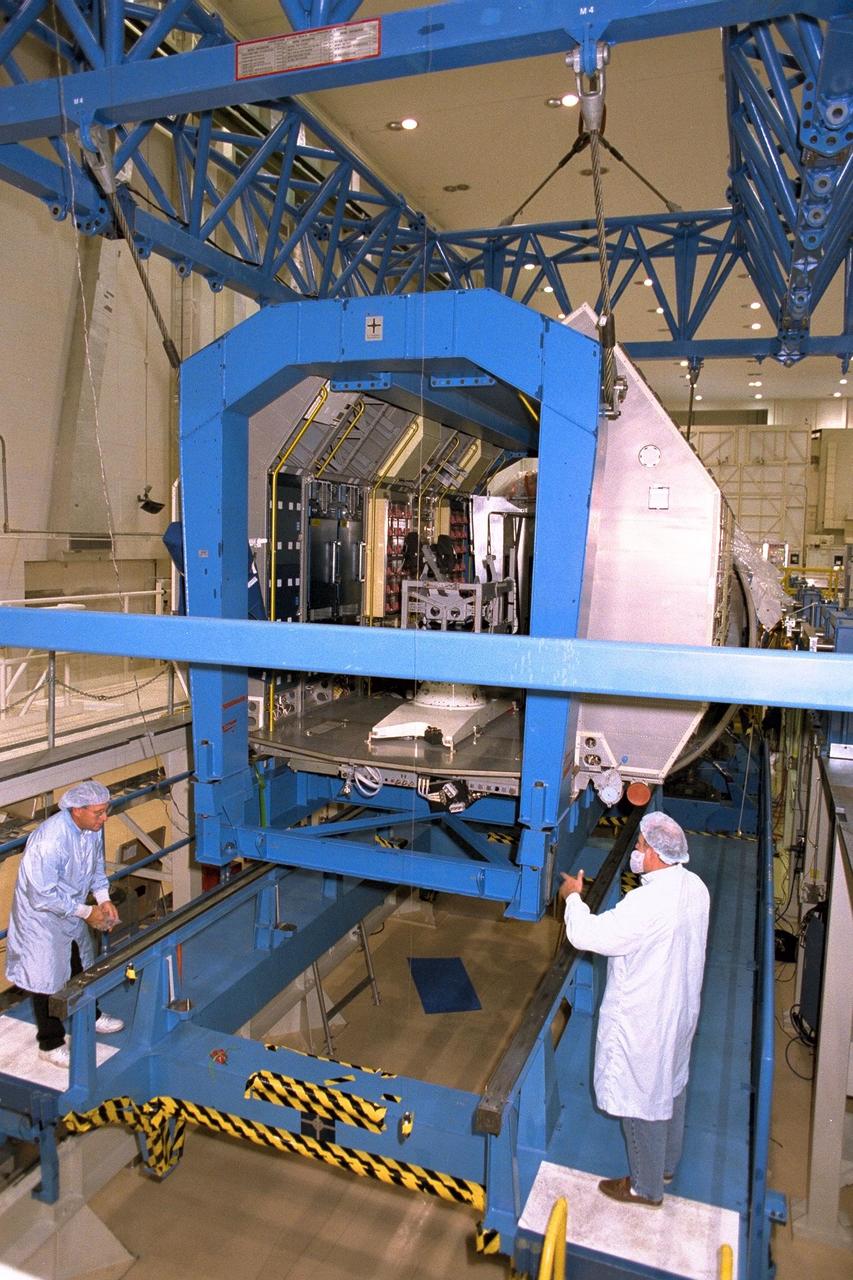
The Neurolab payload for STS-90, scheduled to launch aboard the Shuttle Columbia from Kennedy Space Center (KSC) on April 2, 1998, is moved to its workstand in the Operations and Checkout Building at KSC. Investigations during the Neurolab mission will focus on the effects of microgravity on the nervous system. Specifically, experiments will study the adaptation of the vestibular system, the central nervous system, and the pathways that control the ability to sense location in the absence of gravity, as well as the effect of microgravity on a developing nervous system. The crew of STS-90 will include Commander Richard Searfoss, Pilot Scott Altman, Mission Specialists Richard Linnehan, Dafydd (Dave) Williams, M.D., and Kathryn (Kay) Hire, and Payload Specialists Jay Buckey, M.D., and James Pawelczyk, Ph.D

KENNEDY SPACE CENTER, FLA. -- The Space Shuttle Columbia arrives at the top of Launch Pad 39B after its morning rollout prior to STS-90. The white room of the Orbiter Access Arm where astronauts suit up for launch can be seen to the left of the orbiter. The Neurolab experiments are the primary payload on this nearly 17-day space flight. Investigations during the Neurolab mission will focus on the effects of microgravity on the nervous system. The crew of STS-90, slated for launch April 16 at 2:19 p.m. EDT, includes Commander Richard Searfoss, Pilot Scott Altman, Mission Specialists Richard Linnehan, Dafydd (Dave) Williams, M.D., and Kathryn (Kay) Hire, and Payload Specialists Jay Buckey, M.D., and James Pawelczyk, Ph.D
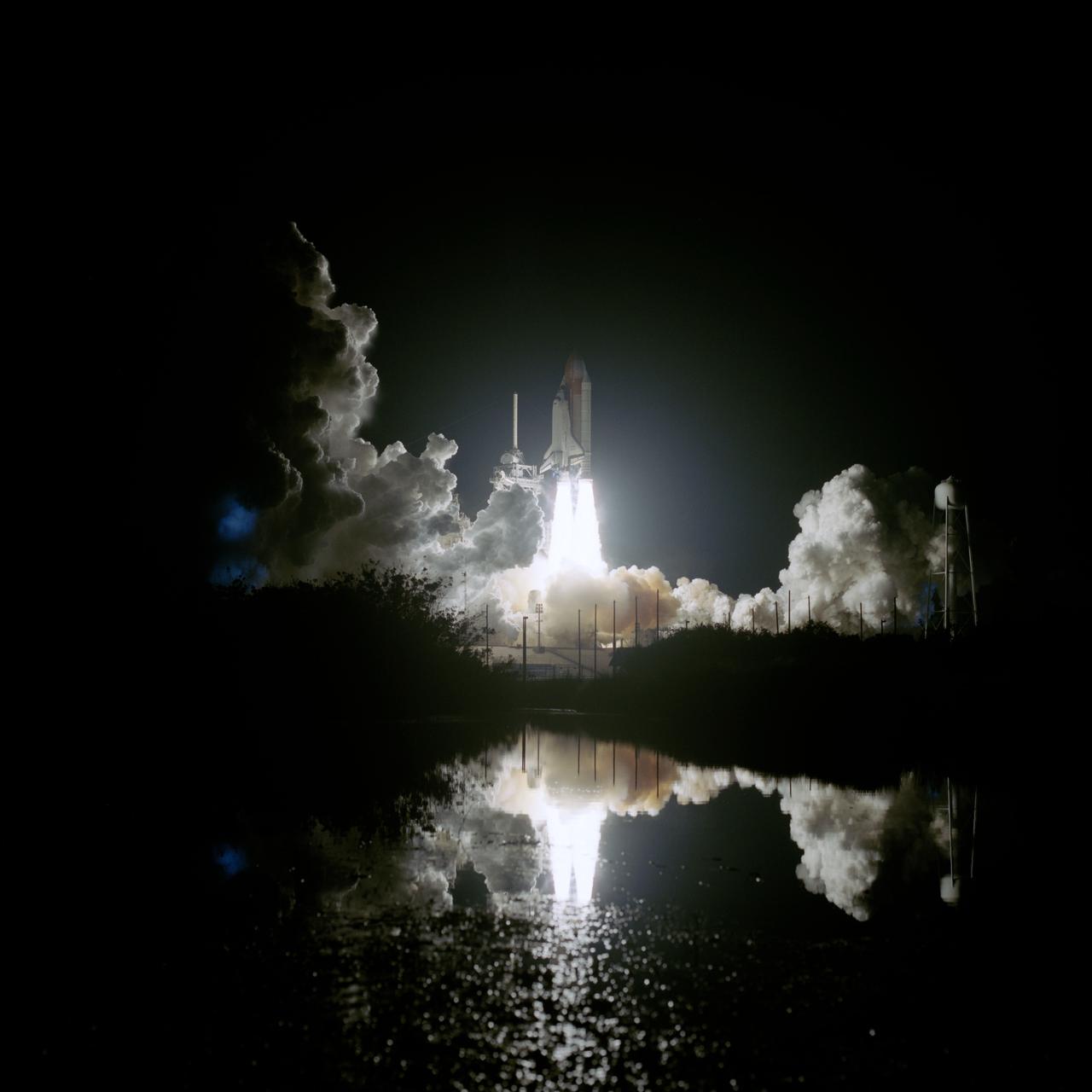
STS076-S-011 (22 March 1996) --- This wide view captures the nocturnal launch of the Space Shuttle Atlantis, as it heads toward Earth-orbit and an eventual docking with Russia?s Mir Space Station. Mir has been in space for ten years and a two-man crew (Mir-21) currently awaits the arrival of Atlantis. The on-time launch occurred at 3:13:04 a.m. (EST) on March 22, 1996. Onboard for STS-76 are astronauts Kevin P. Chilton, Richard A. Searfoss, Ronald M. Sega, Michael R. (Rich) Clifford, Linda M. Godwin and Shannon W. Lucid. Lucid will remain onboard Mir for just under five months? time, as a cosmonaut guest researcher. Photo credit: NASA or National Aeronautics and Space Administration
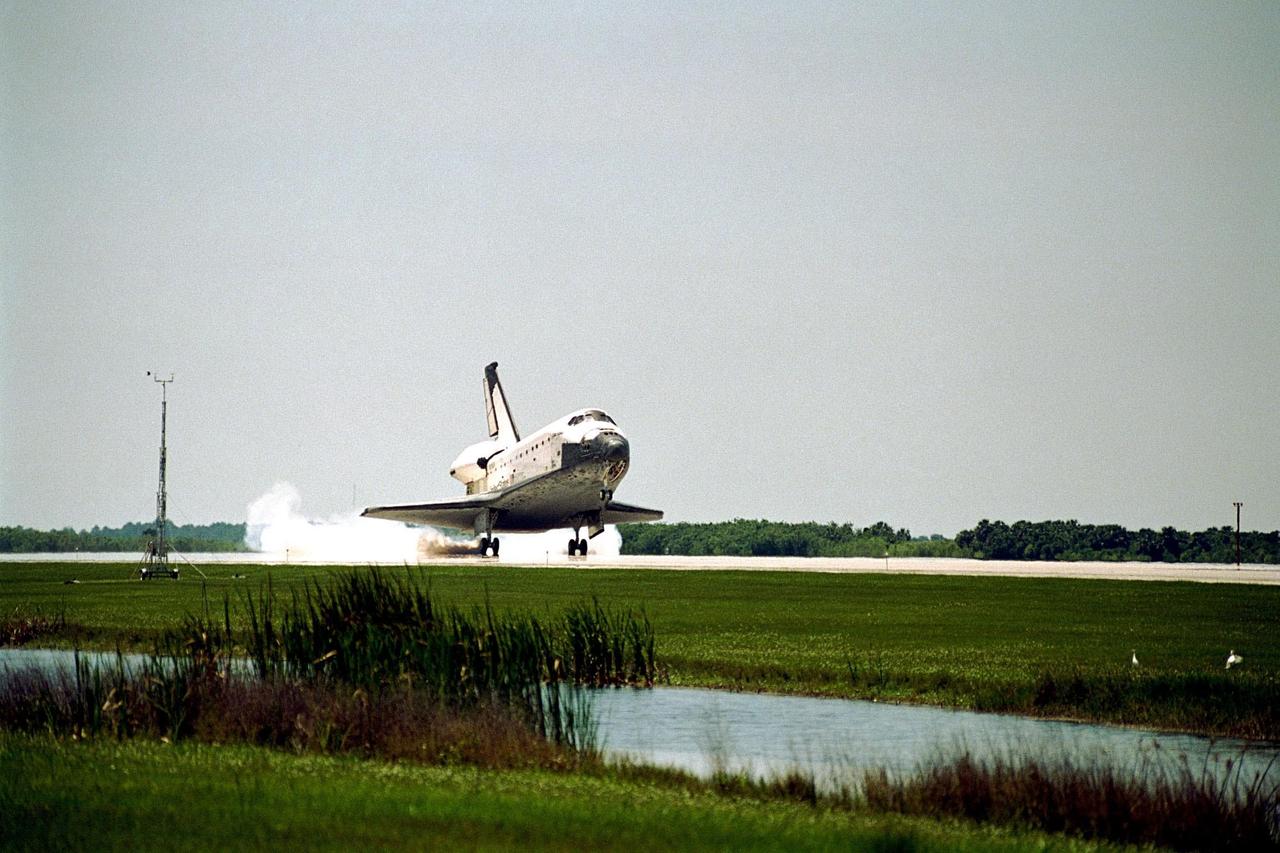
The orbiter Columbia touches down on Runway 33 of KSC's Shuttle Landing Facility to complete the nearly 16-day STS-90 mission. Main gear touchdown was at 12:08:59 p.m. EDT on May 3, 1998, landing on orbit 256 of the mission. The wheels stopped at 12:09:58 EDT, completing a total mission time of 15 days, 21 hours, 50 minutes and 58 seconds. The 90th Shuttle mission was Columbia's 13th landing at the space center and the 43rd KSC landing in the history of the Space Shuttle program. During the mission, the crew conducted research to contribute to a better understanding of the human nervous system. The crew of the STS-90 Neurolab mission include Commander Richard Searfoss; Pilot Scott Altman; Mission Specialists Richard Linnehan, D.V.M., Dafydd (Dave) Williams, M.D., with the Canadian Space Agency, and Kathryn (Kay) Hire; and Payload Specialists Jay Buckey, M.D., and James Pawelczyk, Ph.D
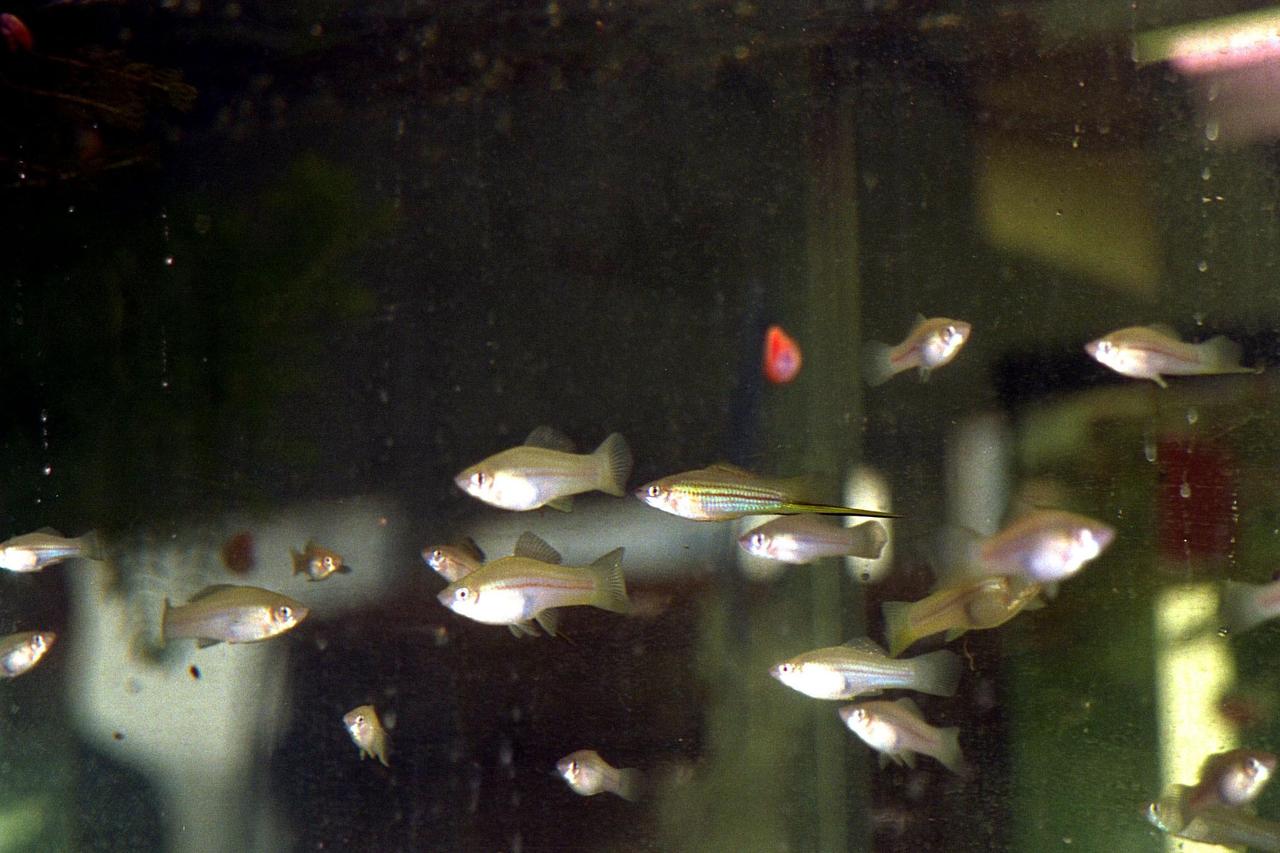
KENNEDY SPACE CENTER, FLA. -- Swordtail fish (Xiphophorus helleri), like those that are part of the Neurolab payload on Space Shuttle Mission STS-90, are shown in their holding tank in the Operations and Checkout Building. The fish will fly in the Closed Equilibrated Biological Aquatic System (CEBAS) Minimodule, a middeck locker-sized fresh water habitat, designed to allow the controlled incubation of aquatic species in a self-stabilizing, artifical ecosystem for up to three weeks under space conditions. Investigations during the Neurolab mission will focus on the effects of microgravity on the nervous system. The crew of STS-90, slated for launch April 16 at 2:19 p.m. EDT, include Commander Richard Searfoss, Pilot Scott Altman, Mission Specialists Richard Linnehan, D.V.M., Dafydd (Dave) Williams, M.D., and Kathryn (Kay) Hire, and Payload Specialists Jay Buckey, M.D., and James Pawelczyk, Ph.D
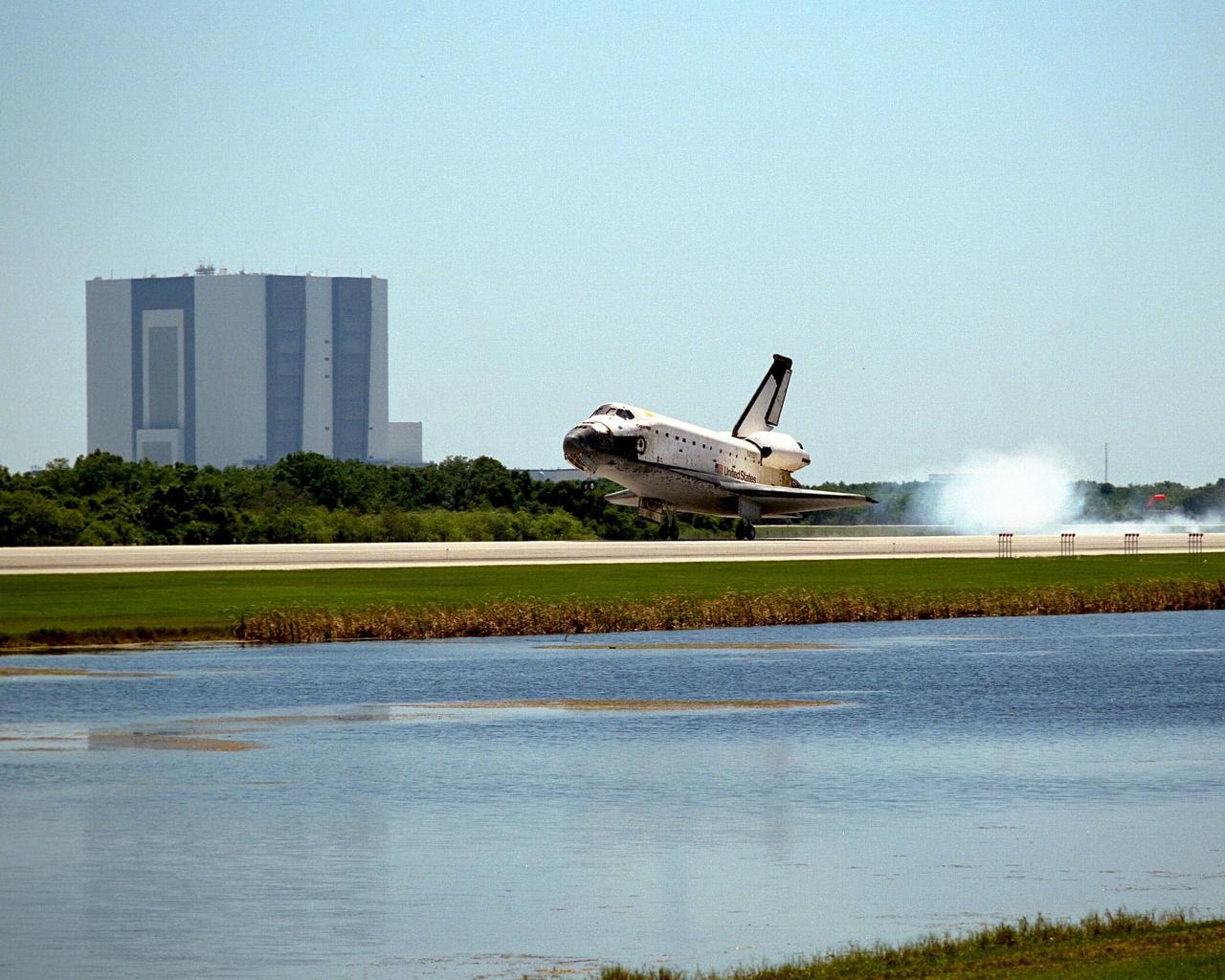
The orbiter Columbia touches down on Runway 33 of KSC's Shuttle Landing Facility to complete the nearly 16-day STS-90 mission. Main gear touchdown was at 12:08:59 p.m. EDT on May 3, 1998, landing on orbit 256 of the mission. The wheels stopped at 12:09:58 EDT, completing a total mission time of 15 days, 21 hours, 50 minutes and 58 seconds. The 90th Shuttle mission was Columbia's 13th landing at the space center and the 43rd KSC landing in the history of the Space Shuttle program. During the mission, the crew conducted research to contribute to a better understanding of the human nervous system. The crew of the STS-90 Neurolab mission include Commander Richard Searfoss; Pilot Scott Altman; Mission Specialists Richard Linnehan, D.V.M., Dafydd (Dave) Williams, M.D., with the Canadian Space Agency, and Kathryn (Kay) Hire; and Payload Specialists Jay Buckey, M.D., and James Pawelczyk, Ph.D
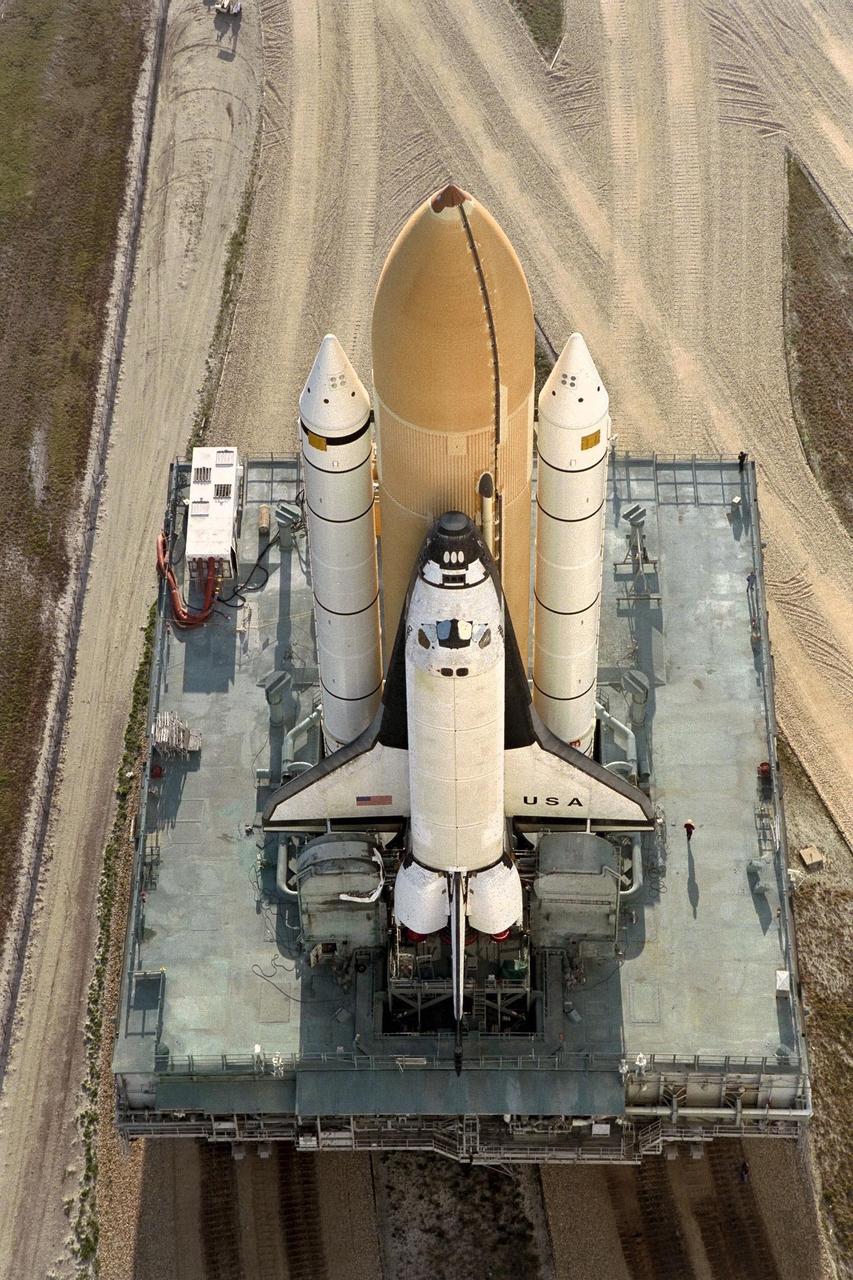
KENNEDY SPACE CENTER, FLA. -- The Space Shuttle Columbia continues its morning rollout from the Vehicle Assembly Building to Launch Pad 39B in preparation for the STS-90 mission. The Neurolab experiments are the primary payload on this nearly 17-day space flight. Investigations during the Neurolab mission will focus on the effects of microgravity on the nervous system. Specifically, experiments will study the adaptation of the vestibular system, the central nervous system, and the pathways that control the ability to sense location in the absence of gravity, as well as the effect of microgravity on a developing nervous system. The crew of STS-90, slated for launch April 16 at 2:19 p.m. EDT, includes Commander Richard Searfoss, Pilot Scott Altman, Mission Specialists Richard Linnehan, Dafydd (Dave) Williams, M.D., and Kathryn (Kay) Hire, and Payload Specialists Jay Buckey, M.D., and James Pawelczyk, Ph.D
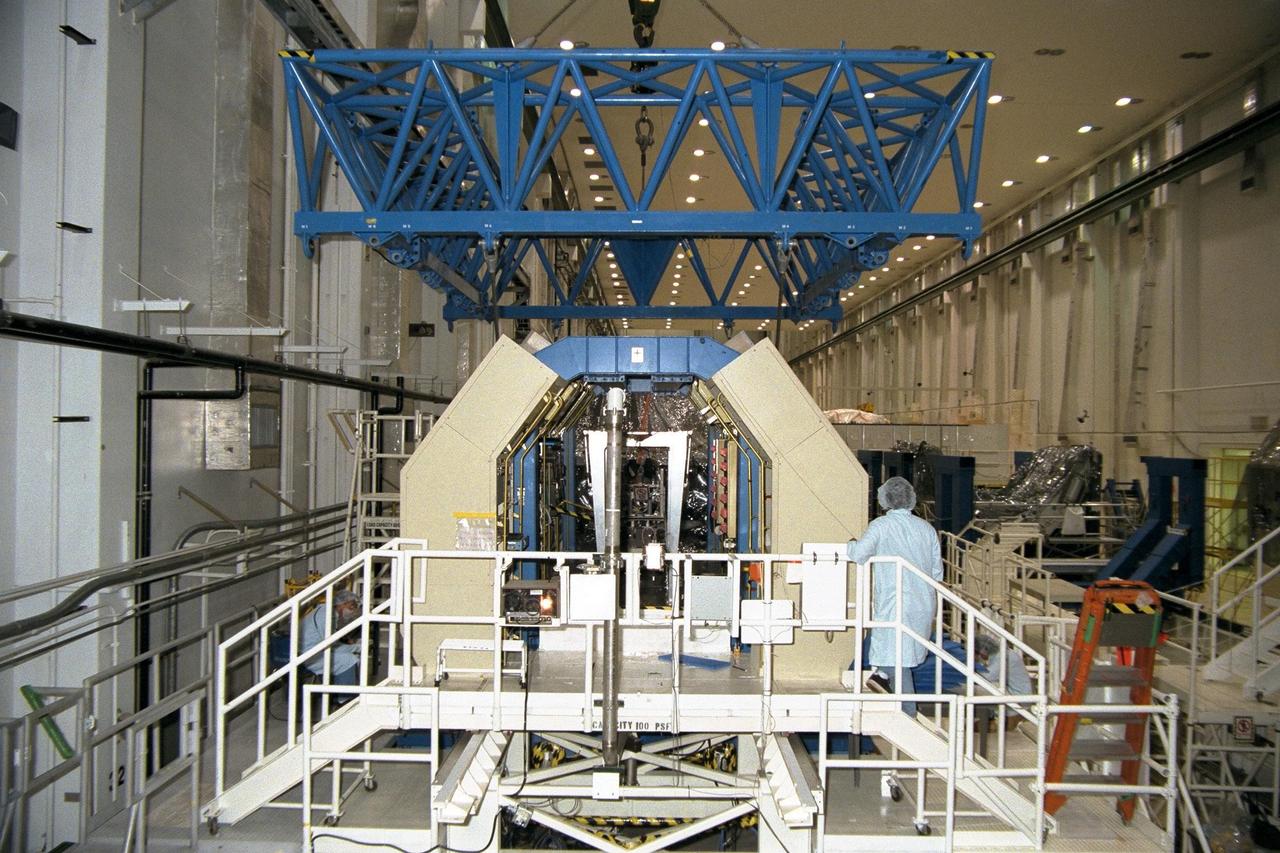
The Neurolab payload for STS-90, scheduled to launch aboard the Shuttle Columbia from Kennedy Space Center (KSC) on April 2, 1998, is ready for processing after being placed in its workstand in the Operations and Checkout Building at KSC. Investigations during the Neurolab mission will focus on the effects of microgravity on the nervous system. Specifically, experiments will study the adaptation of the vestibular system, the central nervous system, and the pathways that control the ability to sense location in the absence of gravity, as well as the effect of microgravity on a developing nervous system. The crew of STS-90 will include Commander Richard Searfoss, Pilot Scott Altman, Mission Specialists Richard Linnehan, Dafydd (Dave) Williams, M.D., and Kathryn (Kay) Hire, and Payload Specialists Jay Buckey, M.D., and James Pawelczyk, Ph.D
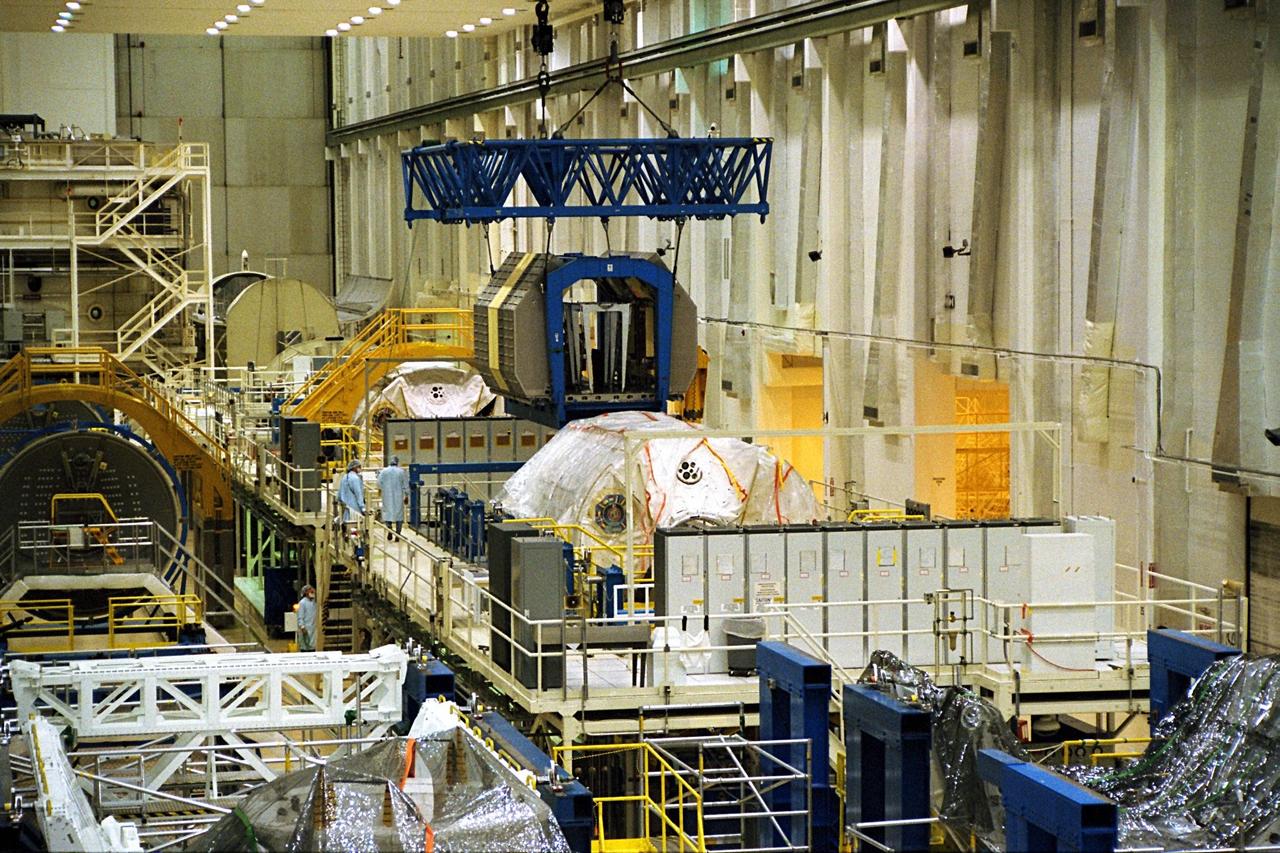
The Neurolab payload for STS-90, scheduled to launch aboard the Shuttle Columbia from Kennedy Space Center (KSC) on April 2, 1998, is moved to its workstand in the Operations and Checkout Building at KSC. Investigations during the Neurolab mission will focus on the effects of microgravity on the nervous system. Specifically, experiments will study the adaptation of the vestibular system, the central nervous system, and the pathways that control the ability to sense location in the absence of gravity, as well as the effect of microgravity on a developing nervous system. The crew of STS-90 will include Commander Richard Searfoss, Pilot Scott Altman, Mission Specialists Richard Linnehan, Dafydd (Dave) Williams, M.D., and Kathryn (Kay) Hire, and Payload Specialists Jay Buckey, M.D., and James Pawelczyk, Ph.D
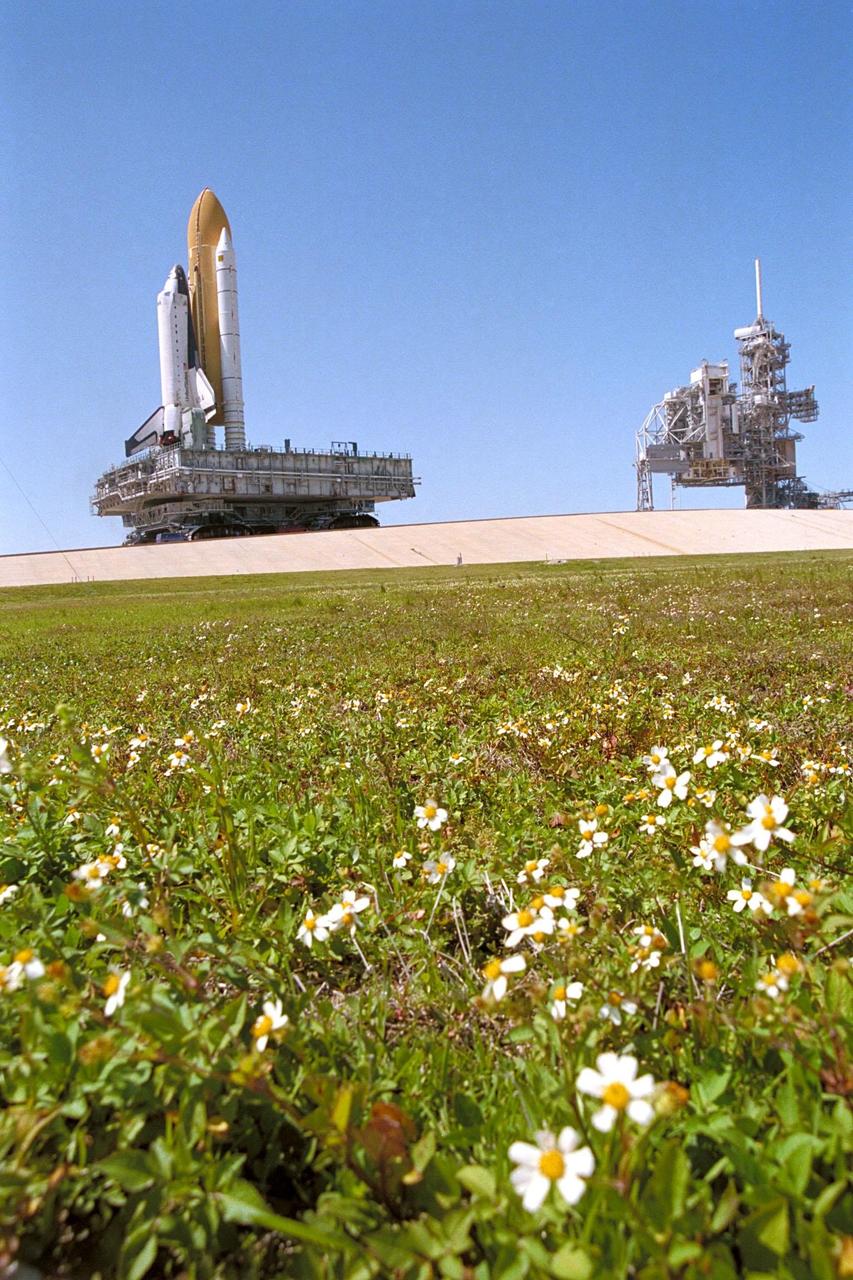
KENNEDY SPACE CENTER, FLA. -- The Space Shuttle Columbia continues up the ramp to Launch Pad 39B in its morning rollout prior to STS-90. Leveling systems within the crawler-transporter underneath the Shuttle keep the platform level while negotiating the five percent ramp leading up to the pad surface. The top of the orbiter is kept vertical within plus or minus 10 minutes of arc, about the diameter of a basketball during the journey. The Neurolab experiments are the primary payload on this nearly 17-day space flight. Investigations during the Neurolab mission will focus on the effects of microgravity on the nervous system. The crew of STS-90, slated for launch April 16 at 2:19 p.m. EDT, includes Commander Richard Searfoss, Pilot Scott Altman, Mission Specialists Richard Linnehan, Dafydd (Dave) Williams, M.D., and Kathryn (Kay) Hire, and Payload Specialists Jay Buckey, M.D., and James Pawelczyk, Ph.D
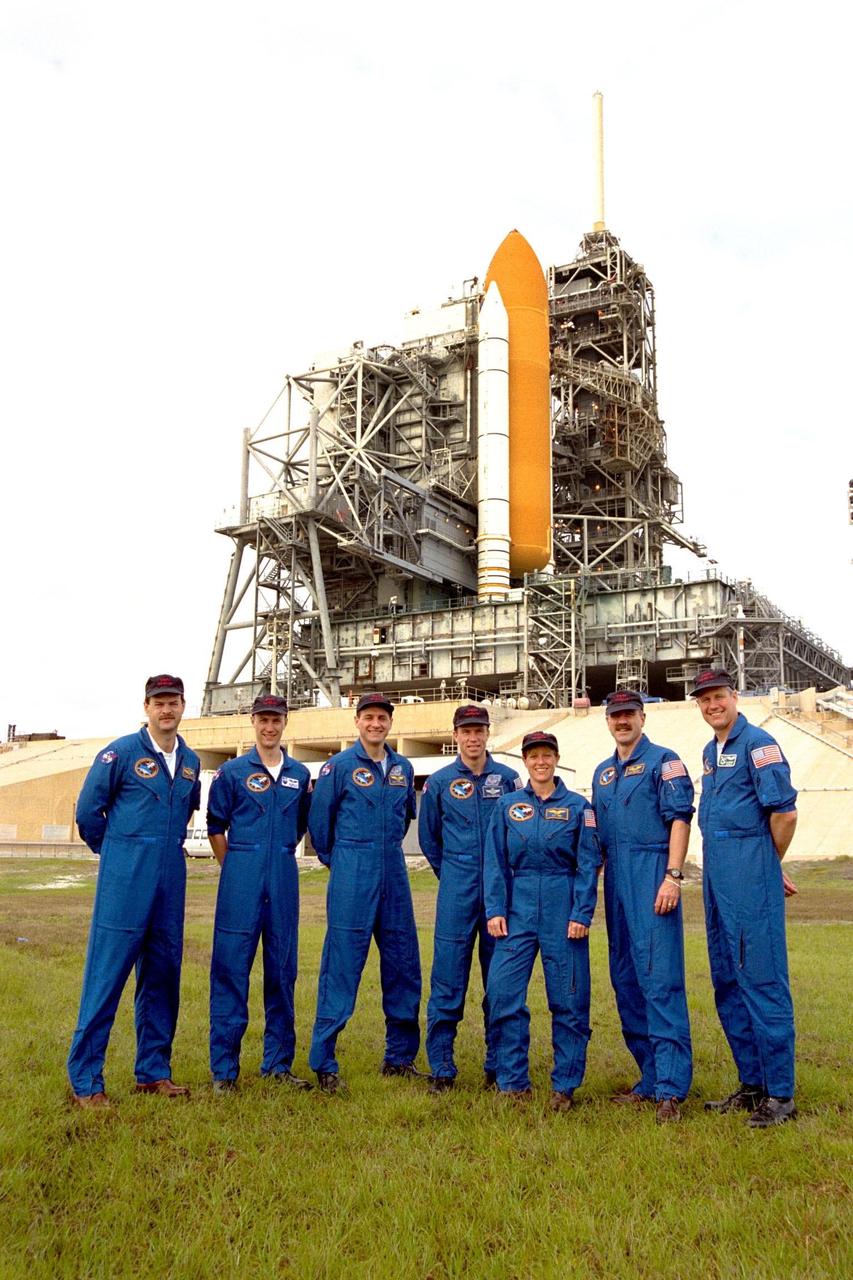
The crew of STS-90 participate in Terminal Countdown Demonstration Test (TCDT) activities at KSC's Launch Pad 39B. The TCDT is held at KSC prior to each Space Shuttle flight to provide crews with the opportunity to participate in simulated countdown activities. The STS-90 crew, left to right, are Pilot Scott Altman, Payload Specialist James Pawelczyk, Ph.D., Mission Specialist Richard Linnehan, D.V.M., Commander Richard Searfoss, Mission Specialists Kathryn (Kay) Hire and Dafydd (Dave) Williams with the Canadian Space Agency, and Payload Specialist Jay Buckey, M.D. Columbia is targeted for launch of STS-90 on April 16 at 2:19 p.m. EST and will be the second mission of 1998. The mission is scheduled to last nearly 17 days
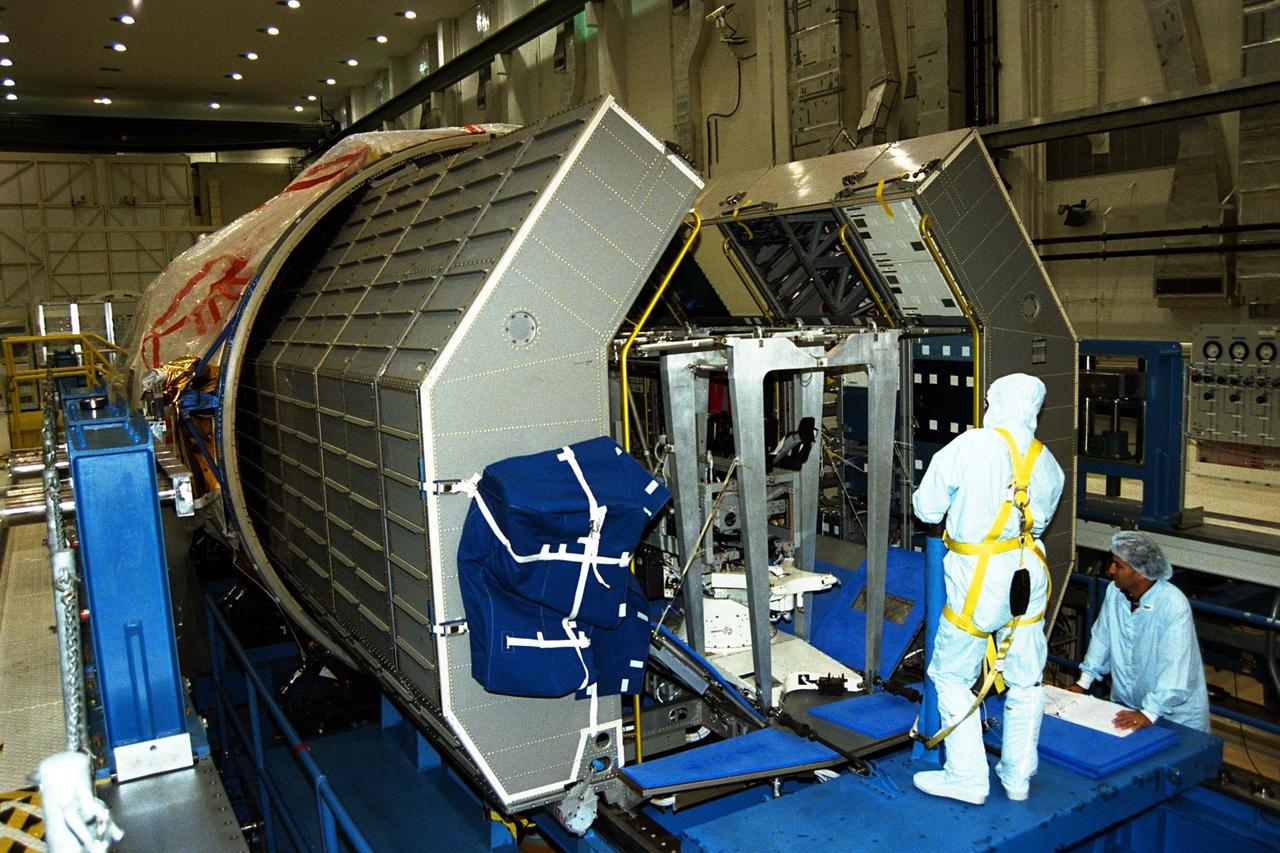
The Neurolab payload for STS-90, scheduled to launch aboard the Shuttle Columbia from Kennedy Space Center (KSC) on April 2, 1998, is installed in the Spacelab module by Boeing technicians in the Operations and Checkout Building at KSC. Investigations during the Neurolab mission will focus on the effects of microgravity on the nervous system. Specifically, experiments will study the adaptation of the vestibular system, the central nervous system, and the pathways that control the ability to sense location in the absence of gravity, as well as the effect of microgravity on a developing nervous system. The crew of STS-90 will include Commander Richard Searfoss, Pilot Scott Altman, Mission Specialists Richard Linnehan, Dafydd (Dave) Williams, M.D., and Kathryn (Kay) Hire, and Payload Specialists Jay Buckey, M.D., and James Pawelczyk, Ph.D

The Neurolab payload for STS-90, scheduled to launch aboard the Shuttle Columbia from Kennedy Space Center (KSC) on April 2, 1998, is installed in the Spacelab module by Boeing technicians in the Operations and Checkout Building at KSC. Investigations during the Neurolab mission will focus on the effects of microgravity on the nervous system. Specifically, experiments will study the adaptation of the vestibular system, the central nervous system, and the pathways that control the ability to sense location in the absence of gravity, as well as the effect of microgravity on a developing nervous system. The crew of STS-90 will include Commander Richard Searfoss, Pilot Scott Altman, Mission Specialists Richard Linnehan, Dafydd (Dave) Williams, M.D., and Kathryn (Kay) Hire, and Payload Specialists Jay Buckey, M.D., and James Pawelczyk, Ph.D
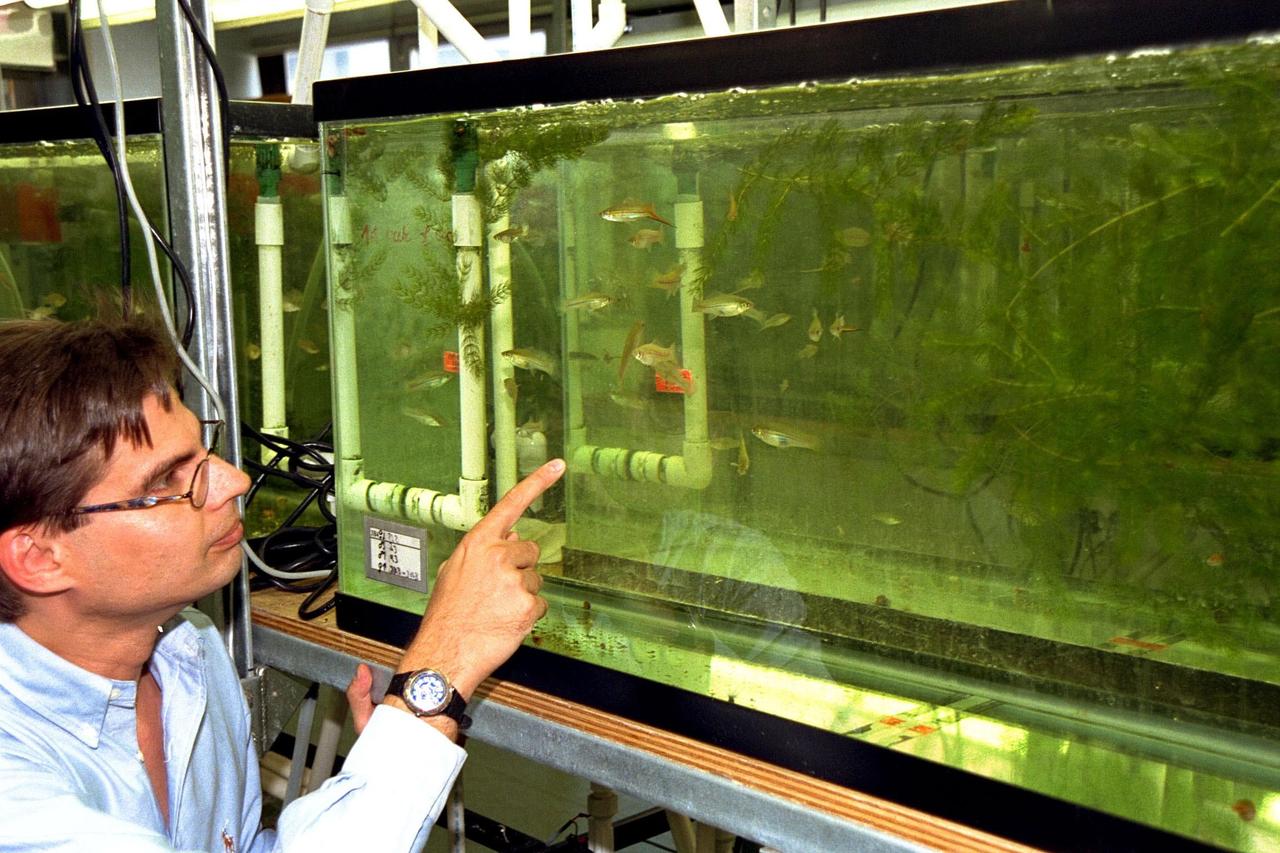
KENNEDY SPACE CENTER, FLA. -- Dr. Dirk Voeste, a scientist with Ruhr-University of Bochum, Germany, examines some swordtail fish (Xiphophorus helleri), like those that are part of the Neurolab payload on Space Shuttle Mission STS-90, in their holding tank in the Operations and Checkout Building. The fish will fly in the Closed Equilibrated Biological Aquatic System (CEBAS) Minimodule, a middeck locker-sized fresh water habitat, designed to allow the controlled incubation of aquatic species in a self-stabilizing, artifical ecosystem for up to three weeks under space conditions. Investigations during the Neurolab mission will focus on the effects of microgravity on the nervous system. The crew of STS-90, slated for launch April 16 at 2:19 p.m. EDT, include Commander Richard Searfoss, Pilot Scott Altman, Mission Specialists Richard Linnehan, D.V.M., Dafydd (Dave) Williams, M.D., and Kathryn (Kay) Hire, and Payload Specialists Jay Buckey, M.D., and James Pawelczyk, Ph.D
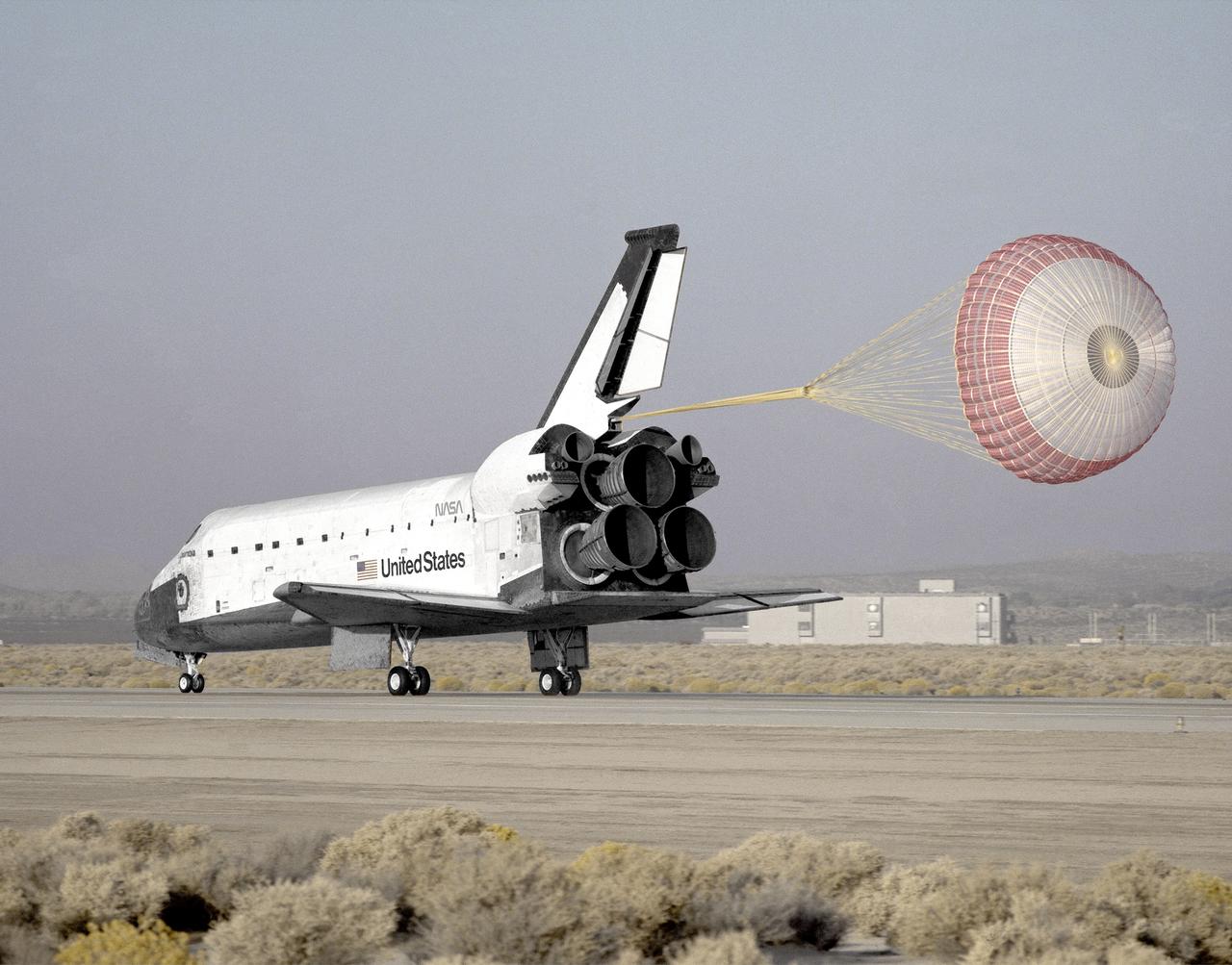
A drag chute slows the space shuttle Columbia as it rolls to a perfect landing concluding NASA's longest mission at that time, STS-58, at the Ames-Dryden Flight Research Facility (later redesignated the Dryden Flight Research Center), Edwards, California, with a 8:06 a.m. (PST) touchdown 1 November 1993 on Edward's concrete runway 22. The planned 14 day mission, which began with a launch from Kennedy Space Center, Florida, at 7:53 a.m. (PDT), October 18, was the second spacelab flight dedicated to life sciences research. Seven Columbia crewmembers performed a series of experiments to gain more knowledge on how the human body adapts to the weightless environment of space. Crewmembers on this flight included: John Blaha, commander; Rick Searfoss, pilot; payload commander Rhea Seddon; mission specialists Bill MacArthur, David Wolf, and Shannon Lucid; and payload specialist Martin Fettman.
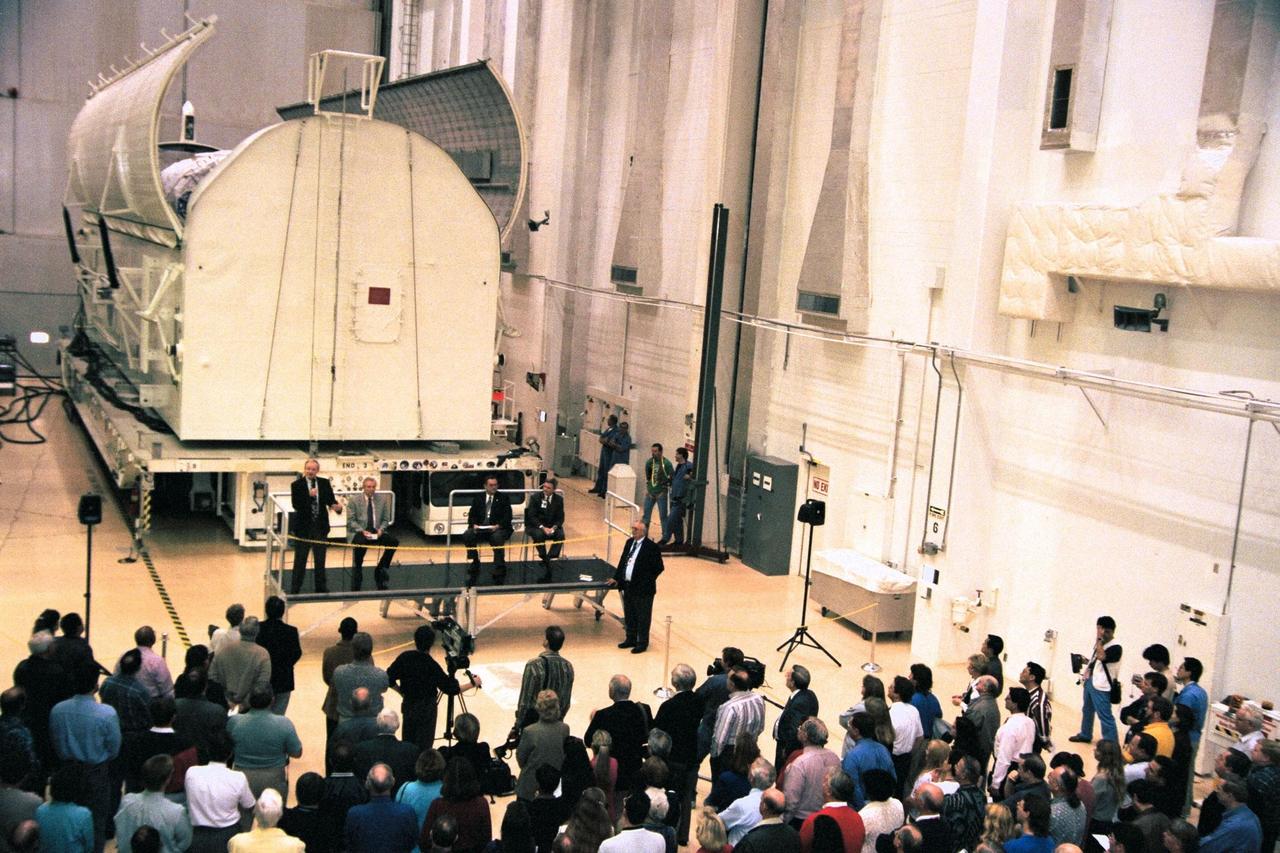
The STS-90 Neurolab payload is honored with a ceremony after being lowered into its payload canister in KSC's Operations and Checkout Building for the last time. This phase of the Shuttle program is winding down as the second phase of the International Space Station (ISS) program gets under way. Microgravity and life science research that formerly was conducted in Spacelab modules, such as Neurolab, will eventually be conducted inside the completed ISS. Investigations during the Neurolab mission will focus on the effects of microgravity on the nervous system. The crew of STS-90, slated for launch in April, will include Commander Richard Searfoss, Pilot Scott Altman, Mission Specialists Richard Linnehan, Dafydd (Dave) Williams, M.D., and Kathryn (Kay) Hire, and Payload Specialists Jay Buckey, M.D., and James Pawelczyk, Ph.D

The Neurolab payload for STS-90, scheduled to launch aboard the Shuttle Columbia from Kennedy Space Center (KSC) on April 2, 1998, is ready for processing after being placed in its workstand in the Operations and Checkout Building at KSC. Investigations during the Neurolab mission will focus on the effects of microgravity on the nervous system. Specifically, experiments will study the adaptation of the vestibular system, the central nervous system, and the pathways that control the ability to sense location in the absence of gravity, as well as the effect of microgravity on a developing nervous system. The crew of STS-90 will include Commander Richard Searfoss, Pilot Scott Altman, Mission Specialists Richard Linnehan, Dafydd (Dave) Williams, M.D., and Kathryn (Kay) Hire, and Payload Specialists Jay Buckey, M.D., and James Pawelczyk, Ph.D
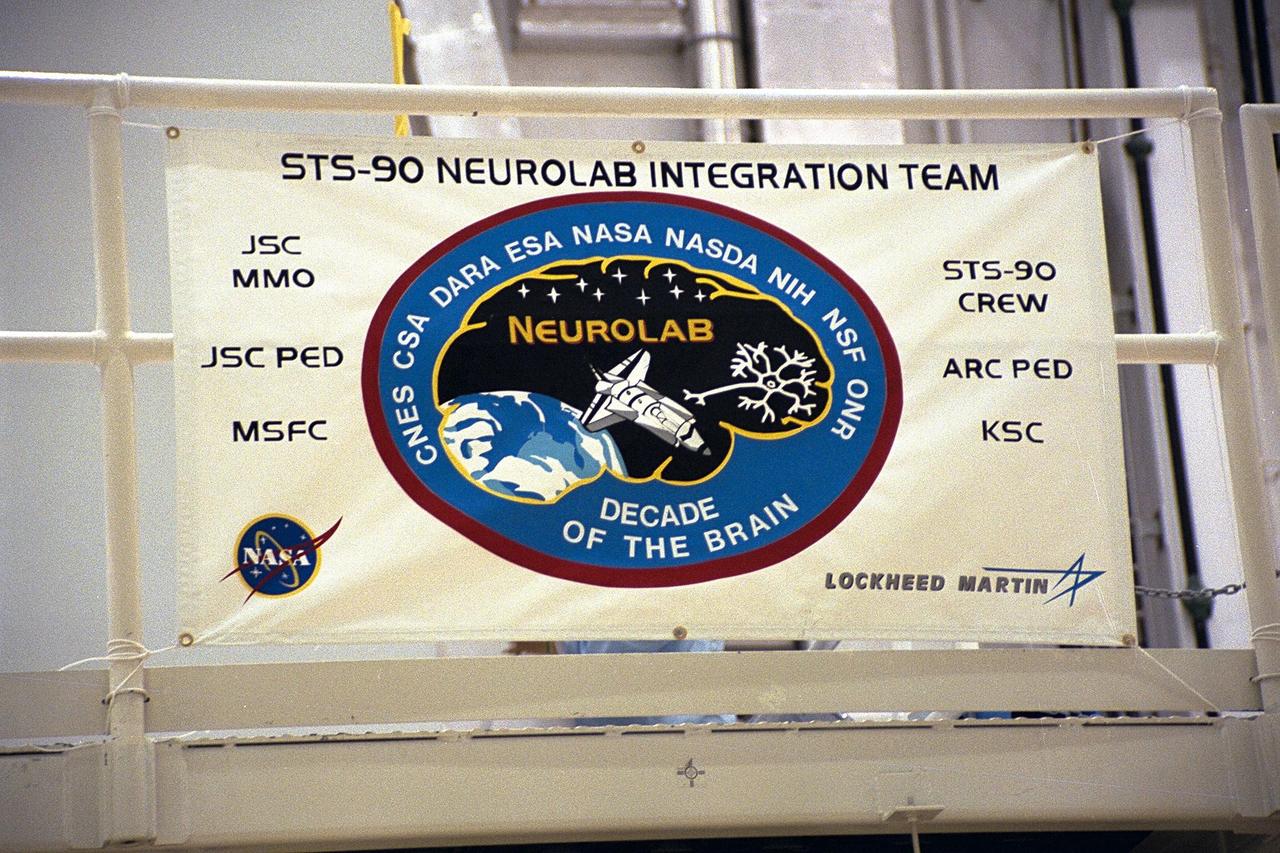
The Neurolab payload for STS-90, scheduled to launch aboard the Shuttle Columbia from Kennedy Space Center (KSC) on April 2, 1998, undergoes further processing in the Operations and Checkout Building at KSC. Investigations during the Neurolab mission will focus on the effects of microgravity on the nervous system. Specifically, experiments will study the adaptation of the vestibular system, the central nervous system, and the pathways that control the ability to sense location in the absence of gravity, as well as the effect of microgravity on a developing nervous system. The crew of STS-90 will include Commander Richard Searfoss, Pilot Scott Altman, Mission Specialists Richard Linnehan, Dafydd (Dave) Williams, M.D., and Kathryn (Kay) Hire, and Payload Specialists Jay Buckey, M.D., and James Pawelczyk, Ph.D
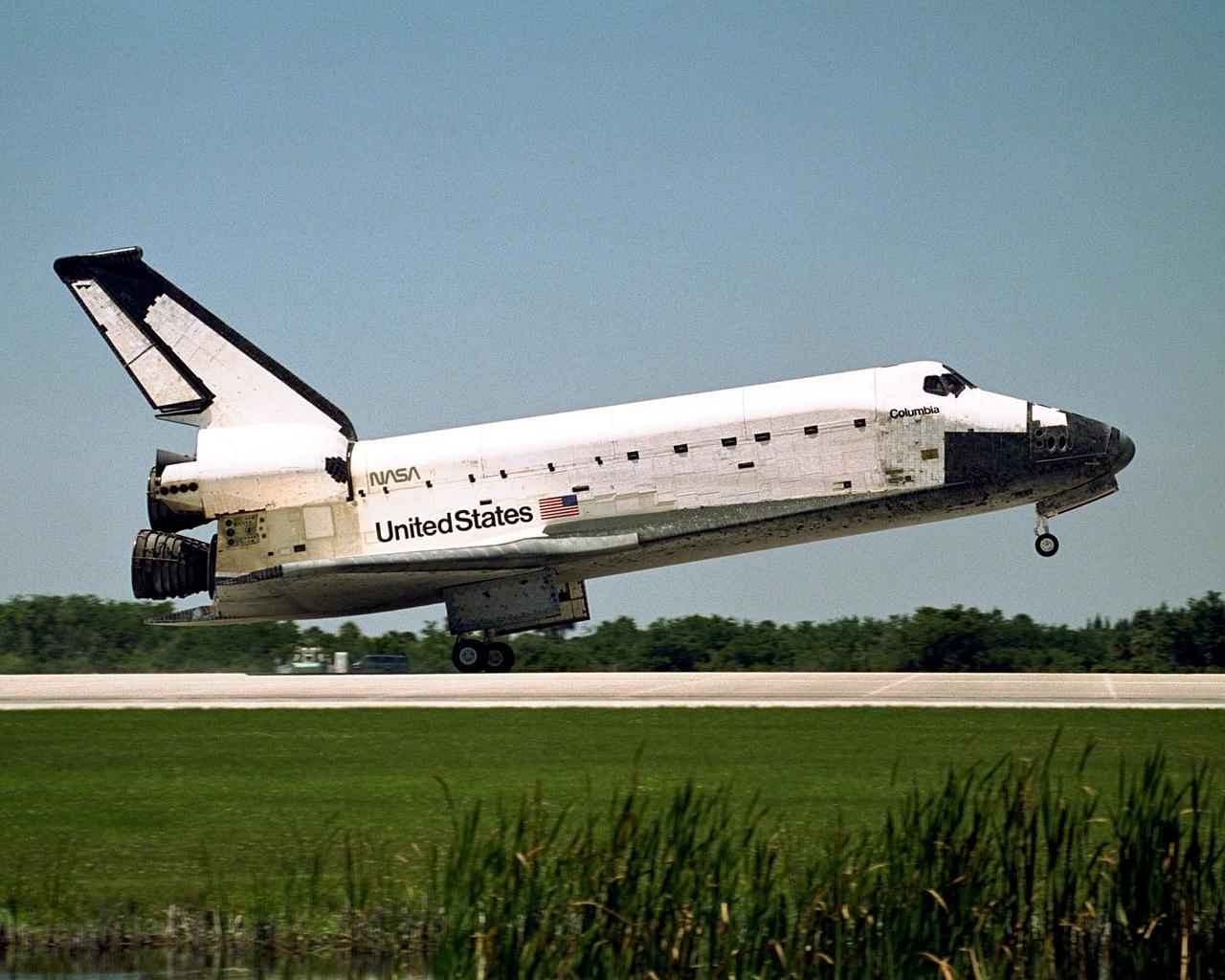
The orbiter Columbia approaches touchdown on Runway 33 of KSC's Shuttle Landing Facility to complete the nearly 16-day STS-90 mission. Main gear touchdown was at 12:08:59 p.m. EDT on May 3, 1998, landing on orbit 256 of the mission. The wheels stopped at 12:09:58 EDT, completing a total mission time of 15 days, 21 hours, 50 minutes and 58 seconds. The 90th Shuttle mission was Columbia's 13th landing at the space center and the 43rd KSC landing in the history of the Space Shuttle program. During the mission, the crew conducted research to contribute to a better understanding of the human nervous system. The crew of the STS-90 Neurolab mission include Commander Richard Searfoss; Pilot Scott Altman; Mission Specialists Richard Linnehan, D.V.M., Dafydd (Dave) Williams, M.D., with the Canadian Space Agency, and Kathryn (Kay) Hire; and Payload Specialists Jay Buckey, M.D., and James Pawelczyk, Ph.D
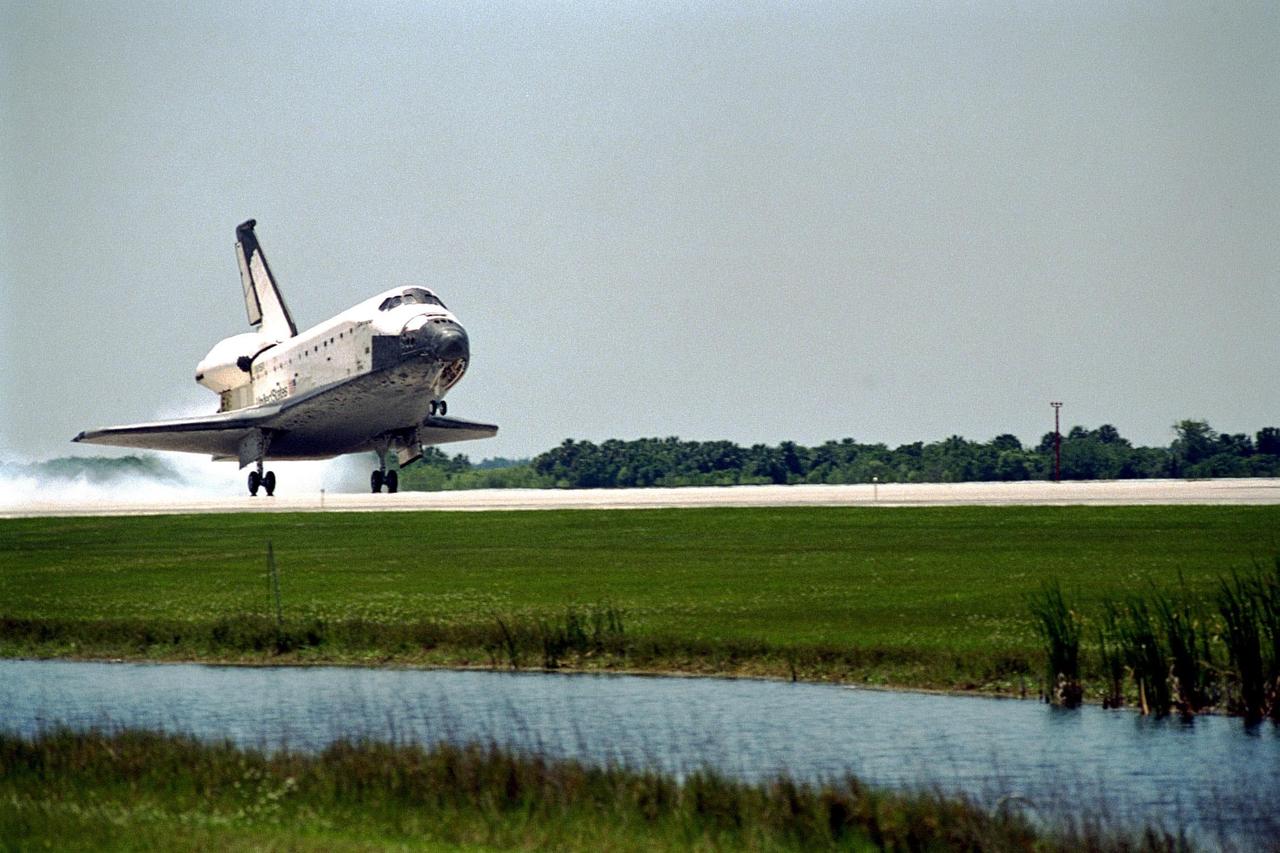
The orbiter Columbia touches down on Runway 33 of KSC's Shuttle Landing Facility to complete the nearly 16-day STS-90 mission. Main gear touchdown was at 12:08:59 p.m. EDT on May 3, 1998, landing on orbit 256 of the mission. The wheels stopped at 12:09:58 EDT, completing a total mission time of 15 days, 21 hours, 50 minutes and 58 seconds. The 90th Shuttle mission was Columbia's 13th landing at the space center and the 43rd KSC landing in the history of the Space Shuttle program. During the mission, the crew conducted research to contribute to a better understanding of the human nervous system. The crew of the STS-90 Neurolab mission include Commander Richard Searfoss; Pilot Scott Altman; Mission Specialists Richard Linnehan, D.V.M., Dafydd (Dave) Williams, M.D., with the Canadian Space Agency, and Kathryn (Kay) Hire; and Payload Specialists Jay Buckey, M.D., and James Pawelczyk, Ph.D
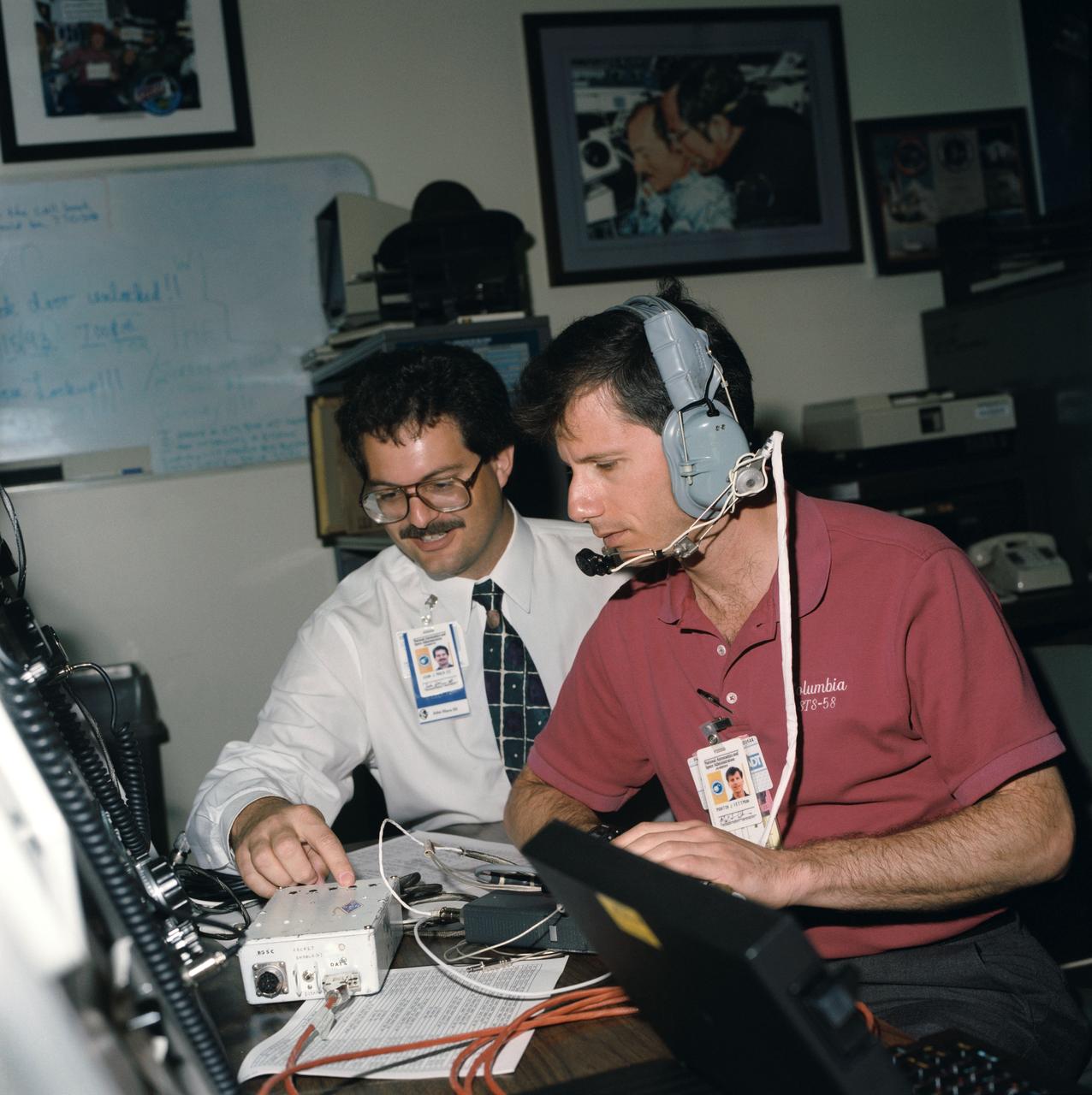
S93-45076 (22 Sept 1993) --- Payload specialist Martin J. Fettman listens to an amateur radio instruction by crew trainer John J. Maca. Members of the STS-58 crew were training with amateur radio equipment at the Johnson Space Center (JSC). The STS-58 flight will carry the Shuttle Amateur Radio Experiment (SAREX) payload, configuration C, which includes FM voice and packet. Three of the seven crew members are licensed amateur radio operators. Fettman's call letters are KC5AXA; William S. McArthur, mission specialist, KC5ACR; and Richard A. Searfoss, pilot, KC5CKM. Licensed students at a number of schools around the country will have the opportunity to talk directly with the astronauts during the 14-day flight.
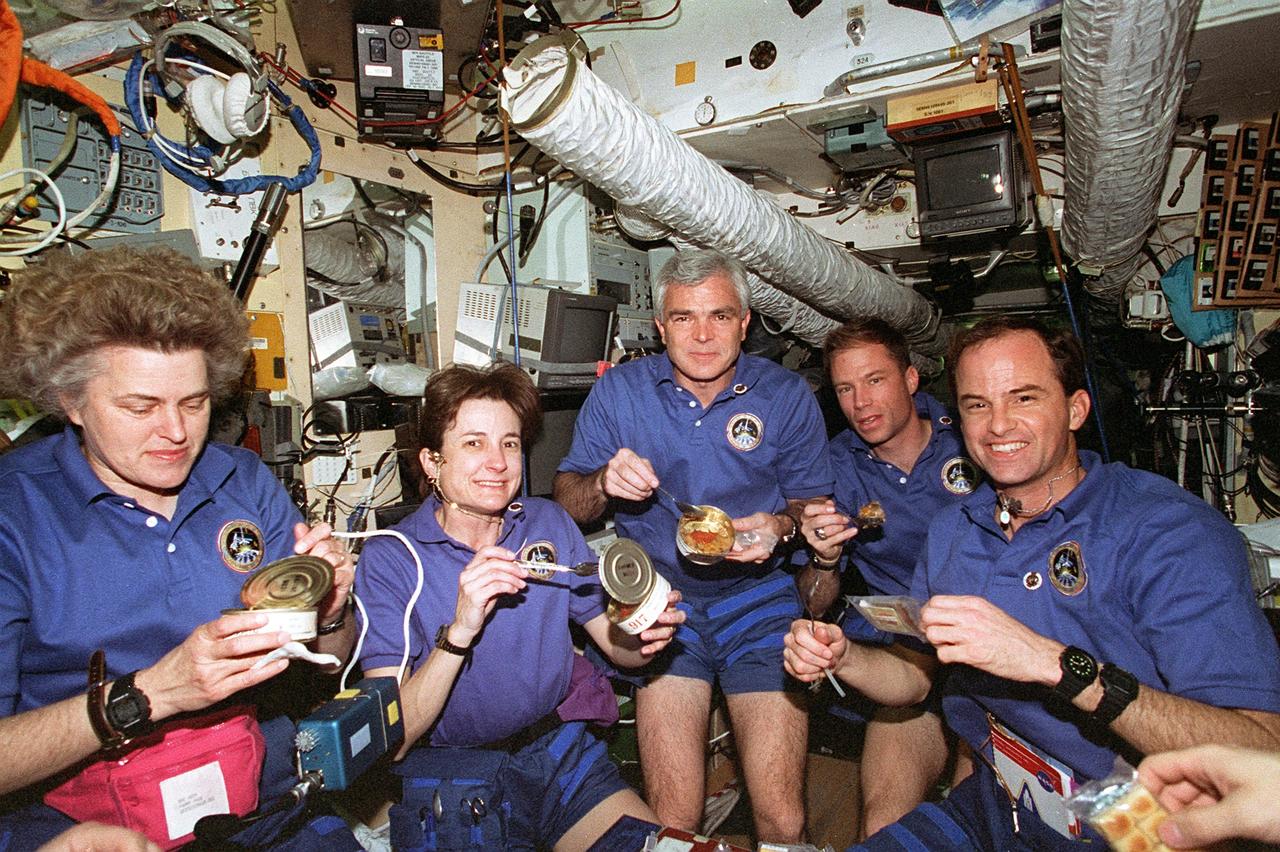
STS076-345-028 (22 - 31 March 1996) --- Onboard the Base Block Module of Russia's Mir Space Station the visiting STS-76 crew members enjoy Russian food. At right is astronaut Kevin P. Chilton, mission commander, who along with his crew mates docked with Mir on March 23, 1996, and remained linked until March 28, 1996. Left to right are astronauts Shannon W. Lucid, Linda M. Godwin and Michael R. (Rich) Clifford, all mission specialists, along with Richard A. Searfoss, pilot. The right hand of payload commander Ronald M. Sega is at right edge. Lucid was in the process of transferring from STS-76 to the Mir-21 crew, which thereby grew from two to three members. Lucid will remain aboard Mir for approximately 140 days, as a cosmonaut guest researcher.
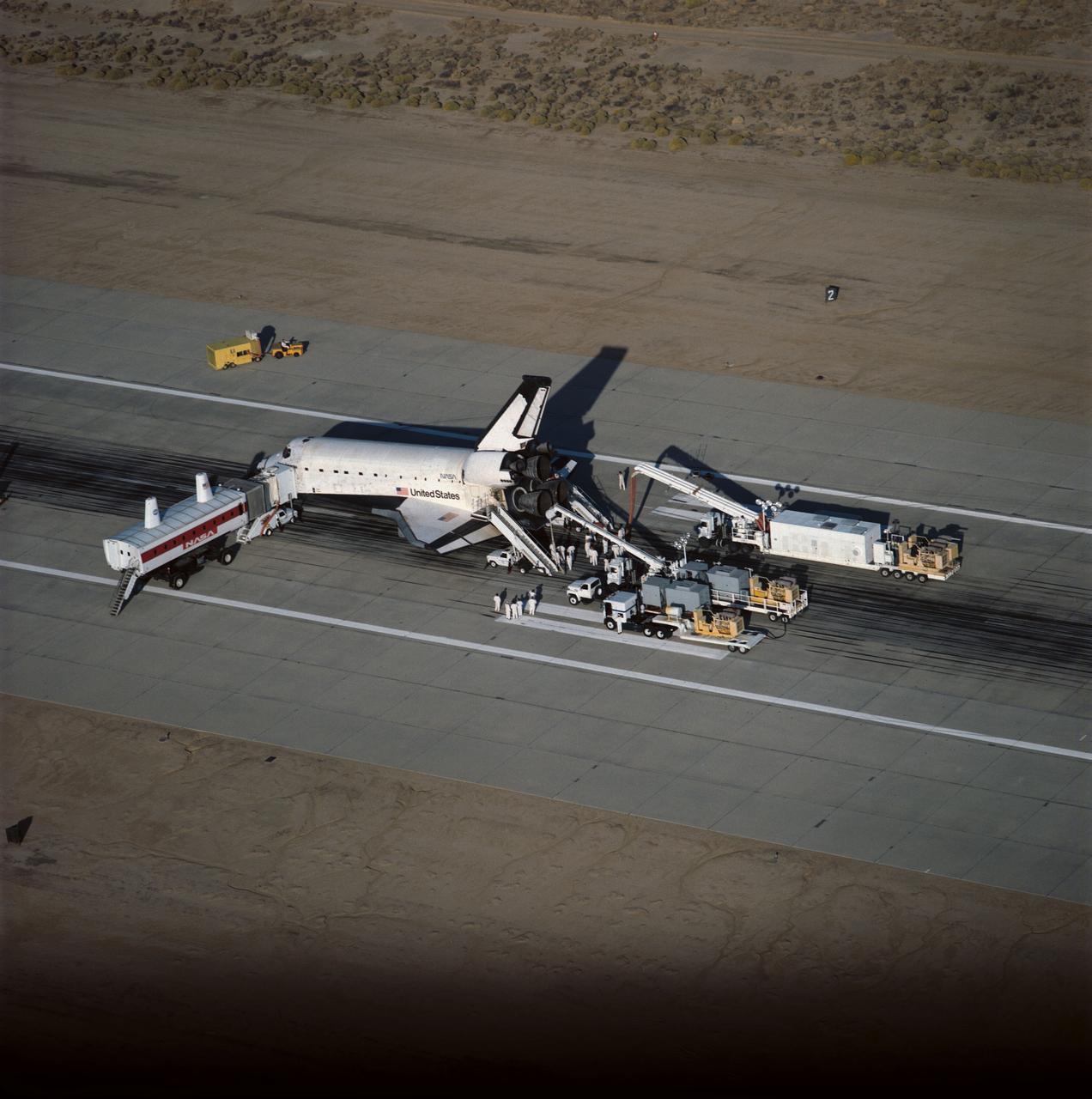
STS058-S-129 (1 Nov 1993) --- This busy scene on the runway at Edwards Air Force Base (EAFB) was taken less than an hour following the landing of the Space Shuttle Columbia. The touchdown, which had occurred at 7:06 a.m. (PST), November 1, 1993, completed a two week mission in space devoted to medical research. The array of hardware and workers includes personnel and equipment designed to make the area safe. At far left is the Crew Transport Vehicle (CTV). Still onboard the spacecraft were astronauts John E. Blaha, Richard A. Searfoss, Rhea Seddon, Shannon W. Lucid, David A. Wolf and William S. McArthur, along with payload specialist Martin J. Fettman, DVM.
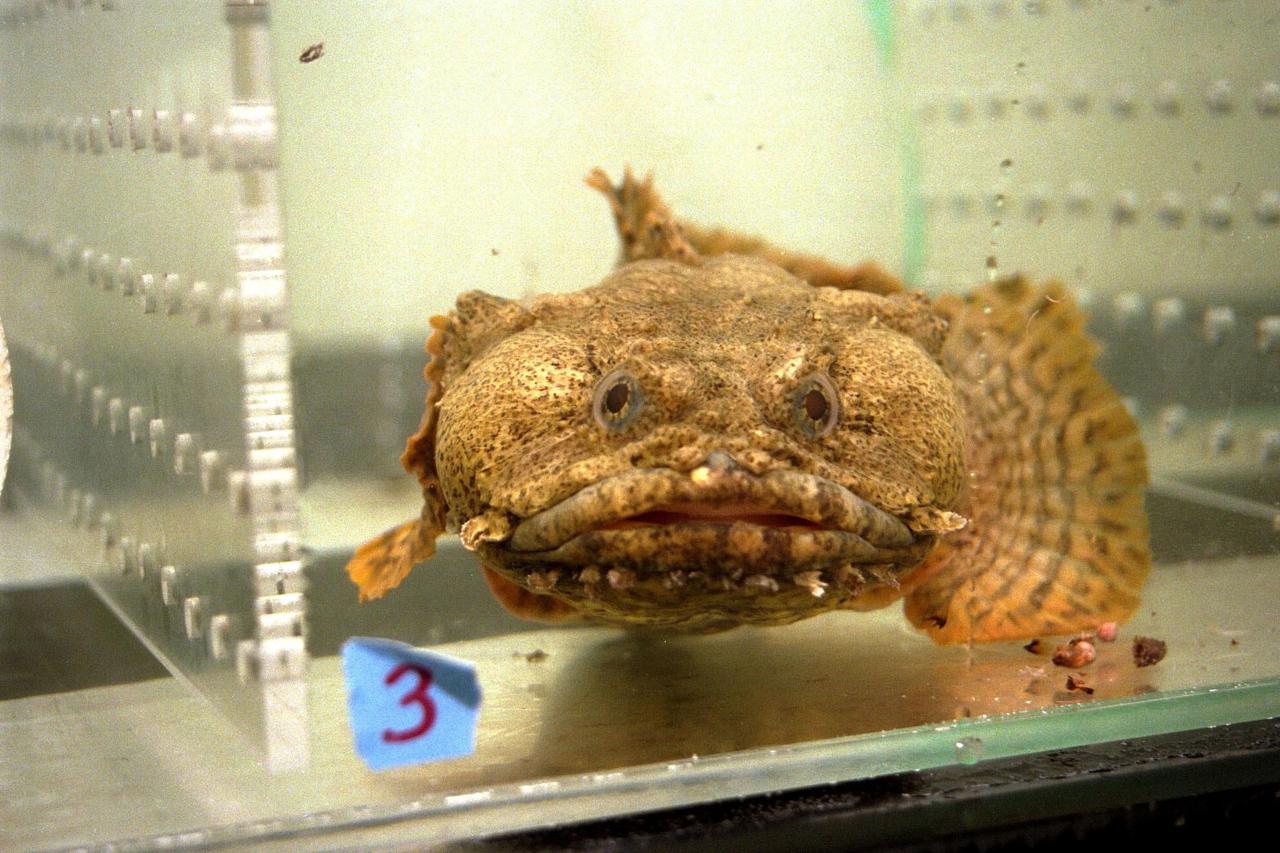
KENNEDY SPACE CENTER, FLA. -- An oyster toadfish (Opsanus tau), like those that are part of the Neurolab payload on Space Shuttle Mission STS-90, is shown in its holding tank in the Space Station Processing Facility. Each fish is between eight and 14 inches long. Toadfish live in an estuarine environment and are native to areas along the Northeast coast of the United States. Investigations during the Neurolab mission will focus on the effects of microgravity on the nervous system. This fish is an excellent model for looking at vestibular function because the architecture of its inner and middle ear are similar to those of mammals with respect to the vestibular apparatus. The crew of STS-90, slated for launch April 16 at 2:19 p.m. EDT, includes Commander Richard Searfoss, Pilot Scott Altman, Mission Specialists Richard Linnehan, Dafydd (Dave) Williams, M.D., and Kathryn (Kay) Hire, and Payload Specialists Jay Buckey, M.D., and James Pawelczyk, Ph.D
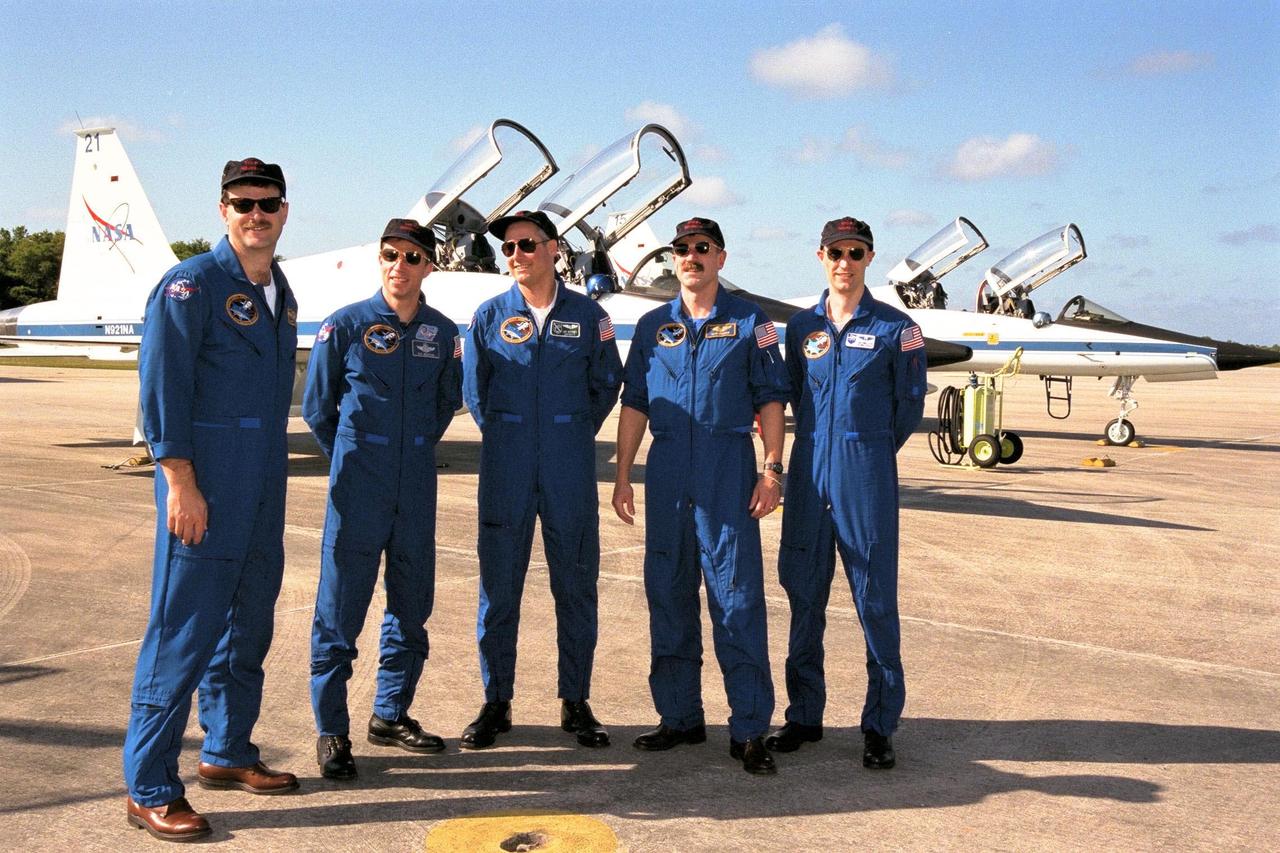
Members of the STS-90 crew pose together shortly after arriving at the KSC Shuttle Landing Facility from NASA’s Johnson Space Center to begin Terminal Countdown Demonstration Test (TCDT) activities. The TCDT is held at KSC prior to each Space Shuttle flight to provide crews with the opportunity to participate in simulated countdown activities. These five members of the seven-member crew are, left to right, Pilot Scott Altman, Commander Richard Searfoss, Payload Specialist Jay Buckey, M.D., Mission Specialist Daffyd (Dave) Williams with the Canadian Space Agency, and Payload Specialist James Pawelczyk, Ph.D. Columbia is targeted for launch of STS-90 on April 16 at 2:19 p.m. EDT and will be the second mission of 1998. The mission is scheduled to last nearly 17 days
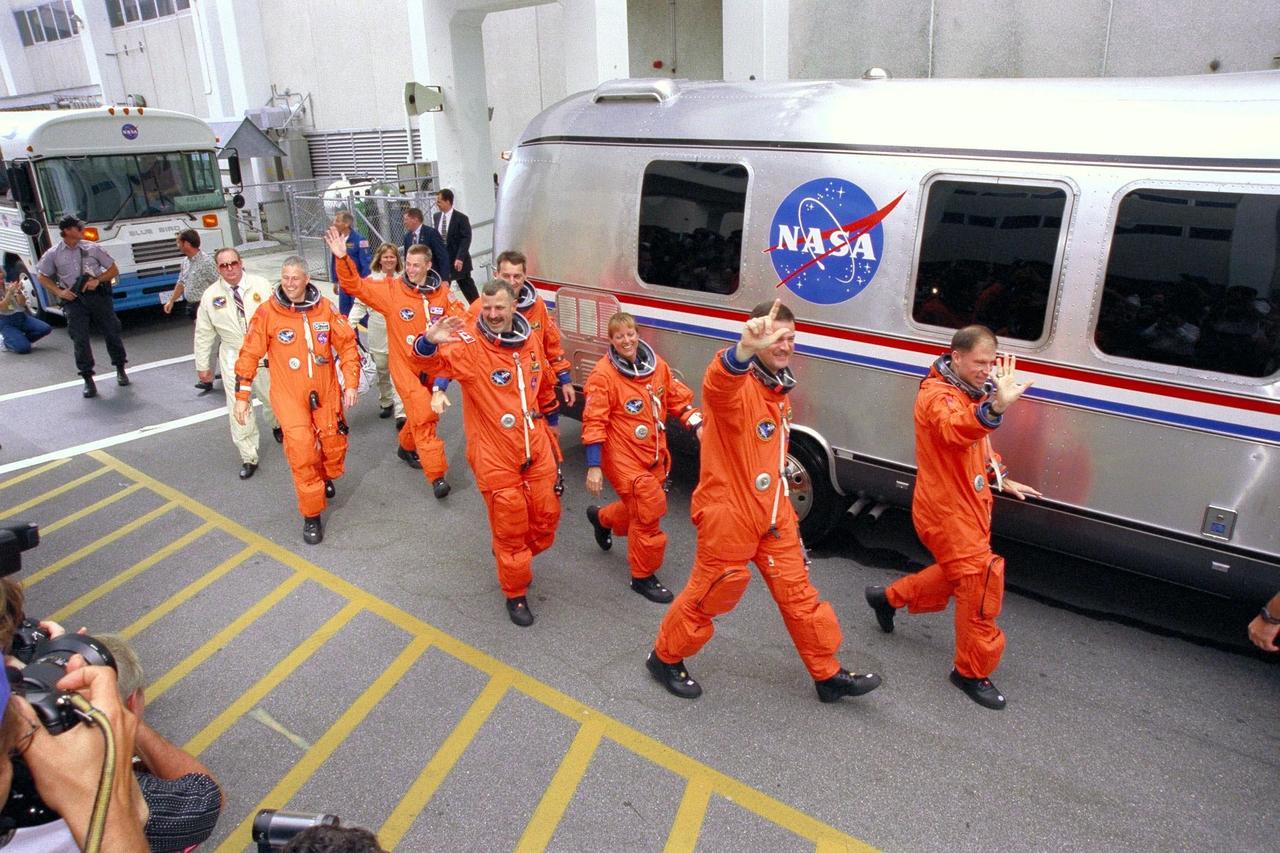
KENNEDY SPACE CENTER, FLA. -- Greeted by cheers from wellwishers at KSC and eager for their venture into space on the Neurolab mission, the STS-90 astronauts depart the Operations and Checkout Building on their way to Launch Pad 39B. The seven-member crew include (front to back, right to left) Mission Commander Richard Searfoss; Pilot Scott Altman; Mission Specialists Kathryn (Kay) Hire, Dafydd (Dave) Williams, M.D., with the Canadian Space Agency, and Richard Linnehan, D.V.M.; and Payload Specialists James Pawelczyk, Ph.D., and Jay Buckey, M.D. Their trip to the pad will take about 25 minutes aboard the Astrovan. Once there, they will take their positions in the crew cabin of the Space Shuttle Columbia to await a liftoff during a two-and-a-half hour window that will open at 2:19 p.m. EDT.
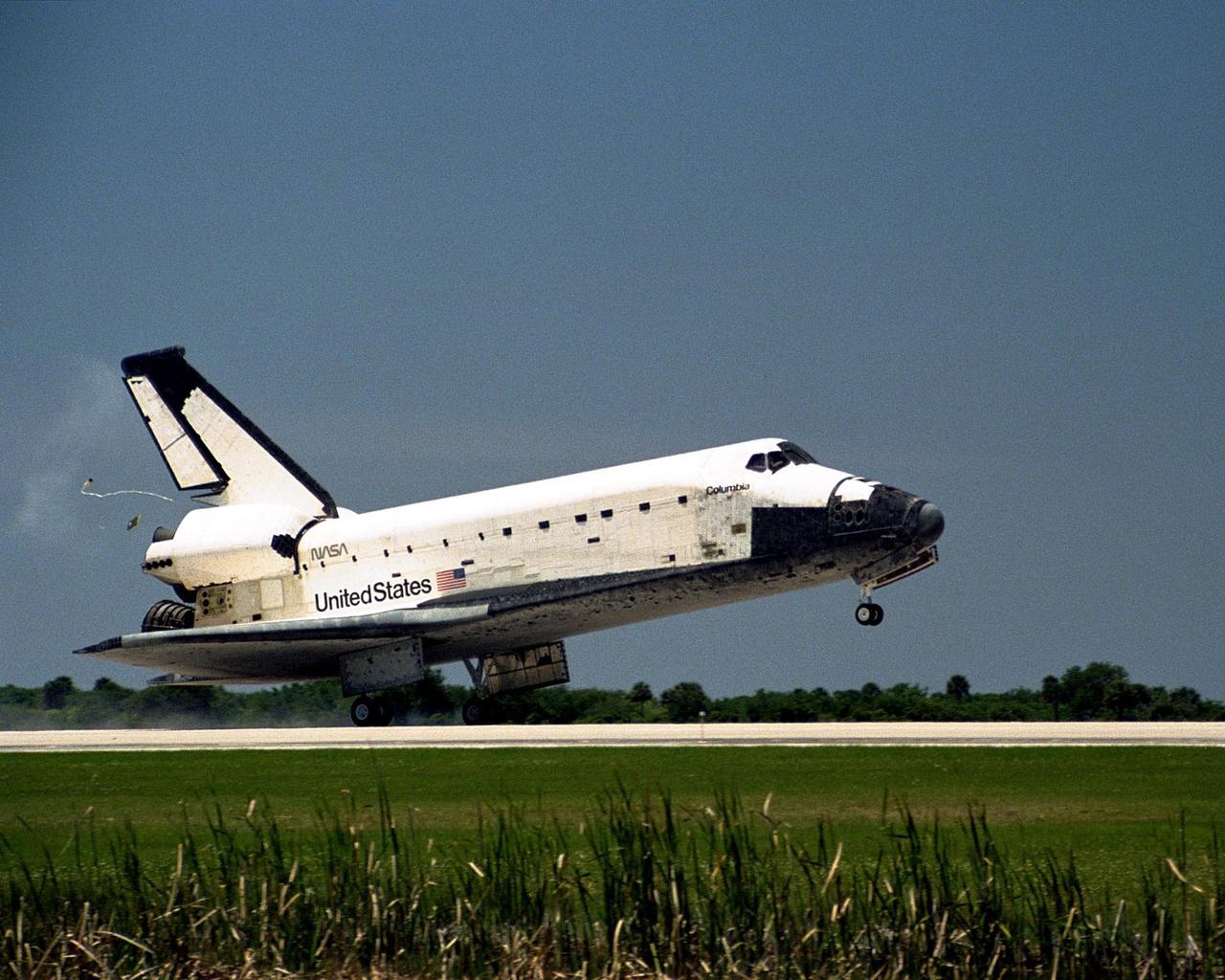
The orbiter Columbia touches down on Runway 33 of KSC's Shuttle Landing Facility to complete the nearly 16-day STS-90 mission. Main gear touchdown was at 12:08:59 p.m. EDT on May 3, 1998, landing on orbit 256 of the mission. The wheels stopped at 12:09:58 EDT, completing a total mission time of 15 days, 21 hours, 50 minutes and 58 seconds. The 90th Shuttle mission was Columbia's 13th landing at the space center and the 43rd KSC landing in the history of the Space Shuttle program. During the mission, the crew conducted research to contribute to a better understanding of the human nervous system. The crew of the STS-90 Neurolab mission include Commander Richard Searfoss; Pilot Scott Altman; Mission Specialists Richard Linnehan, D.V.M., Dafydd (Dave) Williams, M.D., with the Canadian Space Agency, and Kathryn (Kay) Hire; and Payload Specialists Jay Buckey, M.D., and James Pawelczyk, Ph.D
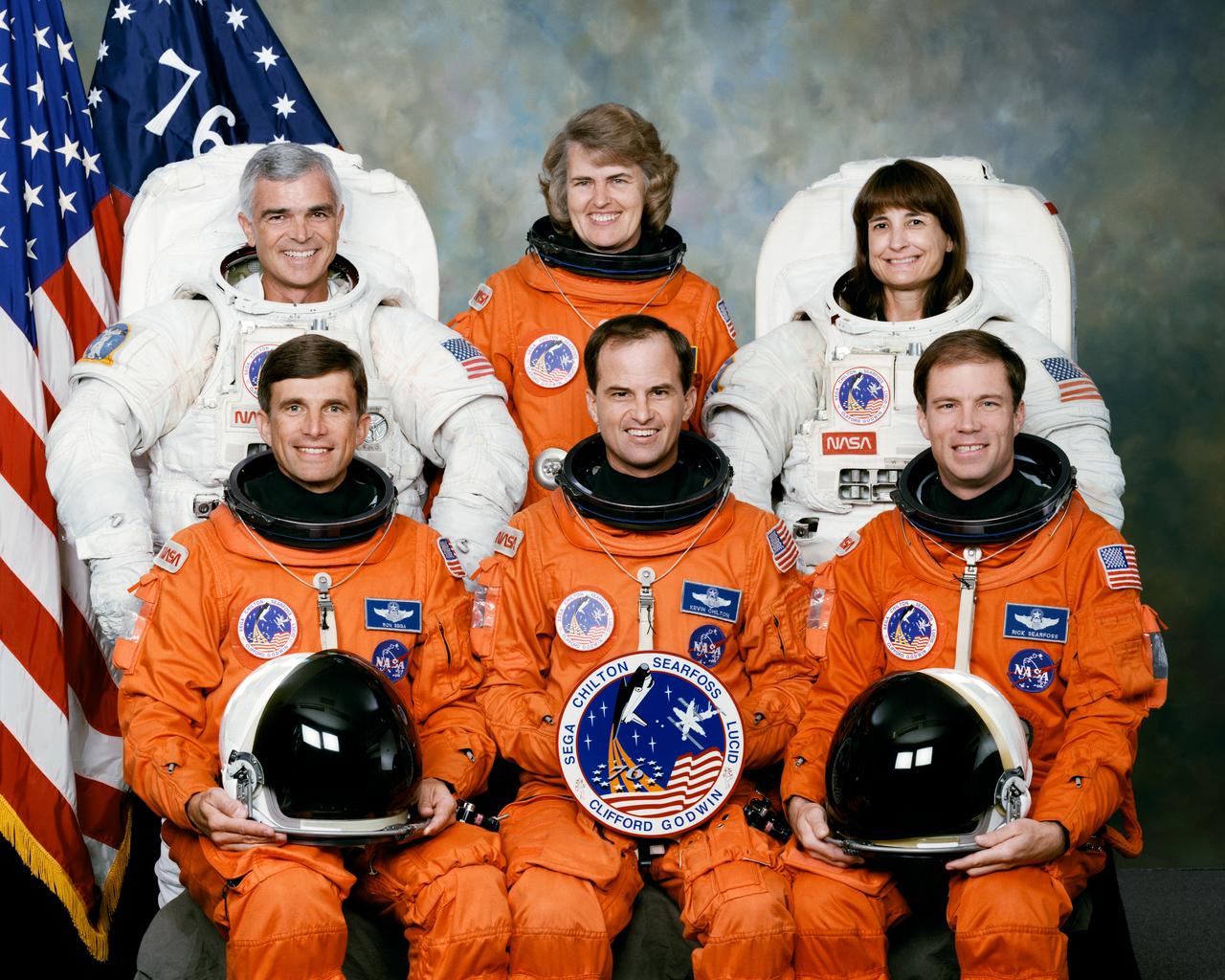
STS076-S-002 (November 1995) --- These six NASA astronauts will be launched into space aboard the Space Shuttle Atlantis early next year. Front row, left to right, are astronauts Ronald M. Sega, mission specialist; Kevin P. Chilton, mission commander; and Richard A. Searfoss, pilot. Back row, left to right, are mission specialists Michael R. (Rich) Clifford, Shannon W. Lucid and Linda M. Godwin. STS-76 begins a new period of international cooperation in space exploration with the first Shuttle transport of a United States astronaut (Lucid) to Russia’s Mir Space Station for extended joint space research. Clifford and Godwin, pictured here in training versions of the Extravehicular Mobility Unit (EMU), are scheduled to perform the first Extravehicular Activity (EVA) during Mir-Shuttle docked operations.