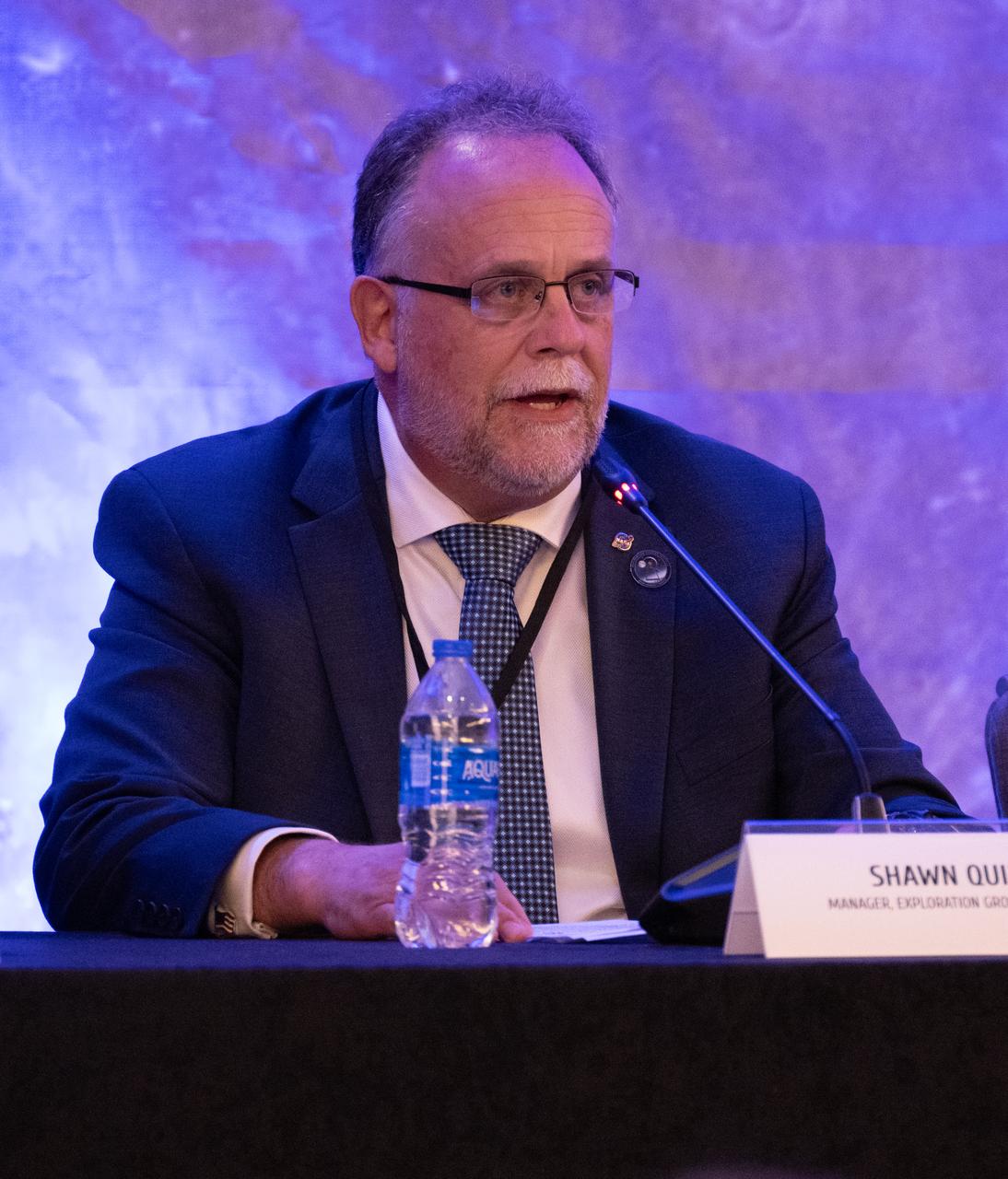
Shawn Quinn, manager of Exploration Ground Systems at NASA’s Kennedy Space Center, speaks during an Artemis Program progress update panel at the 2024 Artemis Suppliers Conference, Tuesday, Feb. 27, 2024, at the Grand Hyatt Hotel in Washington. Photo Credit: (NASA/Joel Kowsky)
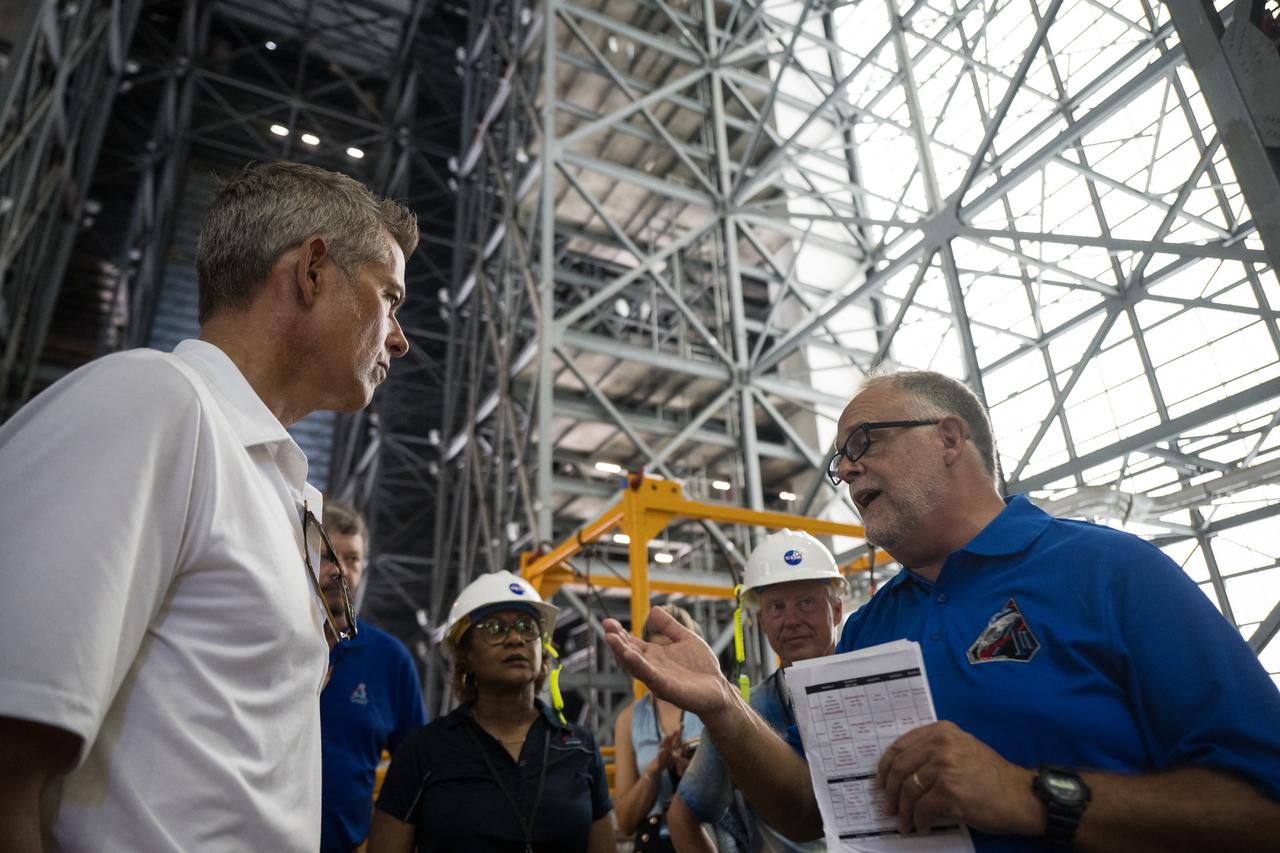
Acting NASA Administrator Sean Duffy speaks with NASA Exploration Ground Systems Manager, Shawn Quinn, during a tour of the Vehicle Assembly Building (VAB), Wednesday, July 30, 2025, at NASA’s Kennedy Space Center in Florida. Photo Credit: (NASA/Aubrey Gemignani)
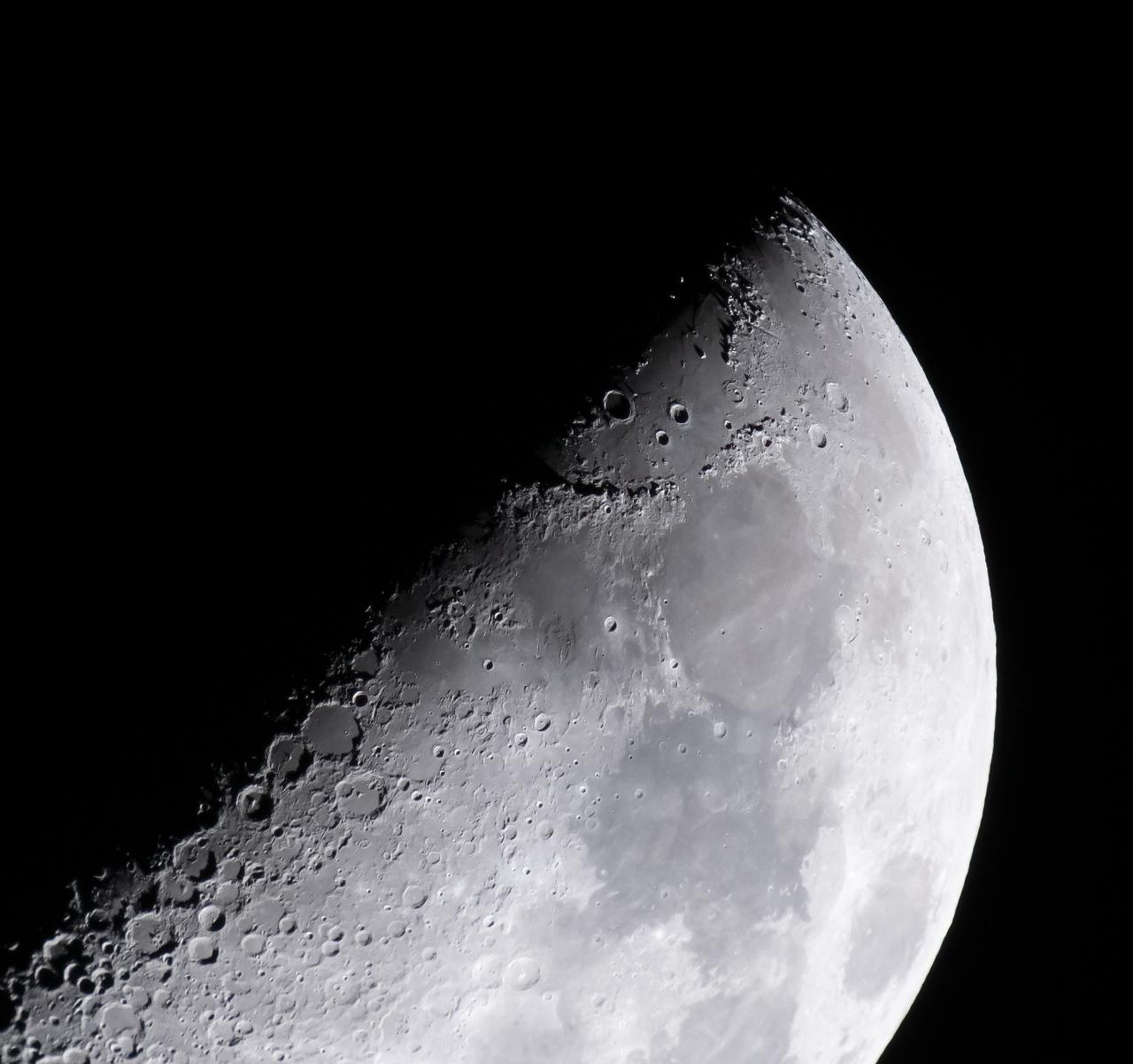
NASA’s Exploration Ground Systems’ Program Manager Shawn Quinn captured this image of the Hadley–Apennine region of the moon including the Apollo 15 landing site (very near the edge of the shadow of one of the lunar mountains in the area). Image is a crop of a full frame image. Apollo 11, 16 and 17 landing sites are also visible in this image. Hadley–Apennine is a region on the near side of Earth's Moon that served as the landing site for the American Apollo 15 mission, the fourth crewed landing on the Moon and the first of the "J-missions", in July 1971. The site is located on the eastern edge of Mare Imbrium on a lava plain known as Palus Putredinis. Hadley–Apennine is bordered by the Montes Apenninus (often referred to as "Apennine Front"), a mountain range, and Hadley Rille, a meandering channel, on the east and west, respectively.
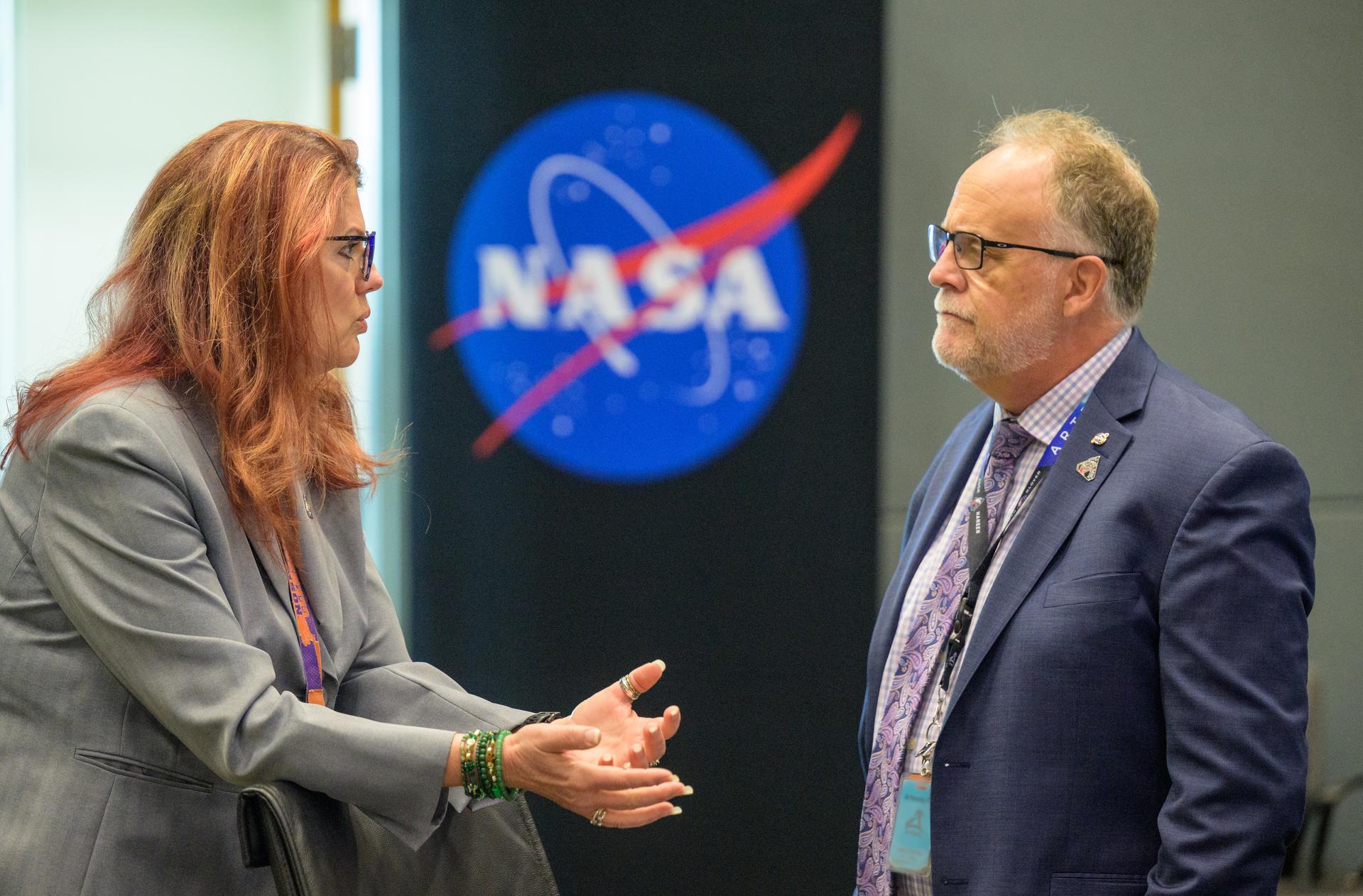
Charlie Blackwell-Thompson, Artemis II launch director, left, and speaks with Shawn Quinn, manager of Exploration Ground Systems, as they meet for the Artemis II launch countdown pre-test briefing, Saturday, March 28, 2026, at NASA’s Kennedy Space Center, Operations Support Building II in Florida. Photo Credit: (NASA/Bill Ingalls) NOTE - Portions of this image have been blurred for security reasons.
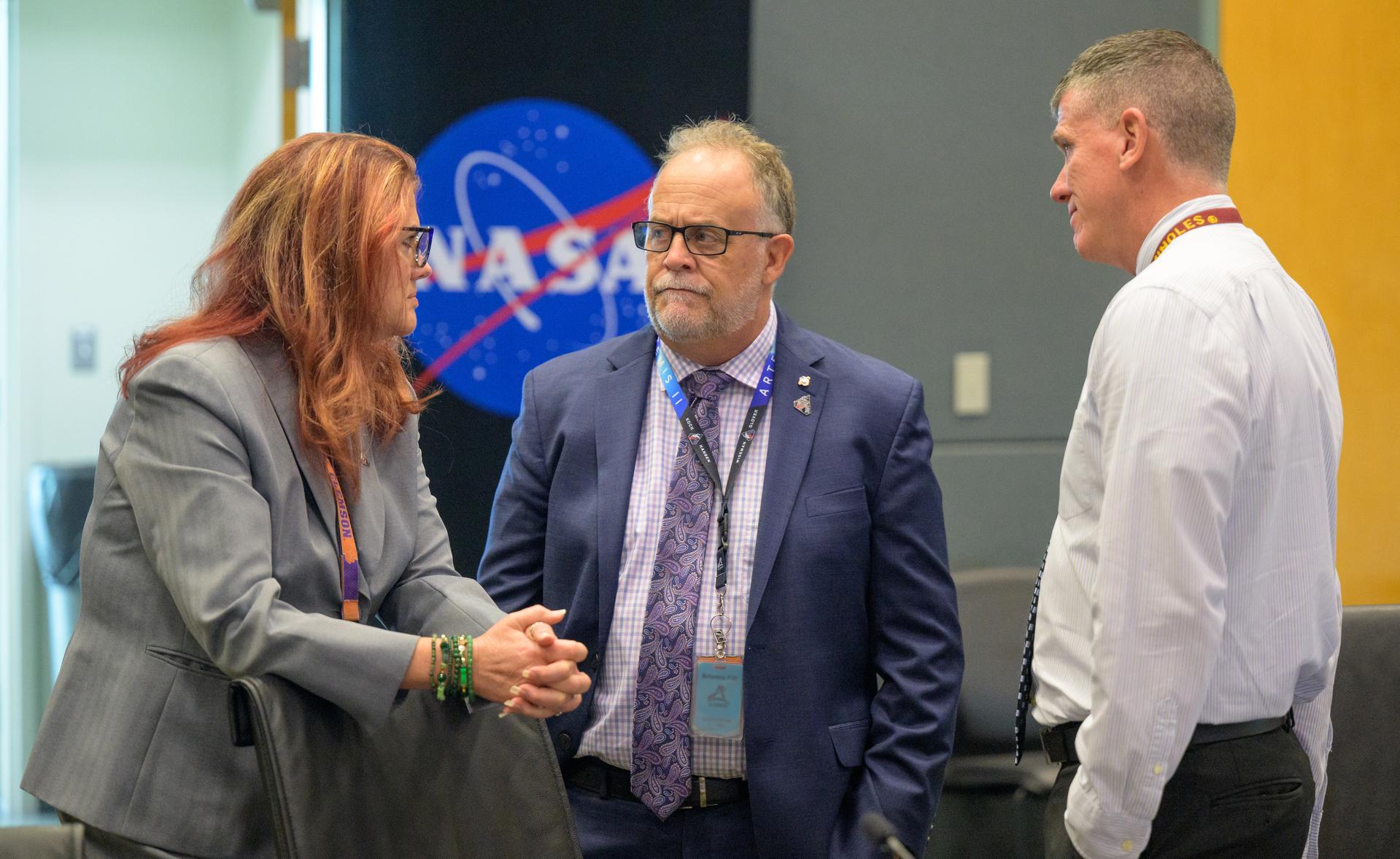
Charlie Blackwell-Thompson, Artemis II launch director, left, and speaks with Shawn Quinn, manager of Exploration Ground Systems, and Artemis II Assistant Launch Director Jeremy Graeber, right, as they meet for the Artemis II launch countdown pre-test briefing, Saturday, March 28, 2026, at NASA’s Kennedy Space Center, Operations Support Building II in Florida. Photo Credit: (NASA/Bill Ingalls) NOTE - Portions of this image have been blurred for security reasons.
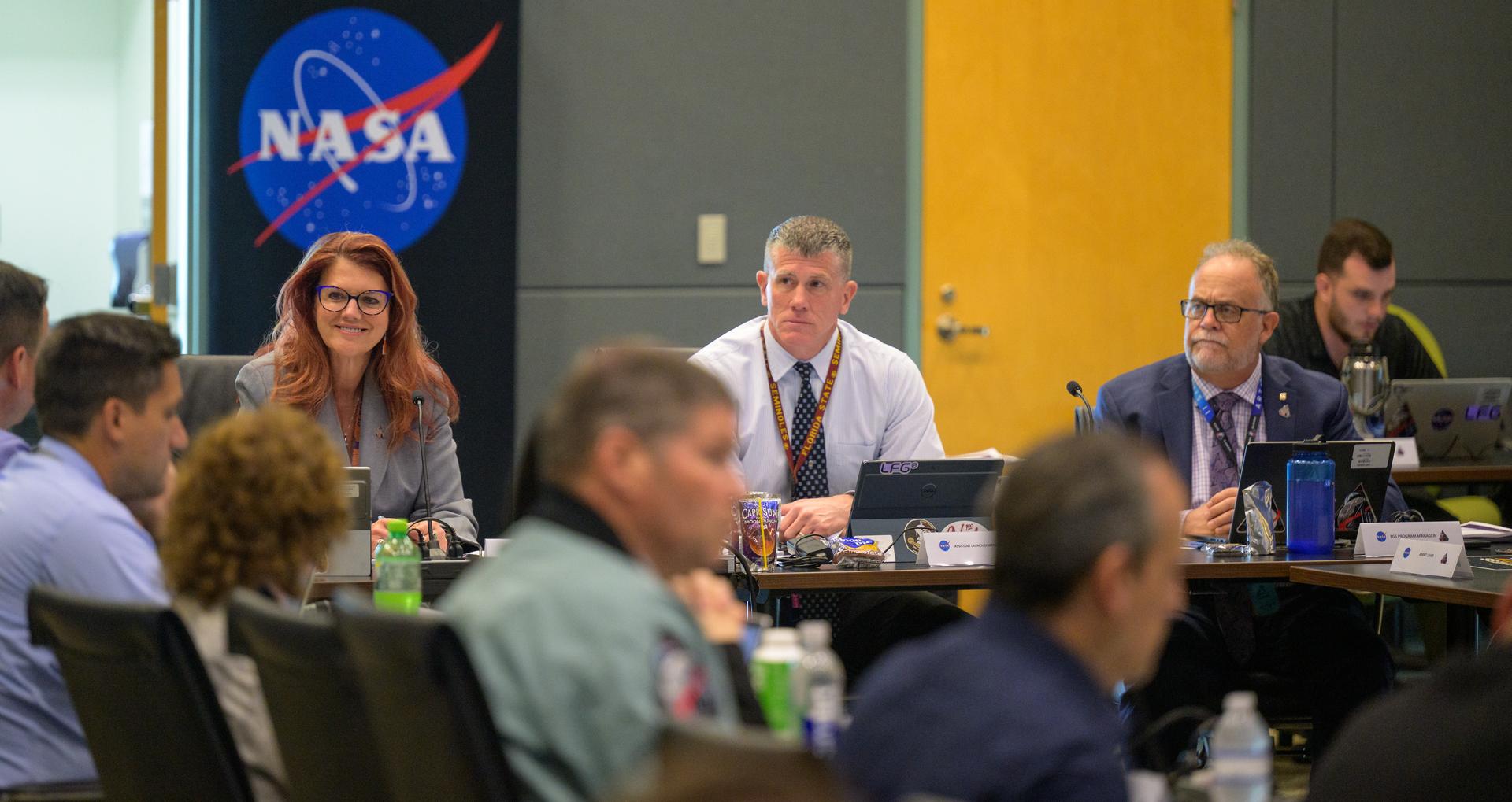
Charlie Blackwell-Thompson, Artemis II launch director, left, and Artemis II Assistant Launch Director Jeremy Graeber, and Shawn Quinn, manager of Exploration Ground Systems, right, are seen as teams meet for the Artemis II launch countdown pre-test briefing, Saturday, March 28, 2026, at NASA’s Kennedy Space Center, Operations Support Building II in Florida. Photo Credit: (NASA/Bill Ingalls)

Howard Hu, manager of the Orion Program at NASA’s Johnson Space Center, center, speaks during an Artemis Program progress update panel at the 2024 Artemis Suppliers Conference, Tuesday, Feb. 27, 2024, at the Grand Hyatt Hotel in Washington. Also participating in the panel was, from left, Amit Kshatriya, deputy associate administrator for the Moon to Mars Program in NASA’s Explorations Systems Development Mission Directorate; Shawn Quinn, manager of Exploration Ground Systems at NASA’s Kennedy Space Center; John Honeycutt, manager of the Space Launch System Program at NASA’s Marshall Space Flight Center; Lisa Watson-Morgan, manager of the Human Landing System Program at NASA’s Marshall Space Flight Center; Jon B. Olansen, manager of the Gateway Program at NASA’s Johnson Space Center; and Lara Kearney, manager of Extravehicular Activity and Human Surface Mobility Program at NASA’s Johnson Space Center. Photo Credit: (NASA/Joel Kowsky)
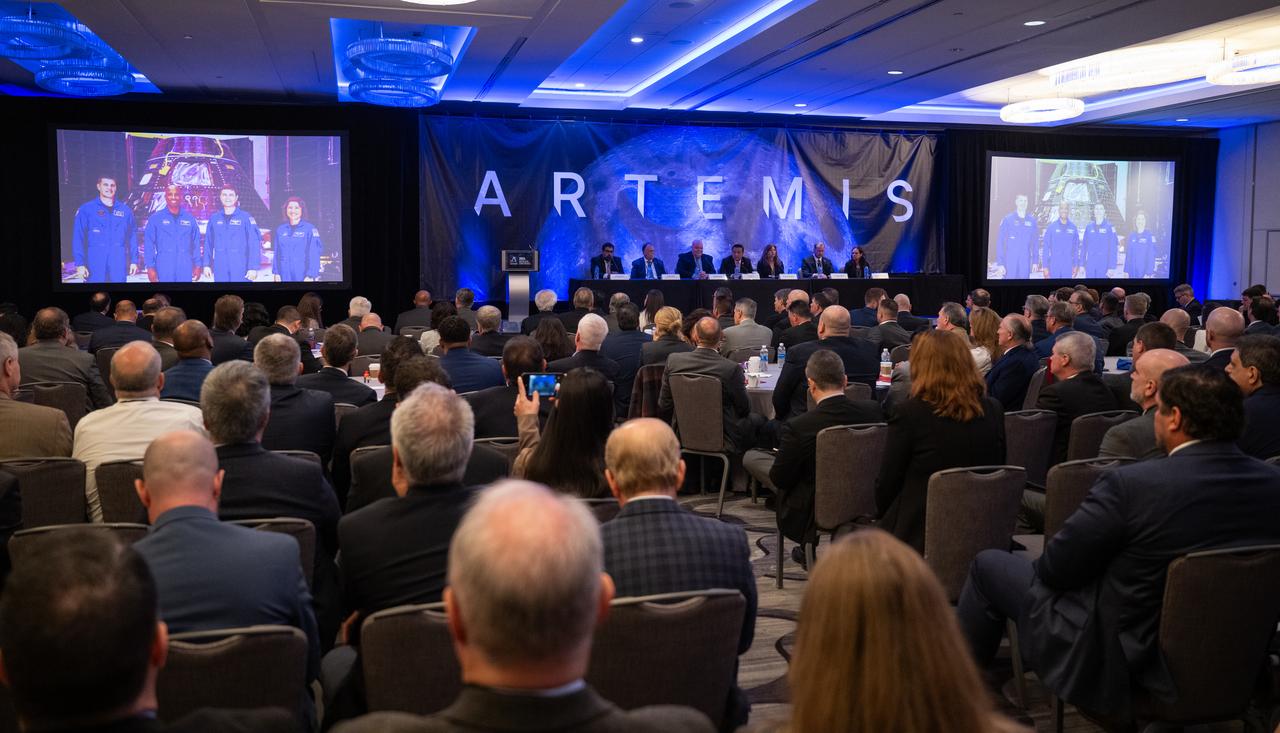
Howard Hu, manager of the Orion Program at NASA’s Johnson Space Center, center, speaks during an Artemis Program progress update panel at the 2024 Artemis Suppliers Conference, Tuesday, Feb. 27, 2024, at the Grand Hyatt Hotel in Washington. Also participating in the panel was, from left, Amit Kshatriya, deputy associate administrator for the Moon to Mars Program in NASA’s Explorations Systems Development Mission Directorate; Shawn Quinn, manager of Exploration Ground Systems at NASA’s Kennedy Space Center; John Honeycutt, manager of the Space Launch System Program at NASA’s Marshall Space Flight Center; Lisa Watson-Morgan, manager of the Human Landing System Program at NASA’s Marshall Space Flight Center; Jon B. Olansen, manager of the Gateway Program at NASA’s Johnson Space Center; and Lara Kearney, manager of Extravehicular Activity and Human Surface Mobility Program at NASA’s Johnson Space Center. Photo Credit: (NASA/Joel Kowsky)
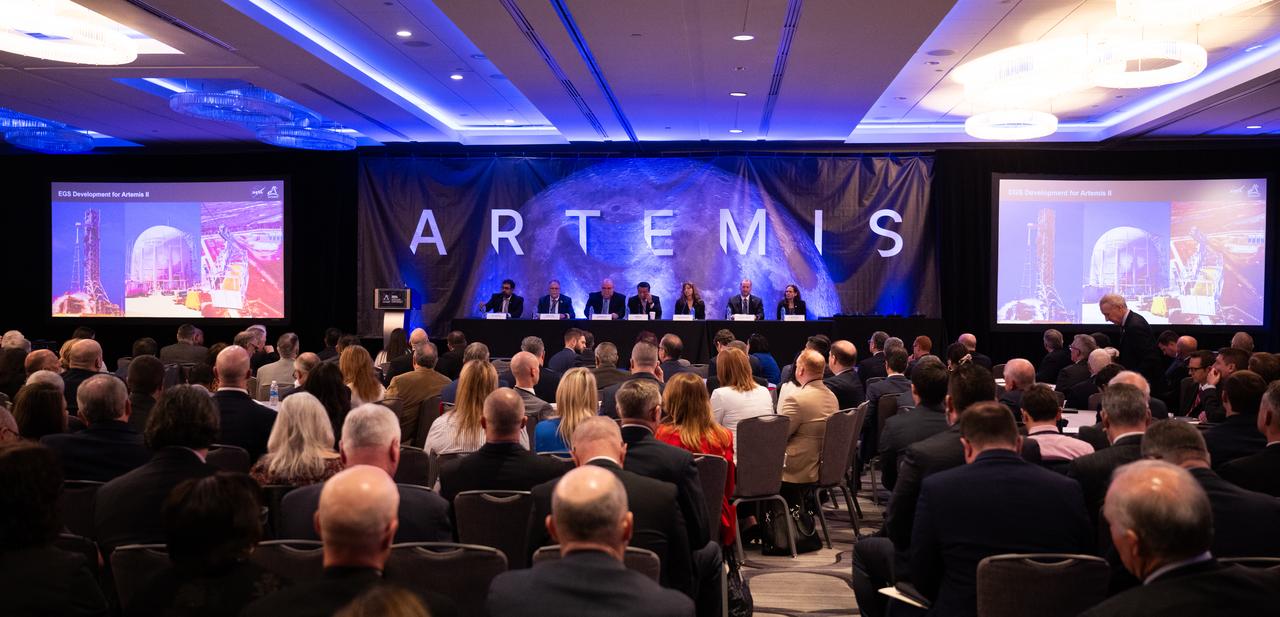
Shawn Quinn, manager of Exploration Ground Systems at NASA’s Kennedy Space Center, second from left, speaks during an Artemis Program progress update panel at the 2024 Artemis Suppliers Conference, Tuesday, Feb. 27, 2024, at the Grand Hyatt Hotel in Washington. Also participating in the panel was, from left, Amit Kshatriya, deputy associate administrator for the Moon to Mars Program in NASA’s Explorations Systems Development Mission Directorate; John Honeycutt, manager of the Space Launch System Program at NASA’s Marshall Space Flight Center; Howard Hu, manager of the Orion Program at NASA’s Johnson Space Center; Lisa Watson-Morgan, manager of the Human Landing System Program at NASA’s Marshall Space Flight Center; Jon B. Olansen, manager of the Gateway Program at NASA’s Johnson Space Center; and Lara Kearney, manager of Extravehicular Activity and Human Surface Mobility Program at NASA’s Johnson Space Center. Photo Credit: (NASA/Joel Kowsky)
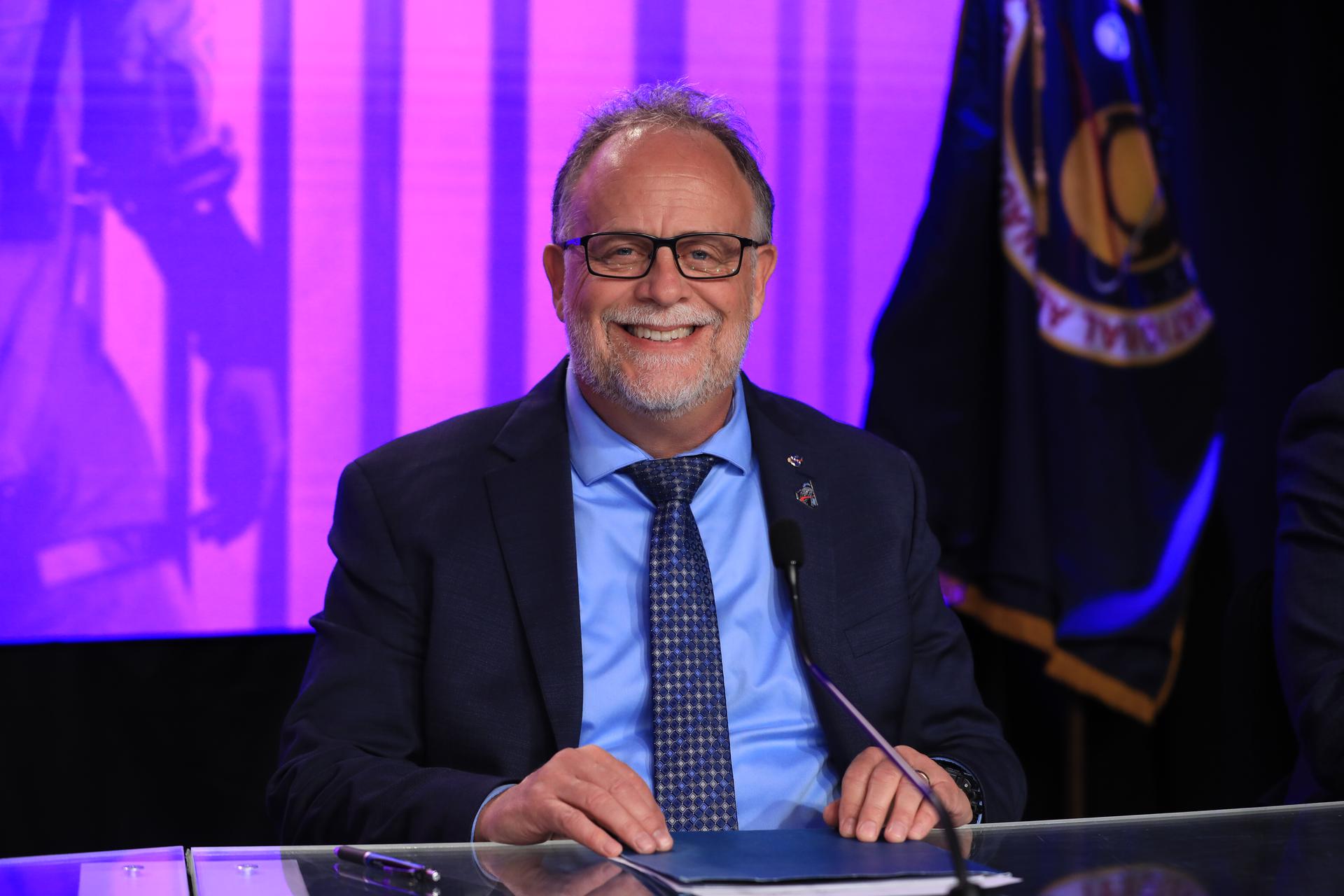
Shawn Quinn, manager, Exploration Ground Systems Program, participates in a post-Flight Readiness Review news conference for the Artemis II test flight inside the John Holliman Auditorium of the NASA News Center at the agency’s Kennedy Space Center in Florida on Thursday, March 12, 2026. The review is an assessment of the readiness of NASA’s SLS (Space Launch System) rocket and Orion spacecraft to support the Artemis II test flight as four astronauts journey around the Moon and return to Earth.
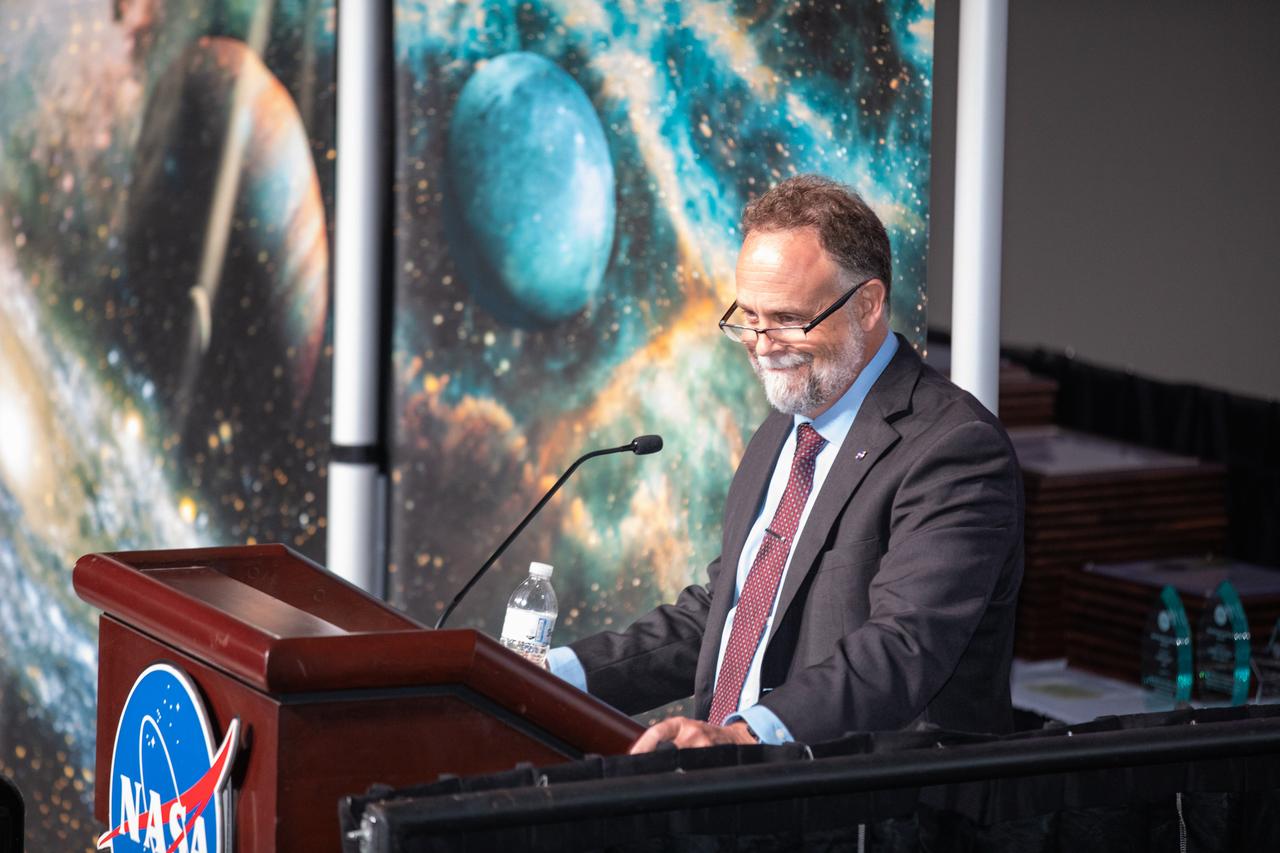
Shawn Quinn, director of Engineering at Kennedy Space Center, addresses attendees during the 2019 KSC Honor Awards Ceremony on April 18, 2019. Held inside the IMAX Theater at the Florida spaceport’s visitor complex, the ceremony honored both civil servants and contractors for their contributions to NASA and Kennedy.
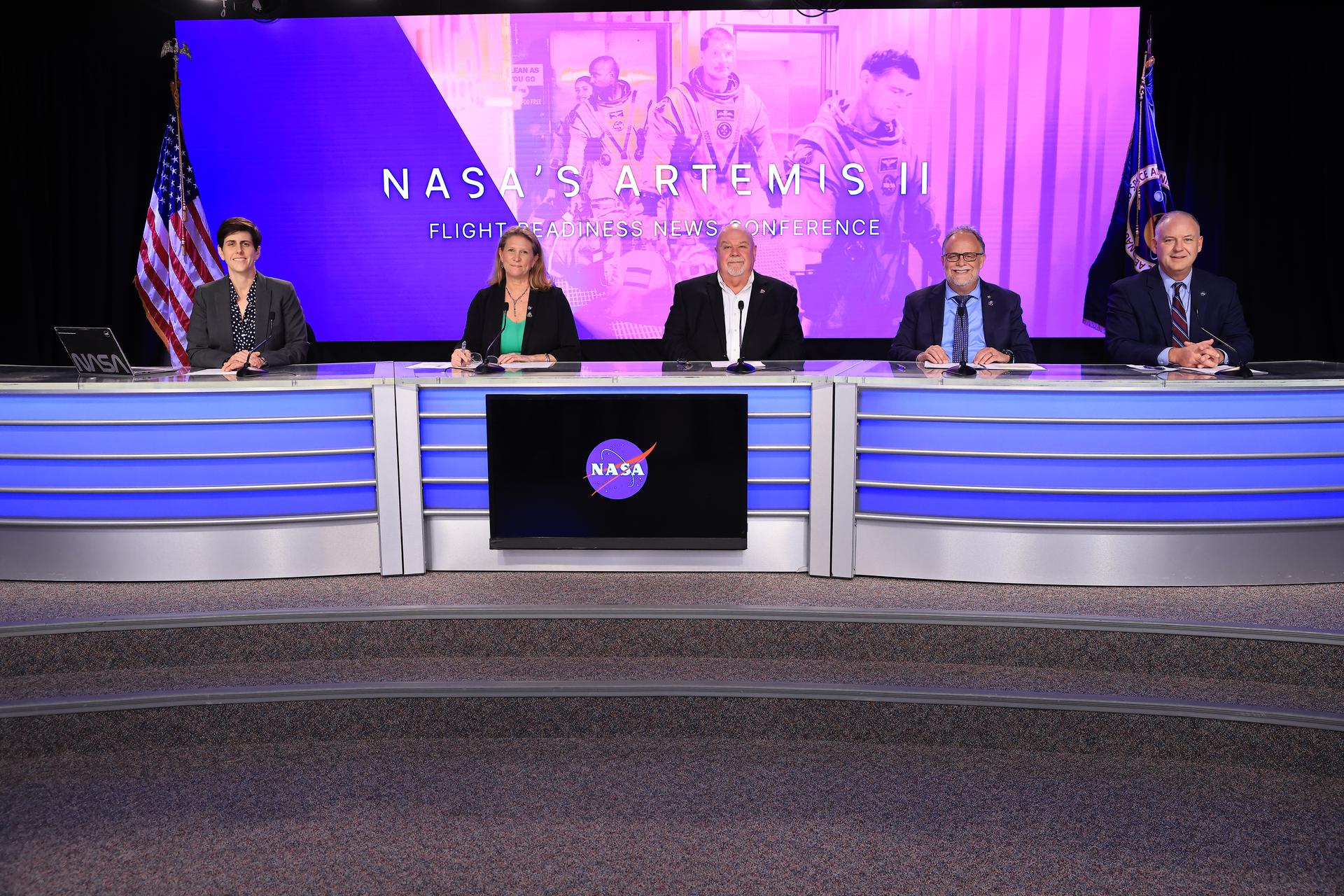
From left to right, Rachel Kraft, NASA Communications; Lori Glaze, acting associate administrator, Exploration Systems Development Mission Directorate; John Honeycutt, chair, Artemis II Mission Management Team; Shawn Quinn, manager, Exploration Ground Systems Program; and Norm Knight, director, Flight Operations Directorate, participate in a post-Flight Readiness Review news conference for the Artemis II test flight inside the John Holliman Auditorium of the NASA News Center at the agency’s Kennedy Space Center in Florida on Thursday, March 12, 2026. The review is an assessment of the readiness of NASA’s SLS (Space Launch System) rocket and Orion spacecraft to support the Artemis II test flight as four astronauts journey around the Moon and return to Earth.

From left, Kennedy Space Center Director Janet Petro; Charlie Blackwell-Thompson, launch director, Exploration Ground Systems Program; and Shawn Quinn, manager, Exploration Ground Systems Program, participate in the Artemis II Flight Readiness Review with NASA leadership on Wednesday, March 11, 2026, at NASA’s Kennedy Space Center in Florida. The review is an assessment of the readiness of NASA’s SLS (Space Launch System) rocket and Orion spacecraft to support the Artemis II test flight as four astronauts journey around the Moon and return to Earth.
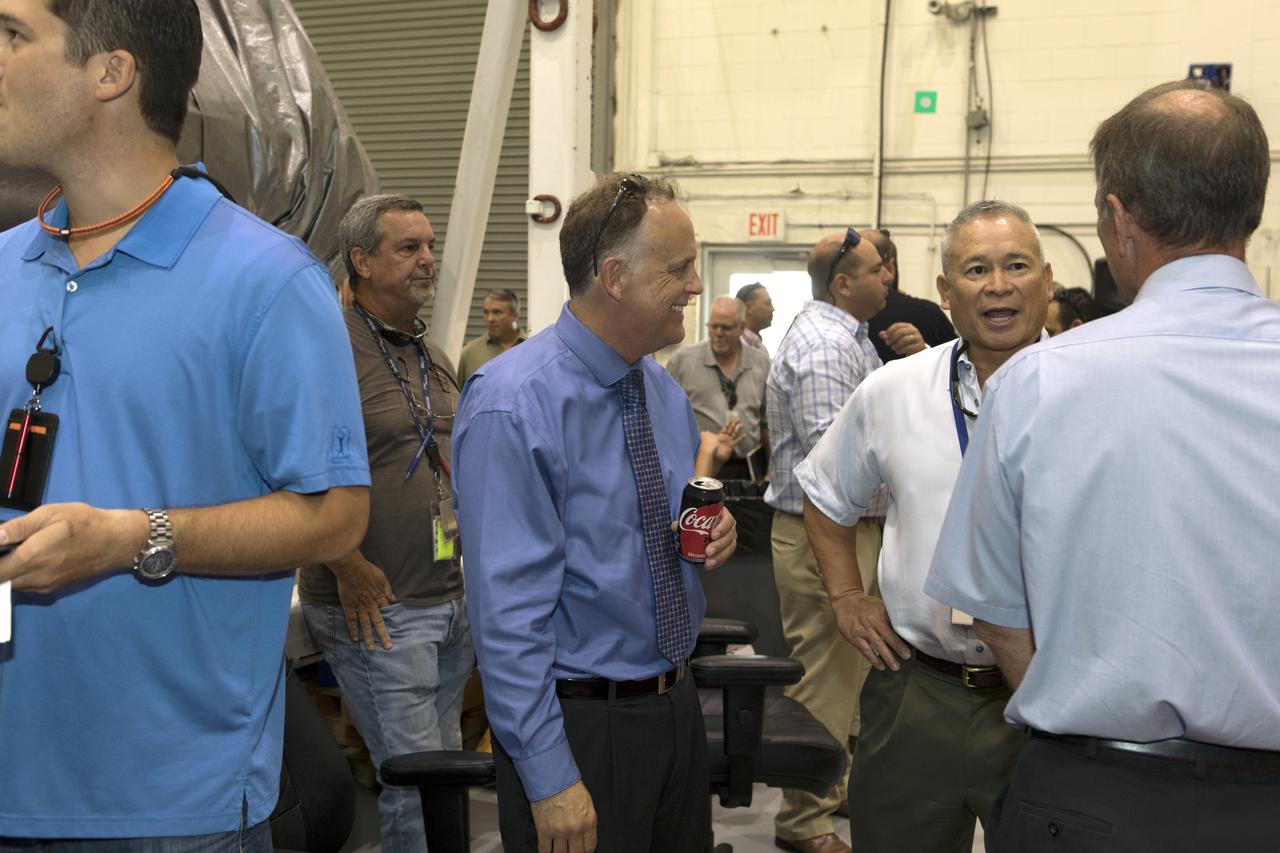
The team that tested the umbilical lines and accessories that will connect from the mobile launcher to NASA's Space Launch System rocket and Orion spacecraft for Exploration Mission-1 hold a banner signing event July 24, 2018, to mark completion of testing at the Launch Equipment Test Facility (LETF) at NASA's Kennedy Space Center in Florida. Attending the event is Shawn Quinn, center, director of Engineering. A total of 21 umbilicals and launch accessories were tested on various simulators at the LETF before they were transferred to the mobile launcher for installation.
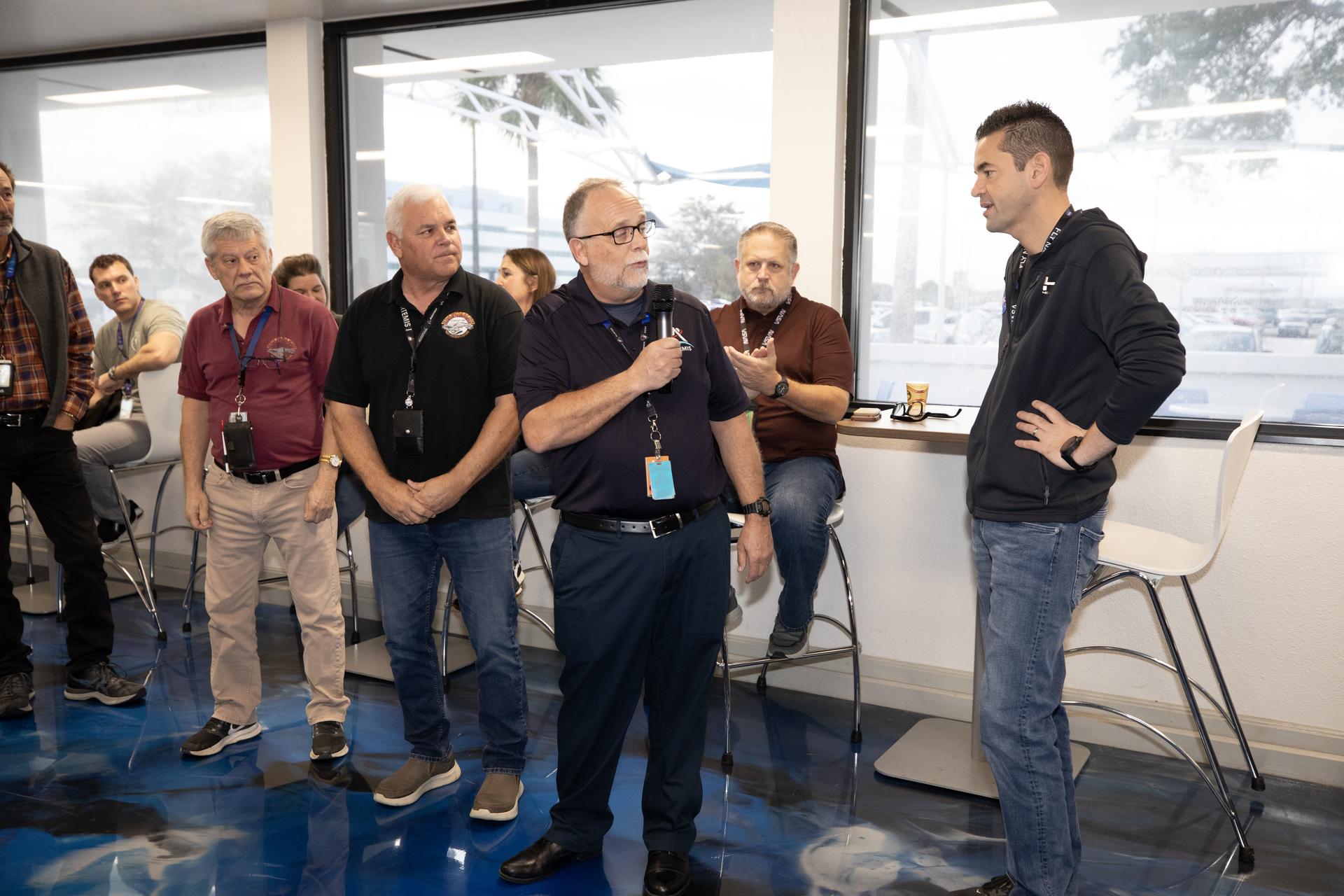
From left, Shawn Quinn, manager of NASA's Exploration Ground Systems Program, and NASA Administrator Jared Isaacman speak with employees and contractors at NASA’s Kennedy Space Center in Florida on Thursday, Jan. 22, 2026, who supported the Artemis II rocket roll to the pad at Launch Complex 39B on Saturday, Jan. 17.. Isaacman, the 15th administrator of NASA, has been visiting with employees across the agency’s centers since he was appointed on Dec. 17, 2025.
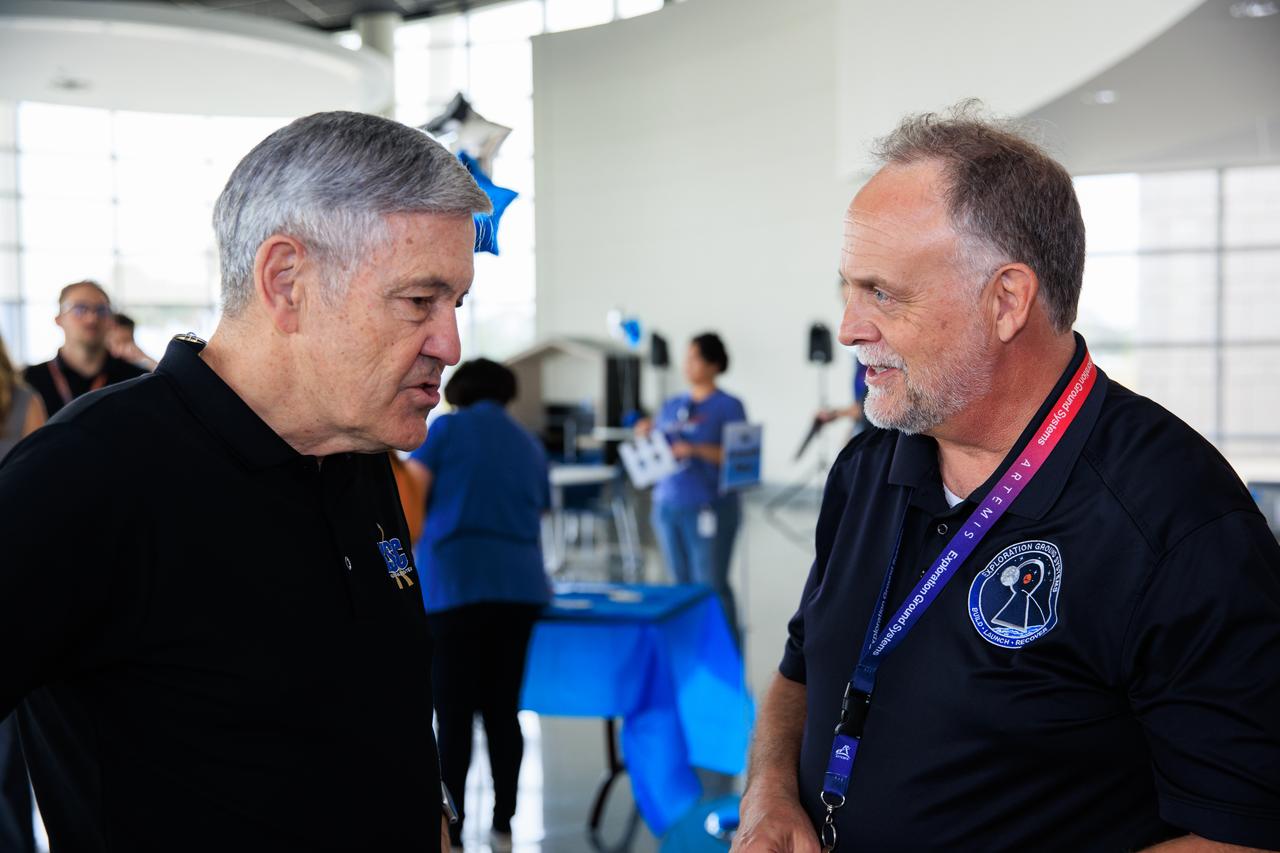
Former Kennedy Space Center director Bob Cabana speaks with Exploration Ground Systems manager Shawn Quinn at the agency’s Central Campus Headquarters cafeteria at Kennedy Space Center in Florida on Wednesday, March 27, 2024. Employees and other attendees gathered to celebrate Cabana’s retirement from Kennedy after he served as the center director for 13 years.
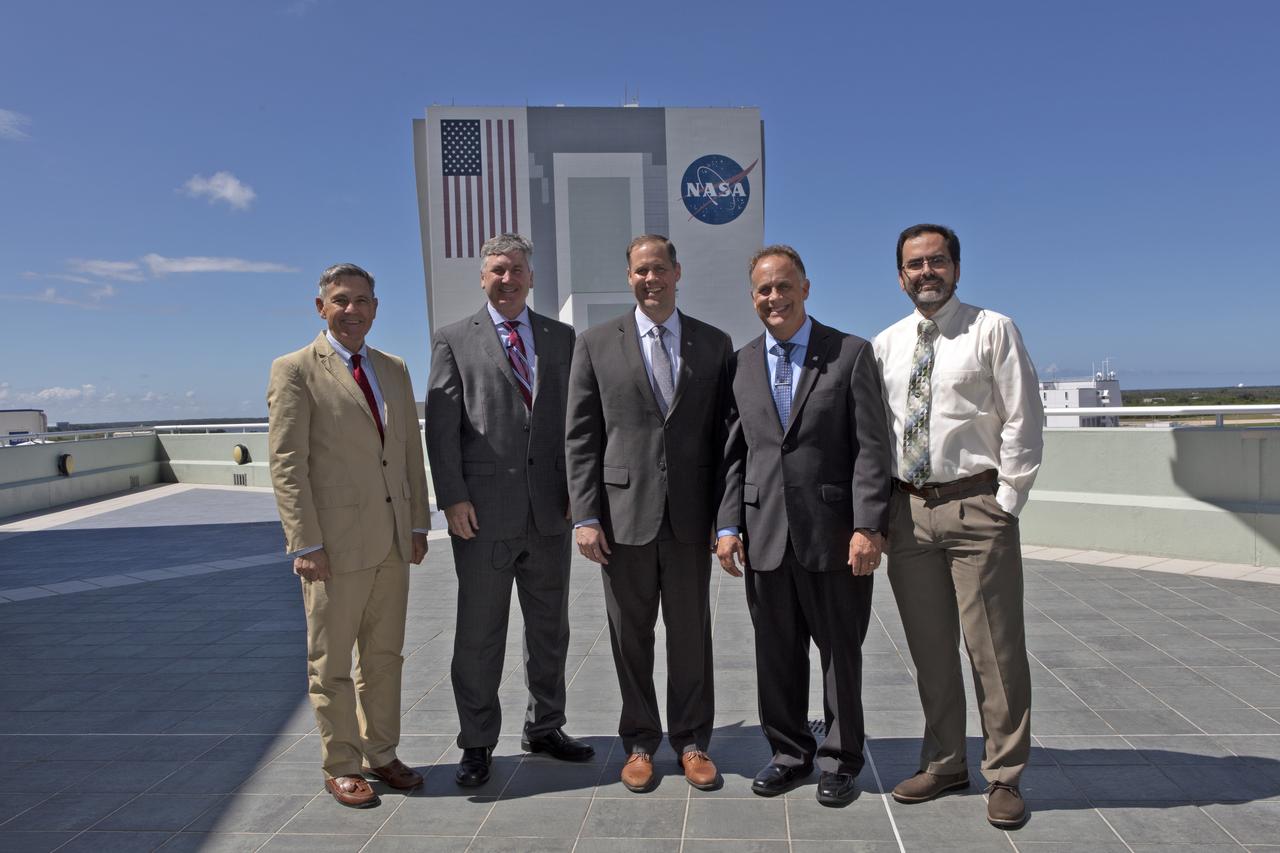
Back dropped by the iconic Vehicle Assembly Building NASA Administrator Jim Bridenstine poses with key leaders of the agency's Kennedy Space Center. From the left are, Center Director Bob Cabana, Scott Colloredo, associate director of NASA Engineering, Bridenstine, Shawn Quinn, director of NASA Engineering, and Ronnie Rodriguez, NASA Engineering. Bridenstine made his first official visit to the Florida spaceport on Aug. 6 and 7, 2018.
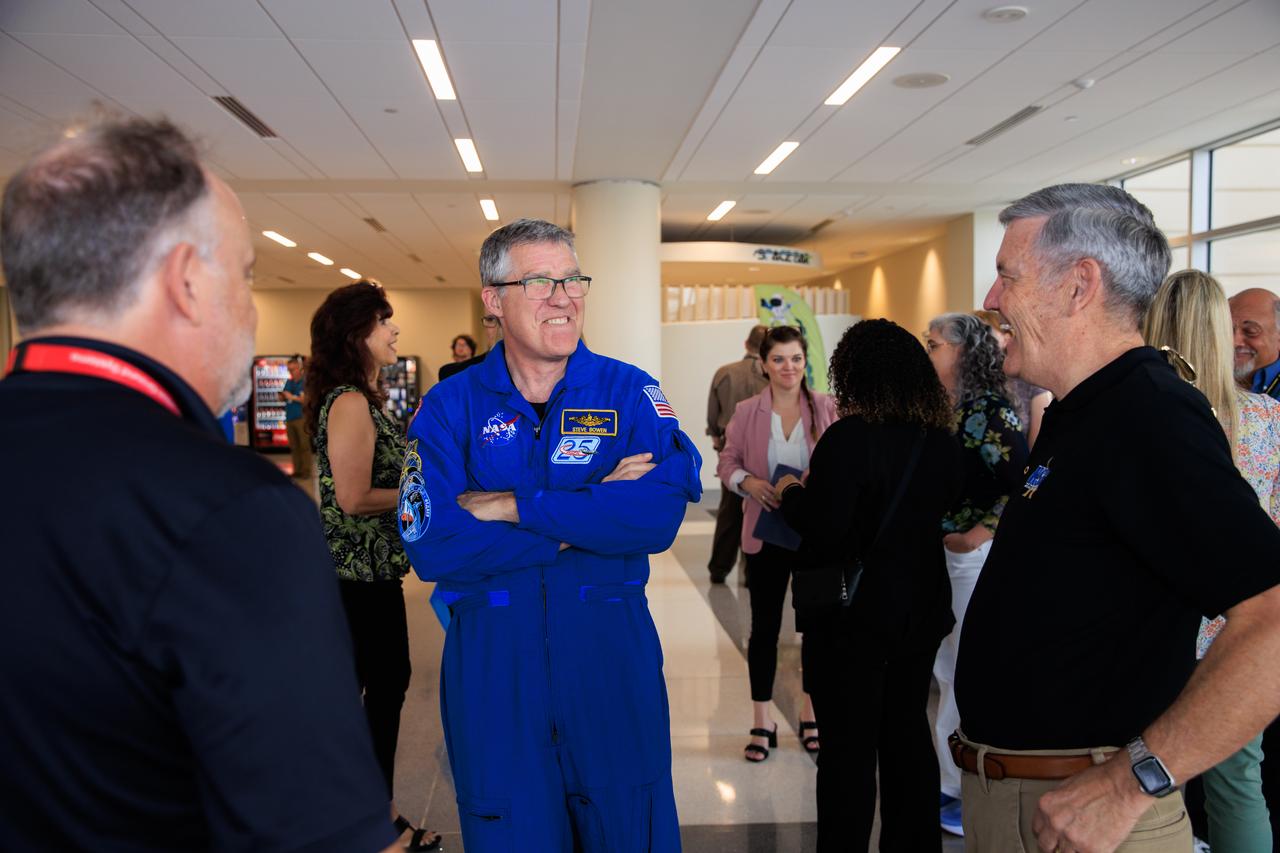
NASA’s SpaceX Crew-6 astronaut Stephen Bowen talks with former Kennedy Space Center director Bob Cabana and Exploration Ground Systems manager Shawn Quinn at the agency’s Central Campus Headquarters cafeteria at Kennedy Space Center in Florida on Wednesday, March 27, 2024. Employees met Crew-6 astronauts and celebrated Cabana who retired as the center director in December after serving in the position for 13 years.

Artemis Launch Director Charlie Blackwell-Thompson, at left, holds the Artemis I plaque inside the lobby of the Launch Control Center at NASA’s Kennedy Space Center in Florida on March 24, 2023. Joining her from left are Shawn Quinn, manager, Exploration Ground Systems; and Kelvin Manning, Kennedy deputy director. Following tradition from the Apollo and Space Shuttle Programs, the plaque will be added to the wall behind them. The first in a series of increasingly complex missions, Artemis I launched successfully from Kennedy’s Launch Pad 39B at 1:47 a.m. EST on Nov. 16, 2022.
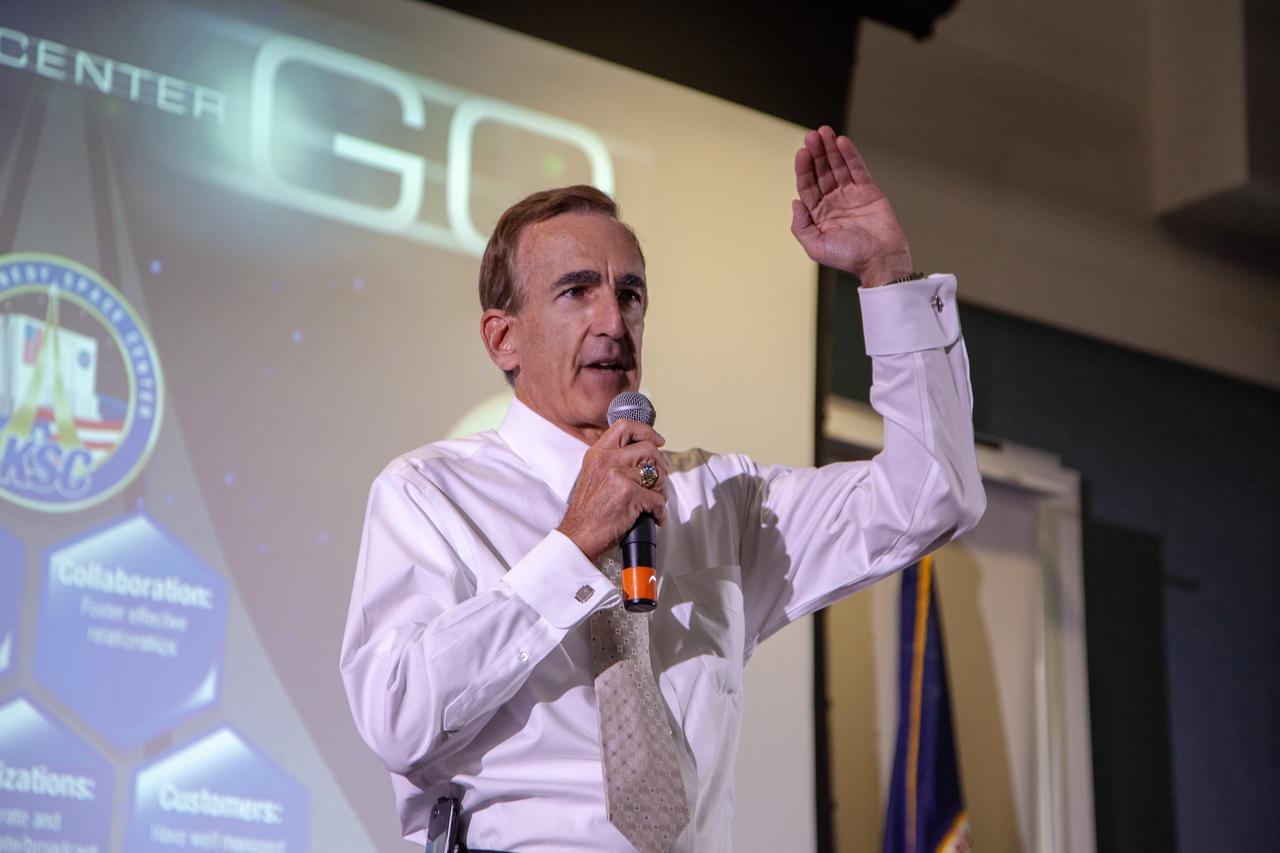
Dan Shaver, chief counsel at NASA’s Kennedy Space Center in Florida, speaks at the fifth and final TED Talk-style informational session on Nov. 14, 2019, in the Kennedy Learning Institute. Sponsored by Kennedy’s Launching Leaders and Leadership for the Future, NASAtalks focuses on the topic of intentional careers and aims to provide employees with tools and knowledge that can be utilized for career growth. The theme of this session was organizations, and additional speakers included Kennedy’s Director of Engineering Shawn Quinn, Chief Technologist Barbara Brown and Tim Dunn, launch director for the agency’s Launch Services Program, with a skill-building section on vision by Mark Wiese, logistics element manager for the Gateway Program.
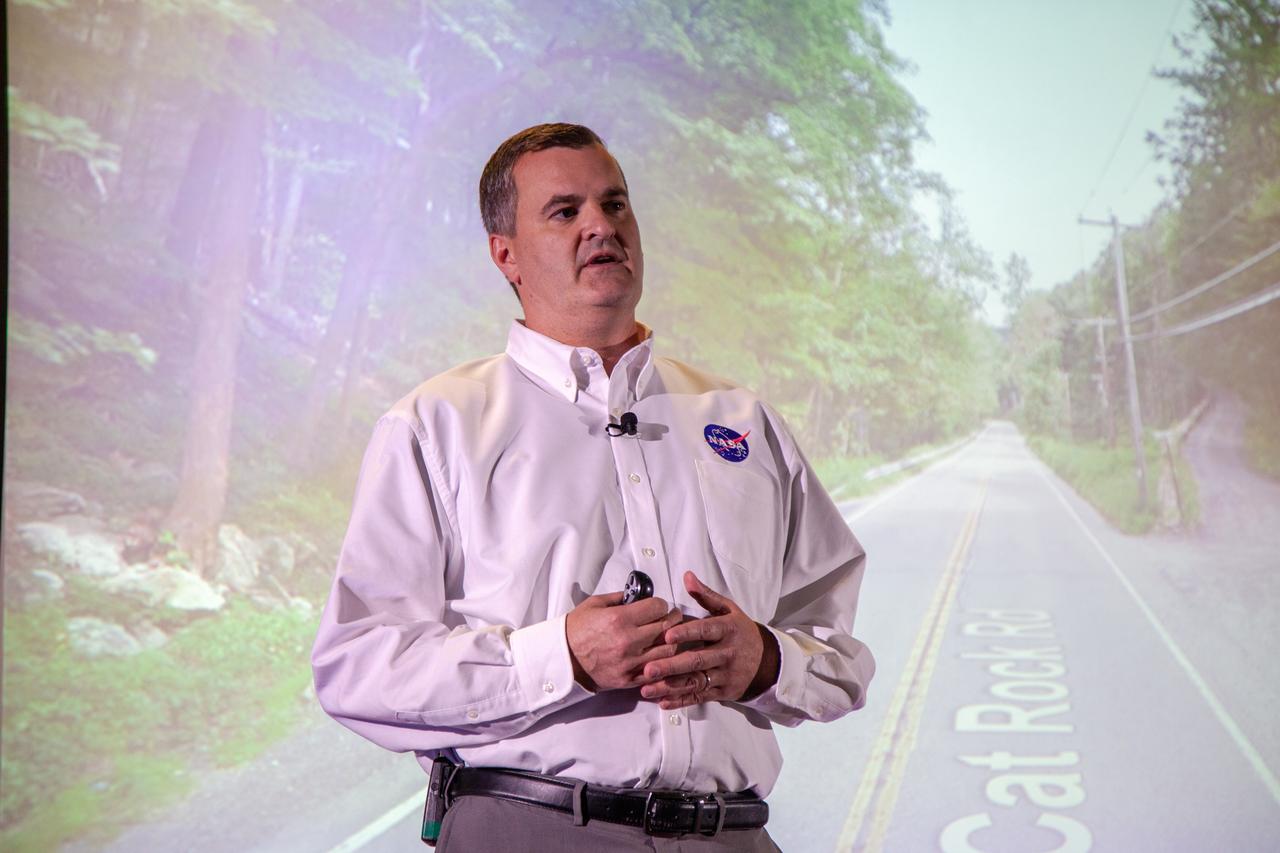
Mark Wiese, logistics element manager for the Gateway Program at NASA’s Kennedy Space Center in Florida, speaks at the fifth and final TED Talk-style informational session on Nov. 14, 2019, in the Kennedy Learning Institute. Sponsored by Kennedy’s Launching Leaders and Leadership for the Future, NASAtalks focuses on the topic of intentional careers and aims to provide employees with tools and knowledge that can be utilized for career growth. The theme of this session was organizations, and additional speakers included Chief Counsel Dan Shaver, Director of Engineering Shawn Quinn, Chief Technologist Barbara Brown and Tim Dunn, launch director for the agency’s Launch Services Program.

Shawn Quinn, director of Engineering at NASA’s Kennedy Space Center in Florida, speaks at the fifth and final TED Talk-style informational session on Nov. 14, 2019, in the Kennedy Learning Institute. Sponsored by Kennedy’s Launching Leaders and Leadership for the Future, NASAtalks focuses on the topic of intentional careers and aims to provide employees with tools and knowledge that can be utilized for career growth. The theme of this session was organizations, and additional speakers included Chief Counsel Dan Shaver, Chief Technologist Barbara Brown and Tim Dunn, launch director for the agency’s Launch Services Program, with a skill-building section on vision by Mark Wiese, logistics element manager for the Gateway Program.

Barbara Brown, chief technologist at NASA’s Kennedy Space Center in Florida, speaks at the fifth and final TED Talk-style informational session on Nov. 14, 2019, in the Kennedy Learning Institute. Sponsored by Kennedy’s Launching Leaders and Leadership for the Future, NASAtalks focuses on the topic of intentional careers and aims to provide employees with tools and knowledge that can be utilized for career growth. The theme of this session was organizations, and additional speakers included Director of Engineering Shawn Quinn, Chief Counsel Dan Shaver and Tim Dunn, launch director for the agency’s Launch Services Program, with a skill-building section on vision by Mark Wiese, logistics element manager for the Gateway Program.

Shawn Quinn, director of Engineering at NASA’s Kennedy Space Center in Florida, speaks at the fifth and final TED Talk-style informational session on Nov. 14, 2019, in the Kennedy Learning Institute. Sponsored by Kennedy’s Launching Leaders and Leadership for the Future, NASAtalks focuses on the topic of intentional careers and aims to provide employees with tools and knowledge that can be utilized for career growth. The theme of this session was organizations, and additional speakers included Chief Counsel Dan Shaver, Chief Technologist Barbara Brown and Tim Dunn, launch director for the agency’s Launch Services Program, with a skill-building section on vision by Mark Wiese, logistics element manager for the Gateway Program.

Barbara Brown, chief technologist at NASA’s Kennedy Space Center in Florida, speaks at the fifth and final TED Talk-style informational session on Nov. 14, 2019, in the Kennedy Learning Institute. Sponsored by Kennedy’s Launching Leaders and Leadership for the Future, NASAtalks focuses on the topic of intentional careers and aims to provide employees with tools and knowledge that can be utilized for career growth. The theme of this session was organizations, and additional speakers included Director of Engineering Shawn Quinn, Chief Counsel Dan Shaver and Tim Dunn, launch director for the agency’s Launch Services Program, with a skill-building section on vision by Mark Wiese, logistics element manager for the Gateway Program.
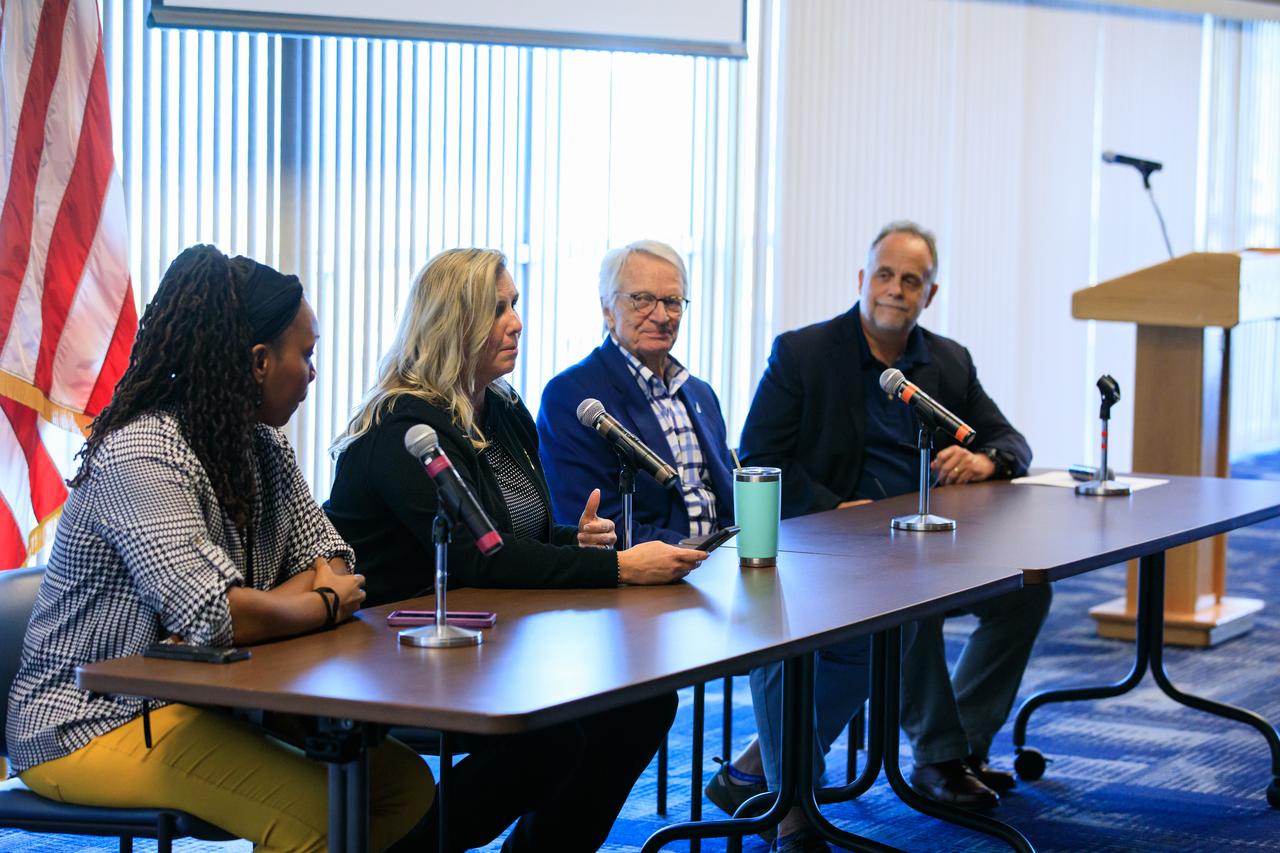
NASA’s Exploration Ground Systems Manager Shawn Quinn, right, moderates the inaugural Cross-Program Connection event at NASA Kennedy Space Center’s Space Station Processing Facility in Florida on March 8, 2023. Other participants, from left, are: Stacie Turner, Kennedy’s Deep Space Logistics; Dana Hutcherson, NASA’s Commercial Crew Program deputy program manager; and Arthur Muir, a retired Chicago attorney and America’s oldest Mt. Everest summiteer. Muir, 75, was the speaker at the event titled “Explorers Doing the Impossible.” He toured Kennedy before sharing his experiences in overcoming incredible challenges during his journey to the top of Earth’s highest mountain.

From left, Shawn Quinn, manager, Exploration Ground Systems Program; Cliff Lanham, deputy manager, Exploration Ground Systems; and Charlie Blackwell-Thompson, launch director, Exploration Ground Systems Program Program at NASA’s Kennedy Space Center in Florida, participate in the Artemis II Flight Readiness Review with NASA leadership on Wednesday, March 11, 2026, at NASA Kennedy. The review is an assessment of the readiness of NASA’s SLS (Space Launch System) rocket and Orion spacecraft to support the Artemis II test flight as four astronauts journey around the Moon and return to Earth.

Barbara Brown, chief technologist at NASA’s Kennedy Space Center in Florida, speaks at the fifth and final TED Talk-style informational session on Nov. 14, 2019, in the Kennedy Learning Institute. Sponsored by Kennedy’s Launching Leaders and Leadership for the Future, NASAtalks focuses on the topic of intentional careers and aims to provide employees with tools and knowledge that can be utilized for career growth. The theme of this session was organizations, and additional speakers included Director of Engineering Shawn Quinn, Chief Counsel Dan Shaver and Tim Dunn, launch director for the agency’s Launch Services Program, with a skill-building section on vision by Mark Wiese, logistics element manager for the Gateway Program.

From left, Kennedy Space Center’s Chief Technologist Barbara Brown, Mark Wiese, logistics element manager for the Gateway Program, Tim Dunn, launch director for the agency’s Launch Services Program, Shawn Quinn, director of Engineering and Johnny Nguyen participate in the fifth and final TED Talk-style informational session on Nov. 14, 2019. Held in the Florida spaceport’s Kennedy Learning Institute and sponsored by the center’s Launching Leaders and Leadership for the Future, NASAtalks focuses on the topic of intentional careers and aims to provide employees with tools and knowledge that can be utilized for career growth. The theme of this final session was organizations.
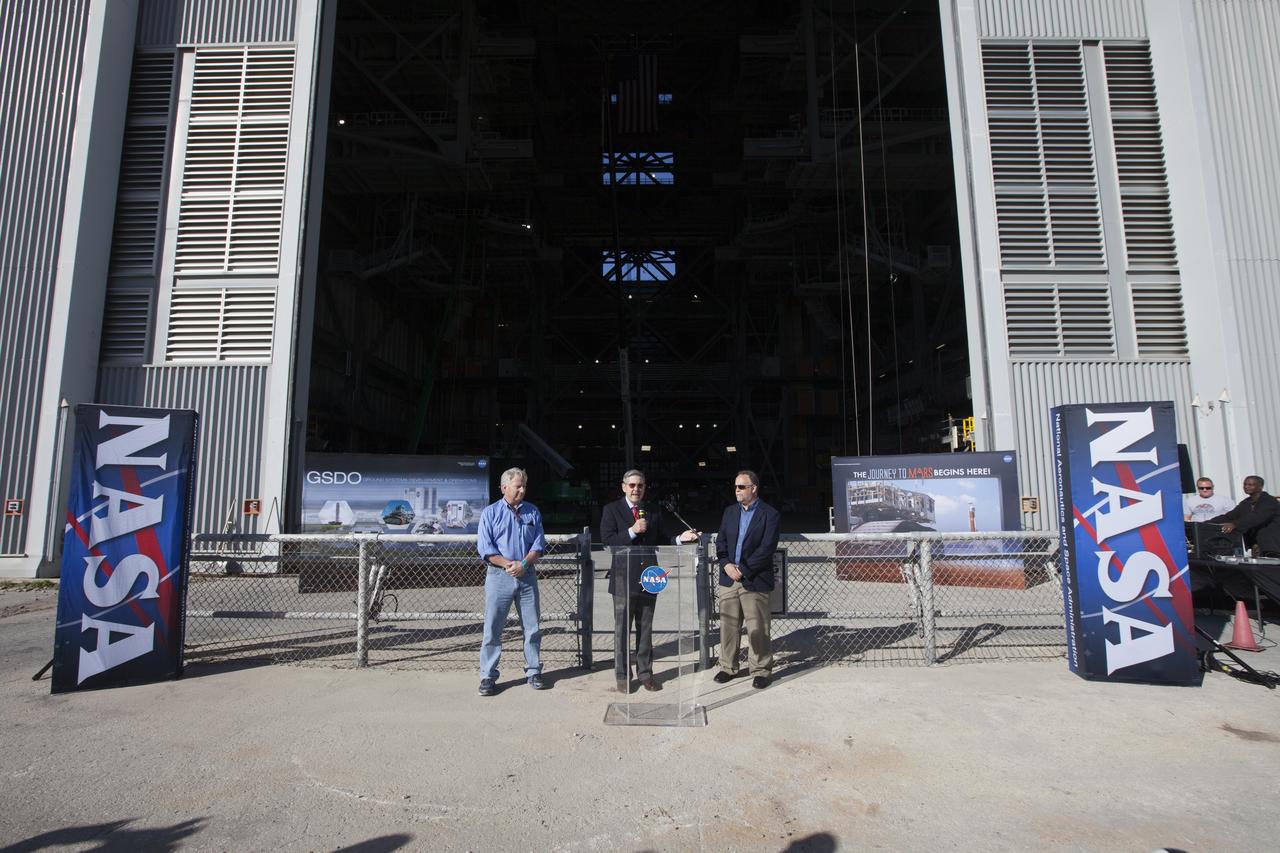
Members of the news media viewed the 10 levels of new work platforms in High Bay 3 inside the Vehicle Assembly Building during a multi-user tour of NASA's Kennedy Space Center in Florida with Center Director Bob Cabana. The final platform, A north, was recently installed. From left are Kerry Chreist of Jacobs on the Test and Operations Support Contract; Cabana; and Shawn Quinn, associate program manager for the Ground Systems Development and Operations Program. The platforms will surround the Space Launch System and Orion spacecraft on the mobile launcher during processing to prepare for the first test flight.

Mark Wiese, logistics element manager for the Gateway Program at NASA’s Kennedy Space Center in Florida, speaks at the fifth and final TED Talk-style informational session on Nov. 14, 2019, in the Kennedy Learning Institute. Sponsored by Kennedy’s Launching Leaders and Leadership for the Future, NASAtalks focuses on the topic of intentional careers and aims to provide employees with tools and knowledge that can be utilized for career growth. The theme of this session was organizations, and additional speakers included Chief Counsel Dan Shaver, Director of Engineering Shawn Quinn, Chief Technologist Barbara Brown and Tim Dunn, launch director for the agency’s Launch Services Program.
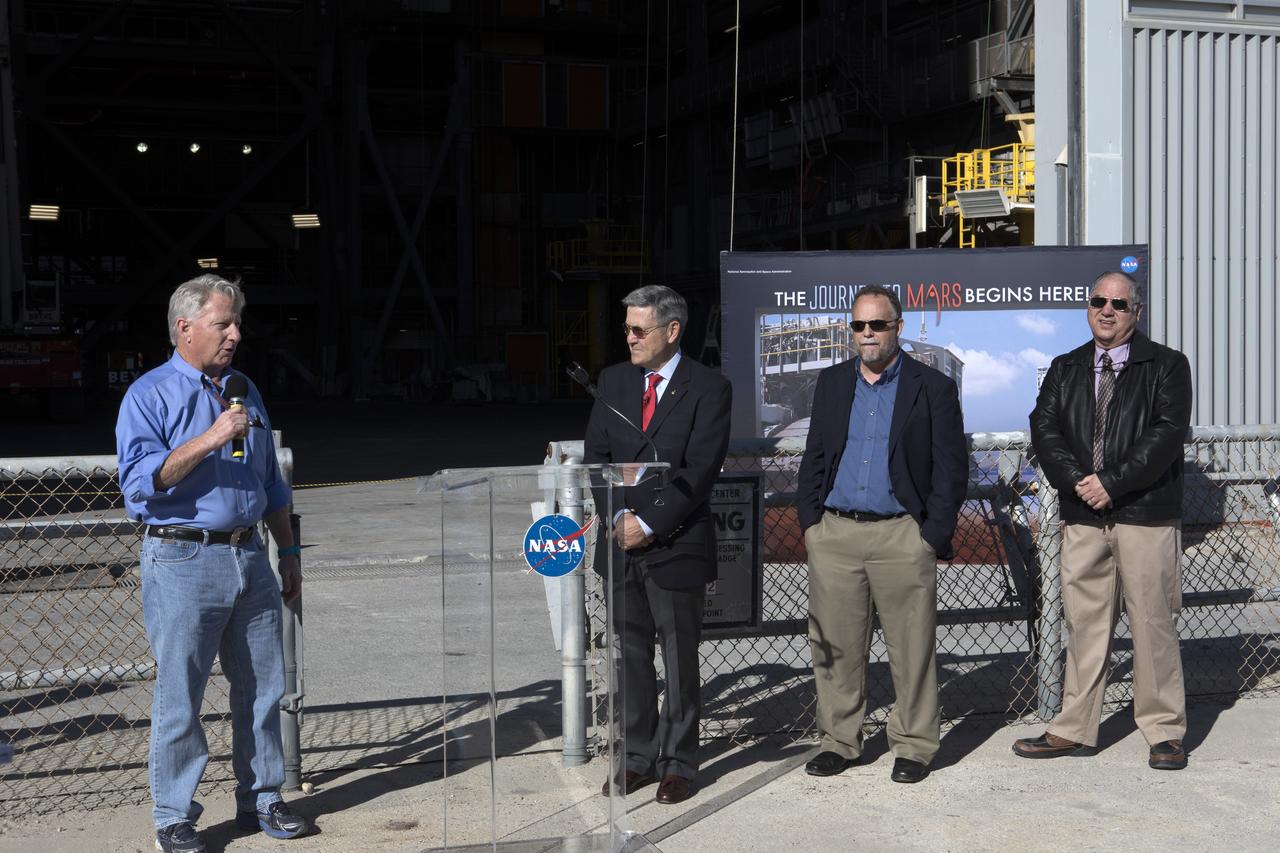
Members of the news media viewed the 10 levels of new work platforms in High Bay 3 inside the Vehicle Assembly Building during a multi-user tour of NASA's Kennedy Space Center in Florida with Center Director Bob Cabana. The final platform, A north, was recently installed. From left are Kerry Chreist of Jacobs on the Test and Operations Support Contract; Cabana; Shawn Quinn, associate program manager for the Ground Systems Development and Operations Program (GSDO); and Jose Perez-Morales, GSDO project manager for platform installation. The platforms will surround the Space Launch System and Orion spacecraft on the mobile launcher during processing to prepare for the first test flight.

Dan Shaver, chief counsel at NASA’s Kennedy Space Center in Florida, speaks at the fifth and final TED Talk-style informational session on Nov. 14, 2019, in the Kennedy Learning Institute. Sponsored by Kennedy’s Launching Leaders and Leadership for the Future, NASAtalks focuses on the topic of intentional careers and aims to provide employees with tools and knowledge that can be utilized for career growth. The theme of this session was organizations, and additional speakers included Kennedy’s Director of Engineering Shawn Quinn, Chief Technologist Barbara Brown and Tim Dunn, launch director for the agency’s Launch Services Program, with a skill-building section on vision by Mark Wiese, logistics element manager for the Gateway Program.
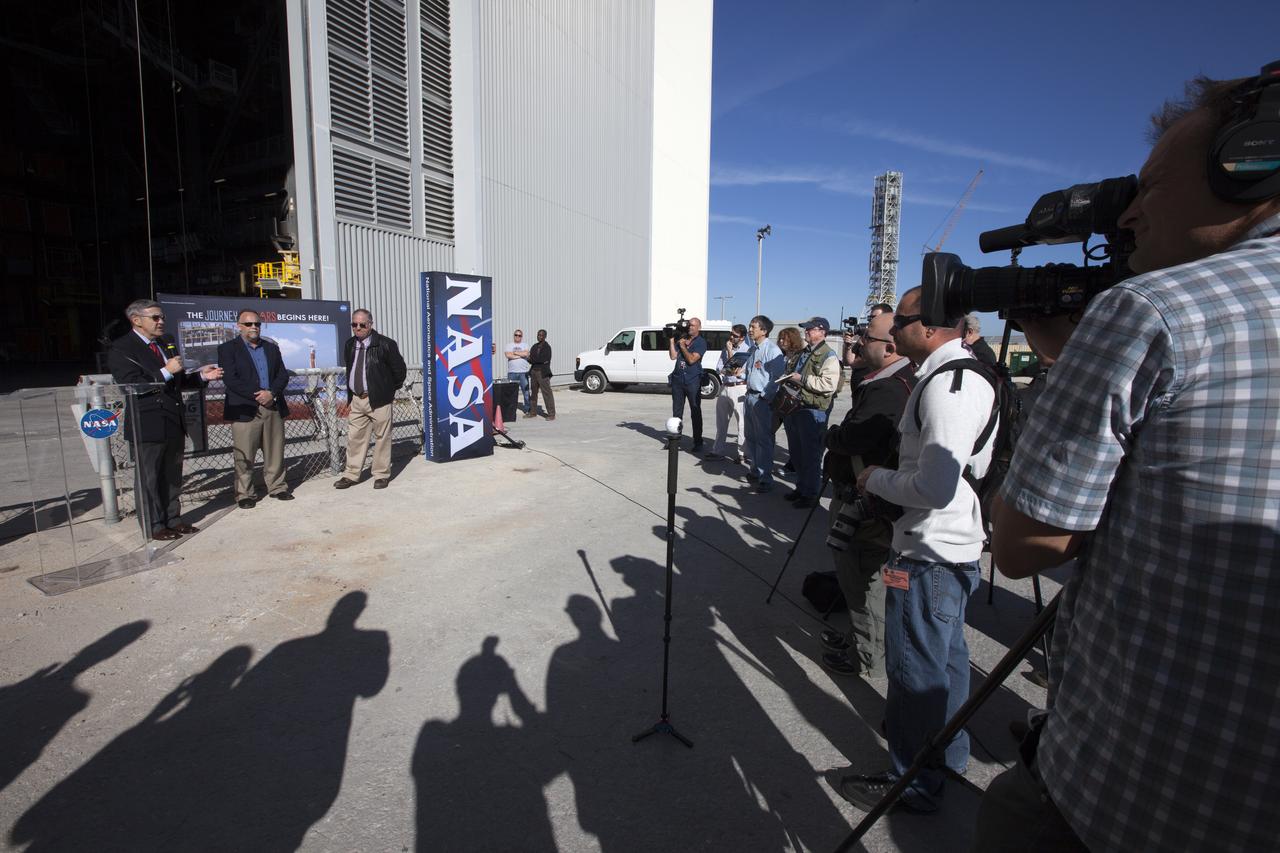
Members of the news media viewed the 10 levels of new work platforms in High Bay 3 inside the Vehicle Assembly Building during a multi-user tour of NASA's Kennedy Space Center in Florida with Center Director Bob Cabana. The final platform, A north, was recently installed. From left are Cabana; Shawn Quinn, associate program manager for the Ground Systems Development and Operations Program (GSDO); and Jose Perez-Morales, GSDO project manager for platform installation. The platforms will surround the Space Launch System and Orion spacecraft on the mobile launcher during processing to prepare for the first test flight.
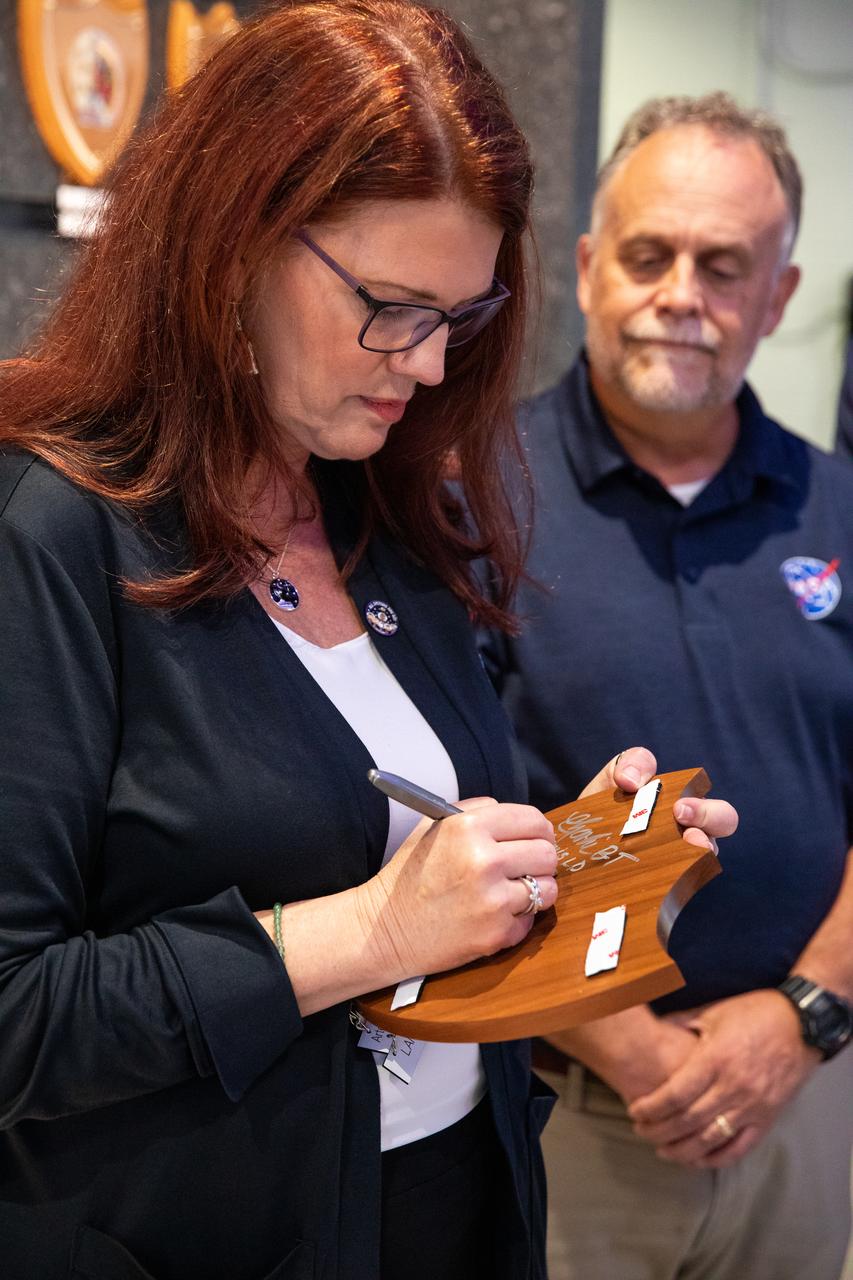
Artemis Launch Director Charlie Blackwell-Thompson, at left, signs the back of the Artemis I plaque inside the lobby of the Launch Control Center at NASA’s Kennedy Space Center in Florida on March 24, 2023. Joining her is Shawn Quinn, manager, Exploration Ground Systems. Following tradition from the Apollo and Space Shuttle Programs, the plaque will be added to the wall behind them. The first in a series of increasingly complex missions, Artemis I launched successfully from Kennedy’s Launch Pad 39B at 1:47 a.m. EST on Nov. 16, 2022.
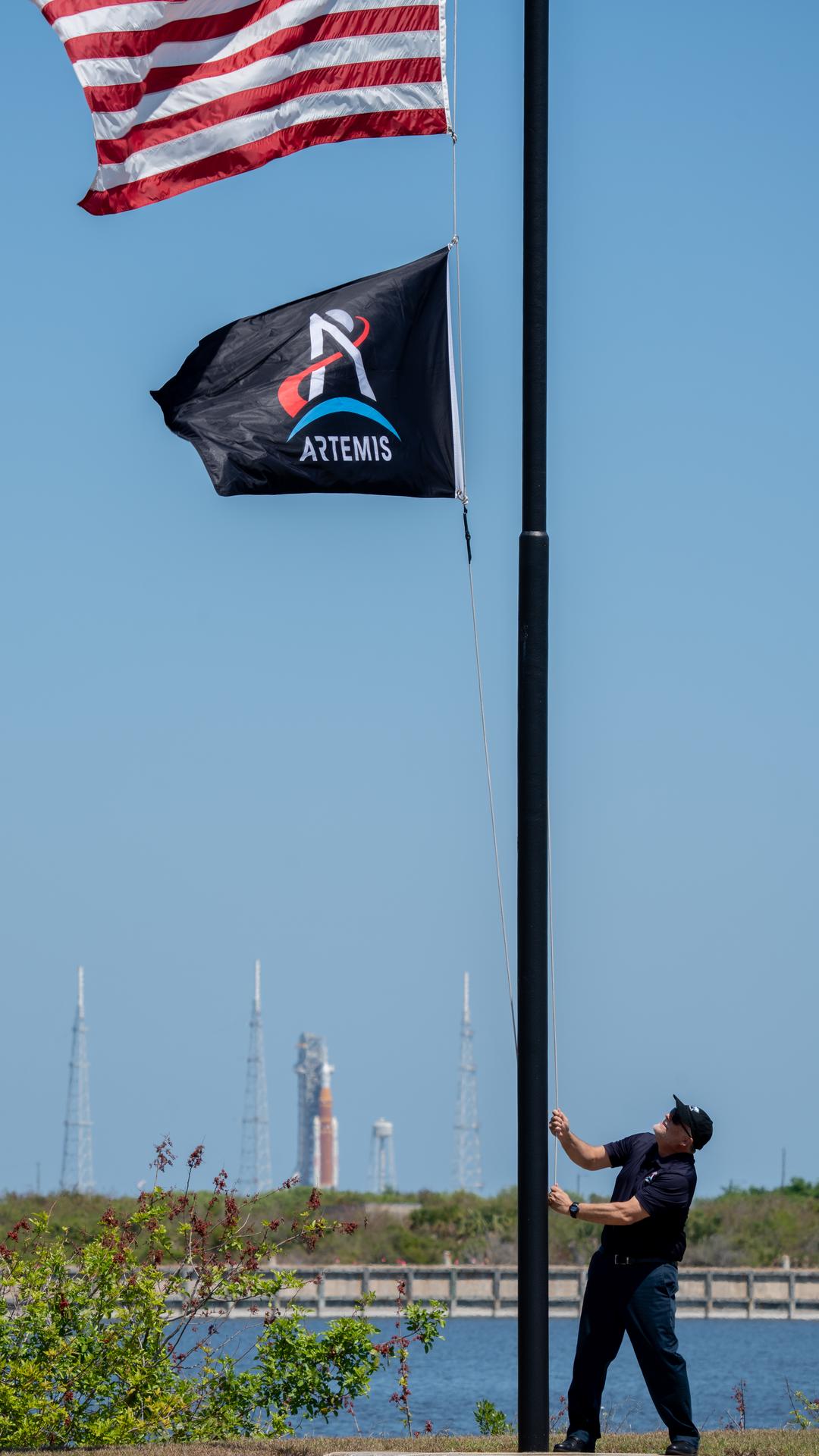
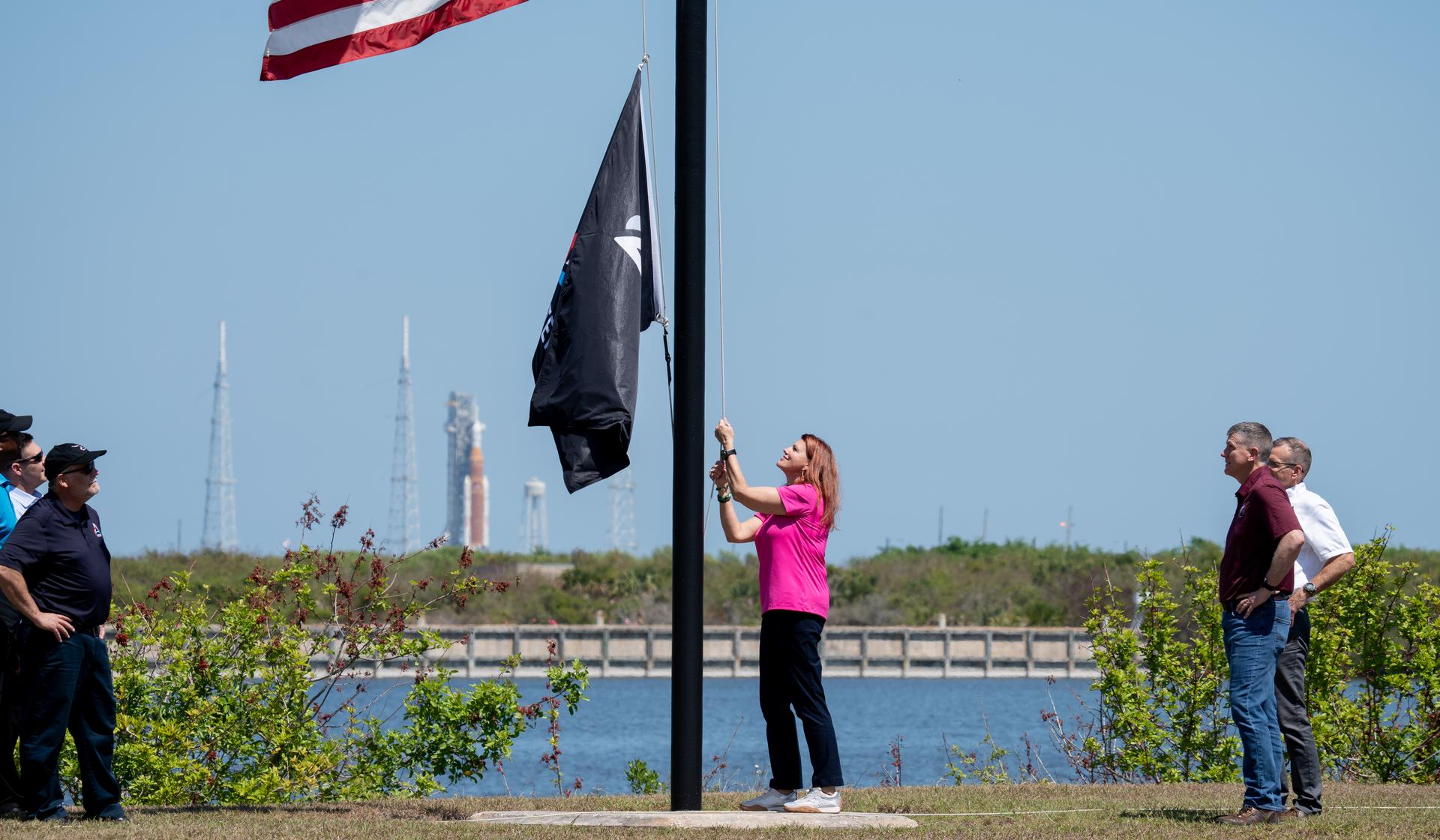
Shawn Quinn, manager, Exploration Ground Systems Program raises the Artemis flag near the countdown clock at the NASA News Center at NASA’s Kennedy Space Center in Florida on Friday, March 27, 2026. The Artemis II test flight mission will take Artemis II Commander Reid Wiseman, Pilot Victor Glover, and Mission Specialist Christina Koch from NASA, and Mission Specialist Jeremy Hansen from the CSA (Canadian Space Agency) on a 10-day journey around the Moon and back aboard NASA’s SLS (Space Launch System) rocket and Orion spacecraft from Launch Complex 39B no earlier than 6:24 p.m. EDT on Wednesday, April 1.
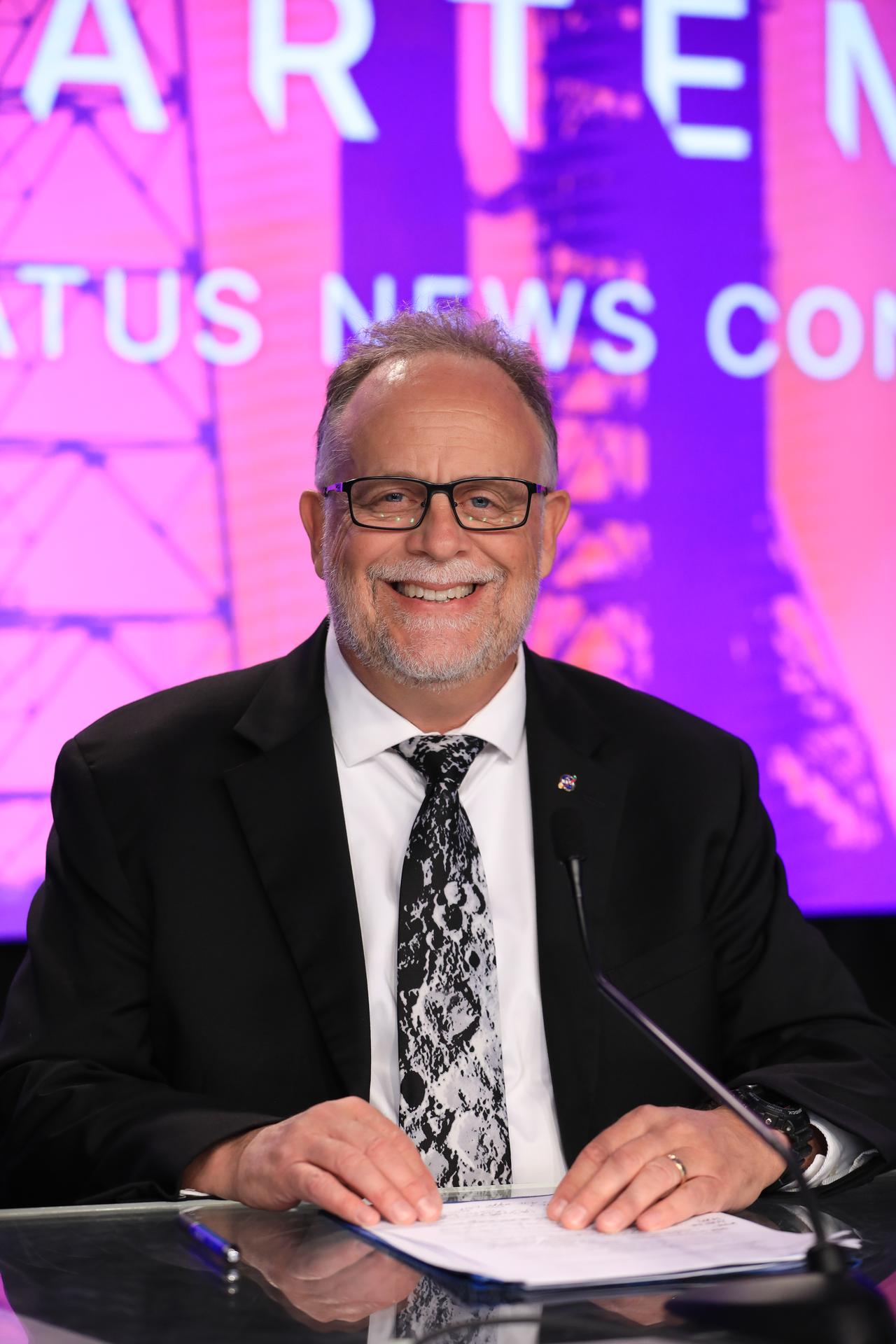
Shawn Quinn, program manager, Exploration Ground Systems, participates in a news conference on Sunday, March 29, 2026, to discuss the upcoming Artemis II test flight at NASA’s Kennedy Space Center in Florida. The Artemis II mission will take Artemis II Commander Reid Wiseman, Pilot Victor Glover, and Mission Specialist Christina Koch from NASA, and Mission Specialist Jeremy Hansen from the CSA (Canadian Space Agency) on a 10-day journey around the Moon and back aboard NASA’s SLS (Space Launch System) rocket and Orion spacecraft from Launch Complex 39B no earlier than 6:24 p.m. EDT on Wednesday, April 1.
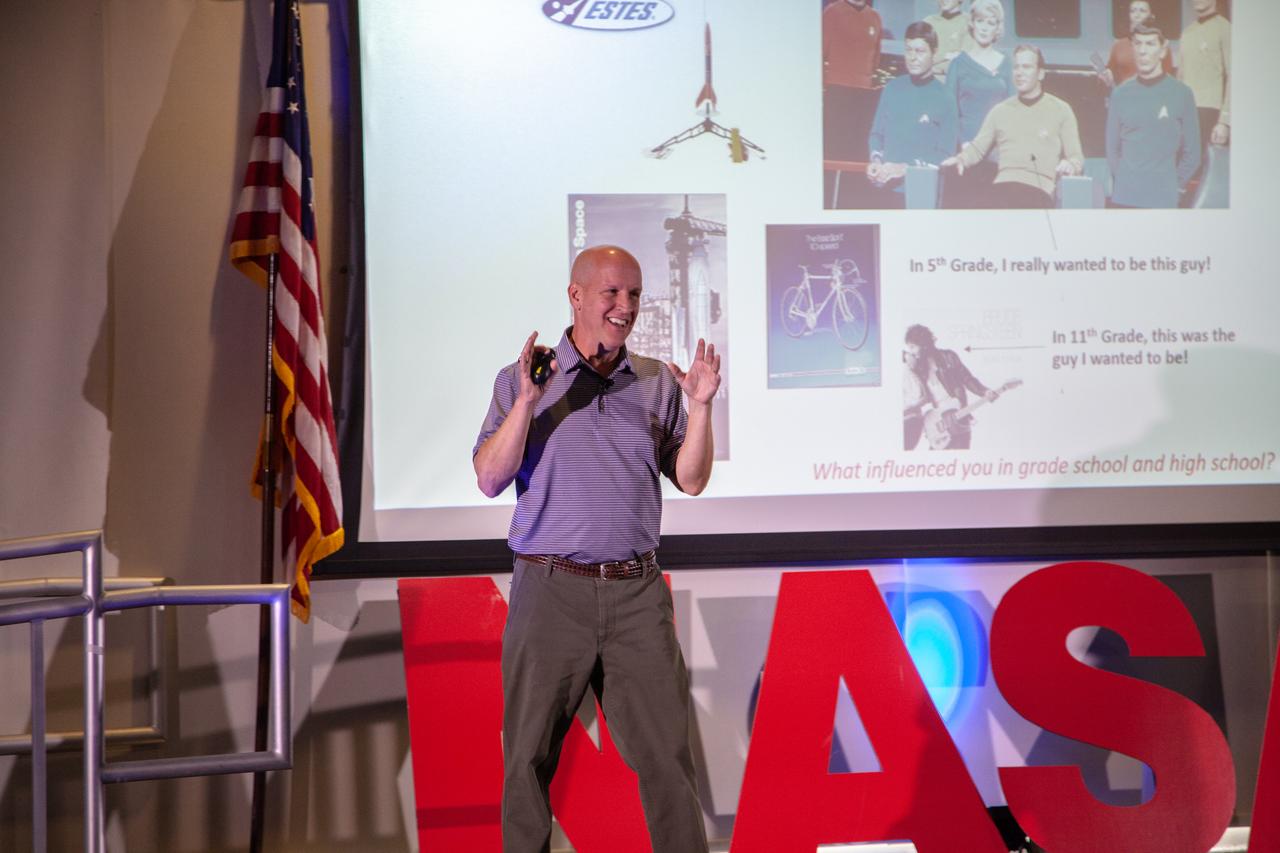
Tim Dunn, launch director for NASA’s Launch Services Program, speaks at the fifth and final TED Talk-style informational session at the agency’s Kennedy Space Center in Florida on Nov. 14, 2019. Hosted in the Kennedy Learning Institute and sponsored by the center’s Launching Leaders and Leadership for the Future, NASAtalks focuses on the topic of intentional careers and aims to provide employees with tools and knowledge that can be utilized for career growth. The theme of this session was organizations, and additional speakers included Director of Engineering Shawn Quinn, Chief Technologist Barbara Brown and Chief Counsel Dan Shaver, with a skill-building section on vision by Mark Wiese, logistics element manager for the Gateway Program.
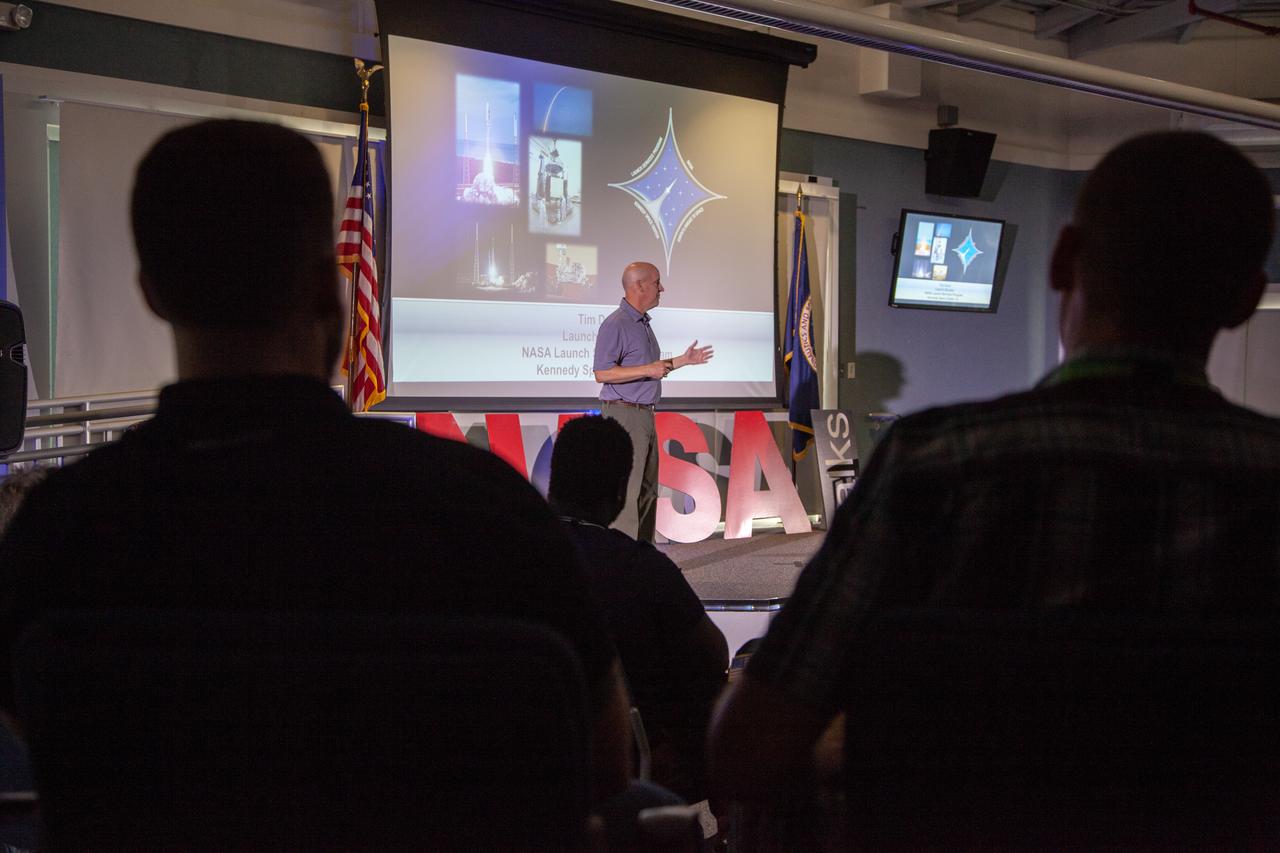
Tim Dunn, launch director for NASA’s Launch Services Program, speaks at the fifth and final TED Talk-style informational session at the agency’s Kennedy Space Center in Florida on Nov. 14, 2019. Hosted in the Kennedy Learning Institute and sponsored by the center’s Launching Leaders and Leadership for the Future, NASAtalks focuses on the topic of intentional careers and aims to provide employees with tools and knowledge that can be utilized for career growth. The theme of this session was organizations, and additional speakers included Director of Engineering Shawn Quinn, Chief Technologist Barbara Brown and Chief Counsel Dan Shaver, with a skill-building section on vision by Mark Wiese, logistics element manager for the Gateway Program.
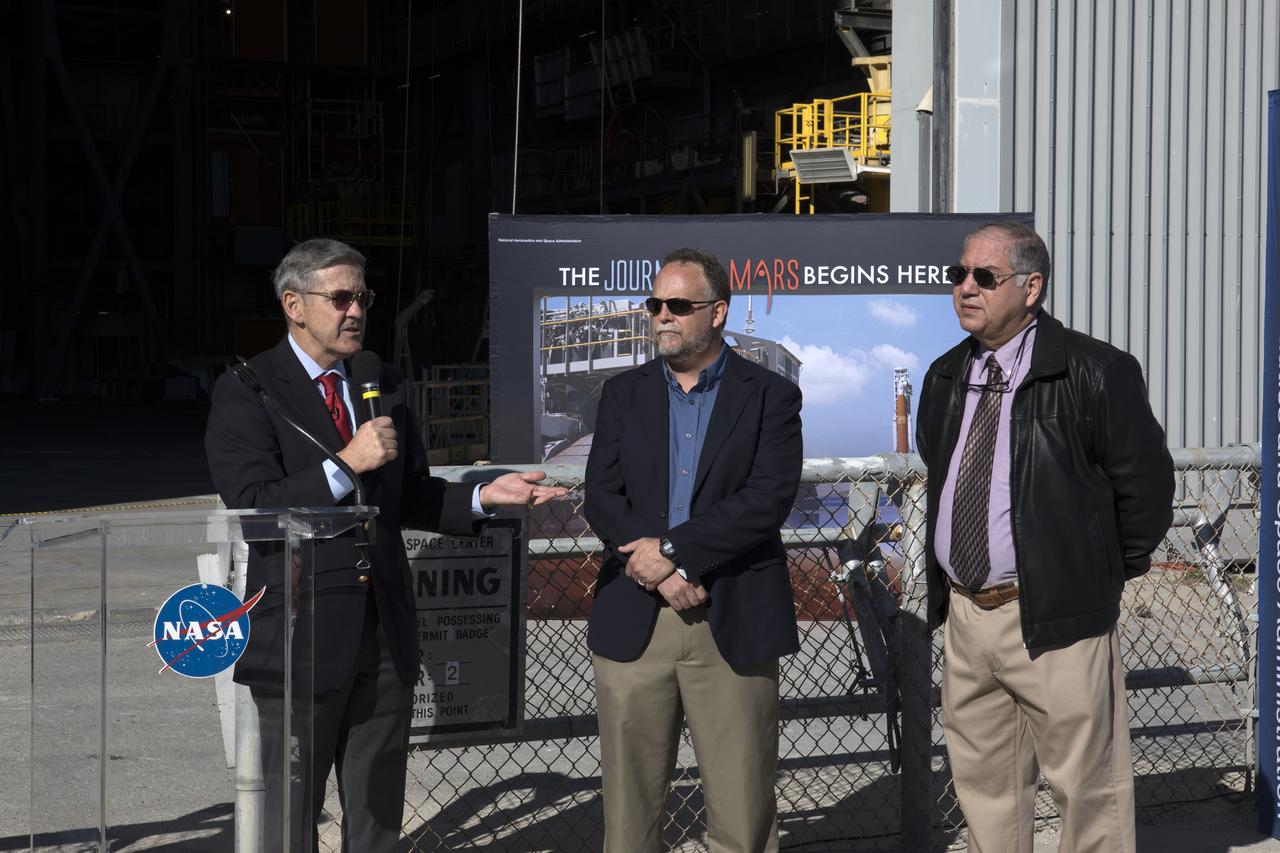
Members of the news media viewed the 10 levels of new work platforms in High Bay 3 inside the Vehicle Assembly Building during a multi-user tour of NASA's Kennedy Space Center in Florida with Center Director Bob Cabana. The final platform, A north, was recently installed. From left are Cabana; Shawn Quinn, associate program manager for the Ground Systems Development and Operations Program (GSDO); and Jose Perez-Morales, GSDO project manager for platform installation. The platforms will surround the Space Launch System and Orion spacecraft on the mobile launcher during processing to prepare for the first test flight.
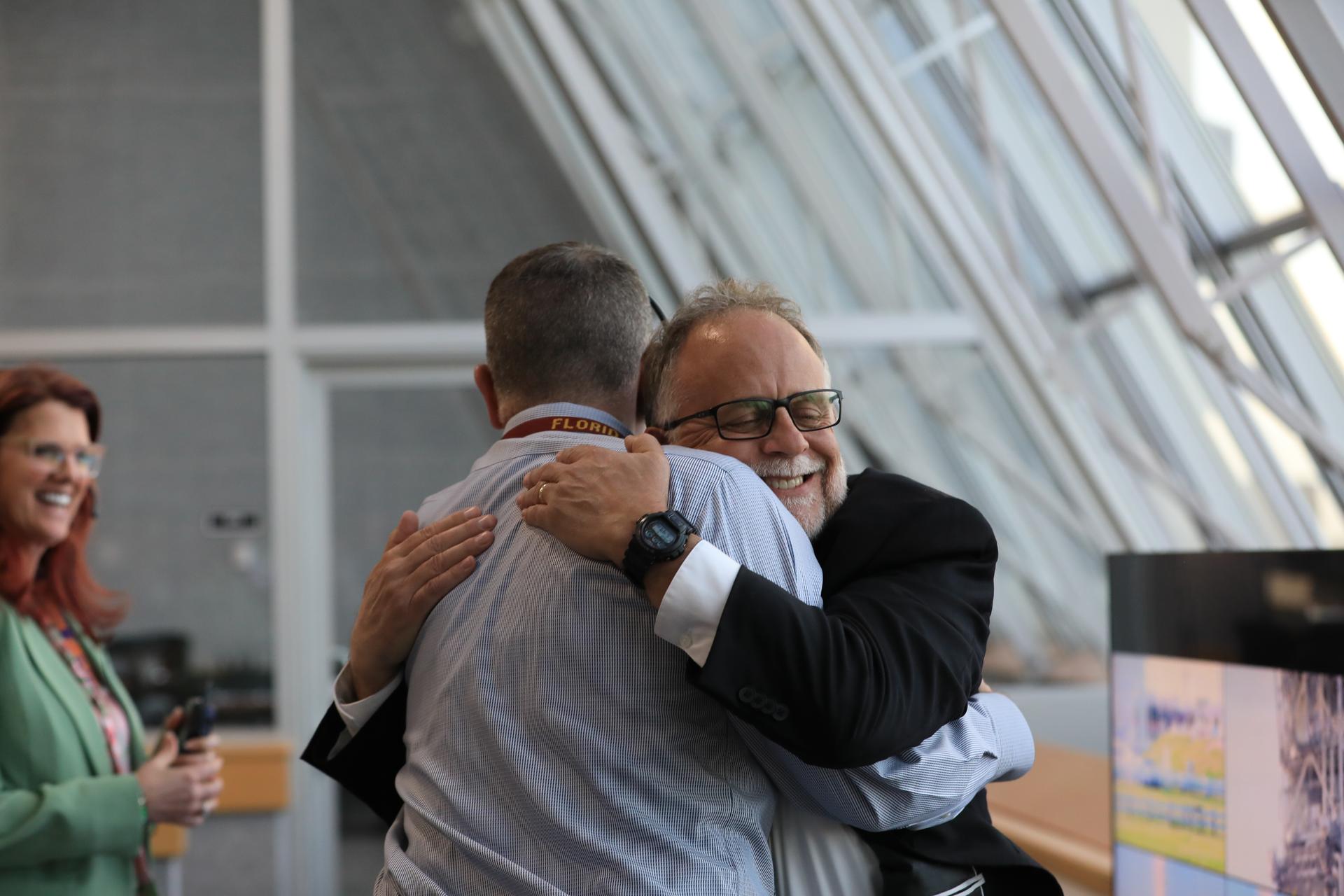
From left, Jeremy Graeber, assistant launch director, and Shawn Quinn, manager, each from NASA’s Exploration Ground Systems Program, smile and hug inside Firing Room 1 of the Rocco A. Petrone Launch Control Center following the launch of the Artemis II test flight on Wednesday, April 1, 2026. The Artemis II mission launched Commander Reid Wiseman, Pilot Victor Glover, and Mission Specialist Christina Koch from NASA, and Mission Specialist Jeremy Hansen from the CSA (Canadian Space Agency), aboard NASA’s SLS (Space Launch System) rocket and Orion spacecraft to journey for 10 days around the Moon and back to Earth.
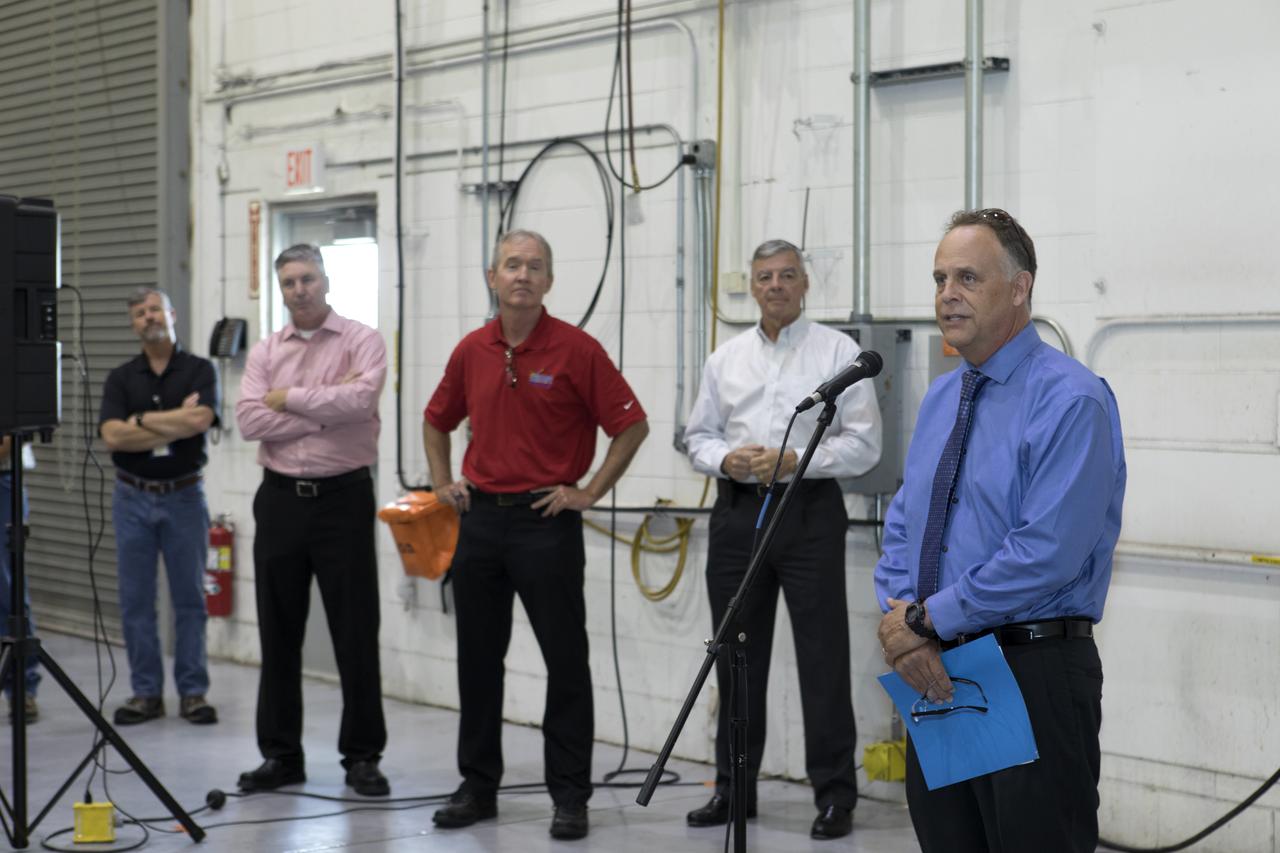
The team that tested the umbilical lines and accessories that will connect from the mobile launcher to NASA's Space Launch System rocket and Orion spacecraft for Exploration Mission-1 hold a banner signing event July 24, 2018, to mark completion of testing at the Launch Equipment Test Facility (LETF) at NASA's Kennedy Space Center in Florida. Speaking at the event is Shawn Quinn, far right, director of Engineering. Next to him, from left, are Scott Colloredo, deputy director of Engineering; Russ Deloach, director of Safety and Mission Assurance; and Andy Allen, program manager for Jacobs TOSC. A total of 21 umbilicals and launch accessories were tested on various simulators at the LETF before they were transferred to the mobile launcher for installation.
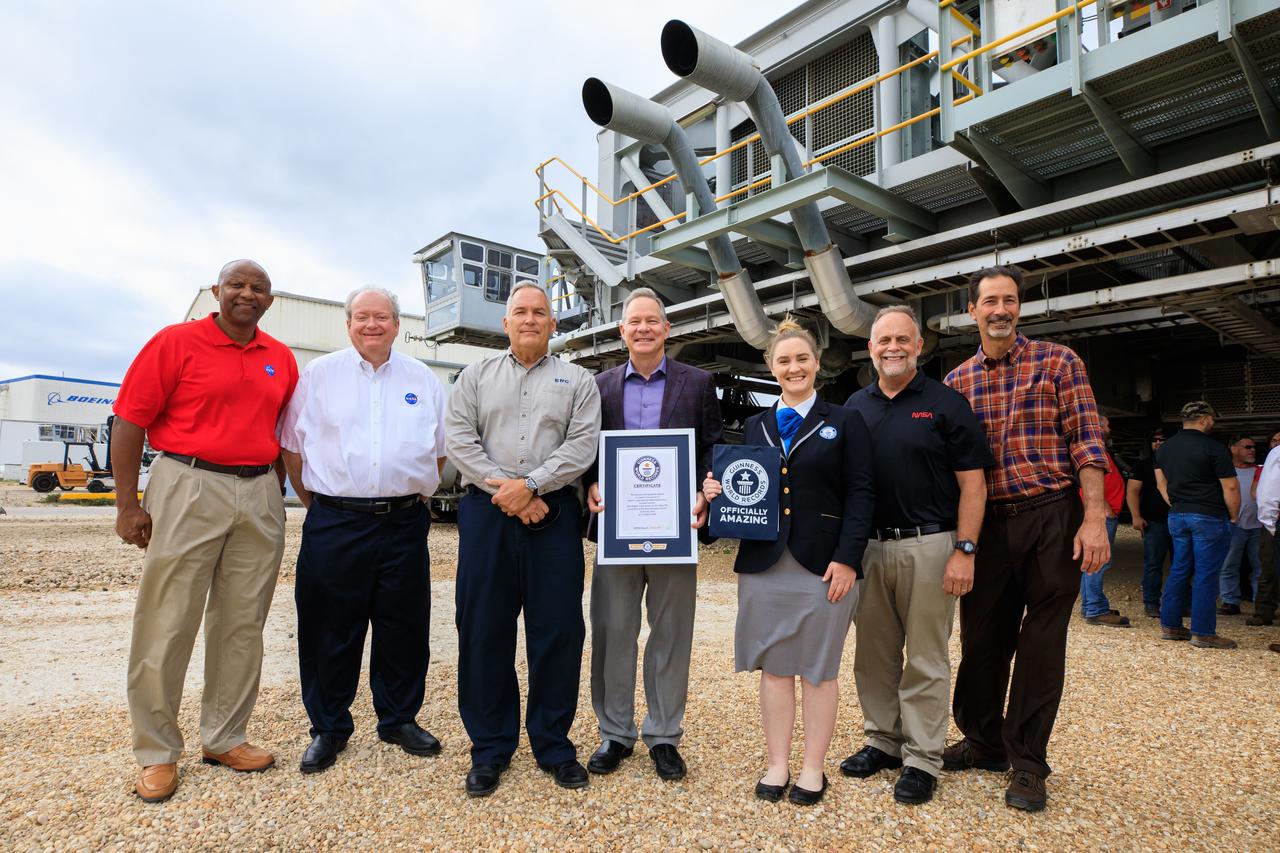
Guinness World Records officially designated NASA’s Crawler Transporter 2 as the heaviest self-powered vehicle, weighing approximately 6.65 million pounds. During a March 29, 2023, ceremony at the agency's Kennedy Space Center in Florida, Guinness World Records presented a certificate to teams with the Exploration Ground Systems Program and Kennedy leadership. Pictured, from left, are: Kelvin Manning, Kennedy deputy director; Burt Summerfield, Kennedy associate director, management; Brett Raulerson, Jacobs TOSC Crawlers, Transporters and Structures group manager; Gary Casteel, Jacobs director, Ground Systems Support; Hannah Ortman, Guinness World Records adjudicator; Shawn Quinn, NASA’s Exploration Ground Systems manager; and John Giles, NASA’s Crawler Element Operations manager.
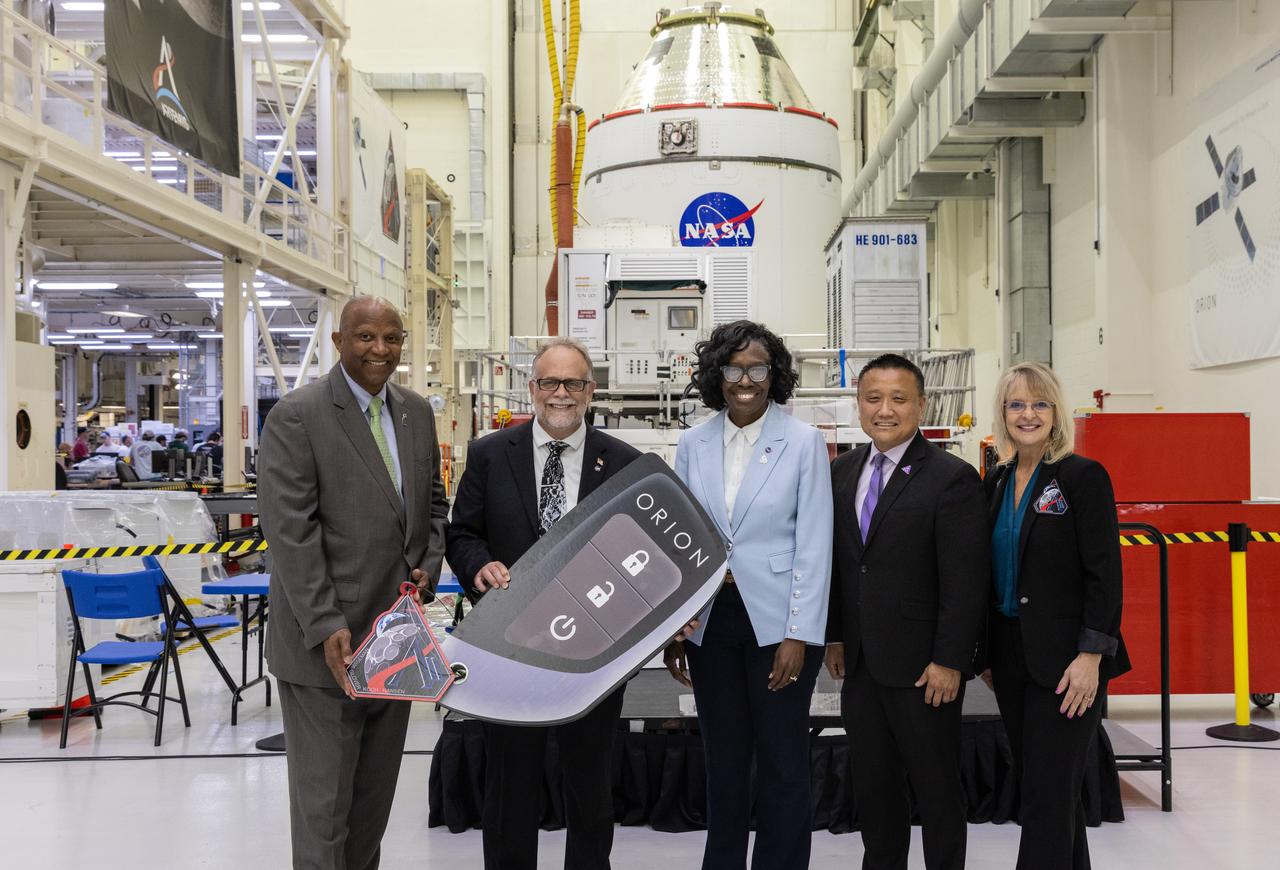
From left, Kelvin Manning, acting center director, NASA’s Kennedy Space Center; Shawn Quinn, Exploration Ground Systems program manager; Lakiesha Hawkins, assistant deputy associate administrator, Moon to Mars Program office; Howard Hu, Orion program manager; Debbie Korth, Orion deputy program manager, participate in a handover ceremony of NASA’s Artemis II Orion spacecraft to crews with the agency’s Exploration Ground Systems Program at the Neil A. Armstrong Operations and Checkout Building at NASA’s Kennedy Space Center in Florida on Thursday, May 1, 2025. The spacecraft will be transported to the Multi-Payload Processing Facility to undergo fueling and processing for prelaunch operations. The Artemis II test flight is the first crewed flight under NASA’s Artemis campaign and is another step toward missions on the lunar surface and helping the agency prepare for future human missions to Mars.

The team that tested the umbilical lines and accessories that will connect from the mobile launcher to NASA's Space Launch System rocket and Orion spacecraft for Exploration Mission-1 hold a banner signing event July 24, 2018, to mark completion of testing at the Launch Equipment Test Facility (LETF) at NASA's Kennedy Space Center in Florida. Speaking at the event is Andy Allen, far right, program manager for Jacobs TOSC. Next to him, from left, are Shawn Quinn, director of Engineering; Scott Colloredo, deputy director of Engineering; and Russ Deloach, director of Safety and Mission Assurance. A total of 21 umbilicals and launch accessories were tested on various simulators at the LETF before they were transferred to the mobile launcher for installation.
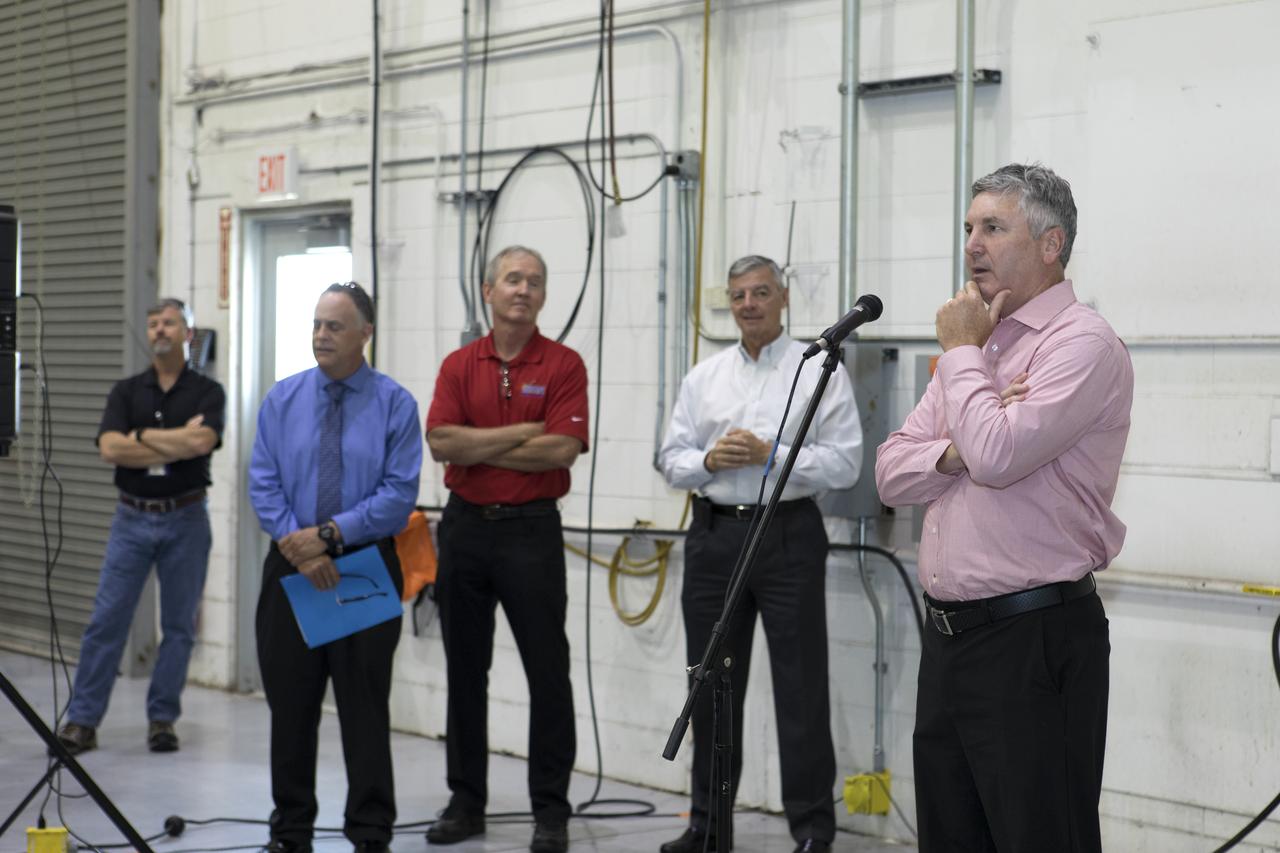
The team that tested the umbilical lines and accessories that will connect from the mobile launcher to NASA's Space Launch System rocket and Orion spacecraft for Exploration Mission-1 hold a banner signing event July 24, 2018, to mark completion of testing at the Launch Equipment Test Facility (LETF) at NASA's Kennedy Space Center in Florida. Speaking at the event is Scott Colloredo, far right, deputy director of Engineering. Next to him, from left, are Shawn Quinn, director of Engineering. Russ Deloach, director of Safety and Mission Assurance; and Andy Allen, program manager for Jacobs TOSC. A total of 21 umbilicals and launch accessories were tested on various simulators at the LETF before they were transferred to the mobile launcher for installation.

The team that tested the umbilical lines and accessories that will connect from the mobile launcher to NASA's Space Launch System rocket and Orion spacecraft for Exploration Mission-1 hold a banner signing event July 24, 2018, to mark completion of testing at the Launch Equipment Test Facility (LETF) at NASA's Kennedy Space Center in Florida. Speaking at the event is Andy Allen, far right, program manager for Jacobs TOSC. Next to him, from left, are Shawn Quinn, director of Engineering; Scott Colloredo, deputy director of Engineering; and Russ Deloach, director of Safety and Mission Assurance. A total of 21 umbilicals and launch accessories were tested on various simulators at the LETF before they were transferred to the mobile launcher for installation.

From left to right, Shawn Quinn, manager, Exploration Ground Systems; Charlie Blackwell-Thompson, Artemis launch director, Exploration Ground Systems; and Cliff Lanham, senior vehicle operations manager, Exploration Ground Systems, raise the Artemis flag near the countdown clock at NASA’s Kennedy Space Center in Florida on Monday, July 22, 2024. The flag raising marks the arrival of NASA’s massive SLS (Space Launch System) core stage via the agency’s Pegasus barge from NASA’s Michoud Assembly Facility in New Orleans. The core stage will help power SLS when it launches four astronauts around the Moon for the first crewed flight of SLS and the Orion spacecraft during the Artemis II test flight.
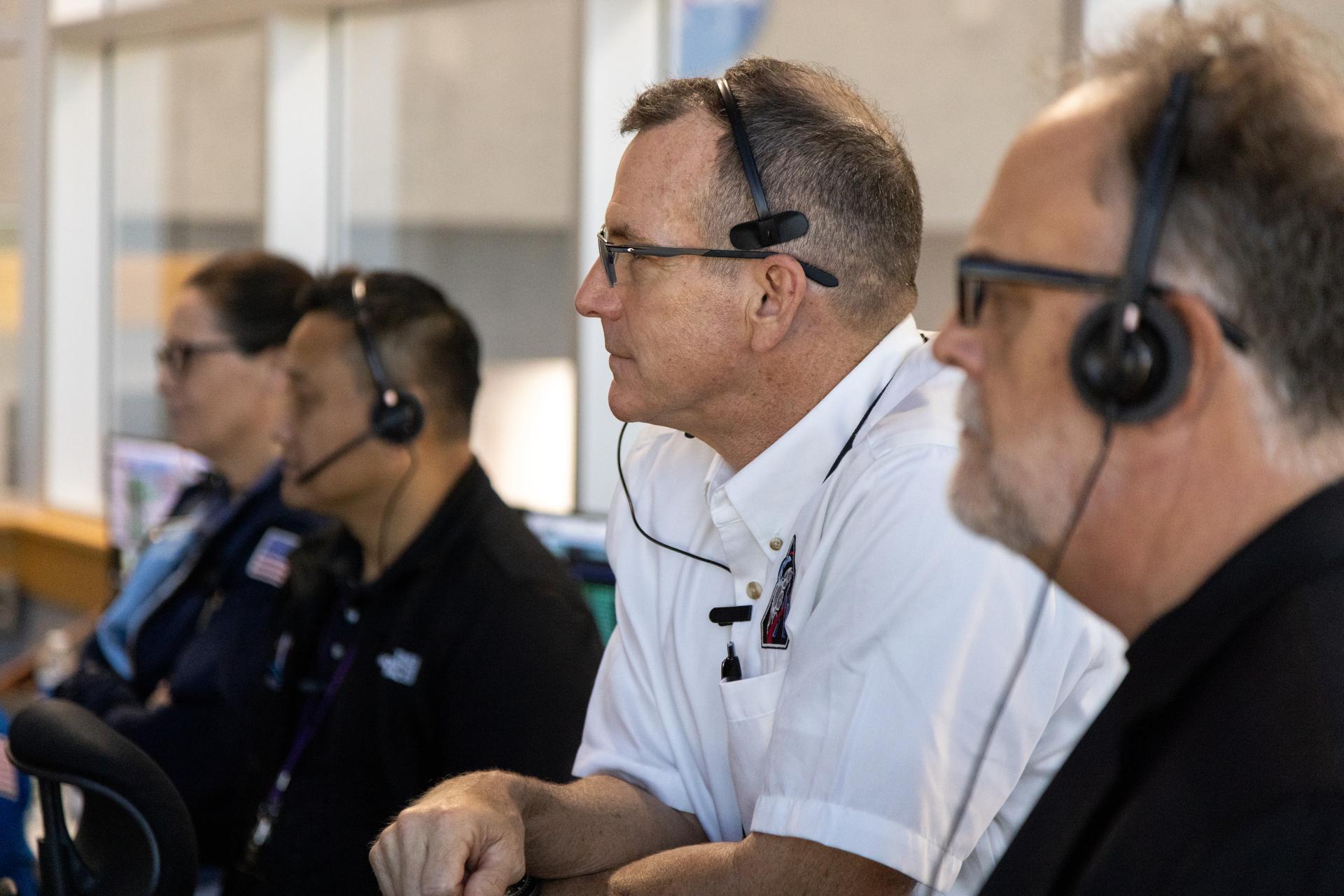
From right, Shawn Quinn NASA’s Exploration Ground Systems program manager; Cliff Lanham, NASA’s Exploration Ground Systems deputy program manager; and Howard Hu, Orion program manager, monitor the progress of a countdown demonstration test with Artemis II crewmembers NASA astronauts Reid Wiseman, commander; Victor Glover, pilot; Christina Koch, mission specialist; and CSA (Canadian Space Agency) astronaut Jeremy Hansen, mission specialist onboard their Orion spacecraft from Firing Room 1 of the Rocco A. Petrone Launch Control Center, Saturday, Dec. 20, 2025, at NASA’s Kennedy Space Center in Florida. For this operation, the Artemis II crew and launch teams are simulating the launch day timeline including suit-up, walkout, and spacecraft ingress and egress. Through the Artemis campaign, NASA will send astronauts to explore the Moon for scientific discovery, economic benefits, and to build the foundation for the first crewed missions to Mars, for the benefit of all.
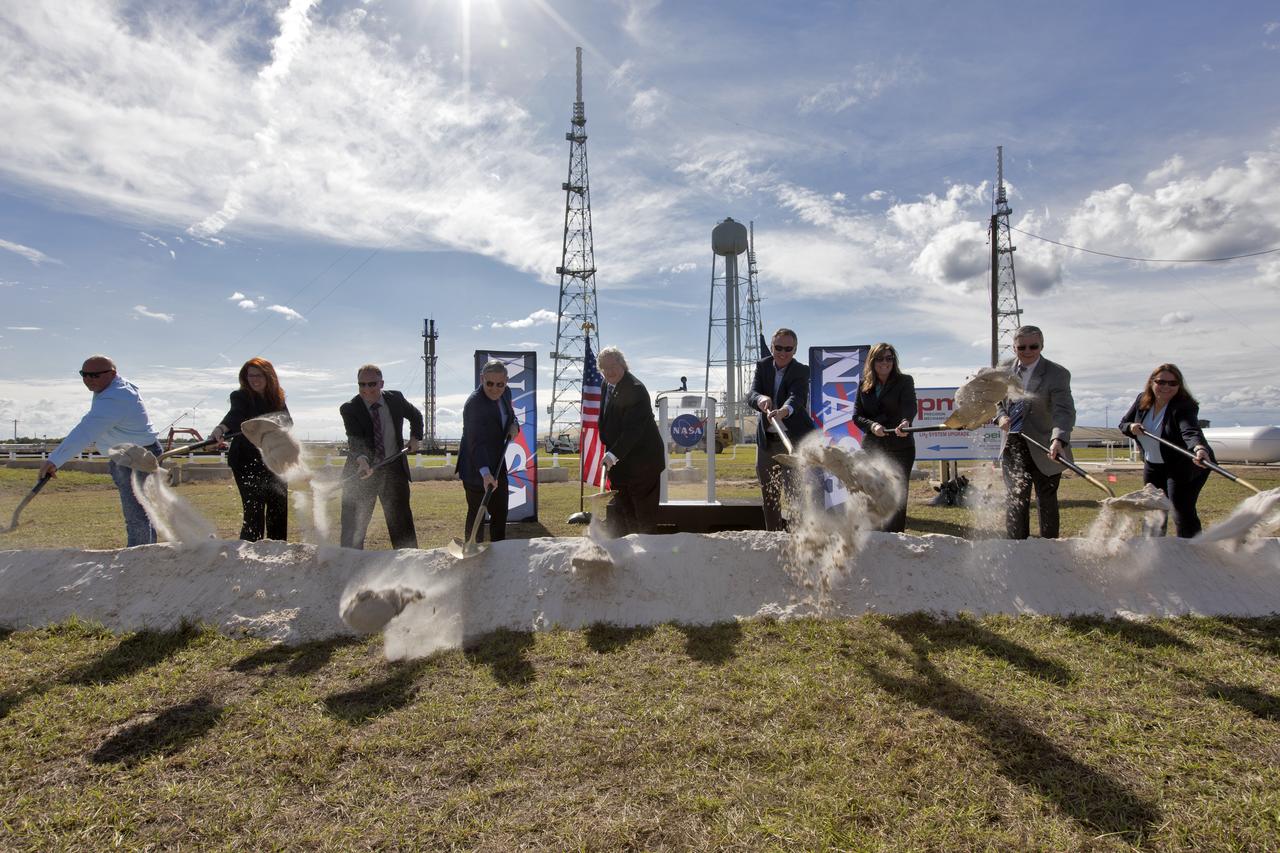
On Dec. 19, 2018, at NASA Kennedy Space Center's Launch Complex 39B, agency and contractor managers break ground for a new liquid hydrogen tank. Participating, from the left, are Todd Gray, president of Precision Mechanical, prime contractor for the project; Charlie Blackwell-Thompson, launch director; Shawn Quinn, director of Engineering; Bob Cabana, center director; Bill Hill, deputy associate administrator for Exploration Systems Development at NASA Headquarters in Washington; Mike Bolger, program manager for Exploration Ground Systems (EGS); Jennifer Kunz, deputy program manager for EGS, Andy Allen, general manager for Jacobs, NASA's Test and Operations Support Contractor; and Regina Spellman, launch pad senior project manager in EGS. The storage facility will hold 1.25 million gallons of the propellant for NASA's Space Launch System rocket designed to boost the agency's Orion spacecraft, sending humans to distant destinations such as the Moon and Mars.
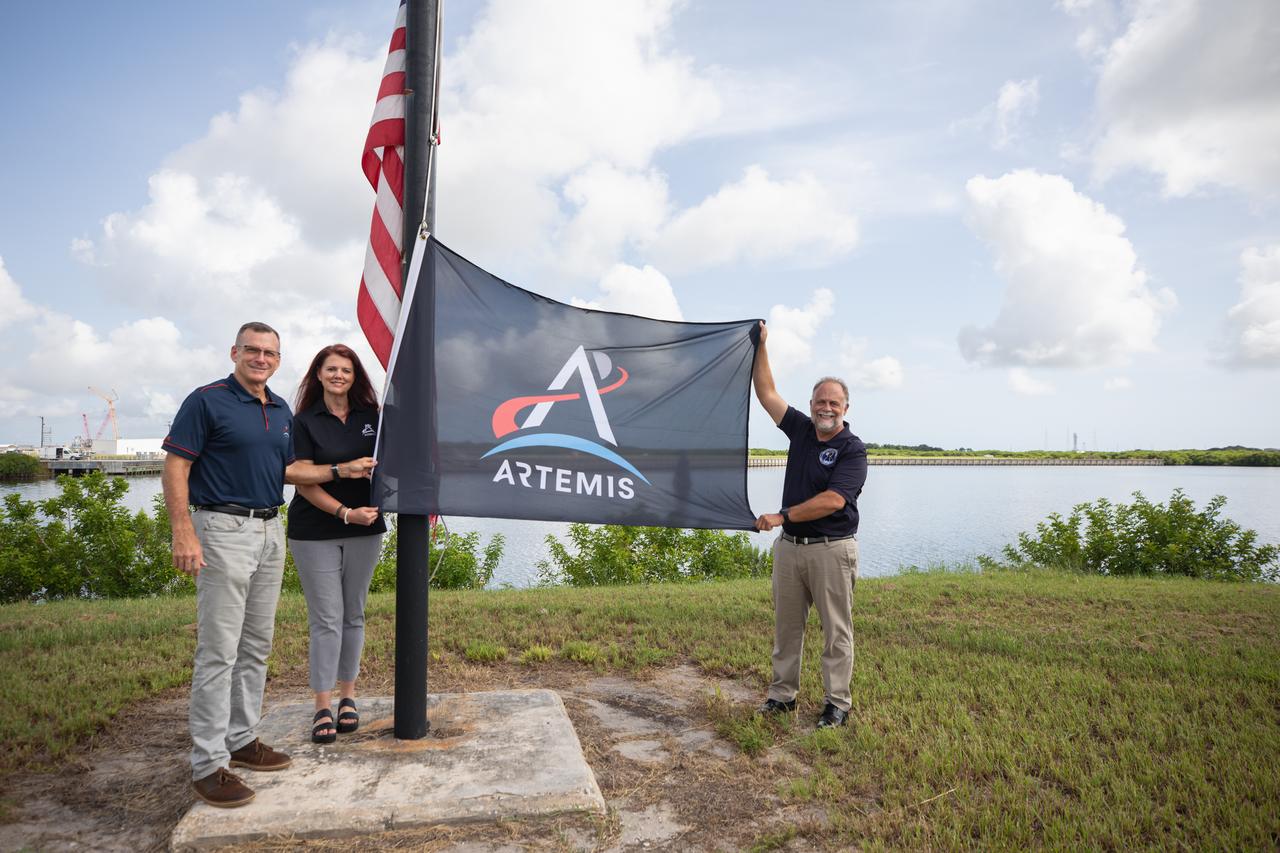
From left to right, Cliff Lanham, senior vehicle operations manager, Exploration Ground Systems; Charlie Blackwell-Thompson, Artemis launch director, Exploration Ground Systems; and Shawn Quinn, manager, Exploration Ground Systems, prepare to raise the Artemis flag near the countdown clock at NASA’s Kennedy Space Center in Florida on Monday, July 22, 2024. The flag raising marks the arrival of NASA’s massive SLS (Space Launch System) core stage via the agency’s Pegasus barge from NASA’s Michoud Assembly Facility in New Orleans. The core stage will help power SLS when it launches four astronauts around the Moon for the first crewed flight of SLS and the Orion spacecraft during the Artemis II test flight.
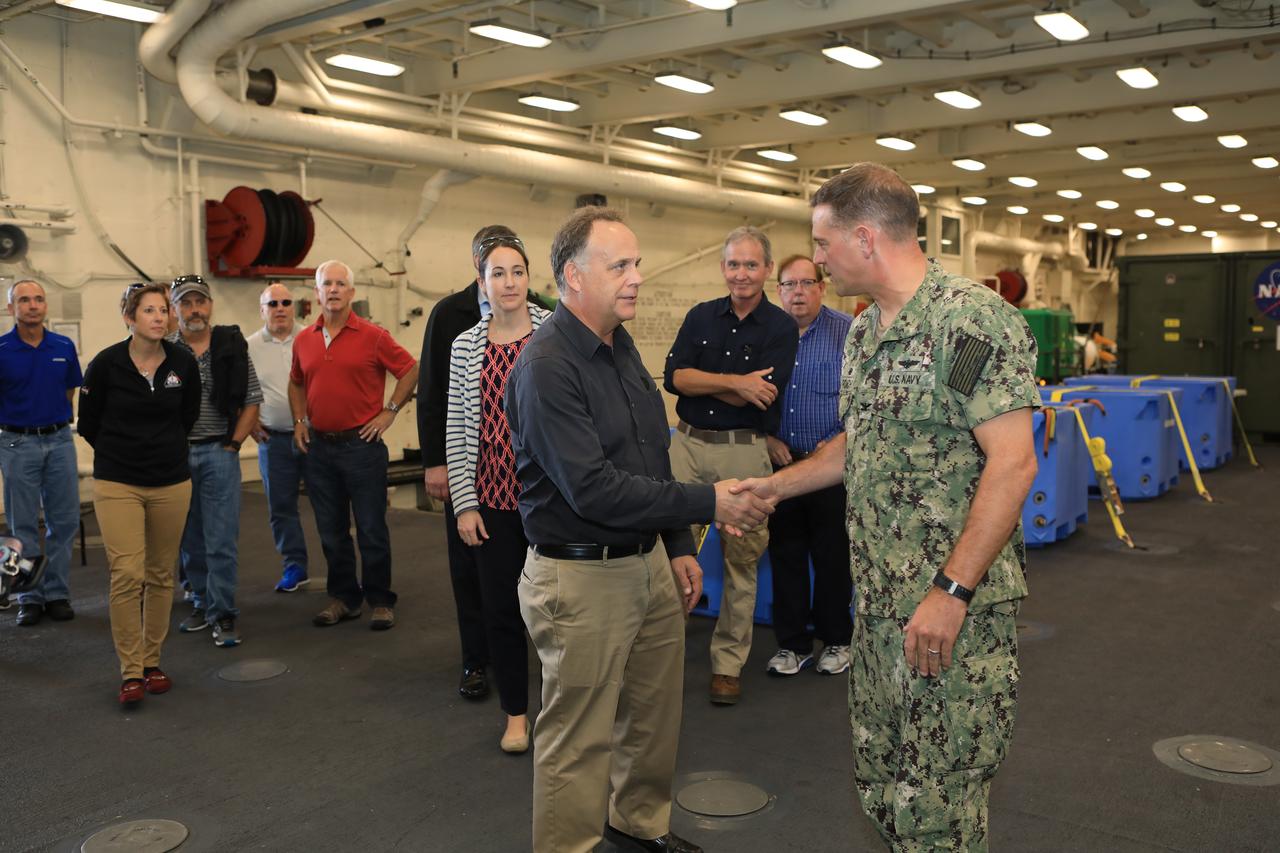
Captain Anthony Roach, at right, commanding officer in the U.S. Navy, welcomes Shawn Quinn and other senior leaders from around NASA onto his ship on Oct. 29, 2018. The visit is a familiarization tour coordinated by the Exploration Ground Systems (EGS) recovery team as they prepare for Underway Recovery Test-7 (URT-7). EGS and the U.S. Navy will use a test version of the Orion crew module, several rigid hull inflatable boats and support equipment to verify and validate processes, procedures, hardware and personnel during recovery of Orion in open waters. URTs are a series of tests to ensure all systems are go when recovering the Orion crew capsule and astronauts onboard in the future. Orion will have emergency abort capability, sustain the crew during space travel and provide safe re-entry from deep space return velocities.
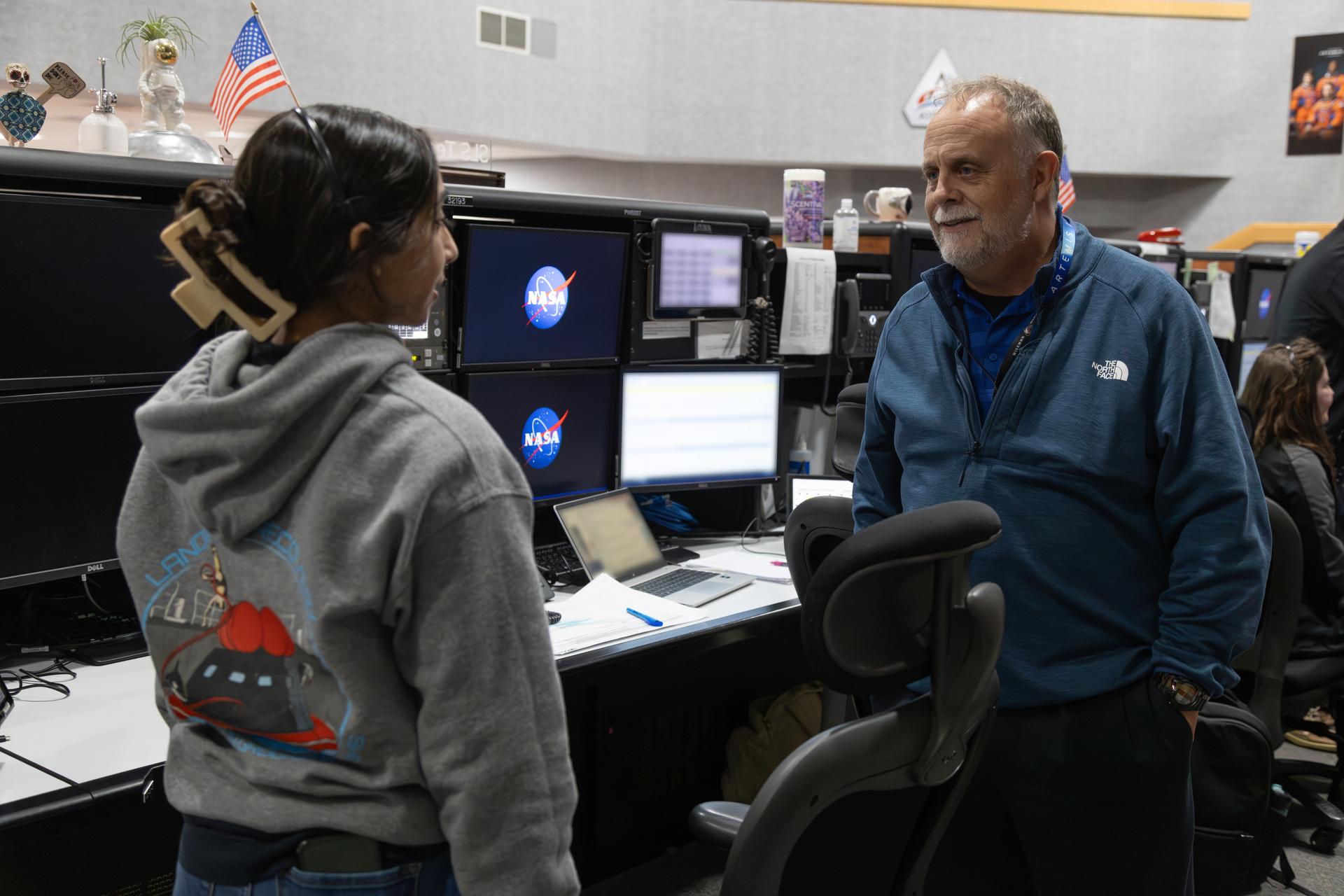
From left, an Artemis launch team member and Shawn Quinn, manager, NASA’s Exploration Ground Systems Program, talk to each other inside Firing Room 1 of the Rocco A. Petrone Launch Control Center during the Artemis II rollout of the SLS (Space Launch System) rocket and Orion spacecraft from the Vehicle Assembly Building to Launch Complex 39B at NASA’s Kennedy Space Center in Florida on Friday, March 20, 2026. The Artemis II test flight will take Commander Reid Wiseman, Pilot Victor Glover, and Mission Specialist Christina Koch from NASA, and Mission Specialist Jeremy Hansen from the CSA (Canadian Space Agency), around the Moon and back to Earth with launch opportunities beginning in April 2026.
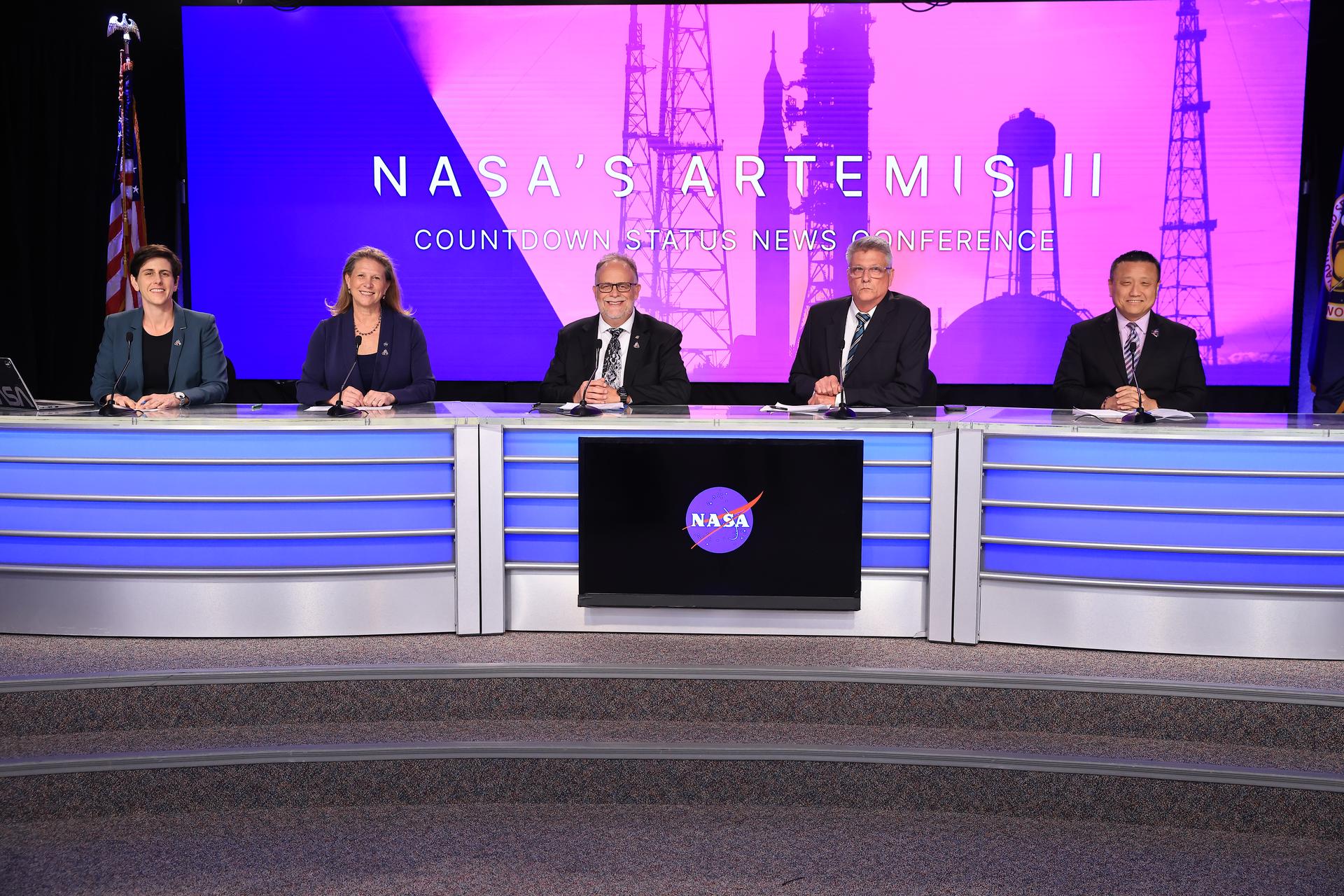
From left to right, Rachel Kraft, NASA communications; Lori Glaze, acting associate administrator, Exploration Systems Development Mission Directorate; Shawn Quinn, program manager, Exploration Ground Systems; Chris Cianciola, deputy manager, NASA’s SLS (Space Launch System) Program; and Howard Hu, manager, Orion Program, participates in a news conference on Sunday, March 29, 2026, to discuss the upcoming Artemis II test flight at NASA’s Kennedy Space Center in Florida. The Artemis II mission will take Artemis II Commander Reid Wiseman, Pilot Victor Glover, and Mission Specialist Christina Koch from NASA, and Mission Specialist Jeremy Hansen from the CSA (Canadian Space Agency) on a 10-day journey around the Moon and back aboard NASA’s SLS (Space Launch System) rocket and Orion spacecraft from Launch Complex 39B no earlier than 6:24 p.m. EDT on Wednesday, April 1.
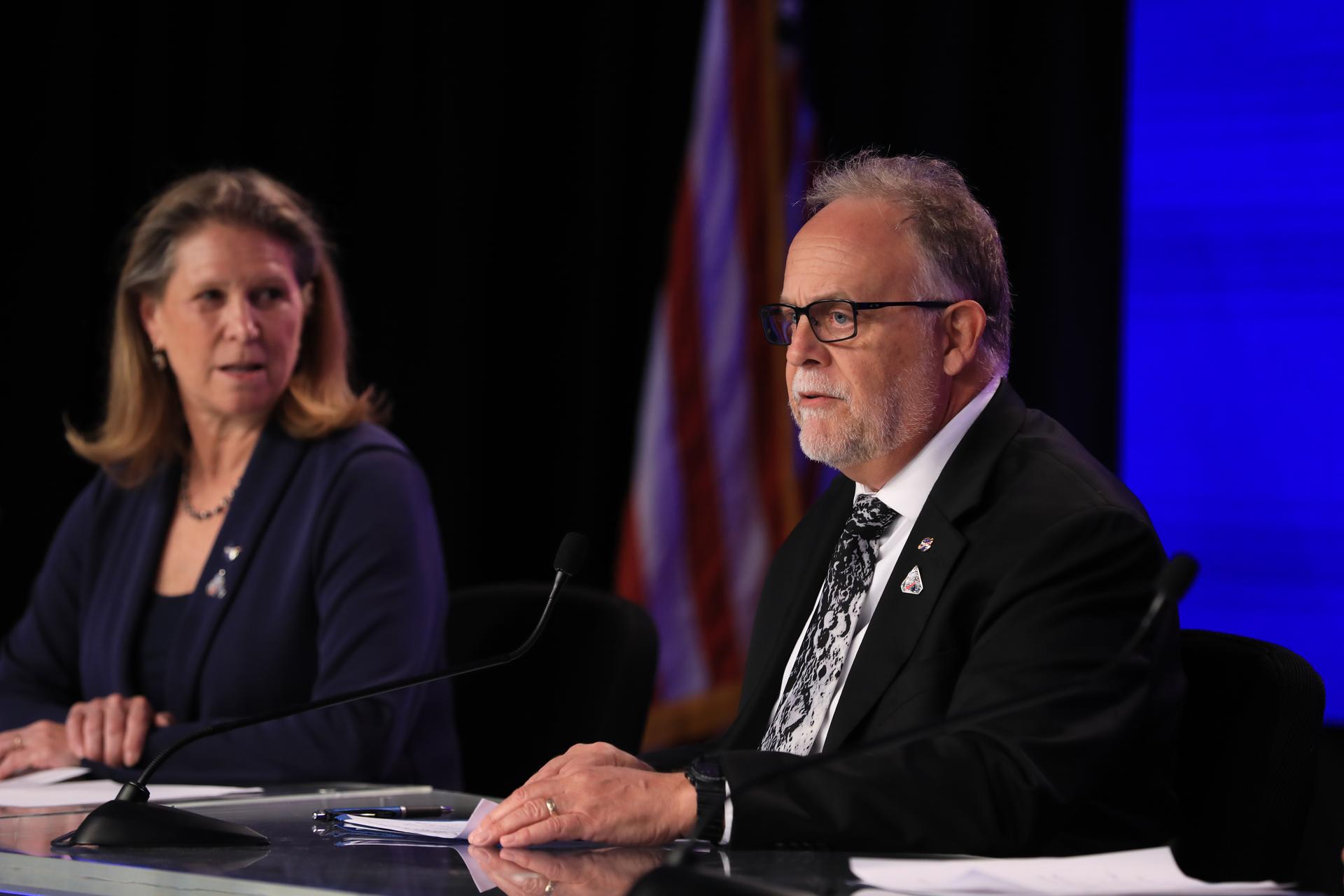
From left, Lori Glaze, acting associate administrator, Exploration Systems Development Mission Directorate and Shawn Quinn, program manager, Exploration Ground Systems, participate in a news conference on Sunday, March 29, 2026, to discuss the upcoming Artemis II test flight at NASA’s Kennedy Space Center in Florida. The Artemis II mission will take Artemis II Commander Reid Wiseman, Pilot Victor Glover, and Mission Specialist Christina Koch from NASA, and Mission Specialist Jeremy Hansen from the CSA (Canadian Space Agency) on a 10-day journey around the Moon and back aboard NASA’s SLS (Space Launch System) rocket and Orion spacecraft from Launch Complex 39B no earlier than 6:24 p.m. EDT on Wednesday, April 1.
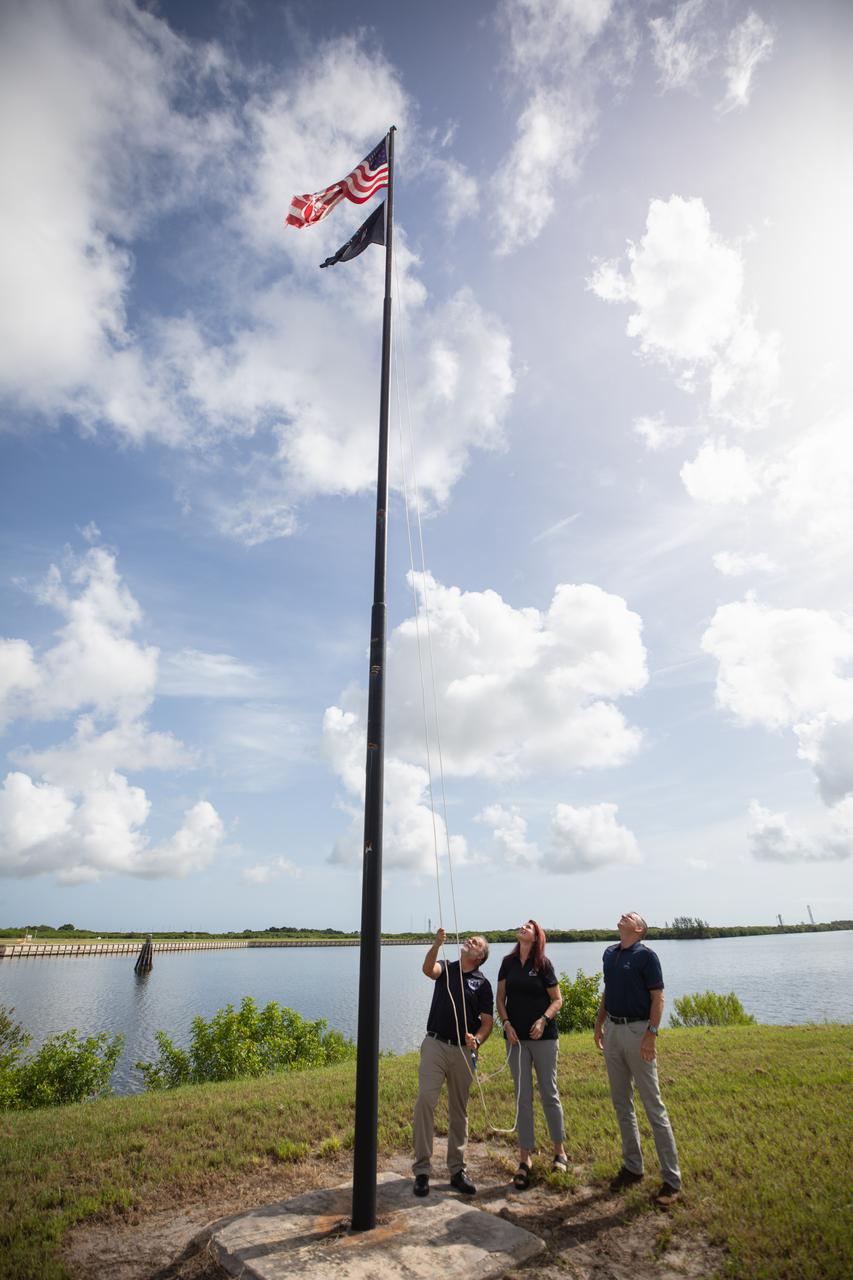
From left to right, Shawn Quinn, manager, Exploration Ground Systems; Charlie Blackwell-Thompson, Artemis launch director, Exploration Ground Systems; and Cliff Lanham, senior vehicle operations manager, Exploration Ground Systems, raise the Artemis flag near the countdown clock at NASA’s Kennedy Space Center in Florida on Monday, July 22, 2024. The flag raising marks the arrival of NASA’s massive SLS (Space Launch System) core stage via the agency’s Pegasus barge from NASA’s Michoud Assembly Facility in New Orleans. The core stage will help power SLS when it launches four astronauts around the Moon for the first crewed flight of SLS and the Orion spacecraft during the Artemis II test flight.
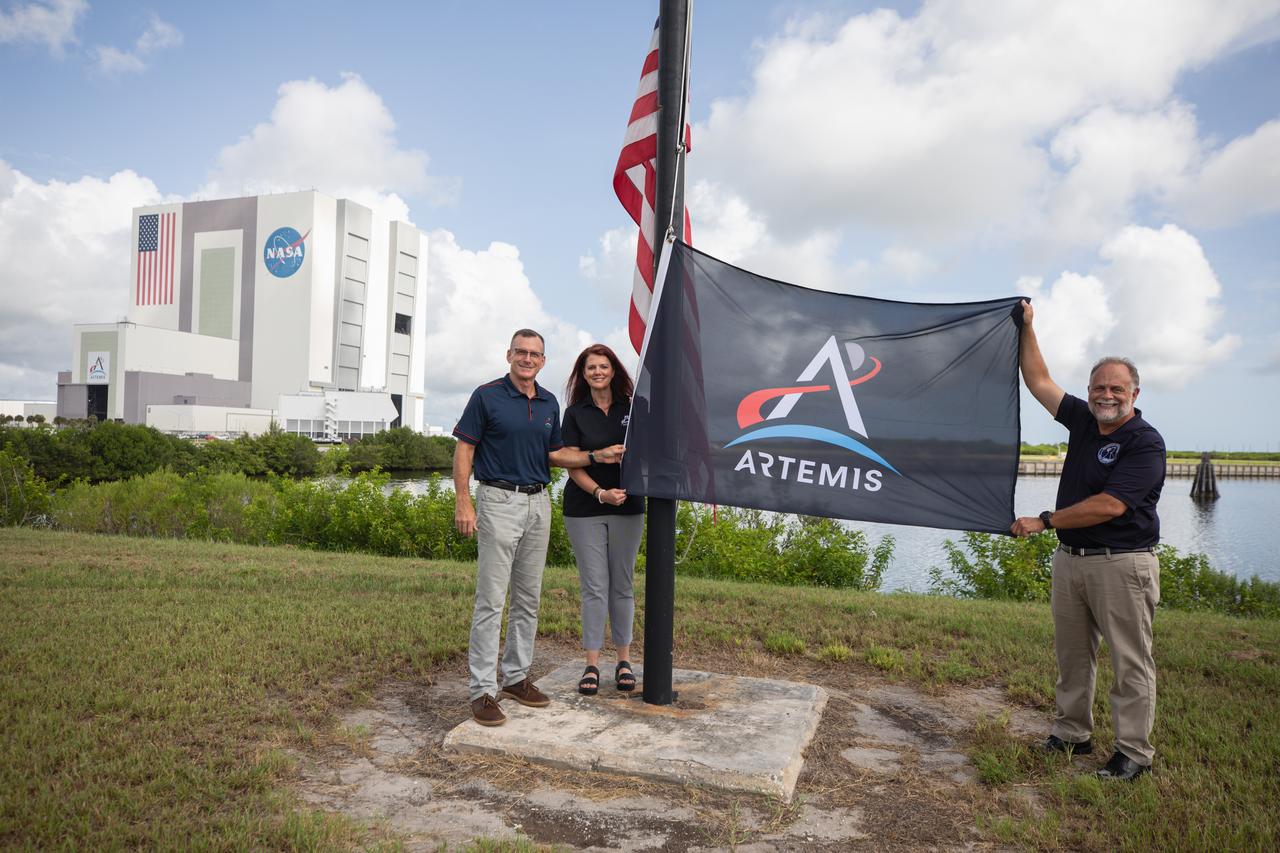
From left to right, Cliff Lanham, senior vehicle operations manager, Exploration Ground Systems; Charlie Blackwell-Thompson, Artemis launch director, Exploration Ground Systems; and Shawn Quinn, manager, Exploration Ground Systems, prepare to raise the Artemis flag near the countdown clock at NASA’s Kennedy Space Center in Florida on Monday, July 22, 2024. The flag raising marks the arrival of NASA’s massive SLS (Space Launch System) core stage via the agency’s Pegasus barge from NASA’s Michoud Assembly Facility in New Orleans. The core stage will help power SLS when it launches four astronauts around the Moon for the first crewed flight of SLS and the Orion spacecraft during the Artemis II test flight.
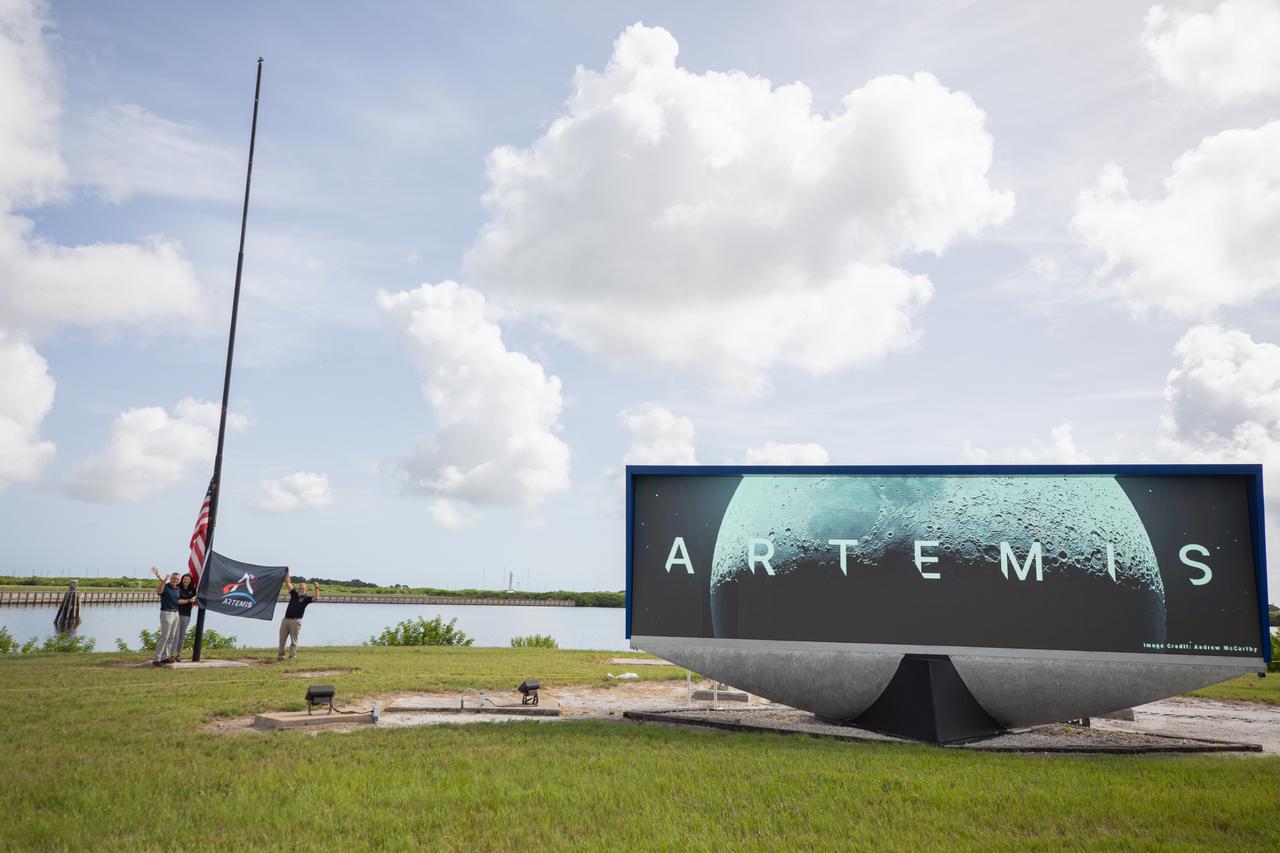
From left to right, Cliff Lanham, senior vehicle operations manager, Exploration Ground Systems; Charlie Blackwell-Thompson, Artemis launch director, Exploration Ground Systems; and Shawn Quinn, manager, Exploration Ground Systems, prepare to raise the Artemis flag near the countdown clock at NASA’s Kennedy Space Center in Florida on Monday, July 22, 2024. The flag raising marks the arrival of NASA’s massive SLS (Space Launch System) core stage via the agency’s Pegasus barge from NASA’s Michoud Assembly Facility in New Orleans. The core stage will help power SLS when it launches four astronauts around the Moon for the first crewed flight of SLS and the Orion spacecraft during the Artemis II test flight.
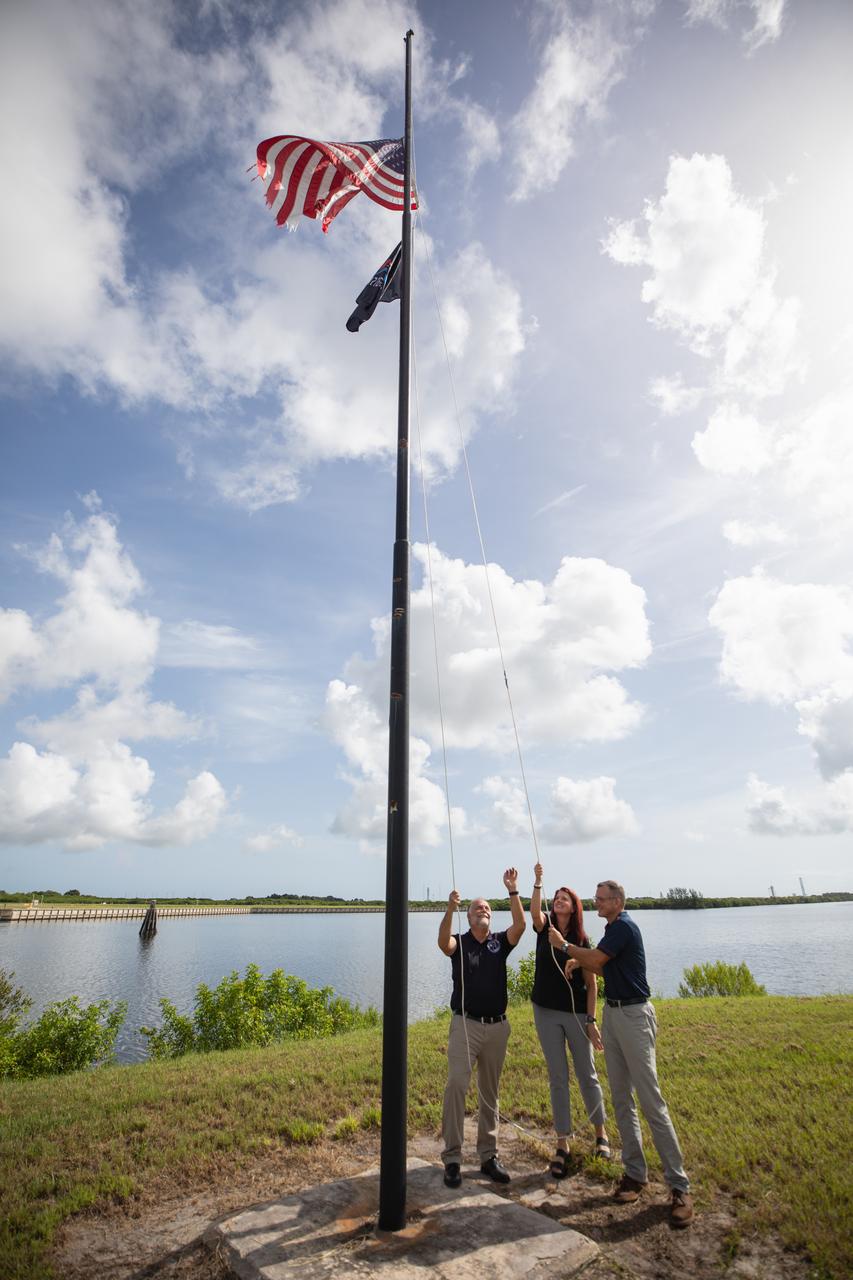
From left to right, Shawn Quinn, manager, Exploration Ground Systems; Charlie Blackwell-Thompson, Artemis launch director, Exploration Ground Systems; and Cliff Lanham, senior vehicle operations manager, Exploration Ground Systems, raise the Artemis flag near the countdown clock at NASA’s Kennedy Space Center in Florida on Monday, July 22, 2024. The flag raising marks the arrival of NASA’s massive SLS (Space Launch System) core stage via the agency’s Pegasus barge from NASA’s Michoud Assembly Facility in New Orleans. The core stage will help power SLS when it launches four astronauts around the Moon for the first crewed flight of SLS and the Orion spacecraft during the Artemis II test flight.
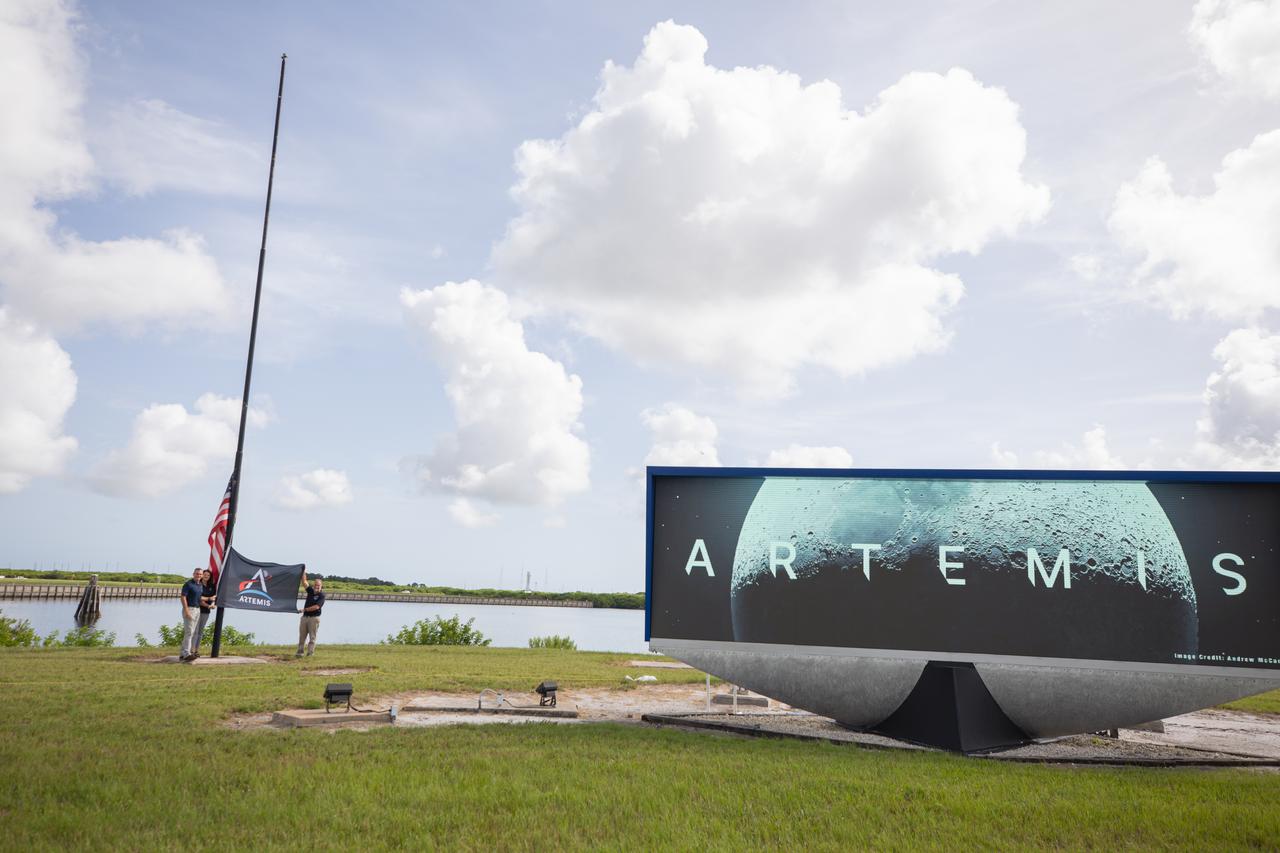
From left to right, Cliff Lanham, senior vehicle operations manager, Exploration Ground Systems; Charlie Blackwell-Thompson, Artemis launch director, Exploration Ground Systems; and Shawn Quinn, manager, Exploration Ground Systems, prepare to raise the Artemis flag near the countdown clock at NASA’s Kennedy Space Center in Florida on Monday, July 22, 2024. The flag raising marks the arrival of NASA’s massive SLS (Space Launch System) core stage via the agency’s Pegasus barge from NASA’s Michoud Assembly Facility in New Orleans. The core stage will help power SLS when it launches four astronauts around the Moon for the first crewed flight of SLS and the Orion spacecraft during the Artemis II test flight.
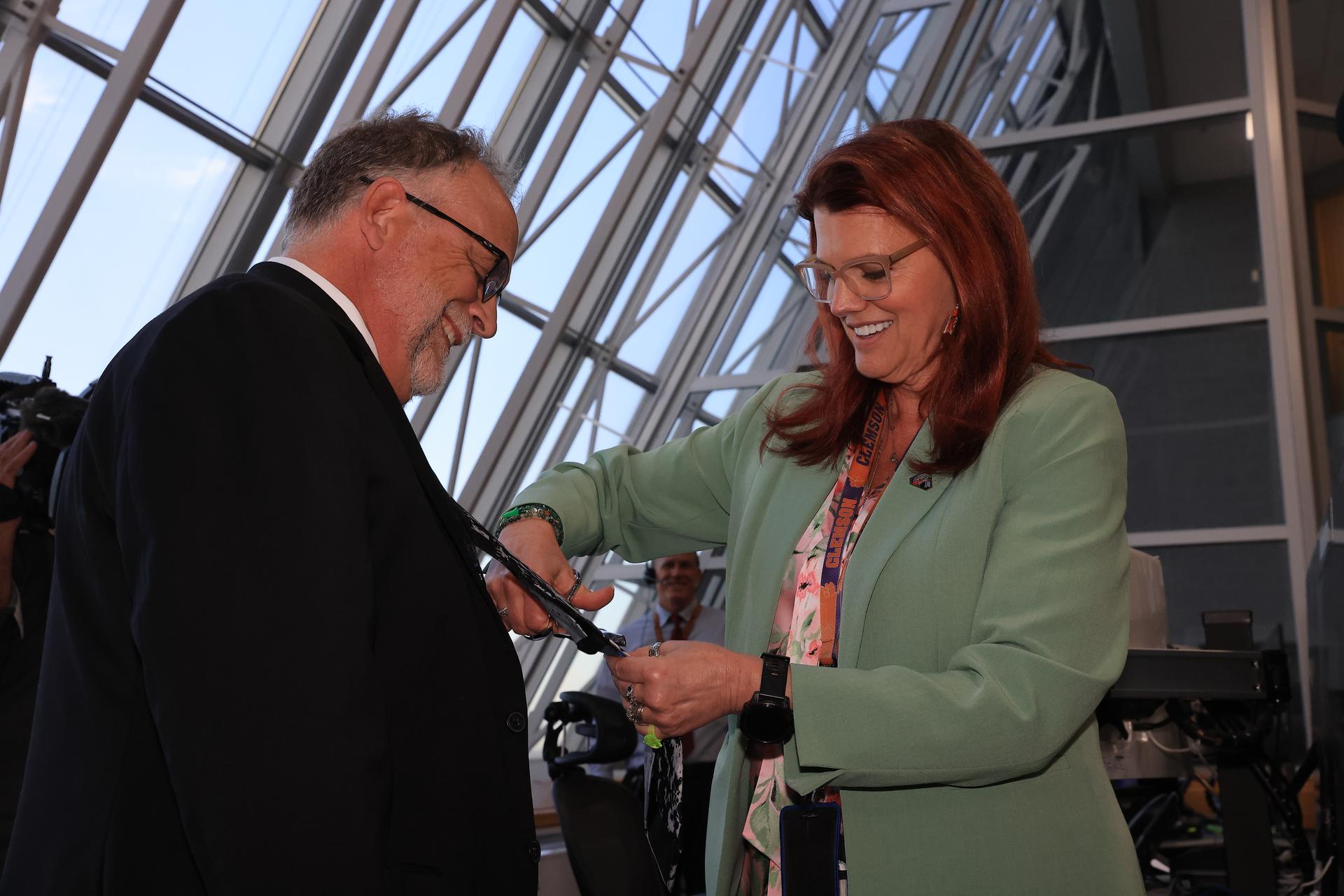
Charlie Blackwell-Thompson, Artemis launch director, cuts the tie of Shawn Quinn, manager, each from NASA’s Exploration Ground Systems Program, inside Firing Room 1 of the Rocco Petrone Launch Control Center following the launch of the Artemis II test flight on Wednesday, April 1, 2026. The tie-cutting is a NASA tradition those who have a new role launch. The Artemis II mission launched Commander Reid Wiseman, Pilot Victor Glover, and Mission Specialist Christina Koch from NASA, and Mission Specialist Jeremy Hansen from the CSA (Canadian Space Agency), aboard NASA’s SLS (Space Launch System) rocket and Orion spacecraft to journey for 10 days around the Moon and back to Earth.
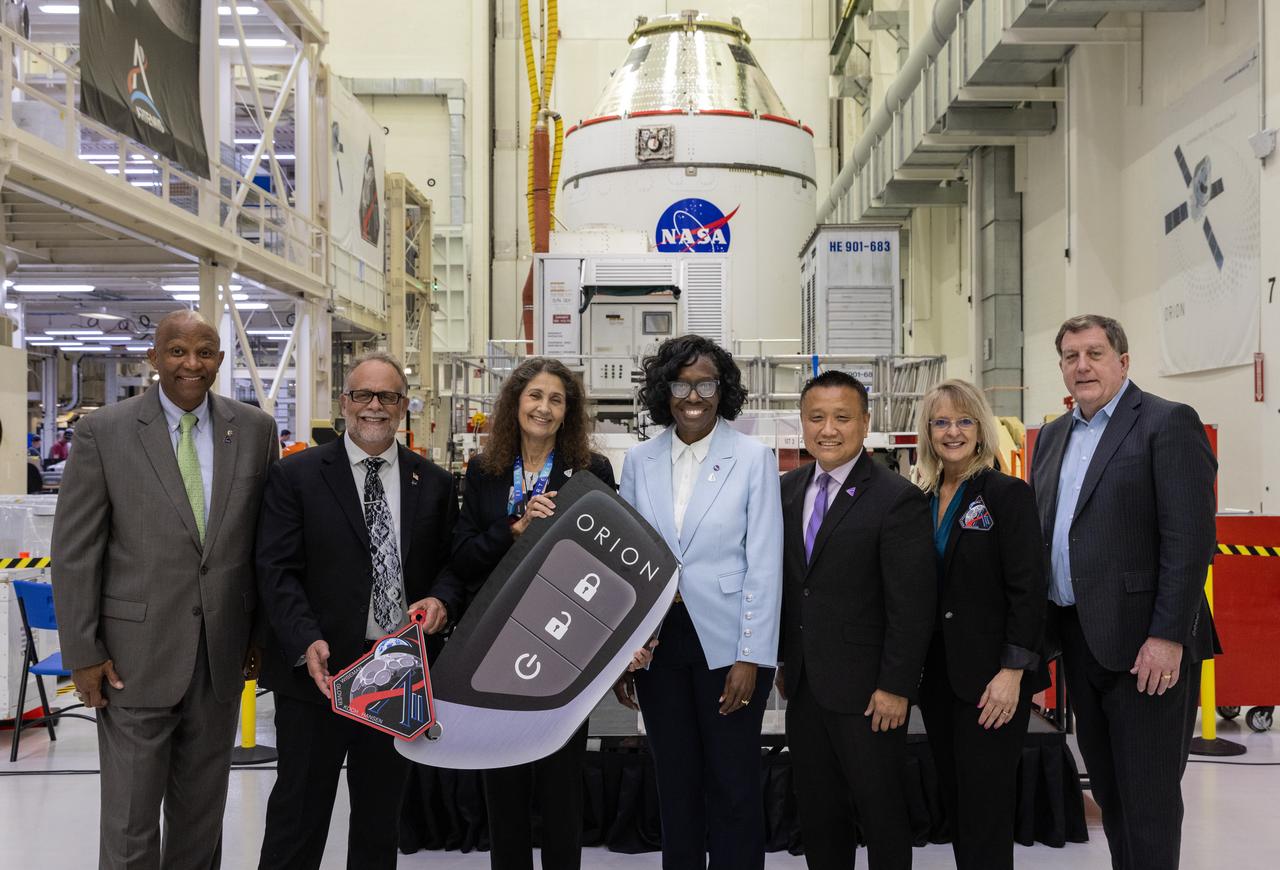
From left, Kelvin Manning, acting center director, NASA’s Kennedy Space Center; Shawn Quinn, Exploration Ground Systems program manager; Lorna Kenna, Amentum Vice President and program manager; Lakiesha Hawkins, assistant deputy associate administrator, Moon to Mars Program office; Howard Hu, Orion program manager; Debbie Korth, Orion deputy program manager; Keith Shireman Lockheed Martin Vice President of Lunar Exploration Campaign, participate in a handover ceremony of NASA’s Artemis II Orion spacecraft to crews with the agency’s Exploration Ground Systems Program at the Neil A. Armstrong Operations and Checkout Building at NASA’s Kennedy Space Center in Florida on Thursday, May 1, 2025. The spacecraft will be transported to the Multi-Payload Processing Facility to undergo fueling and processing for prelaunch operations. The Artemis II test flight is the first crewed flight under NASA’s Artemis campaign and is another step toward missions on the lunar surface and helping the agency prepare for future human missions to Mars.
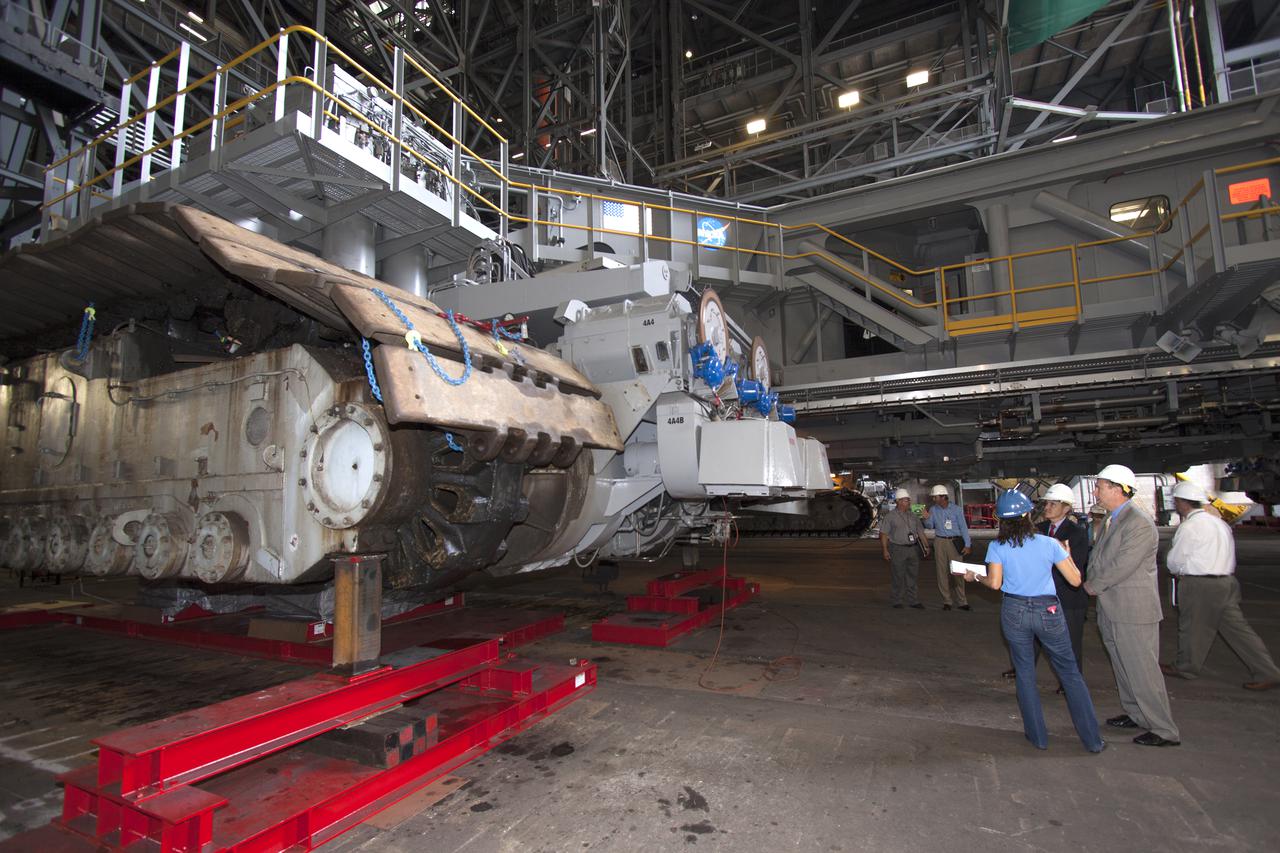
CAPE CANAVERAL, Fla. – NASA Associate Administrator Robert Lightfoot, second from right, is briefed on the modifications to crawler-transporter 2 in the Vehicle Assembly Building, or VAB, during a visit to NASA's Kennedy Space Center in Florida. From left are Mary Hanna, crawler-transporter project manager, Kennedy Director Bob Cabana, Lightfoot, and Shawn Quinn, Vehicle Integration and Launch Integration Product Team, or IPT, manager. Crawler-transporter 2 is being readied to support NASA's new Orion spacecraft and Space Launch System heavy-lift rocket, the SLS. NASA's FY2014 budget proposal includes a plan to robotically capture a small near-Earth asteroid and redirect it safely to a stable orbit in the Earth-moon system where astronauts can visit and explore it. Performing these elements for the proposed asteroid initiative integrates the best of NASA's science, technology and human exploration capabilities and draws on the innovation of America's brightest scientists and engineers. It uses current and developing capabilities to find both large asteroids that pose a hazard to Earth and small asteroids that could be candidates for the initiative, accelerates our technology development activities in high-powered solar electric propulsion and takes advantage of our hard work on the Space Launch System rocket and Orion spacecraft, helping to keep NASA on target to reach the President's goal of sending humans to Mars in the 2030s. Photo credit: NASA_Jim Grossmann
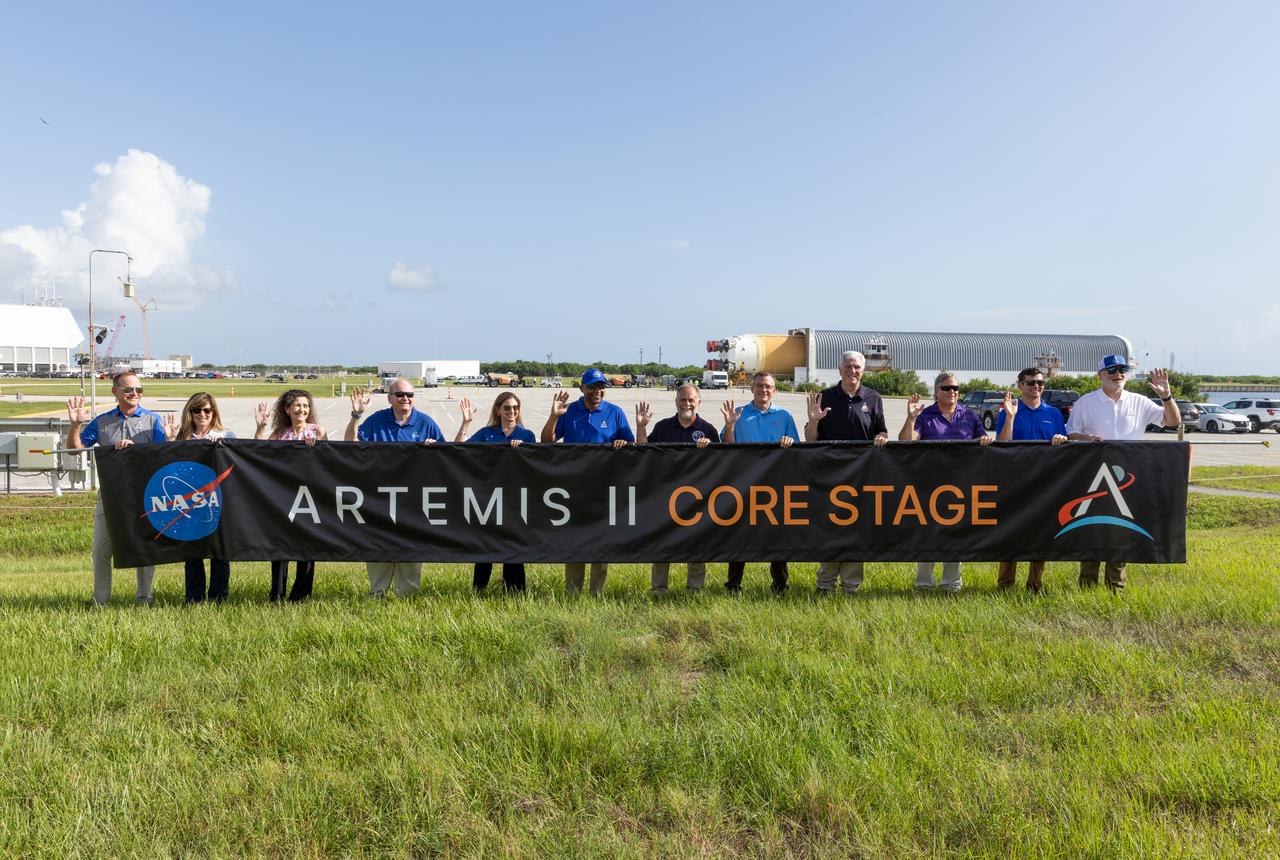
From left, John Ramsey, chief transformation officer for Jacobs; Jennifer Kunz, associate director, technical, NASA’s Kennedy Space Center; Lorna Kenna, vice president and general manager, Jacobs; Burt Summerfield, associate director, management, NASA Kennedy; Catherine Koerner, associate administrator for NASA’s Exploration Systems Development Mission Directorate; Kelvin Manning, deputy director, NASA Kennedy; Shawn Quinn, manager, NASA’s Exploration Ground Systems; Cliff Lanham, senior vehicle operations manager, NASA’s Exploration Ground Systems; Matthew Ramsey, Artemis II mission manager; Paul Hudson, Jacobs senior vehicle engineer; Jay Grow, Boeing’s associate chief engineer for Space Launch System Launch Operations; and Bill Muddle, lead RS-25 field engineer at Aerojet Rocketdyne, hold a banner to celebrate the arrival of the Artemis II SLS (Space Launch System) core stage at NASA’s Kennedy Space Center on Wednesday, July 24, 2024. Journeying from NASA’s Michoud Assembly Facility in New Orleans aboard the Pegasus barge, the core stage arrived at the Florida spaceport on July 23, 2024, to be processed for flight by NASA’s Exploration Ground Systems Program.
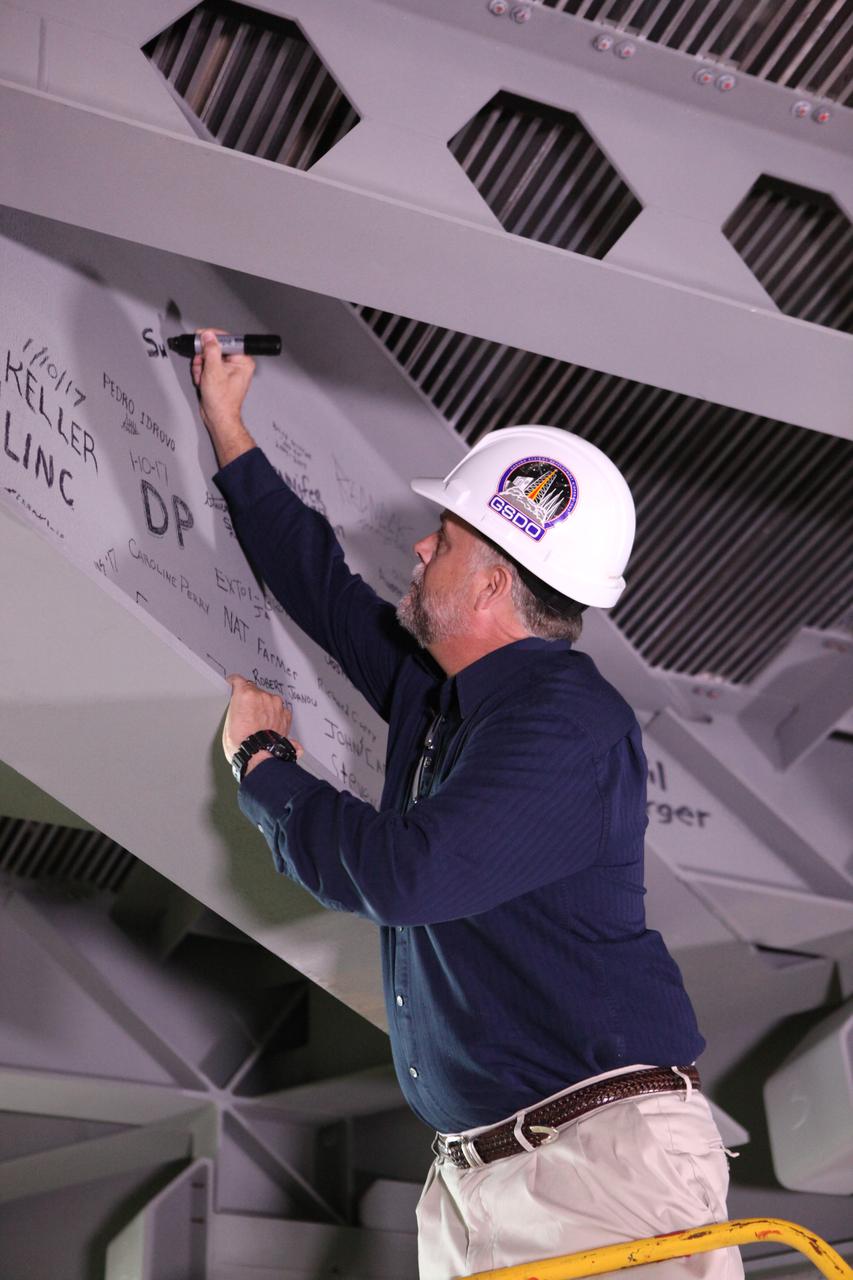
Shawn Quinn, associate program manager for the Ground Systems Development and Operations Program (GSDO), signs the platform A North beam in the transfer aisle of the Vehicle Assembly Building (VAB) at NASA's Kennedy Space Center in Florida. Kennedy's Engineering Directorate coordinated a platform beam signing event to celebrate the culmination of the NASA and contractor team's last several years of study, design, construction and installation of 20 new work platforms in High Bay 3 of the Vehicle Assembly (VAB). The platform will be installed and secured on its rail beam high up on the north wall of High Bay 3. The installation of the final topmost level completes the 10 levels of work platforms, 20 platform halves altogether, that will surround NASA's Space Launch System rocket and the Orion spacecraft and allow access during processing for missions, including the first uncrewed flight test of Orion atop the SLS rocket in 2018. GSDO, with support from the center's Engineering Directorate, is overseeing upgrades and modifications to the VAB, including installation of the new work platforms.

Senior leaders from around NASA receive a familiarization tour by the Exploration Ground Systems (EGS) recovery team on Oct. 29, 2018, as they prepare for Underway Recovery Test-7 (URT-7) aboard a U.S. Navy ship. From left, Kennedy Space Center's Russ Deloach, Shawn Quinn and Scott Colloredo learn more about how the front porch will be used to help pull crew out of Orion after it splashes down in the Pacific Ocean. EGS and the U.S. Navy will use a test version of the Orion crew module, several rigid hull inflatable boats and support equipment to verify and validate processes, procedures, hardware and personnel during recovery of Orion in open waters. URTs are a series of tests to ensure all systems are go when recovering the Orion crew capsule and astronauts onboard in the future. Orion will have emergency abort capability, sustain the crew during space travel and provide safe re-entry from deep space return velocities.
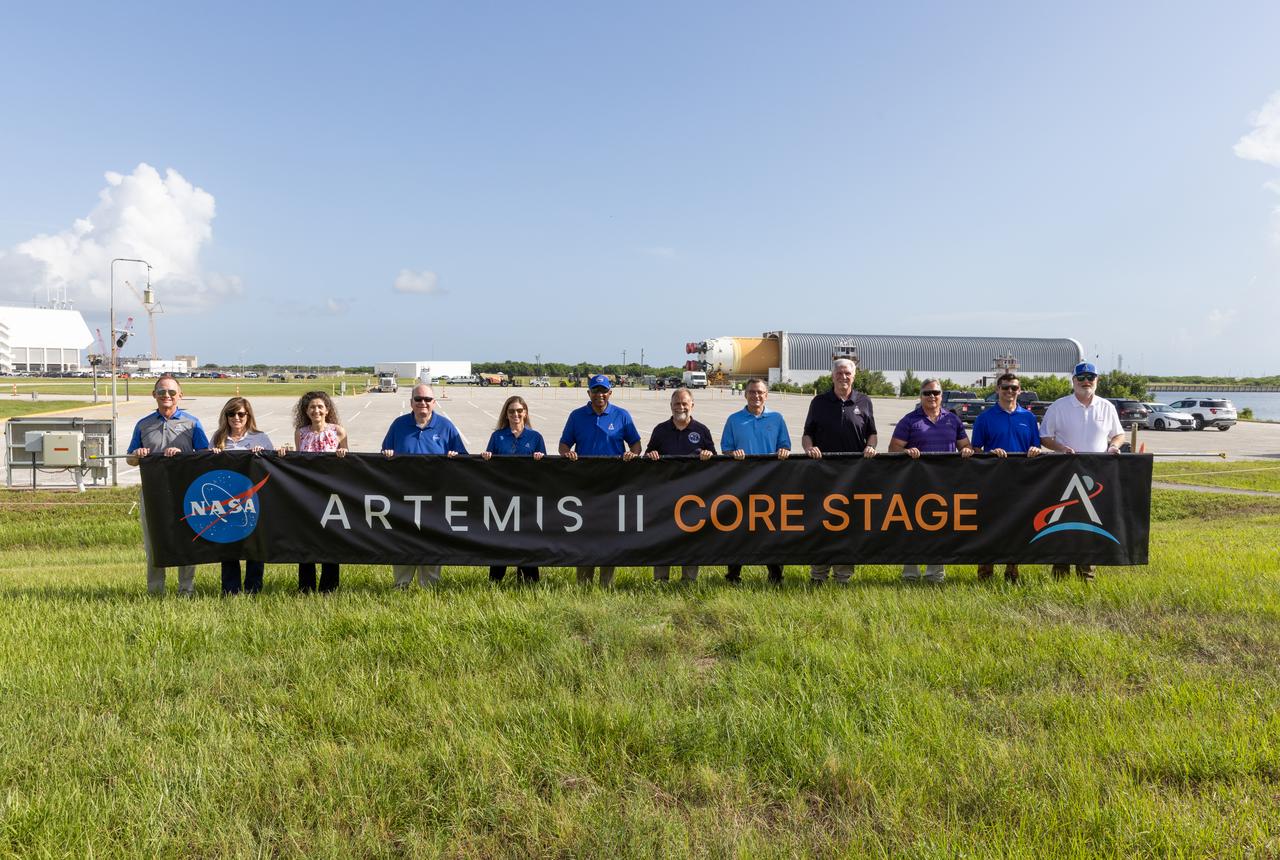
From left, John Ramsey, chief transformation officer for Jacobs; Jennifer Kunz, associate director, technical, NASA’s Kennedy Space Center; Lorna Kenna, vice president and general manager, Jacobs; Burt Summerfield, associate director, management, NASA Kennedy; Catherine Koerner, associate administrator for NASA’s Exploration Systems Development Mission Directorate; Kelvin Manning, deputy director, NASA Kennedy; Shawn Quinn, manager, NASA’s Exploration Ground Systems; Cliff Lanham, senior vehicle operations manager, NASA’s Exploration Ground Systems; Matthew Ramsey, Artemis II mission manager; Paul Hudson, Jacobs senior vehicle engineer; Jay Grow, Boeing’s associate chief engineer for Space Launch System Launch Operations; and Bill Muddle, lead RS-25 field engineer at Aerojet Rocketdyne, hold a banner to celebrate the arrival of the Artemis II SLS (Space Launch System) core stage at NASA’s Kennedy Space Center on Wednesday, July 24, 2024. Journeying from NASA’s Michoud Assembly Facility in New Orleans aboard the Pegasus barge, the core stage arrived at the Florida spaceport on July 23, 2024, to be processed for flight by NASA’s Exploration Ground Systems Program.
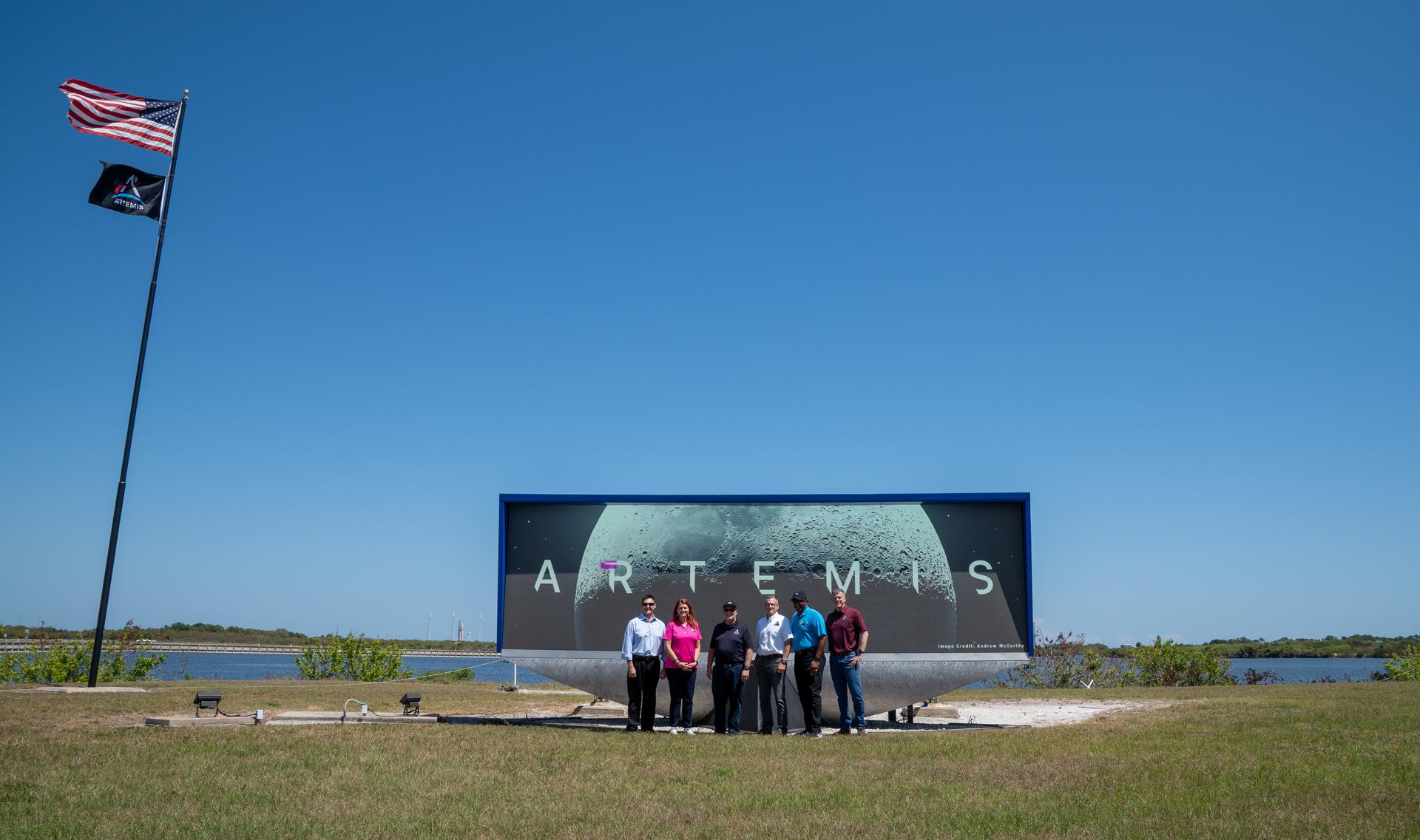
Robert Yaskovic, associate manager, Exploration Ground Systems Program; Charlie Blackwell-Thompson, Artemis II launch director; Shawn Quinn, manager, Exploration Ground Systems Program; Cliff Lanham, deputy manager, Exploration Ground Systems Program; NASA Kennedy Space Center Deputy Director Kelvin Manning; and Jeremy Graeber, assistant launch director, Exploration Ground Systems Program raise the Artemis flag near the countdown clock at the NASA News Center at NASA’s Kennedy Space Center in Florida on Friday, March 27, 2026. The Artemis II test flight mission will take Artemis II Commander Reid Wiseman, Pilot Victor Glover, and Mission Specialist Christina Koch from NASA, and Mission Specialist Jeremy Hansen from the CSA (Canadian Space Agency) on a 10-day journey around the Moon and back aboard NASA’s SLS (Space Launch System) rocket and Orion spacecraft from Launch Complex 39B no earlier than 6:24 p.m. EDT on Wednesday, April 1.
From left, NASA Kennedy Space Center Deputy Director Kelvin Manning; Robert Yaskovic, associate manager, Exploration Ground Systems Program; Shawn Quinn, manager, Exploration Ground Systems Program; Charlie Blackwell-Thompson, Artemis II launch director; Cliff Lanham, deputy manager, Exploration Ground Systems Program; and Jeremy Graeber, assistant launch director, Exploration Ground Systems Program raise the Artemis flag near the countdown clock at the NASA News Center at NASA’s Kennedy Space Center in Florida on Friday, March 27, 2026. The Artemis II test flight mission will take Artemis II Commander Reid Wiseman, Pilot Victor Glover, and Mission Specialist Christina Koch from NASA, and Mission Specialist Jeremy Hansen from the CSA (Canadian Space Agency) on a 10-day journey around the Moon and back aboard NASA’s SLS (Space Launch System) rocket and Orion spacecraft from Launch Complex 39B no earlier than 6:24 p.m. EDT on Wednesday, April 1.
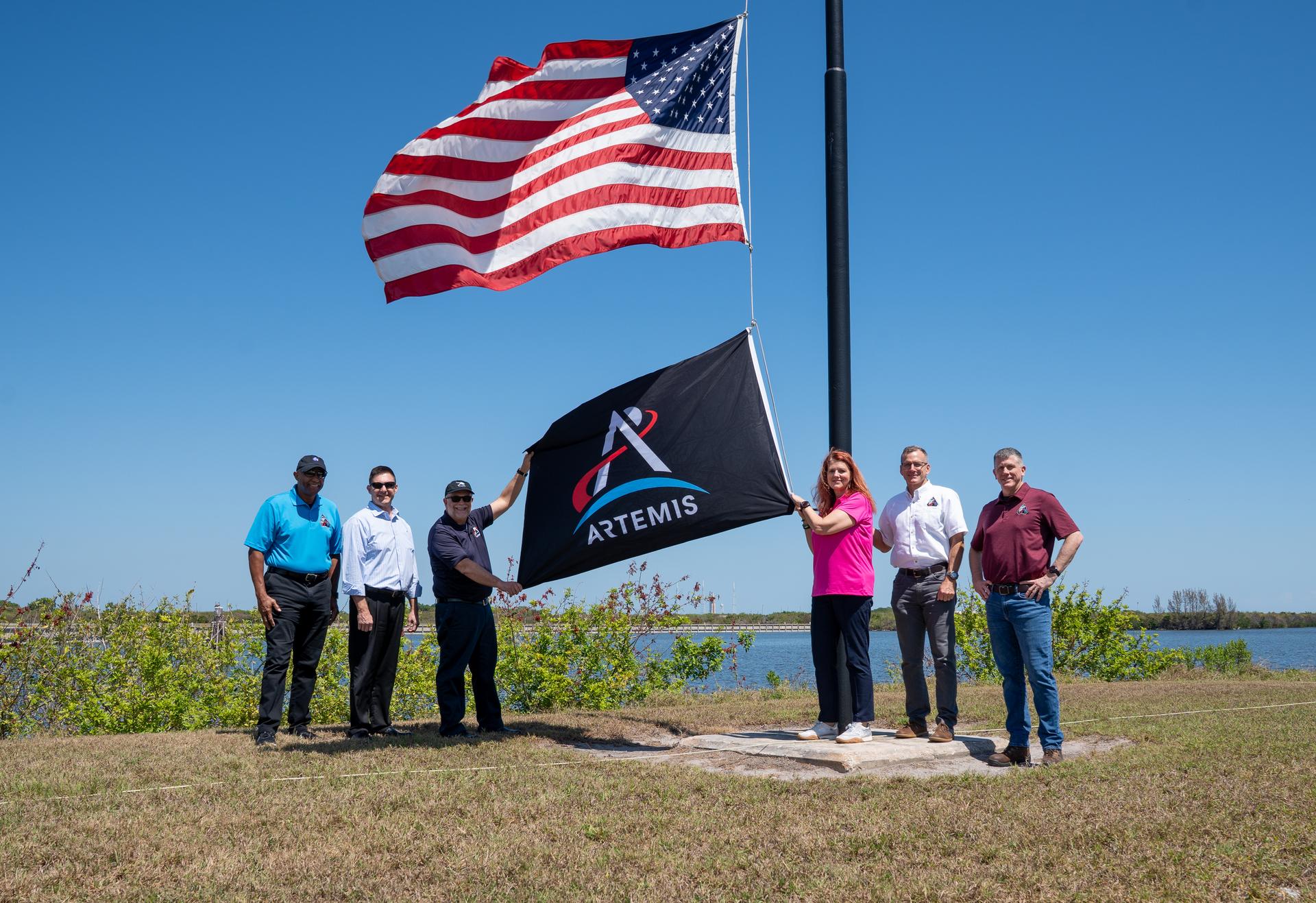
From left, NASA Kennedy Space Center Deputy Director Kelvin Manning; Robert Yaskovic, associate manager, Exploration Ground Systems Program; Shawn Quinn, manager, Exploration Ground Systems Program; Charlie Blackwell-Thompson, Artemis II launch director; Cliff Lanham, deputy manager, Exploration Ground Systems Program; and Jeremy Graeber, assistant launch director, Exploration Ground Systems Program raise the Artemis flag near the countdown clock at the NASA News Center at NASA’s Kennedy Space Center in Florida on Friday, March 27, 2026. The Artemis II test flight mission will take Artemis II Commander Reid Wiseman, Pilot Victor Glover, and Mission Specialist Christina Koch from NASA, and Mission Specialist Jeremy Hansen from the CSA (Canadian Space Agency) on a 10-day journey around the Moon and back aboard NASA’s SLS (Space Launch System) rocket and Orion spacecraft from Launch Complex 39B no earlier than 6:24 p.m. EDT on Wednesday, April 1.
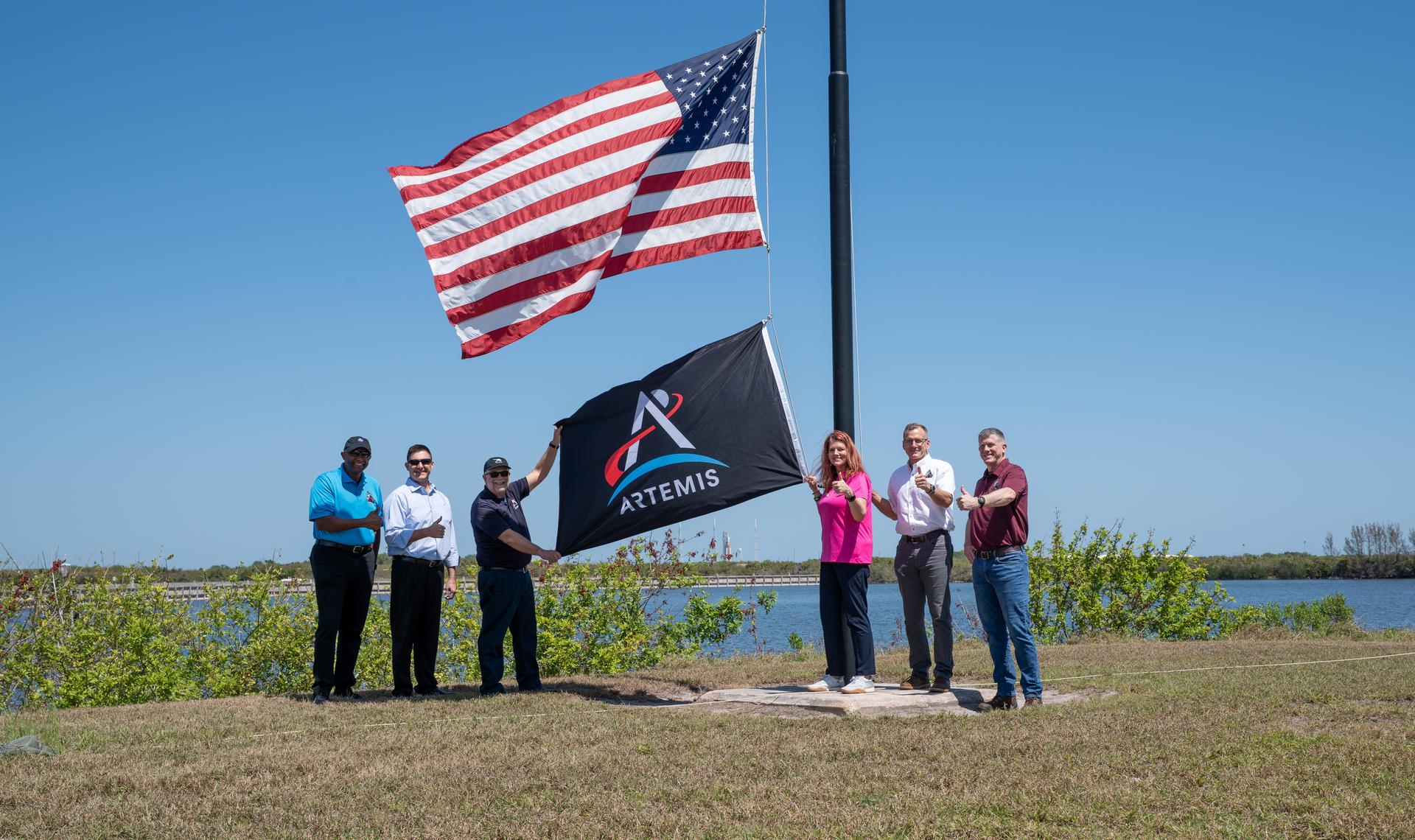
From left, NASA Kennedy Space Center Deputy Director Kelvin Manning; Robert Yaskovic, associate manager, Exploration Ground Systems Program; Shawn Quinn, manager, Exploration Ground Systems Program; Charlie Blackwell-Thompson, Artemis II launch director; Cliff Lanham, deputy manager, Exploration Ground Systems Program; and Jeremy Graeber, assistant launch director, Exploration Ground Systems Program raise the Artemis flag near the countdown clock at the NASA News Center at NASA’s Kennedy Space Center in Florida on Friday, March 27, 2026. The Artemis II test flight mission will take Artemis II Commander Reid Wiseman, Pilot Victor Glover, and Mission Specialist Christina Koch from NASA, and Mission Specialist Jeremy Hansen from the CSA (Canadian Space Agency) on a 10-day journey around the Moon and back aboard NASA’s SLS (Space Launch System) rocket and Orion spacecraft from Launch Complex 39B no earlier than 6:24 p.m. EDT on Wednesday, April 1.

From left, NASA Kennedy Space Center Deputy Director Kelvin Manning; Robert Yaskovic, associate manager, Exploration Ground Systems Program; Shawn Quinn, manager, Exploration Ground Systems Program; Charlie Blackwell-Thompson, Artemis II launch director; Cliff Lanham, deputy manager, Exploration Ground Systems Program; and Jeremy Graeber, assistant launch director, Exploration Ground Systems Program raise the Artemis flag near the countdown clock at the NASA News Center at NASA’s Kennedy Space Center in Florida on Friday, March 27, 2026. The Artemis II test flight mission will take Artemis II Commander Reid Wiseman, Pilot Victor Glover, and Mission Specialist Christina Koch from NASA, and Mission Specialist Jeremy Hansen from the CSA (Canadian Space Agency) on a 10-day journey around the Moon and back aboard NASA’s SLS (Space Launch System) rocket and Orion spacecraft from Launch Complex 39B no earlier than 6:24 p.m. EDT on Wednesday, April 1.
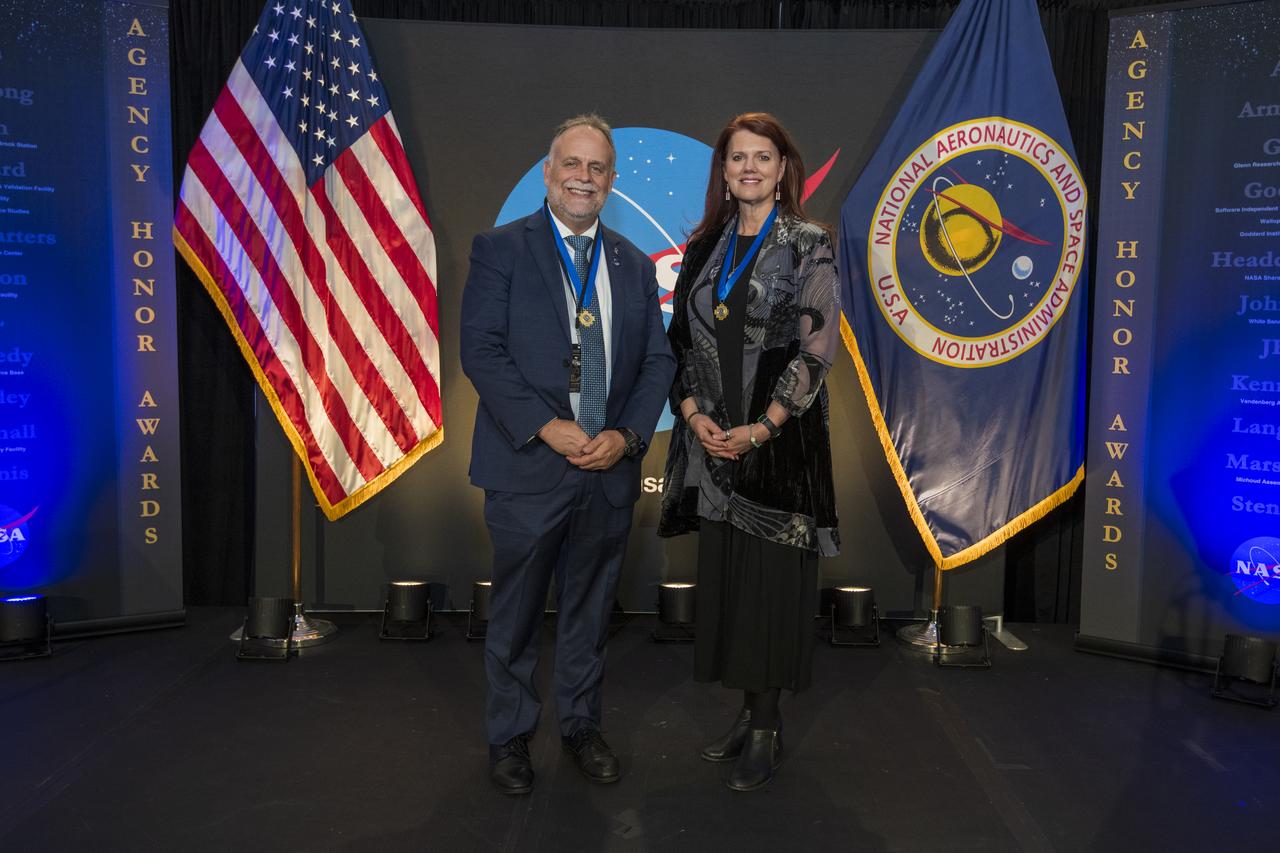
On March 28, 2024 NASA held its 2023 Administrator’s Agency Honor Awards at the Glenn Research Center in Cleveland, OH. This celebratory event recognized the invaluable contributions of civil servants and contractors alike, each one instrumental in propelling humanity further into the realms of space exploration, understanding, and discoverThis is NASA's highest form of recognition that is awarded to any Government employee who, by distinguished service, ability, or vision has personally contributed to NASA's advancement of United States' interests.
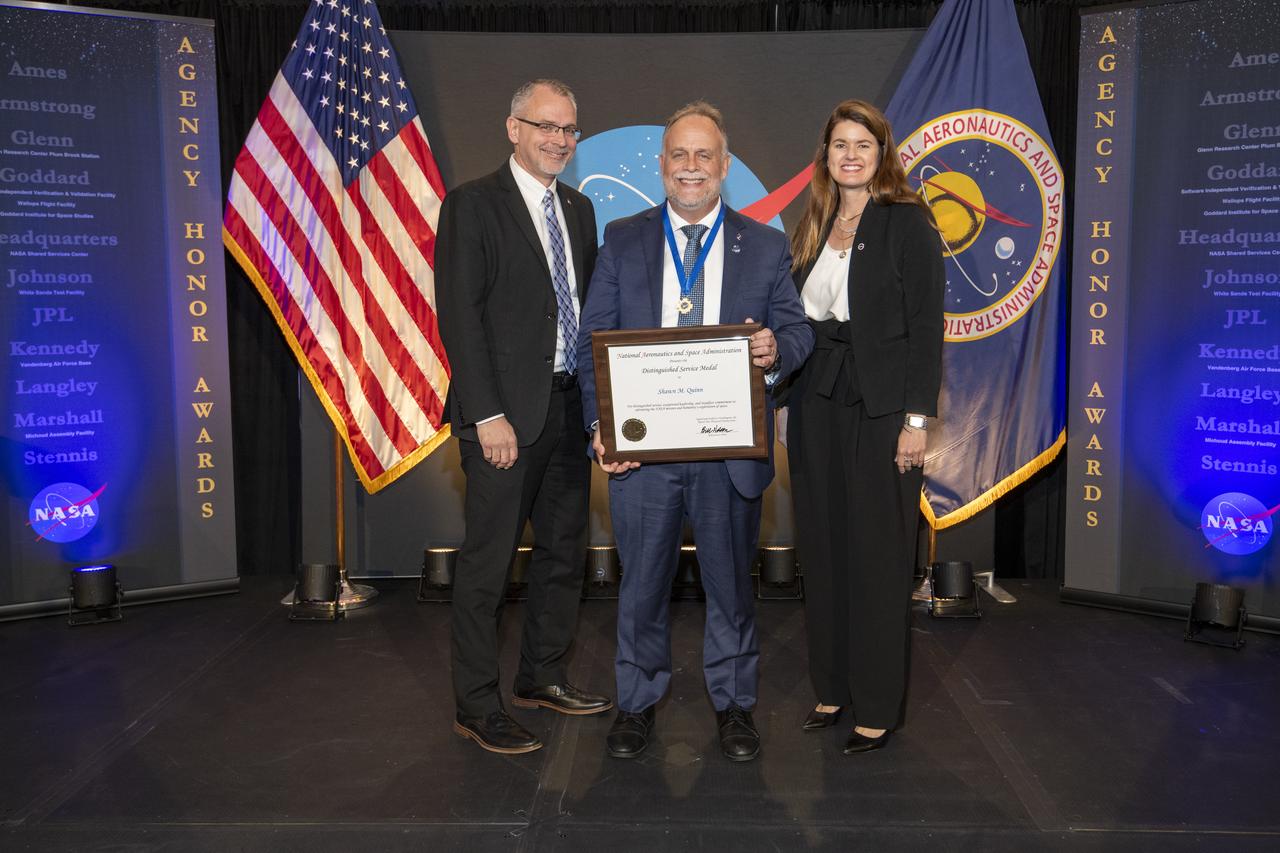
On March 28, 2024 NASA held its 2023 Administrator’s Agency Honor Awards at the Glenn Research Center in Cleveland, OH. This celebratory event recognized the invaluable contributions of civil servants and contractors alike, each one instrumental in propelling humanity further into the realms of space exploration, understanding, and discoverThis is NASA's highest form of recognition that is awarded to any Government employee who, by distinguished service, ability, or vision has personally contributed to NASA's advancement of United States' interests.
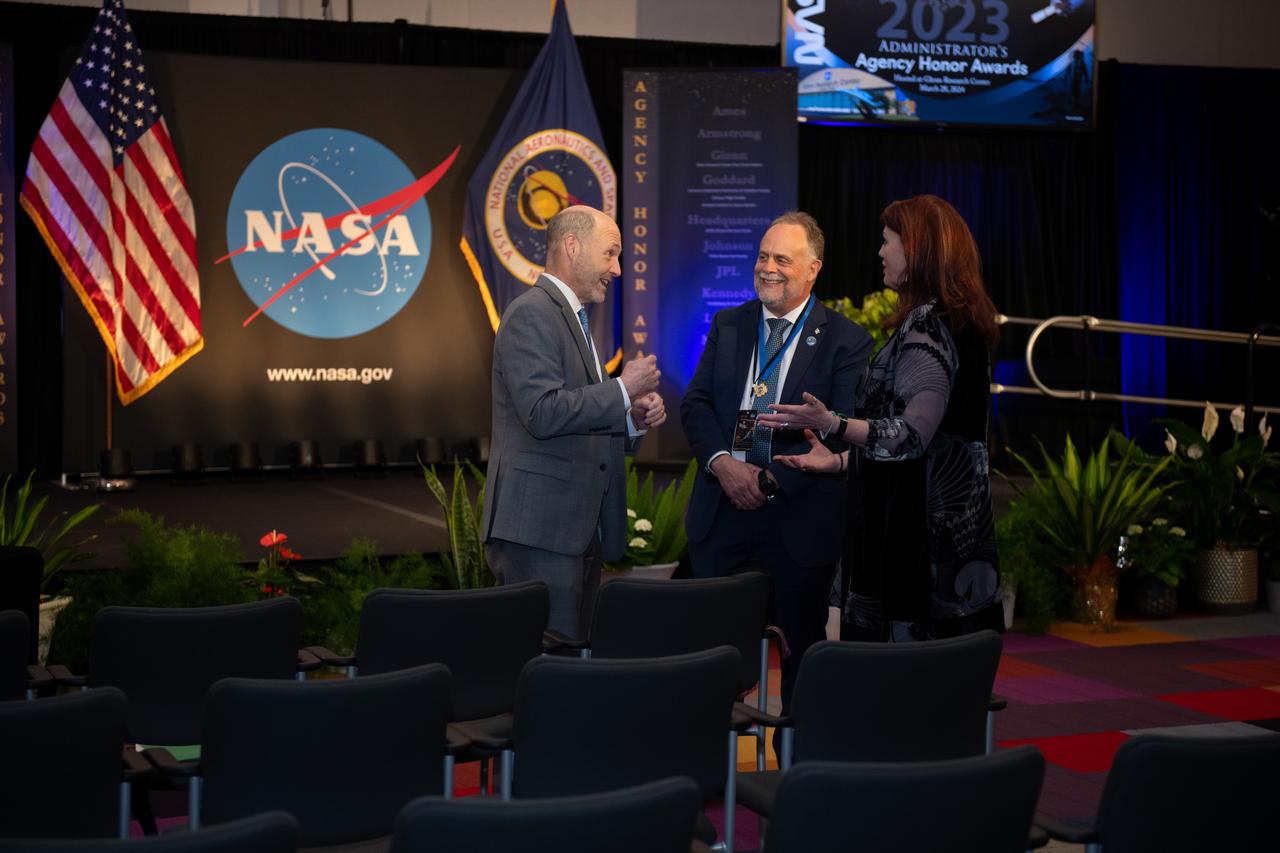
On March 28, 2024 NASA held its 2023 Administrator’s Agency Honor Awards at the Glenn Research Center in Cleveland, OH. This celebratory event recognized the invaluable contributions of civil servants and contractors alike, each one instrumental in propelling humanity further into the realms of space exploration, understanding, and discoverThis is NASA's highest form of recognition that is awarded to any Government employee who, by distinguished service, ability, or vision has personally contributed to NASA's advancement of United States' interests. Photo Credit: (NASA/Sara Lowthian-Hanna)

John Honeycutt, chair, Artemis II Mission Management Team, participates in a post-Flight Readiness Review news conference for the Artemis II test flight inside the John Holliman Auditorium of the NASA News Center at the agency’s Kennedy Space Center in Florida on Thursday, March 12, 2026. The review is an assessment of the readiness of NASA’s SLS (Space Launch System) rocket and Orion spacecraft to support the Artemis II test flight as four astronauts journey around the Moon and return to Earth.
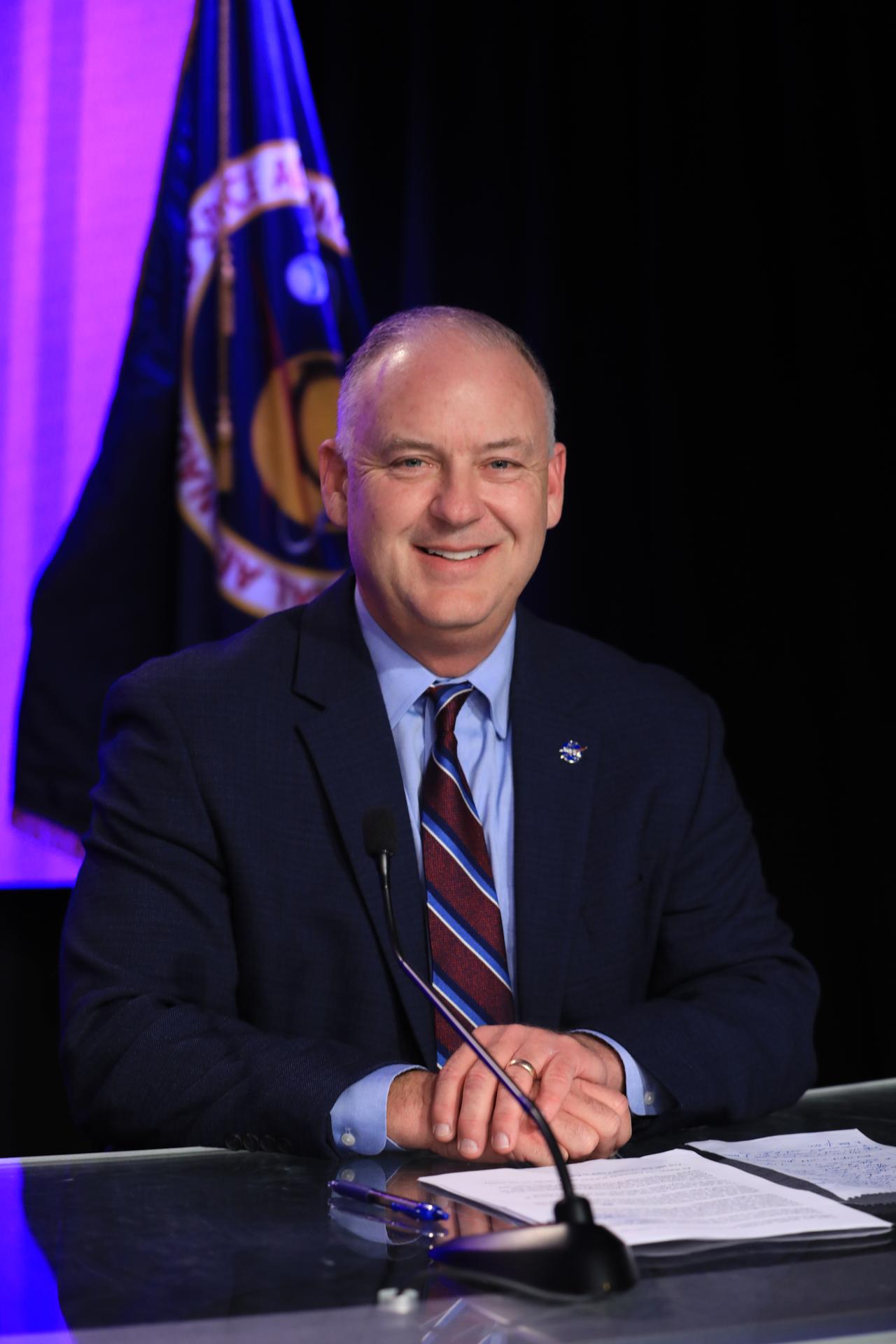
Norm Knight, director, Flight Operations Directorate, participates in a post-Flight Readiness Review news conference for the Artemis II test flight inside the John Holliman Auditorium of the NASA News Center at the agency’s Kennedy Space Center in Florida on Thursday, March 12, 2026. The review is an assessment of the readiness of NASA’s SLS (Space Launch System) rocket and Orion spacecraft to support the Artemis II test flight as four astronauts journey around the Moon and return to Earth.
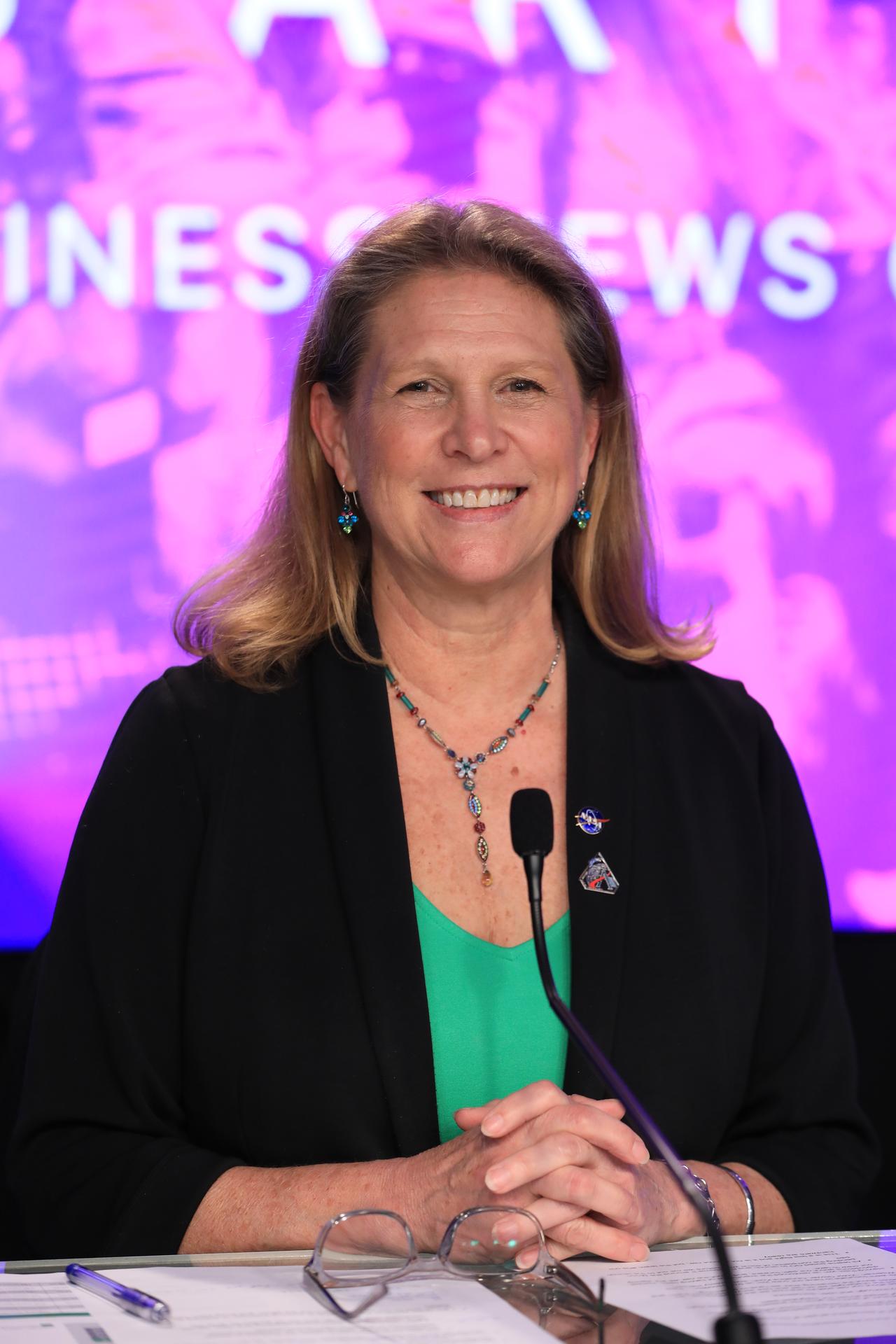
Lori Glaze, acting associate administrator, Exploration Systems Development Mission Directorate, participates in a post-Flight Readiness Review news conference for the Artemis II test flight inside the John Holliman Auditorium of the NASA News Center at the agency’s Kennedy Space Center in Florida on Thursday, March 12, 2026. The review is an assessment of the readiness of NASA’s SLS (Space Launch System) rocket and Orion spacecraft to support the Artemis II test flight as four astronauts journey around the Moon and return to Earth.

Rachel Kraft, NASA Communications, participates in a post-Flight Readiness Review news conference for the Artemis II test flight inside the John Holliman Auditorium of the NASA News Center at the agency’s Kennedy Space Center in Florida on Thursday, March 12, 2026. The review is an assessment of the readiness of NASA’s SLS (Space Launch System) rocket and Orion spacecraft to support the Artemis II test flight as four astronauts journey around the Moon and return to Earth.