
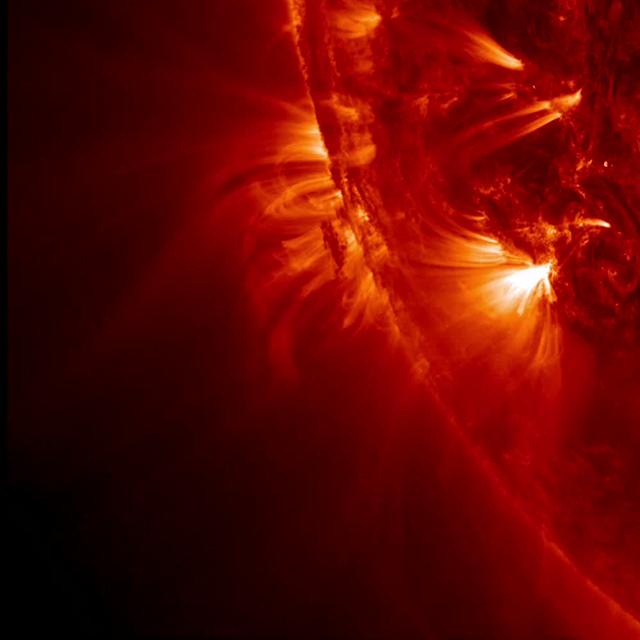
Strands of solar material at the sun's edge shifted and twisted back and forth over a 22-hour period in this footage captured May 2-3, 2017, by NASA’s Solar Dynamics Observatory. In this close-up, the strands are being manipulated by strong magnetic forces associated with active regions. To give a sense of scale, the strands that hover above the sun are more than several times the size of Earth. These images were taken in a wavelength of extreme ultraviolet light, which is typically invisible to our eyes, but was colorized here in red. <a href="https://go.nasa.gov/2qJzPD2" rel="nofollow">go.nasa.gov/2qJzPD2</a> Credit: NASA/Goddard/SDO <b><a href="http://www.nasa.gov/audience/formedia/features/MP_Photo_Guidelines.html" rel="nofollow">NASA image use policy.</a></b> <b><a href="http://www.nasa.gov/centers/goddard/home/index.html" rel="nofollow">NASA Goddard Space Flight Center</a></b> enables NASA’s mission through four scientific endeavors: Earth Science, Heliophysics, Solar System Exploration, and Astrophysics. Goddard plays a leading role in NASA’s accomplishments by contributing compelling scientific knowledge to advance the Agency’s mission. <b>Follow us on <a href="http://twitter.com/NASAGoddardPix" rel="nofollow">Twitter</a></b> <b>Like us on <a href="http://www.facebook.com/pages/Greenbelt-MD/NASA-Goddard/395013845897?ref=tsd" rel="nofollow">Facebook</a></b> <b>Find us on <a href="http://instagrid.me/nasagoddard/?vm=grid" rel="nofollow">Instagram</a></b>
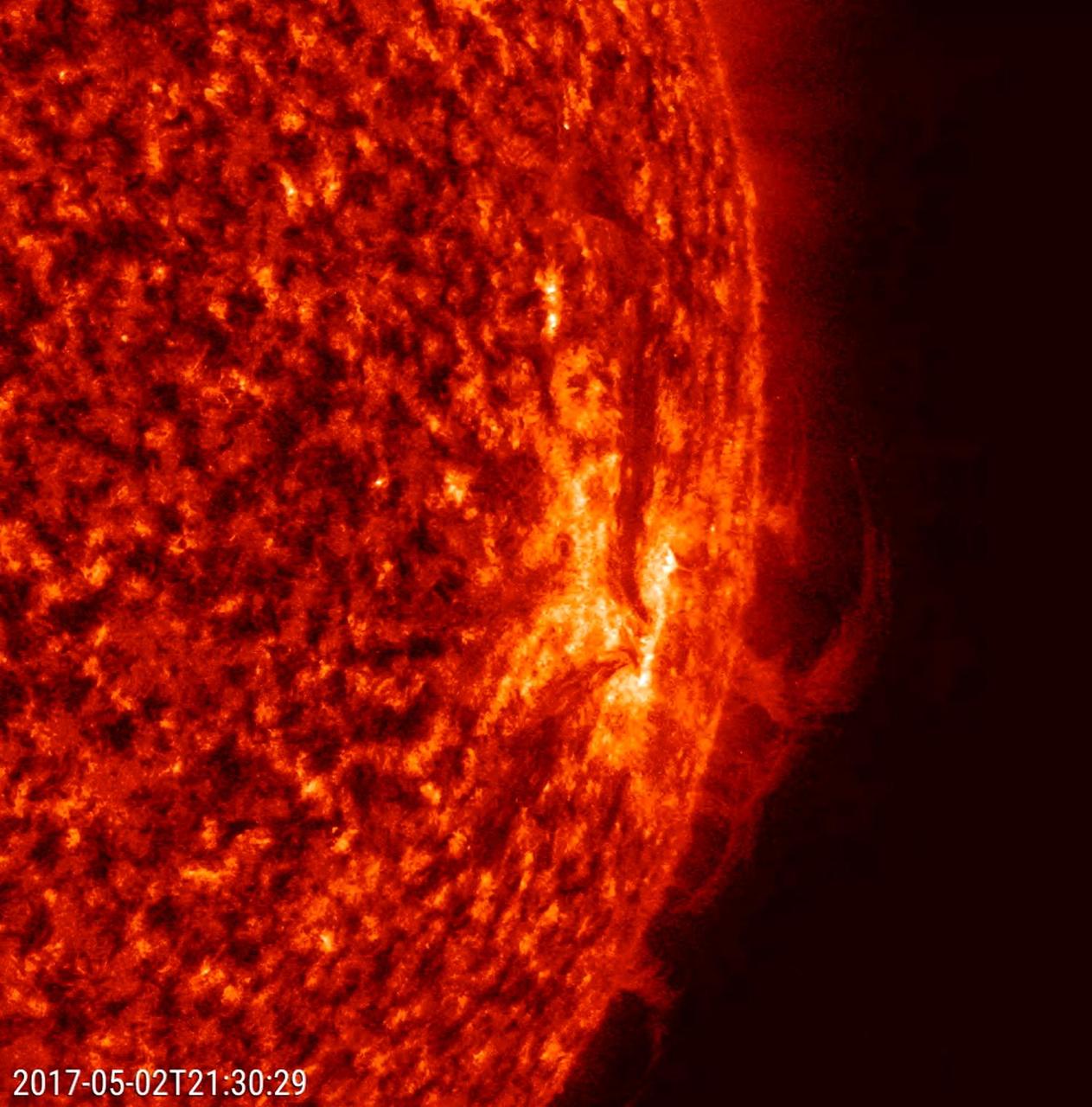
Strands of plasma at the sun edge shifted and twisted back and forth over a 22-hour period, May 2-3, 2017. In this close-up from NASA Solar Dynamics Observatory, the strands are being manipulated by strong magnetic forces associated with active region. This kind of activity is not at all uncommon, but best viewed in profile. The images were taken in a wavelength of extreme ultraviolet light. To give a sense of scale, the strands hover above the sun more than several times the size of Earth. Movies are available at https://photojournal.jpl.nasa.gov/catalog/PIA21632
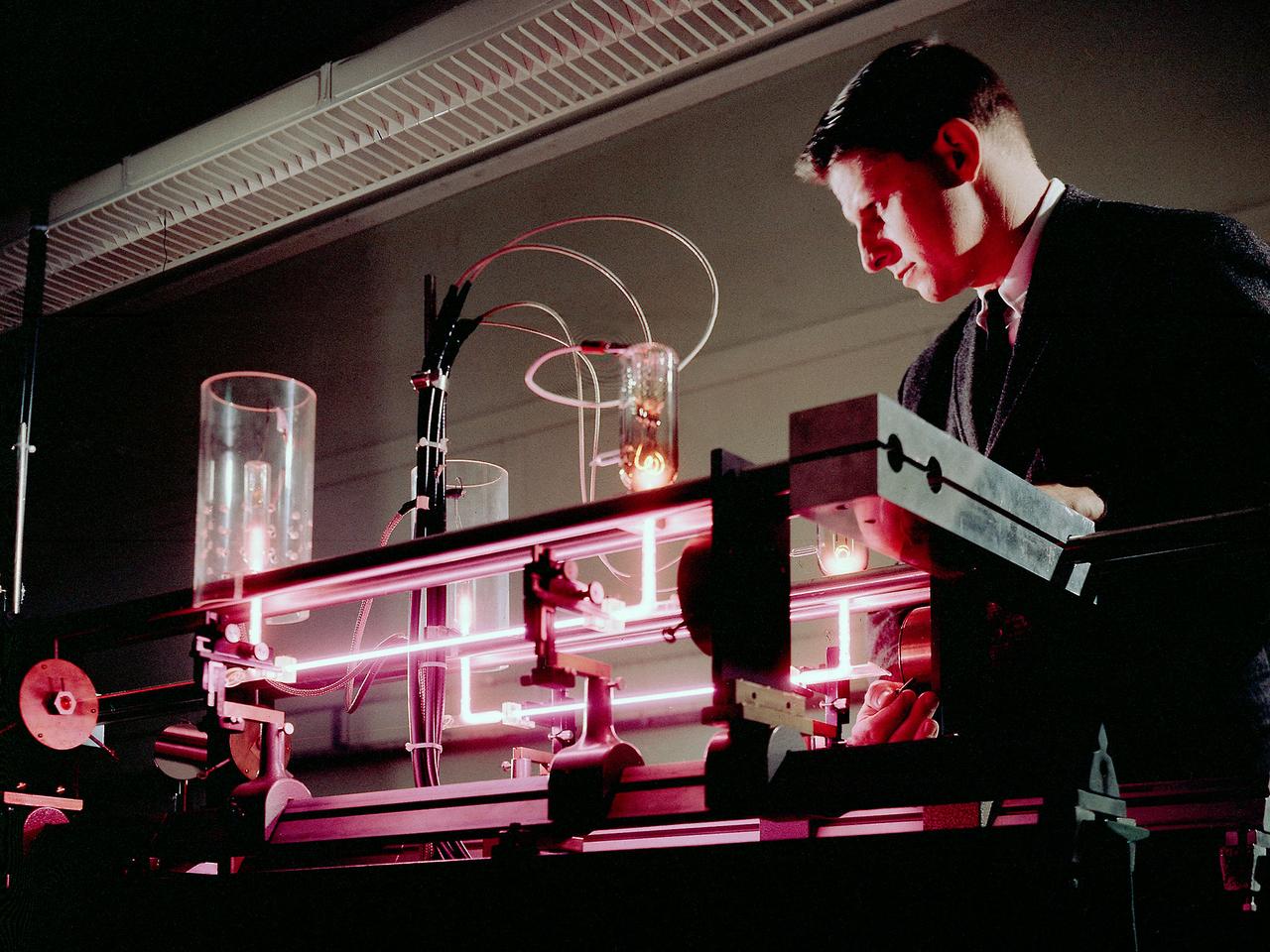
Richard Lancashire operates a gas laser interferometer in the Electric Conversion Laboratory at the National Aeronautics and Space Administration (NASA) Lewis Research Center. Lewis was in the midst of a long-term effort to develop methods of delivering electrical power to spacecraft using nuclear, solar, or electrochemical technologies. Lancashire was measuring the thermionic diode’s plasma particle density. The thermionic diodes were being studied for possible use in radioisotope thermoelectric generators for use in space. Microwave interferometry was one method of measuring transient plasmas. The interferometer measured the difference between the frequencies of two laser beams, one of which passed through the diode. The electron density was measured by revealing the phase shift of the transmitted microwave beam brought about by a change in the plasma refraction. Microwave interferometry, however, offers poor spatial resolution and has limited range of applicability.
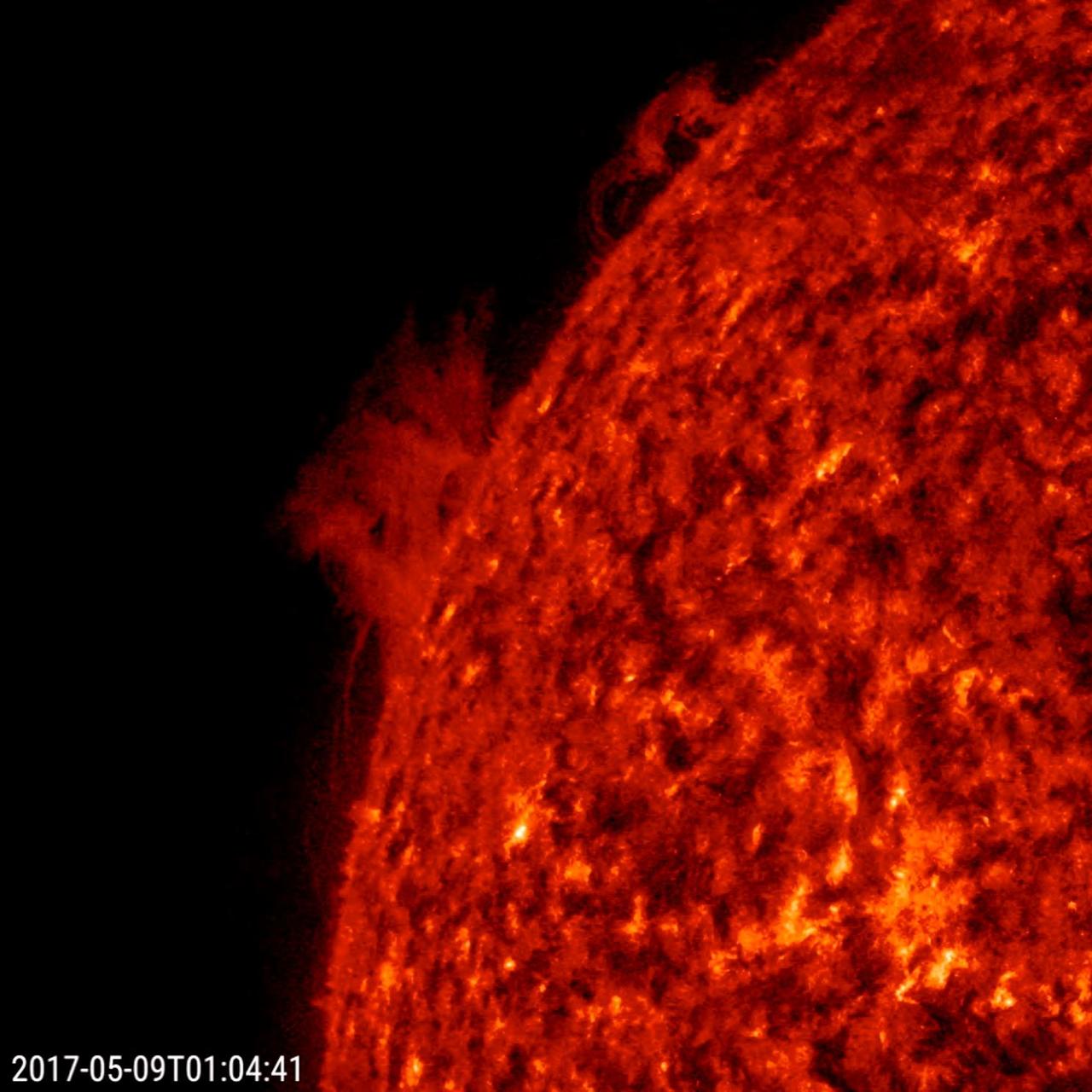
At the edge of the sun, a large prominence and a small prominence began to shift, turn and fall apart in less than one day (May 8-9, 2017). Prominences are notoriously unstable. Competing magnetic forces pulled the plasma back and forth until they dissipated. The images were taken in a wavelength of extreme ultraviolet light. The 18-second video clip is comprised of almost 600 frames being shown at 30 frames per second. Movies are available at https://photojournal.jpl.nasa.gov/catalog/PIA21634

A prominence at the sun's edge shifted and slithered back and forth over a one-day period (Nov. 29-30, 2017). Prominences are strands of charged particles suspended above the sun's surface that are pulled and tugged by magnetic forces. This kind of close-up also shows the kind of dynamic activity taking place all over the sun's surface. The bright area further down from the prominence is an active region, an area of intense tangles of magnetic forces. Towards the end of the clip, it blasts out a small stream of plasma (captured in the still). The images were taken in a wavelength of extreme ultraviolet light. Movies are available at https://photojournal.jpl.nasa.gov/catalog/PIA22123
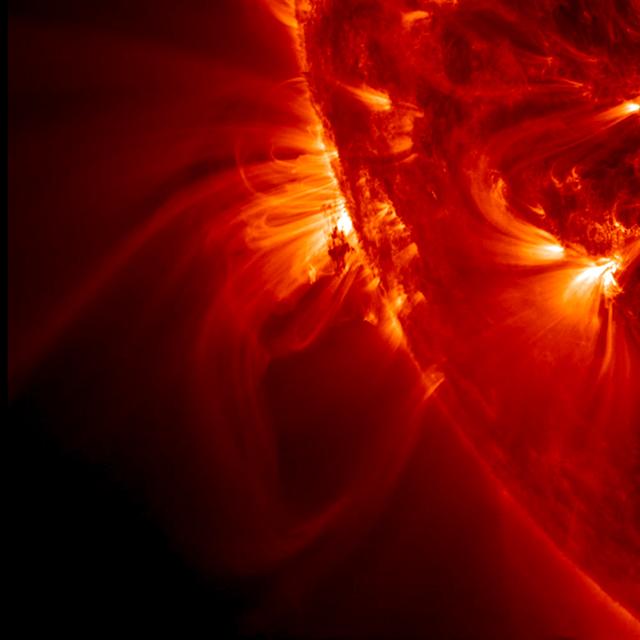
NASA's Solar Dynamics Observatory (SDO) zoomed in almost to its maximum level to watch tight, bright loops and much longer, softer loops shift and sway above an active region on the sun, while a darker blob of plasma in their midst was pulled about every which way (May 13-14, 2014). Credit: NASA/Solar Dynamics Observatory <b><a href="http://www.nasa.gov/audience/formedia/features/MP_Photo_Guidelines.html" rel="nofollow">NASA image use policy.</a></b> <b><a href="http://www.nasa.gov/centers/goddard/home/index.html" rel="nofollow">NASA Goddard Space Flight Center</a></b> enables NASA’s mission through four scientific endeavors: Earth Science, Heliophysics, Solar System Exploration, and Astrophysics. Goddard plays a leading role in NASA’s accomplishments by contributing compelling scientific knowledge to advance the Agency’s mission. <b>Follow us on <a href="http://twitter.com/NASAGoddardPix" rel="nofollow">Twitter</a></b> <b>Like us on <a href="http://www.facebook.com/pages/Greenbelt-MD/NASA-Goddard/395013845897?ref=tsd" rel="nofollow">Facebook</a></b> <b>Find us on <a href="http://instagram.com/nasagoddard?vm=grid" rel="nofollow">Instagram</a></b>
NASA's Solar Dynamics Observatory (SDO) zoomed in almost to its maximum level to watch tight, bright loops and much longer, softer loops shift and sway above an active region on the sun, while a darker blob of plasma in their midst was pulled about every which way (May 13-14, 2014). The video clip covers just over a day beginning at 14:19 UT on May 13. The frames were taken in the 171-angstroms wavelength of extreme ultraviolet light, but colorized red, instead of its usual bronze tone. This type of dynamic activity continues almost non-stop on the sun as opposing magnetic forces tangle with each other. Credit: NASA/Solar Dynamics Observatory <b><a href="http://www.nasa.gov/audience/formedia/features/MP_Photo_Guidelines.html" rel="nofollow">NASA image use policy.</a></b> <b><a href="http://www.nasa.gov/centers/goddard/home/index.html" rel="nofollow">NASA Goddard Space Flight Center</a></b> enables NASA’s mission through four scientific endeavors: Earth Science, Heliophysics, Solar System Exploration, and Astrophysics. Goddard plays a leading role in NASA’s accomplishments by contributing compelling scientific knowledge to advance the Agency’s mission. <b>Follow us on <a href="http://twitter.com/NASAGoddardPix" rel="nofollow">Twitter</a></b> <b>Like us on <a href="http://www.facebook.com/pages/Greenbelt-MD/NASA-Goddard/395013845897?ref=tsd" rel="nofollow">Facebook</a></b> <b>Find us on <a href="http://instagram.com/nasagoddard?vm=grid" rel="nofollow">Instagram</a></b>