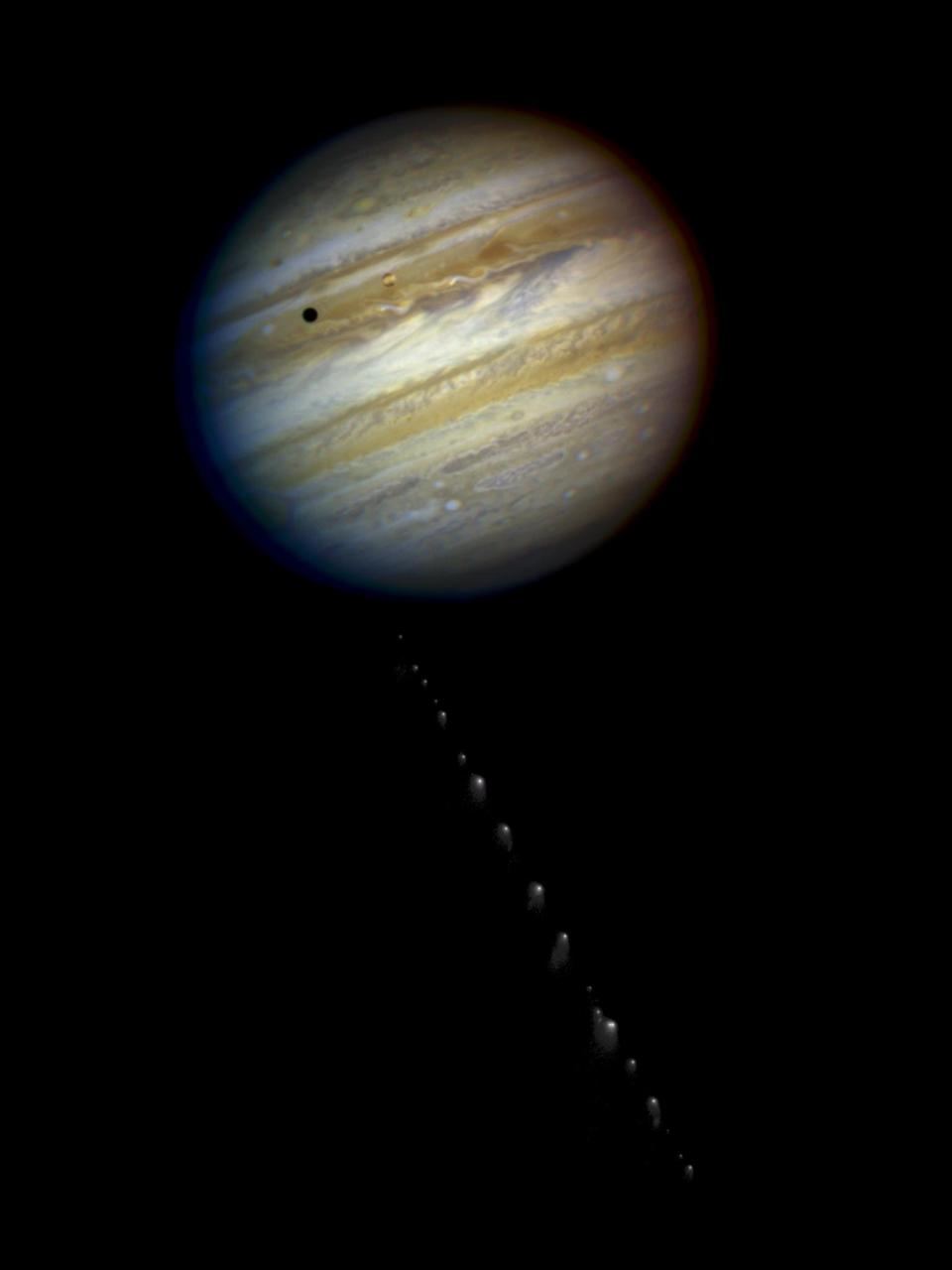
This is a composite photo, assembled from separate images of Jupiter and comet Shoemaker-Levy 9, as imaged by the NASA/ESA Hubble Space Telescope in 1994.

Month-long Evolution of the D/G Jupiter Impact Sites from Comet P/Shoemaker-Levy 9
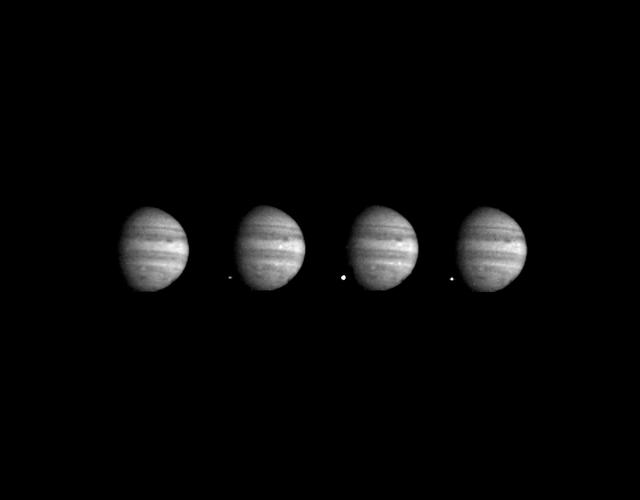
These four images of Jupiter and the luminous night-side impact of fragment W of Comet Shoemaker-Levy 9 were taken NASA's Galileo spacecraft on July 22, 1994. http://photojournal.jpl.nasa.gov/catalog/PIA00139
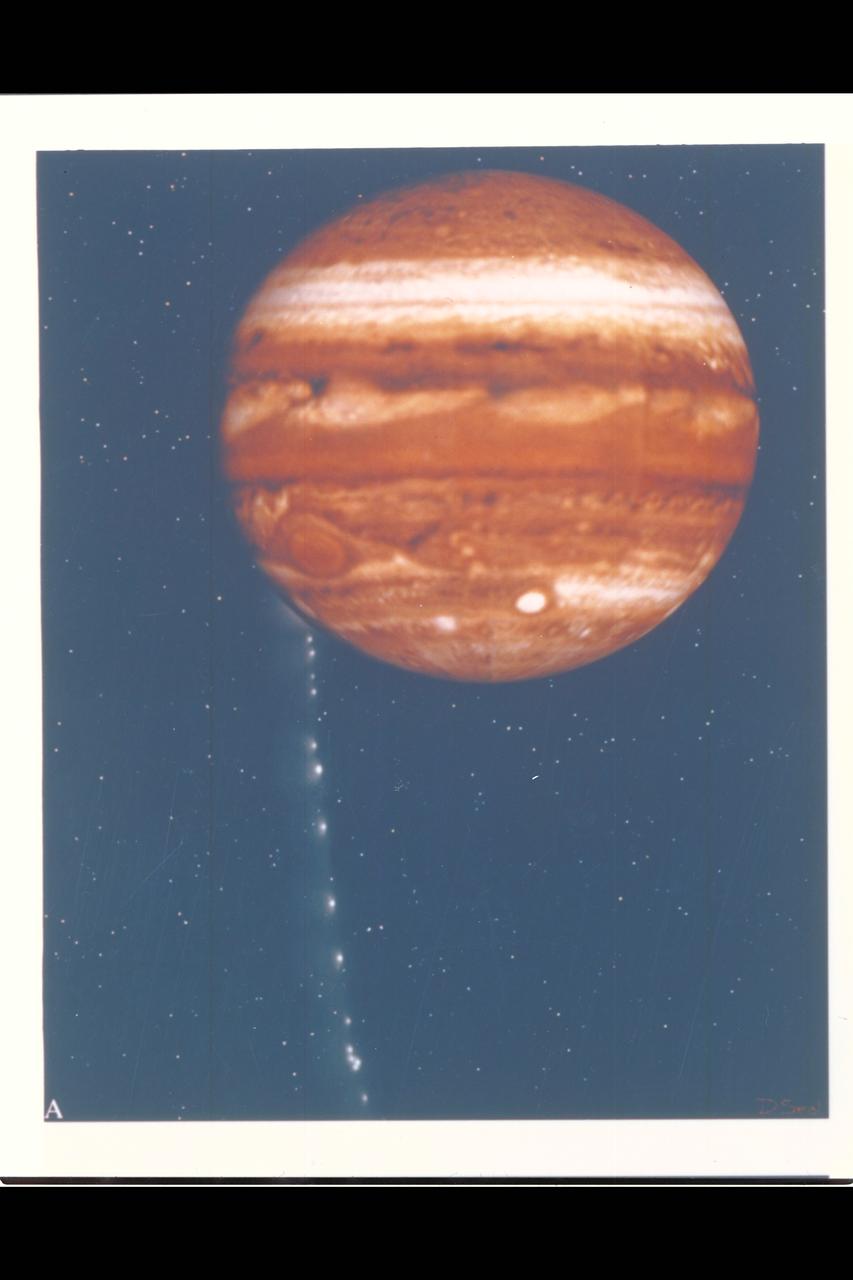
Photo Artwork composite by JPL This depiction of comet Shoemaker-Levy 9 impacting Jupiter is shown from several perspectives. IMAGE A is shown from the perspective of Earth based observers. For visual appeal, most of the large cometary fragments are shown close to one another in this image. At the time of Jupiter impact, the fragments will be separated from one another by serveral times the distances shown. This image was created by D.A. Seal of JPL's Mission Design Section using orbital computations provIded by P.W. Chodas and D.K. Yeomans of JPL's Navigation Section.
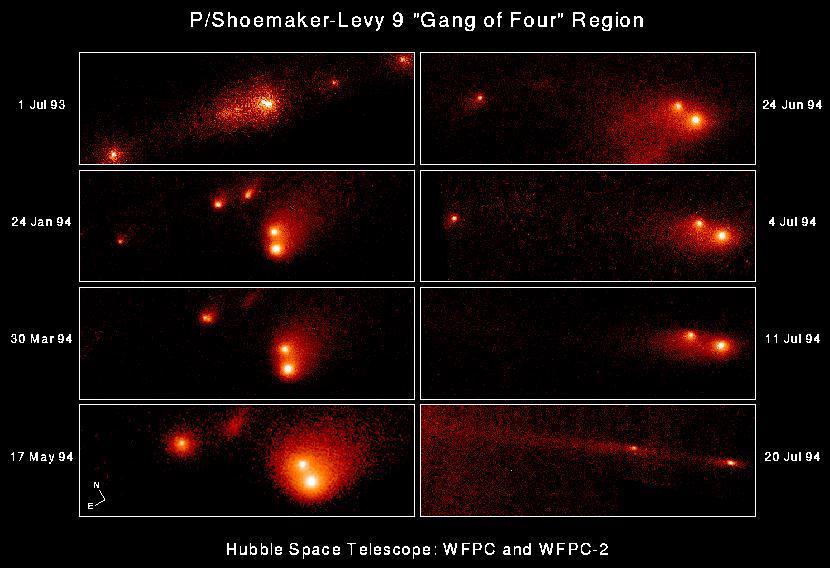
This series of eight NASA Hubble Space Telescope "snapshots" shows the evolution of the P-Q complex, also called the "gang of four" region, of comet P/Shoemaker-Levy 9. The eight individual frames chronicle changes in the comet during the 12 months before colliding with Jupiter. The sequence shows that the relative separations of the various cometary fragments, thought to range in size from about 500 meters to almost 4 km (2.5 miles) across, changed dramatically over this period. The apparent separation of Q1 and Q2 was only about 1100 kilometers (680 miles) on 1 July 1993 and increased to 28,000 kilometers (17,400 miles) by 20 July 1994. http://photojournal.jpl.nasa.gov/catalog/PIA01264
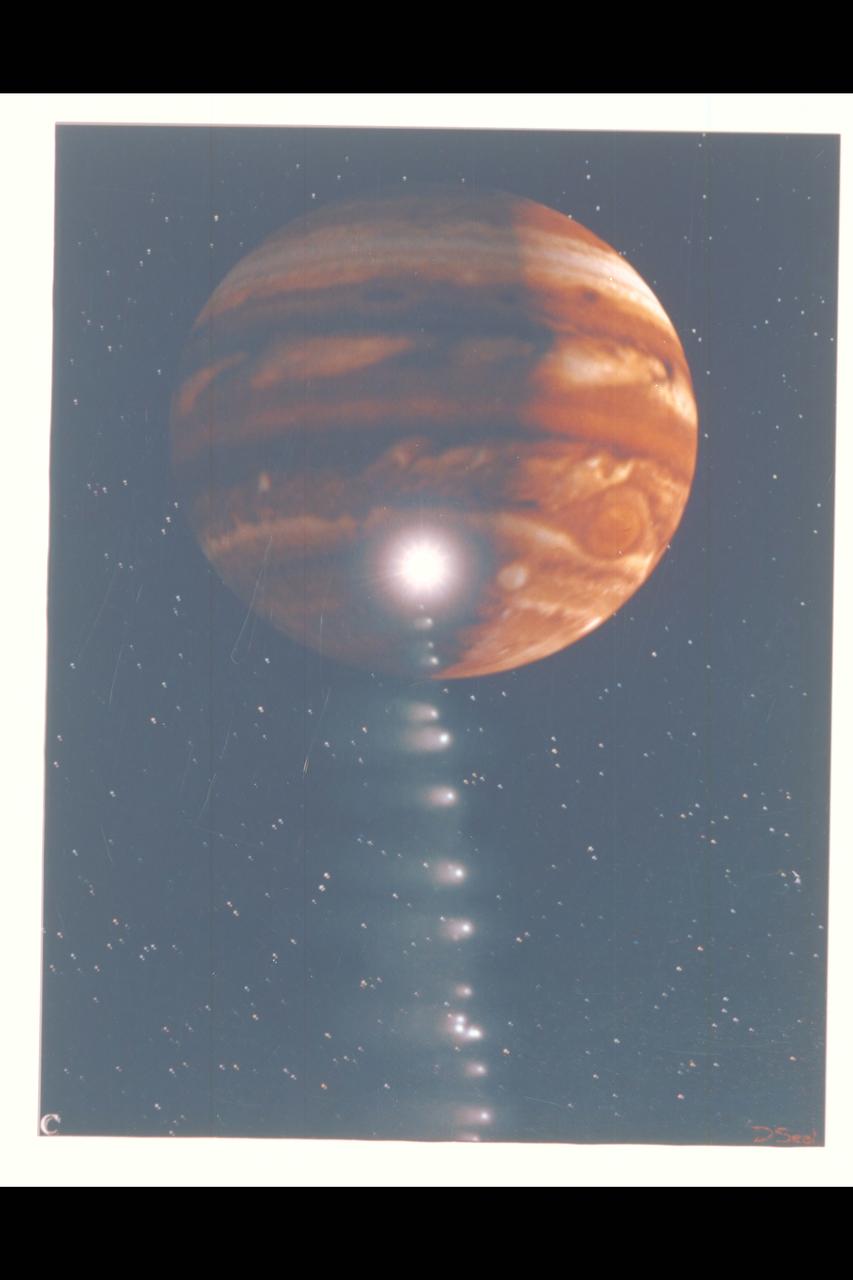
Photo Artwork composite by JPL This depiction of comet Shoemaker-Levy 9 impacting Jupiter is shown from several perspectives. IMAGE C is shown from the Voyager 2 spacecraft, which may observe the event from its unique position at the outer reaches of the solar system. For visual appeal, most of the large cometary fragments are shown close to one another in this image. At the time of Jupiter impact, the fragments will be separated from one another by serveral times the distances shown. This image was created by D.A. Seal of JPL's Mission Design Section using orbital computations provIded by P.W. Chodas and D.K. Yeomans of JPL's Navigation Section.
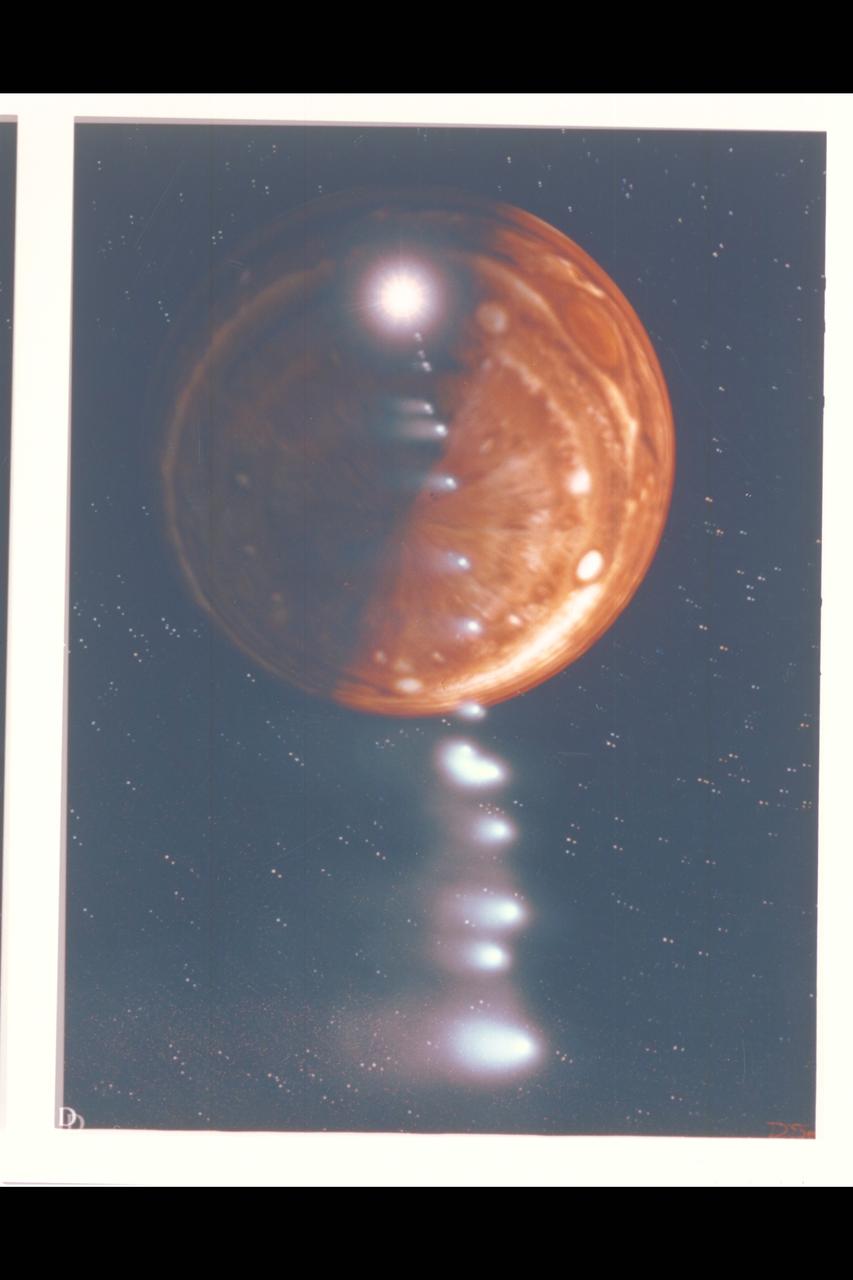
Photo Artwork composite by JPL This depiction of comet Shoemaker-Levy 9 impacting Jupiter is shown from several perspectives. IMAGE D depicts a generic view from Jupiter's south pole. For visual appeal, most of the large cometary fragments are shown close to one another in this image. At the time of Jupiter impact, the fragments will be separated from one another by serveral times the distances shown. This image was created by D.A. Seal of JPL's Mission Design Section using orbital computations provIded by P.W. Chodas and D.K. Yeomans of JPL's Navigation Section.
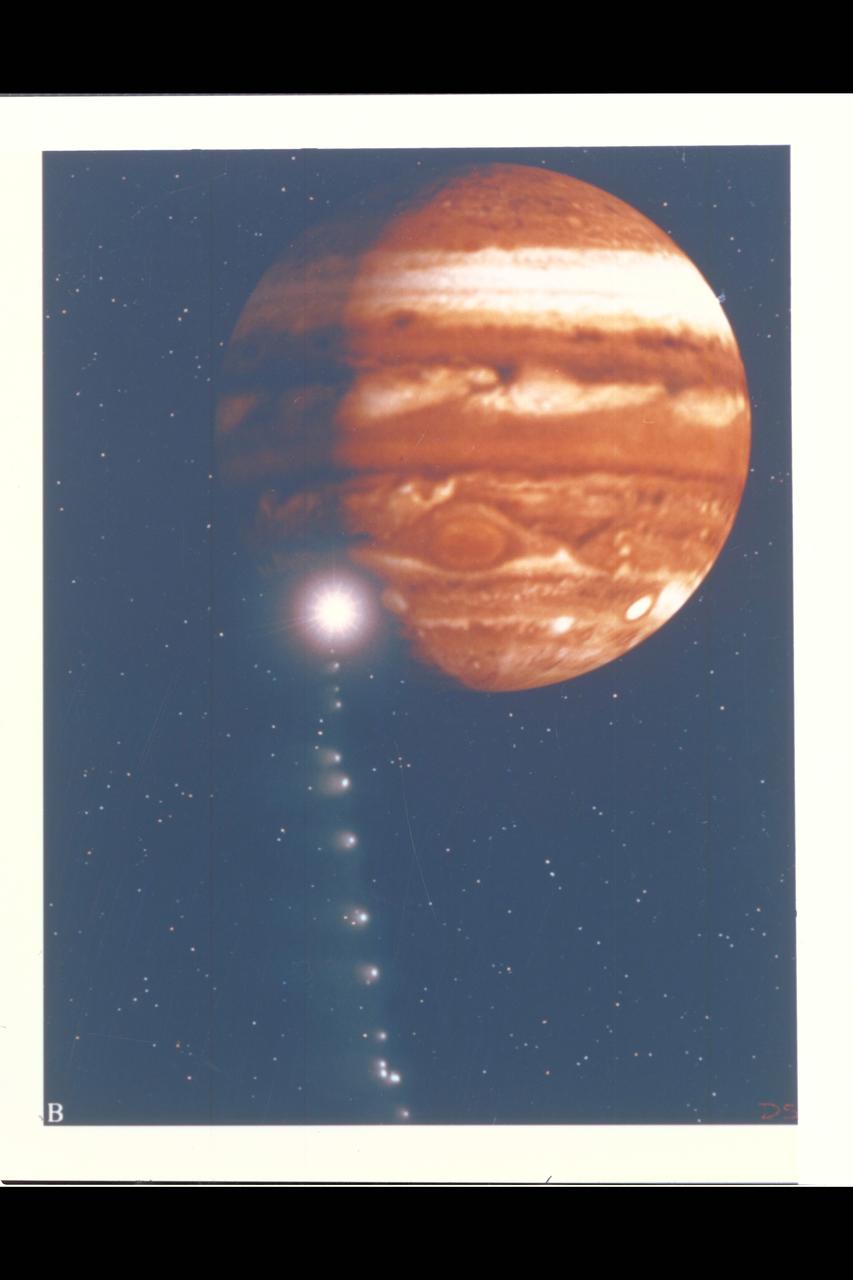
Photo Artwork composite by JPL This depiction of comet Shoemaker-Levy 9 impacting Jupiter is shown from several perspectives. IMAGE B shows the perspective from Galileo spacecraft which can observe the impact point directly. For visual appeal, most of the large cometary fragments are shown close to one another in this image. At the time of Jupiter impact, the fragments will be separated from one another by serveral times the distances shown. This image was created by D.A. Seal of JPL's Mission Design Section using orbital computations provIded by P.W. Chodas and D.K. Yeomans of JPL's Navigation Section.
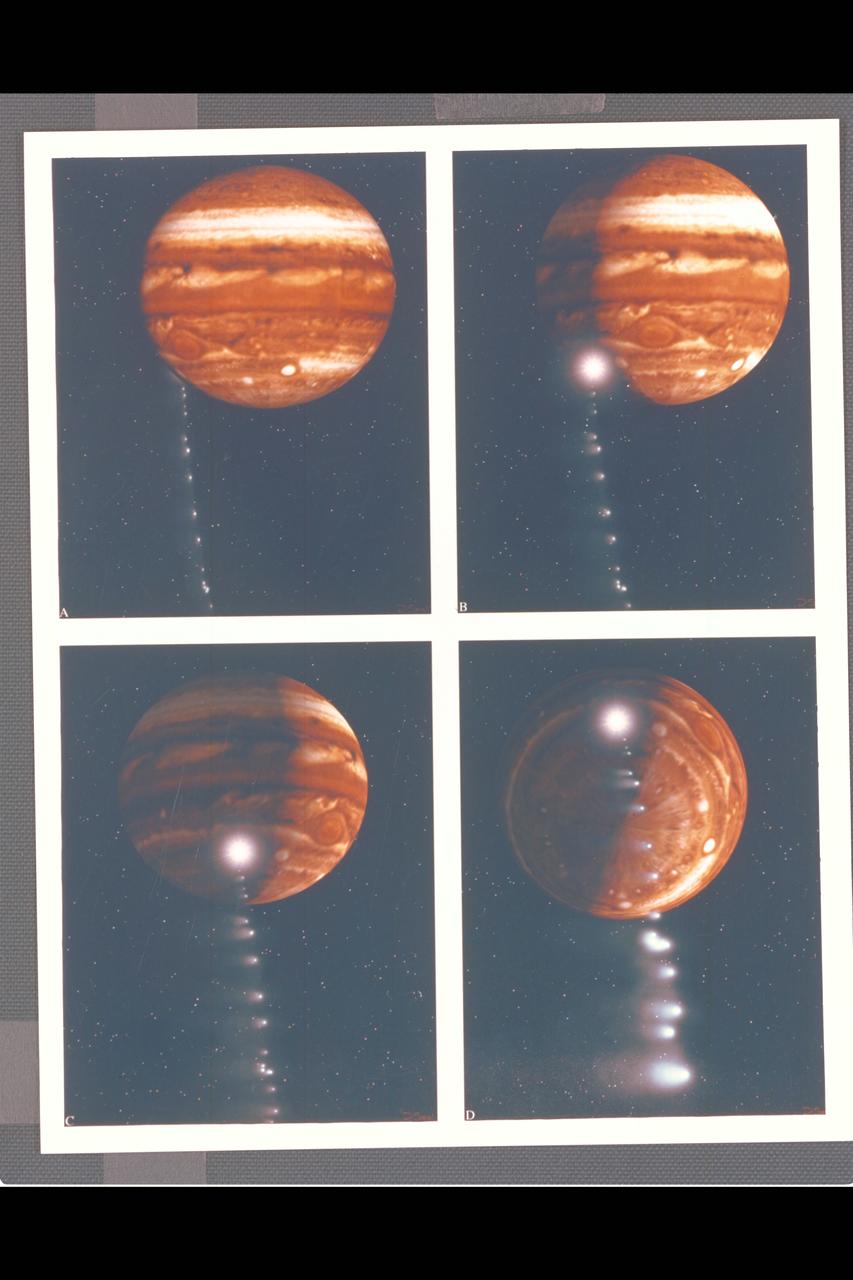
Photo Artwork composite by JPL This depiction of comet Shoemaker-Levy 9 impacting Jupiter is shown from several perspectives. IMAGE A is shown from the perspective of Earth based observers. IMAGE B shows the perspective from Galileo spacecraft which can observe the impact point directly. IMAGE C is shown from the Voyager 2 spacecraft, which may observe the event from its unique position at the outer reaches of the solar system. IMAGE D depicts a generic view from Jupiter's south pole. For visual appeal, most of the large cometary fragments are shown close to one another in this image. At the time of Jupiter impact, the fragments will be separated from one another by serveral times the distances shown. This image was created by D.A. Seal of JPL's Mission Design Section using orbital computations provIded by P.W. Chodas and D.K. Yeomans of JPL's Navigation Section.
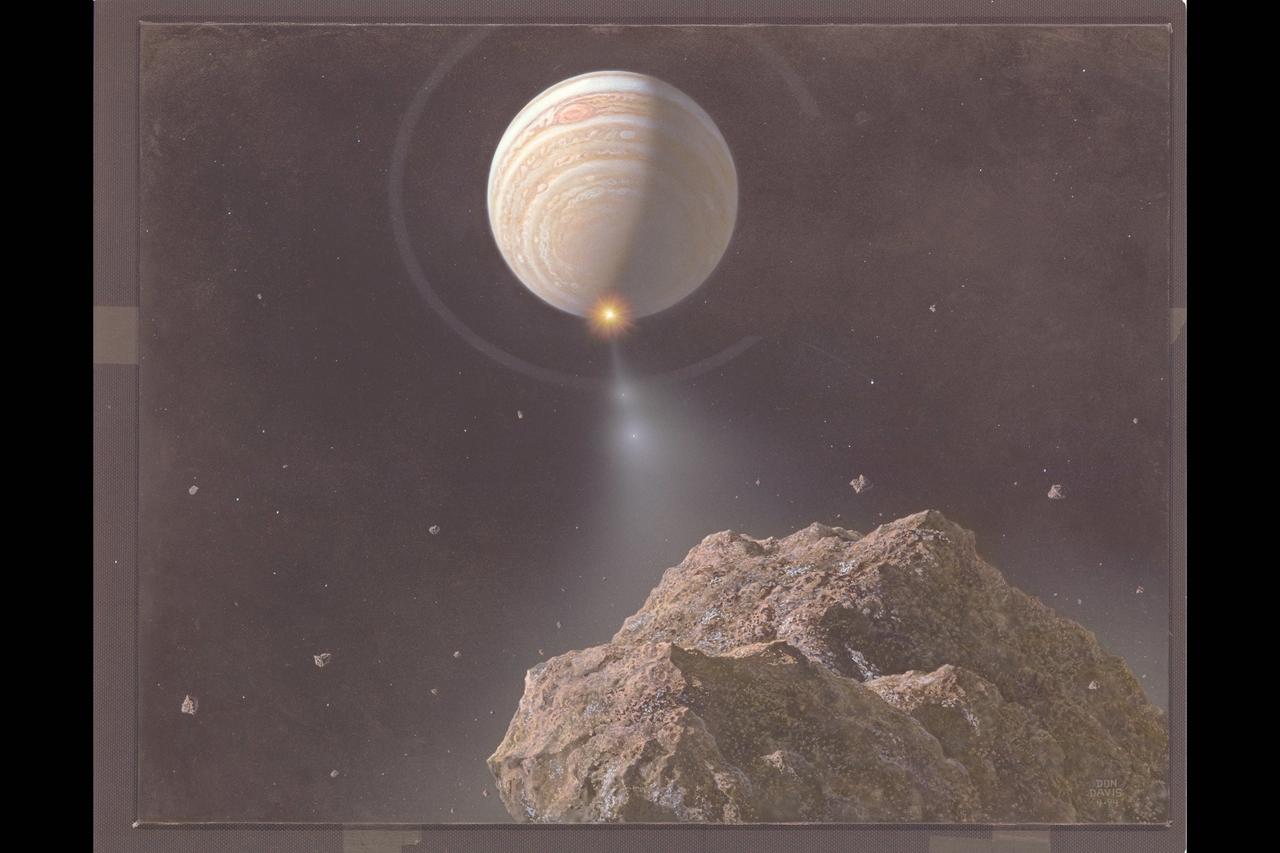
Comet (Artwork by Don Davis) Shoemaker Levy 9 impact on Jupiter (Artwork nucleus chunk view)
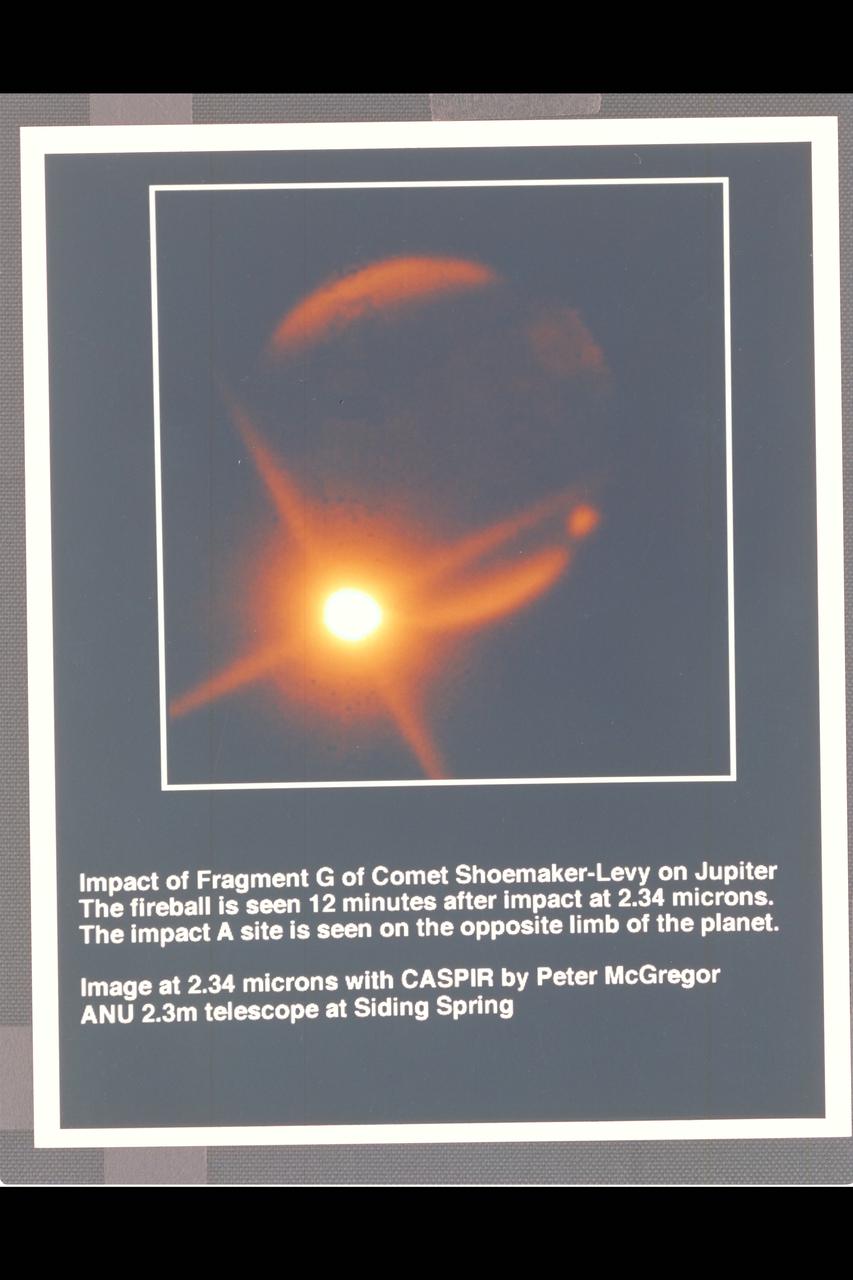
Photo by Peter McGregor Comet Shoemaker-Levy 9 impacting Jupiter; impact of Fragment G of Comet Shoemaker-Levy on Jupiter. The fireball is seen 12 minutes after impact at 2.34 microns. The impact A site is seen on the oposite limb of the planet. Image at 2.34 microns with CASPIR by Peter McGregor ANU 2.3m telescope at Siding Spring. (JPL Ref; P-44419)
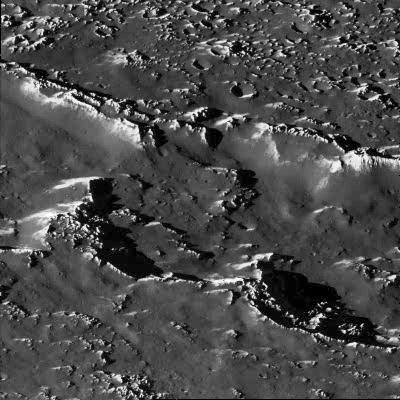
A portion of a chain of impact craters on Jupiter's moon Callisto is seen in this image taken by the Galileo spacecraft on November 4, 1996. This crater chain on Callisto is believed to result from the impact of a split object, similar to the fragments of Comet Shoemaker-Levy 9 which smashed into Jupiter's atmosphere in July of 1994. This high-resolution view, taken by Galileo's solid state imaging television camera during its third orbit around Jupiter, is of Callisto's northern hemisphere at 35 degrees north, 46 degrees west, and covers an area of about eight miles (13 kilometers) across. The smallest visible crater is about 140 yards (130 meters) across. The image was taken at a range of 974 miles (1,567 kilometers). On a global scale, Callisto is heavily cratered, indicating the great age of its surface. At the scale of this image, it was anticipated that the surface would be heavily cratered as well; however, there is a surprising lack of small craters, suggesting that one or more processes have obliterated these and other small-scale features. For example, downslope movement of ice-rich debris could bury small craters. The bright slopes visible in this picture represent places where downslope movement has taken place, exposing fresh ice surfaces. http://photojournal.jpl.nasa.gov/catalog/PIA00514
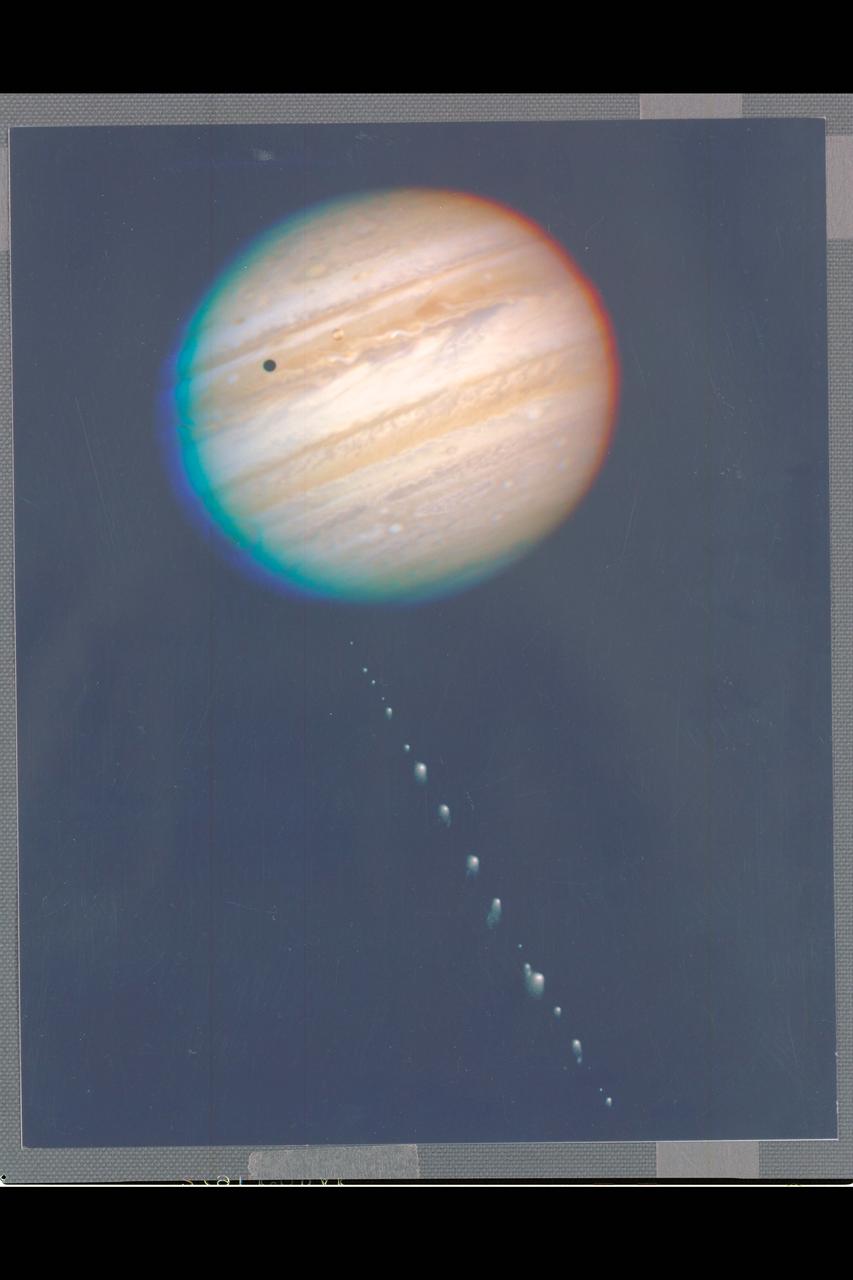
This is a composite photo, assembled from separate images of Jupiter and Comet P/Shoemaker-Levy 9 as imaged by the Wide Field & Planetary Camera-2 (WFPC-2), aboard NASA's Hubble Space Telescope (HST). Jupiter was imaged on May 18, 1994, when the giant planet was at a distance of 420 million miles (670 million KM) from Earth. This 'true-color' picture was assembled from separate HST exposures in red, blue, and green light. Jupiter's rotation between exposures creates the blue and red fringe on either side of the disk. HST can resolve details in Jpiter's magnifient cloud belts and zones as small as 200 miles (320 km) across (wide field mode). This detailed view is only surpassed by images from spacecraft that have traveled to Jupiter. The dark spot on the disk of Jupiter is the shadow of the inner moon Io. This volcanic moon appears as an orange and yellow disk just to the upper right of the shadow. Though Io is approximately the size of Earth's Moon (but 2,000 times farther away), HST can resolve surface details. When the comet was observed on May 17, its train of 21 icy fragments stretched across 710 thousand miles (1.1 million km) of space, or 3 times the distance between Earth and the Moon. This required six WFPC exposures along the comet train to include all the nuclei. The image was taken in red light. The apparent angular size of Jupiter relative to the comet, and its angular separation from the comet when the images were taken, have been modified for illustration purposes. CREDIT: H.A. Weaver, T.E. Smith (Space Telescope Science Institute (STSI)) and J.T. Tranuger, R.W. Evans (Jet Propulsion Laboratory (JPL)) and NASA. (HST ref: STSci-PR94-26a)