
In this 30 second exposure, a meteor streaks across the sky during the annual Perseid meteor shower, Wednesday, Aug. 11, 2021, in Spruce Knob, West Virginia. Photo Credit: (NASA/Bill Ingalls)

In this 30 second exposure, a meteor streaks across the sky during the annual Perseid meteor shower, Wednesday, Aug. 11, 2021, in Spruce Knob, West Virginia. Photo Credit: (NASA/Bill Ingalls)

In this 30 second exposure, a meteor streaks across the sky during the annual Perseid meteor shower, Wednesday, Aug. 11, 2021, in Spruce Knob, West Virginia. Photo Credit: (NASA/Bill Ingalls)

In this 30 second exposure, a meteor streaks across the sky during the annual Perseid meteor shower, Tuesday, Aug. 10, 2021, in Spruce Knob, West Virginia. Photo Credit: (NASA/Bill Ingalls)
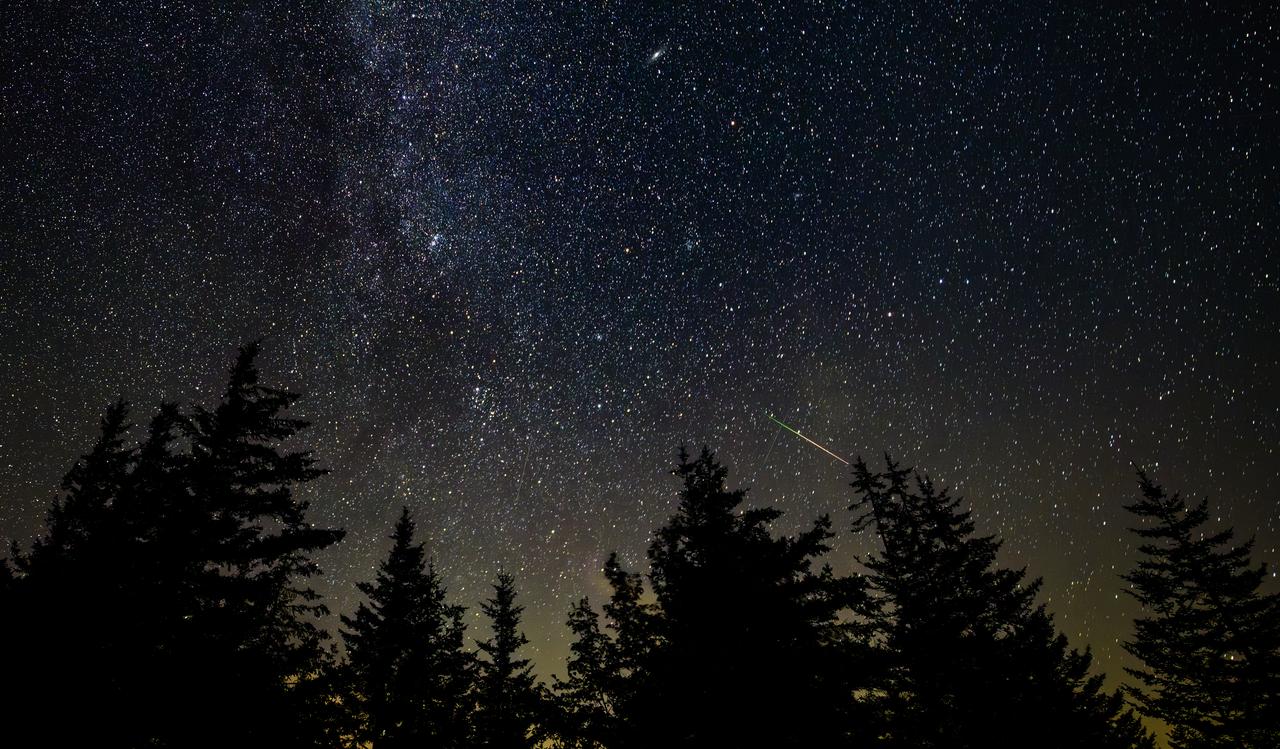
In this 30 second exposure photograph, a meteor streaks across the sky during the annual Perseid and Alpha Capricornids meteor showers, Sunday, Aug. 3, 2025, in Spruce Knob, West Virginia. Photo Credit: (NASA/Bill Ingalls)
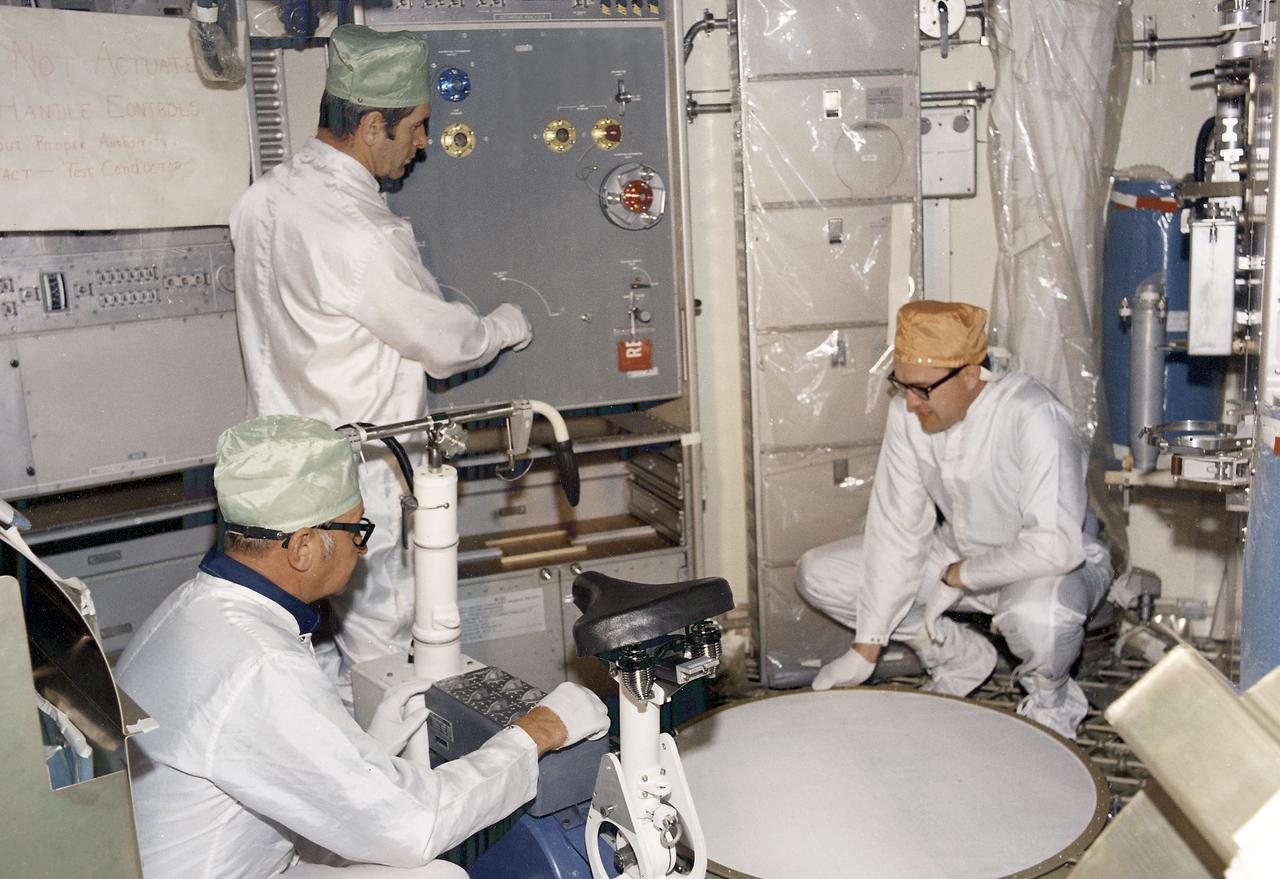
This photograph shows technicians performing a checkout of the Metabolic Analyzer (center background) and the Ergometer (foreground) in the Orbital Workshop (OWS). The shower compartment is at right. The Ergometer (Skylab Experiment M171) evaluated man's metabolic effectiveness and cost of work in space environment. Located in the experiment and work area of the OWS, the shower compartment was a cylindrical cloth enclosure that was folded flat when not in use. The bottom ring of the shower was fastened to the floor and contained foot restraints. The upper ring contained the shower head and hose. To use the shower, the astronaut filled a pressurized portable bottle with heated water and attached the bottle to the ceiling. A flexible hose cornected the water bottle to a handheld shower head. The astronaut pulled the cylindrical shower wall up into position and bathed, using liquid soap. Both soap and water were carefully rationed, having been premeasured for economical use.
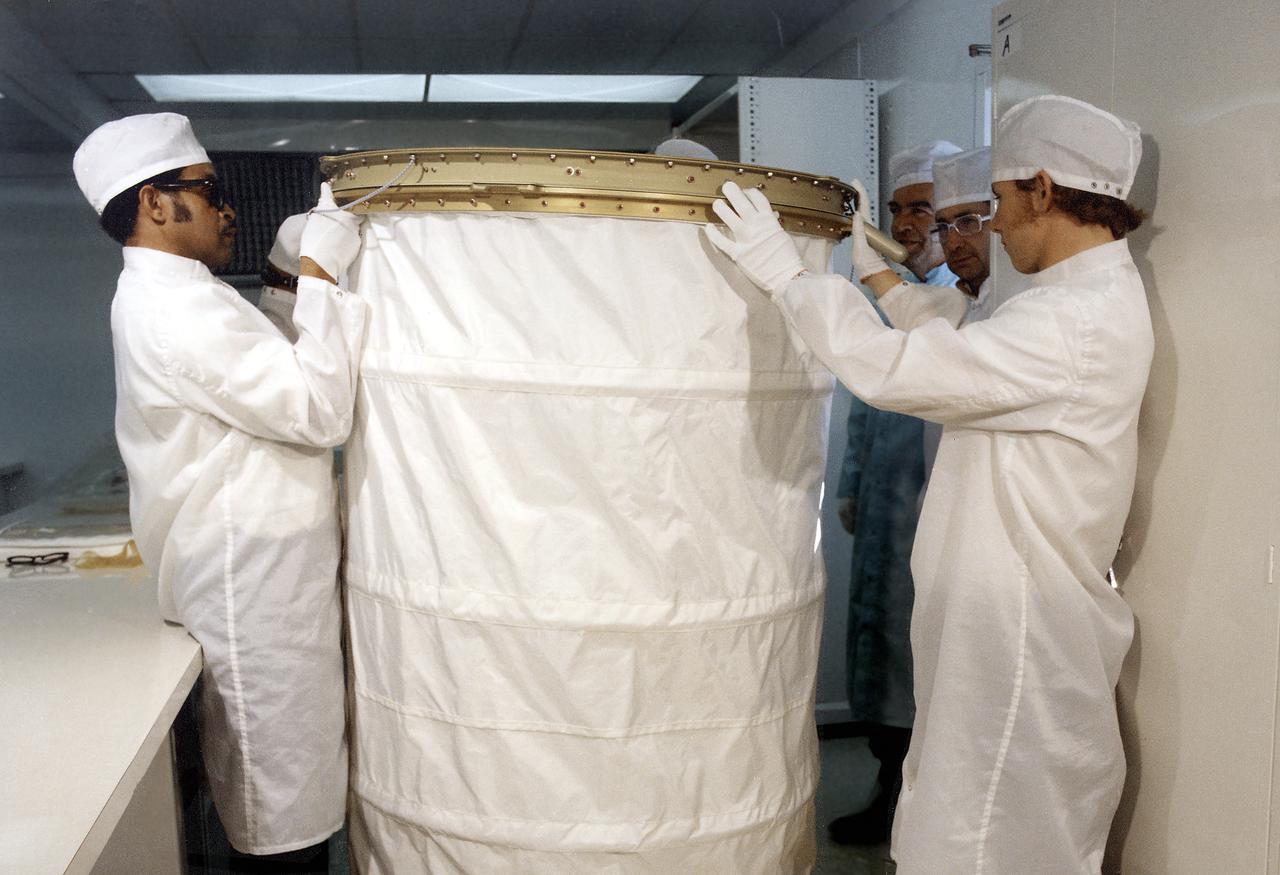
In this photograph, the Orbital Workshop shower compartment was unfolded by technicians for inspection. The shower compartment was a cylindrical cloth enclosure that was folded flat when not in use. The bottom ring of the shower was fastened to the floor and contained foot restraints. The upper ring contained the shower head and hose. To use the shower, the astronaut filled a pressurized portable bottle with heated water and attached the bottle to the ceiling. A flexible hose cornected the water bottle to a handheld shower head. The astronaut pulled the cylindrical shower wall up into position and bathed, using liquid soap. Both soap and water were carefully rationed, having been premeasured for economical use.
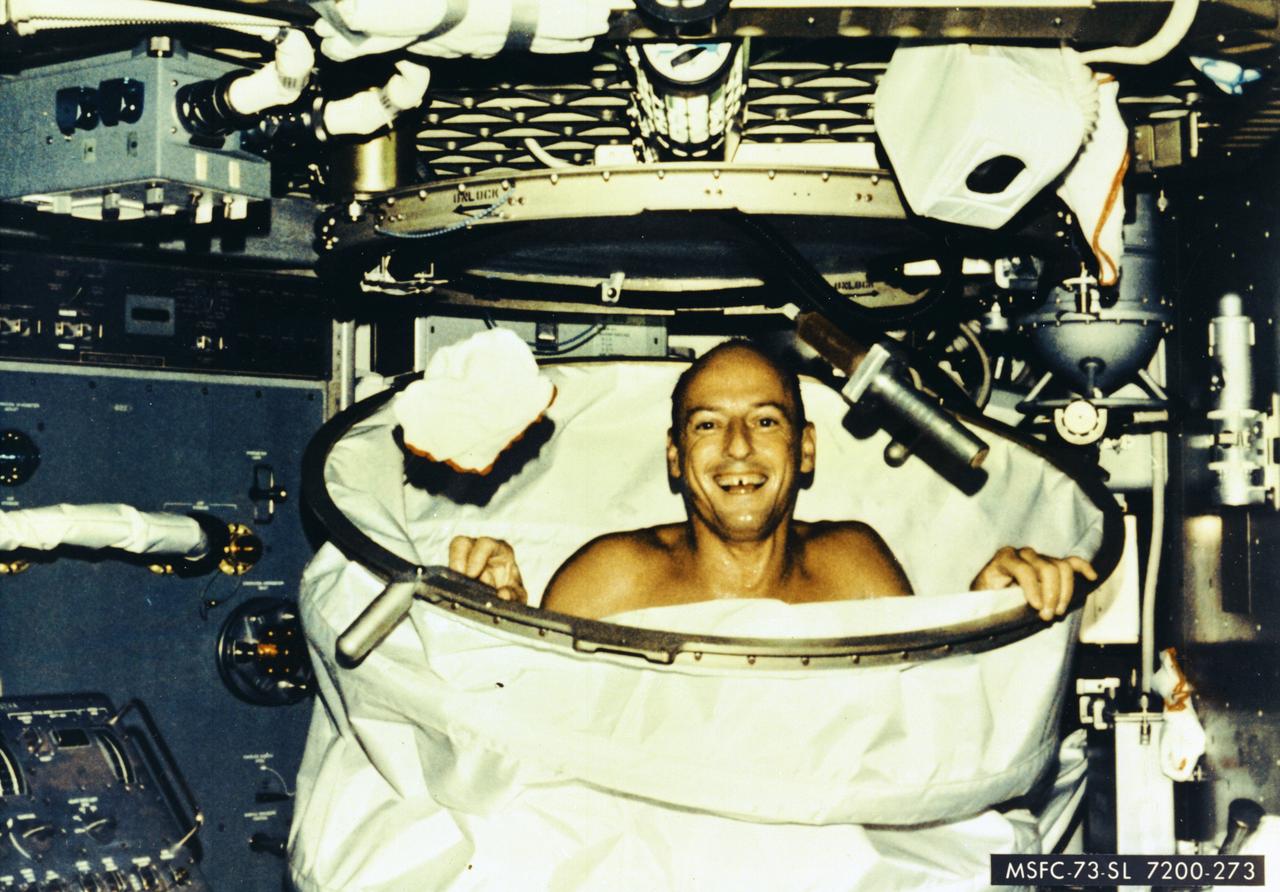
Astronaut Charles Conrad, Jr., Skylab-2 (SL-2) commander, smiles happily for the camera after a hot bath in the shower in the crew quarters of the Orbital Workshop of the Skylab space station. In deploying the shower facility, the shower curtain was pulled up from the floor and attached to the ceiling. The water came through a push button shower head attached to a flexible hose. Water was drawn off by a vacuum system.
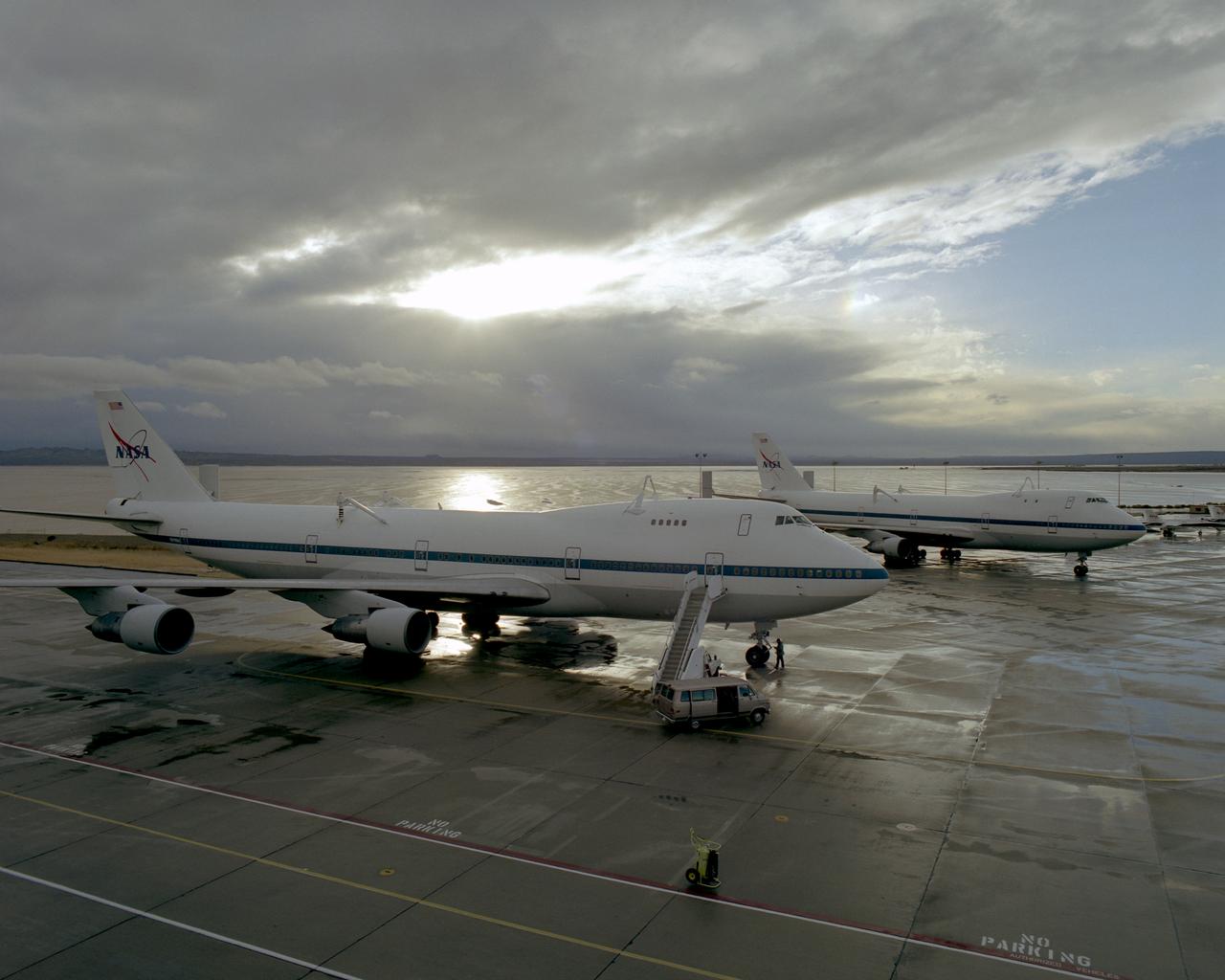
The sun begins to break through the clouds over NASA's two 747 Shuttle Carrier Aircraft on the NASA Dryden ramp after a rain shower in February 2001.

This graphic depicts what Mars atmosphere would have looked like to a viewer with ultraviolet-seeing eyes after a meteor shower on Oct. 19, 2014.
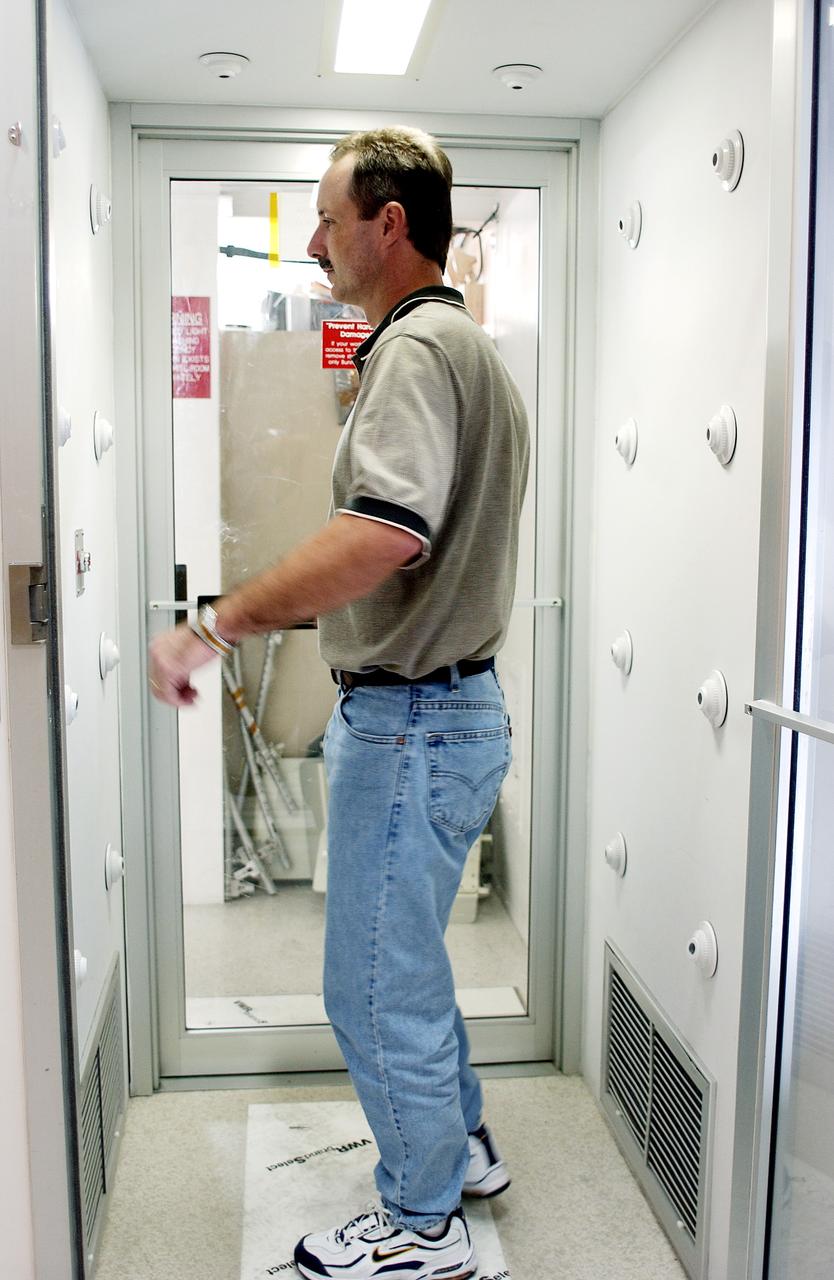
KENNEDY SPACE CENTER, FLA. - A KSC employee uses a clean-air shower before entering a clean room. Streams of pressurized air directed at the occupant from nozzles in the chamber's ceiling and walls are designed to dislodge particulate matter from hair, clothing and shoes. The adhesive mat on the floor captures soil from shoe soles, as well as particles that fall on its surface. Particulate matter has the potential to contaminate the space flight hardware being stored or processed in the clean room. The shower is part of KSC's Foreign Object Debris (FOD) control program, an important safety initiative.
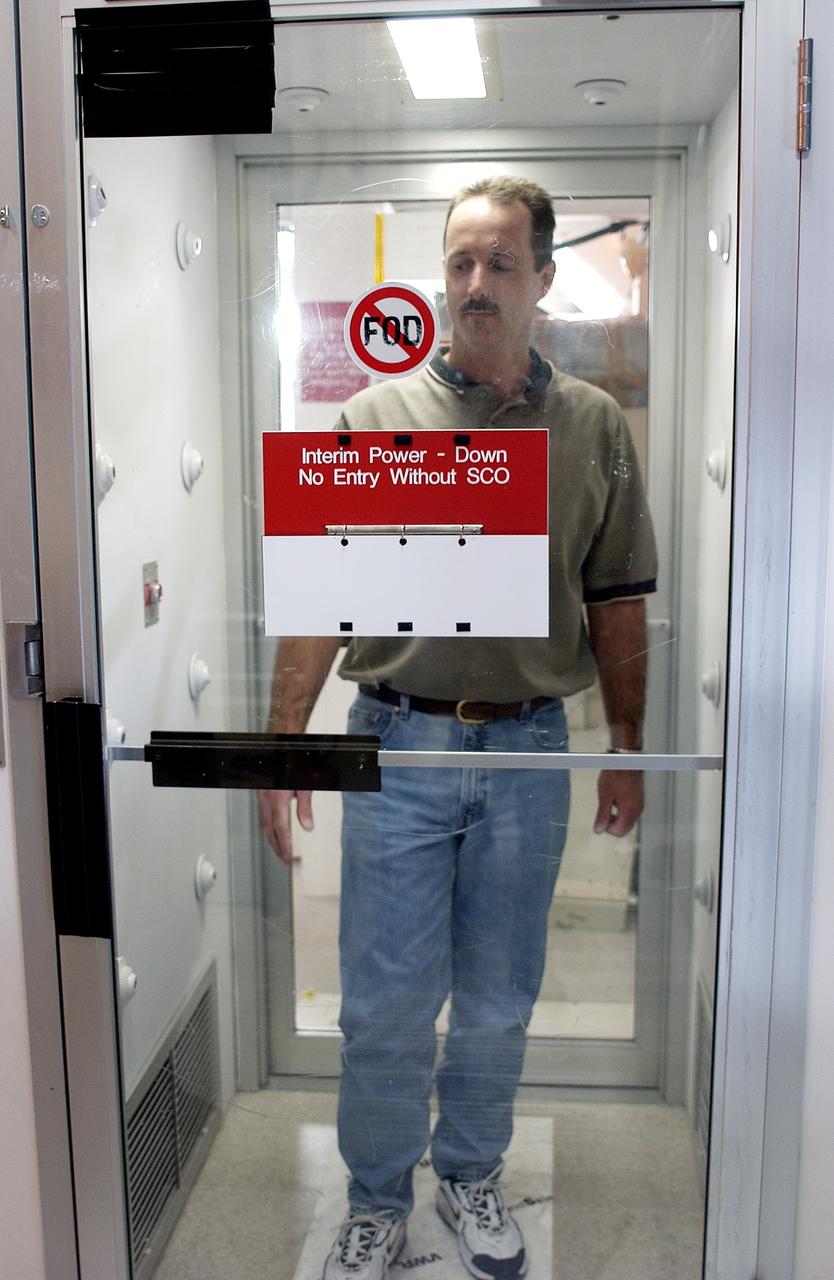
KENNEDY SPACE CENTER, FLA. - A KSC employee uses a clean-air shower before entering a clean room. Streams of pressurized air directed at the occupant from nozzles in the chamber's ceiling and walls are designed to dislodge particulate matter from hair, clothing and shoes. The adhesive mat on the floor captures soil from shoe soles, as well as particles that fall on its surface. Particulate matter has the potential to contaminate the space flight hardware being stored or processed in the clean room. The shower is part of KSC's Foreign Object Debris (FOD) control program, an important safety initiative.
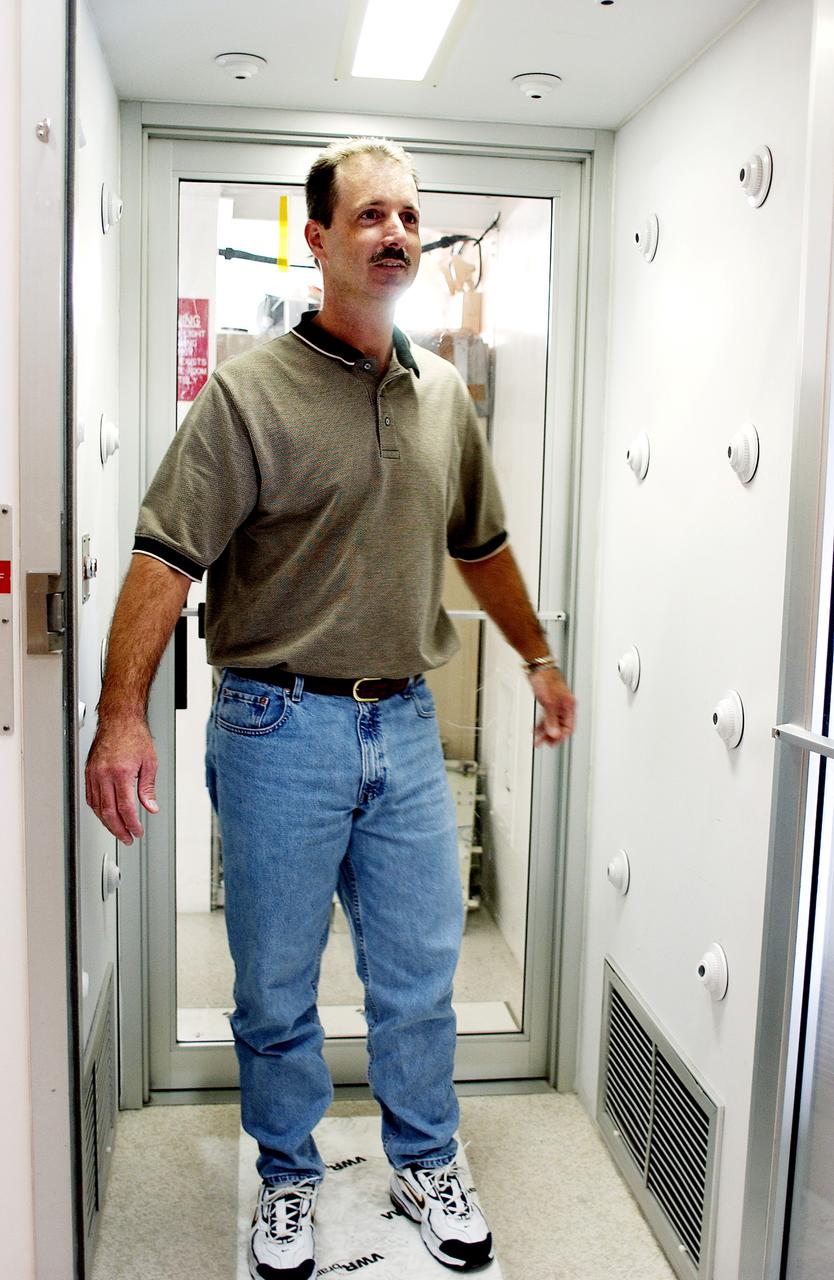
KENNEDY SPACE CENTER, FLA. - A KSC employee uses a clean-air shower before entering a clean room. Streams of pressurized air directed at the occupant from nozzles in the chamber's ceiling and walls are designed to dislodge particulate matter from hair, clothing and shoes. The adhesive mat on the floor captures soil from shoe soles, as well as particles that fall on its surface. Particulate matter has the potential to contaminate the space flight hardware being stored or processed in the clean room. The shower is part of KSC's Foreign Object Debris (FOD) control program, an important safety initiative.
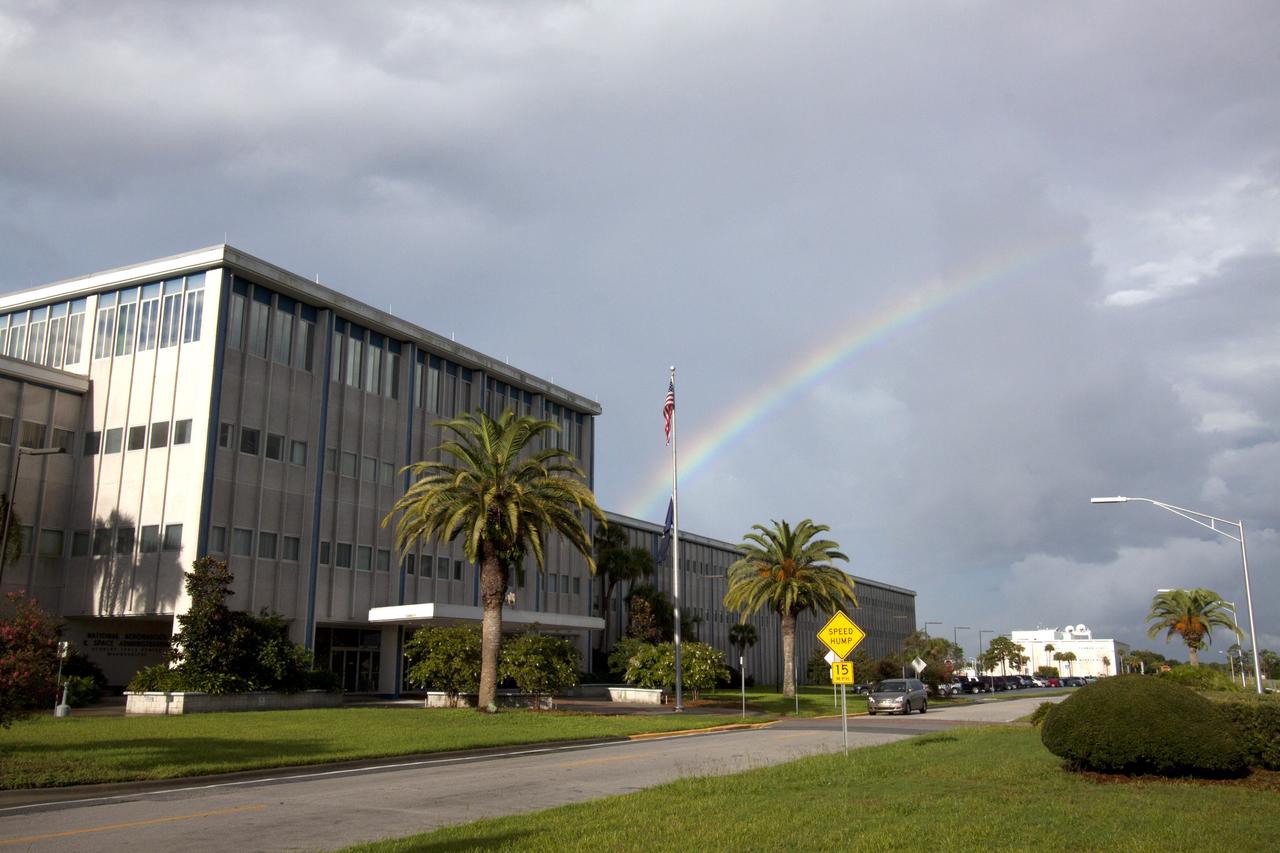
CAPE CANAVERAL, Fla. -- As the sun was rising over NASA's Kennedy Space Center in Florida, an early morning rain shower caused a meteorological and optical rainbow show over the Headquarters building. Florida's Space Coast often is the scene of showers and thunderstorms during the summer months. Photo credit: NASA/Jack Pfaller
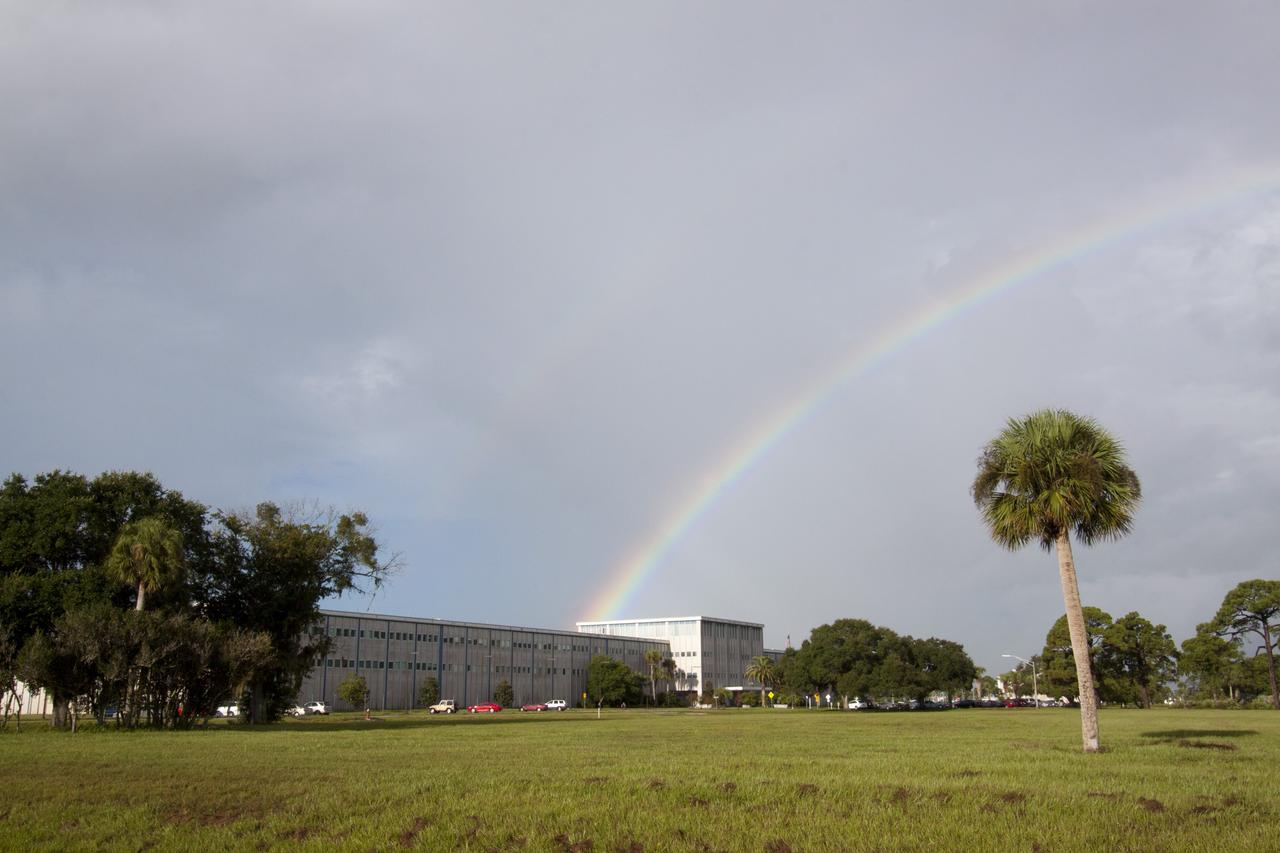
CAPE CANAVERAL, Fla. -- As the sun was rising over NASA's Kennedy Space Center in Florida, an early morning rain shower caused a meteorological and optical rainbow show over the Headquarters building. Florida's Space Coast often is the scene of showers and thunderstorms during the summer months. Photo credit: NASA/Jack Pfaller
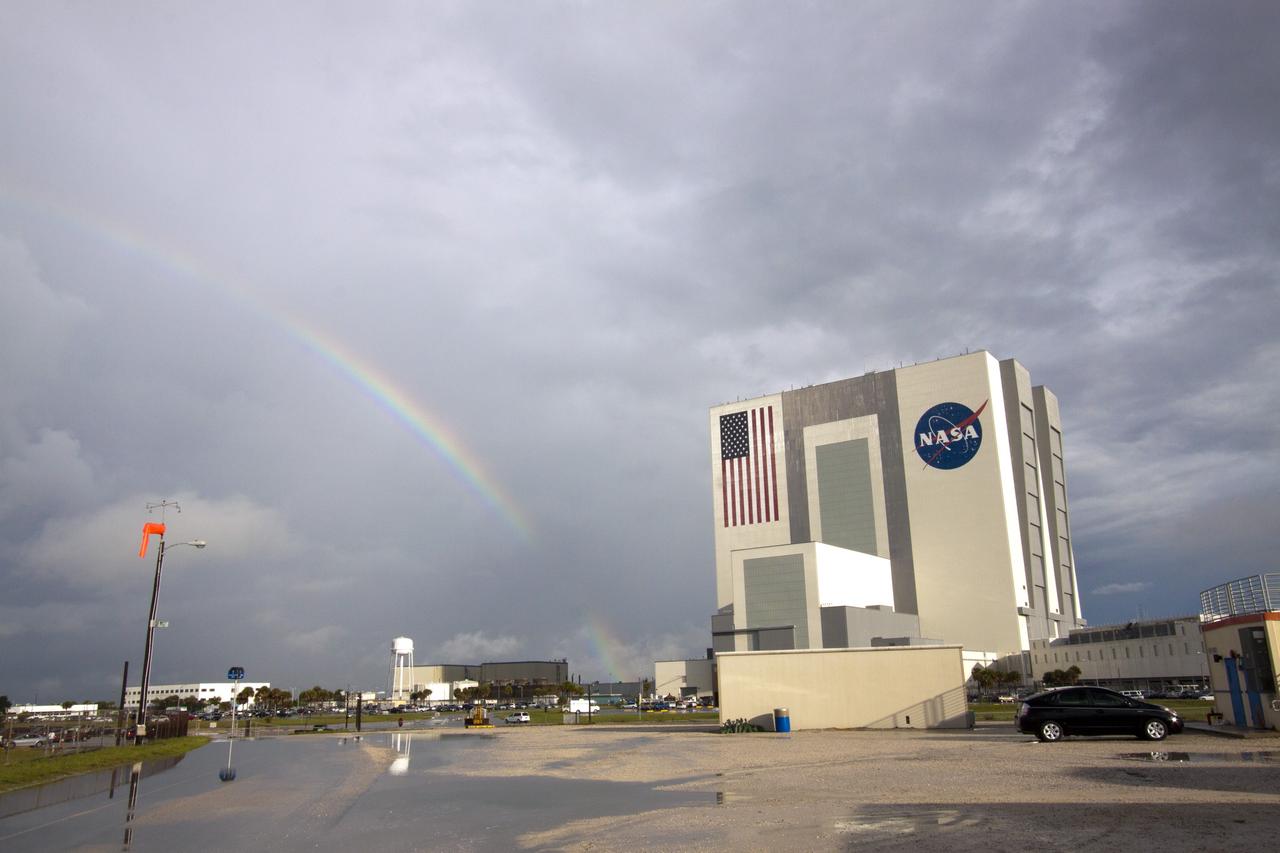
CAPE CANAVERAL, Fla. -- As the sun was rising over NASA's Kennedy Space Center in Florida, an early morning rain shower caused a meteorological and optical rainbow show next to the Vehicle Assembly Building. Florida's Space Coast often is the scene of showers and thunderstorms during the summer months. Photo credit: NASA/Jack Pfaller
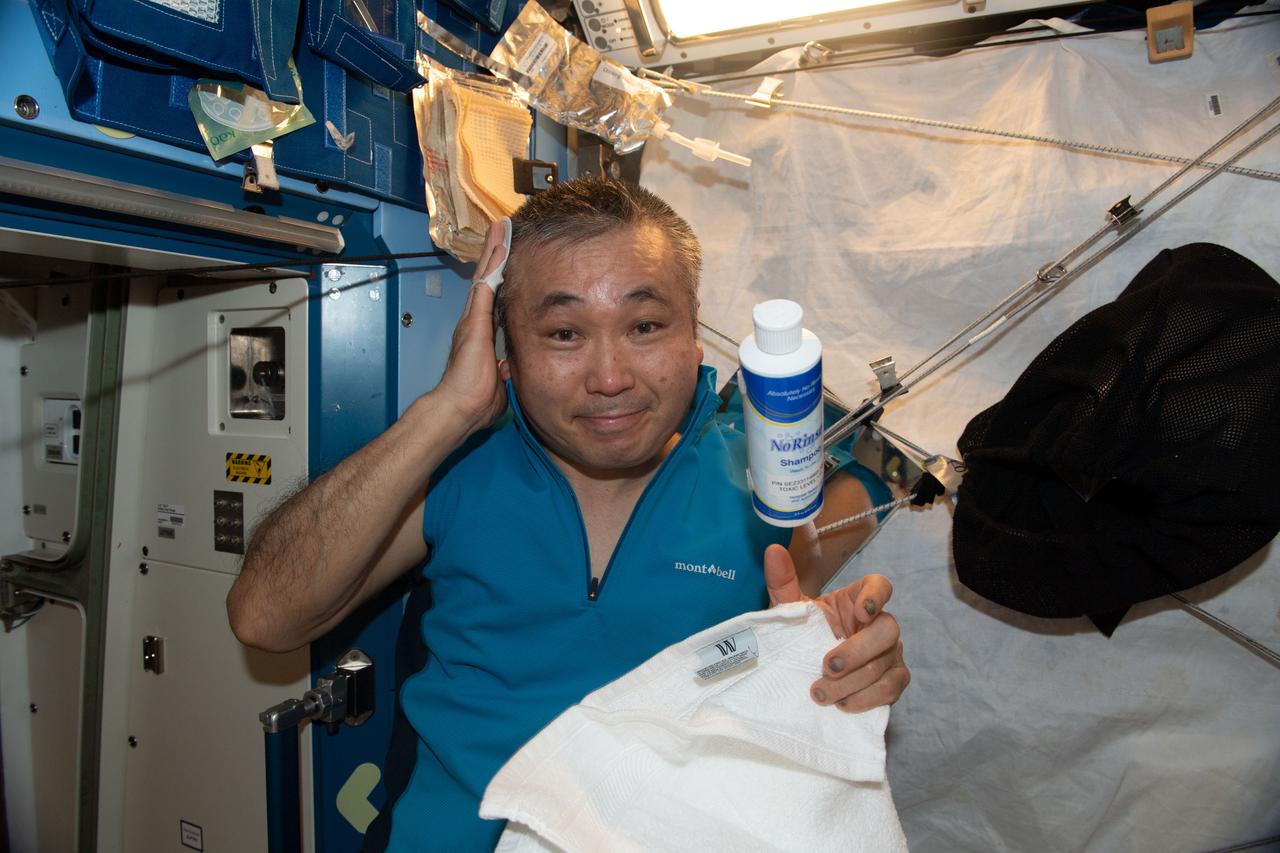
iss068e046501 (Feb. 5, 2023) --- Expedition 68 Flight Engineer Koichi Wakata of the Japan Aerospace Exploration Agency (JAXA) demonstrates washing his hair on the International Space Station using rinseless shampoo and without shower facilities. Showers are not possible in space due to limited water supplies and the effects of microgravity.

MARSHALL SPACE FLIGHT CENTER ASTRONOMER BILL COOKE AND WEBMASTER BROOKE BOEN CONDUCTING A LIVE CHAT ON THE PERSEIDS METEOR SHOWER.
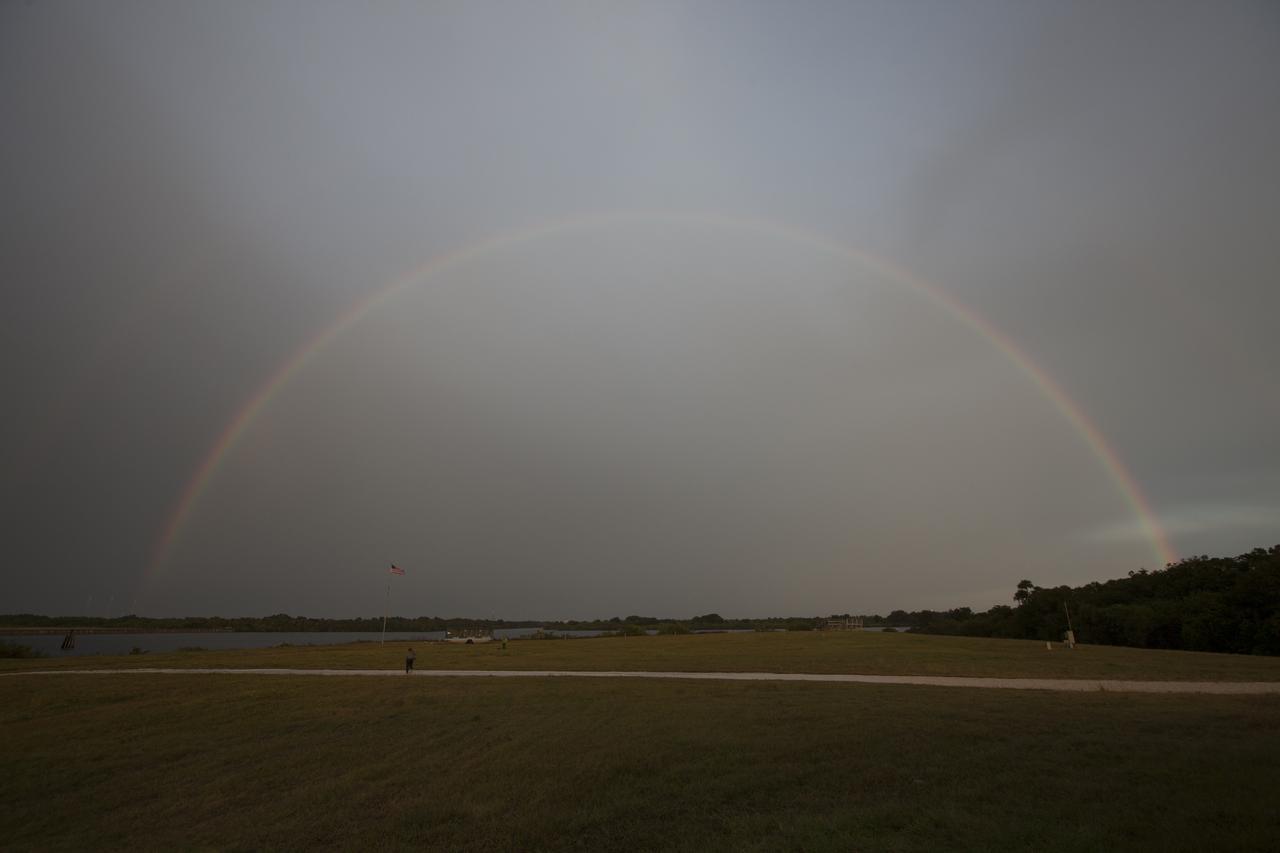
As rain showers dissipate, a rainbow appeared over the Kennedy Space Center's Press Site and turn basin. In the background is the historic countdown clock.
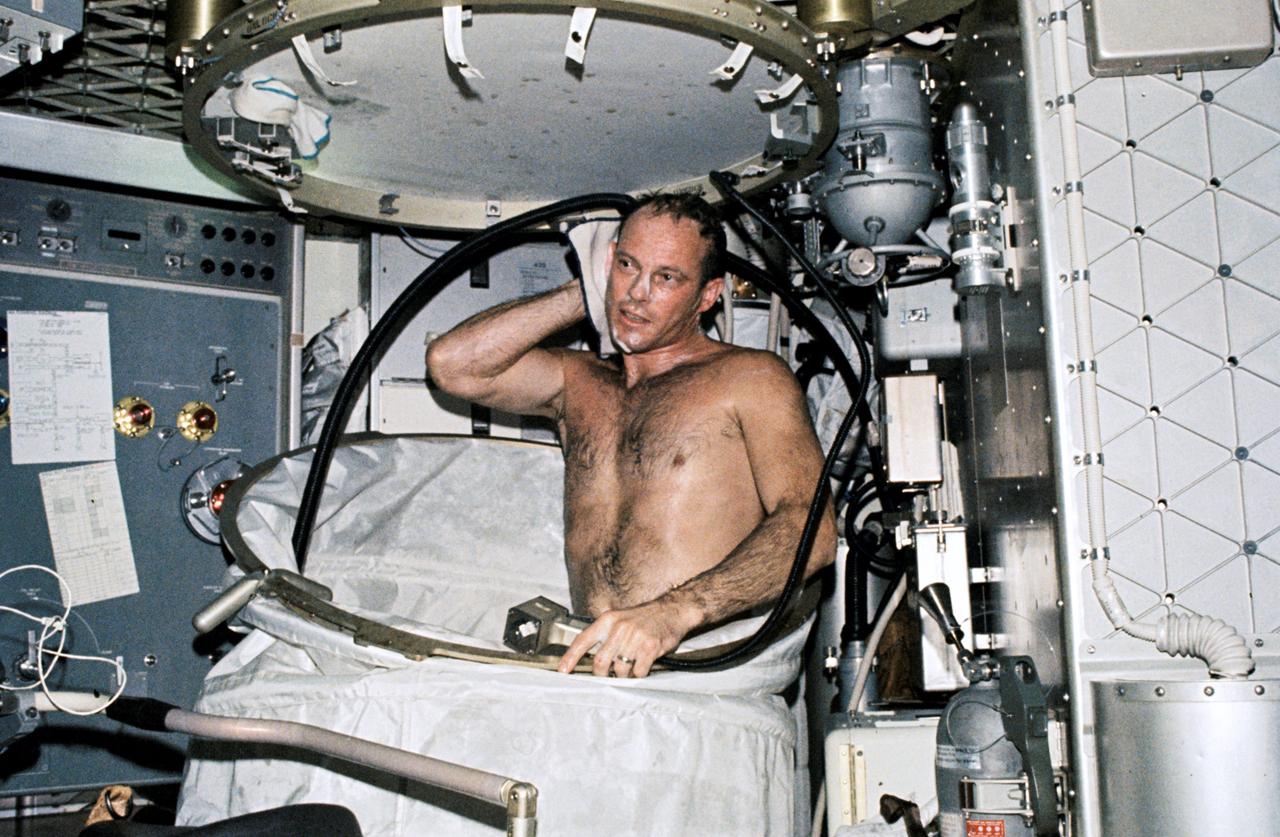
SL3-108-1295 (July-September 1973) --- A close-up view of astronaut Jack R. Lousma, Skylab 3 pilot, taking a hot bath in the crew quarters of the Orbital Workshop (OWS) of the Skylab space station cluster in Earth orbit. This picture was taken with a hand-held 35mm Nikon camera. Astronauts Lousma, Alan L. Bean and Owen K. Garriott remained with the Skylab space station in orbit for 59 days conducting numerous medical, scientific and technological experiments. In deploying the shower facility the shower curtain is pulled up from the floor and attached to the ceiling. The water comes through a push-button shower head attached to a flexible hose. Water is drawn off by a vacuum system. Photo credit: NASA

Perseid Meteor flight on Google's Gulfstream Aircraft. P.I. Peter Jenniskens, SETI Group - Koop, Kemp, Rairden, Lockyer discuss the mission on board the Gulfstream enroute to meteor shower local
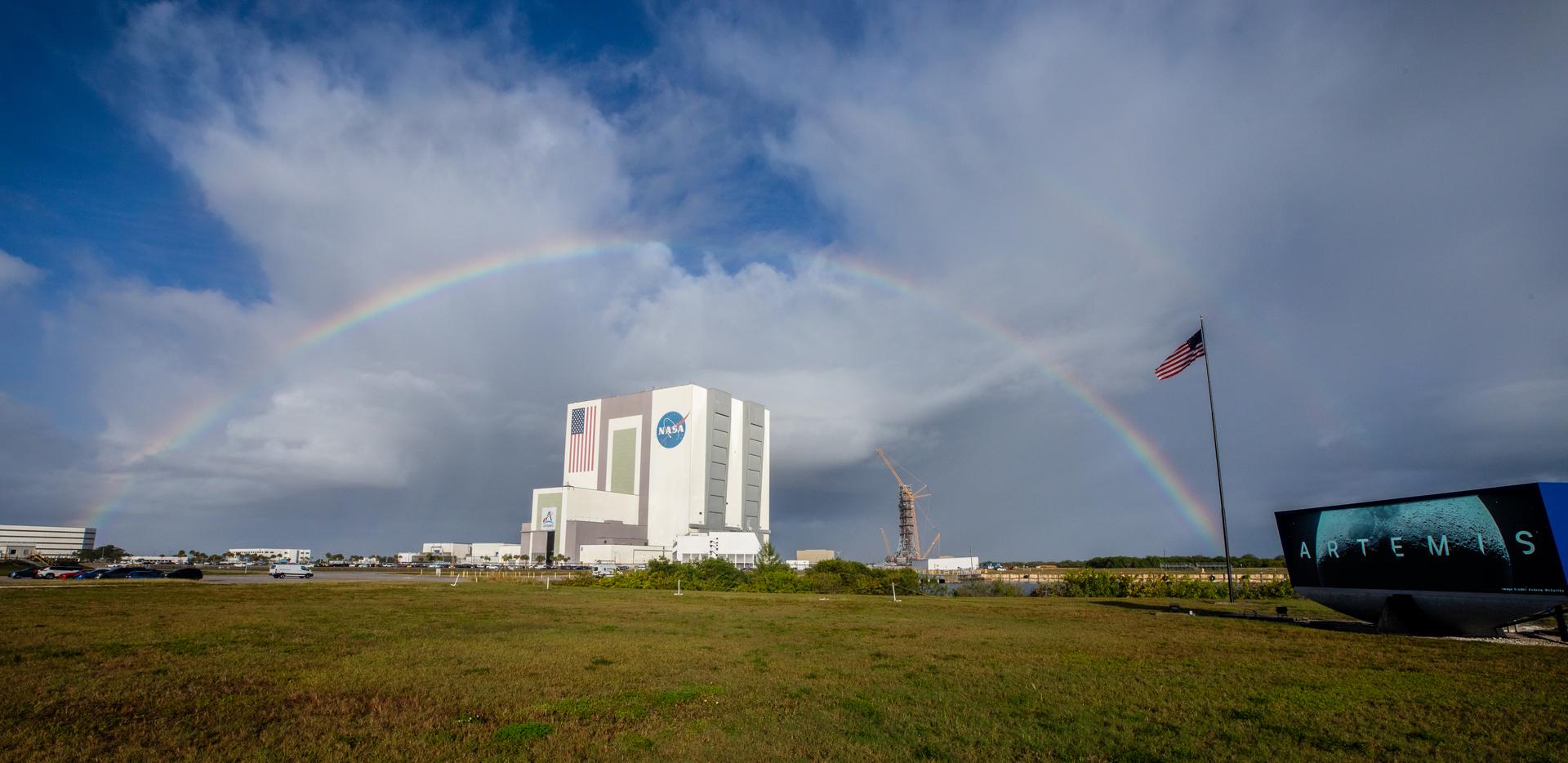
Rain showers create a rainbow over the Vehicle Assembly Building near countdown clock featuring the Artemis Moon logo at the NASA News Center at the agency’s Kennedy Space Center in Florida on Thursday, Dec. 19, 2025.
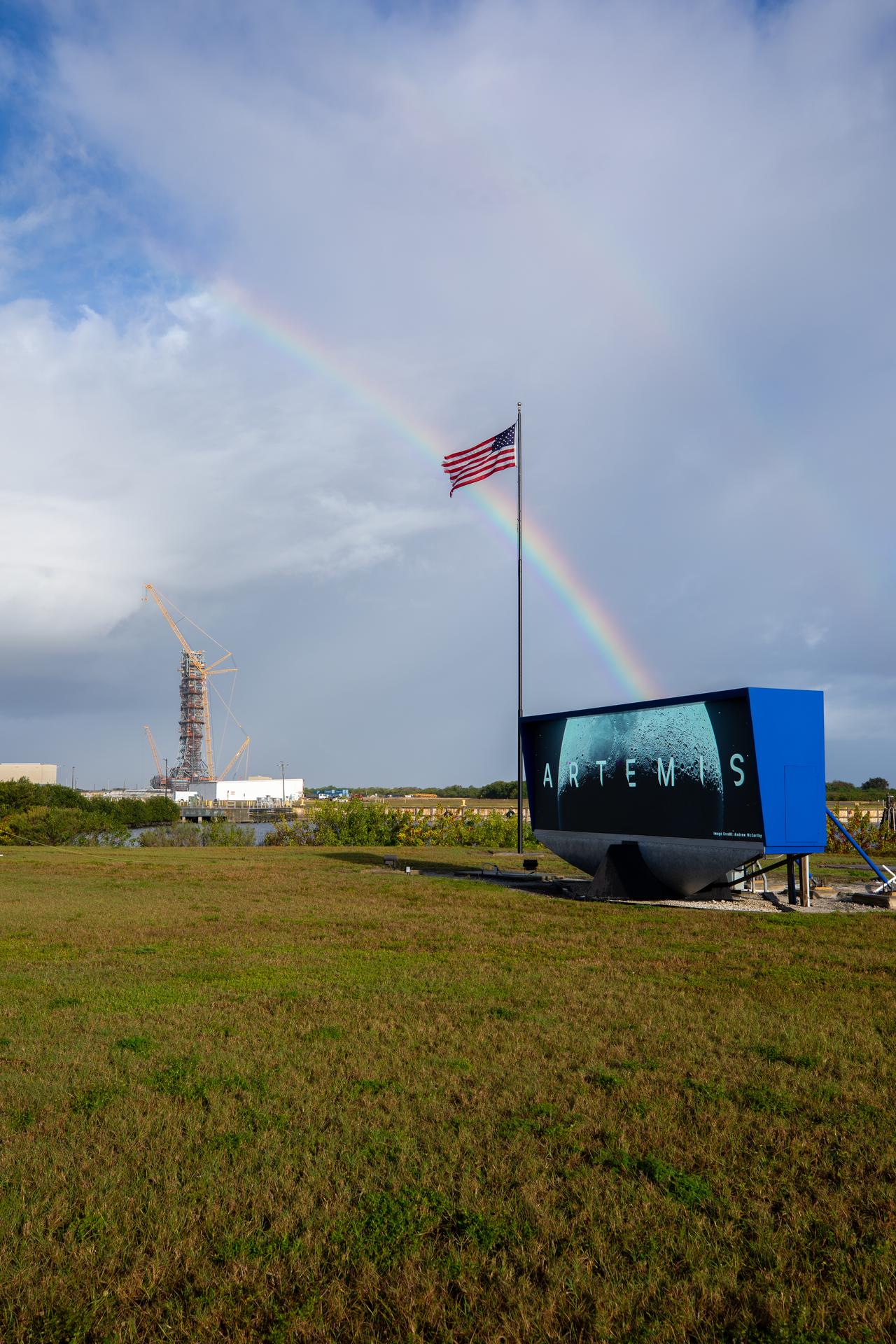
Rain showers create a rainbow near countdown clock featuring the Artemis Moon logo at the NASA News Center at the agency’s Kennedy Space Center in Florida on Thursday, Dec. 19, 2025.
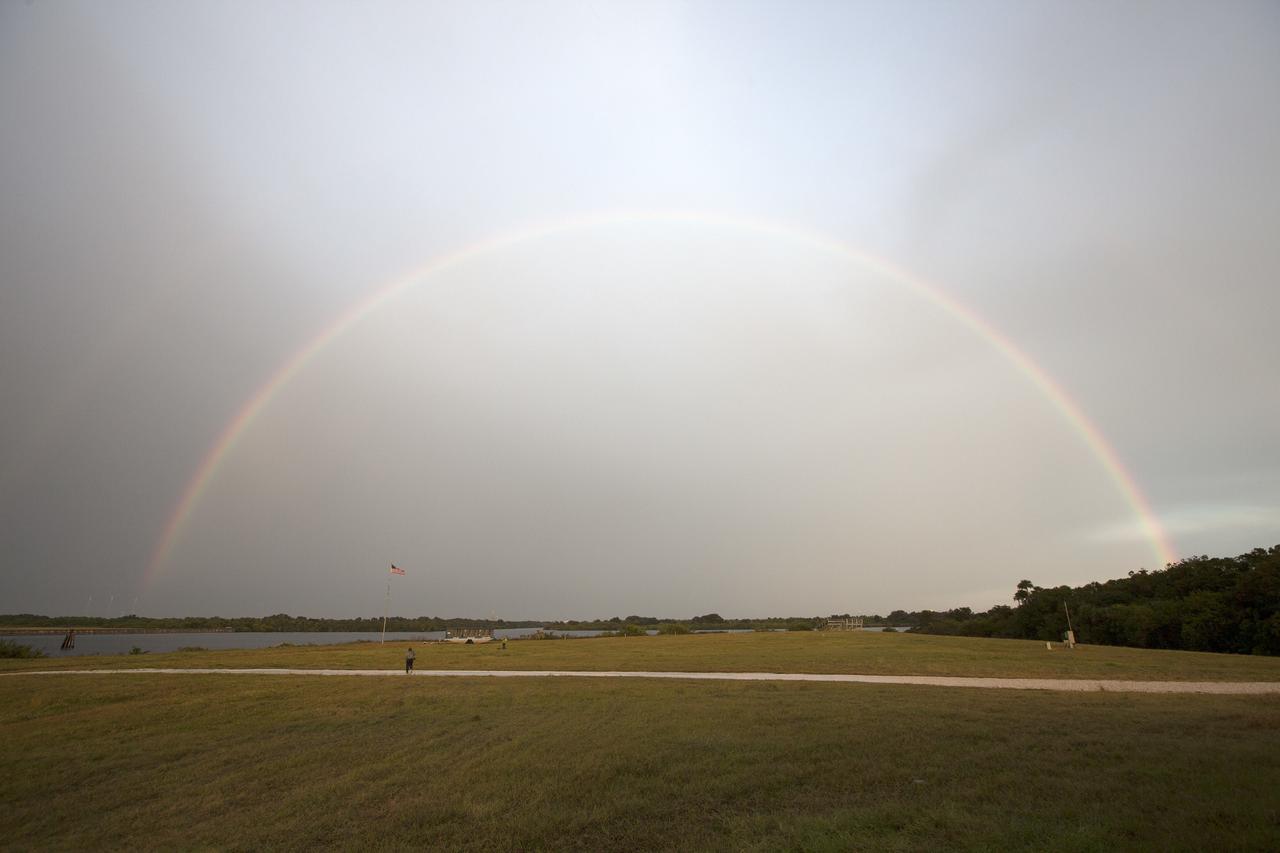
CAPE CANAVERAL, Fla. – As rain showers dissipate, a rainbow appeared over the Kennedy Space Center's Press Site and turn basin. In the background is the historic countdown clock. For more information, visit http://www.nasa.gov/kennedy Photo credit: NASA/Kim Shiflett
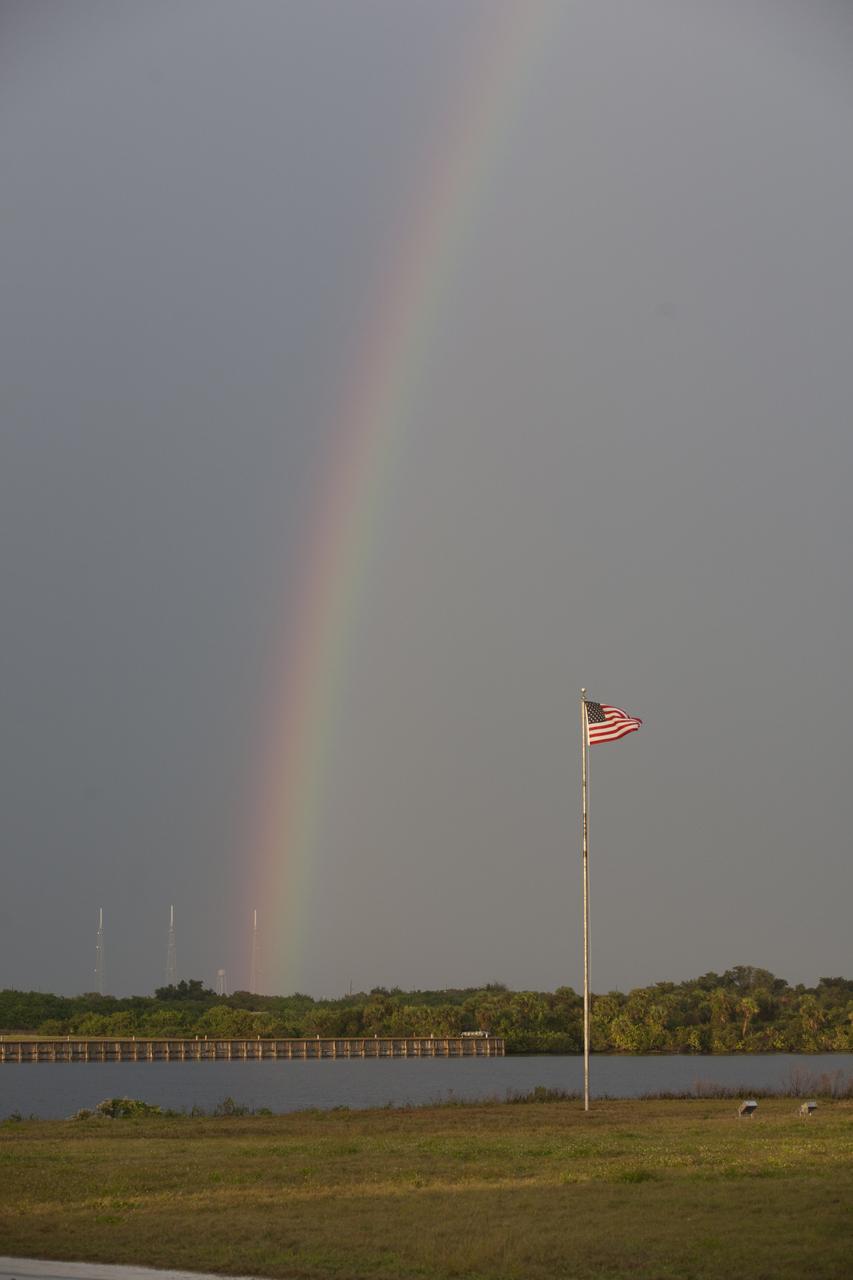
As rain showers dissipate, a rainbow appeared over NASA's Kennedy Space Center's Launch Pad 39B. This is the site where the agency's Space Launch System will launch astronauts aboard the Orion spacecraft to deep-space destinations such as an asteroid and Mars.
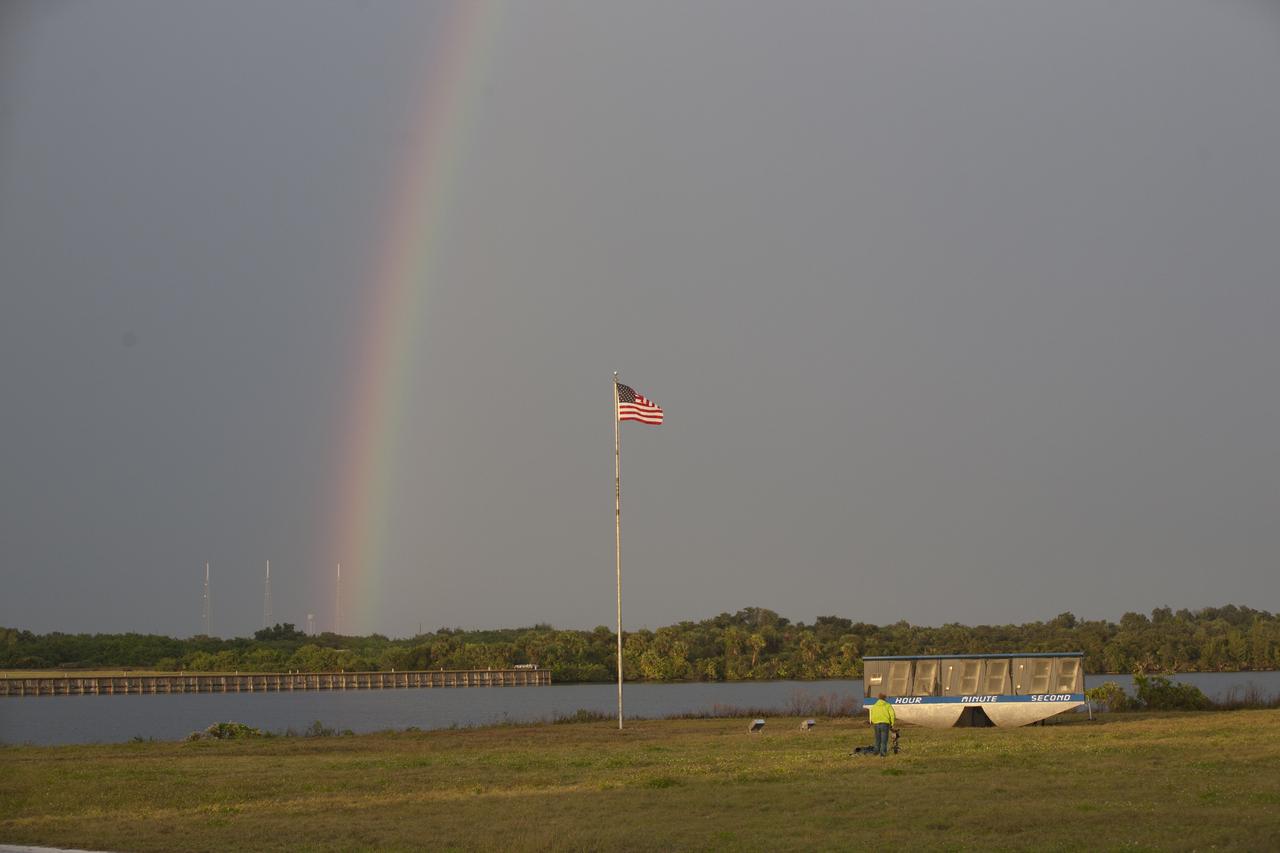
As rain showers dissipate, a rainbow appeared over the Kennedy Space Center's Press Site and turn basin. In the foreground is the historic countdown clock. In the background, is Launch Pad 39B where agency's Space Launch System will launch astronauts aboard the Orion spacecraft to deep-space destinations such as an asteroid and Mars.
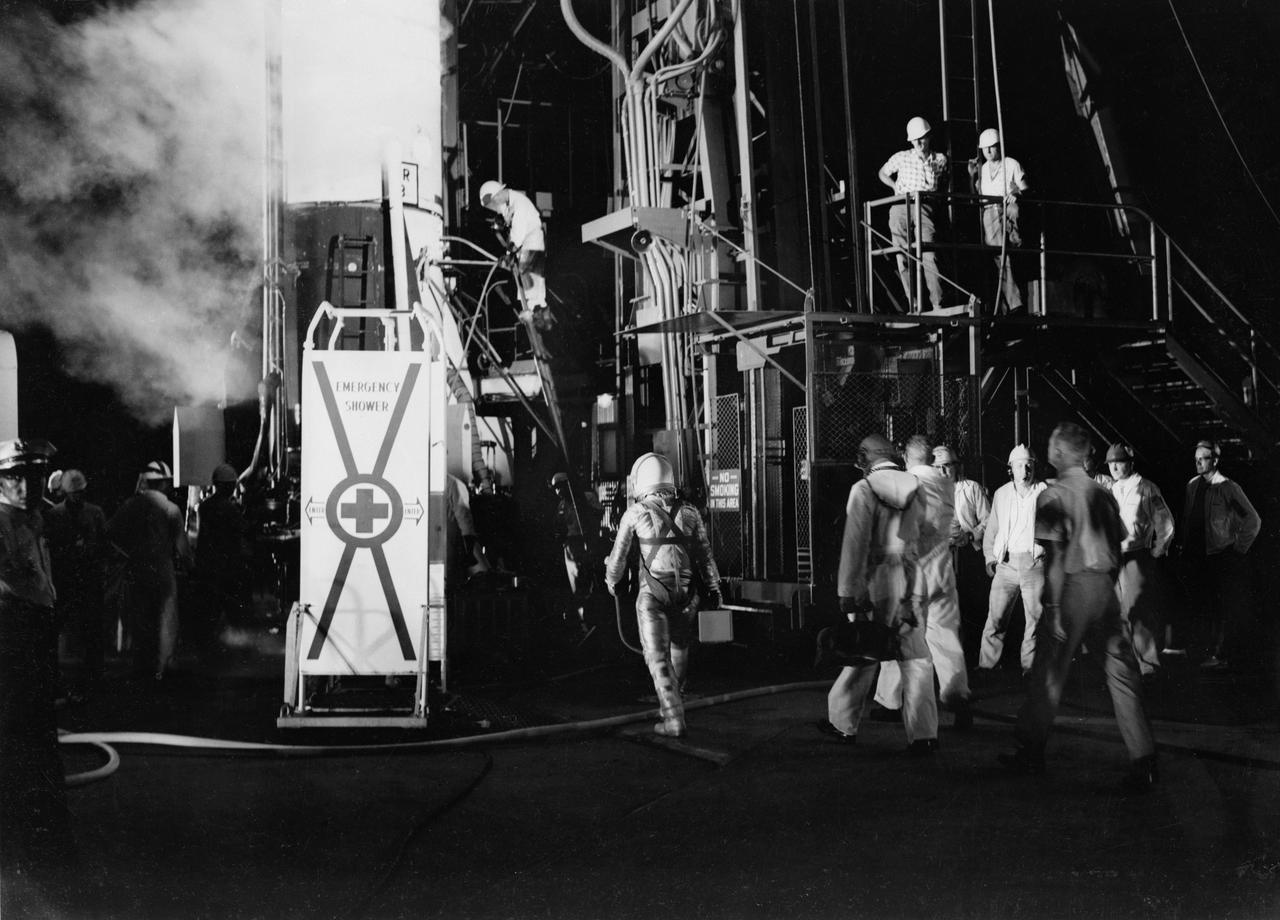
S61-02889 (1961) --- Astronaut Virgil I. (Gus) Grissom approaches his Mercury-Redstone 4 (MR-4) launch vehicle to begin his mission. To the left of the view is an emergency shower stall, to the right is the elevator which will take Grissom to the capsule. Photo credit: NASA
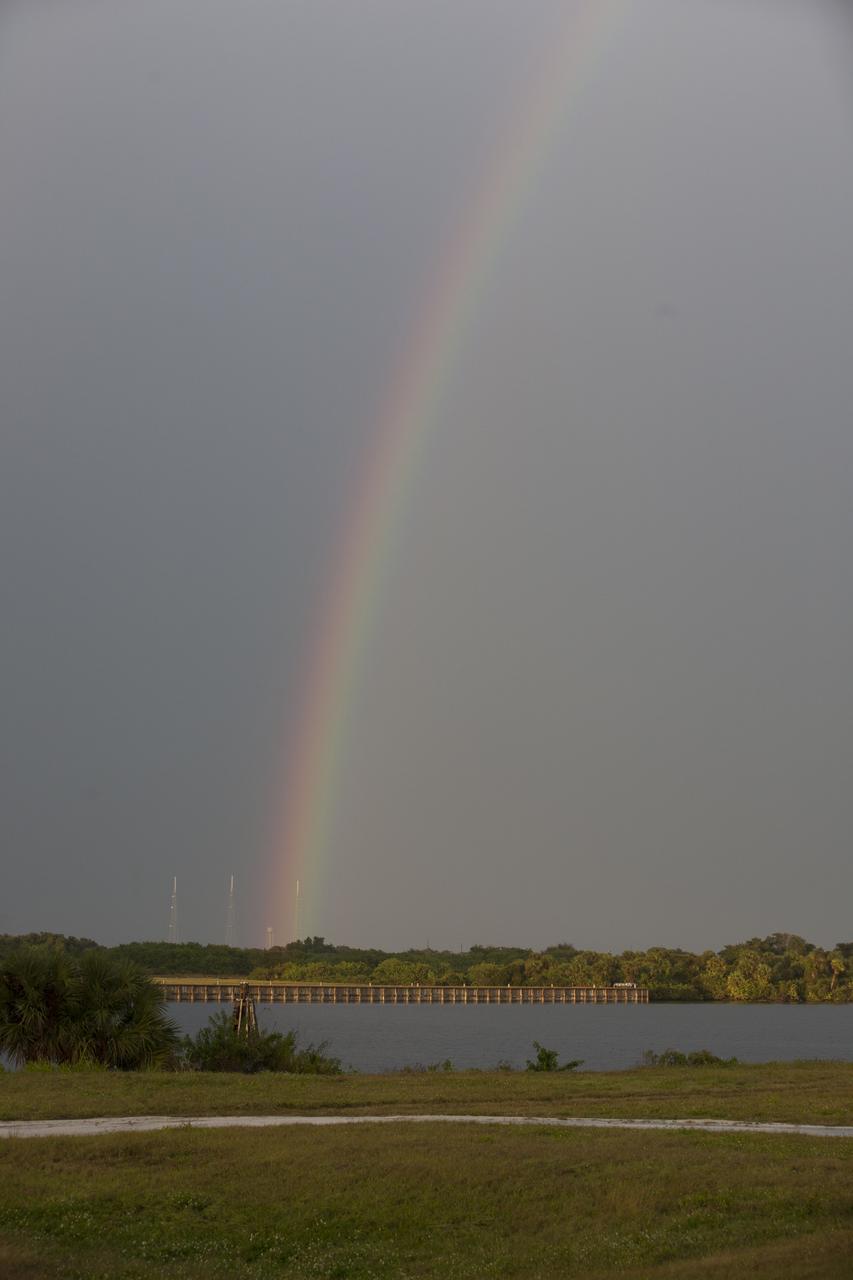
As rain showers dissipate, a rainbow appeared over NASA's Kennedy Space Center's Launch Pad 39B. This is the site where the agency's Space Launch System will launch astronauts aboard the Orion spacecraft to deep-space destinations such as an asteroid and Mars.
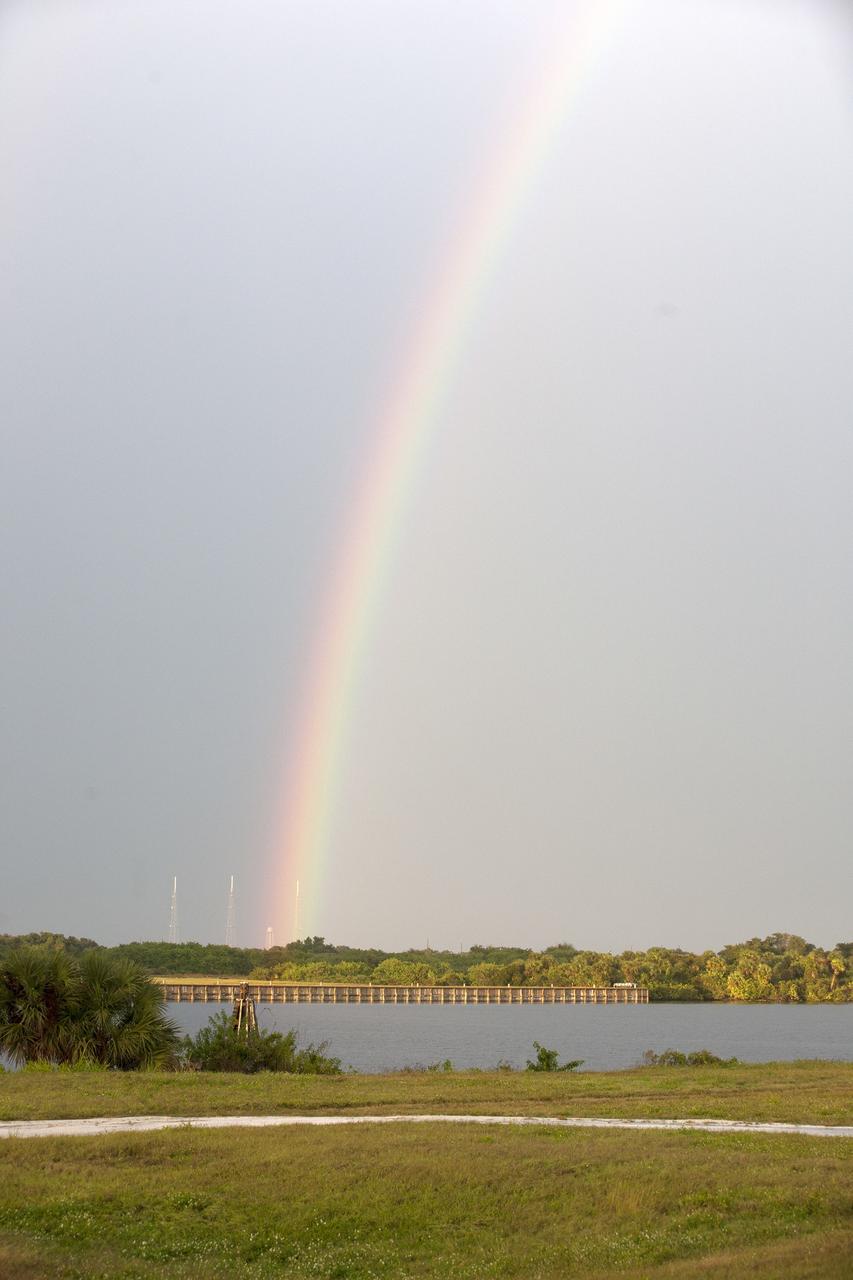
CAPE CANAVERAL, Fla. – As rain showers dissipate, a rainbow appeared over NASA's Kennedy Space Center's Launch Pad 39B. This is the site where the agency's Space Launch System will launch astronauts aboard the Orion spacecraft to deep-space destinations such as an asteroid and Mars. For more information, visit http://www.nasa.gov/kennedy Photo credit: NASA/Kim Shiflett

ISS045E014236 (09/17/2015) – A Japanese Small Satellite is deployed from outside the Japanese Experiment Module on Sept. 17, 2015. Two satellites were sent into Earth orbit by the Small Satellite Orbital Deployer. The first satellite is designed to observe the Ultraviolet (UV) spectrum during the Orionid meteor shower in October. The second satellite, sponsored by the University of Brasilia and the Brazilian government, focuses on meteorological data collection.
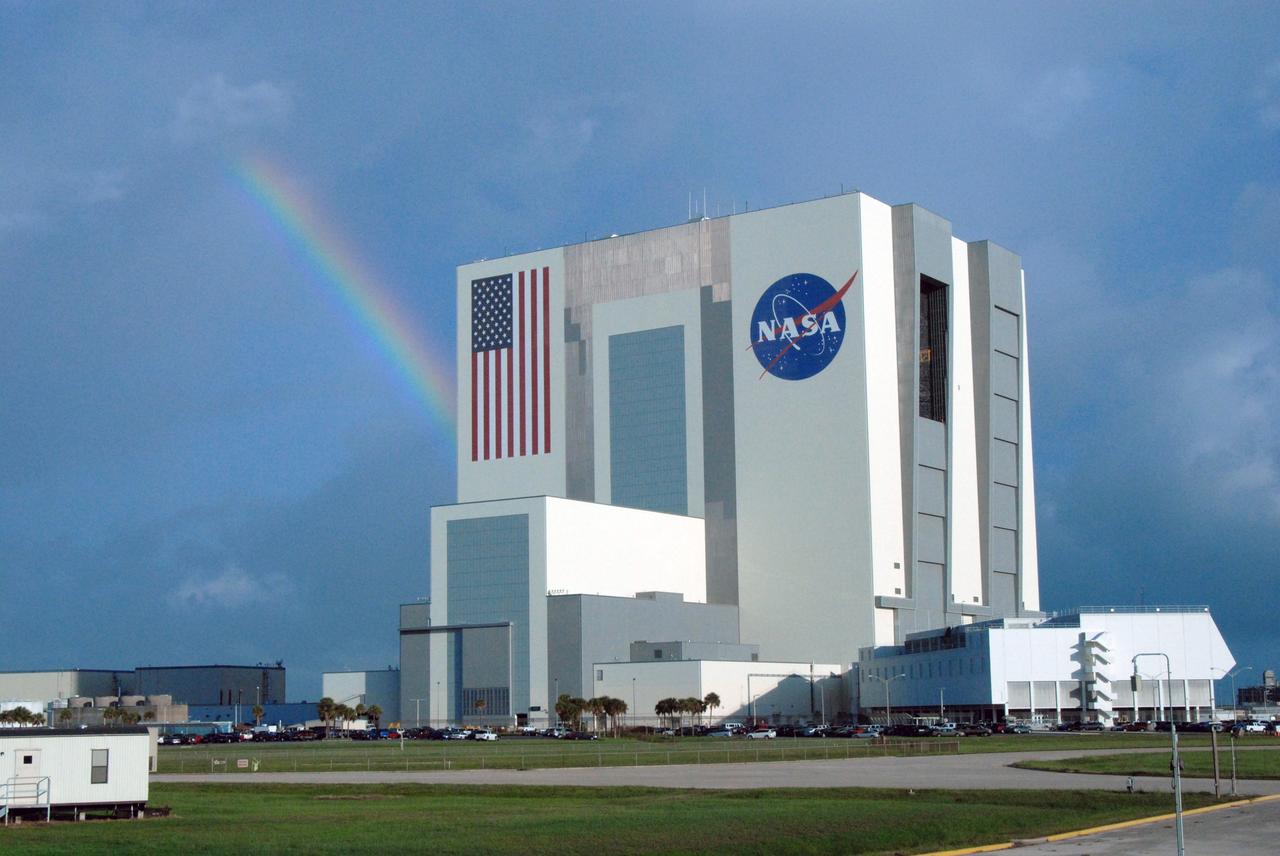
CAPE CANAVERAL, Fla. – Between rain showers over NASA's Kennedy Space Center in Florida, a rainbow breaks through the clouds behind the Vehicle Assembly Building. Rain and thunderstorms caused the waveoff of two landing opportunities Sept. 10 for space shuttle Discovery's return to Earth from the STS-128 mission. Photo credit: NASA/Jim Grossmann

S70-17433 (13 Aug. 1969) --- New York City welcomes Apollo 11 crewmen in a showering of ticker tape down Broadway and Park Avenue in a parade termed as the largest in the city's history. Pictured in the lead car, from the right, are astronauts Neil A. Armstrong, commander; Michael Collins, command module pilot; and Edwin E. Aldrin Jr., lunar module pilot. The three astronauts teamed for the first manned lunar landing, on July 20, 1969.
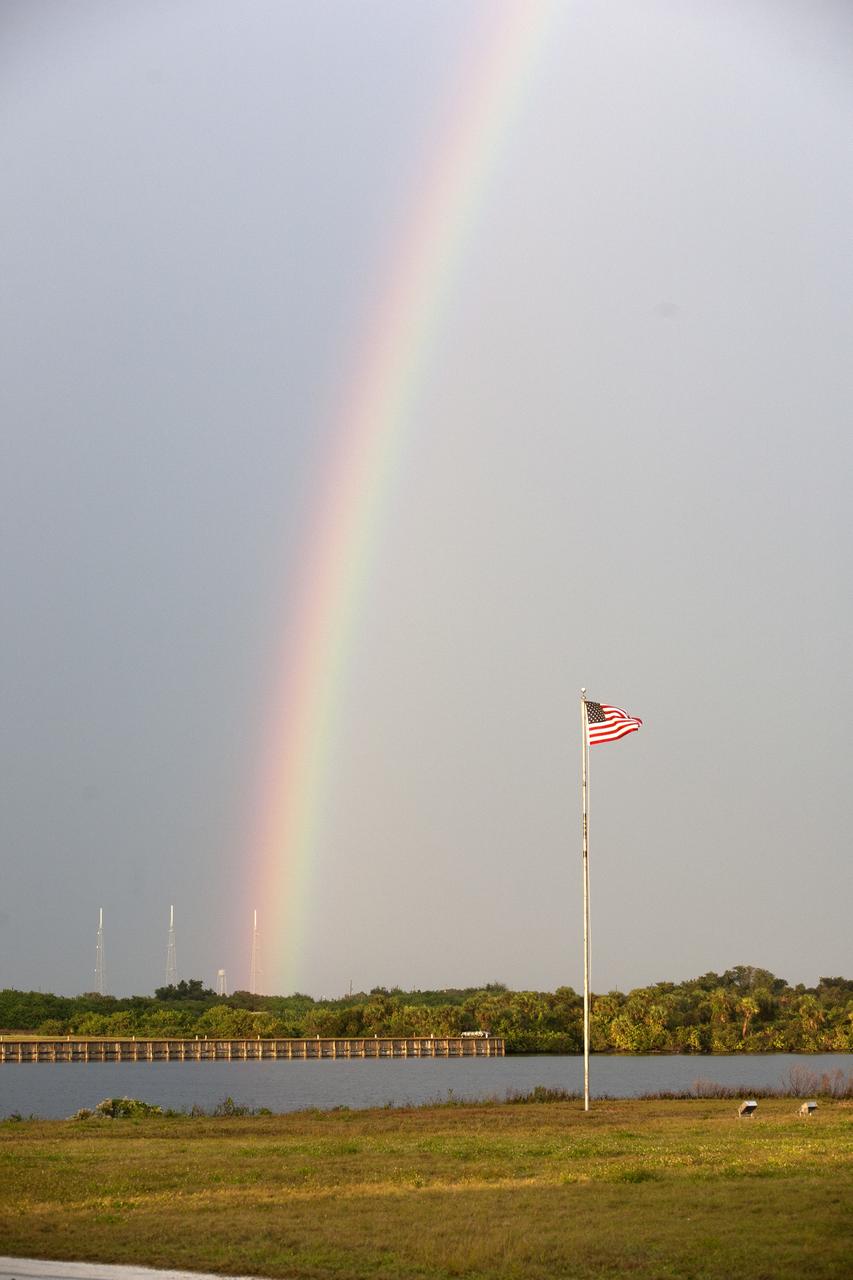
CAPE CANAVERAL, Fla. – As rain showers dissipate, a rainbow appeared over NASA's Kennedy Space Center's Launch Pad 39B. This is the site where the agency's Space Launch System will launch astronauts aboard the Orion spacecraft to deep-space destinations such as an asteroid and Mars. For more information, visit http://www.nasa.gov/kennedy Photo credit: NASA/Kim Shiflett

CAPE CANAVERAL, Fla. – As rain showers dissipate, a rainbow appeared over the Kennedy Space Center's Press Site and turn basin. In the foreground is the historic countdown clock. In the background, is Launch Pad 39B where agency's Space Launch System will launch astronauts aboard the Orion spacecraft to deep-space destinations such as an asteroid and Mars. For more information, visit http://www.nasa.gov/kennedy Photo credit: NASA/Kim Shiflett

iss047e126086 (5/20/2016) --- View during the meteor setup and installation, in the U.S. Laboratory - installed in Window Observational Research Facility (WORF). The Meteor investigation provides the first space-based measurement of meteor flux. It also allows for the monitoring of carbon-based compounds. Continuous measurement of meteor interactions with the Earth’s atmosphere could also spot previously unforeseen meteor showers.
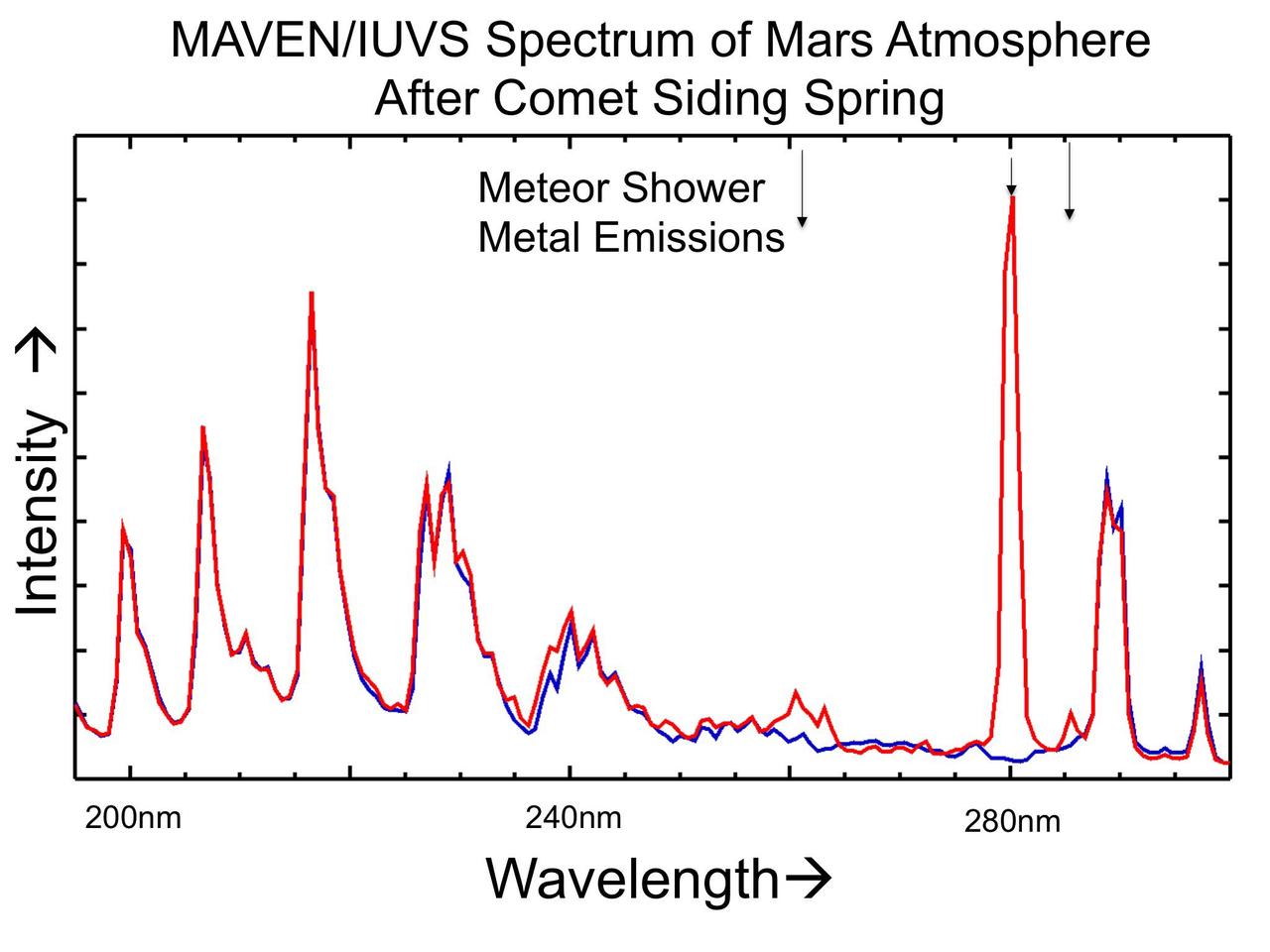
The places where the red line on this graph extends higher than the blue line show detection of metals added to the Martian atmosphere from dust particles released by a passing comet on Oct. 19, 2014. The graphed data are from NASA MAVEN spacecraft.
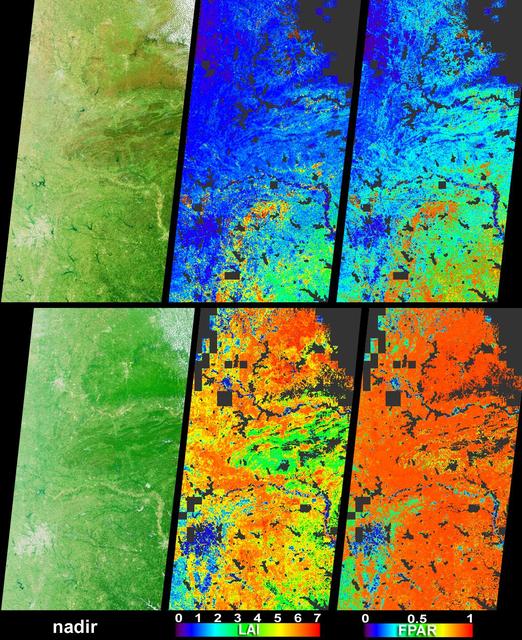
Vigorous vegetation growth in the Southern United States after heavy rains fell during April and early May, 2004, is quantified in these images and data products from NASA Terra spacecraft.
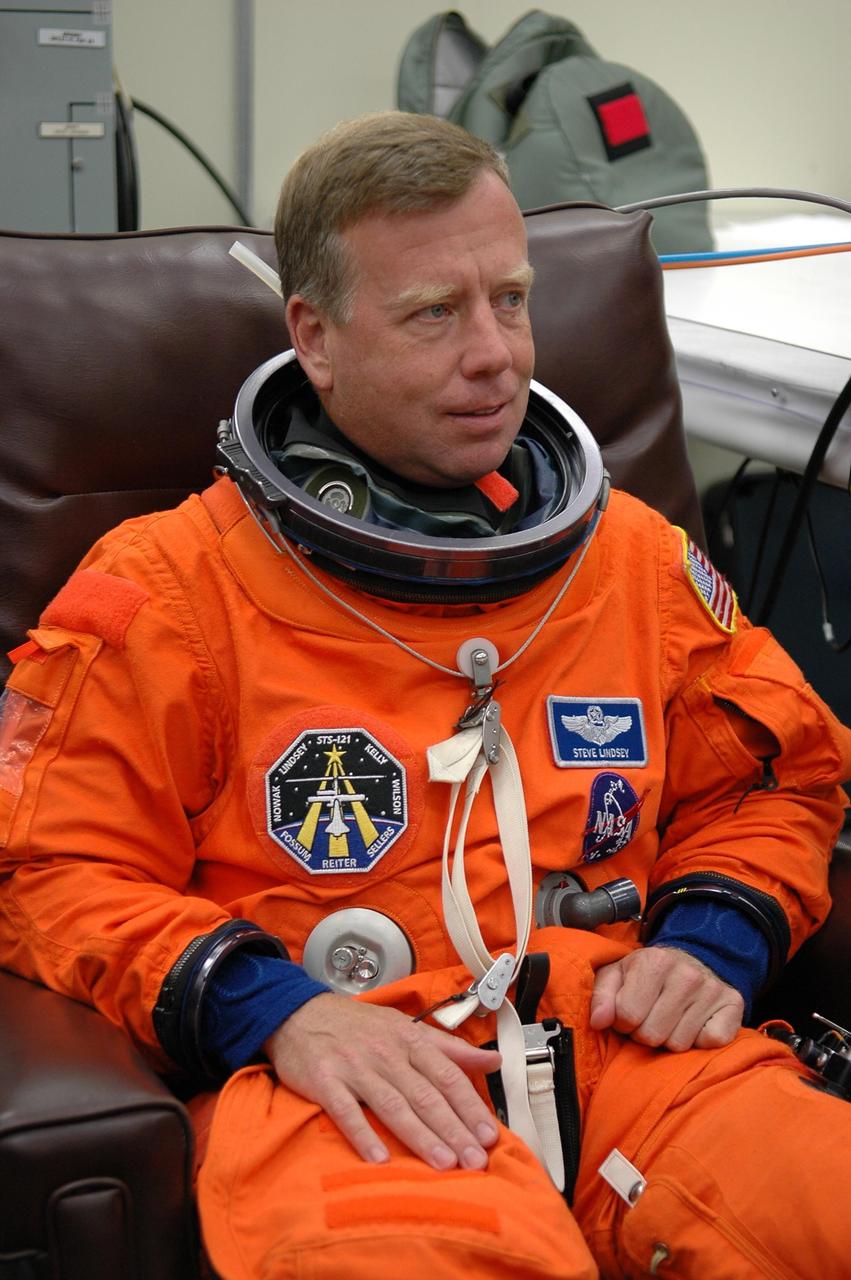
KENNEDY SPACE CENTER, FLA. - STS-121 Commander Steven Lindsey is eager for a third launch attempt on the mission. Here, he is donning his launch suit before heading to Launch Pad 39B. The July 2 launch attempt was scrubbed due to the presence of showers and thunderstorms within the surrounding area of the launch site. The launch of Space Shuttle Discovery on mission STS-121 is the 115th shuttle flight and the 18th U.S. flight to the International Space Station. During the 12-day mission, the STS-121 crew will test new equipment and procedures to improve shuttle safety, as well as deliver supplies and make repairs to the International Space Station. Photo credit: NASA/Kim Shiflett
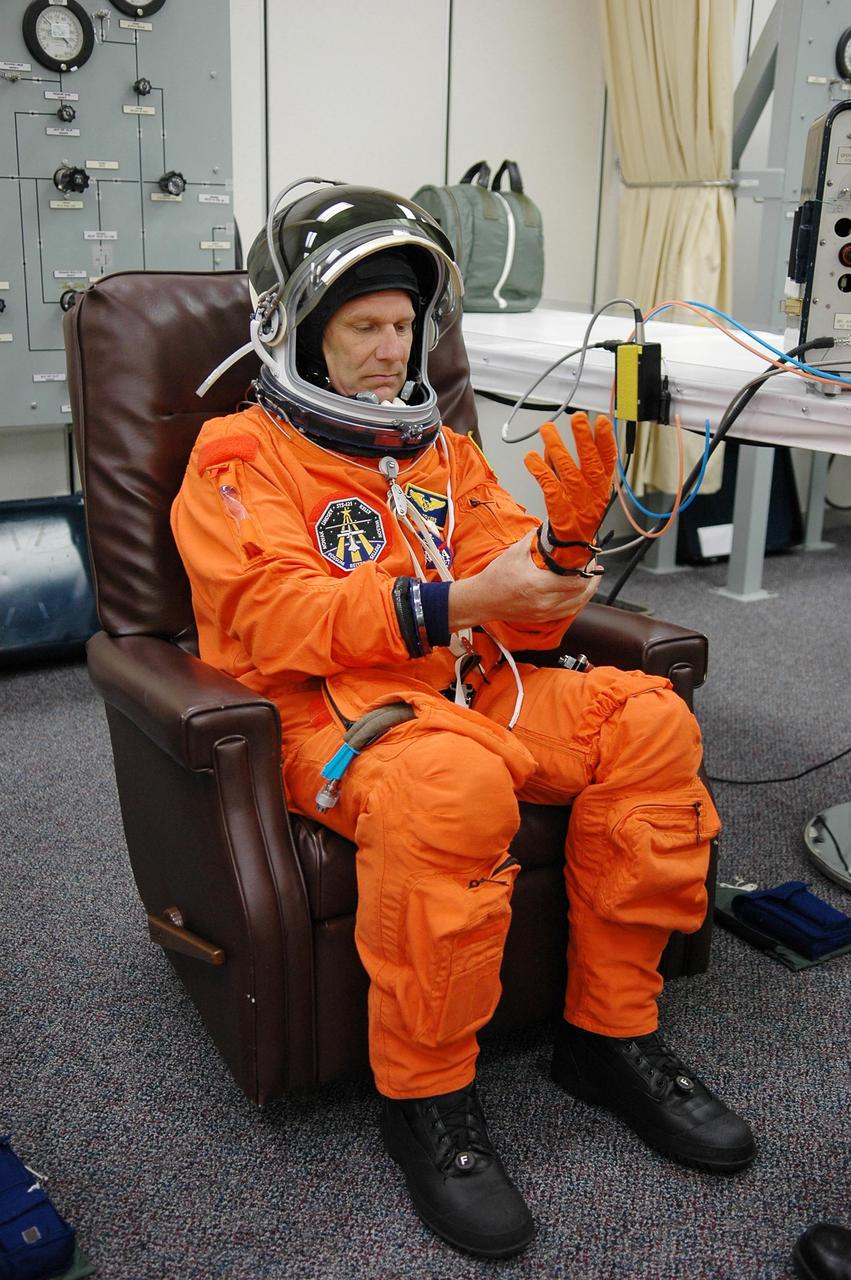
KENNEDY SPACE CENTER, FLA. - Prior to the third launch attempt on mission STS-121, Mission Specialist Piers Sellers fixes one of his gloves during suitup before heading to Launch Pad 39B. The July 2 launch attempt was scrubbed due to the presence of showers and thunderstorms within the surrounding area of the launch site. The launch of Space Shuttle Discovery on mission STS-121 is the 115th shuttle flight and the 18th U.S. flight to the International Space Station. During the 12-day mission, the STS-121 crew will test new equipment and procedures to improve shuttle safety, as well as deliver supplies and make repairs to the International Space Station. Photo credit: NASA/Kim Shiflett
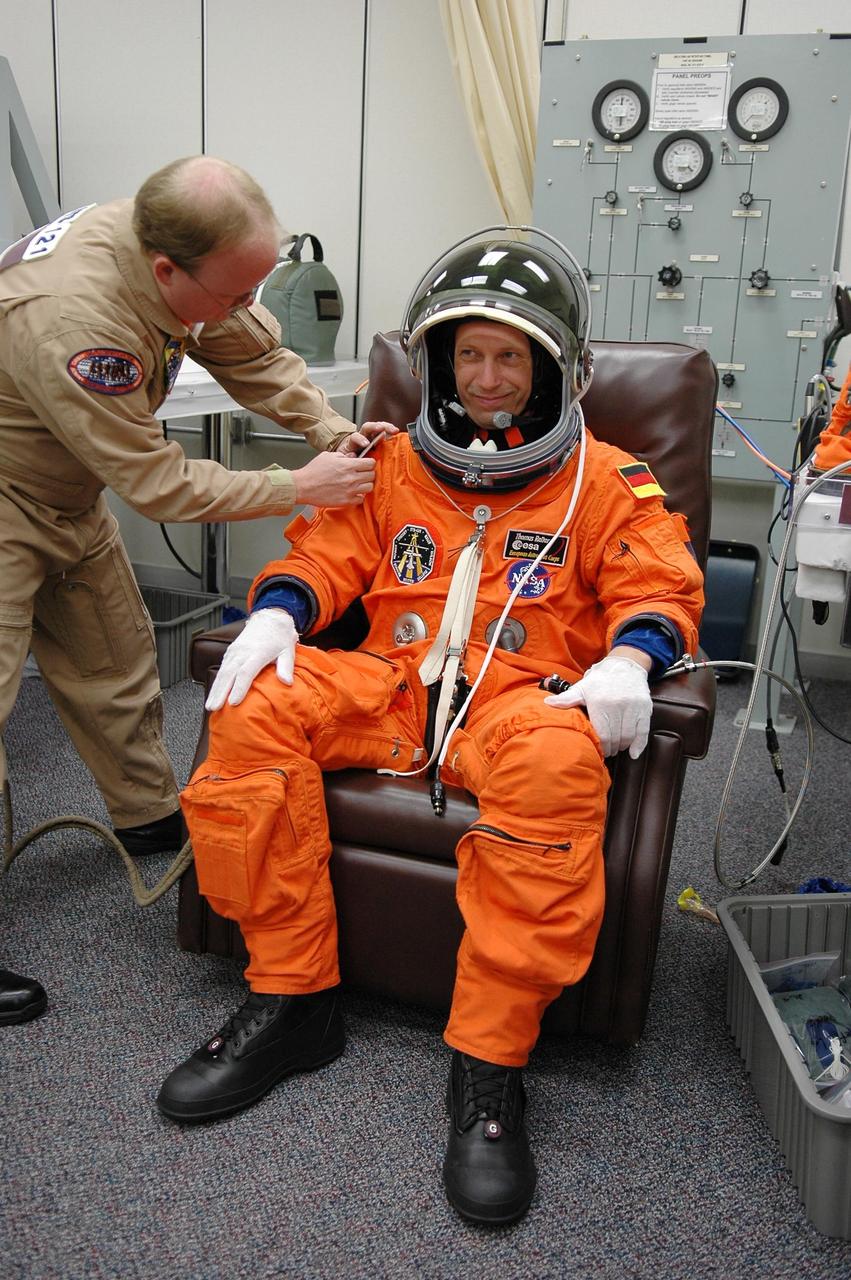
KENNEDY SPACE CENTER, FLA. - Prior to the third launch attempt on mission STS-121, Mission Specialist Thomas Reiter is helped with his launch suit before heading to Launch Pad 39B. The July 2 launch attempt was scrubbed due to the presence of showers and thunderstorms within the surrounding area of the launch site. The launch of Space Shuttle Discovery on mission STS-121 is the 115th shuttle flight and the 18th U.S. flight to the International Space Station. During the 12-day mission, the STS-121 crew will test new equipment and procedures to improve shuttle safety, as well as deliver supplies and make repairs to the International Space Station. Photo credit: NASA/Kim Shiflett
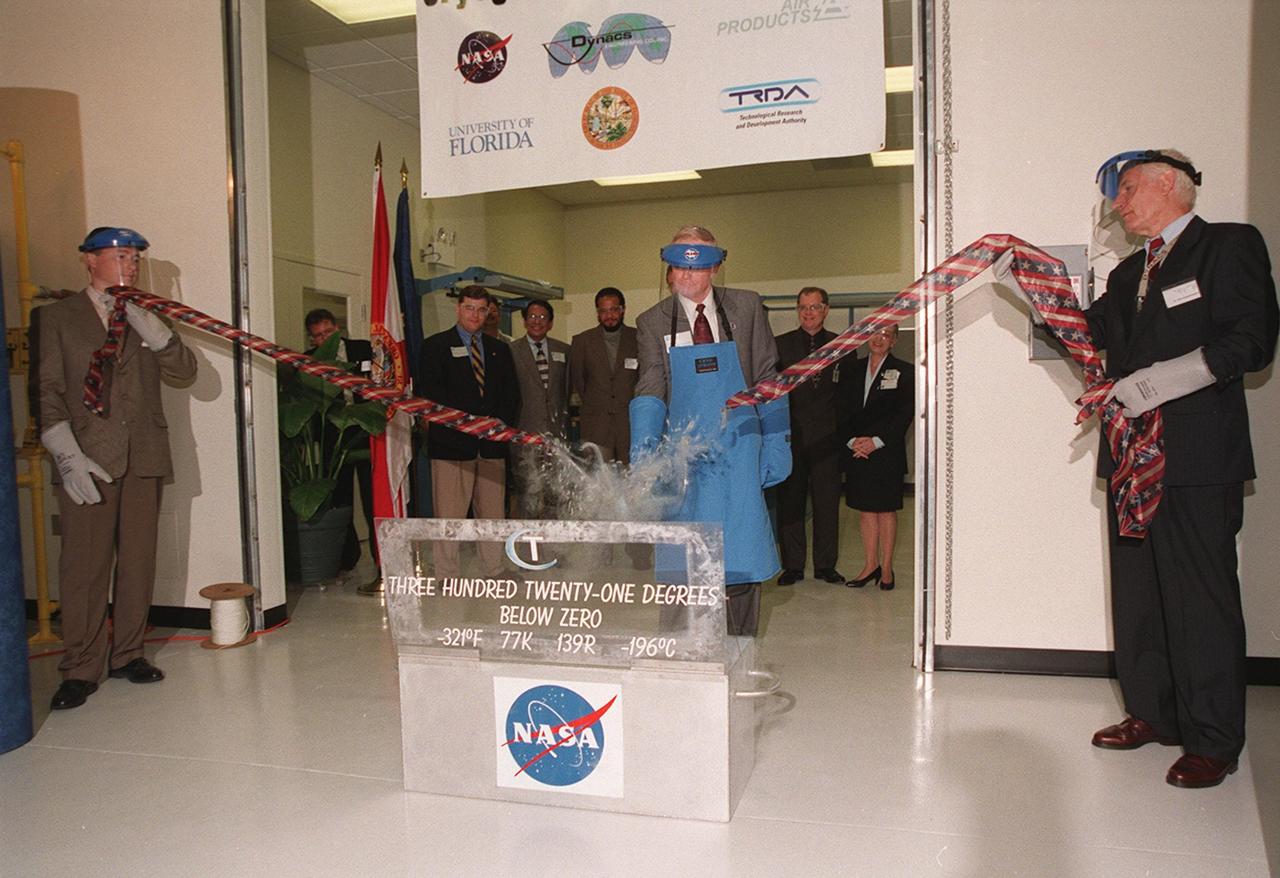
A shower of frozen plastic signifies the successful breaking of the ceremonial "ribbon" at the opening of the new Cryogenic Testbed Facility. Part of the normal ribbon was replaced with plastic tubing and frozen in liquid nitrogen for the event. Bridges hit the tubing with a small hammer to break it. The Cryogenics Testbed was built to provide cryogenics engineering development and testing services to meet the needs of industry. It will also support commercial, government and academic customers for technology development initiatives on the field of cryogenics. The facility is jointly managed by NASA and Dynacs Engineering Co. , NASA/SC's Engineering Development contractor
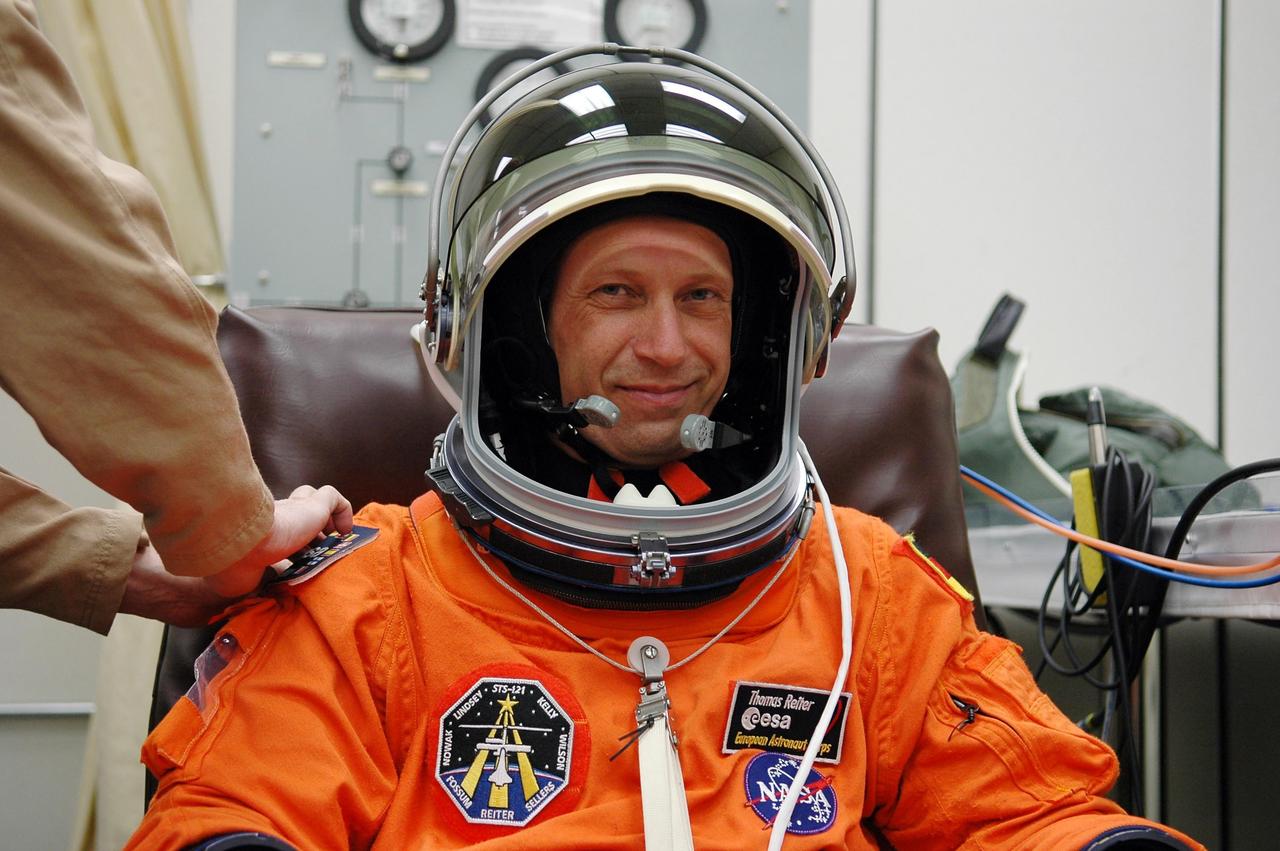
KENNEDY SPACE CENTER, FLA. - Prior to the third launch attempt on mission STS-121, Mission Specialist Thomas Reiter is suiting up before heading to Launch Pad 39B. The July 2 launch attempt was scrubbed due to the presence of showers and thunderstorms within the surrounding area of the launch site. The launch of Space Shuttle Discovery on mission STS-121 is the 115th shuttle flight and the 18th U.S. flight to the International Space Station. During the 12-day mission, the STS-121 crew will test new equipment and procedures to improve shuttle safety, as well as deliver supplies and make repairs to the International Space Station. Photo credit: NASA/Kim Shiflett
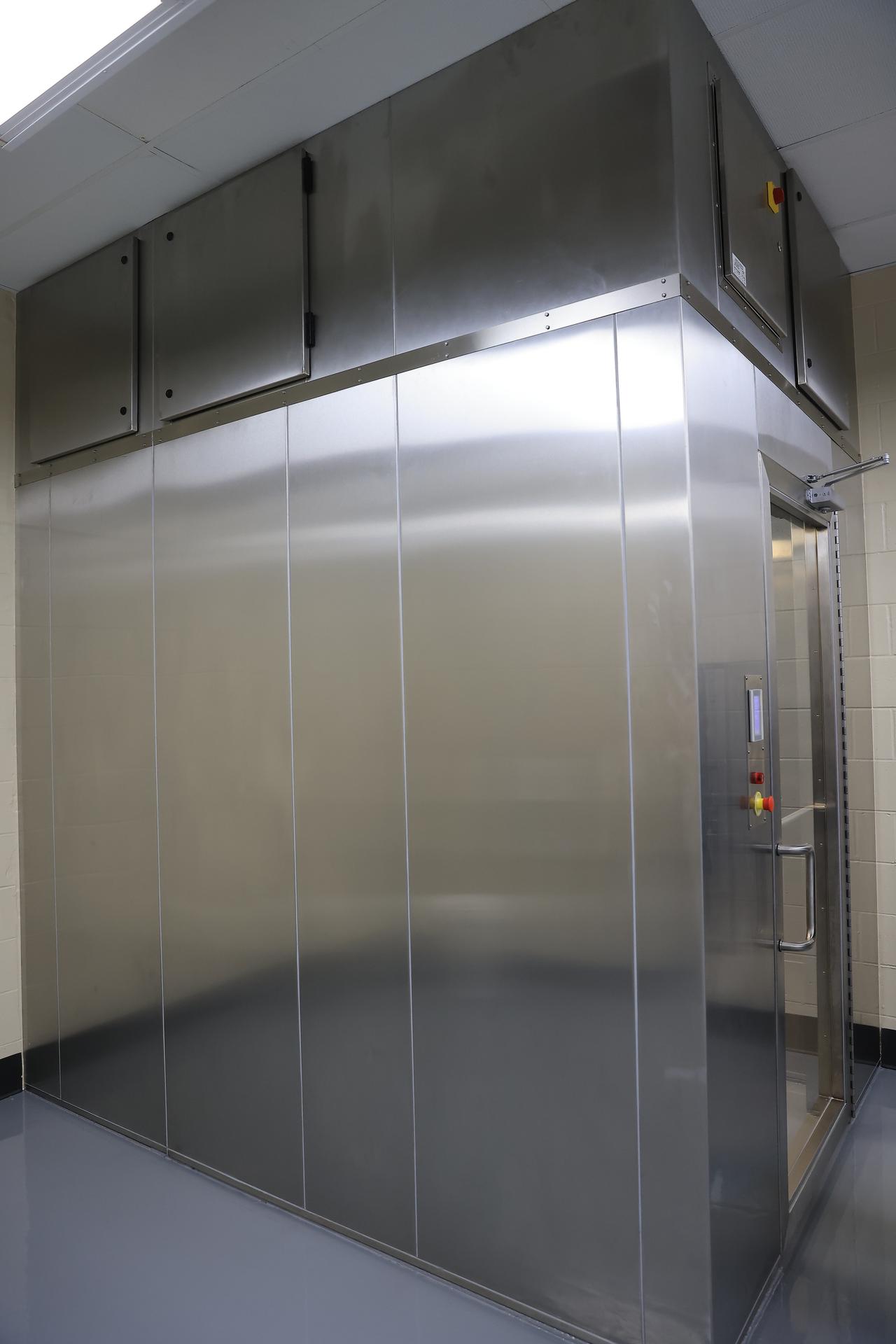
This image shows the recently upgraded air showers which blast high-velocity HEPA-filtered air onto people before they enter a clean room at NASA’s Payload Hazardous Servicing Facility at the agency’s Kennedy Space Center in Florida on Friday, Feb. 27, 2026. The PHSF went through several upgrades ahead of the arrival of Nancy Grace Roman Space Telescope. Roman will provide deep, panoramic views of the cosmos, generating never-before-seen pictures that will revolutionize our understanding of the universe. Roman will undergo several prelaunch operations, including thermal protection closeout, cleaning, solar array work, and loading hydrazine propellant.
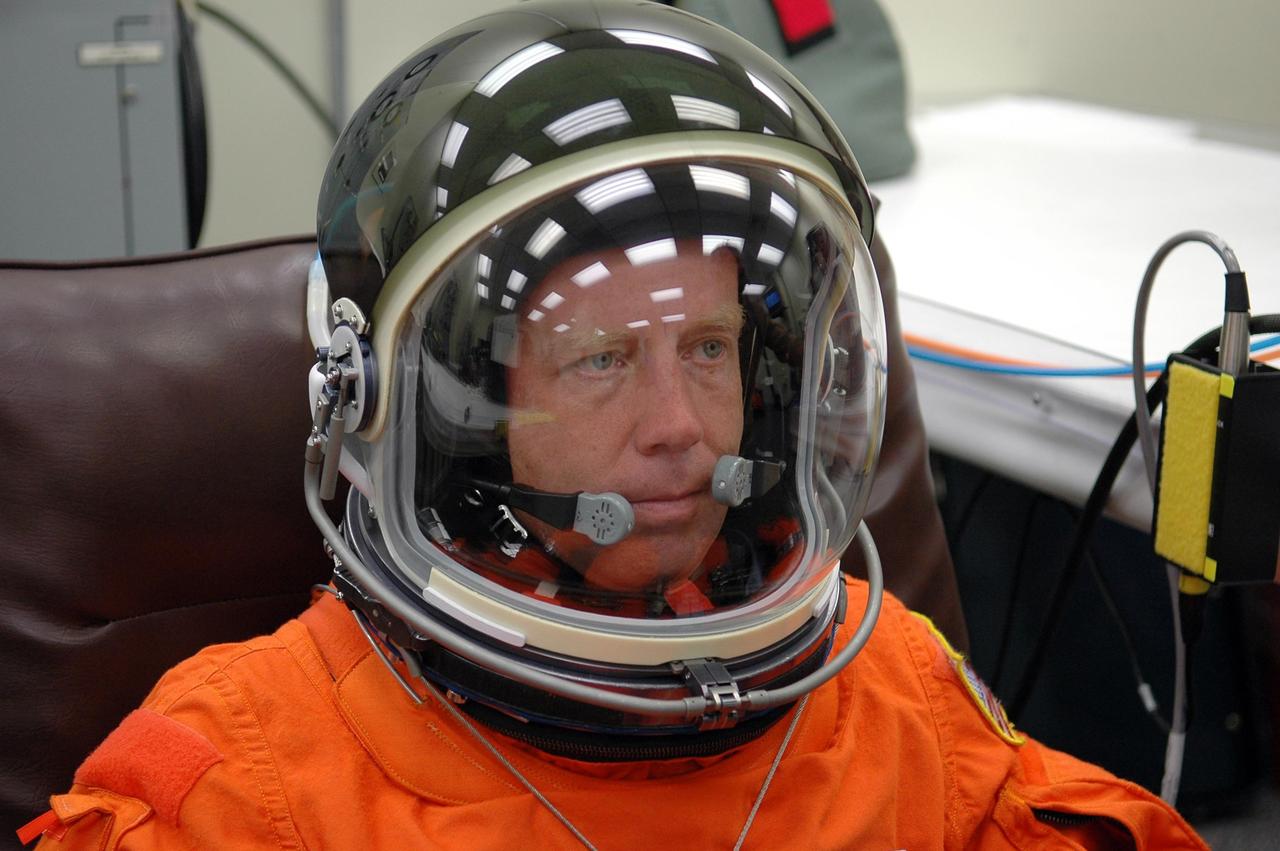
KENNEDY SPACE CENTER, FLA. - Prior to the third launch attempt on mission STS-121, Commander Steven Lindsey looks thoughtful as he completes suiting up before heading to Launch Pad 39B. The July 2 launch attempt was scrubbed due to the presence of showers and thunderstorms within the surrounding area of the launch site. The launch of Space Shuttle Discovery on mission STS-121 is the 115th shuttle flight and the 18th U.S. flight to the International Space Station. During the 12-day mission, the STS-121 crew will test new equipment and procedures to improve shuttle safety, as well as deliver supplies and make repairs to the International Space Station. Photo credit: NASA/Kim Shiflett
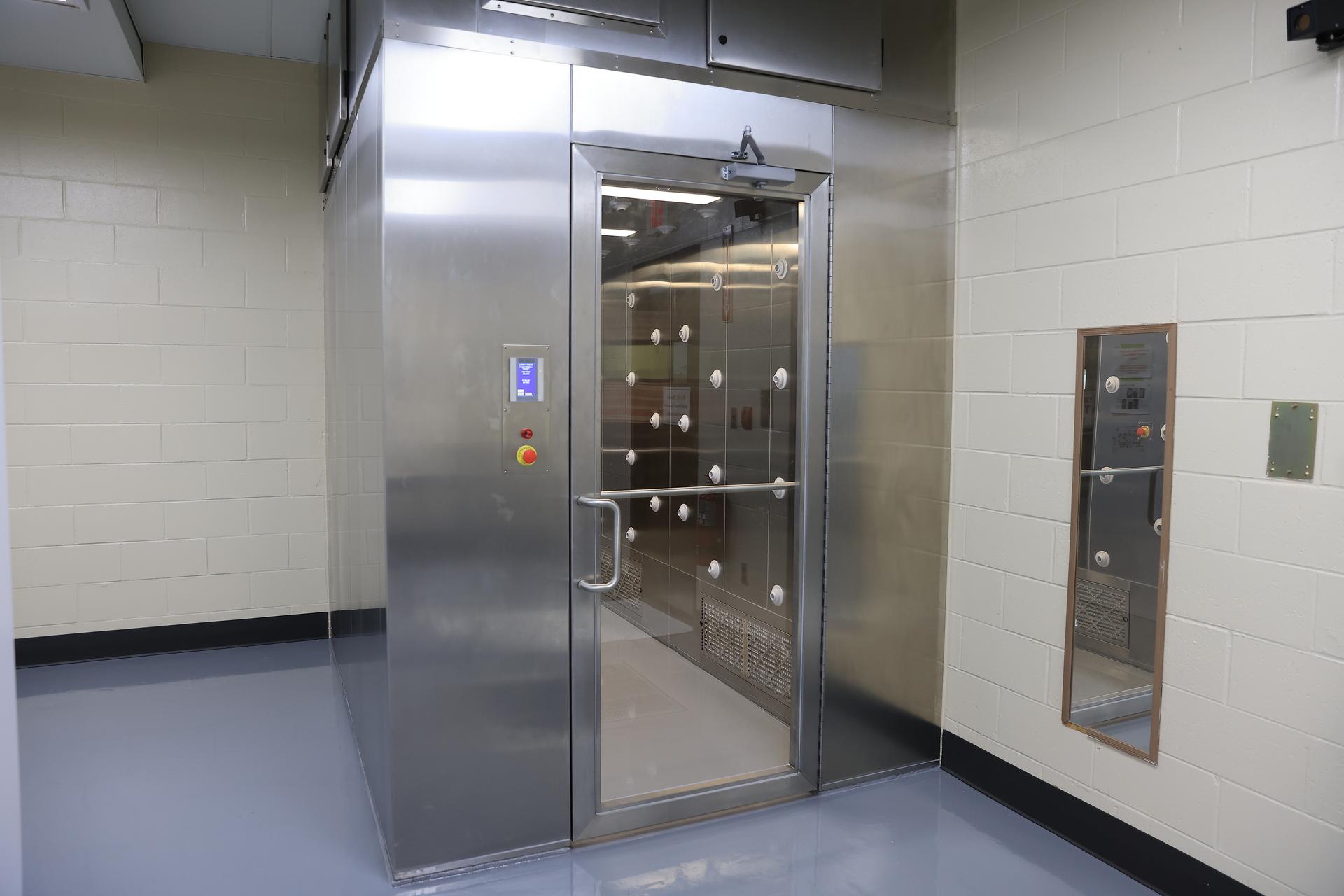
This image shows the recently upgraded air showers which blast high-velocity HEPA-filtered air onto people before they enter a clean room at NASA’s Payload Hazardous Servicing Facility at the agency’s Kennedy Space Center in Florida on Friday, Feb. 27, 2026. The PHSF went through several upgrades ahead of the arrival of Nancy Grace Roman Space Telescope. Roman will provide deep, panoramic views of the cosmos, generating never-before-seen pictures that will revolutionize our understanding of the universe. Roman will undergo several prelaunch operations, including thermal protection closeout, cleaning, solar array work, and loading hydrazine propellant.
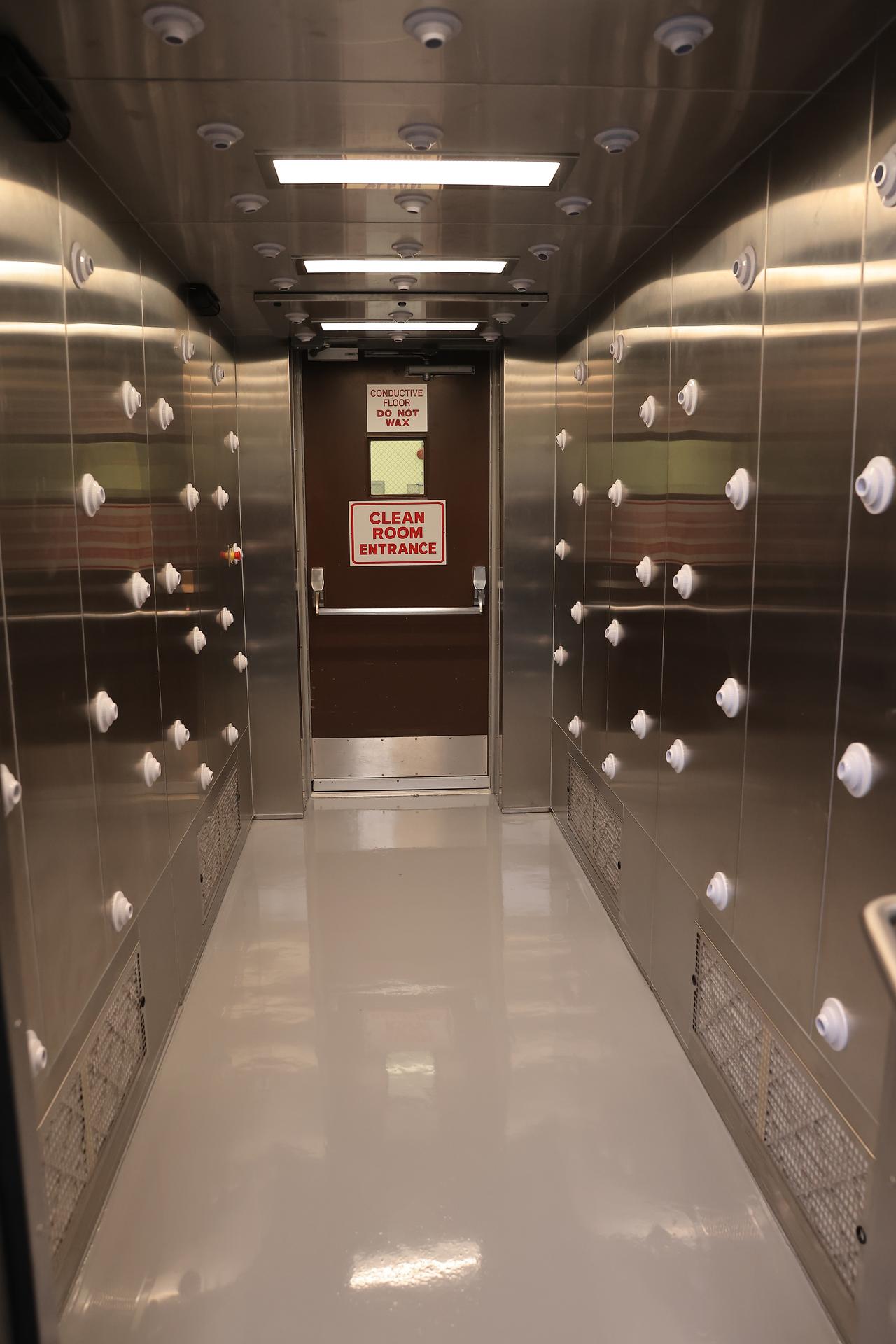
This image shows the recently upgraded air showers which blast high-velocity HEPA-filtered air onto people before they enter a clean room at NASA’s Payload Hazardous Servicing Facility at the agency’s Kennedy Space Center in Florida on Friday, Feb. 27, 2026. The PHSF went through several upgrades ahead of the arrival of Nancy Grace Roman Space Telescope. Roman will provide deep, panoramic views of the cosmos, generating never-before-seen pictures that will revolutionize our understanding of the universe. Roman will undergo several prelaunch operations, including thermal protection closeout, cleaning, solar array work, and loading hydrazine propellant.
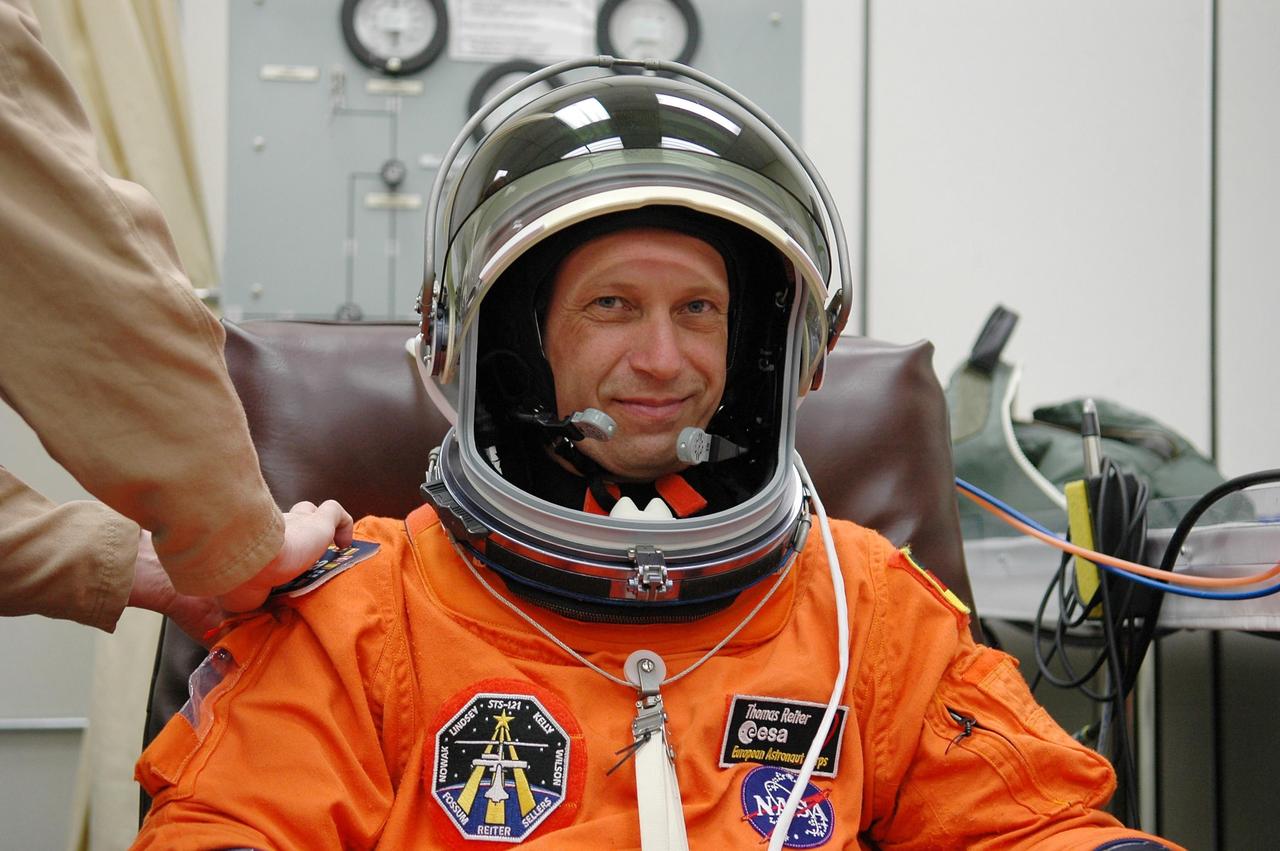
KENNEDY SPACE CENTER, FLA. - Prior to the third launch attempt on mission STS-121, Mission Specialist Thomas Reiter is helped with his helmet during suitup before heading to Launch Pad 39B. The July 2 launch attempt was scrubbed due to the presence of showers and thunderstorms within the surrounding area of the launch site. The launch of Space Shuttle Discovery on mission STS-121 is the 115th shuttle flight and the 18th U.S. flight to the International Space Station. During the 12-day mission, the STS-121 crew will test new equipment and procedures to improve shuttle safety, as well as deliver supplies and make repairs to the International Space Station. Photo credit: NASA/Kim Shiflett

KENNEDY SPACE CENTER, FLA. - Prior to the third launch attempt on mission STS-121, Mission Specialist Stephanie Wilson gets help with her helmet during suitup before heading to Launch Pad 39B. The July 2 launch attempt was scrubbed due to the presence of showers and thunderstorms within the surrounding area of the launch site. The launch of Space Shuttle Discovery on mission STS-121 is the 115th shuttle flight and the 18th U.S. flight to the International Space Station. During the 12-day mission, the STS-121 crew will test new equipment and procedures to improve shuttle safety, as well as deliver supplies and make repairs to the International Space Station. Photo credit: NASA/Kim Shiflett
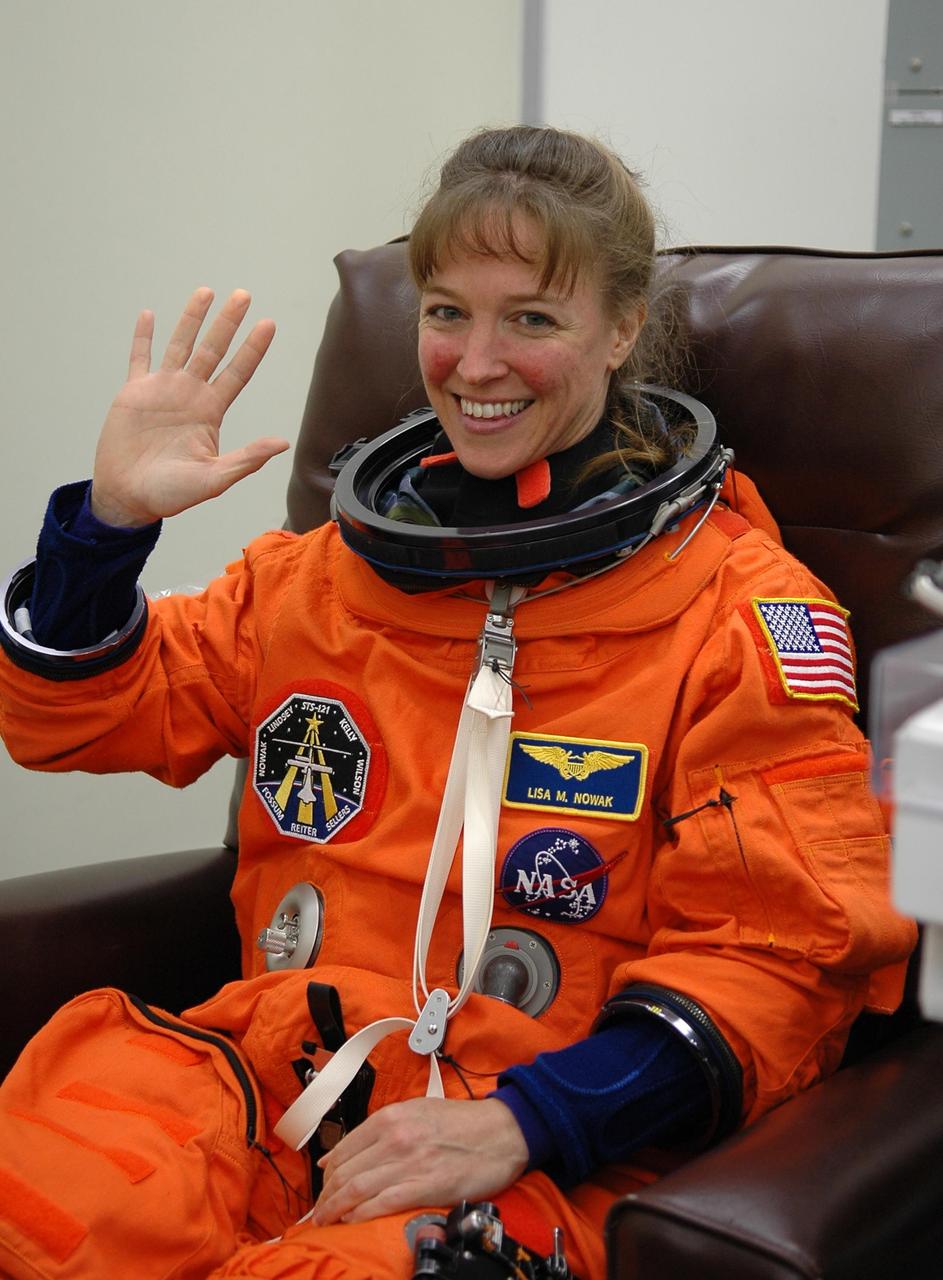
KENNEDY SPACE CENTER, FLA. - STS-121 Mission Specialist Lisa Nowak is happy to be making a third launch attempt on the mission. She is suiting up before heading to Launch Pad 39B. The July 2 launch attempt was scrubbed due to the presence of showers and thunderstorms within the surrounding area of the launch site. The launch of Space Shuttle Discovery on mission STS-121 is the 115th shuttle flight and the 18th U.S. flight to the International Space Station. During the 12-day mission, the STS-121 crew will test new equipment and procedures to improve shuttle safety, as well as deliver supplies and make repairs to the International Space Station. Photo credit: NASA/Kim Shiflett
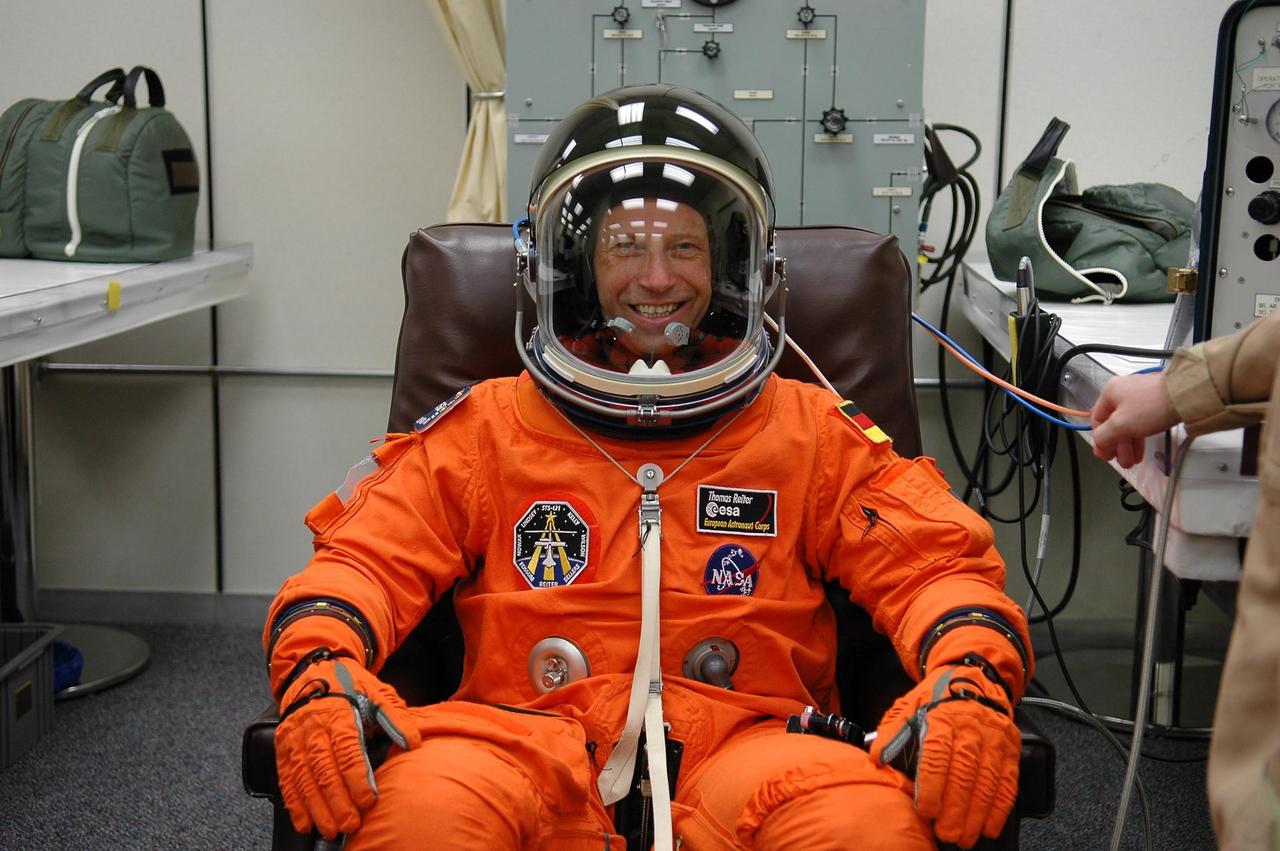
KENNEDY SPACE CENTER, FLA. - Mission Specialist Thomas Reiter, happy to be making a third launch attempt on mission STS-121, is suited up before heading to Launch Pad 39B. The July 2 launch attempt was scrubbed due to the presence of showers and thunderstorms within the surrounding area of the launch site. The launch of Space Shuttle Discovery on mission STS-121 is the 115th shuttle flight and the 18th U.S. flight to the International Space Station. During the 12-day mission, the STS-121 crew will test new equipment and procedures to improve shuttle safety, as well as deliver supplies and make repairs to the International Space Station. Photo credit: NASA/Kim Shiflett
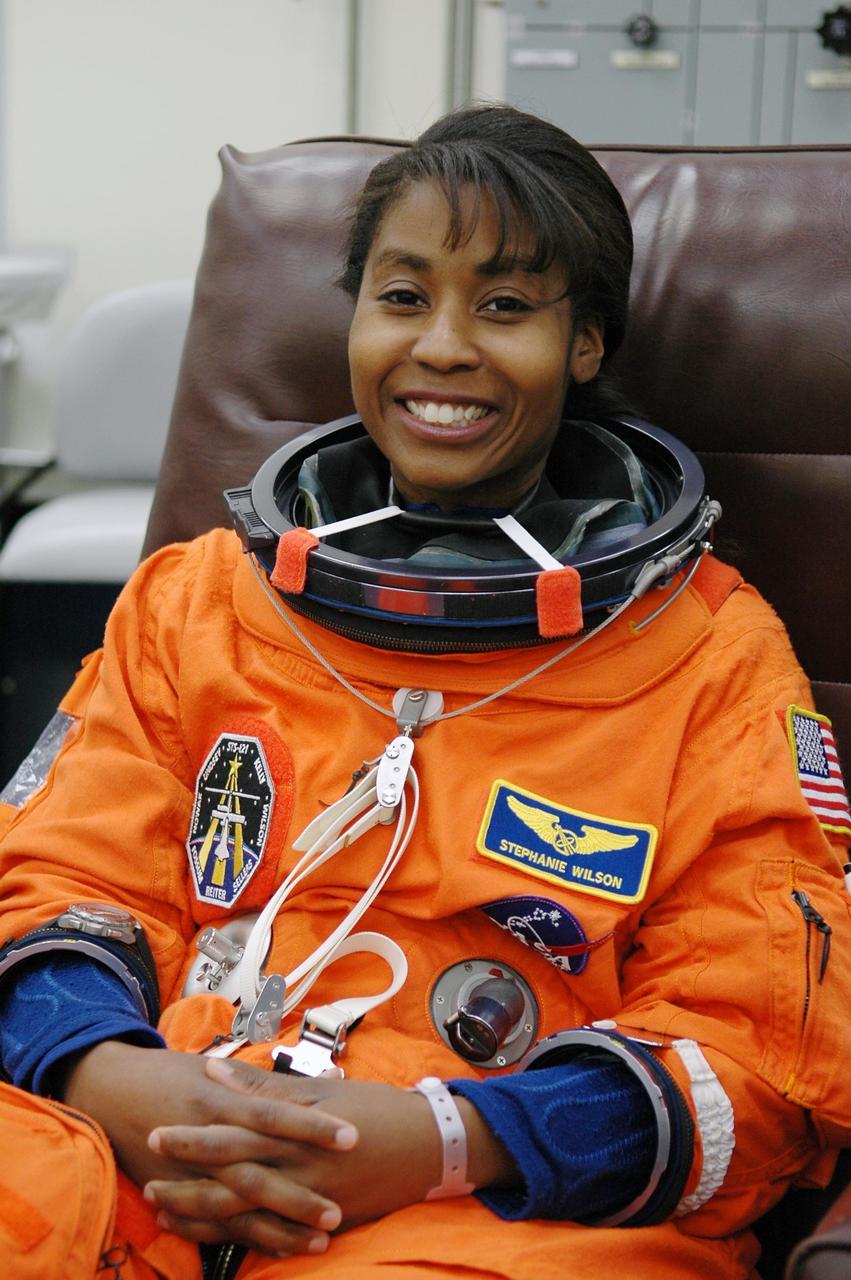
KENNEDY SPACE CENTER, FLA. - Getting ready for a third launch attempt on mission STS-121, Mission Specialist Stephanie Wilson is suiting up before heading to Launch Pad 39B. The July 2 launch attempt was scrubbed due to the presence of showers and thunderstorms within the surrounding area of the launch site. The launch of Space Shuttle Discovery on mission STS-121 is the 115th shuttle flight and the 18th U.S. flight to the International Space Station. During the 12-day mission, the STS-121 crew will test new equipment and procedures to improve shuttle safety, as well as deliver supplies and make repairs to the International Space Station. Photo credit: NASA/Kim Shiflett
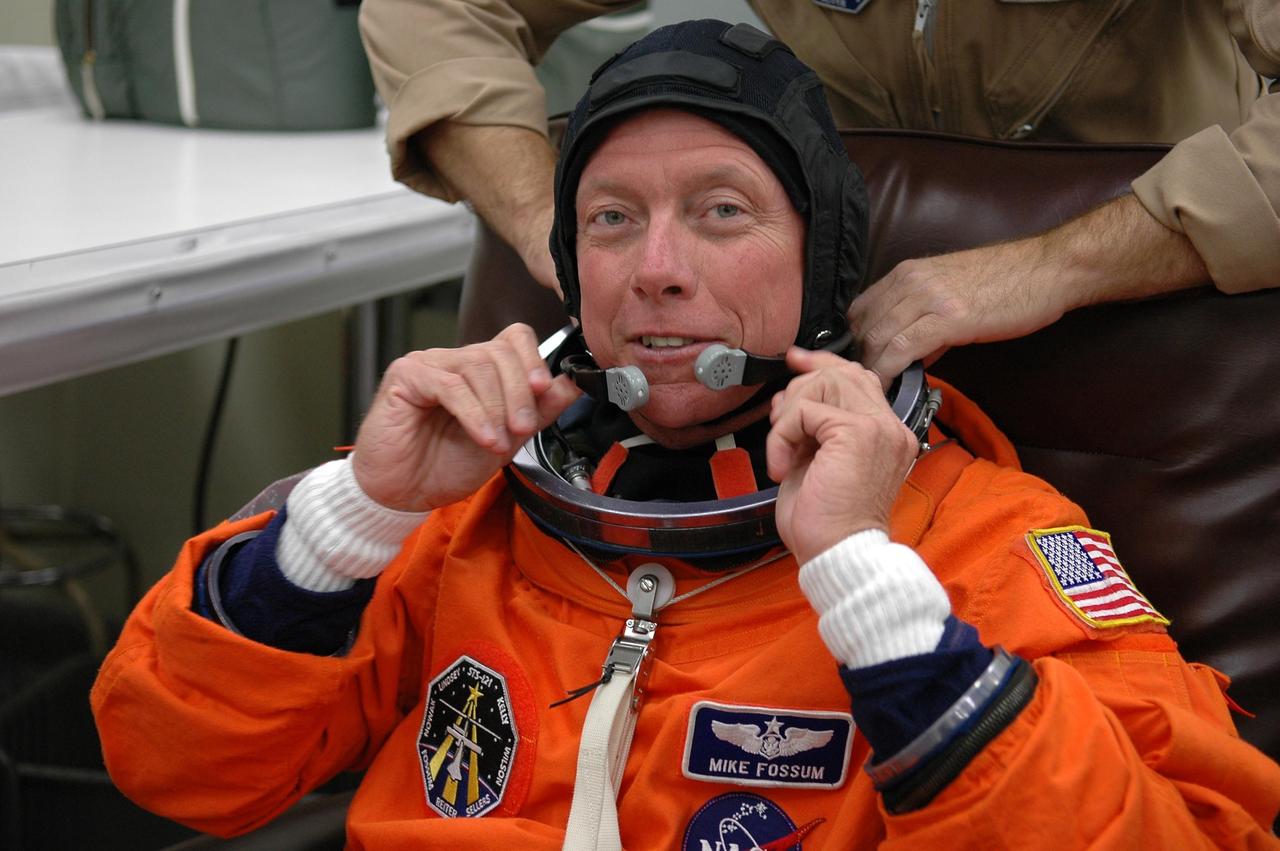
KENNEDY SPACE CENTER, FLA. - Prior to the third launch attempt on mission STS-121, Mission Specialist Michael Fossum is helped with his launch suit before heading to Launch Pad 39B. The July 2 launch attempt was scrubbed due to the presence of showers and thunderstorms within the surrounding area of the launch site. The launch of Space Shuttle Discovery on mission STS-121 is the 115th shuttle flight and the 18th U.S. flight to the International Space Station. During the 12-day mission, the STS-121 crew will test new equipment and procedures to improve shuttle safety, as well as deliver supplies and make repairs to the International Space Station. Photo credit: NASA/Kim Shiflett
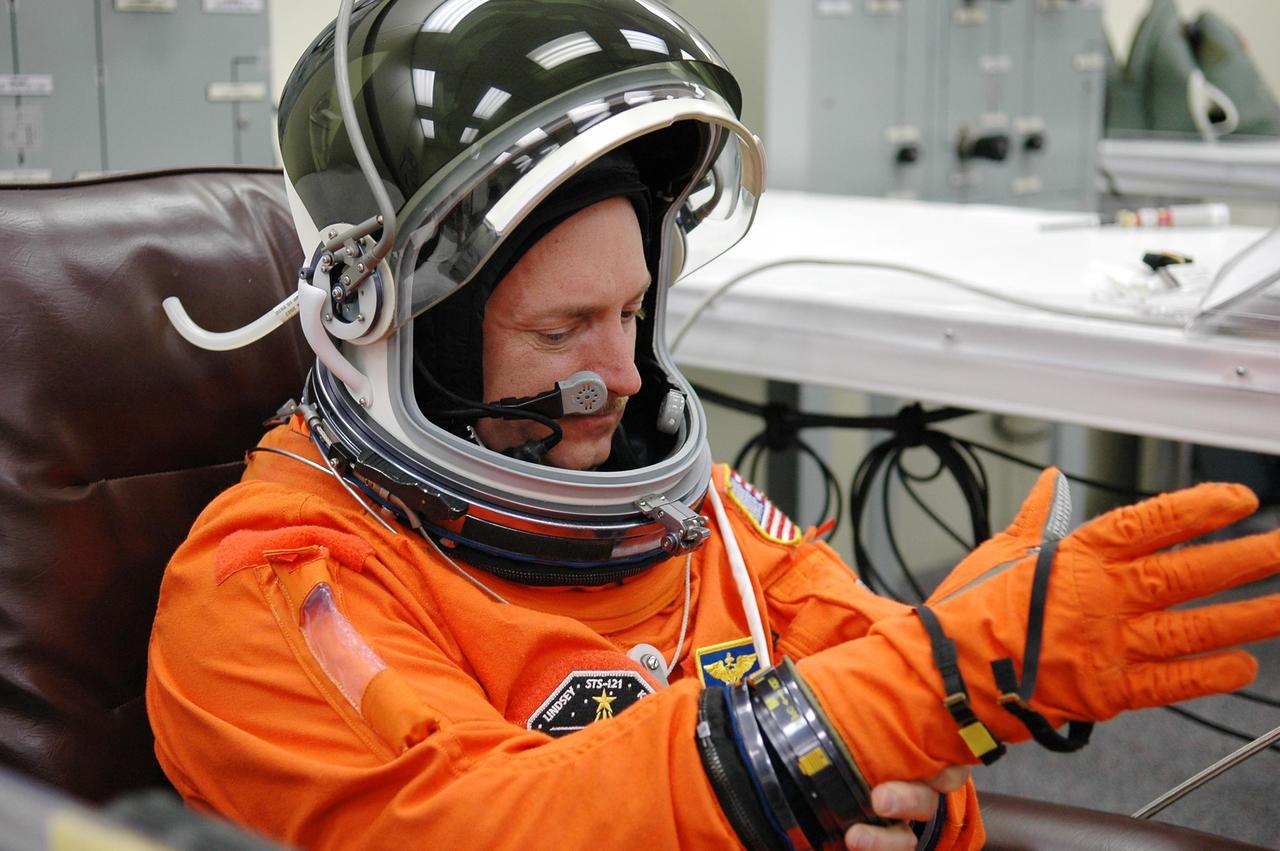
KENNEDY SPACE CENTER, FLA. - Prior to the third launch attempt on mission STS-121, Pilot Mark Kelly fixes his glove during suitup before heading to Launch Pad 39B. The July 2 launch attempt was scrubbed due to the presence of showers and thunderstorms within the surrounding area of the launch site. The launch of Space Shuttle Discovery on mission STS-121 is the 115th shuttle flight and the 18th U.S. flight to the International Space Station. During the 12-day mission, the STS-121 crew will test new equipment and procedures to improve shuttle safety, as well as deliver supplies and make repairs to the International Space Station. Photo credit: NASA/Kim Shiflett
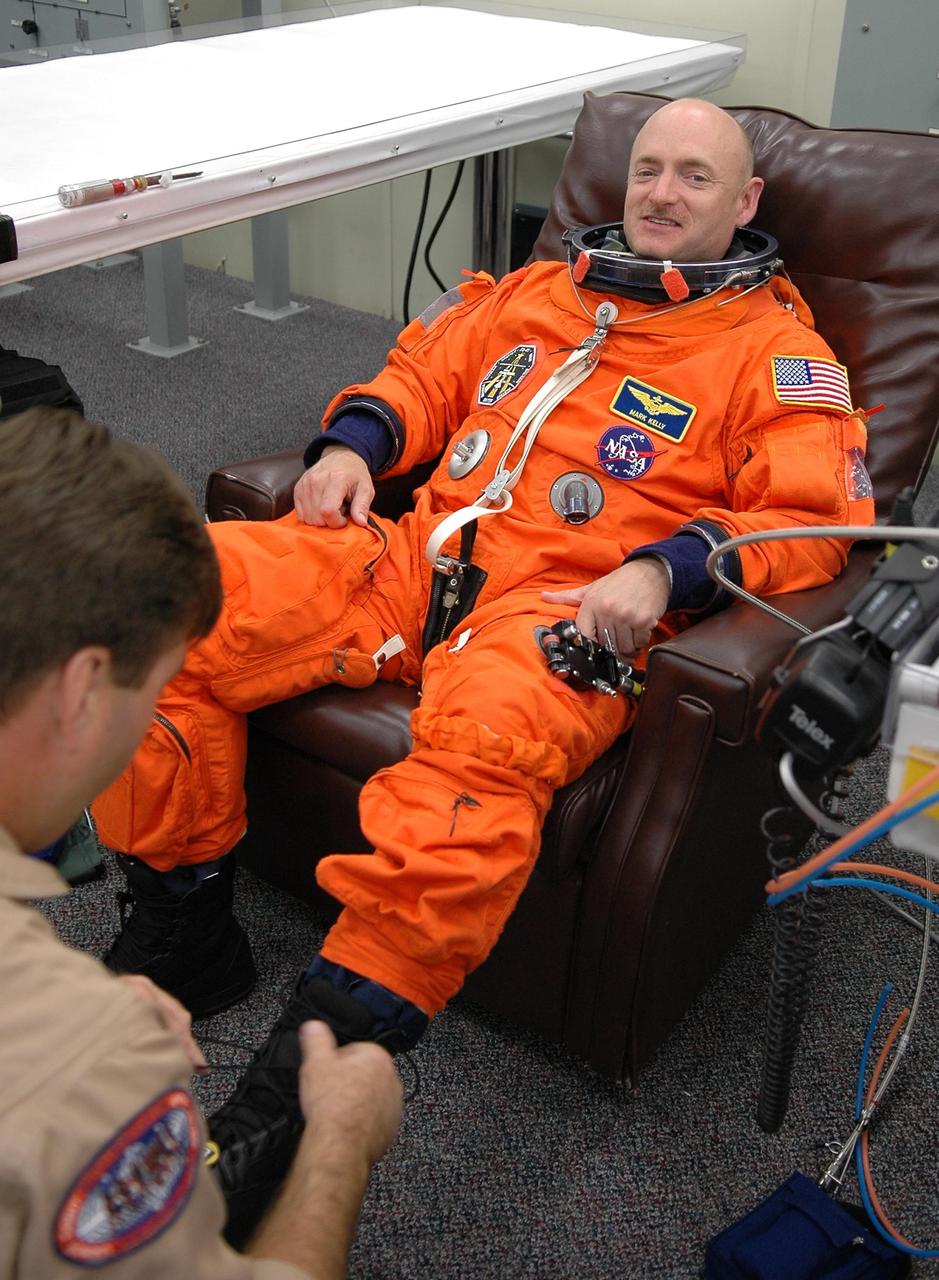
KENNEDY SPACE CENTER, FLA. - Prior to the third launch attempt on mission STS-121, Pilot Mark Kelly is helped with his boots during suitup before heading to Launch Pad 39B. The July 2 launch attempt was scrubbed due to the presence of showers and thunderstorms within the surrounding area of the launch site. The launch of Space Shuttle Discovery on mission STS-121 is the 115th shuttle flight and the 18th U.S. flight to the International Space Station. During the 12-day mission, the STS-121 crew will test new equipment and procedures to improve shuttle safety, as well as deliver supplies and make repairs to the International Space Station. Photo credit: NASA/Kim Shiflett
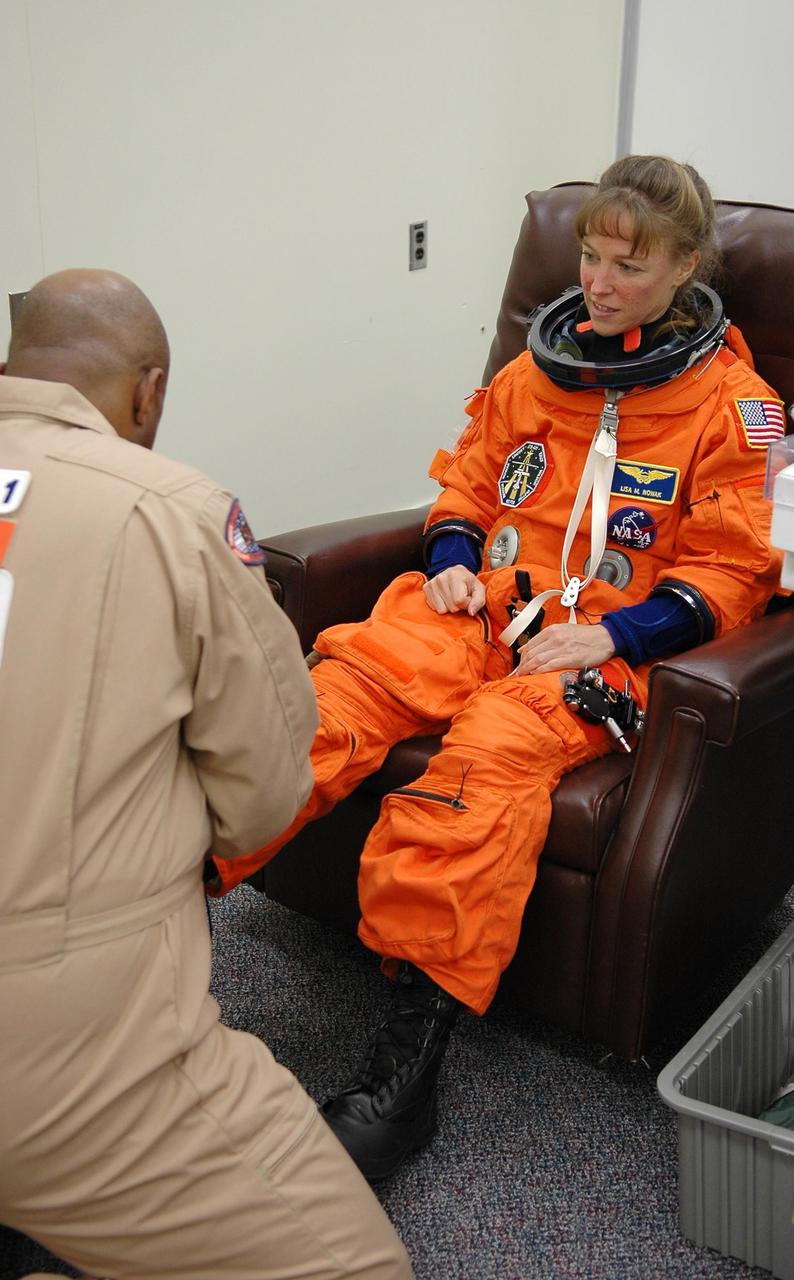
KENNEDY SPACE CENTER, FLA. - STS-121 Mission Specialist Lisa Nowak is helped with her boots during suitup before heading to Launch Pad 39B and a third launch attempt. The July 2 launch attempt was scrubbed due to the presence of showers and thunderstorms within the surrounding area of the launch site. The launch of Space Shuttle Discovery on mission STS-121 is the 115th shuttle flight and the 18th U.S. flight to the International Space Station. During the 12-day mission, the STS-121 crew will test new equipment and procedures to improve shuttle safety, as well as deliver supplies and make repairs to the International Space Station. Photo credit: NASA/Kim Shiflett

KENNEDY SPACE CENTER, FLA. - STS-121 Commander Steven Lindsey is eager for a third launch attempt on the mission. Here, he is donning his launch suit before heading to Launch Pad 39B. The July 2 launch attempt was scrubbed due to the presence of showers and thunderstorms within the surrounding area of the launch site. The launch of Space Shuttle Discovery on mission STS-121 is the 115th shuttle flight and the 18th U.S. flight to the International Space Station. During the 12-day mission, the STS-121 crew will test new equipment and procedures to improve shuttle safety, as well as deliver supplies and make repairs to the International Space Station. Photo credit: NASA/Kim Shiflett
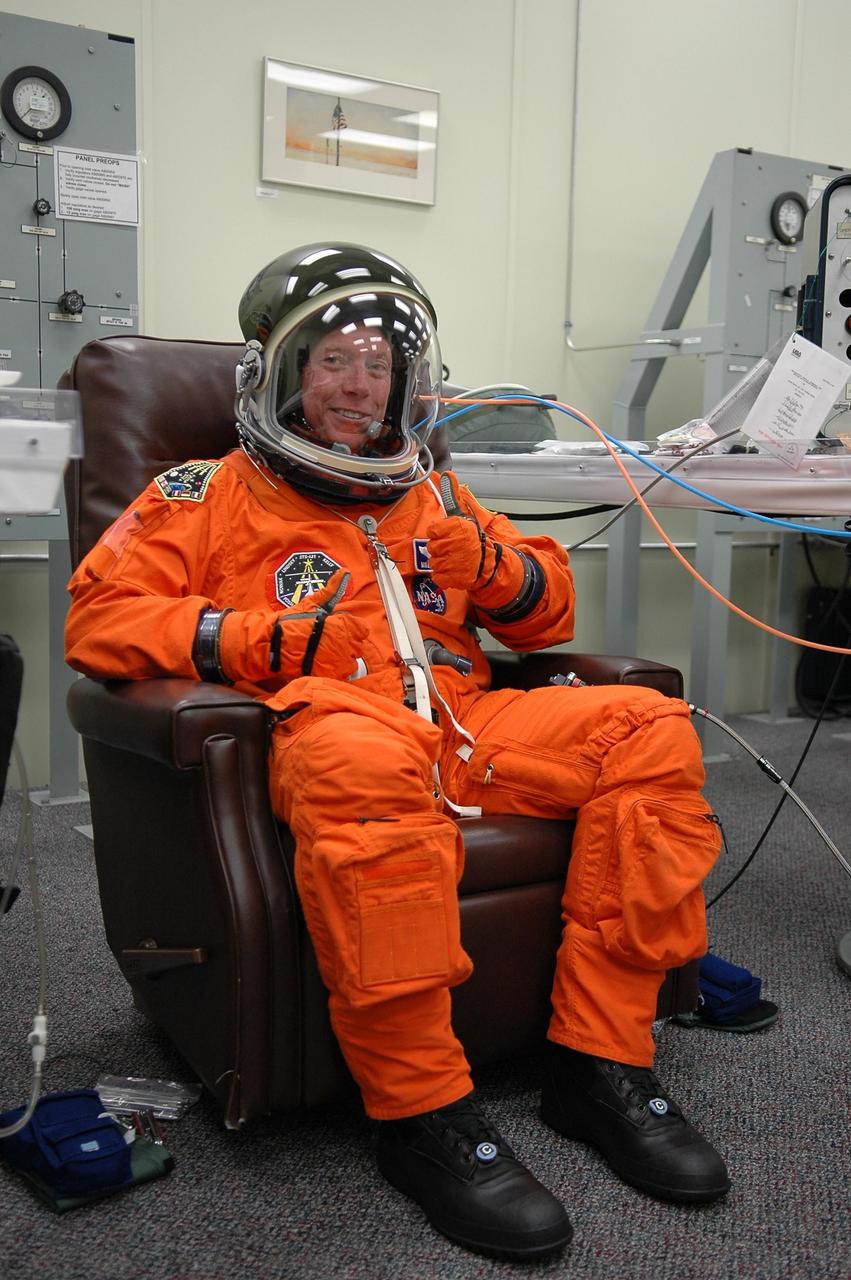
KENNEDY SPACE CENTER, FLA. - After suiting up in his launch suit, Mission Specialist Michael Fossum gives a thumbs up for a third launch attempt on mission STS-121. The July 2 launch attempt was scrubbed due to the presence of showers and thunderstorms within the surrounding area of the launch site. The launch of Space Shuttle Discovery on mission STS-121 is the 115th shuttle flight and the 18th U.S. flight to the International Space Station. During the 12-day mission, the STS-121 crew will test new equipment and procedures to improve shuttle safety, as well as deliver supplies and make repairs to the International Space Station. Photo credit: NASA/Kim Shiflett
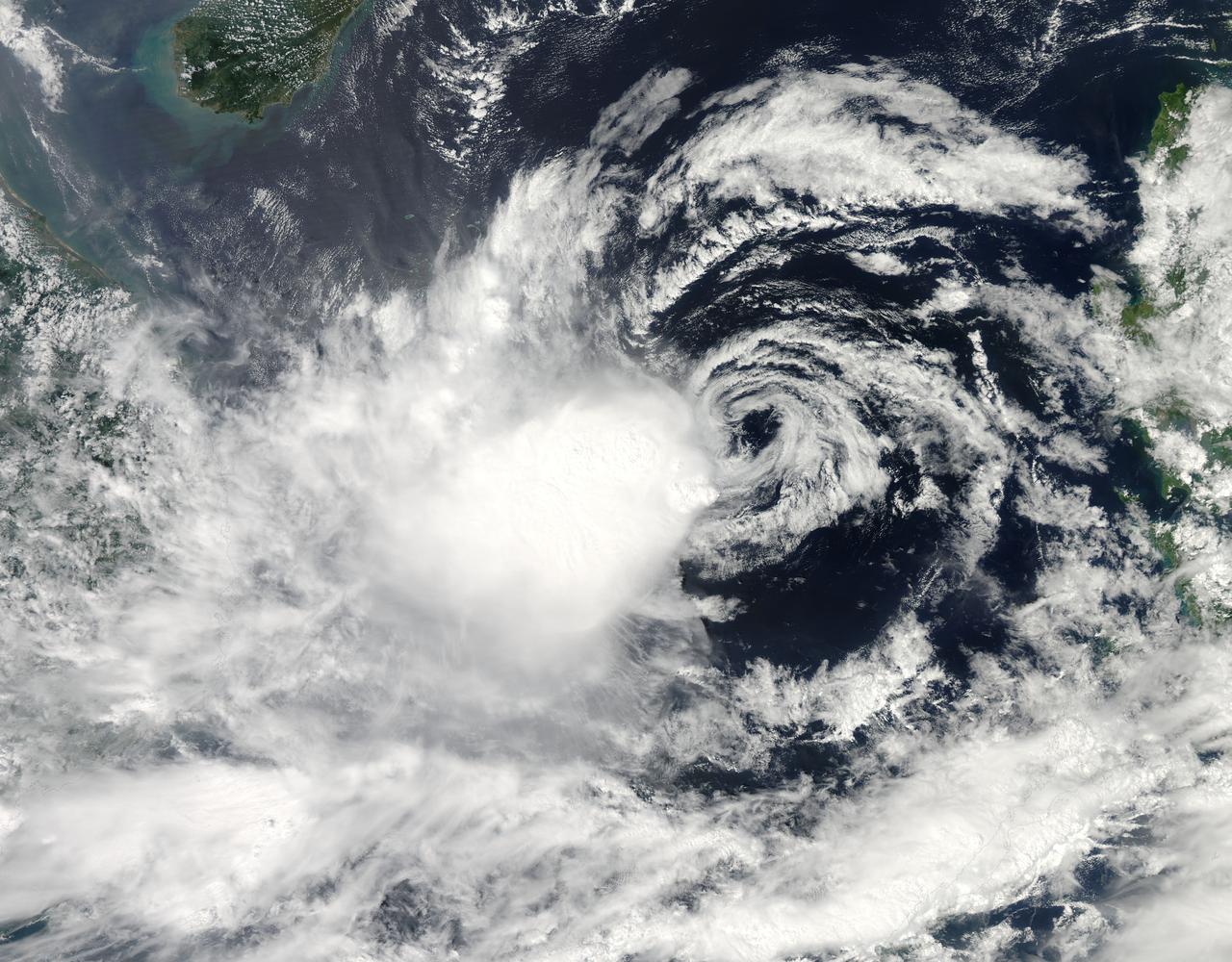
It is easy to see the effect of the strong northeasterly wind shear battering Tropical Storm Gaemi in satellite imagery from NASA. This true-color image acquired on Oct. 5 shows a large oval-shaped area of showers and thunderstorms associated with the storm, southwest of the exposed center of circulation. NASA's Aqua satellite passed over Tropical Storm Gaemi as it was approaching Vietnam on Oct. 5, 2012 at 0550 UTC (1:50 a.m. EDT). A true-color image of the storm was captured by the Moderate Resolution Imaging Spectroradiometer (MODIS) instrument and shows bulk of showers and thunderstorms were clearly to the southwest of the center. The circulation center appears as a ring of concentric bands of clouds northeast of the large rounded area of clouds and showers associated with the storm. On Tuesday, October 5, 2012 at 1500 UTC (11 a.m. EDT), Tropical Storm Gaemi still had maximum sustained winds near 35 knots (40 mph/65 km/h) as it did 24 hours before. It was located 425 nautical miles (489 miles/787 km) east of Hue, Vietnam near 14.7 North latitude and 117.7 East longitude. Early on October 7, Tropical Storm Gaemi made landfall over Vietnam with wind speeds reported at 34 mph (55 mph), and bringing rainfall of more than 4 inches in some areas of Vietnam. Once ashore, the storm quickly moved inland and rapidly weakened as it headed towards Cambodia. With winds reduced, Gaemi served primarily as a rainmaker, but the rain may bring flooding and landslides to the region. Credit: NASA/GSFC/Jeff Schmaltz/MODIS Land Rapid Response Team <b><a href="http://www.nasa.gov/audience/formedia/features/MP_Photo_Guidelines.html" rel="nofollow">NASA image use policy.</a></b> <b><a href="http://www.nasa.gov/centers/goddard/home/index.html" rel="nofollow">NASA Goddard Space Flight Center</a></b> enables NASA’s mission through four scientific endeavors: Earth Science, Heliophysics, Solar System Exploration, and Astrophysics. Goddard plays a leading role in NASA’s accomplishments by contributing compelling scientific knowledge to advance the Agency’s mission. <b>Follow us on <a href="http://twitter.com/NASA_GoddardPix" rel="nofollow">Twitter</a></b> <b>Like us on <a href="http://www.facebook.com/pages/Greenbelt-MD/NASA-Goddard/395013845897?ref=tsd" rel="nofollow">Facebook</a></b> <b>Find us on <a href="http://instagrid.me/nasagoddard/?vm=grid" rel="nofollow">Instagram</a></b>
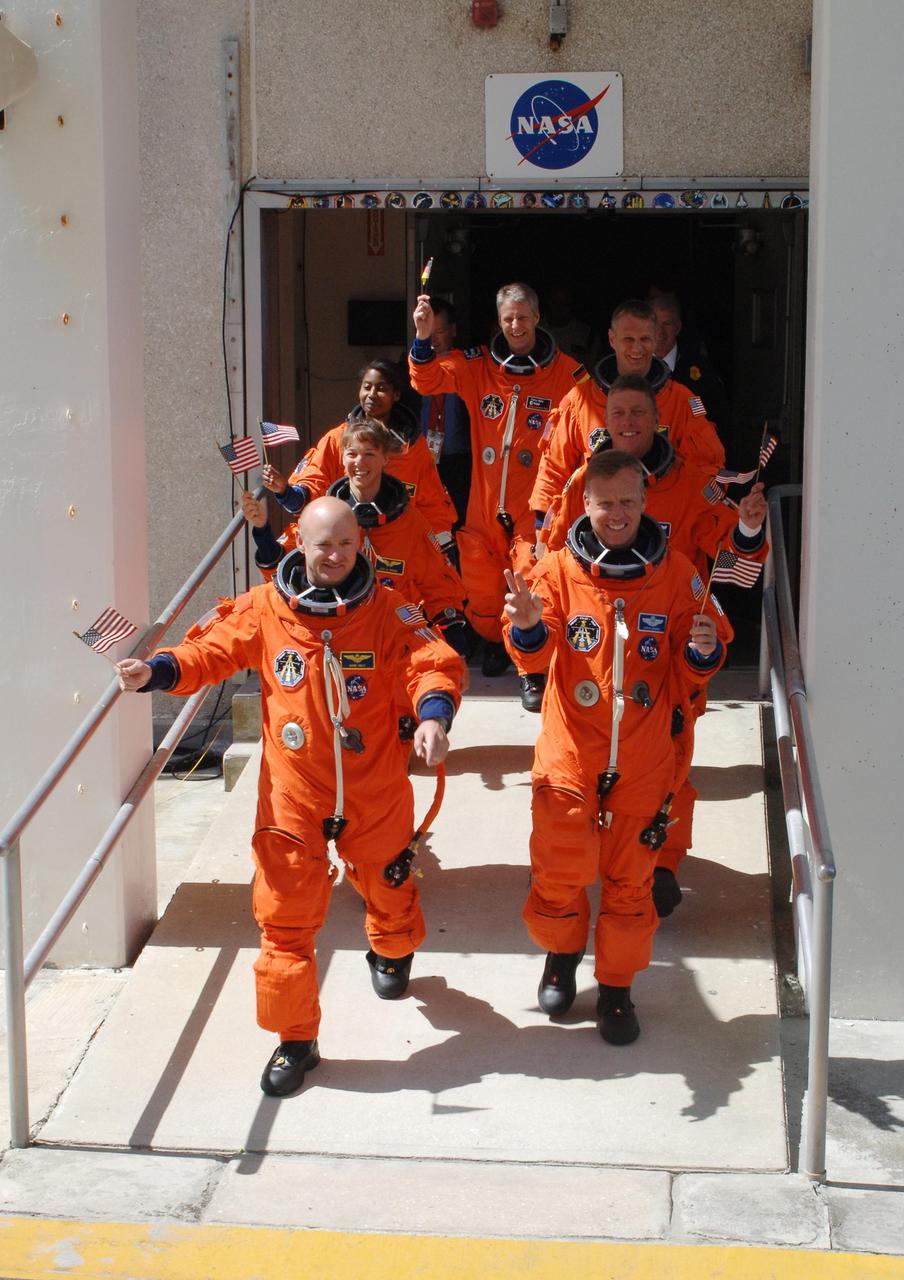
KENNEDY SPACE CENTER, FLA. - The STS-121 crew displays the spirit of the Fourth of July holiday with their flags and their eagerness to launch as they stride out of the Operations and Checkout Building. Leading the way are Pilot Mark Kelly (left) and Commander Steven Lindsey (right). Behind them are Mission Specialists (second row) Lisa Nowak and Michael Fossum; (third row) Stephanie Wilson and Piers Sellers; and (at the rear) Thomas Reiter, who represents the European Space Agency. The July 2 launch attempt was scrubbed due to the presence of showers and thunderstorms within the surrounding area of the launch site. The launch of Space Shuttle Discovery on mission STS-121 is the 115th shuttle flight and the 18th U.S. flight to the International Space Station. During the 12-day mission, the STS-121 crew will test new equipment and procedures to improve shuttle safety, as well as deliver supplies and make repairs to the International Space Station. Photo credit: NASA/Kim Shiflett
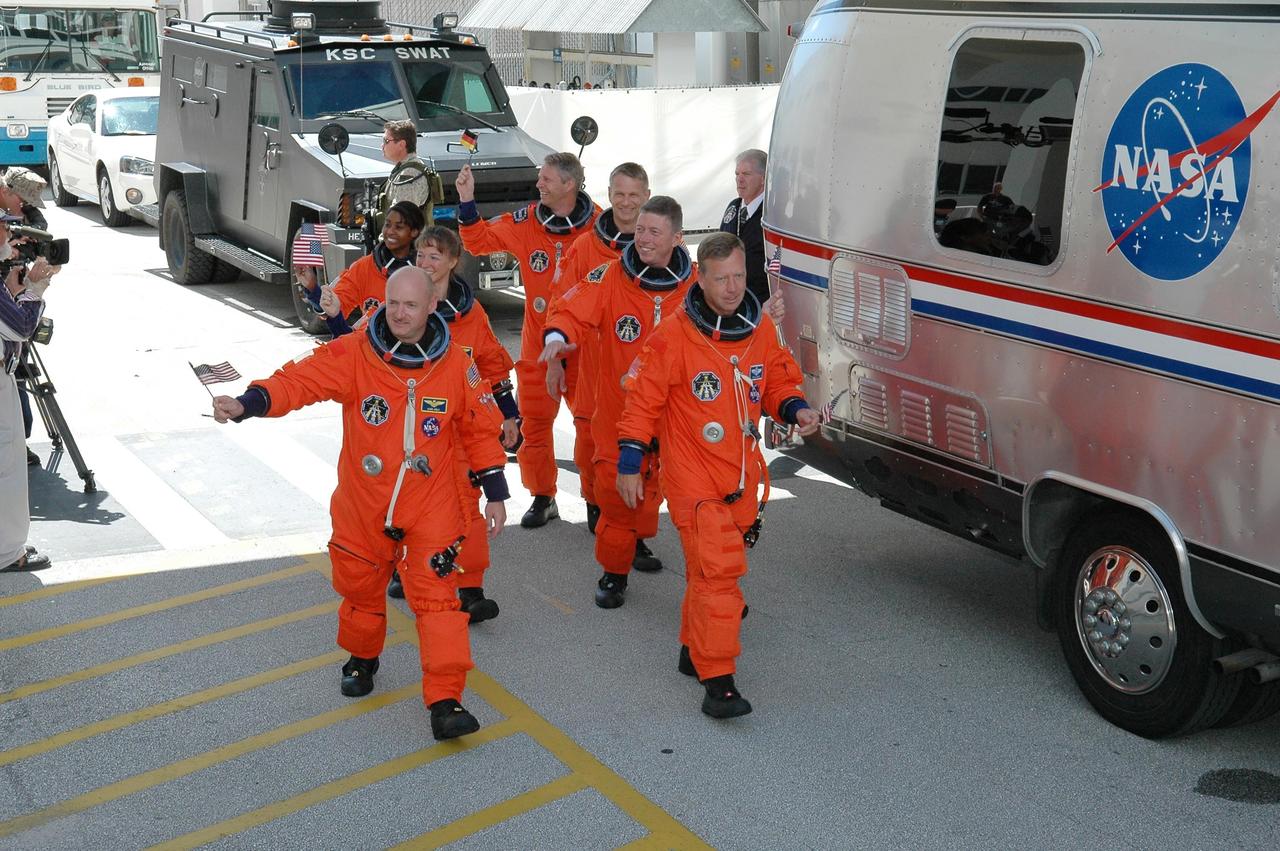
KENNEDY SPACE CENTER, FLA. - Waving flags for the Fourth of July, the STS-121 crew heads for the Astrovan and the ride to Launch Pad 39B for a third launch attempt. Leading the way are Pilot Mark Kelly (left) and Commander Steven Lindsey (right). Behind them are, left and right, Mission Specialists (second row) Lisa Nowak and Michael Fossum; (third row) Stephanie Wilson and Piers Sellers; and (at the rear) Thomas Reiter, who represents the European Space Agency. The July 2 launch attempt was scrubbed due to the presence of showers and thunderstorms within the surrounding area of the launch site. The launch of Space Shuttle Discovery on mission STS-121 is the 115th shuttle flight and the 18th U.S. flight to the International Space Station. During the 12-day mission, the STS-121 crew will test new equipment and procedures to improve shuttle safety, as well as deliver supplies and make repairs to the International Space Station. Photo credit: NASA/Kim Shiflett
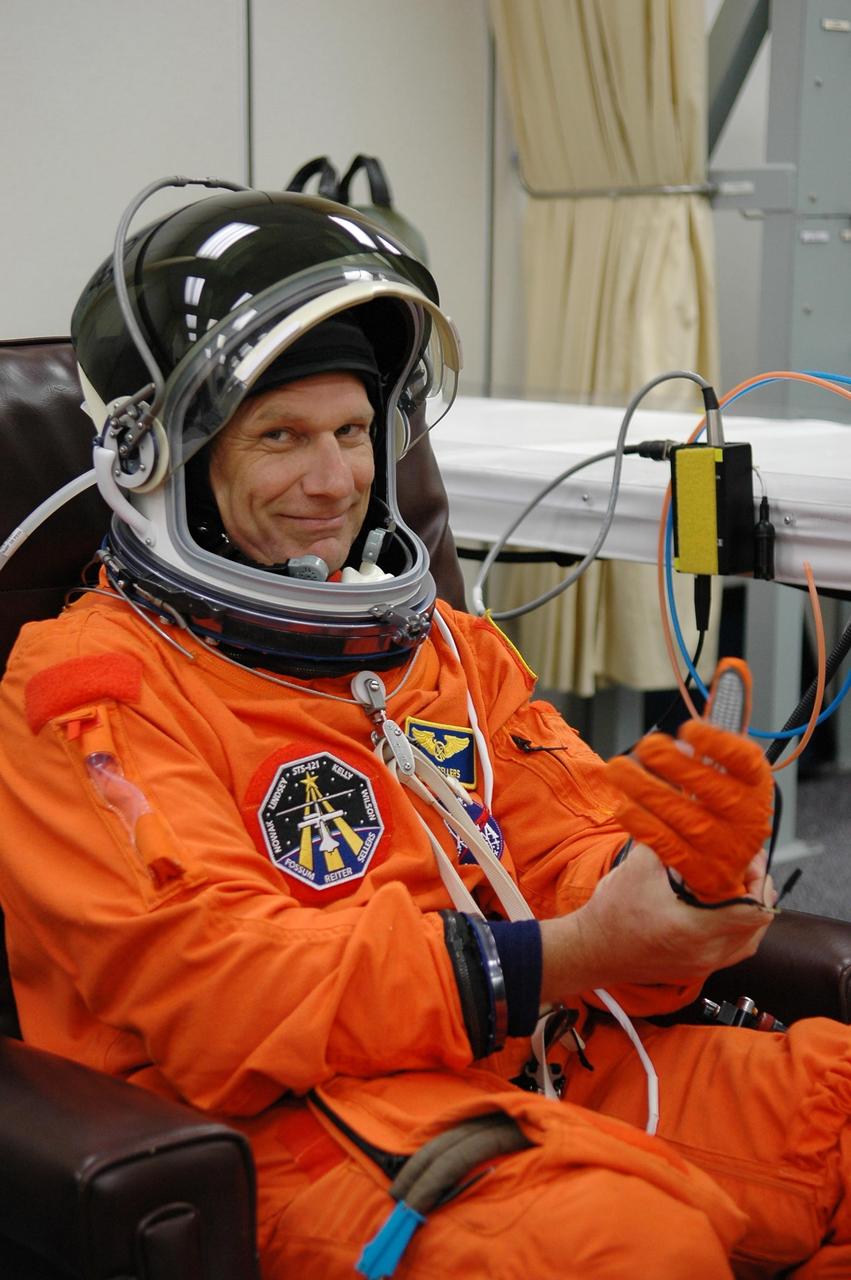
KENNEDY SPACE CENTER, FLA. - Mission Specialist Piers Sellers is happy to be making a third launch attempt on mission STS-121. Here, he fixes one of his gloves during suitup before heading to Launch Pad 39B. The July 2 launch attempt was scrubbed due to the presence of showers and thunderstorms within the surrounding area of the launch site. The launch of Space Shuttle Discovery on mission STS-121 is the 115th shuttle flight and the 18th U.S. flight to the International Space Station. During the 12-day mission, the STS-121 crew will test new equipment and procedures to improve shuttle safety, as well as deliver supplies and make repairs to the International Space Station. Photo credit: NASA/Kim Shiflett
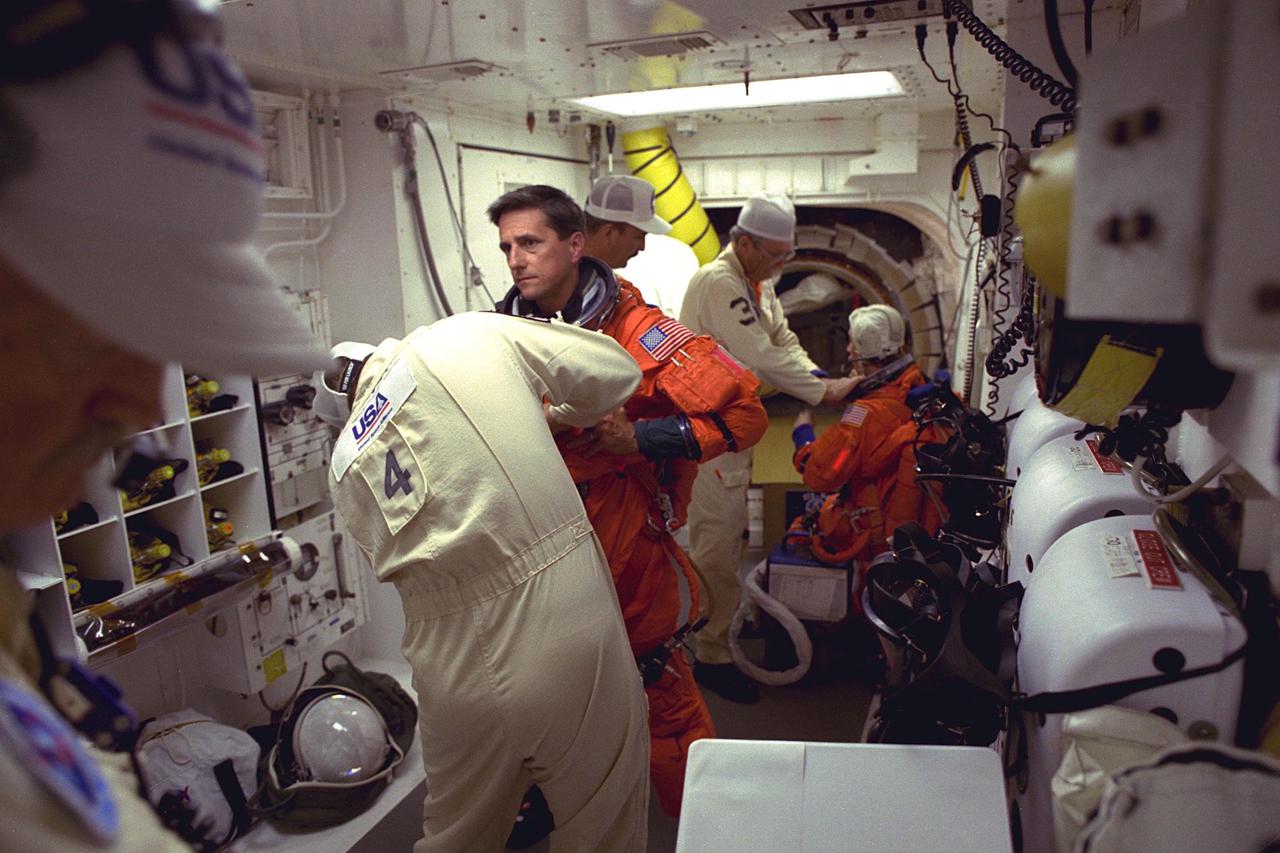
STS-94 Mission Specialist Donald A. Thomas prepares to enter the Space Shuttle Columbia at Launch Pad 39A in preparation for launch. He has flown on STS-83, STS-70 and STS-65. He holds a doctorate in materials science and has been the Principal Investigator for a Space Shuttle crystal growth experiment. Because of his background in materials science, Thomas will be concentrating his efforts during the Red shift on the five experiments in this discipline in the Large Isothermal Furnace. He also will work on the ten materials science investigations in the Electromagnetic Containerless Processing Facility and four that will be measuring the effects of microgravity and motion in the orbiter on the experiments. Thomas and six fellow crew members will lift off during a launch window that opens at 1:50 p.m. EDT, July 1. The launch window will open 47 minutes early to improve the opportunity to lift off before Florida summer rain showers reach the space center
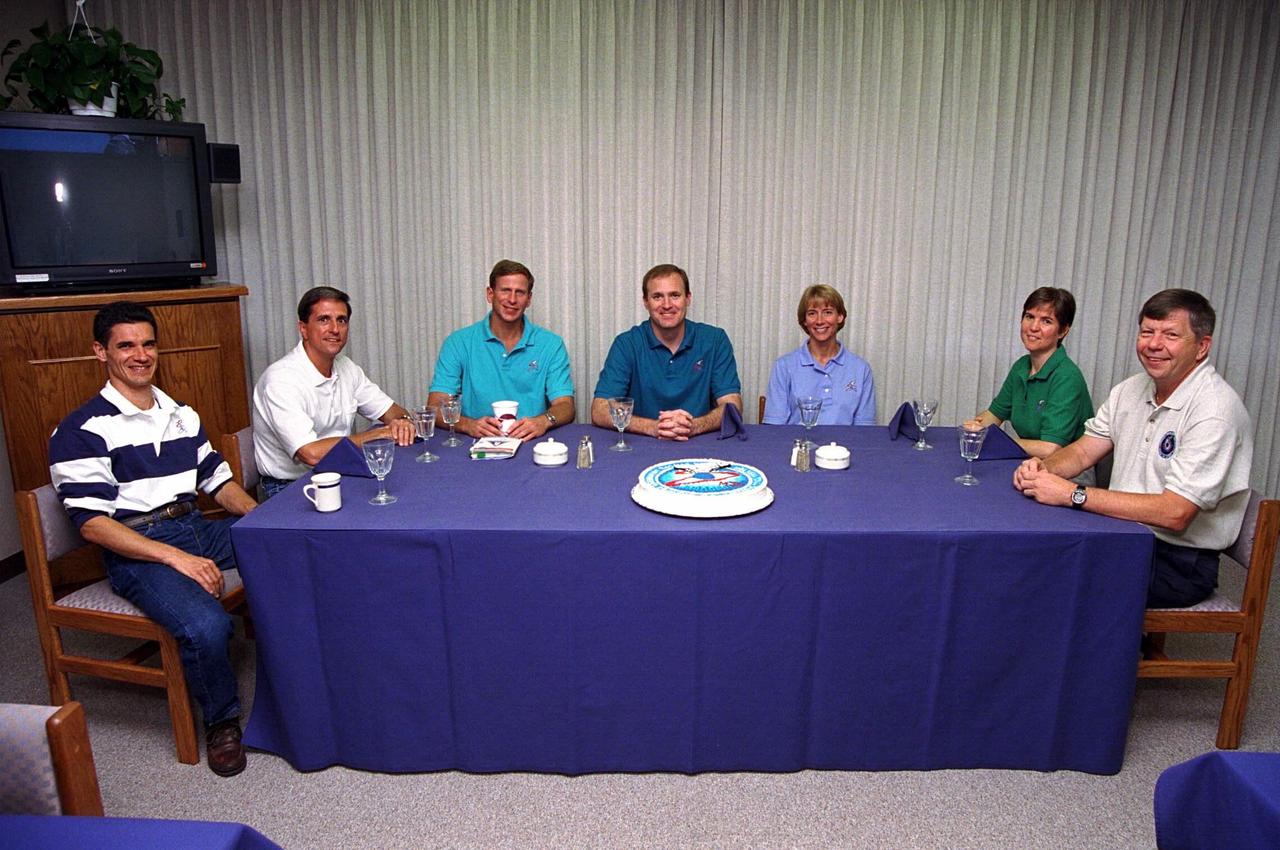
The STS-94 flight crew enjoys the traditional preliftoff breakfast in the crew quarters of the Operations and Checkout Building. They are (from left): Payload Specialist Gregory T. Linteris; Mission Specialist Donald A. Thomas; Mission Specialist Michael L. Gernhardt; Mission Commander James D. Halsell, Jr.; Pilot Susan L. Still; Payload Commander Janice Voss; and Payload Specialist Roger K. Crouch. After a weather briefing, the flight crew will be fitted with their launch/entry suits and depart for Launch Pad 39A. Once there, they will take their positions in the crew cabin of the Space Shuttle Columbia to await a liftoff during a window that will open at 1:50 p.m. EDT, July 1. The launch window was opened 47 minutes early to improve the opportunity to lift off before Florida summer rain showers reached the space center
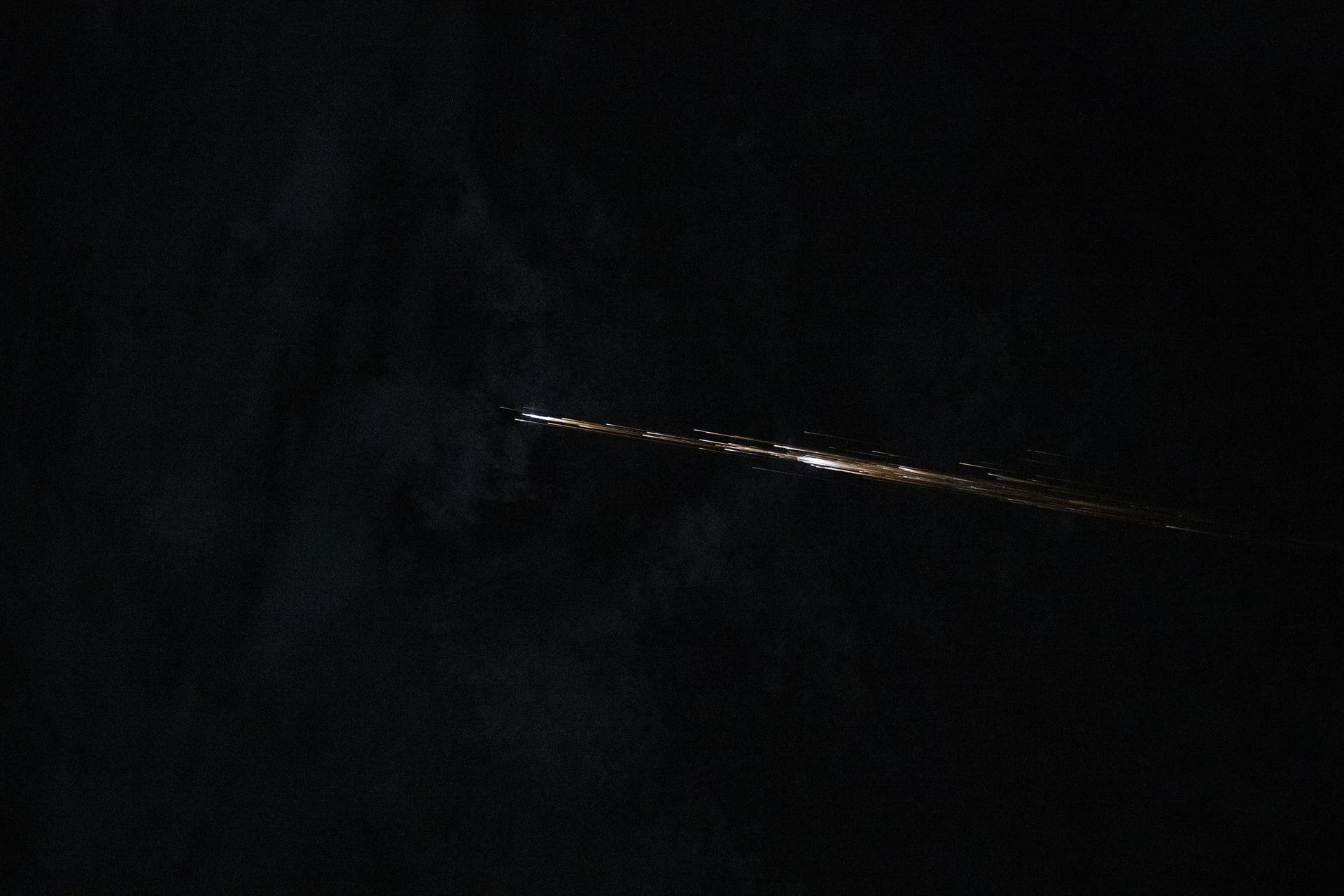
iss074e0540224 (April 27, 2026) --- A piece of unidentified space debris is pictured from the International Space Station as it reenters Earth's atmosphere and burns up over Africa. NASA astronaut Chris Williams captured the remarkable event and shared the imagery on his Instagram page @astro_chrisw. "On April 27th at about 10:40 PM GMT, I was in the @iss Cupola and saw something really neat. I was scanning the sky to try to catch a glimpse of the approaching Progress MS-34 vehicle bringing new supplies. Just as we were passing over West Africa, I saw a bright object directly below us, streaking through the upper atmosphere. I saw its tail grow and then split apart into a shower of smaller pieces. I think it must have been some piece of orbital debris or a satellite breaking up as it entered the atmosphere. It was quite a light show!" Credit: NASA/Chris Williams
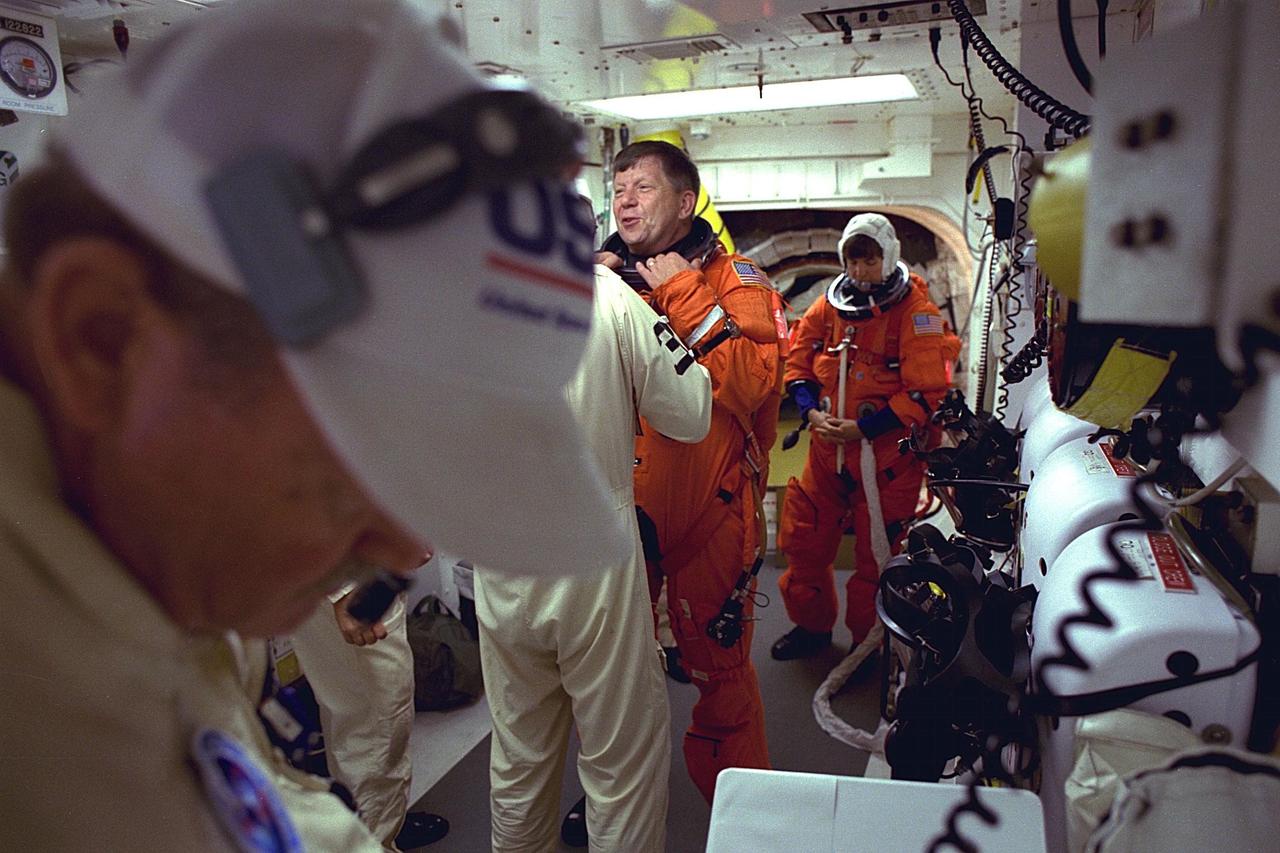
STS-94 Payload Specialist Roger K. Crouch prepares to enter the Space Shuttle Columbia at Launch Pad 39A in preparation for launch. He is the Chief Scientist of the NASA Microgravity Space and Applications Division. He also has served as a Program Scientist for previous Spacelab microgravity missions and is an expert in semiconductor crystal growth. Since Crouch has more than 25 years of experience as a materials scientist, he will be concentrating on the five physics of materials processing experiments in the Middeck Glovebox Facility on the Blue shift. He will also share the workload with Thomas by monitoring the materials furnace experiments during this time. Crouch and six fellow crew members will lift off during a launch window that opens at 1:50 p.m. EDT, July 1. The launch window will open 47 minutes early to improve the opportunity to lift off before Florida summer rain showers reach the space center
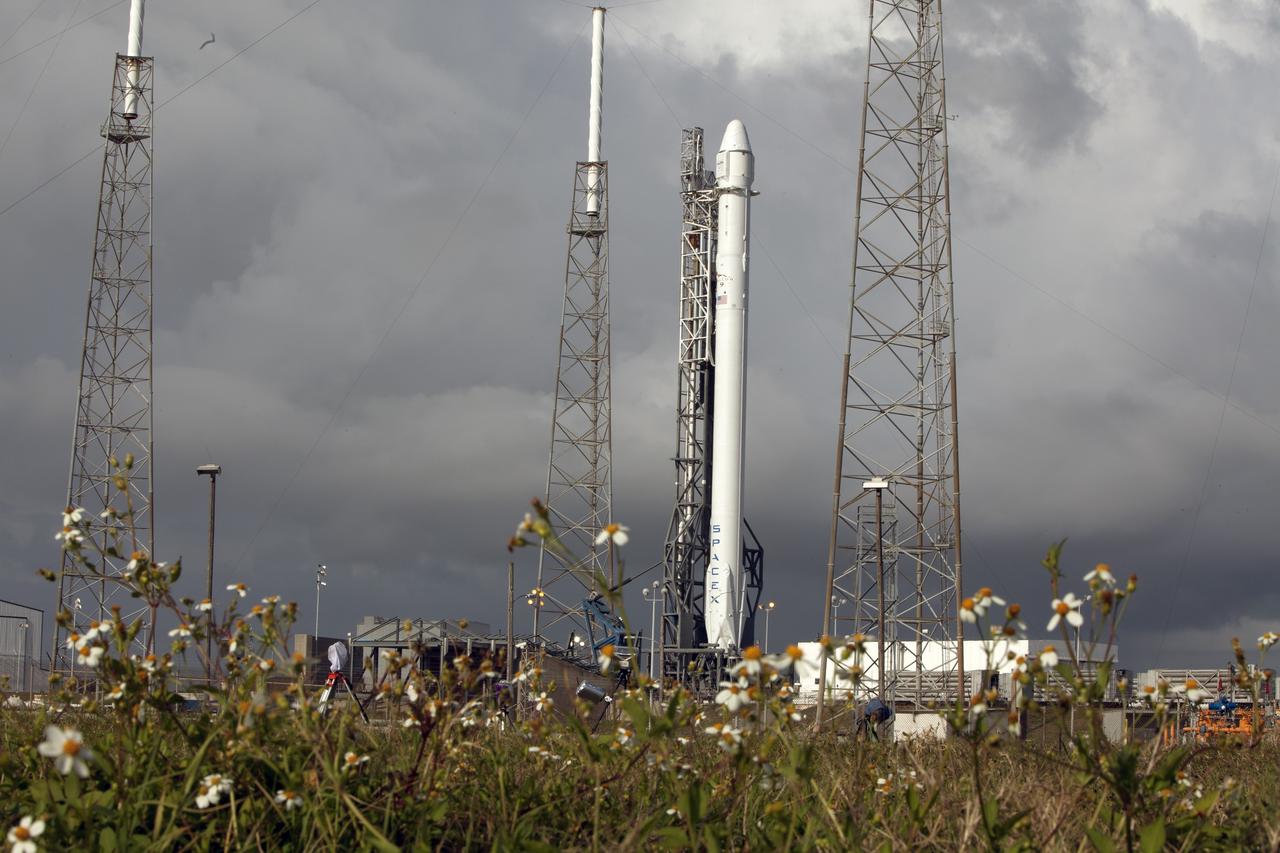
CAPE CANAVERAL, Fla. - Early morning showers pass by Space Launch Complex 40 on Cape Canaveral Air Force Station in Florida on launch day for a SpaceX Falcon 9 rocket and a Dragon capsule on its third commercial resupply mission to deliver about 5,000 pounds of cargo to the International Space Station. Scheduled for launch at about 4:58 p.m. EDT April 14, Dragon will be making its fourth trip to the space station. The SpaceX-3 mission, carrying almost 2.5 tons of supplies, technology and science experiments, is the third of 12 flights under NASA's Commercial Resupply Services contract to resupply the orbiting laboratory. For more information, visit http://www.nasa.gov/mission_pages/station/structure/launch/index.html Photo credit: NASA/Glenn Benson
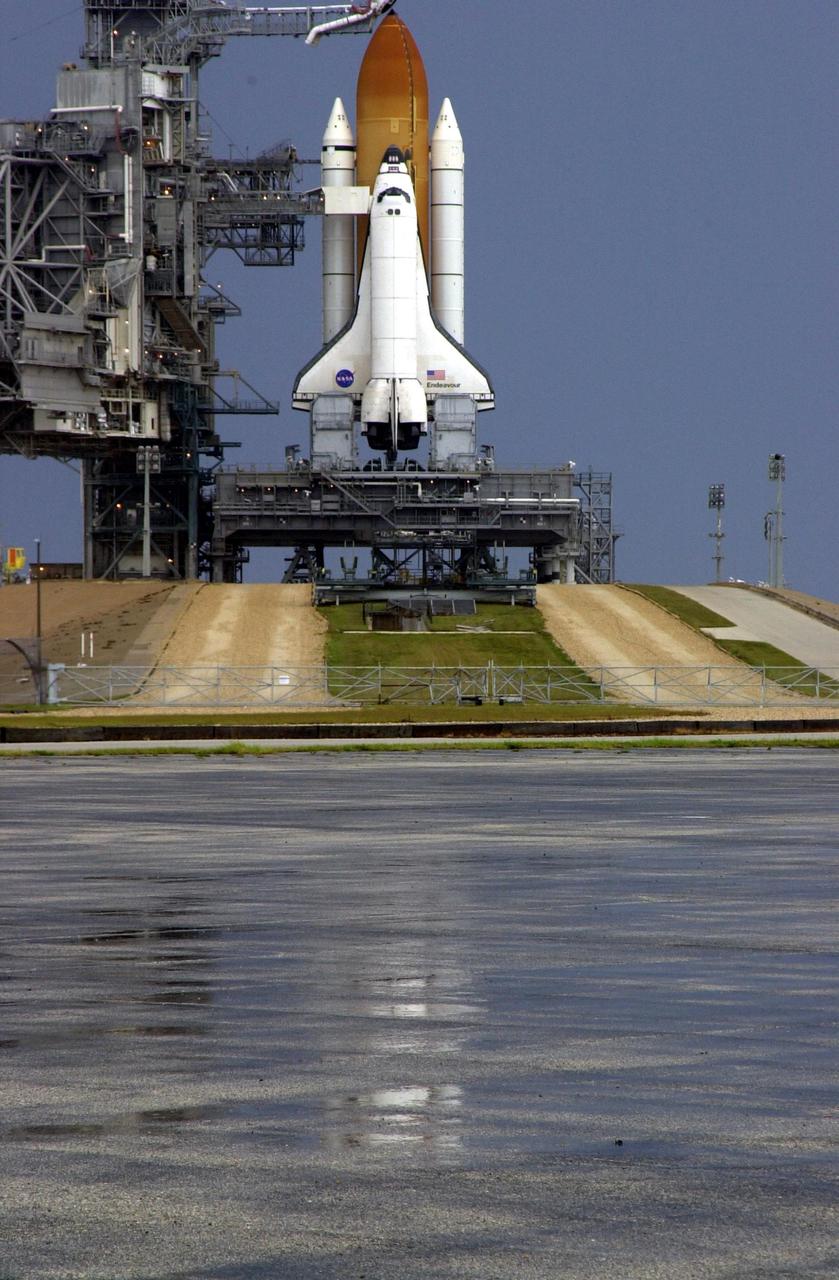
KENNEDY SPACE CENTER, FLA. -- Space Shuttle Endeavour sits poised for launch at Pad 39A after mission managers postponed today's launch of mission STS-111. Forecasters' predictions that weather would prohibit a launch attempt due to severe thunderstorms and rain showers within the vicinity of the launch pad were accurate as depicted by the rainwater on the pavement in the foreground. STS-111 is the second Utilization Flight to the International Space Station, carrying the Multi-Purpose Logistics Module Leonardo, the Mobile Base System (MBS), and a replacement wrist/roll joint for the Canadarm 2. Also on board will be the Expedition Five crew who will replace Expedition Four on the Station. Launch has been rescheduled for Monday, June 3, between 4 and 8 p.m. EDT
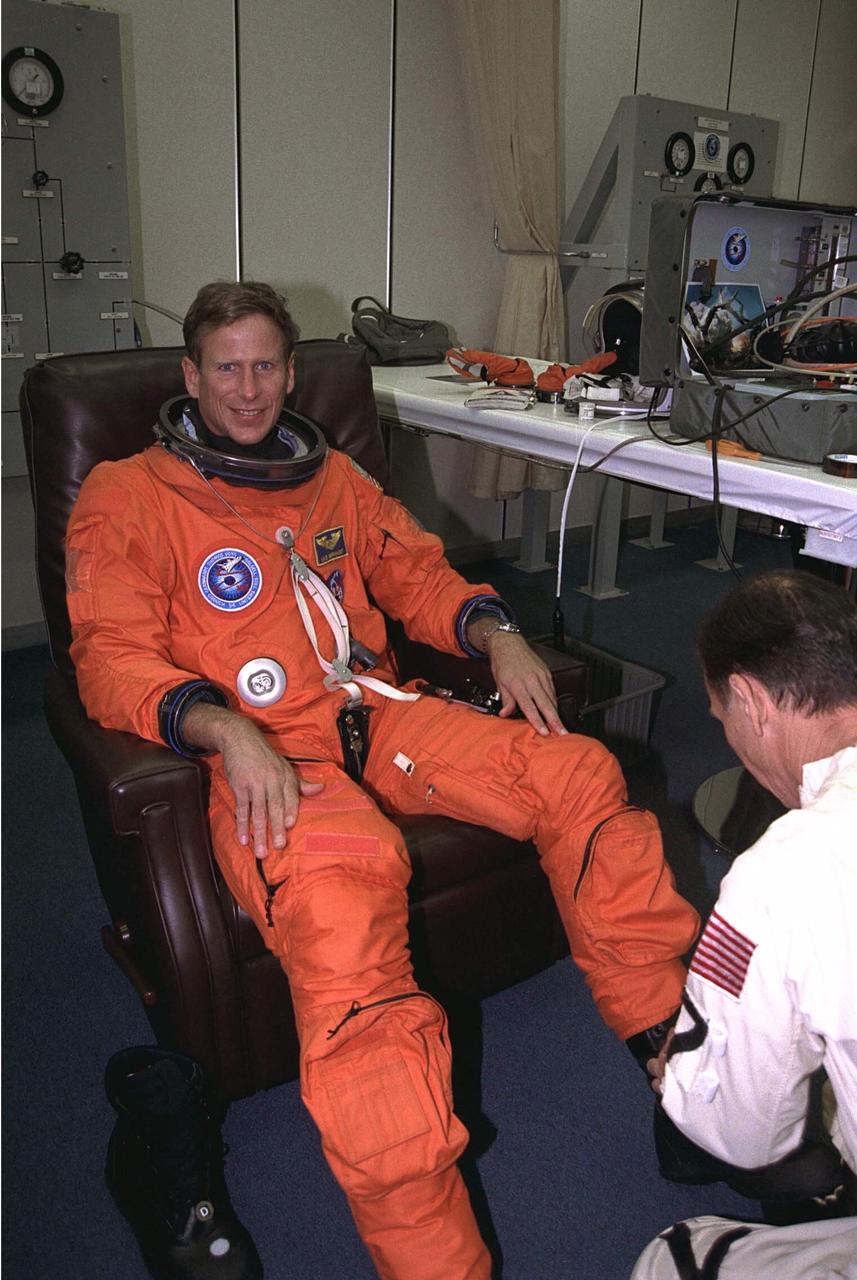
STS-94 Mission Specialist Michael L. Gernhardt is assisted into his launch/entry suit by a suit technician in the Operations and Checkout (O&C) Building. He first flew in this capacity on STS-69. He has been a professional deep sea diver and engineer and holds a doctorate in bioengineering. Gernhardt will be in charge of the Blue shift and as flight engineer will operate and maintain the orbiter while Halsell and Still are asleep as members of the Red shift. He will also back them up on the flight deck during the ascent and re-entry phases of the mission. Gernhardt and six fellow crew members will shortly depart the O&C and head for Launch Pad 39A, where the Space Shuttle Columbia will lift off during a launch window that opens at 1:50 p.m. EDT, July 1. The launch window was opened 47 minutes early to improve the opportunity to lift off before Florida summer rain showers reached the space center
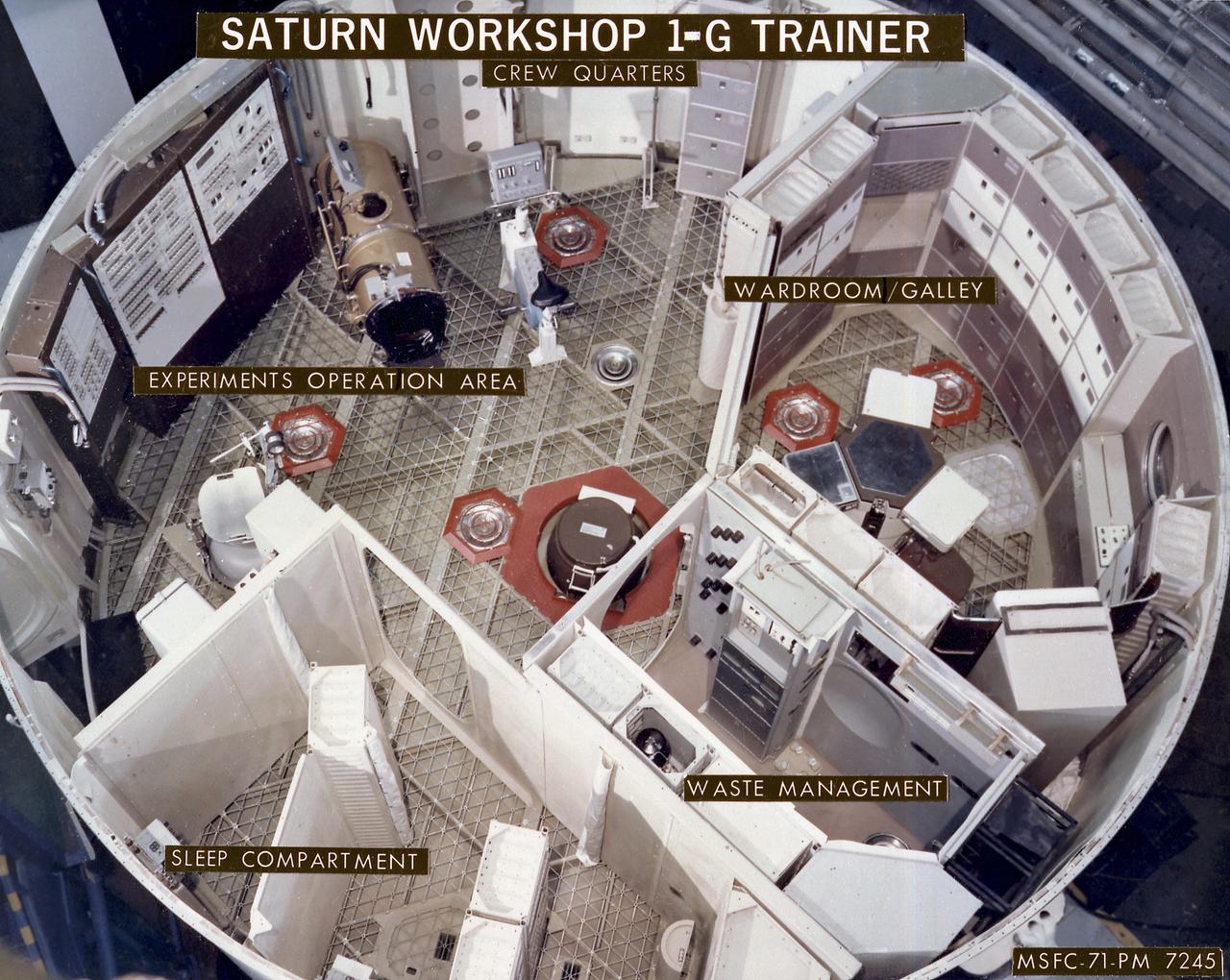
This image depicts a layout of the Skylab workshop 1-G trainer crew quarters. At left, in the sleep compartment, astronauts slept strapped to the walls of cubicles and showered at the center. Next right was the waste management area where wastes were processed and disposed. Upper right was the wardroom where astronauts prepared their meals and foods were stored. In the experiment operation area, upper left, against the far wall, was the lower-body negative-pressure device (Skylab Experiment M092) and the Ergometer for the vectorcardiogram experiment (Skylab Experiment M063). The trainers and mockups were useful in the developmental phase, while engineers and astronauts were still working out optimum designs. They provided much data applicable to the manufacture of the flight articles.
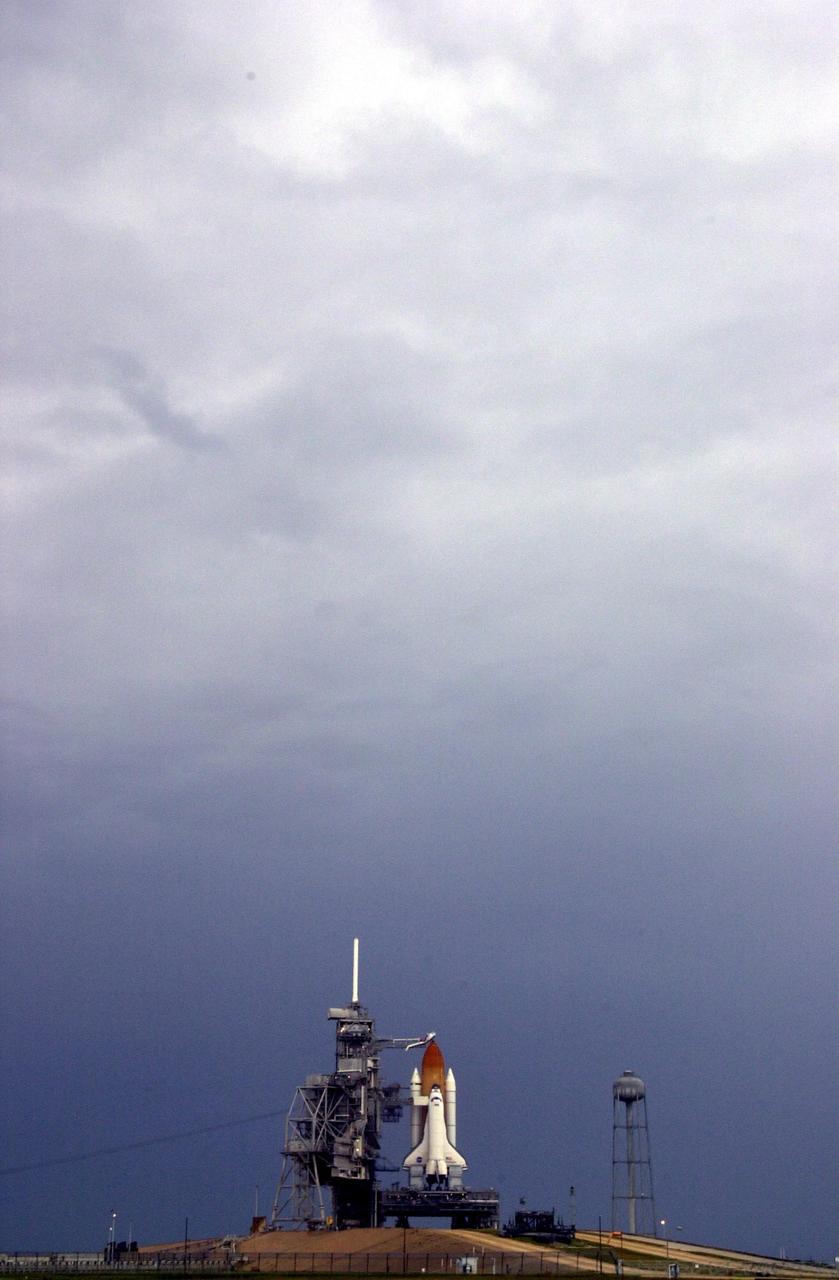
KENNEDY SPACE CENTER, FLA. -- Space Shuttle Endeavour is poised for launch at Pad 39A after mission managers postponed today's launch of mission STS-111. Forecasters' predictions that weather would prohibit a launch attempt due to severe thunderstorms and rain showers within the vicinity of the launch pad were accurate as depicted by the dark clouds overhead. STS-111 is the second Utilization Flight to the International Space Station, carrying the Multi-Purpose Logistics Module Leonardo, the Mobile Base System (MBS), and a replacement wrist/roll joint for the Canadarm 2. Also on board will be the Expedition Five crew who will replace Expedition Four on the Station. Launch has been rescheduled for Monday, June 3, between 4 and 8 p.m. EDT
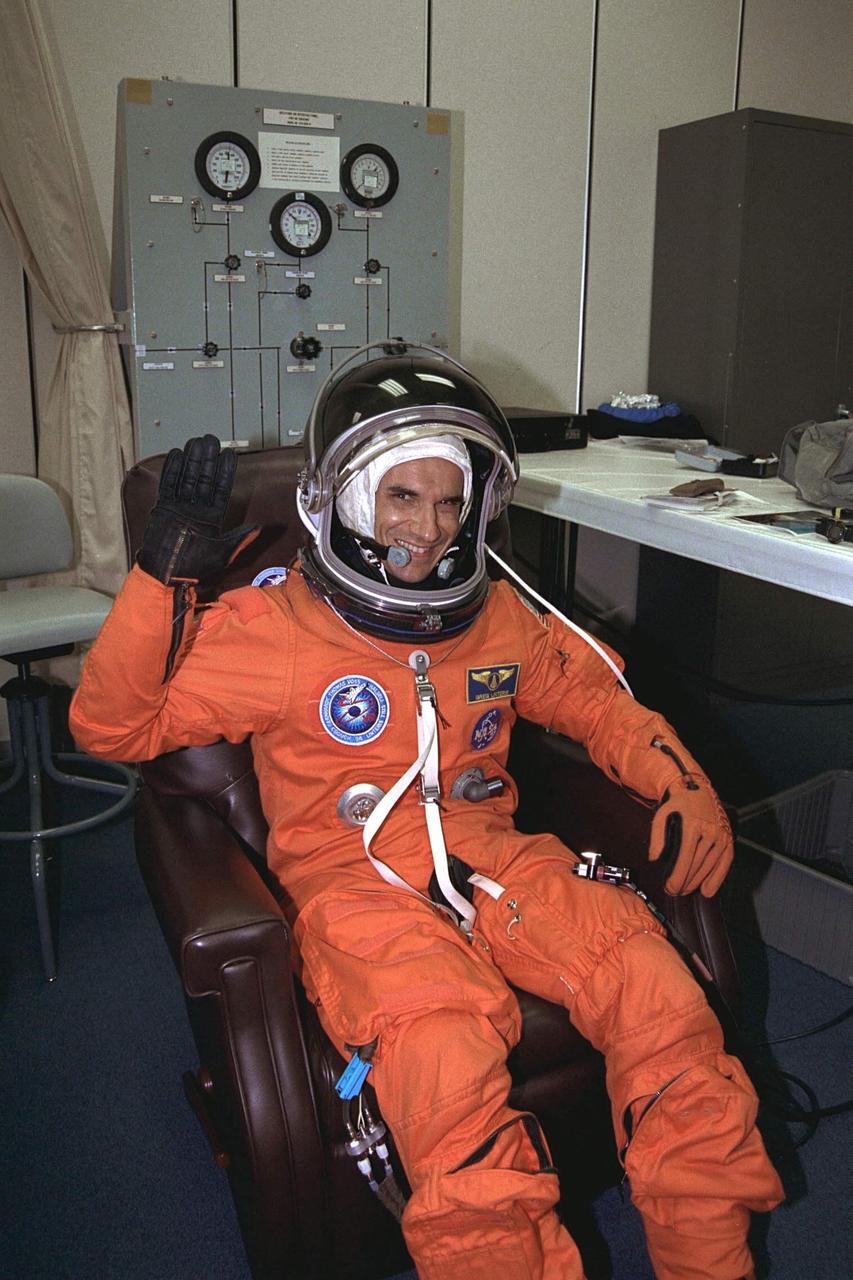
STS-94 Payload Specialist Gregory T. Linteris waves as he completes the donning of his launch/entry suit in the Operations and Checkout (O&C) Building. He holds a doctorate in mechanical and aerospace engineering. Linteris has worked at the National Institute of Standards and Technology and is the Principal Investigator on a NASA microgravity combustion experiment. As a member of the Red team, Linteris will concentrate on three combustion experiments. Two of these experiments are housed in the Combustion Module. He will also be backing up crew members on the other Microgravity Science Laboratory-1 (MSL-1) investigations. He and six fellow crew members will shortly depart the O&C and head for Launch Pad 39A, where the Space Shuttle Columbia will lift off during a launch window that opens at 1:50 p.m. EDT, July 1. The launch window was opened 47 minutes early to improve the opportunity to lift off before Florida summer rain showers reached the space center
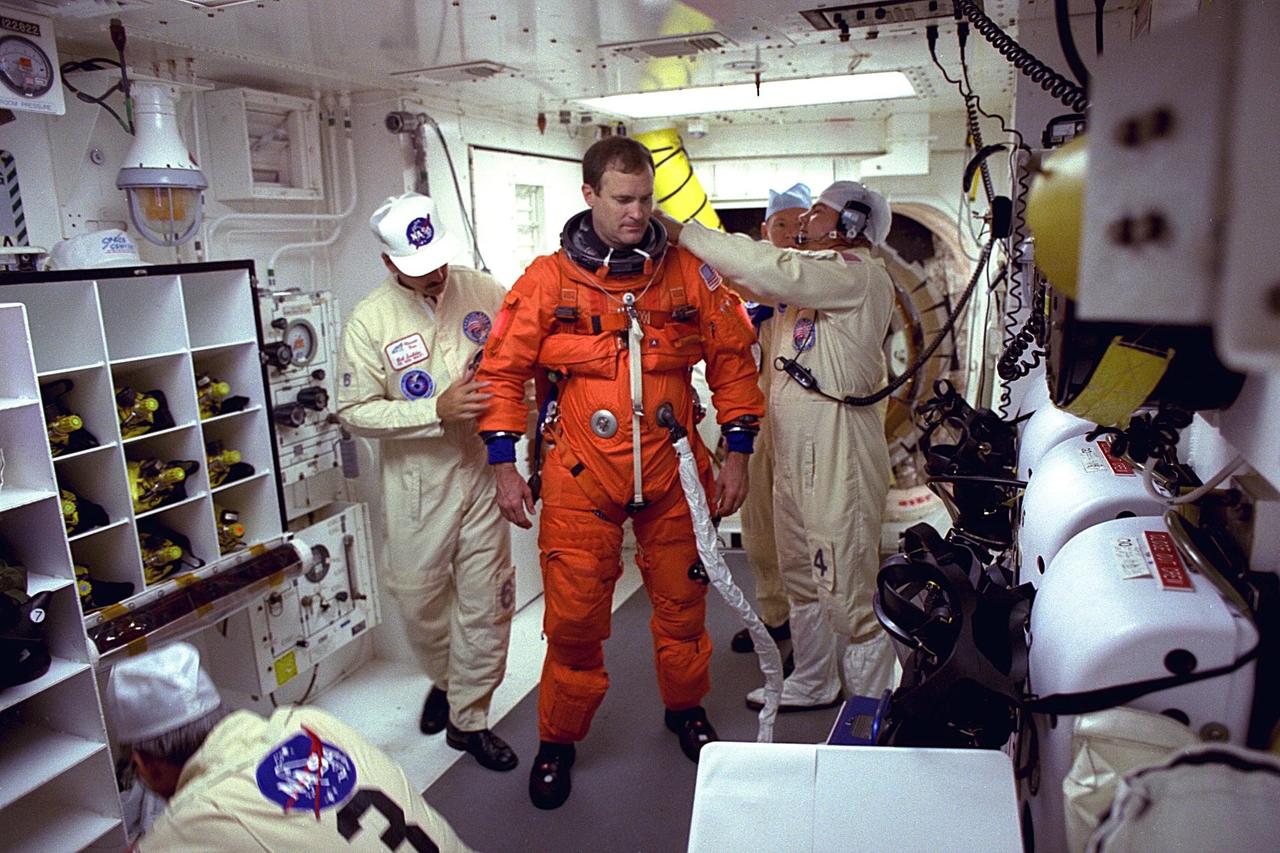
STS-94 Mission Commander James D. Halsell, Jr., prepares to enter the Space Shuttle Columbia at Launch Pad 39A in preparation for launch. Halsell is on his fourth space flight, having served as commander of STS-83 and pilot of both STS-74 and STS-65. He is a lieutenant colonel in the Air Force and a former SR-71 Blackbird test pilot and holds master’s degrees in management and space operations. Halsell will have responsibility for the success of the mission and will operate and maintain Columbia during the Red, or second shift. He will also assist with a materials science experiment and a protein crystal growth payload during the 16-day mission. Halsell and six fellow crew members will lift off during a launch window that opens at 1:50 p.m. EDT, July 1. The launch window will open 47 minutes early to improve the opportunity to lift off before Florida summer rain showers reach the space center

This visualization shows gamma rays detected during 3C 279's big flare by the LAT instrument on NASA's Fermi satellite. Gamma rays are represented as expanding circles reminiscent of raindrops on water. The flare is an abrupt shower of "rain" that trails off toward the end of the movie. Both the maximum size of the circle and its color represent the energy of the gamma ray, with white lowest and magenta highest. In a second version of the visualization, a background map shows how the LAT detects 3C 279 and other sources by accumulating high-energy photons over time (brighter squares reflect higher numbers of gamma rays). The movie starts on June 14 and ends June 17. The area shown is a region of the sky five degrees on a side and centered on the position of 3C 279. Read more: <a href="http://go.nasa.gov/1TqximF" rel="nofollow">go.nasa.gov/1TqximF</a> Credits: NASA/DOE/Fermi LAT Collaboration
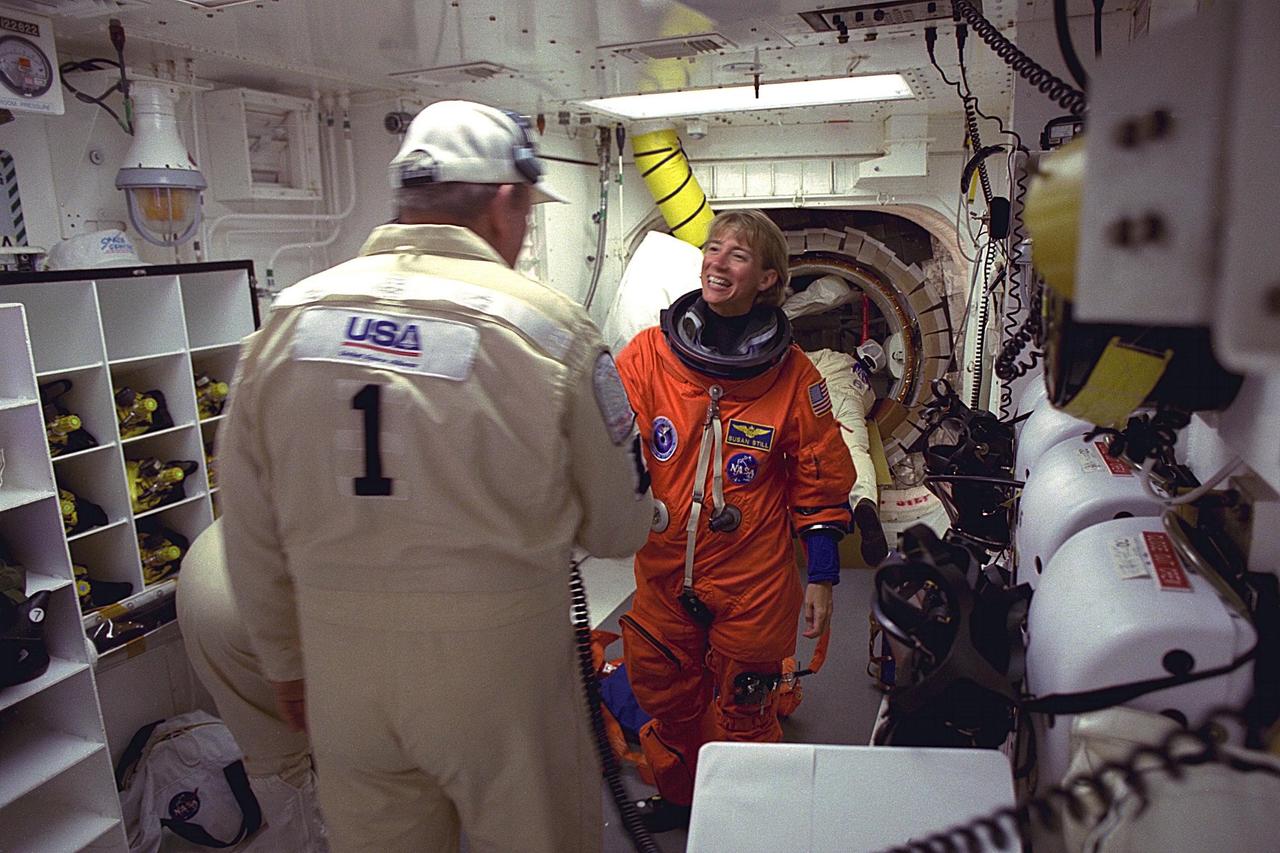
STS-94 Pilot Susan L. Still prepares to enter the Space Shuttle Columbia at Launch Pad 39A in preparation for launch. She is the second woman to fly in this capacity on a Space Shuttle. Still is a lieutenant colonel in the Navy and has more than 2,000 flight hours in 30 different types of aircraft. She also holds a master’s degree in aerospace engineering. Still will assist Halsell with all phases of the space flight and will have primary responsibility to take action in the event of an emergency. After Columbia reaches orbit, Still will be busy with the many and varied tasks associated with monitoring and maintaining the orbiter. She and six fellow crew members will lift off during a launch window that opens at 1:50 p.m. EDT, July 1. The launch window will open 47 minutes early to improve the opportunity to lift off before Florida summer rain showers reach the space center
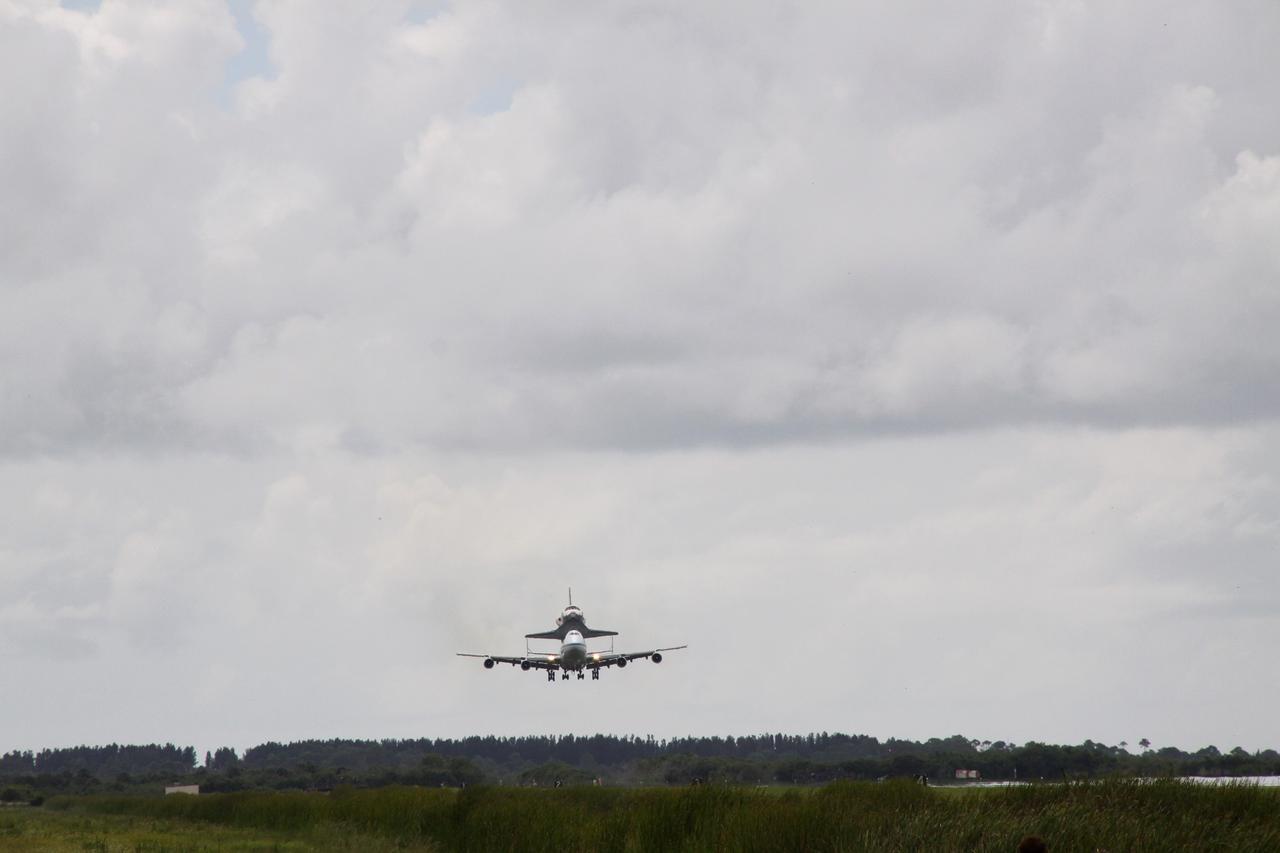
CAPE CANAVERAL, Fla. – Space shuttle Discovery arrives at NASA's Kennedy Space Center in Florida on the back of the Boeing 747 Shuttle Carrier Aircraft, or SCA. The two-day return flight from Edwards Air Force Base in California began at 9:20 a.m. EDT Sept. 20. After three fueling stops that included an overnight stay in Louisiana, the piggybacked shuttle had to navigate through a line of showers across Louisiana and around Kennedy. Discovery had landed at Edwards Sept. 11 after the 13-day STS-128 mission to the International Space Station. The shuttle delivered more than 7 tons of supplies, science racks and equipment, as well as additional environmental hardware to sustain six crew members on the station. Landings at Kennedy were waved off on two days due to inclement weather, leading to the landing at Edwards. Photo credit: NASA/Jack Pfaller
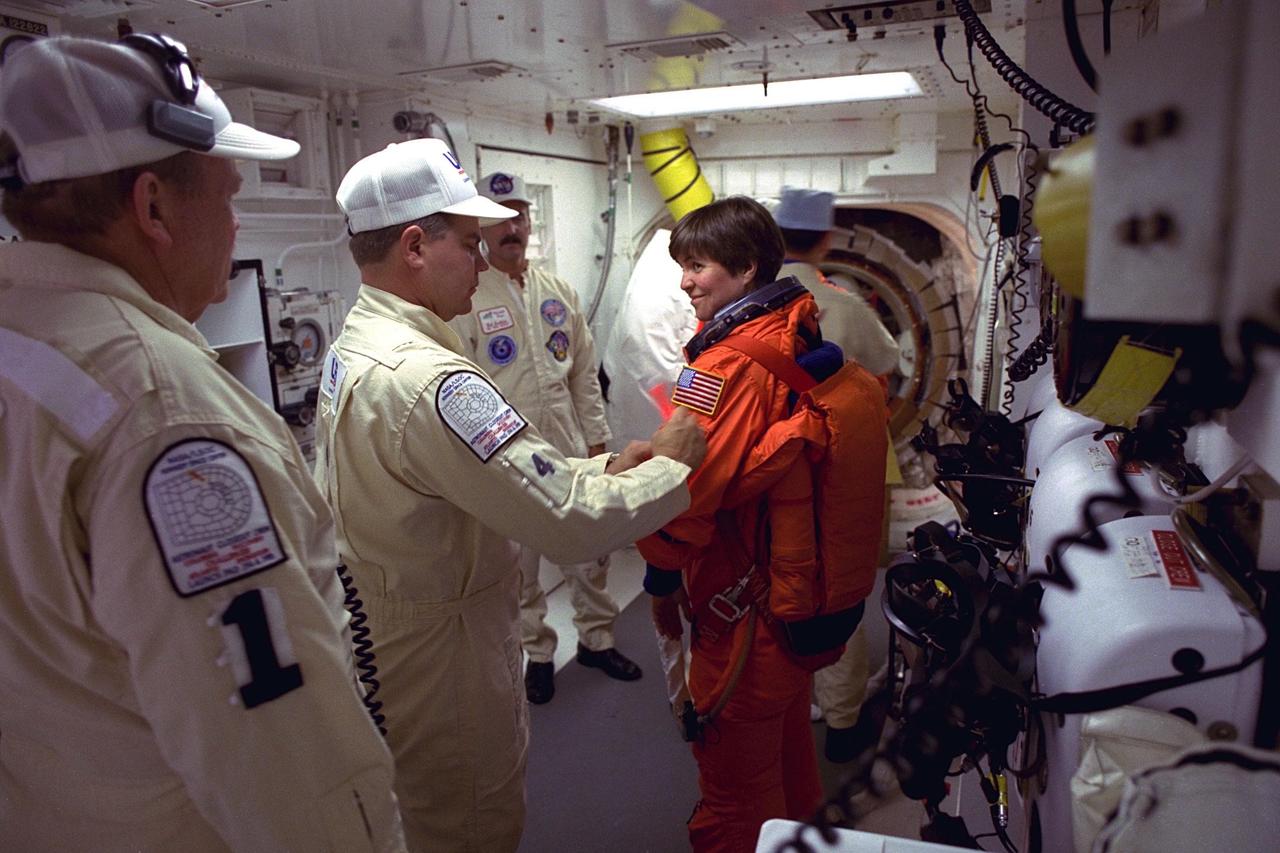
STS-94 Payload Commander Janice Voss prepares to enter the Space Shuttle Columbia at Launch Pad 39A in preparation for launch. She has flown on STS-83, STS-63 and STS-57. Voss holds a doctorate degree in aeronautics/astronautics from the Massachusetts Institute of Technology and has earned two NASA Space Flight Medals. As Payload Commander and a member of the Blue team, Voss will have overall responsibility for the operation of all of the MSL-1 experiments. During the experimentation phase of the mission, she be working primarily with three combustion experiments. She and six fellow crew members will lift off during a launch window that opens at 1:50 p.m. EDT, July 1. The launch window will open 47 minutes early to improve the opportunity to lift off before Florida summer rain showers reach the space center
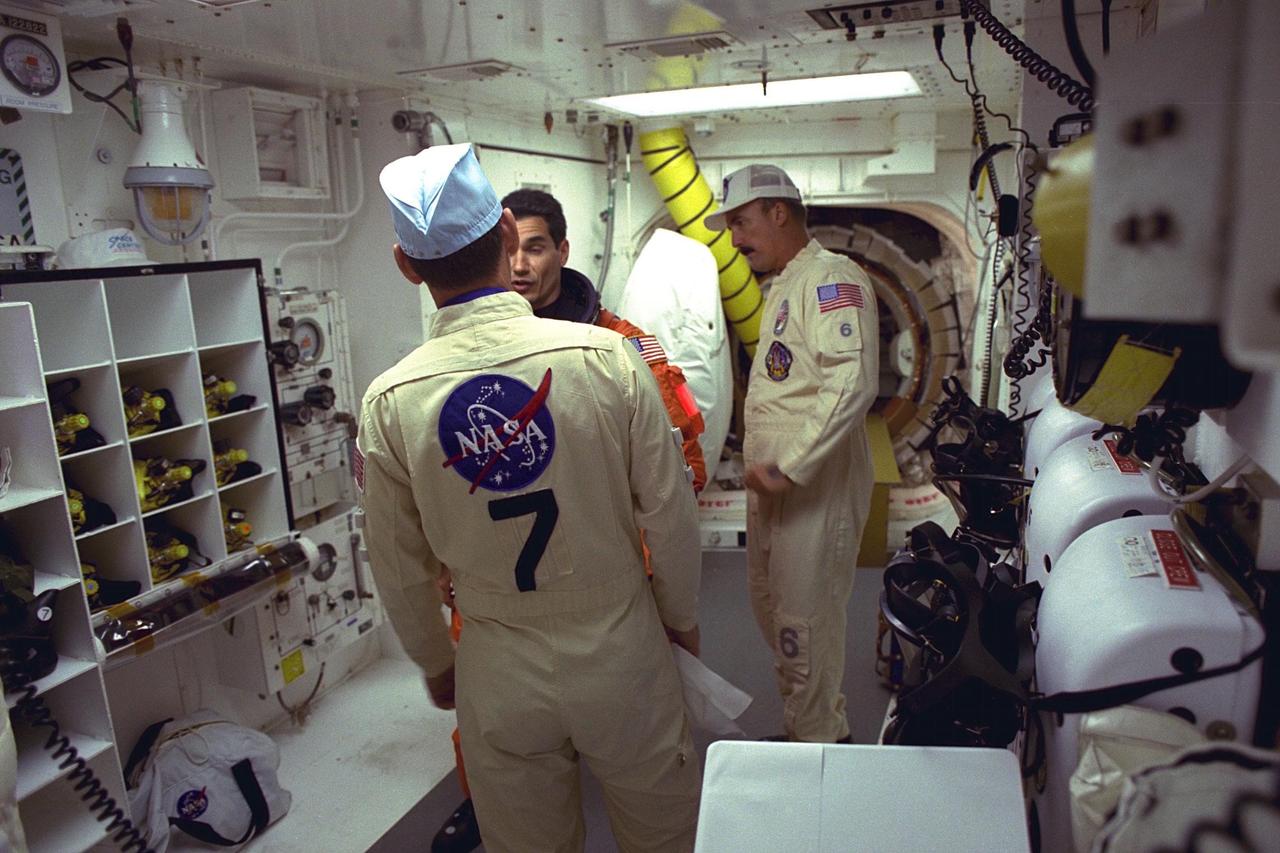
STS-94 Payload Specialist Gregory T. Linteris prepares to enter the Space Shuttle Columbia at Launch Pad 39A in preparation for launch. He holds a doctorate in mechanical and aerospace engineering. Linteris has worked at the National Institute of Standards and Technology and is the Principal Investigator on a NASA microgravity combustion experiment. As a member of the Red team, Linteris will concentrate on three combustion experiments. Two of these experiments are housed in the Combustion Module. He will also be backing up crew members on the other Microgravity Science Laboratory-1 (MSL-1) investigations. He and six fellow crew members will lift off during a launch window that opens at 1:50 p.m. EDT, July 1. The launch window will open 47 minutes early to improve the opportunity to lift off before Florida summer rain showers reach the space center
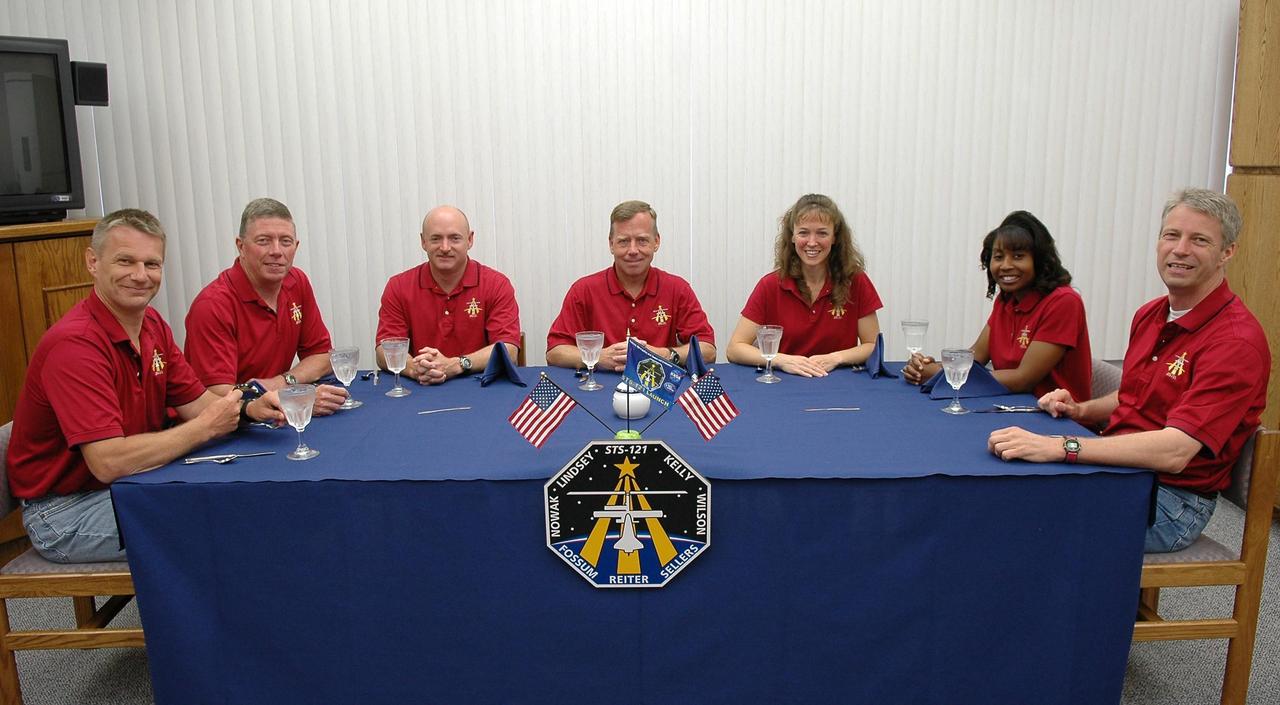
KENNEDY SPACE CENTER, FLA. - Trying a third time for launch, and still smiling, the STS-121 crew gathers again for the traditional breakfast before suiting up. Seated left to right are Mission Specialists Piers Sellers and Michael Fossum, Pilot Mark Kelly, Commander Steven Lindsey, and Mission Specialists Lisa Nowak, Stephanie Wilson and Thomas Reiter, who represents the European Space Agency. The July 2 launch attempt was scrubbed due to the presence of showers and thunderstorms within the surrounding area of the launch site. The launch of Space Shuttle Discovery on mission STS-121 is the 115th shuttle flight and the 18th U.S. flight to the International Space Station. During the 12-day mission, the STS-121 crew will test new equipment and procedures to improve shuttle safety, as well as deliver supplies and make repairs to the International Space Station. Photo credit: NASA/Kim Shiflett

KENNEDY SPACE CENTER, FLA. -- Space Shuttle Endeavour is poised for launch at Pad 39A after mission managers postponed today's scheduled launch of mission STS-111. Forecasters' predictions that weather would prohibit a launch attempt due to severe thunderstorms and rain showers within the vicinity of the launch pad were accurate as depicted by the raindrops obscuring the photographer's view. STS-111 is the second Utilization Flight to the International Space Station, carrying the Multi-Purpose Logistics Module Leonardo, the Mobile Base System (MBS), and a replacement wrist/roll joint for the Canadarm 2. Also on board will be the Expedition Five crew who will replace Expedition Four on the Station. Launch has been rescheduled for Monday, June 3, between 4 and 8 p.m. EDT
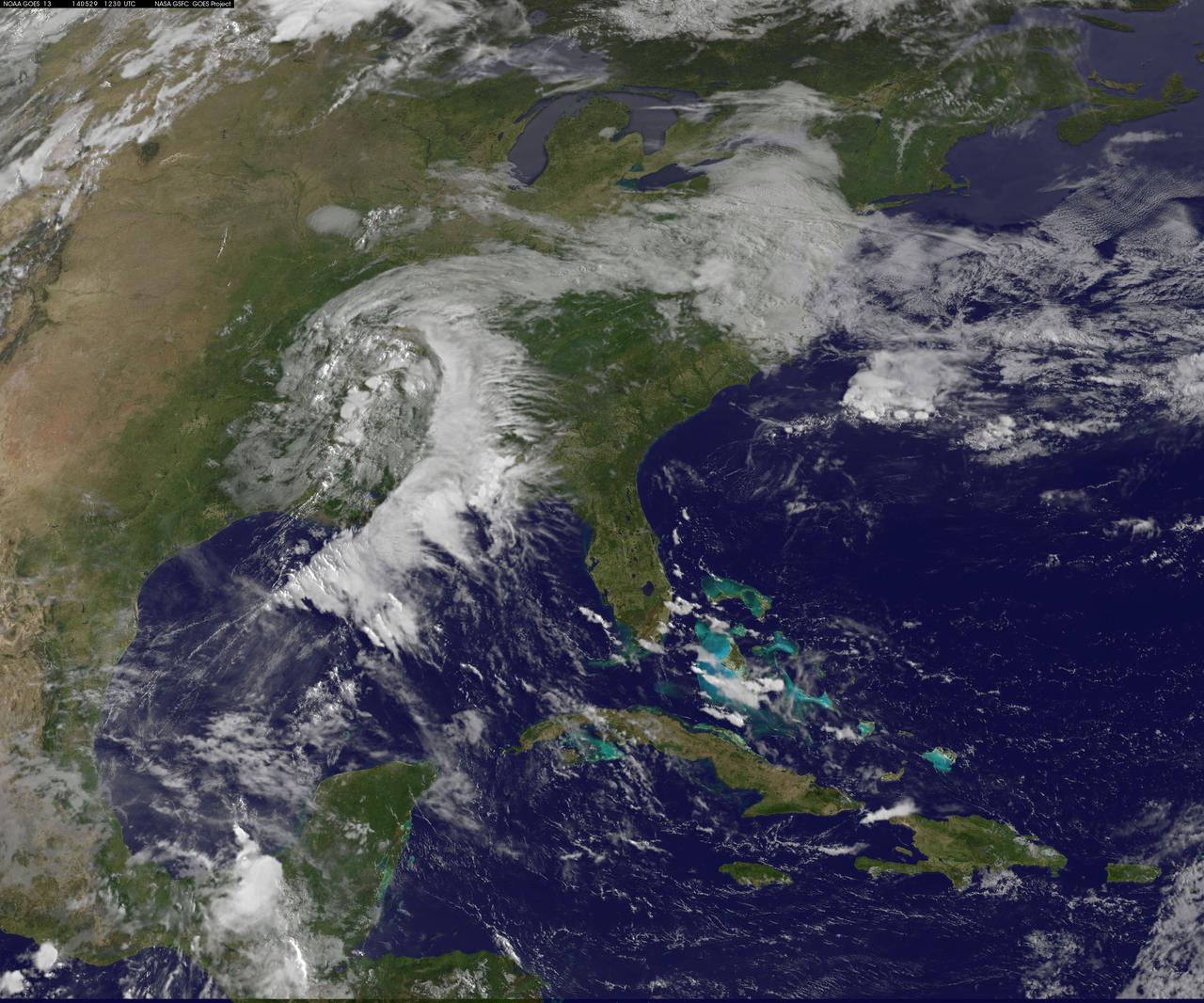
A "backdoor cold front" is bringing April temperatures to the U.S. northeast and Mid-Atlantic today, May 29. The backdoor cold front brings relief to the Mid-Atlantic after temperatures in Washington, D.C. hit 92F on Tuesday, May 27 and 88F on Wednesday, May 28 at Reagan National Airport, according to the National Weather Service (NWS). NWS forecasters expect the high temperature for May 29 to only reach 60F in the District of Columbia. NOAA's GOES-East satellite captured a view of the clouds associated with the backdoor cold front that stretch from southern Illinois to North Carolina. The National Weather Service forecast expects the backdoor cold front to bring showers to the Midwest, Northeast, and Mid-Atlantic today, May 29. According to the National Oceanic and Atmospheric Administration, a backdoor cold front is a cold front moving south or southwest along the Atlantic seaboard and Great Lakes; these are especially common during the spring months. This visible image was taken by NOAA's GOES-East satellite on May 29 at 12:30 UTC (8:30 a.m. EDT). The image was created at NASA/NOAA's GOES Project at NASA's Goddard Space Flight Center in Greenbelt, Maryland. In addition to the backdoor cold front clouds, the GOES-East image shows clouds circling around a low pressure area located in eastern Texas. That low pressure area is expected to bring rain from Texas eastward over the southeastern U.S. According to NOAA's National Weather Service, the slow-moving low pressure area in the Deep South "will bring heavy showers and thunderstorms from Louisiana to Alabama through Thursday. This area is already saturated from previous rainfall, so flash flooding will be possible." Image: NASA/NOAA GOES Project Caption: NASA Goddard/Rob Gutro
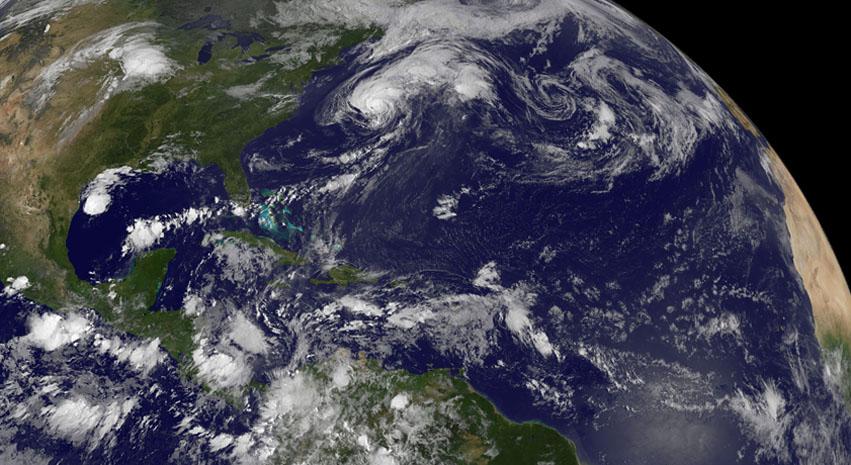
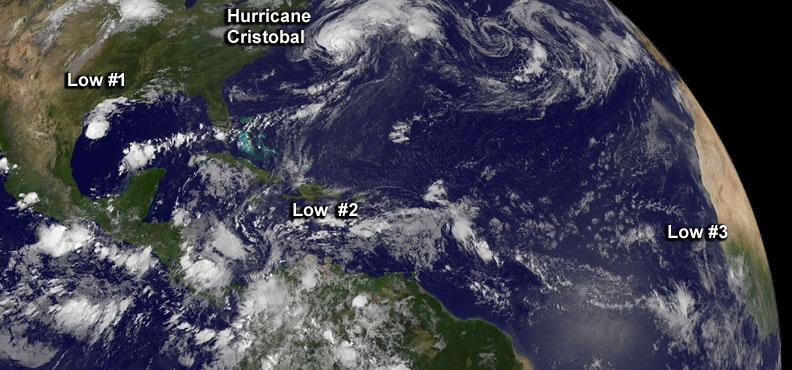
Although there's only one formed tropical cyclone in the Atlantic: Hurricane Cristobal, there are three other developing areas of low pressure and all were captured in this panoramic image from NOAA's GOES-East satellite today at 8 a.m. EDT. Cristobal is a hurricane located east of the U.S. East coast and is forecast to move up toward eastern Canada tonight (and stay off-shore). The image was made at NASA's GOES Project at NASA's Goddard Space Flight Center in Greenbelt, Maryland. Low #1. A weak area of low pressure near the coast of South Texas is producing disorganized showers and thunderstorms. Significant development of this system is unlikely before it moves inland over South Texas and northern Mexico today. It has a ten percent chance of development into a tropical depression in the next 2 days. Low #2. A tropical wave located over the eastern Caribbean Sea continues to produce disorganized cloudiness and showers. Upper-level winds are expected to remain unfavorable for development during the next couple of days while the system moves across the eastern and central Caribbean Sea. However, environmental conditions could become conducive for some development when the system moves over the northwestern Caribbean Sea on Sunday and into the southwestern Gulf of Mexico early next week. It has a near zero chance to develop in the next 2 days. Low #3. A tropical wave is forecast to move off the west coast of Africa on Friday. Environmental conditions could be conducive for some gradual development of this system while it moves westward at 10 to 15 mph across the eastern Atlantic early next week. This has a near zero chance of development in the next two days. <b><a href="http://www.nasa.gov/audience/formedia/features/MP_Photo_Guidelines.html" rel="nofollow">NASA image use policy.</a></b> <b><a href="http://www.nasa.gov/centers/goddard/home/index.html" rel="nofollow">NASA Goddard Space Flight Center</a></b> enables NASA’s mission through four scientific endeavors: Earth Science, Heliophysics, Solar System Exploration, and Astrophysics. Goddard plays a leading role in NASA’s accomplishments by contributing compelling scientific knowledge to advance the Agency’s mission. <b>Follow us on <a href="http://twitter.com/NASAGoddardPix" rel="nofollow">Twitter</a></b> <b>Like us on <a href="http://www.facebook.com/pages/Greenbelt-MD/NASA-Goddard/395013845897?ref=tsd" rel="nofollow">Facebook</a></b> <b>Find us on <a href="http://instagram.com/nasagoddard?vm=grid" rel="nofollow">Instagram</a></b>
Although there's only one formed tropical cyclone in the Atlantic: Hurricane Cristobal, there are three other developing areas of low pressure and all were captured in this panoramic image from NOAA's GOES-East satellite today at 8 a.m. EDT. Cristobal is a hurricane located east of the U.S. East coast and is forecast to move up toward eastern Canada tonight (and stay off-shore). The image was made at NASA's GOES Project at NASA's Goddard Space Flight Center in Greenbelt, Maryland. Low #1. A weak area of low pressure near the coast of South Texas is producing disorganized showers and thunderstorms. Significant development of this system is unlikely before it moves inland over South Texas and northern Mexico today. It has a ten percent chance of development into a tropical depression in the next 2 days. Low #2. A tropical wave located over the eastern Caribbean Sea continues to produce disorganized cloudiness and showers. Upper-level winds are expected to remain unfavorable for development during the next couple of days while the system moves across the eastern and central Caribbean Sea. However, environmental conditions could become conducive for some development when the system moves over the northwestern Caribbean Sea on Sunday and into the southwestern Gulf of Mexico early next week. It has a near zero chance to develop in the next 2 days. Low #3. A tropical wave is forecast to move off the west coast of Africa on Friday. Environmental conditions could be conducive for some gradual development of this system while it moves westward at 10 to 15 mph across the eastern Atlantic early next week. This has a near zero chance of development in the next two days. <b><a href="http://www.nasa.gov/audience/formedia/features/MP_Photo_Guidelines.html" rel="nofollow">NASA image use policy.</a></b> <b><a href="http://www.nasa.gov/centers/goddard/home/index.html" rel="nofollow">NASA Goddard Space Flight Center</a></b> enables NASA’s mission through four scientific endeavors: Earth Science, Heliophysics, Solar System Exploration, and Astrophysics. Goddard plays a leading role in NASA’s accomplishments by contributing compelling scientific knowledge to advance the Agency’s mission. <b>Follow us on <a href="http://twitter.com/NASAGoddardPix" rel="nofollow">Twitter</a></b> <b>Like us on <a href="http://www.facebook.com/pages/Greenbelt-MD/NASA-Goddard/395013845897?ref=tsd" rel="nofollow">Facebook</a></b> <b>Find us on <a href="http://instagram.com/nasagoddard?vm=grid" rel="nofollow">Instagram</a></b>
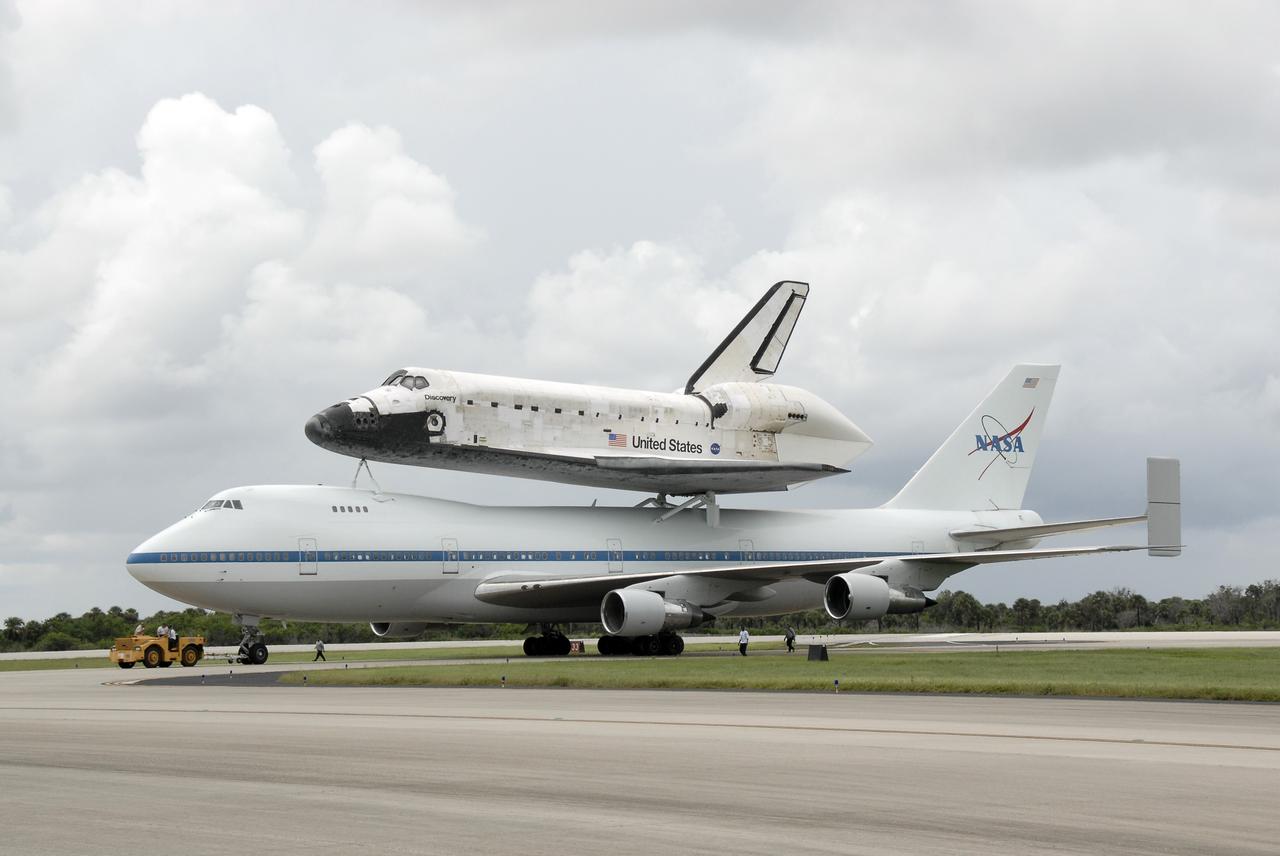
CAPE CANAVERAL, Fla. – The Boeing 747 Shuttle Carrier Aircraft, or SCA, with space shuttle Discovery on top, is ready for towing from the Shuttle Landing Facility's runway 33 at NASA's Kennedy Space Center in Florida after touching down at 12:05 p.m. EDT. The two-day return flight from Edwards Air Force Base in California began at 9:20 a.m. EDT Sept. 20. After three fueling stops that included an overnight stay in Louisiana, the piggybacked shuttle had to navigate through a line of showers across Louisiana and around Kennedy. Discovery had landed at Edwards Sept. 11 after the 13-day STS-128 mission to the International Space Station. The shuttle delivered more than 7 tons of supplies, science racks and equipment, as well as additional environmental hardware to sustain six crew members on the station. Landings at Kennedy were waved off on two days due to inclement weather, leading to the landing at Edwards. Photo credit: NASA/Kim Shiflett
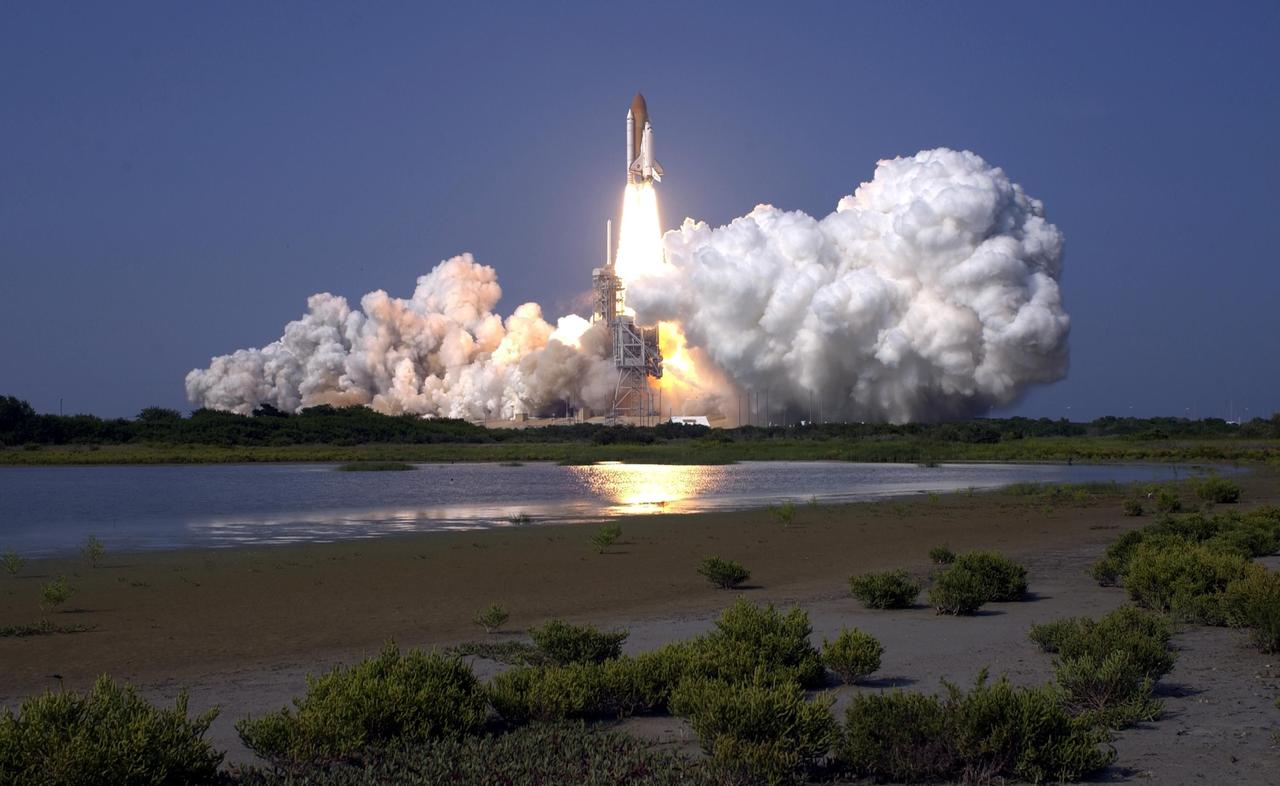
KENNEDY SPACE CENTER, Fla. -- Space Shuttle Discovery hurtles into the heavens to rendezvous with the International Space Station on mission STS-105. Liftoff occurred on time at 5:10:14 p.m. EDT on this second launch attempt. Launch countdown activities for the 12-day mission were called off Aug. 9 during the T-9 minute hold due to the high potential for lightning, a thick cloud cover and the potential for showers. Besides the Shuttle crew of four, Discovery carries the Expedition Three crew who will replace Expedition Two on the International Space Station. The mission includes the third flight of an Italian-built Multi-Purpose Logistics Module delivering additional scientific racks, equipment and supplies for the Space Station, and two spacewalks. Part of the payload is the Early Ammonia Servicer (EAS) tank, which will be attached to the Station during the spacewalks. The EAS contains spare ammonia for the Station’s cooling system. The three-member Expedition Two crew will be returning to Earth aboard Discovery after a five-month stay on the Station. [Photo by Scott Andrews; Nikon D1X camera
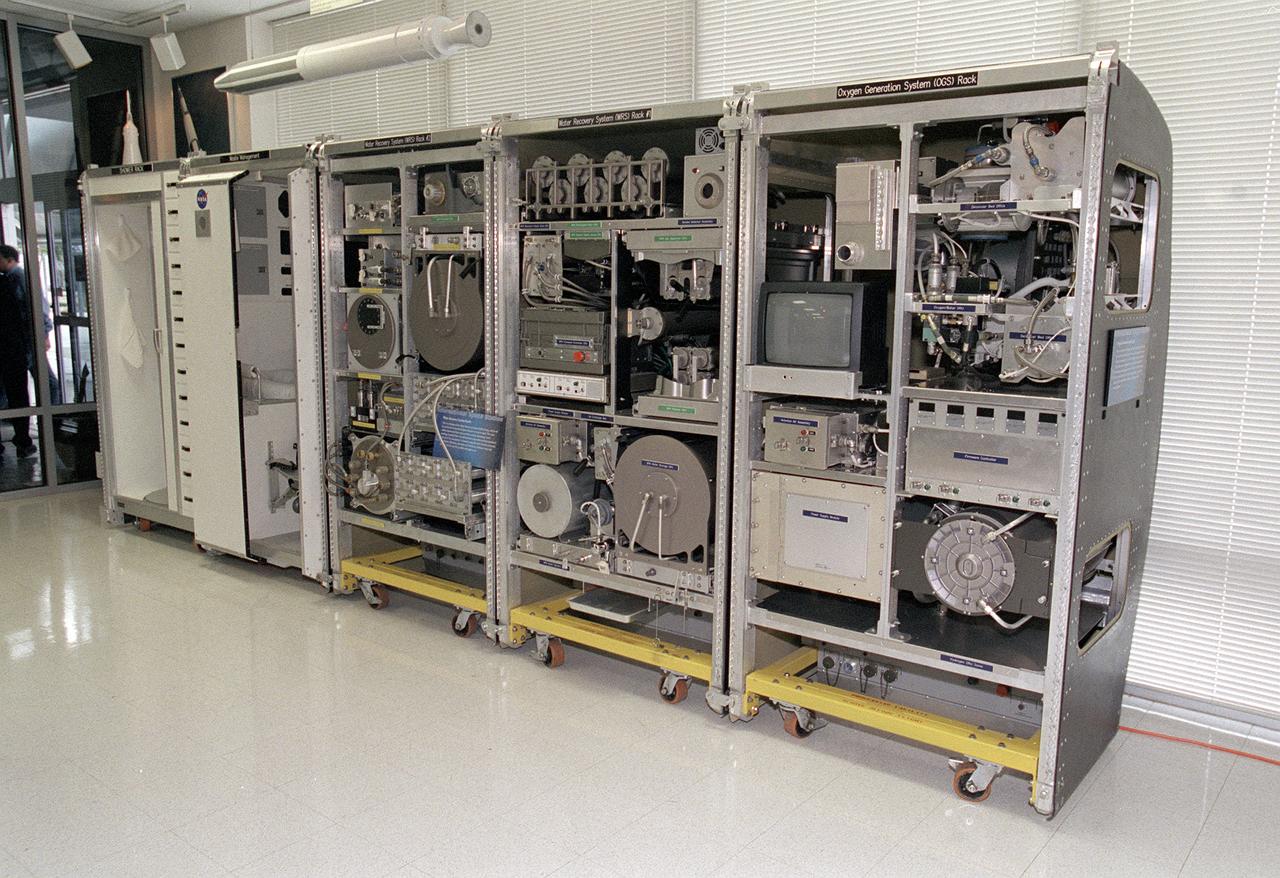
The Environmental Control and Life Support System (ECLSS) Group of the Flight Projects Directorate at the Marshall Space Flight Center in Huntsville, Alabama, is responsible for designing and building the life support systems that will provide the crew of the International Space Station (ISS) a comfortable environment in which to live and work. This photograph shows the mockup of the the ECLSS to be installed in the Node 3 module of the ISS. From left to right, shower rack, waste management rack, Water Recovery System (WRS) Rack #2, WRS Rack #1, and Oxygen Generation System (OGS) rack are shown. The WRS provides clean water through the reclamation of wastewaters and is comprised of a Urine Processor Assembly (UPA) and a Water Processor Assembly (WPA). The UPA accepts and processes pretreated crewmember urine to allow it to be processed along with other wastewaters in the WPA. The WPA removes free gas, organic, and nonorganic constituents before the water goes through a series of multifiltration beds for further purification. The OGS produces oxygen for breathing air for the crew and laboratory animals, as well as for replacing oxygen loss. The OGS is comprised of a cell stack, which electrolyzes (breaks apart the hydrogen and oxygen molecules) some of the clean water provided by the WRS, and the separators that remove the gases from the water after electrolysis.
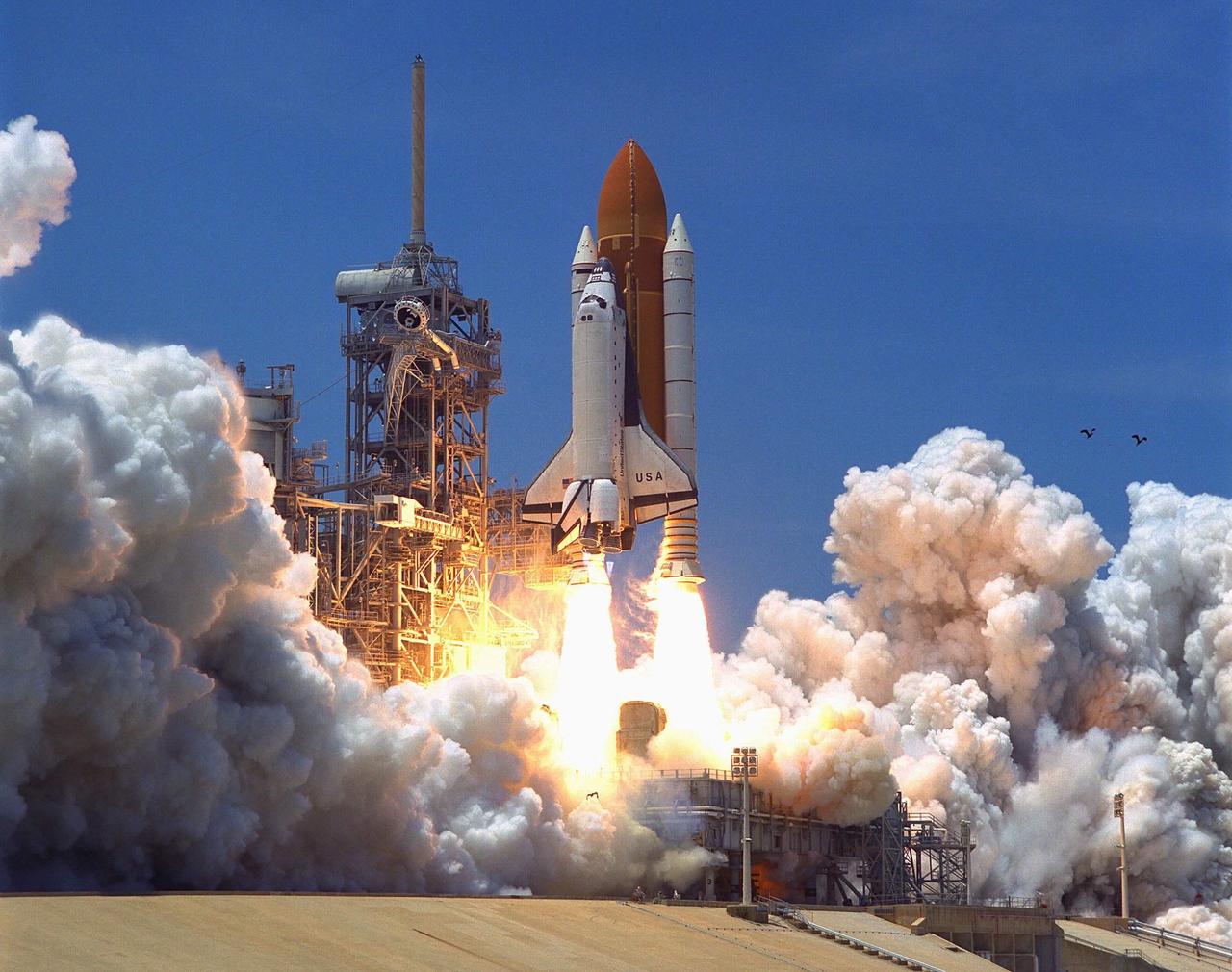
KENNEDY SPACE CENTER, Fla. -- The Space Shuttle Columbia soars from Launch Pad 39A at 2:02 p.m. EDT July 1 to begin the 16-day STS-94 Microgravity Science Laboratory-1 (MSL-1) mission. The launch window was opened 47 minutes earlier than the originally scheduled time of 2:37 p.m. to improve the opportunity to lift off before Florida summer rain showers reached the space center. The crew members are Mission Commander James D. Halsell Jr.; Pilot Susan L. Still; Payload Commander Janice Voss; Mission Specialists Michael L.Gernhardt and Donald A. Thomas; and Payload Specialists Roger K. Crouch and Gregory T. Linteris. During the space flight, the MSL-1 will be used to test some of the hardware, facilities and procedures that are planned for use on the International Space Station while the flight crew conducts combustion, protein crystal growth and materials processing experiments. Also onboard is the Hitchhiker Cryogenic Flexible Diode (CRYOFD) experiment payload, which is attached to the right side of Columbia’s payload bay. These payloads had previously flown on the STS-83 mission in April, which was cut short after nearly four days because of indications of a faulty fuel cell. STS-94 is a reflight of that mission
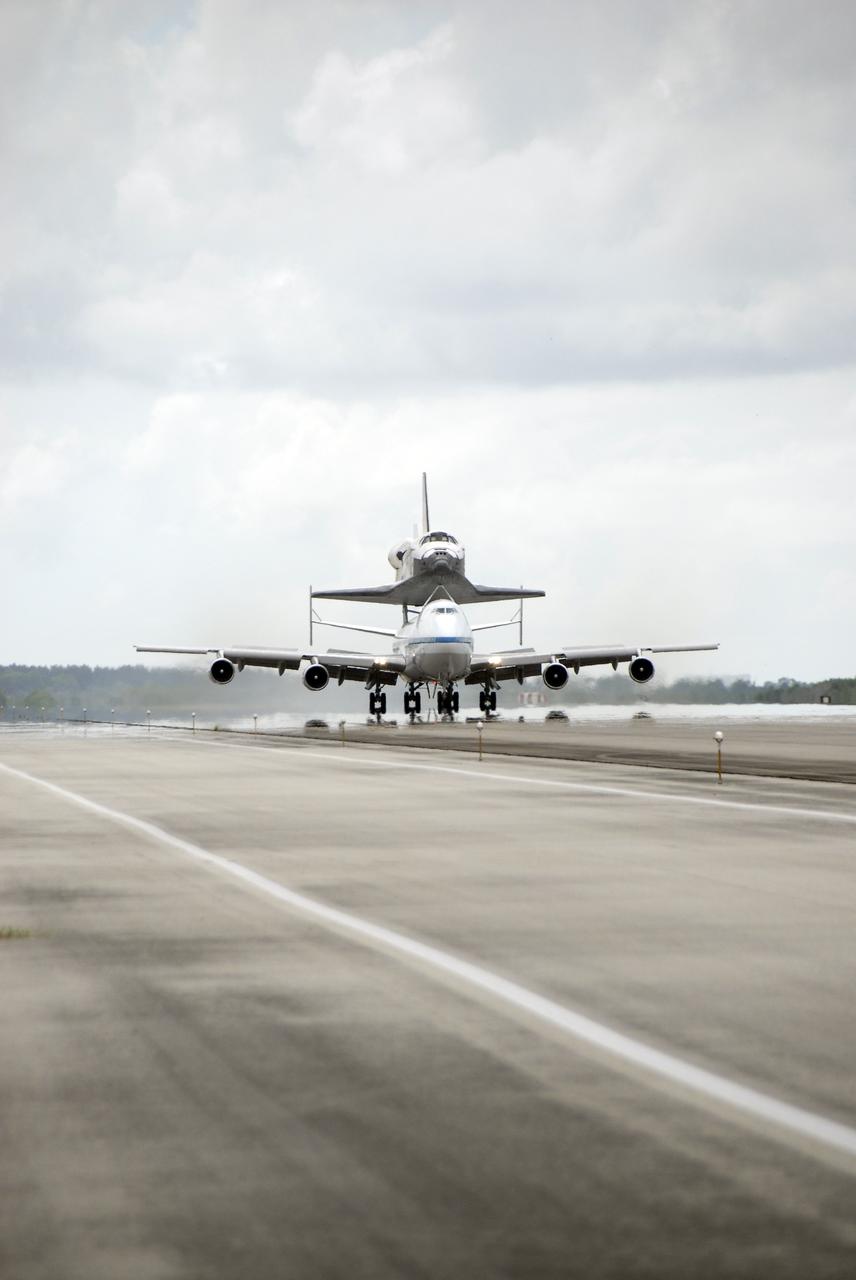
CAPE CANAVERAL, Fla. – The Boeing 747 Shuttle Carrier Aircraft, or SCA, with space shuttle Discovery on top, touches down on the Shuttle Landing Facility's runway 33 at NASA's Kennedy Space Center in Florida at 12:05 p.m. EDT. The two-day return flight from Edwards Air Force Base in California began at 9:20 a.m. EDT Sept. 20. After three fueling stops that included an overnight stay in Louisiana, the piggybacked shuttle had to navigate through a line of showers across Louisiana and around Kennedy. Discovery had landed at Edwards Sept. 11 after the 13-day STS-128 mission to the International Space Station. The shuttle delivered more than 7 tons of supplies, science racks and equipment, as well as additional environmental hardware to sustain six crew members on the station. Landings at Kennedy were waved off on two days due to inclement weather, leading to the landing at Edwards. Photo credit: NASA/Kim Shiflett
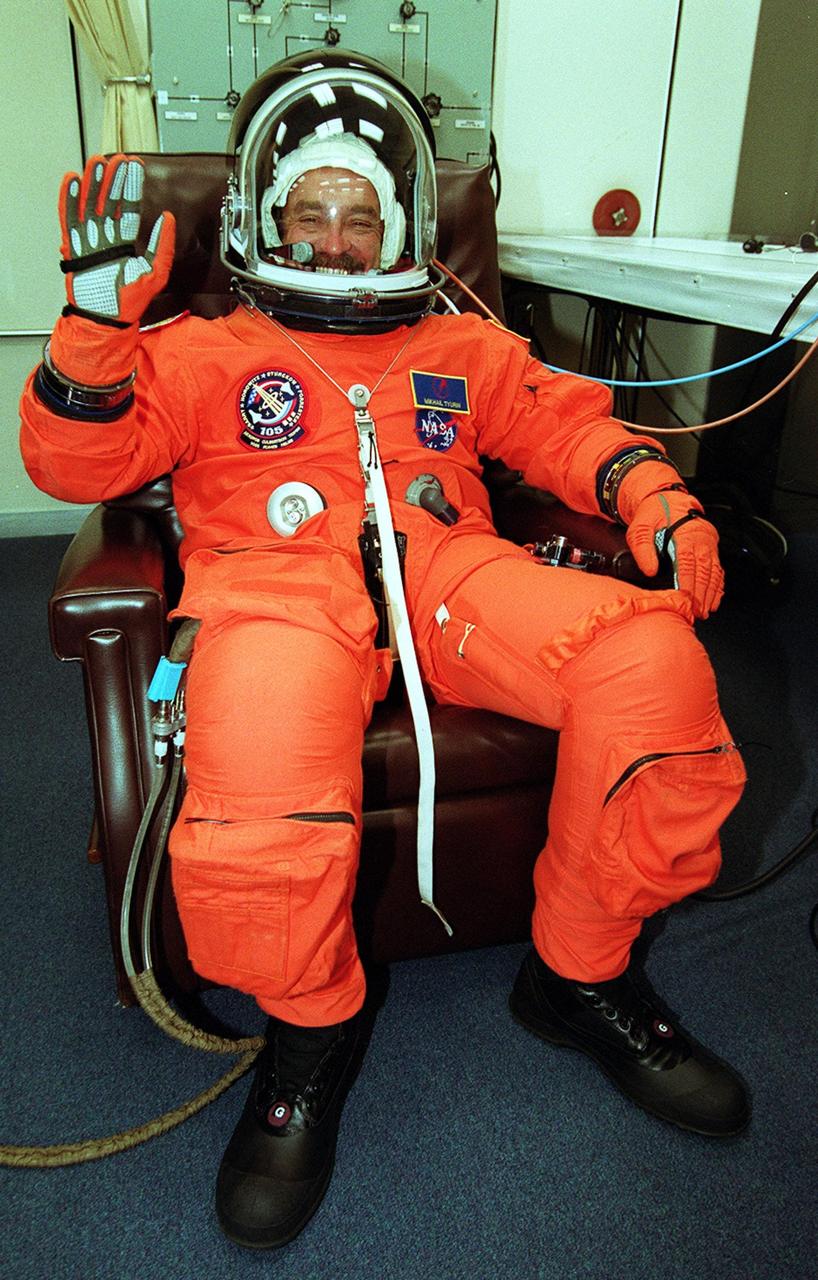
KENNEDY SPACE CENTER, Fla. -- Expedition Three cosmonaut Mikhail Tyurin is eager for the second launch attempt of mission STS-105 after a 24-hour weather delay. This is Tyurin’s first space flight. Launch countdown activities for the 12-day mission were called off at about 5:12 p.m. Aug. 9 during the T-9 minute hold due to the high potential for lightning, a thick cloud cover and the potential for showers. Launch is currently scheduled for 5:15 p.m. EDT Aug. 10. Highlighting the mission will be the rotation of the International Space Station crew, the third flight of an Italian-built Multi-Purpose Logistics Module delivering additional scientific racks, equipment and supplies for the Space Station, and two spacewalks. Included in the payload is the Early Ammonia Servicer (EAS) tank, which will be attached to the Station during the spacewalks. The EAS will be installed on the P6 truss, which holds the Station’s giant U.S. solar arrays, batteries and the cooling radiators. The EAS contains spare ammonia for the Station’s cooling system. The three-member Expedition Two crew will be returning to Earth aboard Discovery after a five-month stay on the Station
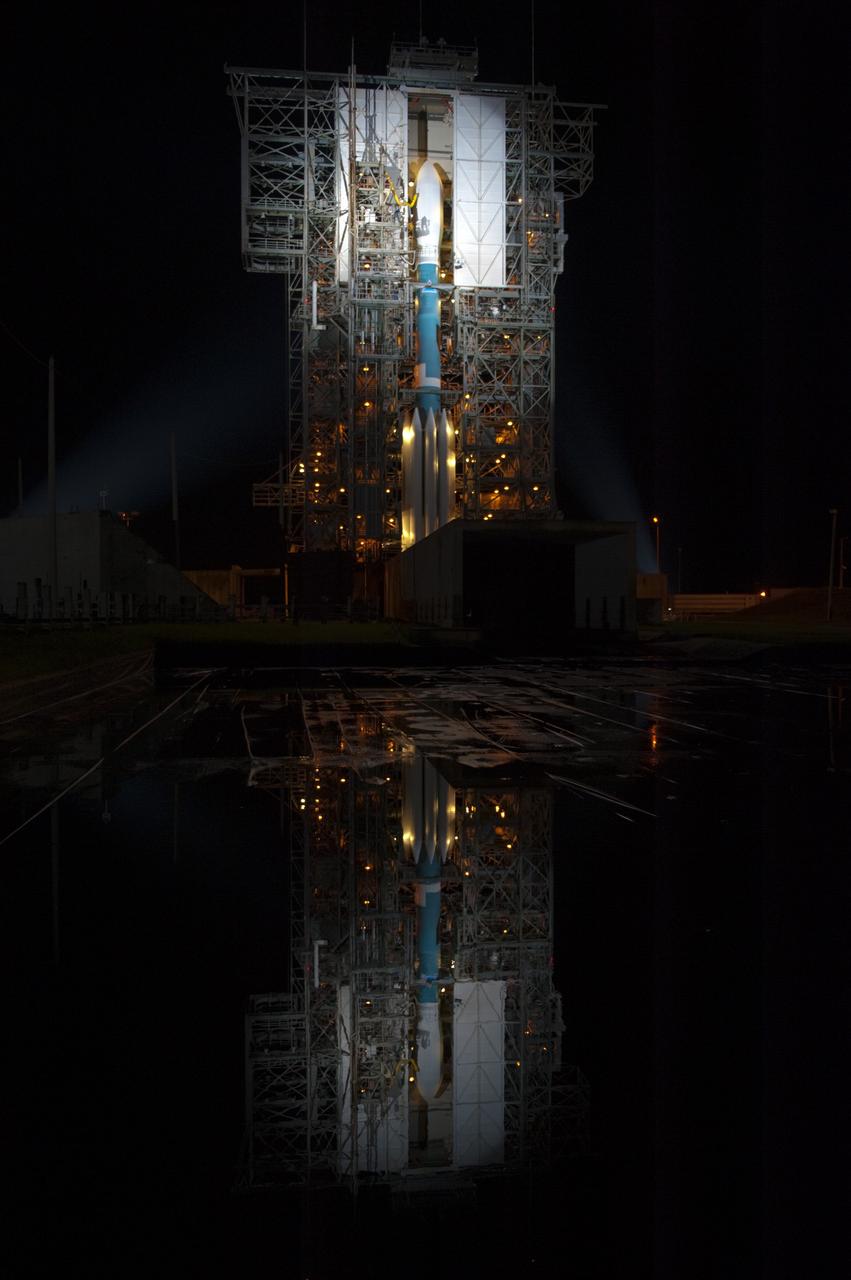
CAPE CANAVERAL, Fla. -- At Space Launch Complex 17B on Cape Canaveral Air Force Station, evening showers create the right conditions for the United Launch Alliance Delta II rocket that will launch NASA's Gravity Recovery and Interior Laboratory mission to be reflected on the surface of the pad. Preparations are under way to roll the mobile service tower away from the rocket. GRAIL will fly twin spacecraft in tandem around the moon to precisely measure and map variations in the moon's gravitational field. The mission will provide the most accurate global gravity field to date for any planet, including Earth. This detailed information will reveal differences in the density of the moon's crust and mantle and will help answer fundamental questions about the moon's internal structure, thermal evolution, and history of collisions with asteroids. The aim is to map the moon's gravity field so completely that future lunar vehicles can safely navigate anywhere on the moon’s surface. Launch is scheduled for 8:37:06 a.m. EDT Sept. 8. For more information, visit http://www.nasa.gov/grail. Photo credit: NASA/Kim Shiflett
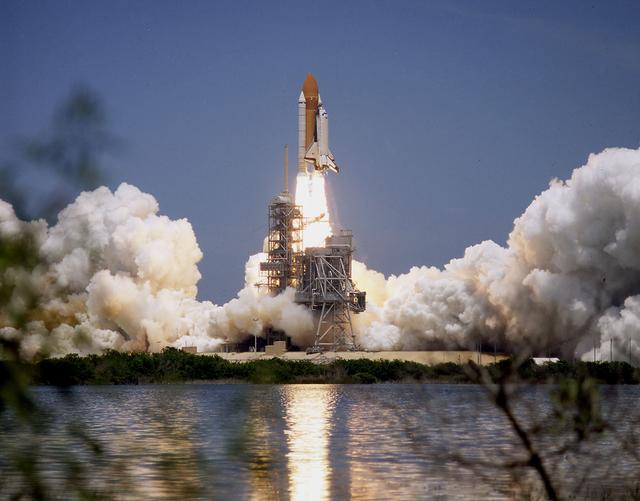
The Space Shuttle Columbia (STS-94) soared from Launch Pad 39A begirning its 16-day Microgravity Science Laboratory -1 (MSL-1) mission. The launch window was opened 47 minutes earlier than the originally scheduled time to improve the opportunity to lift off before Florida summer rain showers reached the space center. During the space flight, the MSL-1 was used to test some of the hardware, facilities and procedures that were planned for use on the International Space Station which were managed by scientists and engineers from the Marshall Space Flight Center, while the flight crew conducted combustion, protein crystal growth and materials processing experiments. Also onboard was the Hitchhiker Cryogenic Flexible Diode (CRYOFD) experiment payload, which was attached to the right side of Columbia's payload bay. These payloads had previously flown on the STS-83 mission in April, which was cut short after nearly four days because of indications of a faulty fuel cell. STS-94 was a reflight of that mission.
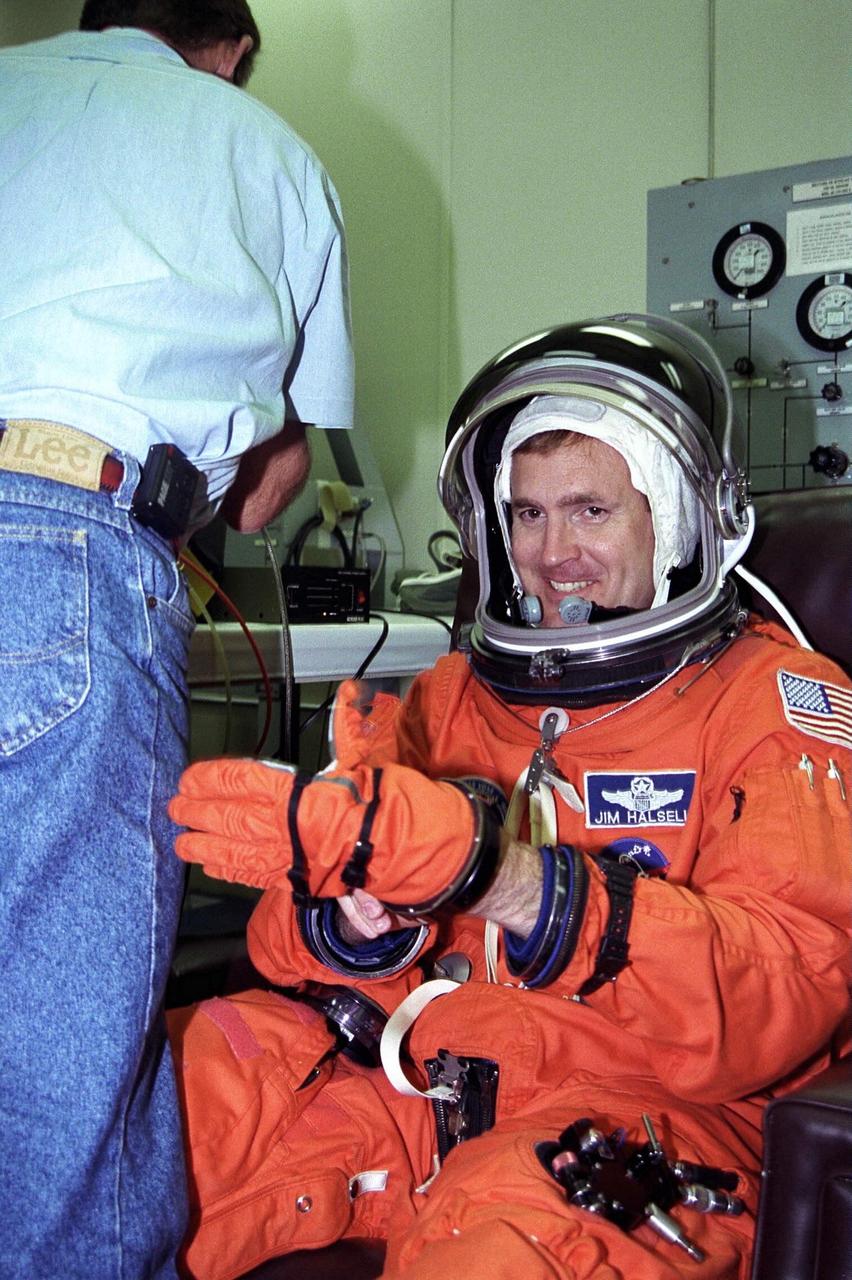
STS-94 Mission Commander James D. Halsell, Jr., puts his left glove on while he is assisted into his launch/entry suit in the Operations and Checkout (O&C) Building. Halsell is on his fourth space flight, having served as commander of STS-83 and pilot of both STS-74 and STS-65. He is a lieutenant colonel in the Air Force and a former SR-71 Blackbird test pilot and holds master’s degrees in management and space operations. Halsell will have responsibility for the success of the mission and will operate and maintain Columbia during the Red, or second shift. He will also assist with a materials science experiment and a protein crystal growth payload during the 16-day mission. Halsell and six fellow crew members will shortly depart the O&C and head for Launch Pad 39A, where the Space Shuttle Columbia will lift off during a launch window that opens at 1:50 p.m. EDT, July 1. The launch window was opened 47 minutes early to improve the opportunity to lift off before Florida summer rain showers reached the space center
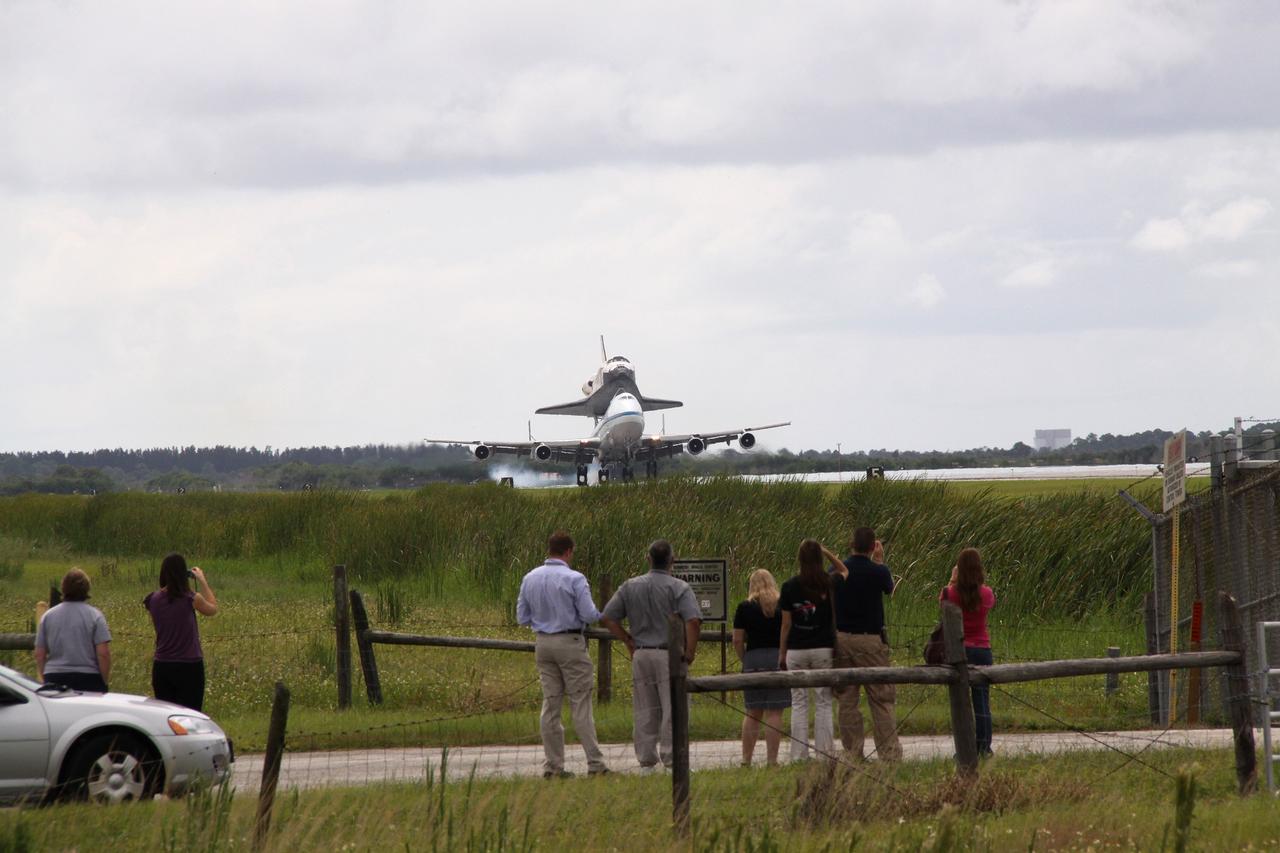
CAPE CANAVERAL, Fla. – The Boeing 747 Shuttle Carrier Aircraft, or SCA, with space shuttle Discovery on top, touches down on runway 33 at NASA's Kennedy Space Center in Florida at 12:05 p.m. EDT. The two-day return flight from Edwards Air Force Base in California began at 9:20 a.m. EDT Sept. 20. After three fueling stops that included an overnight stay in Louisiana, the piggybacked shuttle had to navigate through a line of showers across Louisiana and around Kennedy. Discovery had landed at Edwards Sept. 11 after the 13-day STS-128 mission to the International Space Station. The shuttle delivered more than 7 tons of supplies, science racks and equipment, as well as additional environmental hardware to sustain six crew members on the station. Landings at Kennedy were waved off on two days due to inclement weather, leading to the landing at Edwards. Photo credit: NASA/Jack Pfaller
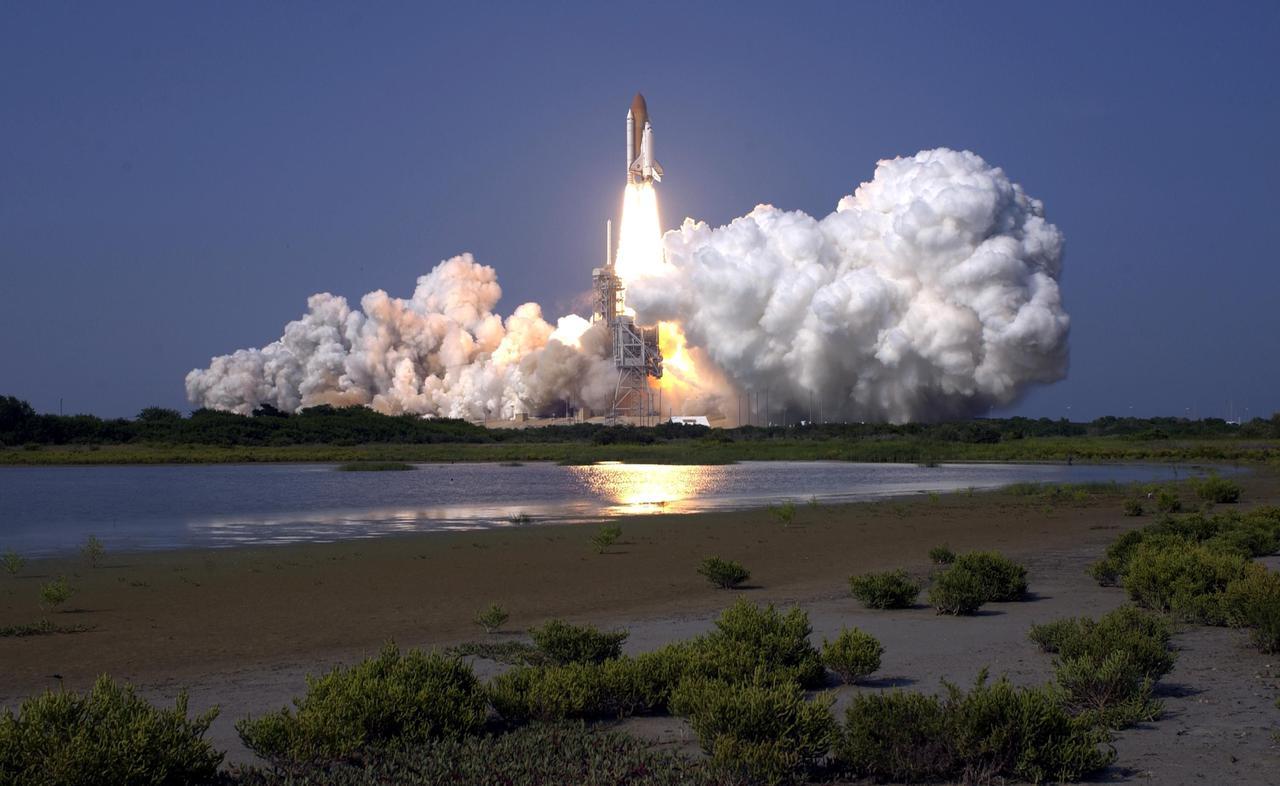
KENNEDY SPACE CENTER, Fla. -- Space Shuttle Discovery hurtles into the heavens to rendezvous with the International Space Station on mission STS-105. Liftoff occurred on time at 5:10:14 p.m. EDT on this second launch attempt. Launch countdown activities for the 12-day mission were called off Aug. 9 during the T-9 minute hold due to the high potential for lightning, a thick cloud cover and the potential for showers. Besides the Shuttle crew of four, Discovery carries the Expedition Three crew who will replace Expedition Two on the International Space Station. The mission includes the third flight of an Italian-built Multi-Purpose Logistics Module delivering additional scientific racks, equipment and supplies for the Space Station, and two spacewalks. Part of the payload is the Early Ammonia Servicer (EAS) tank, which will be attached to the Station during the spacewalks. The EAS contains spare ammonia for the Station’s cooling system. The three-member Expedition Two crew will be returning to Earth aboard Discovery after a five-month stay on the Station. [Photo by Scott Andrews; Nikon D1X camera
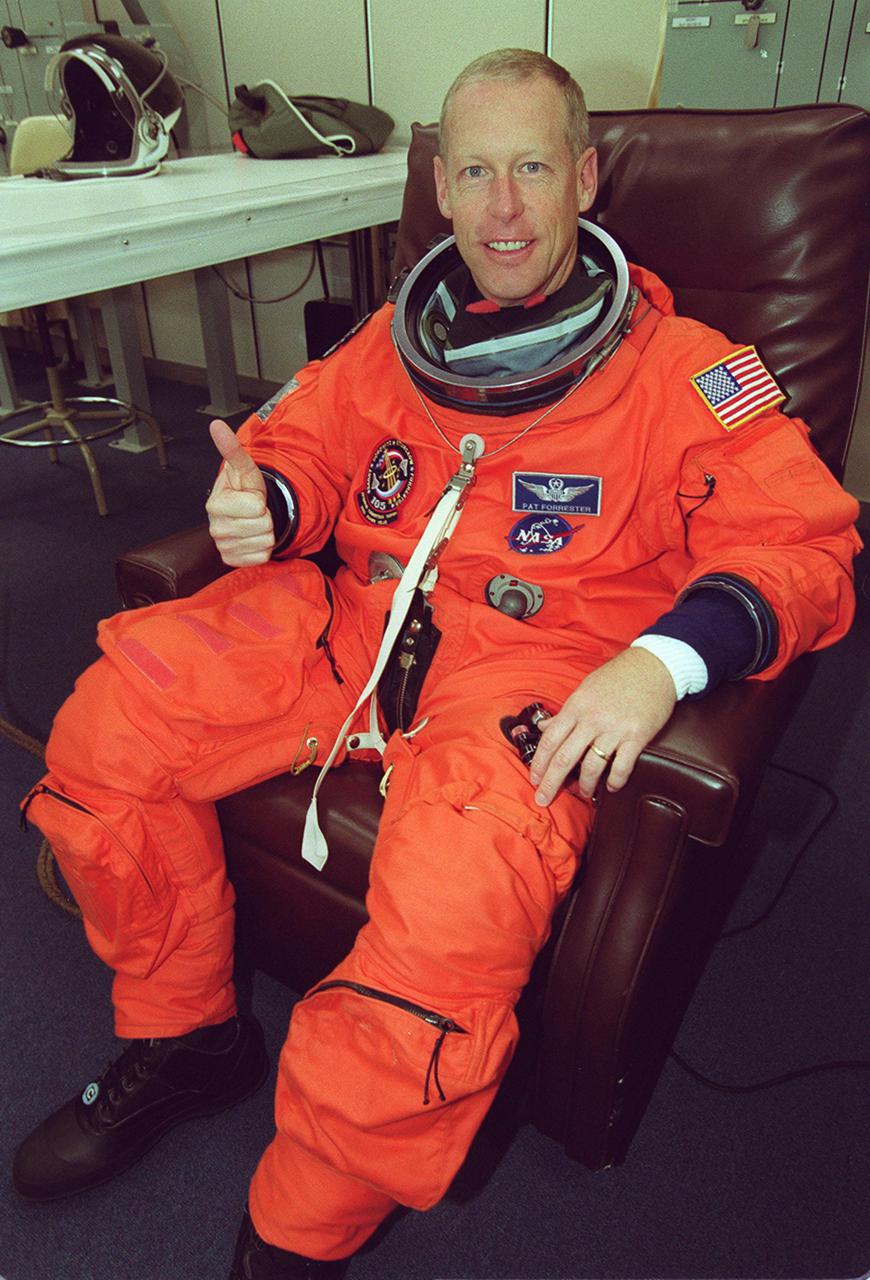
KENNEDY SPACE CENTER, Fla. -- STS-105 Mission Specialist Patrick Forrester is eager for the second launch attempt on mission STS-105 after a 24-hour weather delay. Launch countdown activities for the 12-day mission were called off at about 5:12 p.m. Aug. 9 during the T-9 minute hold due to the high potential for lightning, a thick cloud cover and the potential for showers. Launch is currently scheduled for 5:15 p.m. EDT Aug. 10. Highlighting the mission will be the rotation of the International Space Station crew, the third flight of an Italian-built Multi-Purpose Logistics Module delivering additional scientific racks, equipment and supplies for the Space Station, and two spacewalks. Included in the payload is the Early Ammonia Servicer (EAS) tank, which will be attached to the Station during the spacewalks. The EAS will be installed on the P6 truss, which holds the Station’s giant U.S. solar arrays, batteries and the cooling radiators. The EAS contains spare ammonia for the Station’s cooling system. The three-member Expedition Two crew will be returning to Earth aboard Discovery after a five-month stay on the Station
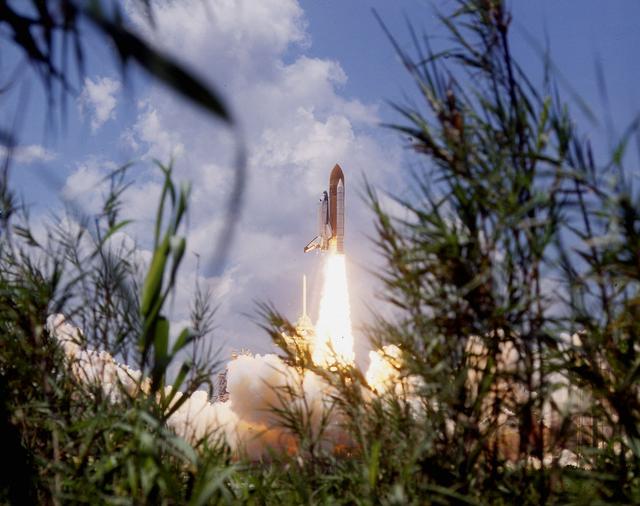
The Space Shuttle Columbia (STS-94) soared from Launch Pad 39A begirning its 16-day Microgravity Science Laboratory -1 (MSL-1) mission. The launch window was opened 47 minutes earlier than the originally scheduled time to improve the opportunity to lift off before Florida summer rain showers reached the space center. During the space flight, the MSL-1 was used to test some of the hardware, facilities and procedures that were planned for use on the International Space Station which were managed by scientists and engineers from the Marshall Space Flight Center, while the flight crew conducted combustion, protein crystal growth and materials processing experiments. Also onboard was the Hitchhiker Cryogenic Flexible Diode (CRYOFD) experiment payload, which was attached to the right side of Columbia's payload bay. These payloads had previously flown on the STS-83 mission in April, which was cut short after nearly four days because of indications of a faulty fuel cell. STS-94 was a reflight of that mission.
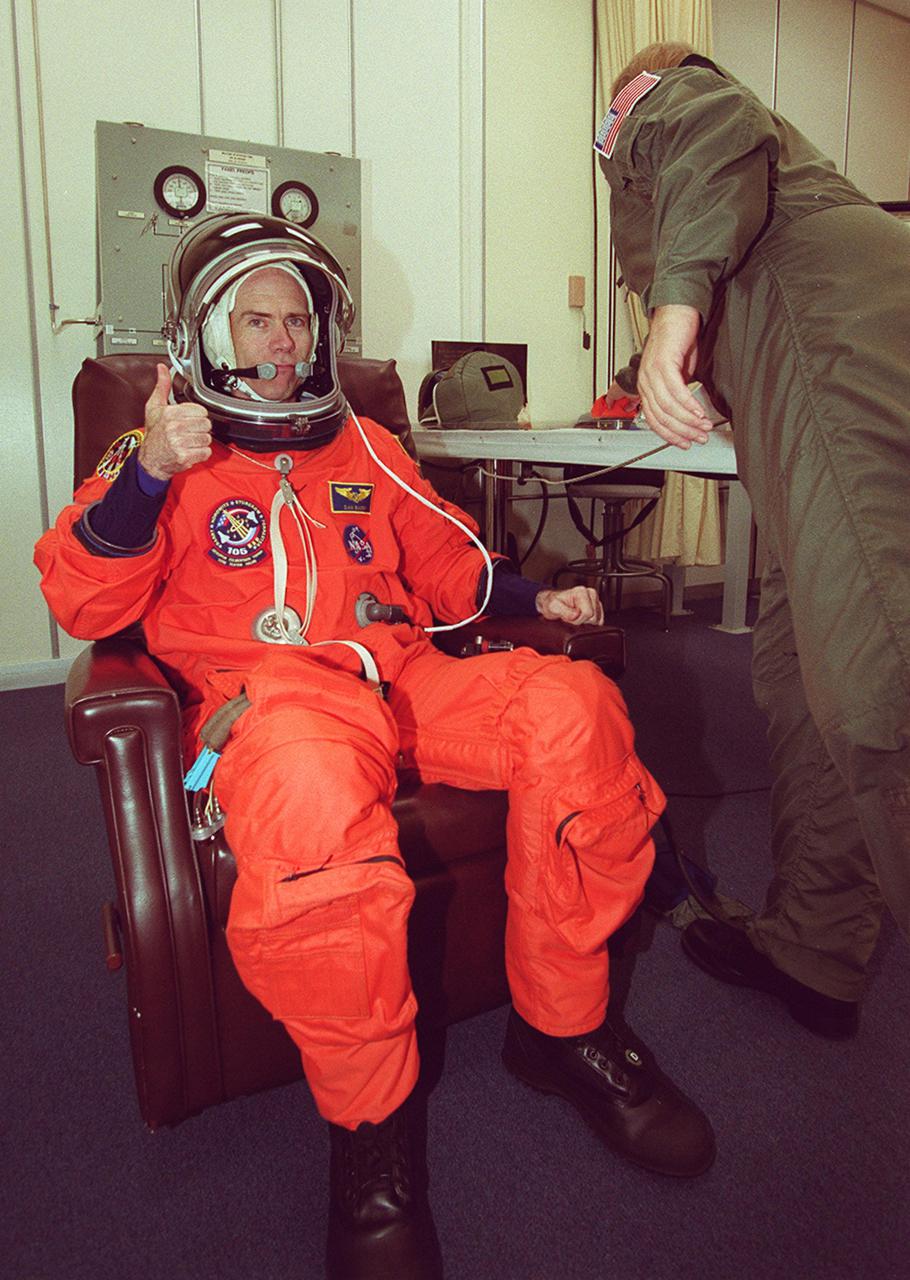
KENNEDY SPACE CENTER, Fla. -- STS-105 Mission Specialist Daniel Barry is set to go on the second launch attempt after a 24-hour weather delay. Launch countdown activities for the 12-day mission were called off at about 5:12 p.m. Aug. 9 during the T-9 minute hold due to the high potential for lightning, a thick cloud cover and the potential for showers. Launch is currently scheduled for 5:15 p.m. EDT Aug. 10. Highlighting the mission will be the rotation of the International Space Station crew, the third flight of an Italian-built Multi-Purpose Logistics Module delivering additional scientific racks, equipment and supplies for the Space Station, and two spacewalks. Included in the payload is the Early Ammonia Servicer (EAS) tank, which will be attached to the Station during the spacewalks. The EAS will be installed on the P6 truss, which holds the Station’s giant U.S. solar arrays, batteries and the cooling radiators. The EAS contains spare ammonia for the Station’s cooling system. The three-member Expedition Two crew will be returning to Earth aboard Discovery after a five-month stay on the Station
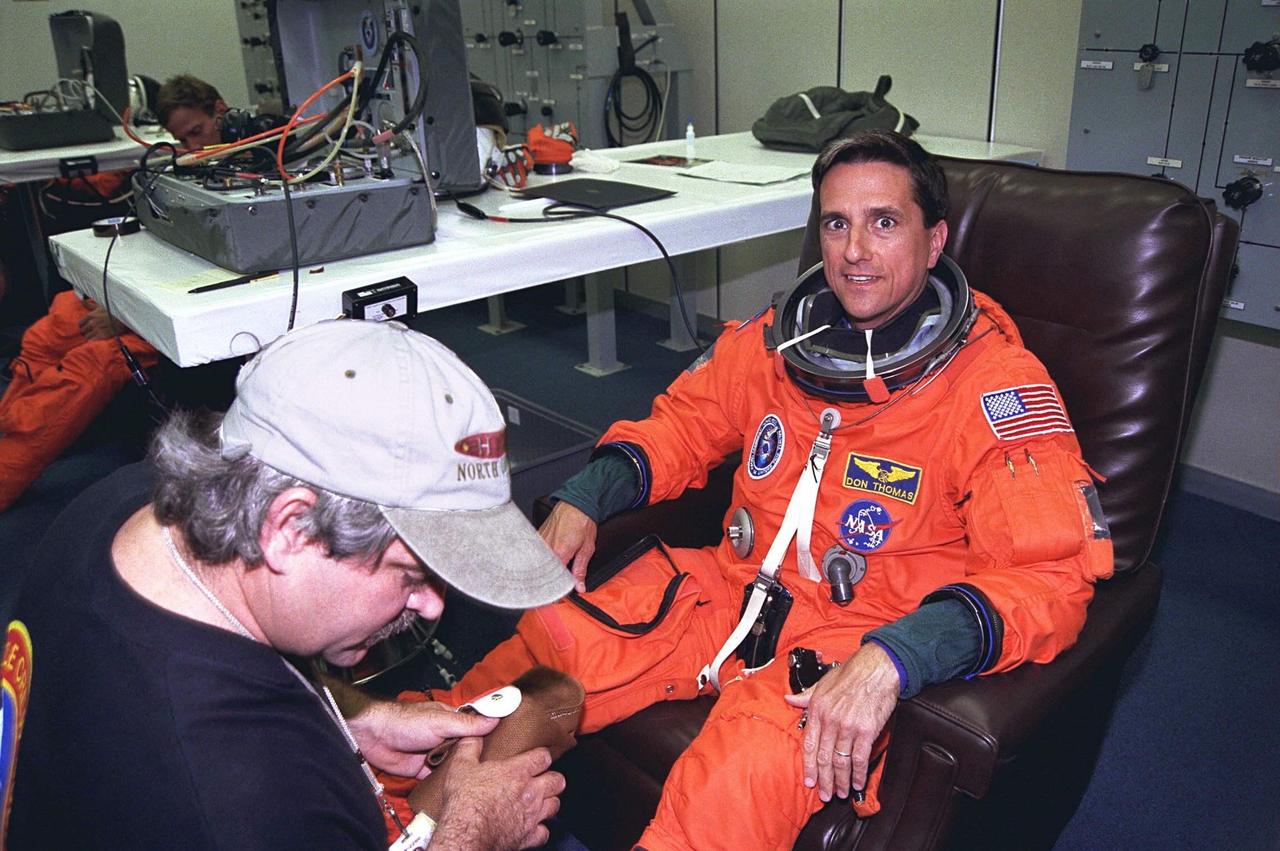
STS-94 Mission Specialist Donald A. Thomas smiles as a suit technician helps him into his launch/entry suit in the Operations and Checkout (O&C) Building. He has flown on STS-83, STS-70 and STS-65. He holds a doctorate in materials science and has been the Principal Investigator for a Space Shuttle crystal growth experiment. Because of his background in materials science, Thomas will be concentrating his efforts during the Red shift on the five experiments in this discipline in the Large Isothermal Furnace. He also will work on the ten materials science investigations in the Electromagnetic Containerless Processing Facility and four that will be measuring the effects of microgravity and motion in the orbiter on the experiments. Thomas and six fellow crew members will shortly depart the O&C and head for Launch Pad 39A, where the Space Shuttle Columbia will lift off during a launch window that opens at 1:50 p.m. EDT, July 1. The launch window was opened 47 minutes early to improve the opportunity to lift off before Florida summer rain showers reached the space center
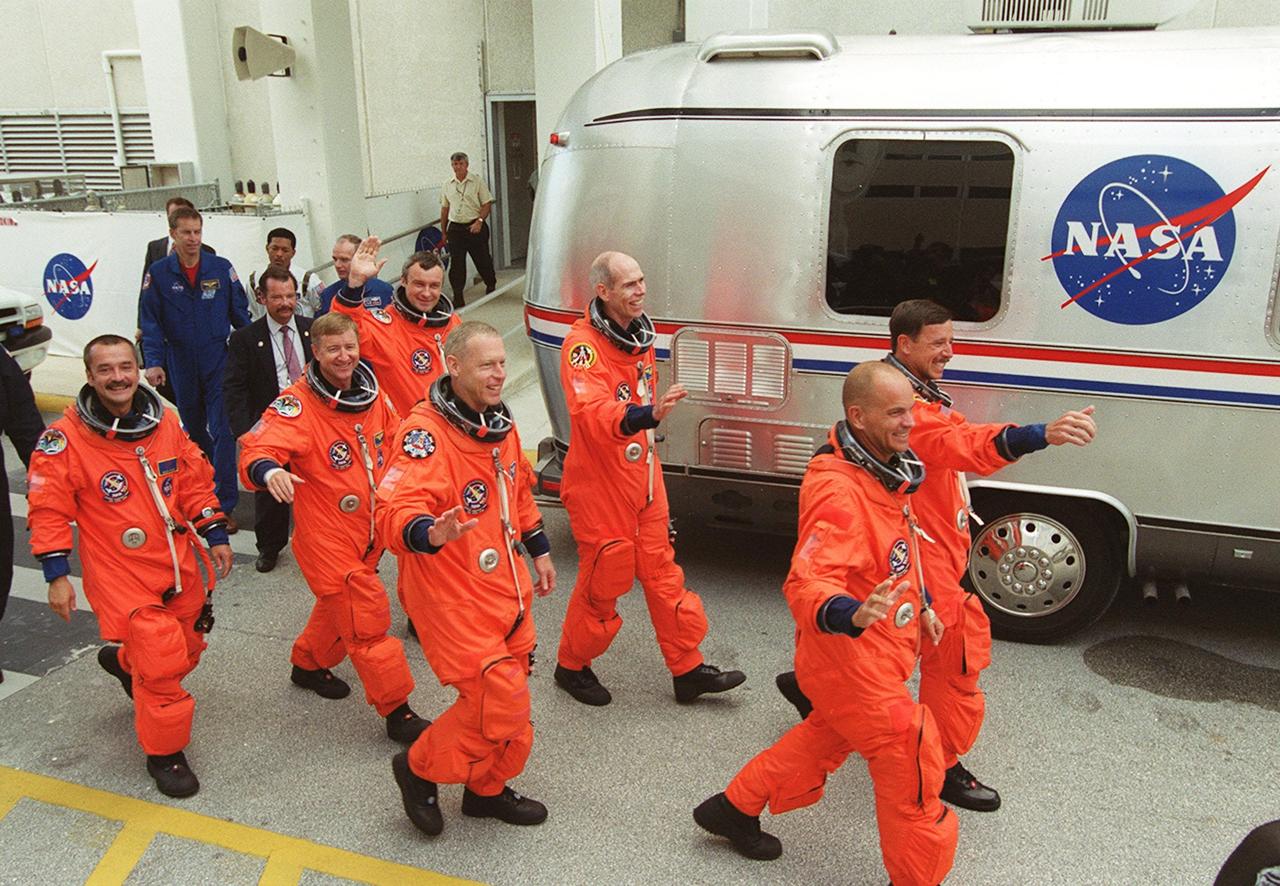
KENNEDY SPACE CENTER, Fla. -- Waving to onlookers, the STS-105 and Expedition Three (E3) crews head to the Astrovan that will take them to Launch Pad 39A for a second attempt at launch on mission STS-105. From the left are E3 cosmonaut Mikhail Tyurin, Commander Frank Culbertson and cosmonaut Vladimir Dezhurov; STS-105 Mission Specialists Patrick Forrester and Daniel Barry, Pilot Rick Sturckow and Commander Scott Horowitz. . Launch countdown activities for the 12-day mission were called off at about 5:12 p.m. Aug. 9 during the T-9 minute hold due to the high potential for lightning, a thick cloud cover and the potential for showers. Launch is currently scheduled for 5:15 p.m. EDT Aug. 10. Highlighting the mission will be the rotation of the International Space Station crew, the third flight of an Italian-built Multi-Purpose Logistics Module delivering additional scientific racks, equipment and supplies for the Space Station, and two spacewalks. Included in the payload is the Early Ammonia Servicer (EAS) tank, which will be attached to the Station during the spacewalks. The EAS will be installed on the P6 truss, which holds the Station’s giant U.S. solar arrays, batteries and the cooling radiators. The EAS contains spare ammonia for the Station’s cooling system. The three-member Expedition Two crew will be returning to Earth aboard Discovery after a five-month stay on the Station
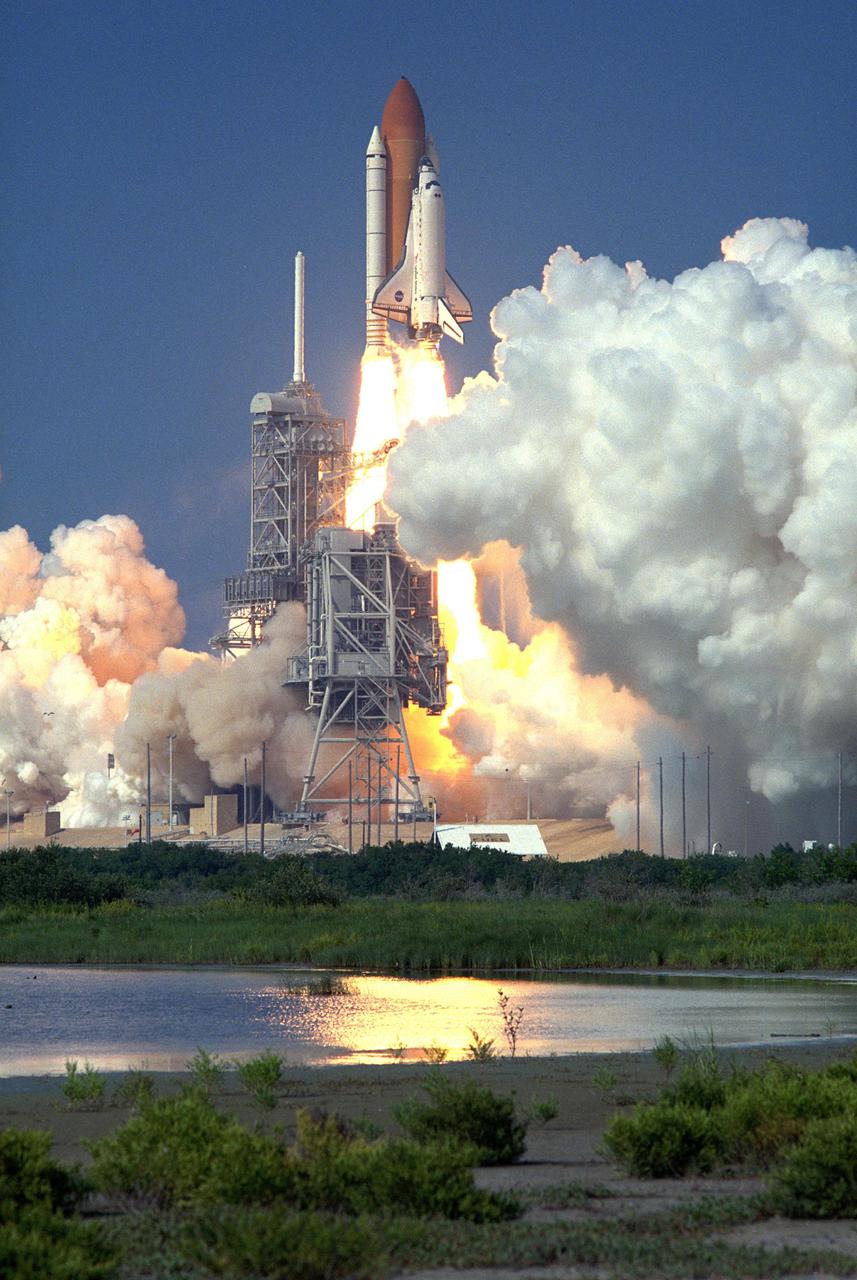
KENNEDY SPACE CENTER, Fla. -- Smoke billows out from Launch Pad 39A as Space Shuttle Discovery soars into the blue sky on mission STS-105 to the International Space Station. Liftoff occurred at 5:10:14 p.m. EDT on this second launch attempt. Launch countdown activities for the 12-day mission were called off Aug. 9 during the T-9 minute hold due to the high potential for lightning, a thick cloud cover and the potential for showers. Besides the Shuttle crew of four, Discovery carries the Expedition Three crew who will replace Expedition Two on the International Space Station. The mission includes the third flight of an Italian-built Multi-Purpose Logistics Module delivering additional scientific racks, equipment and supplies for the Space Station, and two spacewalks. Part of the payload is the Early Ammonia Servicer (EAS) tank, which will be attached to the Station during the spacewalks. The EAS contains spare ammonia for the Station’s cooling system. The three-member Expedition Two crew will be returning to Earth aboard Discovery after a five-month stay on the Station
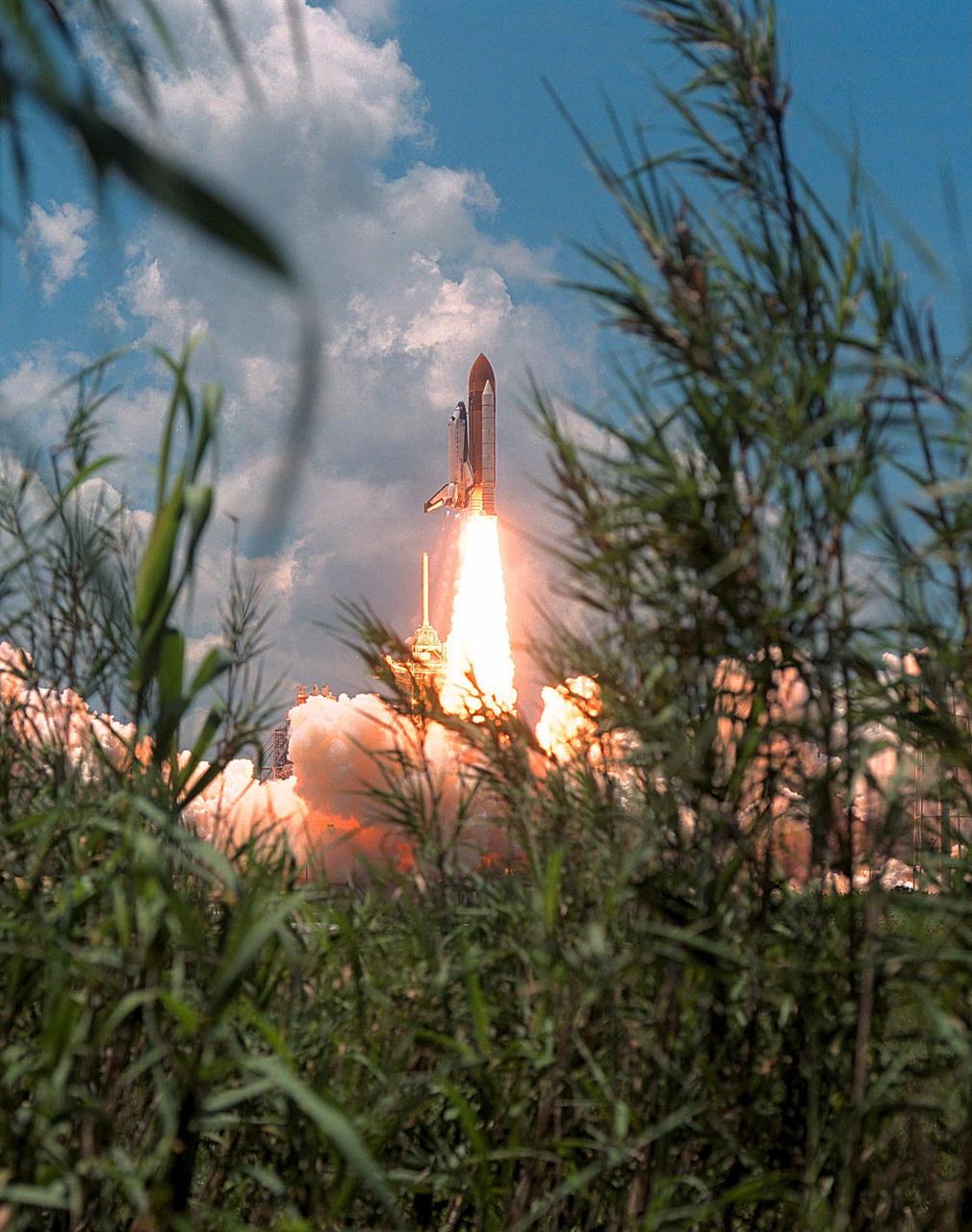
KENNEDY SPACE CENTER, Fla. -- The Space Shuttle Columbia soars from Launch Pad 39A at 2:02 p.m. EDT July 1 to begin the 16-day STS-94 Microgravity Science Laboratory-1 (MSL-1) mission. The launch window was opened 47 minutes earlier than the originally scheduled time of 2:37 p.m. to improve the opportunity to lift off before Florida summer rain showers reached the space center. The crew members are Mission Commander James D. Halsell Jr.; Pilot Susan L. Still; Payload Commander Janice Voss; Mission Specialists Michael L.Gernhardt and Donald A. Thomas; and Payload Specialists Roger K. Crouch and Gregory T. Linteris. During the space flight, the MSL-1 will be used to test some of the hardware, facilities and procedures that are planned for use on the International Space Station while the flight crew conducts combustion, protein crystal growth and materials processing experiments. Also onboard is the Hitchhiker Cryogenic Flexible Diode (CRYOFD) experiment payload, which is attached to the right side of Columbia’s payload bay. These payloads had previously flown on the STS-83 mission in April, which was cut short after nearly four days because of indications of a faulty fuel cell. STS-94 is a reflight of that mission