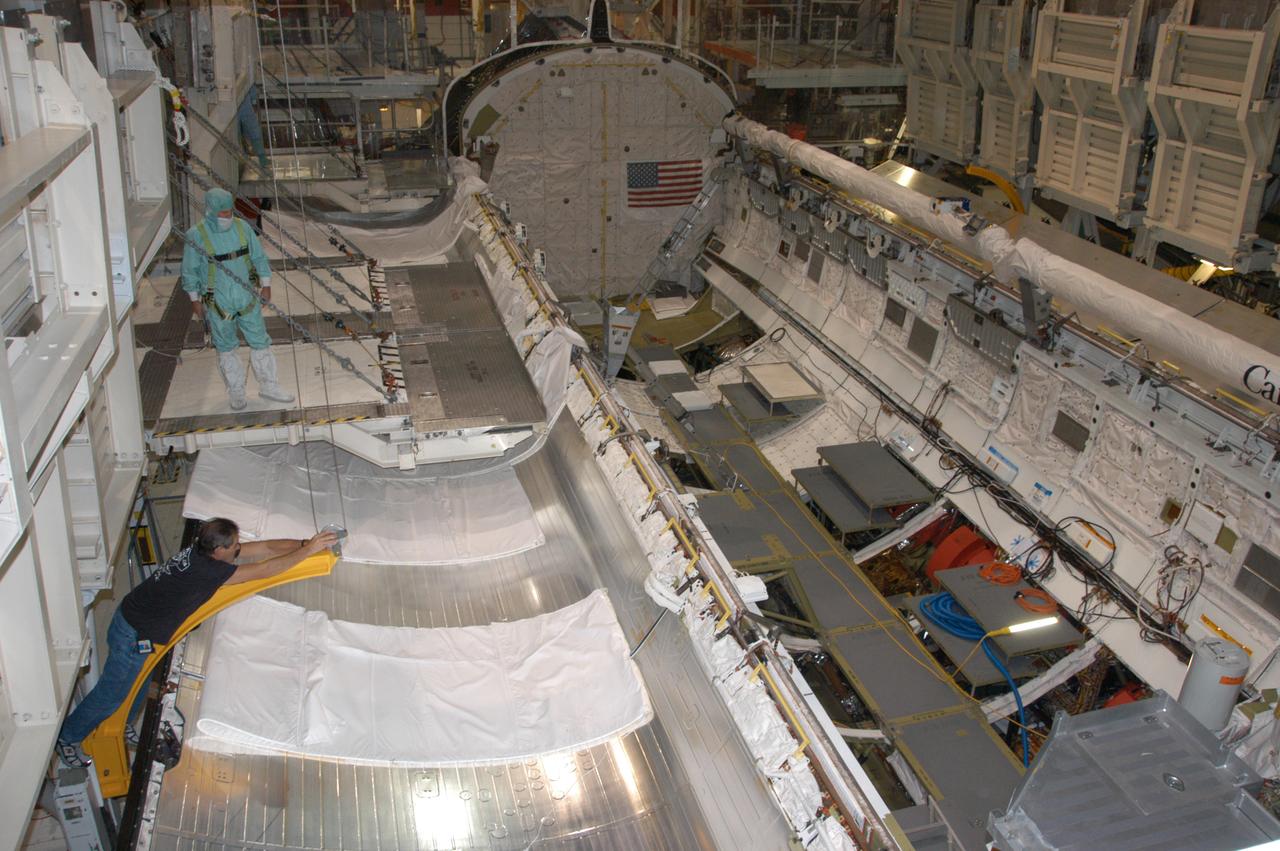
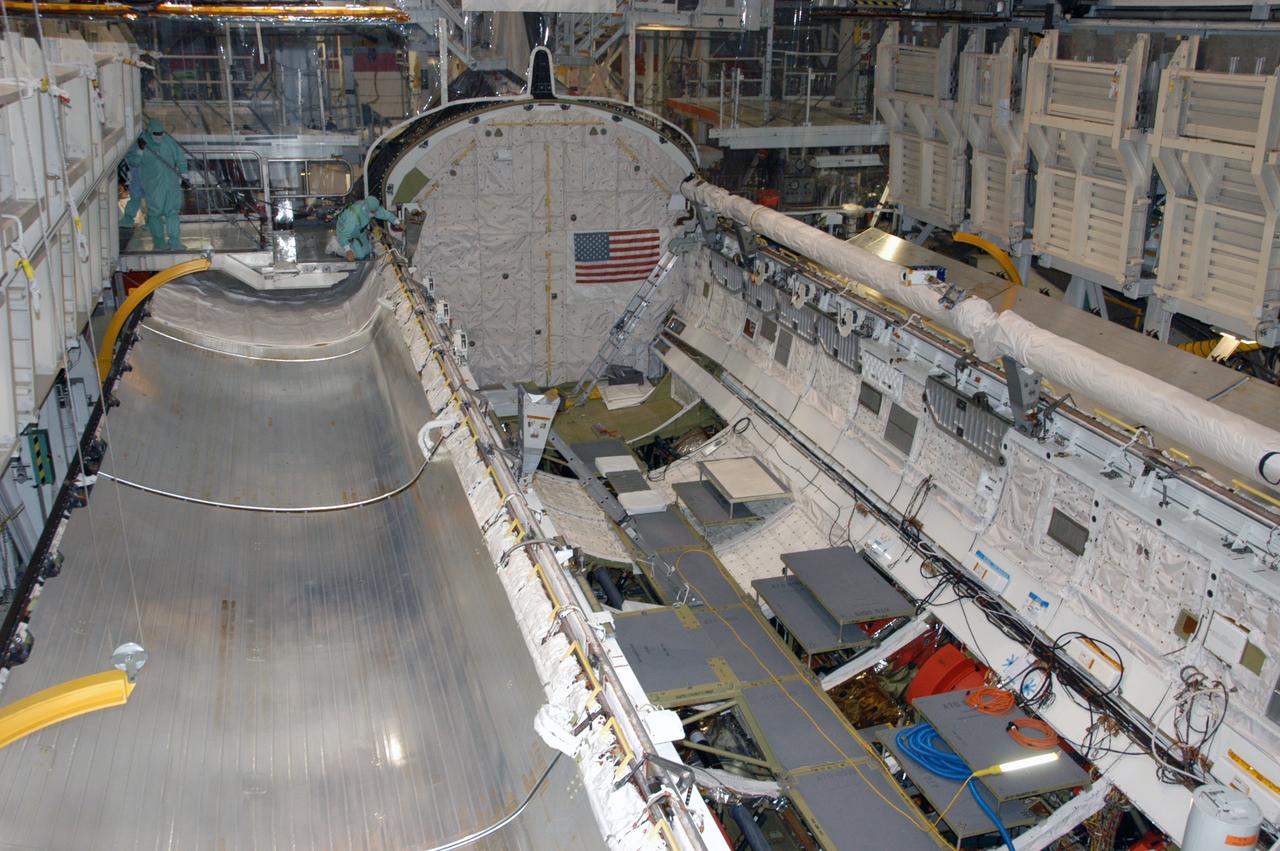
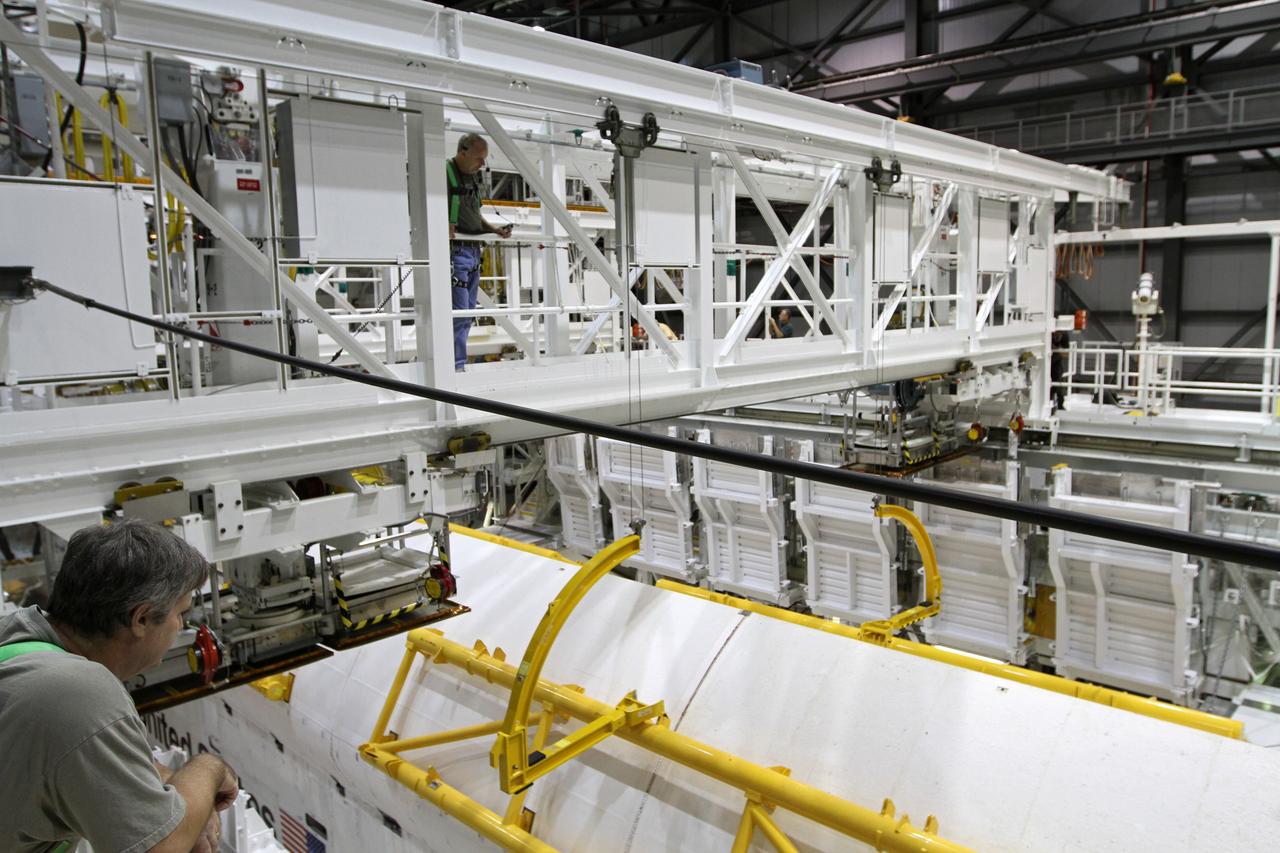
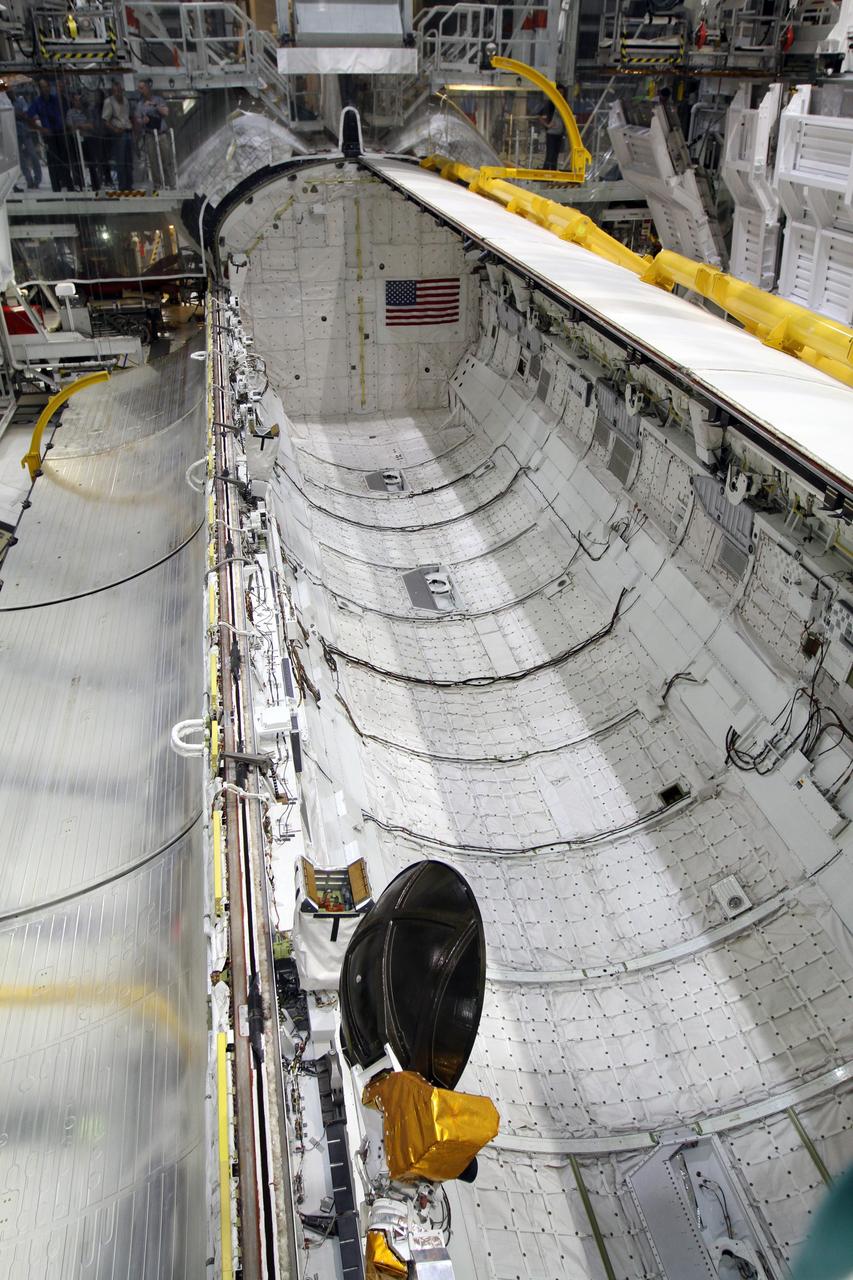
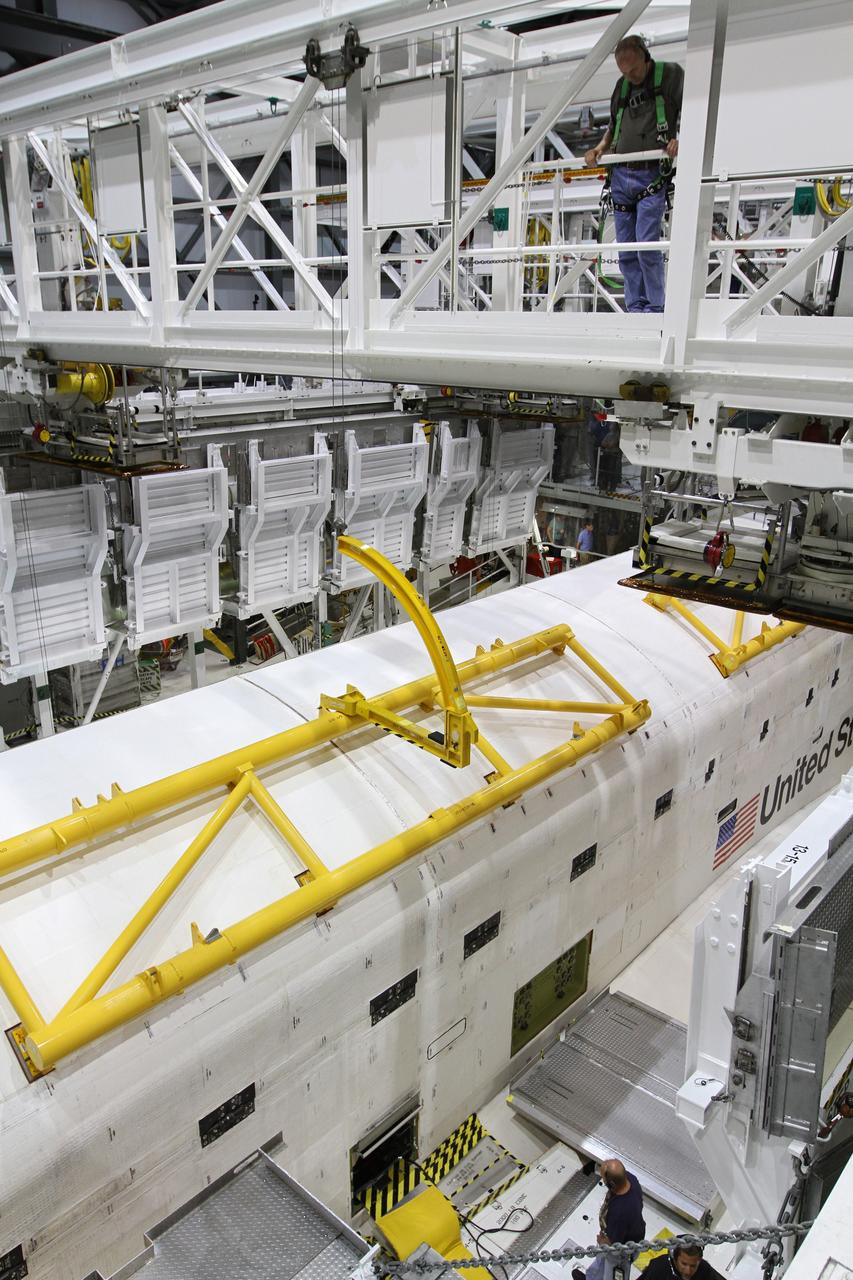
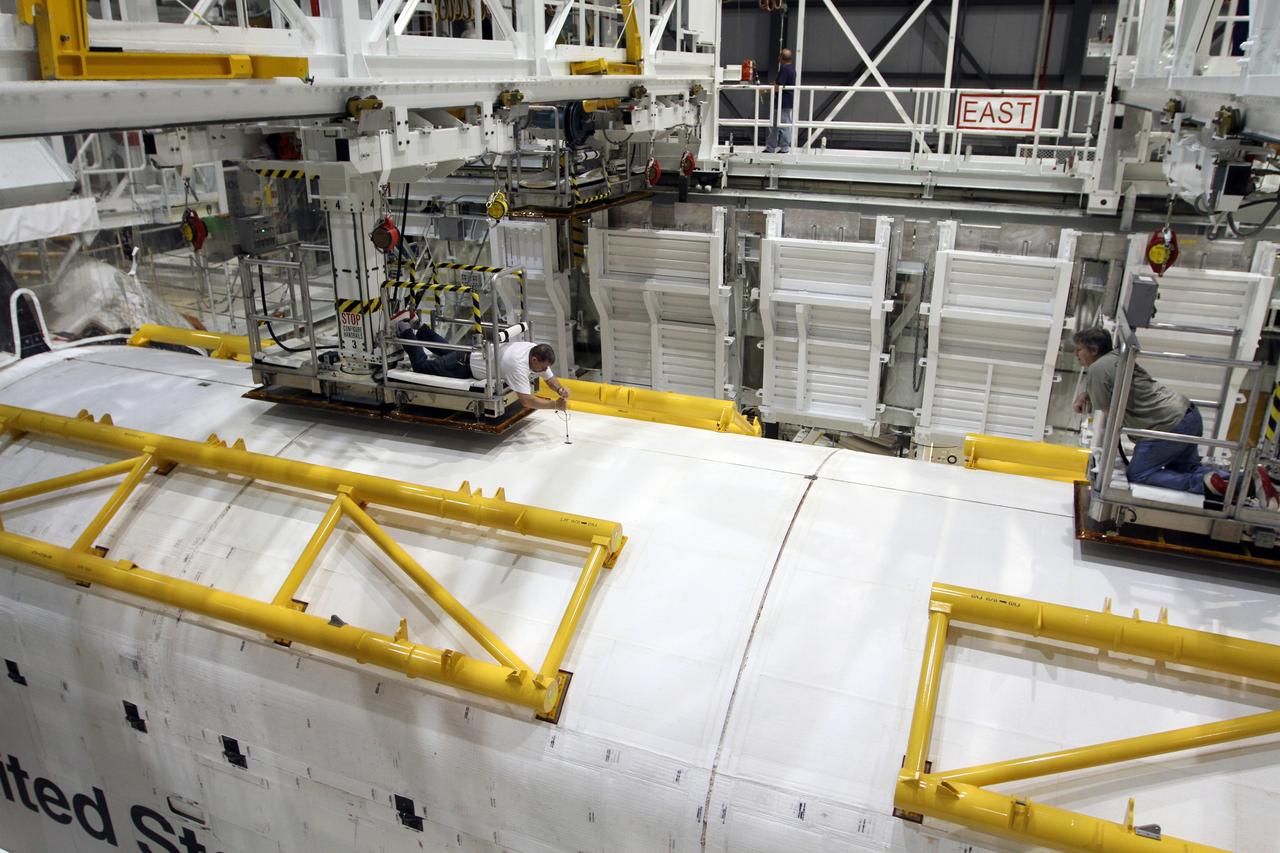
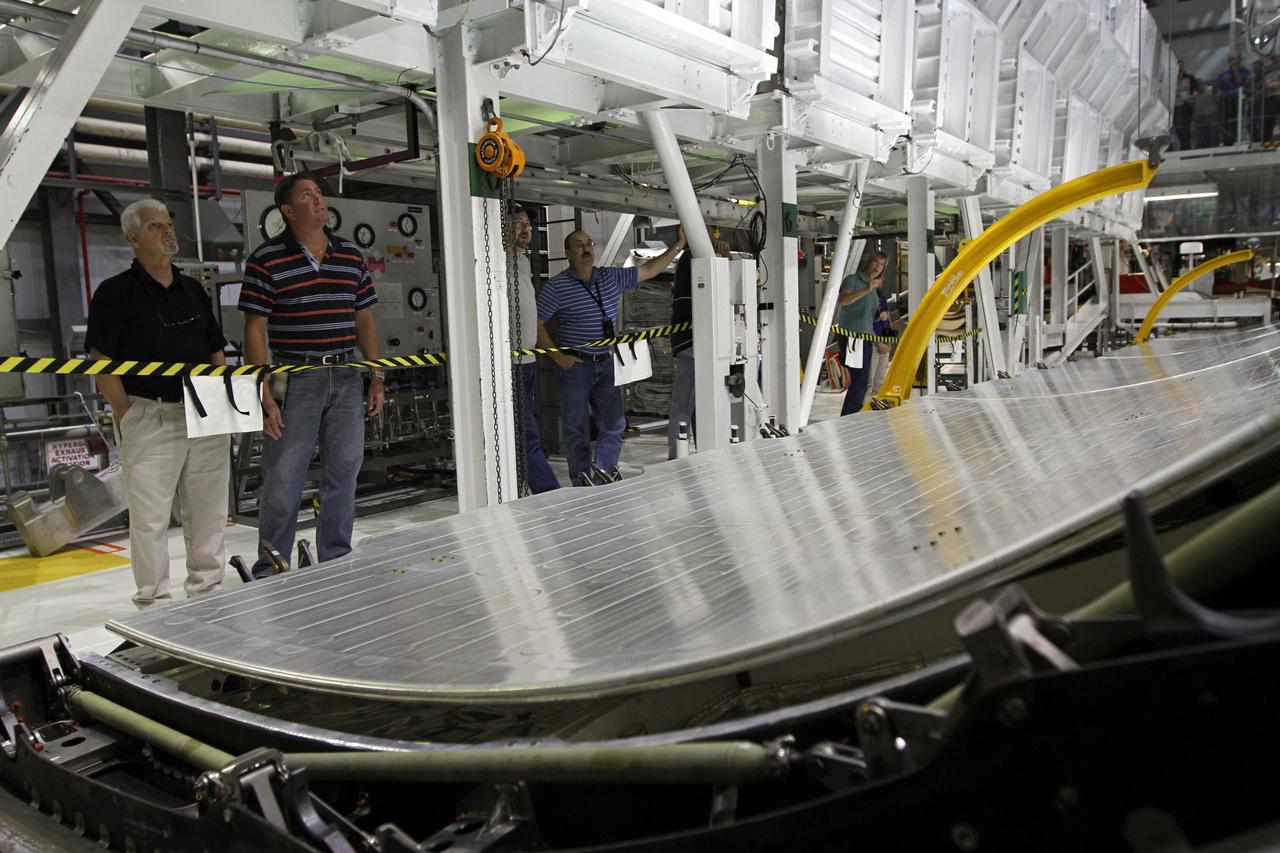
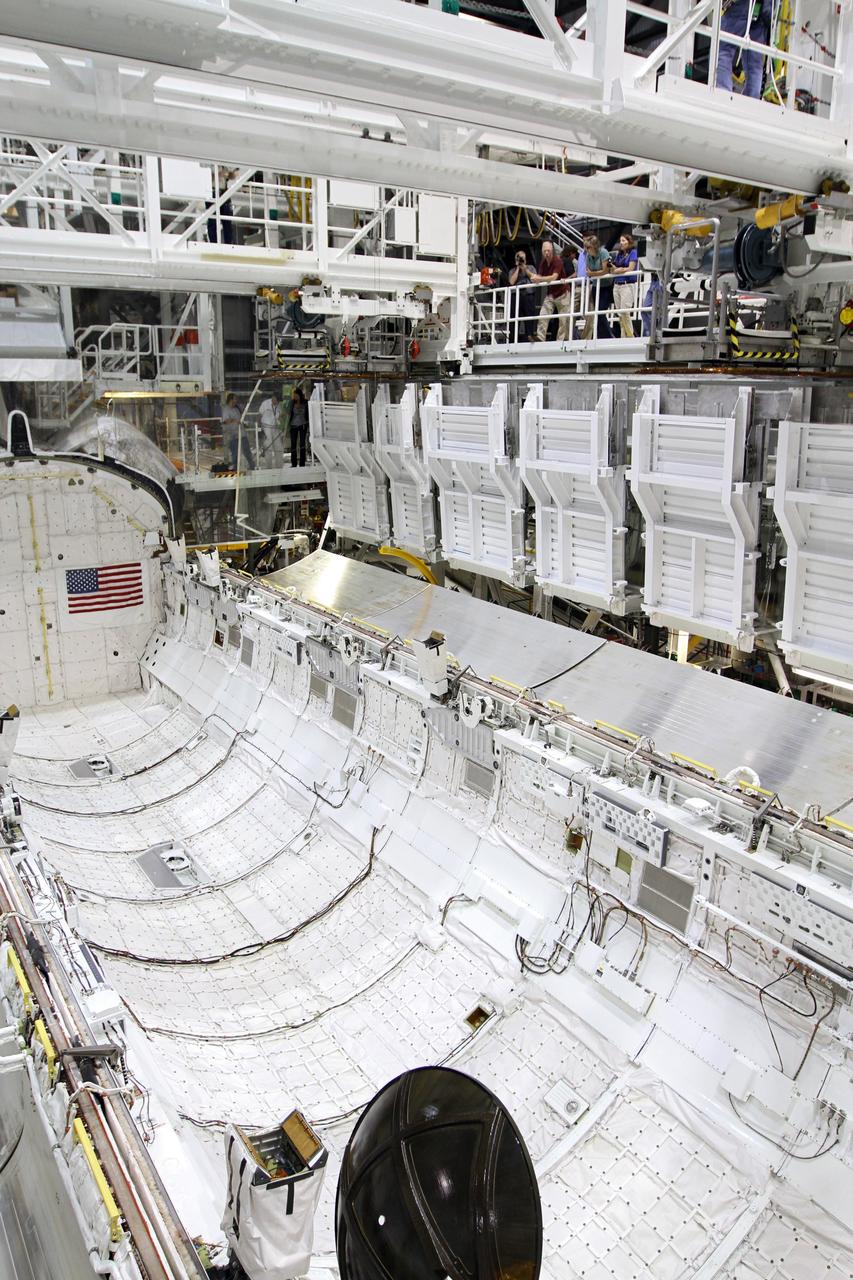
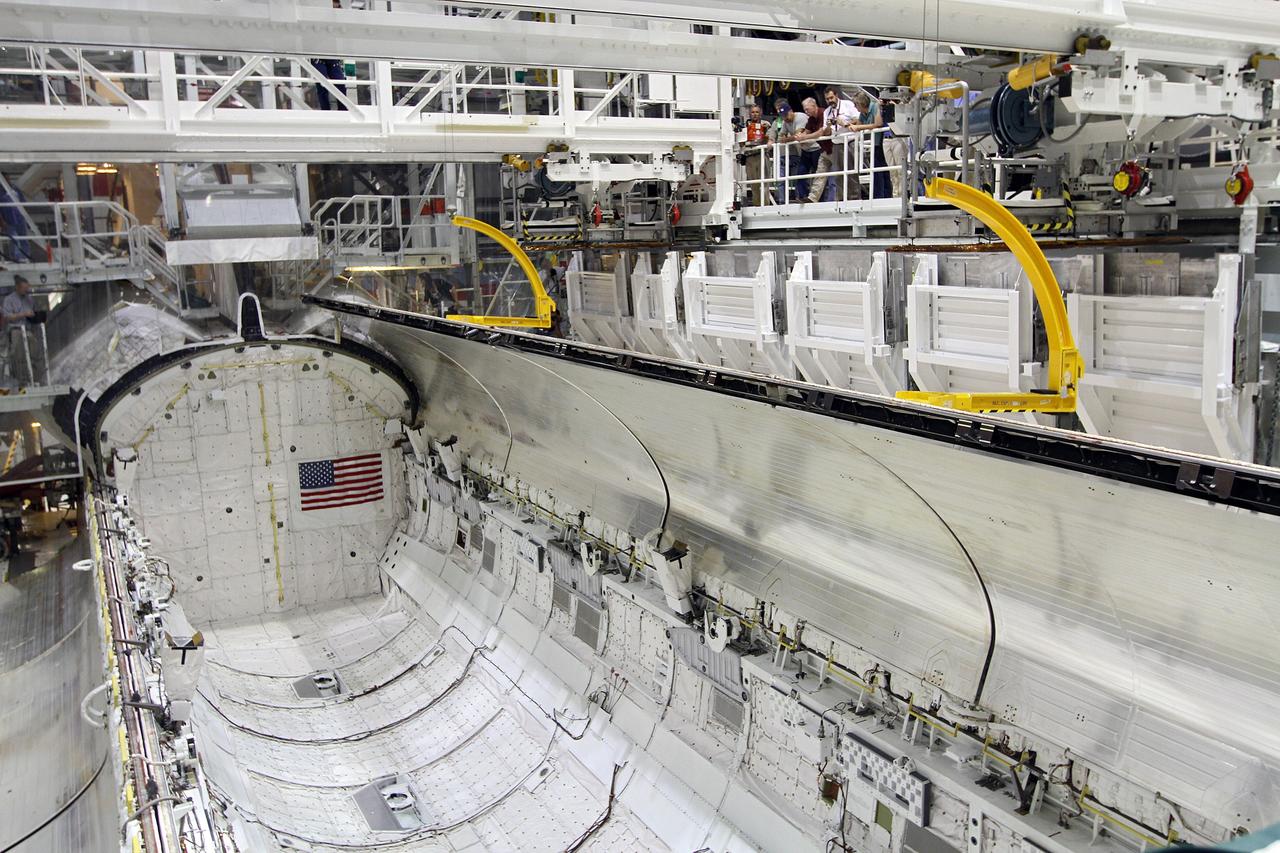
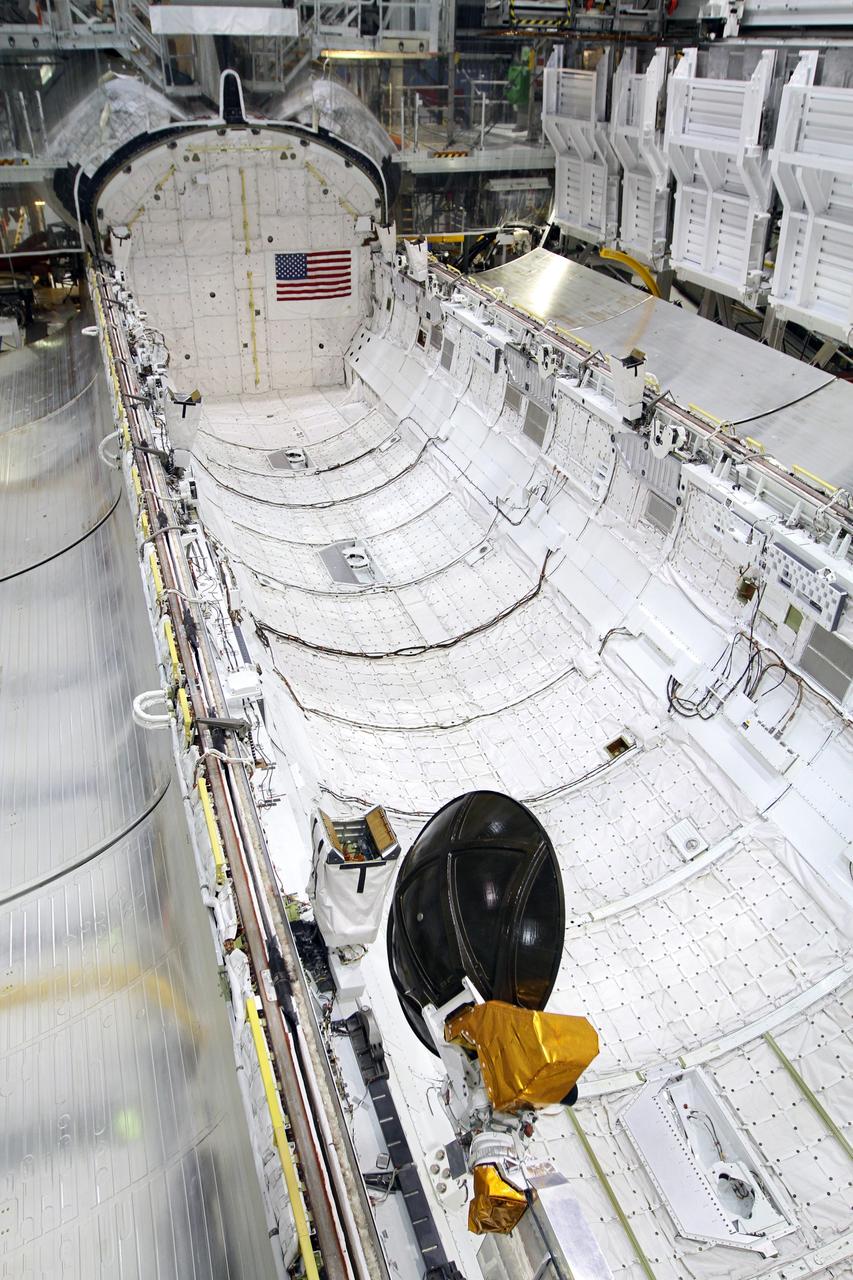
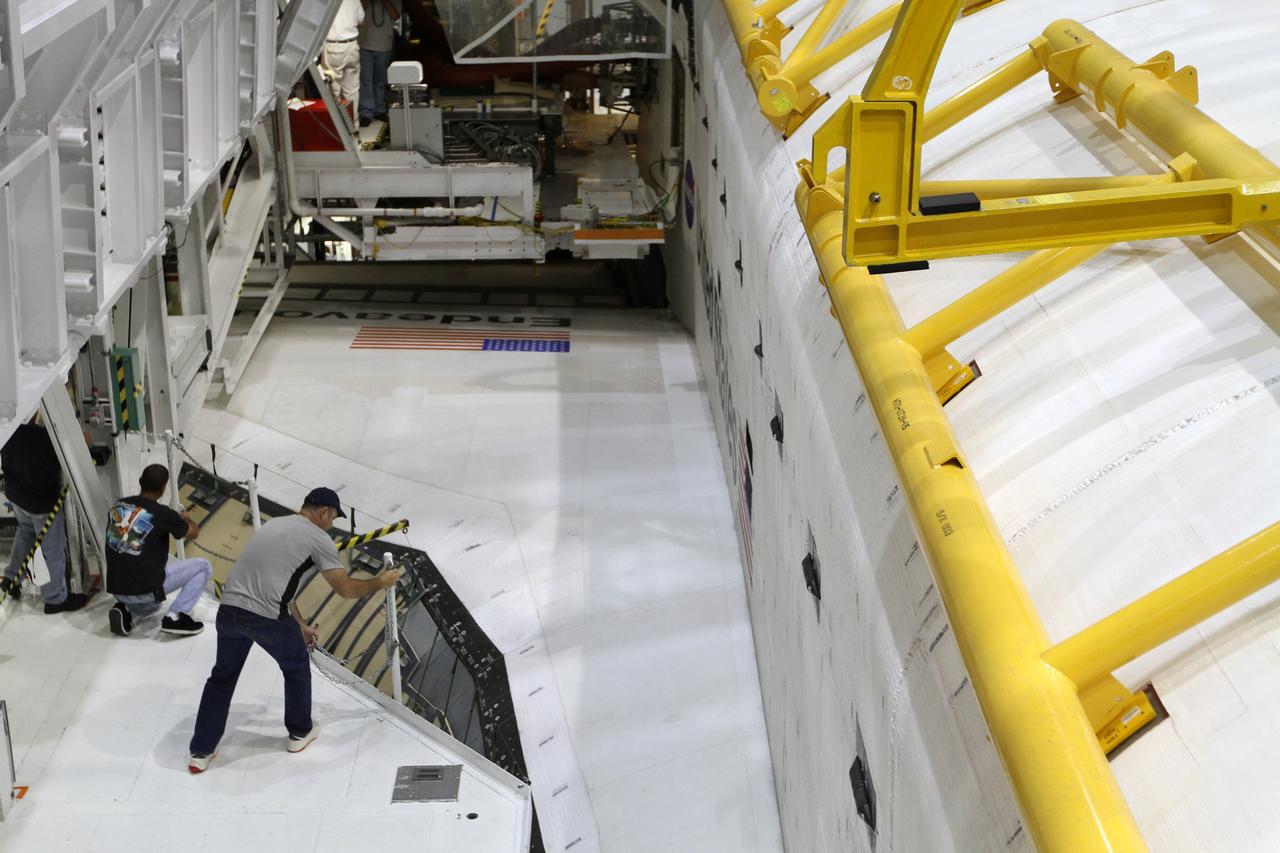
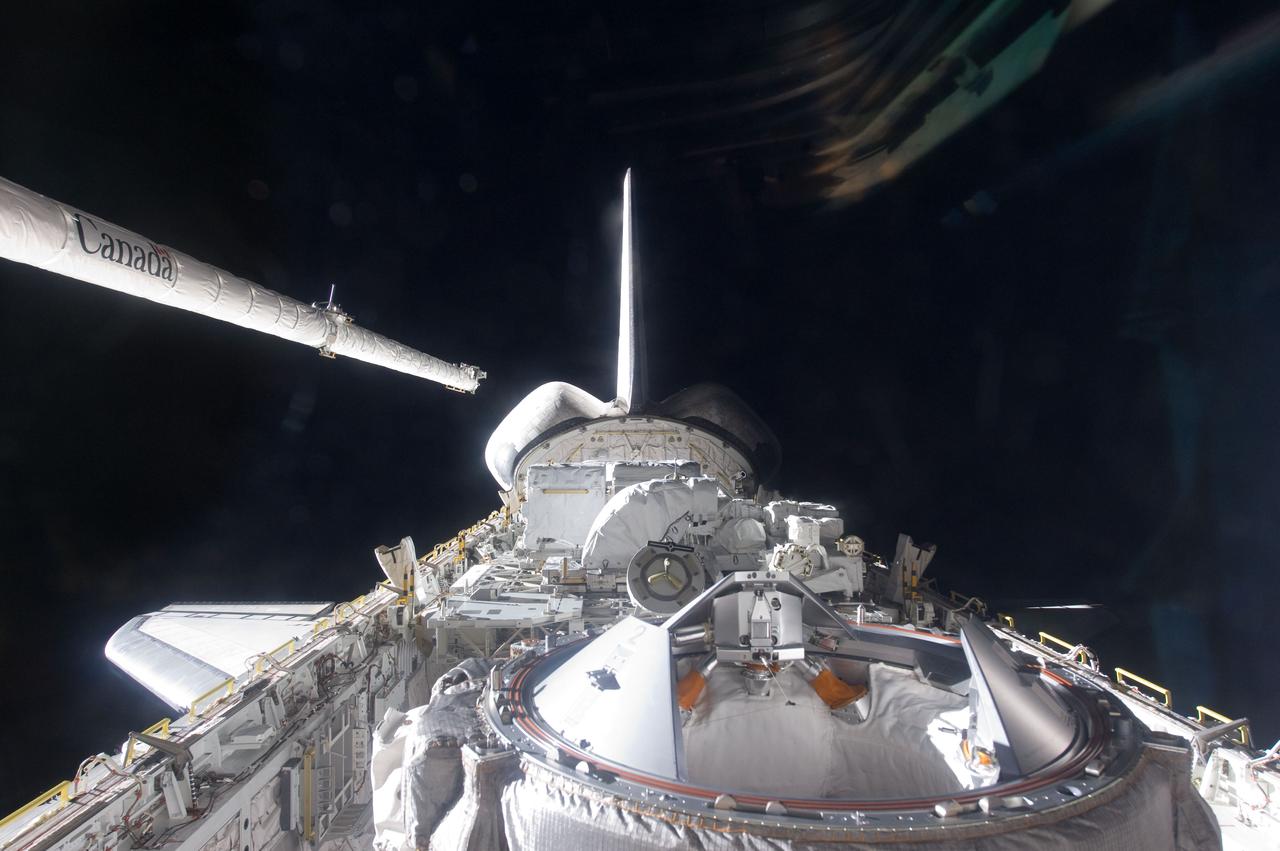
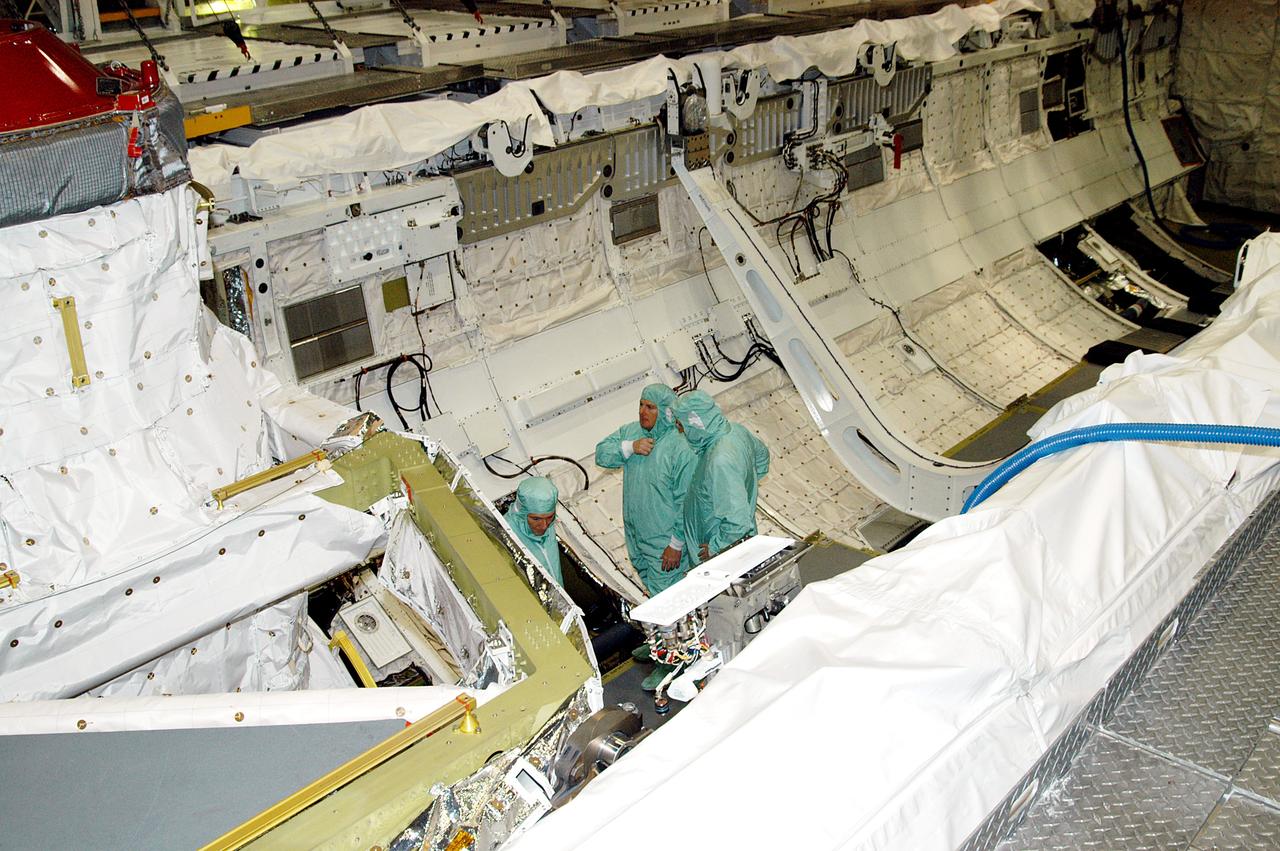
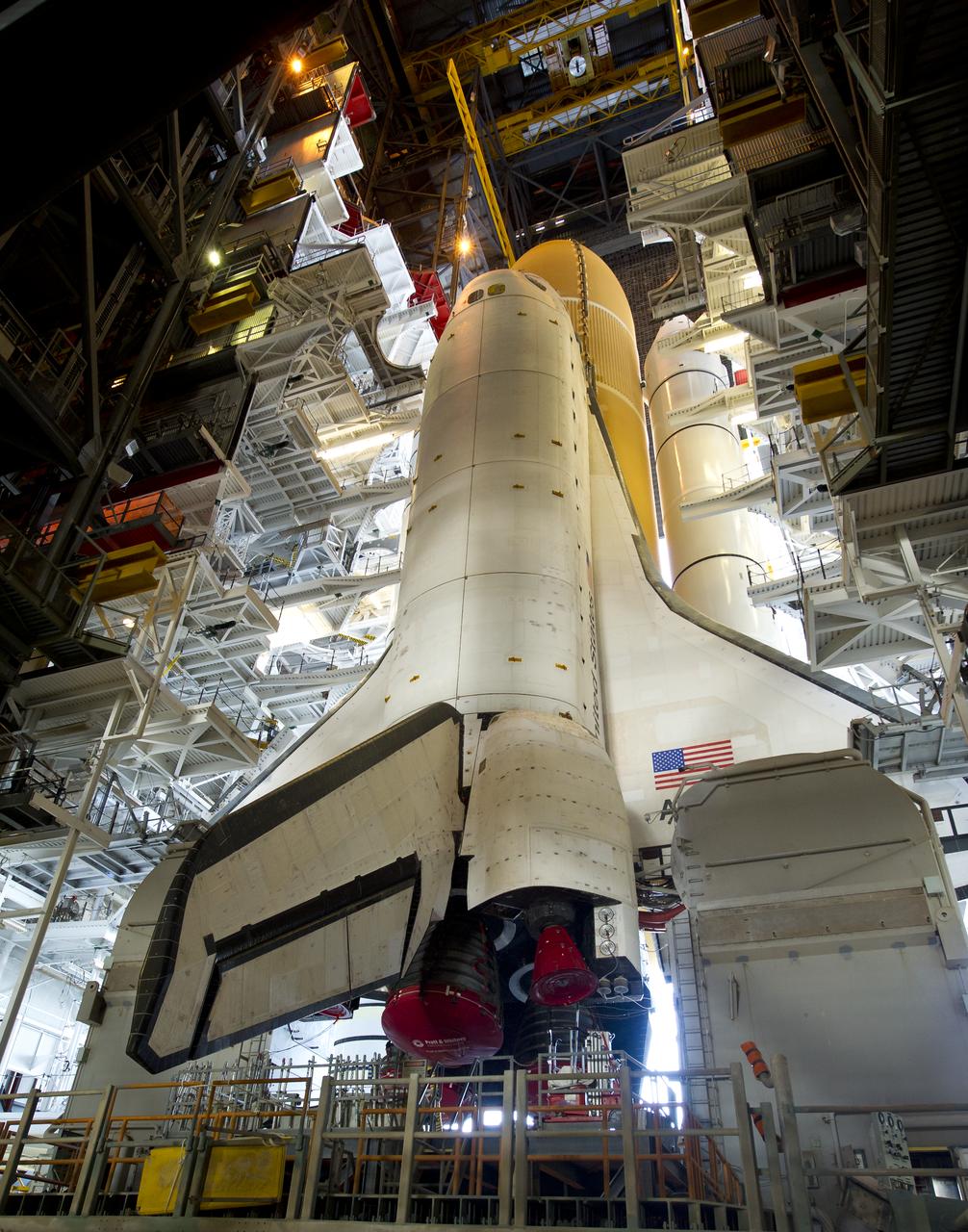
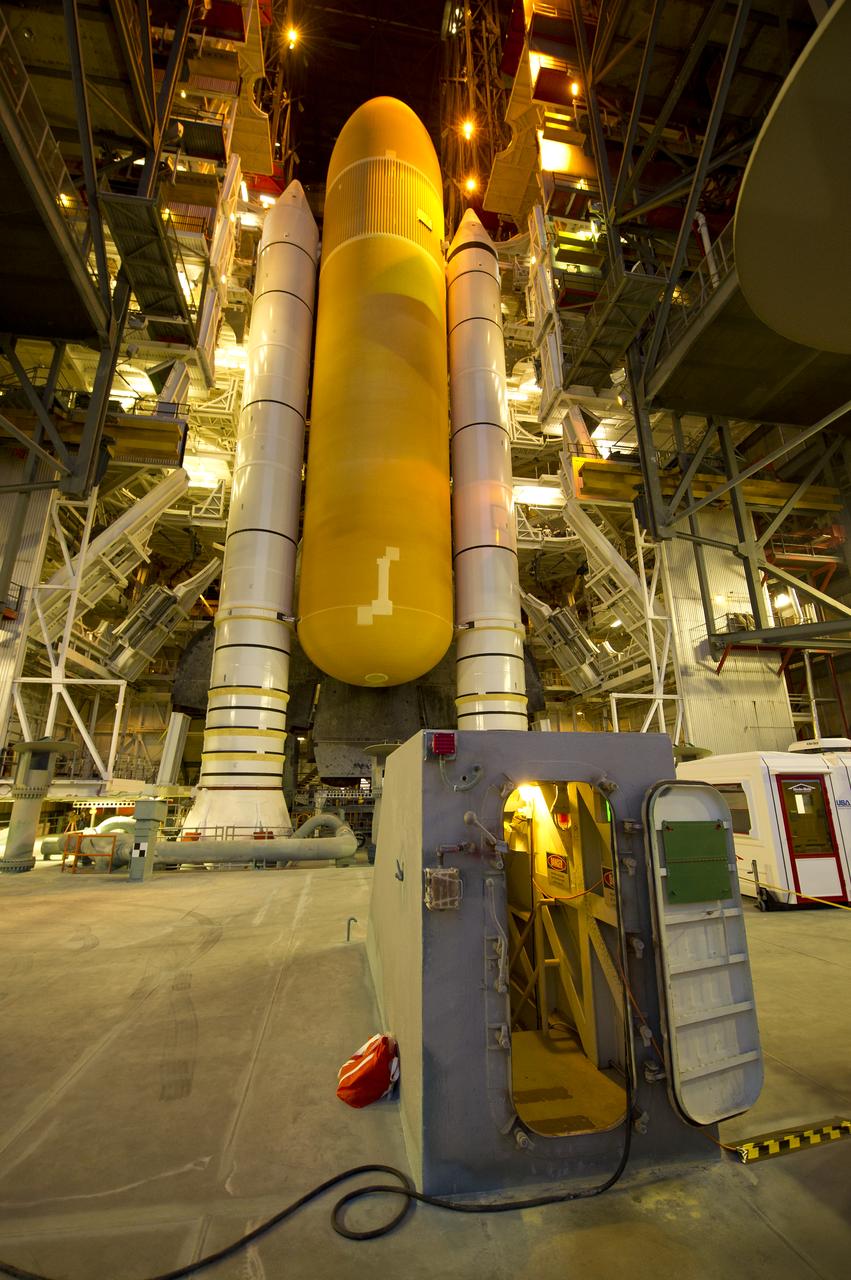
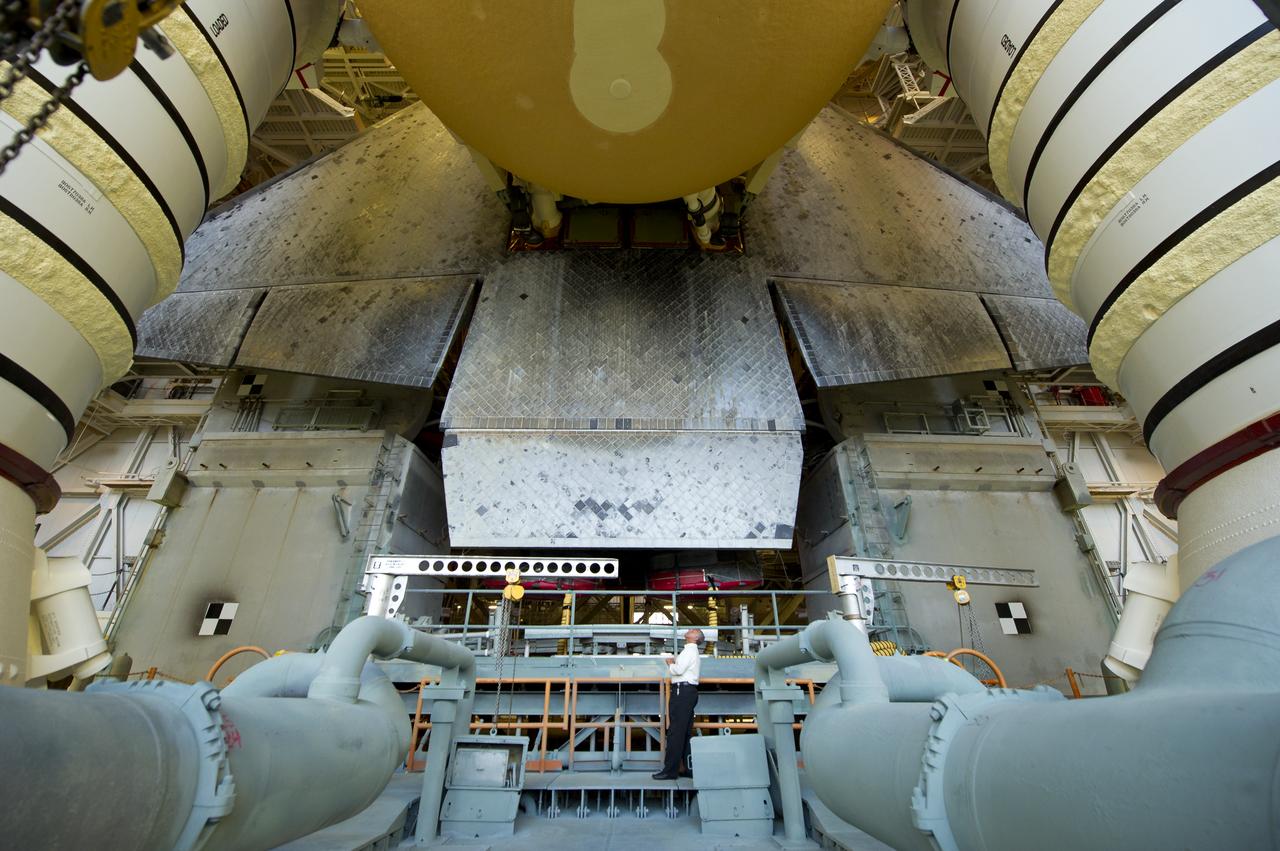
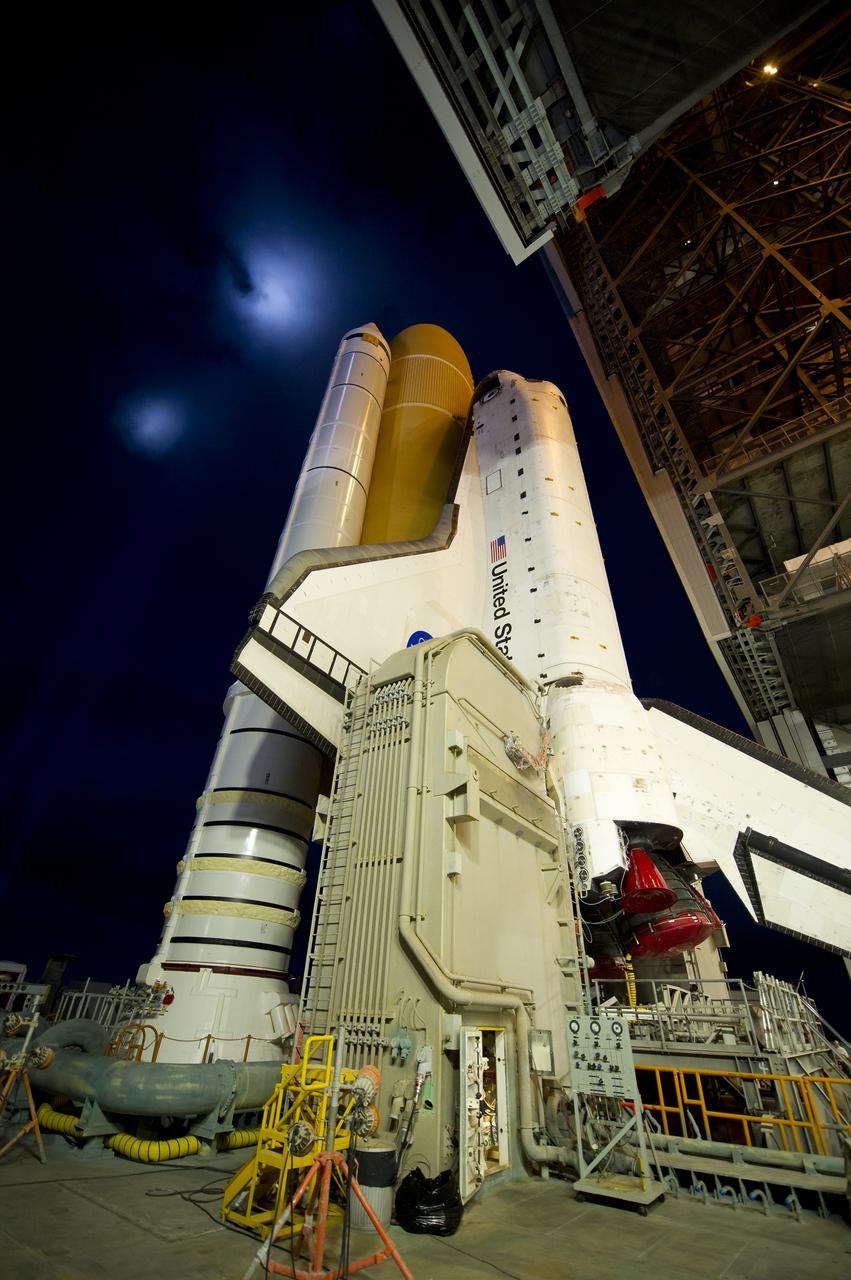
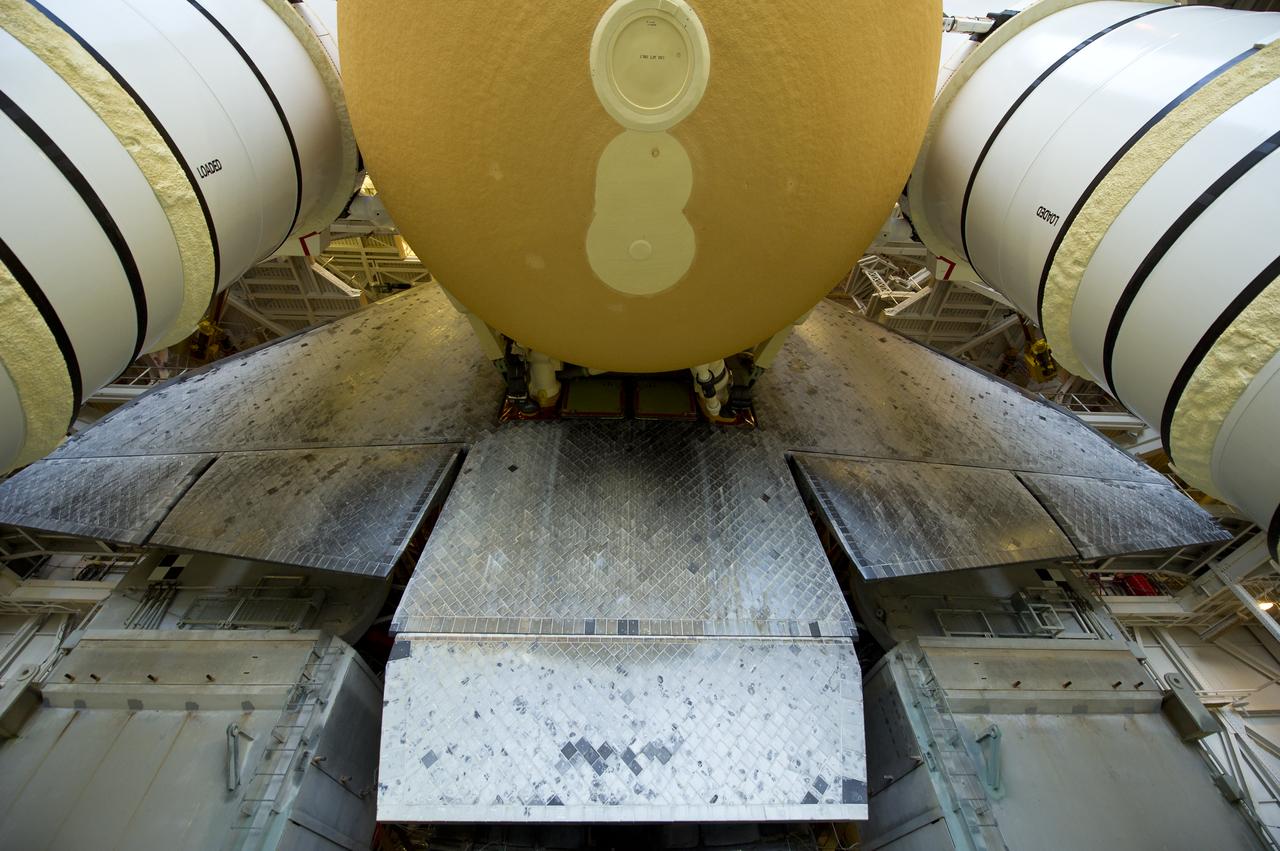
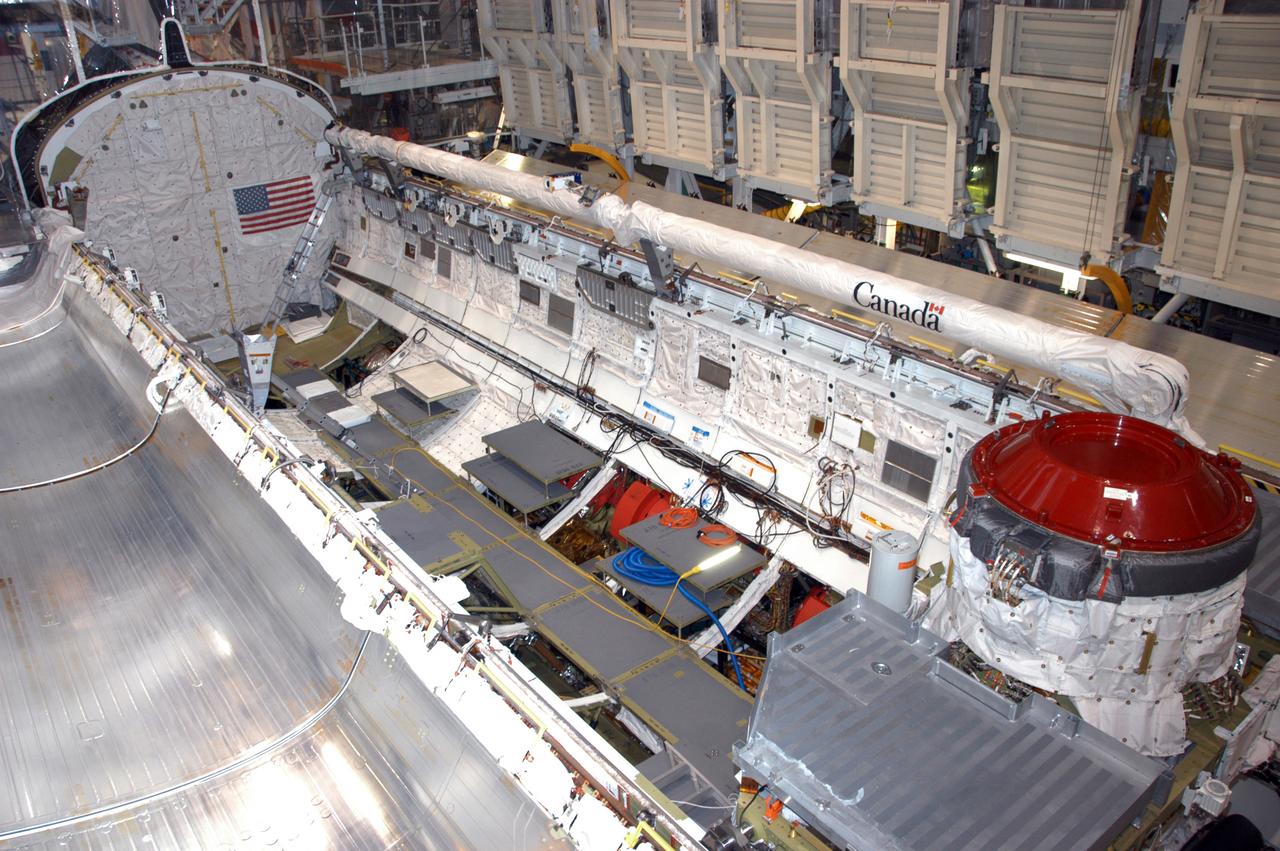
Endeavour's payload bay is open for payload configuration work in Orbiter Processing Facility bay 2. The orbiter is the vehicle designated for mission STS-118, scheduled to launch in late June. The mission will continue space station construction by delivering a third starboard truss segment, S5, as well as carrying the External Stowage Platform 3. The crew comprises six astronauts: Commander Scott Kelly, Pilot Charles Hobaugh and Mission Specialists Dr. Dafydd (Dave) Williams, Barbara Morgan, Richard Mastracchio and Tracy Caldwell. Williams represents the Canadian Space Agency.
Shuttle Bay doors opened in OPF
Endeavour's payload bay is open for payload configuration work in Orbiter Processing Facility bay 2. The orbiter is the vehicle designated for mission STS-118, scheduled to launch in late June. The mission will continue space station construction by delivering a third starboard truss segment, S5, as well as carrying the External Stowage Platform 3. The crew comprises six astronauts: Commander Scott Kelly, Pilot Charles Hobaugh and Mission Specialists Dr. Dafydd (Dave) Williams, Barbara Morgan, Richard Mastracchio and Tracy Caldwell. Williams represents the Canadian Space Agency.
Shuttle Bay doors opened in OPF
Endeavour's payload bay is open for payload configuration work in Orbiter Processing Facility bay 2. The orbiter is the vehicle designated for mission STS-118, scheduled to launch in late June. The mission will continue space station construction by delivering a third starboard truss segment, S5, as well as carrying the External Stowage Platform 3. The crew comprises six astronauts: Commander Scott Kelly, Pilot Charles Hobaugh and Mission Specialists Dr. Dafydd (Dave) Williams, Barbara Morgan, Richard Mastracchio and Tracy Caldwell. Williams represents the Canadian Space Agency.
Shuttle Bay doors opened in OPF
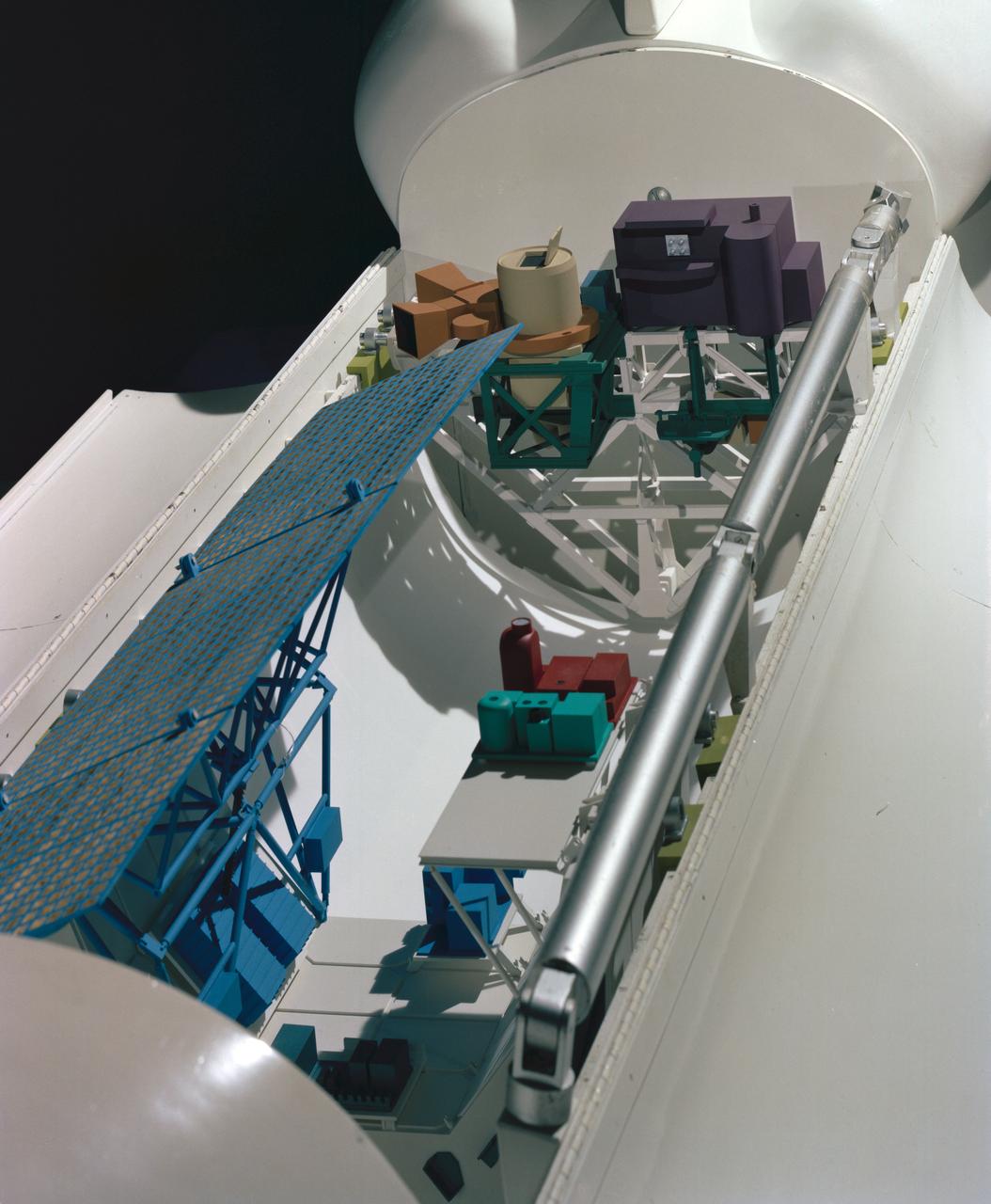
Model showing OSTA-3 and other payloads in the open shuttle orbiter cargo bay.
Model showing OSTA-3 and other payloads in the shuttle orbiter cargo bay
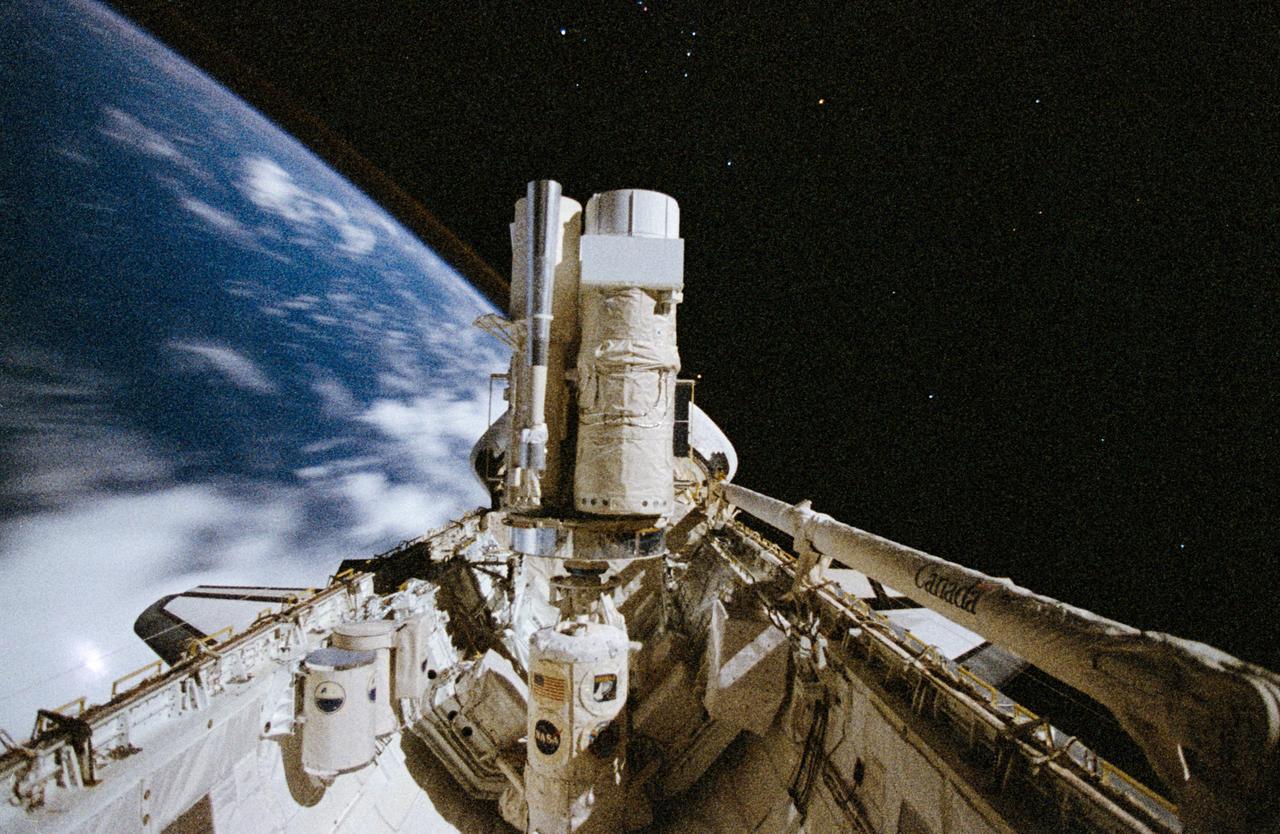
STS067-371-028 (2-18 March 1995) --- This 35mm lunar-illuminated scene of the Astro-2 payload in the Space Shuttle Endeavour's cargo bay was recorded by one of by the seven crew members during one of the many night passes of the almost 17-day mission.  The cluster of telescopes and the Instrument Pointing System (IPS) are backdropped against the blue and white Earth and the darkness of space.  What is believed to be the Constellation Orion is visible at upper center.
ASTRO-2 payload in Space Shuttle Endeavour's cargo bay
STS066-129-005 (3-14 Nov 1994) --- Clouds over the Atlantic Ocean serve as the backdrop for this 70mm scene of the Atmospheric Laboratory for Applications and Science (ATLAS-3) payload in the cargo bay of the Earth-orbiting Space Shuttle Atlantis.  Crew members onboard Atlantis were astronauts Donald R. McMonagle, Curtis L. Brown, Jr., Ellen Ochoa, Scott E. Parazynski and Joseph R. Tanner, along with Jean-François Clervoy of the European Space Agency (ESA).  The six astronauts spent 11-days in Earth-orbit in support of the Atmospheric Laboratory for Applications and Science (ATLAS-3) mission.
ATLAS-3 payload in the payload bay of STS-66 shuttle Atlantis in orbit
CAPE CANAVERAL, Fla. – Inside Orbiter Processing Facility-2 at NASA’s Kennedy Space Center in Florida, one of space shuttle Endeavour’s payload bay doors is closed. Endeavour’s payload bay doors will be closed for the final time.    The work is part of Transition and Retirement of the remaining space shuttles, Endeavour and Atlantis. Endeavour is being prepared for public display at the California Science Center in Los Angeles. Its ferry flight to California is targeted for mid-September. Endeavour was the last space shuttle added to NASA’s orbiter fleet. Over the course of its 19-year career, Endeavour spent 299 days in space during 25 missions. For more information, visit http://www.nasa.gov/shuttle.  Photo credit: NASA/Kim Shiflett
KSC-2012-3424
CAPE CANAVERAL, Fla. – Inside Orbiter Processing Facility-2 at NASA’s Kennedy Space Center in Florida, one of space shuttle Endeavour’s payload bay doors is closed. Endeavour’s payload bay doors will be closed for the final time.    The work is part of Transition and Retirement of the remaining space shuttles, Endeavour and Atlantis. Endeavour is being prepared for public display at the California Science Center in Los Angeles. Its ferry flight to California is targeted for mid-September. Endeavour was the last space shuttle added to NASA’s orbiter fleet. Over the course of its 19-year career, Endeavour spent 299 days in space during 25 missions. For more information, visit http://www.nasa.gov/shuttle.  Photo credit: NASA/Kim Shiflett
KSC-2012-3423
CAPE CANAVERAL, Fla. – Inside Orbiter Processing Facility-2 at NASA’s Kennedy Space Center in Florida, one of space shuttle Endeavour’s payload bay doors is closed as United Space Alliance technicians monitor the progress of the second door’s closure. Endeavour’s payload bay doors are being closed for the final time.    The work is part of Transition and Retirement of the remaining space shuttles, Endeavour and Atlantis. Endeavour is being prepared for public display at the California Science Center in Los Angeles. Its ferry flight to California is targeted for mid-September. Endeavour was the last space shuttle added to NASA’s orbiter fleet. Over the course of its 19-year career, Endeavour spent 299 days in space during 25 missions. For more information, visit http://www.nasa.gov/shuttle.  Photo credit: NASA/Kim Shiflett
KSC-2012-3427
CAPE CANAVERAL, Fla. – Inside Orbiter Processing Facility-2 at NASA’s Kennedy Space Center in Florida, one of space shuttle Endeavour’s payload bay doors is closed as a United Space Alliance technician monitors the progress of the second door’s closure. Endeavour’s payload bay doors are being closed for the final time.    The work is part of Transition and Retirement of the remaining space shuttles, Endeavour and Atlantis. Endeavour is being prepared for public display at the California Science Center in Los Angeles. Its ferry flight to California is targeted for mid-September. Endeavour was the last space shuttle added to NASA’s orbiter fleet. Over the course of its 19-year career, Endeavour spent 299 days in space during 25 missions. For more information, visit http://www.nasa.gov/shuttle.  Photo credit: NASA/Kim Shiflett
KSC-2012-3425
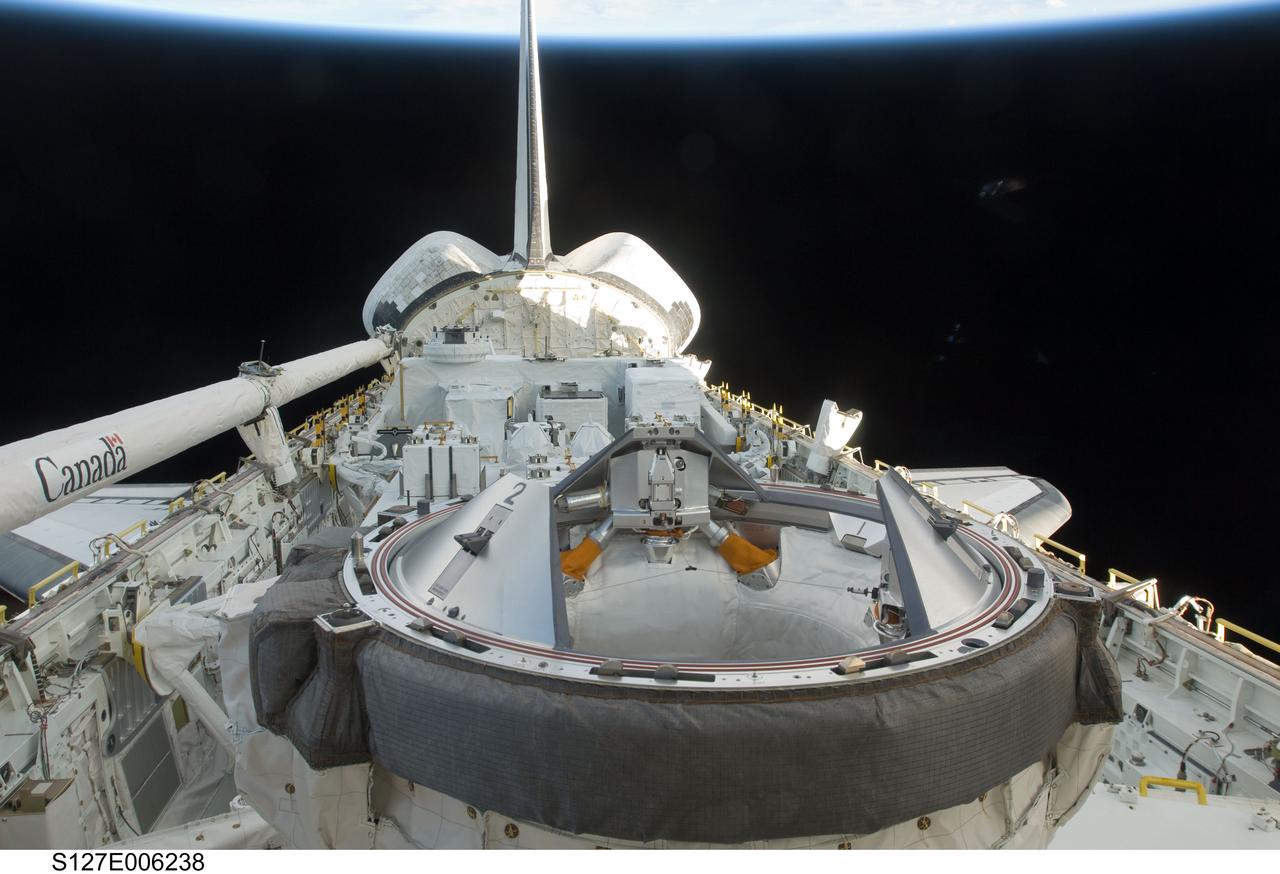
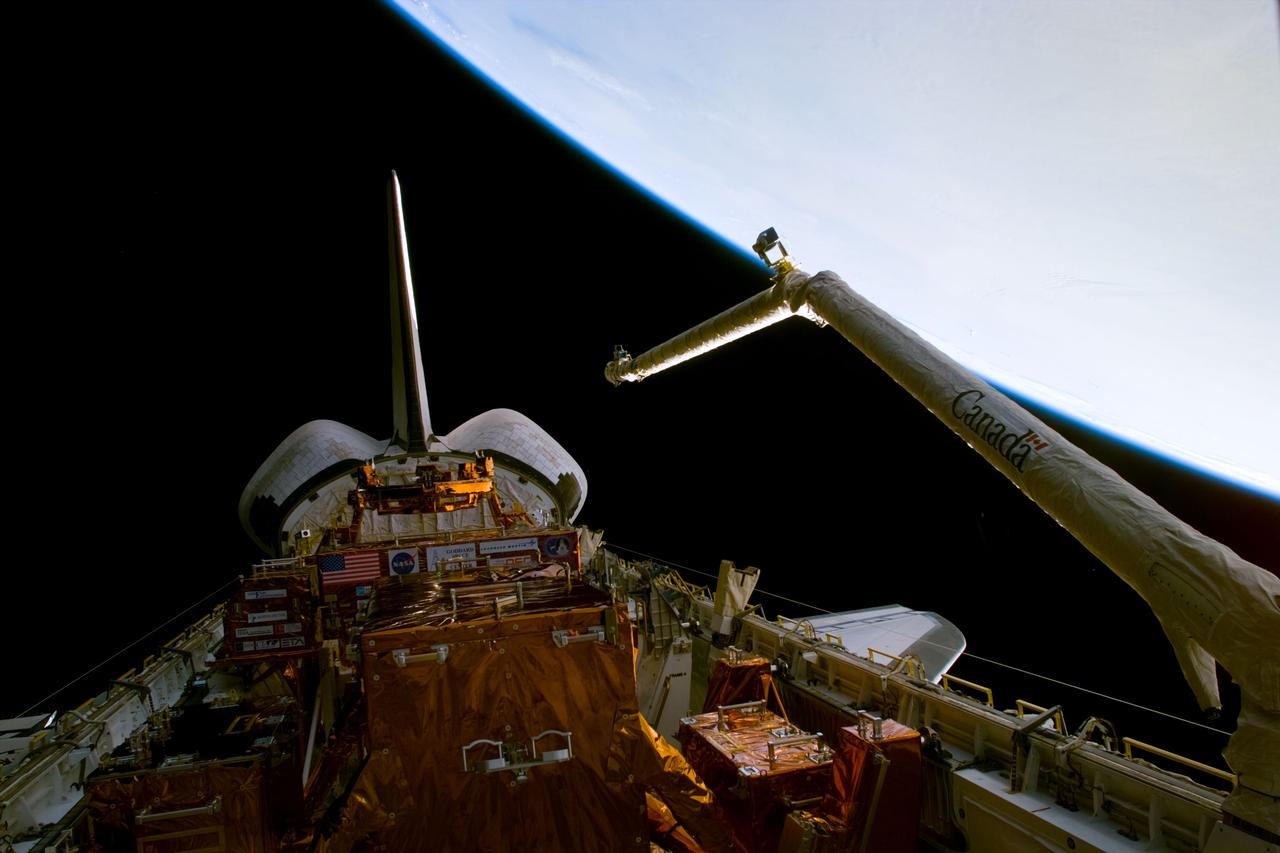
S127-E-006238 (16 July 2009) --- Backdropped by the blackness of space, the Japanese Experiment Module's Exposed Facility and the Experiment Logistics Module-Exposed Section, visible in Space Shuttle Endeavour?s payload bay, vertical stabilizer (intersecting Earth?s horizon) and orbital maneuvering system (OMS) pods, the shuttle?s remote manipulator system (RMS) and docking mechanism are featured in this image photographed by a STS-127 crew member from an aft flight deck window.
Payload Bay on the Space Shuttle Endeavour
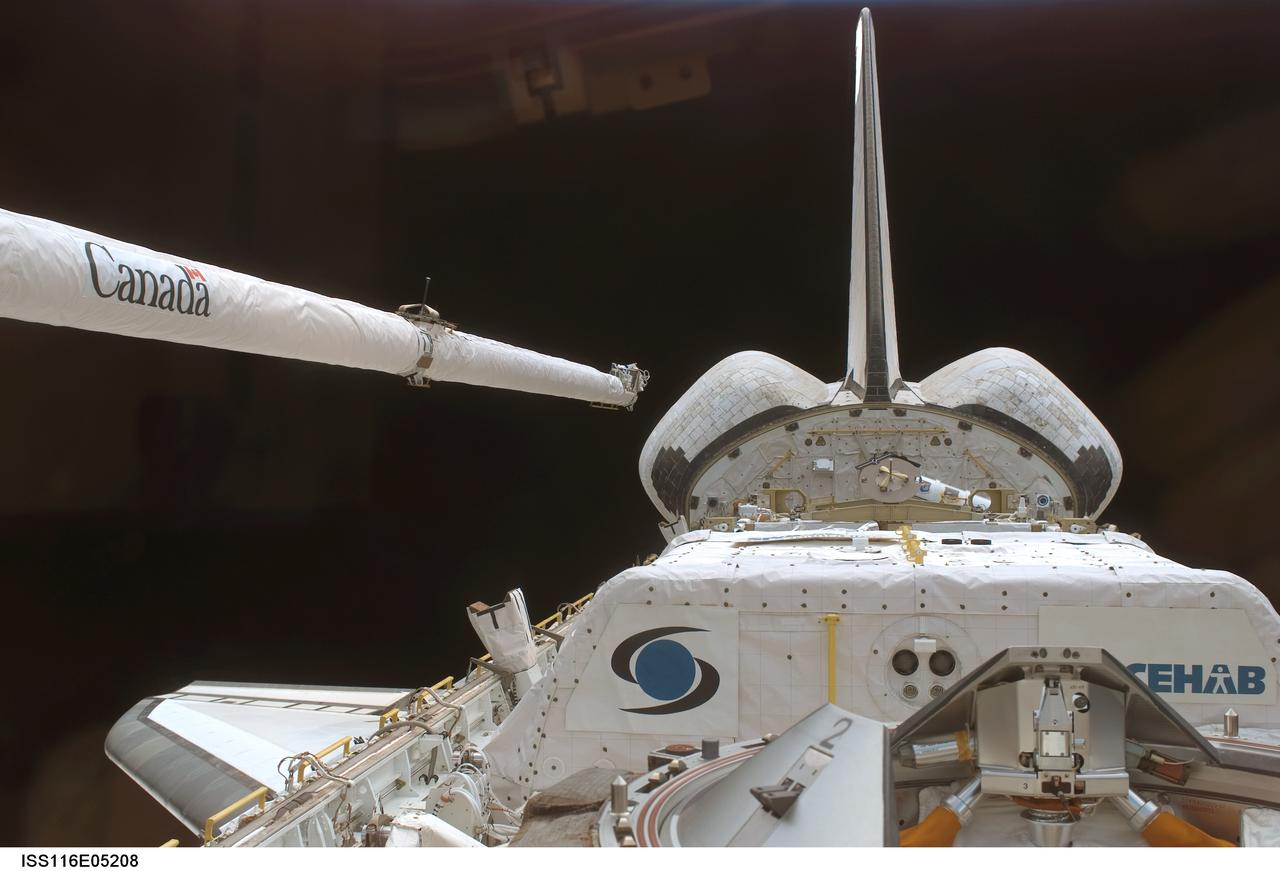
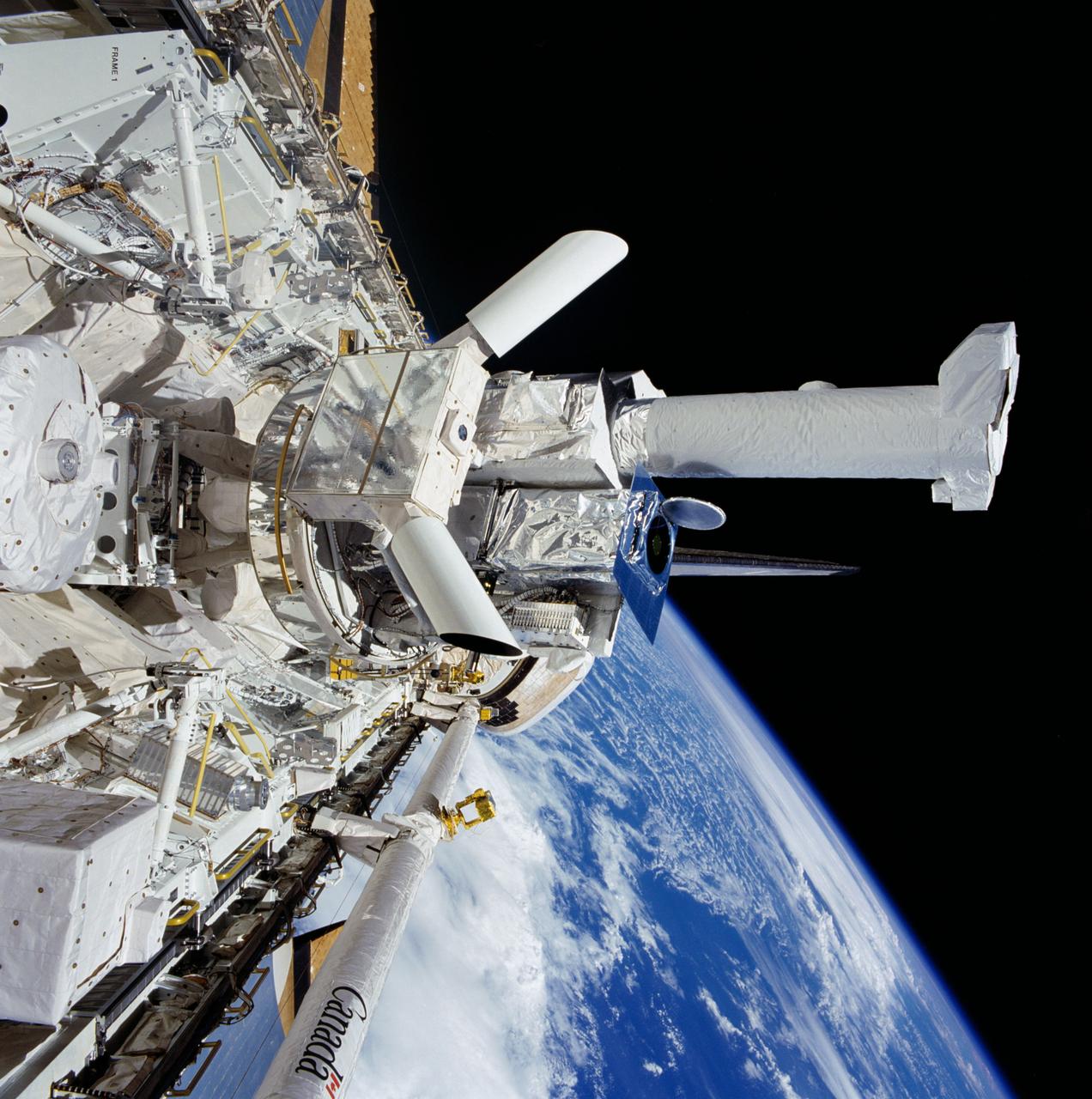
S116-E-05208 (10 Dec. 2006) --- As seen through windows on the aft flight deck of Space Shuttle Discovery, the payload bay is featured in this image photographed by a STS-116 crewmember during flight day two activities. Pictured in the payload bay is the Spacehab module and the Canadian-built Remote Manipulator System/Orbiter Boom Sensor System (RMS/OBSS) is at left. The shuttle's docking mechanism is visible in the foreground.
Payload Bay on STS-116 Space Shuttle Discovery
CAPE CANAVERAL, Fla. – Inside Orbiter Processing Facility-2 at NASA’s Kennedy Space Center in Florida, United Space Alliance technicians monitor the progress as space shuttle Endeavour’s payload bay doors begin to close for the final time.    The work is part of Transition and Retirement of the remaining space shuttles, Endeavour and Atlantis. Endeavour is being prepared for public display at the California Science Center in Los Angeles. Its ferry flight to California is targeted for mid-September. Endeavour was the last space shuttle added to NASA’s orbiter fleet. Over the course of its 19-year career, Endeavour spent 299 days in space during 25 missions. For more information, visit http://www.nasa.gov/shuttle.  Photo credit: NASA/Kim Shiflett
KSC-2012-3421
CAPE CANAVERAL, Fla. – Inside Orbiter Processing Facility-2 at NASA’s Kennedy Space Center in Florida, United Space Alliance technicians inspect space shuttle Endeavour’s payload bay doors after they were closed for the final time.     The work is part of Transition and Retirement of the remaining space shuttles, Endeavour and Atlantis. Endeavour is being prepared for public display at the California Science Center in Los Angeles. Its ferry flight to California is targeted for mid-September. Endeavour was the last space shuttle added to NASA’s orbiter fleet. Over the course of its 19-year career, Endeavour spent 299 days in space during 25 missions. For more information, visit http://www.nasa.gov/shuttle.  Photo credit: NASA/Kim Shiflett
KSC-2012-3429
CAPE CANAVERAL, Fla. – Inside Orbiter Processing Facility-2 at NASA’s Kennedy Space Center in Florida, the payload bay doors on space shuttle Endeavour are in the open position. United Space Alliance technicians are preparing to close the doors for the final time.    The work is part of Transition and Retirement of the remaining space shuttles, Endeavour and Atlantis. Endeavour is being prepared for public display at the California Science Center in Los Angeles. Its ferry flight to California is targeted for mid-September. Endeavour was the last space shuttle added to NASA’s orbiter fleet. Over the course of its 19-year career, Endeavour spent 299 days in space during 25 missions. For more information, visit http://www.nasa.gov/shuttle.  Photo credit: NASA/Kim Shiflett
KSC-2012-3420
CAPE CANAVERAL, Fla. – Inside Orbiter Processing Facility-2 at NASA’s Kennedy Space Center in Florida, United Space Alliance technicians monitor the progress as space shuttle Endeavour’s payload bay doors begin to close for the final time.    The work is part of Transition and Retirement of the remaining space shuttles, Endeavour and Atlantis. Endeavour is being prepared for public display at the California Science Center in Los Angeles. Its ferry flight to California is targeted for mid-September. Endeavour was the last space shuttle added to NASA’s orbiter fleet. Over the course of its 19-year career, Endeavour spent 299 days in space during 25 missions. For more information, visit http://www.nasa.gov/shuttle.  Photo credit: NASA/Kim Shiflett
KSC-2012-3422
CAPE CANAVERAL, Fla. – Inside Orbiter Processing Facility-2 at NASA’s Kennedy Space Center in Florida, United Space Alliance technicians inspect space shuttle Endeavour’s wing after the payload bay doors were closed for the final time.    The work is part of Transition and Retirement of the remaining space shuttles, Endeavour and Atlantis. Endeavour is being prepared for public display at the California Science Center in Los Angeles. Its ferry flight to California is targeted for mid-September. Endeavour was the last space shuttle added to NASA’s orbiter fleet. Over the course of its 19-year career, Endeavour spent 299 days in space during 25 missions. For more information, visit http://www.nasa.gov/shuttle.  Photo credit: NASA/Kim Shiflett
KSC-2012-3428
CAPE CANAVERAL, Fla. – Inside Orbiter Processing Facility-2 at NASA’s Kennedy Space Center in Florida, the payload bay doors on space shuttle Endeavour are in the open position. United Space Alliance technicians are preparing to close the doors for the final time.    The work is part of Transition and Retirement of the remaining space shuttles, Endeavour and Atlantis. Endeavour is being prepared for public display at the California Science Center in Los Angeles. Its ferry flight to California is targeted for mid-September. Endeavour was the last space shuttle added to NASA’s orbiter fleet. Over the course of its 19-year career, Endeavour spent 299 days in space during 25 missions. For more information, visit http://www.nasa.gov/shuttle.  Photo credit: NASA/Kim Shiflett
KSC-2012-3419
CAPE CANAVERAL, Fla. – Inside Orbiter Processing Facility-2 at NASA’s Kennedy Space Center in Florida, United Space Alliance technicians monitor the progress of space shuttle Endeavour’s payload bay doors as they are closed for the final time.    The work is part of Transition and Retirement of the remaining space shuttles, Endeavour and Atlantis. Endeavour is being prepared for public display at the California Science Center in Los Angeles. Its ferry flight to California is targeted for mid-September. Endeavour was the last space shuttle added to NASA’s orbiter fleet. Over the course of its 19-year career, Endeavour spent 299 days in space during 25 missions. For more information, visit http://www.nasa.gov/shuttle.  Photo credit: NASA/Kim Shiflett
KSC-2012-3426
S134-E-006505 (17 May 2011) --- The Orbiter Boom Sensor System (OBSS), pictured on the second flight day of STS-134, on left side of this photo showing Endeavour's vertical stabilizer and cargo bay, is a 50-foot boom carried onboard each of NASA's space shuttles. The boom can be grappled by the Canadarm and serves as an extension of the arm, doubling its length to a combined total of 100 feet (30 meters). At the far end of the boom is an instrumentation package of cameras and lasers used to scan the leading edges of the wings, the nose cap, and the crew compartment after each lift-off and before each landing. Photo credit: NASA
View of the Shuttle Endeavour Payload Bay
ISS028-E-017434 (18 July 2011) --- The space shuttle Atlantis' cargo bay now holds the Raffaello multi-purpose logistics module, as photographed by one of the Expedition 28 crew members onboard the International Space Station before the two spacecraft undocked.
Raffaello MPLM stowed in the Shuttle Atlantis Cargo Bay
ISS028-E-017435 (18 July 2011) --- The space shuttle Atlantis' cargo bay now holds the Raffaello multi-purpose logistics module, as photographed by one of the Expedition 28 crew members onboard the International Space Station before the two spacecraft undocked.
Raffaello MPLM stowed in the Shuttle Atlantis Cargo Bay
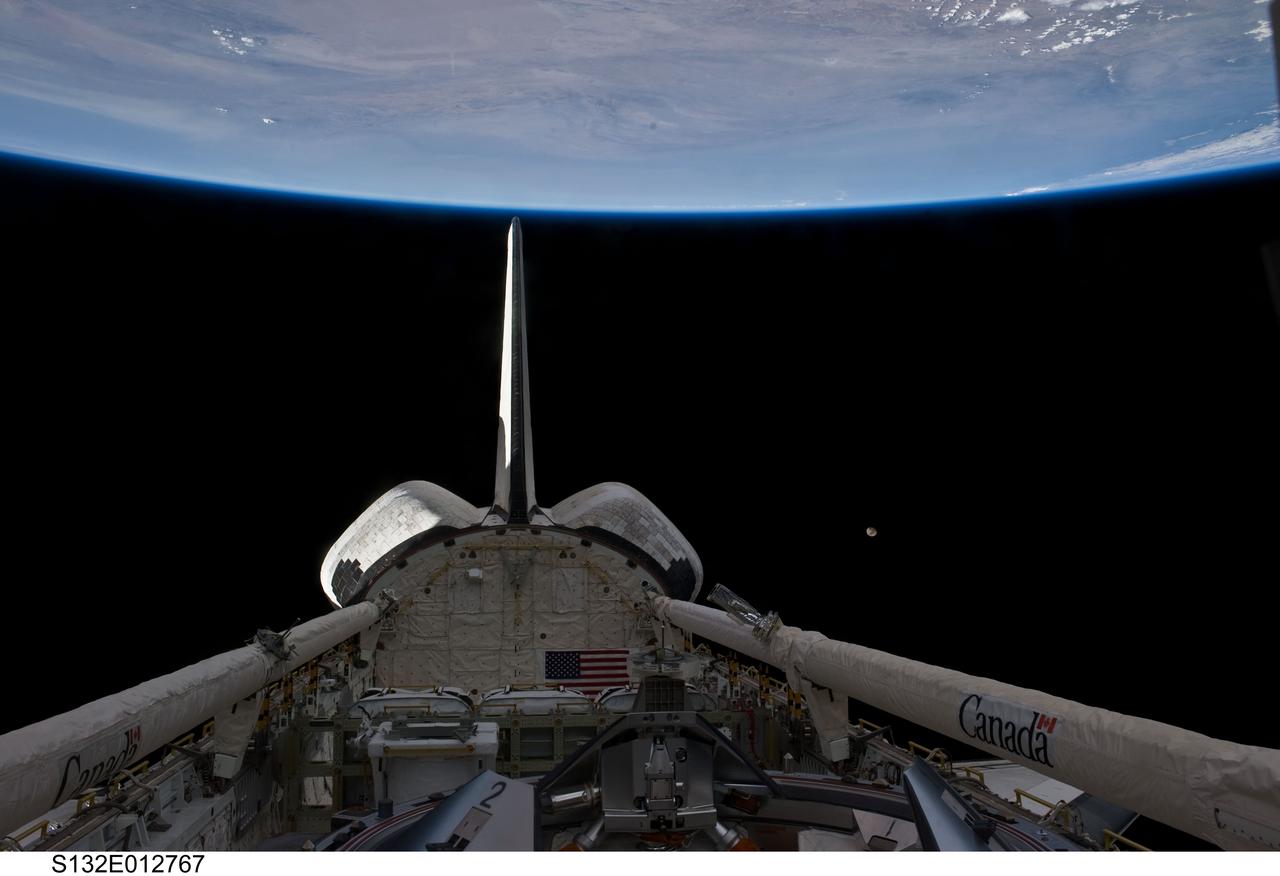
S132-E-012767 (25 May 2010) --- Space shuttle Atlantis’ vertical stabilizer, orbital maneuvering system (OMS) pods, remote manipulator system/orbiter boom sensor system (RMS/OBSS), payload bay and docking mechanism are featured in this image photographed by an STS-132 crew member on the shuttle during flight day 12 activities. The moon is visible at center right. Earth’s horizon and the blackness of space provide the backdrop for the scene.
Payload Bay on STS-132 Space Shuttle Atlantis
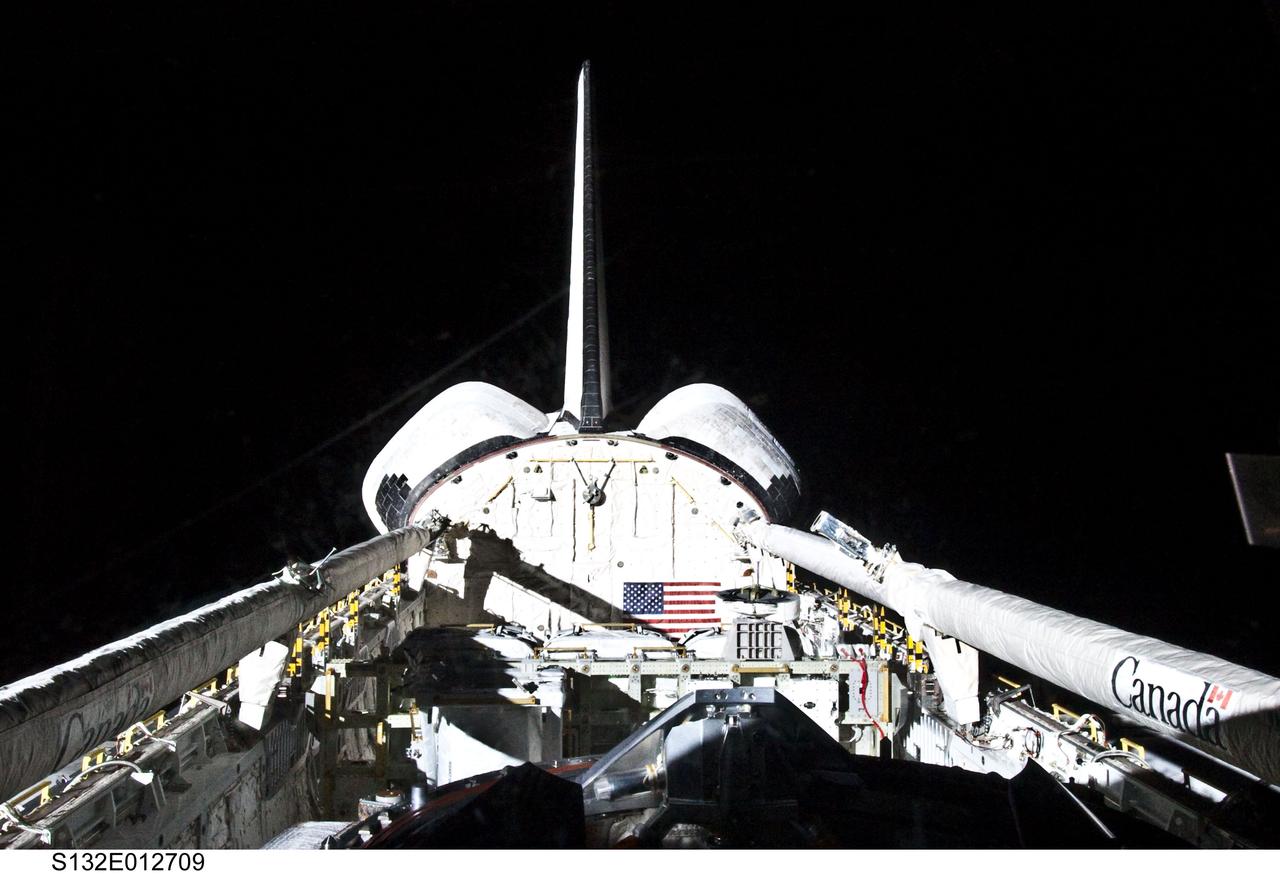
S132-E-012709 (25 May 2010) --- Space shuttle Atlantis’ vertical stabilizer, orbital maneuvering system (OMS) pods, remote manipulator system/orbiter boom sensor system (RMS/OBSS), payload bay and docking mechanism are featured in this image photographed by an STS-132 crew member on the shuttle during flight day 12 activities.
Payload Bay on STS-132 Space Shuttle Atlantis
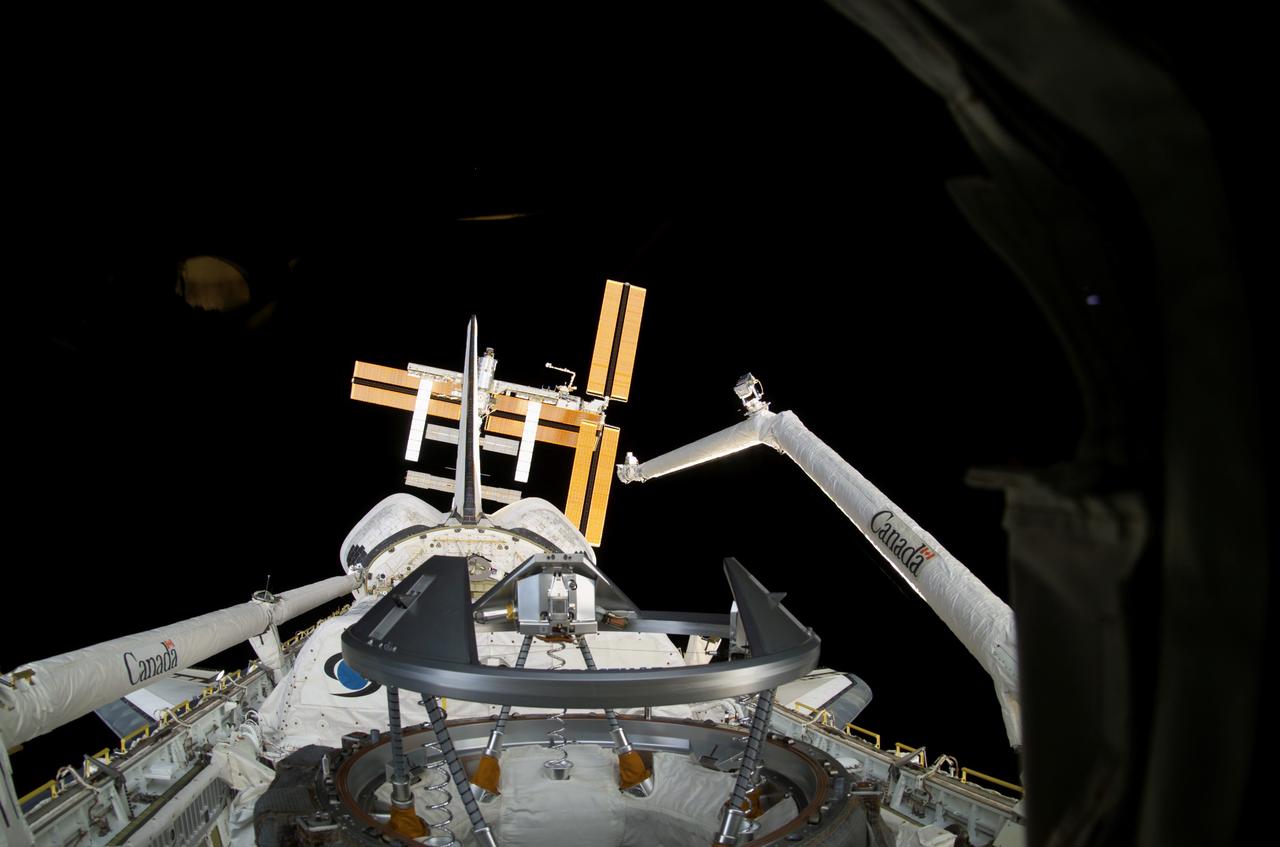
S116-E-05504 (11 Dec. 2006) --- As seen through windows on the aft flight deck of Space Shuttle Discovery, the shuttle's payload bay and the approaching International Space Station (background) are featured in this image photographed by a STS-116 crewmember during flight day three activities. Pictured in the payload bay are the shuttle's docking mechanism (foreground), Spacehab module (partially obscured), the Canadian-built Remote Manipulator System (RMS) robotic arm (right), and the Remote Manipulator System/Orbiter Boom Sensor System (left, in stowed position).
Payload Bay as STS-116 Space Shuttle Discovery approaches the ISS
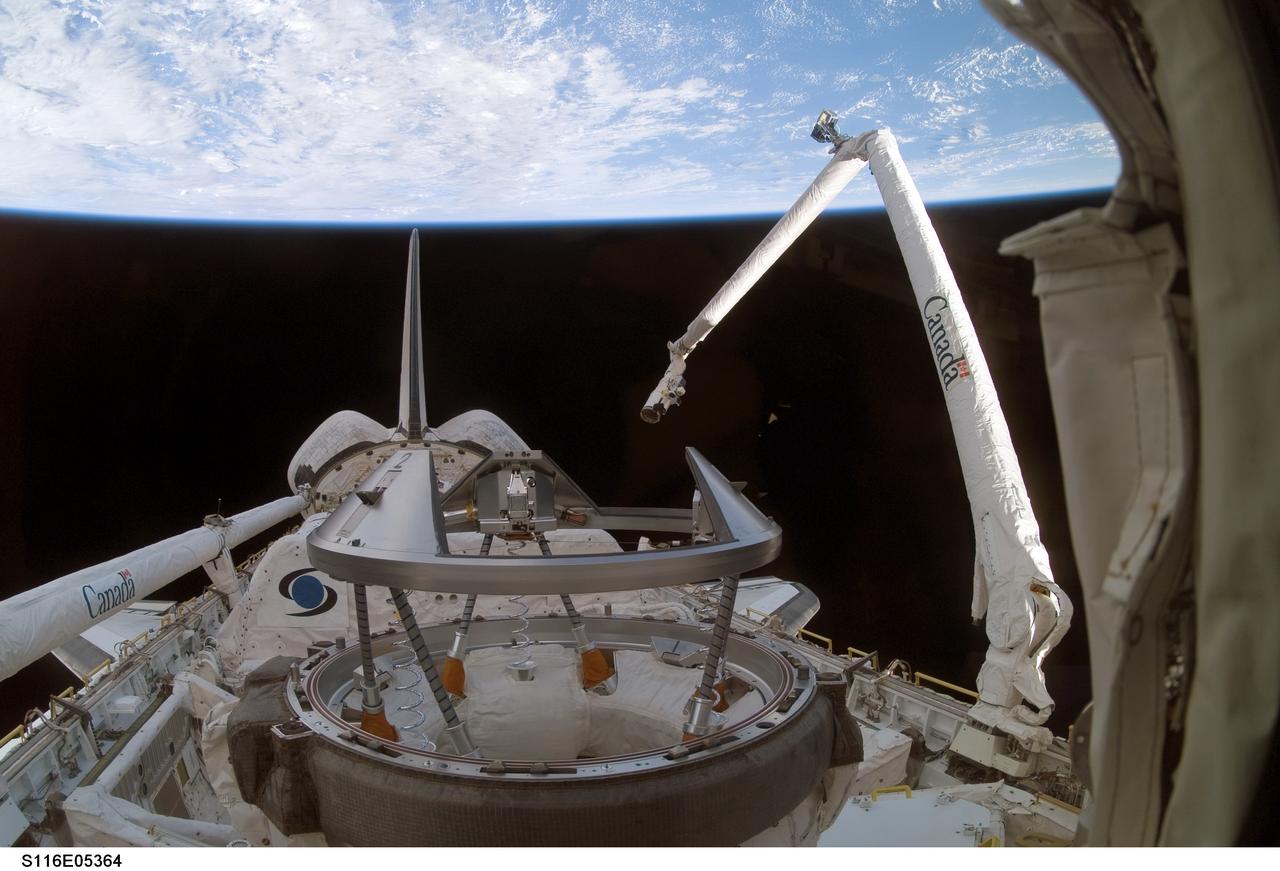
S116-E-05364 (11 Dec. 2006) --- As seen through windows on the aft flight deck of Space Shuttle Discovery, the payload bay is featured in this image photographed by a STS-116 crewmember during flight day three activities. Pictured in the payload bay is the shuttle's docking mechanism (foreground), Spacehab module (partially obscured), the Canadian-built Remote Manipulator System (RMS) robotic arm (right), and the Remote Manipulator System/Orbiter Boom Sensor System (left, in stowed position).
Payload bay from aft FD window on Space Shuttle Discovery
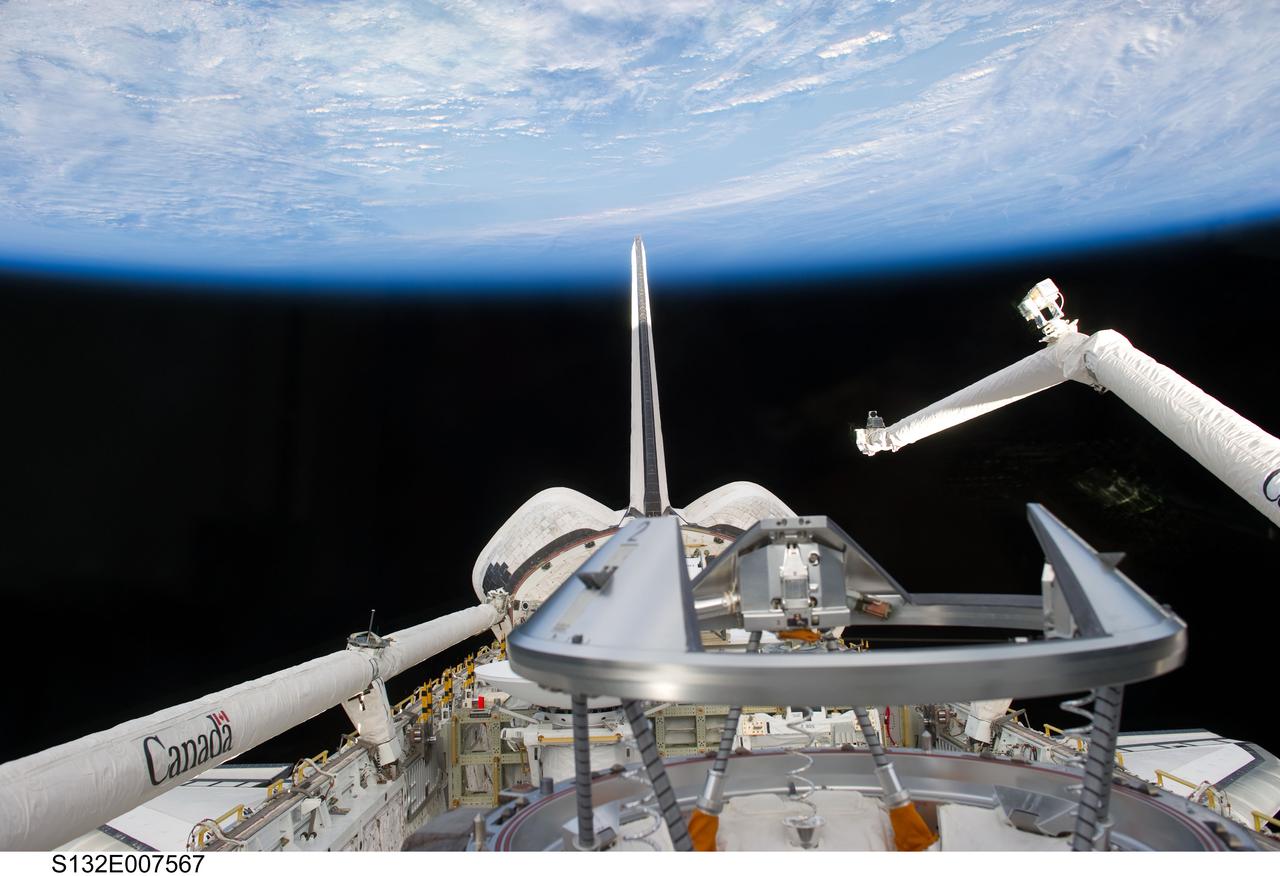
S132-E-007567 (15 May 2010) --- Backdropped by Earth’s horizon and the blackness of space, space shuttle Atlantis’ payload bay, docking mechanism (foreground), vertical stabilizer, orbital maneuvering system (OMS) pods, and Remote Manipulator System/Orbiter Boom Sensor System (RMS/OBSS) are featured in this image photographed by an STS-132 crew member from an aft flight deck window.
STS-132 Space Shuttle Atlantis Payload Bay
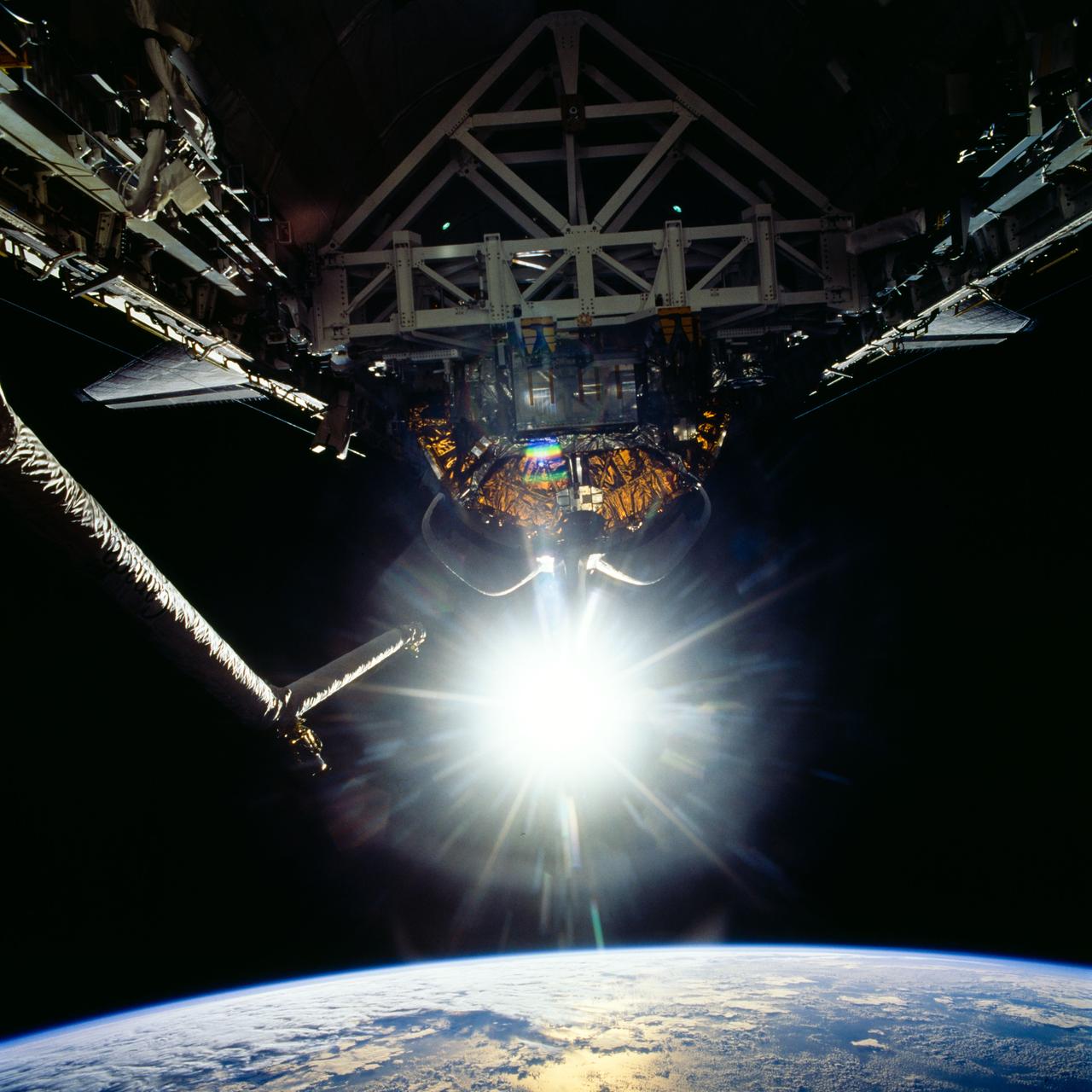
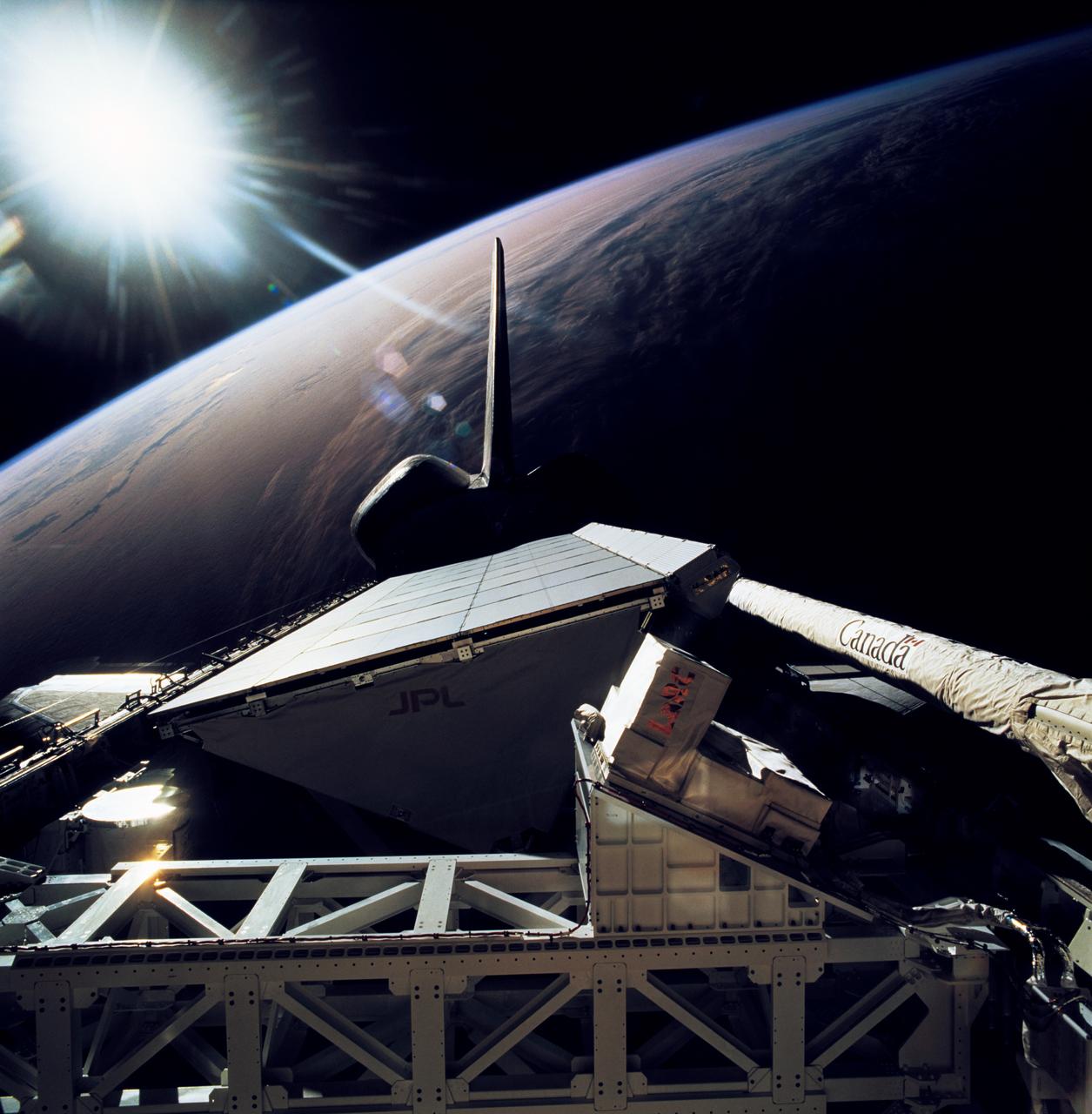
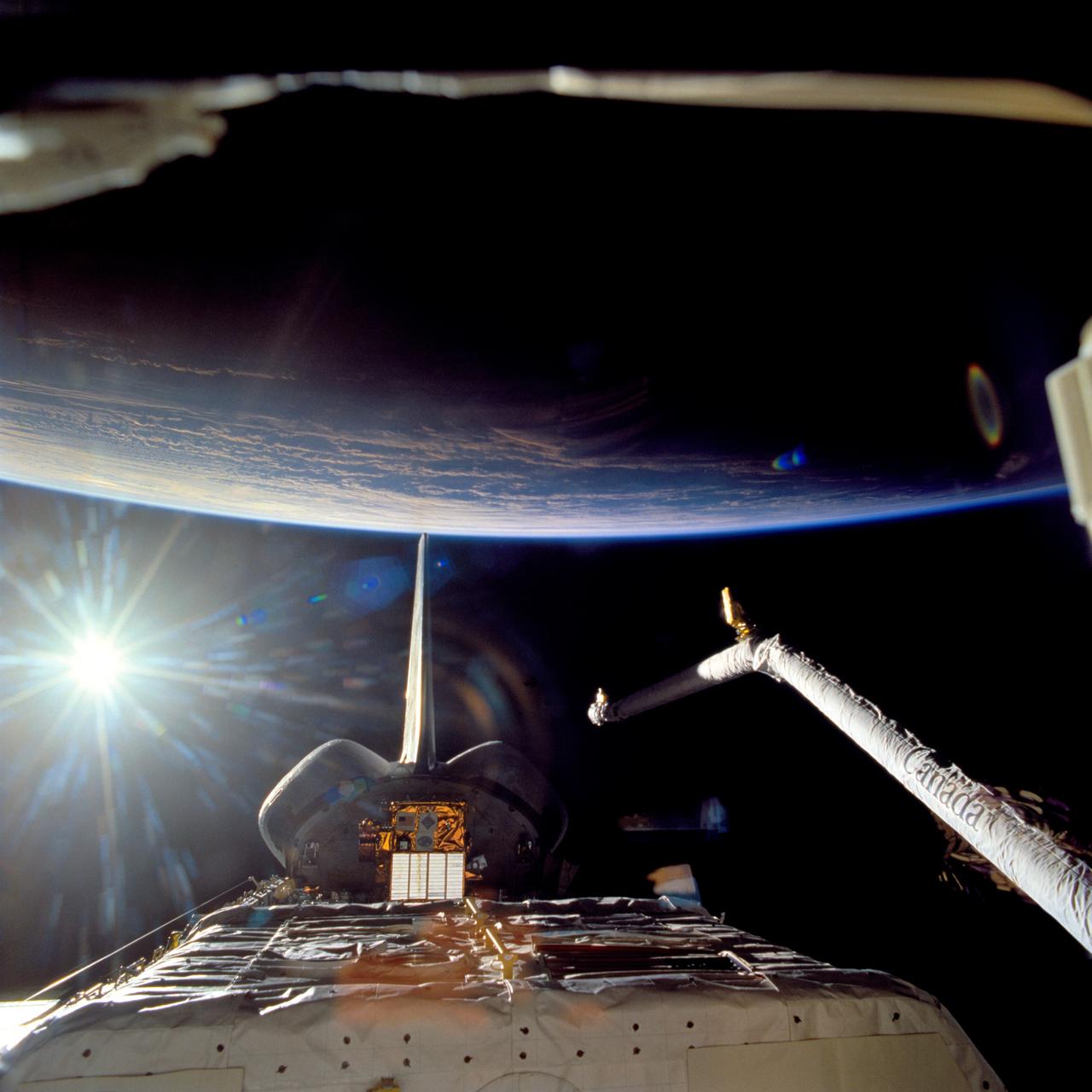
STS072-726-085 (11-20 Jan. 1996) --- The crew members captured this 70mm view of the Space Shuttle Endeavour’s cargo bay, with the reflection of sunglint over Earth’s horizon.  The Canadian-built Remote Manipulator System (RMS) arm, with two television cameras affixed, is at frame right.  The crew earlier had retrieved the Japanese Space Flyer (SFU) and berthed in the aft cargo bay, along with the Office of Aeronautics and Space Technology (OAST) Flyer satellite.
Shuttle orbiter Endeavour's payload bay during STS-72 mission
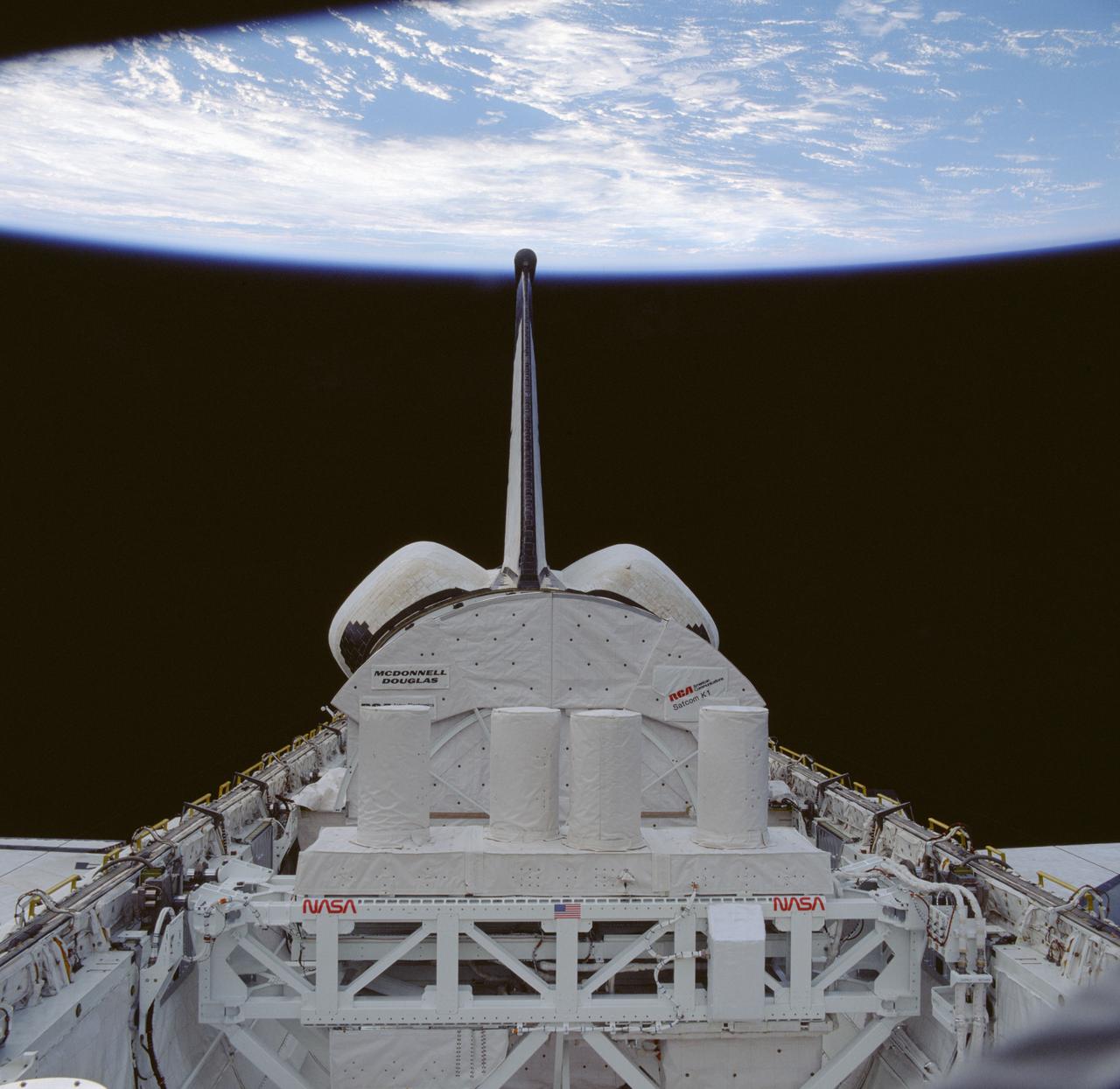
61C-39-002 (12-17 Jan 1986) --- This view of the cargo bay of the Earth-orbiting Space Shuttle Columbia reveals some of the STS 61-C mission payloads.  The materials science laboratory (MSL-2), sponsored by the Marshall Space Flight Center  (MSFC), is in the foreground.  A small portion of  the first Hitchhiker payload, sponsored by the Goddard Space Flight Center (GSFC), is in the immediate foreground, mounted to the spacecraft's starboard side.  The closed sun shield for the now-vacated RCA SATCOM K-1 communications satellite is behind the MSL.  Completely out of view, behind the shield, are 13 getaway specials in canisters.  Clouds over ocean and the blackness of space share the backdrop for the 70mm camera's frame.
View of the Shuttle Columbia's payload bay and payloads in orbit
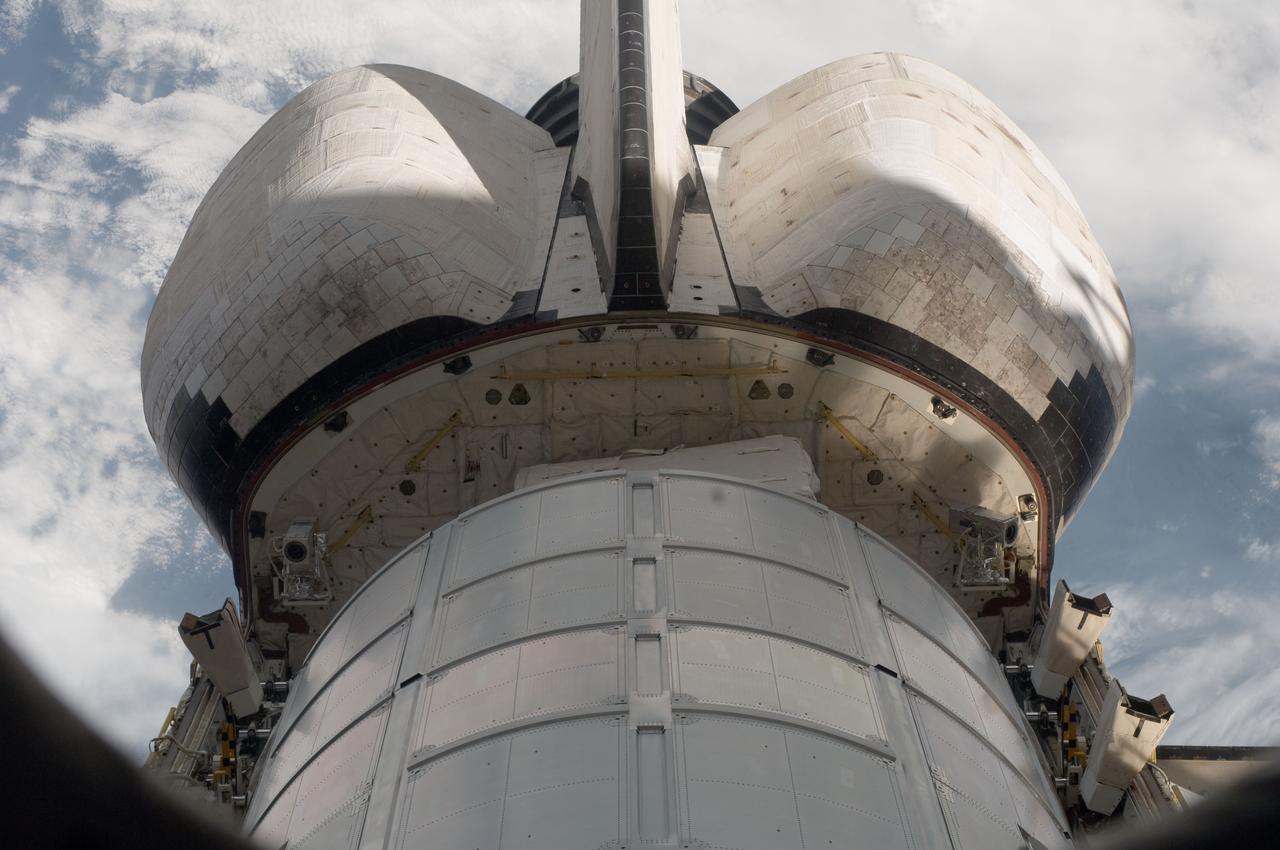
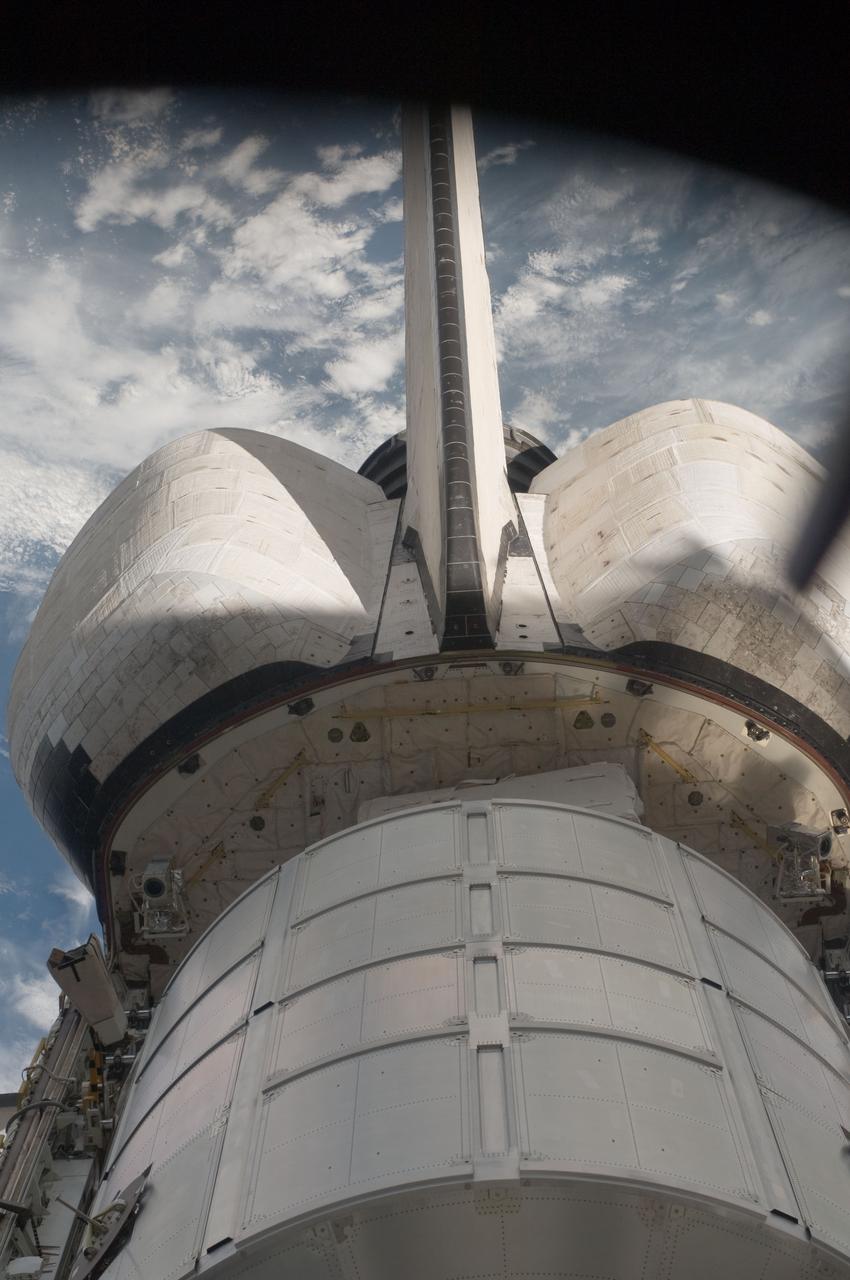
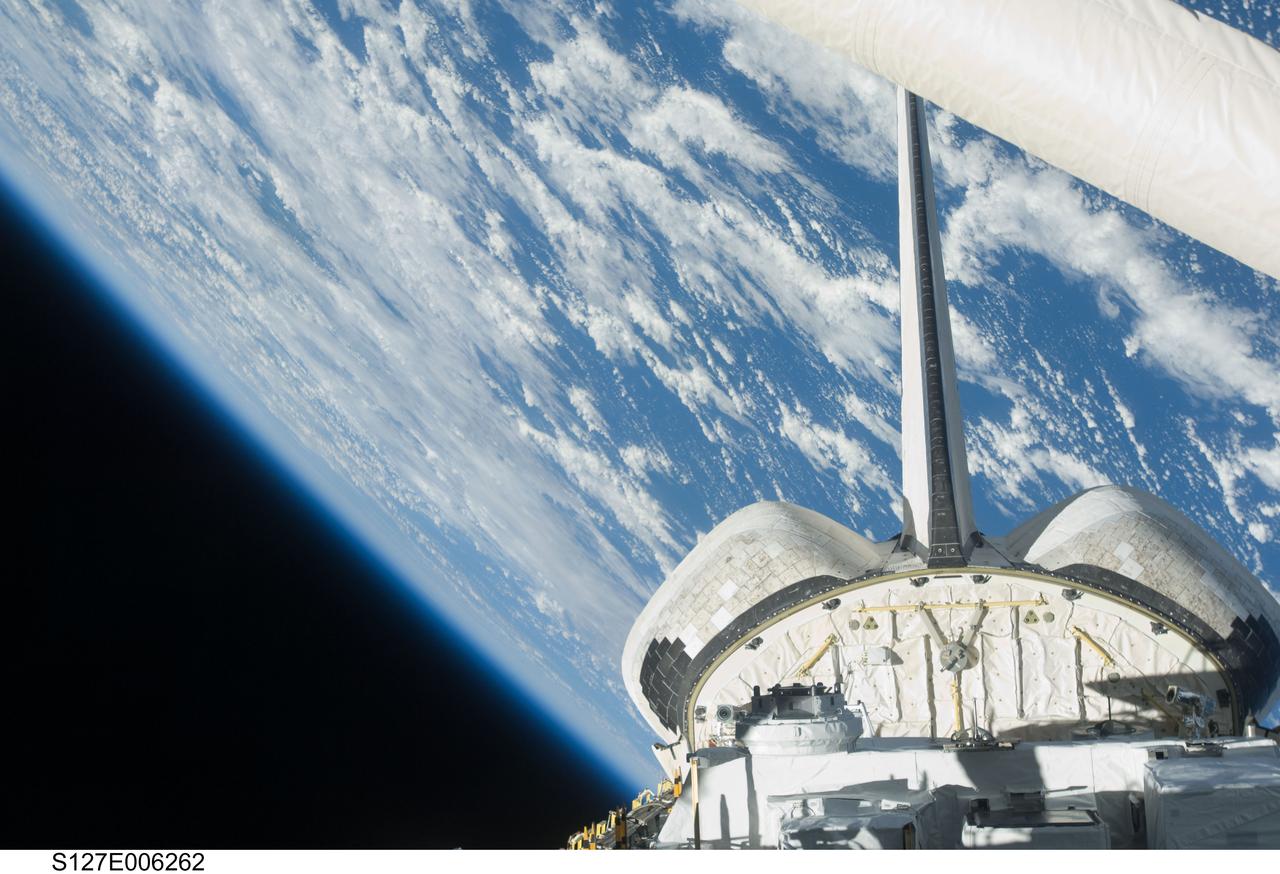
S127-E-006262 (16 July 2009) --- Backdropped by a blue and white Earth and the blackness of space, a partial view of Space Shuttle Endeavour?s payload bay, vertical stabilizer and orbital maneuvering system (OMS) pods are featured in this image photographed by a STS-127 crew member from an aft flight deck window.
Payload Bay taken by STS-127 Crew on Space Shuttle Endeavour
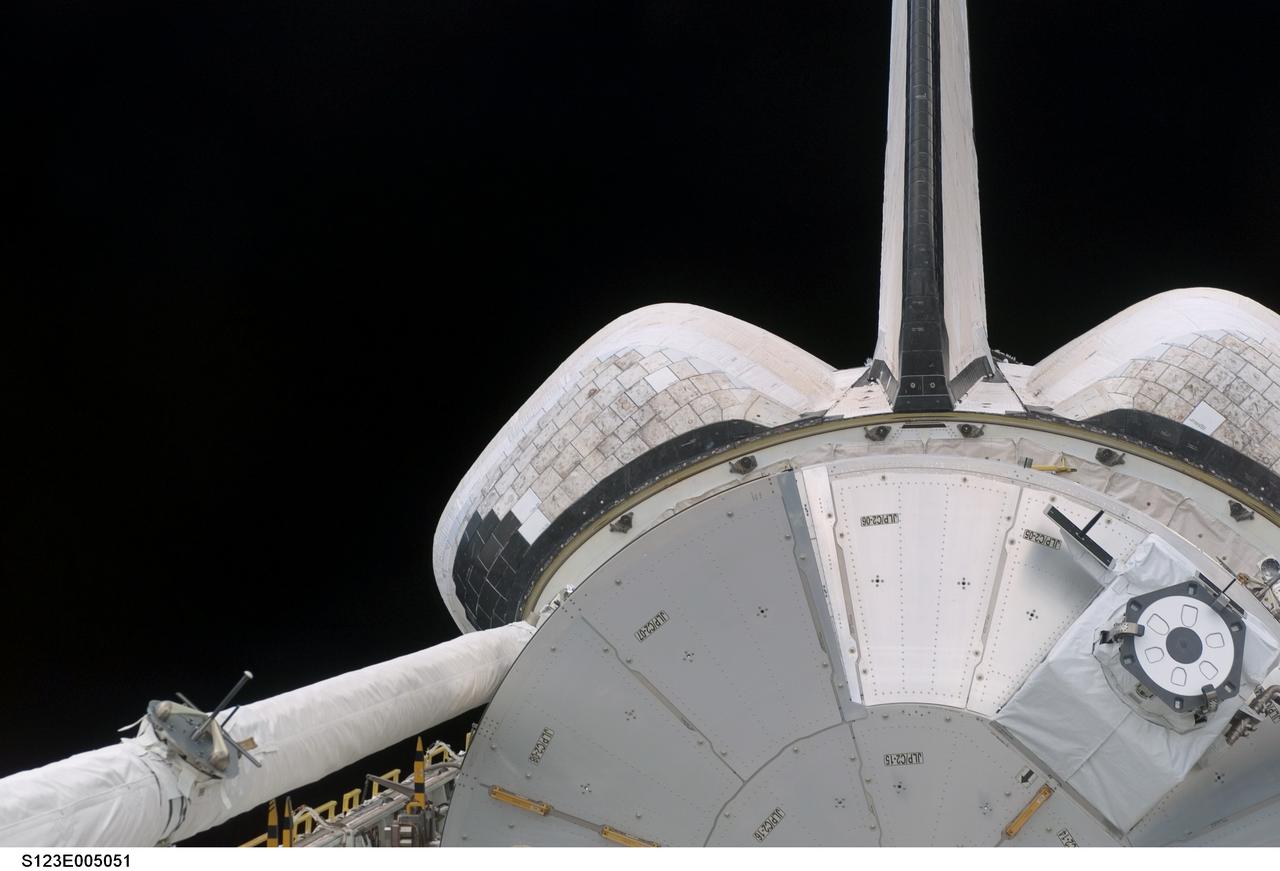
S123-E-005051 (11 Mar. 2008) --- During their first full day in space, STS-123 crewmembers aboard the Earth-orbiting Space Shuttle Endeavour  recorded and downlinked pictures of its cargo bay where the logistics module for the Japanese Kibo laboratory awaits being added to the   growing International Space Station.
Space Shuttle Endeavour,OV 105,Payload Bay during STS-123
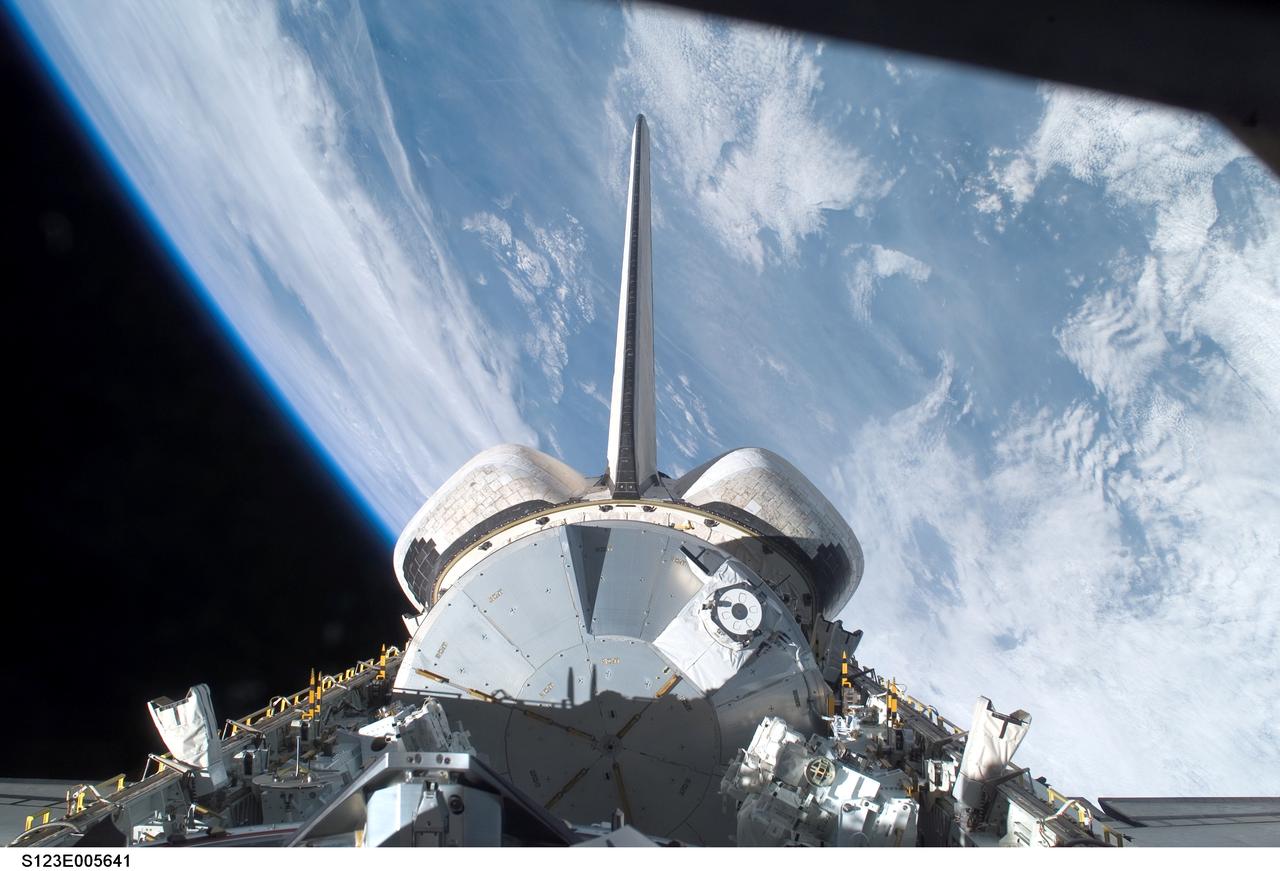
S123-E-005641 (13 March 2008) --- Backdropped by Earth's horizon and the blackness of space, the logistics module for the Japanese Kibo laboratory in Space Shuttle Endeavour's payload bay, vertical stabilizer and orbital maneuvering system (OMS) pods are featured in this image photographed by a STS-123 crewmember.
Space Shuttle Endeavour,OV 105,Payload Bay during STS-123
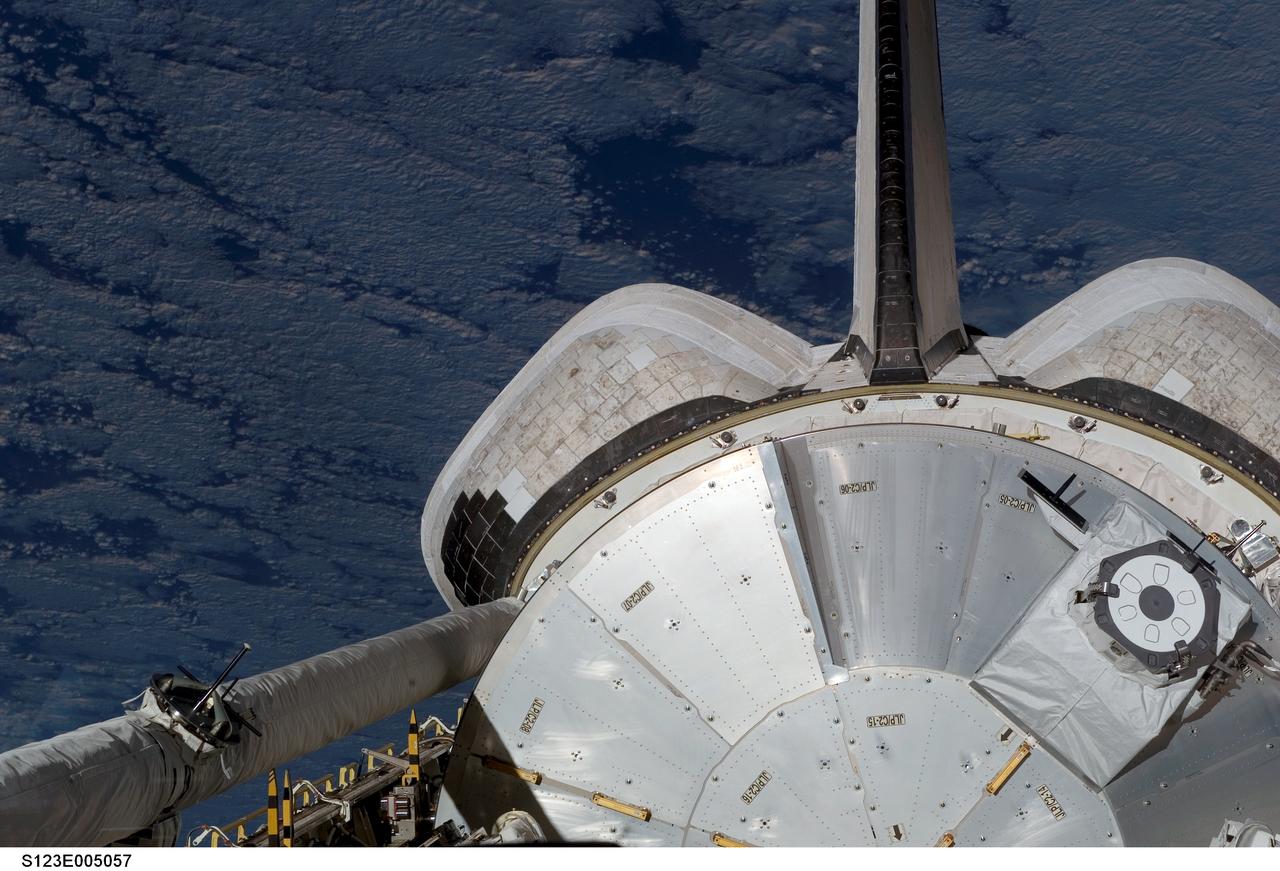
S123-E-005057 (11 Mar. 2008) --- During their first full day in space, STS-123 crewmembers aboard the Earth-orbiting Space Shuttle Endeavour  recorded and downlinked pictures of its cargo bay where the logistics module for the Japanese Kibo laboratory awaits being added to the   growing International Space Station.
Space Shuttle Endeavour,OV 105,Payload Bay during STS-123
S123-E-005056 (11 Mar. 2008) --- During their first full day in space, STS-123 crewmembers aboard the Earth-orbiting Space Shuttle Endeavour  recorded and downlinked pictures of its cargo bay where the logistics module for the Japanese Kibo laboratory awaits being added to the   growing International Space Station.
Space Shuttle Endeavour,OV 105,Payload Bay during STS-123
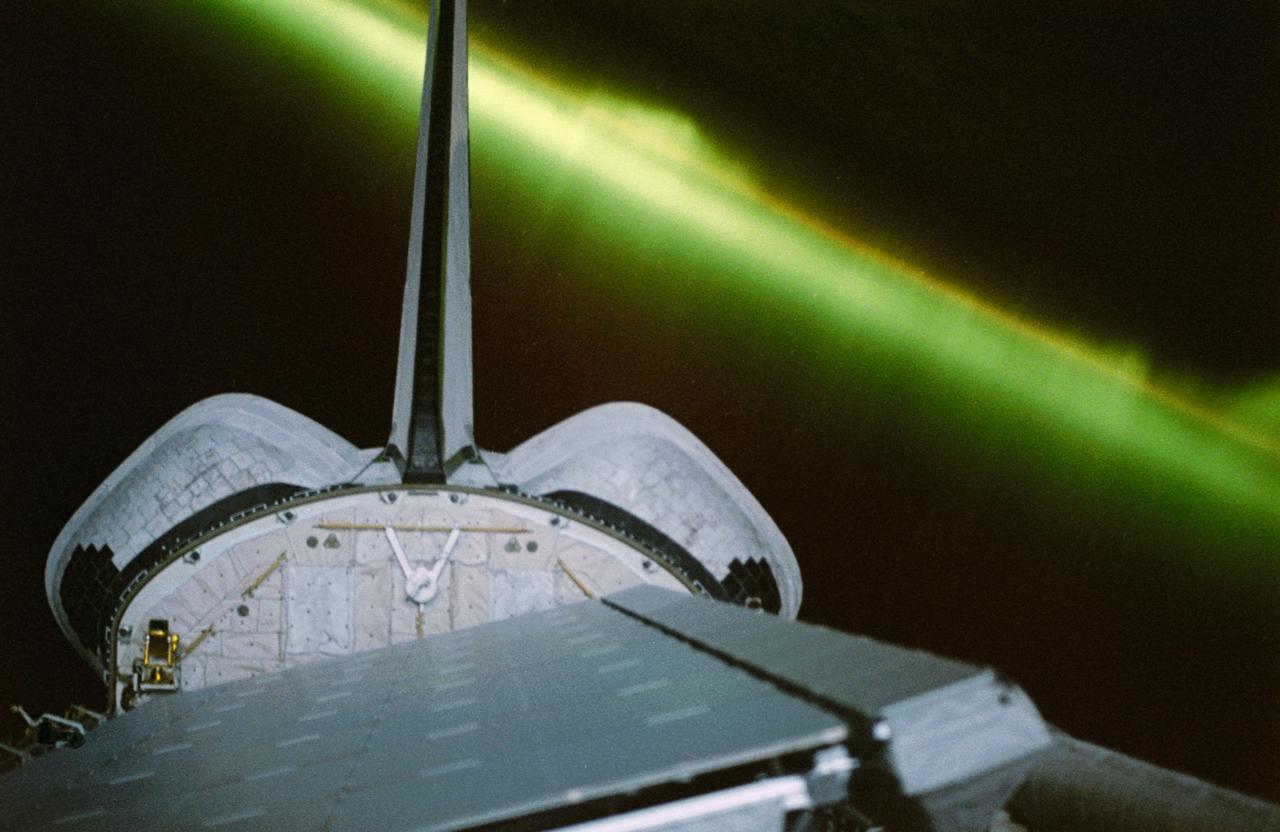
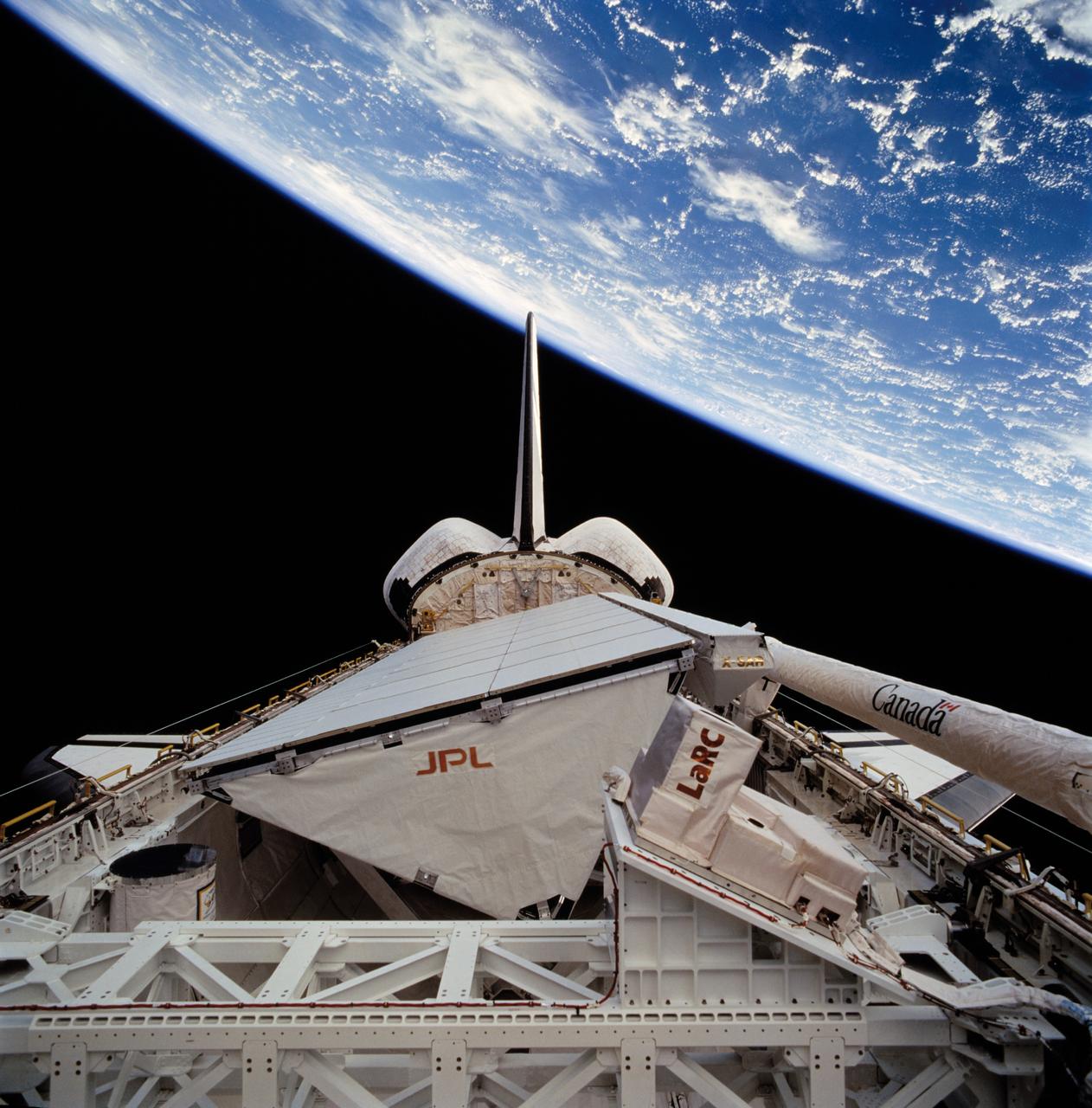
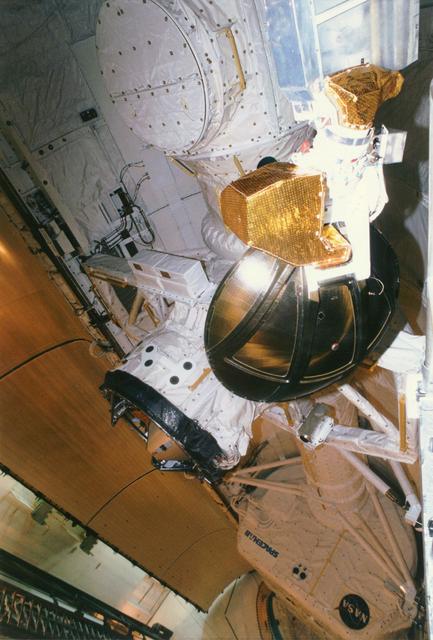
STS059-50-011 (9-20 April 94) --- A greenish appearing aurora forms the backdrop for this 35mm scene of the Earth orbiting Space Shuttle Endeavour's aft cargo bay.  Featured in the bay are the antennae for the SIR-C/X-SAR imaging radar instruments, illuminated by moonlight.  The crew sighted the southern lights (aurora australis) several times during each of the eleven days of the mission.
STS-59 Endeavour's aft cargo bay in orbit
S82-E-5014 (12 Feb. 1997) --- Space Shuttle Discovery's Remote Manipulator System (RMS) gets a preliminary workout in preparation for a busy work load later in the week. The crewmembers are preparing for a scheduled Extravehicular Activity (EVA) with the Hubble Space Telescope (HST), which will be pulled into the Space Shuttle Discovery's cargo bay with the aid of the Remote Manipulator System (RMS). A series of EVA's will be required to properly service the giant telescope. This view was taken with an Electronic Still Camera (ESC).
View of the shuttle orbiter Discovery's payload bay during RMS checkout
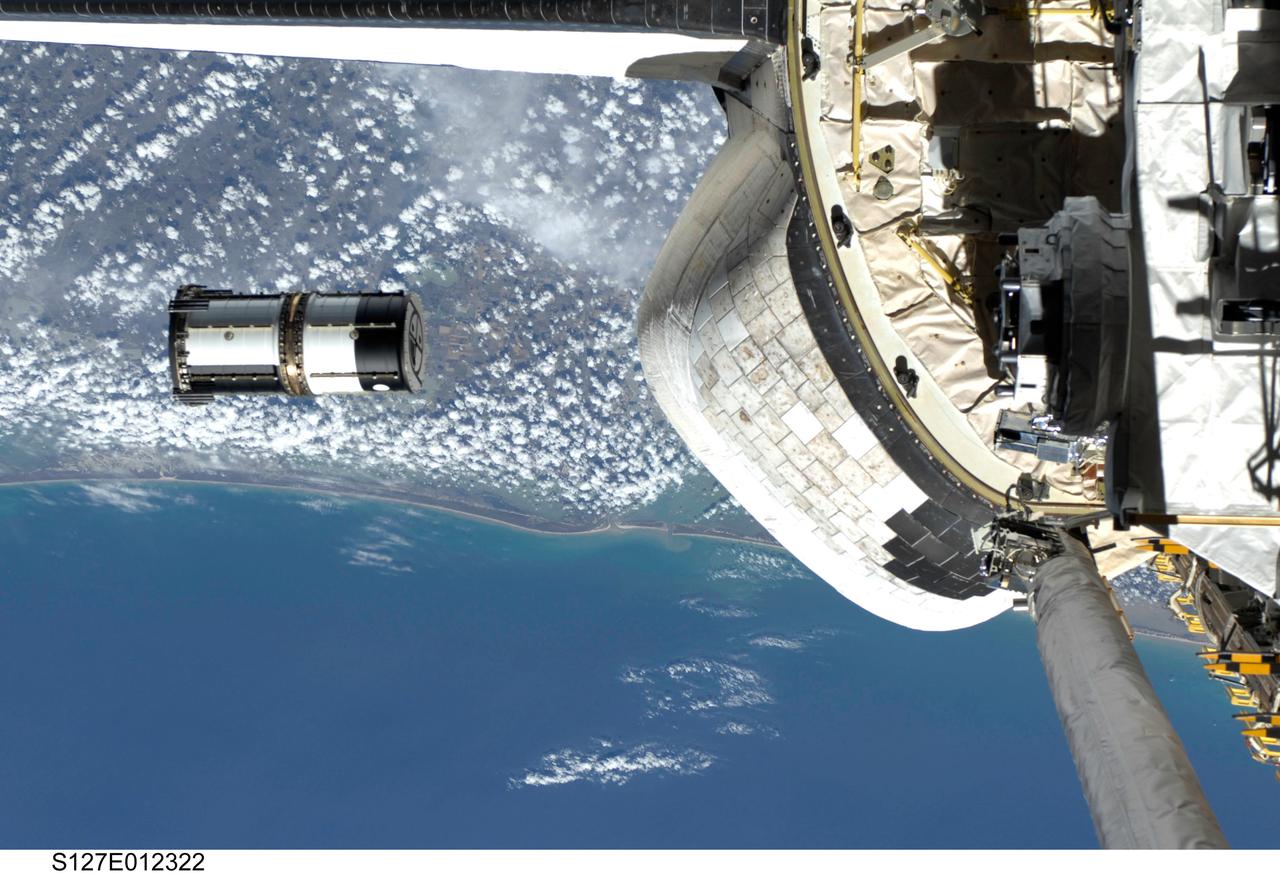
S127-E-012322 (30 July 2009) --- As seen through windows on the aft flight deck of Space Shuttle Endeavour, a Department of Defense pico-satellite known as Atmospheric Neutral Density Experiment 2 (ANDE-2) is released from the shuttle's payload bay by STS-127 crew members. ANDE-2 consists of two spherical micro-satellites which will measure the density and composition of the low-Earth orbit (LEO) atmosphere while being tracked from the ground. The data will be used to better predict the movement of objects in orbit.
Deployment of DRAGONSAT from Space Shuttle Endeavours Payload Bay
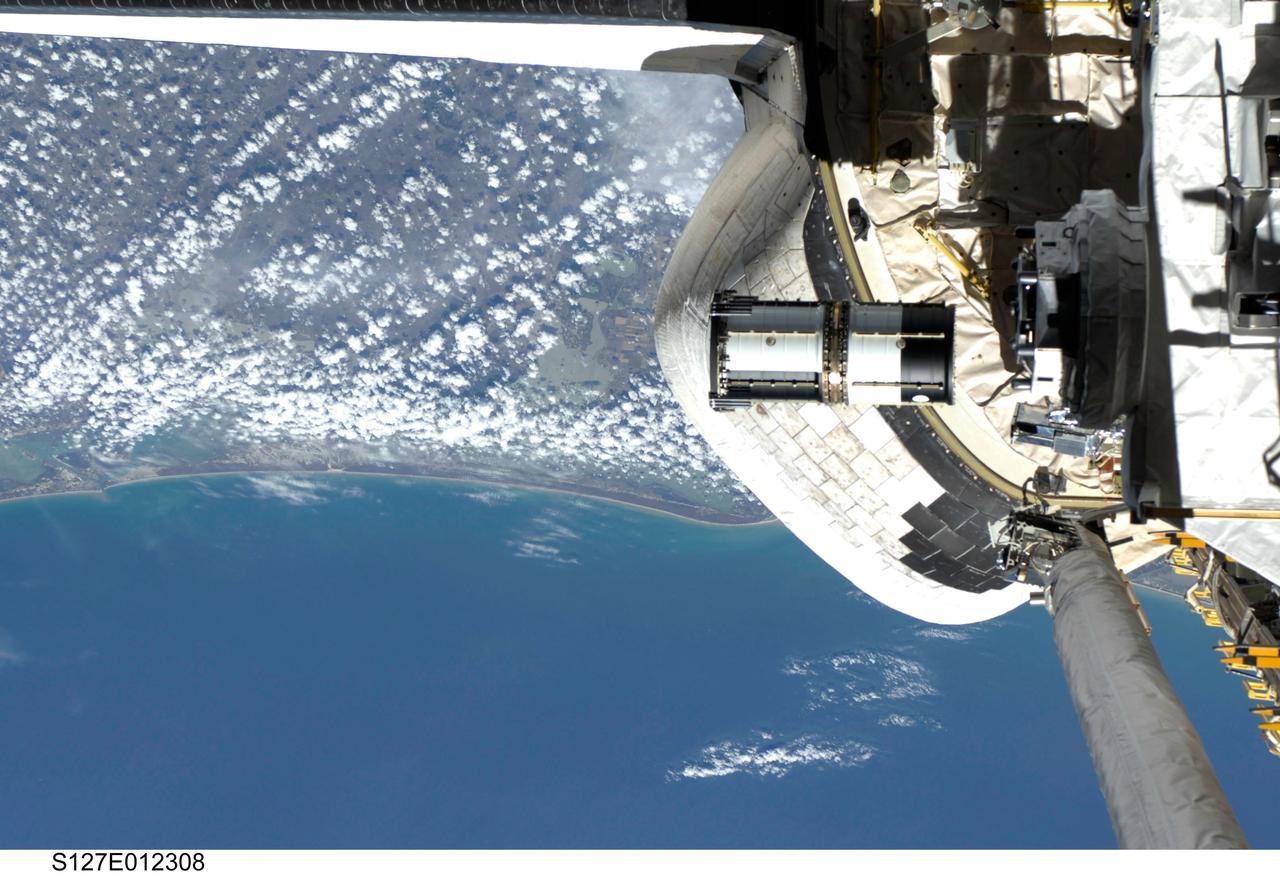
S127-E-012308 (30 July 2009) --- As seen through windows on the aft flight deck of Space Shuttle Endeavour, a Department of Defense pico-satellite known as Atmospheric Neutral Density Experiment 2 (ANDE-2) is released from the shuttle's payload bay by STS-127 crew members. ANDE-2 consists of two spherical micro-satellites which will measure the density and composition of the low-Earth orbit (LEO) atmosphere while being tracked from the ground. The data will be used to better predict the movement of objects in orbit.
Deployment of DRAGONSAT from Space Shuttle Endeavours Payload Bay
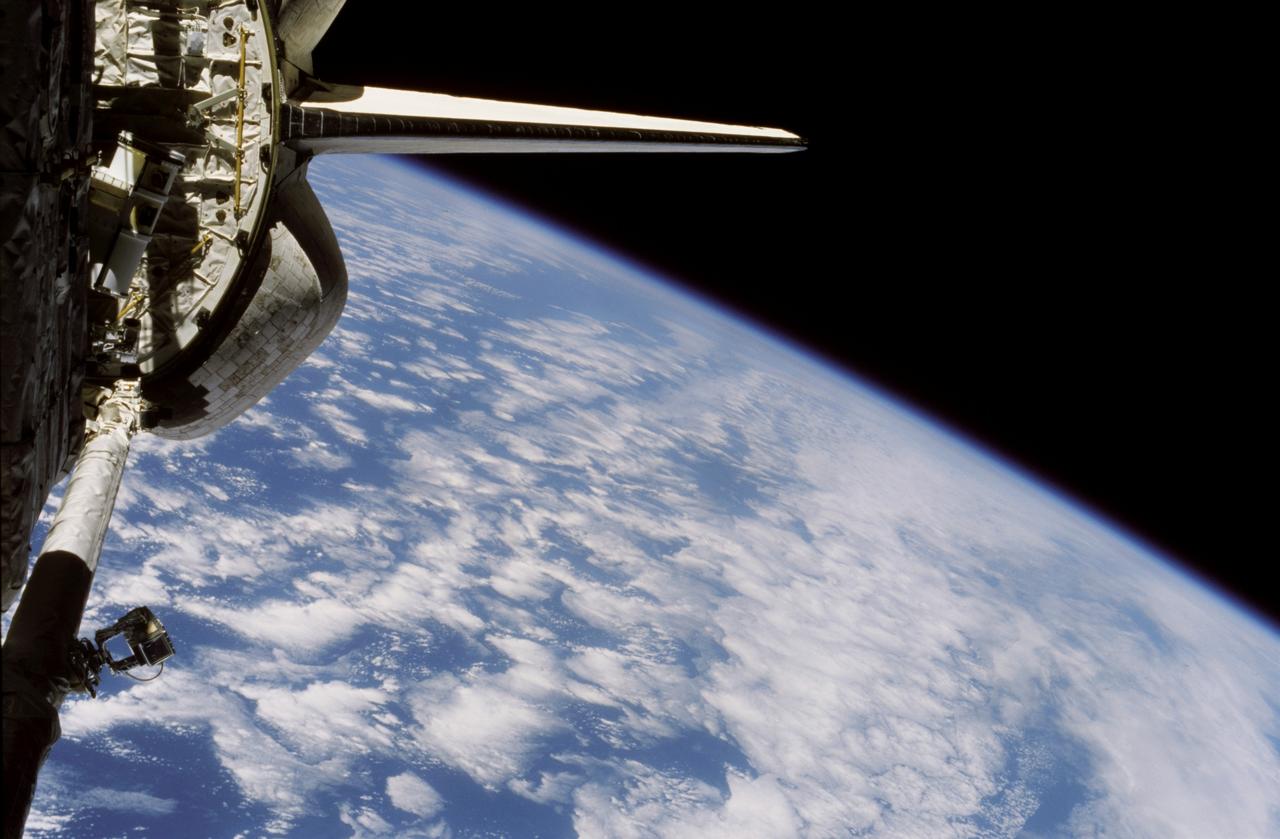
STS116-320-001 (9-22 Dec. 2006) --- Backdropped by the horizon of a blue and white Earth and the blackness of space, part of the Space Shuttle Discovery's aft cargo bay, its vertical stabilizer and orbital maneuvering system (OMS) pods are seen in this image photographed by an STS-116 crewmember onboard the shuttle. This image was recorded with a 35mm film-equipped camera.
View of the STS-116 Space Shuttle Discovery aft payload bay
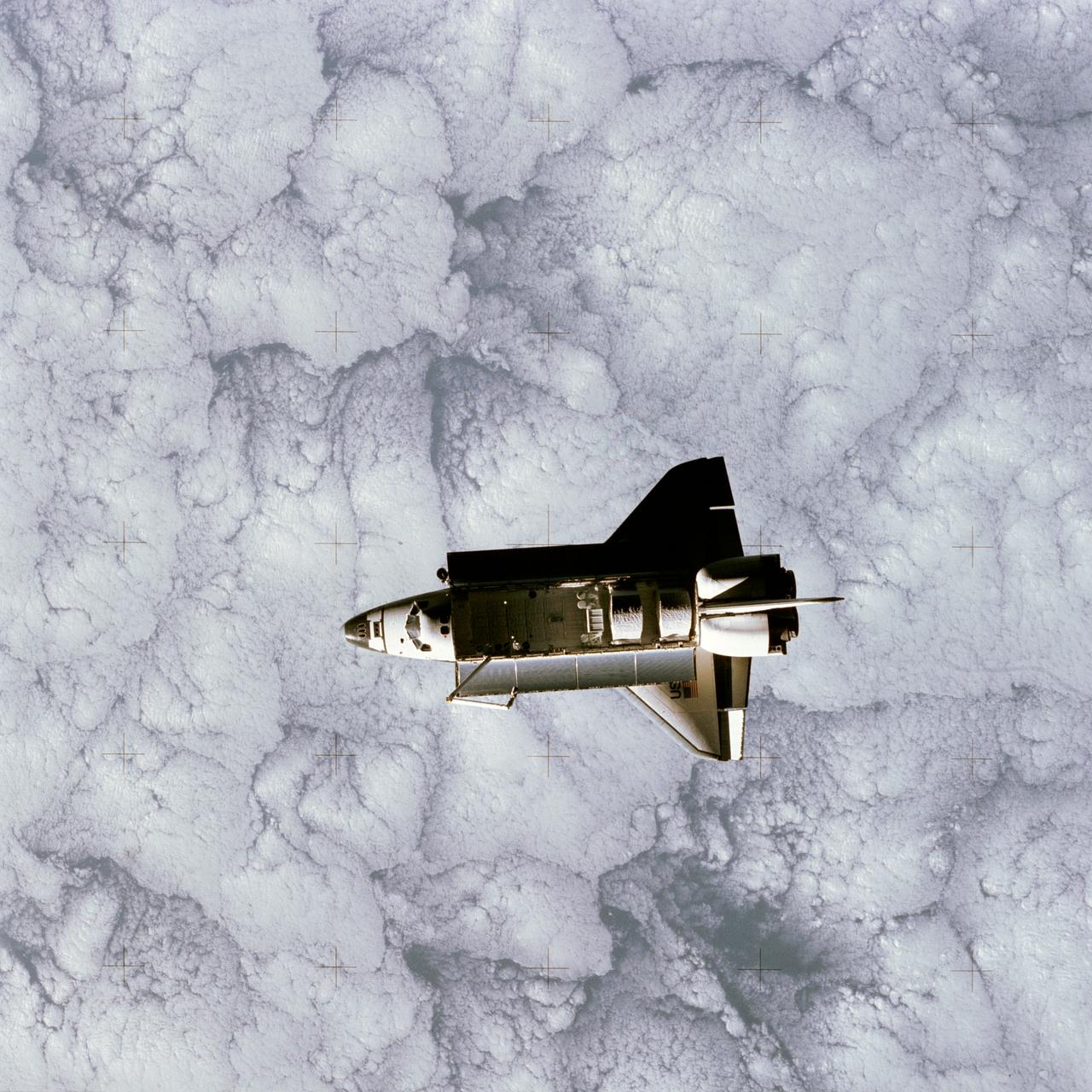
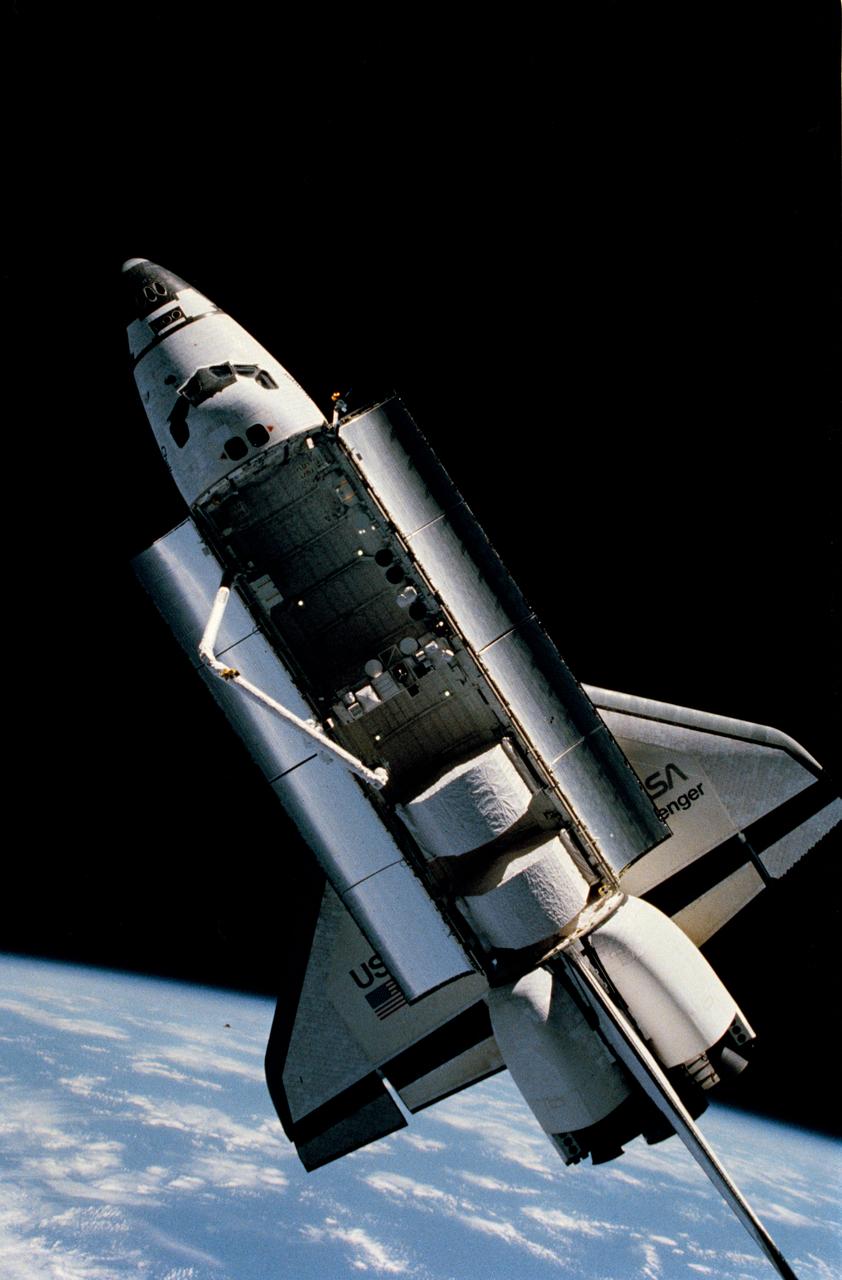
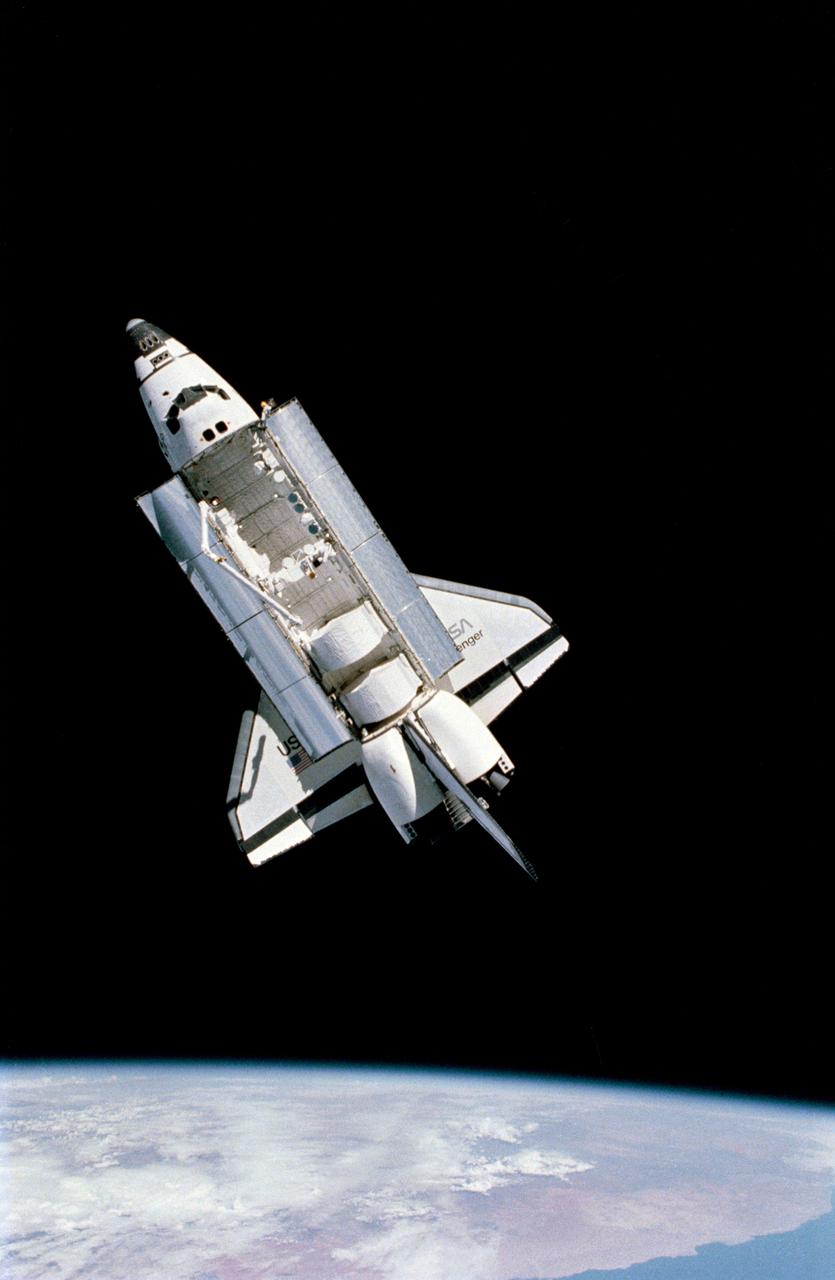
STS007-32-1667 (22 June 1983) --- The Earth-orbiting Space Shuttle Challenger over a heavily cloud-covered portion of the Earth was captured by a 70mm camera onboard the temporarily free-flying Shuttle Pallet Satellite (SPAS-01) during a busy Day 5 on the STS-7 mission.  Visible in the cargo bay are the protective cradles for the now vacated Telesat Anik C2 and Palapa-B communications satellites, the pallet for the NASA Office of Space and Terrestrial Applications (OSTA-2); the Remote Manipulator System (RMS) and the KU-Band antenna.  The STS-7 astronaut crew and the RMS arm later retrieved the SPAS and returned it to a stowed position in the cargo bay of the Space Shuttle Challenger for the return to Earth.
Full view of Challenger in space taken by the SPAS satellite
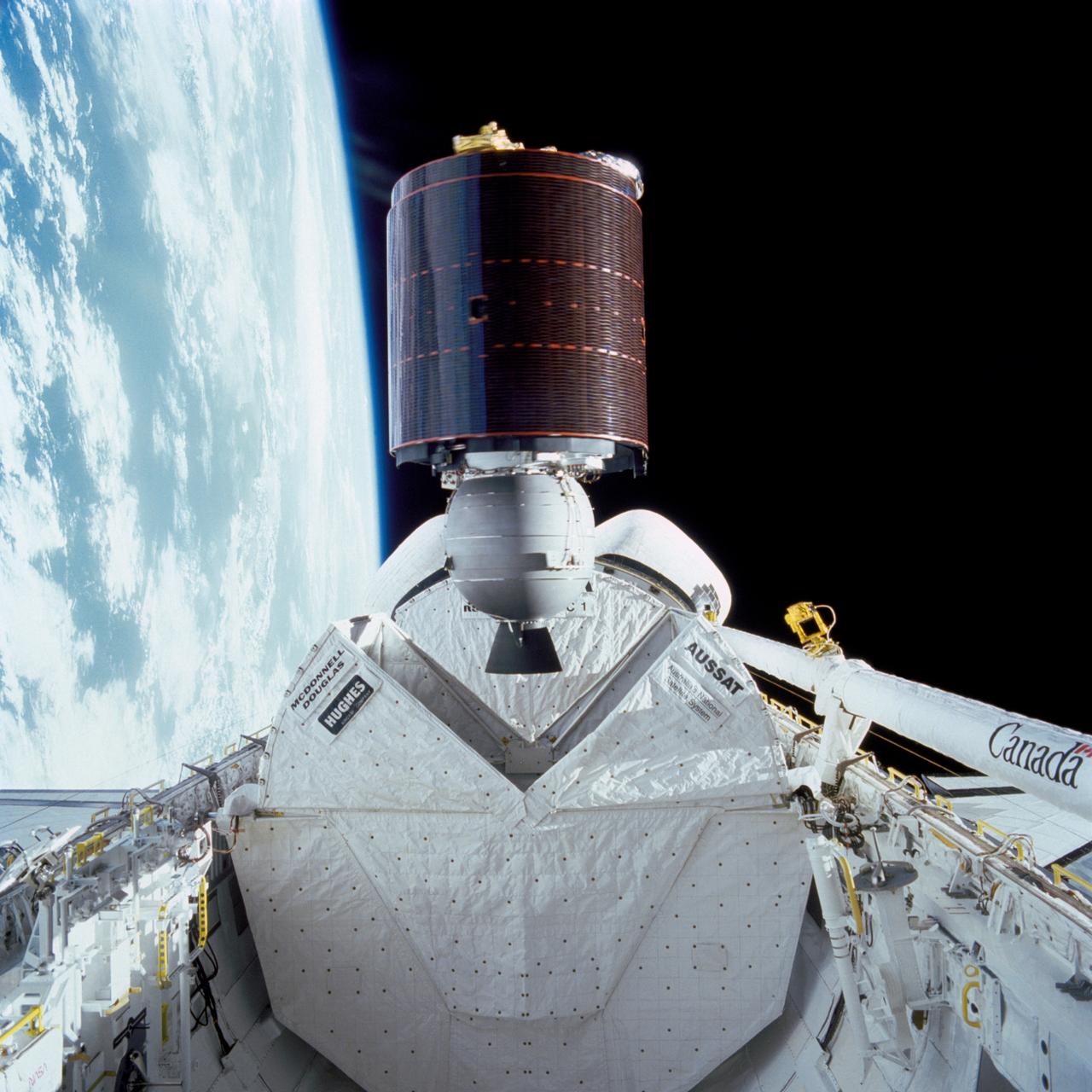
51I-32-023 (27 Aug. 1985) --- Australia's AUSSAT communications satellite is deployed from the payload bay of the space shuttle Discovery on flight day one. A portion of the cloudy surface of Earth can be seen to the left of the frame. Photo credit: NASA
Australia's AUSSAT satellite deployed from payload bay
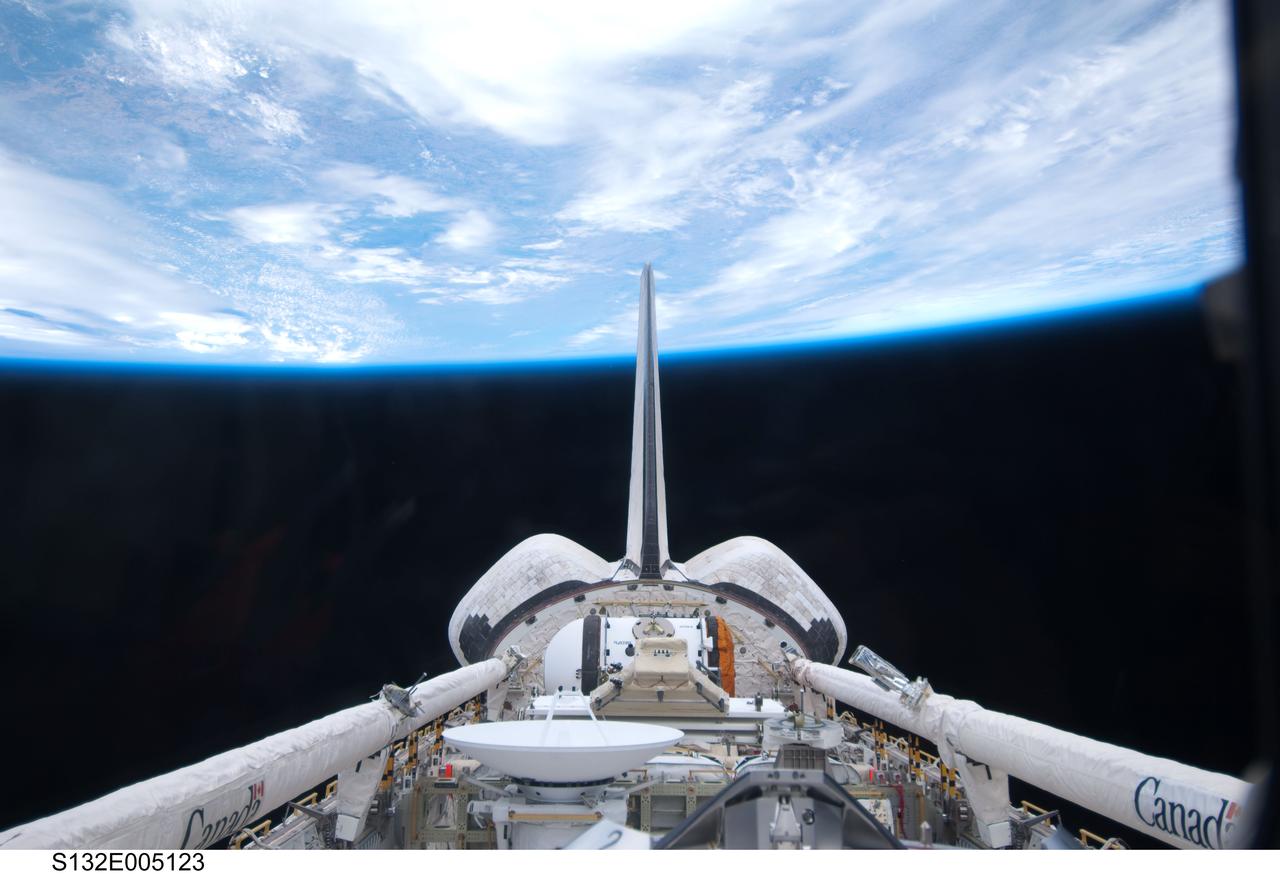
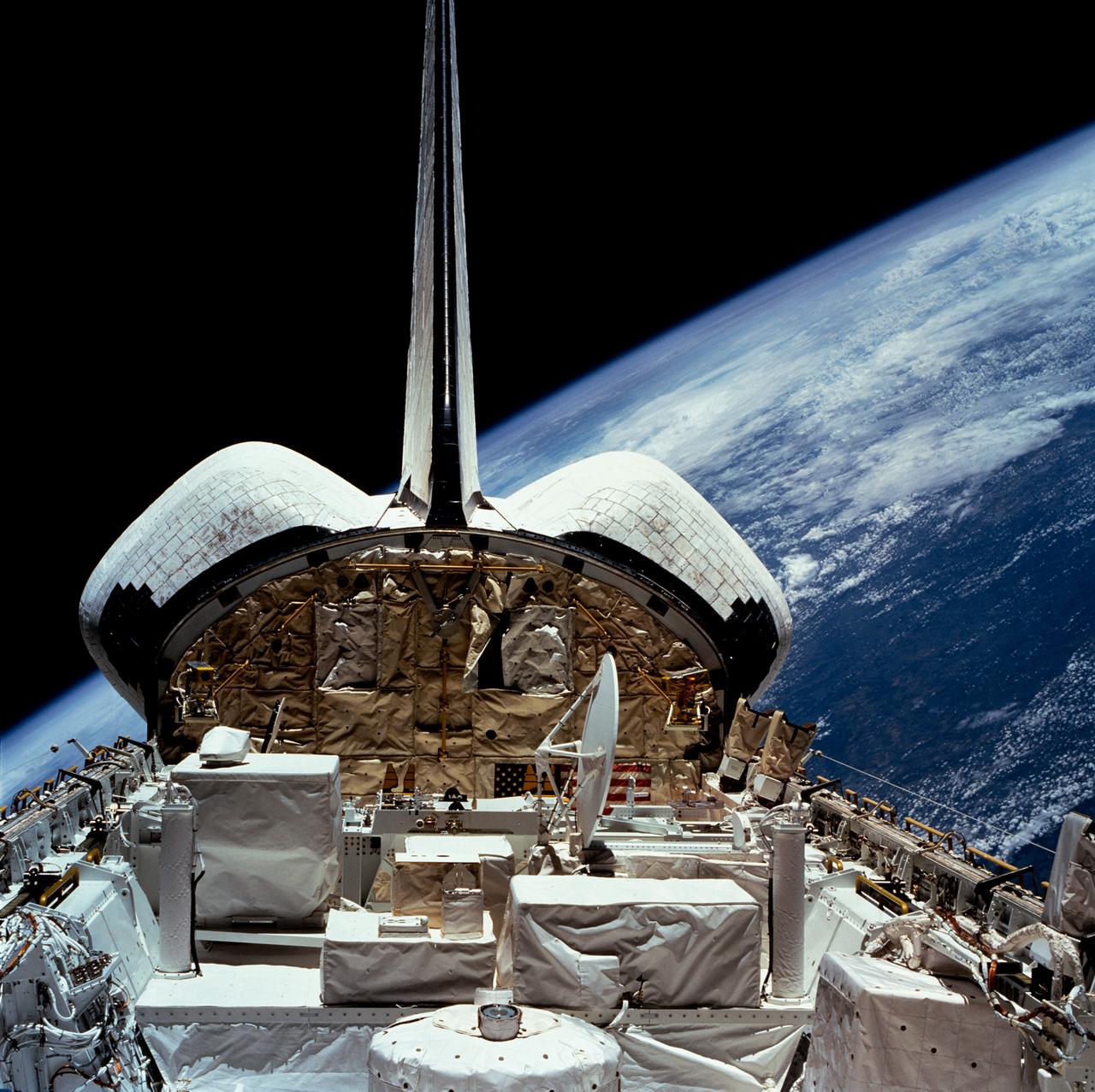
S132-E-005123 (14 May 2010) --- This photograph of space shuttle Atlantis' cargo bay and its vertical stabilizer intersecting Earth's horizon was provided on Flight Day 2 by one of the six STS-132 crew members. The photo was among the initial batch of non-engineering photography downlinked from the Earth-orbiting spacecraft on its final scheduled mission.
Payload Bay on Space Shuttle Atlantis during STS-132
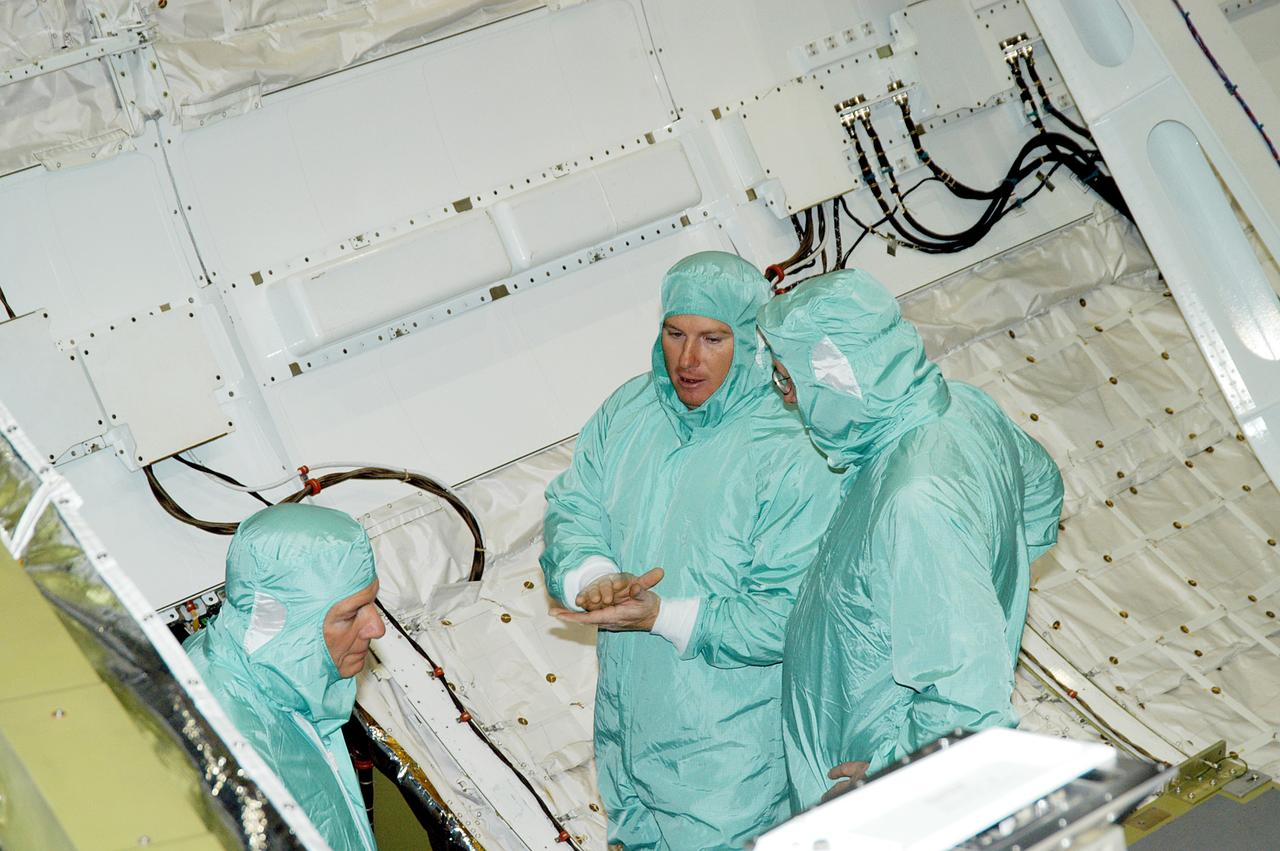
KENNEDY SPACE CENTER, FLA. -- In Orbiter Processing Facility Bay 1, NASA Deputy Associate Administrator for Space Station and Shuttle Programs Michael Kostelnik (left) and United Space Alliance (USA) Vice President and Space Shuttle Program Manager Howard DeCastro (right) are briefed by a USA technician (center) on Shuttle processing in the payload bay of orbiter Atlantis.  NASA and USA Space Shuttle program management are participating in a leadership workday.  The day is intended to provide management with an in-depth, hands-on look at Shuttle processing activities at KSC.
KENNEDY SPACE CENTER, FLA. -- In Orbiter Processing Facility Bay 1, NASA Deputy Associate Administrator for Space Station and Shuttle Programs Michael Kostelnik (left) and United Space Alliance (USA) Vice President and Space Shuttle Program Manager Howard DeCastro (right) are briefed by a USA technician (center) on Shuttle processing in the payload bay of orbiter Atlantis. NASA and USA Space Shuttle program management are participating in a leadership workday. The day is intended to provide management with an in-depth, hands-on look at Shuttle processing activities at KSC.
KENNEDY SPACE CENTER, FLA. -- In Orbiter Processing Facility Bay 1, NASA Deputy Associate Administrator for Space Station and Shuttle Programs Michael Kostelnik (left) and United Space Alliance (USA) Vice President and Space Shuttle Program Manager Howard DeCastro (right) are briefed by a USA technician (center) on Shuttle processing in the payload bay of orbiter Atlantis.  NASA and USA Space Shuttle program management are participating in a leadership workday.  The day is intended to provide management with an in-depth, hands-on look at Shuttle processing activities at KSC.
KENNEDY SPACE CENTER, FLA. -- In Orbiter Processing Facility Bay 1, NASA Deputy Associate Administrator for Space Station and Shuttle Programs Michael Kostelnik (left) and United Space Alliance (USA) Vice President and Space Shuttle Program Manager Howard DeCastro (right) are briefed by a USA technician (center) on Shuttle processing in the payload bay of orbiter Atlantis. NASA and USA Space Shuttle program management are participating in a leadership workday. The day is intended to provide management with an in-depth, hands-on look at Shuttle processing activities at KSC.
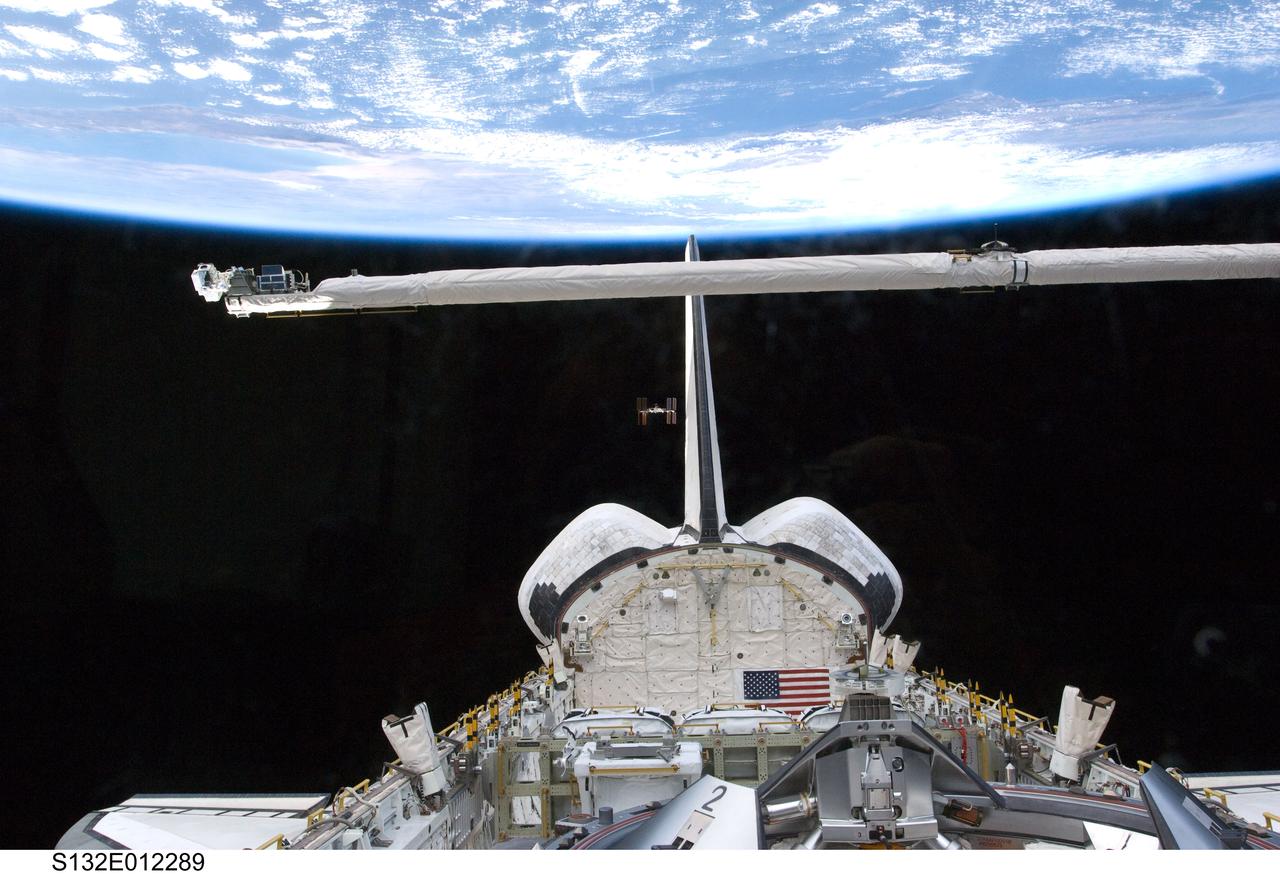
S132-E-012289 (23 May 2010) --- The International Space Station (center) appears very small from the point of view of the space shuttle Atlantis as the two spacecraft carry out their relative separation. Atlantis? vertical stabilizer, orbital maneuvering system (OMS) pods, remote manipulator system/orbiter boom sensor system (RMS/OBSS) and payload bay are also pictured in this image photographed by an STS-132 crew member onboard the shuttle. Earlier the STS-132 and Expedition 23 crews concluded seven days of cooperative work onboard the shuttle and station. Undocking of the two spacecraft occurred at 10:22 a.m. (CDT) on May 23, 2010. Earth?s horizon and the blackness of space provide the backdrop for the scene.
Payload Bay and OBSS on STS-132 Space Shuttle Atlantis
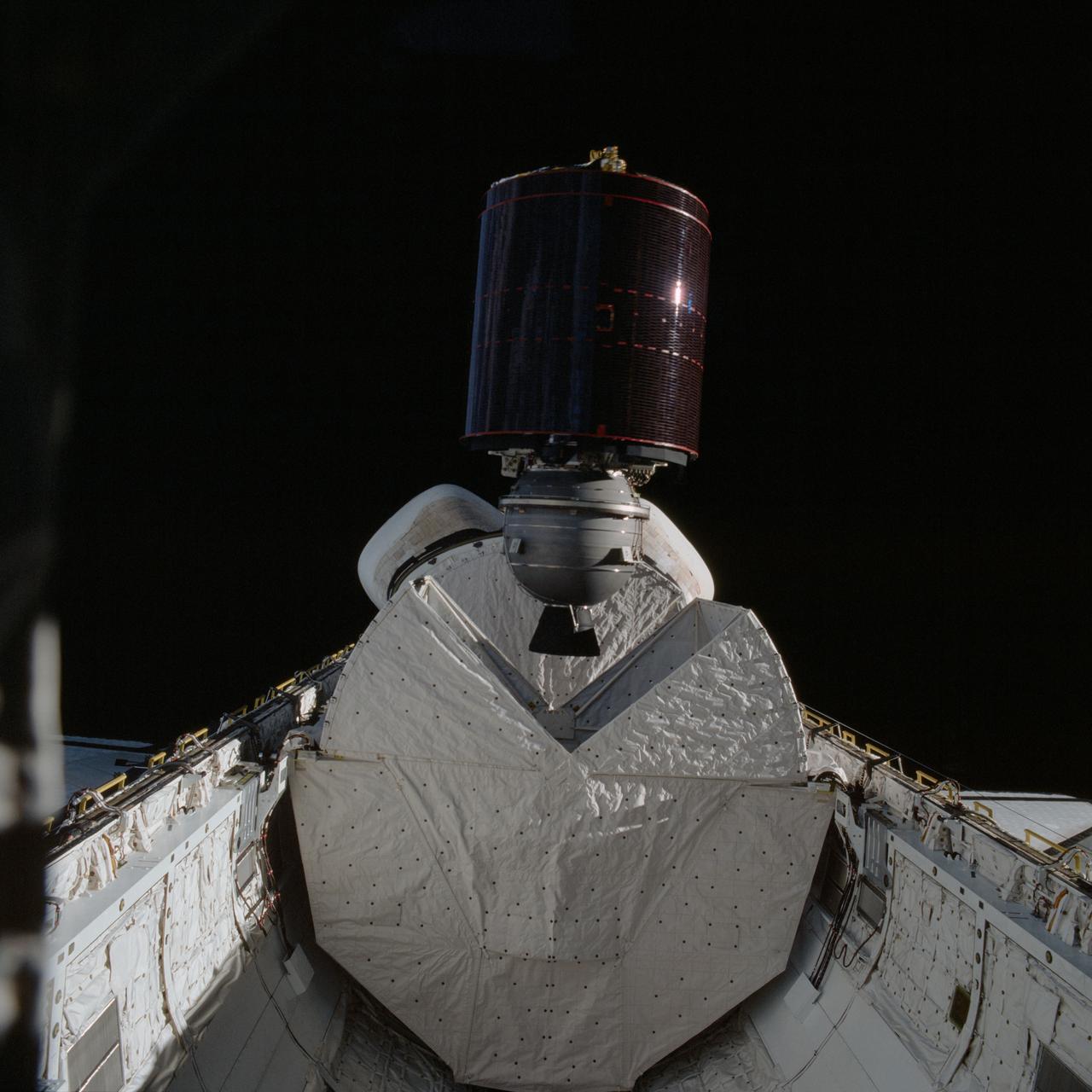
STS005-38-943 (17 Nov. 1982) --- The Satellite Business Systems (SBS-3) satellte is deployed from its protective cradle in the cargo bay of the space shuttle Columbia. Part of Columbia's wings can be seen on both the port and starboard sides. Part of both orbital maneuvering system (OMS) pods are seen at center. The vertical stabilizer is obscured by the satellite. Photo credit: NASA
Satellite deployment during STS-5
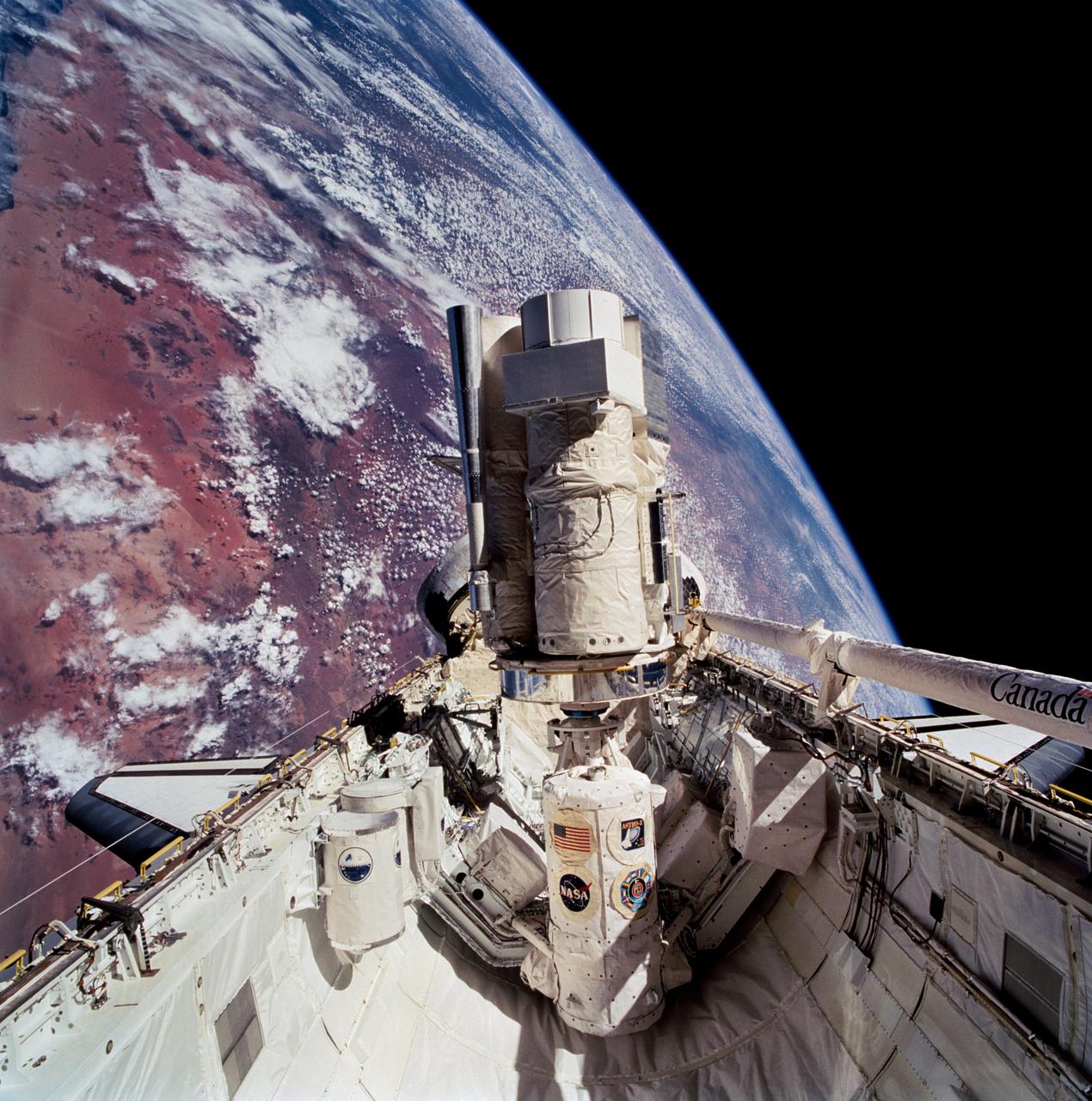
STS067-713-072 (2-18 March 1995) --- This 70mm cargo bay scene, backdropped against a desert area of Namibia, typifies the view that daily greeted the Astro-2 crew members during their almost 17-days aboard the Space Shuttle Endeavour.  Positioned on the Spacelab pallet amidst other hardware, the Astro-2 payload is in its operational mode.  Visible here are the Instrument Pointing System (IPS), Hopkins Ultraviolet Telescope (HUT), Star Tracker (ST), Ultraviolet Imaging Telescope (UIT), Wisconsin Ultraviolet Photo-Polarimeter Experiment (WUPPE), and Integrated Radiator System (IRS).  At this angle, the Optical Sensor Package (OPS) is not seen.  The Igloo, which supports the package of experiments, is in center foreground.  Two Get-Away Special (GAS) canisters are in lower left foreground.  The Extended Duration Orbiter (EDO) pallet, located aft of the cargo bay, is obscured by the Astro-2 payload.  The Endeavour was 190 nautical miles above Earth.
View of ASTRO-2 payload in cargo bay of STS-67 Endeavour
STS068-272-075 (30 September-11 October 1994) --- The darkness of space forms the backdrop for this scene of the Space Shuttle Endeavour's cargo bay, 115 nautical miles above a cloud covered Indian Ocean. The Space Radar Laboratory (SRL-2) Multipurpose Experiment Support Structure (MPESS) is seen at bottom frame.  Also partially seen are other experiments including other components of the primary payload. They are the antenna for the Spaceborne Imaging Radar (SIR-C), the X-band Synthetic Aperture Radar (X-SAR), the device for Measurement of Air Pollution from Satellites (MAPS) and some Getaway Special (GAS) canisters.
Contents of payload bay of the STS-68 Space Shuttle Endeavour
STS068-267-079 (30 September-11 October 1994) --- The rear windows of the Space Shuttle Endeavour reflect sunlight in this view of part of the cargo bay, 115 nautical miles above the Earth.  The Space Radar Laboratory (SRL-2) Multipurpose Experiment Support Structure (MPESS) is seen at bottom frame.  Also partially seen are other experiments including other components of the primary payload.  They are the antenna for the Spaceborne Imaging Radar (SIR-C), the X-band Synthetic Aperture Radar (X-SAR), the device for Measurement of Air Pollution from Satellites (MAPS) and some Getaway Special (GAS) canisters.
Contents of payload bay of the STS-68 Space Shuttle Endeavour
S84-27020 (7 Feb 1984) --- A fixed camera on astronaut Bruce McCandless II's helmet recorded this rare scene of the Space Shuttle Challenger some 50 to 60 meters away during a history-making extravehicular activity (EVA), February 7, 1984.  The Shuttle Pallet Satellite (SPAS-01A) is configured mid-cargo bay.  Astronaut Robert L. Stewart, standing beneath the Remote Manipulator System (RMS) arm, later donned the same Manned Maneuvering Unit (MMU) which afforded McCandless the freedom of movement to record this image.  Also visible in the cargo bay are the support stations for the two MMU back-packs, the sunshields for the Palapa B and Westar VI Satellites, KU-Band antenna and a number of Getaway Special (GAS) canisters.
View of the Challenger from the fixed camera in McCandless's helmet
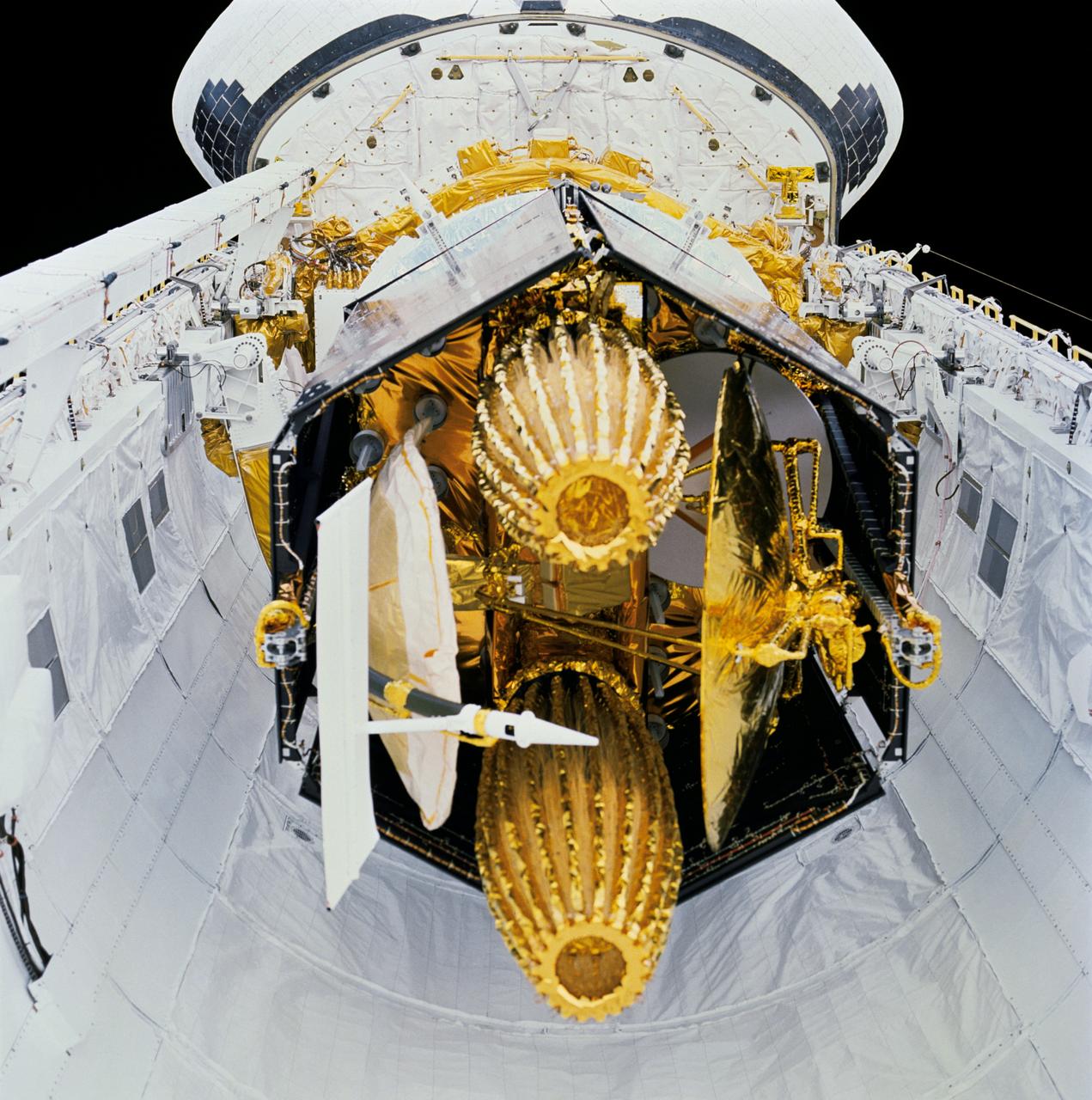
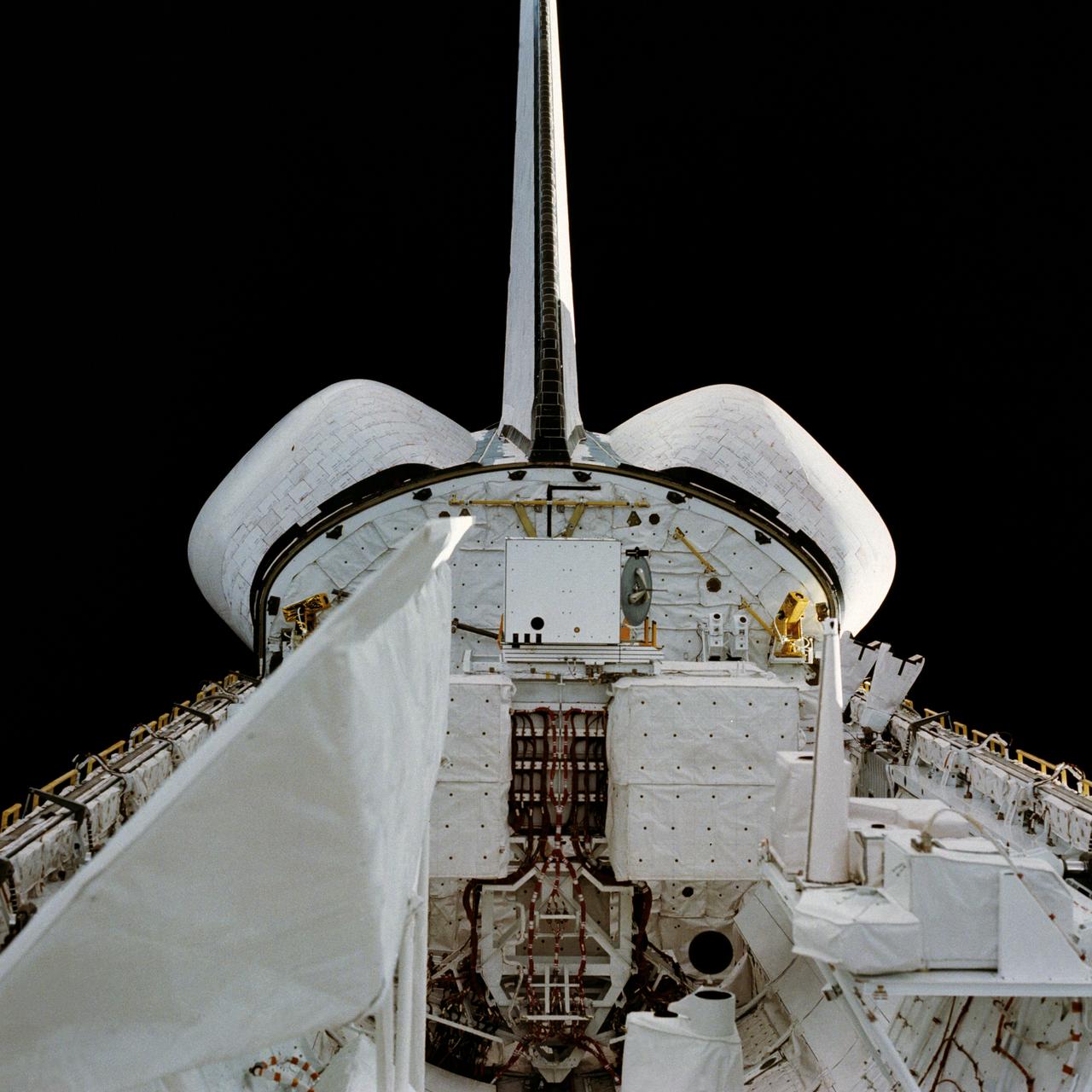
STS029-71-000AE (13-18 March 1989) --- STS-29 onboard view shows Space Shuttle Discovery's payload bay with tracking and data relay satellite D (TDRS-D) in stowed, pre-deployment position. In this head-on view, TDRS-D stowed components including single access #1 and #2, solar cell panels, SGL, S-Band omni antenna, and C-Band antenna are visible. TDRS-D rests in airborne support equipment (ASE) forward cradle and aft frame tilt actuator (AFTA). Discovery's aft bulkhead and orbital maneuvering system (OMS) pods are visible in the background.
STS-29 tracking and data relay satellite (TDRS) in OV-103's payload bay (PLB)
STS063-716-025 (9 Feb. 1995) --- In tail-to Earth mode, the Space Shuttle Discovery is backdropped against dark space, Sunburst and massive clouds over the ocean.  The Spartan 204 is visible in the cargo bay. This is one of 16 still photographs released by the NASA Johnson Space Center (JSC) Public Affairs Office (PAO) on February 14, 1995.  Onboard Discovery were astronauts James D. Wetherbee, mission commander; Eileen M. Collins, pilot; Bernard A. Harris, Jr., payload commander; mission specialists C. Michael Foale, Janice E. Voss, and cosmonaut Vladimir G. Titov.
View of STS-63 Discovery payload bay
STS002-13-208 (12-14 Nov. 1981) --- This clear view of the aft section of the Earth-orbiting space shuttle Columbia's cargo bay and some of its cargo was photographed through the flight deck's aft windows. Visible in the center of the photo are the twin orbital maneuvering system (OMS) pods. The vertical stabilizer or tail splits the top part of the image in half. The Induced Environment Contamination Monitor (IECM) Location experiment is located in the back center of the cargo bay, near the top. There is a grapple fixture attached to the side of the IECM. Various components of the Office of Space Terrestrial Applications (OSTA-1) payload are seen near the aft section of the cargo bay, such as the Feature Identification and Location Experiment (FILE) (the long cone shaped object on the right back), the Shuttle Multispectral Infrared Radiometer (SMIRR) (on pallet base) and the SIR-A recorder in the right foreground. In the left foreground the Shuttle Imaging Radar-A (SIR-A) antenna can be seen. Photo credit: NASA
View of the Columbia's open payload bay
S84-27022 (7 Feb 1984) --- A 35mm frame from the February 7, 1984, extravehicular activity (EVA) photographed with a camera affixed to the gear of astronaut Bruce McCandless II.  The mission specialist was equipped with the nitrogen-propelled, hand-controlled Manned Maneuvering Unit (MMU), which took him some 90 meters away from the Space Shuttle Challenger.  This scene is reminiscent of views of the Challenger during the June 1983, STS-7 flight, on which the Shuttle Pallet Satellite (SPAS - seen here in the middle of the cargo bay) provided scenes of 38-meter-long reusable vehicle over the Earth.
View of the Challenger from the fixed camera on the Manned Maneuvering Unit (MMU)
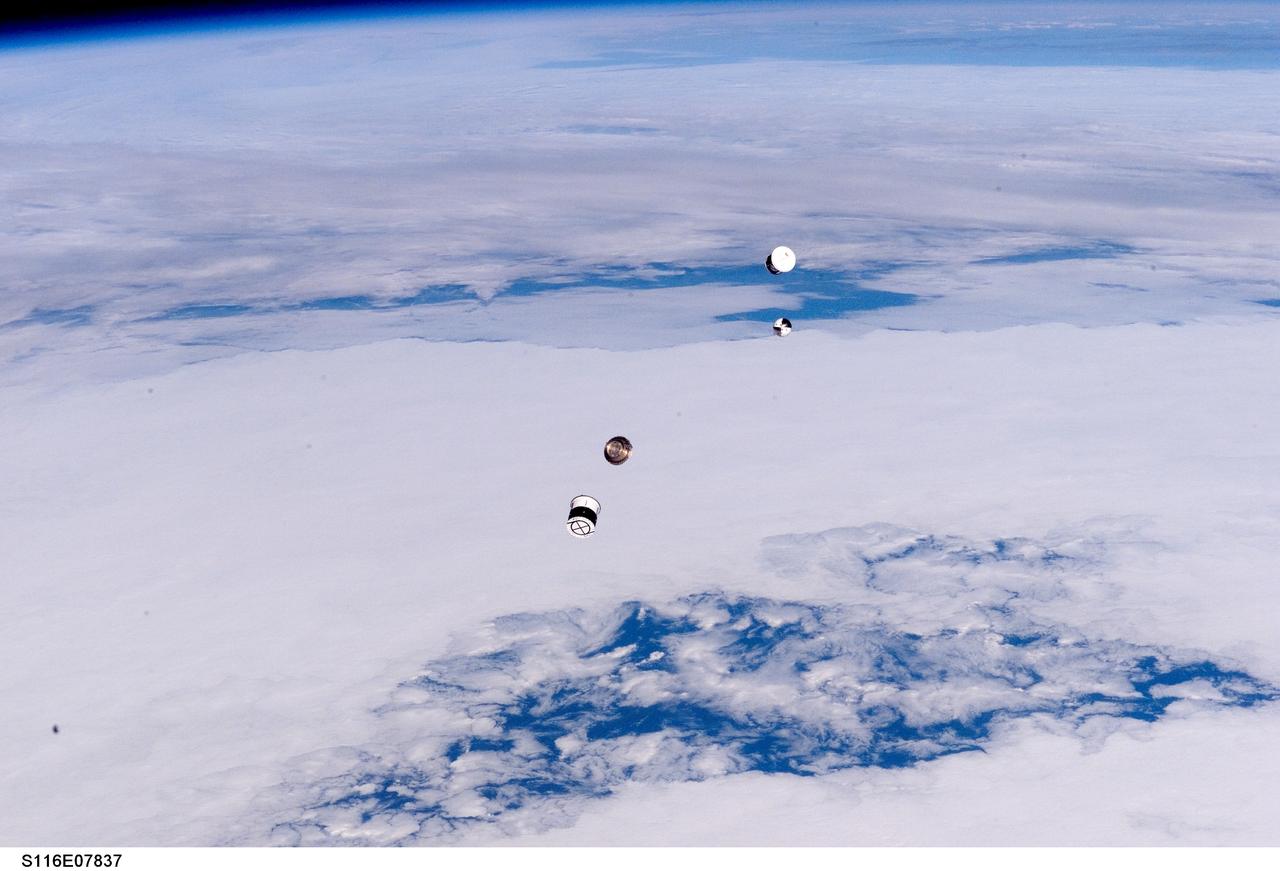
S116-E-07837 (21 Dec. 2006) --- As seen through windows on the aft flight deck of Space Shuttle Discovery,  a Department of Defense pico-satellite known as Atmospheric Neutral Density Experiment (ANDE) is released from the shuttle's payload bay by STS-116 crewmembers. ANDE consists of two micro-satellites which will measure the density and composition of the low Earth orbit (LEO) atmosphere while being tracked from the ground. The data will be used to better predict the movement of objects in orbit.
DOD Pico-Satellite known as ANDE released from the STS-116 shuttle payload bay
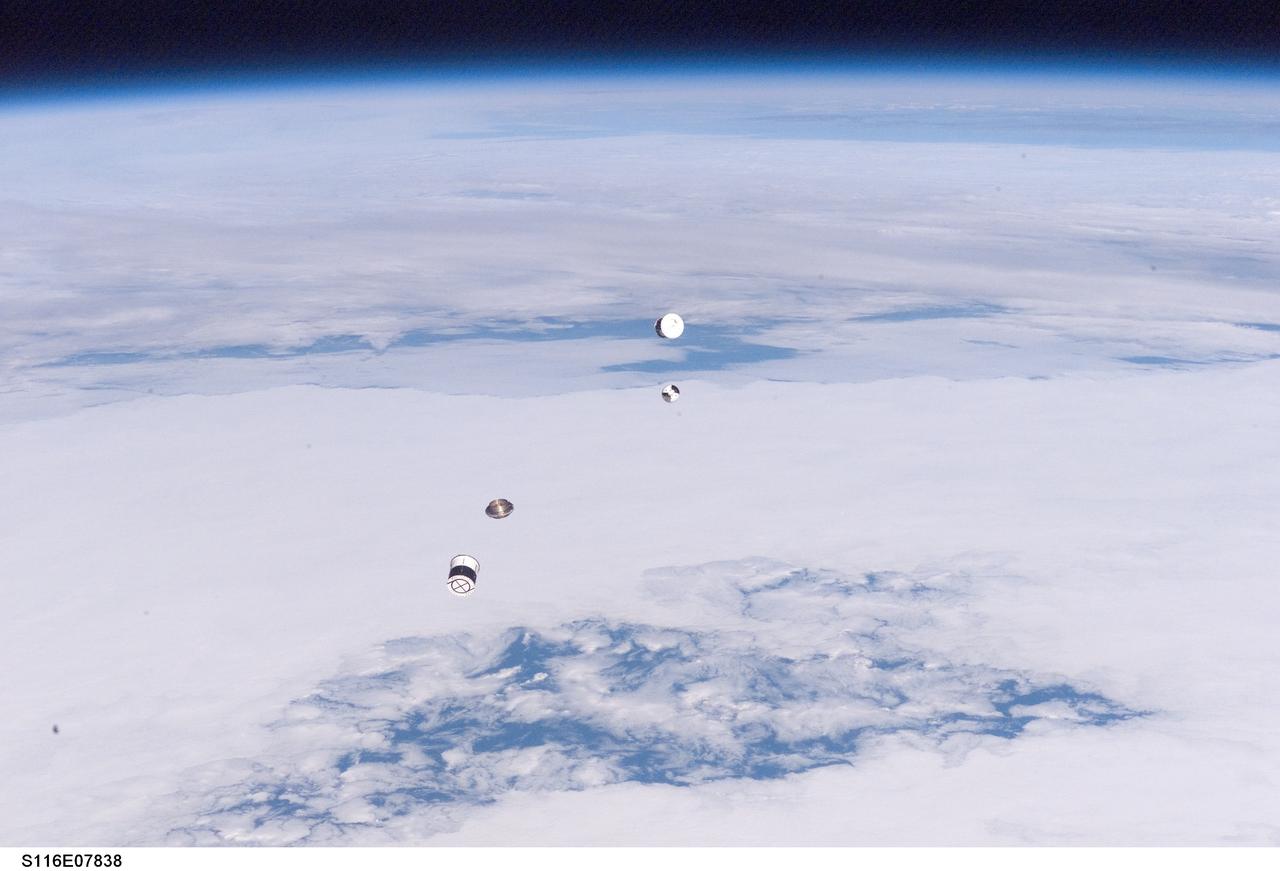
S116-E-07838 (21 Dec. 2006) --- As seen through windows on the aft flight deck of Space Shuttle Discovery,  a Department of Defense pico-satellite known as Atmospheric Neutral Density Experiment (ANDE) is released from the shuttle's payload bay by STS-116 crewmembers. ANDE consists of two micro-satellites which will measure the density and composition of the low Earth orbit (LEO) atmosphere while being tracked from the ground. The data will be used to better predict the movement of objects in orbit.
DOD Pico-Satellite known as ANDE released from the STS-116 shuttle payload bay
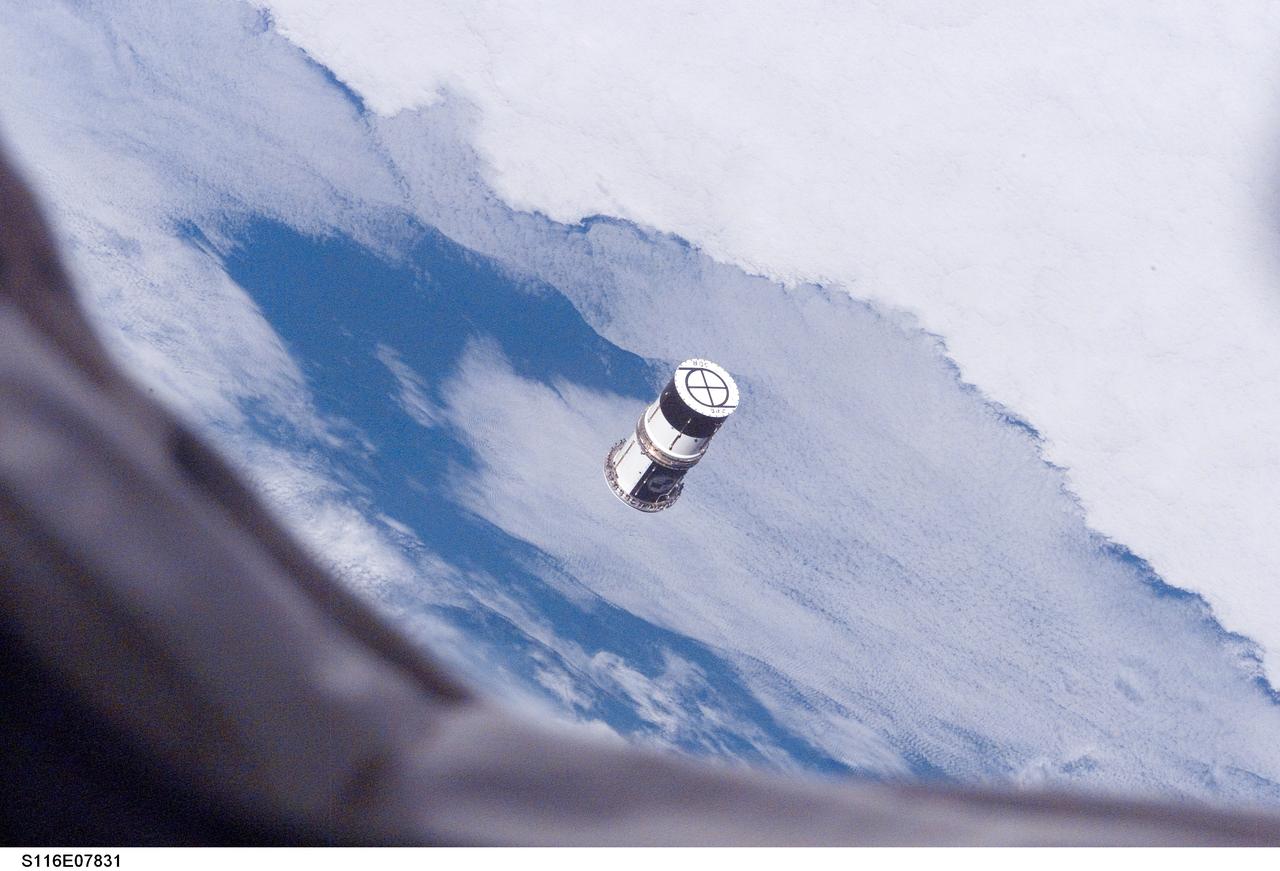
S116-E-07831 (21 Dec. 2006) --- As seen through windows on the aft flight deck of Space Shuttle Discovery,  a Department of Defense pico-satellite known as Atmospheric Neutral Density Experiment (ANDE) is released from the shuttle's payload bay by STS-116 crewmembers. ANDE consists of two micro-satellites which will measure the density and composition of the low Earth orbit (LEO) atmosphere while being tracked from the ground. The data will be used to better predict the movement of objects in orbit.
DOD Pico-Satellite known as ANDE released from the STS-116 shuttle payload bay
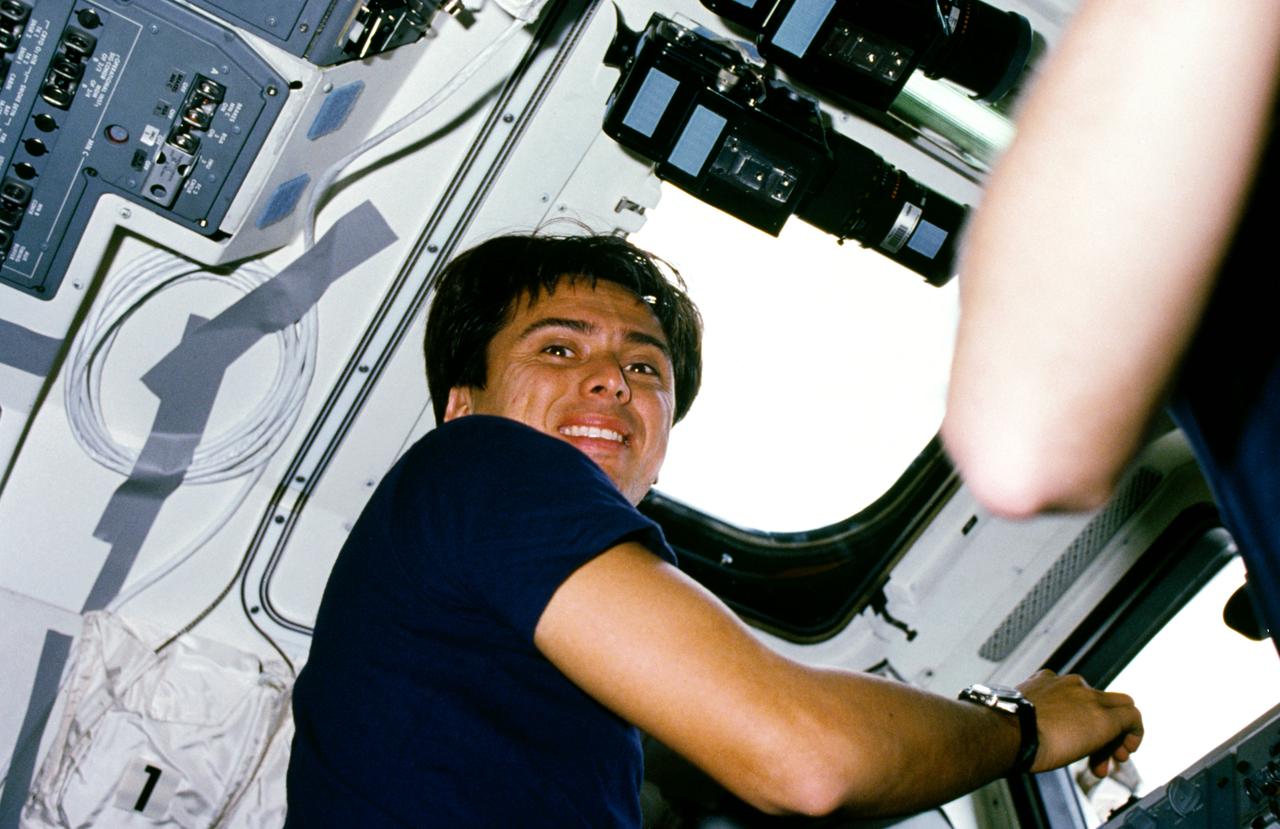
61C-02-032 (12-18 Jan. 1986) --- Astronaut Franklin R. Chang-Diaz, STS-61C mission specialist, while checking cargo in the space shuttle Columbia's payload bay, turns to smile at a fellow crew member using a 35mm camera.  Some of the prolific camera gear onboard the spacecraft is affixed above the mission specialist's right shoulder.
Astronaut Franklin Chang-Diaz checking payload bay through aft deck window
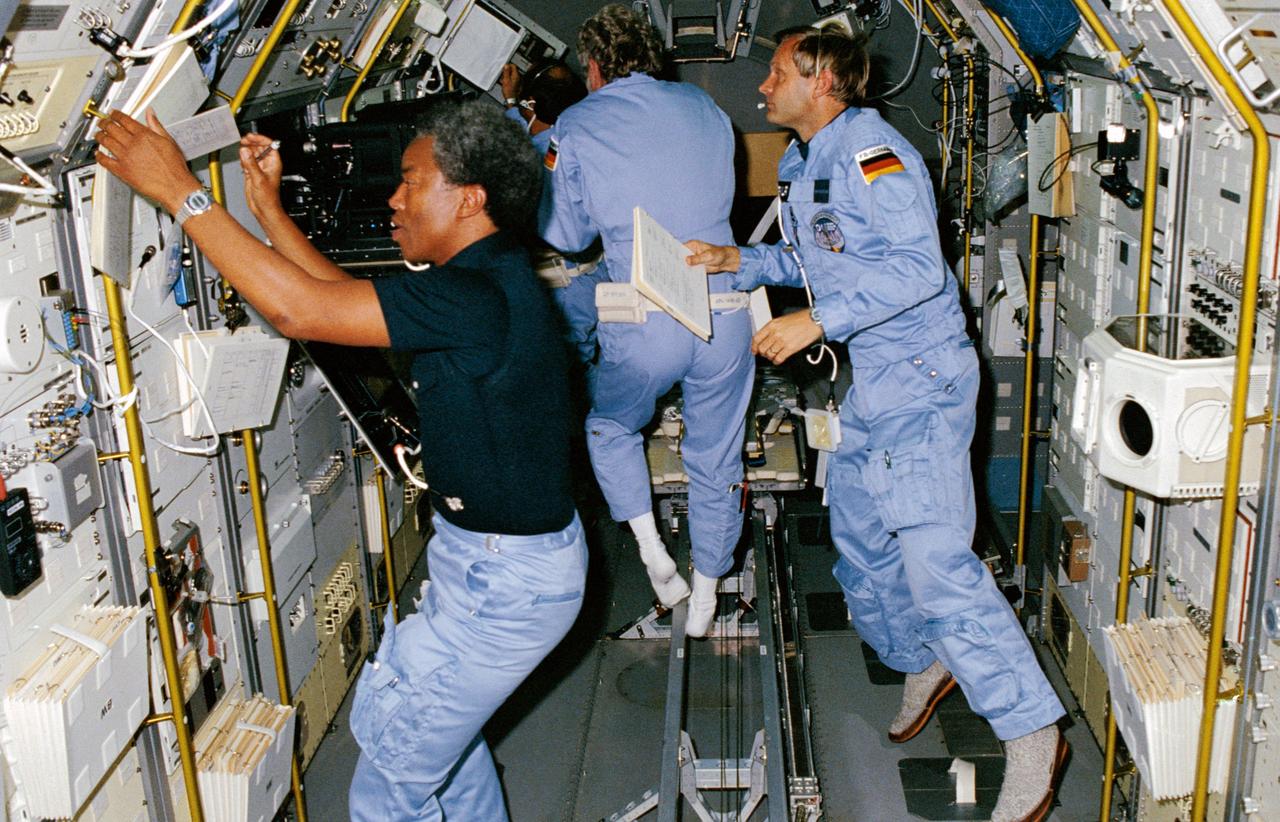
61A-01-030 (30 Oct.-6 Nov. 1985) --- Mission specialist Guion S. Bluford prepares to perform a physics experiment onboard the D-1 science module in the cargo bay of the earth-orbiting Space Shuttle Challenger.  In the backgroud, three European payload specialists busy themselves with experiment chores:  (L-R) Wubbo J. Ockels (partially obscured), Reinhard Furrer and Ernst Messerschmid.
STS 61-A crewmembers in Spacelab D-1 science module
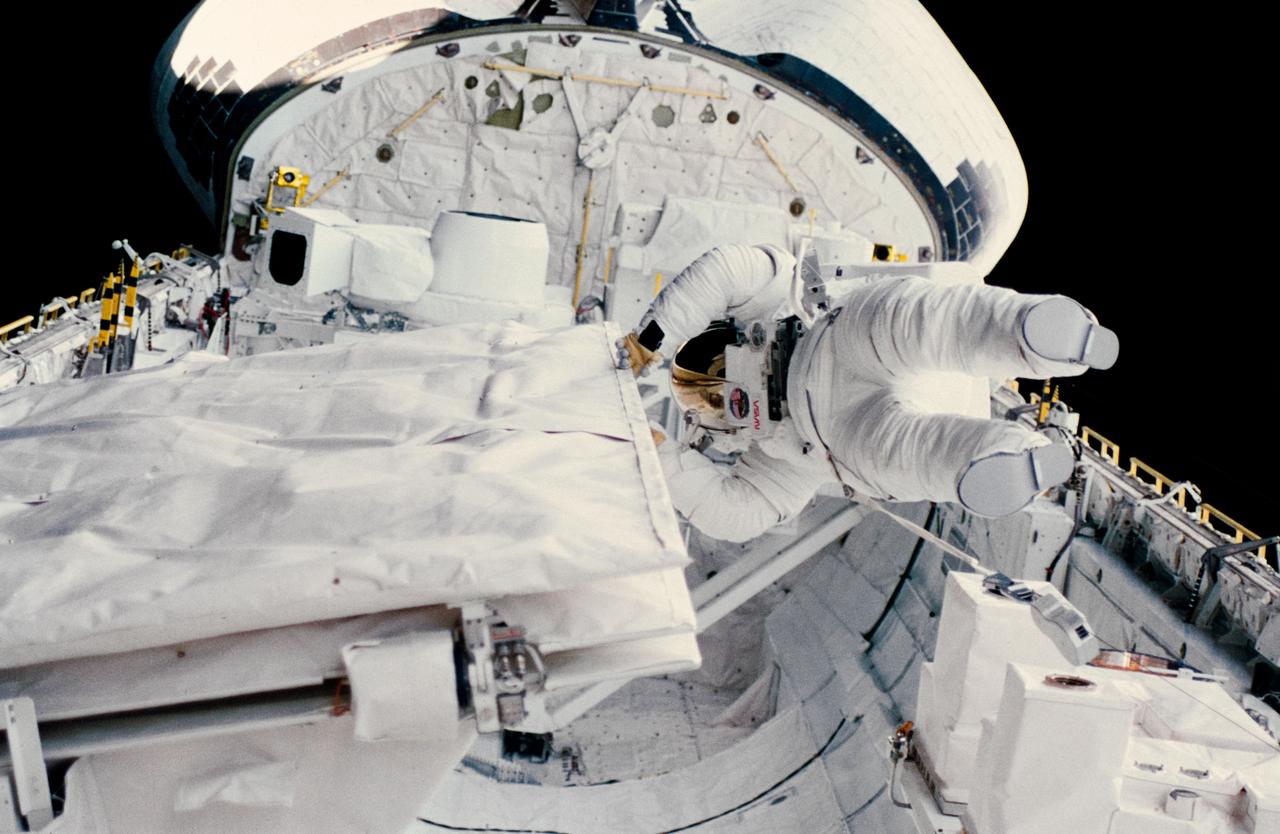
41G-13-032 (11 Oct. 1984) --- Astronaut Kathryn D. Sullivan checks the latch of the SIR-B antenna in the space shuttle Challenger's open cargo bay during her historic extravehicular activity (EVA) on Oct. 11, 1984.  Earlier, America's first woman to perform an EVA and astronaut David C. Leestma, participated in an in-space simulation of refueling a spacecraft in orbit.  The Orbital Refueling System (ORS) is just beyond the astronaut mission specialist's helmet.  To the left is the Large Format Camera (LFC).  The LFC and ORS are stationed on a device called the Mission Peculiar Support Structure (MPESS).  Crew members consisted of astronauts Robert L. Crippen, commander; Jon A. McBride, pilot; along with Kathryn D. Sullivan, Sally K. Ride, and David D. Leestma, all mission specialists; and Canadian astronaut Marc Garneau and Paul D. Scully-Power, both payload specialist.        EDITOR'S NOTE: The STS-41G mission had the first American female EVA (Sullivan); first seven-person crew; first orbital fuel transfer; and the first Canadian (Garneau).
Astronaut Kathryn Sullivan checks SIR-B antenna during EVA
STS056-91-050 (8-17 April 1993) --- This 70mm frame shows the cargo bay of the Earth-orbiting Space Shuttle Discovery backdropped against clouds.  Most of the elements of the ATLAS-2 payload can be seen, but missing is the SPARTAN-201 satellite which was in the midst of its separation from Discovery when the photo was made.
STS-56 onorbit view of Discovery's, OV-103's, payload bay with ATLAS-2 pallet
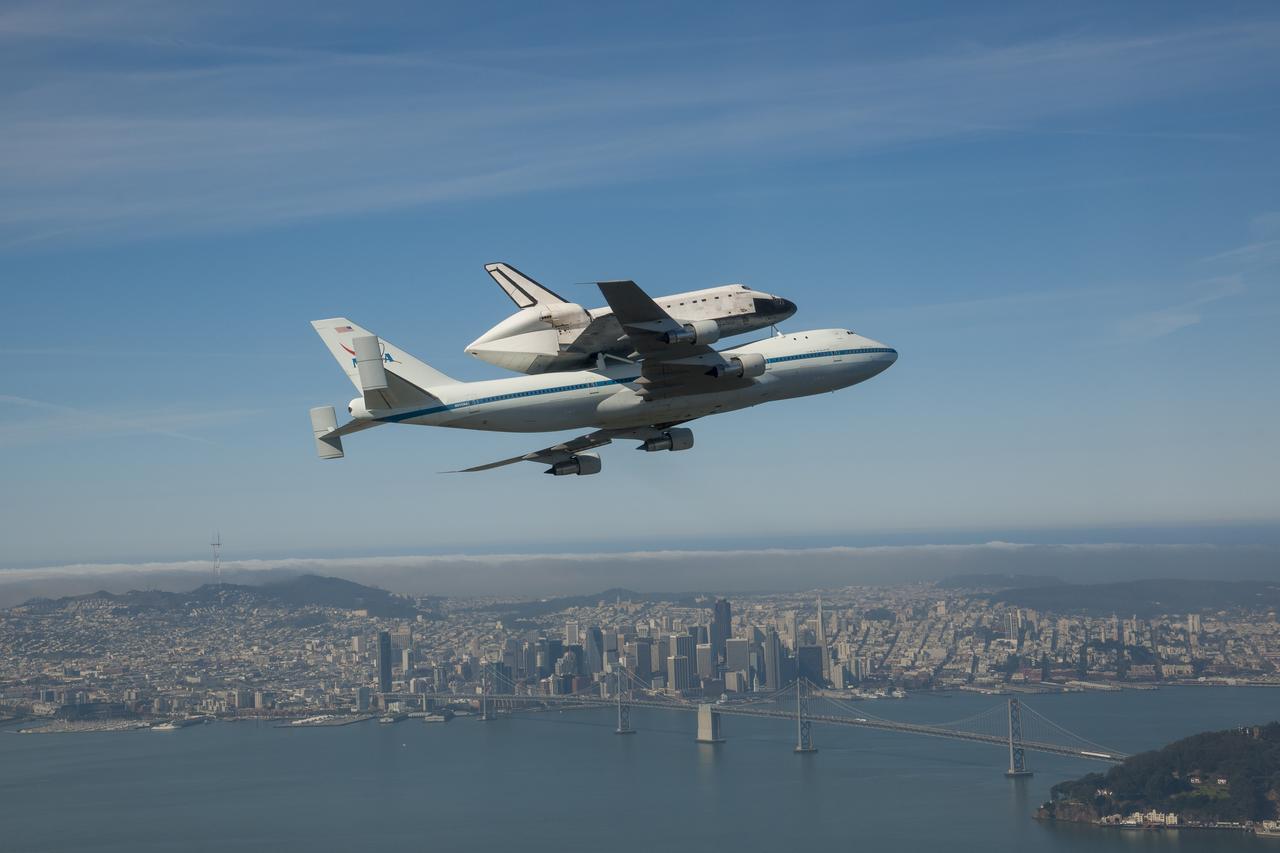
Space shuttle Endeavour and its host NASA 747 Shuttle Carrier Aircraft fly by the Bay Bridge in 2012 on its way to the Los Angeles International Airport and an overland journey to the California Science Center. The final leg of Endeavour’s flight from NASA’s Kennedy Space Center, Florida, offered many people an opportunity to witness the historic flight.
Space Shuttle Endeavour Toured California in 2012
51F-42-069 (29 July-6 Aug 1985) --- The solar optical universal polarimeter (SOUP) experiment is visible among the cluster of Spacelab 2 hardware in the cargo bay of the Earth-orbiting Space Shuttle Challenger, backdropped against a curtain of white clouds over ocean waters. Various components of the instrument positioning system (IPS) are conspicuous at the center of the frame.  Now resting, the remote manipulator system (RMS) was used at various points during the mission with the plasma diagnostics package (PDP) and as a support service structure for television cameras covering various activities of the busy science-oriented Spacelab 2 mission.
View of the Challenger's payload bay and the SOUP experiment
51D-04-025 (16 April 1985) --- Bearing a maze of interesting reflections, this aquarium-like scene came during one of the lighter moments of emergency extravehicular activity (EVA) aboard the Earth-orbiting Space Shuttle Discovery.  Astronaut S. David Griggs, waving from the cargo bay into the flight deck, earlier participated with astronaut Jeffrey A. Hoffman in the successful attachment of two special tools to the end of the Canadian-built Remote Manipulator System (RMS) arm.  The Earth's horizon appears both in the background of the scene and in the reflection in Griggs' helmet visor.
Astronaut S. David Griggs waves to Orbiter during EVA
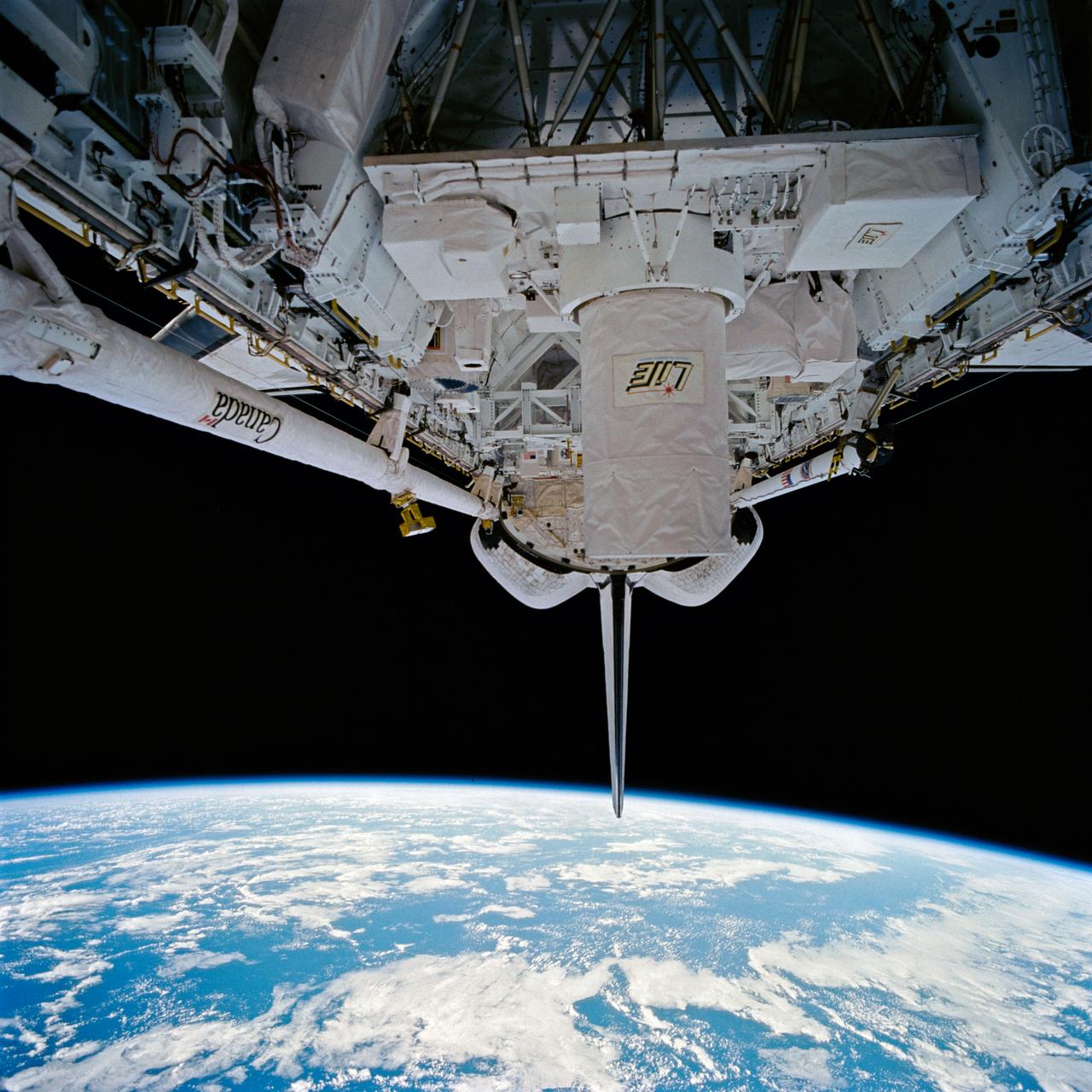
STS064-90-031 (9-20 Sept. 1994) --- Backdropped against the darkness of space beneath Earth's horizon 130 nautical miles away, the cargo bay of the space shuttle Discovery and its related payloads were captured on 70mm film by one of the six cabin-bound astronauts. In the foreground is the Lidar In-space Technology Experiment (LITE).  The robot arm portion of the Remote Manipulator System (RMS), busy throughout much of the almost 11-day mission, is in a stowed position on Discovery's port side. Photo credit: NASA or National Aeronautics and Space Administration
STS-64 Discovery's cargo bay in-flight
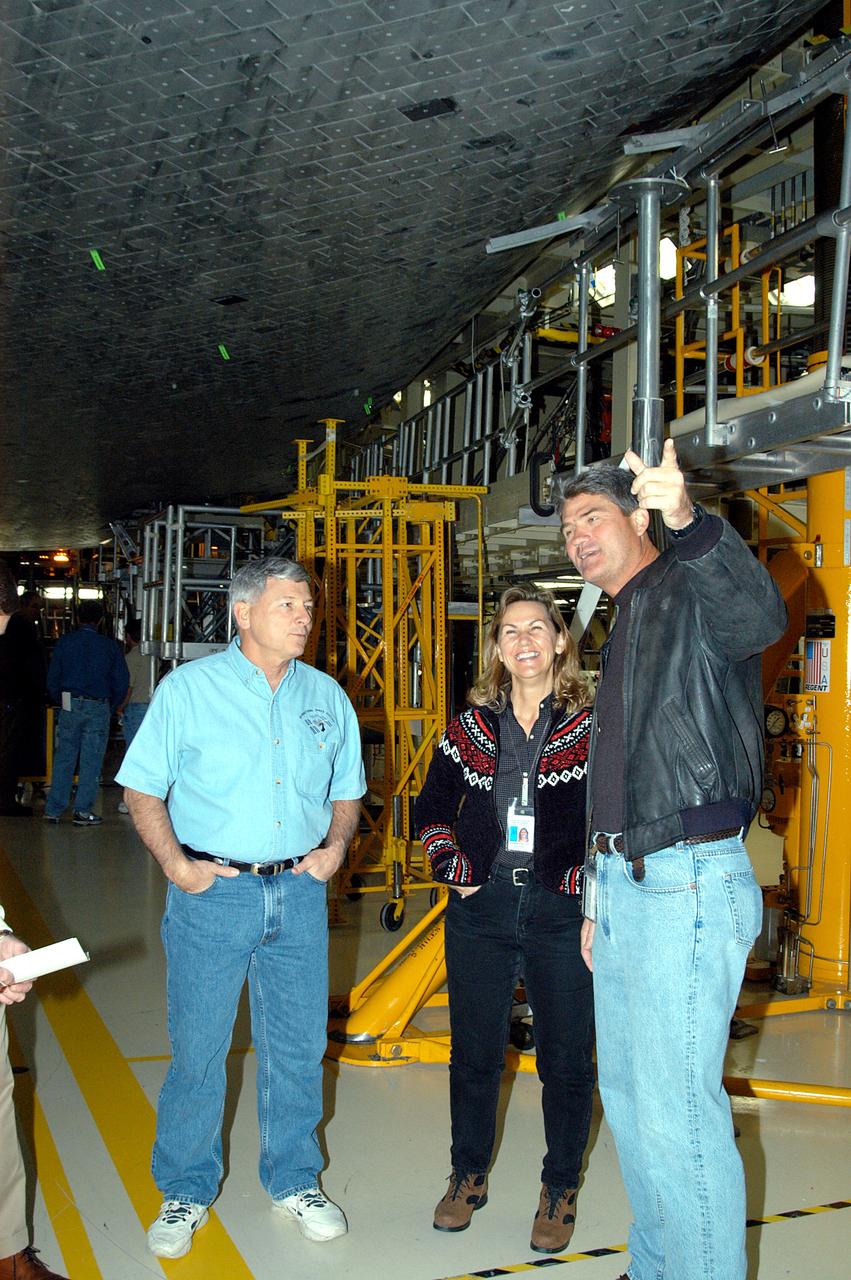
KENNEDY SPACE CENTER, FLA. -- From left, NASA Deputy Associate Administrator for Space Station and Shuttle Programs Michael Kostelnik, United Space Alliance (USA) Director of Orbiter Operations Patty Stratton, and NASA Space Shuttle Program Manager William Parsons view the underside of Shuttle Discovery in Orbiter Processing Facility Bay 3.  NASA and USA Space Shuttle program management are participating in a leadership workday.  The day is intended to provide management with an in-depth, hands-on look at Shuttle processing activities at KSC.
KENNEDY SPACE CENTER, FLA. -- From left, NASA Deputy Associate Administrator for Space Station and Shuttle Programs Michael Kostelnik, United Space Alliance (USA) Director of Orbiter Operations Patty Stratton, and NASA Space Shuttle Program Manager William Parsons view the underside of Shuttle Discovery in Orbiter Processing Facility Bay 3. NASA and USA Space Shuttle program management are participating in a leadership workday. The day is intended to provide management with an in-depth, hands-on look at Shuttle processing activities at KSC.
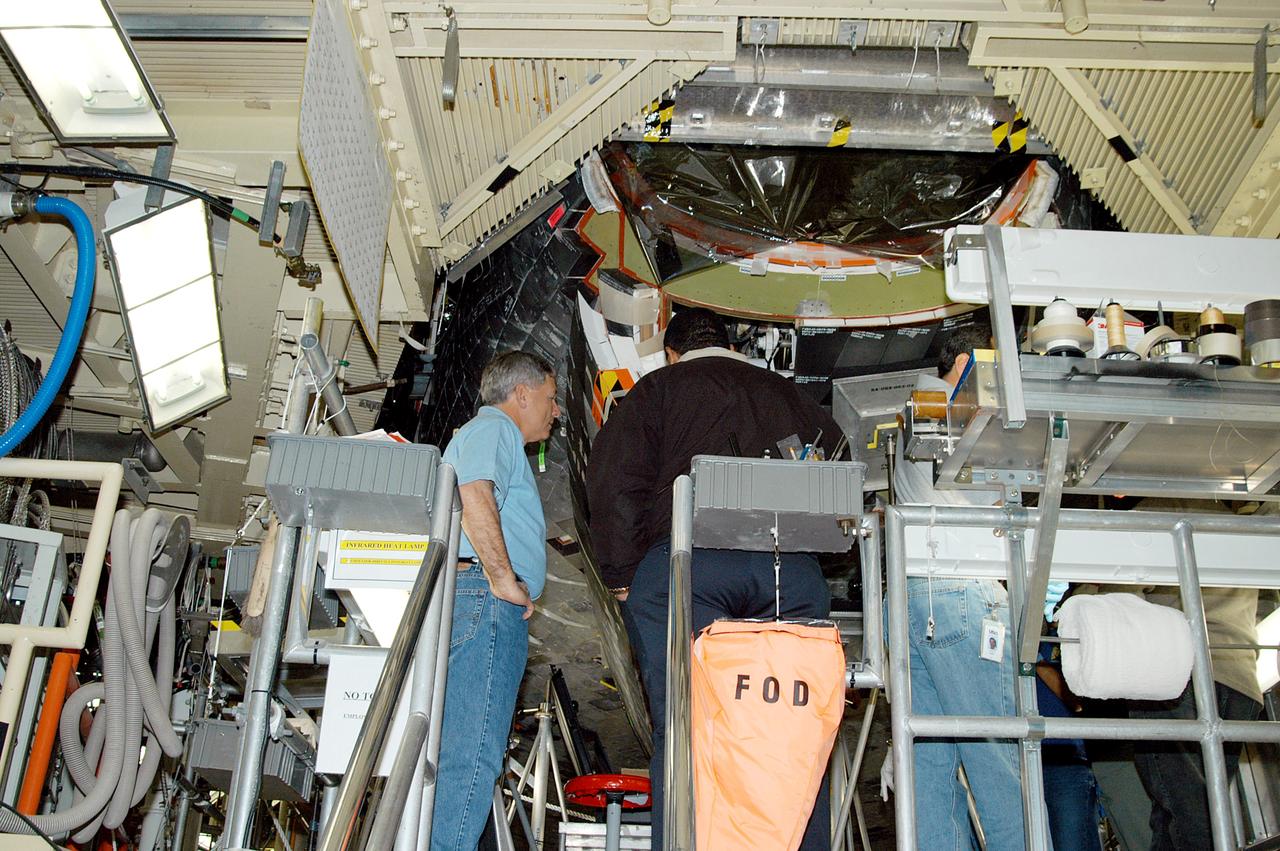
KENNEDY SPACE CENTER, FLA. -- NASA Deputy Associate Administrator for Space Station and Shuttle Programs Michael Kostelnik (left) discusses some of the working parts inside the nose of Shuttle Discovery in Orbiter Processing Facility Bay 3 with a United Space Alliance (USA) technician (back to camera).  NASA and USA Space Shuttle program management are participating in a leadership workday.  The day is intended to provide management with an in-depth, hands-on look at Shuttle processing activities at KSC.
KENNEDY SPACE CENTER, FLA. -- NASA Deputy Associate Administrator for Space Station and Shuttle Programs Michael Kostelnik (left) discusses some of the working parts inside the nose of Shuttle Discovery in Orbiter Processing Facility Bay 3 with a United Space Alliance (USA) technician (back to camera). NASA and USA Space Shuttle program management are participating in a leadership workday. The day is intended to provide management with an in-depth, hands-on look at Shuttle processing activities at KSC.
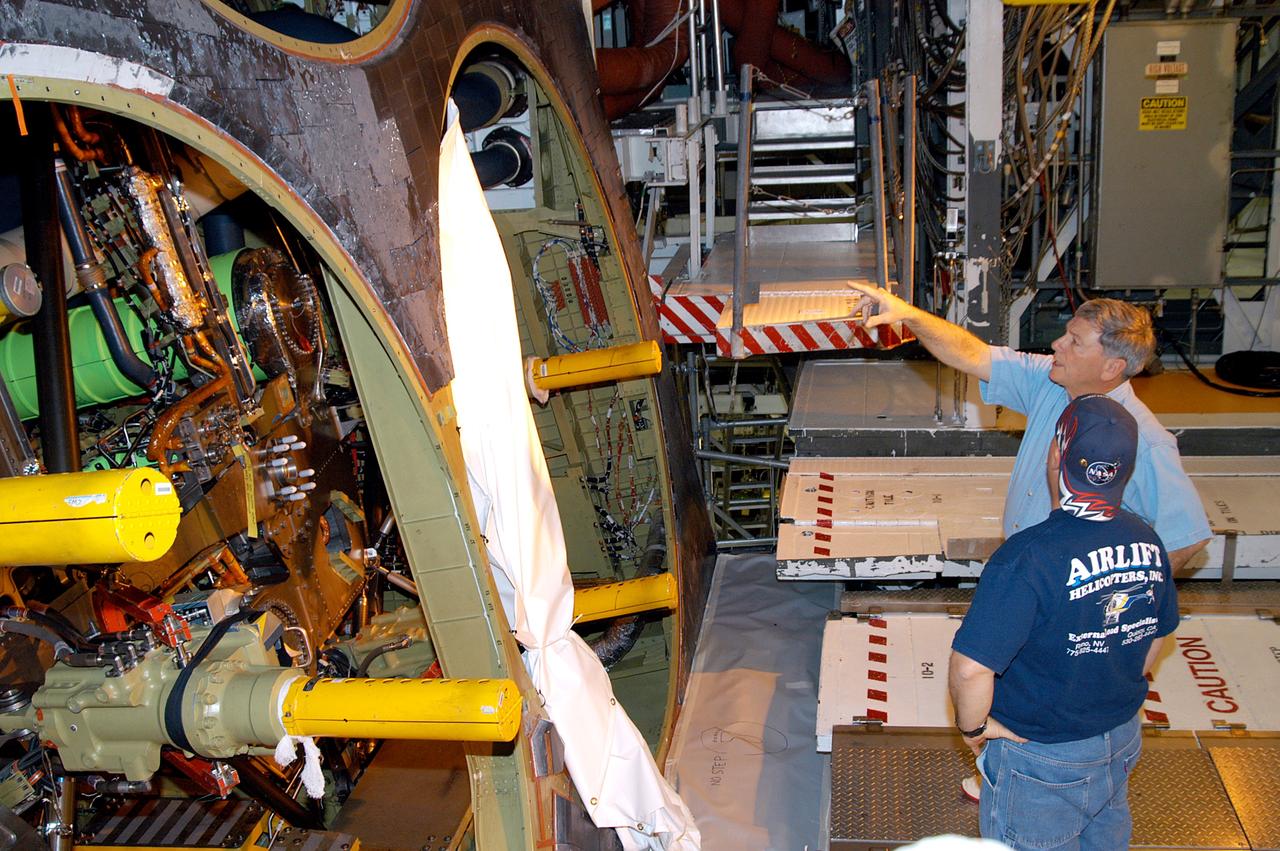
KENNEDY SPACE CENTER, FLA. -- NASA Deputy Associate Administrator for Space Station and Shuttle Programs Michael Kostelnik (top) discusses the inner workings of Shuttle Atlantis in Orbiter Processing Facility Bay 1 with a United Space Alliance (USA) technician (bottom).  NASA and USA Space Shuttle program management are participating in a leadership workday.  The day is intended to provide management with an in-depth, hands-on look at Shuttle processing activities at KSC.
KENNEDY SPACE CENTER, FLA. -- NASA Deputy Associate Administrator for Space Station and Shuttle Programs Michael Kostelnik (top) discusses the inner workings of Shuttle Atlantis in Orbiter Processing Facility Bay 1 with a United Space Alliance (USA) technician (bottom). NASA and USA Space Shuttle program management are participating in a leadership workday. The day is intended to provide management with an in-depth, hands-on look at Shuttle processing activities at KSC.
KENNEDY SPACE CENTER, FLA. -- NASA Deputy Associate Administrator for Space Station and Shuttle Programs Michael Kostelnik (right) discusses a speed brake on Shuttle Discovery in Orbiter Processing Facility Bay 3 with a United Space Alliance (USA) technician (left).  NASA and USA Space Shuttle program management are participating in a leadership workday.  The day is intended to provide management with an in-depth, hands-on look at Shuttle processing activities at KSC.
KENNEDY SPACE CENTER, FLA. -- NASA Deputy Associate Administrator for Space Station and Shuttle Programs Michael Kostelnik (right) discusses a speed brake on Shuttle Discovery in Orbiter Processing Facility Bay 3 with a United Space Alliance (USA) technician (left). NASA and USA Space Shuttle program management are participating in a leadership workday. The day is intended to provide management with an in-depth, hands-on look at Shuttle processing activities at KSC.
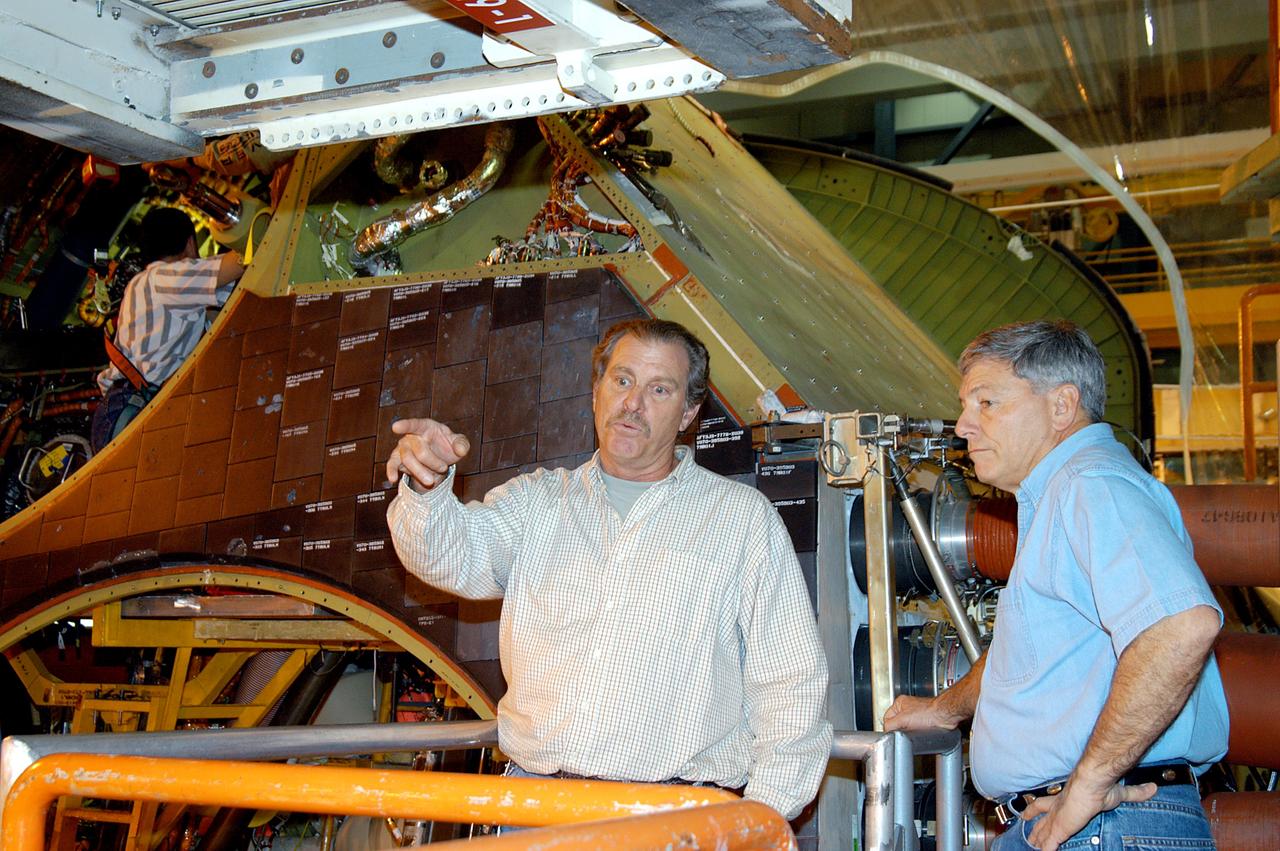
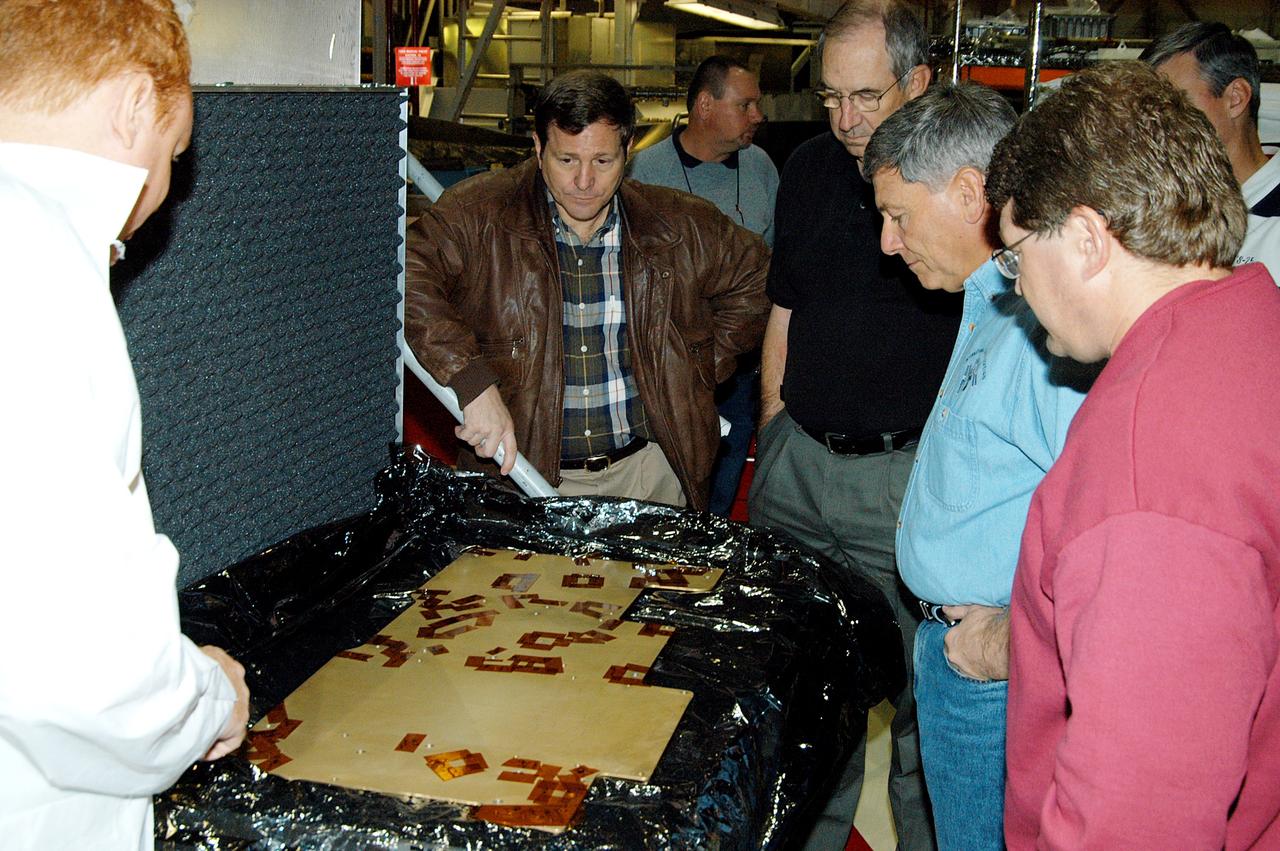
KENNEDY SPACE CENTER, FLA. -- United Space Alliance (USA) Vice President and Space Shuttle Program Manager Howard DeCastro (left) and NASA Deputy Associate Administrator for Space Station and Shuttle Programs Michael Kostelnik (center) are briefed on the use of a cold plate in Orbiter Processing Facility Bay 2 by a USA technician (right).  NASA and USA Space Shuttle program management are participating in a leadership workday.  The day is intended to provide management with an in-depth, hands-on look at Shuttle processing activities at KSC.
KENNEDY SPACE CENTER, FLA. -- United Space Alliance (USA) Vice President and Space Shuttle Program Manager Howard DeCastro (left) and NASA Deputy Associate Administrator for Space Station and Shuttle Programs Michael Kostelnik (center) are briefed on the use of a cold plate in Orbiter Processing Facility Bay 2 by a USA technician (right). NASA and USA Space Shuttle program management are participating in a leadership workday. The day is intended to provide management with an in-depth, hands-on look at Shuttle processing activities at KSC.
KENNEDY SPACE CENTER, FLA. -  The orbiter Ku-band antenna looms large in this view of the Space Shuttle Atlantis' payload bay.  Visible just past the antenna system - stowed on the starboard side of the payload bay wall - is the Orbiter Docking System (ODS), and connected to the ODS via a tunnel is the Spacehab Double Module in the aft area of the payload bay.  This photograph was taken from the starboard wing platform on the fifth level of the Payload Changeout Room (PCR) at Launch Pad 39A.  Work is under way in the PCR to close Atlantis' payload bay doors for flight.  Atlantis currently is being targeted for liftoff on Mission STS-79, the fourth docking of the U.S. Shuttle to the Russian Space Station Mir, around Sept. 12.
KENNEDY SPACE CENTER, FLA. - The orbiter Ku-band antenna looms large in this view of the Space Shuttle Atlantis' payload bay. Visible just past the antenna system - stowed on the starboard side of the payload bay wall - is the Orbiter Docking System (ODS), and connected to the ODS via a tunnel is the Spacehab Double Module in the aft area of the payload bay. This photograph was taken from the starboard wing platform on the fifth level of the Payload Changeout Room (PCR) at Launch Pad 39A. Work is under way in the PCR to close Atlantis' payload bay doors for flight. Atlantis currently is being targeted for liftoff on Mission STS-79, the fourth docking of the U.S. Shuttle to the Russian Space Station Mir, around Sept. 12.
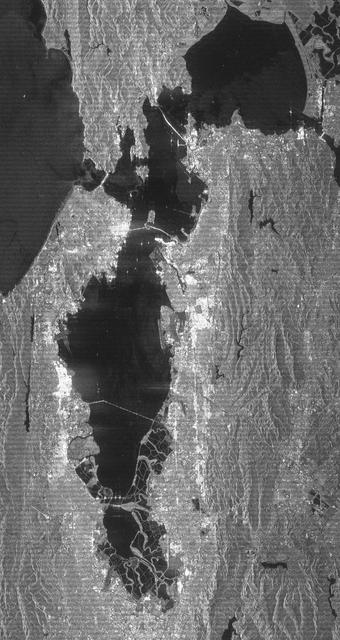
This radar image acquired by NASA Shuttle Radar Topography Mission SRTM from data collected on February 16, 2000 shows the San Francisco Bay Area in California.
Radar image San Francisco Bay Area, California
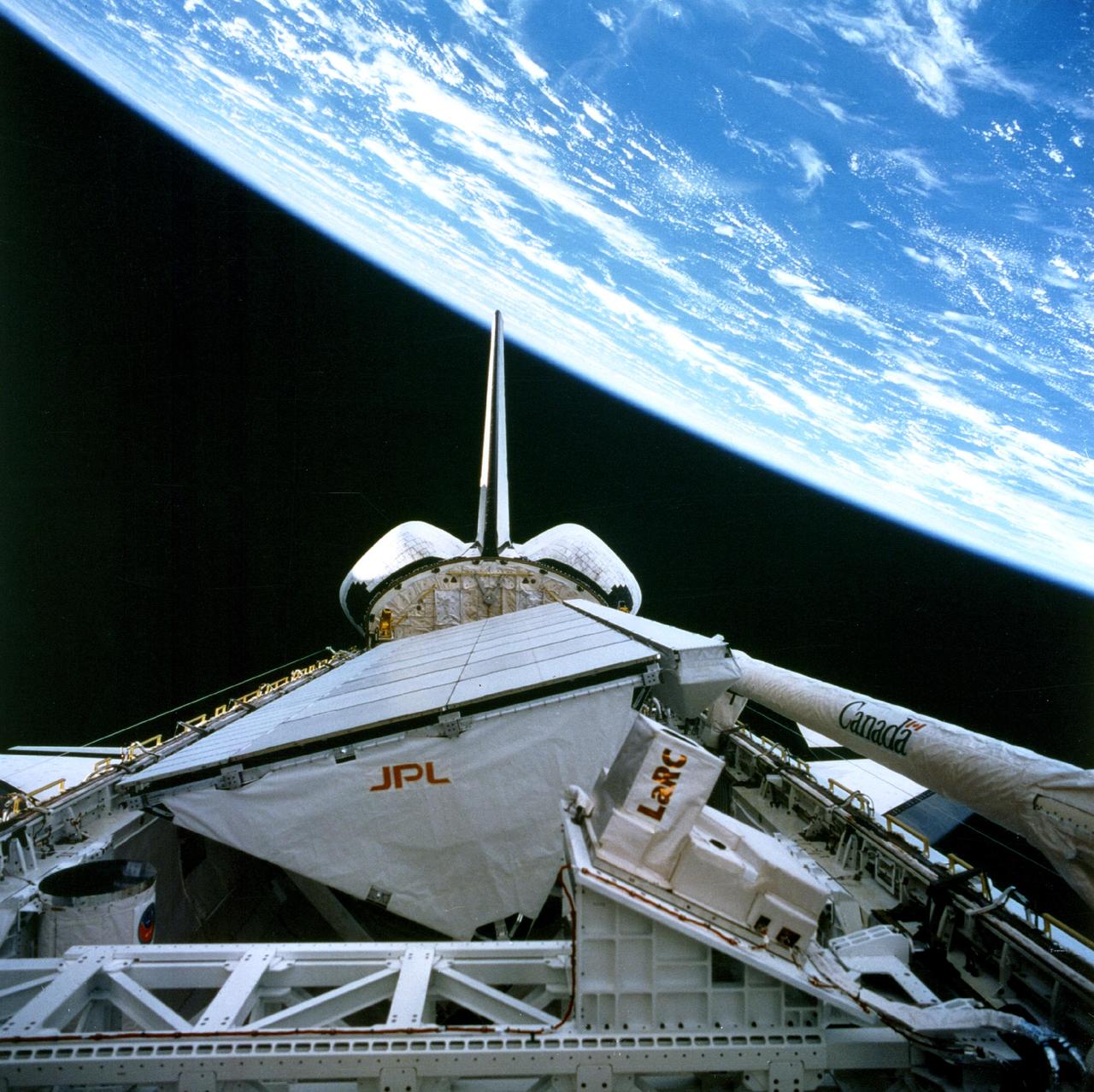
NASA SIR-C/X-SAR is shown here in the payload bay of the orbiting space shuttle Endeavour STS-59, with an area of the Pacific Ocean northeast of Hawaii in the background.
Onboard View - Space Shuttle Endeavour
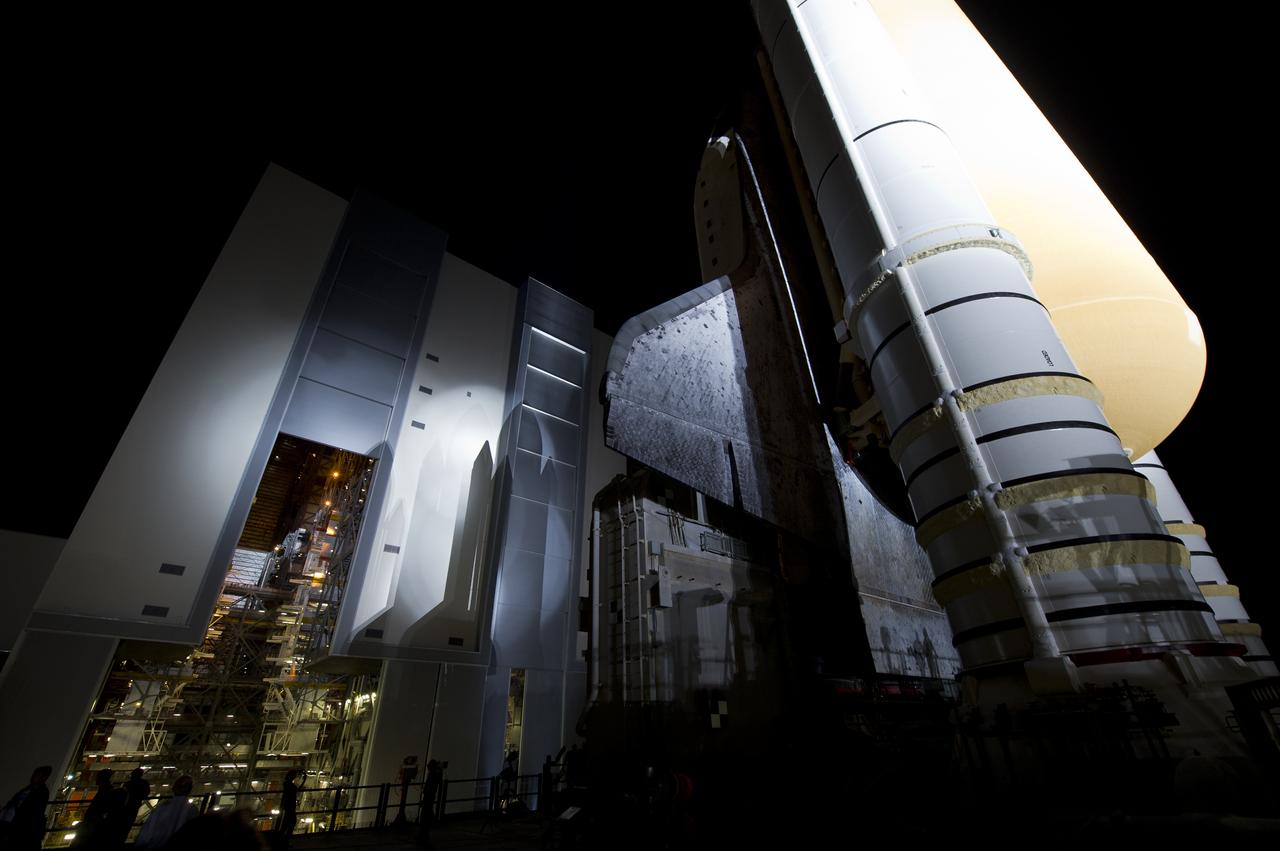
Space Shuttle Atlantis (STS-135) is seen atop a Mobile Launcher Platform (MLP) just prior to beginning its journey from High Bay 3 in the Vehicle Assembly Building to Launch Pad 39a for its final flight, Tuesday evening, May 31, 2011, at Kennedy Space Center in Cape Canaveral, Fla. The 3.4-mile trek, known as "rollout," will take about seven hours to complete. Atlantis will carry the Raffaello multipurpose logistics module to deliver supplies, logistics and spare parts to the International Space Station. The launch of STS-135 is targeted for July 8. Photo Credit: (NASA/Bill Ingalls)
Atlantis STS-135 Rollout
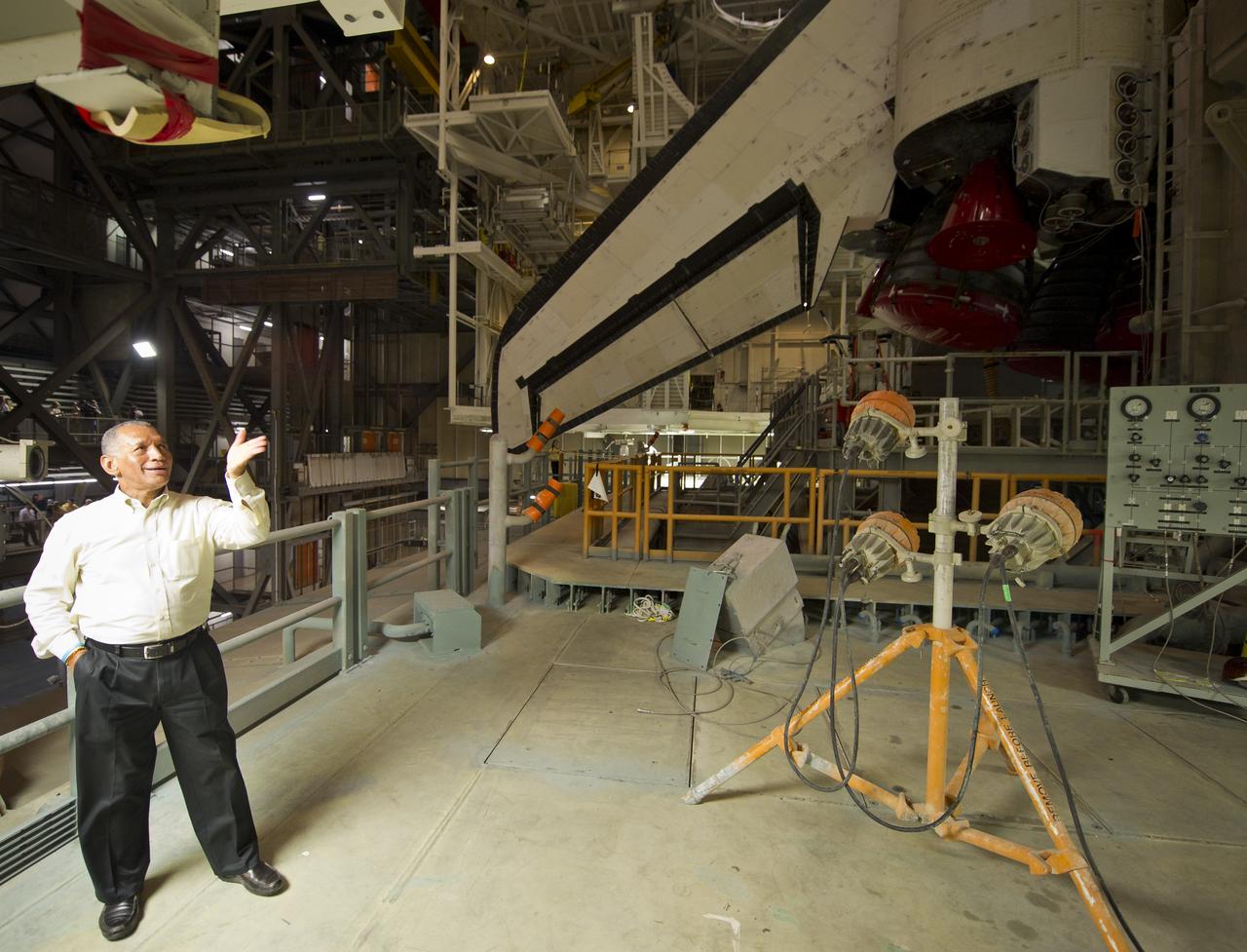
NASA Administrator Charles Bolden looks at the space shuttle Atlantis atop of the Mobile Launch Platform (MLP) just prior to rollout of Atlantis (STS-135) from High Bay 3 in the Vehicle Assembly Building to Launch Pad 39a for its final flight, Tuesday evening, May 31, 2011, at Kennedy Space Center in Cape Canaveral, Fla. The 3.4-mile trek, known as "rollout," will take about seven hours to complete. Atlantis will carry the Raffaello multipurpose logistics module to deliver supplies, logistics and spare parts to the International Space Station. The launch of STS-135 is targeted for July 8. Photo Credit: (NASA/Bill Ingalls)
Atlantis STS-135 Rollout
Space Shuttle Atlantis (STS-135) is seen atop the Mobile Launch Platform (MLP) as it begins its journey from High Bay 3 in the Vehicle Assembly Building to Launch Pad 39a for its final flight, Tuesday evening, May 31, 2011, at Kennedy Space Center in Cape Canaveral, Fla. The 3.4-mile trek, known as "rollout," will take about seven hours to complete. Atlantis will carry the Raffaello multipurpose logistics module to deliver supplies, logistics and spare parts to the International Space Station. The launch of STS-135 is targeted for July 8. Photo Credit: (NASA/Bill Ingalls)
Atlantis STS-135 Rollout
Space Shuttle Atlantis (STS-135) is seen atop the Mobile Launch Platform (MLP) as it begins its journey from High Bay 3 in the Vehicle Assembly Building to Launch Pad 39a for its final flight, Tuesday evening, May 31, 2011, at Kennedy Space Center in Cape Canaveral, Fla. The 3.4-mile trek, known as "rollout," will take about seven hours to complete. Atlantis will carry the Raffaello multipurpose logistics module to deliver supplies, logistics and spare parts to the International Space Station. The launch of STS-135 is targeted for July 8. Photo Credit: (NASA/Bill Ingalls)
Atlantis STS-135 Rollout
Space Shuttle Atlantis (STS-135) is seen atop the Mobile Launch Platform (MLP) as it begins its journey from High Bay 3 in the Vehicle Assembly Building to Launch Pad 39a for its final flight, Tuesday evening, May 31, 2011, at Kennedy Space Center in Cape Canaveral, Fla. The 3.4-mile trek, known as "rollout," will take about seven hours to complete. Atlantis will carry the Raffaello multipurpose logistics module to deliver supplies, logistics and spare parts to the International Space Station. The launch of STS-135 is targeted for July 8. Photo Credit: (NASA/Bill Ingalls)
Atlantis STS-135 Rollout
NASA Administrator Charles Bolden looks at the space shuttle Atlantis atop of the Mobile Launch Platform (MLP) just prior to rollout of Atlantis (STS-135) from High Bay 3 in the Vehicle Assembly Building to Launch Pad 39a for its final flight, Tuesday evening, May 31, 2011, at Kennedy Space Center in Cape Canaveral, Fla. The 3.4-mile trek, known as "rollout," will take about seven hours to complete. Atlantis will carry the Raffaello multipurpose logistics module to deliver supplies, logistics and spare parts to the International Space Station. The launch of STS-135 is targeted for July 8. Photo Credit: (NASA/Bill Ingalls)
Atlantis STS-135 Rollout
Space Shuttle Atlantis (STS-135) is seen atop a Mobile Launcher Platform (MLP) just prior to beginning its journey from High Bay 3 in the Vehicle Assembly Building to Launch Pad 39a for its final flight, Tuesday evening, May 31, 2011, at Kennedy Space Center in Cape Canaveral, Fla. The 3.4-mile trek, known as "rollout," will take about seven hours to complete. Atlantis will carry the Raffaello multipurpose logistics module to deliver supplies, logistics and spare parts to the International Space Station. The launch of STS-135 is targeted for July 8. Photo Credit: (NASA/Bill Ingalls)
Atlantis STS-135 Rollout
Space Shuttle Atlantis (STS-135) is seen atop a Mobile Launcher Platform (MLP) just prior to beginning its journey from High Bay 3 in the Vehicle Assembly Building to Launch Pad 39a for its final flight, Tuesday evening, May 31, 2011, at Kennedy Space Center in Cape Canaveral, Fla. The 3.4-mile trek, known as "rollout," will take about seven hours to complete. Atlantis will carry the Raffaello multipurpose logistics module to deliver supplies, logistics and spare parts to the International Space Station. The launch of STS-135 is targeted for July 8. Photo Credit: (NASA/Bill Ingalls)
Atlantis STS-135 Rollout
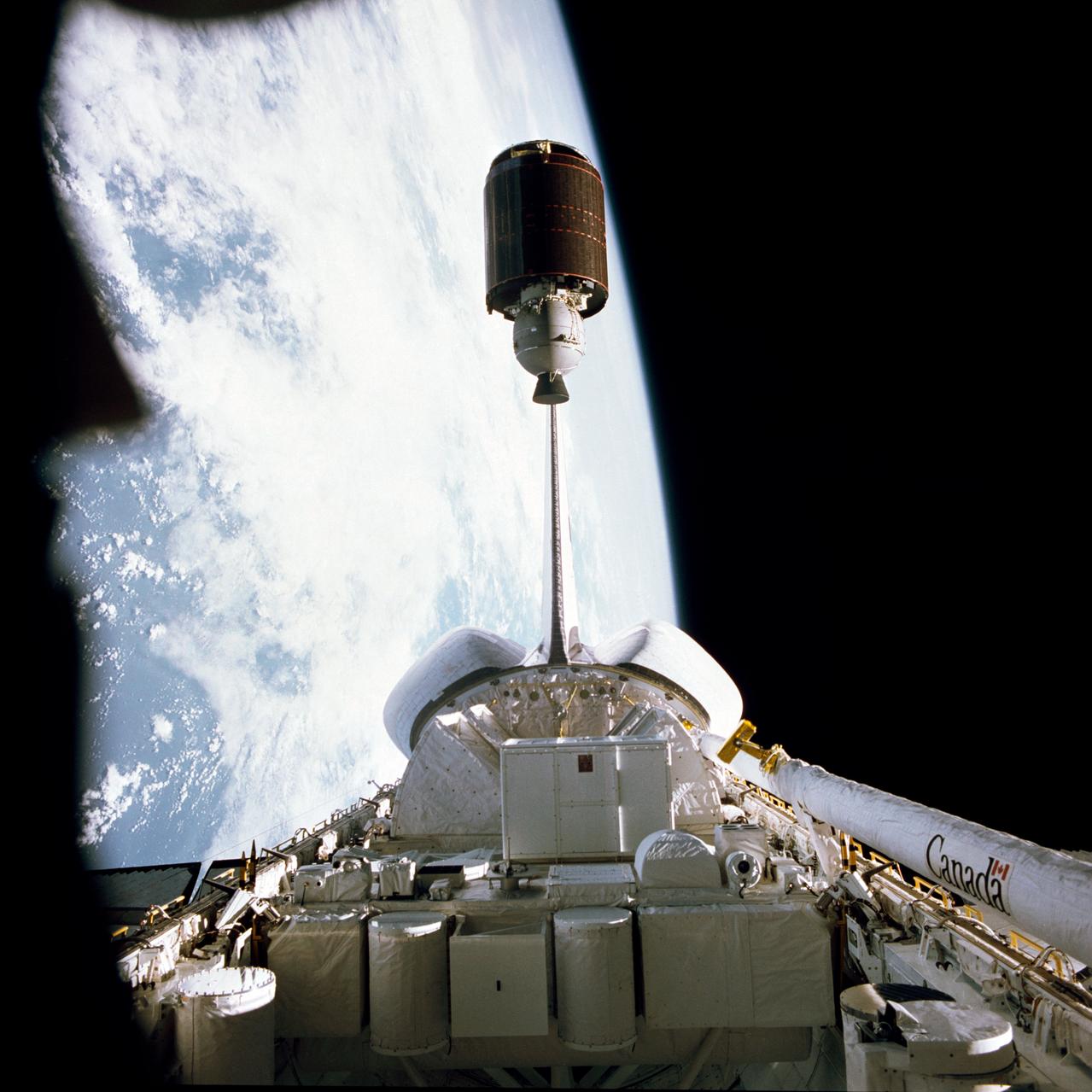
S83-35764 (19 June 1983) --- The Indonesian Palapa B communications satellite is just about to clear the vertical stabilizer of the Earth-orbiting Space Shuttle Challenger to begin its way toward its Earth-orbital destination.  Also visible in this 70mm exposure, photographed through the flight deck?s aft windows, are the Shuttle pallet satellite, the experiment package for NASA?s office of space and terrestrial applications (OSTA-2), the now vacated protective cradles for Palapa and Telesat Canada?s Anik C2 satellites, some getaway special (GAS) canisters and the Canadian-built remote manipulator system (RMS) arm.
Palapa-B communications satellite launched from the Shuttle Challenger
STS-8 payload flight test article (PFTA) shown prior to shipment to Kennedy Space Center (KSC). The PFTA is designed to simulate the larger cargos scheduled for later flights.
STS-8 payload flight test article prior to shipment to KSC
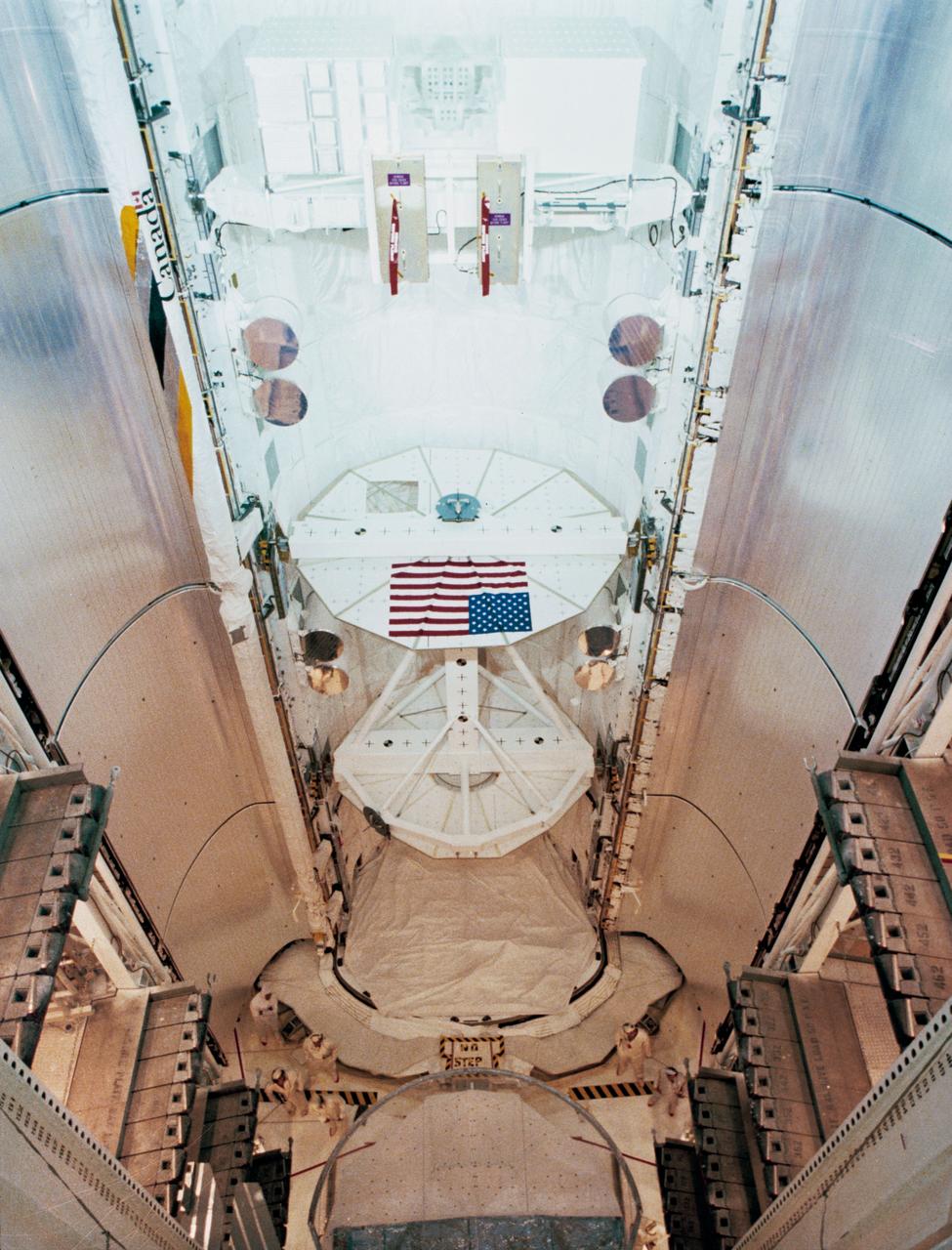
View of the Payload Flight Test Article (PFTA) installed into Challenger's cargo bay in the Payload Changeout Room at Pad 39A at the Kennedy Space Center (KSC). The American flag is visible on one side of the PFTA in the cargo bay. The Kennedy Space Center alternative photo number is KSC-108-83PC-566.
View of the Payload Flight Test Article (PFTA) installed in cargo bay
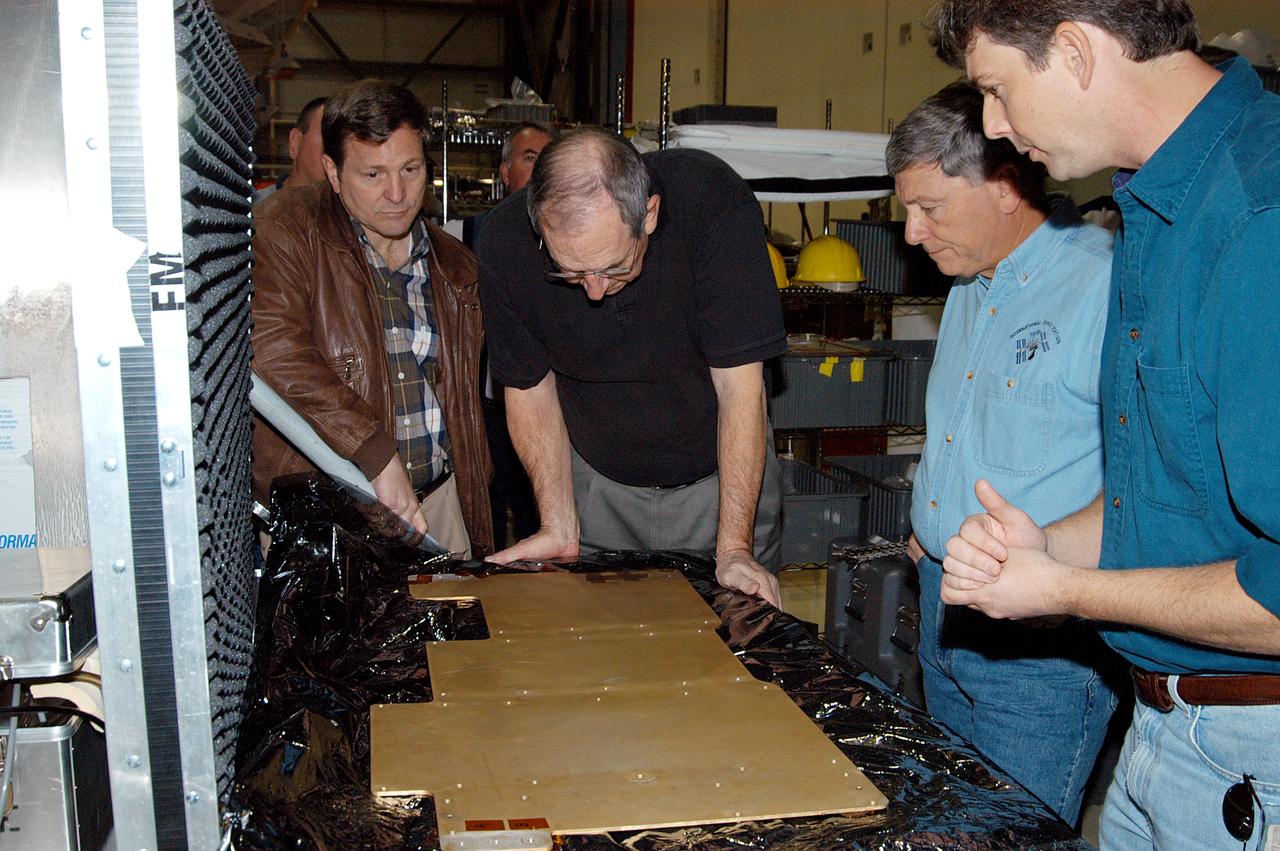
KENNEDY SPACE CENTER, FLA. -- From left, NASA Deputy Program Manager of the Space Shuttle Program Michael Wetmore, United Space Alliance (USA) Vice President and Space Shuttle Program Manager Howard DeCastro, NASA Deputy Associate Administrator for Space Station and Shuttle Programs Michael Kostelnik, and a USA technician examine cold plates in Orbiter Processing Facility Bay 2.  NASA and USA Space Shuttle program management are participating in a leadership workday.  The day is intended to provide management with an in-depth, hands-on look at Shuttle processing activities at KSC.
KENNEDY SPACE CENTER, FLA. -- From left, NASA Deputy Program Manager of the Space Shuttle Program Michael Wetmore, United Space Alliance (USA) Vice President and Space Shuttle Program Manager Howard DeCastro, NASA Deputy Associate Administrator for Space Station and Shuttle Programs Michael Kostelnik, and a USA technician examine cold plates in Orbiter Processing Facility Bay 2. NASA and USA Space Shuttle program management are participating in a leadership workday. The day is intended to provide management with an in-depth, hands-on look at Shuttle processing activities at KSC.
KENNEDY SPACE CENTER, FLA. -- From left, a United Space Alliance (USA) technician briefs NASA Deputy Program Manager of the Space Shuttle Program Michael Wetmore, USA Vice President and Space Shuttle Program Manager Howard DeCastro, and NASA Deputy Associate Administrator for Space Station and Shuttle Programs Michael Kostelnik on the use of cold plates in Orbiter Processing Facility Bay 2.  NASA and USA Space Shuttle program management are participating in a leadership workday.  The day is intended to provide management with an in-depth, hands-on look at Shuttle processing activities at KSC.
KENNEDY SPACE CENTER, FLA. -- From left, a United Space Alliance (USA) technician briefs NASA Deputy Program Manager of the Space Shuttle Program Michael Wetmore, USA Vice President and Space Shuttle Program Manager Howard DeCastro, and NASA Deputy Associate Administrator for Space Station and Shuttle Programs Michael Kostelnik on the use of cold plates in Orbiter Processing Facility Bay 2. NASA and USA Space Shuttle program management are participating in a leadership workday. The day is intended to provide management with an in-depth, hands-on look at Shuttle processing activities at KSC.
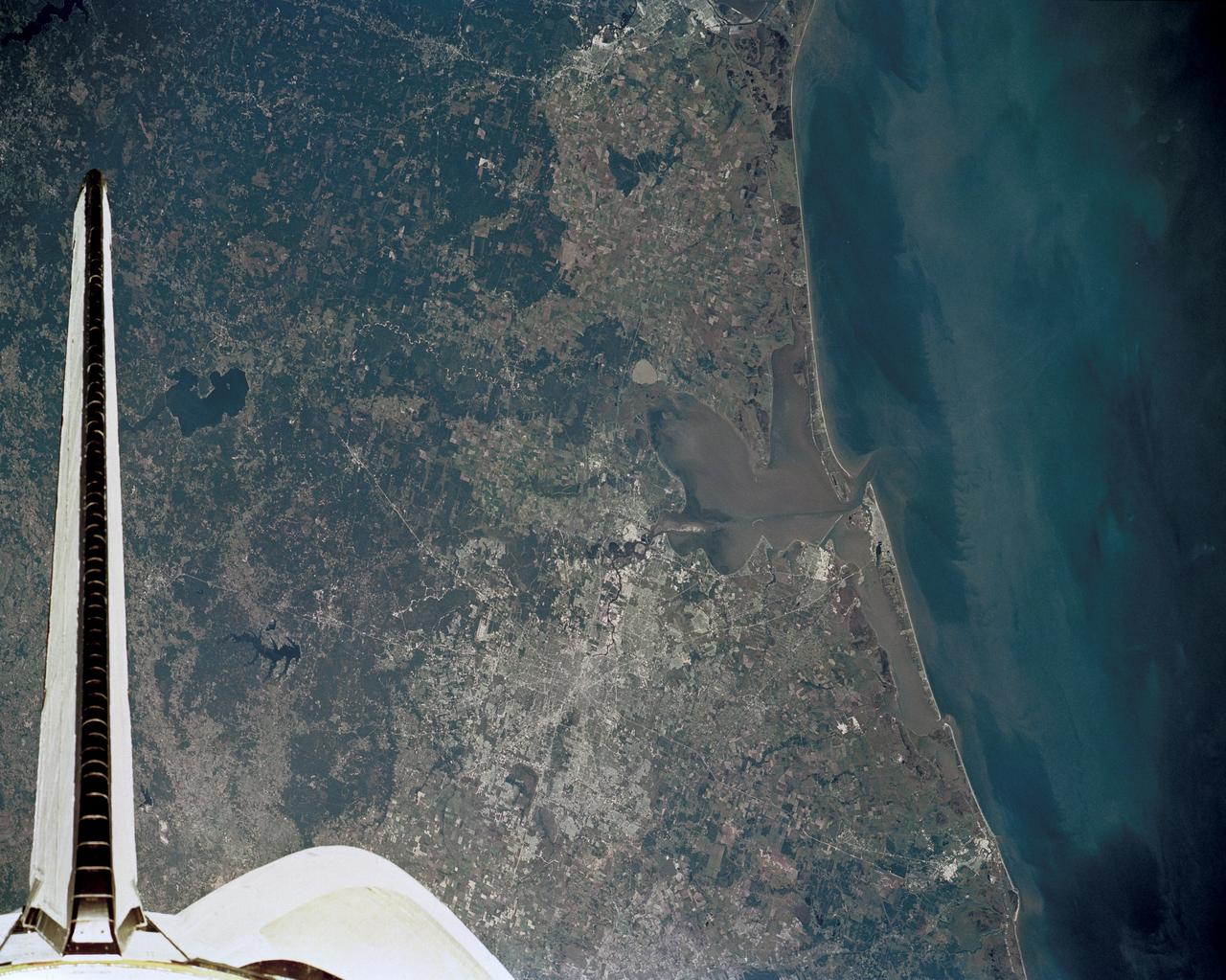
51J-143-126 (5 Oct. 1985) --- The vertical stabilizer of the Earth-orbiting Space Shuttle Atlantis serves to partially frame this scene of Metropolitan Houston. Hold photo with vertical tail at top so that north will be at top. America's fourth largest city, with its radiating highway network, lies at the junction between the East Texas piney woods, containing lakes Conroe and Livingston (near top center and top right, respectively), and the coastal prairie, now largely farmland (left side of frame). The coast stretches from the left at Freeport and the mouth of the Brazos River, past Galveston and Texas City, and the circle of the High Island Salt Dome (clearly seen at lower right near the Bolivar Peninsula), to Port Arthur on the Neches River (far right). Patterns of muddy and clear water are particularly well-displayed in Galveston and Trinity Bays, as well as in the Gulf of Mexico. With a close look, the Harris County Domed Stadium (Astrodome) can be recognized on Houston's south side. The NASA Johnson Space Center (JSC) and the Clear Lake City area are easily delineated some 25 miles southeast of downtown Houston. The scene was recorded on film by one of the STS-51J crewmembers using a handheld Hasselblad camera and 70mm film.
Houston, Galveston Bay, Texas, USA
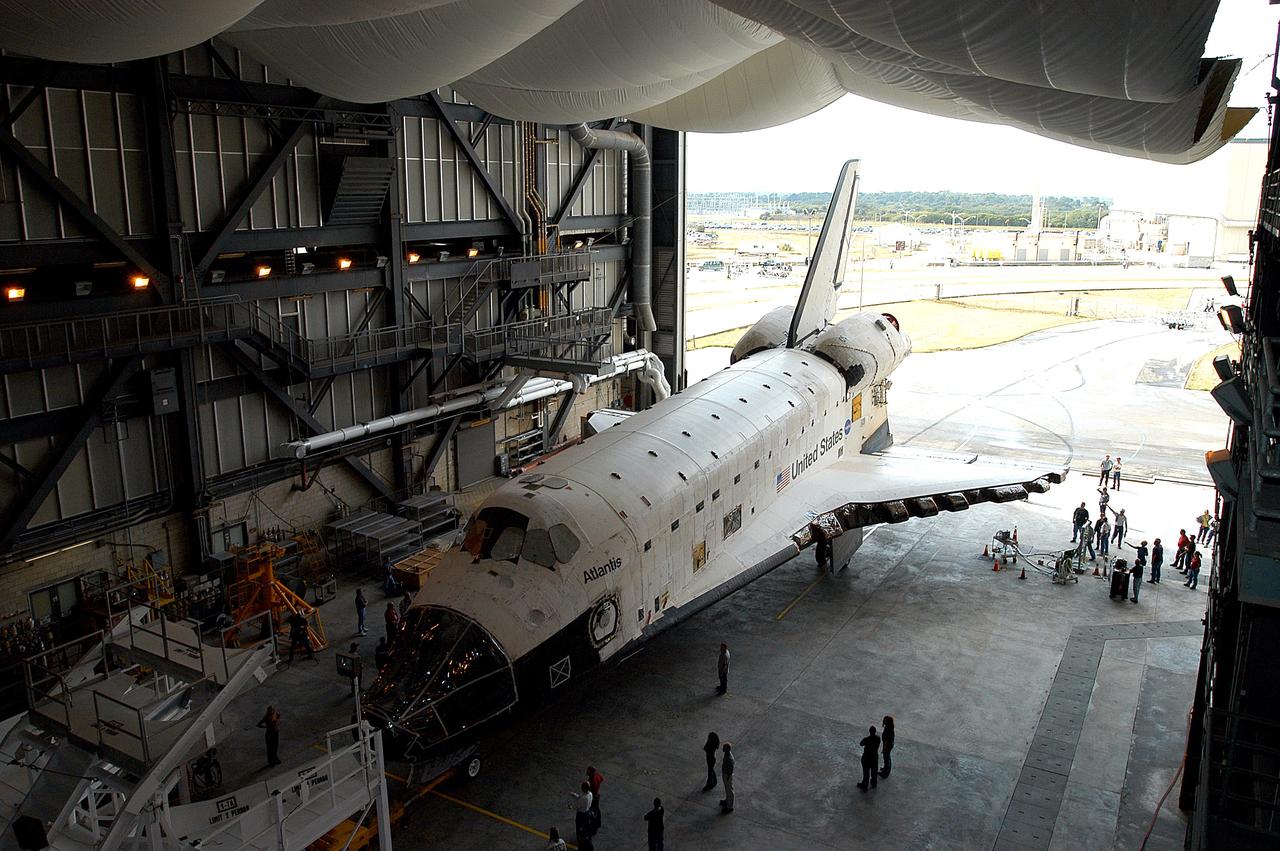
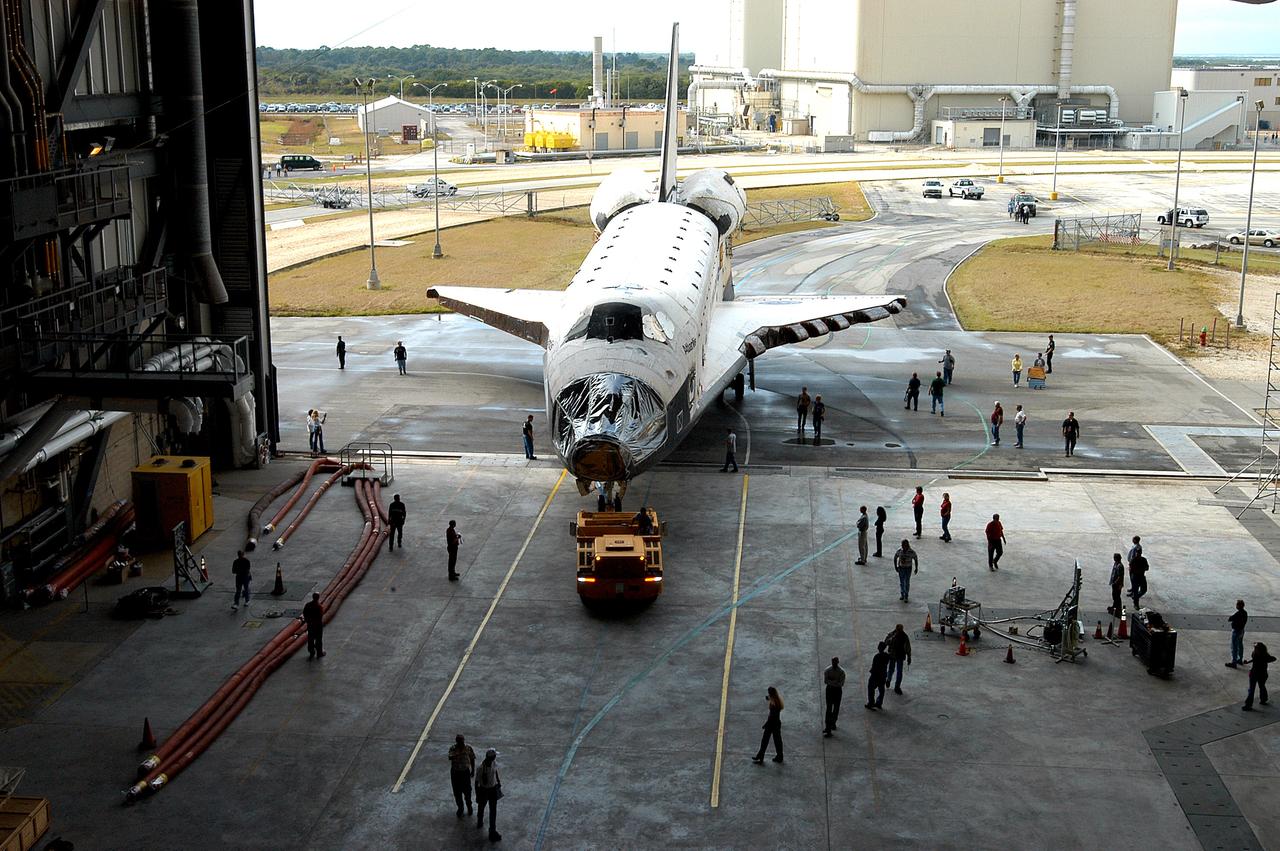
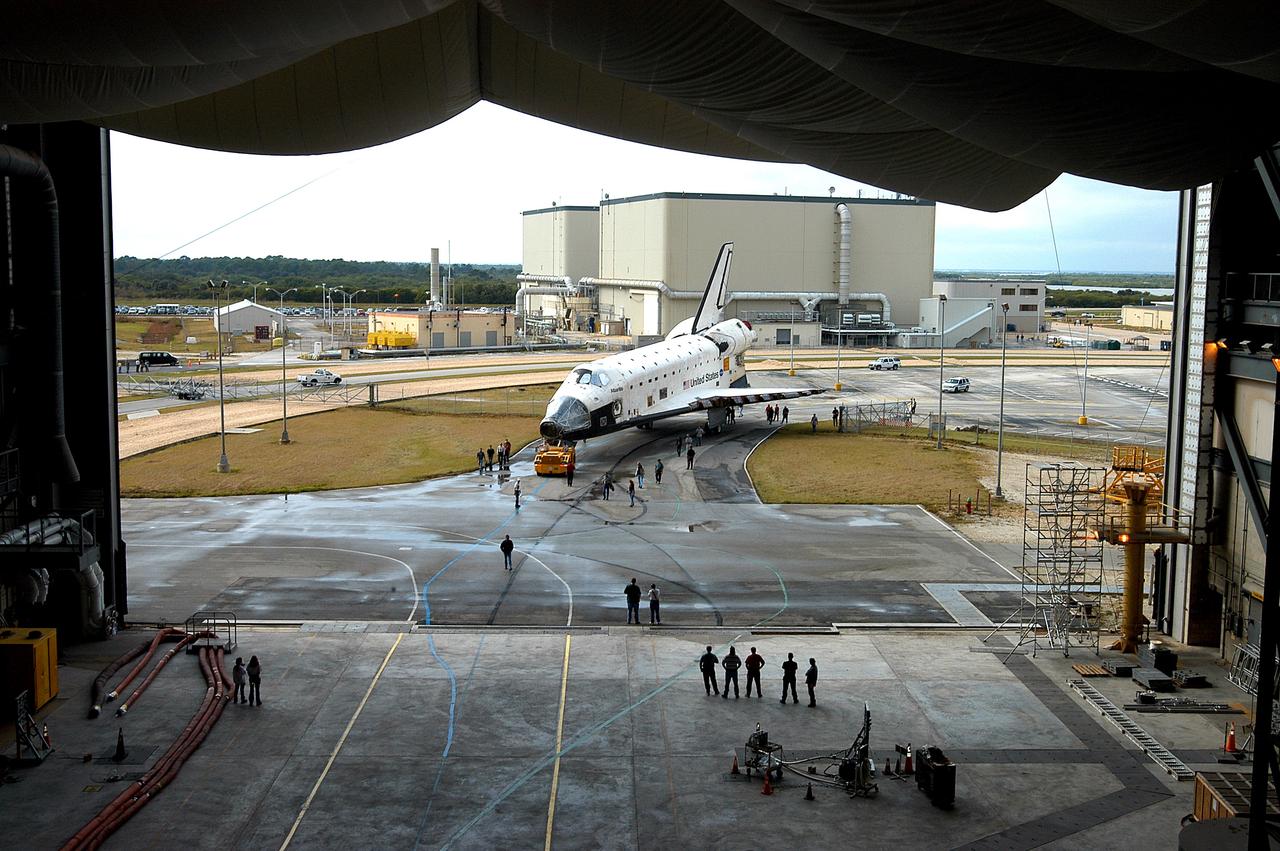
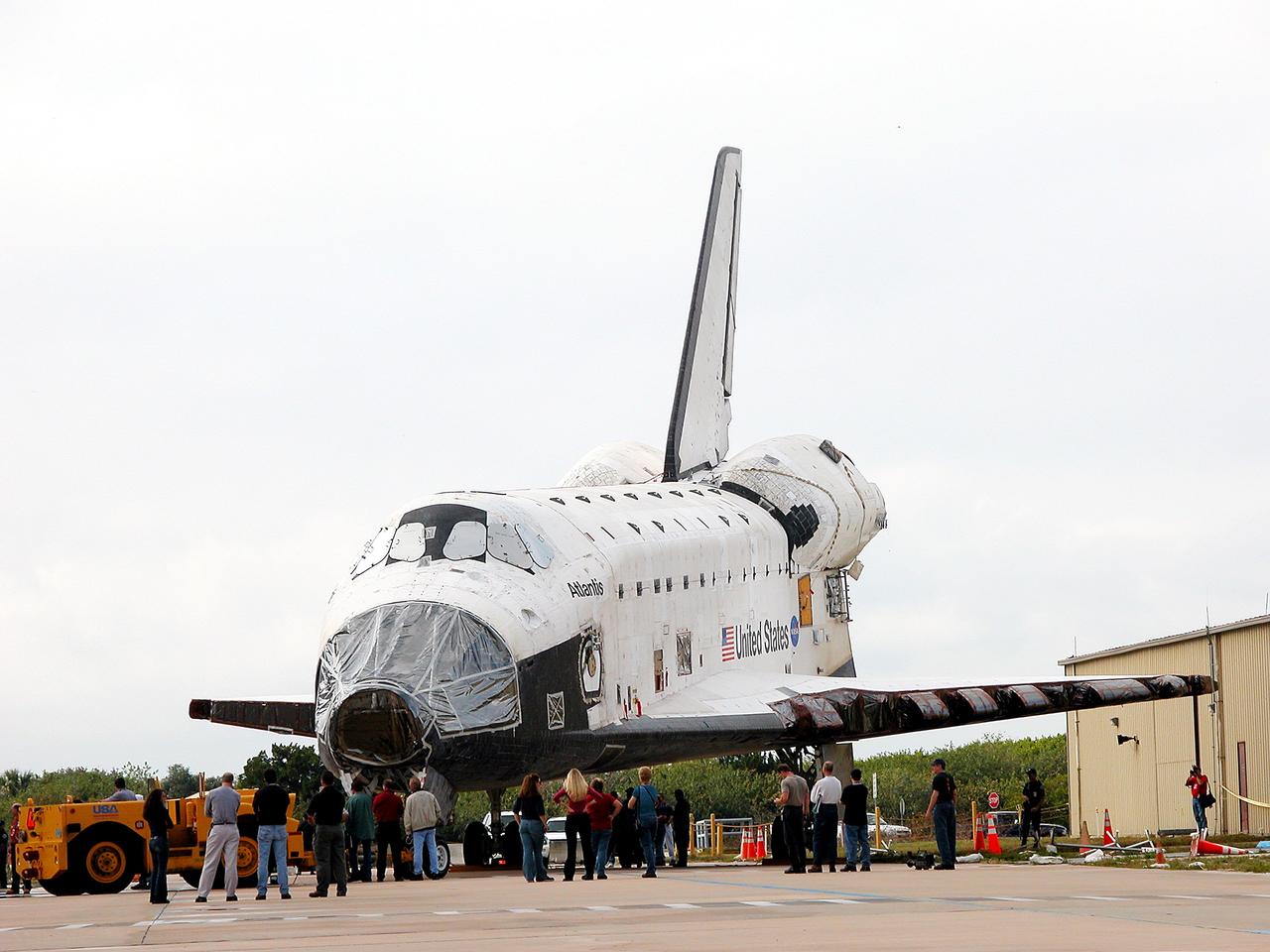
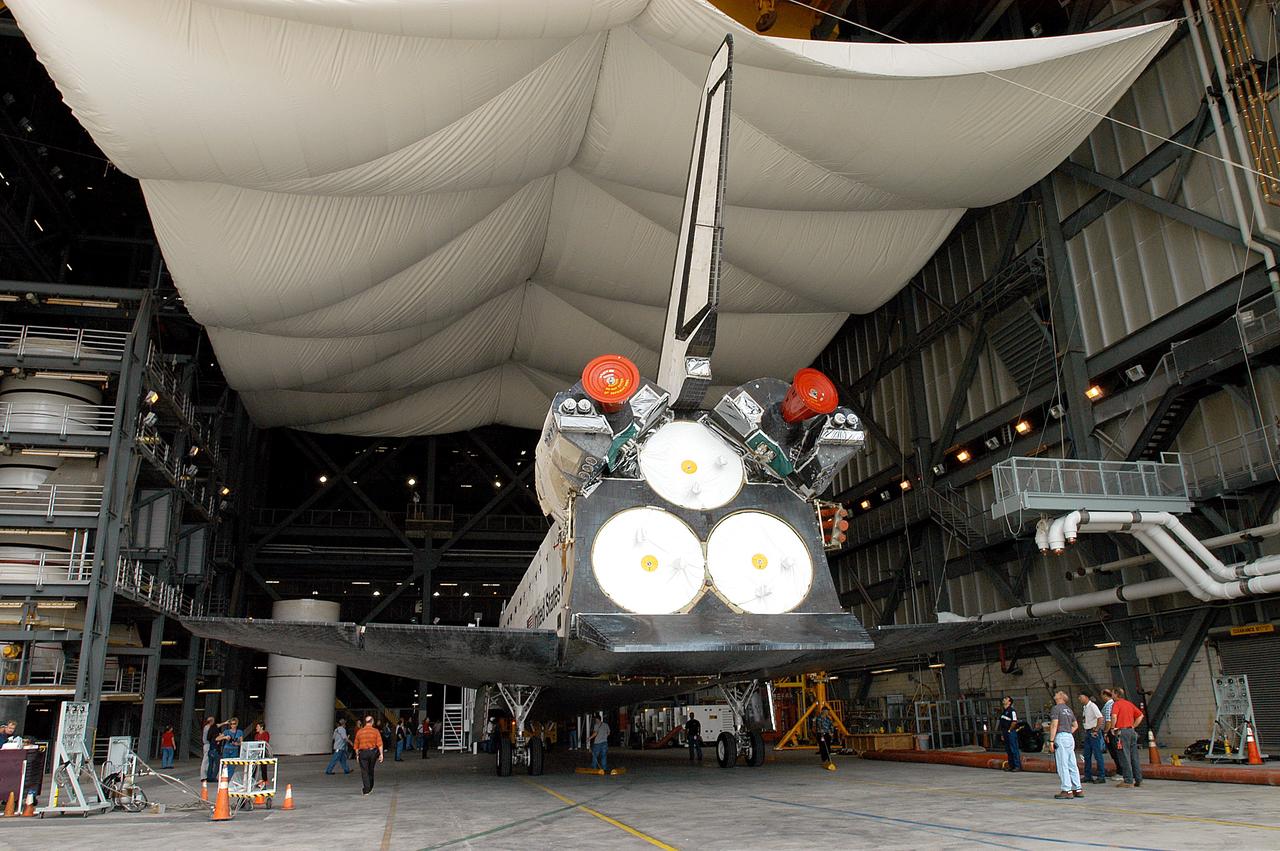
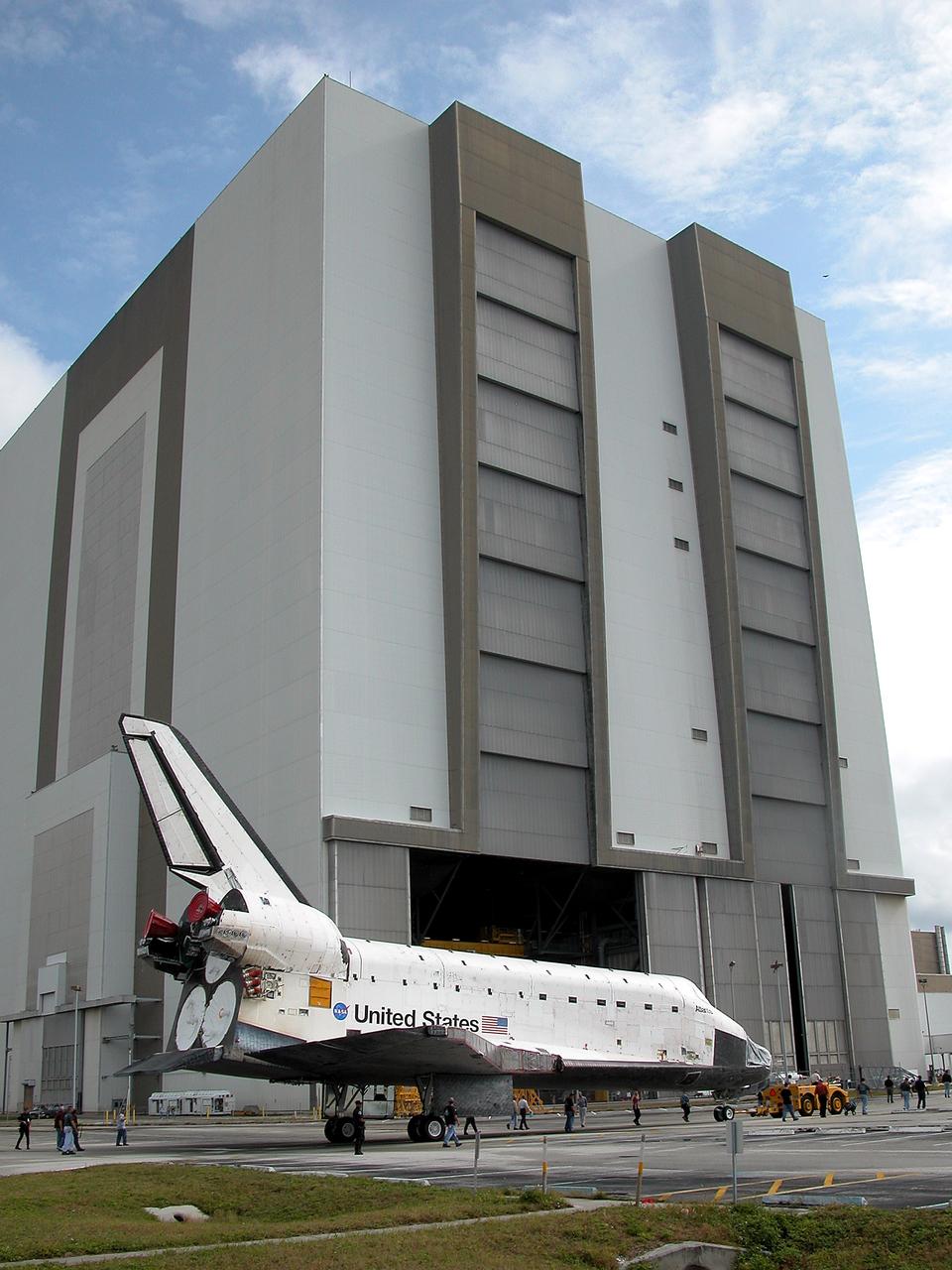
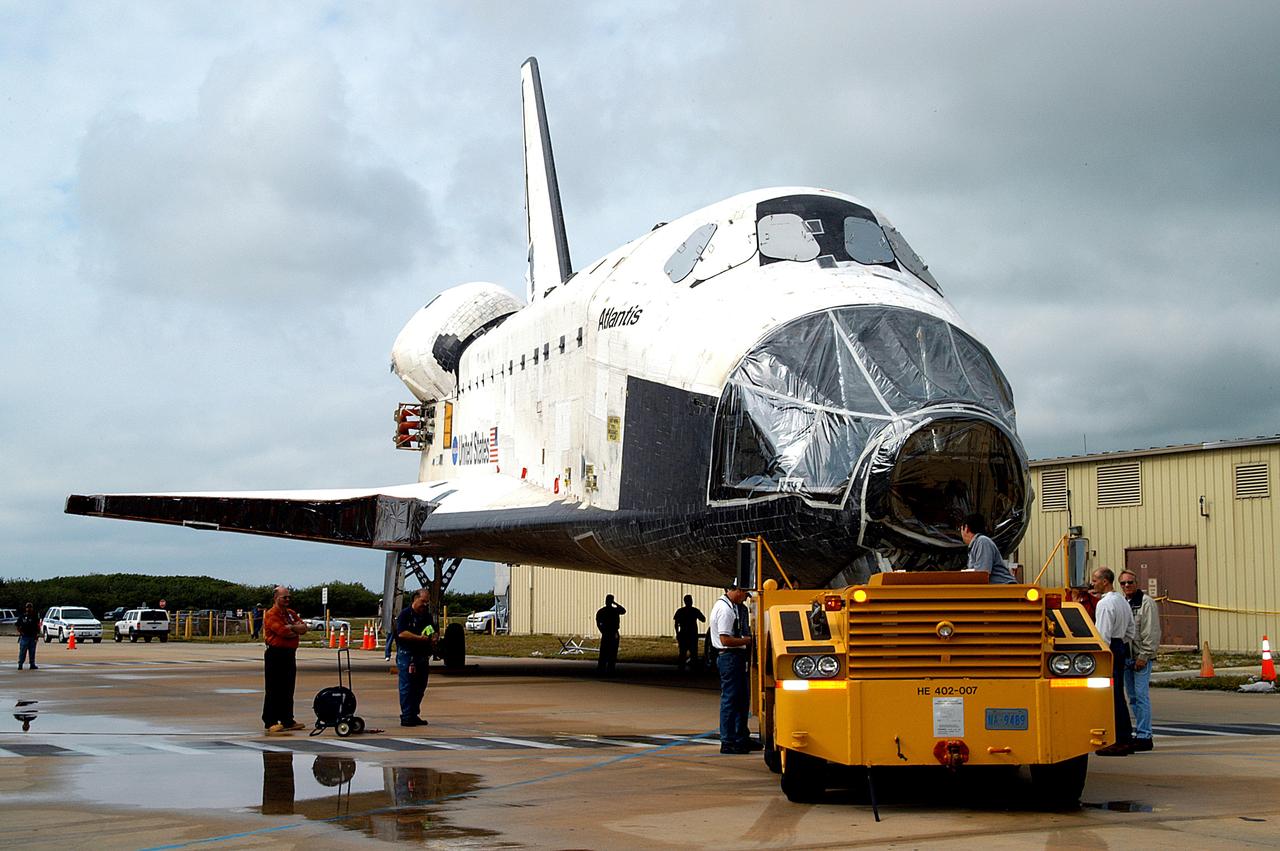
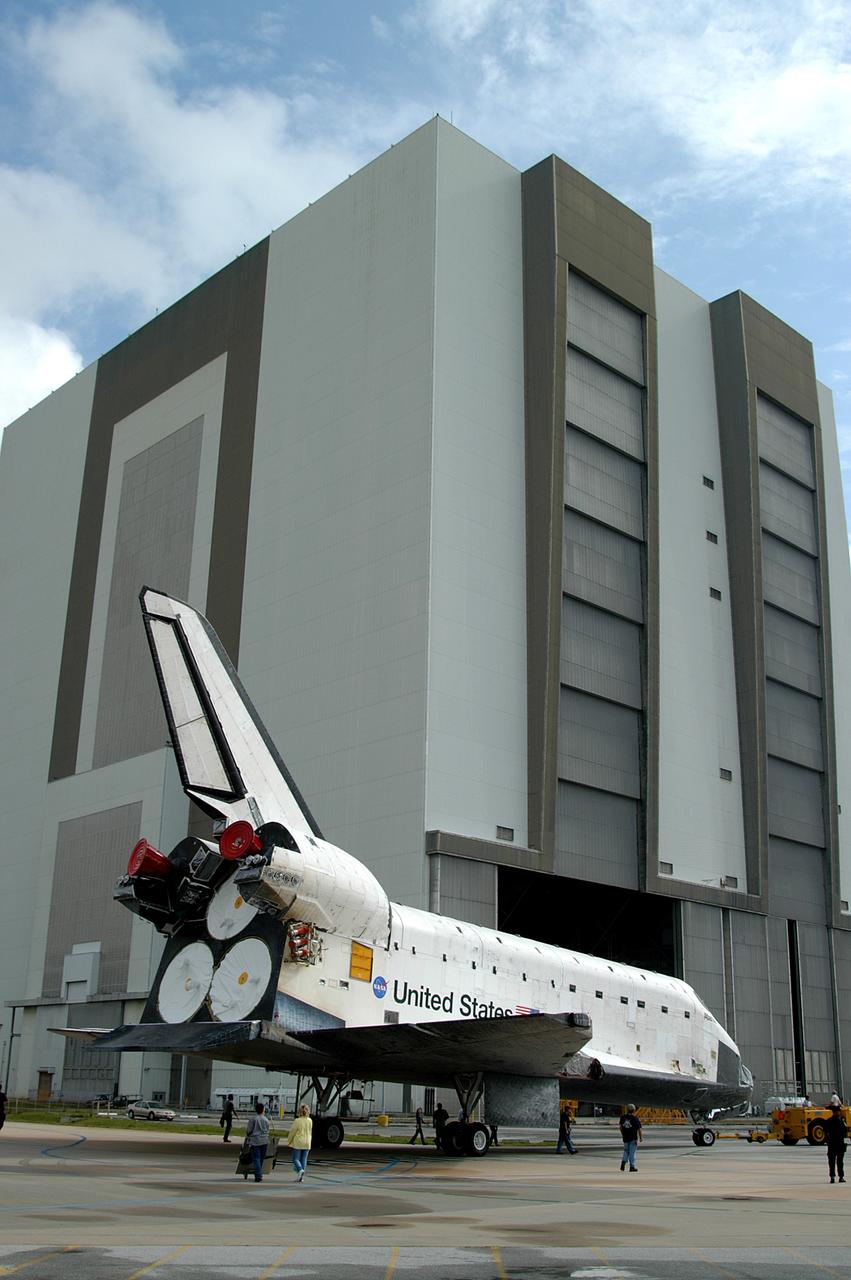
KENNEDY SPACE CENTER, FLA. - The Space Shuttle orbiter Atlantis approaches the Vehicle Assembly Building (VAB) high bay 4.  It is being towed from the Orbiter Processing Facility (OPF) to allow work to be performed in the bay that can only be accomplished while it is empty. Work scheduled in the processing facility includes annual validation of the bay's cranes, work platforms, lifting mechanisms, and jack stands. Atlantis will remain in the VAB for about 10 days, then return to the OPF as work resumes to prepare it for launch in September 2004 on the first return-to-flight mission, STS-114.
KENNEDY SPACE CENTER, FLA. - The Space Shuttle orbiter Atlantis approaches the Vehicle Assembly Building (VAB) high bay 4. It is being towed from the Orbiter Processing Facility (OPF) to allow work to be performed in the bay that can only be accomplished while it is empty. Work scheduled in the processing facility includes annual validation of the bay's cranes, work platforms, lifting mechanisms, and jack stands. Atlantis will remain in the VAB for about 10 days, then return to the OPF as work resumes to prepare it for launch in September 2004 on the first return-to-flight mission, STS-114.
KENNEDY SPACE CENTER, FLA. - The Space Shuttle orbiter Atlantis approaches high bay 4 of the Vehicle Assembly Building (VAB).  It was towed from the Orbiter Processing Facility (OPF) to allow work to be performed in the bay that can only be accomplished while it is empty. Work scheduled in the processing facility includes annual validation of the bay's cranes, work platforms, lifting mechanisms, and jack stands. Atlantis will remain in the VAB for about 10 days, then return to the OPF as work resumes to prepare it for launch in September 2004 on the first return-to-flight mission, STS-114.
KENNEDY SPACE CENTER, FLA. - The Space Shuttle orbiter Atlantis approaches high bay 4 of the Vehicle Assembly Building (VAB). It was towed from the Orbiter Processing Facility (OPF) to allow work to be performed in the bay that can only be accomplished while it is empty. Work scheduled in the processing facility includes annual validation of the bay's cranes, work platforms, lifting mechanisms, and jack stands. Atlantis will remain in the VAB for about 10 days, then return to the OPF as work resumes to prepare it for launch in September 2004 on the first return-to-flight mission, STS-114.
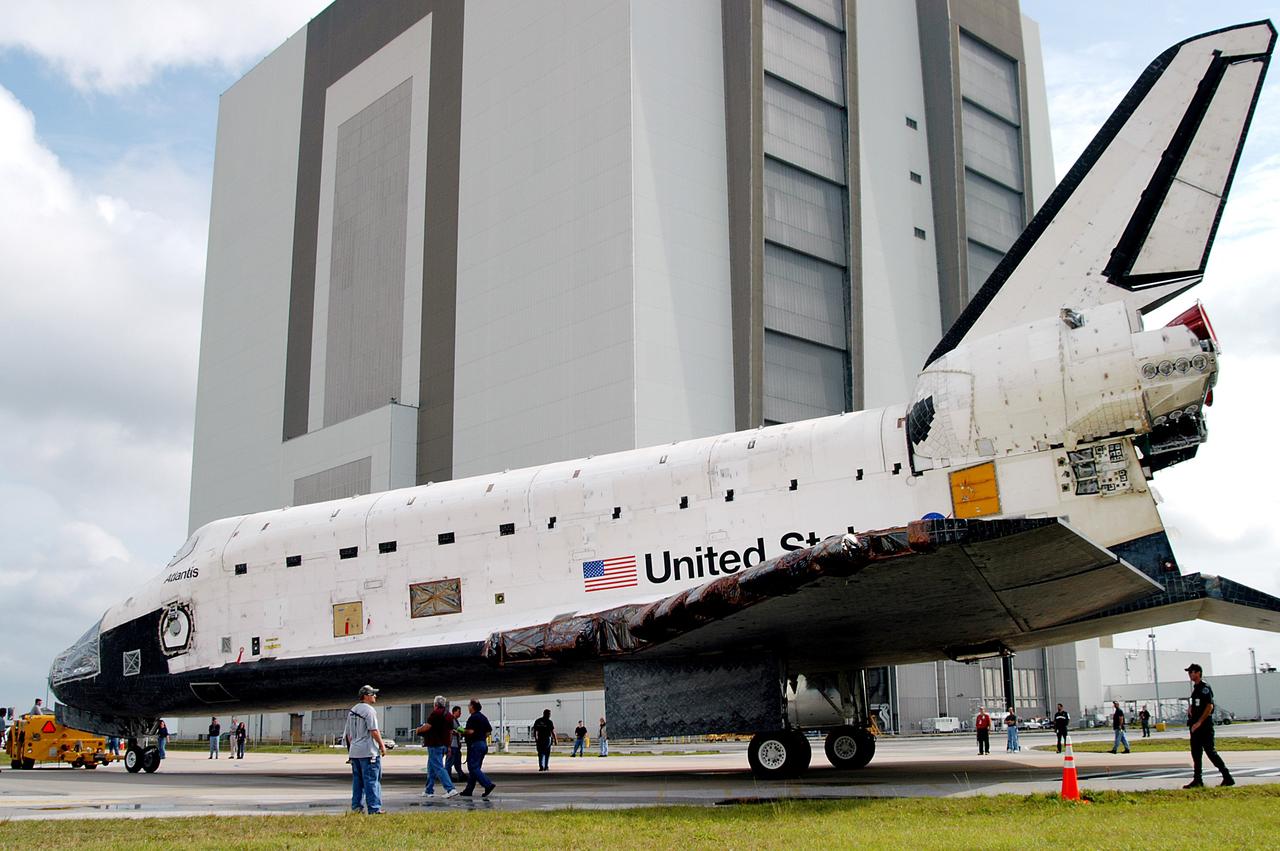
KENNEDY SPACE CENTER, FLA. - The Space Shuttle orbiter Atlantis is moved into high bay 4 of the Vehicle Assembly Building (VAB).  It was towed from the Orbiter Processing Facility (OPF) to allow work to be performed in the bay that can only be accomplished while it is empty. Work scheduled in the processing facility includes annual validation of the bay's cranes, work platforms, lifting mechanisms, and jack stands. Atlantis will remain in the VAB for about 10 days, then return to the OPF as work resumes to prepare it for launch in September 2004 on the first return-to-flight mission, STS-114.
KENNEDY SPACE CENTER, FLA. - The Space Shuttle orbiter Atlantis is moved into high bay 4 of the Vehicle Assembly Building (VAB). It was towed from the Orbiter Processing Facility (OPF) to allow work to be performed in the bay that can only be accomplished while it is empty. Work scheduled in the processing facility includes annual validation of the bay's cranes, work platforms, lifting mechanisms, and jack stands. Atlantis will remain in the VAB for about 10 days, then return to the OPF as work resumes to prepare it for launch in September 2004 on the first return-to-flight mission, STS-114.
KENNEDY SPACE CENTER, FLA. - The Space Shuttle orbiter Atlantis is almost in position in high bay 4 of the Vehicle Assembly Building (VAB).  It was towed from the Orbiter Processing Facility (OPF) to allow work to be performed in the bay that can only be accomplished while it is empty. Work scheduled in the processing facility includes annual validation of the bay's cranes, work platforms, lifting mechanisms, and jack stands. Atlantis will remain in the VAB for about 10 days, then return to the OPF as work resumes to prepare it for launch in September 2004 on the first return-to-flight mission, STS-114.
KENNEDY SPACE CENTER, FLA. - The Space Shuttle orbiter Atlantis is almost in position in high bay 4 of the Vehicle Assembly Building (VAB). It was towed from the Orbiter Processing Facility (OPF) to allow work to be performed in the bay that can only be accomplished while it is empty. Work scheduled in the processing facility includes annual validation of the bay's cranes, work platforms, lifting mechanisms, and jack stands. Atlantis will remain in the VAB for about 10 days, then return to the OPF as work resumes to prepare it for launch in September 2004 on the first return-to-flight mission, STS-114.
KENNEDY SPACE CENTER, FLA. - The Space Shuttle orbiter Atlantis moves into high bay 4 of the Vehicle Assembly Building (VAB).  It was towed from the Orbiter Processing Facility (OPF) to allow work to be performed in the bay that can only be accomplished while it is empty. Work scheduled in the processing facility includes annual validation of the bay's cranes, work platforms, lifting mechanisms, and jack stands. Atlantis will remain in the VAB for about 10 days, then return to the OPF as work resumes to prepare it for launch in September 2004 on the first return-to-flight mission, STS-114.
KENNEDY SPACE CENTER, FLA. - The Space Shuttle orbiter Atlantis moves into high bay 4 of the Vehicle Assembly Building (VAB). It was towed from the Orbiter Processing Facility (OPF) to allow work to be performed in the bay that can only be accomplished while it is empty. Work scheduled in the processing facility includes annual validation of the bay's cranes, work platforms, lifting mechanisms, and jack stands. Atlantis will remain in the VAB for about 10 days, then return to the OPF as work resumes to prepare it for launch in September 2004 on the first return-to-flight mission, STS-114.
KENNEDY SPACE CENTER, FLA. - The Space Shuttle orbiter Atlantis arrives in high bay 4 of the Vehicle Assembly Building (VAB).  It was towed from the Orbiter Processing Facility (OPF) to allow work to be performed in the bay that can only be accomplished while it is empty. Work scheduled in the processing facility includes annual validation of the bay's cranes, work platforms, lifting mechanisms, and jack stands. Atlantis will remain in the VAB for about 10 days, then return to the OPF as work resumes to prepare it for launch in September 2004 on the first return-to-flight mission, STS-114.
KENNEDY SPACE CENTER, FLA. - The Space Shuttle orbiter Atlantis arrives in high bay 4 of the Vehicle Assembly Building (VAB). It was towed from the Orbiter Processing Facility (OPF) to allow work to be performed in the bay that can only be accomplished while it is empty. Work scheduled in the processing facility includes annual validation of the bay's cranes, work platforms, lifting mechanisms, and jack stands. Atlantis will remain in the VAB for about 10 days, then return to the OPF as work resumes to prepare it for launch in September 2004 on the first return-to-flight mission, STS-114.
KENNEDY SPACE CENTER, FLA. - Workers walk with Space Shuttle orbiter Atlantis from the Orbiter Processing Facility (OPF) to the Vehicle Assembly Building (VAB) high bay 4. The move will allow work to be performed in the OPF that can only be accomplished while the bay is empty. Work scheduled in the processing facility includes annual validation of the bay's cranes, work platforms, lifting mechanisms, and jack stands. Atlantis will remain in the VAB for about 10 days, then return to the OPF as work resumes to prepare it for launch in September 2004 on the first return-to-flight mission, STS-114.
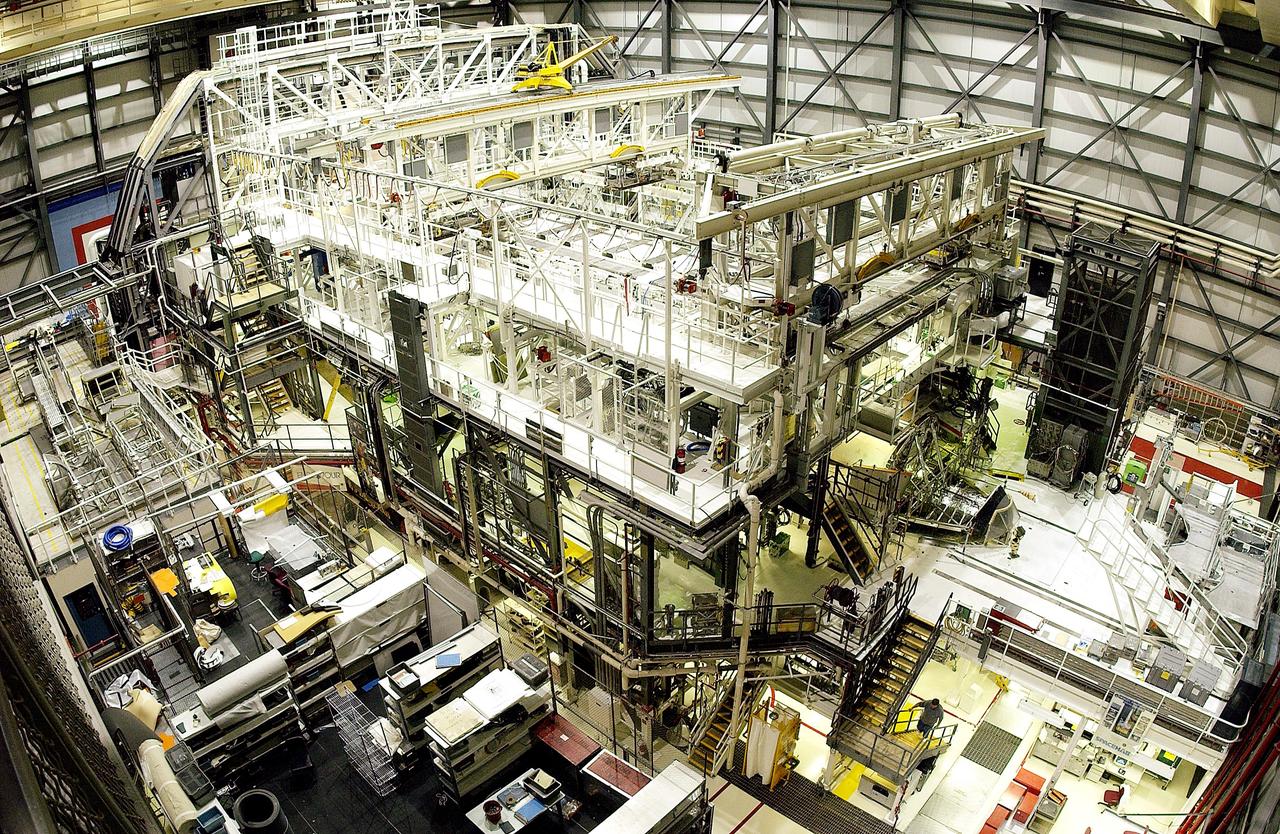
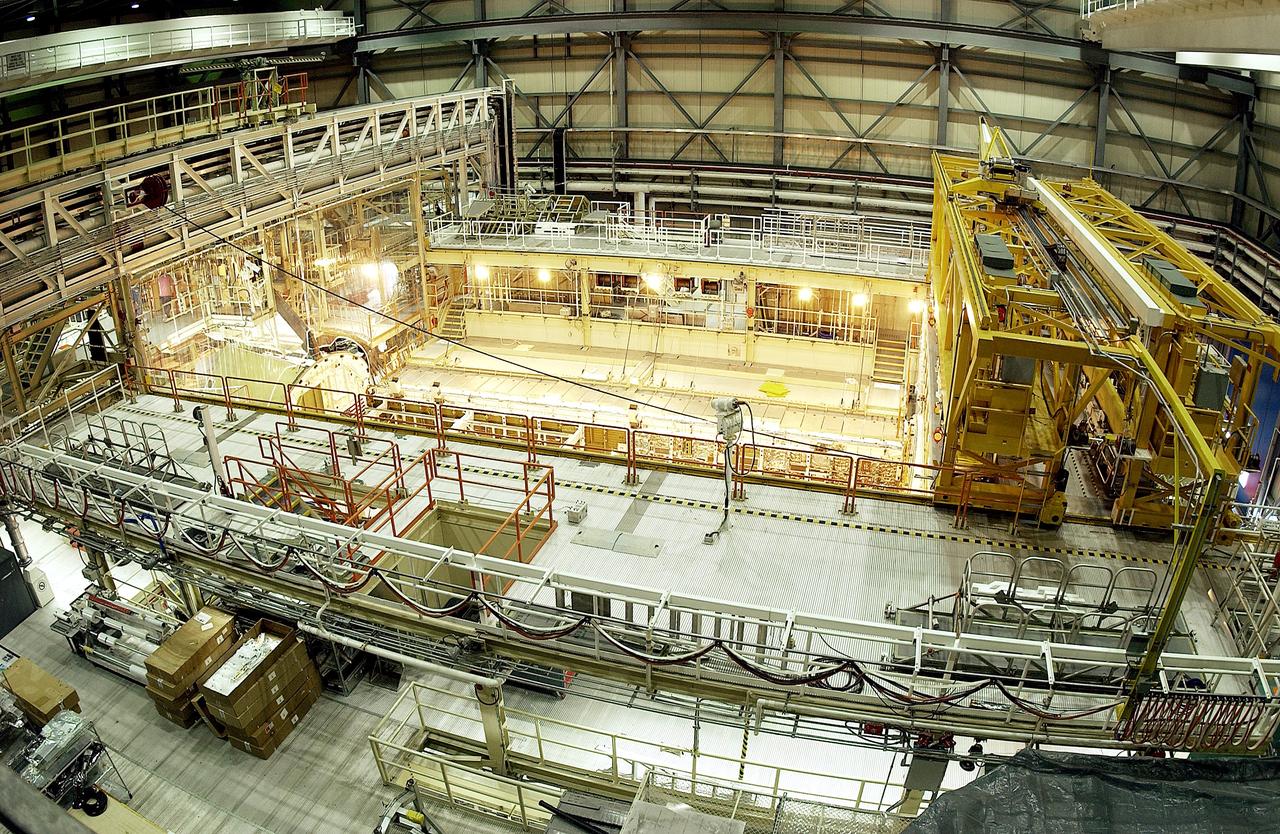
KENNEDY SPACE CENTER, FLA. - This bird's-eye view of a high bay in the Orbiter Processing Facility (OPF) shows Space Shuttle Atlantis surrounded by the standard platforms and equipment required to process a Space Shuttle orbiter for flight.  The high bay is 197 feet (60 meters) long, 150 feet (46 meters) wide, 95 feet (29 meters) high, and encompasses a 29,000-square-foot (2,694-meter) area.  Platforms, a main access bridge, and two rolling bridges with trucks provide access to various parts of the orbiter. The next mission scheduled for Atlantis is STS-114, a utilization and logistics flight to the International Space Station.
KENNEDY SPACE CENTER, FLA. - This bird's-eye view of a high bay in the Orbiter Processing Facility (OPF) shows Space Shuttle Atlantis surrounded by the standard platforms and equipment required to process a Space Shuttle orbiter for flight. The high bay is 197 feet (60 meters) long, 150 feet (46 meters) wide, 95 feet (29 meters) high, and encompasses a 29,000-square-foot (2,694-meter) area. Platforms, a main access bridge, and two rolling bridges with trucks provide access to various parts of the orbiter. The next mission scheduled for Atlantis is STS-114, a utilization and logistics flight to the International Space Station.
KENNEDY SPACE CENTER, FLA. - The Space Shuttle orbiter Atlantis approaches the Vehicle Assembly Building (VAB).  It is being towed from the Orbiter Processing Facility (OPF) to allow work to be performed in the bay that can only be accomplished while it is empty. Work scheduled in the processing facility includes annual validation of the bay's cranes, work platforms, lifting mechanisms, and jack stands. Atlantis will remain in the VAB for about 10 days, then return to the OPF as work resumes to prepare it for launch in September 2004 on the first return-to-flight mission, STS-114.
KENNEDY SPACE CENTER, FLA. - The Space Shuttle orbiter Atlantis approaches the Vehicle Assembly Building (VAB). It is being towed from the Orbiter Processing Facility (OPF) to allow work to be performed in the bay that can only be accomplished while it is empty. Work scheduled in the processing facility includes annual validation of the bay's cranes, work platforms, lifting mechanisms, and jack stands. Atlantis will remain in the VAB for about 10 days, then return to the OPF as work resumes to prepare it for launch in September 2004 on the first return-to-flight mission, STS-114.
KENNEDY SPACE CENTER, FLA. - The Space Shuttle orbiter Atlantis nears the Vehicle Assembly Building (VAB).  It is being towed from the Orbiter Processing Facility (OPF) to allow work to be performed in the bay that can only be accomplished while it is empty. Work scheduled in the processing facility includes annual validation of the bay's cranes, work platforms, lifting mechanisms, and jack stands. Atlantis will remain in the VAB for about 10 days, then return to the OPF as work resumes to prepare it for launch in September 2004 on the first return-to-flight mission, STS-114.
KENNEDY SPACE CENTER, FLA. - The Space Shuttle orbiter Atlantis nears the Vehicle Assembly Building (VAB). It is being towed from the Orbiter Processing Facility (OPF) to allow work to be performed in the bay that can only be accomplished while it is empty. Work scheduled in the processing facility includes annual validation of the bay's cranes, work platforms, lifting mechanisms, and jack stands. Atlantis will remain in the VAB for about 10 days, then return to the OPF as work resumes to prepare it for launch in September 2004 on the first return-to-flight mission, STS-114.
KENNEDY SPACE CENTER, FLA. - The Space Shuttle orbiter Atlantis is towed from the Orbiter Processing Facility (OPF) to the Vehicle Assembly Building (VAB). The move will allow work to be performed in the OPF that can only be accomplished while the bay is empty. Work scheduled in the processing facility includes annual validation of the bay's cranes, work platforms, lifting mechanisms, and jack stands. Atlantis will remain in the VAB for about 10 days, then return to the OPF as work resumes to prepare it for launch in September 2004 on the first return-to-flight mission, STS-114.
KENNEDY SPACE CENTER, FLA. -  This bird's-eye view of a high bay in the Orbiter Processing Facility (OPF) shows the open payload bay of Space Shuttle Discovery surrounded by the standard platforms and equipment required to process a Space Shuttle orbiter.  The high bay is 197 feet (60 meters) long, 150 feet (46 meters) wide, 95 feet (29 meters) high, and encompasses a 29,000-square-foot (2,694-meter) area.  The 30-ton (27-metric-ton) bridge crane (yellow device, right) has a hook height of approximately 66 feet (20 meters).  Platforms, a main access bridge, and two rolling bridges with trucks provide access to various parts of the orbiter.  In addition to routine servicing and checkout, the inspections and modifications made to enhance Discovery's performance and upgrade its systems were performed in the OPF during its recently completed Orbiter Major Modification (OMM) period.
KENNEDY SPACE CENTER, FLA. - This bird's-eye view of a high bay in the Orbiter Processing Facility (OPF) shows the open payload bay of Space Shuttle Discovery surrounded by the standard platforms and equipment required to process a Space Shuttle orbiter. The high bay is 197 feet (60 meters) long, 150 feet (46 meters) wide, 95 feet (29 meters) high, and encompasses a 29,000-square-foot (2,694-meter) area. The 30-ton (27-metric-ton) bridge crane (yellow device, right) has a hook height of approximately 66 feet (20 meters). Platforms, a main access bridge, and two rolling bridges with trucks provide access to various parts of the orbiter. In addition to routine servicing and checkout, the inspections and modifications made to enhance Discovery's performance and upgrade its systems were performed in the OPF during its recently completed Orbiter Major Modification (OMM) period.
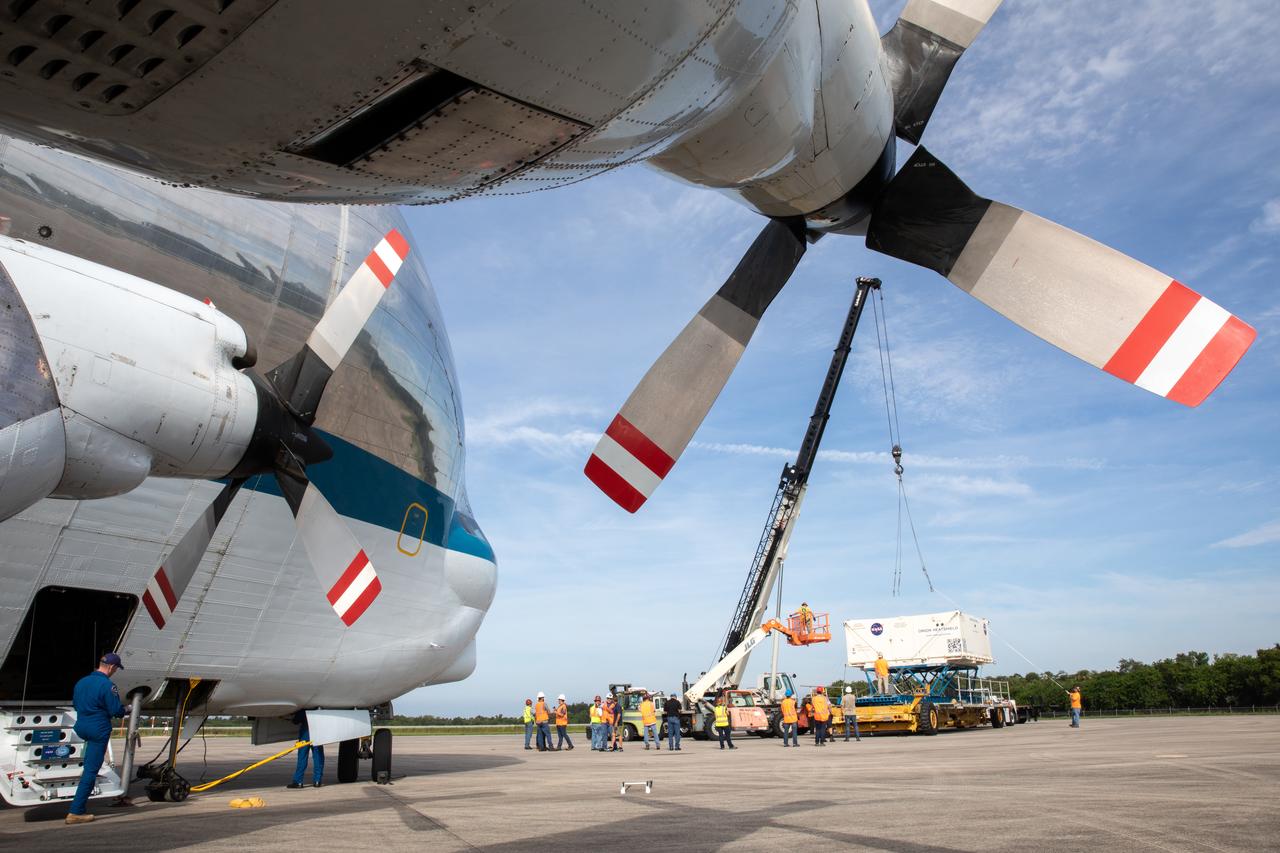
The heat shield for Orion’s Artemis 2 mission, NASA’s first crewed mission, arrives in its shipping container aboard NASA’s Super Guppy aircraft at the agency’s Kennedy Space Center Shuttle Landing Facility in Florida on July 9, 2019. The heat shield, measuring roughly 16 feet in diameter, will protect astronauts upon re-entry on the second mission of Artemis. The heat shield arrived from Lockheed Martin’s manufacturing facility near Denver. It will be offloaded and delivered to the Neil Armstrong Operations and Checkout facility high bay. The heat shield is a base titanium truss structure. Over the next several months, technicians will apply Avcoat, an ablative material that will provide the thermal protection. Artemis 2 will confirm all of the spacecraft’s systems operate as designed in the actual environment of deep space with astronauts aboard.
Artemis-2 Heat Shield Arrival