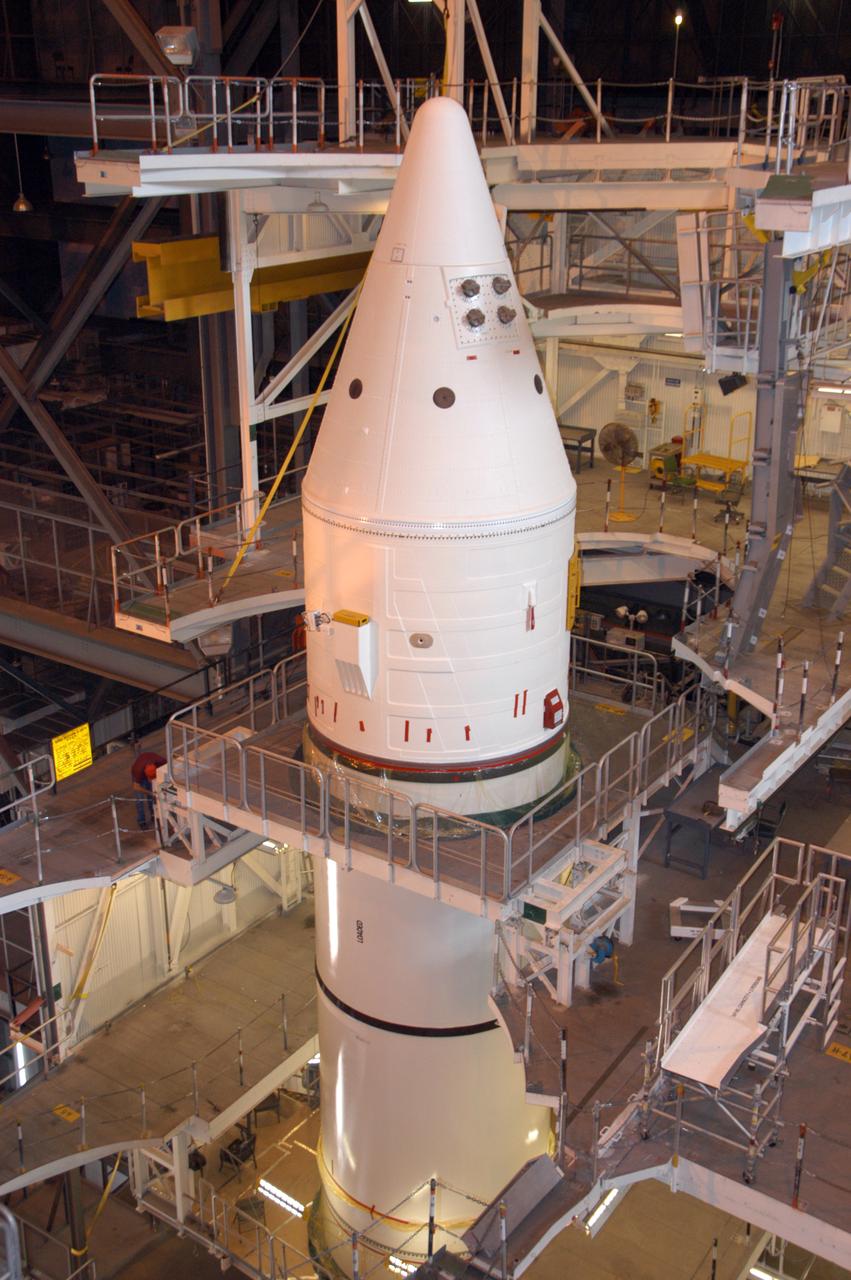
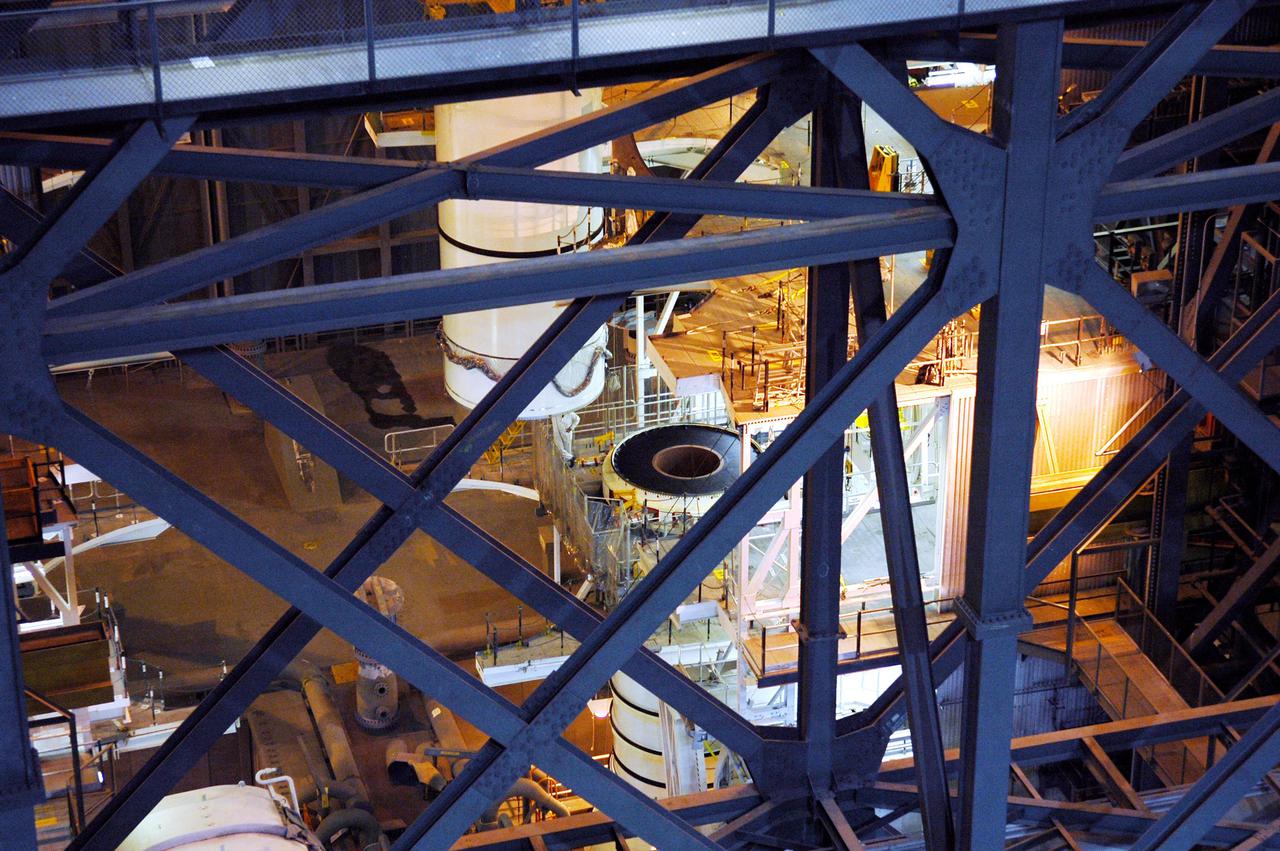
Workers continue stacking the solid rocket boosters in highbay 1 inside Kennedy Space Center's Vehicle Assembly Building. The solid rocket boosters are being prepared for NASA's next Space Shuttle launch, mission STS-117. The mission is scheduled to launch aboard Atlantis no earlier than March 16, 2007.
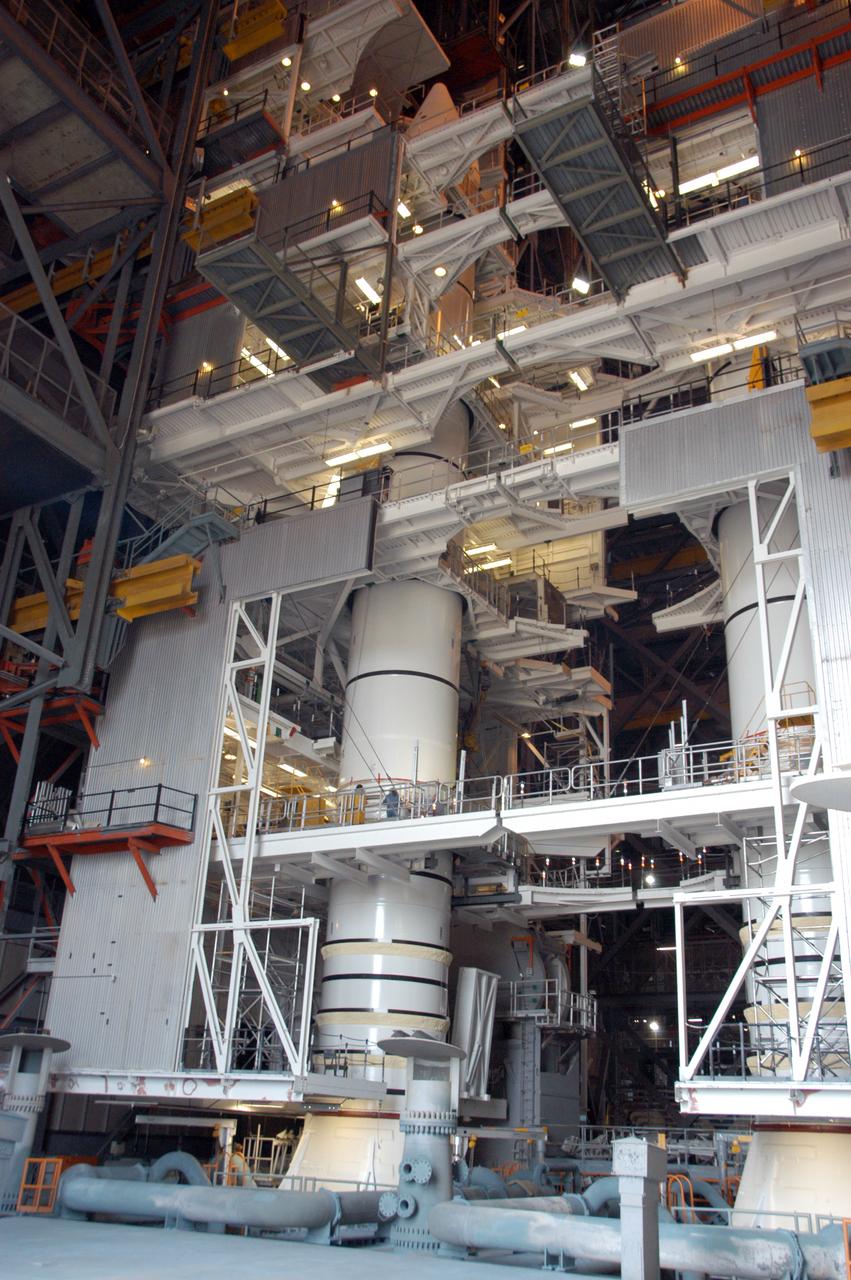
Workers continue stacking the twin solid rocket boosters in highbay 1 inside Kennedy Space Center's Vehicle Assembly Building. The solid rocket boosters are being prepared for NASA's next Space Shuttle launch, mission STS-117. The mission is scheduled to launch aboard Atlantis no earlier than March 16, 2007.
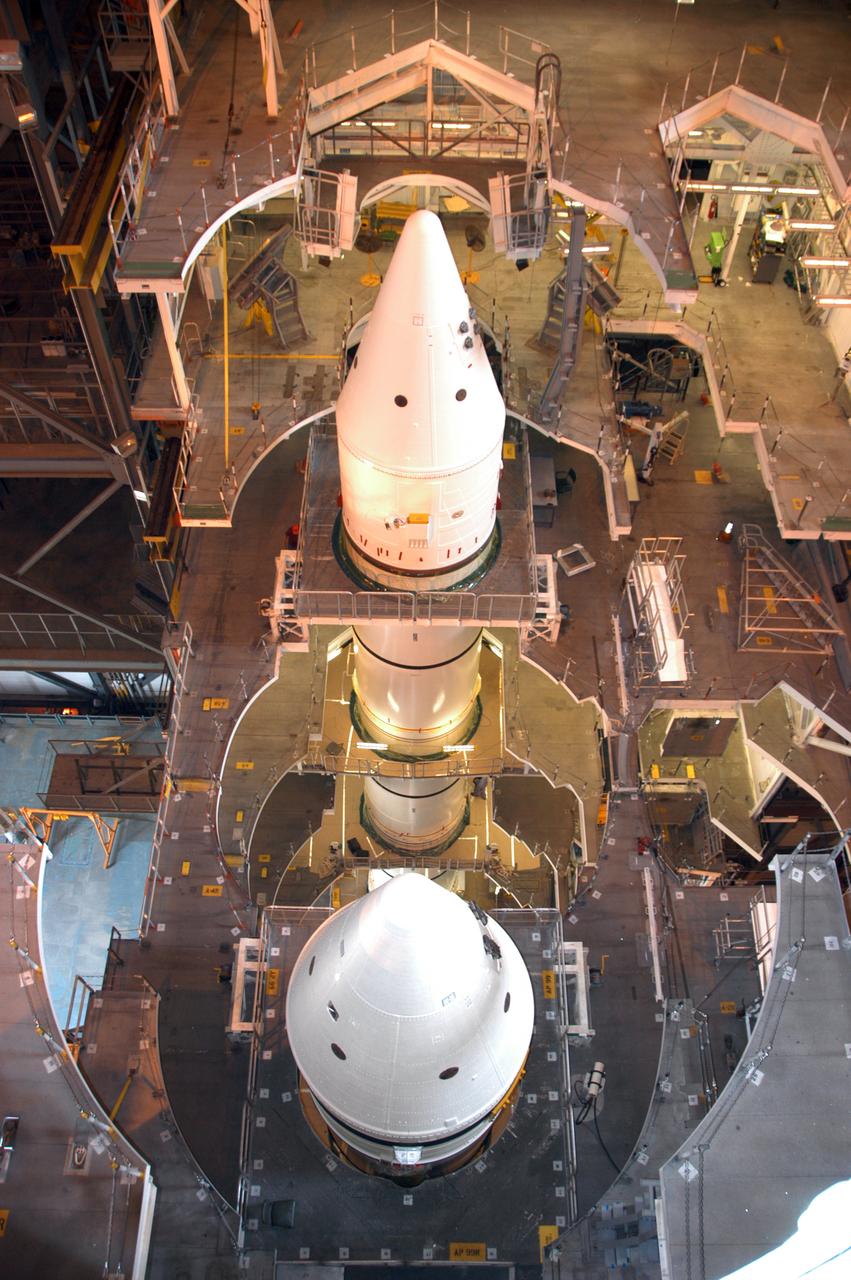
Lighting inside Kennedy Space Center's Vehicle Assembly Building seems to bathe the highbay 1 area in a golden hue as workers continue stacking the twin solid rocket boosters. The solid rocket boosters are being prepared for NASA's next Space Shuttle launch, mission STS-117. The mission is scheduled to launch aboard Atlantis no earlier than March 16, 2007.
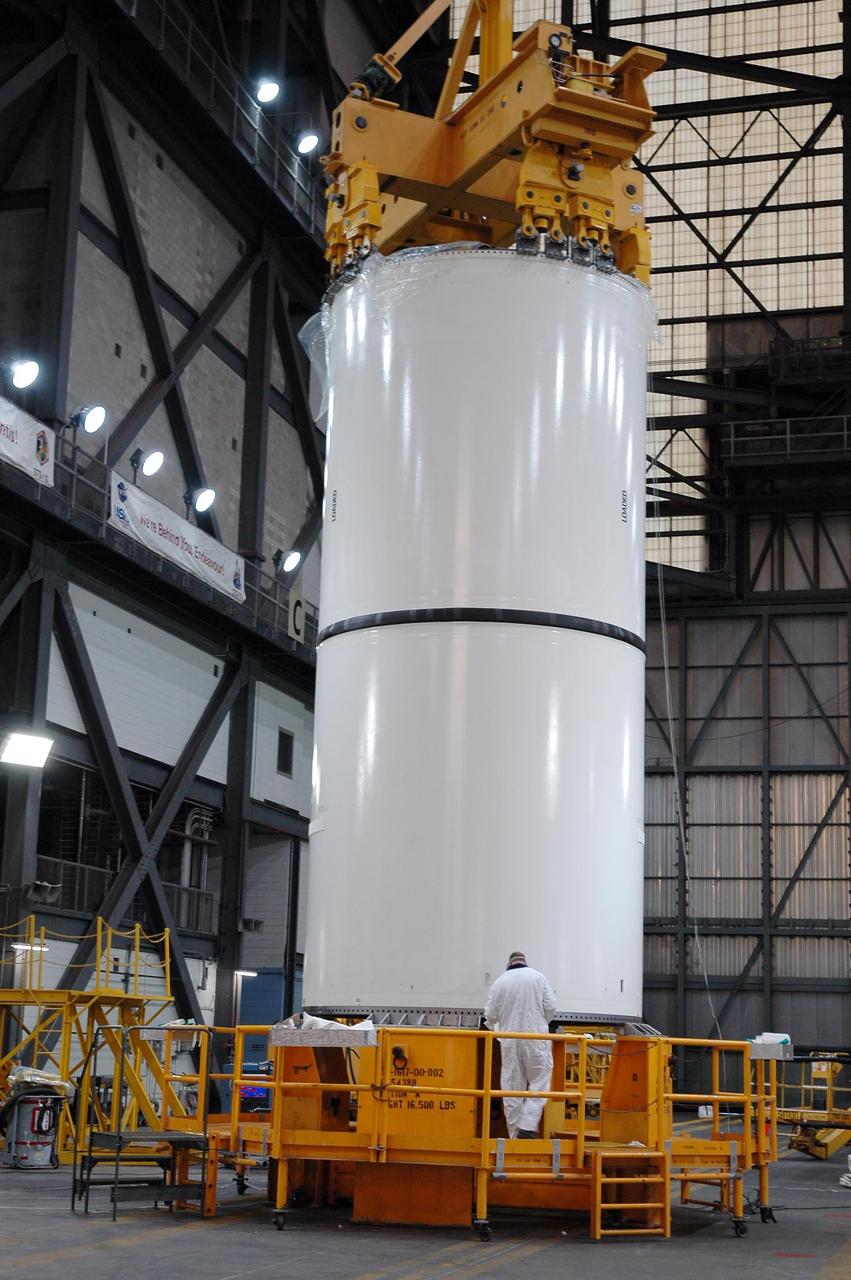
KENNEDY SPACE CENTER, FLA. - Inside the Vehicle Assembly Building at NASA's Kennedy Space Center, a solid rocket booster segment is being lifted by a 325-ton crane for stacking. The booster is part of the shuttle stack for Discovery and mission STS-121. Launch of Discovery is scheduled for no earlier than May. Photo credit: NASA/Jack Pfaller

KENNEDY SPACE CENTER, FLA. - Inside the Vehicle Assembly Building at NASA's Kennedy Space Center, a solid rocket booster segment (upper left) is mated with the lower segment. The booster is part of the shuttle stack for Discovery and mission STS-121. Launch of Discovery is scheduled for no earlier than May. Photo credit: NASA/Jack Pfaller
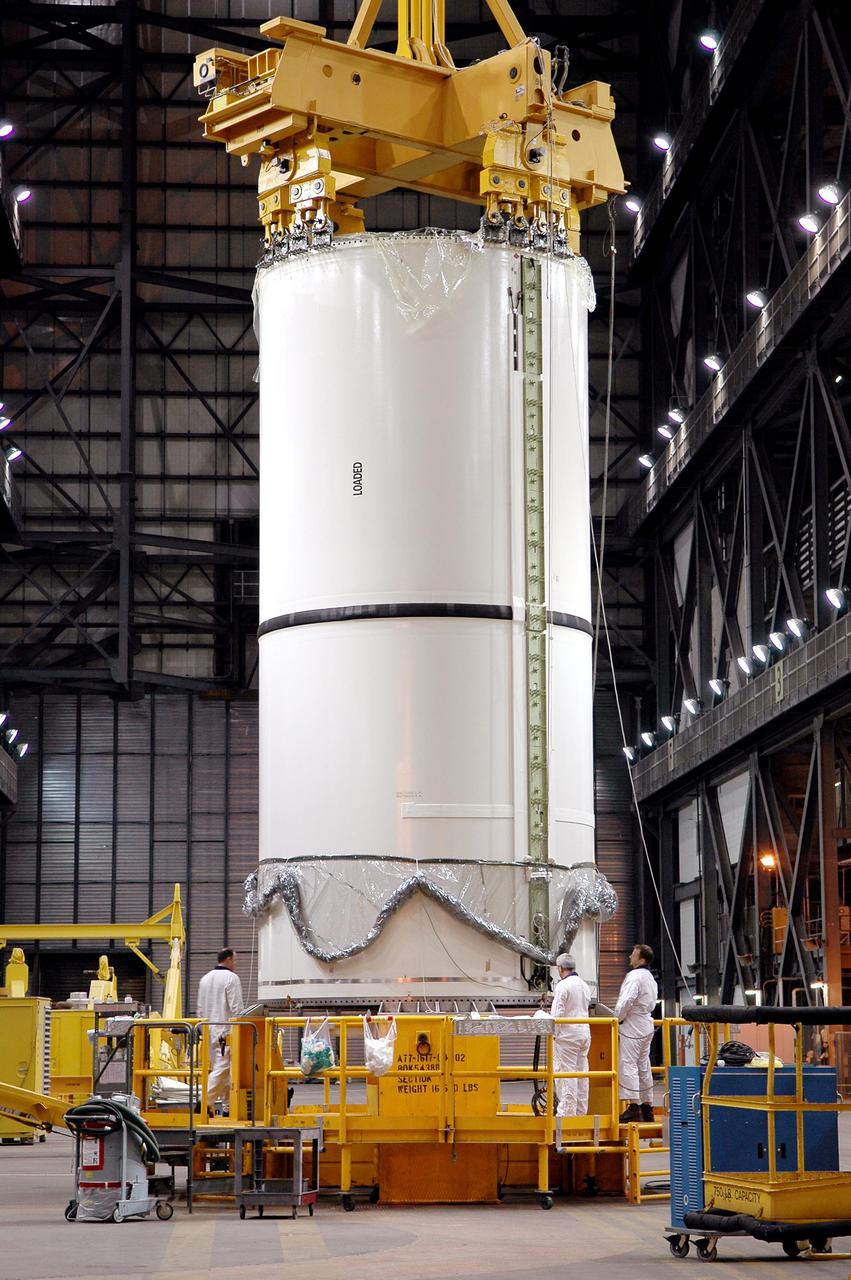
KENNEDY SPACE CENTER, FLA. - Inside the Vehicle Assembly Building (VAB), a segment of a Solid Rocket Booster (SRB) is prepared for lifting. This right aft center segment will be stacked with the aft booster that arrived in the VAB Nov. 22 for the Return to Flight mission STS-114. Two SRBs are stacked on the Mobile Launch Platform and later joined by the External Tank.. The twin 149-foot tall, 12-foot diameter SRBs provide the main propulsion system during launch. They operate parallel with the Space Shuttle main engines for the first two minutes of flight and jettison away from the orbiter with help from the Booster Separation Motors, about 26.3 nautical miles above the Earth’s surface.
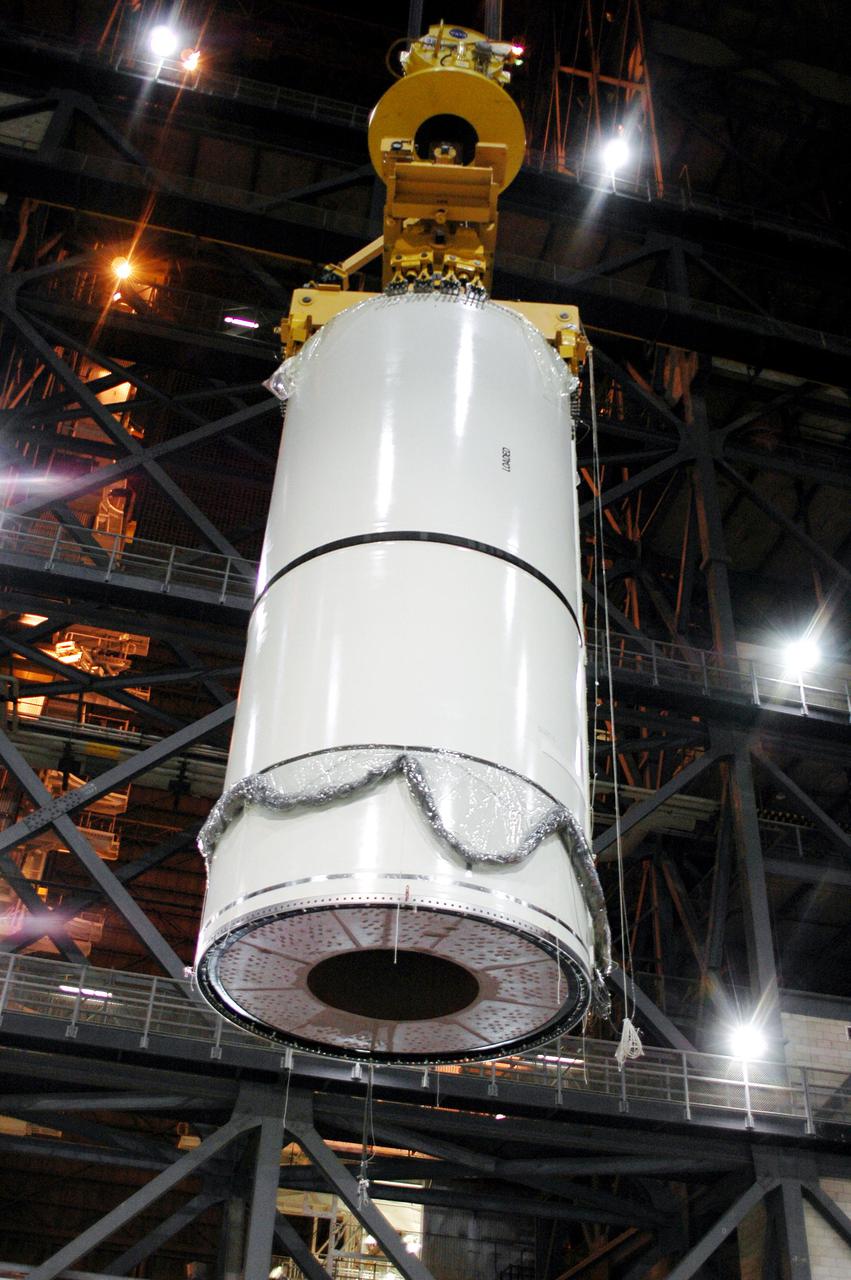
KENNEDY SPACE CENTER, FLA. - In the Vehicle Assembly Building (VAB), a segment of a Solid Rocket Booster (SRB) is lifted to the 16th level. This right aft center segment will be stacked with the aft booster that arrived in the VAB Nov. 22 for the Return to Flight mission STS-114. Two SRBs are stacked on the Mobile Launch Platform and later joined by the External Tank. The twin 149-foot tall, 12-foot diameter SRBs provide the main propulsion system during launch. They operate parallel with the Space Shuttle main engines for the first two minutes of flight and jettison away from the orbiter with help from the Booster Separation Motors, about 26.3 nautical miles above the Earth’s surface.
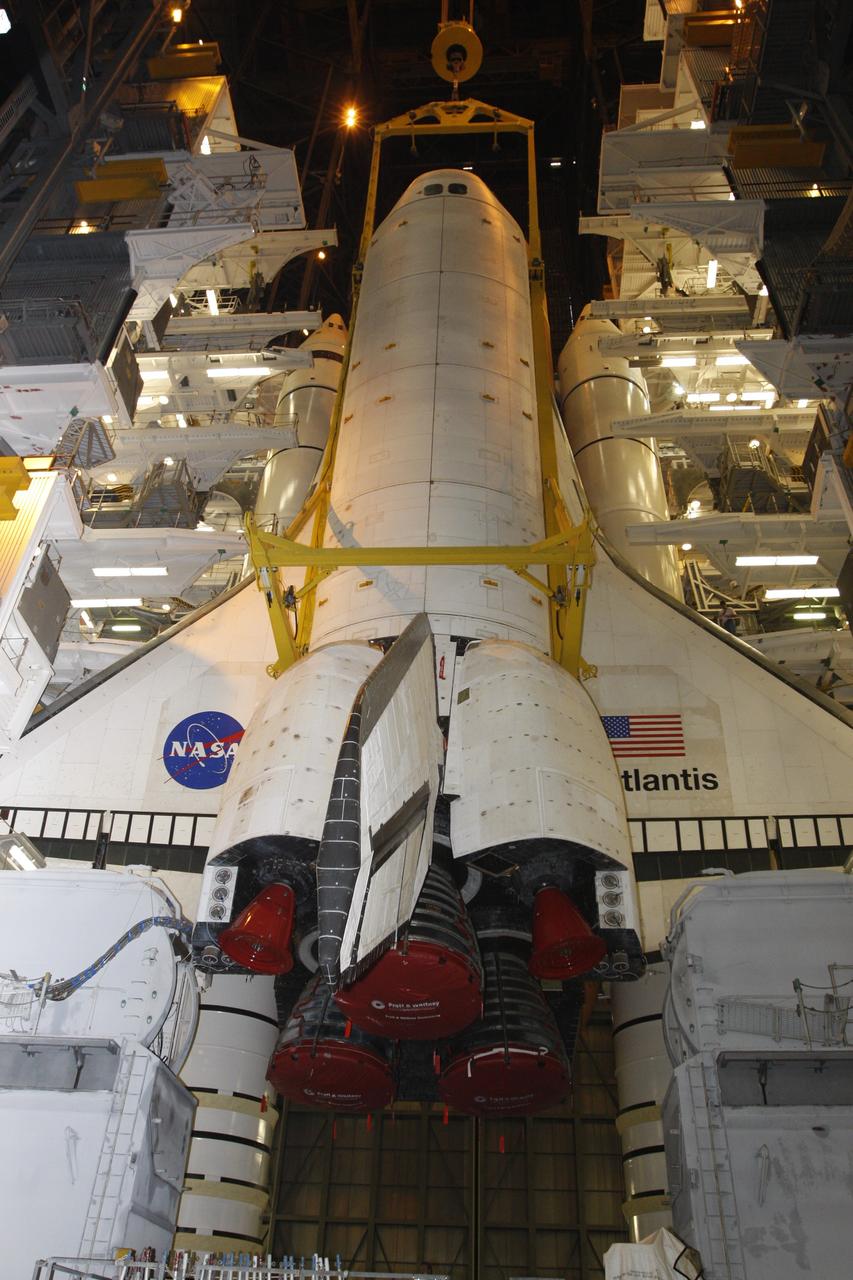
CAPE CANAVERAL, Fla. – In the Vehicle Assembly Building at NASA's Kennedy Space Center, space shuttle Atlantis approaches the floor of the mobile launcher platform in high bay 3. Behind the shuttle are the external fuel tank and twin solid rocket boosters already stacked there. Atlantis will be mated to the tank and boosters. After additional preparations are made, the shuttle will be rolled out to Launch Pad 39A to prepare for launch on the STS-125 mission targeted for 1:34 a.m. EDT Oct. 8. Photo credit: NASA/Dimitri Gerondidakis
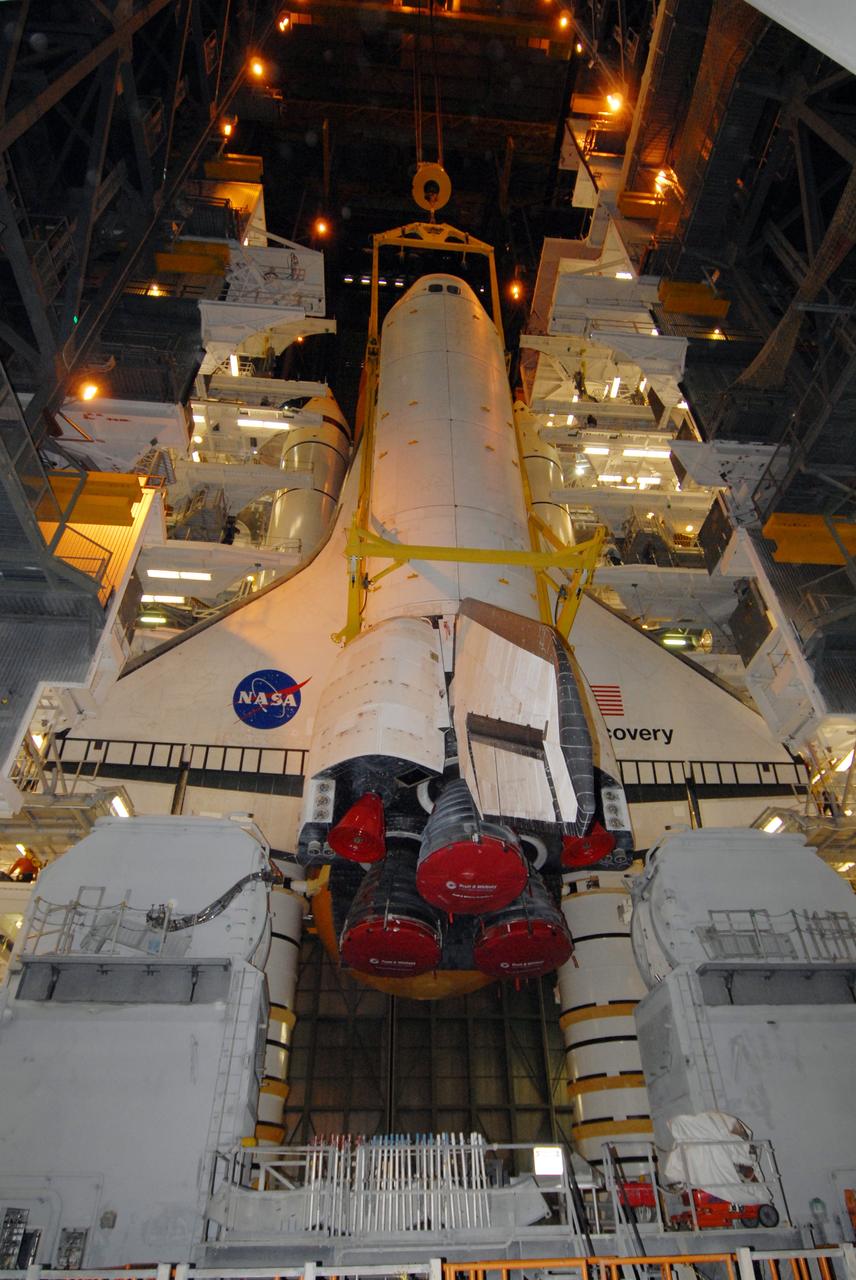
CAPE CANAVERAL, Fla. -- In the Vehicle Assembly Building at NASA's Kennedy Space Center in Florida, space shuttle Discovery is lowered alongside the external fuel tank and solid rocket boosters already stacked on the mobile launcher platform. Discovery will be mated with the stack. After additional preparations are made, the shuttle will be rolled out to Launch Pad 39A for a targeted launch on Feb. 12. Discovery will carry the final starboard truss (S6) in the assembly of the International Space Station. Photo credit: NASA/Jack Pfaller
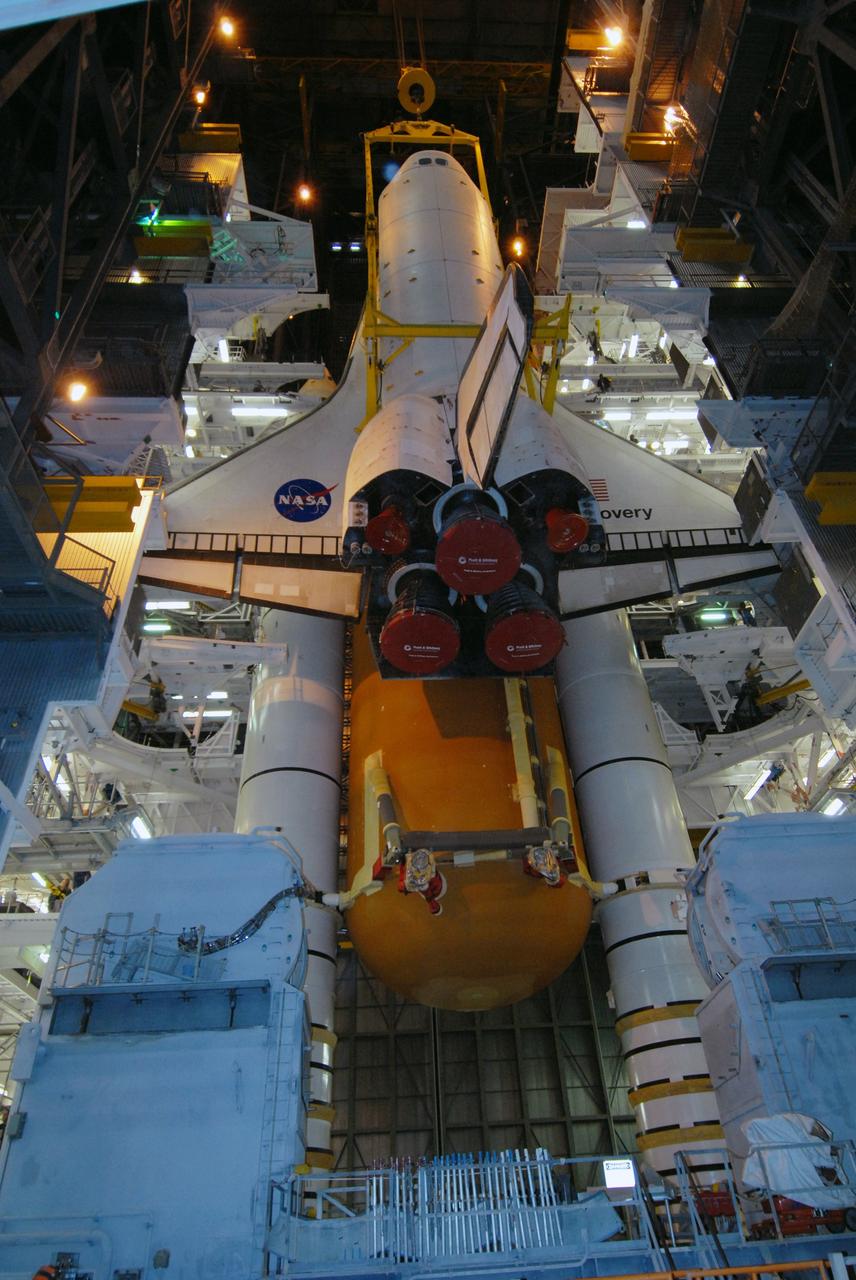
CAPE CANAVERAL, Fla. -- In the Vehicle Assembly Building at NASA's Kennedy Space Center in Florida, space shuttle Discovery is lowered into high bay 3 alongside the external fuel tank and solid rocket boosters are already stacked on the mobile launcher platform. Discovery will be mated with the stack. After additional preparations are made, the shuttle will be rolled out to Launch Pad 39A for a targeted launch on Feb. 12. Discovery will carry the final starboard truss (S6) in the assembly of the International Space Station. Photo credit: NASA/Jack Pfaller
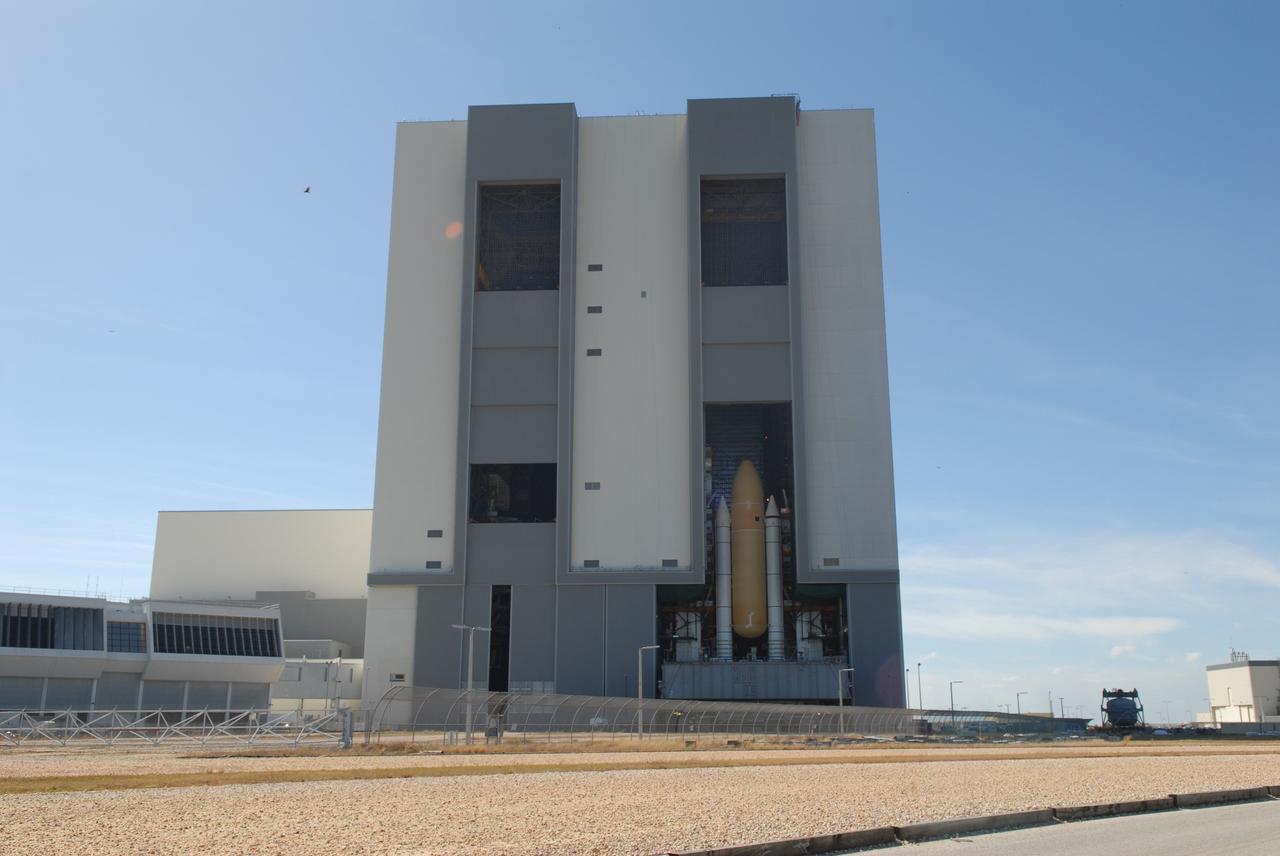
CAPE CANAVERAL, Fla. – Space shuttle Atlantis' external fuel tank-solid rocket booster stack, atop a mobile launcher platform, rolls through the doors of the Vehicle Assembly Building at NASA's Kennedy Space Center into high bay 3. The ET/SRB stack was moved from high bay 1 to make room for the ET-SRB stack for space shuttle Endeavour. Atlantis is targeted for launch on the STS-125 mission on May 12 to service NASA's Hubble Space Telescope. Endeavour will fly on the STS-127 mission to the International Space Station and bring the final segments for Japan's Kibo laboratory. Photo credit: NASA/Dimitri Gerondidakis
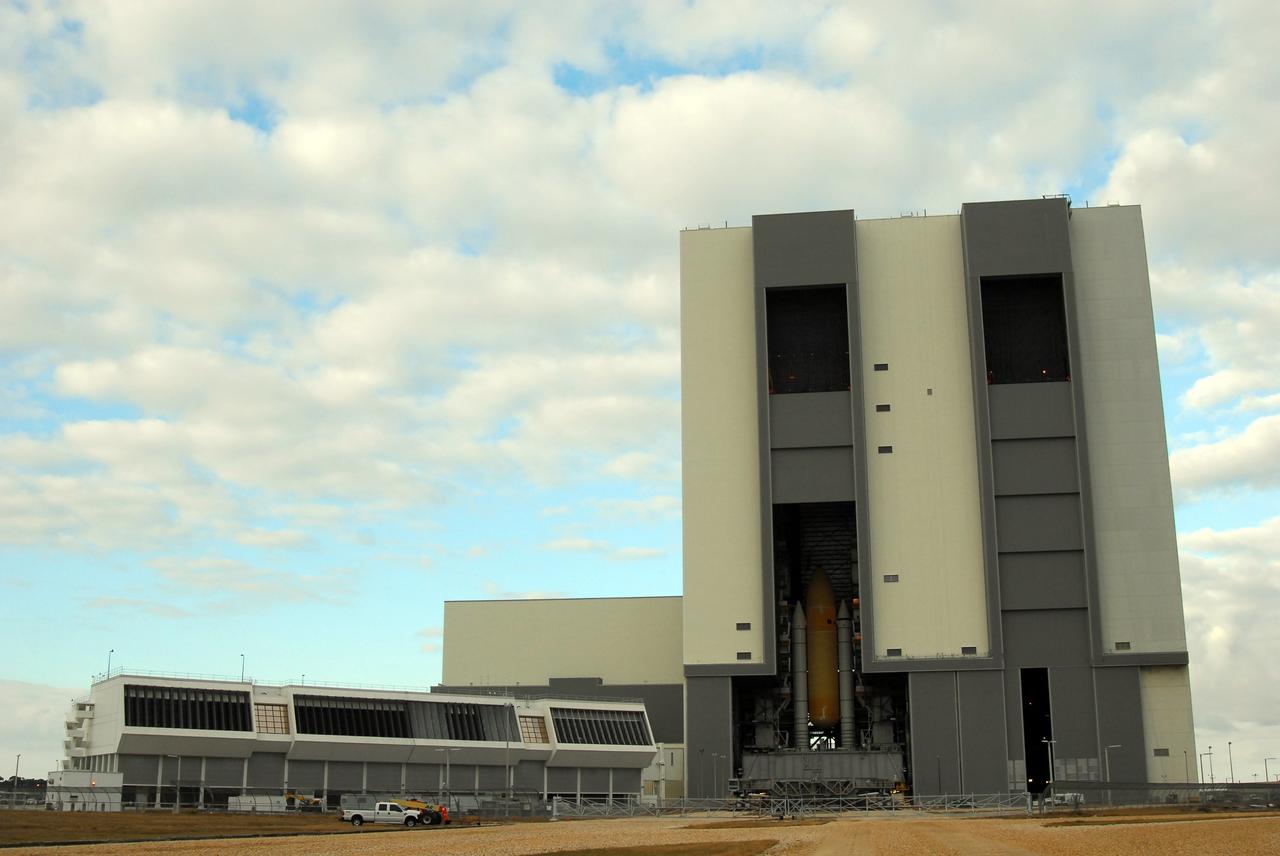
CAPE CANAVERAL, Fla. – The doors of the Vehicle Assembly Building at NASA's Kennedy Space Center open to reveal space shuttle Atlantis' external fuel tank-solid rocket booster stack in high bay 1. The stack on the mobile launcher platform will be moved to high bay 3 to make room for the ET-SRB stack for space shuttle Endeavour. Atlantis is targeted for launch on the STS-125 mission on May 12 to service NASA's Hubble Space Telescope. Endeavour will fly on the STS-127 mission to the International Space Station and bring the final segments for Japan's Kibo laboratory. Photo credit: NASA/Tim Jacobs
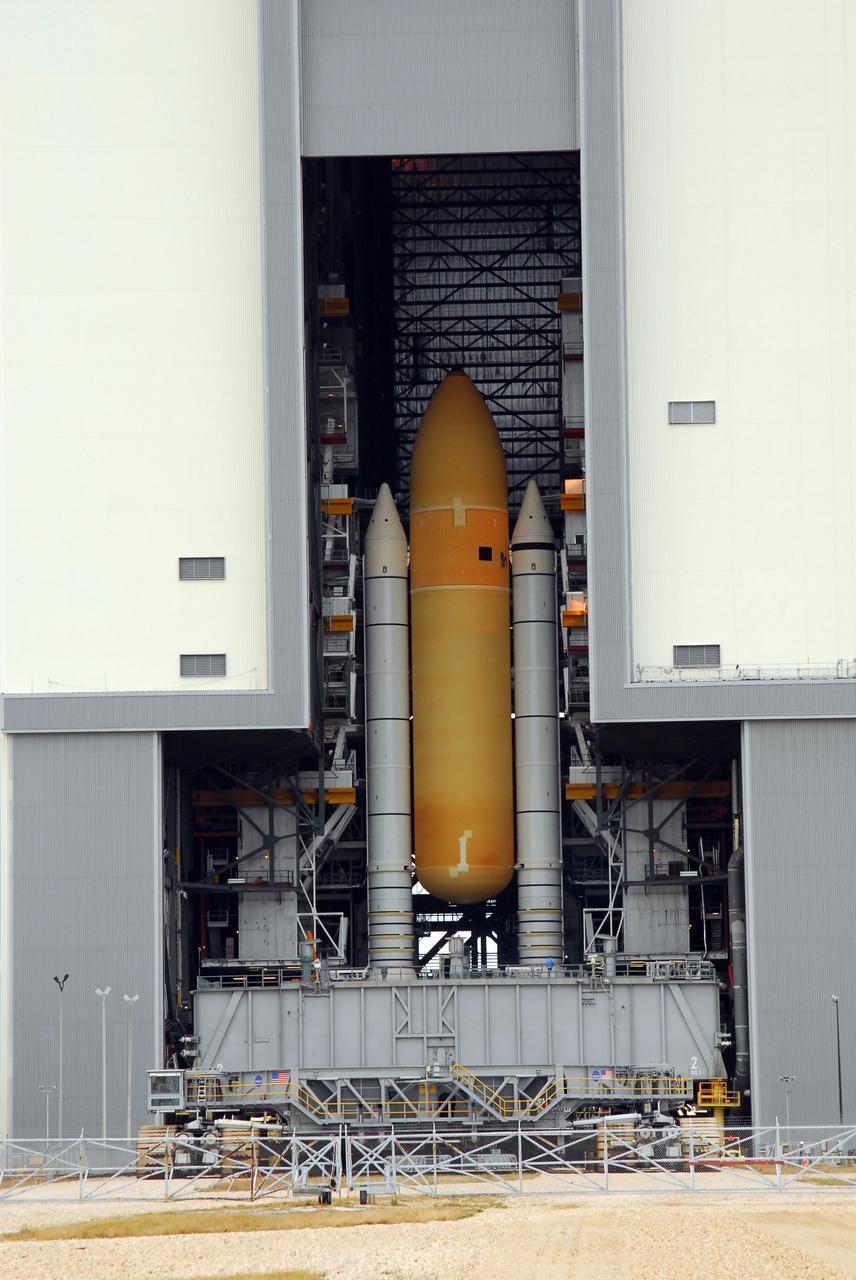
CAPE CANAVERAL, Fla. – The doors of the Vehicle Assembly Building at NASA's Kennedy Space Center open to reveal space shuttle Atlantis' external fuel tank-solid rocket booster stack in high bay 1. The stack on the mobile launcher platform will be moved to high bay 3 to make room for the ET-SRB stack for space shuttle Endeavour. Atlantis is targeted for launch on the STS-125 mission on May 12 to service NASA's Hubble Space Telescope. Endeavour will fly on the STS-127 mission to the International Space Station and bring the final segments for Japan's Kibo laboratory. Photo credit: NASA/Tim Jacobs
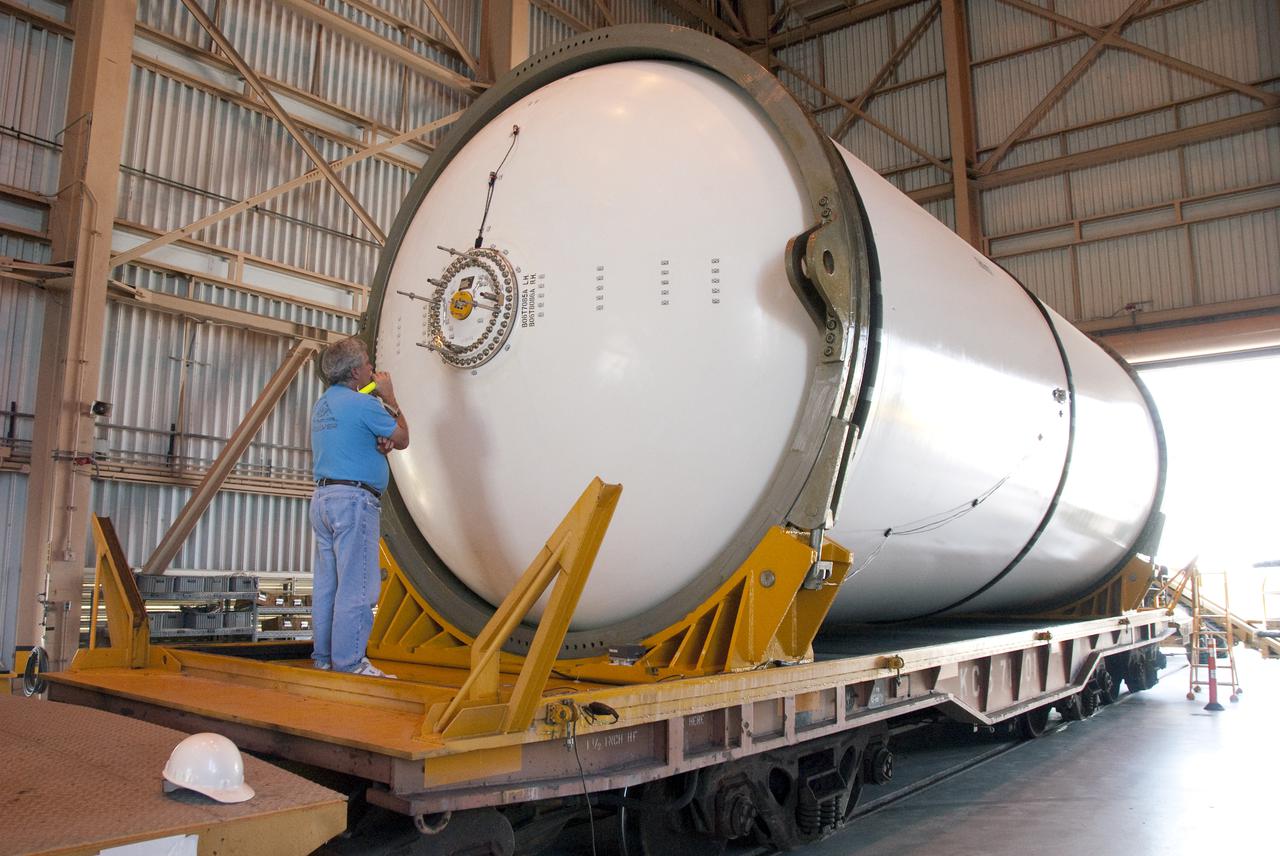
CAPE CANAVERAL, Fla. -- In the Rotation, Processing and Surge Facility, or RSPF, at NASA's Kennedy Space Center in Florida, workers perform the propellant grain inspection of the final solid rocket booster segments, which is a required safety analysis. The booster segments were manufactured at the ATK solid rocket booster plant in Promontory, Utah, and traveled to Kennedy along the Florida East Coast Railway. The booster segments will be stacked and then mated to space shuttle Atlantis and its external fuel tank in the Vehicle Assembly Building. The segments will be used for what currently is planned as the 'launch on need,' or potential rescue mission for the final shuttle flight, Endeavour's STS-134 mission. For information, visit www.nasa.gov_shuttle. Photo credit: NASA_Cory Huston
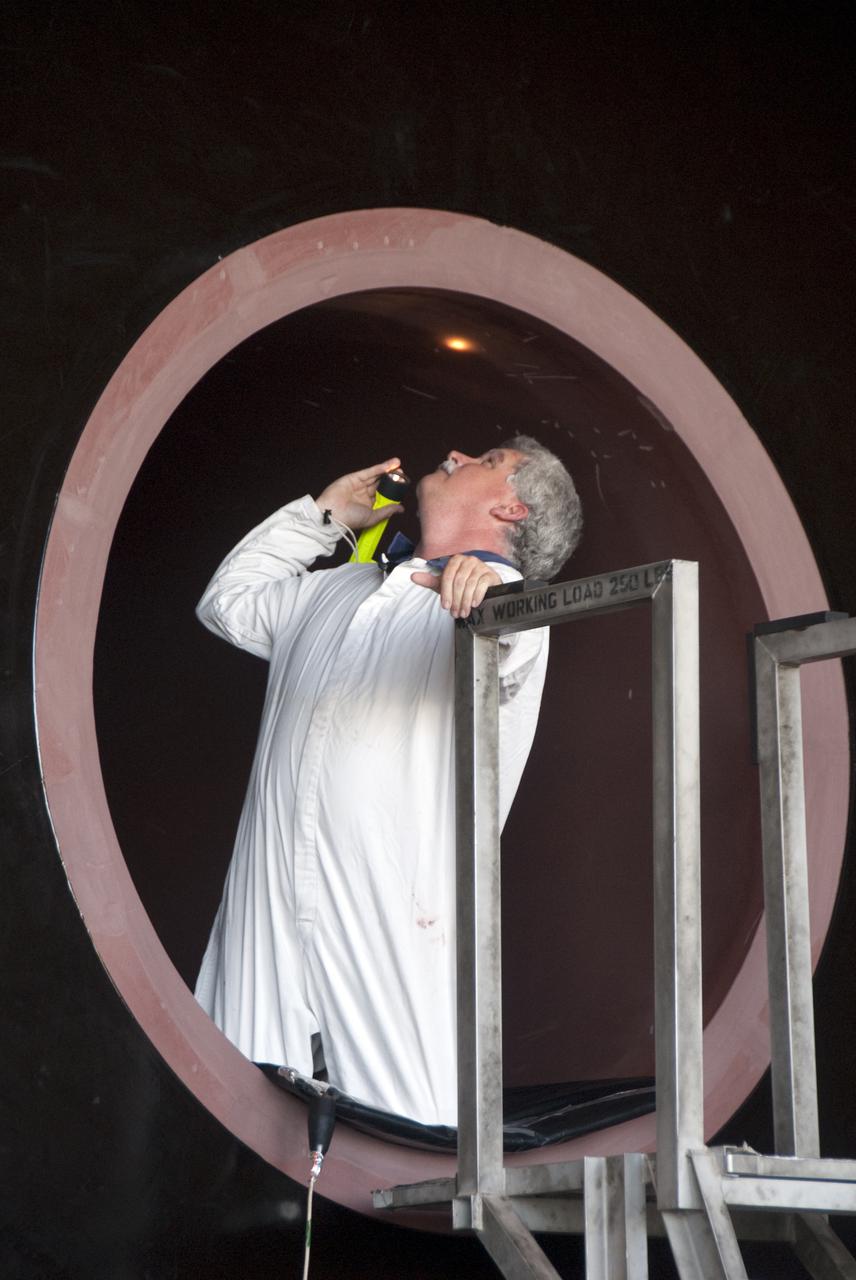
CAPE CANAVERAL, Fla. -- In the Rotation, Processing and Surge Facility, or RSPF, at NASA's Kennedy Space Center in Florida, a worker performs the propellant grain inspection of the final solid rocket booster segments, which is a required safety analysis. The booster segments were manufactured at the ATK solid rocket booster plant in Promontory, Utah, and traveled to Kennedy along the Florida East Coast Railway. The booster segments will be stacked and then mated to space shuttle Atlantis and its external fuel tank in the Vehicle Assembly Building. The segments will be used for what currently is planned as the 'launch on need,' or potential rescue mission for the final shuttle flight, Endeavour's STS-134 mission. For information, visit www.nasa.gov_shuttle. Photo credit: NASA_Cory Huston
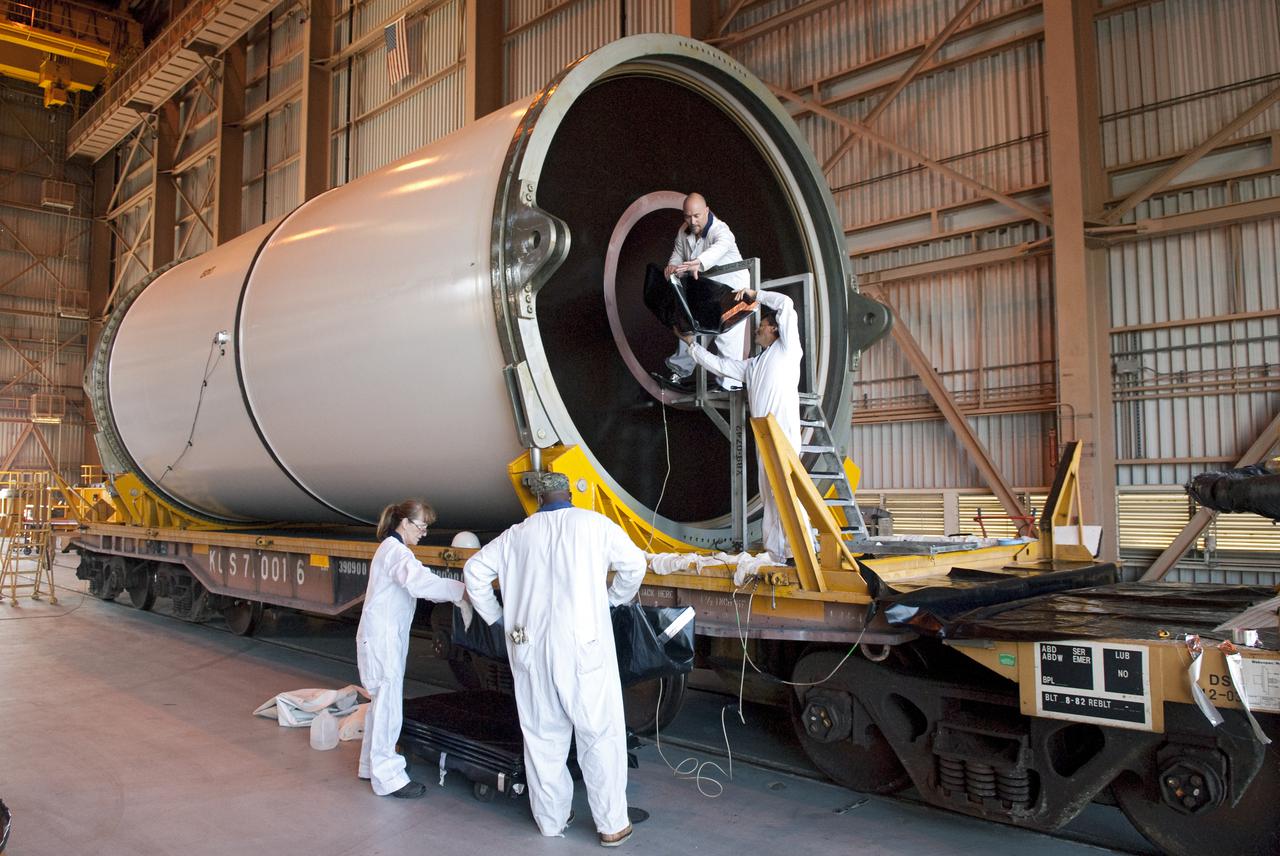
CAPE CANAVERAL, Fla. -- In the Rotation, Processing and Surge Facility, or RSPF, at NASA's Kennedy Space Center in Florida, workers prepare for the propellant grain inspection of the final solid rocket booster segments, which is a required safety analysis. The booster segments were manufactured at the ATK solid rocket booster plant in Promontory, Utah, and traveled to Kennedy along the Florida East Coast Railway. The booster segments will be stacked and then mated to space shuttle Atlantis and its external fuel tank in the Vehicle Assembly Building. The segments will be used for what currently is planned as the 'launch on need,' or potential rescue mission for the final shuttle flight, Endeavour's STS-134 mission. For information, visit www.nasa.gov_shuttle. Photo credit: NASA_Cory Huston
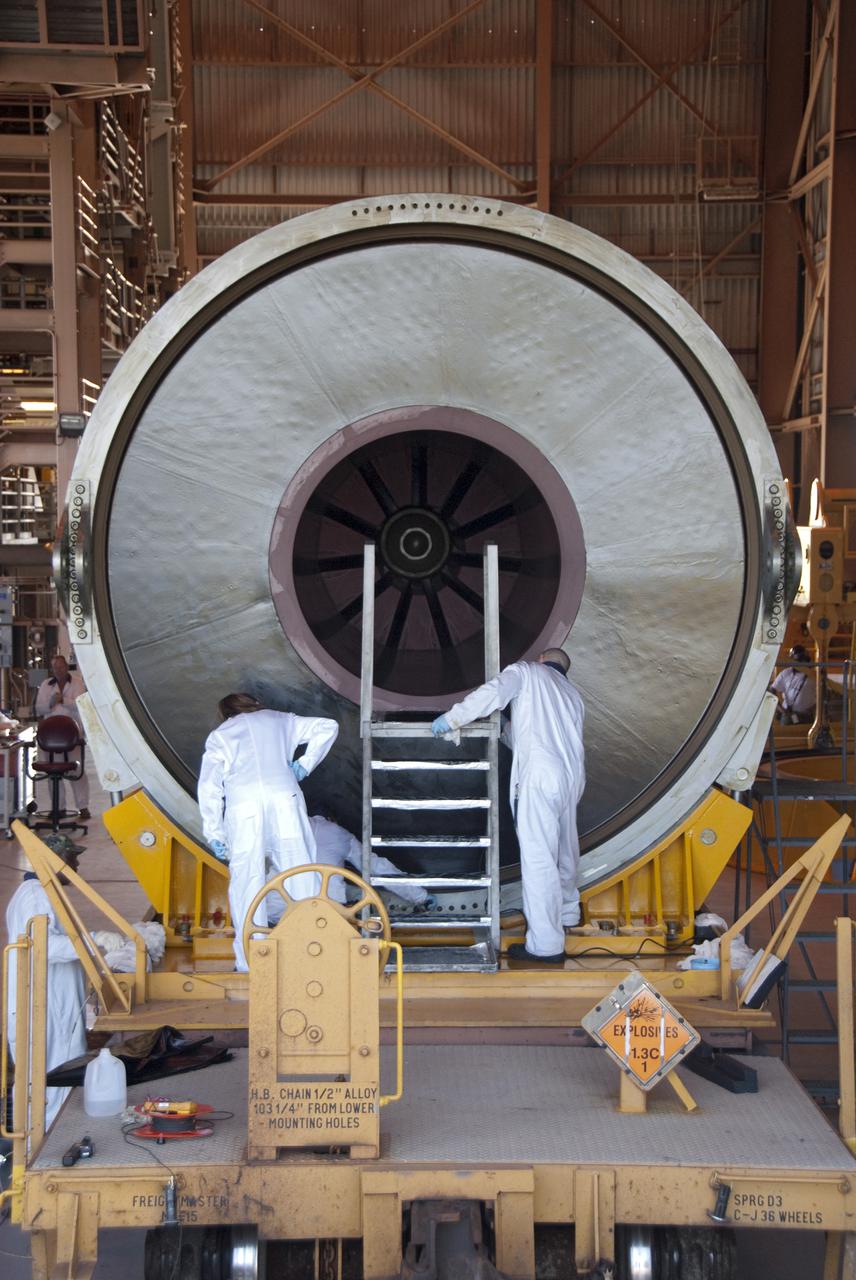
CAPE CANAVERAL, Fla. -- In the Rotation, Processing and Surge Facility, or RSPF, at NASA's Kennedy Space Center in Florida, workers prepare for the propellant grain inspection of the final solid rocket booster segments, which is a required safety analysis. The booster segments were manufactured at the ATK solid rocket booster plant in Promontory, Utah, and traveled to Kennedy along the Florida East Coast Railway. The booster segments will be stacked and then mated to space shuttle Atlantis and its external fuel tank in the Vehicle Assembly Building. The segments will be used for what currently is planned as the 'launch on need,' or potential rescue mission for the final shuttle flight, Endeavour's STS-134 mission. For information, visit www.nasa.gov_shuttle. Photo credit: NASA_Cory Huston
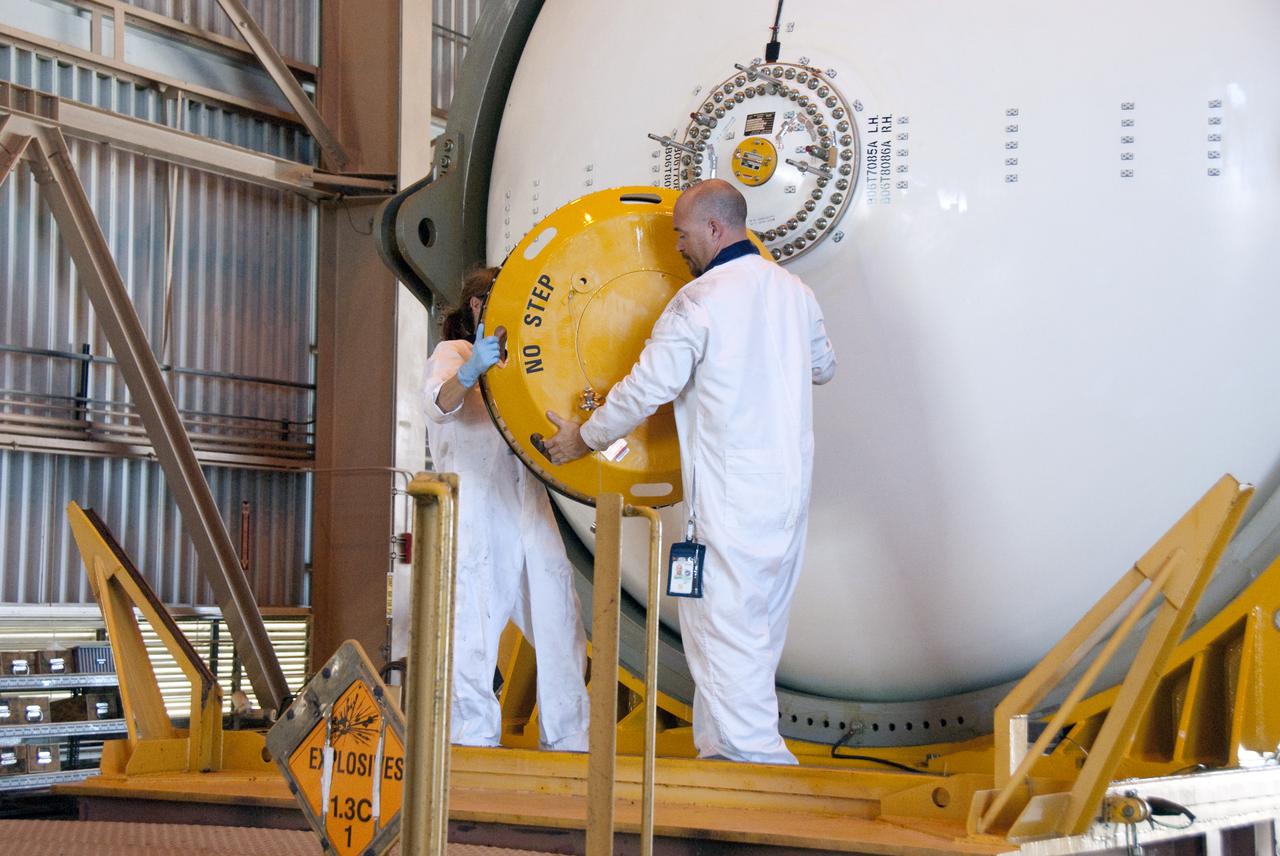
CAPE CANAVERAL, Fla. -- In the Rotation, Processing and Surge Facility, or RSPF, at NASA's Kennedy Space Center in Florida, workers perform the propellant grain inspection of the final solid rocket booster segments, which is a required safety analysis. The booster segments were manufactured at the ATK solid rocket booster plant in Promontory, Utah, and traveled to Kennedy along the Florida East Coast Railway. The booster segments will be stacked and then mated to space shuttle Atlantis and its external fuel tank in the Vehicle Assembly Building. The segments will be used for what currently is planned as the 'launch on need,' or potential rescue mission for the final shuttle flight, Endeavour's STS-134 mission. For information, visit www.nasa.gov_shuttle. Photo credit: NASA_Cory Huston
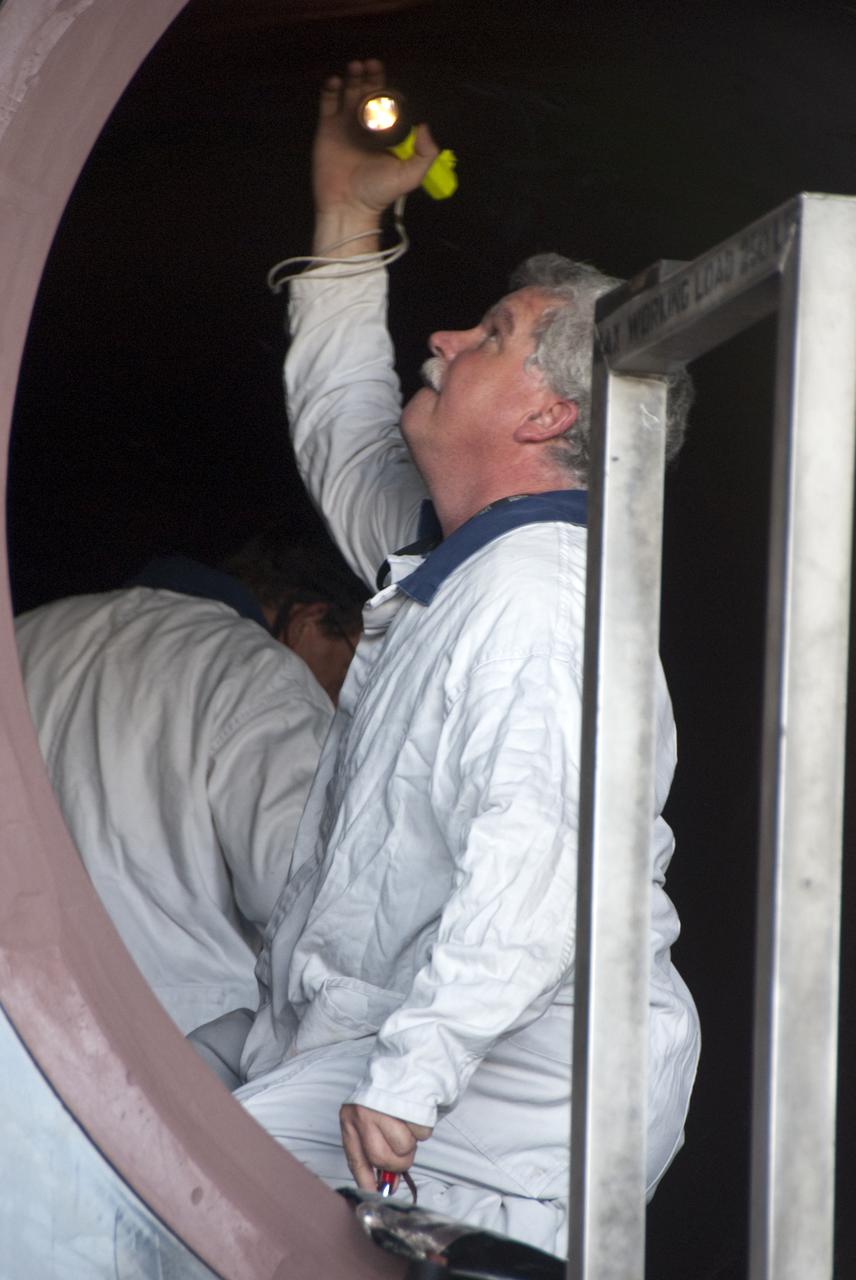
CAPE CANAVERAL, Fla. -- In the Rotation, Processing and Surge Facility, or RSPF, at NASA's Kennedy Space Center in Florida, a worker performs the propellant grain inspection of the final solid rocket booster segments, which is a required safety analysis. The booster segments were manufactured at the ATK solid rocket booster plant in Promontory, Utah, and traveled to Kennedy along the Florida East Coast Railway. The booster segments will be stacked and then mated to space shuttle Atlantis and its external fuel tank in the Vehicle Assembly Building. The segments will be used for what currently is planned as the 'launch on need,' or potential rescue mission for the final shuttle flight, Endeavour's STS-134 mission. For information, visit www.nasa.gov_shuttle. Photo credit: NASA_Cory Huston
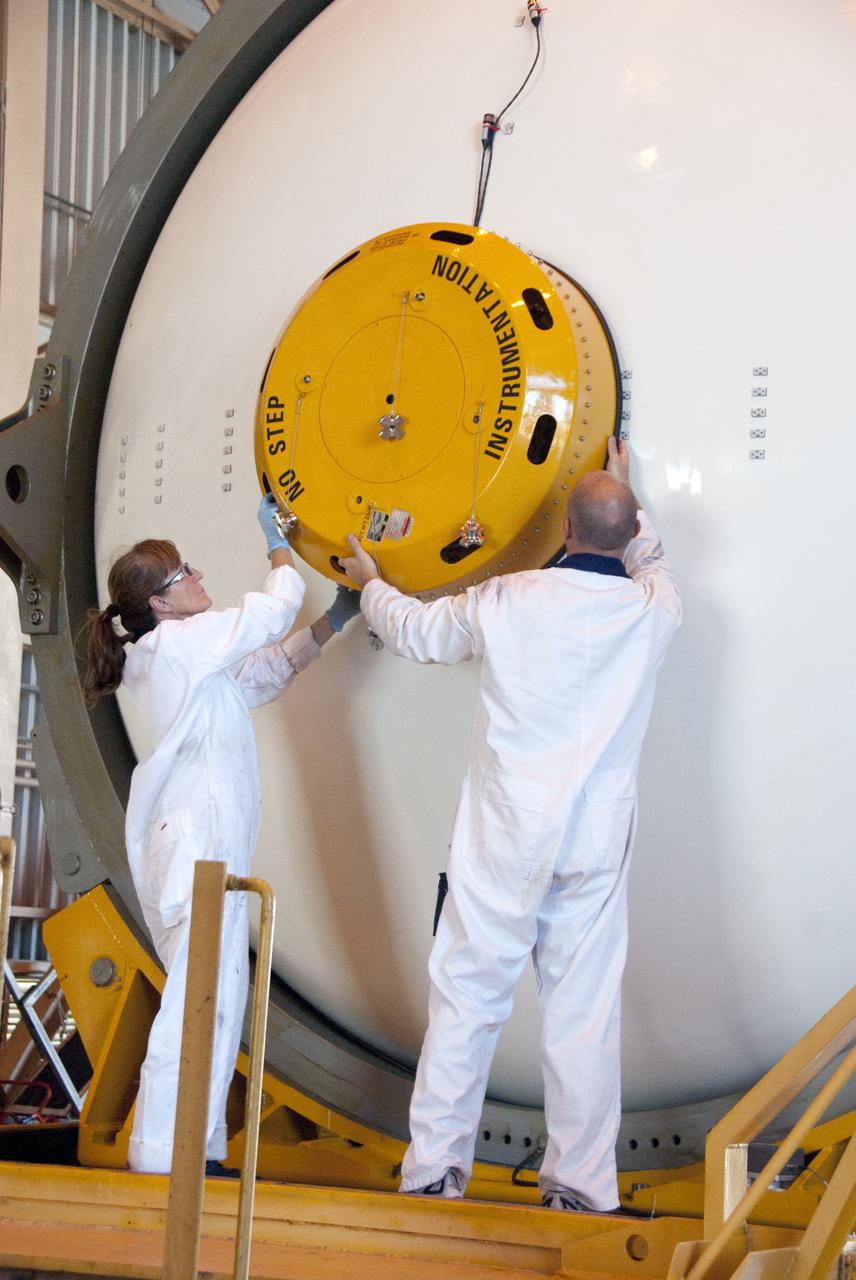
CAPE CANAVERAL, Fla. -- In the Rotation, Processing and Surge Facility, or RSPF, at NASA's Kennedy Space Center in Florida, workers perform the propellant grain inspection of the final solid rocket booster segments, which is a required safety analysis. The booster segments were manufactured at the ATK solid rocket booster plant in Promontory, Utah, and traveled to Kennedy along the Florida East Coast Railway. The booster segments will be stacked and then mated to space shuttle Atlantis and its external fuel tank in the Vehicle Assembly Building. The segments will be used for what currently is planned as the 'launch on need,' or potential rescue mission for the final shuttle flight, Endeavour's STS-134 mission. For information, visit www.nasa.gov_shuttle. Photo credit: NASA_Cory Huston
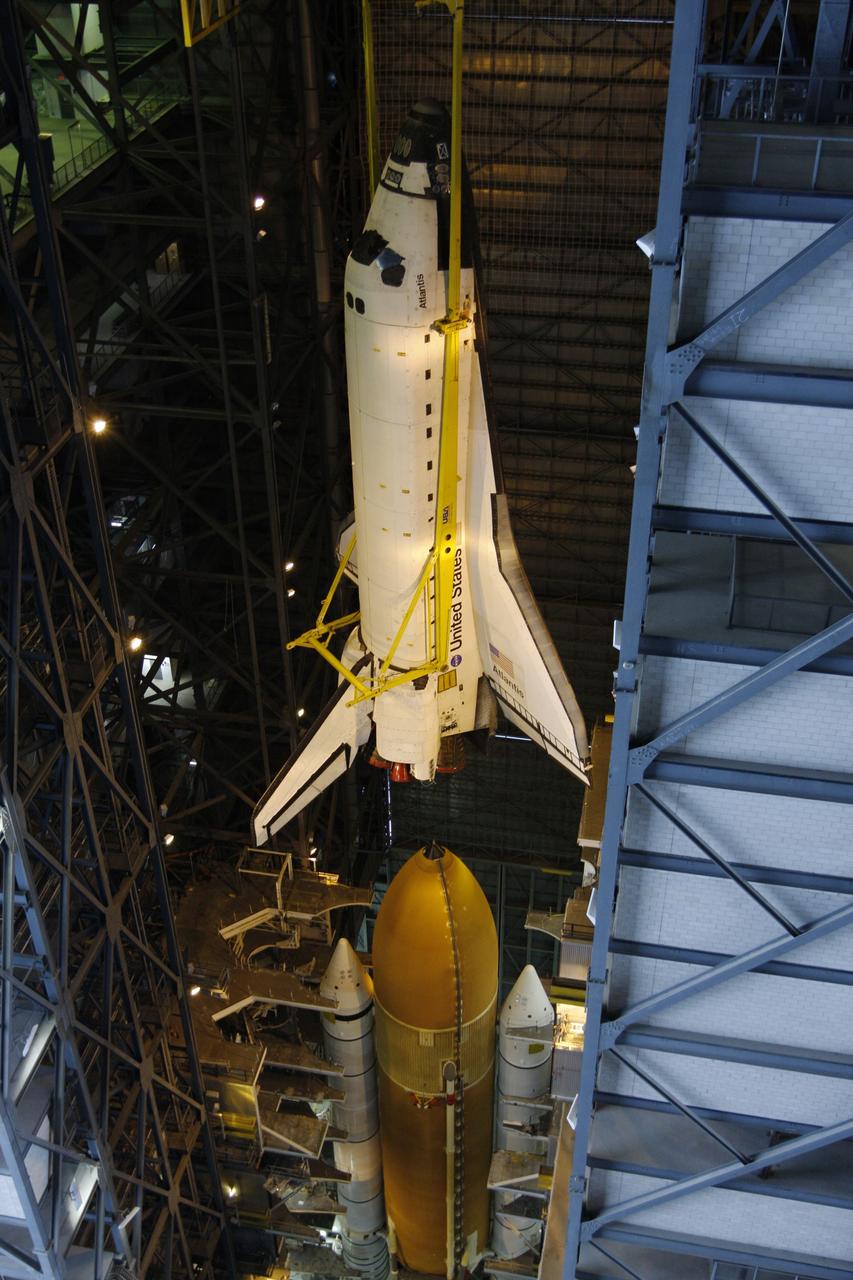
CAPE CANAVERAL, Fla. – In the Vehicle Assembly Building at NASA's Kennedy Space Center, space shuttle Atlantis is lowered toward the external fuel tank and twin solid rocket boosters in high bay 3. Atlantis will be mated to the tank and boosters stacked on the mobile launcher platform. After additional preparations are made, the shuttle will be rolled out to Launch Pad 39A to prepare for launch on the STS-125 mission targeted for 1:34 a.m. EDT Oct. 8. Photo credit: NASA/Dimitri Gerondidakis
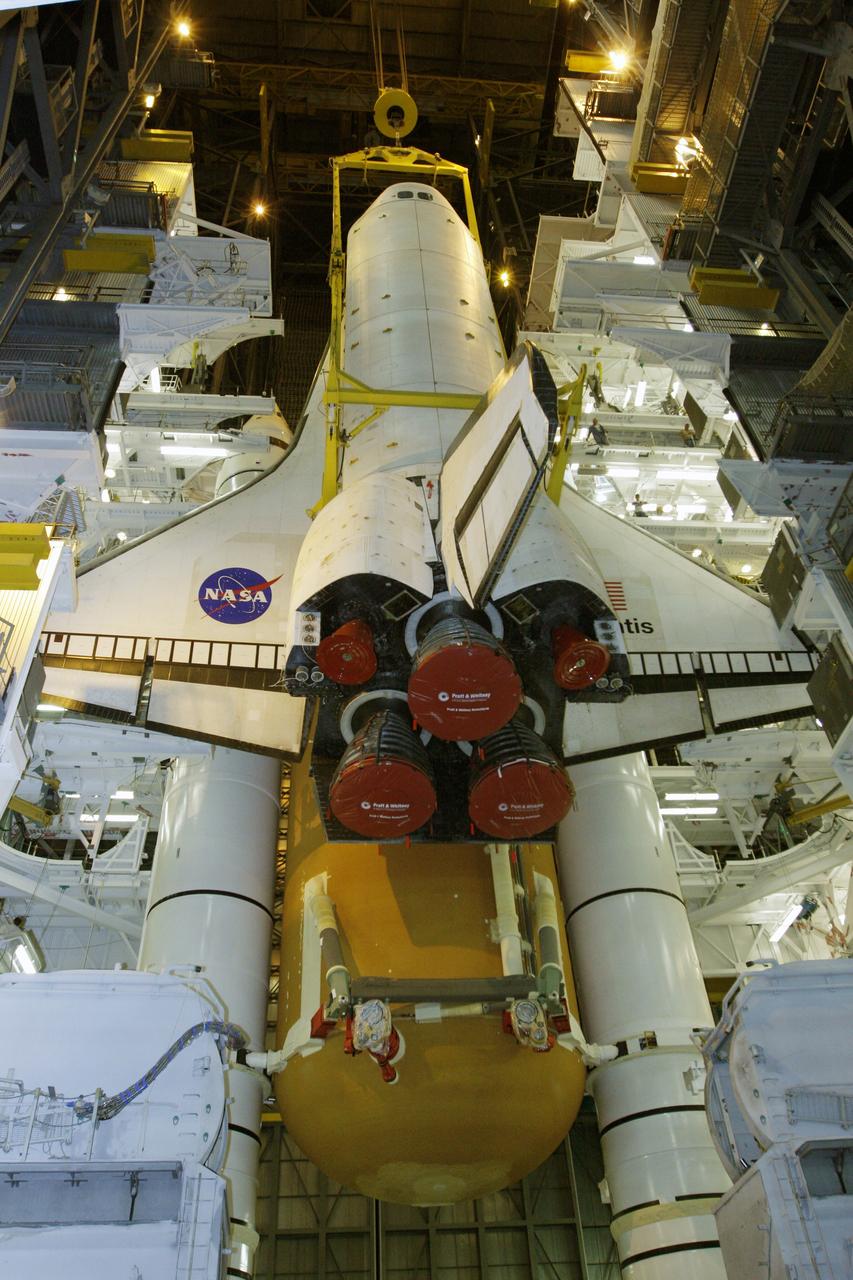
CAPE CANAVERAL, Fla. – In the Vehicle Assembly Building at NASA's Kennedy Space Center, space shuttle Atlantis is lowered alongside the external fuel tank and twin solid rocket boosters in high bay 3. Atlantis will be mated to the tank and boosters stacked on the mobile launcher platform. After additional preparations are made, the shuttle will be rolled out to Launch Pad 39A to prepare for launch on the STS-125 mission targeted for 1:34 a.m. EDT Oct. 8. Photo credit: NASA/Dimitri Gerondidakis
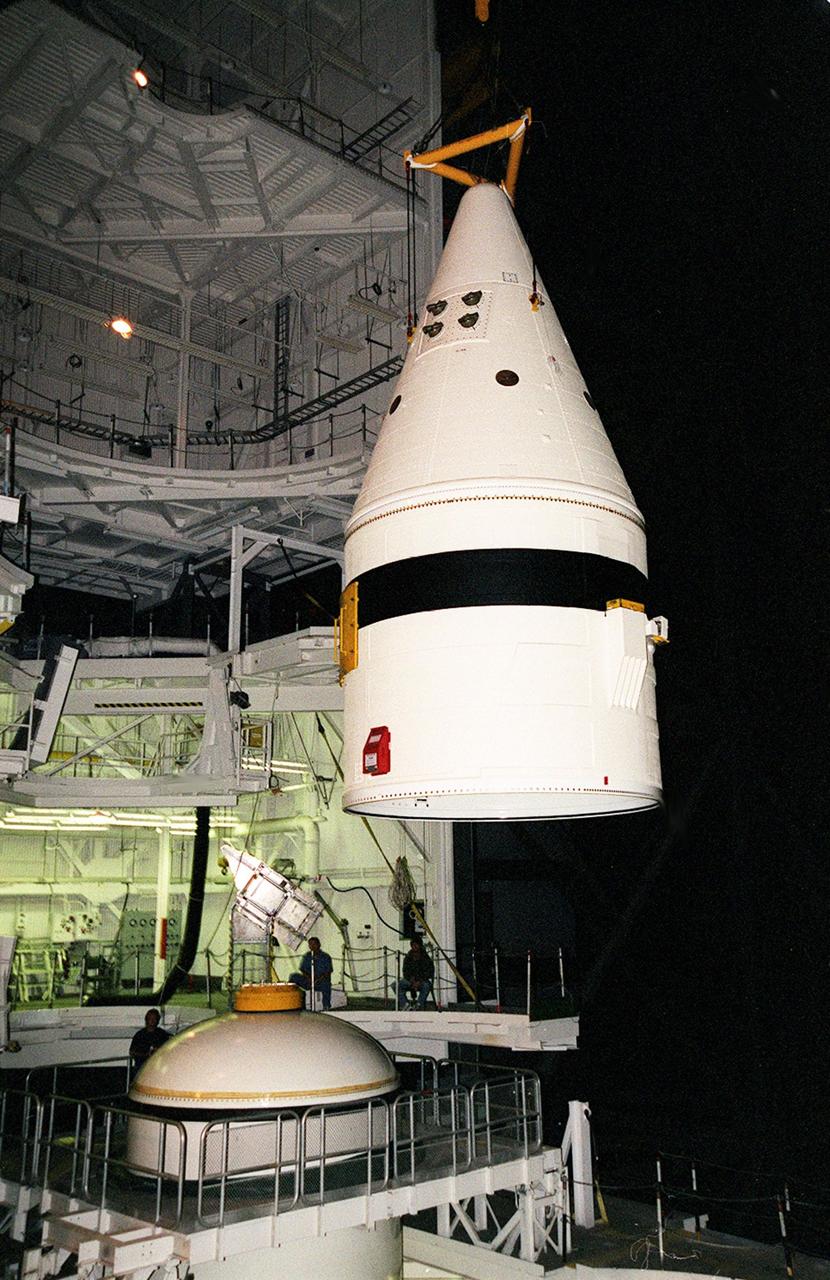
Inside the Vehicle Assembly Building, an overhead crane moves the forward section of a solid rocket booster (SRB) toward the previously stacked elements at lower left in the photo. The forward section of each booster, from nose cap to forward skirt contains avionics, a sequencer, forward separation motors, a nose cone separation system, drogue and main parachutes, a recovery beacon, a recovery light, a parachute camera on selected flights and a range safety system. Each SRB weighs approximately 1.3 million pounds at launch. The SRB is part of the stack for Space Shuttle Discovery and the STS-92 mission, scheduled for launch Oct. 5, from Launch Pad 39A, on the fifth flight to the International Space Station

Inside the Vehicle Assembly Building, an overhead crane moves the forward section of a solid rocket booster (SRB) toward the previously stacked elements at lower left in the photo. The forward section of each booster, from nose cap to forward skirt contains avionics, a sequencer, forward separation motors, a nose cone separation system, drogue and main parachutes, a recovery beacon, a recovery light, a parachute camera on selected flights and a range safety system. Each SRB weighs approximately 1.3 million pounds at launch. The SRB is part of the stack for Space Shuttle Discovery and the STS-92 mission, scheduled for launch Oct. 5, from Launch Pad 39A, on the fifth flight to the International Space Station
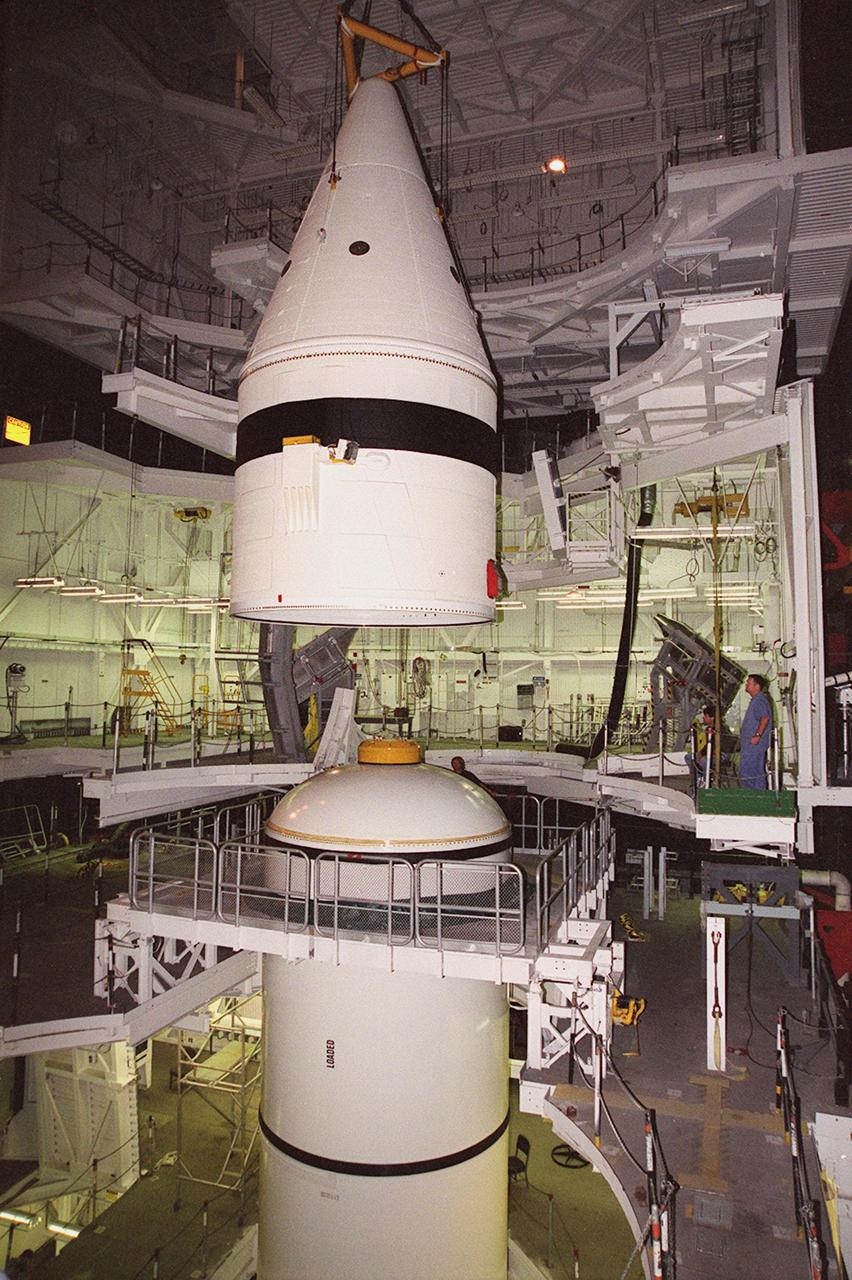
Inside the Vehicle Assembly Building, an overhead crane centers the forward section of a solid rocket booster (SRB) above the rest of the stack it will be mated to. The forward section of each booster, from nose cap to forward skirt contains avionics, a sequencer, forward separation motors, a nose cone separation system, drogue and main parachutes, a recovery beacon, a recovery light, a parachute camera on selected flights and a range safety system. Each SRB weighs approximately 1.3 million pounds at launch. The SRB is part of the stack for Space Shuttle Discovery and the STS-92 mission, scheduled for launch Oct. 5, from Launch Pad 39A, on the fifth flight to the International Space Station
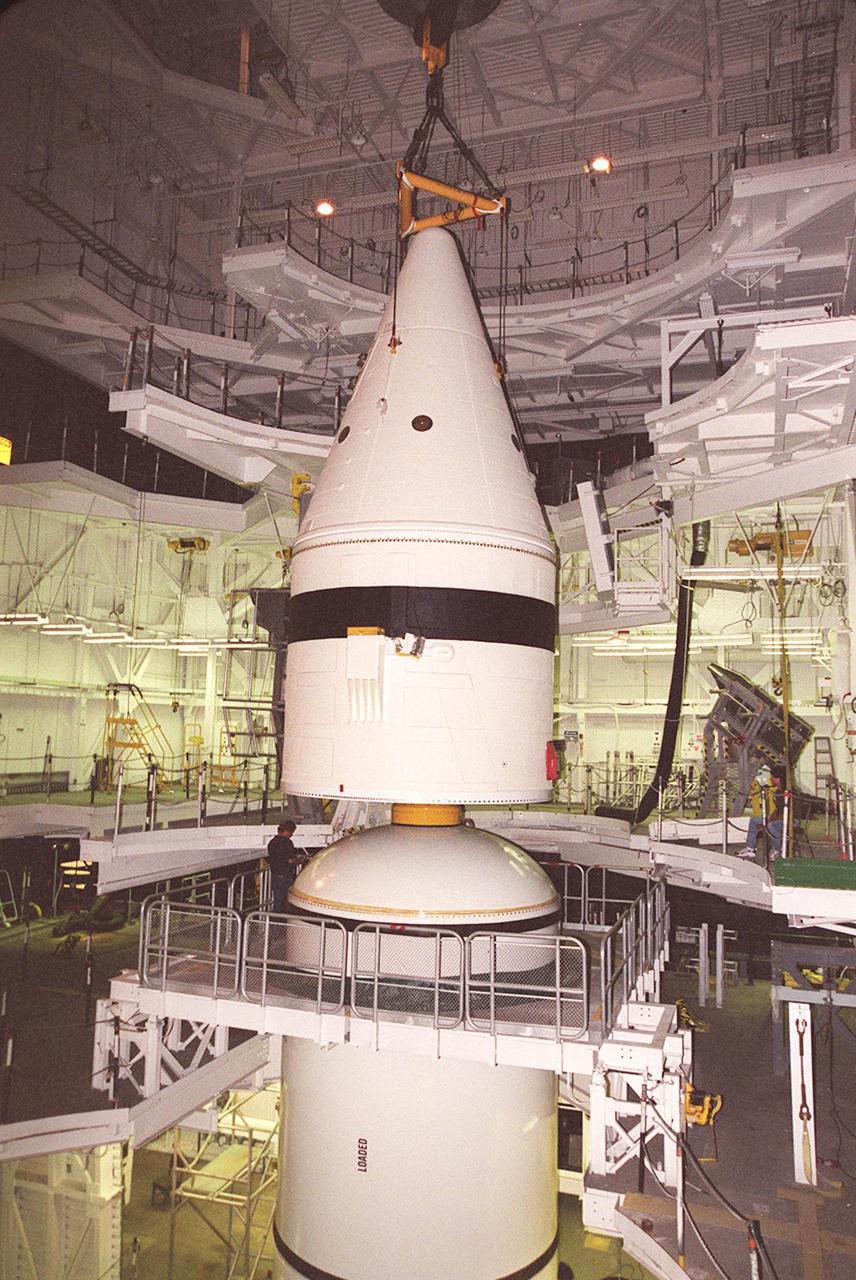
Inside the Vehicle Assembly Building, an overhead crane lowers the forward section of a solid rocket booster (SRB) toward the rest of the stack for mating. The forward section of each booster, from nose cap to forward skirt contains avionics, a sequencer, forward separation motors, a nose cone separation system, drogue and main parachutes, a recovery beacon, a recovery light, a parachute camera on selected flights and a range safety system. Each SRB weighs approximately 1.3 million pounds at launch. The SRB is part of the stack for Space Shuttle Discovery and the STS-92 mission, scheduled for launch Oct. 5, from Launch Pad 39A, on the fifth flight to the International Space Station
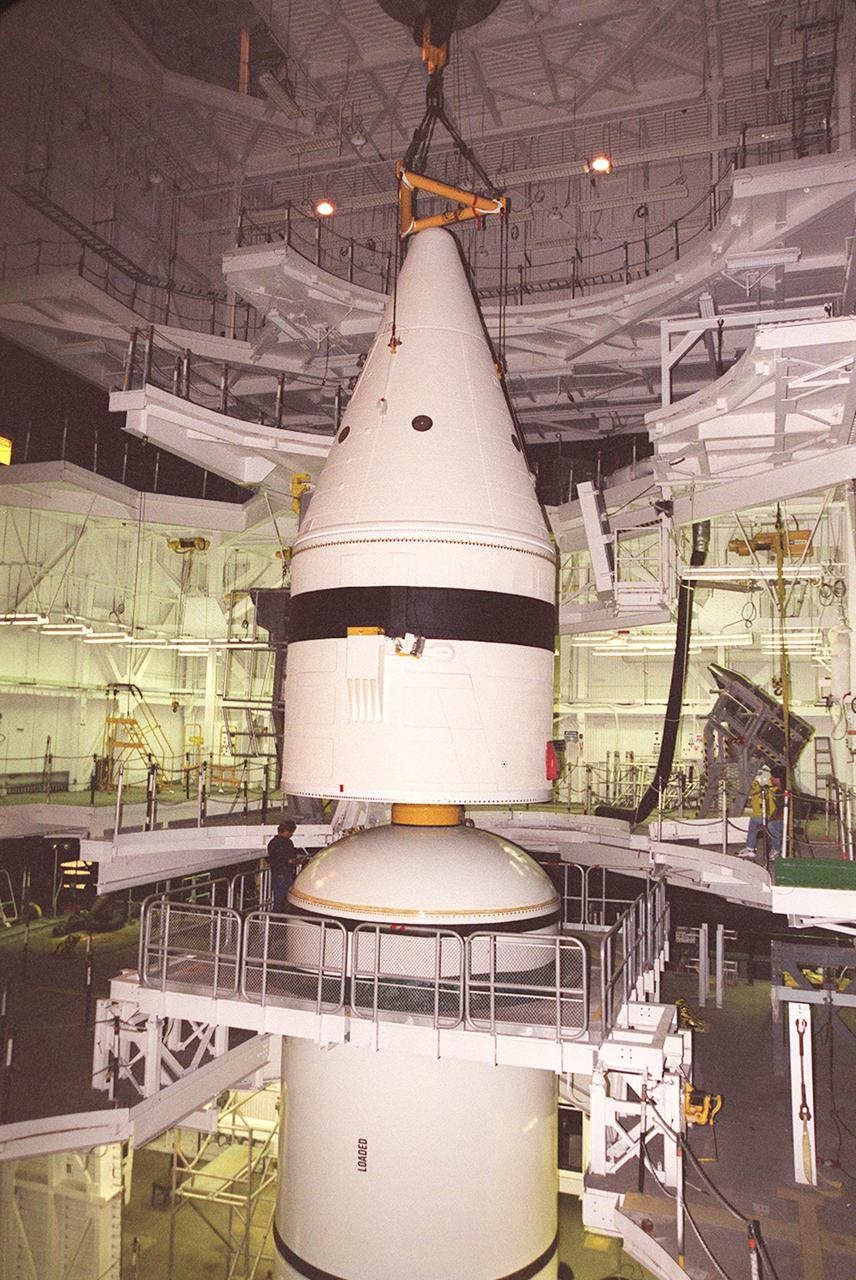
Inside the Vehicle Assembly Building, an overhead crane lowers the forward section of a solid rocket booster (SRB) toward the rest of the stack for mating. The forward section of each booster, from nose cap to forward skirt contains avionics, a sequencer, forward separation motors, a nose cone separation system, drogue and main parachutes, a recovery beacon, a recovery light, a parachute camera on selected flights and a range safety system. Each SRB weighs approximately 1.3 million pounds at launch. The SRB is part of the stack for Space Shuttle Discovery and the STS-92 mission, scheduled for launch Oct. 5, from Launch Pad 39A, on the fifth flight to the International Space Station
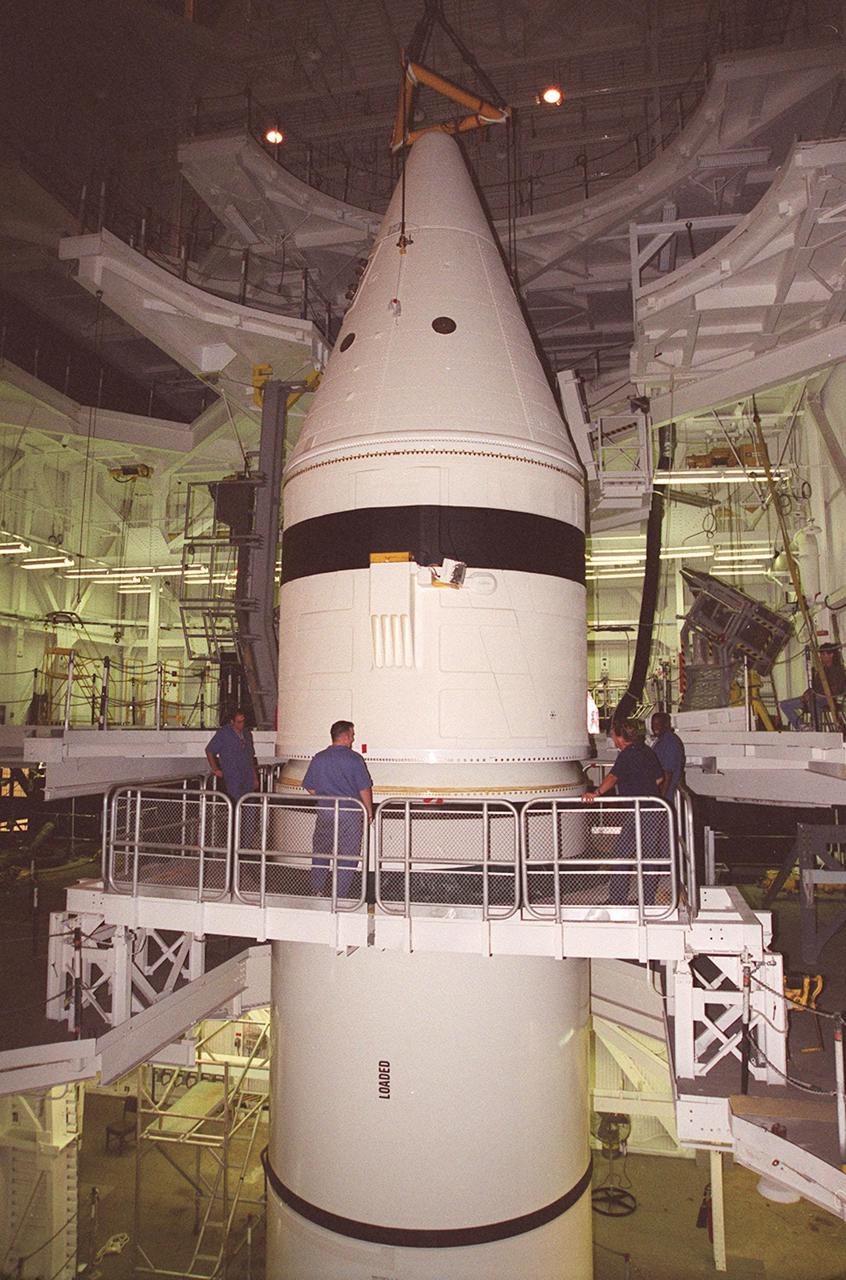
Inside the Vehicle Assembly Building, the forward section of a solid rocket booster (SRB) sits on top of the rest of the stack for mating. The forward section of each booster, from nose cap to forward skirt contains avionics, a sequencer, forward separation motors, a nose cone separation system, drogue and main parachutes, a recovery beacon, a recovery light, a parachute camera on selected flights and a range safety system. Each SRB weighs approximately 1.3 million pounds at launch. The SRB is part of the stack for Space Shuttle Discovery and the STS-92 mission, scheduled for launch Oct. 5, from Launch Pad 39A, on the fifth flight to the International Space Station
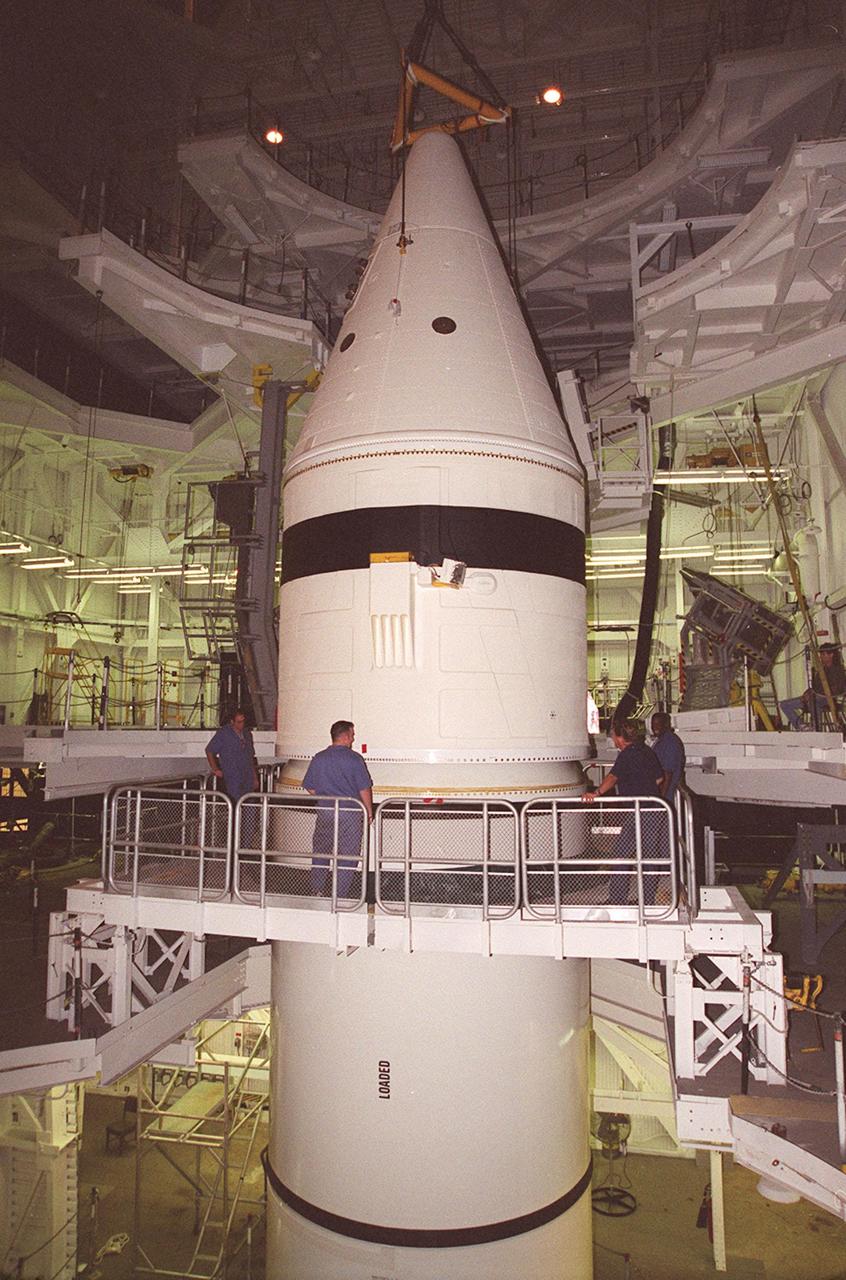
Inside the Vehicle Assembly Building, the forward section of a solid rocket booster (SRB) sits on top of the rest of the stack for mating. The forward section of each booster, from nose cap to forward skirt contains avionics, a sequencer, forward separation motors, a nose cone separation system, drogue and main parachutes, a recovery beacon, a recovery light, a parachute camera on selected flights and a range safety system. Each SRB weighs approximately 1.3 million pounds at launch. The SRB is part of the stack for Space Shuttle Discovery and the STS-92 mission, scheduled for launch Oct. 5, from Launch Pad 39A, on the fifth flight to the International Space Station
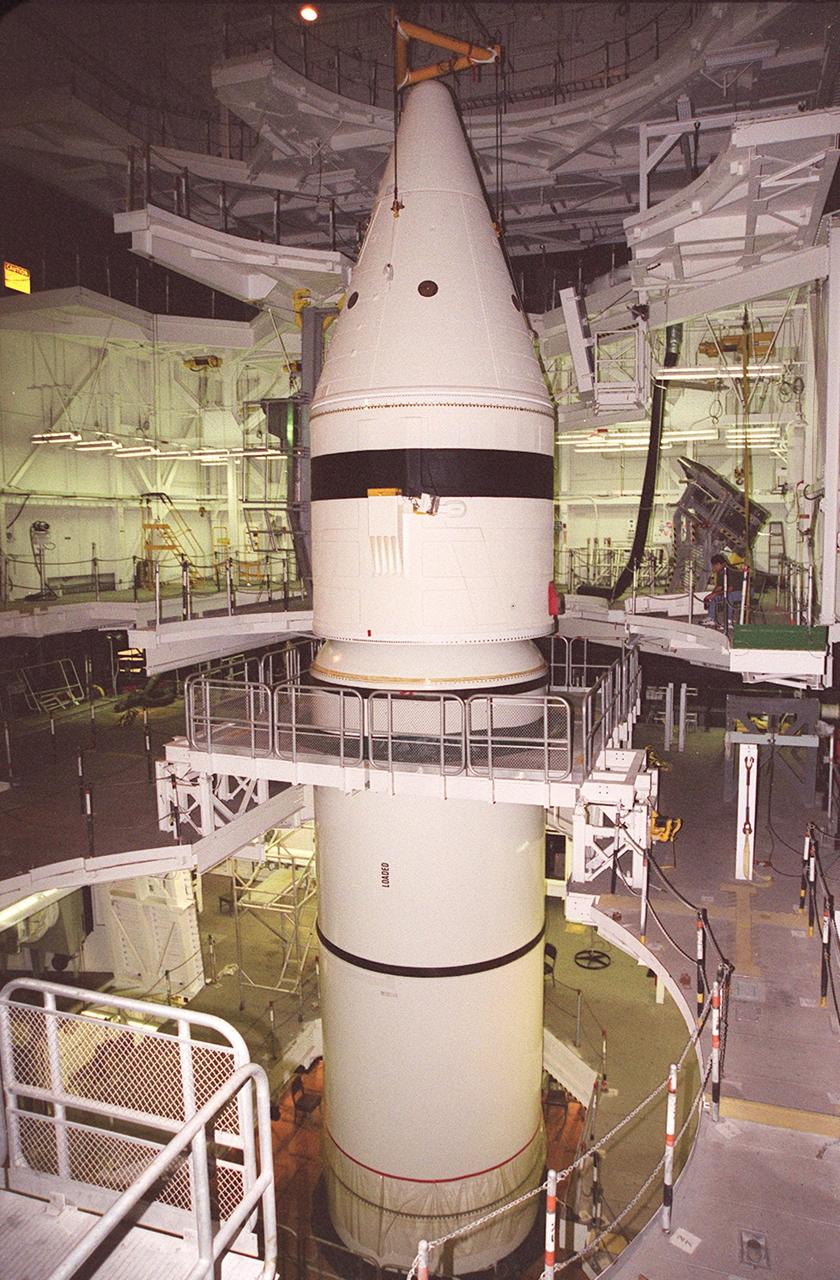
Inside the Vehicle Assembly Building, the forward section of a solid rocket booster (SRB) is lowered onto the rest of the stack for mating. The forward section of each booster, from nose cap to forward skirt contains avionics, a sequencer, forward separation motors, a nose cone separation system, drogue and main parachutes, a recovery beacon, a recovery light, a parachute camera on selected flights and a range safety system. Each SRB weighs approximately 1.3 million pounds at launch. The SRB is part of the stack for Space Shuttle Discovery and the STS-92 mission, scheduled for launch Oct. 5, from Launch Pad 39A, on the fifth flight to the International Space Station
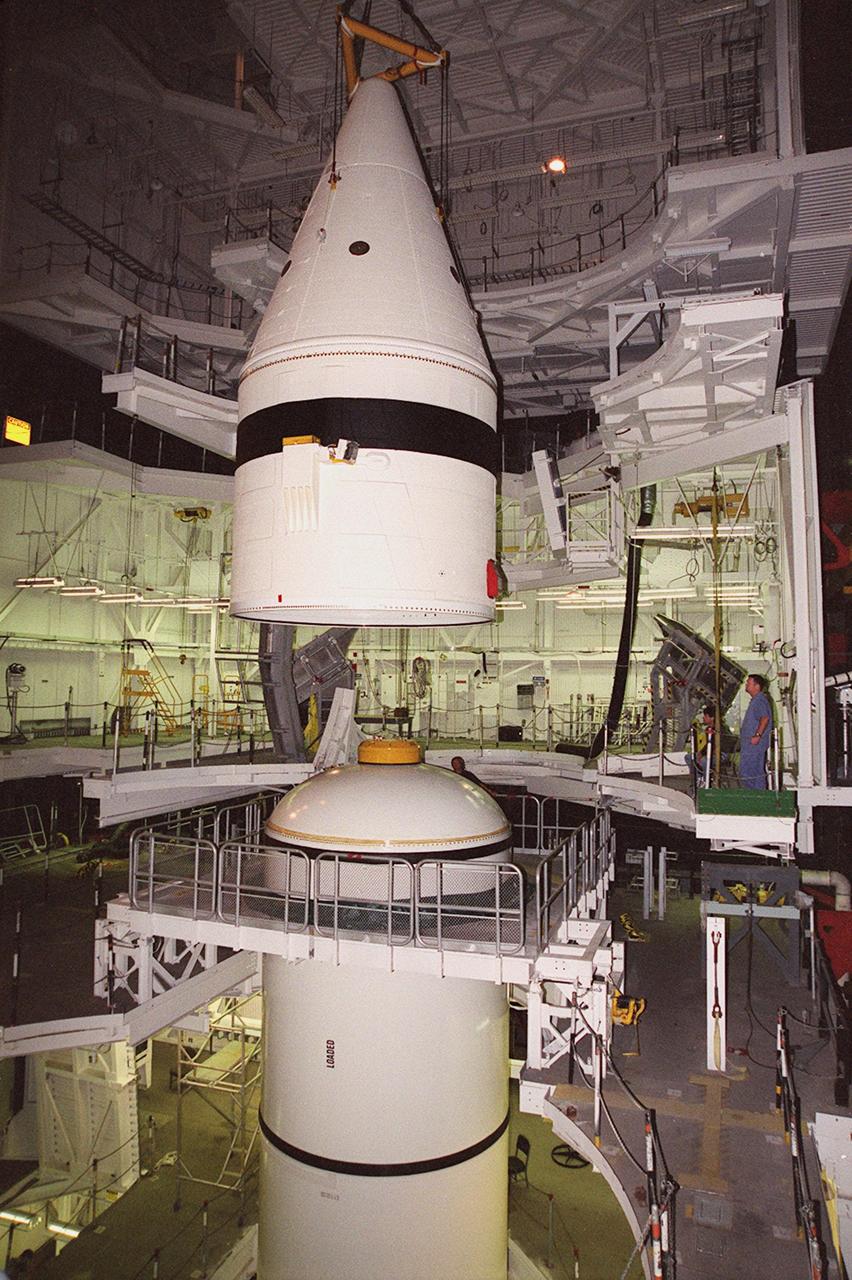
Inside the Vehicle Assembly Building, an overhead crane centers the forward section of a solid rocket booster (SRB) above the rest of the stack it will be mated to. The forward section of each booster, from nose cap to forward skirt contains avionics, a sequencer, forward separation motors, a nose cone separation system, drogue and main parachutes, a recovery beacon, a recovery light, a parachute camera on selected flights and a range safety system. Each SRB weighs approximately 1.3 million pounds at launch. The SRB is part of the stack for Space Shuttle Discovery and the STS-92 mission, scheduled for launch Oct. 5, from Launch Pad 39A, on the fifth flight to the International Space Station
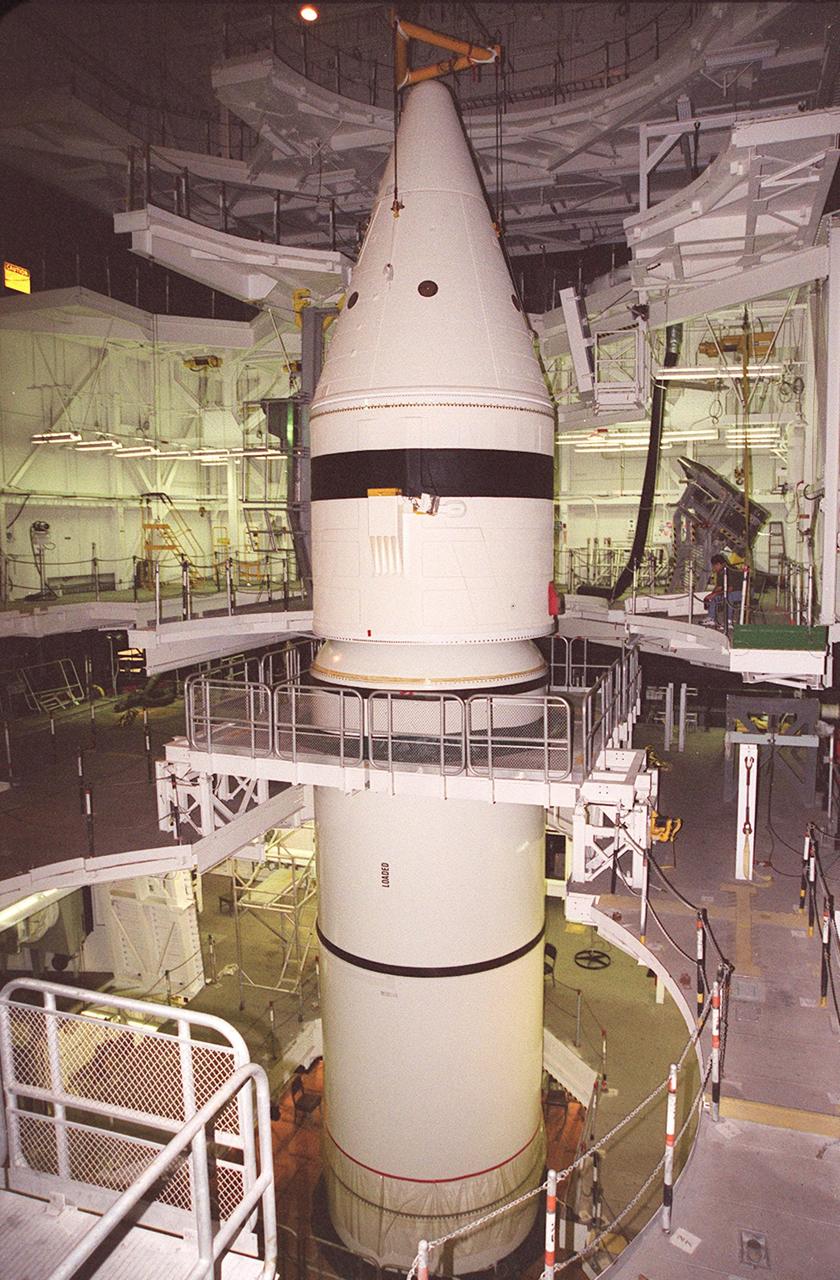
Inside the Vehicle Assembly Building, the forward section of a solid rocket booster (SRB) is lowered onto the rest of the stack for mating. The forward section of each booster, from nose cap to forward skirt contains avionics, a sequencer, forward separation motors, a nose cone separation system, drogue and main parachutes, a recovery beacon, a recovery light, a parachute camera on selected flights and a range safety system. Each SRB weighs approximately 1.3 million pounds at launch. The SRB is part of the stack for Space Shuttle Discovery and the STS-92 mission, scheduled for launch Oct. 5, from Launch Pad 39A, on the fifth flight to the International Space Station
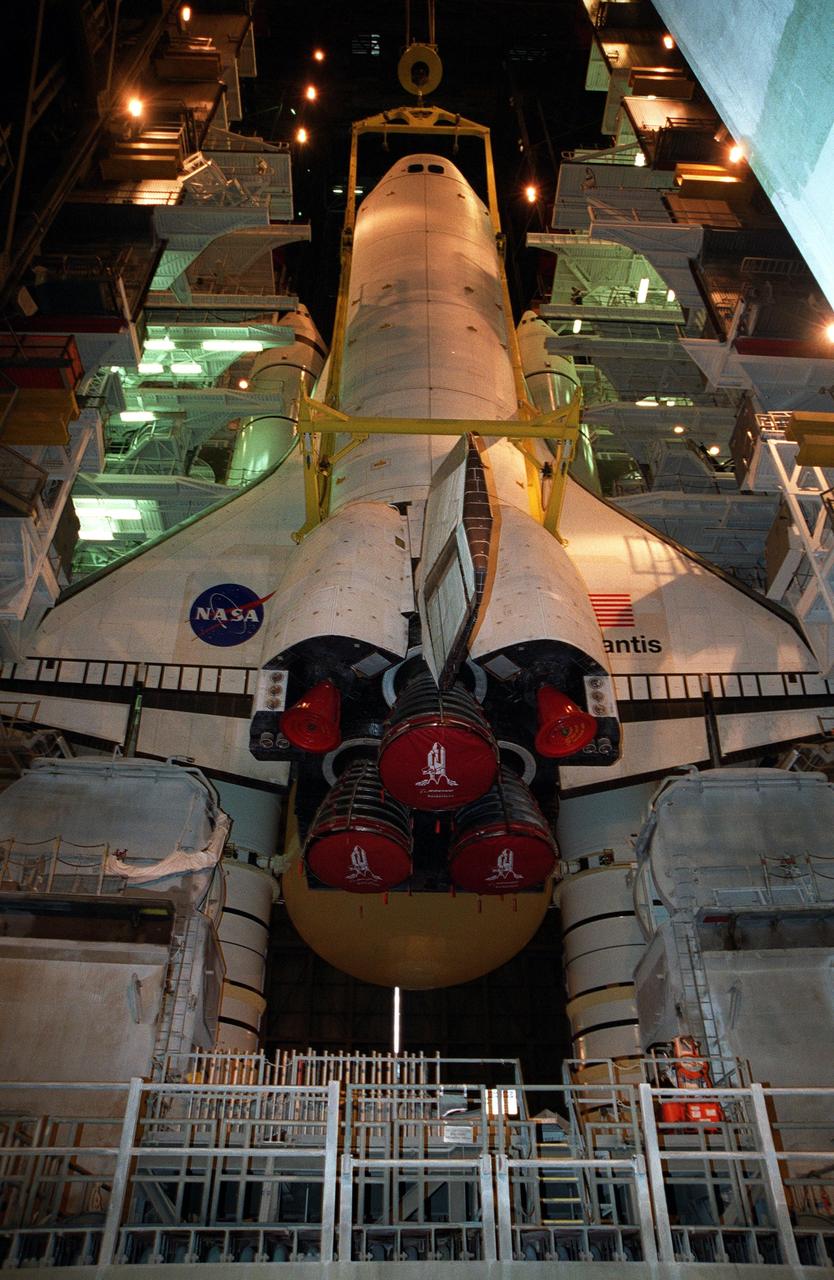
KENNEDY SPACE CENTER, FLA. -- In Vehicle Assembly Building high bay 1, the orbiter Atlantis is being lowered into position for mating to its external tank/solid rocket booster stack. Space Shuttle Atlantis is scheduled to launch on mission STS-104 in early July
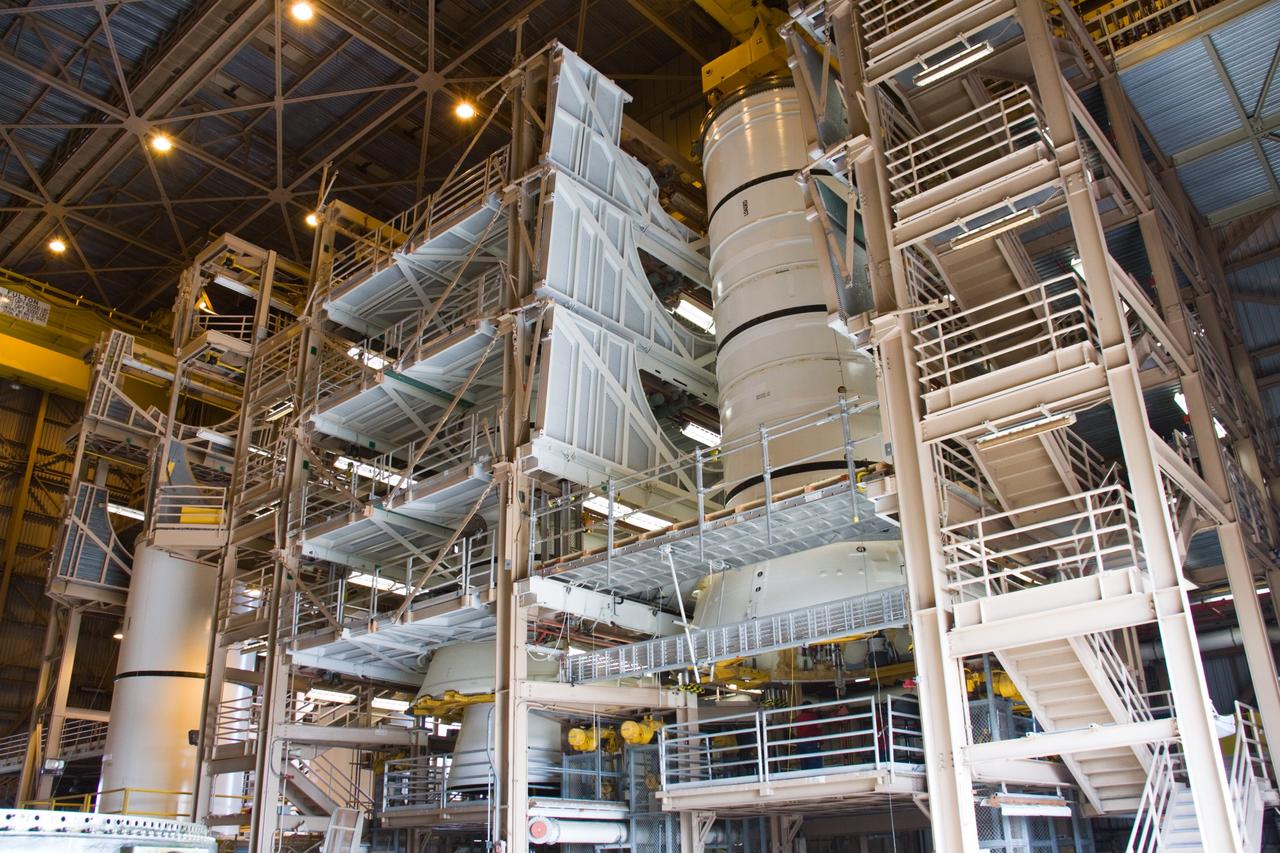
CAPE CANAVERAL, Fla. – In the Rotation, Processing, and Surge Facility at NASA's Kennedy Space Center in Florida, the Ares I-X aft skirt is mated to the aft segment (at right). At far left is a solid rocket booster stack for a shuttle. The launch of Ares I-X is targeted for August 2009. Photo credit: NASA/Jack Pfaller
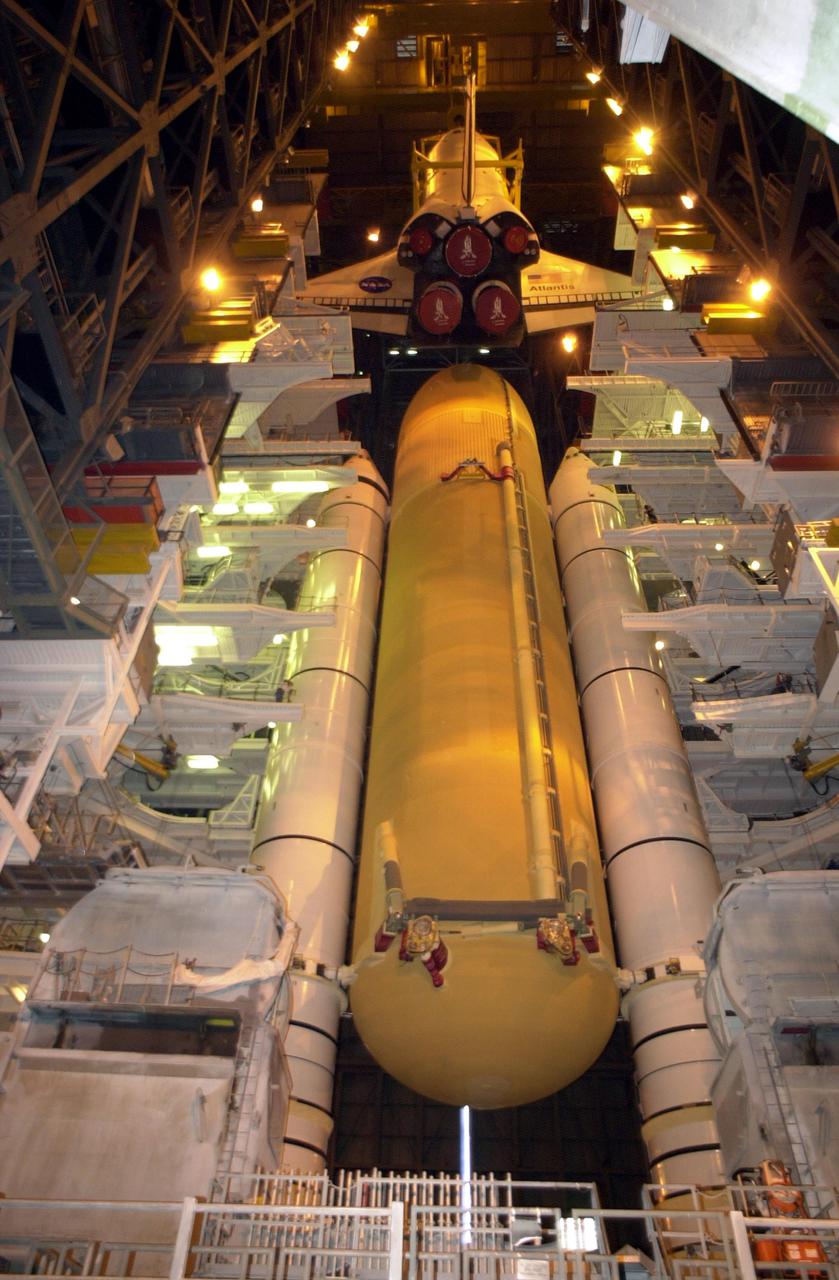
KENNEDY SPACE CENTER, FLA. -- In Vehicle Assembly Building high bay 1, the orbiter Atlantis is being lowered into position for mating to its external tank_solid rocket booster stack.; Space Shuttle Atlantis is scheduled to launch on mission STS-104 in early July
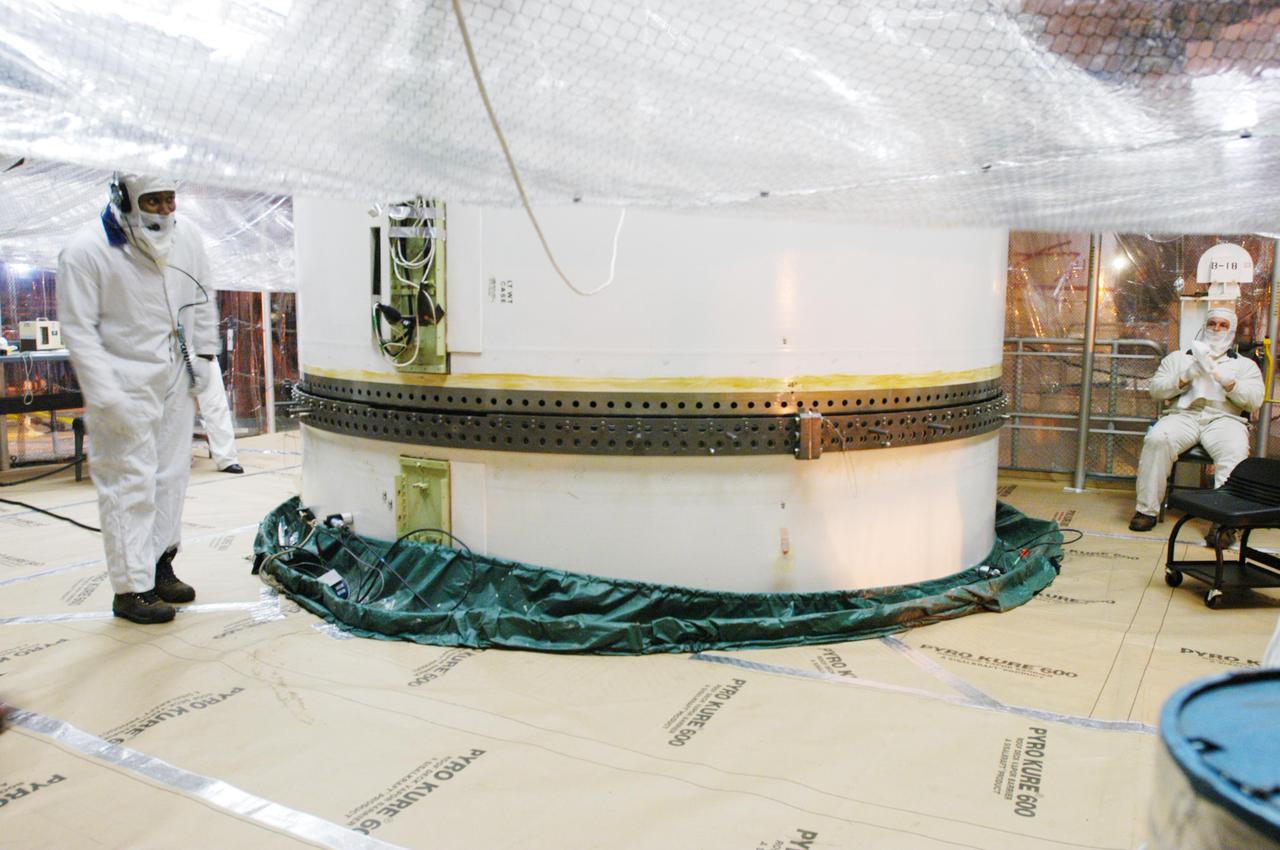
KENNEDY SPACE CENTER, FLA. - In the Vehicle Assembly Building, the mating of upper and lower segments of the starboard Solid Rocket Booster is complete. The SRB is being stacked for Return to Flight mission STS-114 on Space Shuttle Discovery to the International Space Station. Discovery is scheduled for a launch planning window of May 12 to June 3, 2005.

KENNEDY SPACE CENTER, FLA. -- In the transfer aisle of the Vehicle Assembly Building, the orbiter Atlantis is suspended vertically via overhead cranes. The orbiter will be rotated and lifted up and over to a high bay and stacked with its external tank and solid rocket boosters. Space Shuttle Atlantis is scheduled to launch on mission STS-104 in early July
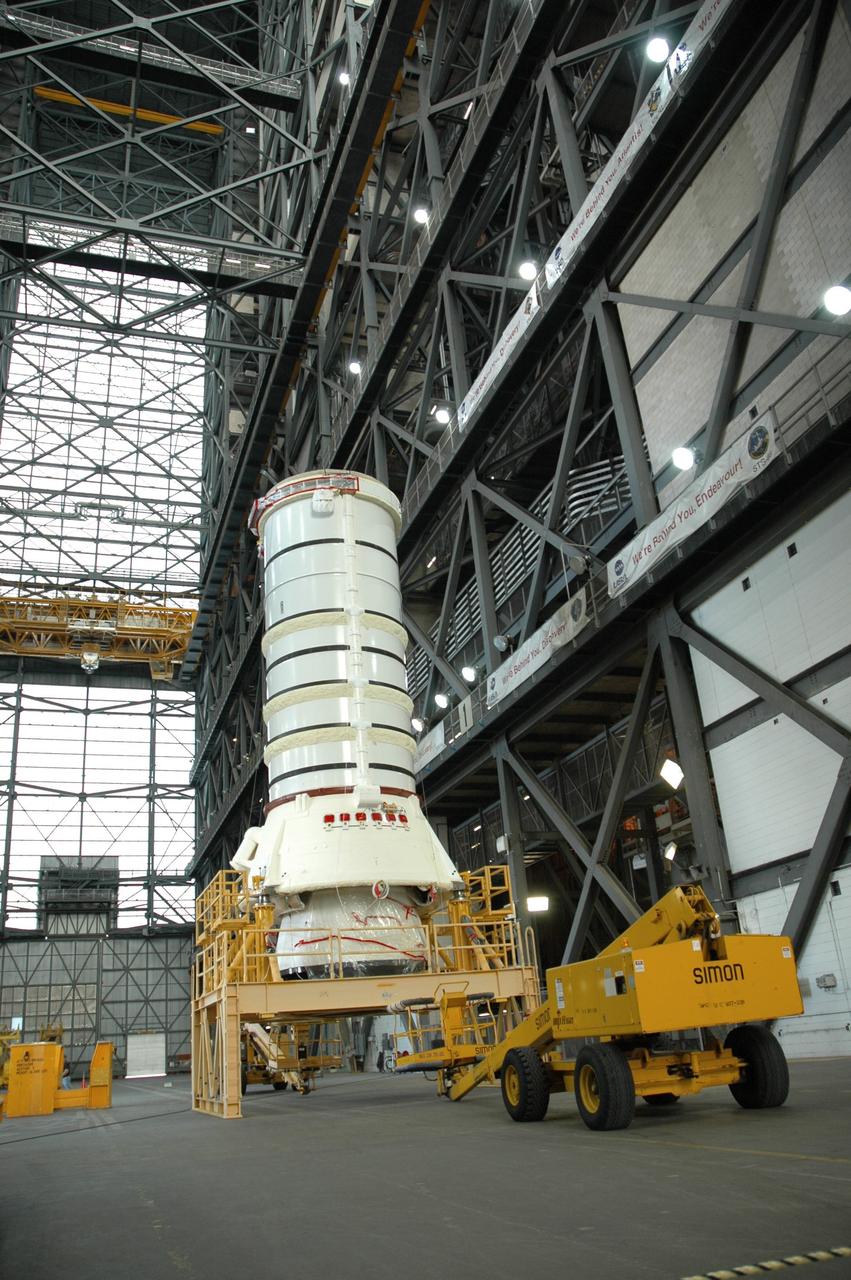
CAPE CANAVERAL, Fla. – One of the solid rocket booster segments for space shuttle Endeavour's STS-127 mission is in the Vehicle Assembly Building at NASA's Kennedy Space Center in Florida for stacking. The mission is targeted for launch in June. Photo credit: NASA/Tim Jacobs
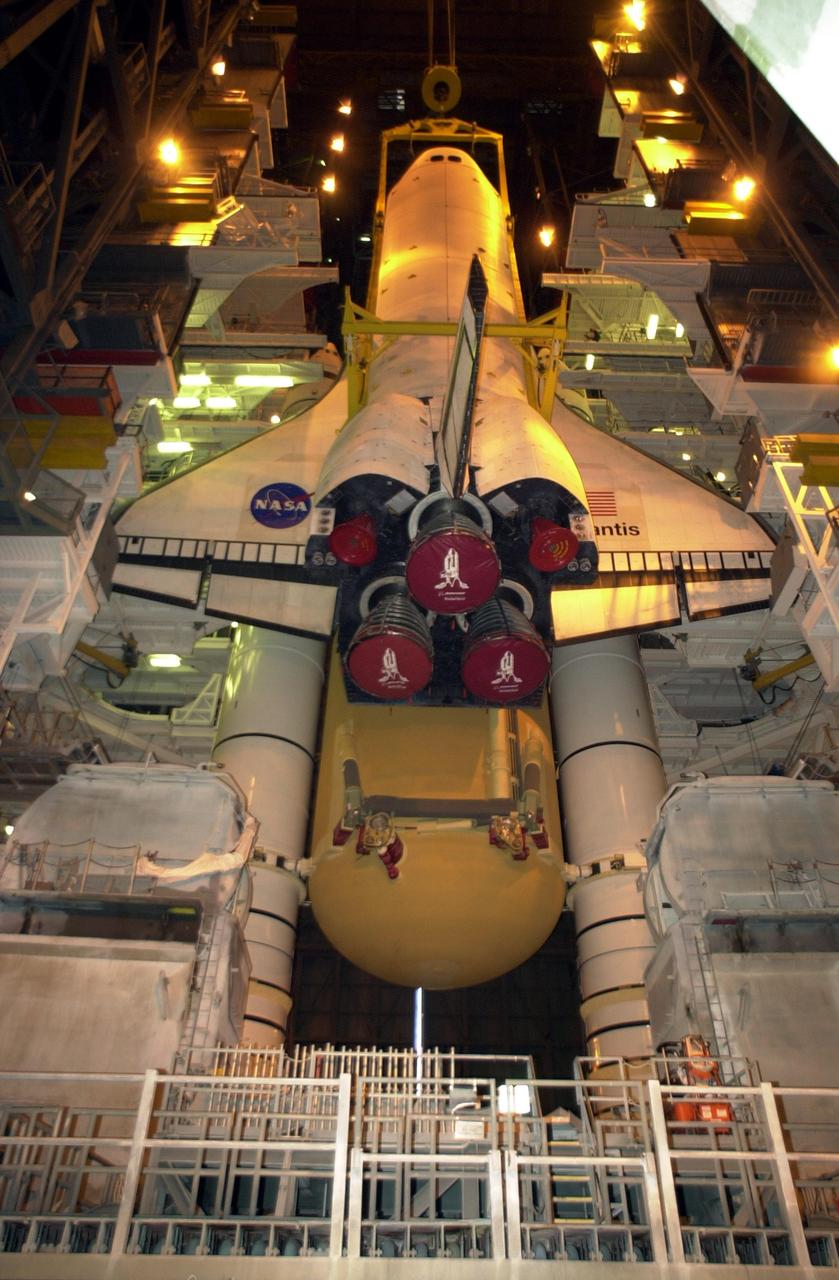
KENNEDY SPACE CENTER, FLA. -- In Vehicle Assembly Building high bay 1, the orbiter Atlantis is being lowered into position for mating to its external tank/solid rocket booster stack.; Space Shuttle Atlantis is scheduled to launch on mission STS-104 in early July
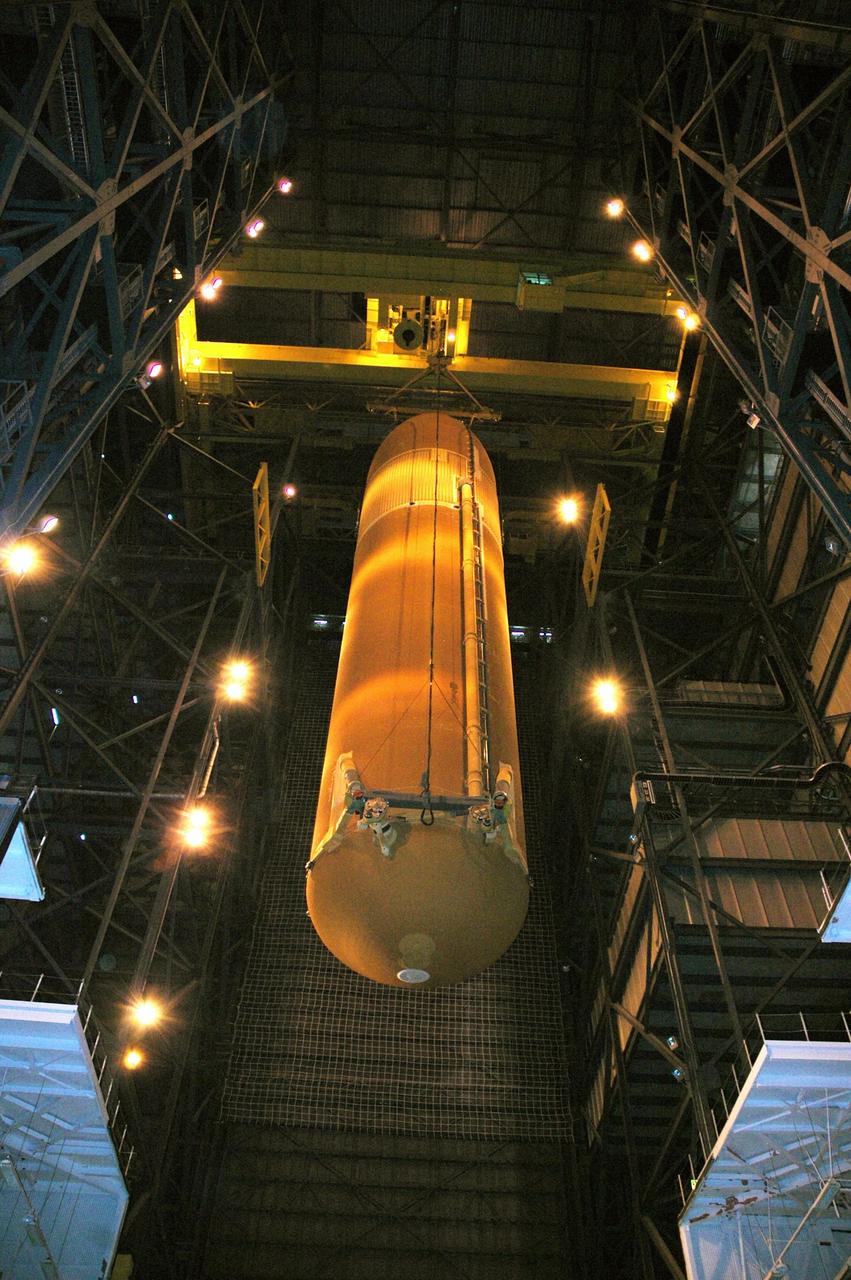
KENNEDY SPACE CENTER, FLA. - In the Vehicle Assembly Building, the external tank designated for Space Shuttle Discovery is lowered into high bay 3. There it will be stacked with the solid rocket boosters already in place on the mobile launcher platform. Discovery is scheduled to launch on mission STS-121 in July. Photo credit: NASA/Amanda Diller
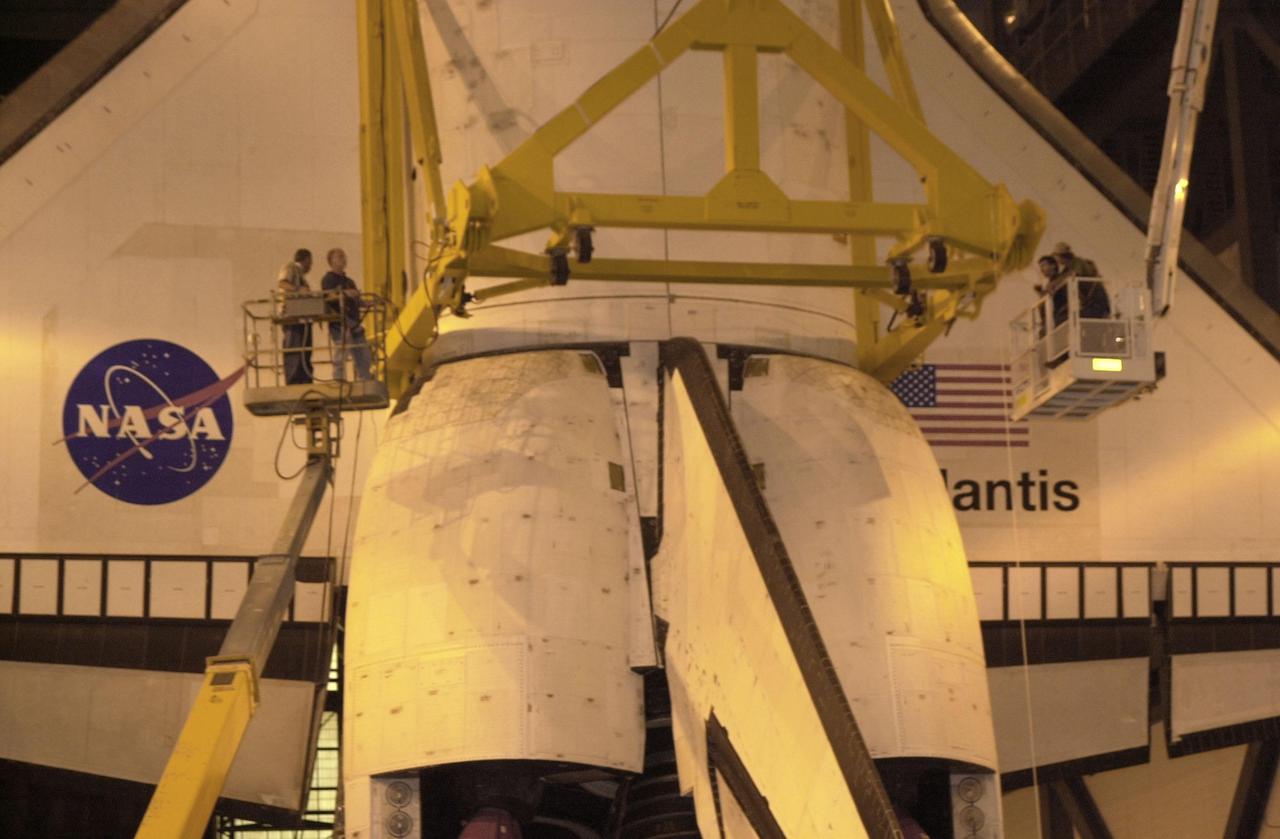
KENNEDY SPACE CENTER, FLA. -- This closeup shows the workers, standing on lifts, who are checking the bolts on the apparatus holding the orbiter Atlantis. The orbiter will be rotated and lifted up and over to a high bay and stacked with its external tank and solid rocket boosters. Space Shuttle Atlantis is scheduled to launch on mission STS-104 in early July
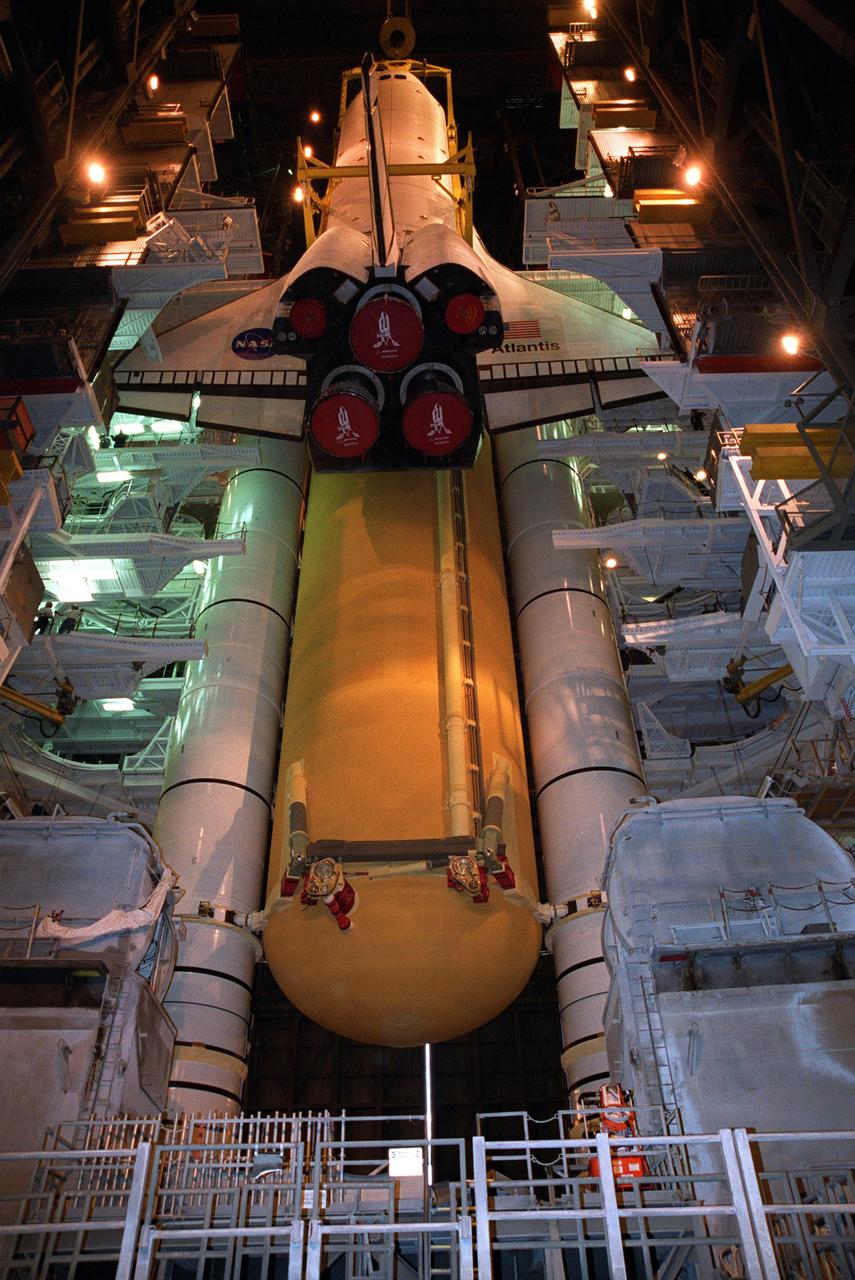
KENNEDY SPACE CENTER, FLA. -- In Vehicle Assembly Building high bay 1, the orbiter Atlantis is being lowered into position for mating to its external tank_solid rocket booster stack. Space Shuttle Atlantis is scheduled to launch on mission STS-104 in early July
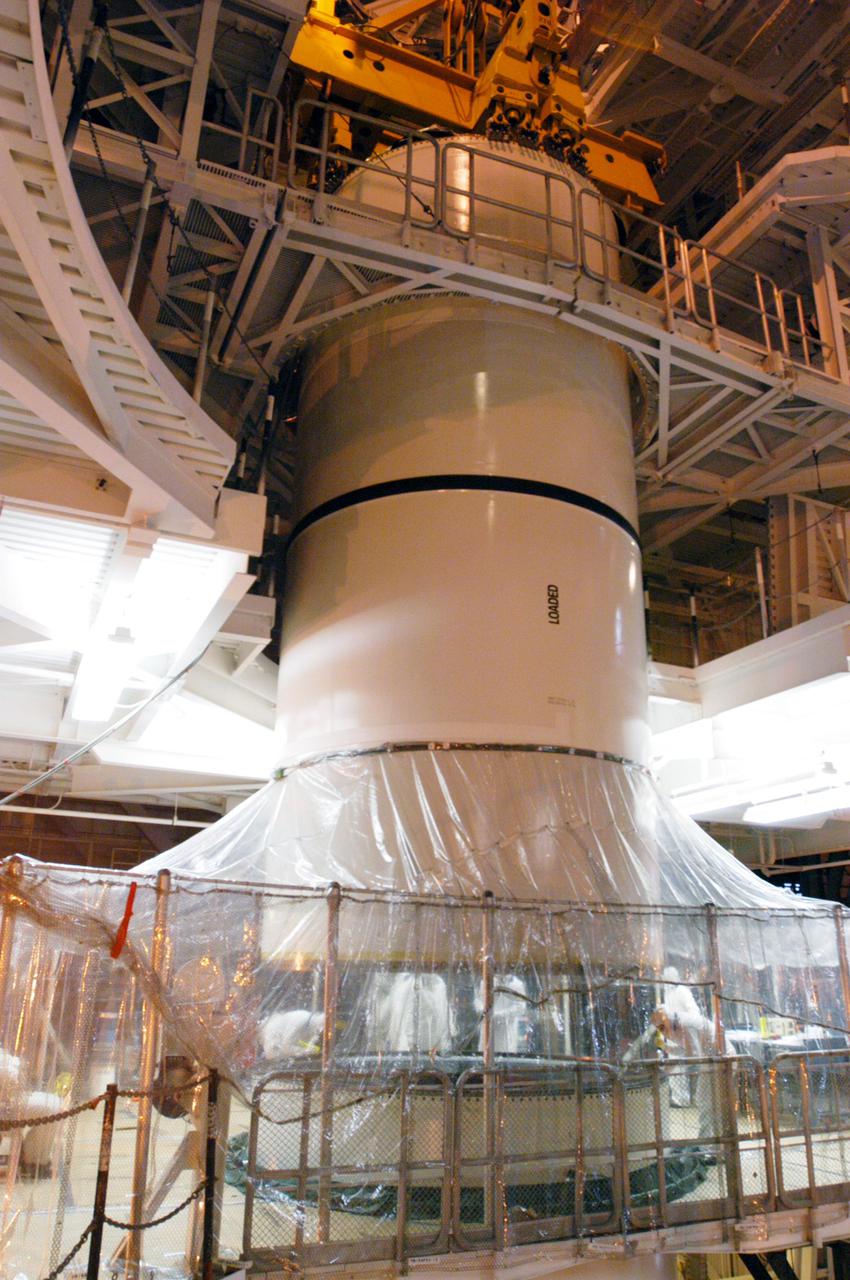
KENNEDY SPACE CENTER, FLA. - In the Vehicle Assembly Building, the starboard Solid Rocket Booster is being stacked for Return to Flight mission STS-114 on Space Shuttle Discovery to the International Space Station. Discovery is scheduled for a launch planning window of May 12 to June 3, 2005.
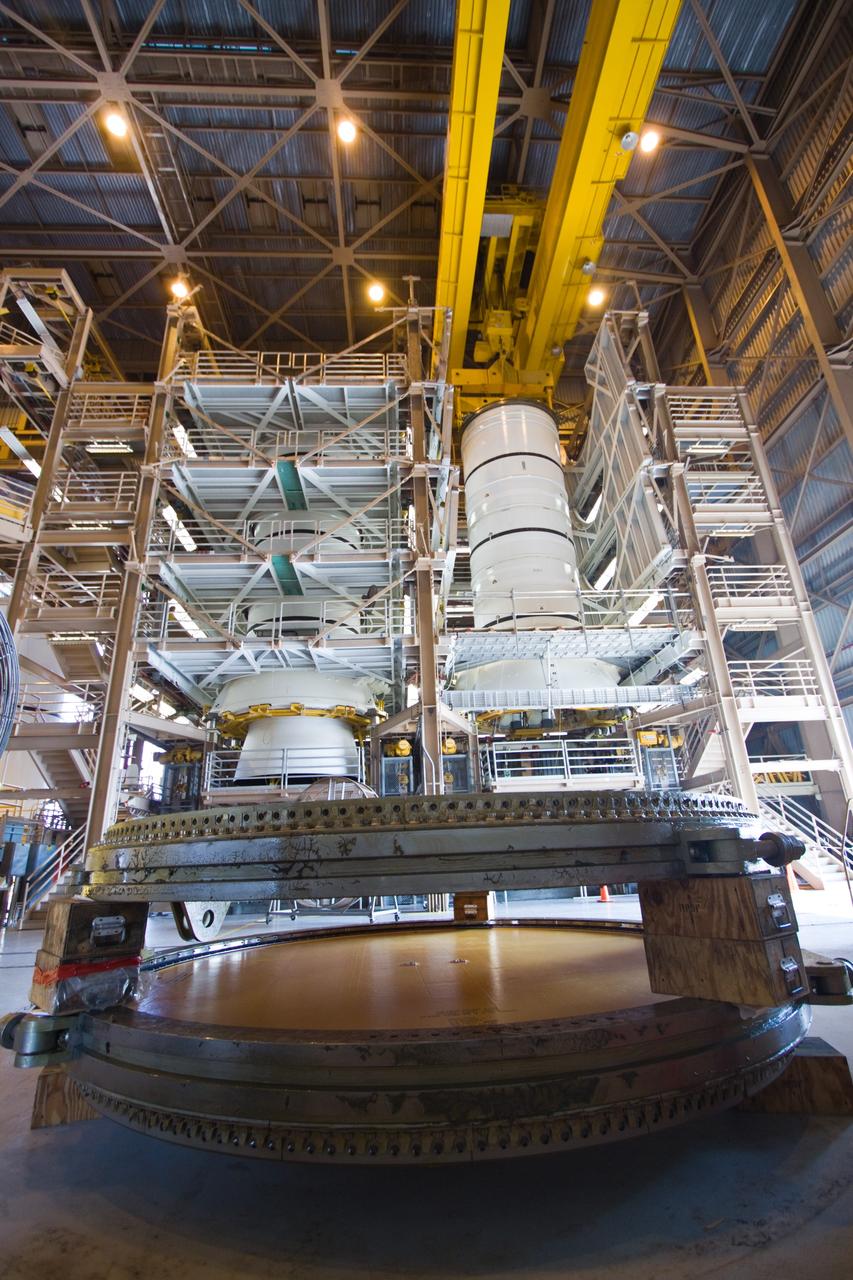
CAPE CANAVERAL, Fla. – In the Rotation, Processing, and Surge Facility at NASA's Kennedy Space Center in Florida, the Ares I-X aft skirt is mated to the aft segment (at right). At left is a stack of segments of a solid rocket booster for a shuttle. The launch of Ares I-X is targeted for August 2009. Photo credit: NASA/Jack Pfaller

KENNEDY SPACE CENTER, FLA. -- In the transfer aisle of the Vehicle Assembly Building, the orbiter Atlantis is suspended vertically via overhead cranes. The orbiter will be rotated and lifted into high bay 1 where it will be stacked with its external tank and solid rocket boosters. Space Shuttle Atlantis is scheduled to launch on mission STS-104 in early July
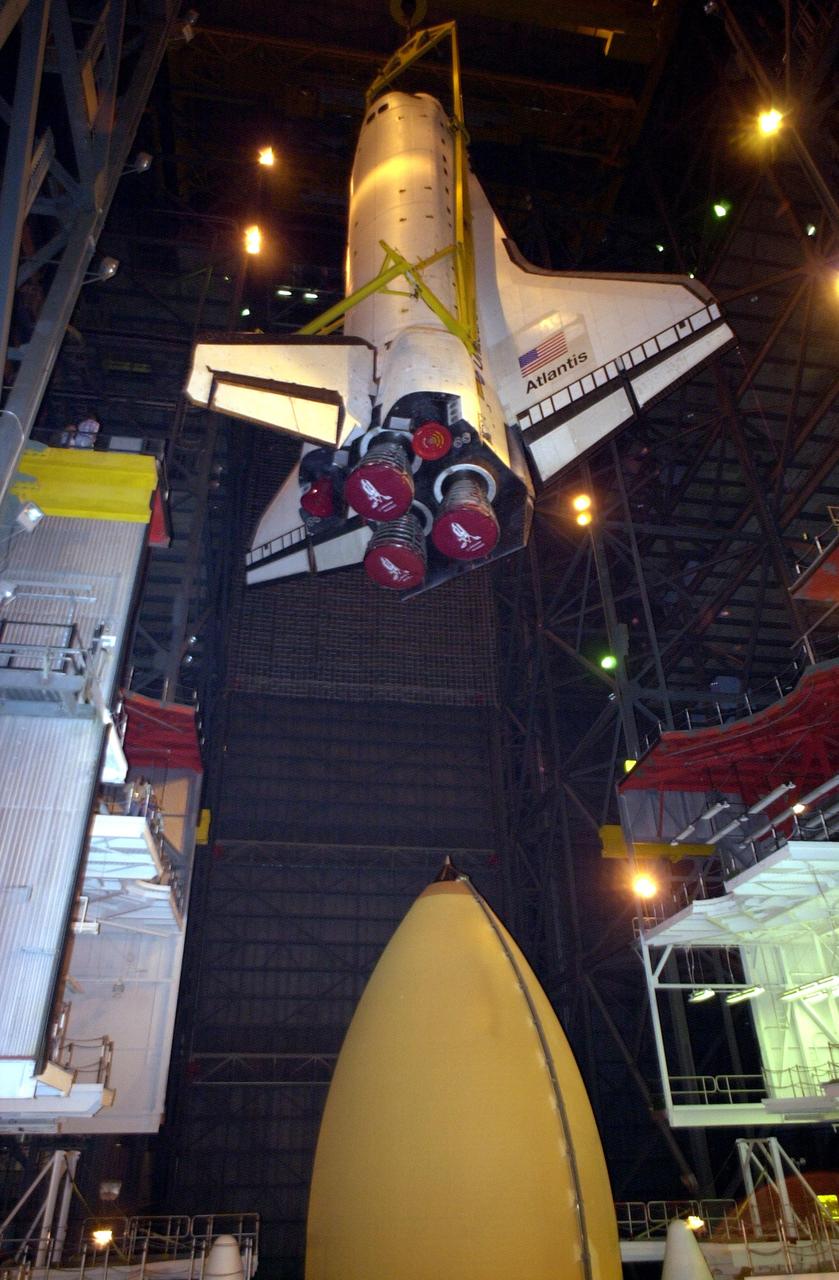
KENNEDY SPACE CENTER, FLA. -- In Vehicle Assembly Building high bay 1, the orbiter Atlantis is being lowered into position for mating to its external tank/solid rocket booster stack.; Space Shuttle Atlantis is scheduled to launch on mission STS-104 in early July
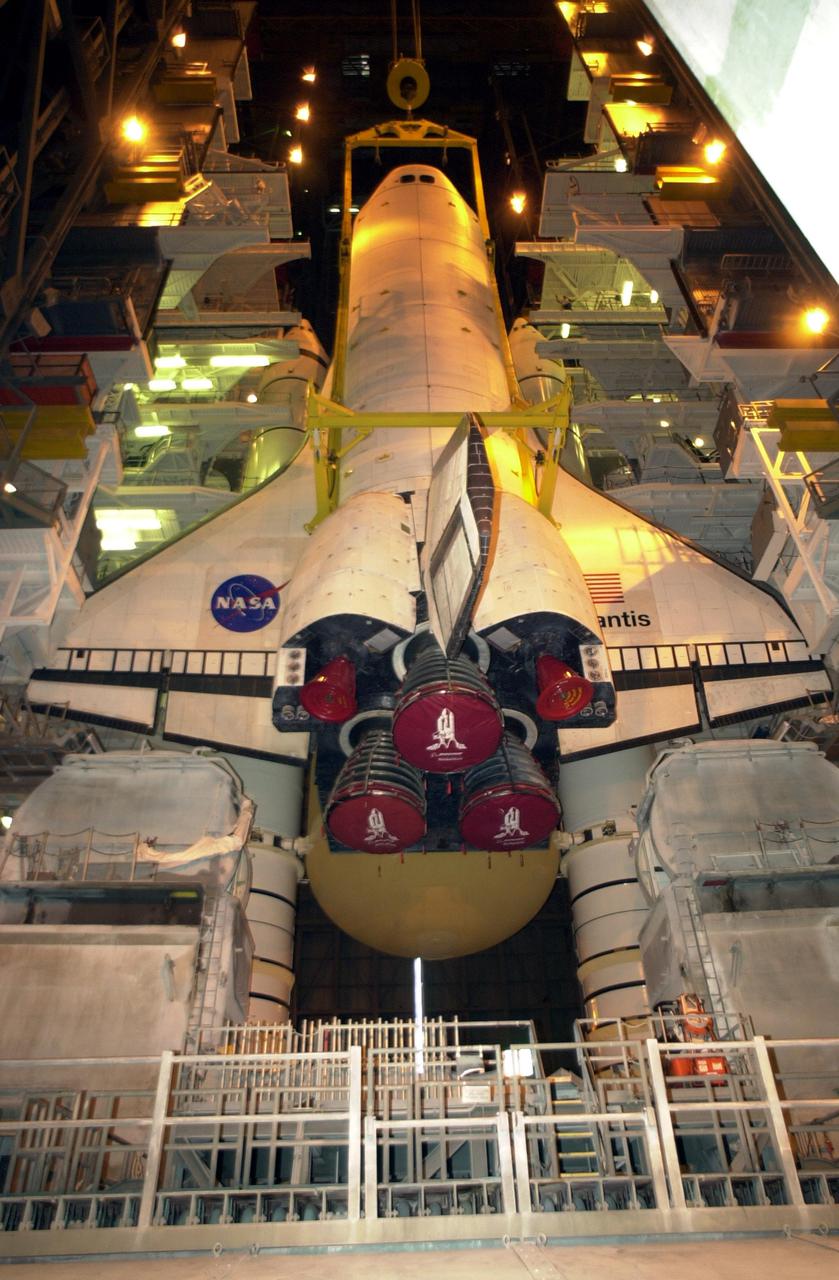
KENNEDY SPACE CENTER, FLA. -- In Vehicle Assembly Building high bay 1, the orbiter Atlantis is being lowered into position for mating to its external tank_solid rocket booster stack.; Space Shuttle Atlantis is scheduled to launch on mission STS-104 in early July
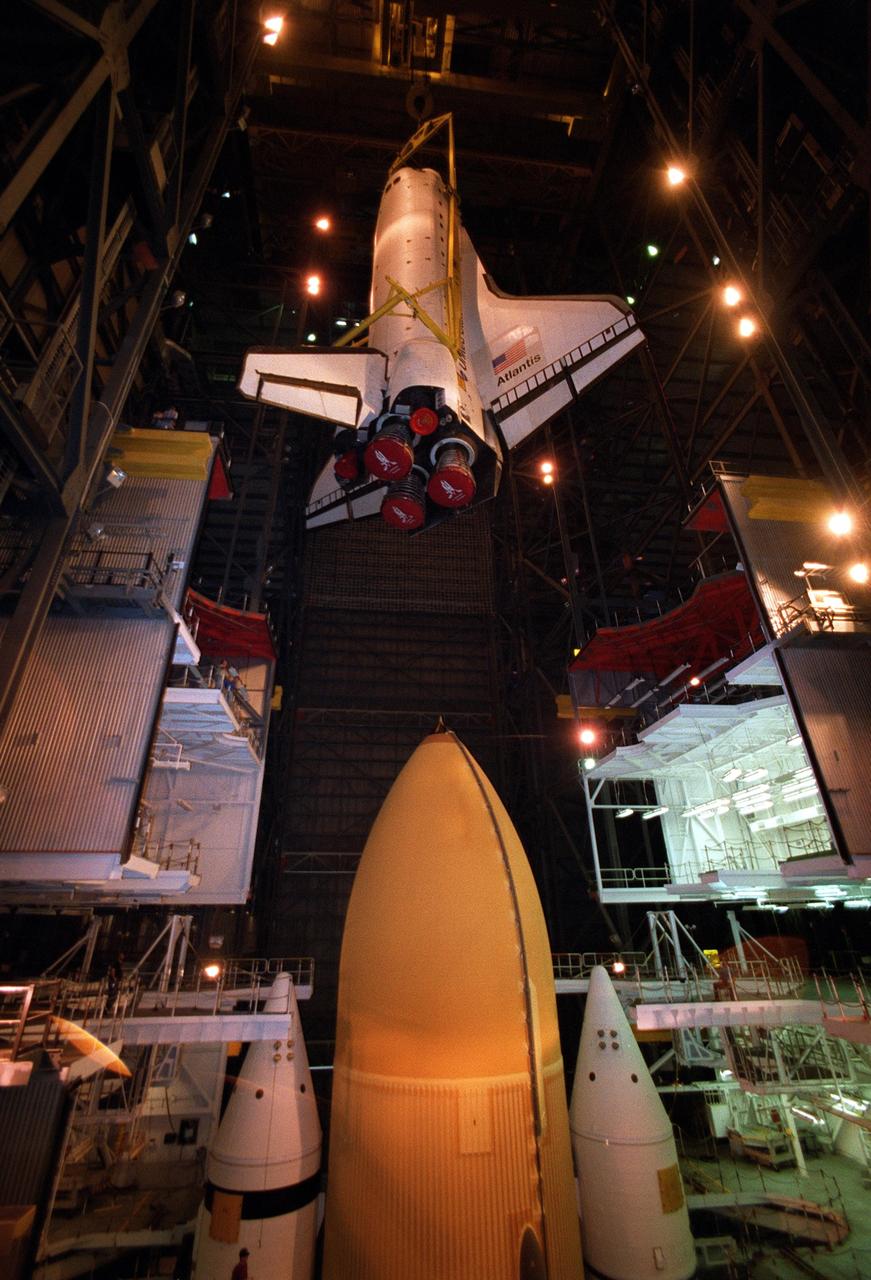
KENNEDY SPACE CENTER, FLA. -- In Vehicle Assembly Building high bay 1, the orbiter Atlantis is being lowered into position for mating to its external tank/solid rocket booster stack. Space Shuttle Atlantis is scheduled to launch on mission STS-104 in early July
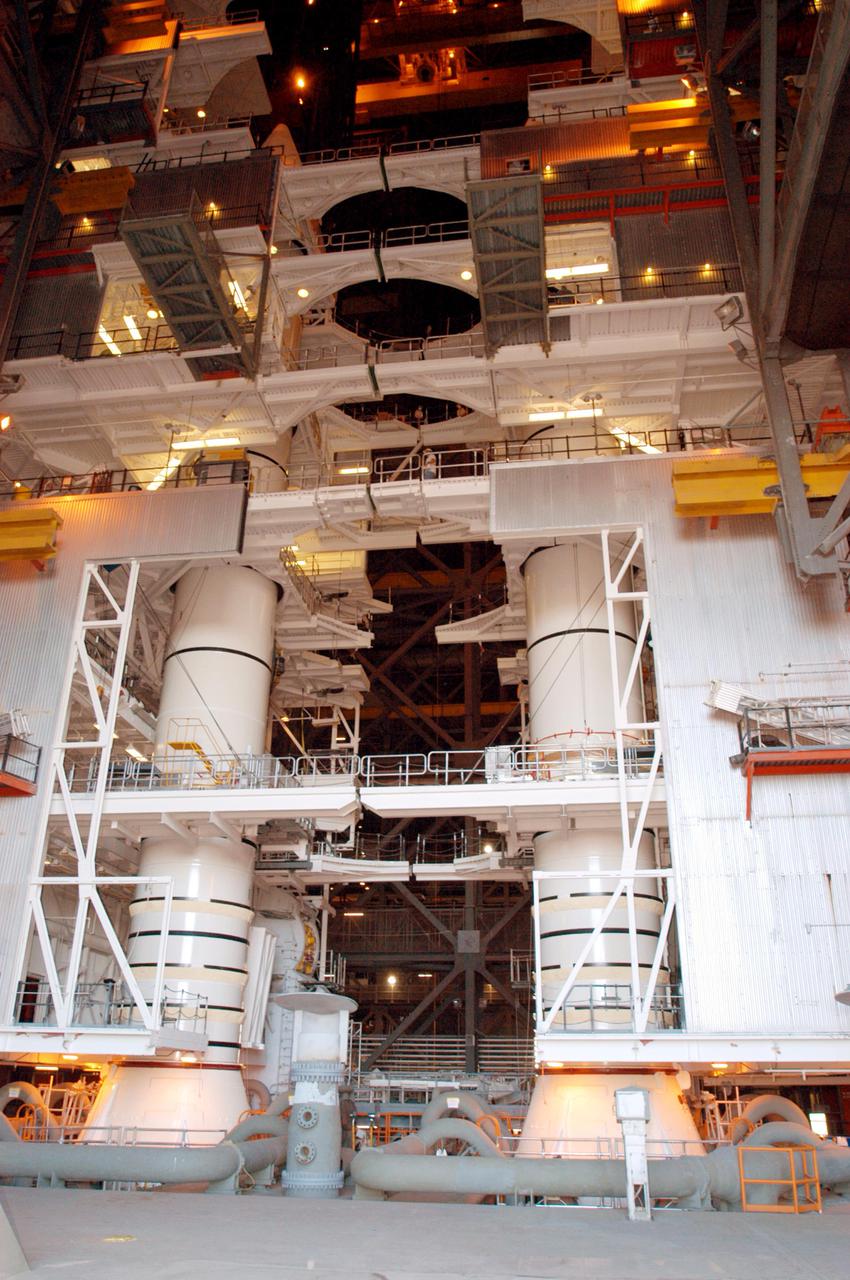
KENNEDY SPACE CENTER, FLA. - Twin Solid Rocket Boosters are stacked on a Mobile Launcher Platform inside the Vehicle Assembly Building. The SRBs will be flying on Space Shuttle Discovery for Return to Flight mission STS-114. The launch planning window is May 12 to June 3, 2005.

KENNEDY SPACE CENTER, FLA. -- In the transfer aisle of the Vehicle Assembly Building, the orbiter Atlantis is suspended vertically via overhead cranes. The orbiter will be rotated and lifted up and over to a high bay and stacked with its external tank and solid rocket boosters. Space Shuttle Atlantis is scheduled to launch on mission STS-104 in early July

KENNEDY SPACE CENTER, FLA. -- In the Vehicle Assembly Building, overhead cranes raise the orbiter Atlantis to a vertical position in the transfer aisle. The orbiter will be rotated and lifted up and over to a high bay and stacked with its external tank and solid rocket boosters. Space Shuttle Atlantis is scheduled to launch on mission STS-104 in early July
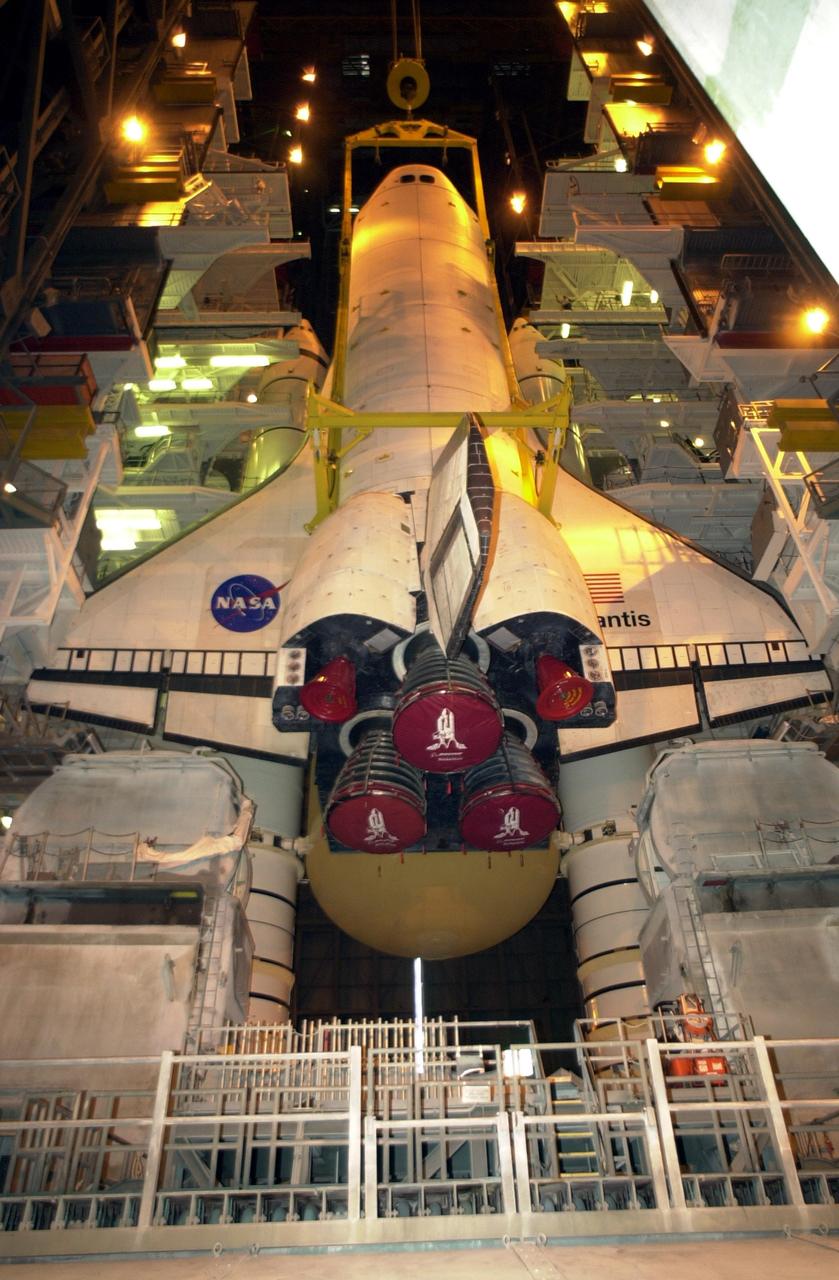
KENNEDY SPACE CENTER, FLA. -- In Vehicle Assembly Building high bay 1, the orbiter Atlantis is being lowered into position for mating to its external tank/solid rocket booster stack.; Space Shuttle Atlantis is scheduled to launch on mission STS-104 in early July
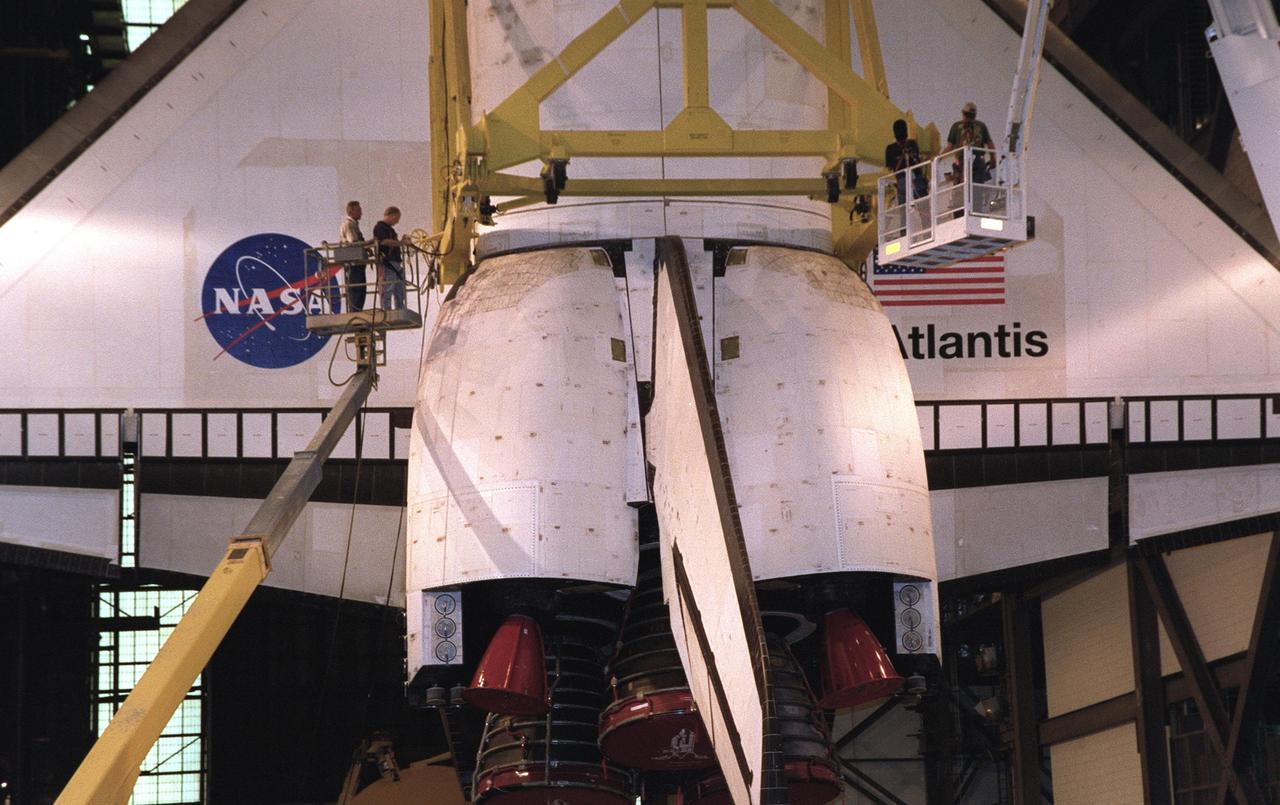
KENNEDY SPACE CENTER, FLA. -- This closeup shows the workers, standing on lifts, who are checking the bolts on the apparatus holding the orbiter Atlantis. The orbiter will be rotated and lifted into high bay 1 where it will be stacked with its external tank and solid rocket boosters. Space Shuttle Atlantis is scheduled to launch on mission STS-104 in early July
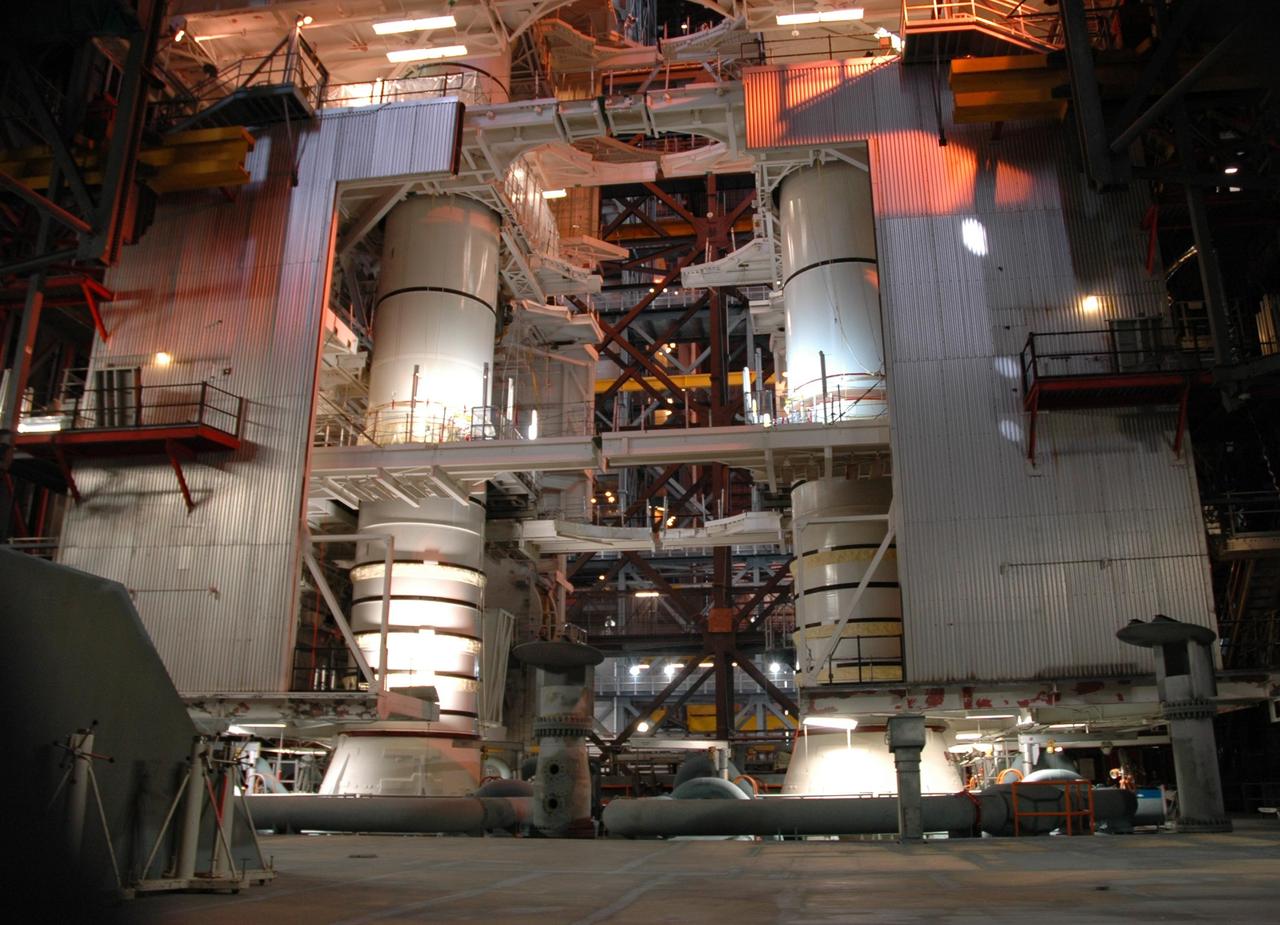
KENNEDY SPACE CENTER, FLA. -- In the Vehicle Assembly Building, the solid rocket booster segments are being stacked on the mobile launcher platform for mission STS-122. Space shuttle Atlantis is targeted for launch on mission STS-122 on Dec. 6. Photo credit: NASA/Jack Pfaller
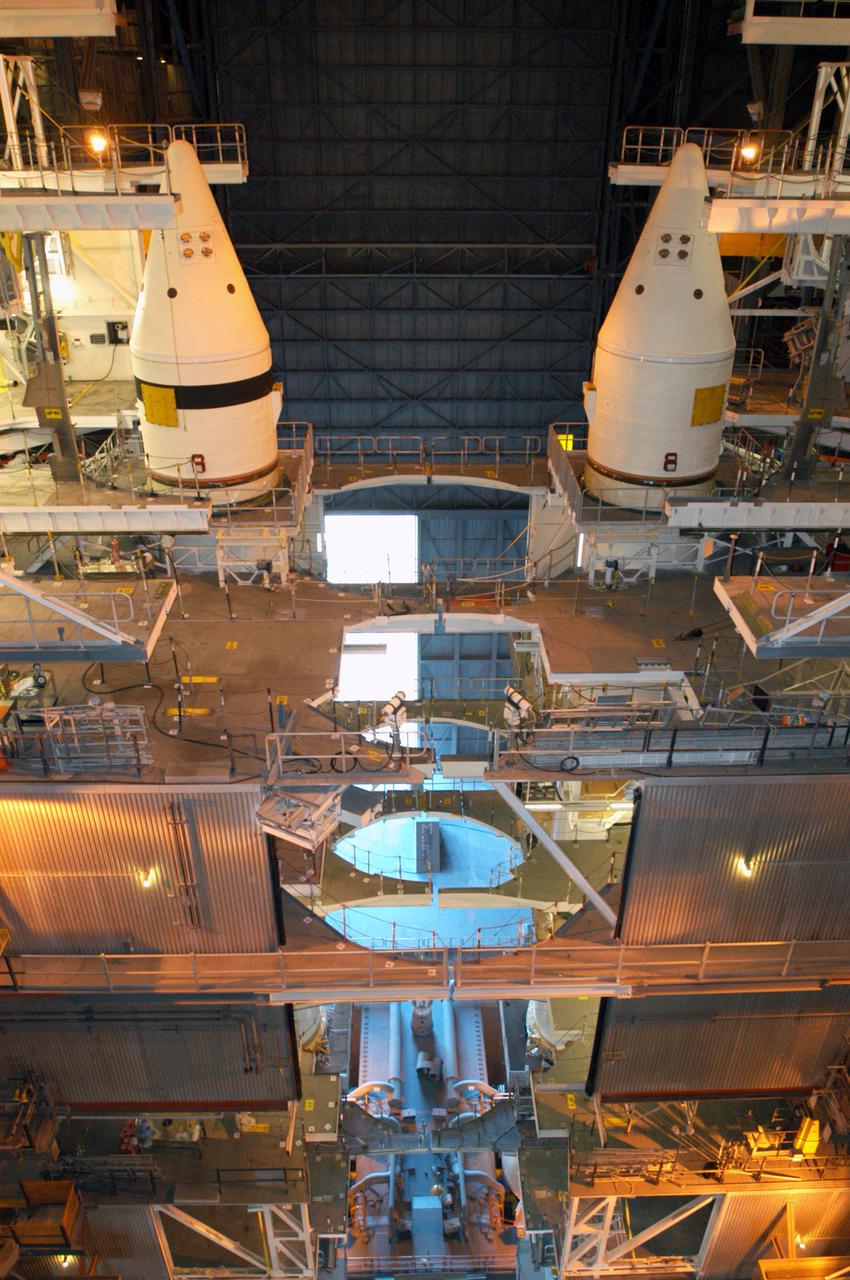
KENNEDY SPACE CENTER, FLA. - From high inside the Vehicle Assembly Building are seen twin Solid Rocket Boosters stacked on a Mobile Launcher Platform. The SRBs will be flying on Space Shuttle Discovery for Return to Flight mission STS-114. The launch planning window is May 12 to June 3, 2005.
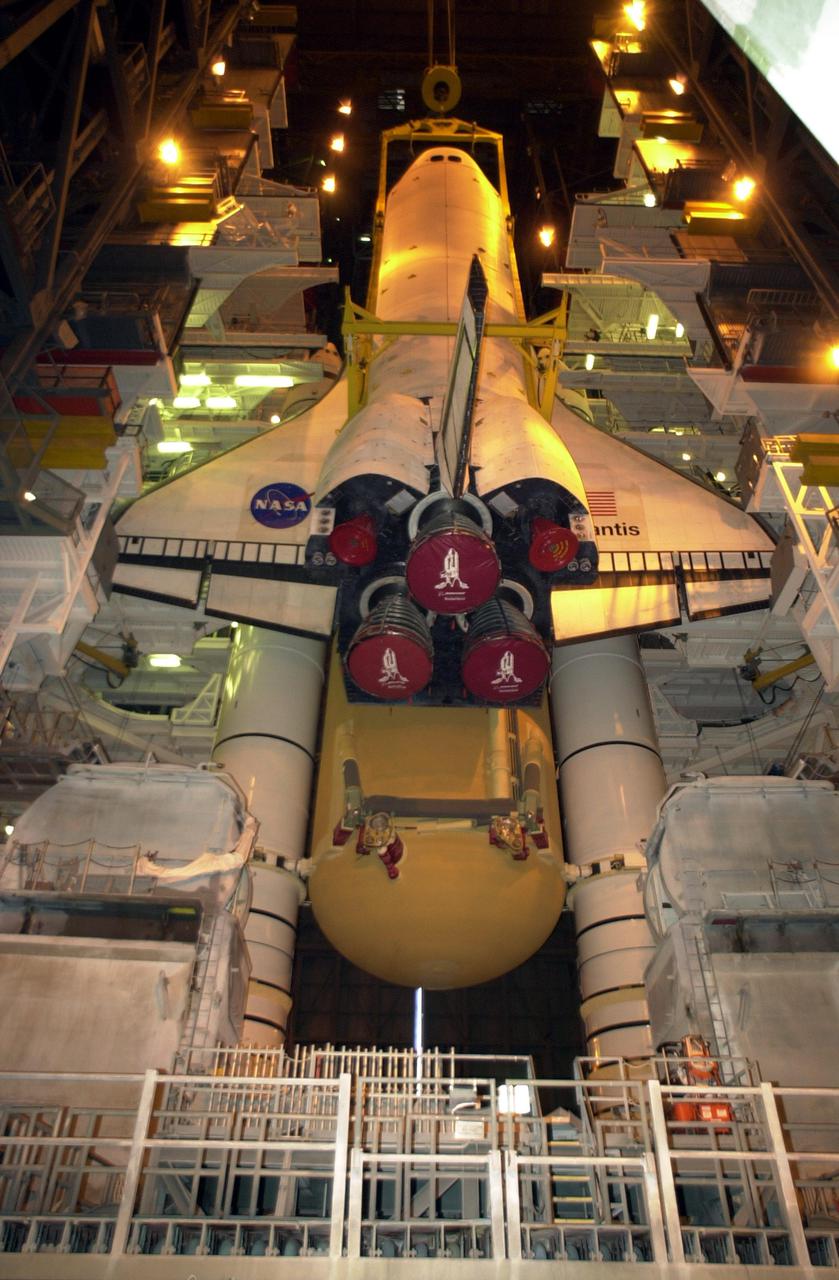
KENNEDY SPACE CENTER, FLA. -- In Vehicle Assembly Building high bay 1, the orbiter Atlantis is being lowered into position for mating to its external tank_solid rocket booster stack.; Space Shuttle Atlantis is scheduled to launch on mission STS-104 in early July
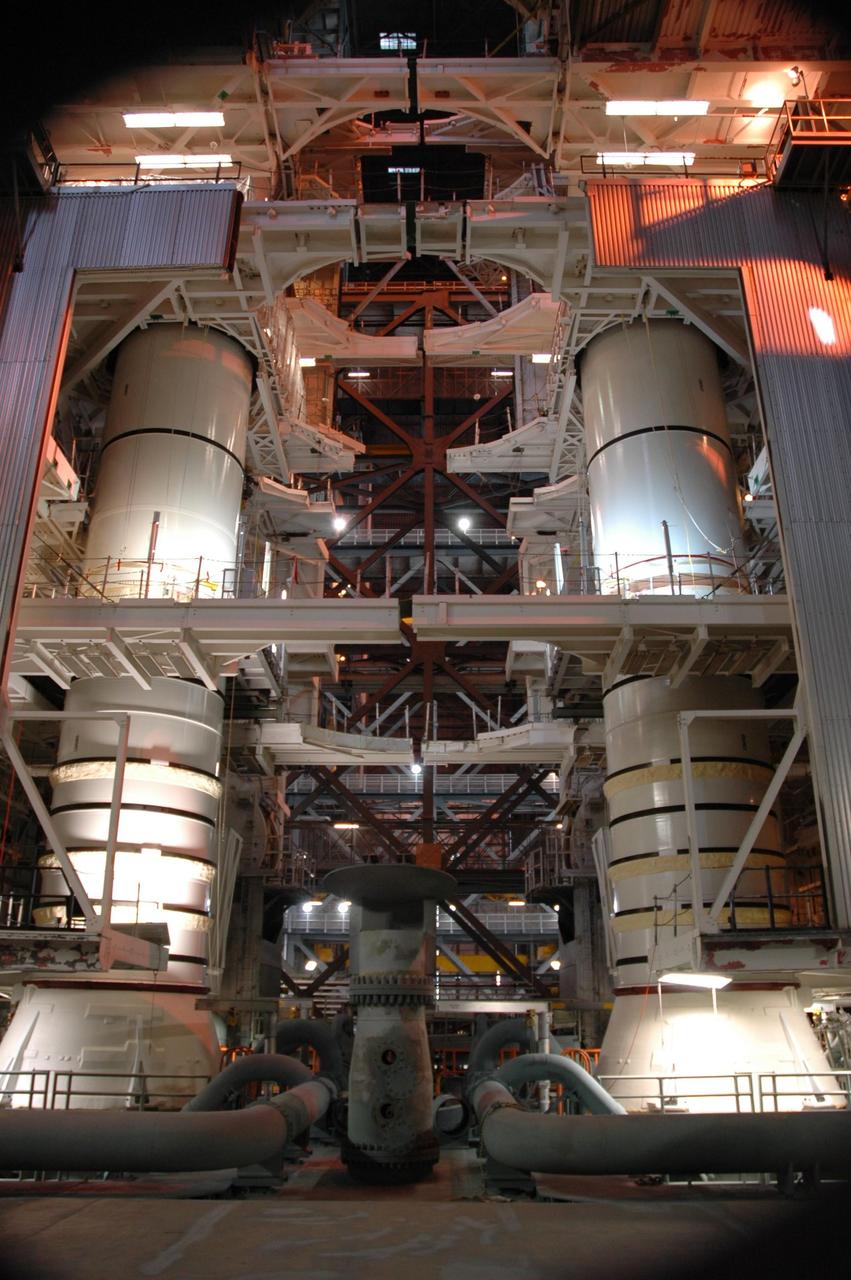
KENNEDY SPACE CENTER, FLA. -- In the Vehicle Assembly Building, the solid rocket booster segments are being stacked on the mobile launcher platform for mission STS-122. Space shuttle Atlantis is targeted for launch on mission STS-122 on Dec. 6. Photo credit: NASA/Jack Pfaller
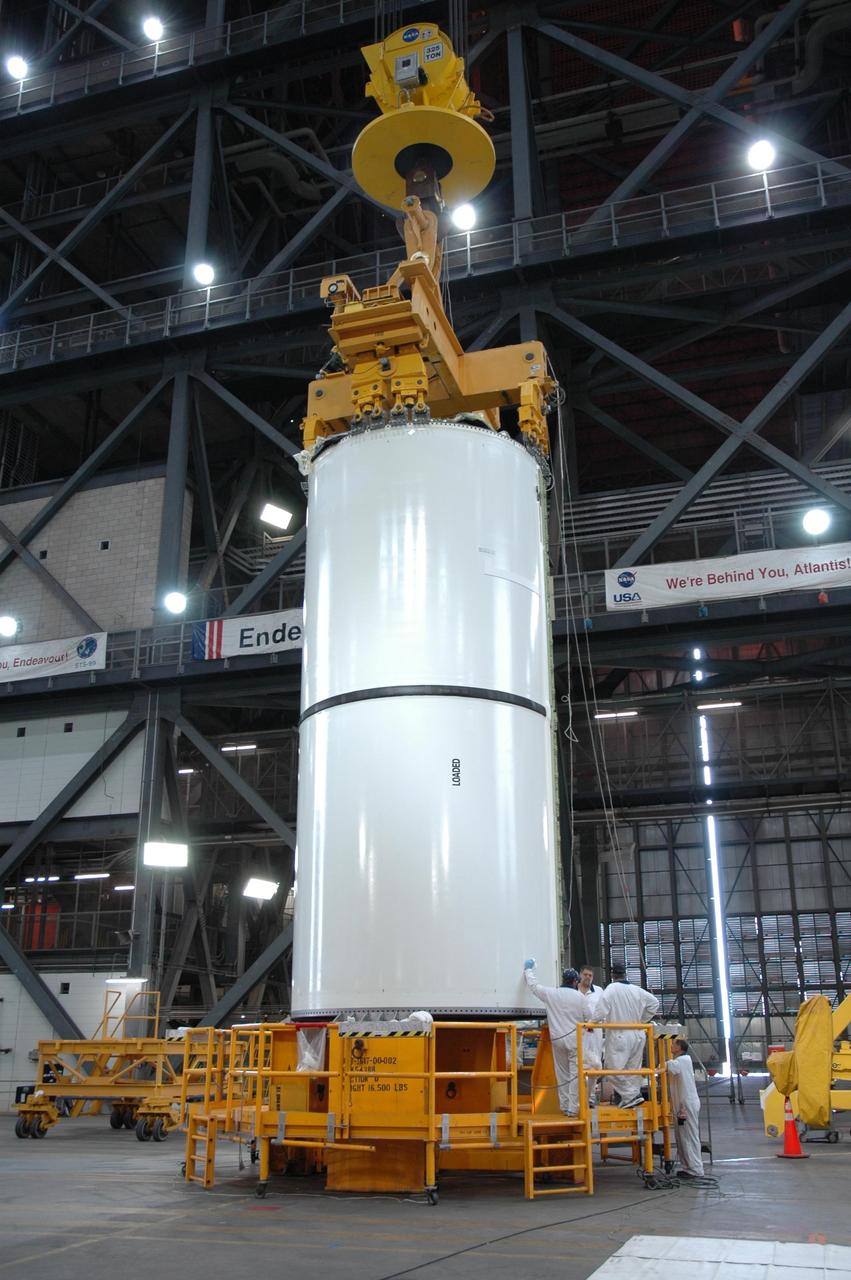
KENNEDY SPACE CENTER, FLA. -- Another STS-120 solid rocket booster segment waits to be stacked in the Vehicle Assembly Building on the mobile launcher platform. STS-120 will be the 23rd flight to the International Space Station. Space Shuttle Discovery will carry the U.S. Node 2. Launch is targeted for Oct. 20. NASA/Jim Grossmann
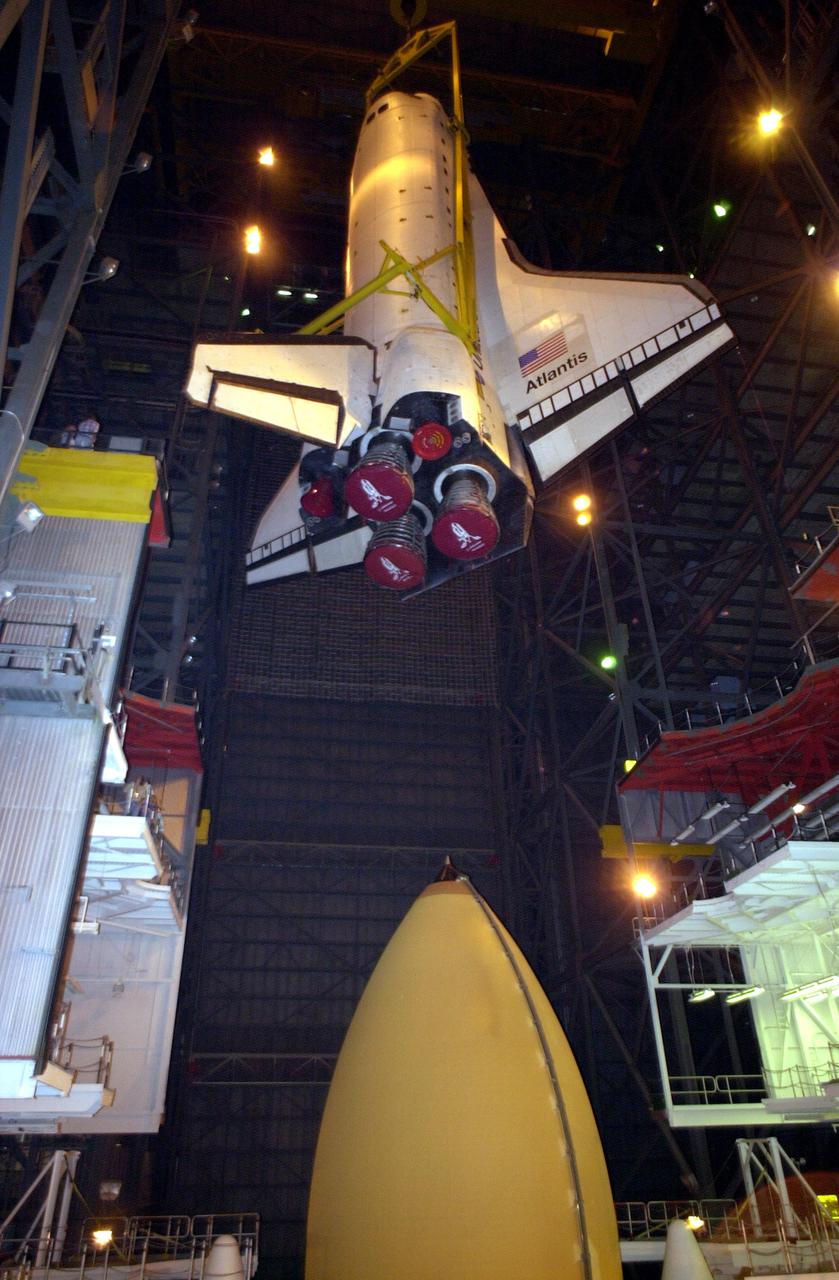
KENNEDY SPACE CENTER, FLA. -- In Vehicle Assembly Building high bay 1, the orbiter Atlantis is being lowered into position for mating to its external tank_solid rocket booster stack.; Space Shuttle Atlantis is scheduled to launch on mission STS-104 in early July

KENNEDY SPACE CENTER, FLA. -- In the Vehicle Assembly Building, overhead cranes raise the orbiter Atlantis to a vertical position in the transfer aisle. The orbiter will be rotated and lifted up and over to a high bay and stacked with its external tank and solid rocket boosters. Space Shuttle Atlantis is scheduled to launch on mission STS-104 in early July
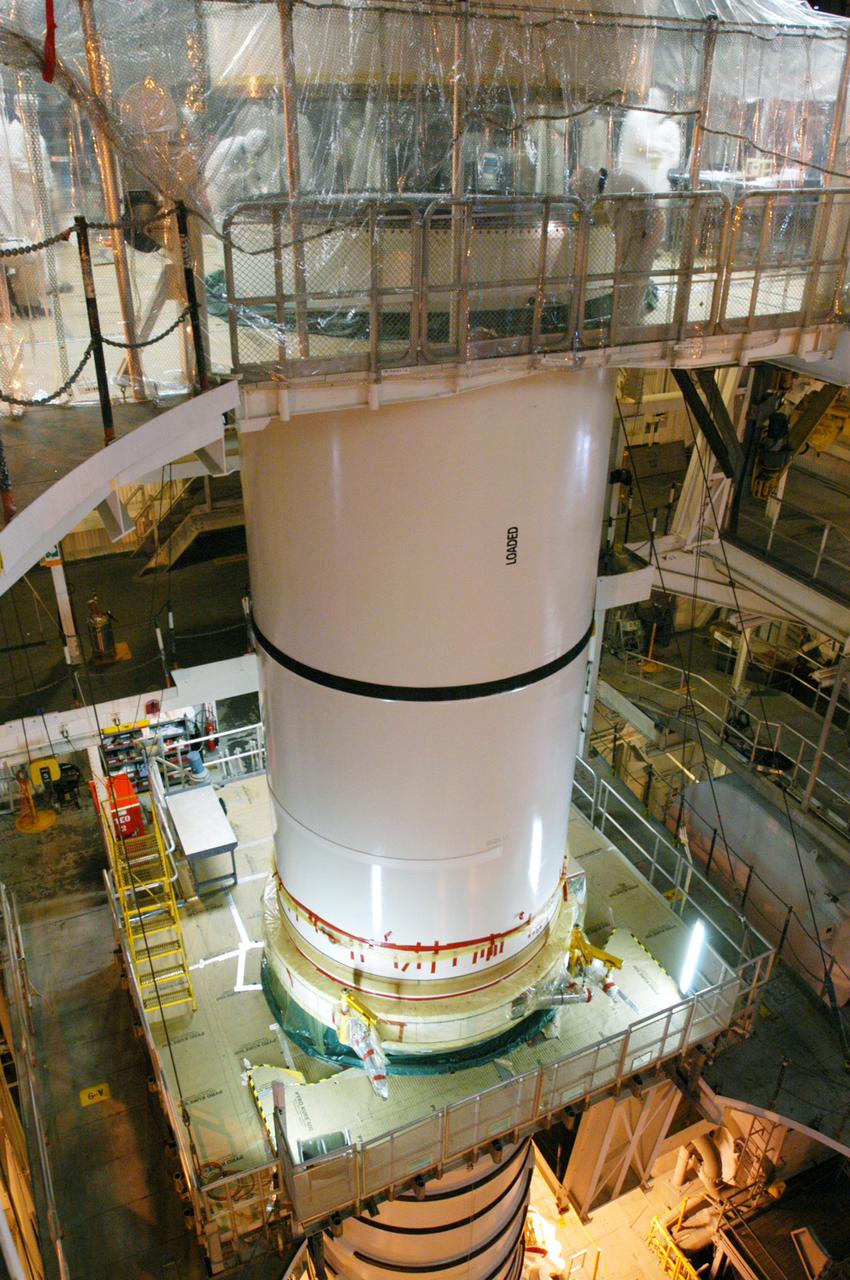
KENNEDY SPACE CENTER, FLA. - In the Vehicle Assembly Building, the starboard Solid Rocket Booster is being stacked for Return to Flight mission STS-114 on Space Shuttle Discovery to the International Space Station. Discovery is scheduled for a launch planning window of May 12 to June 3, 2005.
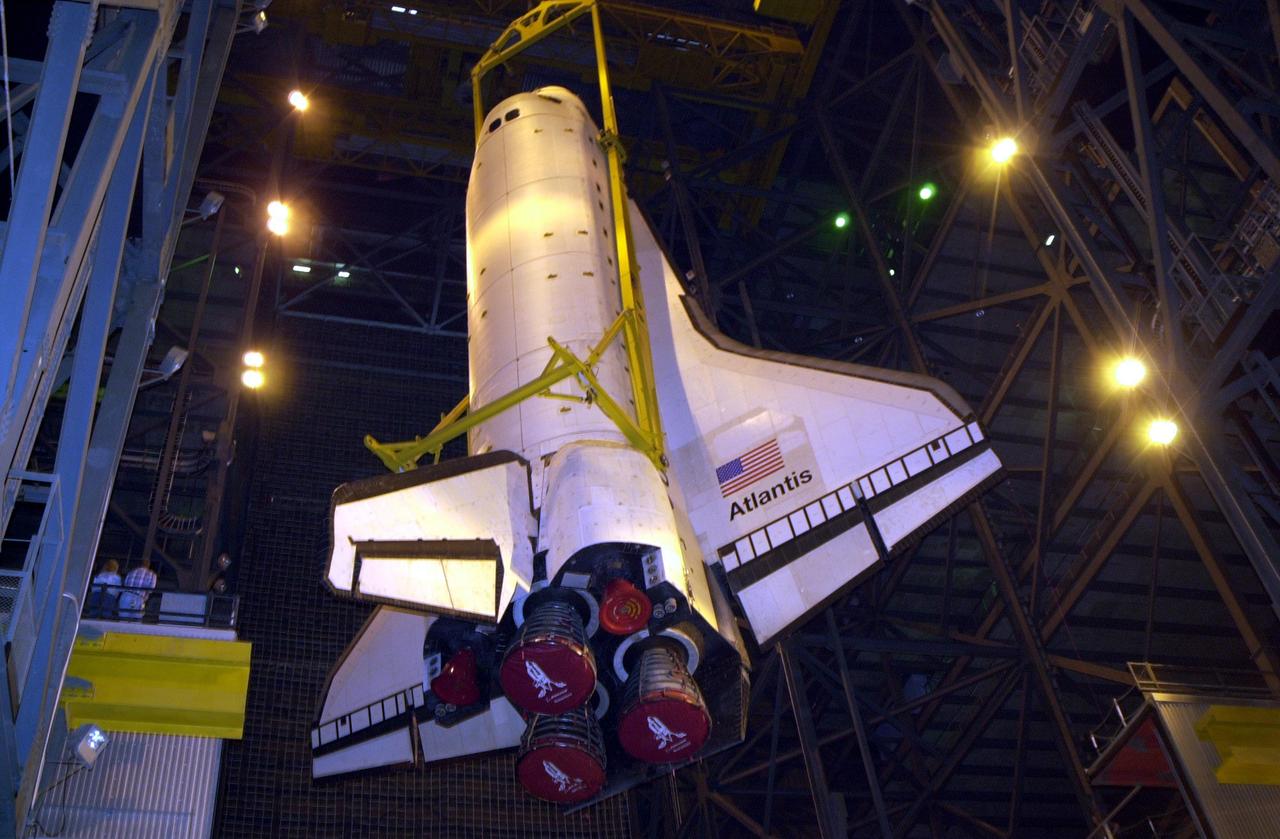
KENNEDY SPACE CENTER, FLA. -- In Vehicle Assembly Building high bay 1, the orbiter Atlantis is being lowered into position for mating to its external tank/solid rocket booster stack.; Space Shuttle Atlantis is scheduled to launch on mission STS-104 in early July
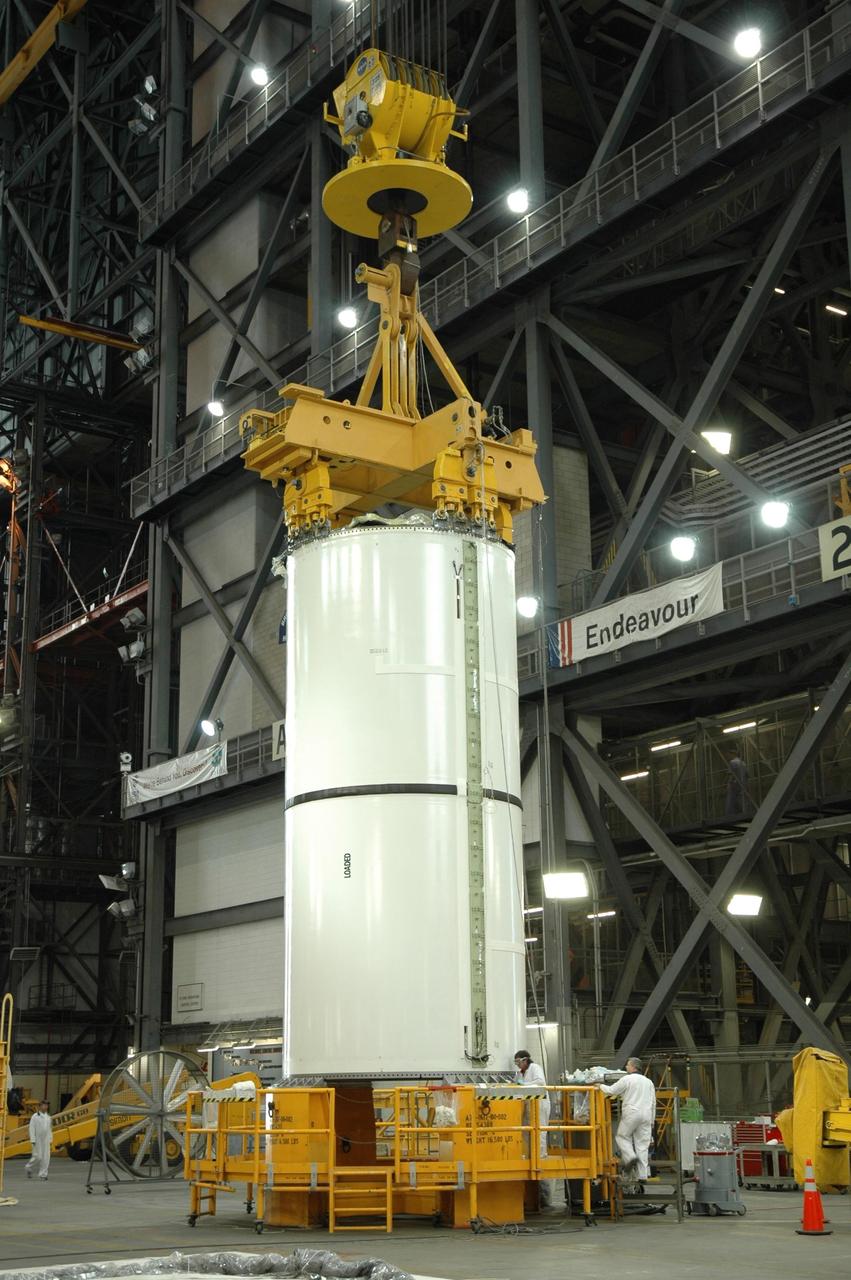
KENNEDY SPACE CENTER, FLA. -- The STS-120 solid rocket booster segments wait to be stacked in the Vehicle Assembly Building on the mobile launcher platform. STS-120 will be the 23rd flight to the International Space Station. Space Shuttle Discovery will carry the U.S. Node 2. Launch is targeted for Oct. 20. NASA/Jim Grossmann
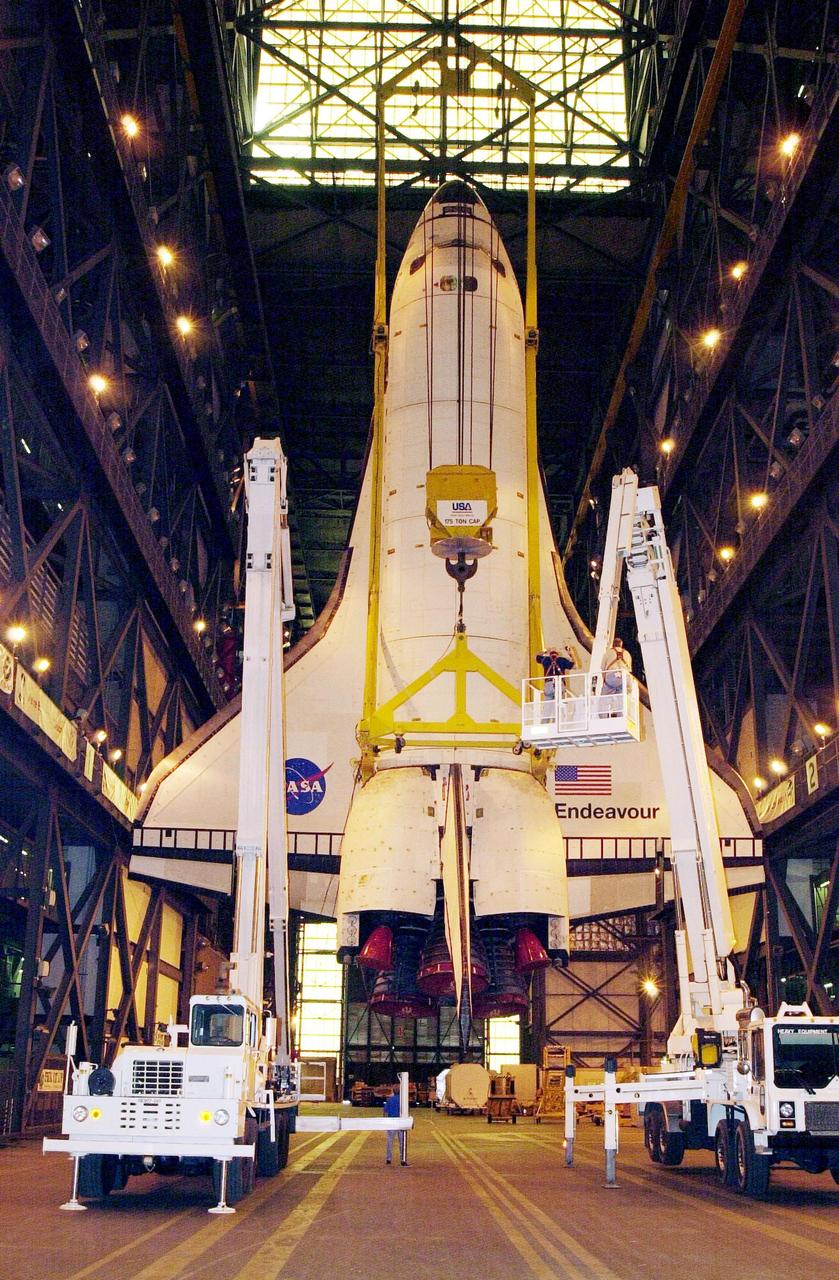
KENNEDY SPACE CENTER, FLA. -- As the orbiter Endeavour hangs suspended from a crane inside the Vehicle Assembly Building, workers make adjustments on it before it is lifted and stacked with its external tank and solid rocket boosters. The stack is in high bay 1. Space Shuttle Endeavour is scheduled to be launched Nov. 30 on mission STS-97, the sixth construction flight to the International Space Station
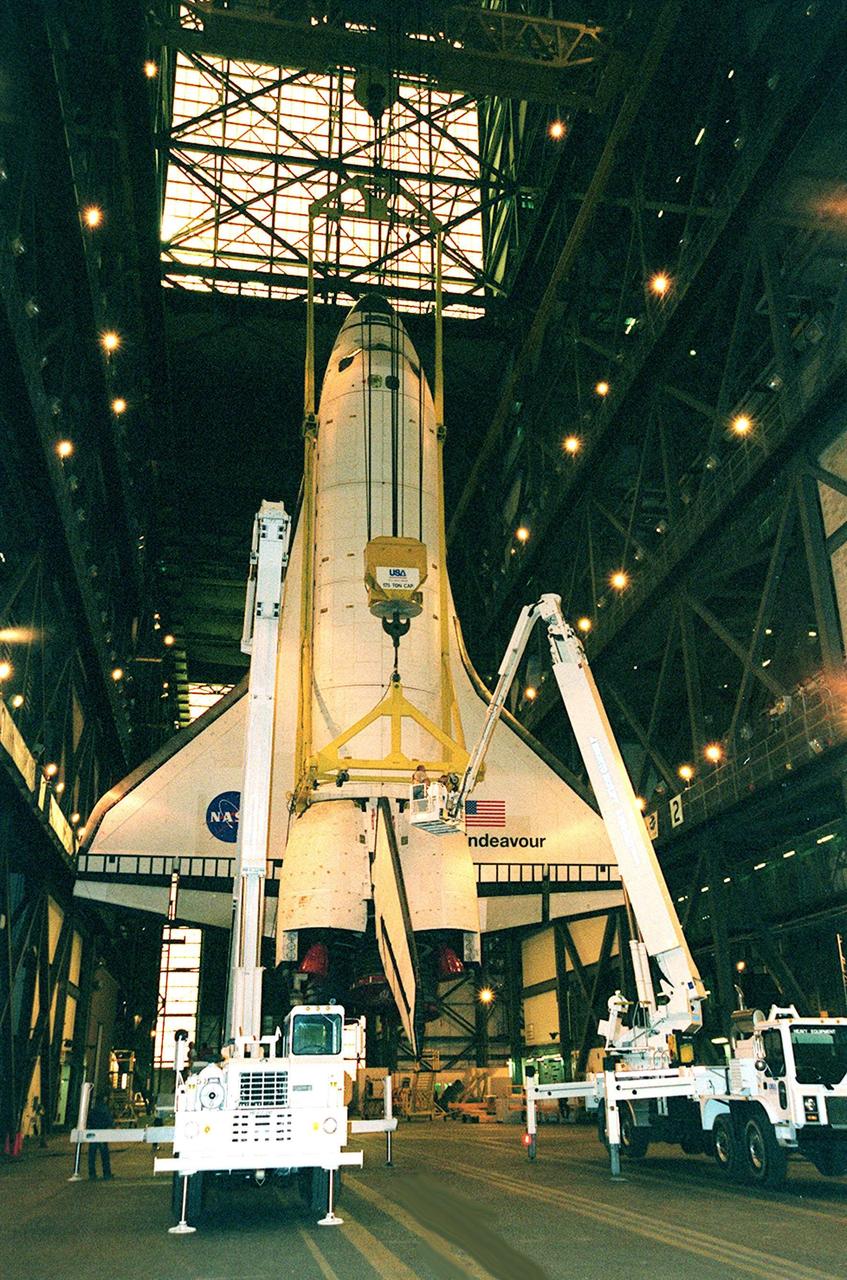
KENNEDY SPACE CENTER, FLA. -- As the orbiter Endeavour hangs suspended from a crane inside the Vehicle Assembly Building, workers make adjustments on it before it is lifted and stacked with its external tank and solid rocket boosters. The stack is in high bay 1. Space Shuttle Endeavour is scheduled to be launched Nov. 30 on mission STS-97, the sixth construction flight to the International Space Station
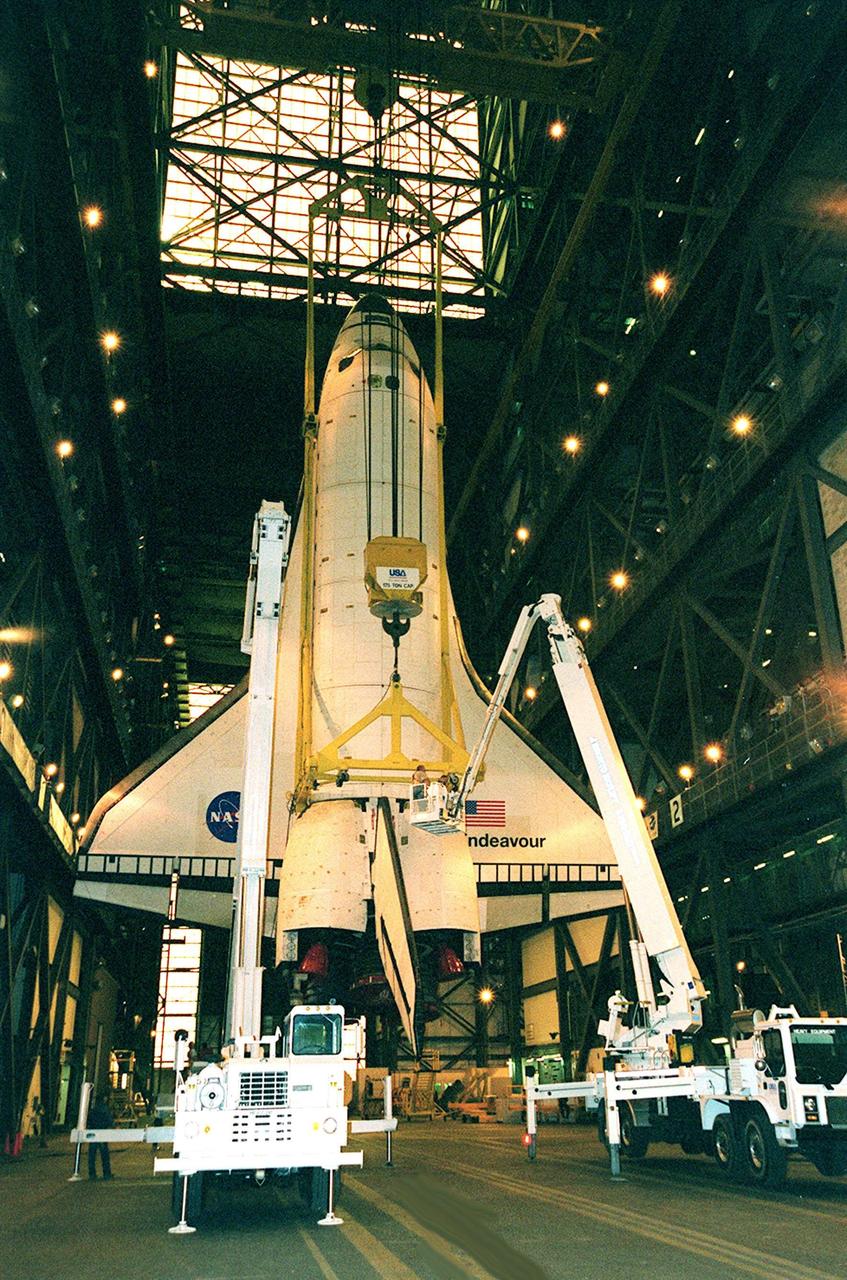
KENNEDY SPACE CENTER, FLA. -- As the orbiter Endeavour hangs suspended from a crane inside the Vehicle Assembly Building, workers make adjustments on it before it is lifted and stacked with its external tank and solid rocket boosters. The stack is in high bay 1. Space Shuttle Endeavour is scheduled to be launched Nov. 30 on mission STS-97, the sixth construction flight to the International Space Station
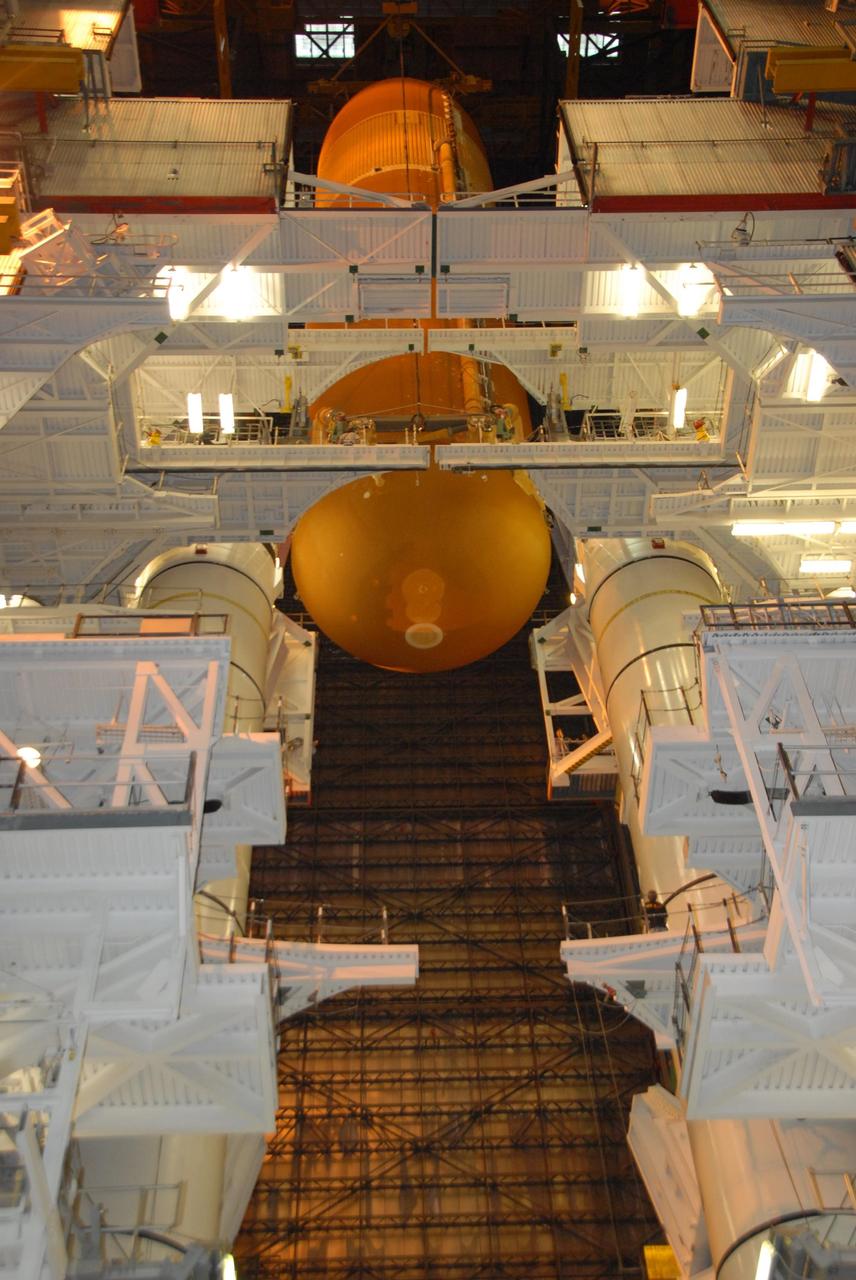
KENNEDY SPACE CENTER, FLA. -- In the Vehicle Assembly Building at NASA's Kennedy Space Center, external tank No. 120 is lowered toward the mobile launcher platform in high bay 1 where it will be mated with the solid rocket boosters already there. The external tank-SRB stack is being prepared for the orbiter Discovery, which will be mated to the stack in the VAB in two weeks. Space Shuttle Discovery is targeted to launch Oct. 23 on mission STS-120 to the International Space Station. Photo credit: NASA/George Shelton
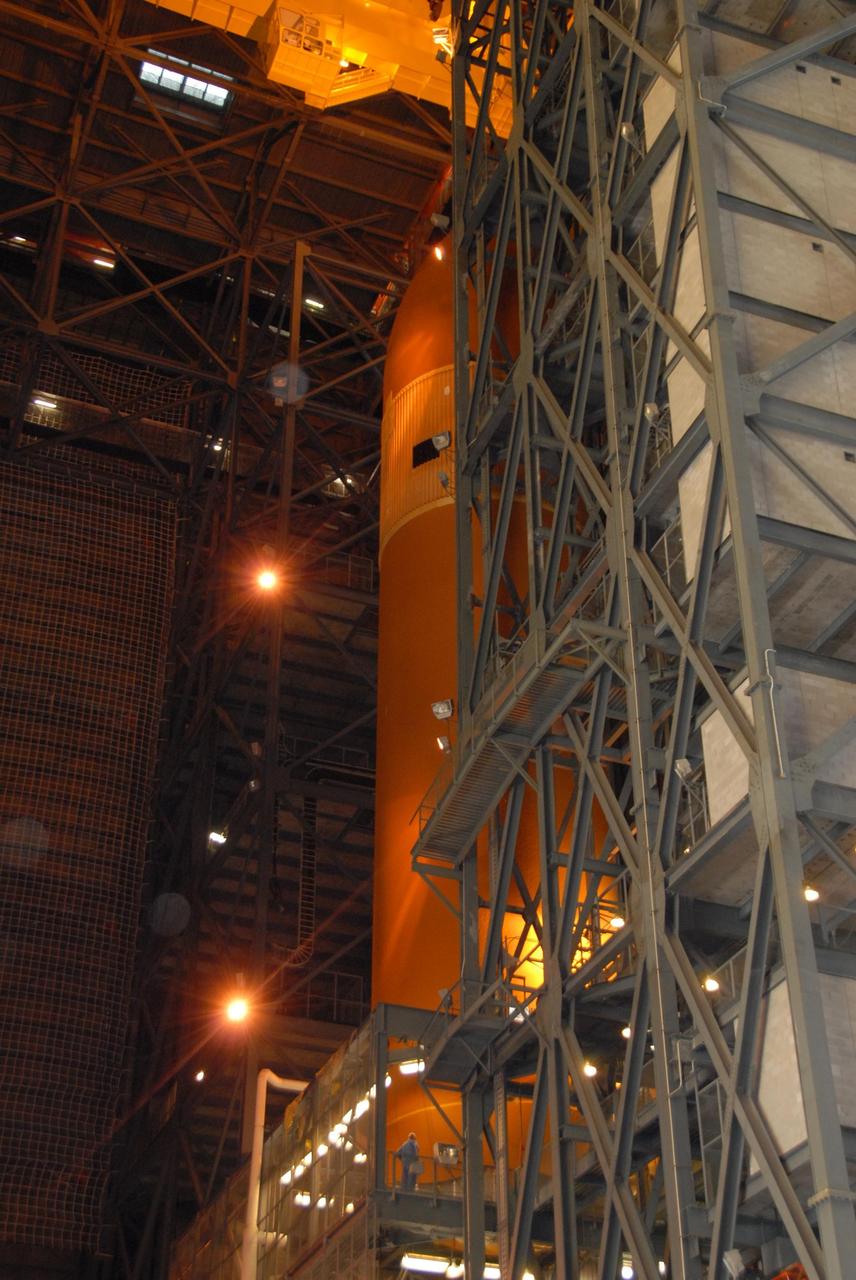
KENNEDY SPACE CENTER, FLA. -- In the Vehicle Assembly Building at NASA's Kennedy Space Center, external tank No. 120 is being lifted out of the checkout cell to high bay 1 where it will be mated with the solid rocket boosters. The external tank-SRB stack is being prepared for the orbiter Discovery, which will be mated to the stack in the VAB in two weeks. Space Shuttle Discovery is targeted to launch Oct. 23 on mission STS-120 to the International Space Station. Photo credit: NASA/George Shelton
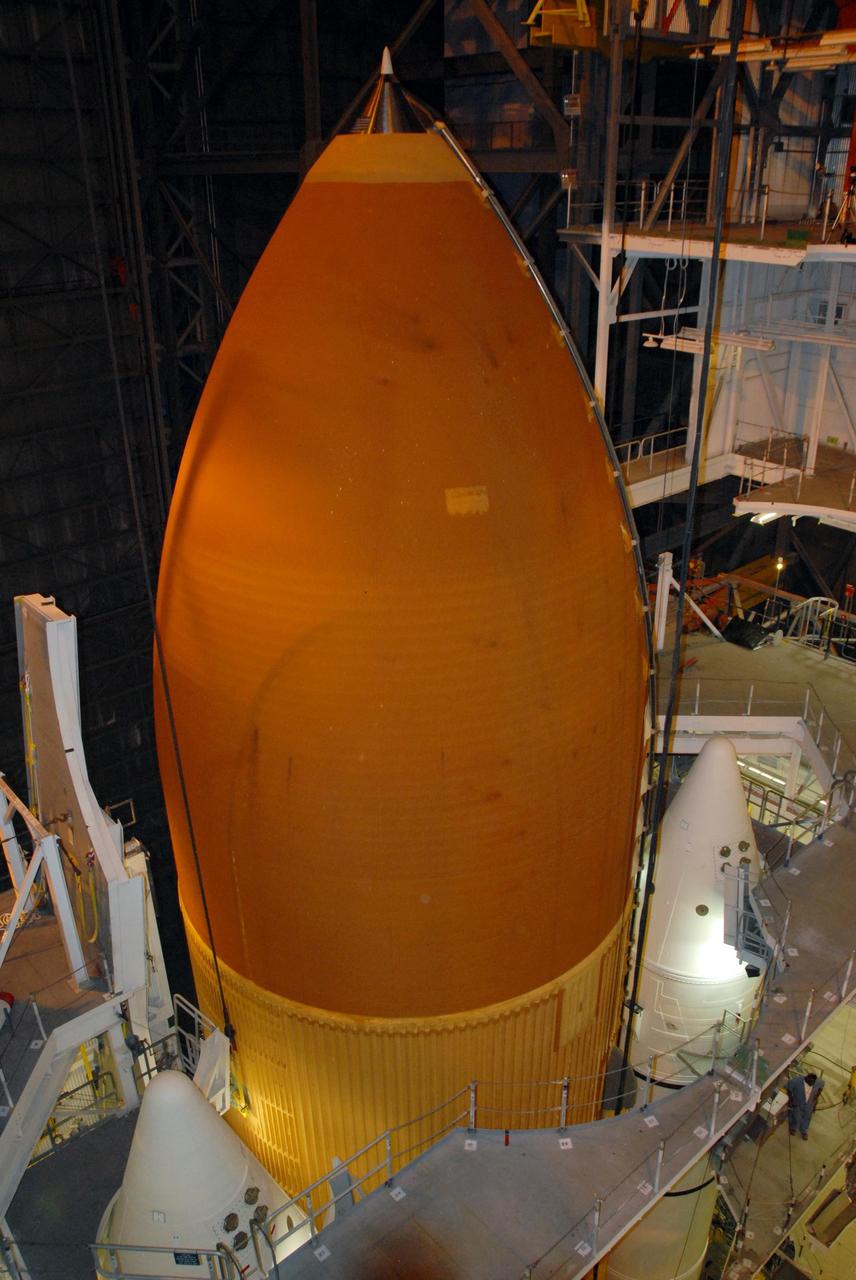
KENNEDY SPACE CENTER, FLA. -- In the Vehicle Assembly Building at NASA's Kennedy Space Center, the top of external tank No. 120 is seen as the tank is lowered between the solid rocket boosters for mating on the mobile launcher platform. The external tank-SRB stack is being prepared for the orbiter Discovery, which will be mated to the stack in the VAB in two weeks. Space Shuttle Discovery is targeted to launch Oct. 23 on mission STS-120 to the International Space Station. Photo credit: NASA/George Shelton
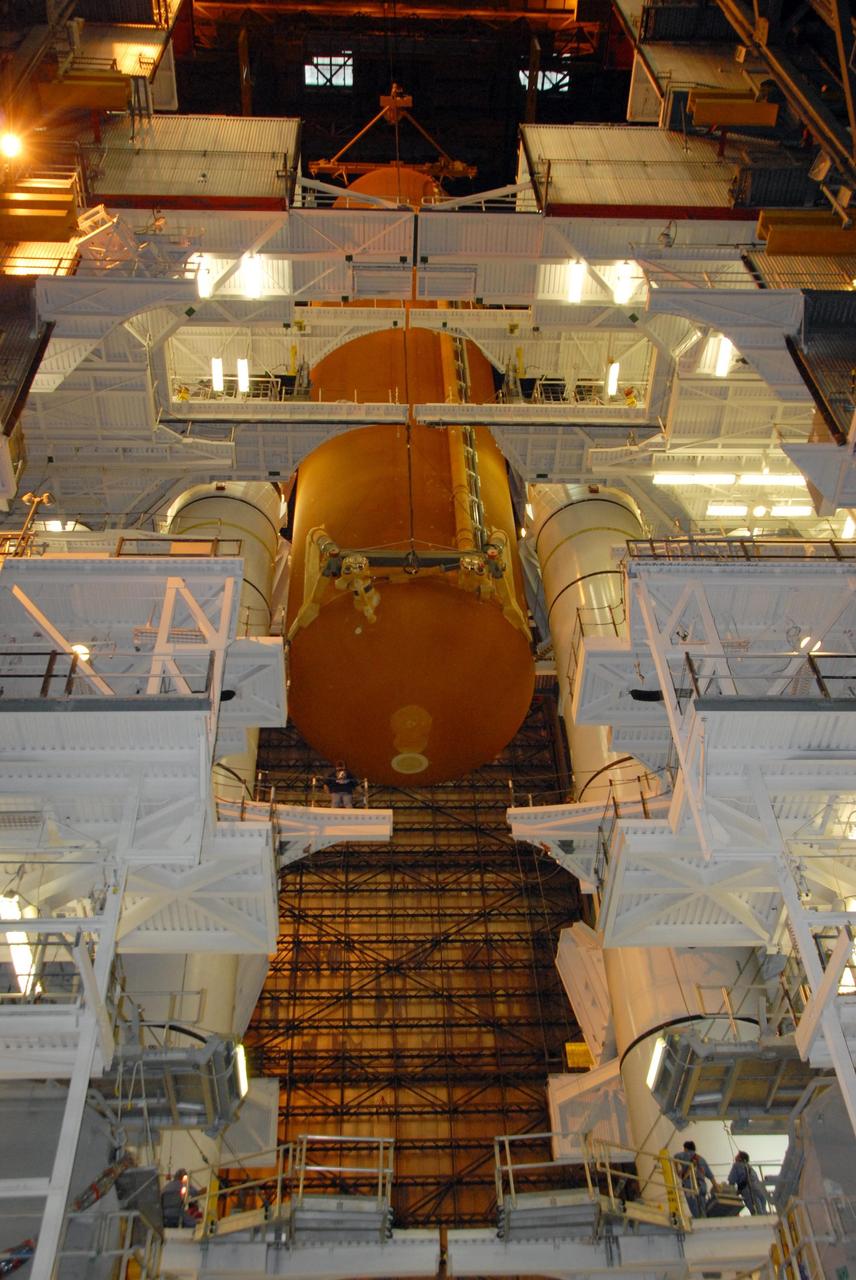
KENNEDY SPACE CENTER, FLA. -- In the Vehicle Assembly Building at NASA's Kennedy Space Center, external tank No. 120 is lowered between the solid rocket boosters for mating on the mobile launcher platform. The external tank-SRB stack is being prepared for the orbiter Discovery, which will be mated to the stack in the VAB in two weeks. Space Shuttle Discovery is targeted to launch Oct. 23 on mission STS-120 to the International Space Station. Photo credit: NASA/George Shelton

KENNEDY SPACE CENTER, FLA. -- In the Vehicle Assembly Building at NASA's Kennedy Space Center, external tank No. 120 is lowered between the solid rocket boosters for mating on the mobile launcher platform. The external tank-SRB stack is being prepared for the orbiter Discovery, which will be mated to the stack in the VAB in two weeks. Space Shuttle Discovery is targeted to launch Oct. 23 on mission STS-120 to the International Space Station. Photo credit: NASA/George Shelton
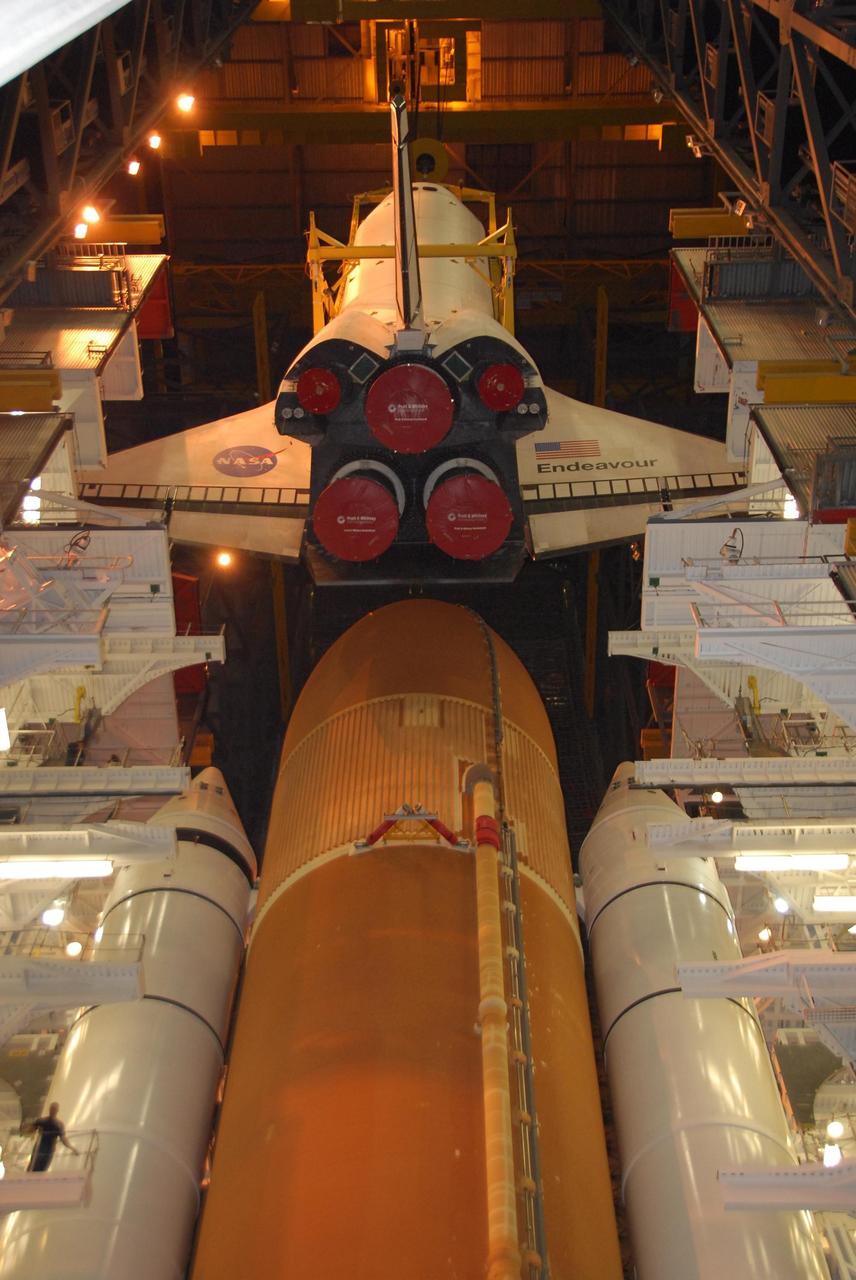
KENNEDY SPACE CENTER, FLA. -- In the Vehicle Assembly Building, space shuttle Endeavour is lowered into high bay 1 toward the external tank and solid rocket boosters already stacked on the mobile launcher platform. The stacking is in preparation for launch on the STS-123 mission, targeted for March 11. The mission will deliver the first section of the Japan Aerospace Exploration Agency's Kibo laboratory and the Canadian Space Agency's two-armed robotic system, Dextre. Photo credit: NASA/Dimitri Gerondidakis
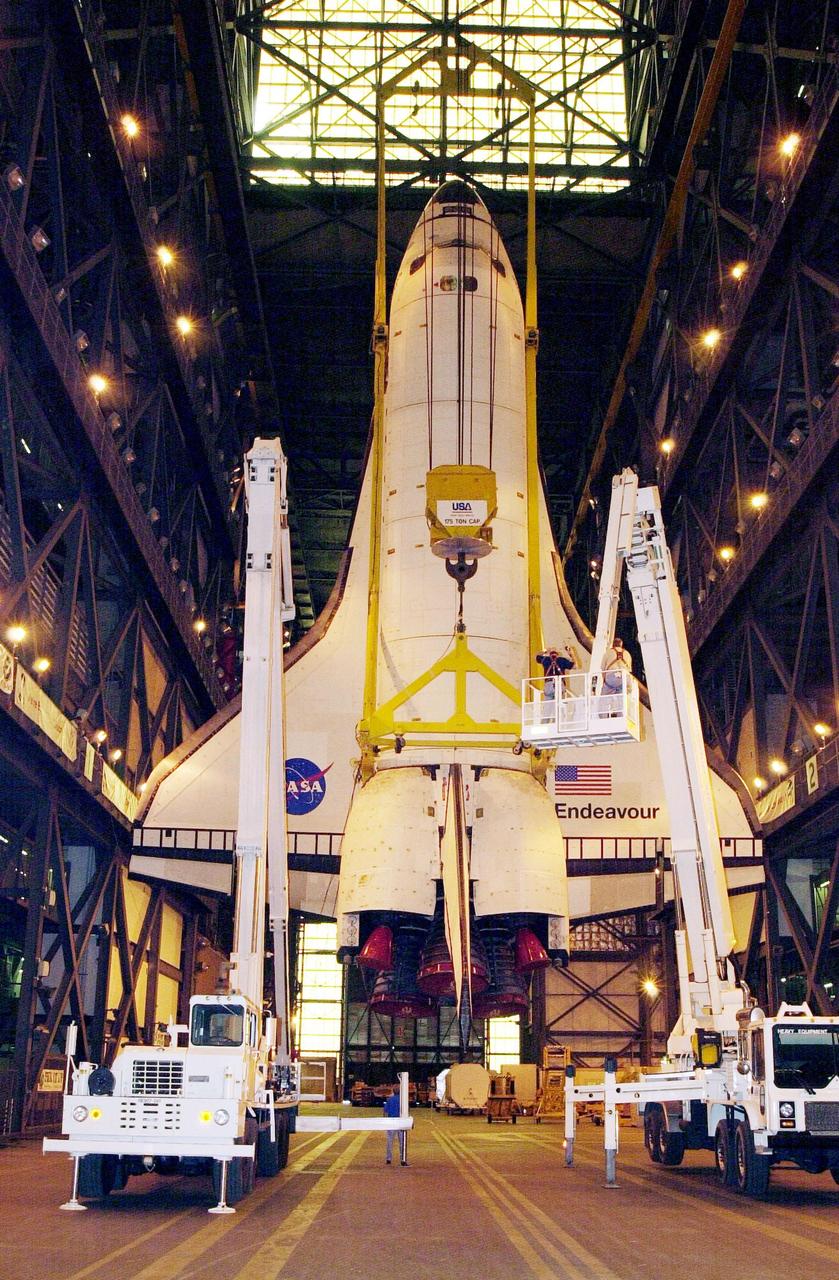
KENNEDY SPACE CENTER, FLA. -- As the orbiter Endeavour hangs suspended from a crane inside the Vehicle Assembly Building, workers make adjustments on it before it is lifted and stacked with its external tank and solid rocket boosters. The stack is in high bay 1. Space Shuttle Endeavour is scheduled to be launched Nov. 30 on mission STS-97, the sixth construction flight to the International Space Station
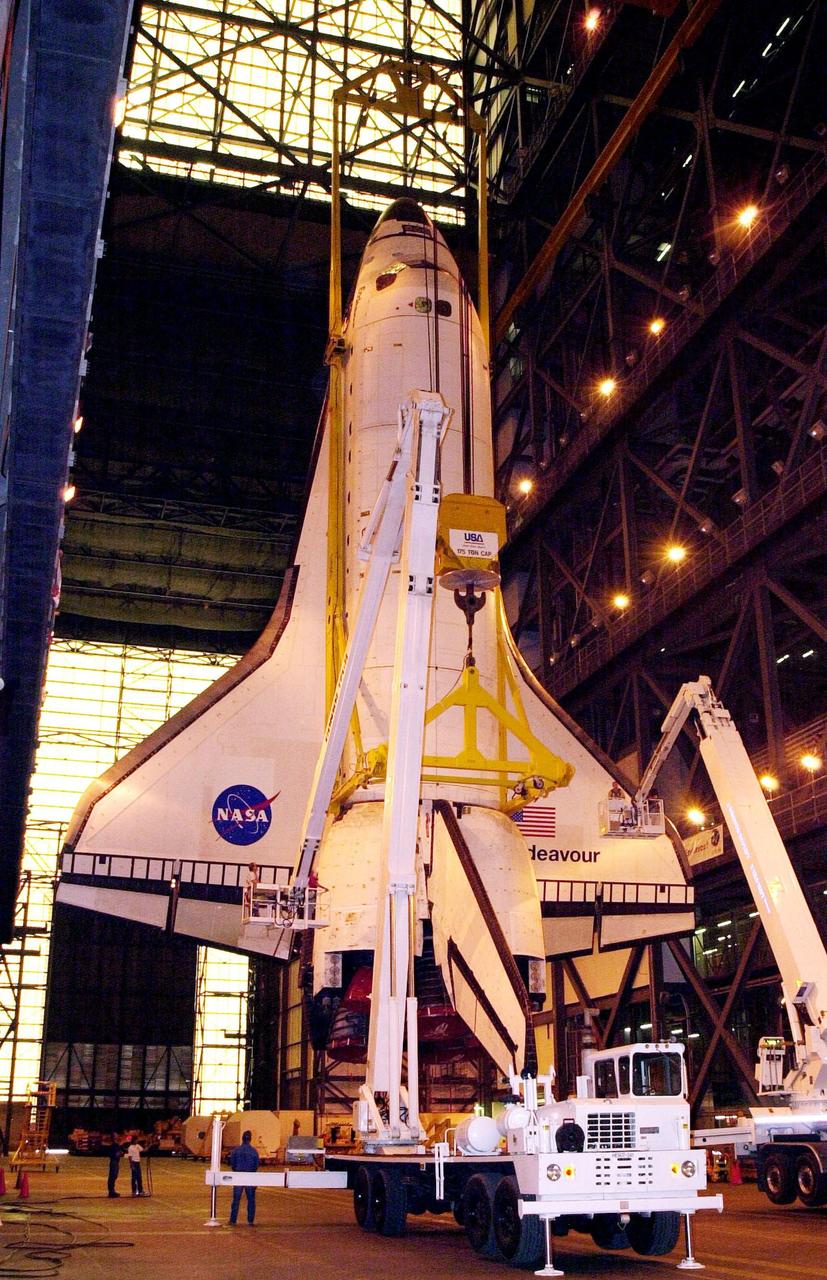
KENNEDY SPACE CENTER, FLA. -- As the orbiter Endeavour hangs suspended from a crane inside the Vehicle Assembly Building, workers make adjustments on it before it is lifted and stacked with its external tank and solid rocket boosters. The stack is in high bay 1. Space Shuttle Endeavour is scheduled to be launched Nov. 30 on mission STS-97, the sixth construction flight to the International Space Station
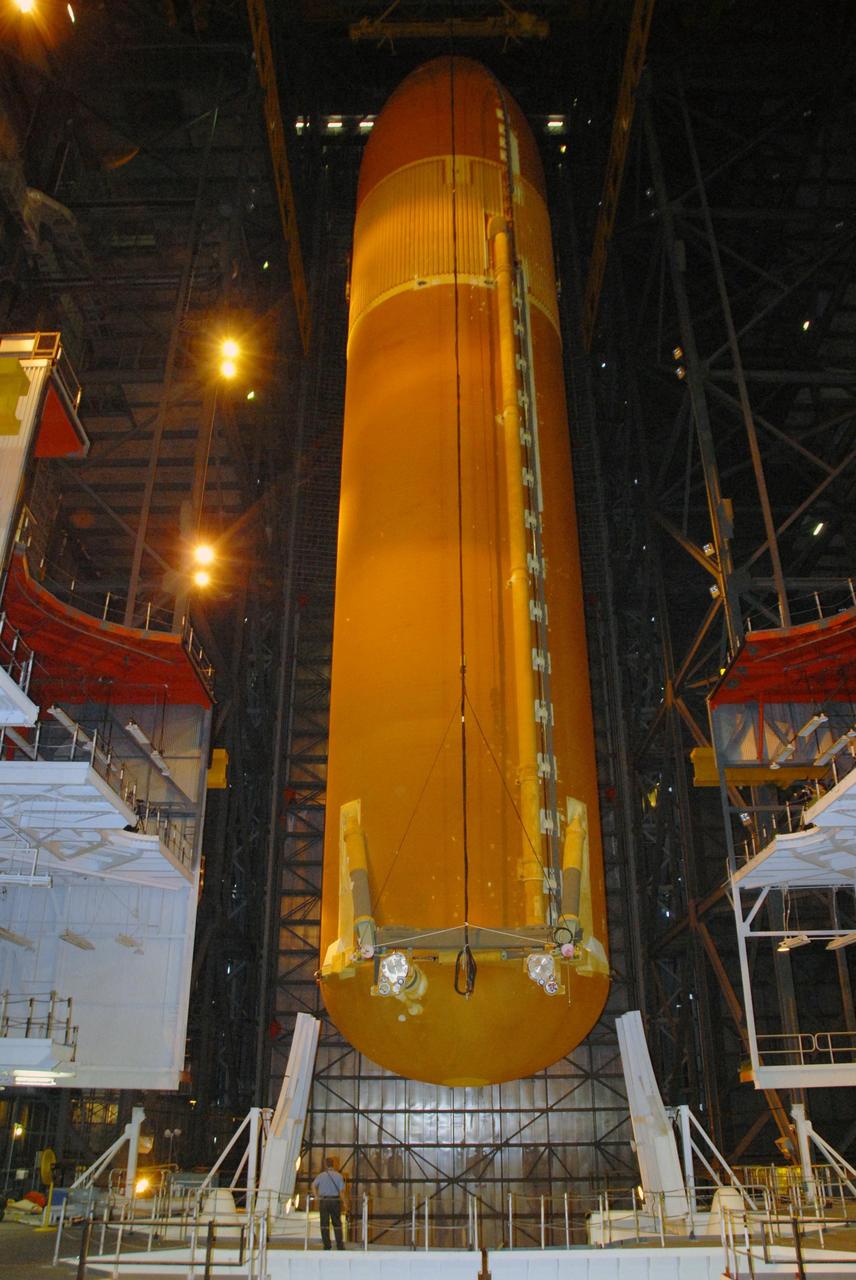
KENNEDY SPACE CENTER, FLA. -- In the Vehicle Assembly Building at NASA's Kennedy Space Center, external tank No. 120 is lowered toward the mobile launcher platform in high bay 1 where it will be mated with the solid rocket boosters already there. The external tank-SRB stack is being prepared for the orbiter Discovery, which will be mated to the stack in the VAB in two weeks. Space Shuttle Discovery is targeted to launch Oct. 23 on mission STS-120 to the International Space Station. Photo credit: NASA/George Shelton
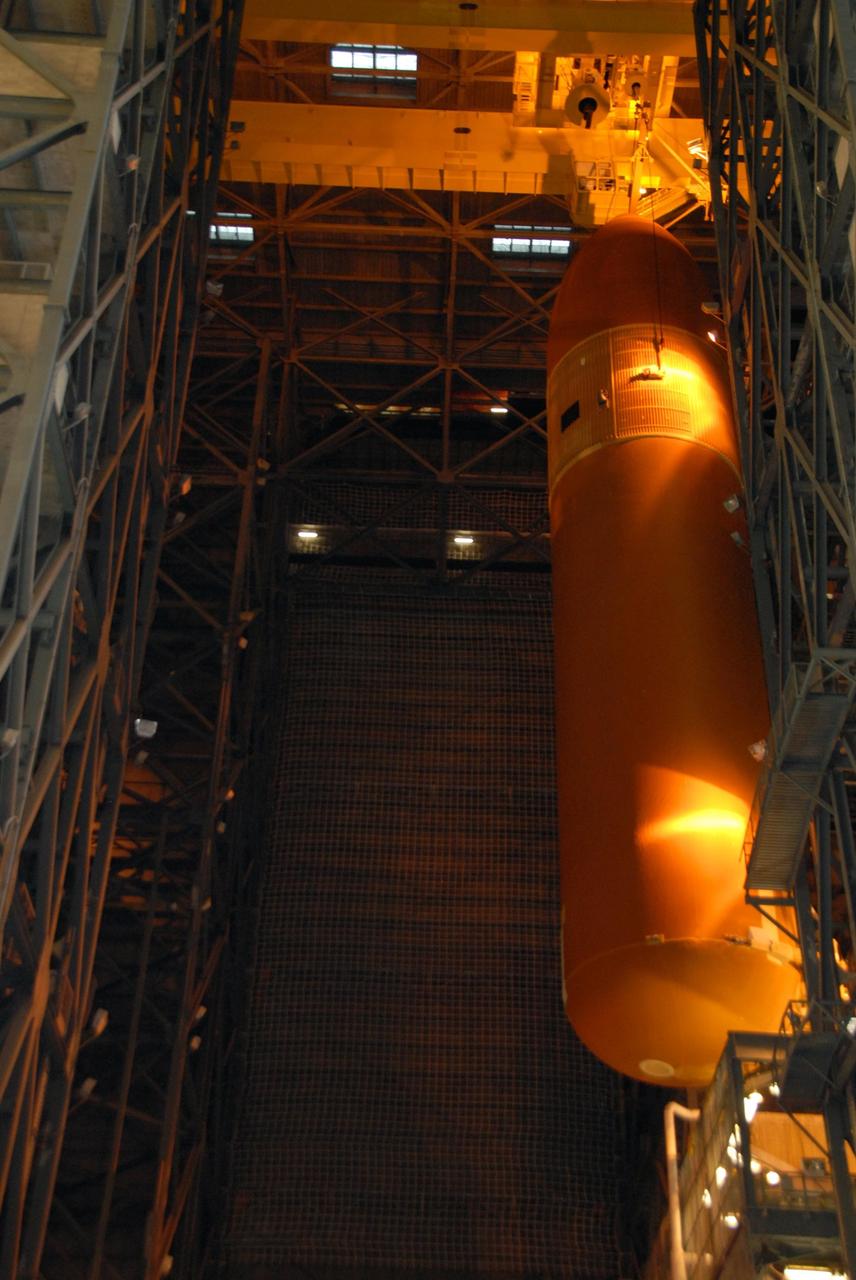
KENNEDY SPACE CENTER, FLA. -- In the Vehicle Assembly Building at NASA's Kennedy Space Center, external tank No. 120 is being lifted out of the checkout cell to high bay 1 where it will be mated with the solid rocket boosters. The external tank-SRB stack is being prepared for the orbiter Discovery, which will be mated to the stack in the VAB in two weeks. Space Shuttle Discovery is targeted to launch Oct. 23 on mission STS-120 to the International Space Station. Photo credit: NASA/George Shelton
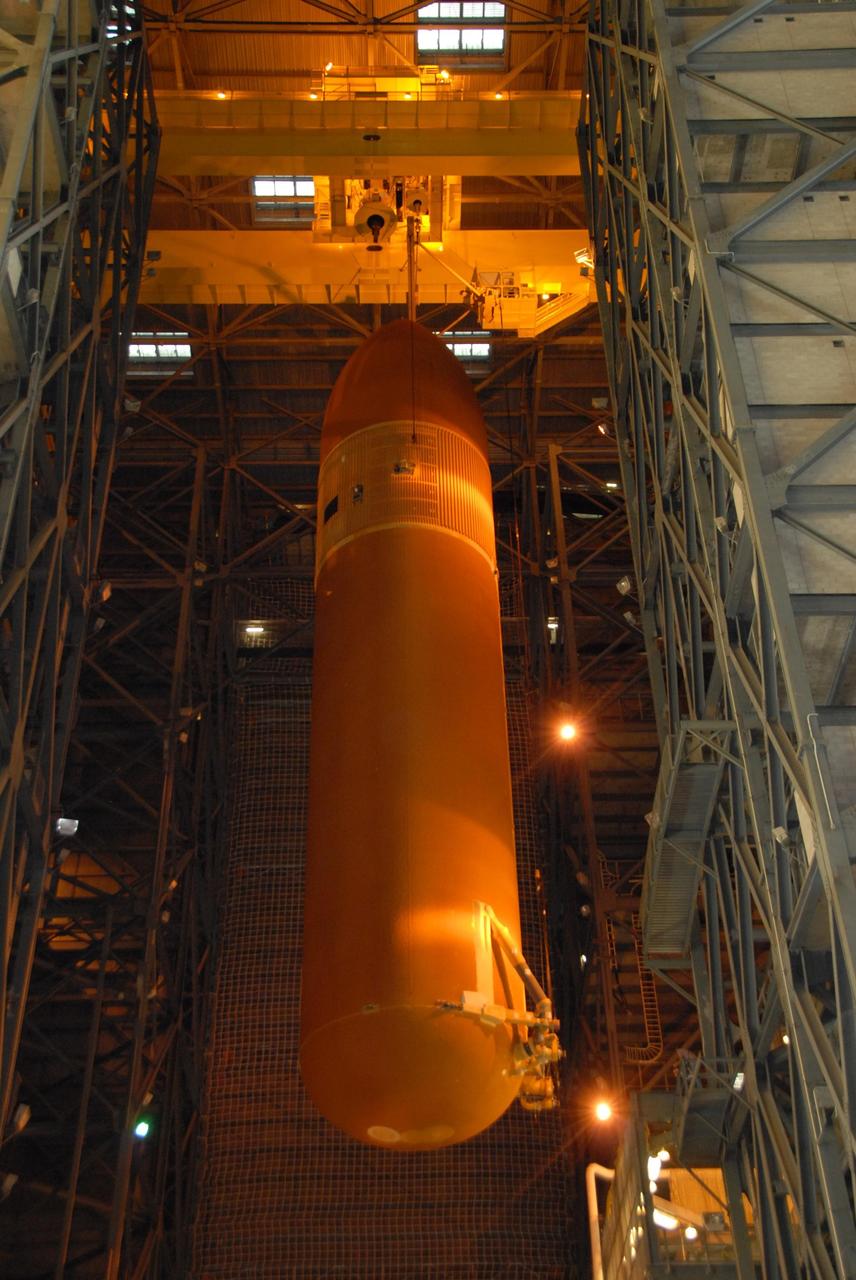
KENNEDY SPACE CENTER, FLA. -- In the Vehicle Assembly Building at NASA's Kennedy Space Center, external tank No. 120 is lowered into high bay 1 where it will be mated with the solid rocket boosters. The external tank-SRB stack is being prepared for the orbiter Discovery, which will be mated to the stack in the VAB in two weeks. Space Shuttle Discovery is targeted to launch Oct. 23 on mission STS-120 to the International Space Station. Photo credit: NASA/George Shelton
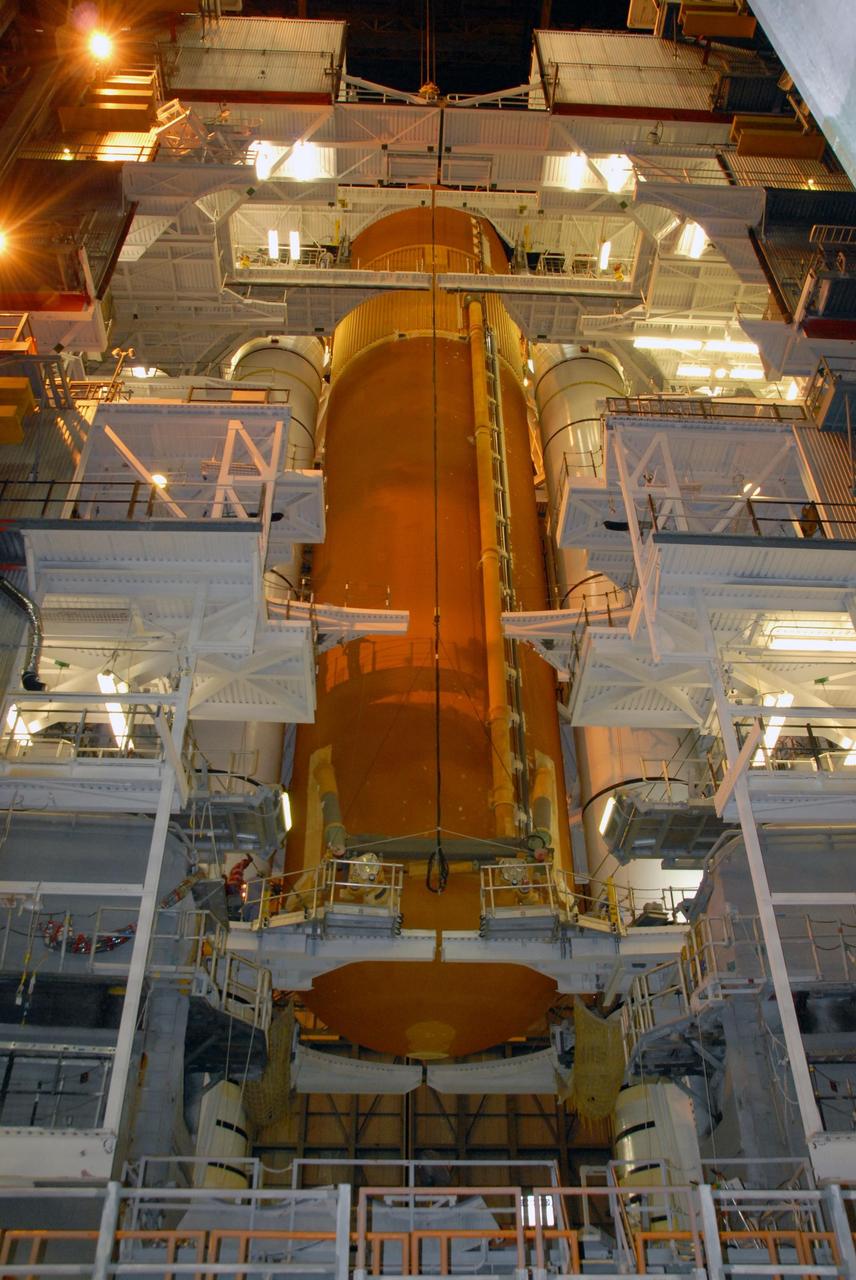
KENNEDY SPACE CENTER, FLA. -- In the Vehicle Assembly Building at NASA's Kennedy Space Center, external tank No. 120 has been lowered between the solid rocket boosters for mating on the mobile launcher platform. The external tank-SRB stack is being prepared for the orbiter Discovery, which will be mated to the stack in the VAB in two weeks. Space Shuttle Discovery is targeted to launch Oct. 23 on mission STS-120 to the International Space Station. Photo credit: NASA/George Shelton
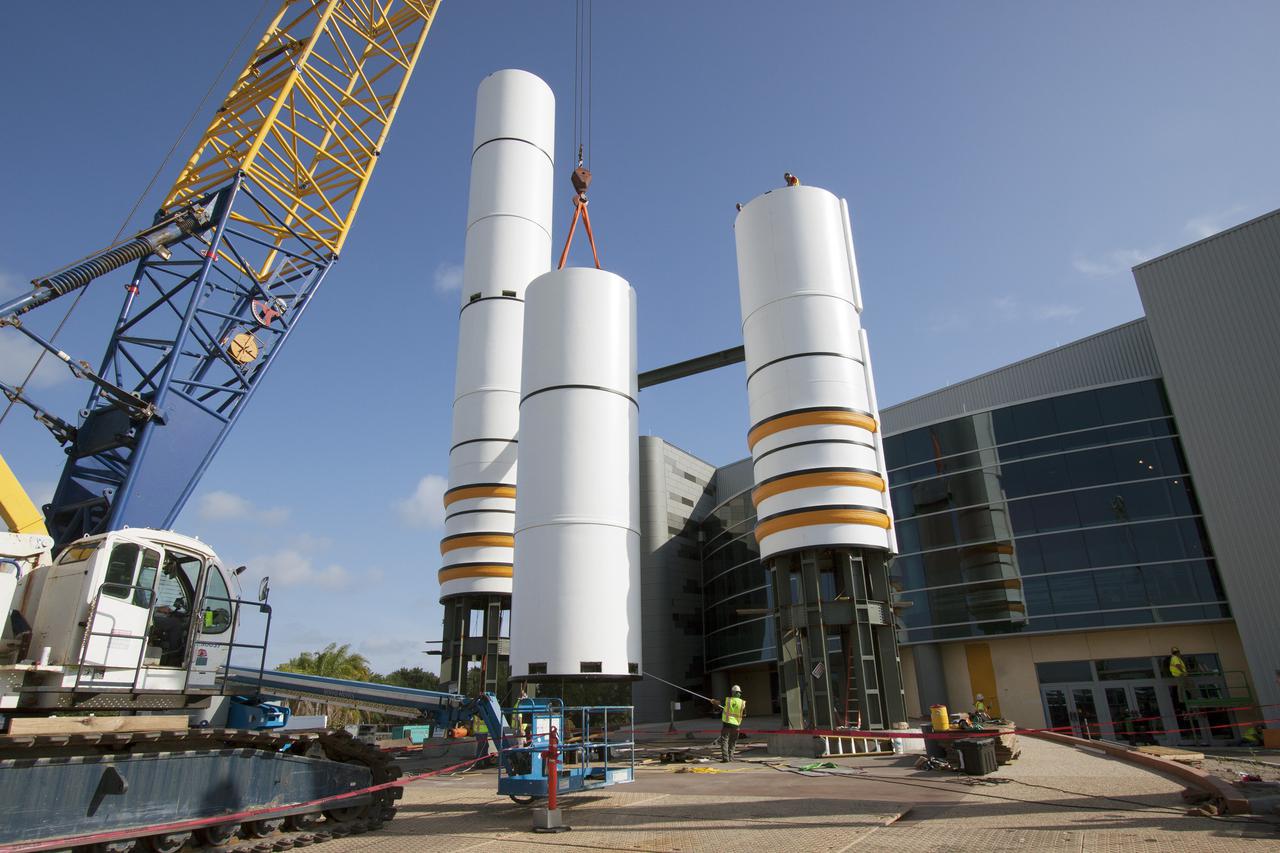
CAPE CANAVERAL, Fla. – A crane lifts a segment for a set of twin, full-size replica Solid Rocket Boosters SRBs in front of the Space Shuttle Atlantis exhibit under construction at the Kennedy Space Center Visitor Complex in Florida. Atlantis is housed in the building behind the SRB stack. An external tank replica will be added later to the middle of the SRBs to complete the display. The SRBs stand 150 feet tall, while the external tank will reach 184 feet when it is finished. The shuttle was mounted to the stack and depended on the power of the SRBs to lift it off the launch pad and start it on its way to space. The external tank was loaded with liquid propellants for the shuttle's three main engines. Photo credit: NASA_Jim Grossmann
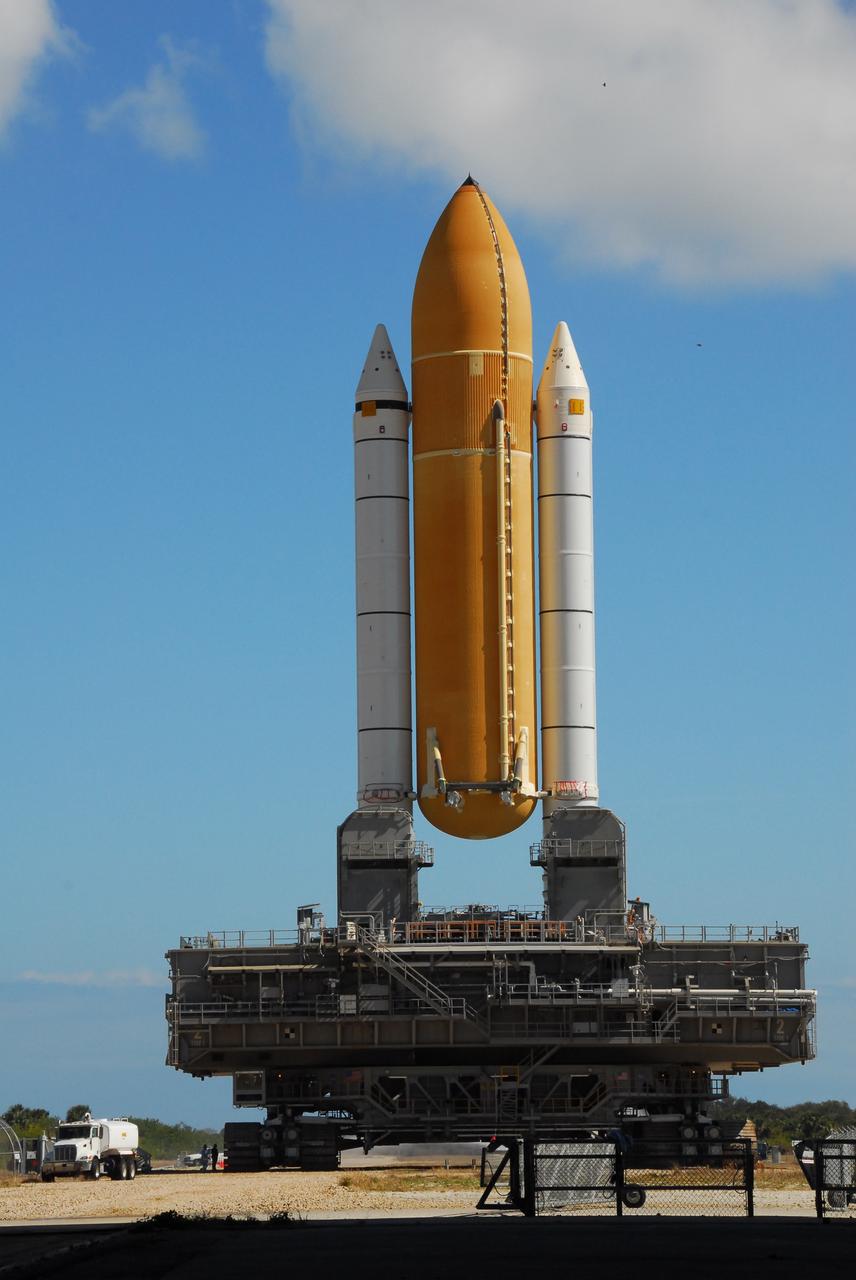
CAPE CANAVERAL, Fla. – Space shuttle Atlantis' external fuel tank-solid rocket booster stack, atop a mobile launcher platform, presents an unusual sight – without the shuttle – as it is transferred from high bay 1 to high bay 3 in the Vehicle Assembly Building at NASA's Kennedy Space Center. It is being moved to high bay 3 to make room for the ET-SRB stack for space shuttle Endeavour. Atlantis is targeted for launch on the STS-125 mission on May 12 to service NASA's Hubble Space Telescope. Endeavour will fly on the STS-127 mission to the International Space Station and bring the final segments for Japan's Kibo laboratory. Photo credit: NASA/Tim Jacobs
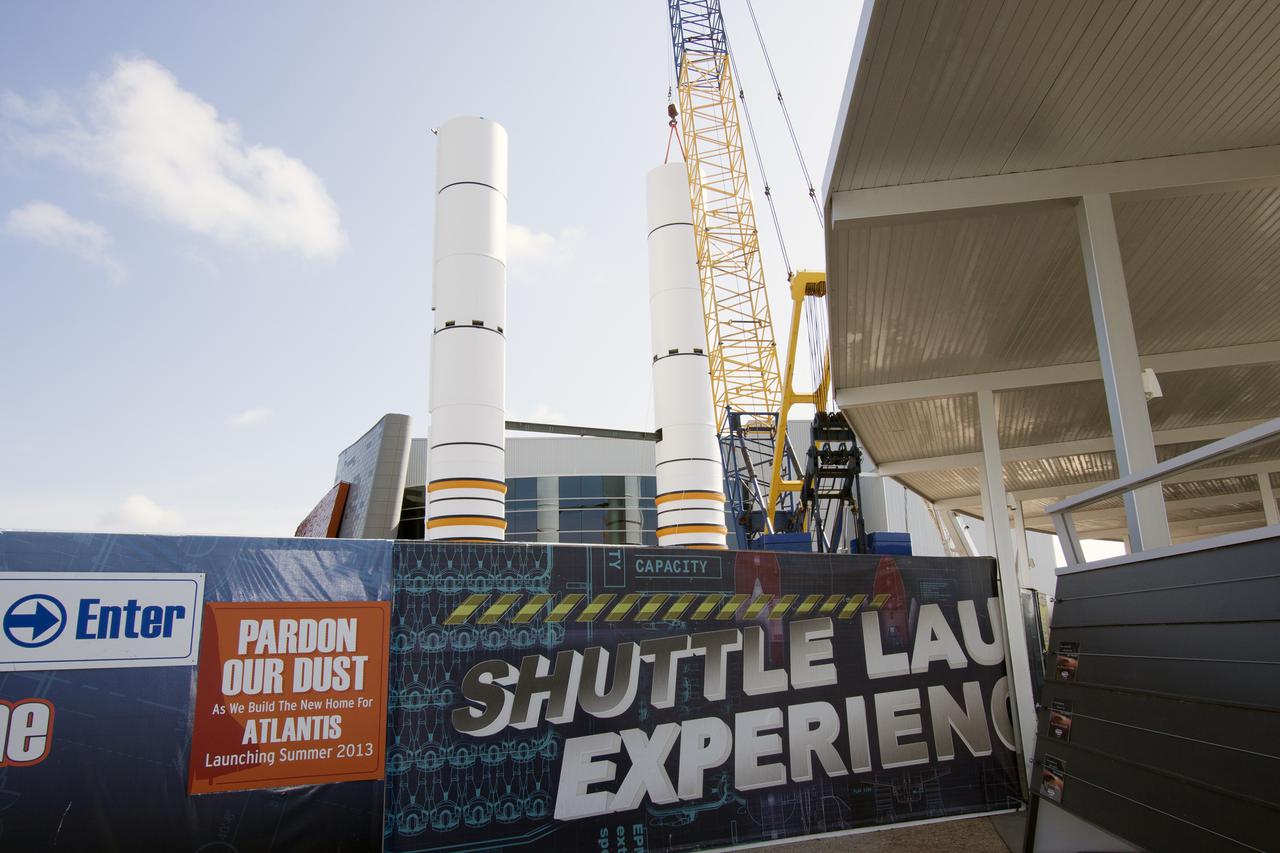
CAPE CANAVERAL, Fla. – A crane lifts a segment for a set of twin, full-size replica Solid Rocket Boosters SRBs in front of the Space Shuttle Atlantis exhibit under construction at the Kennedy Space Center Visitor Complex in Florida. Atlantis is housed in the building behind the SRB stack. An external tank replica will be added later to the middle of the SRBs to complete the display. The SRBs stand 150 feet tall, while the external tank will reach 184 feet when it is finished. The shuttle was mounted to the stack and depended on the power of the SRBs to lift it off the launch pad and start it on its way to space. The external tank was loaded with liquid propellants for the shuttle's three main engines. Photo credit: NASA_Jim Grossmann
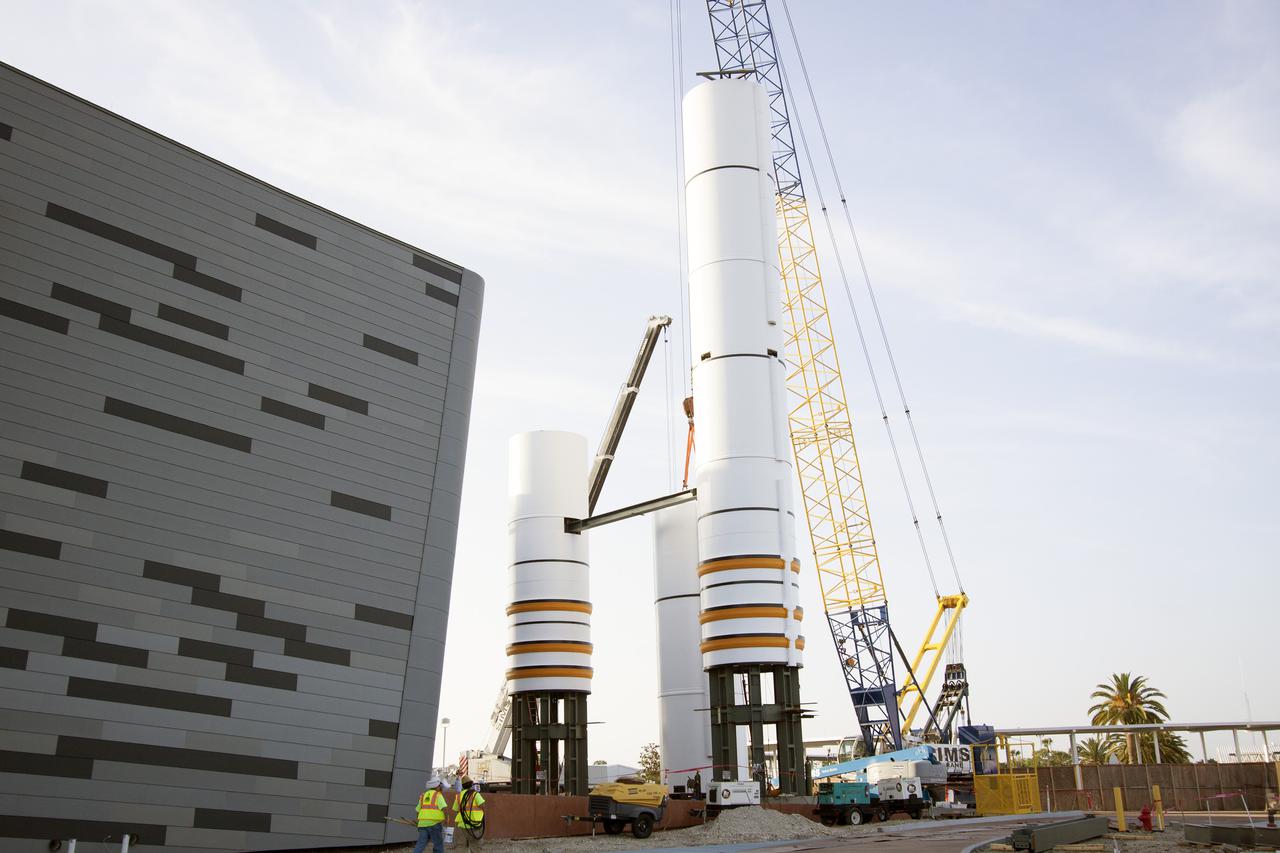
CAPE CANAVERAL, Fla. – A crane lifts a segment for a set of twin, full-size replica Solid Rocket Boosters SRBs in front of the Space Shuttle Atlantis exhibit under construction at the Kennedy Space Center Visitor Complex in Florida. Atlantis is housed in the building behind the SRB stack. An external tank replica will be added later to the middle of the SRBs to complete the display. The SRBs stand 150 feet tall, while the external tank will reach 184 feet when it is finished. The shuttle was mounted to the stack and depended on the power of the SRBs to lift it off the launch pad and start it on its way to space. The external tank was loaded with liquid propellants for the shuttle's three main engines. Photo credit: NASA_Jim Grossmann
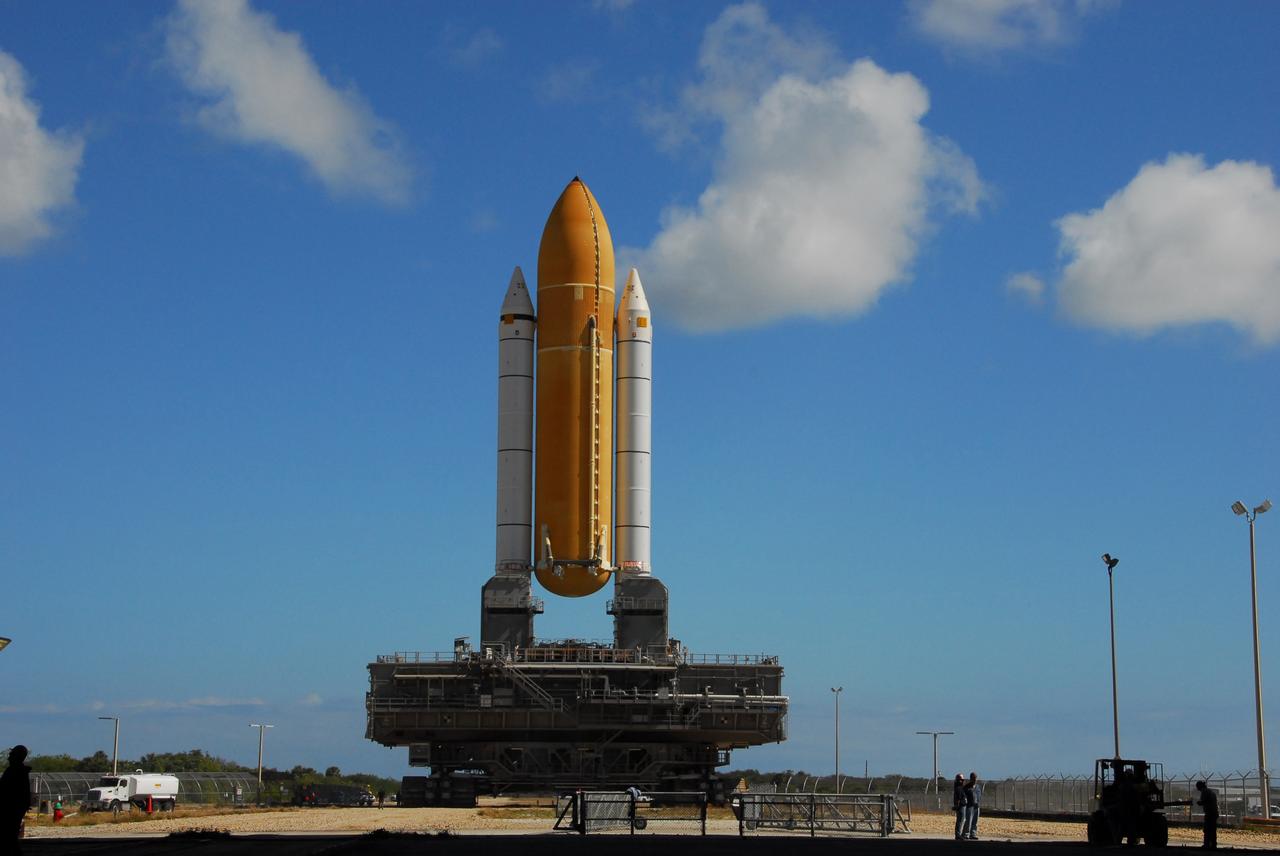
CAPE CANAVERAL, Fla. – Space shuttle Atlantis' external fuel tank-solid rocket booster stack, atop a mobile launcher platform, presents an unusual sight – without the shuttle – as it is transferred from high bay 1 to high bay 3 in the Vehicle Assembly Building at NASA's Kennedy Space Center. It is being moved to high bay 3 to make room for the ET-SRB stack for space shuttle Endeavour. Atlantis is targeted for launch on the STS-125 mission on May 12 to service NASA's Hubble Space Telescope. Endeavour will fly on the STS-127 mission to the International Space Station and bring the final segments for Japan's Kibo laboratory. Photo credit: NASA/Tim Jacobs
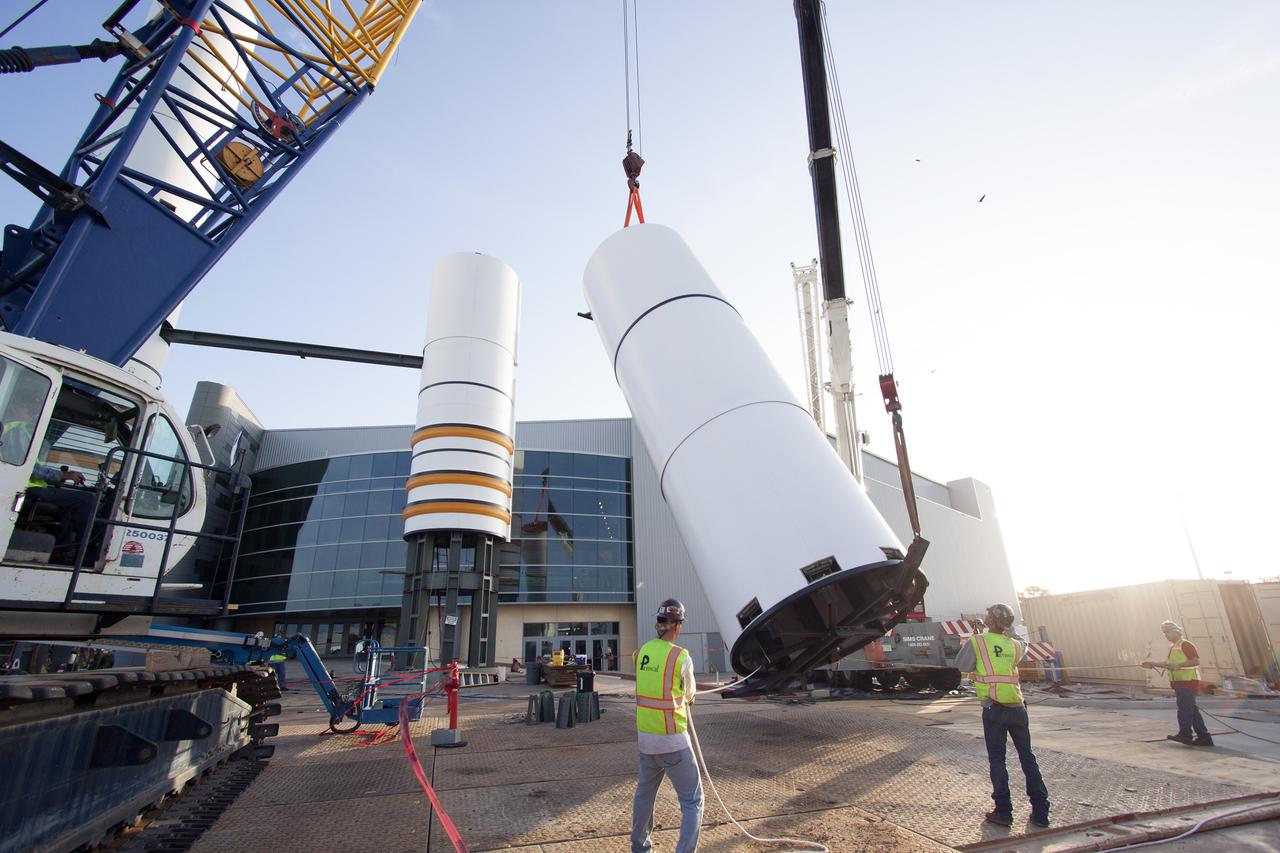
CAPE CANAVERAL, Fla. – A crane lifts a segment for a set of twin, full-size replica Solid Rocket Boosters SRBs in front of the Space Shuttle Atlantis exhibit under construction at the Kennedy Space Center Visitor Complex in Florida. Atlantis is housed in the building behind the SRB stack. An external tank replica will be added later to the middle of the SRBs to complete the display. The SRBs stand 150 feet tall, while the external tank will reach 184 feet when it is finished. The shuttle was mounted to the stack and depended on the power of the SRBs to lift it off the launch pad and start it on its way to space. The external tank was loaded with liquid propellants for the shuttle's three main engines. Photo credit: NASA_Jim Grossmann
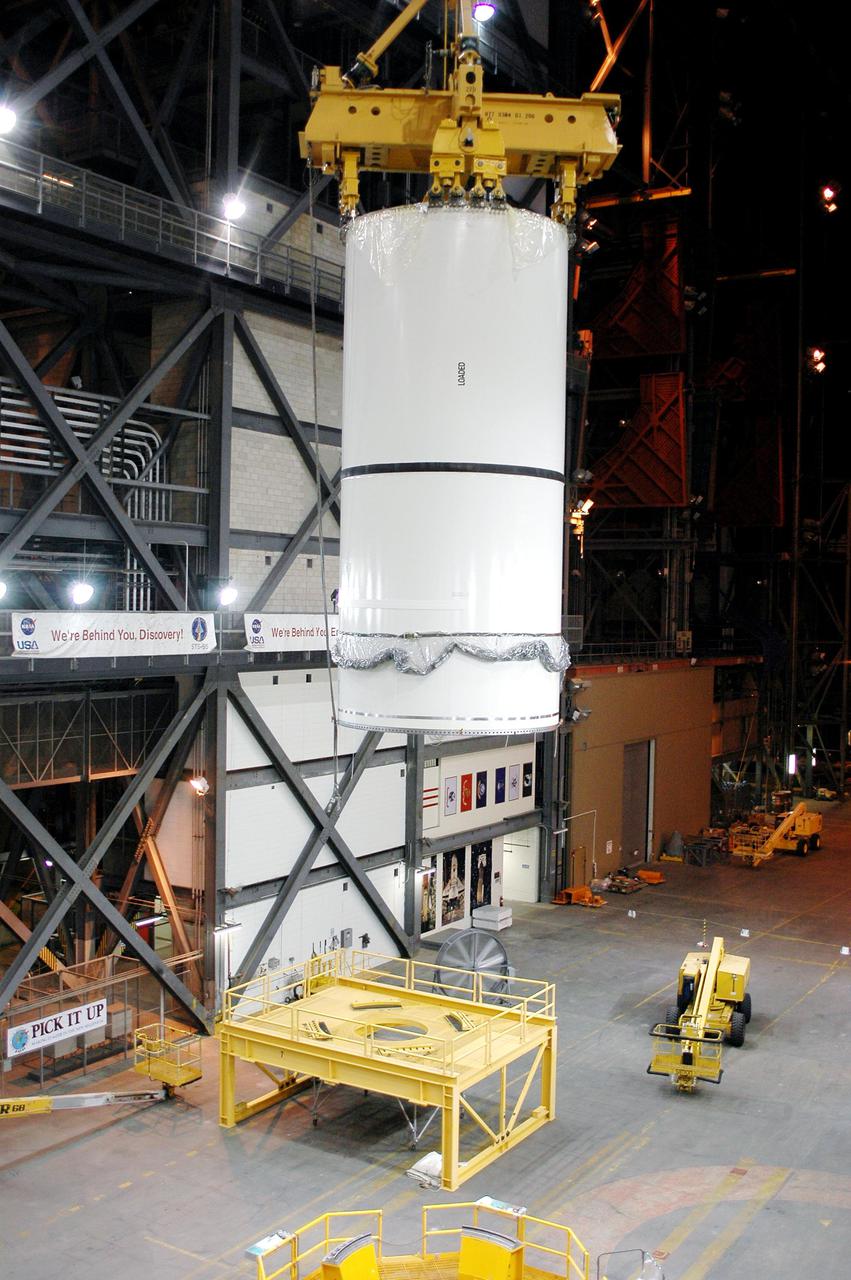
KENNEDY SPACE CENTER, FLA. - In the Vehicle Assembly Building (VAB), the right aft center segment of a Solid Rocket Booster (SRB) is lowered toward the aft booster for mating. The aft booster arrived in the VAB Nov. 22 for the Return to Flight mission STS-114. Two SRBs are stacked on the Mobile Launch Platform and later joined by the External Tank.. The twin 149-foot tall, 12-foot diameter SRBs provide the main propulsion system during launch. They operate parallel with the Space Shuttle main engines for the first two minutes of flight and jettison away from the orbiter with help from the Booster Separation Motors, about 26.3 nautical miles above the Earth’s surface.
KENNEDY SPACE CENTER, FLA. - In the transfer aisle of the Vehicle Assembly Building (VAB), a segment of a Solid Rocket Booster (SRB) is lifted from a transporter toward the 16th level. This right aft center segment will be stacked with the aft booster that arrived in the VAB Nov. 22 for the Return to Flight mission STS-114. Two SRBs are stacked on the Mobile Launch Platform and later joined by the External Tank.. The twin 149-foot tall, 12-foot diameter SRBs provide the main propulsion system during launch. They operate parallel with the Space Shuttle main engines for the first two minutes of flight and jettison away from the orbiter with help from the Booster Separation Motors, about 26.3 nautical miles above the Earth’s surface.
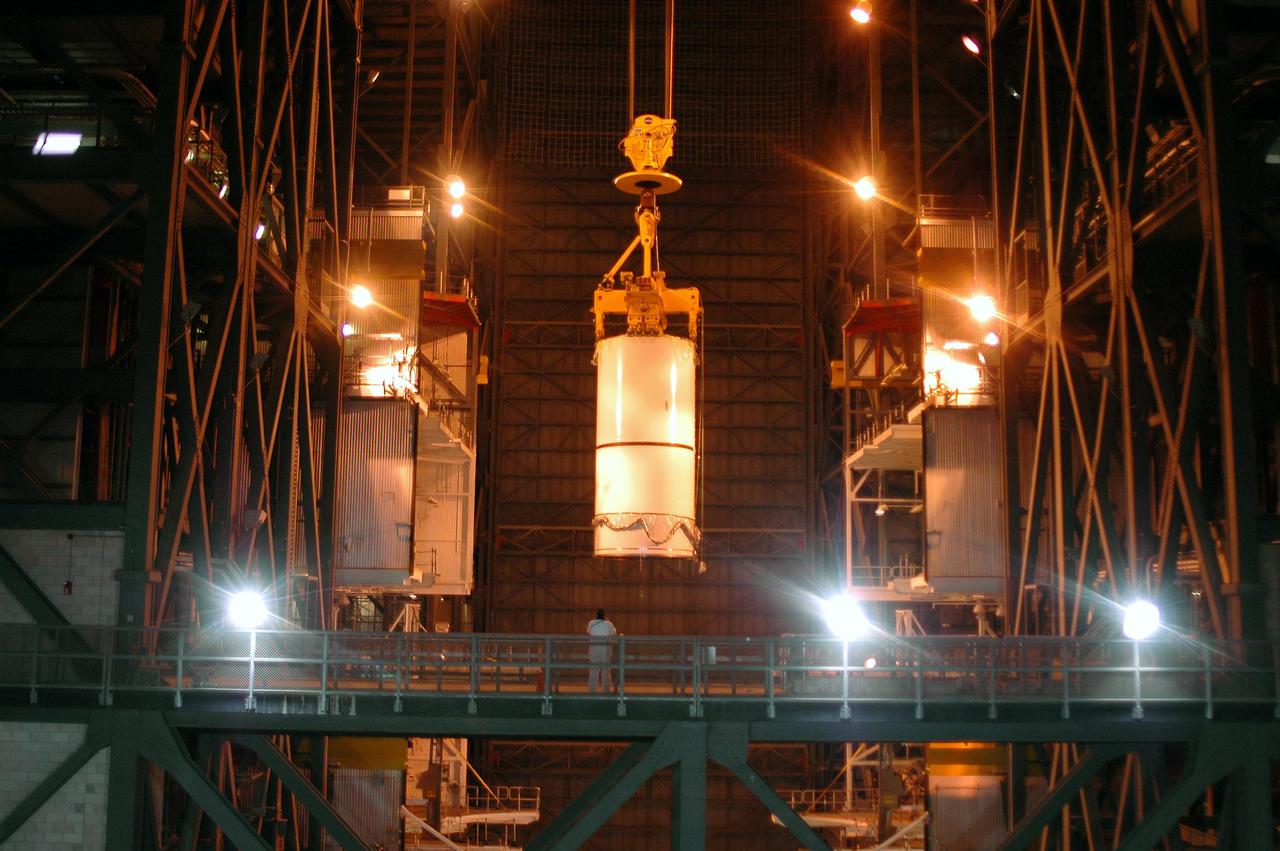
KENNEDY SPACE CENTER, FLA. - In the Vehicle Assembly Building (VAB), a segment of a Solid Rocket Booster (SRB) is lifted over the cross walk at the 16th level. This right aft center segment will be stacked with the aft booster on the other side that arrived in the VAB Nov. 22 for the Return to Flight mission STS-114. Two SRBs are stacked on the Mobile Launch Platform and later joined by the External Tank.. The twin 149-foot tall, 12-foot diameter SRBs provide the main propulsion system during launch. They operate parallel with the Space Shuttle main engines for the first two minutes of flight and jettison away from the orbiter with help from the Booster Separation Motors, about 26.3 nautical miles above the Earth’s surface.
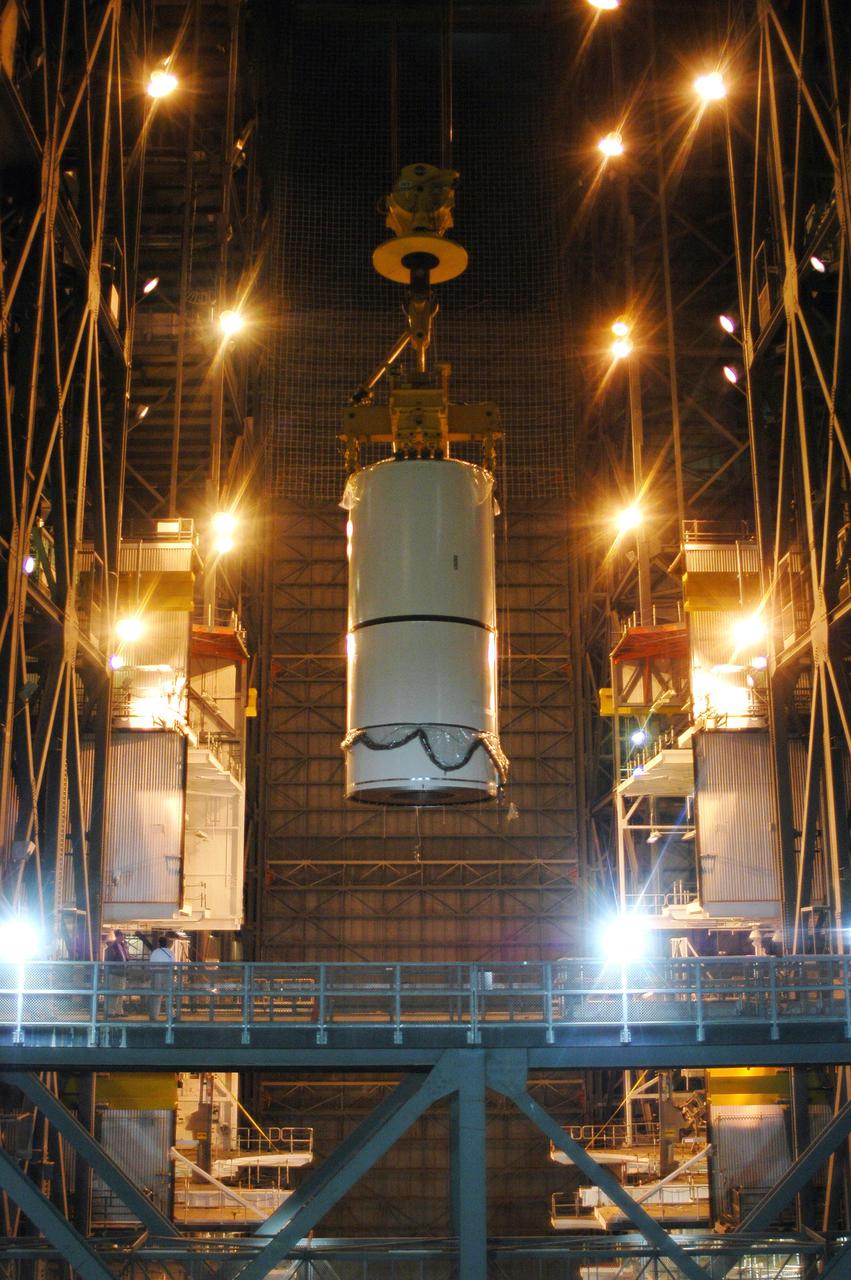
KENNEDY SPACE CENTER, FLA. - In the Vehicle Assembly Building (VAB), a segment of a Solid Rocket Booster (SRB) is lifted over the cross walk at the 16th level. This right aft center segment will be stacked with the aft booster on the other side that arrived in the VAB Nov. 22 for the Return to Flight mission STS-114. Two SRBs are stacked on the Mobile Launch Platform and later joined by the External Tank.. The twin 149-foot tall, 12-foot diameter SRBs provide the main propulsion system during launch. They operate parallel with the Space Shuttle main engines for the first two minutes of flight and jettison away from the orbiter with help from the Booster Separation Motors, about 26.3 nautical miles above the Earth’s surface.
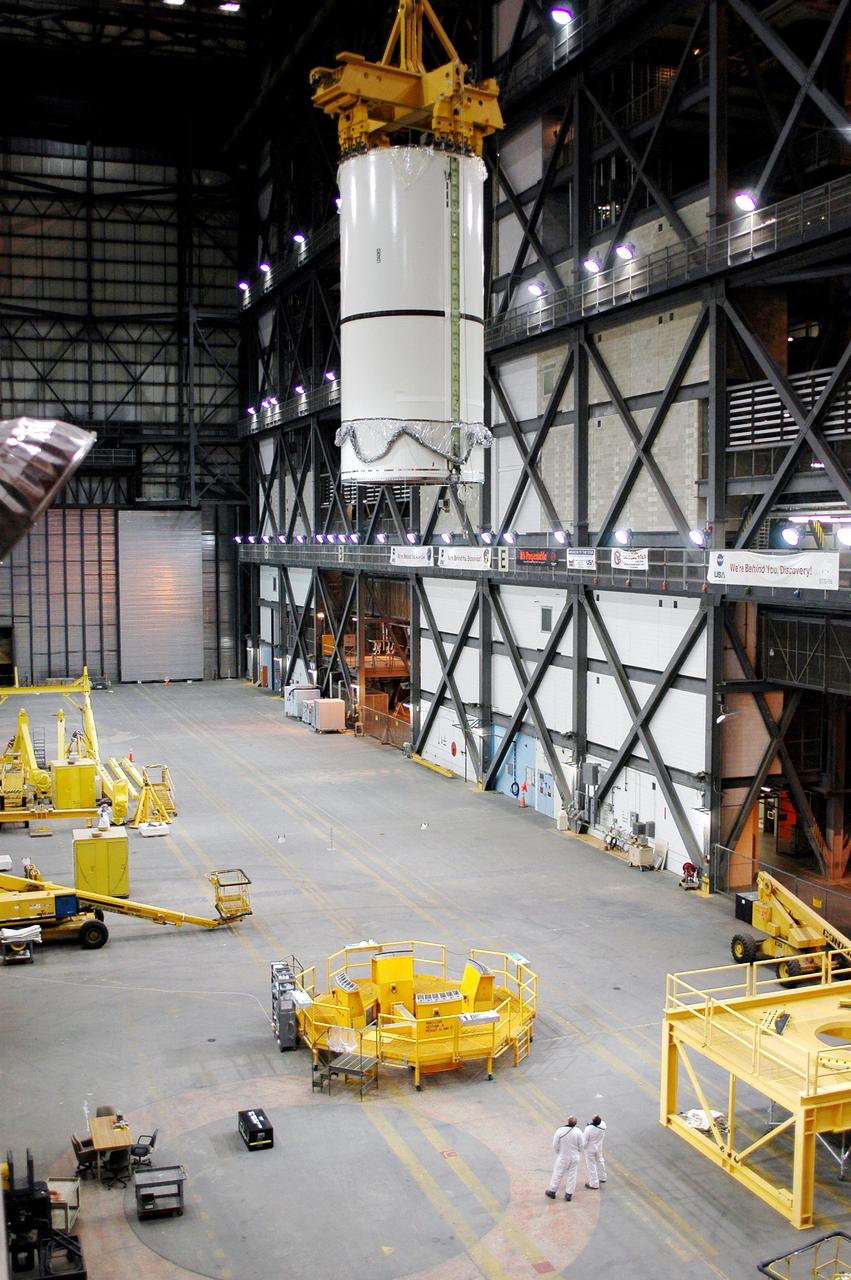
KENNEDY SPACE CENTER, FLA. - In the transfer aisle of the Vehicle Assembly Building (VAB), a segment of a Solid Rocket Booster (SRB) is lifted from a transporter toward the 16th level. This right aft center segment will be stacked with the aft booster that arrived in the VAB Nov. 22 for the Return to Flight mission STS-114. Two SRBs are stacked on the Mobile Launch Platform and later joined by the External Tank.. The twin 149-foot tall, 12-foot diameter SRBs provide the main propulsion system during launch. They operate parallel with the Space Shuttle main engines for the first two minutes of flight and jettison away from the orbiter with help from the Booster Separation Motors, about 26.3 nautical miles above the Earth’s surface.
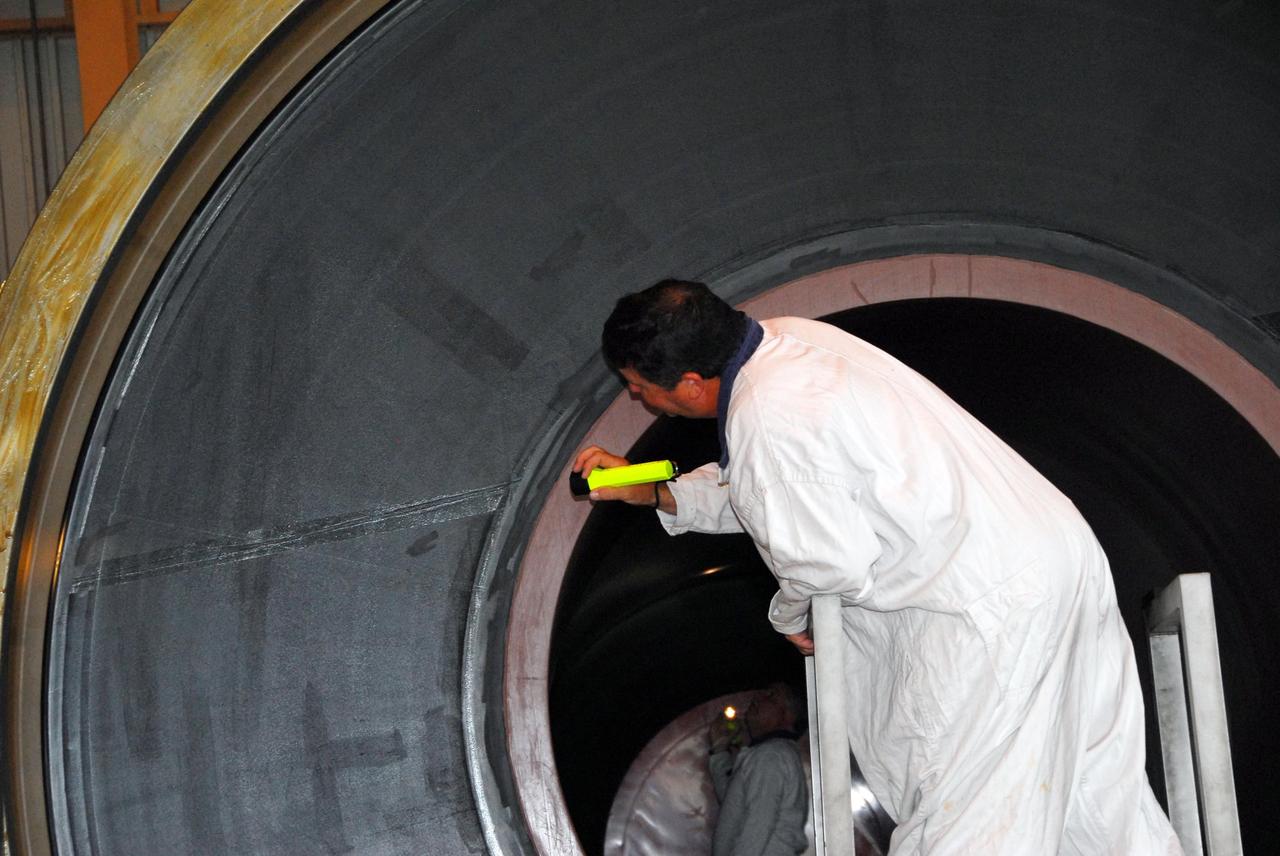
KENNEDY SPACE CENTER, FLA. -- In the Rotation, Processing and Surge Facility, or RSPF, a worker conducts propellant grain inspection of the solid rocket booster segment required as part of safety analysis. The booster segment will be stacked with others to be used on Space Shuttle Atlantis on mission STS-122 targeted for December. The mission will continue assembly of the International Space Station, delivering and installing the Columbus Laboratory. Photo credit: NASA/George Shelton
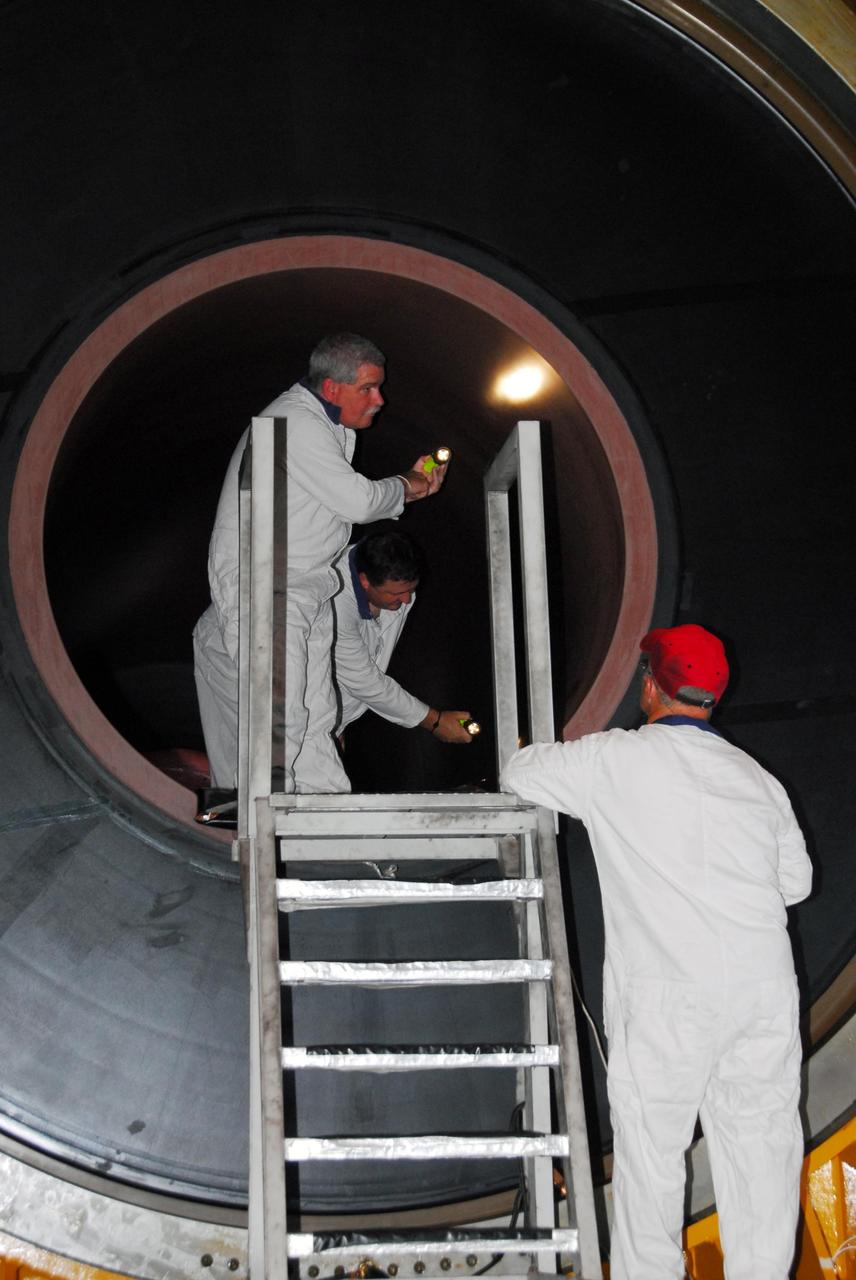
KENNEDY SPACE CENTER, FLA. -- In the Rotation, Processing and Surge Facility, or RSPF, workers conduct propellant grain inspection of the solid rocket booster segment required as part of safety analysis. The booster segment will be stacked with others to be used on Space Shuttle Atlantis on mission STS-122 targeted for December. The mission will continue assembly of the International Space Station, delivering and installing the Columbus Laboratory. Photo credit: NASA/George Shelton
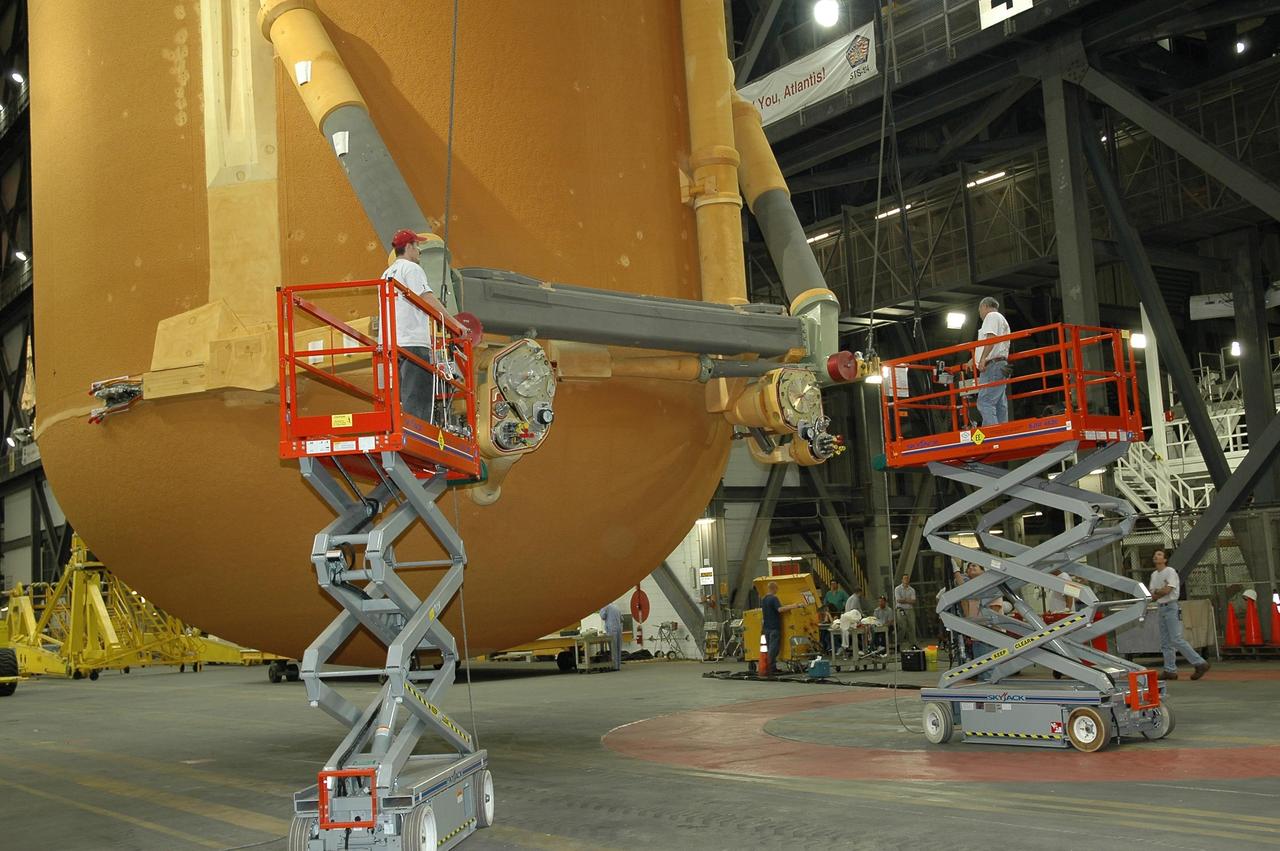
KENNEDY SPACE CENTER, FLA. - In the Vehicle Assembly Building's transfer aisle at NASA's Kennedy Space Center, external tank No. 119 is suspended in a vertical position. The tank will lifted into high bay 3 for stacking with solid rocket boosters. The tank and boosters will launch Space Shuttle Discovery on mission STS-121 in July. Photo credit: NASA/Jack Pfaller
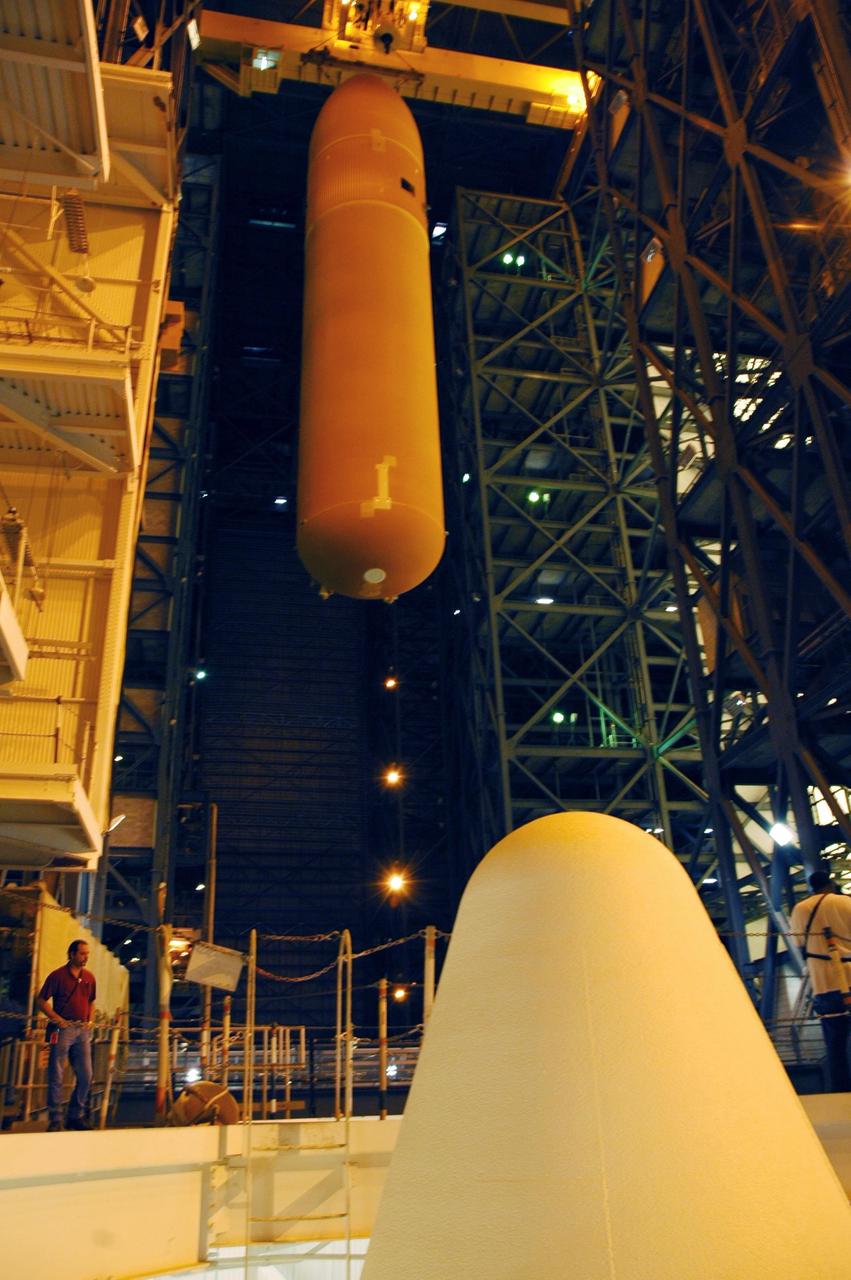
KENNEDY SPACE CENTER, FLA. - In the Vehicle Assembly Building, the overhead crane moves the external tank designated for Space Shuttle Discovery toward high bay 3. In the foreground is the tip of one of the solid rocket boosters. There it will be stacked with the solid rocket boosters already in place on the mobile launcher platform. Discovery is scheduled to launch on mission STS-121 in July. Photo credit: NASA/Amanda Diller
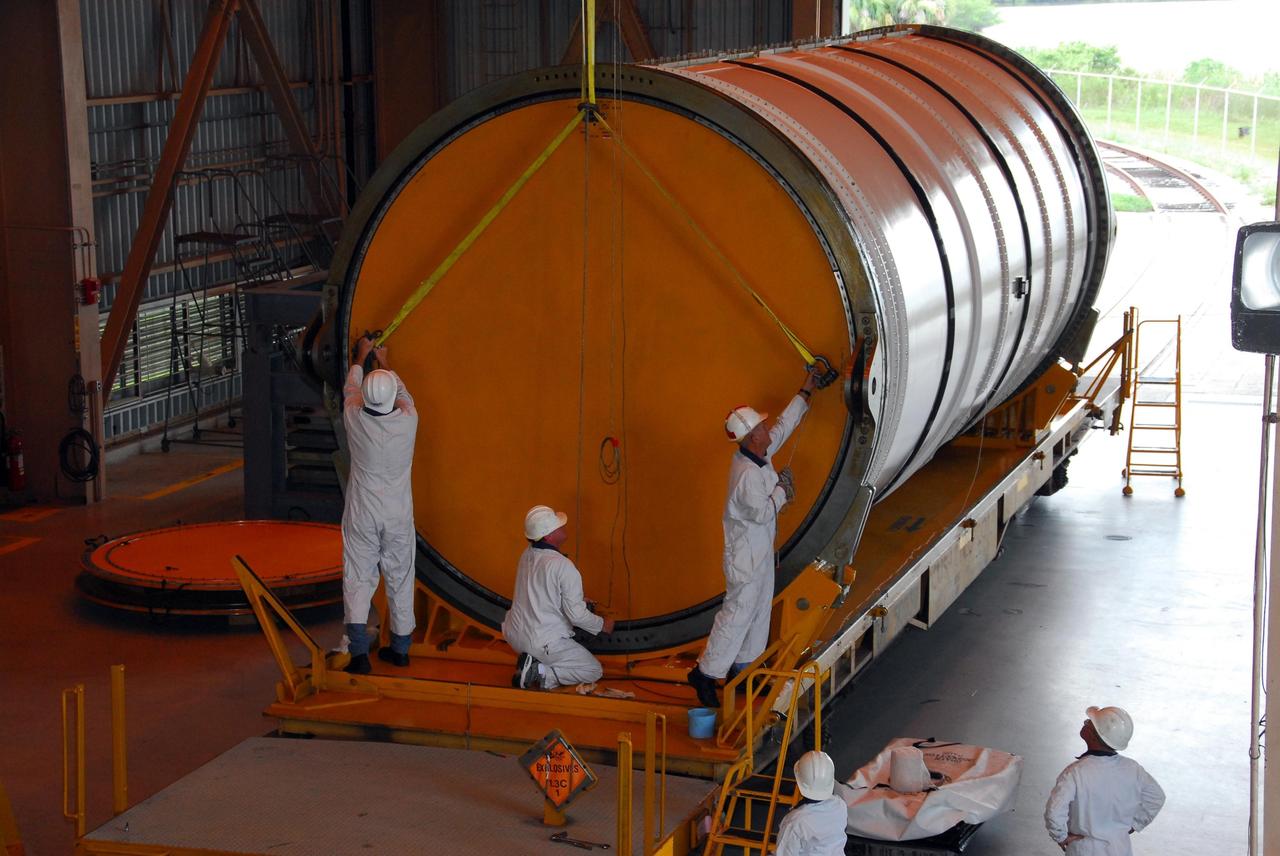
KENNEDY SPACE CENTER, FLA. -- In the Rotation, Processing and Surge Facility, or RSPF, workers begin to remove the cover on a solid rocket booster segment for propellant grain inspection required as part of safety analysis. The booster segment will be stacked with others to be used on Space Shuttle Atlantis on mission STS-122 targeted for December. The mission will continue assembly of the International Space Station, delivering and installing the Columbus Laboratory. Photo credit: NASA/George Shelton
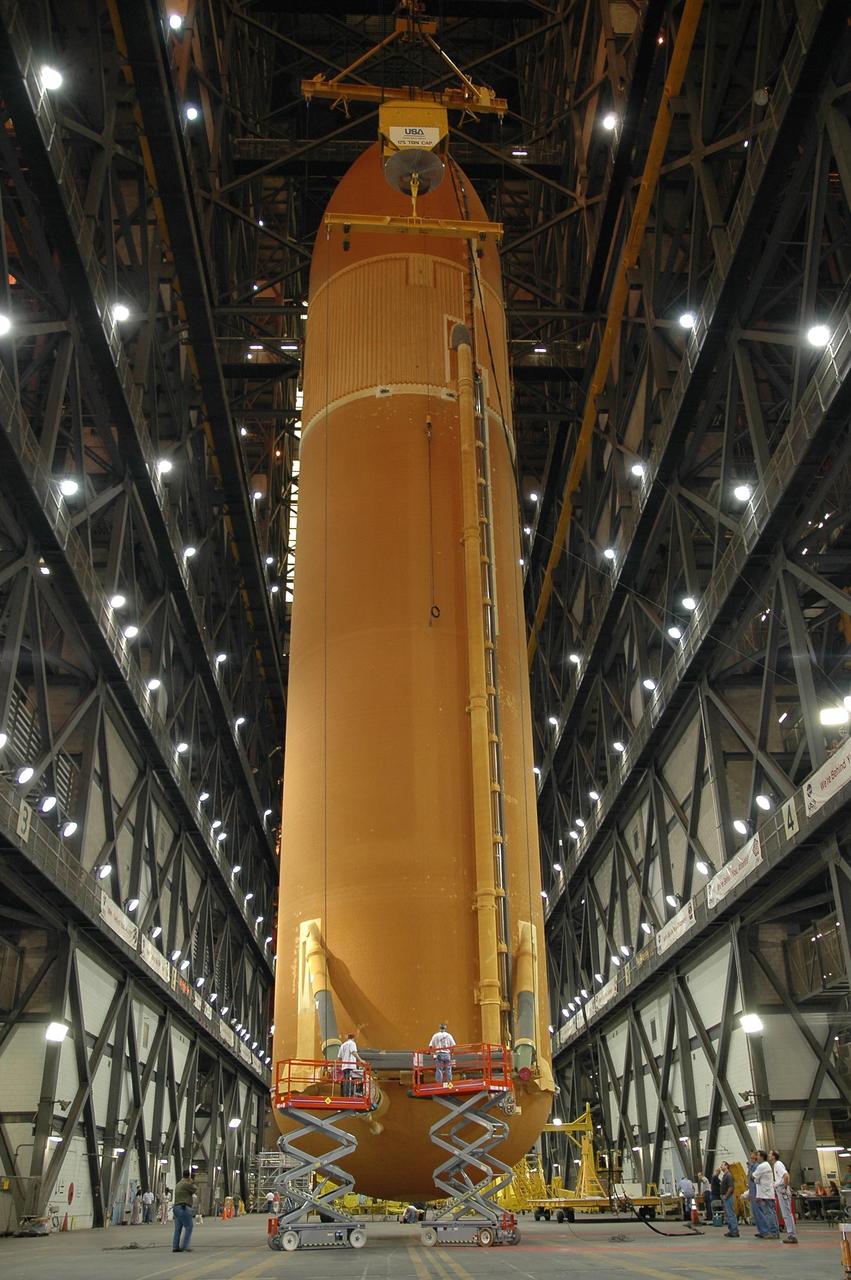
KENNEDY SPACE CENTER, FLA. - In the Vehicle Assembly Building's transfer aisle at NASA's Kennedy Space Center, external tank No. 119 is suspended in a vertical position. The tank will lifted into high bay 3 for stacking with solid rocket boosters. The tank and boosters will launch Space Shuttle Discovery on mission STS-121 in July. Photo credit: NASA/Jack Pfaller
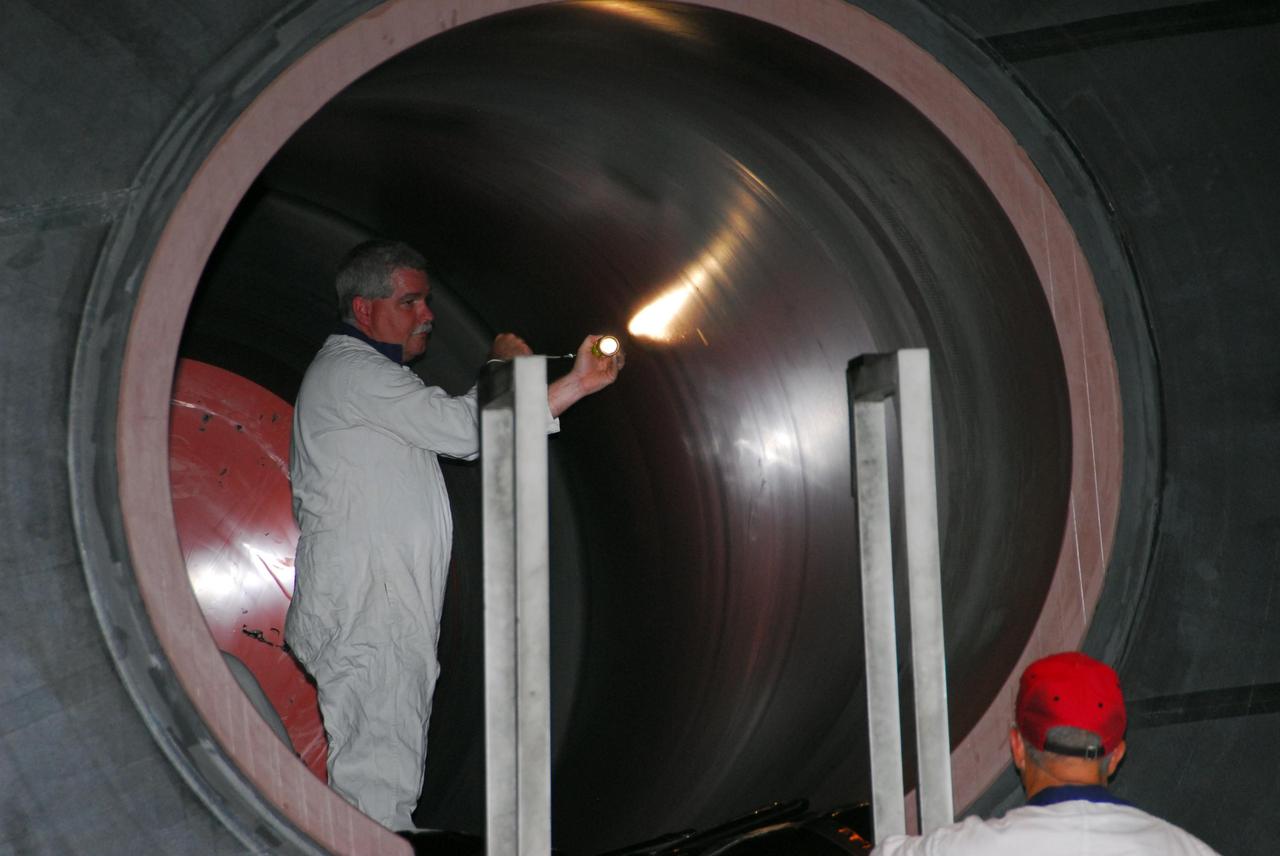
KENNEDY SPACE CENTER, FLA. -- In the Rotation, Processing and Surge Facility, or RSPF, a worker conducts propellant grain inspection of the solid rocket booster segment required as part of safety analysis. The booster segment will be stacked with others to be used on Space Shuttle Atlantis on mission STS-122 targeted for December. The mission will continue assembly of the International Space Station, delivering and installing the Columbus Laboratory. Photo credit: NASA/George Shelton
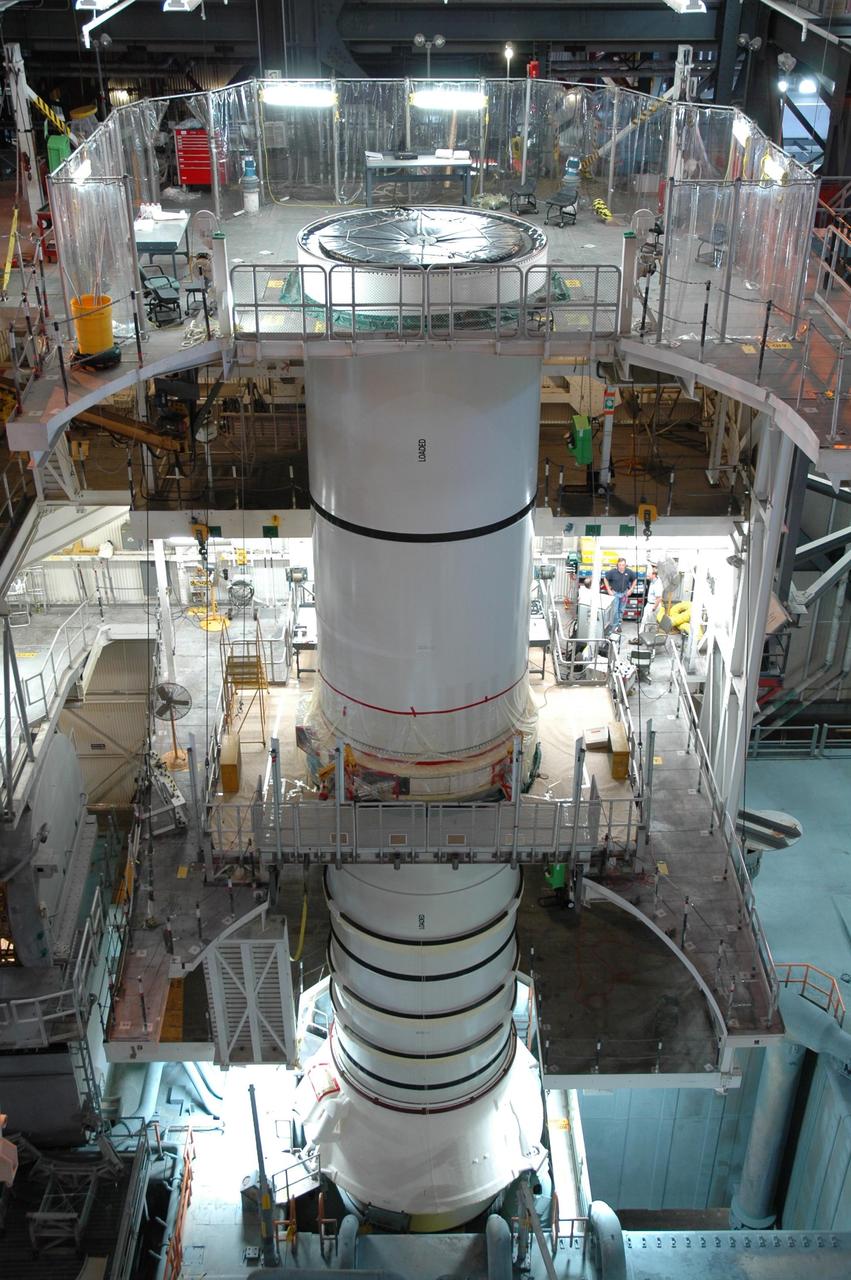
KENNEDY SPACE CENTER, FLA. -- In the Vehicle Assembly Building, the STS-120 solid rocket booster left aft booster and left aft center segments are being stacked on the mobile launcher platform. STS-120 will be the 23rd flight to the International Space Station. Space Shuttle Discovery will carry the U.S. Node 2. Launch is targeted for Oct. 20. NASA/Jim Grossmann
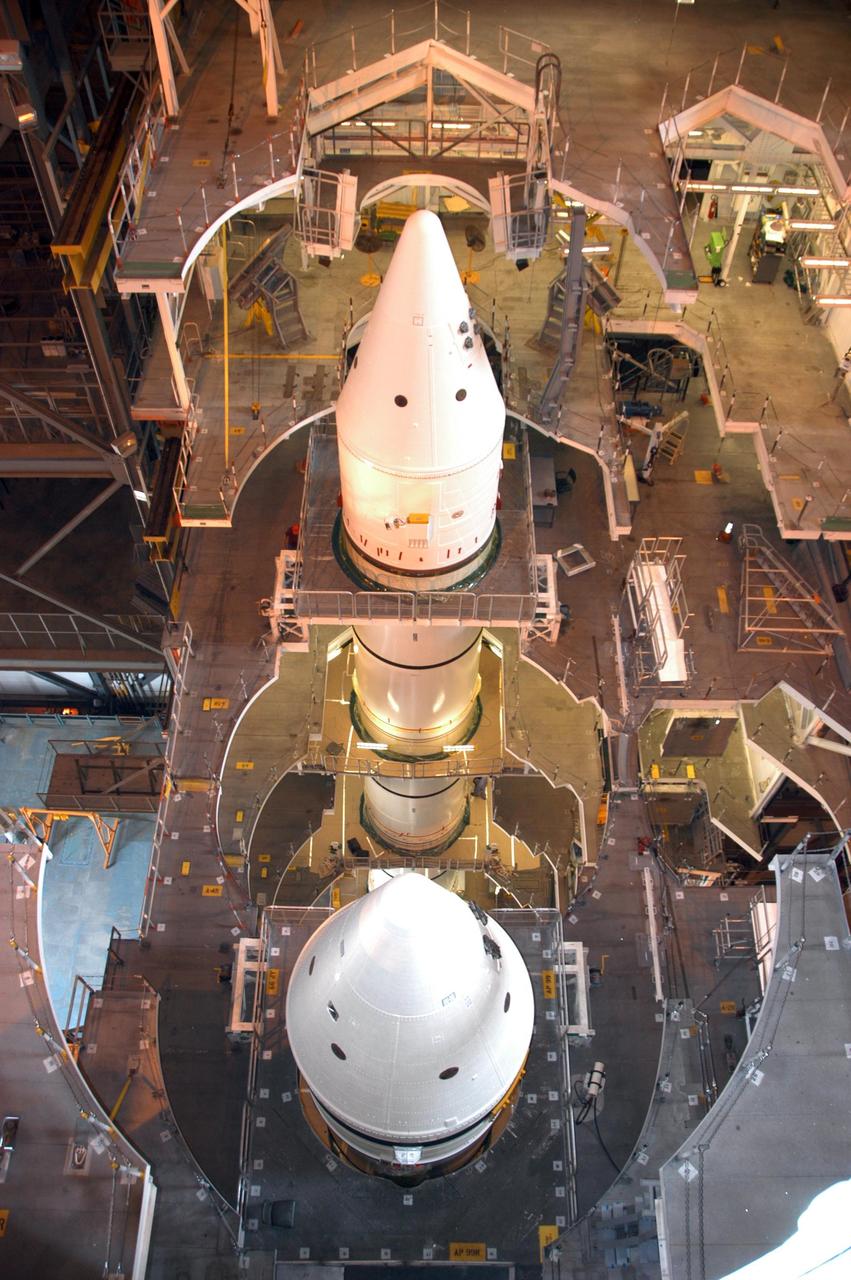
KENNEDY SPACE CENTER, FLA. -- Lighting inside Kennedy Space Center's Vehicle Assembly Building seems to bathe the highbay 1 area in a golden hue as workers continue stacking the twin solid rocket boosters. The solid rocket boosters are being prepared for NASA's next Space Shuttle launch, mission STS-117. The mission is scheduled to launch aboard Atlantis no earlier than March 16, 2007. Photo credit: NASA/George Shelton
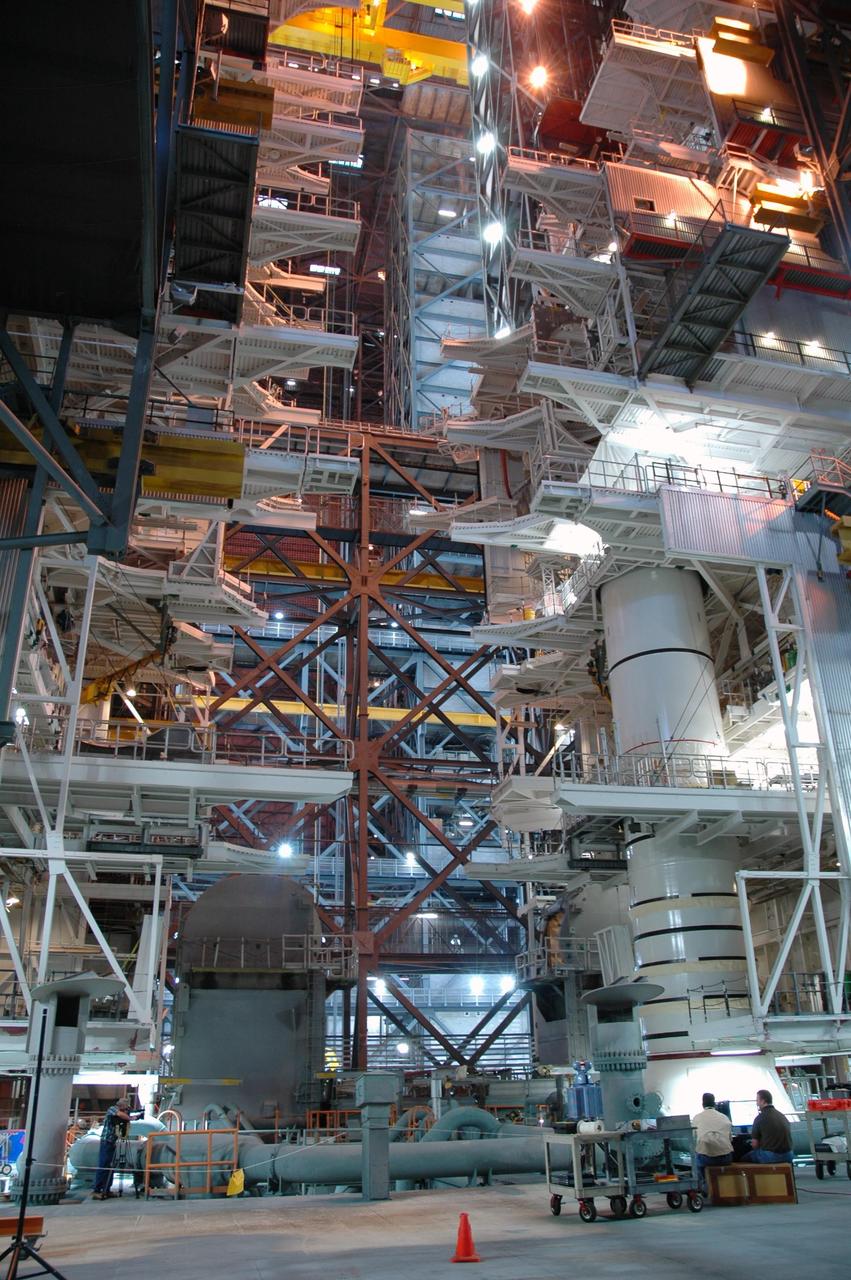
KENNEDY SPACE CENTER, FLA. -- In the Vehicle Assembly Building, the STS-120 solid rocket booster left aft booster and left aft center segments are being stacked on the mobile launcher platform. STS-120 will be the 23rd flight to the International Space Station. Space Shuttle Discovery will carry the U.S. Node 2. Launch is targeted for Oct. 20. NASA/Jim Grossmann
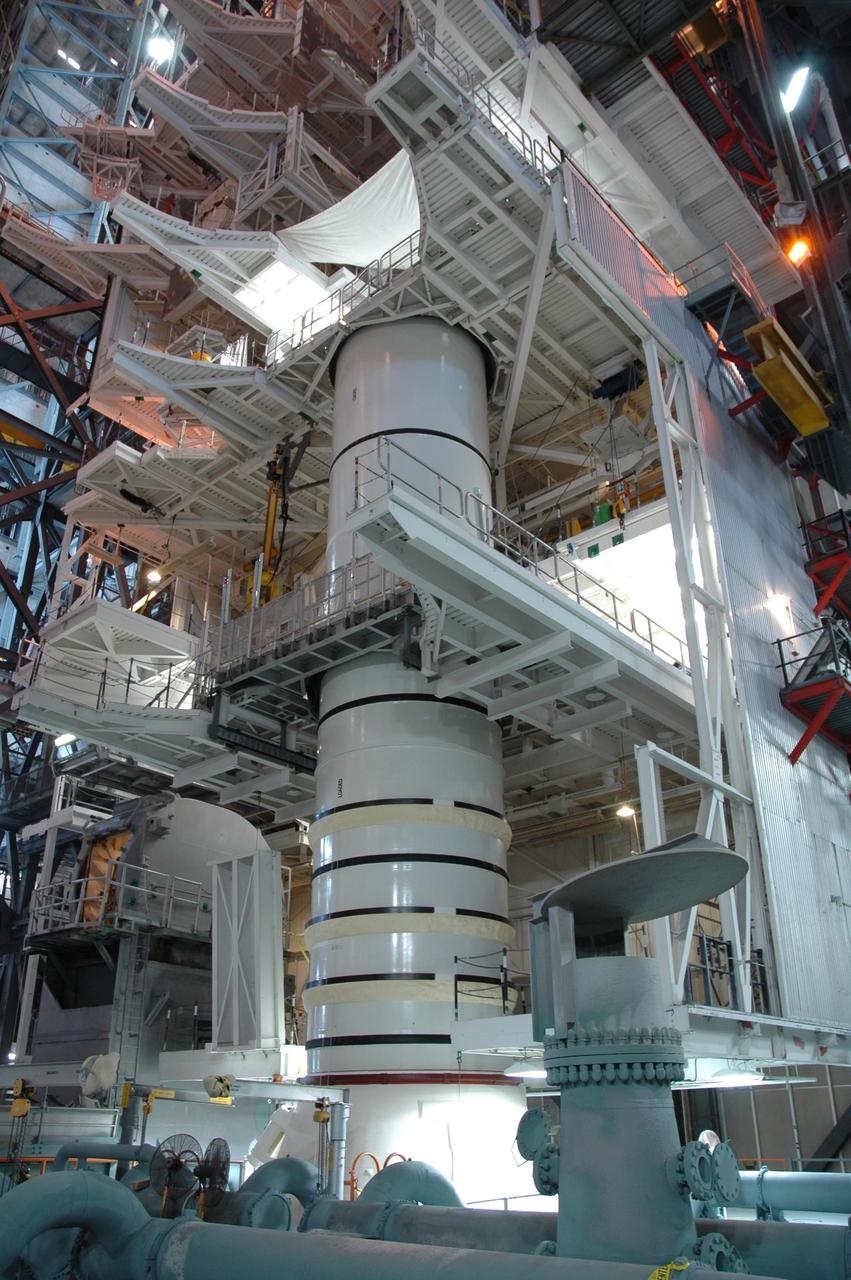
KENNEDY SPACE CENTER, FLA. -- In the Vehicle Assembly Building, the STS-120 solid rocket booster left aft booster and left aft center segments are being stacked on the mobile launcher platform. STS-120 will be the 23rd flight to the International Space Station. Space Shuttle Discovery will carry the U.S. Node 2. Launch is targeted for Oct. 20. NASA/Jim Grossmann