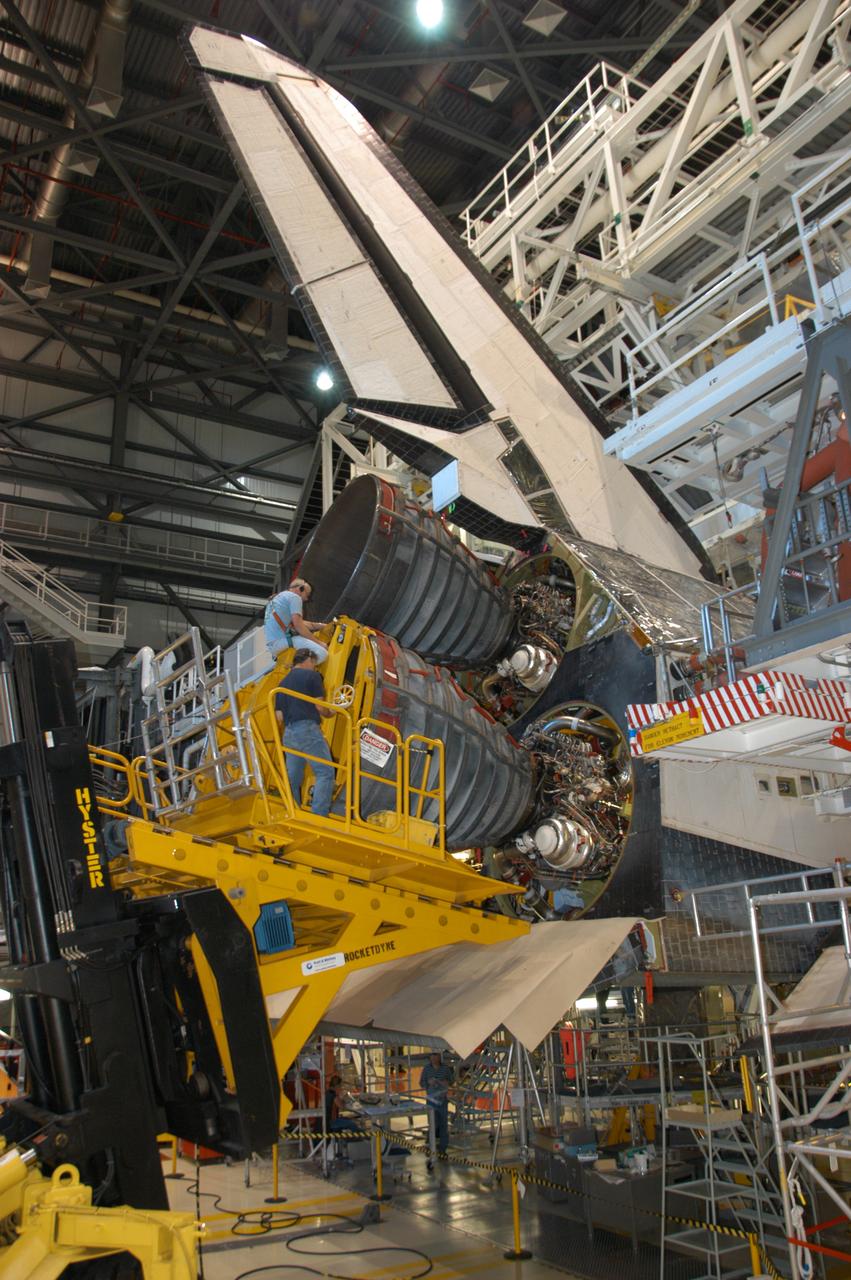
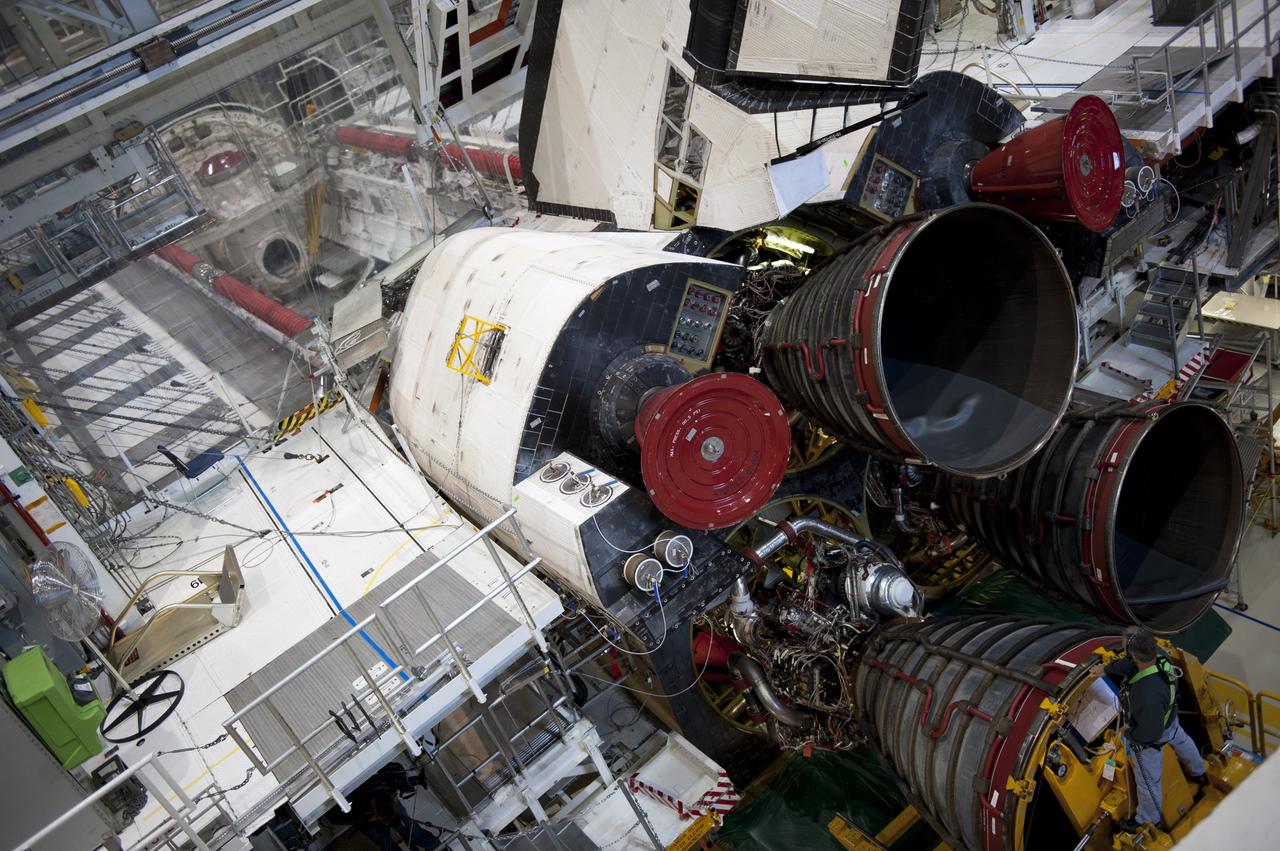
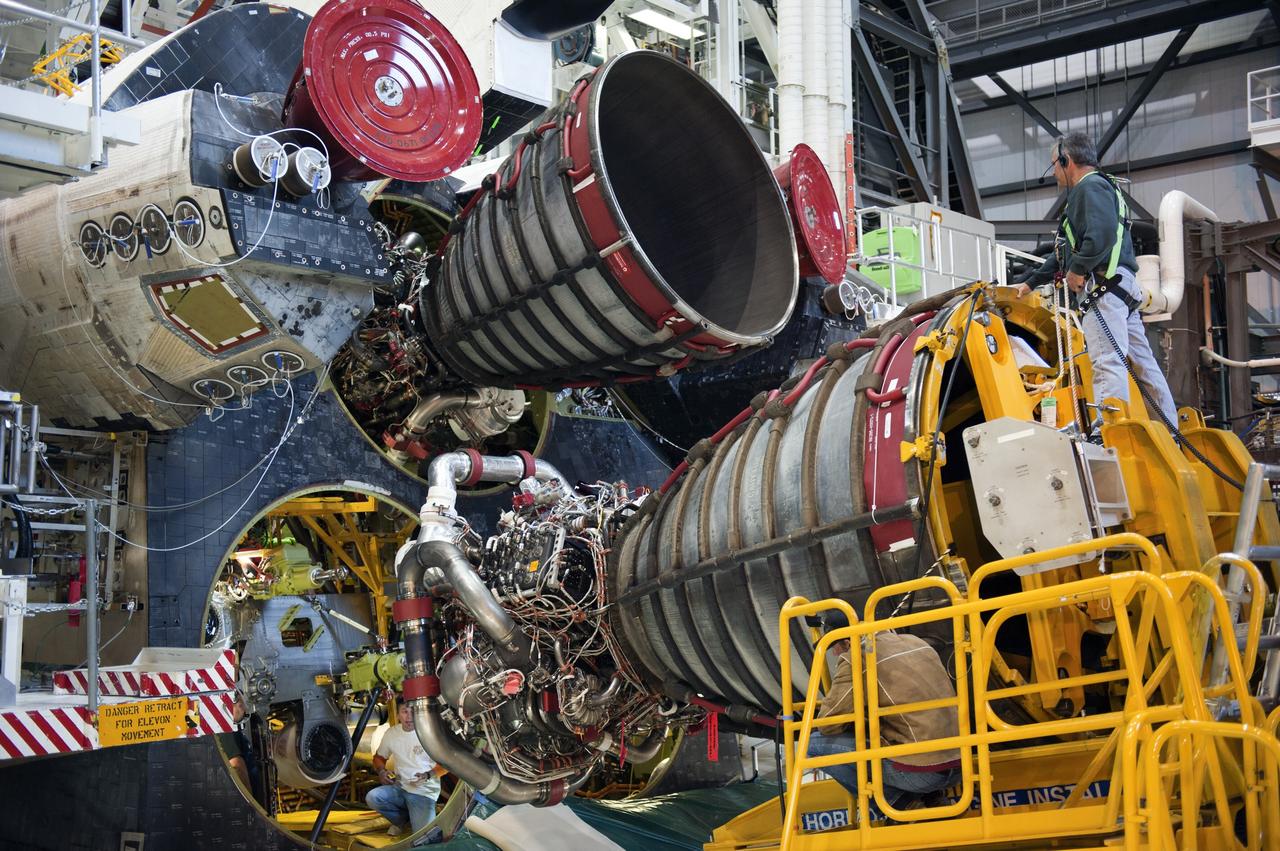
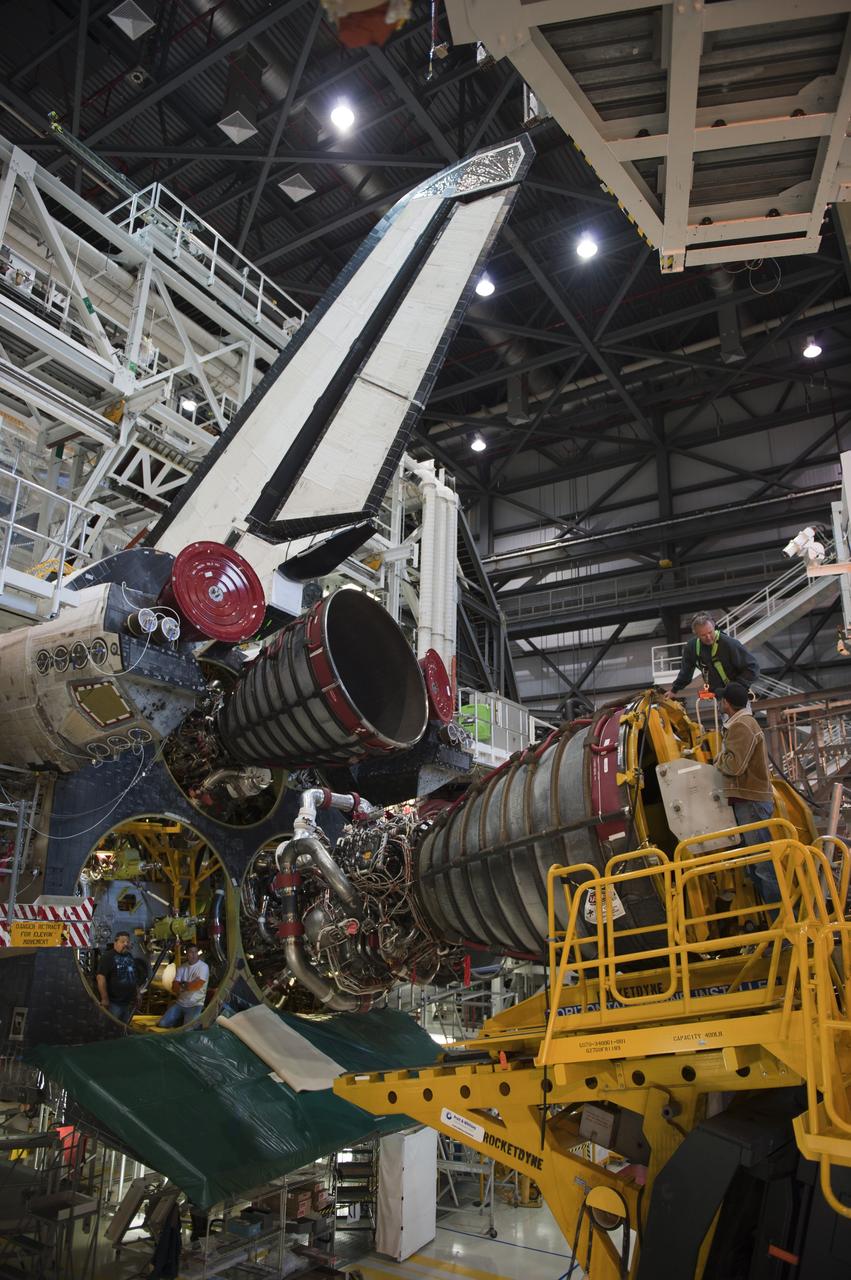
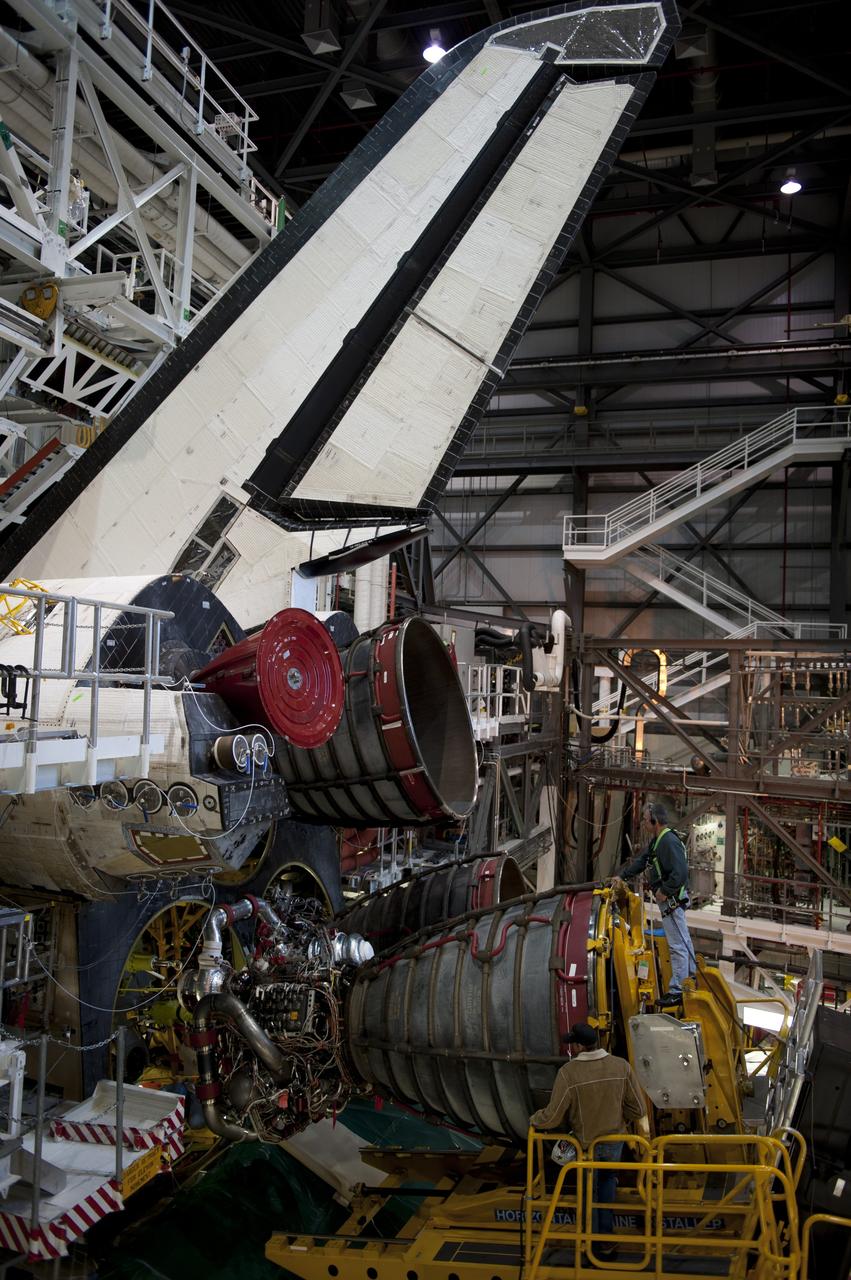
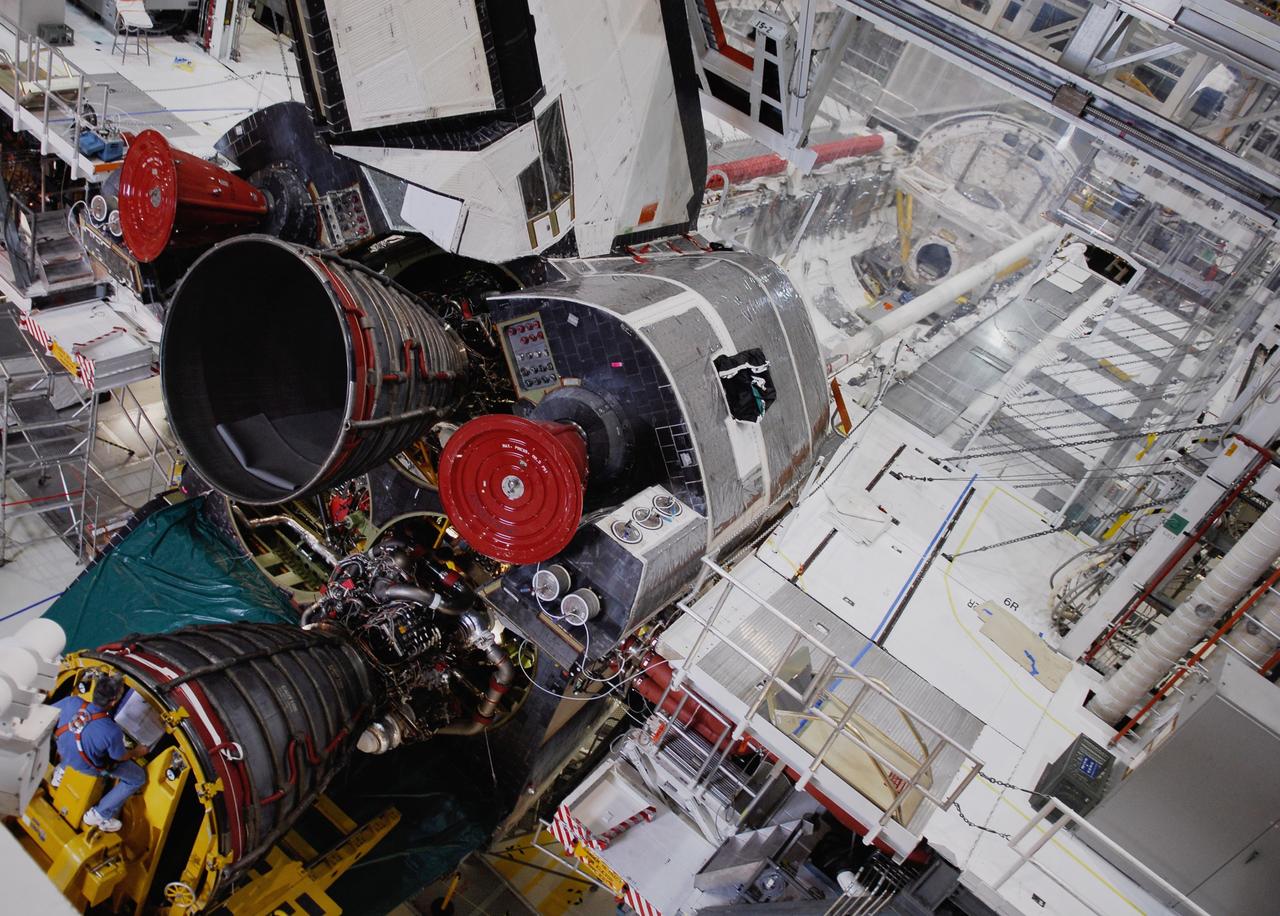
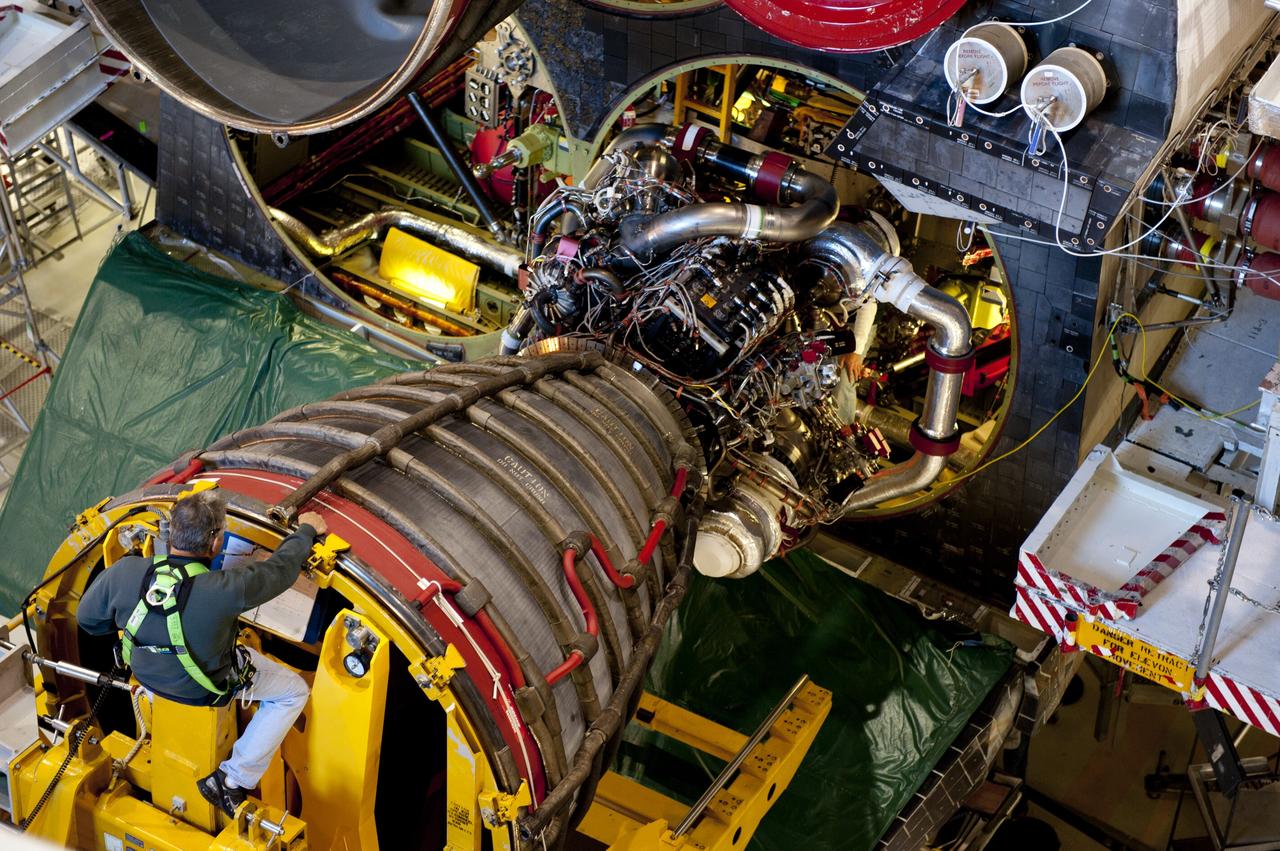
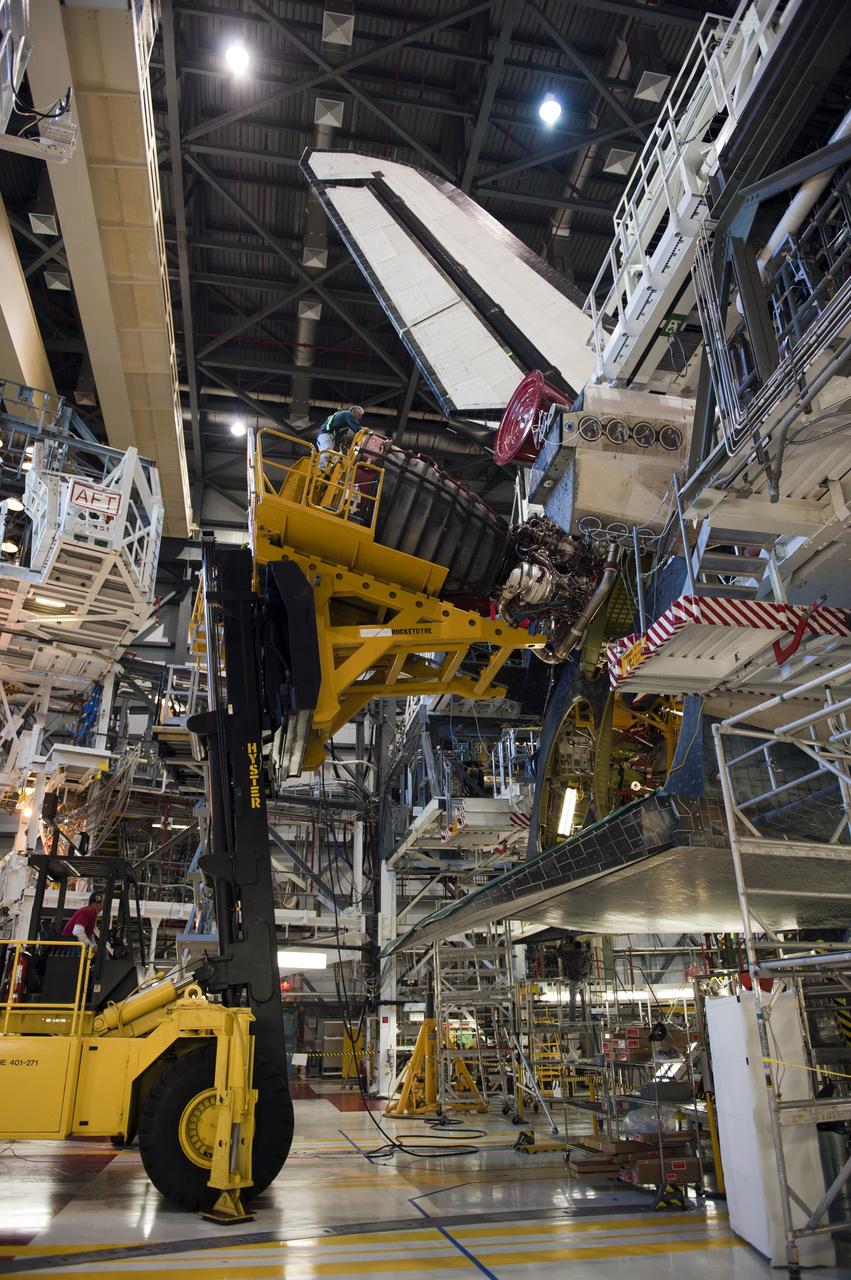
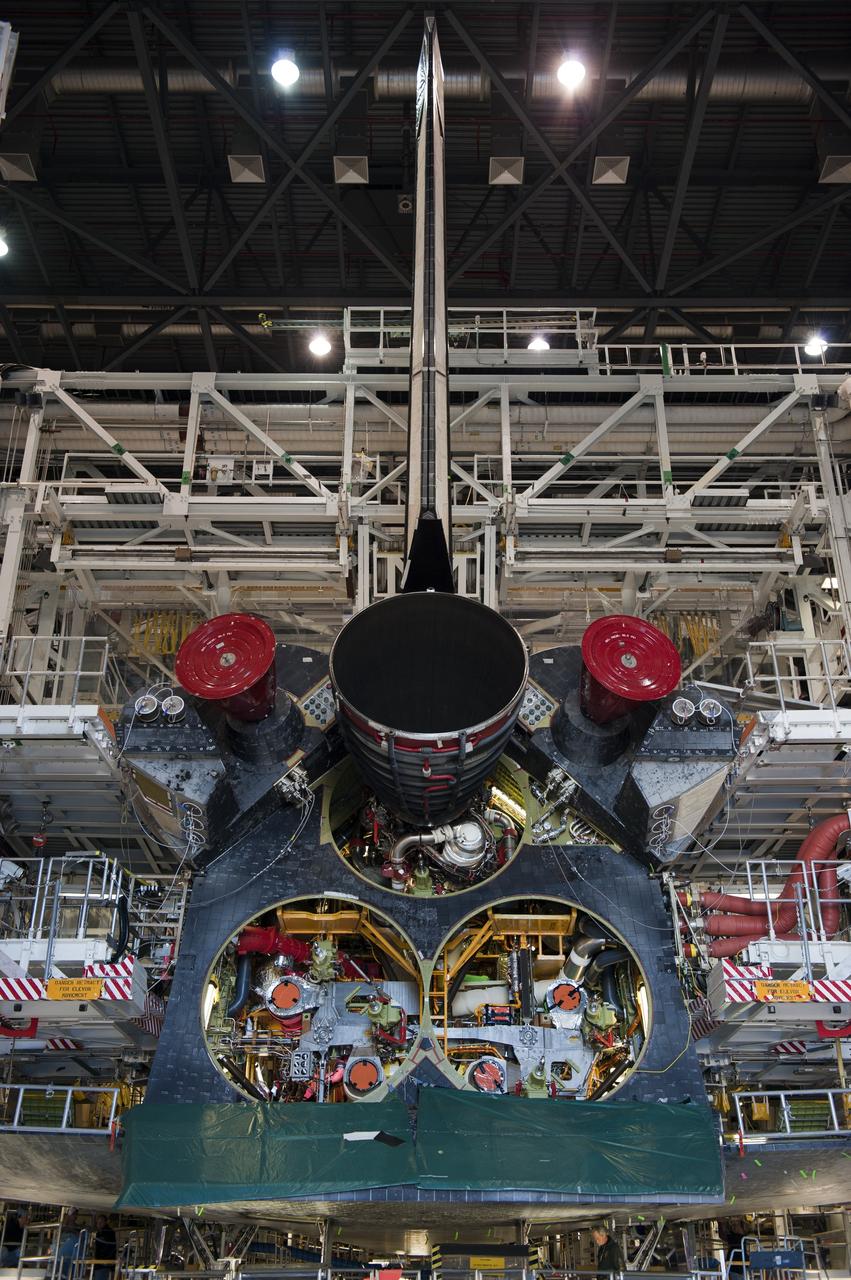
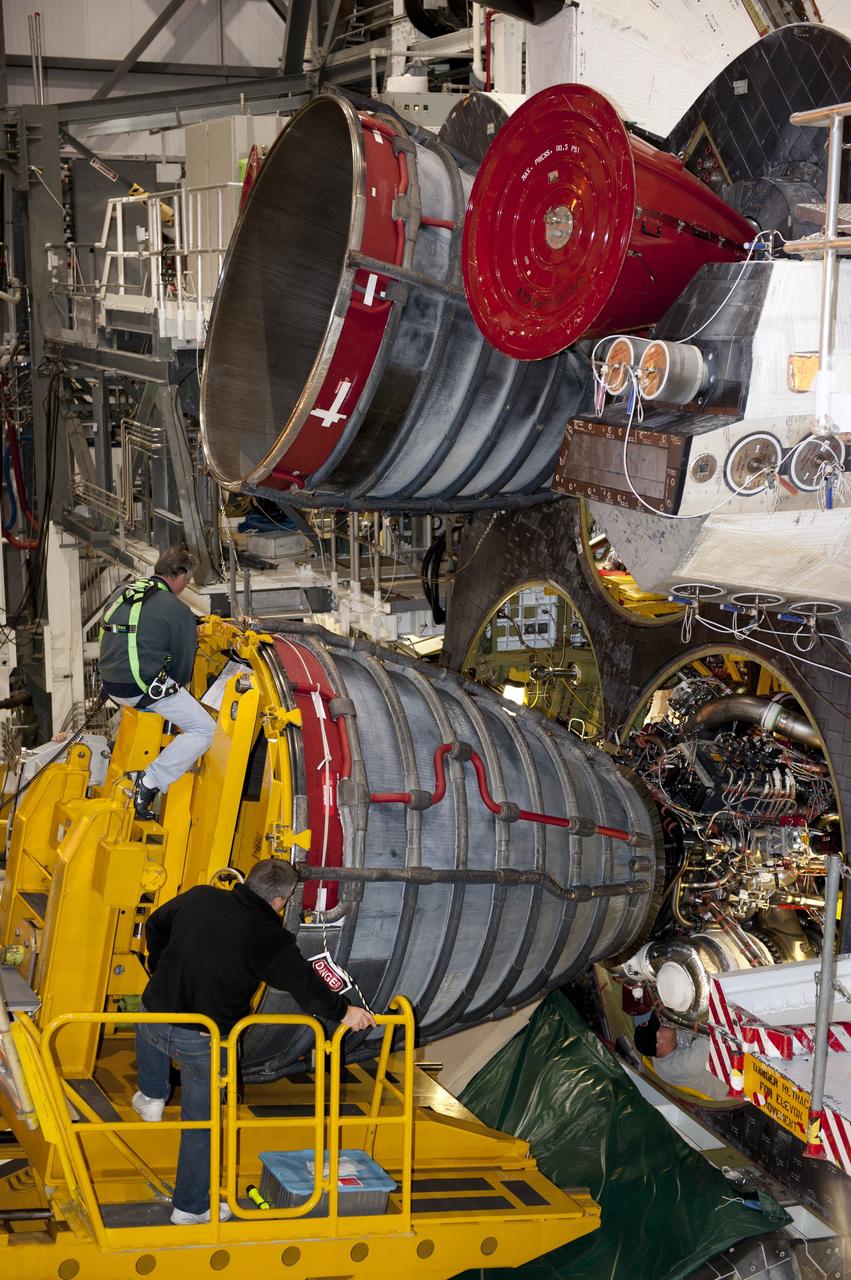
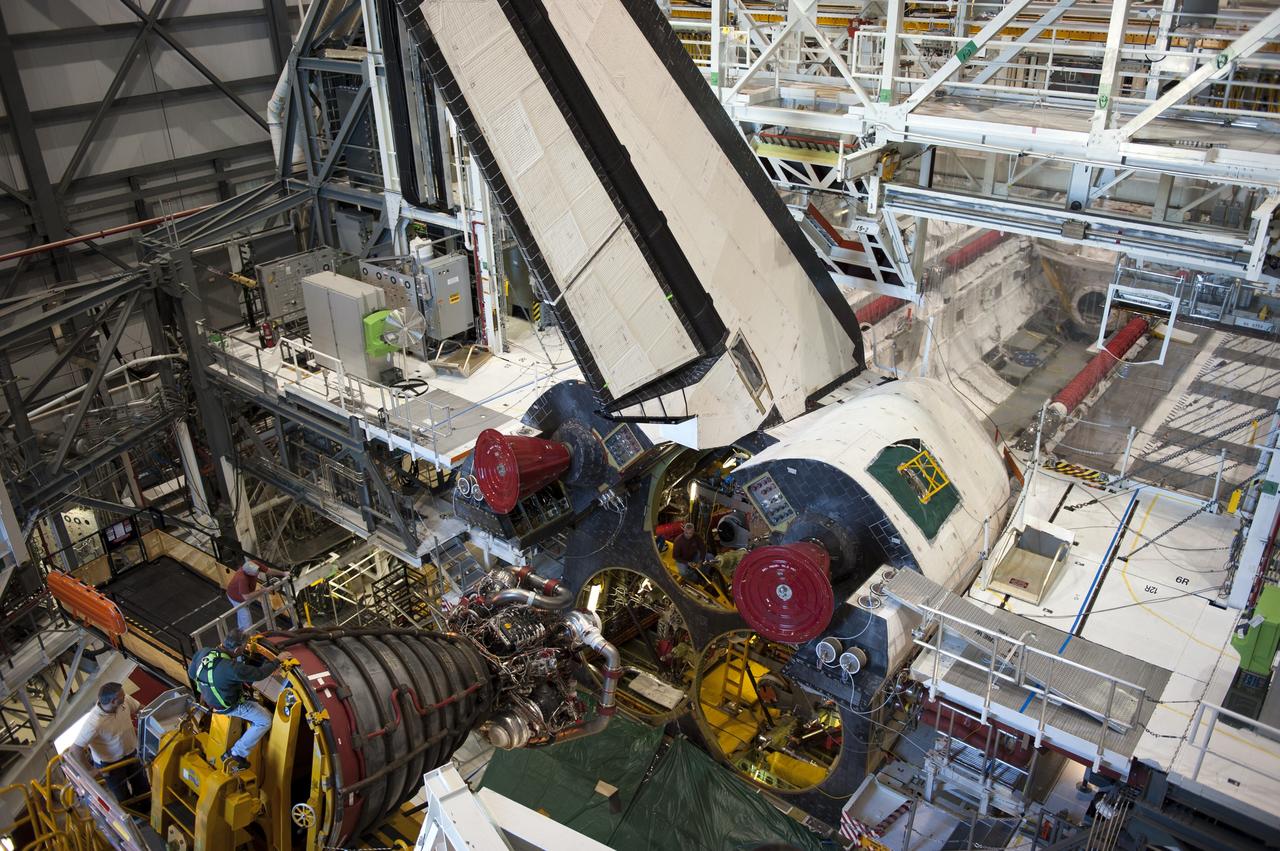
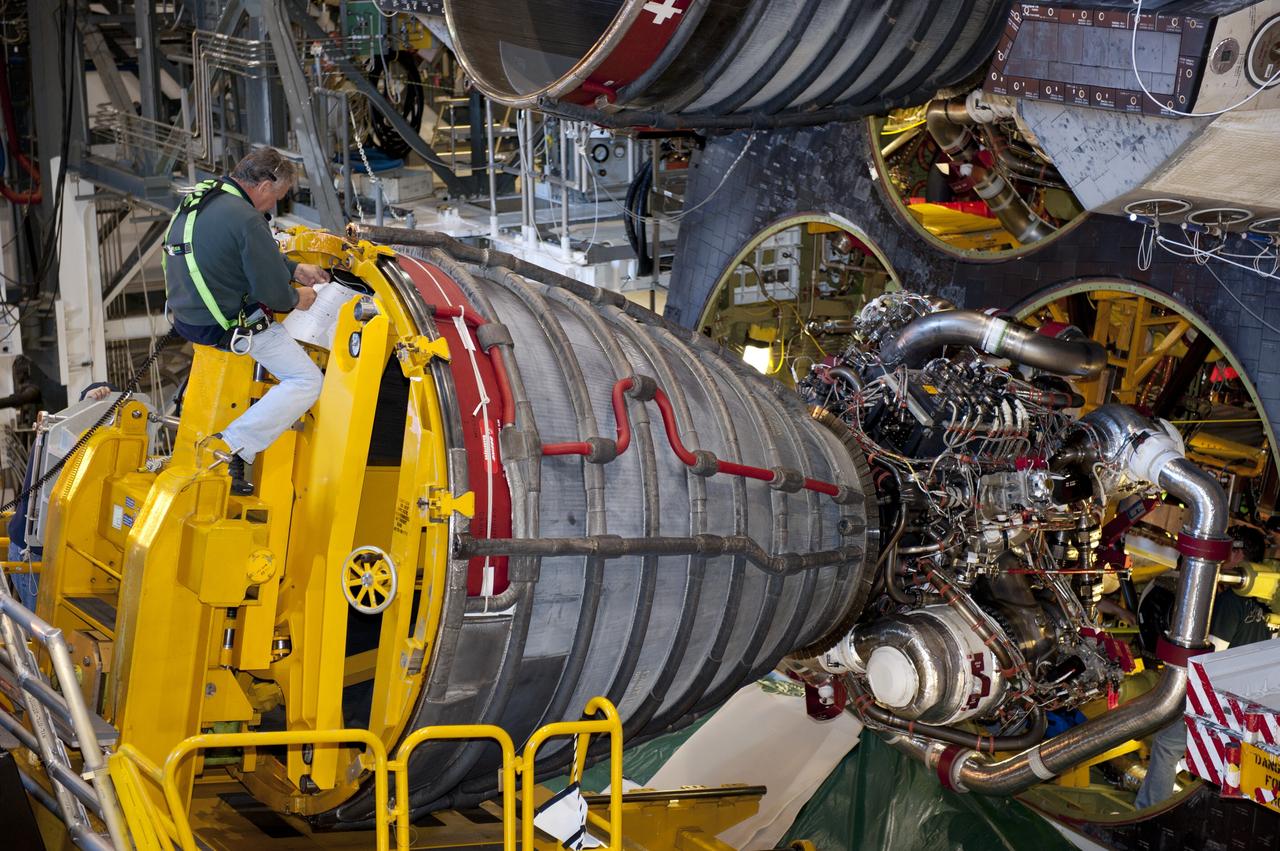
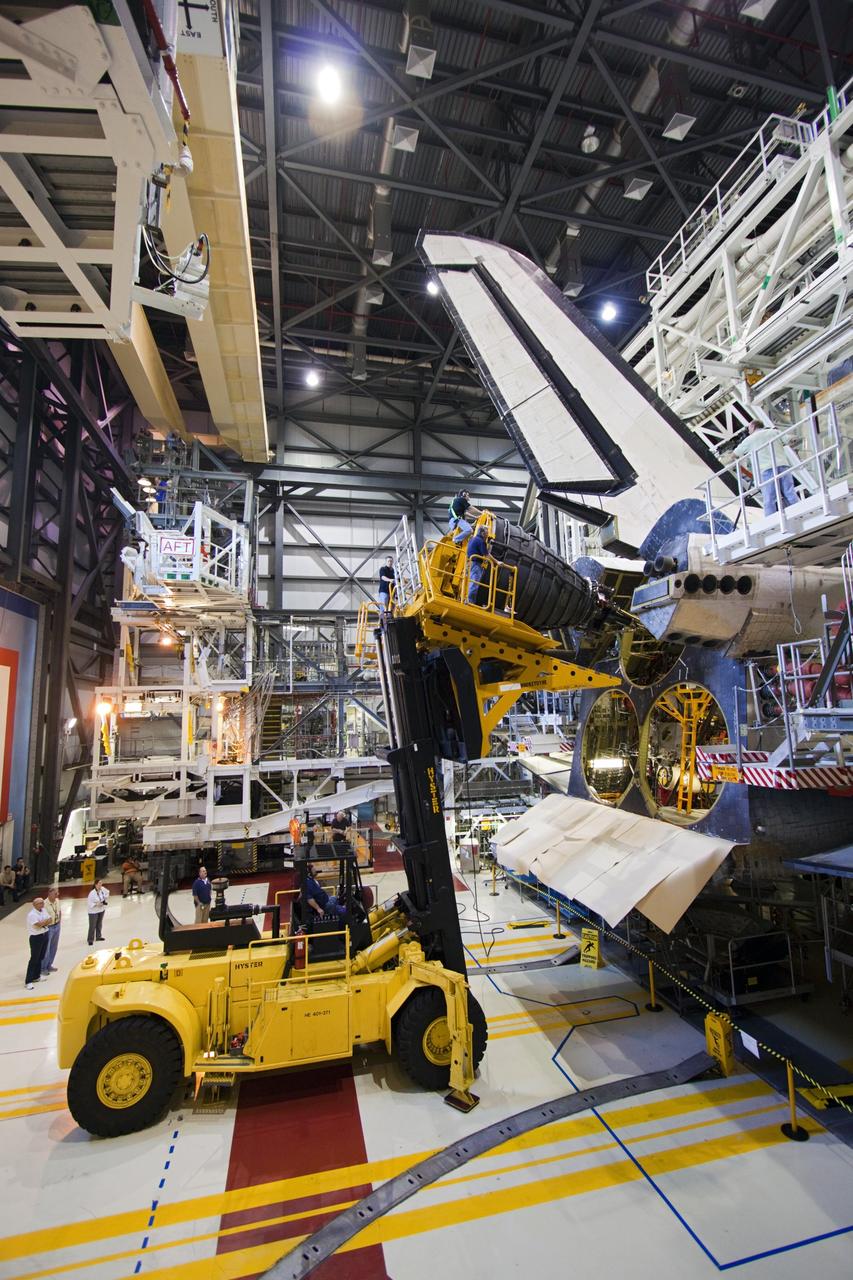
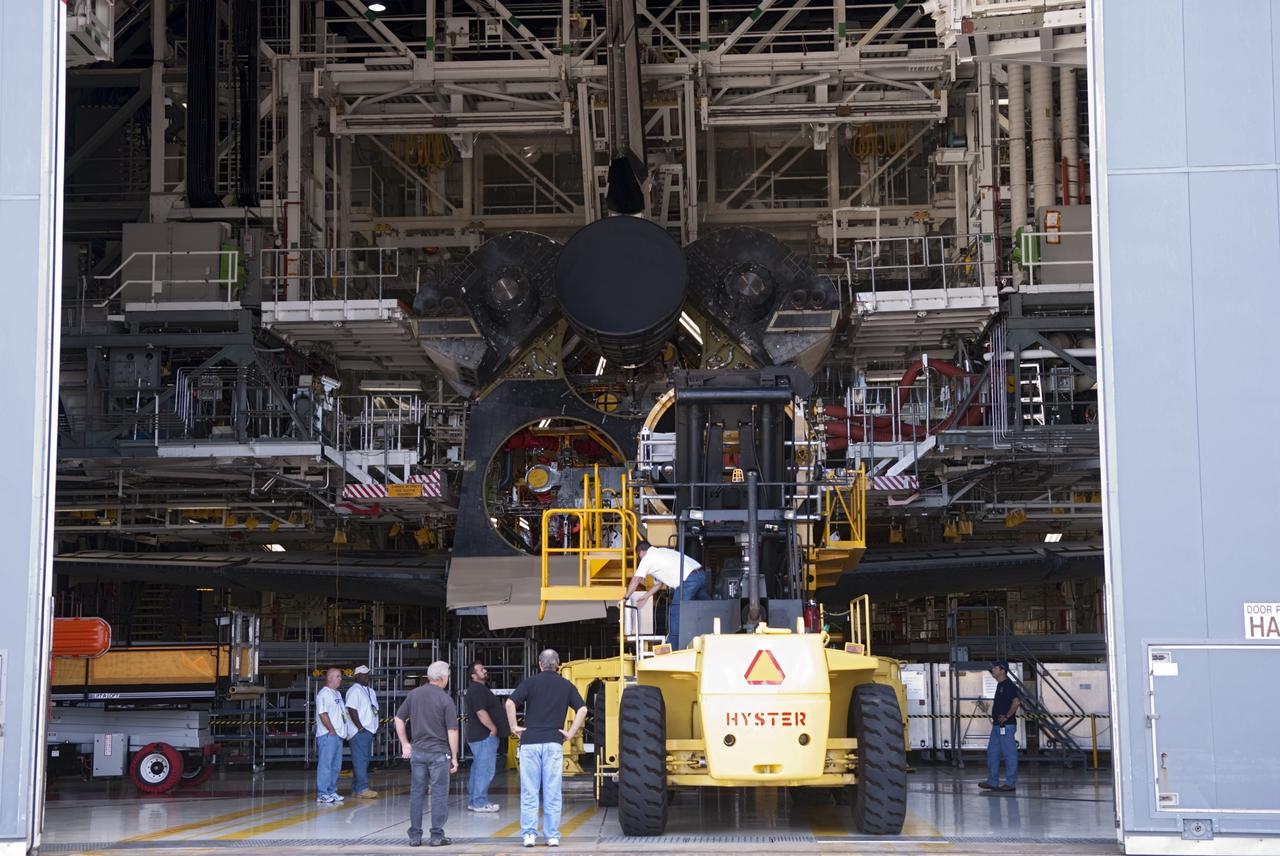
In Orbiter Processing Facility bay 2, technicians on a Hyster forklift install space shuttle main engine no. 3 into Endeavour. Each space shuttle main engine is 14 feet long, weighs about 6,700 pounds, and is 7.5 feet in diameter at the end of the nozzle. The orbiter is scheduled for mission STS-118, targeted for launch on June 28. The mission will be the 22nd flight to the International Space Station, carrying another starboard array, S5, for installation.
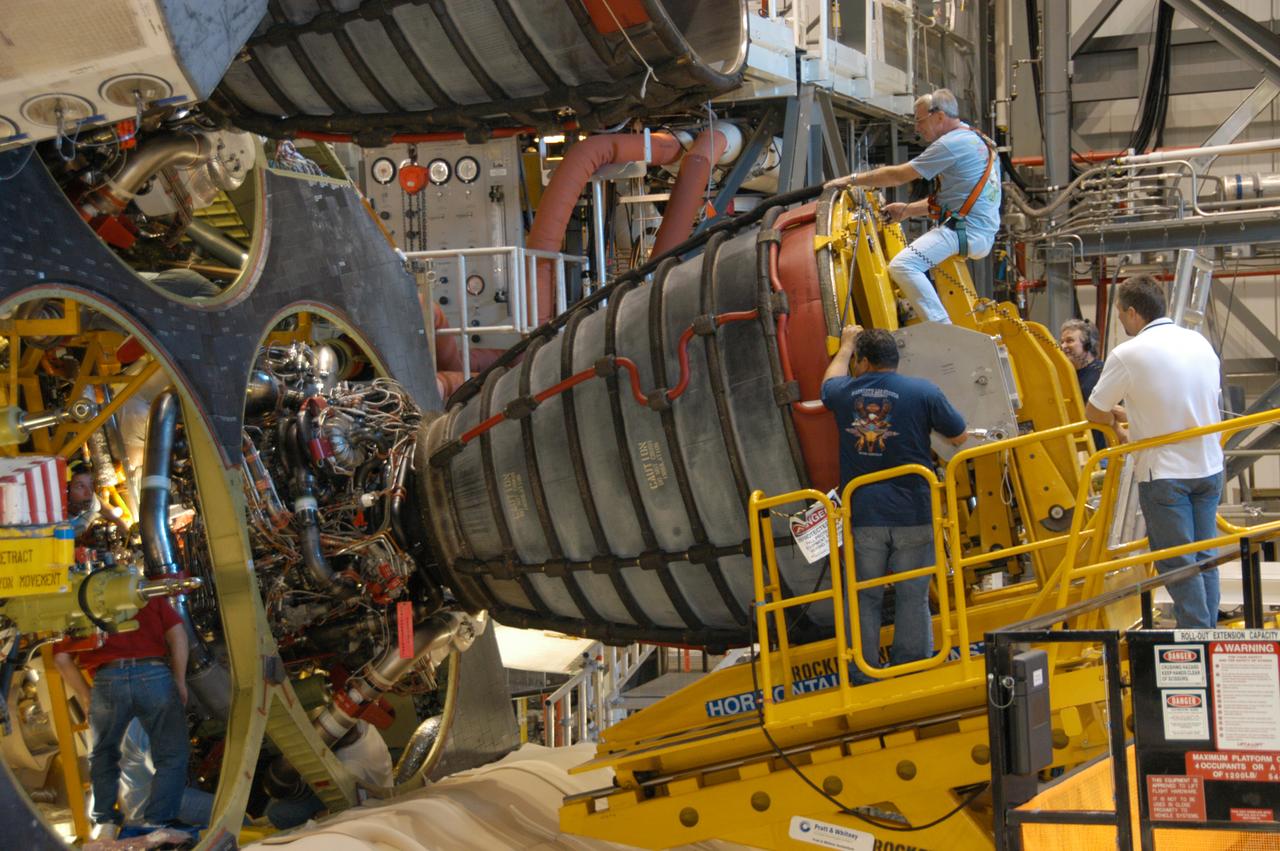
In Orbiter Processing Facility bay 2, technicians on a Hyster forklift maneuver space shuttle main engine no. 3 into place on Endeavour. Each space shuttle main engine is 14 feet long, weighs about 6,700 pounds, and is 7.5 feet in diameter at the end of the nozzle. The orbiter is scheduled for mission STS-118, targeted for launch on June 28. The mission will be the 22nd flight to the International Space Station, carrying another starboard array, S5, for installation.

In Orbiter Processing Facility bay 2, technicians on a Hyster forklift maneuver space shuttle main engine no. 3 into place on Endeavour. Each space shuttle main engine is 14 feet long, weighs about 6,700 pounds, and is 7.5 feet in diameter at the end of the nozzle. The orbiter is scheduled for mission STS-118, targeted for launch on June 28. The mission will be the 22nd flight to the International Space Station, carrying another starboard array, S5, for installation.
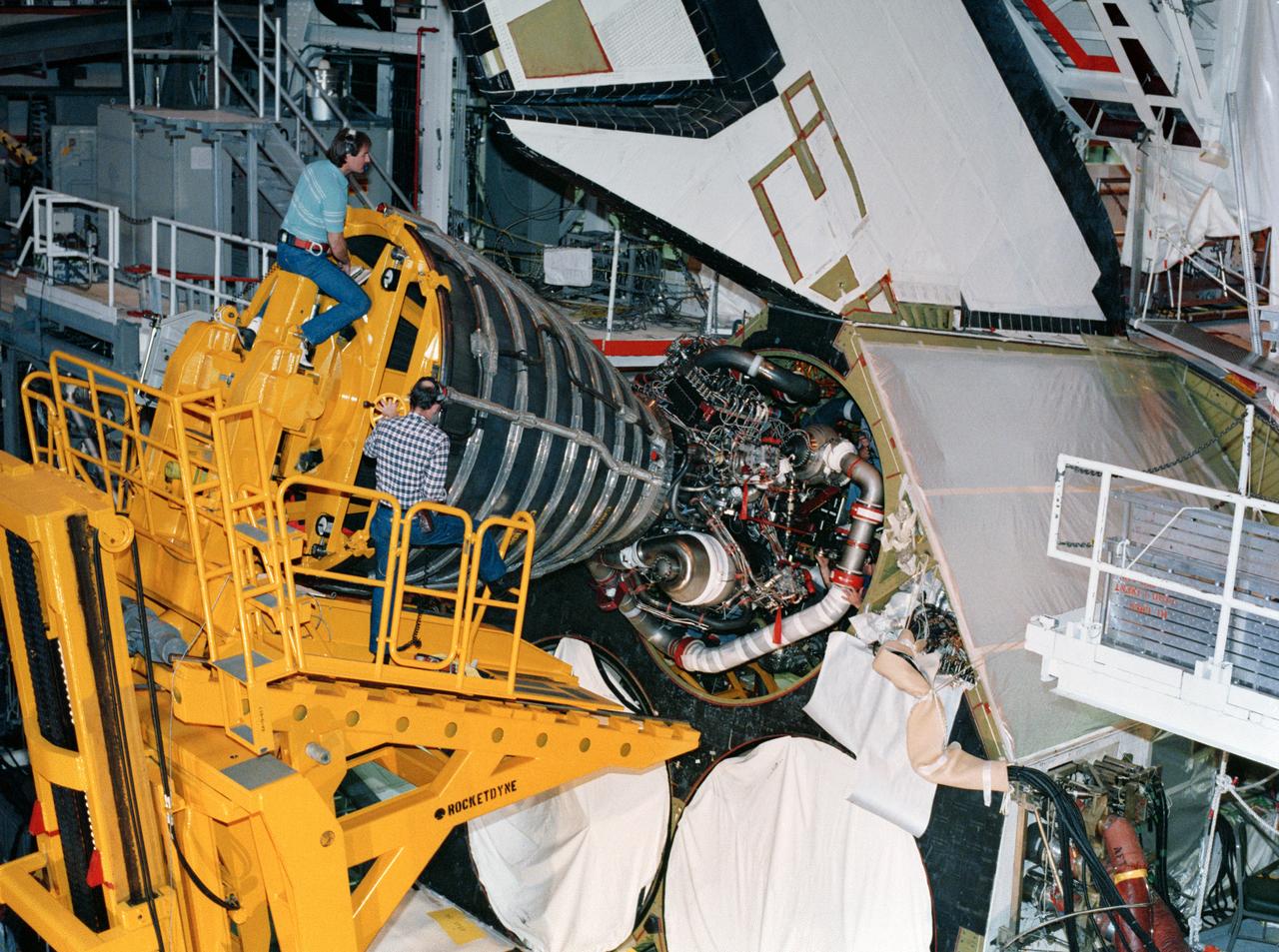
S88-29076 (10 Jan 1988) --- KSC employees work together to carefully guide a 7,000 pound main engine into the number one position in Discovery's aft compartment. Because of the engine's weight and size, special handling equipment is needed to perform the installation. Discovery is currently being prepared for the upcoming STS-26 mission in bay 1 of the Orbiter Processing Facility. This engine, 2019, arrived at KSC on Jan. 6 and was installed Jan. 10. The other two engines are scheduled to be installed later this month. The shuttle's three main liquid fueled engines provide the main propulsion for the orbiter vehicle. The cluster of three engines operate in parallel with the solid rocket boosters during the initial ascent.
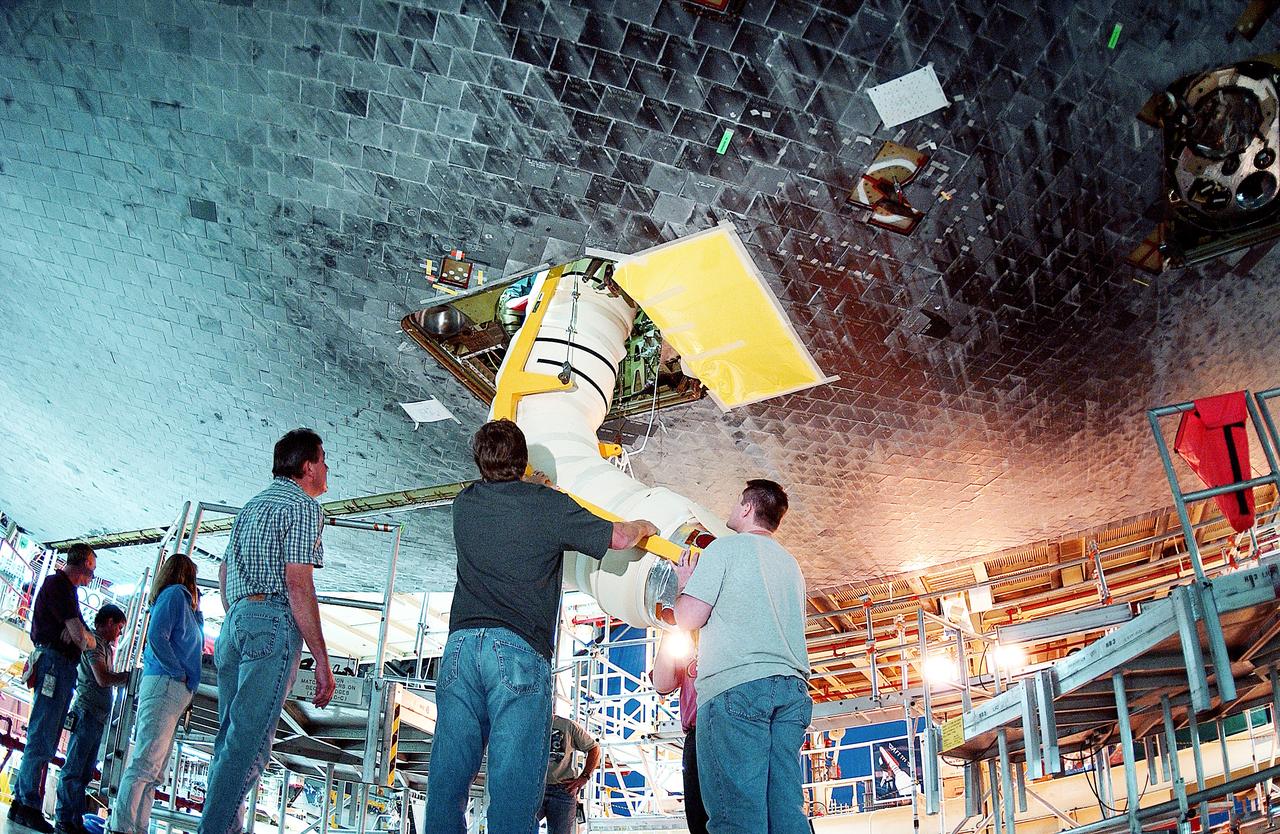
KENNEDY SPACE CENTER, FLA. - In the Orbiter Processing Facility, workers install the liquid oxygen feedline for the 17-inch disconnect on orbiter Discovery. The 17-inch liquid oxygen and liquid hydrogen disconnects provide the propellant feed interface from the external tank to the orbiter main propulsion system and the three Shuttle main engines.
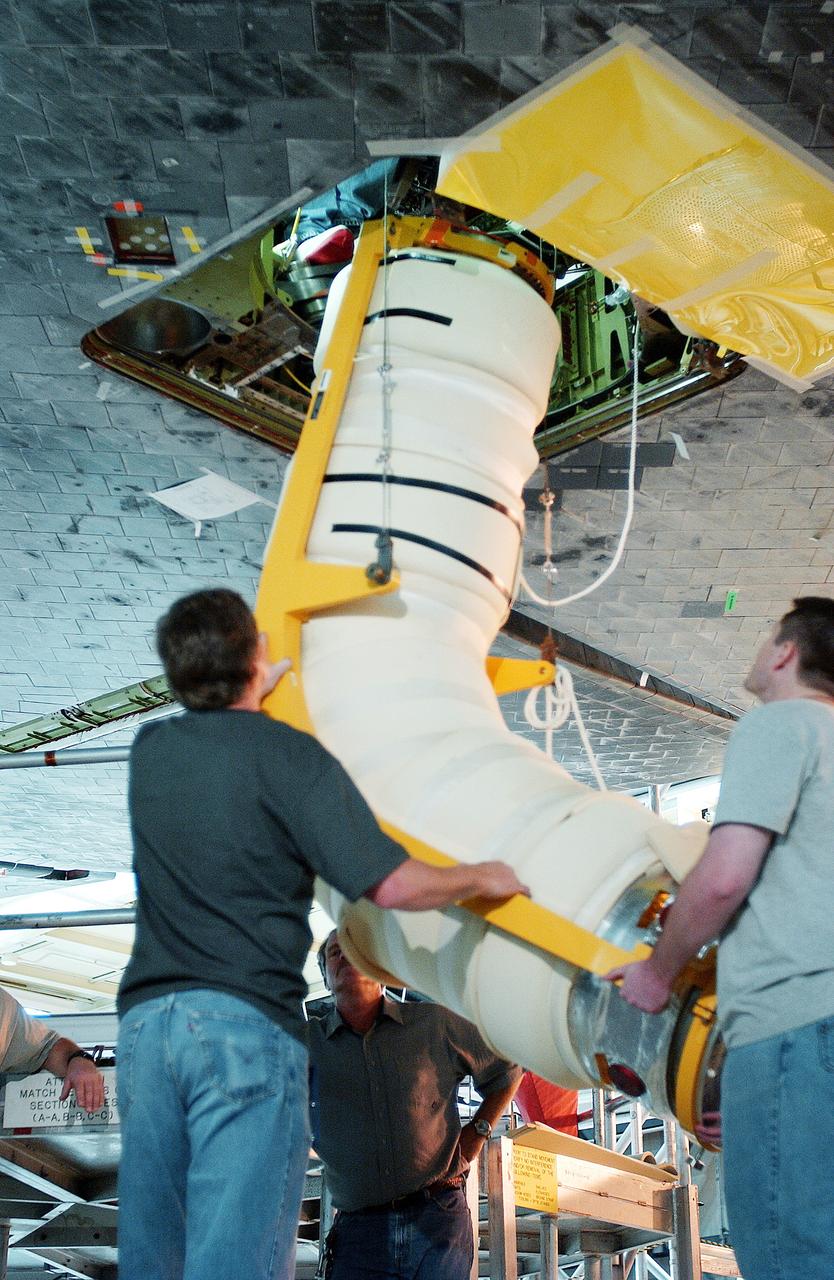
KENNEDY SPACE CENTER, FLA. - In the Orbiter Processing Facility, workers install the liquid oxygen feedline for the 17-inch disconnect on orbiter Discovery. The 17-inch liquid oxygen and liquid hydrogen disconnects provide the propellant feed interface from the external tank to the orbiter main propulsion system and the three Shuttle main engines.
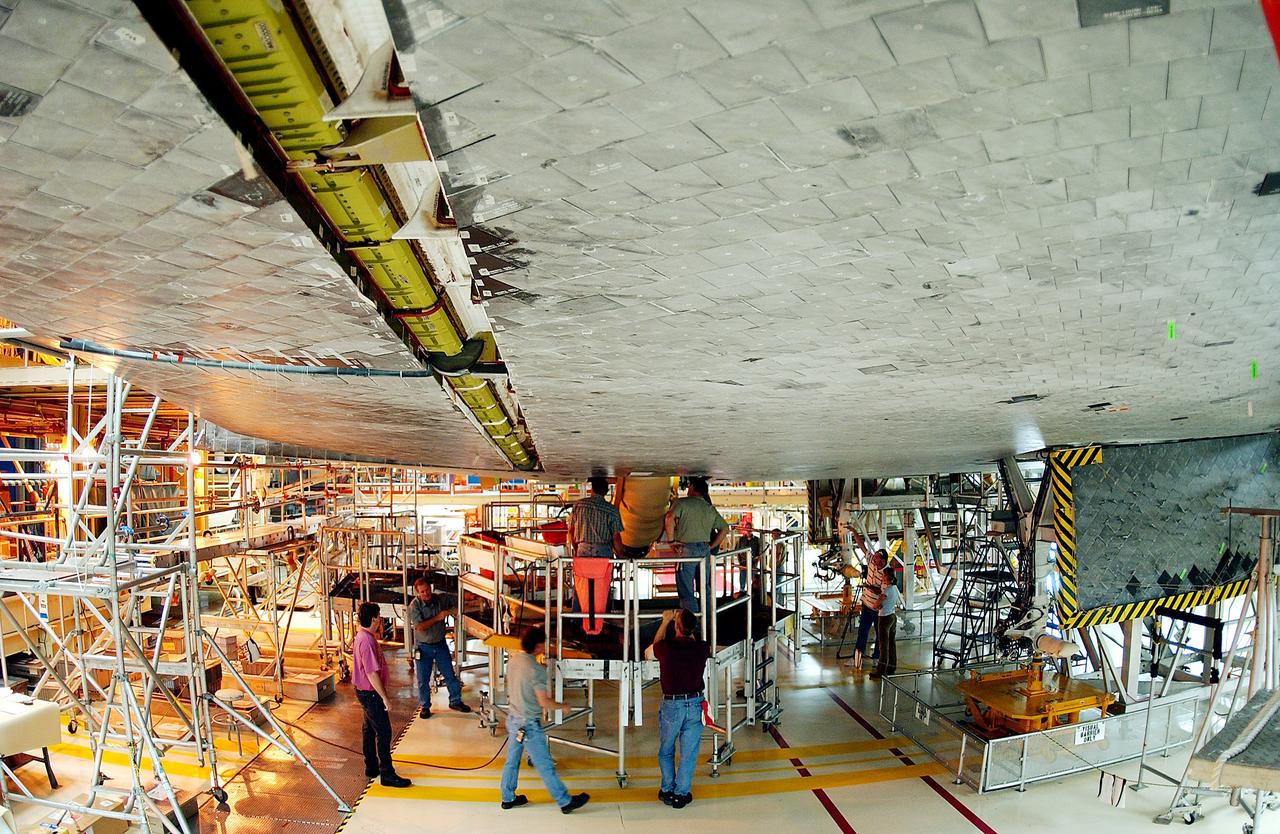
KENNEDY SPACE CENTER, FLA. - Workers in the Orbiter Processing Facility oversee installation of the liquid oxygen feedline for the 17-inch disconnect on the orbiter Discovery. The 17-inch liquid oxygen and liquid hydrogen disconnects provide the propellant feed interface from the external tank to the orbiter main propulsion system and the three Shuttle main engines.

This photo shows the second RS-25 engine attached to the core stage for NASA’s Space Launch System rocket for the agency’s Artemis I mission to the Moon. Engineers and technicians at NASA’s Michoud Assembly Facility in New Orleans structurally mated the second of four engines to the stage on Oct. 30 and are currently integrating the propulsion and electrical systems within the structure to complete the installation. Integration of the RS-25 engines to the recently completed core stage structure is a collaborative, multistep process for NASA and its partners Boeing, the core stage lead contractor, and Aerojet Rocketdyne, the RS-25 engines lead contractor. The four RS-25 engines for Artemis I are modified heritage flight hardware from the Space Shuttle Program, ensuring high performance and reliability to power NASA’s next generation lunar missions. Each engine also has a special identification number, and NASA keeps a history of which engines are used on each mission. The second engine, Engine 2045, has flown on several shuttle missions, including the mission that returned NASA astronaut John Glenn to space in 1998 as well as the first and only shuttle launch to occur on Independence Day in 2006.
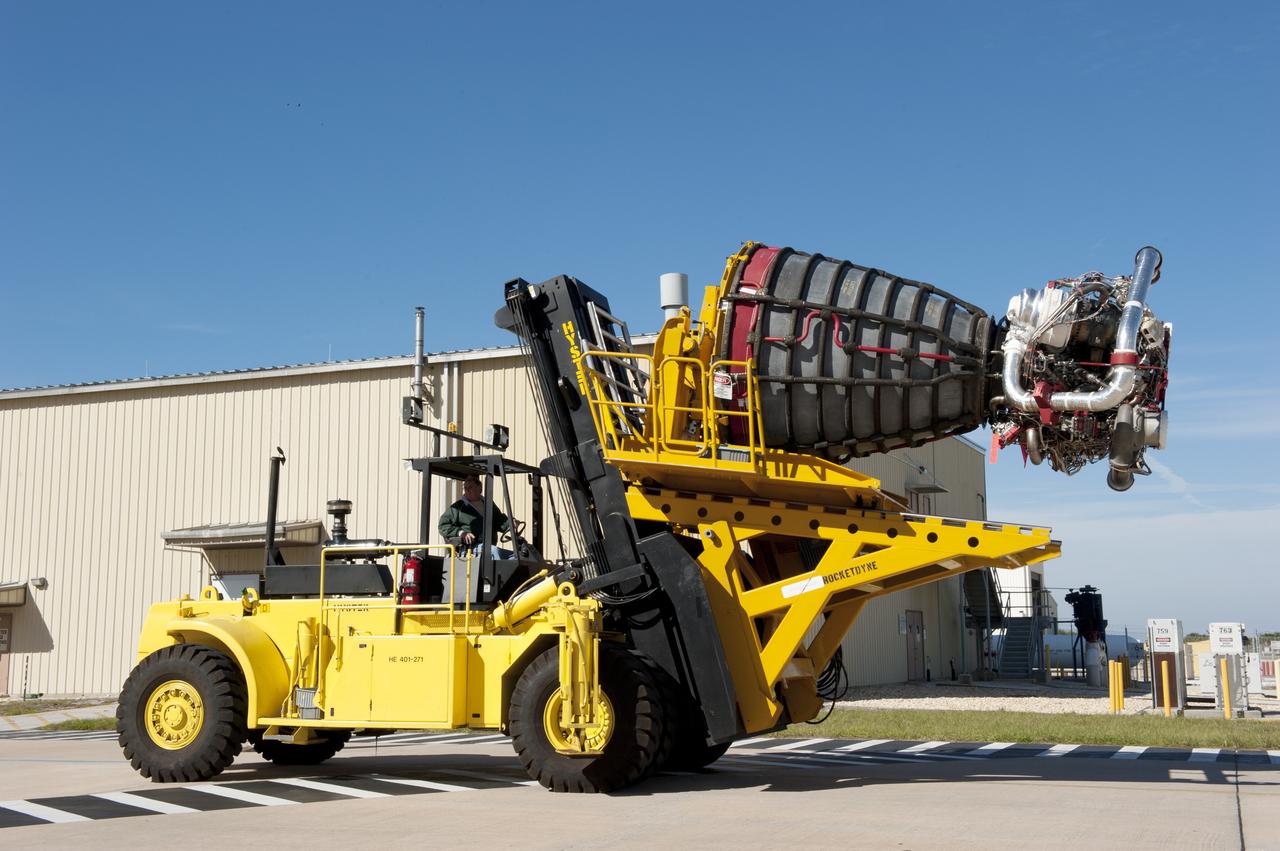
CAPE CANAVERAL, Fla. -- A Hyster forklift transports engine #2, the last of shuttle Atlantis' three main engines, from the Space Shuttle Main Engine (SSME) Shop to Orbiter Processing Facility-1 at NASA's Kennedy Space Center in Florida. Inside the processing facility, the engine will be installed in the shuttle. Each engine is 14 feet long, weighs about 6,700 pounds, and is 7.5 feet in diameter at the end of the nozzle. This is the final planned engine installation for the Space Shuttle Program. Atlantis is being prepared for the "launch on need," or potential rescue mission, for the final planned shuttle flight, Endeavour's STS-134 mission. For more information, visit www.nasa.gov/shuttle. Photo credit: NASA/Kim Shiflett
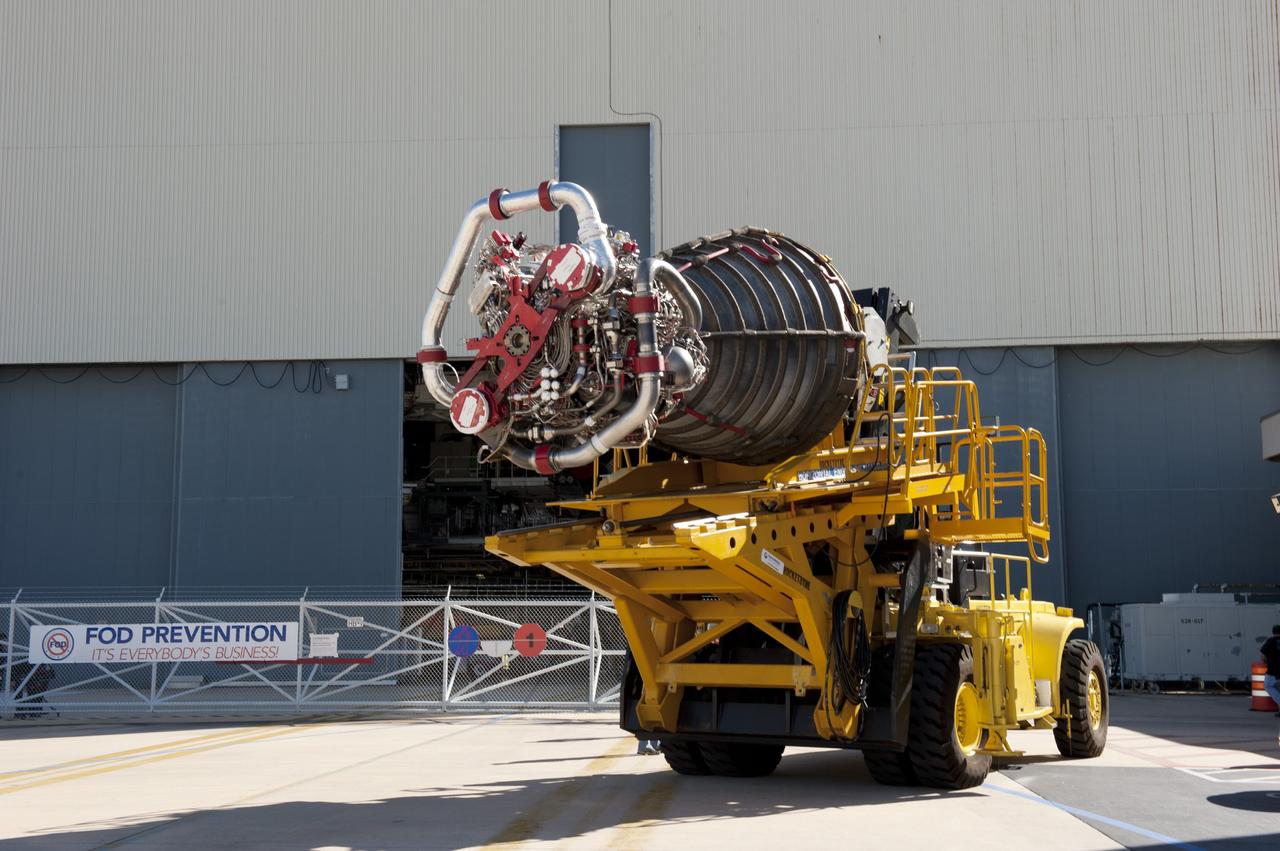
CAPE CANAVERAL, Fla. -- A Hyster forklift transports engine #2, the last of shuttle Atlantis' three main engines, from the Space Shuttle Main Engine (SSME) Shop to Orbiter Processing Facility-1 at NASA's Kennedy Space Center in Florida. Inside the processing facility, the engine will be installed in the shuttle. Each engine is 14 feet long, weighs about 6,700 pounds, and is 7.5 feet in diameter at the end of the nozzle. This is the final planned engine installation for the Space Shuttle Program. Atlantis is being prepared for the "launch on need," or potential rescue mission, for the final planned shuttle flight, Endeavour's STS-134 mission. For more information, visit www.nasa.gov/shuttle. Photo credit: NASA/Kim Shiflett
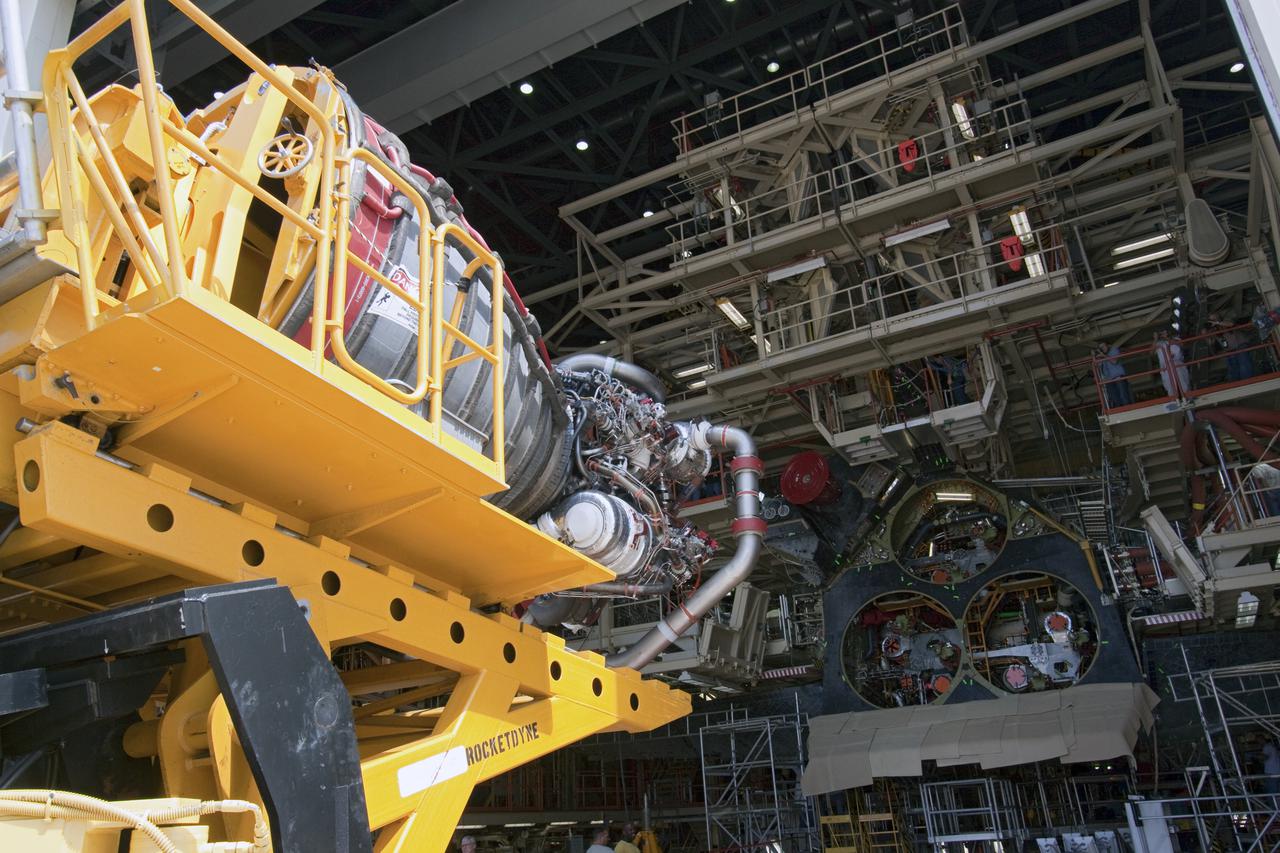
CAPE CANAVERAL, Fla. -- At NASA's Kennedy Space Center in Florida, a space shuttle main engine secured on a Hyster forklift is ready to be installed to space shuttle Discovery in Orbiter Processing Facility-3. Three main engines, weighing 7,000 pounds each, will be installed in the shuttle for the STS-133 mission to the International Space Station. Engines are inspected and maintained in the nearby Space Shuttle Main Engine Processing Facility before installation. Discovery and its STS-133 crew are targeted to deliver the Express Logistics Carrier-4 filled with external payloads and experiments, as well as critical spare components to the station later this year. Photo credit: NASA_Jack Pfaller
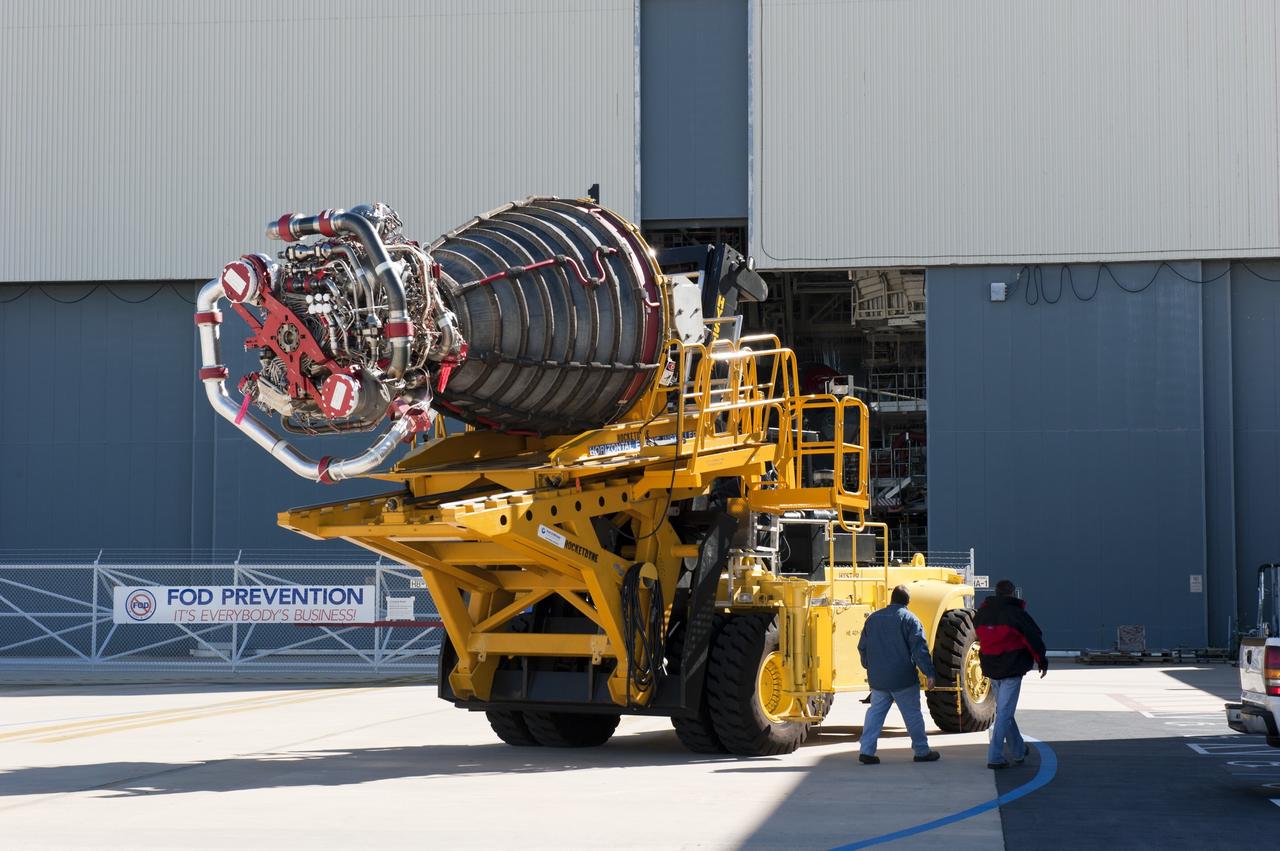
CAPE CANAVERAL, Fla. -- A Hyster forklift transports the second of shuttle Atlantis' three main engines from the Space Shuttle Main Engine (SSME) Shop to Orbiter Processing Facility-1 at NASA's Kennedy Space Center in Florida. Once inside the processing facility, the engine will be installed in the shuttle. Each engine is 14 feet long, weighs about 6,700 pounds, and is 7.5 feet in diameter at the end of the nozzle. This is the final planned engine installation for the Space Shuttle Program. Atlantis is being prepared for the "launch on need," or potential rescue mission, for the final planned shuttle flight, Endeavour's STS-134 mission. For more information, visit www.nasa.gov/shuttle. Photo credit: NASA/Kim Shiflett
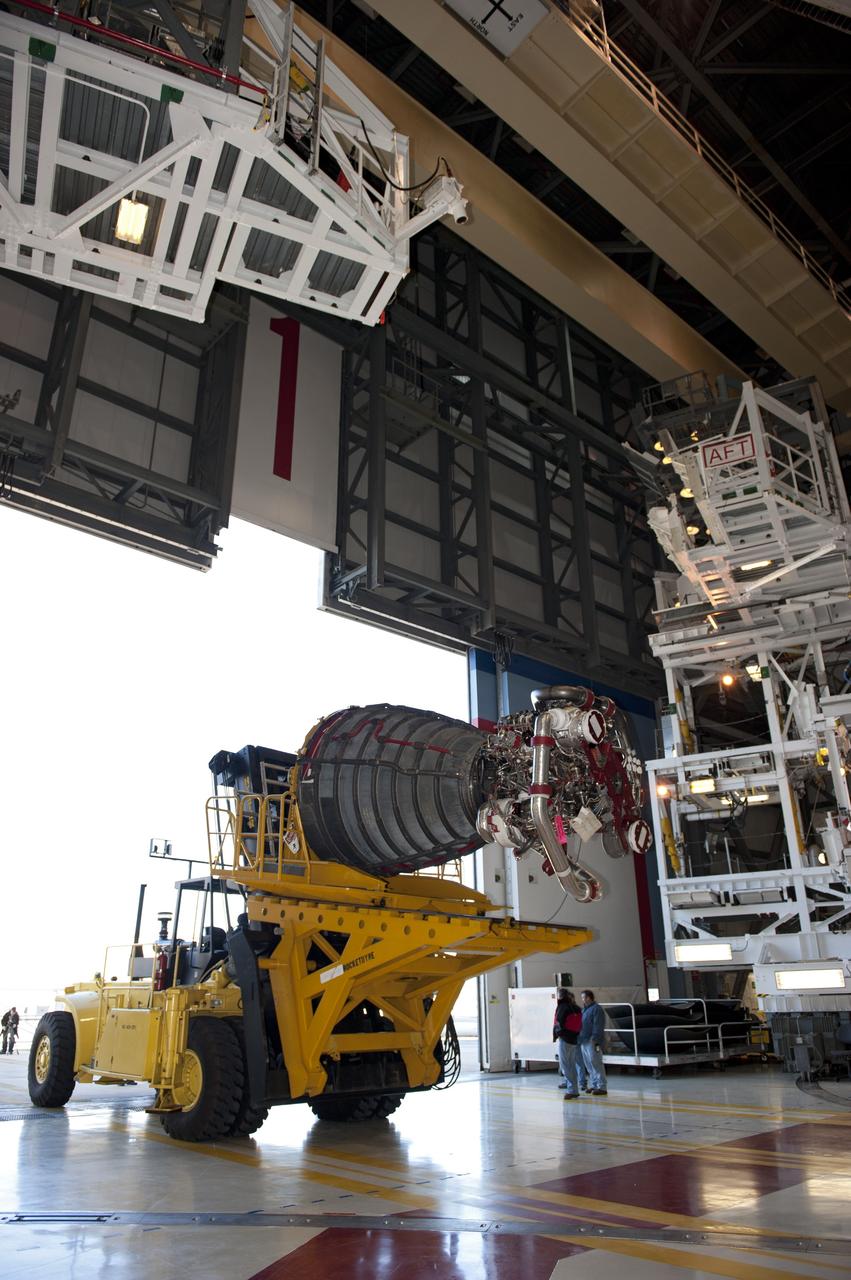
CAPE CANAVERAL, Fla. -- A Hyster forklift transporting the second of shuttle Atlantis' three main engines arrives at Orbiter Processing Facility-1 from the Space Shuttle Main Engine (SSME) Shop at NASA's Kennedy Space Center in Florida. There, the engine will be installed in the shuttle. Each engine is 14 feet long, weighs about 6,700 pounds, and is 7.5 feet in diameter at the end of the nozzle. This is the final planned engine installation for the Space Shuttle Program. Atlantis is being prepared for the "launch on need," or potential rescue mission, for the final planned shuttle flight, Endeavour's STS-134 mission. For more information, visit www.nasa.gov/shuttle. Photo credit: NASA/Kim Shiflett
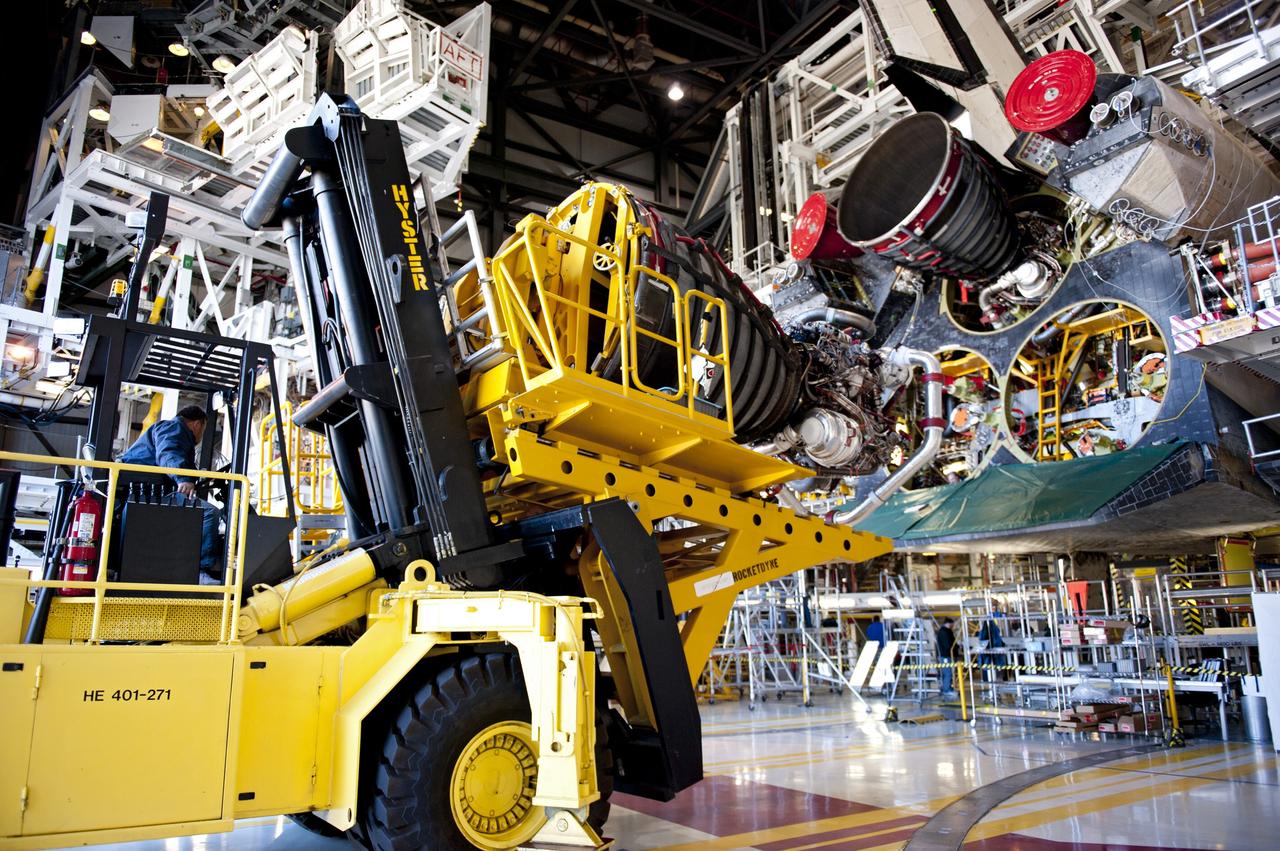
CAPE CANAVERAL, Fla. -- A Hyster forklift transporting the second of shuttle Atlantis' three main engines arrives at Orbiter Processing Facility-1 from the Space Shuttle Main Engine (SSME) Shop at NASA's Kennedy Space Center in Florida. There, the engine will be installed in the shuttle. Each engine is 14 feet long, weighs about 6,700 pounds, and is 7.5 feet in diameter at the end of the nozzle. This is the final planned engine installation for the Space Shuttle Program. Atlantis is being prepared for the "launch on need," or potential rescue mission, for the final planned shuttle flight, Endeavour's STS-134 mission. For more information, visit www.nasa.gov/shuttle. Photo credit: NASA/Kim Shiflett
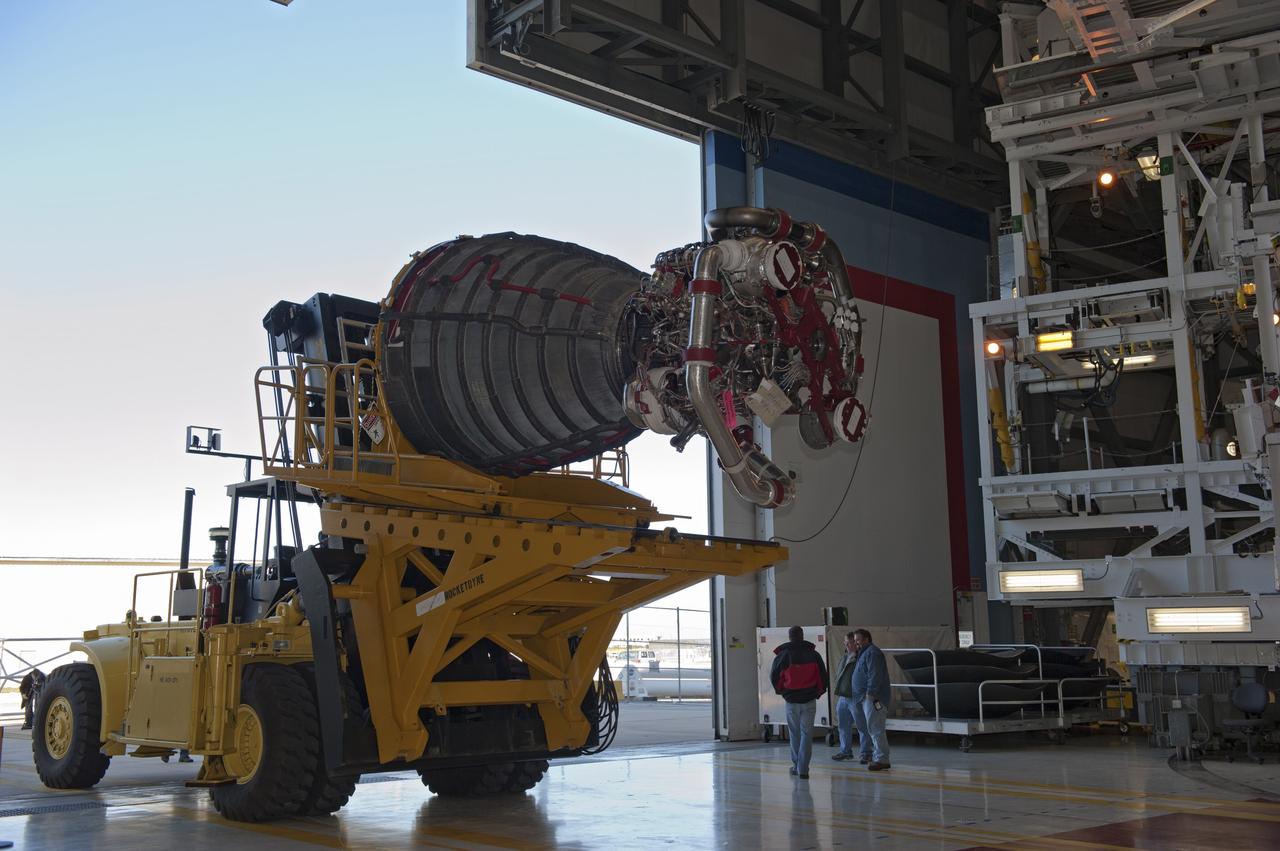
CAPE CANAVERAL, Fla. -- A Hyster forklift transporting the second of shuttle Atlantis' three main engines arrives at Orbiter Processing Facility-1 from the Space Shuttle Main Engine (SSME) Shop at NASA's Kennedy Space Center in Florida. There, the engine will be installed in the shuttle. Each engine is 14 feet long, weighs about 6,700 pounds, and is 7.5 feet in diameter at the end of the nozzle. This is the final planned engine installation for the Space Shuttle Program. Atlantis is being prepared for the "launch on need," or potential rescue mission, for the final planned shuttle flight, Endeavour's STS-134 mission. For more information, visit www.nasa.gov/shuttle. Photo credit: NASA/Kim Shiflett
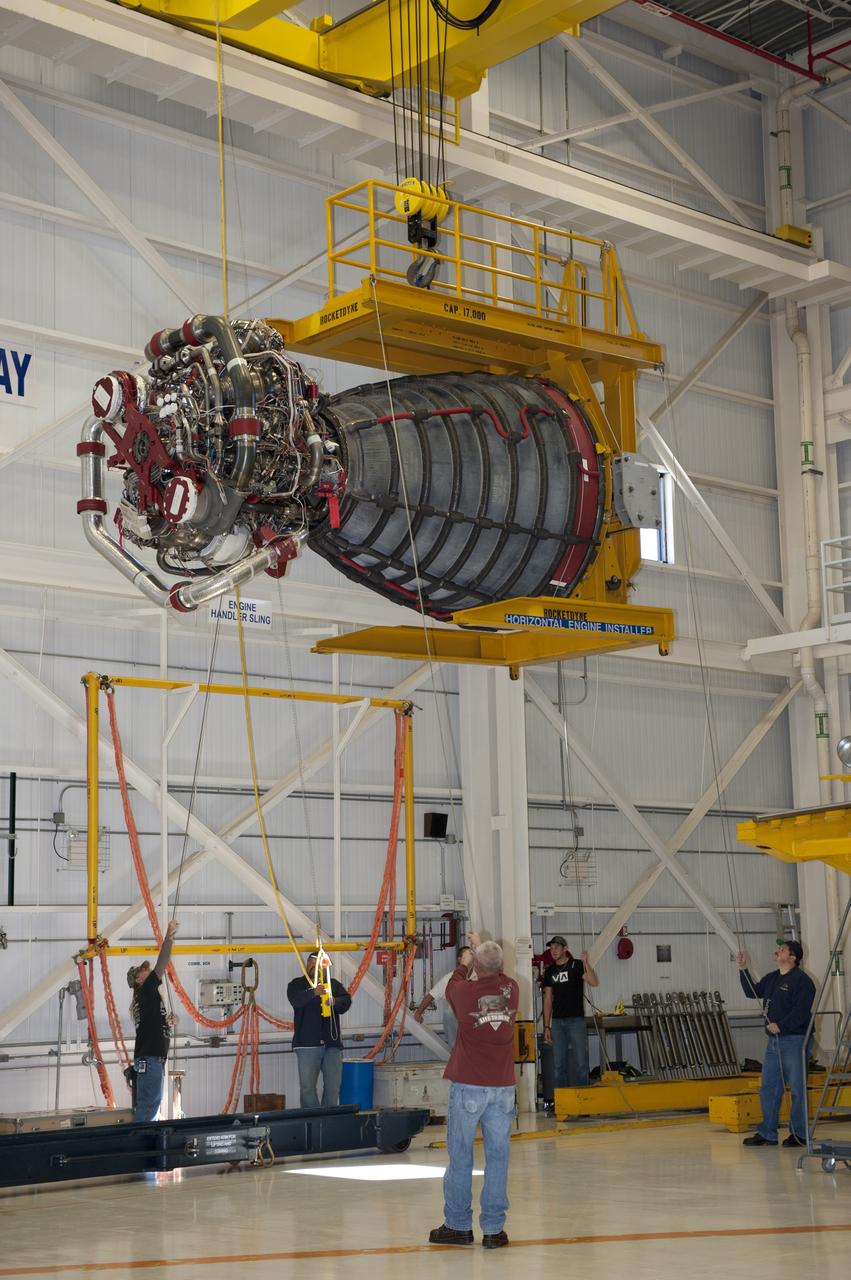
CAPE CANAVERAL, Fla. -- Workers in the Space Shuttle Main Engine (SSME) Shop at NASA's Kennedy Space Center in Florida raise the second of shuttle Atlantis' three main engines so it can be attached to a Hyster forklift. Then, the engine will be transported to Orbiter Processing Facility-1 where it will be installed in the shuttle. Each engine is 14 feet long, weighs about 6,700 pounds, and is 7.5 feet in diameter at the end of the nozzle. This is the final planned engine installation for the Space Shuttle Program. Atlantis is being prepared for the "launch on need," or potential rescue mission, for the final planned shuttle flight, Endeavour's STS-134 mission. For more information, visit www.nasa.gov/shuttle. Photo credit: NASA/Kim Shiflett
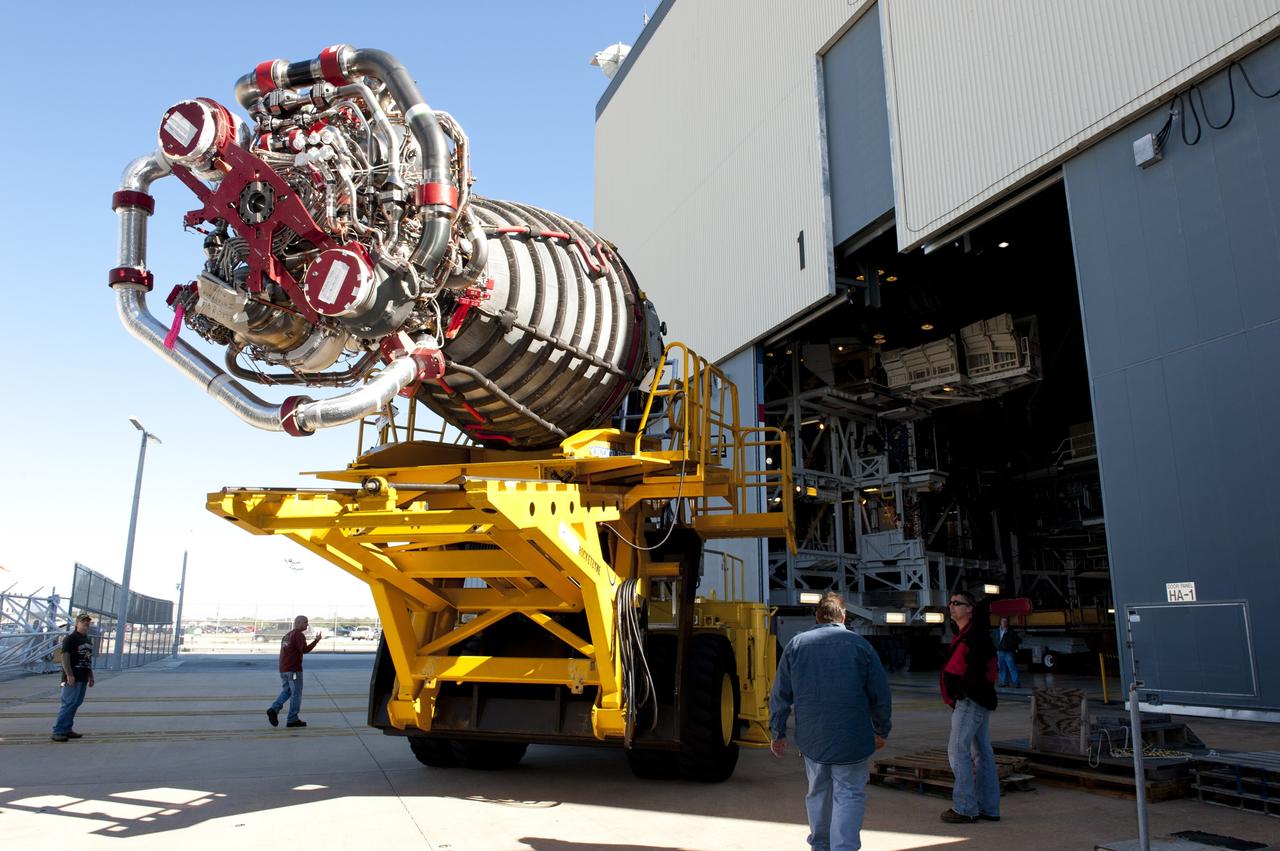
CAPE CANAVERAL, Fla. -- A Hyster forklift transports the second of shuttle Atlantis' three main engines from the Space Shuttle Main Engine (SSME) Shop to Orbiter Processing Facility-1 at NASA's Kennedy Space Center in Florida. Once inside the processing facility, the engine will be installed in the shuttle. Each engine is 14 feet long, weighs about 6,700 pounds, and is 7.5 feet in diameter at the end of the nozzle. This is the final planned engine installation for the Space Shuttle Program. Atlantis is being prepared for the "launch on need," or potential rescue mission, for the final planned shuttle flight, Endeavour's STS-134 mission. For more information, visit www.nasa.gov/shuttle. Photo credit: NASA/Kim Shiflett
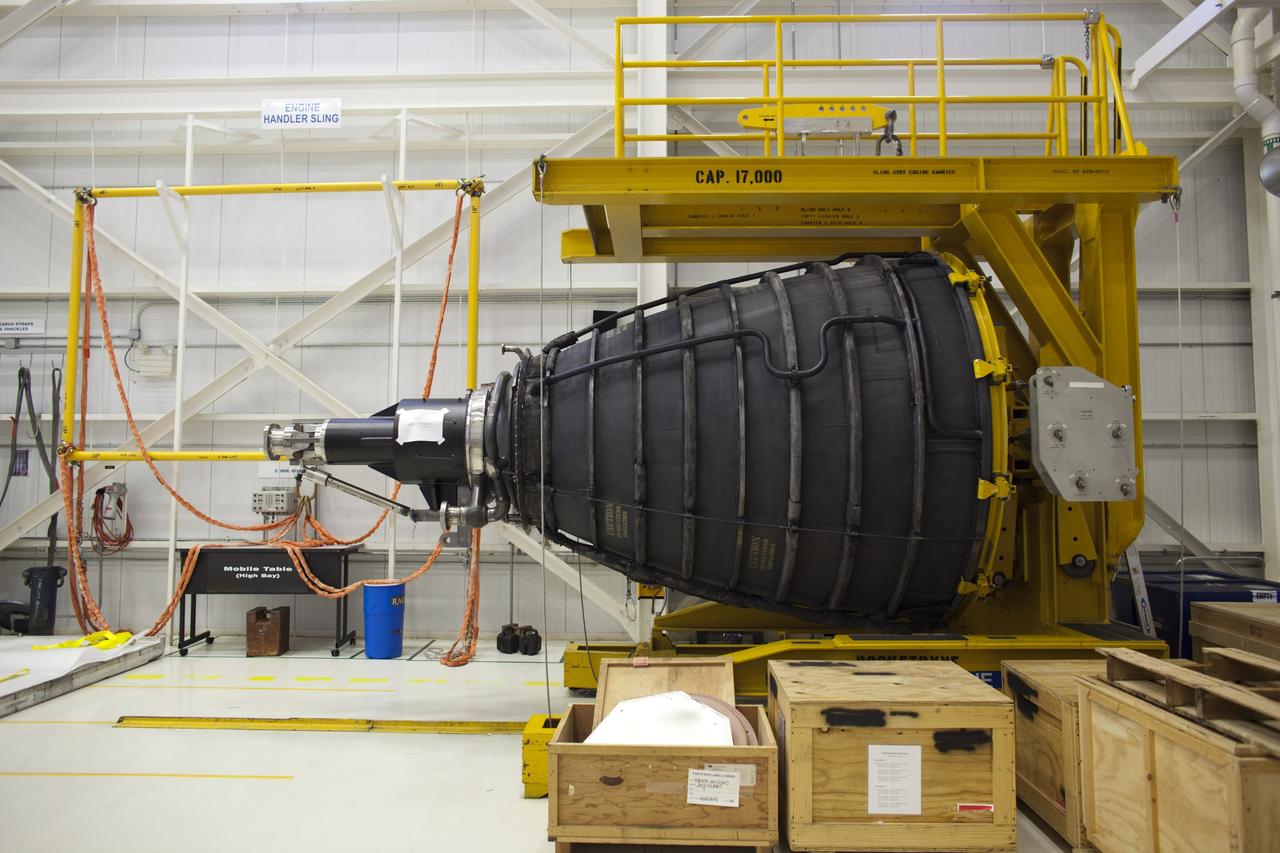
CAPE CANAVERAL, Fla. -- Inside the Pratt & Whitney Rocketdyne engine shop at NASA’s Kennedy Space Center in Florida, one of the three replica shuttle main engines (RSMEs) created for space shuttle Discovery is attached to the space shuttle main engine horizontal installer. The replica engines will be transported from the engine shop to the processing facility for installation on Discovery in January 2012. The work is part of the Space Shuttle Program’s transition and retirement processing of shuttle Discovery. Discovery is being prepared for display at the Smithsonian’s National Air and Space Museum, Steven F. Udvar-Hazy Center in Chantilly, Va. For more information, visit http://www.nasa.gov/shuttle. Photo credit: NASA/Dimitri Gerondidakis
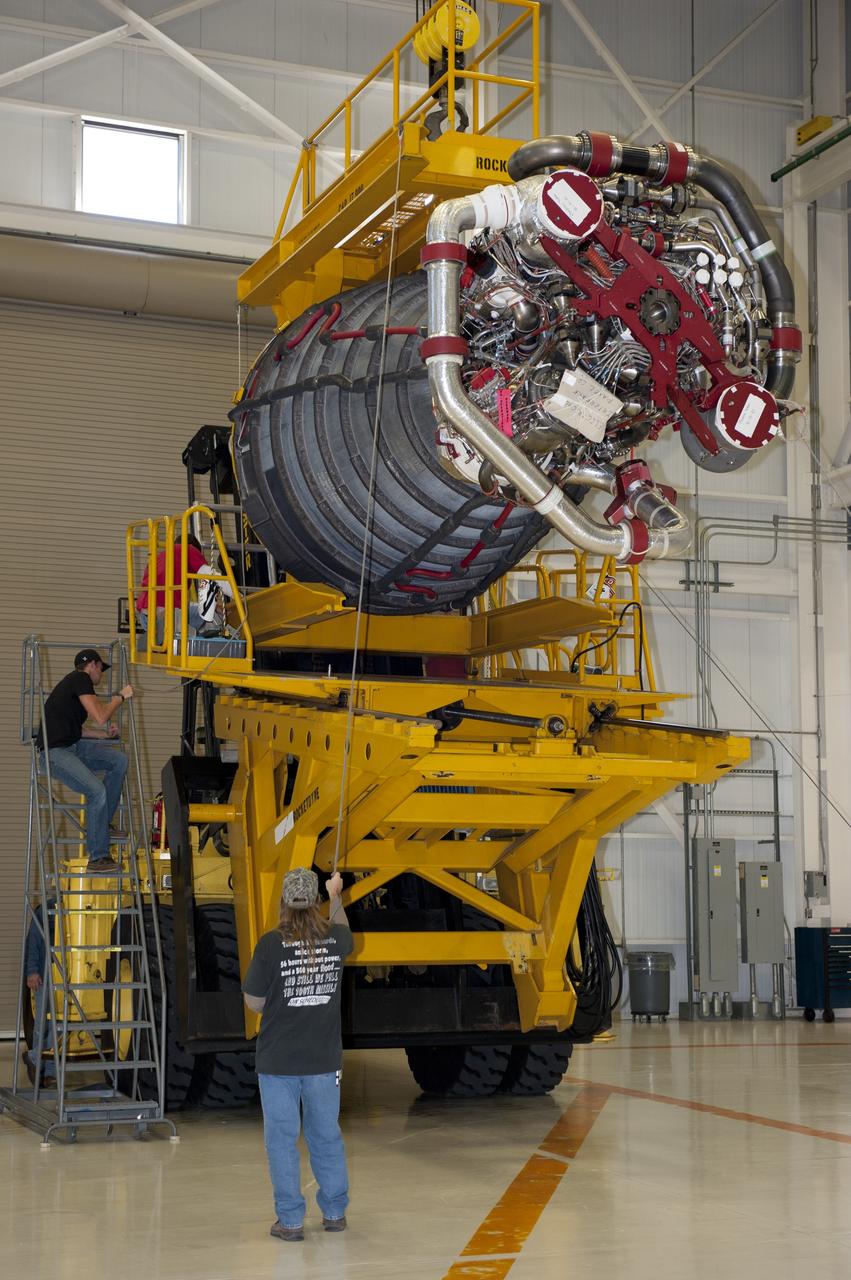
CAPE CANAVERAL, Fla. -- Workers in the Space Shuttle Main Engine (SSME) Shop at NASA's Kennedy Space Center in Florida attached the second of shuttle Atlantis' three main engines to a Hyster forklift. Next, the engine will be transported to Orbiter Processing Facility-1 where it will be installed in the shuttle. Each engine is 14 feet long, weighs about 6,700 pounds, and is 7.5 feet in diameter at the end of the nozzle. This is the final planned engine installation for the Space Shuttle Program. Atlantis is being prepared for the "launch on need," or potential rescue mission, for the final planned shuttle flight, Endeavour's STS-134 mission. For more information, visit www.nasa.gov/shuttle. Photo credit: NASA/Kim Shiflett
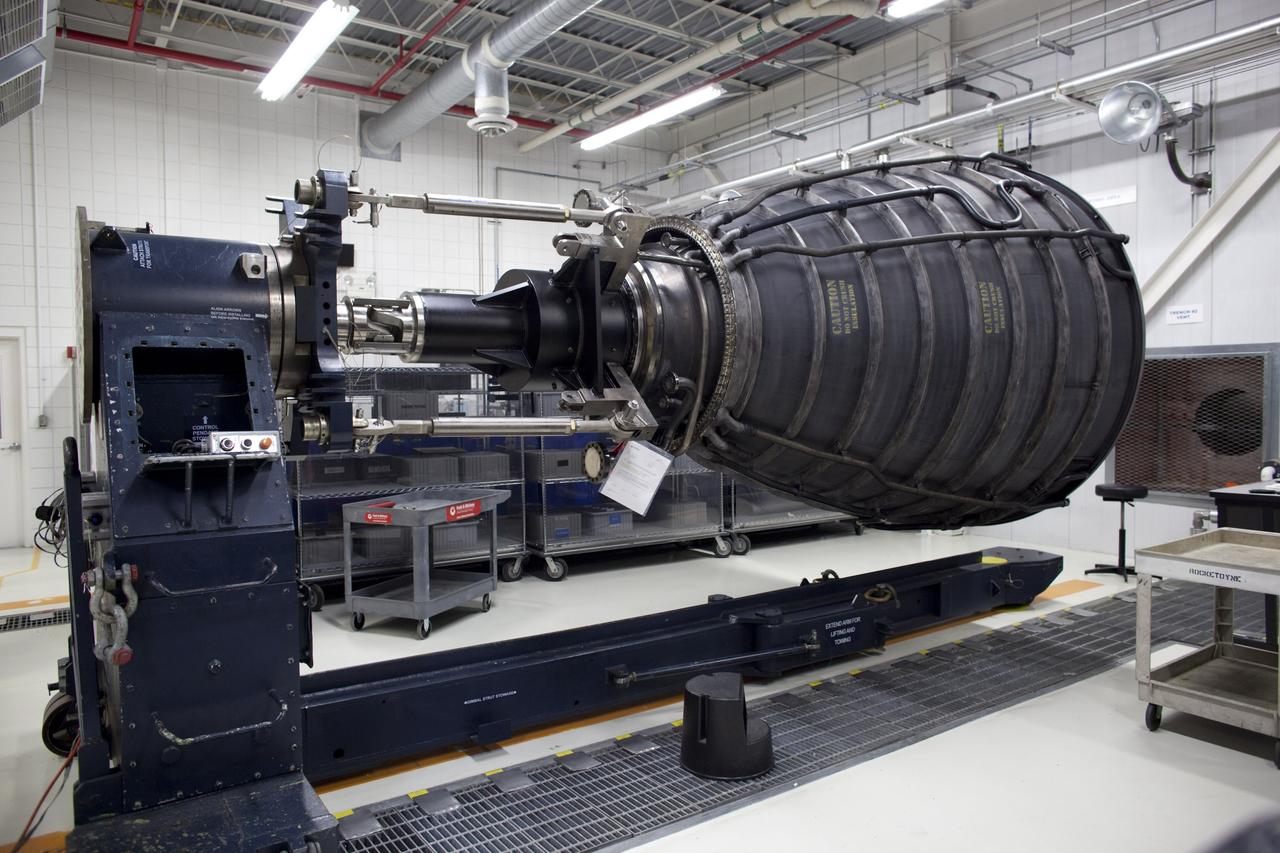
CAPE CANAVERAL, Fla. -- Inside the Pratt & Whitney Rocketdyne engine shop at NASA’s Kennedy Space Center in Florida, one of the three replica shuttle main engines (RSMEs) created for space shuttle Discovery is attached to the space shuttle main engine horizontal installer. The replica engines will be transported from the engine shop to the processing facility for installation on Discovery in January 2012. The work is part of the Space Shuttle Program’s transition and retirement processing of shuttle Discovery. Discovery is being prepared for display at the Smithsonian’s National Air and Space Museum, Steven F. Udvar-Hazy Center in Chantilly, Va. For more information, visit http://www.nasa.gov/shuttle. Photo credit: NASA/Dimitri Gerondidakis
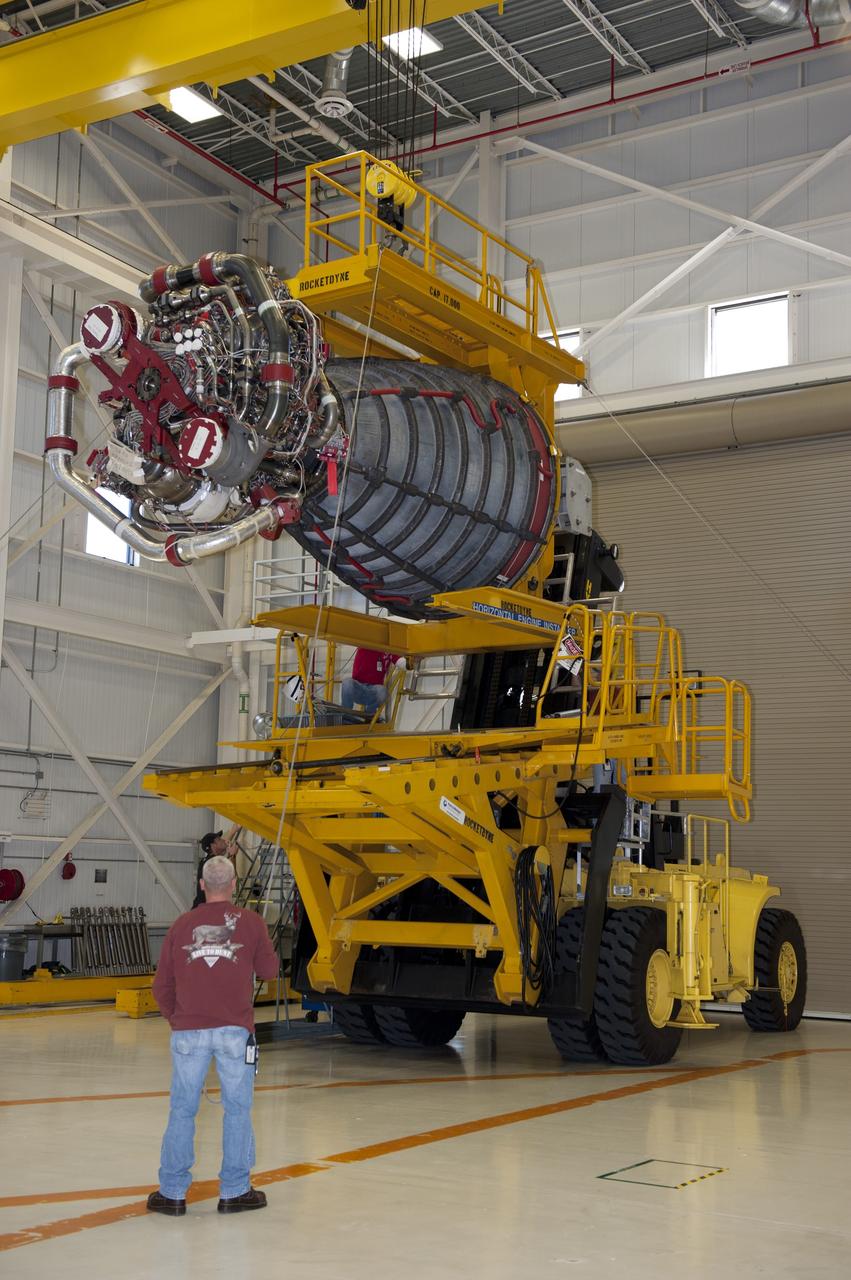
CAPE CANAVERAL, Fla. -- Workers in the Space Shuttle Main Engine (SSME) Shop at NASA's Kennedy Space Center in Florida attached the second of shuttle Atlantis' three main engines to a Hyster forklift. Next, the engine will be transported to Orbiter Processing Facility-1 where it will be installed in the shuttle. Each engine is 14 feet long, weighs about 6,700 pounds, and is 7.5 feet in diameter at the end of the nozzle. This is the final planned engine installation for the Space Shuttle Program. Atlantis is being prepared for the "launch on need," or potential rescue mission, for the final planned shuttle flight, Endeavour's STS-134 mission. For more information, visit www.nasa.gov/shuttle. Photo credit: NASA/Kim Shiflett
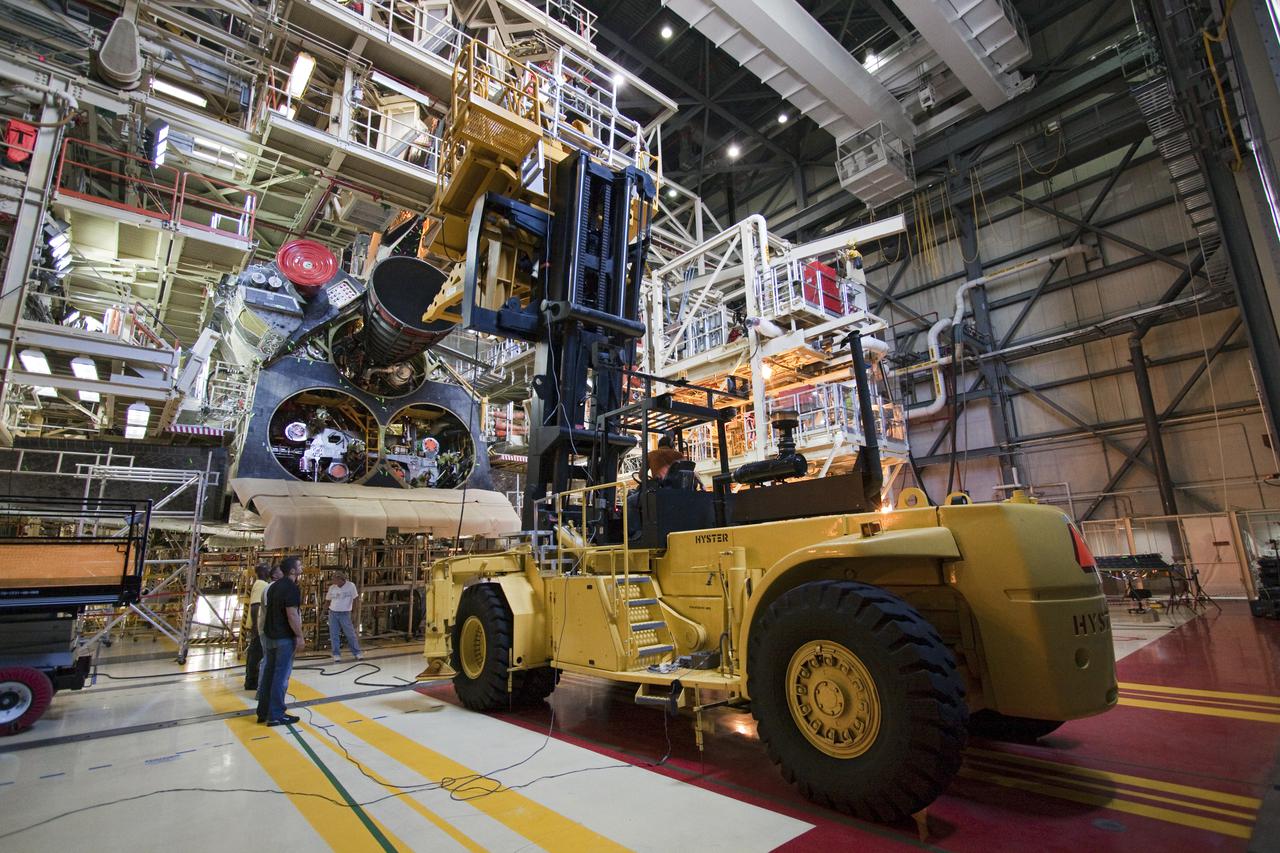
CAPE CANAVERAL, Fla. -- At NASA's Kennedy Space Center in Florida, a space shuttle main engine secured on a Hyster forklift is installed in space shuttle Discovery in Orbiter Processing Facility-3. Three main engines, weighing 7,000 pounds each, will be installed for the STS-133 mission to the International Space Station. Engines are inspected and maintained in the nearby Space Shuttle Main Engine Processing Facility before installation. Discovery and its STS-133 crew are targeted to deliver the Express Logistics Carrier-4 filled with external payloads and experiments, as well as critical spare components to the station later this year. Photo credit: NASA_Jack Pfaller
CAPE CANAVERAL, Fla. -- In Orbiter Processing Facility-1 at NASA's Kennedy Space Center in Florida, engine #2, the last of three space shuttle main engines is installed in shuttle Atlantis. Each engine is 14 feet long, weighs about 6,700 pounds, and is 7.5 feet in diameter at the end of the nozzle. This is the final planned engine installation for the Space Shuttle Program. Atlantis is being prepared for the "launch on need," or potential rescue mission, for the final planned shuttle flight, Endeavour's STS-134 mission. For more information, visit www.nasa.gov/shuttle. Photo credit: NASA/Kim Shiflett
CAPE CANAVERAL, Fla. -- In Orbiter Processing Facility-1 at NASA's Kennedy Space Center in Florida, a Hyster forklift moves engine #2, the last of three space shuttle main engines, into position for installation on shuttle Atlantis. Each engine is 14 feet long, weighs about 6,700 pounds, and is 7.5 feet in diameter at the end of the nozzle. This is the final planned engine installation for the Space Shuttle Program. Atlantis is being prepared for the "launch on need," or potential rescue mission, for the final planned shuttle flight, Endeavour's STS-134 mission. For more information, visit www.nasa.gov/shuttle. Photo credit: NASA/Kim Shiflett
CAPE CANAVERAL, Fla. -- In Orbiter Processing Facility-1 at NASA's Kennedy Space Center in Florida, a Hyster forklift moves engine #2, the last of three space shuttle main engines, into position for installation on shuttle Atlantis. Each engine is 14 feet long, weighs about 6,700 pounds, and is 7.5 feet in diameter at the end of the nozzle. This is the final planned engine installation for the Space Shuttle Program. Atlantis is being prepared for the "launch on need," or potential rescue mission, for the final planned shuttle flight, Endeavour's STS-134 mission. For more information, visit www.nasa.gov/shuttle. Photo credit: NASA/Kim Shiflett
CAPE CANAVERAL, Fla. -- In Orbiter Processing Facility-1 at NASA's Kennedy Space Center in Florida, a Hyster forklift moves engine #2, the last of three space shuttle main engines, into position for installation on shuttle Atlantis. Each engine is 14 feet long, weighs about 6,700 pounds, and is 7.5 feet in diameter at the end of the nozzle. This is the final planned engine installation for the Space Shuttle Program. Atlantis is being prepared for the "launch on need," or potential rescue mission, for the final planned shuttle flight, Endeavour's STS-134 mission. For more information, visit www.nasa.gov/shuttle. Photo credit: NASA/Kim Shiflett
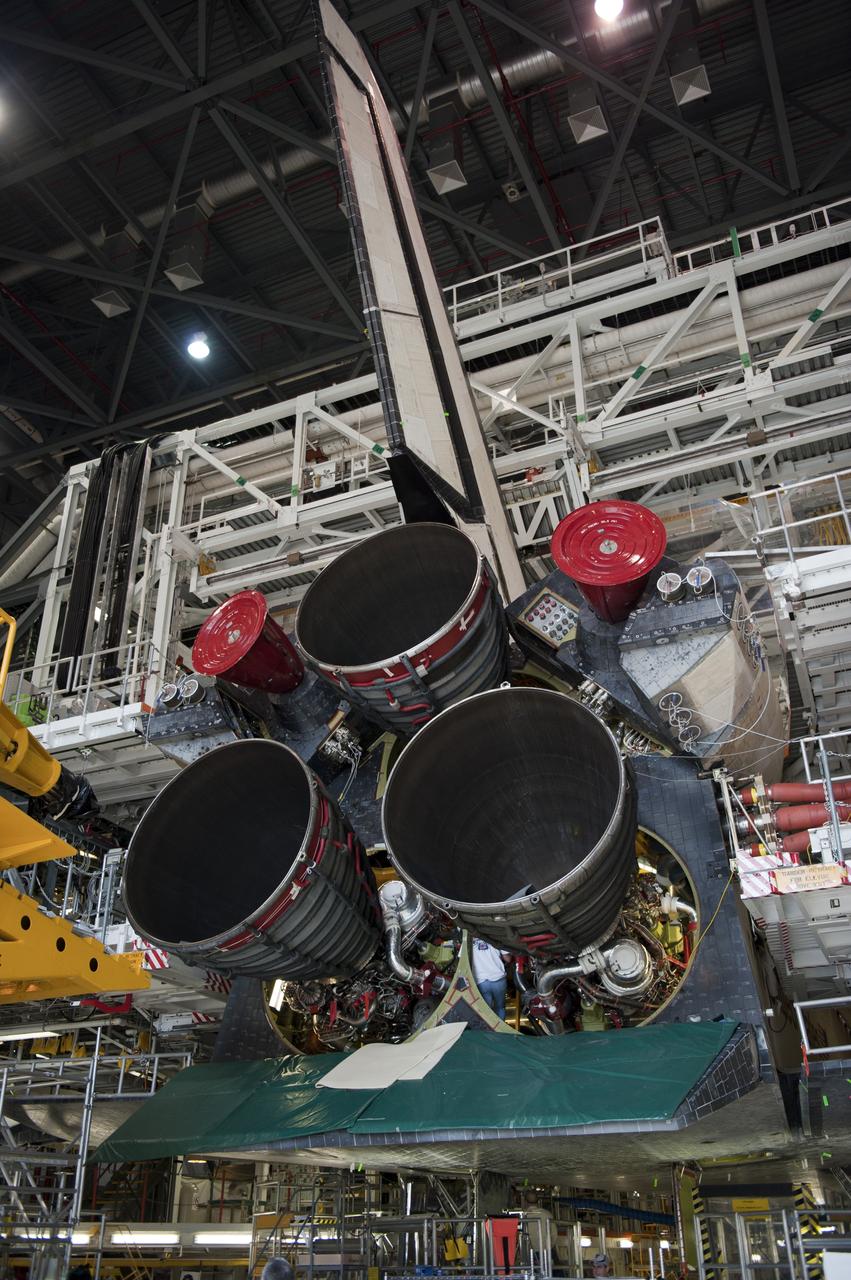
CAPE CANAVERAL, Fla. -- In Orbiter Processing Facility-1 at NASA's Kennedy Space Center in Florida, engine #2, the last of three space shuttle main engines is installed in shuttle Atlantis. Each engine is 14 feet long, weighs about 6,700 pounds, and is 7.5 feet in diameter at the end of the nozzle. This is the final planned engine installation for the Space Shuttle Program. Atlantis is being prepared for the "launch on need," or potential rescue mission, for the final planned shuttle flight, Endeavour's STS-134 mission. For more information, visit www.nasa.gov/shuttle. Photo credit: NASA/Kim Shiflett
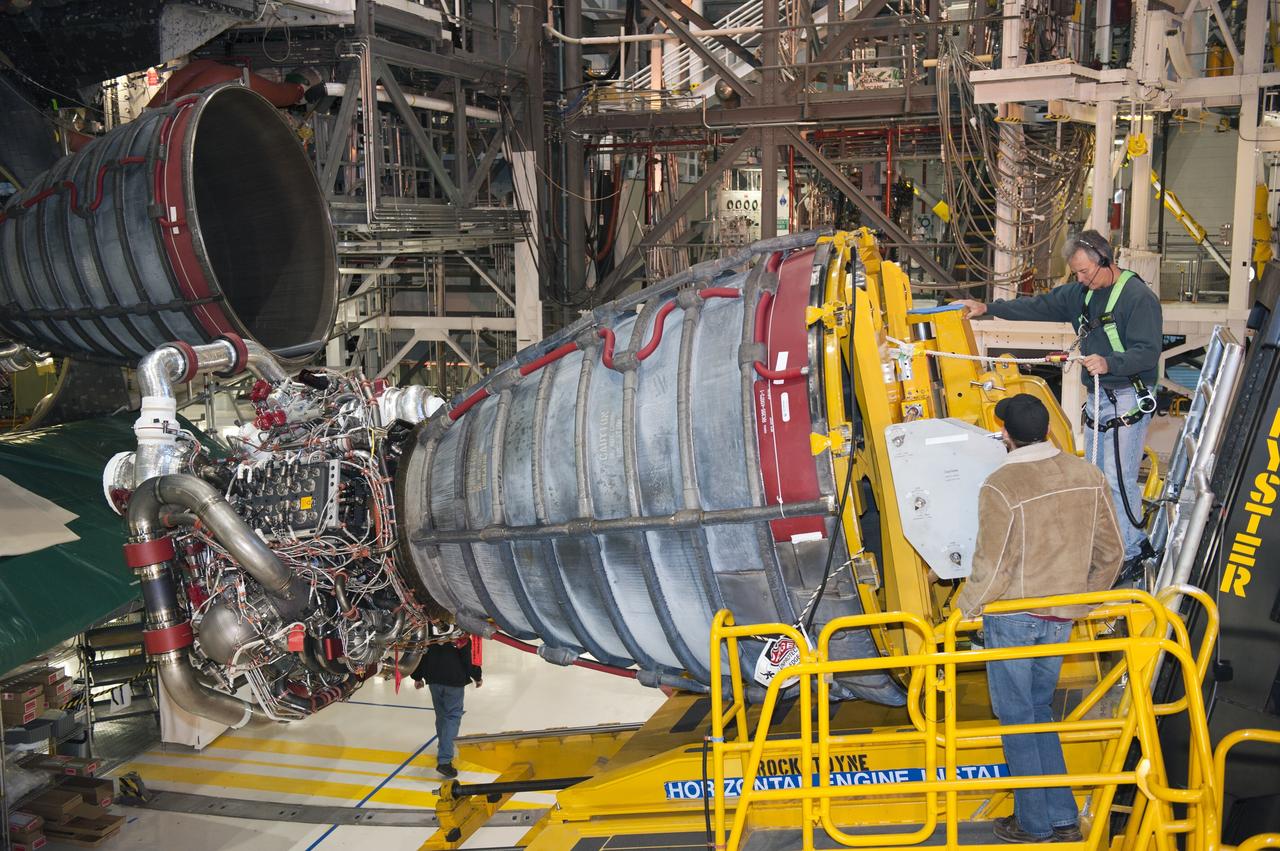
CAPE CANAVERAL, Fla. -- In Orbiter Processing Facility-1 at NASA's Kennedy Space Center in Florida, a Hyster forklift moves engine #2, the last of three space shuttle main engines, closer to shuttle Atlantis for installation. Each engine is 14 feet long, weighs about 6,700 pounds, and is 7.5 feet in diameter at the end of the nozzle. This is the final planned engine installation for the Space Shuttle Program. Atlantis is being prepared for the "launch on need," or potential rescue mission, for the final planned shuttle flight, Endeavour's STS-134 mission. For more information, visit www.nasa.gov/shuttle. Photo credit: NASA/Kim Shiflett
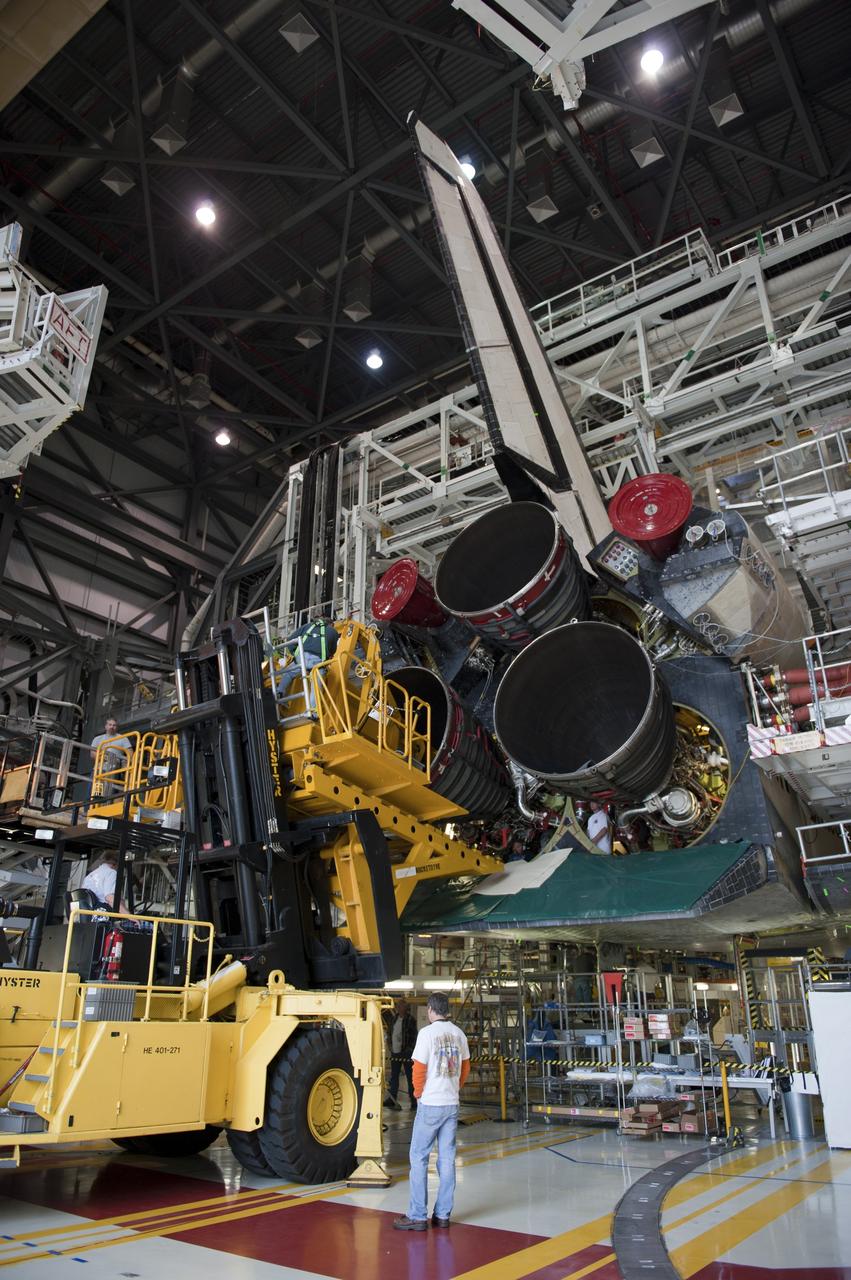
CAPE CANAVERAL, Fla. -- In Orbiter Processing Facility-1 at NASA's Kennedy Space Center in Florida, engine #2, the last of three space shuttle main engines is being installed in shuttle Atlantis. Each engine is 14 feet long, weighs about 6,700 pounds, and is 7.5 feet in diameter at the end of the nozzle. This is the final planned engine installation for the Space Shuttle Program. Atlantis is being prepared for the "launch on need," or potential rescue mission, for the final planned shuttle flight, Endeavour's STS-134 mission. For more information, visit www.nasa.gov/shuttle. Photo credit: NASA/Kim Shiflett
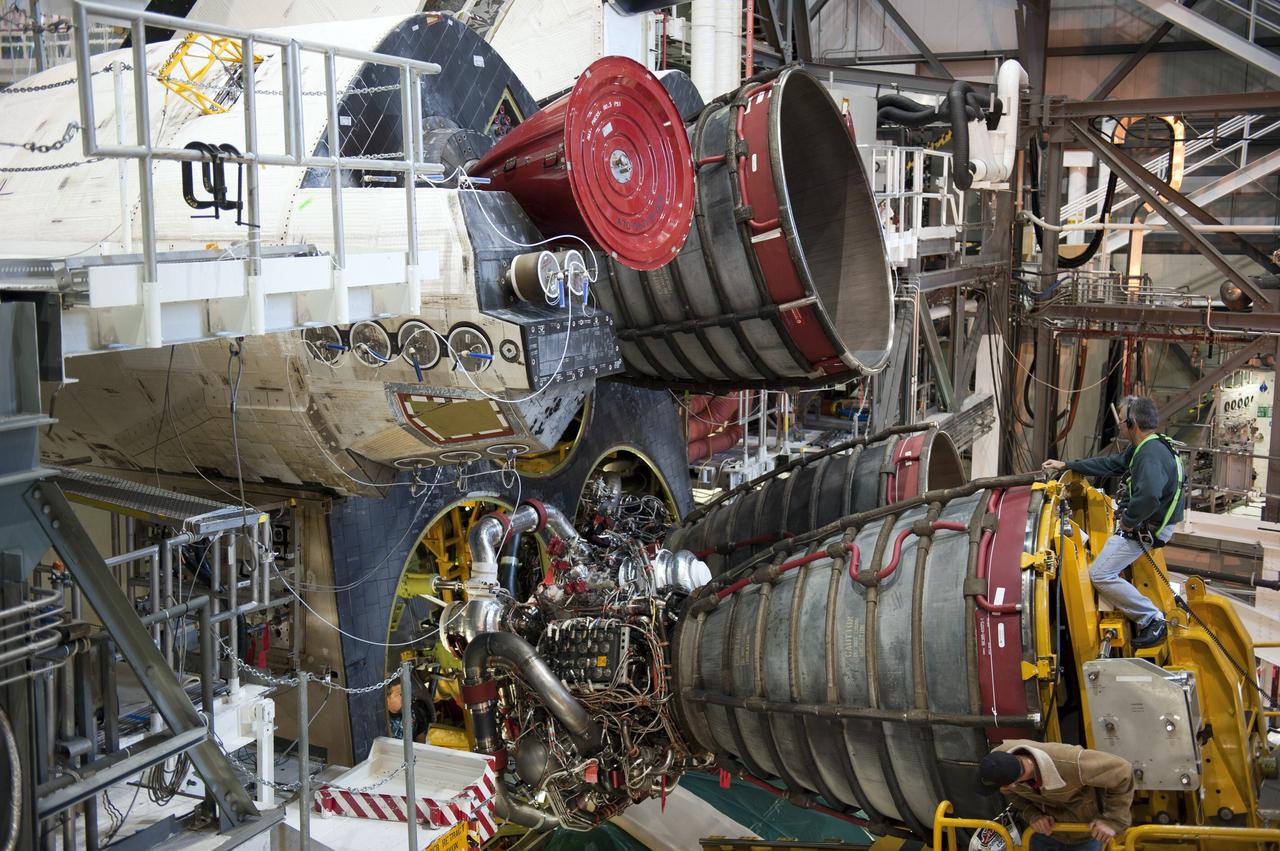
CAPE CANAVERAL, Fla. -- In Orbiter Processing Facility-1 at NASA's Kennedy Space Center in Florida, engine #2, the last of three space shuttle main engines is being installed in shuttle Atlantis. Each engine is 14 feet long, weighs about 6,700 pounds, and is 7.5 feet in diameter at the end of the nozzle. This is the final planned engine installation for the Space Shuttle Program. Atlantis is being prepared for the "launch on need," or potential rescue mission, for the final planned shuttle flight, Endeavour's STS-134 mission. For more information, visit www.nasa.gov/shuttle. Photo credit: NASA/Kim Shiflett
CAPE CANAVERAL, Fla. – In Orbiter Processing Facility bay No. 1, the technician on the engine installer moves a shuttle main engine toward the opening in space shuttle Atlantis. A pitch-and-yaw system helps maneuver the engine into place. Main engine No. 1 has already been installed. Atlantis is the designated vehicle for the STS-125 mission to service the Hubble Space Telescope. Launch is targeted for Oct. 8. Photo credit: NASA/Kim Shiflett

CAPE CANAVERAL, Fla. – In Orbiter Processing Facility bay No. 1, the technician on the engine installer moves a shuttle main engine into the opening in space shuttle Atlantis. A pitch-and-yaw system helps maneuver the engine into place. Main engine No. 1 has already been installed. Atlantis is the designated vehicle for the STS-125 mission to service the Hubble Space Telescope. Launch is targeted for Oct. 8. Photo credit: NASA/Kim Shiflett

CAPE CANAVERAL, Fla. -- In Orbiter Processing Facility-3 at NASA's Kennedy Space Center in Florida, space shuttle Discovery is outfitted with one of its three space shuttle main engines. The engines, weighing 7,000 pounds each, are being installed in the shuttle for the STS-133 mission to the International Space Station. Engines are inspected and maintained in the nearby Space Shuttle Main Engine Processing Facility before installation. Discovery and its STS-133 crew are targeted to deliver the Express Logistics Carrier-4 filled with external payloads and experiments, as well as critical spare components to the station later this year. Photo credit: NASA_Jack Pfaller
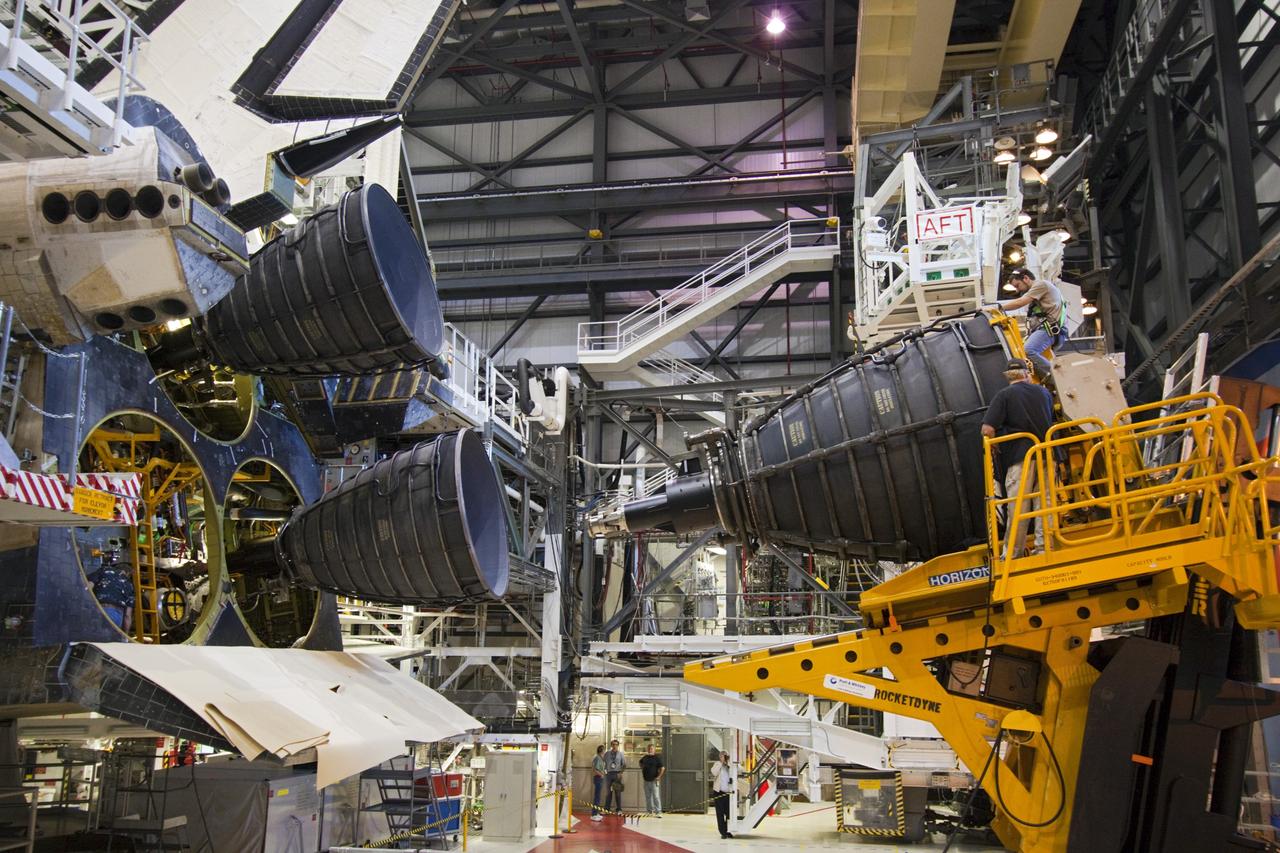
CAPE CANAVERAL, Fla. – In Orbiter Processing Facility-1 at NASA’s Kennedy Space Center in Florida, a replica shuttle main engine (RSME) lines up for installation on space shuttle Discovery with the aid of a Hyster forklift, a specially designed engine installer. The RSME is one of three being installed on Discovery during Space Shuttle Program transition and retirement activities. The replicas are built in the Pratt & Whitney Rocketdyne engine shop at Kennedy to replace the shuttle engines which will be placed in storage to support NASA's Space Launch System, under development. Discovery is being prepared for display at the Smithsonian’s National Air and Space Museum Steven F. Udvar-Hazy Center in Chantilly, Va. For more information, visit http://www.nasa.gov/shuttle. Photo credit: NASA/Jim Grossmann
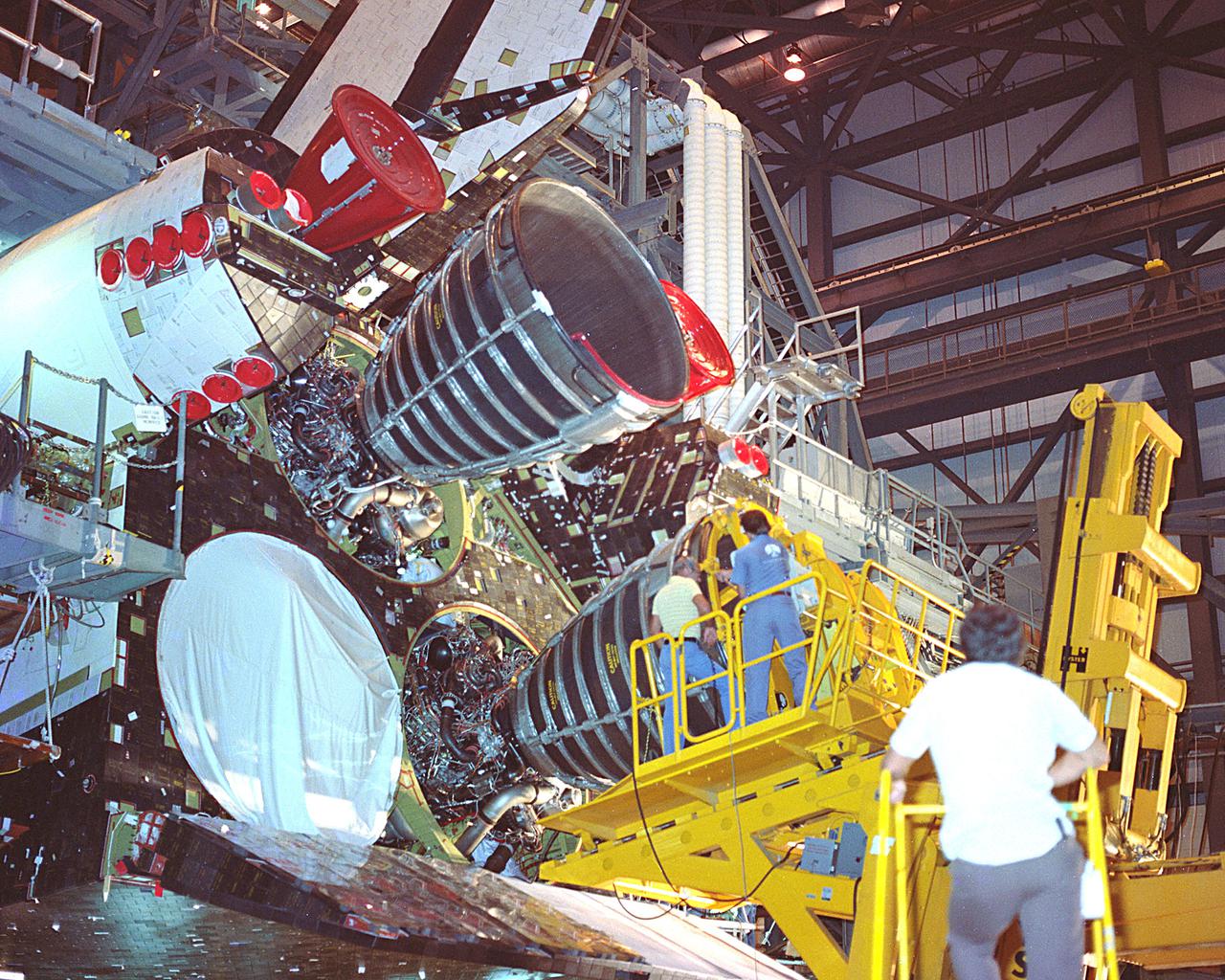
KENNEDY SPACE CENTER, FLA. - Space Shuttle main engines #1 and #3 being installed in Orbiter Columbia.
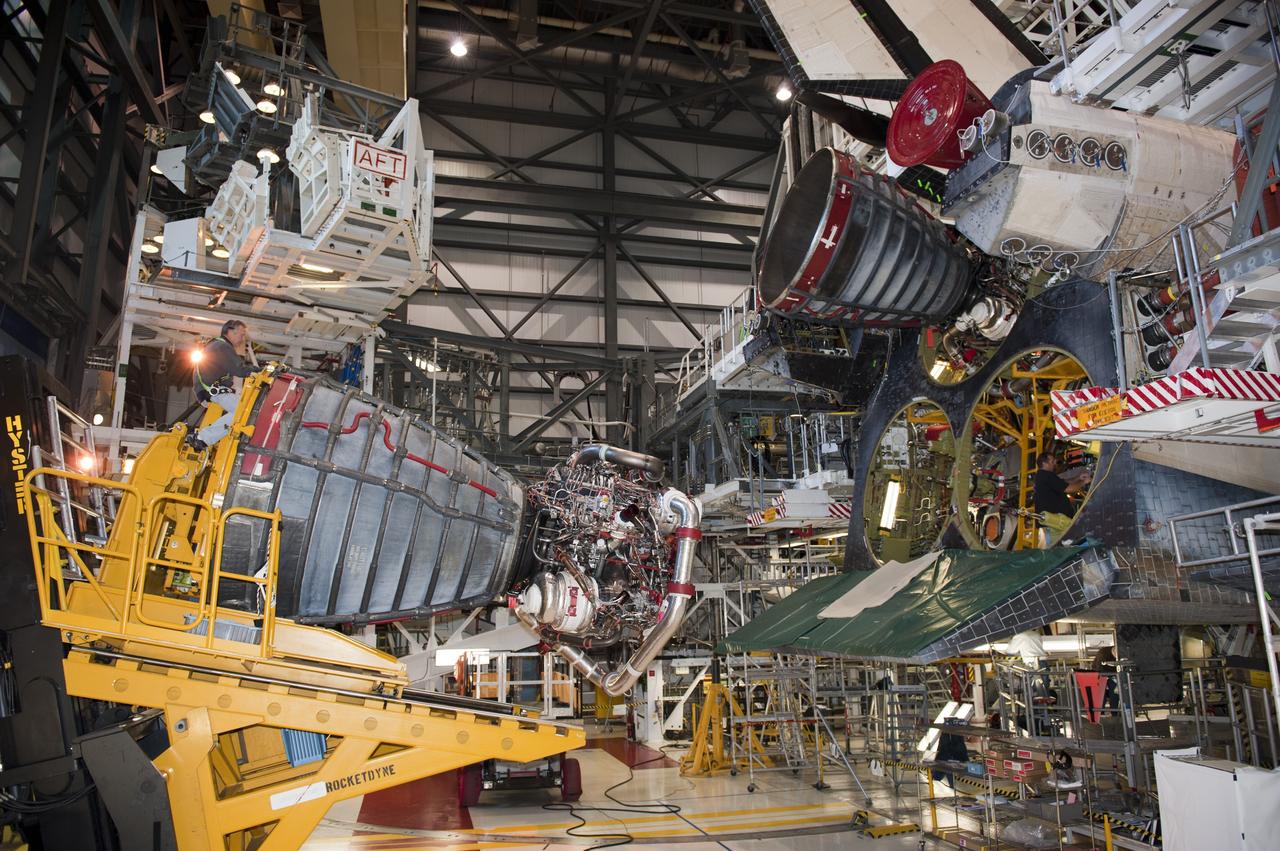
CAPE CANAVERAL, Fla. -- In Orbiter Processing Facility-1 at NASA's Kennedy Space Center in Florida, a Hyster forklift moves the second of three space shuttle main engines closer to shuttle Atlantis for installation. Each engine is 14 feet long, weighs about 6,700 pounds, and is 7.5 feet in diameter at the end of the nozzle. This is the final planned engine installation for the Space Shuttle Program. Atlantis is being prepared for the "launch on need," or potential rescue mission, for the final planned shuttle flight, Endeavour's STS-134 mission. For more information, visit www.nasa.gov/shuttle. Photo credit: NASA/Kim Shiflett
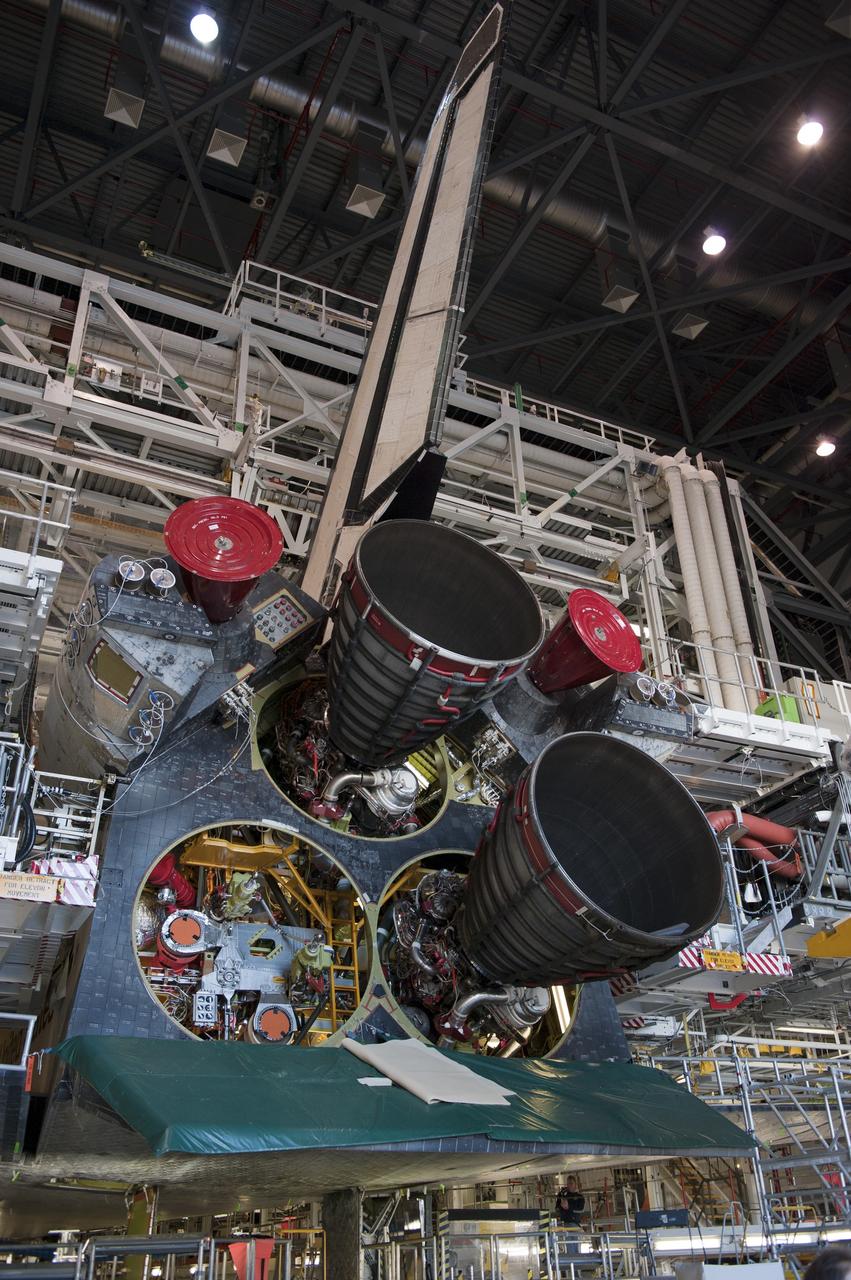
CAPE CANAVERAL, Fla. -- In Orbiter Processing Facility-1 at NASA's Kennedy Space Center in Florida, the second of three space shuttle main engines is installed in shuttle Atlantis. Each engine is 14 feet long, weighs about 6,700 pounds, and is 7.5 feet in diameter at the end of the nozzle. This is the final planned engine installation for the Space Shuttle Program. Atlantis is being prepared for the "launch on need," or potential rescue mission, for the final planned shuttle flight, Endeavour's STS-134 mission. For more information, visit www.nasa.gov/shuttle. Photo credit: NASA/Kim Shiflett
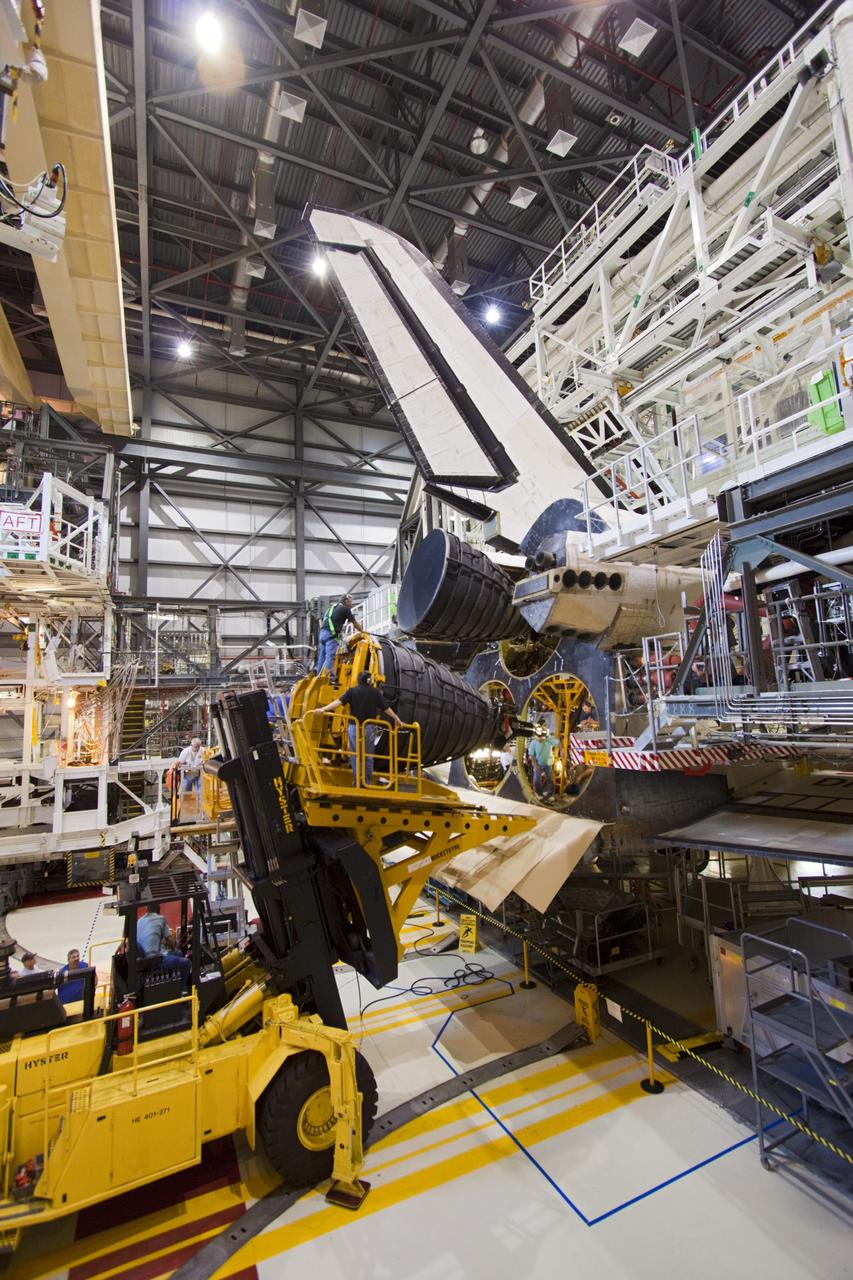
CAPE CANAVERAL, Fla. – A replica shuttle main engine (RSME) is poised for installation on space shuttle Discovery in Orbiter Processing Facility-1 at NASA’s Kennedy Space Center in Florida. The RSME is one of three that will be installed on Discovery during Space Shuttle Program transition and retirement activities. The replicas are being built in the Pratt & Whitney Rocketdyne engine shop at Kennedy to replace the shuttle engines which will be placed in storage to support NASA's Space Launch System, under development. Discovery is being prepared for display at the Smithsonian’s National Air and Space Museum Steven F. Udvar-Hazy Center in Chantilly, Va. For more information, visit http://www.nasa.gov/shuttle. Photo credit: NASA/Jim Grossmann
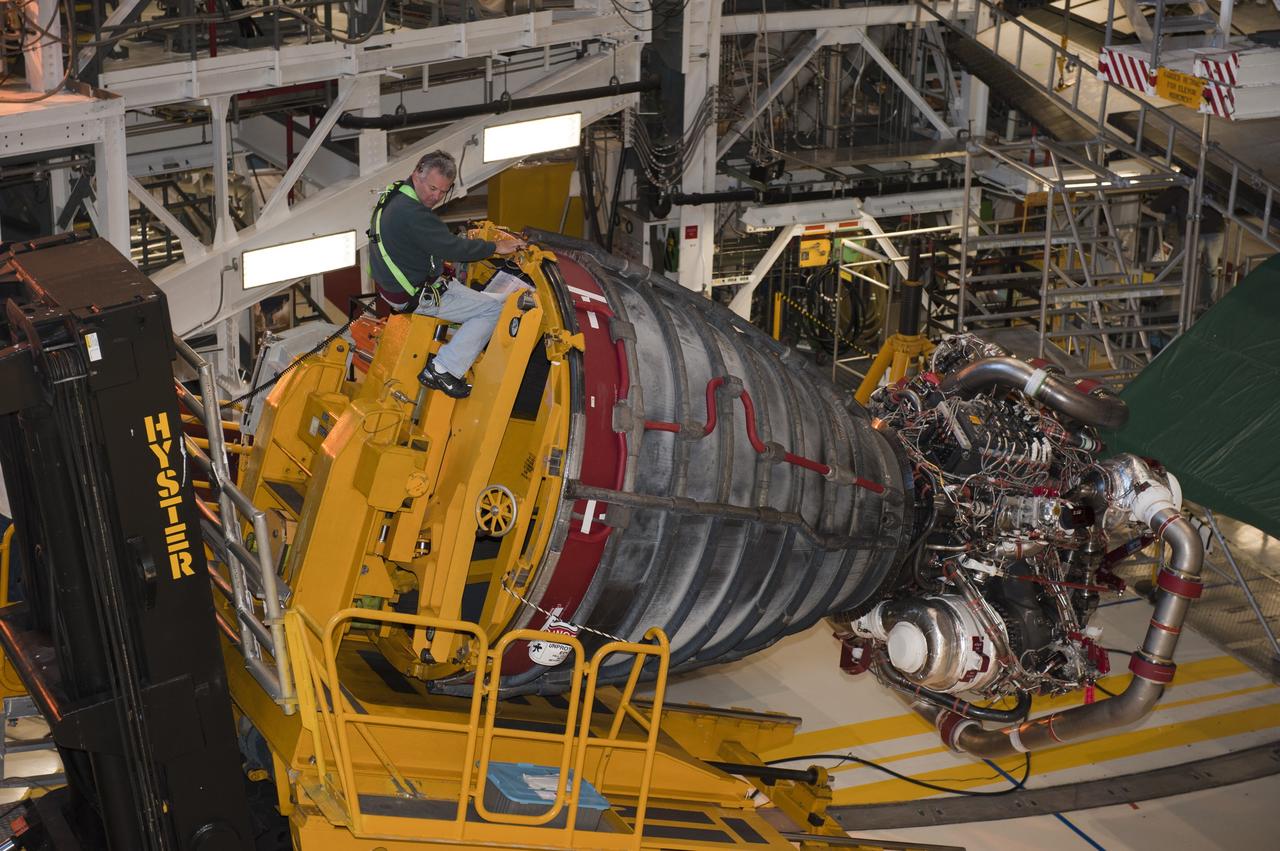
CAPE CANAVERAL, Fla. -- In Orbiter Processing Facility-1 at NASA's Kennedy Space Center in Florida, a Hyster forklift moves the first of three space shuttle main engines closer to space shuttle Atlantis for installation. Each engine is 14 feet long, weighs about 6,700 pounds, and is 7.5 feet in diameter at the end of the nozzle. This is the final planned engine installation for the Space Shuttle Program. Atlantis is being prepared for the "launch on need," or potential rescue mission, for the final planned shuttle flight, Endeavour's STS-134 mission. For more information, visit www.nasa.gov/shuttle. Photo credit: NASA/Kim Shiflett
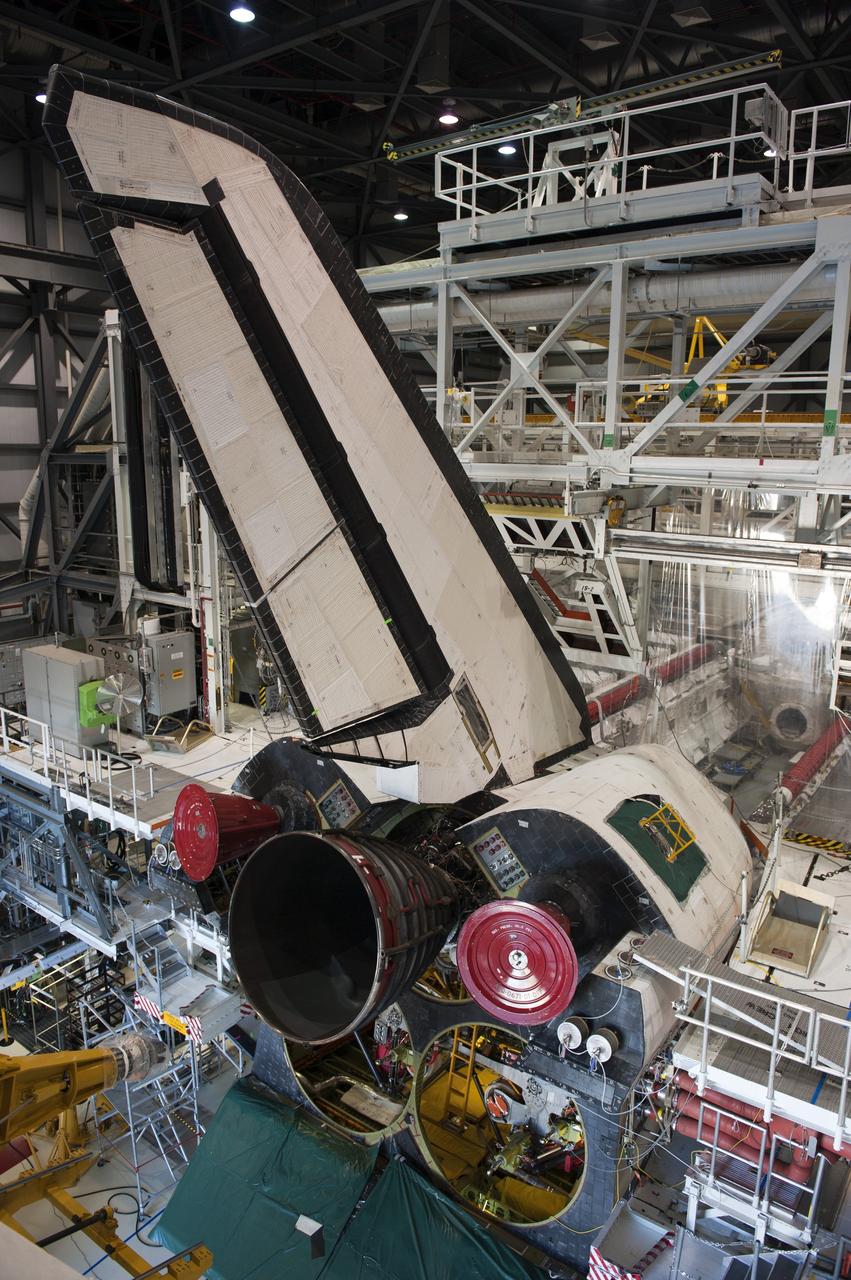
CAPE CANAVERAL, Fla. -- In Orbiter Processing Facility-1 at NASA's Kennedy Space Center in Florida, the first of three space shuttle main engines is installed in space shuttle Atlantis. Each engine is 14 feet long, weighs about 6,700 pounds, and is 7.5 feet in diameter at the end of the nozzle. This is the final planned engine installation for the Space Shuttle Program. Atlantis is being prepared for the "launch on need," or potential rescue mission, for the final planned shuttle flight, Endeavour's STS-134 mission. For more information, visit www.nasa.gov/shuttle. Photo credit: NASA/Kim Shiflett
CAPE CANAVERAL, Fla. -- In Orbiter Processing Facility-1 at NASA's Kennedy Space Center in Florida, a Hyster forklift moves the second of three space shuttle main engines closer to shuttle Atlantis for installation. Each engine is 14 feet long, weighs about 6,700 pounds, and is 7.5 feet in diameter at the end of the nozzle. This is the final planned engine installation for the Space Shuttle Program. Atlantis is being prepared for the "launch on need," or potential rescue mission, for the final planned shuttle flight, Endeavour's STS-134 mission. For more information, visit www.nasa.gov/shuttle. Photo credit: NASA/Kim Shiflett
CAPE CANAVERAL, Fla. -- In Orbiter Processing Facility-1 at NASA's Kennedy Space Center in Florida, a Hyster forklift moves the first of three space shuttle main engines closer to space shuttle Atlantis for installation. Each engine is 14 feet long, weighs about 6,700 pounds, and is 7.5 feet in diameter at the end of the nozzle. This is the final planned engine installation for the Space Shuttle Program. Atlantis is being prepared for the "launch on need," or potential rescue mission, for the final planned shuttle flight, Endeavour's STS-134 mission. For more information, visit www.nasa.gov/shuttle. Photo credit: NASA/Kim Shiflett
CAPE CANAVERAL, Fla. -- In Orbiter Processing Facility-1 at NASA's Kennedy Space Center in Florida, the first of three space shuttle main engines is installed in space shuttle Atlantis. Each engine is 14 feet long, weighs about 6,700 pounds, and is 7.5 feet in diameter at the end of the nozzle. This is the final planned engine installation for the Space Shuttle Program. Atlantis is being prepared for the "launch on need," or potential rescue mission, for the final planned shuttle flight, Endeavour's STS-134 mission. For more information, visit www.nasa.gov/shuttle. Photo credit: NASA/Kim Shiflett
CAPE CANAVERAL, Fla. -- In Orbiter Processing Facility-1 at NASA's Kennedy Space Center in Florida, a Hyster forklift moves the second of three space shuttle main engines closer to shuttle Atlantis for installation. Each engine is 14 feet long, weighs about 6,700 pounds, and is 7.5 feet in diameter at the end of the nozzle. This is the final planned engine installation for the Space Shuttle Program. Atlantis is being prepared for the "launch on need," or potential rescue mission, for the final planned shuttle flight, Endeavour's STS-134 mission. For more information, visit www.nasa.gov/shuttle. Photo credit: NASA/Kim Shiflett
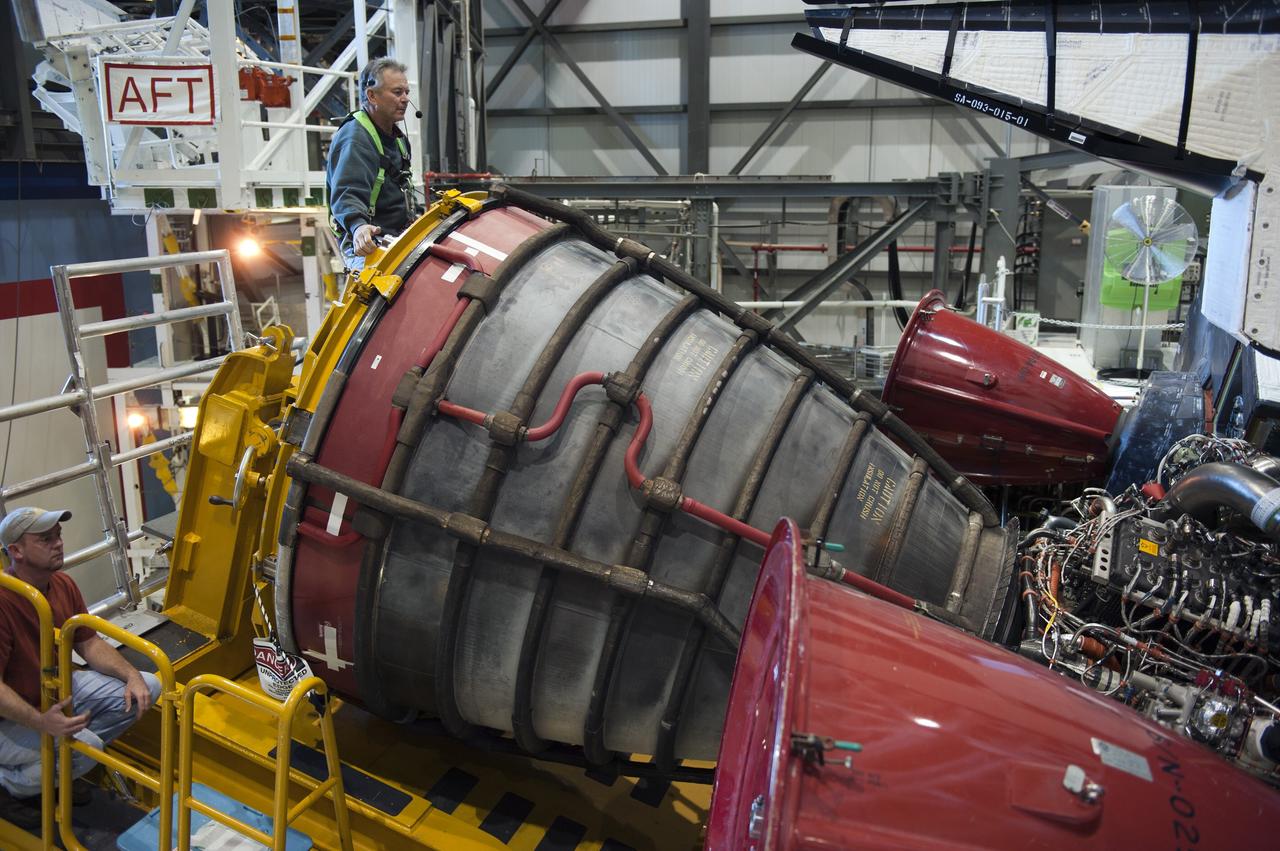
CAPE CANAVERAL, Fla. -- In Orbiter Processing Facility-1 at NASA's Kennedy Space Center in Florida, a Hyster forklift moves the first of three space shuttle main engines closer to space shuttle Atlantis for installation. Each engine is 14 feet long, weighs about 6,700 pounds, and is 7.5 feet in diameter at the end of the nozzle. This is the final planned engine installation for the Space Shuttle Program. Atlantis is being prepared for the "launch on need," or potential rescue mission, for the final planned shuttle flight, Endeavour's STS-134 mission. For more information, visit www.nasa.gov/shuttle. Photo credit: NASA/Kim Shiflett
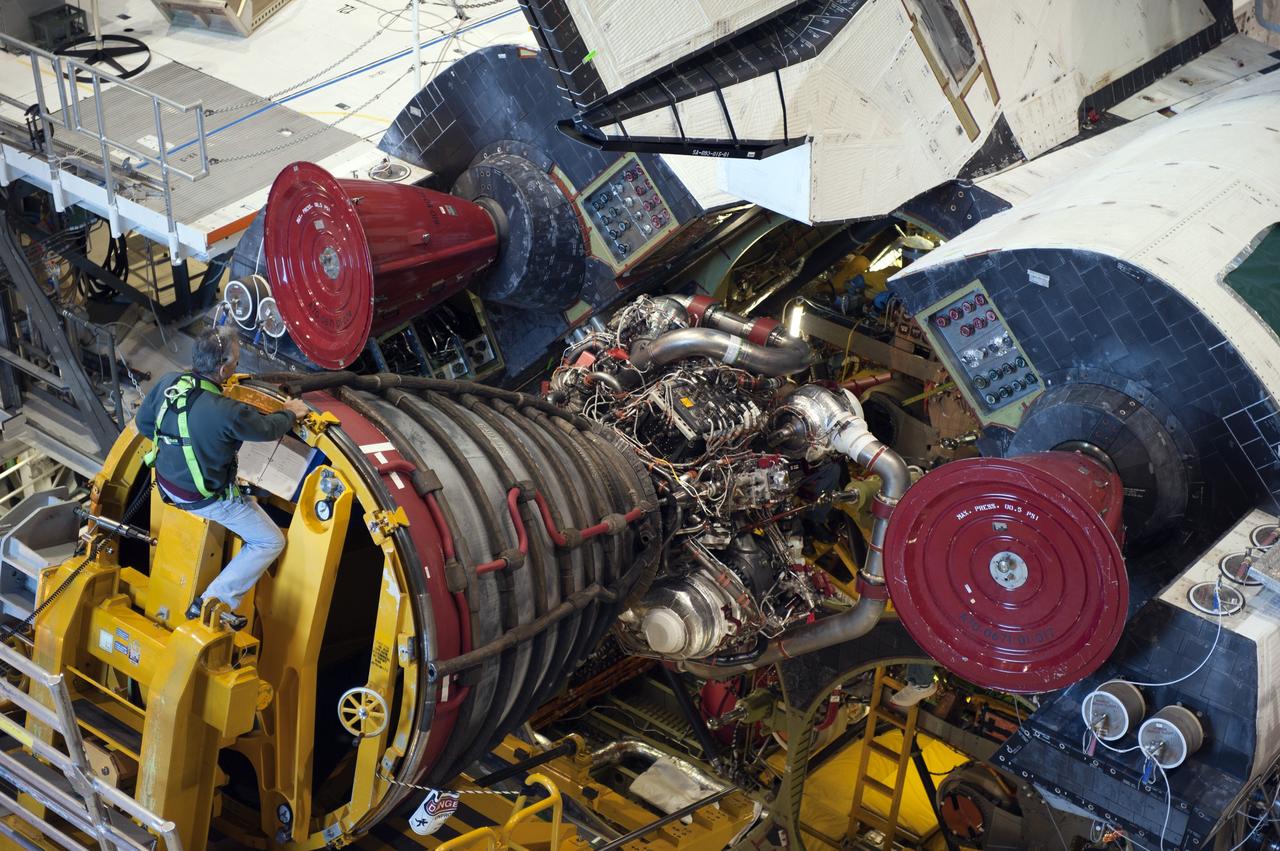
CAPE CANAVERAL, Fla. -- In Orbiter Processing Facility-1 at NASA's Kennedy Space Center in Florida, a Hyster forklift moves the first of three space shuttle main engines closer to space shuttle Atlantis for installation. Each engine is 14 feet long, weighs about 6,700 pounds, and is 7.5 feet in diameter at the end of the nozzle. This is the final planned engine installation for the Space Shuttle Program. Atlantis is being prepared for the "launch on need," or potential rescue mission, for the final planned shuttle flight, Endeavour's STS-134 mission. For more information, visit www.nasa.gov/shuttle. Photo credit: NASA/Kim Shiflett
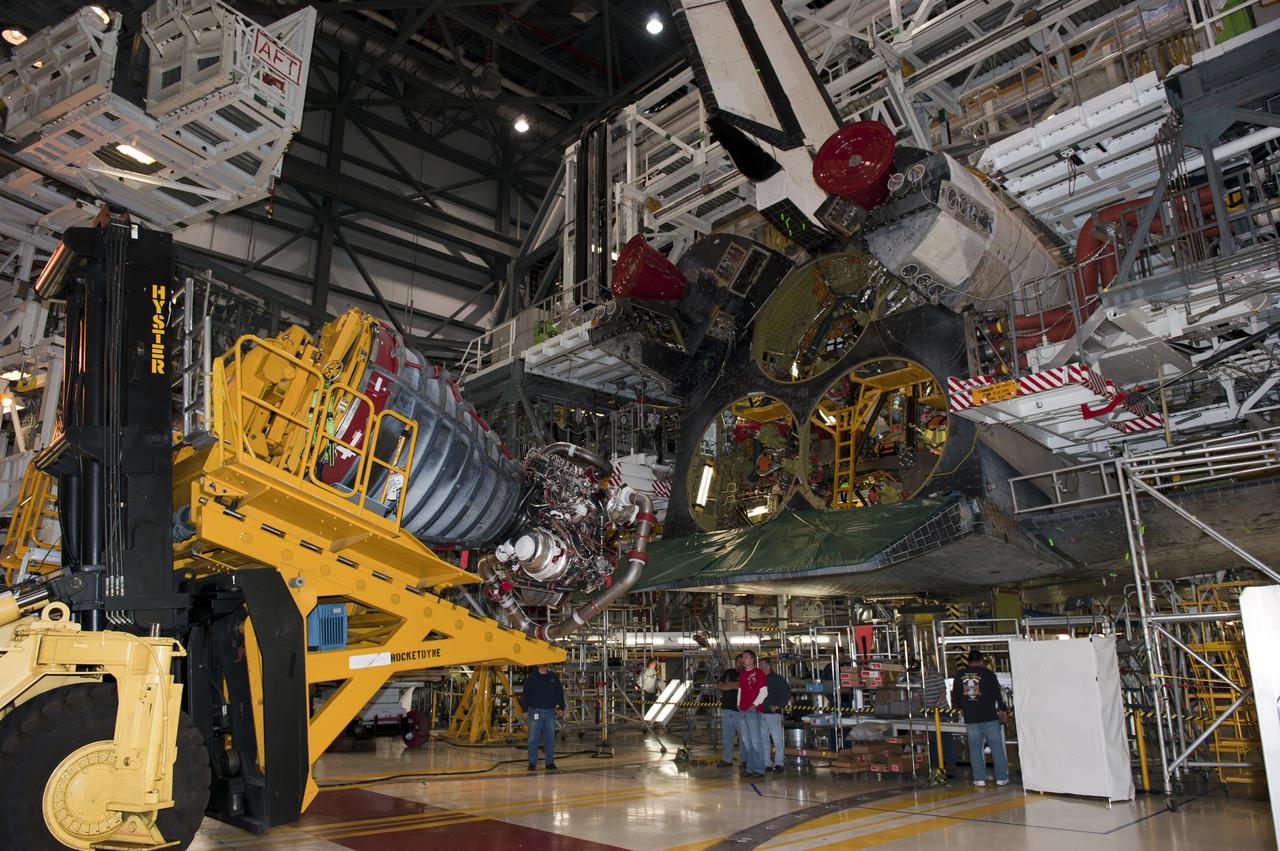
CAPE CANAVERAL, Fla. -- In Orbiter Processing Facility-1 at NASA's Kennedy Space Center in Florida, a Hyster forklift moves the first of three space shuttle main engines closer to space shuttle Atlantis for installation. Each engine is 14 feet long, weighs about 6,700 pounds, and is 7.5 feet in diameter at the end of the nozzle. This is the final planned engine installation for the Space Shuttle Program. Atlantis is being prepared for the "launch on need," or potential rescue mission, for the final planned shuttle flight, Endeavour's STS-134 mission. For more information, visit www.nasa.gov/shuttle. Photo credit: NASA/Kim Shiflett
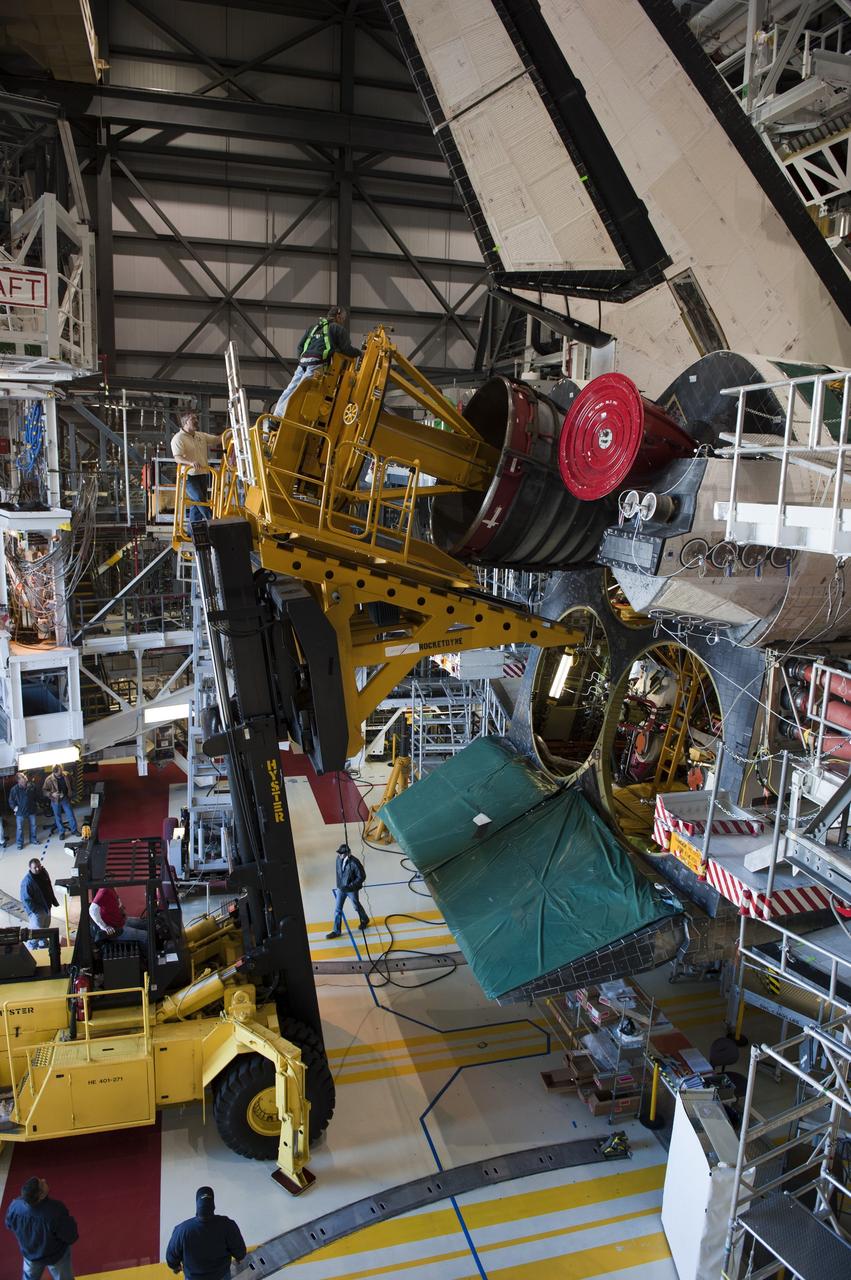
CAPE CANAVERAL, Fla. -- In Orbiter Processing Facility-1 at NASA's Kennedy Space Center in Florida, a Hyster forklift moves the first of three space shuttle main engines closer to space shuttle Atlantis for installation. Each engine is 14 feet long, weighs about 6,700 pounds, and is 7.5 feet in diameter at the end of the nozzle. This is the final planned engine installation for the Space Shuttle Program. Atlantis is being prepared for the "launch on need," or potential rescue mission, for the final planned shuttle flight, Endeavour's STS-134 mission. For more information, visit www.nasa.gov/shuttle. Photo credit: NASA/Kim Shiflett
CAPE CANAVERAL, Fla. -- In Orbiter Processing Facility-1 at NASA's Kennedy Space Center in Florida, a Hyster forklift moves the first of three space shuttle main engines closer to space shuttle Atlantis for installation. Each engine is 14 feet long, weighs about 6,700 pounds, and is 7.5 feet in diameter at the end of the nozzle. This is the final planned engine installation for the Space Shuttle Program. Atlantis is being prepared for the "launch on need," or potential rescue mission, for the final planned shuttle flight, Endeavour's STS-134 mission. For more information, visit www.nasa.gov/shuttle. Photo credit: NASA/Kim Shiflett
CAPE CANAVERAL, Fla. -- In Orbiter Processing Facility-1 at NASA's Kennedy Space Center in Florida, a Hyster forklift moves the second of three space shuttle main engines closer to shuttle Atlantis for installation. Each engine is 14 feet long, weighs about 6,700 pounds, and is 7.5 feet in diameter at the end of the nozzle. This is the final planned engine installation for the Space Shuttle Program. Atlantis is being prepared for the "launch on need," or potential rescue mission, for the final planned shuttle flight, Endeavour's STS-134 mission. For more information, visit www.nasa.gov/shuttle. Photo credit: NASA/Kim Shiflett

CAPE CANAVERAL, Fla. -- A Hyster forklift transporting engine #2, the last of shuttle Atlantis' three main engines from the Space Shuttle Main Engine (SSME) Shop, enters Orbiter Processing Facility-1 at NASA's Kennedy Space Center in Florida. Inside the processing facility, the engine will be installed in the shuttle. Each engine is 14 feet long, weighs about 6,700 pounds, and is 7.5 feet in diameter at the end of the nozzle. This is the final planned engine installation for the Space Shuttle Program. Atlantis is being prepared for the "launch on need," or potential rescue mission, for the final planned shuttle flight, Endeavour's STS-134 mission. For more information, visit www.nasa.gov/shuttle. Photo credit: NASA/Kim Shiflett
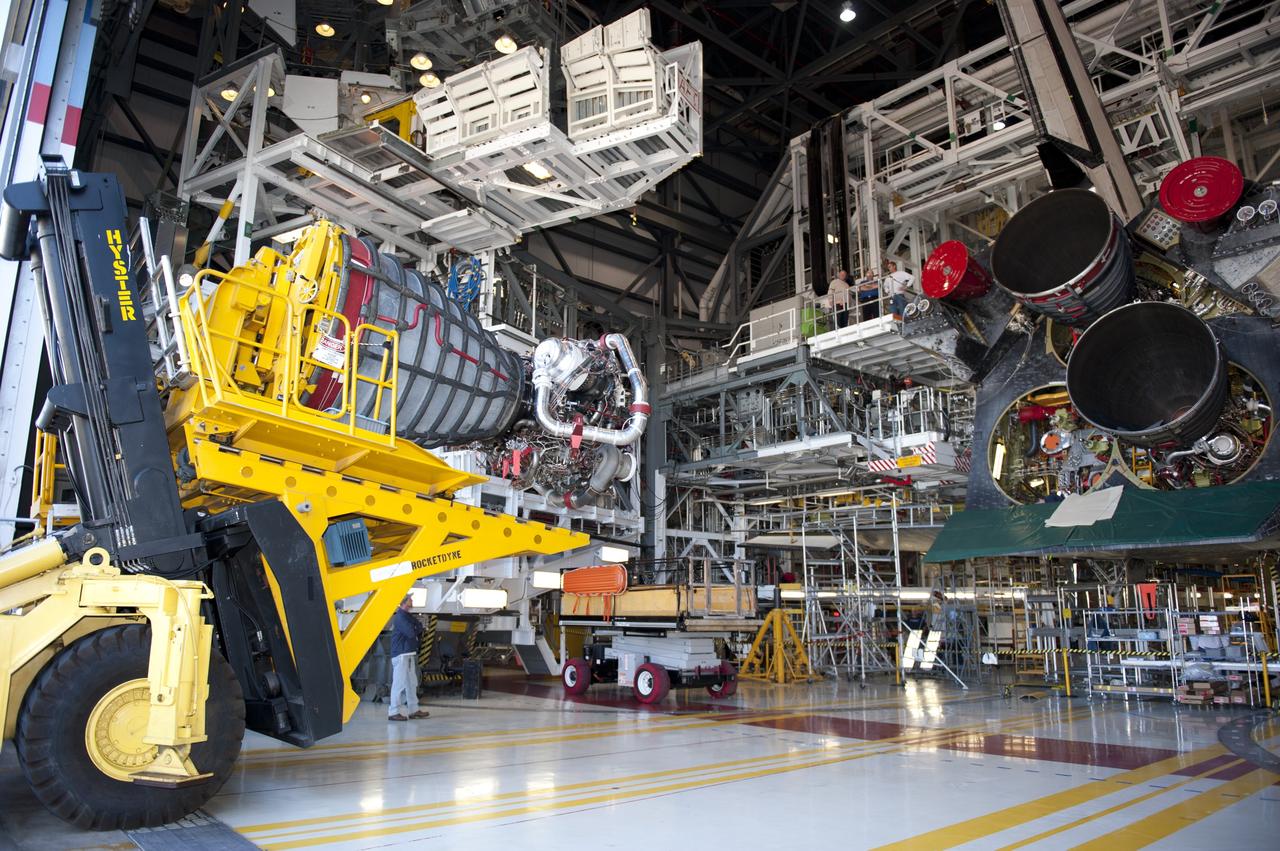
CAPE CANAVERAL, Fla. -- A Hyster forklift transporting engine #2, the last of shuttle Atlantis' three main engines from the Space Shuttle Main Engine (SSME) Shop, enters Orbiter Processing Facility-1 at NASA's Kennedy Space Center in Florida. Inside the processing facility, the engine will be installed in the shuttle. Each engine is 14 feet long, weighs about 6,700 pounds, and is 7.5 feet in diameter at the end of the nozzle. This is the final planned engine installation for the Space Shuttle Program. Atlantis is being prepared for the "launch on need," or potential rescue mission, for the final planned shuttle flight, Endeavour's STS-134 mission. For more information, visit www.nasa.gov/shuttle. Photo credit: NASA/Kim Shiflett
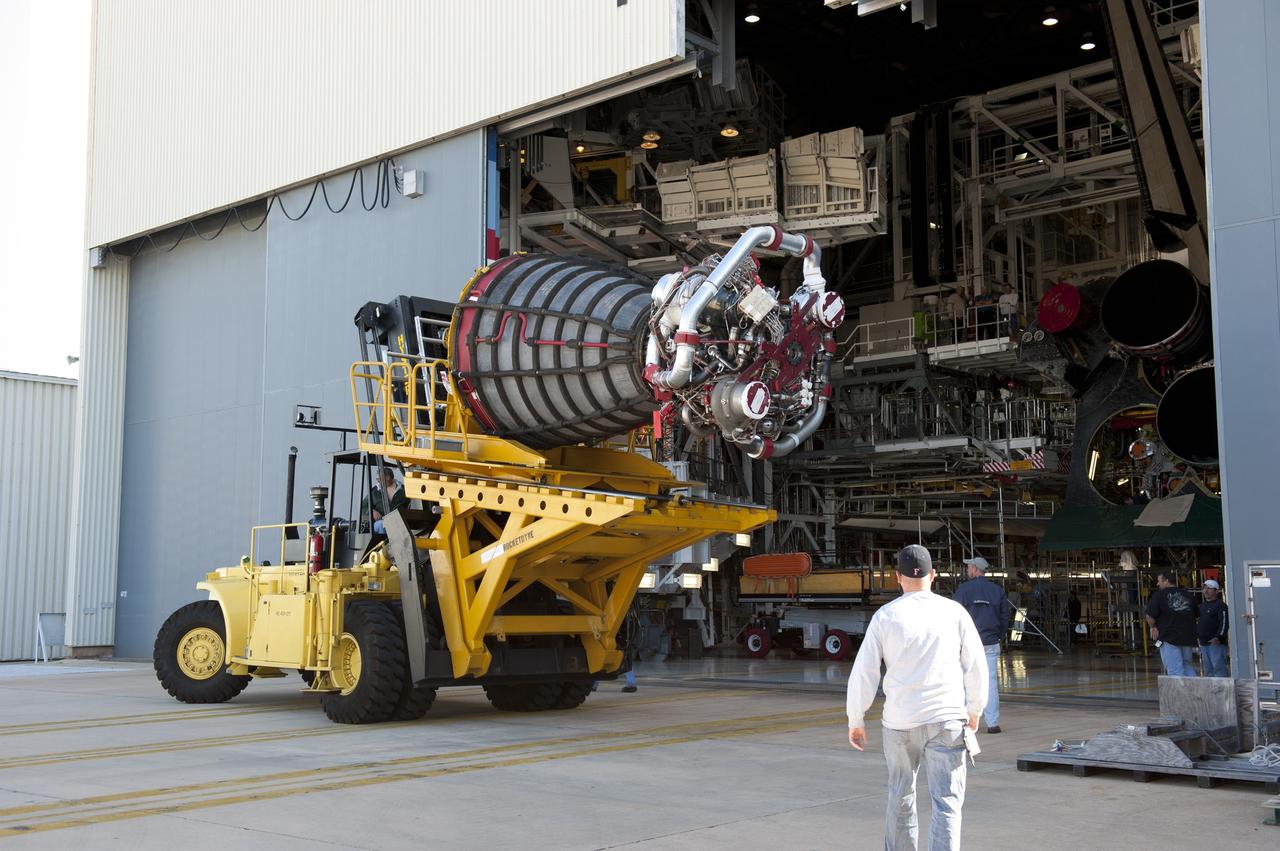
CAPE CANAVERAL, Fla. -- A Hyster forklift transporting engine #2, the last of shuttle Atlantis' three main engines from the Space Shuttle Main Engine (SSME) Shop, arrives at Orbiter Processing Facility-1 at NASA's Kennedy Space Center in Florida. Inside the processing facility, the engine will be installed in the shuttle. Each engine is 14 feet long, weighs about 6,700 pounds, and is 7.5 feet in diameter at the end of the nozzle. This is the final planned engine installation for the Space Shuttle Program. Atlantis is being prepared for the "launch on need," or potential rescue mission, for the final planned shuttle flight, Endeavour's STS-134 mission. For more information, visit www.nasa.gov/shuttle. Photo credit: NASA/Kim Shiflett
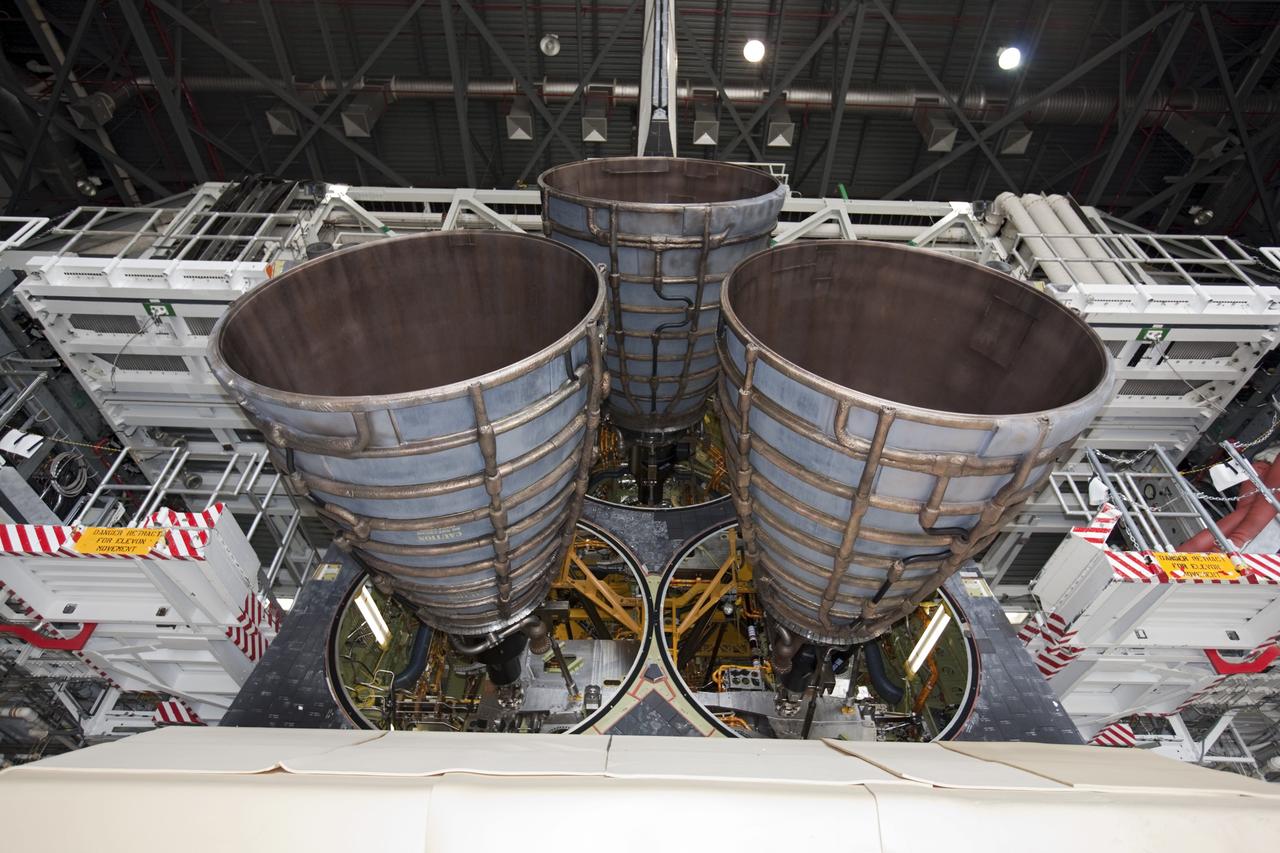
CAPE CANAVERAL, Fla. - In Orbiter Processing Facility Bay 1 at NASA’s Kennedy Space Center in Florida, three replica shuttle main engines RSMEs have been installed on the space shuttle Atlantis. Three RSMEs were installed on Atlantis. The replicas were built in the Pratt & Whitney Rocketdyne engine shop at KSC to replace the space shuttle main engines SSMEs which will be placed in storage to support NASA's Space Launch System currently under development. The RSME installation is part of the Space Shuttle Program’s transition and retirement processing of the space shuttle fleet. A groundbreaking was held Jan. 18, 2012 for Atlantis’ future home, a 65,000-square-foot exhibit hall in Shuttle Plaza at the Kennedy Space Center Visitor Complex. Atlantis is scheduled to roll over to the visitor complex during November in preparation for the exhibit’s grand opening in July 2013. For more information, visit http://www.nasa.gov/transition. Photo credit: NASA/Glenn Benson
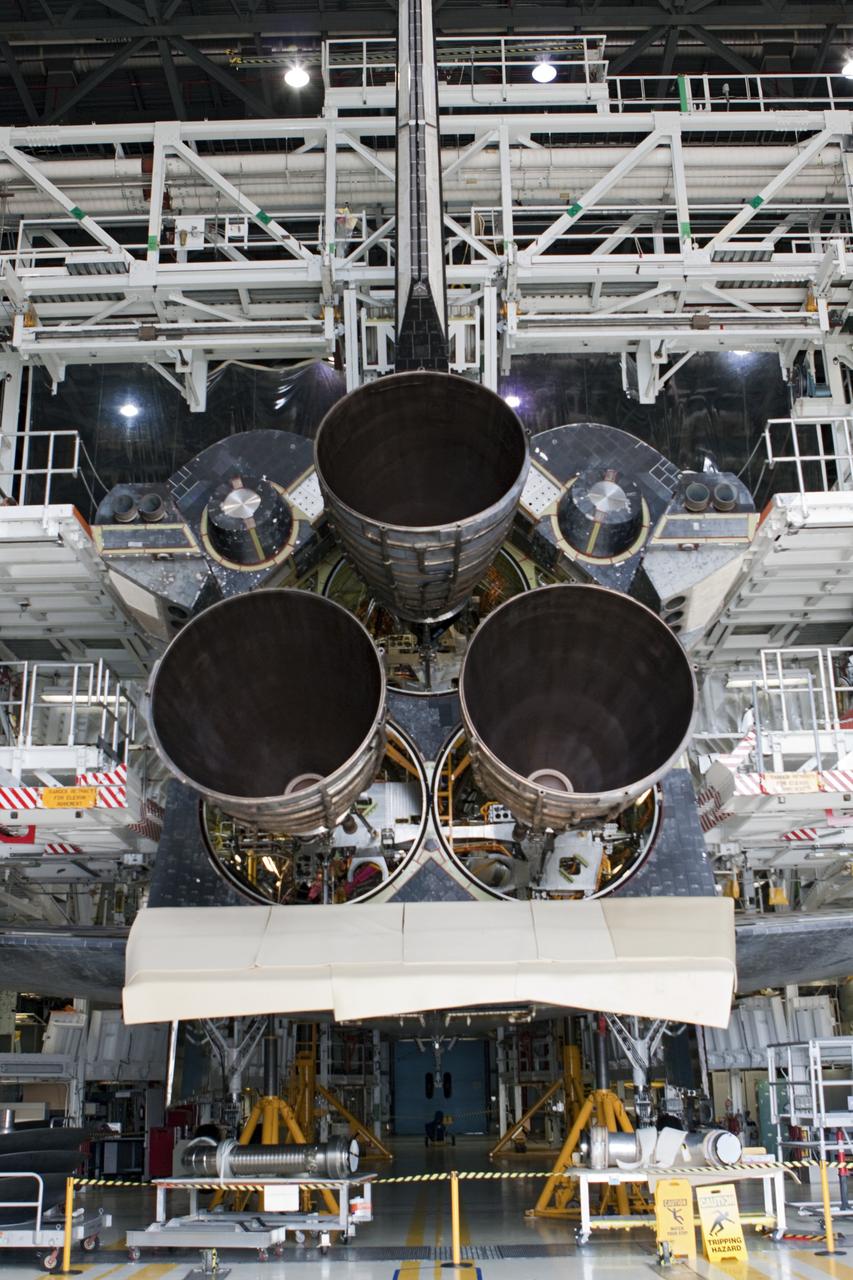
CAPE CANAVERAL, Fla. - In Orbiter Processing Facility Bay 1 at NASA’s Kennedy Space Center in Florida, three replica shuttle main engines RSMEs have been installed on the space shuttle Atlantis. Three RSMEs were installed on Atlantis. The replicas were built in the Pratt & Whitney Rocketdyne engine shop at KSC to replace the space shuttle main engines SSMEs which will be placed in storage to support NASA's Space Launch System currently under development. The RSME installation is part of the Space Shuttle Program’s transition and retirement processing of the space shuttle fleet. A groundbreaking was held Jan. 18, 2012 for Atlantis’ future home, a 65,000-square-foot exhibit hall in Shuttle Plaza at the Kennedy Space Center Visitor Complex. Atlantis is scheduled to roll over to the visitor complex during November in preparation for the exhibit’s grand opening in July 2013. For more information, visit http://www.nasa.gov/transition. Photo credit: NASA/Glenn Benson
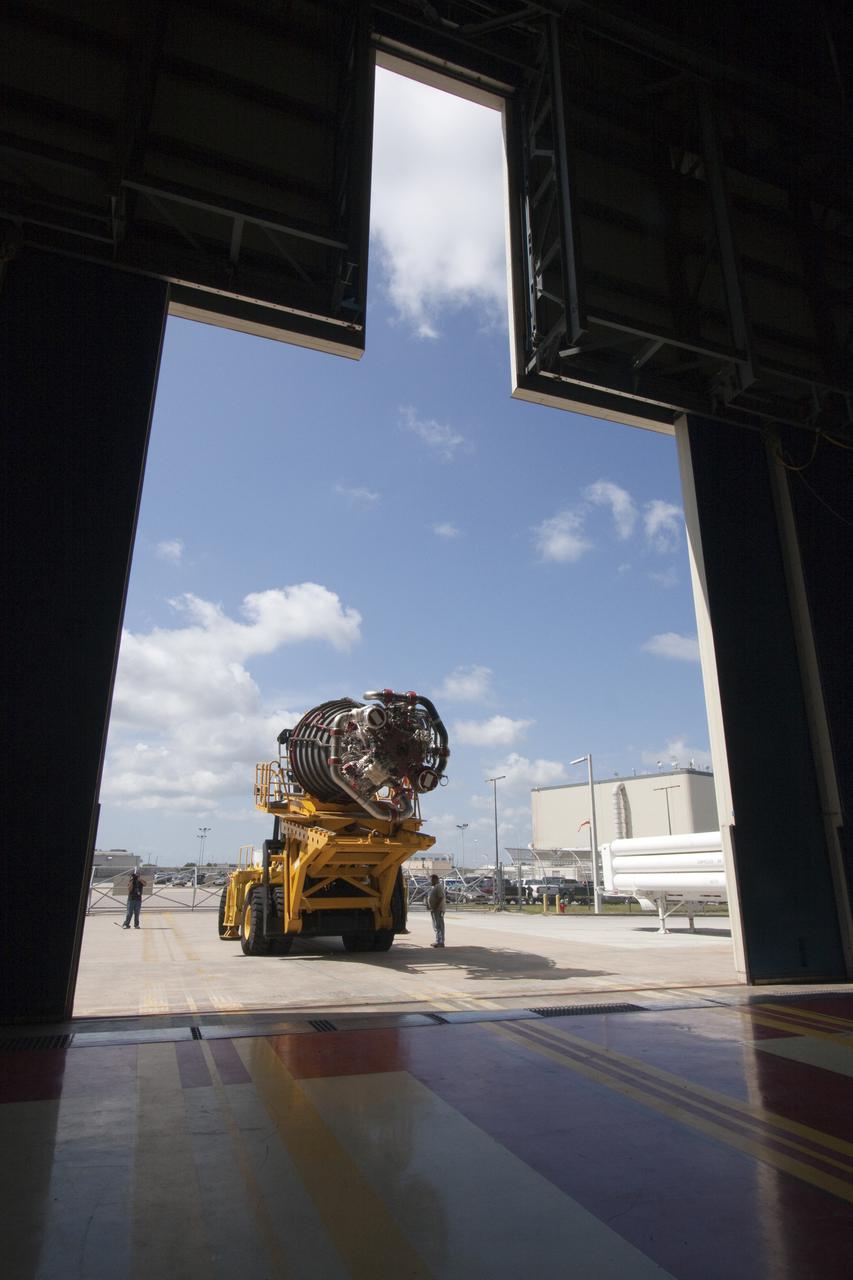
CAPE CANAVERAL, Fla. -- At NASA's Kennedy Space Center in Florida, a space shuttle main engine secured on a Hyster forklift enters Orbiter Processing Facility-3. Three main engines, weighing 7,000 pounds each, will be installed in space shuttle Discovery for the STS-133 mission to the International Space Station. Engines are inspected and maintained in the nearby Space Shuttle Main Engine Processing Facility before installation. Discovery and its STS-133 crew are targeted to deliver the Express Logistics Carrier-4 filled with external payloads and experiments, as well as critical spare components to the station later this year. Photo credit: NASA_Jack Pfaller
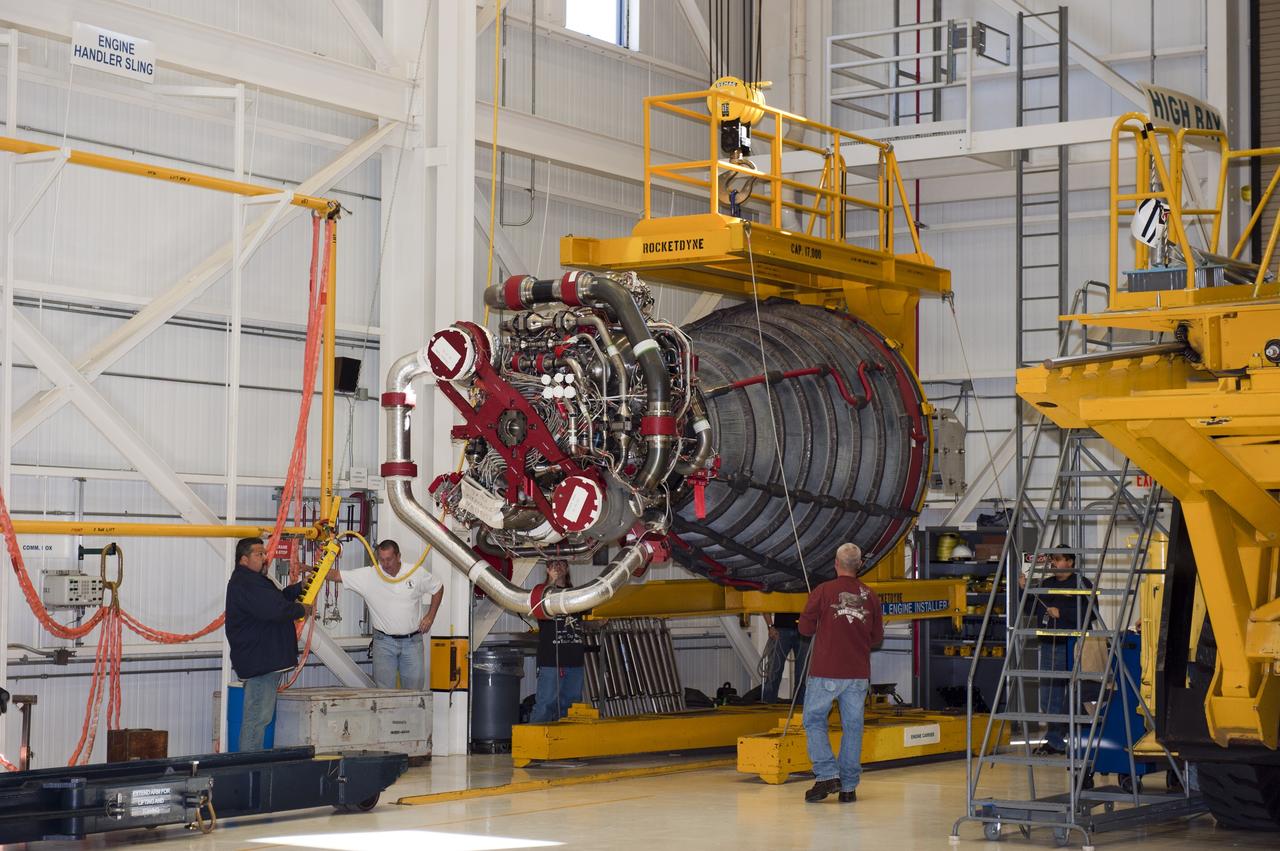
CAPE CANAVERAL, Fla. -- Workers in the Space Shuttle Main Engine (SSME) Shop at NASA's Kennedy Space Center in Florida get ready to raise the second of shuttle Atlantis' three main engines so it can be attached to a Hyster forklift. Then, the engine will be transported to Orbiter Processing Facility-1 where it will be installed in the shuttle. Each engine is 14 feet long, weighs about 6,700 pounds, and is 7.5 feet in diameter at the end of the nozzle. This is the final planned engine installation for the Space Shuttle Program. Atlantis is being prepared for the "launch on need," or potential rescue mission, for the final planned shuttle flight, Endeavour's STS-134 mission. For more information, visit www.nasa.gov/shuttle. Photo credit: NASA/Kim Shiflett
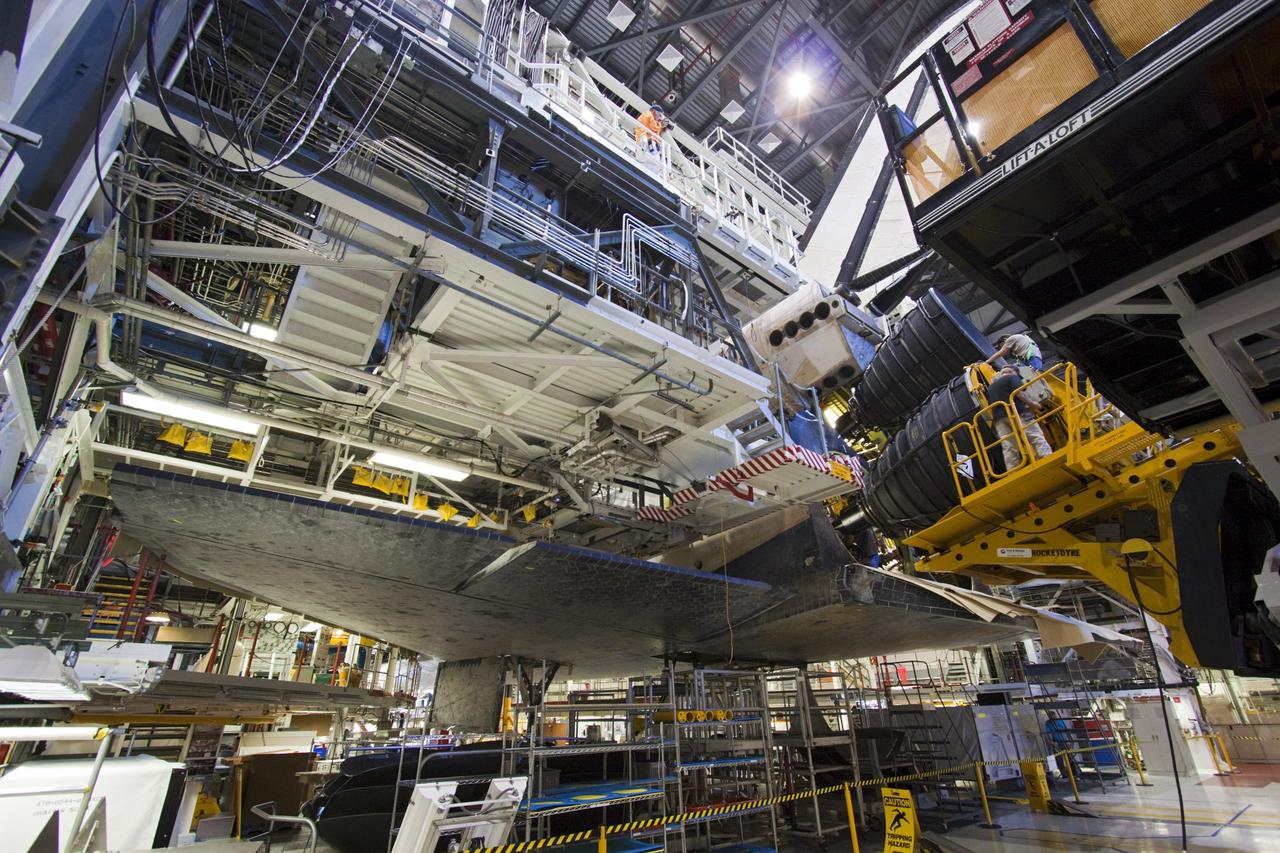
CAPE CANAVERAL, Fla. – In Orbiter Processing Facility-1 at NASA’s Kennedy Space Center in Florida, the third and final replica shuttle main engine (RSME) slides into an engine well of space shuttle Discovery with the aid of a Hyster forklift, a specially designed engine installer. The RSME is one of three being installed on Discovery during Space Shuttle Program transition and retirement activities. The replicas are built in the Pratt & Whitney Rocketdyne engine shop at Kennedy to replace the shuttle engines which will be placed in storage to support NASA's Space Launch System, under development. Discovery is being prepared for display at the Smithsonian’s National Air and Space Museum Steven F. Udvar-Hazy Center in Chantilly, Va. For more information, visit http://www.nasa.gov/shuttle. Photo credit: NASA/Jim Grossmann
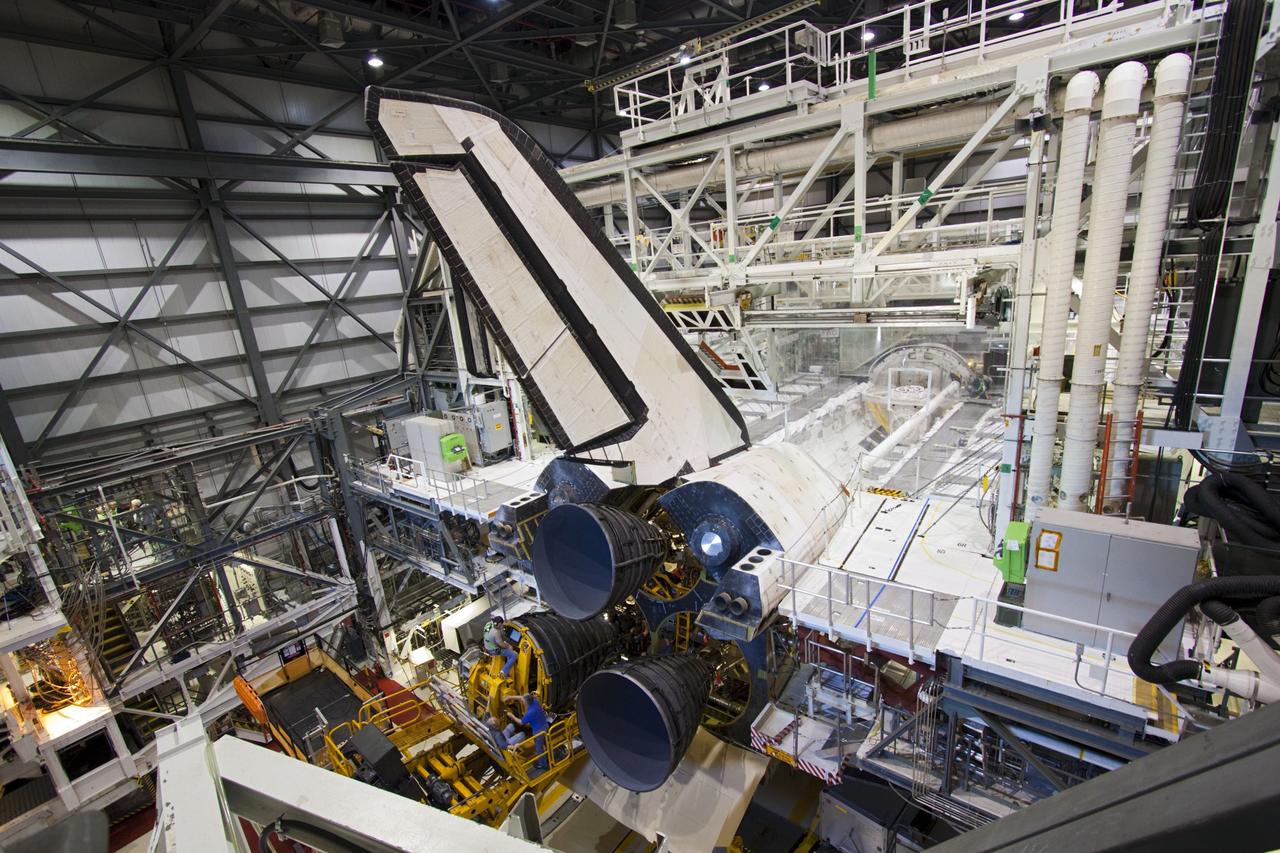
CAPE CANAVERAL, Fla. – In Orbiter Processing Facility-1 at NASA’s Kennedy Space Center in Florida, a replica shuttle main engine (RSME) slides into the engine well of space shuttle Discovery with the aid of a Hyster forklift, a specially designed engine installer. The RSME is one of three being installed on Discovery during Space Shuttle Program transition and retirement activities. The replicas are built in the Pratt & Whitney Rocketdyne engine shop at Kennedy to replace the shuttle engines which will be placed in storage to support NASA's Space Launch System, under development. Discovery is being prepared for display at the Smithsonian’s National Air and Space Museum Steven F. Udvar-Hazy Center in Chantilly, Va. For more information, visit http://www.nasa.gov/shuttle. Photo credit: NASA/Jim Grossmann
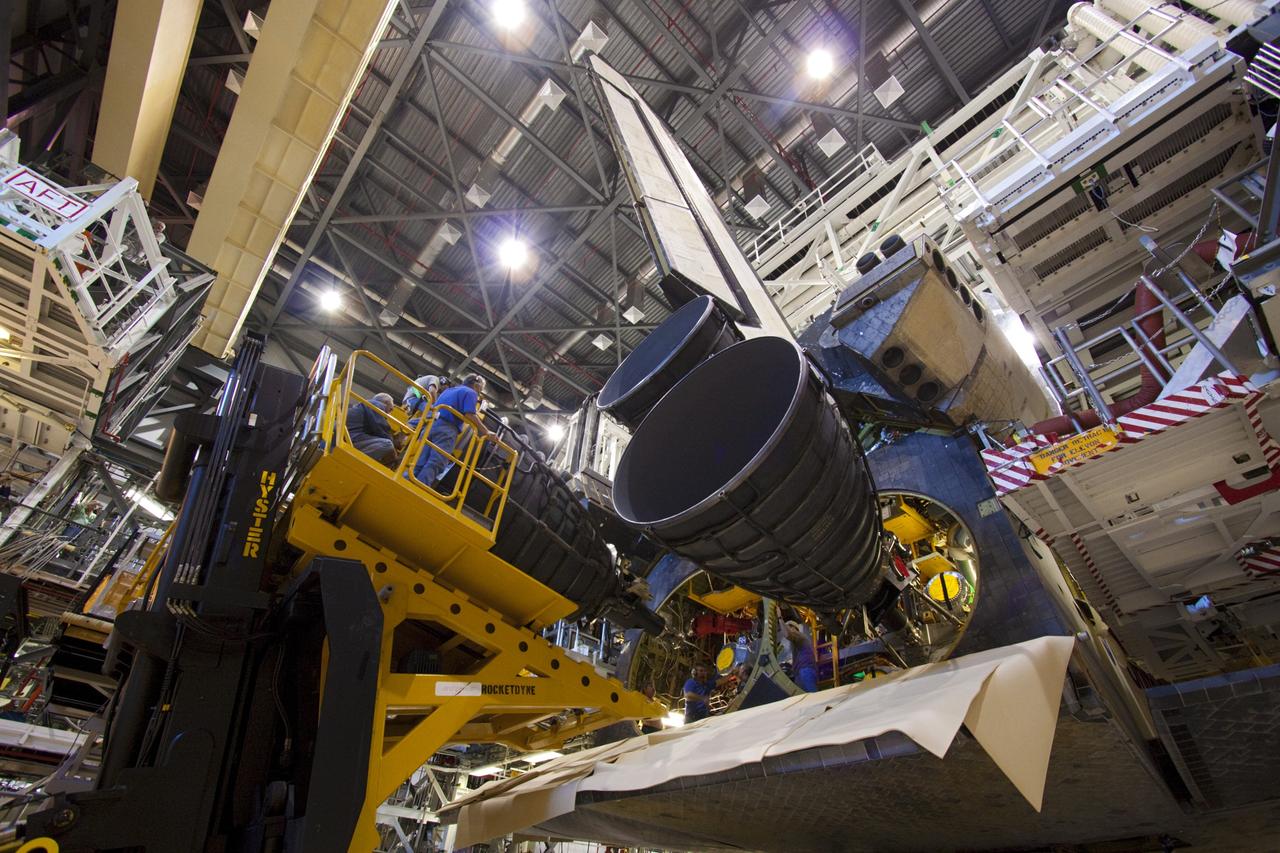
CAPE CANAVERAL, Fla. – In Orbiter Processing Facility-1 at NASA’s Kennedy Space Center in Florida, workers position a replica shuttle main engine (RSME) into the engine well of space shuttle Discovery with the aid of a Hyster forklift, a specially designed engine installer. The RSME is one of three being installed on Discovery during Space Shuttle Program transition and retirement activities. The replicas are built in the Pratt & Whitney Rocketdyne engine shop at Kennedy to replace the shuttle engines which will be placed in storage to support NASA's Space Launch System, under development. Discovery is being prepared for display at the Smithsonian’s National Air and Space Museum Steven F. Udvar-Hazy Center in Chantilly, Va. For more information, visit http://www.nasa.gov/shuttle. Photo credit: NASA/Jim Grossmann
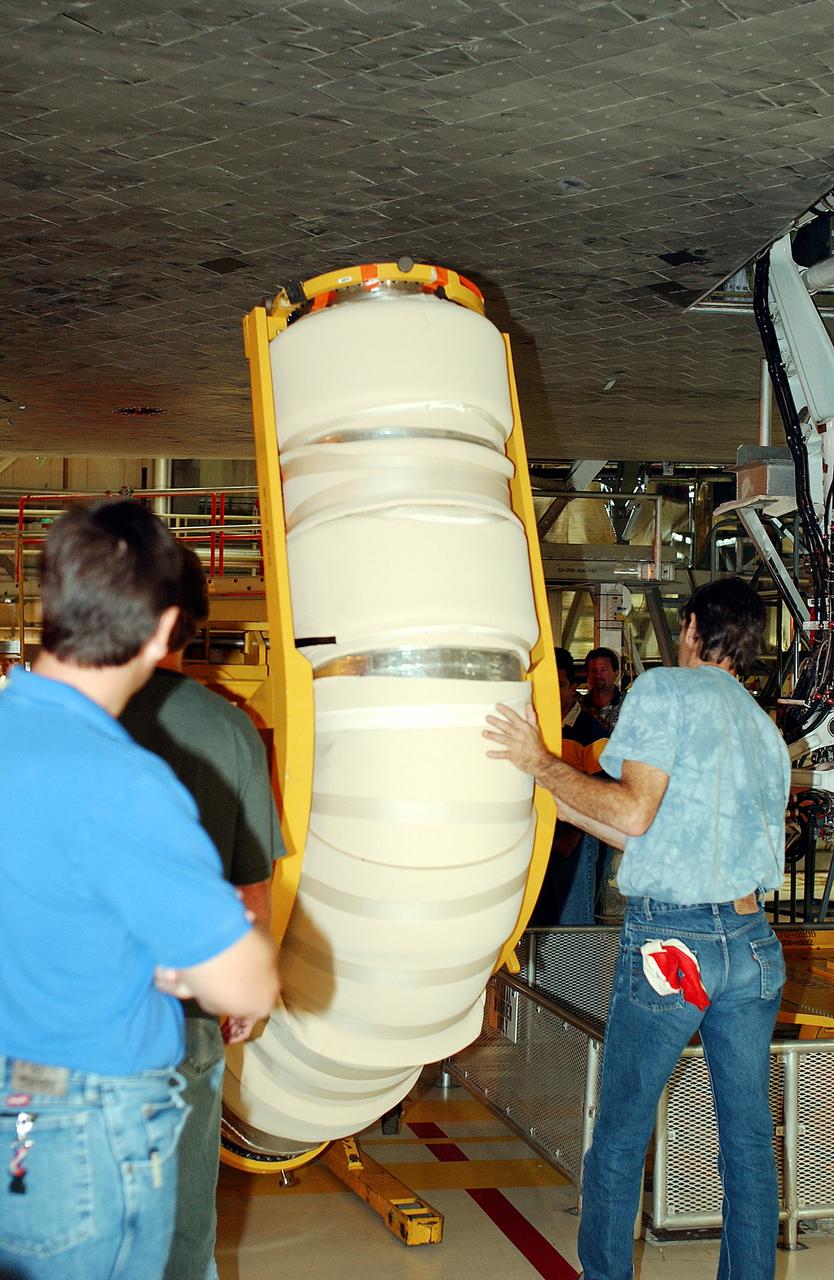
KENNEDY SPACE CENTER, FLA. - In the Orbiter Processing Facility, workers move the liquid oxygen feedline for the 17-inch disconnect toward orbiter Discovery for installation. The 17-inch liquid oxygen and liquid hydrogen disconnects provide the propellant feed interface from the external tank to the orbiter main propulsion system and the three Shuttle main engines.
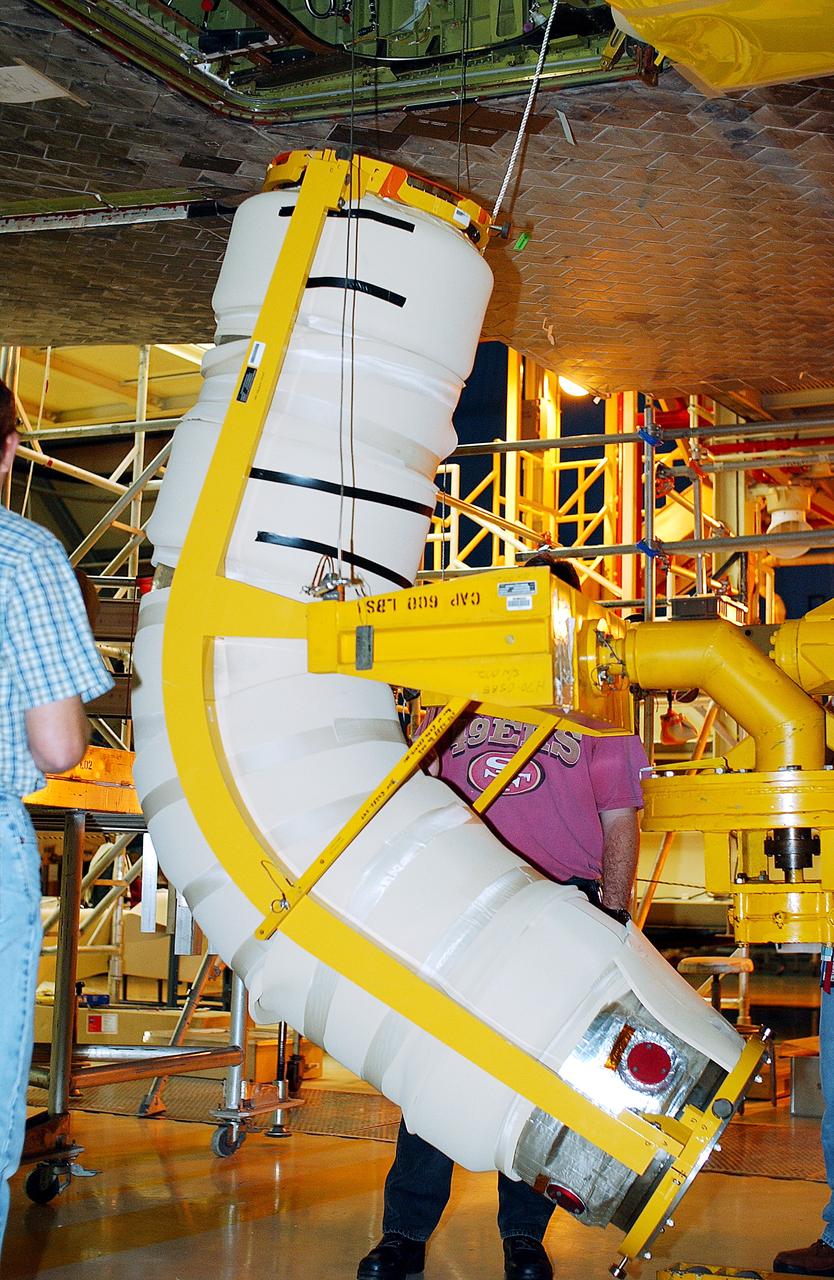
KENNEDY SPACE CENTER, FLA. - In the Orbiter Processing Facility, workers raise the liquid oxygen feedline for the 17-inch disconnect toward orbiter Discovery for installation. The 17-inch liquid oxygen and liquid hydrogen disconnects provide the propellant feed interface from the external tank to the orbiter main propulsion system and the three Shuttle main engines.
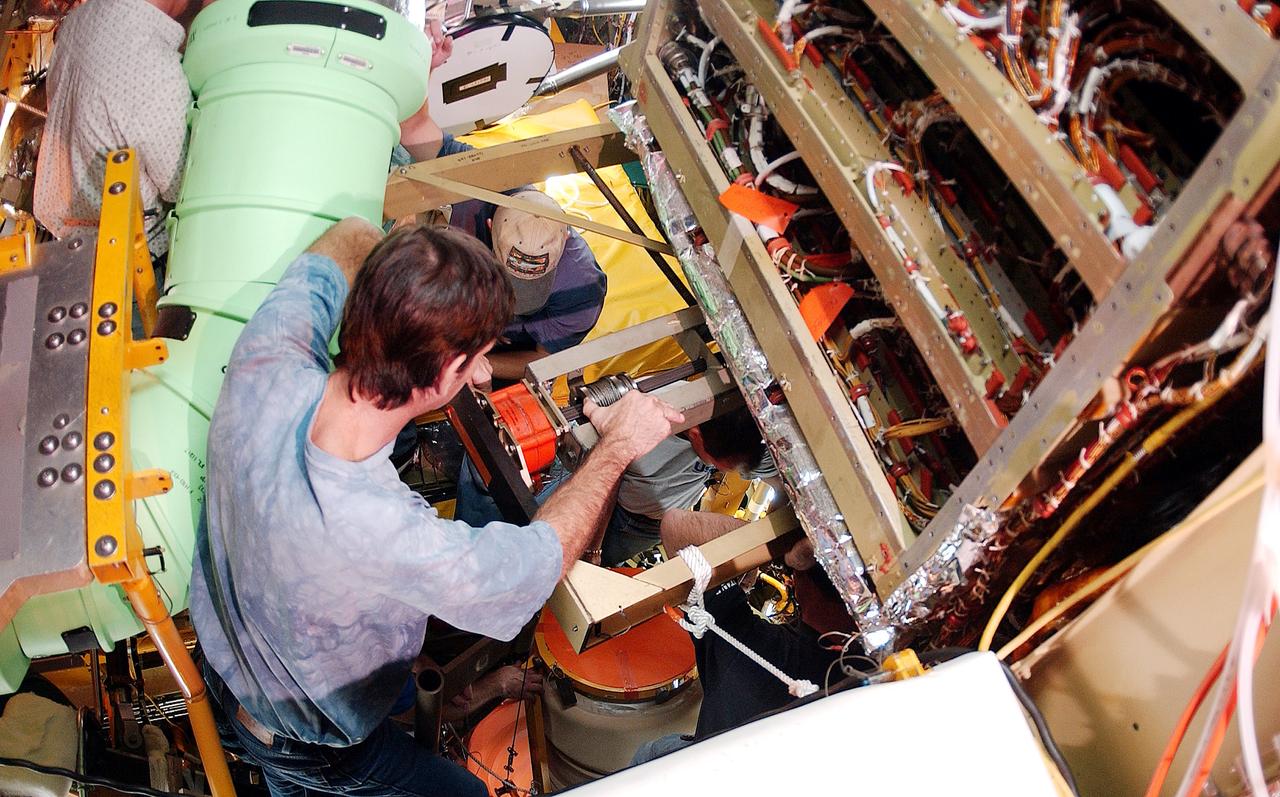
KENNEDY SPACE CENTER, FLA. - Viewed from inside the aft section of the orbiter Discovery, a worker installs the liquid oxygen feedline for the 17-inch disconnect, coming up from below. The 17-inch liquid oxygen and liquid hydrogen disconnects provide the propellant feed interface from the external tank to the orbiter main propulsion system and the three Shuttle main engines.
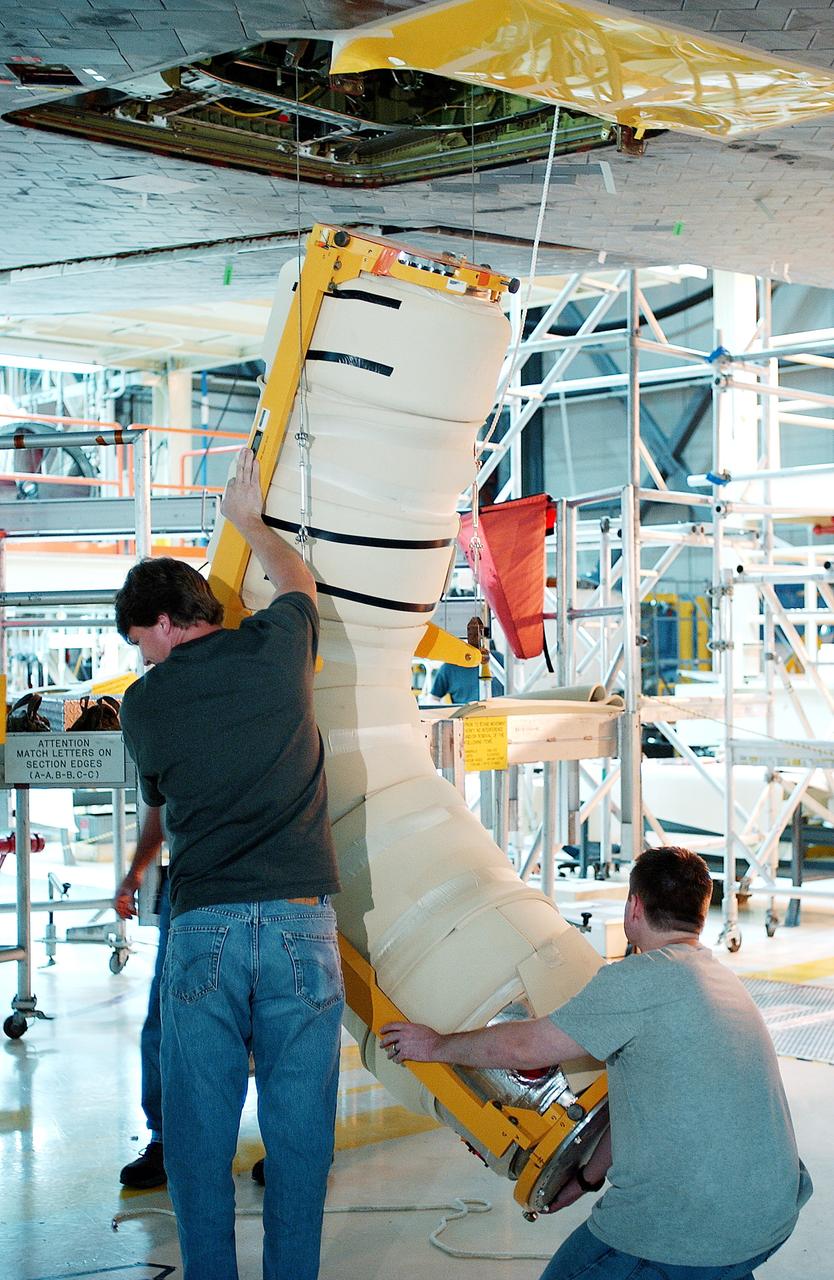
KENNEDY SPACE CENTER, FLA. - In the Orbiter Processing Facility, workers lift the liquid oxygen feedline for the 17-inch disconnect toward orbiter Discovery for installation. The 17-inch liquid oxygen and liquid hydrogen disconnects provide the propellant feed interface from the external tank to the orbiter main propulsion system and the three Shuttle main engines.
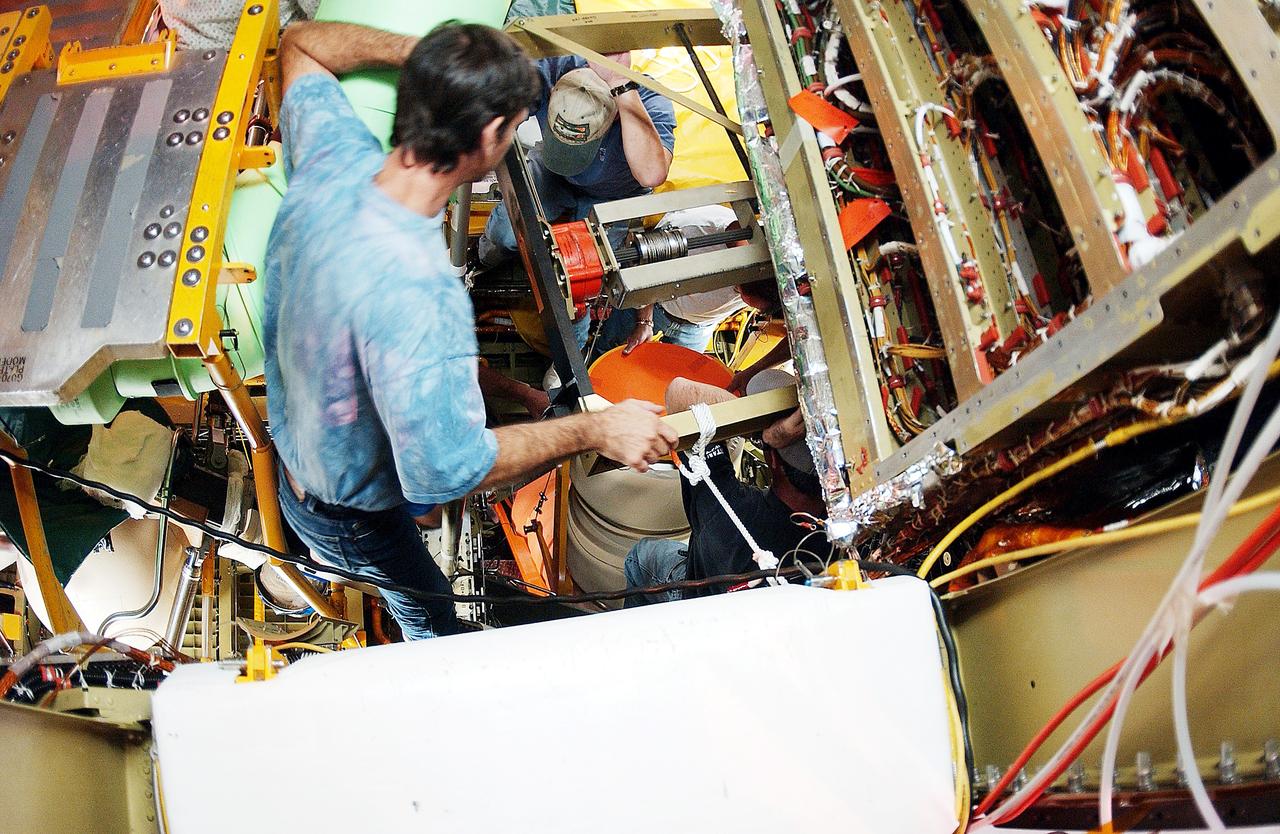
KENNEDY SPACE CENTER, FLA. - Viewed from inside the aft section of the orbiter Discovery, a worker installs the liquid oxygen feedline for the 17-inch disconnect, coming up from below. The 17-inch liquid oxygen and liquid hydrogen disconnects provide the propellant feed interface from the external tank to the orbiter main propulsion system and the three Shuttle main engines.
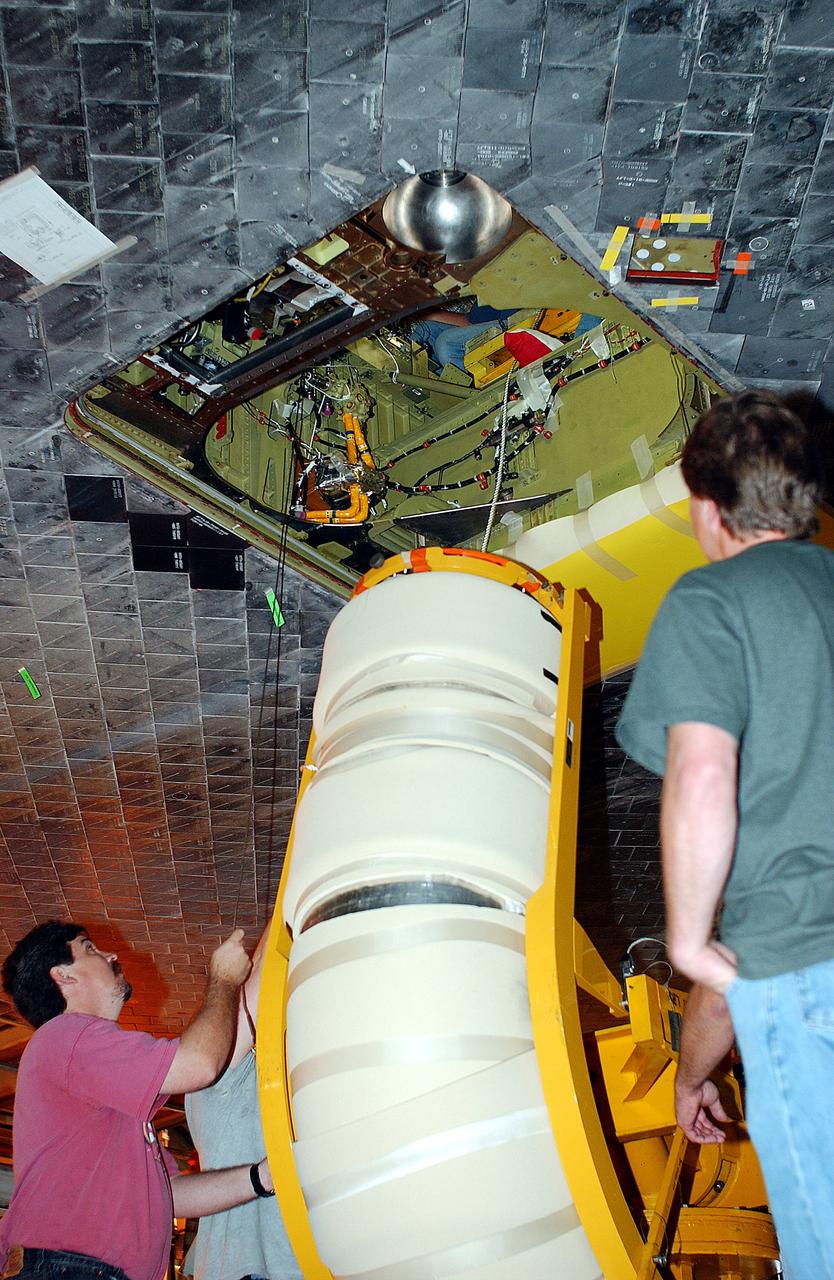
KENNEDY SPACE CENTER, FLA. - In the Orbiter Processing Facility, workers raise the liquid oxygen feedline for the 17-inch disconnect toward orbiter Discovery for installation. The 17-inch liquid oxygen and liquid hydrogen disconnects provide the propellant feed interface from the external tank to the orbiter main propulsion system and the three Shuttle main engines.
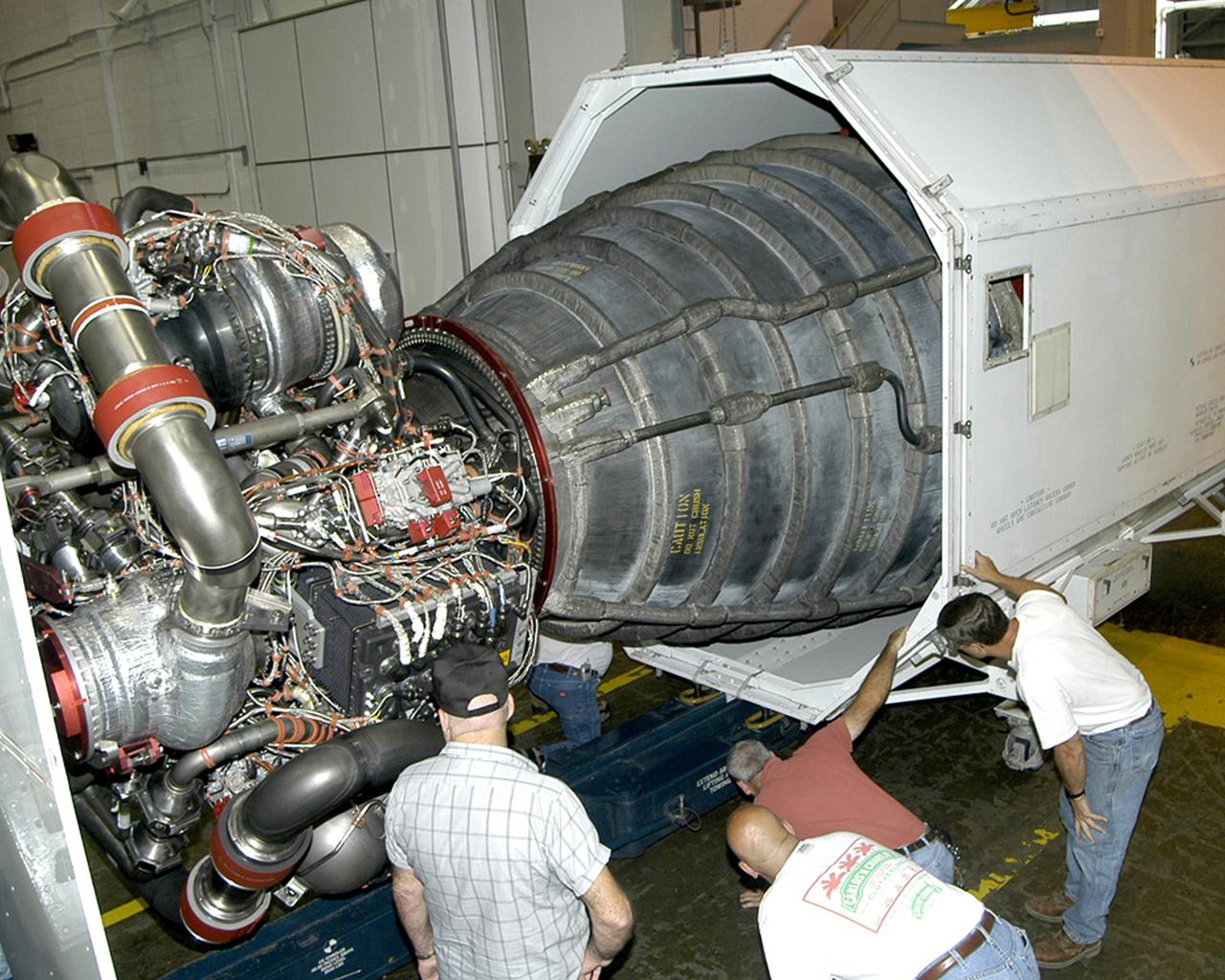
On Oct. 5, 2004, SSC shipped the last of the three Space Shuttle Main Engines to NASA's Kennedy Space Center for installation on Space Shuttle Discovery for STS-114, NASA's Return to Flight mission.

KENNEDY SPACE CENTER, FLA. -- In Orbiter Processing Facility bay 2, technicians on a Hyster forklift install space shuttle main engine no. 3 into Endeavour. Each space shuttle main engine is 14 feet long, weighs about 6,700 pounds, and is 7.5 feet in diameter at the end of the nozzle. The orbiter is scheduled for mission STS-118, targeted for launch on June 28. The mission will be the 22nd flight to the International Space Station, carrying another starboard array, S5, for installation. Photo credit: NASA/George Shelton
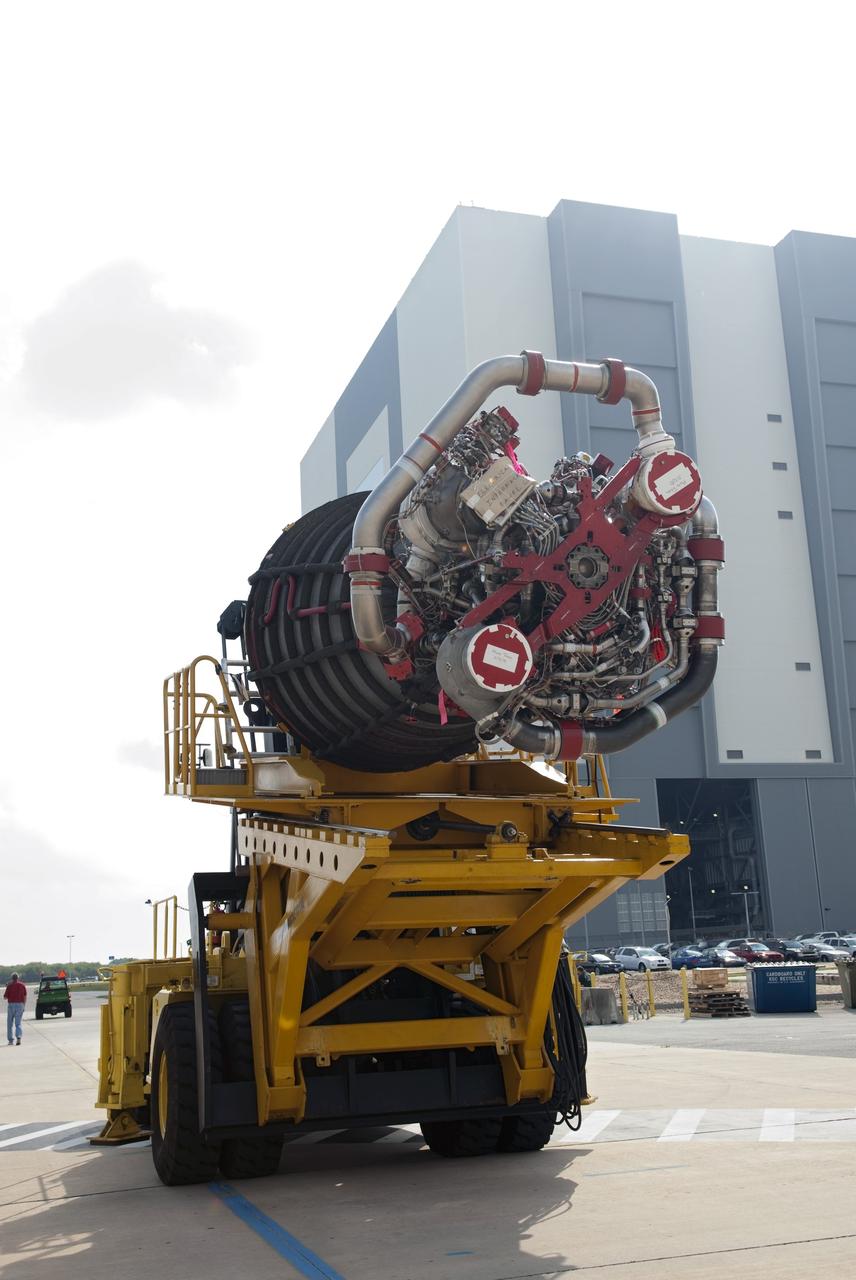
CAPE CANAVERAL, Fla. -- A heavy forklift with its specialized engine installer hold one of the main engines taken from space shuttle Discovery. The forklift is driving the engine from Orbiter Processing Facility-2 at NASA's Kennedy Space Center in Florida to the center's Space Shuttle Main Engine Processing Facility. The transition and retirement processing is expected to help rocket designers build next-generation spacecraft and prepare the shuttle for display. Photo credit: NASA/Jim Grossmann
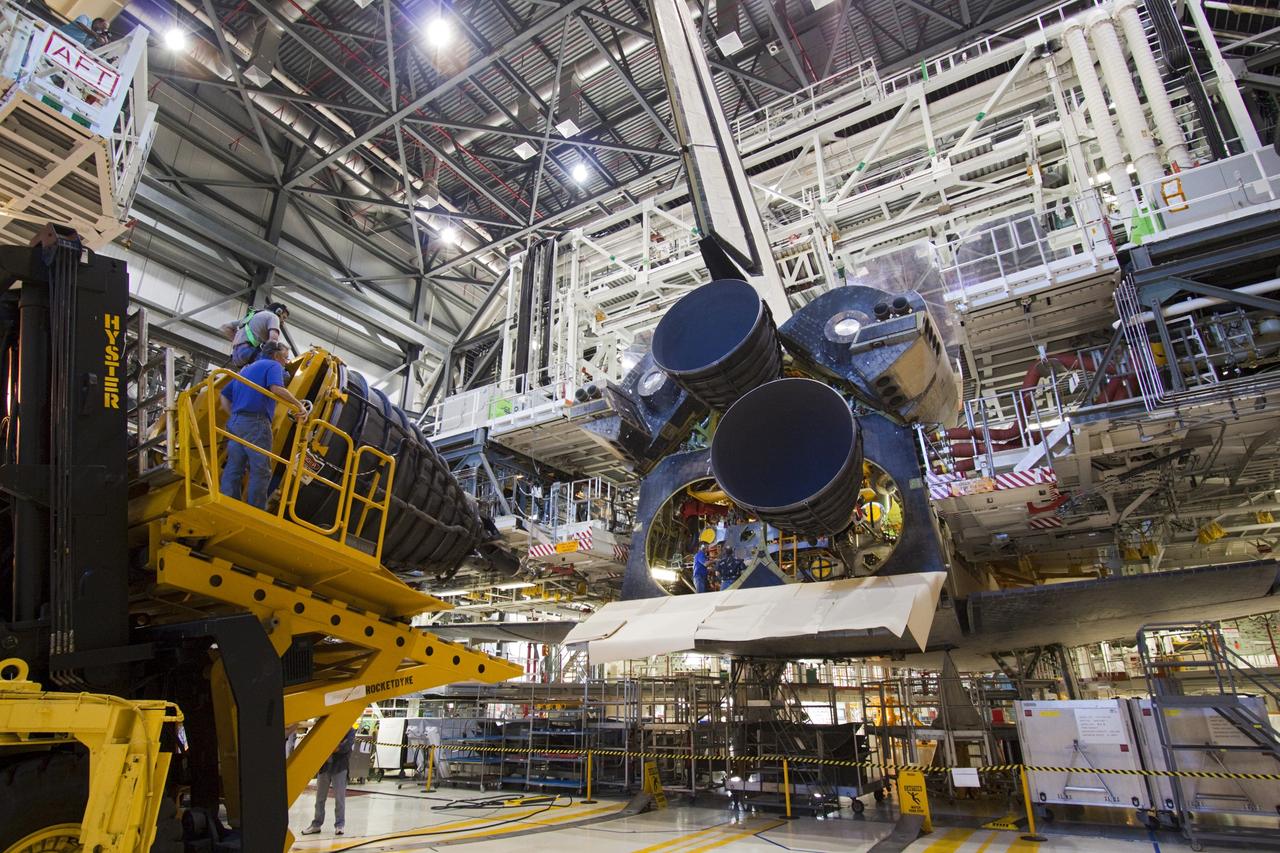
CAPE CANAVERAL, Fla. – Workers in Orbiter Processing Facility-1 at NASA’s Kennedy Space Center in Florida move a replica shuttle main engine (RSME) toward space shuttle Discovery with the aid of a Hyster forklift, a specially designed engine installer. The RSME is one of three being installed on Discovery during Space Shuttle Program transition and retirement activities. The replicas are built in the Pratt & Whitney Rocketdyne engine shop at Kennedy to replace the shuttle engines which will be placed in storage to support NASA's Space Launch System, under development. Discovery is being prepared for display at the Smithsonian’s National Air and Space Museum Steven F. Udvar-Hazy Center in Chantilly, Va. For more information, visit http://www.nasa.gov/shuttle. Photo credit: NASA/Jim Grossmann
CAPE CANAVERAL, Fla. – Inside Orbiter Processing Facility-1 at NASA's Kennedy Space Center in Florida, a lift holds a replica shuttle main engine (RSME) for installation on space shuttle Discovery. This is the first of three replica engines to be installed. The work is part of the Space Shuttle Program’s transition and retirement processing of Discovery. Discovery is being prepared for display at the Smithsonian’s National Air and Space Museum, Steven F. Udvar-Hazy Center in Chantilly, Va. For more information, visit http://www.nasa.gov/shuttle. Photo credit: NASA/Jim Grossmann
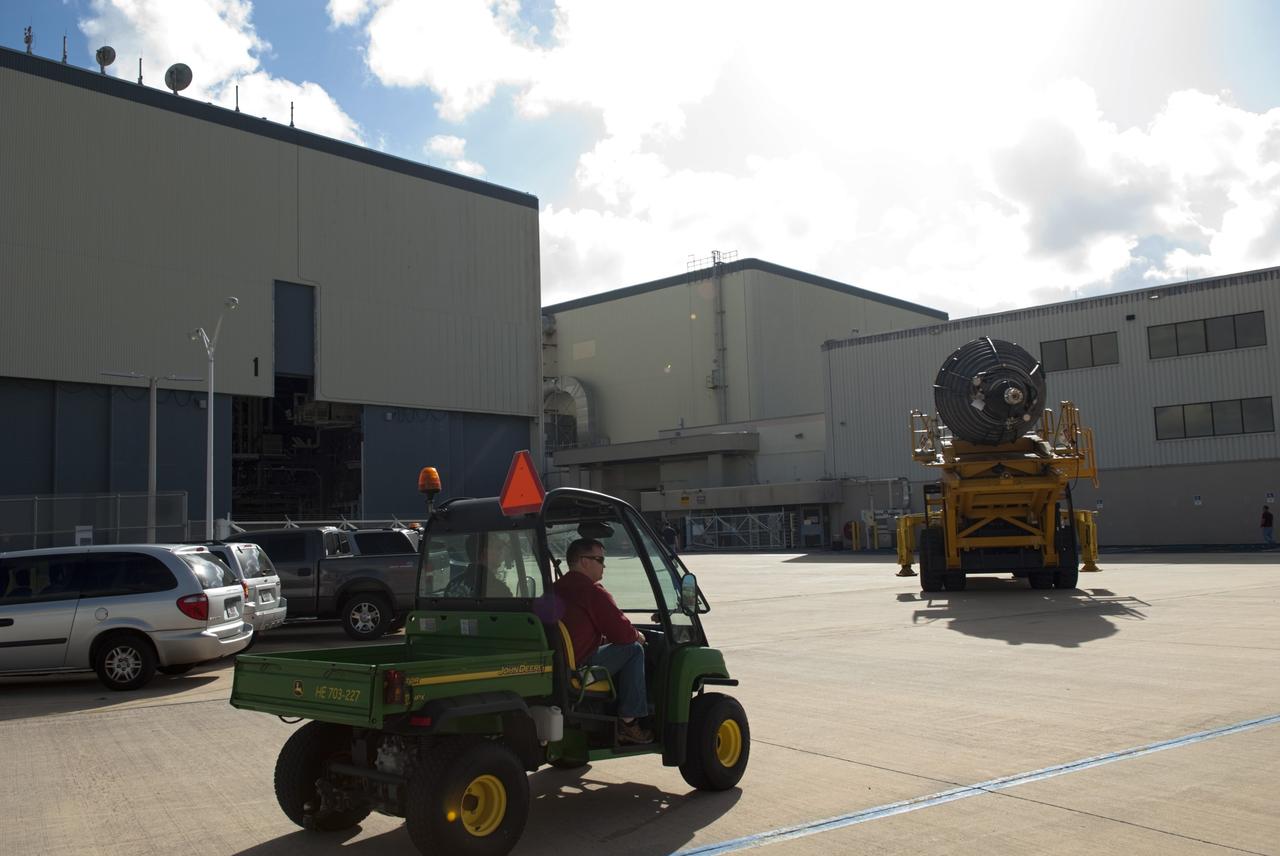
CAPE CANAVERAL, Fla. – A replica shuttle main engine (RSME) arrives at Orbiter Processing Facility-1 at NASA’s Kennedy Space Center in Florida where it will be installed on space shuttle Discovery. The RSME was built in the Pratt & Whitney Rocketdyne engine shop at Kennedy. The RSME is one of three that will be installed on Discovery during Space Shuttle Program transition and retirement activities. Discovery is being prepared for display at the Smithsonian’s National Air and Space Museum Steven F. Udvar-Hazy Center in Chantilly, Va. For more information, visit http://www.nasa.gov/shuttle. Photo credit: NASA/Jim Grossmann
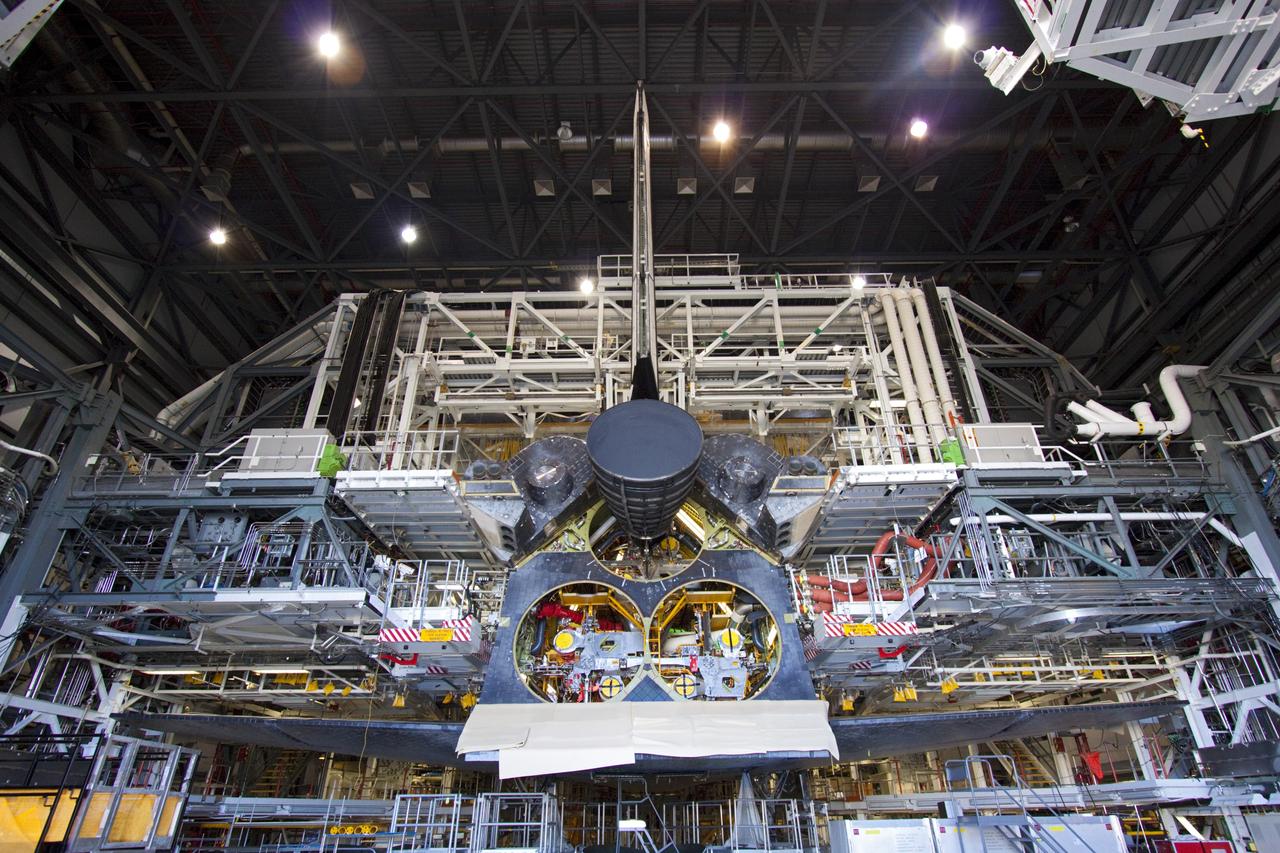
CAPE CANAVERAL, Fla. – Inside Orbiter Processing Facility-1 at NASA's Kennedy Space Center in Florida, a replica shuttle main engine (RSME) has been installed on space shuttle Discovery. This is the first of three replica engines to be installed. The work is part of the Space Shuttle Program’s transition and retirement processing of Discovery. Discovery is being prepared for display at the Smithsonian’s National Air and Space Museum, Steven F. Udvar-Hazy Center in Chantilly, Va. For more information, visit http://www.nasa.gov/shuttle. Photo credit: NASA/Jim Grossmann
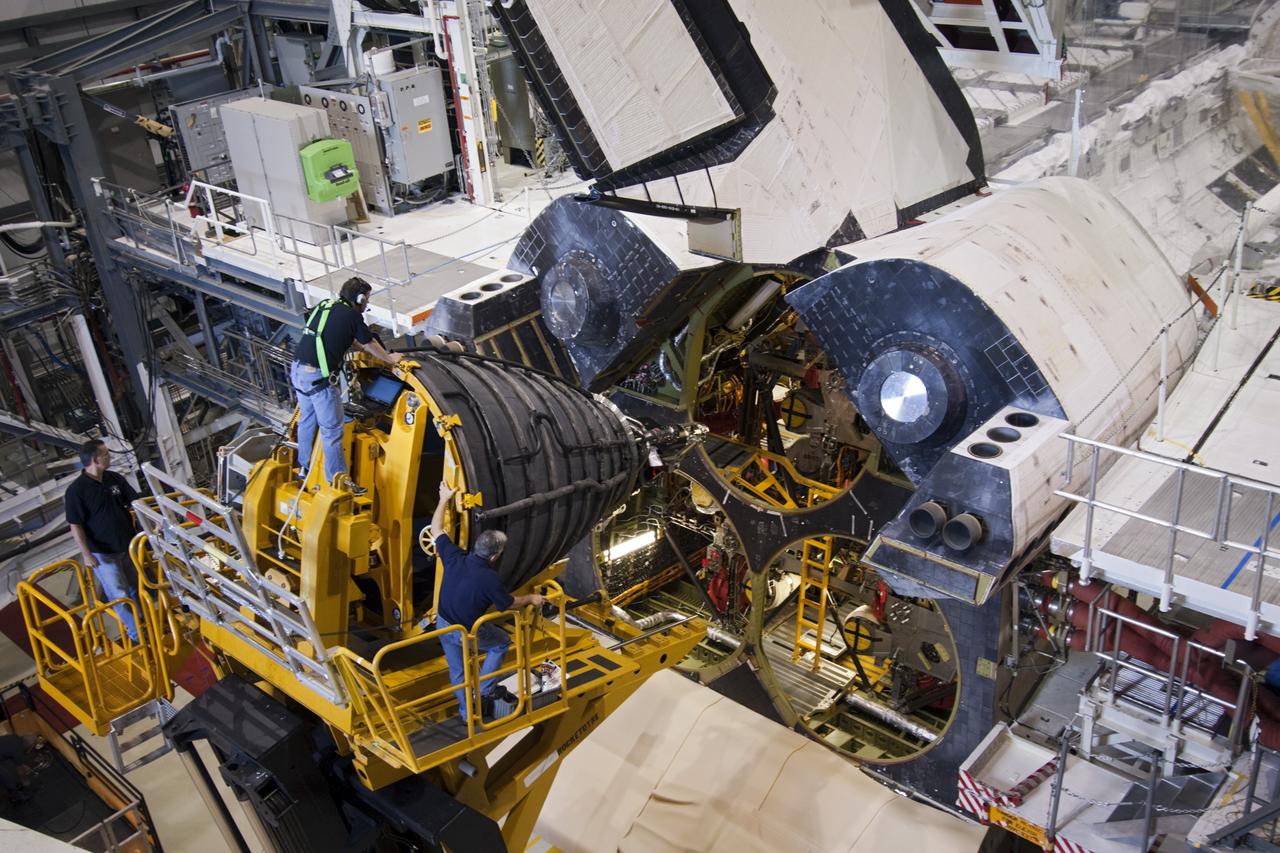
CAPE CANAVERAL, Fla. – Inside Orbiter Processing Facility-1 at NASA's Kennedy Space Center in Florida, an employee guides a replica shuttle main engine (RSME) toward installation on space shuttle Discovery. This is the first of three replica engines to be installed. The work is part of the Space Shuttle Program’s transition and retirement processing of Discovery. Discovery is being prepared for display at the Smithsonian’s National Air and Space Museum, Steven F. Udvar-Hazy Center in Chantilly, Va. For more information, visit http://www.nasa.gov/shuttle. Photo credit: NASA/Jim Grossmann
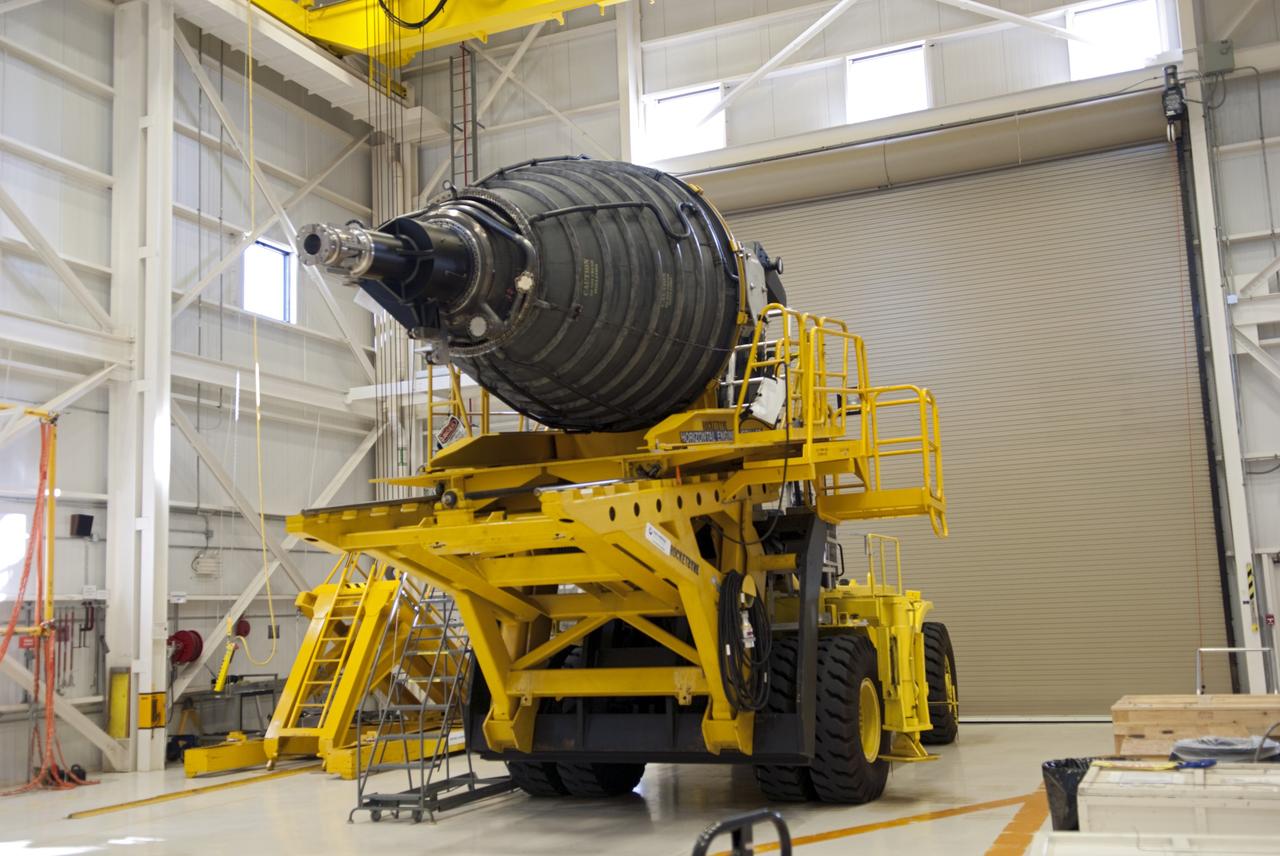
CAPE CANAVERAL, Fla. – A completed replica shuttle main engine (RSME) awaits transport from the Pratt & Whitney Rocketdyne engine shop at NASA’s Kennedy Space Center in Florida to Orbiter Processing Facility-1 where it will be installed on space shuttle Discovery. The RSME is one of three that will be installed on Discovery during Space Shuttle Program transition and retirement activities. Discovery is being prepared for display at the Smithsonian’s National Air and Space Museum Steven F. Udvar-Hazy Center in Chantilly, Va. For more information, visit http://www.nasa.gov/shuttle. Photo credit: NASA/Jim Grossmann
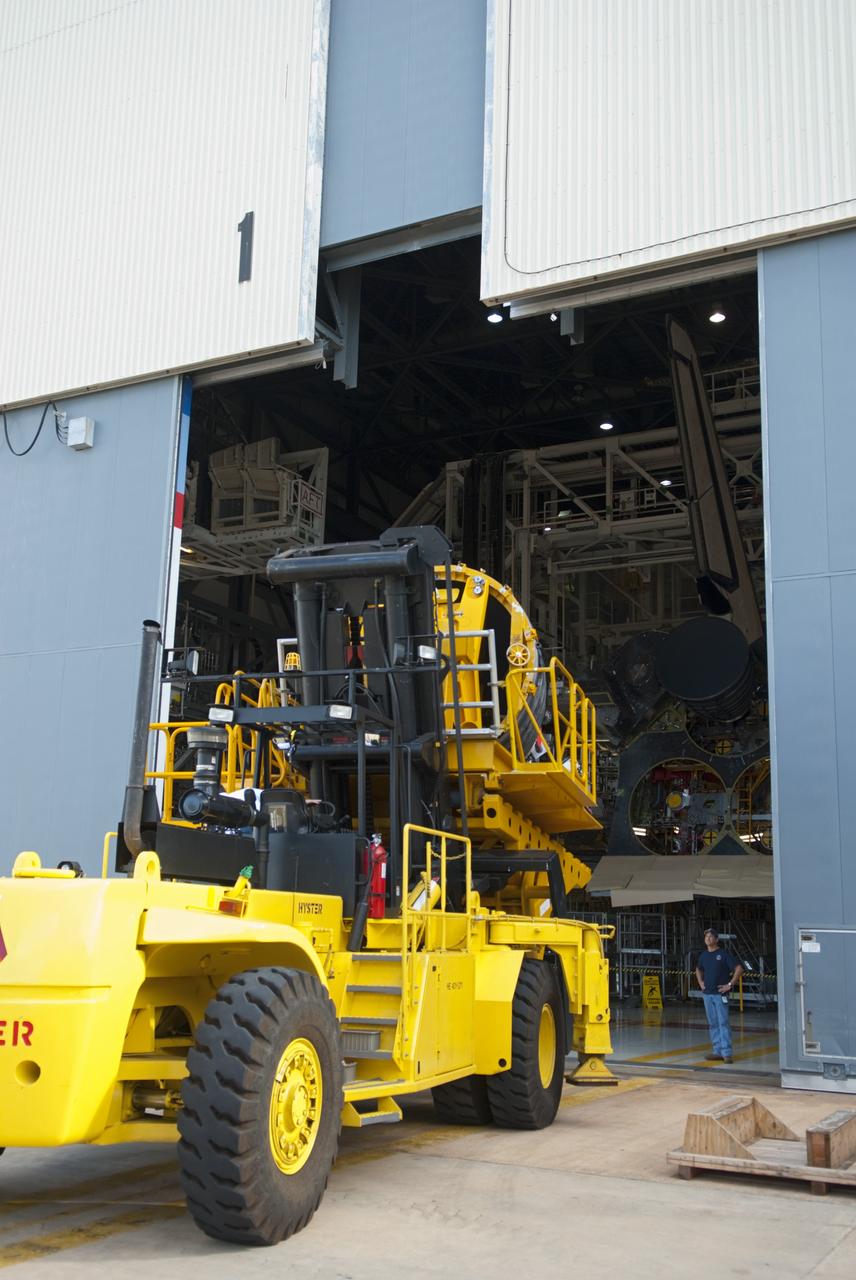
CAPE CANAVERAL, Fla. – A replica shuttle main engine (RSME) rolls through the high bay door of Orbiter Processing Facility-1 at NASA’s Kennedy Space Center in Florida where it will be installed on space shuttle Discovery. The RSME was built in the Pratt & Whitney Rocketdyne engine shop at Kennedy. The RSME is one of three that will be installed on Discovery during Space Shuttle Program transition and retirement activities. Discovery is being prepared for display at the Smithsonian’s National Air and Space Museum Steven F. Udvar-Hazy Center in Chantilly, Va. For more information, visit http://www.nasa.gov/shuttle. Photo credit: NASA/Jim Grossmann
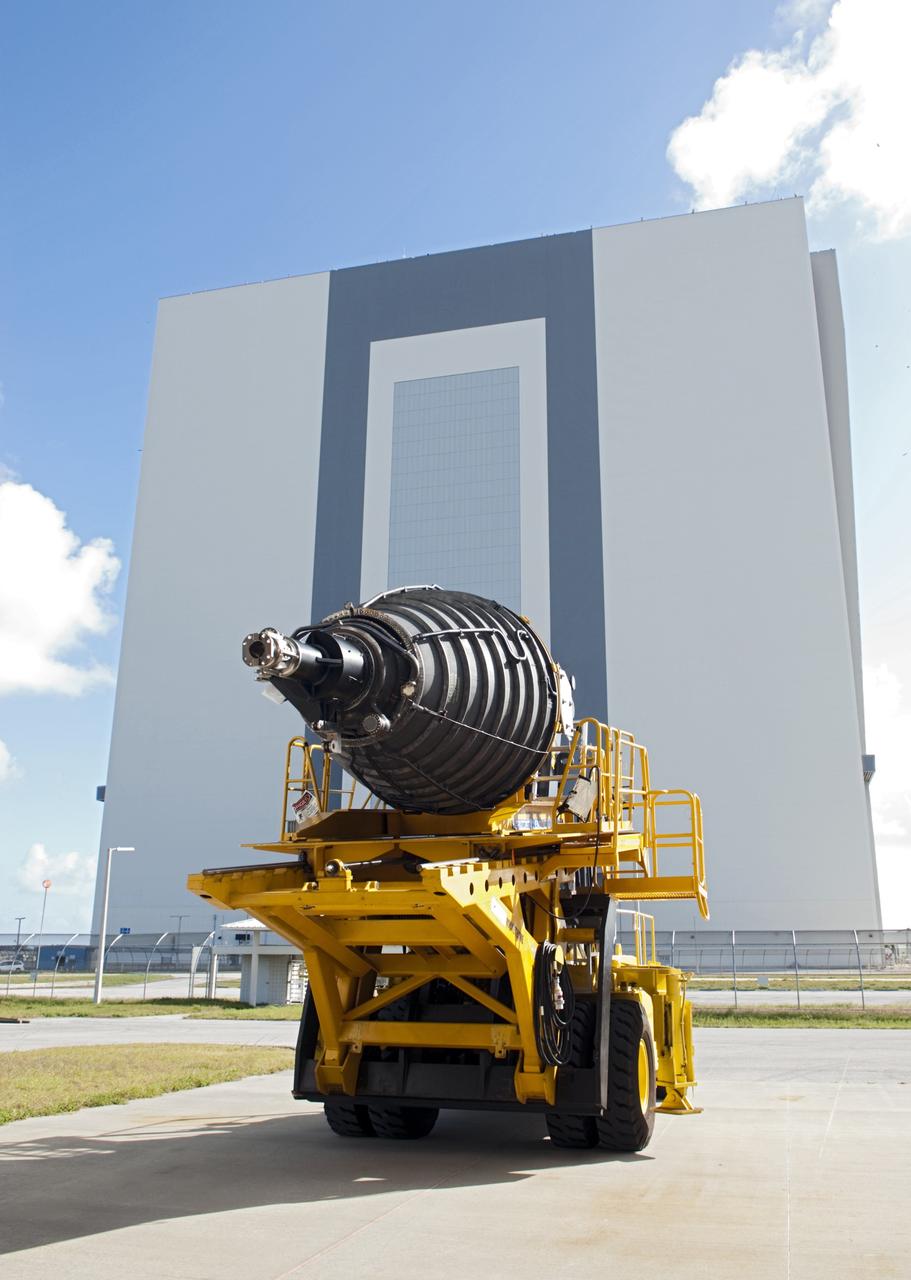
CAPE CANAVERAL, Fla. – A replica shuttle main engine (RSME) rolls out of the Pratt & Whitney Rocketdyne engine shop at NASA’s Kennedy Space Center in Florida toward Orbiter Processing Facility-1 where it will be installed on space shuttle Discovery. In the background is the 525-foot-tall Vehicle Assembly Building. The RSME is one of three that will be installed on Discovery during Space Shuttle Program transition and retirement activities. Discovery is being prepared for display at the Smithsonian’s National Air and Space Museum Steven F. Udvar-Hazy Center in Chantilly, Va. For more information, visit http://www.nasa.gov/shuttle. Photo credit: NASA/Jim Grossmann
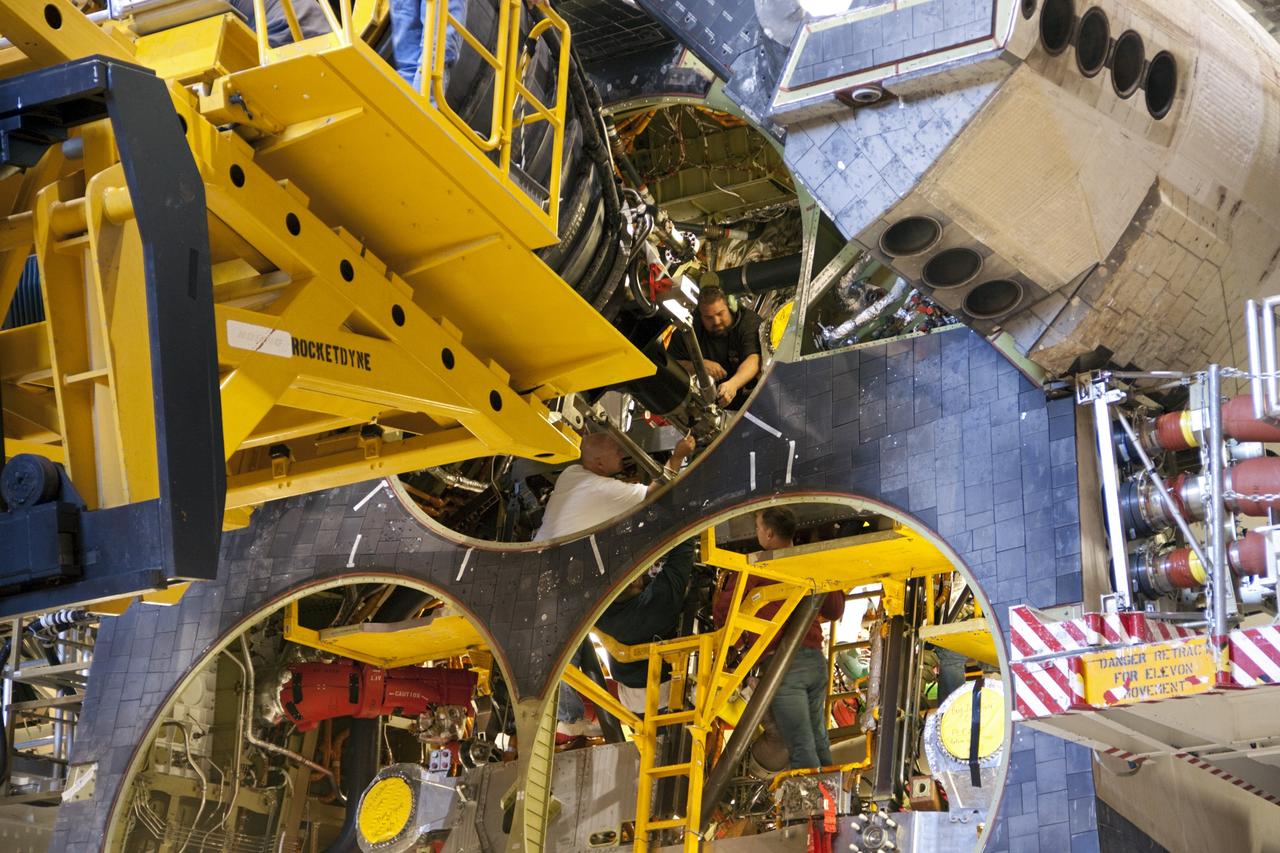
CAPE CANAVERAL, Fla. – Inside Orbiter Processing Facility-1 at NASA's Kennedy Space Center in Florida, employees work within the aft end of space shuttle Discovery, where a replica shuttle main engine (RSME) is being installed. This is the first of three replica engines to be installed. The work is part of the Space Shuttle Program’s transition and retirement processing of Discovery. Discovery is being prepared for display at the Smithsonian’s National Air and Space Museum, Steven F. Udvar-Hazy Center in Chantilly, Va. For more information, visit http://www.nasa.gov/shuttle. Photo credit: NASA/Jim Grossmann
CAPE CANAVERAL, Fla. – A replica shuttle main engine (RSME) arrives in Orbiter Processing Facility-1 at NASA’s Kennedy Space Center in Florida where it will be installed on space shuttle Discovery. The RSME was built in the Pratt & Whitney Rocketdyne engine shop at Kennedy. The RSME is one of three that will be installed on Discovery during Space Shuttle Program transition and retirement activities. Discovery is being prepared for display at the Smithsonian’s National Air and Space Museum Steven F. Udvar-Hazy Center in Chantilly, Va. For more information, visit http://www.nasa.gov/shuttle. Photo credit: NASA/Jim Grossmann
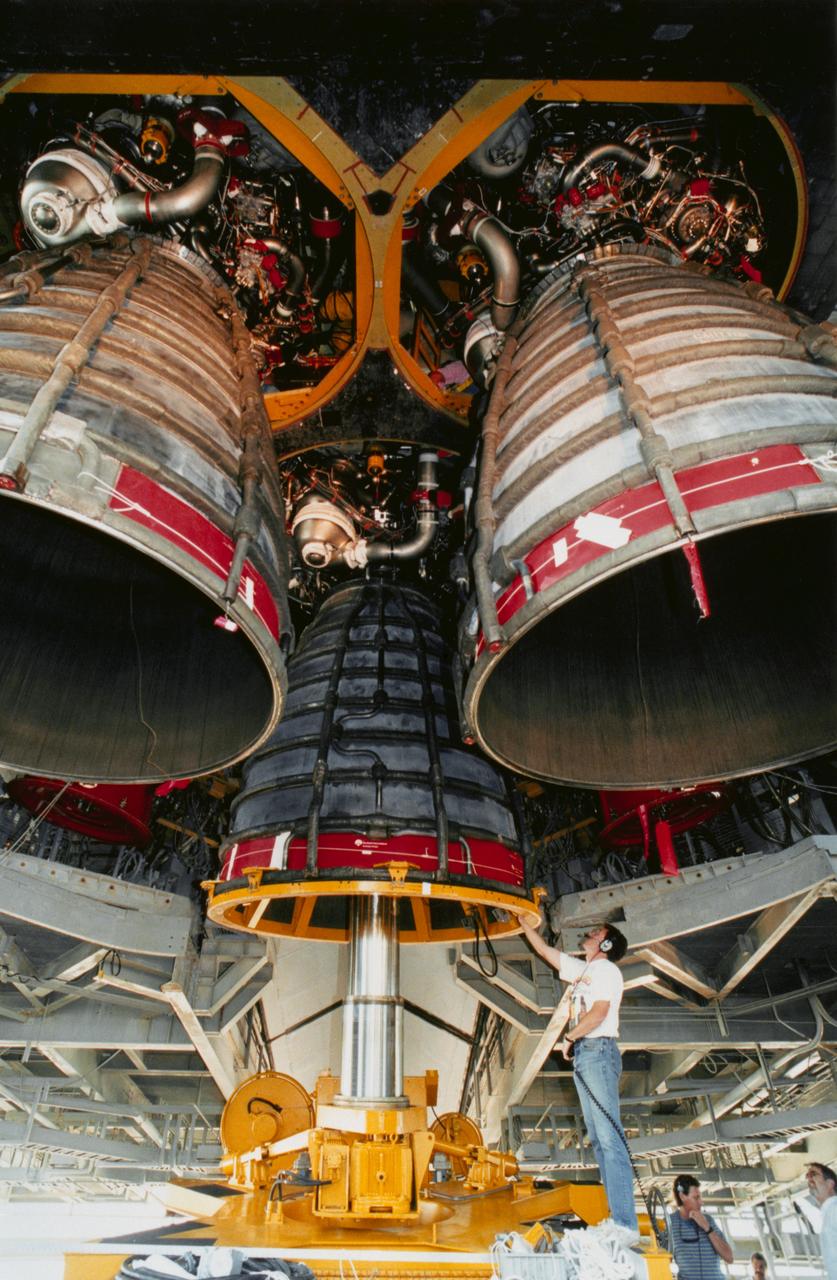
S93-43619 (18 Aug 1993) --- At Launch Pad 39B, work is under way to remove and replace the three main engines on the Space Shuttle Discovery. Here, Rocketdyne workers Jim Tibble (left), John Mooney and Ken Bair are assisting with the removal of the first engine, main engine no. 1, using the engine vertical installer. A failed sensor in main engine no. 2 led to the shutdown of all three engines three seconds before liftoff of mission STS-51 on August 12, 1993. Because it is difficult to perform the necessary inspections, refurbishment, and retesting of a fired engine on a vehicle at the pad, NASA opted to install a fresh set of engines on Discovery.
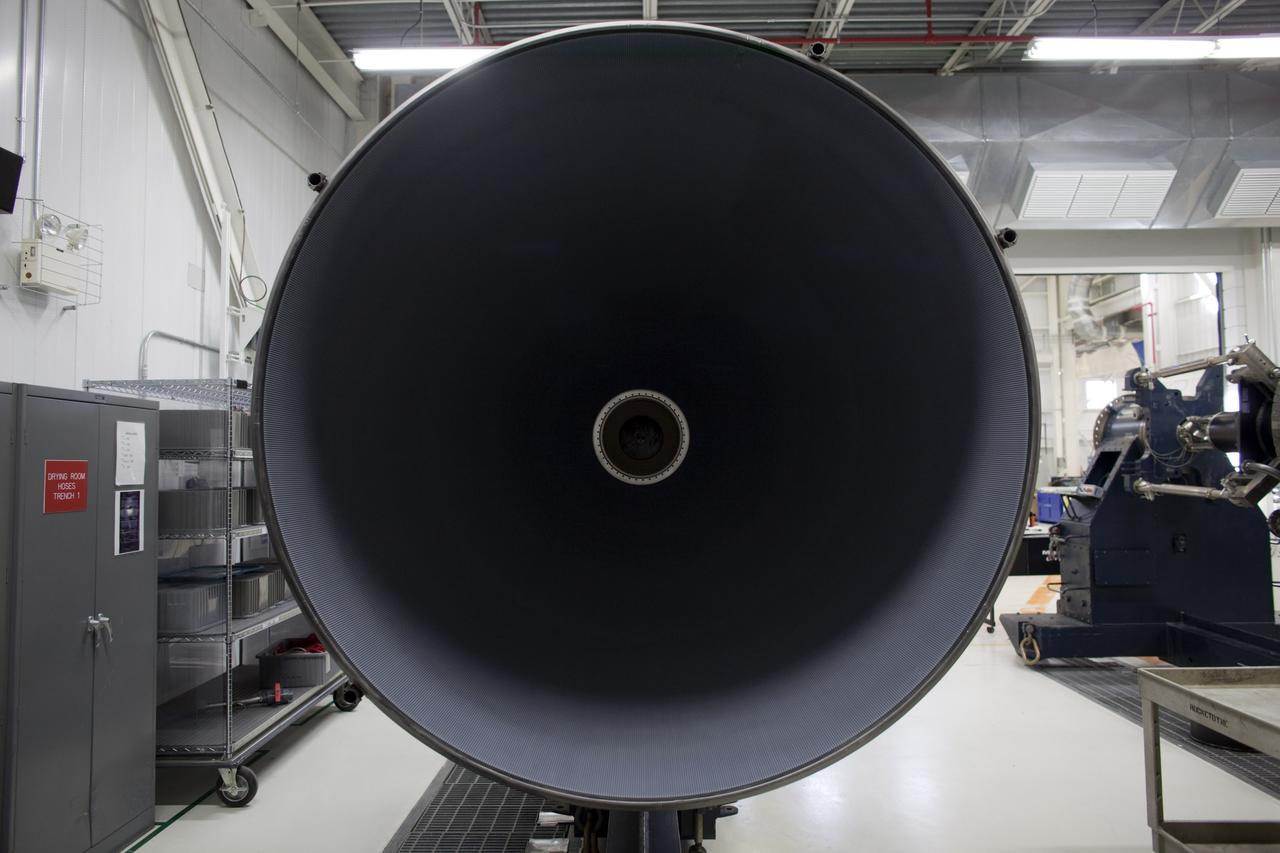
CAPE CANAVERAL, Fla. -- Inside the Pratt & Whitney Rocketdyne engine shop at NASA’s Kennedy Space Center in Florida, the interior of the engine bell of one of the replica shuttle main engines (RSMEs) can be seen. The RSMEs were created for space shuttle Discovery. The replica engines will be transported from the engine shop to the processing facility for installation on Discovery in January 2012. The work is part of the Space Shuttle Program’s transition and retirement processing of shuttle Discovery. Discovery is being prepared for display at the Smithsonian’s National Air and Space Museum, Steven F. Udvar-Hazy Center in Chantilly, Va. For more information, visit http://www.nasa.gov/shuttle. Photo credit: NASA/Dimitri Gerondidakis
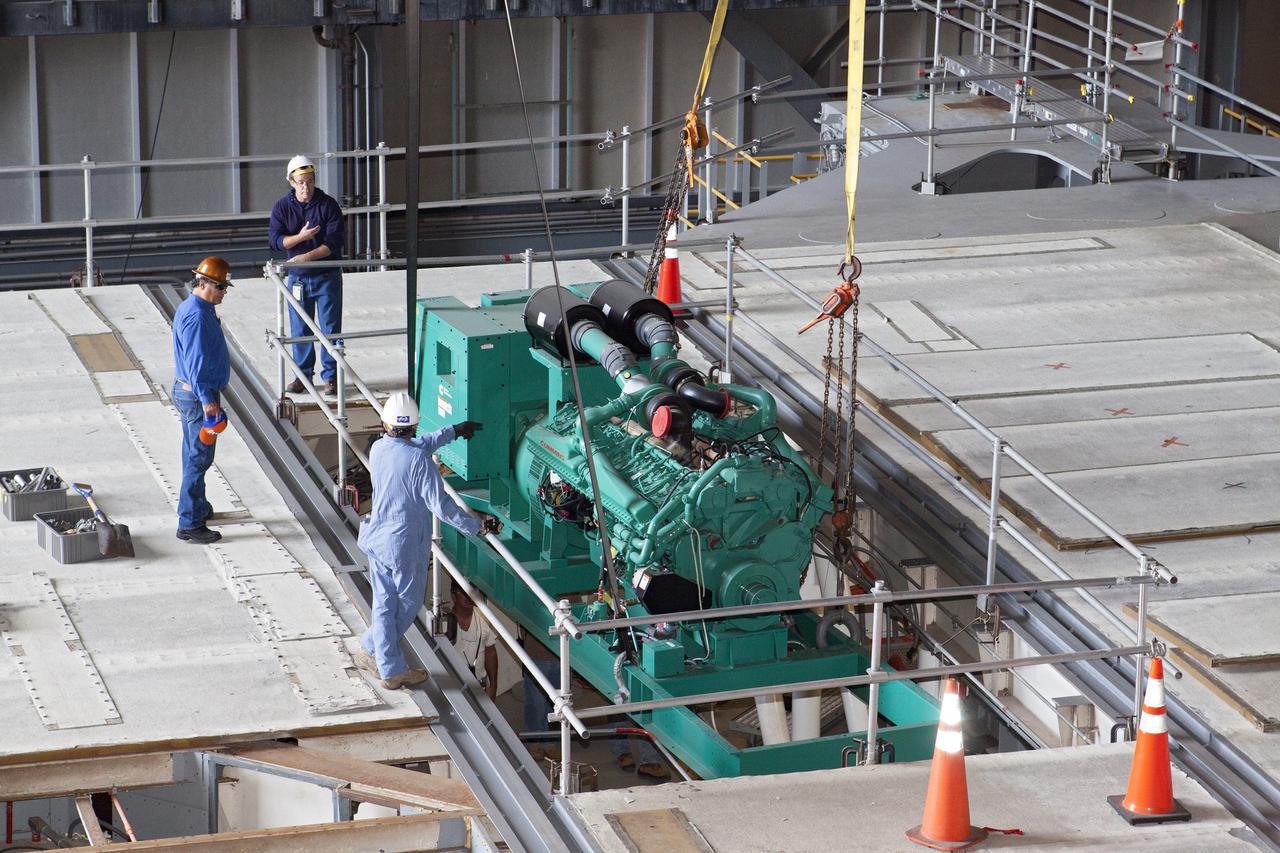
CAPE CANAVERAL, Fla. – Inside the Vehicle Assembly Building at NASA’s Kennedy Space Center in Florida, technicians monitor the progress as a large crane is used to lower a new Cummins engine and generator for installation inside crawler-transporter 1 CT-1. The Apollo era diesel engines were removed so that the new engine can be installed. Work continues in high bay 3 to upgrade CT-1 as part of its general maintenance and could be available to carry commercial launch vehicles to the launch pad. The crawler-transporters were used to carry the mobile launcher platform and space shuttle to Launch Complex 39 for space shuttle launches for 30 years. Photo credit: NASA_Kim Shiflett
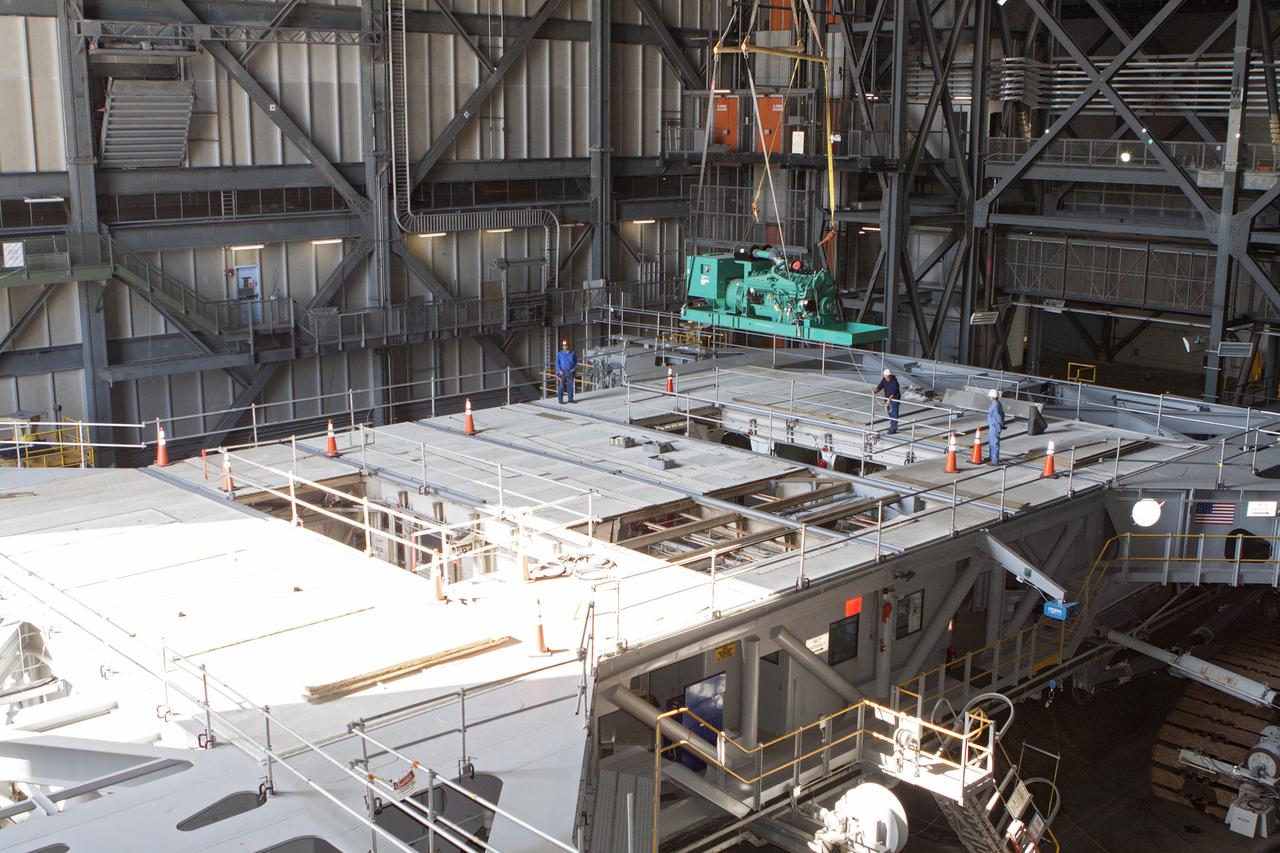
CAPE CANAVERAL, Fla. – Inside the Vehicle Assembly Building at NASA’s Kennedy Space Center in Florida, technicians monitor the progress as a large crane lifts a new Cummins engine and generator for installation inside crawler-transporter 1 CT-1. The Apollo era diesel engines were removed so that the new engine can be installed. Work continues in high bay 3 to upgrade CT-1 as part of its general maintenance and could be available to carry commercial launch vehicles to the launch pad. The crawler-transporters were used to carry the mobile launcher platform and space shuttle to Launch Complex 39 for space shuttle launches for 30 years. Photo credit: NASA_Kim Shiflett
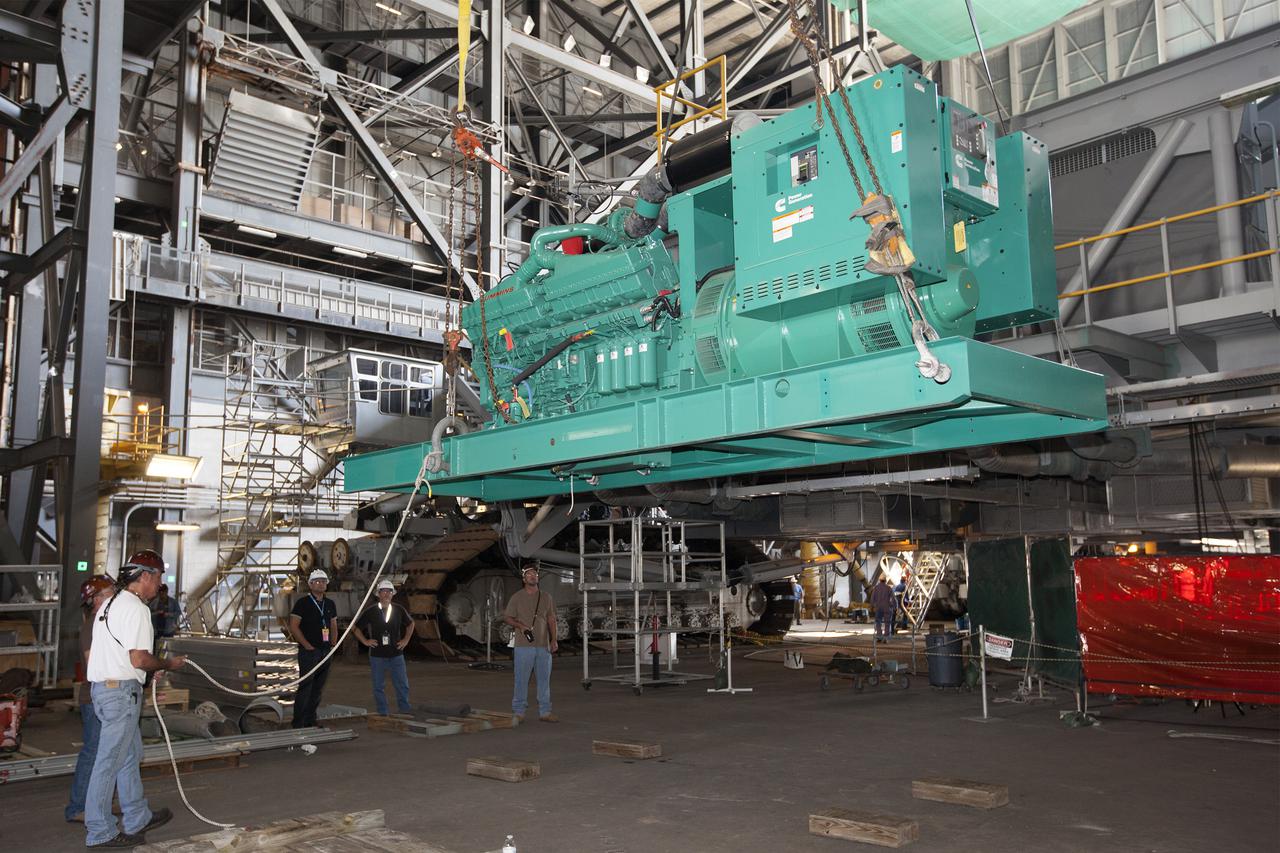
CAPE CANAVERAL, Fla. – Inside the Vehicle Assembly Building at NASA’s Kennedy Space Center in Florida, technicians monitor the progress as a large crane lifts a new Cummins engine and generator for installation inside crawler-transporter 1 CT-1. The Apollo era diesel engines were removed so that the new engine can be installed. Work continues in high bay 3 to upgrade CT-1 as part of its general maintenance and could be available to carry commercial launch vehicles to the launch pad. The crawler-transporters were used to carry the mobile launcher platform and space shuttle to Launch Complex 39 for space shuttle launches for 30 years. Photo credit: NASA_Kim Shiflett
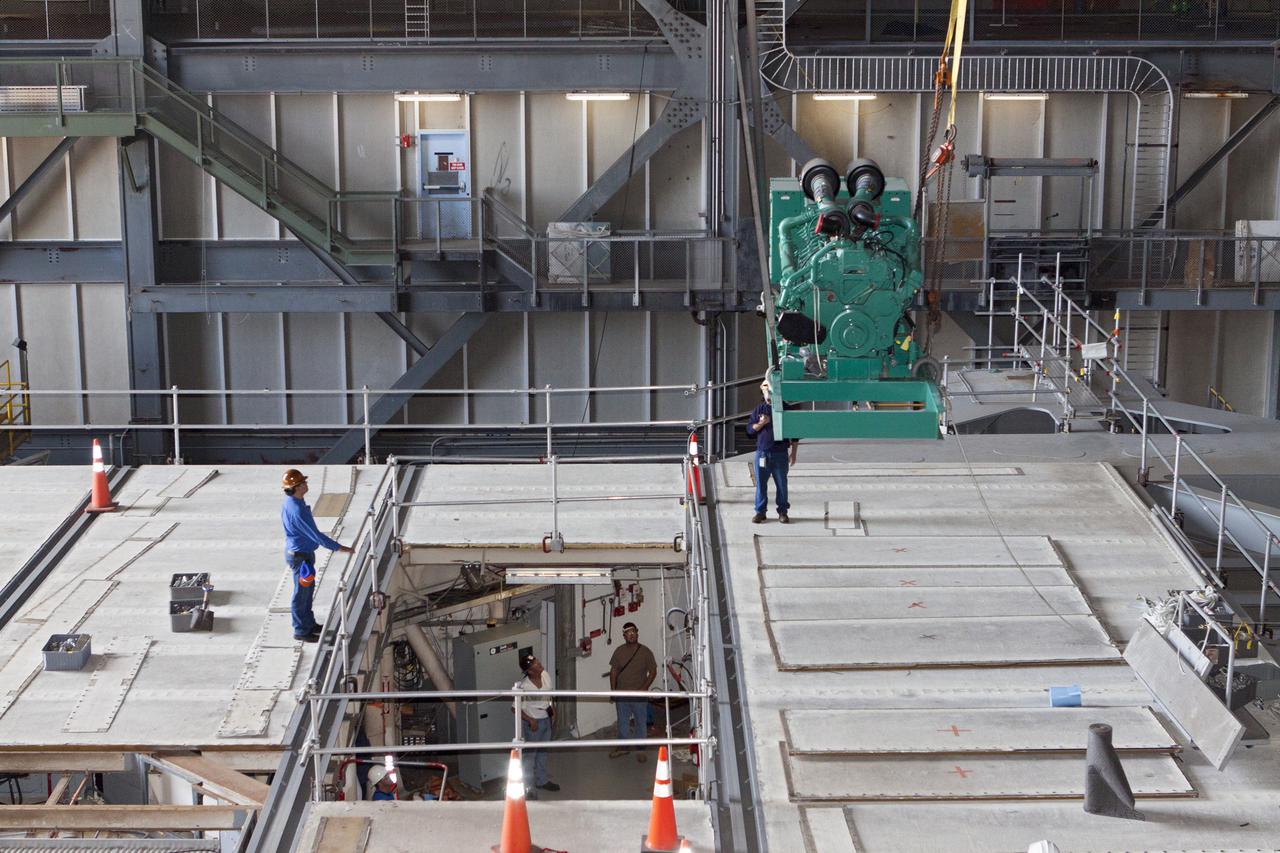
CAPE CANAVERAL, Fla. – Inside the Vehicle Assembly Building at NASA’s Kennedy Space Center in Florida, technicians monitor the progress as a large crane is used to lift a new Cummins engine and generator for installation inside crawler-transporter 1 CT-1. The Apollo era diesel engines were removed so that the new engine can be installed. Work continues in high bay 3 to upgrade CT-1 as part of its general maintenance and could be available to carry commercial launch vehicles to the launch pad. The crawler-transporters were used to carry the mobile launcher platform and space shuttle to Launch Complex 39 for space shuttle launches for 30 years. Photo credit: NASA_Kim Shiflett
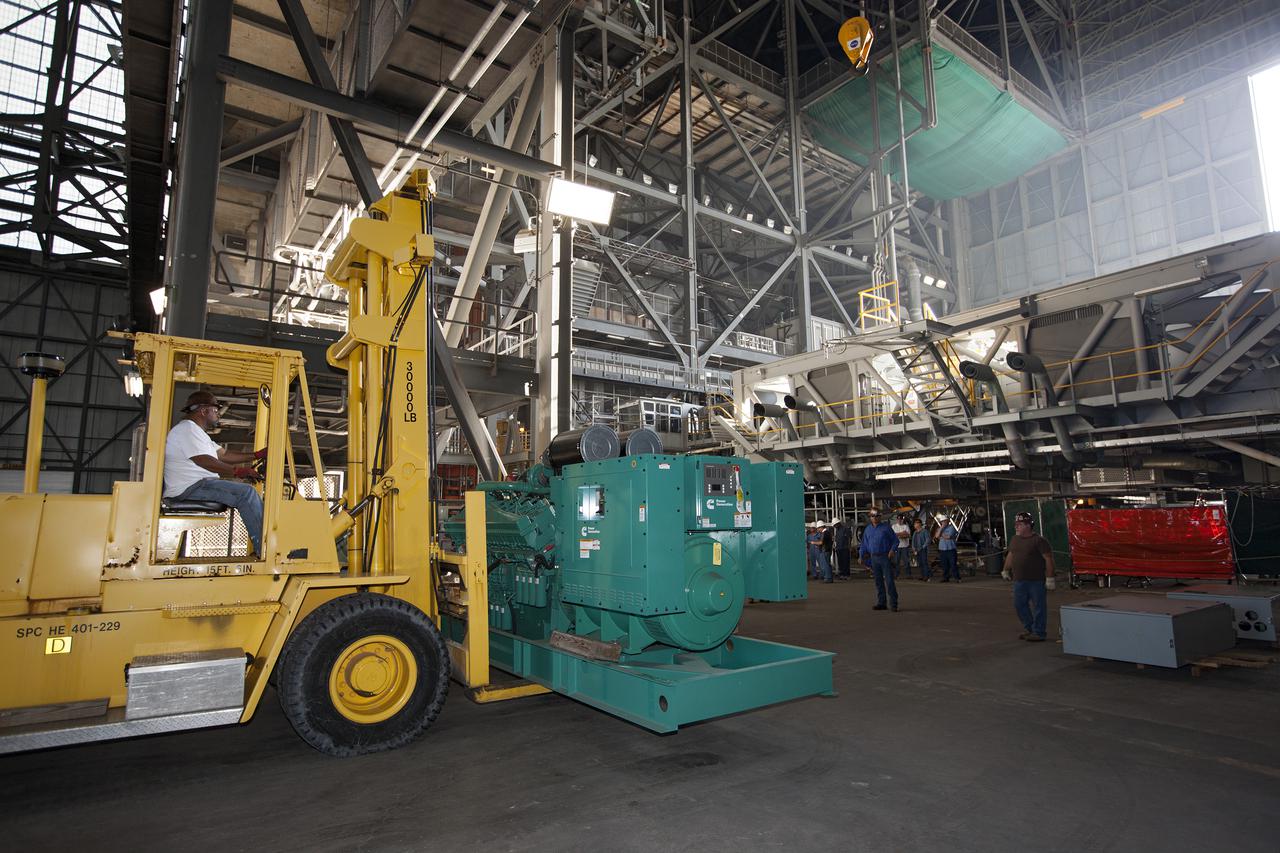
CAPE CANAVERAL, Fla. – Inside the Vehicle Assembly Building at NASA’s Kennedy Space Center in Florida, technicians prepare a new Cummins engine and generator for installation inside crawler-transporter 1 CT-1. The Apollo era diesel engines were removed so that the new engine can be installed. Work continues in high bay 3 to upgrade CT-1 as part of its general maintenance and could be available to carry commercial launch vehicles to the launch pad. The crawler-transporters were used to carry the mobile launcher platform and space shuttle to Launch Complex 39 for space shuttle launches for 30 years. Photo credit: NASA_Kim Shiflett
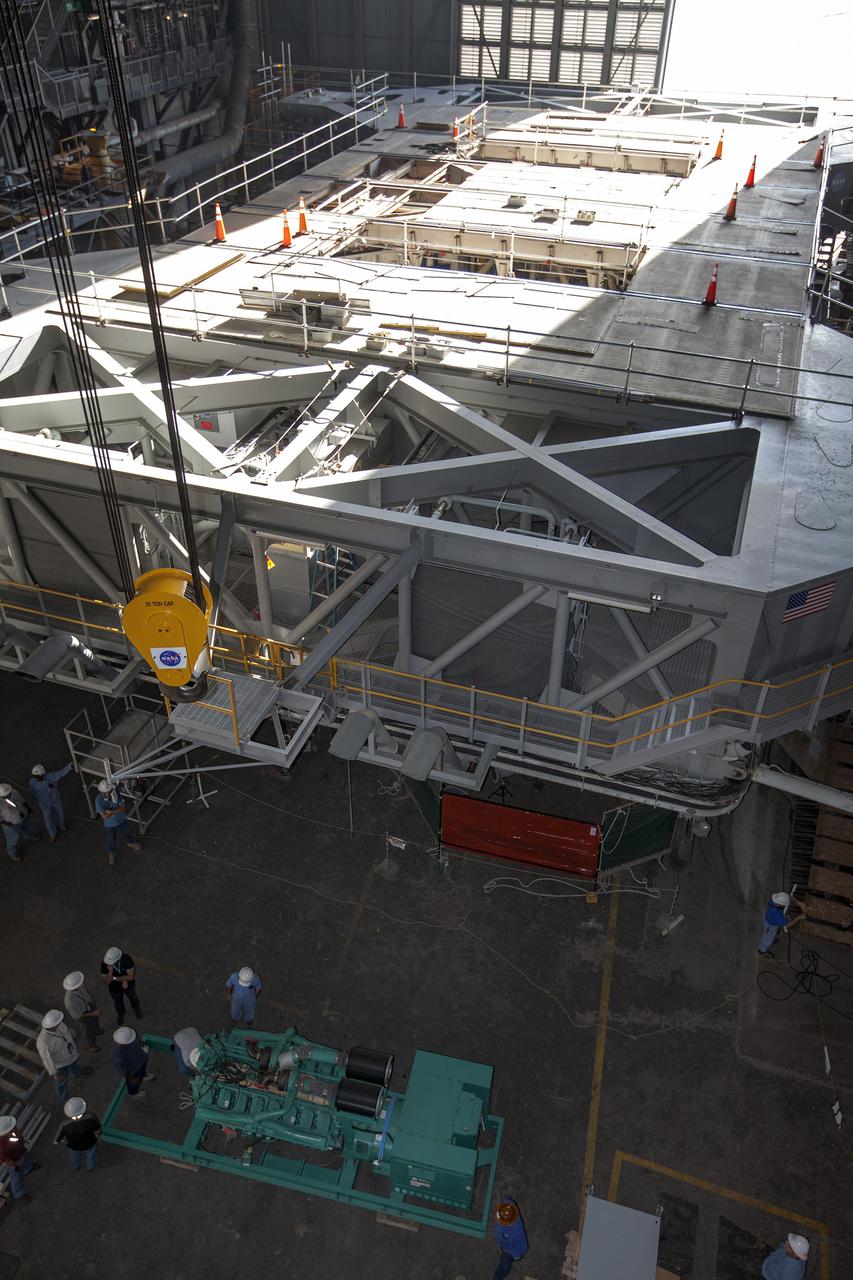
CAPE CANAVERAL, Fla. – Inside the Vehicle Assembly Building at NASA’s Kennedy Space Center in Florida, a large crane is lowered toward a new Cummins engine and generator that is being prepared for installation inside crawler-transporter 1 CT-1. The Apollo era diesel engines were removed so that the new engine could be installed. Work continues in high bay 3 to upgrade CT-1 as part of its general maintenance and could be available to carry commercial launch vehicles to the launch pad. The crawler-transporters were used to carry the mobile launcher platform and space shuttle to Launch Complex 39 for space shuttle launches for 30 years. Photo credit: NASA_Kim Shiflett
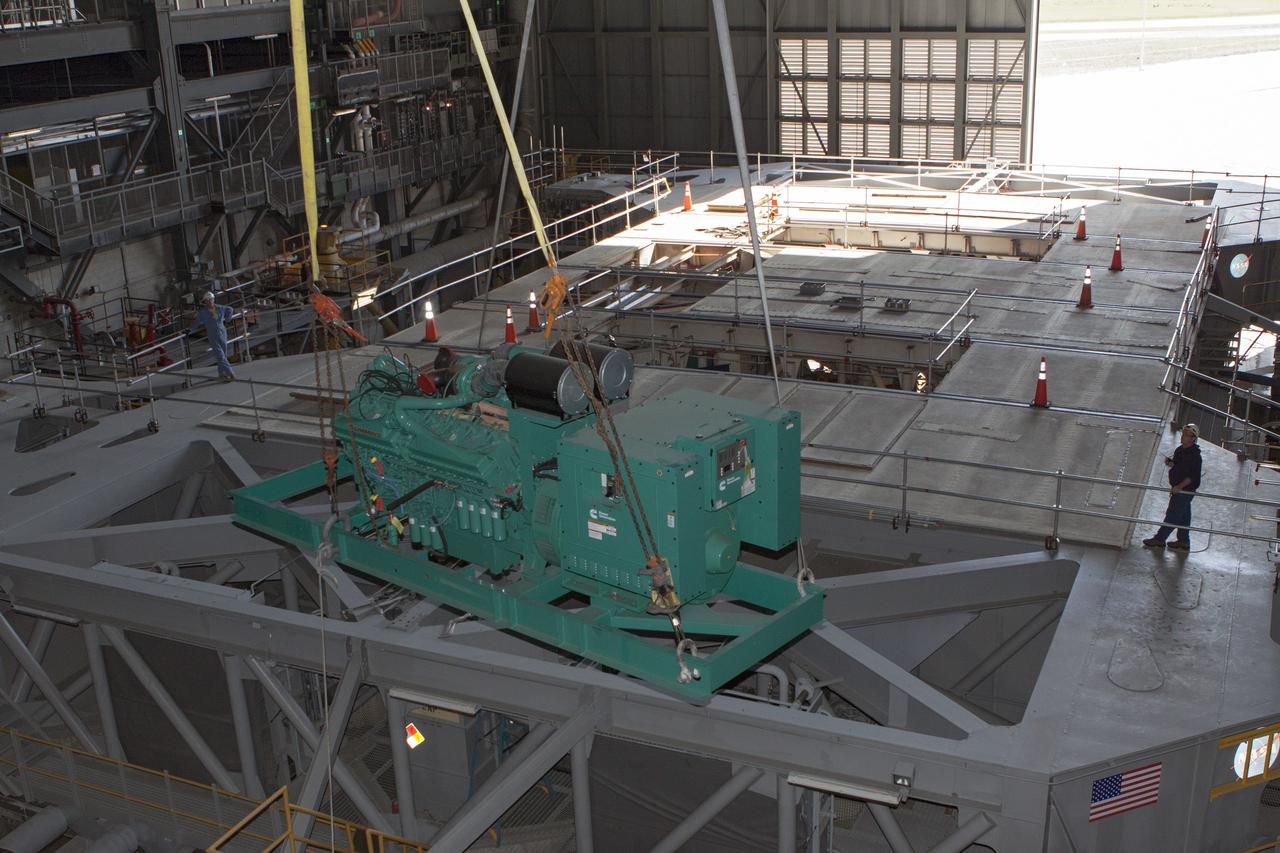
CAPE CANAVERAL, Fla. – Inside the Vehicle Assembly Building at NASA’s Kennedy Space Center in Florida, technicians monitor the progress as a large crane begins to lift a new Cummins engine and generator for installation inside crawler-transporter 1 CT-1. The Apollo era diesel engines were removed so that the new engine can be installed. Work continues in high bay 3 to upgrade CT-1 as part of its general maintenance and could be available to carry commercial launch vehicles to the launch pad. The crawler-transporters were used to carry the mobile launcher platform and space shuttle to Launch Complex 39 for space shuttle launches for 30 years. Photo credit: NASA_Kim Shiflett

KENNEDY SPACE CENTER, FLA. -- An upgraded Space Shuttle main engine (block 2 engine) sits in the Space Shuttle Main Engine Processing Facility. The new engine will be installed for its first flight on the orbiter Atlantis, on mission STS-104. The Block II Main Engine configuration is manufactured by Boeing Rocketdyne in Canoga Park, Calif., and includes a new Pratt & Whitney high-pressure fuel turbo pump. Engine improvements are managed by NASA’s Marshall Space Flight Center in Huntsville, Ala. Each Space Shuttle Main Engine is 14 feet (4.3 meters) long, weighs about 7,000 pounds (3,175 kilograms), and is 7.5 feet (2.3 meters) in diameter at the end of the nozzle
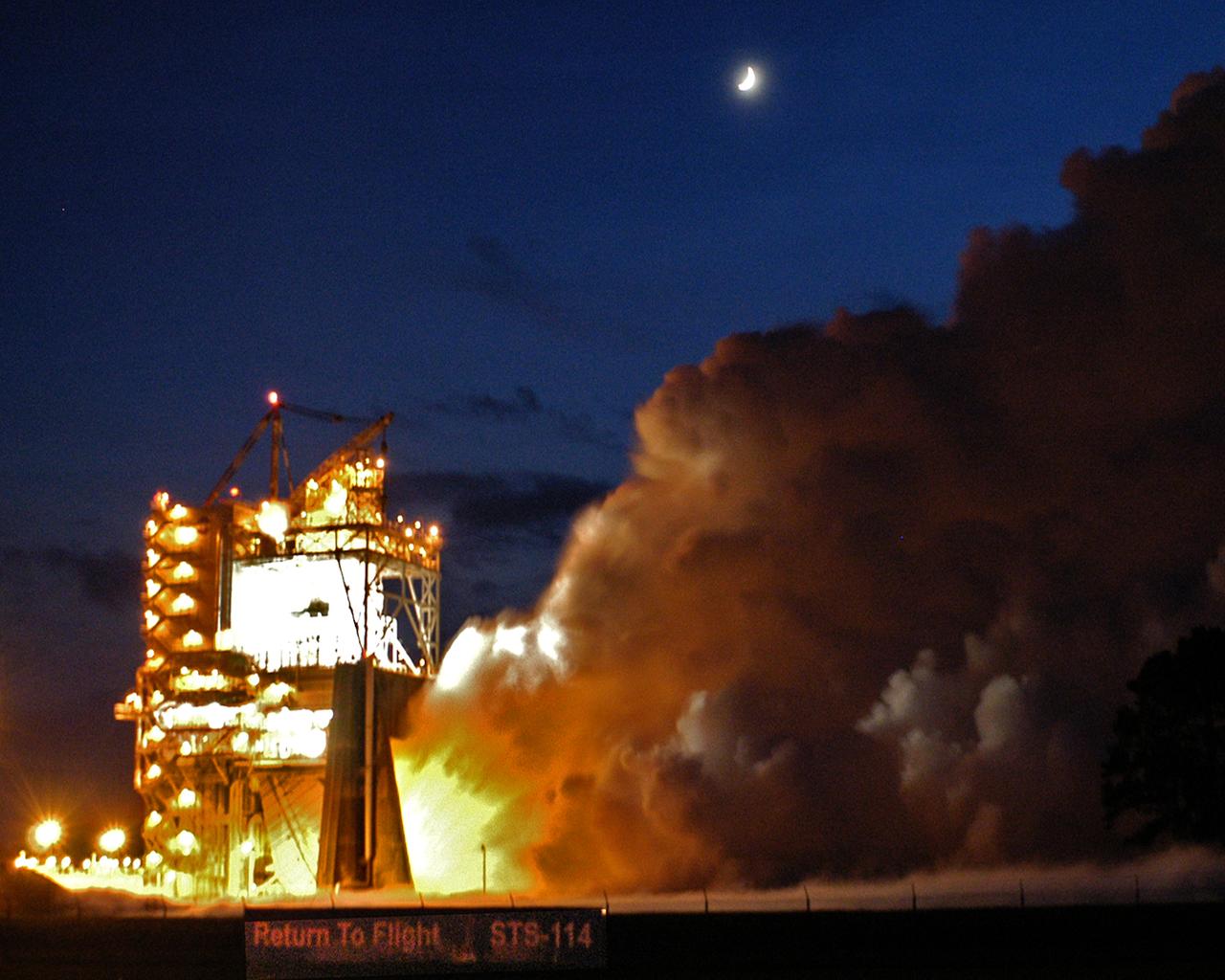
The Space Shuttle's Main Engine (SSME) reached another milestone Aug. 19, 2004, when a successful flight acceptance test was conducted at NASA Stennis Space Center (SSC). The engine tested was the final of three engines that will carry the next Space Shuttle into orbit. The engine will be shipped to NASA Kennedy Space Center in Florida for installation on Space Shuttle Discovery for STS-114, NASA's Return to Flight mission. The engine test, which began about 8:10 p.m. CDT, ran for 520 seconds (8 minutes), the length of time it takes for the Space Shuttle to reach orbit.
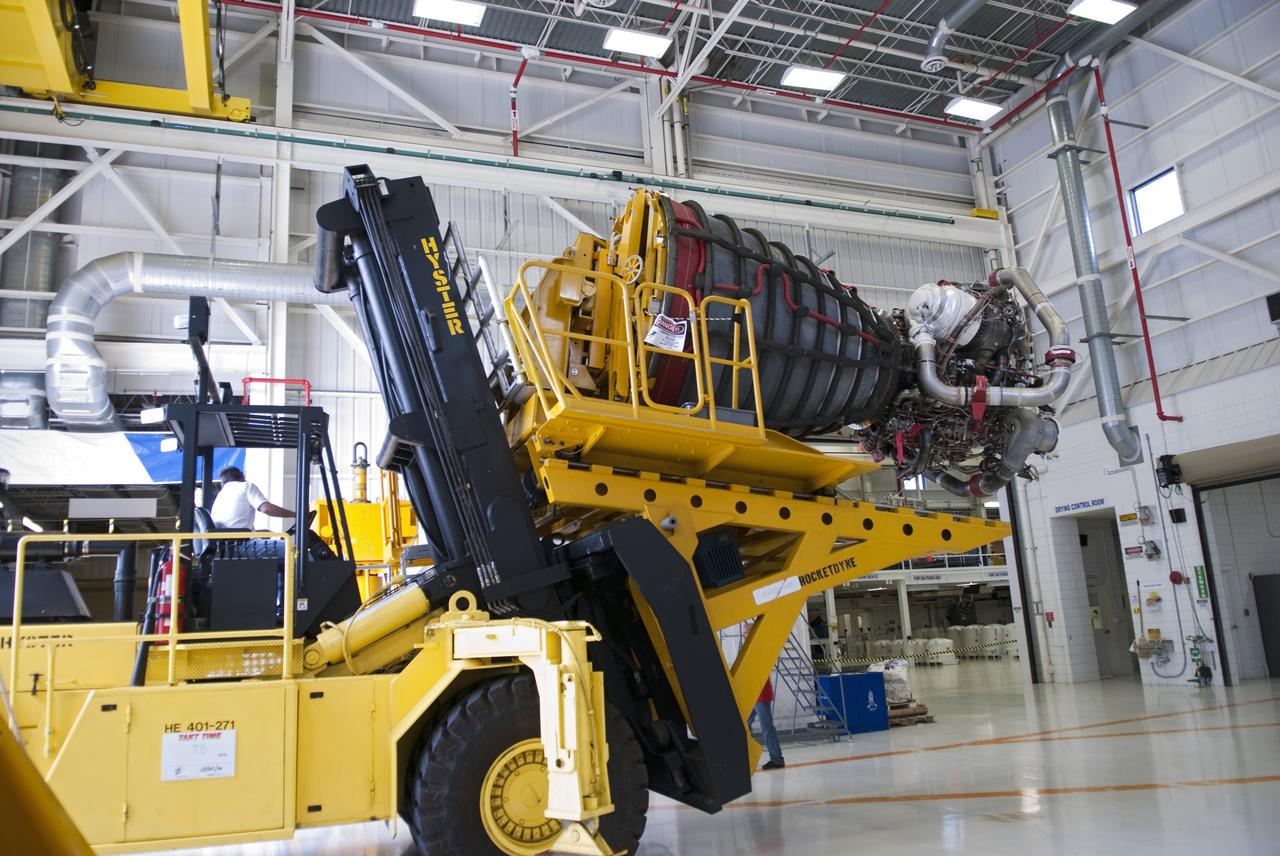
CAPE CANAVERAL, Fla. -- A heavy forklift with its specialized engine installer carries one of the main engines taken from space shuttle Discovery into the Space Shuttle Main Engine Processing Facility at NASA's Kennedy Space Center in Florida. The transition and retirement processing is expected to help rocket designers build next-generation spacecraft and prepare the shuttle for display. Photo credit: NASA/Jim Grossmann
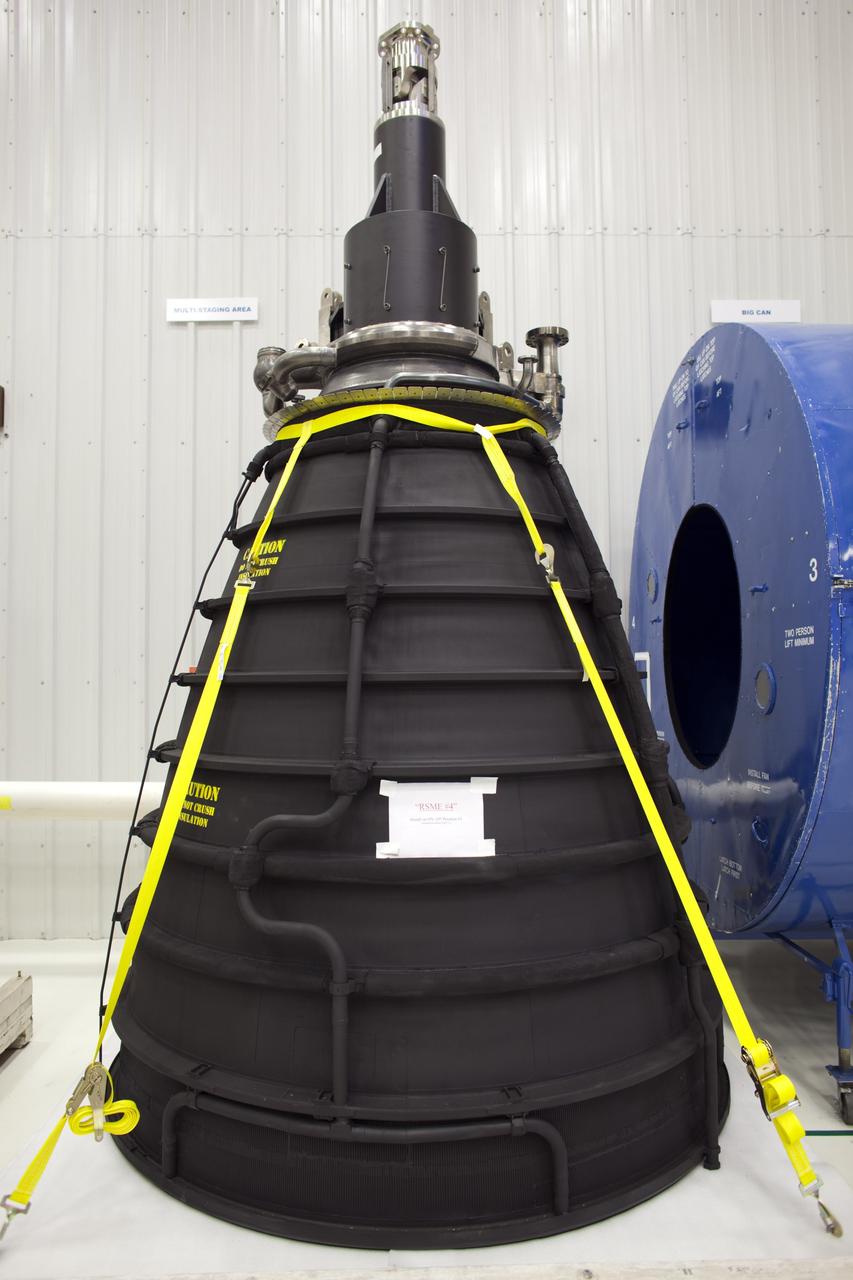
CAPE CANAVERAL, Fla. -- Inside the Pratt & Whitney Rocketdyne engine shop at NASA’s Kennedy Space Center in Florida, a completed replica shuttle main engine (RSME) sits on a stand. The RSME is one of three created for space shuttle Discovery. The replica engines will be transported from the engine shop to the processing facility for installation on Discovery in January 2012. The work is part of the Space Shuttle Program’s transition and retirement processing of shuttle Discovery. Discovery is being prepared for display at the Smithsonian’s National Air and Space Museum, Steven F. Udvar-Hazy Center in Chantilly, Va. For more information, visit http://www.nasa.gov/shuttle. Photo credit: NASA/Dimitri Gerondidakis
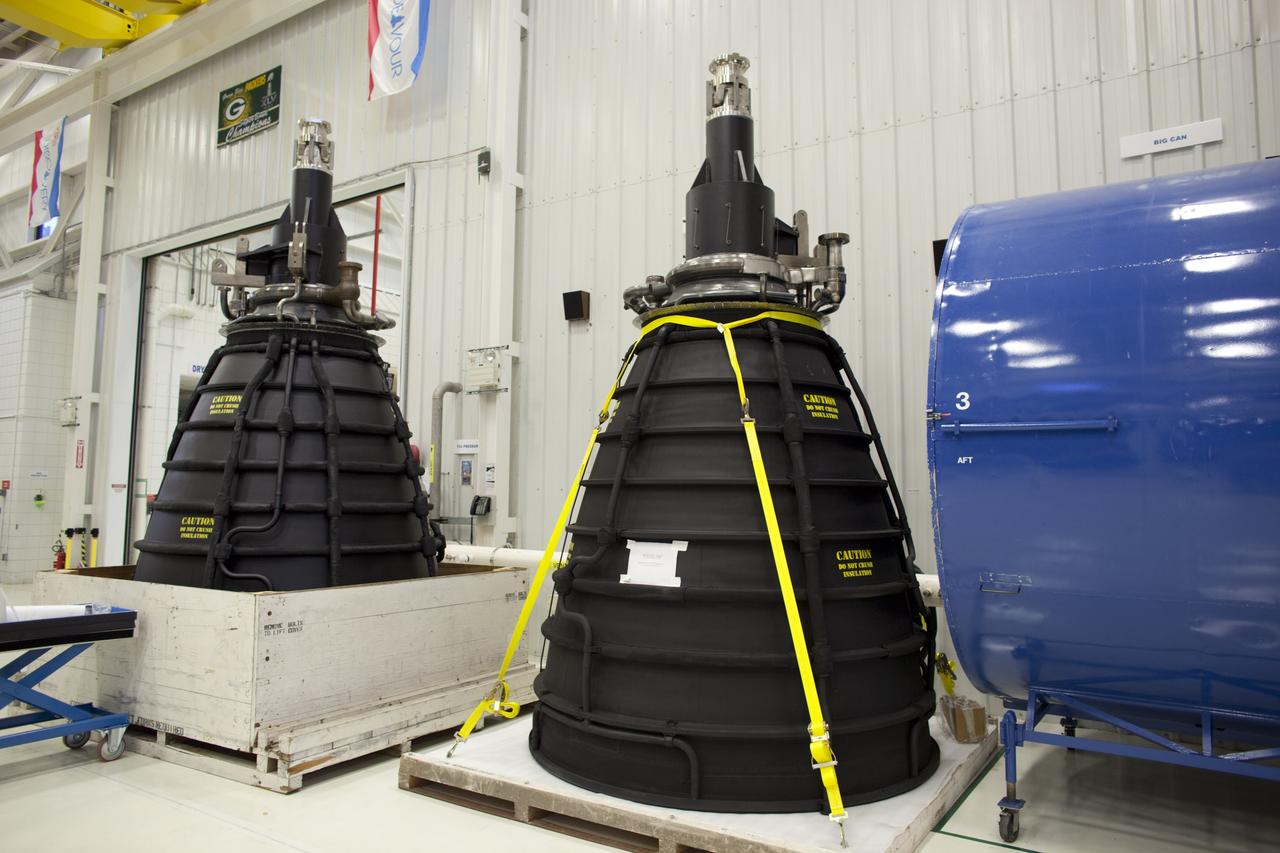
CAPE CANAVERAL, Fla. -- Inside the Pratt & Whitney Rocketdyne engine shop at NASA’s Kennedy Space Center in Florida, two of three completed replica shuttle main engines (RSMEs) sit on stands. The RSMEs were created for space shuttle Discovery. The replica engines will be transported from the engine shop to the processing facility for installation on Discovery in January 2012. The work is part of the Space Shuttle Program’s transition and retirement processing of shuttle Discovery. Discovery is being prepared for display at the Smithsonian’s National Air and Space Museum, Steven F. Udvar-Hazy Center in Chantilly, Va. For more information, visit http://www.nasa.gov/shuttle. Photo credit: NASA/Dimitri Gerondidakis
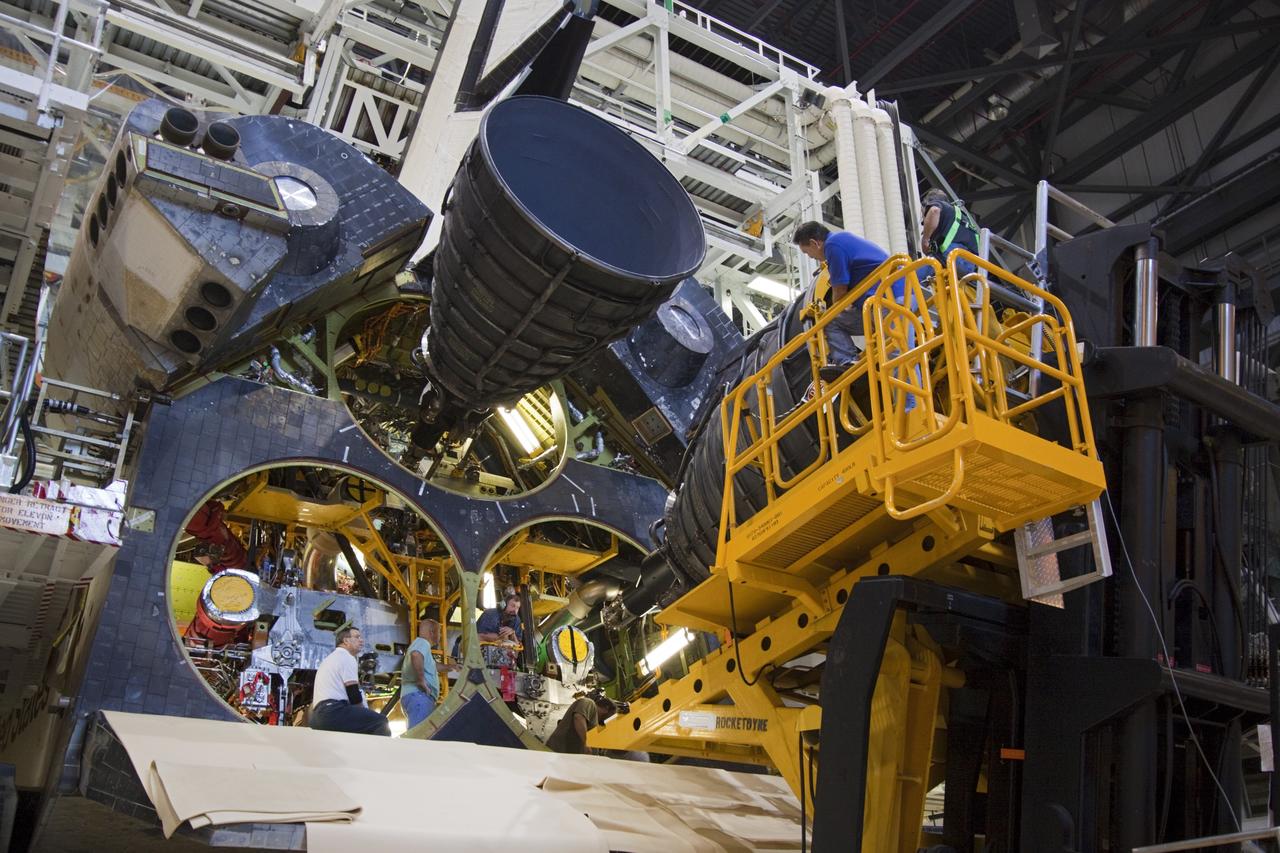
CAPE CANAVERAL, Fla. – Workers in Orbiter Processing Facility-1 at NASA’s Kennedy Space Center in Florida move a replica shuttle main engine (RSME) into position for installation on space shuttle Discovery. The RSME is one of three that will be installed on Discovery during Space Shuttle Program transition and retirement activities. The replicas are being built in the Pratt & Whitney Rocketdyne engine shop at Kennedy to replace the shuttle engines which will be placed in storage to support NASA's Space Launch System, under development. Discovery is being prepared for display at the Smithsonian’s National Air and Space Museum Steven F. Udvar-Hazy Center in Chantilly, Va. For more information, visit http://www.nasa.gov/shuttle. Photo credit: NASA/Jim Grossmann
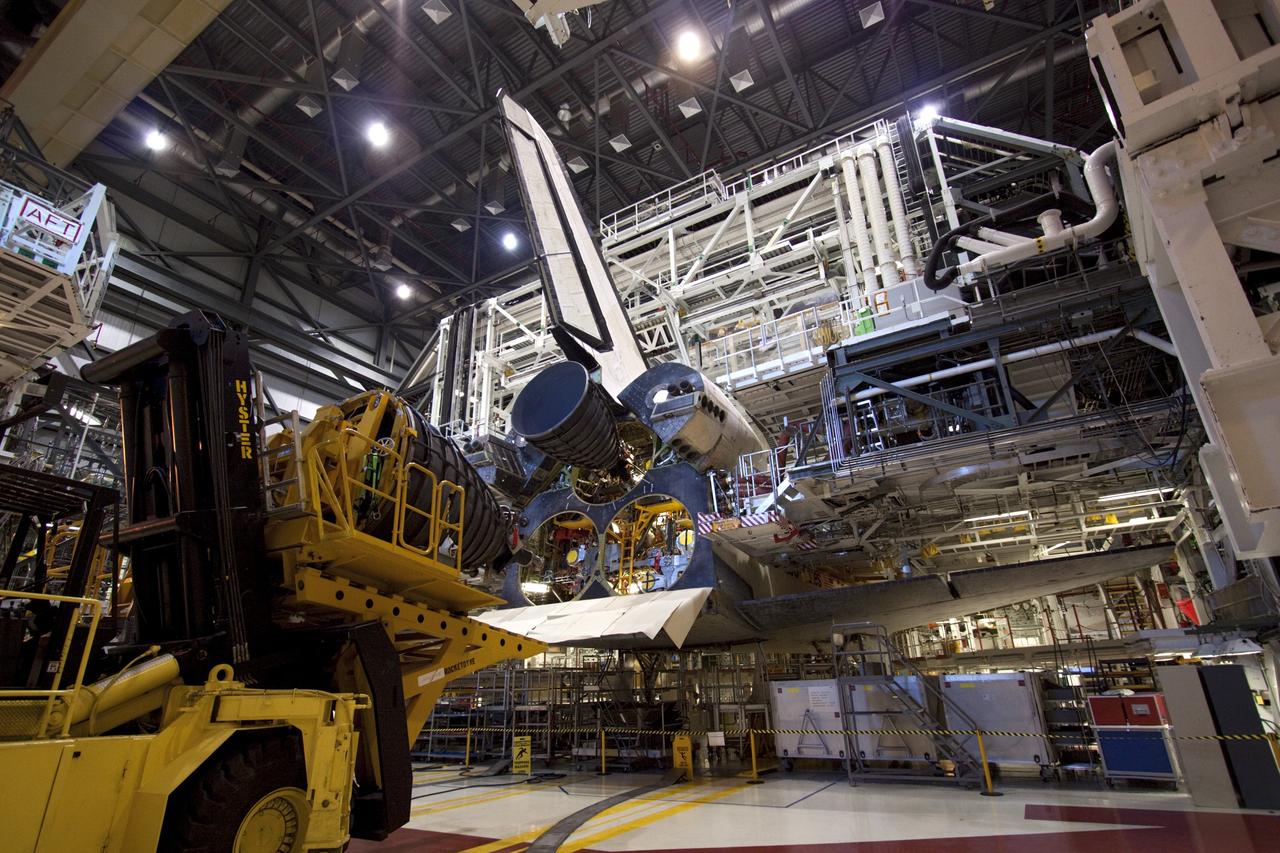
CAPE CANAVERAL, Fla. – Preparations are under way to install a replica shuttle main engine (RSME) on space shuttle Discovery in Orbiter Processing Facility-1 at NASA’s Kennedy Space Center in Florida. The RSME is one of three that will be installed on Discovery during Space Shuttle Program transition and retirement activities. The replicas are being built in the Pratt & Whitney Rocketdyne engine shop at Kennedy to replace the shuttle engines which will be placed in storage to support NASA's Space Launch System, under development. Discovery is being prepared for display at the Smithsonian’s National Air and Space Museum Steven F. Udvar-Hazy Center in Chantilly, Va. For more information, visit http://www.nasa.gov/shuttle. Photo credit: NASA/Jim Grossmann
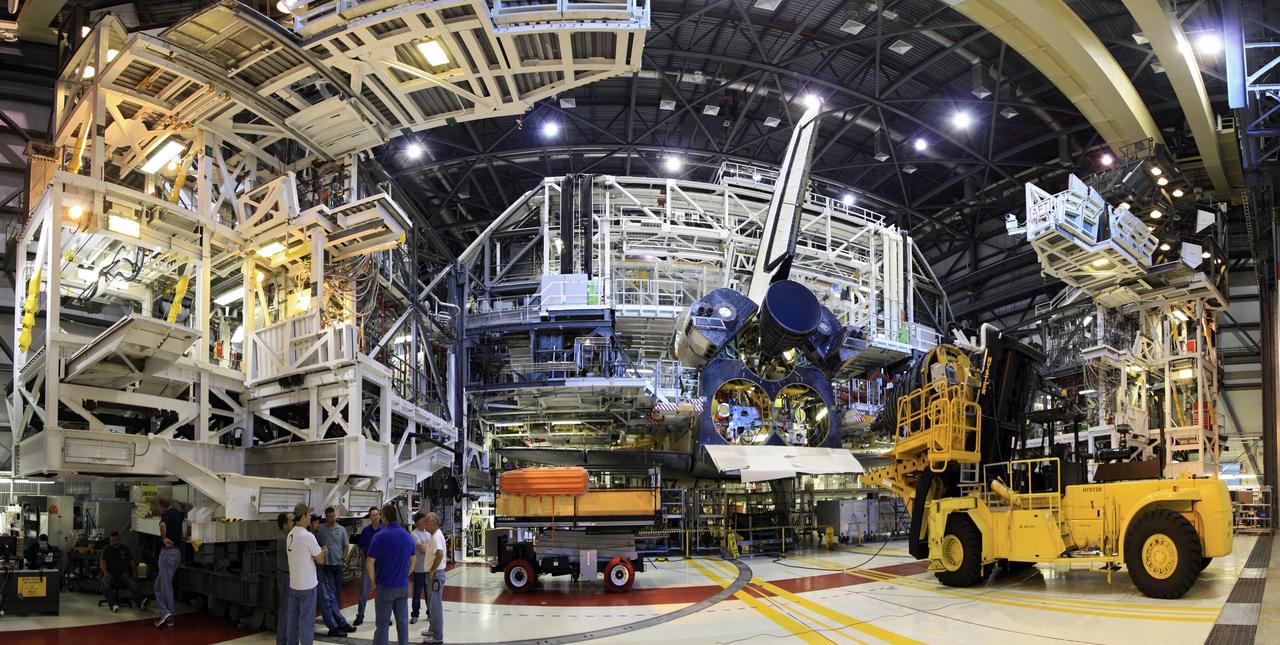
CAPE CANAVERAL, Fla. – This panoramic view of Orbiter Processing Facility-1 at NASA’s Kennedy Space Center in Florida was taken during preparations to install the second of three replica shuttle main engines (RSMEs) on space shuttle Discovery. Altogether, three RSMEs will be installed on Discovery during Space Shuttle Program transition and retirement activities. The replicas are built in the Pratt & Whitney Rocketdyne engine shop at Kennedy to replace the shuttle engines which will be placed in storage to support NASA's Space Launch System, under development. Discovery is being prepared for display at the Smithsonian’s National Air and Space Museum Steven F. Udvar-Hazy Center in Chantilly, Va. For more information, visit http://www.nasa.gov/shuttle. Photo credit: NASA/Jim Grossmann

KENNEDY SPACE CENTER, FLA. -- This close-up of Space Shuttle Endeavour's main engines shows the replacement for main engine No. 3 (lower right) ready to be installed. Following routine testing procedures on a separate test engine, analysis revealed delamination on the wall of the engine's main combustion chamber. When data revealed that one of Endeavour's engines had undergone similar testing procedures, managers opted to replace the suspect engine as a precaution. Space Shuttle Endeavour is targeted for launch at 1:11 p.m. EST Jan. 13, 2000, on mission STS-99. It will be Endeavour's 14th flight. STS-99 is the Shuttle Radar Topography Mission
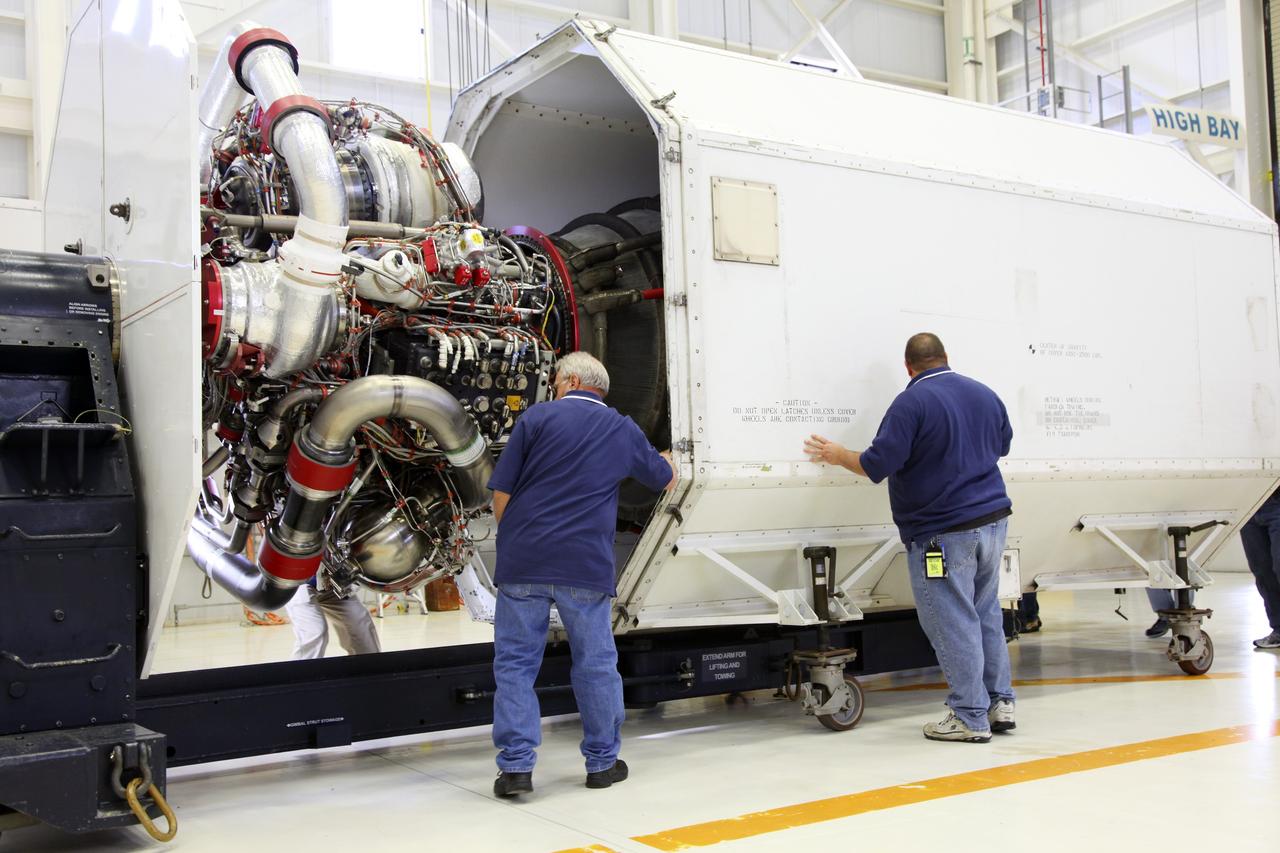
CAPE CANAVERAL, Fla. – In the Space Shuttle Main Engine Processing Facility at NASA’s Kennedy Space Center in Florida, technicians oversee the installation of a Pratt Whitney Rocketdyne space shuttle main engine (SSME) into a transportation canister. This is the second of the 15 engines used during the Space Shuttle Program to be prepared for transfer to NASA's Stennis Space Center in Mississippi. The engines will be stored at Stennis for future use on NASA's new heavy-lift rocket, the Space Launch System (SLS), which will carry NASA's new Orion spacecraft, cargo, equipment and science experiments to space. For more information, visit http://www.nasa.gov/shuttle. Photo credit: NASA/Gianni Woods
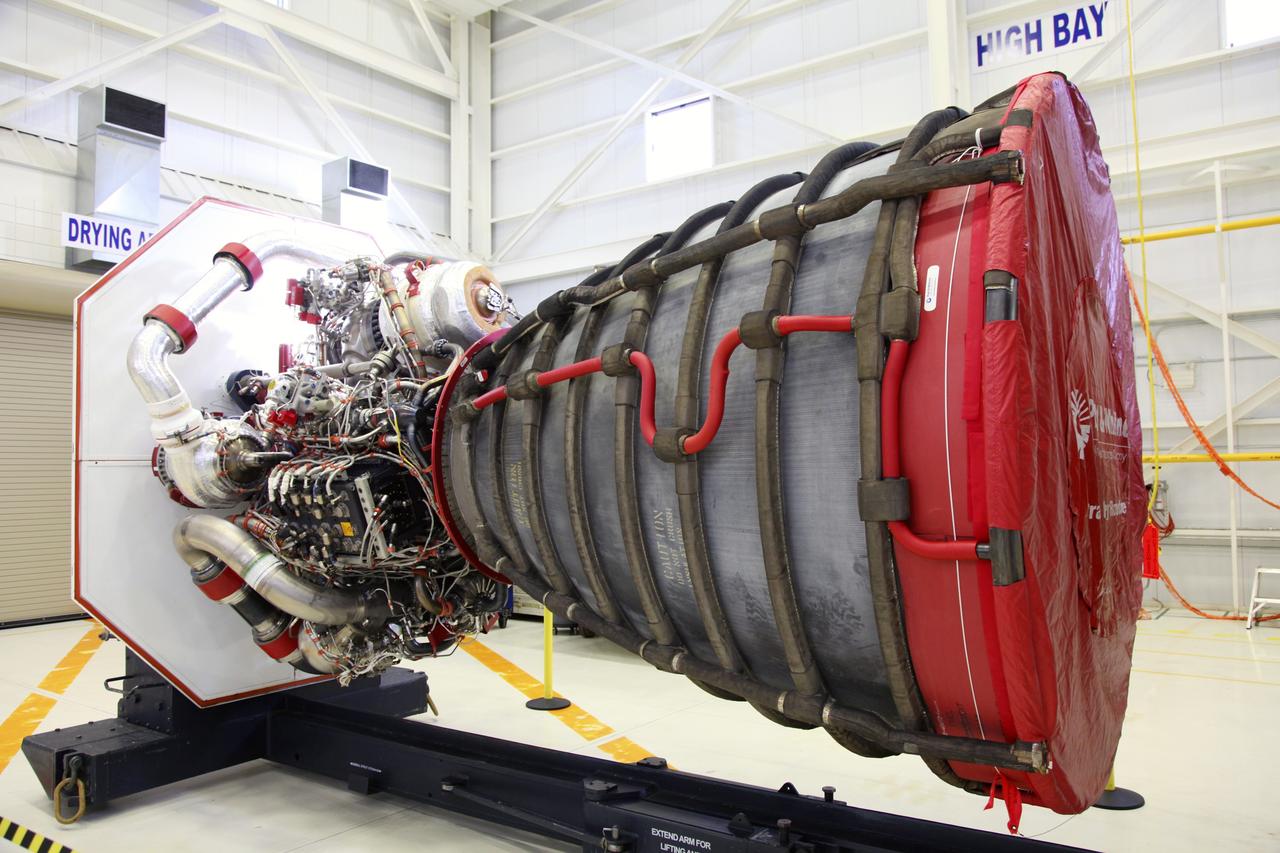
CAPE CANAVERAL, Fla. – In the Space Shuttle Main Engine Processing Facility at NASA’s Kennedy Space Center in Florida, preparations are under way to install a Pratt Whitney Rocketdyne space shuttle main engine (SSME) into a transportation canister. This is the second of the 15 engines used during the Space Shuttle Program to be prepared for transfer to NASA's Stennis Space Center in Mississippi. The engines will be stored at Stennis for future use on NASA's new heavy-lift rocket, the Space Launch System (SLS), which will carry NASA's new Orion spacecraft, cargo, equipment and science experiments to space. For more information, visit http://www.nasa.gov/shuttle. Photo credit: NASA/Gianni Woods
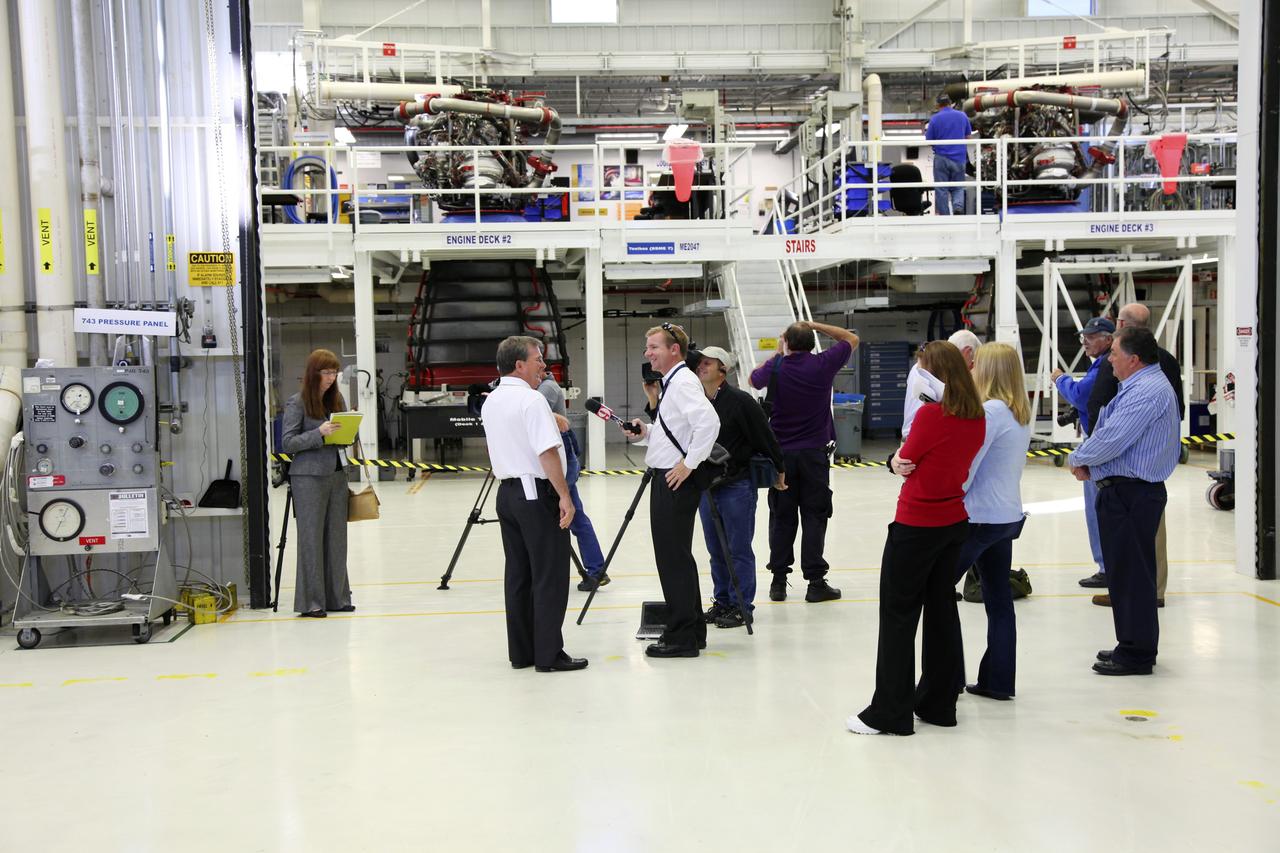
CAPE CANAVERAL, Fla. – In the Space Shuttle Main Engine Processing Facility at NASA’s Kennedy Space Center in Florida, media representatives are on hand for the installation of a Pratt Whitney Rocketdyne space shuttle main engine (SSME) into a transportation canister. This is the second of the 15 engines used during the Space Shuttle Program to be prepared for transfer to NASA's Stennis Space Center in Mississippi. The engines will be stored at Stennis for future use on NASA's new heavy-lift rocket, the Space Launch System (SLS), which will carry NASA's new Orion spacecraft, cargo, equipment and science experiments to space. For more information, visit http://www.nasa.gov/shuttle. Photo credit: NASA/Gianni Woods