
F-15 #281 and F-104 #826 fly in formation during Space Shuttle tile testing. Note the tiles mounted on the right wing of the F-15 and the centerline test fixture of the F-104.
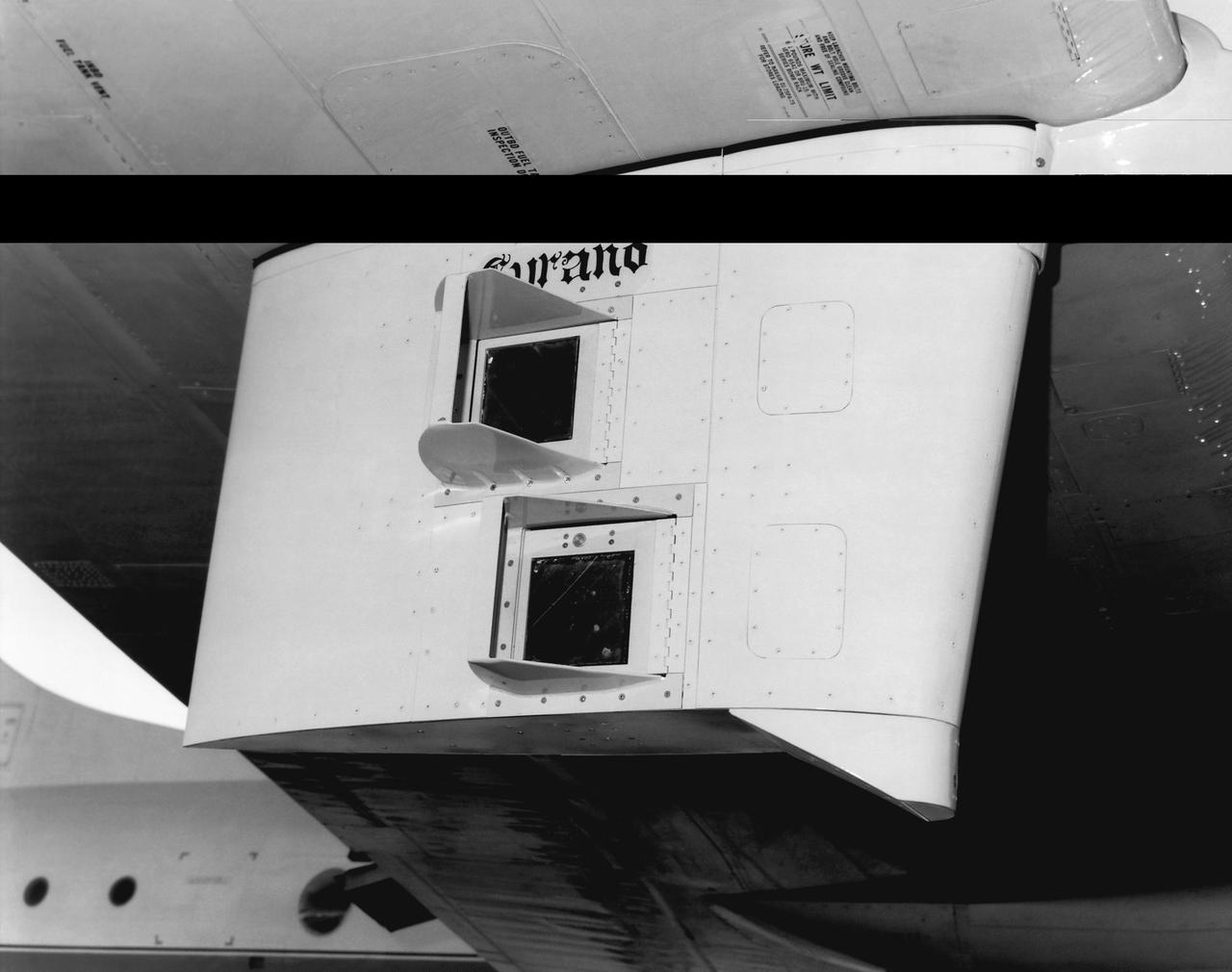
This photo shows the Shuttle tile flight test fixture under the wing of a National Oceanographic and Atmospheric Administration WP-3D aircraft.
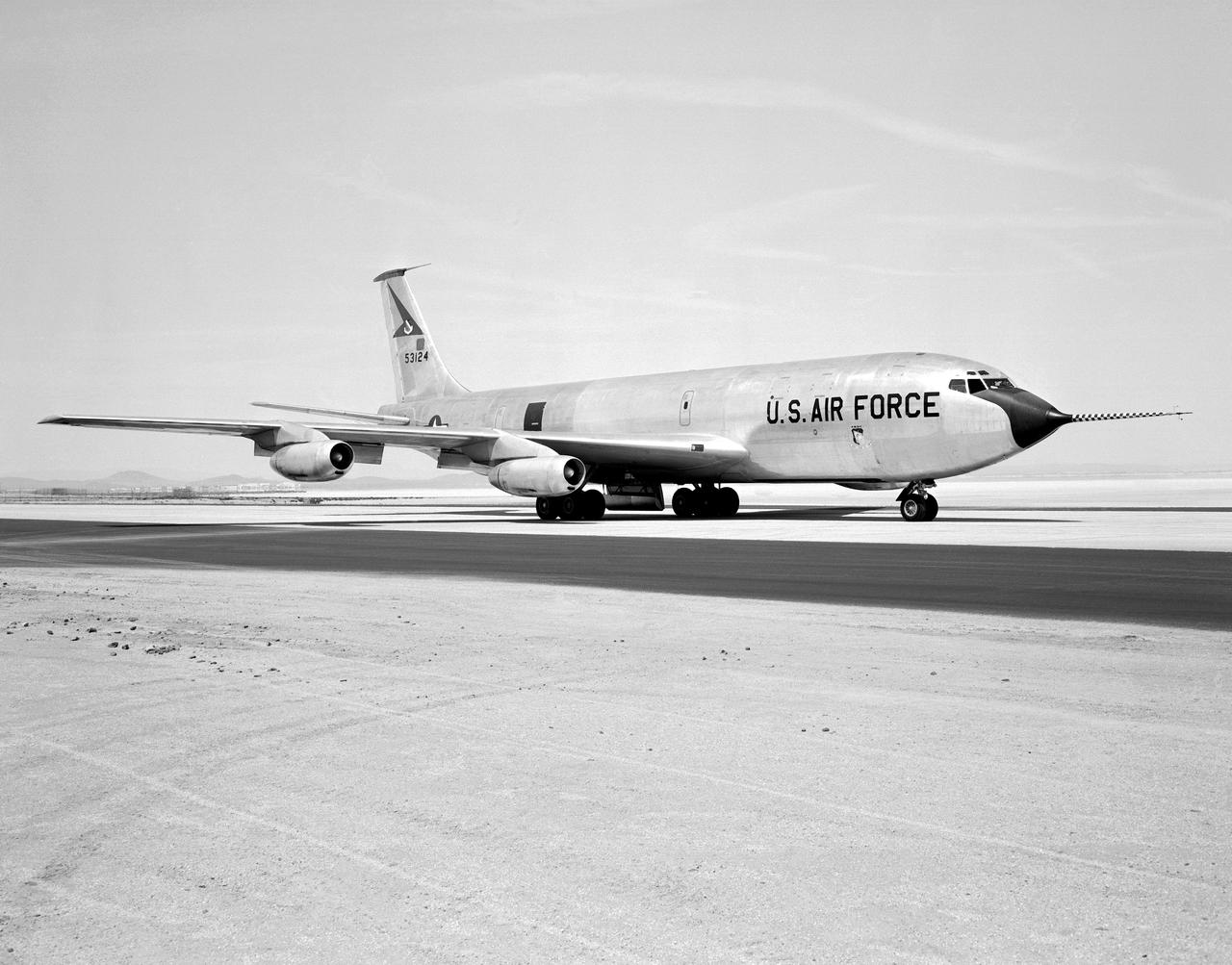
The Boeing KC-135 Stratotanker, besides being used extensively in its primary role as an inflight aircraft refueler, has assisted in several projects at the NASA Dryden Flight Research Center, Edwards, California. In 1957 and 1958, Dryden was asked by what was then the Civil Aeronautics Administration (later absorbed into the Federal Aviation Administration (FAA) in 1958) to help establish new approach procedure guidelines on cloud-ceiling and visibility minimums for Boeing's first jet airliner, the B-707. Dryden used a KC-135 (the military variant of the 707), seen here on the runway at Edwards Air Force Base, to aid the CAA in these tests. In 1979 and 1980, Dryden was again involved with general aviation research with the KC-135. This time, a special wingtip "winglet", developed by Richard Whitcomb of Langley Research Center, was tested on the jet aircraft. Winglets are small, nearly vertical fins installed on an airplane's wing tips to help produce a forward thrust in the vortices that typically swirl off the end of the wing, thereby reducing drag. This winglet idea was tested at the Dryden Flight Research Center on a KC-135A tanker loaned to NASA by the Air Force. The research showed that the winglets could increase an aircraft's range by as much as 7 percent at cruise speeds. The first application of NASA's winglet technology in industry was in general aviation business jets, but winglets are now being incorporated into most new commercial and military transport jets, including the Gulfstream III and IV business jets, the Boeing 747-400 and MD-11 airliners, and the C-17 military transport. In the 1980's, a KC-135 was used in support of the Space Shuttle program. Since the Shuttle was to be launched from Florida, researchers wanted to test the effect of rain on the sensitive thermal tiles. Tiles were mounted on special fixtures on an F-104 aircraft and a P-3 Orion. The F-104 was flown in actual rain conditions, and also behind the KC-135 spray tanker as it rel
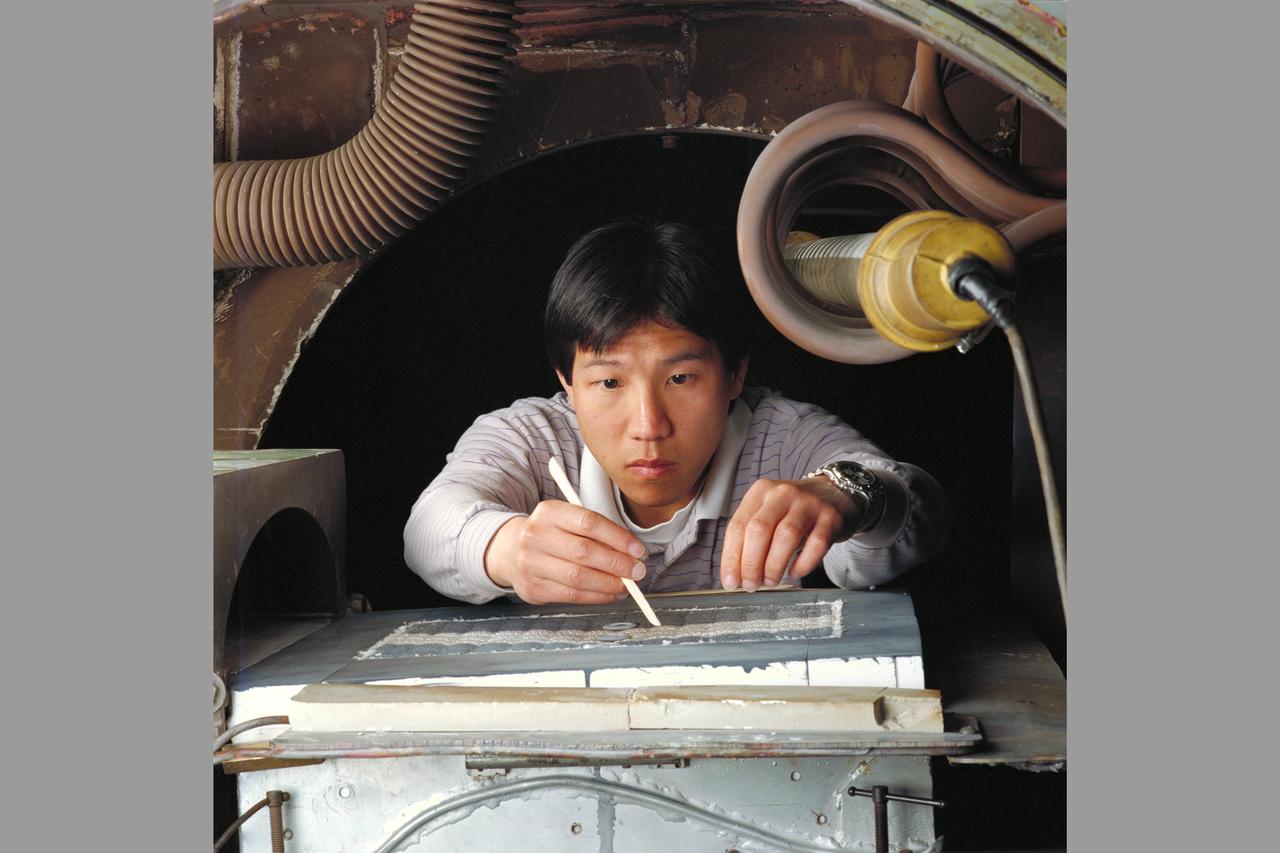
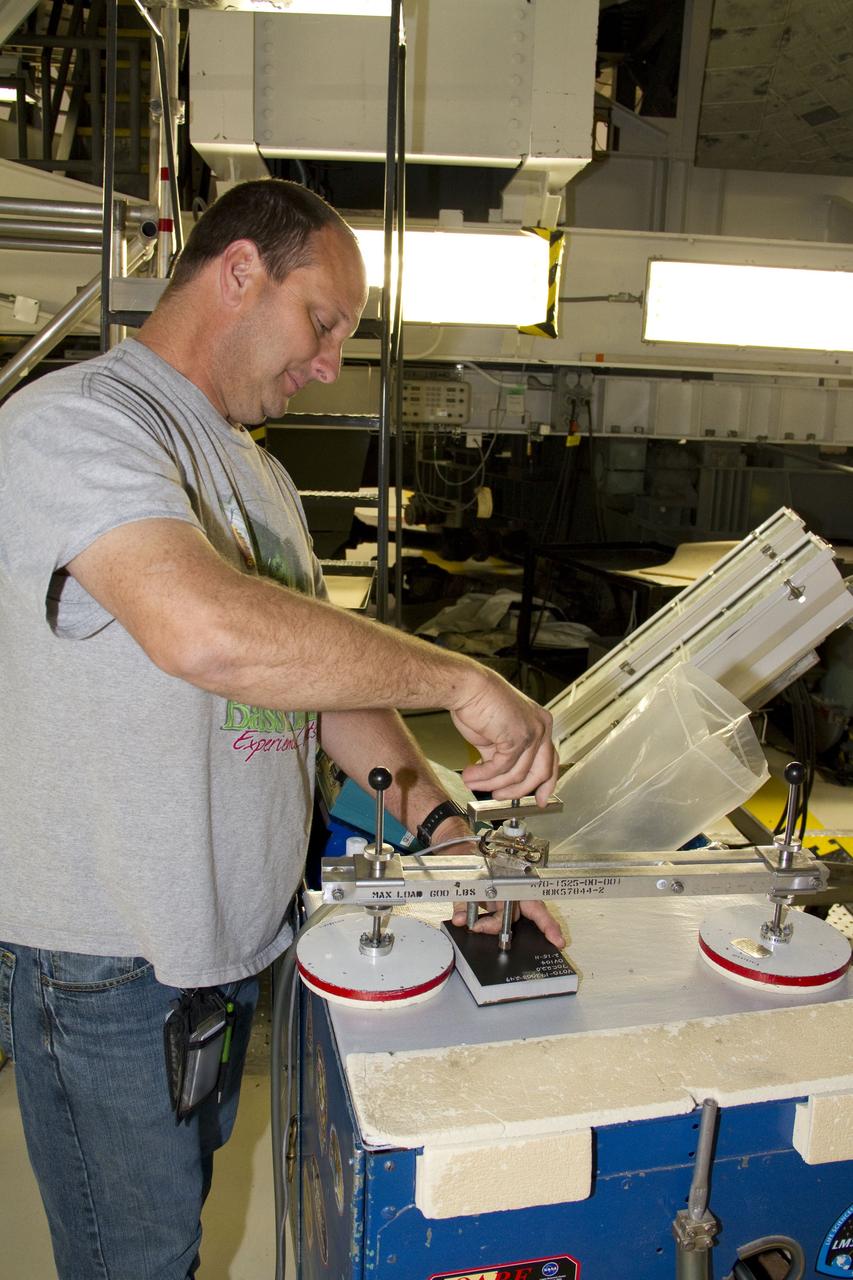
Space Shuttle tile rain erosion test: Frank Hui sets MDA samples in Panel Test Facility for PTF-65
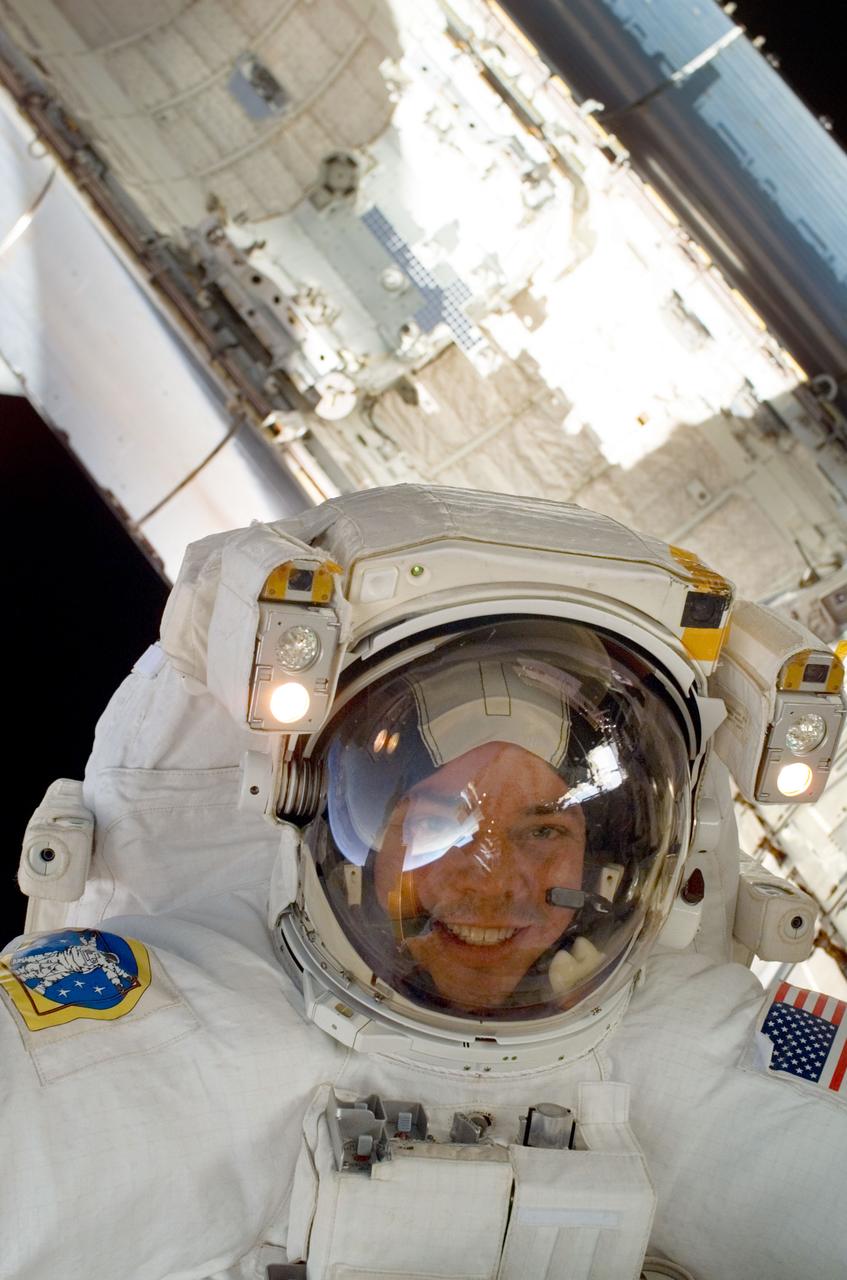
ISS016-E-033400 (21 March 2008) --- Astronaut Robert L. Behnken, STS-123 mission specialist, participates in the mission's fourth scheduled session of extravehicular activity (EVA) as construction and maintenance continue on the International Space Station. During the 6-hour, 24-minute spacewalk, Behnken and astronaut Mike Foreman (out of frame), mission specialist, replaced a failed Remote Power Control Module -- essentially a circuit breaker -- on the station's truss. The spacewalkers also tested a repair method for damaged heat resistant tiles on the space shuttle. This technique used a caulk-gun-like tool named the Tile Repair Ablator Dispenser to dispense a material called Shuttle Tile Ablator-54 into purposely damaged heat shield tiles. The sample tiles will be returned to Earth to undergo extensive testing on the ground. A portion of the Space Shuttle Endeavour payload bay is visible in the background.
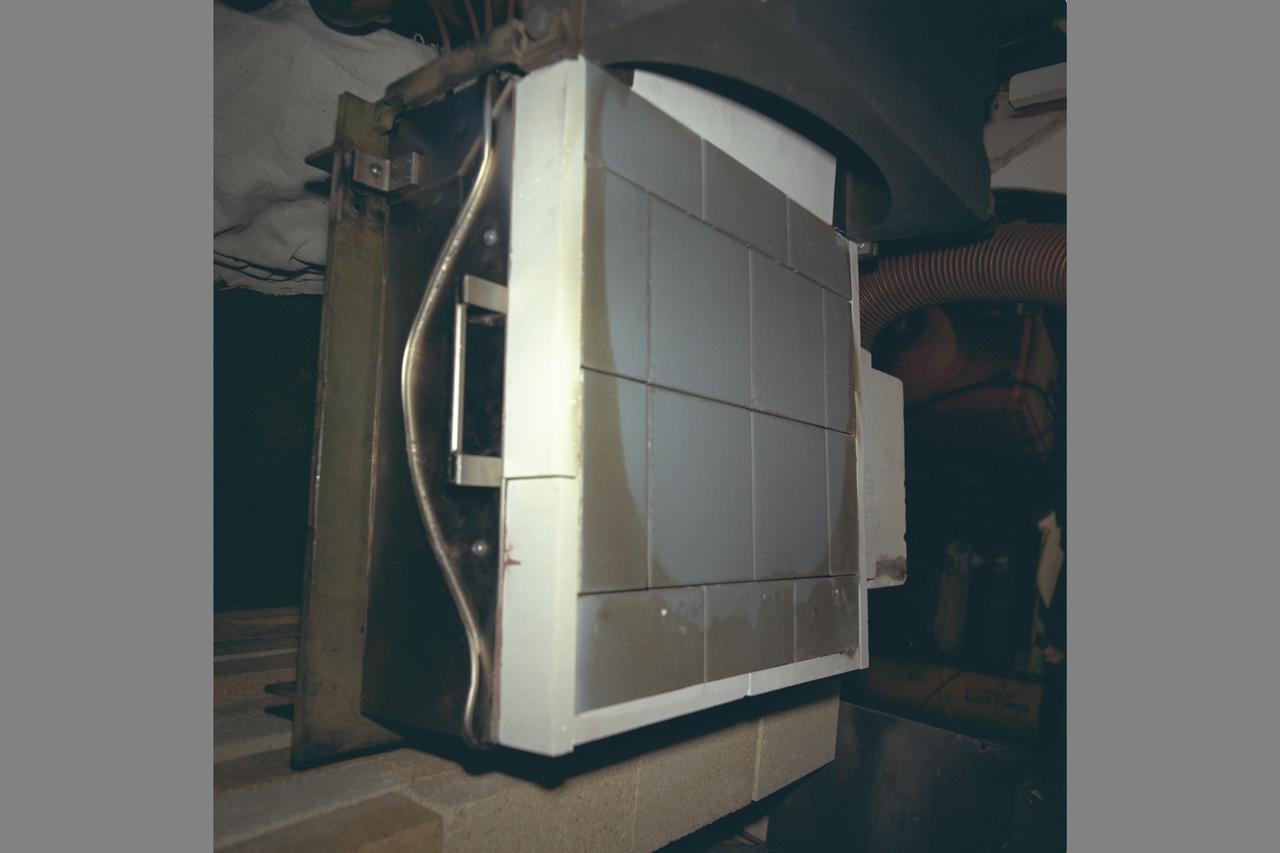
Space Shuttle Tile Thermal Protection System testing in Ames Arc Jet facilities
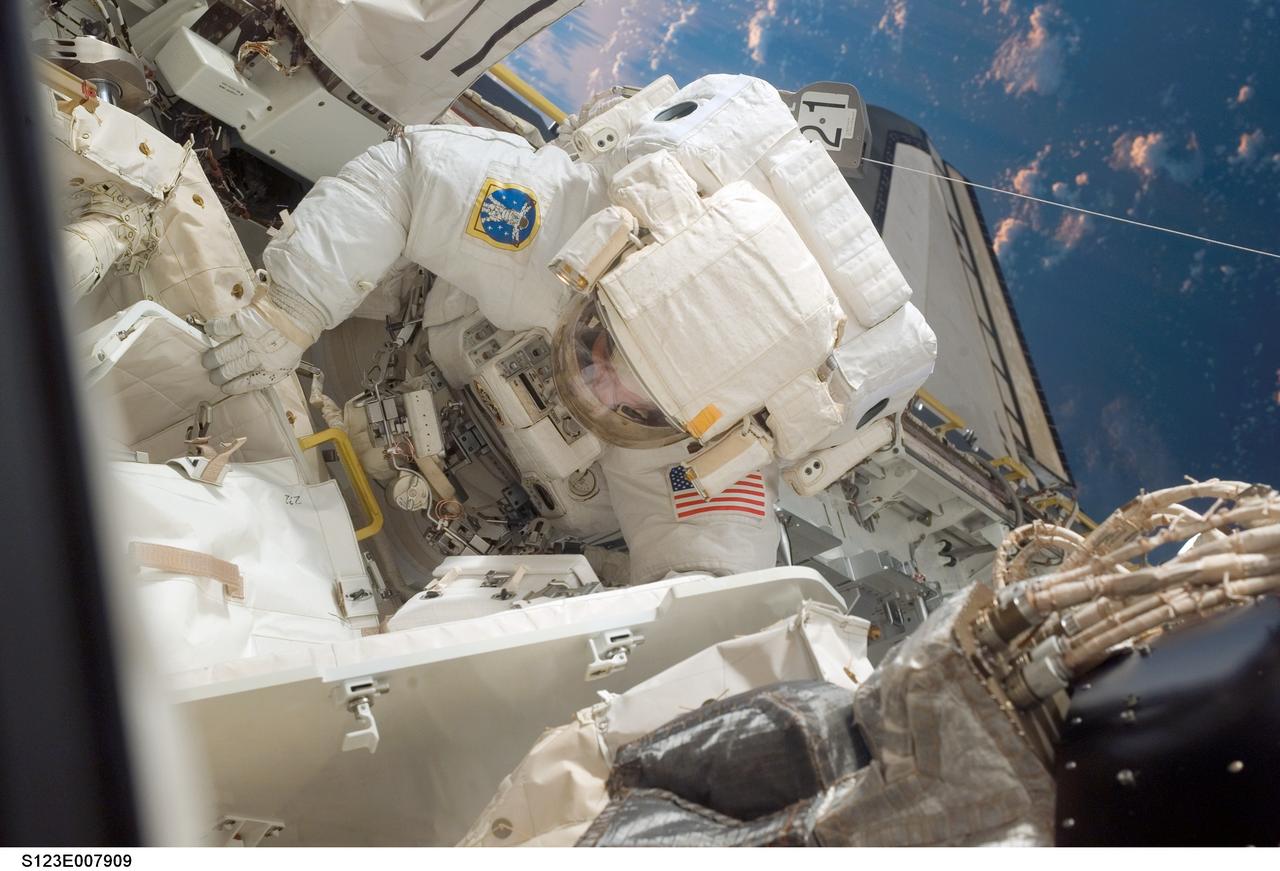
S123-E-007909 (21 March 2008) --- Astronaut Robert L. Behnken, STS-123 mission specialist, participates in the mission's fourth scheduled session of extravehicular activity (EVA) as construction and maintenance continue on the International Space Station. During the 6-hour, 24-minute spacewalk, Behnken and astronaut Mike Foreman (out of frame), mission specialist, replaced a failed Remote Power Control Module -- essentially a circuit breaker -- on the station's truss. The spacewalkers also tested a repair method for damaged heat resistant tiles on the space shuttle. This technique used a caulk-gun-like tool named the Tile Repair Ablator Dispenser to dispense a material called Shuttle Tile Ablator-54 into purposely damaged heat shield tiles. The sample tiles will be returned to Earth to undergo extensive testing on the ground.

S123-E-007838 (21 March 2008) --- Astronauts Robert L. Behnken (top) and Mike Foreman, both STS-123 mission specialists, participate in the mission's fourth scheduled session of extravehicular activity (EVA) as construction and maintenance continue on the International Space Station. During the 6-hour, 24-minute spacewalk, Behnken and Foreman replaced a failed Remote Power Control Module -- essentially a circuit breaker -- on the station's truss. The spacewalkers also tested a repair method for damaged heat resistant tiles on the space shuttle. This technique used a caulk-gun-like tool named the Tile Repair Ablator Dispenser to dispense a material called Shuttle Tile Ablator-54 into purposely damaged heat shield tiles. The sample tiles will be returned to Earth to undergo extensive testing on the ground.
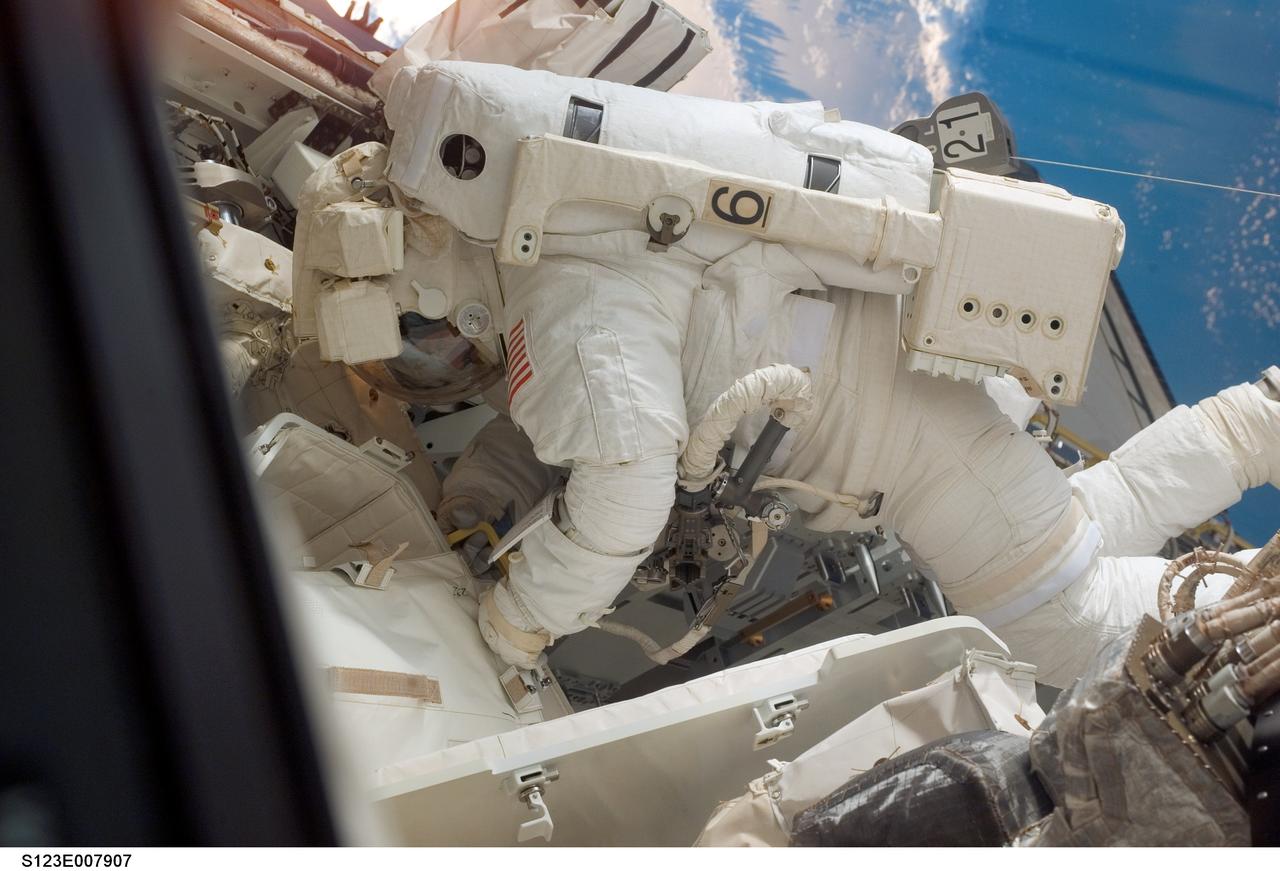
S123-E-007907 (21 March 2008) --- Astronaut Robert L. Behnken, STS-123 mission specialist, participates in the mission's fourth scheduled session of extravehicular activity (EVA) as construction and maintenance continue on the International Space Station. During the 6-hour, 24-minute spacewalk, Behnken and astronaut Mike Foreman (out of frame), mission specialist, replaced a failed Remote Power Control Module -- essentially a circuit breaker -- on the station's truss. The spacewalkers also tested a repair method for damaged heat resistant tiles on the space shuttle. This technique used a caulk-gun-like tool named the Tile Repair Ablator Dispenser to dispense a material called Shuttle Tile Ablator-54 into purposely damaged heat shield tiles. The sample tiles will be returned to Earth to undergo extensive testing on the ground.
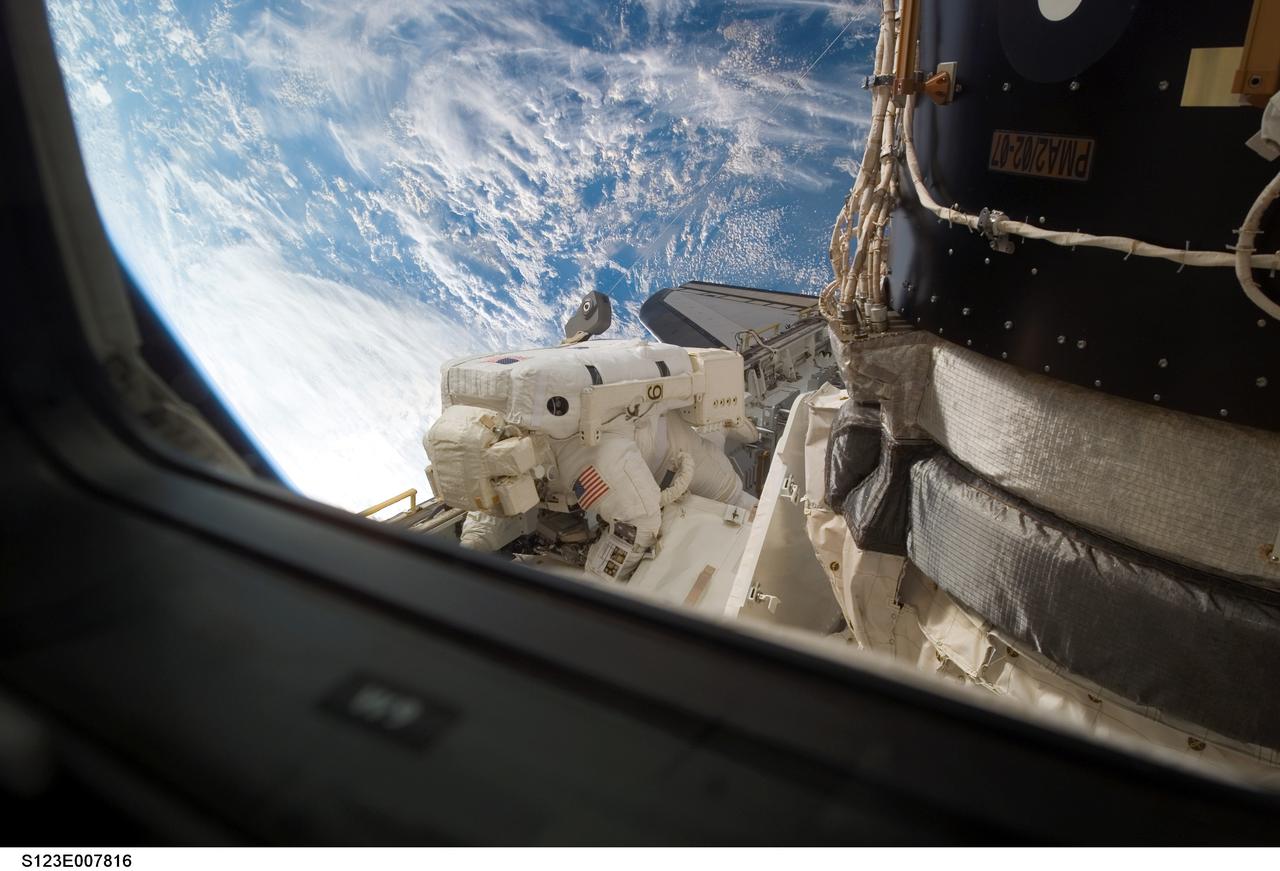
S123-E-007816 (21 March 2008) --- Astronaut Robert L. Behnken, STS-123 mission specialist, participates in the mission's fourth scheduled session of extravehicular activity (EVA) as construction and maintenance continue on the International Space Station. During the 6-hour, 24-minute spacewalk, Behnken and astronaut Mike Foreman (out of frame), mission specialist, replaced a failed Remote Power Control Module -- essentially a circuit breaker -- on the station's truss. The spacewalkers also tested a repair method for damaged heat resistant tiles on the space shuttle. This technique used a caulk-gun-like tool named the Tile Repair Ablator Dispenser to dispense a material called Shuttle Tile Ablator-54 into purposely damaged heat shield tiles. The sample tiles will be returned to Earth to undergo extensive testing on the ground.
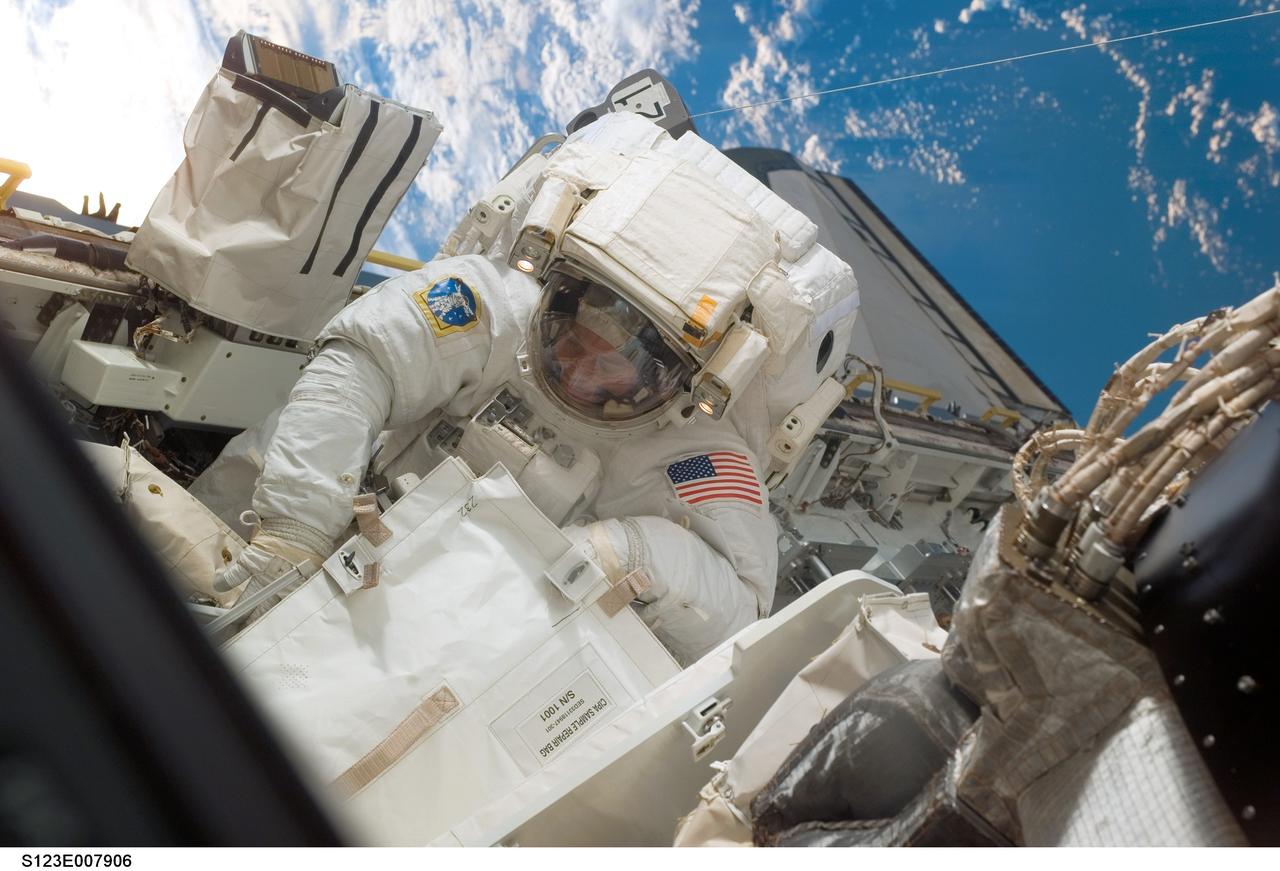
S123-E-007906 (21 March 2008) --- Astronaut Robert L. Behnken, STS-123 mission specialist, participates in the mission's fourth scheduled session of extravehicular activity (EVA) as construction and maintenance continue on the International Space Station. During the 6-hour, 24-minute spacewalk, Behnken and astronaut Mike Foreman (out of frame), mission specialist, replaced a failed Remote Power Control Module -- essentially a circuit breaker -- on the station's truss. The spacewalkers also tested a repair method for damaged heat resistant tiles on the space shuttle. This technique used a caulk-gun-like tool named the Tile Repair Ablator Dispenser to dispense a material called Shuttle Tile Ablator-54 into purposely damaged heat shield tiles. The sample tiles will be returned to Earth to undergo extensive testing on the ground.
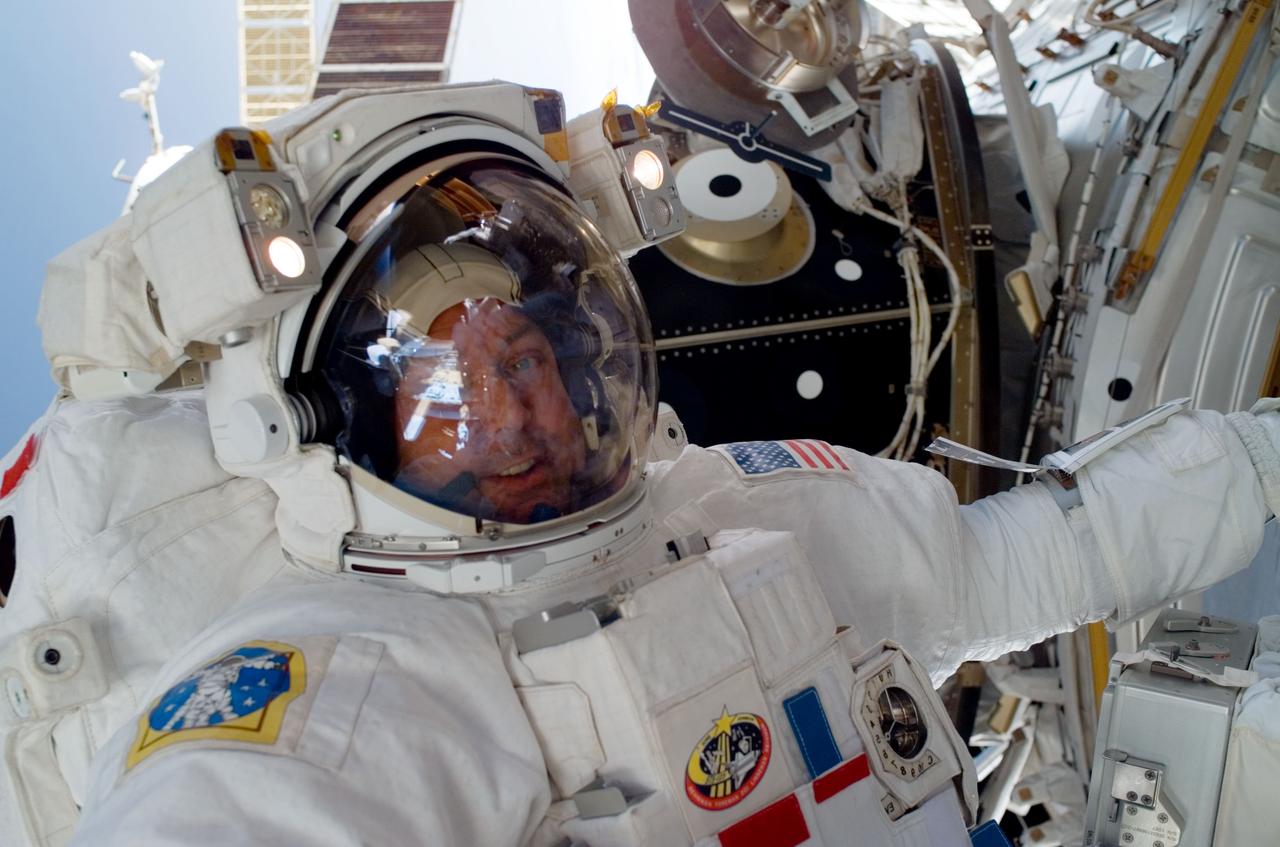
ISS016-E-033394 (21 March 2008) --- Astronaut Mike Foreman, STS-123 mission specialist, participates in the mission's fourth scheduled session of extravehicular activity (EVA) as construction and maintenance continue on the International Space Station. During the 6-hour, 24-minute spacewalk, Foreman and astronaut Robert L. Behnken (out of frame), mission specialist, replaced a failed Remote Power Control Module -- essentially a circuit breaker -- on the station's truss. The spacewalkers also tested a repair method for damaged heat resistant tiles on the space shuttle. This technique used a caulk-gun-like tool named the Tile Repair Ablator Dispenser to dispense a material called Shuttle Tile Ablator-54 into purposely damaged heat shield tiles. The sample tiles will be returned to Earth to undergo extensive testing on the ground.
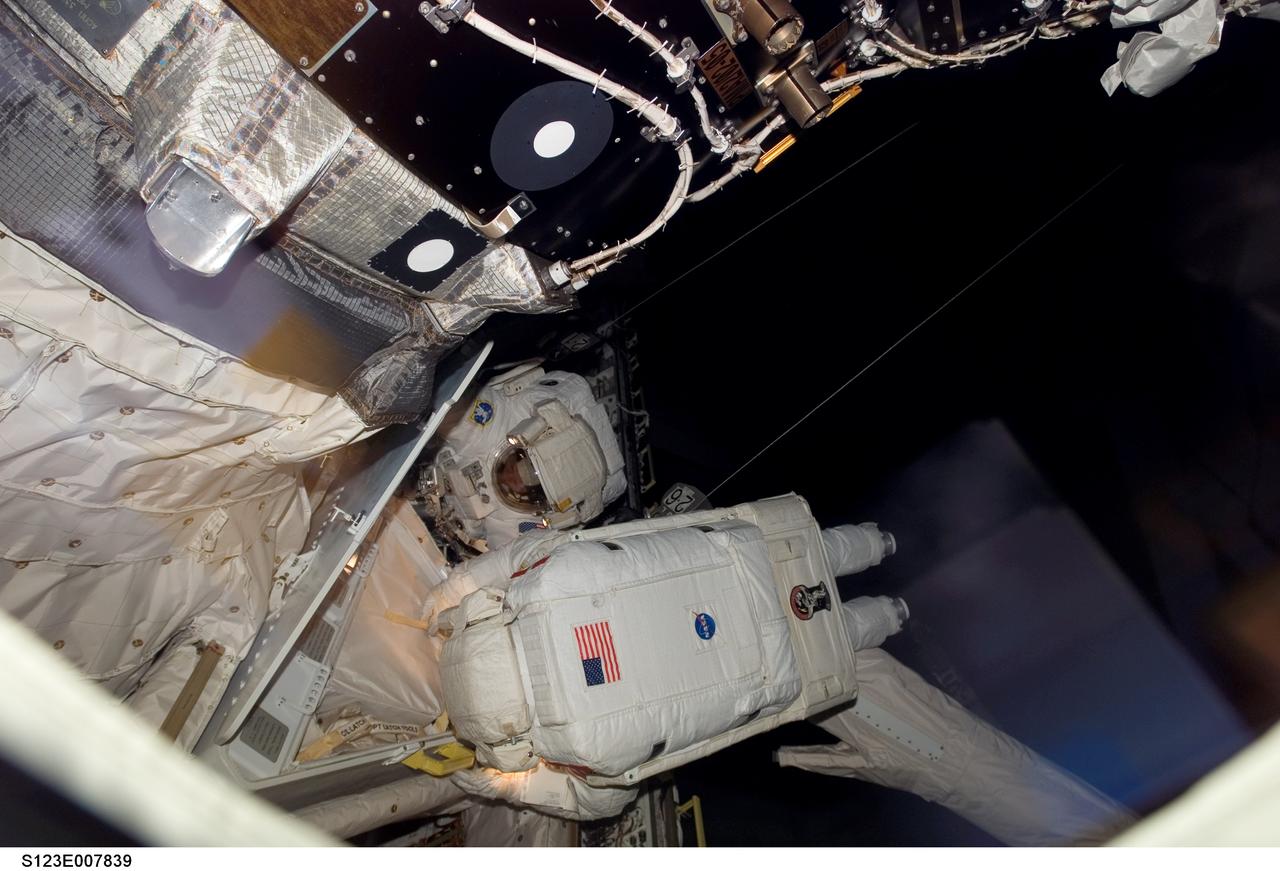
S123-E-007839 (21 March 2008) --- Astronauts Mike Foreman (foreground) and Robert L. Behnken, both STS-123 mission specialists, participate in the mission's fourth scheduled session of extravehicular activity (EVA) as construction and maintenance continue on the International Space Station. During the 6-hour, 24-minute spacewalk, Foreman and Behnken replaced a failed Remote Power Control Module -- essentially a circuit breaker -- on the station's truss. The spacewalkers also tested a repair method for damaged heat resistant tiles on the space shuttle. This technique used a caulk-gun-like tool named the Tile Repair Ablator Dispenser to dispense a material called Shuttle Tile Ablator-54 into purposely damaged heat shield tiles. The sample tiles will be returned to Earth to undergo extensive testing on the ground.
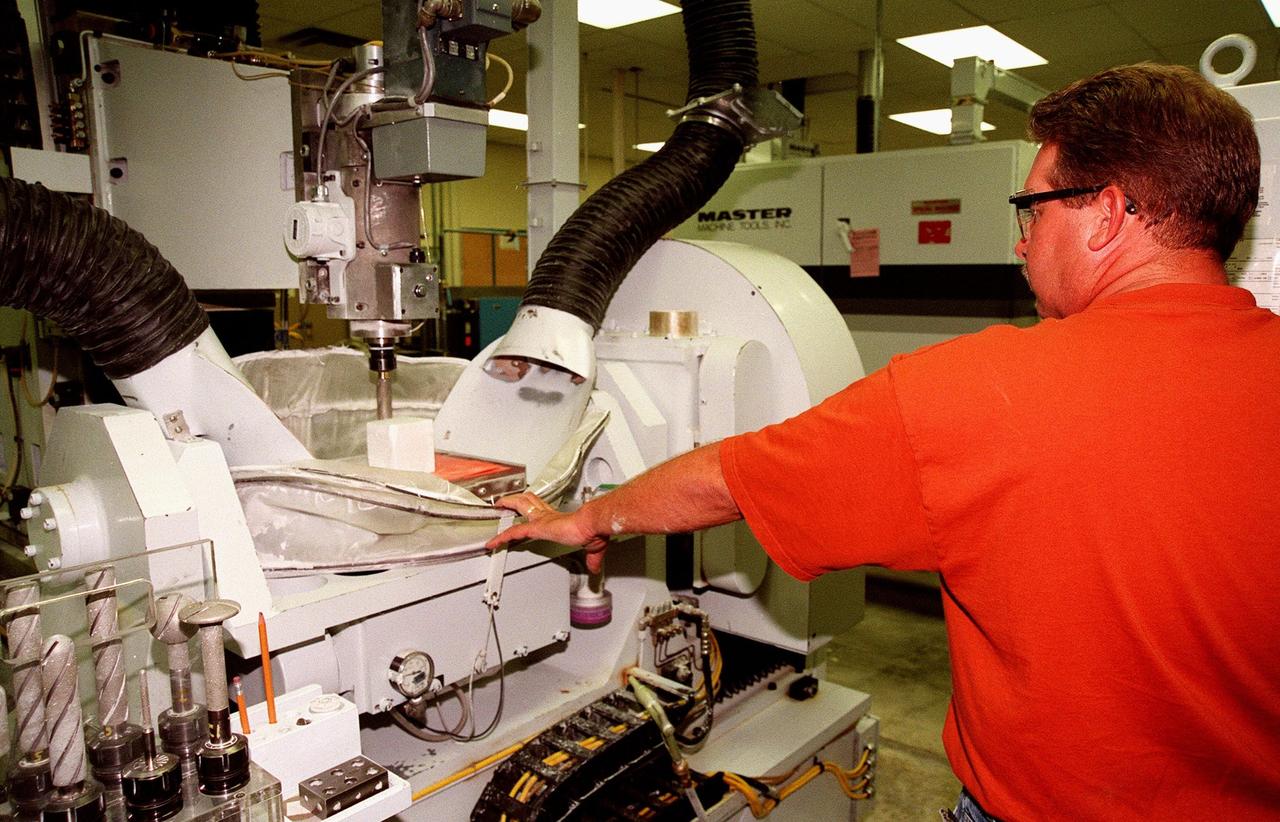
In the Tile Fabrication Shop, Tony Rollins, with United Space Alliance, holds down a curtain while making a test sample of tile on a block 5-axis computerized numerical control milling machine. About 70 percent of a Space Shuttle orbiter’s external surface is shielded from heat by a network of more than 24,000 tiles formed from a silica fiber compound. They are known as High-Temperature Reusable Surface Insulation (HRSI) tiles and Low-Temperature Reusable Surface Insulation (LRSI) tiles. Most HRSI tiles are 6 inches square, but may be as large as 12 inches in some areas, and 1 to 5 inches thick. LRSI tiles are generally 8 inches square, ranging from 0.2to 1-inch thick. More advanced materials such as Flexible Insulation Blankets have replaced tiles on some upper surfaces of the orbiter
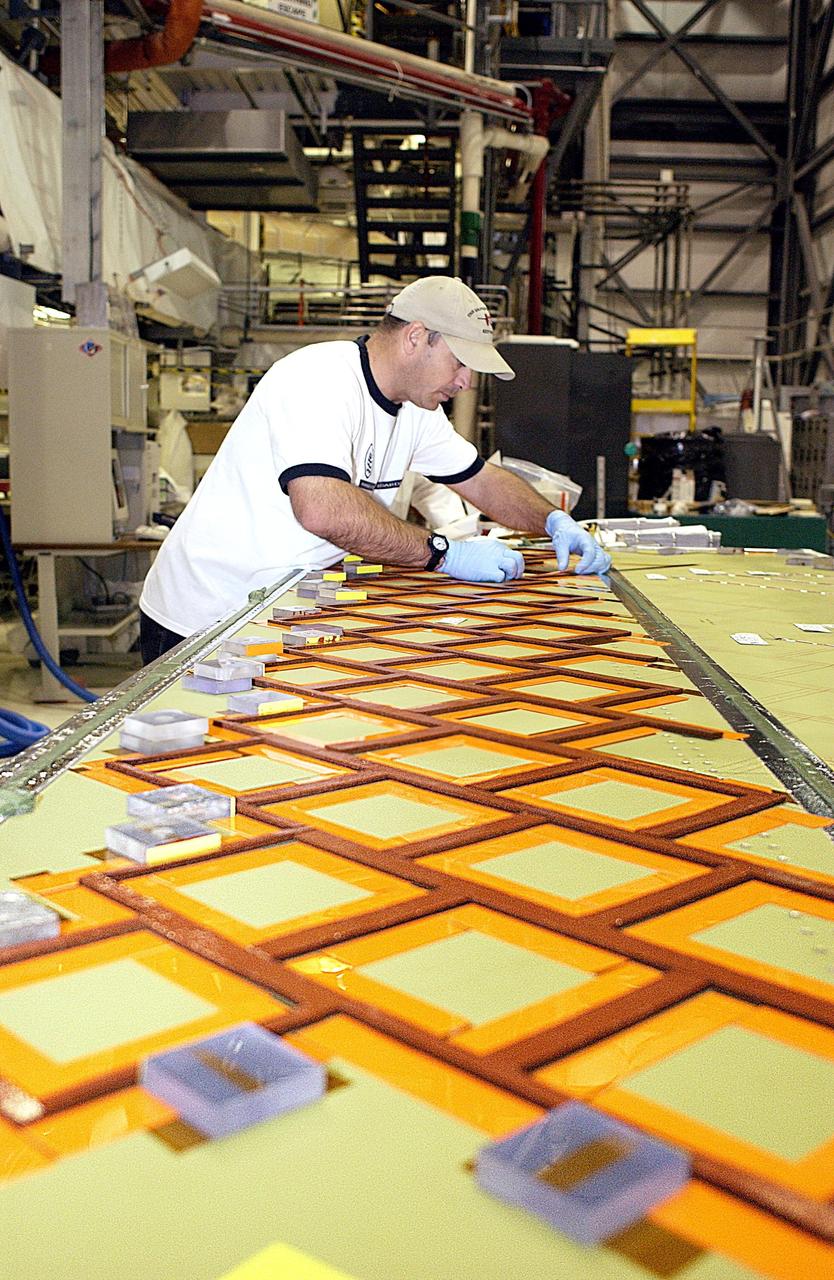
KENNEDY SPACE CENTER, FLA. -- In the Orbiter Processing Facility, United Space Alliance employee Mike Cote installs Thermal Protection System tiles on a test panel. The test panel and sections of Space Shuttle orbiter Enterprise (OV-101) will be transferred to the Southwest Research Institute for testing after the tile installation is complete. The testing has been requested by the Columbia Accident Investigation Board. Sections of Enterprise were borrowed from the Smithsonian Institution's Air and Space Museum where the orbiter is being stored at the Washington Dulles International Airport. Enterprise was the first orbiter built in the Shuttle fleet and was used to conduct the Approach and Landing Test Program before the first powered Shuttle flight.
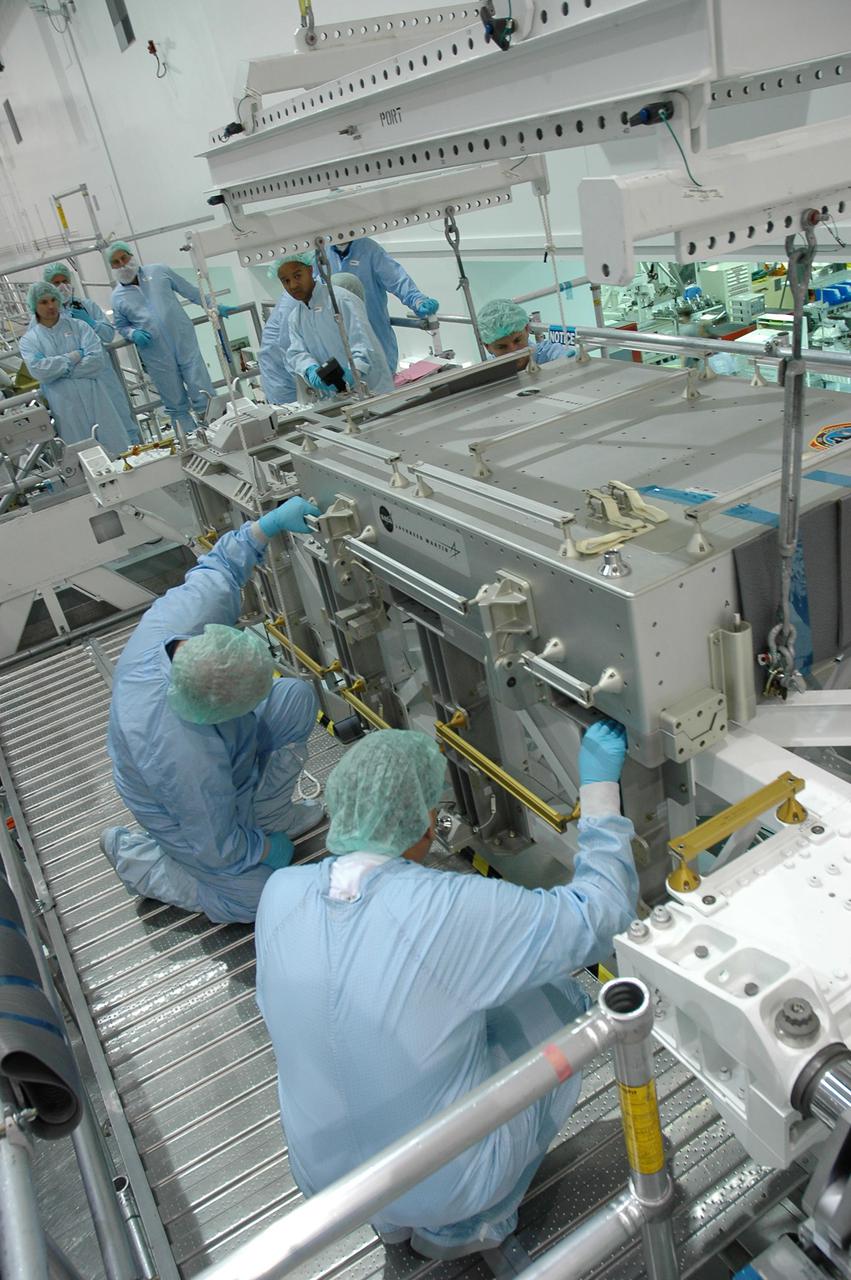
KENNEDY SPACE CENTER, FLA. - In the Space Station Processing Facility, workers prepare to lift the tile box from the Lightweight Multi-Purpose Experiment Support Structure Carrier (LMC) that was returned on Space Shuttle Discovery from mission STS-114. The tile box is the Detailed Test Objective (DTO) tile sample repair kit that astronauts experimented with on the mission. The box is being returned to Johnson Space Center in Houston.
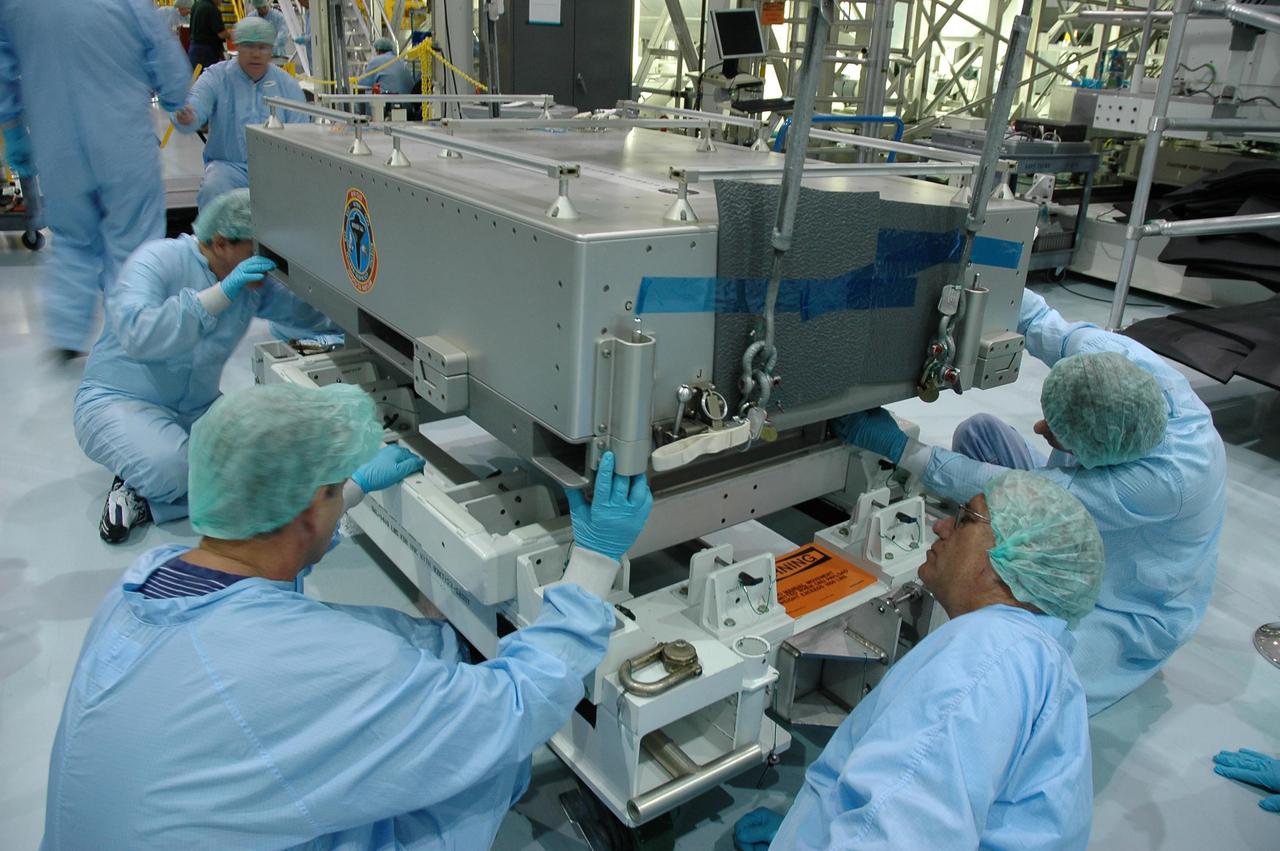
KENNEDY SPACE CENTER, FLA. - In the Space Station Processing Facility, workers ensure the tile box is secured onto a stand. The box was removed from the Lightweight Multi-Purpose Experiment Support Structure Carrier (LMC) that was returned on Space Shuttle Discovery from mission STS-114. The tile box is the Detailed Test Objective (DTO) tile sample repair kit that astronauts experimented with on the mission. The box is being returned to Johnson Space Center in Houston.
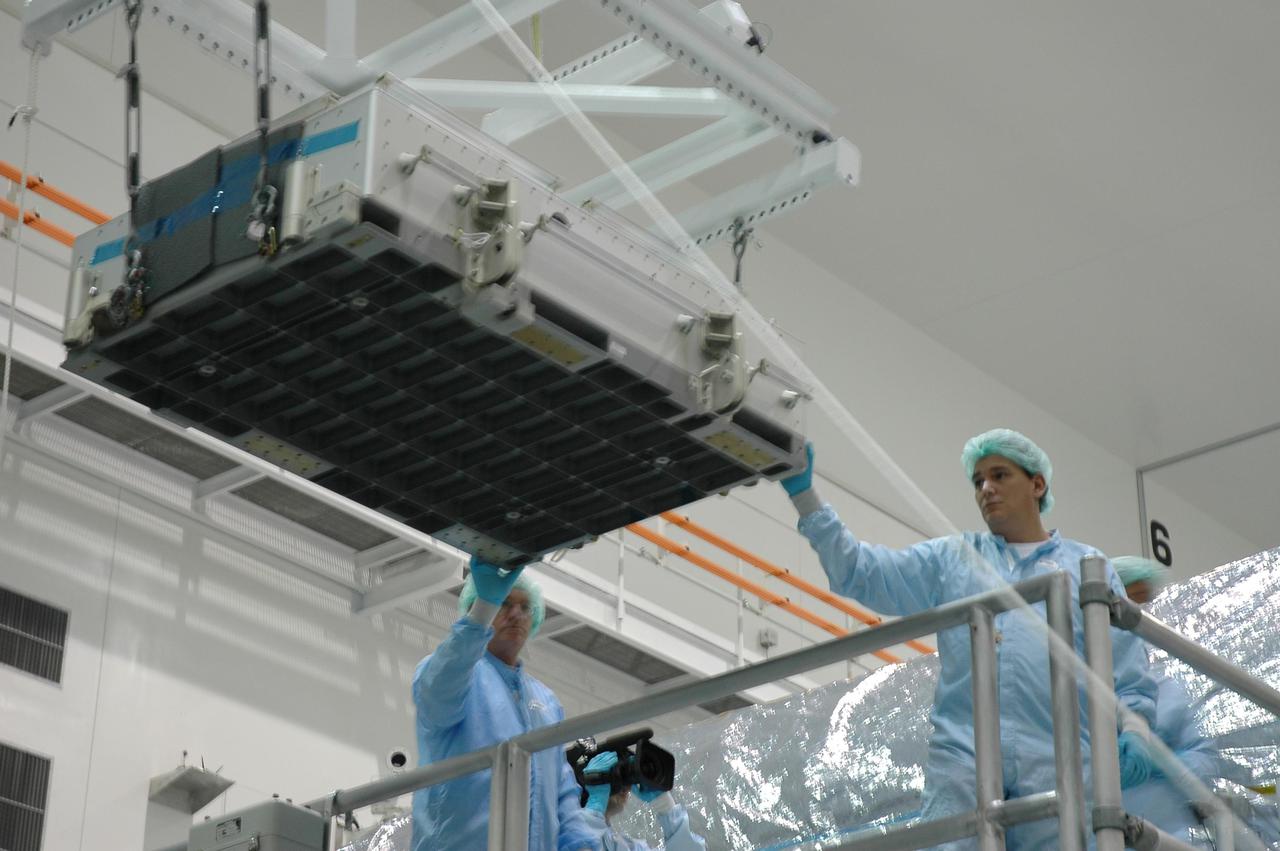
KENNEDY SPACE CENTER, FLA. - In the Space Station Processing Facility, workers oversee the lifting of the tile box from the Lightweight Multi-Purpose Experiment Support Structure Carrier (LMC) that was returned on Space Shuttle Discovery from mission STS-114. The tile box is the Detailed Test Objective (DTO) tile sample repair kit that astronauts experimented with on the mission. The box is being returned to Johnson Space Center in Houston.
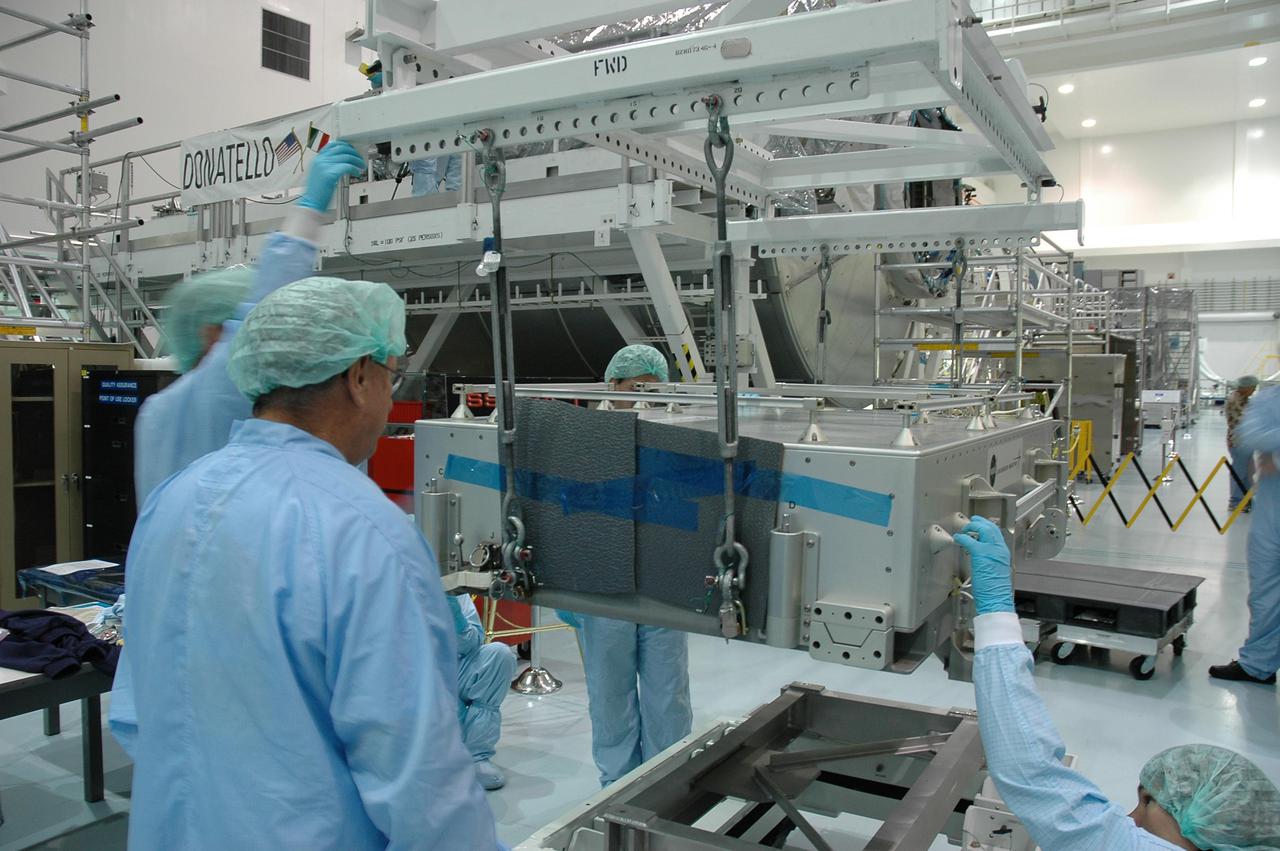
KENNEDY SPACE CENTER, FLA. - In the Space Station Processing Facility, the tile box is lowered onto a stand. The box was removed from the Lightweight Multi-Purpose Experiment Support Structure Carrier (LMC) that was returned on Space Shuttle Discovery from mission STS-114. The tile box is the Detailed Test Objective (DTO) tile sample repair kit that astronauts experimented with on the mission. The box is being returned to Johnson Space Center in Houston.
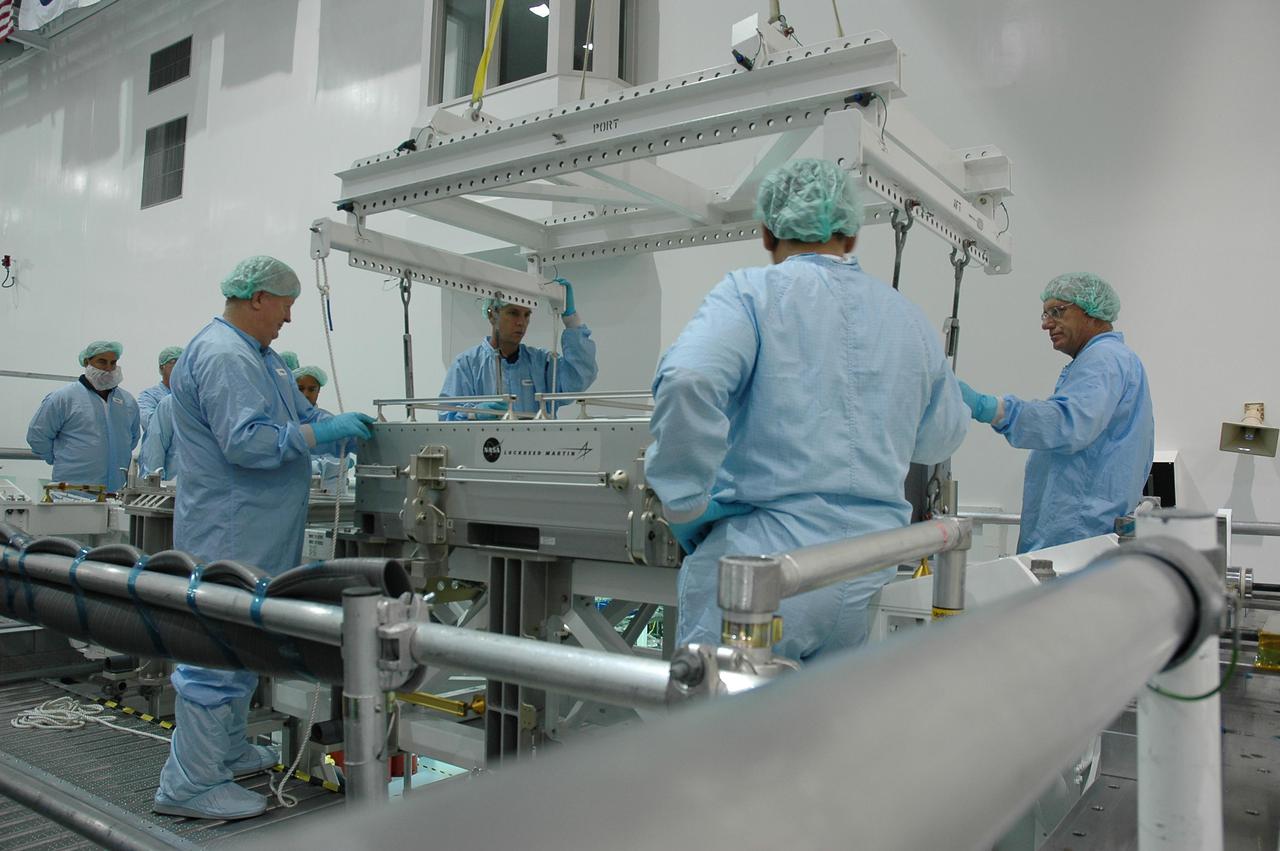
KENNEDY SPACE CENTER, FLA. - In the Space Station Processing Facility, workers prepare to lift the tile box from the Lightweight Multi-Purpose Experiment Support Structure Carrier (LMC) that was returned on Space Shuttle Discovery from mission STS-114. The tile box is the Detailed Test Objective (DTO) tile sample repair kit that astronauts experimented with on the mission. The box is being returned to Johnson Space Center in Houston.
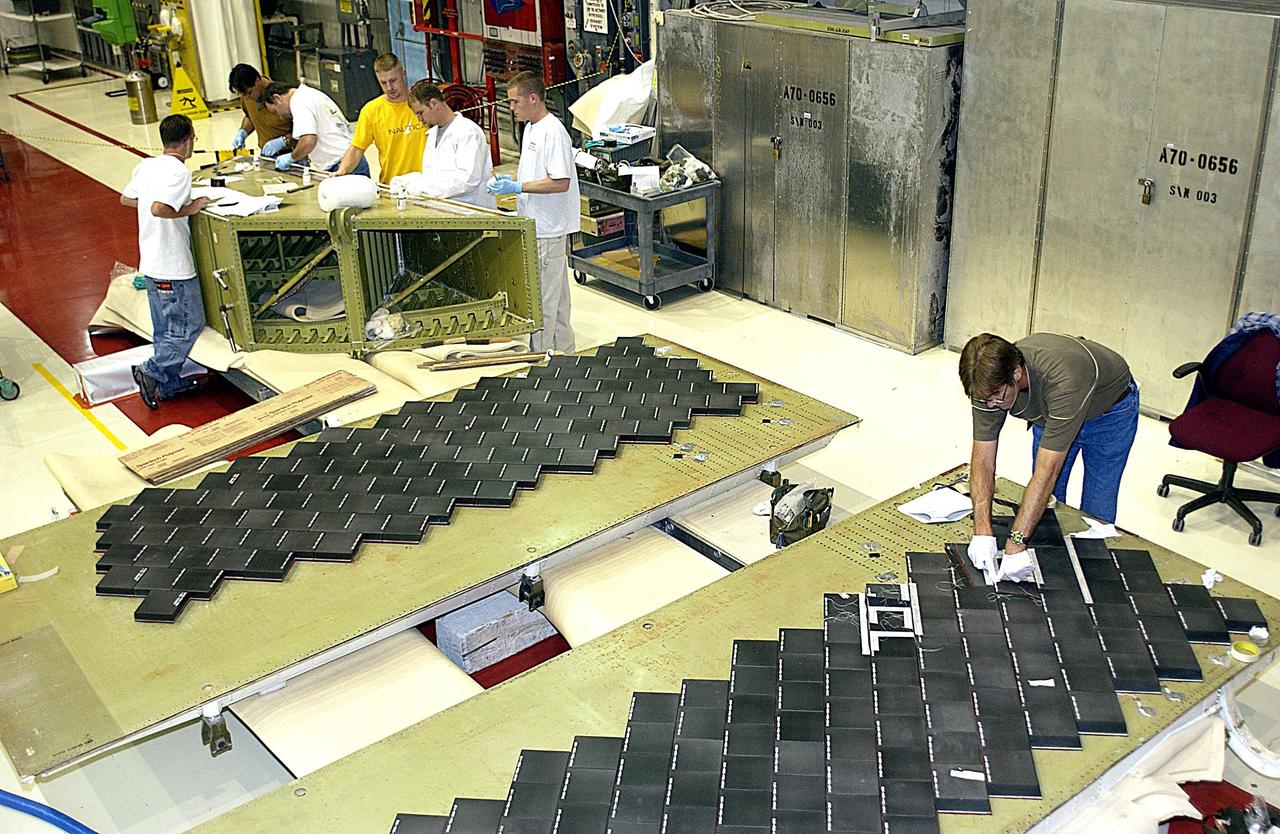
KENNEDY SPACE CENTER, FLA. -- In the Orbiter Processing Facility (OPF), United Space Alliance (USA) employee Harrell Watts (right) installs Thermal Protection System (TPS) tiles on a main landing gear door of Space Shuttle orbiter Enterprise (OV-101). In the background, other USA employees, members of the OPF midbody TPS crew, prepare to install TPS tile on a simulated orbiter wing. The wing and the sections of Enterprise will be transferred to the Southwest Research Institute for testing after the tile installation is complete. The testing has been requested by the Columbia Accident Investigation Board. Sections of Enterprise were borrowed from the Smithsonian Institution's Air and Space Museum where the orbiter is being stored at the Washington Dulles International Airport. Enterprise was the first orbiter built in the Shuttle fleet and was used to conduct the Approach and Landing Test Program before the first powered Shuttle flight.
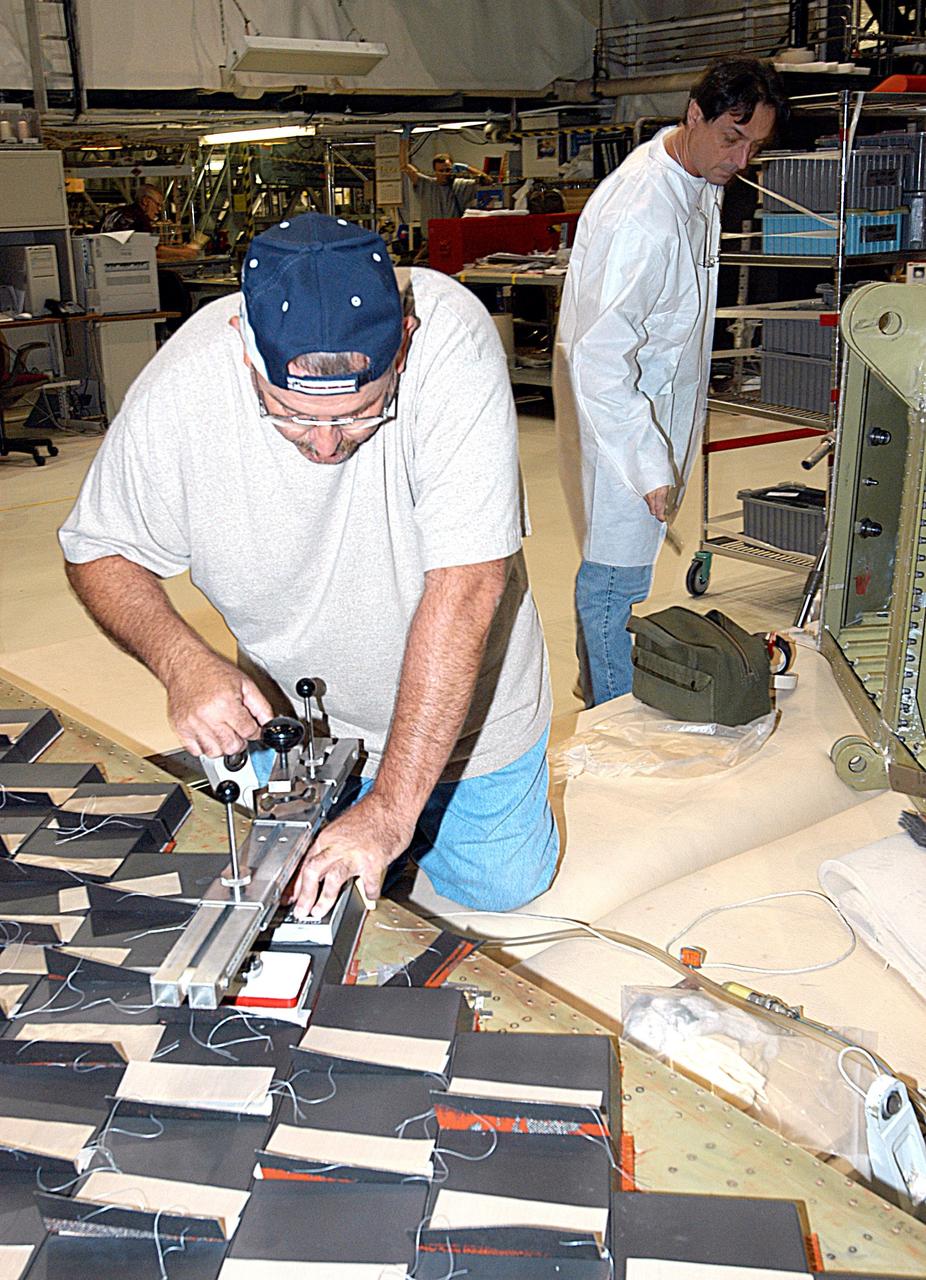
KENNEDY SPACE CENTER, FLA. -- In the Orbiter Processing Facility, United Space Alliance employee Dave Sanborn (left) conducts a bond verification test on Thermal Protection System tiles installed on a main landing gear door of Space Shuttle orbiter Enterprise (OV-101). Sections of Enterprise were borrowed from the Smithsonian Institution's Air and Space Museum where the orbiter is being stored at the Washington Dulles International Airport. Enterprise was the first orbiter built in the Shuttle fleet and was used to conduct the Approach and Landing Test Program before the first powered Shuttle flight. After the tile installation is complete, the sections will be transferred to the Southwest Research Institute for testing requested by the Columbia Accident Investigation Board.

KENNEDY SPACE CENTER, FLA. -- In the Orbiter Processing Facility, United Space Alliance employee Harrell Watts installs Thermal Protection System tiles on a main landing gear door of Space Shuttle orbiter Enterprise (OV-101). Sections of Enterprise were borrowed from the Smithsonian Institution's Air and Space Museum where the orbiter is being stored at the Washington Dulles International Airport. Enterprise was the first orbiter built in the Shuttle fleet and was used to conduct the Approach and Landing Test Program before the first powered Shuttle flight. After the tile installation is complete, the sections will be transferred to the Southwest Research Institute for testing requested by the Columbia Accident Investigation Board.
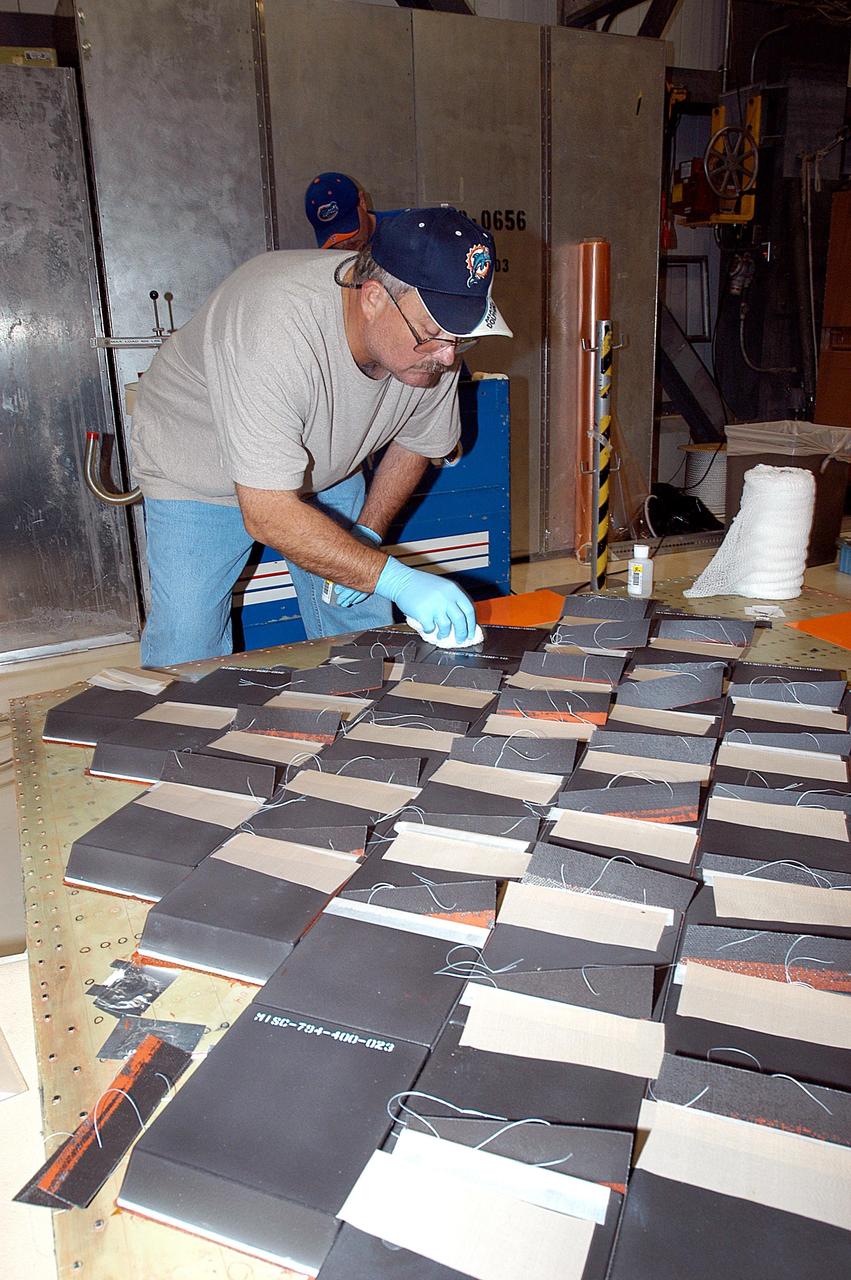
KENNEDY SPACE CENTER, FLA. -- In the Orbiter Processing Facility, United Space Alliance employee Dave Sanborn installs Thermal Protection System tiles on a main landing gear door of Space Shuttle orbiter Enterprise (OV-101). Sections of Enterprise were borrowed from the Smithsonian Institution's Air and Space Museum where the orbiter is being stored at the Washington Dulles International Airport. Enterprise was the first orbiter built in the Shuttle fleet and was used to conduct the Approach and Landing Test Program before the first powered Shuttle flight. After the tile installation is complete, the sections will be transferred to the Southwest Research Institute for testing requested by the Columbia Accident Investigation Board.
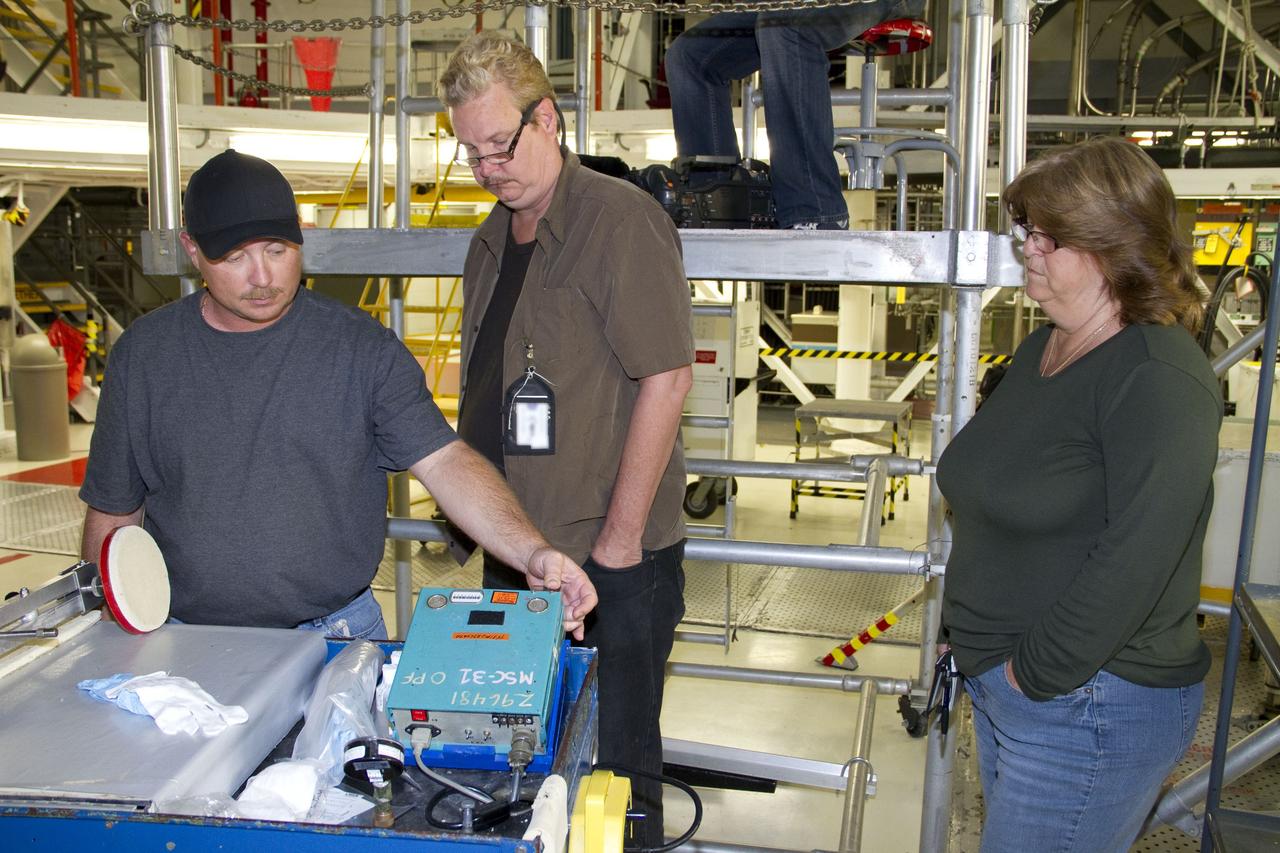
CAPE CANAVERAL, Fla. -- United Space Alliance technicians gear up for a pull test of shuttle Atlantis' thermal protection tiles in Orbiter Processing Facility-1 at NASA's Kennedy Space Center in Florida. The pull test measures the force it takes to pull a tile off of the shuttle in order to make sure the bond between the two is strong enough to withstand the force of launch and landing. Atlantis is being prepared for the STS-135 mission, which will deliver the Raffaello multipurpose logistics module packed with supplies, logistics and spare parts to the International Space Station. STS-135 is targeted to launch June 28, and will be the last spaceflight for the Space Shuttle Program. Photo credit: NASA/Jack Pfaller
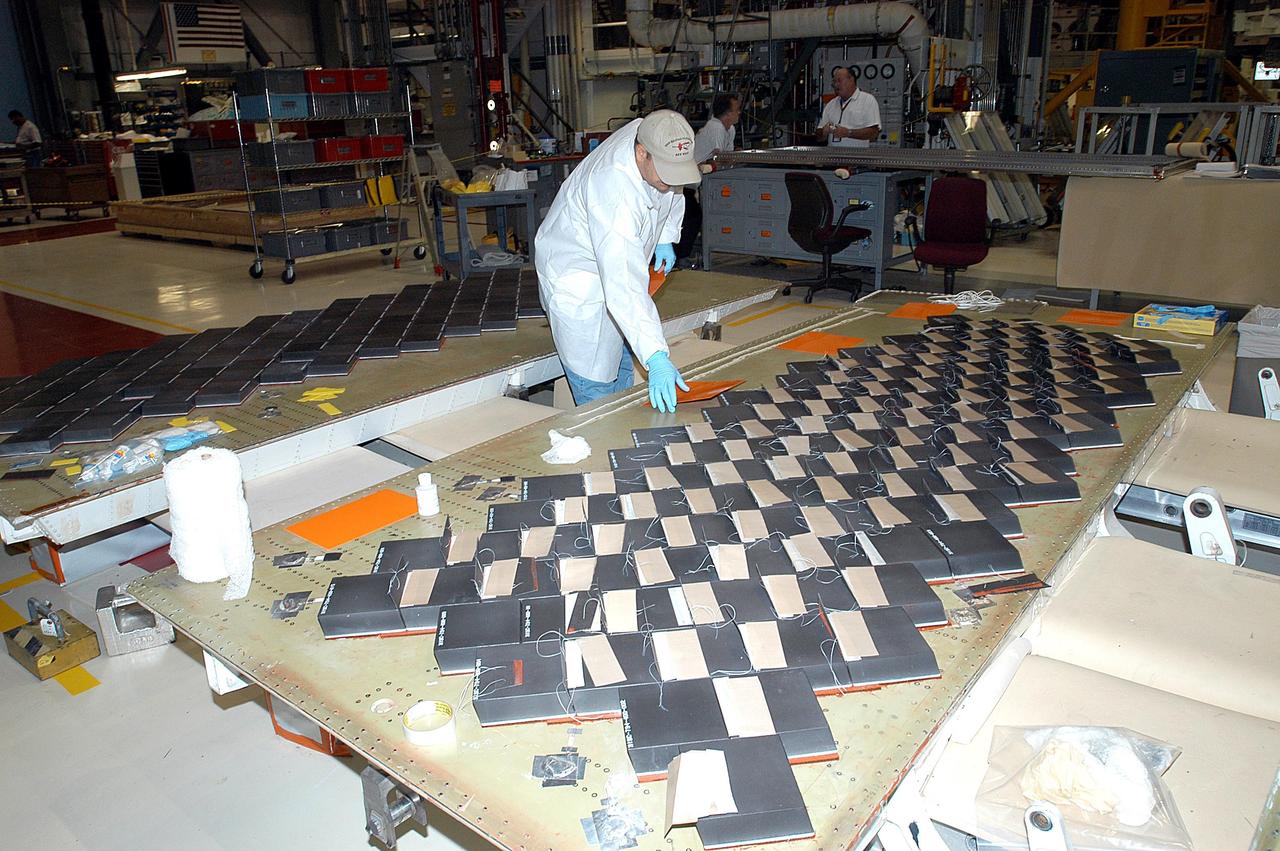
KENNEDY SPACE CENTER, FLA. -- In the Orbiter Processing Facility, United Space Alliance employee Mike Cote works on installing Thermal Protection System tiles on a main landing gear door of Space Shuttle orbiter Enterprise (OV-101). Sections of Enterprise were borrowed from the Smithsonian Institution's Air and Space Museum where the orbiter is being stored at the Washington Dulles International Airport. Enterprise was the first orbiter built in the Shuttle fleet and was used to conduct the Approach and Landing Test Program before the first powered Shuttle flight. After the tile installation is complete, the sections will be transferred to the Southwest Research Institute for testing requested by the Columbia Accident Investigation Board.
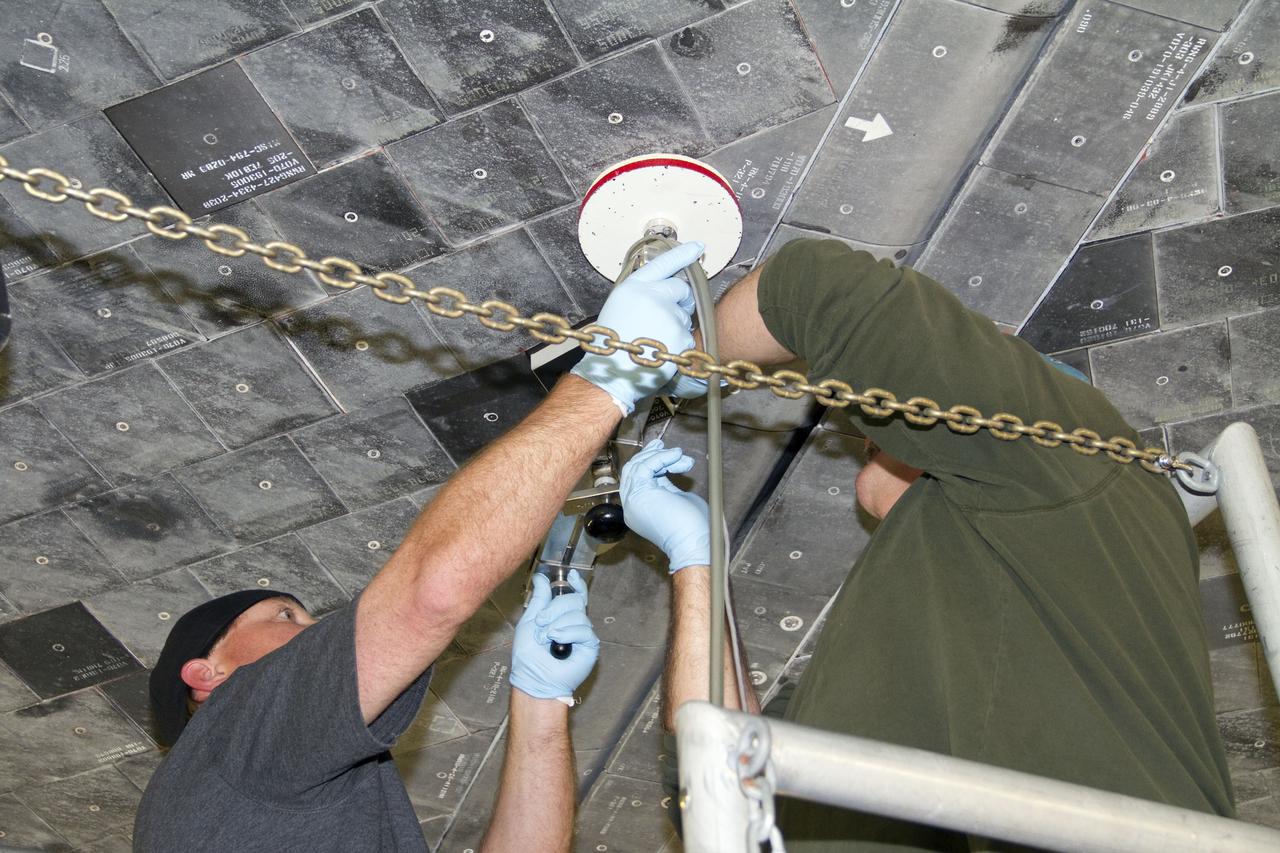
CAPE CANAVERAL, Fla. -- United Space Alliance technicians perform a pull test on shuttle Atlantis' thermal protection tiles in Orbiter Processing Facility-1 at NASA's Kennedy Space Center in Florida. The pull test measures the force it takes to pull a tile off of the shuttle in order to make sure the bond between the two is strong enough to withstand the force of launch and landing. Atlantis is being prepared for the STS-135 mission, which will deliver the Raffaello multipurpose logistics module packed with supplies, logistics and spare parts to the International Space Station. STS-135 is targeted to launch June 28, and will be the last spaceflight for the Space Shuttle Program. Photo credit: NASA/Jack Pfaller
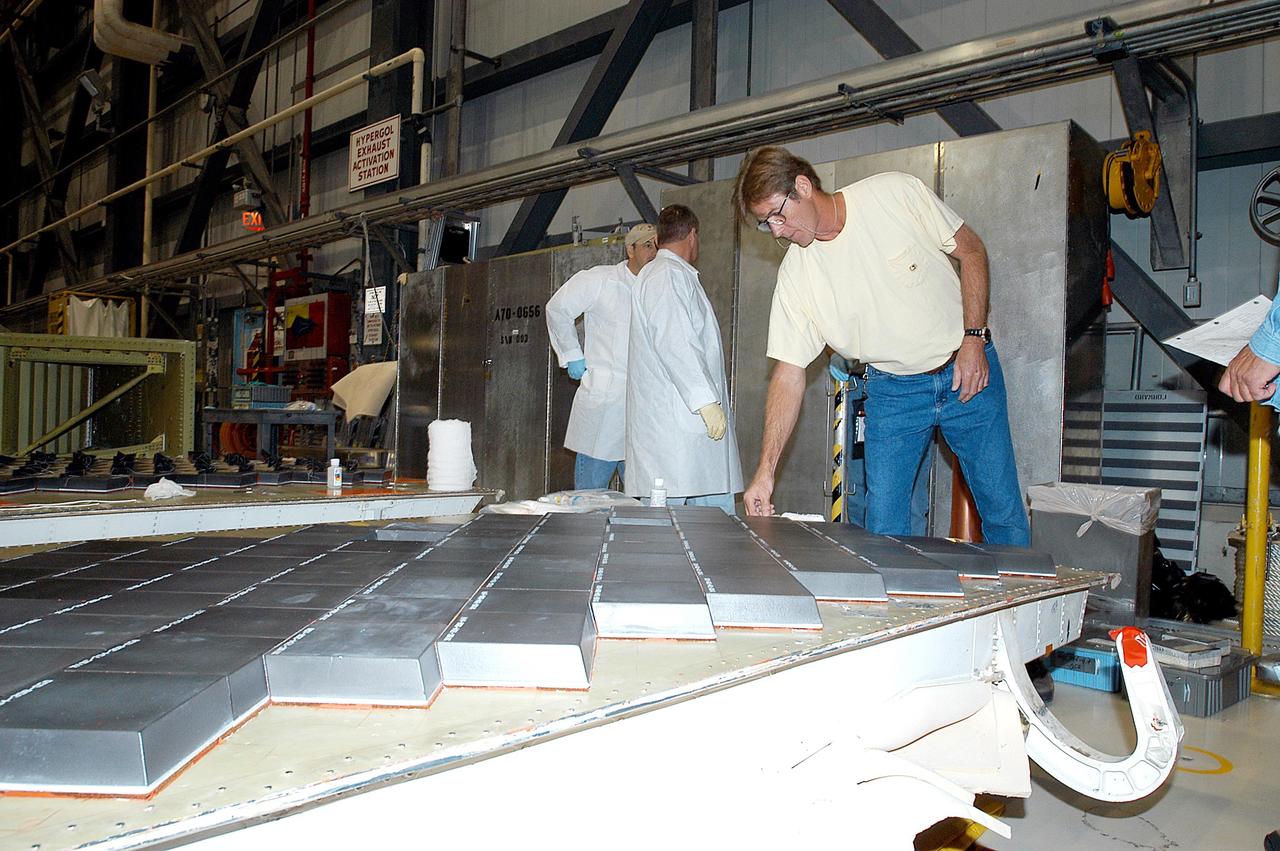
KENNEDY SPACE CENTER, FLA. -- In the Orbiter Processing Facility, United Space Alliance employee Harrell Watts (right) installs Thermal Protection System tiles on a main landing gear door of Space Shuttle orbiter Enterprise (OV-101). Sections of Enterprise were borrowed from the Smithsonian Institution's Air and Space Museum where the orbiter is being stored at the Washington Dulles International Airport. Enterprise was the first orbiter built in the Shuttle fleet and was used to conduct the Approach and Landing Test Program before the first powered Shuttle flight. After the tile installation is complete, the sections will be transferred to the Southwest Research Institute for testing requested by the Columbia Accident Investigation Board.
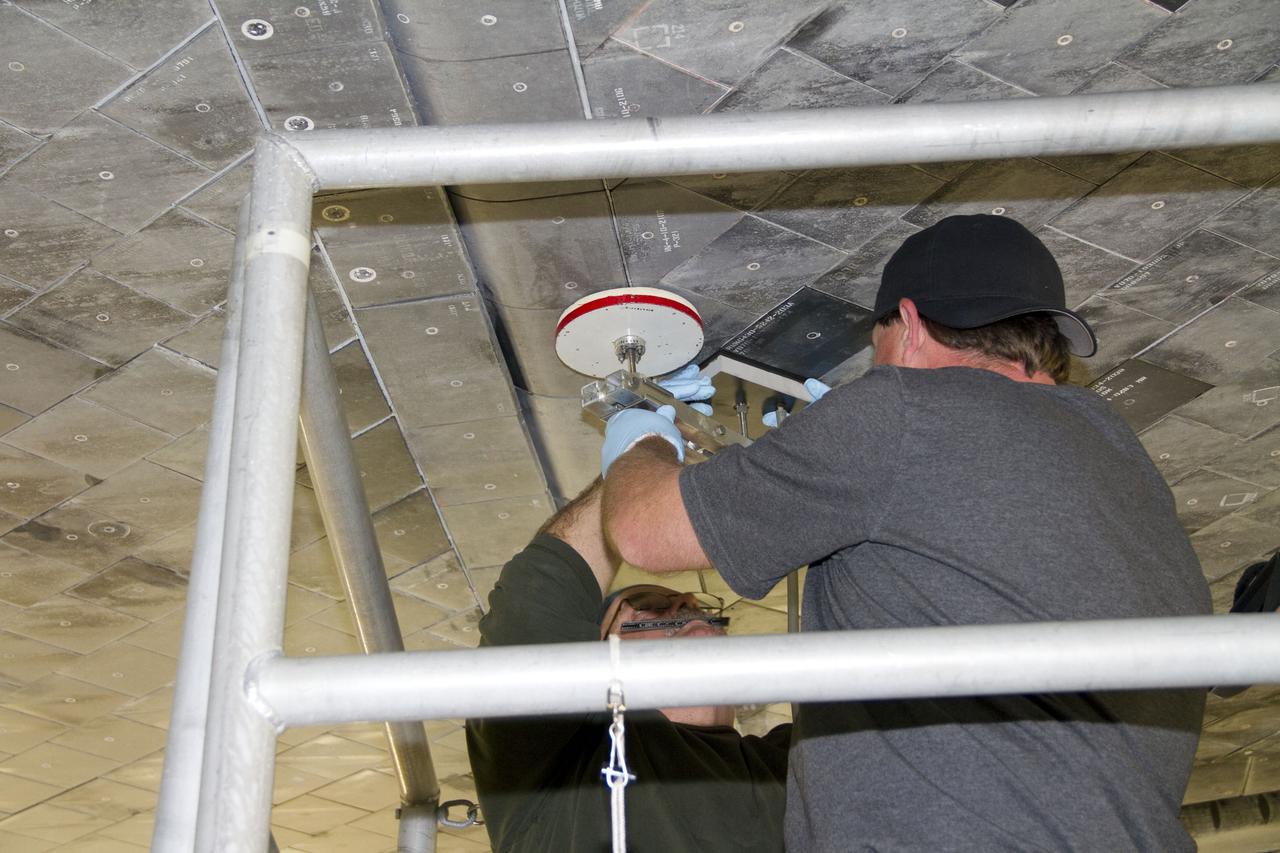
CAPE CANAVERAL, Fla. -- United Space Alliance technicians perform a pull test on shuttle Atlantis' thermal protection tiles in Orbiter Processing Facility-1 at NASA's Kennedy Space Center in Florida. The pull test measures the force it takes to pull a tile off of the shuttle in order to make sure the bond between the two is strong enough to withstand the force of launch and landing. Atlantis is being prepared for the STS-135 mission, which will deliver the Raffaello multipurpose logistics module packed with supplies, logistics and spare parts to the International Space Station. STS-135 is targeted to launch June 28, and will be the last spaceflight for the Space Shuttle Program. Photo credit: NASA/Jack Pfaller
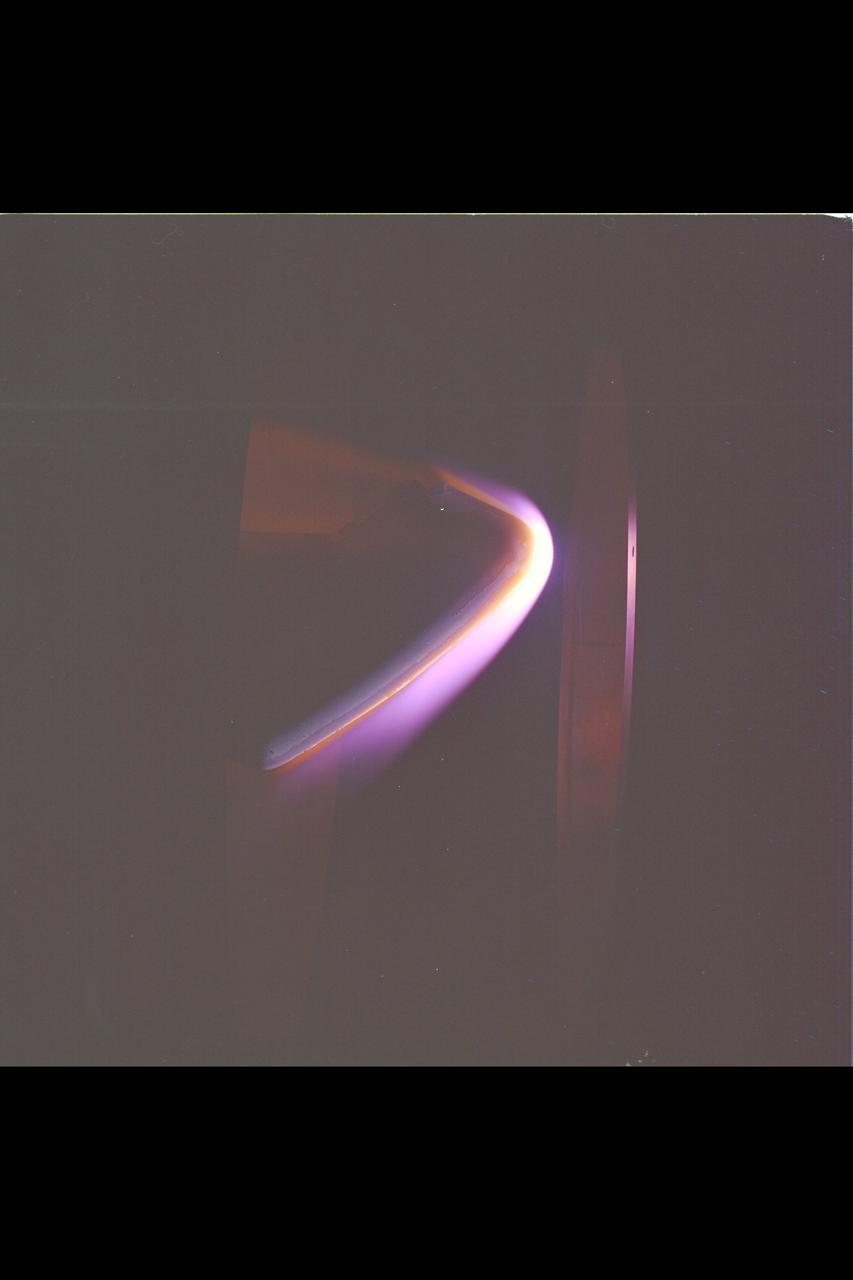
Space Shuttle tile test in 60MW Interaction Heating Facility N-238 (used in NASA/AMES publication 'Searching the Horizon' - A History of Ames Research Center SP-4304)
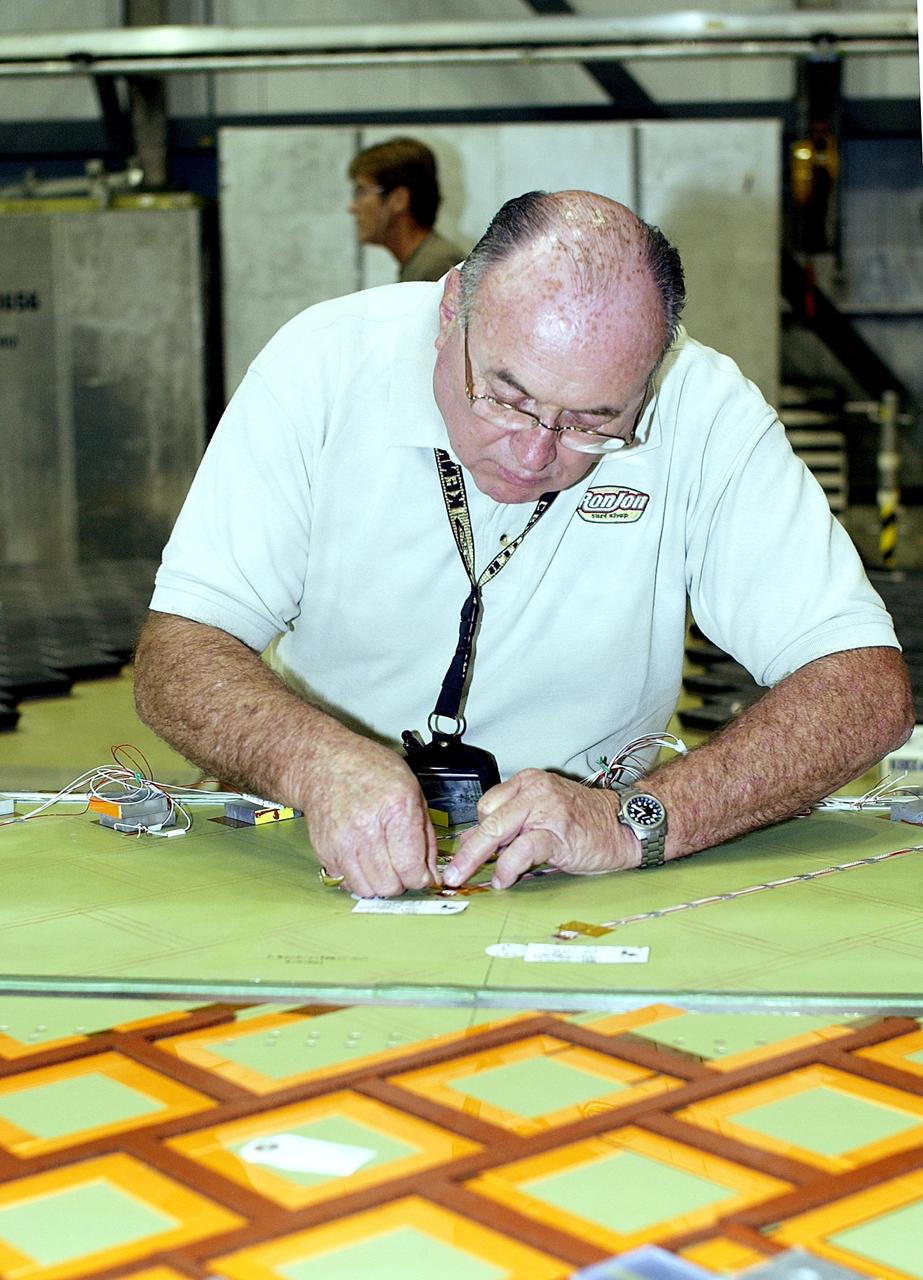
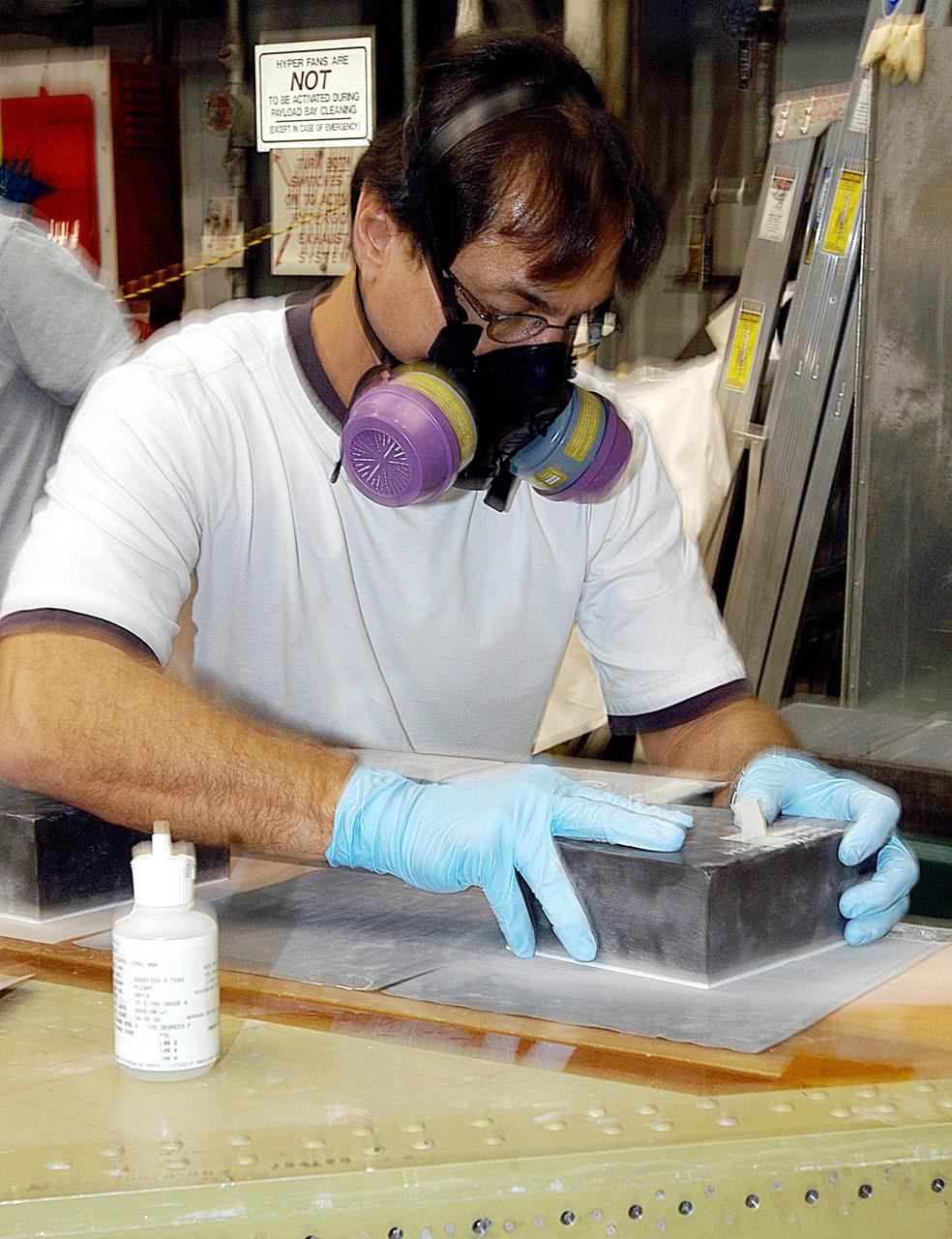
KENNEDY SPACE CENTER, FLA. -- In the Orbiter Processing Facility, an employee from The Boeing Co., Huntington Beach, Calif., installs a strain gauge on a test panel prior to installation of Thermal Protection System tile on the panel. The test panel and sections of Space Shuttle orbiter Enterprise (OV-101) will be transferred to the Southwest Research Institute for testing after the tile installation is complete. The testing has been requested by the Columbia Accident Investigation Board. Sections of Enterprise were borrowed from the Smithsonian Institution's Air and Space Museum where the orbiter is being stored at the Washington Dulles International Airport. Enterprise was the first orbiter built in the Shuttle fleet and was used to conduct the Approach and Landing Test Program before the first powered Shuttle flight.

KENNEDY SPACE CENTER, FLA. -- In the Orbiter Processing Facility, employees from The Boeing Co., Huntington Beach, Calif., install a strain gauge on a test panel prior to installation of Thermal Protection System tile on the panel. The test panel and sections of Space Shuttle orbiter Enterprise (OV-101) will be transferred to the Southwest Research Institute for testing after the tile installation is complete. The testing has been requested by the Columbia Accident Investigation Board. Sections of Enterprise were borrowed from the Smithsonian Institution's Air and Space Museum where the orbiter is being stored at the Washington Dulles International Airport. Enterprise was the first orbiter built in the Shuttle fleet and was used to conduct the Approach and Landing Test Program before the first powered Shuttle flight.
CAPE CANAVERAL, Fla. -- A United Space Alliance technician examines one of shuttle Atlantis' thermal protection tiles in Orbiter Processing Facility-1 at NASA's Kennedy Space Center in Florida. The tile went through a pull test, which measured the force it took to pull it off of the shuttle in order to make sure the bond between the two is strong enough to withstand the force of launch and landing. Atlantis is being prepared for the STS-135 mission, which will deliver the Raffaello multipurpose logistics module packed with supplies, logistics and spare parts to the International Space Station. STS-135 is targeted to launch June 28, and will be the last spaceflight for the Space Shuttle Program. Photo credit: NASA/Jack Pfaller
KENNEDY SPACE CENTER, FLA. -- In the Orbiter Processing Facility (OPF), United Space Alliance (USA) technician Mark Jetton installs Thermal Protection System (TPS) tile on a simulated orbiter wing. The wing, along with sections of Space Shuttle orbiter Enterprise (OV-101), will be transferred to the Southwest Research Institute for testing after the tile installation is complete. The testing has been requested by the Columbia Accident Investigation Board. For this initiative, sections of Enterprise were borrowed from the Smithsonian Institution's Air and Space Museum where the orbiter is being stored at the Washington Dulles International Airport. Enterprise was the first orbiter built in the Shuttle fleet and was used to conduct the Approach and Landing Test Program before the first powered Shuttle flight.
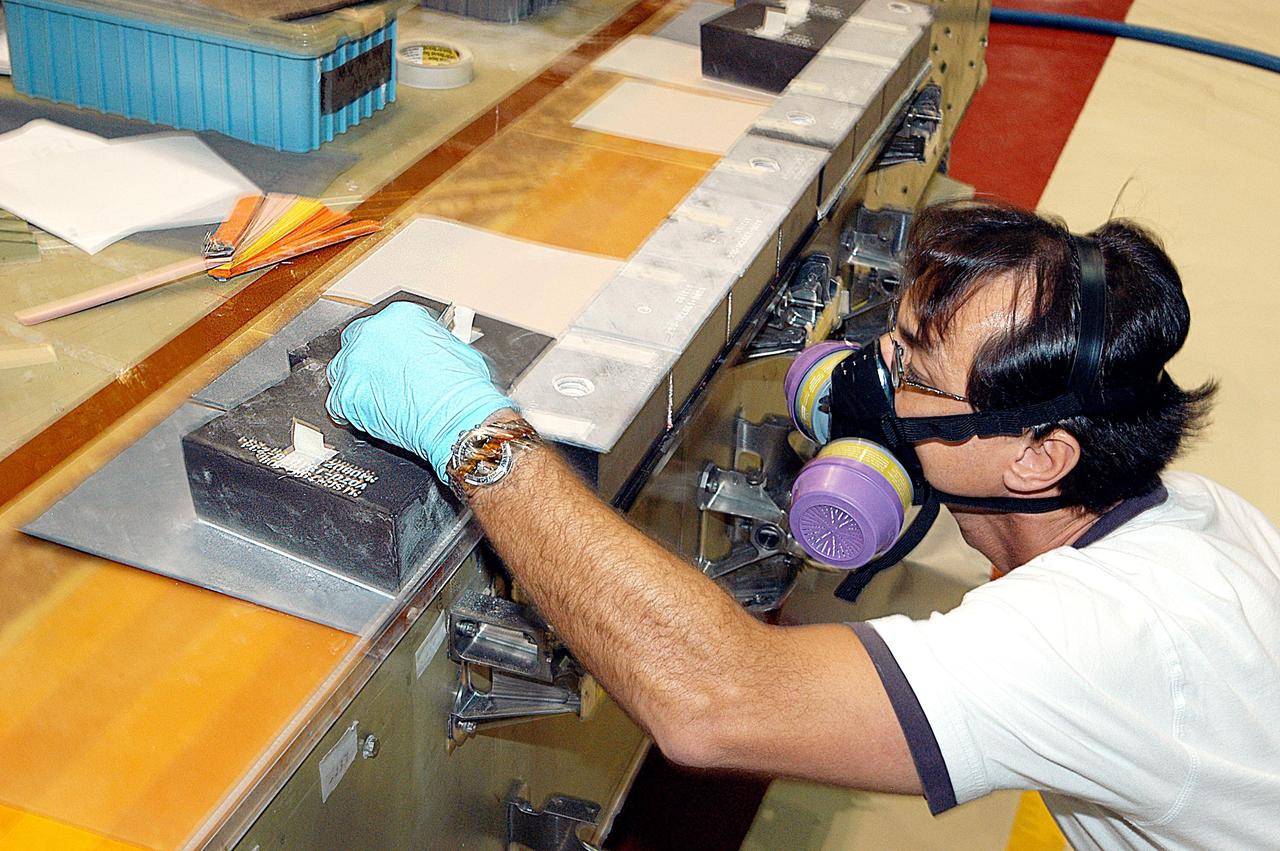
KENNEDY SPACE CENTER, FLA. -- In the Orbiter Processing Facility (OPF), United Space Alliance (USA) technician Mark Jetton installs Thermal Protection System (TPS) tile on a simulated orbiter wing. The wing, along with sections of Space Shuttle orbiter Enterprise (OV-101), will be transferred to the Southwest Research Institute for testing after the tile installation is complete. The testing has been requested by the Columbia Accident Investigation Board. For this initiative, sections of Enterprise were borrowed from the Smithsonian Institution's Air and Space Museum where the orbiter is being stored at the Washington Dulles International Airport. Enterprise was the first orbiter built in the Shuttle fleet and was used to conduct the Approach and Landing Test Program before the first powered Shuttle flight.
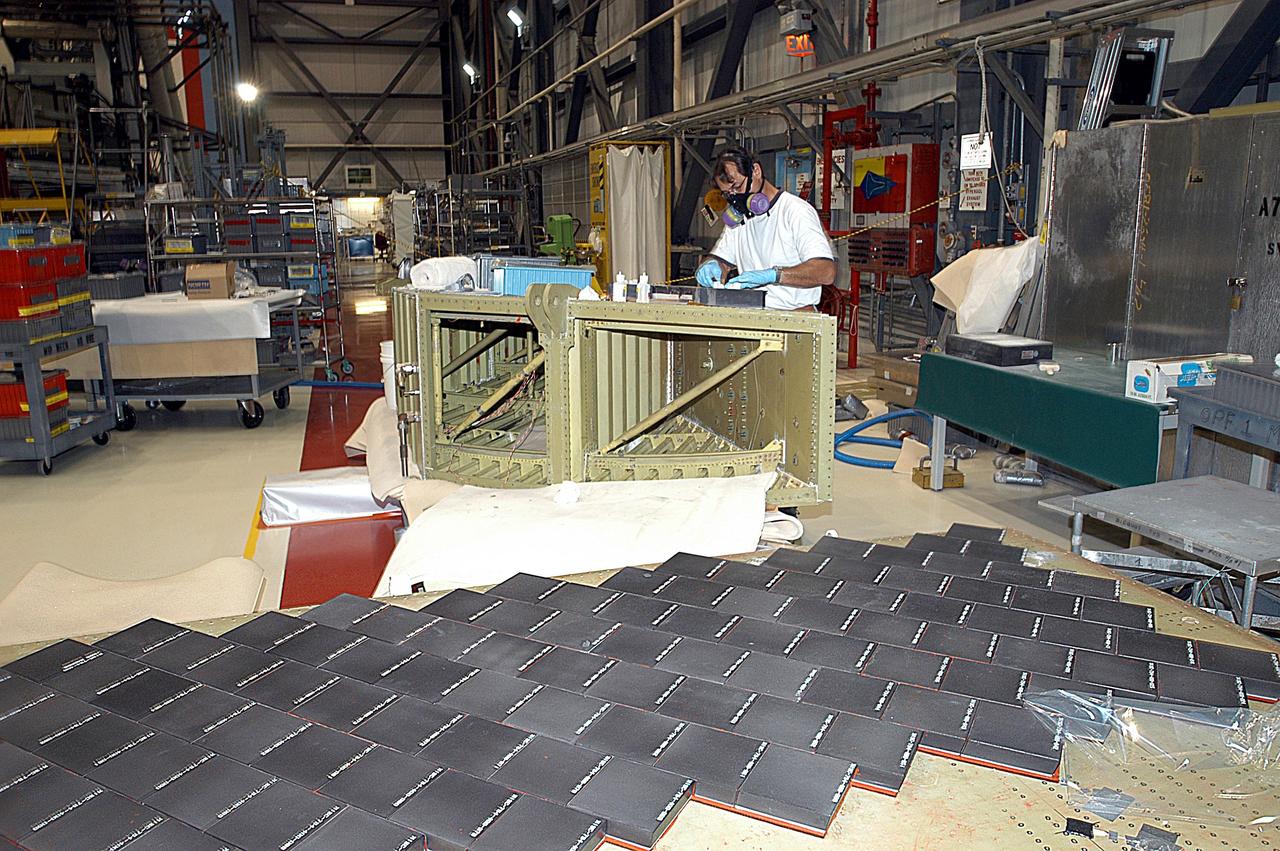
KENNEDY SPACE CENTER, FLA. -- In the Orbiter Processing Facility (OPF), United Space Alliance (USA) technician Mark Jetton installs Thermal Protection System (TPS) tile on a simulated orbiter wing. The wing, along with sections of Space Shuttle orbiter Enterprise (OV-101), will be transferred to the Southwest Research Institute for testing after the tile installation is complete. The testing has been requested by the Columbia Accident Investigation Board. For this initiative, sections of Enterprise were borrowed from the Smithsonian Institution's Air and Space Museum where the orbiter is being stored at the Washington Dulles International Airport. Enterprise was the first orbiter built in the Shuttle fleet and was used to conduct the Approach and Landing Test Program before the first powered Shuttle flight.
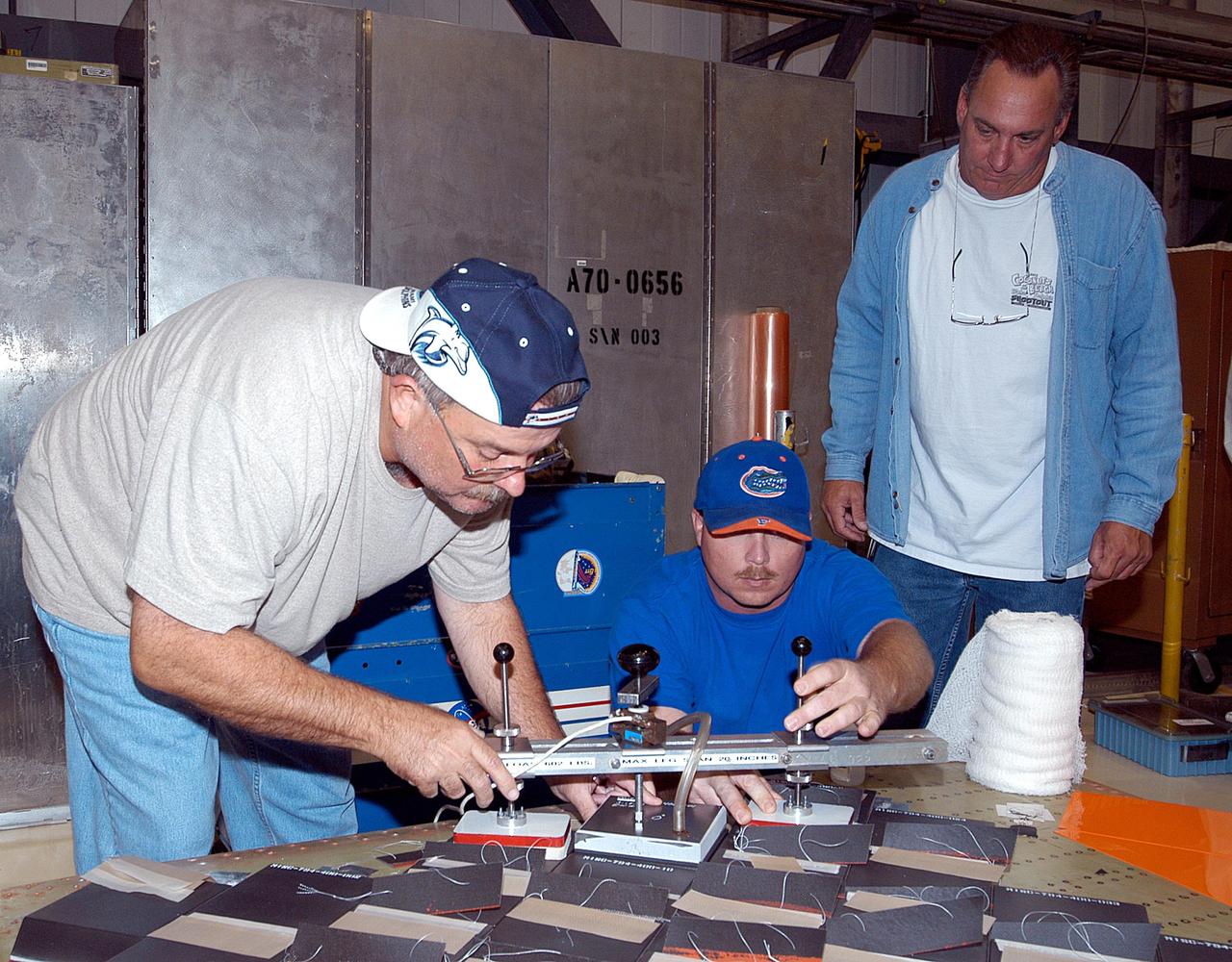
KENNEDY SPACE CENTER, FLA. -- In the Orbiter Processing Facility, United Space Alliance employees (from left) Dave Sanborn, Butch Lato, and Bill Brooks conduct a bond verification test on Thermal Protection System tiles newly installed on a main landing gear door of Space Shuttle orbiter Enterprise (OV-101). Sections of Enterprise were borrowed from the Smithsonian Institution's Air and Space Museum where the orbiter is being stored at the Washington Dulles International Airport. Enterprise was the first orbiter built in the Shuttle fleet and was used to conduct the Approach and Landing Test Program before the first powered Shuttle flight. After the tile installation is complete, the sections will be transferred to the Southwest Research Institute for testing requested by the Columbia Accident Investigation Board.
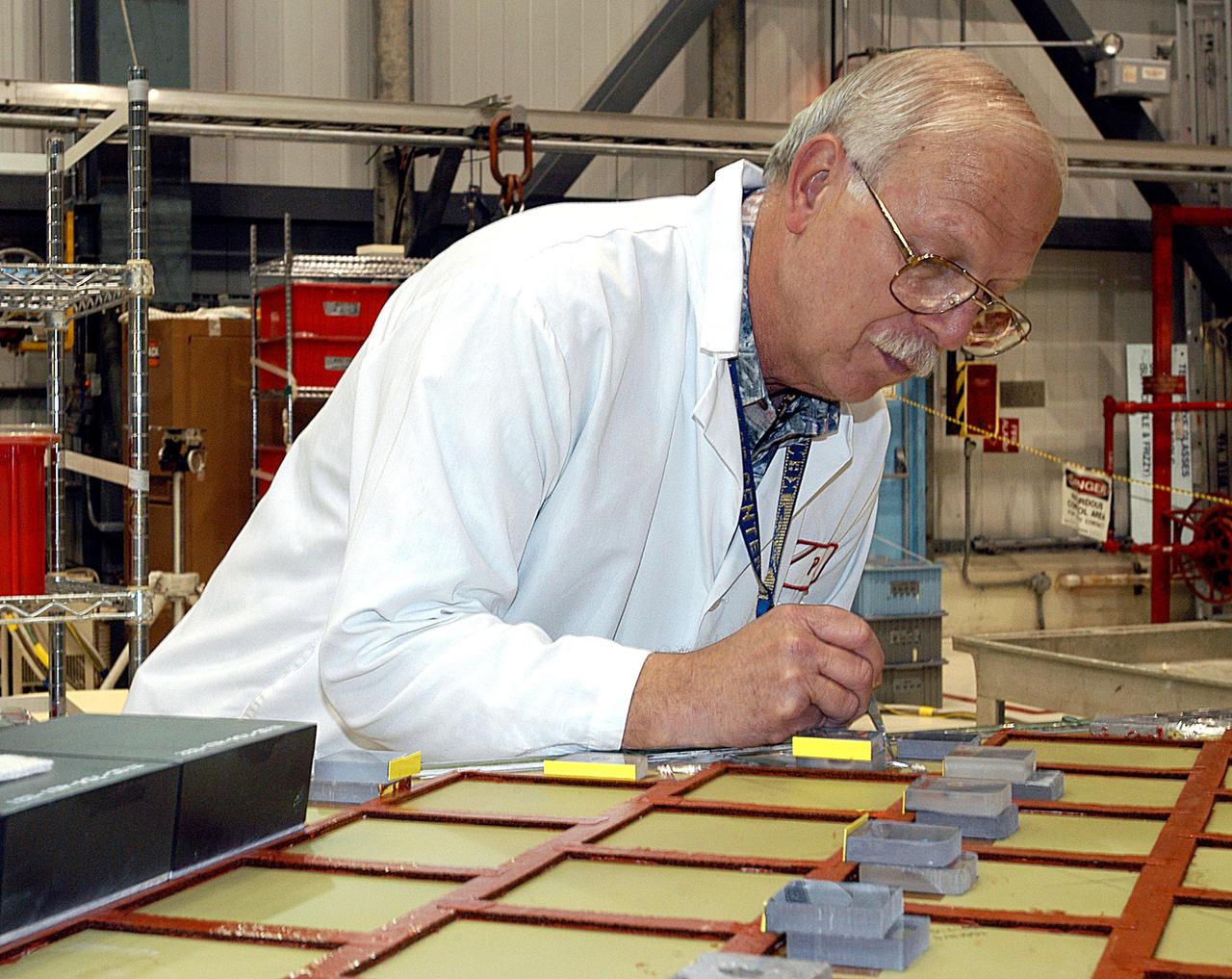
KENNEDY SPACE CENTER, FLA. -- In the Orbiter Processing Facility (OPF), Paul King, an employee of The Boeing Co., Huntington Beach, Calif., installs a strain gauge on a simulated orbiter wing in preparation for Thermal Protection System (TPS) tile installation. The wing, along with sections of Space Shuttle orbiter Enterprise (OV-101), will be transferred to the Southwest Research Institute for testing after the tile installation is complete. The testing has been requested by the Columbia Accident Investigation Board. For this initiative, sections of Enterprise were borrowed from the Smithsonian Institution's Air and Space Museum where the orbiter is being stored at the Washington Dulles International Airport. Enterprise was the first orbiter built in the Shuttle fleet and was used to conduct the Approach and Landing Test Program before the first powered Shuttle flight.
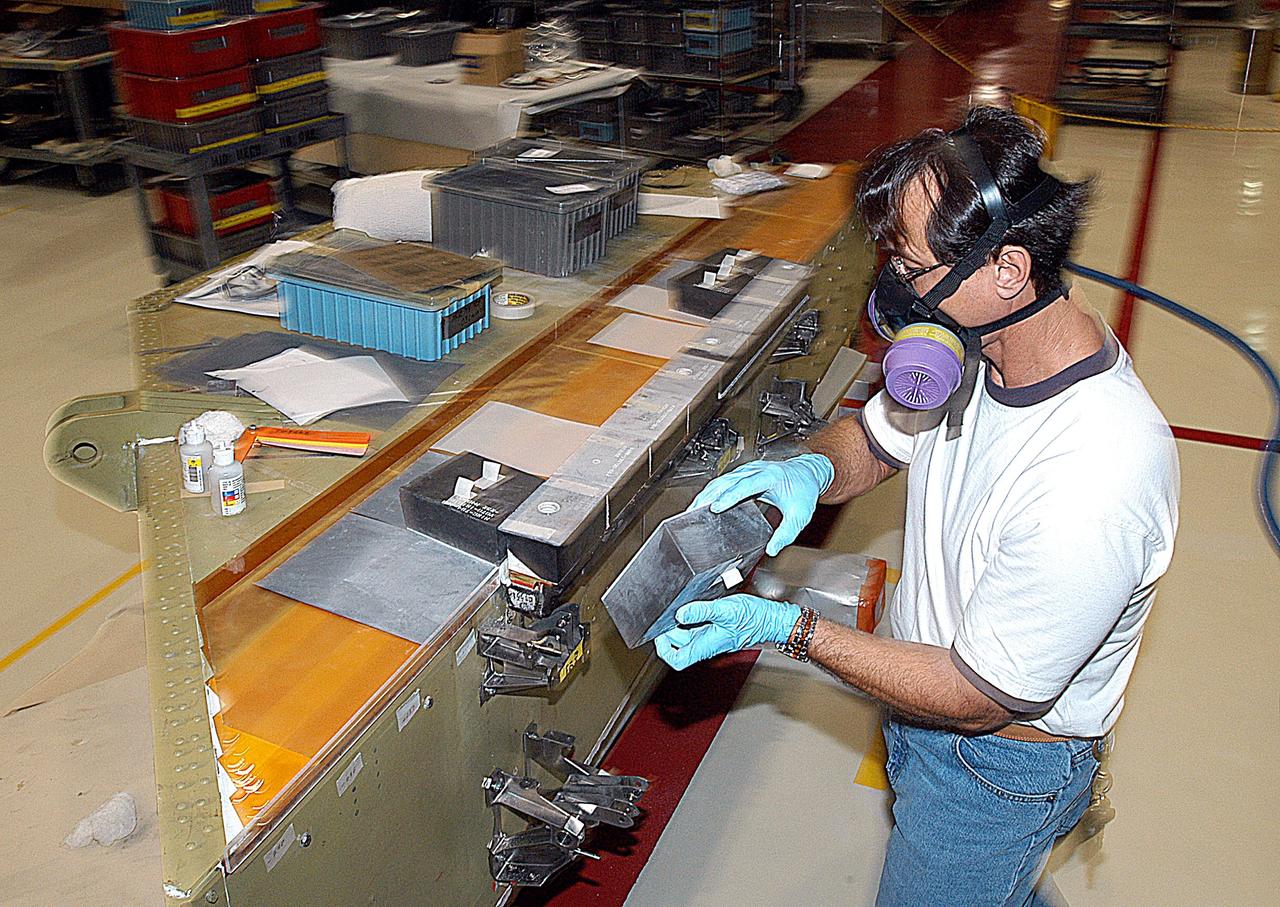
KENNEDY SPACE CENTER, FLA. -- In the Orbiter Processing Facility (OPF), United Space Alliance (USA) technician Mark Jetton installs Thermal Protection System (TPS) tile on a simulated orbiter wing. The wing, along with sections of Space Shuttle orbiter Enterprise (OV-101), will be transferred to the Southwest Research Institute for testing after the tile installation is complete. The testing has been requested by the Columbia Accident Investigation Board. For this initiative, sections of Enterprise were borrowed from the Smithsonian Institution's Air and Space Museum where the orbiter is being stored at the Washington Dulles International Airport. Enterprise was the first orbiter built in the Shuttle fleet and was used to conduct the Approach and Landing Test Program before the first powered Shuttle flight.
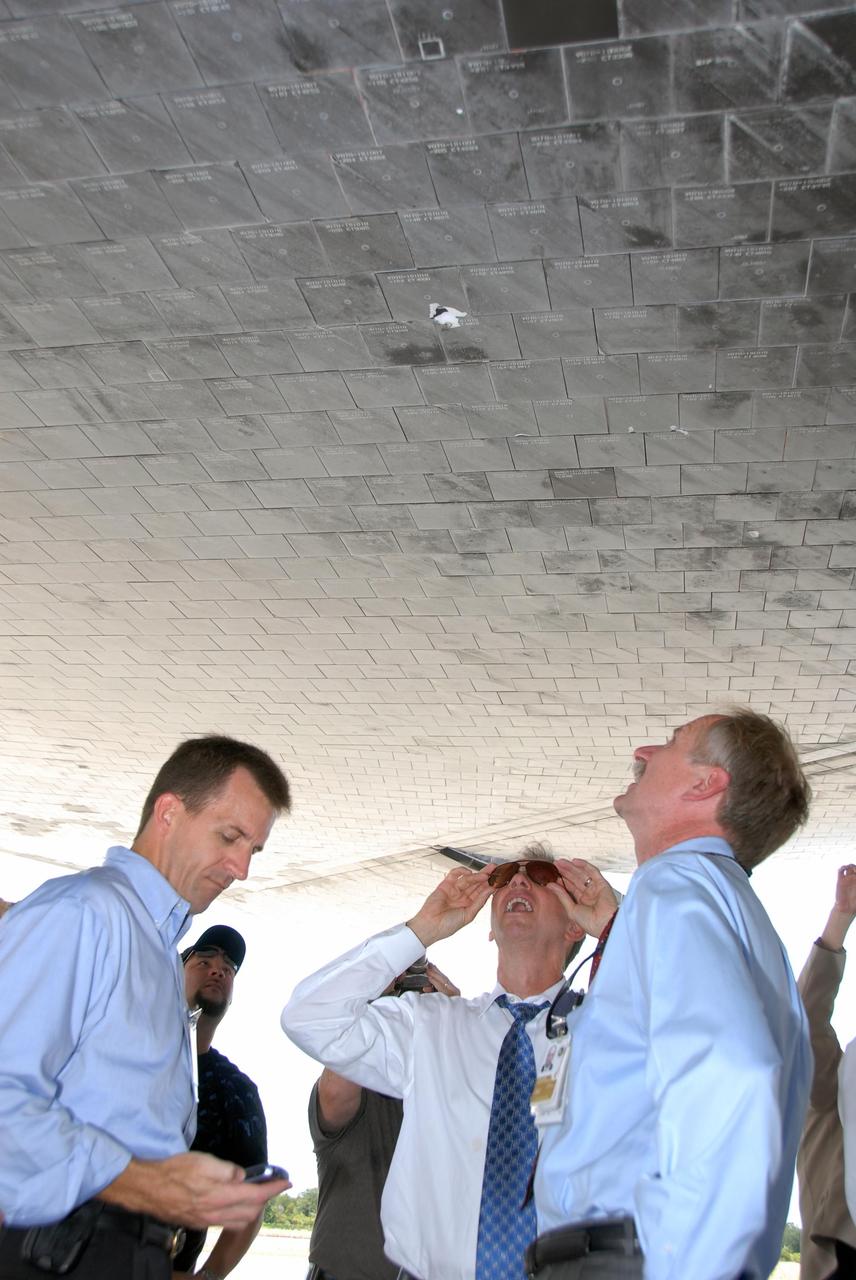
KENNEDY SPACE CENTER, FLA. -- On the Shuttle Landing Facility at NASA's Kennedy Space Center, Mission Launch Integration Director Leroy Cain, NASA Administrator Mike Griffin and Associate Administrator for NASA Space Operations William Gerstenmaier get a closer look at the damaged tiles on the underside of Endeavour. The damage to the tiles occurred from a piece of foam on the external tank during launch of Space Shuttle Endeavour on mission STS-118 on Aug. 8. After extensive engineering analysis of such images and testing on the ground, the Mission Management Team decided the tile did not pose a risk to the crew during re-entry. Endeavour landed safely at 12:32 p.m. EDT at NASA's Kennedy Space Center after a 13-day mission to the International Space Station. The STS-118 mission installed a new gyroscope, an external spare parts platform and another truss segment to the expanding station. Photo credit: NASA/Kim Shiflett
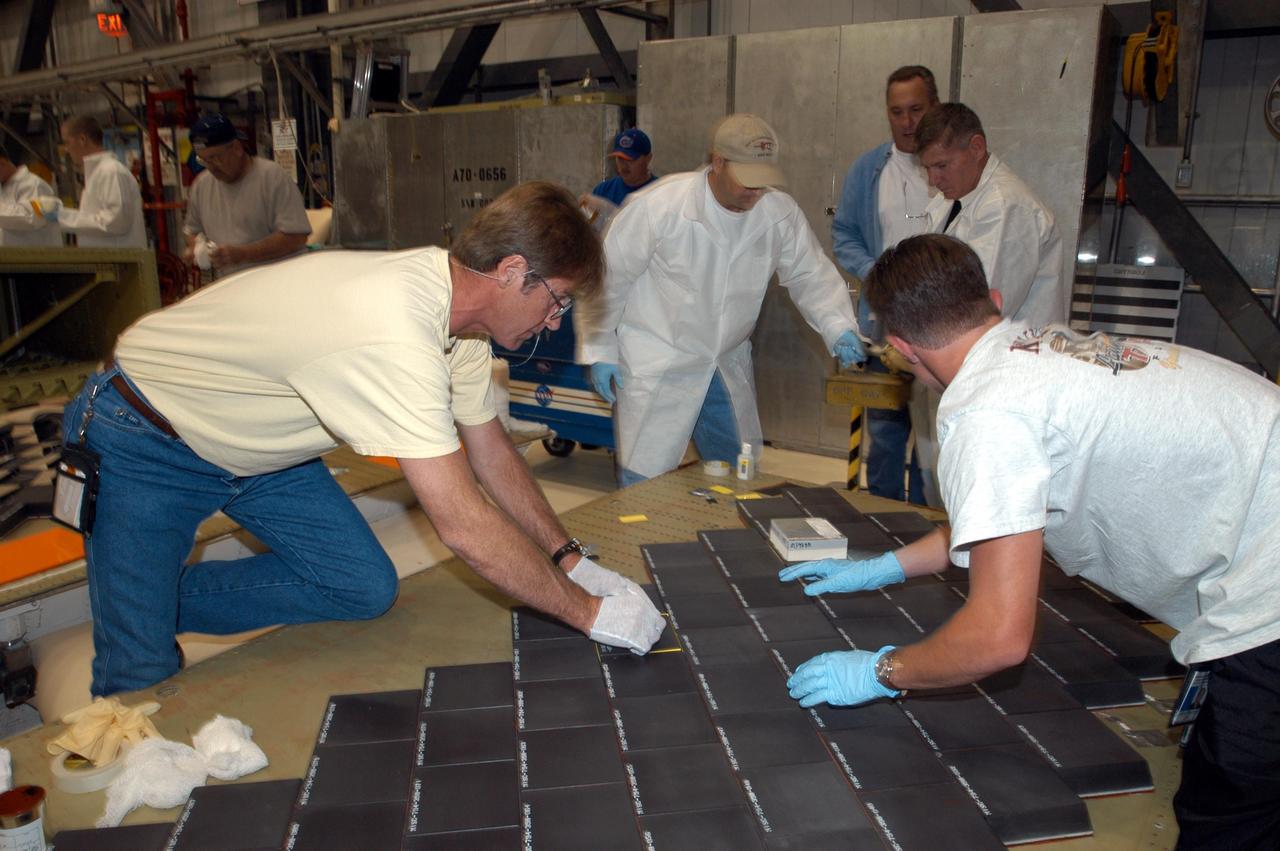
KENNEDY SPACE CENTER, FLA. -- In the Orbiter Processing Facility, United Space Alliance employees (from left) Harrell Watts, Mike Cote, and Jason Levandusky install Thermal Protection System tiles on a main landing gear door of Space Shuttle orbiter Enterprise (OV-101). Sections of Enterprise were borrowed from the Smithsonian Institution's Air and Space Museum where the orbiter is being stored at the Washington Dulles International Airport. Enterprise was the first orbiter built in the Shuttle fleet and was used to conduct the Approach and Landing Test Program before the first powered Shuttle flight. After the tile installation is complete, the sections will be transferred to the Southwest Research Institute for testing requested by the Columbia Accident Investigation Board.
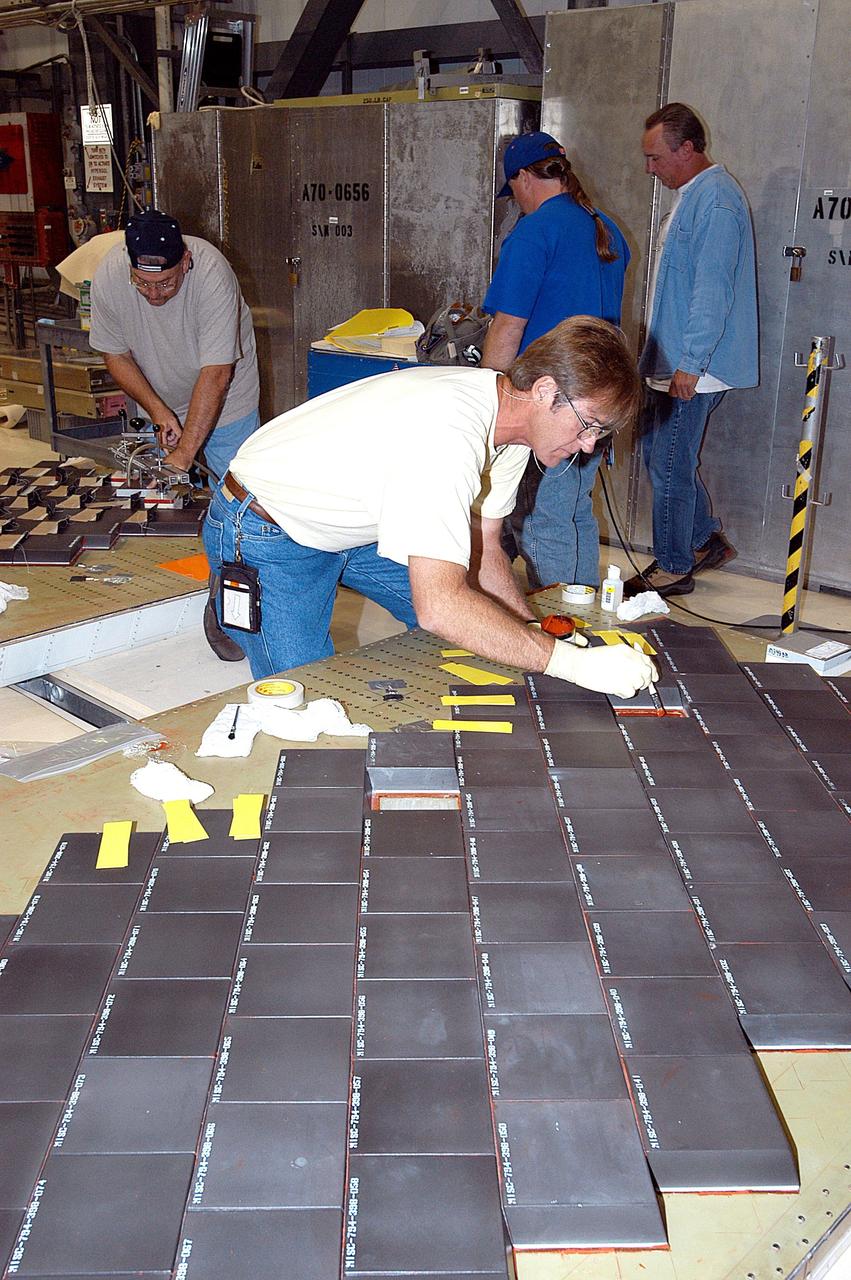
KENNEDY SPACE CENTER, FLA. -- In the Orbiter Processing Facility, United Space Alliance employee Harrell Watts applies RTV, a room-temperature vulcanizing silicone adhesive, to a main landing gear door of Space Shuttle orbiter Enterprise (OV-101) on which Thermal Protection System tiles are being installed. Sections of Enterprise were borrowed from the Smithsonian Institution's Air and Space Museum where the orbiter is being stored at the Washington Dulles International Airport. Enterprise was the first orbiter built in the Shuttle fleet and was used to conduct the Approach and Landing Test Program before the first powered Shuttle flight. After the tile installation is complete, the sections will be transferred to the Southwest Research Institute for testing requested by the Columbia Accident Investigation Board.
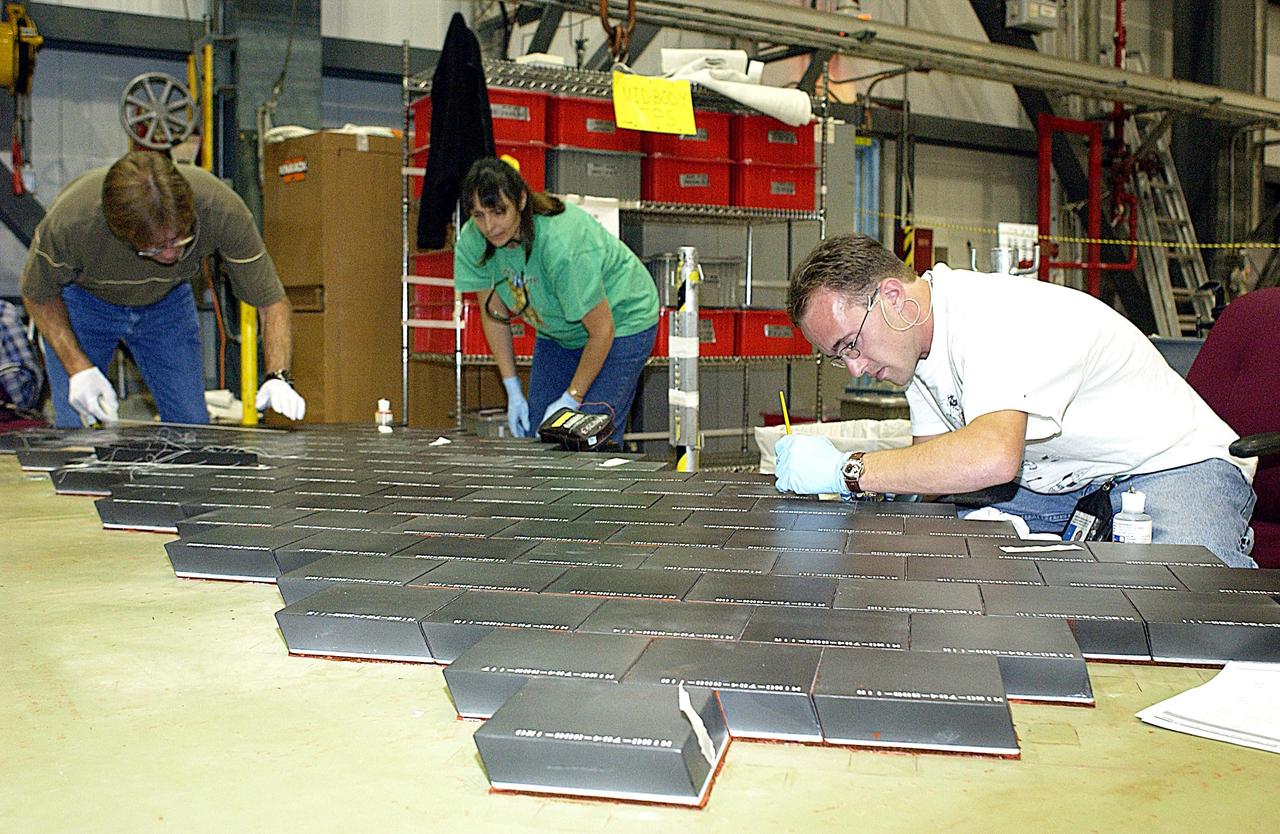
KENNEDY SPACE CENTER, FLA. -- In the Orbiter Processing Facility, United Space Alliance employees (from left) Harrell Watts, Lynn Wozniak, and Jason Levandusky install Thermal Protection System tiles on a main landing gear door of Space Shuttle orbiter Enterprise (OV-101). Sections of Enterprise were borrowed from the Smithsonian Institution's Air and Space Museum where the orbiter is being stored at the Washington Dulles International Airport. Enterprise was the first orbiter built in the Shuttle fleet and was used to conduct the Approach and Landing Test Program before the first powered Shuttle flight. After the tile installation is complete, the sections will be transferred to the Southwest Research Institute for testing requested by the Columbia Accident Investigation Board.
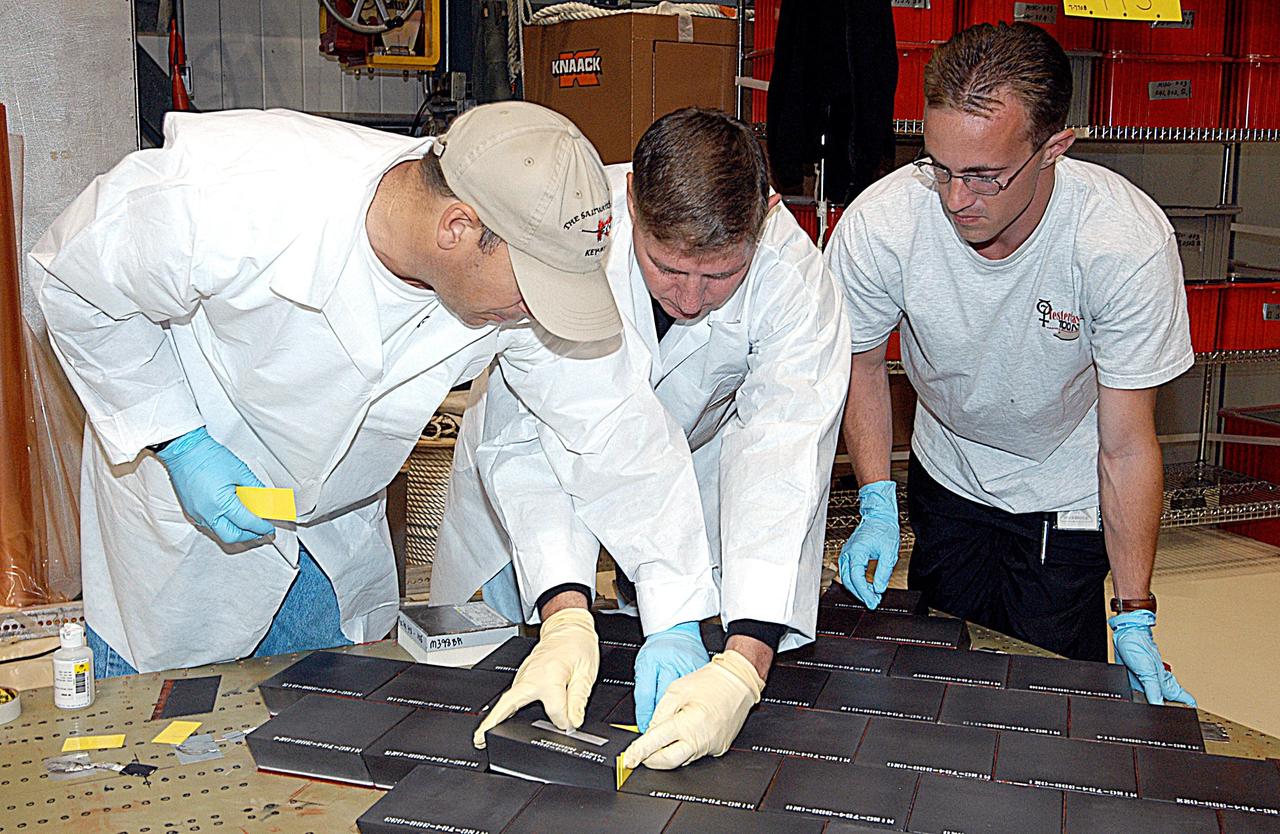
KENNEDY SPACE CENTER, FLA. -- In the Orbiter Processing Facility, United Space Alliance employees (from left) Mike Cote, Tom Baggitt, and Jason Levandusky install Thermal Protection System tiles on a main landing gear door of Space Shuttle orbiter Enterprise (OV-101). Sections of Enterprise were borrowed from the Smithsonian Institution's Air and Space Museum where the orbiter is being stored at the Washington Dulles International Airport. Enterprise was the first orbiter built in the Shuttle fleet and was used to conduct the Approach and Landing Test Program before the first powered Shuttle flight. After the tile installation is complete, the sections will be transferred to the Southwest Research Institute for testing requested by the Columbia Accident Investigation Board.
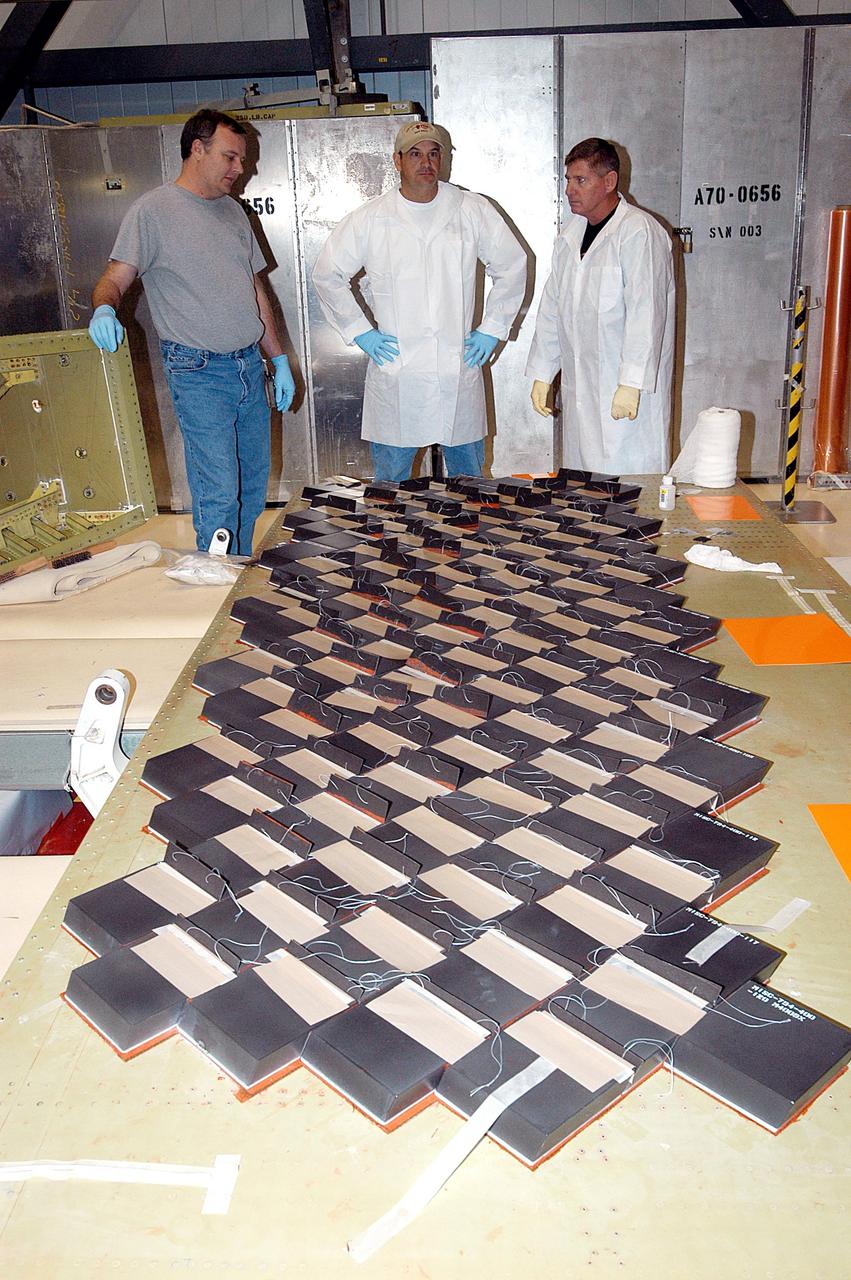
KENNEDY SPACE CENTER, FLA. -- In the Orbiter Processing Facility, United Space Alliance employees (from left) John Kuhn, Mike Cote, and Tom Baggitt discuss the installation of Thermal Protection System tiles on a main landing gear door of Space Shuttle orbiter Enterprise (OV-101). Sections of Enterprise were borrowed from the Smithsonian Institution's Air and Space Museum where the orbiter is being stored at the Washington Dulles International Airport. Enterprise was the first orbiter built in the Shuttle fleet and was used to conduct the Approach and Landing Test Program before the first powered Shuttle flight. After the tile installation is complete, the sections will be transferred to the Southwest Research Institute for testing requested by the Columbia Accident Investigation Board.

In-flight photo of the NASA F-15B used in tests of the X-33 Thermal Protection System (TPS) materials. Flying at subsonic speeds, the F-15B tests measured the air loads on the proposed X-33 protective materials. In contrast, shock loads testing investigated the local impact of the supersonic shock wave itself on the TPS materials. Similar tests had been done in 1985 for the space shuttle tiles, using an F-104 aircraft.
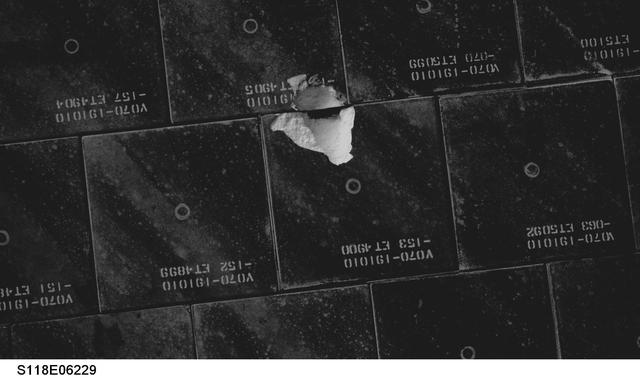
KENNEDY SPACE CENTER, FLA. -- This is a view taken by the astronauts during orbit of damaged tiles on the underside of Endeavour. The damage occurred from a piece of foam on the external tank during launch of Space Shuttle Endeavour on mission STS-118 on Aug. 8. After extensive engineering analysis of such images and testing on the ground, the Mission Management Team decided the tile did not pose a risk to the crew during re-entry. Endeavour landed safely at 12:32 p.m. EDT at NASA's Kennedy Space Center after a 13-day mission to the International Space Station. The STS-118 mission installed a new gyroscope, an external spare parts platform and another truss segment to the expanding station.
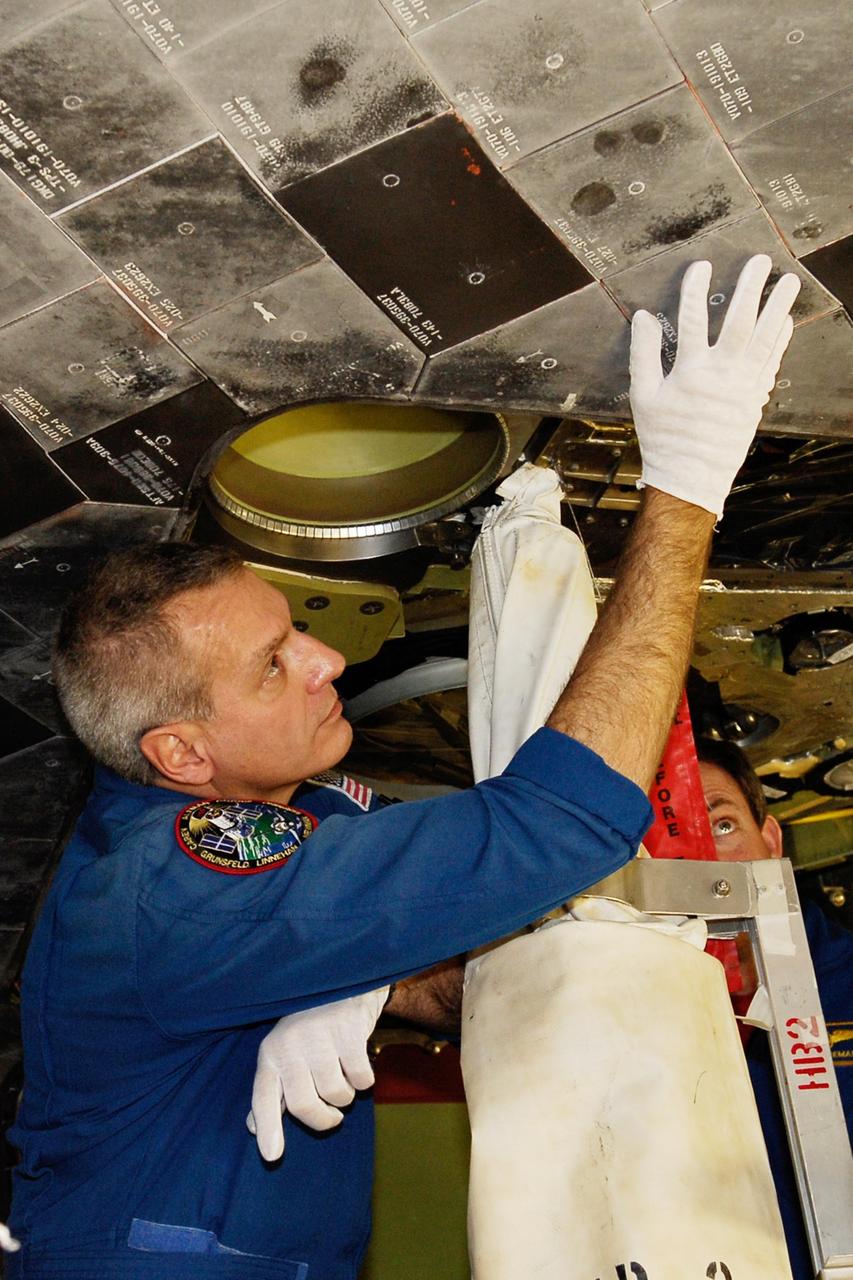
KENNEDY SPACE CENTER, FLA. -- In the Orbiter Processing Facility, STS-123 Mission Specialist Richard Linnehan makes a hands-on inspection of the thermal protection system tiles on the underside of space shuttle Endeavour. He and other crew members are at NASA's Kennedy Space Center for a crew equipment interface test, a process of familiarization with payloads, hardware and the space shuttle. The STS-123 mission is targeted for launch on space shuttle Endeavour on Feb. 14. It will be the 25th assembly flight of the station. Photo credit: NASA/Kim Shiflett
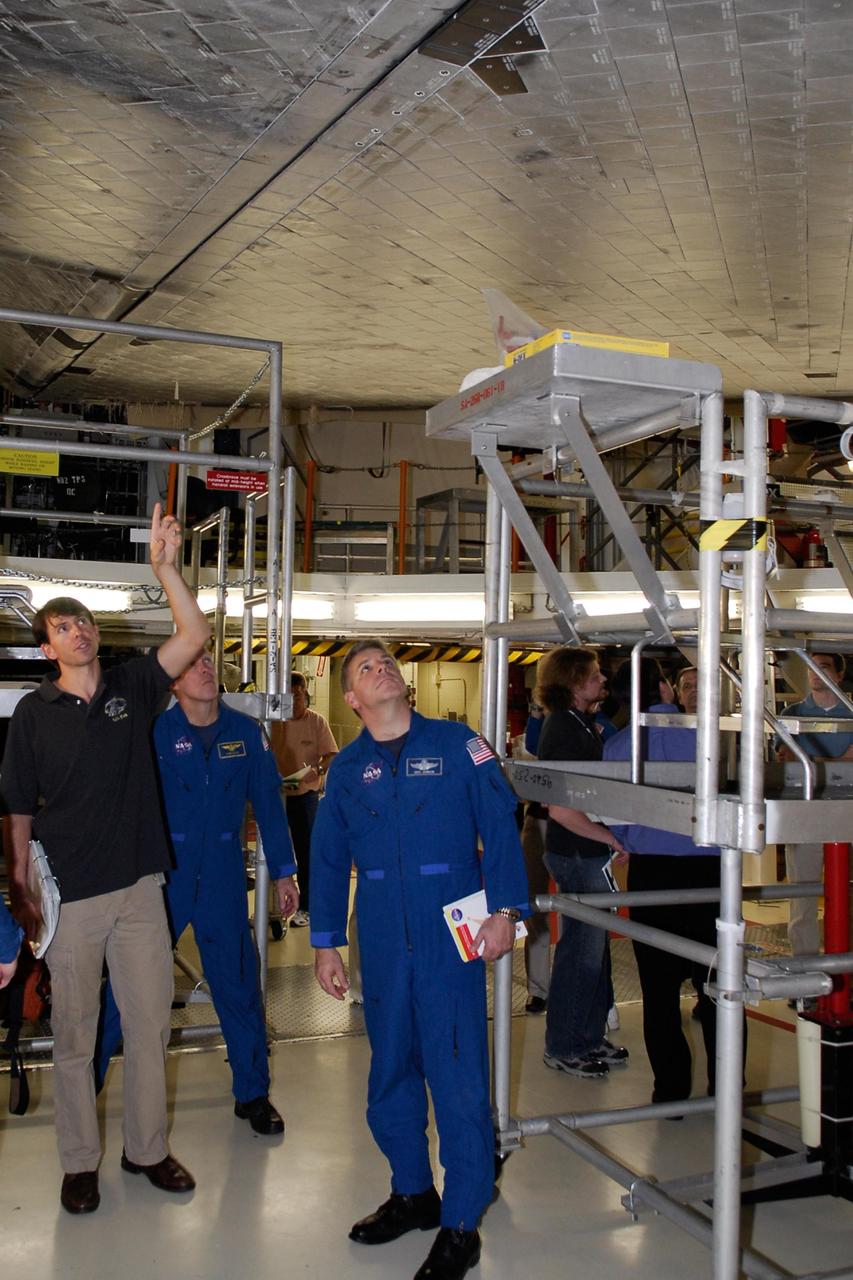
KENNEDY SPACE CENTER, FLA. -- In the Orbiter Processing Facility, STS-123 Commander Dominic Gorie (center) and Pilot Gregory Johnson (right) inspect the thermal protection system tiles on the underside of space shuttle Endeavour. They and other crew members are at NASA's Kennedy Space Center for a crew equipment interface test, a process of familiarization with payloads, hardware and the space shuttle. The STS-123 mission is targeted for launch on space shuttle Endeavour on Feb. 14. It will be the 25th assembly flight of the station. Photo credit: NASA/Kim Shiflett
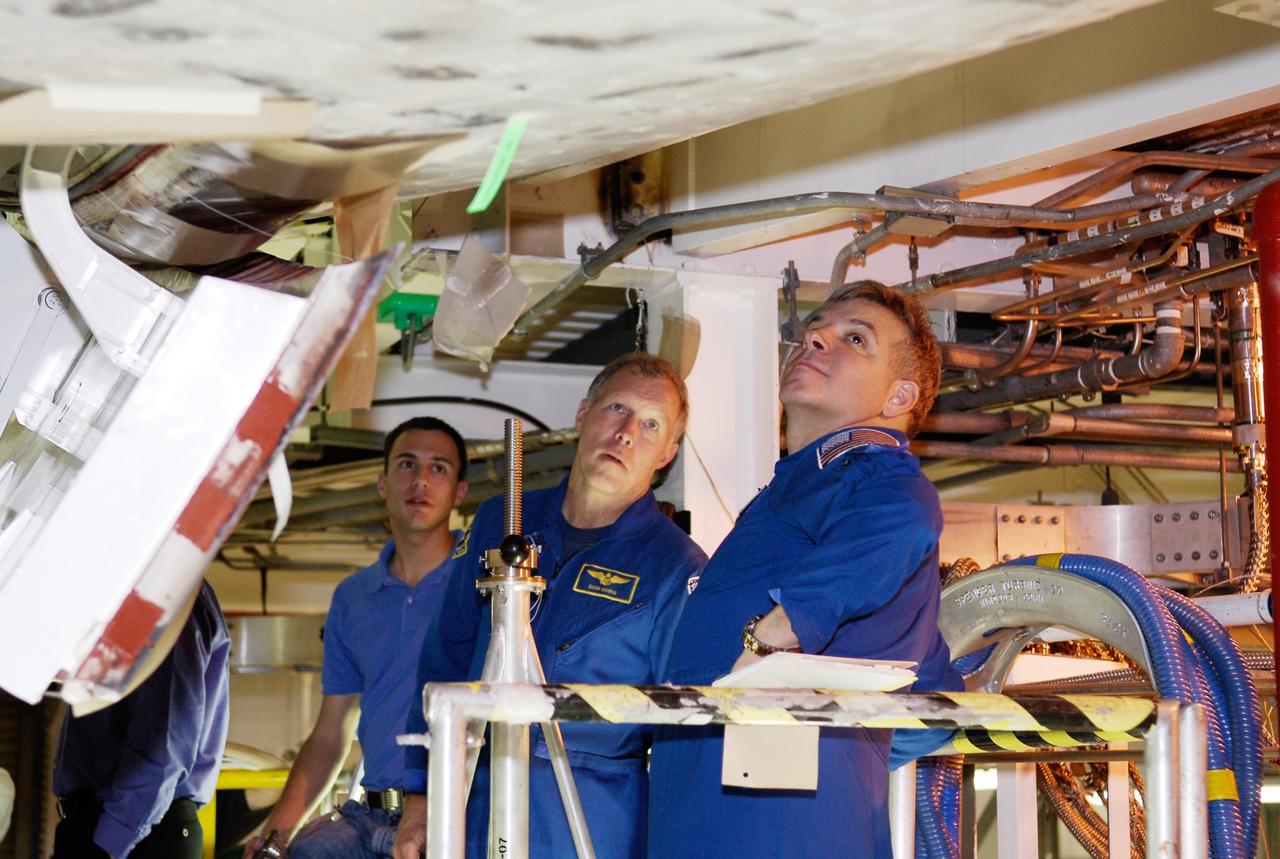
KENNEDY SPACE CENTER, FLA. -- In the Orbiter Processing Facility, STS-123 crew members inspect the thermal protection system tiles on the underside of space shuttle Endeavour. At center is Commander Dominic Gorie; at right is Pilot Gregory Johnson. They and other crew members are at NASA's Kennedy Space Center for a crew equipment interface test, a process of familiarization with payloads, hardware and the space shuttle. The STS-123 mission is targeted for launch on space shuttle Endeavour on Feb. 14. It will be the 25th assembly flight of the station. Photo credit: NASA/Kim Shiflett

KENNEDY SPACE CENTER, FLA. -- In the Orbiter Processing Facility, STS-123 Mission Specialist Richard Linnehan inspects the thermal protection system tiles on the underside of space shuttle Endeavour. He and other crew members are at NASA's Kennedy Space Center for a crew equipment interface test, a process of familiarization with payloads, hardware and the space shuttle. The STS-123 mission is targeted for launch on space shuttle Endeavour on Feb. 14. It will be the 25th assembly flight of the station. Photo credit: NASA/Kim Shiflett
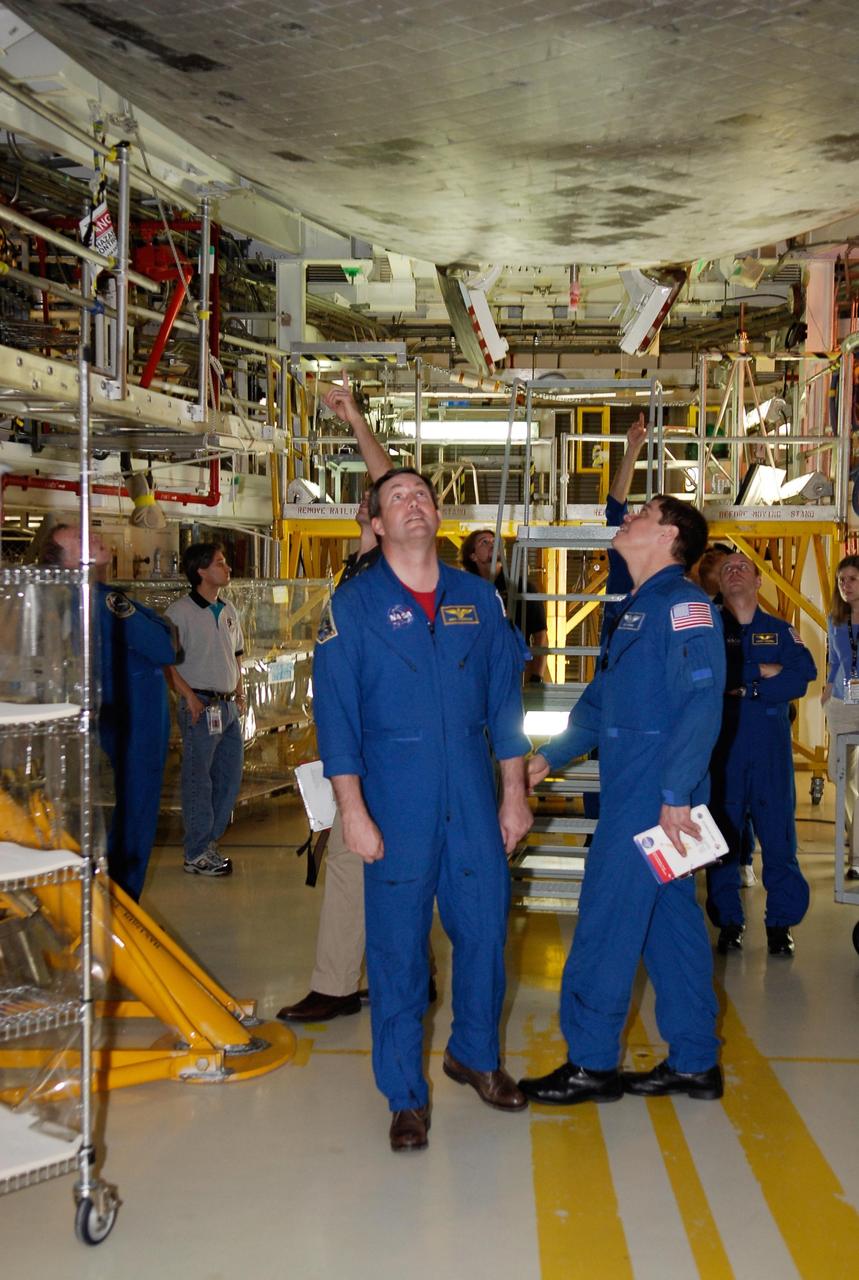
KENNEDY SPACE CENTER, FLA. -- In the Orbiter Processing Facility, STS-123 Mission Specialists Michael Foreman and Robert Behnken inspect the thermal protection system tiles on the underside of space shuttle Endeavour. They and other crew members are at NASA's Kennedy Space Center for a crew equipment interface test, a process of familiarization with payloads, hardware and the space shuttle. The STS-123 mission is targeted for launch on space shuttle Endeavour on Feb. 14. It will be the 25th assembly flight of the station. Photo credit: NASA/Kim Shiflett
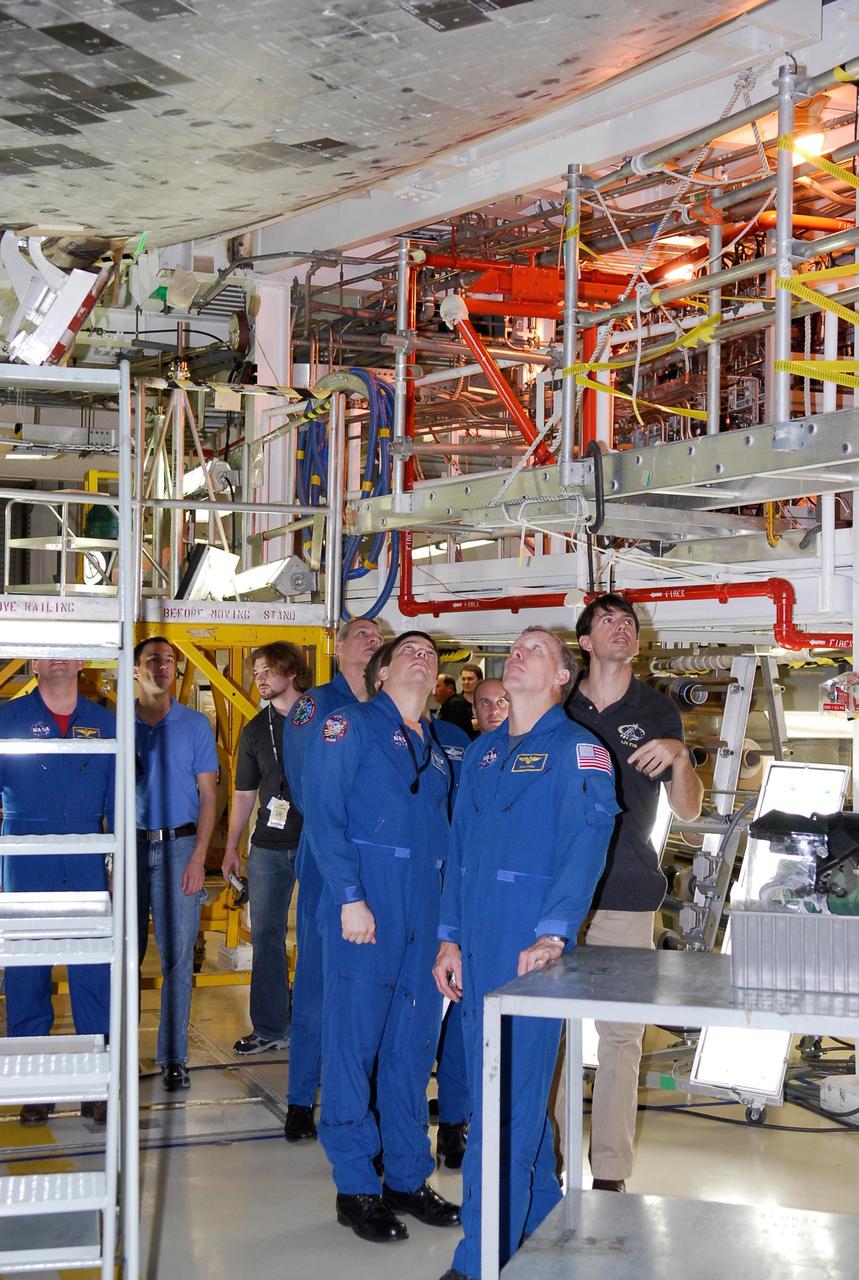
KENNEDY SPACE CENTER, FLA. -- In the Orbiter Processing Facility, STS-123 crew members inspect the thermal protection system tiles on the underside of space shuttle Endeavour. In the center are Mission Specialists Richard Linnehan and Robert Behnken, and Commander Dominic Gorie. They are at NASA's Kennedy Space Center for a crew equipment interface test, a process of familiarization with payloads, hardware and the space shuttle. The STS-123 mission is targeted for launch on space shuttle Endeavour on Feb. 14. It will be the 25th assembly flight of the station. Photo credit: NASA/Kim Shiflett
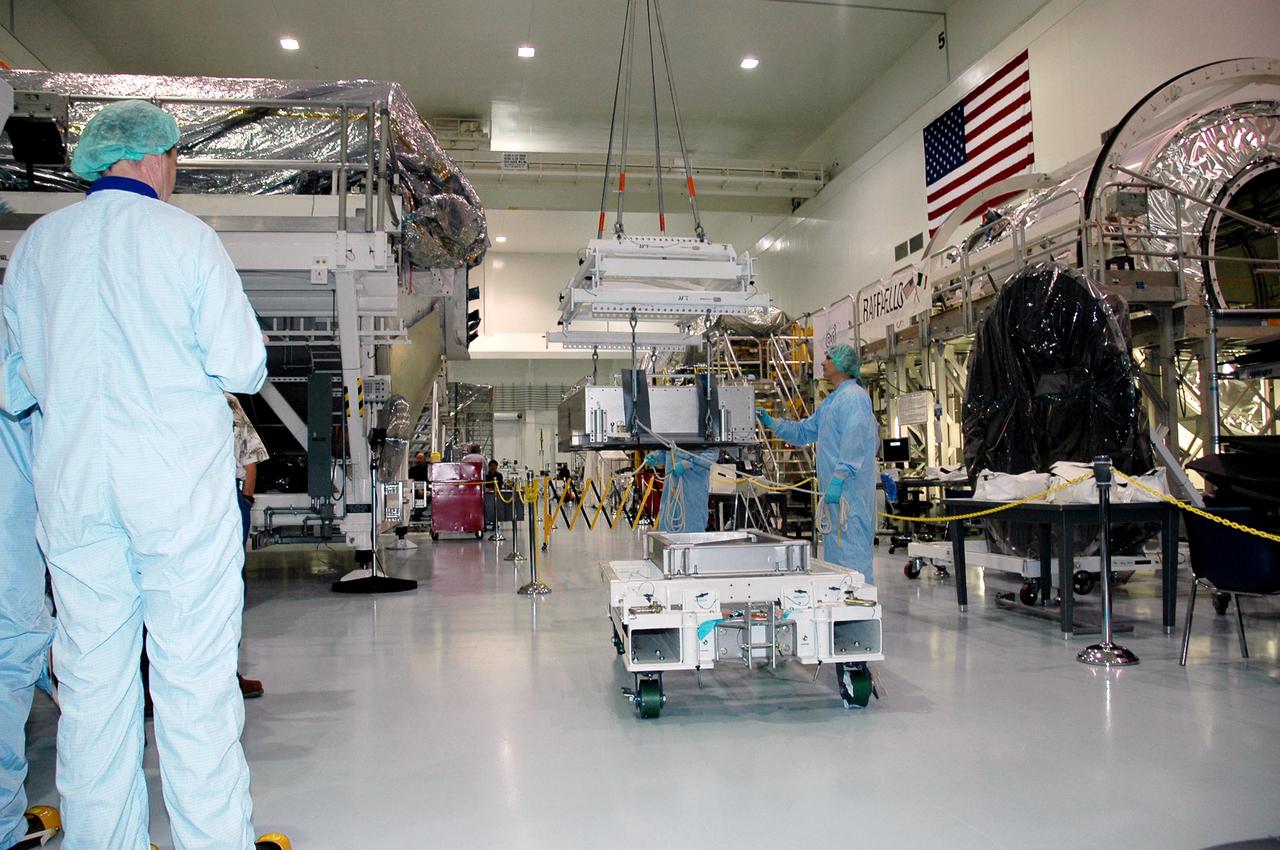
KENNEDY SPACE CENTER, FLA. - Technicians at the Space Station Processing Facility carefully watch as a crane lifts the Thermal Protection System Detailed Test Objective (DTO) box. It will be placed on the Lightweight Multi-Purpose Experiment Support Structure Carrier (LMC) to fly on Space Shuttle Discovery for mission STS-114. The DTO contains tile samples that will enable astronauts to test new on-orbit Thermal Protection System repair techniques. The launch window for mission STS-114 is May 12 to June 3.
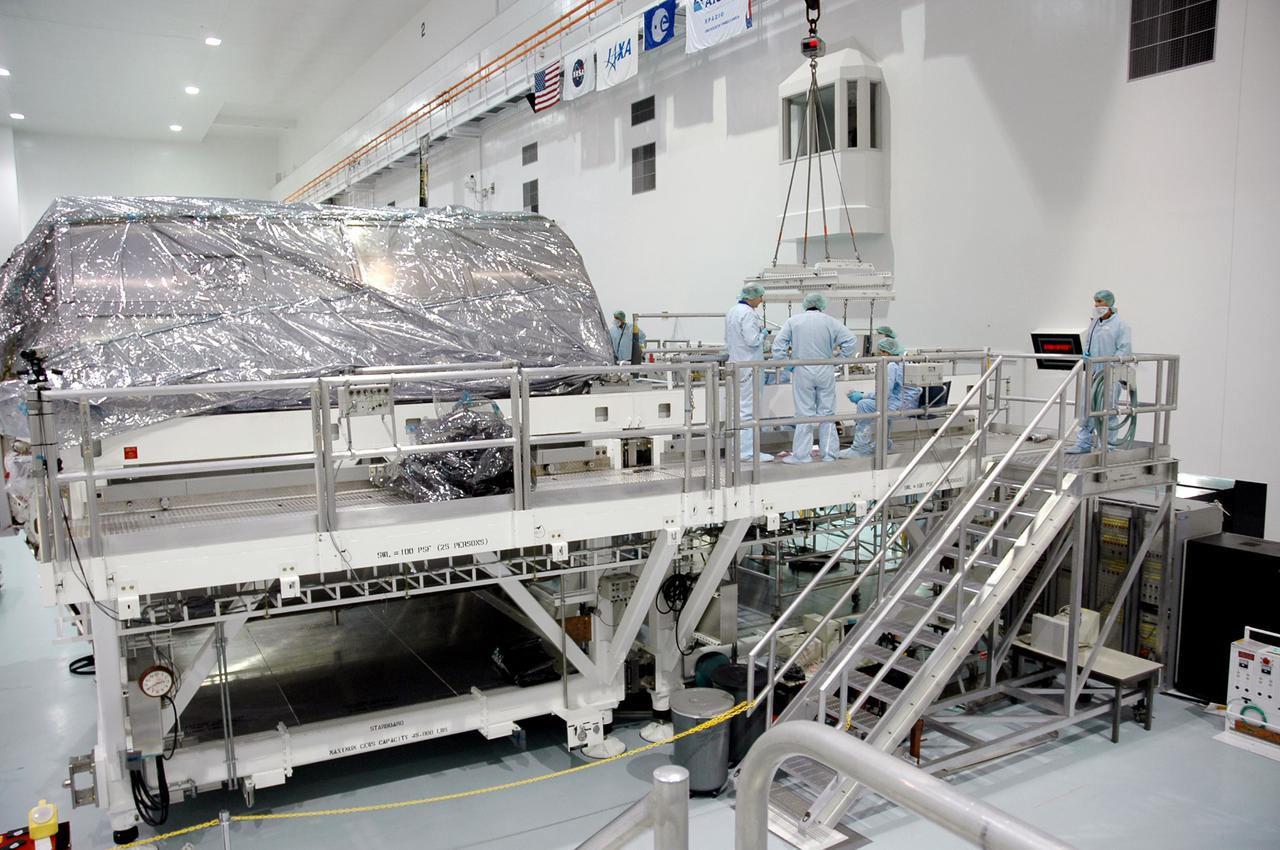
KENNEDY SPACE CENTER, FLA. - Technicians in the Space Station Processing Facility check the placement of the Thermal Protection System Detailed Test Objective (DTO) box on the Lightweight Multi-Purpose Experiment Support Structure Carrier (LMC). The LMC and DTO will fly on Space Shuttle Discovery for mission STS-114. The DTO contains tile samples that will enable astronauts to test new on-orbit Thermal Protection System repair techniques. The launch window for mission STS-114 is May 12 to June 3.
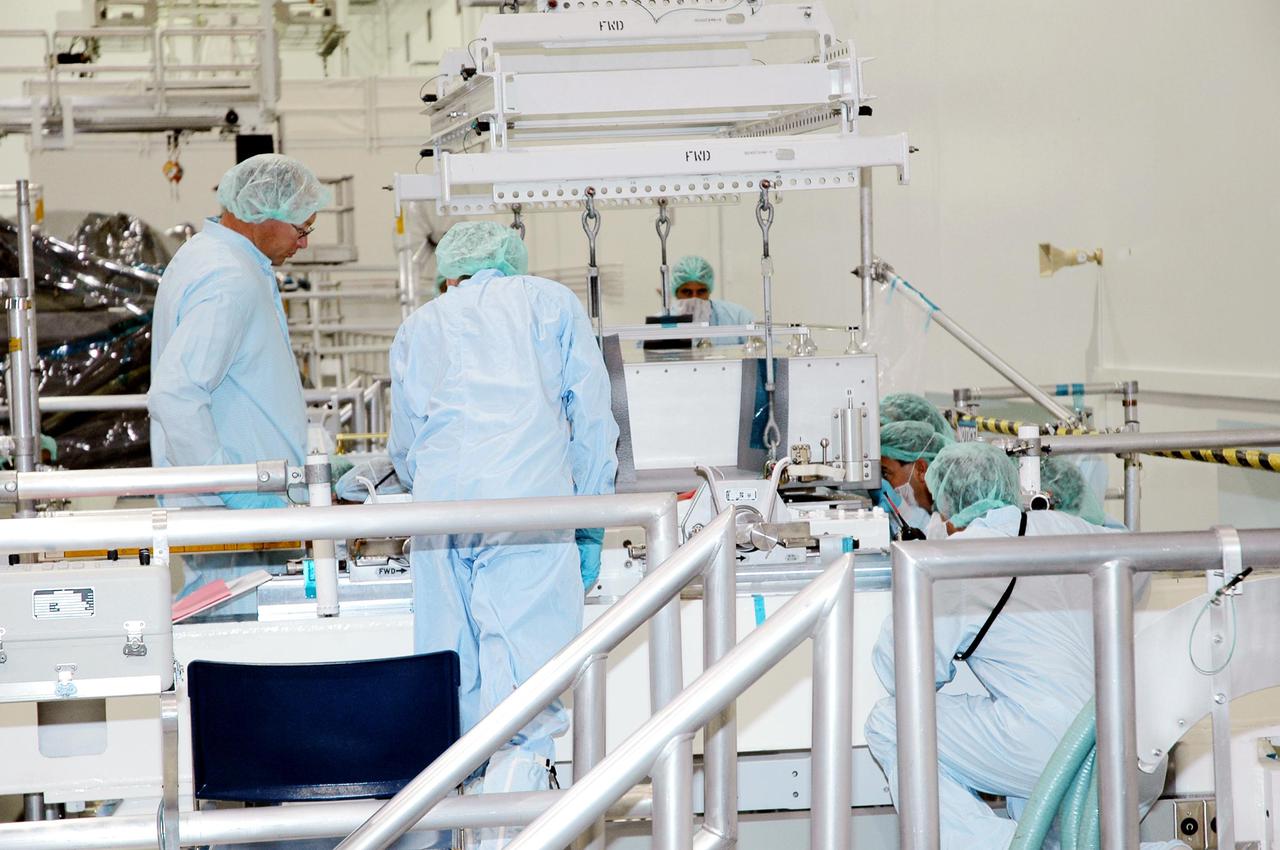
KENNEDY SPACE CENTER, FLA. - Technicians in the Space Station Processing Facility ensure the Thermal Protection System Detailed Test Objective (DTO) box is placed correctly on the Lightweight Multi-Purpose Experiment Support Structure Carrier (LMC). The LMC and DTO will fly on Space Shuttle Discovery for mission STS-114. The DTO contains tile samples that will enable astronauts to test new on-orbit Thermal Protection System repair techniques. The launch window for mission STS-114 is May 12 to June 3.
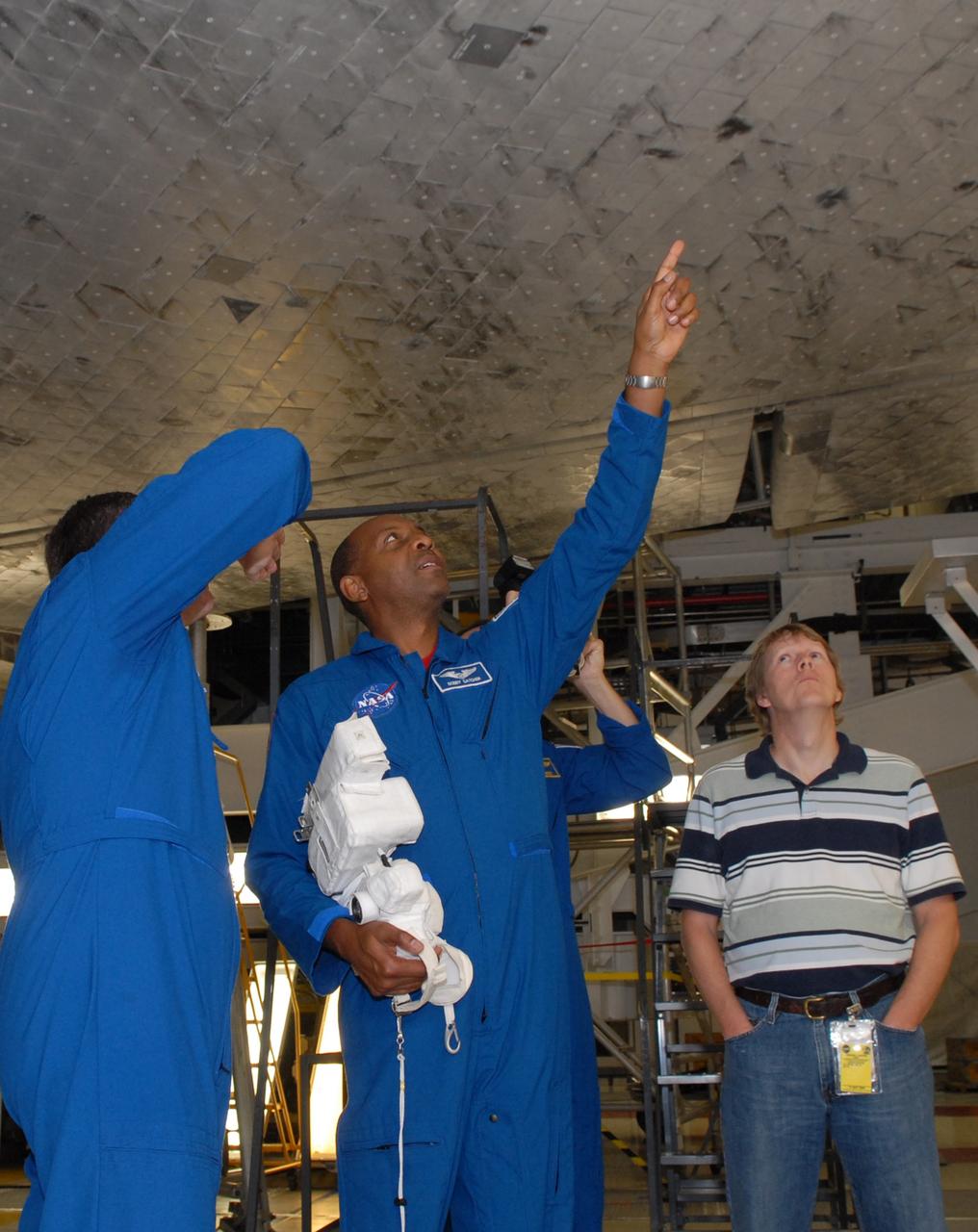
CAPE CANAVERAL, Fla. – In NASA Kennedy Space Center's Orbiter Processing Facility 1, STS-129 Mission Specialists Michael Foreman and Robert Satcher take a close look at some of the tiles on the underside of space shuttle Atlantis. The crew is at Kennedy for a Crew Equipment Interface Test, which provides hands-on training and observation of shuttle and flight hardware. Atlantis' STS-129 mission is targeted to launch Nov. 12. Photo credit: NASA/Jim Grossmann
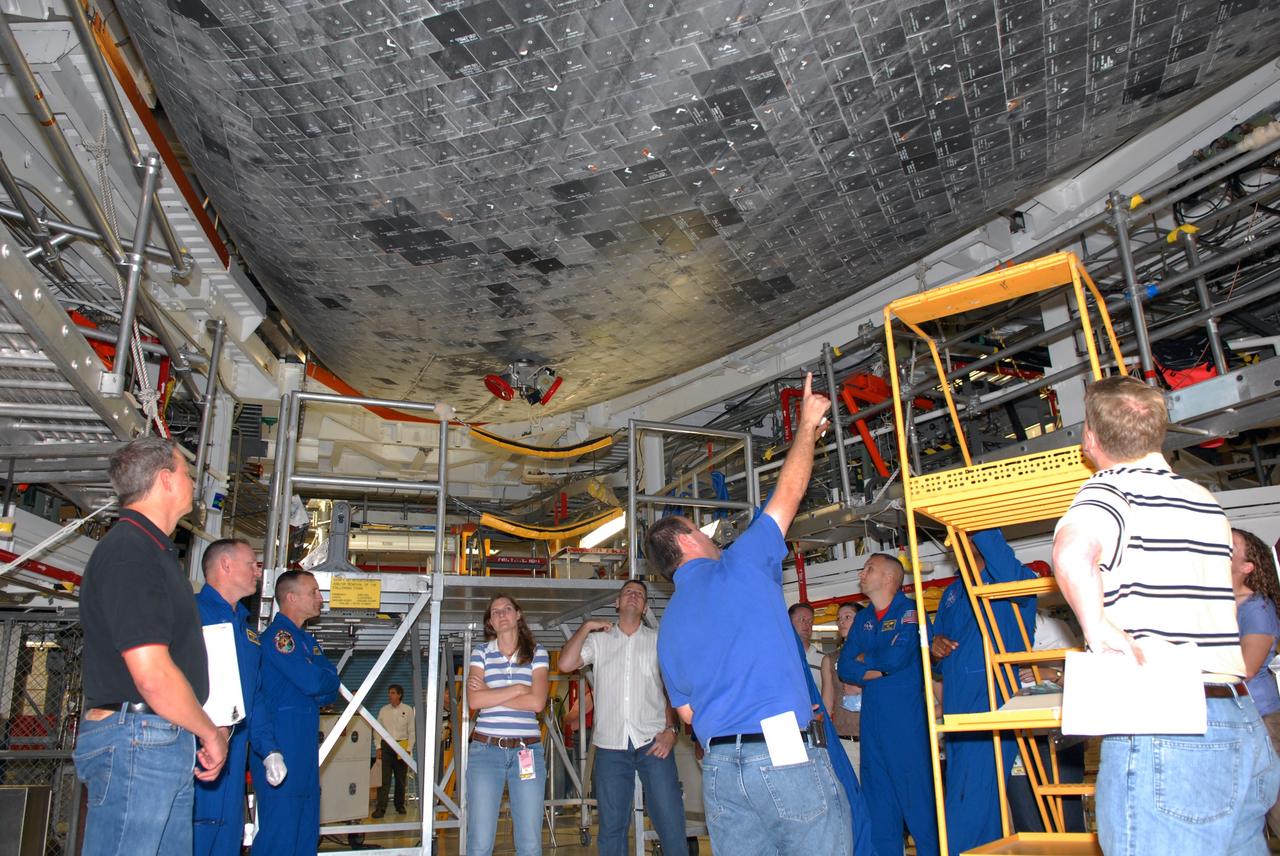
CAPE CANAVERAL, Fla. – In NASA Kennedy Space Center's Orbiter Processing Facility 1, STS-129 crew members get a close look at the tiles on the underside of space shuttle Atlantis. At left are Pilot Barry Wilmore and Commander Charles Hobaugh. At right are Mission Specialists Randy Bresnik and Robert Satcher. The crew is at Kennedy for a Crew Equipment Interface Test, which provides hands-on training and observation of shuttle and flight hardware. Atlantis' STS-129 mission is targeted to launch Nov. 12. Photo credit: NASA/Jim Grossmann
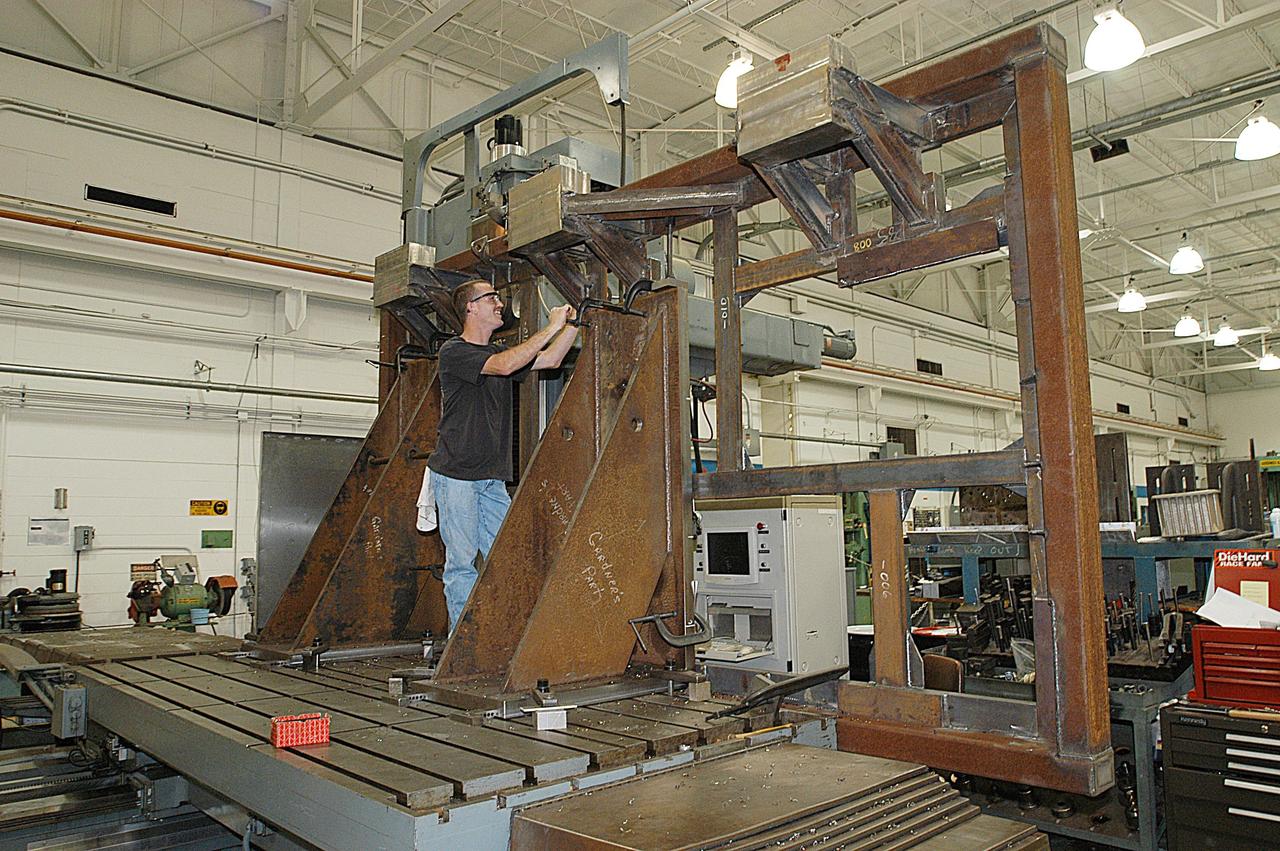
KENNEDY SPACE CENTER, FLA. -- United Space Alliance technician Matt Boonstra works on a main landing gear door mounting fixture in the Launch Equipment Shop. The fixture is being used to support the Columbia mishap investigation. A simulated orbiter wing and several test panels, along with sections of Space Shuttle orbiter Enterprise (OV-101), will be transferred to the Southwest Research Institute for testing after Thermal Protection System (TPS) tile installation on them is complete. The testing has been requested by the Columbia Accident Investigation Board. For this initiative, sections of Enterprise were borrowed from the Smithsonian Institution's Air and Space Museum where the orbiter is being stored at the Washington Dulles International Airport. Enterprise was the first orbiter built in the Shuttle fleet and was used to conduct the Approach and Landing Test Program before the first powered Shuttle flight.
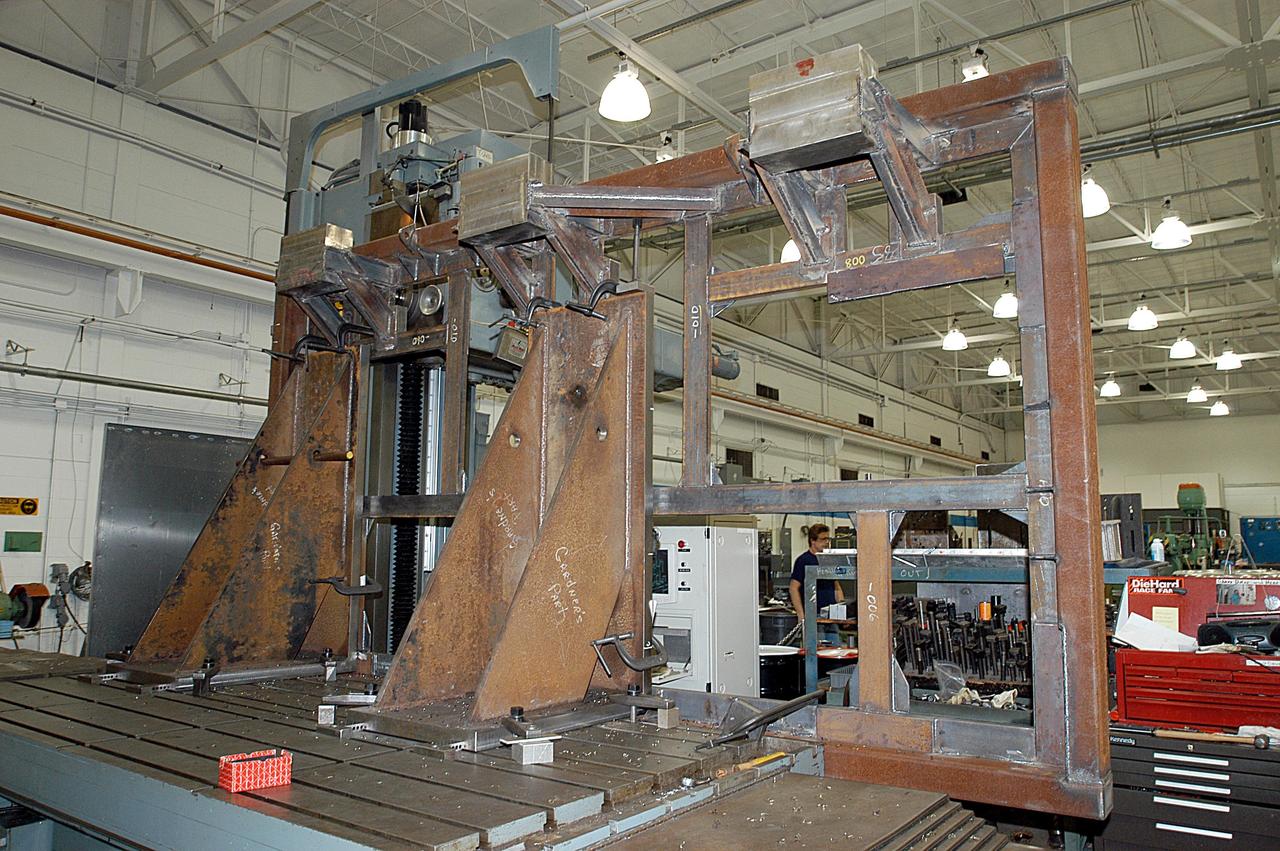
KENNEDY SPACE CENTER, FLA. -- A main landing gear door mounting fixture in the Launch Equipment Shop is being used to support the Columbia mishap investigation. A simulated orbiter wing and several test panels, along with sections of Space Shuttle orbiter Enterprise (OV-101), will be transferred to the Southwest Research Institute for testing after Thermal Protection System (TPS) tile installation is complete. The testing has been requested by the Columbia Accident Investigation Board. For this initiative, sections of Enterprise were borrowed from the Smithsonian Institution's Air and Space Museum where the orbiter is being stored at the Washington Dulles International Airport. Enterprise was the first orbiter built in the Shuttle fleet and was used to conduct the Approach and Landing Test Program before the first powered Shuttle flight.
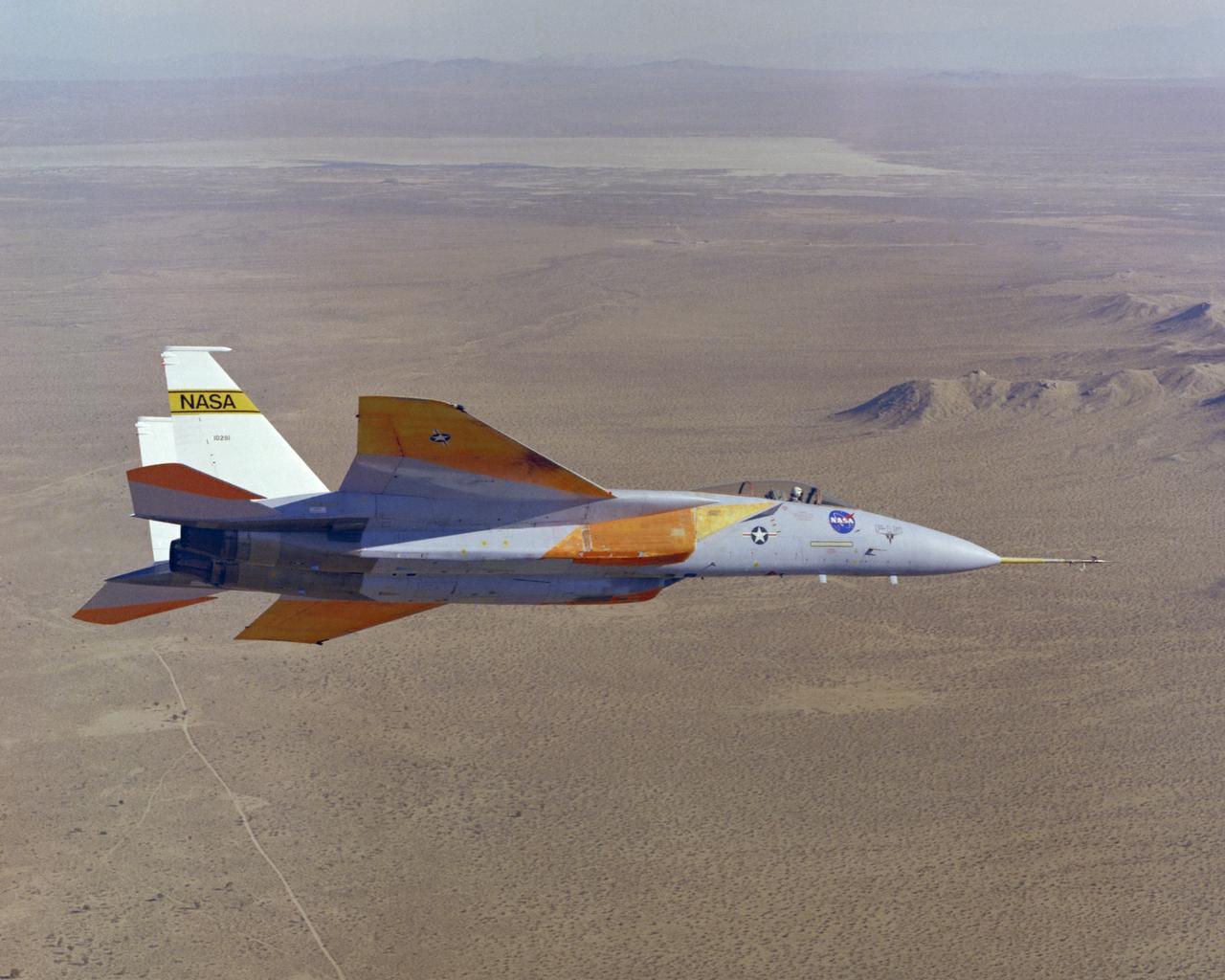
The number two F-15A (Serial #71-0281) was obtained by NASA from the U.S. Air Force in 1976 and was used for more than 25 advanced research projects involving aerodynamics, performance, propulsion control, control integration, instrumentation development, human factors, and flight test techniques. Included in these projects was its role as a testbed to evaluate aerodynamic pressures on Space Shuttle thermal protection tiles at specific altitudes and speeds.
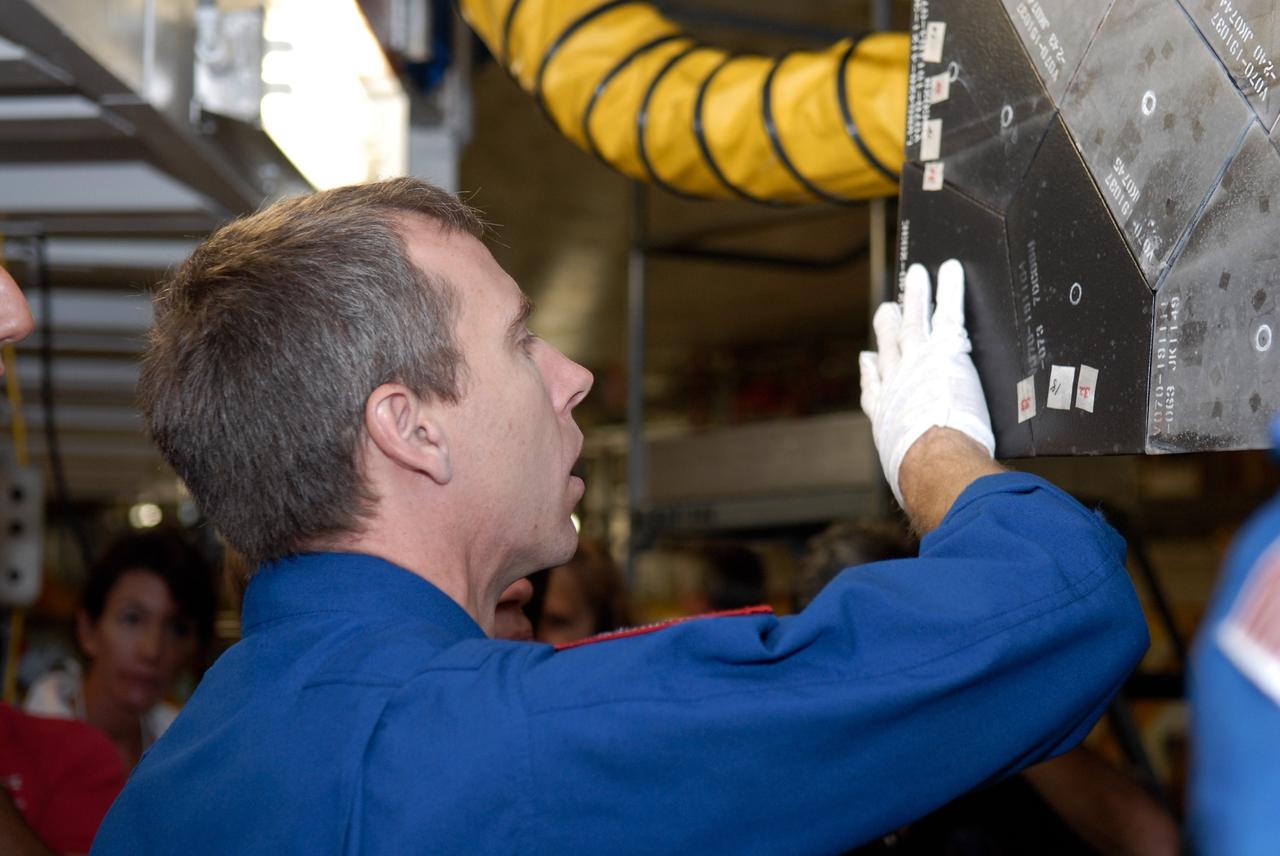
CAPE CANAVERAL, Fla. – In the Orbiter Processing Facility at NASA's Kennedy Space Center, STS-125 Mission Specialist Andrew Feustel touches the thermal protection system tiles on space shuttle Atlantis with a gloved hand during a crew equipment interface test. The CEIT provides hands-on experience with hardware and equipment for their mission. Atlantis is targeted to launch on the STS-125 Hubble Servicing Mission 4 on Oct. 8. Photo credit: NASA/Kim Shiflett
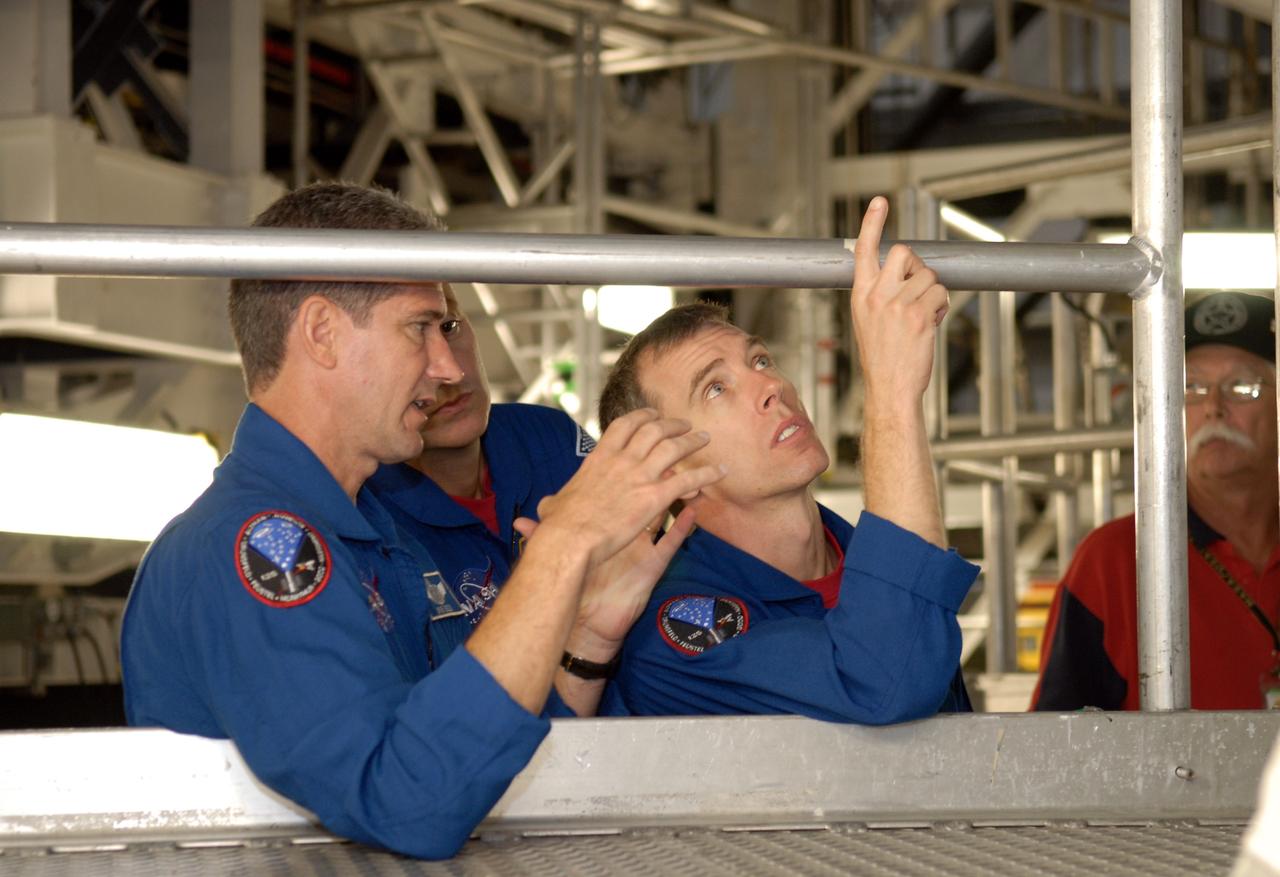
CAPE CANAVERAL, Fla. – In the Orbiter Processing Facility at NASA's Kennedy Space Center, STS-125 Mission Specialists Michael Good, Mike Massimino and Andrew Feustel discuss the tiles they are looking at on the underside of space shuttle Atlantis. Crew members are at Kennedy for a crew equipment interface test, which provides hands-on experience with hardware and equipment for their mission. Atlantis is targeted to launch on the STS-125 Hubble Servicing Mission 4 on Oct. 8. Photo credit: NASA/Kim Shiflett
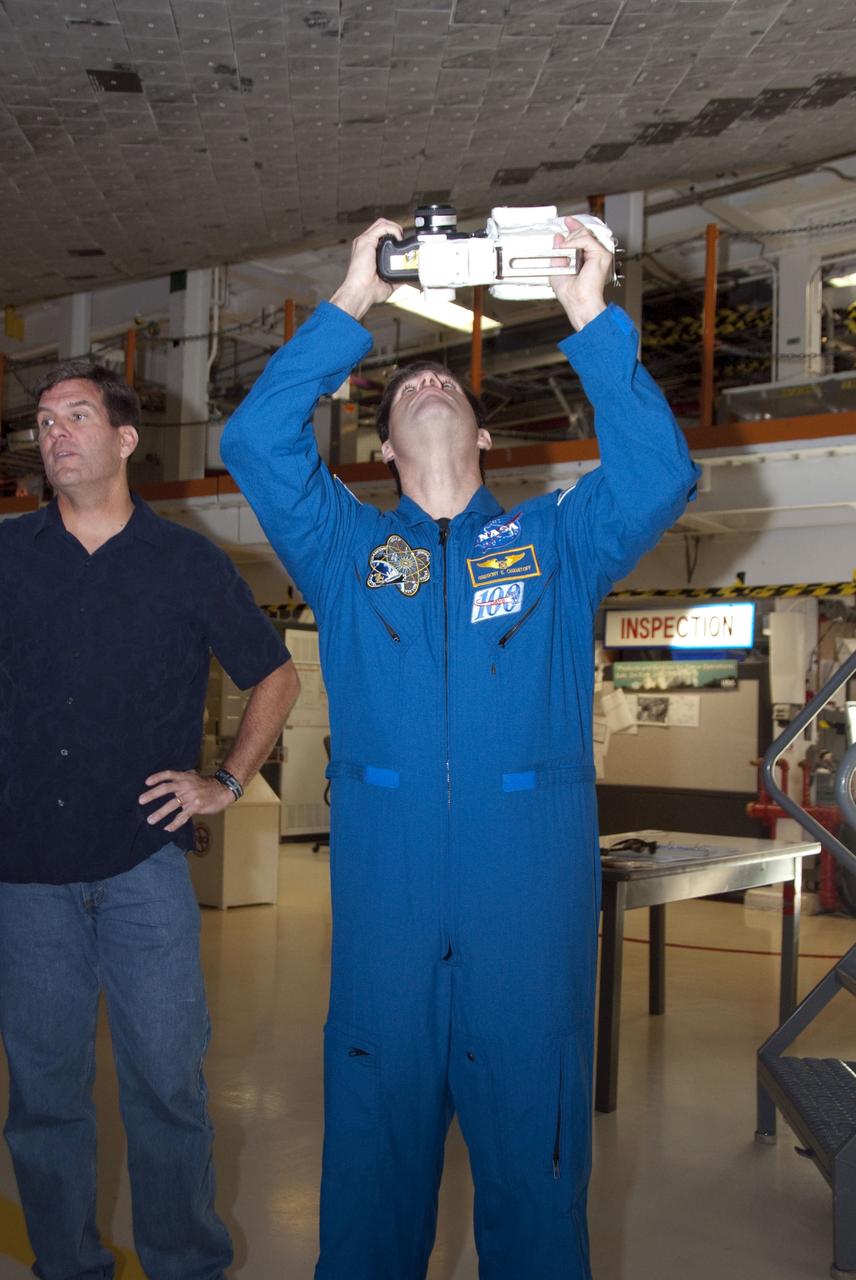
CAPE CANAVERAL, Fla. -- In the Orbiter Processing Facility-2 at NASA's Kennedy Space Center in Florida, STS-134 Mission Specialist Greg Chamitoff looks at space shuttle Endeavour's heat shield tiles, which will protect the spacecraft during re-entry. The six STS-134 astronauts are at Kennedy participating in the Crew Equipment Interface Test (CEIT), which gives them an opportunity for hands-on training and familiarization of the payload they'll be delivering to the International Space Station. Space shuttle Endeavour is targeted to launch on the STS-134 mission Feb. 27, 2011. For more information, visit www.nasa.gov/mission_pages/shuttle/shuttlemissions/sts134/index.html. Photo credit: NASA/Cory Huston
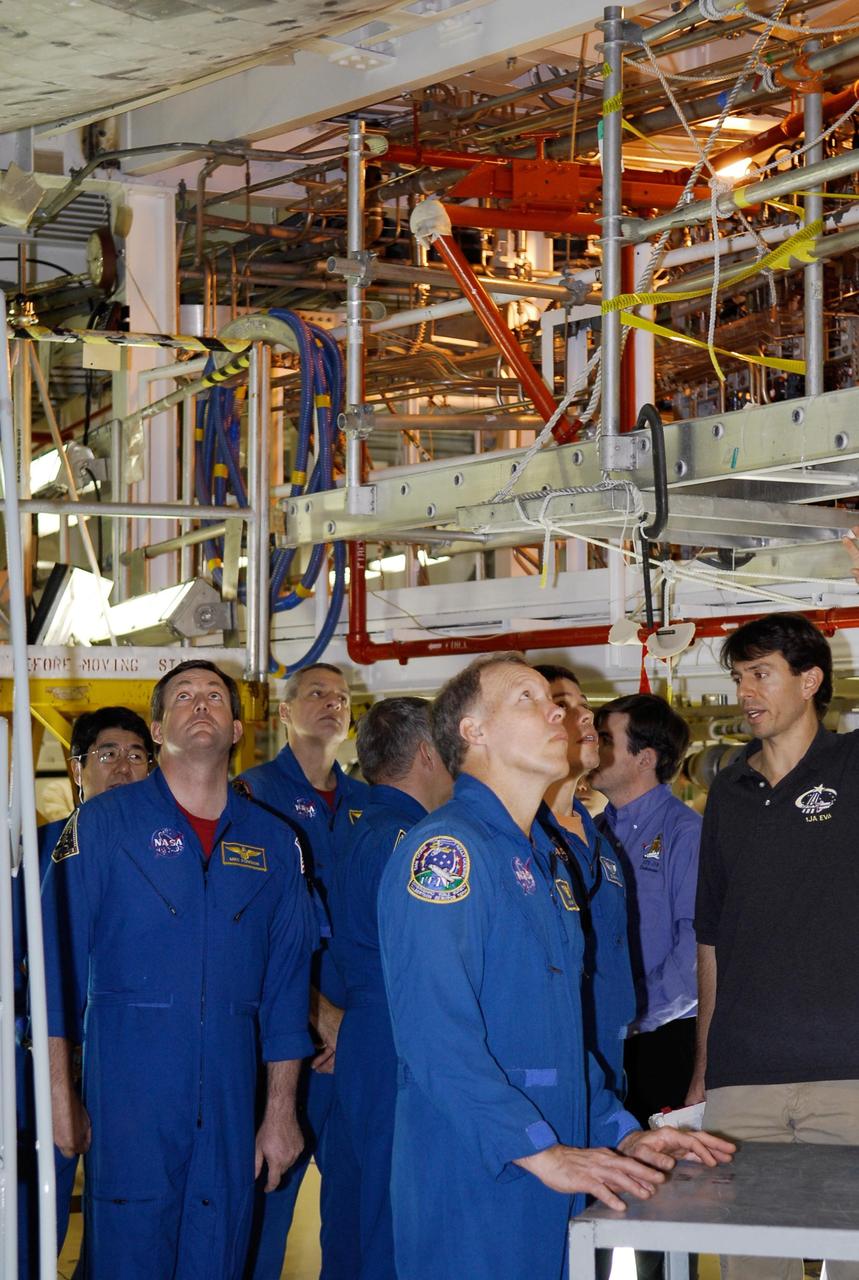
KENNEDY SPACE CENTER, FLA. -- In the Orbiter Processing Facility, STS-123 crew members inspect the thermal protection system tiles on the underside of space shuttle Endeavour. From left are Mission Specialists Takao Doi, Michael Foreman and Richard Linnehan, Pilot Gregory Johnson (turned away), Commander Dominic Gorie and Mission Specialist Robert Behnken. They are at NASA's Kennedy Space Center for a crew equipment interface test, a process of familiarization with payloads, hardware and the space shuttle. The STS-123 mission is targeted for launch on space shuttle Endeavour on Feb. 14. It will be the 25th assembly flight of the station. Photo credit: NASA/Kim Shiflett
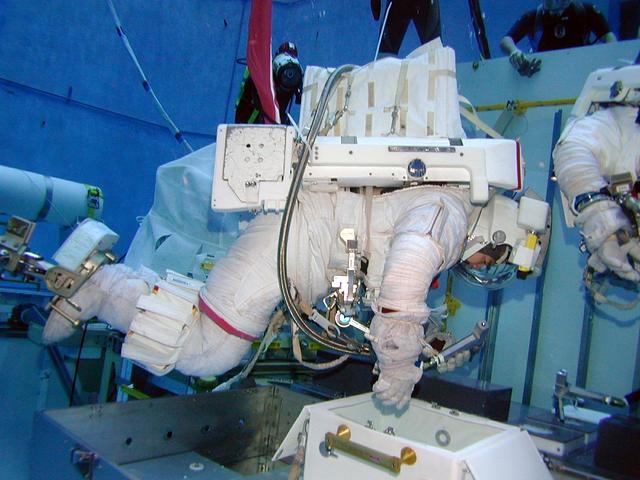
JSC2004-E-13024 (2 March 2004) --- Japanese Aerospace and Exploration Agency (JAXA) Astronaut Soichi Noguchi, the lead space walker for the Space Shuttle's return to flight on mission STS-114, checks a potential repair technique for the Shuttle's heat protection tiles in Johnson Space Center's (JSC) Neutral Buoyancy Laboratory (NBL) pool. The checkout session was conducted on March 2, 2004, and checked the latest techniques and hardware under development for Noguchi to use during an in-flight test of new Shuttle heat shield repair possibilities during STS-114. The mission is now targeted for launch no earlier than the spring of 2005.
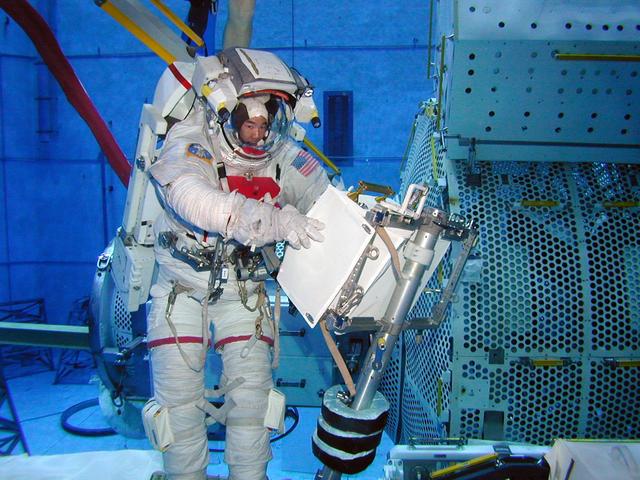
JSC2004-E-13023 (2 March 2004) --- Japanese Aerospace and Exploration Agency (JAXA) Astronaut Soichi Noguchi, the lead space walker for the Space Shuttle's return to flight on mission STS-114, checks a potential repair technique for the Shuttle's heat protection tiles in Johnson Space Center's (JSC) Neutral Buoyancy Laboratory (NBL) pool. The checkout session was conducted on March 2, 2004, and checked the latest techniques and hardware under development for Noguchi to use during an in-flight test of new Shuttle heat shield repair possibilities during STS-114. The mission is now targeted for launch no earlier than the spring of 2005.
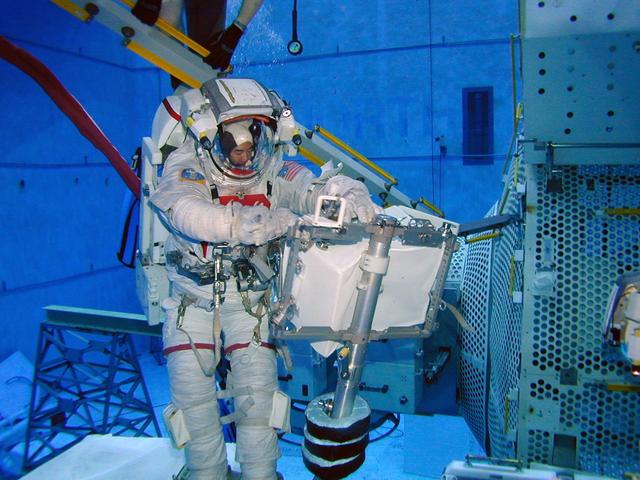
JSC2004-E-13022 (2 March 2004) --- Japanese Aerospace and Exploration Agency (JAXA) Astronaut Soichi Noguchi, the lead space walker for the Space Shuttle's return to flight on mission STS-114, checks a potential repair technique for the Shuttle's heat protection tiles in Johnson Space Center's (JSC) Neutral Buoyancy Laboratory (NBL) pool. The checkout session was conducted on March 2, 2004, and checked the latest techniques and hardware under development for Noguchi to use during an in-flight test of new Shuttle heat shield repair possibilities during STS-114. The mission is now targeted for launch no earlier than the spring of 2005.
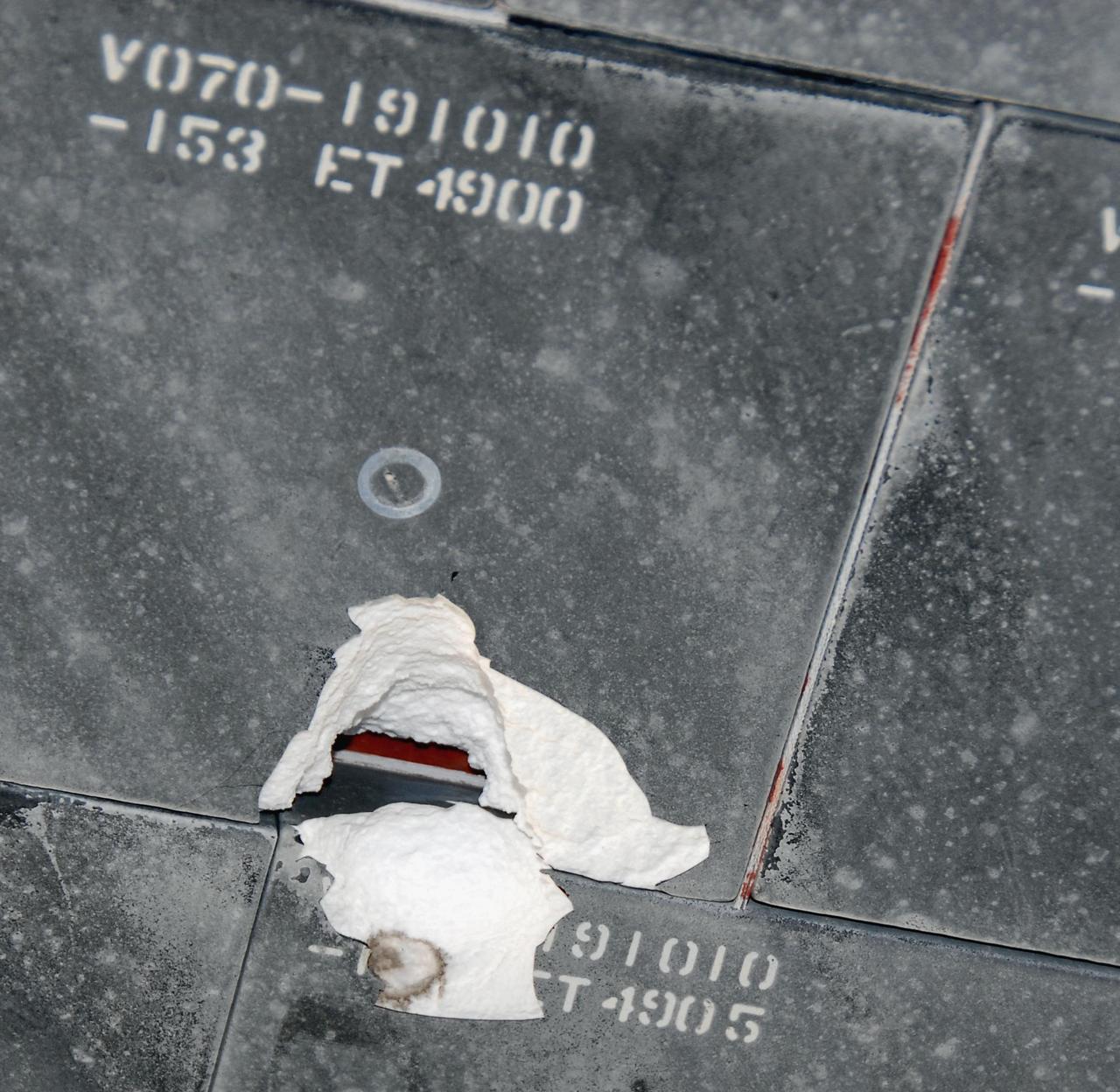
KENNEDY SPACE CENTER, FLA. -- This is a closer view of the underside of Endeavour taken after its landing on runway 15 at NASA's Kennedy Space Center. The damage to the tiles occurred from a piece of foam on the external tank during launch of Space Shuttle Endeavour on mission STS-118 on Aug. 8. After extensive engineering analysis of such images and testing on the ground, the Mission Management Team decided the tile did not pose a risk to the crew during re-entry. Endeavour landed safely at 12:32 p.m. EDT at NASA's Kennedy Space Center after a 13-day mission to the International Space Station. The STS-118 mission installed a new gyroscope, an external spare parts platform and another truss segment to the expanding station. Photo credit: NASA/Kim Shiflett
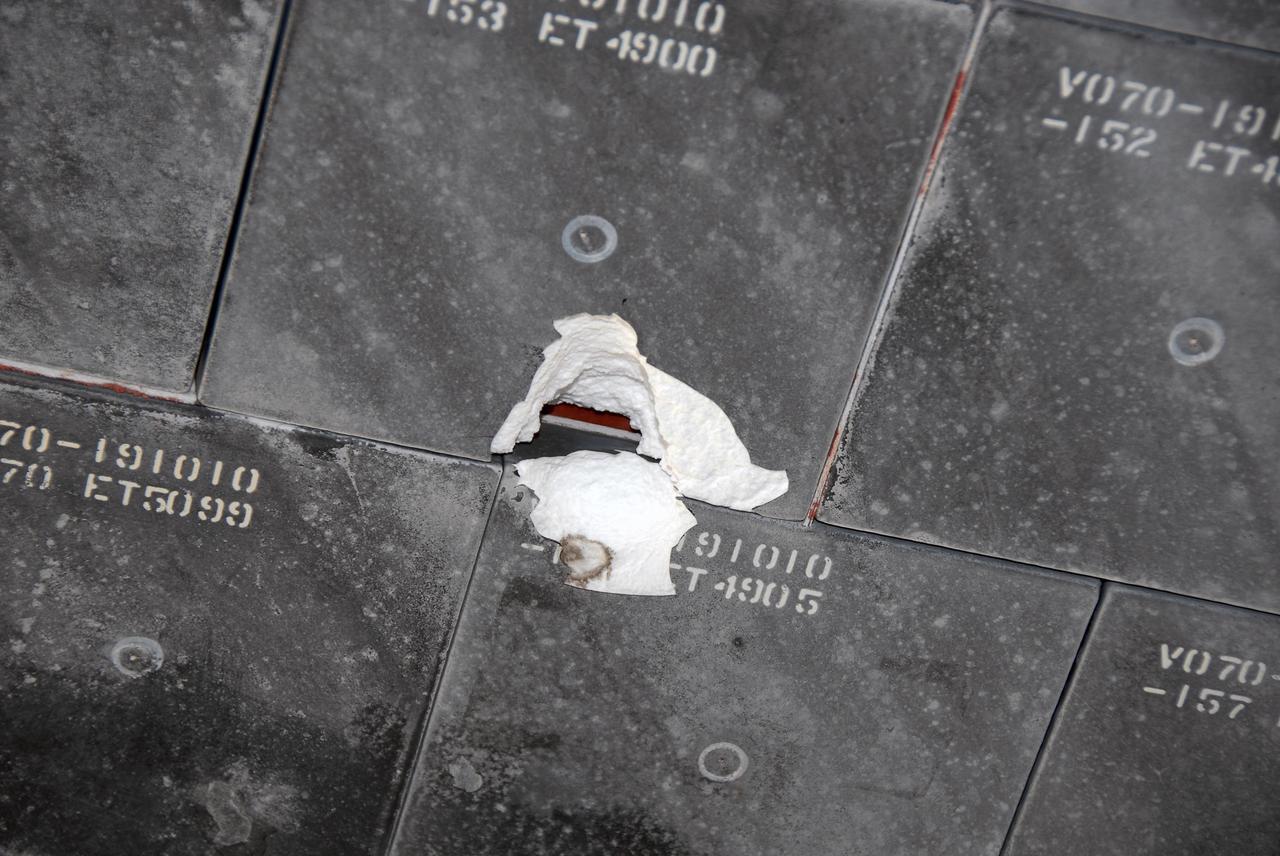
KENNEDY SPACE CENTER, FLA. -- This is a view of the underside of Endeavour taken after its landing on runway 15 at NASA's Kennedy Space Center. The damage to the tiles occurred from a piece of foam on the external tank during launch of Space Shuttle Endeavour on mission STS-118 on Aug. 8. After extensive engineering analysis of such images and testing on the ground, the Mission Management Team decided the tile did not pose a risk to the crew during re-entry. Endeavour landed safely at 12:32 p.m. EDT at NASA's Kennedy Space Center after a 13-day mission to the International Space Station. The STS-118 mission installed a new gyroscope, an external spare parts platform and another truss segment to the expanding station.
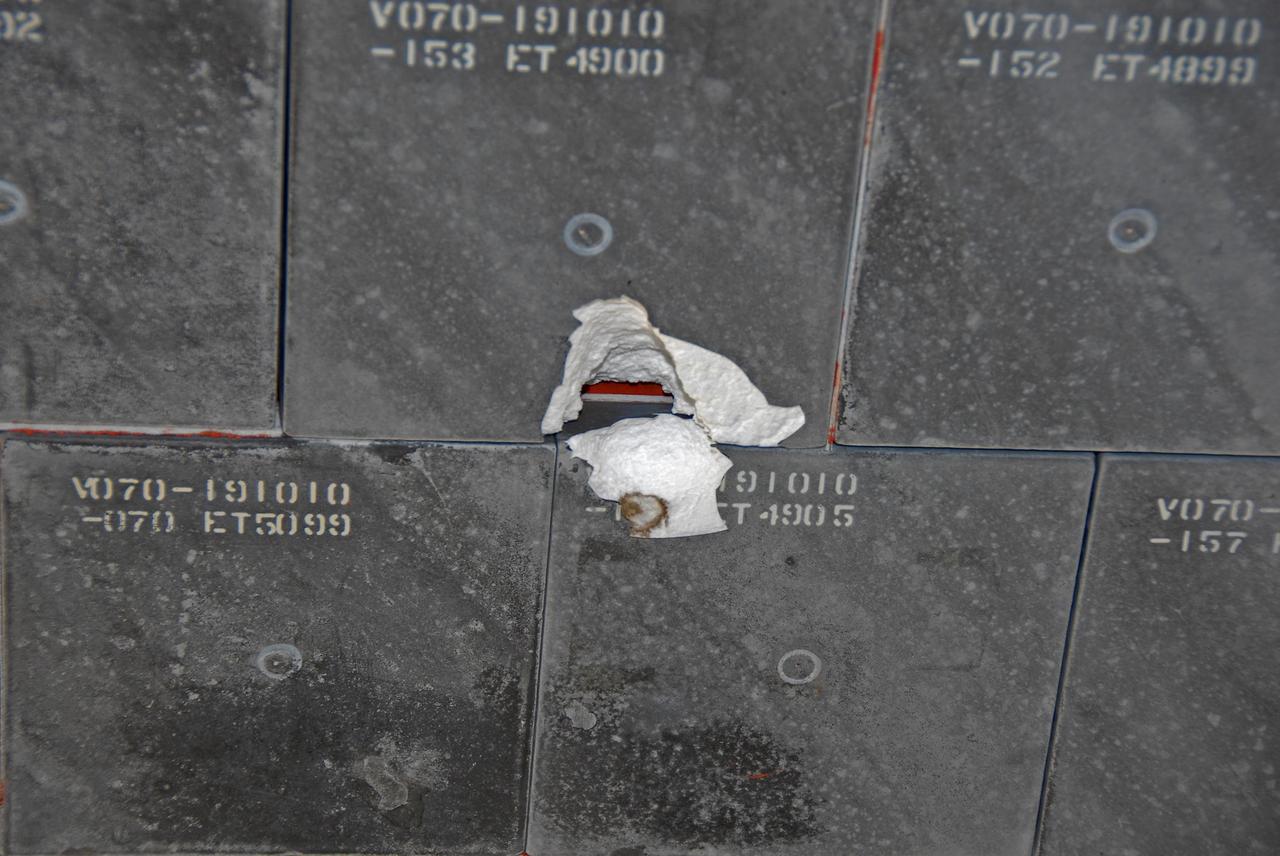
KENNEDY SPACE CENTER, FLA. -- This is a view of the underside of Endeavour taken after its landing on runway 15 at NASA's Kennedy Space Center. The damage to the tiles occurred from a piece of foam on the external tank during launch of Space Shuttle Endeavour on mission STS-118 on Aug. 8. After extensive engineering analysis of such images and testing on the ground, the Mission Management Team decided the tile did not pose a risk to the crew during re-entry. Endeavour landed safely at 12:32 p.m. EDT at NASA's Kennedy Space Center after a 13-day mission to the International Space Station. The STS-118 mission installed a new gyroscope, an external spare parts platform and another truss segment to the expanding station. Photo credit: NASA/Kim Shiflett
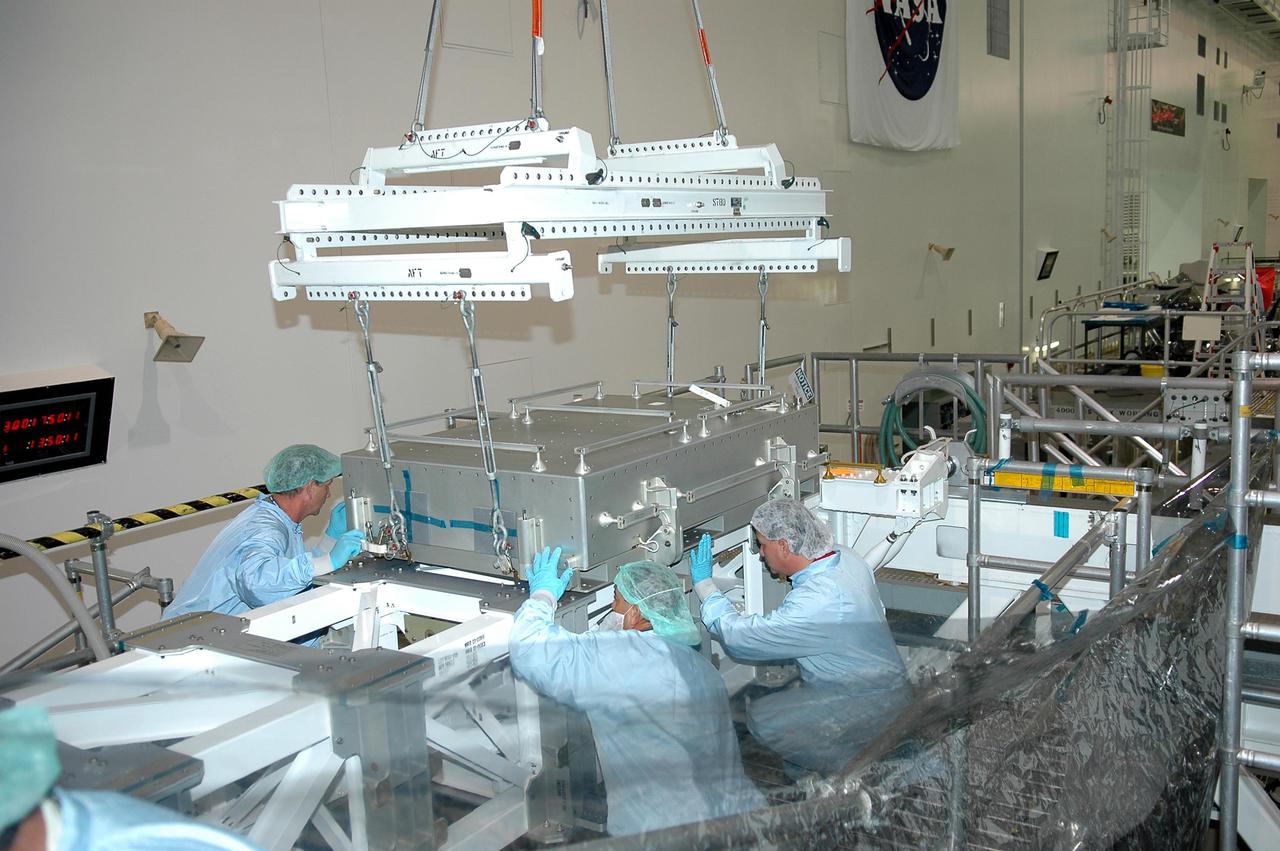
KENNEDY SPACE CENTER, FLA. - Technicians at the Space Station Processing Facility perform a fit check of the Thermal Protection System Sample Box on the Lightweight Multi-Purpose Experiment Support Structure Carrier (LMC). The box is the actual flight hardware scheduled to fly on the Space Shuttle Return to Flight mission STS-114. The fit check is performed to ensure the hardware mates properly with the newly modified LMC and will be returned to NASA’s Johnson Space Center for installation of tile samples in support of the STS-114 mission. The Thermal Protection Detailed Test Objective will enable astronauts to test new on-orbit Thermal Protection System repair techniques. Mission STS-114 is scheduled to launch in May 2005.
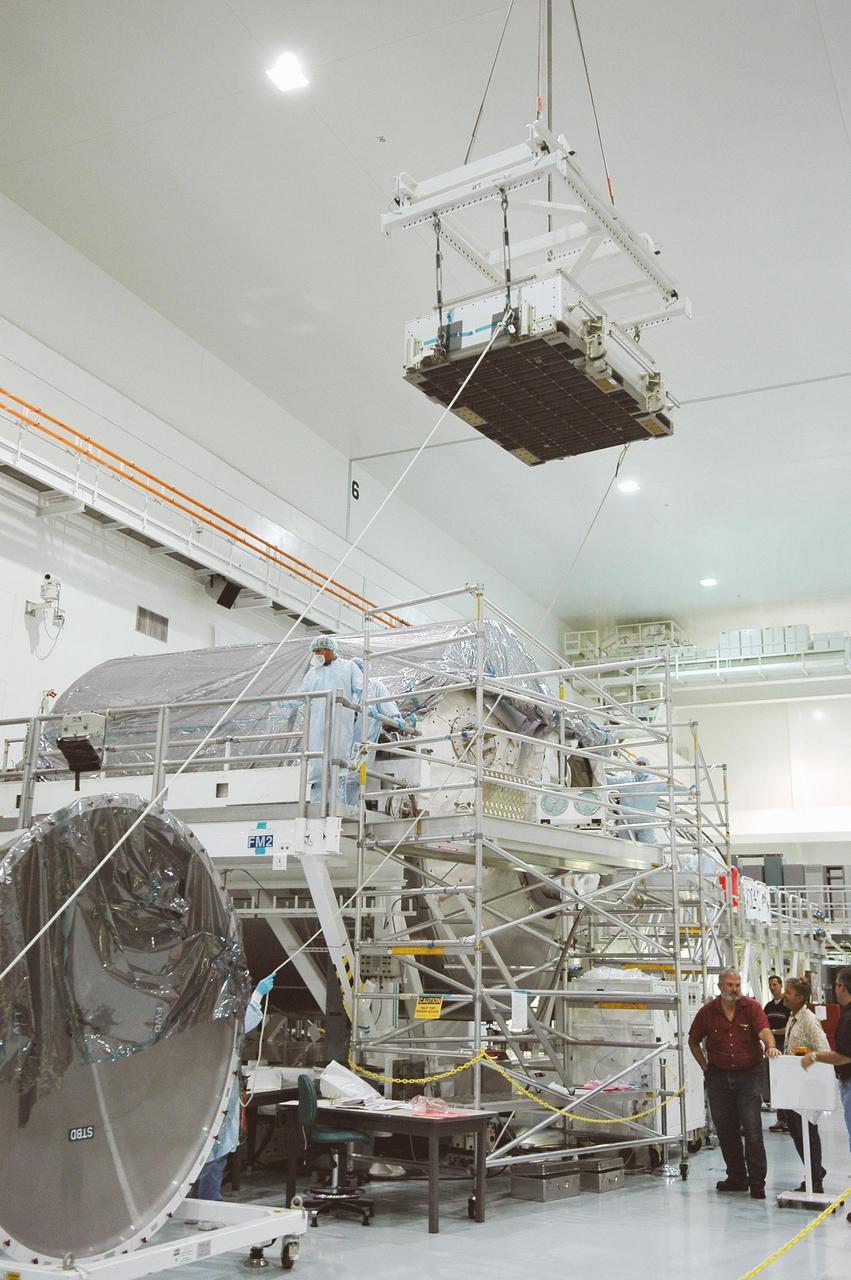
KENNEDY SPACE CENTER, FLA. - In the Space Station Processing Facility, an overhead crane moves a Thermal Protection System Sample Box to the Lightweight Multi-Purpose Experiment Support Structure Carrier (LMC) for a fit check. The box is the actual flight hardware scheduled to fly on the Space Shuttle Return to Flight mission STS-114. The fit check is performed to ensure the hardware mates properly with the newly modified LMC and will be returned to NASA’s Johnson Space Center for installation of tile samples in support of the STS-114 mission. The Thermal Protection Detailed Test Objective will enable astronauts to test new on-orbit Thermal Protection System repair techniques. Mission STS-114 is scheduled to launch in May 2005.
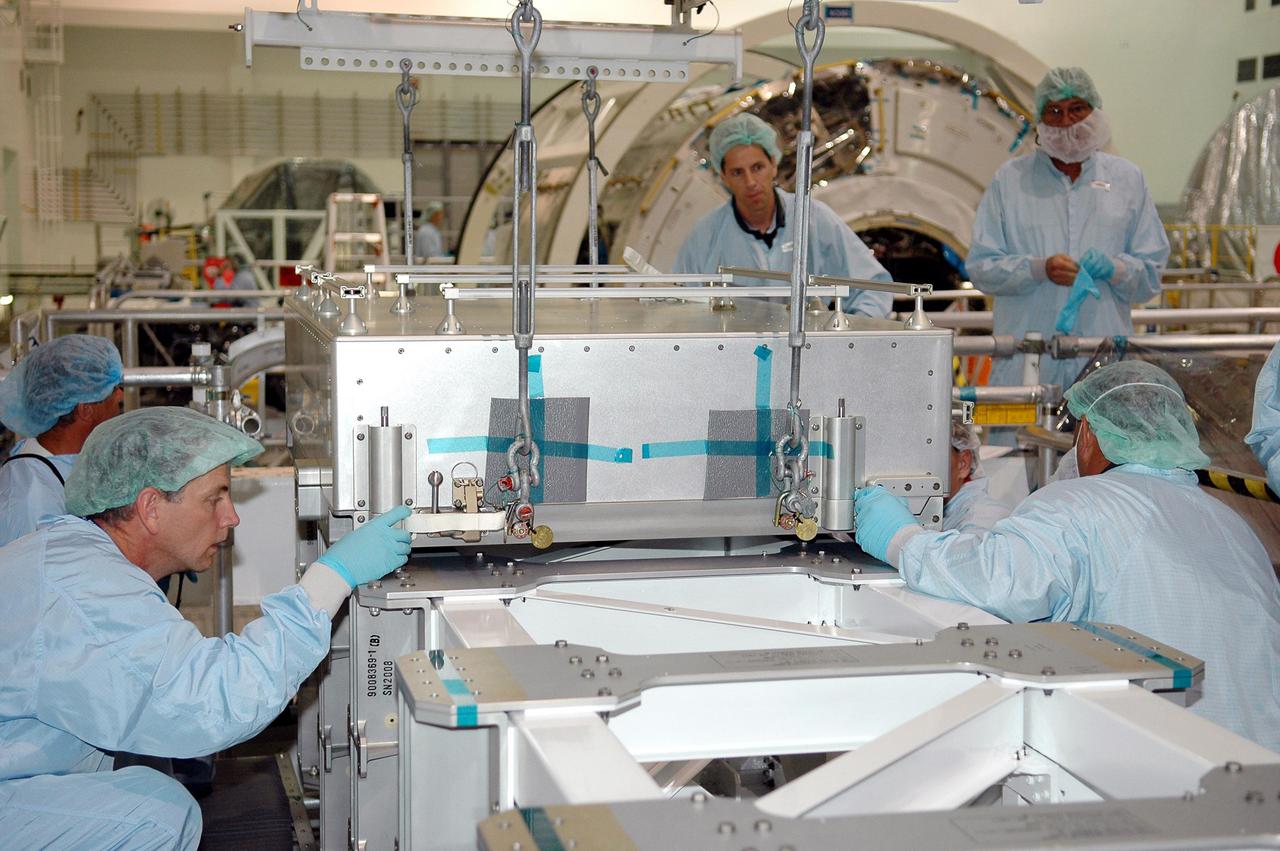
KENNEDY SPACE CENTER, FLA. - Technicians at the Space Station Processing Facility perform a fit check of the Thermal Protection System Sample Box on the Lightweight Multi-Purpose Experiment Support Structure Carrier (LMC). The box is the actual flight hardware scheduled to fly on the Space Shuttle Return to Flight mission STS-114. The fit check is performed to ensure the hardware mates properly with the newly modified LMC and will be returned to NASA’s Johnson Space Center for installation of tile samples in support of the STS-114 mission. The Thermal Protection Detailed Test Objective will enable astronauts to test new on-orbit Thermal Protection System repair techniques. Mission STS-114 is scheduled to launch in May 2005.
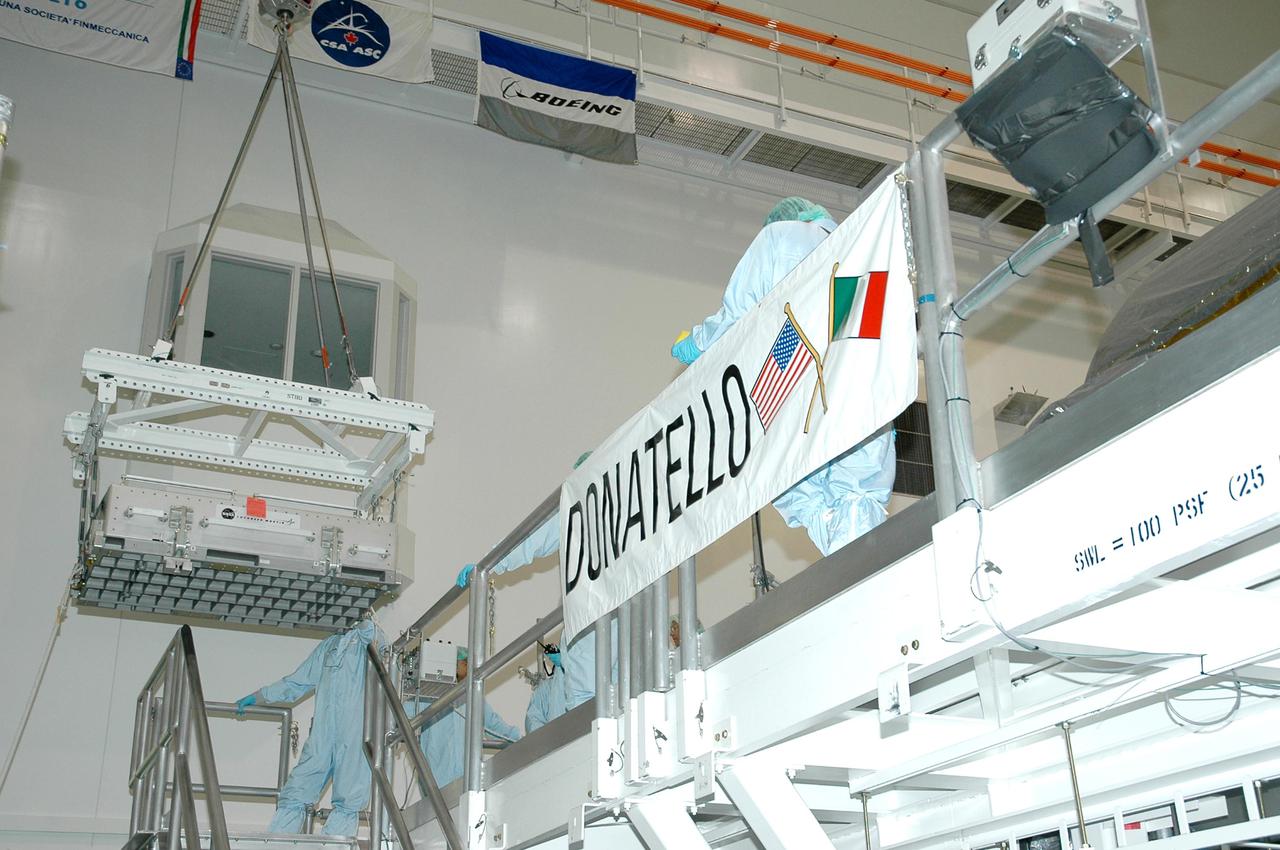
KENNEDY SPACE CENTER, FLA. - An overhead crane in the Space Station Processing Facility moves the Thermal Protection System Detailed Test Objective (DTO) box toward the Lightweight Multi-Purpose Experiment Support Structure Carrier (LMC) that is situated near the Multi-Purpose Logistics Module Donatello. The LMC and DTO will fly on Space Shuttle Discovery for mission STS-114. The DTO contains tile samples that will enable astronauts to test new on-orbit Thermal Protection System repair techniques. The launch window for mission STS-114 is May 12 to June 3.
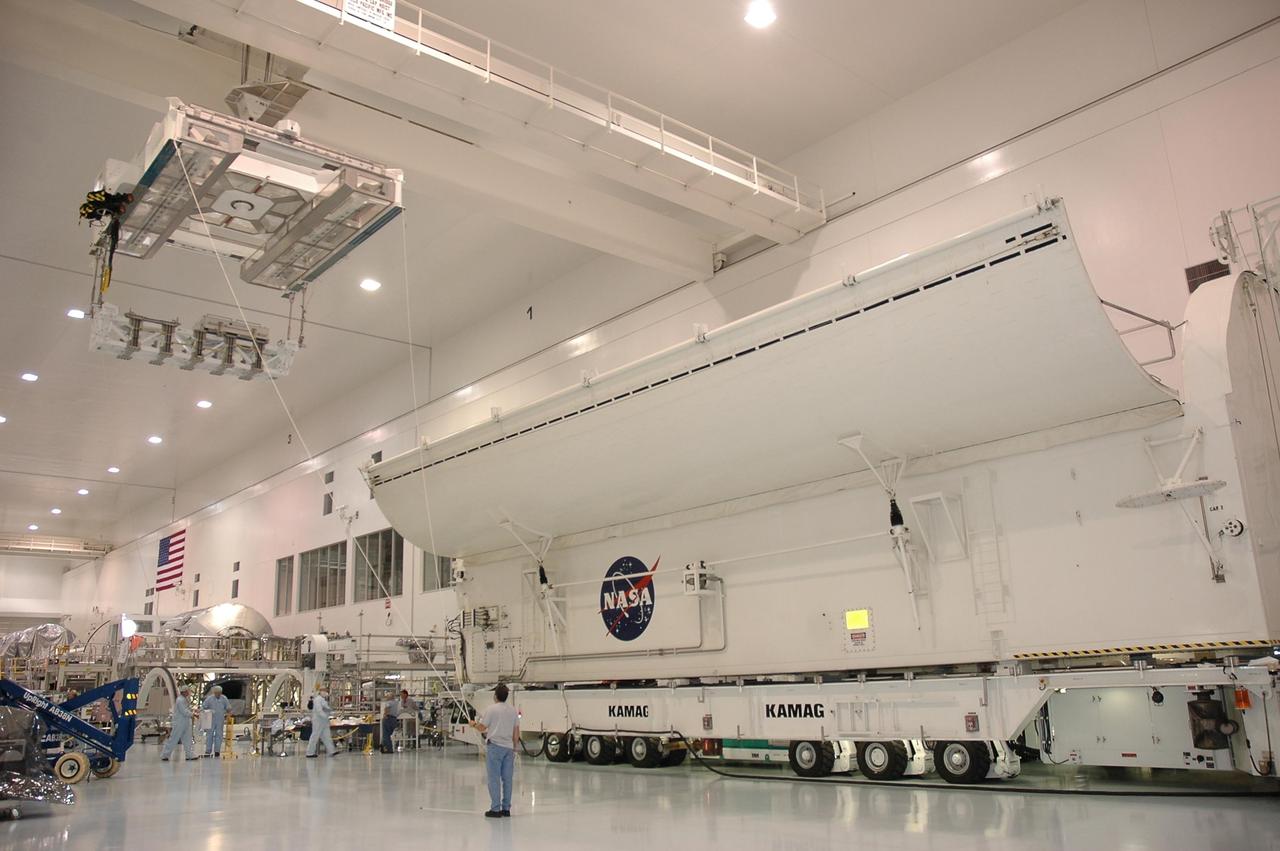
KENNEDY SPACE CENTER, FLA. - In the Space Station Processing Facility, a crane moves the Lightweight Multi-Purpose Experiment Support Structure Carrier (LMC) toward a payload canister, doors open to receive it. Slated to fly on space shuttle mission STS-121, the LMC is ready to be delivered to Launch Pad 39B for installation into orbiter Discovery. It is a cross-bay carrier for hardware required to perform development test objective 848. Test objective 848 is a demonstration of the tools and techniques developed to repair damaged orbiter thermal protection system tiles during a spacewalk, or extravehicular activity. The target launch window for STS-121 is July 1 to July 19, 2006. Photo credit: NASA/Cory Husten
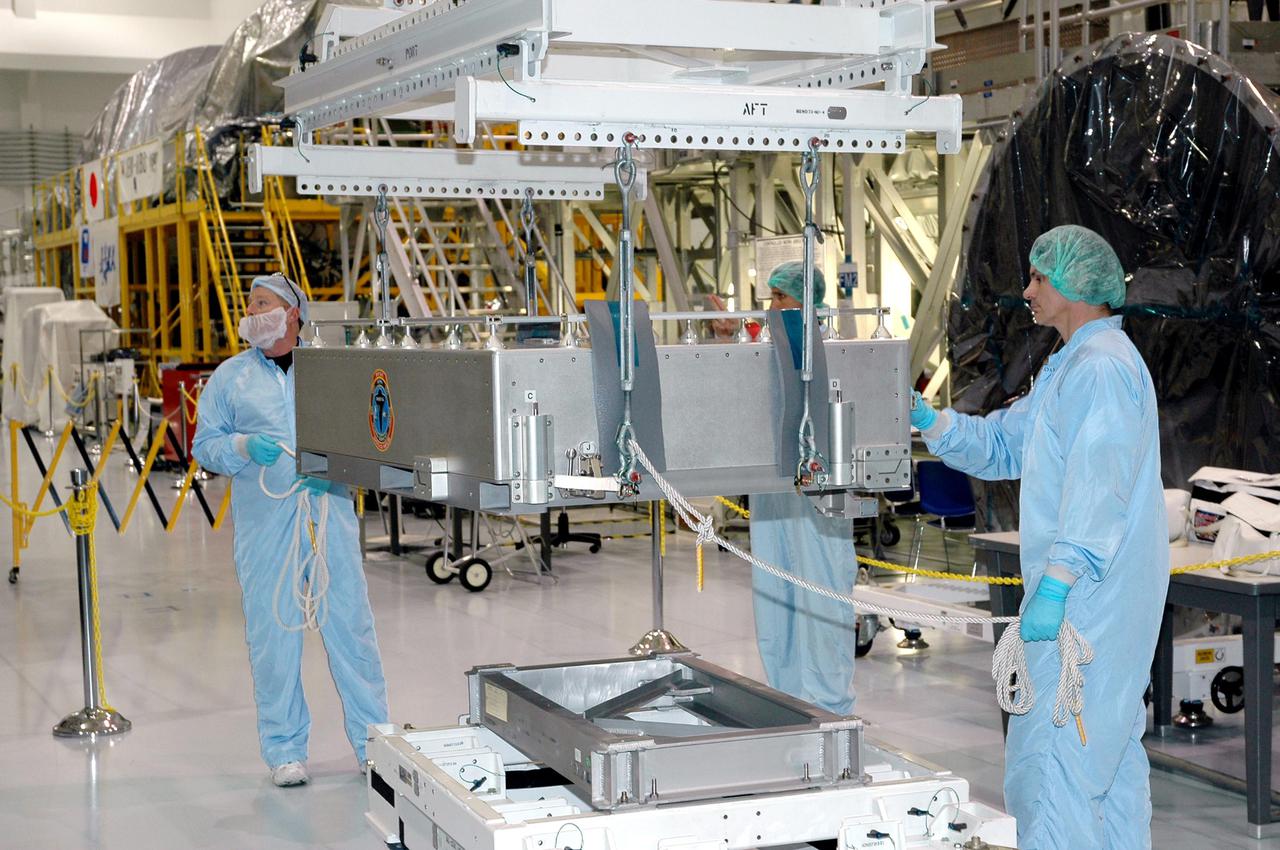
KENNEDY SPACE CENTER, FLA. - Technicians at the Space Station Processing Facility prepare the Thermal Protection System Detailed Test Objective (DTO) box to be lifted onto the Lightweight Multi-Purpose Experiment Support Structure Carrier (LMC). It will be placed on the Lightweight Multi-Purpose Experiment Support Structure Carrier (LMC) to fly on Space Shuttle Discovery for mission STS-114. The DTO contains tile samples that will enable astronauts to test new on-orbit Thermal Protection System repair techniques. The launch window for mission STS-114 is May 12 to June 3.

KENNEDY SPACE CENTER, FLA. - In the Space Station Processing Facility, workers monitor the Lightweight Multi-Purpose Experiment Support Structure Carrier (LMC) as it is lifted by a crane. Slated to fly on space shuttle mission STS-121, the LMC is ready to be delivered to Launch Pad 39B for installation into orbiter Discovery. It is a cross-bay carrier for hardware required to perform development test objective 848. Test objective 848 is a demonstration of the tools and techniques developed to repair damaged orbiter thermal protection system tiles during a spacewalk, or extravehicular activity. The target launch window for STS-121 is July 1 to July 19, 2006. Photo credit: NASA/Cory Husten
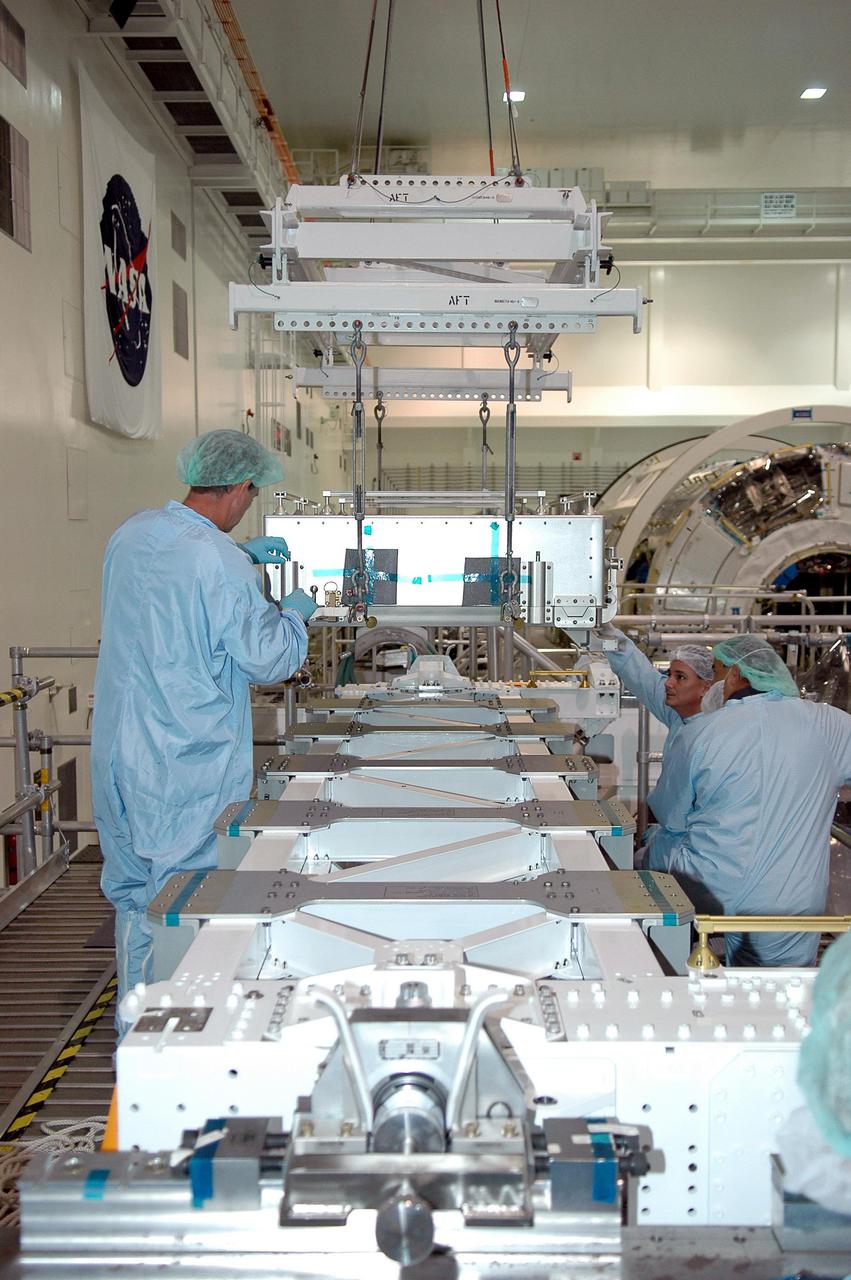
KENNEDY SPACE CENTER, FLA. - Technicians at the Space Station Processing Facility perform a fit check of the Thermal Protection System Sample Box on the Lightweight Multi-Purpose Experiment Support Structure Carrier (LMC). The box is the actual flight hardware scheduled to fly on the Space Shuttle Return to Flight mission STS-114. The fit check is performed to ensure the hardware mates properly with the newly modified LMC and will be returned to NASA’s Johnson Space Center for installation of tile samples in support of the STS-114 mission. The Thermal Protection Detailed Test Objective will enable astronauts to test new on-orbit Thermal Protection System repair techniques. Mission STS-114 is scheduled to launch in May 2005.

KENNEDY SPACE CENTER, FLA. - In the Space Station Processing Facility, a crane moves the Lightweight Multi-Purpose Experiment Support Structure Carrier (LMC) over an abundance of hardware and equipment. Slated to fly on space shuttle mission STS-121, the LMC is ready to be delivered to Launch Pad 39B for installation into orbiter Discovery. It is a cross-bay carrier for hardware required to perform development test objective 848. Test objective 848 is a demonstration of the tools and techniques developed to repair damaged orbiter thermal protection system tiles during a spacewalk, or extravehicular activity. The target launch window for STS-121 is July 1 to July 19, 2006. Photo credit: NASA/Cory Husten
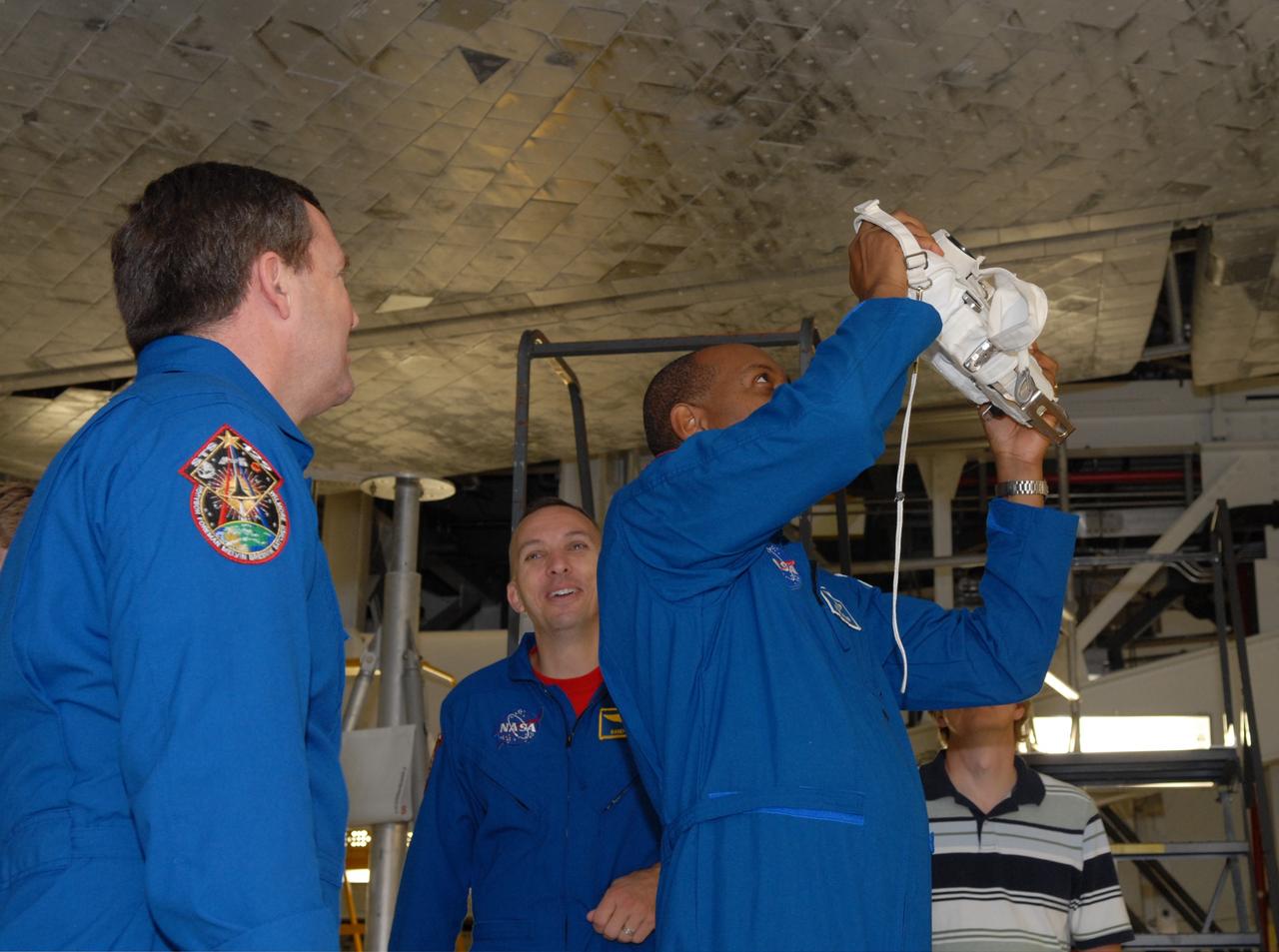
CAPE CANAVERAL, Fla. – In NASA Kennedy Space Center's Orbiter Processing Facility 1, STS-129 crew members take a close look at some of the tiles on the underside of space shuttle Atlantis. At left are Mission Specialists Michael Foreman and Randy Bresnik. At right, Mission Specialist Robert Satcher practices focusing a camera that will be used on the mission. The crew is at Kennedy for a Crew Equipment Interface Test, which provides hands-on training and observation of shuttle and flight hardware. Atlantis' STS-129 mission is targeted to launch Nov. 12. Photo credit: NASA/Jim Grossmann
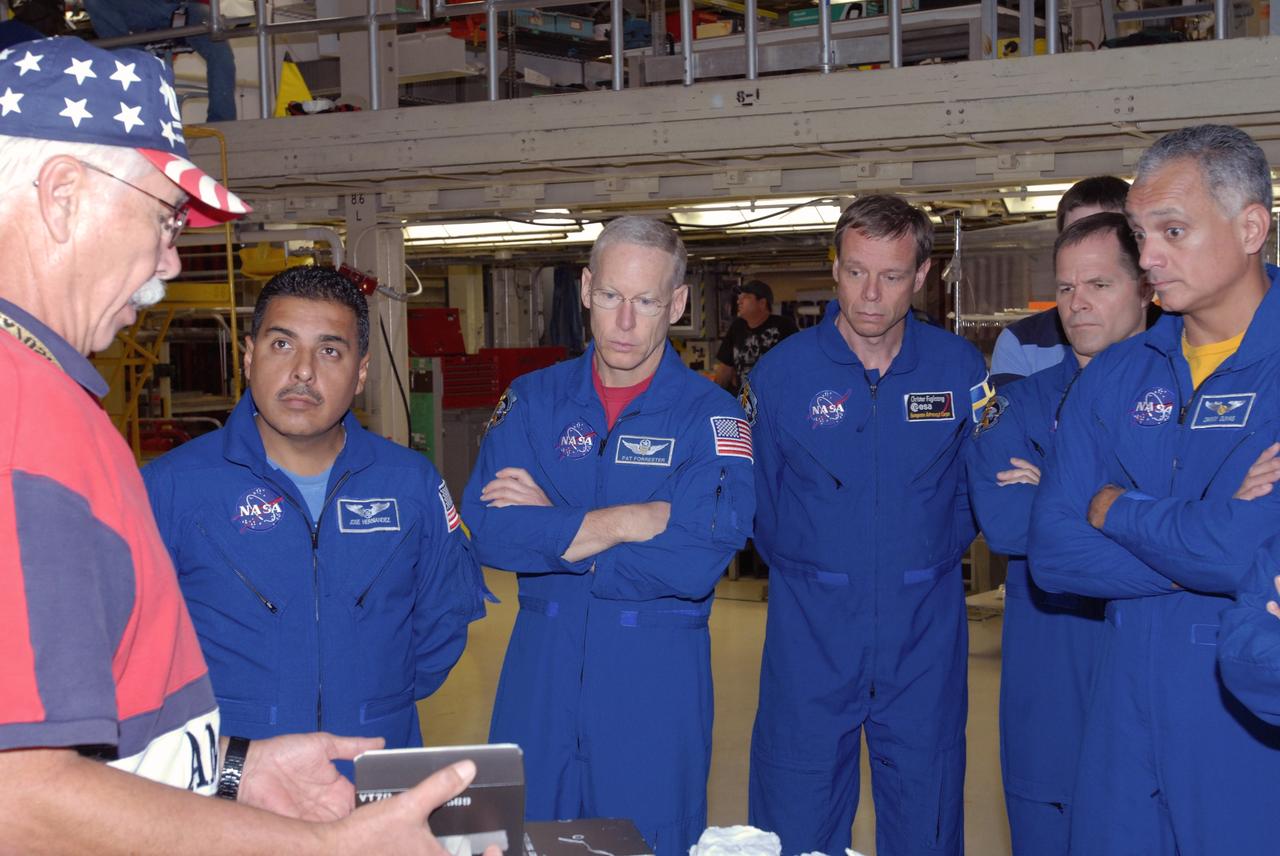
CAPE CANAVERAL, Fla. – In Orbiter Processing Facility 3 at NASA's Kennedy Space Center in Florida, STS-128 crew members listen to a tile expert while checking out space shuttle Discovery. The astronauts are, from left, Mission Specialists Jose Fernandez, Patrick Forrester and Christer Fuglesang, Pilot Kevin Ford and Mission Specialist John "Danny" Olivas. The crew is at Kennedy for a crew equipment interface test, or CEIT, which provides hands-on training and observation of shuttle and flight hardware. The STS-128 flight will carry science and storage racks to the International Space Station on Discovery. Launch is targeted for Aug. 7. Photo credit: NASA/Jim Grossmann
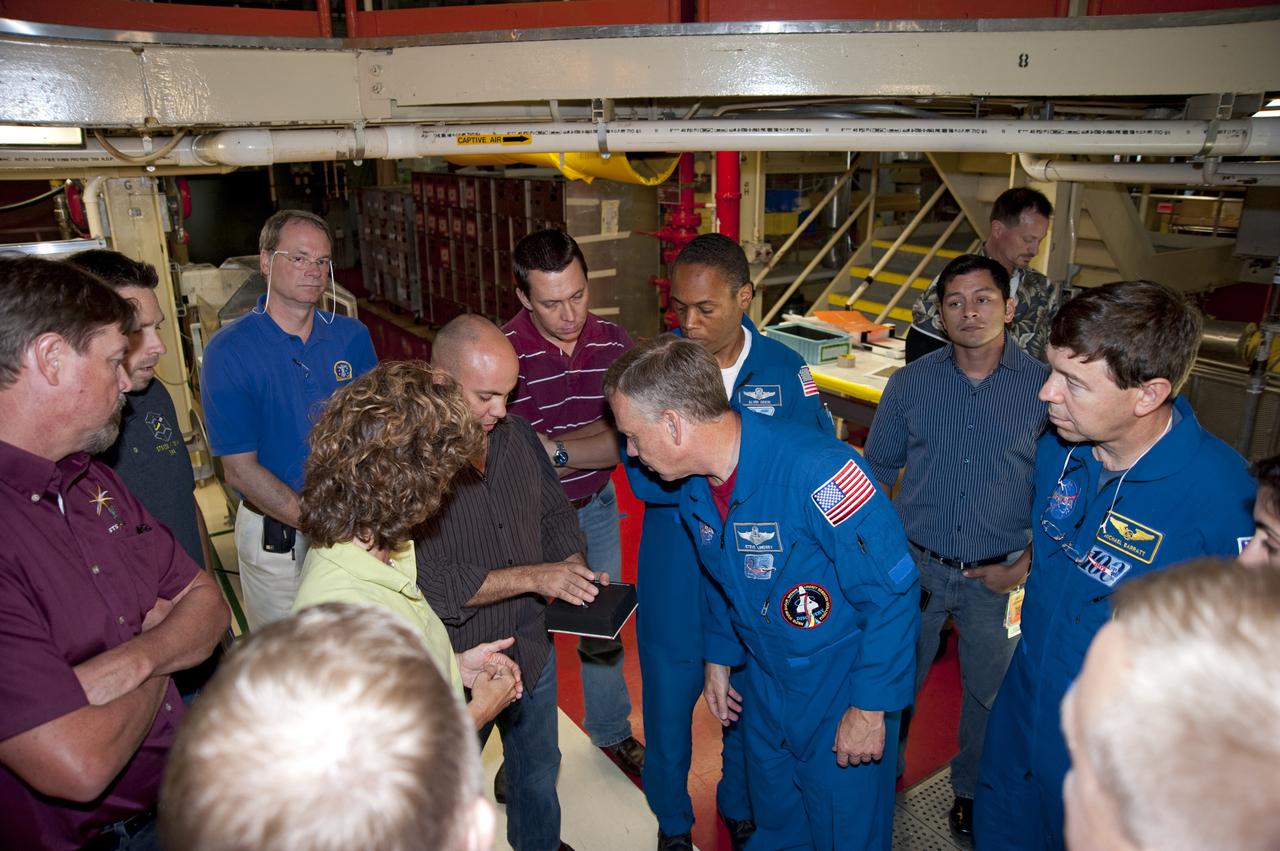
CAPE CANAVERAL, Fla. -- In Orbiter Processing Facility-3 at NASA's Kennedy Space Center in Florida, STS-133 Commander Steve Lindsey listens intently as a technician describes the features of a heat-shield tile while Mission Specialists Michael Barratt, Alvin Drew and other technicians look on. The astronauts are at Kennedy for the Crew Equipment Interface Test, or CEIT, which provides the crew with hands-on training and observation of shuttle and flight hardware for their mission to the International Space Station. Launch of the STS-133 mission on space shuttle Discovery is targeted for Nov. 1 at 4:33 p.m. EDT. Photo credit: NASA_Kim Shiflett
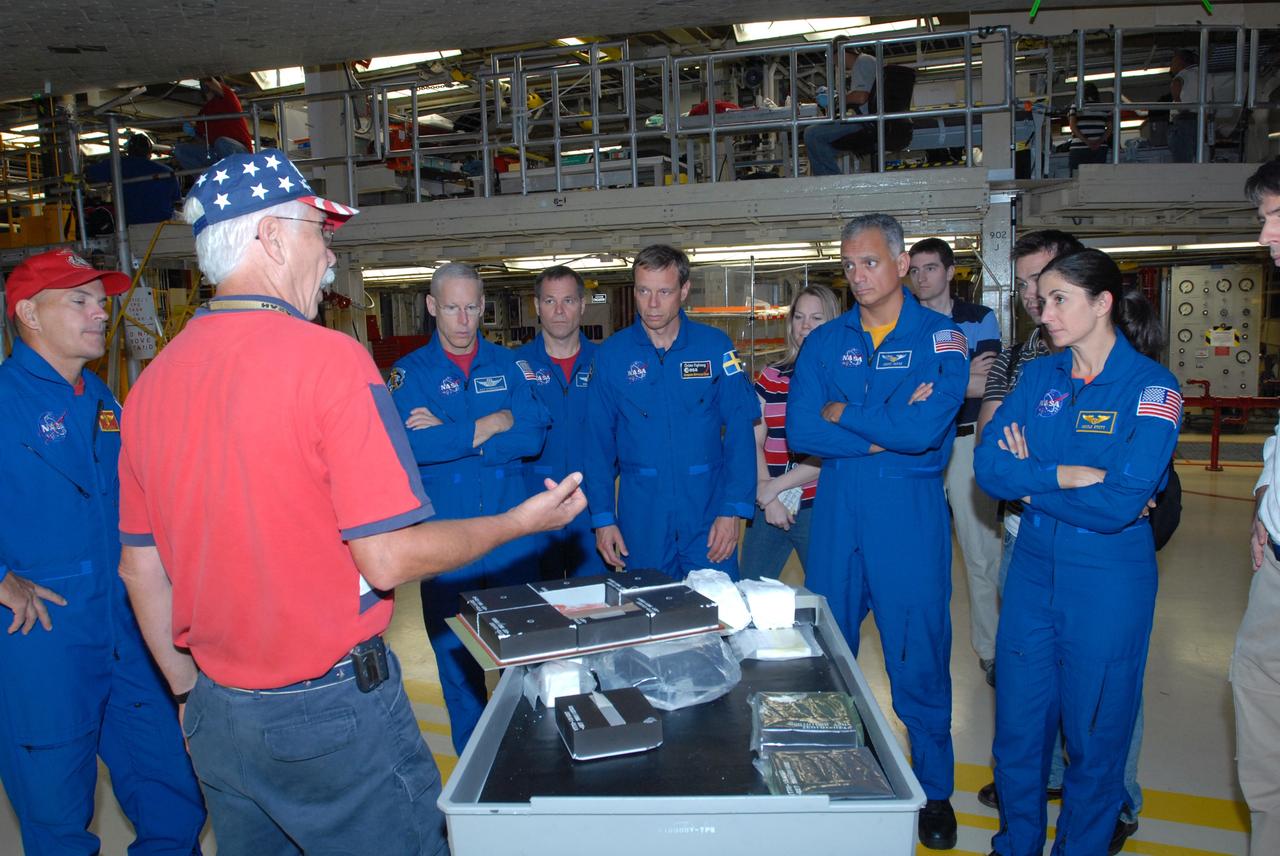
CAPE CANAVERAL, Fla. – In Orbiter Processing Facility 3 at NASA's Kennedy Space Center in Florida, STS-128 crew members listen to a tile expert while checking out space shuttle Discovery. The astronauts are, from left, Commander Rick Sturckow, Mission Specialist Patrick Forrester, Pilot Kevin Ford, and Mission Specialists Christer Fuglesang, John "Danny" Olivas and Nicole Stott. The crew is at Kennedy for a crew equipment interface test, or CEIT, which provides hands-on training and observation of shuttle and flight hardware. The STS-128 flight will carry science and storage racks to the International Space Station on Discovery. Launch is targeted for Aug. 7. Photo credit: NASA/Jim Grossmann
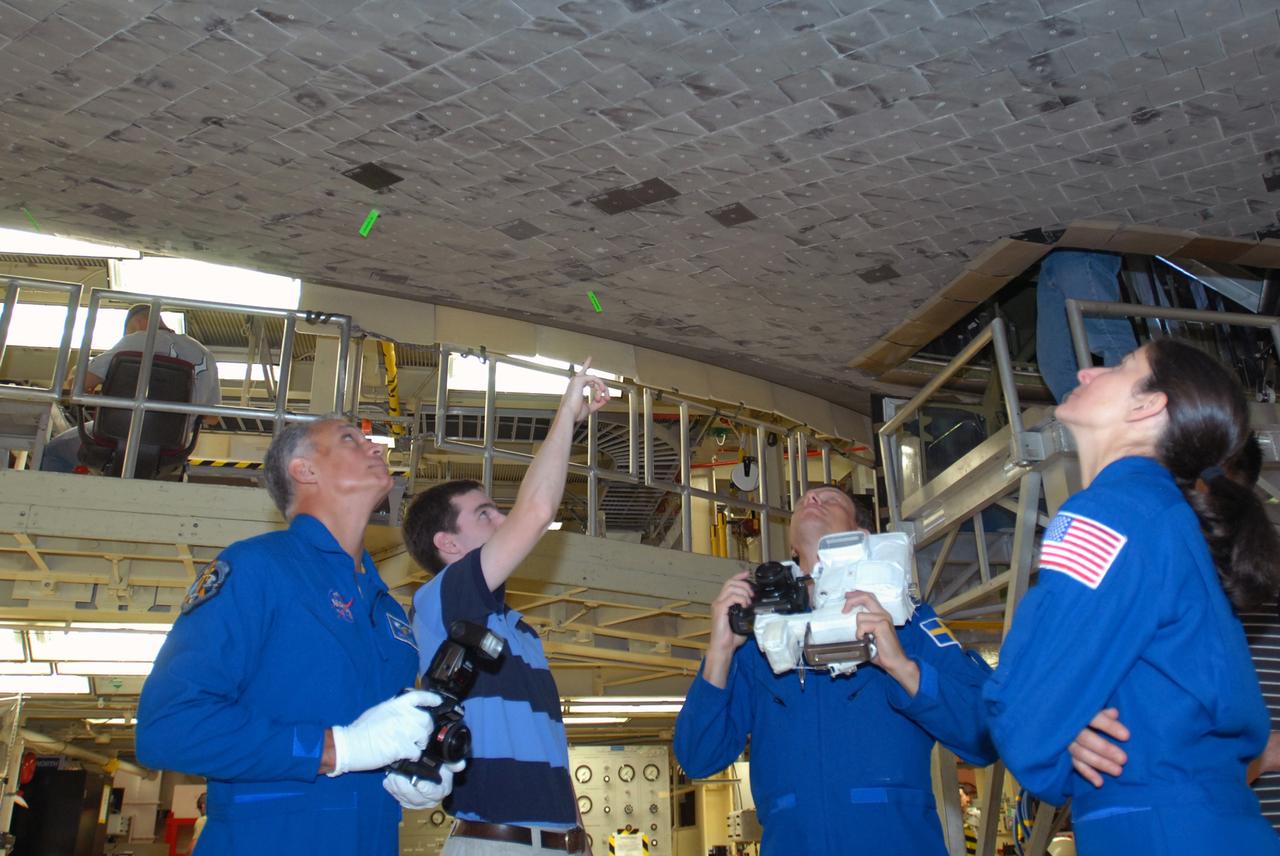
CAPE CANAVERAL, Fla. – In Orbiter Processing Facility 3 at NASA's Kennedy Space Center in Florida, STS-128 Mission Specialists John "Danny" Olivas (left) and Nicole Stott (right) look at tiles on the underside of space shuttle Discovery. At center, Mission Specialist Christer Fuglesang holds a camera. The crew is at Kennedy for a crew equipment interface test, or CEIT, which provides hands-on training and observation of shuttle and flight hardware. The STS-128 flight will carry science and storage racks to the International Space Station on Discovery. Launch is targeted for Aug. 7. Photo credit: NASA/Jim Grossmann
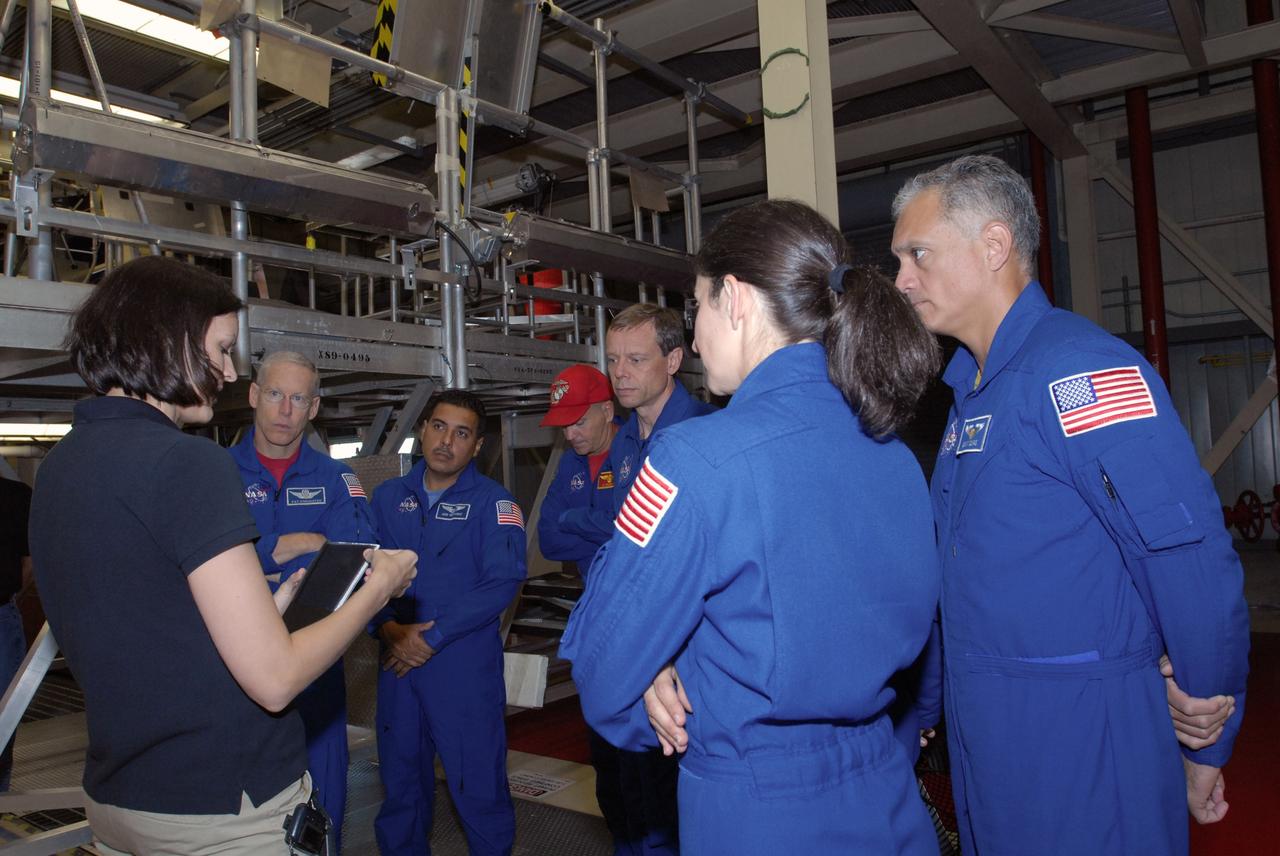
CAPE CANAVERAL, Fla. – In Orbiter Processing Facility 3 at NASA's Kennedy Space Center in Florida, STS-128 crew members listen to a tile specialist while checking out space shuttle Discovery. The astronauts are, from left, Mission Specialists Patrick Forrester and Jose Hernandez, Commander Rick Sturckow, and Mission Specialist Christer Fuglesang, Nicole Stott and John "Danny" Olivas. The crew is at Kennedy for a crew equipment interface test, or CEIT, which provides hands-on training and observation of shuttle and flight hardware. The STS-128 flight will carry science and storage racks to the International Space Station on Discovery. Launch is targeted for Aug. 7. Photo credit: NASA/Jim Grossmann
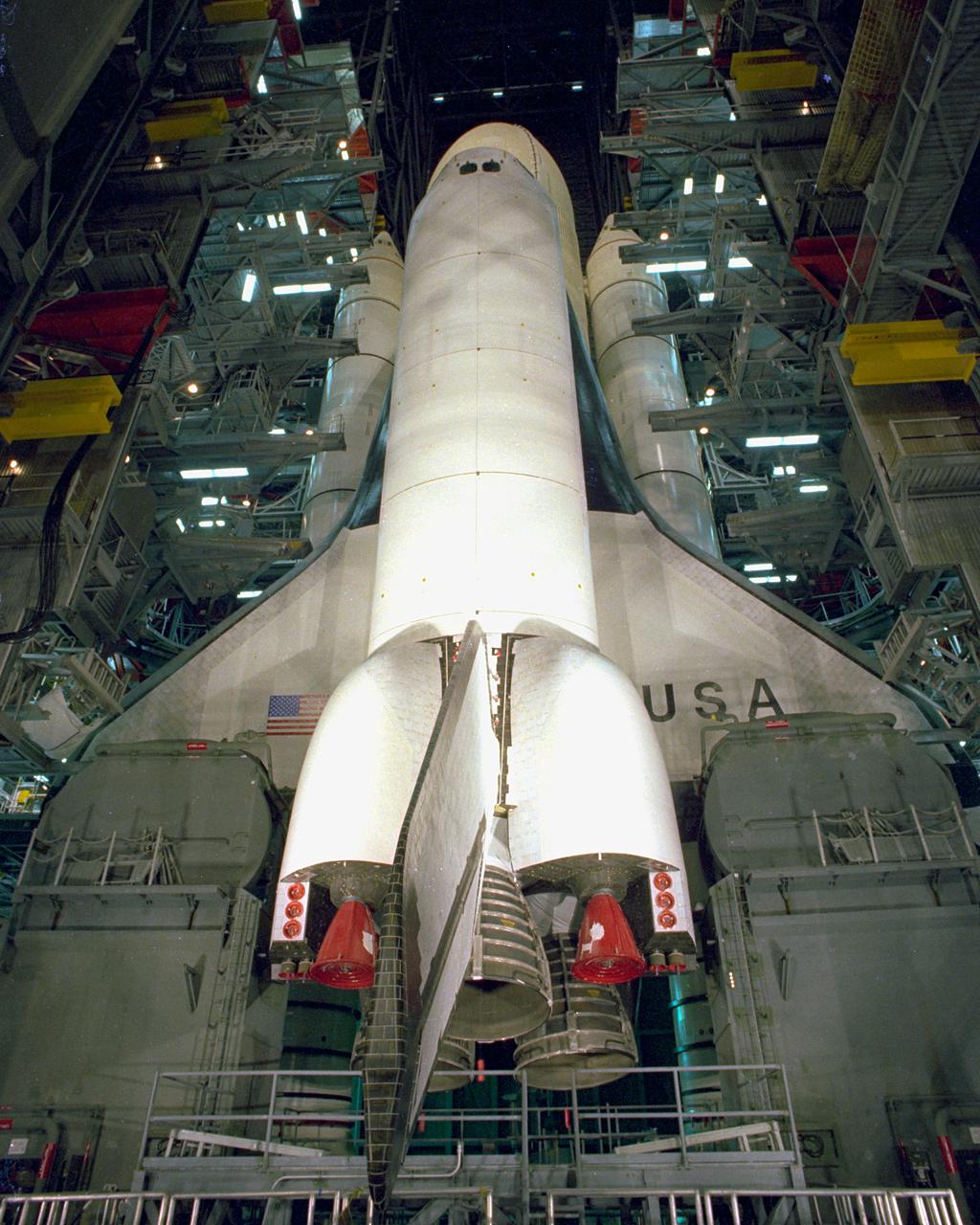
KENNEDY SPACE CENTER, FLA. - Assembly of the first Space Shuttle vehicle, scheduled to make its first orbital test flight in March 1981, was completed today with the mating of the Orbiter Columbia to its external tank in the Vehicle Assembly Building's High Bay 3. Columbia, shown here still attached to its hoisting sling, was moved to the VAB on Nov. 24 having completed tests and tile installation in the adjacent Orbiter Processing Facility. The other Shuttle components, the twin solid rocket boosters and the external propellant tank, were stacked on the Mobile Launcher Platform in High Bay 3 in January and November of this year, respectively. The current schedule calls for the rollout of the assembled Space Shuttle to Pad A at Launch Complex 39 shortly after Christmas.
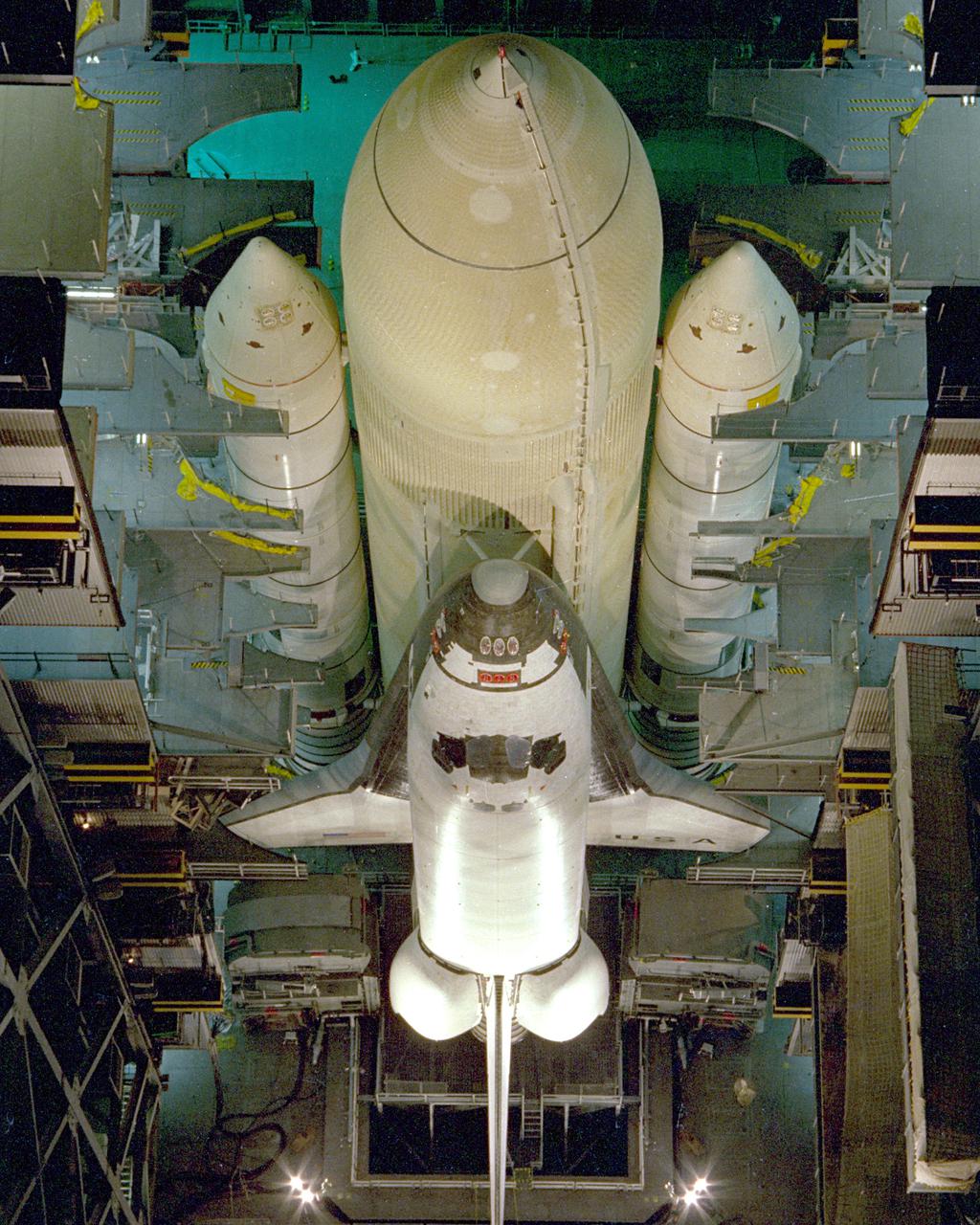
KENNEDY SPACE CENTER, FLA. - Assembly of the first Space Shuttle vehicle, scheduled to make its first orbital test flight in March 1981, was completed today with the mating of the Orbiter Columbia to its external tank in the Vehicle Assembly Building's High Bay 3. Columbia, shown here still attached to its hoisting sling, was moved to the VAB on Nov. 24 having completed tests and tile installation in the adjacent Orbiter Processing Facility. The other Shuttle components, the twin solid rocket boosters and the external propellant tank, were stacked on the Mobile Launcher Platform in High Bay 3 in January and November of this year, respectively. The current schedule calls for the rollout of the assembled Space Shuttle to Pad A at Launch Complex 39 shortly after Christmas.
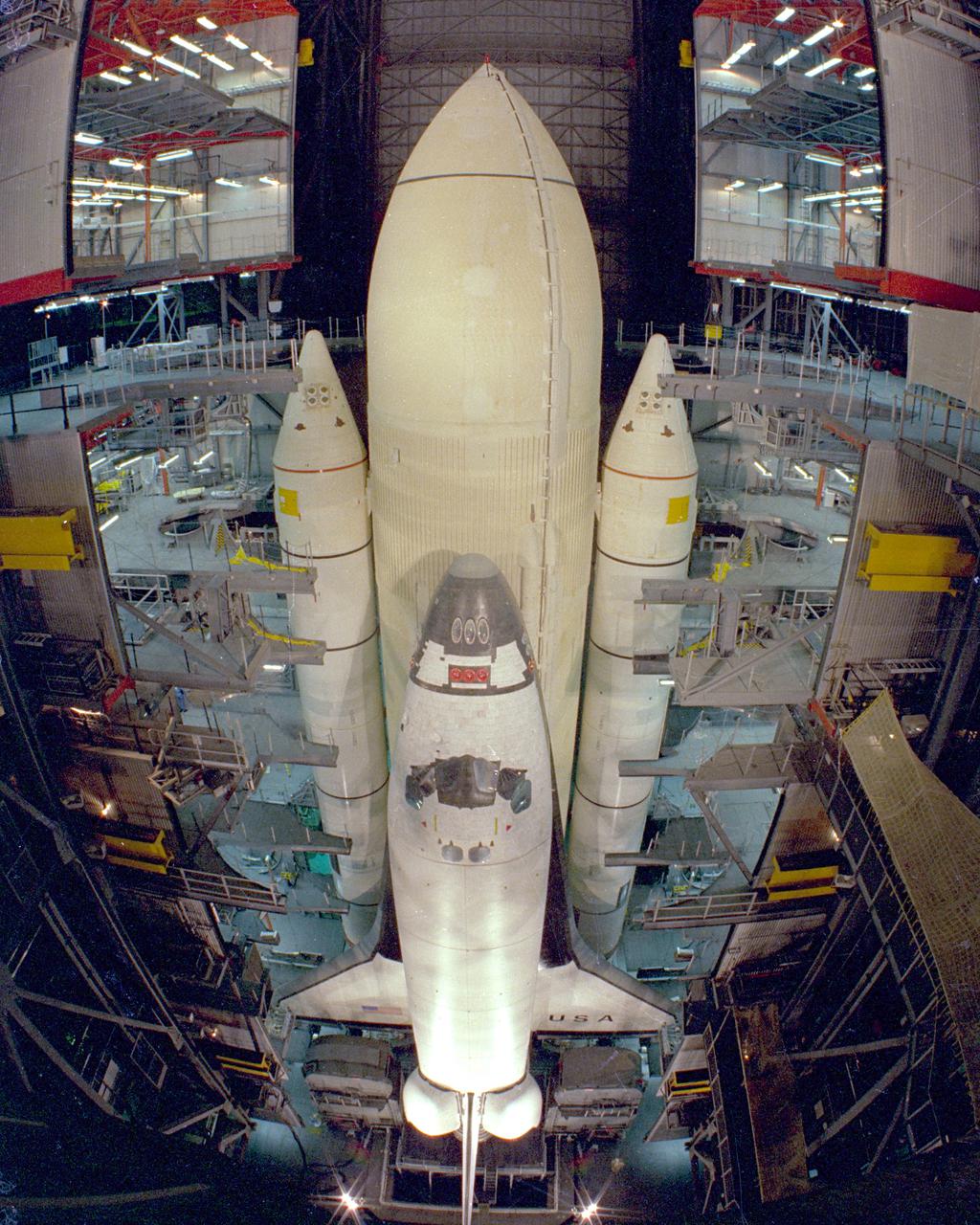
KENNEDY SPACE CENTER, FLA. - Assembly of the first Space Shuttle vehicle, scheduled to make its first orbital test flight in March 1981, was completed today with the mating of the Orbiter Columbia to its eternal tank in the Vehicle Assembly Building's High Bay 3. Columbia, shown here still attached to its hoisting sling, was moved to the VAB on Nov. 24 having completed tests and tile installation in the adjacent Orbiter Processing Facility. The other Shuttle components, the twin solid rocket boosters and the external propellant tank, were stacked on the Mobile launcher Platform in High Bay 3 in January and November of this year, respectively. The current schedule calls for the rollout of the assembled Space Shuttle to Pad A at Launch Complex 39 shortly after Christmas.
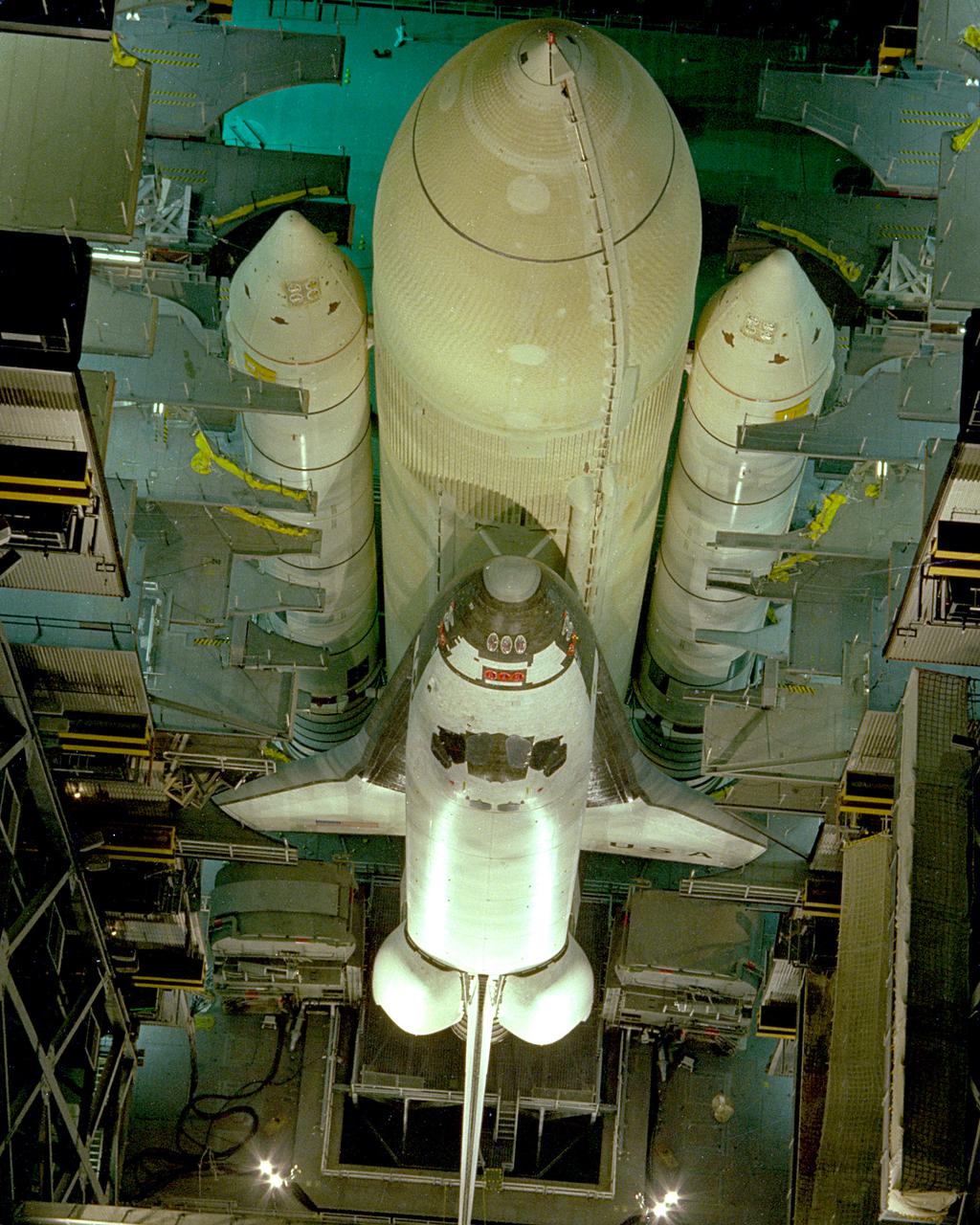
KENNEDY SPACE CENTER, FLA. - Assembly of the first Space Shuttle vehicle, scheduled to make its first orbital test flight in March 1981, was completed today with the mating of the Orbiter Columbia to its eternal tank in the Vehicle Assembly Building's High Bay 3. Columbia, shown here still attached to its hoisting sling, was moved to the VAB on Nov. 24 having completed tests and tile installation in the adjacent Orbiter Processing Facility. The other Shuttle components, the twin solid rocket boosters and the external propellant tank, were stacked on the Mobile launcher Platform in High Bay 3 in January and November of this year, respectively. The current schedule calls for the rollout of the assembled Space Shuttle to Pad A at Launch Complex 39 shortly after Christmas.
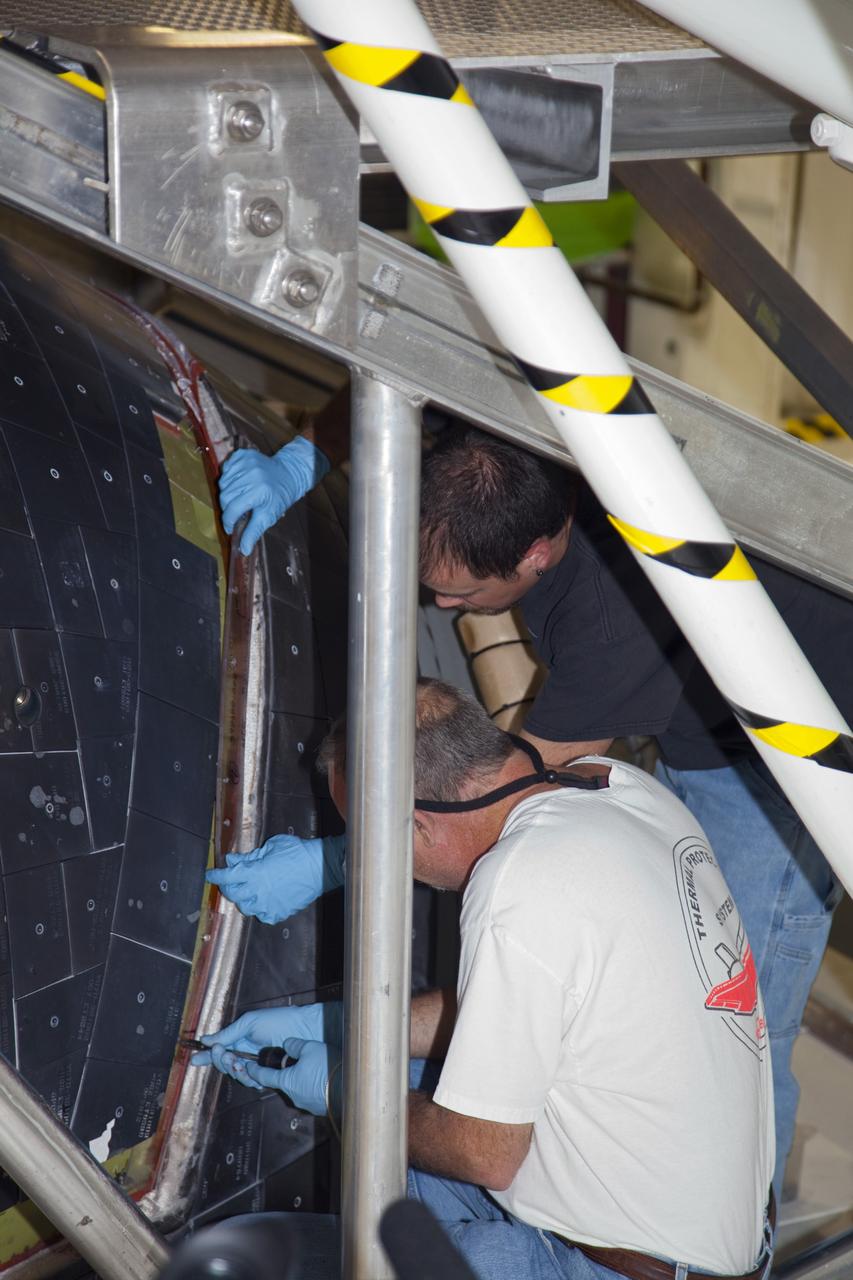
CAPE CANAVERAL, Fla. – In Orbiter Processing Facility-2 at NASA’s Kennedy Space Center in Florida, United Space Alliance technicians begin to bond and seal the tiles around the access panels to space shuttle Endeavour’s forward reaction control system, or FRCS. The FRCS helped a shuttle maneuver while in orbit. Endeavour’s FRCS was removed and sent to White Sands Test Facility in New Mexico to be cleaned of its toxic propellants and was reinstalled on the shuttle in February. Endeavour is being prepared for public display at the California Science Center in Los Angeles. Over the course of its 19-year career, Endeavour spent 299 days in space during 25 missions. For more information, visit http://www.nasa.gov/shuttle. Photo credit: NASA/Frankie Martin
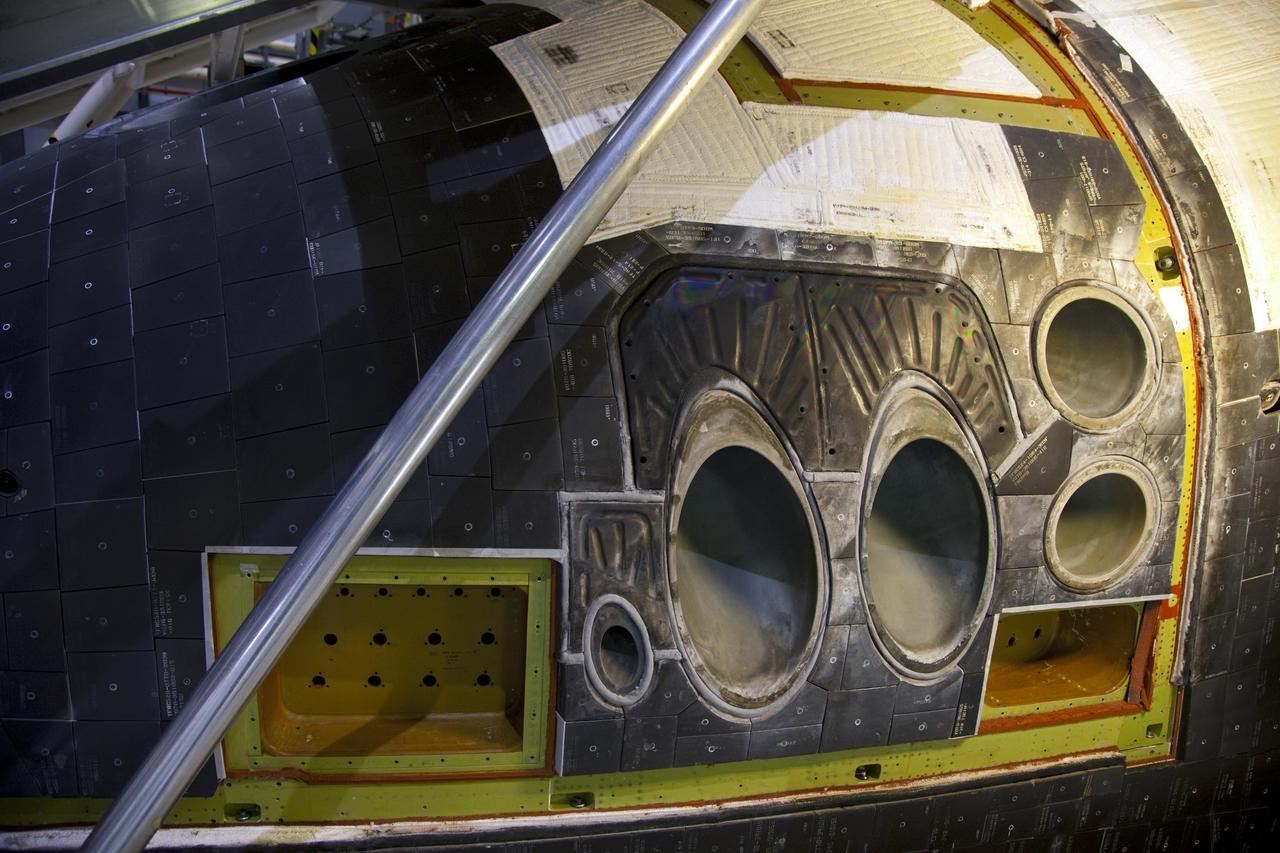
CAPE CANAVERAL, Fla. – In Orbiter Processing Facility-2 at NASA’s Kennedy Space Center in Florida, preparations are under way to begin bonding and sealing the tiles around the access panels to space shuttle Endeavour’s forward reaction control system, or FRCS. The FRCS helped a shuttle maneuver while in orbit. Endeavour’s FRCS was removed and sent to White Sands Test Facility in New Mexico to be cleaned of its toxic propellants and was reinstalled on the shuttle in February. Endeavour is being prepared for public display at the California Science Center in Los Angeles. Over the course of its 19-year career, Endeavour spent 299 days in space during 25 missions. For more information, visit http://www.nasa.gov/shuttle. Photo credit: NASA/Frankie Martin
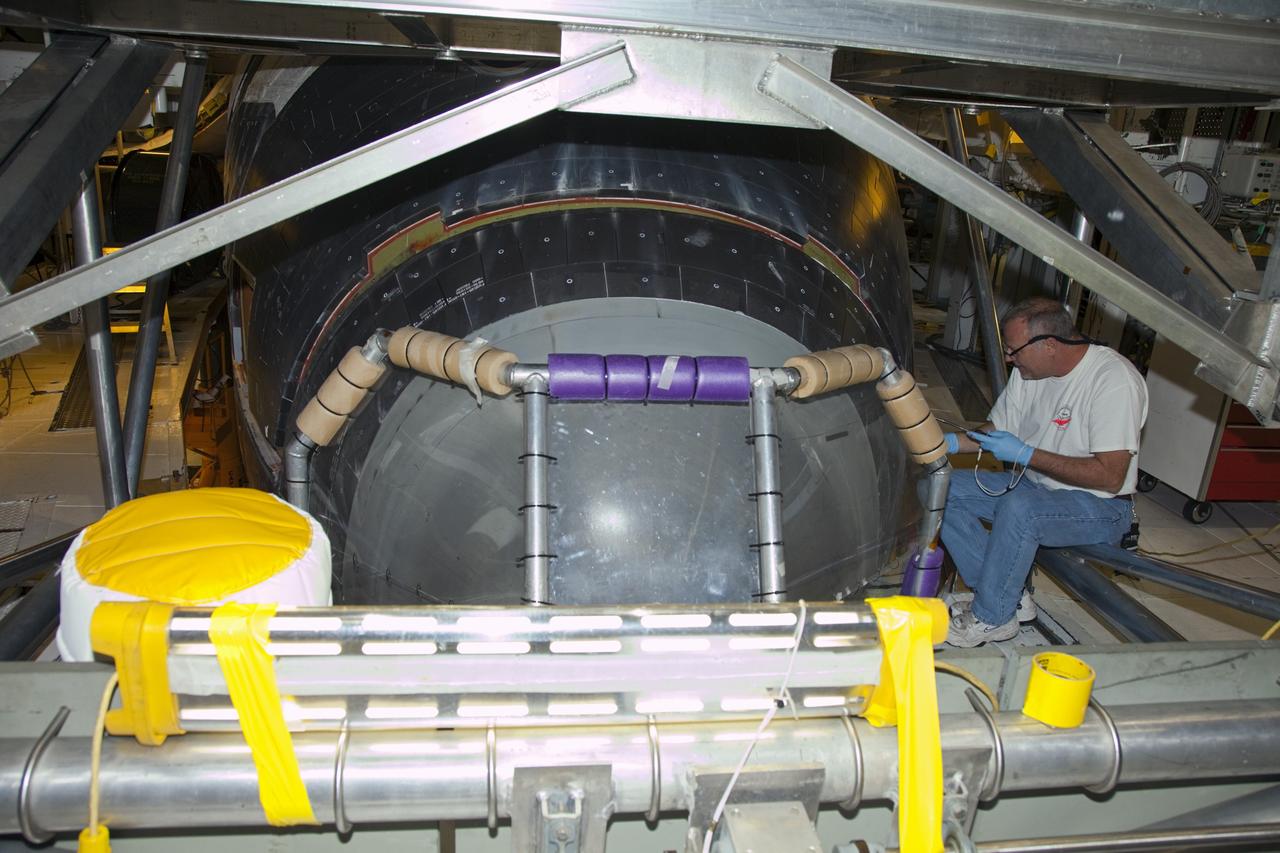
CAPE CANAVERAL, Fla. – In Orbiter Processing Facility-2 at NASA’s Kennedy Space Center in Florida, a United Space Alliance technician, with a tool tethered to his wrist, bonds and seals the tiles around the access panels to space shuttle Endeavour’s forward reaction control system, or FRCS. The FRCS helped a shuttle maneuver while in orbit. Endeavour’s FRCS was removed and sent to White Sands Test Facility in New Mexico to be cleaned of its toxic propellants and was reinstalled on the shuttle in February. Endeavour is being prepared for public display at the California Science Center in Los Angeles. Over the course of its 19-year career, Endeavour spent 299 days in space during 25 missions. For more information, visit http://www.nasa.gov/shuttle. Photo credit: NASA/Frankie Martin
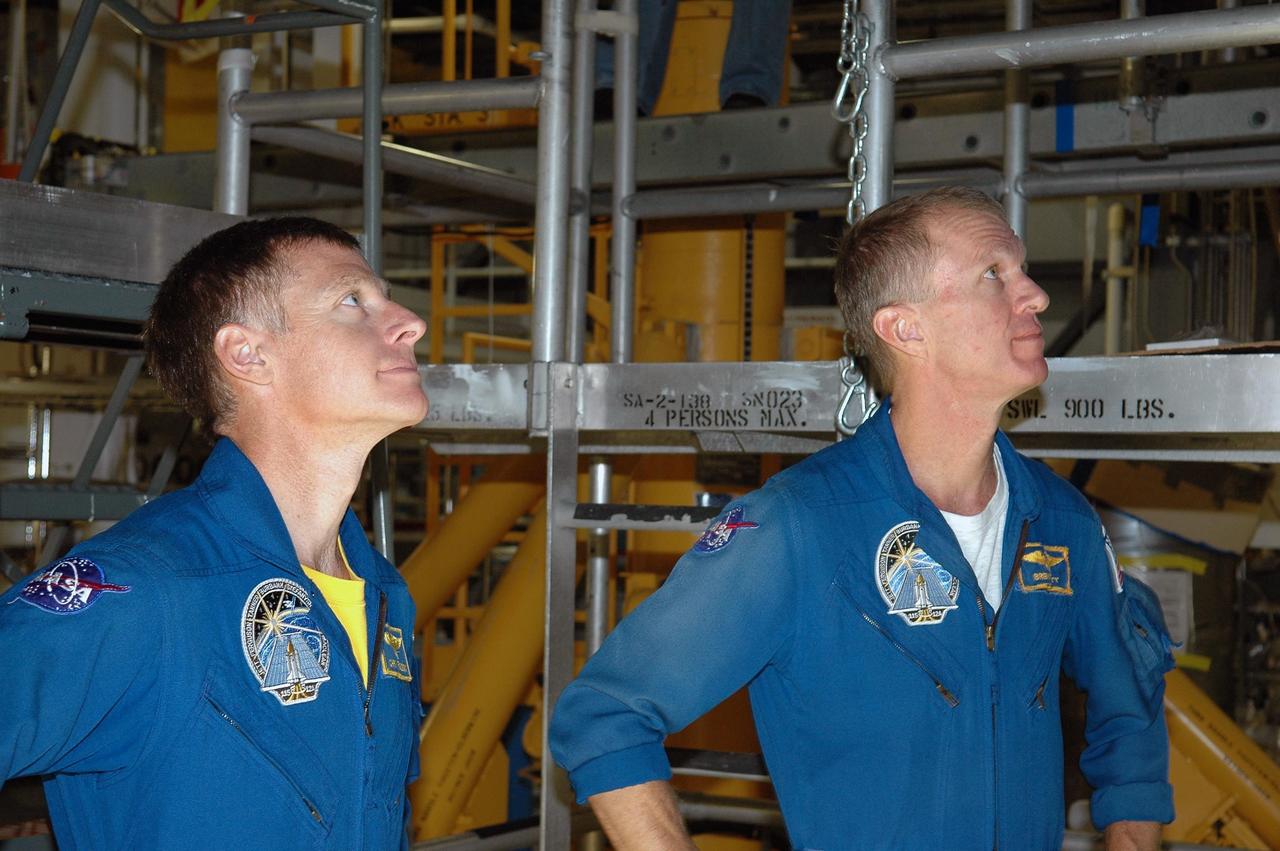
KENNEDY SPACE CENTER, FLA. - In the Orbiter Processing Facility, STS-115 crew members examine tiles on the orbiter Atlantis, the designated launch vehicle for their mission. From left are Pilot Christopher Ferguson and Commander Brent Jett. The crew is at the center for Crew Equipment Interface Test activities, which involves equipment familiarization, a routine part of astronaut training and launch preparations. The mission will deliver the second port truss segment, the P3/P4 Truss, to attach to the first port truss segment, the P1 Truss, as well as deploy solar array set 2A and 4A. Launch on Space Shuttle Atlantis is scheduled for late August. Photo credit: NASA/Kim Shiflett
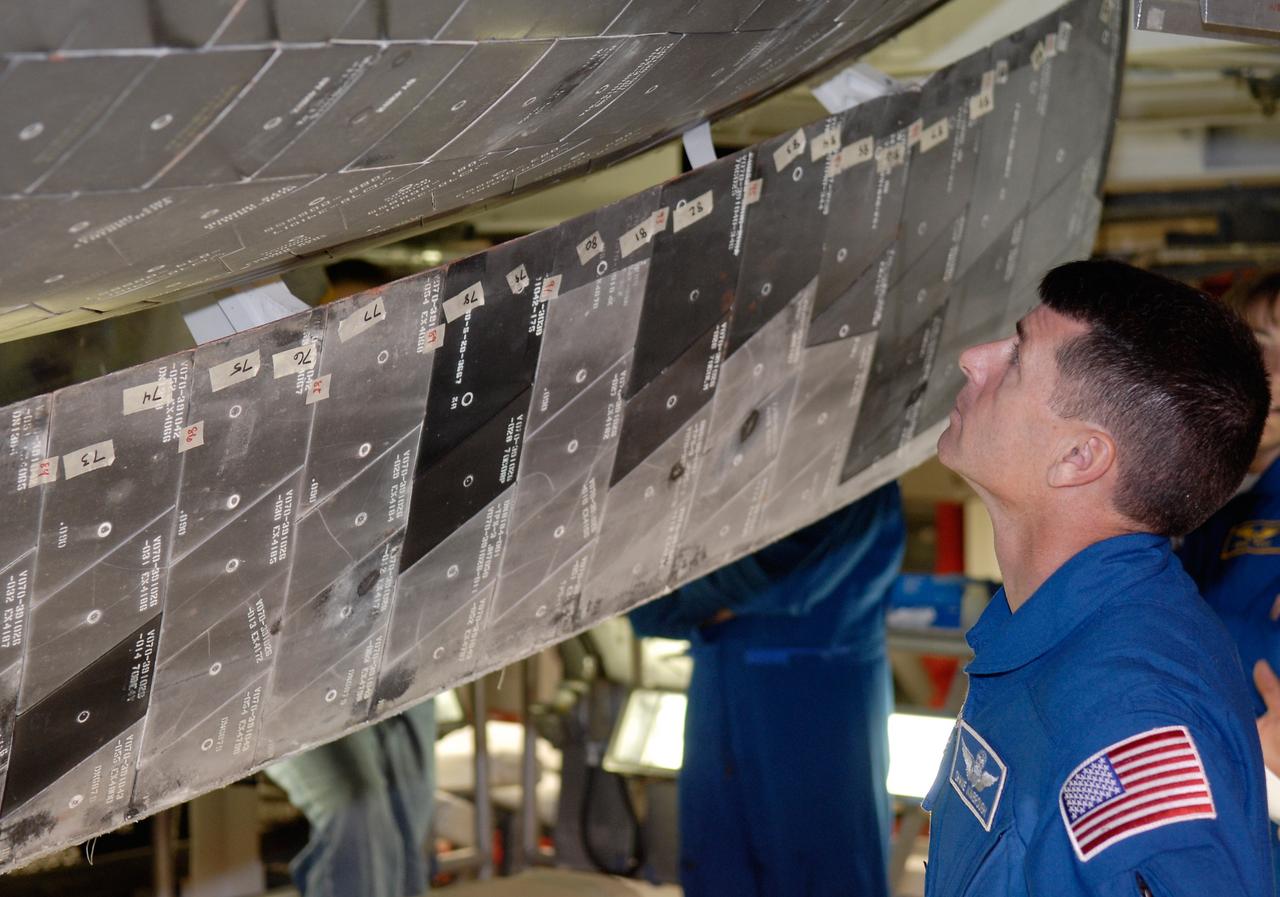
CAPE CANAVERAL, Fla. – In Orbiter Processing Facility 2 at NASA's Kennedy Space Center, members of space shuttle Endeavour's STS-126 crew participate in a crew equipment interface test, or CEIT. Here, Mission Specialist Shane Kimbrough examines the thermal protection system tile on Endeavour. The CEIT provides hands-on experience with hardware and equipment slated to fly on their mission. Endeavour will deliver a multi-purpose logistics module to the International Space Station on the STS-126 mission. Launch is targeted for Nov. 10. Photo credit: NASA/Kim Shiflett
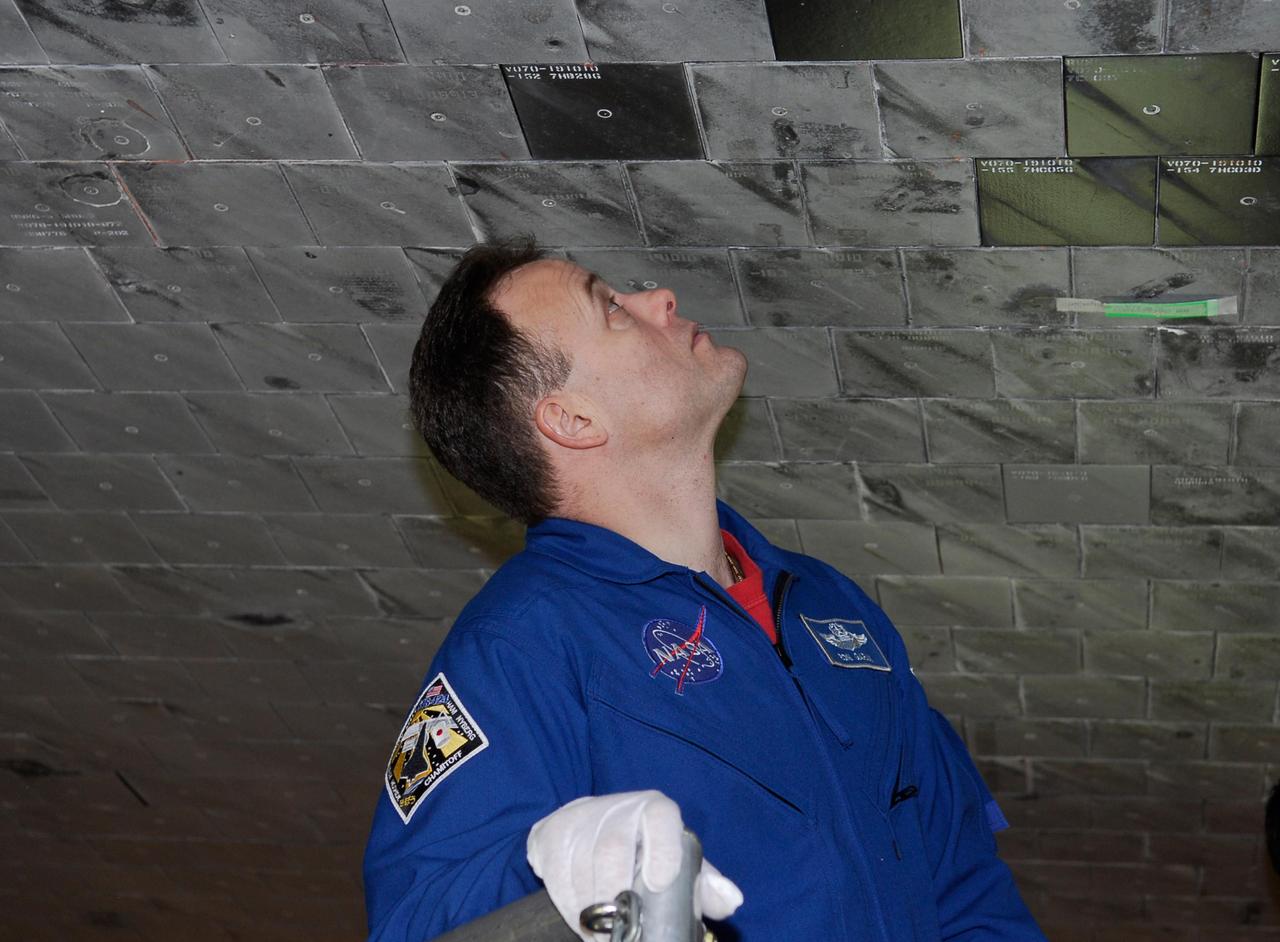
KENNEDY SPACE CENTER, FLA. -- STS-124 Mission Specialist Ron Garan examines the tiles on the underbelly of space shuttle Discovery in the Orbiter Processing Facility bay 2 at NASA's Kennedy Space Center. Members of the crew are at Kennedy for a crew equipment interface test. On the mission, Discovery will transport the Kibo Japanese Experiment Module - Pressurized Module (JEM-PM) and the Japanese Remote Manipulator System (JEM-RMS) to the International Space Station to complete the Kibo laboratory. The launch of Discovery is targeted for April 24. Photo credit: NASA/Kim Shiflett
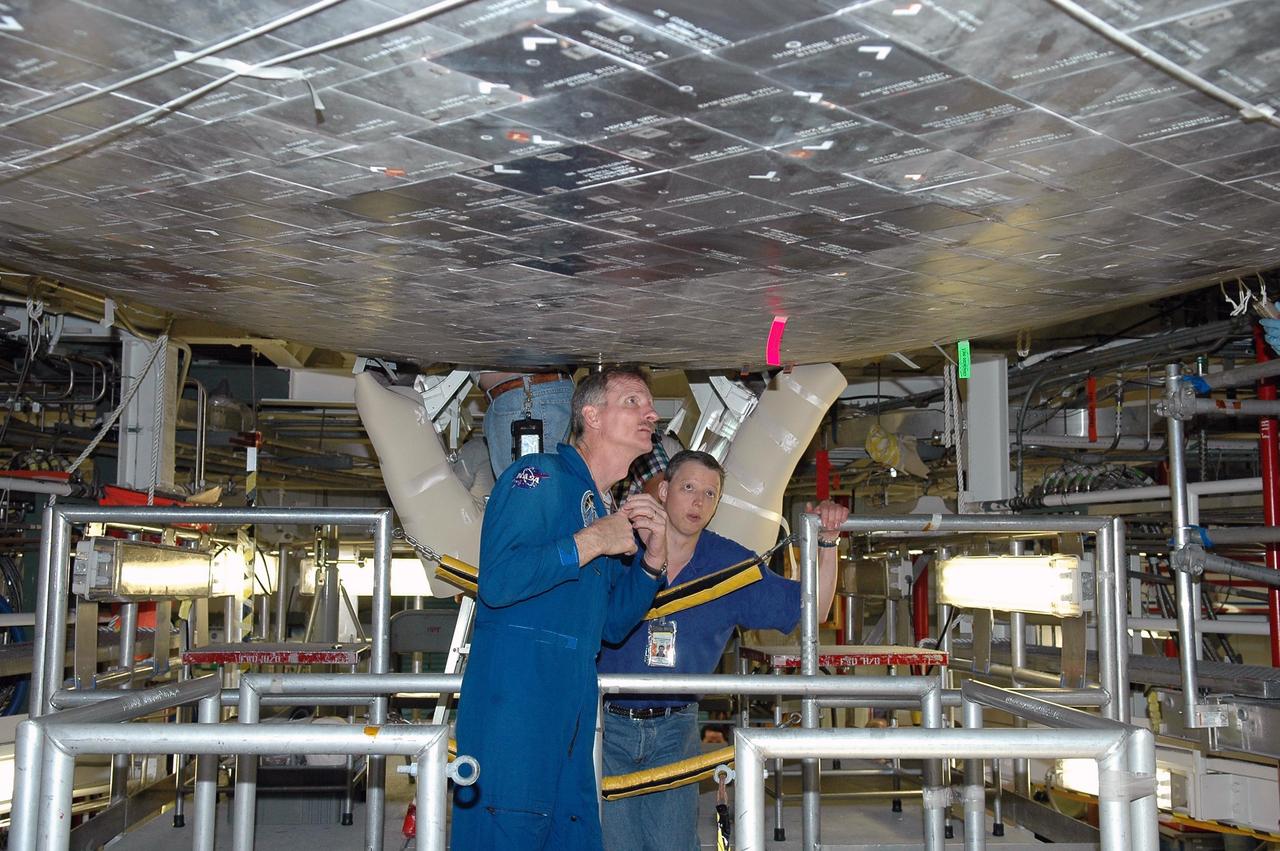
KENNEDY SPACE CENTER, FLA. - In the Orbiter Processing Facility, STS-115 Mission Specialist Joseph Tanner (foreground) examines tiles on the orbiter Atlantis, the designated launch vehicle for the mission. The crew is at the center for Crew Equipment Interface Test activities, which involves equipment familiarization, a routine part of astronaut training and launch preparations. The mission will deliver the second port truss segment, the P3/P4 Truss, to attach to the first port truss segment, the P1 Truss, as well as deploy solar array set 2A and 4A. Launch on Space Shuttle Atlantis is scheduled for late August. Photo credit: NASA/Kim Shiflett
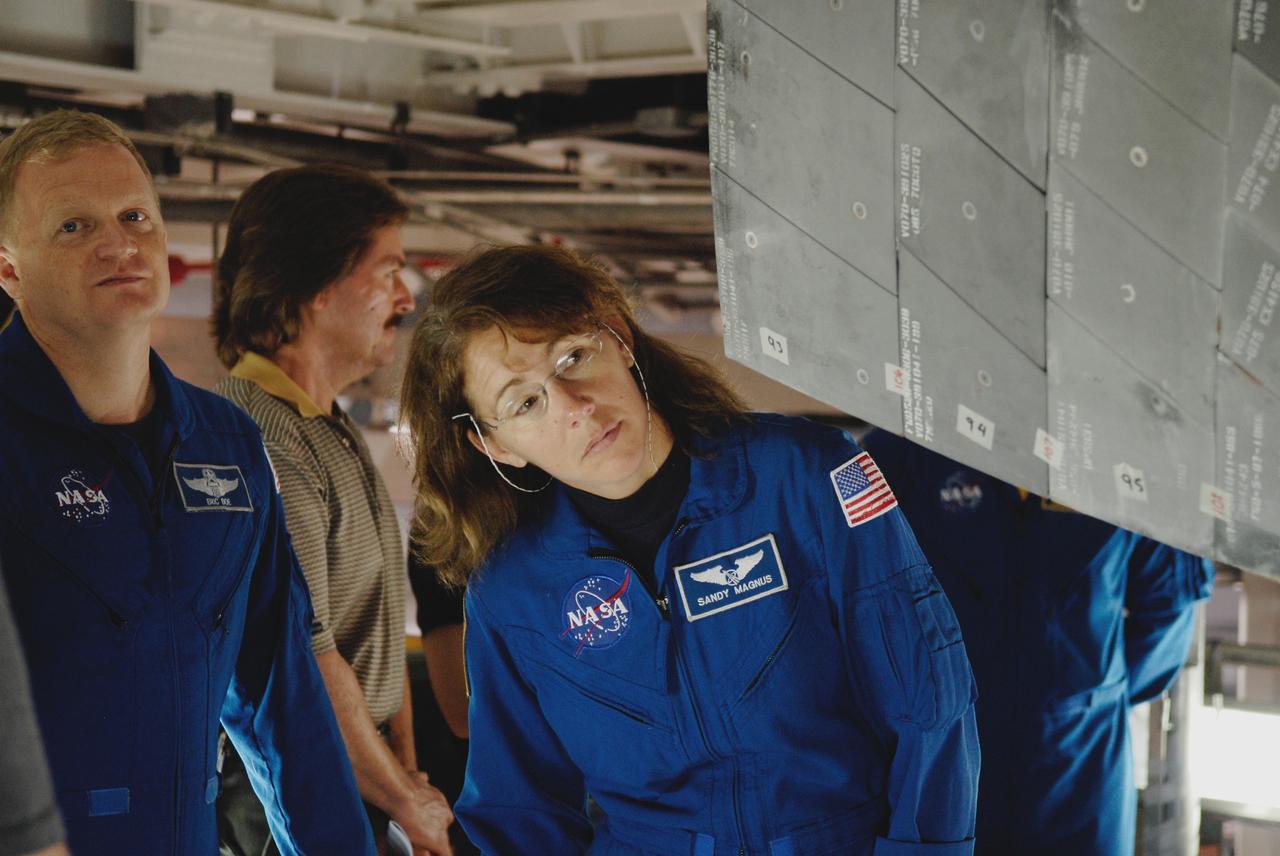
CAPE CANAVERAL, Fla. – In Orbiter Processing Facility 2 at NASA's Kennedy Space Center, members of space shuttle Endeavour's STS-126 crew participate in a crew equipment interface test, or CEIT. Here, Pilot Eric Boe, left, and International Space Station Expedition 18 flight engineer Sandra Magnus examine the thermal protection system tile on Endeavour. The CEIT provides hands-on experience with hardware and equipment slated to fly on their mission. Endeavour will deliver a multi-purpose logistics module to the International Space Station on the STS-126 mission. Launch is targeted for Nov. 10. Photo credit: NASA/Kim Shiflett
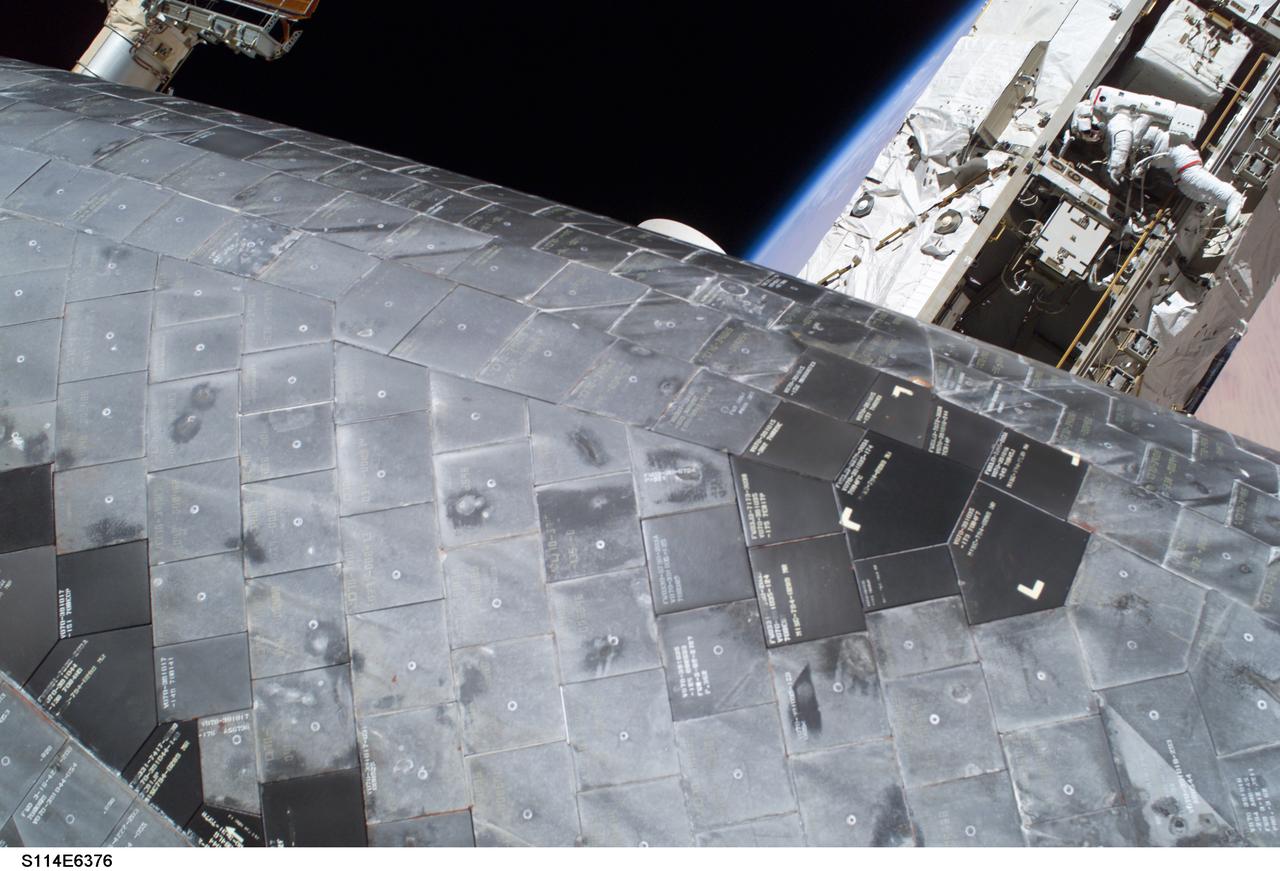
Launched on July 26 2005, from the Kennedy Space Center in Florida, STS-114 was classified as Logistics Flight 1. Among the Station-related activities of the mission were the delivery of new supplies and the replacement of one of the orbital outpost's Control Moment Gyroscopes (CMGs). STS-114 also carried the Raffaello Multi-Purpose Logistics Module and the External Stowage Platform-2. A major focus of the mission was the testing and evaluation of new Space Shuttle flight safety, which included new inspection and repair techniques. Upon its approach to the International Space Station (ISS), the Space Shuttle Discovery underwent a photography session in order to assess any damages that may have occurred during its launch and/or journey through Space. The mission’s third and final Extra Vehicular Activity (EVA) included taking a close-up look and the repair of the damaged heat shield. Gap fillers were removed from between the orbiter’s heat-shielding tiles located on the craft’s underbelly. Never before had any repairs been done to an orbiter while still in space. This close up of the thermal tiles was taken by astronaut Stephen K. Robinson, STS-114 mission specialist (out of frame). Astronaut Soichi Noguchi, STS-114 mission specialist representing the Japan Aerospace Exploration (JAXA), can be seen in the background perched on a Space Station truss.
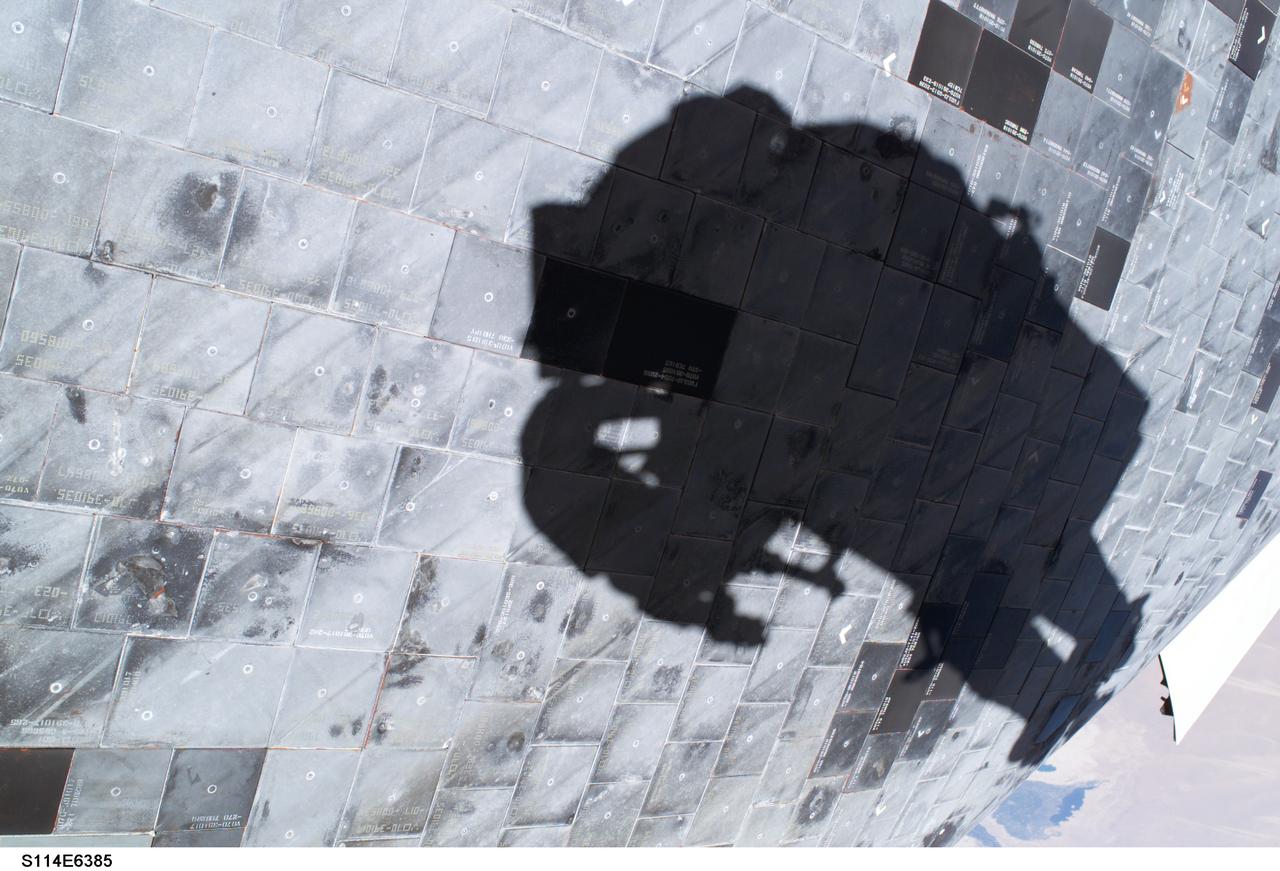
Launched on July 26, 2005 from the Kennedy Space Center in Florida, STS-114 was classified as Logistics Flight 1. Among the Station-related activities of the mission were the delivery of new supplies and the replacement of one of the orbital outpost's Control Moment Gyroscopes (CMGs). STS-114 also carried the Raffaello Multi-Purpose Logistics Module and the External Stowage Platform-2. A major focus of the mission was the testing and evaluation of new Space Shuttle flight safety, which included new inspection and repair techniques. Upon its approach to the International Space Station (ISS), the Space Shuttle Discovery underwent a photography session in order to assess any damages that may have occurred during its launch and/or journey through Space. The mission’s third and final Extra Vehicular Activity (EVA) included taking a close-up look and the repair of the damaged heat shield. Gap fillers were removed from between the orbiter’s heat-shielding tiles located on the craft’s underbelly. Never before had any repairs been done to an orbiter while still in space. This particular photo was taken by astronaut Stephen K. Robinson, STS-114 mission specialist, whose shadow is visible on the thermal protection tiles.