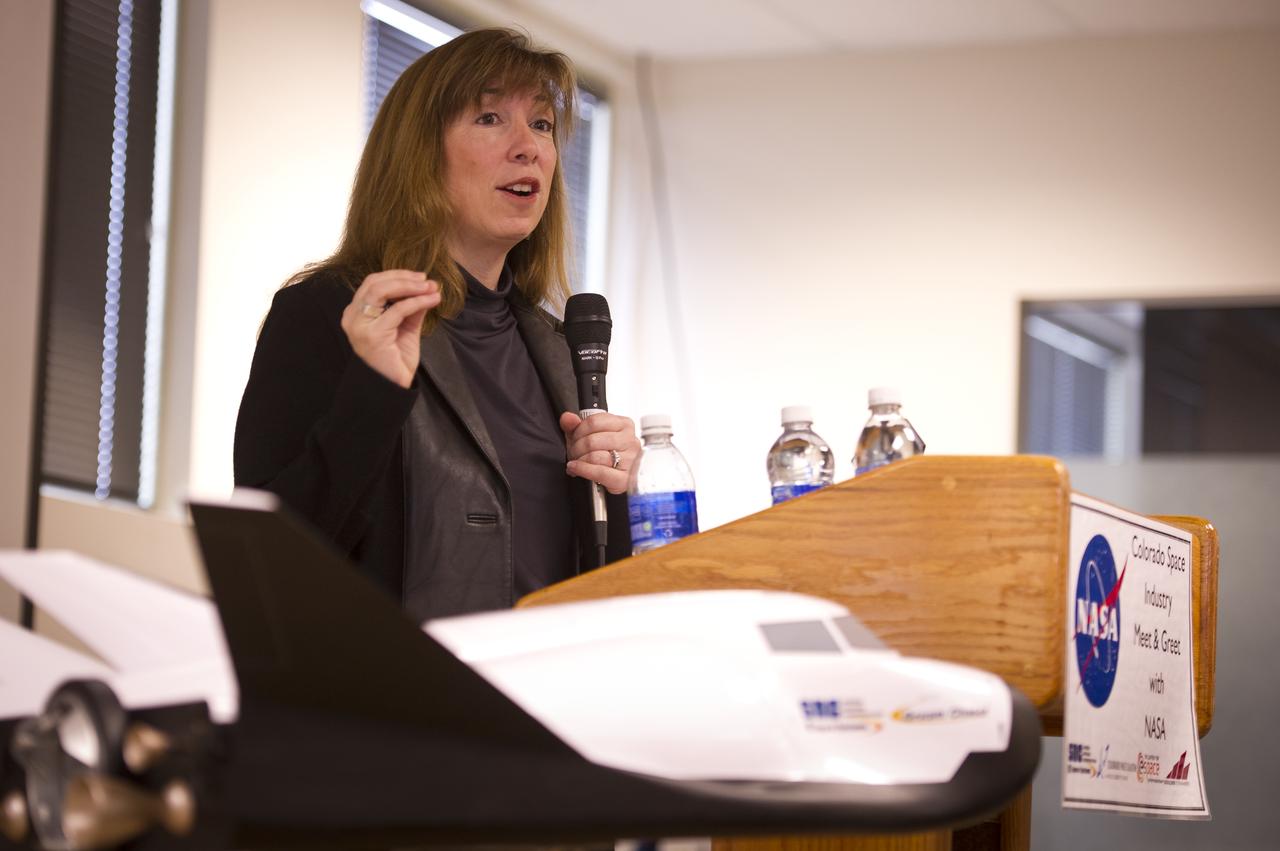
NASA Deputy Administrator Lori Garver speaks at Sierra Nevada Space Systems, on Saturday, Feb. 5, 2011, in Louisville, Colo. Sierra Nevada's Dream Chaser spacecraft is under development with support from NASA's Commercial Crew Development Program to provide crew transportation to and from low Earth orbit. NASA is helping private companies develop innovative technologies to ensure that the U.S. remains competitive in future space endeavors. Photo Credit: (NASA/Bill Ingalls)
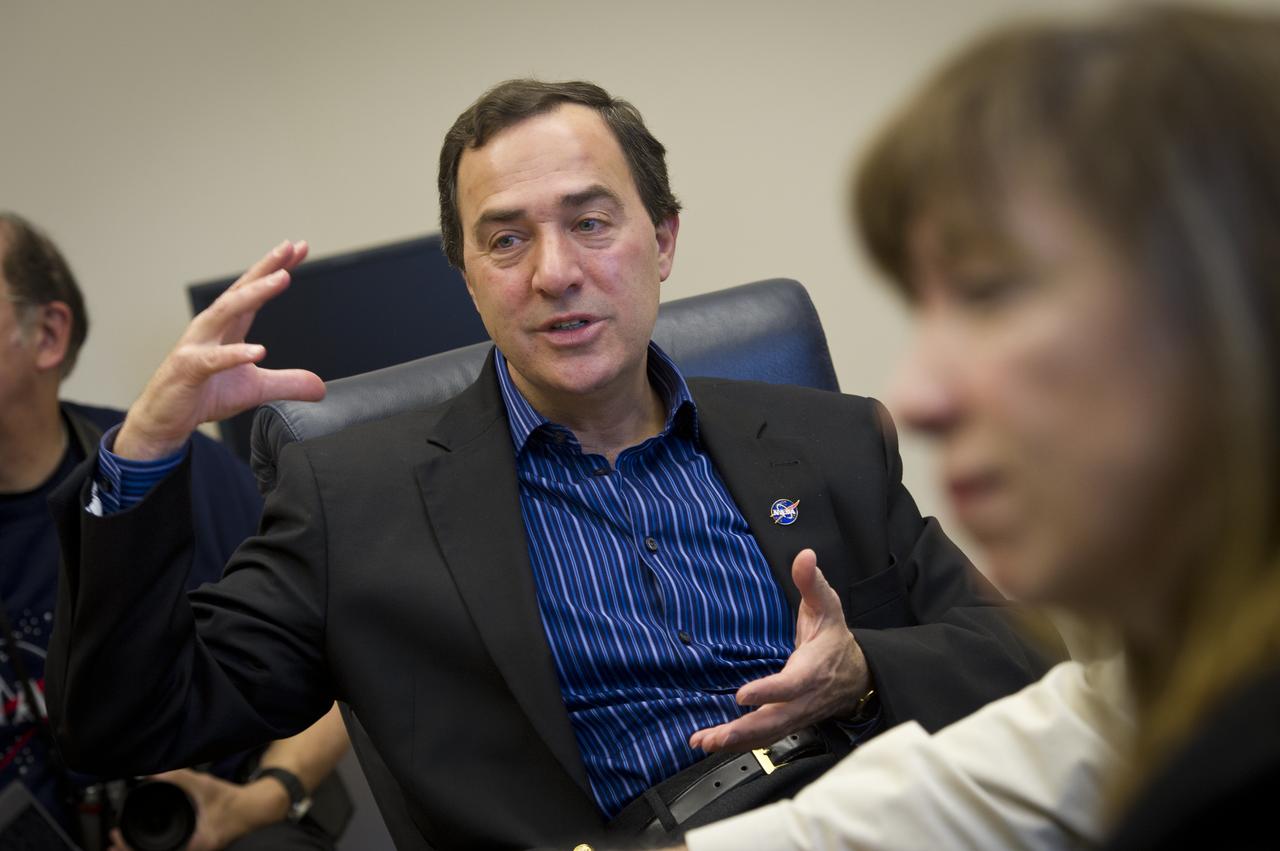
Sierra Nevada Space Systems chairman Mark Sirangello talks to NASA Deputy Administrator Lori Garver, on Saturday, Feb. 5, 2011, in Louisville, Colo. Sierra Nevada's Dream Chaser spacecraft is under development with support from NASA's Commercial Crew Development Program to provide crew transportation to and from low Earth orbit. NASA is helping private companies develop innovative technologies to ensure that the U.S. remains competitive in future space endeavors. Photo Credit: (NASA/Bill Ingalls)
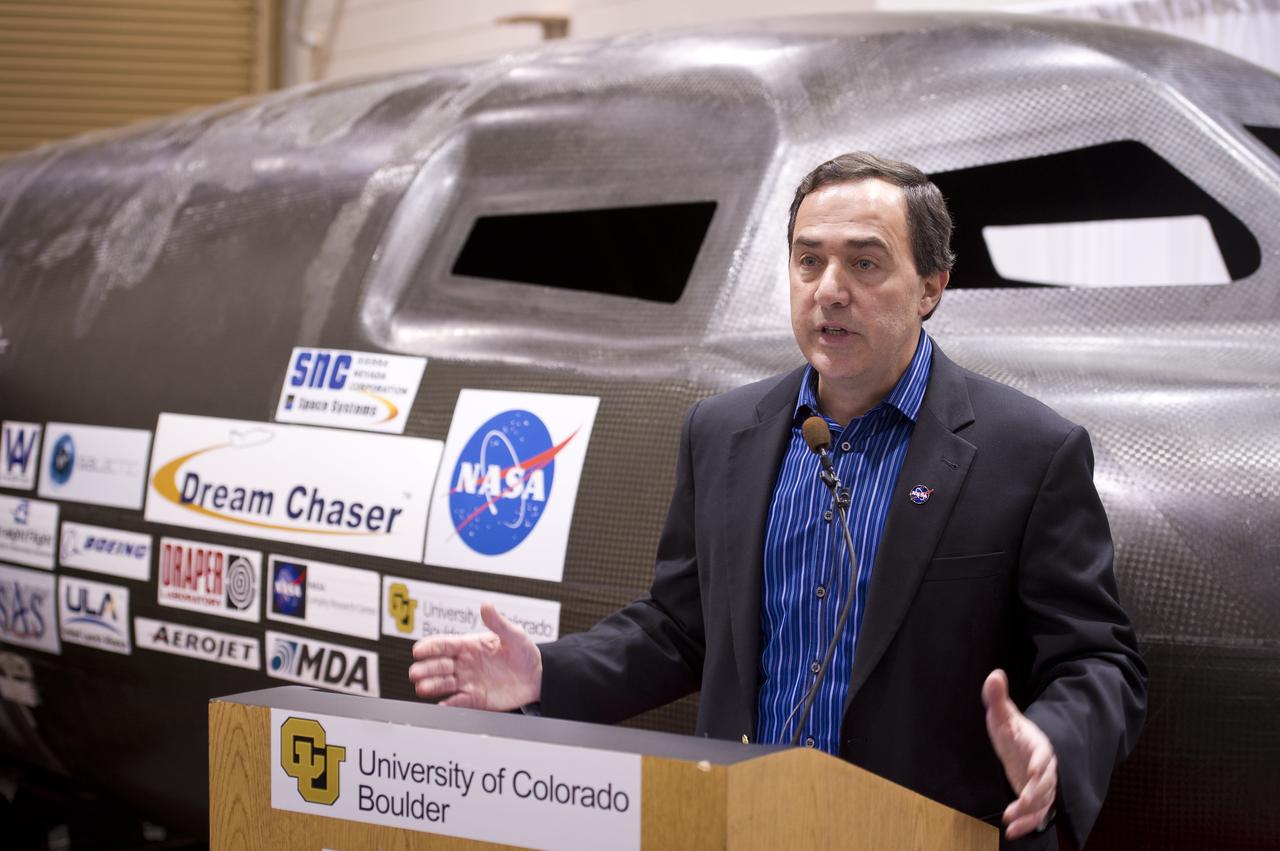
Sierra Nevada Space Systems chairman Mark Sirangello talks during a press conference with Sierra Nevada's Dream Chaser spacecraft in the background on Saturday, Feb. 5, 2011, at the University of Colorado at Boulder. Sierra Nevada's Dream Chaser spacecraft is under development with support from NASA's Commercial Crew Development Program to provide crew transportation to and from low Earth orbit. NASA is helping private companies develop innovative technologies to ensure that the U.S. remains competitive in future space endeavors. Photo Credit: (NASA/Bill Ingalls)
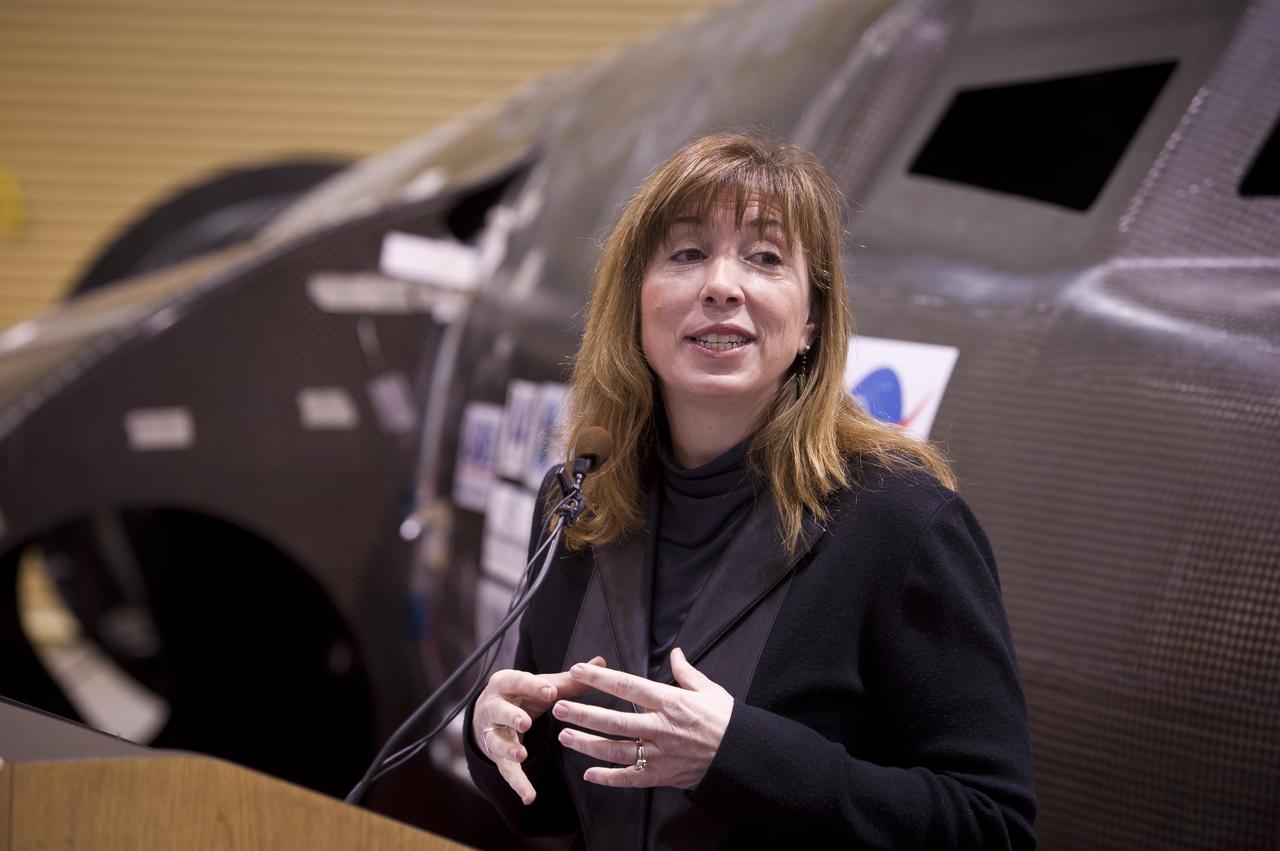
NASA Deputy Administrator Lori Garver talks during a press conference with Sierra Nevada's Dream Chaser spacecraft in the background on Saturday, Feb. 5, 2011, at the University of Colorado at Boulder. Sierra Nevada's Dream Chaser spacecraft is under development with support from NASA's Commercial Crew Development Program to provide crew transportation to and from low Earth orbit. NASA is helping private companies develop innovative technologies to ensure that the U.S. remains competitive in future space endeavors. Photo Credit: (NASA/Bill Ingalls)
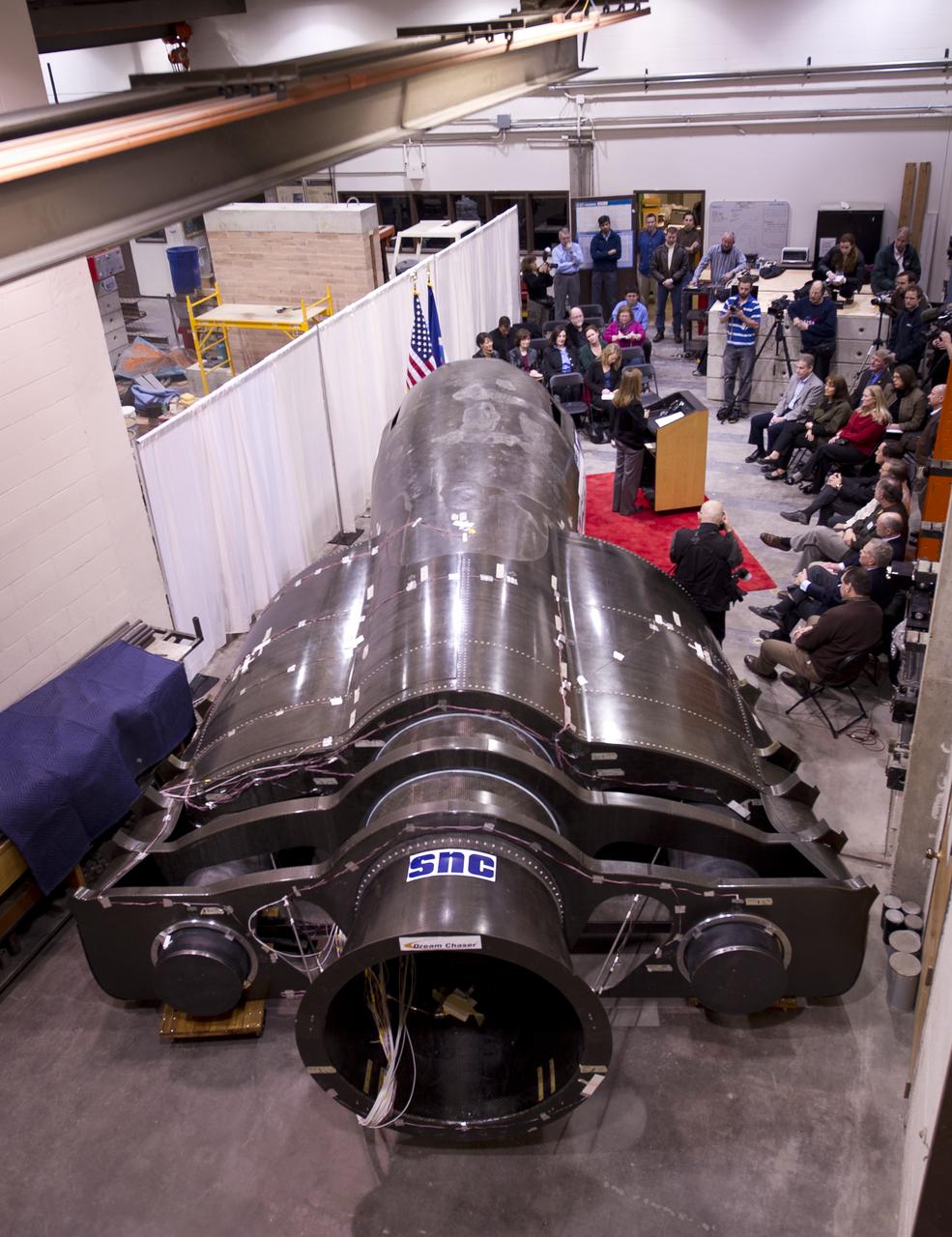
Sierra Nevada's Dream Chaser spacecraft is seen as NASA Deputy Administrator Lori Garver talks during a press conference on Saturday, Feb. 5, 2011, at the University of Colorado at Boulder. Sierra Nevada's Dream Chaser spacecraft is under development with support from NASA's Commercial Crew Development Program to provide crew transportation to and from low Earth orbit. NASA is helping private companies develop innovative technologies to ensure that the U.S. remains competitive in future space endeavors. Photo Credit: (NASA/Bill Ingalls)
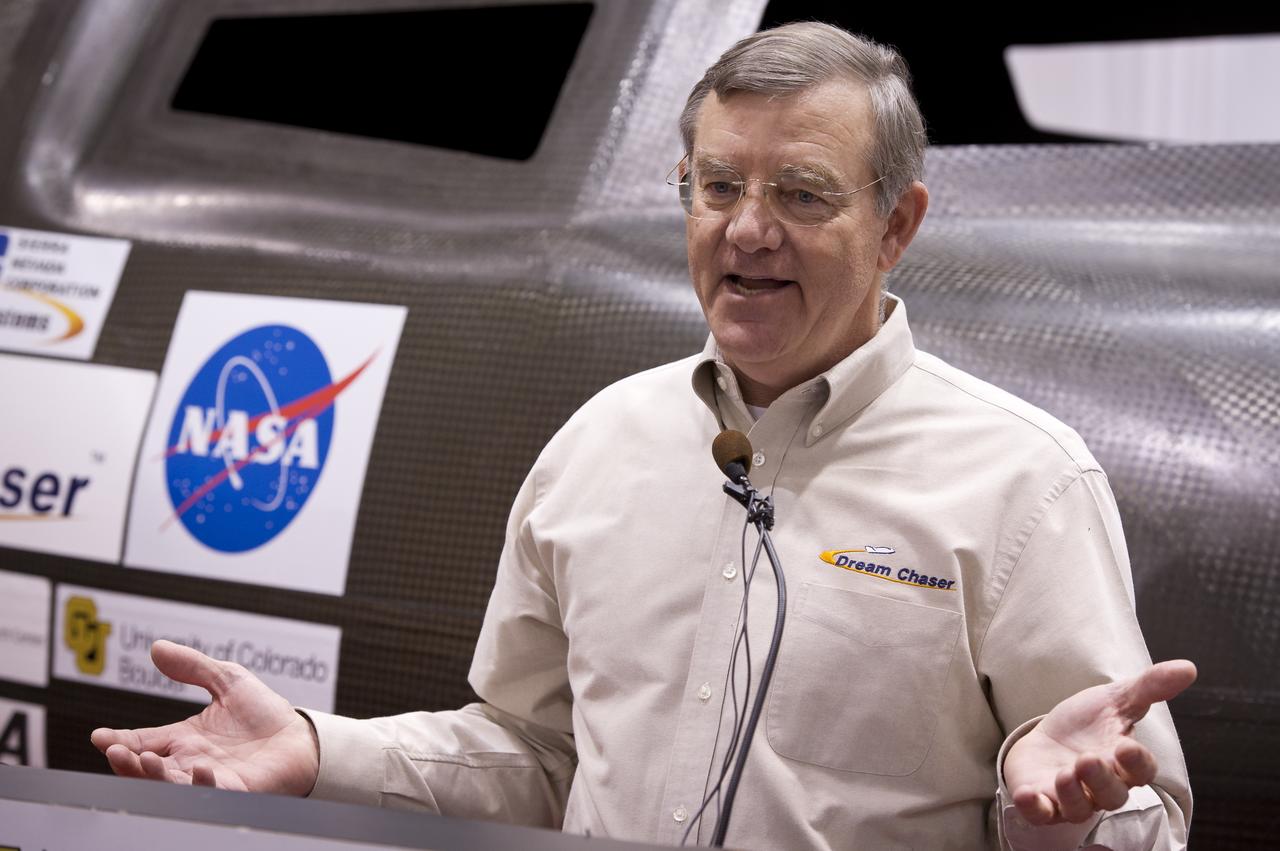
Director of Advanced Programs, Sierra Nevada Corporation, Jim Voss talks during a press conference with Sierra Nevada's Dream Chaser spacecraft in the background on Saturday, Feb. 5, 2011, at the University of Colorado at Boulder. Sierra Nevada's Dream Chaser spacecraft is under development with support from NASA's Commercial Crew Development Program to provide crew transportation to and from low Earth orbit. NASA is helping private companies develop innovative technologies to ensure that the U.S. remains competitive in future space endeavors. Photo Credit: (NASA/Bill Ingalls)
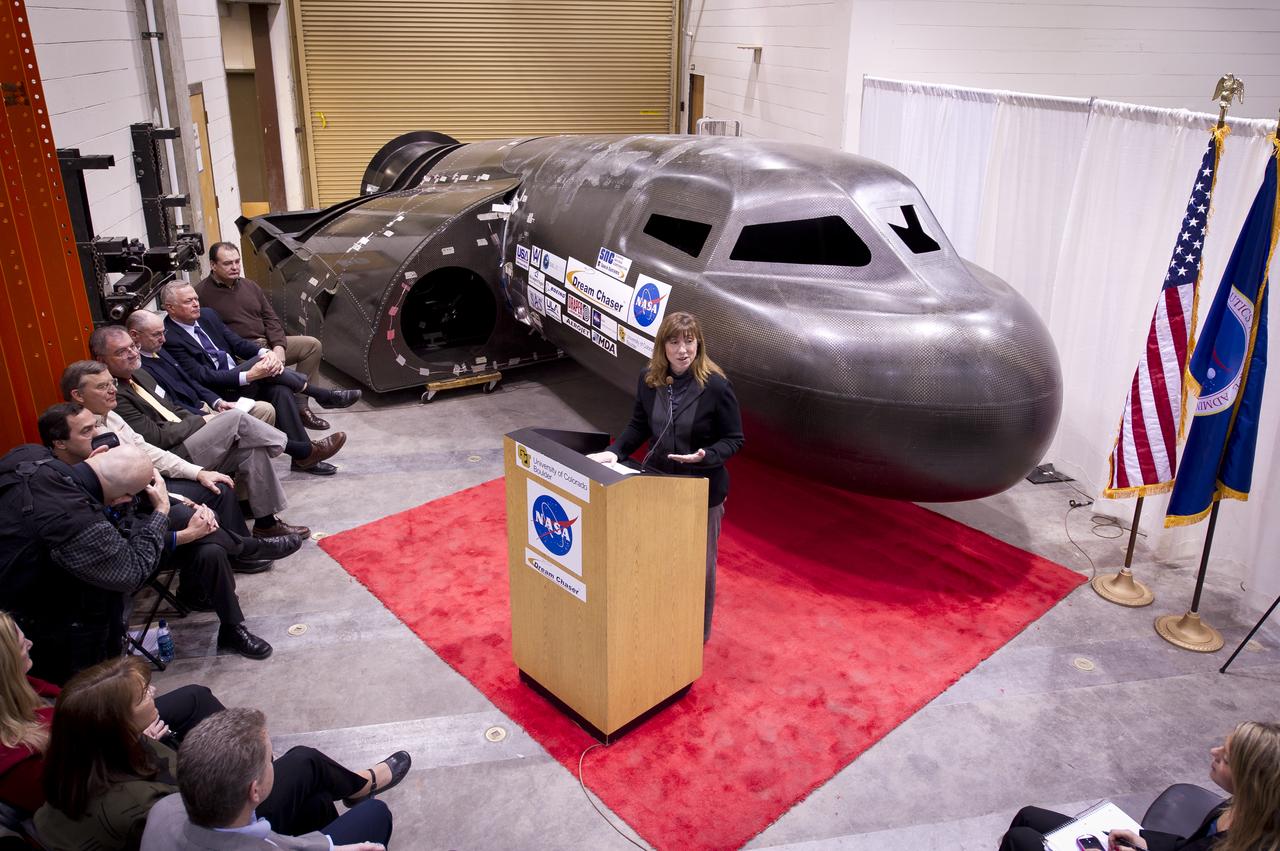
NASA Deputy Administrator Lori Garver talks during a press conference with Sierra Nevada's Dream Chaser spacecraft in the background on Saturday, Feb. 5, 2011, at the University of Colorado at Boulder. Sierra Nevada's Dream Chaser spacecraft is under development with support from NASA's Commercial Crew Development Program to provide crew transportation to and from low Earth orbit. NASA is helping private companies develop innovative technologies to ensure that the U.S. remains competitive in future space endeavors. Photo Credit: (NASA/Bill Ingalls)
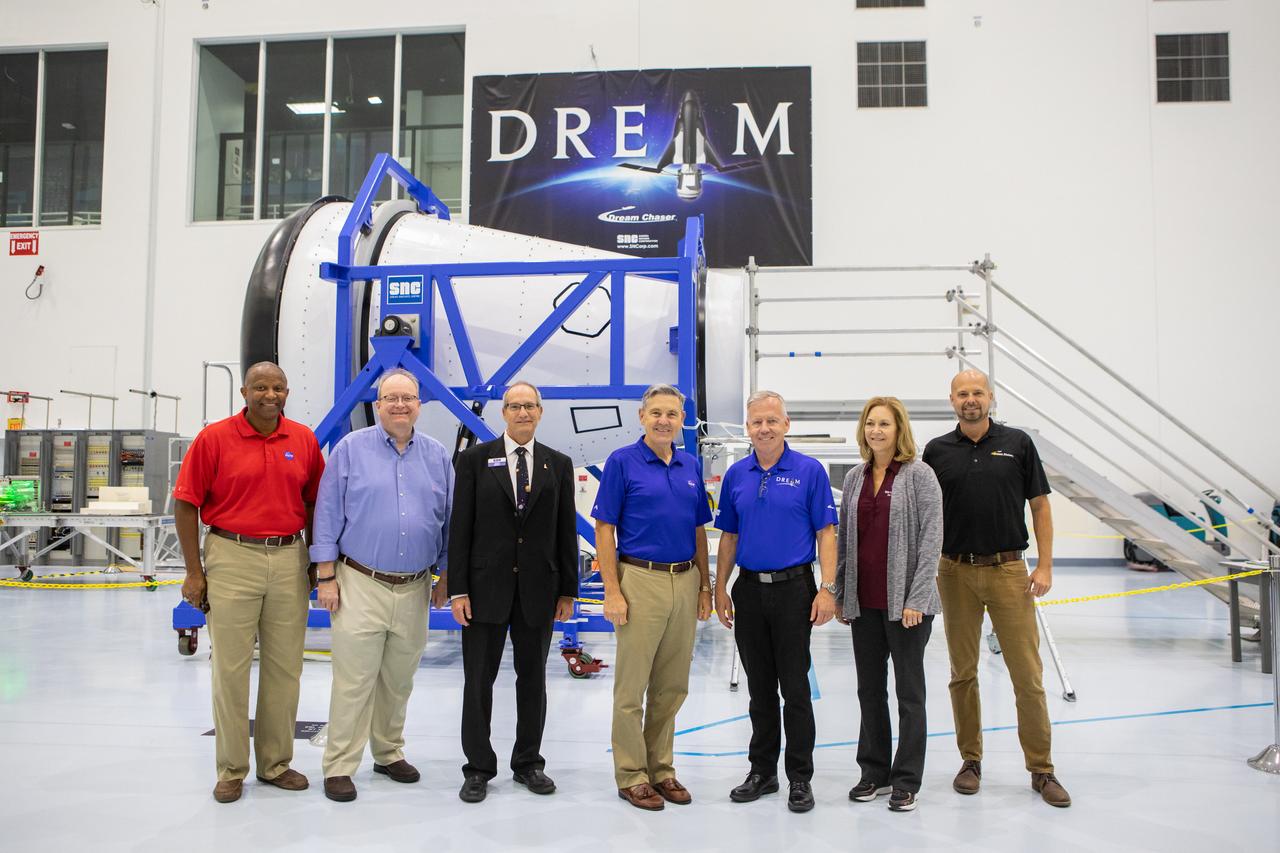
A mockup of the cargo logistics module for Sierra Nevada Corporation’s Dream Chaser, the company’s reusable spaceplane, arrived at the Space Station Processing Facility (SSPF) at NASA’s Kennedy Space Center in Florida in August. On Sept. 20, 2019, senior leadership had the opportunity to view the cargo module in the SSPF high bay. From left are Kelvin Manning, Kennedy associate director, technical; Burt Summerfield, associate director, management; John Roth, vice president, Business Development Space Systems, Sierra Nevada Corporation; Kennedy Center Director Bob Cabana; Steve Lindsey, vice president, Space Exploration Systems, Sierra Nevada Corporation; Kennedy Deputy Director Janet Petro; and Nate Wood, Sierra Nevada Corporation. The SSPF is providing support for current and future NASA and commercial provider programs, including Commercial Resupply Services, Artemis 1, sending the first woman and next man to the Moon, and deep space destinations including Mars.
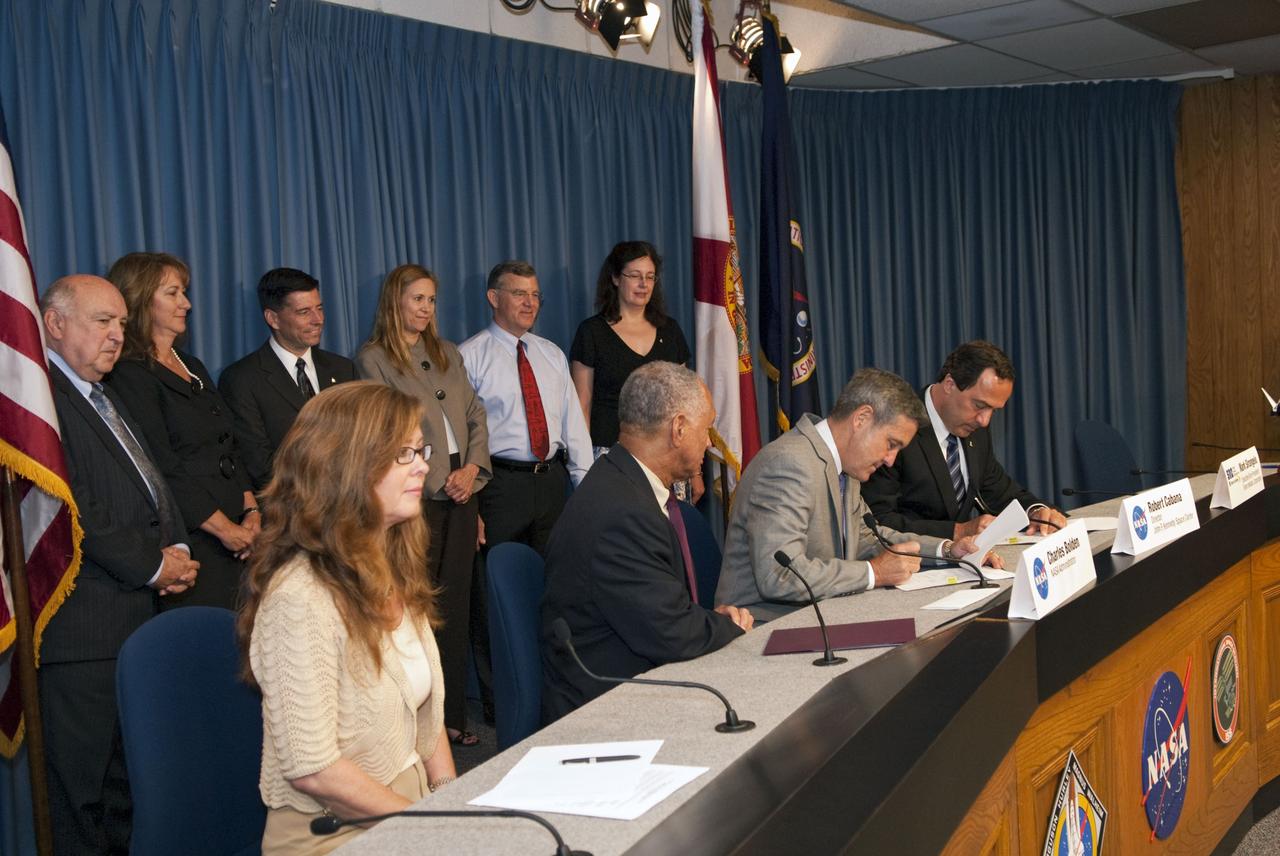
CAPE CANAVERAL, Fla. -- NASA and Sierra Nevada Space Systems (SNSS) of Sparks, Nev., sign a Space Act Agreement that will offer the company technical capabilities from Kennedy Space Center's uniquely skilled work force. Sitting, from left, are Kennedy Public Affairs Director Lisa Malone; NASA Administrator Charlie Bolden; Kennedy Center Director Bob Cabana; and Mark Sirangelo, head of Sierra Nevada. Standing, from left, are Frank DiBello, president of Space Florida; Joyce Riquelme, manager of Kennedy's Center Planning and Development Office; John Curry, director of Sierra Nevada's Systems Integration, Test and Operations; Kennedy Deputy Director Janet Petro; Jim Voss, vice president of Sierra Nevada's Space Exploration Systems; and Merri Sanchez, senior director of Sierra Nevada's Space Exploration Systems. Kennedy will help Sierra Nevada with the ground operations support of its lifting body reusable spacecraft called "Dream Chaser," which resembles a smaller version of the space shuttle orbiter. The spacecraft would carry as many as seven astronauts to the space station. Through the new agreement, Kennedy's work force will use its experience of processing the shuttle fleet for 30 years to help Sierra Nevada define and execute Dream Chaser's launch preparations and post-landing activities. In 2010 and 2011, Sierra Nevada was awarded grants as part of the initiative to stimulate the private sector in developing and demonstrating human spaceflight capabilities for NASA's Commercial Crew Program. The goal of the program, which is based in Florida at Kennedy, is to facilitate the development of a U.S. commercial crew space transportation capability by achieving safe, reliable and cost-effective access to and from the space station and future low Earth orbit destinations. Photo credit: NASA/Jim Grossmann
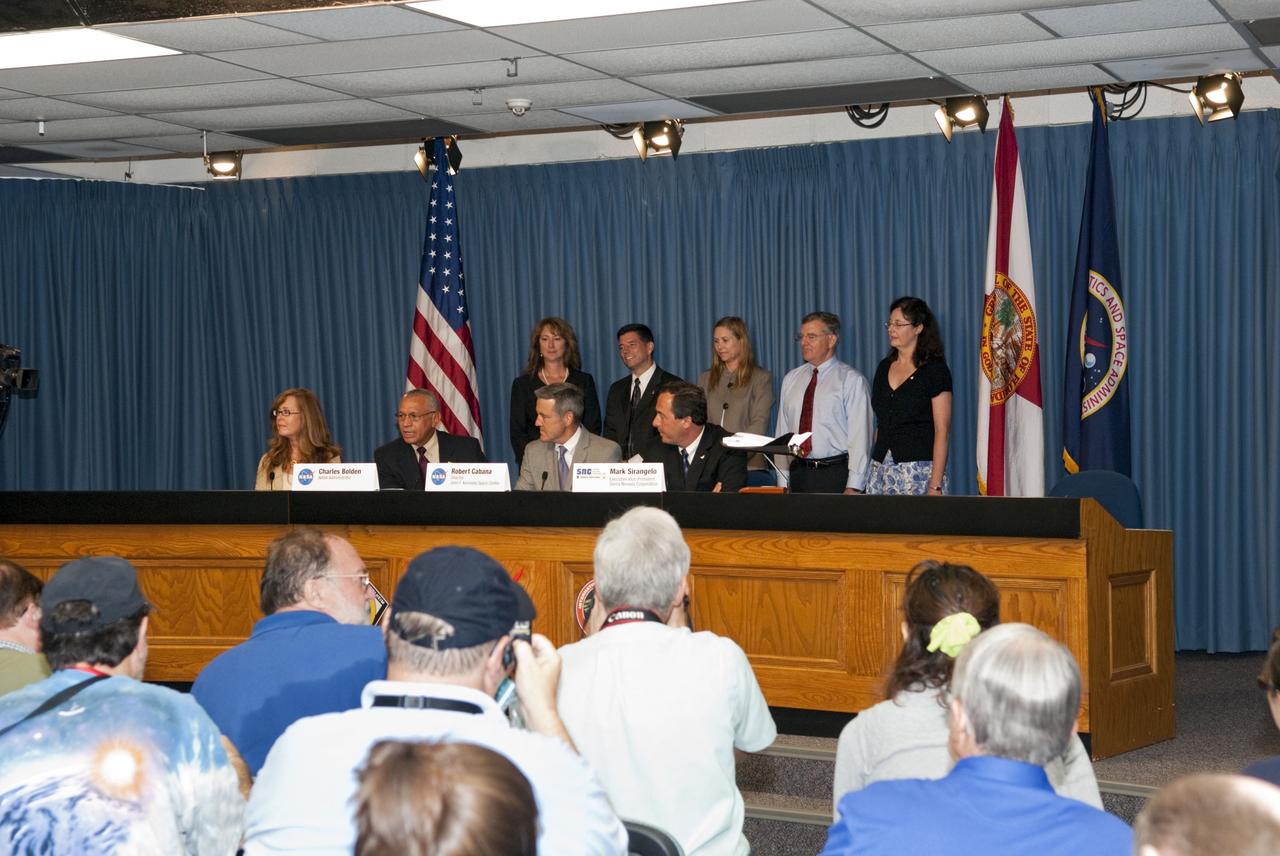
CAPE CANAVERAL, Fla. -- NASA and Sierra Nevada Space Systems (SNSS) of Sparks, Nev., prepare to sign a Space Act Agreement that will offer the company technical capabilities from Kennedy Space Center's uniquely skilled work force. Sitting, from left, are Kennedy Public Affairs Director Lisa Malone; NASA Administrator Charlie Bolden; Kennedy Center Director Bob Cabana; and Mark Sirangelo, head of Sierra Nevada. Standing, from left, are Joyce Riquelme, manager of Kennedy's Center Planning and Development Office; John Curry, director of Sierra Nevada's Systems Integration, Test and Operations; Kennedy Deputy Director Janet Petro; Jim Voss, vice president of Sierra Nevada's Space Exploration Systems; and Merri Sanchez, senior director of Sierra Nevada's Space Exploration Systems. Kennedy will help Sierra Nevada with the ground operations support of its lifting body reusable spacecraft called "Dream Chaser," which resembles a smaller version of the space shuttle orbiter. The spacecraft would carry as many as seven astronauts to the space station. Through the new agreement, Kennedy's work force will use its experience of processing the shuttle fleet for 30 years to help Sierra Nevada define and execute Dream Chaser's launch preparations and post-landing activities. In 2010 and 2011, Sierra Nevada was awarded grants as part of the initiative to stimulate the private sector in developing and demonstrating human spaceflight capabilities for NASA's Commercial Crew Program. The goal of the program, which is based in Florida at Kennedy, is to facilitate the development of a U.S. commercial crew space transportation capability by achieving safe, reliable and cost-effective access to and from the space station and future low Earth orbit destinations. Photo credit: NASA/Jim Grossmann

Acting NASA Deputy Administrator Lesa Roe, left, and acting NASA Administrator Robert Lightfoot, right, listen as Alec Devereaux, a systems engineer with Sierra Nevada Corporation, right, discusses the Flight Control Integration Lab (FCIL), Thursday, April 6, 2017 during a visit to Sierra Nevada Corporation in Louisville, Colo. Sierra Nevada Corporation, with their Dream Chaser Cargo System, was one of three companies to be awarded Commercial Resupply Services (CRS-2) contracts designed to obtain cargo delivery services to the space station, disposal of unneeded cargo, and the return of research samples and other cargo from the station back to NASA. Photo Credit: (NASA/Joel Kowsky)
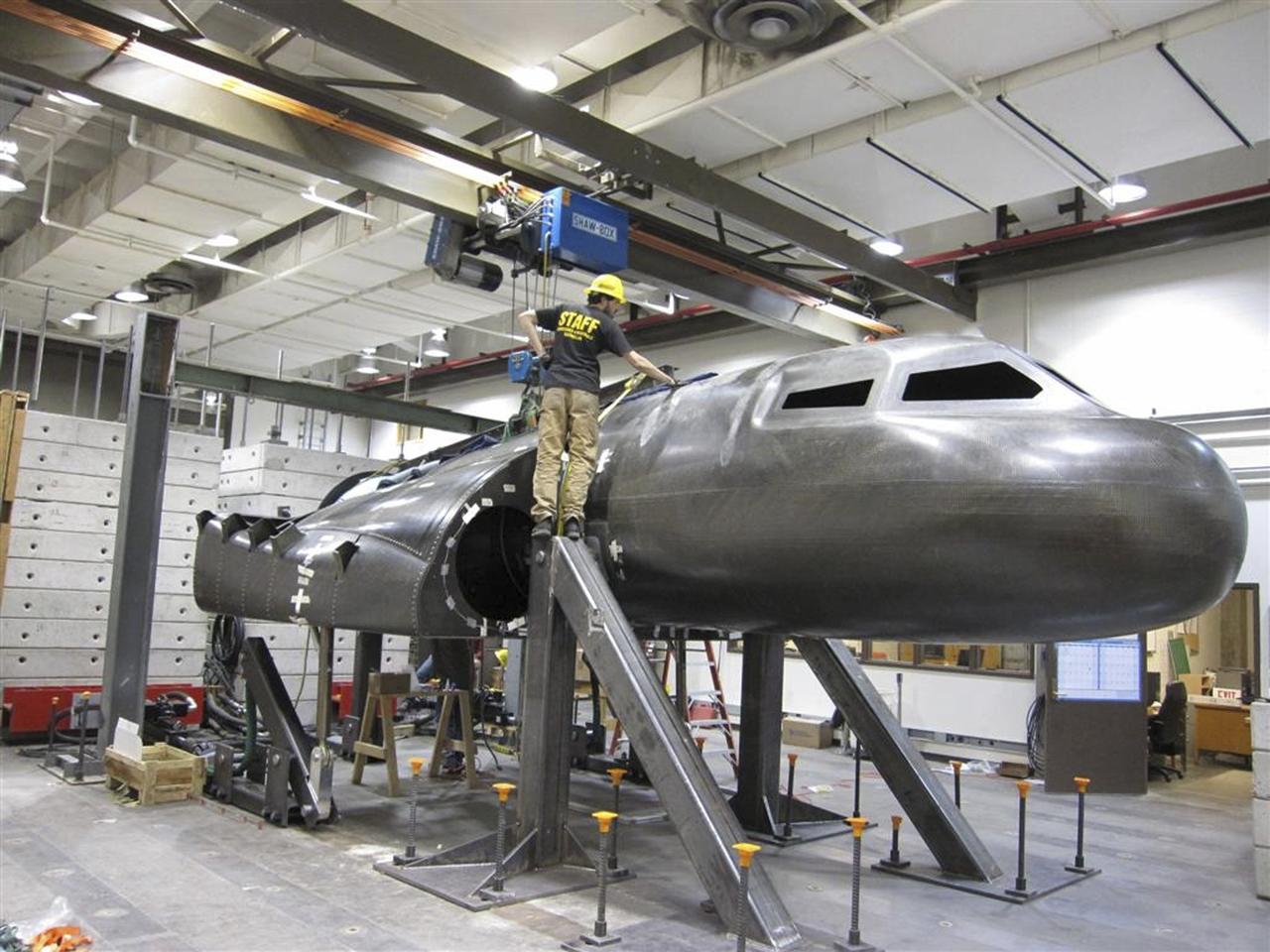
BOULDER, Colo. – A Sierra Nevada Corp. team member examines the company's structural test article for the Dream Chaser spacecraft in the University of Colorado at Boulder’s Facility for Advanced Spatial Technology. The university is one of Sierra Nevada’s partners on the design and development of the Dream Chaser orbital crew vehicle. Dream Chaser is one of five systems NASA invested in during Commercial Crew Development Round 1 CCDev1 activities in order to aid in the innovation and development of American-led commercial capabilities for crew transportation and rescue services to and from the International Space Station and other low Earth orbit destinations. In 2011, NASA's Commercial Crew Program CCP entered into another funded Space Act Agreement with Sierra Nevada for the second round of commercial crew development CCDev2) so the company could further develop its Dream Chaser spacecraft for NASA transportation services. For information about CCP, visit www.nasa.gov/commercialcrew. Photo credit: Sierra Nevada Corp.
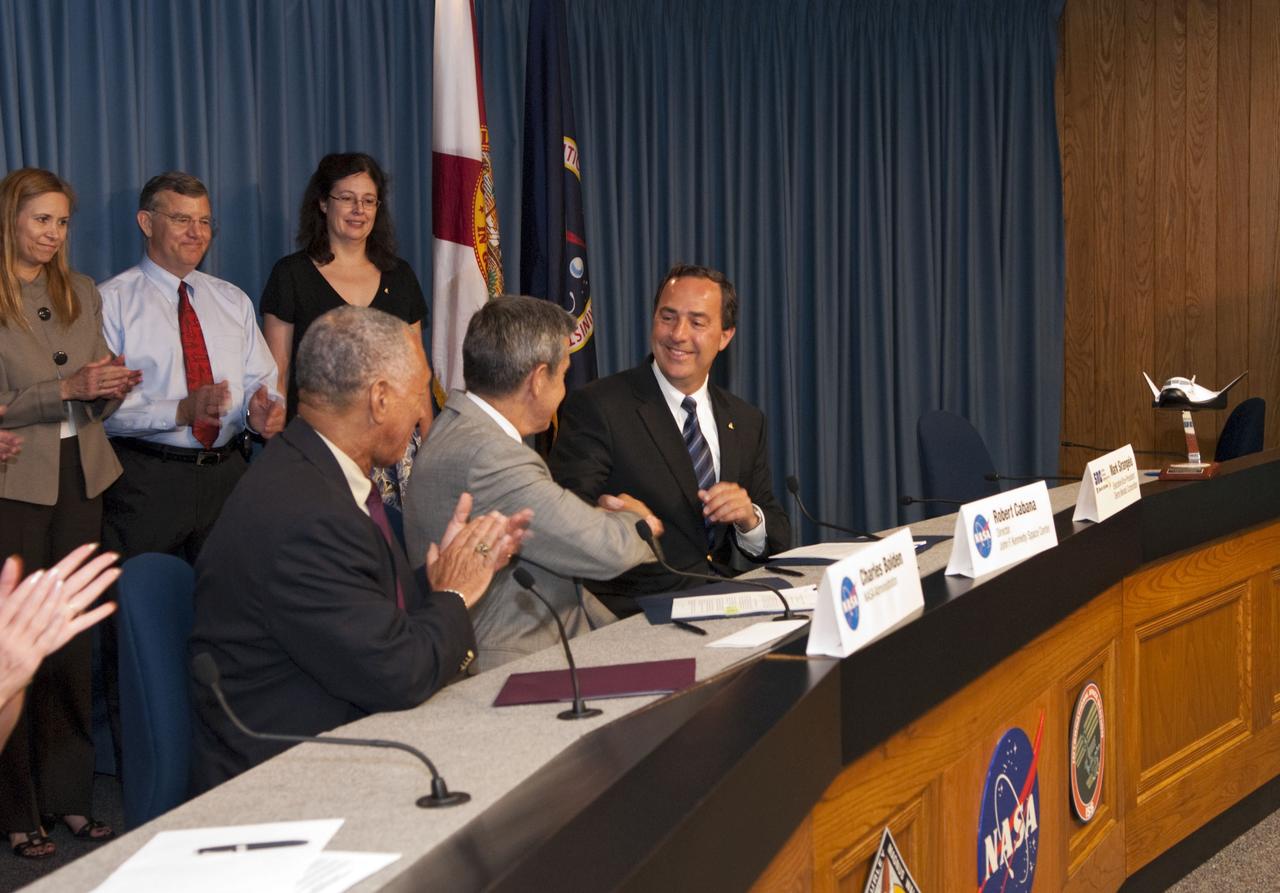
CAPE CANAVERAL, Fla. -- NASA and Sierra Nevada Space Systems (SNSS) of Sparks, Nev., enter into a Space Act Agreement that will offer the company technical capabilities from Kennedy Space Center's uniquely skilled work force. Sitting, from left, are NASA Administrator Charlie Bolden; Kennedy Center Director Bob Cabana; and Mark Sirangelo, head of Sierra Nevada. Standing, from left, Kennedy Deputy Director Janet Petro; Jim Voss, vice president of Sierra Nevada's Space Exploration Systems; and Merri Sanchez, senior director of Sierra Nevada's Space Exploration Systems. Kennedy will help Sierra Nevada with the ground operations support of its lifting body reusable spacecraft called "Dream Chaser," which resembles a smaller version of the space shuttle orbiter. The spacecraft would carry as many as seven astronauts to the space station. Through the new agreement, Kennedy's work force will use its experience of processing the shuttle fleet for 30 years to help Sierra Nevada define and execute Dream Chaser's launch preparations and post-landing activities. In 2010 and 2011, Sierra Nevada was awarded grants as part of the initiative to stimulate the private sector in developing and demonstrating human spaceflight capabilities for NASA's Commercial Crew Program. The goal of the program, which is based in Florida at Kennedy, is to facilitate the development of a U.S. commercial crew space transportation capability by achieving safe, reliable and cost-effective access to and from the space station and future low Earth orbit destinations. Photo credit: NASA/Jim Grossmann
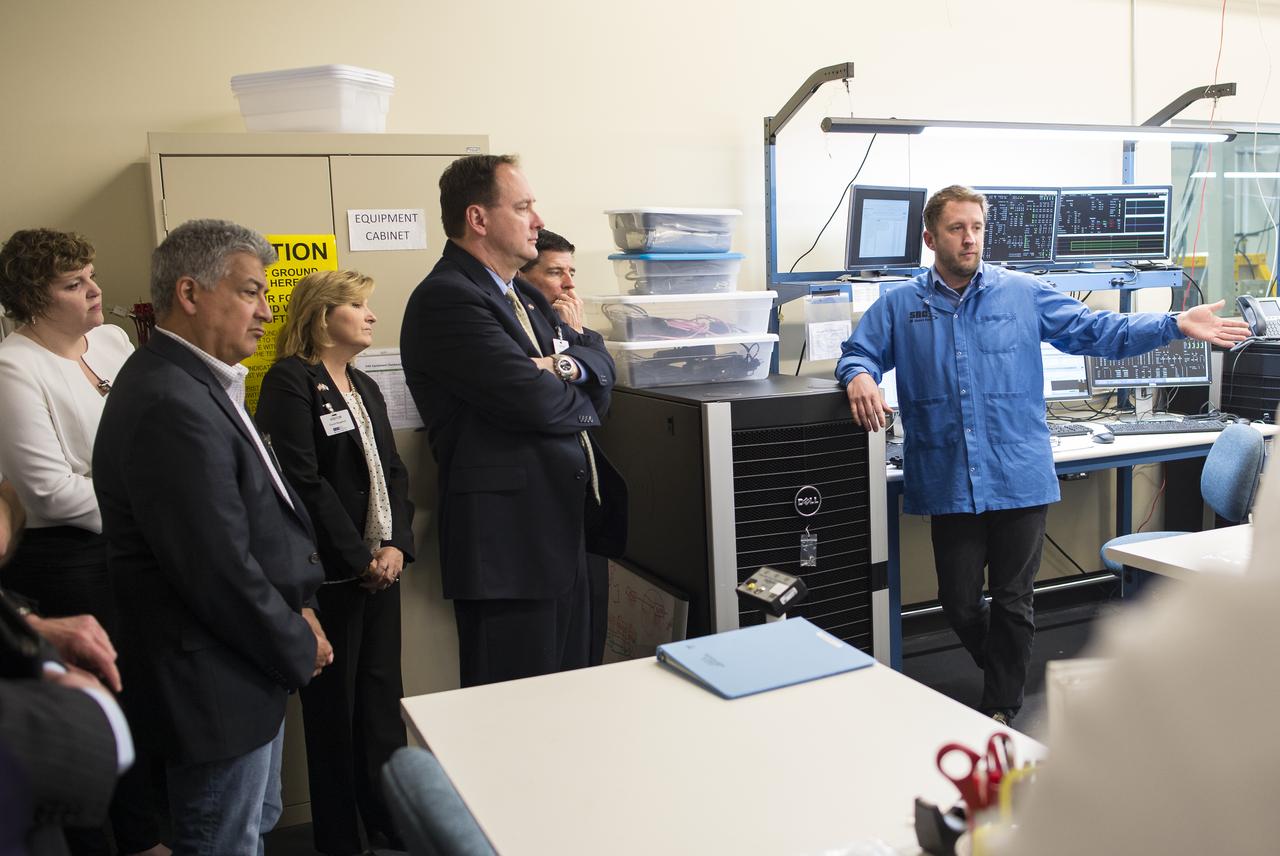
Associate administrator of NASA's Office of International and Interagency Relations Al Condes, left, acting NASA Deputy Administrator Lesa Roe, second from left, and acting NASA Administrator Robert Lightfoot, center, listen as Jude Vrazel, a senior systems engineer at Sierra Nevada Corporation, right, discusses the Vehicle Avionics Integration Lab (VAIL), Thursday, April 6, 2017 during a visit to Sierra Nevada Corporation in Louisville, Colo. Sierra Nevada Corporation, with their Dream Chaser Cargo System, was one of three companies to be awarded Commercial Resupply Services (CRS-2) contracts designed to obtain cargo delivery services to the space station, disposal of unneeded cargo, and the return of research samples and other cargo from the station back to NASA. Photo Credit: (NASA/Joel Kowsky)
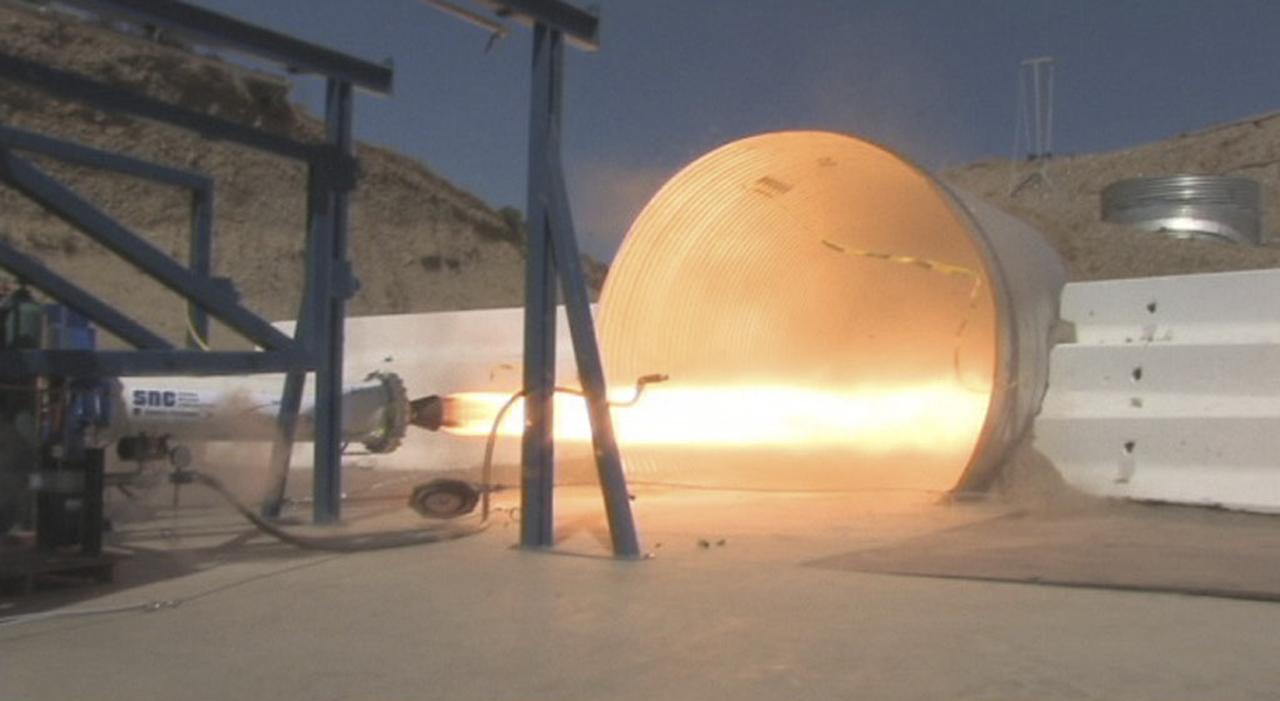
POWAY, Calif. – During NASA's Commercial Crew Development Round 1 CCDev1 activities, the rocket motor under development by Sierra Nevada Corp. for its Dream Chaser spacecraft successfully fires at the company's rocket test facility located near San Diego. NASA team members reviewed the motor's system and then watched it fire three times in one day, including one firing under vacuum ignition conditions. The tests, which simulated a complete nominal mission profile, demonstrated the multiple restart capability of Sierra Nevada's hybrid rocket. Two of the company's designed and developed hybrid rocket motors will be used as the main propulsion system on the Dream Chaser after launching aboard an Atlas V rocket. Dream Chaser is one of five systems NASA invested in during CCDev1 in order to aid in the innovation and development of American-led commercial capabilities for crew transportation and rescue services to and from the International Space Station and other low Earth orbit destinations. In 2011, NASA's Commercial Crew Program CCP entered into another funded Space Act Agreement with Sierra Nevada for the second round of commercial crew development CCDev2) so the company could further develop its Dream Chaser spacecraft for NASA transportation services. For information about CCP, visit www.nasa.gov/commercialcrew. Photo credit: Sierra Nevada Corp.
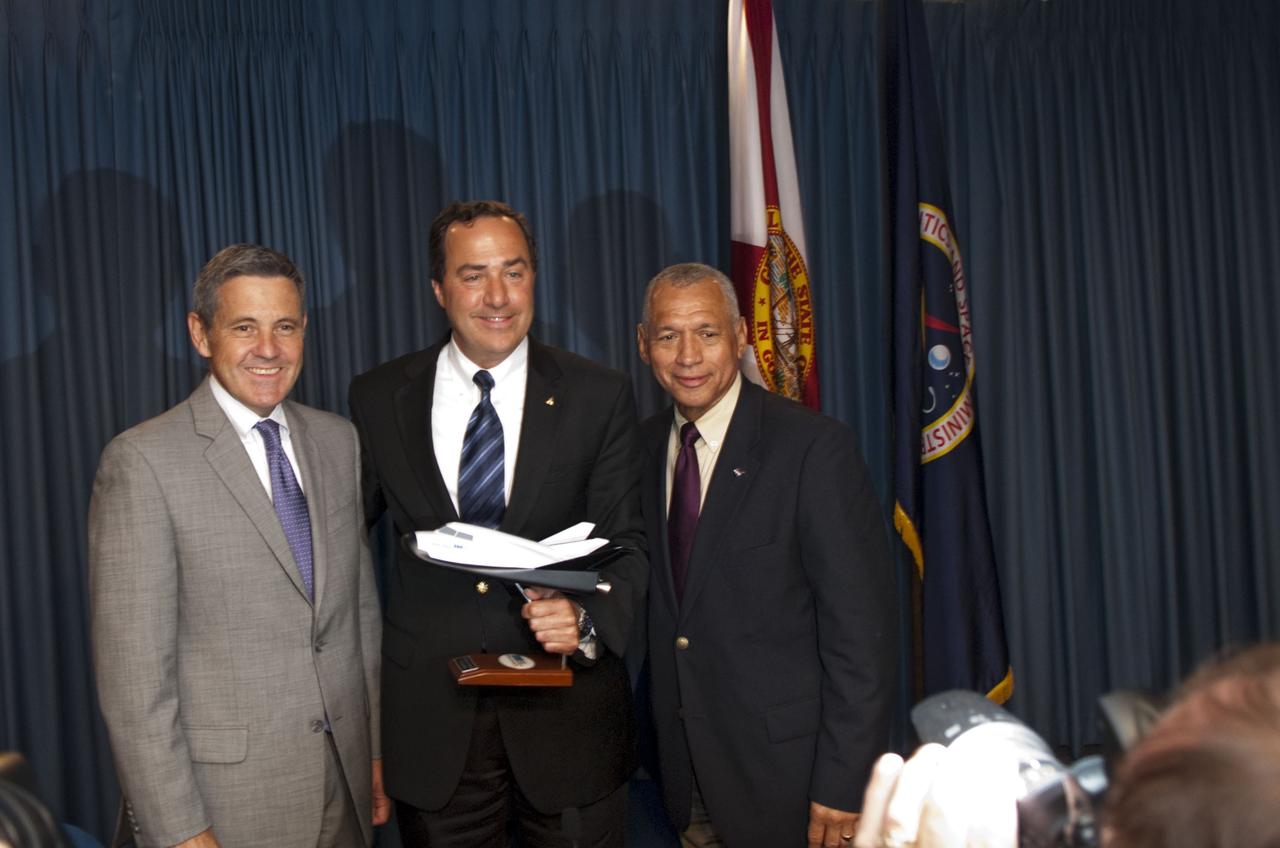
CAPE CANAVERAL, Fla. -- Kennedy Space Center Director Bob Cabana, left, Mark Sirangelo, head of Sierra Nevada Space Systems (SNSS) of Sparks, Nev., and NASA Administrator Charlie Bolden pose for a photo after signing a Space Act Agreement that will offer the company technical capabilities from Kennedy's uniquely skilled work force. Kennedy will help Sierra Nevada with the ground operations support of its lifting body reusable spacecraft called "Dream Chaser," which resembles a smaller version of the space shuttle orbiter. The spacecraft would carry as many as seven astronauts to the space station. Through the new agreement, Kennedy's work force will use its experience of processing the shuttle fleet for 30 years to help Sierra Nevada define and execute Dream Chaser's launch preparations and post-landing activities. In 2010 and 2011, Sierra Nevada was awarded grants as part of the initiative to stimulate the private sector in developing and demonstrating human spaceflight capabilities for NASA's Commercial Crew Program. The goal of the program, which is based in Florida at Kennedy, is to facilitate the development of a U.S. commercial crew space transportation capability by achieving safe, reliable and cost-effective access to and from the space station and future low Earth orbit destinations. Photo credit: NASA/Jim Grossmann
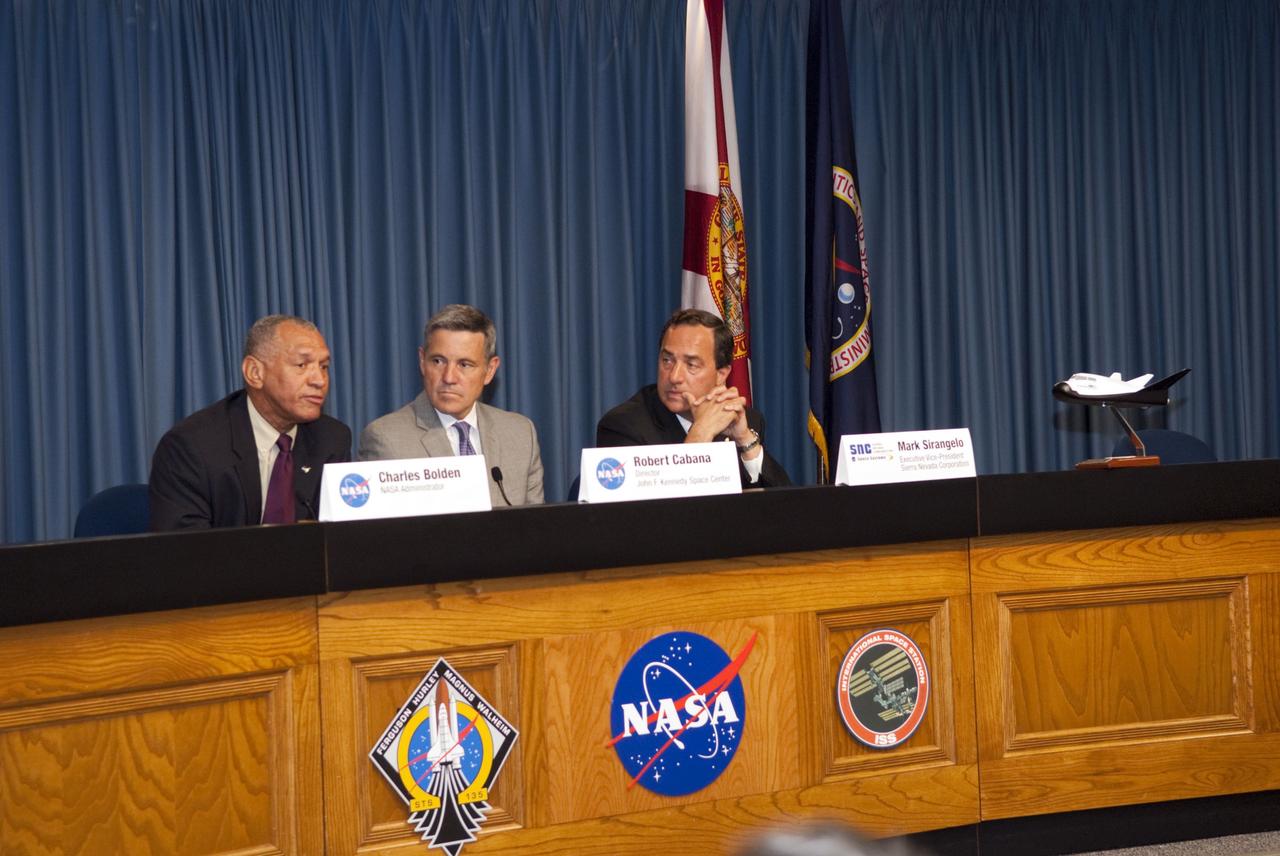
CAPE CANAVERAL, Fla. -- NASA Administrator Charlie Bolden, left, Kennedy Space Center Director Bob Cabana, and Mark Sirangelo, head of Sierra Nevada Space Systems (SNSS) of Sparks, Nev., talk to media after signing a Space Act Agreement that will offer the company technical capabilities from Kennedy's uniquely skilled work force. Kennedy will help Sierra Nevada with the ground operations support of its lifting body reusable spacecraft called "Dream Chaser," which resembles a smaller version of the space shuttle orbiter. The spacecraft would carry as many as seven astronauts to the space station. Through the new agreement, Kennedy's work force will use its experience of processing the shuttle fleet for 30 years to help Sierra Nevada define and execute Dream Chaser's launch preparations and post-landing activities. In 2010 and 2011, Sierra Nevada was awarded grants as part of the initiative to stimulate the private sector in developing and demonstrating human spaceflight capabilities for NASA's Commercial Crew Program. The goal of the program, which is based in Florida at Kennedy, is to facilitate the development of a U.S. commercial crew space transportation capability by achieving safe, reliable and cost-effective access to and from the space station and future low Earth orbit destinations. Photo credit: NASA/Jim Grossmann
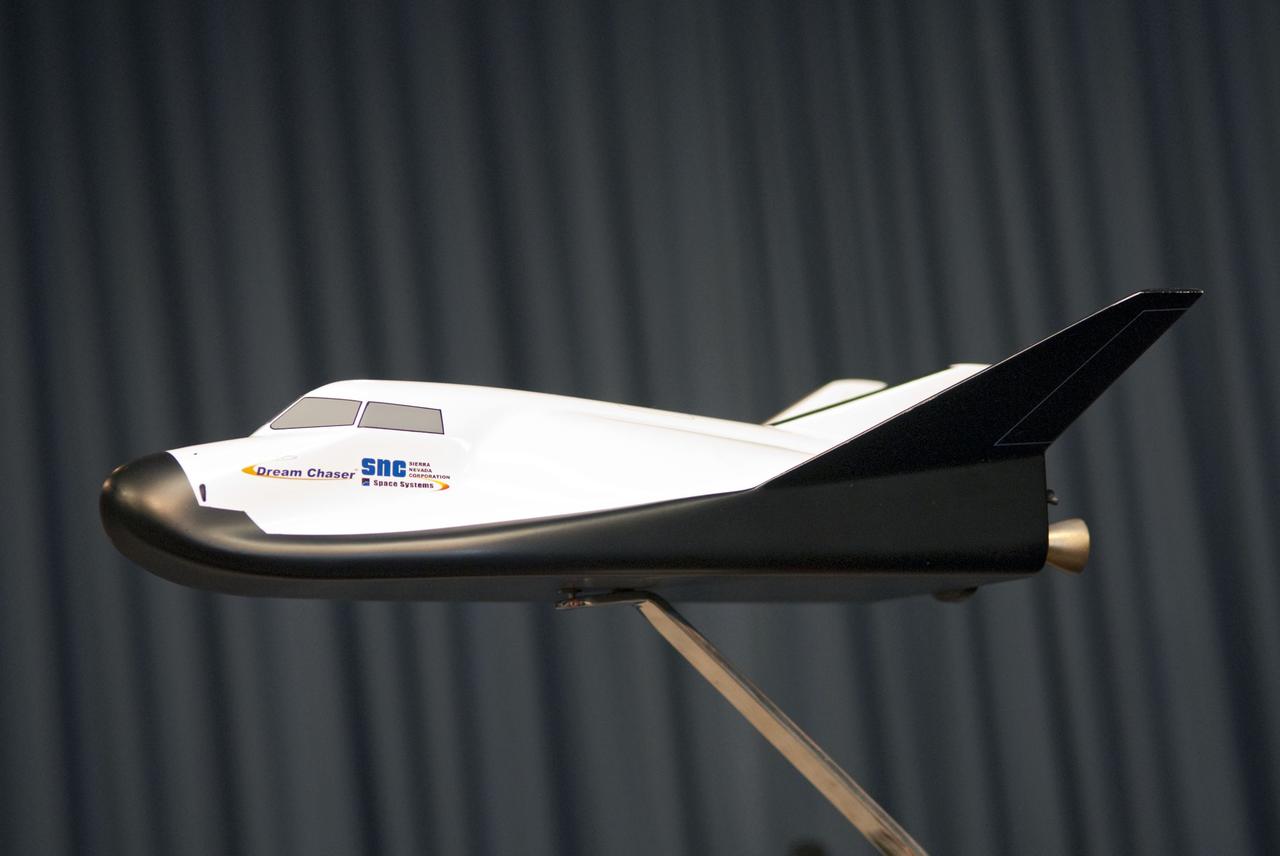
CAPE CANAVERAL, Fla. -- Sierra Nevada Space Systems (SNSS) of Sparks, Nev., and NASA signed a Space Act Agreement that will offer the company technical capabilities from Kennedy's uniquely skilled work force. Kennedy will help Sierra Nevada with the ground operations support of its lifting body reusable spacecraft called "Dream Chaser." The spacecraft, seen here as a display, resembles a smaller version of the space shuttle orbiter. The spacecraft would carry as many as seven astronauts to the space station. Through the new agreement, Kennedy's work force will use its experience of processing the shuttle fleet for 30 years to help Sierra Nevada define and execute Dream Chaser's launch preparations and post-landing activities. In 2010 and 2011, Sierra Nevada was awarded grants as part of the initiative to stimulate the private sector in developing and demonstrating human spaceflight capabilities for NASA's Commercial Crew Program. The goal of the program, which is based in Florida at Kennedy, is to facilitate the development of a U.S. commercial crew space transportation capability by achieving safe, reliable and cost-effective access to and from the space station and future low Earth orbit destinations. Photo credit: NASA/Jim Grossmann
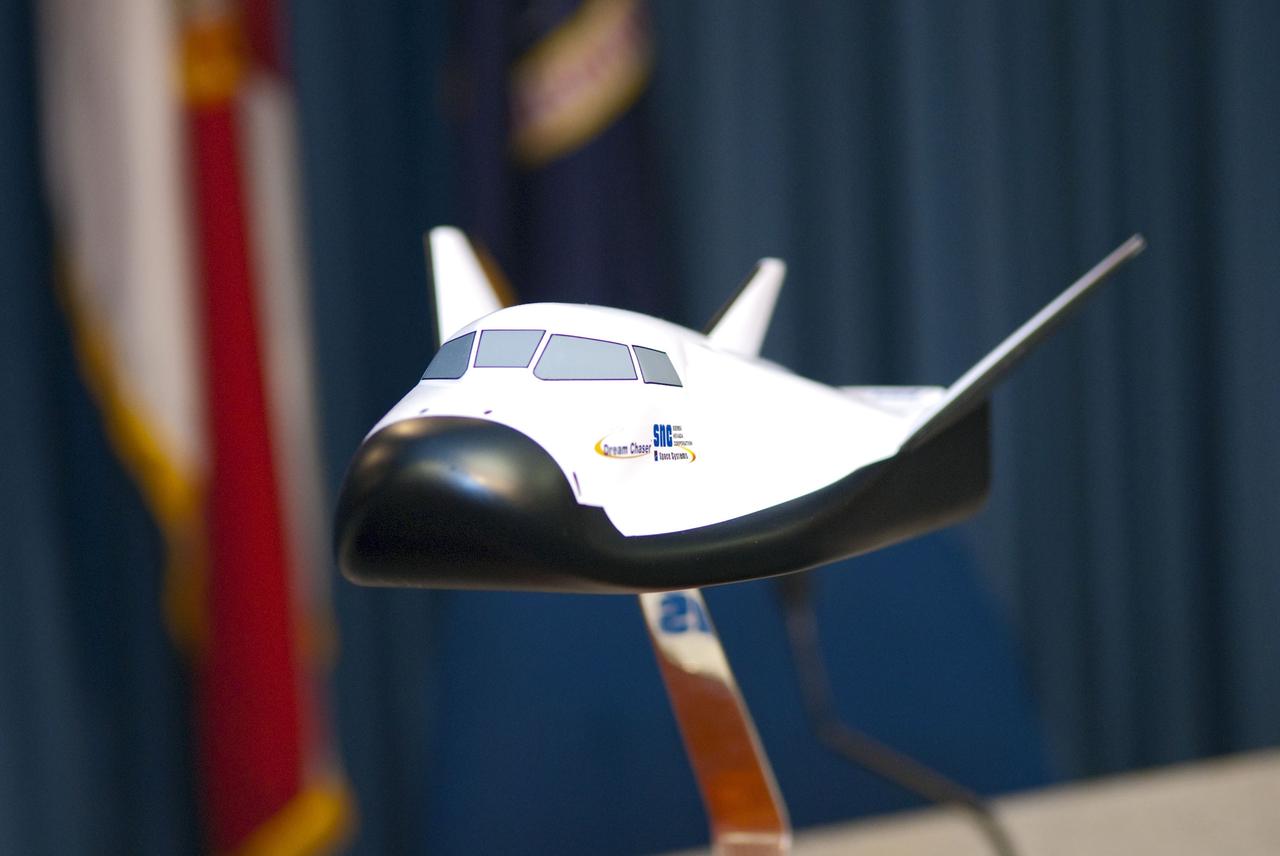
CAPE CANAVERAL, Fla. -- Sierra Nevada Space Systems (SNSS) of Sparks, Nev., and NASA signed a Space Act Agreement that will offer the company technical capabilities from Kennedy's uniquely skilled work force. Kennedy will help Sierra Nevada with the ground operations support of its lifting body reusable spacecraft called "Dream Chaser." The spacecraft, seen here as a display, resembles a smaller version of the space shuttle orbiter. The spacecraft would carry as many as seven astronauts to the space station. Through the new agreement, Kennedy's work force will use its experience of processing the shuttle fleet for 30 years to help Sierra Nevada define and execute Dream Chaser's launch preparations and post-landing activities. In 2010 and 2011, Sierra Nevada was awarded grants as part of the initiative to stimulate the private sector in developing and demonstrating human spaceflight capabilities for NASA's Commercial Crew Program. The goal of the program, which is based in Florida at Kennedy, is to facilitate the development of a U.S. commercial crew space transportation capability by achieving safe, reliable and cost-effective access to and from the space station and future low Earth orbit destinations. Photo credit: NASA/Jim Grossmann

LOUISVILLE, Colo. – During NASA's Commercial Crew Development Round 2 CCDev2) activities for the Commercial Crew Program CCP, Sierra Nevada Corp. SNC built a Simulator and Avionics Laboratory to help engineers evaluate the Dream Chaser's characteristics during the piloted phases of flight. Located at Sierra Nevada’s Space Systems facility in Louisville, Colo., it consists of a physical cockpit and integrated simulation hardware and software. The simulator is linked to the Vehicle Avionics Integration Laboratory, or VAIL, which serves as a platform for Dream Chaser avionics development, engineering testing and integration. VAIL also will also be used for verification and validation of avionics and software. Sierra Nevada is one of seven companies NASA entered into Space Act Agreements SAAs with during CCDev2 to aid in the innovation and development of American-led commercial capabilities for crew transportation and rescue services to and from the International Space Station and other low Earth orbit destinations. For information about CCP, visit www.nasa.gov/commercialcrew. Photo credit: Sierra Nevada Corp.
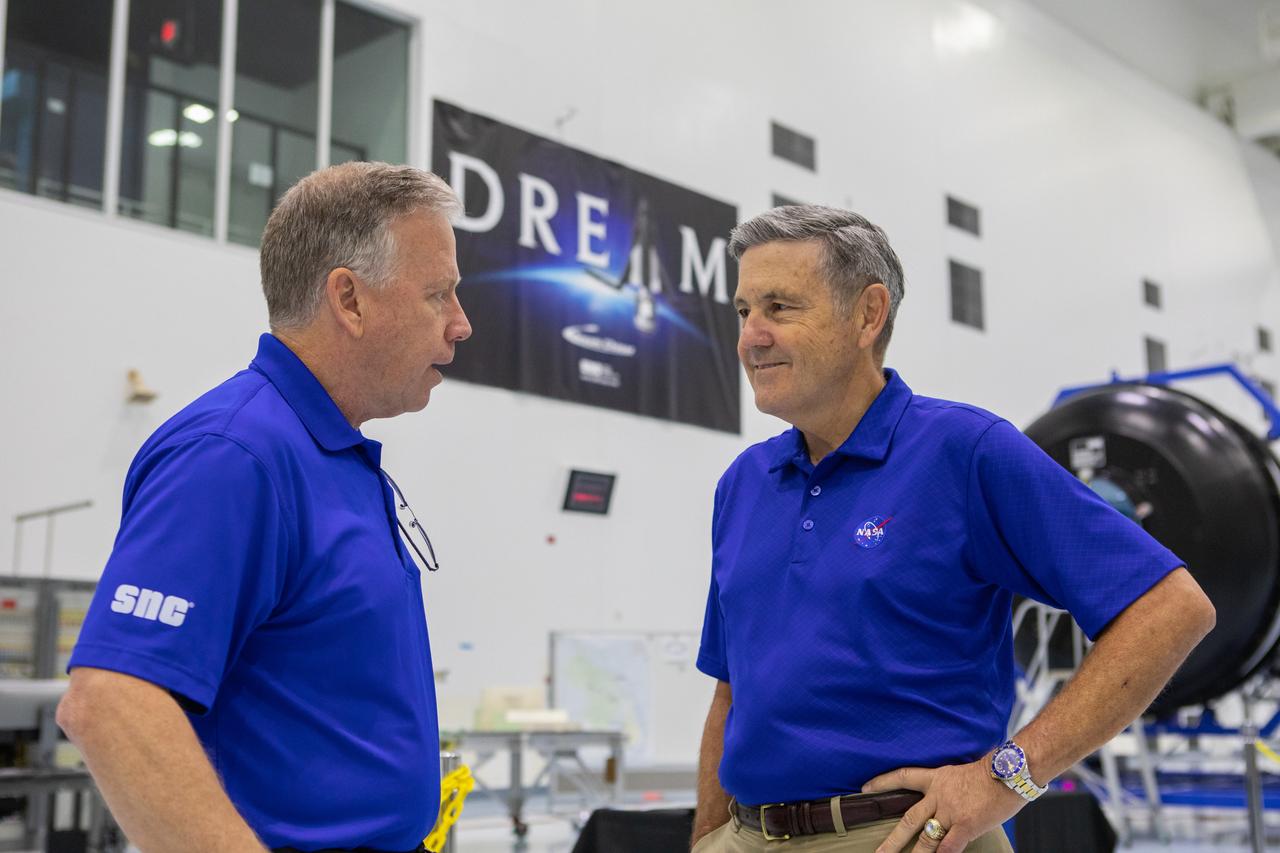
A mockup of the cargo logistics module for Sierra Nevada Corporation’s Dream Chaser, the company’s reusable spaceplane, arrived at the Space Station Processing Facility (SSPF) at NASA’s Kennedy Space Center in Florida in August. On Sept. 20, 2019, senior leadership had the opportunity to view the cargo module in the SSPF high bay. Kennedy Center Director Bob Cabana, at right, speaks with Steve Lindsey, vice president, Space Exploration Systems, Sierra Nevada Corporation. The SSPF is providing support for current and future NASA and commercial provider programs, including Commercial Resupply Services, Artemis 1, sending the first woman and next man to the Moon, and deep space destinations including Mars.
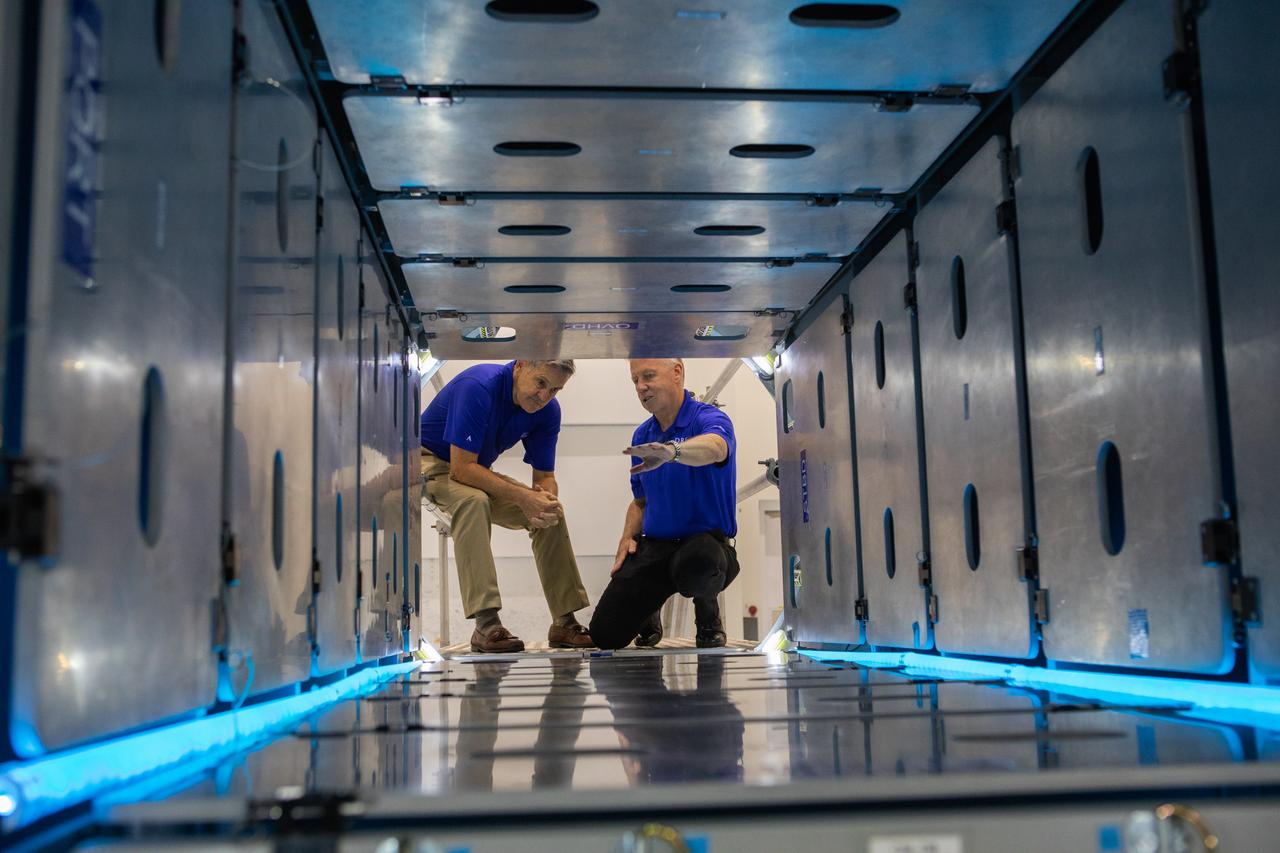
A mockup of the cargo logistics module for Sierra Nevada Corporation’s Dream Chaser, the company’s reusable spaceplane, arrived at the Space Station Processing Facility (SSPF) at NASA’s Kennedy Space Center in Florida in August. On Sept. 20, 2019, senior leadership had the opportunity to view the cargo module in the SSPF high bay. Kennedy Center Director Bob Cabana, views the interior of the cargo module with Steve Lindsey, vice president, Space Exploration Systems, Sierra Nevada Corporation. The SSPF is providing support for current and future NASA and commercial provider programs, including Commercial Resupply Services, Artemis 1, sending the first woman and next man to the Moon, and deep space destinations including Mars.
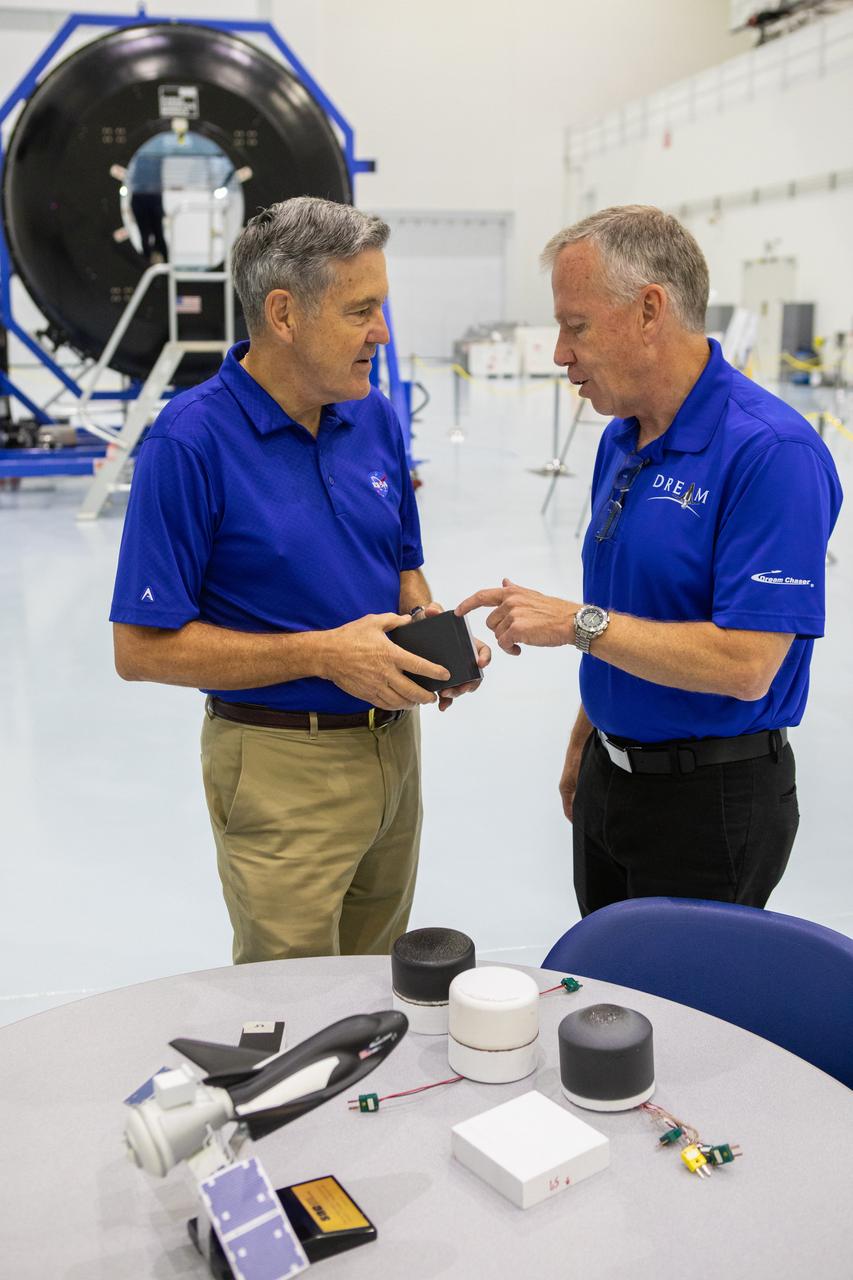
A mockup of the cargo logistics module for Sierra Nevada Corporation’s Dream Chaser, the company’s reusable spaceplane, arrived at the Space Station Processing Facility (SSPF) at NASA’s Kennedy Space Center in Florida in August. On Sept. 20, 2019, senior leadership had the opportunity to view the cargo module in the SSPF high bay. Kennedy Center Director Bob Cabana, left, speaks to Steve Lindsey, vice president, Space Exploration Systems, Sierra Nevada Corporation. The SSPF is providing support for current and future NASA and commercial provider programs, including Commercial Resupply Services, Artemis 1, sending the first woman and next man to the Moon, and deep space destinations including Mars.
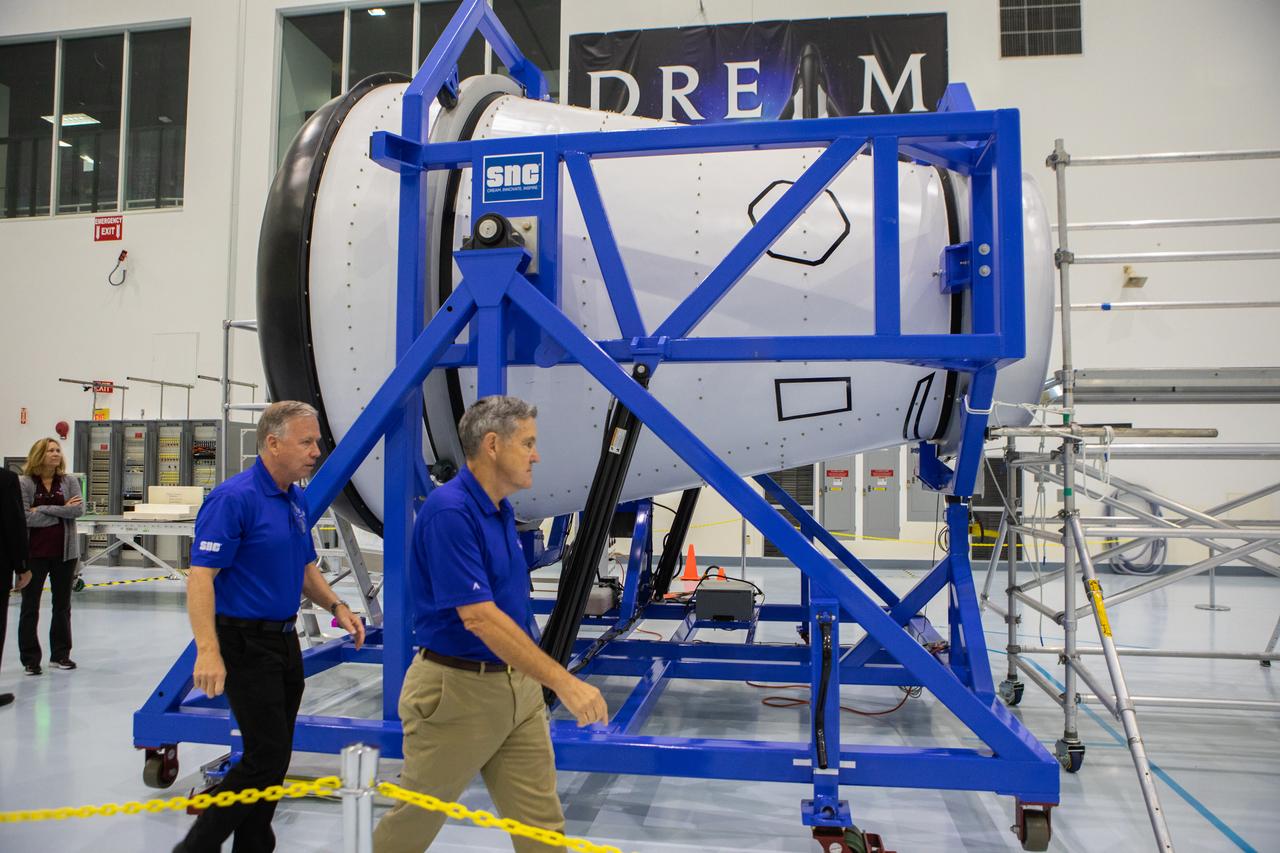
A mockup of the cargo logistics module for Sierra Nevada Corporation’s Dream Chaser, the company’s reusable spaceplane, arrived at the Space Station Processing Facility (SSPF) at NASA’s Kennedy Space Center in Florida in August. On Sept. 20, 2019, senior leadership had the opportunity to view the cargo module in the SSPF high bay. Kennedy Center Director Bob Cabana, at right, views the cargo module with Steve Lindsey, vice president, Space Exploration Systems, Sierra Nevada Corporation. The SSPF is providing support for current and future NASA and commercial provider programs, including Commercial Resupply Services, Artemis 1, sending the first woman and next man to the Moon, and deep space destinations including Mars.
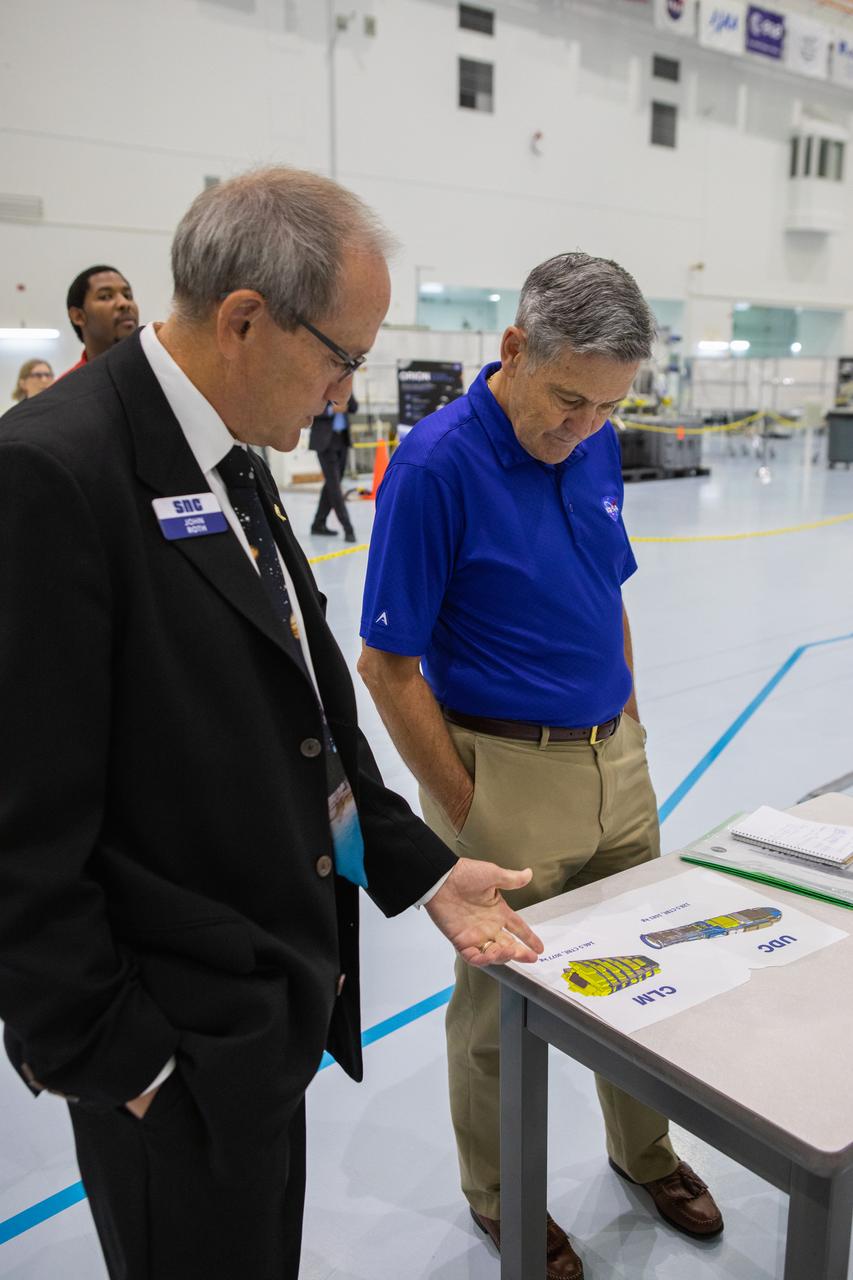
A mockup of the cargo logistics module for Sierra Nevada Corporation’s Dream Chaser, the company’s reusable spaceplane, arrived at the Space Station Processing Facility (SSPF) at NASA’s Kennedy Space Center in Florida in August. On Sept. 20, 2019, senior leadership had the opportunity to view the cargo module in the SSPF high bay. Kennedy Center Director Bob Cabana, at right, listens to John Roth, vice president, Business Development Space Systems, Sierra Nevada Corporation. The SSPF is providing support for current and future NASA and commercial provider programs, including Commercial Resupply Services, Artemis 1, sending the first woman and next man to the Moon, and deep space destinations including Mars.
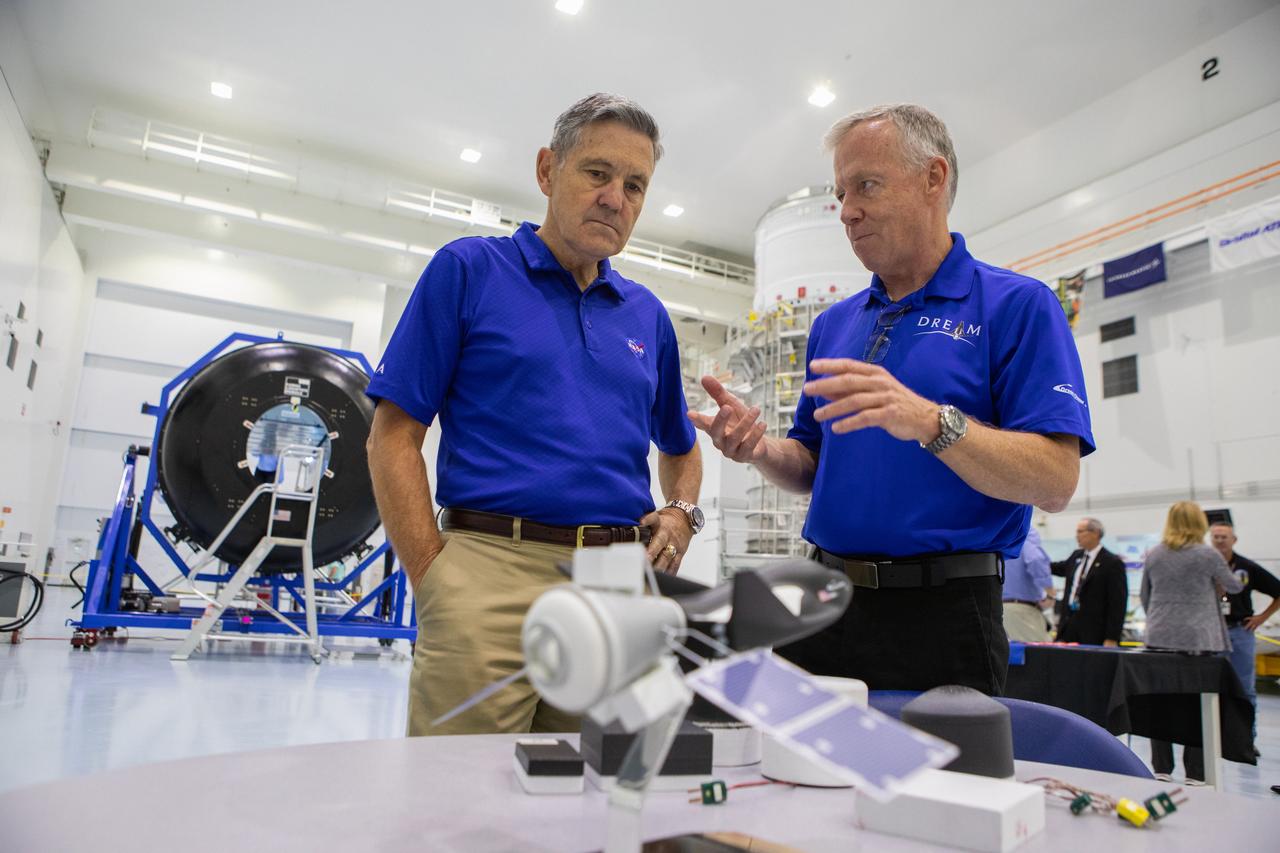
A mockup of the cargo logistics module for Sierra Nevada Corporation’s Dream Chaser, the company’s reusable spaceplane, arrived at the Space Station Processing Facility (SSPF) at NASA’s Kennedy Space Center in Florida in August. On Sept. 20, 2019, senior leadership had the opportunity to view the cargo module in the SSPF high bay. Kennedy Center Director Bob Cabana, left, speaks to Steve Lindsey, vice president, Space Exploration Systems, Sierra Nevada Corporation. The SSPF is providing support for current and future NASA and commercial provider programs, including Commercial Resupply Services, Artemis 1, sending the first woman and next man to the Moon, and deep space destinations including Mars.
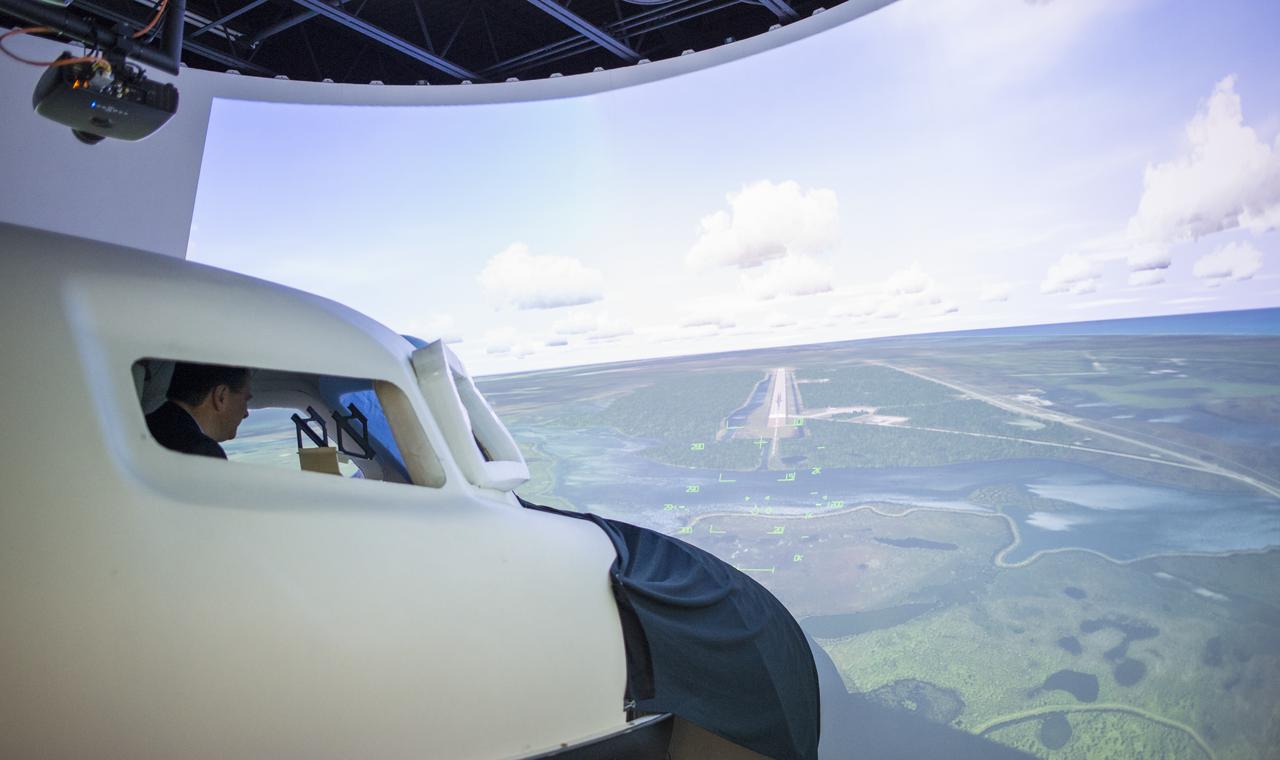
Acting NASA Administrator Robert Lightfoot is seen as he flies the Dream Chaser Space System simulator, Thursday, April 6, 2017 during a visit to Sierra Nevada Corporation in Louisville, Colo. Photo Credit: (NASA/Joel Kowsky)
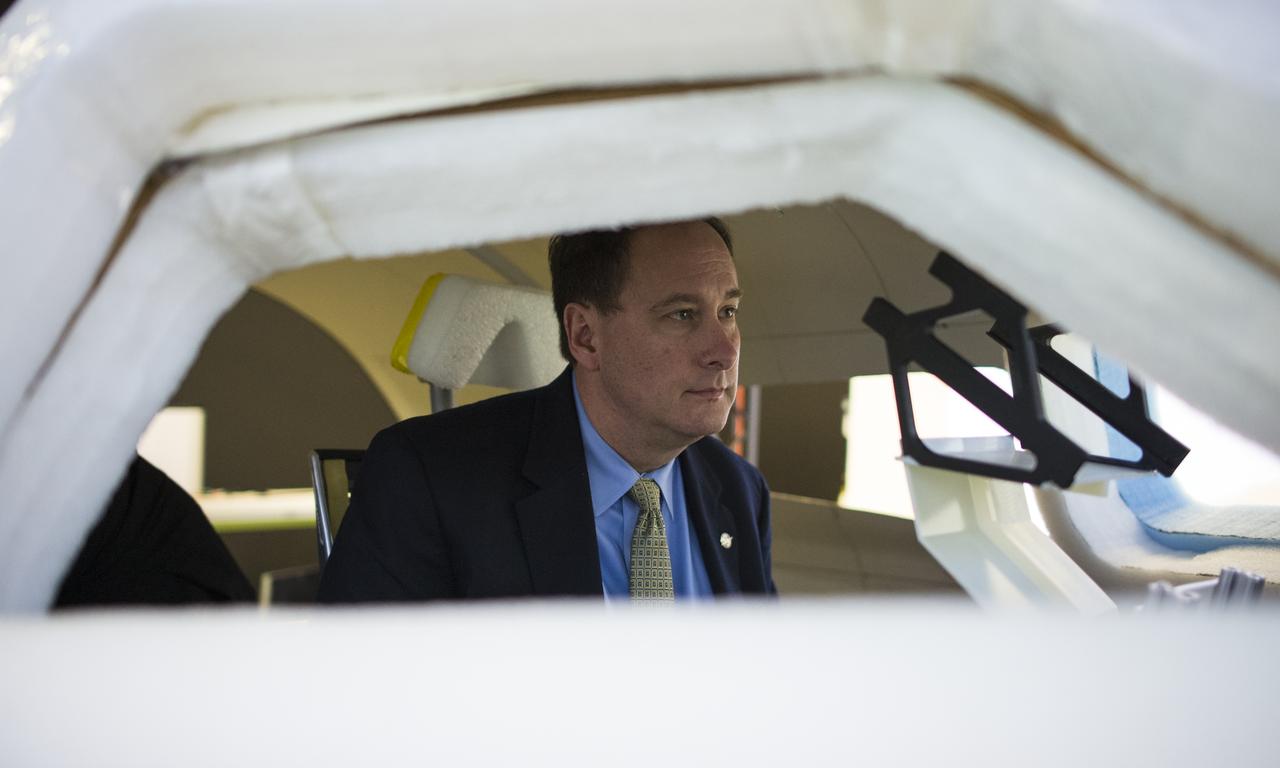
Acting NASA Administrator Robert Lightfoot is seen as he flies the Dream Chaser Space System simulator, Thursday, April 6, 2017 during a visit to Sierra Nevada Corporation in Louisville, Colo. Photo Credit: (NASA/Joel Kowsky)
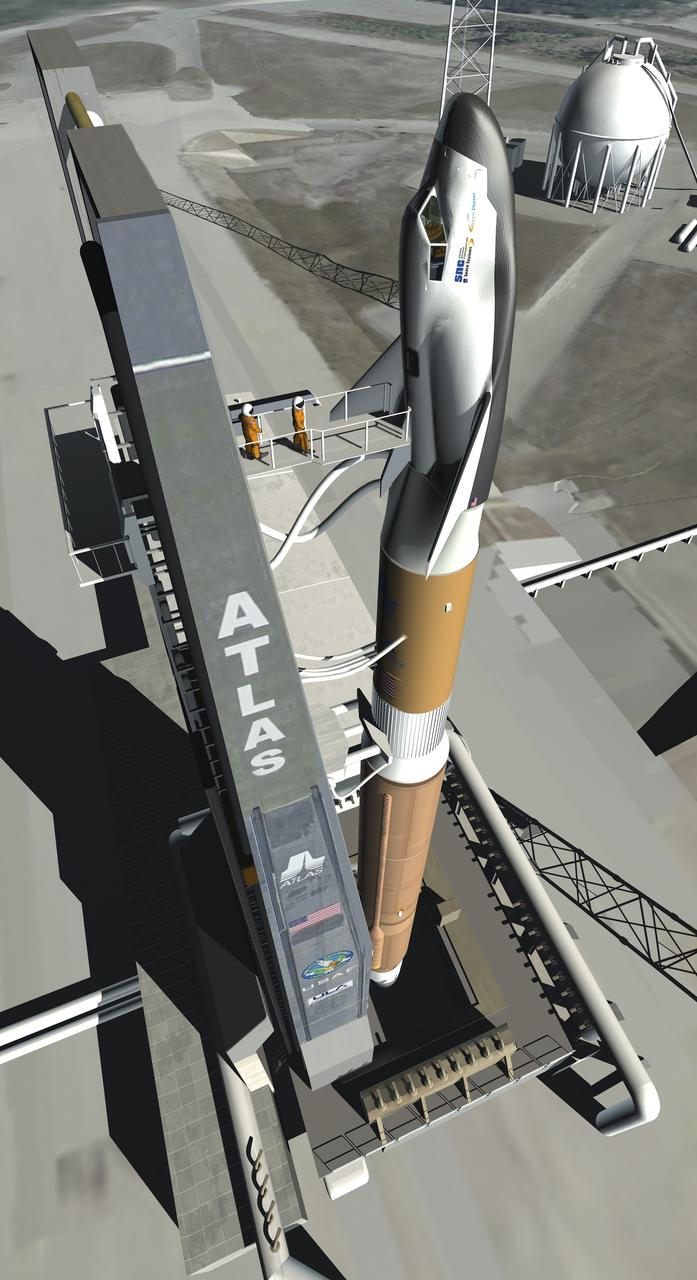
CAPE CANAVERAL, Fla. -- This is an artist's conception of the Dream Chaser spacecraft integrated with an Atlas V rocket. Dream Chaser is under development by Sierra Nevada of Centennial, Colo., for NASA's Commercial Crew Program (CCP). In 2011, NASA selected Sierra Nevada during Commercial Crew Development Round 2 (CCDev2) activities to mature the design and development of a crew transportation system with the overall goal of accelerating a United States-led capability to the International Space Station. United Launch Alliance's Atlas V also is being considered under CCDev2. The goal of CCP is to drive down the cost of space travel as well as open up space to more people than ever before by balancing industry’s own innovative capabilities with NASA's 50 years of human spaceflight experience. Five other aerospace companies also are maturing launch vehicle and spacecraft designs under CCDev2, including Alliant Techsystems Inc. (ATK), The Boeing Co., Excalibur Almaz Inc., Blue Origin, and Space Exploration Technologies (SpaceX). For more information, visit www.nasa.gov/commercialcrew. Image credit: Sierra Nevada Corp.
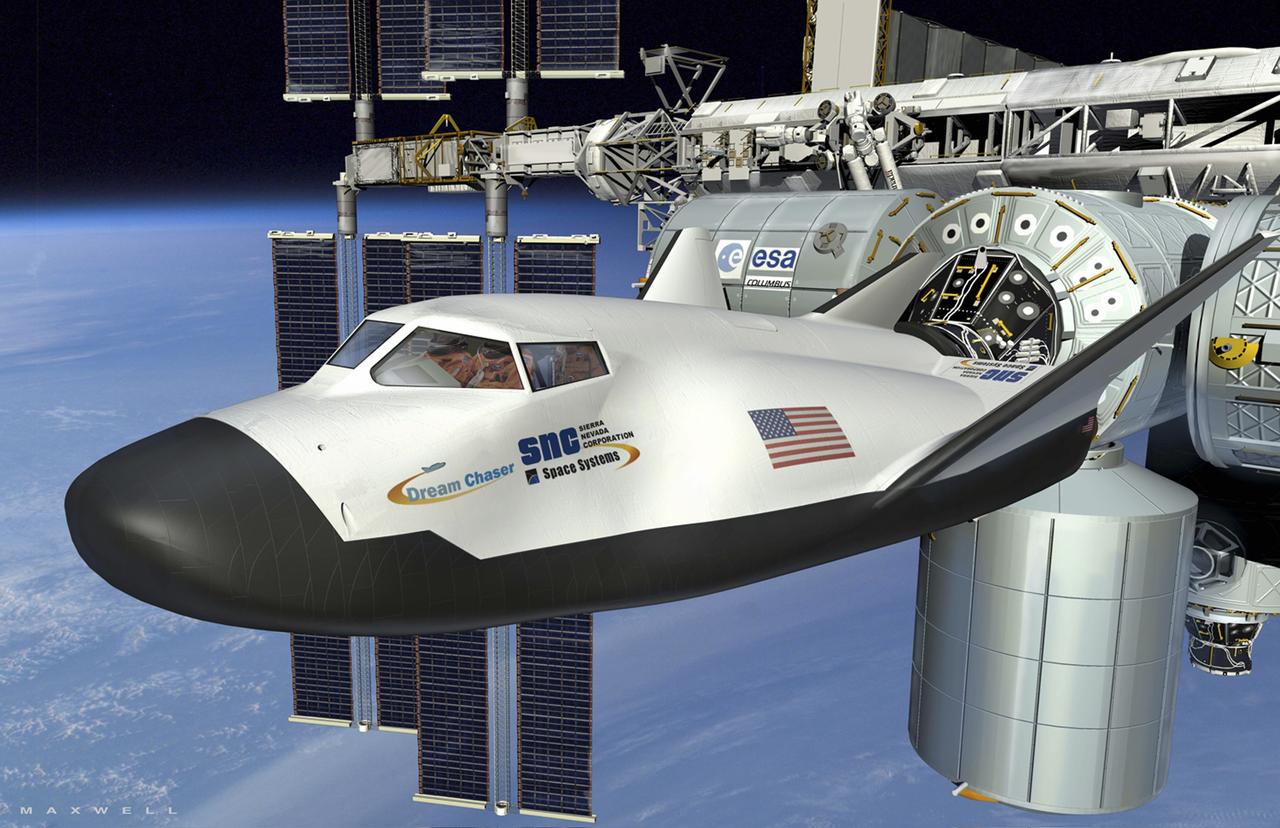
CAPE CANAVERAL, Fla. -- This is an artist's conception of the Dream Chaser spacecraft under development by Sierra Nevada of Centennial, Colo., for NASA's Commercial Crew Program (CCP). In 2011, NASA selected Sierra Nevada during Commercial Crew Development Round 2 (CCDev2) activities to mature the design and development of a crew transportation system with the overall goal of accelerating a United States-led capability to the International Space Station. The goal of CCP is to drive down the cost of space travel as well as open up space to more people than ever before by balancing industry’s own innovative capabilities with NASA's 50 years of human spaceflight experience. Six other aerospace companies also are maturing launch vehicle and spacecraft designs under CCDev2, including Alliant Techsystems Inc. (ATK), The Boeing Co., Excalibur Almaz Inc., Blue Origin, Space Exploration Technologies (SpaceX), and United Launch Alliance (ULA). For more information, visit www.nasa.gov/commercialcrew. Image credit: Sierra Nevada Corp.
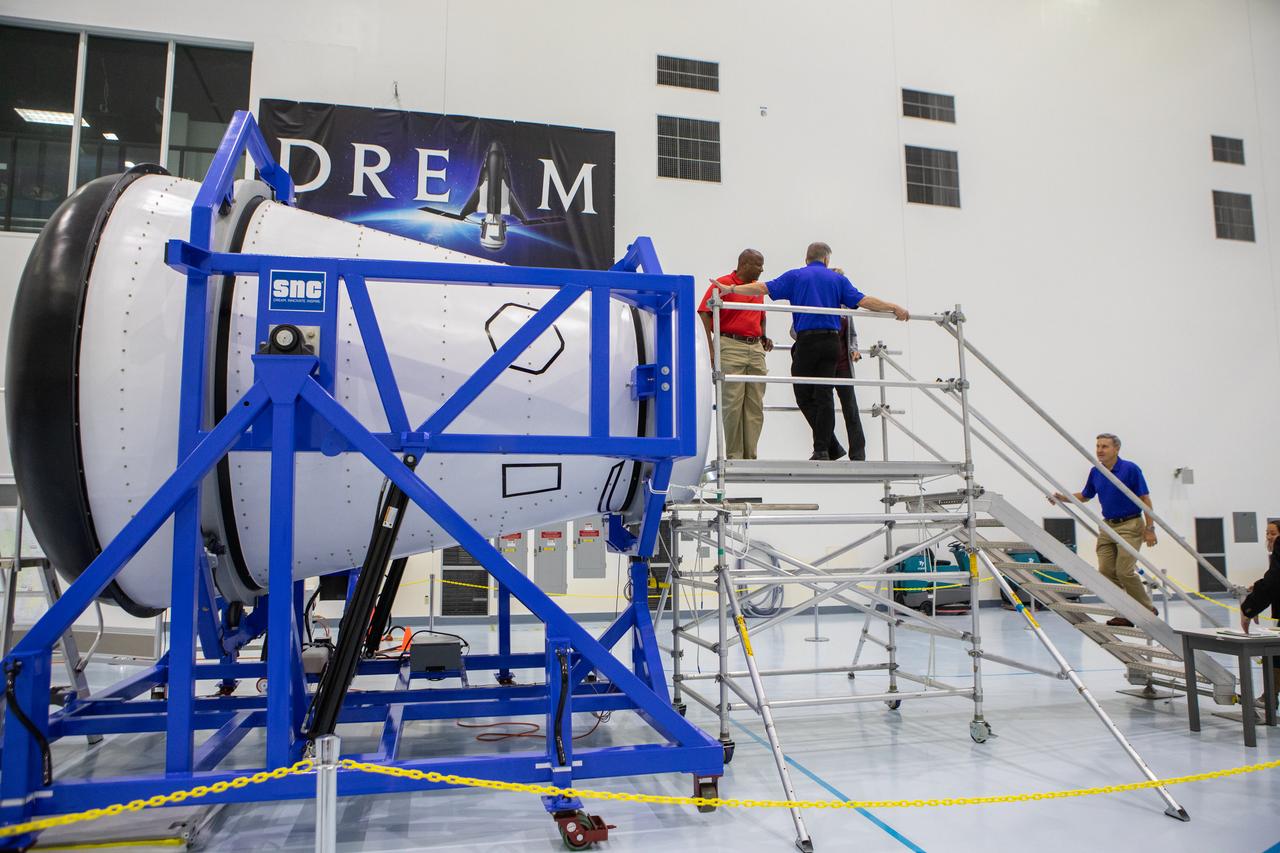
A mockup of the cargo logistics module for Sierra Nevada Corporation’s Dream Chaser, the company’s reusable spaceplane, arrived at the Space Station Processing Facility (SSPF) at NASA’s Kennedy Space Center in Florida in August. On Sept. 20, 2019, senior leadership had the opportunity to view the cargo module in the SSPF high bay. From left are Kelvin Manning, Kennedy associate director, technical; Steve Lindsey, vice president, Space Exploration Systems, Sierra Nevada Corporation; behind Lindsey is Kennedy Deputy Director Janet Petro; and ascending the stairs is Kennedy Center Director Bob Cabana. The SSPF is providing support for current and future NASA and commercial provider programs, including Commercial Resupply Services, Artemis 1, sending the first woman and next man to the Moon, and deep space destinations including Mars.

A mockup of the cargo logistics module for Sierra Nevada Corporation’s Dream Chaser, the company’s reusable spaceplane, arrived at the Space Station Processing Facility (SSPF) at NASA’s Kennedy Space Center in Florida in August. On Sept. 20, 2019, senior leadership had the opportunity to view the cargo module in the SSPF high bay. From left are Kelvin Manning, Kennedy associate director, technical; Steve Lindsey, vice president, Space Exploration Systems, Sierra Nevada Corporation; Kennedy Deputy Director Janet Petro; and Kennedy Center Director Bob Cabana. The SSPF is providing support for current and future NASA and commercial provider programs, including Commercial Resupply Services, Artemis 1, sending the first woman and next man to the Moon, and deep space destinations including Mars.
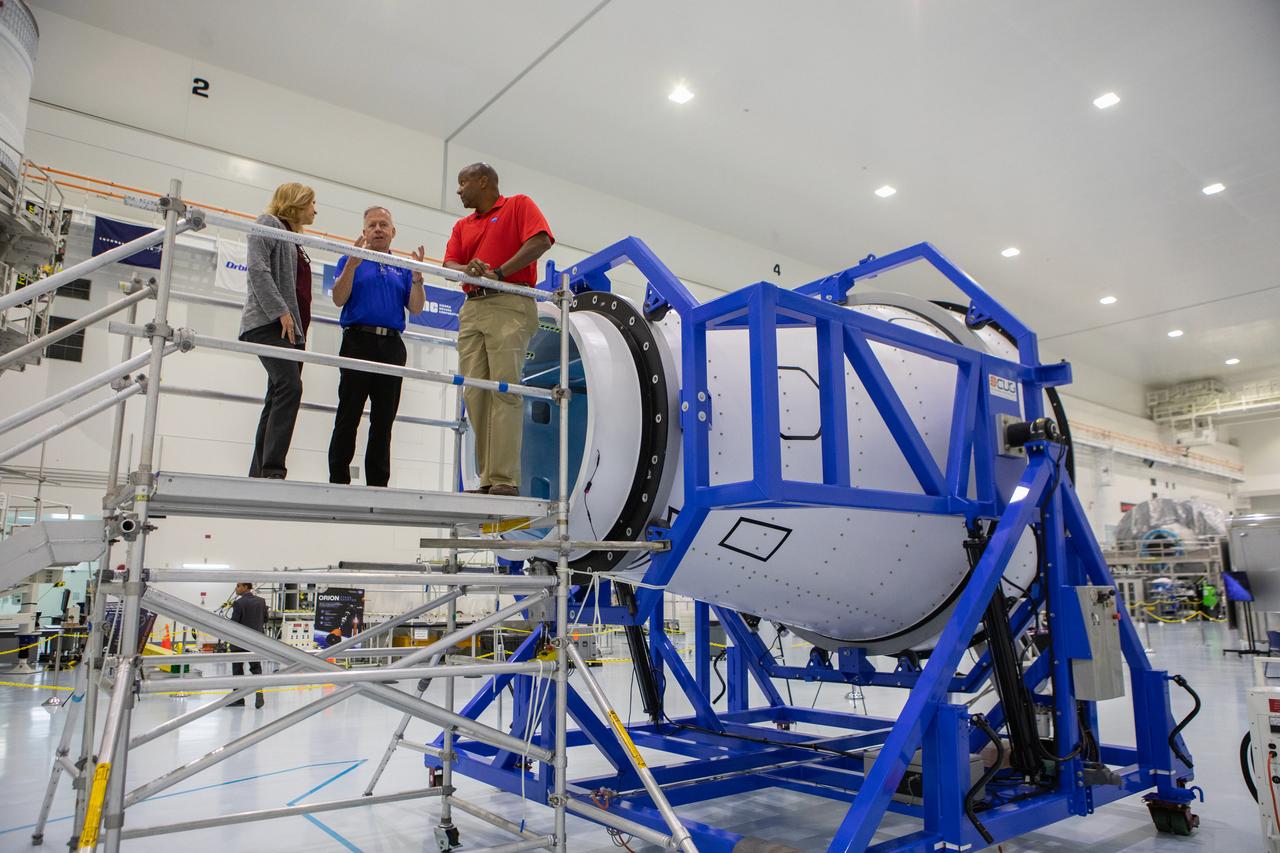
A mockup of the cargo logistics module for Sierra Nevada Corporation’s Dream Chaser, the company’s reusable spaceplane, arrived at the Space Station Processing Facility (SSPF) at NASA’s Kennedy Space Center in Florida in August. On Sept. 20, 2019, senior leadership had the opportunity to view the cargo module in the SSPF high bay. From left are Kennedy Deputy Director Janet Petro; Steve Lindsey, vice president, Space Exploration Systems, Sierra Nevada Corporation; and Kelvin Manning, Kennedy associate director, technical. The SSPF is providing support for current and future NASA and commercial provider programs, including Commercial Resupply Services, Artemis 1, sending the first woman and next man to the Moon, and deep space destinations including Mars.
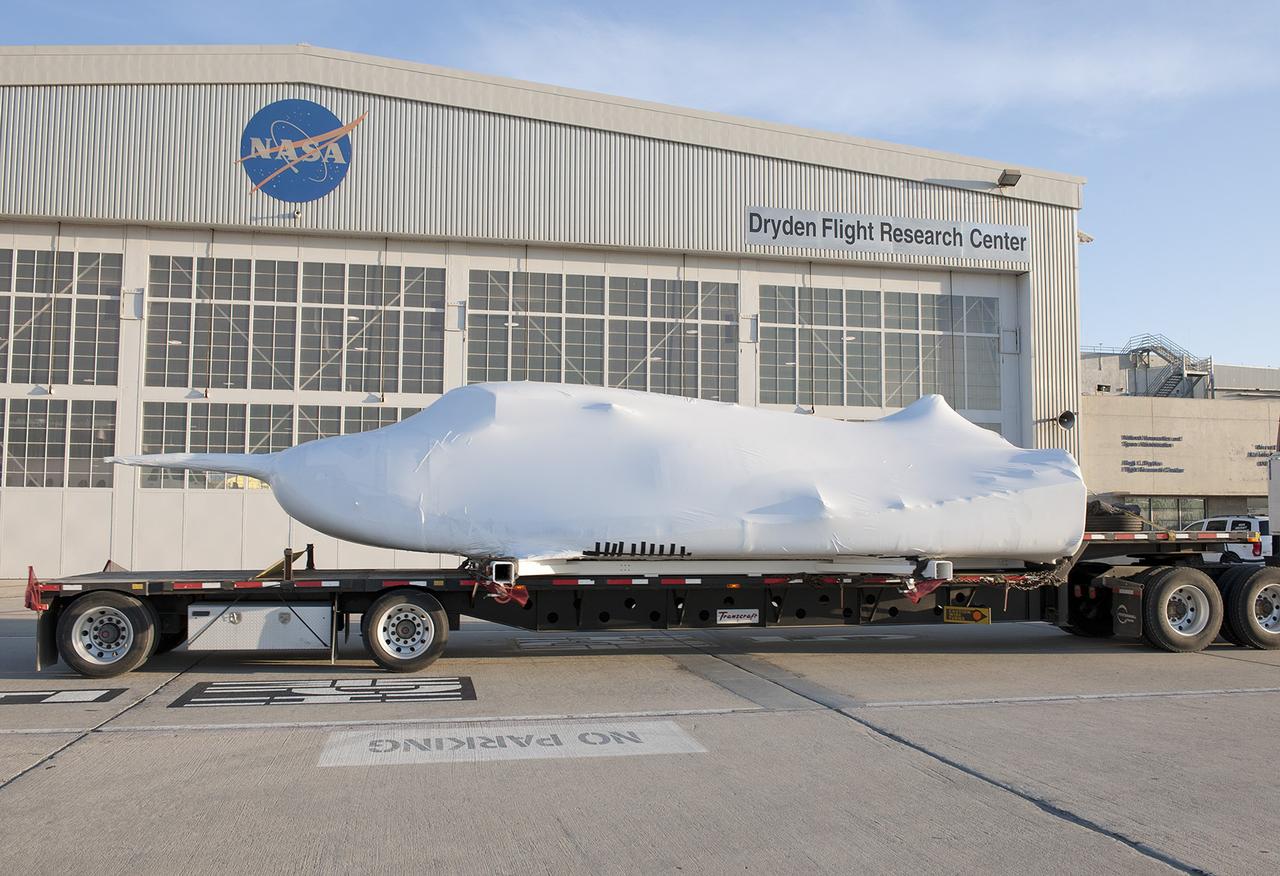
EDWARDS, Calif. – ED13-0142-08: The flatbed truck and trailer that transported Sierra Nevada Corporation, or SNC, Space Systems' Dream Chaser engineering test article pauses behind Hangar 4802 on the aircraft ramp at NASA's Dryden Flight Research Center on Edwards Air Force Base, Calif., upon arrival at the center. The vehicle was shrouded in protective plastic wrap with its wings and tail structure removed for its four-day overland transport from Sierra Nevada's facility in Louisville, Colo., to NASA Dryden. SNC is one of three companies working with NASA's Commercial Crew Program, or CCP, during the agency's Commercial Crew Integrated Capability, or CCiCap, initiative, which is intended to lead to the availability of commercial human spaceflight services for government and commercial customers. To learn more about CCP and its industry partners, visit www.nasa.gov/commercialcrew. Image credit: NASA/Tom Tschida
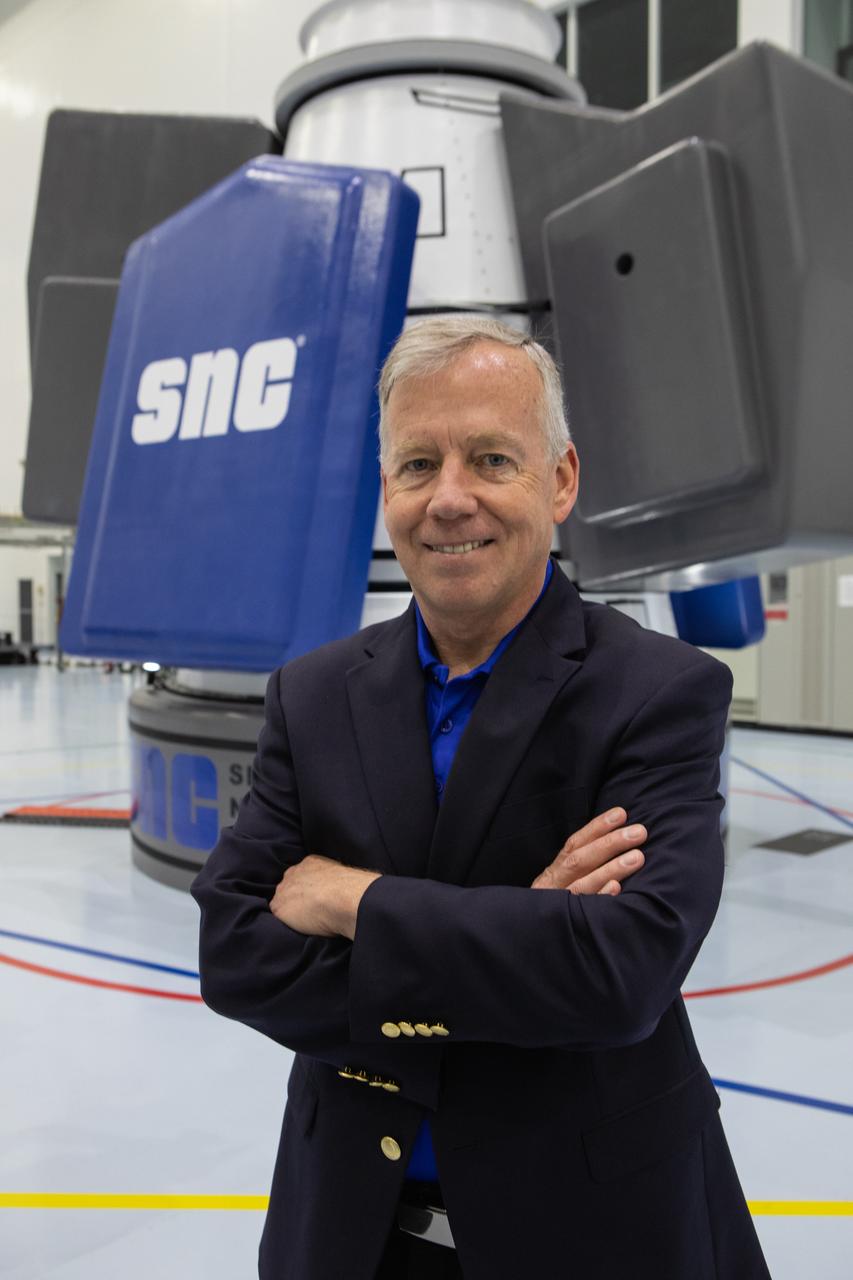
Steve Lindsey, senior vice president of strategy for Sierra Nevada Corporation Space Systems and a former NASA astronaut, poses in front of the company’s Shooting Star cargo module in the Space Station Processing Facility high bay at Kennedy Space Center on Nov. 19, 2019. Shooting Star will attach to the back of the company’s Dream Chaser spacecraft. The cargo module will deliver more than 12,000 pounds of supplies and other cargo to the International Space Station for NASA as part of the Commercial Resupply Services-2 contract.
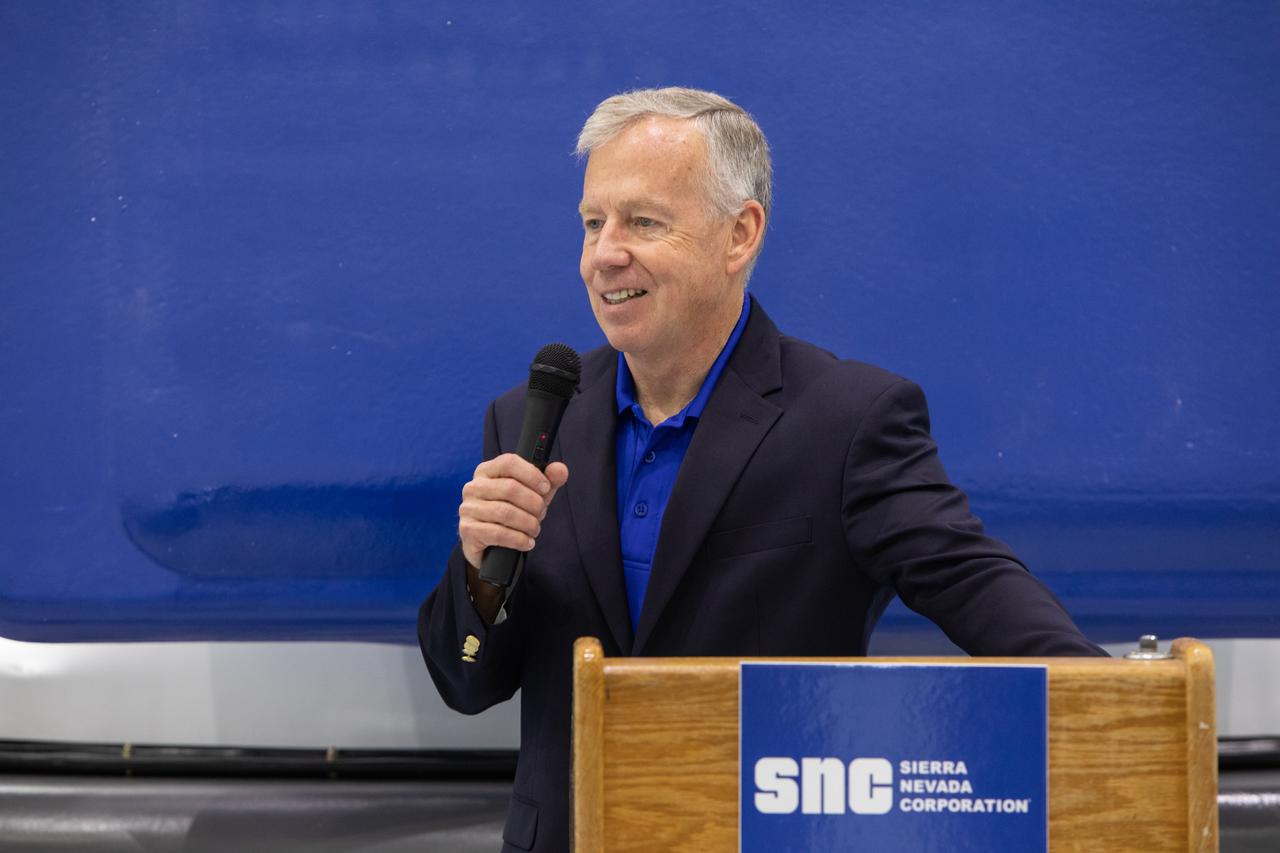
Steve Lindsey, senior vice president of strategy for Sierra Nevada Corporation Space Systems and a former NASA astronaut, discusses the capabilities of the company’s Shooting Star cargo module in the Space Station Processing Facility high bay at Kennedy Space Center on Nov. 19, 2019. Shooting Star will attach to the back of the company’s Dream Chaser spacecraft. The cargo module will deliver more than 12,000 pounds of supplies and other cargo to the International Space Station for NASA as part of the Commercial Resupply Services-2 contract.
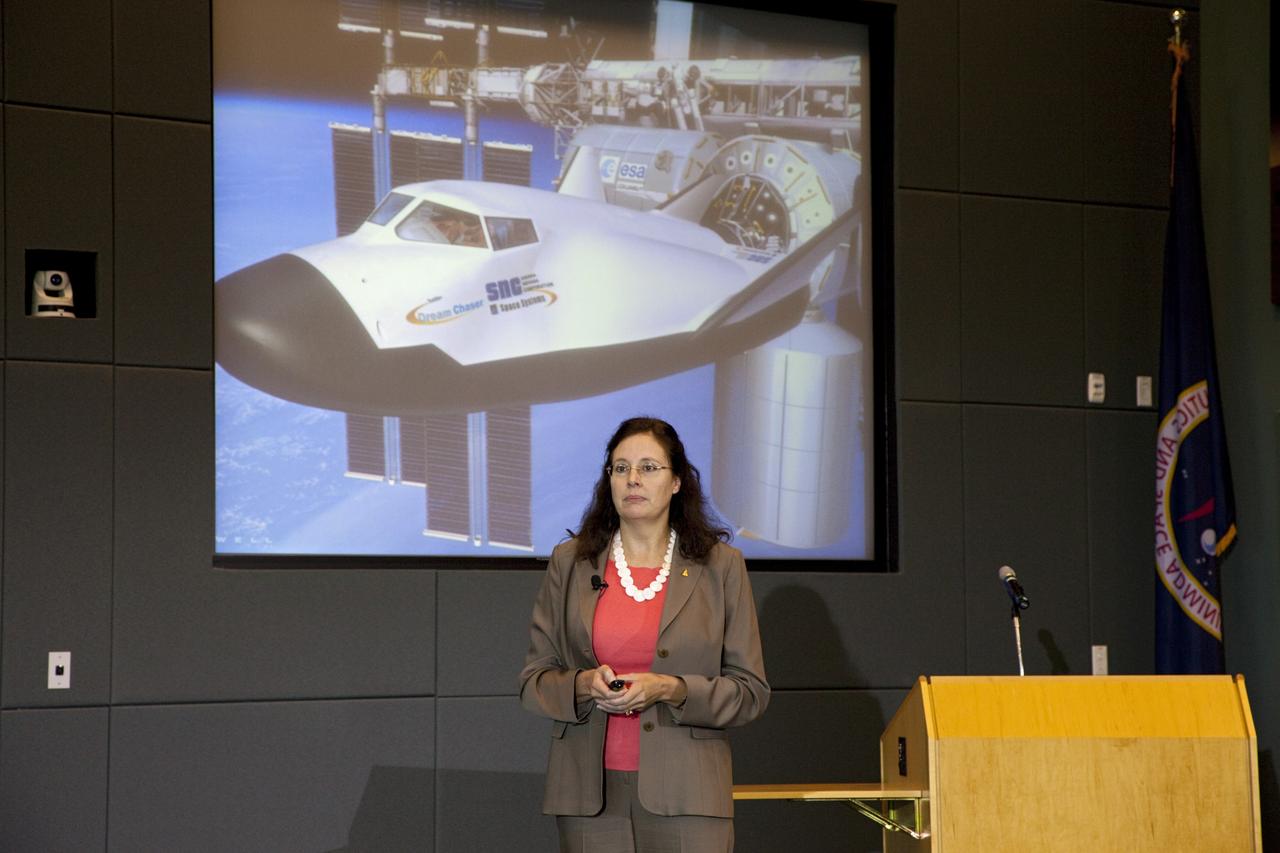
CAPE CANAVERAL, Fla. – Merri Sanchez of Sierra Nevada Corp. Space Systems speaks during the Kennedy Space Center's Innovation Expo in the Operations Support Building II. The center-wide event gave researchers a chance to show some of their work to others at the center and gave employees the opportunity to see facilities they hadn't viewed before. Photo credit: Gianni Woods
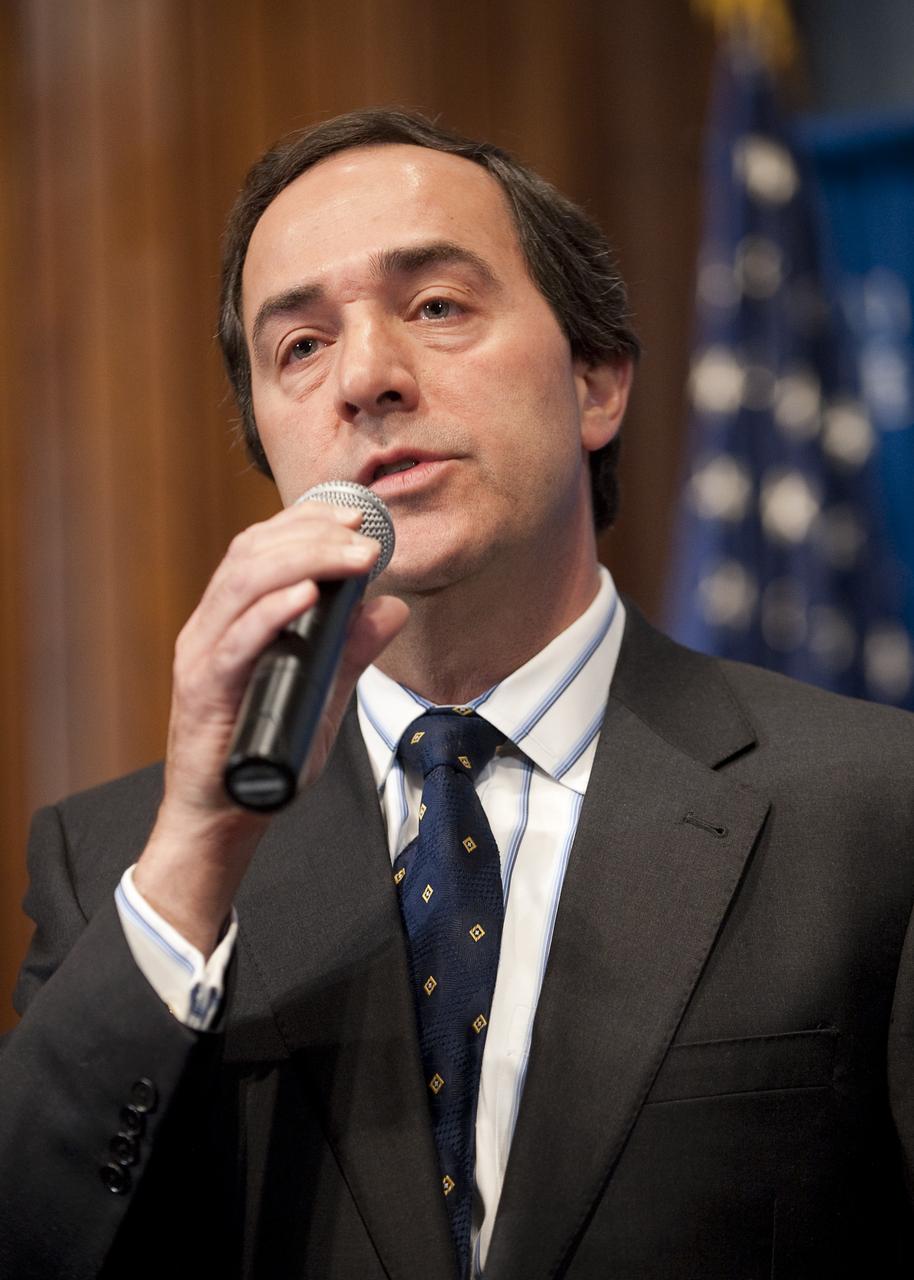
Mark Sirangelo, VP and Chair, SNC Space Systems Board, Sierra Nevada Corp. is seen during a press conference, Tuesday, Feb. 2, 2010, at the National Press Club in Washington, where it was announced that NASA has awarded $50 million through funded agreements to further the commercial sector's capability to support transport of crew to and from low Earth orbit. Photo Credit: (NASA/Bill Ingalls)
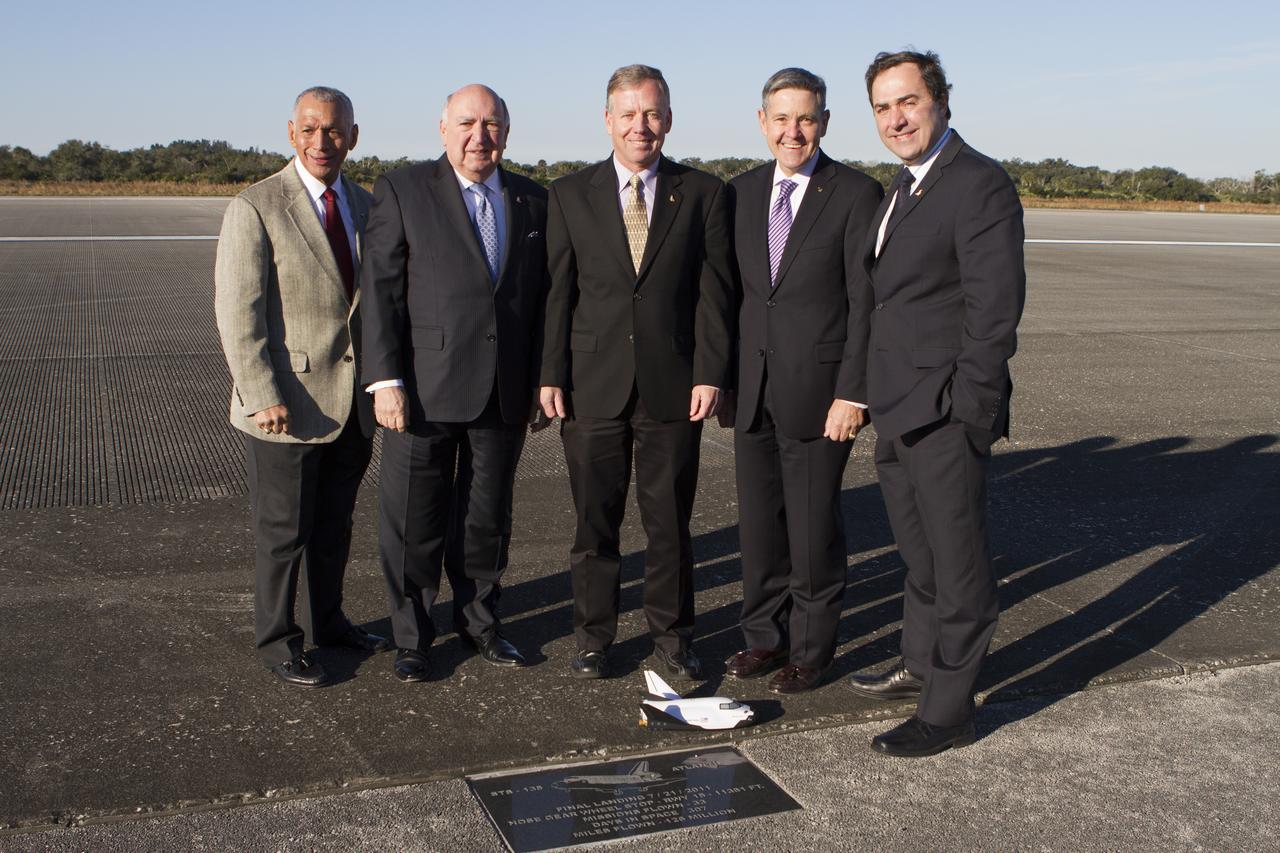
NASA and aerospace industry representatives tour facilities along Florida’s Space Coast prior to announcements made by Sierra Nevada Corporation, or SNC, Space Systems, to prepare for a November 2016 orbital flight of its Dream Chaser spacecraft. Walking along the 3.5-mile-long runway at Kennedy Space Center’s Shuttle Landing Facility are, from left, Frank DiBello, president and CEO of Space Florida Steve Lindsey, Dream Chaser program manager for SNC Space Systems Bob Cabana, director of NASA’s Kennedy Space Center Mark Sirangelo, corporate vice president and head of SNC Space Systems and Charlie Bolden, administrator of NASA.
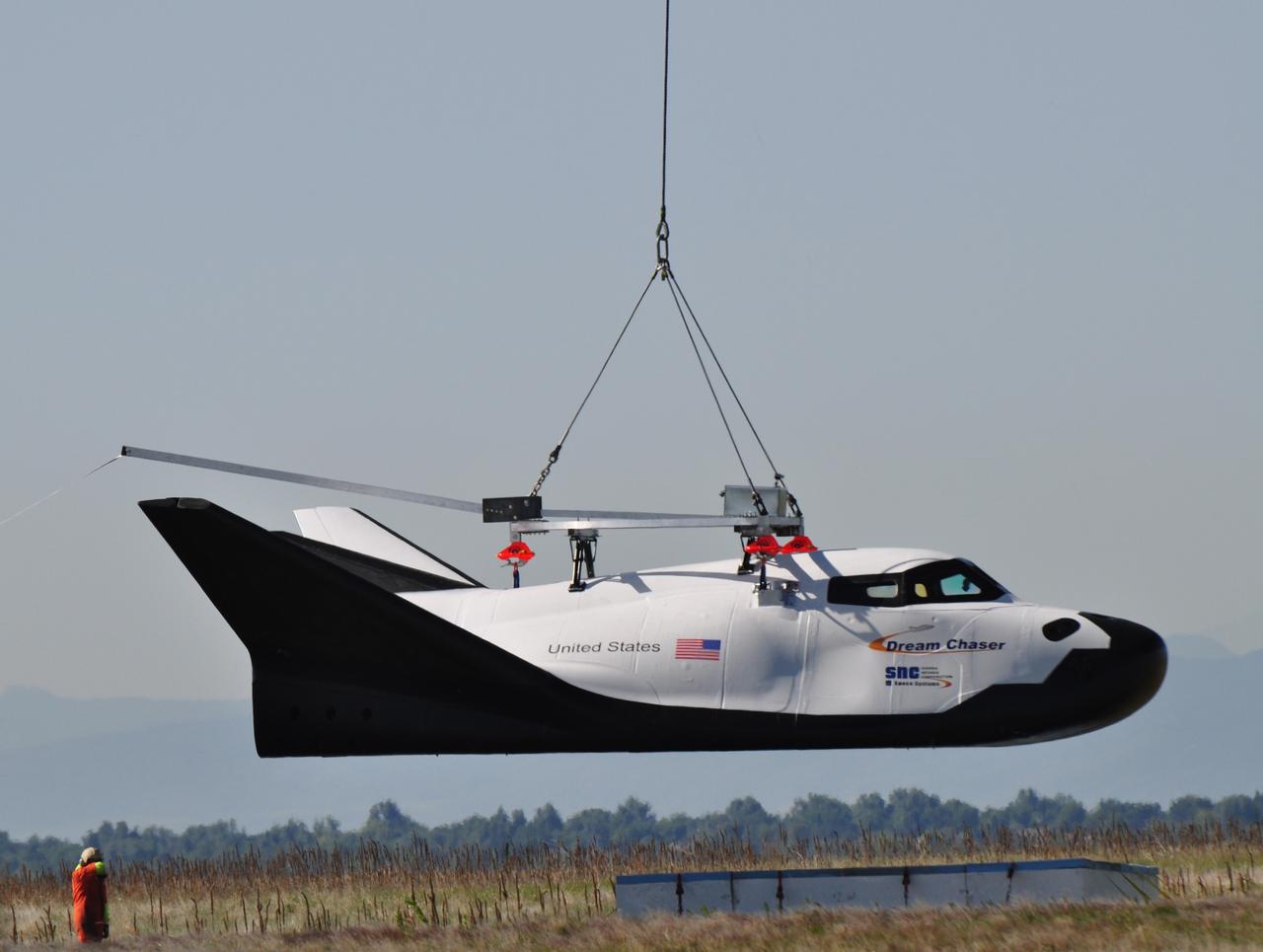
LOUISVILLE, Colo. – Sierra Nevada Corporation Space Systems’ Dream Chaser full-scale test vehicle is lifted by an Erickson Air-Crane helicopter to verify proper aerodynamic flight performance near the Rocky Mountain Metropolitan Airport in Jefferson County, Colo. This captive-carry test is one of several milestones the company is meeting during its partnership with NASA’s Commercial Crew Program CCP. Data from this test will provide SNC an early opportunity to evaluate and prove hardware, facilities and ground operations in preparation for approach and landing tests scheduled for later this year. In 2011, NASA selected Sierra Nevada during Commercial Crew Development Round 2 CCDev2) activities to mature the design and development of a crew transportation system with the overall goal of accelerating a United States-led capability to the International Space Station. The goal of CCP is to drive down the cost of space travel as well as open up space to more people than ever before by balancing industry’s own innovative capabilities with NASA's 50 years of human spaceflight experience. Six other aerospace companies also are maturing launch vehicle and spacecraft designs under CCDev2, including Alliant Techsystems Inc. ATK, The Boeing Co., Excalibur Almaz Inc., Blue Origin, Space Exploration Technologies SpaceX, and United Launch Alliance ULA. For more information, visit www.nasa.gov/commercialcrew. Image credit: Sierra Nevada Corp.
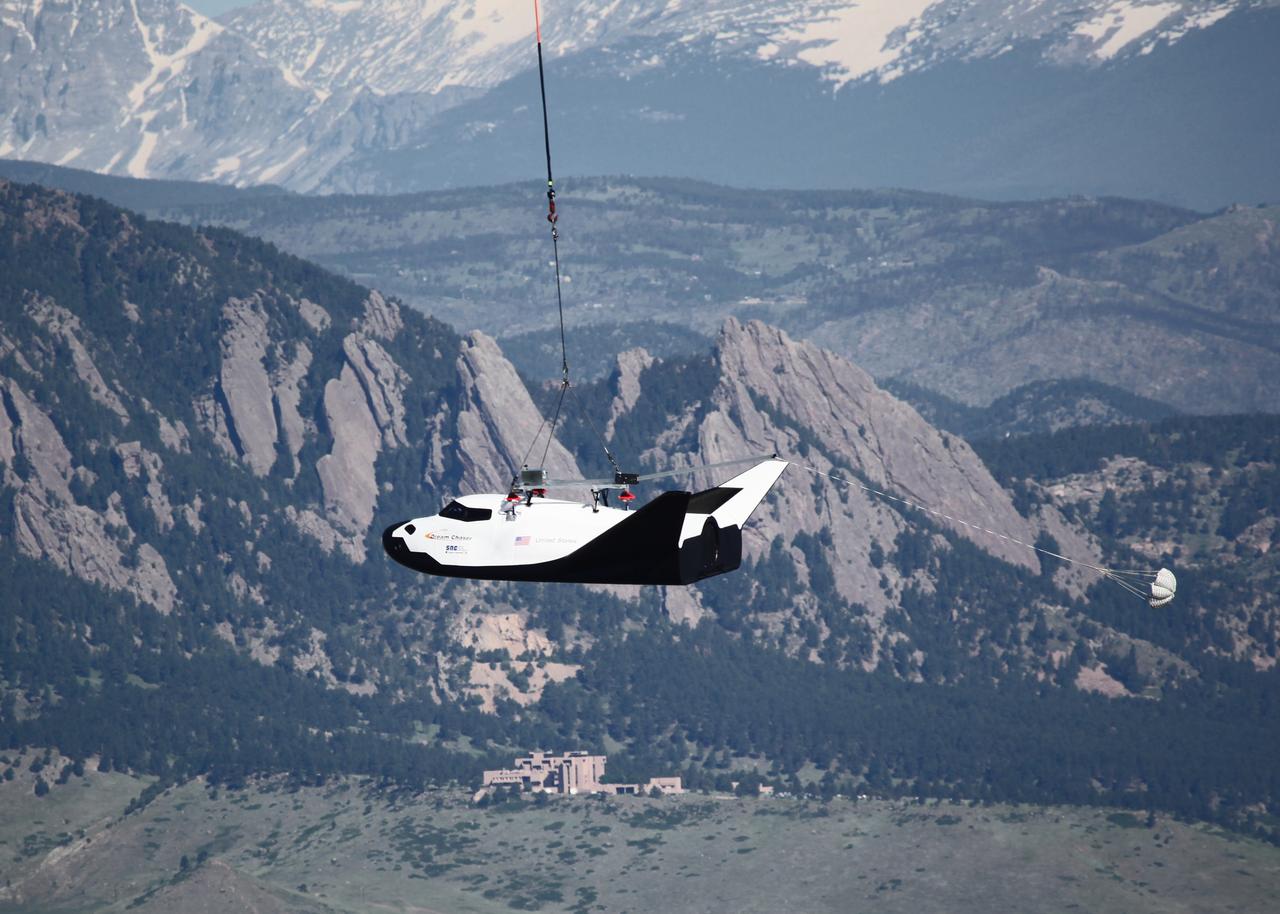
LOUISVILLE, Colo. – Sierra Nevada Corporation Space Systems’ Dream Chaser full-scale test vehicle is lifted by an Erickson Air-Crane helicopter to verify proper aerodynamic flight performance near the Rocky Mountain Metropolitan Airport in Jefferson County, Colo. This captive-carry test is one of several milestones the company is meeting during its partnership with NASA’s Commercial Crew Program CCP. Data from this test will provide SNC an early opportunity to evaluate and prove hardware, facilities and ground operations in preparation for approach and landing tests scheduled for later this year. In 2011, NASA selected Sierra Nevada during Commercial Crew Development Round 2 CCDev2) activities to mature the design and development of a crew transportation system with the overall goal of accelerating a United States-led capability to the International Space Station. The goal of CCP is to drive down the cost of space travel as well as open up space to more people than ever before by balancing industry’s own innovative capabilities with NASA's 50 years of human spaceflight experience. Six other aerospace companies also are maturing launch vehicle and spacecraft designs under CCDev2, including Alliant Techsystems Inc. ATK, The Boeing Co., Excalibur Almaz Inc., Blue Origin, Space Exploration Technologies SpaceX, and United Launch Alliance ULA. For more information, visit www.nasa.gov/commercialcrew. Image credit: Sierra Nevada Corp.
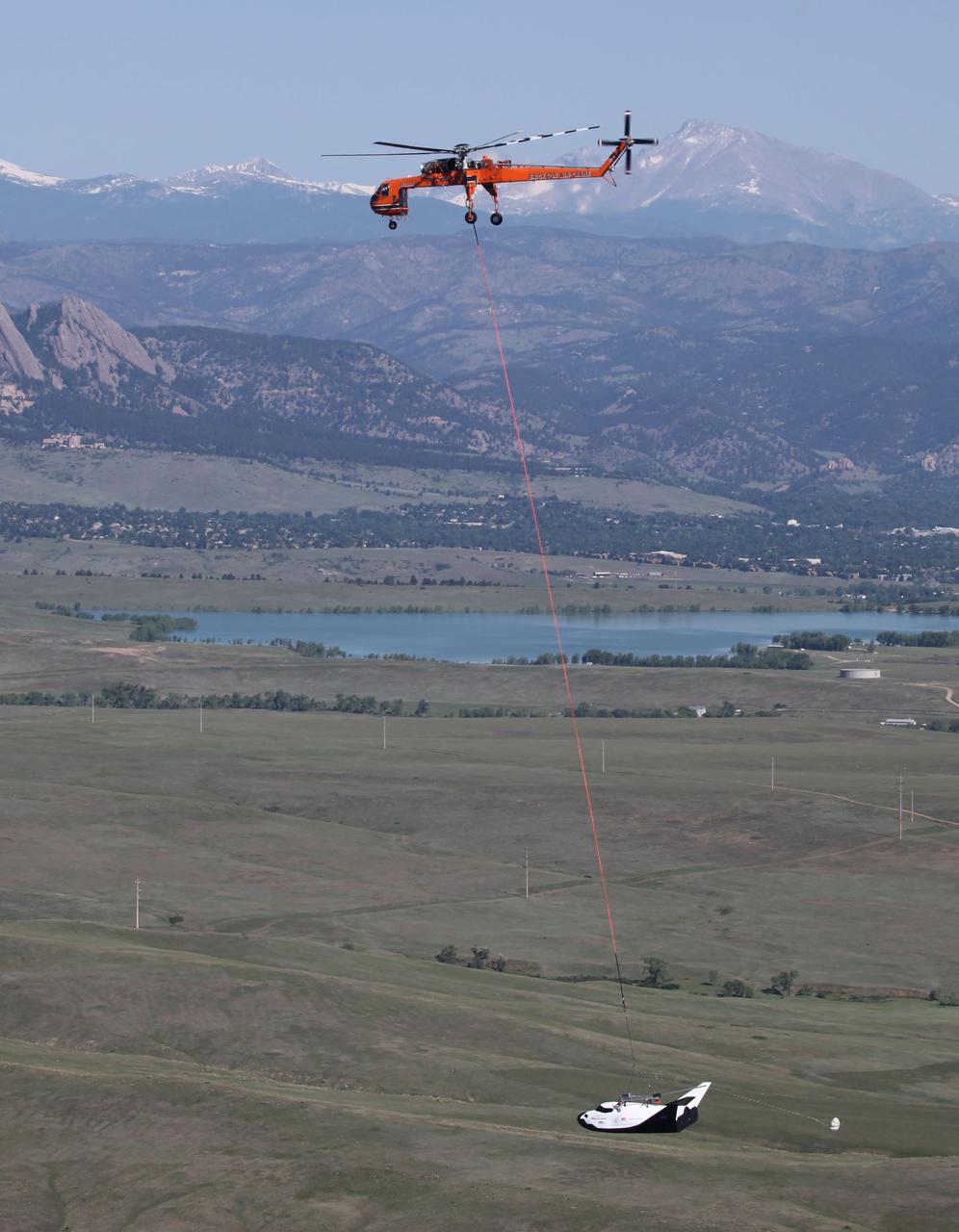
LOUISVILLE, Colo. – An Erickson Air-Crane helicopter lifts Sierra Nevada Corporation Space Systems’ Dream Chaser full-scale test vehicle to verify proper aerodynamic flight performance near the Rocky Mountain Metropolitan Airport in Jefferson County, Colo. This captive-carry test is one of several milestones the company is meeting during its partnership with NASA’s Commercial Crew Program CCP. Data from this test will provide SNC an early opportunity to evaluate and prove hardware, facilities and ground operations in preparation for approach and landing tests scheduled for later this year. In 2011, NASA selected Sierra Nevada during Commercial Crew Development Round 2 CCDev2) activities to mature the design and development of a crew transportation system with the overall goal of accelerating a United States-led capability to the International Space Station. The goal of CCP is to drive down the cost of space travel as well as open up space to more people than ever before by balancing industry’s own innovative capabilities with NASA's 50 years of human spaceflight experience. Six other aerospace companies also are maturing launch vehicle and spacecraft designs under CCDev2, including Alliant Techsystems Inc. ATK, The Boeing Co., Excalibur Almaz Inc., Blue Origin, Space Exploration Technologies SpaceX, and United Launch Alliance ULA. For more information, visit www.nasa.gov/commercialcrew. Image credit: Sierra Nevada Corp.
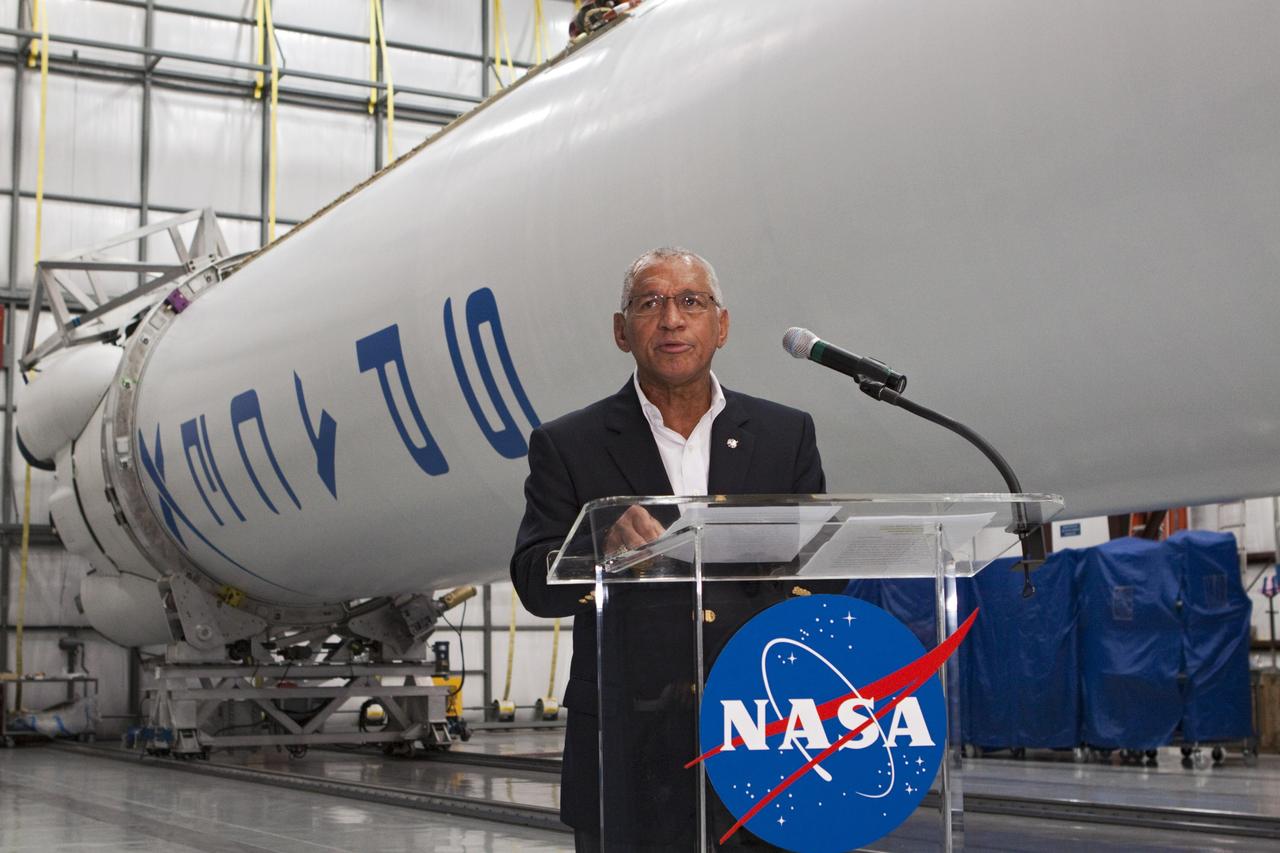
CAPE CANAVERAL, Fla. -- Inside the Space Exploration Technologies, or SpaceX, processing facility near NASA’s Kennedy Space Center in Florida, NASA Administrator Charlie Bolden announced new milestones in the nation’s commercial space initiatives. Bolden announced that SpaceX has completed its Space Act Agreement with NASA for Commercial Orbital Transportation Services. SpaceX is scheduled to launch the first of its 12 contracted cargo flights to the space station from Cape Canaveral this October, under NASA’s Commercial Resupply Services Program. Bolden also announced NASA partner Sierra Nevada Corp. has conducted its first milestone under the agency’s recently announced Commercial Crew Integrated Capability initiative. The milestone, a program implementation plan review, marks an important first step in Sierra Nevada’s efforts to develop a crew transportation system with its Dream Chaser spacecraft. Through NASA’s commercial space initiatives and programs, the agency is providing investments to stimulate the American commercial space industry. Photo credit: NASA/Kim Shiflett
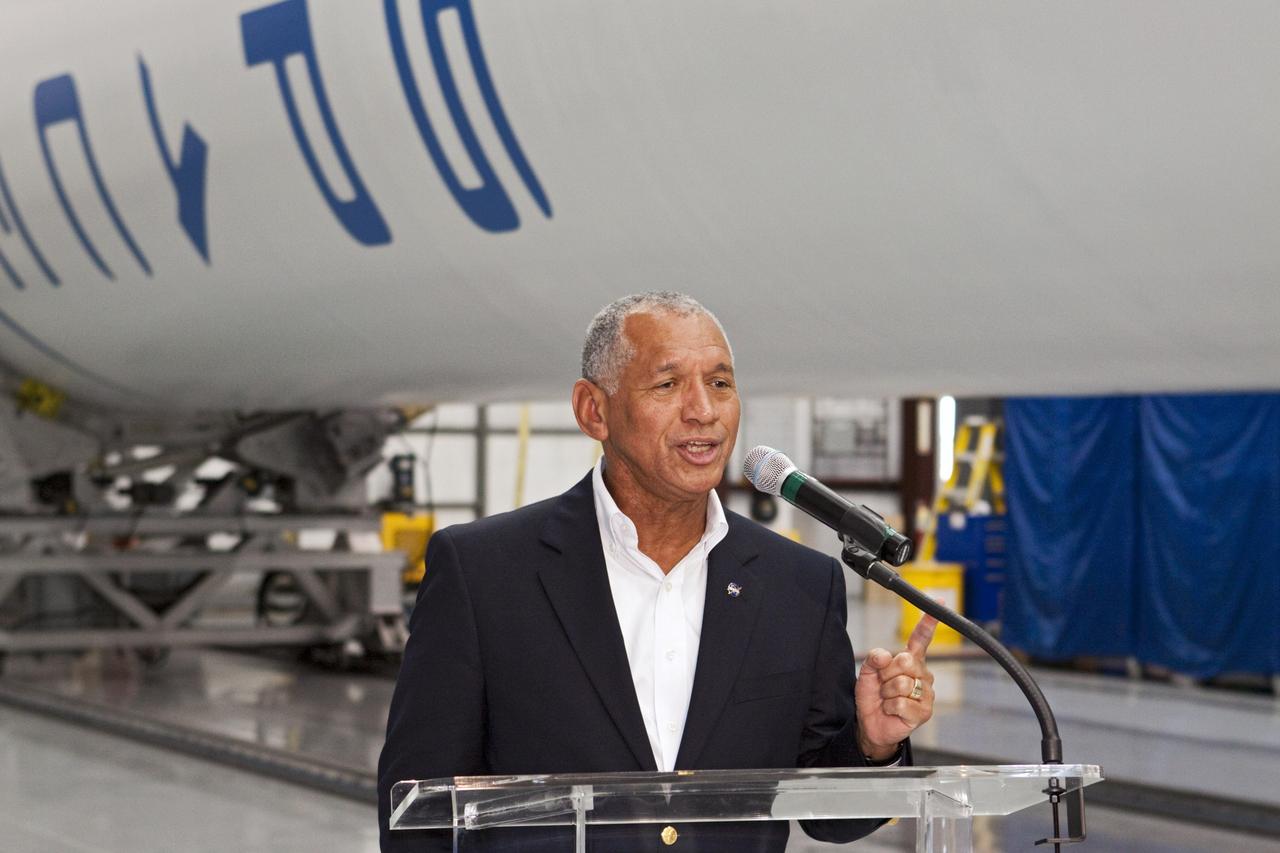
CAPE CANAVERAL, Fla. -- Inside the Space Exploration Technologies, or SpaceX, processing facility near NASA’s Kennedy Space Center in Florida, NASA Administrator Charlie Bolden announced new milestones in the nation’s commercial space initiatives. Bolden announced that SpaceX has completed its Space Act Agreement with NASA for Commercial Orbital Transportation Services. SpaceX is scheduled to launch the first of its 12 contracted cargo flights to the space station from Cape Canaveral this October, under NASA’s Commercial Resupply Services Program. Bolden also announced NASA partner Sierra Nevada Corp. has conducted its first milestone under the agency’s recently announced Commercial Crew Integrated Capability initiative. The milestone, a program implementation plan review, marks an important first step in Sierra Nevada’s efforts to develop a crew transportation system with its Dream Chaser spacecraft. Through NASA’s commercial space initiatives and programs, the agency is providing investments to stimulate the American commercial space industry. Photo credit: NASA/Kim Shiflett
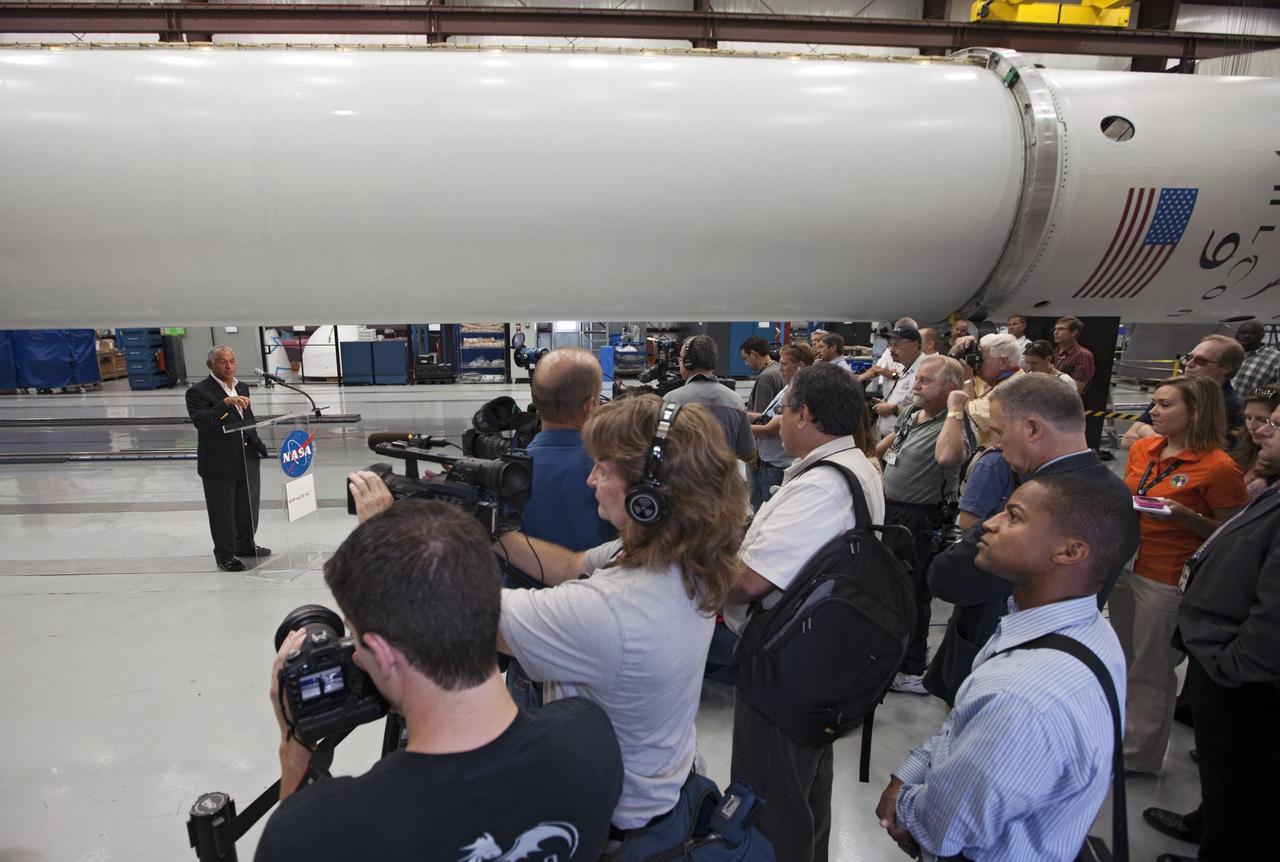
CAPE CANAVERAL, Fla. -- Inside the Space Exploration Technologies, or SpaceX, processing facility near NASA’s Kennedy Space Center in Florida, NASA Administrator Charlie Bolden announced new milestones in the nation’s commercial space initiatives. Bolden announced that SpaceX has completed its Space Act Agreement with NASA for Commercial Orbital Transportation Services. SpaceX is scheduled to launch the first of its 12 contracted cargo flights to the space station from Cape Canaveral this October, under NASA’s Commercial Resupply Services Program. Bolden also announced NASA partner Sierra Nevada Corp. has conducted its first milestone under the agency’s recently announced Commercial Crew Integrated Capability initiative. The milestone, a program implementation plan review, marks an important first step in Sierra Nevada’s efforts to develop a crew transportation system with its Dream Chaser spacecraft. Through NASA’s commercial space initiatives and programs, the agency is providing investments to stimulate the American commercial space industry. Photo credit: NASA/Kim Shiflett
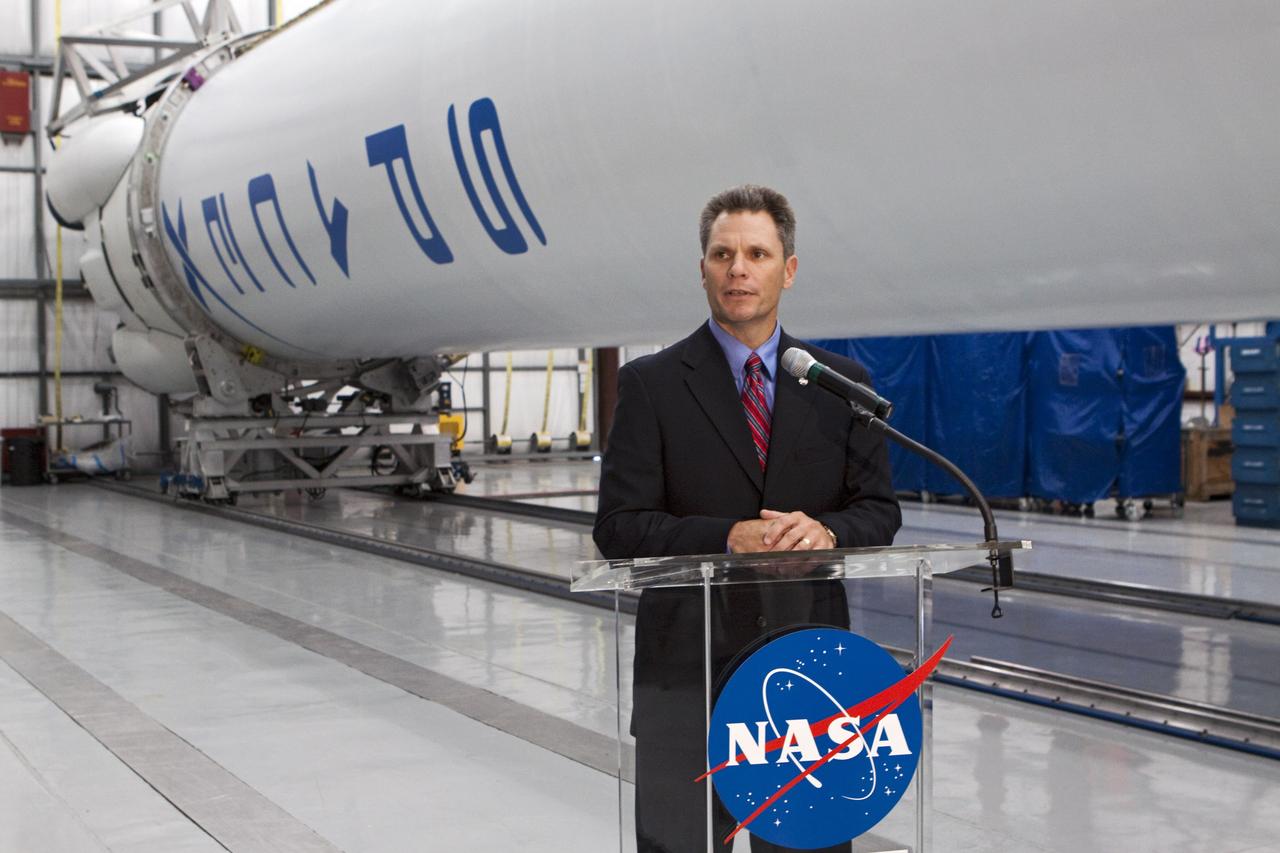
CAPE CANAVERAL, Fla. -- Inside the Space Exploration Technologies, or SpaceX, processing facility near NASA’s Kennedy Space Center in Florida, Scott Thurston, partner integration office manager with the Commercial Crew Program, talks to the media prior to an announcement from NASA Administrator Charles Bolden about new milestones in the nation’s commercial space initiatives. Bolden announced that SpaceX has completed its Space Act Agreement with NASA for Commercial Orbital Transportation Services. SpaceX is scheduled to launch the first of its 12 contracted cargo flights to the space station from Cape Canaveral this October, under NASA’s Commercial Resupply Services Program. Bolden also announced NASA partner Sierra Nevada Corp. has conducted its first milestone under the agency’s recently announced Commercial Crew Integrated Capability initiative. The milestone, a program implementation plan review, marks an important first step in Sierra Nevada’s efforts to develop a crew transportation system with its Dream Chaser spacecraft. Through NASA’s commercial space initiatives and programs, the agency is providing investments to stimulate the American commercial space industry. Photo credit: NASA/Kim Shiflett
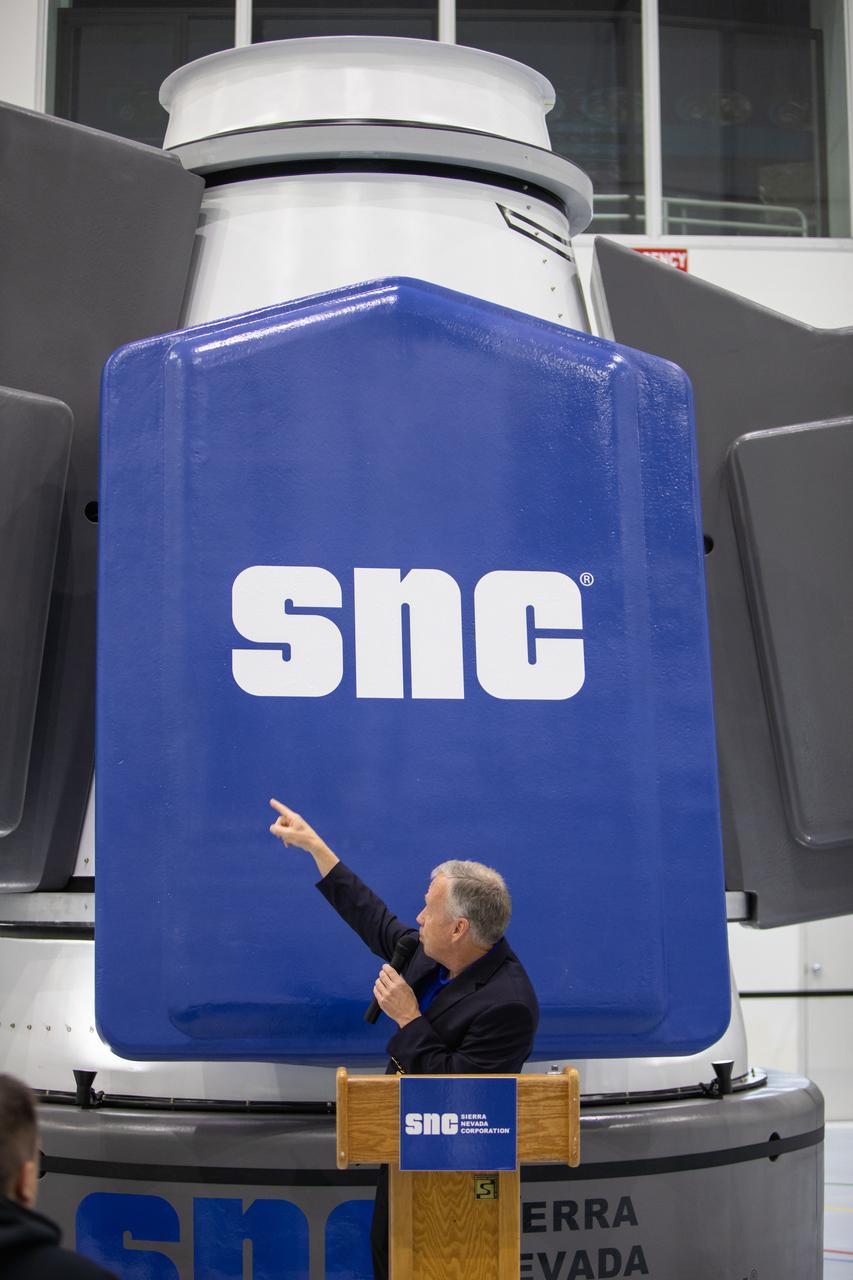
Steve Lindsey, senior vice president of strategy for Sierra Nevada Corporation Space Systems and a former NASA astronaut, discusses the capabilities of the company’s Shooting Star cargo module during a media day event in the Space Station Processing Facility high bay at Kennedy Space Center on Nov. 19, 2019. Shooting Star will attach to the back of the company’s Dream Chaser spacecraft. The cargo module will deliver more than 12,000 pounds of supplies and other cargo to the International Space Station for NASA as part of the Commercial Resupply Services-2 contract.
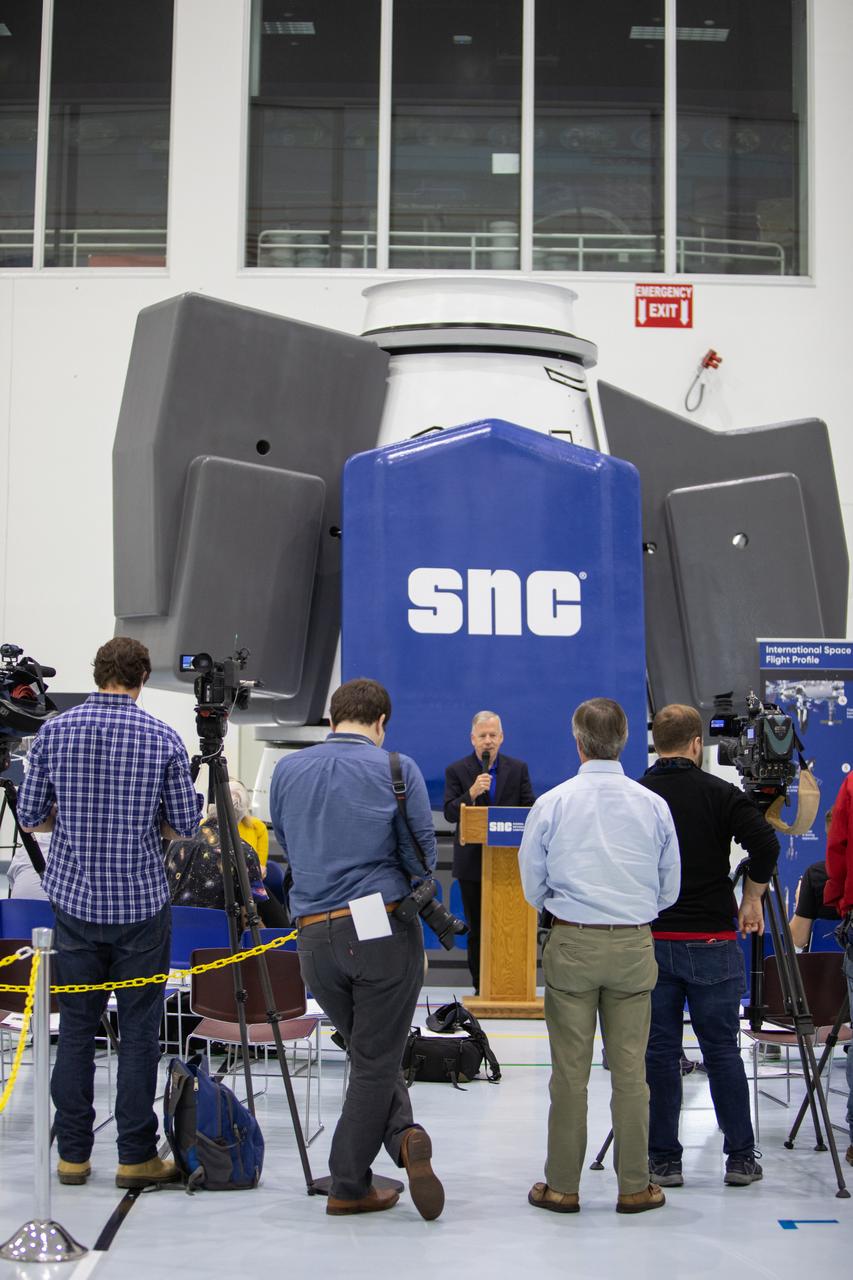
Steve Lindsey, senior vice president of strategy for Sierra Nevada Corporation Space Systems and a former NASA astronaut, discusses the capabilities of the company’s Shooting Star cargo module during a media day event in the Space Station Processing Facility high bay at Kennedy Space Center on Nov. 19, 2019. Shooting Star will attach to the back of the company’s Dream Chaser spacecraft. The cargo module will deliver more than 12,000 pounds of supplies and other cargo to the International Space Station for NASA as part of the Commercial Resupply Services-2 contract.
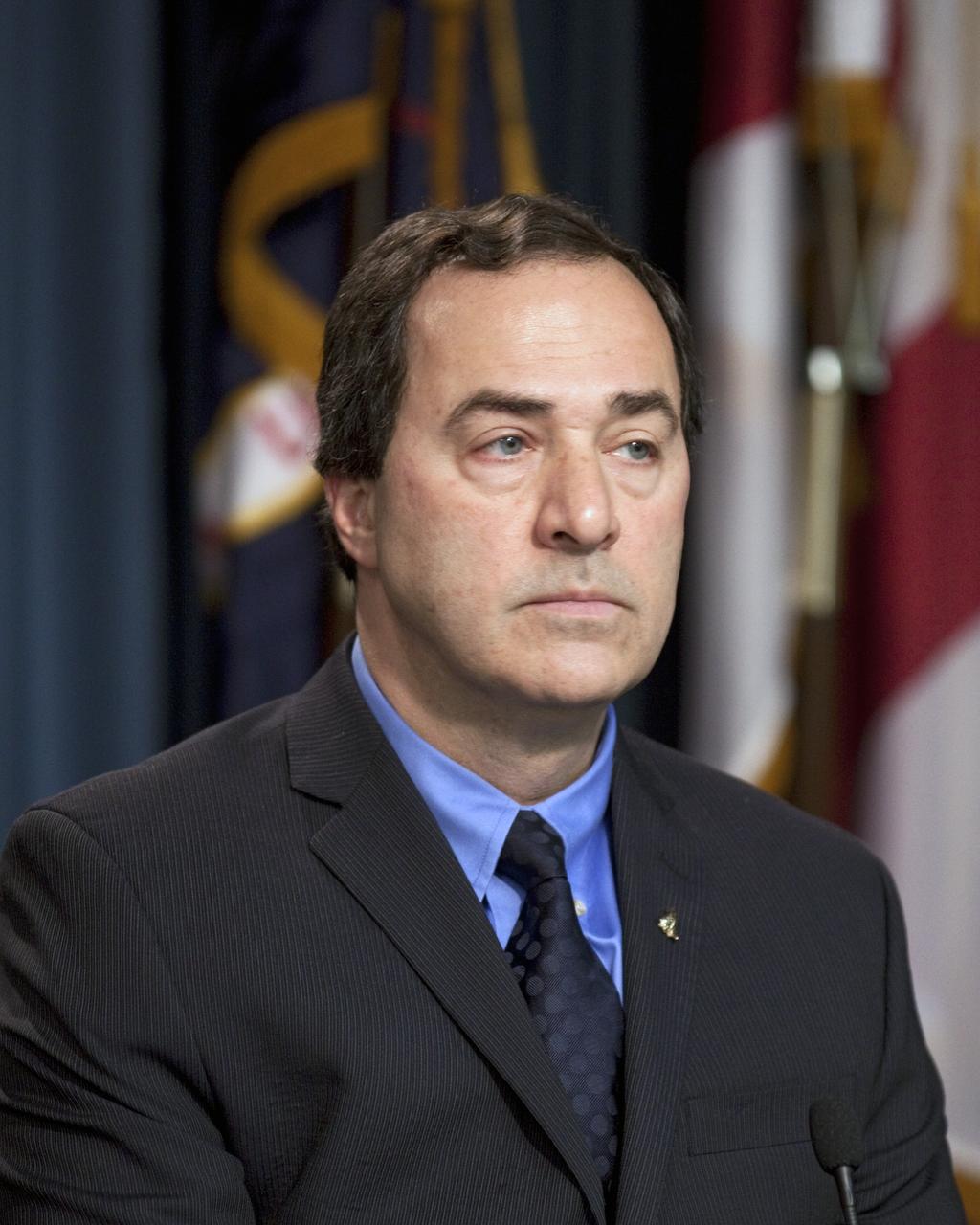
CAPE CANAVERAL, Fla. -- At a news conference NASA officials and industry partners discuss progress of the agency's Commercial Crew Program. Among those participating in the briefing is Mark Sirangelo, Sierra Nevada Corp. vice president and SNC Space Systems chairman. Through CCP, NASA is facilitating the development of U.S. commercial crew space transportation capabilities to achieve safe, reliable and cost-effective access to and from low-Earth orbit for potential future government and commercial customers. For more information, visit http://www.nasa.gov/commercialcrew Photo credit: NASA/Kim Shiflett
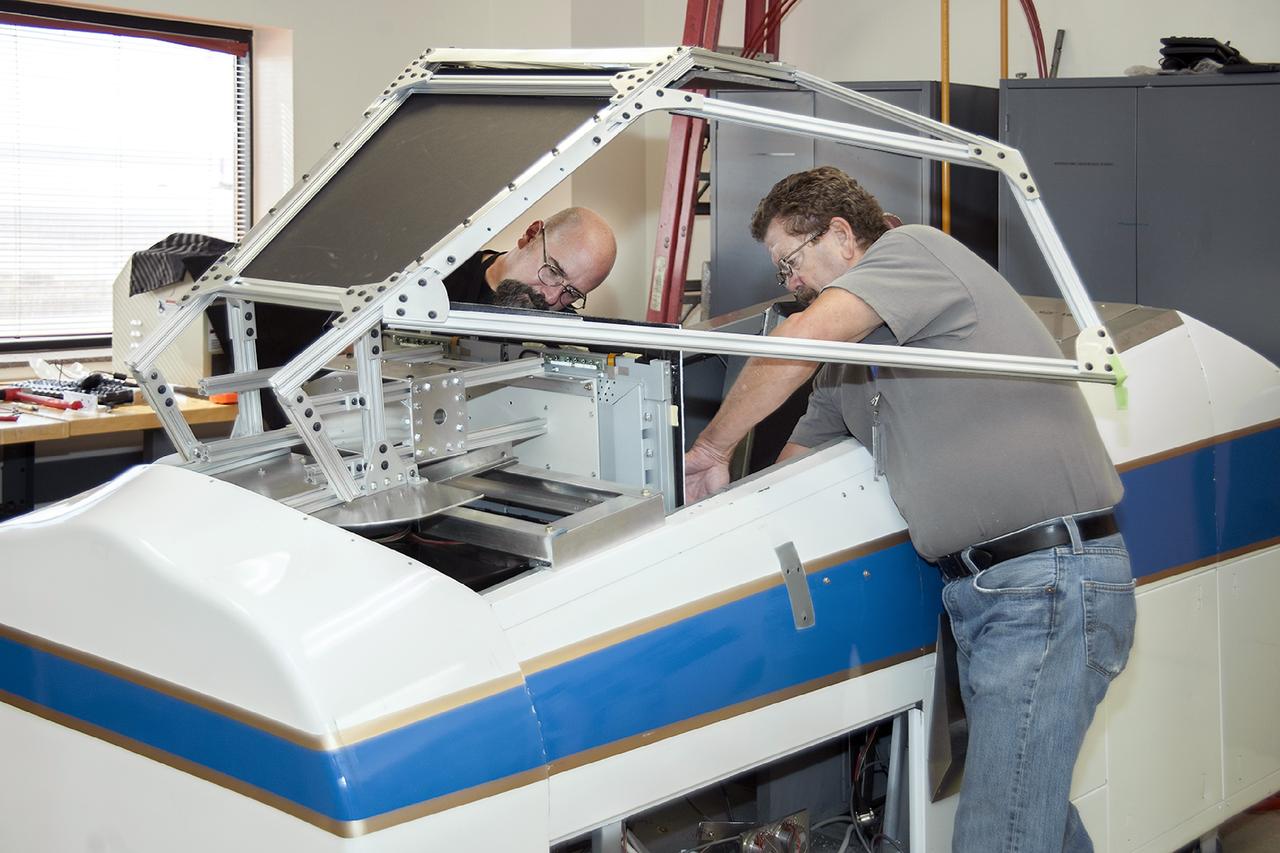
DRYDEN FLIGHT RESEARCH CENTER, Calif. - Simulation technicians Brent Bieber, left, and Dennis Pitts install a boilerplate Dream Chaser canopy structure over the cockpit of a flight simulator in the simulation laboratory at NASA's Dryden Flight Research Center in California. The modification will give Dream Chaser pilot-astronauts a more representative view of the actual flight profiles the spacecraft would fly during piloted approach and landing tests. Sierra Nevada Corporation's Space Systems division is conducting uncrewed captive- and free-flight approach and landing tests of its Dream Chaser at Dryden during the summer and fall. Photo credit: NASA/Ken Ulbrich
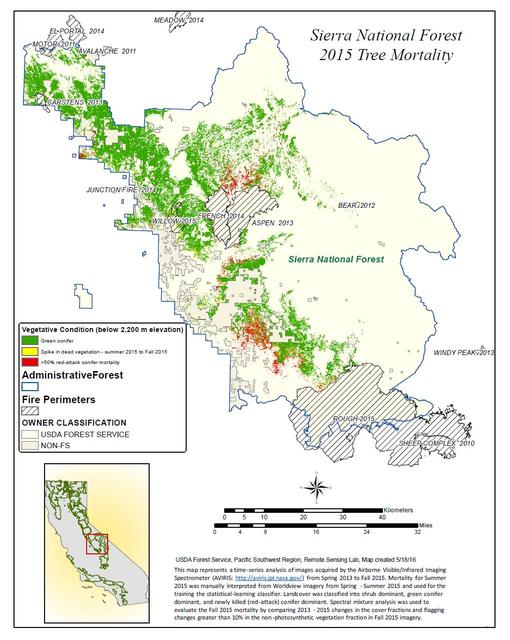
California, reveals the devastating effect of California's ongoing drought on Sierra Nevada conifer forests. The map will be used to help the U.S. Forest Service assess and respond to the impacts of increased tree mortality caused by the drought, particularly where wildlands meet urban areas within the Sierra National Forest. After several years of extreme drought, the highly stressed conifers (trees or bushes that produce cones and are usually green year-round) of the Sierra Nevada are now more susceptible to bark beetles (Dendroctonus spp.). While bark beetles killing trees in the Sierra Nevada is a natural phenomenon, the scale of mortality in the last couple of years is far greater than previously observed. The U.S. Forest Service is using recent airborne spectroscopic measurements from NASA's Airborne Visible/Infrared Imaging Spectrometer (AVIRIS) instrument aboard NASA's ER-2 aircraft, together with new advanced algorithms, to quantify this impact over this large region of rugged terrain. The high-altitude ER-2 aircraft is based at NASA's Armstrong Flight Research Center, Edwards, California. The image was created by scientists at the USFS's Pacific Southwest Region Remote Sensing Lab, McClellan, California, by performing a time series analysis of AVIRIS images. Scientists evaluated baseline tree mortality on public lands in the summer of 2015 using a machine learning algorithm called "random forest." This algorithm classifies the AVIRIS measurements as dominated by either shrubs, healthy trees or newly dead conifer trees. To quantify how much the amount of dead vegetation increased during the fall of 2015, the Forest Service scientists conducted an advanced spectral mixture analysis. This analysis evaluates each spectrum to determine the fraction of green vegetation, dead vegetation and soil. The full spectral range of AVIRIS is important to separate the signatures of soil and dead vegetation. To produce this comprehensive Sierra National Forest tree mortality map, the result from the summer of 2015 was evaluated to look for increases of more than 10 percent in dead vegetation during the fall of 2015. AVIRIS measures spectra of the Earth system to conduct advanced science research. These western U.S. AVIRIS measurements were acquired as part of NASA's Hyperspectral Infrared Imager (HyspIRI) preparatory airborne campaign. HyspIRI was one of the space missions suggested to NASA by the National Academy of Sciences in its 2007 decadal survey for Earth Science. In the future, HyspIRI could provide spectral and thermal measurements of this type globally for ecosystem research and additional science objectives. http://photojournal.jpl.nasa.gov/catalog/PIA20717
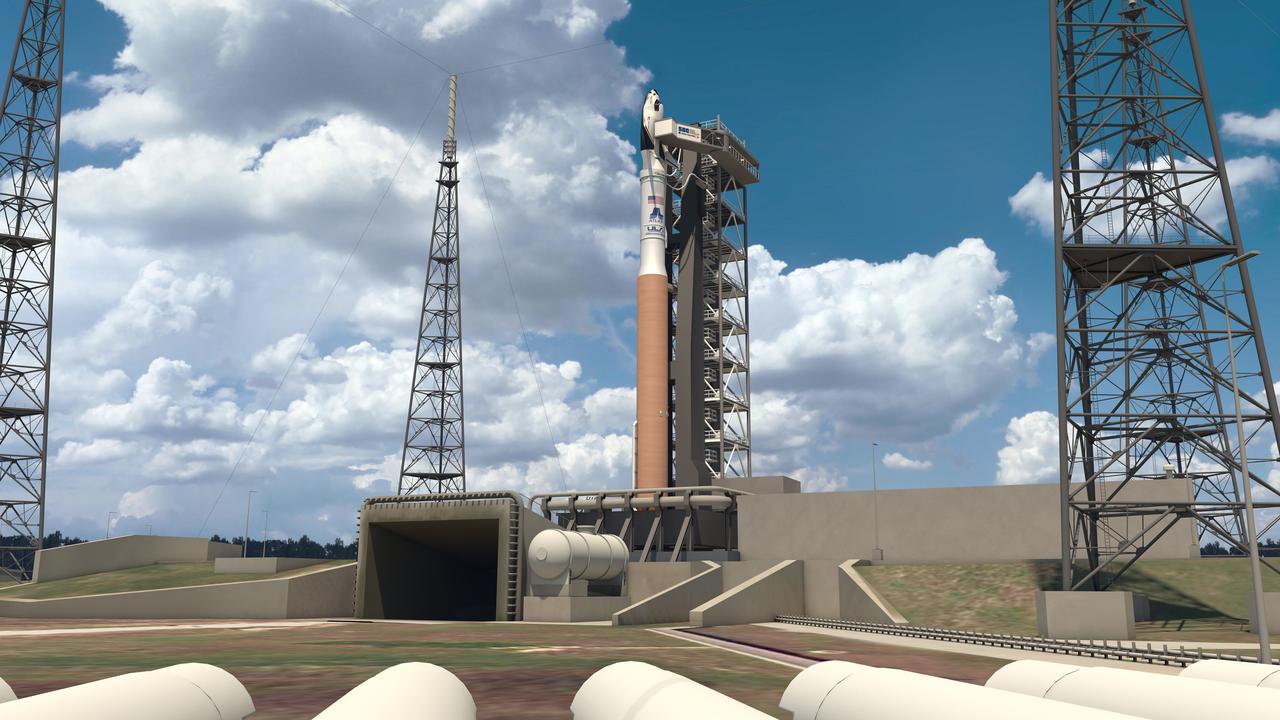
CAPE CANAVERAL, Fla. -- This is an artist's conception of Sierra Nevada Corp. SNC Space System's Dream Chaser spacecraft atop a United Launch Alliance ULA Atlas V rocket under development for NASA's Commercial Crew Program, or CCP. The integrated system was selected for CCP's Commercial Crew Integrated Capability, or CCiCap, initiative to propel America's next human space transportation system to low Earth orbit forward. Operating under a funded Space Act Agreement, or SAA, SNC will spend the next 21 months completing its design, conducting critical risk reduction testing on its spacecraft and launch vehicle, and showcasing how it would operate and manage missions from launch through orbit and landing, setting the stage for a future demonstration mission. To learn more about CCP, which is based at NASA's Kennedy Space Center in Florida and supported by NASA's Johnson Space Center in Houston, visit www.nasa.gov/commercialcrew. Image credit: SNC
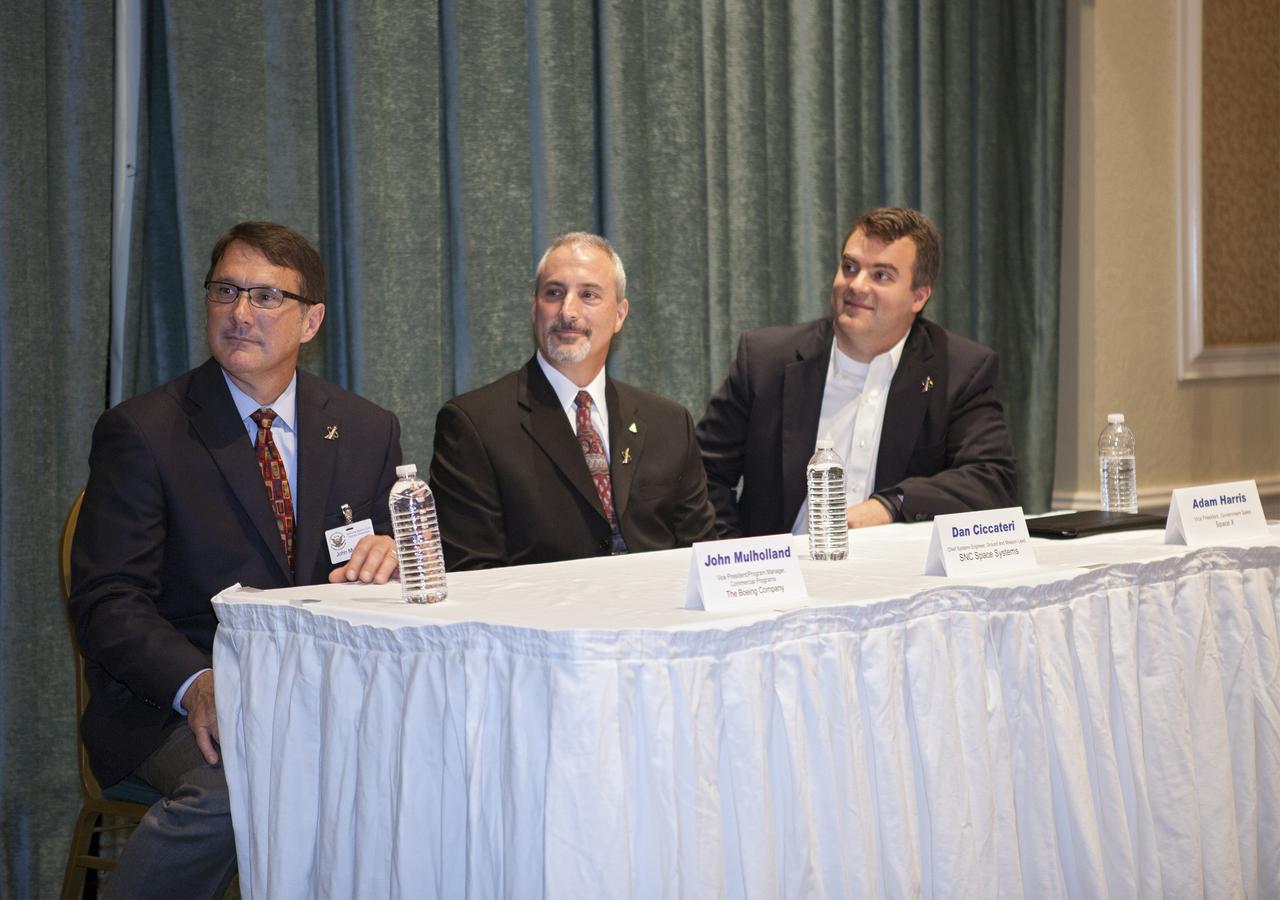
CAPE CANAVERAL, Fla. - NASA Commercial Crew Program, or CCP, partner representatives participate in the National Space Club Florida Committee's June meeting near the Kennedy Space Center. From left are The Boeing Company's vice president and program manager of Commercial Programs John Mulholland, Sierra Nevada Corporation, or SNC, Space Systems chief systems engineer Dan Ciccateri, and Space Exploration Technologies, or SpaceX, vice president of government sales Adam Harris. CCP Program Manager Ed Mango and the partners talked about plans to increase commercial activities on Florida’s space coast to send astronauts to low-Earth orbit. To learn more about the Commercial Crew Program, visit www.nasa.gov/commercialcrew. Photo credit: Kim Shiflett
CAPE CANAVERAL, Fla. -- This is an artist's conception of NASA's Commercial Crew Program or CCP, logo and low Earth orbit. The program is entering its third phase of development, called Commercial Crew integrated Capability, or CCiCap, to propel America's next human space transportation system to low Earth orbit forward. Operating under funded Space Act Agreements, or SAAs, The Boeing Co. of Houston, Sierra Nevada Corp., or SNC, Space Systems of Louisville, Colo., and Space Exploration Technologies, or SpaceX, of Hawthorne, Calif., will spend the next 21 months completing their designs, conducting critical risk reduction testing on their spacecraft and launch vehicles, and showcasing how they would operate and manage missions from launch through orbit and landing, setting the stage for future demonstration missions. To learn more about CCP, which is based at Kennedy and supported by NASA's Johnson Space Center in Houston, visit www.nasa.gov/commercialcrew. Image credit: NASA/Matthew Young
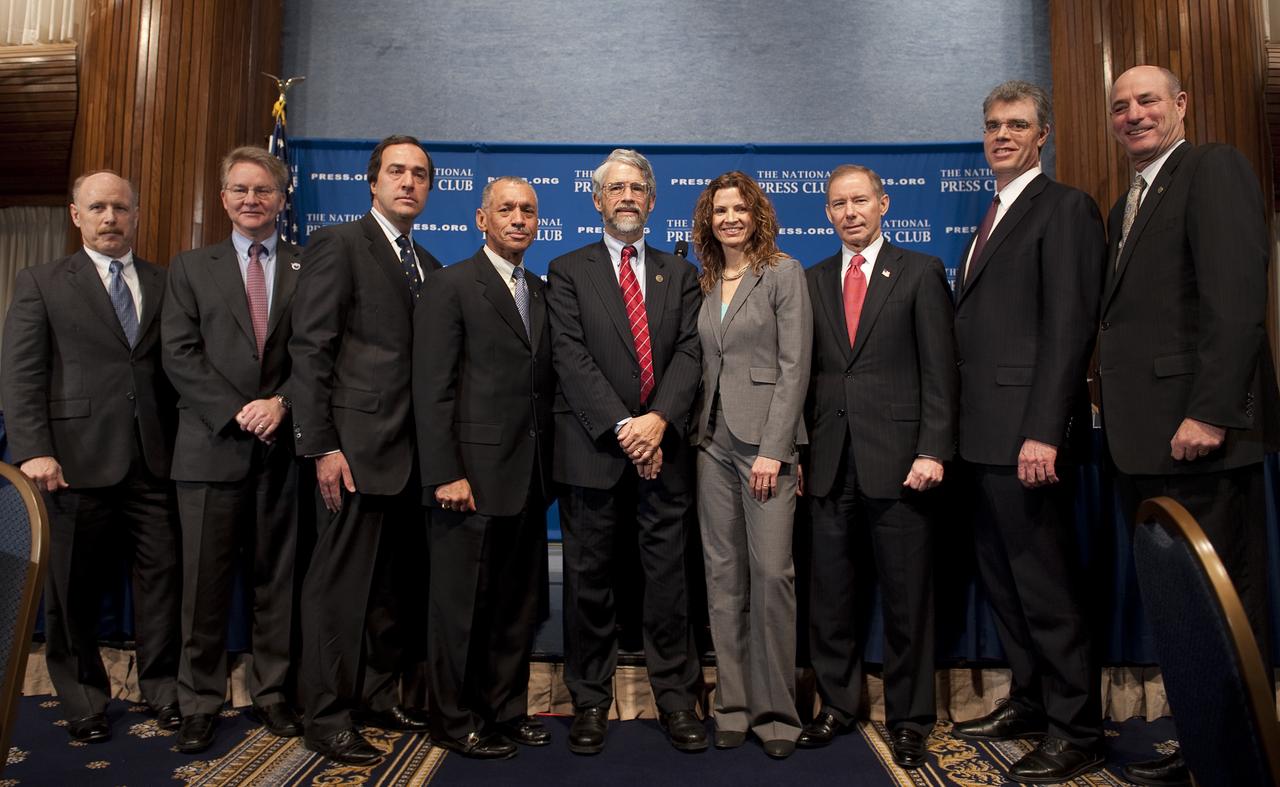
From left, Ken Bowersox, VP Astronaut Safety, SpaceX, David Thompson, CEO, Orbital Science Corporation, Mark Sirangelo, VP and Chair, SNC Space Systems Board, Sierra Nevada Corp., NASA Administrator Charles Bolden, Assistant to the President for Science and Technology and Director of the White House Office of Science and Technology Policy Dr. John P. Holdren, Jane Poynter, President and Chair, Paragon Space Development Corp., Brewster Shaw, VP and General Manager, NASA Systems, Boeing, Robert Millman of Blue Origin, and, Mike Gass, President and Chief Executive, United Launch Alliance, pose for a group photo during a press conference, Tuesday, Feb. 2, 2010, at the National Press Club in Washington, where it was announced that NASA has awarded $50 million through funded agreements to further the commercial sector's capability to support transport of crew to and from low Earth orbit. Photo Credit: (NASA/Bill Ingalls)
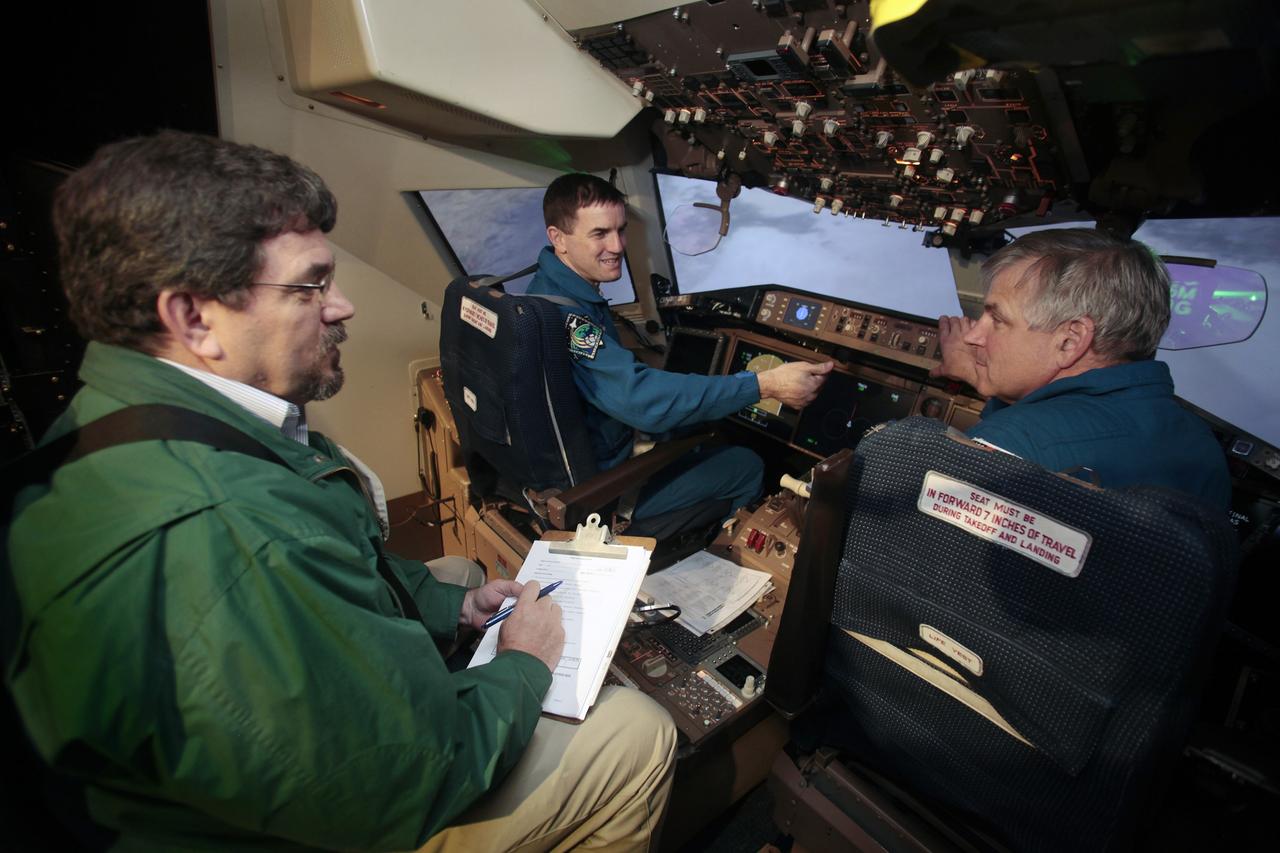
HAMPTON, Va. – Bruce Jackson, an aerospace engineer at NASA’s Langley Flight Research Center, briefs astronauts Rex Walheim, left, and Gregory Johnson as they evaluate Sierra Nevada Corporation, or SNC, Space Systems' Dream Chaser landing simulation, in support of NASA Commercial Crew Program, or CCP, efforts. The simulation makes use of the Synthetic Vision and Enhanced Vision systems in the center's Cockpit Motion Facility. SNC is one of three companies working with CCP during the agency's Commercial Crew Integrated Capability, or CCiCap, initiative, which is intended to lead to the availability of commercial human spaceflight services for government and commercial customers. To learn more about CCP and its industry partners, visit www.nasa.gov/commercialcrew. Image credit: NASA/David C. Bowman
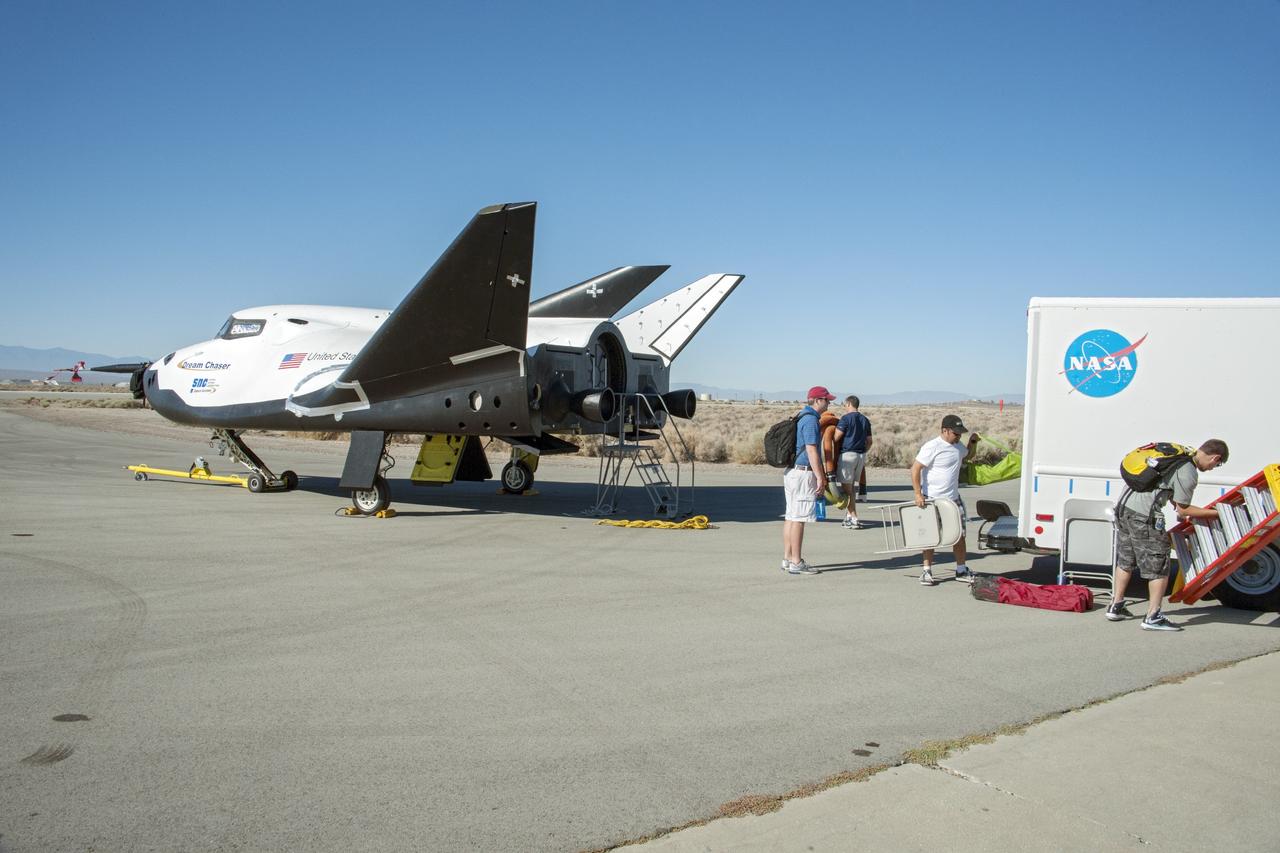
Edwards, Calif. – ED13-0215-016 - Sierra Nevada Corporation SNC Space Systems' team members prepare to tow the Dream Chaser flight vehicle along a concrete runway at NASA's Dryden Flight Research Center in California for range and taxi tow tests. The ground testing will validate the performance of the spacecraft's nose skid, brakes, tires and other systems prior to captive-carry and free-flight tests scheduled for later this year. SNC is one of three companies working with NASA's Commercial Crew Program, or CCP, during the agency's Commercial Crew Integrated Capability, or CCiCap, initiative, which is intended to lead to the availability of commercial human spaceflight services for government and commercial customers. To learn more about CCP and its industry partners, visit www.nasa.gov/commercialcrew. Image credit: NASA/Ken Ulbrich
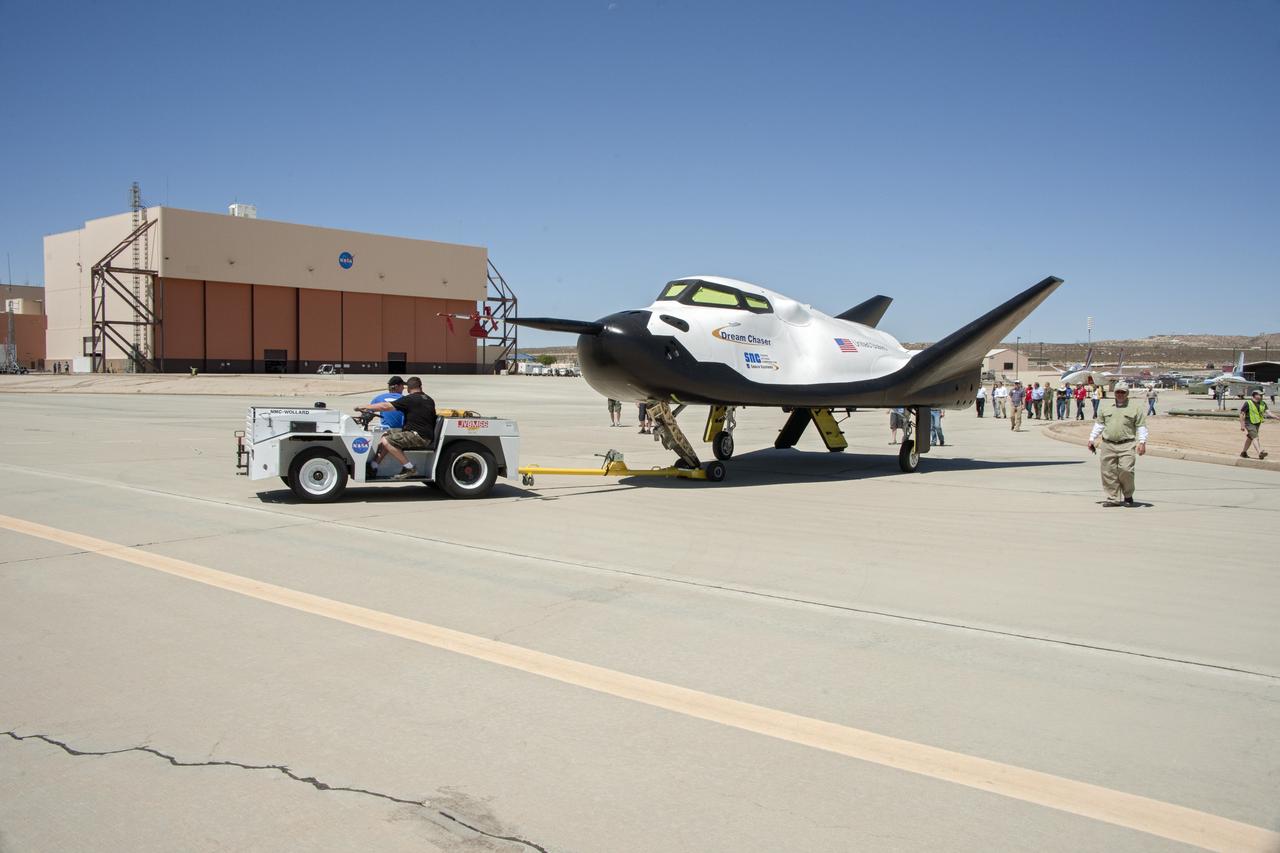
Edwards, Calif. – ED13-164-34 - Sierra Nevada Corporation SNC Space Systems' team members tow the Dream Chaser flight vehicle out to a concrete runway at NASA's Dryden Flight Research Center in California for range and taxi tow tests. The ground testing will validate the performance of the spacecraft's nose skid, brakes, tires and other systems prior to captive-carry and free-flight tests scheduled for later this year. SNC is one of three companies working with NASA's Commercial Crew Program, or CCP, during the agency's Commercial Crew Integrated Capability, or CCiCap, initiative, which is intended to lead to the availability of commercial human spaceflight services for government and commercial customers. To learn more about CCP and its industry partners, visit www.nasa.gov/commercialcrew. Image credit: NASA/Ken Ulbrich
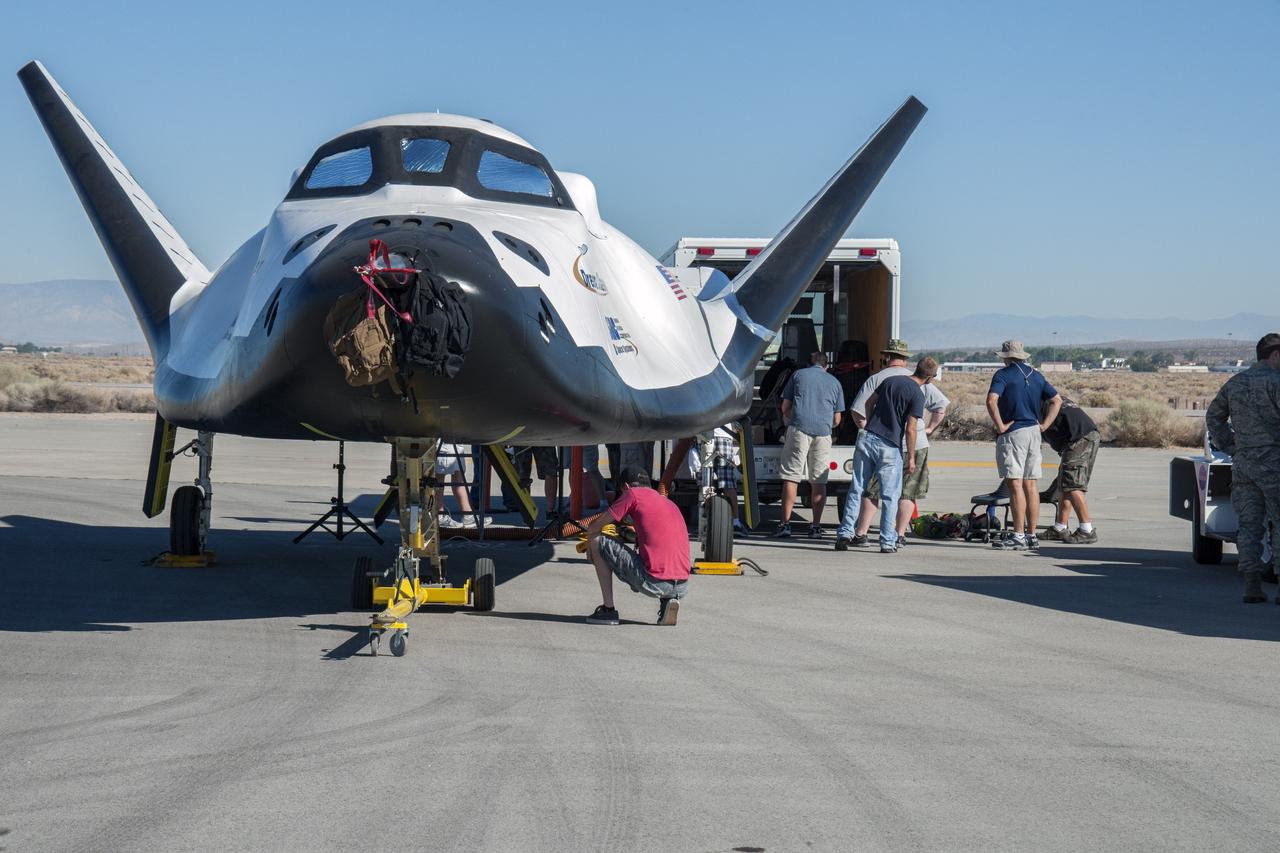
Edwards, Calif. – ED13-0215-024 - Sierra Nevada Corporation SNC Space Systems' team members prepare to tow the Dream Chaser flight vehicle along a concrete runway at NASA's Dryden Flight Research Center in California for range and taxi tow tests. The ground testing will validate the performance of the spacecraft's nose skid, brakes, tires and other systems prior to captive-carry and free-flight tests scheduled for later this year. SNC is one of three companies working with NASA's Commercial Crew Program, or CCP, during the agency's Commercial Crew Integrated Capability, or CCiCap, initiative, which is intended to lead to the availability of commercial human spaceflight services for government and commercial customers. To learn more about CCP and its industry partners, visit www.nasa.gov/commercialcrew. Image credit: NASA/Ken Ulbrich
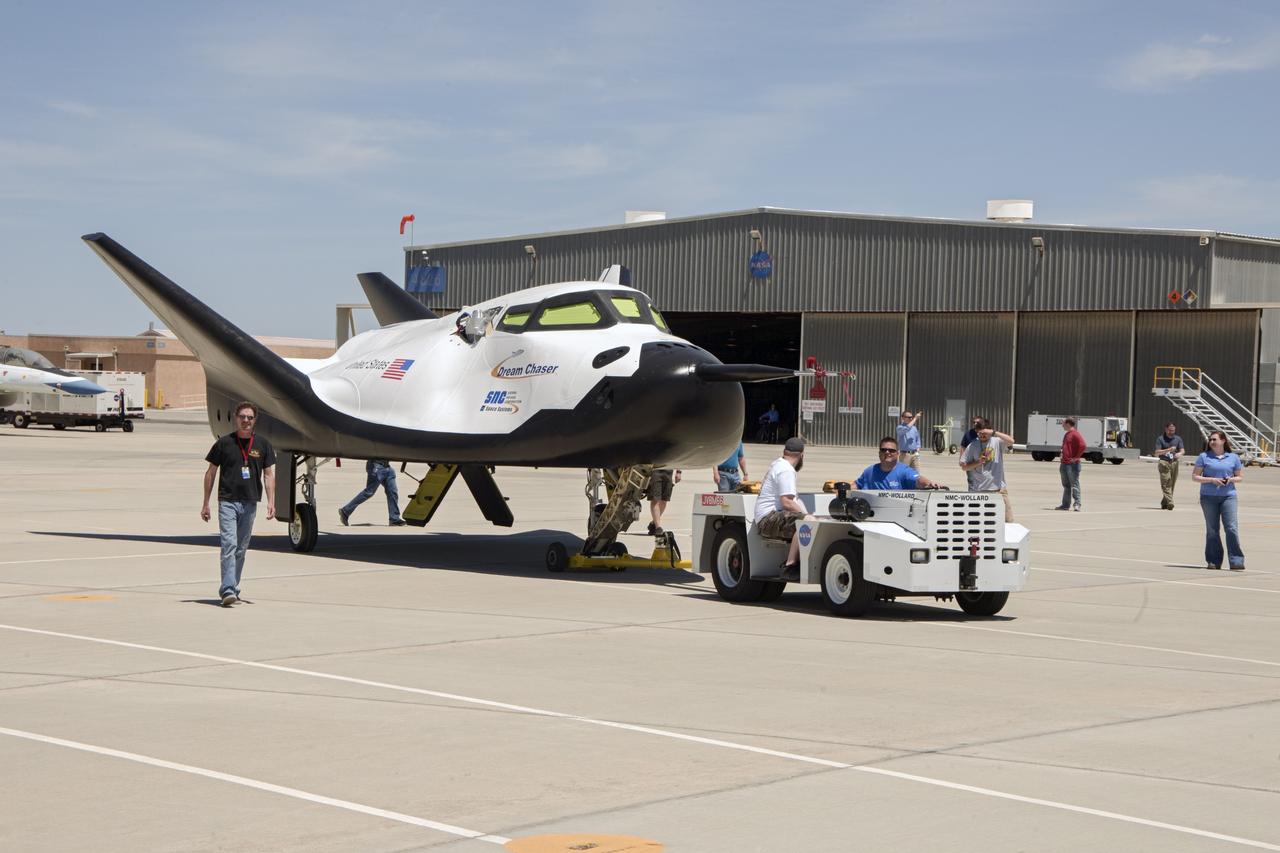
Edwards, Calif. – ED13-161-35 - Sierra Nevada Corporation SNC Space Systems' team members tow the Dream Chaser flight vehicle out to a concrete runway at NASA's Dryden Flight Research Center in California for range and taxi tow tests. The ground testing will validate the performance of the spacecraft's nose skid, brakes, tires and other systems prior to captive-carry and free-flight tests scheduled for later this year. SNC is one of three companies working with NASA's Commercial Crew Program, or CCP, during the agency's Commercial Crew Integrated Capability, or CCiCap, initiative, which is intended to lead to the availability of commercial human spaceflight services for government and commercial customers. To learn more about CCP and its industry partners, visit www.nasa.gov/commercialcrew. Image credit: NASA/Ken Ulbrich
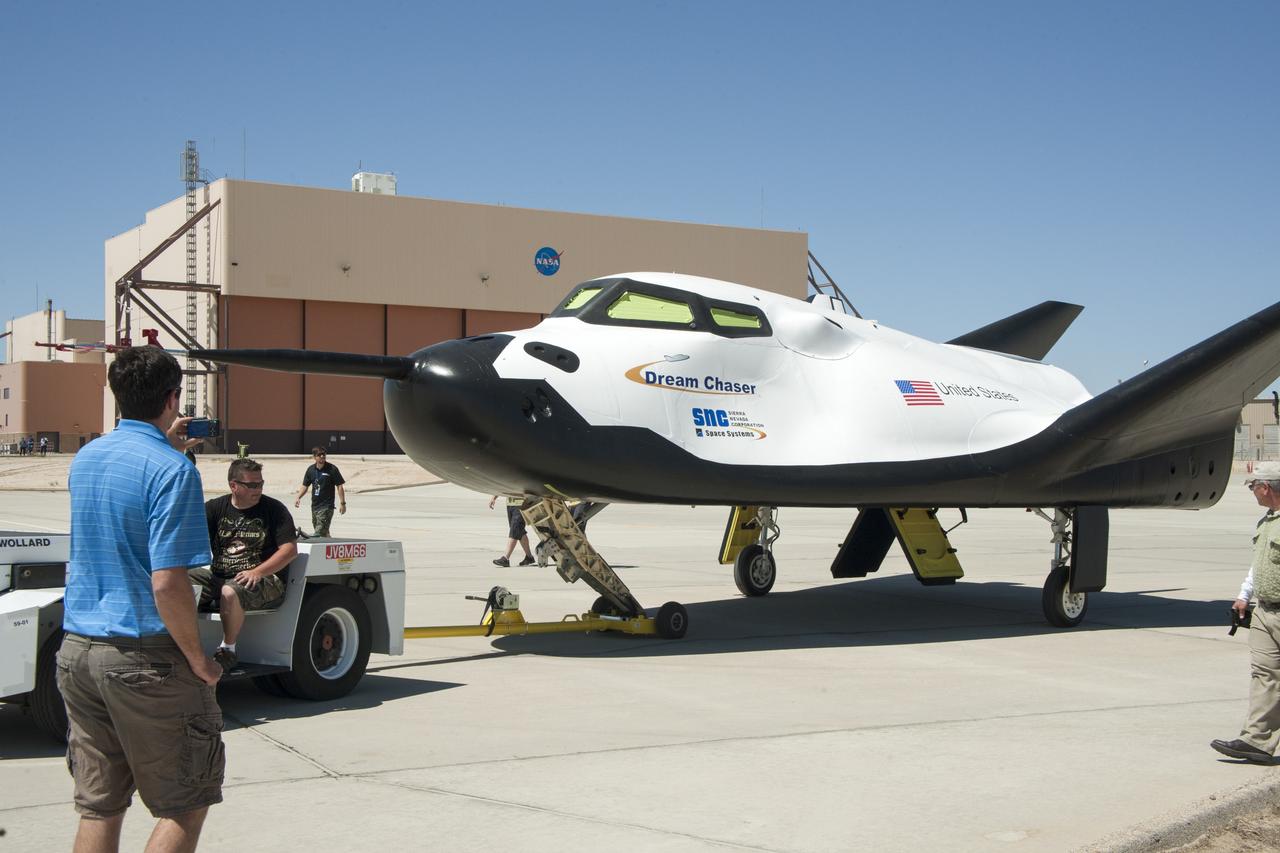
Edwards, Calif. – ED13-164-32 - Sierra Nevada Corporation SNC Space Systems' team members tow the Dream Chaser flight vehicle out to a concrete runway at NASA's Dryden Flight Research Center in California for range and taxi tow tests. The ground testing will validate the performance of the spacecraft's nose skid, brakes, tires and other systems prior to captive-carry and free-flight tests scheduled for later this year. SNC is one of three companies working with NASA's Commercial Crew Program, or CCP, during the agency's Commercial Crew Integrated Capability, or CCiCap, initiative, which is intended to lead to the availability of commercial human spaceflight services for government and commercial customers. To learn more about CCP and its industry partners, visit www.nasa.gov/commercialcrew. Image credit: NASA/Ken Ulbrich
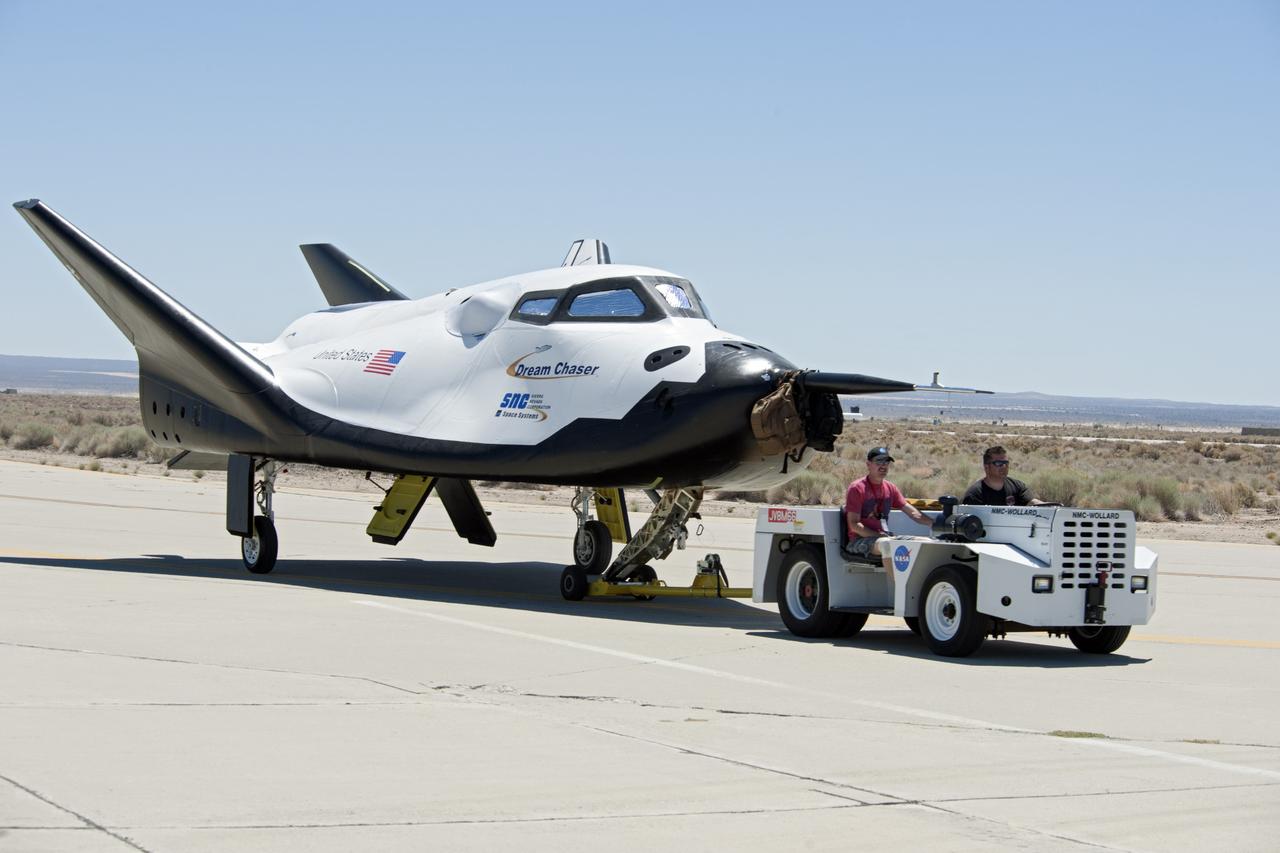
Edwards, Calif. – ED13-0215-072 - Sierra Nevada Corporation SNC Space Systems' team members tow the Dream Chaser flight vehicle along a concrete runway at NASA's Dryden Flight Research Center in California for range and taxi tow tests. The ground testing will validate the performance of the spacecraft's nose skid, brakes, tires and other systems prior to captive-carry and free-flight tests scheduled for later this year. SNC is one of three companies working with NASA's Commercial Crew Program, or CCP, during the agency's Commercial Crew Integrated Capability, or CCiCap, initiative, which is intended to lead to the availability of commercial human spaceflight services for government and commercial customers. To learn more about CCP and its industry partners, visit www.nasa.gov/commercialcrew. Image credit: NASA/Ken Ulbrich
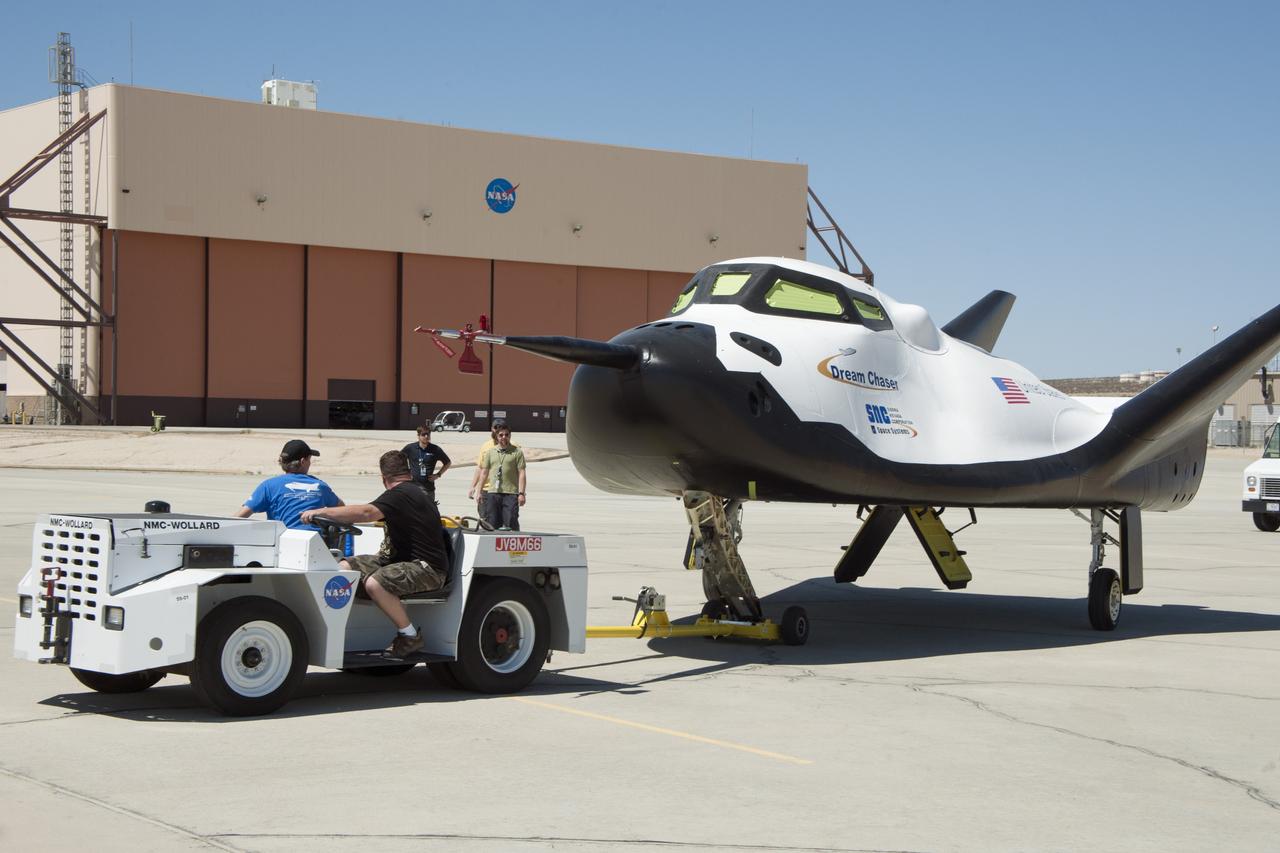
Edwards, Calif. – ED13-164-33 - Sierra Nevada Corporation SNC Space Systems' team members tow the Dream Chaser flight vehicle out to a concrete runway at NASA's Dryden Flight Research Center in California for range and taxi tow tests. The ground testing will validate the performance of the spacecraft's nose skid, brakes, tires and other systems prior to captive-carry and free-flight tests scheduled for later this year. SNC is one of three companies working with NASA's Commercial Crew Program, or CCP, during the agency's Commercial Crew Integrated Capability, or CCiCap, initiative, which is intended to lead to the availability of commercial human spaceflight services for government and commercial customers. To learn more about CCP and its industry partners, visit www.nasa.gov/commercialcrew. Image credit: NASA/Ken Ulbrich
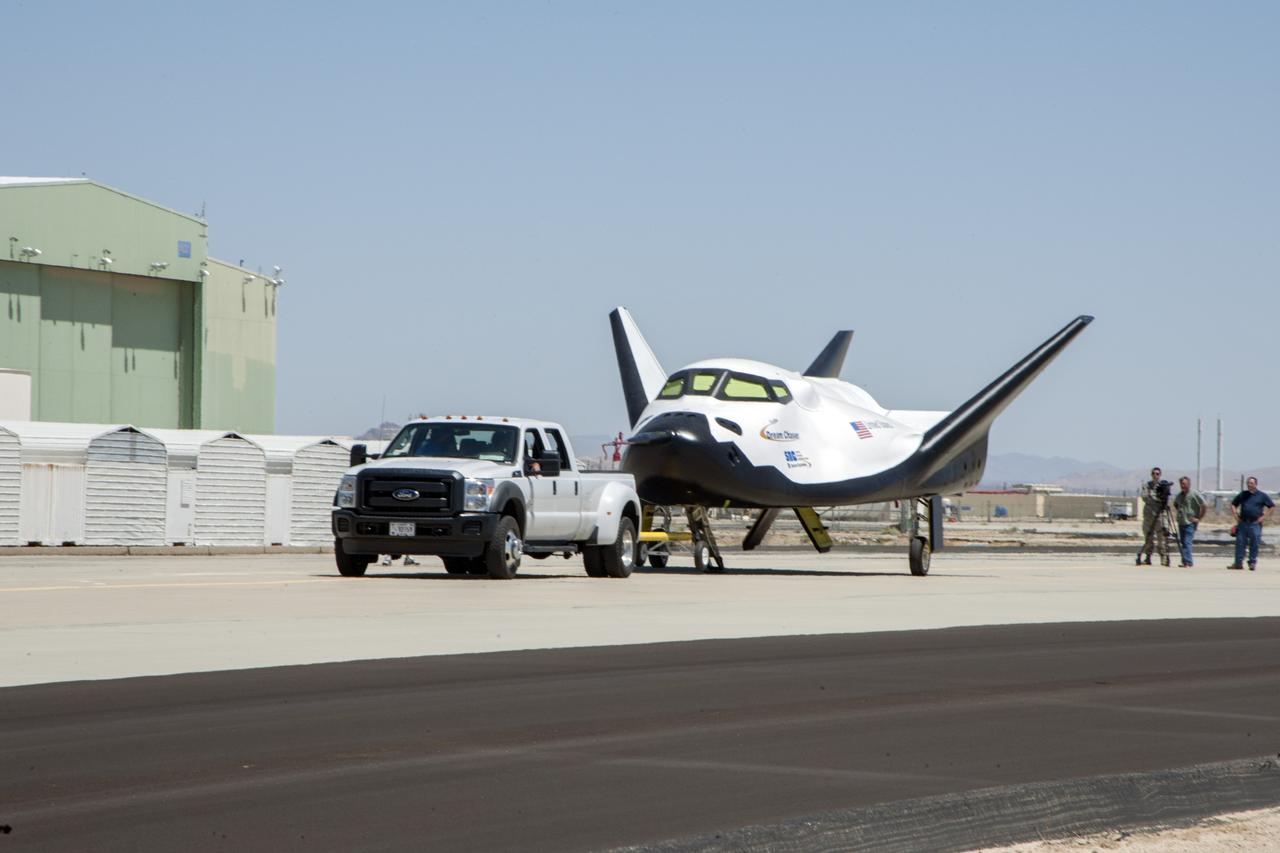
Edwards, Calif. – ED13-164-34 - Sierra Nevada Corporation SNC Space Systems' team members tow the Dream Chaser flight vehicle out to a concrete runway at NASA's Dryden Flight Research Center in California for range and taxi tow tests. The ground testing will validate the performance of the spacecraft's nose skid, brakes, tires and other systems prior to captive-carry and free-flight tests scheduled for later this year. SNC is one of three companies working with NASA's Commercial Crew Program, or CCP, during the agency's Commercial Crew Integrated Capability, or CCiCap, initiative, which is intended to lead to the availability of commercial human spaceflight services for government and commercial customers. To learn more about CCP and its industry partners, visit www.nasa.gov/commercialcrew. Image credit: NASA/Ken Ulbrich
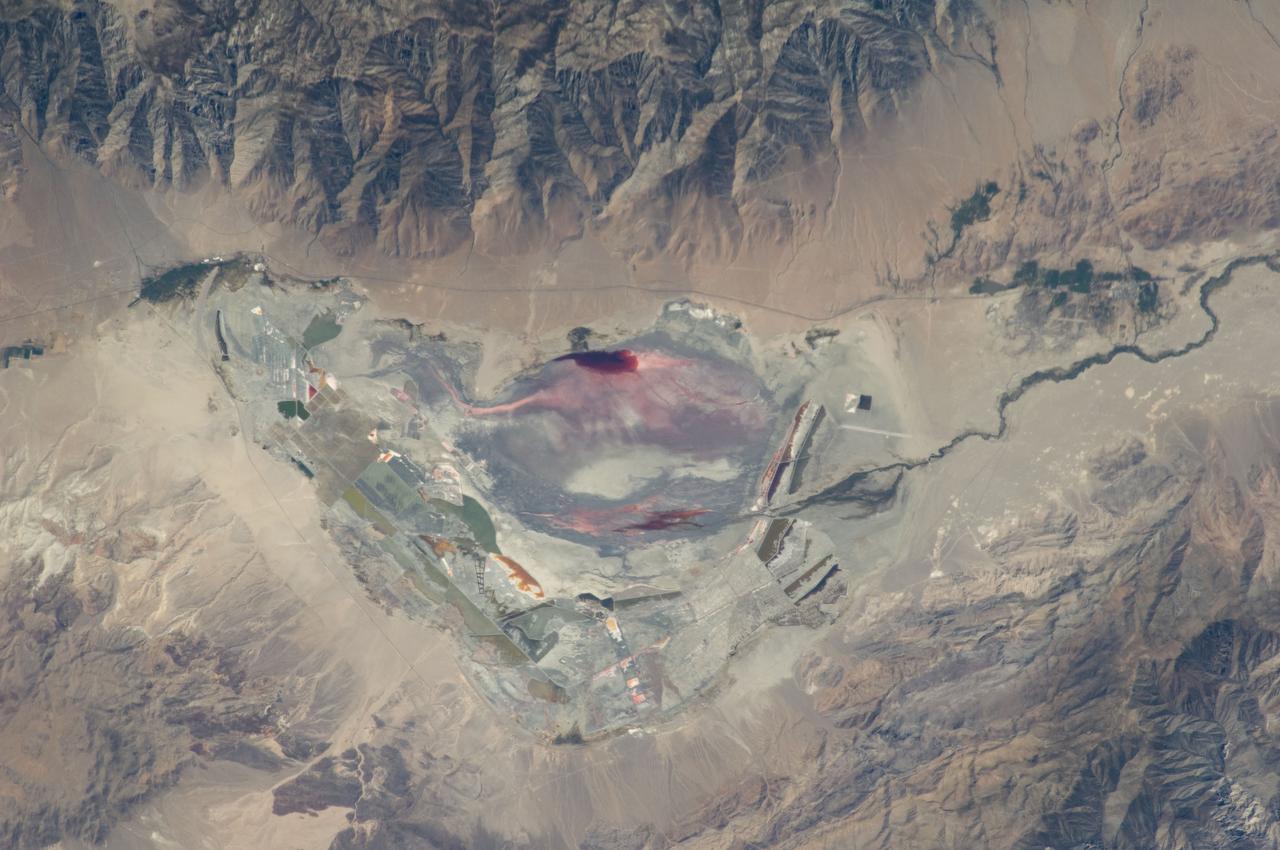
ISS028-E-035137 (30 Aug. 2011) --- Owens Lake in California is featured in this image photographed by an Expedition 28 crew member on the International Space Station. This photograph highlights the mostly dry bed of Owens Lake, located in the Owens River Valley between the Inyo Mountains and the Sierra Nevada. Shallow groundwater, springs, and seeps support minor wetlands and a central brine pool. Two bright red areas along the margins of the brine pool indicate the presence of halophilic, or salt-loving organisms known as Achaeans. Grey and white materials within the lake bed are exposed lakebed sediments and salt crusts. The towns of Olancha and Lone Pine are delineated by the presence of green vegetation indicating a more constant availability of water. According to scientists, the present-day Owens Lake was part of a much larger lake and river system that existed during the Pleistocene Epoch (approximately 3 million to approximately 12,000 years ago) along the current northeastern border of California with Nevada. Meltwater from alpine glaciers in the Sierra Nevada filled the regional valleys of the Basin and Range to form several glacial lakes that were ancestral to the now-dry lakebeds (or playas) of Owens, Searles Lake, and China Lake. While Searles and China Lakes dried out due to regional changes to a hotter and drier climate over thousands of years, Owens Lake became desiccated largely due to the diversion of Owens River water in the early 20th century to serve the needs of the City of Los Angeles, CA located 266 kilometers to the south. Following complete desiccation of the lakebed in 1926, significant amounts of windblown dust were produced ? indeed, the term ?Keeler fog? was coined by residents of the now largely abandoned town on the eastern side of Owens Lake due to the dust. In addition to adverse health effects on local residents, dust from Owens Lake has been linked to visibility reduction in nearby national parks, forests, and wilderness areas. Recently, efforts to control dust evolution from the lakebed have been undertaken by the City of Los Angeles.
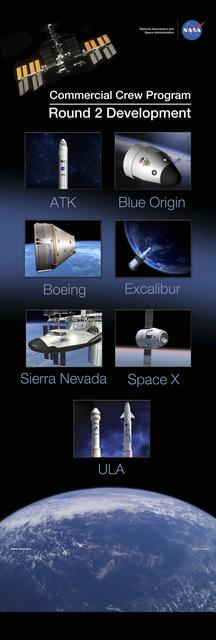
CAPE CANAVERAL, Fla. -- This is a printable banner of the aerospace companies NASA's Commercial Crew Program (CCP) entered into Space Act Agreements with during Commercial Crew Development Round 2 (CCDev2) activities in 2011 in order to mature the design and development of crew transportation systems with the overall goal of accelerating a United States-led capability to the International Space Station. CCDev2 companies are Alliant Techsystems (ATK), Blue Origin, The Boeing Co., Excalibur Almaz Inc., Sierra Nevada Corp., Space Exploration Technologies (SpaceX), and United Launch Alliance (ULA). The goal of CCP is to drive down the cost of space travel as well as open up space to more people than ever before by balancing industry’s own innovative capabilities with NASA's 50 years of human spaceflight experience. For more information, visit www.nasa.gov/commercialcrew
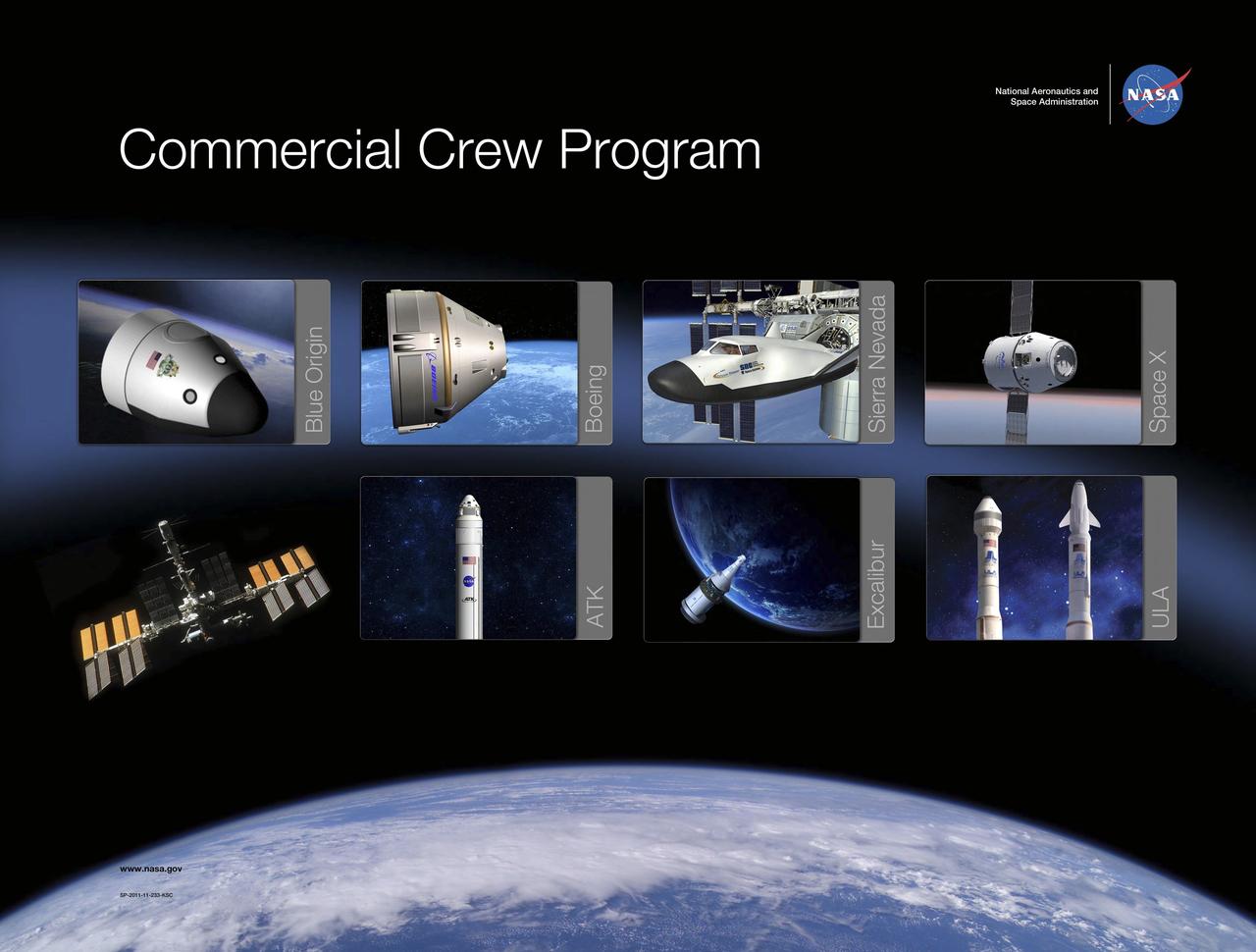
CAPE CANAVERAL, Fla. -- This is a printable poster of the aerospace companies NASA's Commercial Crew Program (CCP) entered into Space Act Agreements with during Commercial Crew Development Round 2 (CCDev2) activities in 2011 in order to mature the design and development of crew transportation systems with the overall goal of accelerating a United States-led capability to the International Space Station. CCDev2 companies are Alliant Techsystems (ATK), Blue Origin, The Boeing Co., Excalibur Almaz Inc., Sierra Nevada Corp., Space Exploration Technologies (SpaceX), and United Launch Alliance (ULA). The goal of CCP is to drive down the cost of space travel as well as open up space to more people than ever before by balancing industry’s own innovative capabilities with NASA's 50 years of human spaceflight experience. For more information, visit www.nasa.gov/commercialcrew
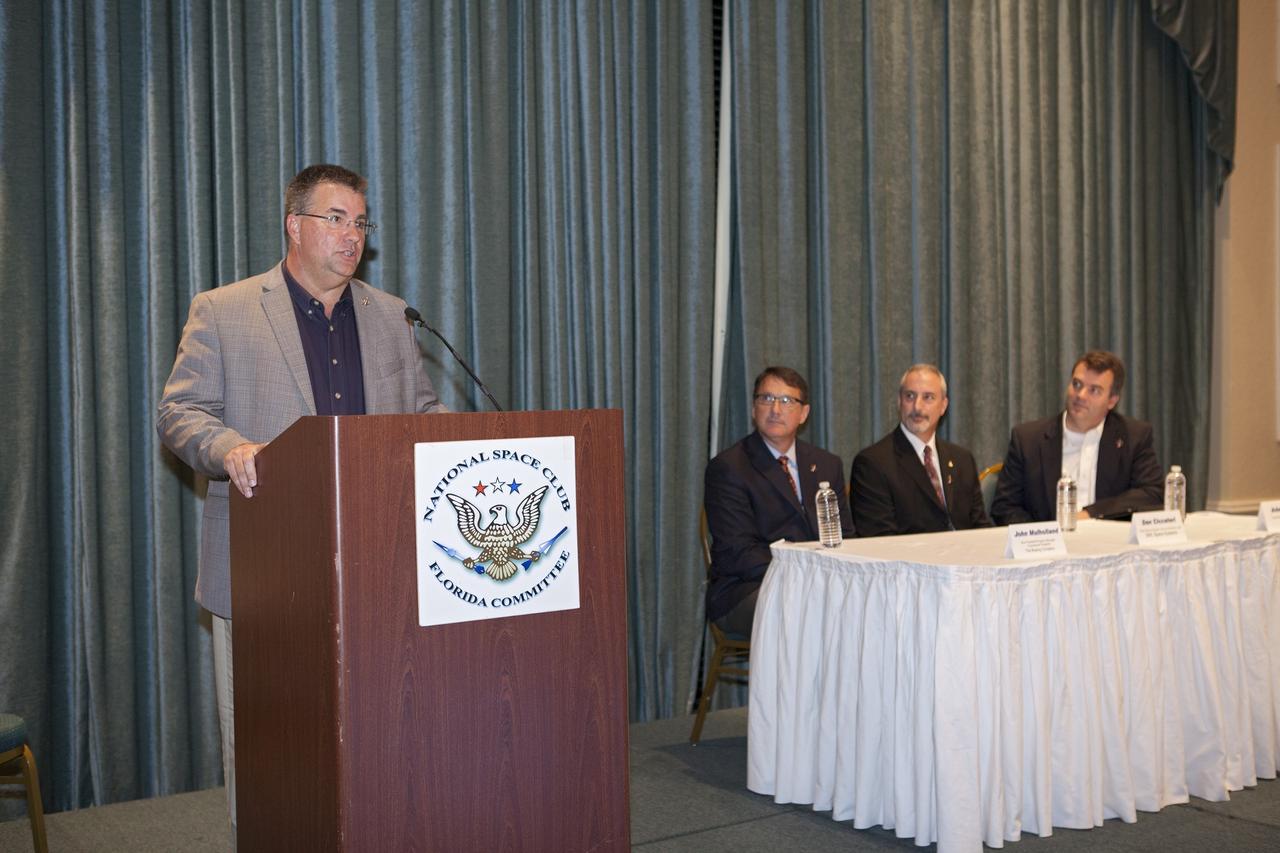
CAPE CANAVERAL, Fla. - Ed Mango, manager of NASA's Commercial Crew Program, or CCP, speaks to a crowd of spaceflight enthusiasts at the National Space Club Florida Committee's June meeting near the Kennedy Space Center. Mango was joined at the Radisson Resort at the Port in Cape Canaveral, Fla., by partner representatives from The Boeing Company, Sierra Nevada Corporation, or SNC, and Space Exploration Technologies, or SpaceX, all of whom plan to increase their commercial activities on Florida’s space coast to send astronauts to low-Earth orbit. Seated from left are vice president and program manager of Boeing's Commercial Programs John Mulholland, SNC's chief systems engineer Dan Ciccateri, and SpaceX's vice president of government sales Adam Harris. To learn more about the Commercial Crew Program, visit www.nasa.gov/commercialcrew. Photo credit: Kim Shiflett
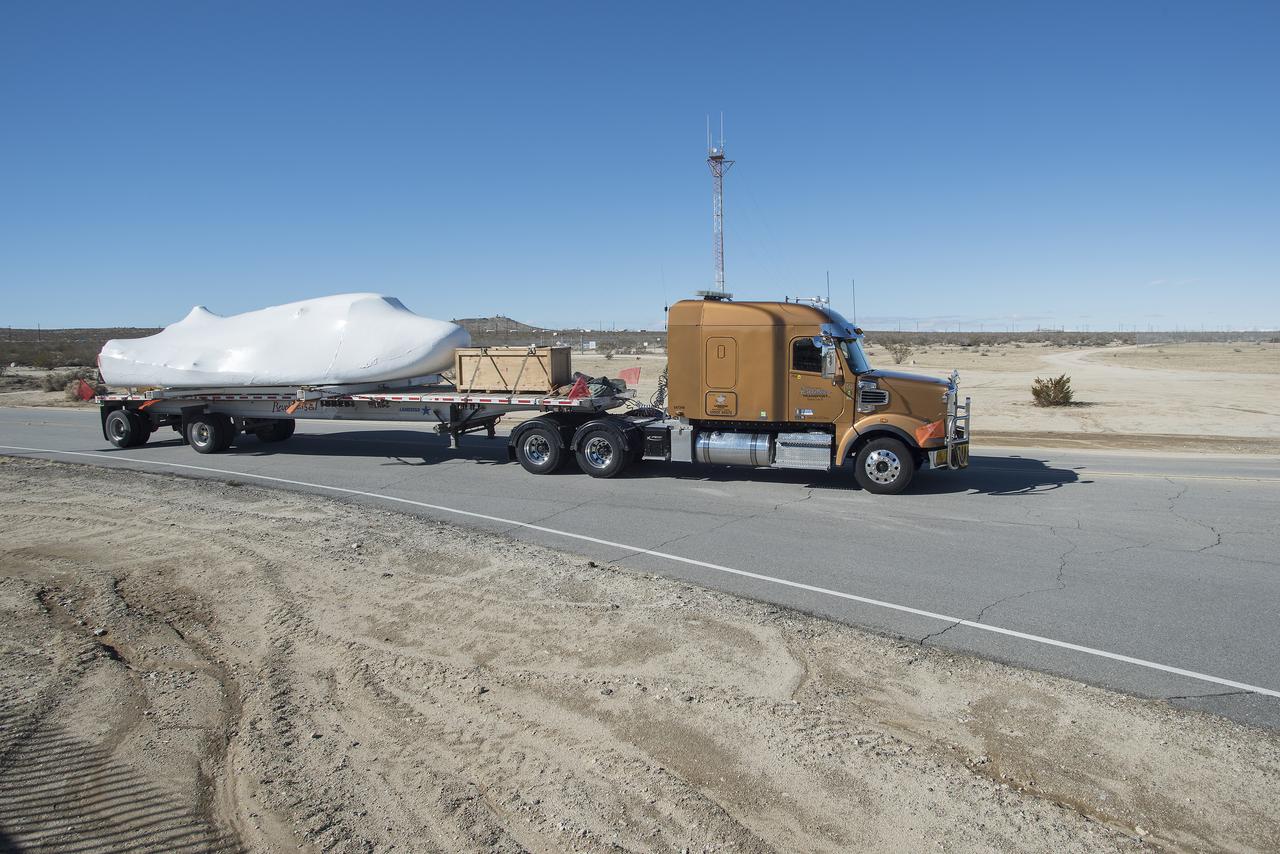
Sierra Nevada Corporation’s Dream Chaser spacecraft arrives by truck at NASA’s Armstrong Flight Research Center in California, located on Edwards Air Force Base. The spacecraft will undergo several months of testing in preparation for its approach and landing flight on the base’s 22L runway. The test series is part of a developmental space act agreement SNC has with NASA’s Commercial Crew Program and will help SNC validate aerodynamic properties, flight software and control system performance. The Dream Chaser is also being prepared to deliver cargo to the International Space Station under NASA’s Commercial Resupply Services 2 contract beginning in 2019. The cargo Dream Chaser will fly at least six delivery missions to and from the space station by 2024.
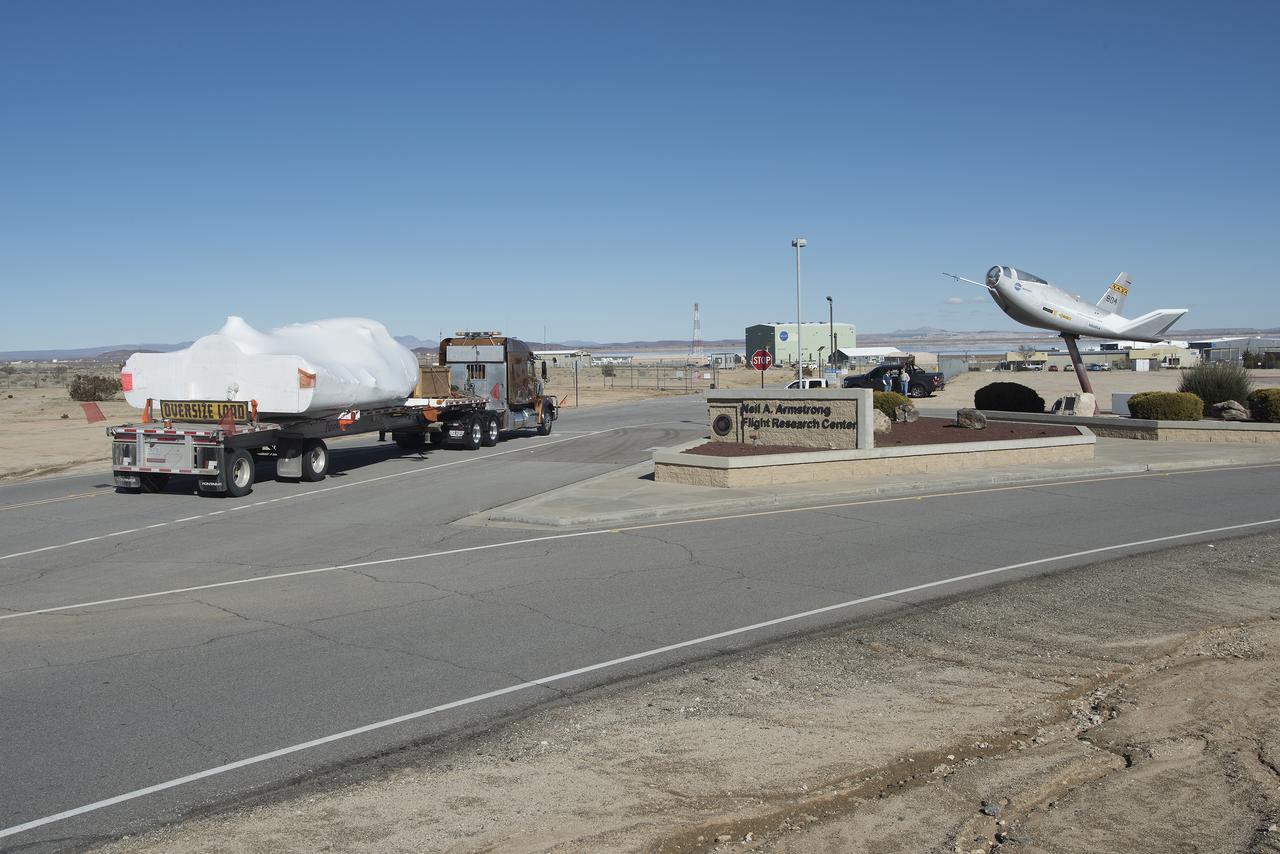
Sierra Nevada Corporation’s Dream Chaser spacecraft arrives by truck at NASA’s Armstrong Flight Research Center in California, located on Edwards Air Force Base. The spacecraft will undergo several months of testing in preparation for its approach and landing flight on the base’s 22L runway. The test series is part of a developmental space act agreement SNC has with NASA’s Commercial Crew Program and will help SNC validate aerodynamic properties, flight software and control system performance. The Dream Chaser is also being prepared to deliver cargo to the International Space Station under NASA’s Commercial Resupply Services 2 contract beginning in 2019. The cargo Dream Chaser will fly at least six delivery missions to and from the space station by 2024.
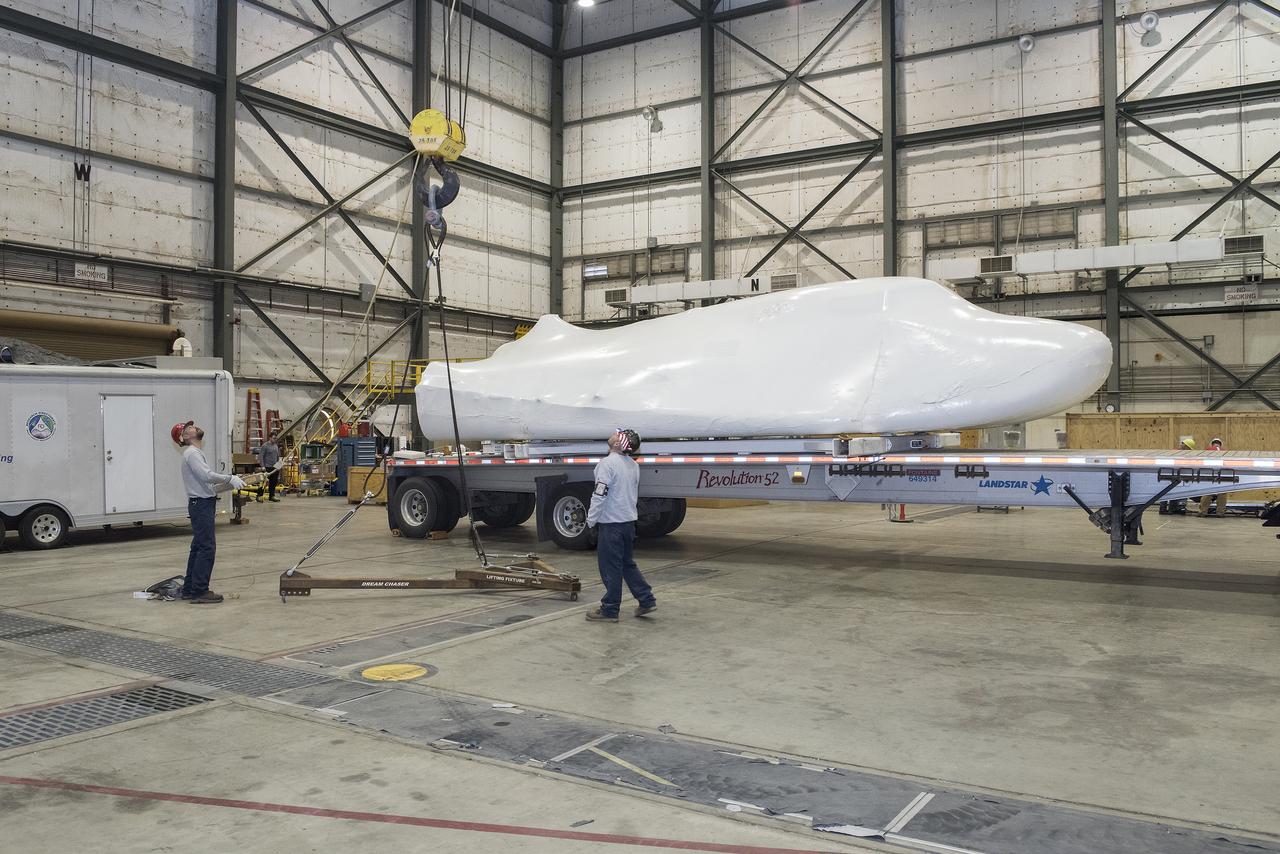
Sierra Nevada Corporation’s Dream Chaser spacecraft arrives by truck at NASA’s Armstrong Flight Research Center in California, located on Edwards Air Force Base. The spacecraft will undergo several months of testing in preparation for its approach and landing flight on the base’s 22L runway. The test series is part of a developmental space act agreement SNC has with NASA’s Commercial Crew Program and will help SNC validate aerodynamic properties, flight software and control system performance. The Dream Chaser is also being prepared to deliver cargo to the International Space Station under NASA’s Commercial Resupply Services 2 contract beginning in 2019. The cargo Dream Chaser will fly at least six delivery missions to and from the space station by 2024.
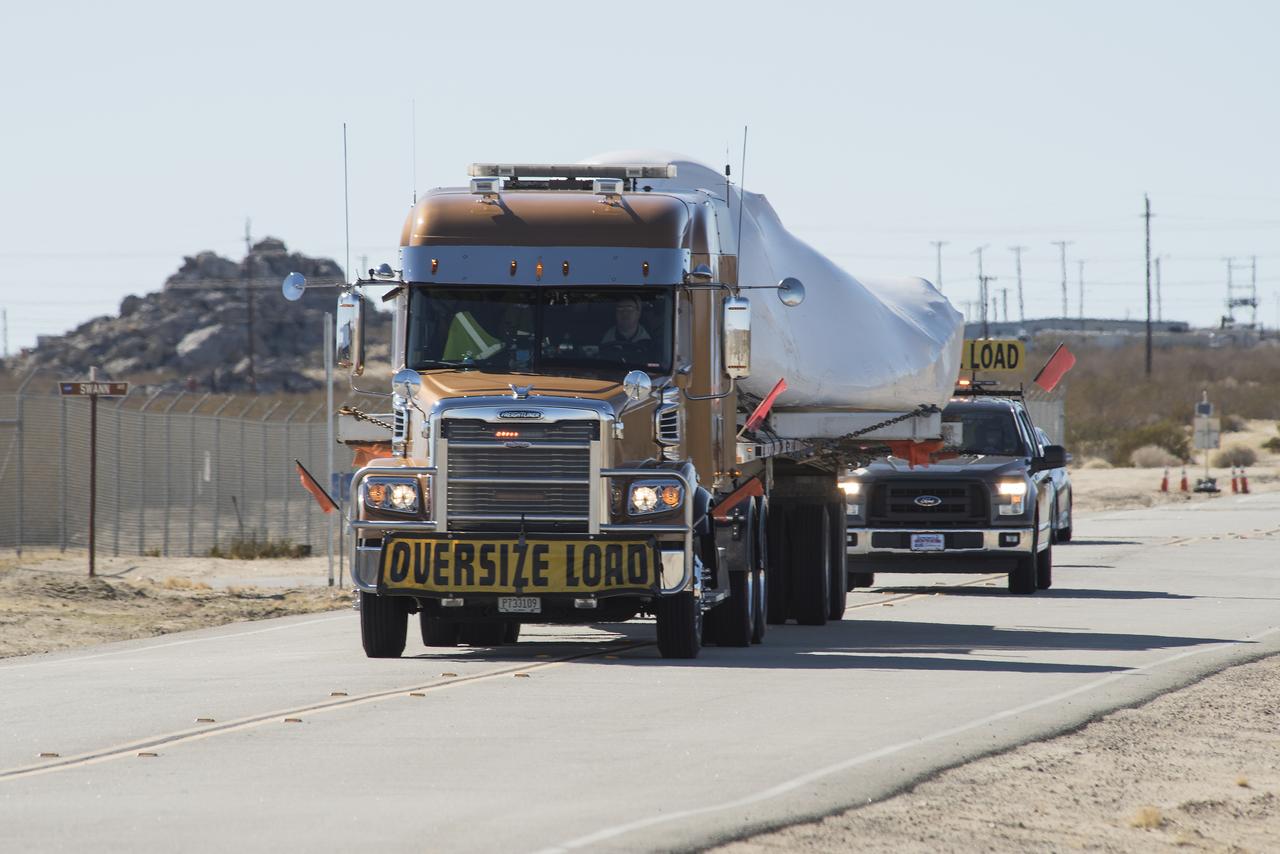
Sierra Nevada Corporation’s Dream Chaser spacecraft arrives by truck at NASA’s Armstrong Flight Research Center in California, located on Edwards Air Force Base. The spacecraft will undergo several months of testing in preparation for its approach and landing flight on the base’s 22L runway. The test series is part of a developmental space act agreement SNC has with NASA’s Commercial Crew Program and will help SNC validate aerodynamic properties, flight software and control system performance. The Dream Chaser is also being prepared to deliver cargo to the International Space Station under NASA’s Commercial Resupply Services 2 contract beginning in 2019. The cargo Dream Chaser will fly at least six delivery missions to and from the space station by 2024.
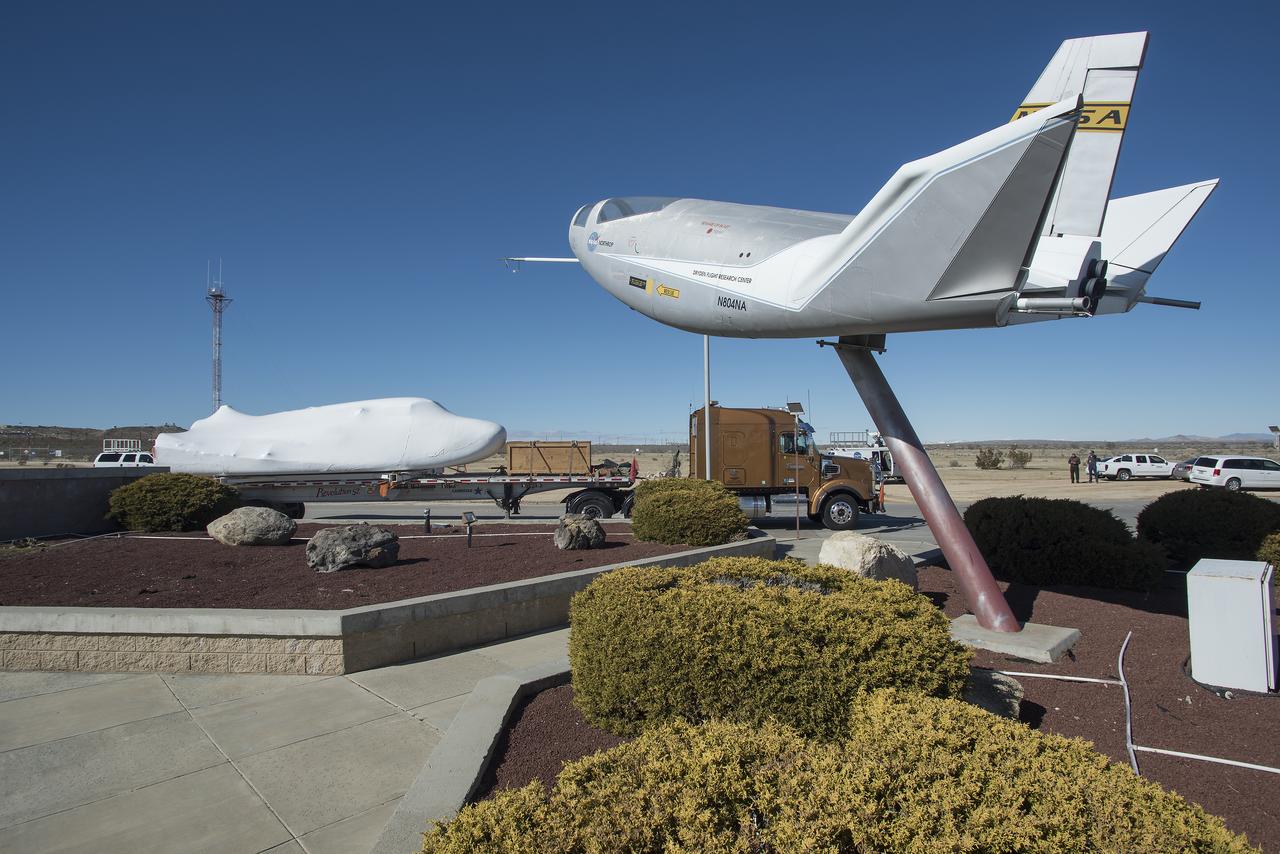
Sierra Nevada Corporation’s Dream Chaser spacecraft arrives by truck at NASA’s Armstrong Flight Research Center in California, located on Edwards Air Force Base. The spacecraft will undergo several months of testing in preparation for its approach and landing flight on the base’s 22L runway. The test series is part of a developmental space act agreement SNC has with NASA’s Commercial Crew Program and will help SNC validate aerodynamic properties, flight software and control system performance. The Dream Chaser is also being prepared to deliver cargo to the International Space Station under NASA’s Commercial Resupply Services 2 contract beginning in 2019. The cargo Dream Chaser will fly at least six delivery missions to and from the space station by 2024.
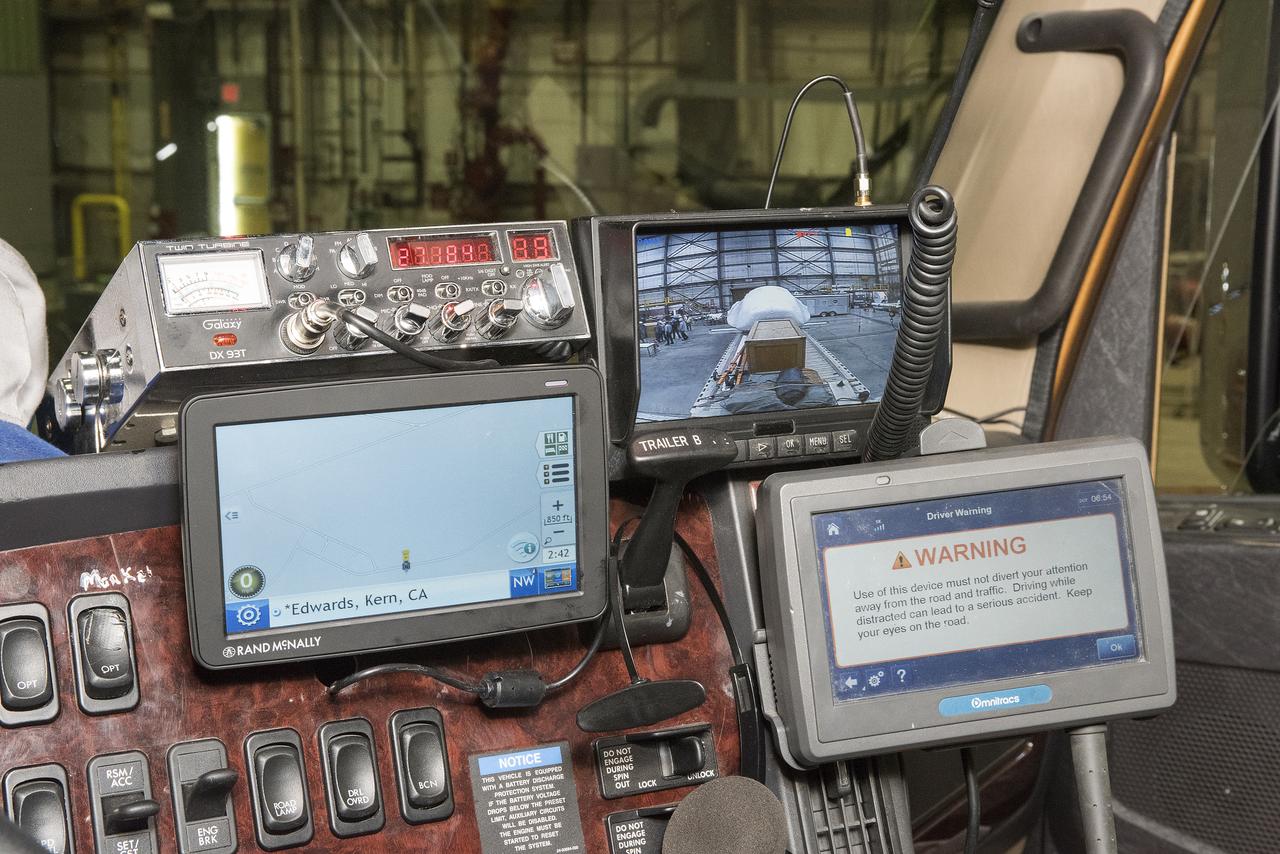
Sierra Nevada Corporation’s Dream Chaser spacecraft arrives by truck at NASA’s Armstrong Flight Research Center in California, located on Edwards Air Force Base. The spacecraft will undergo several months of testing in preparation for its approach and landing flight on the base’s 22L runway. The test series is part of a developmental space act agreement SNC has with NASA’s Commercial Crew Program and will help SNC validate aerodynamic properties, flight software and control system performance. The Dream Chaser is also being prepared to deliver cargo to the International Space Station under NASA’s Commercial Resupply Services 2 contract beginning in 2019. The cargo Dream Chaser will fly at least six delivery missions to and from the space station by 2024.
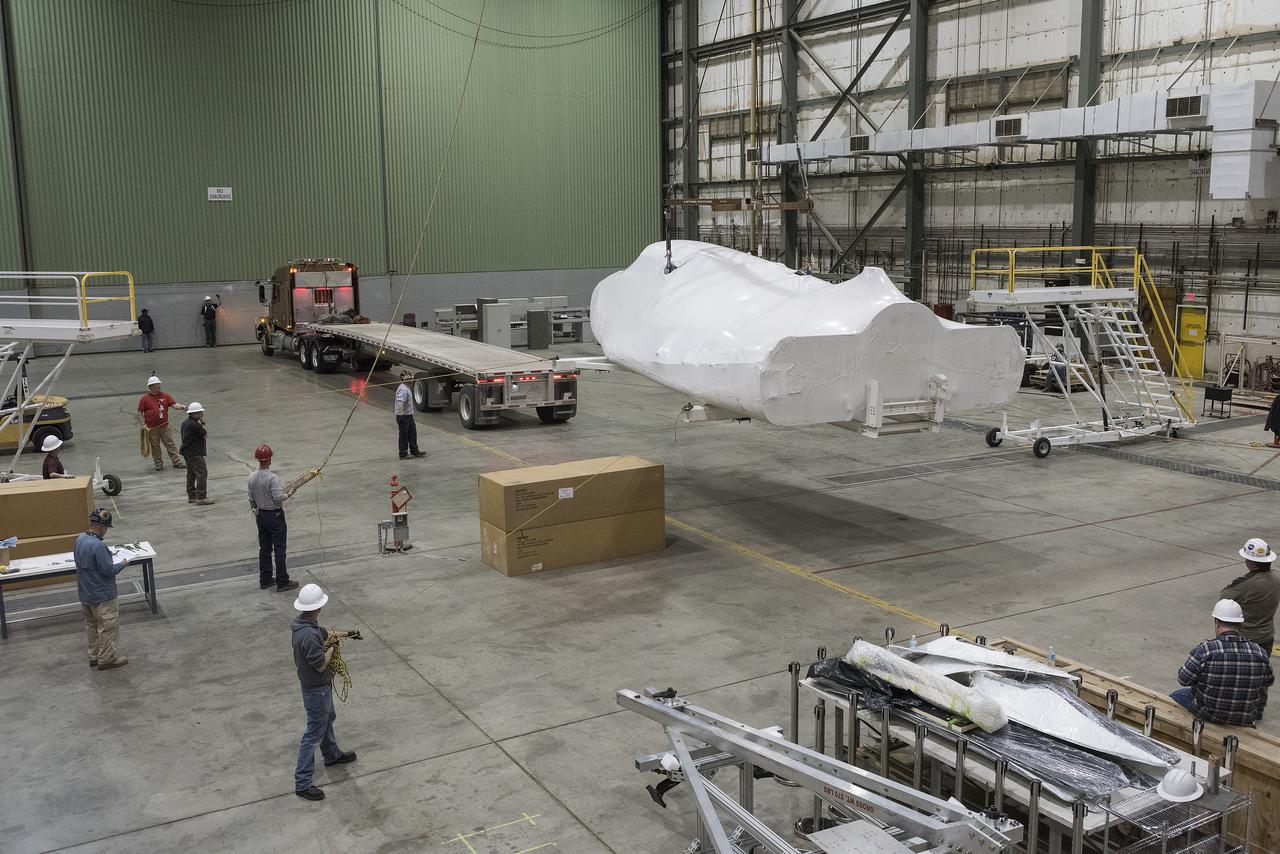
Sierra Nevada Corporation’s Dream Chaser spacecraft is removed from its delivery truck after arriving at NASA’s Armstrong Flight Research Center in California, located on Edwards Air Force Base. The spacecraft will undergo several months of testing in preparation for its approach and landing flight on the base’s 22L runway. The test series is part of a developmental space act agreement SNC has with NASA’s Commercial Crew Program and will help SNC validate aerodynamic properties, flight software and control system performance. The Dream Chaser is also being prepared to deliver cargo to the International Space Station under NASA’s Commercial Resupply Services 2 contract beginning in 2019. The cargo Dream Chaser will fly at least six delivery missions to and from the space station by 2024.
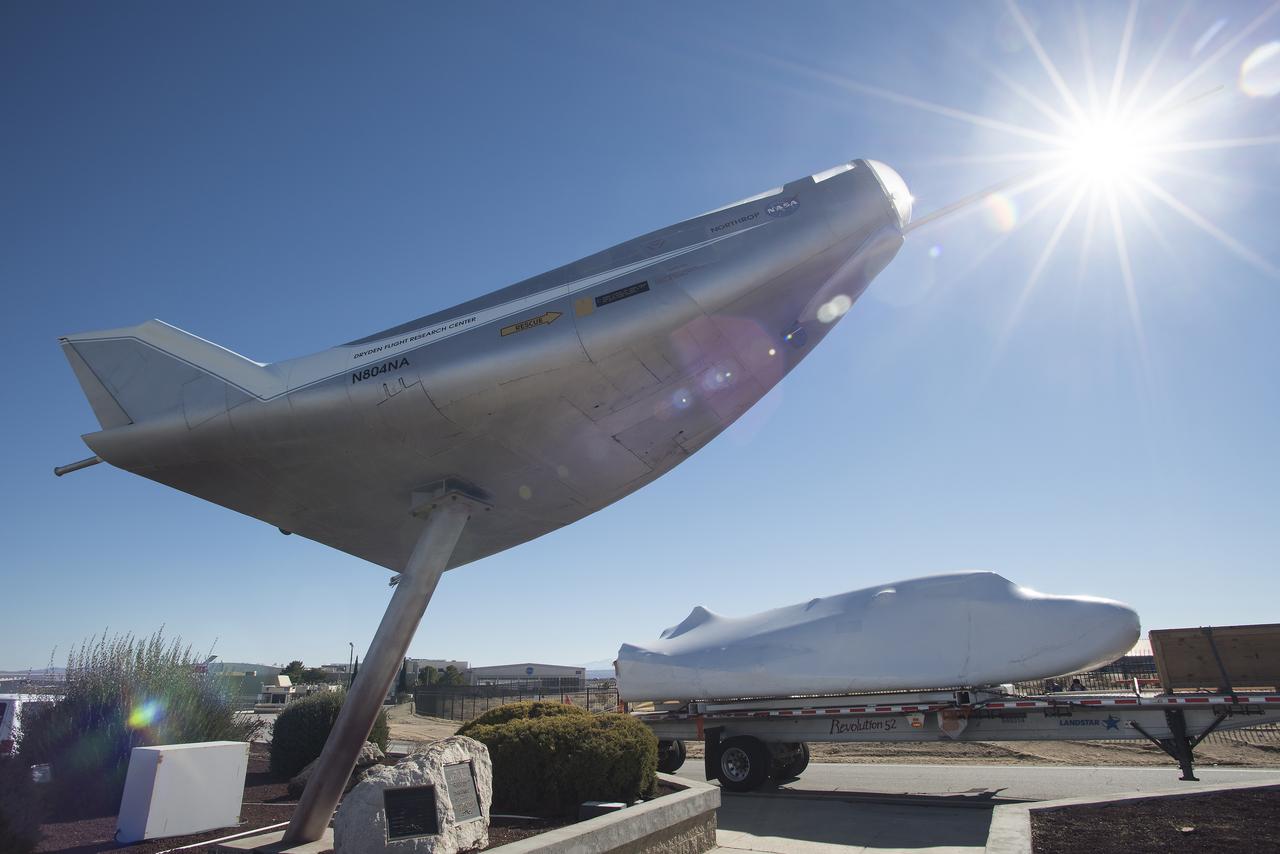
Sierra Nevada Corporation’s Dream Chaser spacecraft arrives by truck at NASA’s Armstrong Flight Research Center in California, located on Edwards Air Force Base. The spacecraft will undergo several months of testing in preparation for its approach and landing flight on the base’s 22L runway. The test series is part of a developmental space act agreement SNC has with NASA’s Commercial Crew Program and will help SNC validate aerodynamic properties, flight software and control system performance. The Dream Chaser is also being prepared to deliver cargo to the International Space Station under NASA’s Commercial Resupply Services 2 contract beginning in 2019. The cargo Dream Chaser will fly at least six delivery missions to and from the space station by 2024.
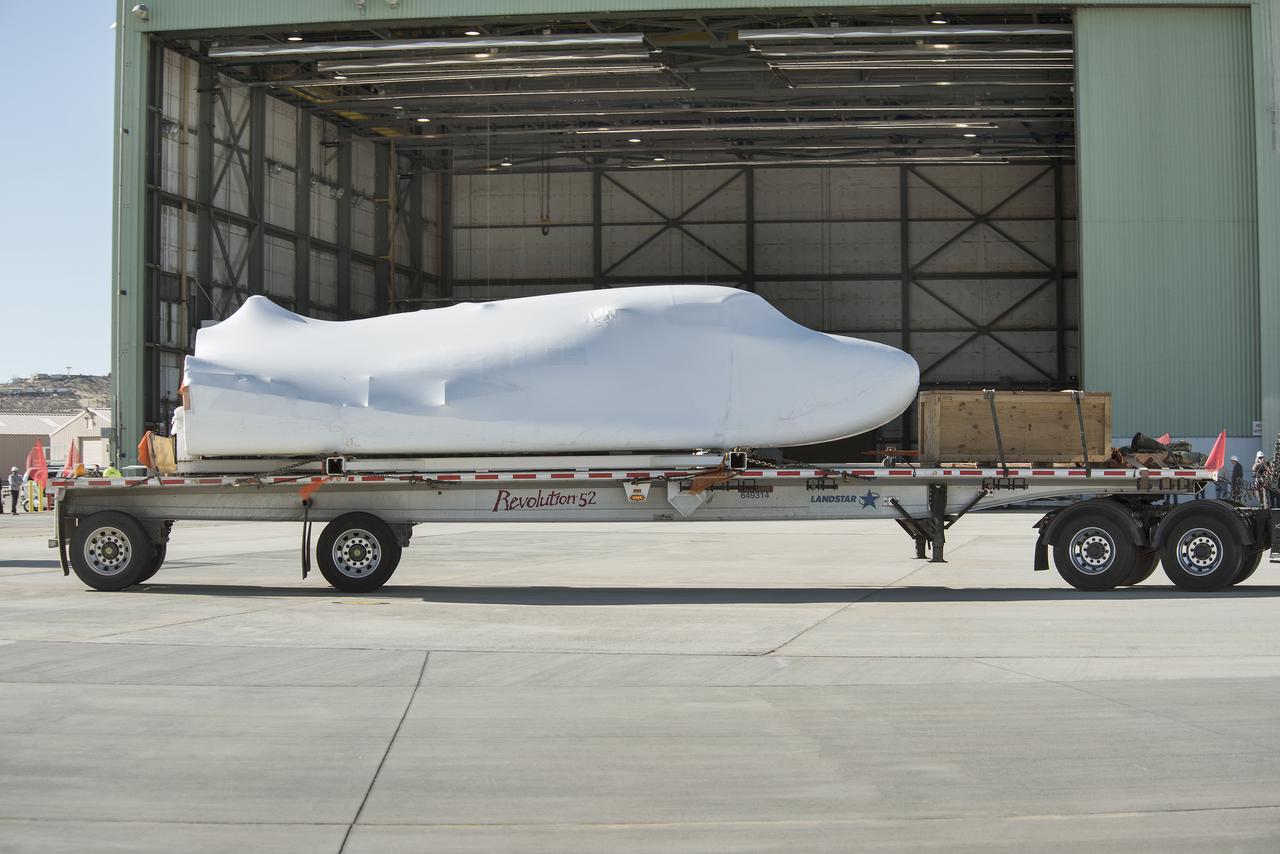
Sierra Nevada Corporation’s Dream Chaser spacecraft arrives by truck at NASA’s Armstrong Flight Research Center in California, located on Edwards Air Force Base. The spacecraft will undergo several months of testing in preparation for its approach and landing flight on the base’s 22L runway. The test series is part of a developmental space act agreement SNC has with NASA’s Commercial Crew Program and will help SNC validate aerodynamic properties, flight software and control system performance. The Dream Chaser is also being prepared to deliver cargo to the International Space Station under NASA’s Commercial Resupply Services 2 contract beginning in 2019. The cargo Dream Chaser will fly at least six delivery missions to and from the space station by 2024.
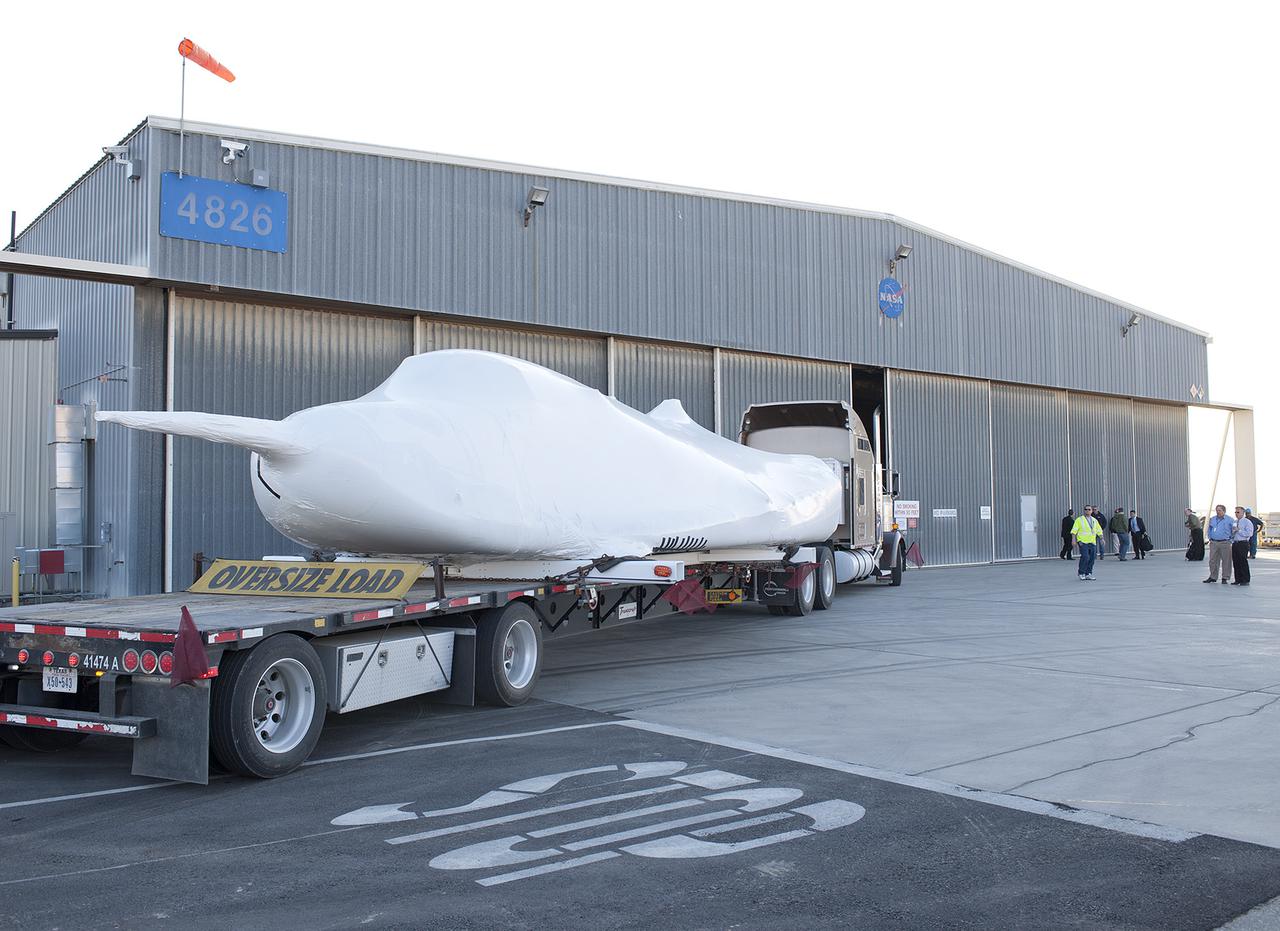
EDWARDS, Calif. – ED13-0142-16: Mounted securely on a flatbed trailer, Sierra Nevada Corporation, or SNC, Space Systems' Dream Chaser engineering test article arrives at Hangar 4826 at NASA's Dryden Flight Research Center on Edwards Air Force Base, Calif., in the morning. One of three low-Earth orbit space access vehicles being developed under NASA's Commercial Crew Program, the Dream Chaser will undergo ground and approach-and-landing flight tests at NASA Dryden during the next several months. SNC is one of three companies working with NASA's Commercial Crew Program, or CCP, during the agency's Commercial Crew Integrated Capability, or CCiCap, initiative, which is intended to lead to the availability of commercial human spaceflight services for government and commercial customers. To learn more about CCP and its industry partners, visit www.nasa.gov_commercialcrew. Image credit: NASA_Tom Tschida
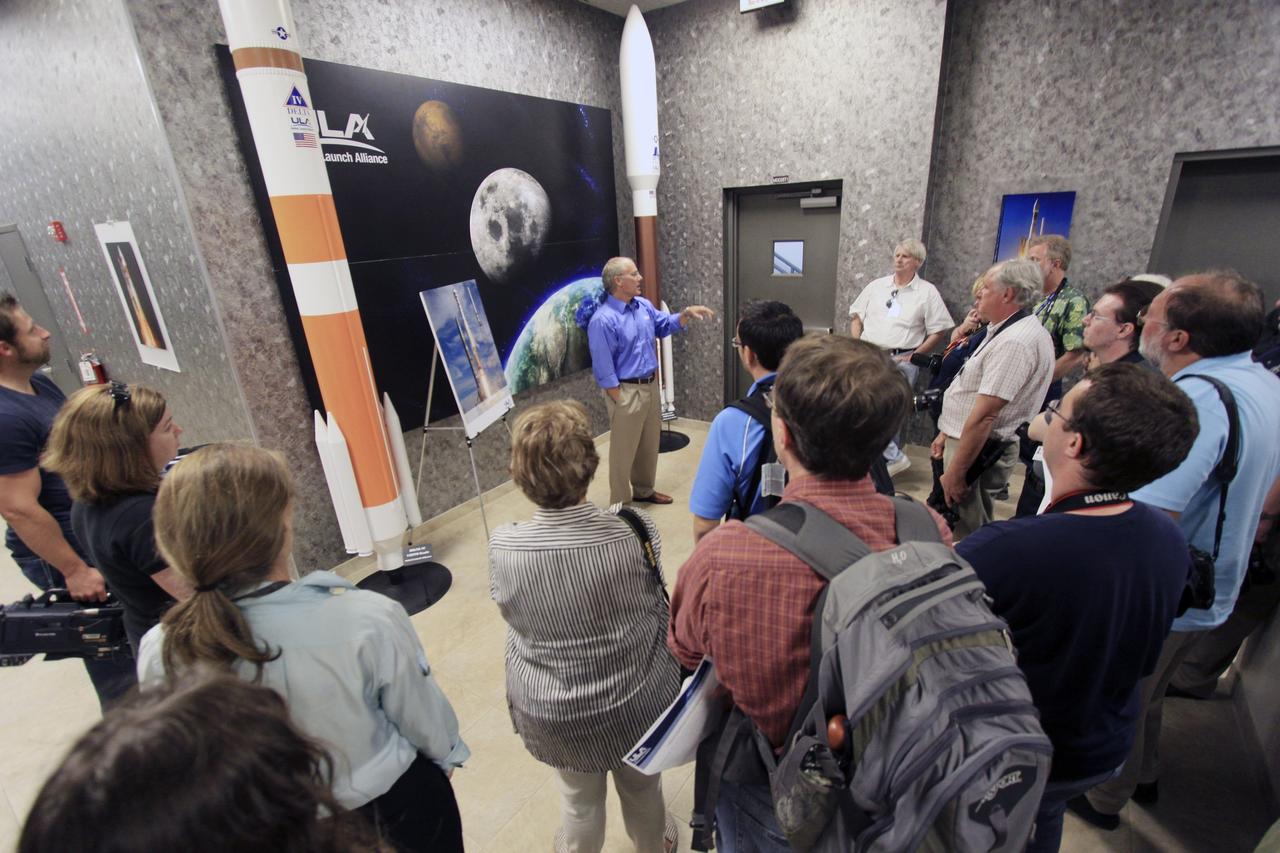
CAPE CANAVERAL, Fla. -- Andy Aldrin, director of business development for United Launch Alliance (ULA), talks to media about plans to launch NASA astronauts to the International Space Station in the Atlas Spaceflight Operations Center (ASOC) at Cape Canaveral Air Force Station in Florida. ULA is working to make its Atlas V rocket safe for humans for NASA's Commercial Crew Program (CCP) under the Commercial Crew Development Round 2 (CCDev2) activities. Part of those plans will be to design and test an emergency detection system and crew access capabilities. ULA also is working with other aerospace system providers developing spacecraft that would launch atop the company's Atlas V rocket, such as Blue Origin, Sierra Nevada and The Boeing Co. CCP, which is based at the adjacent NASA's Kennedy Space Center, is partnering with industry to take crews to the station or other low Earth orbit destinations. Aldrin explained that the goal of ULA will be to develop a human spaceflight capability without altering rocket's proven design and successful track record. It's the freedom to develop innovative solutions such as this that CCP hopes will drive down the cost of space travel as well as open up space to more people than ever before. Seven aerospace companies are maturing launch vehicle and spacecraft designs under CCDev2, including Alliant Techsystems Inc. (ATK) of Promontory, Utah, Blue Origin of Kent, Wash., The Boeing Co., of Houston, Excalibur Almaz Inc. of Houston, Sierra Nevada Corp. of Louisville, Colo., Space Exploration Technologies (SpaceX) of Hawthorne, Calif., and United Launch Alliance (ULA) of Centennial, Colo. For more information, visit www.nasa.gov/exploration/commercial Photo credit: Jim Grossmann
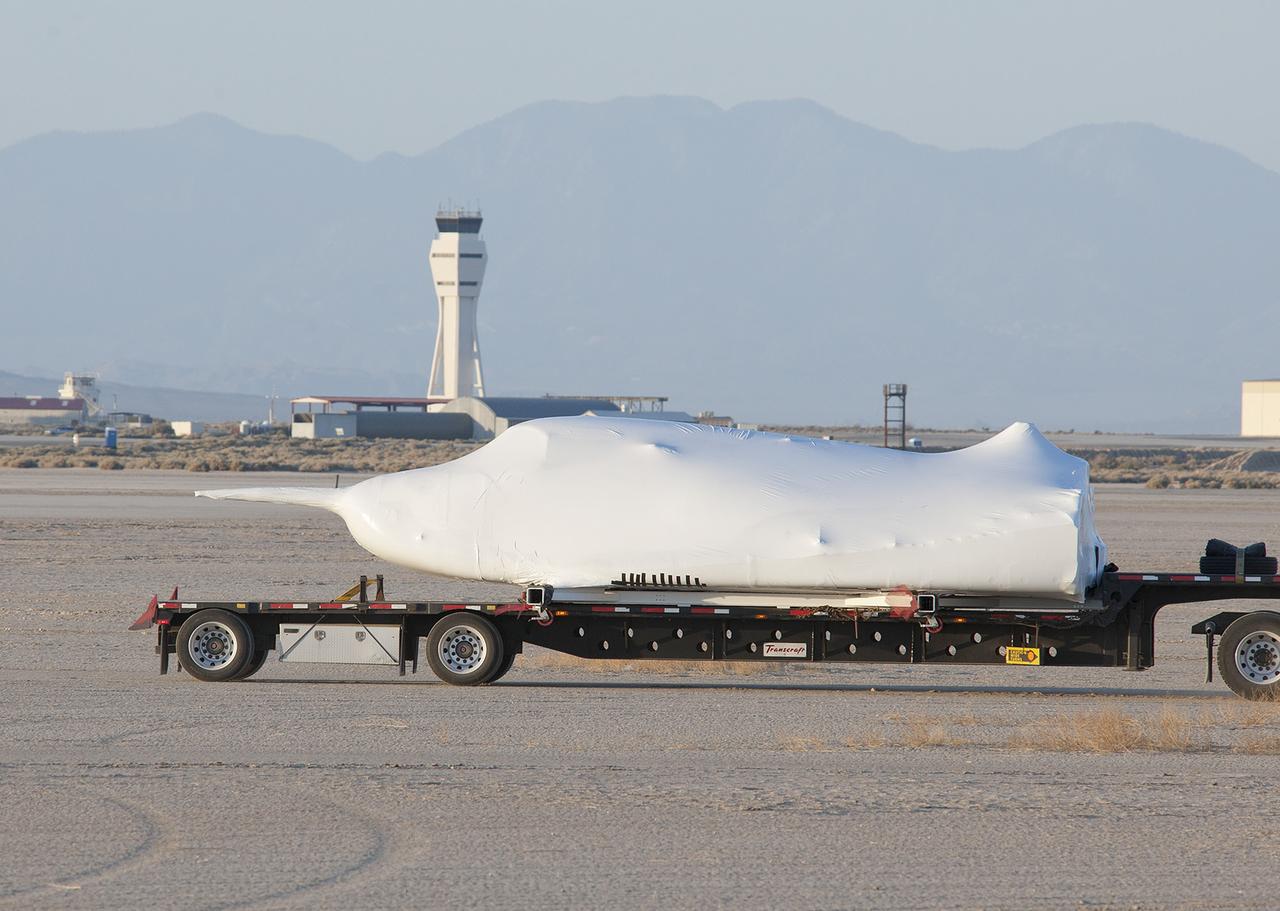
EDWARDS, Calif. – ED13-0142-03: Shrouded in plastic wrap with its wings and tail structure removed for ground transport, Sierra Nevada Corporation, or SNC, Space Systems' Dream Chaser engineering test article is hauled across the bed of Rogers Dry Lake in front of the control tower at Edwards Air Force Base, Calif., to NASA's Dryden Flight Research Center. The Dream Chaser will begin its flight test program in collaboration with NASA's Commercial Crew Program this summer. SNC is one of three companies working with NASA's Commercial Crew Program, or CCP, during the agency's Commercial Crew Integrated Capability, or CCiCap, initiative, which is intended to lead to the availability of commercial human spaceflight services for government and commercial customers. To learn more about CCP and its industry partners, visit www.nasa.gov/commercialcrew. Image credit: NASA/Tom Tschida
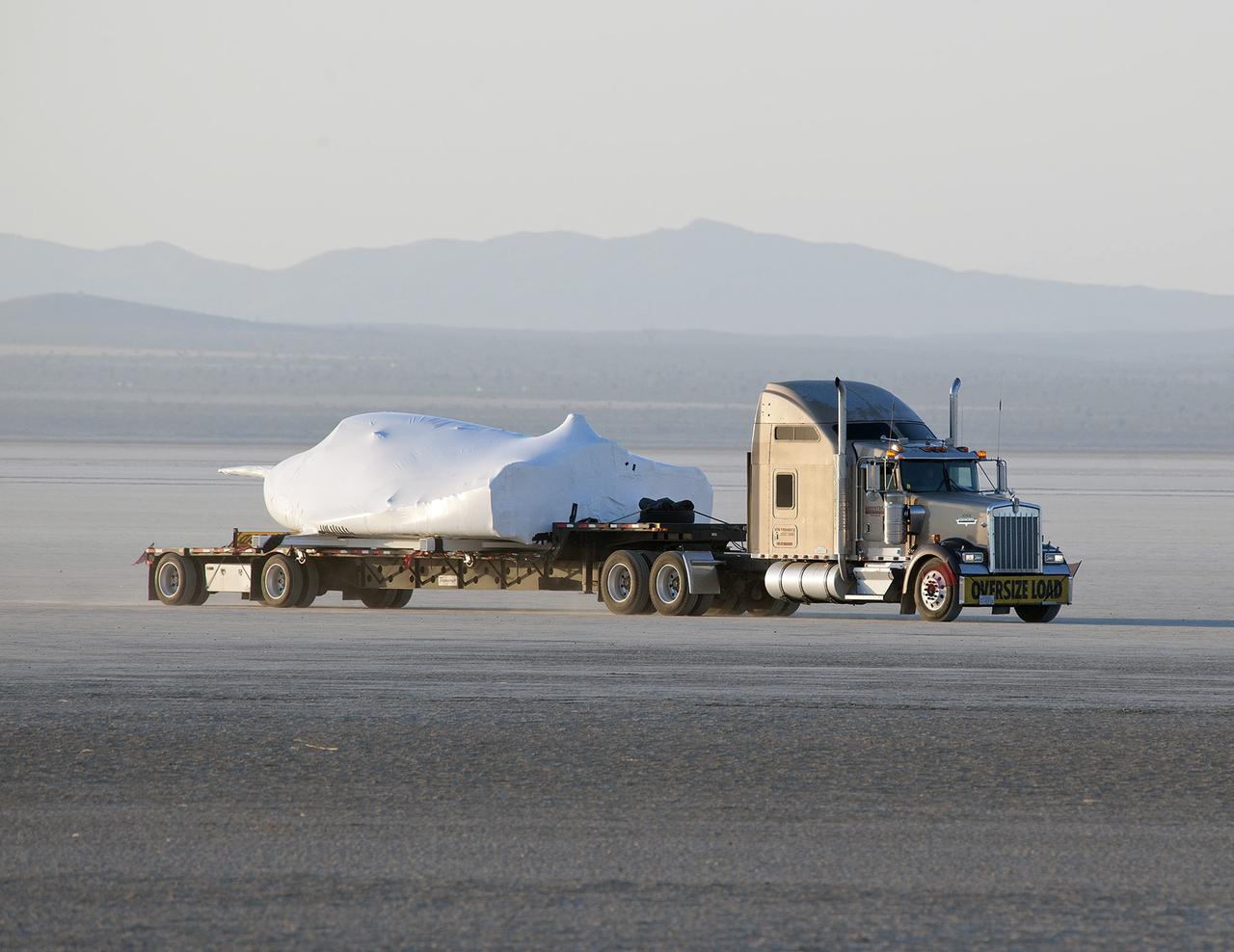
EDWARDS, Calif. – ED13-0142-01: With its wings and tail structure removed and shrouded in plastic wrap for ground transport, Sierra Nevada Corporation, or SNC, Space Systems' Dream Chaser engineering test article is hauled across the bed of Rogers Dry Lake at Edwards Air Force Base, Calif., to NASA's Dryden Flight Research Center. The Dream Chaser will begin its approach-and-landing flight test program in collaboration with NASA's Commercial Crew Program this summer. SNC is one of three companies working with NASA's Commercial Crew Program, or CCP, during the agency's Commercial Crew Integrated Capability, or CCiCap, initiative, which is intended to lead to the availability of commercial human spaceflight services for government and commercial customers. To learn more about CCP and its industry partners, visit www.nasa.gov/commercialcrew. Image credit: NASA/Tom Tschida
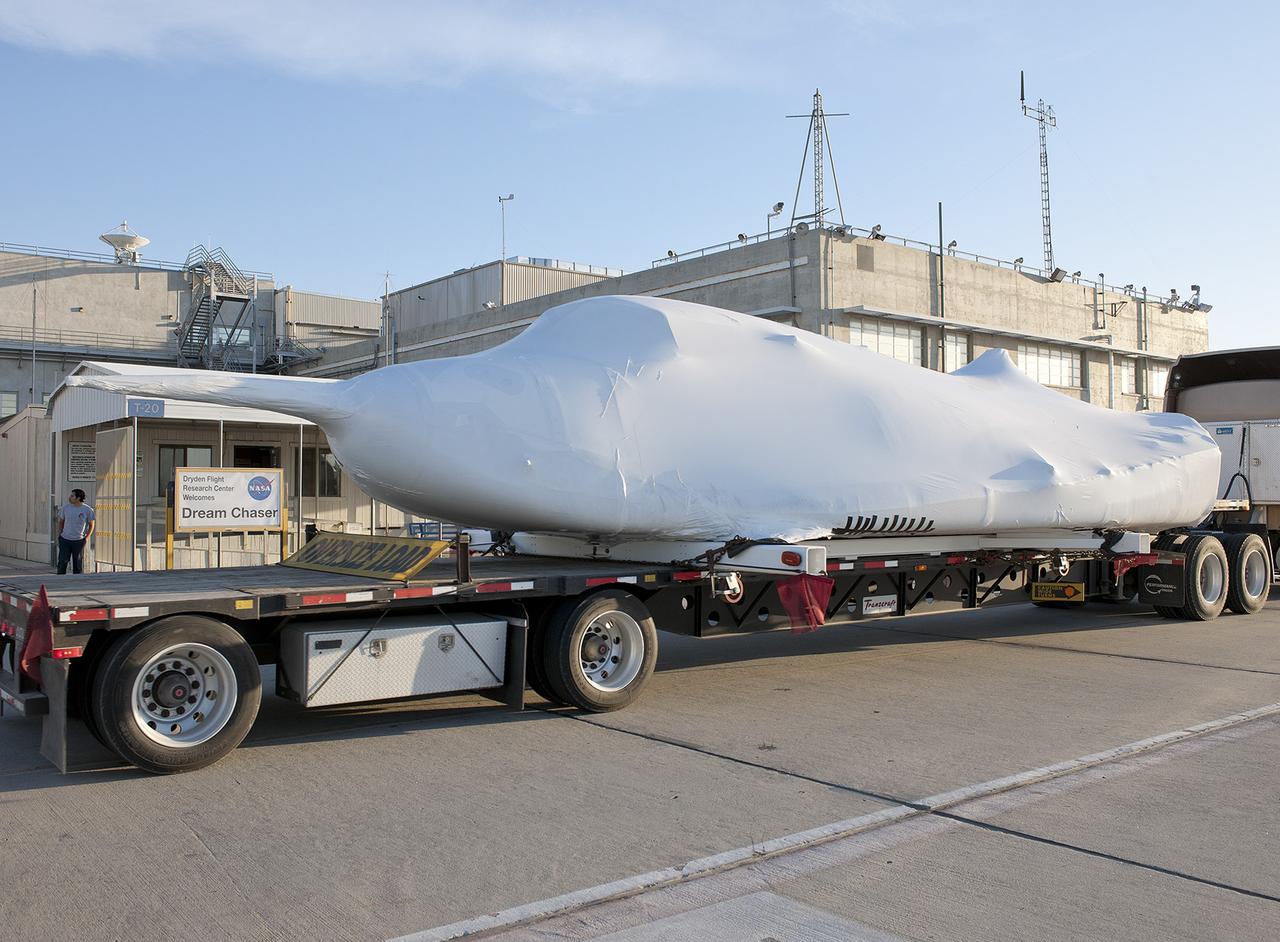
EDWARDS, Calif. – ED13-0142-10: The flatbed truck and trailer that transported Sierra Nevada Corporation, or SNC, Space Systems' Dream Chaser engineering test article pauses on the aircraft ramp at NASA's Dryden Flight Research Center on Edwards Air Force Base, Calif., upon arrival at the center. Following removal of the protective plastic wrap and reinstallation of its wings and tail structure, the Dream Chaser will begin ground tests in the next few weeks leading to approach and landing flight tests this summer. SNC is one of three companies working with NASA's Commercial Crew Program, or CCP, during the agency's Commercial Crew Integrated Capability, or CCiCap, initiative, which is intended to lead to the availability of commercial human spaceflight services for government and commercial customers. To learn more about CCP and its industry partners, visit www.nasa.gov/commercialcrew. Image credit: NASA/Tom Tschida
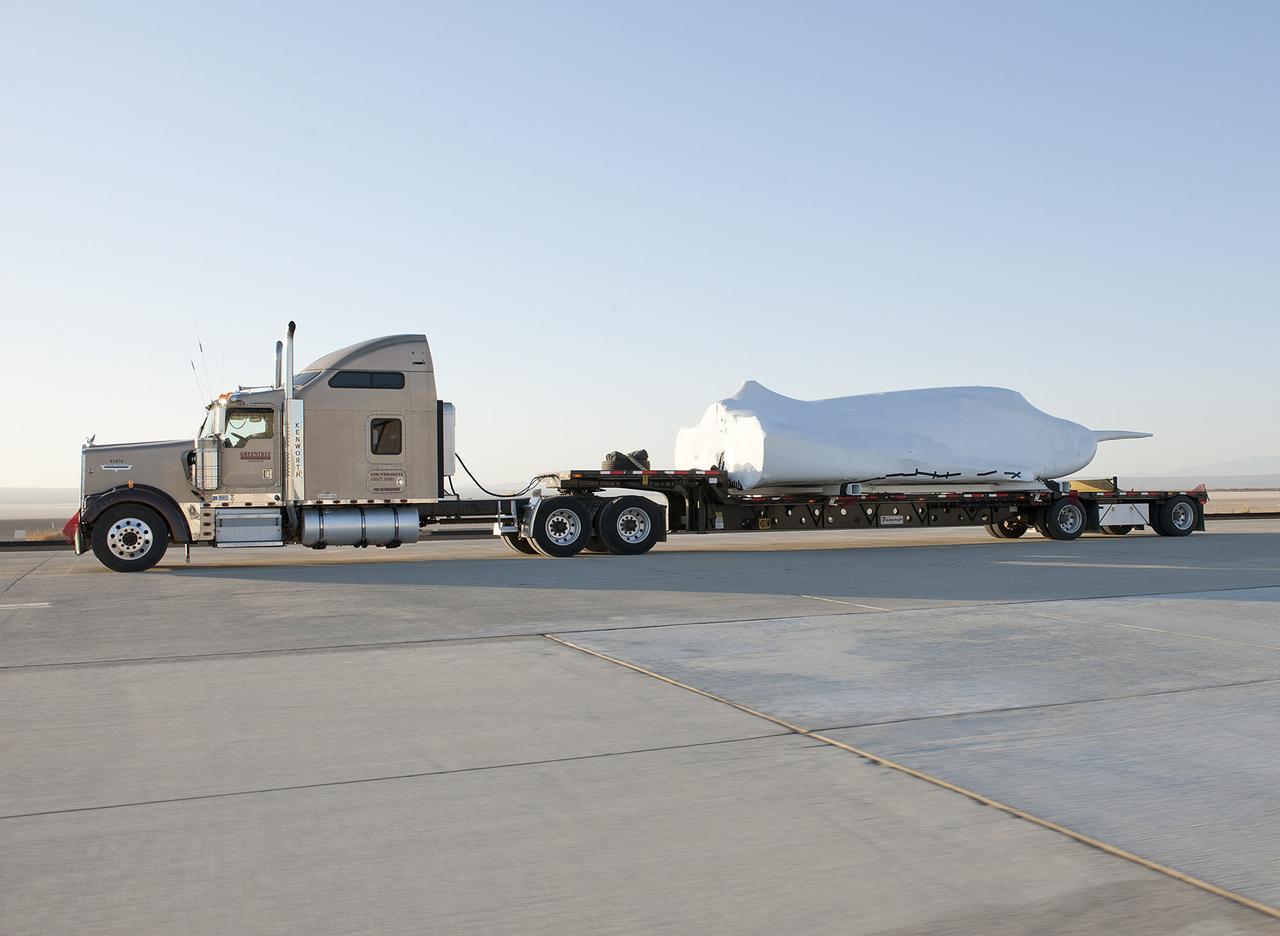
EDWARDS, Calif. – ED13-0142-11: The truck and trailer that transported the Dream Chaser engineering test article from Sierra Nevada Corporation, or SNC, Space Systems facility in Louisville, Colo., arrives on the aircraft ramp at NASA's Dryden Flight Research Center on Edwards Air Force Base, Calif., early in the morning. Based on NASA's HL-20 lifting body design, the Dream Chaser will begin its approach-and-landing flight test program in collaboration with NASA's Commercial Crew Program this summer. SNC is one of three companies working with NASA's Commercial Crew Program, or CCP, during the agency's Commercial Crew Integrated Capability, or CCiCap, initiative, which is intended to lead to the availability of commercial human spaceflight services for government and commercial customers. To learn more about CCP and its industry partners, visit www.nasa.gov/commercialcrew. Image credit: NASA/Tom Tschida
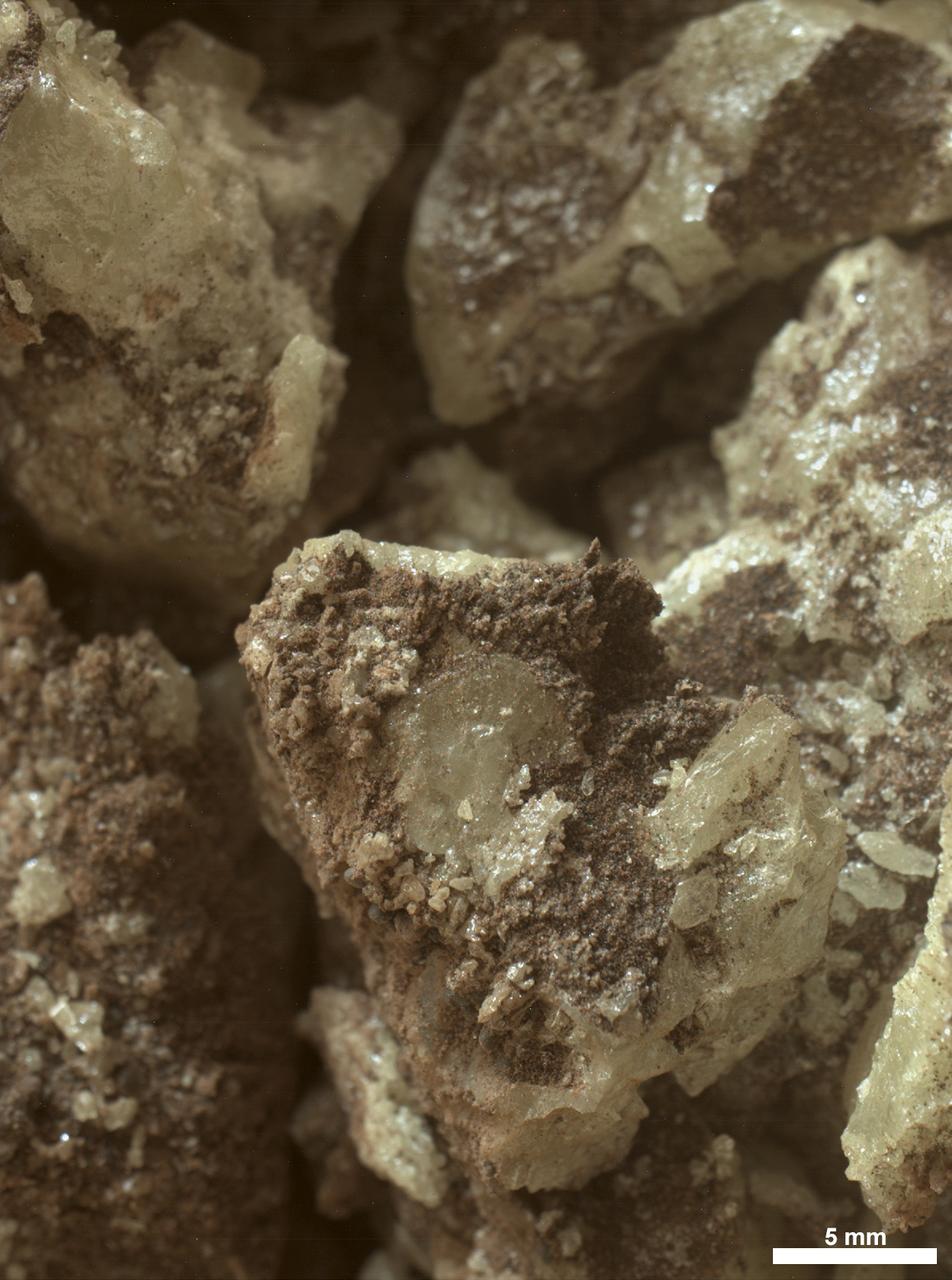
These sulfur crystals were found inside a rock after NASA’s Curiosity Mars rover happened to drive over it and crush it on May 30, 2024, the 4,200th Martian day, or sol, of the mission. The image was captured by Curiosity’s Mars Hand Lens Imager (MAHLI), a camera on the end of its robotic arm, on June 4, 2024, Sol 4,205. This rock was nicknamed “Convict Lake” after a location in California’s Sierra Nevada. Curiosity’s Alpha Particle X-Ray Spectrometer (APXS) found that the crystalline material is elemental sulfur. Curiosity was built by NASA’s Jet Propulsion Laboratory, which is managed by Caltech in Pasadena, California. JPL leads the mission on behalf of NASA’s Science Mission Directorate in Washington. MAHLI was built by Malin Space Science Systems in San Diego. For more about Curiosity, visit: https://science.nasa.gov/mission/msl-curiosity.
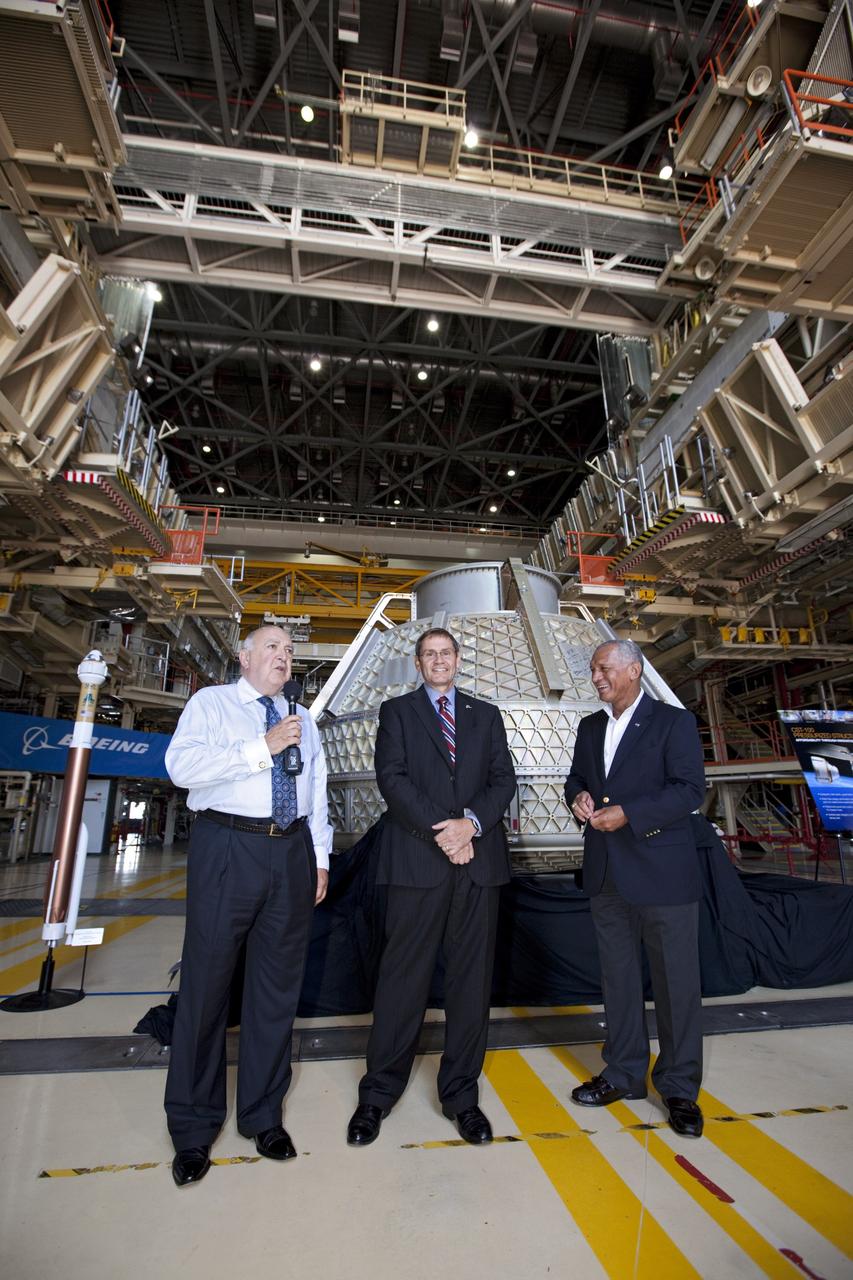
CAPE CANAVERAL, Fla. – Space Florida President Frank DiBello, NASA Administrator Charlie Bolden, and Boeing's Vice President and General Manager of Space Exploration John Elbon address the media inside Orbiter Processing Facility-3, or OPF-3, at NASA's Kennedy Space Center in Florida. Bolden took a few dozen media on a road show tour of the center and adjacent Cape Canaveral Air Force Station to show the progress being made for future government and commercial space endeavors that will begin from Florida's Space Coast. Boeing is leasing OPF-3 through an agreement with Space Florida for the manufacturing and assembly of its CST-100 spacecraft, which is under development in collaboration with NASA's Commercial Crew Program. During his tour, Bolden announced that Space Exploration Technologies, or SpaceX, has completed its Space Act Agreement with NASA for Commercial Orbital Transportation Services. SpaceX is scheduled to launch the first of its 12 contracted cargo flights to the space station from Cape Canaveral this October, under NASA’s Commercial Resupply Services Program. Bolden also announced NASA partner Sierra Nevada Corp. has conducted its first milestone under the agency’s recently announced Commercial Crew Integrated Capability CCiCap initiative. The milestone, a program implementation plan review, marks an important first step in Sierra Nevada’s efforts to develop a crew transportation system with its Dream Chaser spacecraft. Through NASA’s commercial space initiatives and programs, the agency is providing investments to stimulate the American commercial space industry. Photo credit: NASA/Kim Shiflett
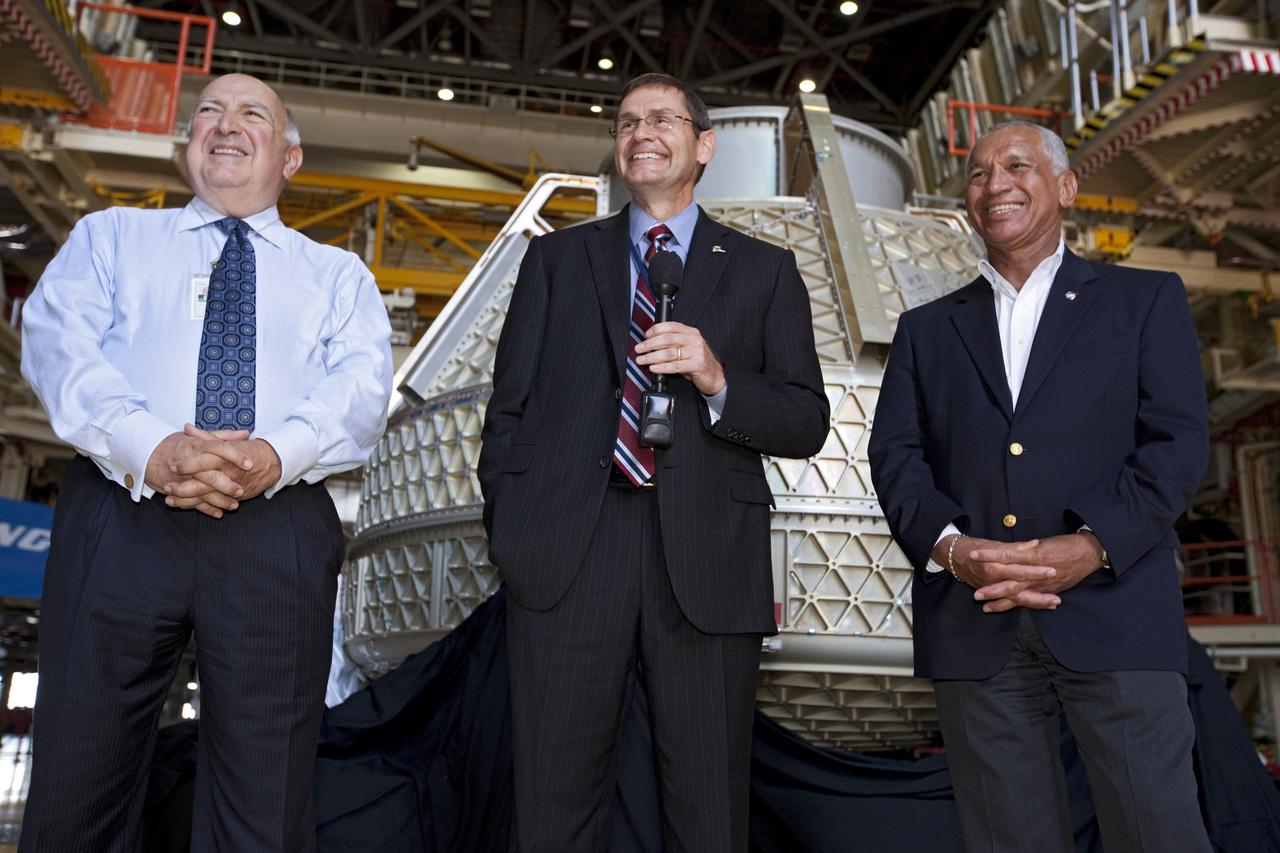
CAPE CANAVERAL, Fla. – Space Florida President Frank DiBello, NASA Administrator Charlie Bolden, and Boeing's Vice President and General Manager of Space Exploration John Elbon address the media inside Orbiter Processing Facility-3, or OPF-3, at NASA's Kennedy Space Center in Florida. Bolden took a few dozen media on a road show tour of the center and adjacent Cape Canaveral Air Force Station to show the progress being made for future government and commercial space endeavors that will begin from Florida's Space Coast. Boeing is leasing OPF-3 through an agreement with Space Florida for the manufacturing and assembly of its CST-100 spacecraft, which is under development in collaboration with NASA's Commercial Crew Program. During his tour, Bolden announced that Space Exploration Technologies, or SpaceX, has completed its Space Act Agreement with NASA for Commercial Orbital Transportation Services. SpaceX is scheduled to launch the first of its 12 contracted cargo flights to the space station from Cape Canaveral this October, under NASA’s Commercial Resupply Services Program. Bolden also announced NASA partner Sierra Nevada Corp. has conducted its first milestone under the agency’s recently announced Commercial Crew Integrated Capability CCiCap initiative. The milestone, a program implementation plan review, marks an important first step in Sierra Nevada’s efforts to develop a crew transportation system with its Dream Chaser spacecraft. Through NASA’s commercial space initiatives and programs, the agency is providing investments to stimulate the American commercial space industry. Photo credit: NASA/Kim Shiflett

CAPE CANAVERAL, Fla. – Space Florida President Frank DiBello, NASA Administrator Charlie Bolden, and Boeing's Vice President and General Manager of Space Exploration John Elbon address the media inside Orbiter Processing Facility-3, or OPF-3, at NASA's Kennedy Space Center in Florida. Bolden took a few dozen media on a road show tour of the center and adjacent Cape Canaveral Air Force Station to show the progress being made for future government and commercial space endeavors that will begin from Florida's Space Coast. Boeing is leasing OPF-3 through an agreement with Space Florida for the manufacturing and assembly of its CST-100 spacecraft, which is under development in collaboration with NASA's Commercial Crew Program. During his tour, Bolden announced that Space Exploration Technologies, or SpaceX, has completed its Space Act Agreement with NASA for Commercial Orbital Transportation Services. SpaceX is scheduled to launch the first of its 12 contracted cargo flights to the space station from Cape Canaveral this October, under NASA’s Commercial Resupply Services Program. Bolden also announced NASA partner Sierra Nevada Corp. has conducted its first milestone under the agency’s recently announced Commercial Crew Integrated Capability CCiCap initiative. The milestone, a program implementation plan review, marks an important first step in Sierra Nevada’s efforts to develop a crew transportation system with its Dream Chaser spacecraft. Through NASA’s commercial space initiatives and programs, the agency is providing investments to stimulate the American commercial space industry. Photo credit: NASA/Kim Shiflett
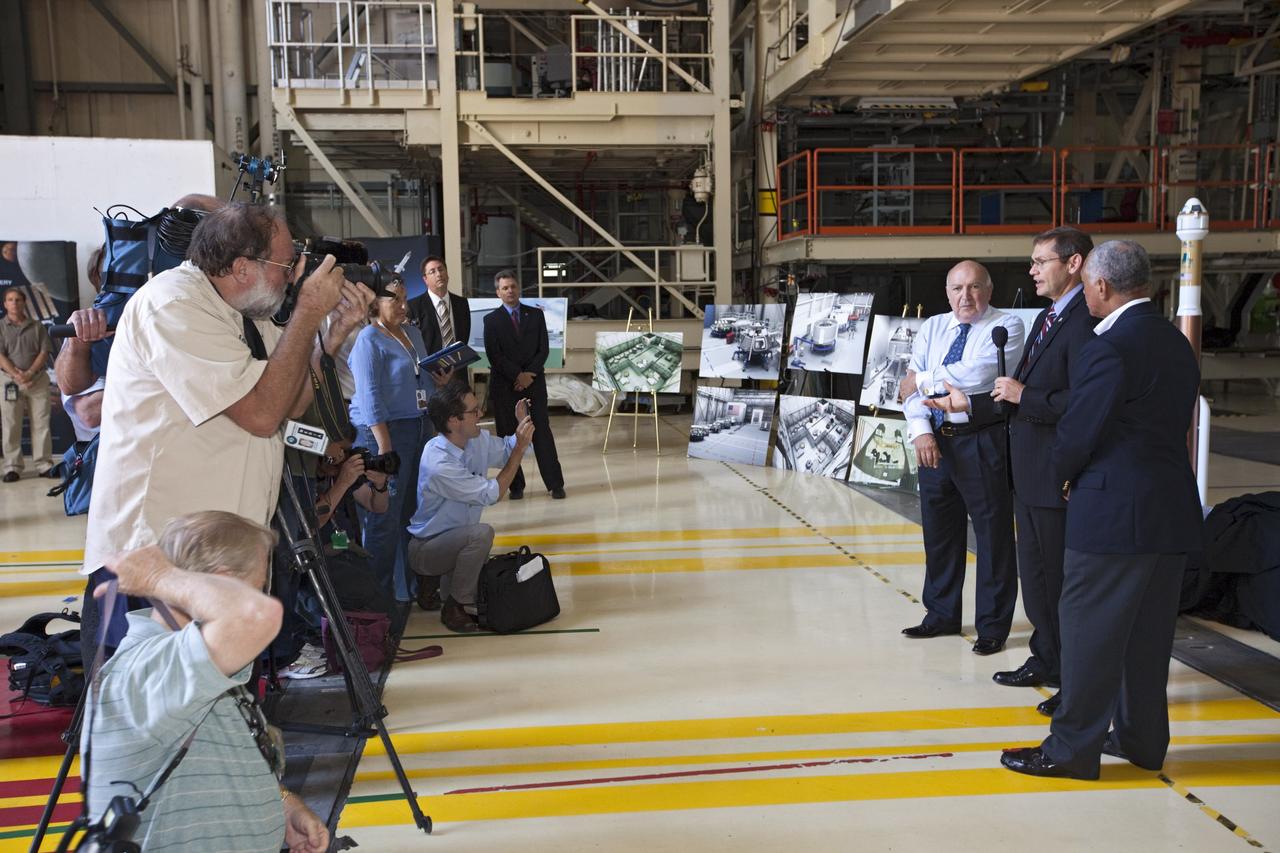
CAPE CANAVERAL, Fla. – Space Florida President Frank DiBello, NASA Administrator Charlie Bolden, and Boeing's Vice President and General Manager of Space Exploration John Elbon address the media inside Orbiter Processing Facility-3, or OPF-3, at NASA's Kennedy Space Center in Florida. Bolden took a few dozen media on a road show tour of the center and adjacent Cape Canaveral Air Force Station to show the progress being made for future government and commercial space endeavors that will begin from Florida's Space Coast. Boeing is leasing OPF-3 through an agreement with Space Florida for the manufacturing and assembly of its CST-100 spacecraft, which is under development in collaboration with NASA's Commercial Crew Program. During his tour, Bolden announced that Space Exploration Technologies, or SpaceX, has completed its Space Act Agreement with NASA for Commercial Orbital Transportation Services. SpaceX is scheduled to launch the first of its 12 contracted cargo flights to the space station from Cape Canaveral this October, under NASA’s Commercial Resupply Services Program. Bolden also announced NASA partner Sierra Nevada Corp. has conducted its first milestone under the agency’s recently announced Commercial Crew Integrated Capability CCiCap initiative. The milestone, a program implementation plan review, marks an important first step in Sierra Nevada’s efforts to develop a crew transportation system with its Dream Chaser spacecraft. Through NASA’s commercial space initiatives and programs, the agency is providing investments to stimulate the American commercial space industry. Photo credit: NASA/Kim Shiflett
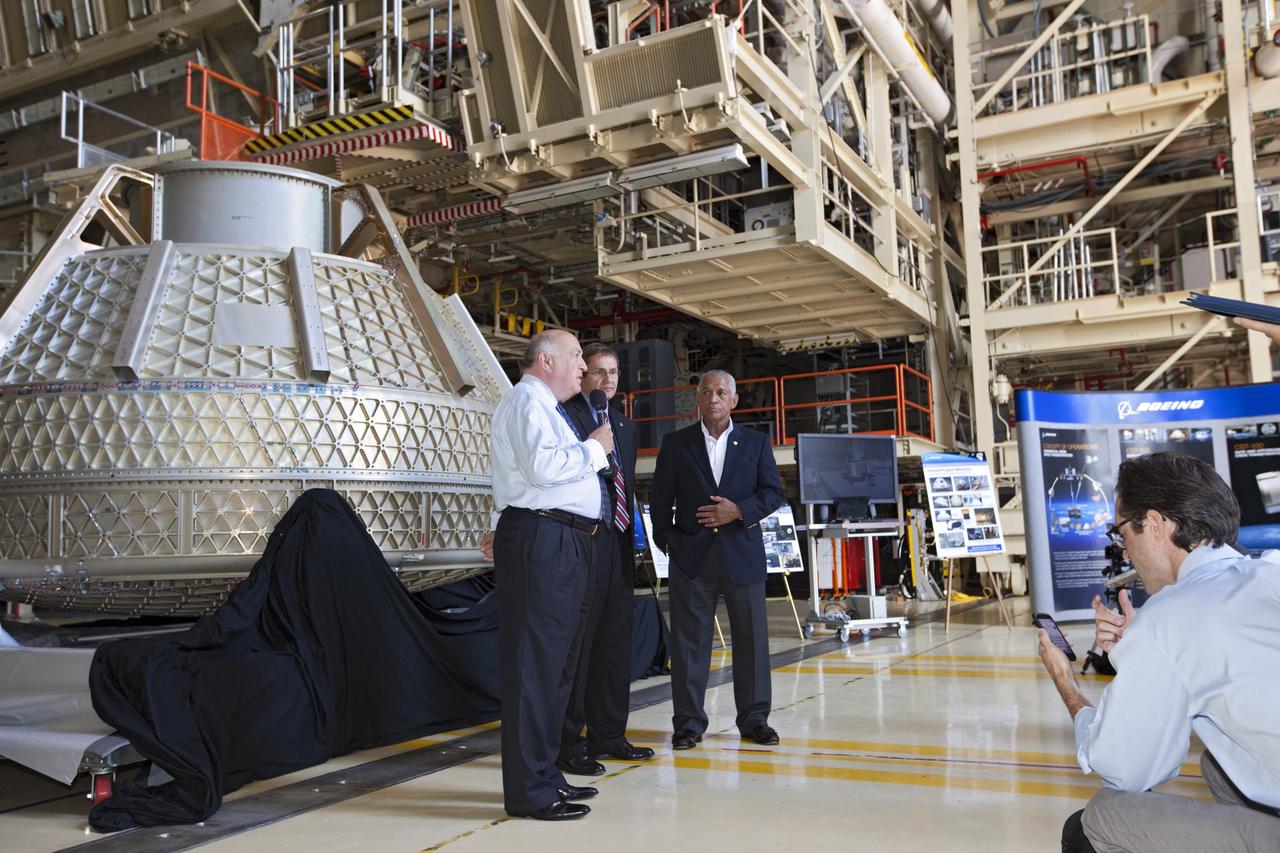
CAPE CANAVERAL, Fla. – Space Florida President Frank DiBello, NASA Administrator Charlie Bolden, and Boeing's Vice President and General Manager of Space Exploration John Elbon address the media inside Orbiter Processing Facility-3, or OPF-3, at NASA's Kennedy Space Center in Florida. Bolden took a few dozen media on a road show tour of the center and adjacent Cape Canaveral Air Force Station to show the progress being made for future government and commercial space endeavors that will begin from Florida's Space Coast. Boeing is leasing OPF-3 through an agreement with Space Florida for the manufacturing and assembly of its CST-100 spacecraft, which is under development in collaboration with NASA's Commercial Crew Program. During his tour, Bolden announced that Space Exploration Technologies, or SpaceX, has completed its Space Act Agreement with NASA for Commercial Orbital Transportation Services. SpaceX is scheduled to launch the first of its 12 contracted cargo flights to the space station from Cape Canaveral this October, under NASA’s Commercial Resupply Services Program. Bolden also announced NASA partner Sierra Nevada Corp. has conducted its first milestone under the agency’s recently announced Commercial Crew Integrated Capability CCiCap initiative. The milestone, a program implementation plan review, marks an important first step in Sierra Nevada’s efforts to develop a crew transportation system with its Dream Chaser spacecraft. Through NASA’s commercial space initiatives and programs, the agency is providing investments to stimulate the American commercial space industry. Photo credit: NASA/Kim Shiflett
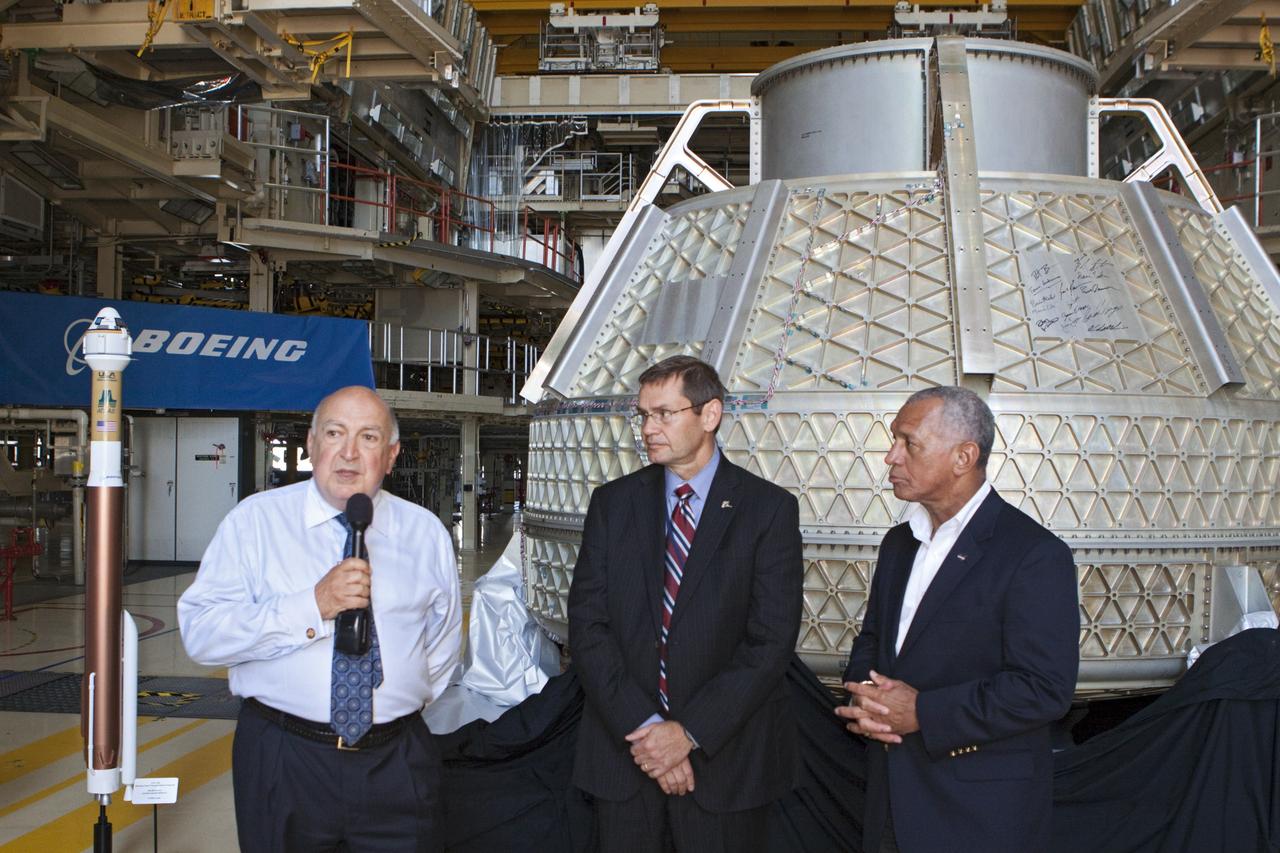
CAPE CANAVERAL, Fla. – Space Florida President Frank DiBello, NASA Administrator Charlie Bolden, and Boeing's Vice President and General Manager of Space Exploration John Elbon address the media inside Orbiter Processing Facility-3, or OPF-3, at NASA's Kennedy Space Center in Florida. Bolden took a few dozen media on a road show tour of the center and adjacent Cape Canaveral Air Force Station to show the progress being made for future government and commercial space endeavors that will begin from Florida's Space Coast. Boeing is leasing OPF-3 through an agreement with Space Florida for the manufacturing and assembly of its CST-100 spacecraft, which is under development in collaboration with NASA's Commercial Crew Program. During his tour, Bolden announced that Space Exploration Technologies, or SpaceX, has completed its Space Act Agreement with NASA for Commercial Orbital Transportation Services. SpaceX is scheduled to launch the first of its 12 contracted cargo flights to the space station from Cape Canaveral this October, under NASA’s Commercial Resupply Services Program. Bolden also announced NASA partner Sierra Nevada Corp. has conducted its first milestone under the agency’s recently announced Commercial Crew Integrated Capability CCiCap initiative. The milestone, a program implementation plan review, marks an important first step in Sierra Nevada’s efforts to develop a crew transportation system with its Dream Chaser spacecraft. Through NASA’s commercial space initiatives and programs, the agency is providing investments to stimulate the American commercial space industry. Photo credit: NASA/Kim Shiflett
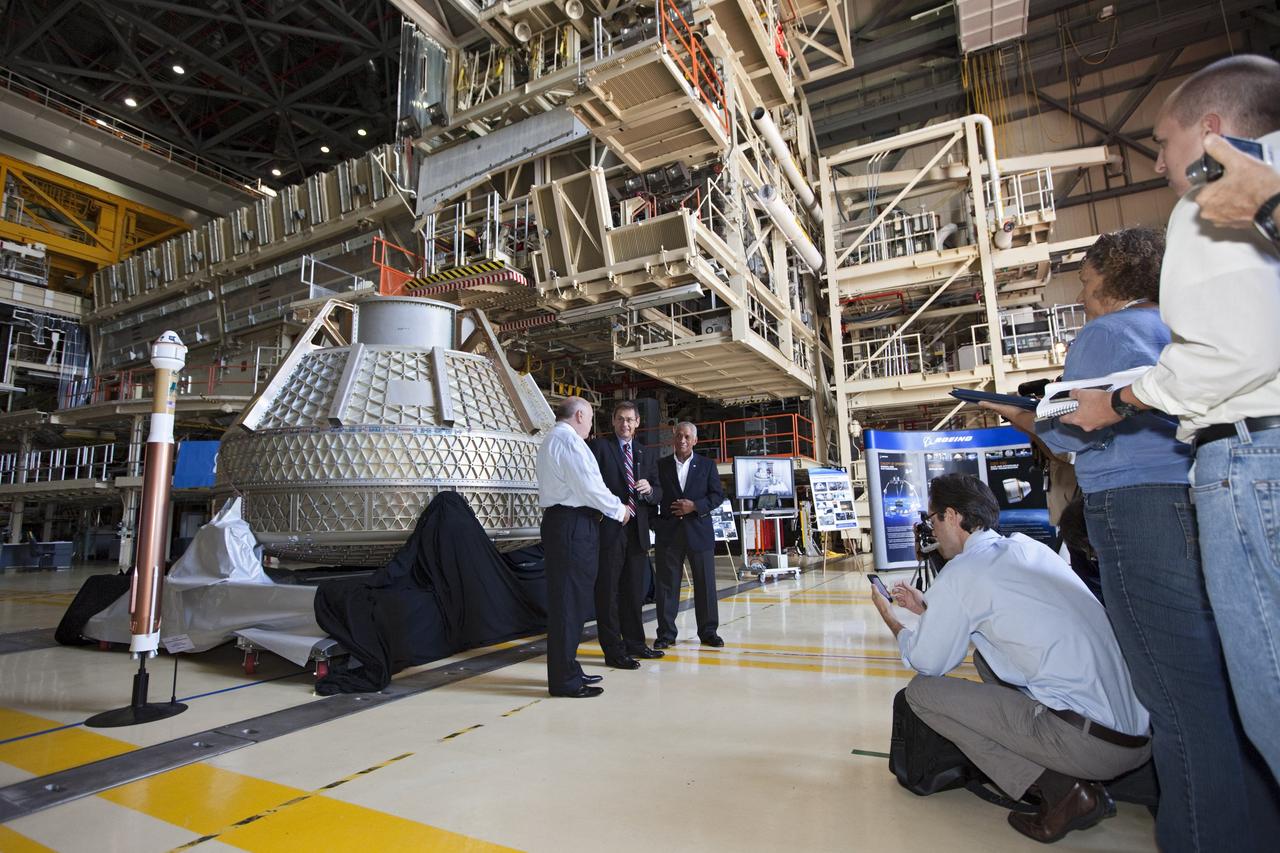
CAPE CANAVERAL, Fla. – Space Florida President Frank DiBello, NASA Administrator Charlie Bolden, and Boeing's Vice President and General Manager of Space Exploration John Elbon address the media inside Orbiter Processing Facility-3, or OPF-3, at NASA's Kennedy Space Center in Florida. Bolden took a few dozen media on a road show tour of the center and adjacent Cape Canaveral Air Force Station to show the progress being made for future government and commercial space endeavors that will begin from Florida's Space Coast. Boeing is leasing OPF-3 through an agreement with Space Florida for the manufacturing and assembly of its CST-100 spacecraft, which is under development in collaboration with NASA's Commercial Crew Program. During his tour, Bolden announced that Space Exploration Technologies, or SpaceX, has completed its Space Act Agreement with NASA for Commercial Orbital Transportation Services. SpaceX is scheduled to launch the first of its 12 contracted cargo flights to the space station from Cape Canaveral this October, under NASA’s Commercial Resupply Services Program. Bolden also announced NASA partner Sierra Nevada Corp. has conducted its first milestone under the agency’s recently announced Commercial Crew Integrated Capability CCiCap initiative. The milestone, a program implementation plan review, marks an important first step in Sierra Nevada’s efforts to develop a crew transportation system with its Dream Chaser spacecraft. Through NASA’s commercial space initiatives and programs, the agency is providing investments to stimulate the American commercial space industry. Photo credit: NASA/Kim Shiflett
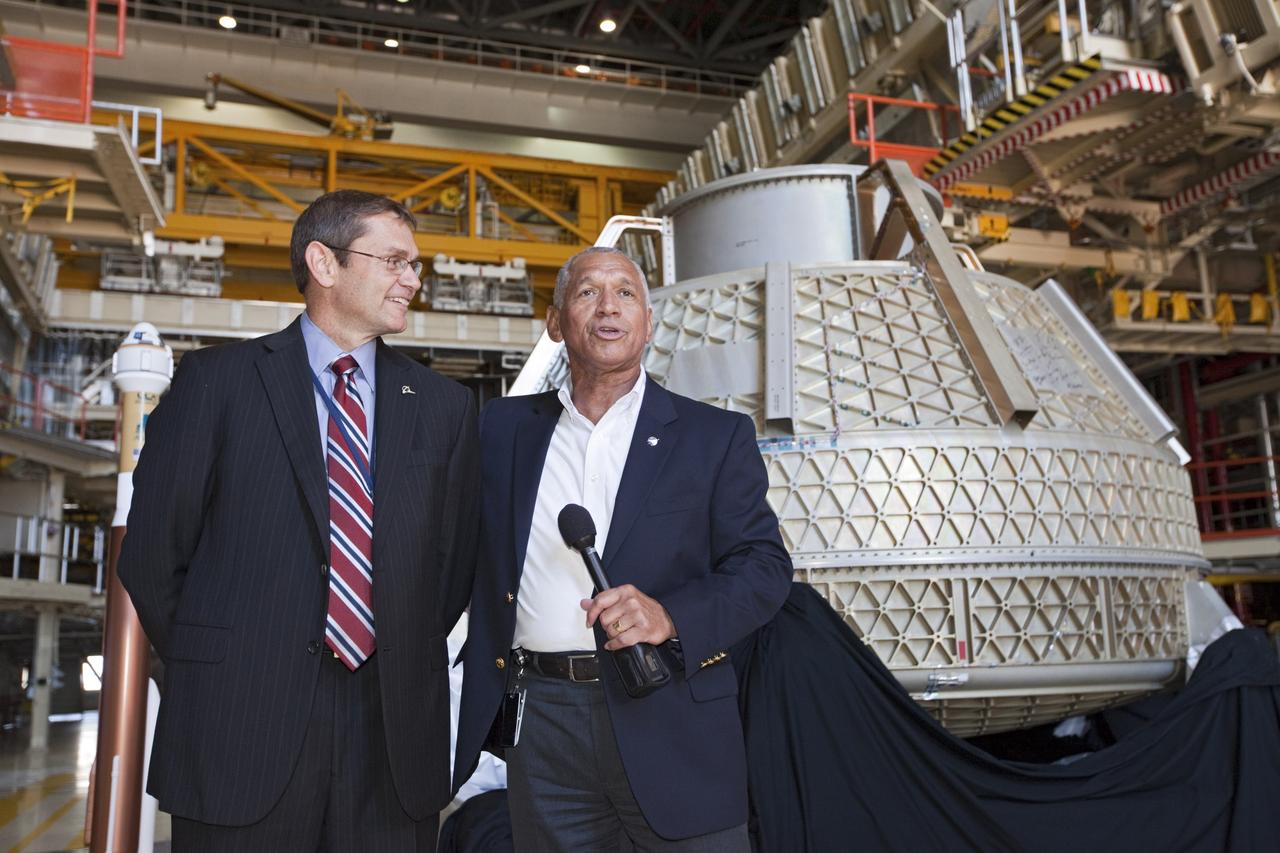
CAPE CANAVERAL, Fla. – NASA Administrator Charlie Bolden, right, and Boeing's Vice President and General Manager of Space Exploration John Elbon address the media inside Orbiter Processing Facility-3, or OPF-3, at NASA's Kennedy Space Center in Florida. Bolden took a few dozen media on a road show tour of the center and adjacent Cape Canaveral Air Force Station to show the progress being made for future government and commercial space endeavors that will begin from Florida's Space Coast. Boeing is leasing OPF-3 through an agreement with Space Florida for the manufacturing and assembly of its CST-100 spacecraft, which is under development in collaboration with NASA's Commercial Crew Program. During his tour, Bolden announced that Space Exploration Technologies, or SpaceX, has completed its Space Act Agreement with NASA for Commercial Orbital Transportation Services. SpaceX is scheduled to launch the first of its 12 contracted cargo flights to the space station from Cape Canaveral this October, under NASA’s Commercial Resupply Services Program. Bolden also announced NASA partner Sierra Nevada Corp. has conducted its first milestone under the agency’s recently announced Commercial Crew Integrated Capability CCiCap initiative. The milestone, a program implementation plan review, marks an important first step in Sierra Nevada’s efforts to develop a crew transportation system with its Dream Chaser spacecraft. Through NASA’s commercial space initiatives and programs, the agency is providing investments to stimulate the American commercial space industry. Photo credit: NASA/Kim Shiflett
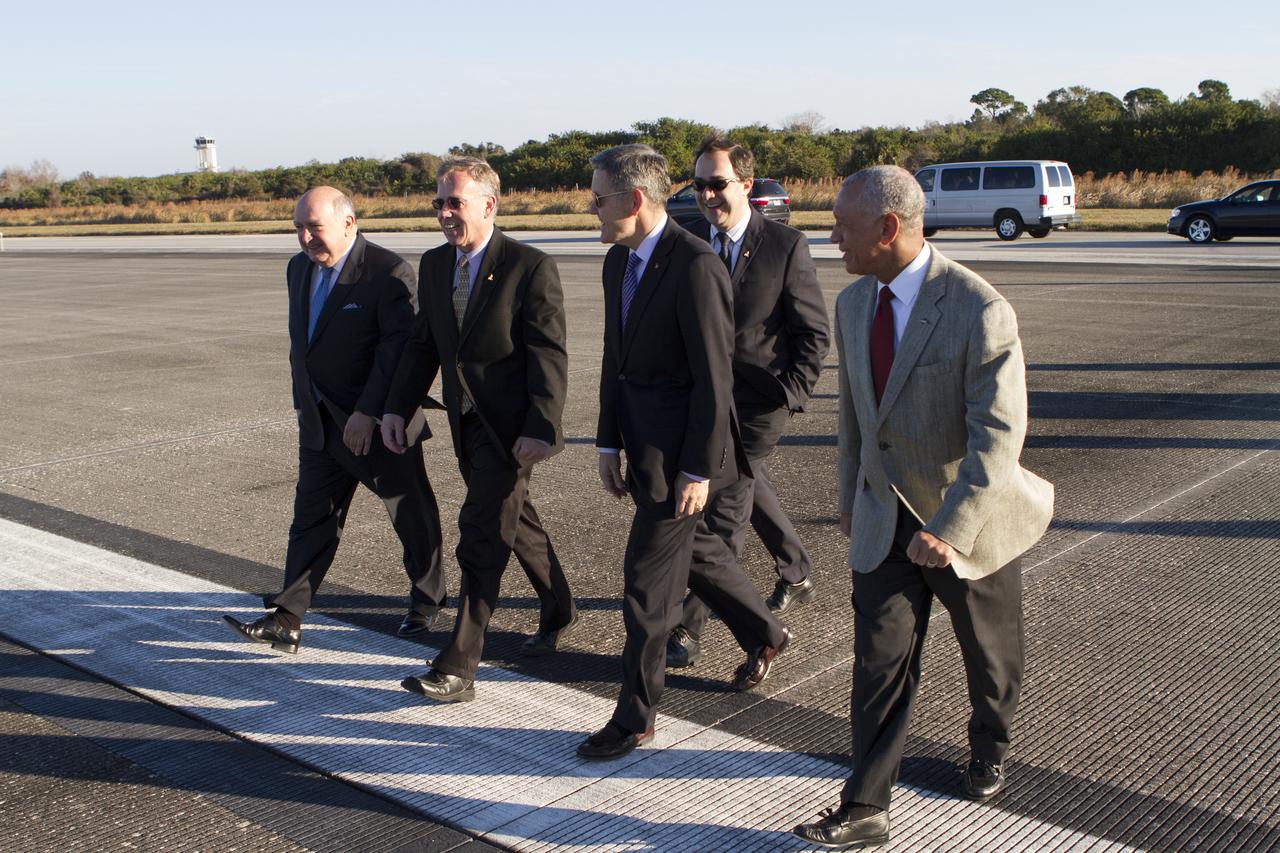
CAPE CANAVERAL, Fla. – NASA and aerospace industry representatives tour facilities along Florida’s Space Coast prior to announcements made by Sierra Nevada Corporation, or SNC, Space Systems, to prepare for a November 2016 orbital flight of its Dream Chaser spacecraft. Walking along the 3.5-mile-long runway at Kennedy Space Center’s Shuttle Landing Facility are, from left, Frank DiBello, president and CEO of Space Florida Steve Lindsey, Dream Chaser program manager for SNC Space Systems Bob Cabana, director of NASA’s Kennedy Space Center Mark Sirangelo, corporate vice president and head of SNC Space Systems and Charlie Bolden, administrator of NASA. The announcements made during a news conference at Kennedy are considered substantial for SNC and important to plans by NASA and Space Florida for Kennedy’s transformation into a multi-user spaceport for both commercial and government customers. SNC announced it plans to work with United Launch Alliance, or ULA, to launch the Dream Chaser spacecraft into orbit atop an Atlas V rocket from Space Launch Complex 41 at Cape Canaveral Air Force Station intends to land the winged spacecraft at the Shuttle Landing Facility lease office space at Exploration Park, right outside Kennedy’s gates and process the spacecraft in the high bay of the Operations and Checkout Building at Kennedy, with Lockheed Martin performing the work. Photo credit: NASA/Cory Huston
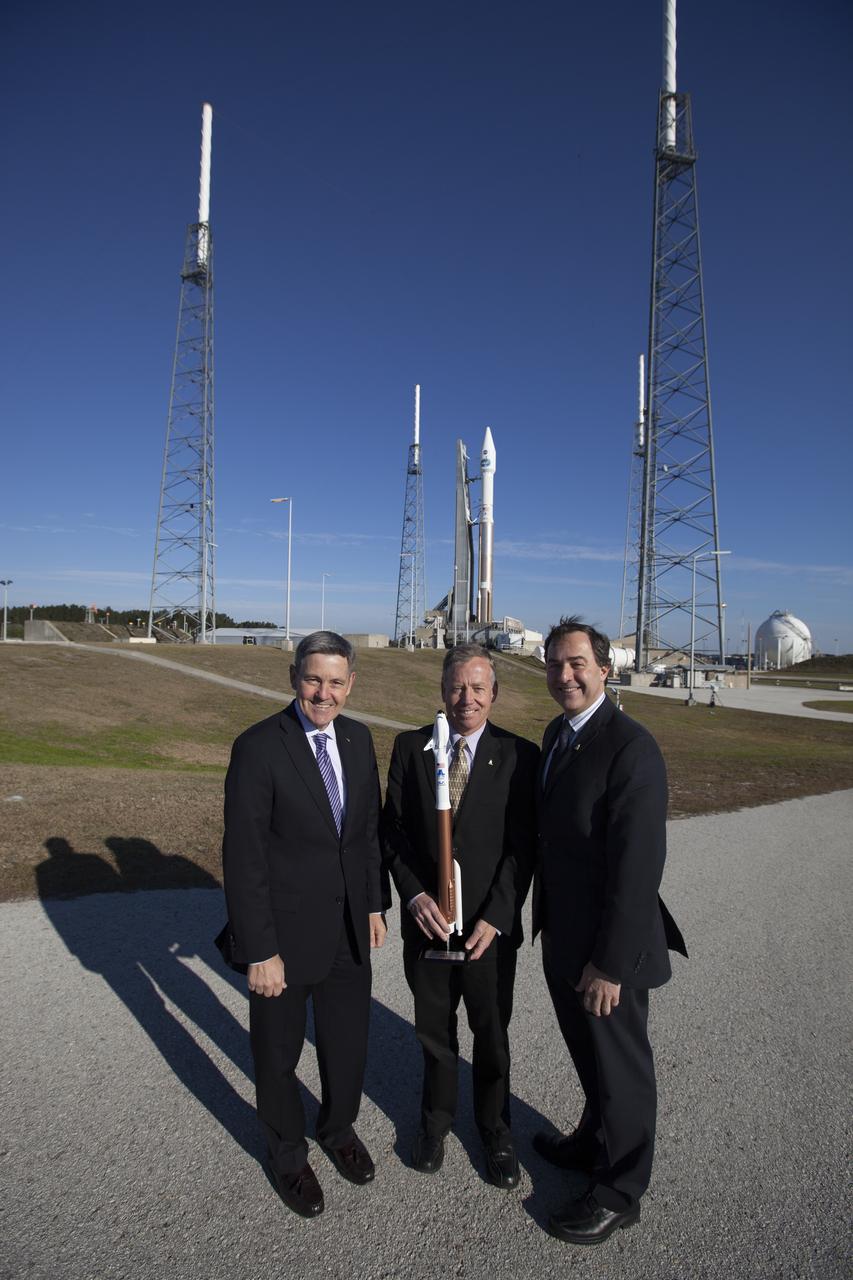
CAPE CANAVERAL, Fla. – NASA and aerospace industry representatives tour facilities along Florida’s Space Coast prior to announcements made by Sierra Nevada Corporation, or SNC, Space Systems, to prepare for a November 2016 orbital flight of its Dream Chaser spacecraft. Posing for a photo in front of a United Launch Alliance, or ULA, Atlas V rocket are, from left, Bob Cabana, director of NASA’s Kennedy Space Center Steve Lindsey, Dream Chaser program manager for SNC Space Systems and Mark Sirangelo, corporate vice president and head of SNC Space Systems. The announcements made during a news conference at Kennedy are considered substantial for SNC and important to plans by NASA and Space Florida for Kennedy’s transformation into a multi-user spaceport for both commercial and government customers. SNC announced it plans to work with ULA to launch the Dream Chaser spacecraft into orbit atop an Atlas V rocket from Space Launch Complex 41 at Cape Canaveral Air Force Station intends to land the winged spacecraft at the 3.5-mile-long runway at Kennedy’s Shuttle Landing Facility lease office space at Exploration Park, right outside Kennedy’s gates and process the spacecraft in the high bay of the Operations and Checkout Building at Kennedy, with Lockheed Martin performing the work. Photo credit: NASA/Cory Huston
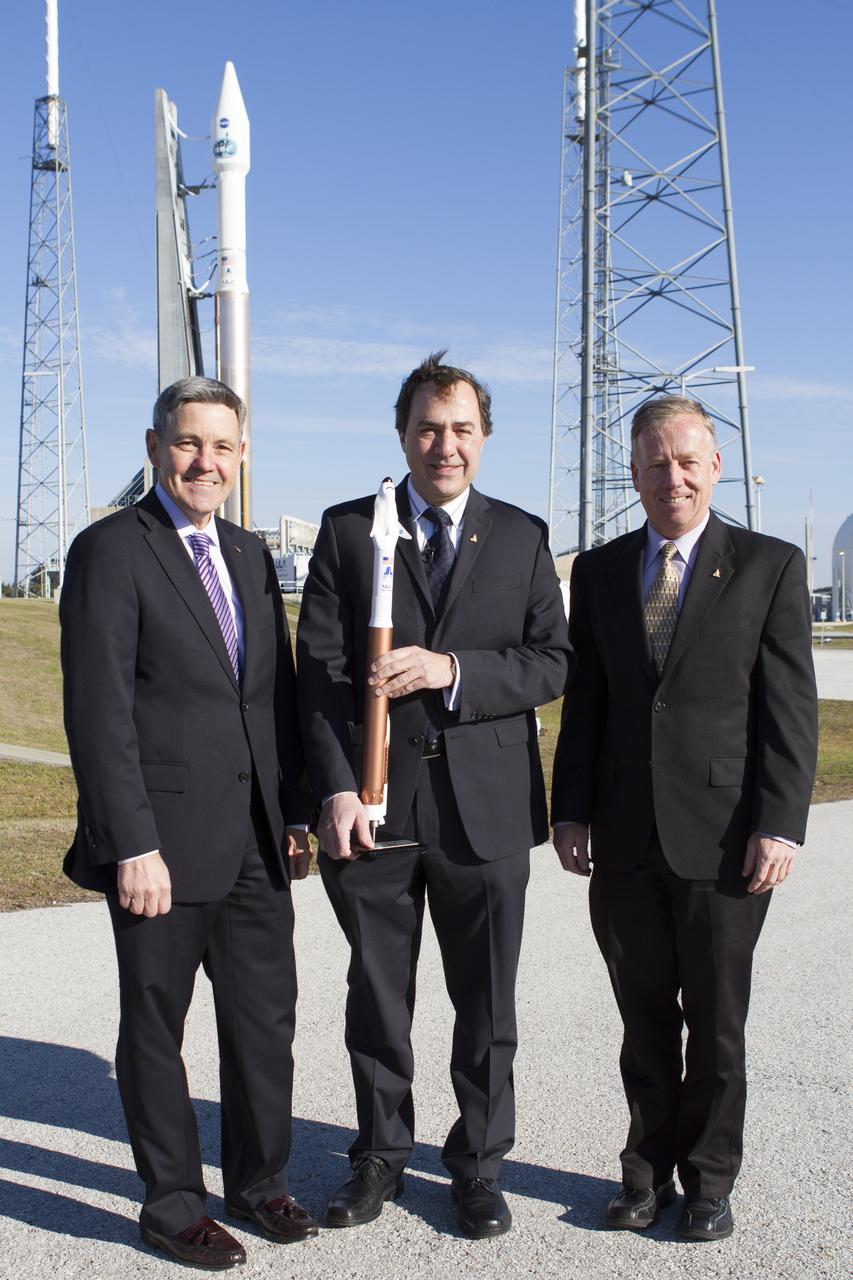
CAPE CANAVERAL, Fla. – NASA and aerospace industry representatives tour facilities along Florida’s Space Coast prior to announcements made by Sierra Nevada Corporation, or SNC, Space Systems, to prepare for a November 2016 orbital flight of its Dream Chaser spacecraft. Posing for a photo in front of a United Launch Alliance, or ULA, Atlas V rocket are, from left, Bob Cabana, director of NASA’s Kennedy Space Center Mark Sirangelo, corporate vice president and head of SNC Space Systems and Steve Lindsey, Dream Chaser program manager for SNC Space Systems. The announcements made during a news conference at Kennedy are considered substantial for SNC and important to plans by NASA and Space Florida for Kennedy’s transformation into a multi-user spaceport for both commercial and government customers. SNC announced it plans to work with ULA to launch the Dream Chaser spacecraft into orbit atop an Atlas V rocket from Space Launch Complex 41 at Cape Canaveral Air Force Station intends to land the winged spacecraft at the 3.5-mile-long runway at Kennedy’s Shuttle Landing Facility lease office space at Exploration Park, right outside Kennedy’s gates and process the spacecraft in the high bay of the Operations and Checkout Building at Kennedy, with Lockheed Martin performing the work. Photo credit: NASA/Cory Huston
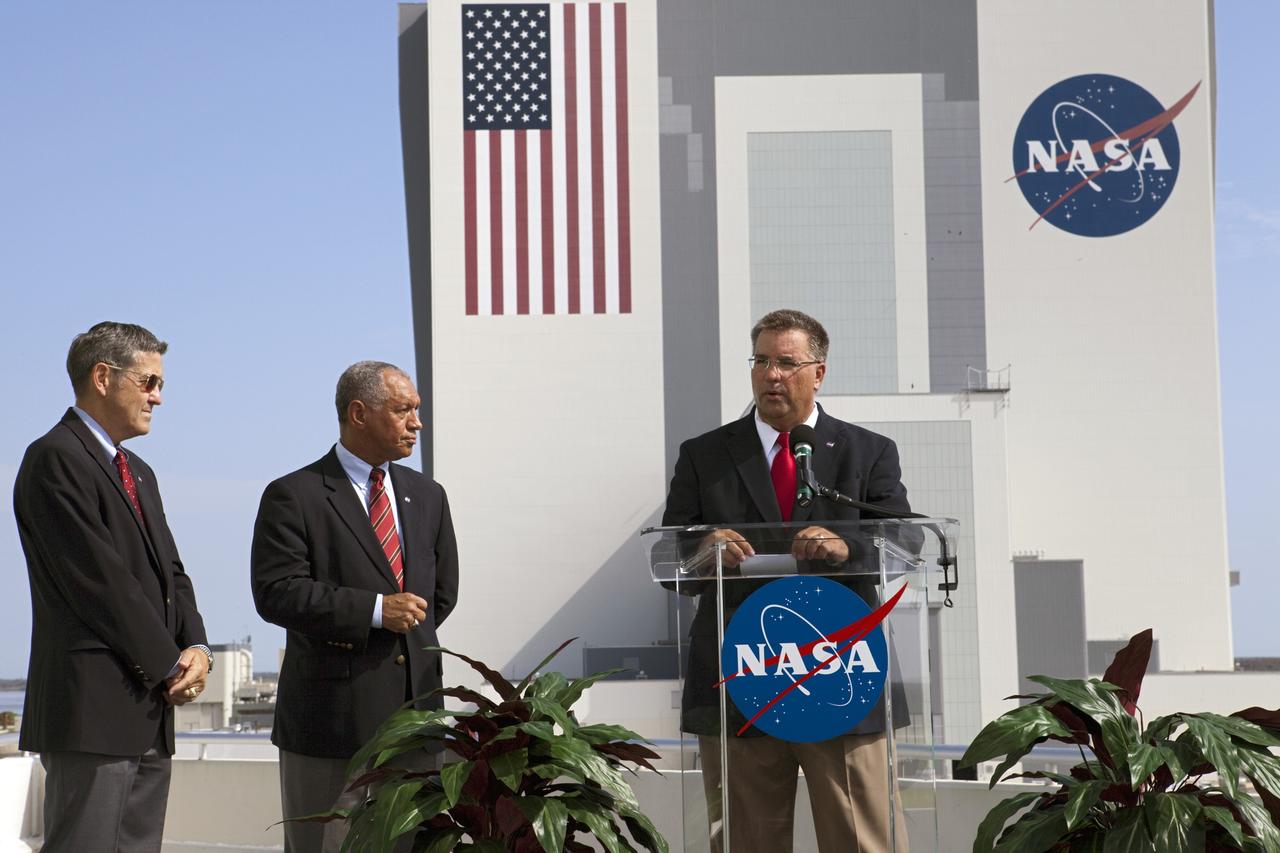
Cape Canaveral, Fla. -- NASA Commercial Crew Program CCP Manager Ed Mango discusses the program's newest partnerships from the Operations Support Building 2 OSB II at Kennedy Space Center in Florida. From left, are Kennedy Space Center Director Robert Cabana and NASA Administrator Charlie Bolden. Three integrated systems were selected for CCP's Commercial Crew Integrated Capability CCiCap initiative to propel America's next human space transportation system to low Earth orbit forward. Operating under funded Space Act Agreements SAAs, The Boeing Co. of Houston, Sierra Nevada Corp. SNC Space Systems of Louisville, Colo., and Space Exploration Technologies SpaceX of Hawthorne, Calif., will spend the next 21 months completing their designs, conducting critical risk reduction testing on their spacecraft and launch vehicles, and showcasing how they would operate and manage missions from launch through orbit and landing, setting the stage for future demonstration missions. To learn more about CCP, which is based at Kennedy and supported by NASA's Johnson Space Center in Houston, visit www.nasa.gov/commercialcrew. Photo credit: NASA/Kim Shiflett
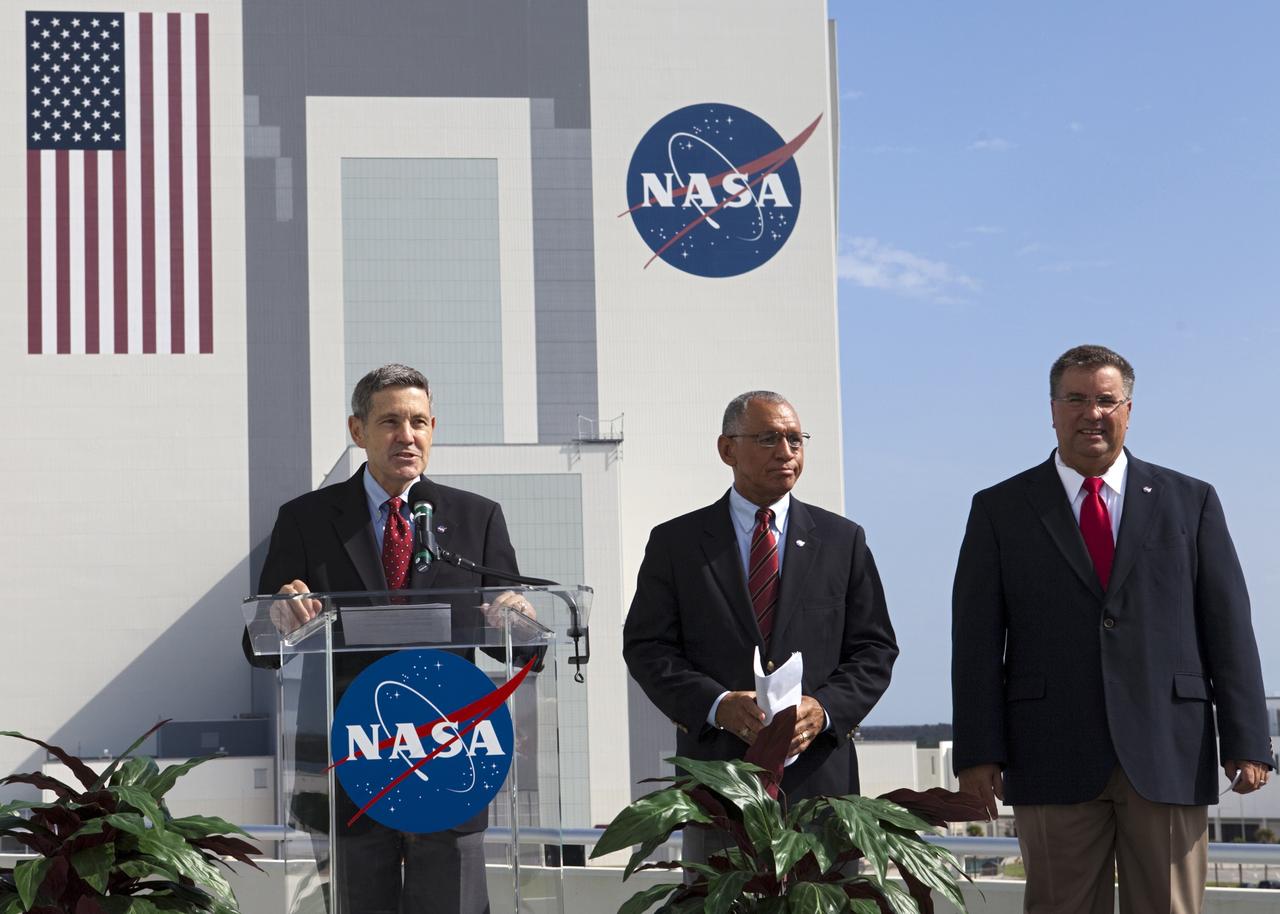
Cape Canaveral, Fla. -- From left, Kennedy Space Center Director Robert Cabana, NASA Administrator Charlie Bolden and Commercial Crew Program CCP, Manager Ed Mango announce the newest partners of NASA's Commercial Crew Program from Operations Support Building 2 OSB II at Kennedy Space Center in Florida. Three integrated systems were selected for CCP's Commercial Crew Integrated Capability CCiCap initiative to propel America's next human space transportation system to low Earth orbit forward. Operating under funded Space Act Agreements SAAs, The Boeing Co. of Houston, Sierra Nevada Corp. SNC Space Systems of Louisville, Colo., and Space Exploration Technologies SpaceX of Hawthorne, Calif., will spend the next 21 months completing their designs, conducting critical risk reduction testing on their spacecraft and launch vehicles, and showcasing how they would operate and manage missions from launch through orbit and landing, setting the stage for future demonstration missions. To learn more about CCP, which is based at Kennedy and supported by NASA's Johnson Space Center in Houston, visit www.nasa.gov/commercialcrew. Photo credit: NASA/Kim Shiflett
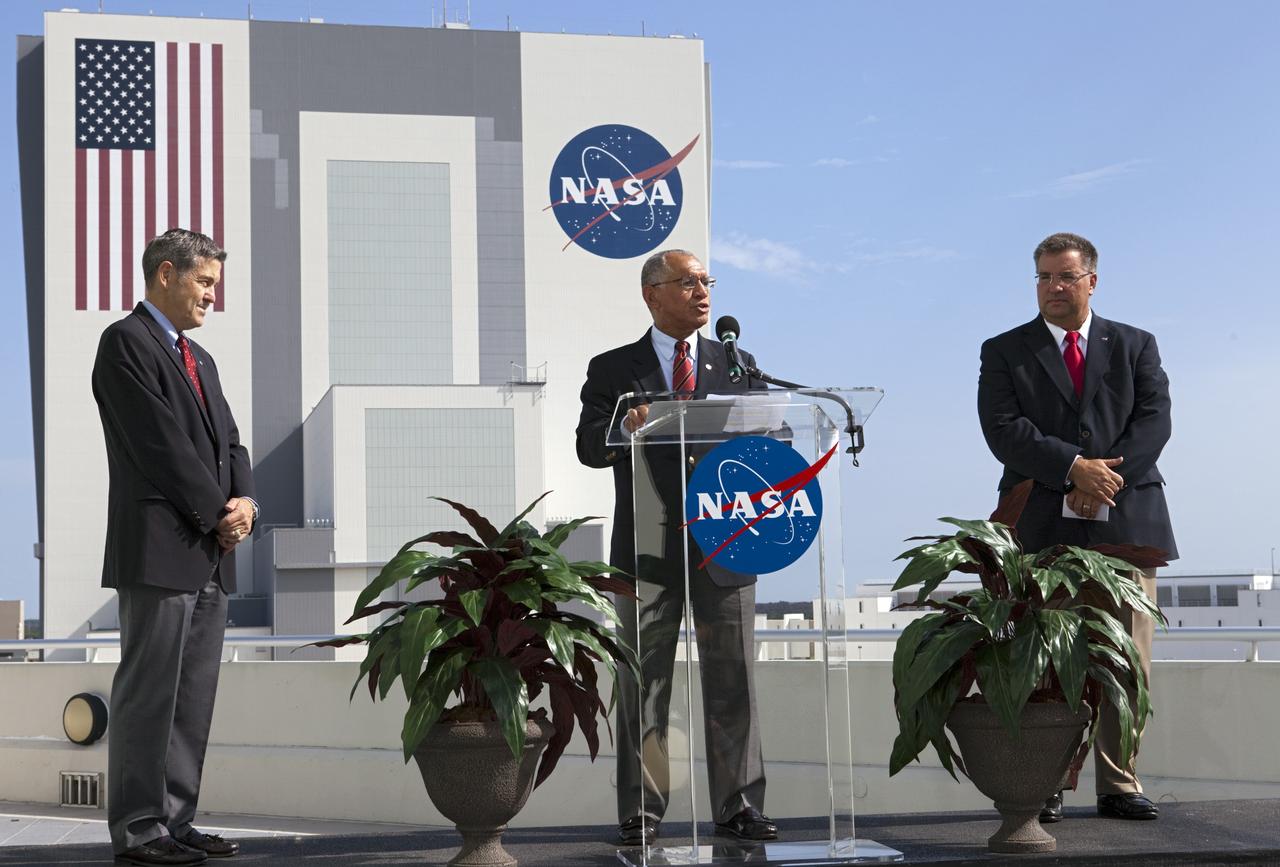
Cape Canaveral, Fla. -- NASA Administrator Charlie Bolden announces the newest partners of NASA's Commercial Crew Program CCP from Operations Support Building 2 OSB II at Kennedy Space Center in Florida. At left, is Kennedy Space Center Director Robert Cabana and at right, is Commercial Crew Program CCP Manager Ed Mango. Three integrated systems were selected for CCP's Commercial Crew Integrated Capability CCiCap initiative to propel America's next human space transportation system to low Earth orbit forward. Operating under funded Space Act Agreements SAAs, The Boeing Co. of Houston, Sierra Nevada Corp. SNC Space Systems of Louisville, Colo., and Space Exploration Technologies SpaceX of Hawthorne, Calif., will spend the next 21 months completing their designs, conducting critical risk reduction testing on their spacecraft and launch vehicles, and showcasing how they would operate and manage missions from launch through orbit and landing, setting the stage for future demonstration missions. To learn more about CCP, which is based at Kennedy and supported by NASA's Johnson Space Center in Houston, visit www.nasa.gov/commercialcrew. Photo credit: NASA/Kim Shiflett
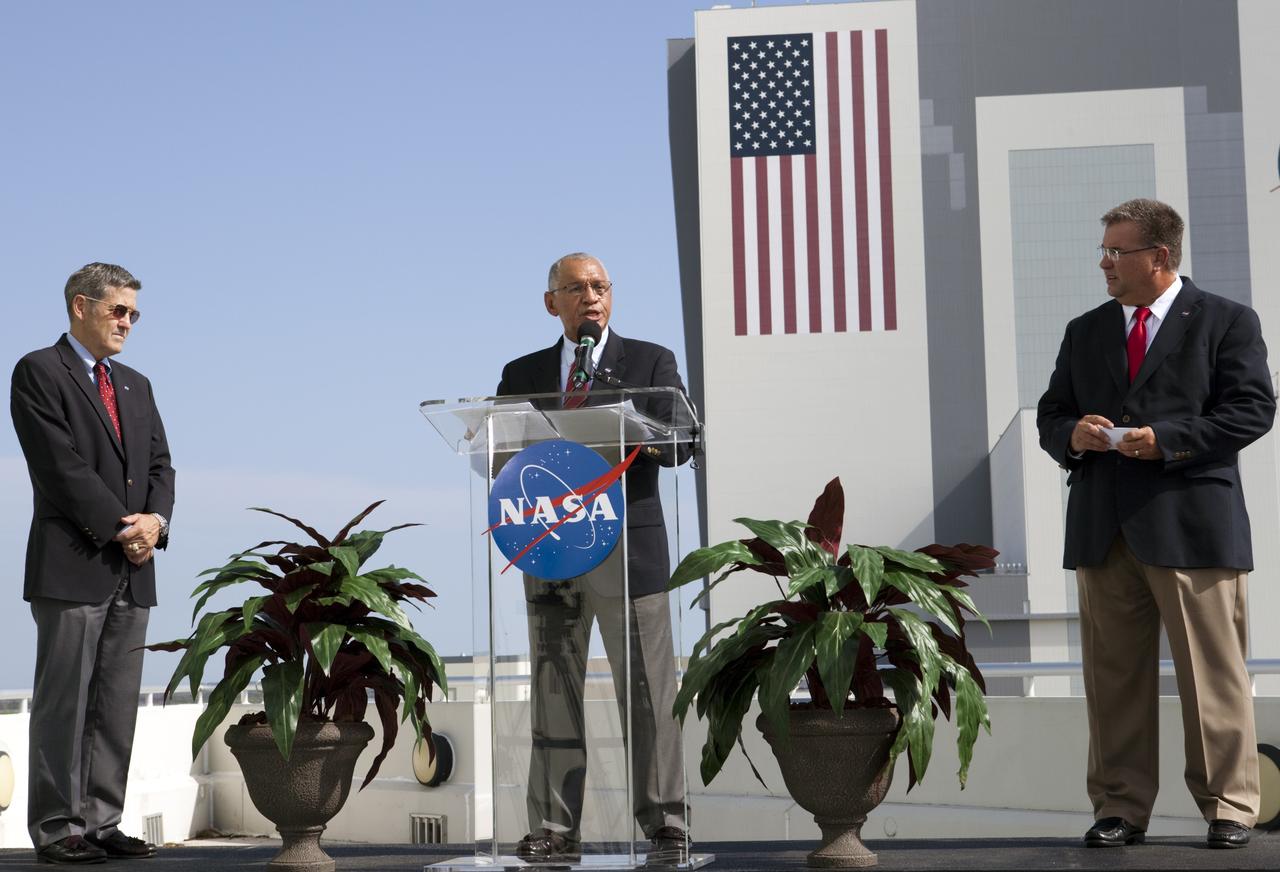
Cape Canaveral, Fla. -- NASA Administrator Charlie Bolden announces the newest partners of NASA's Commercial Crew Program CCP from Operations Support Building 2 OSB II at Kennedy Space Center in Florida. At left, is Kennedy Space Center Director Robert Cabana, and at right, is Commercial Crew Program CCP Manager Ed Mango. Three integrated systems were selected for CCP's Commercial Crew Integrated Capability CCiCap initiative to propel America's next human space transportation system to low Earth orbit forward. Operating under funded Space Act Agreements SAAs, The Boeing Co. of Houston, Sierra Nevada Corp. SNC Space Systems of Louisville, Colo., and Space Exploration Technologies SpaceX of Hawthorne, Calif., will spend the next 21 months completing their designs, conducting critical risk reduction testing on their spacecraft and launch vehicles, and showcasing how they would operate and manage missions from launch through orbit and landing, setting the stage for future demonstration missions. To learn more about CCP, which is based at Kennedy and supported by NASA's Johnson Space Center in Houston, visit www.nasa.gov/commercialcrew. Photo credit: NASA/Kim Shiflett
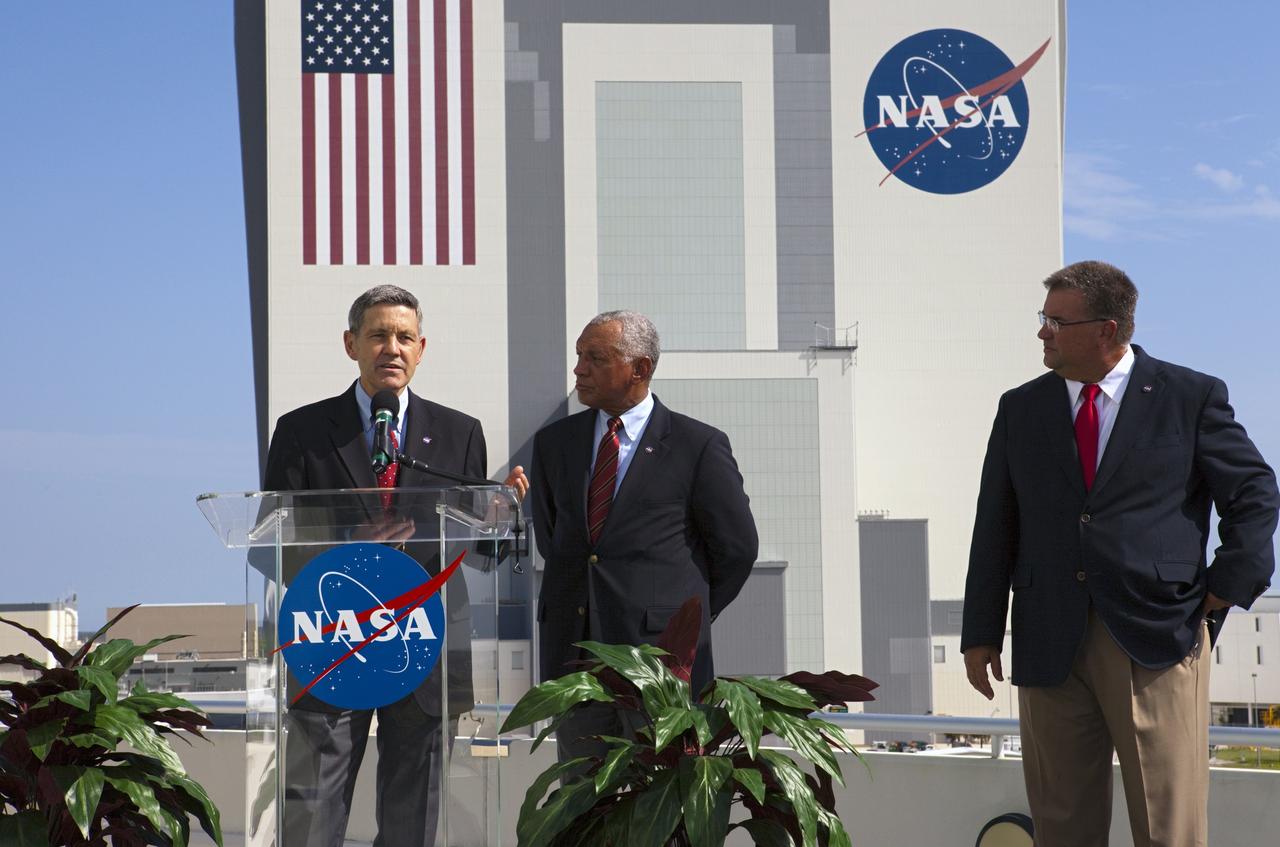
Cape Canaveral, Fla. -- NASA Kennedy Space Center Director Bob Cabana discusses the Commercial Crew Program's CCP newest partnerships from the center's Operations Support Building 2 OSB II. To his right, is NASA Administrator Charlie Bolden, and to his far right, is Commercial Crew Program Manager Ed Mango. Three integrated systems were selected for CCP's Commercial Crew Integrated Capability CCiCap initiative to propel America's next human space transportation system to low Earth orbit forward. Operating under funded Space Act Agreements SAAs, The Boeing Co. of Houston, Sierra Nevada Corp. SNC Space Systems of Louisville, Colo., and Space Exploration Technologies SpaceX of Hawthorne, Calif., will spend the next 21 months completing their designs, conducting critical risk reduction testing on their spacecraft and launch vehicles, and showcasing how they would operate and manage missions from launch through orbit and landing, setting the stage for future demonstration missions. To learn more about CCP, which is based at Kennedy and supported by NASA's Johnson Space Center in Houston, visit www.nasa.gov/commercialcrew. Photo credit: NASA/Kim Shiflett