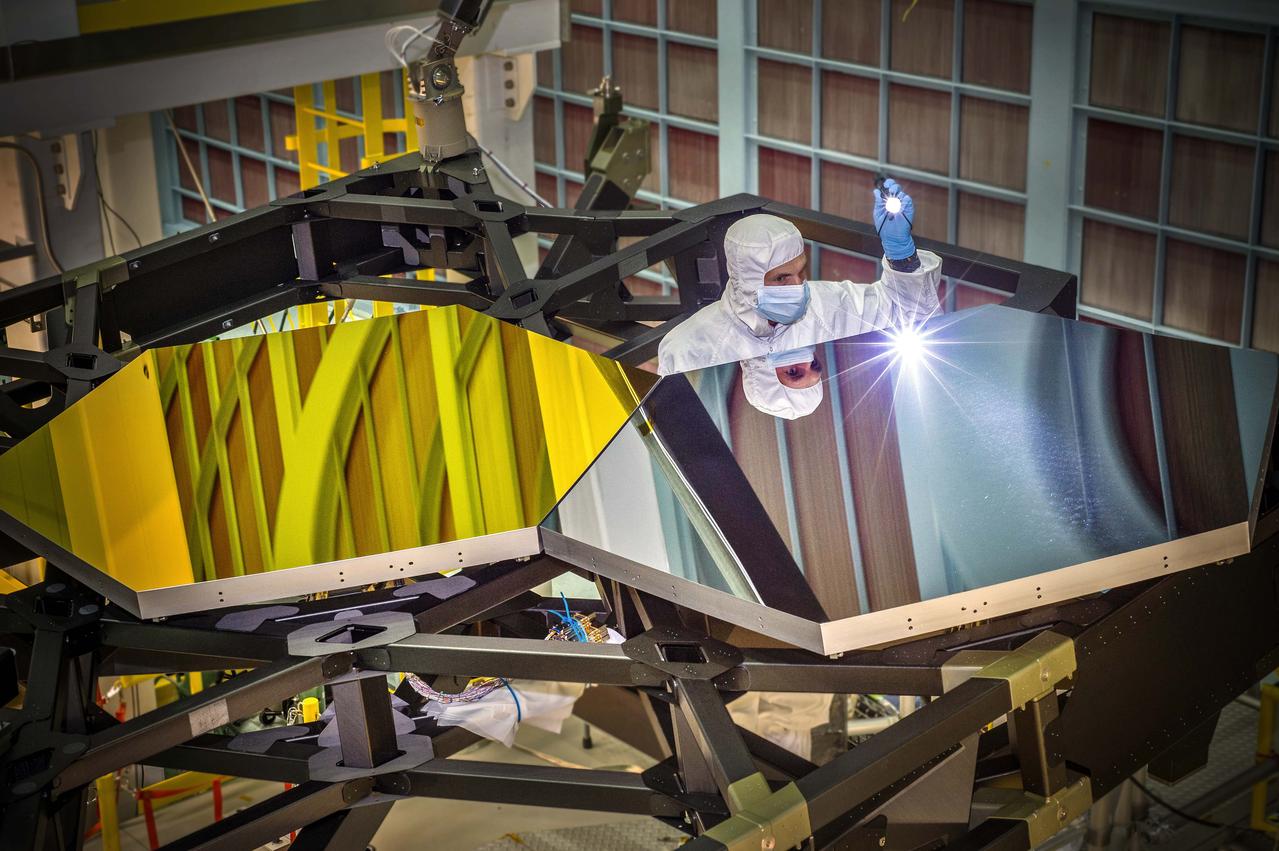
Inside NASA's Goddard Space Flight Center's giant clean room in Greenbelt, Md., JWST Optical Engineer Larkin Carey from Ball Aerospace, examines two test mirror segments recently placed on a black composite structure. This black composite structure is called the James Webb Space Telescope's “Pathfinder” and acts as a spine supporting the telescope's primary mirror segments. The Pathfinder is a non-flight prototype. The mirrors were placed on Pathfinder using a robotic arm move that involved highly trained engineers and technicians from Exelis, Northrop Grumman and NASA. "Getting this right is critical to proving we are ready to start assembling the flight mirrors onto the flight structure next summer," said Lee Feinberg, NASA's Optical Telescope Element Manager at NASA Goddard. "This is the first space telescope that has ever been built with a light-weighted segmented primary mirror, so learning how to do this is a groundbreaking capability for not only the Webb telescope but for potential future space telescopes." The James Webb Space Telescope is the successor to NASA's Hubble Space Telescope. It will be the most powerful space telescope ever built. Webb is an international project led by NASA with its partners, the European Space Agency and the Canadian Space Agency. For more information about the Webb telescope, visit: <a href="http://www.jwst.nasa.gov" rel="nofollow">www.jwst.nasa.gov</a> or <a href="http://www.nasa.gov/webb" rel="nofollow">www.nasa.gov/webb</a> Credit: NASA/Chris Gunn <b><a href="http://www.nasa.gov/audience/formedia/features/MP_Photo_Guidelines.html" rel="nofollow">NASA image use policy.</a></b> <b><a href="http://www.nasa.gov/centers/goddard/home/index.html" rel="nofollow">NASA Goddard Space Flight Center</a></b> enables NASA’s mission through four scientific endeavors: Earth Science, Heliophysics, Solar System Exploration, and Astrophysics. Goddard plays a leading role in NASA’s accomplishments by contributing compelling scientific knowledge to advance the Agency’s mission. <b>Follow us on <a href="http://twitter.com/NASAGoddardPix" rel="nofollow">Twitter</a></b> <b>Like us on <a href="http://www.facebook.com/pages/Greenbelt-MD/NASA-Goddard/395013845897?ref=tsd" rel="nofollow">Facebook</a></b> <b>Find us on <a href="http://instagram.com/nasagoddard?vm=grid" rel="nofollow">Instagram</a></b>
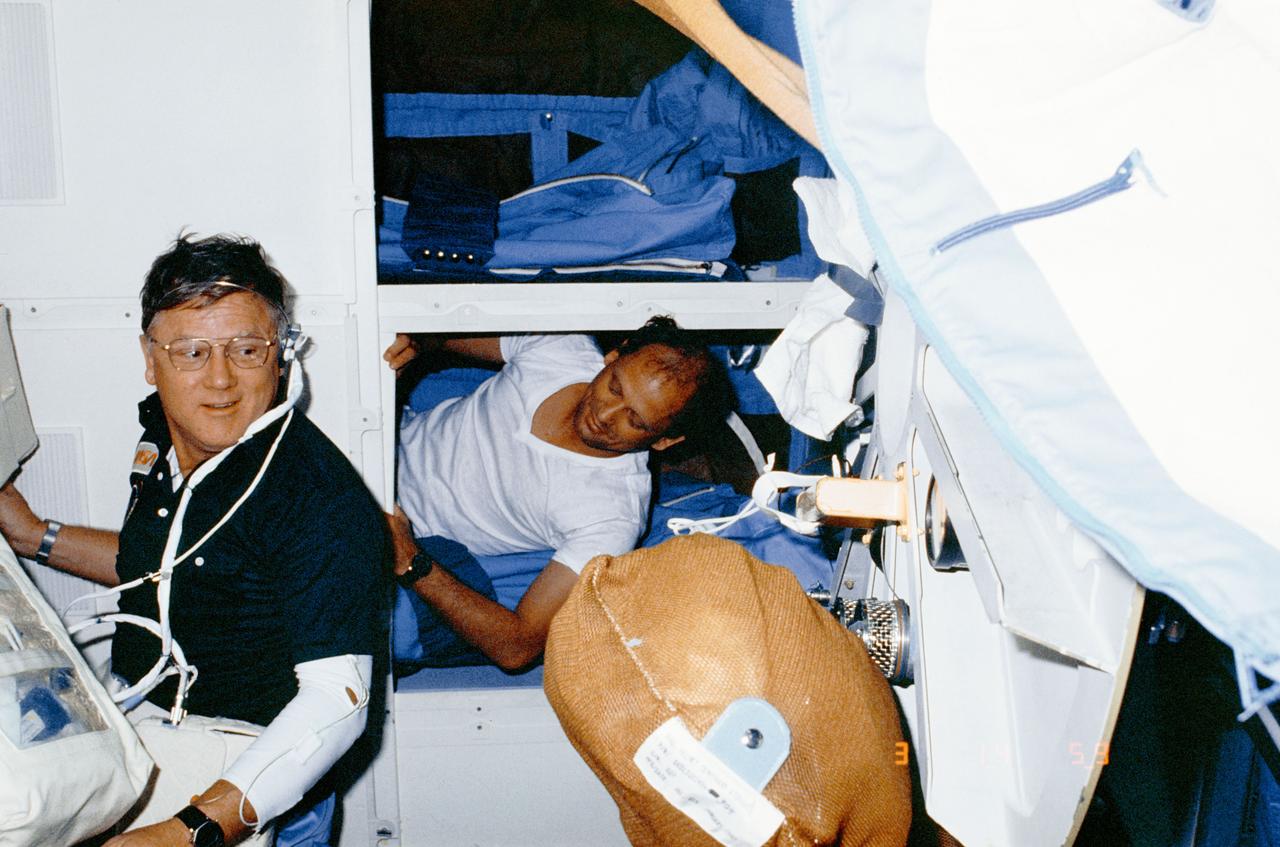
Astronaut Norman E. Thagard, mission specialist for the "silver" team, rests on the middeck while the "gold" team is on duty in the science module. Don L. Lind, left, "gold" team member, meanwhile participates in autogenic feedback training (AFT), designed to help flight crewmembers overcome the effects of zero-gravity adaptation.
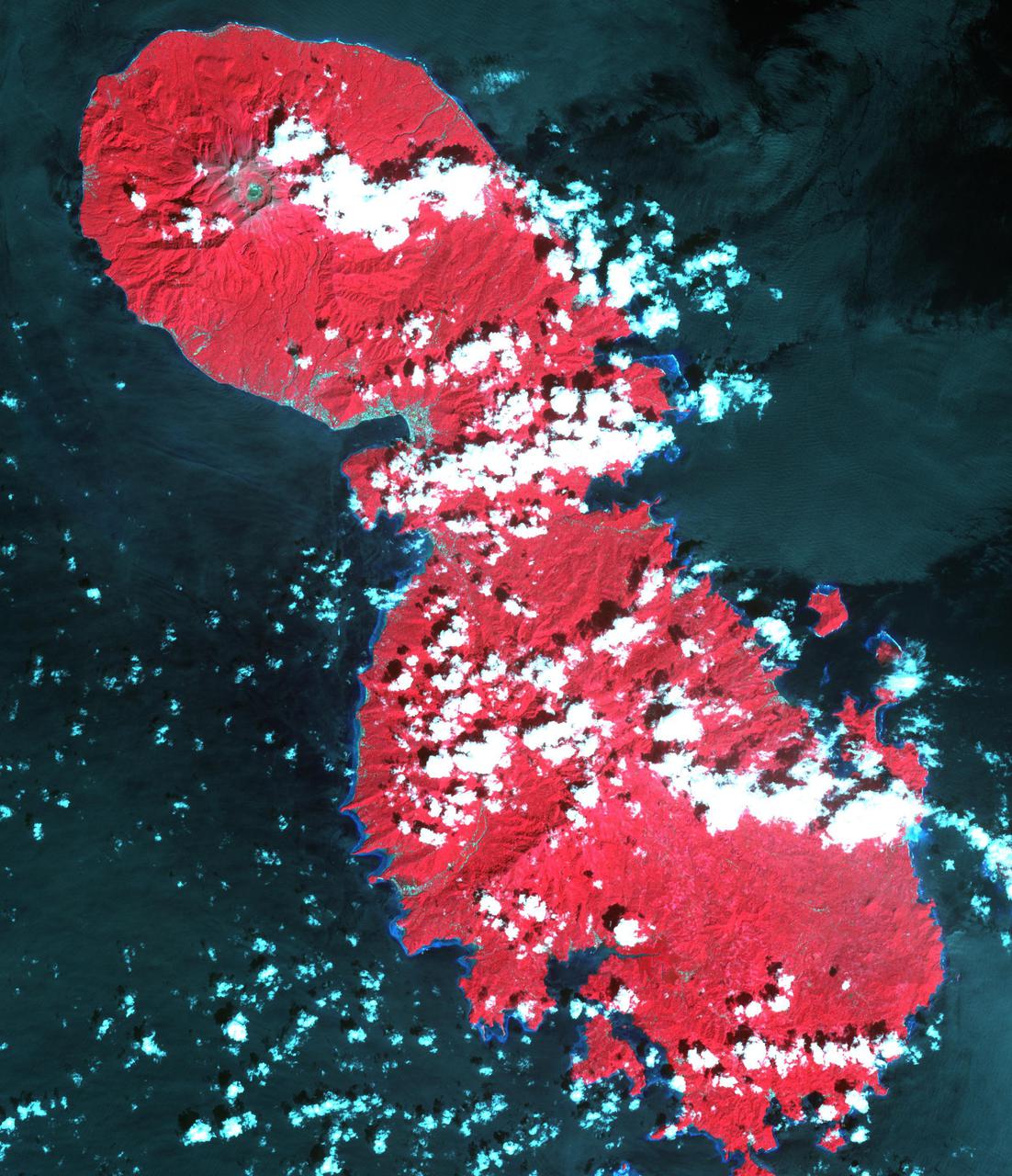
Canadian-based Baru Gold is hoping to start gold mining on the Indonesian island of Sangihe this year. The company's concession covers the southern half of the volcanic island. Opposition to the mining activity cites threats to endemic bird populations and the residents themselves, due to inadequate tailings handling technology. The company projects reserves of nearly 115,000 ounces of gold and 2 million ounces of silver. The image was acquired December 4, 2020, covers an area of 36.3 by 42.1 km, and is located at 3.5 degrees north, 125.5 degrees east. https://photojournal.jpl.nasa.gov/catalog/PIA24942
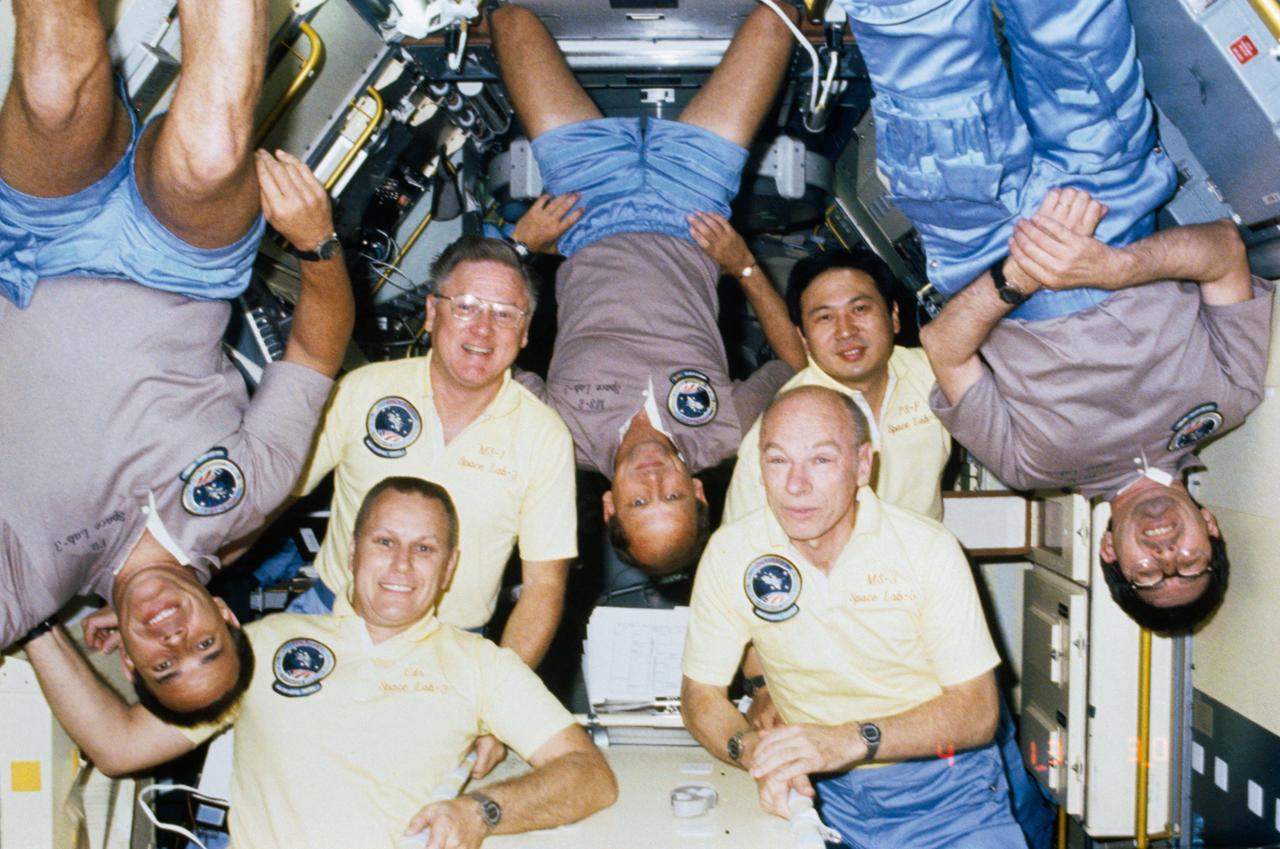
51B-101-025 (29 April-6 May 1985) --- A new twist to the traditional on-orbit group portrait was added by the 51-B/Spacelab 3 crewmembers. Note the Gold T-shirts of ?Gold? team members Robert F. Overmyer (bottom left), Don L. Lind (behind Overmyer), William E. Thornton (bottom right) and Taylor G. Wang (behind Thornton). Posting ?upside down? are ?silver? team members (L-R) Frederick D. Gregory, Norman E. Thagard and Lodewijk van den Berg. The seven are in the Long Science Module for Spacelab 3 in the cargo bay of the earth-orbiting Space Shuttle Challenger.
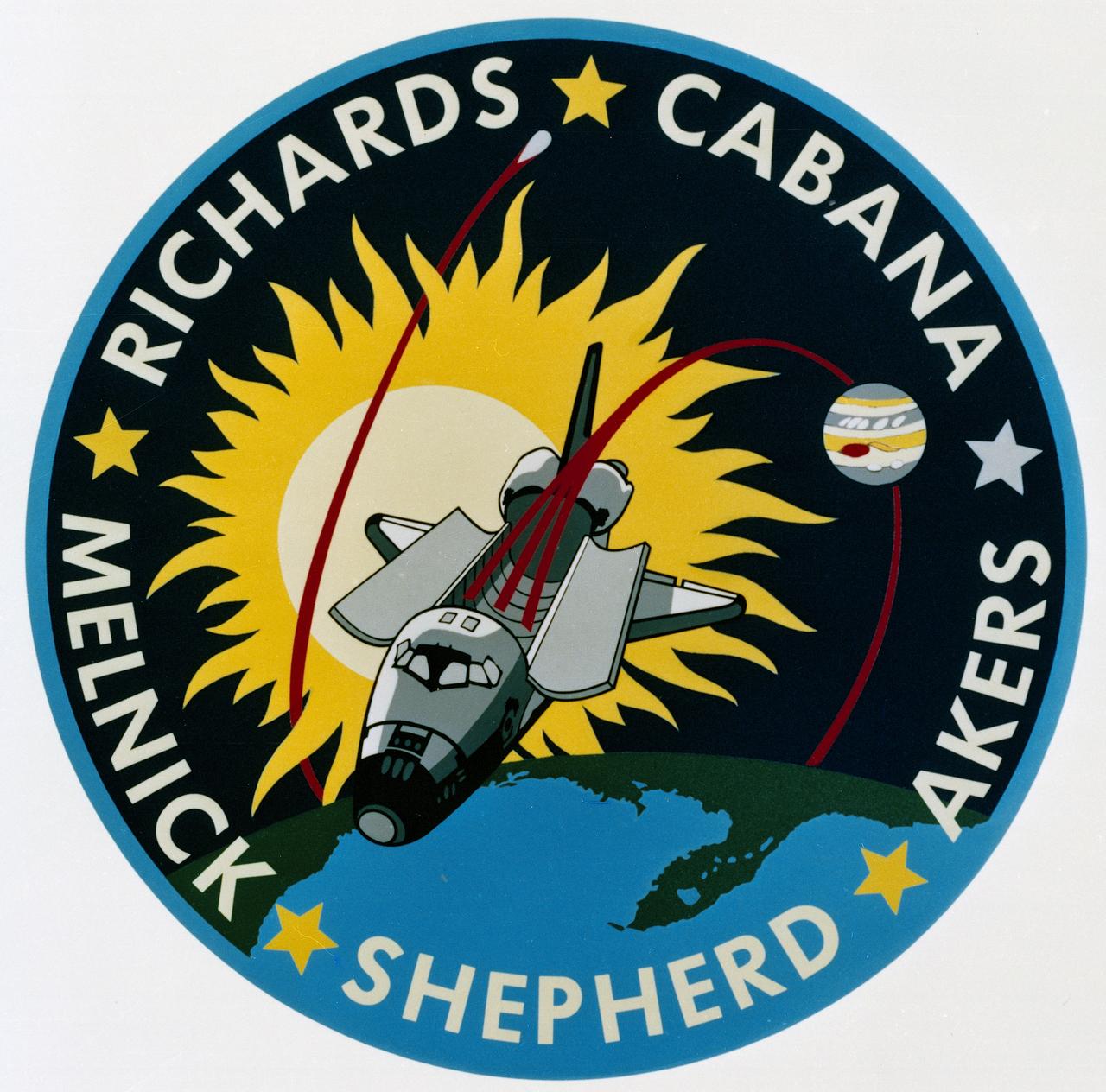
The STS-41 crew patch, designed by the five astronaut crewmembers, depicts the Space Shuttle orbiting Earth after deployment of its primary payload -- the Ulysses satellite. The orbiter is shown passing over the southeastern United States, representative of its 28-degree inclination orbit. Ulysses, the Solar Exploration Satellite, as the fastest man-made object in the universe, traveling at 30 miles per second (over 100,000 mph) is represented by the streaking silver teardrop passing over the sun. Ulysses' path is depicted by the bright red spiral originating from the Shuttle cargo bay. The three-legged trajectory, extending out the payload bay, is symbolic of the astronaut logo and is in honor of those who have given their lives in the conquest of space. The five stars, four gold and one silver, represent STS-41 and each of its crewmembers.
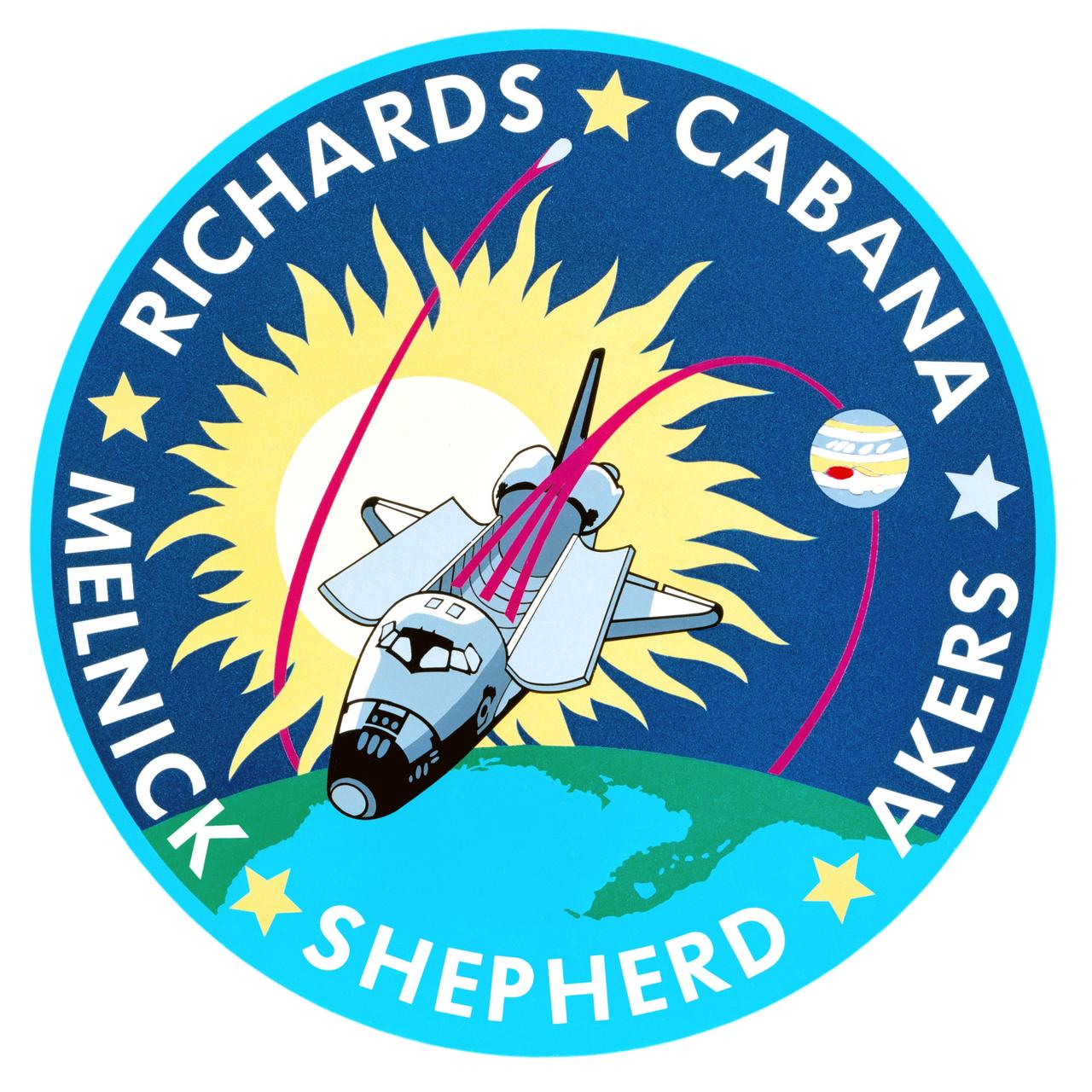
STS041-S-001 (May 1990) --- The STS-41 crew patch, designed by the five astronaut crew members, depicts the space shuttle orbiting Earth after deployment of its primary payload - the Ulysses satellite. The orbiter is shown passing over the southeastern United States, representative of its 28-degree inclination orbit. Ulysses, the Solar Exploration Satellite, will be the fastest man-made object in the universe, traveling at 30 miles per second (over 100,000 mph) and is represented by the streaking silver teardrop passing over the sun. Ulysses' path is depicted by the bright red spiral originating from the space shuttle cargo bay. The path will extend around Jupiter where Ulysses will receive a gravitational direction change that will put it in a polar trajectory around the sun. The three-legged trajectory, extending out the payload bay, is symbolic of the astronaut logo and is in honor of those who have given their lives in the conquest of space. The five stars, four gold and one silver, represent STS-41 and each of its crew members. The NASA insignia design for space shuttle flights is reserved for use by the astronauts and for other official use as the NASA Administrator may authorize. Public availability has been approved only in the forms of illustrations by the various news media. When and if there is any change in this policy, which is not anticipated, the change will be publicly announced. Photo credit: NASA
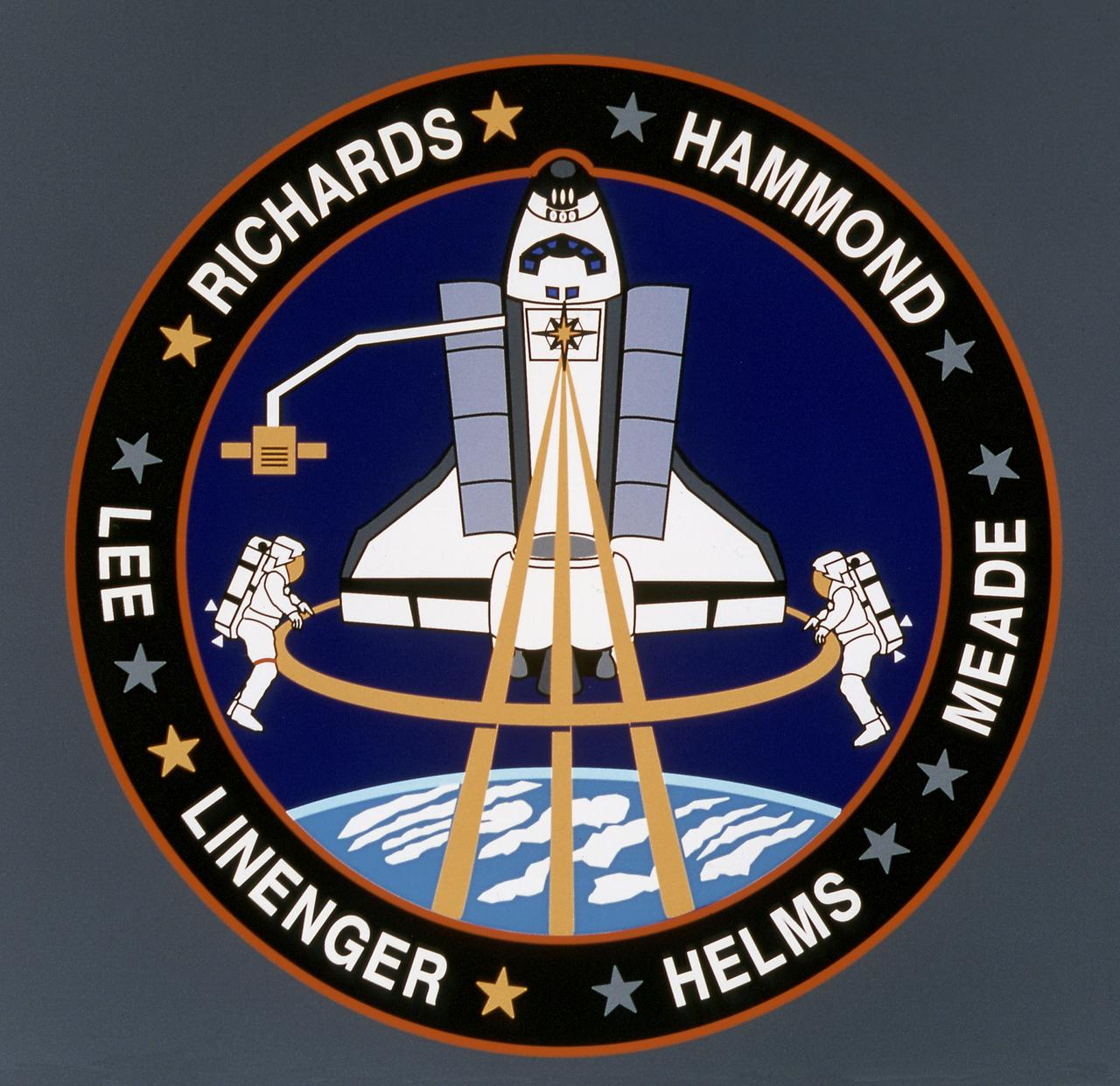
The STS-64 patch depicts the Space Shuttle Discovery in a payload-bay-to-Earth attitude with its primary payload, Lidar In-Space Technology Experiment (LITE-1) operating in support of Mission to Planet Earth. LITE-1 is a lidar system that uses a three-wavelength laser, symbolized by the three gold rays emanating from the star in the payload bay that form part of the astronaut symbol. The major objective of the LITE-1 is to gather data about the Earth's troposphere and stratosphere, represented by the clouds and dual-colored Earth limb. A secondary payload on STS-64 is the free-flier SPARTAN 201 satellite shown on the Remote Manipulator System (RMS) arm post-retrieval. The RMS also operated another payload, Shuttle Plume Impingement Flight Experiment (SPIFEX). A newly tested extravehicular activity (EVA) maneuvering device, Simplified Aid for EVA Rescue (SAFER), represented symbolically by the two small nozzles on the backpacks of the two untethered EVA crew men. The names of the crew members encircle the patch: Astronauts Richard N. Richards, L. Blaine Hammond, Jr., Jerry M. Linenger, Susan J. Helms, Carl J. Meade and Mark C. Lee. The gold or silver stars by each name represent that person's parent service.

This is the crew insignia for STS-97 which delivered, assembled, and activated the U.S. electrical power system onboard the International Space Station (ISS). The electrical power system, which is built into a 47-foot integrated truss structure known as P6, consists of solar arrays, radiators, batteries, and electronics. P6 was prepared for subsequent deployments of larger solar arrays and radiator, a critical step in the activation of the electrical power system that will eventually provide the power necessary for the first ISS crews to live and work in the U.S. segment. The crew patch depicts the space shuttle docked to the ISS in low Earth orbit after the activation of the P6 electrical power system. Gold and silver were used to highlight the portion of the ISS that were installed by the STS-97 crew. The sun, central to the design, is the source of energy for the ISS. The crew member names surround the outer border of the patch.
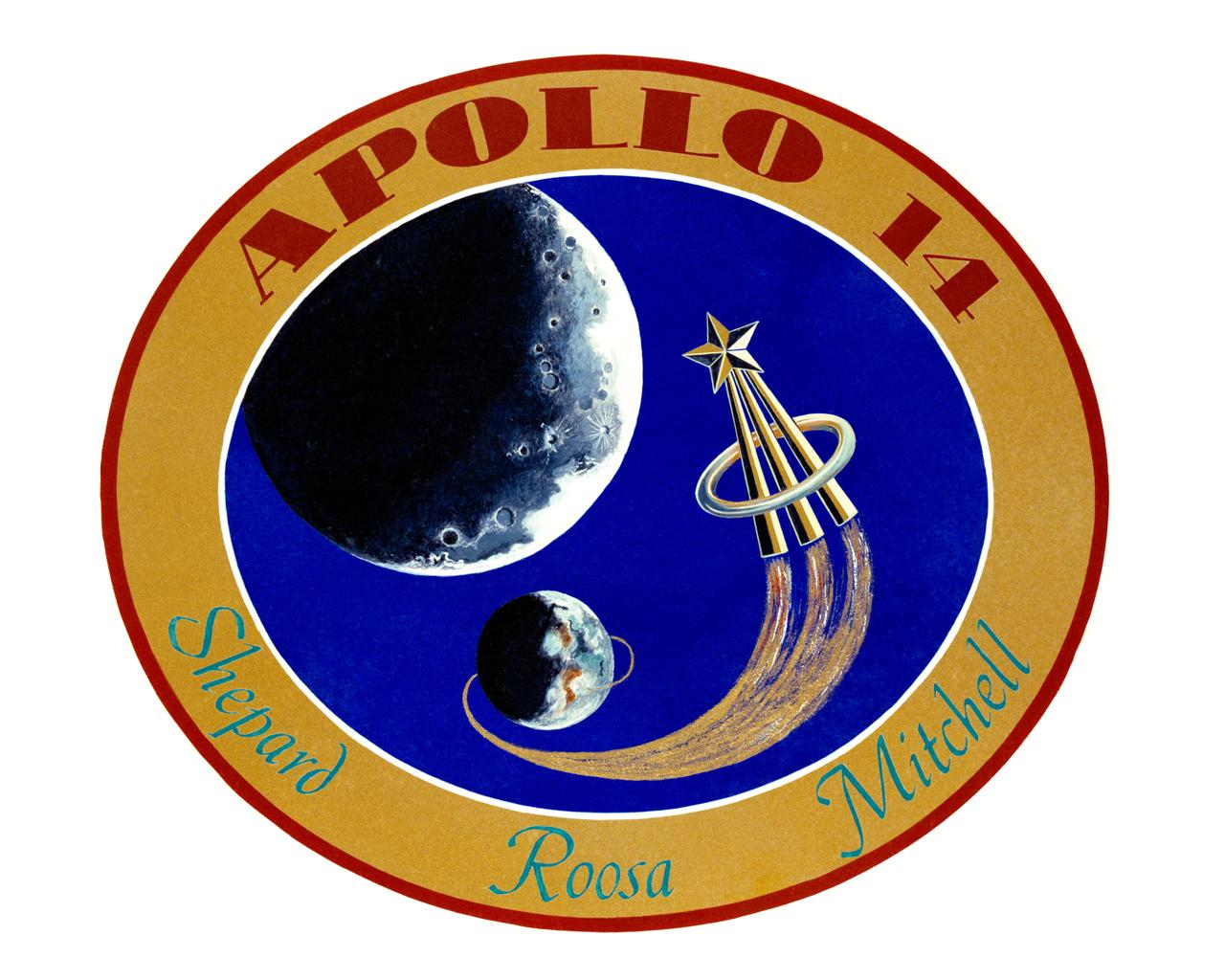
S70-17851 (September 1970) --- This is the Apollo 14 crew patch designed by astronauts Alan B. Shepard Jr., commander; Stuart A. Roosa, command module pilot; and Edgar D. Mitchell, lunar module pilot. It features the astronaut lapel pin approaching the moon and leaving a comet trail from the liftoff point on Earth. The pin design was adopted by the astronaut corps several years ago. Astronauts who have not yet flown in space wear silver pins. Those who have flown wear gold pins. The NASA insignia design for Apollo flights is reserved for use by the astronauts and for other official use as the NASA Administrator may authorize. Public availability has been approved only in the form of illustrations by the various news media. When and if there is any change in this policy, which we do not anticipate, it will be publicly announced.
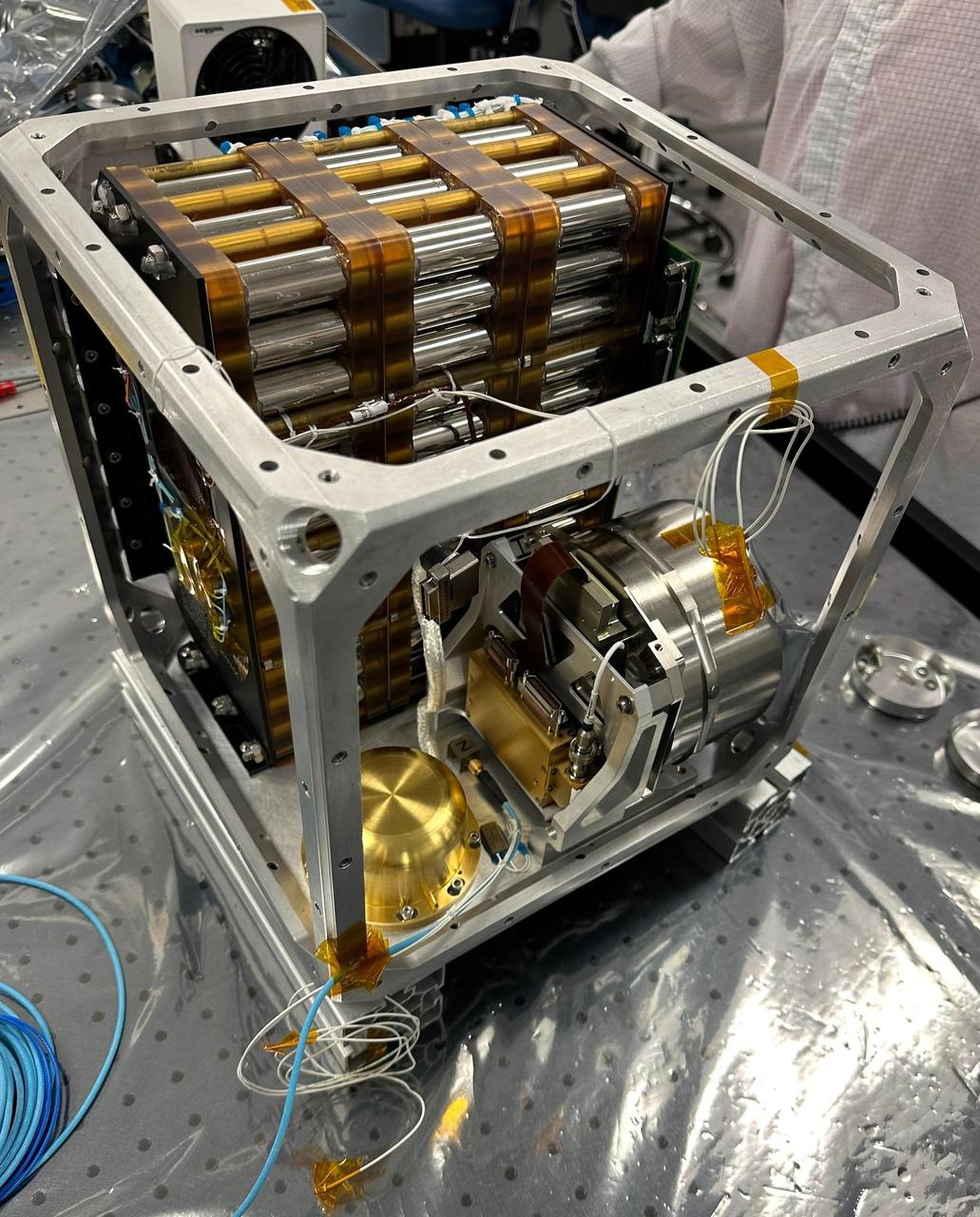
NASA's Farside Seismic Suite (FSS) is assembled in a clean room at the agency's Jet Propulsion Laboratory in Southern California in November 2023. Two sensitive seismometers packaged in the suite's cube-within-a-cube structure will gather NASA's first seismic data from the Moon in nearly 50 years and take the first-ever seismic measurements from the Moon's far side. FSS will operate continuously for at least 4½ months, working through the long, cold lunar nights. Seen here is the inner cube structure, with the suite's large battery at rear. The gold, puck-shaped device at left is the Short Period sensor, or SP, which measures motion in three directions using sensors etched into a trio of square silicon chips, each about 1 inch (25 millimeters) wide. At right, within the silver cylindrical enclosure, is the Very Broadband seismometer, or VBB, the most sensitive seismometer ever built for use in space exploration. It can detect ground motions smaller than the size of a single hydrogen atom, measuring up-and-down movement using a pendulum held in place by a spring. Constructed as a backup instrument (a "flight spare") for NASA's InSight Mars lander by the French space agency, CNES (Centre National d'Études Spatiales), the VBB was slightly modified and packaged in a new enclosure for lunar use. The suite's computer and electronics are packed alongside the battery and seismometers. After being encased in insulation, this inner cube was suspended within a protective outer cube, which was in turn covered with a shiny insulating blanket. https://photojournal.jpl.nasa.gov/catalog/PIA26300
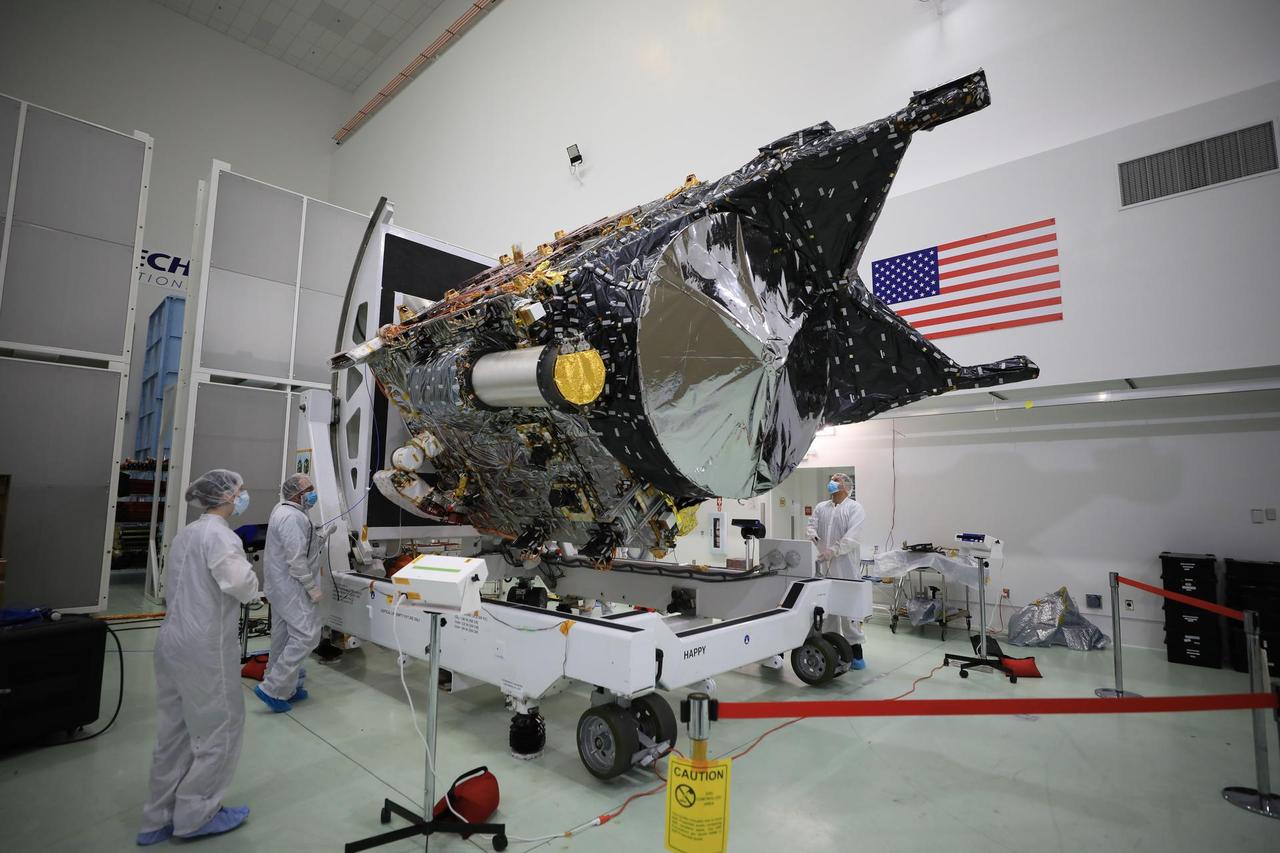
NASA's Psyche spacecraft is shown in a clean room on Dec. 8, 2022, at Astrotech Space Operations Facility near the agency's Kennedy Space Center in Florida. The spacecraft was powered on and connected to ground support equipment, enabling engineers and technicians to prepare it for launch in 2023. Teams working at Astrotech and at NASA's Jet Propulsion Laboratory in Southern California continue to monitor the health of its systems. After a one-year delay to complete critical testing, the Psyche project is targeting an October 2023 launch on a SpaceX Falcon Heavy rocket. NASA's Deep Space Optical Communications (DSOC) technology demonstration, testing high-data-rate laser communications, is integrated into Psyche and will travel with it when it launches to its target, a metal-rich asteroid, also named Psyche, that lies in the main asteroid belt. The silver-colored cylinder shown in the photo is the sunshade for DSOC, and the gold blanketing is the aperture cover for the DSOC payload. The spacecraft's target may be the partial core of a planetesimal, a building block of rocky planets in our solar system. Researchers will study Psyche using a suite of instruments including multispectral cameras, a Gamma Ray and Neutron Spectrometer (GRNS) and a magnetometer. The GRNS and magnetometer sensors are visible in the photo as the tips of the two black protrusions at the far end of the spacecraft. Also visible is the large, disc-shaped high-gain antenna, which will enable the spacecraft to communicate with Earth. https://photojournal.jpl.nasa.gov/catalog/PIA25664
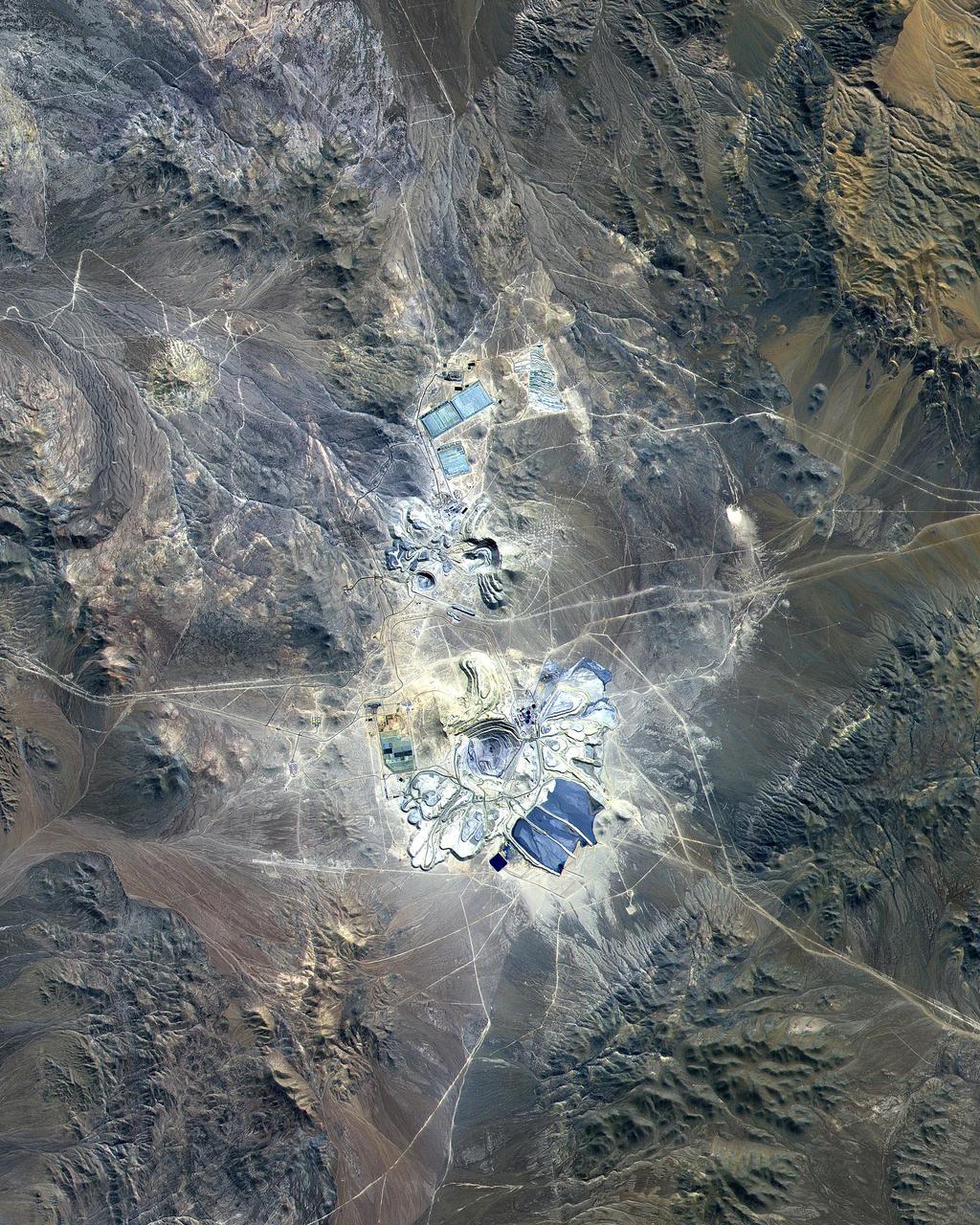
This ASTER image covers 30 by 37 km in the Atacama Desert, Chile and was acquired on April 23, 2000. The Escondida Cu-Au-Ag open-pit mine is at an elevation of 3050 m, and came on stream in 1990. Current capacity is 127,000 tons/day of ore; in 1999 production totaled 827,000 tons of copper, 150,000 ounces of gold and 3.53 million ounces of silver. Primary concentration of the ore is done on-site; the concentrate is then sent to the coast for further processing through a 170 km long, 9 pipe. Escondida is related geologically to three porphyry bodies intruded along the Chilean West Fissure Fault System. A high grade supergene cap overlies primary sulfide ore. This image is a conventional 3-2-1 RGB composite. Figure 1 displays SWIR bands 4-6-8 in RGB, and highlights lithologic and alteration differences of surface units. The image is located at 24.3 degrees south latitude and 69.1 degrees west longitude. http://photojournal.jpl.nasa.gov/catalog/PIA11090
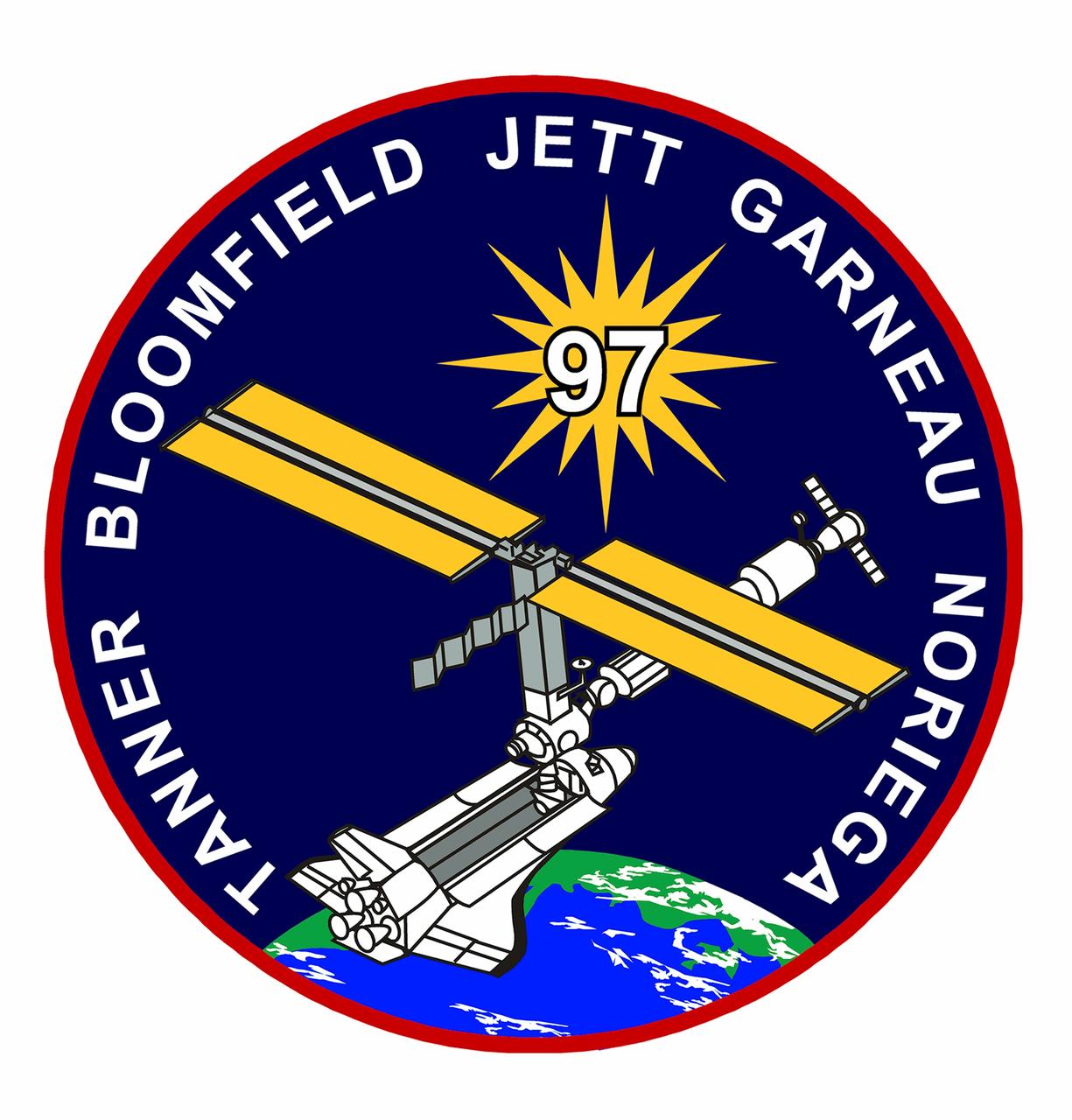
STS097-S-001 (January 2000) --- This is the crew insignia for STS-97, which will deliver, assemble, and activate the U.S. electrical power system on board the International Space Station (ISS). The electrical power system, which is built into a 47-foot integrated truss structure known as P6, consists of solar arrays, radiators, batteries, and electronics. P6 will be attached to the station using the shuttle's robotic arm in coordination with spacewalking crew members that will make the final connections. The spacewalkers will then prepare P6 for the subsequent deployments of the large solar arrays and radiator, which are critical steps in the activation of the electrical power system. The 120-foot solar arrays will provide the power necessary for the first ISS crews to live and work in the U.S. segment. The crew patch depicts the space shuttle docked to ISS in low Earth orbit after the activation of the P6 electrical power system. Gold and silver are used to highlight the portion of ISS that will be installed by the STS-97 crew. The Sun, central to the design, is the source of energy for ISS. The NASA insignia design for space shuttle flights is reserved for use by the astronauts and for other official use as the NASA Administrator may authorize. Public availability has been approved only in the forms of illustrations by the various news media. When and if there is any change in this policy, which is not anticipated, the change will be publicly announced. Photo credit: NASA
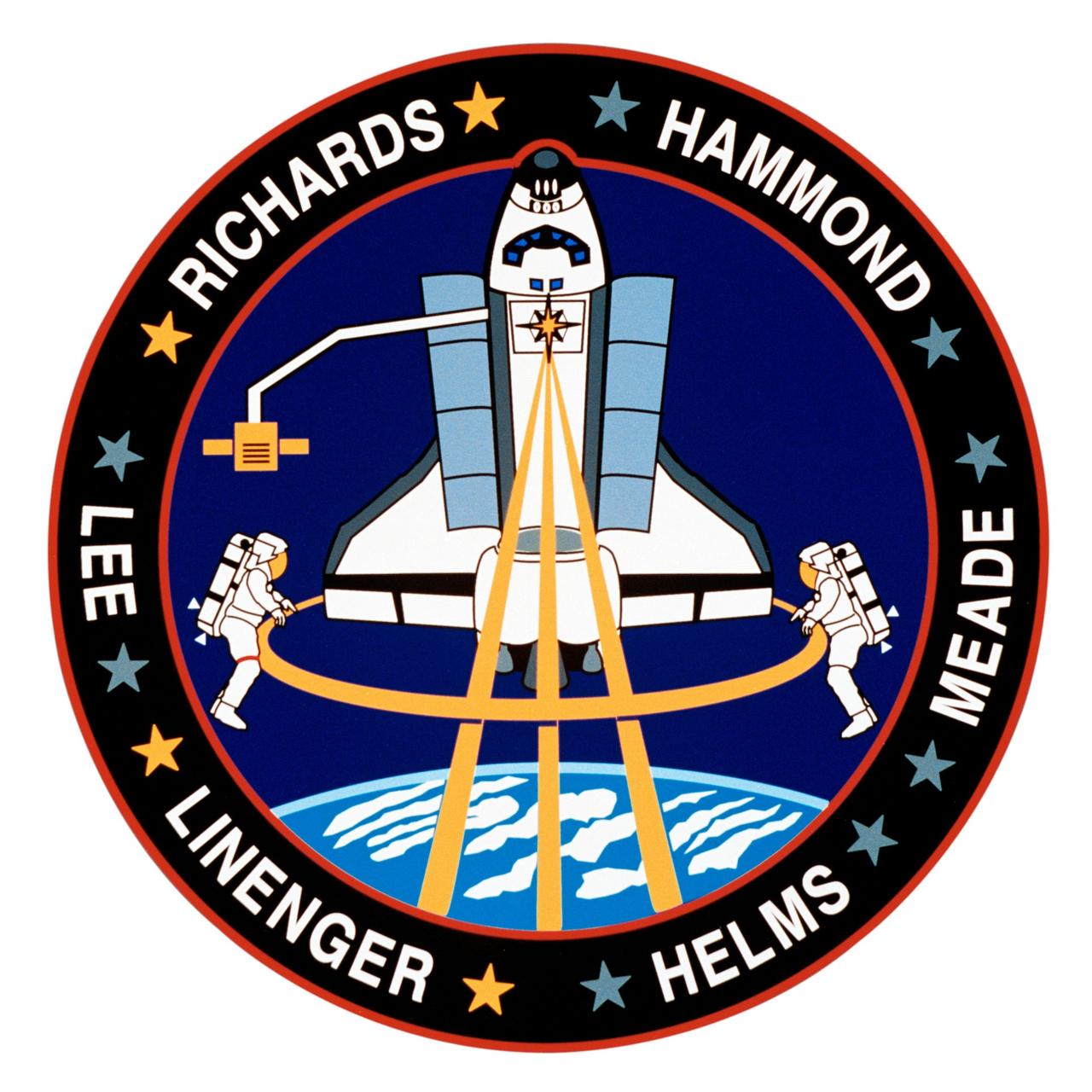
STS064-S-001 (July 1994) --- The patch depicts the space shuttle Discovery in a payload-bay-to-Earth attitude with its primary payload, Lidar In-Space Technology Experiment (LITE-1) operating in support of Mission to Planet Earth. LITE-1 is a lidar (light detection and ranging) system that uses a three-wavelength laser, symbolized by the three gold rays emanating from the star in the payload bay that form part of the astronaut symbol. The major objective of this first flight of LITE-1 is to validate its design and operating characteristics by gathering data about the Earth's troposphere and stratosphere, represented by the clouds and dual-colored Earth limb. A secondary payload on STS-64 is the free-flier SPARTAN-201 satellite shown on the Remote Manipulator System (RMS) arm post-retrieval. The objective of SPARTAN-201 is to investigate the physics of the solar wind and complement data being obtained from the ULYSSES satellite launched on STS-41. The RMS will also operate another secondary payload, Shuttle Plume Impingement Flight Experiment (SPIFEX), which will assess the plume effects from the Orbiter's Reaction Control System thrusters. Additionally, STS-64 will test a new extravehicular activity (EVA) maneuvering device, Simplified Aid for EVA Rescue (SAFER), represented symbolically by the two small nozzles on the backpacks of the two untethered EVA crew men. The names of the crew members encircle the patch: astronauts Richard N. Richards, commander; L. Blaine Hammond Jr., pilot; Jerry M. Linenger; Susan J. Helms, Carl J. Meade and Mark C. Lee, all mission specialists. The gold or silver stars by each name represent that person's parent service. The NASA insignia design for space shuttle flights is reserved for use by the astronauts and for other official use as the NASA Administrator may authorize. Public availability has been approved only in the forms of illustrations by the various news media. When and if there is any change in this policy, which is not anticipated, the change will be publicly announced. Photo credit: NASA
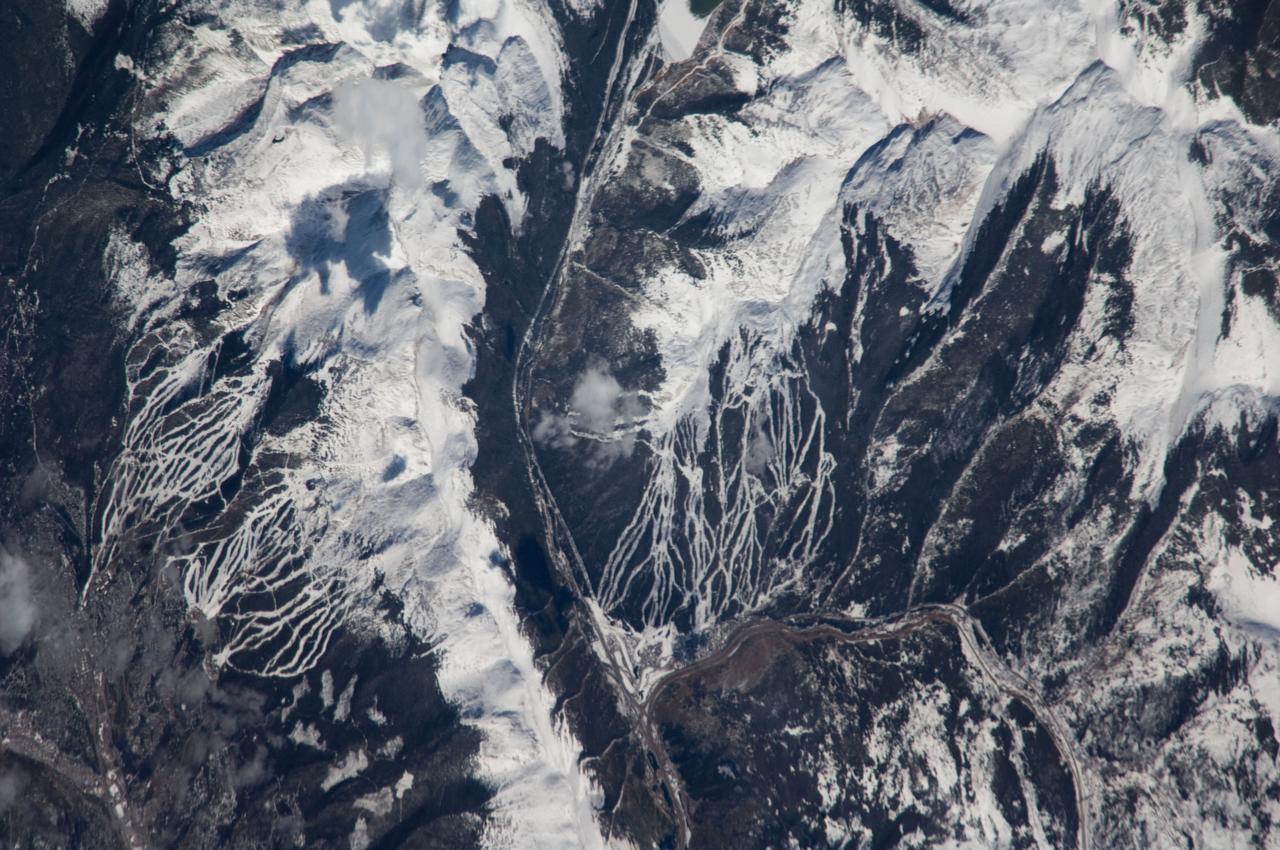
ISS018-E-005353 (24 Oct. 2008) --- Breckenridge and Copper Mountain ski slopes, Colorado are featured in this image photographed by an Expedition 18 crewmember on the International Space Station. Located in a section of the Rocky Mountains which extend through central Colorado, Tenmile Range and Copper Mountain provide the ideal location and landscape for popular winter sports. In this view, the Breckenridge and Copper Mountain ski areas are clearly visible as the snow covered ski runs stand out among the surrounding darker forest. Tenmile Range has mountain peaks that are named Peaks 1 through Peaks 10. The Breckenridge ski area use Peaks 7 through Peaks 10 which range from 12,631 feet (3,850 meters) to 13,615 feet (4,150 meters) high. Tenmile Canyon is a north northeast-trending fault-controlled valley running nearly 3,000 feet (914.4 meters) deep that serves as the boundaries for Tenmile Creek running through the center of the photo. The snow-covered peaks clearly delineate the tree line at an elevation of around 11,000 feet (3,350 meters). In the winter, this area's annual average snowfall ranges between 284 inches (7.21 meters) at Copper Mountain to 300 inches (7.62 meters) a year at Breckenridge. Before recreation became the main industry, miners were attracted to the area in the mid-1800's following discoveries of gold, silver, lead, and zinc. The towns of Breckenridge and Wheeler Junction (at the base of Copper Mountain ski area) were born out of the surge to settle the West during the Pike's Peak Gold Rush. While this image records snow on the peaks of Tenmile Range, the months of October and November 2008 saw little accumulation of snow pack in the area of Breckenridge. The situation changed in early December 2008 however, when more snow fell in eight days than in the preceding two months. The late, but significant, snowfall boosted the snow pack back to expected levels for this time of year.
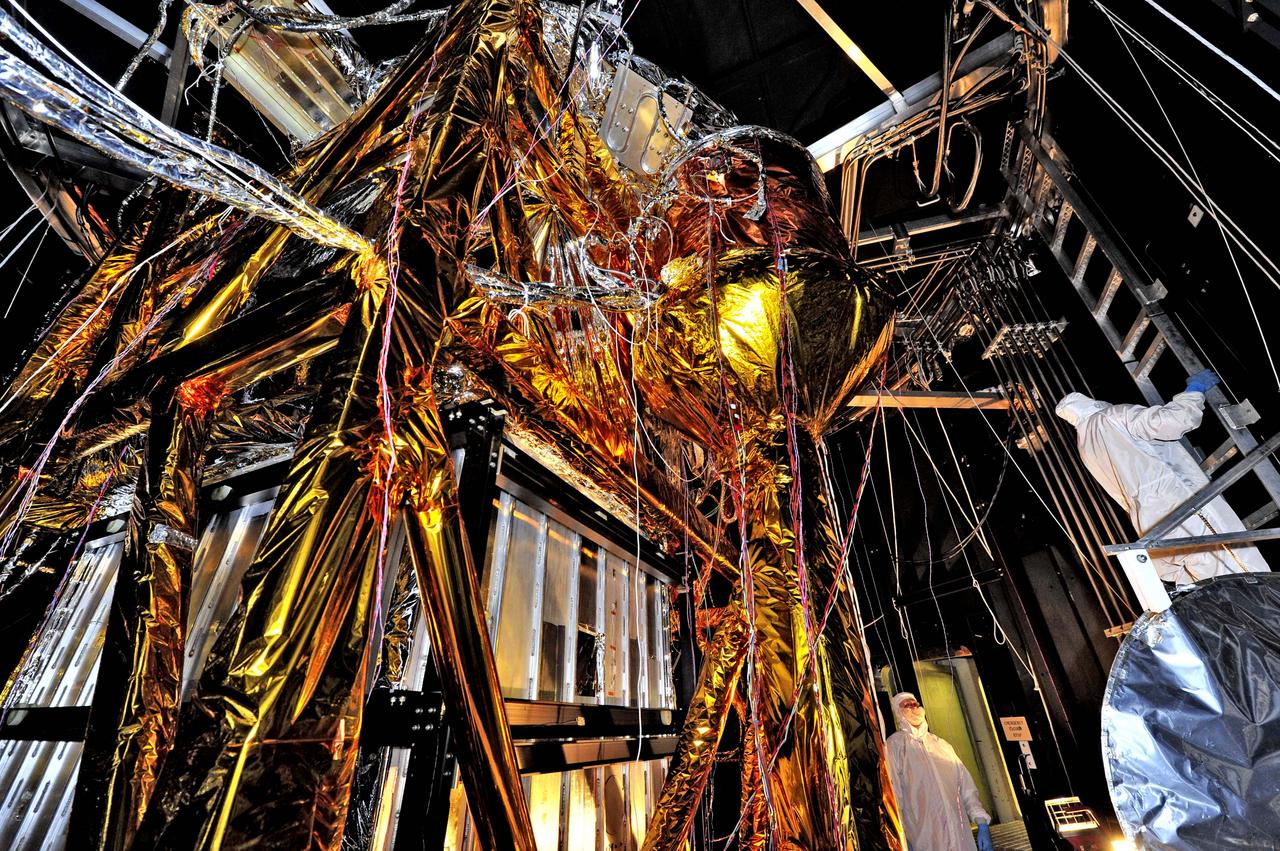
NASA image release August 23, 2012 What looks like a giant golden spider weaving a web of cables and cords, is actually ground support equipment, including the Optical Telescope Simulator (OSIM), for the James Webb Space Telescope. OSIM's job is to generate a beam of light just like the one that the real telescope optics will feed into the actual flight instruments. Because the real flight instruments will be used to test the real flight telescope, their alignment and performance first have to be verified by using the OSIM. Engineers are thoroughly checking out OSIM now in preparation for using it to test the flight science instruments later. This photo was taken from inside a large thermal-vacuum chamber called the Space Environment Simulator (SES), at NASA's Goddard Space Flight Center in Greenbelt, Md. Engineers have blanketed the structure of the OSIM with special insulating material to help control its temperature while it goes into the deep freeze testing that mimics the chill of space that Webb will ultimately experience in its operational orbit over 1 million miles from Earth. The golden-colored thermal blankets are made of aluminized kapton, a polymer film that remains stable over a wide range of temperatures. The structure that looks like a silver and black cube underneath the "spider" is a set of cold panels that surround OSIM's optics. During testing, OSIM's temperature will drop to 100 Kelvin (-280 F or -173 C) as liquid nitrogen flows through tubes welded to the chamber walls and through tubes along the silver panels surrounding OSIM's optics. These cold panels will keep the OSIM optics very cold, but the parts covered by the aluminized kapton blankets will stay warm. "Some blankets have silver facing out and gold facing in, or inverted, or silver on both sides, etc.," says Erin Wilson, a Goddard engineer. "Depending on which side of the blanket your hardware is looking at, the blankets can help it get colder or stay warmer, in an environmental test." Another reason for thermal blankets is to shield the cold OSIM optics from unwanted stray infrared light. When the OSIM is pointing its calibrated light beam at Webb's science instruments, engineers don't want any stray infrared light, such as "warm photons" from warm structures, leaking into the instruments' field of view. Too much of this stray light would raise the background too much for the instruments to "see" light from the OSIM—it would be like trying to photograph a lightning bug flying in front of car headlights. To get OSIM's optics cold, the inside of the chamber has to get cold, and to do that, all the air has to be pumped out to create a vacuum. Then liquid nitrogen has to be run though the plumbing along the inner walls of the chamber. Wilson notes that's why the blankets have to have vents in them: "That way, the air between all the layers can be evacuated as the chamber pressure drops, otherwise the blankets could pop," says Wilson. The most powerful space telescope ever built, Webb is the successor to NASA's Hubble Space Telescope. Webb's four instruments will reveal how the universe evolved from the Big Bang to the formation of our solar system. Webb is a joint project of NASA, the European Space Agency and the Canadian Space Agency. Credit: NASA/GSFC/Chris Gunn <b><a href="http://www.nasa.gov/audience/formedia/features/MP_Photo_Guidelines.html" rel="nofollow">NASA image use policy.</a></b> <b><a href="http://www.nasa.gov/centers/goddard/home/index.html" rel="nofollow">NASA Goddard Space Flight Center</a></b> enables NASA’s mission through four scientific endeavors: Earth Science, Heliophysics, Solar System Exploration, and Astrophysics. Goddard plays a leading role in NASA’s accomplishments by contributing compelling scientific knowledge to advance the Agency’s mission. <b>Follow us on <a href="http://twitter.com/NASA_GoddardPix" rel="nofollow">Twitter</a></b> <b>Like us on <a href="http://www.facebook.com/pages/Greenbelt-MD/NASA-Goddard/395013845897?ref=tsd" rel="nofollow">Facebook</a></b> <b>Find us on <a href="http://instagrid.me/nasagoddard/?vm=grid" rel="nofollow">Instagram</a></b>
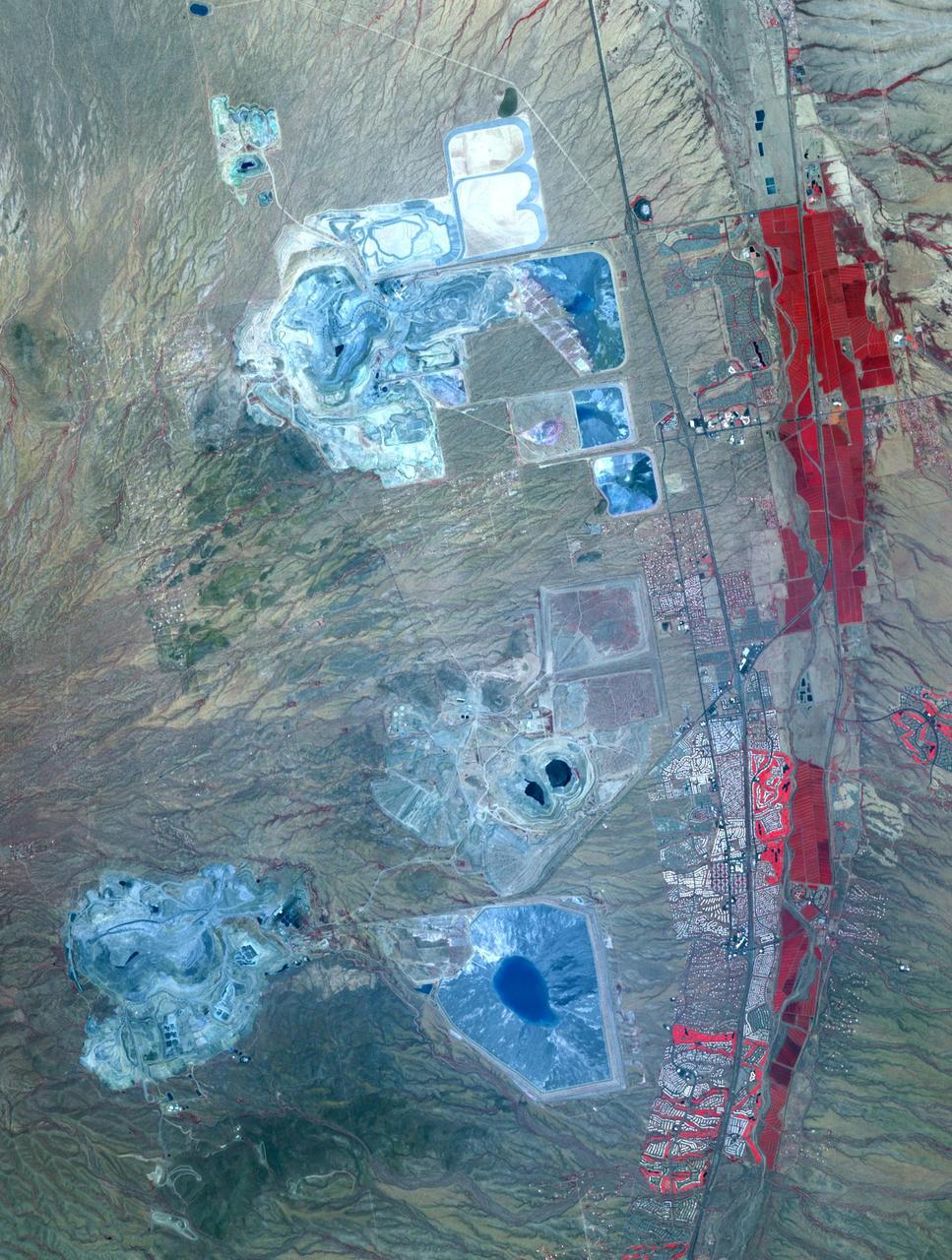
Arizona produces 60% of the total copper mined in the US; in 2007, 750,000 tons of copper came out of the state. One of the major mining districts is located about 30 km south of Tucson. Starting around 1950, open-pit mining replaced underground operations, and the ASARCO-Mission complex, Twin Buttes, and Sierrita mines became large open pit operations. Accompanying copper mineralization, silver, molybdenum, zinc, lead and gold are extracted. In addition to the pits themselves, enormous leach ponds and tailings piles surround the pits. The image was acquired May 31, 2012, covers an area of 22 by 28 km, and is located at 31.9 degrees north, 111 degrees west. With its 14 spectral bands from the visible to the thermal infrared wavelength region and its high spatial resolution of 15 to 90 meters (about 50 to 300 feet), ASTER images Earth to map and monitor the changing surface of our planet. ASTER is one of five Earth-observing instruments launched Dec. 18, 1999, on Terra. The instrument was built by Japan's Ministry of Economy, Trade and Industry. A joint U.S./Japan science team is responsible for validation and calibration of the instrument and data products. The broad spectral coverage and high spectral resolution of ASTER provides scientists in numerous disciplines with critical information for surface mapping and monitoring of dynamic conditions and temporal change. Example applications are: monitoring glacial advances and retreats; monitoring potentially active volcanoes; identifying crop stress; determining cloud morphology and physical properties; wetlands evaluation; thermal pollution monitoring; coral reef degradation; surface temperature mapping of soils and geology; and measuring surface heat balance. The U.S. science team is located at NASA's Jet Propulsion Laboratory, Pasadena, Calif. The Terra mission is part of NASA's Science Mission Directorate, Washington, D.C. More information about ASTER is available at <a href="http://asterweb.jpl.nasa.gov/" rel="nofollow">asterweb.jpl.nasa.gov/</a> Credit: NASA/GSFC/METI/ERSDAC/JAROS, and U.S./Japan ASTER Science Team <b><a href="http://www.nasa.gov/audience/formedia/features/MP_Photo_Guidelines.html" rel="nofollow">NASA image use policy.</a></b> <b><a href="http://www.nasa.gov/centers/goddard/home/index.html" rel="nofollow">NASA Goddard Space Flight Center</a></b> enables NASA’s mission through four scientific endeavors: Earth Science, Heliophysics, Solar System Exploration, and Astrophysics. Goddard plays a leading role in NASA’s accomplishments by contributing compelling scientific knowledge to advance the Agency’s mission. <b>Follow us on <a href="http://twitter.com/NASAGoddardPix" rel="nofollow">Twitter</a></b> <b>Like us on <a href="http://www.facebook.com/pages/Greenbelt-MD/NASA-Goddard/395013845897?ref=tsd" rel="nofollow">Facebook</a></b> <b>Find us on <a href="http://instagram.com/nasagoddard?vm=grid" rel="nofollow">Instagram</a></b>