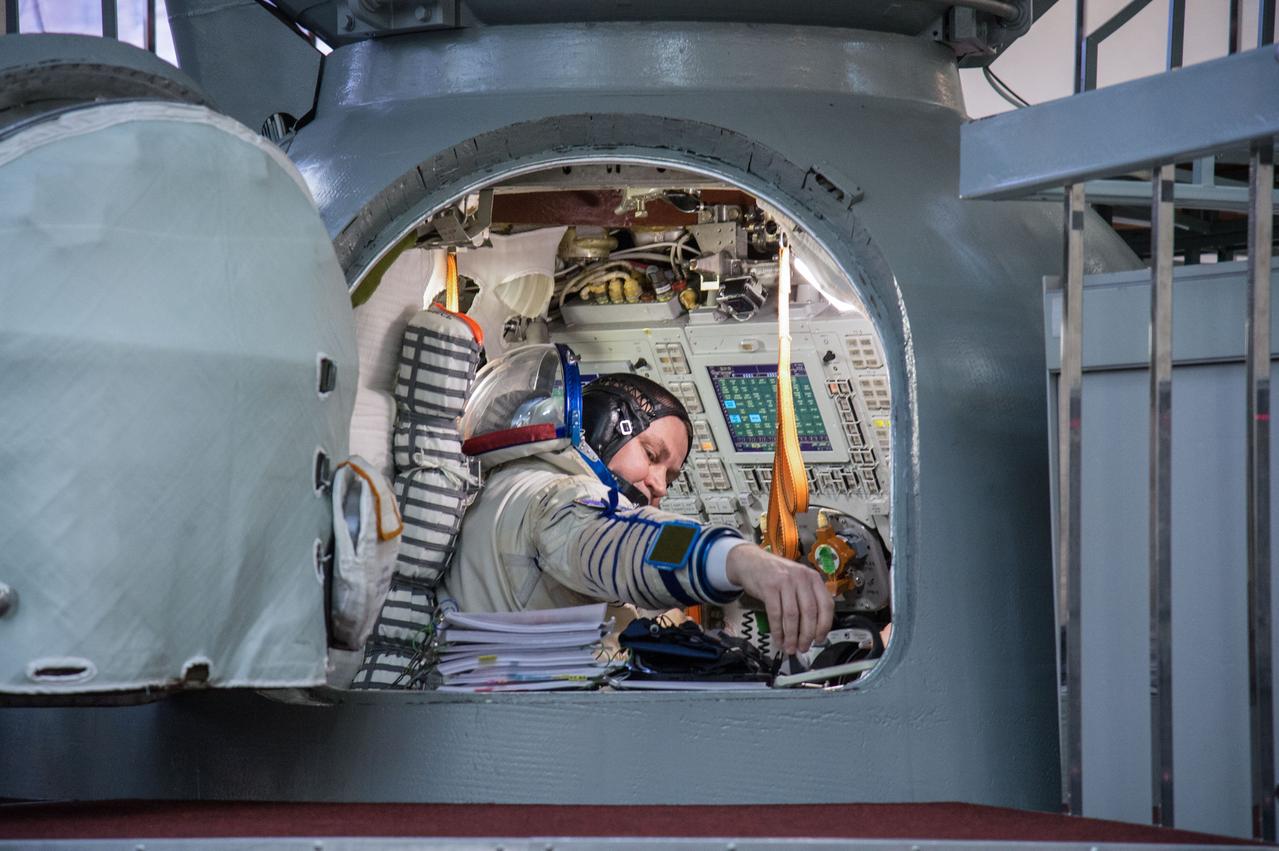
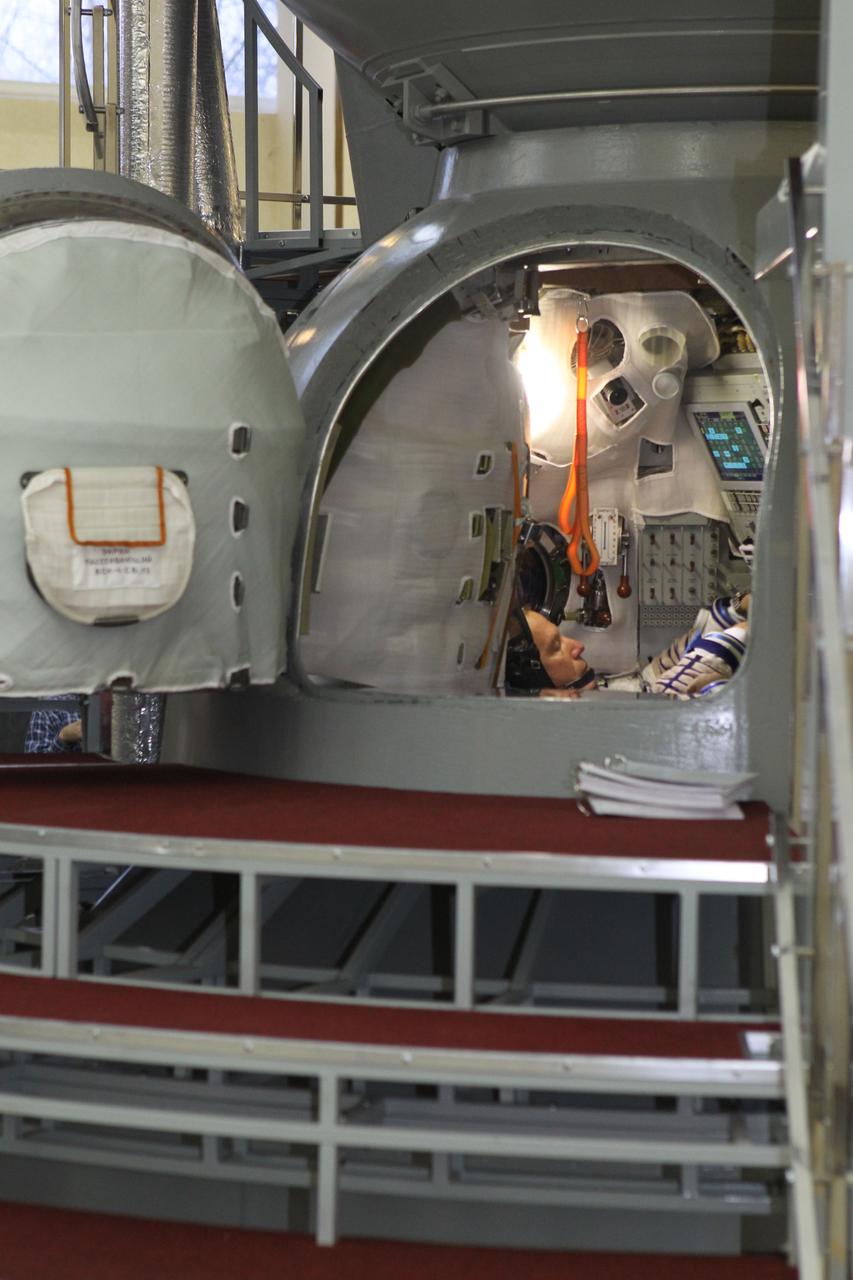
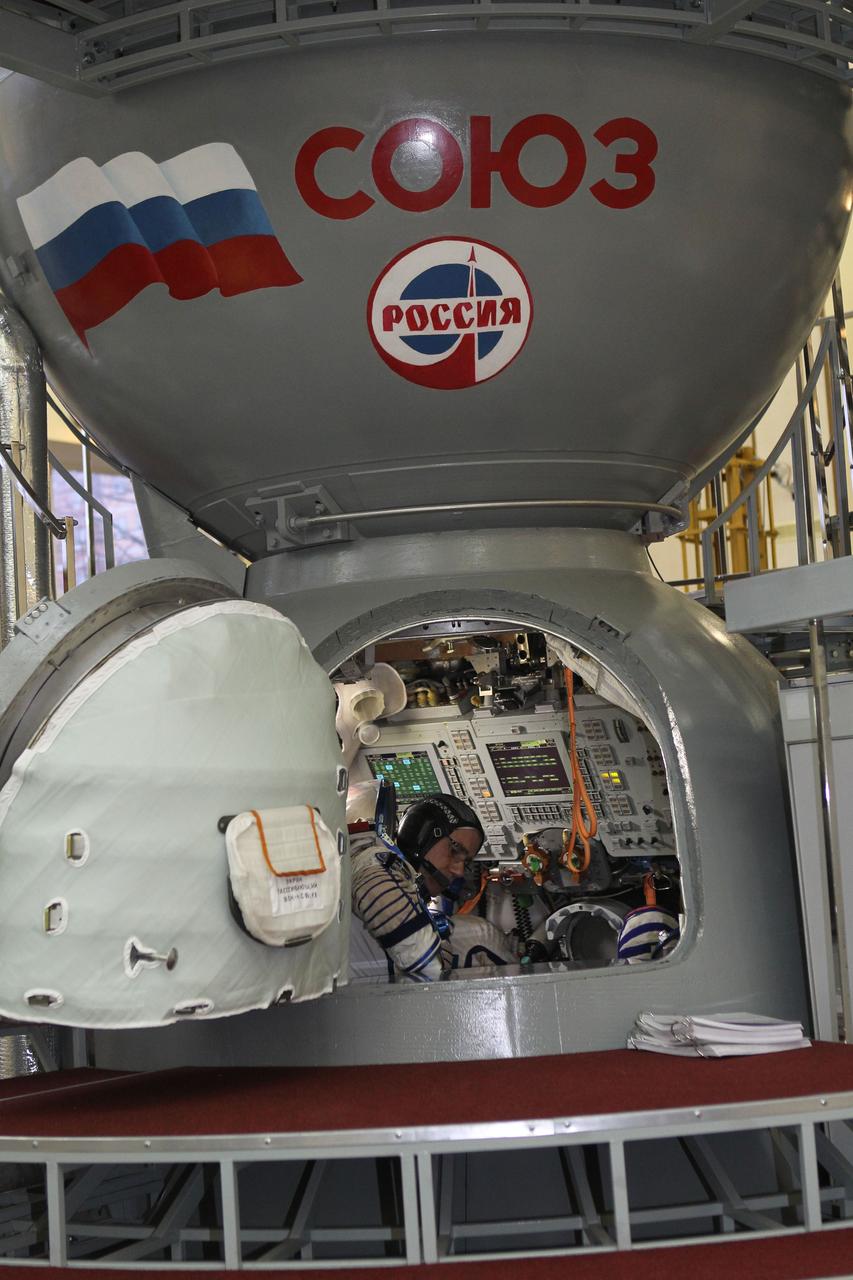
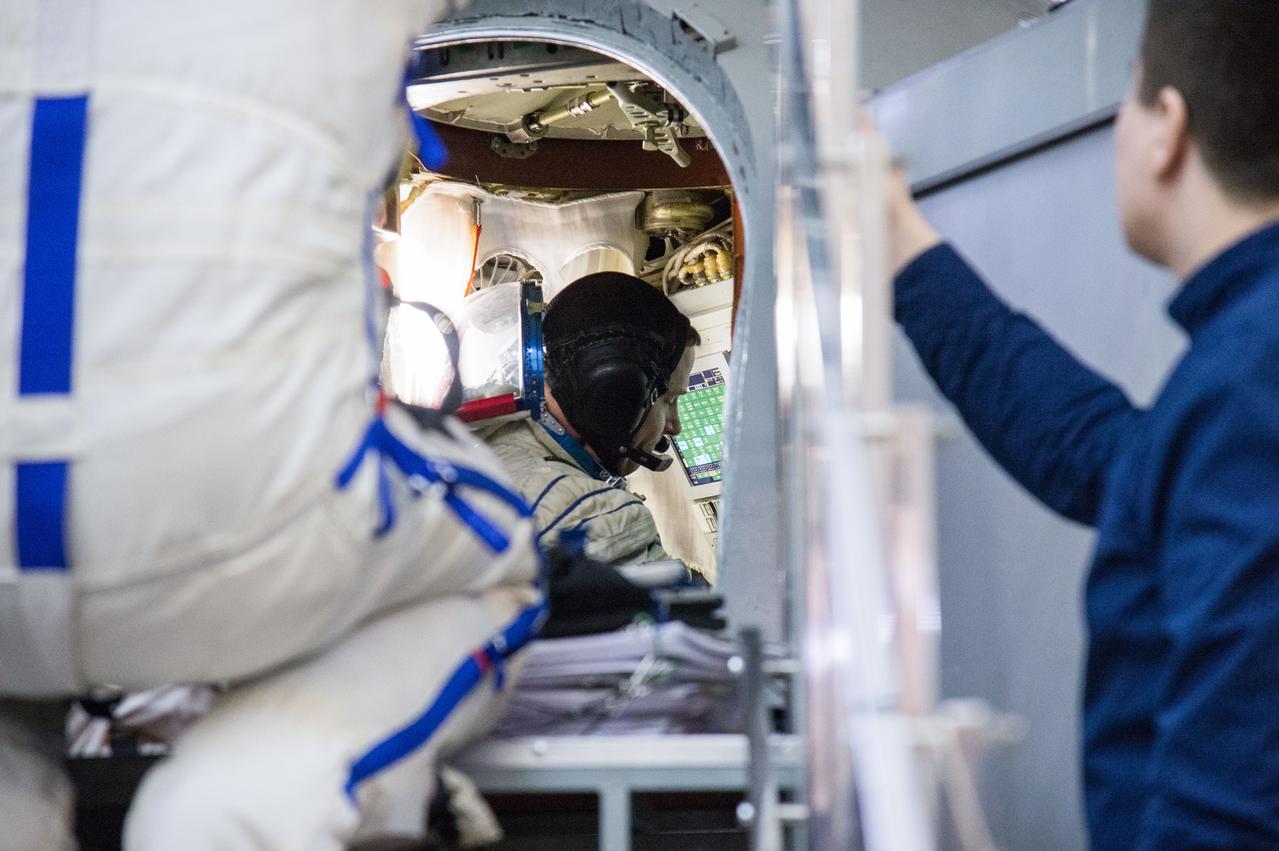
jsc2019e004060 (Feb. 20, 2019) --- At the Gagarin Cosmonaut Training Center in Star City, Russia, Expedition 59 crew member Alexey Ovchinin of Roscosmos is seen inside a Soyuz spacecraft simulator Feb. 20 during the second day of final pre-launch qualification exams. Ovchinin and crewmates Nick Hague and Christina Koch of NASA will launch March 14, U.S. time, in the Soyuz MS-12 spacecraft from the Baikonur Cosmodrome in Kazakhstan for a six-and-a-half month mission on the International Space Station. Credit: NASA/Beth Weissinger
Alexey Ovchinin of Roscosmos inside a Soyuz spacecraft simulator
jsc2019e004059 (Feb. 20, 2019) --- At the Gagarin Cosmonaut Training Center in Star City, Russia, Expedition 59 crew member Nick Hague of NASA is seen inside a Soyuz spacecraft simulator Feb. 20 during the second day of final pre-launch qualification exams. Hague, Christina Koch of NASA and Alexey Ovchinin of Roscosmos will launch March 14, U.S. time, in the Soyuz MS-12 spacecraft from the Baikonur Cosmodrome in Kazakhstan for a six-and-a-half month mission on the International Space Station. Credit: NASA/Beth Weissinger
Nick Hague of NASA inside a Soyuz spacecraft simulator
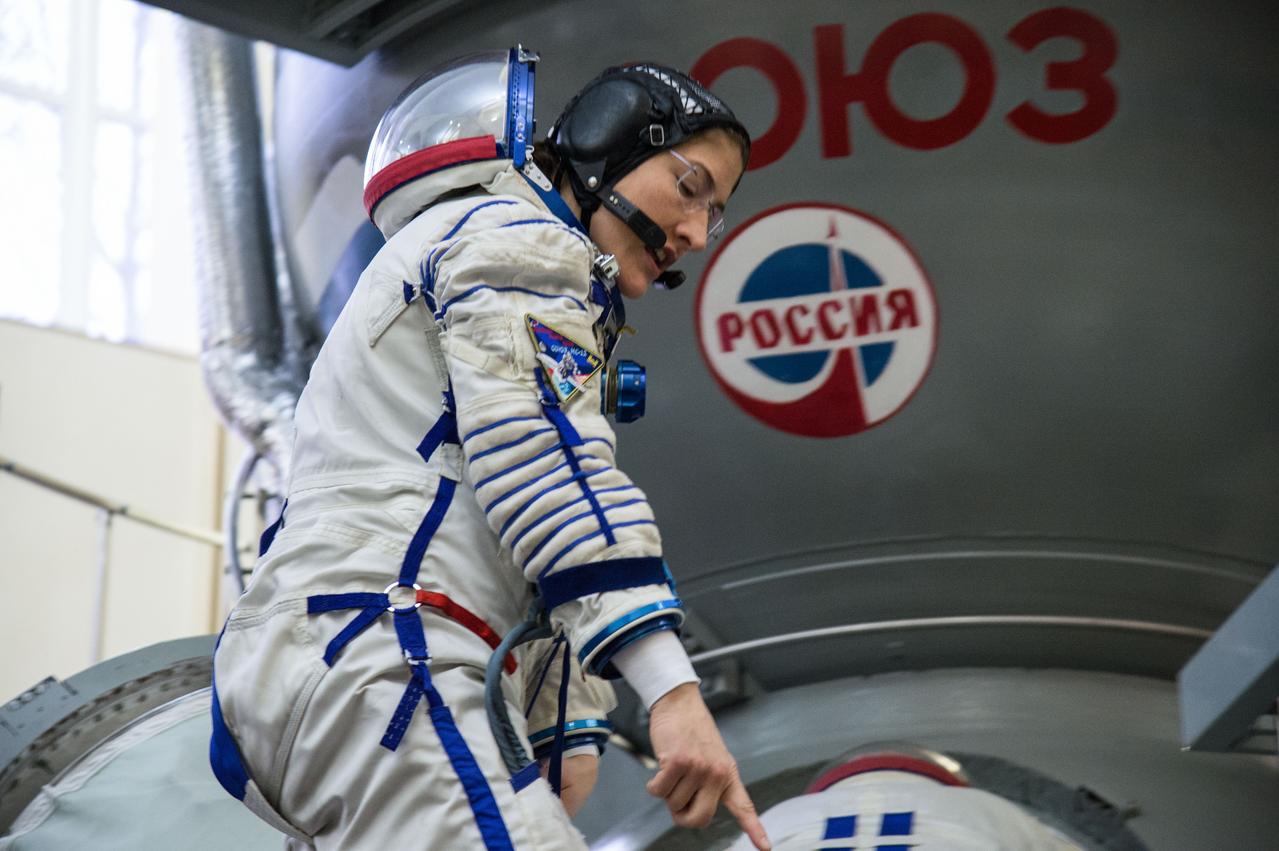
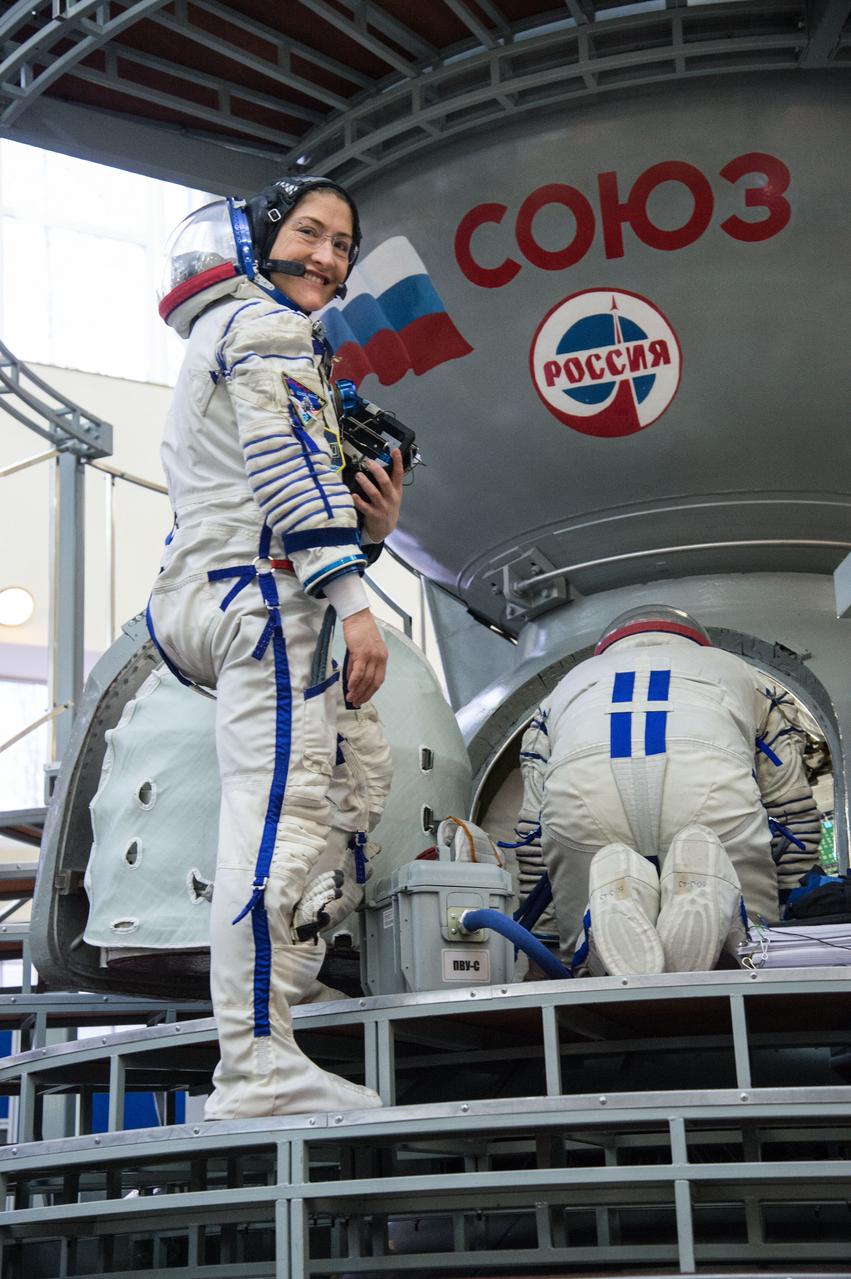
jsc2019e004057 (Feb. 20, 2019) --- At the Gagarin Cosmonaut Training Center in Star City, Russia, Expedition 59 crew member Christina Koch of NASA boards a Soyuz spacecraft simulator Feb. 20 during the second day of final pre-launch qualifications exams. Koch, Nick Hague of NASA and Alexey Ovchinin of Roscosmos will launch March 14, U.S. time, in the Soyuz MS-12 spacecraft from the Baikonur Cosmodrome in Kazakhstan for a six-and-a-half month mission on the International Space Station. Credit: NASA/Beth Weissinger
Christina Koch of NASA boards a Soyuz spacecraft simulator
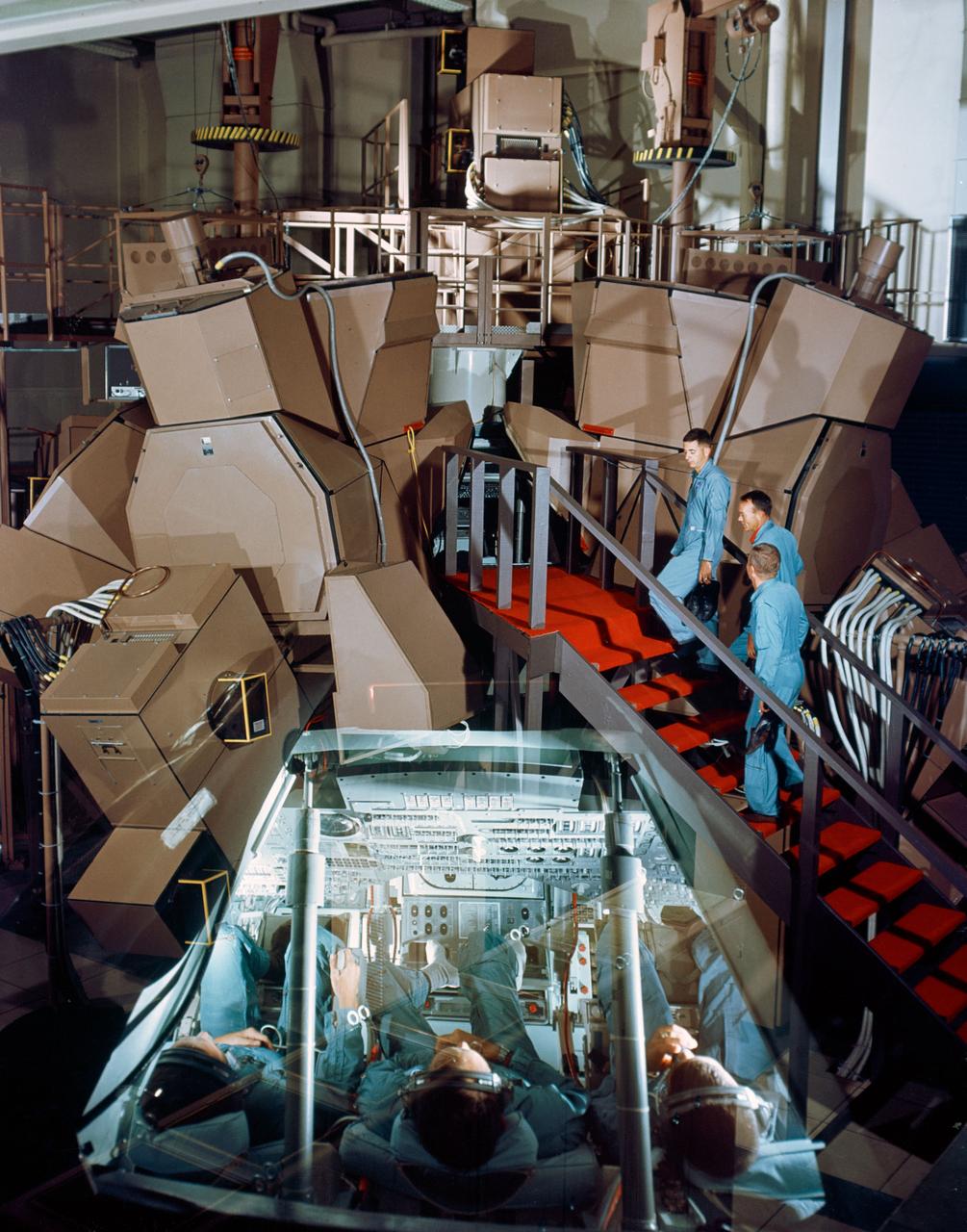
S67-50585 (1967) --- This is an intentional double exposure showing the Apollo Mission Simulator in the Mission Simulation and Training Facility, Building 5 at the Manned Spacecraft Center. In the exterior view astronauts William A. Anders, Michael Collins, and Frank Borman (reading from top of stairs) are about to enter the simulator. The interior view shows the three astronauts in the simulator. They are (left to right) Borman, Collins, and Anders. Photo credit: NASA
Dual exposure view of exterior and interior of Apollo Mission simulator
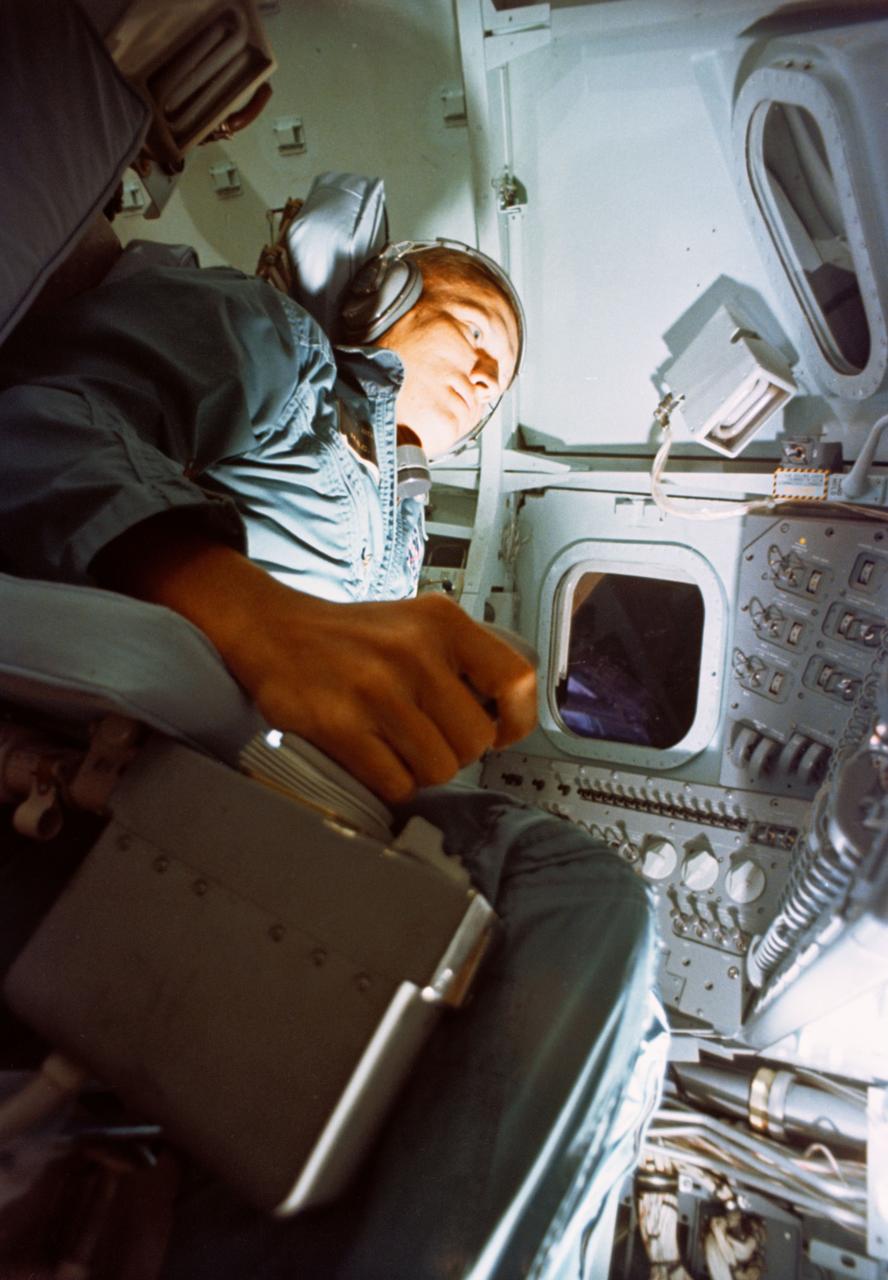
S67-50590 (1867) --- Astronaut Frank Borman, assigned duty as commander of the Apollo 8 mission, participates in a training exercise in the Apollo Mission simulator in the Mission Simulation and training Facility, Building 5, at the Manned Spacecraft Center, Houston, Texas. Photo credit: NASA
Astronaut Frank Borman during training exercise in Apollo Mission simulator
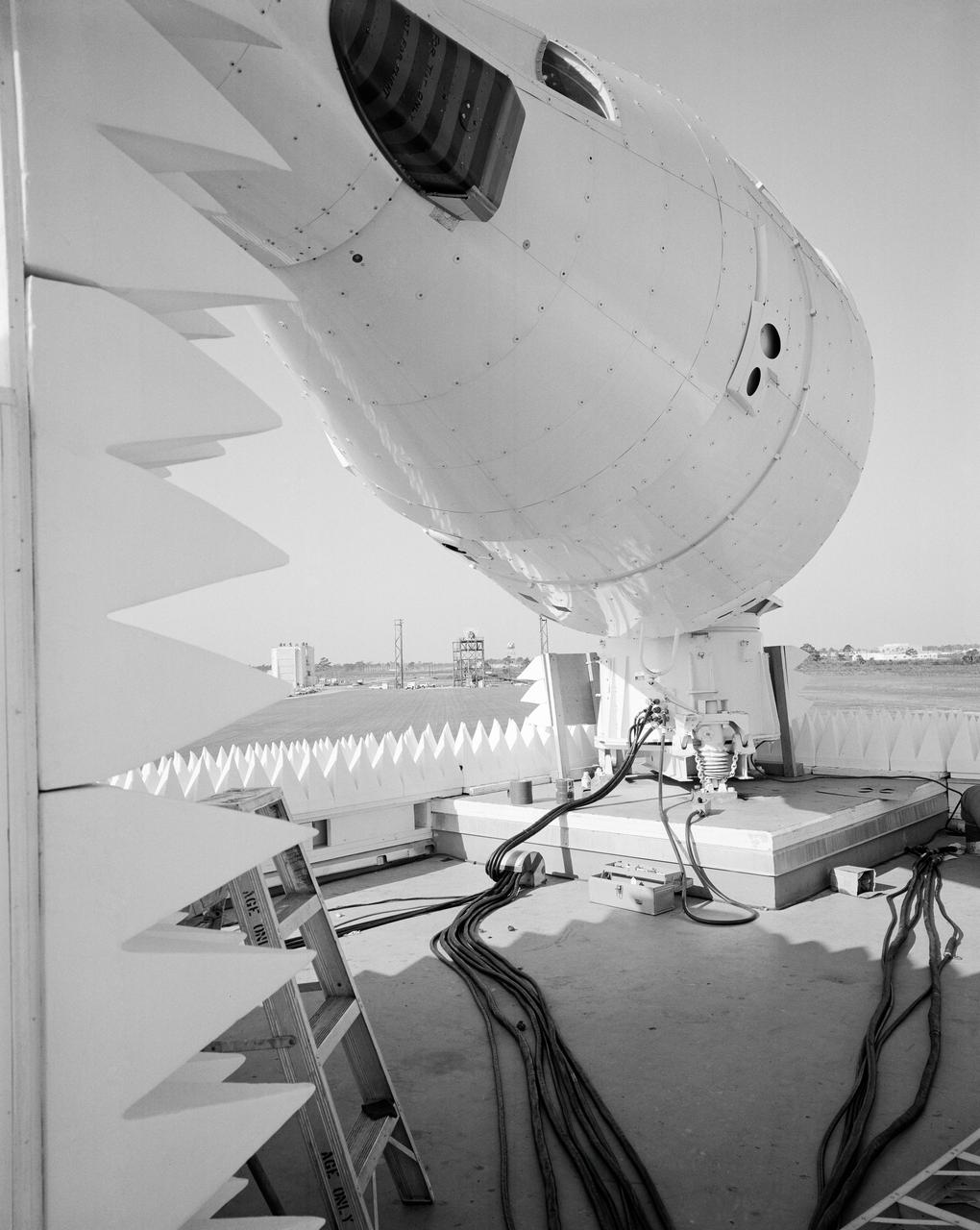
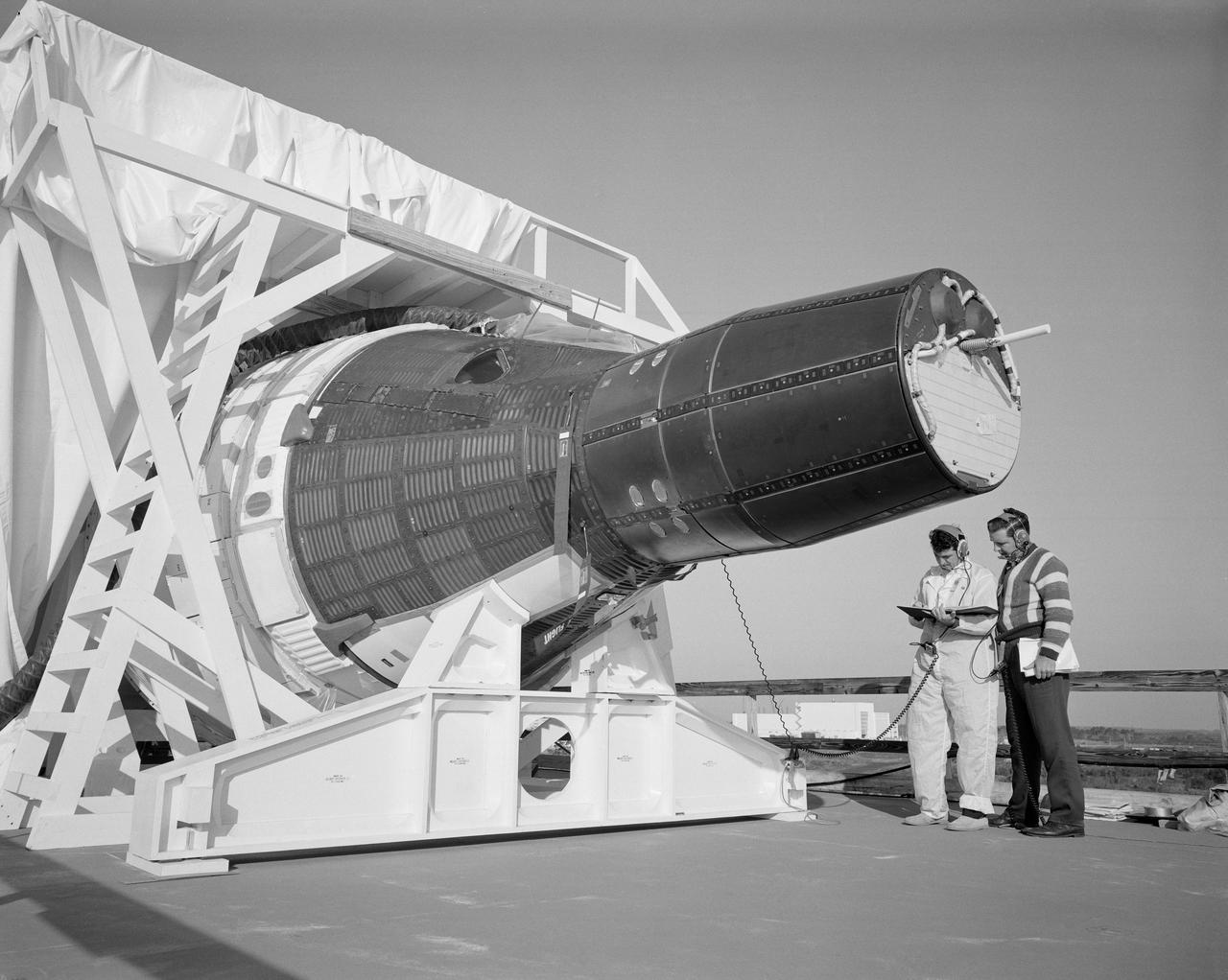
S65-13394 (6 Jan. 1965) --- Gemini-3 spacecraft (background) on tower at Boresight Range, Merritt Island launch area, showing simulator in foreground.
GEMINI TESTING - SPACECRAFT 3 - SIMULATOR - BORESIGHT RANGE TEST - CAPE
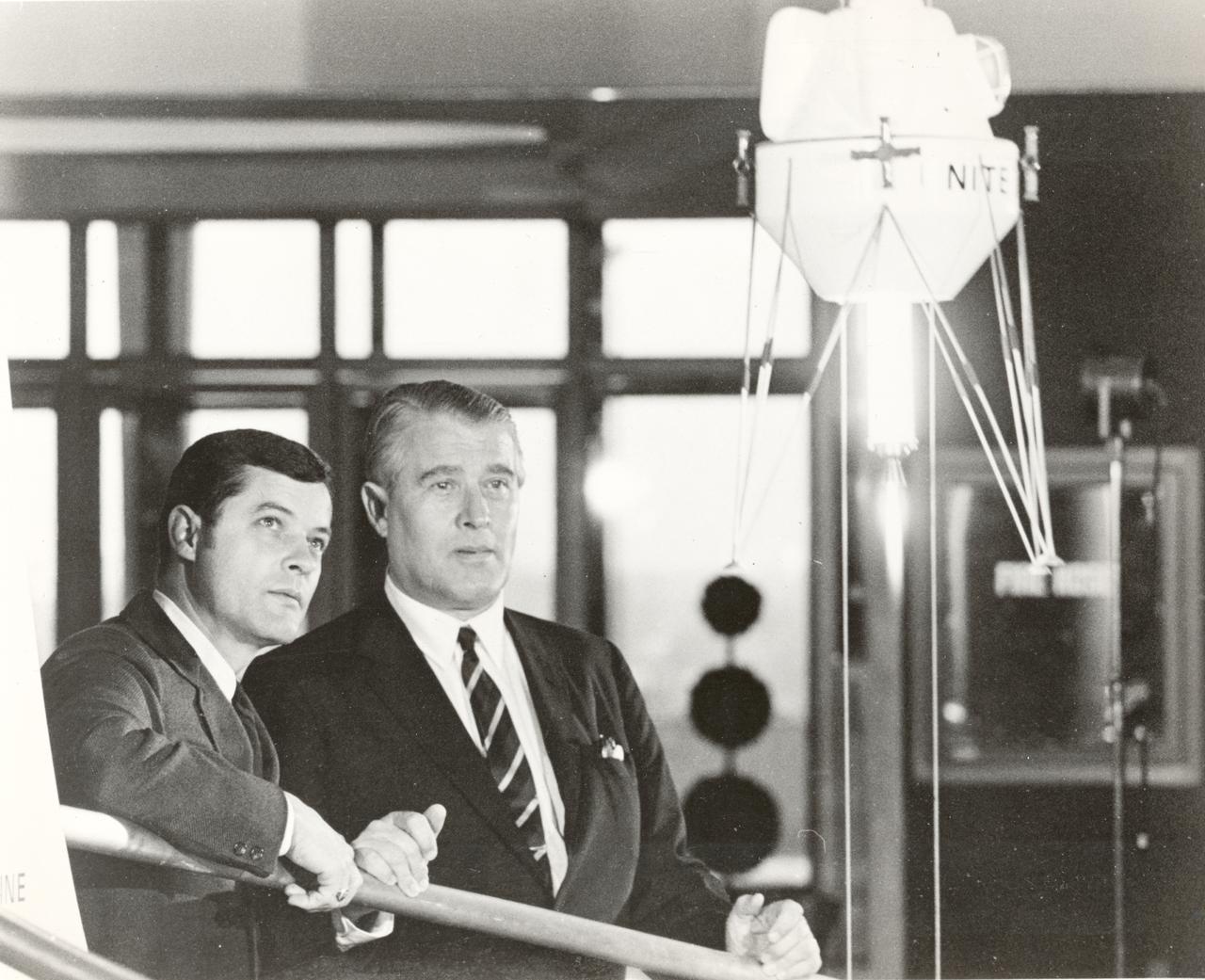
Edward O. Buckbee, the first Director of the Alabama Space Science Center (left), and Dr. Wernher von Braun (right) view a demonstration of a simulated spacecraft which uses an actual hybrid rocket engine for liftoff, hover, and landing. The display was presented to the Alabama Space Science Center, later renamed the U.S. Space and Rocket Center, by United Technology Center, a division of United Aircraft.
Wernher von Braun
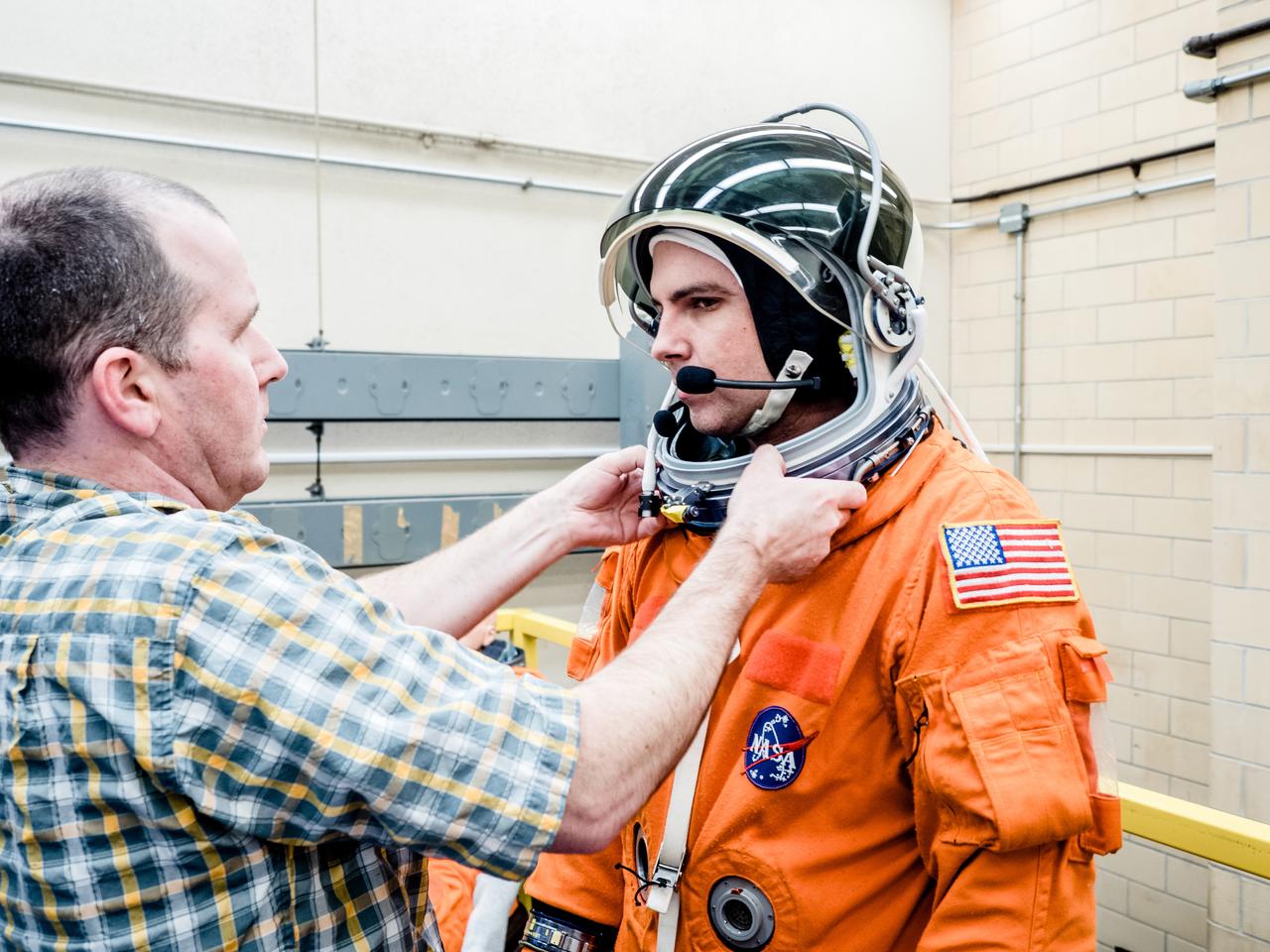
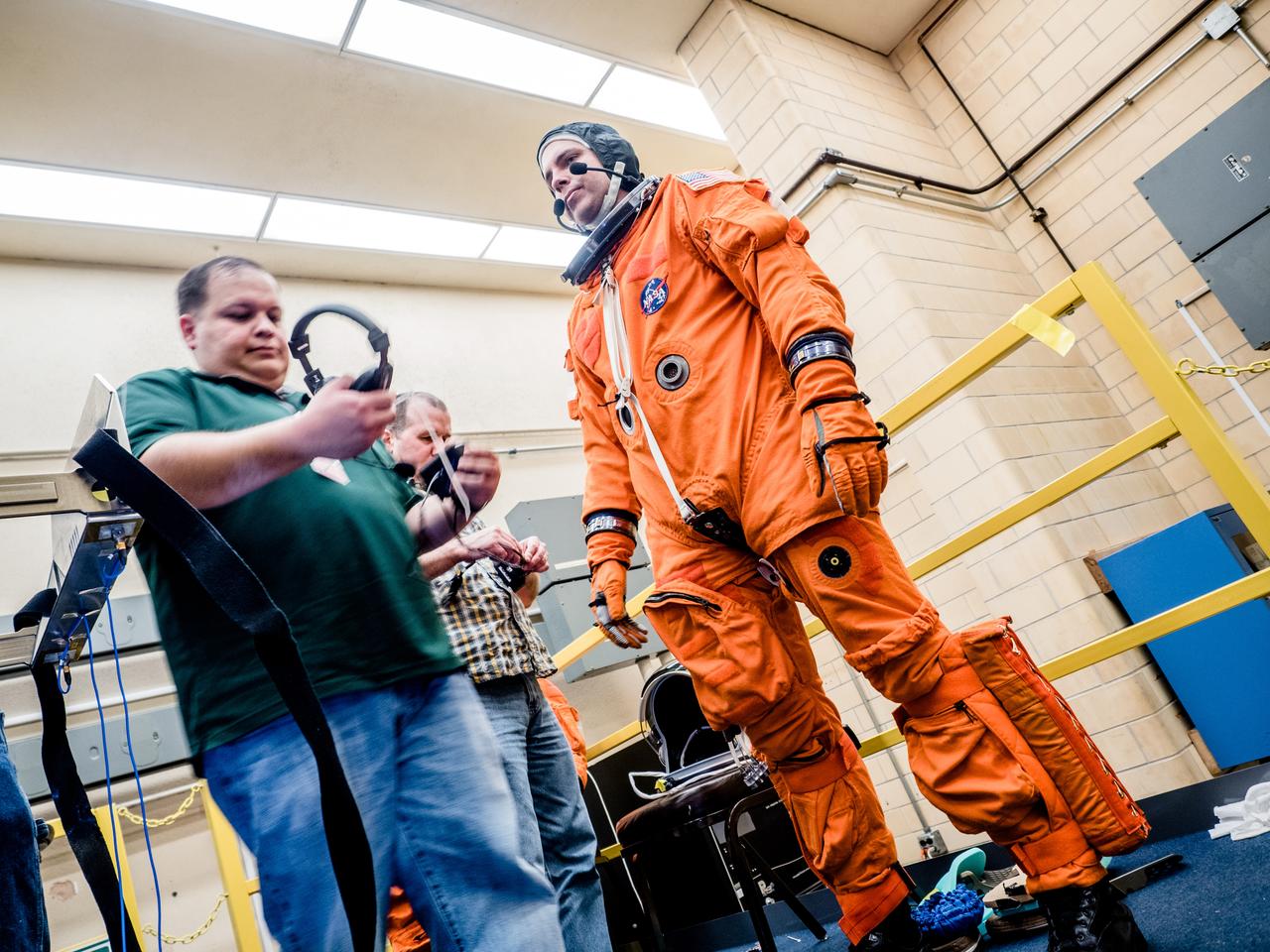
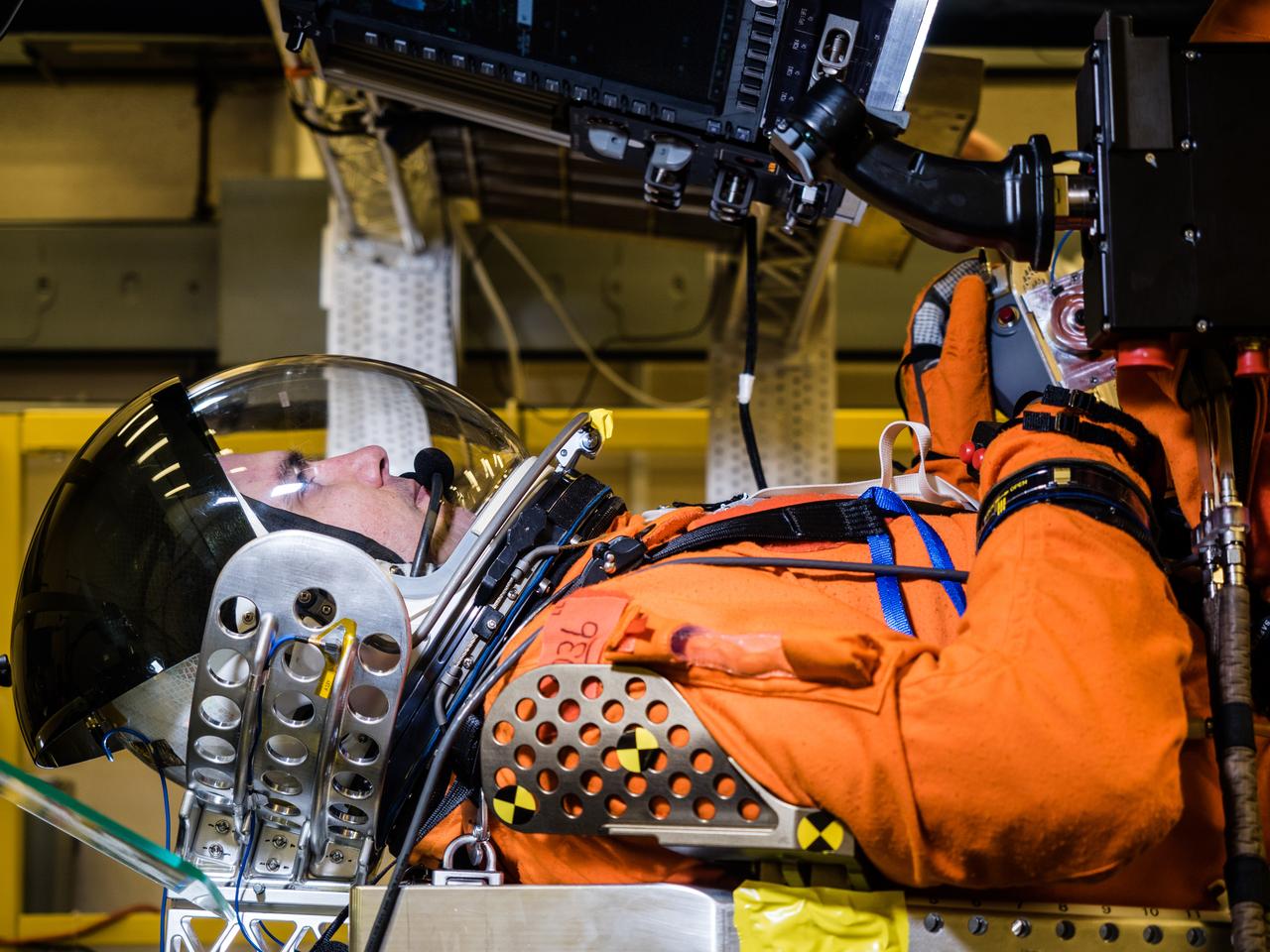
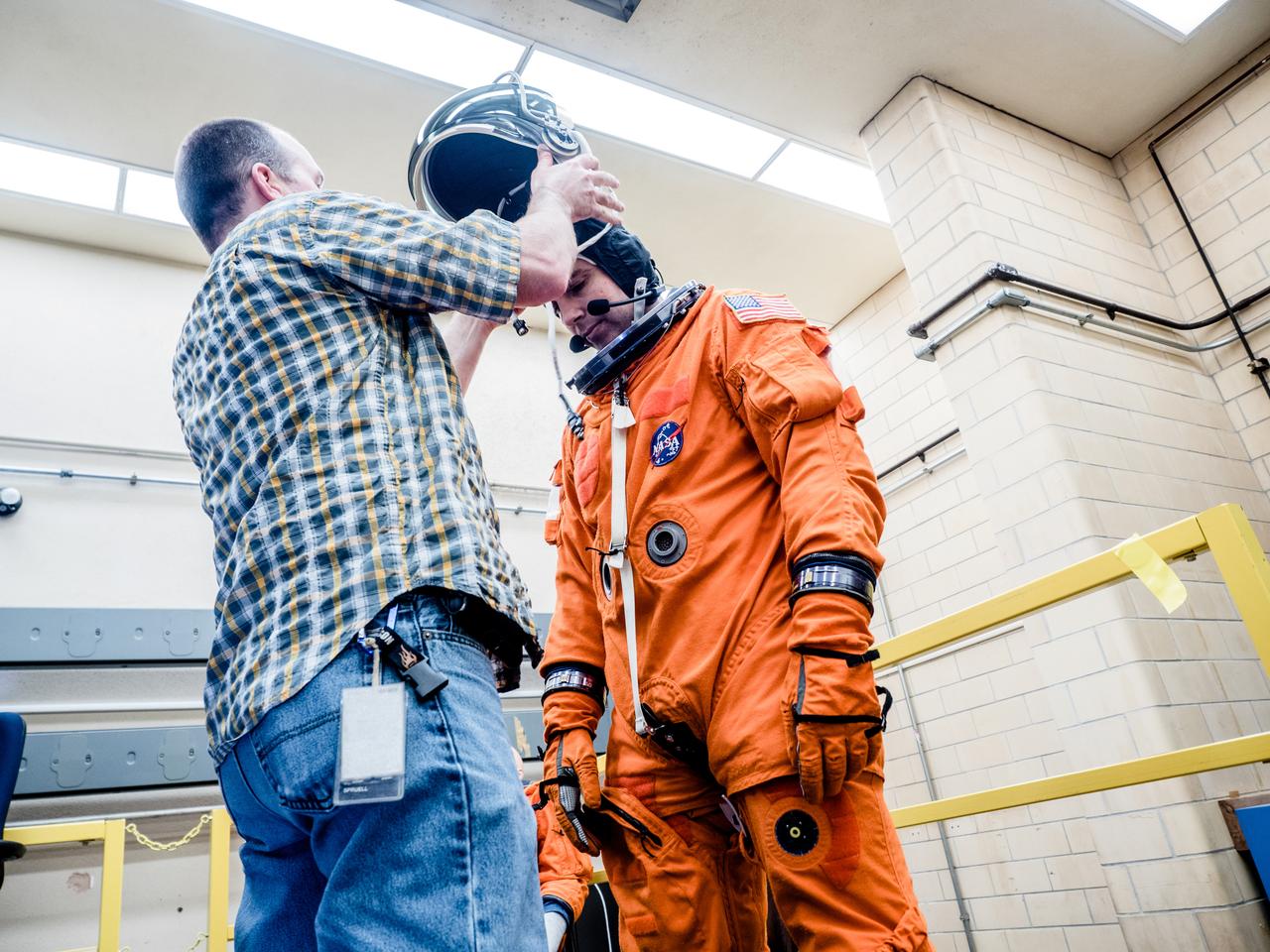
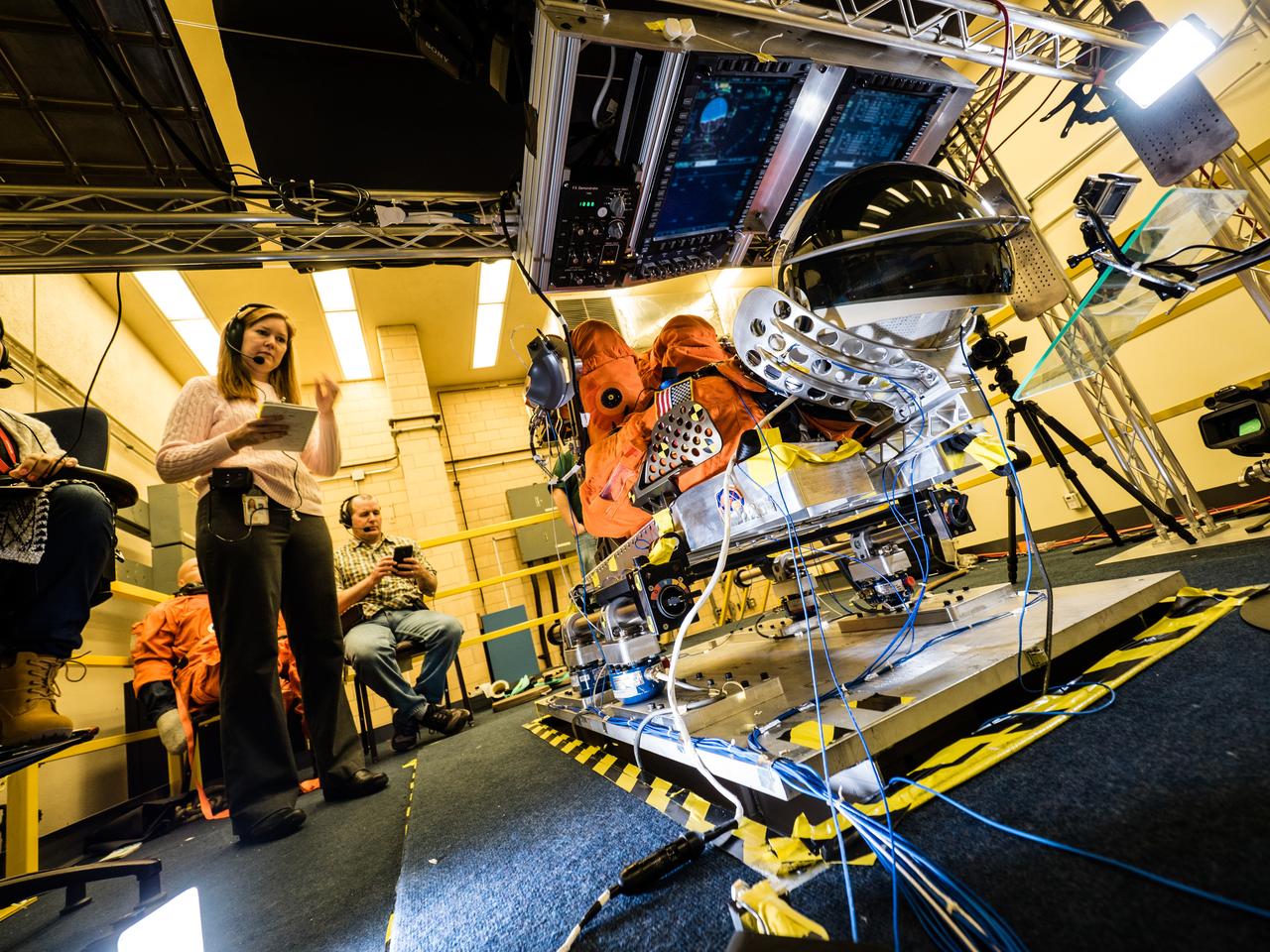
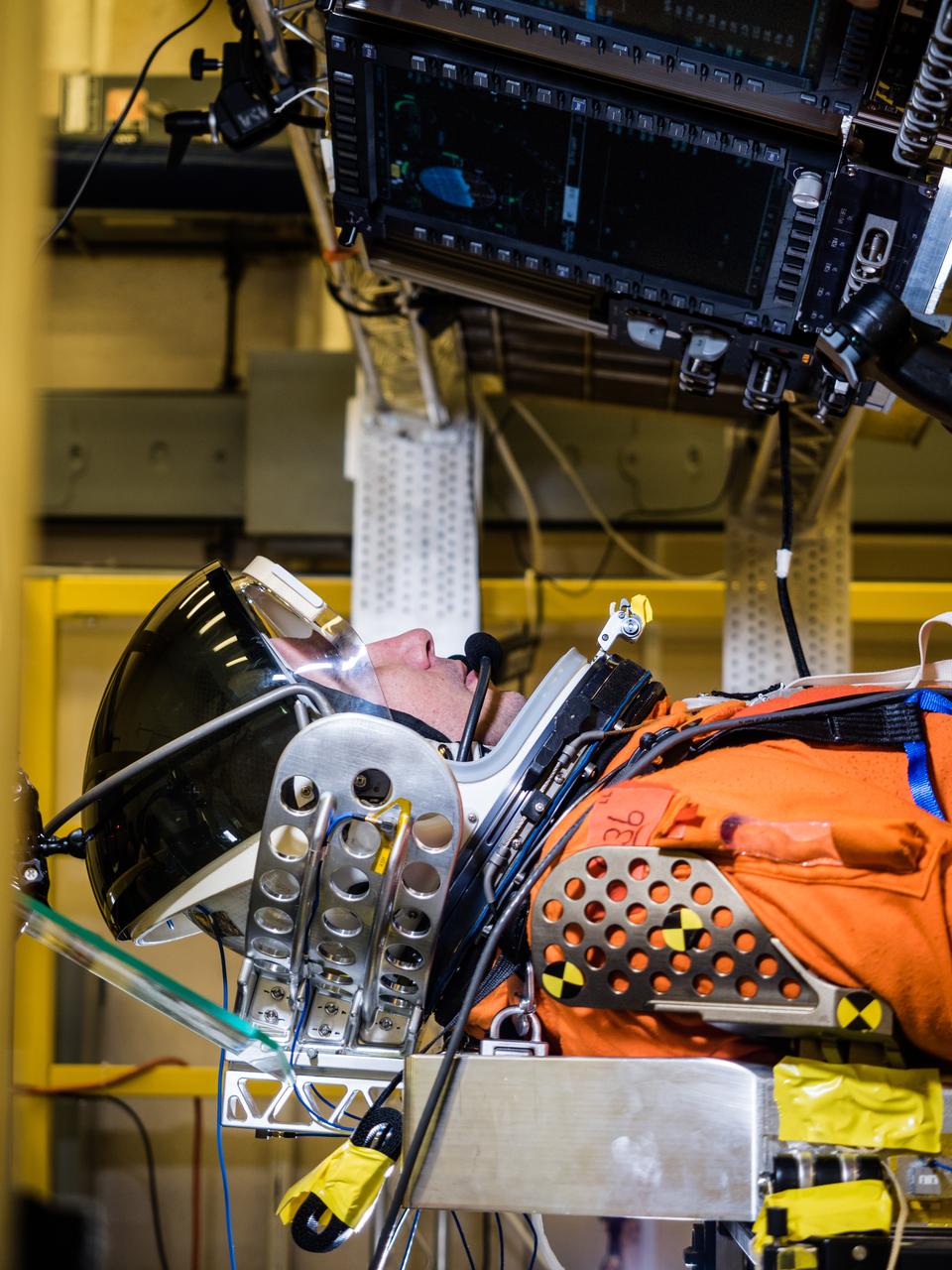
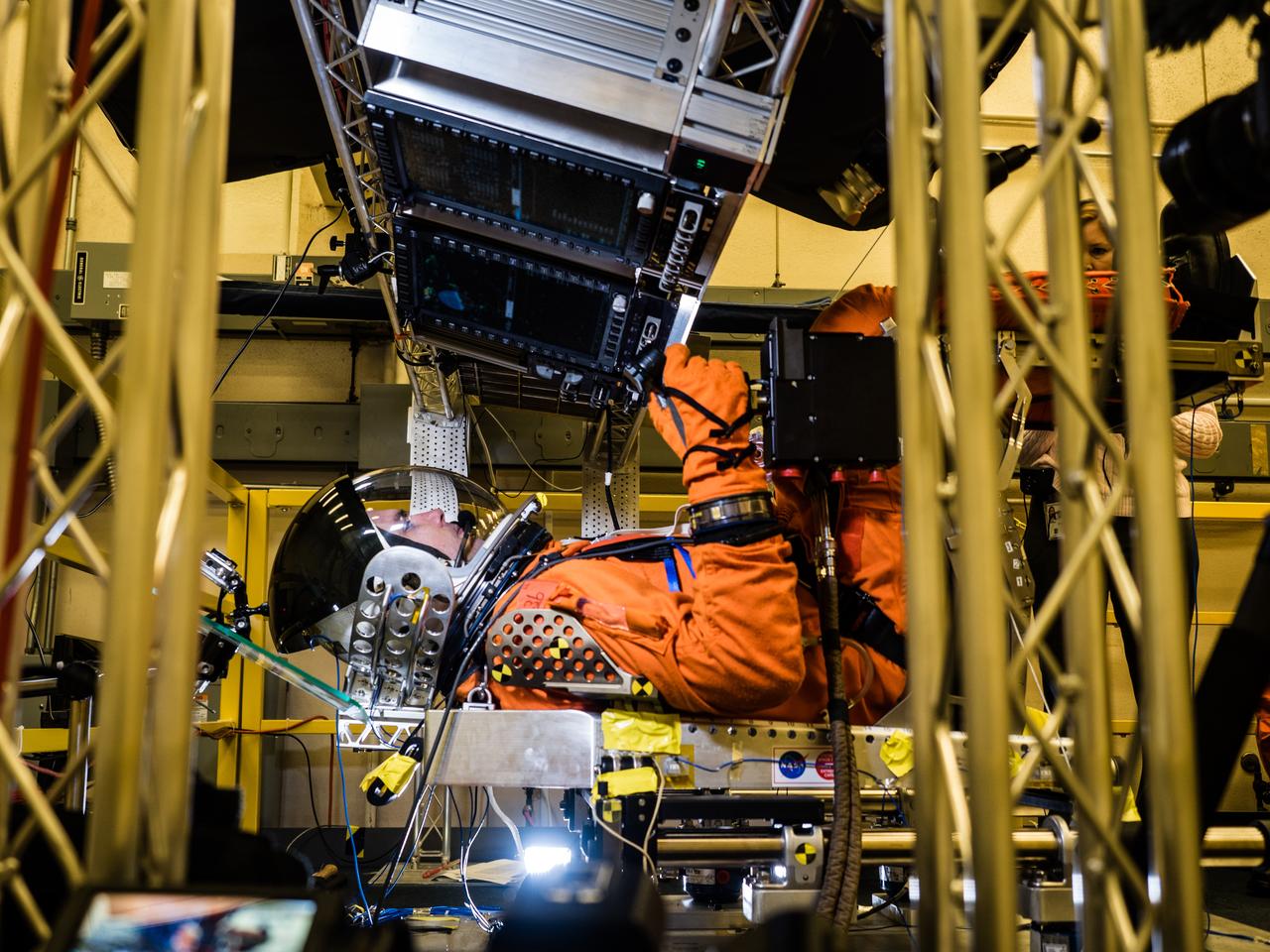
In a lab at NASA’s Johnson Space Center in Houston, engineers simulate conditions that astronauts in space suits would experience when the Orion spacecraft is vibrating during launch atop the agency’s powerful Space Launch System rocket on its way to deep space destinations on Jan. 19, 2017. A series of tests occurring this month at Johnson will help human factors engineers assess how well the crew can interact with the displays and controls they will use to monitor Orion’s systems and operate the spacecraft when necessary...Test subjects wore modified advanced crew escape suits that are being developed for astronauts in Orion, and sat in the latest design of the seat atop the crew impact attenuation system. This was the first time this key hardware was brought together to evaluate how launch vibrations may impact the astronaut’s ability to view the displays and controls.
NASA Simulates Orion Spacecraft Launch Conditions for Crew
In a lab at NASA’s Johnson Space Center in Houston, engineers simulate conditions that astronauts in space suits would experience when the Orion spacecraft is vibrating during launch atop the agency’s powerful Space Launch System rocket on its way to deep space destinations on Jan. 19, 2017. A series of tests occurring this month at Johnson will help human factors engineers assess how well the crew can interact with the displays and controls they will use to monitor Orion’s systems and operate the spacecraft when necessary...Test subjects wore modified advanced crew escape suits that are being developed for astronauts in Orion, and sat in the latest design of the seat atop the crew impact attenuation system. This was the first time this key hardware was brought together to evaluate how launch vibrations may impact the astronaut’s ability to view the displays and controls.
NASA Simulates Orion Spacecraft Launch Conditions for Crew
In a lab at NASA’s Johnson Space Center in Houston, engineers simulate conditions that astronauts in space suits would experience when the Orion spacecraft is vibrating during launch atop the agency’s powerful Space Launch System rocket on its way to deep space destinations on Jan. 19, 2017. A series of tests occurring this month at Johnson will help human factors engineers assess how well the crew can interact with the displays and controls they will use to monitor Orion’s systems and operate the spacecraft when necessary...Test subjects wore modified advanced crew escape suits that are being developed for astronauts in Orion, and sat in the latest design of the seat atop the crew impact attenuation system. This was the first time this key hardware was brought together to evaluate how launch vibrations may impact the astronaut’s ability to view the displays and controls.
NASA Simulates Orion Spacecraft Launch Conditions for Crew
In a lab at NASA’s Johnson Space Center in Houston, engineers simulate conditions that astronauts in space suits would experience when the Orion spacecraft is vibrating during launch atop the agency’s powerful Space Launch System rocket on its way to deep space destinations on Jan. 19, 2017. A series of tests occurring this month at Johnson will help human factors engineers assess how well the crew can interact with the displays and controls they will use to monitor Orion’s systems and operate the spacecraft when necessary...Test subjects wore modified advanced crew escape suits that are being developed for astronauts in Orion, and sat in the latest design of the seat atop the crew impact attenuation system. This was the first time this key hardware was brought together to evaluate how launch vibrations may impact the astronaut’s ability to view the displays and controls.
NASA Simulates Orion Spacecraft Launch Conditions for Crew
In a lab at NASA’s Johnson Space Center in Houston, engineers simulate conditions that astronauts in space suits would experience when the Orion spacecraft is vibrating during launch atop the agency’s powerful Space Launch System rocket on its way to deep space destinations on Jan. 19, 2017. A series of tests occurring this month at Johnson will help human factors engineers assess how well the crew can interact with the displays and controls they will use to monitor Orion’s systems and operate the spacecraft when necessary...Test subjects wore modified advanced crew escape suits that are being developed for astronauts in Orion, and sat in the latest design of the seat atop the crew impact attenuation system. This was the first time this key hardware was brought together to evaluate how launch vibrations may impact the astronaut’s ability to view the displays and controls.
NASA Simulates Orion Spacecraft Launch Conditions for Crew
In a lab at NASA’s Johnson Space Center in Houston, engineers simulate conditions that astronauts in space suits would experience when the Orion spacecraft is vibrating during launch atop the agency’s powerful Space Launch System rocket on its way to deep space destinations on Jan. 19, 2017. A series of tests occurring this month at Johnson will help human factors engineers assess how well the crew can interact with the displays and controls they will use to monitor Orion’s systems and operate the spacecraft when necessary...Test subjects wore modified advanced crew escape suits that are being developed for astronauts in Orion, and sat in the latest design of the seat atop the crew impact attenuation system. This was the first time this key hardware was brought together to evaluate how launch vibrations may impact the astronaut’s ability to view the displays and controls.
NASA Simulates Orion Spacecraft Launch Conditions for Crew
In a lab at NASA’s Johnson Space Center in Houston, engineers simulate conditions that astronauts in space suits would experience when the Orion spacecraft is vibrating during launch atop the agency’s powerful Space Launch System rocket on its way to deep space destinations on Jan. 19, 2017. A series of tests occurring this month at Johnson will help human factors engineers assess how well the crew can interact with the displays and controls they will use to monitor Orion’s systems and operate the spacecraft when necessary...Test subjects wore modified advanced crew escape suits that are being developed for astronauts in Orion, and sat in the latest design of the seat atop the crew impact attenuation system. This was the first time this key hardware was brought together to evaluate how launch vibrations may impact the astronaut’s ability to view the displays and controls.
NASA Simulates Orion Spacecraft Launch Conditions for Crew
In a lab at NASA’s Johnson Space Center in Houston, engineers simulate conditions that astronauts in space suits would experience when the Orion spacecraft is vibrating during launch atop the agency’s powerful Space Launch System rocket on its way to deep space destinations on Jan. 19, 2017. A series of tests occurring this month at Johnson will help human factors engineers assess how well the crew can interact with the displays and controls they will use to monitor Orion’s systems and operate the spacecraft when necessary...Test subjects wore modified advanced crew escape suits that are being developed for astronauts in Orion, and sat in the latest design of the seat atop the crew impact attenuation system. This was the first time this key hardware was brought together to evaluate how launch vibrations may impact the astronaut’s ability to view the displays and controls.
NASA Simulates Orion Spacecraft Launch Conditions for Crew
In a lab at NASA’s Johnson Space Center in Houston, engineers simulate conditions that astronauts in space suits would experience when the Orion spacecraft is vibrating during launch atop the agency’s powerful Space Launch System rocket on its way to deep space destinations on Jan. 19, 2017. A series of tests occurring this month at Johnson will help human factors engineers assess how well the crew can interact with the displays and controls they will use to monitor Orion’s systems and operate the spacecraft when necessary...Test subjects wore modified advanced crew escape suits that are being developed for astronauts in Orion, and sat in the latest design of the seat atop the crew impact attenuation system. This was the first time this key hardware was brought together to evaluate how launch vibrations may impact the astronaut’s ability to view the displays and controls.
NASA Simulates Orion Spacecraft Launch Conditions for Crew
In a lab at NASA’s Johnson Space Center in Houston, engineers simulate conditions that astronauts in space suits would experience when the Orion spacecraft is vibrating during launch atop the agency’s powerful Space Launch System rocket on its way to deep space destinations on Jan. 19, 2017. A series of tests occurring this month at Johnson will help human factors engineers assess how well the crew can interact with the displays and controls they will use to monitor Orion’s systems and operate the spacecraft when necessary...Test subjects wore modified advanced crew escape suits that are being developed for astronauts in Orion, and sat in the latest design of the seat atop the crew impact attenuation system. This was the first time this key hardware was brought together to evaluate how launch vibrations may impact the astronaut’s ability to view the displays and controls.
NASA Simulates Orion Spacecraft Launch Conditions for Crew
S66-21296 (1967) --- This is a medium exterior view of the Dynamic Crew Procedures Trainer, Command Module configuration, one of the Apollo astronaut training components located in the Mission Simulation and Training Facility, Building 5, Manned Spacecraft Center, Houston, Texas. Photo credit: NASA
Closeup exterior view of Dynamic Crew Procedures Trainer
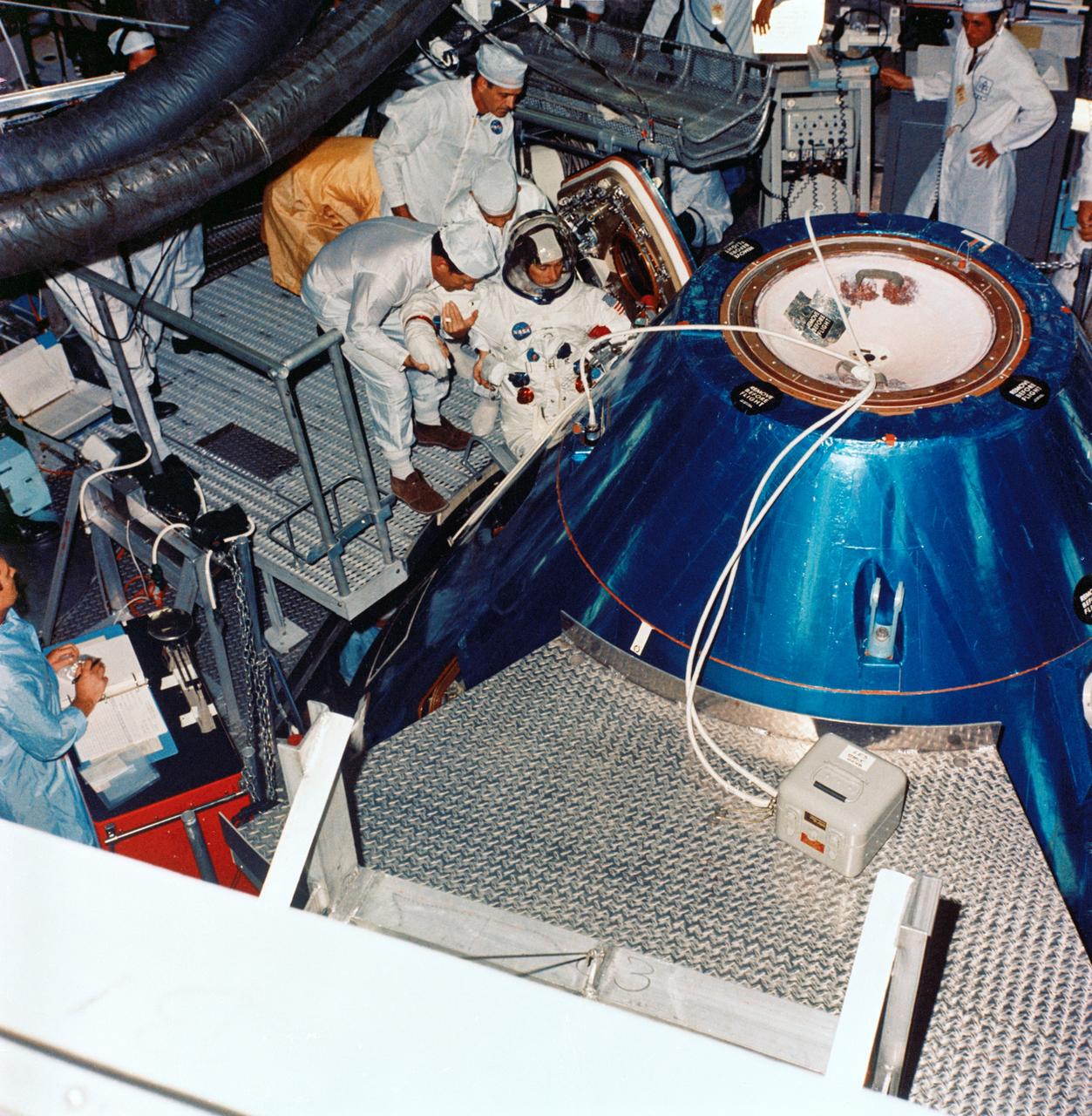
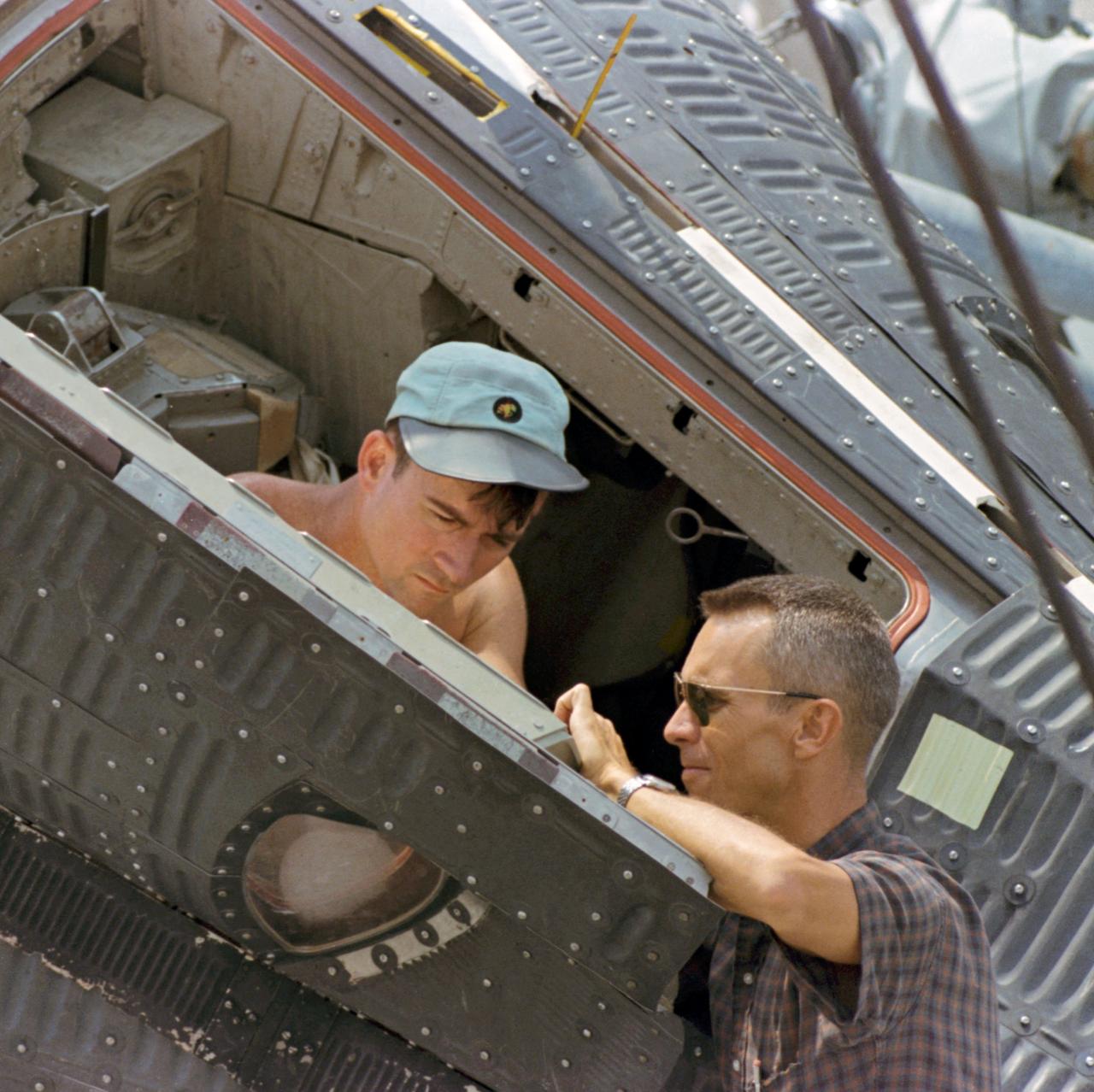
S68-40875 (5 July 1968) --- Astronaut John W. Young, Apollo 7 backup command module pilot, ingresses Apollo Spacecraft 101 Command Module during simulated altitude runs at the Kennedy Space Center's Pad 34.
Astronaut John Young ingresses Apollo spacecraft command module in training
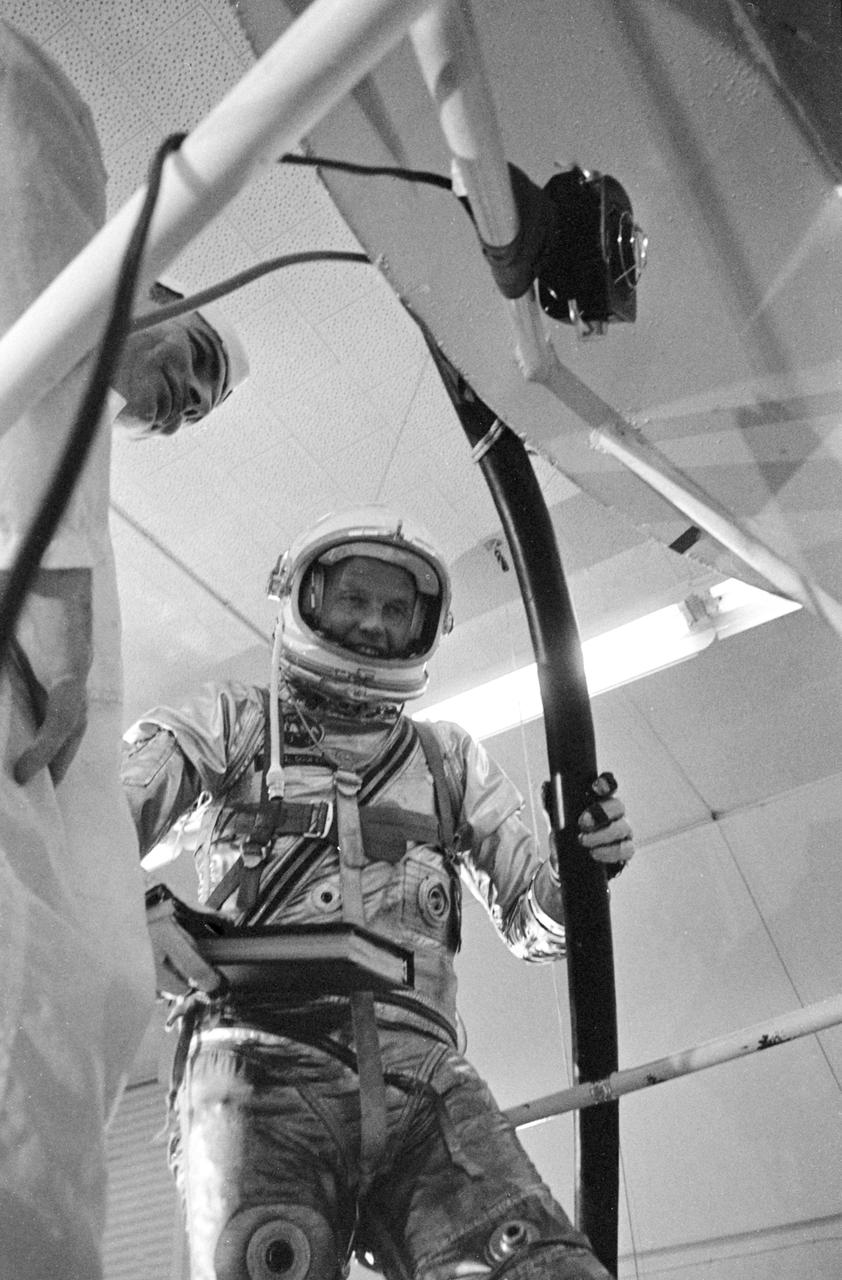
S63-03975 (1963) --- Astronaut L. Gordon Cooper Jr., prime pilot for the Mercury-Atlas 9 (MA-9) mission, is pictured prior to entering the Mercury spacecraft for a series of simulated flight tests. During these tests NASA doctors, engineers and technicians monitor Cooper's performance. Photo credit: NASA
SPACECRAFT - MERCURY-ATLAS (MA)-9 - PRELAUNCH - ASTRONAUT COOPER - SIMULATED FLIGHT TESTS - CAPE
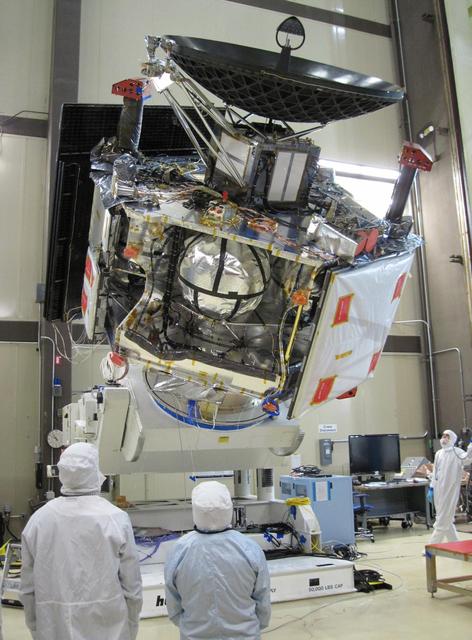
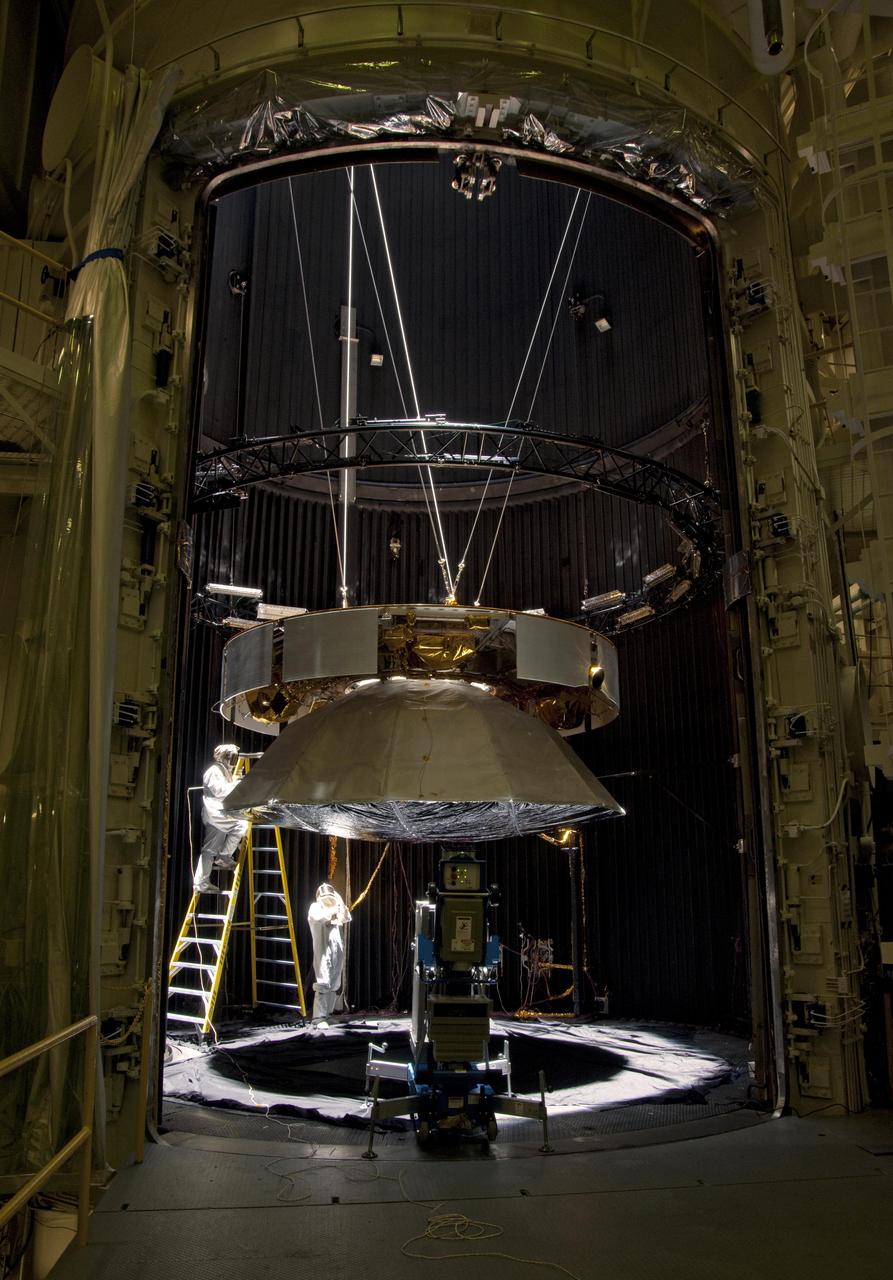
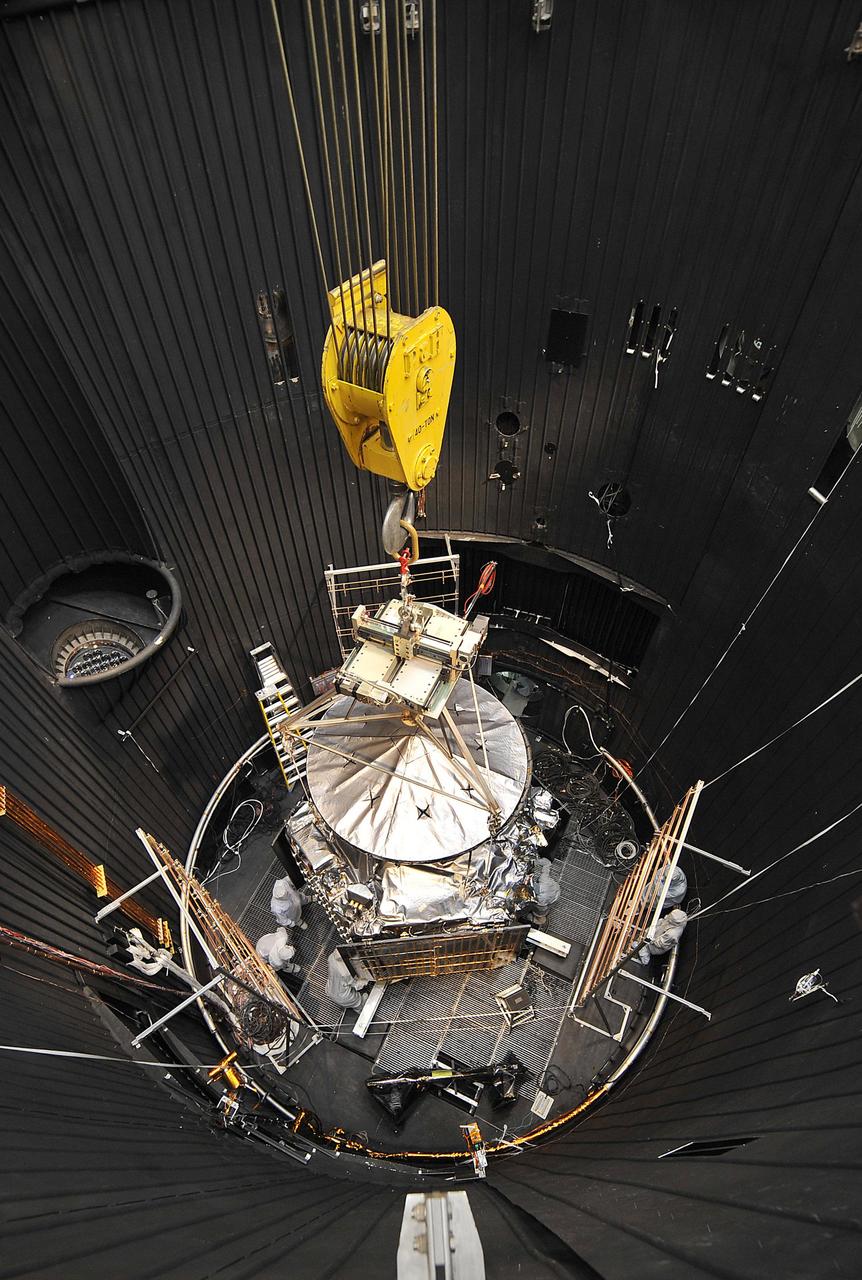
NASA Juno spacecraft looms above the assembly floor as technicians prepare the Jupiter-bound probe for a round of testing that simulates the vibrations the spacecraft will experience during launch.
Juno Gets Ready to Shake It
Testing of the cruise stage for NASA Mars Science Laboratory in August 2010 included a session in a facility that simulates the environment found in interplanetary space. Spacecraft technicians at JPL prepare a space-simulation test.
Cruise Stage Testing for Mars Science Laboratory
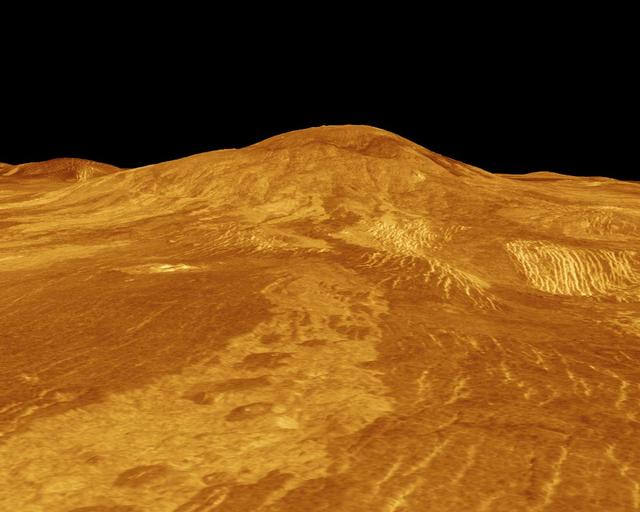
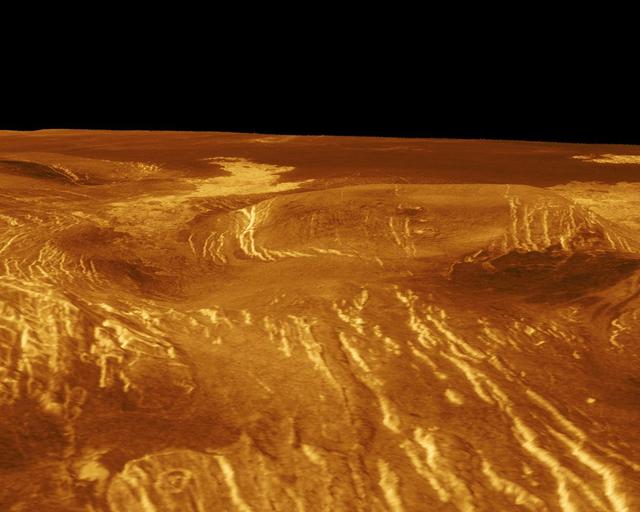
Sif Mons is displayed in this computer-simulated view obtained by NASA's Magellan spacecraft of the surface of Venus.  http://photojournal.jpl.nasa.gov/catalog/PIA00108
Venus - 3-D Perspective View of Sif Mons
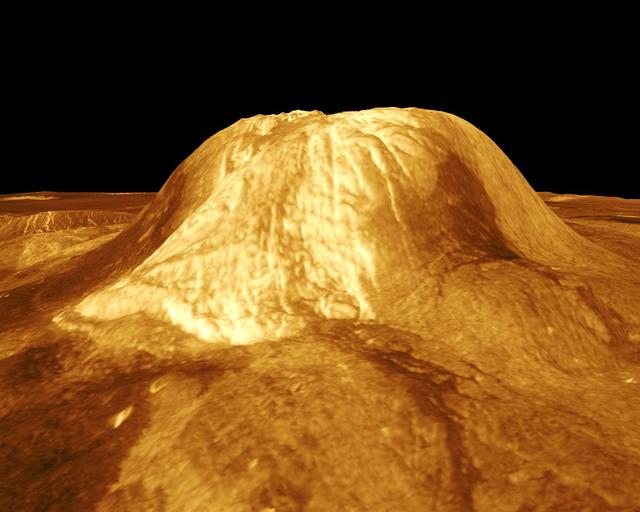
Gula Mons is displayed in this computer-simulated view from NASA Magellan spacecraft of the surface of Venus.  http://photojournal.jpl.nasa.gov/catalog/PIA00234
Venus - 3-D Perspective View of Gula Mons
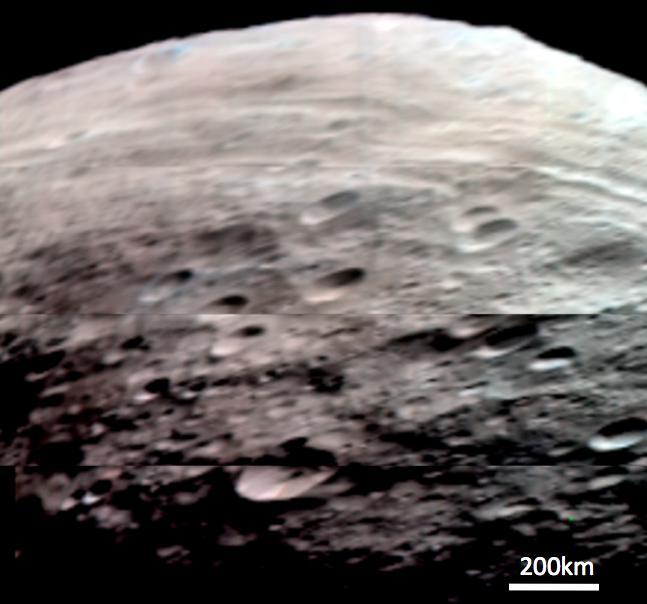
This composite image from NASA Dawn spacecraft is a simulated true color image of asteroid Vesta northern and equatorial regions.
Vesta Northern and Equatorial Regions in Simulated True Color
A corona is displayed in this computer-simulated view from NASA's Magellan spacecraft of the surface of Venus.  http://photojournal.jpl.nasa.gov/catalog/PIA00109
Venus - 3-D Perspective View of Idem-Kuva
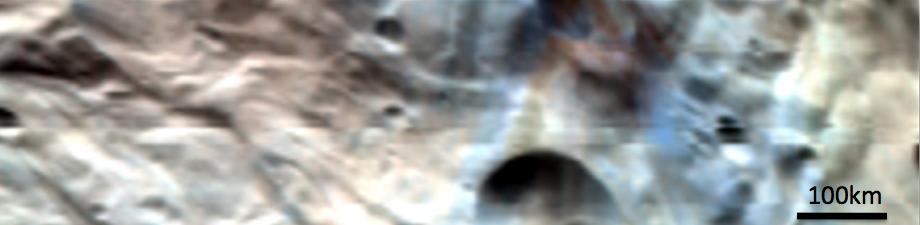
This composite image NASA Dawn spacecraft is a simulated true color image of part of asteroid Vesta south polar region.
Vesta South Polar Region in Simulated True Color
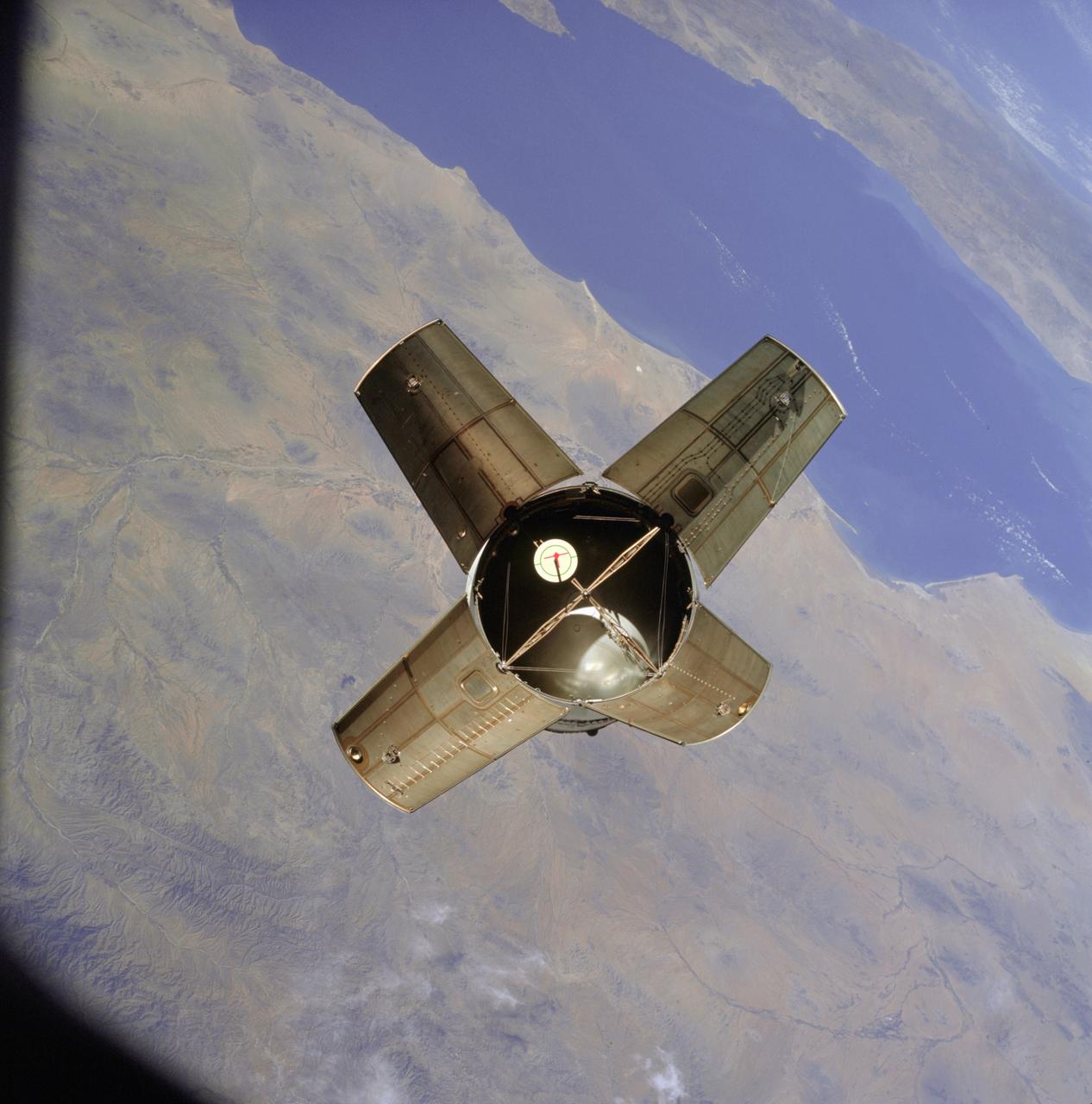
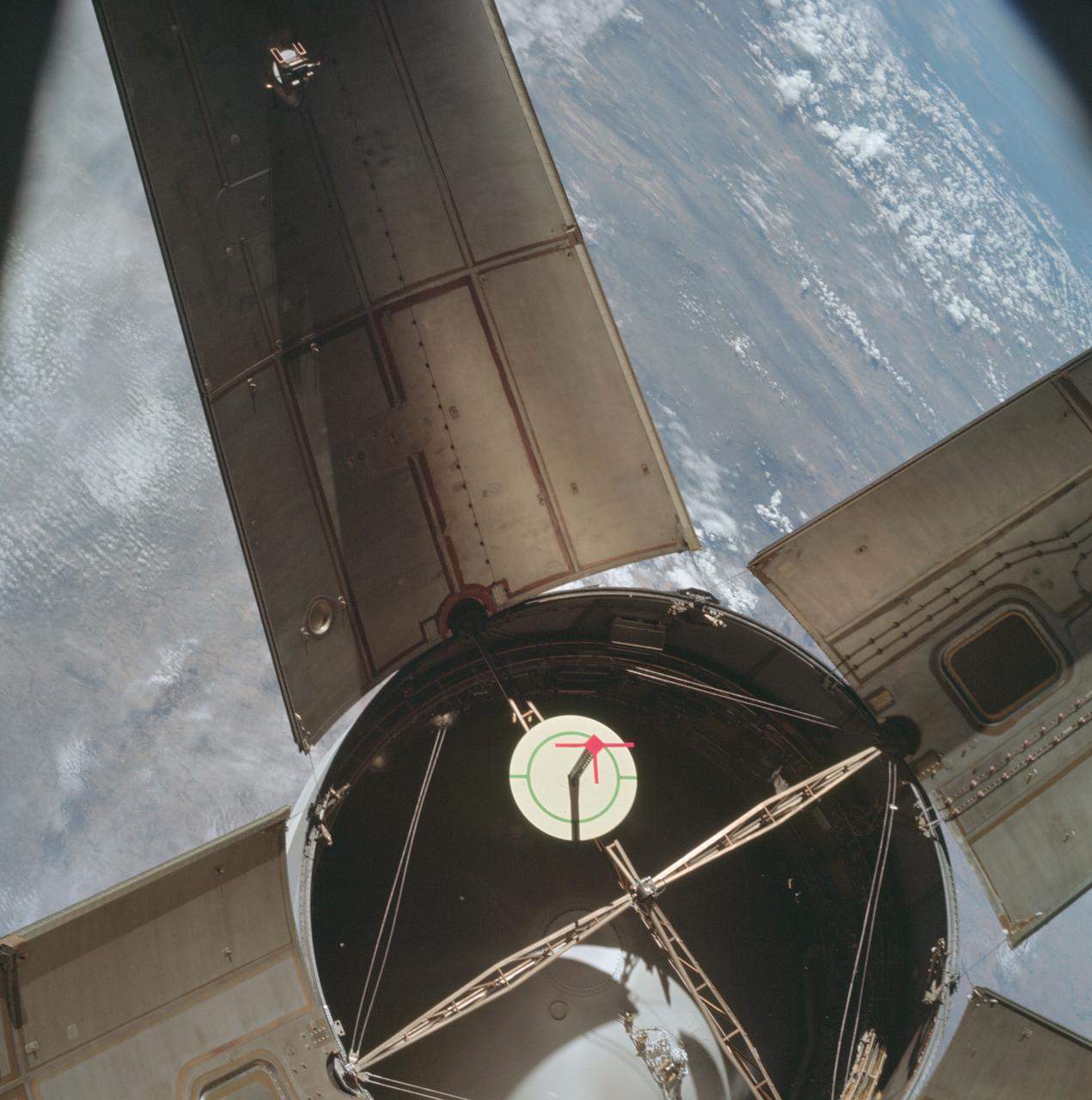
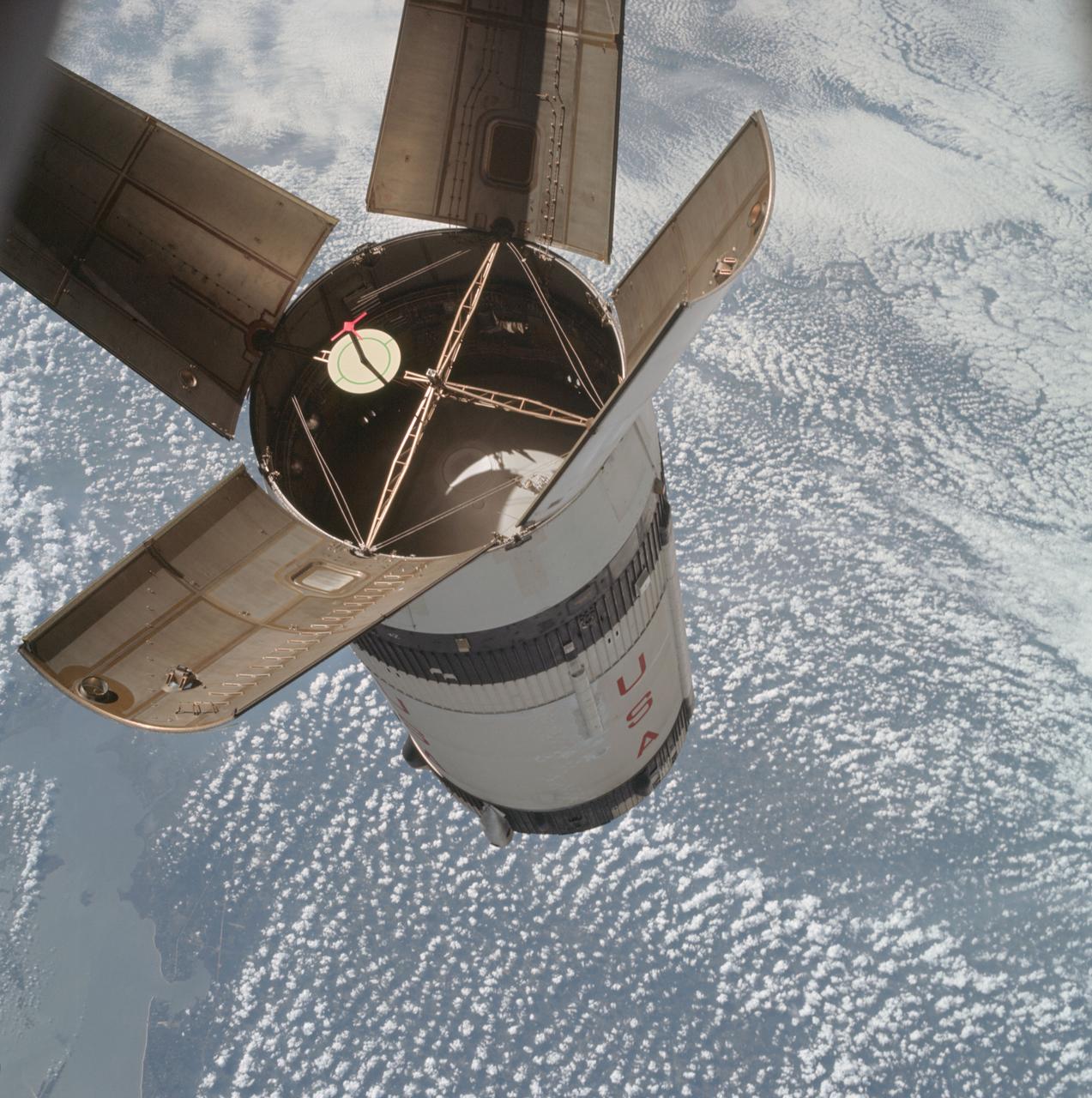
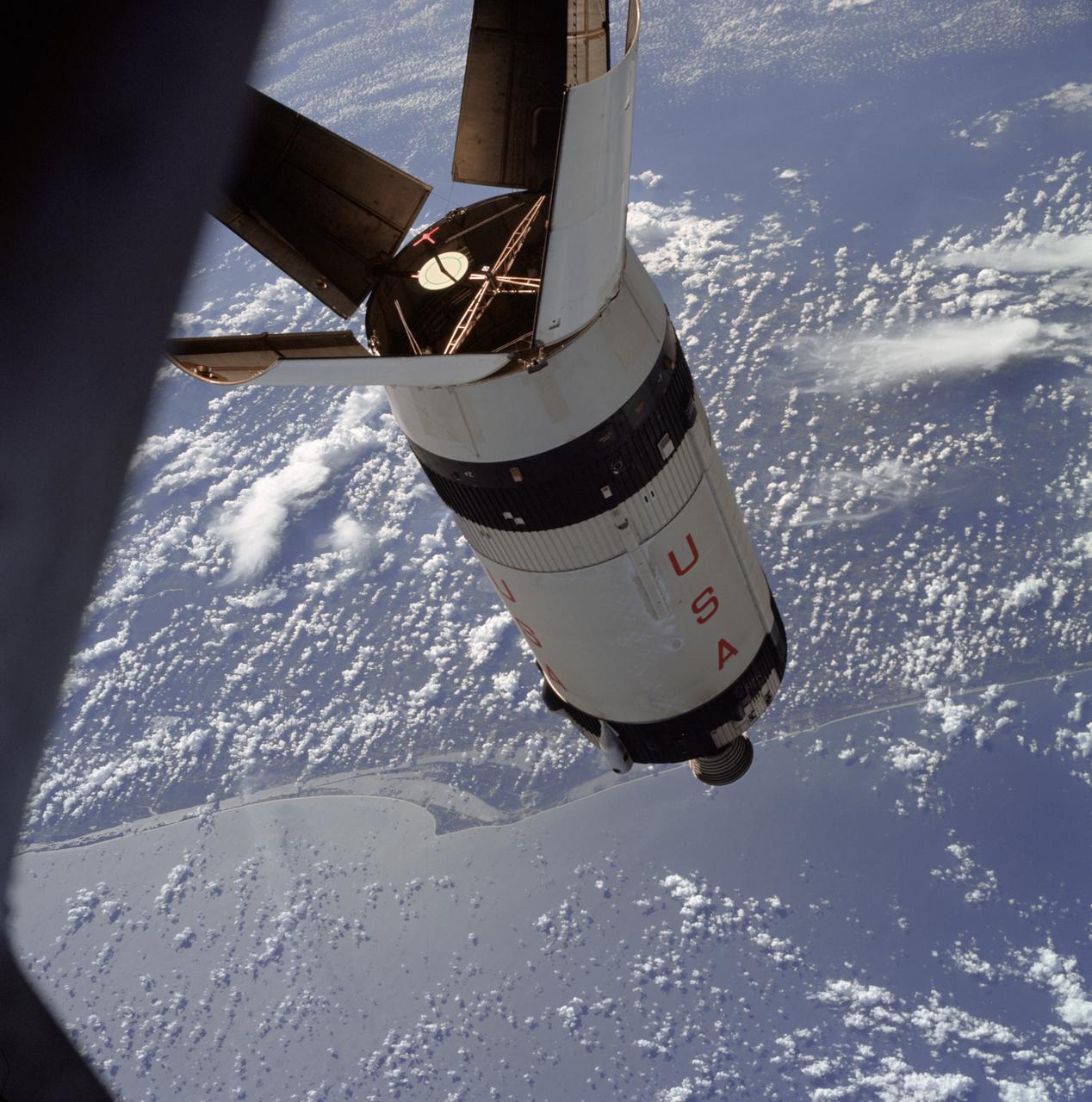
AS07-03-1538 (11 Oct. 1968) --- The expended Saturn IVB stage as photographed from the Apollo 7 spacecraft during transposition and docking maneuvers. This photograph was taken during Apollo 7's second revolution of Earth. Earth below has heavy cloud cover. The round, white disc inside the open panels of the Saturn IVB is a simulated docking target similar to that used on the lunar module for docking during lunar missions.
Apollo 7/S-IVB Rendezvous in space
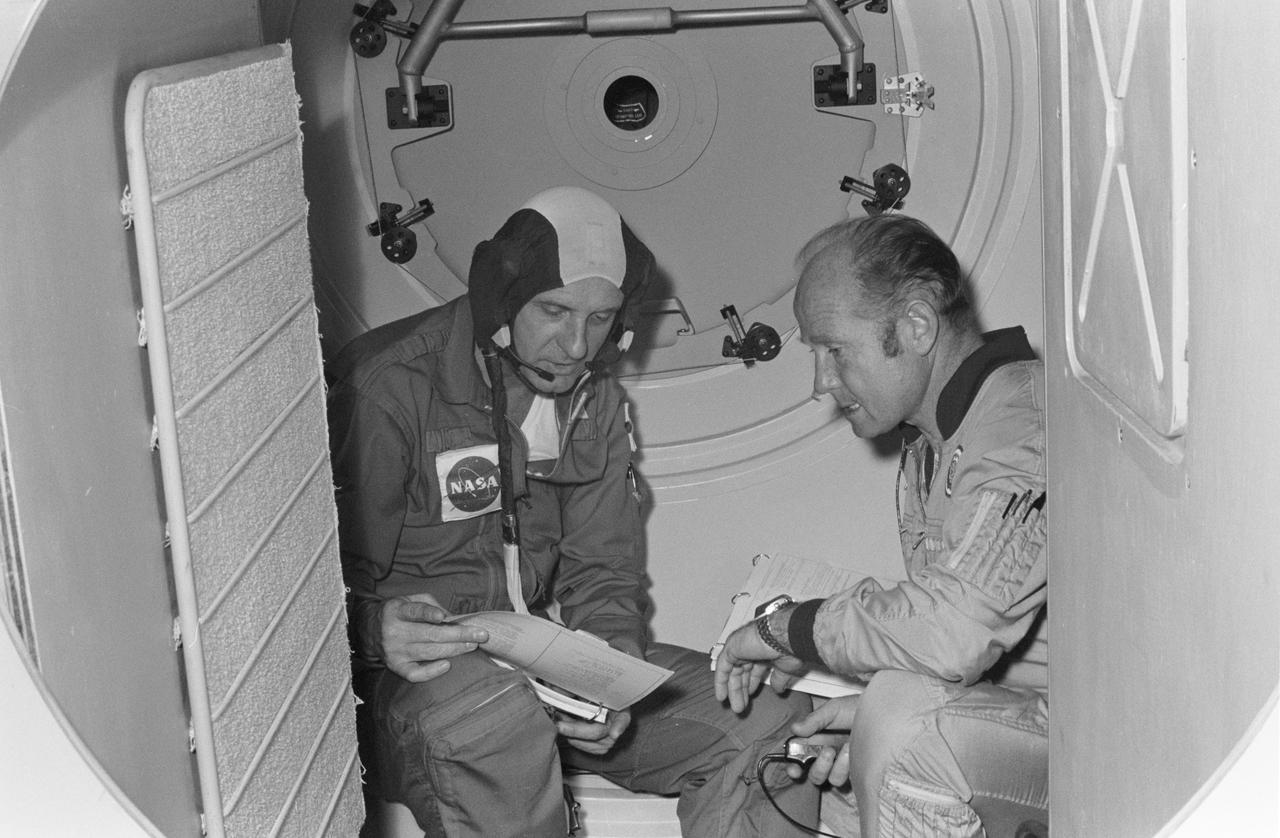
S74-29041 (September 1974) --- The commanders of the American astronaut and Soviet cosmonaut crews for the joint U.S.?USSR Apollo-Soyuz Test Project mission compare notes in a Soyuz spacecraft?s orbital module mock-up in Building 35 at the Johnson Space Center during a training and simulation exercise. They are Aleksey A. Leonov, right, and Thomas P. Stafford. The hatchway in the background leads to the Docking Module. The prime crewmen, along with backup crewmen, are training in both the U.S. and USSR for the joint mission scheduled for the summer of 1975.
Soviet and American ASTP commanders in Soyuz orbital module mock-up
AS07-03-1531 (11 Oct. 1968) --- The expended Saturn IVB stage as photographed from the Apollo 7 spacecraft during transposition and docking maneuvers. This photograph was taken over Sonora, Mexico, during Apollo 7's second revolution of Earth. The round, white disc inside the open panels of the Saturn IVB is a simulated docking target similar to that used on the lunar module for docking during lunar missions.
Apollo 7/S-IVB Rendezvous in space
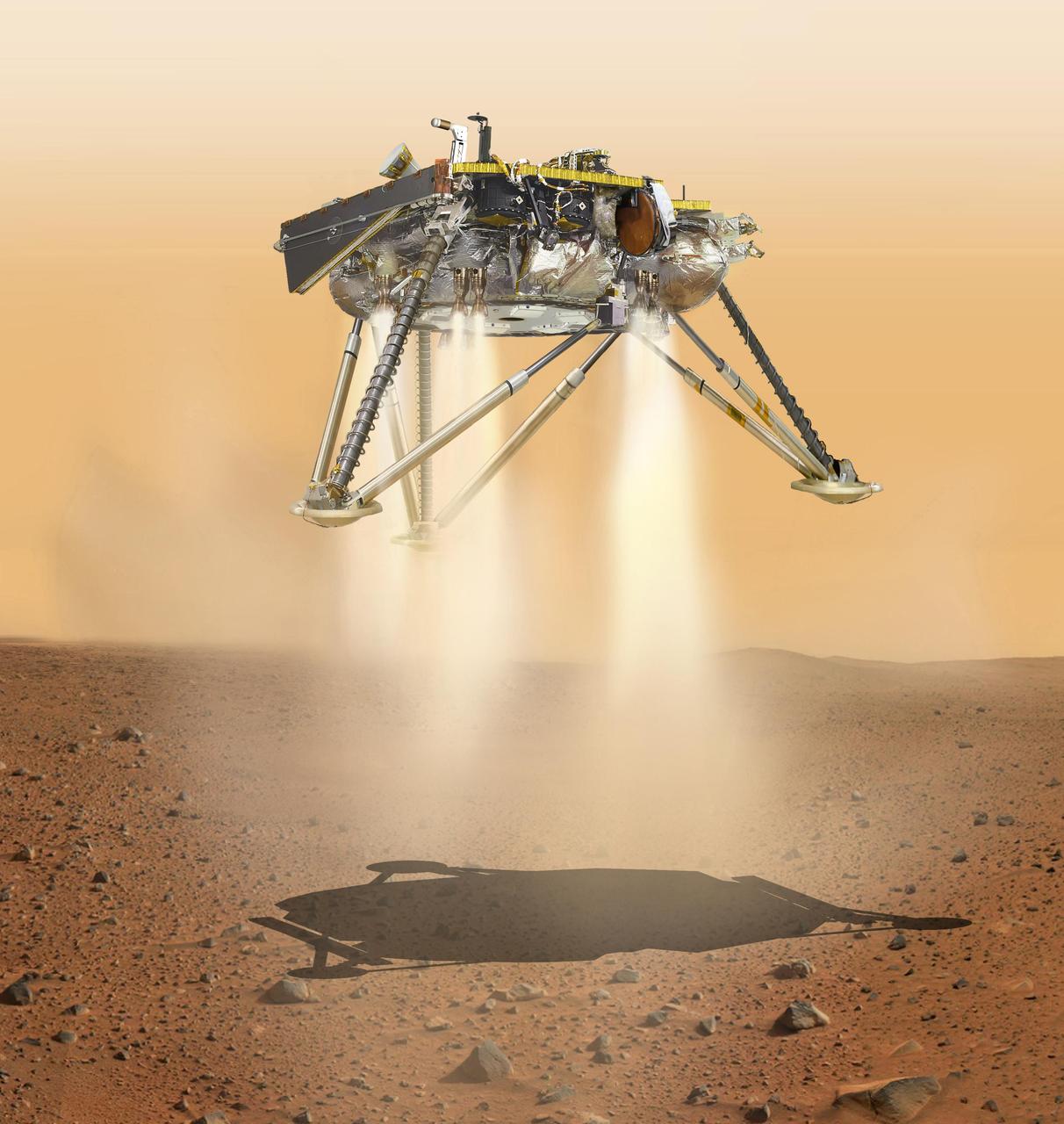
This is an illustration showing a simulated view of NASA's InSight about to land on the surface of Mars. This view shows the top of the spacecraft.  https://photojournal.jpl.nasa.gov/catalog/PIA22813
InSight Moments Away From Landing, Top View (Illustration)
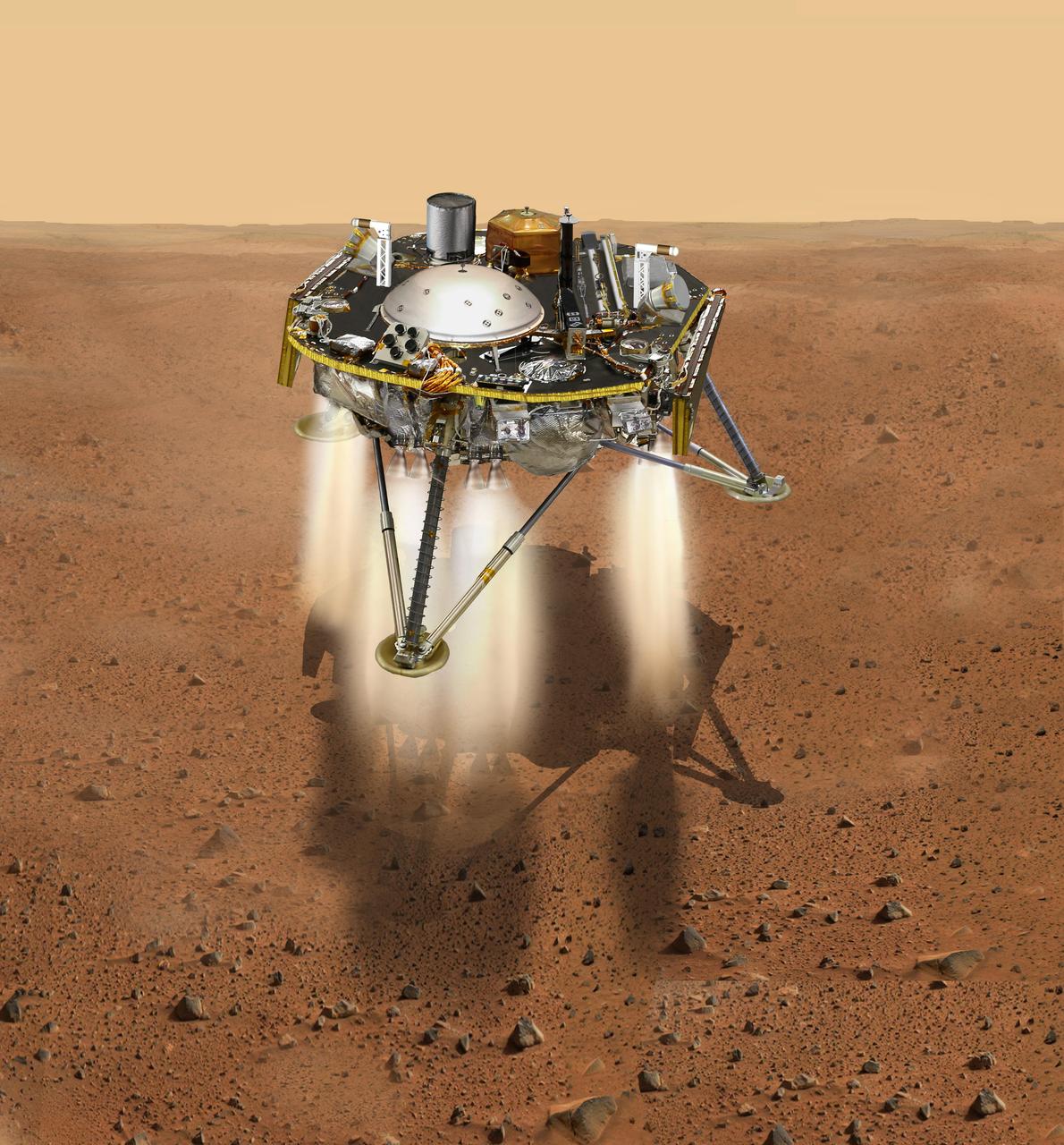
This is an illustration showing a simulated view of NASA's InSight lander about to land on the surface of Mars. This view shows the underside of the spacecraft.  https://photojournal.jpl.nasa.gov/catalog/PIA22812
InSight Moments Away From Landing, Underside View (Illustration)
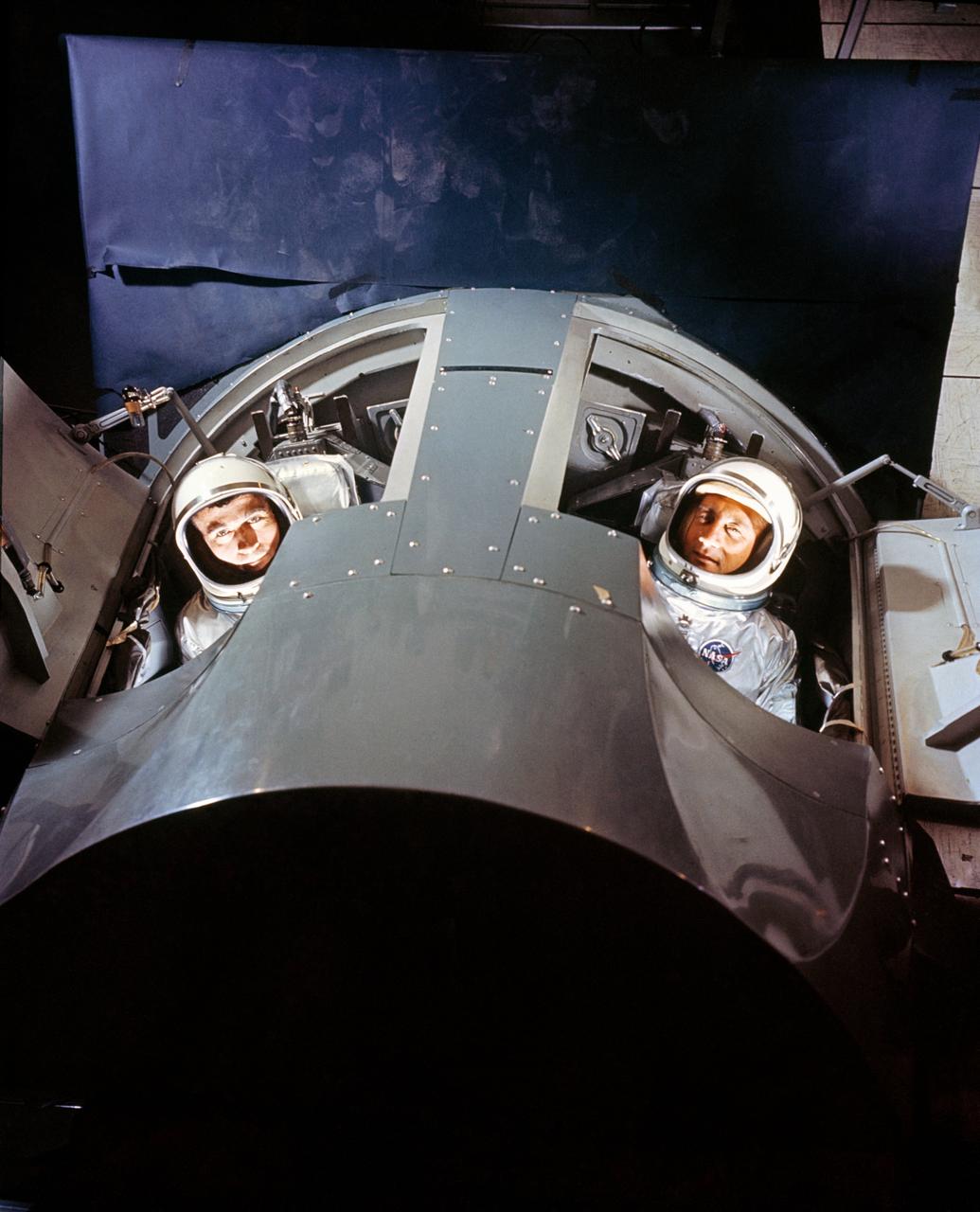
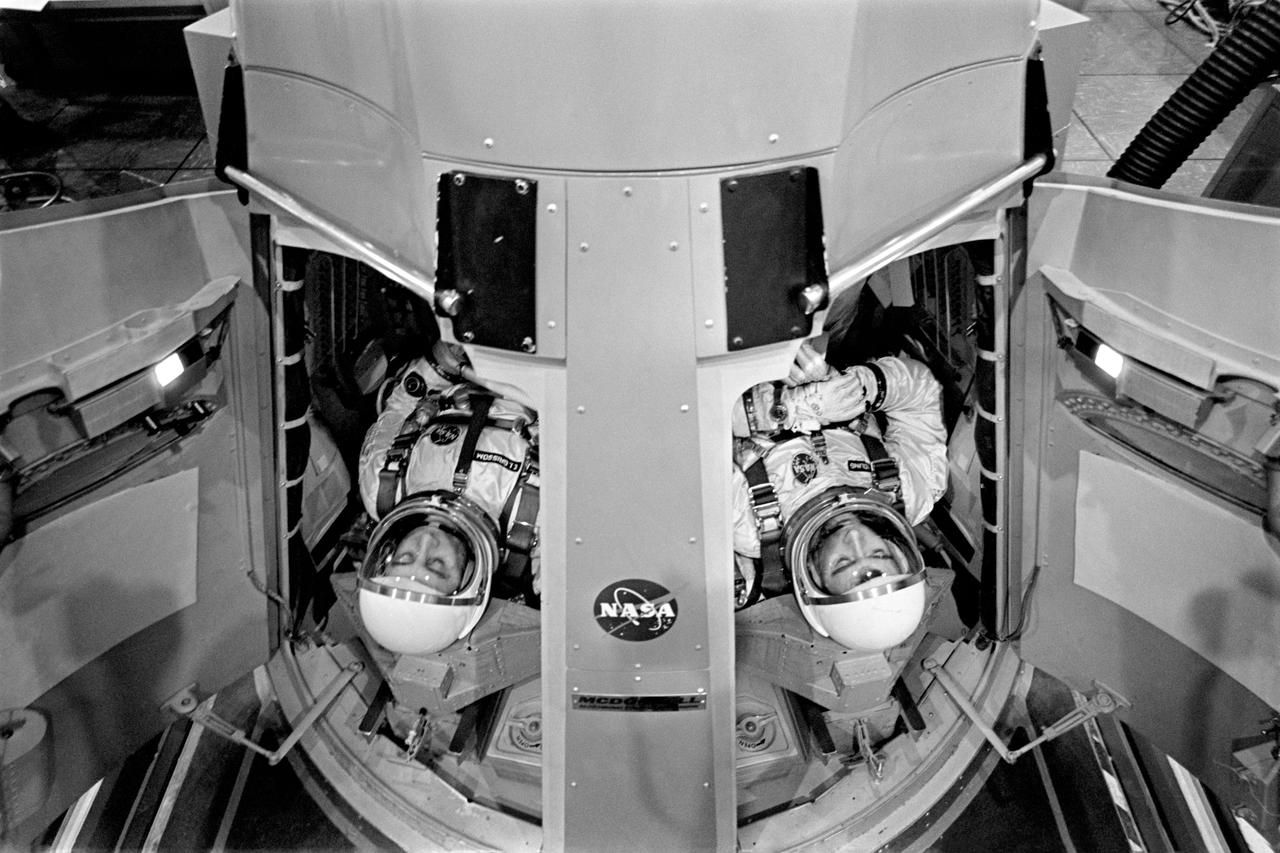
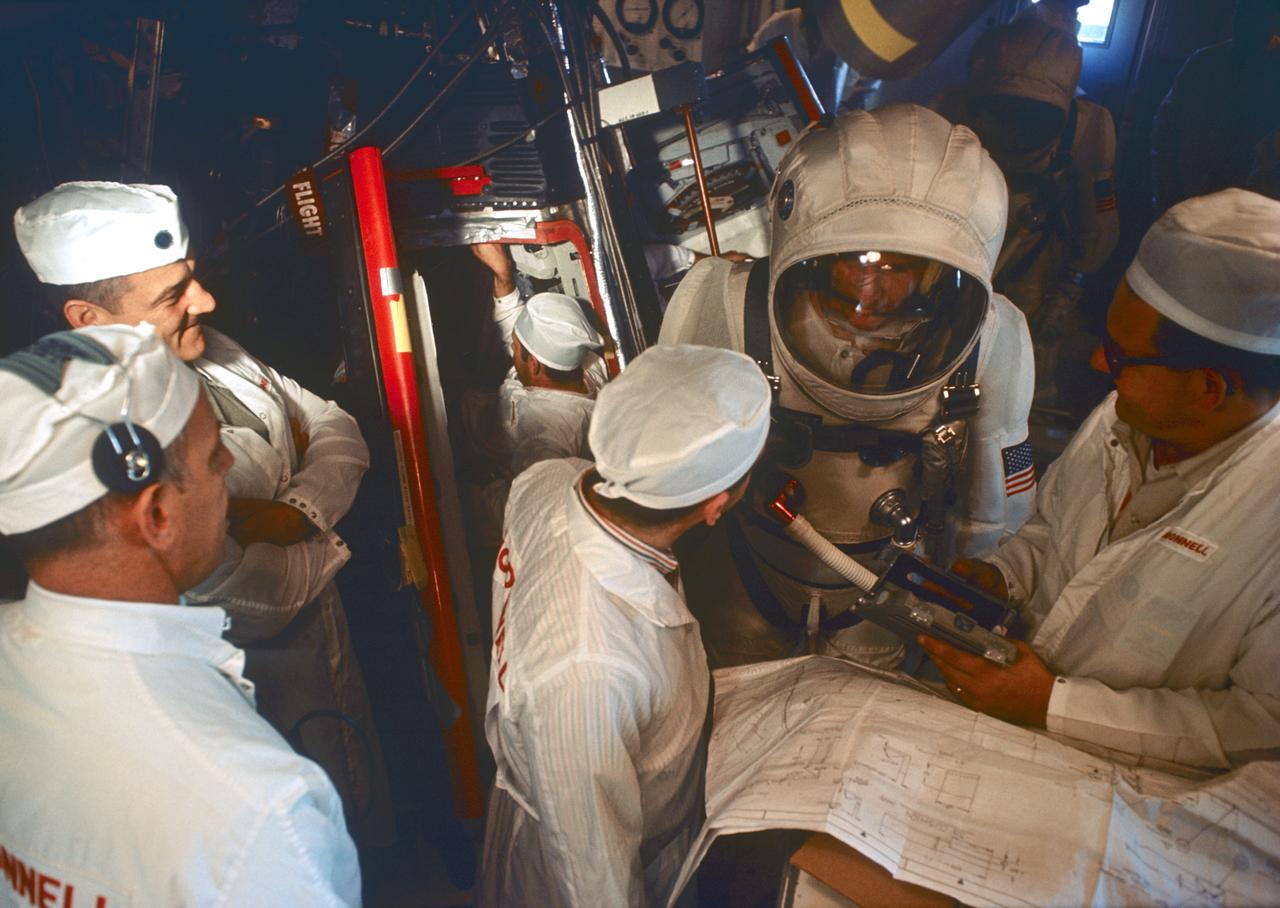
S64-25295 (March 1964) --- Astronauts Virgil I. (Gus) Grissom (right) and John W. Young, prime crew for the first manned Gemini mission (GT-3), are shown inside a Gemini mission simulator at McDonnell Aircraft Corp., St. Louis, MO. The simulator will provide Gemini astronauts and ground crews with realistic mission simulation during intensive training prior to actual launch.
Astronauts Grissom and Young in Gemini Mission Simulator
AS07-03-1535 (11 Oct. 1968) --- The expended Saturn IVB stage as photographed from the Apollo 7 spacecraft during transposition and docking maneuvers at an altitude of 126 nautical miles, at ground elapsed time of three hours, 11 minutes. The round, white disc inside the open panels of the Saturn IVB is a simulated docking target similar to that used on the lunar module for docking during lunar missions. The spacecraft is directly over Odessa-Midland, Texas. The view between the two panels (area of large puffy clouds) extends southwest across Texas into the Mexican State of Chihuahua. The distance between the Apollo 7 spacecraft and the S-IVB is approximately 50 feet.
Apollo 7/S-IVB Rendezvous in space
NASA Dawn spacecraft obtained these images with its visible and infrared instrument of asteroid Vesta. The top image is a simulated true-color picture of the asteroid surface.
Visible and Infrared Data Mosaic
An instrument on NASA Terra spacecraft captured a simulated natural color image of the Port-au-Prince, Haiti, area, two days after a devastating earthquake.
Haiti Earthquake Landslides
AS07-03-1541 (11 Oct. 1968) --- The expended Saturn IVB stage as photographed from the Apollo 7 spacecraft during transposition and docking maneuvers. St. Louis Bay and Lake Borgne area just east of New Orleans is seen below. The round, white disc inside the open panels of the Saturn IVB is a simulated docking target similar to that used on the lunar module for docking during lunar missions.
Apollo 7/S-IVB Rendezvous in space
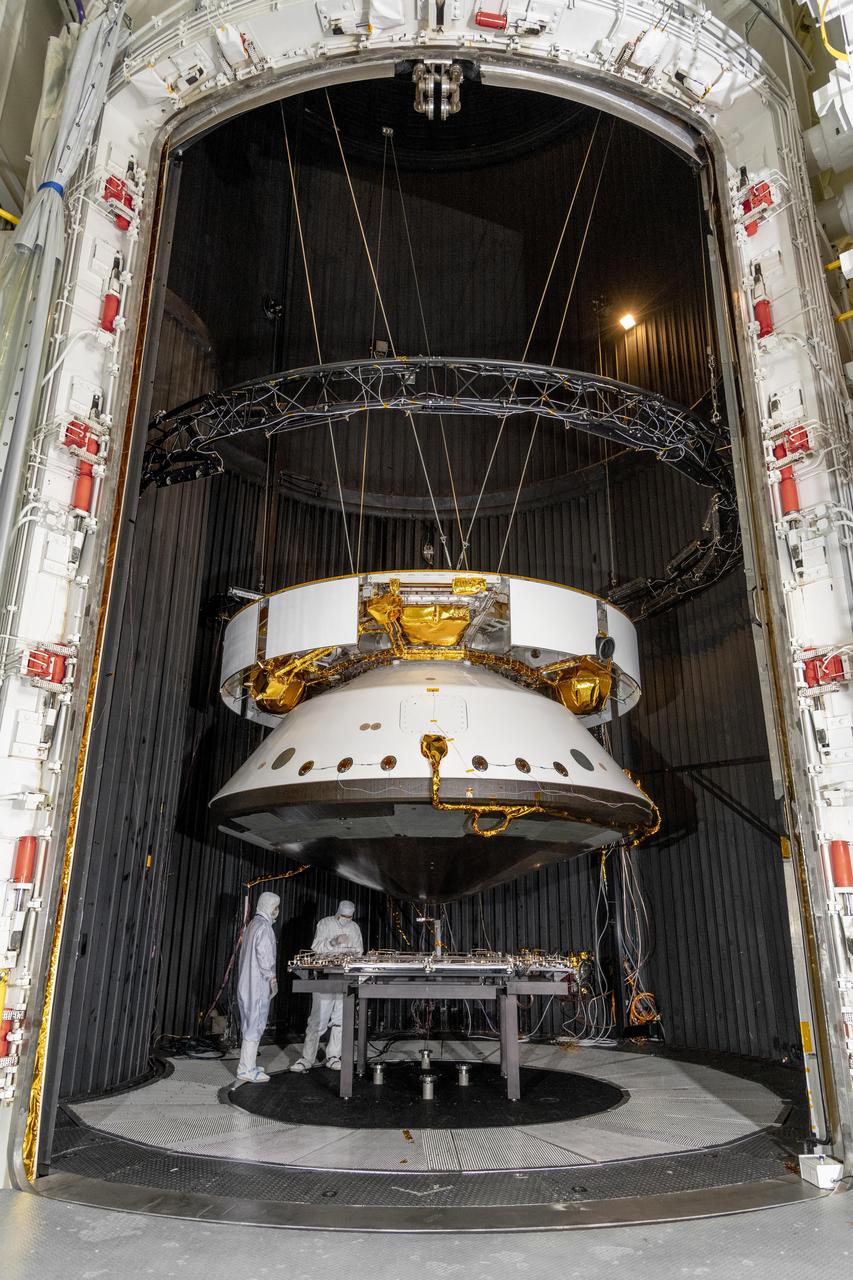
Engineers prepare the Mars 2020 spacecraft for a thermal vacuum (TVAC) test in the Space Simulator Facility at NASA's Jet Propulsion Laboratory in Pasadena, California.  The image was taken on May 9, 2019.  https://photojournal.jpl.nasa.gov/catalog/PIA23263
Mars 2020 Spacecraft Gets Cold
S65-21864 (19 March 1965) --- Astronauts Virgil I. Grissom (left), command pilot; and John W. Young, pilot, prepare to run Gemini-Titan 3 simulations in the Gemini mission simulator at Cape Kennedy, Florida. The NASA GT-3 flight was scheduled for March 23, 1965.
Astronauts Grissom and Young prepare to preform flight simulations
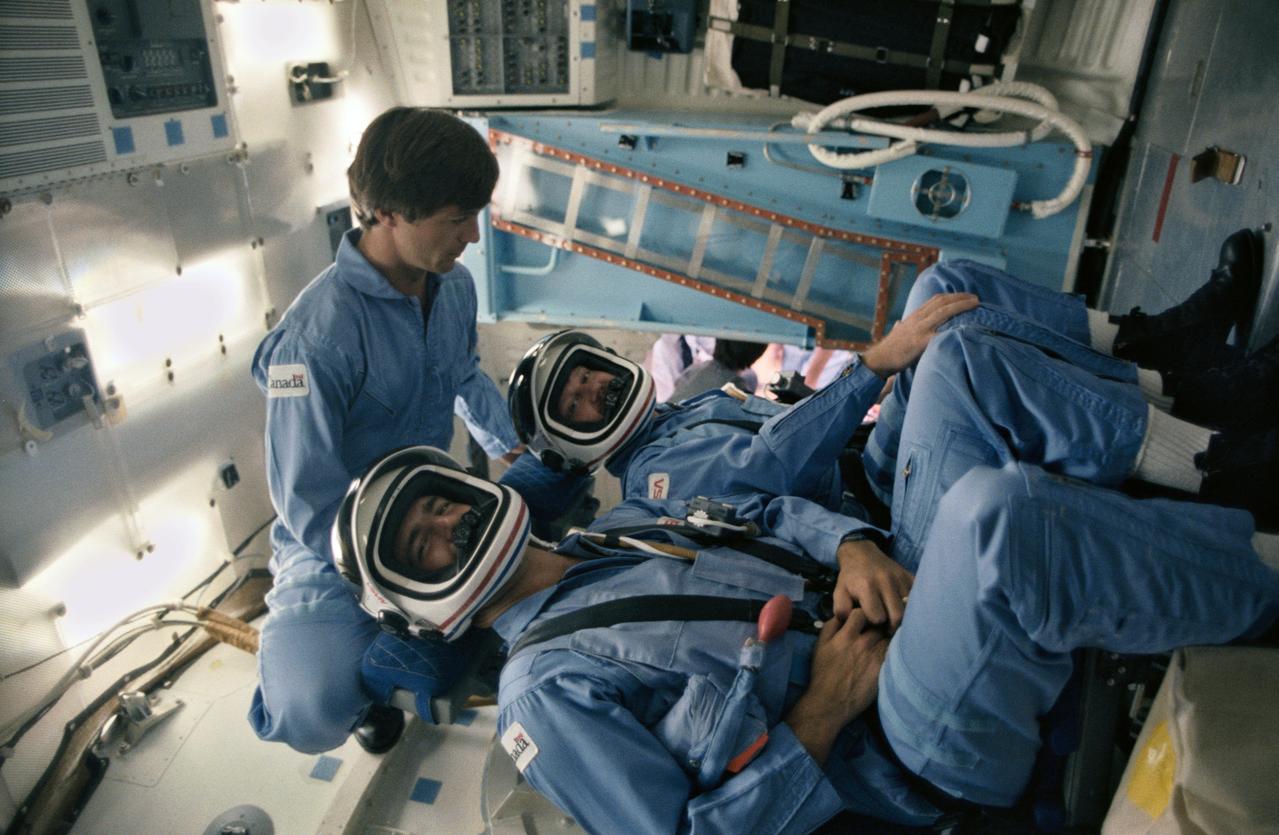
41D-3138 (4 Sept 1984)--- Canada's backup payload specialist assists the two 41-G prime payload specialists during a training session in the Johnson Space Center's Shuttle mockup and integration laboratory.  Robert Thirsk (without helmet) represents the National Research Council (NRC) and is backup to Marc Garneau (nearest camera), also of the NRC.  Paul D. Scully-Power, seated in the other middeck seat for the launch phase, is a civilian oceanographer with the U.S. Navy.  The 41-G flight aboard the Challenger is NASA's first to utilize a crew of more than six persons.  This photograph was taken by Otis Imboden.
Payload specialists Marc Garneau and Paul Scully-Power in SMS
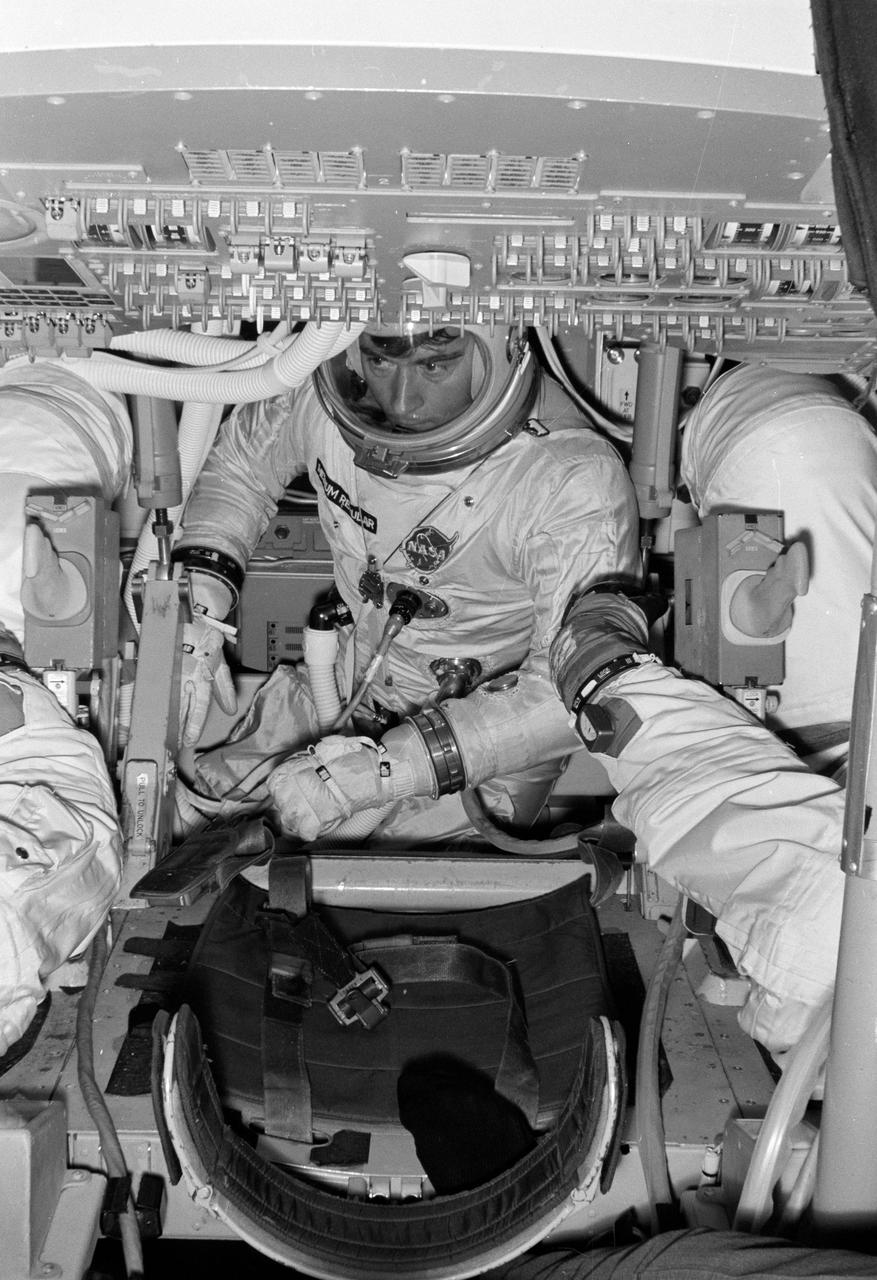
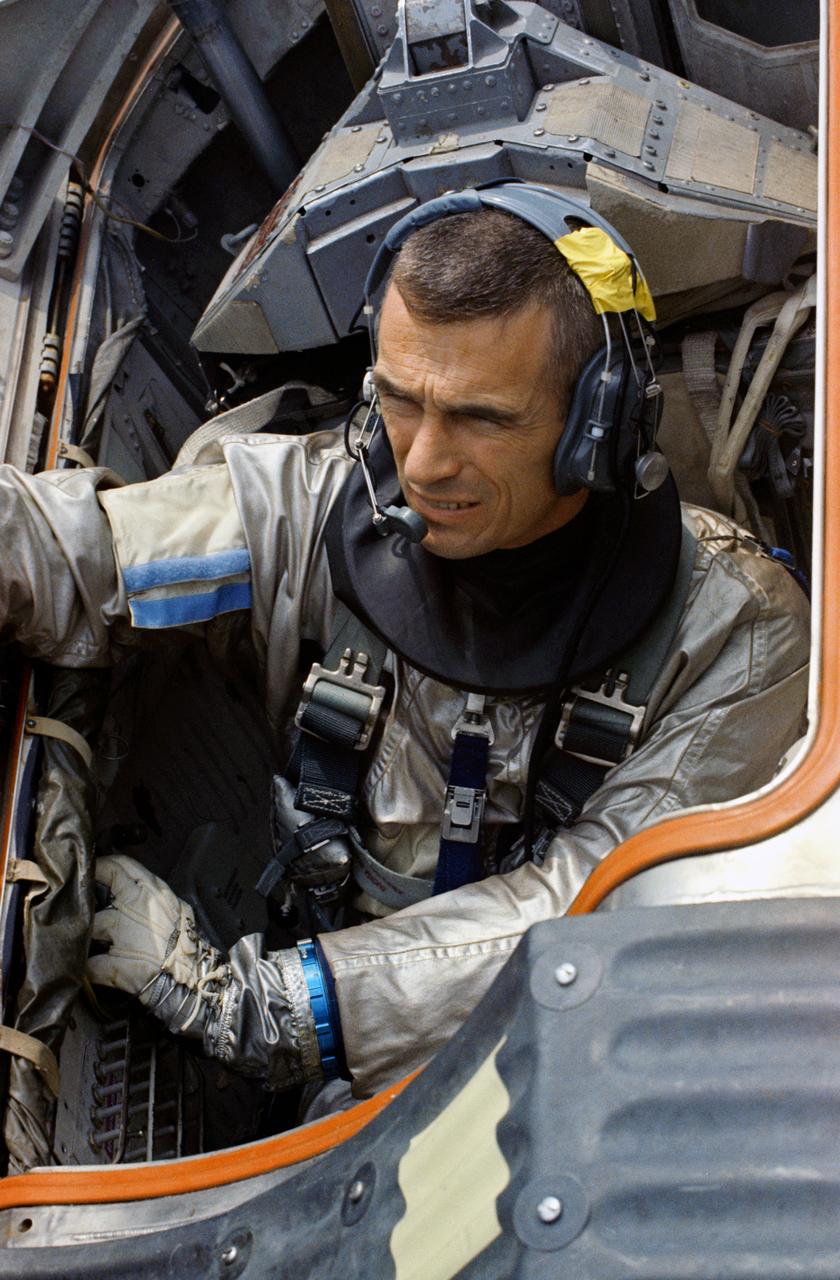
S68-15979 (15 Jan. 1968) --- Astronaut John W. Young, command module pilot, inside the Command Module Simulator in Building 5 during an Apollo Simulation. Out of view are astronaut Thomas P. Stafford (on the left), commander; and astronaut Eugene A. Cernan (on the right), lunar module pilot.
Astronaut John Young in Command Module Simulator during Apollo Simulation
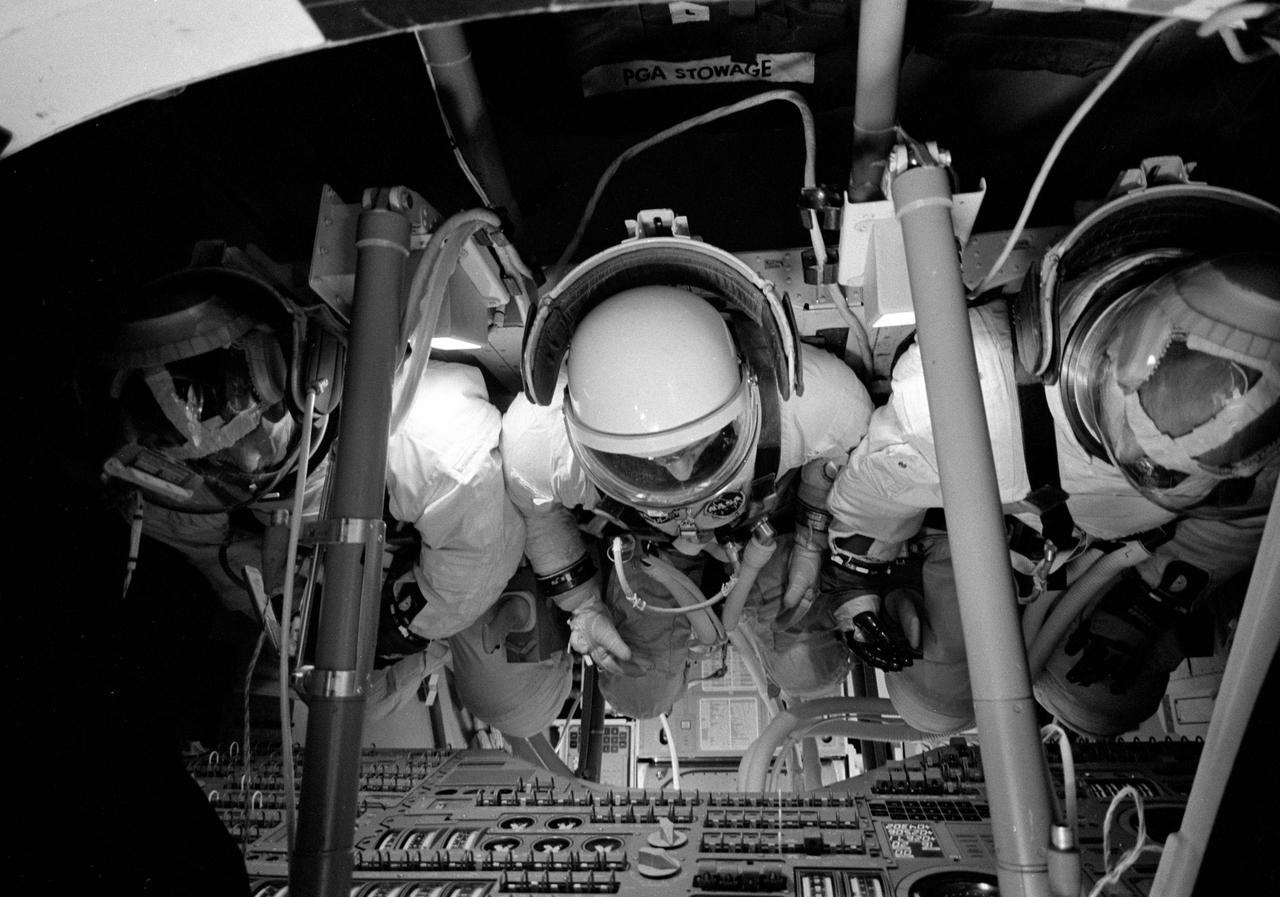
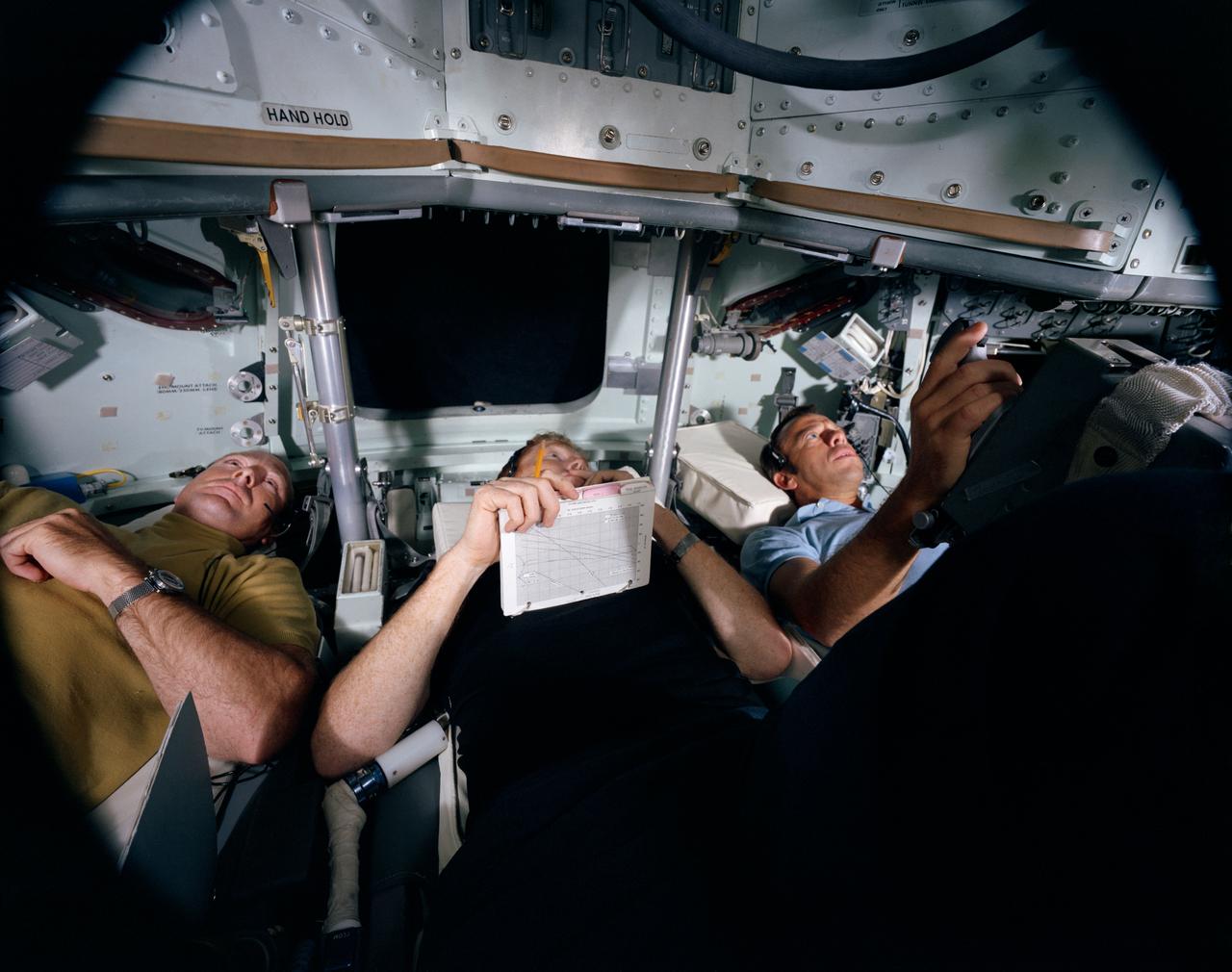
S68-15952 (15 Jan. 1968) --- Three astronauts inside the Command Module Simulator in Building 5 during an Apollo Simulation. Left to right, are astronauts Thomas P. Stafford, commander; John W. Young, command module pilot; and Eugene A. Cernan, lunar module pilot.
Three astronauts inside Command Module Simulator during Apollo Simulation
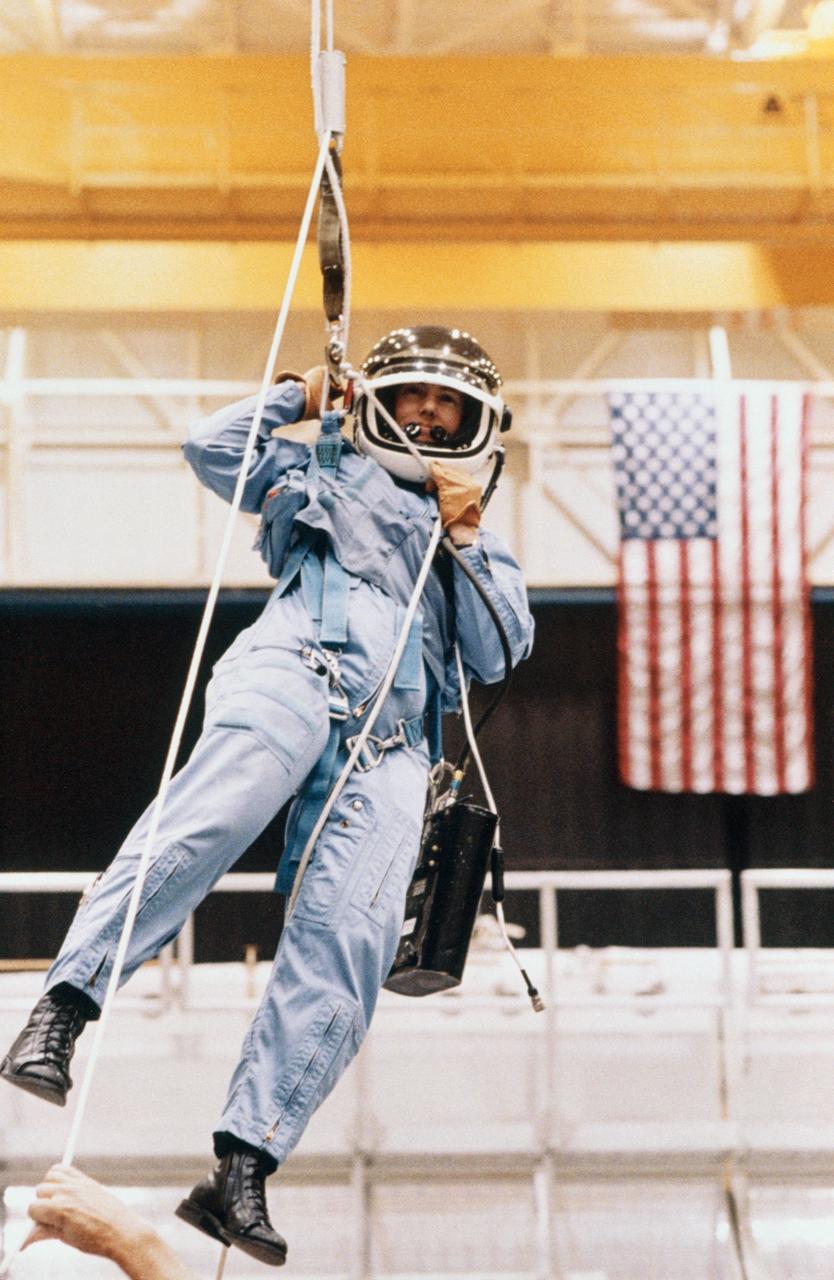
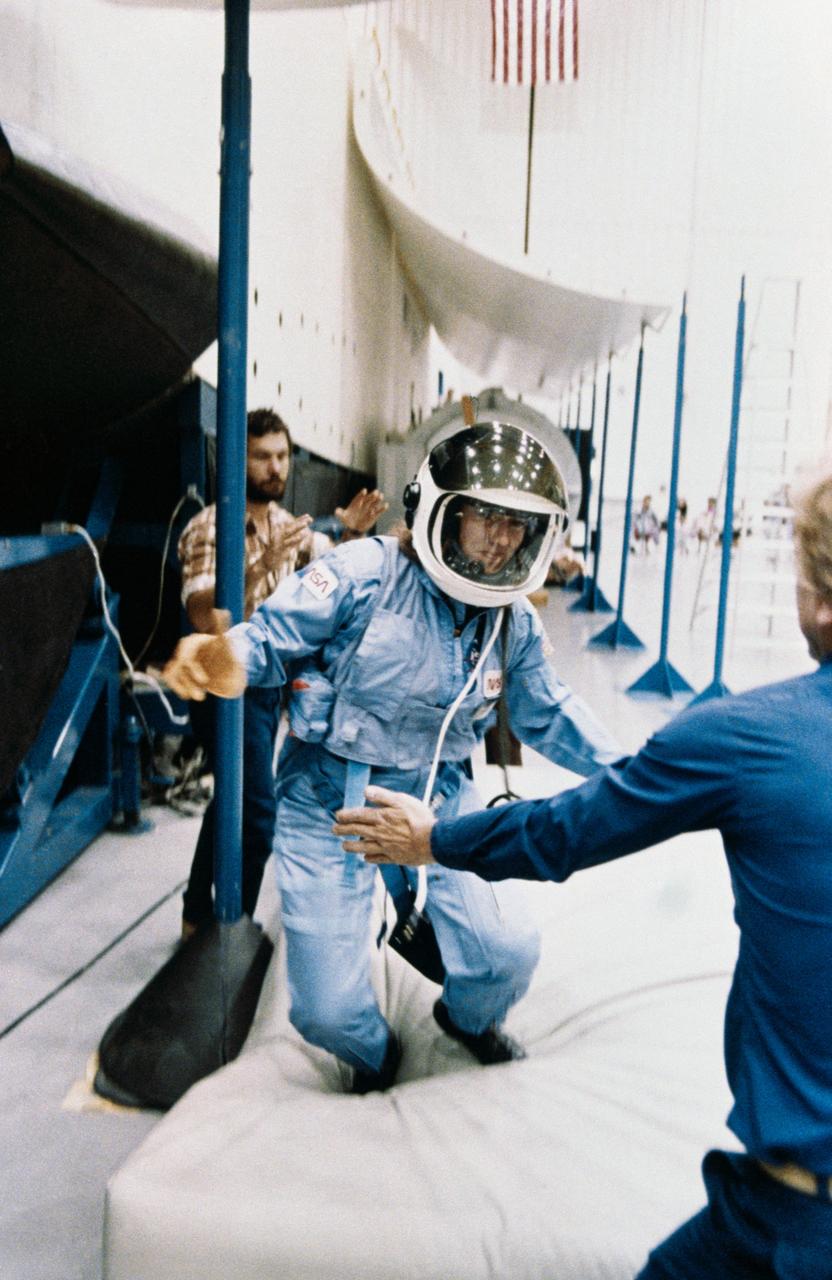
S86-25183 (for release January 1986) --- Sharon Christa McAuliffe, STS-51L payload specialist representing the Teacher-in-Space Project, descends from a mock-up of the space shuttle using a sky-genie device during an emergency training session in the Johnson Space Center?s (JSC) Shuttle Mock-up and Integration Laboratory. The photograph was taken by Keith Meyers of the New York Times.    EDITOR?S NOTE: The STS-51L crew members lost their lives in the space shuttle Challenger accident moments after launch on Jan. 28, 1986 from the Kennedy Space Center (KSC). Photo credit: NASA
Christa McAuliffe using Sky-genie during emergency egress training
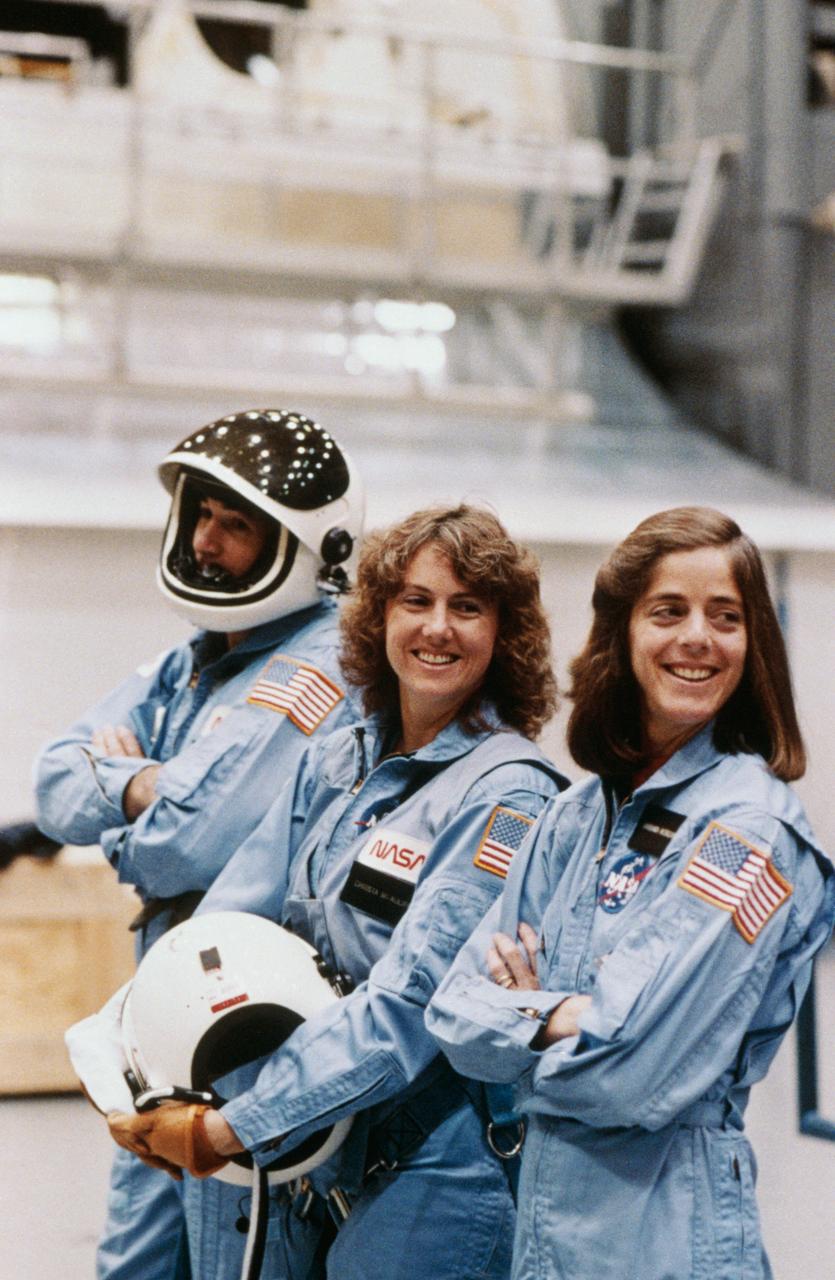
S86-25254 (January 1986) --- Payload specialists in training for STS-51L take a break in shuttle emergency egress training at the Johnson Space Center's (JSC) Shuttle Mock-up and Integration Laboratory. Left to right are Gregory Jarvis of Hughes, Sharon Christa McAuliffe and Barbara Morgan of the Teacher-in-Space Project. McAuliffe was selected as NASA's first citizen observer in the Space Shuttle Program and Morgan was named her backup. The photo was taken by Keith Meyers of the New York Times.    EDITOR?S NOTE: The STS-51L crew members lost their lives in the space shuttle Challenger accident moments after launch on Jan. 28, 1986 from the Kennedy Space Center (KSC). Photo credit: NASA
Payload specialists in training for STS 51-L in mockup & integration lab
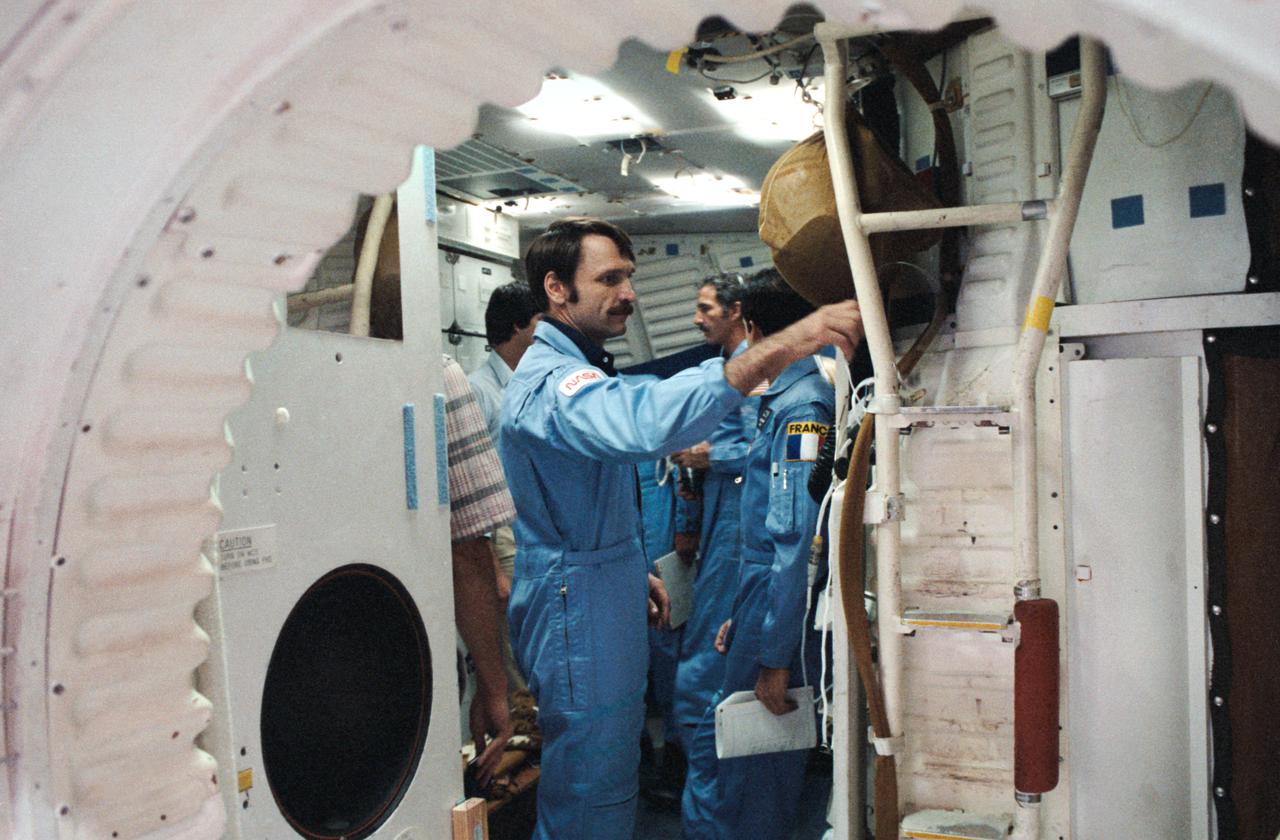
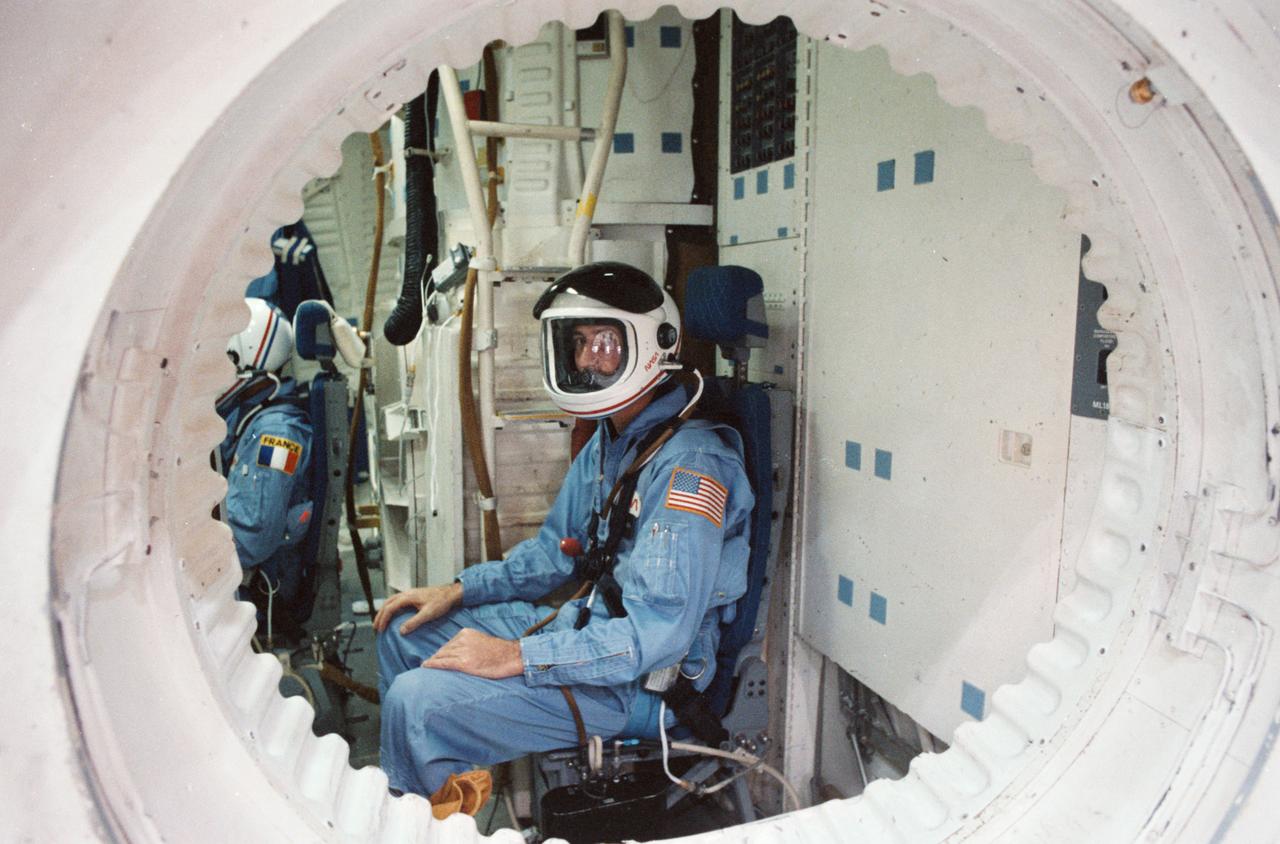
STS 51-E crew is briefed on the Shuttle full fuselage trainer. Astronauts Dave Griggs (foreground), Jean Loup Chretien (behind Griggs) and Jeff Hoffman are being shown the workings of the trainer by flight instructors.
STS 51-E crew is briefed on the Shuttle full fuselage trainer
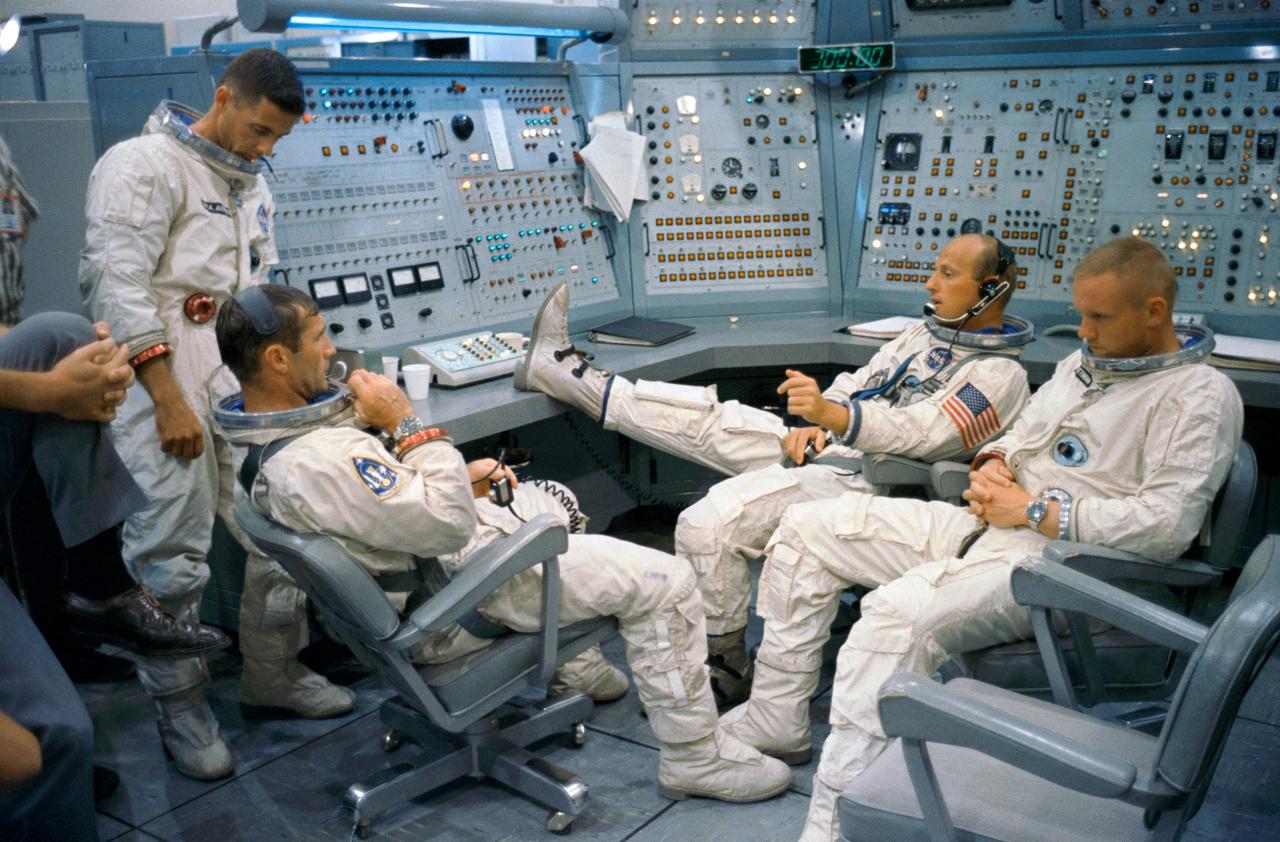
S66-50769 (8 Sept. 1966) --- Gemini-11 prime and backup crews are pictured at the Gemini Mission Simulator at Cape Kennedy, Florida. Left to right are astronauts William A. Anders, backup crew pilot; Richard F. Gordon Jr., prime crew pilot; Charles Conrad Jr. (foot on desk), prime crew command pilot; and Neil A. Armstrong, backup crew command pilot. Photo credit: NASA
Gemini 11 prime and back-up crews at Gemini Mission Simulator at Cape Kennedy
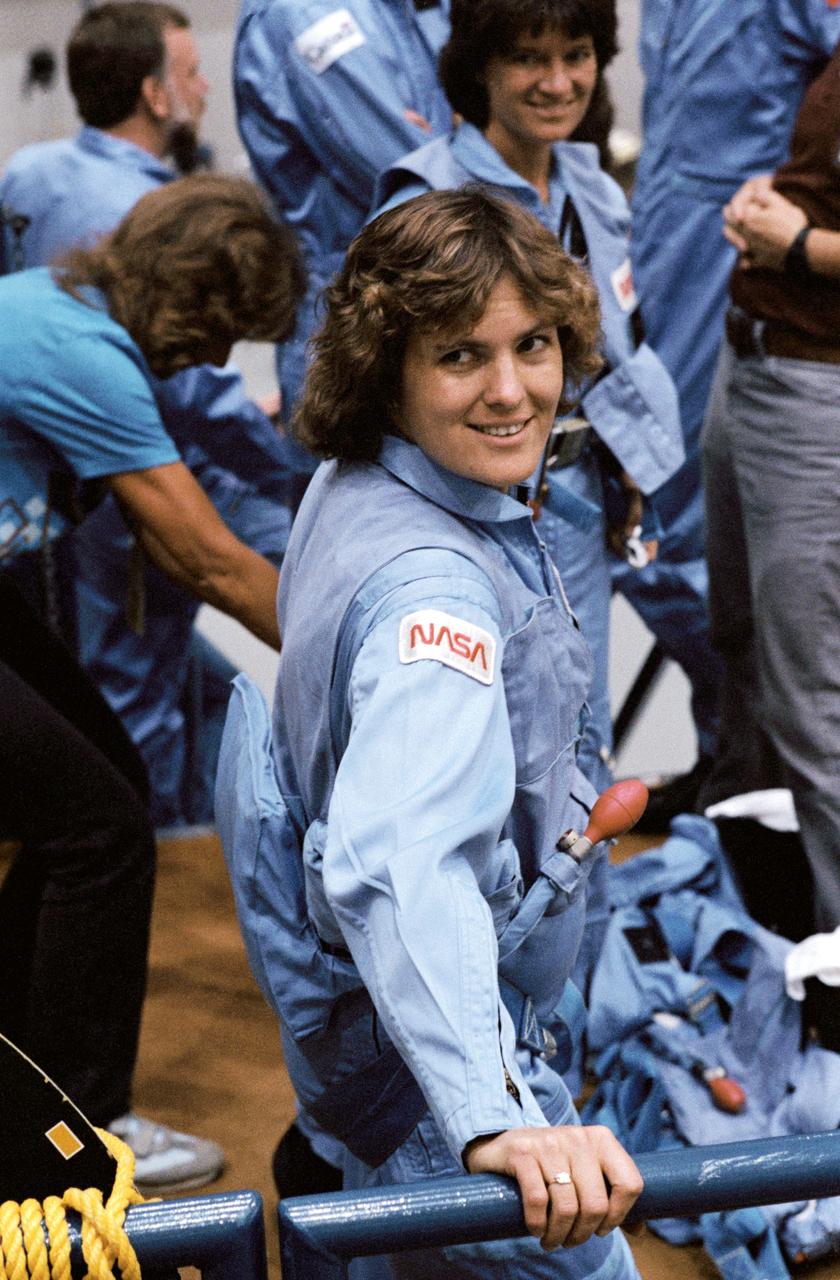
41D-3188 (2 September 1984) --- Astronaut Kathryn D. Sullivan, 41-G mission specialist, joins with other members of the seven-person crew prior to a training session in the Shuttle mockup and integration laboratory at the Johnson Space Center.  Dr. Sullivan will be the first American woman to perform an extravehicular activity (EVA) in space when she joins Astronaut David C. Leestma for some outside-the-Challenger duty on October 9. The mission is scheduled for an October 5, 1984 launch.
Astronaut Sullivan prepares to join crew in training
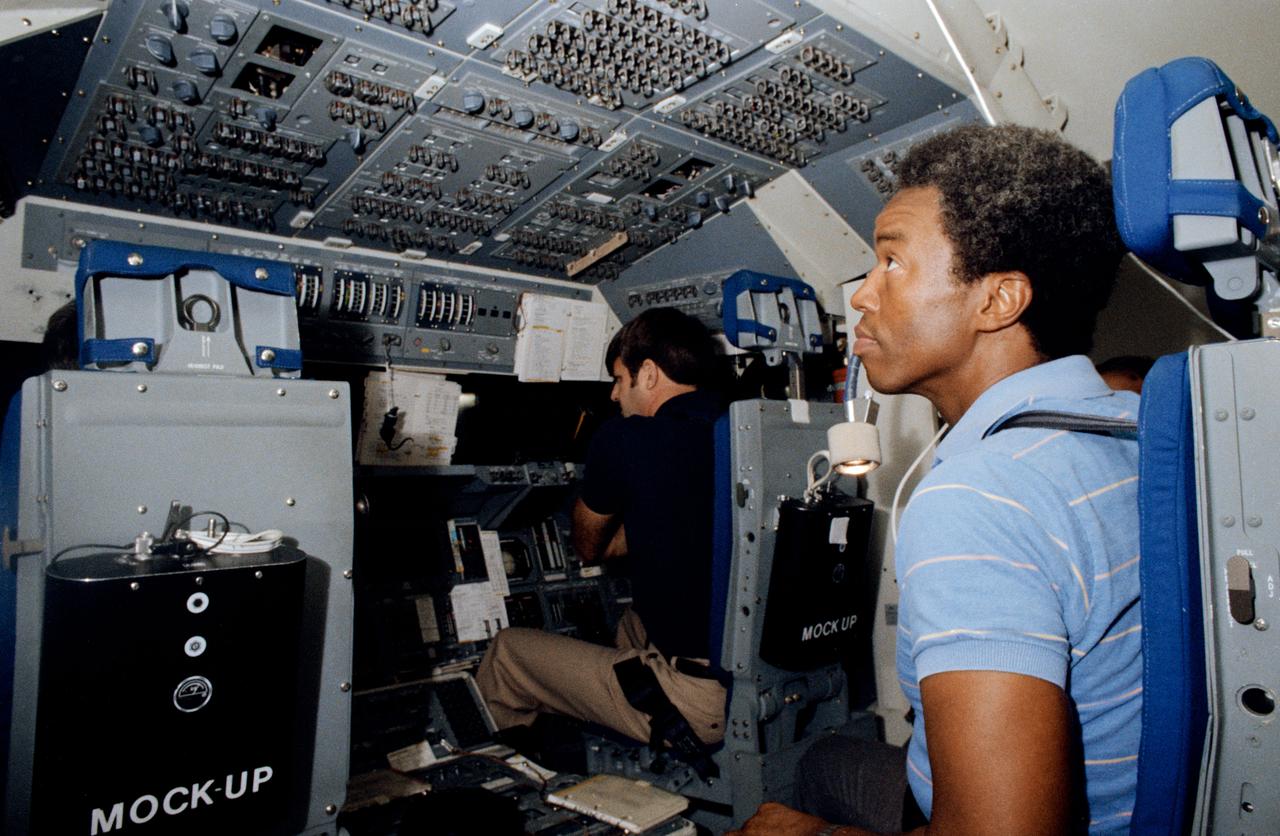
S83-33032 (23 May 1983) --- Astronauts Guion S. Bluford, right, and Daniel C. Brandenstein man their respective Challenger entry and ascent stations in the Shuttle Mission Simulator (SMS) at NASA's Johnson Space Center (JSC) during a training session for the STS-8 mission. Brandenstein is in the pilot's station, while Bluford, a mission specialist, occupies one of the two aft flight deck seats. Both are wearing civilian clothes for this training exercise. This motion based simulator represents the scene of a great deal of training and simulation activity, leading up to crew preparedness for Space Transportation System (STS) mission. Photo credt: NASA/Otis Imboden, National Geographic
STS-8 crewmembers during shuttle mission simulation training
STS 51-E crew is briefed on the Shuttle full fuselage trainer. View of the crewmembers seated at stations inside the cabin was taken from the side hatch.
STS 51-E crew is briefed on the Shuttle full fuselage trainer
Sharon Christa McAuliffe, 51-L payload specialist representing the Teacher in Space project, jumps down onto a cushion during an emergency egress training session in JSC's mockup and integration laboratory. She had been descending from the mockup using a Sky-genie.
Christa McAuliffe using Sky-genie during emergency egress training
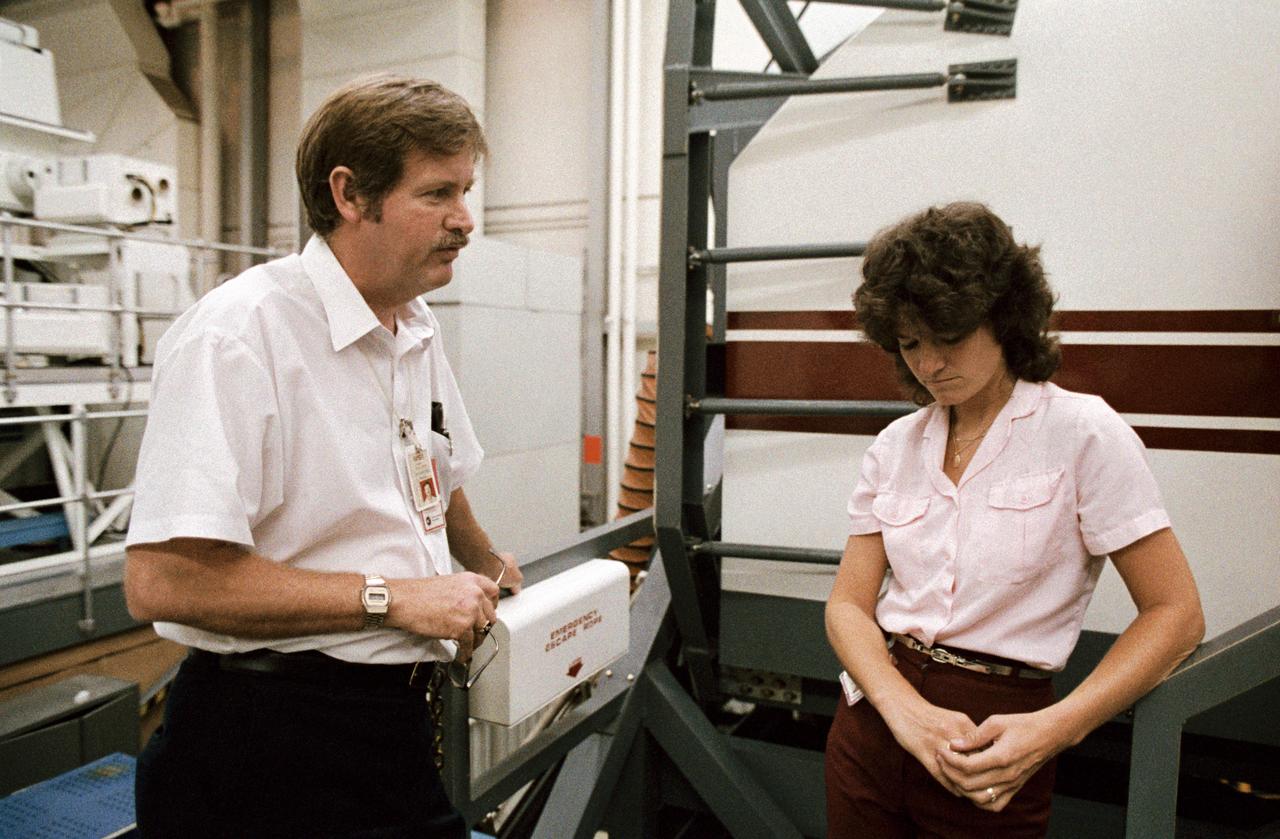
S83-32890 (23 May 1983) --- Astronaut Sally K. Ride, STS-7 mission specialist, stands near the Shuttle Mission Simulator (SMS) in Johnson Space Center's (JSC) Mission Simulation and Training Facility with suit specialist Alan M. Rochford after simulation of various phases of the upcoming STS-7 flight. Photo credit: NASA
Astronaut Sally K. Ride outside of shuttle mission simulator
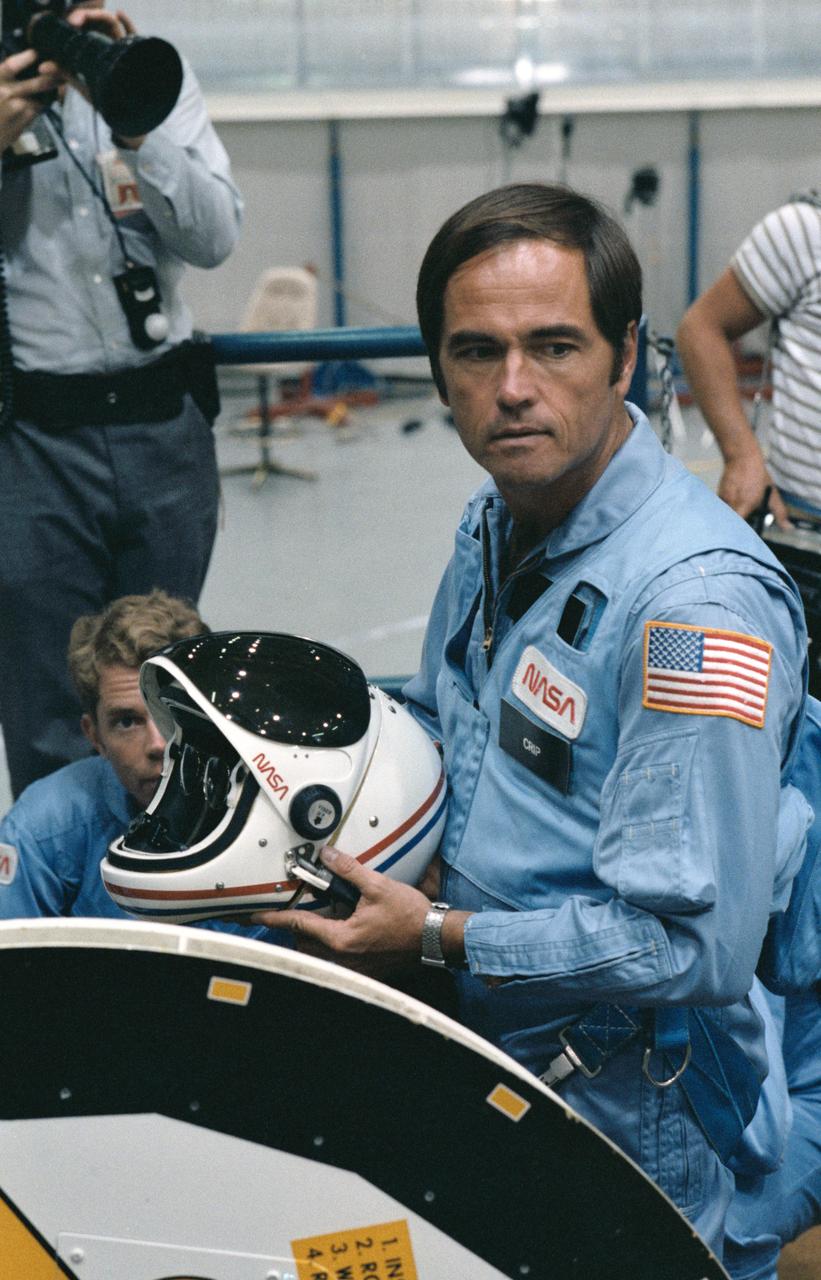
41D-3186 (4 Sept 1984) --- Astronaut Robert L. Crippen, 41-G crew commander, prepares to join his six fellow crewmembers for some training in the mockup and integration laboratory at the Johnson Space Center.  Astronaut David C. Leestma, 41-G mission specialist, left, will participate in a scheduled extravehicular activity (EVA) on the Challenger's next mission.  Today's training is for launch phase procedures.
Astronaut Crippen prepares to join crew in training
AS07-03-1545 (11 Oct. 1968) --- The expended Saturn S-IVB stage as photographed from the Apollo 7 spacecraft during transposition and docking maneuvers at an approximate altitude of 125 nautical miles, at ground elapsed time of three hours and 16 minutes (beginning of third revolution). This view is over the Atlantic Ocean off the coast of Cape Kennedy, Florida. The Florida coastline from Flagler Beach southward to Vero Beach is clearly visible in picture. Much of the Florida peninsula can be seen. Behind the open panels is the Gulf of Mexico. Distance between the Apollo 7 spacecraft and the S-IVB is approximately 100 feet. The round, white disc inside the open panels of the S-IVB is a simulated docking target similar to that used on the Lunar Module (LM) for docking during lunar missions.
Apollo 7/S-IVB Rendezvous in space
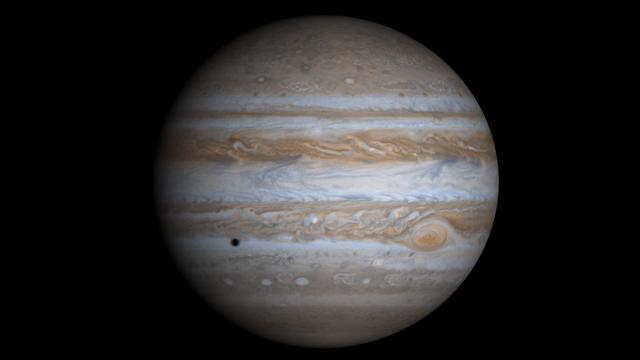
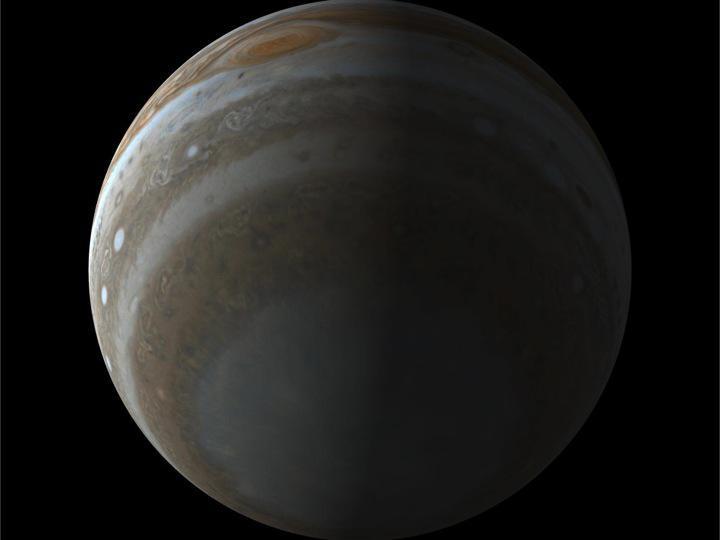
This true-color simulated view of Jupiter is composed of 4 images taken by NASA's Cassini spacecraft on December 7, 2000. To illustrate what Jupiter would have looked like if the cameras had a field-of-view large enough to capture the entire planet, the cylindrical map was projected onto a globe. The resolution is about 144 kilometers (89 miles) per pixel. Jupiter's moon Europa is casting the shadow on the planet.  https://photojournal.jpl.nasa.gov/catalog/PIA02873
High Resolution Globe of Jupiter
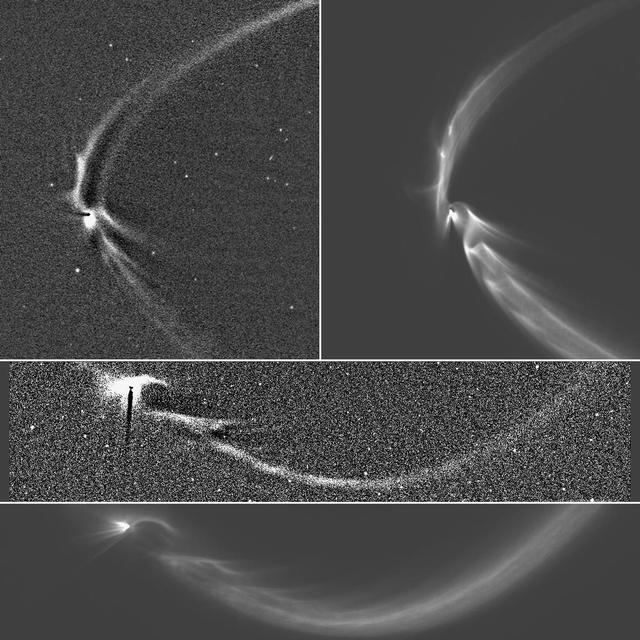
This collage of NASA Cassini spacecraft images and computer simulations shows how long, sinuous features from Enceladus can be modeled by tracing the trajectories of tiny, icy grains ejected from the moon south polar geysers.
Simulations of the Tendrils
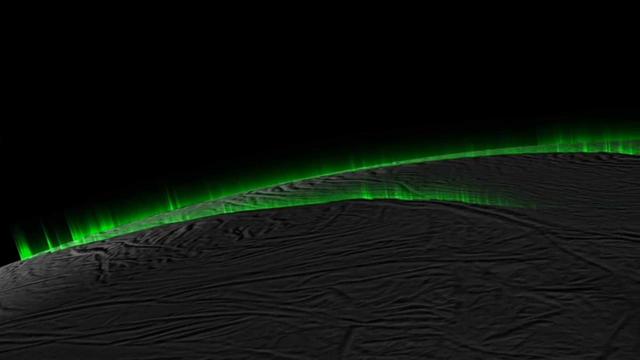
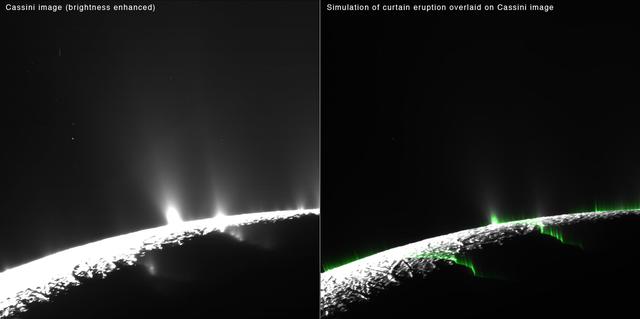
This simulation, which begins and ends with a real image from NASA Cassini spacecraft, demonstrates how the appearance of discrete jets could be an optical illusion that varies based on viewing geometry.
Icy Curtain Eruptions on Enceladus Create an Illusion of Discrete Jets Simulation
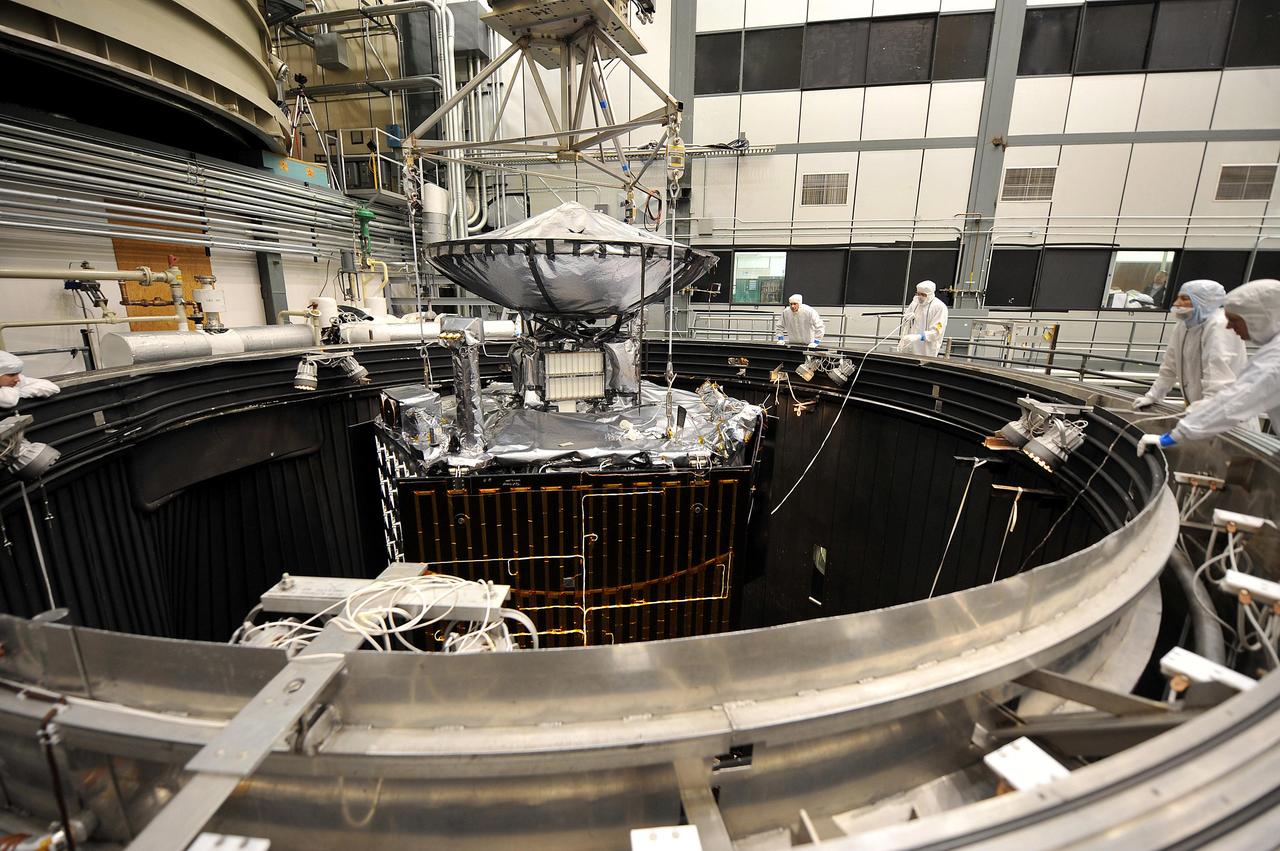
NASA Juno spacecraft is raised out of a thermal vacuum chamber following tests that simulated the environment of space over the range of conditions the probe will encounter during its mission.
Juno Emerges from Thermal-Vac Testing
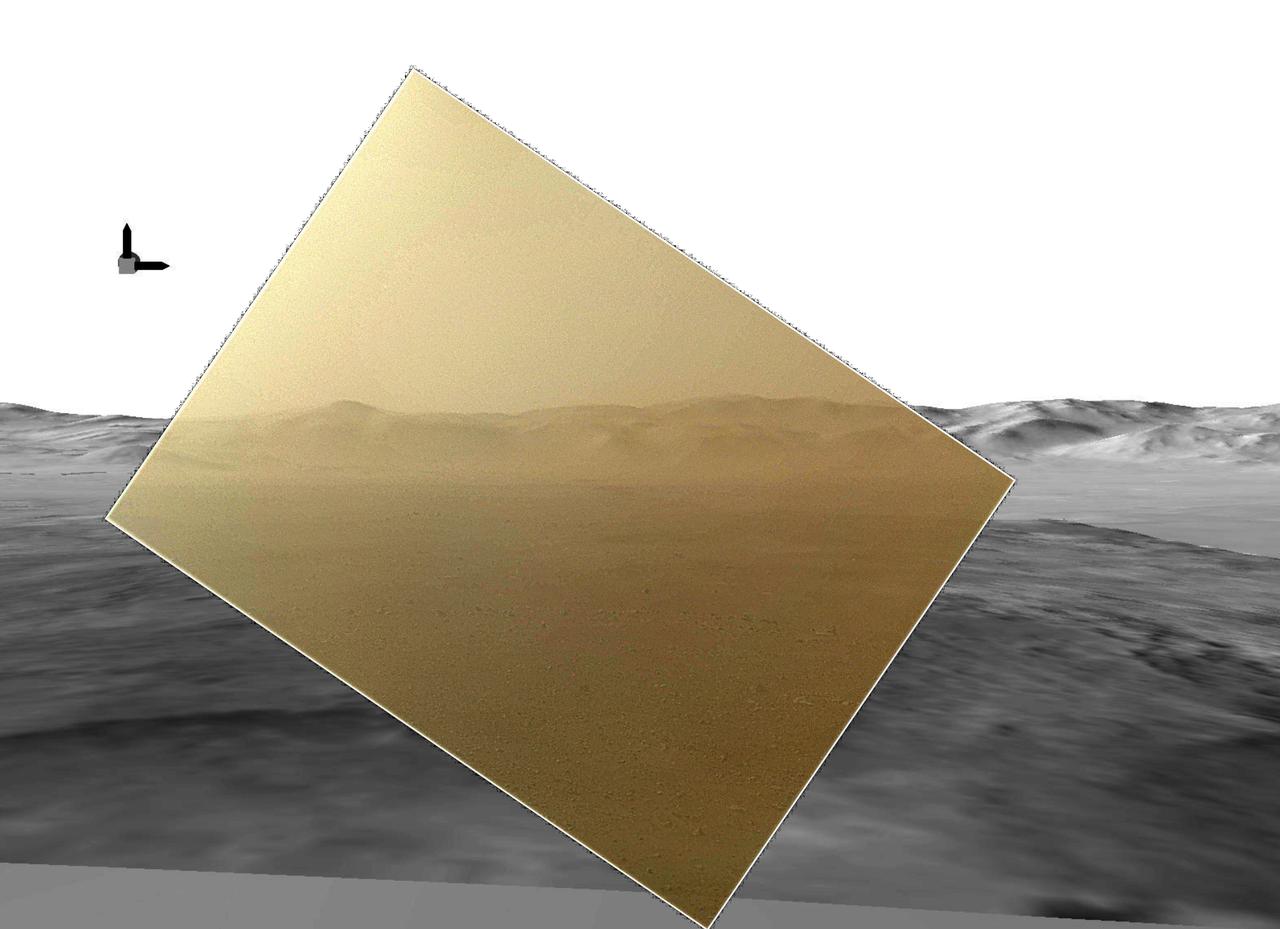
This picture from NASA Curiosity rover puts a color view obtained by the rover in the context of a computer simulation derived from images acquired from orbiting spacecraft. The view looks north, showing the distant ridge of Gale Crater.
Curiosity Landscape Portrait in Context
Phantom jets in simulated images produced by the scientists line up nicely with some of the features in real images from NASA Cassini spacecraft that appear to be discrete columns of spray.
Enceladus Curtains: Comparing Data and Simulation
NASA Juno spacecraft is readied for lifting out of a thermal vacuum chamber following testing to simulate the environment of space over the range of conditions the probe will encounter during its mission.
Juno Gets a Taste of Space
NASA Terra spacecraft captured this image of the wildfire near Palmdale, Calif. on August 1, 2010 called the Crown fire. The burned areas appear in shades of gray in this simulated natural color image.
ASTER Views California Crown Fire
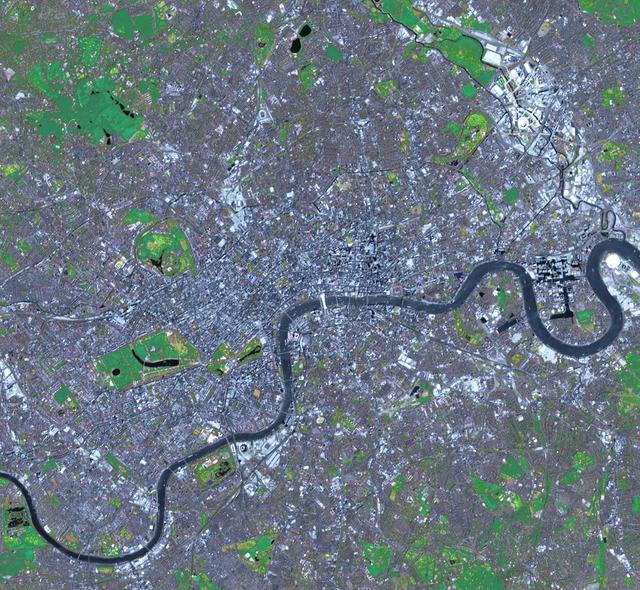
This simulated natural color image of London was acquired May 26, 2012 by NASA Terra spacecraft. Major construction projects included the new 400-acre Olympic Park for the 2012 Summer Olympic Games.
NASA Spacecraft Captures a Medal-Worthy Image of London
This simulated voyage over the surface of Neptune large moon Triton was produced using topographic maps derived from images acquired by NASA Voyager spacecraft during its August 1989 flyby, 20 years ago this week.
Flight Over Triton
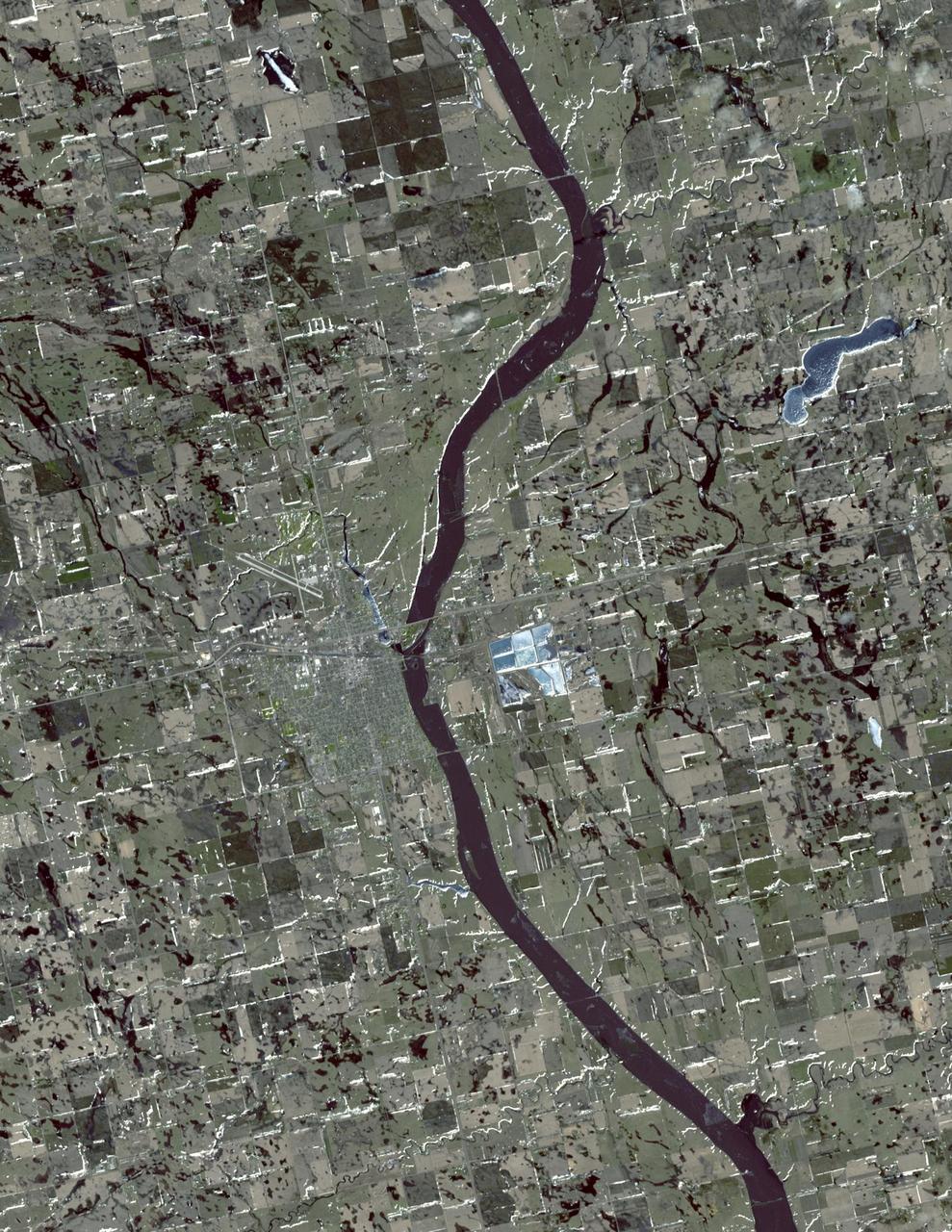
In this simulated natural color image of Huron, South Dakota, captured by NASA Terra spacecraft on March 20, 2010, frozen lakes and ponds appear blue, bare fields are tan, and fields with minor vegetation are gray-green.
Huron, South Dakota
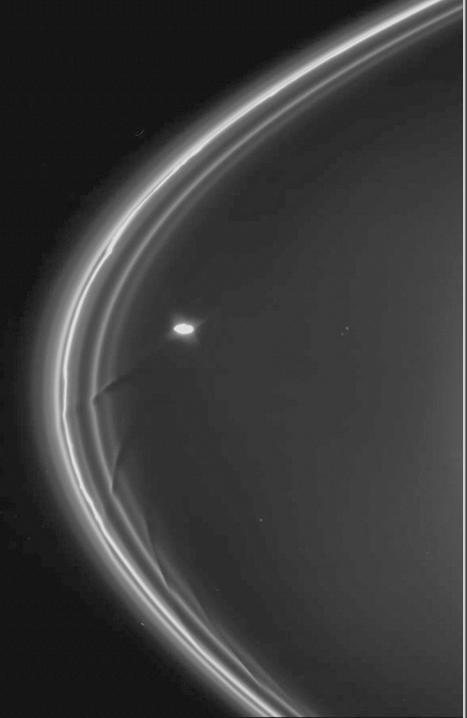
This image is from a simulation showing the changes to a portion of Saturn F ring as the shepherding moon Prometheus swings by it. The animation uses data obtained by the imaging cameras aboard NASA Cassini spacecraft.
The Effect of Prometheus on the F Ring
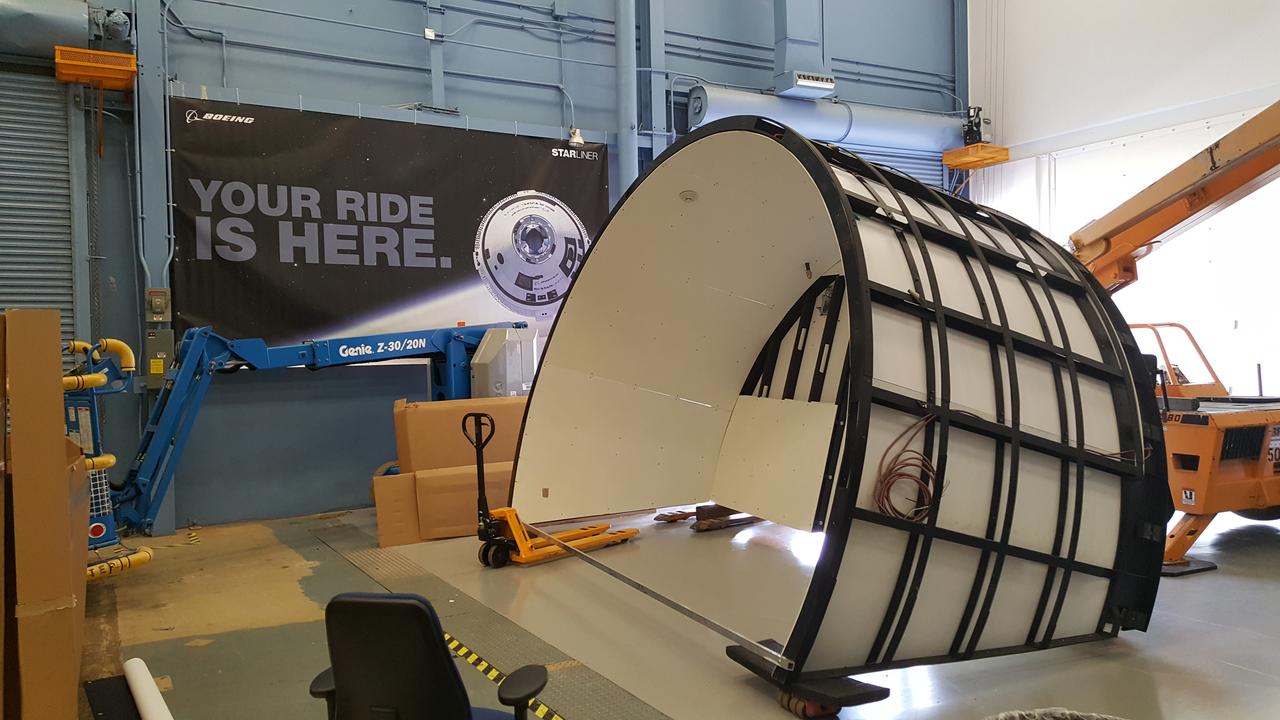
The Boeing Mission Simulator is moved to NASA's Johnson Space Center in Houston. The simulator is a full-scale mockup of Boeing's Starliner spacecraft. The simulator will be used to train crews to fly the spacecraft.
Boeing Mission Simulator for CST-100 Arrives at JSC
The Boeing Mission Simulator is moved to NASA's Johnson Space Center in Houston. The simulator is a full-scale mockup of Boeing's Starliner spacecraft. The simulator will be used to train crews to fly the spacecraft.
Boeing Mission Simulator for CST-100 Arrives at JSC
The Boeing Mission Simulator is moved to NASA's Johnson Space Center in Houston. The simulator is a full-scale mockup of Boeing's Starliner spacecraft. The simulator will be used to train crews to fly the spacecraft.
Boeing Mission Simulator for CST-100 Arrives at JSC
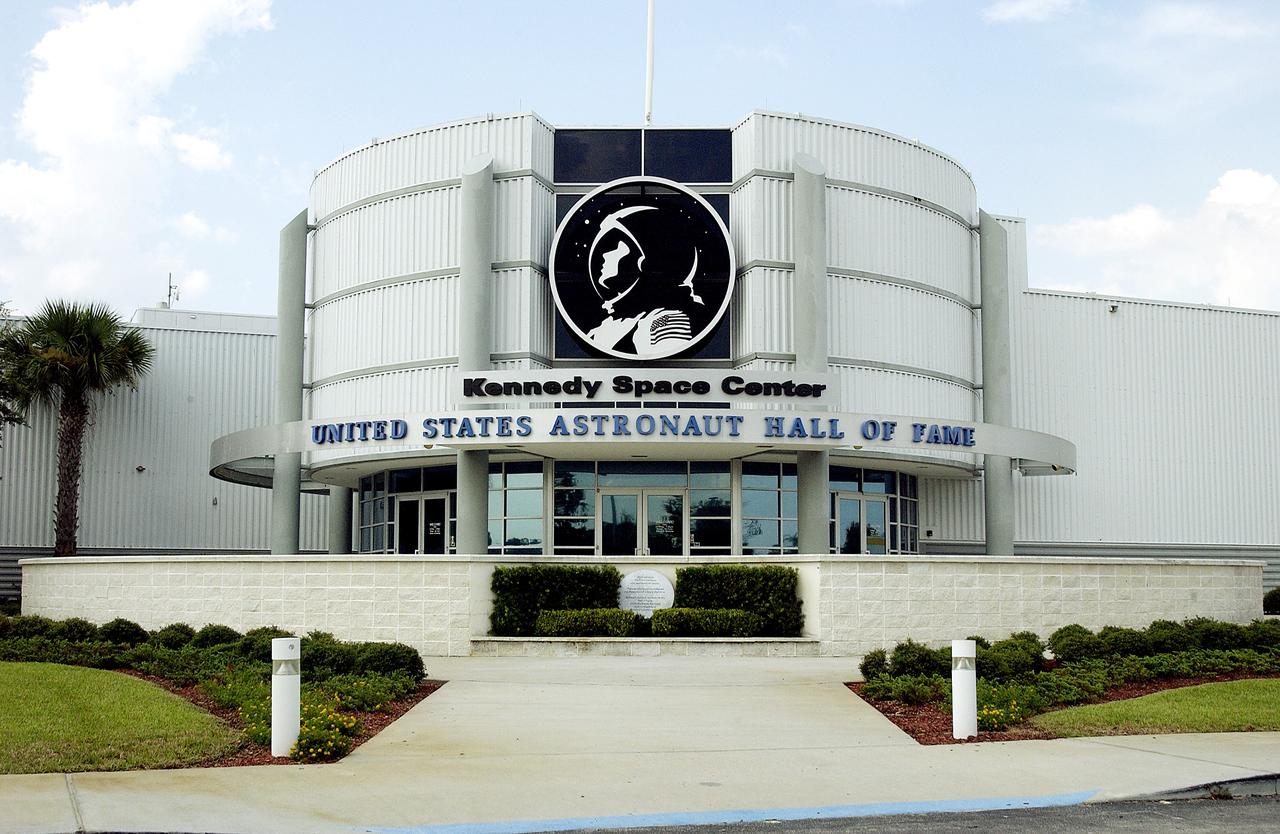
KENNEDY SPACE CENTER, FLA.  The Astronaut Hall of Fame is dedicated to telling the stories of America’s astronauts.  It features the world’s largest collection of personal astronaut mementos plus historic spacecrafts and training simulators.  The Hall of Fame is part of the KSC Visitor Complex.
KENNEDY SPACE CENTER, FLA. The Astronaut Hall of Fame is dedicated to telling the stories of America’s astronauts. It features the world’s largest collection of personal astronaut mementos plus historic spacecrafts and training simulators. The Hall of Fame is part of the KSC Visitor Complex.
KENNEDY SPACE CENTER, FLA.  -  A replica of a Space Shuttle orbiter is on exhibit outside the Astronaut Hall of Fame, which features the world’s largest collection of personal astronaut mementos plus historic spacecrafts and training simulators.  The Hall of Fame is part of the KSC Visitor Complex.
KENNEDY SPACE CENTER, FLA. - A replica of a Space Shuttle orbiter is on exhibit outside the Astronaut Hall of Fame, which features the world’s largest collection of personal astronaut mementos plus historic spacecrafts and training simulators. The Hall of Fame is part of the KSC Visitor Complex.
Apollo interium midcourse flight simulator Brent Creer, Chief of the Ames manned spacecraft simulation branch, developed the Apollo mid-course navigation and guidance simulator.
ARC-1962-A-29724-2
At the Gagarin Cosmonaut Training Center in Star City, Russia, Expedition 59 crewmember Christina Koch of NASA boards a Soyuz spacecraft simulator Feb. 20 during the second day of final pre-launch qualifications exams. Koch, Nick Hague of NASA and Alexey Ovchinin of Roscosmos will launch March 14, U.S. time, in the Soyuz MS-12 spacecraft from the Baikonur Cosmodrome in Kazakhstan for a six-and-a-half month mission on the International Space Station.  NASA/Beth Weissinger
jsc2019e004058 - At the Gagarin Cosmonaut Training Center in Star City, Russia, Expedition 59 crewmember Christina Koch of NASA boards a Soyuz spacecraft simulator Feb. 20 during the second day of final pre-launch qualifications exams. Koch, Nick Hague of
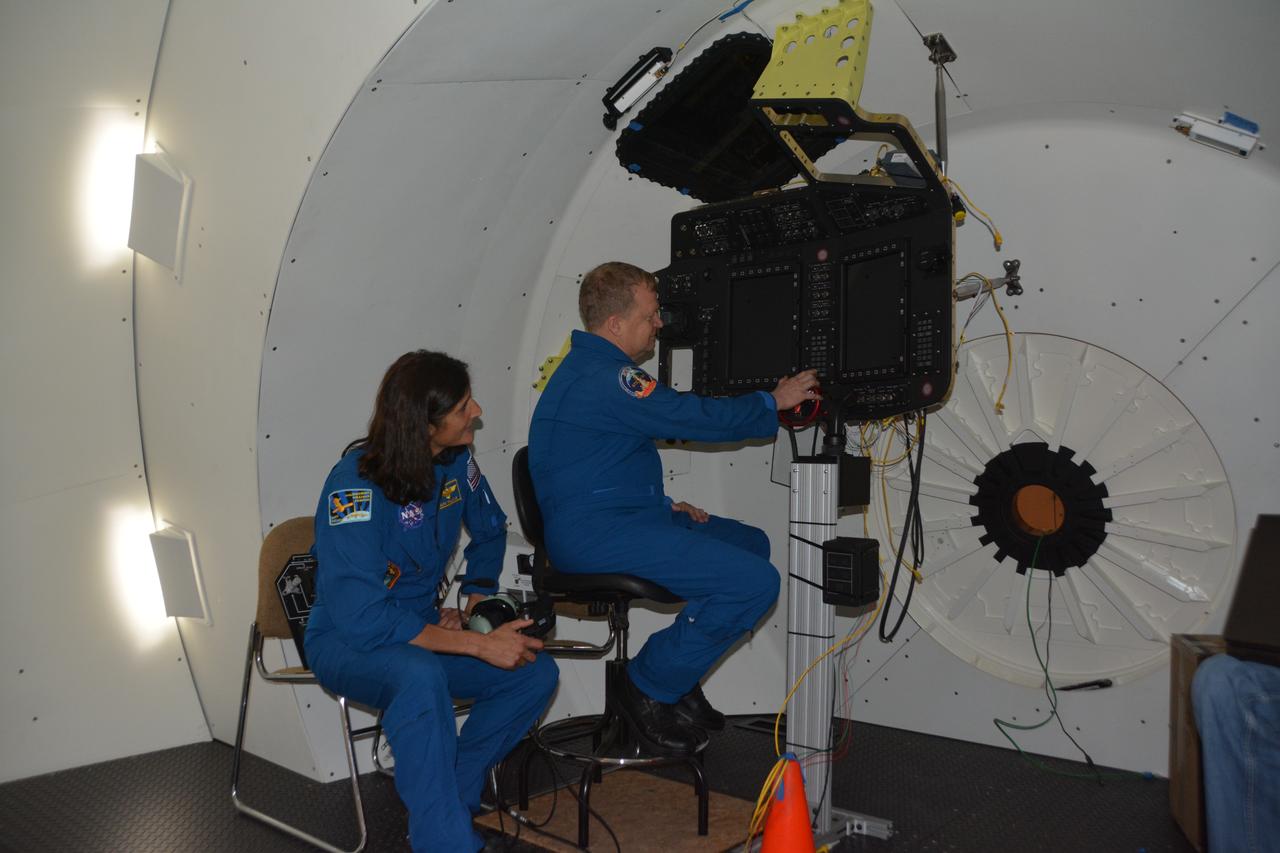
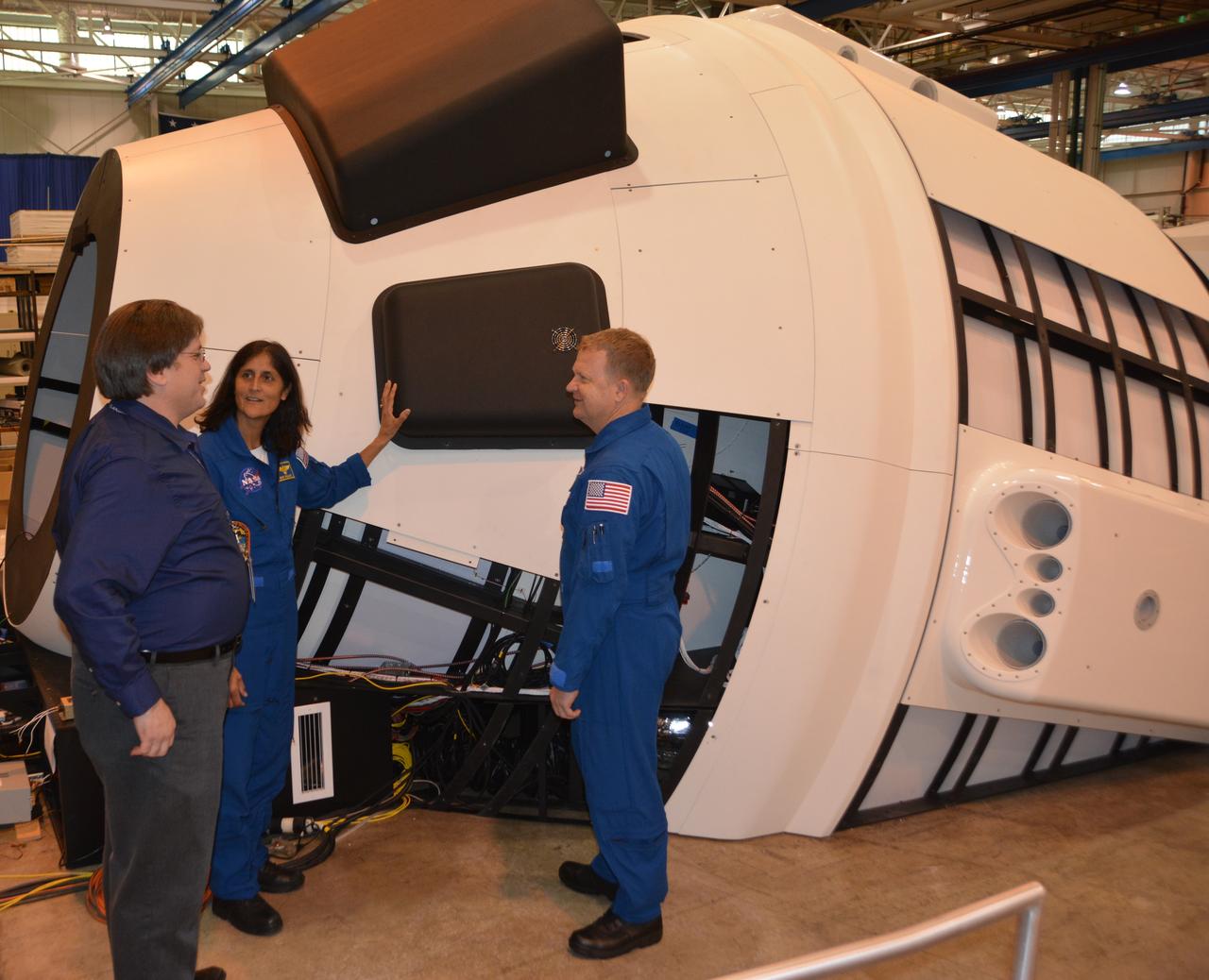
NASA astronauts Suni WIlliams and Eric Boe check the Boeing Mission Simulator at the Boeing facility in St. Louis, Missouri, prior to its completion and shipment to NASA's Johnson Space Center in Houston. The simulator is a full-scale mockup of Boeing's Starliner spacecraft. The simulator will be used to train crews to fly the spacecraft.
Boeing Mission Simulator with CCP Astronauts
NASA astronauts Suni WIlliams and Eric Boe check the Boeing Mission Simulator at the Boeing facility in St. Louis, Missouri, prior to its completion and shipment to NASA's Johnson Space Center in Houston. The simulator is a full-scale mockup of Boeing's Starliner spacecraft. The simulator will be used to train crews to fly the spacecraft.
Boeing Mission Simulator with CCP Astronauts
At the Gagarin Cosmonaut Training Center in Star City, Russia, Expedition 46-47 crewmember Yuri Malenchenko of the Russian Federal Space Agency (Roscosmos) reviews procedures inside a Soyuz spacecraft simulator Nov. 20 at the start of final qualification exams. Malenchenko and crewmates Tim Peake of the European Space Agency and Tim Kopra of NASA will launch Dec. 15 on their Soyuz TMA-19M spacecraft Dec. 15 from the Baikonur Cosmodrome in Kazakhstan for a six-month mission on the International Space Station. NASA/Seth Marcantel
At the Gagarin Cosmonaut Training Center in Star City, Russia, Expedition 46-47 crewmember Yuri Malenchenko of the Russian Federal Space Agency (Roscosmos) reviews procedures inside a Soyuz spacecraft simulator Nov. 20 at the start of final qualification exams. Malenchenko and crewmates Tim Peake of the European Space Agency and Tim Kopra of NASA will launch Dec. 15 on their Soyuz TMA-19M spacecraft Dec. 15 from the Baikonur Cosmodrome in Kazakhstan for a six-month mission on the International Space Station..NASA/Seth Marcantel
At the Gagarin Cosmonaut Training Center in Star City, Russia, Expedition 46-47 crewmember Tim Kopra of NASA reviews procedures inside a Soyuz spacecraft simulator Nov. 20 at the start of final qualification exams. Kopra and crewmates Yuri Malenchenko of the Russian Federal Space Agency (Roscosmos) and Tim Peake of the European Space Agency will launch Dec. 15 on their Soyuz TMA-19M spacecraft Dec. 15 from the Baikonur Cosmodrome in Kazakhstan for a six-month mission on the International Space Station. NASA/Seth Marcantel
At the Gagarin Cosmonaut Training Center in Star City, Russia, Expedition 46-47 crewmember Tim Kopra of NASA reviews procedures inside a Soyuz spacecraft simulator Nov. 20 at the start of final qualification exams. Kopra and crewmates Yuri Malenchenko of the Russian Federal Space Agency (Roscosmos) and Tim Peake of the European Space Agency will launch Dec. 15 on their Soyuz TMA-19M spacecraft Dec. 15 from the Baikonur Cosmodrome in Kazakhstan for a six-month mission on the International Space Station..NASA/Seth Marcantel
S70-45580 (July 1970) --- The members of the prime crew of the Apollo 14 lunar landing mission participate in Command Module (CM) simulation training at the Kennedy Space Center (KSC). Left to right are astronauts Edgar D. Mitchell, lunar module pilot; Stuart A. Roosa, command module pilot; and Alan B. Shepard Jr., commander.
View of Apollo 14 crewmen in Command Module simulation training
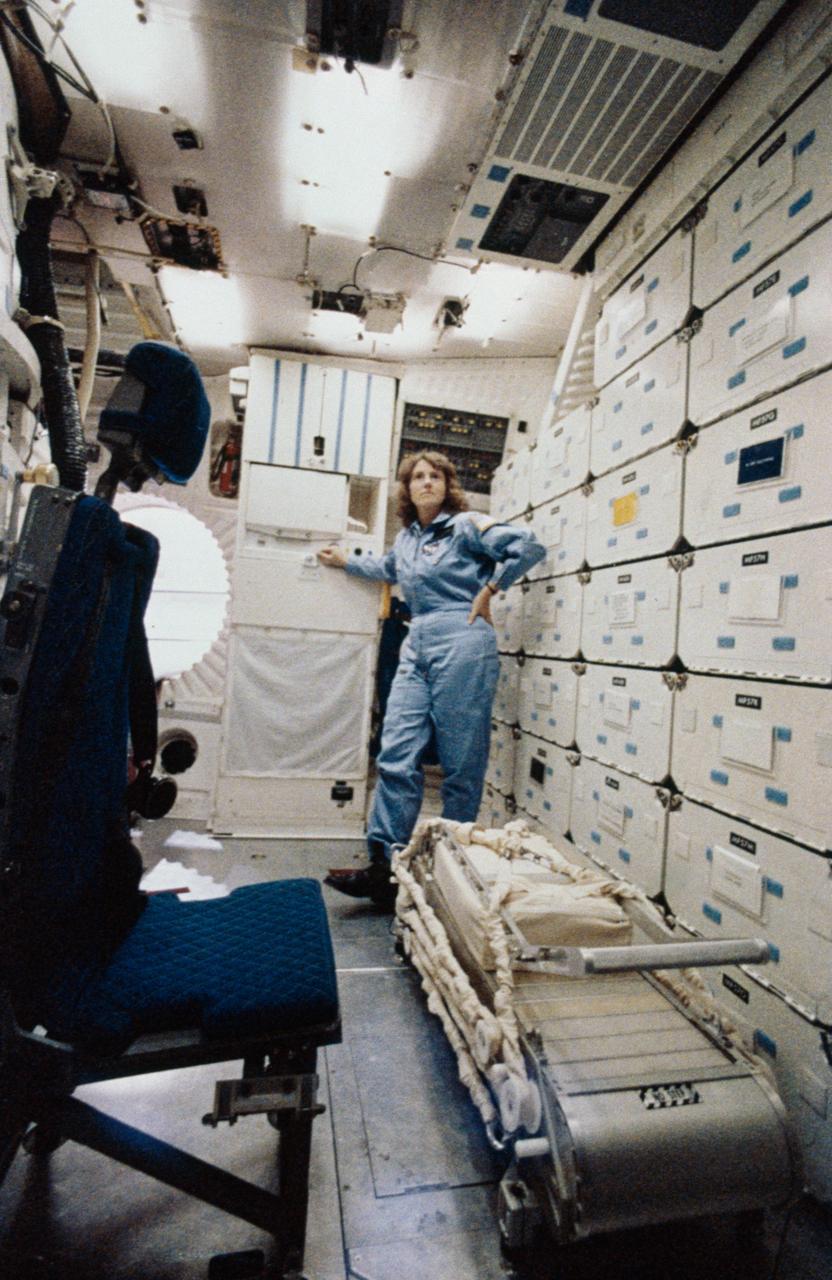
S86-25188 (December 1985) --- Sharon Christa McAuliffe, a school teacher Concord New Hampshire, surveys a ground training replica of the quarters she?ll be using in space when the space shuttle Challenger taxis two women and five men into space in January of 1986.  The STS-51L citizen observer/payload specialist is in training at the Johnson Space Center, representing the Teacher-in-Space Project. The photo was taken by Keith Meyers of the New York Times. Photo credit: NASA
Christa McAuliffe surveys middeck mockup
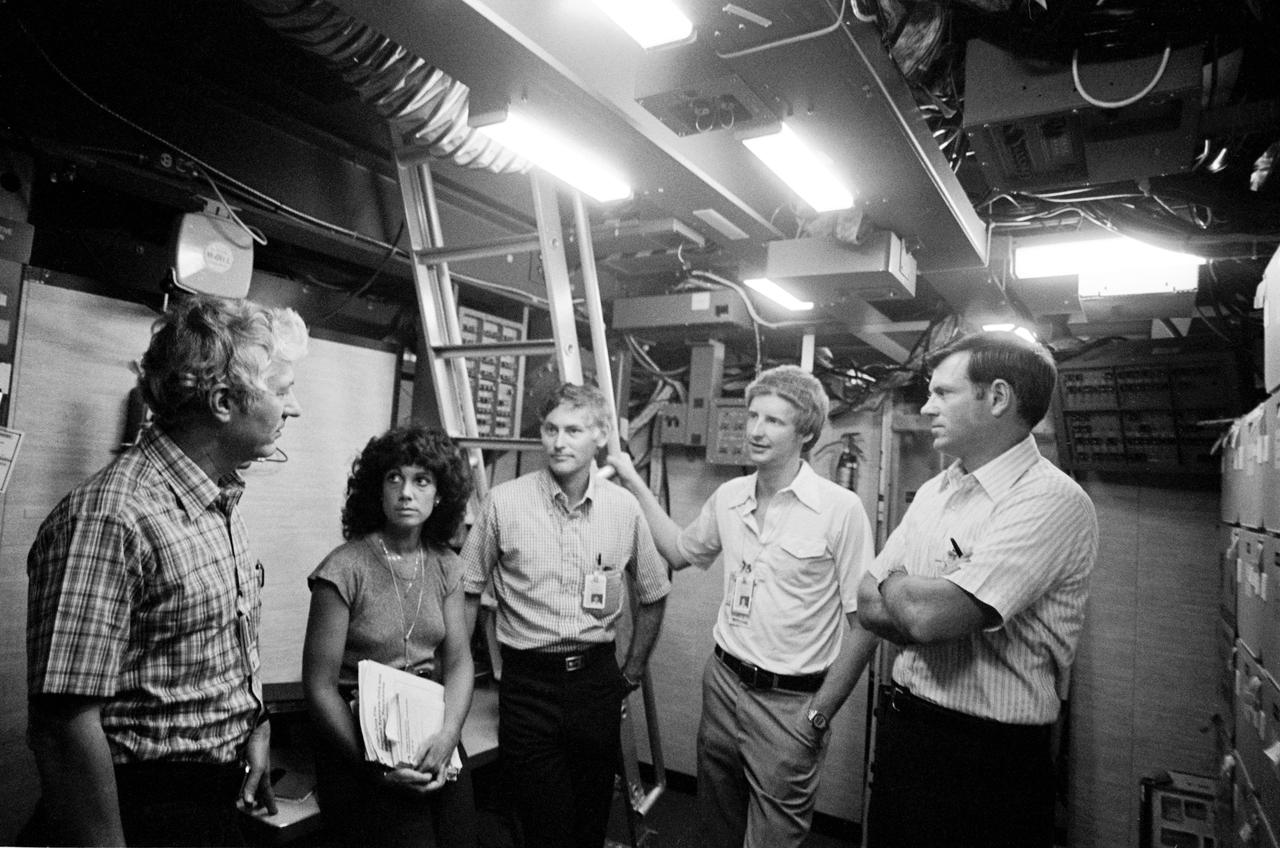
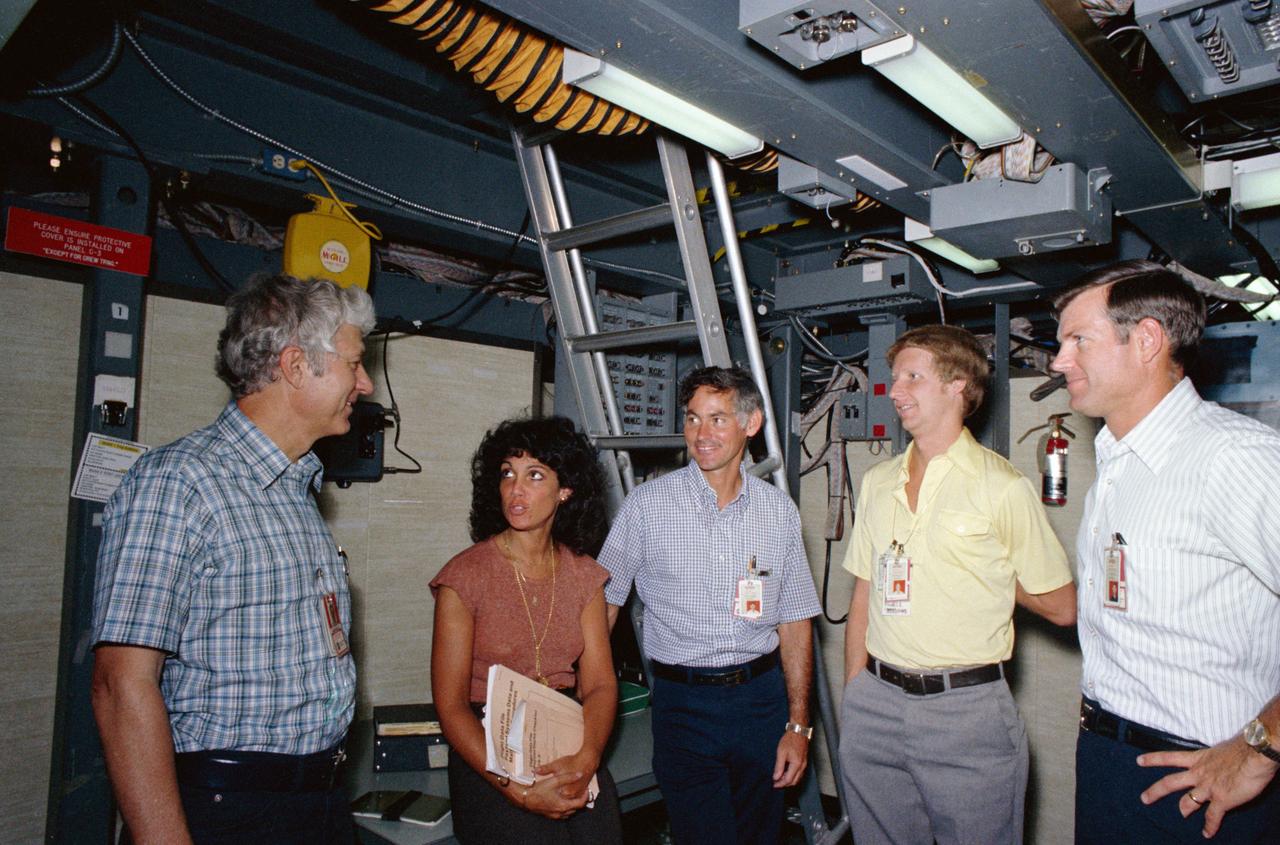
View of STS 41-D mission crew training in Shuttle Mission simulator. From left to right are Henry Hartsfield, Jr., commander; mission specialists Judith Resnik, Richard Mullane, and Steven Hawley; and Michael Coats, pilot. They appear to be standing in the middeck mockup, preparing for training.
STS 41-D mission crew training in Shuttle Mission simulator
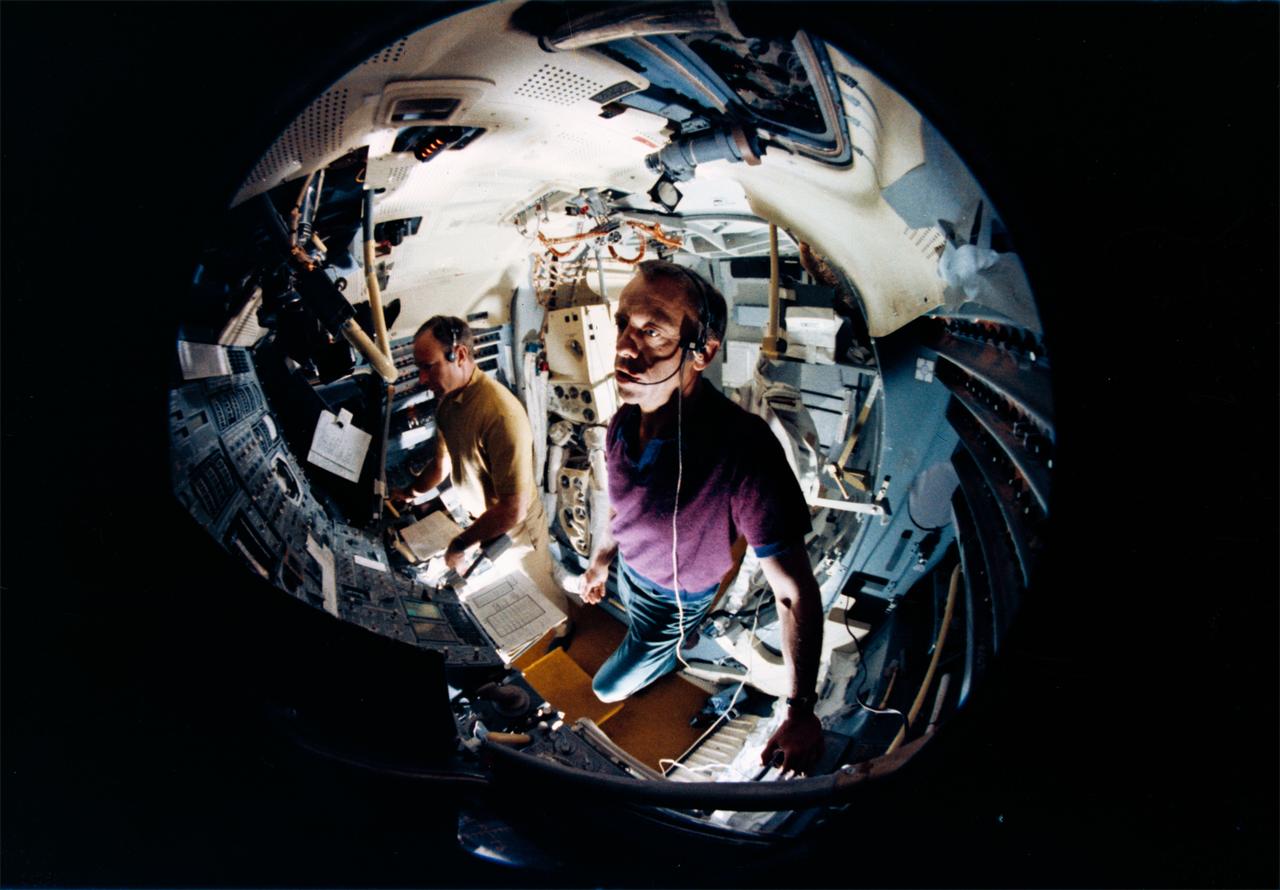
S70-45555 (July 1970) --- A fish-eye lens view showing astronauts Alan B. Shepard Jr. (foreground) and Edgar D. Mitchell in the Apollo lunar module mission simulator at the Kennedy Space Center during preflight training for the Apollo 14 lunar landing mission. Shepard is the Apollo 14 commander; and Mitchell is the lunar module pilot.
Fish-eye lens view Astronauts Shepard and Mitchell in Lunar Module Simulator
View of STS 41-D mission crew training in Shuttle Mission simulator. From left to right are Henry Hartsfield, Jr., commander; mission specialists Judith Resnik, Richard Mullane, and Steven Hawley; and Michael Coats, pilot. They appear to be standing in the middeck mockup, preparing for training.
STS 41-D mission crew training in Shuttle Mission simulator
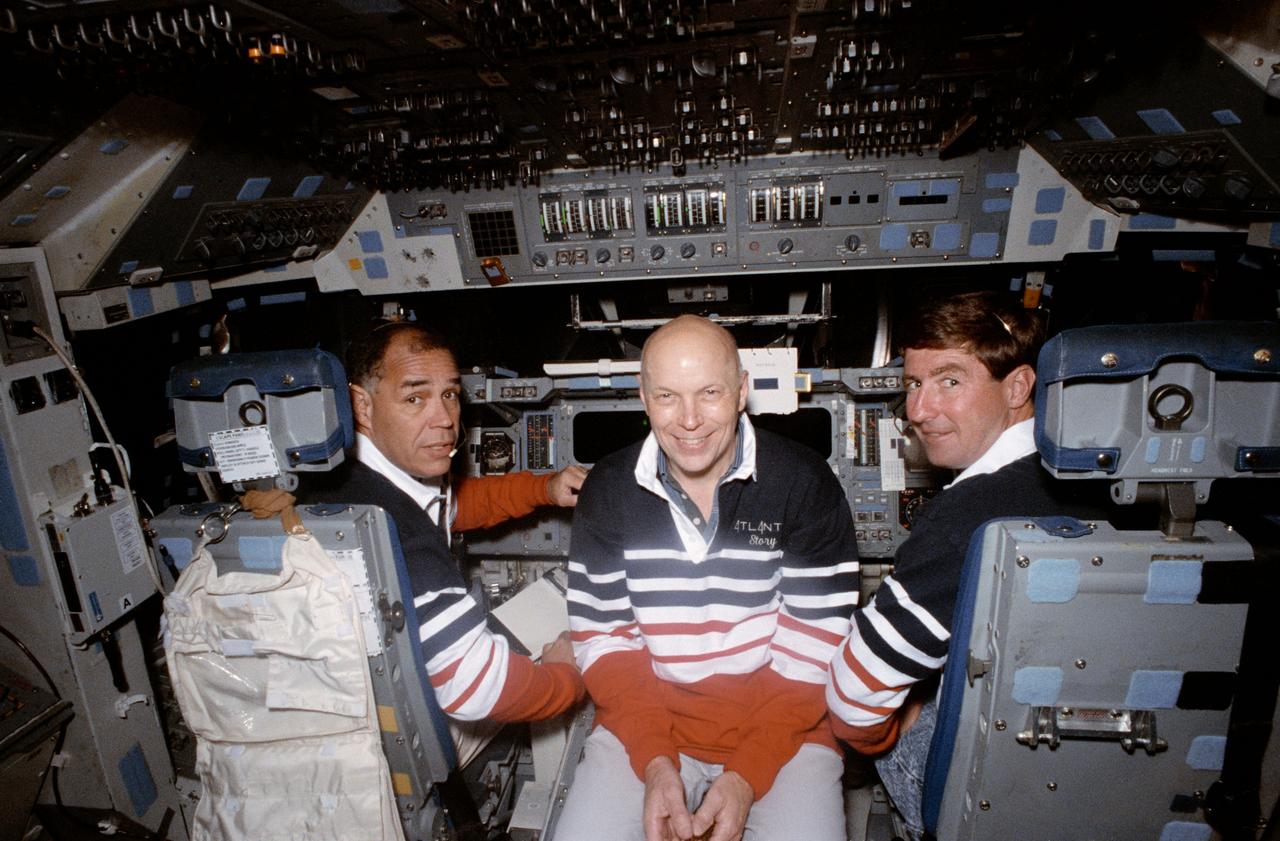
S91-35303 (22 April 1991) --- Astronauts Frederick D. Gregory (left) and Terrence T. Henricks (right), STS-44 commander and pilot, respectively, are joined near their launch and entry stations by F. Story Musgrave, mission specialist. The three pause while rehearsing some of the activities that will be performed during the scheduled ten-day November flight.  Musgrave will be in a rear cabin station during launch and entry phases of the flight deck of the fixed-base Shuttle Mission Simulator (SMS) in the Johnson Space Center's mission simulation and training facility.
STS-44 Atlantis, OV-104, crewmembers participate in FB-SMS training at JSC
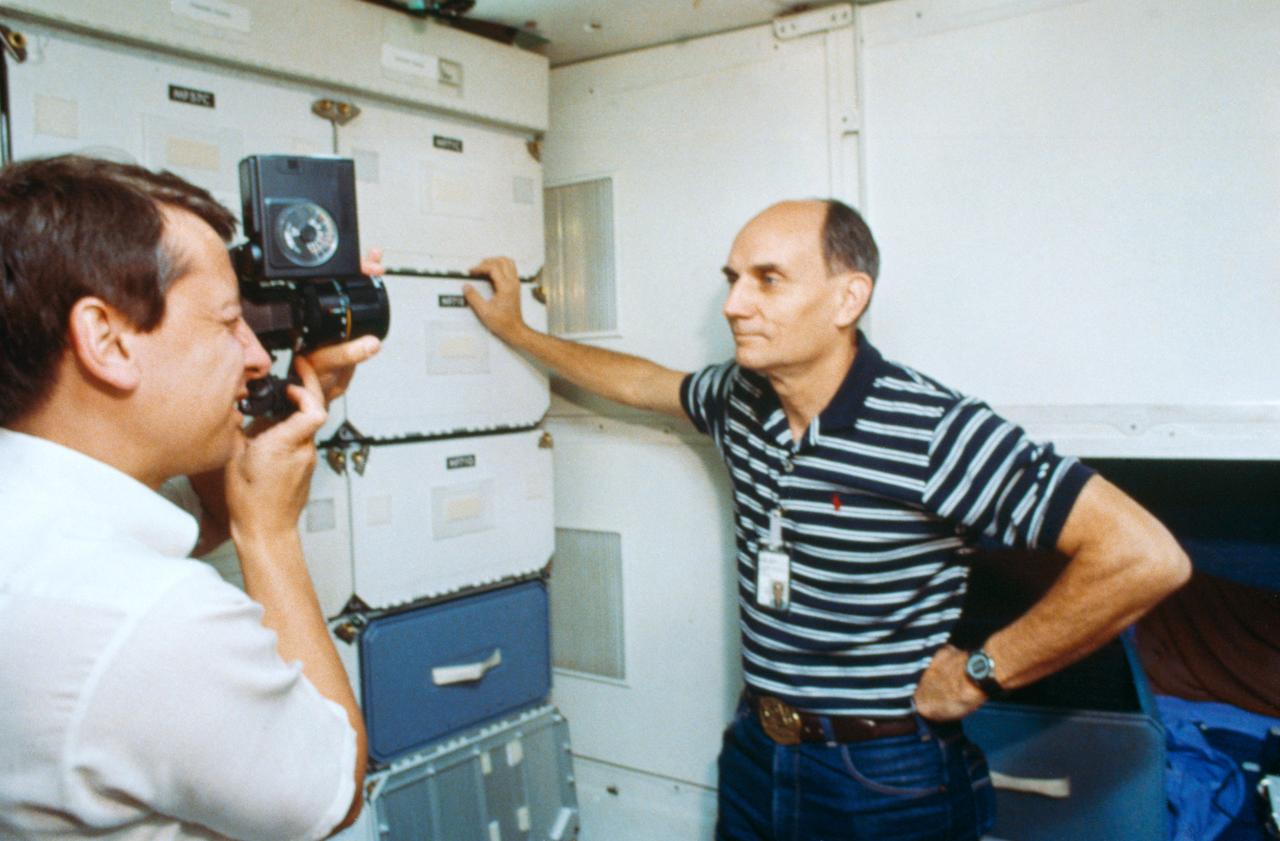
Two payload specialists for the STS 51-D mission get in some training time in the crew compartment trainerat JSC. Charles D. Walker, left, rehearses photography of U.S. Senator E.J. (Jake) Garn in the middeck section of the trainer.
Sen. Jake Garn and payload specialist Charles Waler in middeck simulation
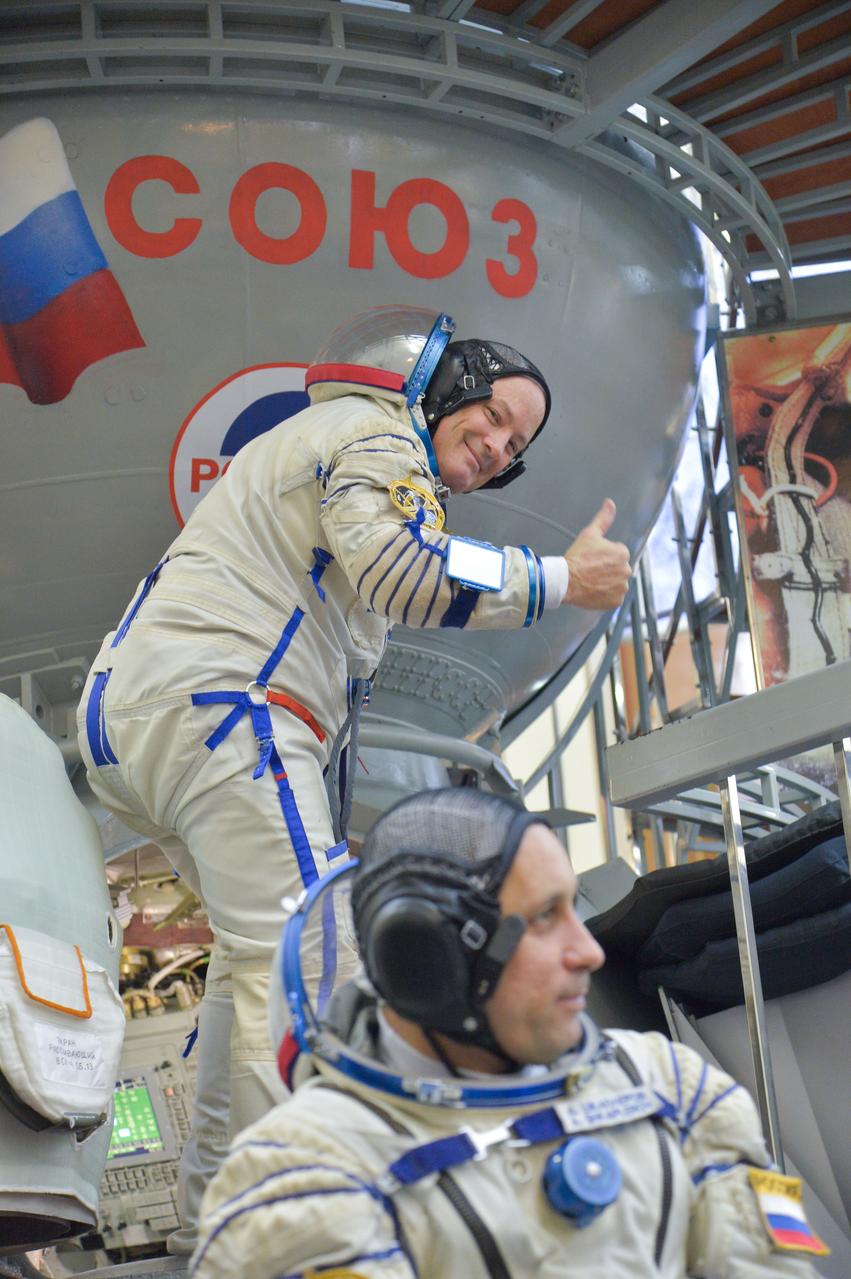
jsc2017e135209 - At the Gagarin Cosmonaut Training Center in Star City, Russia, Expedition 54-55 prime crewmember Scott Tingle of NASA flashes a thumbs up as he boards a Soyuz spacecraft simulator Nov. 29 as part of the crew’s final qualification exam activities. Anton Shkaplerov of the Russian Federal Space Agency (Roscosmos) is seen in the foreground. They will launch along with Norishige Kanai of the Japan Aerospace Exploration Agency (JAXA) Dec. 17 on the Soyuz MS-07 spacecraft from the Baikonur Cosmodrome in Kazakhstan for a five-month mission on the International Space Station...NASA/Elizabeth Weissinger.
jsc2017e135200 - At the Gagarin Cosmonaut Training Center in Star City, Russia, Expedition 54-55 prime crewmember Scott Tingle of NASA flashes a thumbs up as he boards a Soyuz spacecraft simulator Nov. 29 as part of the crew’s final qualification exam a
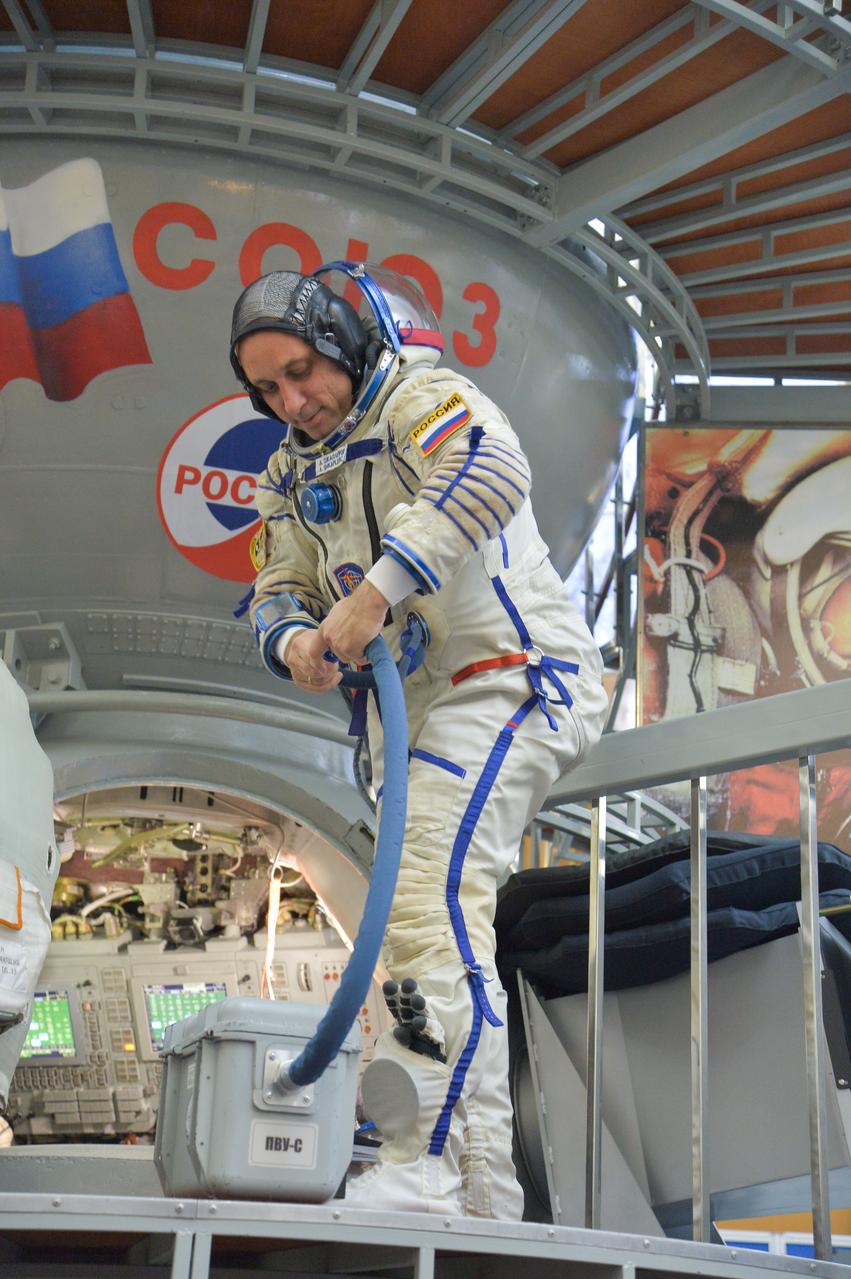
jsc2017e135211 - At the Gagarin Cosmonaut Training Center in Star City, Russia, Expedition 54-55 prime crewmember Anton Shkaplerov of the Russian Federal Space Agency (Roscosmos) disconnects a cooling system hose as he boards a Soyuz spacecraft simulator Nov. 29 as part of the crew’s final qualification exam activities. He will launch along with Scott Tingle of NASA and Norishige Kanai of the Japan Aerospace Exploration Agency (JAXA) Dec. 17 on the Soyuz MS-07 spacecraft from the Baikonur Cosmodrome in Kazakhstan for a five-month mission on the International Space Station...NASA/Elizabeth Weissinger.
jsc2017e135211 - At the Gagarin Cosmonaut Training Center in Star City, Russia, Expedition 54-55 prime crewmember Anton Shkaplerov of the Russian Federal Space Agency (Roscosmos) disconnects a cooling system hose as he boards a Soyuz spacecraft simulator
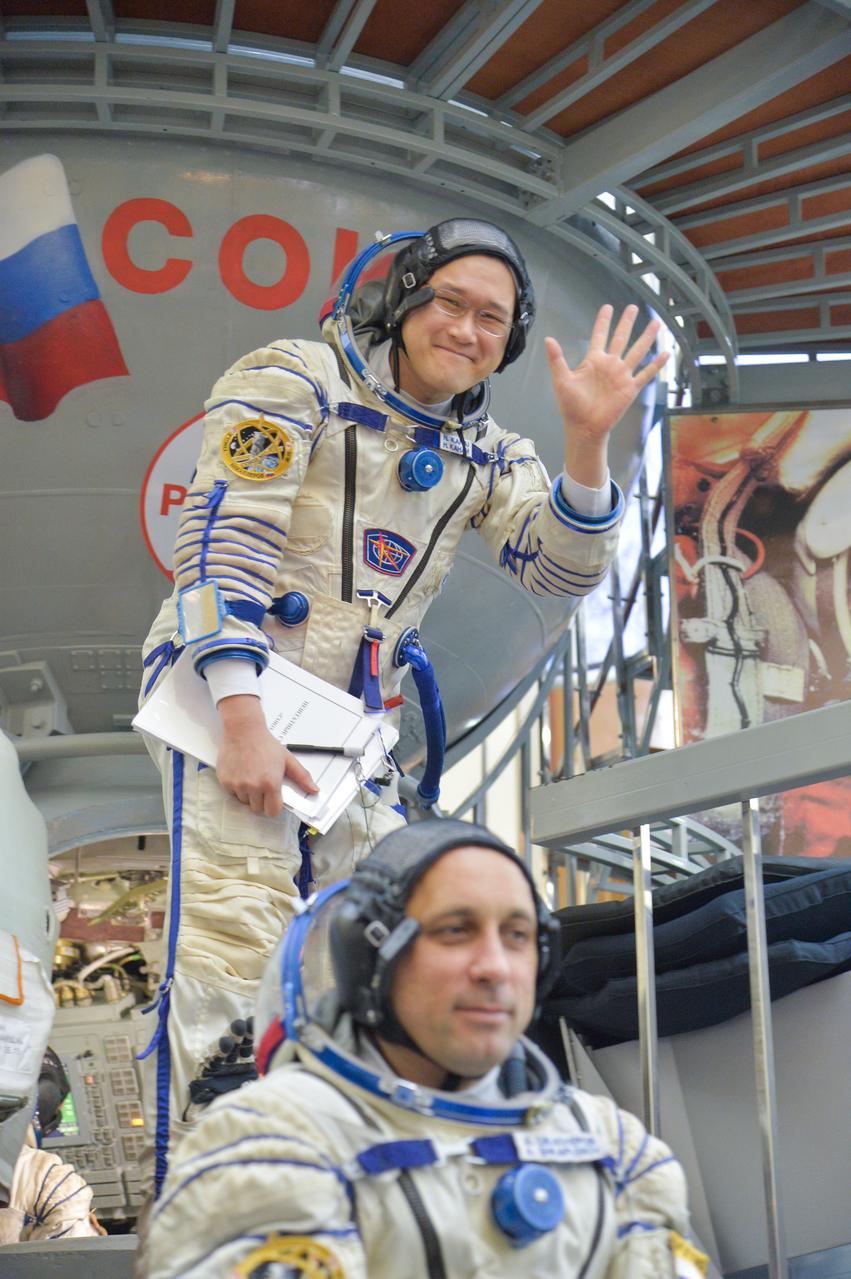
jsc2017e135210 - At the Gagarin Cosmonaut Training Center in Star City, Russia, Expedition 54-55 prime crewmember Norishige Kanai of the Japan Aerospace Exploration Agency (JAXA) waves to reporters as he boards a Soyuz spacecraft simulator Nov. 29 as part of the crew’s final qualification exam activities. Anton Shkaplerov of the Russian Federal Space Agency (Roscosmos) is seen in the foreground. They will launch along with Scott Tingle of NASA Dec. 17 on the Soyuz MS-07 spacecraft from the Baikonur Cosmodrome in Kazakhstan for a five-month mission on the International Space Station...NASA/Elizabeth Weissinger.
jsc2017e135210 - At the Gagarin Cosmonaut Training Center in Star City, Russia, Expedition 54-55 prime crewmember Norishige Kanai of the Japan Aerospace Exploration Agency (JAXA) waves to reporters as he boards a Soyuz spacecraft simulator Nov. 29 as part
This frame from an animation takes the viewer on a simulated flight into, and then out of, Jupiter's upper atmosphere at the location of the Great Red Spot.  The perspective begins about 2,000 miles (3,000 kilometers) above the cloud tops of the planet's southern hemisphere. The bar at far left indicates altitude during the quick descent; a second gauge next to that depicts the dramatic increase in temperature that occurs as the perspective dives deeper down. The clouds turn crimson as the perspective passes through the Great Red Spot. Finally, the view ascends out of the spot.  This video was created by combining an image from the JunoCam imager on NASA's Juno spacecraft with a computer-generated animation. The animation is available at https://photojournal.jpl.nasa.gov/catalog/PIA22176. -   Enhanced image by Gerald Eichstädt / Justin Cowart based on images provided courtesy of NASA/JPL-Caltech/SwRI/MSSS
The Great Red Spot Plunge (animation)
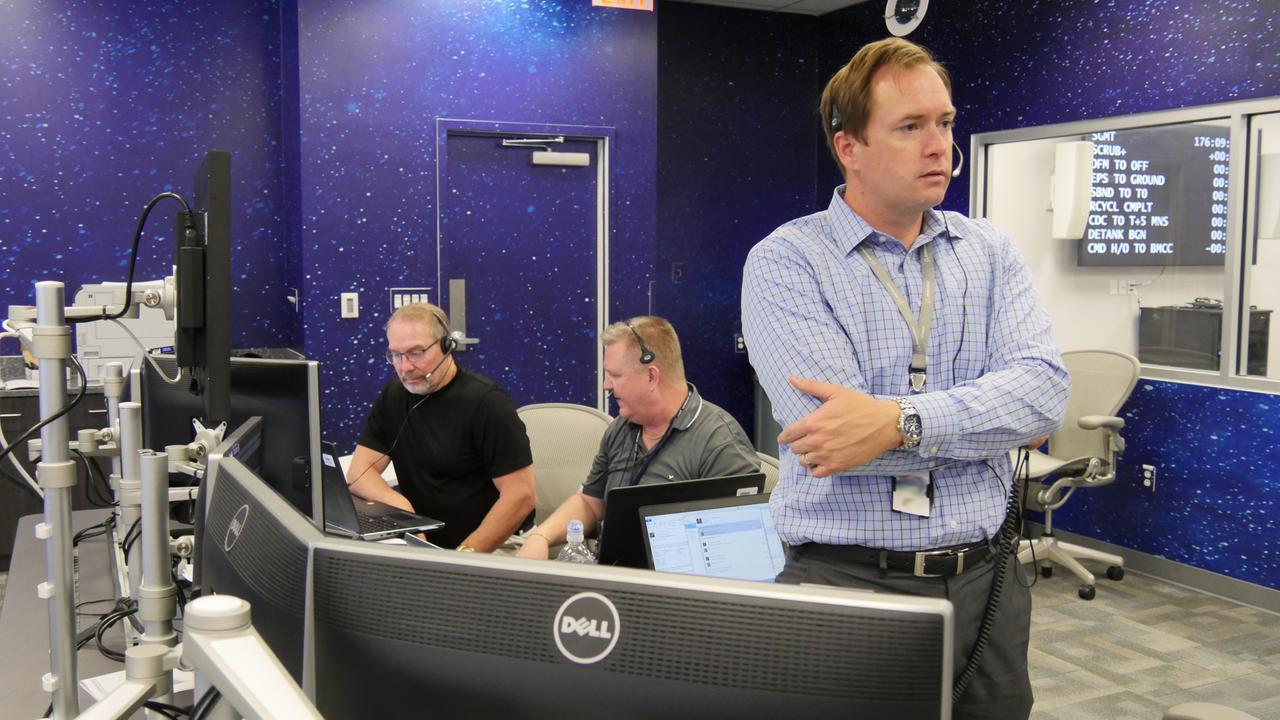
Inside the Boeing Mission Control Center at Kennedy Space Center, Fla., launch control teams for the CST-100 Starliner rehearse a fully integrated prelaunch simulation of the spacecraft’s upcoming Orbital Flight Test. Boeing Spacecraft Launch Conductor Louis Atchison speaks on console to the Mission Management Team as the countdown in the launch simulation progresses.
Boeing CST-100 Starliner Simulation at Kennedy Space Center
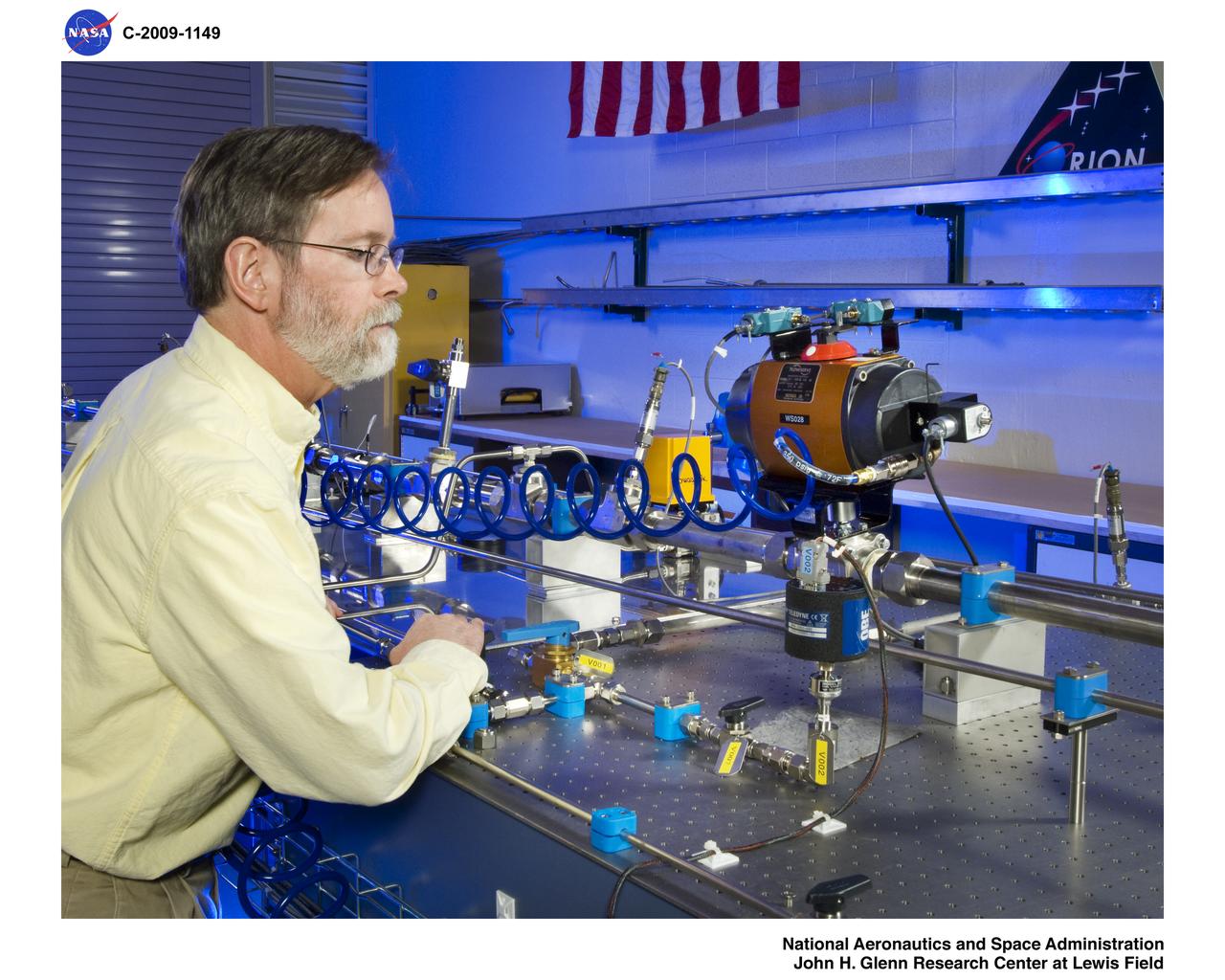
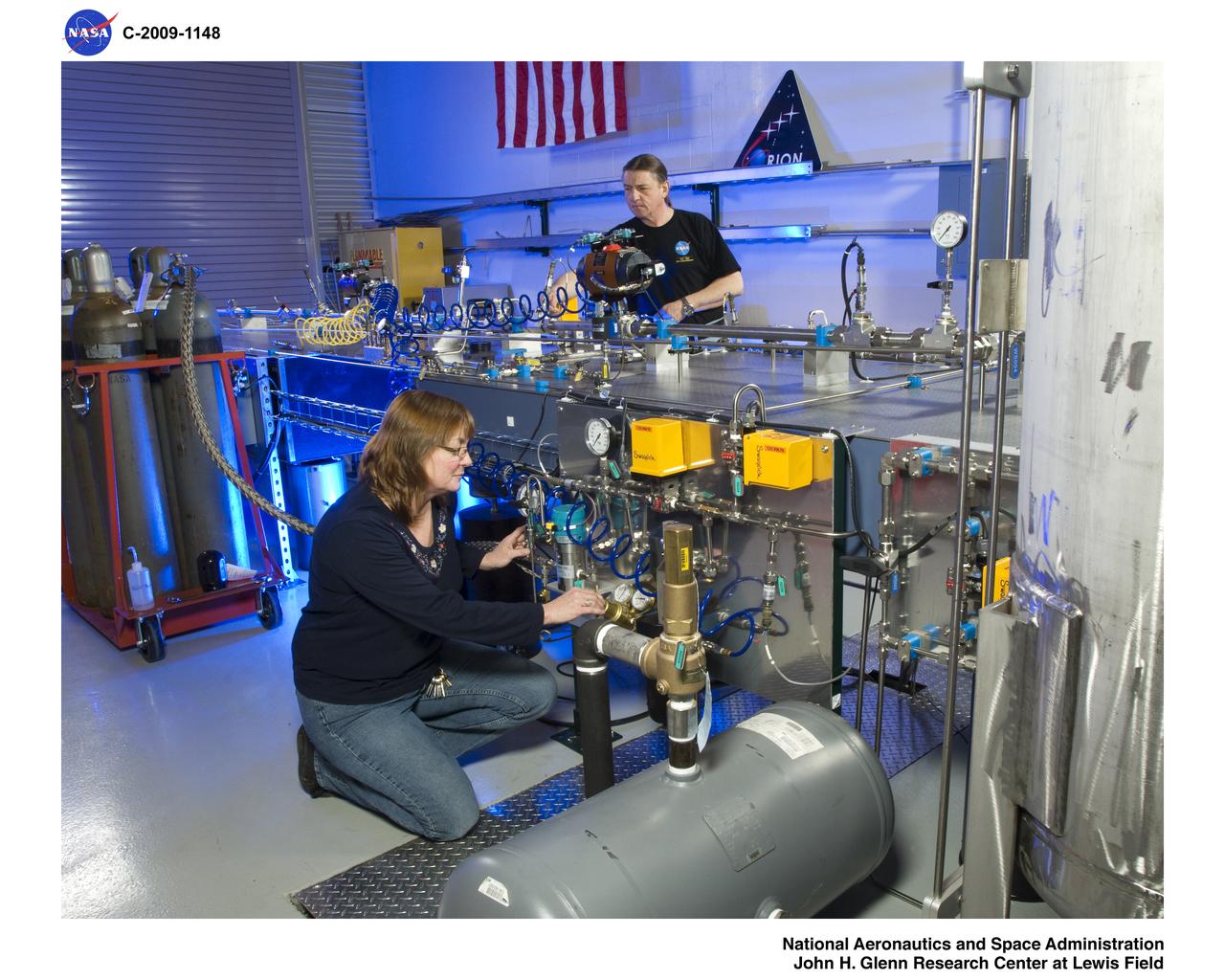
Dynamic Interaction Simulation Testing (DIST) Facility, for the Orion Spacecraft Hardware
GRC-2009-C-01149
Dynamic Interaction Simulation Testing (DIST) Facility, for the Orion Spacecraft Hardware
GRC-2009-C-01148
This simulated view of the south pole of Jupiter illustrates the unique perspective of NASA Juno mission. Juno polar orbit will allow its camera, called JunoCam, to image Jupiter clouds from a vantage point never accessed by other spacecraft.
What Juno will see at Jupiter South Pole Simulation
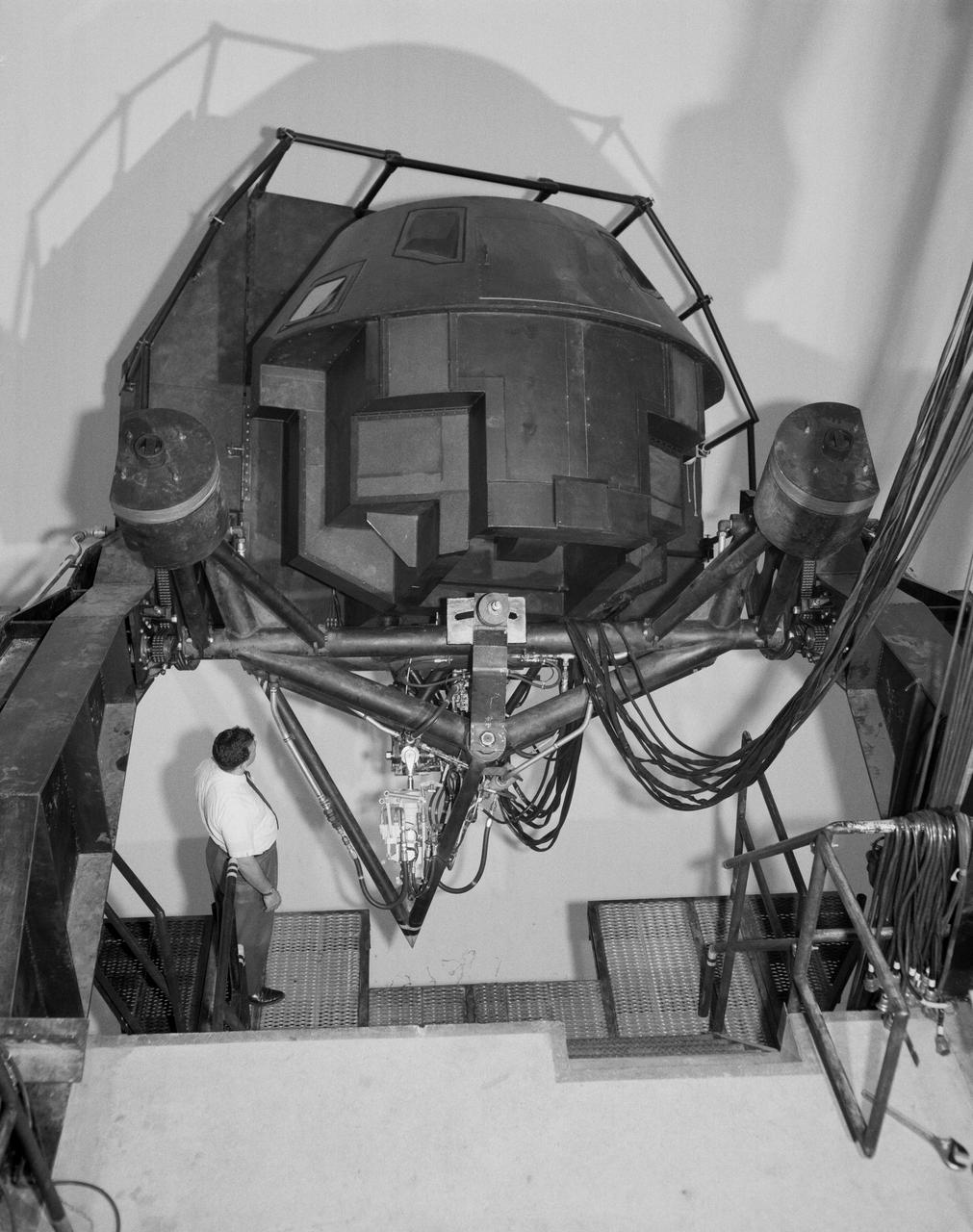
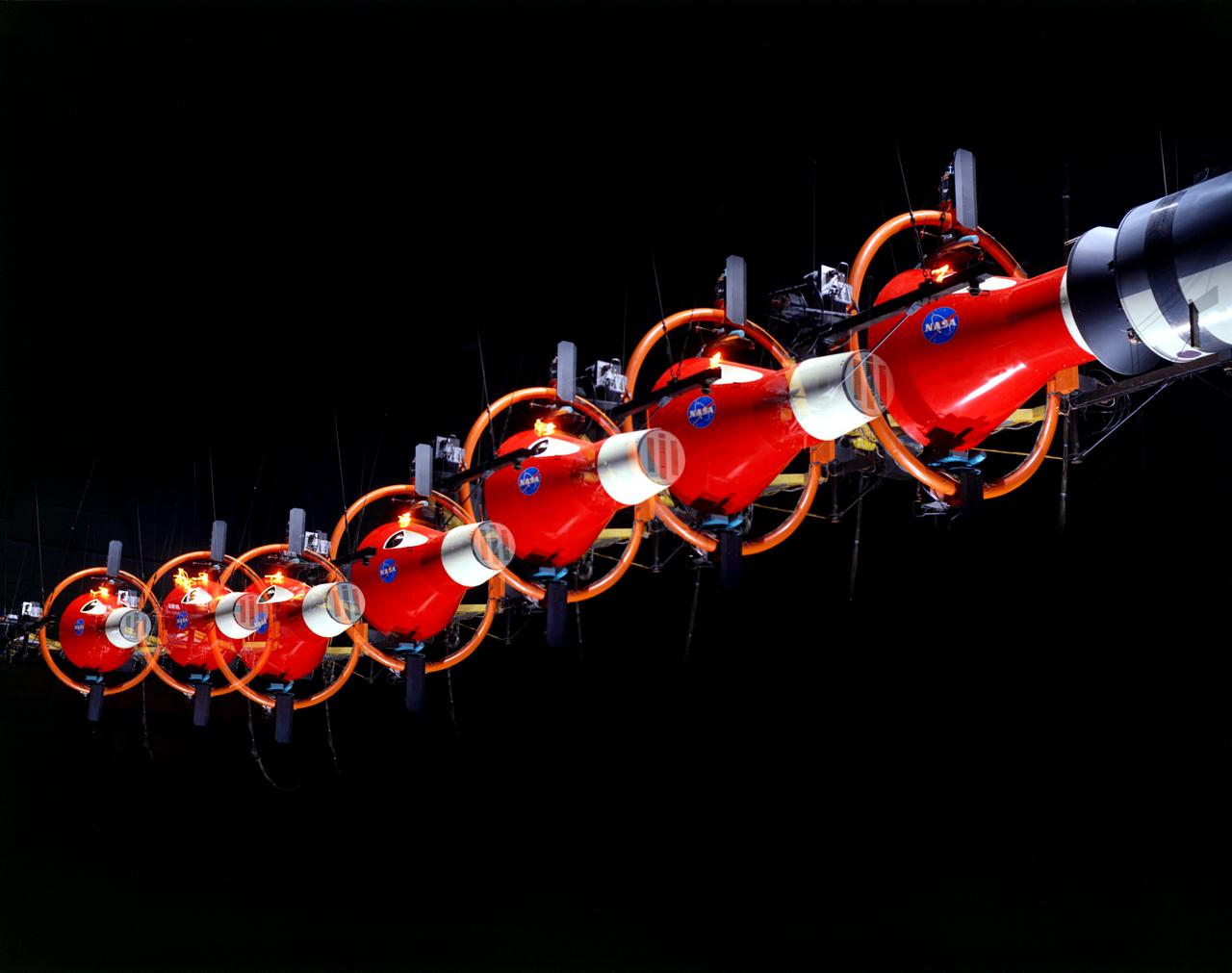
Multiple exposure of Rendezvous Docking Simulator. Francis B. Smith, described the simulator as follows:  The rendezvous and docking operation of the Gemini spacecraft with the Agena and of the Apollo Command Module with the Lunar Excursion Module have been the subject of simulator studies for several years.  This figure  illustrates the Gemini-Agena rendezvous docking simulator at Langley. The Gemini spacecraft was supported in a gimbal system by an overhead crane and gantry arrangement which provided 6 degrees of freedom - roll, pitch, yaw, and translation in any direction - all controllable by the astronaut in the spacecraft. Here again the controls fed into a computer which in turn provided an input to the servos driving the spacecraft so that it responded to control motions in a manner which accurately simulated the Gemini spacecraft.  -- Published in Barton C. Hacker and James M. Grimwood, On the Shoulders of Titans: A History of Project Gemini, NASA SP-4203  Francis B. Smith,  Simulators for Manned Space Research,  Paper presented at the 1966 IEEE International convention, March 21-25, 1966.
Multiple Exposure of Rendezvous Docking Simulator - Gemini Program
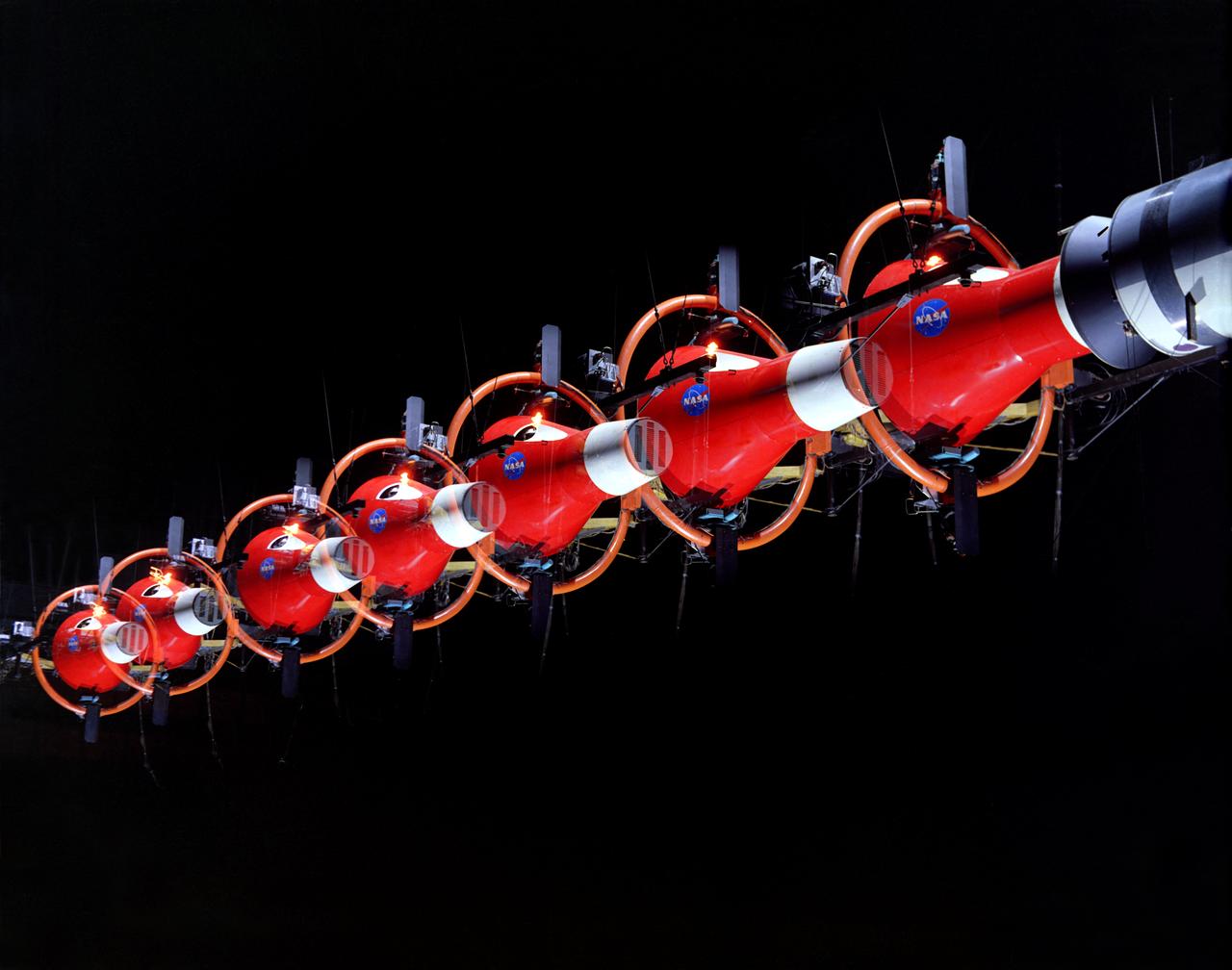
Multiple exposure of Rendezvous Docking Simulator. Francis B. Smith, described the simulator as follows:  The rendezvous and docking operation of the Gemini spacecraft with the Agena and of the Apollo Command Module with the Lunar Excursion Module have been the subject of simulator studies for several years.  This figure  illustrates the Gemini-Agena rendezvous docking simulator at Langley. The Gemini spacecraft was supported in a gimbal system by an overhead crane and gantry arrangement which provided 6 degrees of freedom - roll, pitch, yaw, and translation in any direction - all controllable by the astronaut in the spacecraft. Here again the controls fed into a computer which in turn provided an input to the servos driving the spacecraft so that it responded to control motions in a manner which accurately simulated the Gemini spacecraft.  -- Published in Barton C. Hacker and James M. Grimwood, On the Shoulders of Titans: A History of Project Gemini, NASA SP-4203  Francis B. Smith,  Simulators for Manned Space Research,  Paper presented at the 1966 IEEE International convention, March 21-25, 1966.
Multiple Exposure of Rendezvous Docking Simulator - Gemini Program
Multiple exposure of Gemini rendezvous docking simulator. Francis B. Smith wrote in his paper "Simulators for Manned Space Research," "The rendezvous and docking operation of the Gemini spacecraft with the Agena and of the Apollo Command Module with the Lunar Excursion Module have been the subject of simulator studies for several years. [This figure] illustrates the Gemini-Agena rendezvous docking simulator at Langley. The Gemini spacecraft was supported in a gimbal system by an overhead crane and gantry arrangement which provided 6 degrees of freedom - roll, pitch, yaw, and translation in any direction - all controllable by the astronaut in the spacecraft. Here again the controls fed into a computer which in turn provided an input to the servos driving the spacecraft so that it responded to control motions in a manner which accurately simulated the Gemini spacecraft." A.W. Vogeley further described the simulator in his paper "Discussion of Existing and Planned Simulators For Space Research," "Docking operations are considered to start when the pilot first can discern vehicle target size and aspect and terminate, of course, when soft contact is made. ... This facility enables simulation of the docking operation from a distance of 200 feet to actual contact with the target. A full-scale mock-up of the target vehicle is suspended near one end of the track. ... On [the Agena target] we have mounted the actual Agena docking mechanism and also various types of visual aids. We have been able to devise visual aids which have made it possible to accomplish nighttime docking with as much success as daytime docking." -- Published in Barton C. Hacker and James M. Grimwood, On the Shoulders of Titans: A History of Project Gemini, NASA SP-4203; Francis B. Smith, "Simulators for Manned Space Research," Paper presented at the 1966 IEEE International convention, March 21-25, 1966; A.W. Vogeley, "Discussion of Existing and Planned Simulators For Space Research," Paper presented at the Conference on the Role of Simulation in Space Technology, August 17-21, 1964.
Gemini rendezvous docking simulator
S65-13395 (6 Jan. 1965) --- Gemini-3 spacecraft (final configuation) during test at Boresight Range, Merritt Island launch area.
GEMINI TESTING - SPACECRAFT 3 - SIMULATOR - BORESIGHT RANGE TEST - CAPE
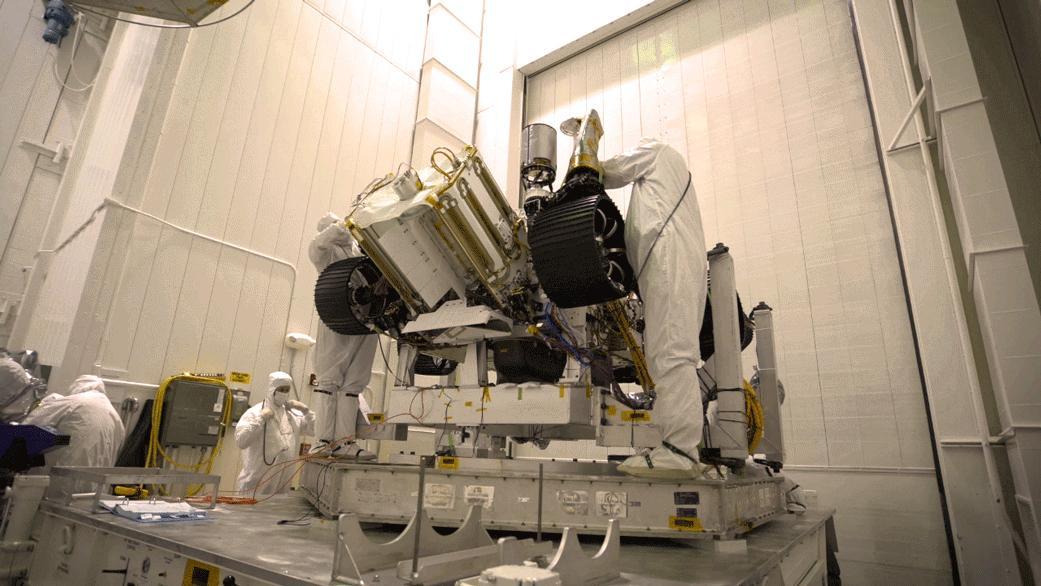
Engineers working on NASA's Mars 2020 mission remove the inner layer of protective antistatic foil from the rover after a move from JPL's Spacecraft Assembly Facility to the Simulator Building for testing. Mars 2020 must meet extraordinary cleanliness standards before its launch next summer.  Animation available at https://photojournal.jpl.nasa.gov/catalog/PIA23467
NASA's Mars 2020 Unfoiled Again
Gemini Rendezvous Docking Simulator suspended from the roof of the Langley Research Center s aircraft hangar. Francis B. Smith wrote:  The rendezvous and docking operation of the Gemini spacecraft with the Agena and of the Apollo Command Module with the Lunar Excursion Module have been the subject of simulator studies for several years.  This figure  illustrates the Gemini-Agena rendezvous docking simulator at Langley. The Gemini spacecraft was supported in a gimbal system by an overhead crane and gantry arrangement which provided 6 degrees of freedom - roll, pitch, yaw, and translation in any direction - all controllable by the astronaut in the spacecraft. Here again the controls fed into a computer which in turn provided an input to the servos driving the spacecraft so that it responded to control motions in a manner which accurately simulated the Gemini spacecraft.  -- Published in Barton C. Hacker and James M. Grimwood, On the Shoulders of Titans: A History of Project Gemini, NASA SP-4203  Francis B. Smith,  Simulators for Manned Space Research,  Paper presented at the 1966 IEEE International convention, March 21-25, 1966.
Gemini Rendezvous Docking Simulator
KSC-66C-1838 Gemini-8 Spacecraft is being checked out at Complex 19 during a Simulated Countdown.
104-KSC-66C-1838
S69-56059 (24 Oct. 1969) --- Astronaut Alan L. Bean, lunar module pilot of the Apollo 12 lunar landing mission, participates in lunar surface simulation training in Building 29 at the Manned Spacecraft Center (MSC). Bean is strapped to a one-sixth gravity simulator.
Astronaut Alan Bean participates in lunar surface simulation
S70-24012 (19 Jan. 1970) --- Astronaut Fred W. Haise Jr., lunar module pilot of the Apollo 13 lunar landing mission, participates in lunar surface simulation training at the Manned Spacecraft Center (MSC).  Haise is attached to a Six Degrees of Freedom Simulator.
Apollo 13 Astronaut Fred Haise during lunar surface simulation training