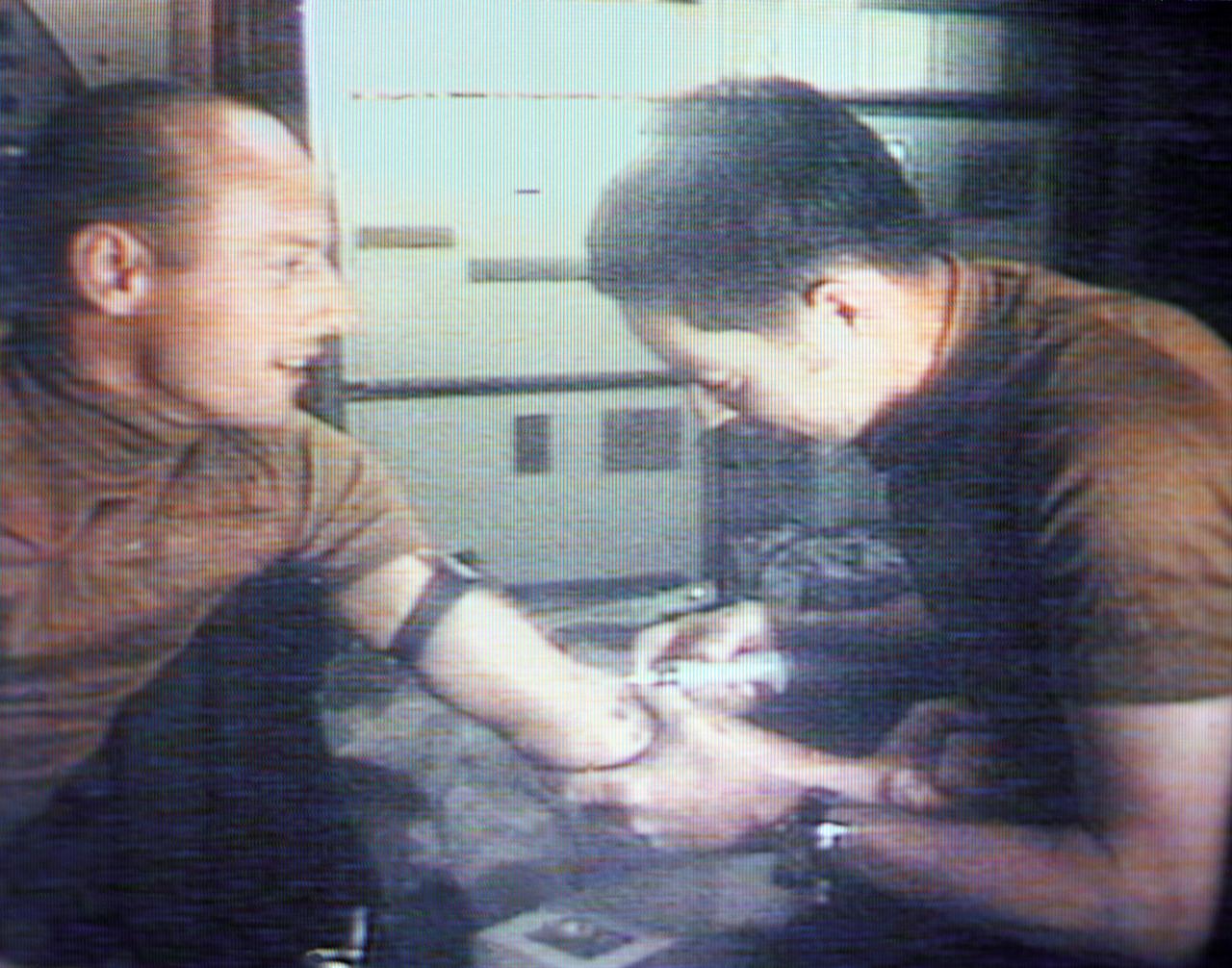
S73-27509 (6 June 1973) --- Scientist-astronaut Joseph P. Kerwin (right), Skylab 2 science pilot and a doctor of medicine, takes a blood sample from astronaut Charles Conrad Jr., Skylab 2 commander, as seen in this reproduction taken from a color television transmission made by a TV camera aboard the Skylab 1 and 2 space station cluster in Earth orbit. The blood sampling was part of the Skylab Hematology and Immunology Experiment M110 series. Photo credit: NASA
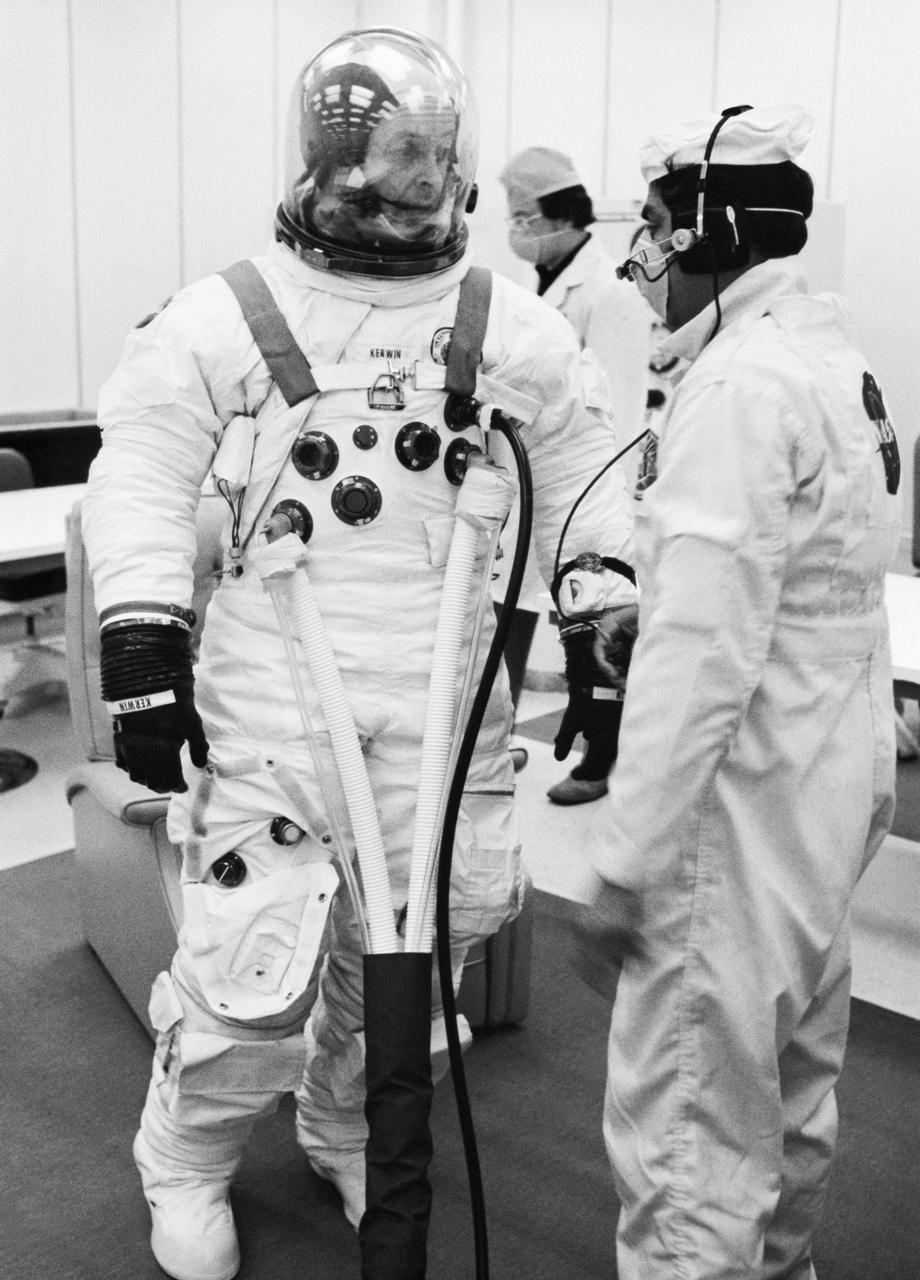
S73-25900 (25 May 1973) --- Scientist-astronaut Joseph P. Kerwin, science pilot of the Skylab 2 mission, is suited up in the Manned Spacecraft Operations Building at the Kennedy Space Center during Skylab 2 prelaunch preparations. Photo credit: NASA
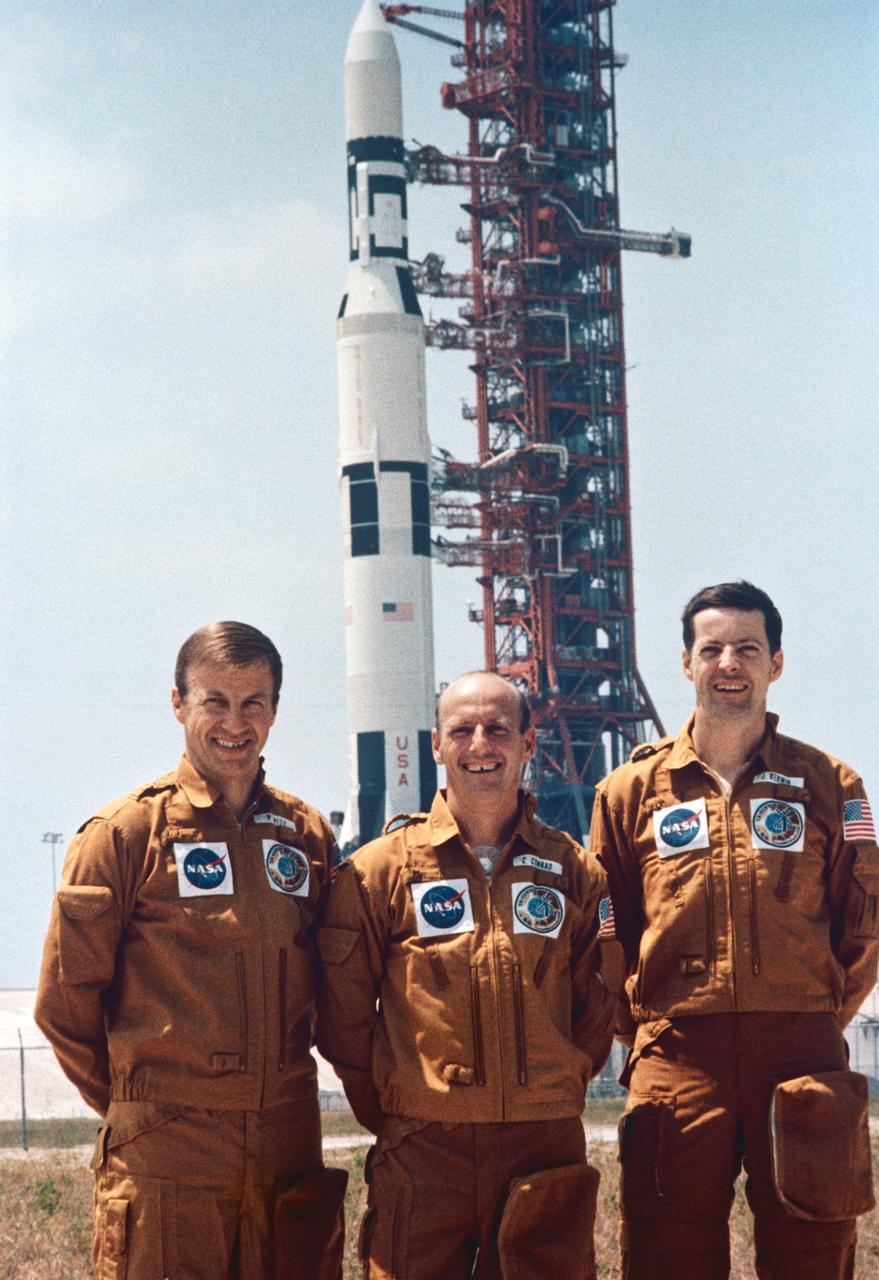
S73-25902 (4 May 1973) --- The three prime crew members of the first manned Skylab mission (Skylab 2) are photographed at Launch Complex 39, Kennedy Space Center, during preflight activity. They are, left to right, astronaut Paul J. Weitz, pilot; astronaut Charles Conrad Jr., commander; and scientist-astronaut Joseph P. Kerwin, science pilot. In the background is the Skylab 1/Saturn V space vehicle with its Skylab space station payload on Pad A. Photo credit: NASA
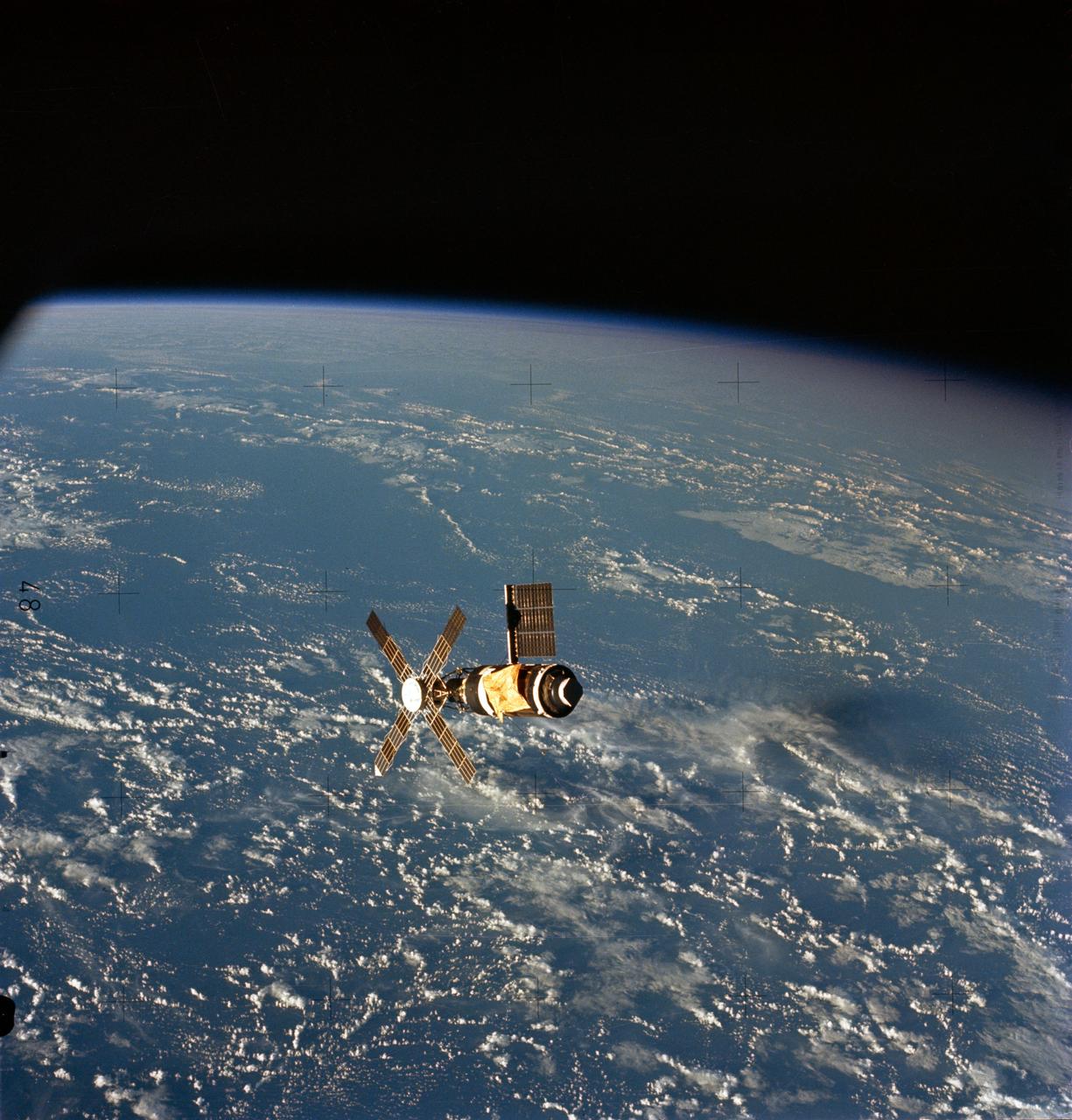
SL2-07-651 (22 June 1973) --- This overhead view of the Skylab Space Station was taken from the Departing Skylab Command/Service Module during the Skylab 2's final fly-around inspection. The single solar panel is quite evident as well as the parasol solar shield, rigged to replace the missing micrometeoroid shield. Both the second solar panel and the micrometeoroid shield were torn away during a mishap in the original Skylab 1 liftoff and orbital insertion. Photo credit: NASA
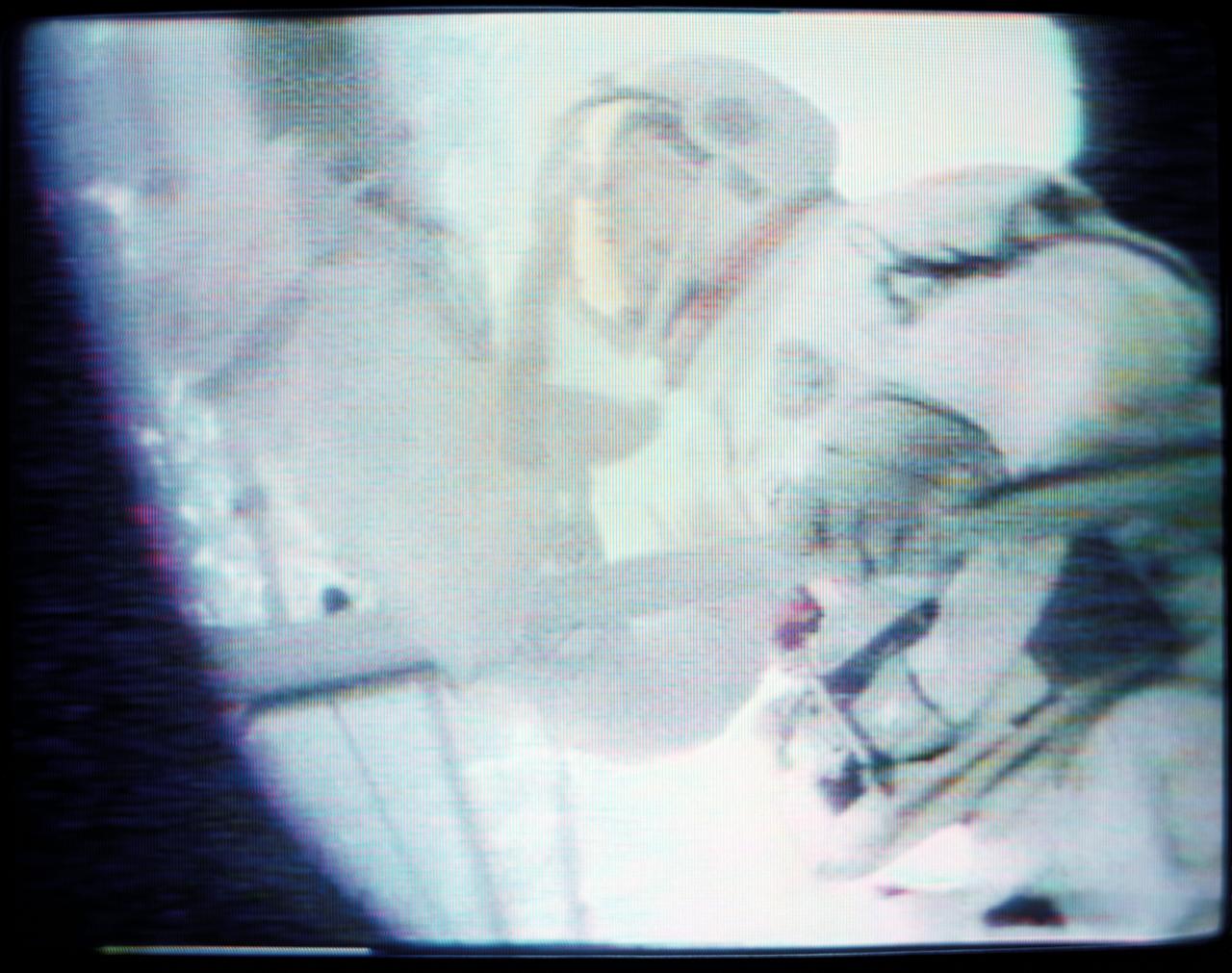
S73-27562 (June 1973) --- Scientist-astronaut Joseph P. Kerwin, Skylab 2 science pilot, performs extravehicular activity (EVA) at the Skylab 1 and 2 space station cluster in Earth orbit, as seen in this reproduction taken from a color television transmission made by a TV camera aboard the station. Kerwin is just outside the Airlock Module. Kerwin assisted astronaut Charles Conrad Jr., Skylab 2 commander, during the successful EVA attempt to free the stuck solar array system wing on the Orbital Workshop. Photo credit: NASA
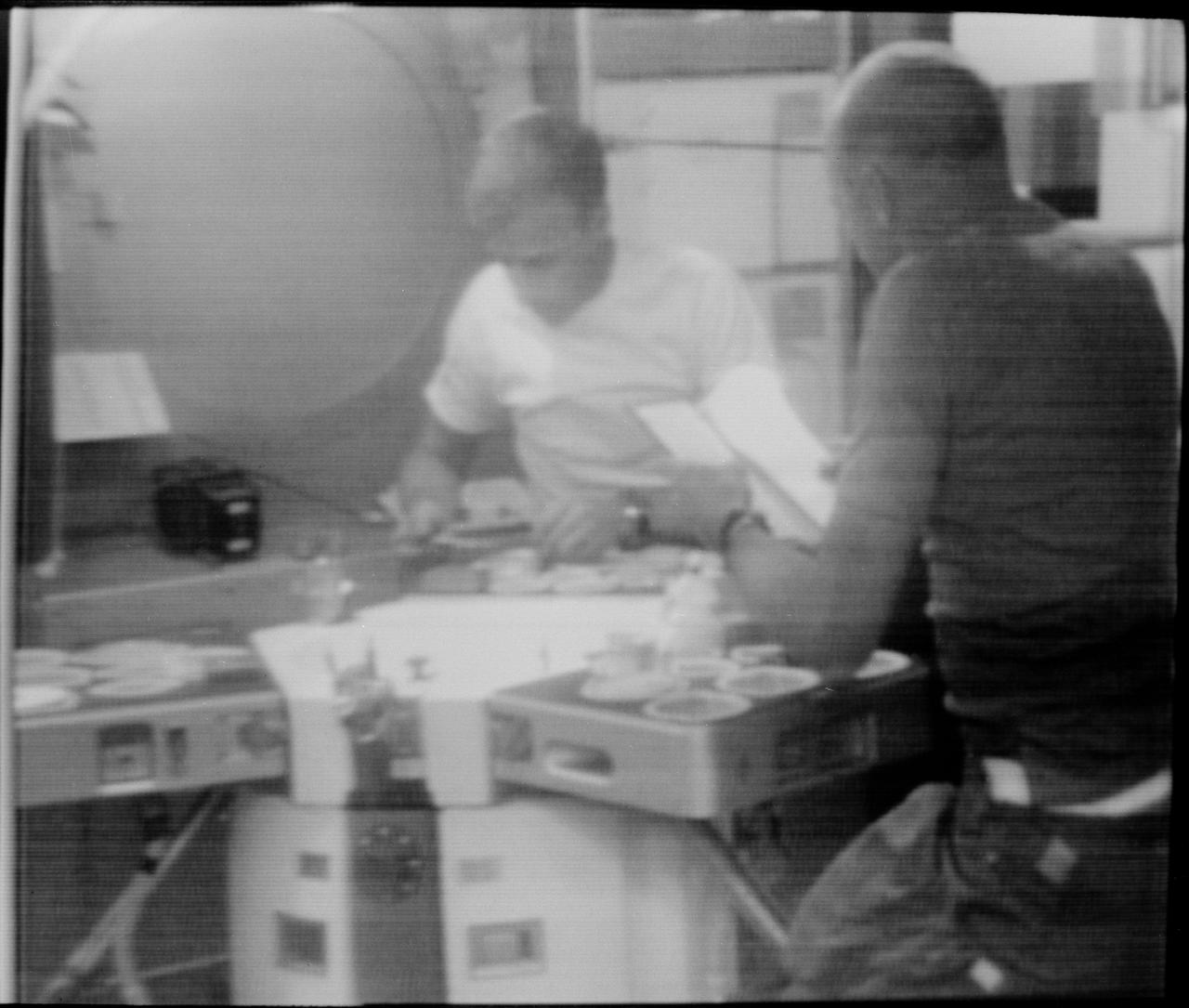
S73-27081 (30 May 1973) --- Two of the three Skylab 2 astronauts are seen in the wardroom of the crew quarters of the Orbital Workshop of the Skylab 1 space station cluster in Earth orbit in this reproduction taken from a television transmission made by a TV camera aboard the space station. They are preparing to eat a meal. Astronaut Charles Conrad Jr., commander, is in the right foreground. In the background is astronaut Paul J. Weitz, pilot. Photo credit: NASA
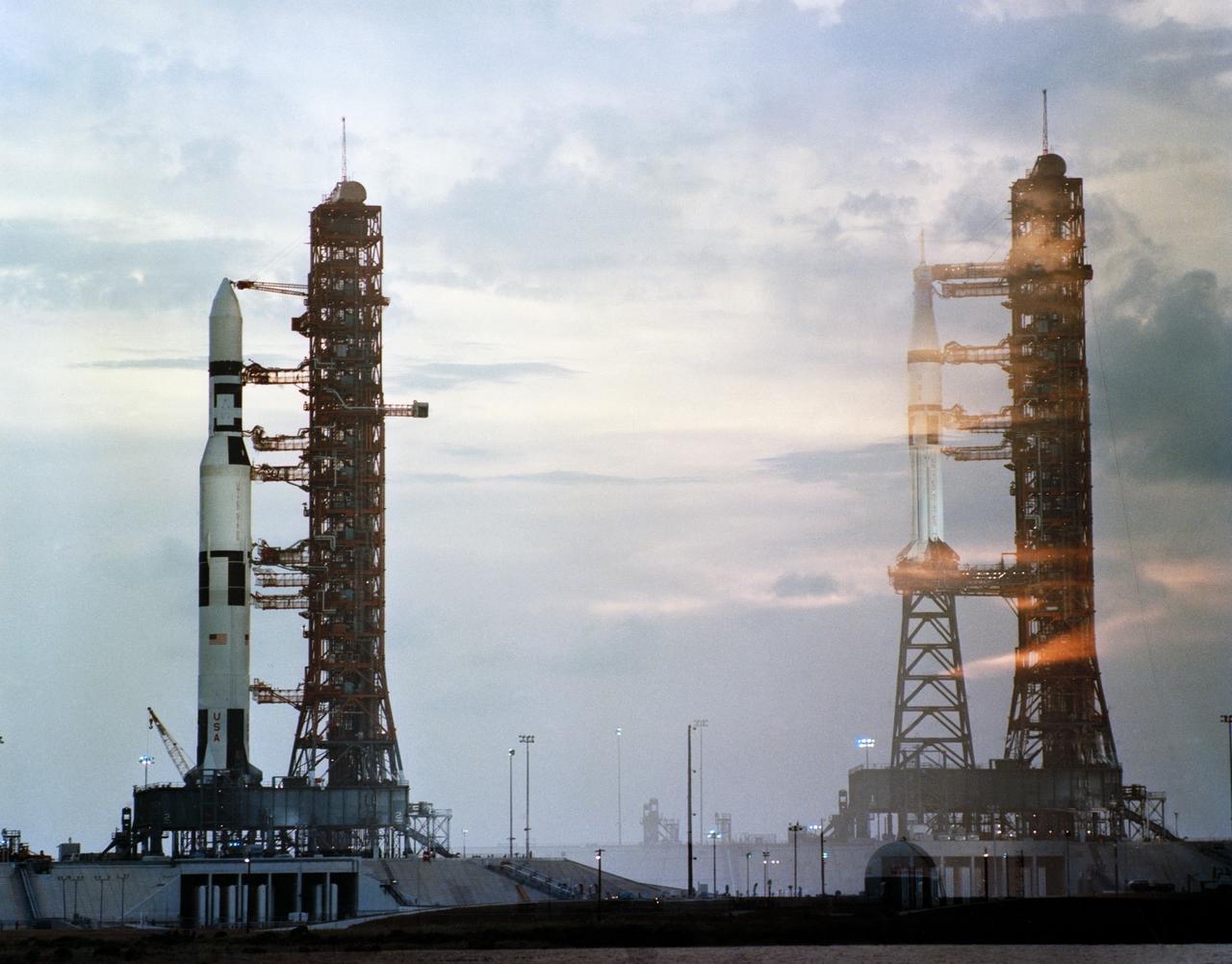
S73-25654 (7 May 1973) --- A deliberate double exposure to help illustrate the comparative sizes and configurations of the Skylab 1 and Skylab 2 space vehicles at Launch Complex 39, Kennedy Space Center, Florida. The double exposure creates an illusion that the rockets are side by side, though actually they are one and a half miles apart. The Skylab 1/ Saturn 1B space vehicle on Pad A is on the left. On the right is the Skylab 2/ Saturn 1B space vehicle on Pad B. The Skylab 1 payload is the space station cluster. The Skylab 2 payload will be an Apollo Command/Service Module (CSM) with astronauts Charles Conrad Jr., Joseph P. Kerwin and Paul J. Weitz aboard. The Saturn V launch vehicle is composed of a Saturn V first (S-1C) stage, a Saturn V second (S-11) stage, and the Skylab payload. The Saturn 1B launch vehicle consists of a Saturn 1B first (S-1B) stage, a Saturn 1B second (S-1VB) stage, and the CSM payload including its launch escape system. Photo credit: NASA
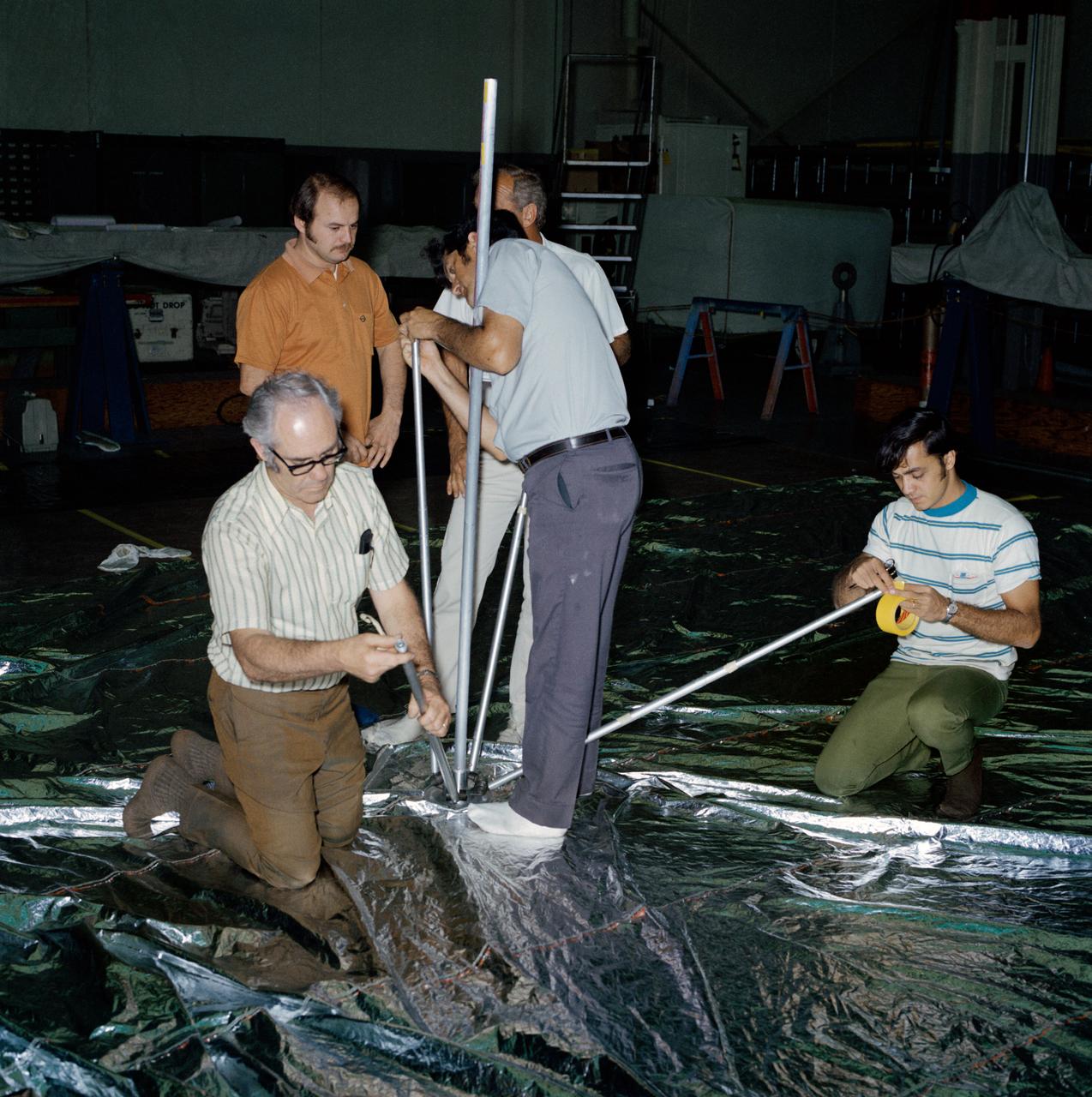
S73-26380 (23 May 1973) --- Technicians in the Technical Services shop in Building 10 work on the fabrication of the umbrella-like mechanical device called the “parasol” during Skylab 2 preflight preparations at NASA's Johnson Space Center. Here, they are attaching the telescoping extension rods to the canopy. The “parasol” is designed to fit into the TO27 experiment photometer canister. The canopy is 24 feet by 22 feet. The sunshade device will be deployed through the solar scientific airlock in the side of the OWS. The “parasol” solar shield is considered the prime possibility for use as the OWS sunshade because it will not require EVA by the Skylab 2 crewmen, because of the operational ease of using it, and because of the simplicity of the device which minimizes crew training. Photo credit: NASA
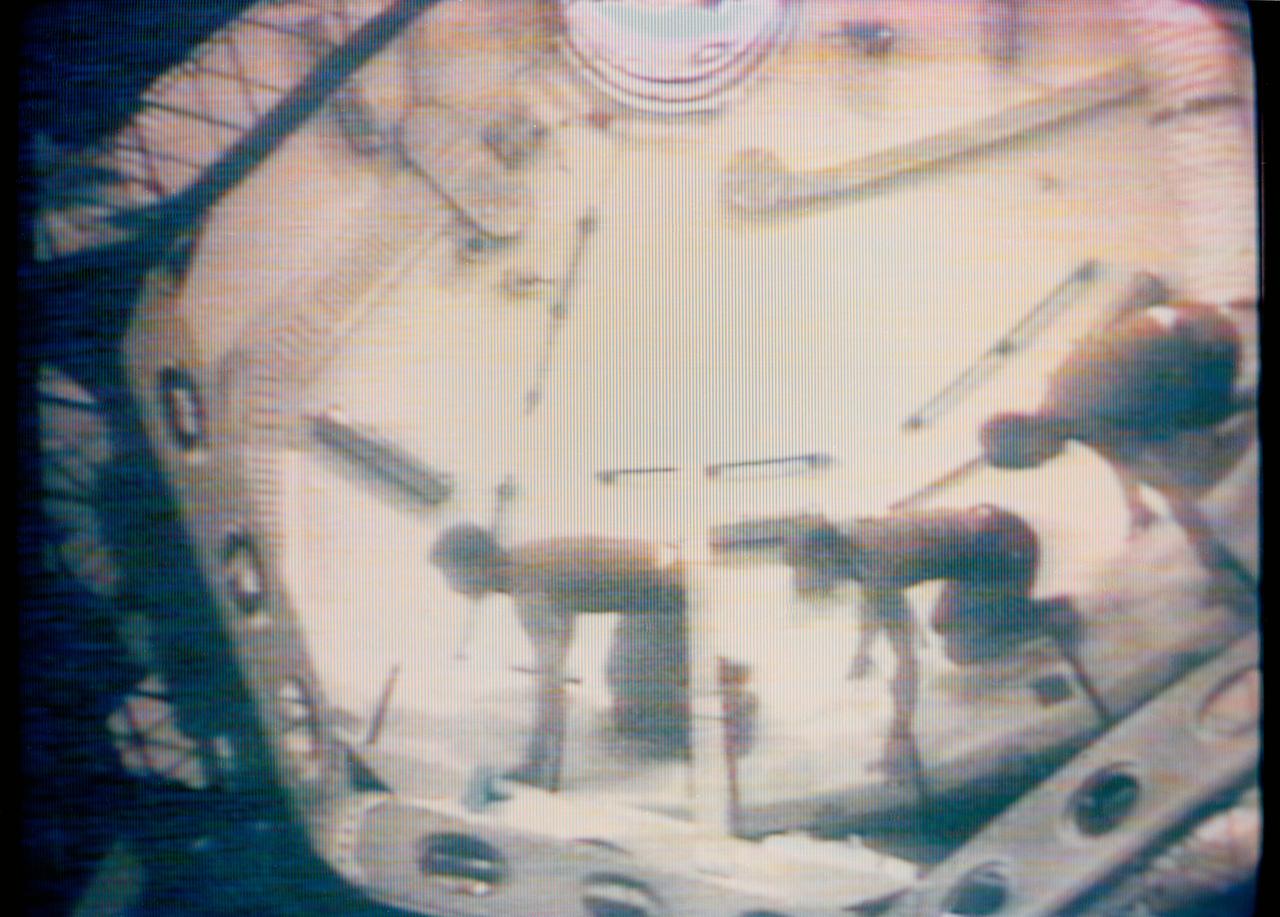
S73-27262 (1 June 1973) --- The three Skylab 2 crewmen give a demonstration on the effects of weightlessness in the Orbital Workshop of the Skylab 1 and 2 space station cluster in Earth orbit, as seen in this reproduction taken from a color television transmission made by a TV camera aboard the space station. Astronauts Charles Conrad Jr., Joseph P. Kerwin and Paul J. Weitz are crouched in a fast-start stance to race around the dome area of the OWS forward compartment. The astronauts had ease of motion and good maneuverability in the zero-gravity of space. Photo credit: NASA
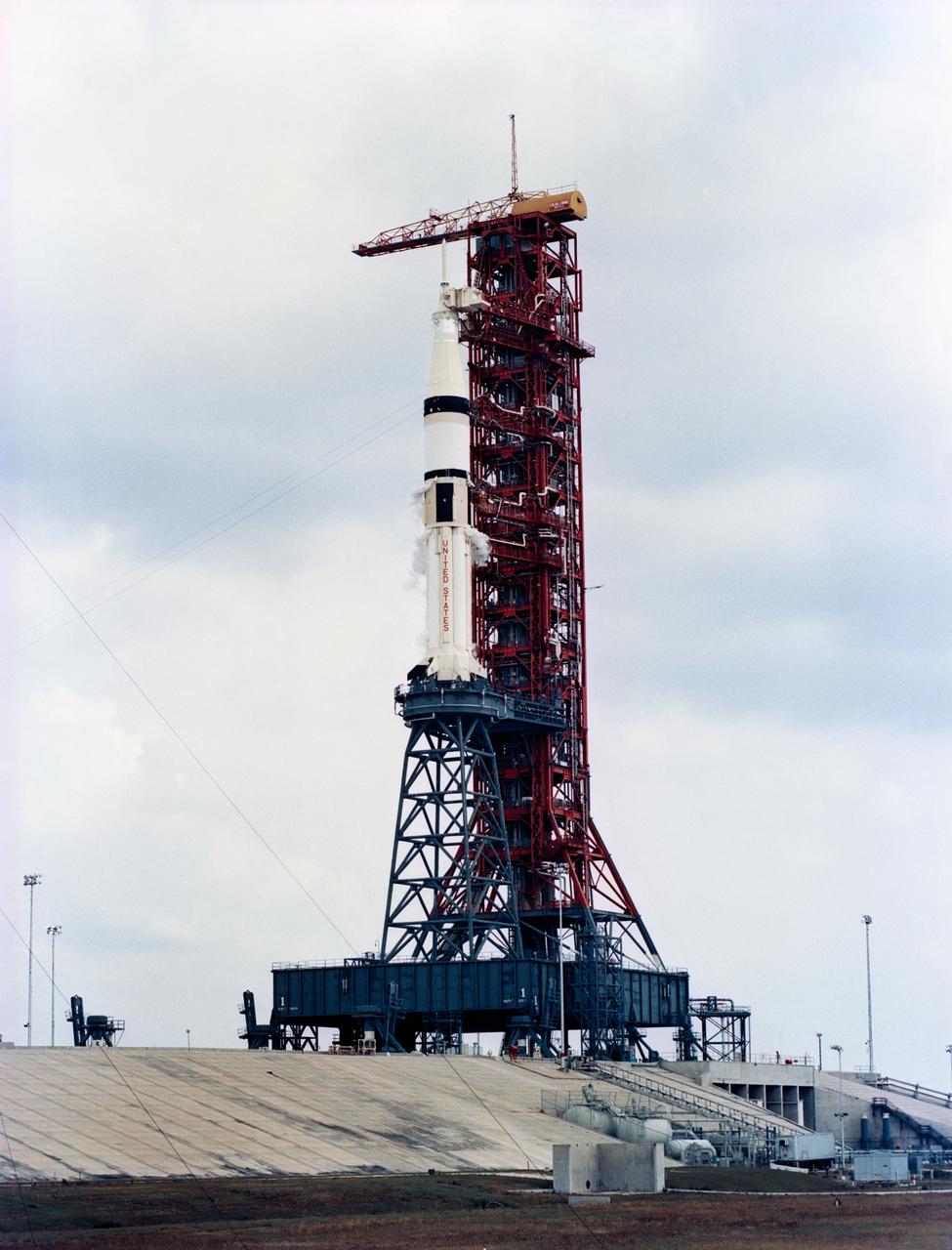
S73-25696 (15 May 1973) --- An overall view of Pad B, Launch Complex 39, Kennedy Space Center, Florida, showing the Skylab 2/Saturn 1B space vehicle during a Countdown Demonstration Test (CDDT). This is the launch vehicle for the first manned Skylab mission. The vapor being emitted from the vehicle is the venting of cryogenic propellants. Photo credit: NASA
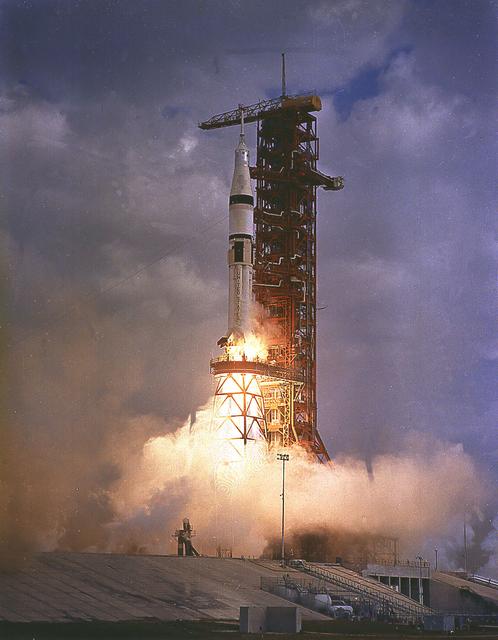
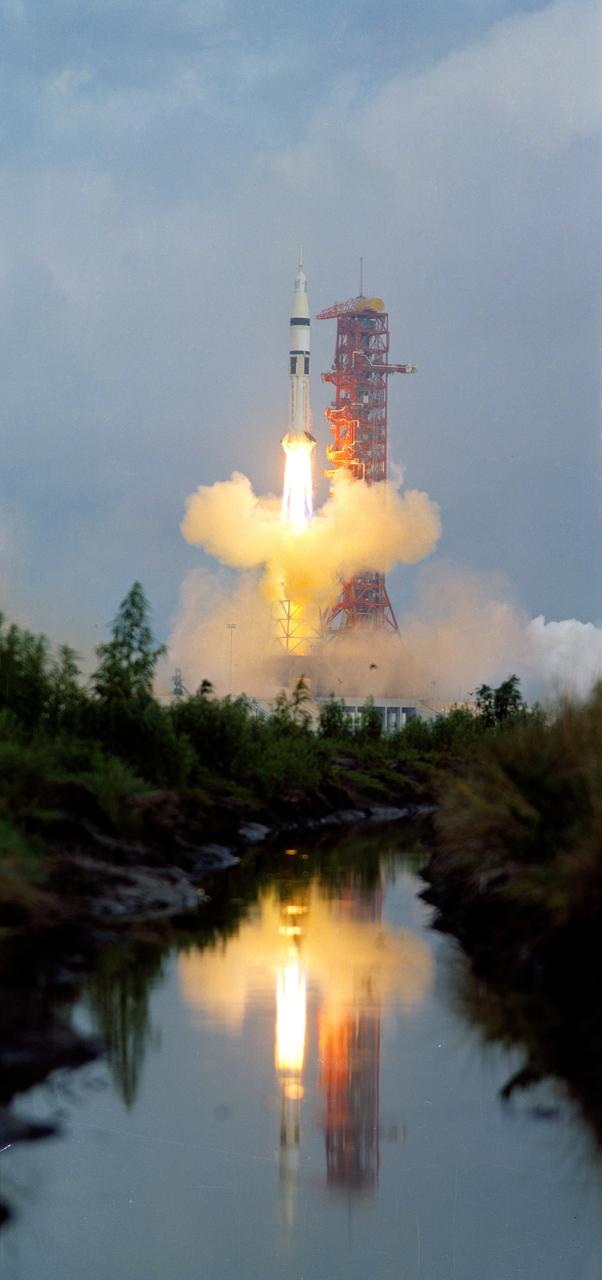
This is an image of the Saturn IB vehicle that lifted off on May 25, 1973, carrying the crew of the Skylab-2 (SL-2) mission. The Saturn IV launch vehicle was used to carry a crew of three astronauts to the Skylab. The SL-2 mission launched the first crew to the Skylab; astronauts Charles "Pete" Conrad, Joseph Kerwin and Paul Weitz. This crew made urgent repair work on the damaged Skylab to make it operational and habitable. The goals of the Skylab were to enrich our scientific knowledge of the Earth, the Sun, the stars, and cosmic space; to study the effects of weightlessness on living organisms, including man; to study the effects of the processing and manufacturing of materials utilizing the absence of gravity; and to conduct Earth resource observations. The duration of this mission was 28 days.
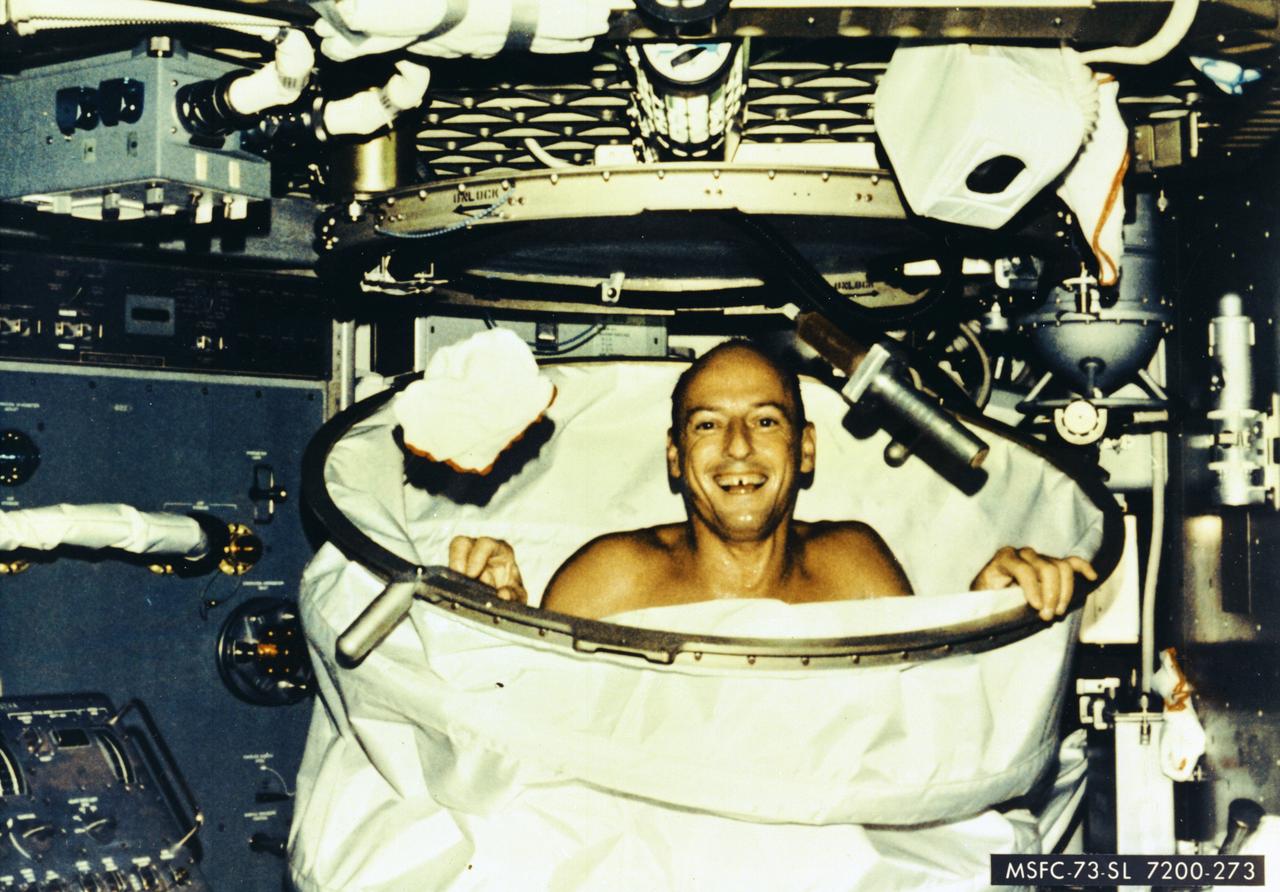
Astronaut Charles Conrad, Jr., Skylab-2 (SL-2) commander, smiles happily for the camera after a hot bath in the shower in the crew quarters of the Orbital Workshop of the Skylab space station. In deploying the shower facility, the shower curtain was pulled up from the floor and attached to the ceiling. The water came through a push button shower head attached to a flexible hose. Water was drawn off by a vacuum system.
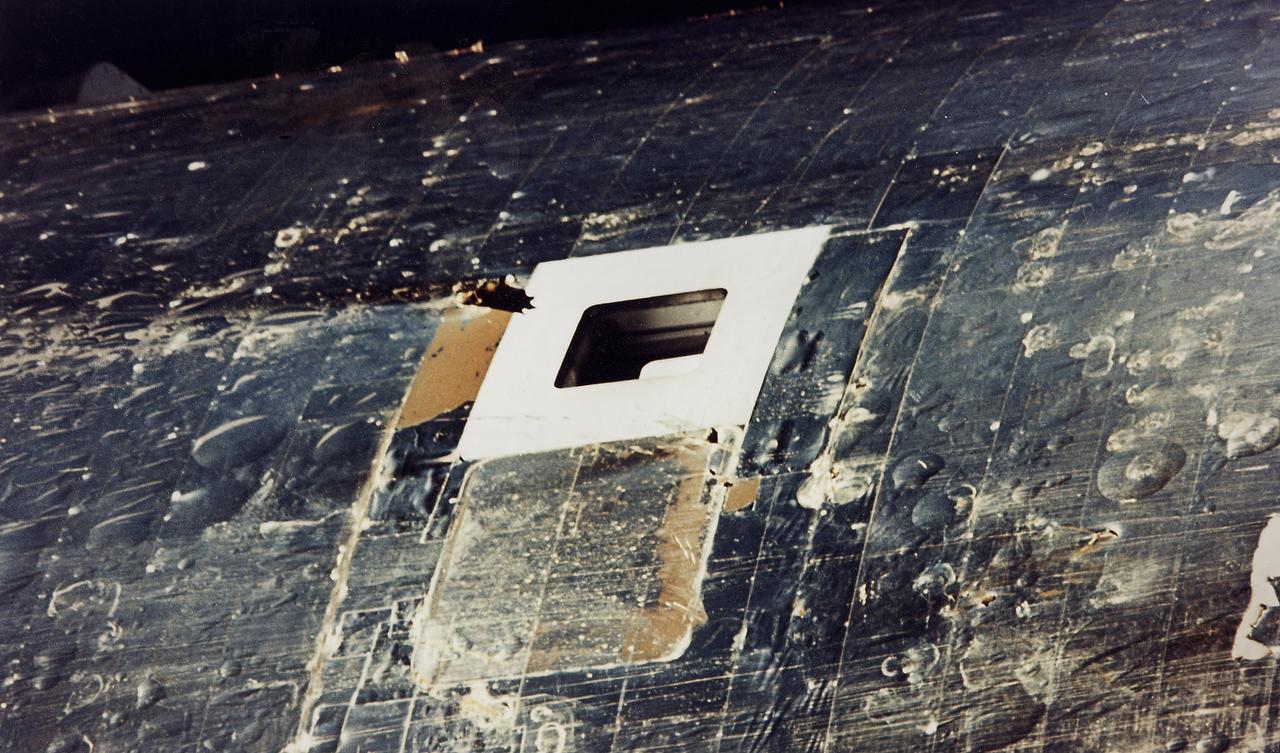
The Saturn V vehicle, carrying the unmarned orbital workshop for the Skylab-1 mission, lifted off successfully and all systems performed normally. Sixty-three seconds into flight, engineers in the operation support and control center saw an unexpected telemetry indication that signalled that damages occurred on one solar array and the micrometeoroid shield during the launch. The micrometeoroid shield, a thin protective cylinder surrounding the workshop protecting it from tiny space particles and the sun's scorching heat, ripped loose from its position around the workshop. This caused the loss of one solar wing and jammed the other. Still unoccupied, the Skylab was stricken with the loss of the heat shield and sunlight beat mercilessly on the lab's sensitive skin. Internal temperatures soared, rendering the the station uninhabitable, threatening foods, medicines, films, and experiments. This image shows the sun-ravaged skin of the Orbital Workshop, bared by the missing heat shield, with blister scars and tarnish from temperatures that reached 300 degrees F. The rectangular opening at the upper center is the scientific airlock through which the parasol to protect the workshop from sun's rays was later deployed. This view was taken during a fly-around inspection by the Skylab-2 crew. The Marshall Space Flight Center had a major role in developing the procedures to repair the damaged Skylab.
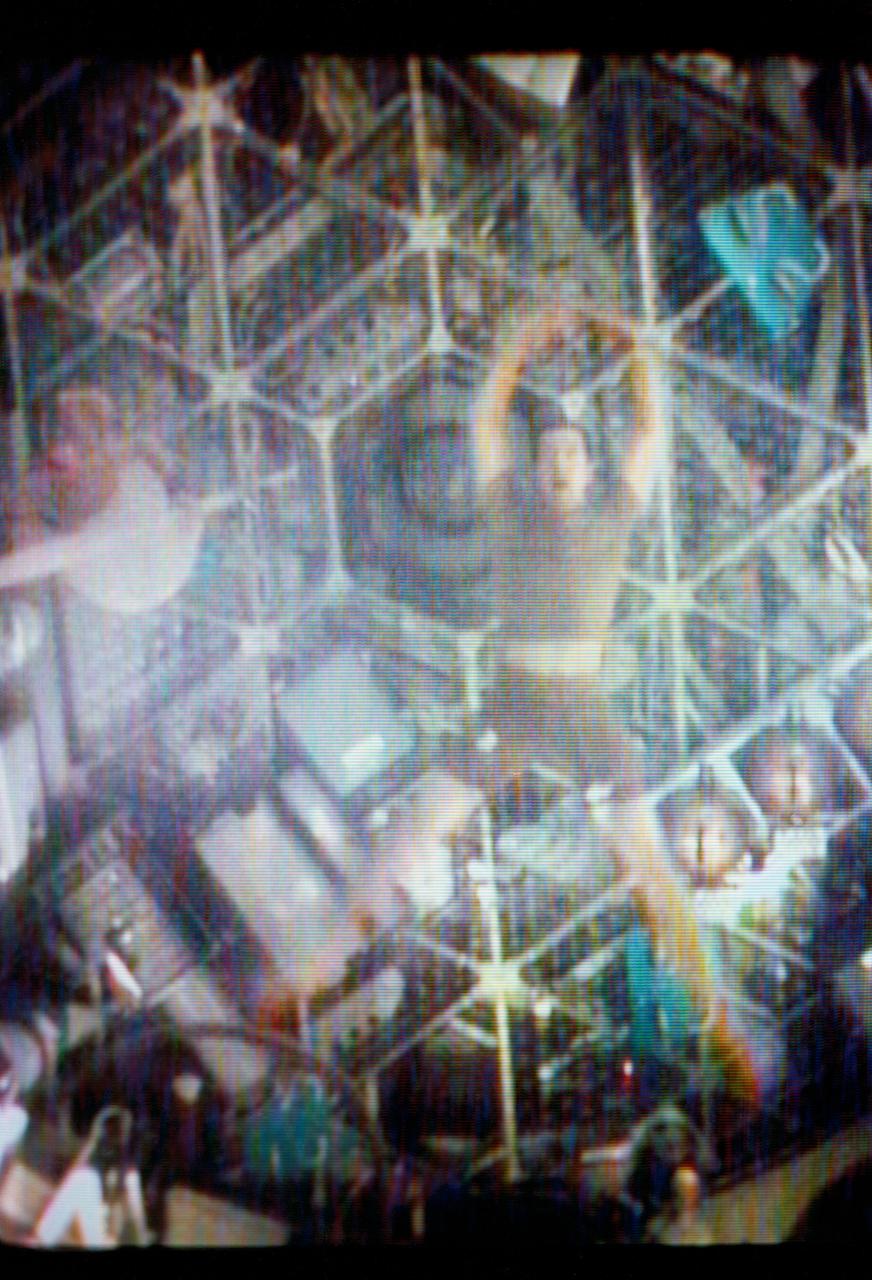
S73-27729 (1 June 1973) --- Scientist-astronaut Joseph P. Kerwin, Skylab 2 science pilot, floats with his body outstretched as he demonstrates weightlessness in the forward compartment of the Orbital Workshop of the Skylab 1 & 2 space station cluster in Earth orbit, as seen in this reproduction taken from a color television transmission made by a TV camera aboard the space station. Astronaut Charles Conrad Jr., Skylab 2 commander, is visible on Kerwin's right. The Skylab 2 crewmen performed exercises while floating. Photo credit: NASA
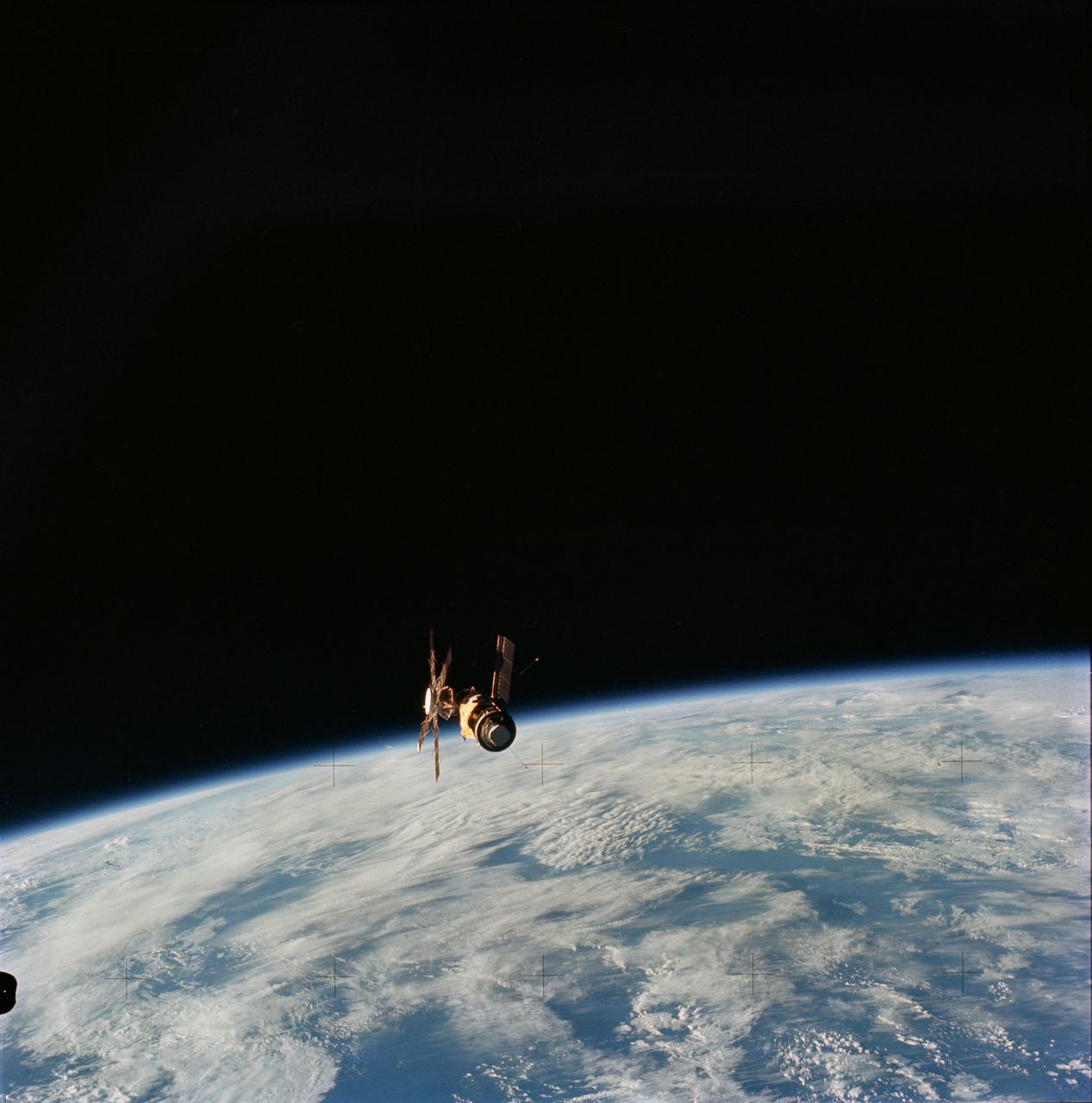
SL2-07-667 (22 June 1973) --- This overhead view of the Skylab Space Station was taken from the Departing Skylab Command/Service Module during the Skylab 2's final fly-around inspection. The single solar panel is quite evident as well as the parasol solar shield, rigged to replace the missing micrometeoroid shield. Both the second solar panel and the micrometeoroid shield were torn away during a mishap in the original Skylab 1 liftoff and orbital insertion. Photo credit: NASA

S73-27403 (June 1973) --- Engineers at the NASA Marshall Space Flight Center examine tools that are being considered for use in freeing the solar array wing of Skylab. The device at center is a cable cutter which is operated by cable. Enhanced television pictures indicate that the wing is being held to the side of the Skylab by a strip of metal from the meteoroid shield. The cable cutter shown here clipped an identical strip of metal in a test at the Marshall Center, requiring 90 pounds of force. The cutter is one of several heads which could be attached to extension rods. Identical tools and rods were carried into orbit by the Skylab 2 crew. At right is the handle end of a rod. White material taped just below the handle is buoyancy packing to make the object weightless when submerged in water. The tools are being tested in underwater EVA tasks in the MSFC Neutral Buoyancy Simulator. Small object at left is the attachment head for a two-prong "rake" device for use on the end of a pole made up of one, two or more five-foot sections of extension rods. Photo credit: NASA
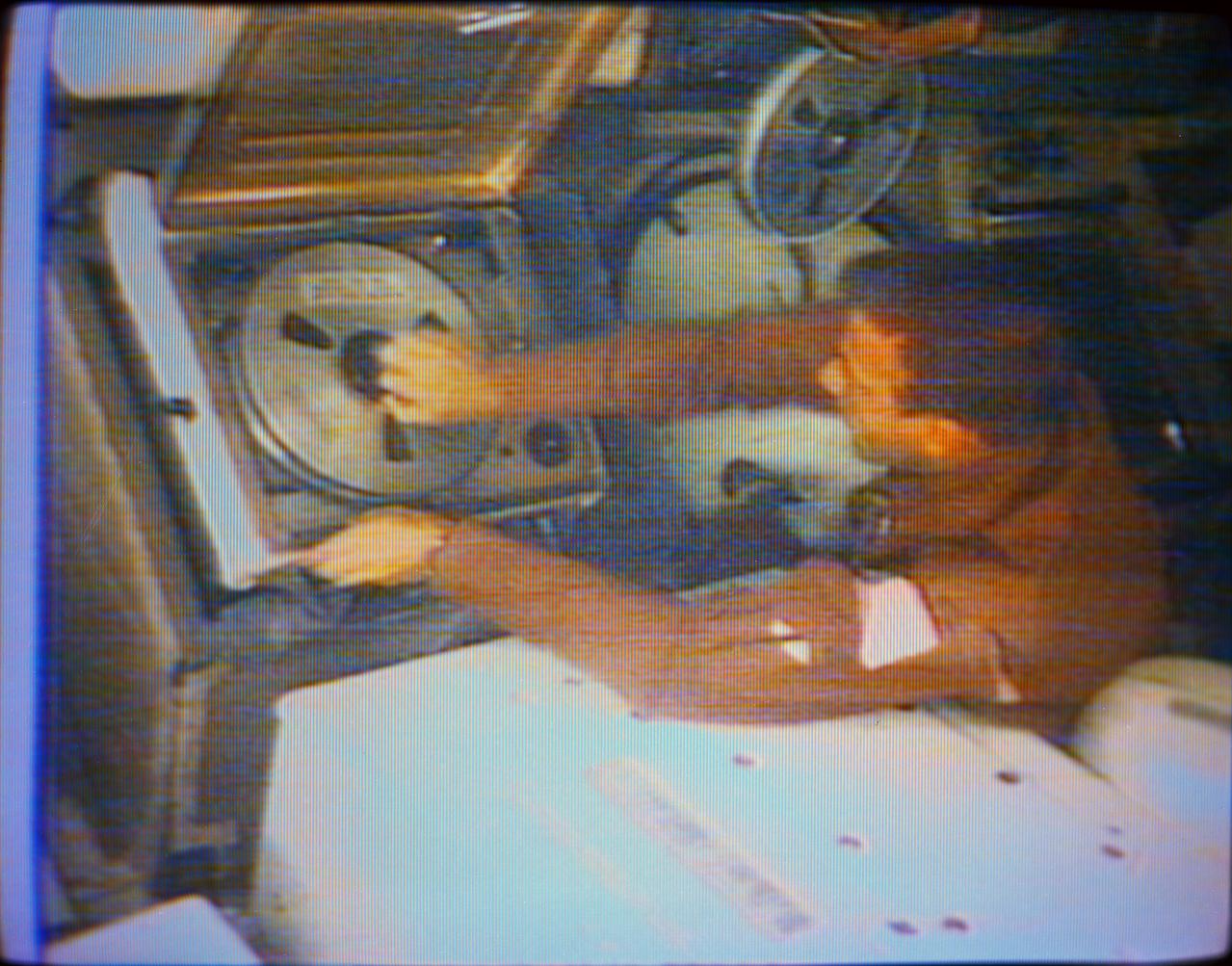
S73-27467 (5 June 1973) --- An overhead view of astronaut Paul J. Weitz, Skylab 2 pilot, at the video tape recorder in the Orbital Workshop of the Skylab 1 and 2 space station cluster in Earth orbit. Weitz is changing the tape in the recorder and storing the used data tape. This photograph was reproduced from a color television transmission made on June 5, 1973. Photo credit: NASA
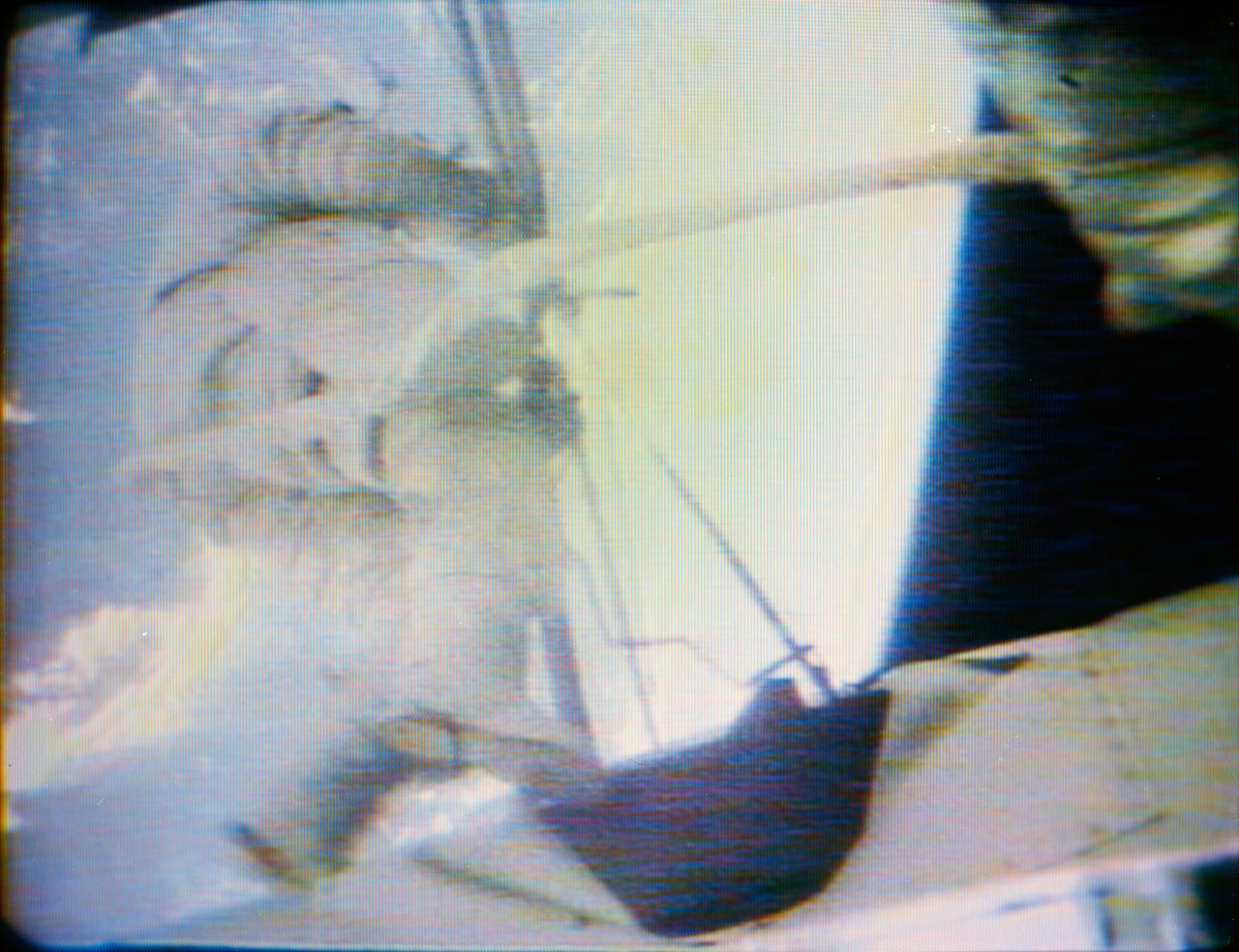
S73-27734 (11 June 1973) --- Skylab 2 astronaut performs extravehicular activity (EVA) at the Skylab 1 and 2 space station cluster in Earth orbit, as seen in this reproduction taken from a color television transmission made by a TV camera aboard the station. Kerwin is just outside the Airlock Module. Photo credit: NASA
Scientist-Astronaut Joseph P. Kerwin, Skylab 2 science pilot, is photographed strapped into the sleep restraint in the crew quarters of the Orbital Workshop of the Skylab 1 and 2 space station cluster in Earth orbit. Kerwin is wearing the special cap which contains biomedical instrumentation for the M133 Sleep Monitoring Experiment. The purpose of the M133 experiment is to evaluate quantity and quality of sleep during prolonged space flight by the analysis of electroencephalographic (EEG) and electrooculographic (EOG) activity.
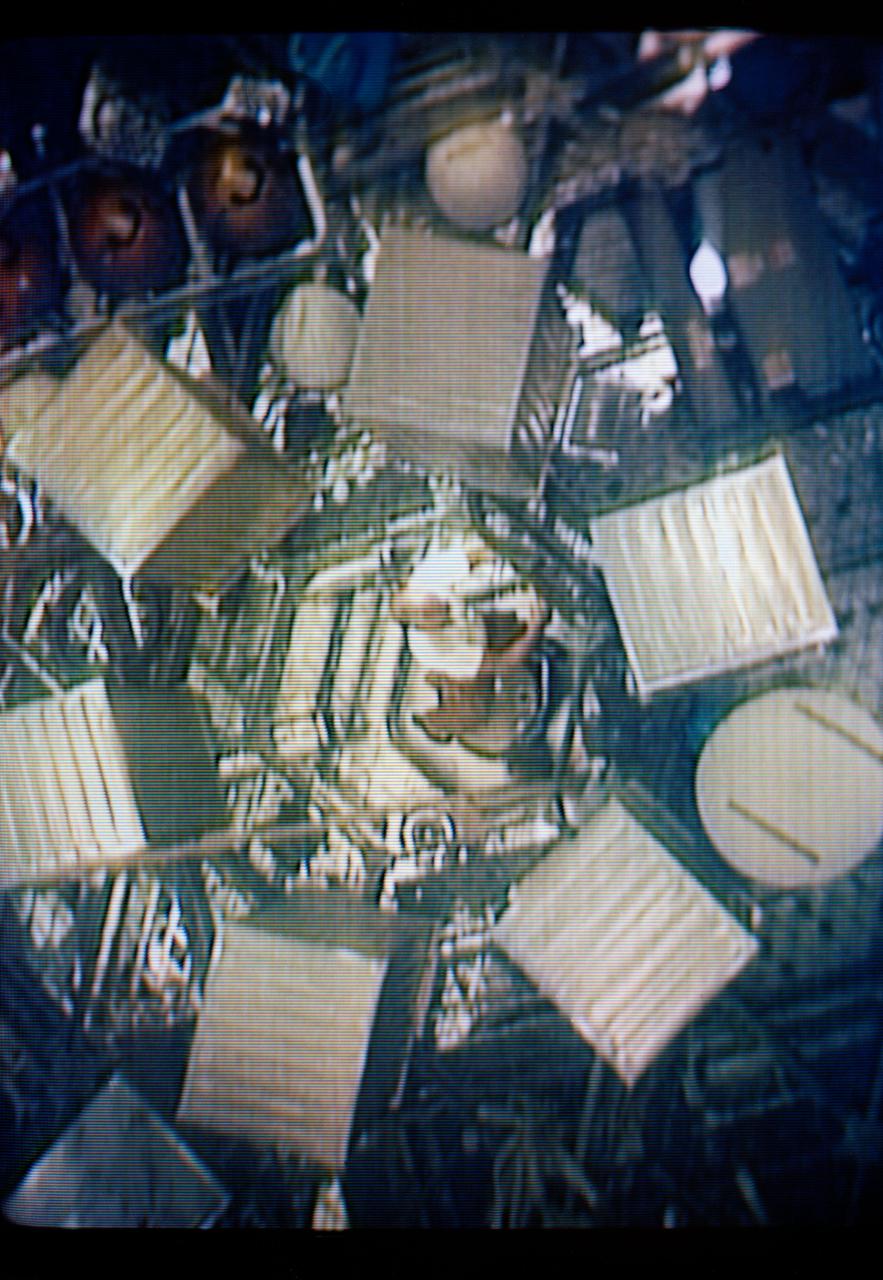
S73-26776 (26 May 1973) --- An interior view of the Orbital Workshop of the Skylab 1 space station cluster in Earth orbit can be seen in this reproduction taken from a color television transmission made by a TV camera aboard the space station. Astronaut Charles Conrad Jr., Skylab 2 commander, is floating up through the hatch. Food lockers are in the foreground. Photo credit: NASA
S73-27095 (25 May 1973) --- The Skylab 2 crew, consisting of astronauts Charles Conrad Jr., Joseph P. Kerwin and Paul J. Weitz, inside the command module atop a Saturn IB launch vehicle, heads toward the Skylab space station in Earth orbit. The command module was inserted into Earth orbit approximately 10 minutes after liftoff. The three represent the first of three crews who will spend record-setting durations for human beings in space, while performing a variety of experiments. Photo credit: NASA
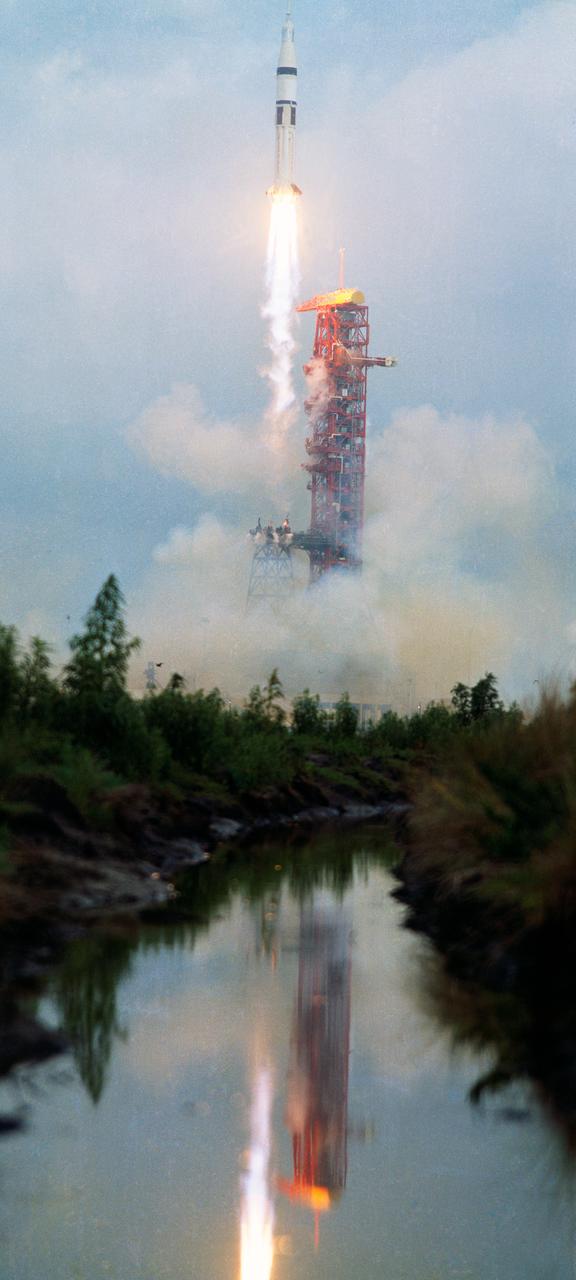
S73-27096 (25 May 1973) --- The Skylab 2 crew, consisting of astronauts Charles Conrad Jr., Joseph P. Kerwin and Paul J. Weitz, inside the command module atop a Saturn IB launch vehicle, heads toward the Skylab space station in Earth orbit. The command module was inserted into Earth orbit approximately 10 minutes after liftoff. The three represent the first of three crews who will spend record-setting durations for human beings in space, while performing a variety of experiments. Photo credit: NASA
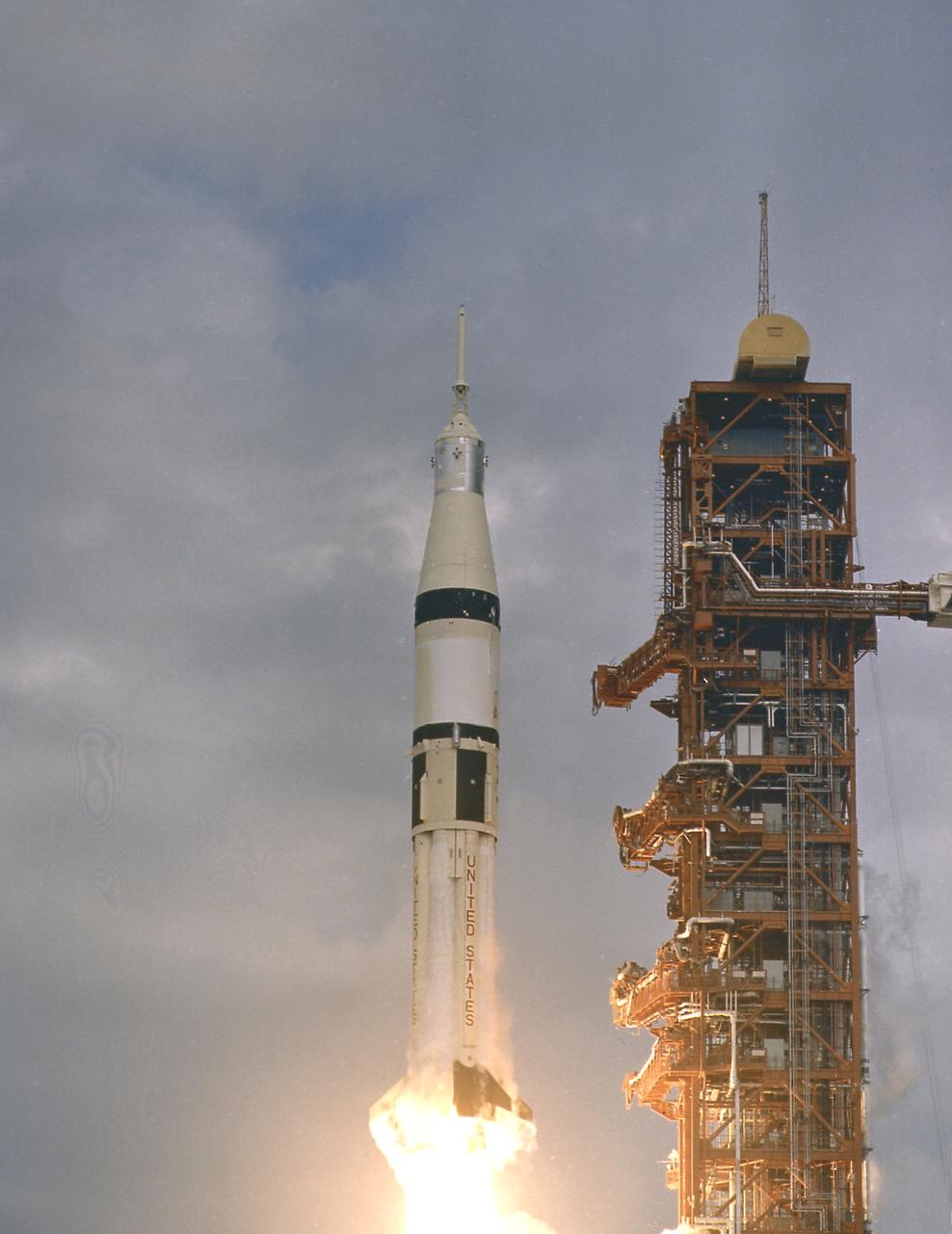
SA-206 lifts off from Kennedy Space Center's launch complex 39B, in Florida, on May 25, 1973, for the first manned Skylab mission (SL-2) with astronauts Pete Conrad, Joseph Kerwin, and Paul Weitz. The Saturn IB, developed under the direction of the Marshall Space Flight Center (MSFC), launched five manned Earth-orbital missions between 1968 and 1975: Apollo 7, Skylab 2, Skylab 3, Skylab 4, and the Apollo-Soyuz Test Project (ASTP).
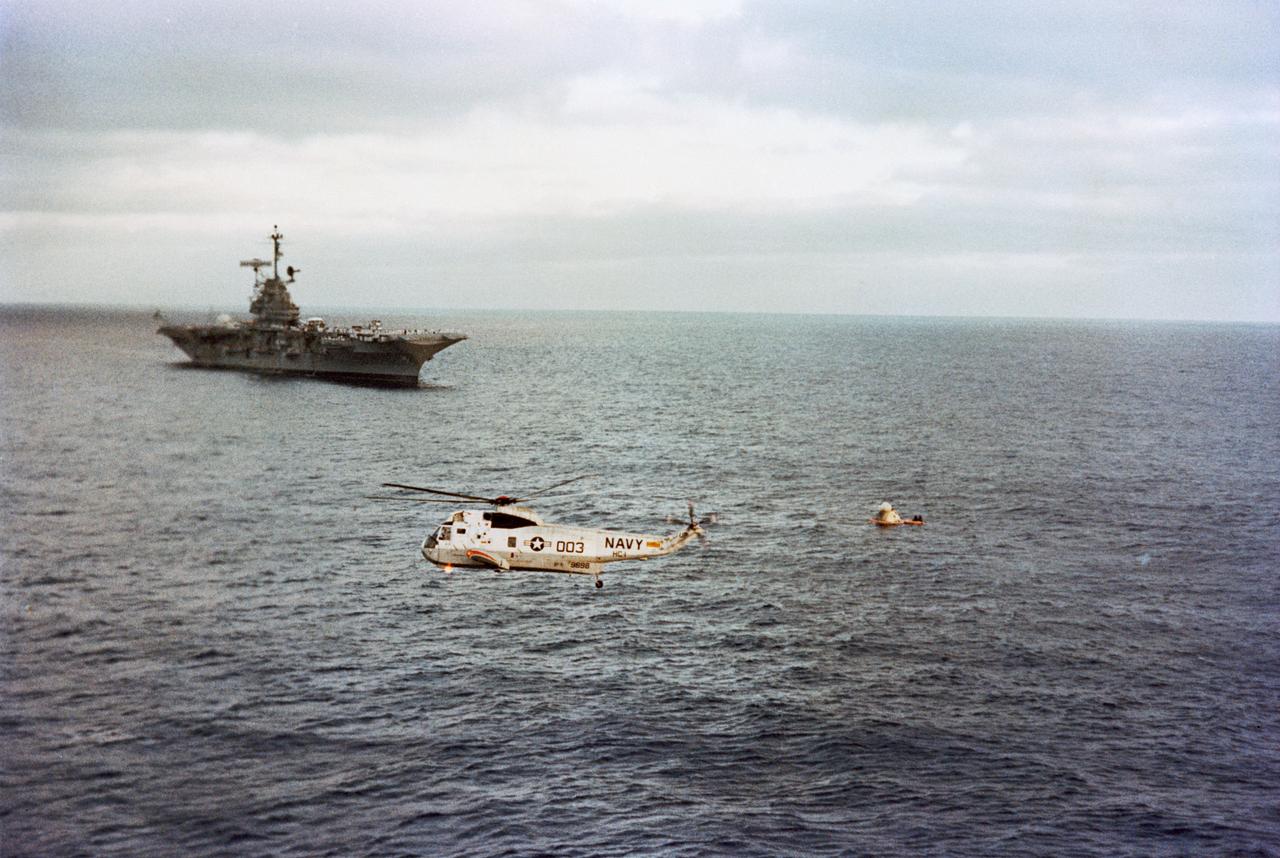
S73-29147 (22 June 1973) --- The Skylab 2 Command Module, with astronauts Charles Conrad Jr., Joseph P. Kerwin and Paul J. Weitz still inside, floats in the Pacific Ocean following successful splashdown about 835 miles southwest of San Diego, California. The prime recovery ship, USS Ticonderoga, approaches from the left background. A recovery helicopter hovers in the foreground. The three Skylab 2 crewmen had just completed a 28-day stay with the Skylab 1 space station in Earth orbit conducting numerous medical, scientific and technological experiments. Photo credit: NASA
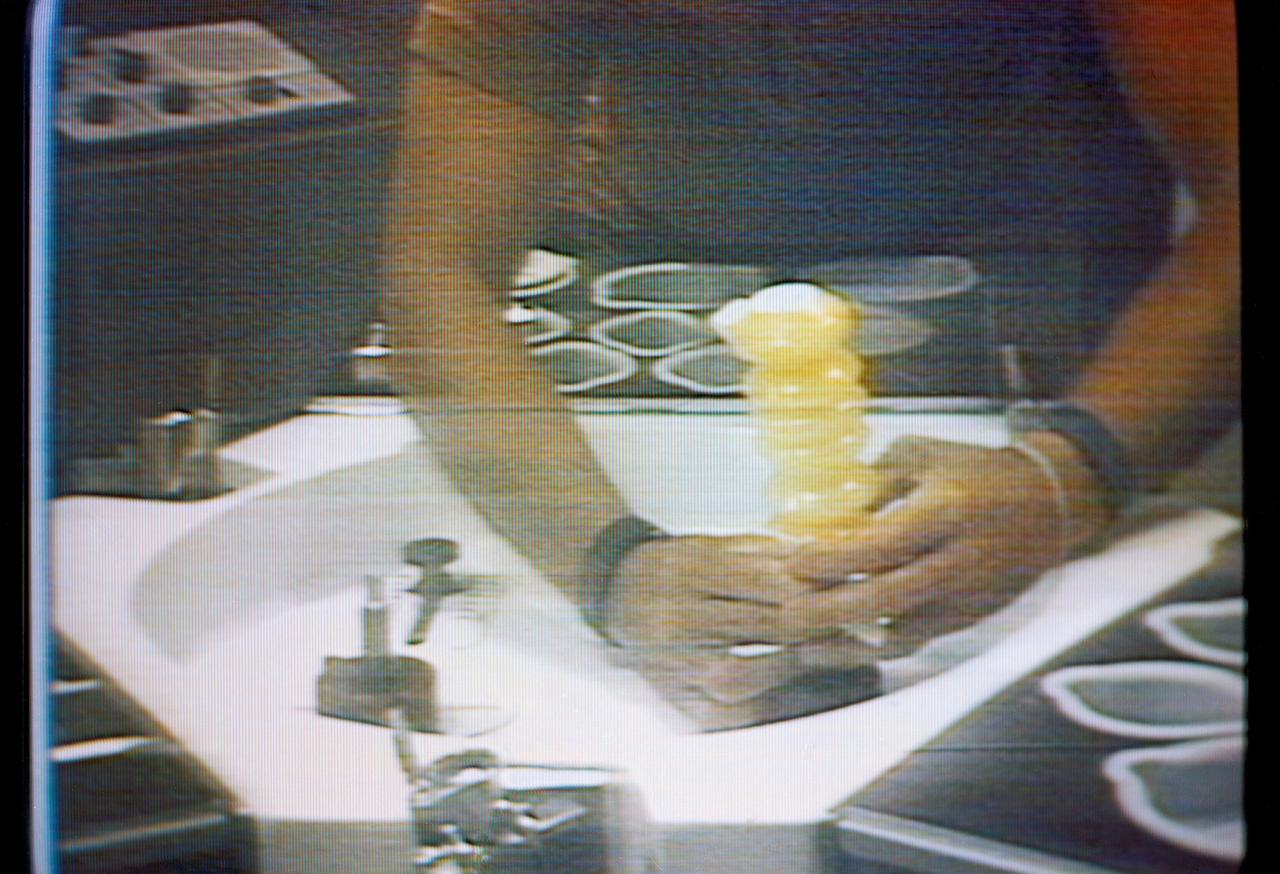
S73-27078 (30 May 1973) --- An accordian-style beverage dispenser filled with orange juice is held by astronaut Charles Conrad Jr., Skylab 2 commander, in this close-up view which is a reproduction taken from a color television transmission made by a TV camera aboard the Skylab 1 & 2 space station cluster in Earth orbit. Conrad (head and face not in view) is seated at the wardroom table in the crew quarters of the Orbital Workshop. The dispenser contained beverage crystals, and Conrad has just added the prescribed amount of water to make the orange drink. Photo credit: NASA
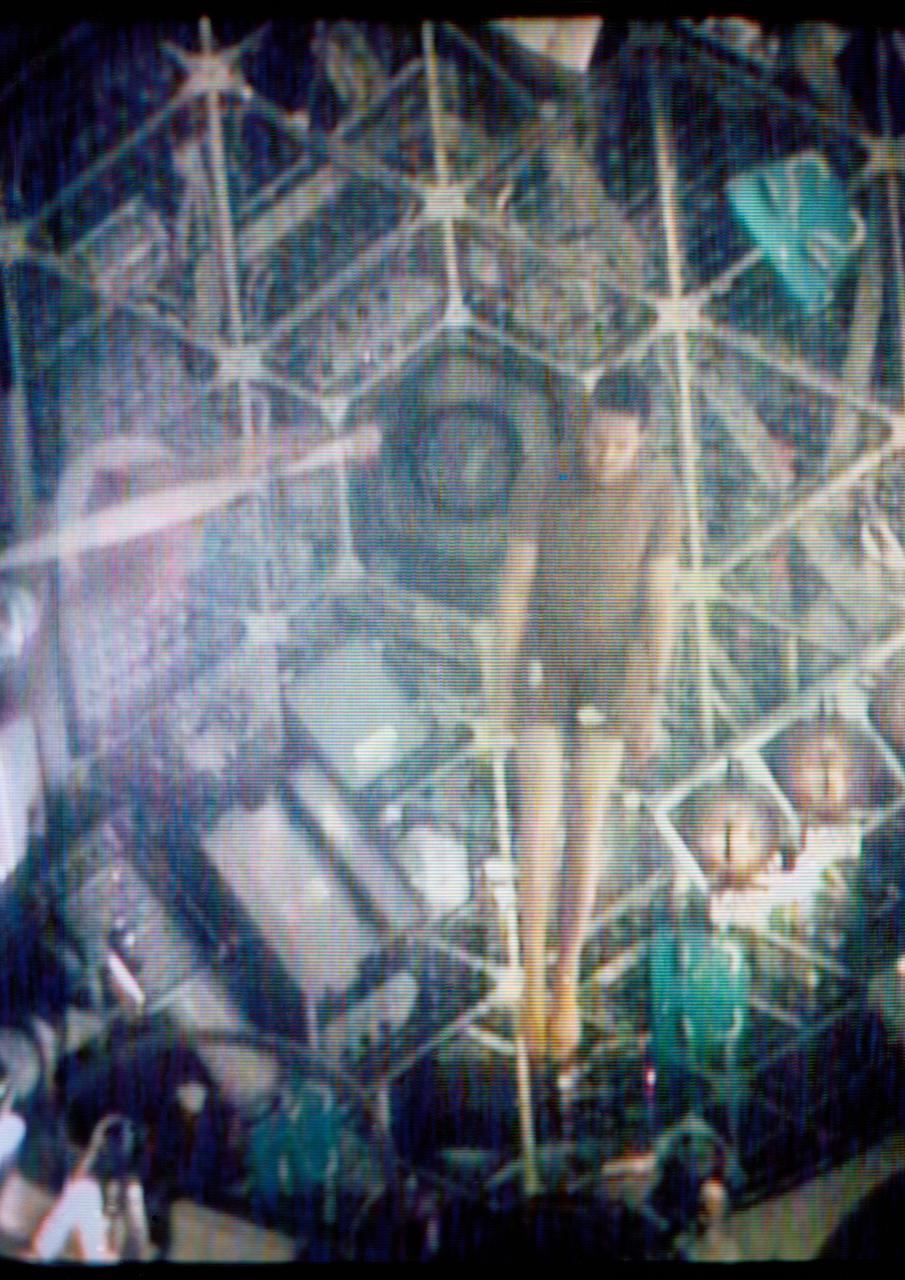
S73-27260 (1 June 1973) --- Two of the three Skylab 2 crewmen demonstrate weightlessness in the forward compartment of the Orbital Workshop of the Skylab 1 & 2 space station cluster in Earth orbit, as seen in this reproduction taken from a color television transmission made by a TV camera aboard the space station. Scientist-astronaut Joseph P. Kerwin, science pilot, floats with his body extended. Kerwin is steadied by astronaut Charles Conrad Jr., commander. The crewmen performed exercises while floating. Photo credit: NASA
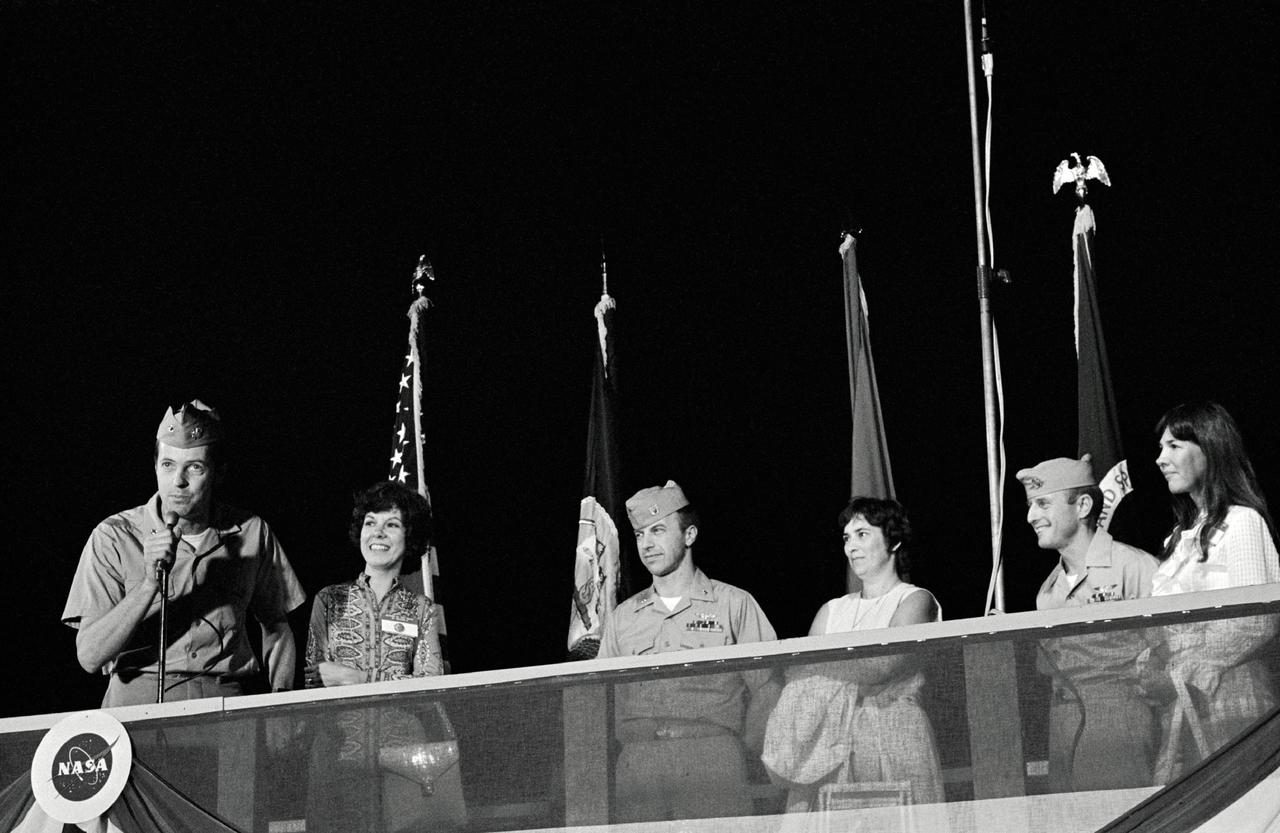
S73-28818 (24 June 1973) --- Scientist-astronaut Joseph P. Kerwin, science pilot for the Skylab 2 mission, speaks to a crowd at Ellington Air Force Base during welcome home ceremonies for the crew. Astronaut Paul J. Weitz, pilot, is at center; and astronaut Charles Conrad Jr., crew commander, is at right. The wives, standing by their husbands, are (left to right) Shirley Kerwin, Suzanne Weitz and Jane Conrad. Photo credit: NASA
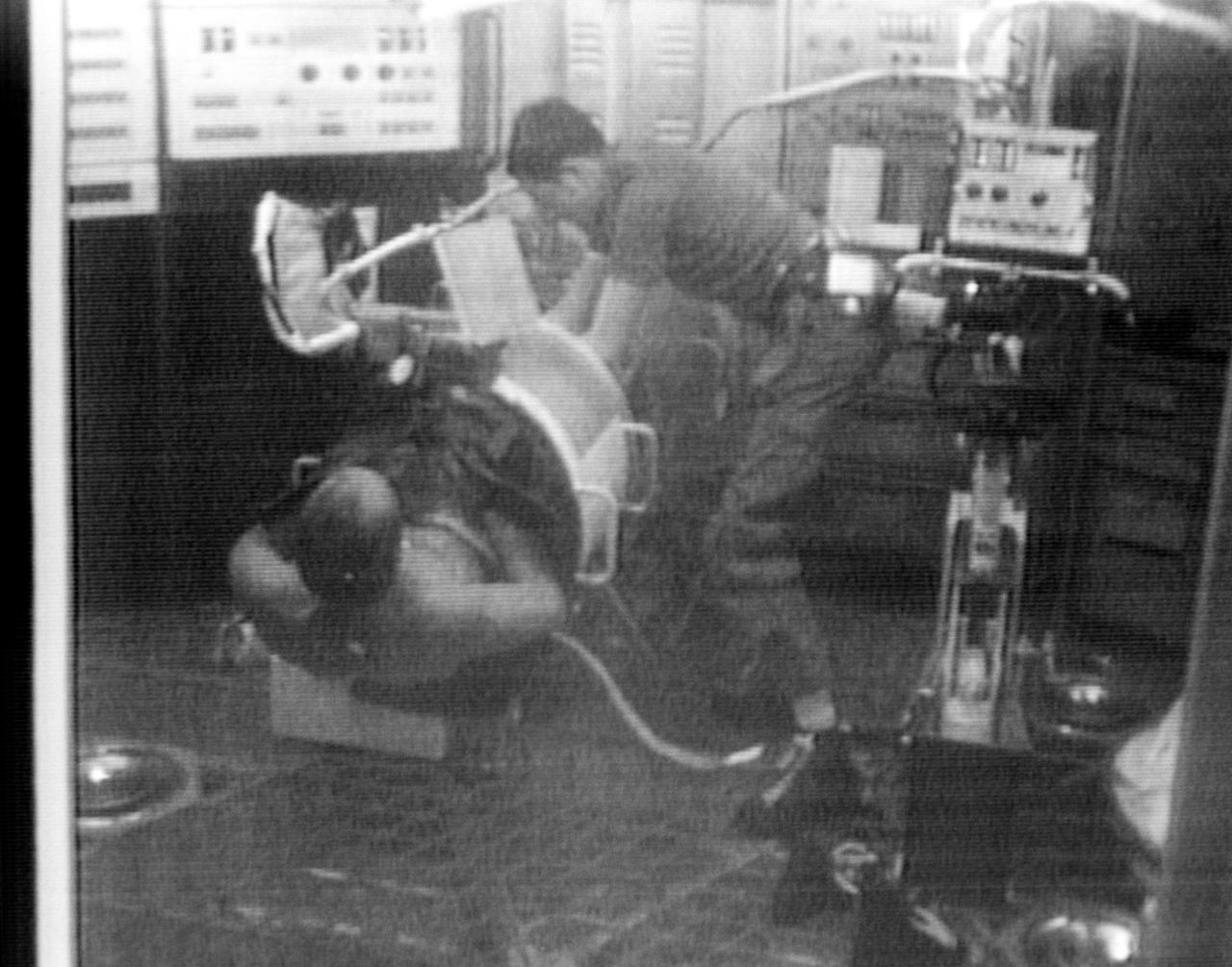
S73-27707 (9 June 1973) --- Astronaut Charles Conrad Jr., Skylab 2 commander, serves as test subject for the Lower Body Negative Pressure (MO92) Experiment, as seen in this reproduction taken from a color television transmission made by a TV camera aboard the Skylab 1/2 space station cluster in Earth orbit. Scientist-astronaut Joseph P. Kerwin, Skylab 2 science pilot, assists Conrad into the LBNP device. Kerwin served as monitor for the experiment. The purpose of the MO92 experiment is to provide information concerning the time course of cardiovascular adaptation during flight, and to provide inflight data for predicting the degree of orthostatic intolerance and impairment of physical capacity to be expected upon return to Earth environment. The data collected in support of MO92 blood pressure, heart rate, body temperature, vectorcardiogram, LBNPD pressure, leg volume changes, and body weight. Photo credit: NASA
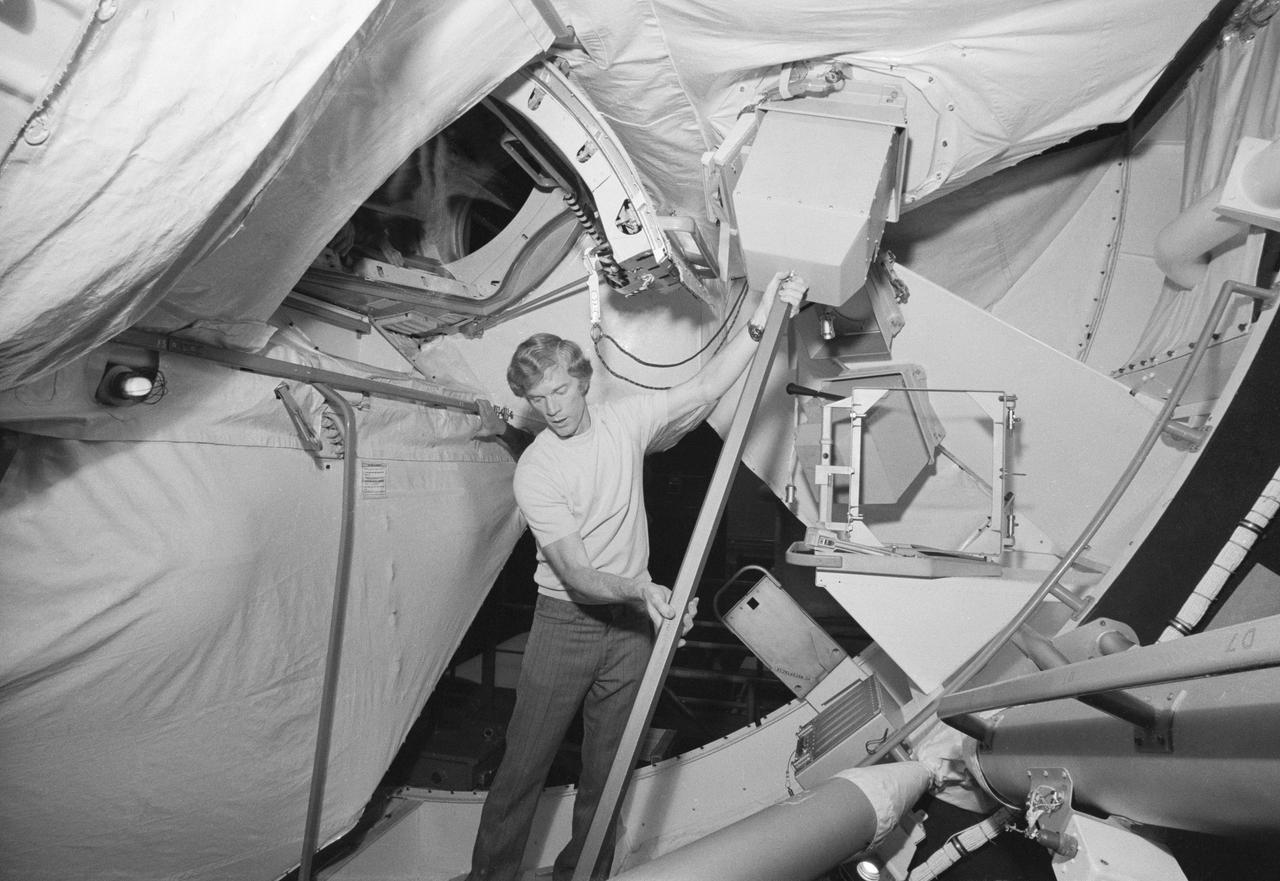
S73-25884 (1973) --- Astronaut Russell Schweickart in Orbital Workshop Simulator (OWS) working out procedure to be used for repair of damaged thermal protection cover on Skylab 2 spacecraft. Photo credit: NASA
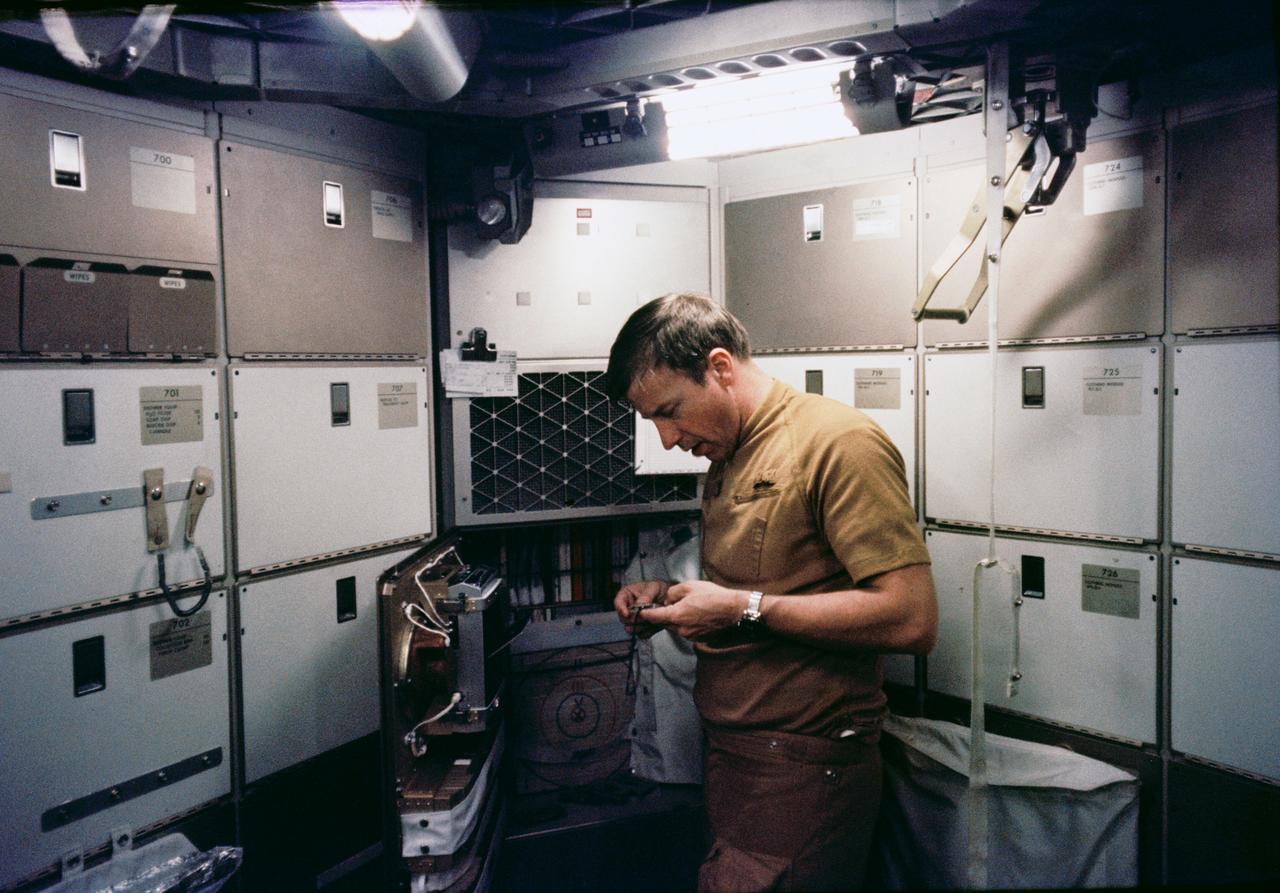
S73-17859 (January 1973) --- Astronaut Paul J. Weitz, pilot for Skylab 2 (first Skylab manned) mission, looks over off-duty recreational equipment in the crew quarters of the Skylab Orbital Workshop (OWS) trainer during Skylab simulation activity at the Manned Spacecraft Center. The equipment includes such items as tape decks and stereo music equipment, playing cards, darts, etc. The OWS is a component of the Skylab space station cluster which will be launched unmanned aboard a Saturn V in summer of 1973, and will be visited three times by three-man crews over an eight month period. Photo credit: NASA
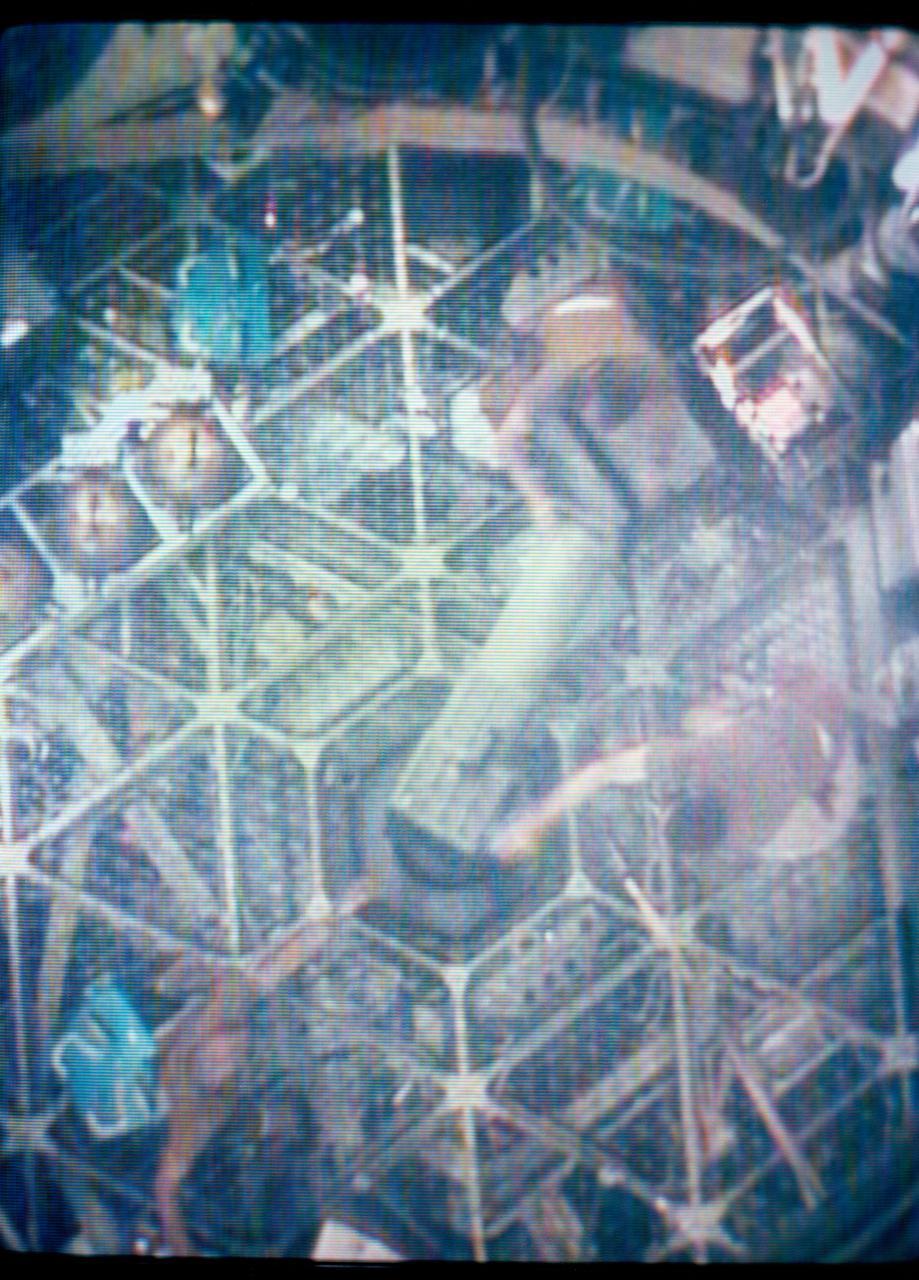
S73-27730 (June 1973) --- The Skylab 2 crewmen, astronauts Charles Conrad Jr., Joseph P. Kerwin and Paul J. Weitz, move the S183 Ultraviolet Panorama astrophysics experiment equipment under zero-gravity conditions in space in the foreground compartment of the Orbital Workshop of the Skylab 1 & 2 space station in Earth orbit, as seen in this reproduction taken from a color television transmission made by a TV camera aboard the space station. The S183 equipment includes the S183 spectrograph, the S019 mirror assembly, and a Maurer camera. Photo credit: NASA

S73-18667 (January 1973) --- Astronaut Paul J. Weitz, pilot for the Skylab 2 first manned mission, is suited up for Skylab training activity in the mission simulation and training facility at the Manned Spacecraft Center. Photo credit: NASA
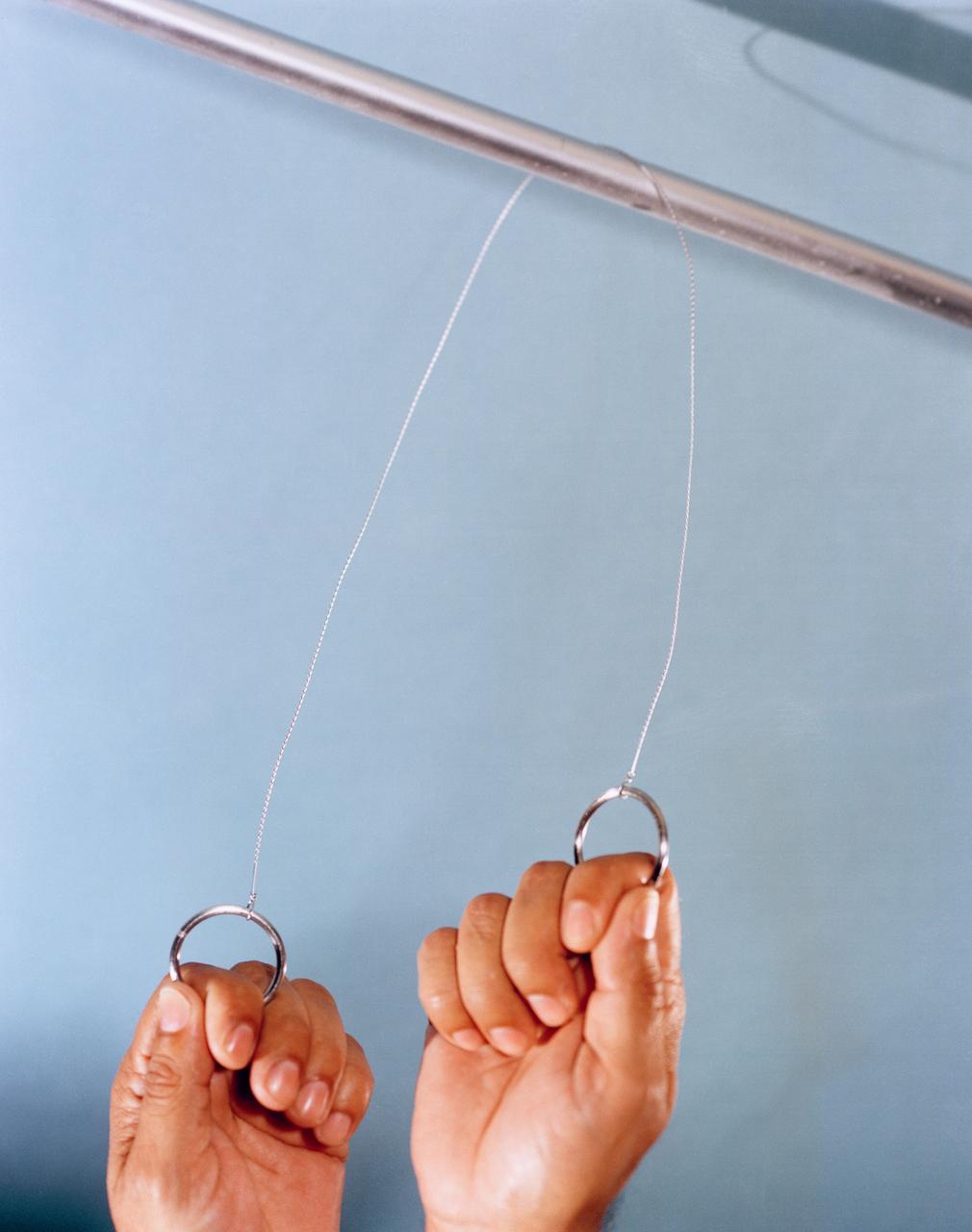
S73-27384 (June 1973) --- A close-up view of the surgical band saw, a surgical tool in the therapeutic kit of the Inflight Medical Support System aboard the Skylab 1 & 2 space station cluster now in Earth orbit. Since this instrument can cut through metal (as illustrated here), it can be used in making emergency maintenance repairs aboard the space station. Photo credit: NASA
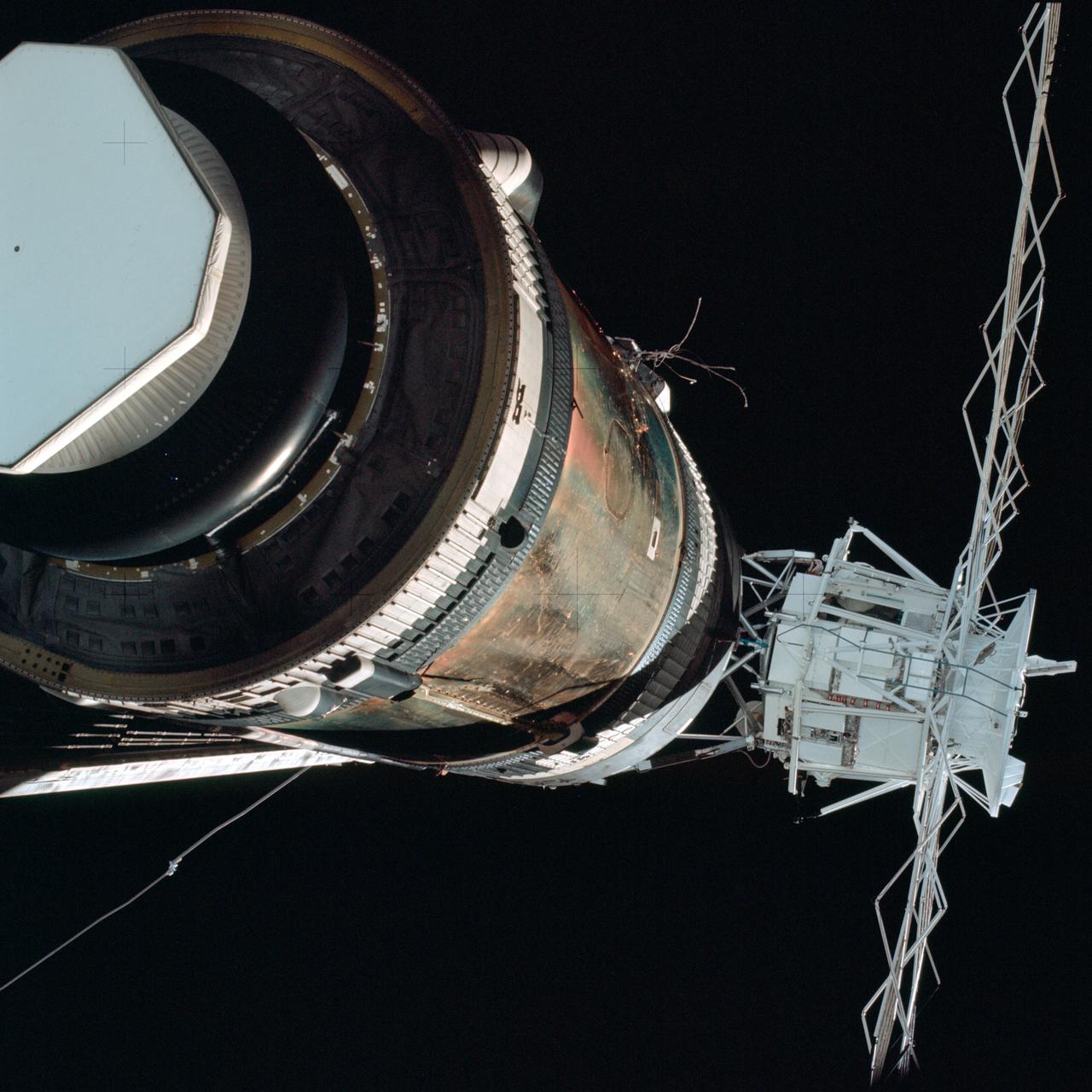
SL2-4-265 (25 May 1973) --- Skylab 2, approach to Skylab at long range, fly-around inspection. Orbital Workshop with area of missing micrometeoroid shield visible and partially deployed solar array visible. Photo credit: NASA
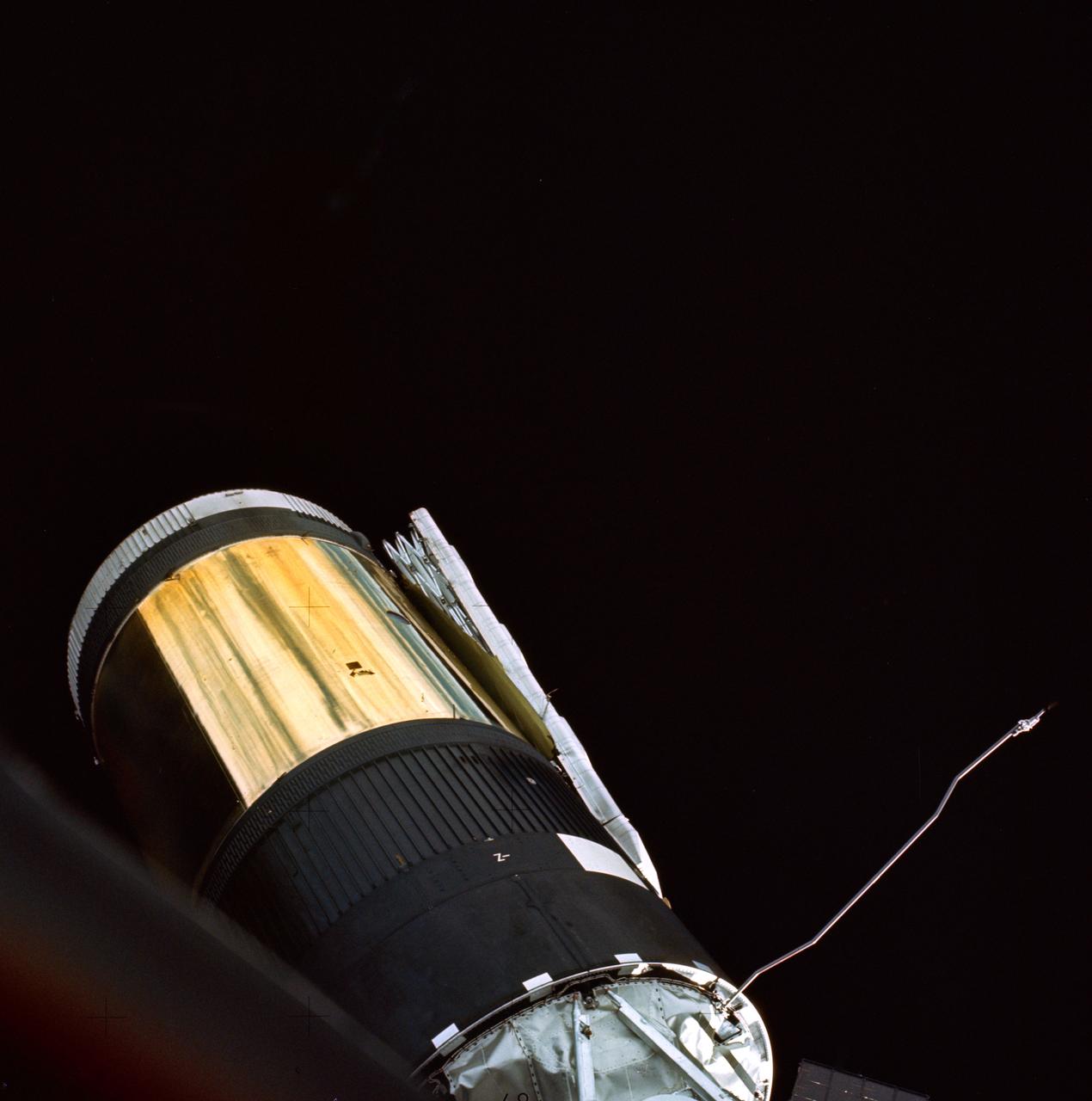
This view of the Skylab Orbital Space Station was taken from the Skylab 2 Command/Service Module during it's initial fly around inspection. The micrometeoroid shield can be seen to be missing and a parasol solar shield was later fitted in its place. The damaged and partially deployed solar array, in the center of the scene, can be seen to be restrained by a strap that was later cut during an early EVA, allowing the panel to fully deploy.
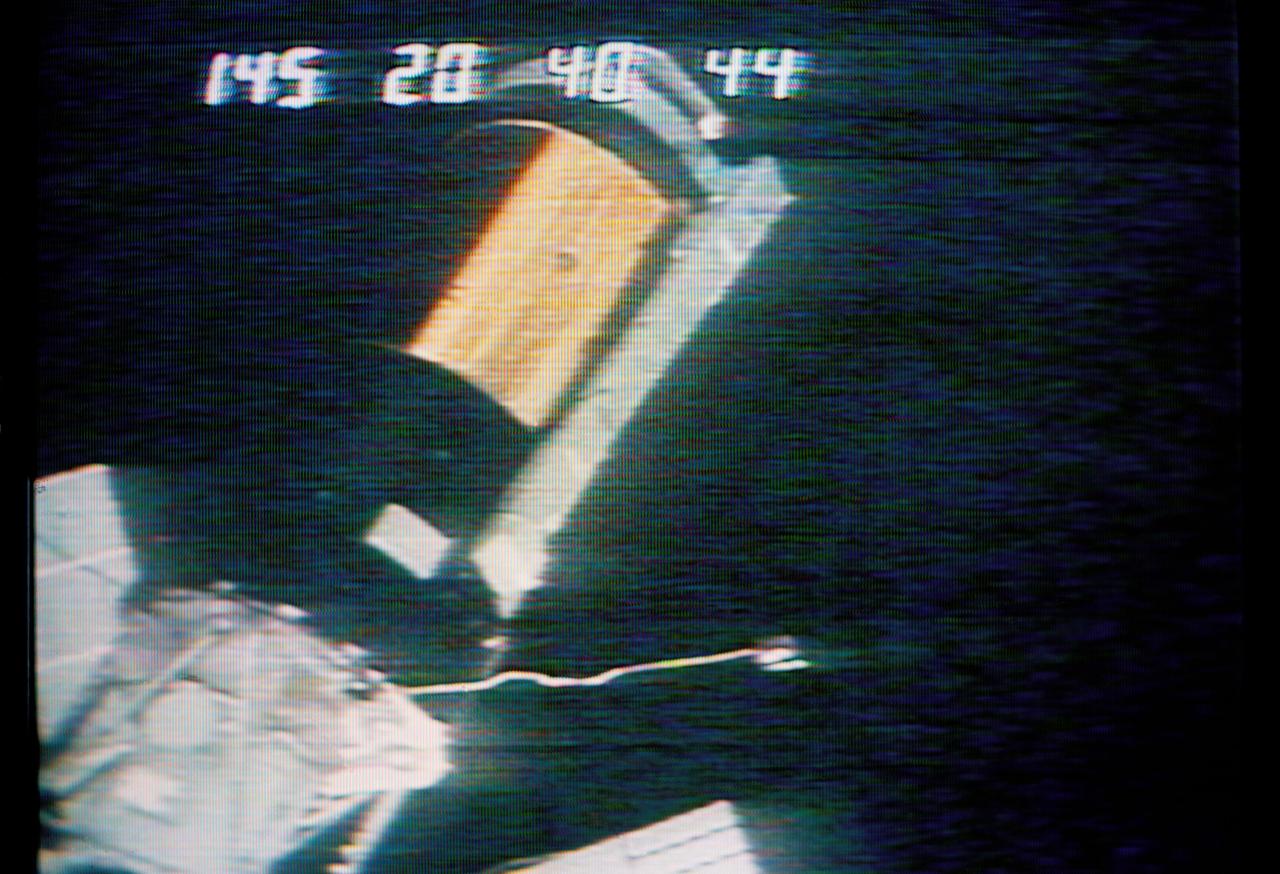
S73-26738 (25 May 1973) --- A close-up view of the Skylab 1 space station cluster can be seen in this reproduction taken from a color television transmission made by a TV camera aboard the Skylab 2 Command Module during its ?fly-around? inspection of the cluster. The numbers across the top of the picture indicate the Skylab 1 ground lapse time. Note the missing portion of the micrometeoroid shield on the Orbital Workshop. The shield area was reported to be solid gold by the Skylab 2 crewmen. A cable appears to be wrapped around the damaged OWS solar array system wing. The crewmen reported that the other OWS solar panel was completely gone, with only tubes and wiring sticking out. One of the discone antennas extends out form the Airlock Module. The Multiple Docking Adapter is in the lower left corner of the picture. A portion of a solar panel on the Apollo Telescope Mount is visible at the bottom and at the left edge. In their ?fly around? inspection the crewmen noted that portions of the micrometeoroid shield had slid back underneath the OWS solar wing. Photo credit: NASA
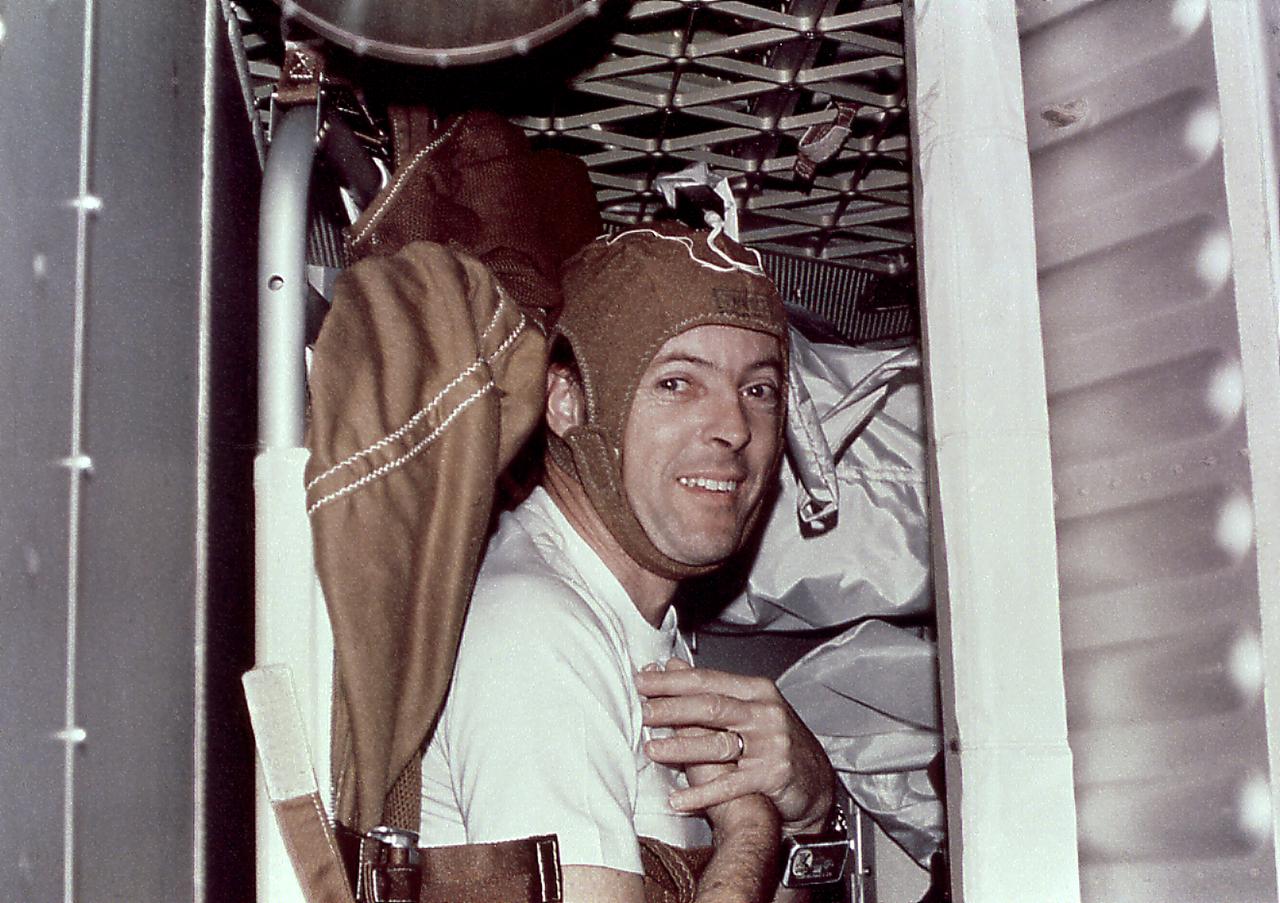
This photograph is of Astronaut Kerwin wearing the Sleep Monitoring cap (Experiment M133) taken during the Skylab-2 mission. The Sleep Monitoring Experiment was a medical evaluation designed to objectively determine the amount and quality of crew members' inflight sleep. The experiment monitored and recorded electroencephalographic (EEG) and electrooculographic (EOG) activity during astronauts' sleep periods. One of the astronauts was selected for this experiment and wore a fitted cap during his sleep periods.
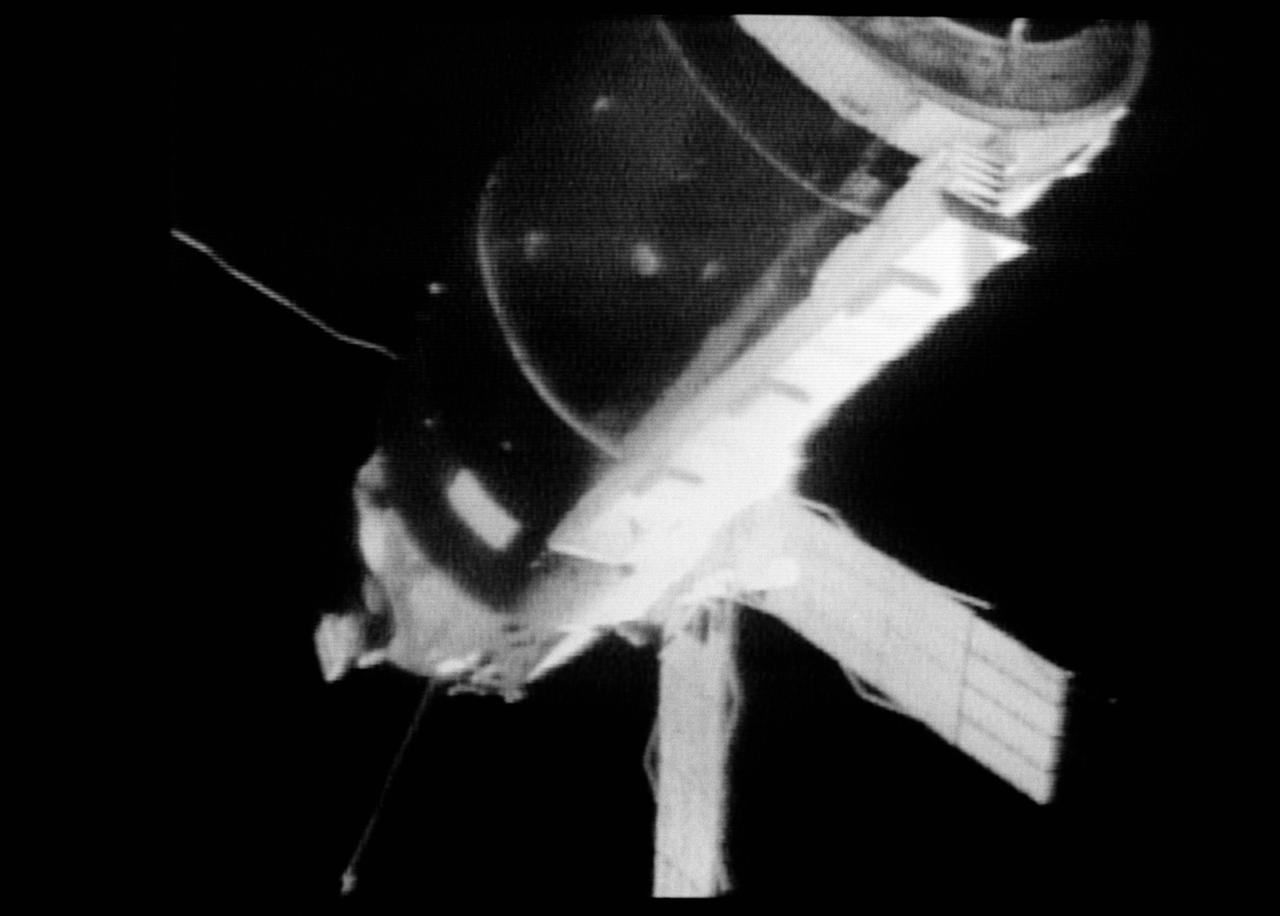
S73-27182 (25 May 1973) --- A close-up view of the Skylab 1 space station cluster can be seen in this reproduction taken from a color television transmission made by a TV camera aboard the Skylab 2 Command Module during its "fly around" inspection of the cluster. This view has been enhanced. At left center the damaged solar array system wing on the Orbital Workshop (OWS) appears to be partly folded. In their preliminary inspection the crewmen noted that portions of the micrometeoroid shield had slid back underneath the OWS solar wing. Solar panels on the Apollo Telescope Mount extend out at the top center. Photo credit: NASA
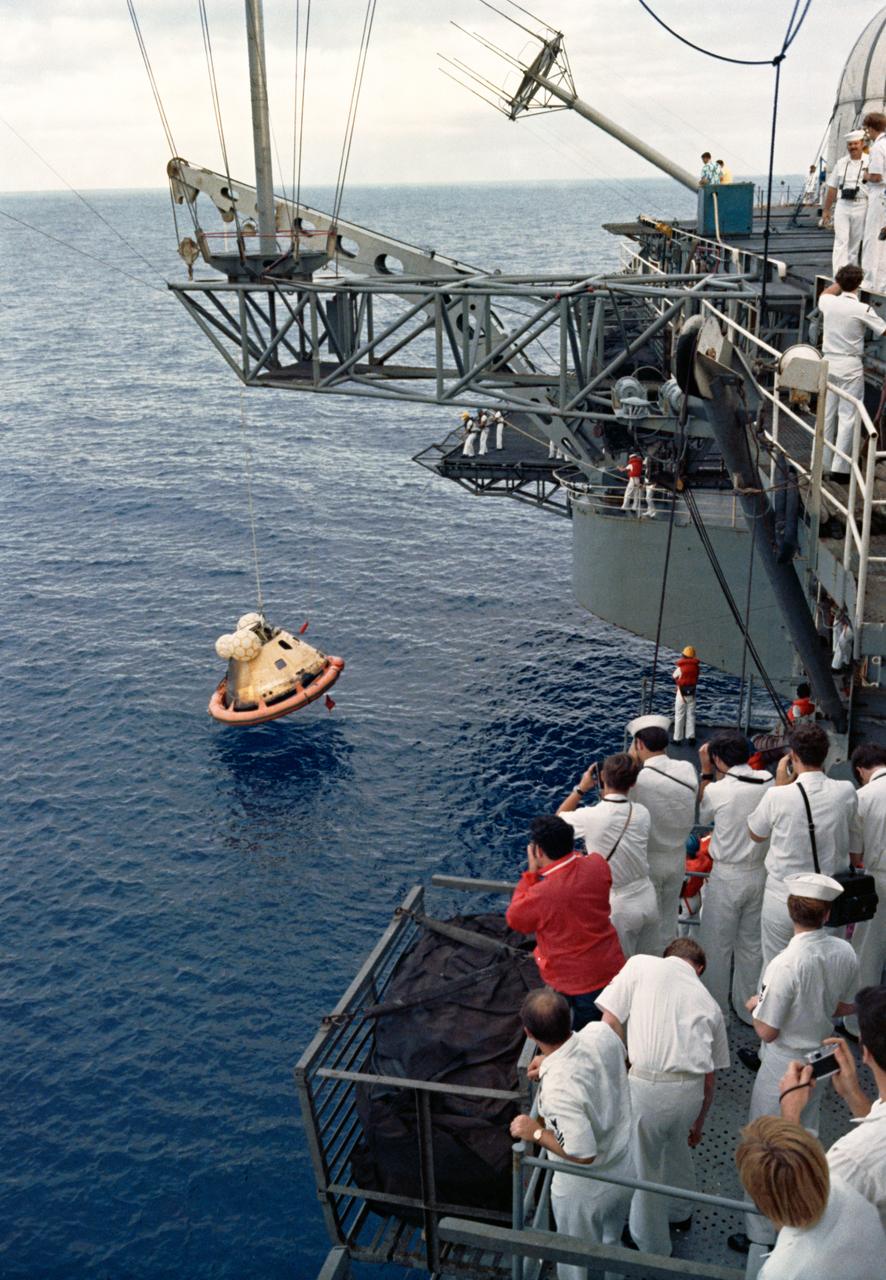
S73-29138 (22 June 1973) --- The Skylab 2 Command Module, with astronauts Charles Conrad Jr., Joseph P. Kerwin and Paul J. Weitz still inside, is hoisted aboard the prime recovery ship, USS Ticonderoga, following successful splashdown in the Pacific Ocean about 835 miles southwest of San Diego, California. The crewmen had just completed a 28-day stay with the Skylab 1 space station in Earth orbit conducting numerous medical, scientific and technological experiments. Note the inflated bags and the floatation collar on the spacecraft. Photo credit: NASA
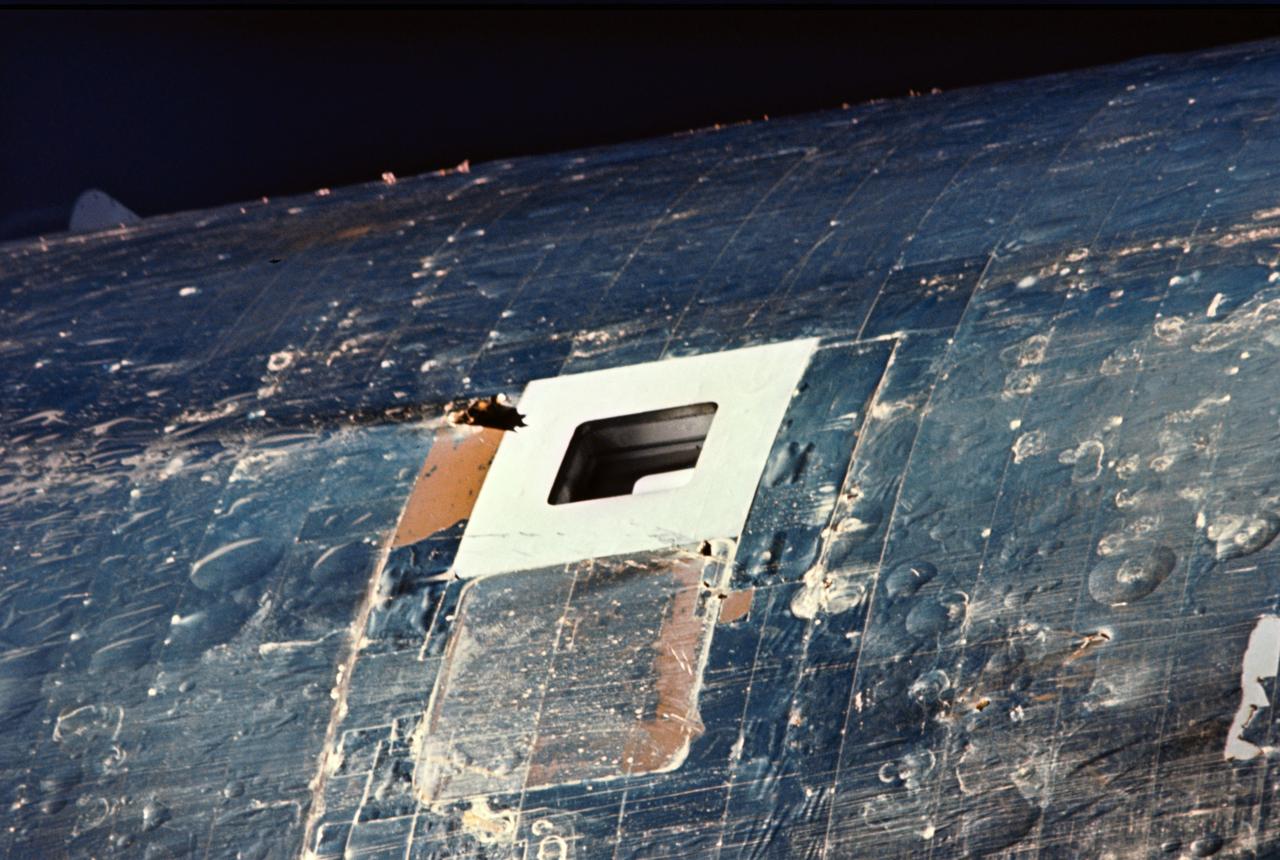
This close up view of one of the two scientific airlocks on the Skylab Orbital Workshop Section was taken from the Skylab 2 Command/Service Module during its initial fly around inspection. The micrometeoroid shield can be seen to be missing from this section of the orbital workshop. A parasol solar shield was later devised and put in place over this damaged area through this very same airlock opening.
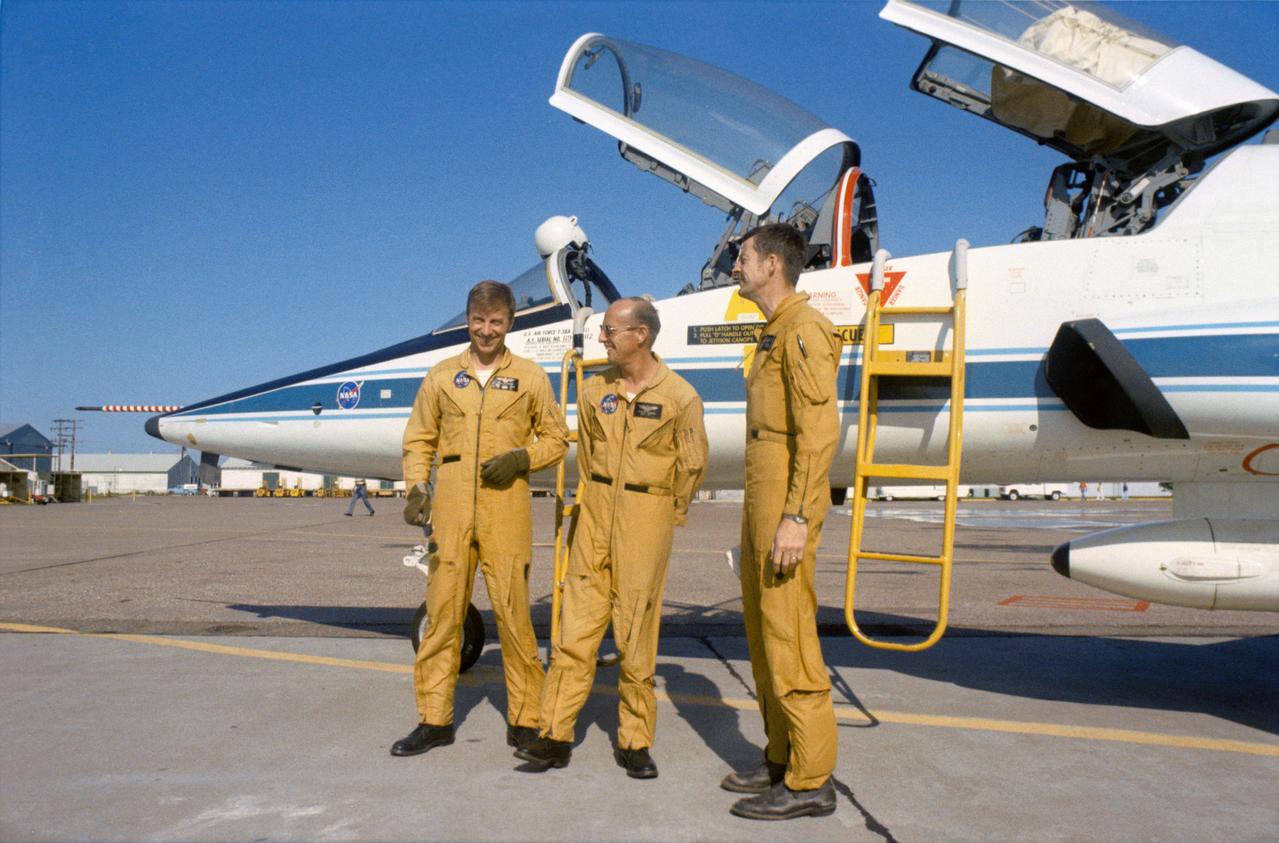
S73-25714 (13 May 1973) --- Members of the prime crew of the first manned Skylab Mission (Skylab 2) stand beside a NASA T-38 jet aircraft trainer at nearby Ellington Air Force Base prior to take off for the Kennedy Space Center, Florida. They are (left to right) astronauts Paul J. Weitz, mission pilot; Charles Conrad Jr., commander; and scientist Joseph P. Kerwin, science pilot. The three crewmen have completed their prelaunch training at JSC. Photo credit: NASA
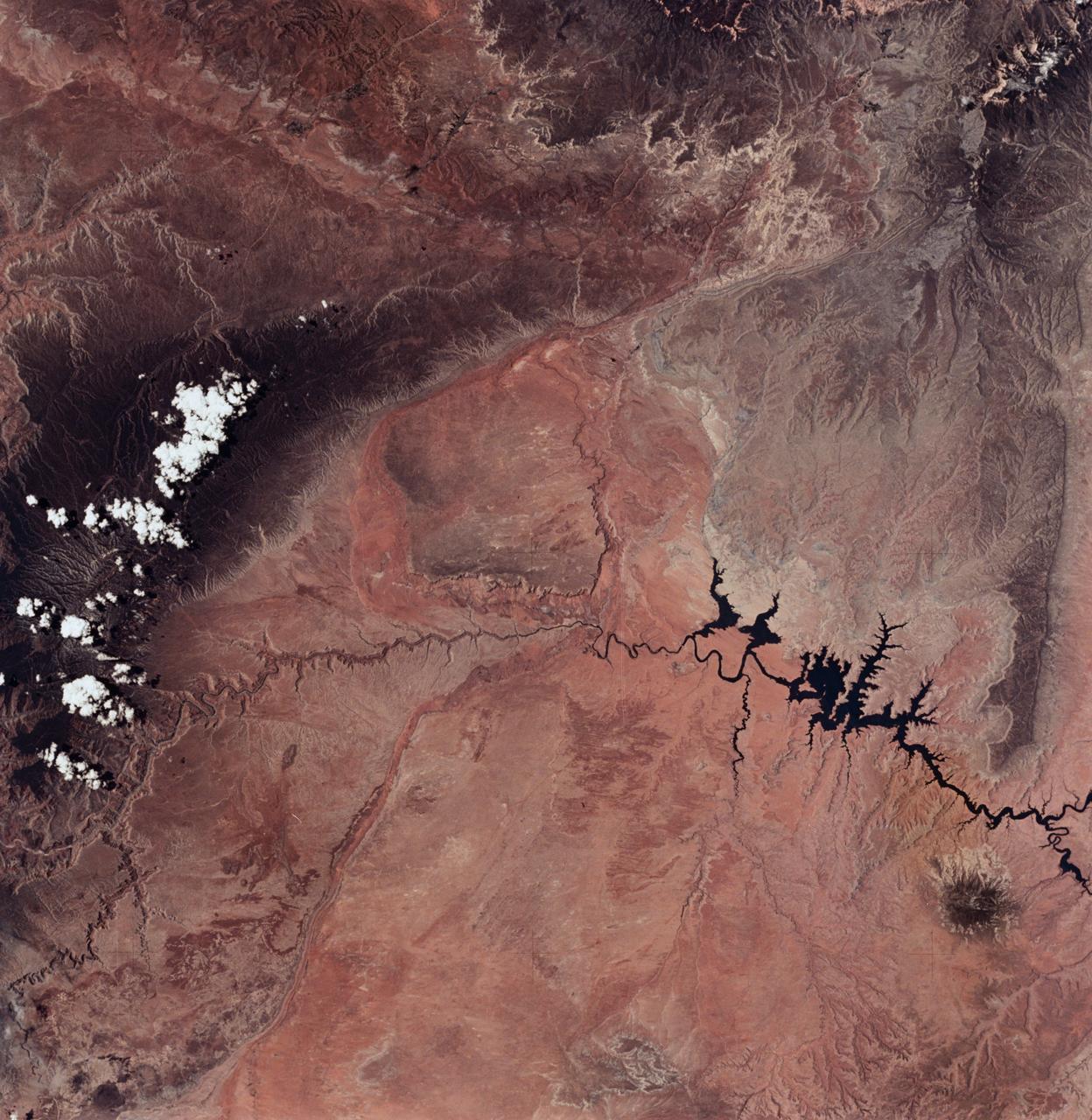
SL2-04-018 (June 1973) --- A vertical view of the Arizona-Utah border area showing the Colorado River and Grand Canyon photographed from the Skylab 1/2 space station in Earth orbit. This picture was taken by one of the six lenses of the Itek-furnished S190-A Multispectral Photographic Facility Experiment in the Multiple Docking Adapter of the space station. Type S0-356 film was used. The row of white clouds extend north-south over the dark colored Kaibab Plateau. The junction of the Colorado and Little Colorado rivers is in the southwest corner of the picture. The body of water is Lake Powell on the Colorado River upstream from the Grand Canyon. The lone peak at the eastern edge of the photograph south of Colorado River is the 10,416-foot Navajo Mountain. The S190-A experiment is part of the Skylab Earth Resources Experiments Package(EREP). Photo credit: NASA
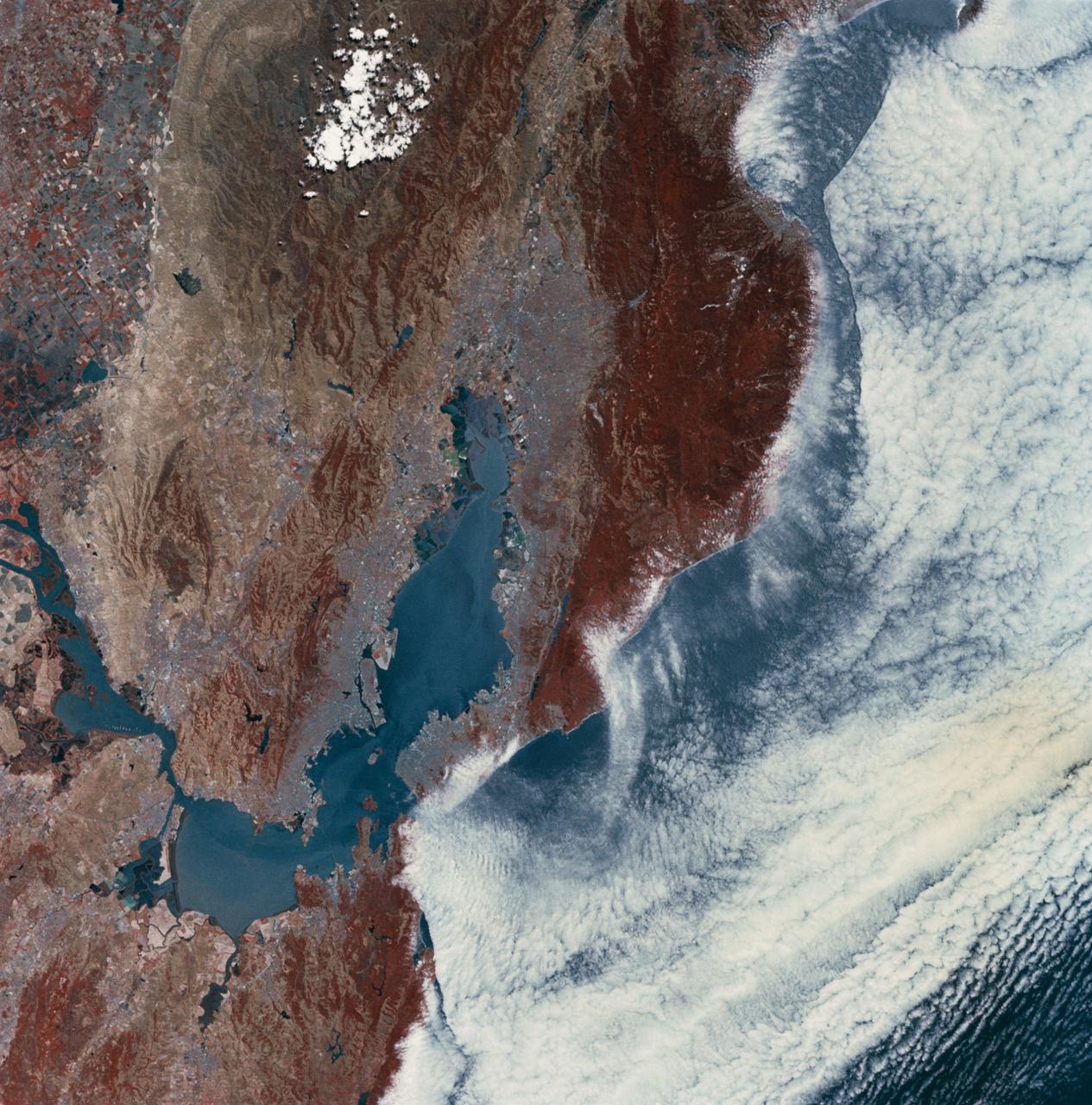
SL2-03-118 (June 1973) --- An infrared photograph of the San Francisco Bay, California area, taken from the Skylab 1/2 space station in Earth orbit. THE PICTURE SHOULD BE HELD WITH THE CLOUDS AND PACIFIC OCEAN ON THE LEFT. This photograph was taken by one of the six lenses of the Itek-furnished S190-A Multispectral Photographic Facility Experiment in the Multiple Docking Adapter of the space station. Type 2443 film was used. Note the thickly populated and highly developed area around the bay. Among the cities visible in this photograph are San Francisco, Oakland, Berkeley and San Jose. This view extends eastward to show a portion of the San Joaquin Valley. The S190-A experiment is part of the Skylab Earth Resources Experiment Package (EREP). Photo credit: NASA

DISCUSSING THEIR EXPERIENCES AND MEMORIES WITH THE MARSHALL TEAM AT THE 40TH ANNIVERSARY CELEBRATION OF SKYLAB JAN. 31 ARE, FROM LEFT, FORMER SKYLAB ASTRONAUTS ED GIBSON, SKYLAB 4 SCIENCE POLOT; PAUL WEITZ, SKYLAB 2 PILOT; WILLIAM POGUE, SKYLAB 4 PILOT; GERALD CARR, SKYLAB 4 COMMANDER; AND JOSEPH KERWIN, SKYLAB 2 SCIENCE PILOT
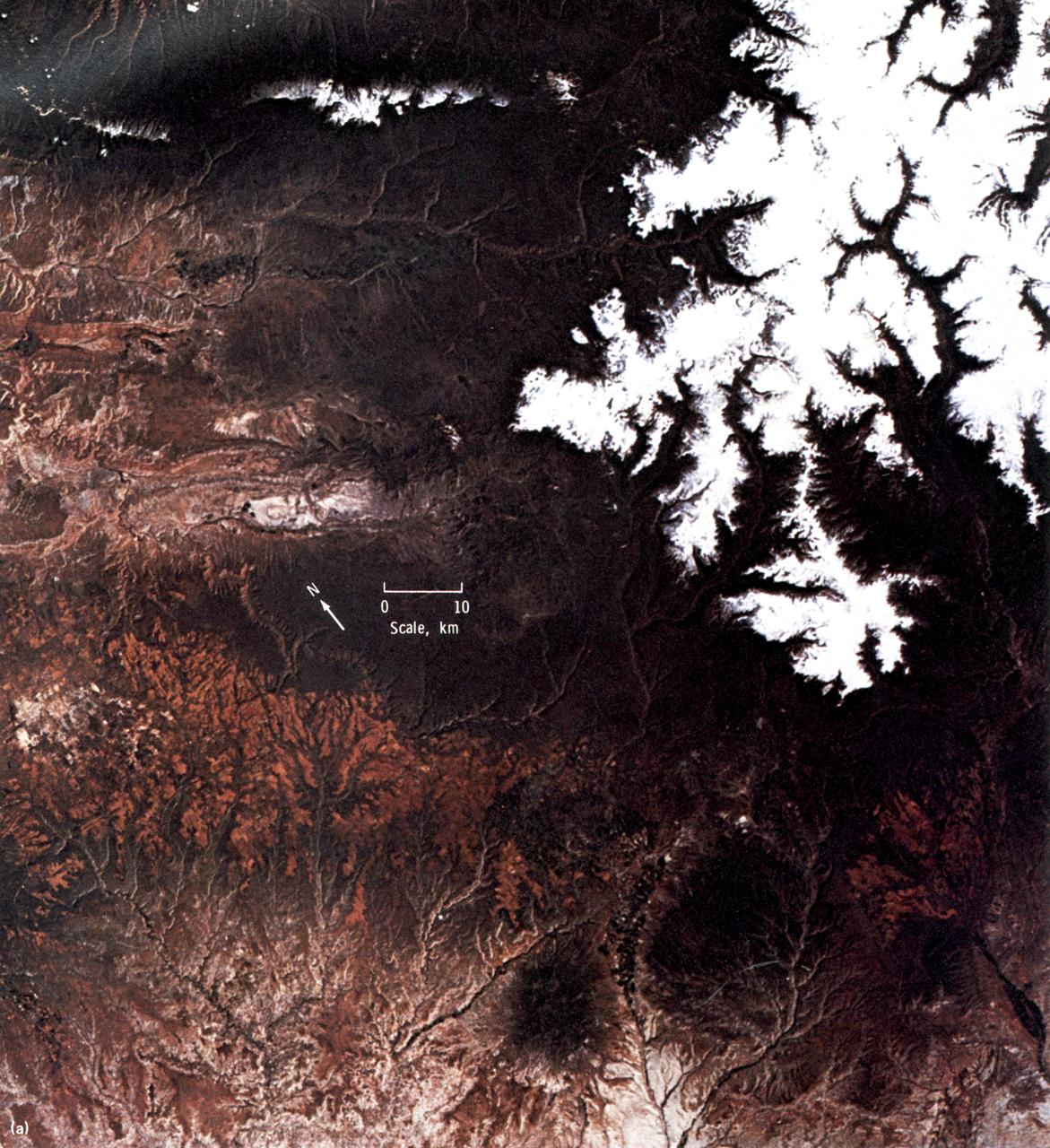
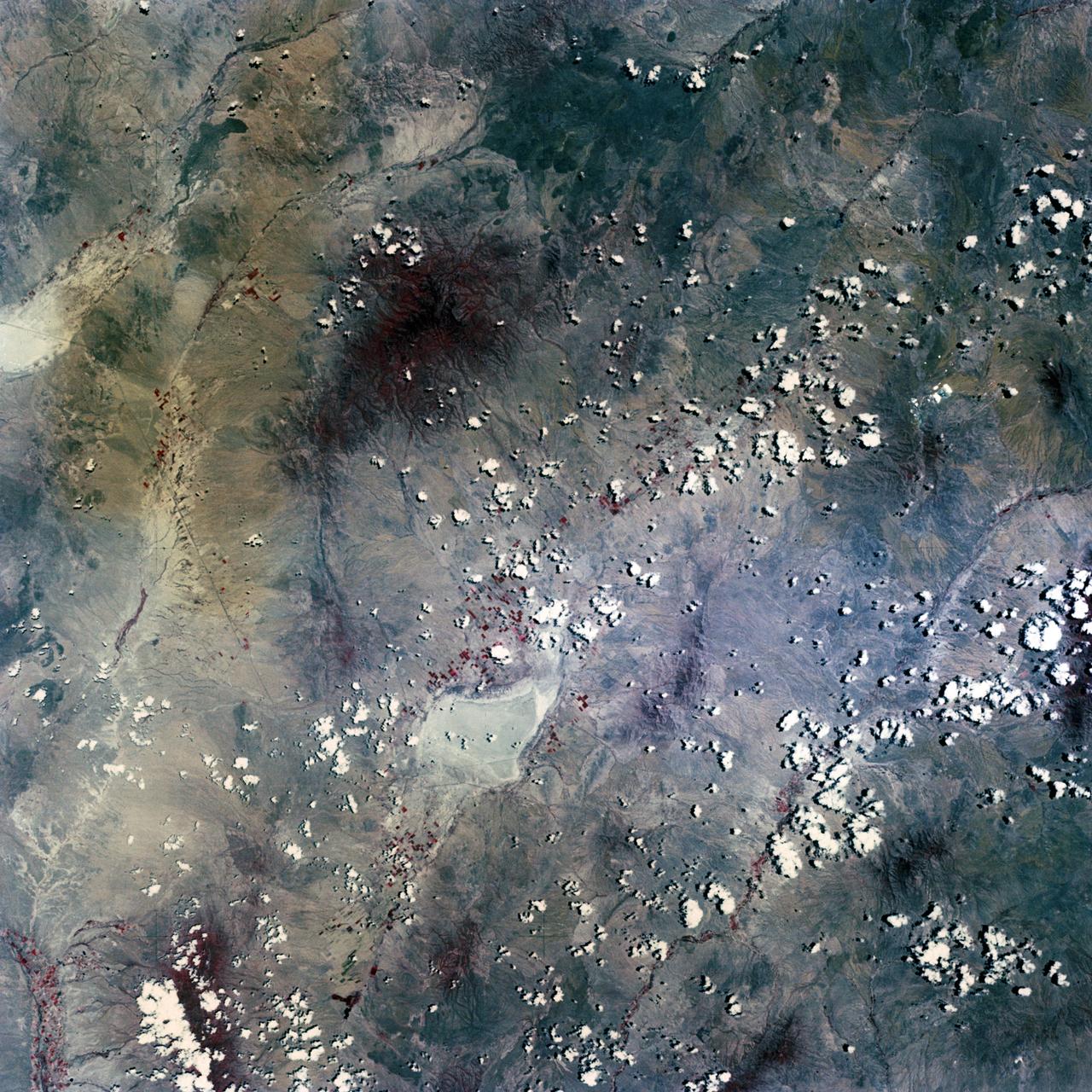
This EREP color photograph of the Uncompahgre Plateau area of Colorado was taken in June of 1973 by the Skylab Multi-spectral Photographic Camera (Skylab EREP Experiment S190A) of the Multi-spectral Photographic Facility during the Skylab-2 Mission.
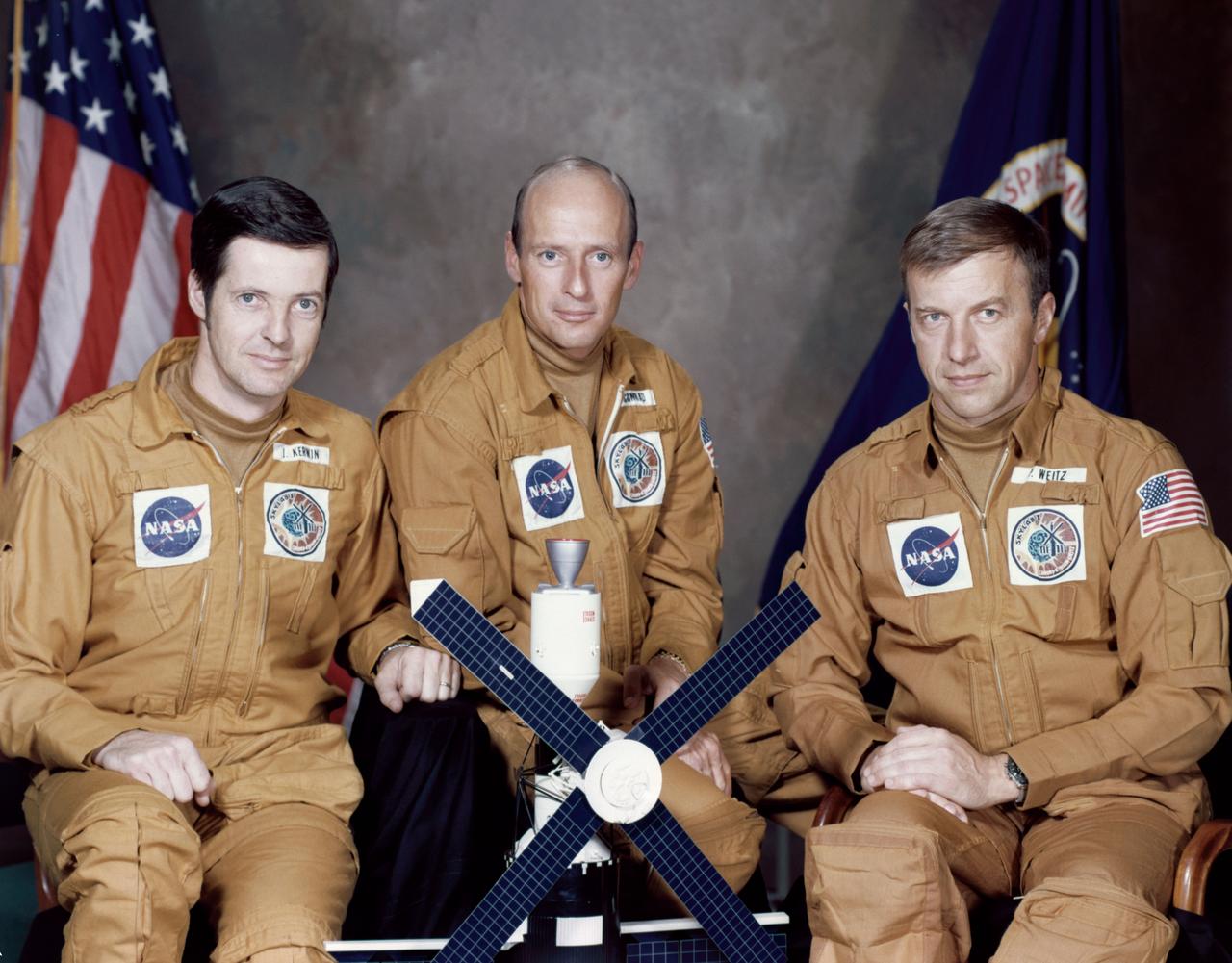
S73-24303 (May 1973) --- These three astronauts have been named by the National Aeronautics and Space Administration as the prime crew of the first manned Skylab mission. They are, left to right, Joseph P. Kerwin, science pilot; Charles Conrad Jr., commander; and Paul J. Weitz, pilot. Skylab is a three-part program consisting of one 28-day and two 56-day manned visits spanning an eight-month period. One day prior to the launch of this crew, the unmanned Skylab space station cluster will be launched and placed in Earth orbit. The first manned mission will last up to 28 days. Photo credit: NASA
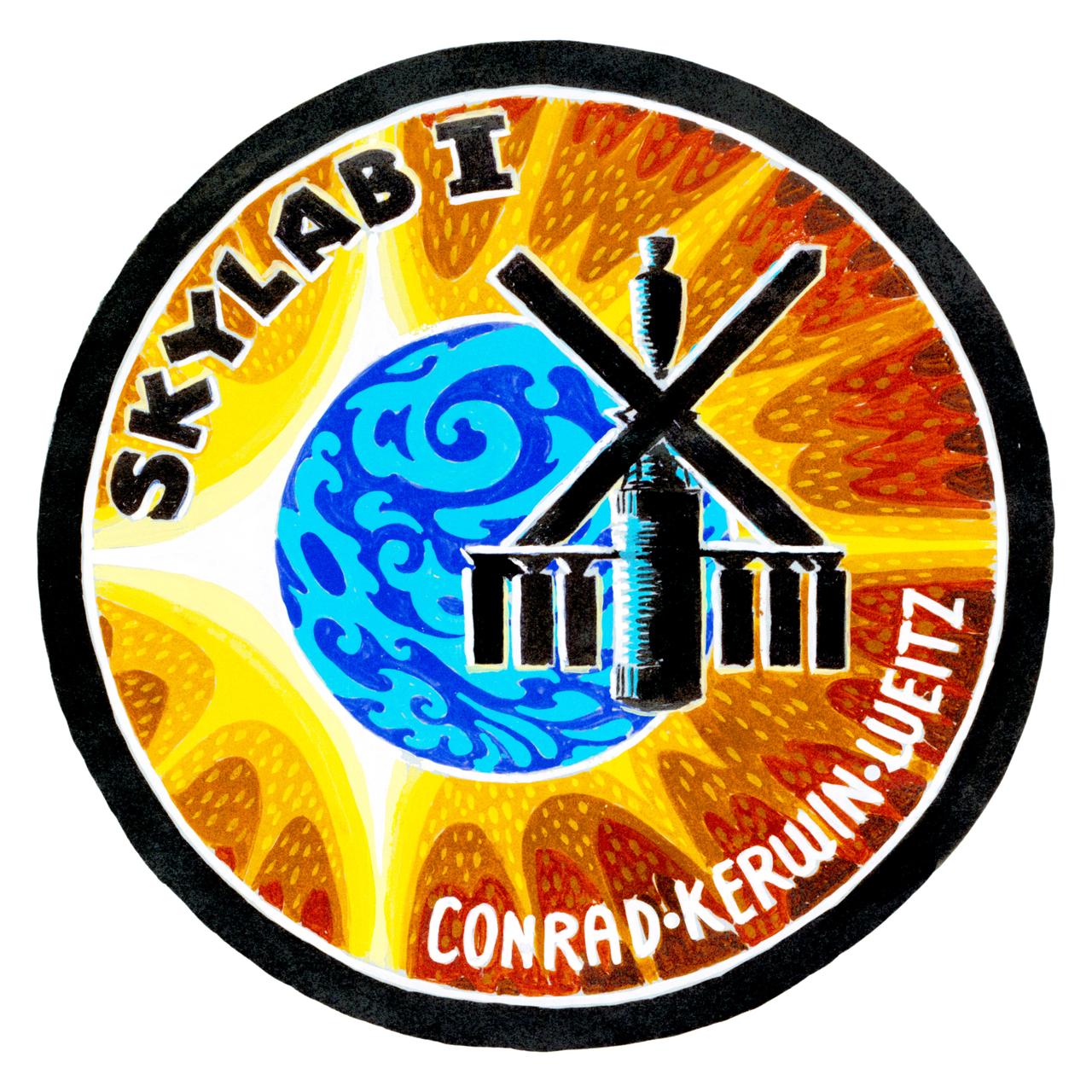
S72-52630 (February 1972) --- This is the emblem for the first manned Skylab mission. It will be a mission of up to 28 days. Skylab is an experimental space station consisting of a 100-ton laboratory complex in which medical, scientific and technological experiments will be performed in Earth orbit. The prime crew of this mission will be astronaut Charles Conrad Jr., commander; scientist-astronaut Joseph P. Kerwin, science pilot; and astronaut Paul J. Weits, pilot. The patch, designed by artist Kelly Freas, shows the Skylab silhouetted against the Earth's globe, which in turn is eclipsing the sun--showing the brilliant signet-ring pattern of the instant before the total eclipse. Photo credit: NASA
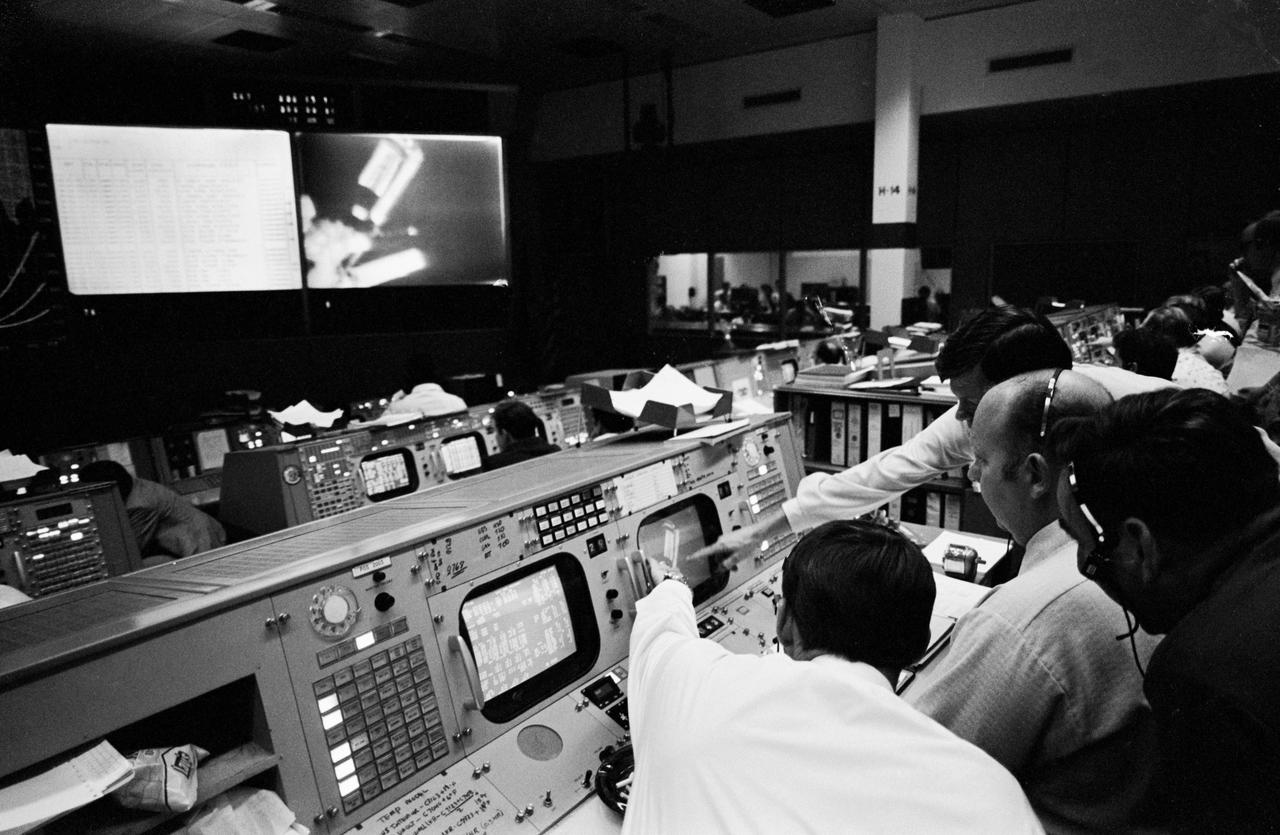
S73-26849 (25 May 1973) --- Four flight directors for the Skylab 1 and 2 mission are grouped around the flight director's console in the Mission Operations Control Room in the Mission Control Center at Johnson Space Center during the Skylab 2 Command/Service Module (CSM) "fly around" inspection of the Skylab 1 space station cluster. They are, going counterclockwise from center foreground, Donald R. Puddy (white shirt), Milton Windler, Philip C. Shaffer and M.P. Frank. A view of the Skylab 1 Orbital Workshop seen from the Skylab 2 CSM is visible on the television monitor in the background. Photo credit: NASA
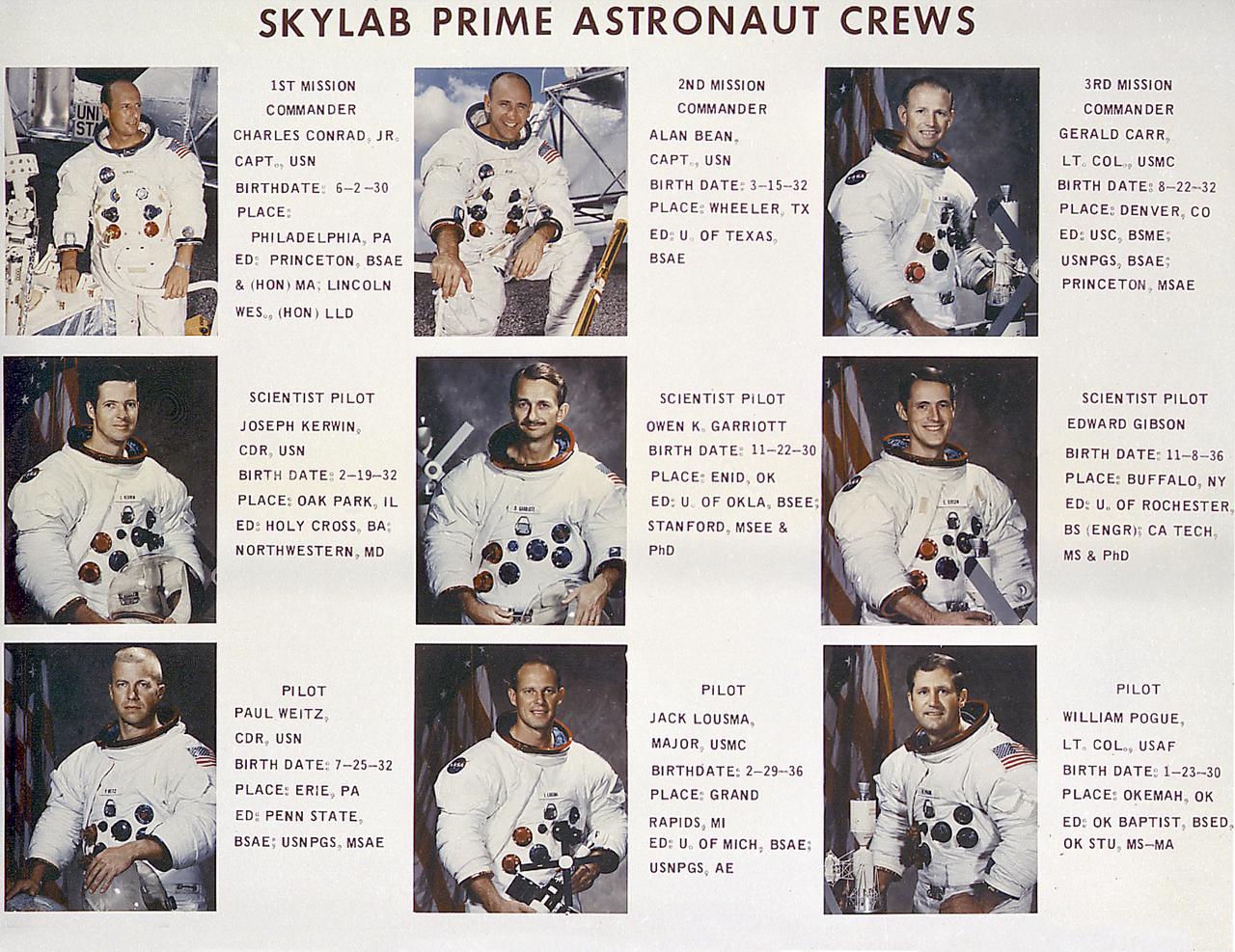
This photograph is a montage of astronaut crews for the three Skylab missions with simple biographical data of each astronaut. The 1st mission was designated as Skylab-2, 2nd mission as Skylab-3, and 3rd mission as Skylab-4. The Skylab-1 mission placed the Skylab Orbital Work Shop in orbit by a modified Saturn V launch vehicle. Skylab's 3 different 3-man crews spent up to 84 days in Earth orbit and performed a variety of more than 100 experiments.
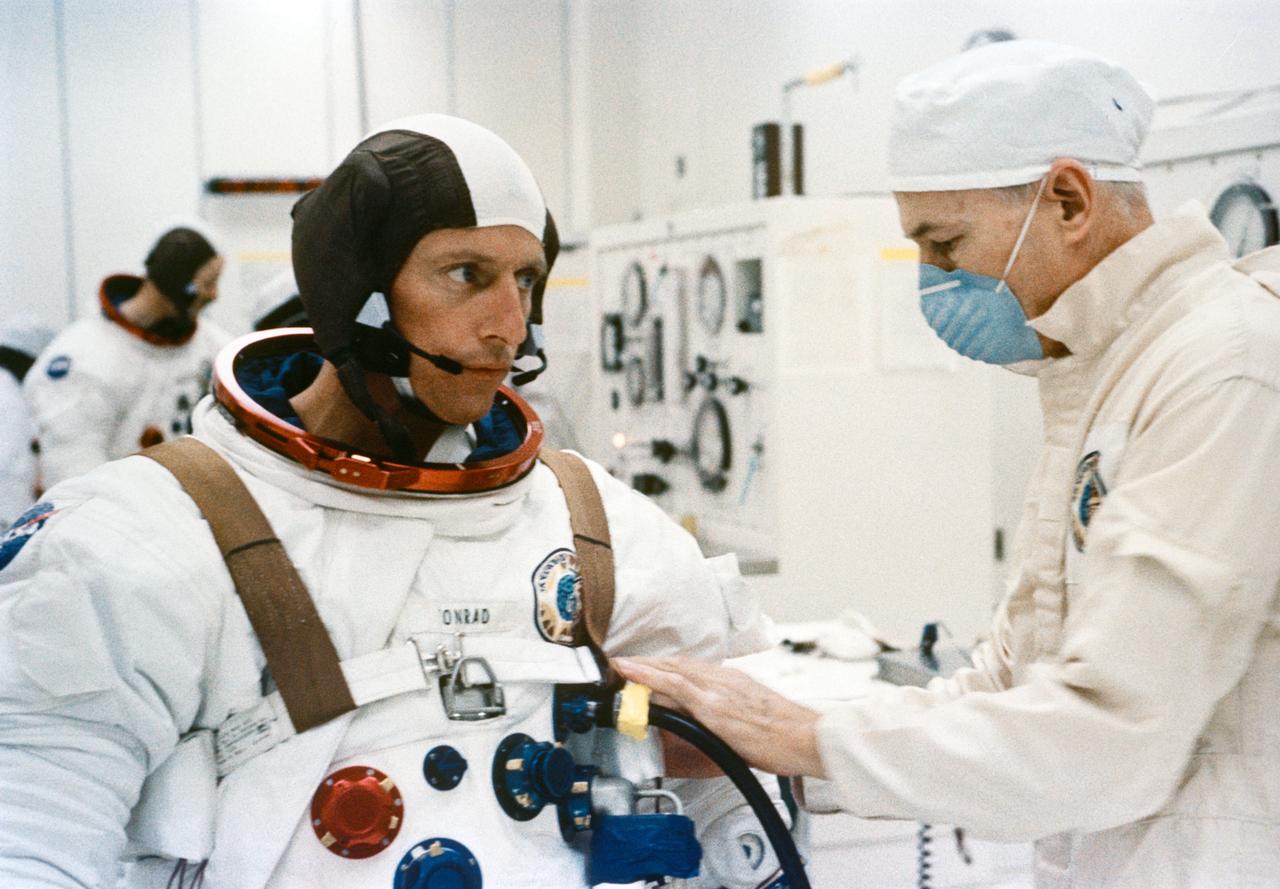
S73-25901 (25 May 1973) --- Astronaut Charles Conrad Jr., commander of the Skylab 2 mission, is suited up in the Manned Spacecraft Operations Building at the Kennedy Space Center during Skylab 2 prelaunch preparations. Skylab 2, with astronauts Conrad, Joseph P. Kerwin and Paul J. Weitz aboard, was launched from KSC's Pad B, Launch Complex 39, at 9:00 a.m. (EDT), May 25, 1973. Photo credit: NASA
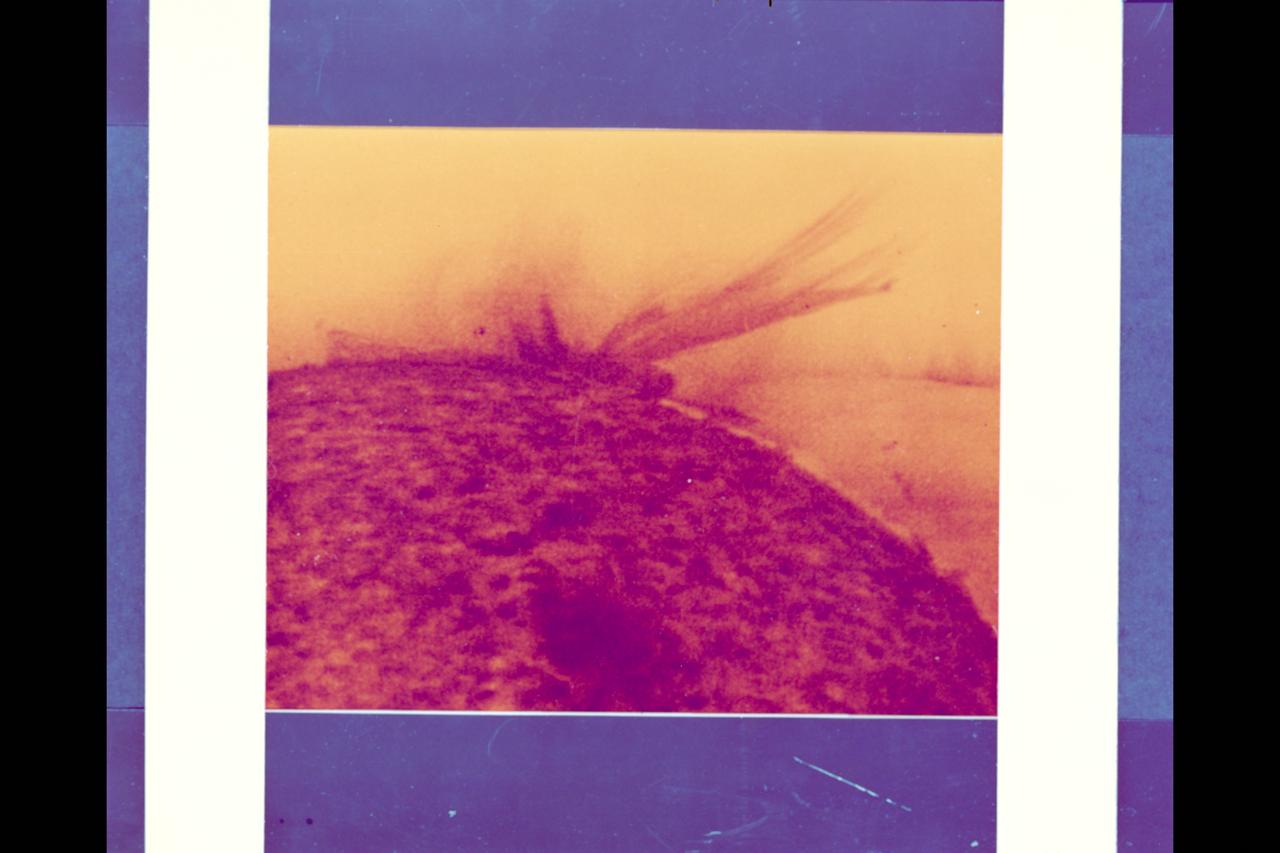
Photograph by Skylab 2 Solar eruption (flare)
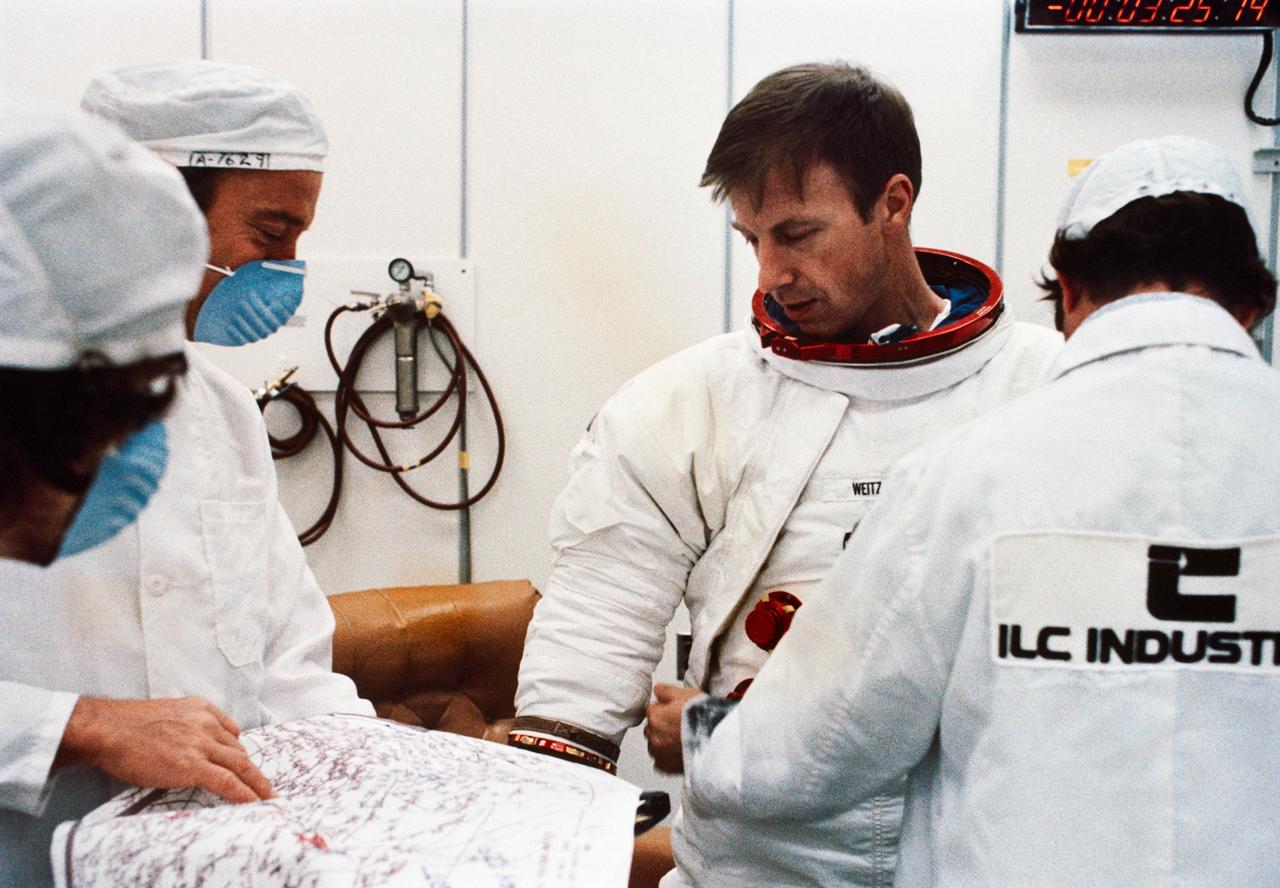
S73-25898 (25 May 1973) --- Astronaut Paul Weitz, pilot of the Skylab 2 mission, is suited up in the Manned Spacecraft Operations Building at the Kennedy Space Center during Skylab 2 prelaunch preparations. Photo credit: NASA
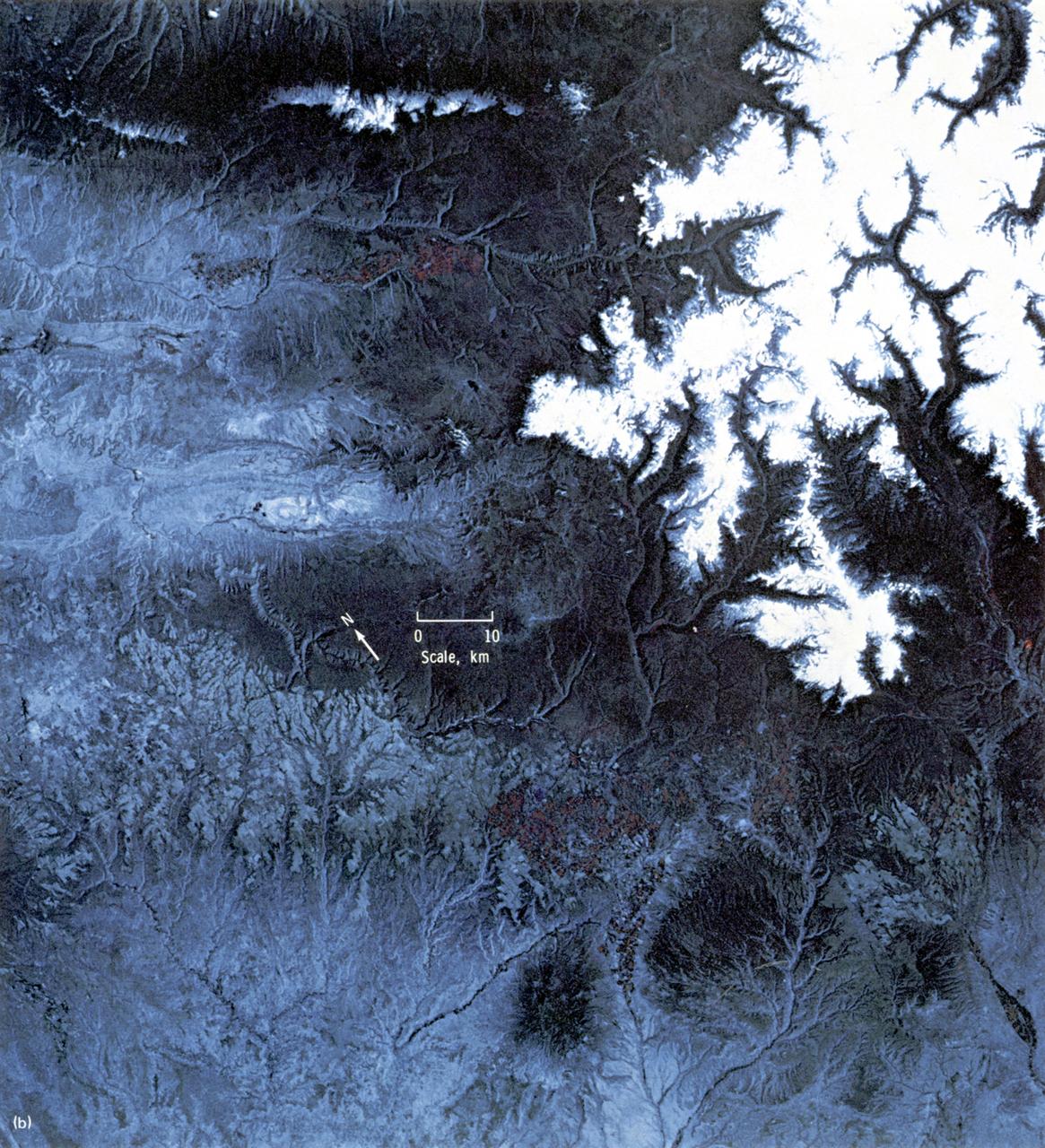
This EREP color infrared photograph of the Uncompahgre Plateau area of Colorado was taken in June of 1973 by the Earth Terrain Camera (Skylab EREP Experiment S190B) of the Skylab's Multi-spectral Photographic Facility during the Skylab-2 mission. Skylab stereoscopic data provided the best identification of vegetation complexes and delineation of vegetation boundaries, particularly in areas where changes in relief were related to changes in vegetation type (a common occurrence in wild-land vegetation communities).
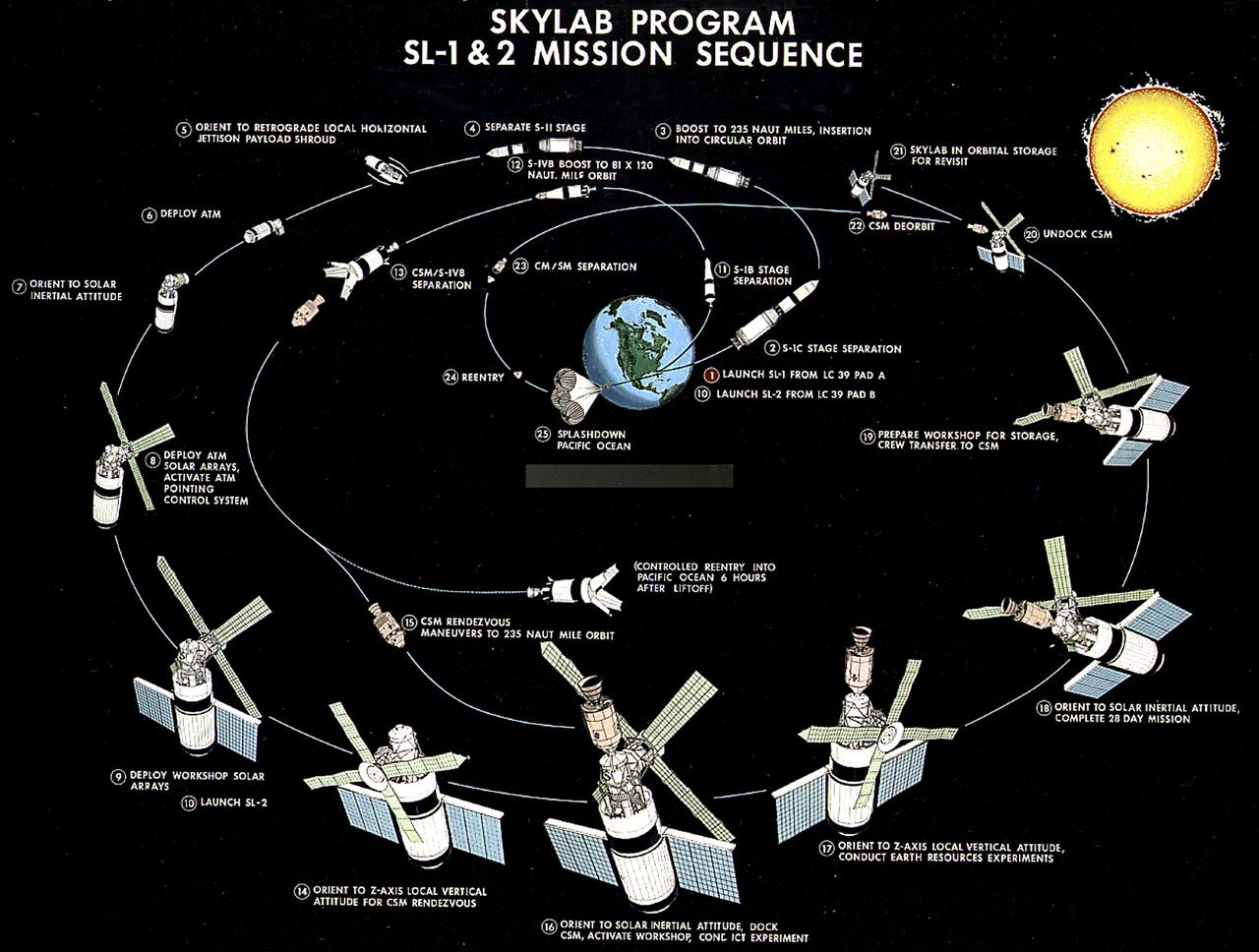
This illustration depicts the Skylab-1 and Skylab-2 mission sequence. The goals of the Skylab were to enrich our scientific knowledge of the Earth, the Sun, the stars, and cosmic space; to study the effects of weightlessness on living organisms, including man; to study the effects of the processing and manufacturing of materials utilizing the absence of gravity; and to conduct Earth resource observations. The Skylab also conducted 19 selected experiments submitted by high school students. Skylab's 3 different 3-man crews spent up to 84 days in Earth orbit. The Marshall Space Flight Center (MSFC) had responsibility for developing and integrating most of the major components of the Skylab: the Orbital Workshop (OWS), Airlock Module (AM), Multiple Docking Adapter (MDA), Apollo Telescope Mount (ATM), Payload Shroud (PS), and most of the experiments. MSFC was also responsible for providing the Saturn IB launch vehicles for three Apollo spacecraft and crews and a Saturn V launch vehicle for the Skylab.
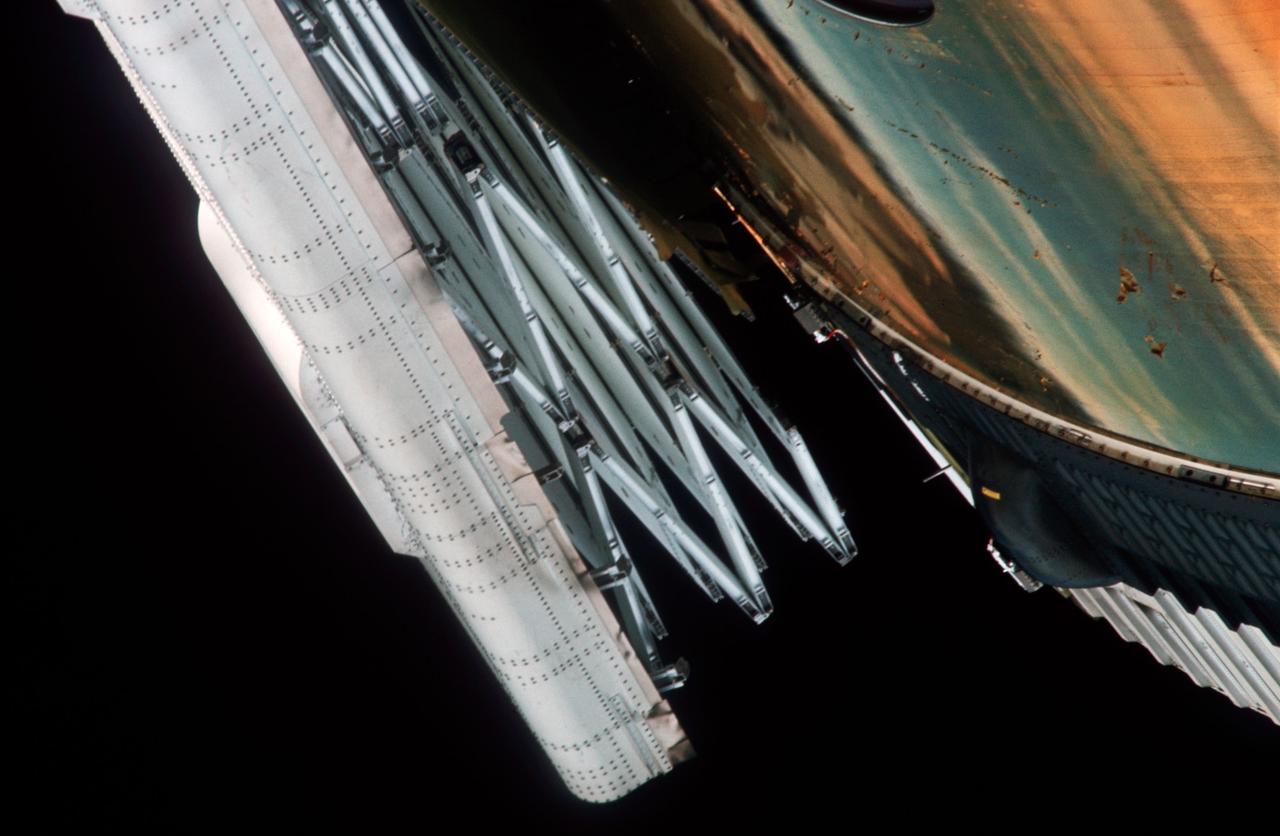
Close-up view of partially deployed, damaged solar array before astronauts performed extravehicular activity (EVA) to completey deploy it.
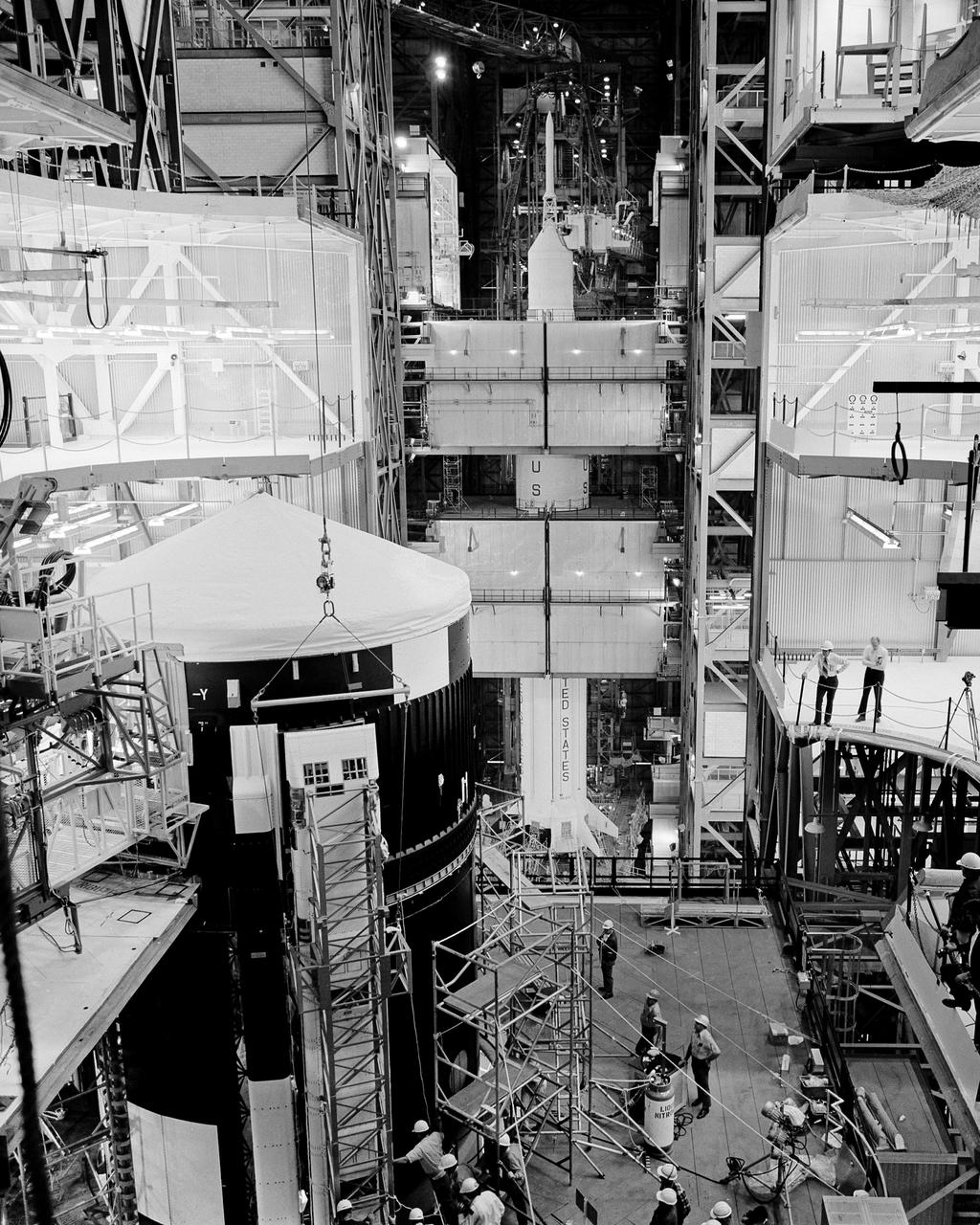
CAPE KENNEDY, Fla. -- At the Kennedy Space Center in Florida, one of Skylab 1's solar cell arrays is installed on the orbital space station in High Bay 2 of the Vehicle Assembly Building. Skylab 2 launch vehicle is in high bay 1, visible in the background. Each of the two solar cell arrays on the space station that will be deployed in orbit is designed to provide 10,500 watts of power. All power needed to operate the station and the Apollo Telescope mount will be taken from the arrays. Each array will have almost 1,177 square feet of surface area to turn sunlight into electrical power. Skylab 1 is schedule for launch April 30, 1973 and Skylab 2, carrying the astronauts Charles Conrad Jr., Dr. Joseph P. Kerwin and Paul J. Weitz to dock with the space station and enter it to live and work for 28 days, will be launched a day later. Photo Credit: NASA
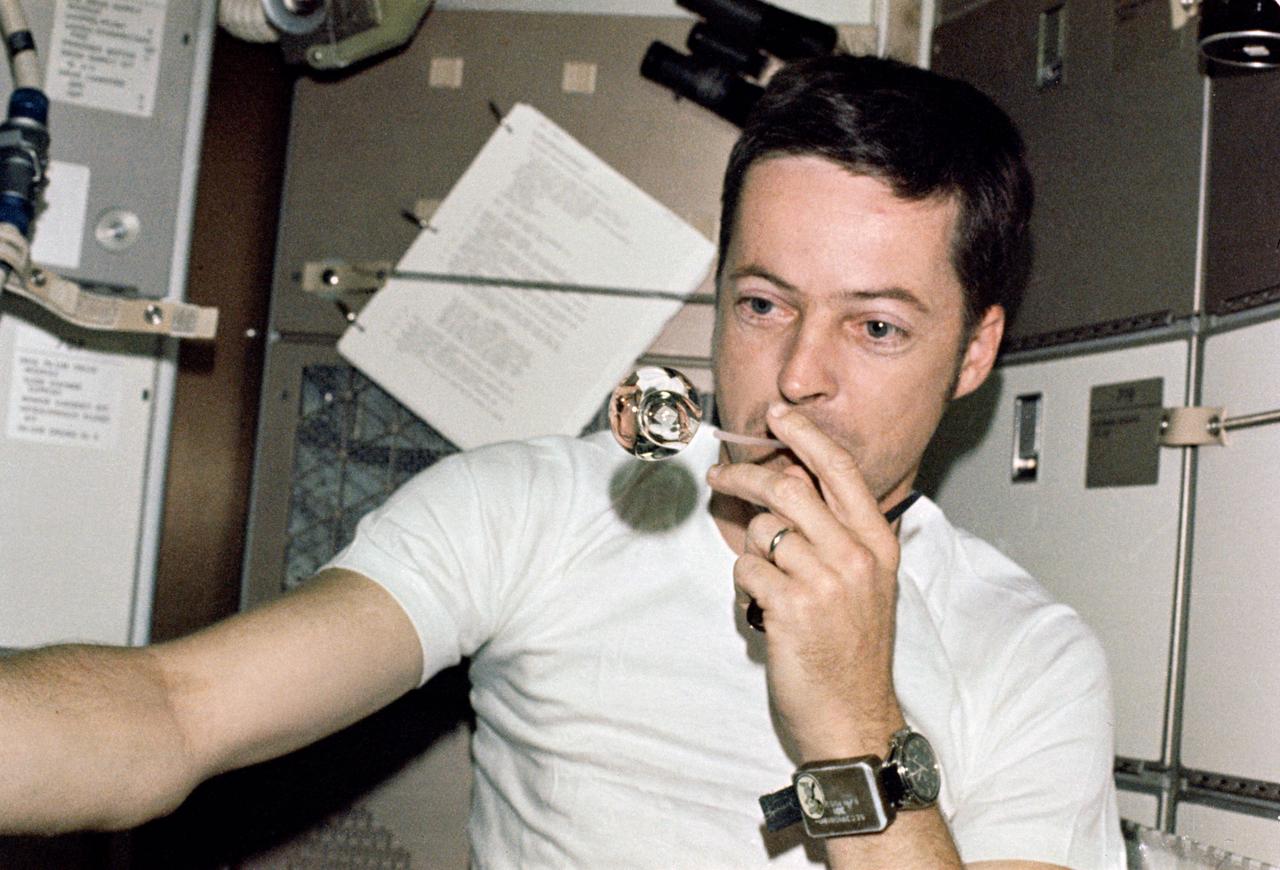
SL2-X9-730 (1 June 1973) --- Scientist-astronaut Joseph P. Kerwin, Skylab 2 science pilot, forms a perfect sphere by blowing water droplets from a straw in zero-gravity. He is in the crew quarters of the Skylab Orbital Workshop. Photo credit: NASA
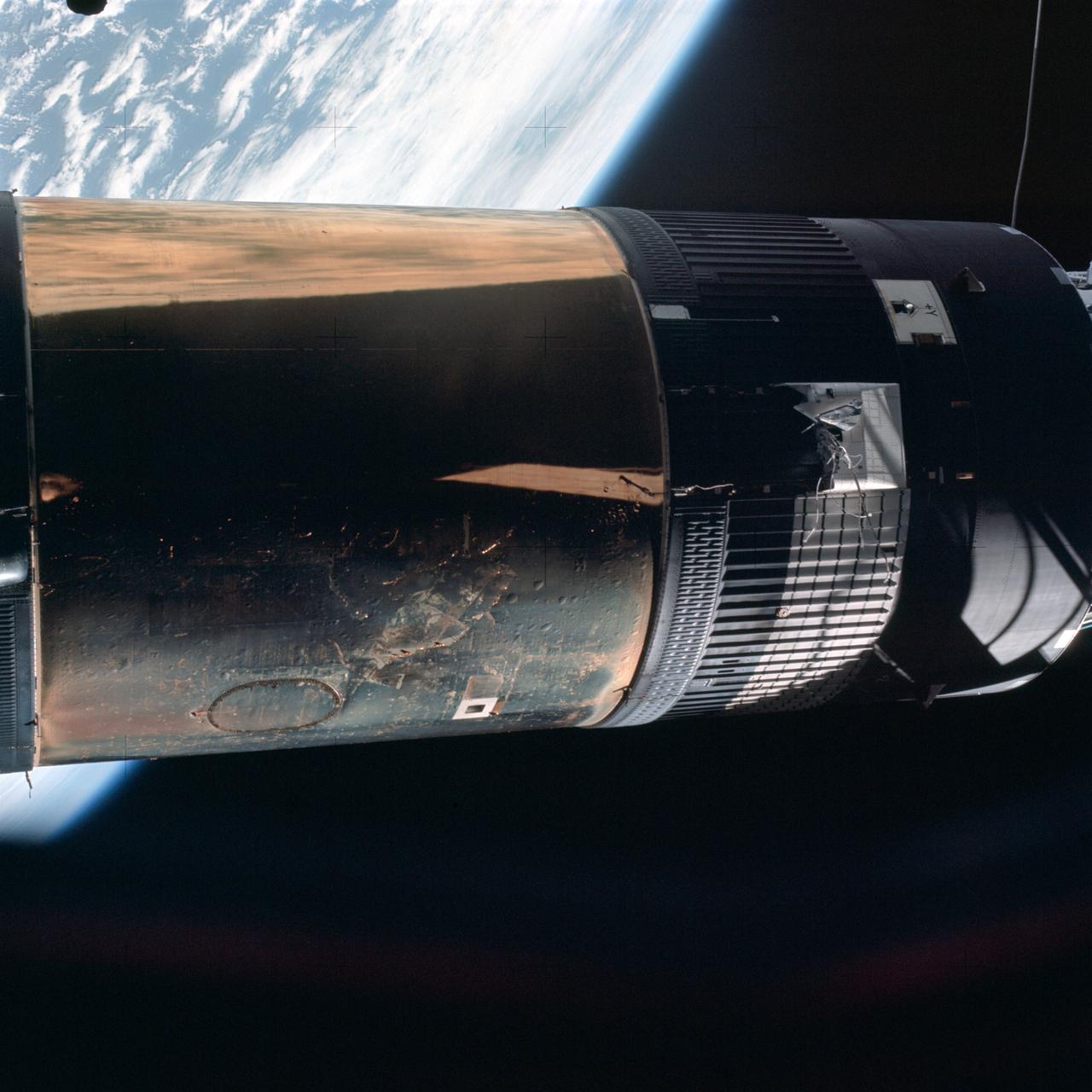
SL2-X4-256 (25 May 1973) --- This photo, made at long range from the command module during Skylab 2's approach to the Skylab complex during fly-around inspection, features the orbital workshop with the area of the missing micrometeoroid shield visible. Photo credit: NASA
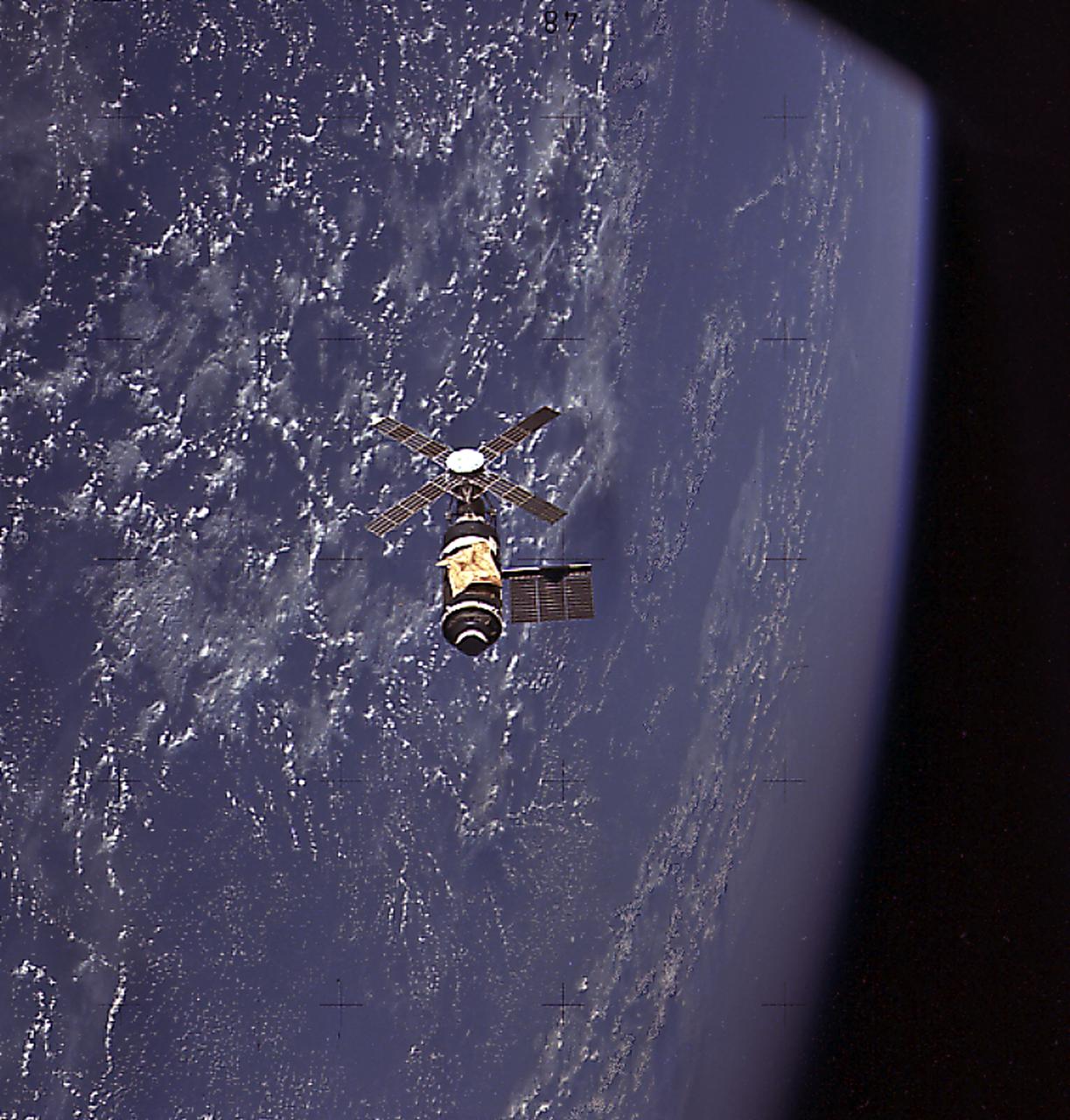
This image of Skylab in orbit was taken by the Skylab-2 crew before departing for Earth. The crew made a careful visual and photographic inspection of the orbiting laboratory. It shows the parasol sunshade, deployed by the crew, protecting the workshop. While unmarned, it operated at reduced power with many of its systems either inoperative or operating at reduced capacity.
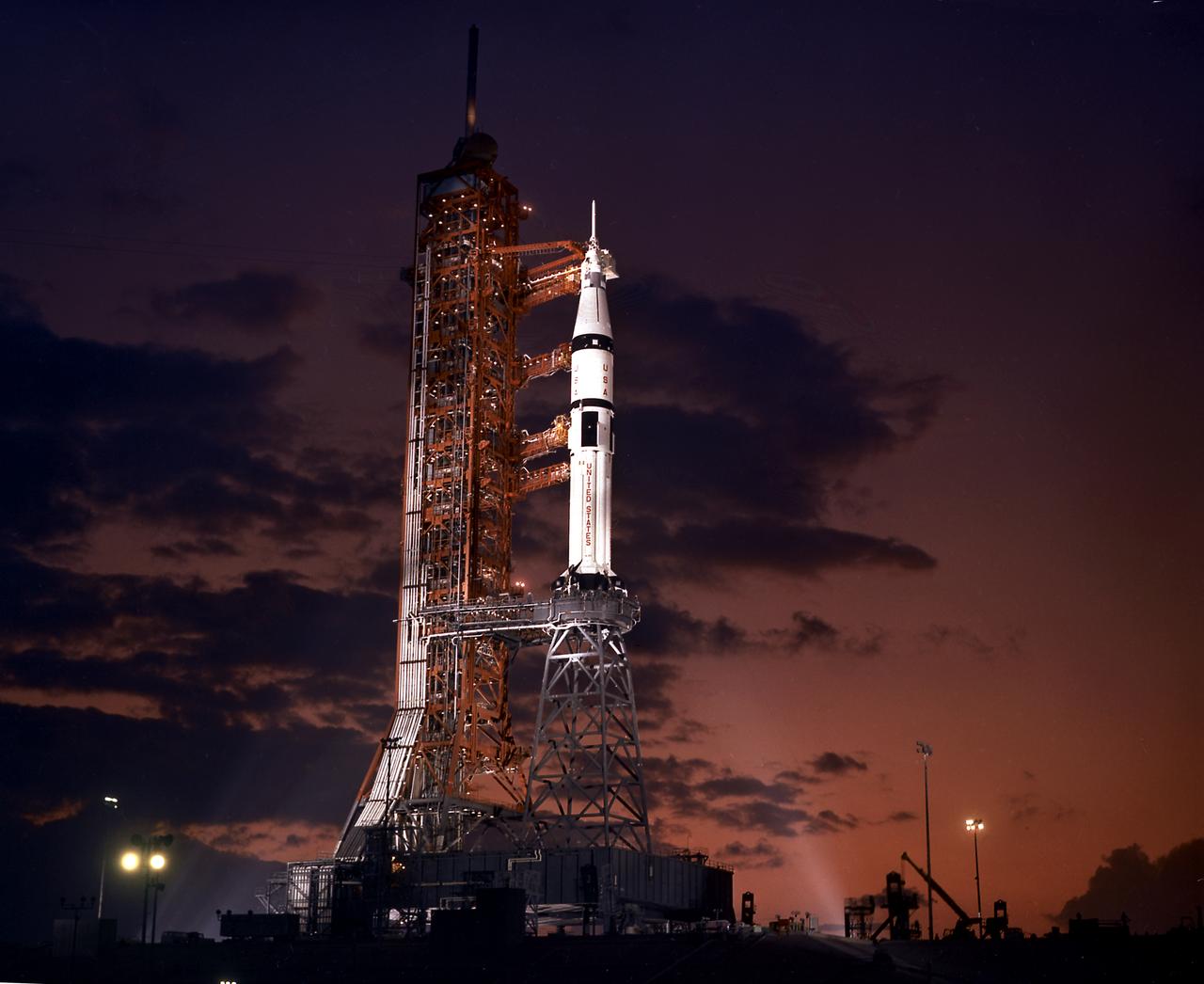
SA-210 Apollo-Soyuz Test Project (ASTP) awaits the launch scheduled on July 15, 1975 on the launch pad at the Kennedy Space Center, the ASTP mission with astronauts Thomas Stafford, Vance Brand, and Donald "Deke" Slayton. The Saturn IB, developed under the direction of the Marshall Space Flight Center (MSFC), launched five manned Earth-orbital missions between 1968 and 1975: Apollo 7, Skylab 2, Skylab 3, Skylab 4, and the Apollo-Soyuz Test Project .
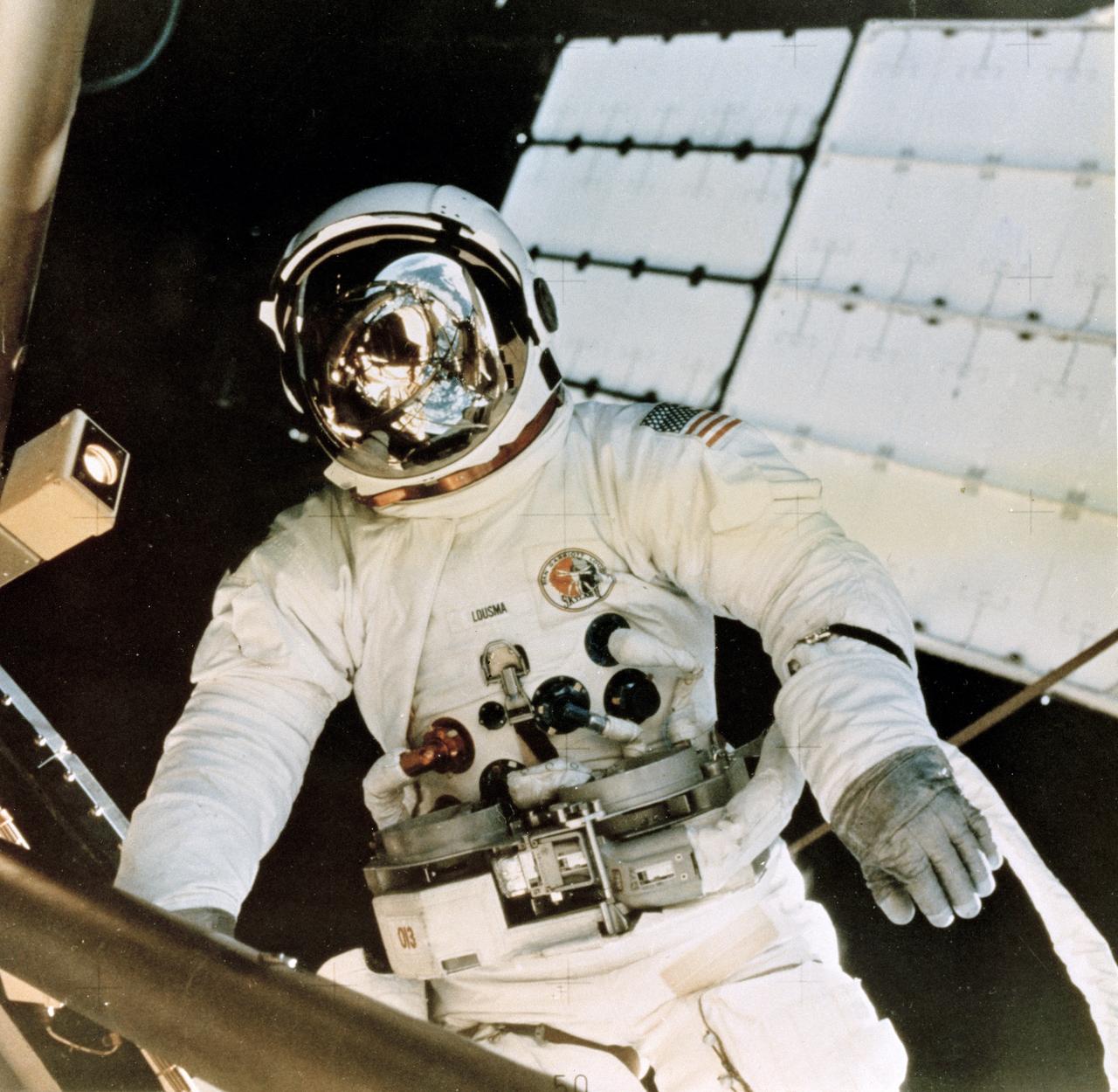
Skylab-3 was the second marned mission in the skylab project. The crew spent 59 days in orbit. In this photo, Astronaut Jack Lousma deploys the Twin Pole Sun Shield created by Marshall Space Flight Center team members to replace the micrometeoroid shield, a thin protective cylinder surrounding the workshop protecting it from tiny space particles and the sun's scorching heat. The shield was damaged during the Skylab-2 mission.
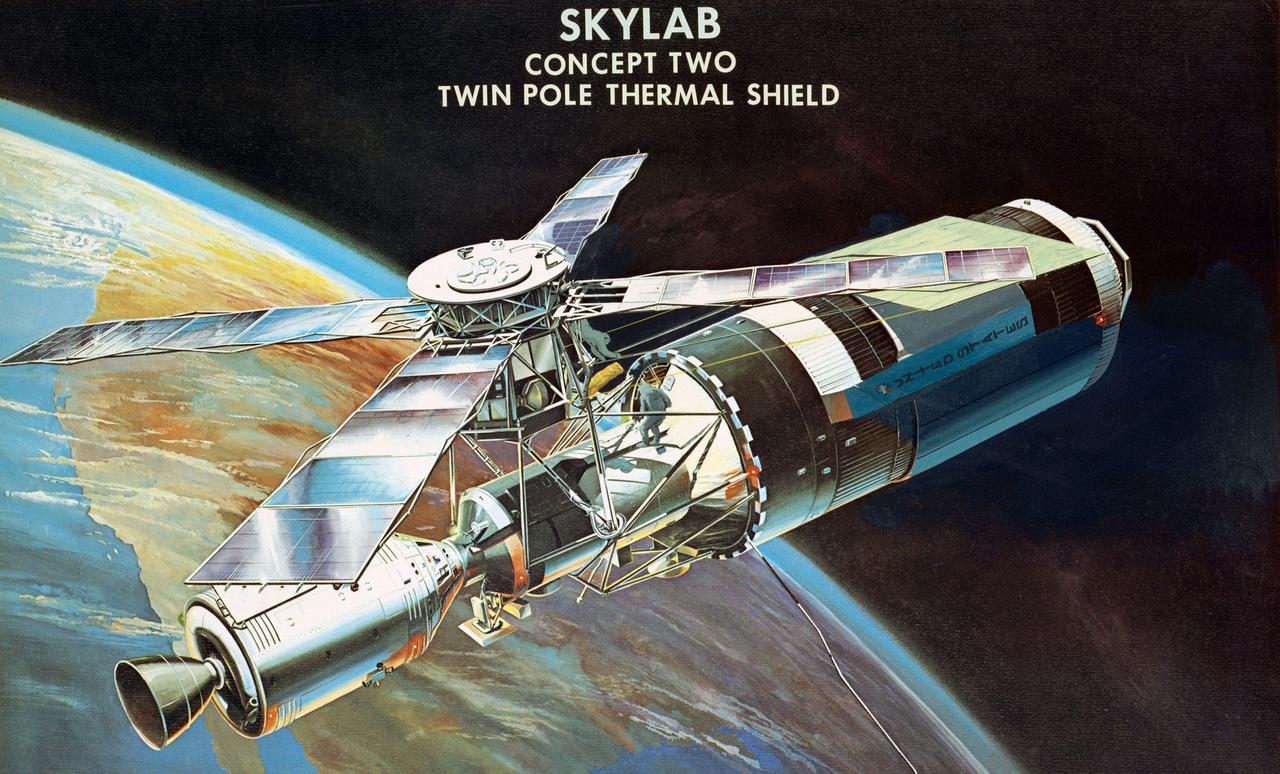
S73-26127 (1973) --- An artist's concept of the Skylab space station cluster in Earth orbit illustrating the deployment of the twin pole thermal shield to shade the Orbital Workshop (OWS) from the sun. This is one of the sunshade possibilities considered to solve the problem of the overheated OWS. Here the two Skylab 2 astronauts have completely deployed the sunshade. Note the evidence of another Skylab problem - the solar panels on the OWS are not deployed as required. Photo credit: NASA
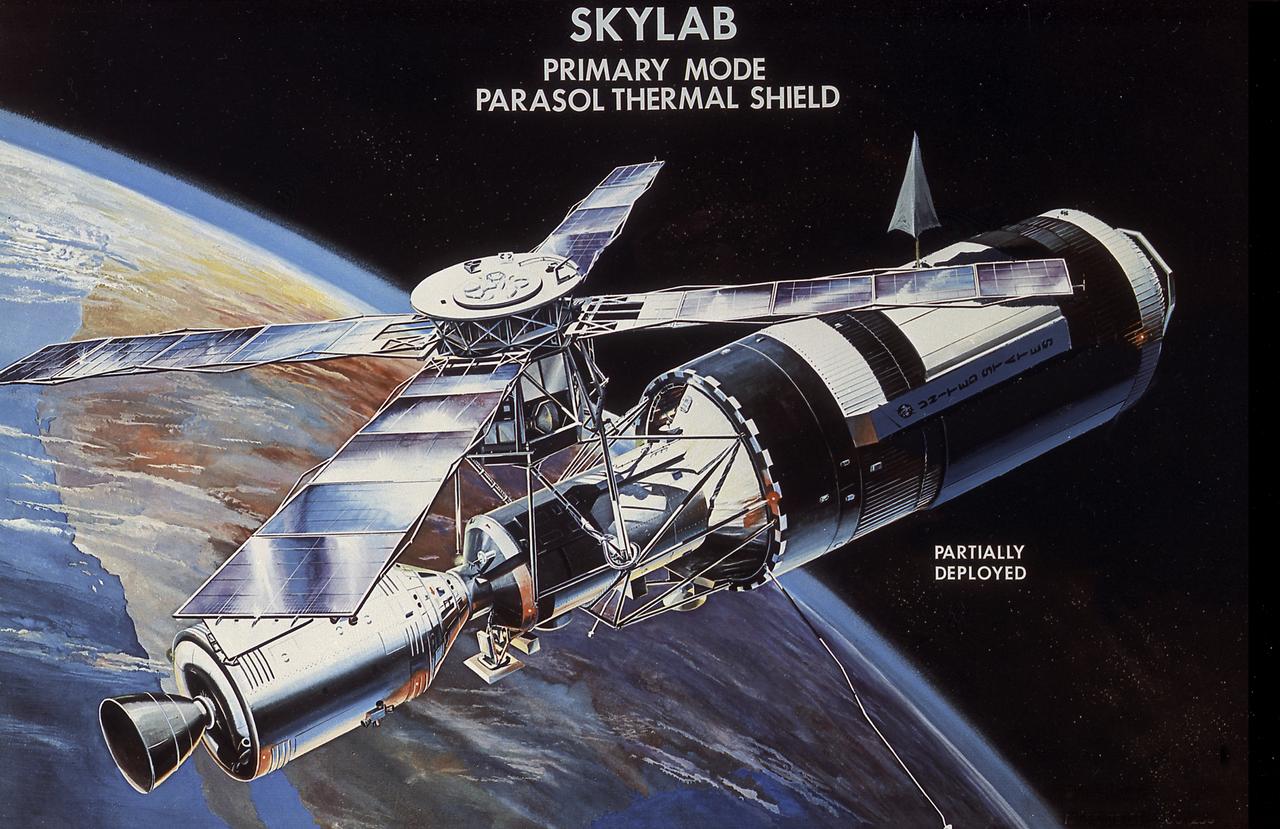
This image illustrates the deployment of the Skylab parasol thermal shield. Skylab lost its thermal protection shield during its launch on May 14, 1973. The Skylab-2 crew deployed a parasol thermal shield to protect the workshop from overheating. The crew attached the canister containing the parasol to the scientific airlock and extended the folded shield through the opening and into space. Slowly, the struts extended and the sunshade took shape and was in place over the workshop's outer surface. This illustration shows the parasol at partial extension. Emergency procedures to repair and salvage the damaged Skylab were a joint effort of the Marshall Space Flight Center, other NASA centers, and contractors.
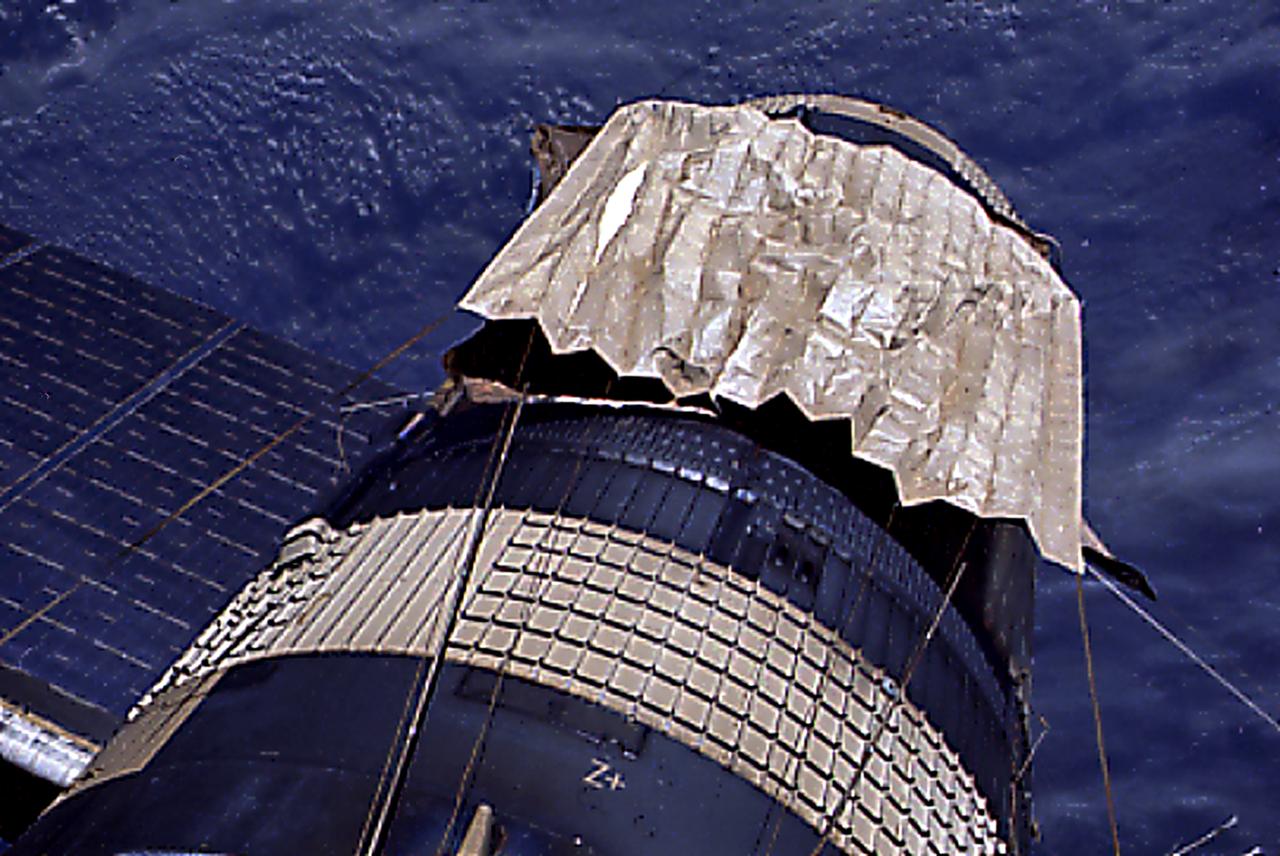
Shortly after liftoff on May 14, 1973, atmospheric drag tore off the thin metallic shield of Skylab that was designed to protect her from micro-meteorites and the Sun's intense heat. The Skylab-2 crew deployed a parasol sunshield to protect the orbiting laboratory. Concern over the possibility that materials used for the parasol would deteriorate with prolonged exposure to the Sun's rays prompted the installation of a second sunshield during the Skylab-3 mission. This time, the crew exited the space station and installed a twin-pole device to position the shield over the parasol. This photograph was taken by the Skylab-4 mission.
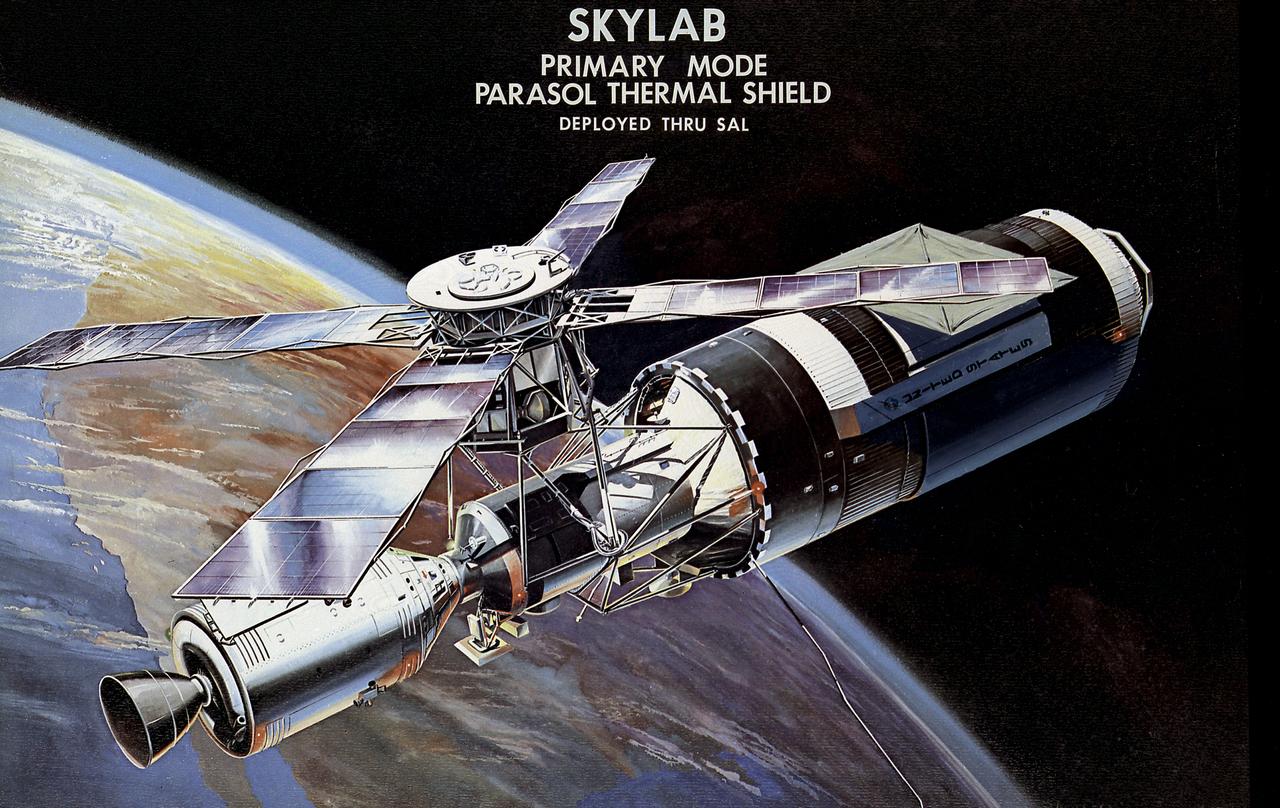
This image illustrates the deployment of the Skylab parasol thermal shield. Skylab lost its thermal protection shield during its launch on May 14, 1973. The Skylab-2 crew deployed a parasol thermal shield to protect the workshop from overheating. The crew attached the canister containing the parasol to the scientific airlock and extended the folded shield through the opening and into space. Slowly, the struts extended, the sunshade took shape, and was in place over the workshop's outer surface. This illustration shows the parasol being fully deployed and retracted for service. Emergency procedures to repair and salvage the damaged Skylab were a joint effort of the Marshall Space Flight Center, other NASA centers, and contractors.
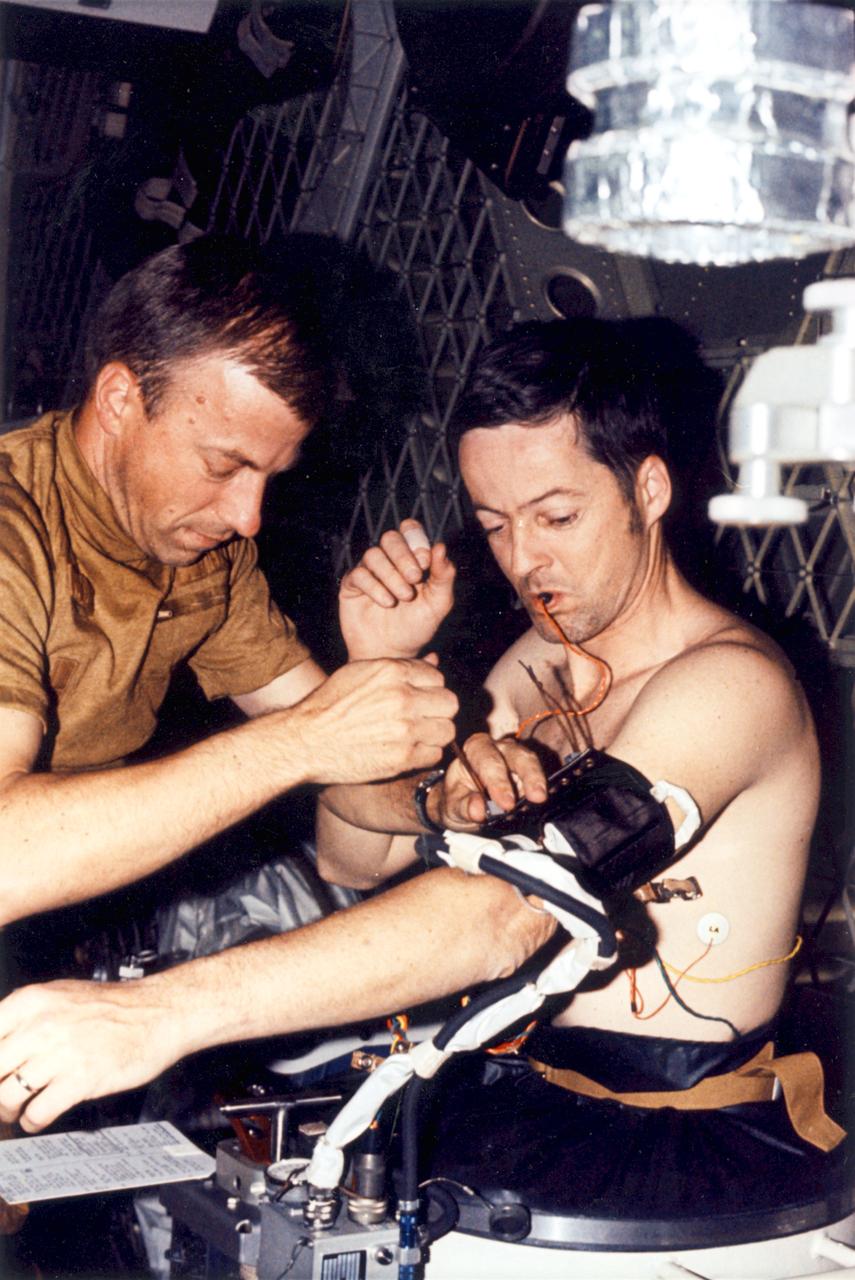
Astronaut Weitz assists Astronaut Kerwin with blood pressure cuff. Skylab-2 mission duration 5/25/73 thru 6/22/73.
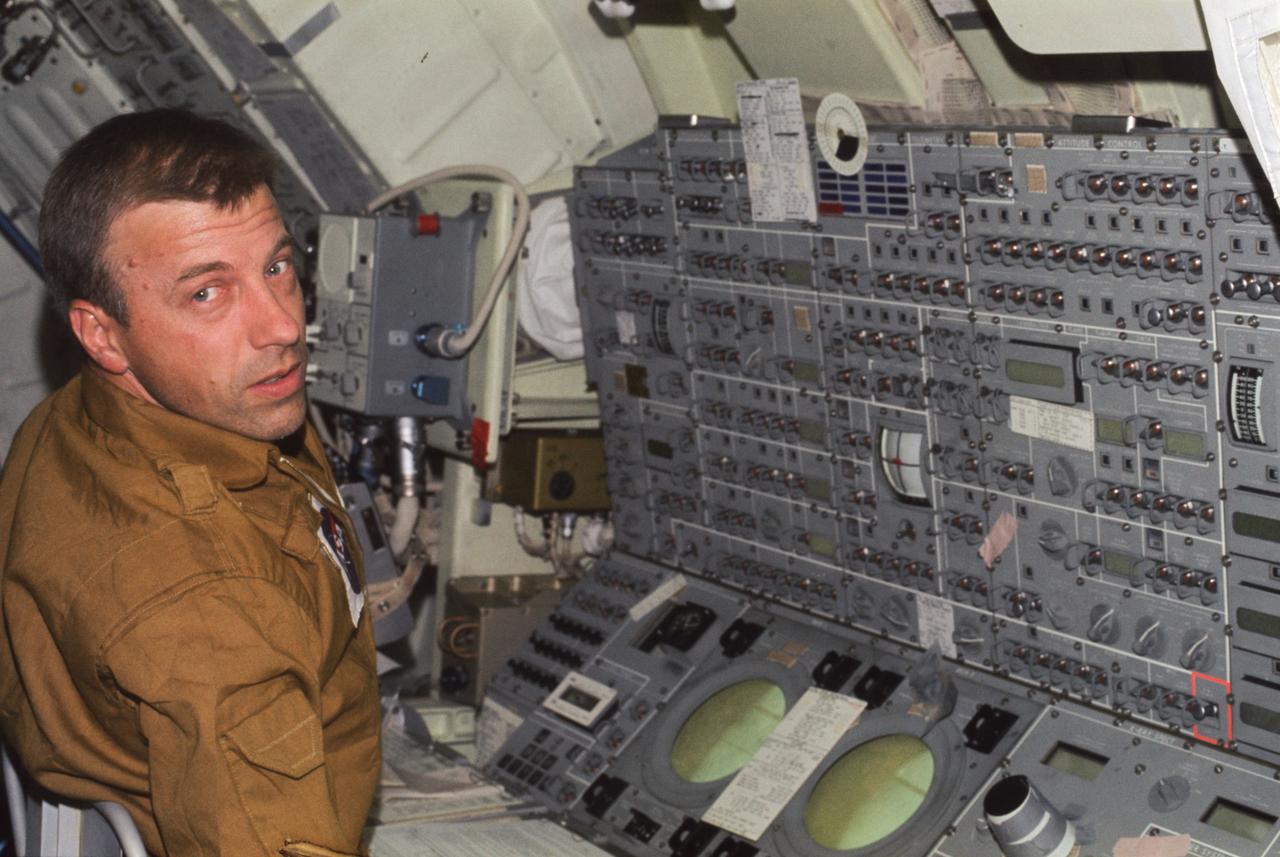
SL2-X9-747 (June 1973) --- Astronaut Paul J. Weitz, Skylab 2 pilot, mans the control and display console of the Apollo Telescope Mount (ATM) in this onboard view photographed in Earth orbit. The ATM C&D console is located in the Multiple Docking Adapter (MDA) of the Skylab 1/2 space station. Weitz, along with astronaut Charles Conrad Jr., commander, and scientist-astronaut Joseph P. Kerwin, science pilot, went on to successfully complete a 28-day mission in Earth orbit. Photo credit: NASA
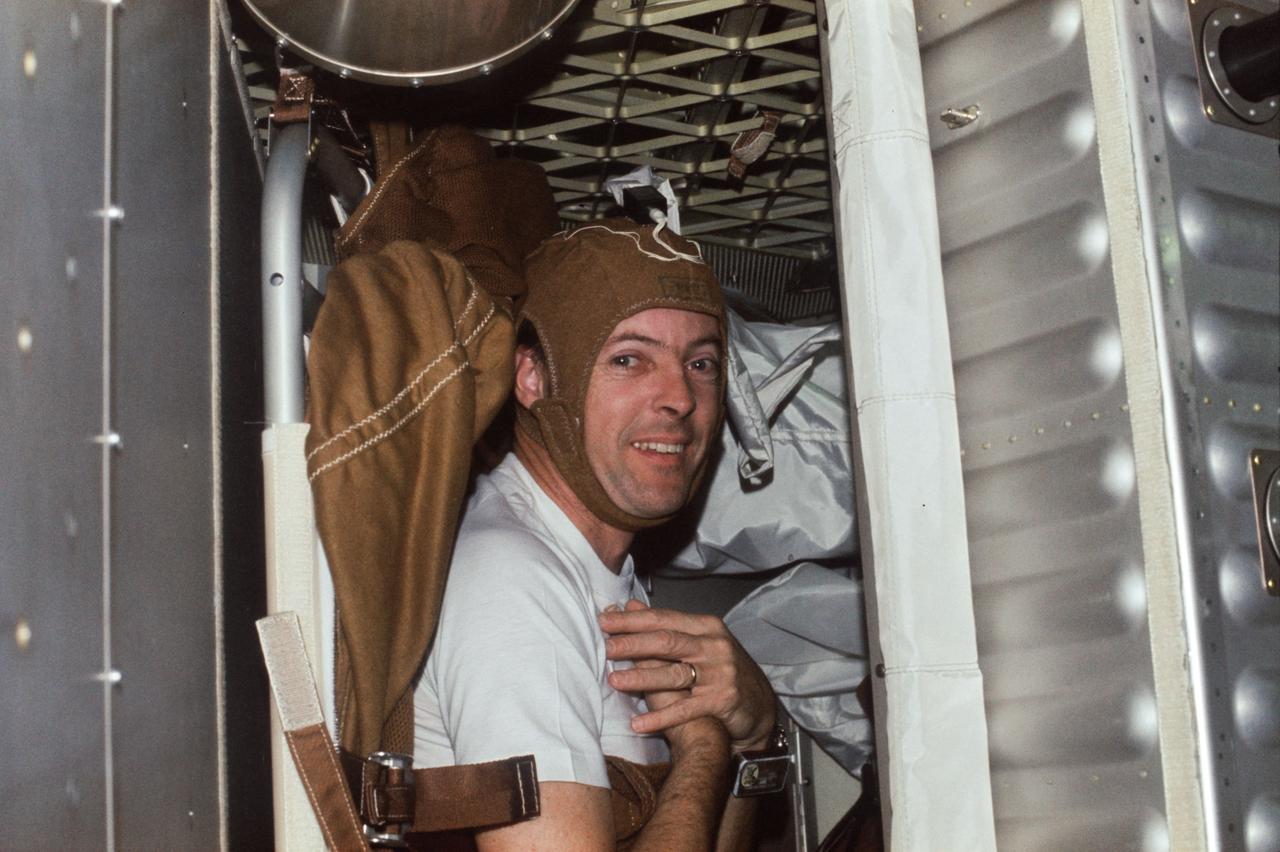
SL2-X3-205 (June 1973) --- Scientist-astronaut Joseph P. Kerwin, Skylab 2 science pilot, is photographed strapped into the sleep restraint in the crew quarters of the Orbital Workshop of the Skylab 1 & 2 space station cluster in Earth orbit. Kerwin is wearing the special cap which contains biomedical instrumentation for the M133 Sleep Monitoring Experiment. The purpose of the M133 experiment is to evaluate quantity and quality of sleep during prolonged space flight by the analysis of electroencephalographic (EEG) and electrooculographic (EOG) activity. Photo credit: NASA
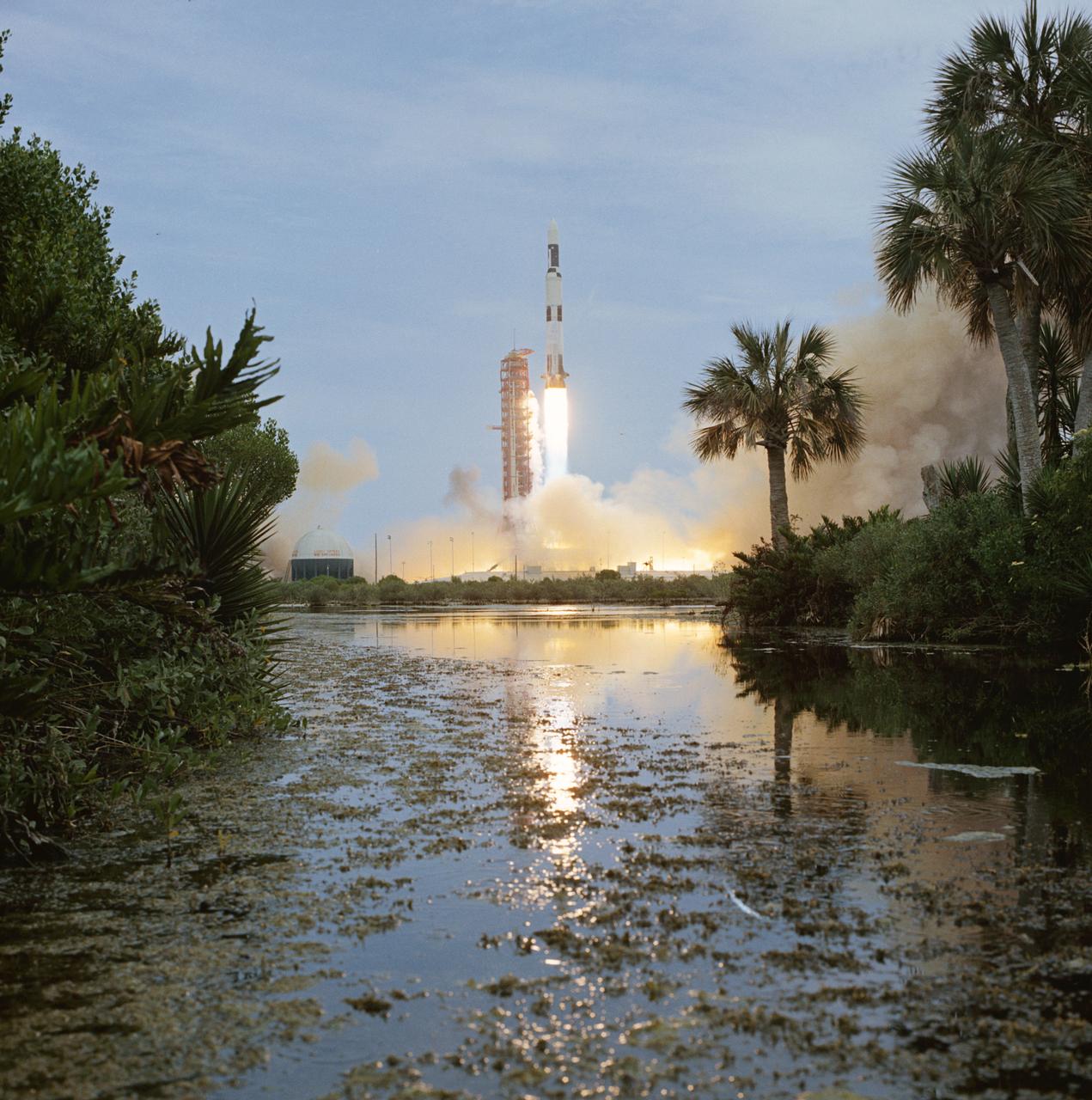
S73-26913 (14 May 1973) --- The unmanned Skylab 1/Saturn V space vehicle is launched from Pad A, Launch Complex 39, Kennedy Space Center, Florida, at 12:00 noon (EDT), May 14, 1973, to place the Skylab space station cluster in Earth orbit. The Skylab 1 payload included four of the five major components of the space station Orbital Workshop, Apollo Telescope Mount, Multiple Docking Adapter, and Airlock Module. In addition to the payload, the Skylab 1/Saturn V second (S-11) stage. The fifth major component of the space station, the Command Service Module with the Skylab 2 crew aboard, was launched at a later date by a Saturn 1B from Pad B. Photo credit: NASA
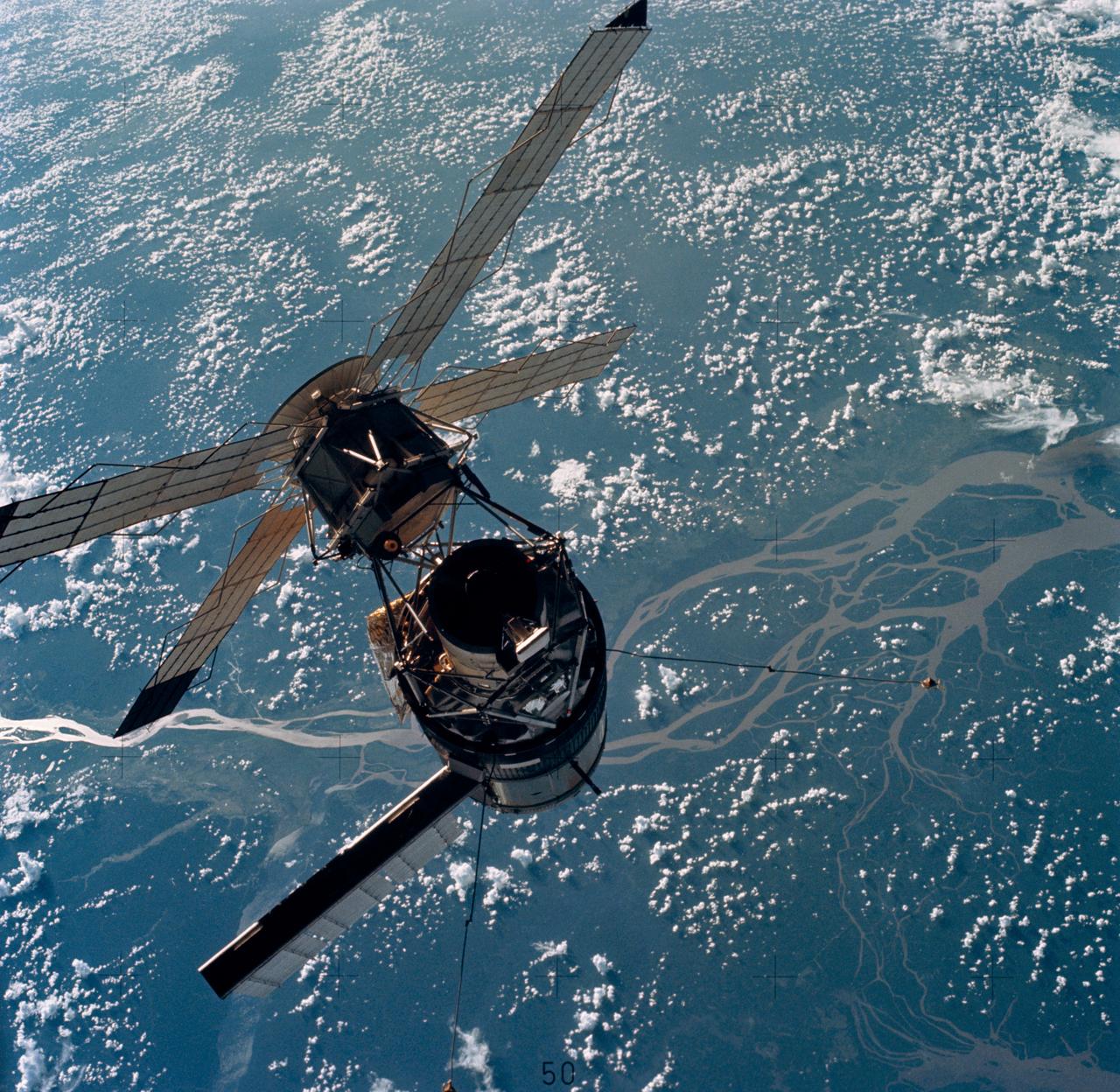
SL3-114-1683 (28 July 1973) --- A close-up view of the Skylab space station photographed against an Earth background from the Skylab 3 Command and Service Modules (CSM) during station-keeping maneuvers prior to docking. Aboard the Command Module (CM) were astronauts Alan L. Bean, Owen K. Garriott and Jack R. Lousma, who remained with the Skylab Space Station in Earth orbit for 59 days. This picture was taken with a hand-held 70mm Hasselblad camera using a 100mm lens and SO-368 medium speed Ektachrome film. Note the one solar array system wing on the Orbital Workshop (OWS) which was successfully deployed during extravehicular activity (EVA) on the first manned Skylab flight. The parasol solar shield which was deployed by the Skylab 2 crew can be seen through the support struts of the Apollo Telescope Mount (ATM). Photo credit: NASA
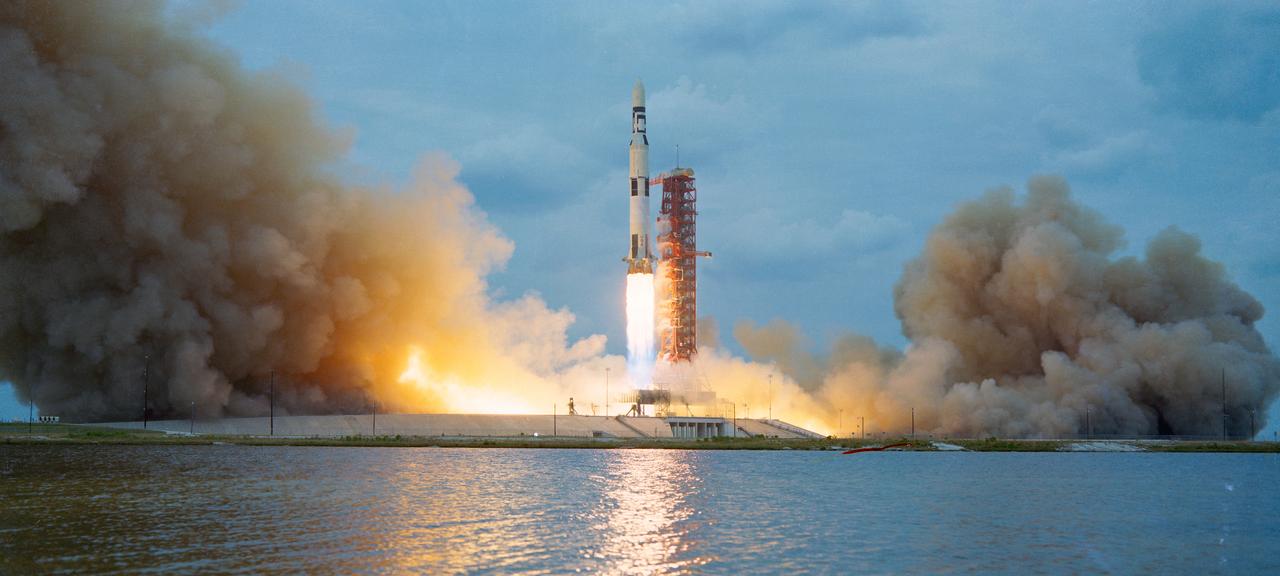
S73-26912 (14 May 1973) --- The unmanned Skylab 1/Saturn V space vehicle is launched from Pad A, Launch Complex 39, Kennedy Space Center, Florida, at 12:00 noon (EDT), May 14, 1973, to place the Skylab space station cluster in Earth orbit. The Skylab 1 payload included four of the five major components of the space station Orbital Workshop, Apollo Telescope Mount, Multiple Docking Adapter, and Airlock Module. In addition to the payload, the Skylab 1/Saturn V second (S-11) stage. The fifth major component of the space station, the Command Service Module with the Skylab 2 crew aboard, was launched at a later date by a Saturn 1B from Pad B. Photo credit: NASA
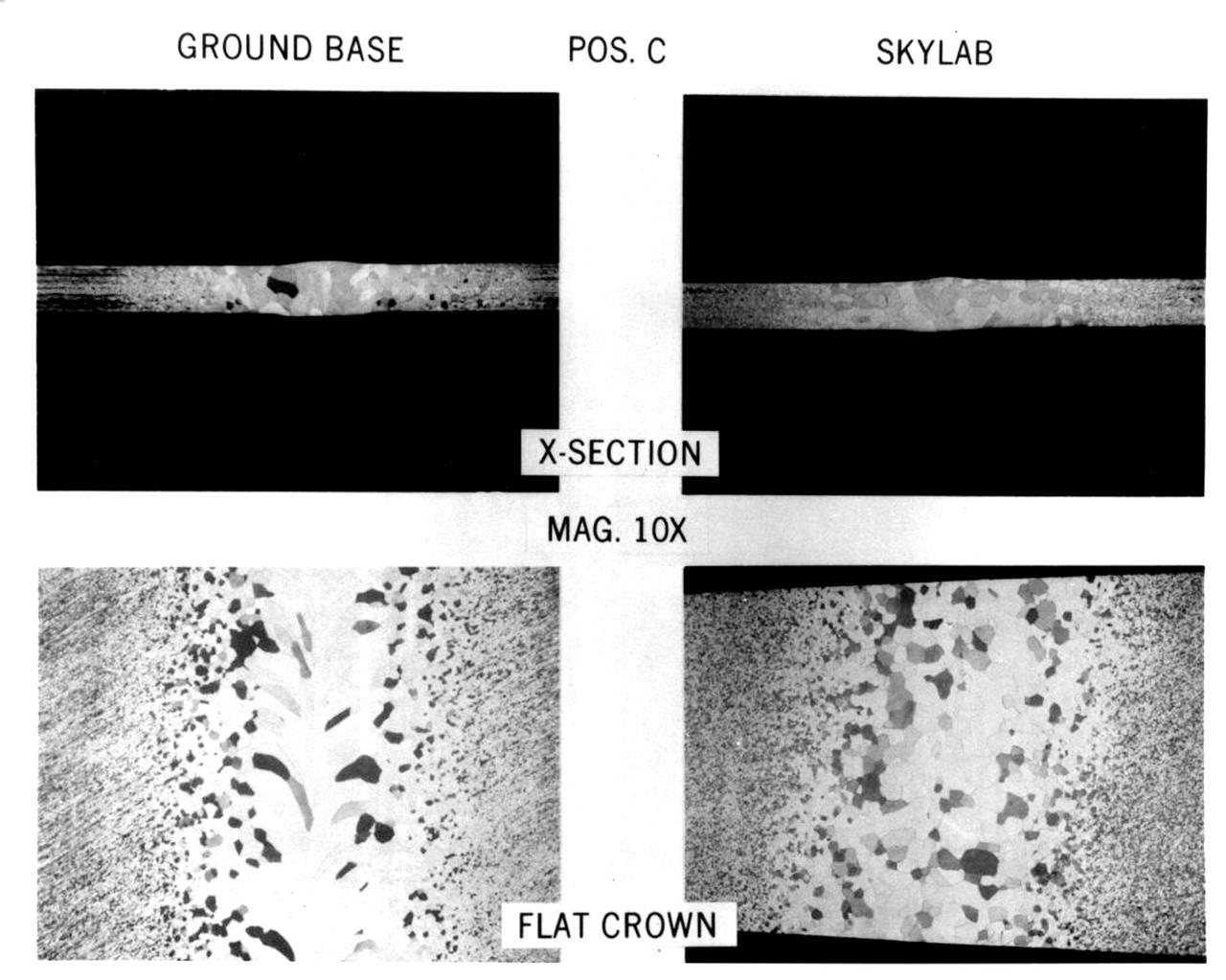
Comparison of ground-based (left) and Skylab (right) electron beam welds in pure tantalum (Ta) (10X magnification). Residual votices left behind in the ground-based sample after the electron beam passed were frozen into the grain structure. These occurred because of the rapid cooling rate at the high temperature. Although the thermal characteristics and electron beam travel speeds were comparable for the skylab sample, the residual vortices were erased in the grain structure. This may have been due to the fact that final grain size of the solidified material was smaller in the Skylab sample compared to the ground-based sample. The Skylab sample was processed in the M512 Materials Processing Facility (MPF) during Skylab SL-2 Mission. Principal Investigator was Richard Poorman.
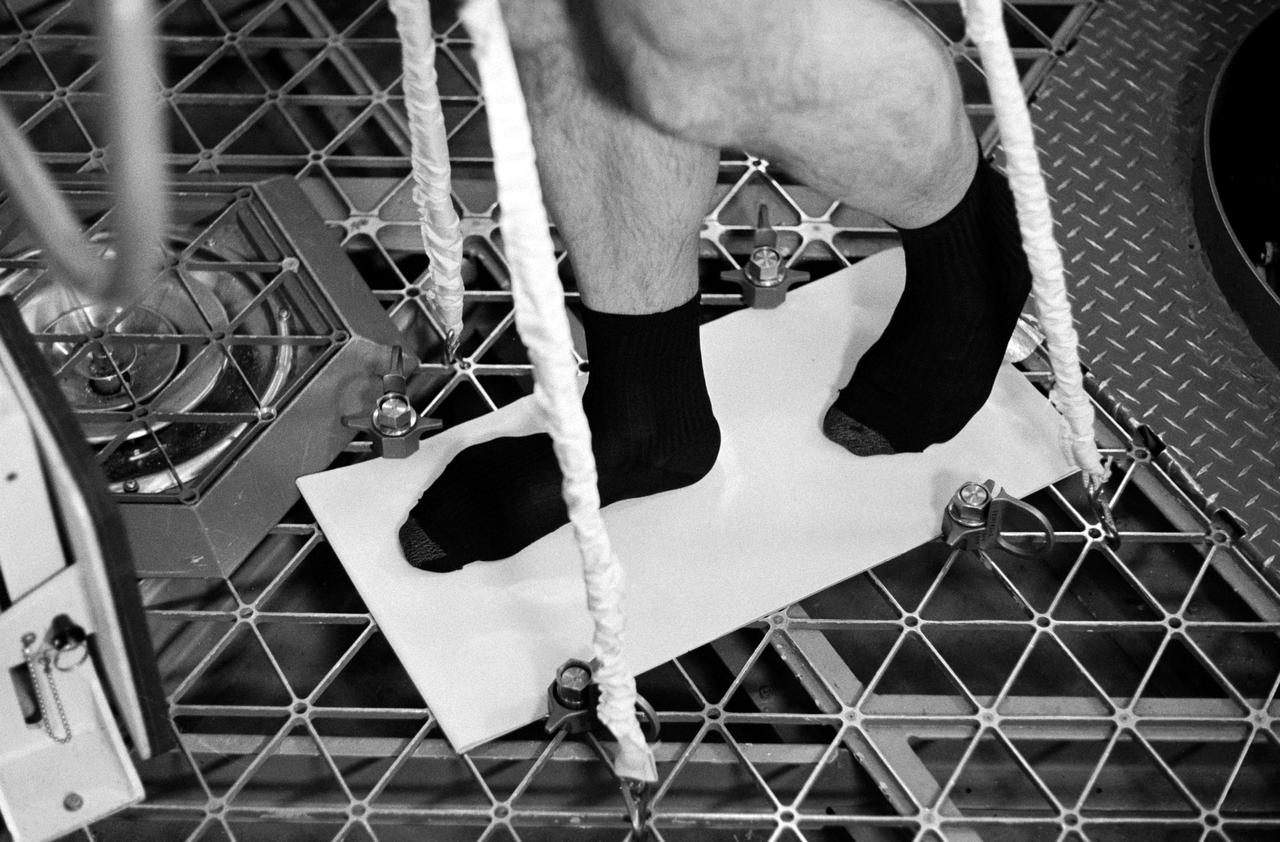
S73-33858 (November 1973) --- A close-up view of the feet of scientist-astronaut William E. Thornton as he demonstrates the use of a treadmill-like exercise device which was developed for maintaining the leg and back muscles of the Skylab 4 crewman. Thornton is in the Skylab Orbital Workshop simulator in Building 5 at the Johnson Space Center. The Skylab 2 and Skylab 3 astronauts had no exercise device onboard capable of adequately maintaining their leg and back muscles. The treadmill device consists of a Teflon-coated aluminum plate or sheet bolted to the floor of the Skylab Orbital Workshop. The crewmen will wear the bicycle ergometer harness while exercising. Bungee cords attached to the floor and to the harness will supply the downward pressure or force for the back and leg muscles. The astronaut's feet will slide over the Teflon-coated plate as he "marches in place." Photo credit: NASA
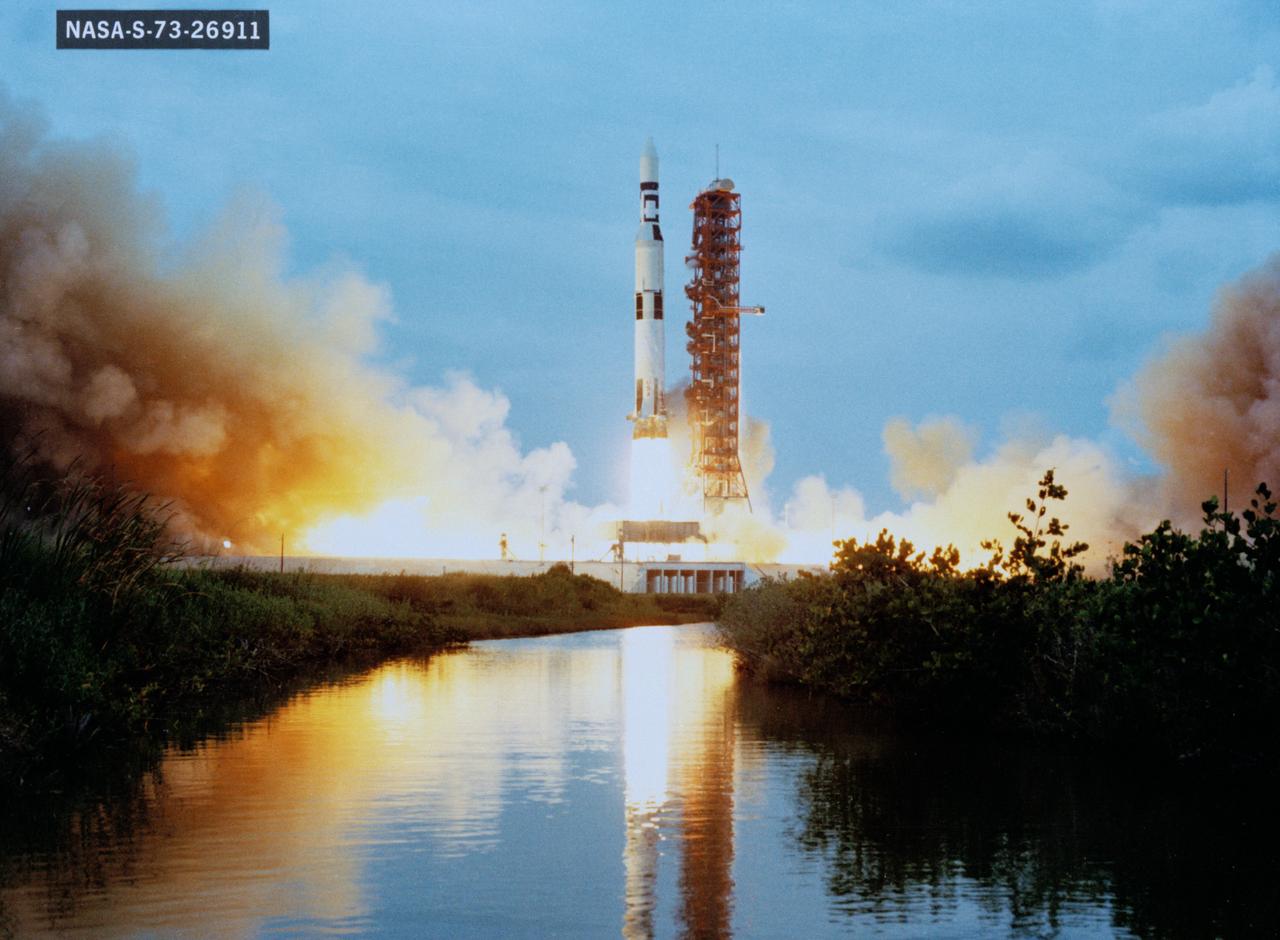
S73-26911 (14 May 1973) --- The unmanned Skylab 1/Saturn V space vehicle is launched from Pad A, Launch Complex 39, Kennedy Space Center, Florida, at 12:00 noon (EDT), May 14, 1973, to place the Skylab space station cluster in Earth orbit. The Skylab 1 payload included four of the five major components of the space station-Orbital Workshop, Apollo Telescope Mount, Multiple Docking Adapter, and Airlock Module. In addition to the payload, the Skylab 1/Saturn V second (S-11) stage. The fifth major component of the space station, the Command Service Module with the Skylab 2 crew aboard, was launched at a later date by a Saturn 1B from Pad B. Photo credit: NASA
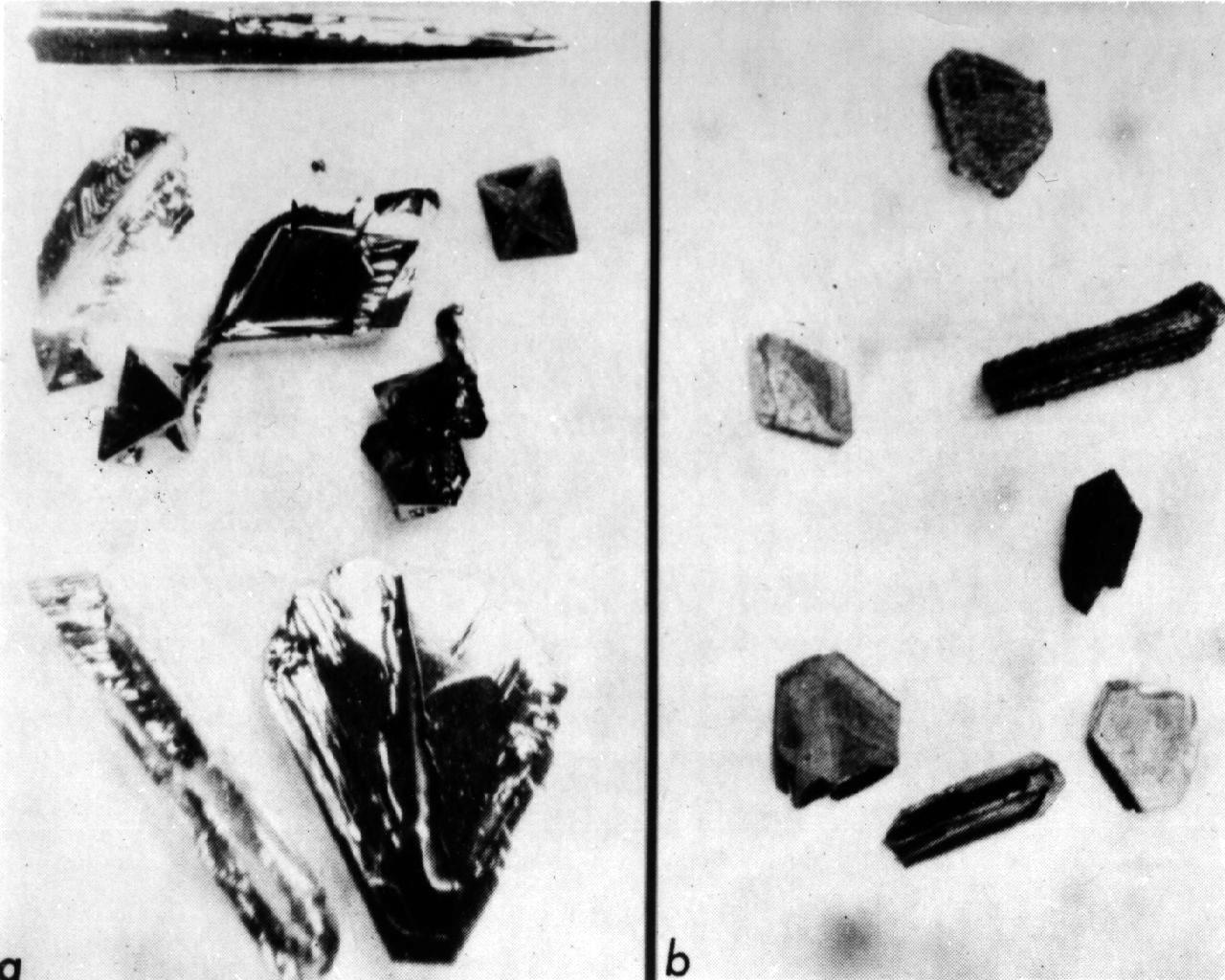
Comparison of Germanium Telluride (GeTe) Crystals grown on Earth (left) and in space (right) during the Skylab SL-3 mission. These crystals were grown using a vapor transport crystal growth method in the Multipurpose Electric Furnace System (MEFS). Crystals grown on earth are needles and platelettes with distorted surfaces and hollow growth habits. The length of the ground-based needle is approximately 2 mm and the average lenth of the platelets is 1 mm. The dull appearance of the Skylab crystals resulted from condensation of the transport agent during the long cooling period dictated by the Skylab furnace. In a dedicated process, this would be prevented by removing the ampoule from the furnace and quenching the vapor source.
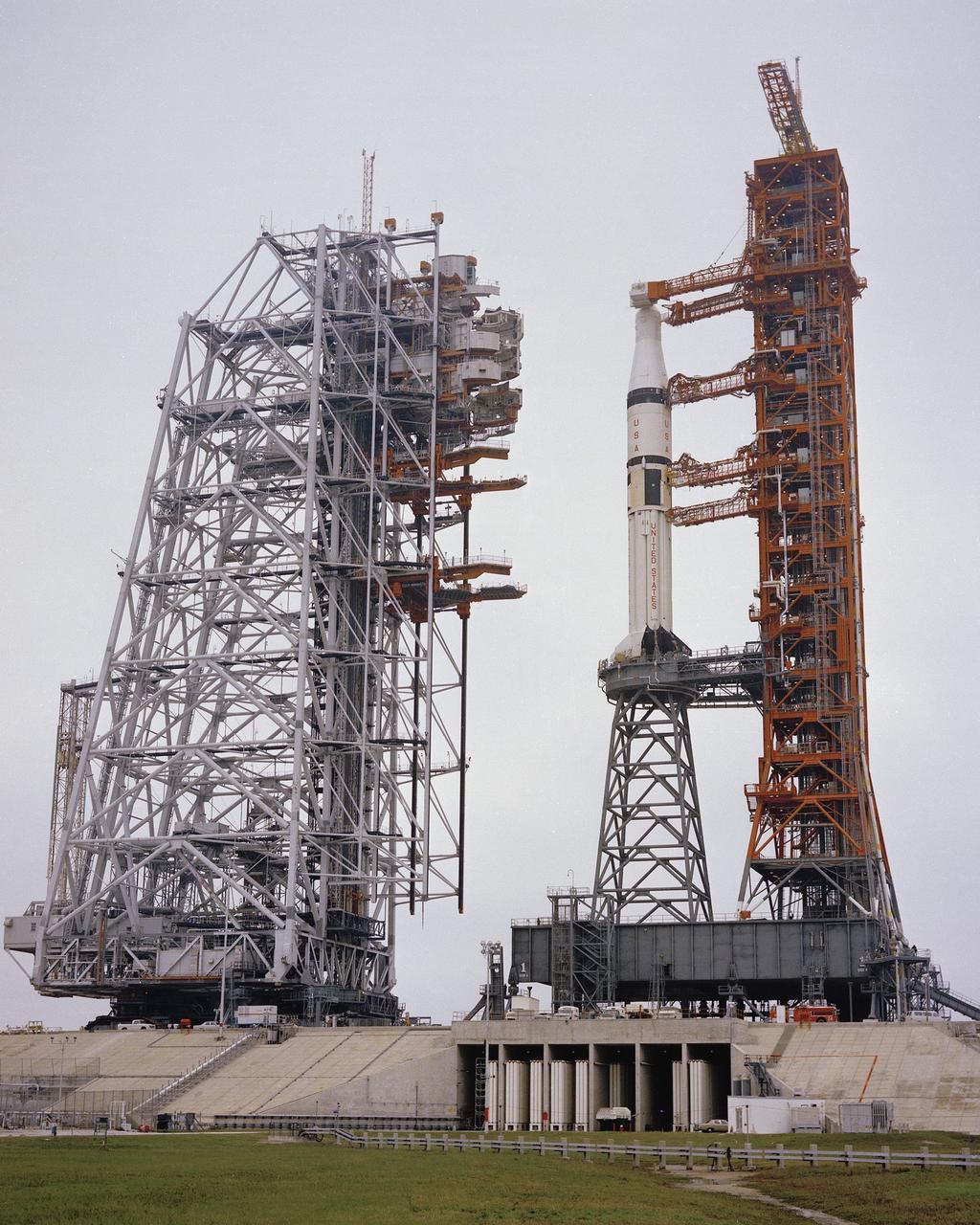
CAPE KENNEDY, Fla. -- At the Kennedy Space Center in Florida, the mobile service structure moves from its park site into position at Launch Complex 39B and surround the Skylab 2 rocket. Photo Credit: NASA
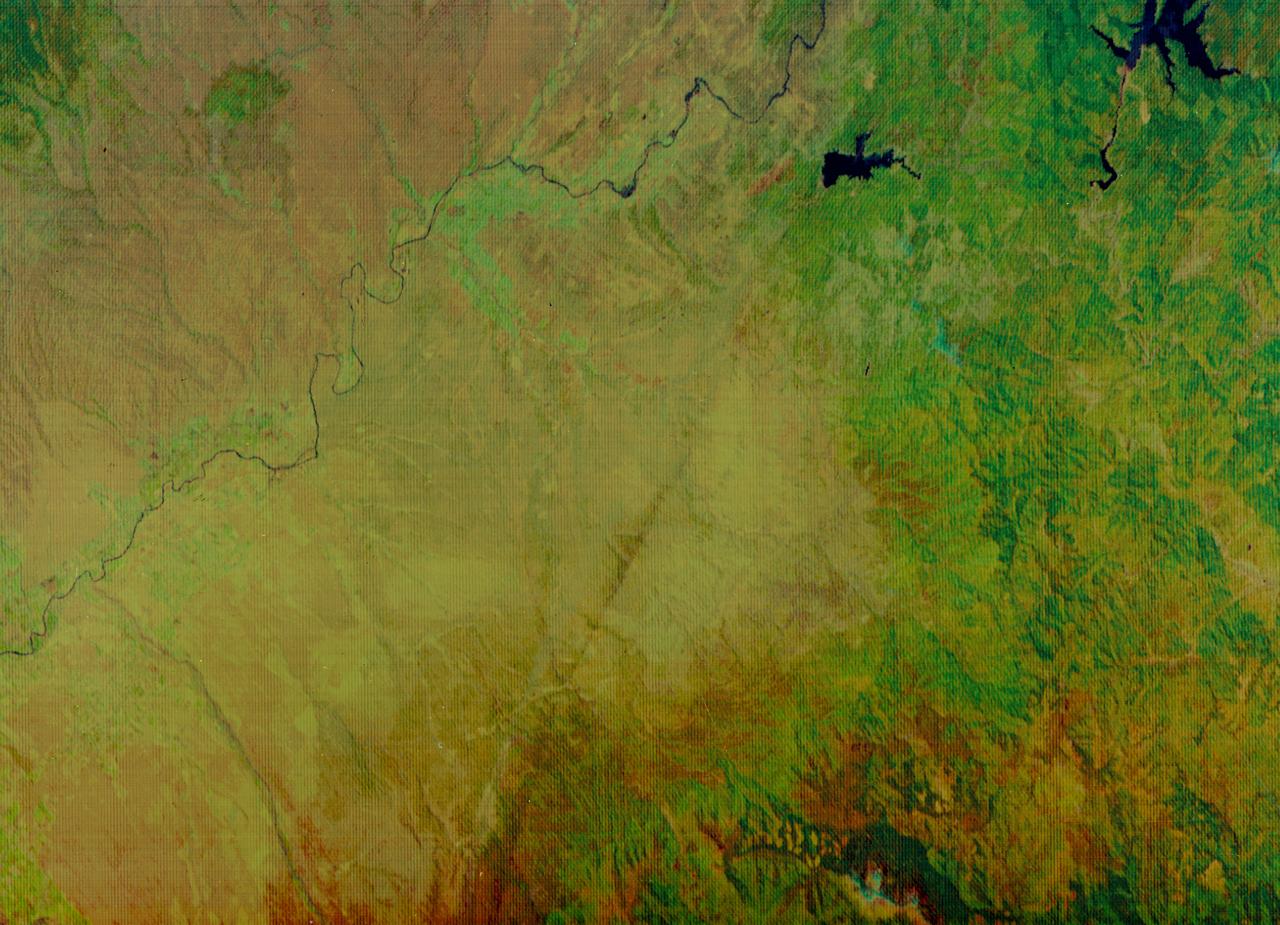
S73-34295B (June 1973) --- A vertical view of a portion of northern California reproduced from data taken from the Skylab Multispectral Scanner, experiment S192, in the Skylab space station in Earth orbit. This view is the most westerly one-third of Frame No. 001, Roll No. 518, S192, Skylab 2. Frame No. 001 extends from the Pacific coast at the Eureka area southeasterly 175 nautical miles to the Feather River drainage basin. Included in this view are Lake Shasta, Sacramento River Valley, Redding and Red Bluff. This non-photographic image is a color composite of channels 2 (visible), 7, and 12 (infrared) from the Earth Resources Experiments Package (EREP) S192 scanner. The scanner techniques assist with spectral signature identification and mapping of ground truth targets in agriculture, forestry, geology, hydrology and oceanography. Photo credit: NASA
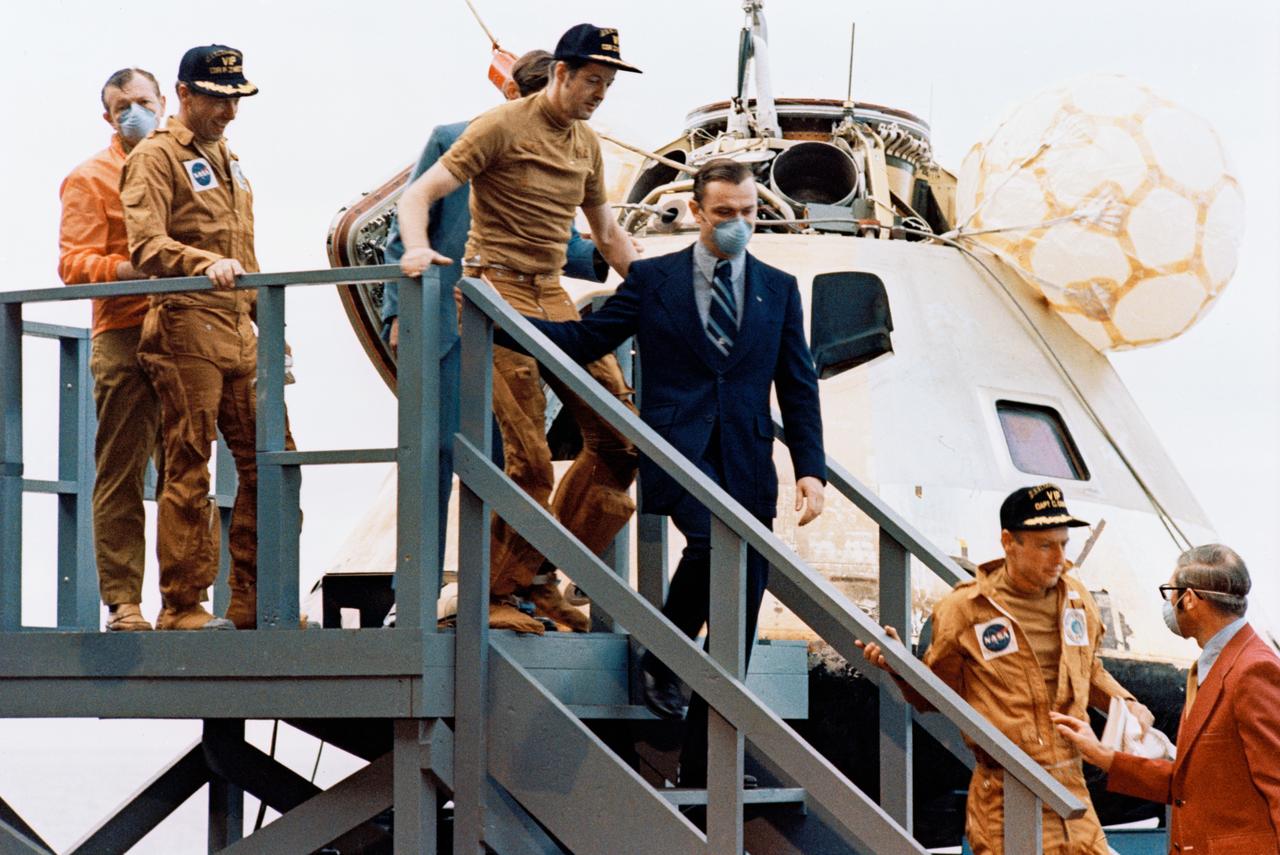
S73-29141 (22 June 1973) --- The three Skylab 2 crewmen arrive on the deck of the prime recovery ship, USS Ticonderoga, following the successful splashdown of the Skylab 2 Command Module about 835 miles southwest of San Diego, California. Leading down the steps is astronaut Charles Conrad Jr., commander, followed by scientist-astronaut Joseph P. Kerwin, science pilot, and astronaut Paul J. Weitz, pilot. Recovery and medical personnel walk down the steps with the astronauts. The crewmen remained inside the spacecraft (seen in background) until it was hoisted aboard the recovery ship. Conrad, Kerwin and Weitz had just completed a 28-day stay with the Skylab 1 space station in Earth orbit conducting numerous medical, scientific and technological experiments. Photo credit: NASA
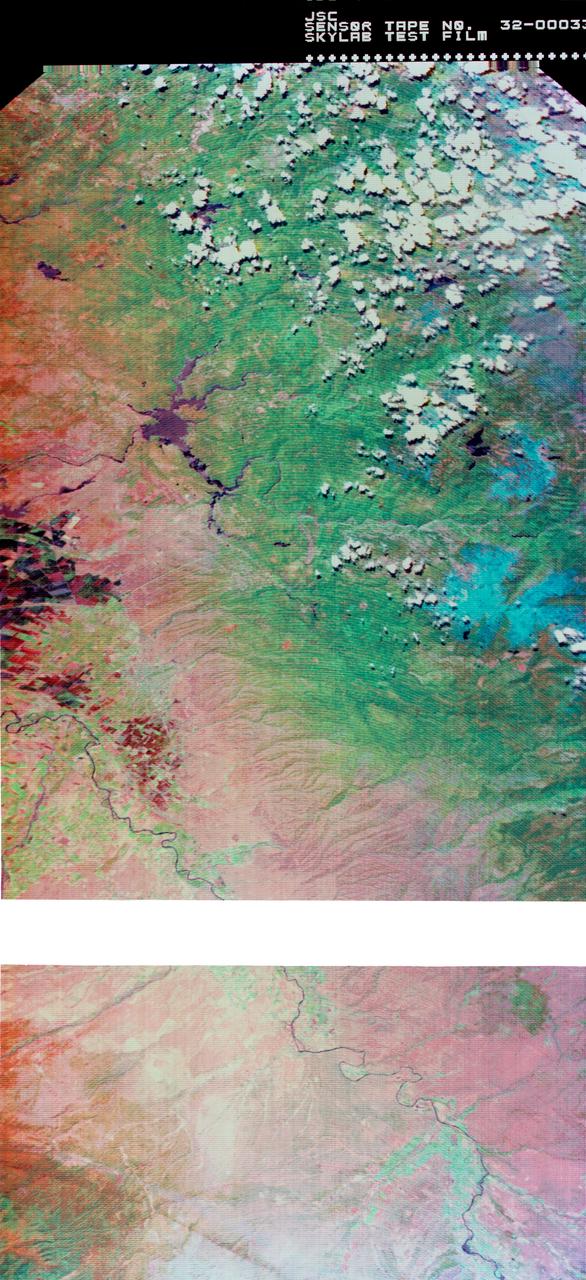
S73-34295A (June 1973) --- A vertical view of a portion of northern California reproduced from data taken from the Skylab Multispectral Scanner, experiment S192, in the Skylab space station in Earth orbit. This view is the most westerly one-third of Frame No. 001, Roll No. 518, S192, Skylab 2. Frame No. 001 extends from the Pacific coast at the Eureka area southeasterly 175 nautical miles to the Feather River drainage basin. Included in this view are Sacramento River Valley, Oroville Reservoir, Oroville and Chico. This non-photographic image is a color composite of channels 2 (visible), 7 and 12 (infrared) from the Earth Resources Experiments Package (EREP) S192 scanner. The scanner techniques assist with spectral signature identification and mapping of ground truth targets in agriculture, forestry, geology, hydrology and oceanography. Photo credit: NASA
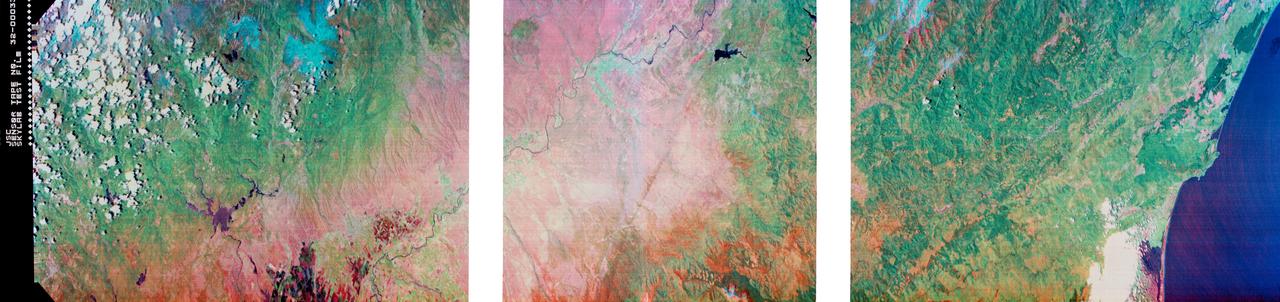
S73-34295 (June 1973) --- A vertical view of a portion of northern California reproduced from data taken from the Skylab Multispectral Scanner, experiment S192, in the Skylab space station in Earth orbit. This view is the most westerly one-third of Frame No. 001, Roll No. 518, S192, Skylab 2. Frame No. 001 extends from the Pacific coast at the Eureka area southeasterly 175 nautical miles to the Feather River drainage basin. Included in this view are Eureka, Trinidad, Klamath & Trinity Rivers and the Coastal Range mountains. This non-photographic image is a color composite of channels 2 (visible), 7, and 12 (infrared) from the Earth Resources Experiments Package (EREP) S192 scanner. The scanner techniques assist with spectral signature identification and mapping of ground truth targets in agriculture, forestry, geology, hydrology and oceanography. Photo credit: NASA
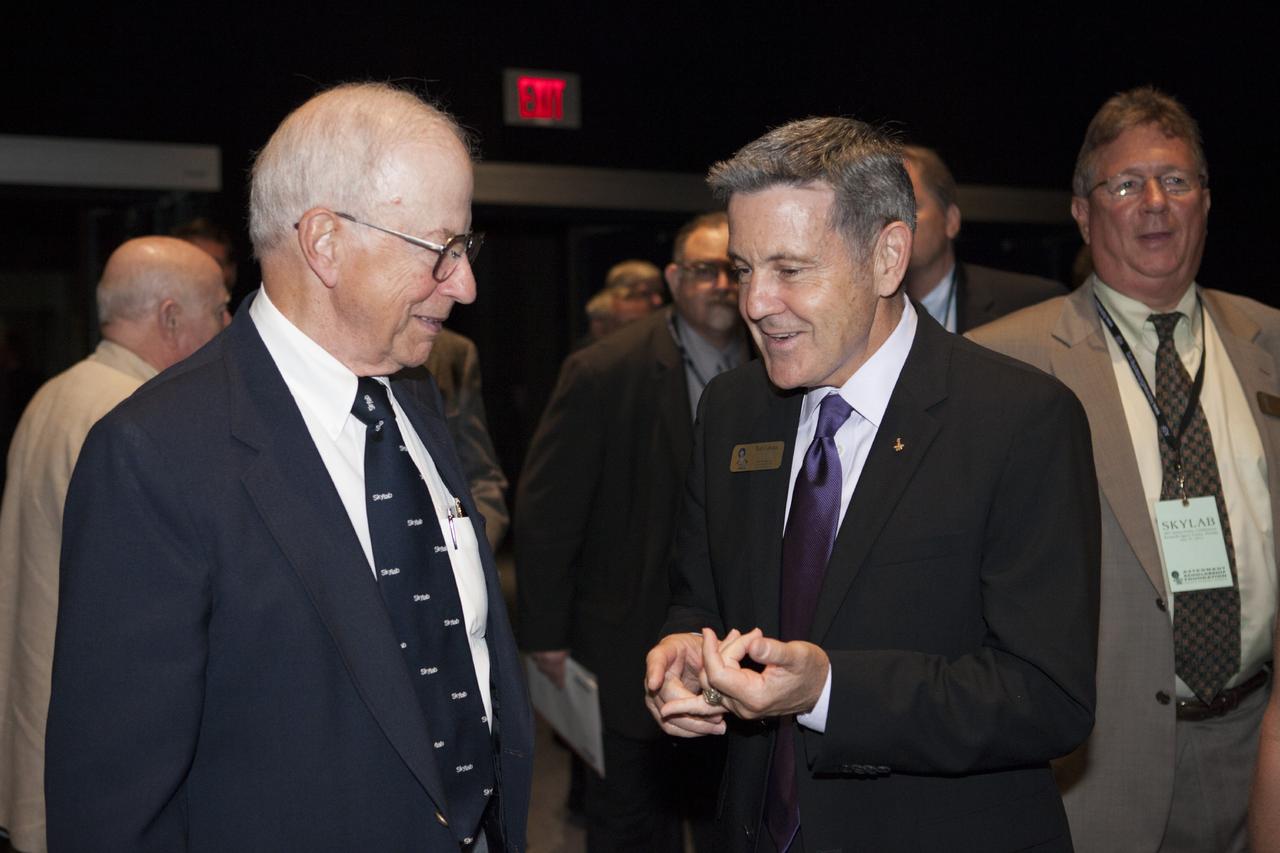
CAPE CANAVERAL, Fla. – At the Kennedy Space Center's Apollo/Saturn V Center Bob Cabana, Kennedy's director, right, speaks with Skylab 2 pilot Paul Weitz during an event sponsored by the Astronaut Scholarship Foundation celebrating the 40th anniversary of Skylab. Both astronauts also flew missions during the Space Shuttle Program. The gala commemorating the 40th anniversary of Skylab included six of the nine astronauts who flew missions to America's first space station. The orbiting laboratory was launched unpiloted from Kennedy on May 14, 1973. Between May 25, 1973 and Feb. 8, 1974, crews of three spent 28, 59 and 84 days living and working in low-Earth orbit aboard the station. For more information, visit http://www.nasa.gov/mission_pages/skylab/ Photo credit: NASA/Kim Shiflett
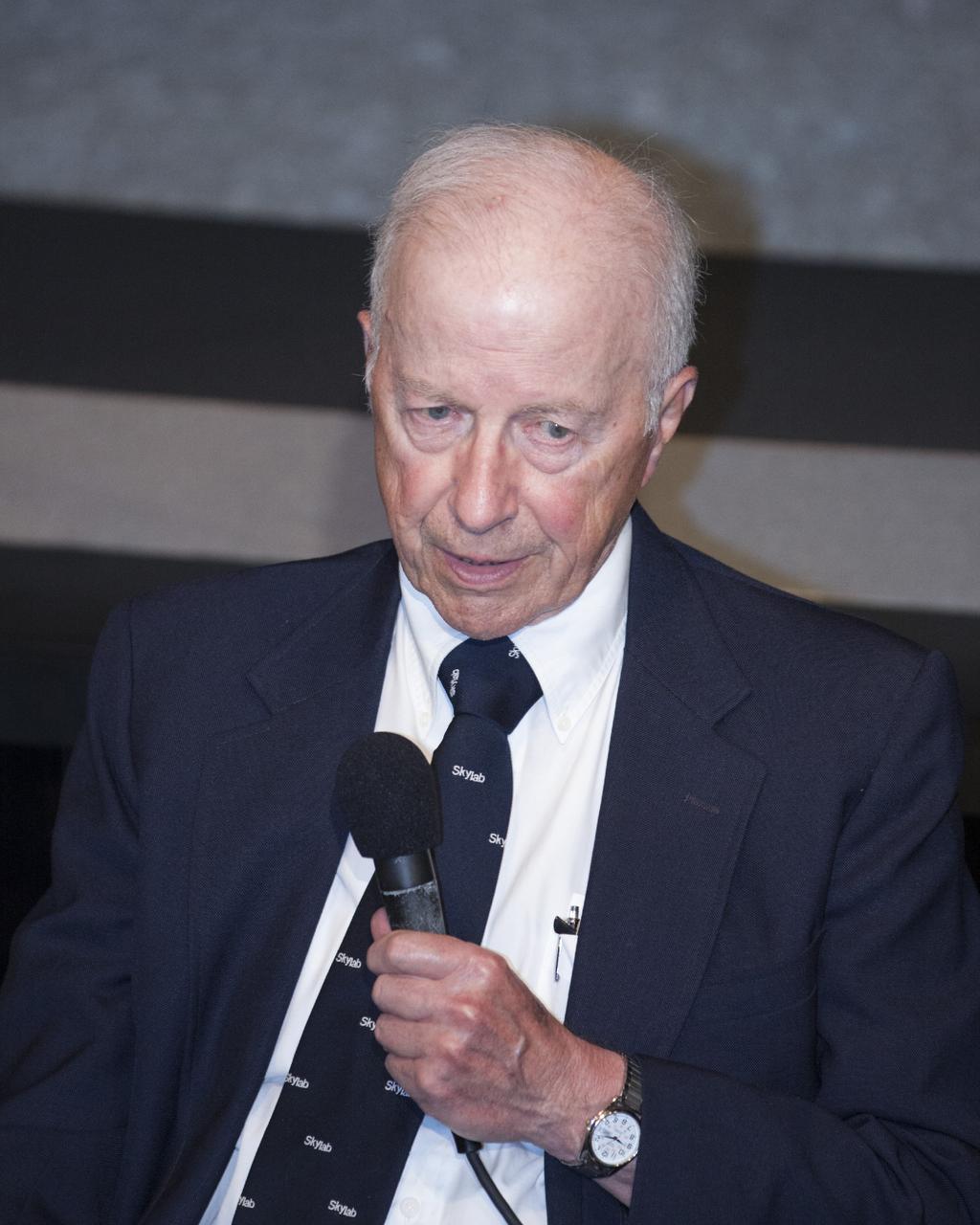
CAPE CANAVERAL, Fla. – At the Kennedy Space Center's Apollo/Saturn V Center, former NASA astronaut Paul Weitz speaks to guests at the Astronaut Scholarship Foundation's event celebrating the 40th anniversary of Skylab. Weitz served as pilot on Skylab 2, the first piloted mission to the space station. Weitz went on to fly missions aboard the space shuttle. The gala commemorating the 40th anniversary of Skylab included six of the nine astronauts who flew missions to America's first space station. The orbiting laboratory was launched unpiloted from Kennedy on May 14, 1973. Between May 25, 1973 and Feb. 8, 1974, crews of three spent 28, 59 and 84 days living and working in low-Earth orbit aboard the station. For more information, visit http://www.nasa.gov/mission_pages/skylab/ Photo credit: NASA/Kim Shiflett

S73-26794 (26 May 1973) --- Two of the three Skylab 2 astronauts are seen in the wardroom of the crew quarters of the Orbital Workshop of the Skylab 1 space station cluster in Earth orbit in this reproduction taken from a color television transmission made by a TV camera aboard the space station. They are preparing a meal. Astronaut Charles Conrad Jr., commander, is in the right foreground. In the background is scientist-astronaut Joseph P. Kerwin, science pilot. Photo credit: NASA
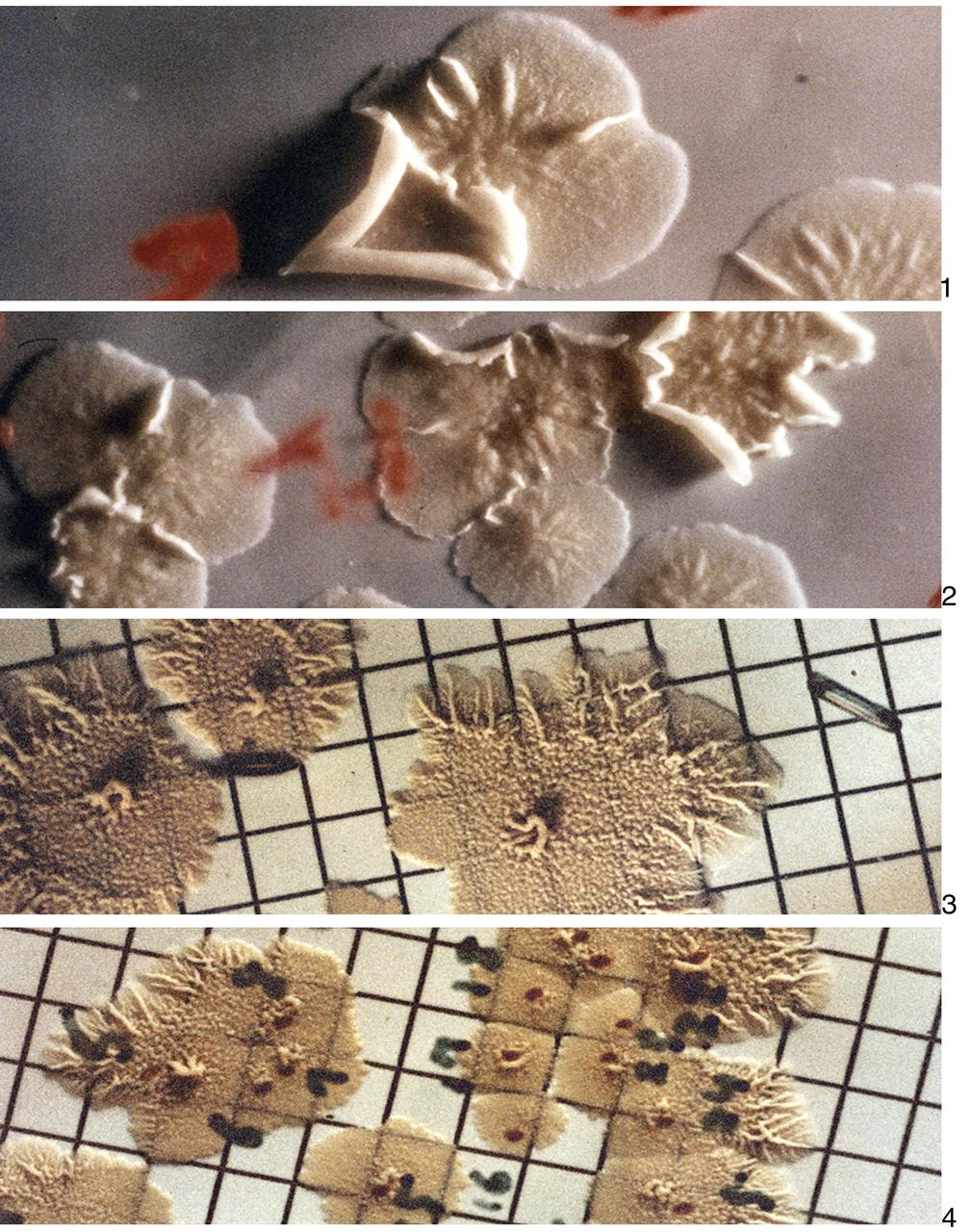
Pictures 1 and 2 show samples of Bacillus Subtillus grown during the first performance of Robert Staehle's experiment (ED-31) aboard Skylab. Pictures 3 and 4 show colonies of the same bacteria that developed during the second performance of the experiment. The experiment ED-31 was proposed by Robert L. Staehle of Rochester, New York to determine the effect of the Skylab environment (particularly weightlessness) on the survival, growth rates, and mutations of certain bacteria and spores.
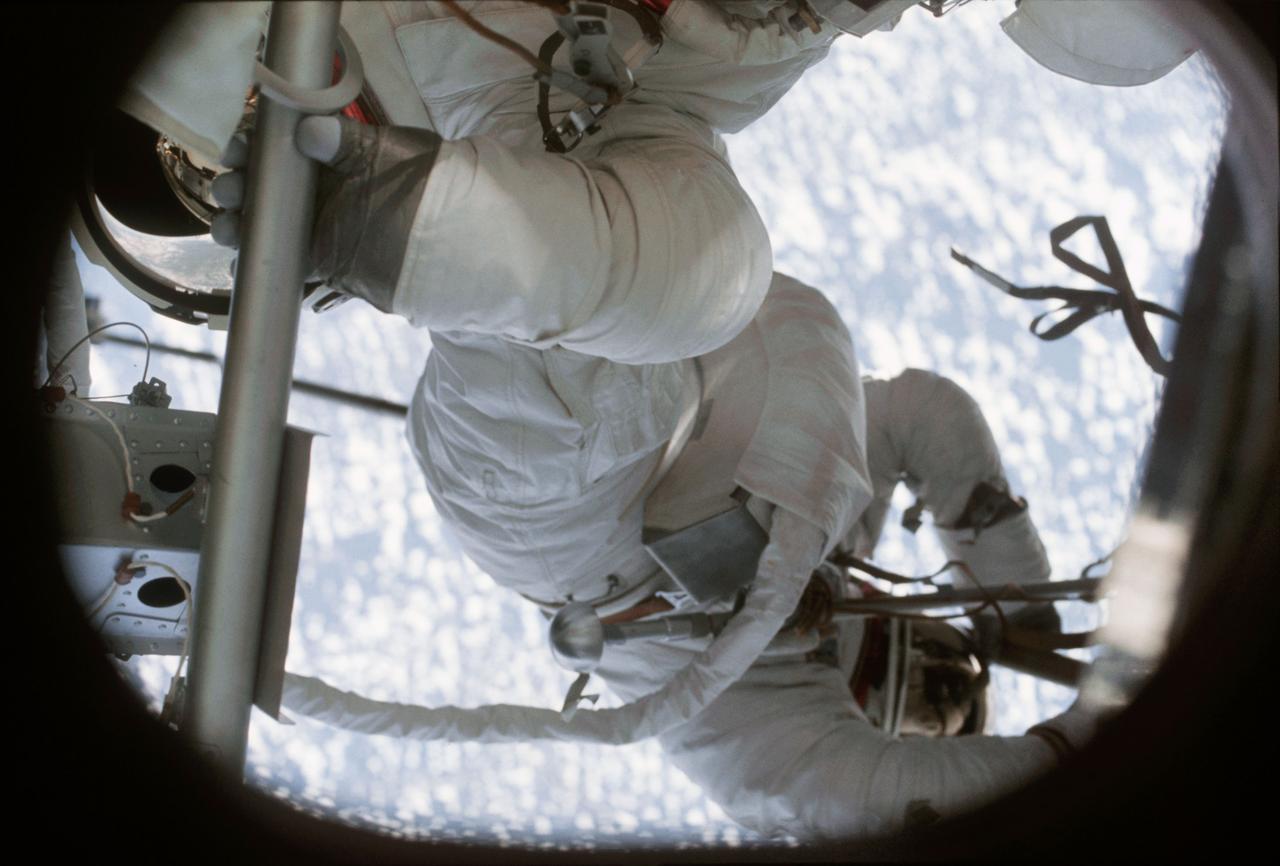
SL2-100-799 (7 June 1973) --- This medium close-up view shows astronauts Charles Conrad, commander for Skylab 2, and Science Pilot Joseph P. Kerwin performing an extravehicular activity (EVA) to repair the damaged and partially deployed solar array system on the Skylab complex. The photo was taken from inside the Orbital Workshop (OWS) by astronaut Paul J. Weitz, pilot. Photo credit: NASA
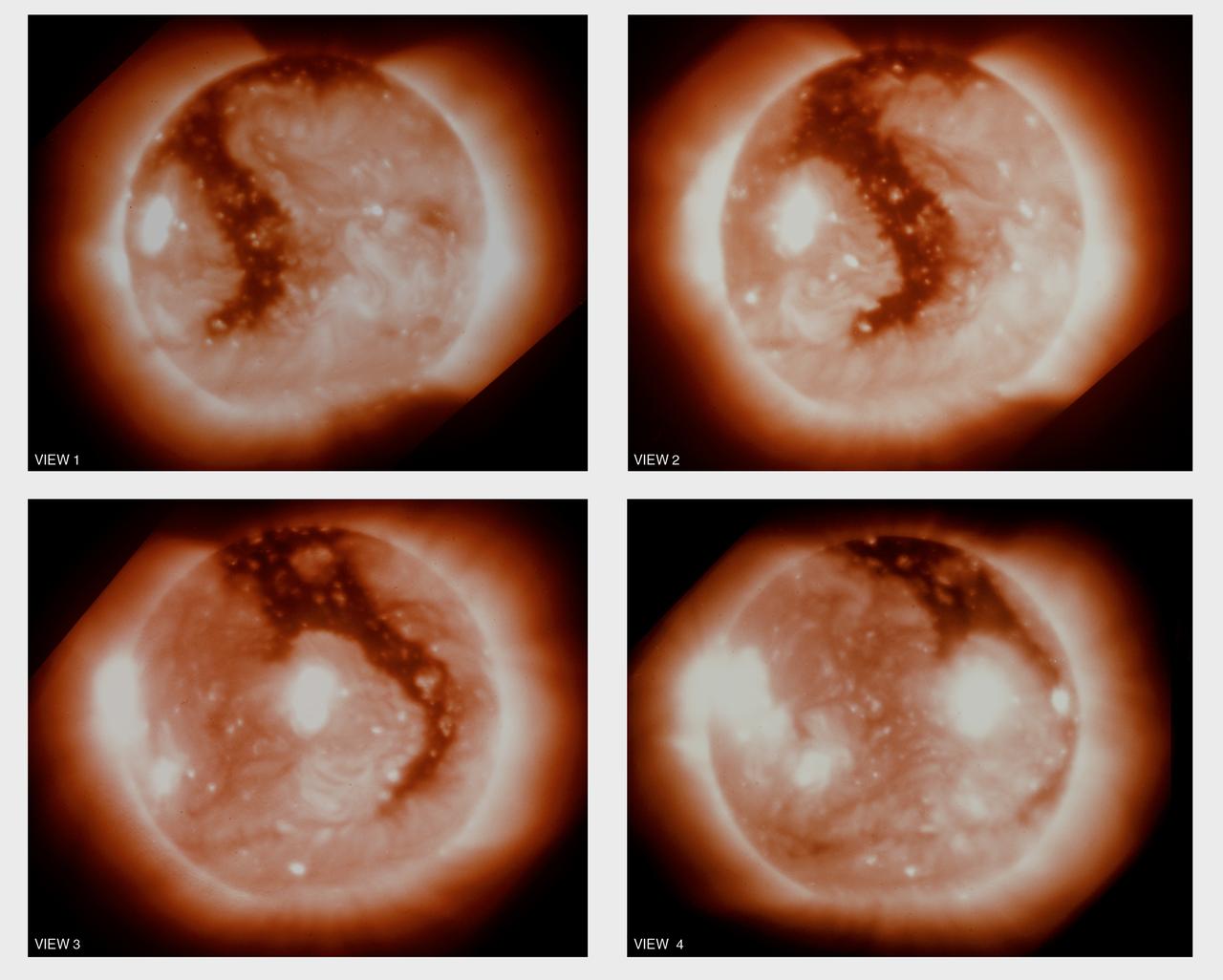
This montage is a sequence of soft x-ray photographs of the boot-shaped coronal hole rotating with the sun. The individual pictures were taken about 2 days apart by the Skylab telescope. Most of the apparent changes in this 6-day period resulted from a changing perspective. Skylab data helped demonstrate that coronal holes are sources of high-velocity streams in the solar wind. These high-velocity streams can be electrons, protons, and atomic nuclei that spray out from the Sun into interplanetary space. When the coronal hole is near the center of the Sun, as in view 2, the sprinkler is directed at Earth. These high-speed streams of solar wind distort Earth's magnetic field and disturb it's upper atmosphere.
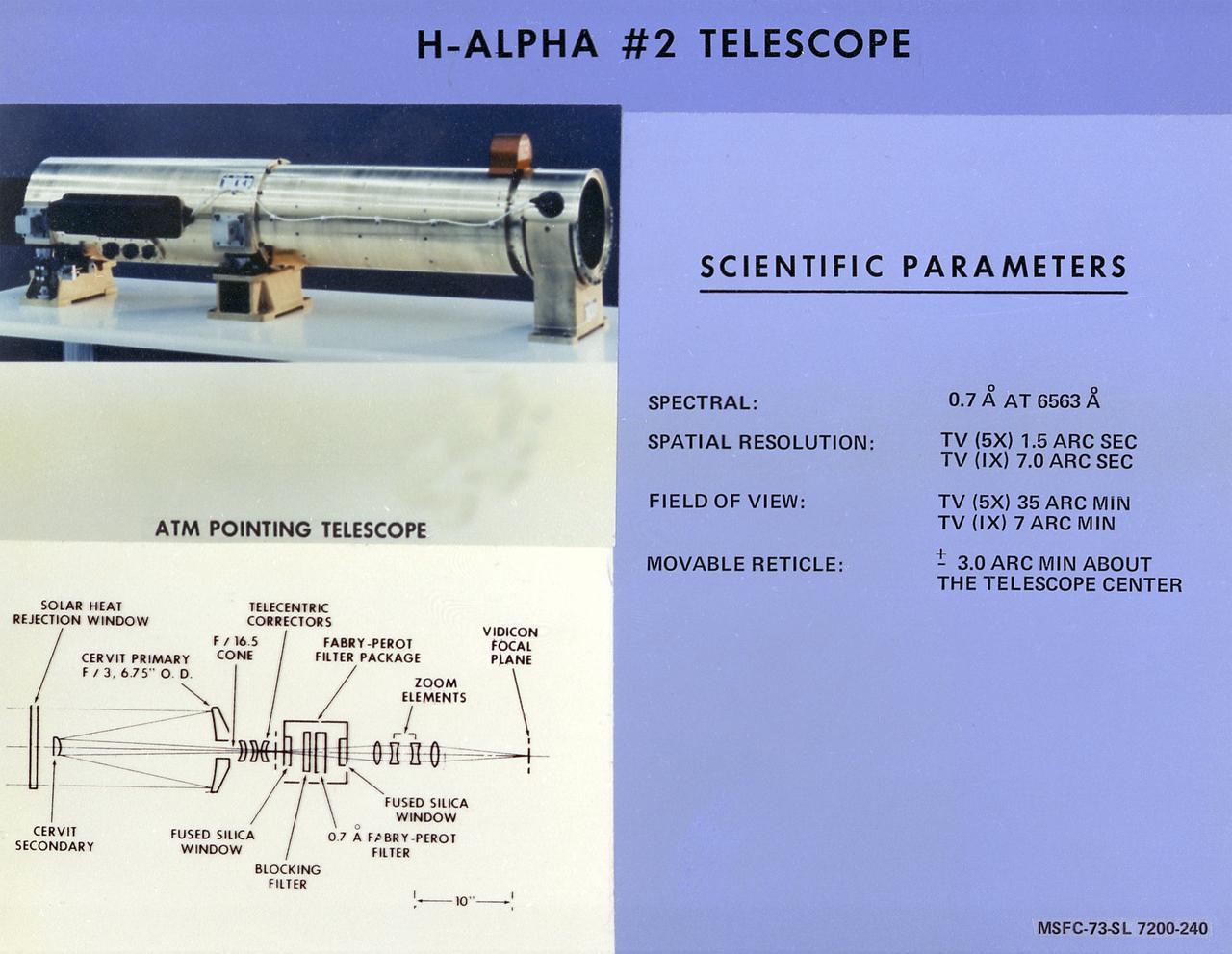
This chart describes the Hydrogen-Alpha (H-Alpha) #2 Telescope, one of eight major solar study facilities on the Skylab Apollo Telescope Mount (ATM). There were two H-Alpha telescopes on the ATM that were used primarily to point the ATM and keep a continuous photographic record during solar observation periods. Both telescopes gave the Skylab astronauts a real-time picture of the Sun in the red light of the H-Alpha spectrum through a closed-circuit television. The H-Alpha #1 telescope provided simultaneous photographic and ultraviolet (UV) pictures, while the #2 telescope operated only in the TV mode. The Marshall Space Flight Center was responsible for development of the H-Alpha Telescopes.
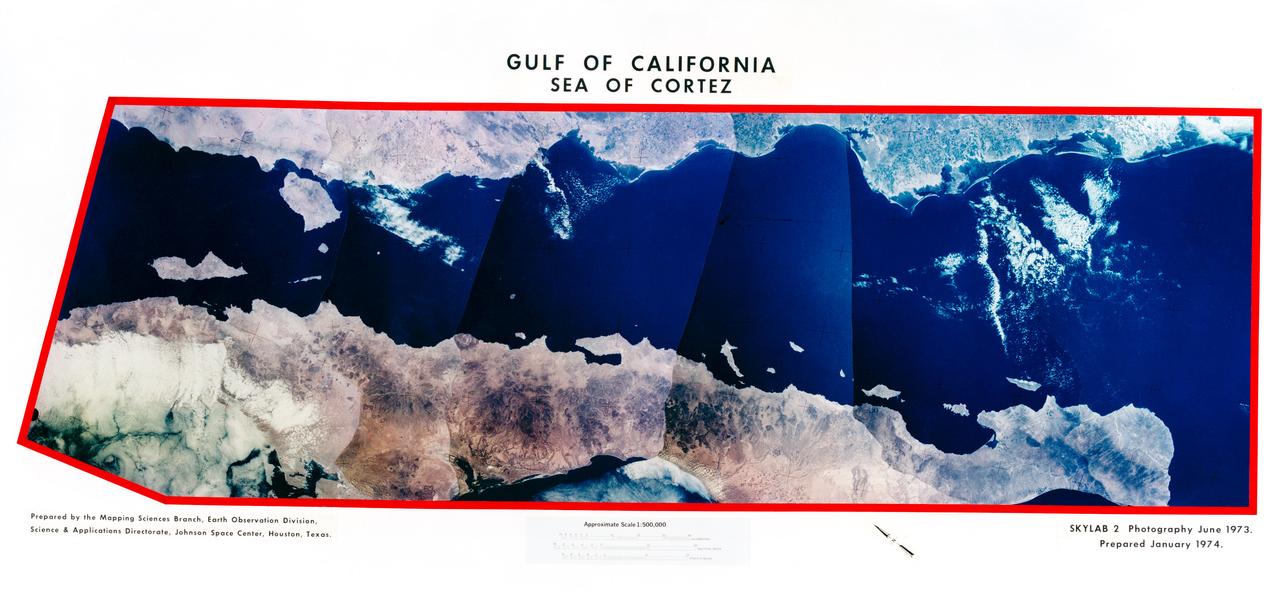
S74-23654 (22 June 1973) --- This mosaic of Baja and the Sea of Cortez in Mexico (28.0N, 112.0W) is a composite of six 70mm photos carefully pieced together to appear as one. Mosaics such as this one are useful to portray a large area in a single format instead of many photos covering only partial images. In this mosaic, almost the entire area of the Sea of Cortez, the adjacent Baja Peninsula and part of the Sonoran Desert of northwest Mexico can be seen. Photo credit: NASA
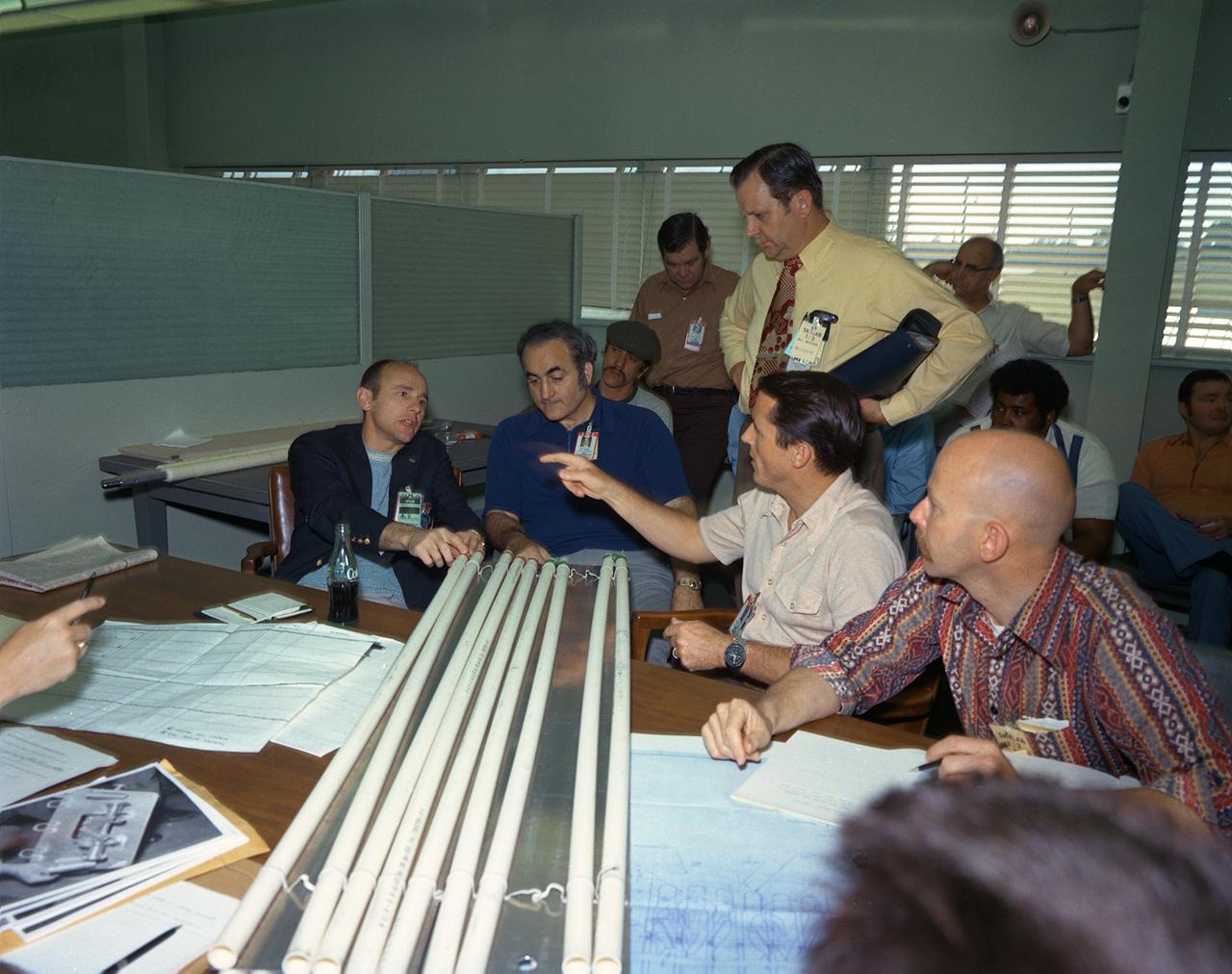
Sixty-three seconds after the launch of the modified Saturn V vehicle carrying the Skylab cluster, engineers in the operation support and control center saw an unexpected telemetry indication that signalled that damages occurred on one solar array and the micrometeoroid shield during the launch. Still unoccupied, the Skylab was stricken with the loss of the heat shield and sunlight beat mercilessly on the lab's sensitive skin. Internal temperatures soared, rendering the the station uninhabitable, threatening foods, medicines, films, and experiments. The launch of the first marned Skylab (Skylab-2) mission was delayed until methods were devised to repair and salvage the workshop. Personnel from other NASA Centers and industries quickly joined the Marshall Space Flight Center (MSFC) in efforts to save the damaged Skylab. They worked day and night for the next several days. Eventually the MSFC developed, tested, rehearsed, and approved three repair options. These options included a parasol sunshade and a twin-pole sunshade to restore the temperature inside the workshop, and a set of metal cutting tools to free the jammed solar panel. This photograph was taken during a discussion of the methods of the twin-pole Sun shield by (left to right) Astronaut Alan Bean, MSFC Director Dr. Rocco Petrone, Astronaut Edward Gibson, and MSFC engineer Richard Heckman. Dr. William Lucas, who became MSFC Director after Dr. Petrone left MSFC in March of 1974, is standing.
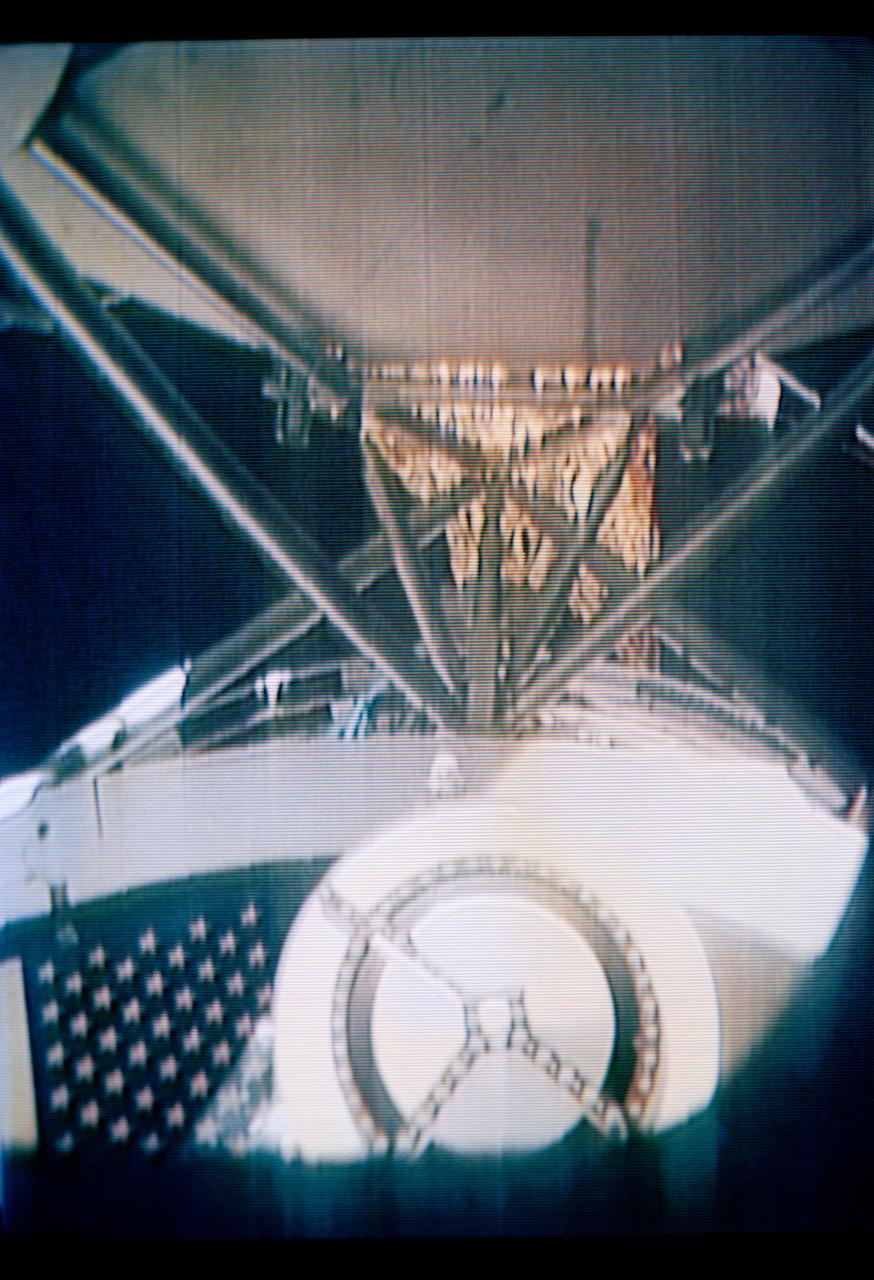
S73-26773 (26 May 1973) --- The deployment of the ?parasol? solar shield, a sunshade to help cool the overheated Orbital Workshop of the Skylab 1 space station cluster in Earth orbit, can be seen in the reproduction taken from a color television transmission made by a TV camera aboard the space station. The camera is in the Command Module; and the view is looking through the truss of the Apollo Telescope Mount. The sunshade is only partially deployed in this picture. The solar shield was pushed up through the OWS solar scientific airlock. The canopy of the ?parasol? measures 24 feet by 22 feet. Photo credit: NASA

S73-25140 (16 April 1973) --- A ground-level view of Pad A, Launch Complex 39, Kennedy Space Center, Florida, showing the 341-feet tall Skylab 1/Saturn V space vehicle on the pad soon after being rolled out from the Vehicle Assembly Building (VAB). The vehicle is composed of the Saturn V first (S-1C) stage, the Apollo Telescope Mount (ATM), the Multiple Docking Adapter (MDA), the Airlock Module (AM), and the Orbital Workshop (OWS). Photo credit: NASA
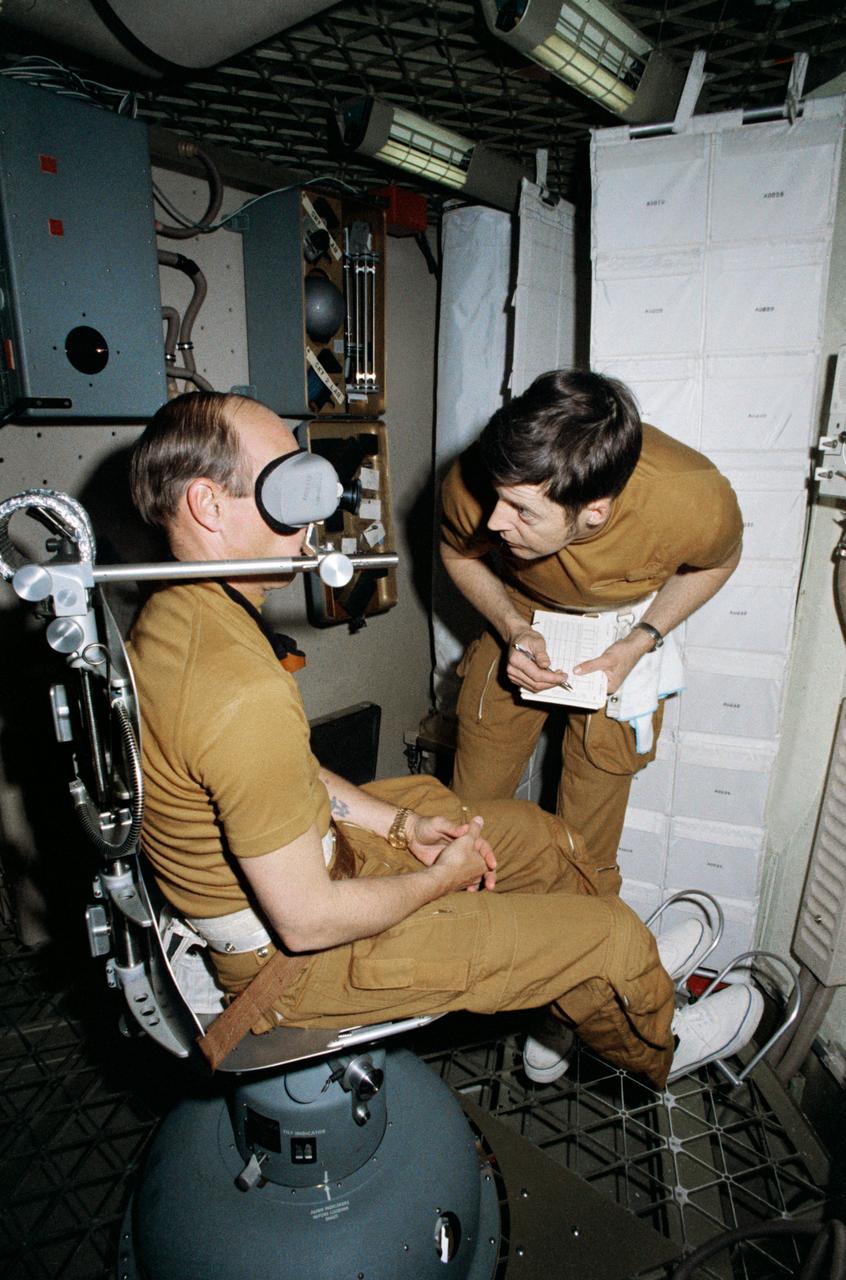
S73-20678 (1 March 1973) --- Astronaut Charles Conrad Jr., commander of the first manned Skylab mission, checks out the Human Vestibular Function, Experiment M131, during Skylab training at Johnson Space Center. Scientist-astronaut Joseph P. Kerwin, science pilot of the mission, goes over a checklist. The two men are in the work and experiments compartment of the crew quarters of the Skylab Orbital Workshop (OWS) trainer at JSC. Photo credit: NASA

S73-27508 (6 June 1973) --- An artist's concept showing astronaut Charles Conrad Jr., Skylab 2 commander, attempting to free the solar array system wing on the Orbital Workshop during extravehicular activity at the Skylab 1 & 2 space station cluster in Earth orbit. The astronaut in the background is Joseph P. Kerwin, Skylab 2 science pilot. Here, Conrad is pushing up on the Beam Erection Tether (BET) to raise the stuck solar panel. The solar wing is only partially deployed; an aluminum strap is believed to be holding it down. Note the cut aluminum angle. Attach points for the BET are on the vent module of the solar array beam. The other end of the BET is attached to the "A" frame supporting the Apollo Telescope Mount (ATM) which is out of view. The aluminum strapping is to be out first, freeing the solar array beam. Then, if the beam does not automatically deploy, Conrad will attempt to help by pulling on the BET. The automatic openers may have become too cold to open without assistance. A deployed solar panel of the ATM is at upper left. The EVA is scheduled for Thursday, June 7th. This concept is by artist Paul Fjeld. Photo credit: NASA
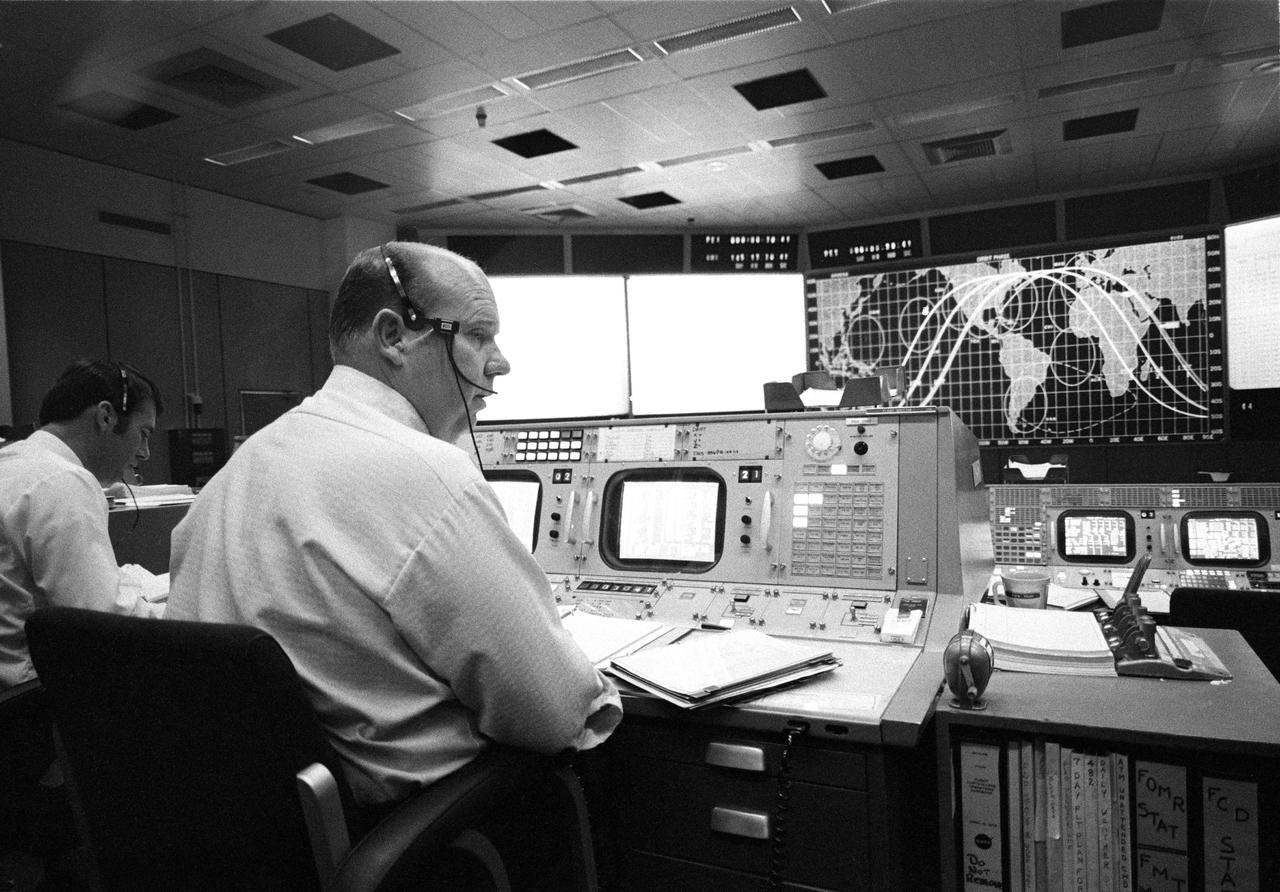
S73-26795 (25 May 1973) --- Flight directors Donald R. Puddy (left background) and Philip C. Shaffer are seated at the flight director's console in the Mission Operations Control Room in the Mission Control Center at JSC during Skylab 2 launch activity. Photo credit: NASA
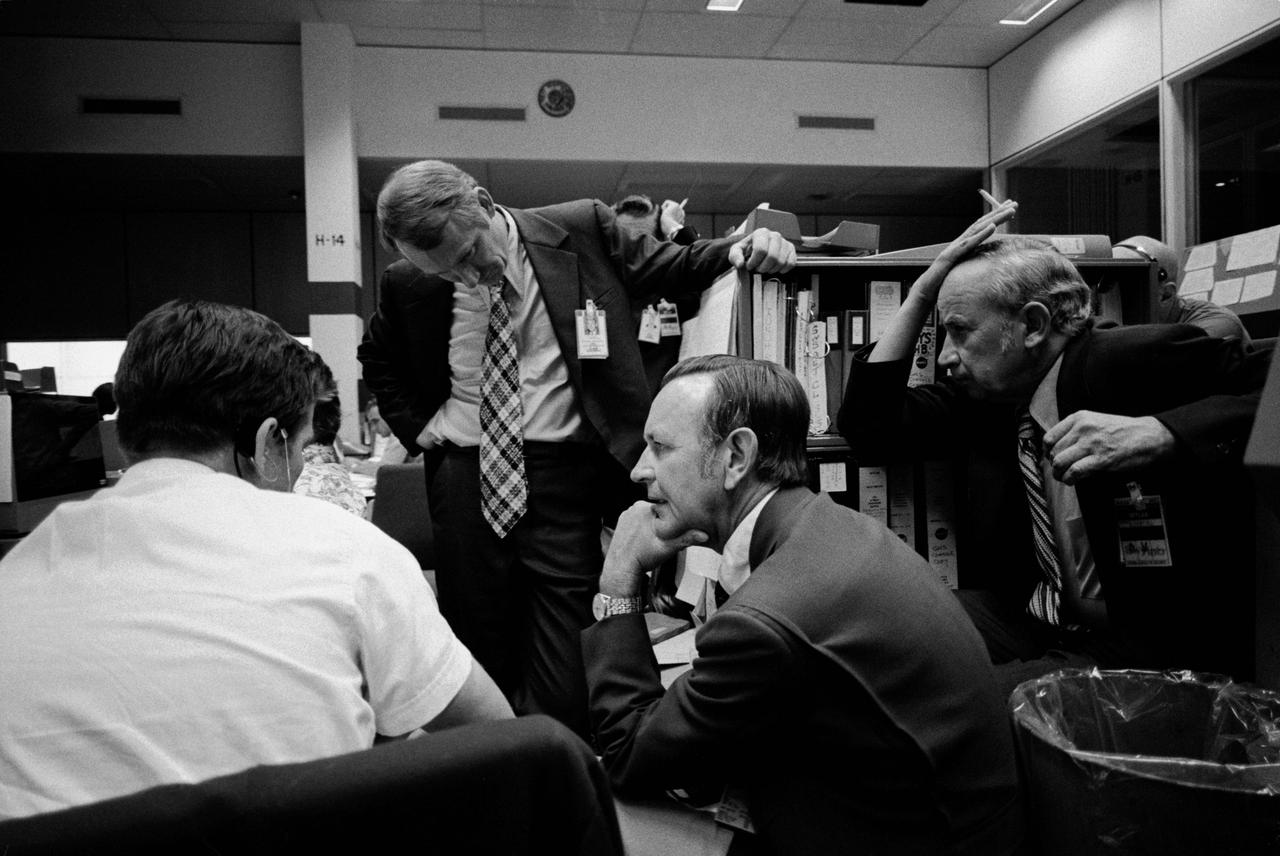
S73-31875 (2 Aug. 1973) --- After learning of a problem in the Command/Service Module which was used to transport the Skylab 3 crew to the orbiting Skylab space station cluster, NASA officials held various meetings to discuss the problem. Here, four men monitor the current status of the problem in the Mission Operations Control Room (MOCR) of the Mission Control Center (MCC) at the Johnson Space Center (JSC). From the left are Gary E. Coen, Guidance and Navigation System flight controller; Howard W. Tindall Jr., Director of Flight Operations at JSC; Dr. Christopher C. Kraft Jr., JSC Director; and Sigurd A. Sjoberg, JSC Deputy Director. Photo credit: NASA
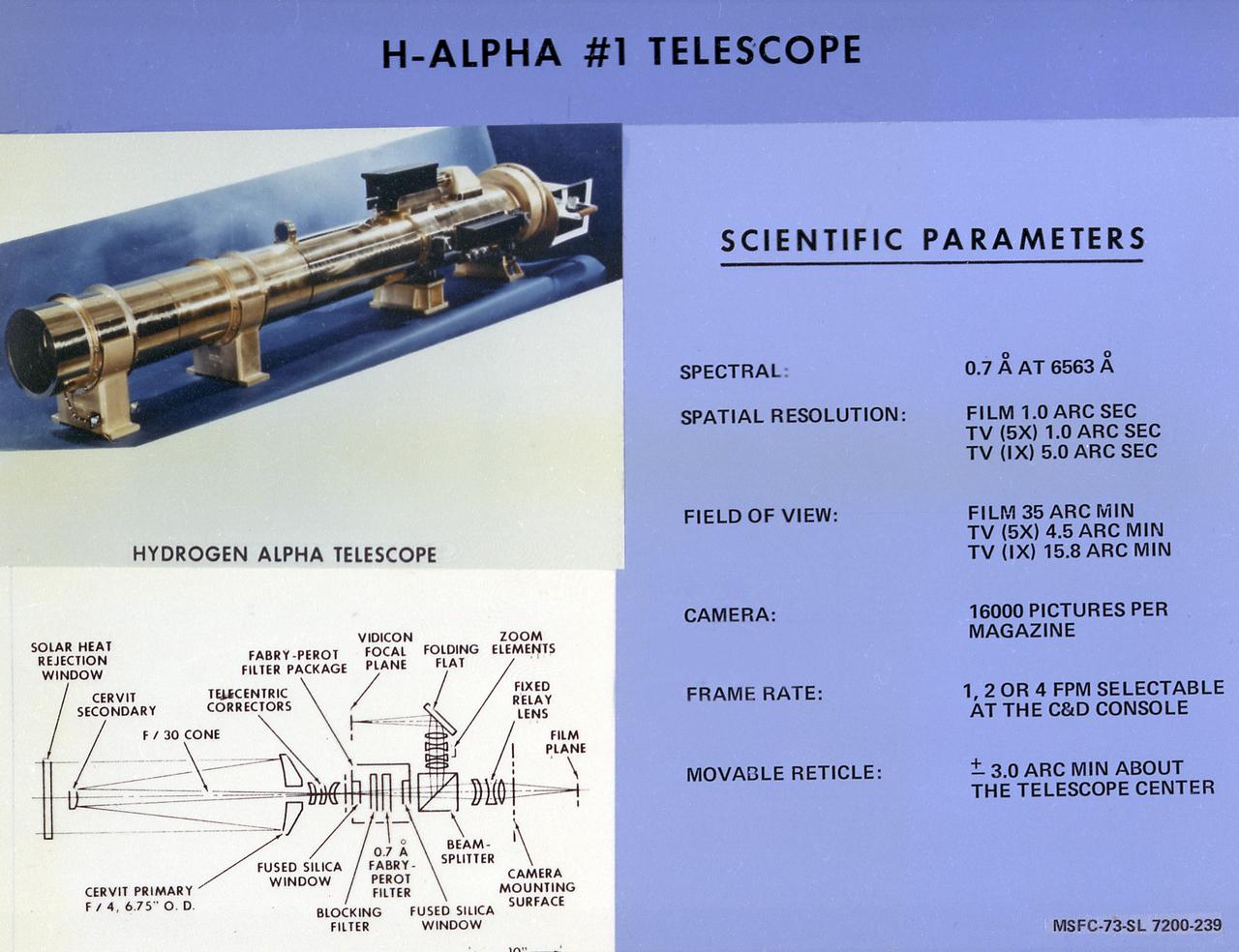
This chart describes the Hydrogen-Alpha (H-Alpha) #1 Telescope, one of eight major solar study facilities on the Skylab Apollo Telescope Mount (ATM). There were two H-Alpha telescopes on the ATM that were used primarily to point the ATM and keep a continuous photographic record during the solar observation periods. Both telescopes gave the Skylab astronauts a real-time picture of the Sun in the red light of the H-Alpha spectrum through a closed-circuit television. The H-Alpha #1 Telescope provided simultaneous photographic and ultraviolet (UV) pictures, while the #2 Telescope operated only in the TV mode. The Marshall Space Flight Center was responsible for development of the H-Alpha Telescopes.
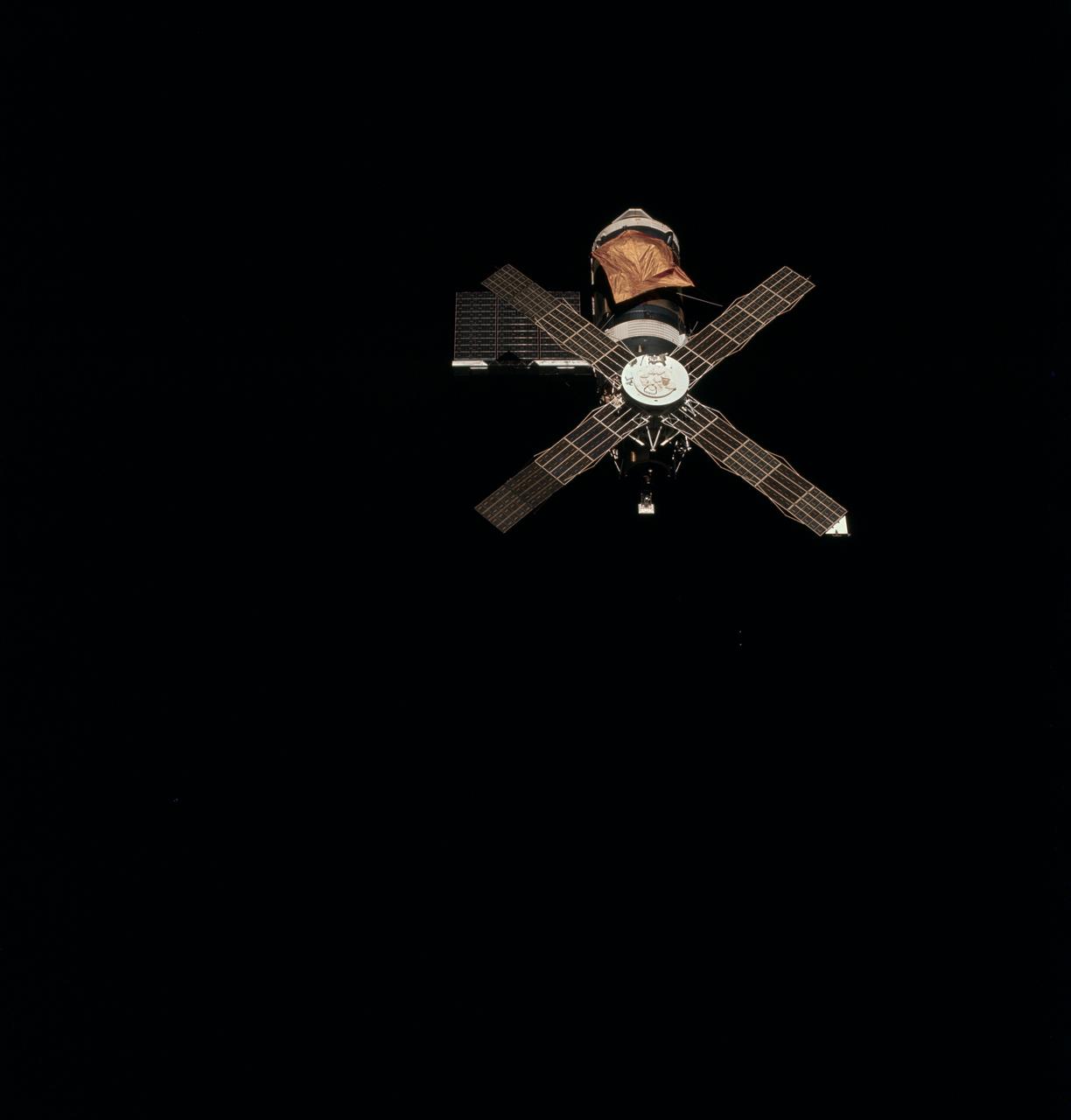
SL2-X7-615 (22 June 1973) --- An overhead view of the Skylab 1 space station cluster in Earth orbit photographed from the Skylab 2 Command/Service Module during the final ?fly around? inspection by the CSM. The space station is sharply contrasted against a black sky background. Note the deployed parasol solar shield which shades the Orbital Workshop where the micrometeoroid shield is missing. The one remaining OWS solar array system wing has been fully deployed successfully. The OWS solar panel on the opposite side is missing completely. Photo credit: NASA
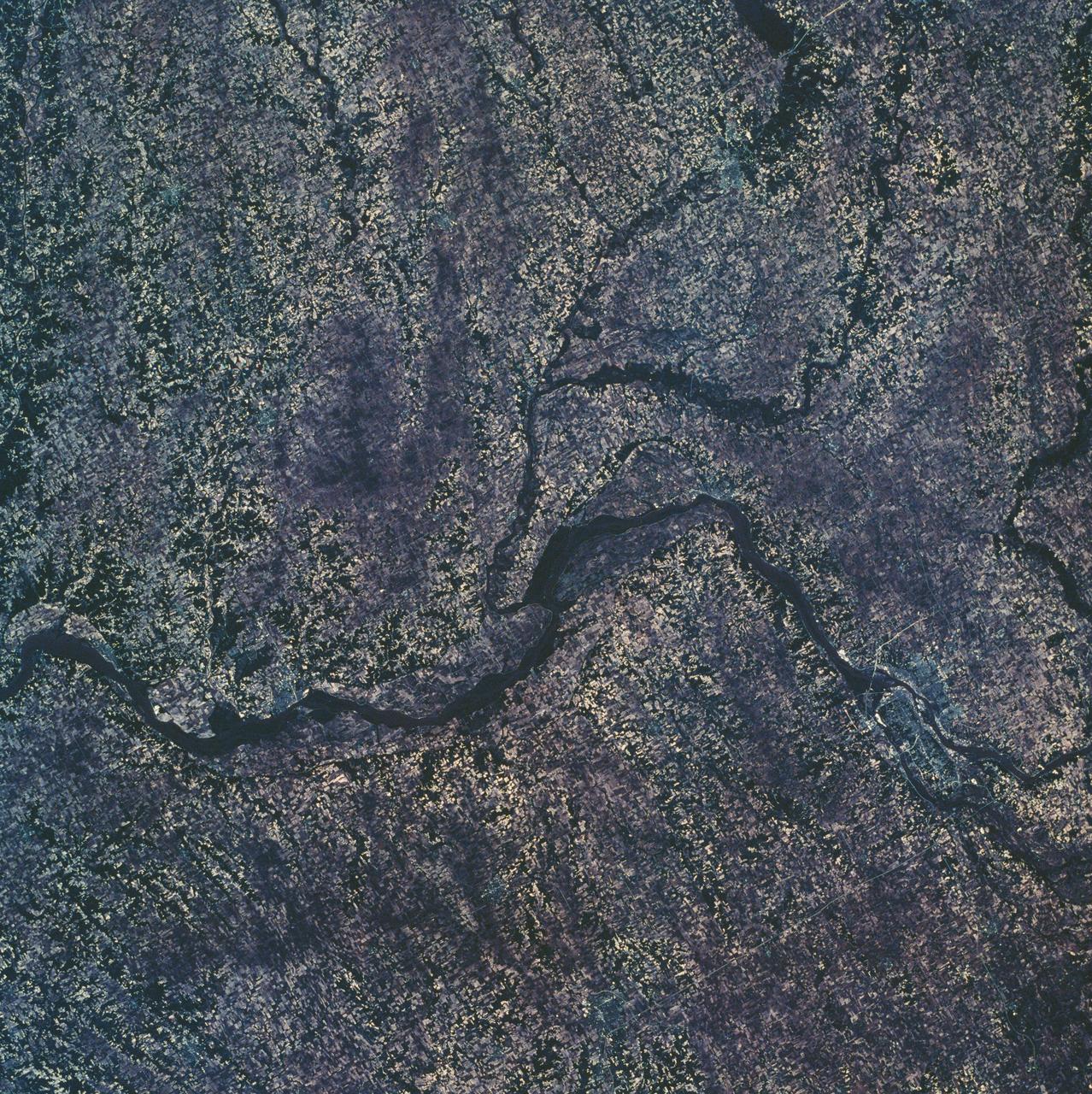
SL2-10-250 (May-June 1973) --- A vertical view of eastern Iowa and northwestern Illinois, as photographed from Skylab space station in Earth orbit. Davenport, Burlington and Muscatine, Iowa; and Rock Island and Moline, Illinois can be delineated on opposite sides of the Mississippi River. The Iowa River and tributaries of it can also be delineated. This photograph was taken with one of six lenses of the Itek-furnished Multispectral Photographic Facility Experiment S190-A mounted in the Multiple Docking Adapter (MDA) of the space station. A six-inch lens, using 70mm medium speed Ektachrome (SO-356) film, was used. Agencies participating with NASA on the EREP project are the Departments of Agriculture, Commerce and Interior; the Environmental Protection Agency and the Corps of Engineers. All EREP photography is available to the public through the Department of Interior's Earth Resources Observations Systems Data Center, Sioux Falls, South Dakota, 57198. Photo credit: NASA
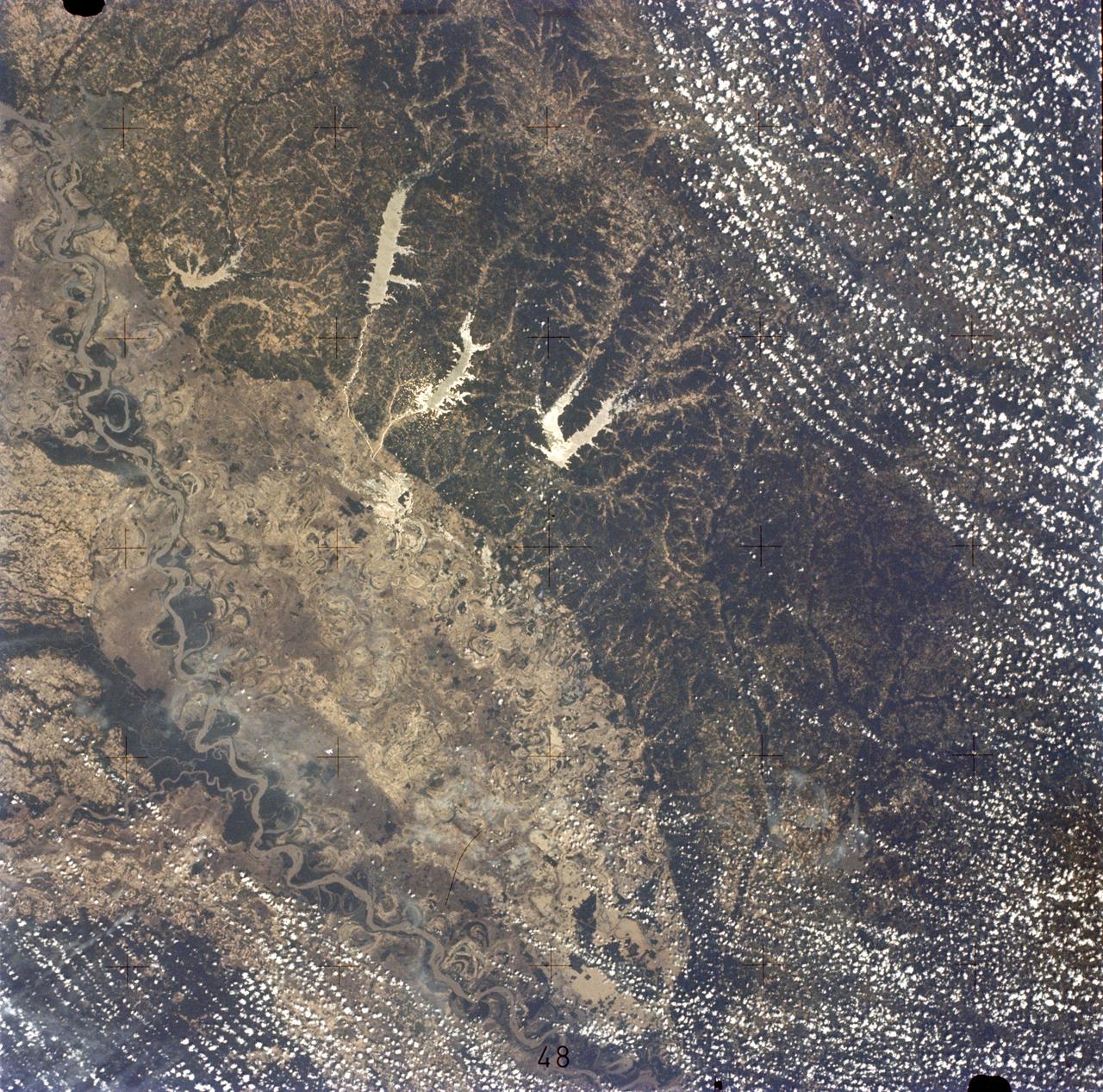
SL2-05-422 (22 June 1973) --- This section of the lower Mississippi River (34.0N, 90.0W) known as the Yazoo Basin, is characterized by a wide expanse of rich river bottomland with many oxbow lakes, the remains of the many changes in the riverbed over the course of many thousands of years. This soil is very fertile and productive but the region is prone to flooding. In this view, some of the back areas around the Delta National Forest show the effects of heavy spring rains. Photo credit: NASA

SL2-05-390 (22 June 1973) --- Greater Detroit (42.0N, 82.5W) is located at the southeastern border of Michigan on the Detroit River across from Windsor, Ontario, Canada and Lake Huron to the north. The river connecting Lake Erie is a channel left over from the Ice Age Glaciers. The land use pattern in this scene is typical of this part of the upper Midwest. The once extensive forests have been cleared for farmland and pasture, but narrow rows of trees still line farm boundaries. Photo credit: NASA