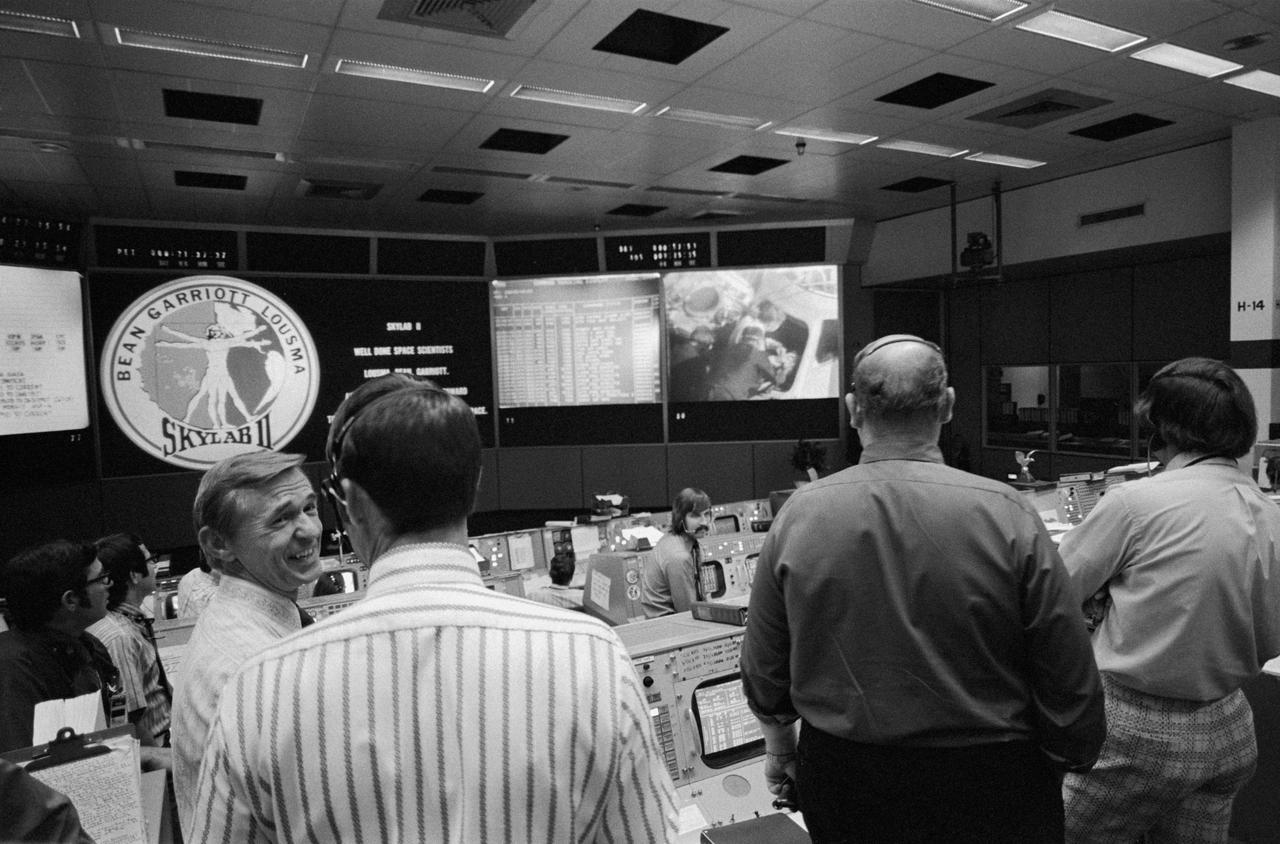
S73-34553 (25 Sept. 1973) --- Skylab flight directors (foreground) and flight controllers (background) view the large screen in the Mission Operations Control Room (MOCR) in the Mission Control Center (MCC) at JSC during recovery operations of the second manned Skylab mission. From left to right in the foreground are flight directors Charles R. Lewis, Donald R. Puffy, Phillip Shaffer and Neil B. Hutchinson. The Skylab 3 crewmen were preparing to egress the spacecraft aboard the USS New Orleans. Television cameras aboard the New Orleans recorded post-recovery activity. Photo credit: NASA
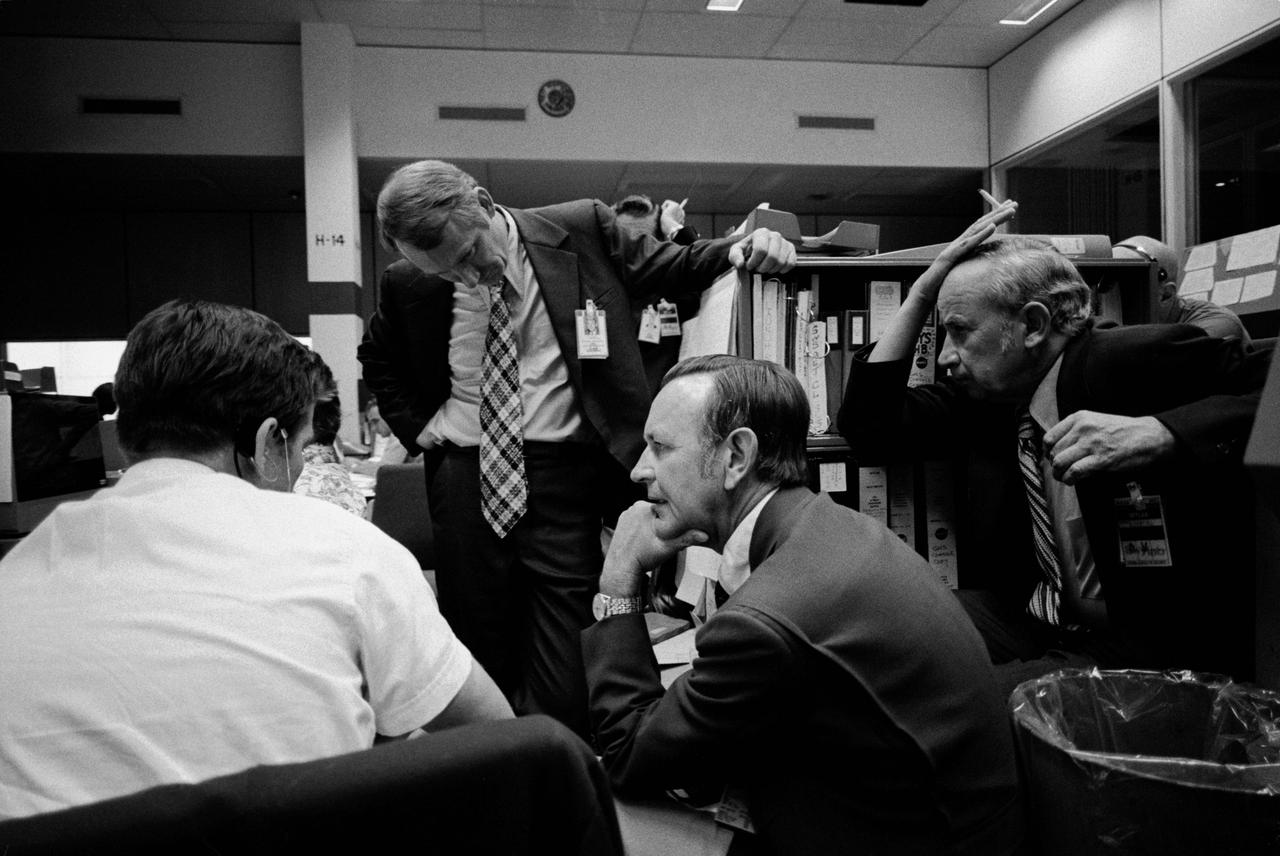
S73-31875 (2 Aug. 1973) --- After learning of a problem in the Command/Service Module which was used to transport the Skylab 3 crew to the orbiting Skylab space station cluster, NASA officials held various meetings to discuss the problem. Here, four men monitor the current status of the problem in the Mission Operations Control Room (MOCR) of the Mission Control Center (MCC) at the Johnson Space Center (JSC). From the left are Gary E. Coen, Guidance and Navigation System flight controller; Howard W. Tindall Jr., Director of Flight Operations at JSC; Dr. Christopher C. Kraft Jr., JSC Director; and Sigurd A. Sjoberg, JSC Deputy Director. Photo credit: NASA
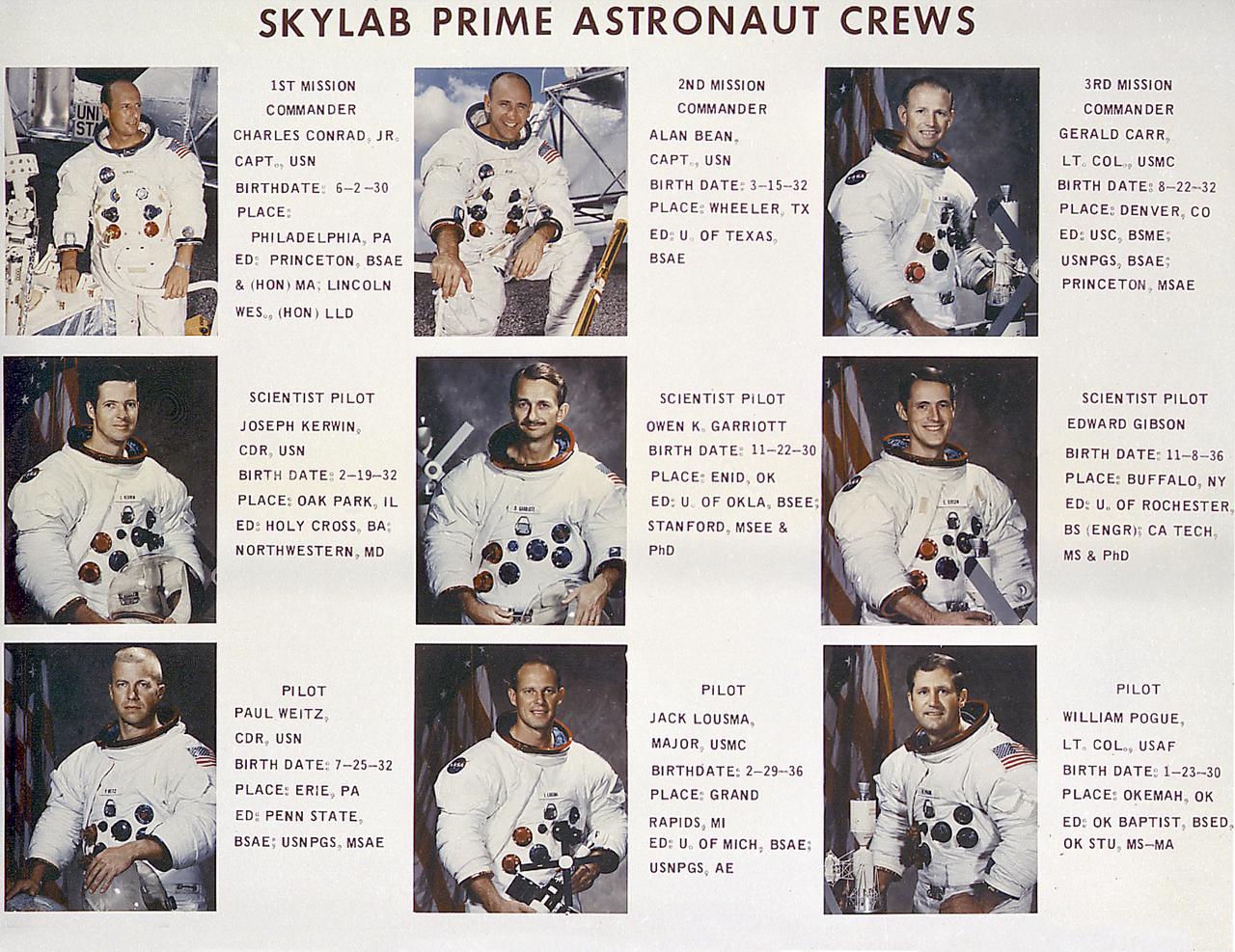
This photograph is a montage of astronaut crews for the three Skylab missions with simple biographical data of each astronaut. The 1st mission was designated as Skylab-2, 2nd mission as Skylab-3, and 3rd mission as Skylab-4. The Skylab-1 mission placed the Skylab Orbital Work Shop in orbit by a modified Saturn V launch vehicle. Skylab's 3 different 3-man crews spent up to 84 days in Earth orbit and performed a variety of more than 100 experiments.
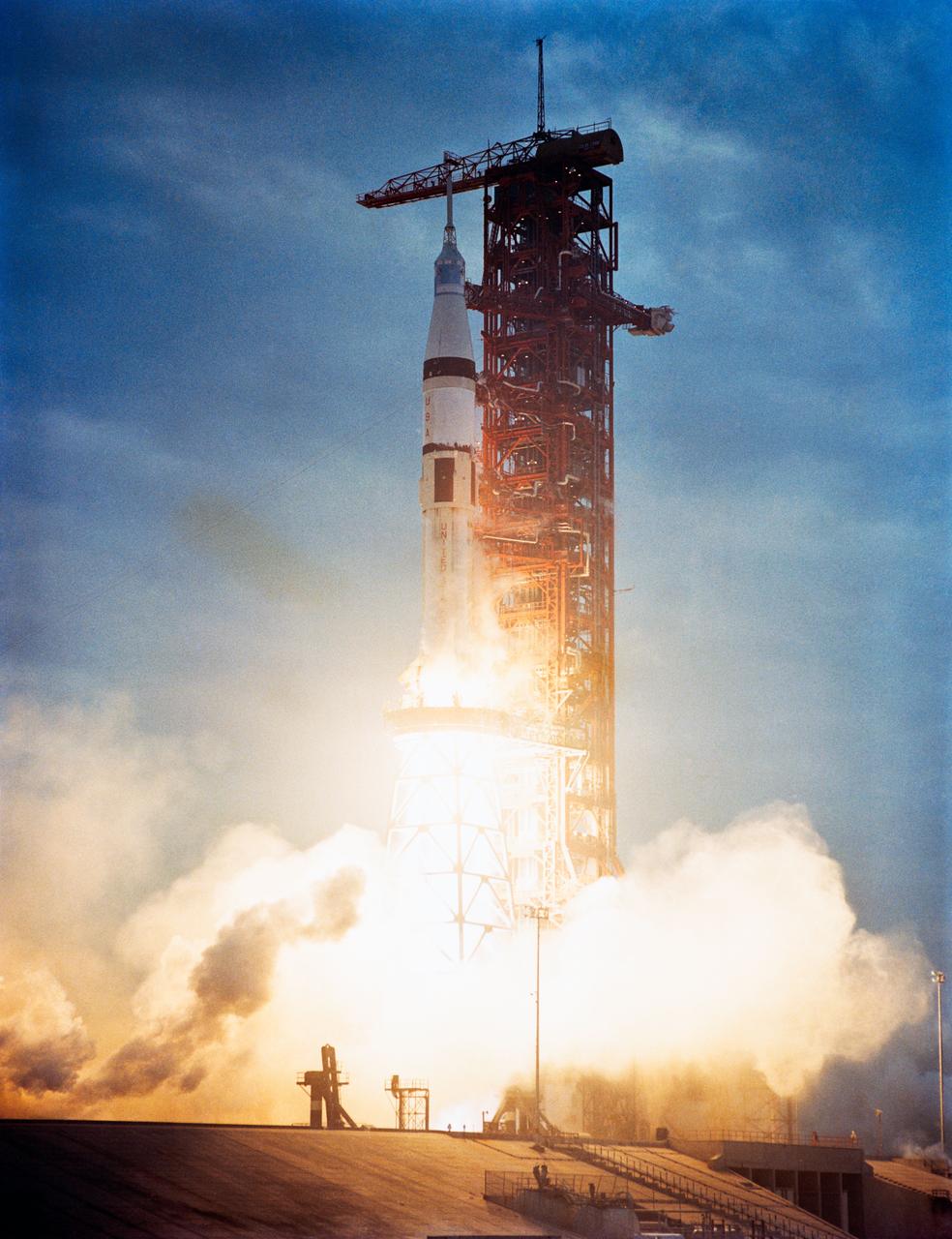
S73-32570 (28 July 1973) --- The Skylab 3/Saturn 1B space vehicle is launched from Pad B, Launch Complex 39, Kennedy Space Center, Florida, at 7:11 a.m. (EDT), Saturday, July 28, 1973. Skylab 3 is the second of three scheduled Skylab manned missions. Aboard the Skylab 3 Command/Service Module were astronauts Alan L. Bean, Owen K. Garriott and Jack R. Lousma. The Skylab 3 CSM later docked with the Skylab space station cluster in Earth orbit. In addition to the CSM and its launch escape system, the Skylab 3 space vehicle consisted of the Saturn 1B first (S-1B) stage and the Saturn 1B second (S-1VB) stage. (The Skylab 1/Saturn V space vehicle with the space station payload was launched from Pad A on May 14, 1973). Photo credit: NASA
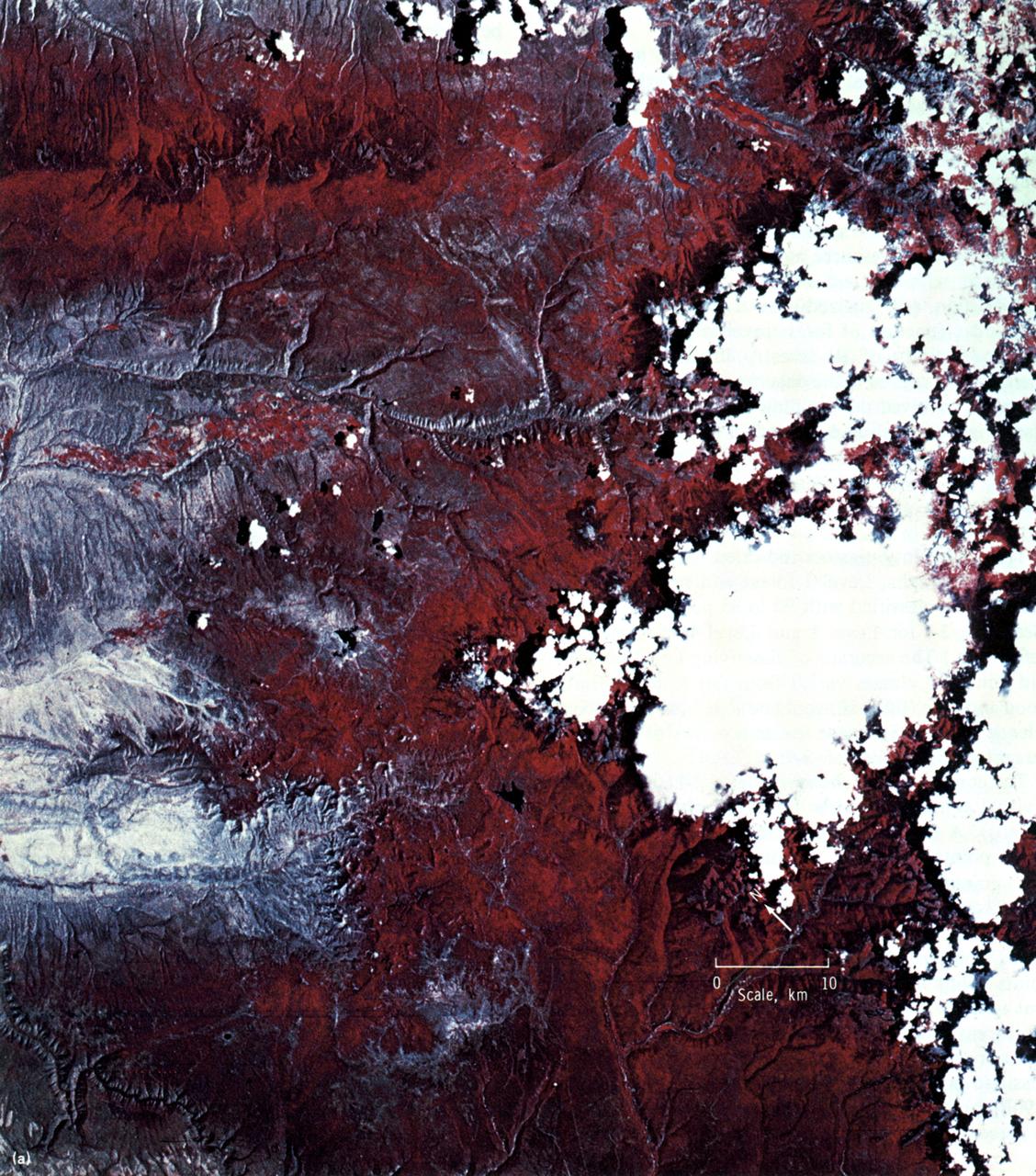
This high-resolution color infrared photograph of the Uncompahgre Plateau area of Colorado was taken by the Multi-spectral Photographic Camera (Skylab EREP Experiment S190A) of the Skylab's Multi-spectral Photographic Facility during the Skylab-3 mission.
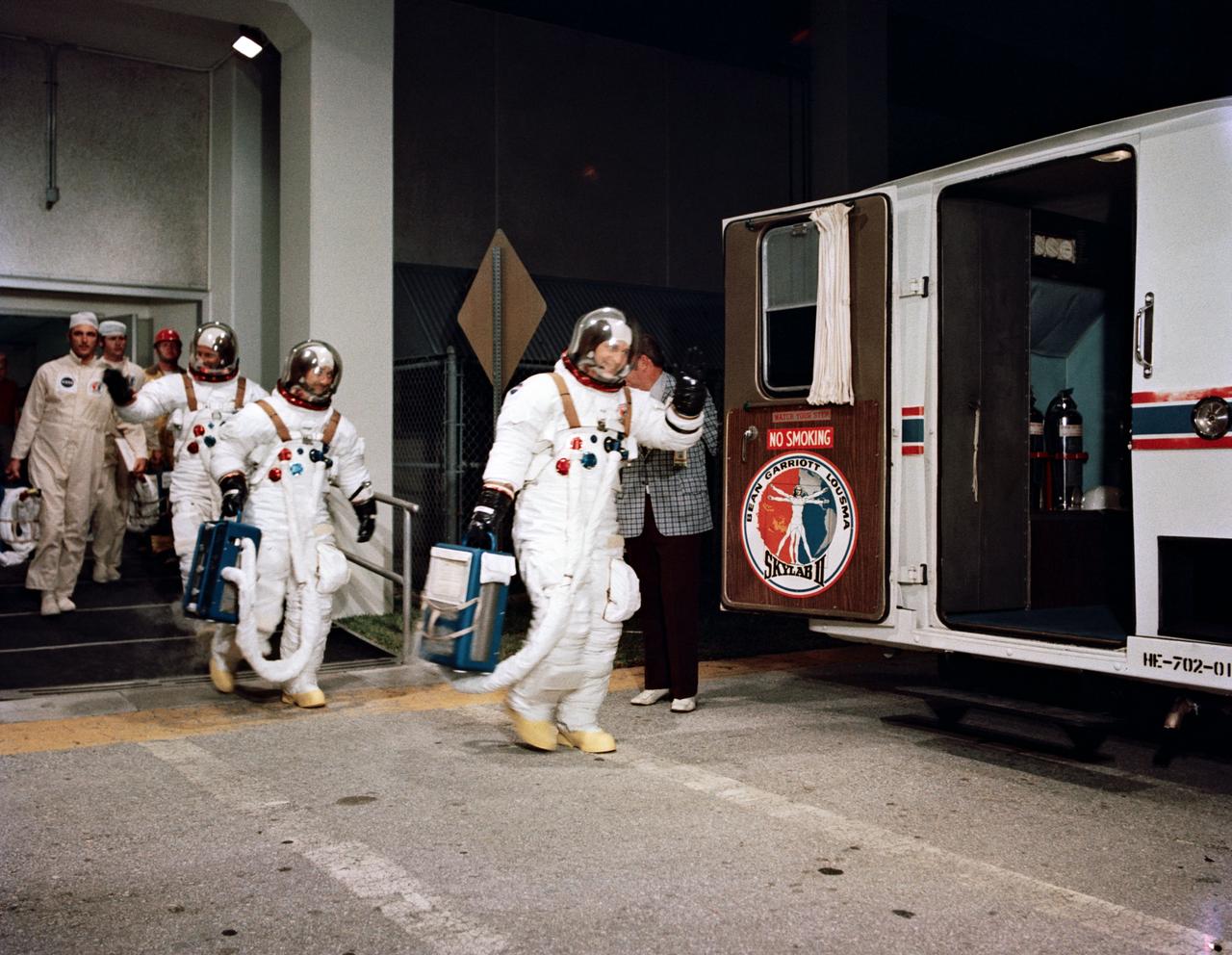
S73-31801 (28 July 1973) --- The three crewmen of the second manned Skylab mission (Skylab 3) leave the Manned Spacecraft Operations Building at the Kennedy Space Center on the morning of the Skylab 3 launch. Leading is astronaut Alan L. Bean, commander; followed by scientist-astronaut Owen K. Garriott, science pilot; and astronaut Jack R. Lousma, pilot. They entered the special van which carried them to Pad B at KSC?s Launch Complex 39 where the Skylab 3/Saturn 1B space vehicle awaited them. The Skylab 3 liftoff was at 7:11 a.m. (EDT), Saturday, July 28, 1973. The three astronauts were scheduled to spend 59 days at the Skylab space station in Earth orbit. Photo credit: NASA
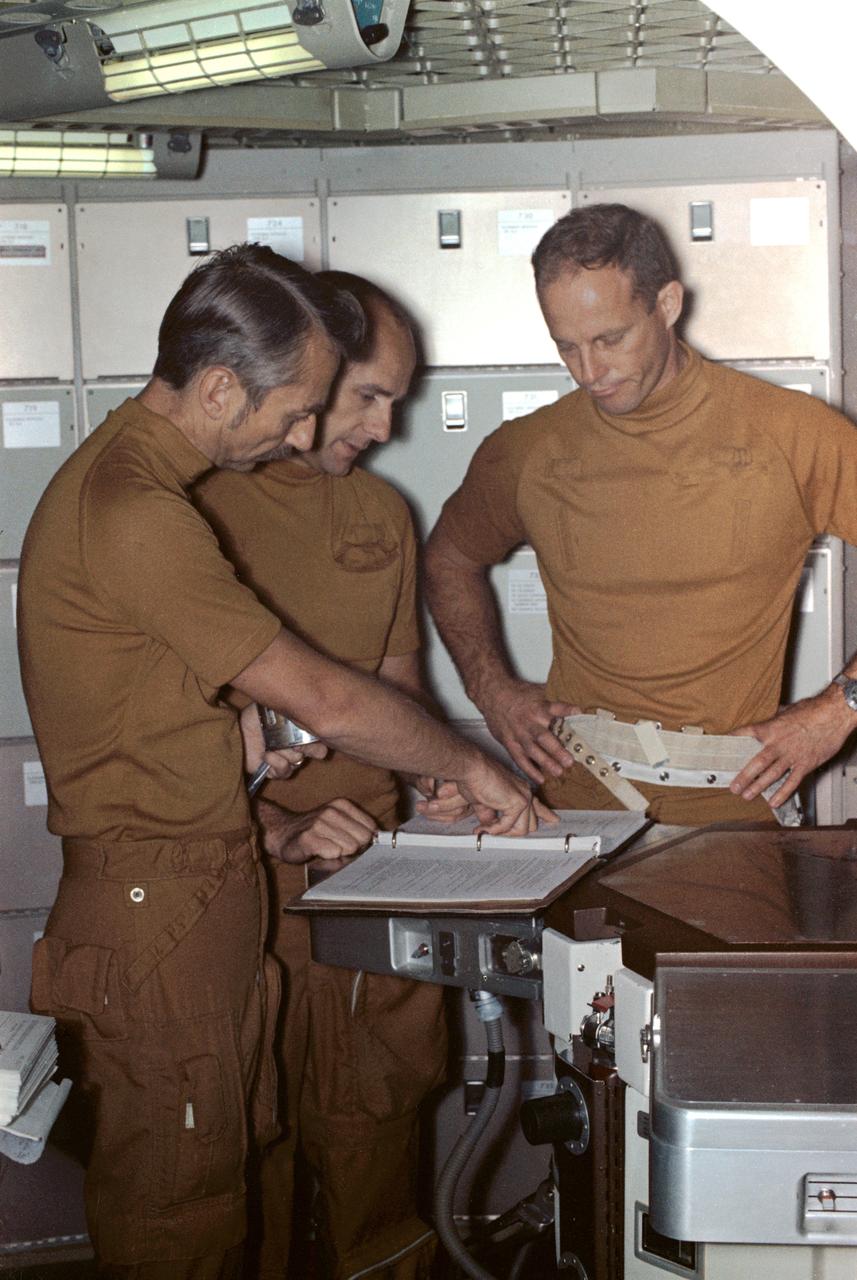
S73-28793 (16 July 1973) --- The three crewmen of the second manned Skylab mission (Skylab 3) go over a checklist during preflight training at the Johnson Space Center. They are, left to right, scientist-astronaut Owen K. Garriott, science pilot; astronaut Alan L. Bean, commander; and astronaut Jack R. Lousma, pilot. They are in the crew quarters of the Orbital Workshop trainer in the Mission Training and Simulation Facility, Building 5, at JSC. Skylab 3 is scheduled as a 59-day mission in Earth orbit. Photo credit: NASA
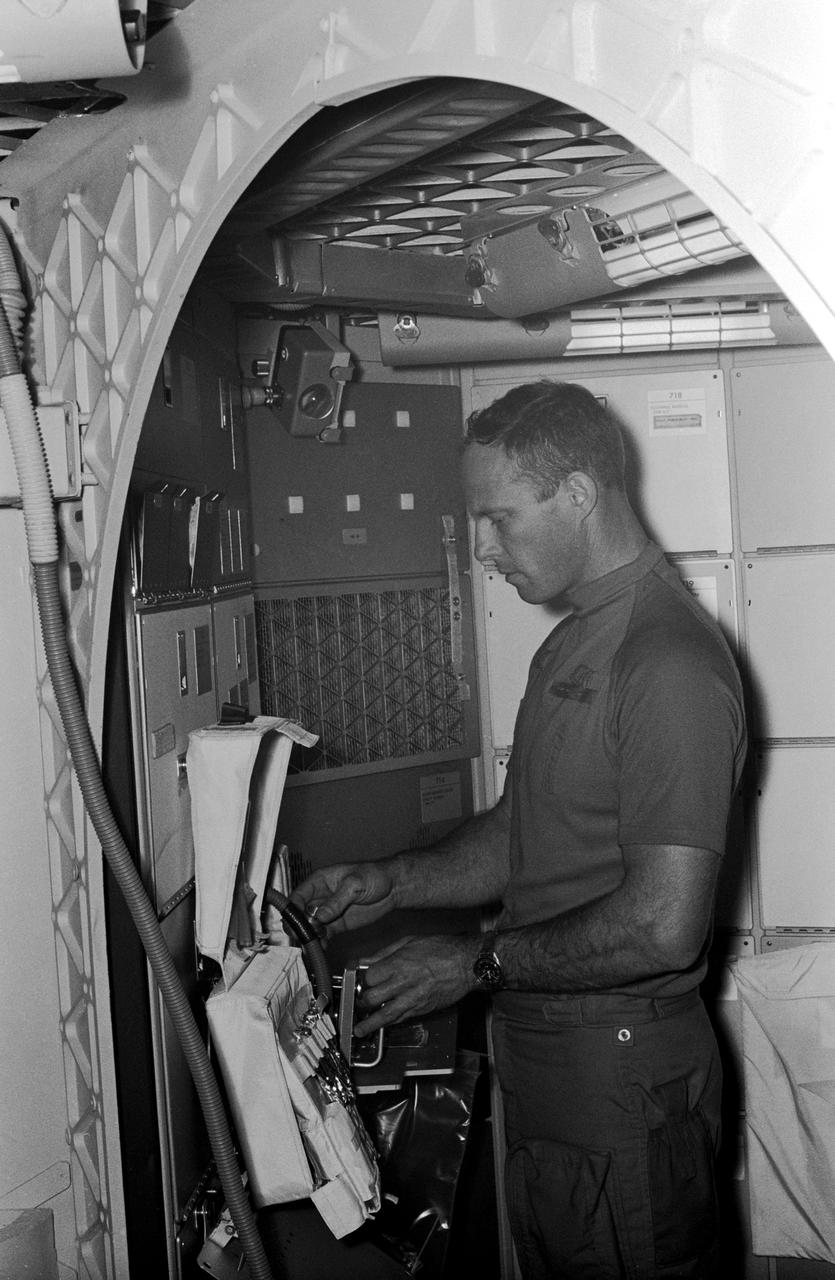
S73-28423 (16 June 1973) --- Astronaut Jack R. Lousma, Skylab 3 pilot, reaches into a medical kit, part of the Inflight Medical Support System (IMSS), during training for the second manned Skylab Earth-orbital mission. This activity took place in the OWS trainer in the Mission Simulation and Training Facility at the Johnson Space Center (JSC). Other Skylab 3 crewmen are astronaut Alan L. Bean, commander, and scientist-astronaut Owen K. Garriott, science pilot. Photo credit: NASA
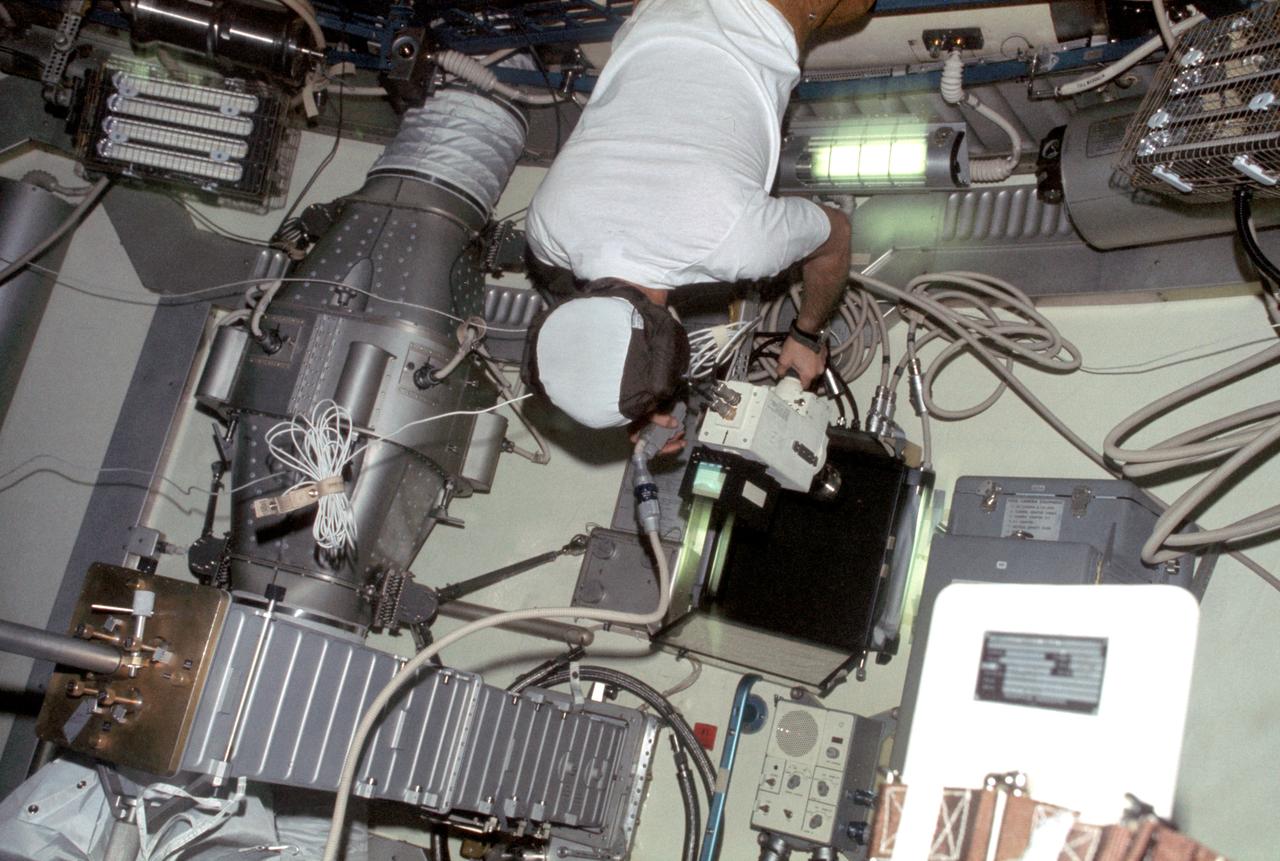
SL3-109-1345 (August 1973) --- View of scientist-astronaut Owen K. Garriott, Skylab 3 science pilot, taking TV footage of Arabella and Anita, the two Skylab 3 common cross spiders "aranous diadematus," aboard the Skylab space station cluster in Earth orbit. During the 59-day Skylab 3 mission the two spiders Arabella and Anita, were housed in an enclosure onto which a motion picture and still camera were attached to record the spiders' attempts to build a web in the weightless environment. Note the automatic data acquisition camera (DAC) about 3.5 feet to Garriott's right (about waist level). Photo credit: NASA
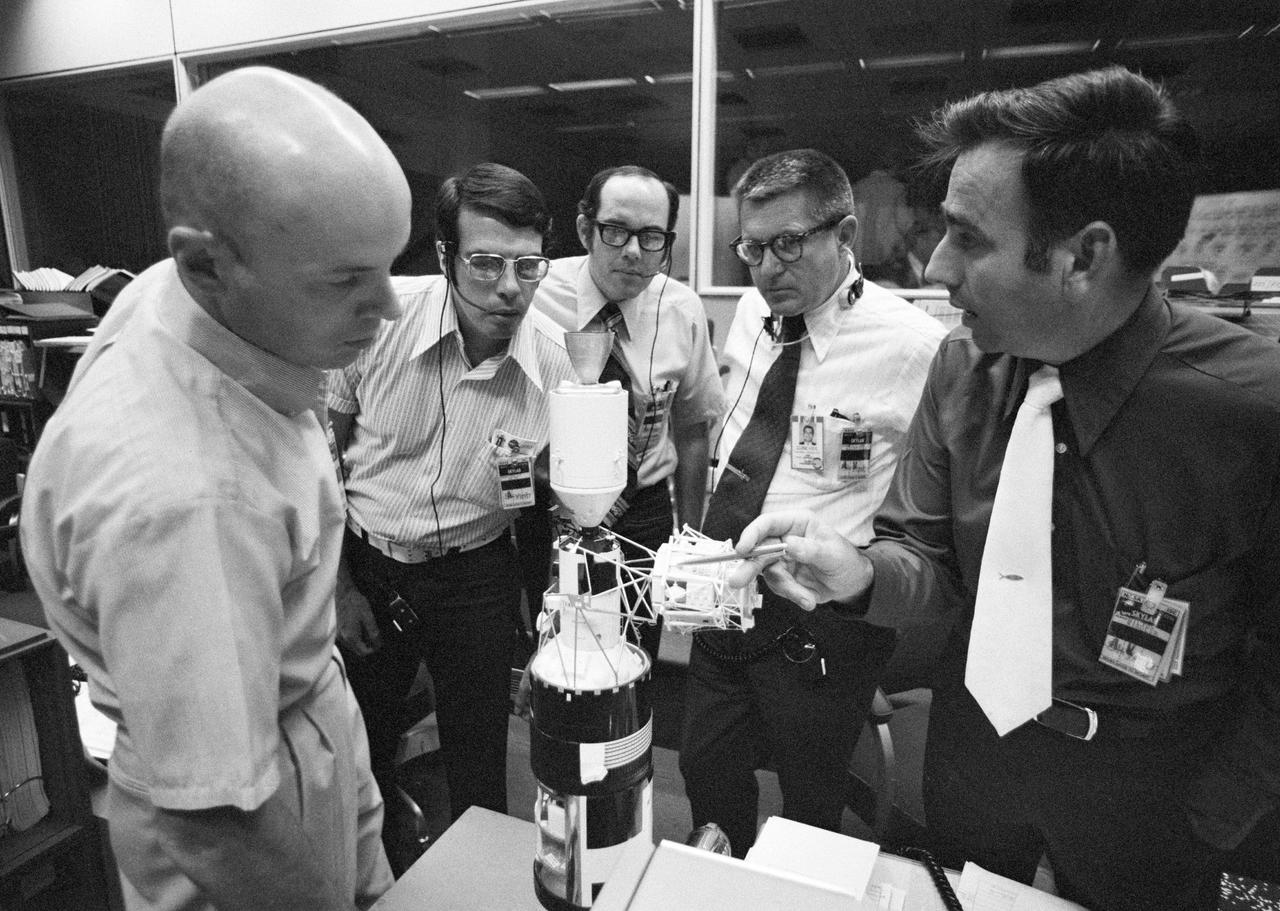
S73-31964 (5 August 1973) --- This group of flight controllers discuss today's approaching extravehicular activity (EVA) to be performed by the Skylab 3 crewmen. They are, left to right, scientist-astronaut Story Musgrave, a Skylab 3 spacecraft communicator; Robert Kain and Scott Millican, both of the Crew Procedures Division, EVA Procedures Section; William C. Schneider, Skylab Program Director, NASA Headquarters; and Milton Windler, flight director. Windler points to the model of the Skylab space station cluster to indicate the location of the ATM's film magazines. The group stands near consoles in the Mission Operations Control Room (MOCR) of the JSC Mission Control Center (MCC). Photo credit: NASA
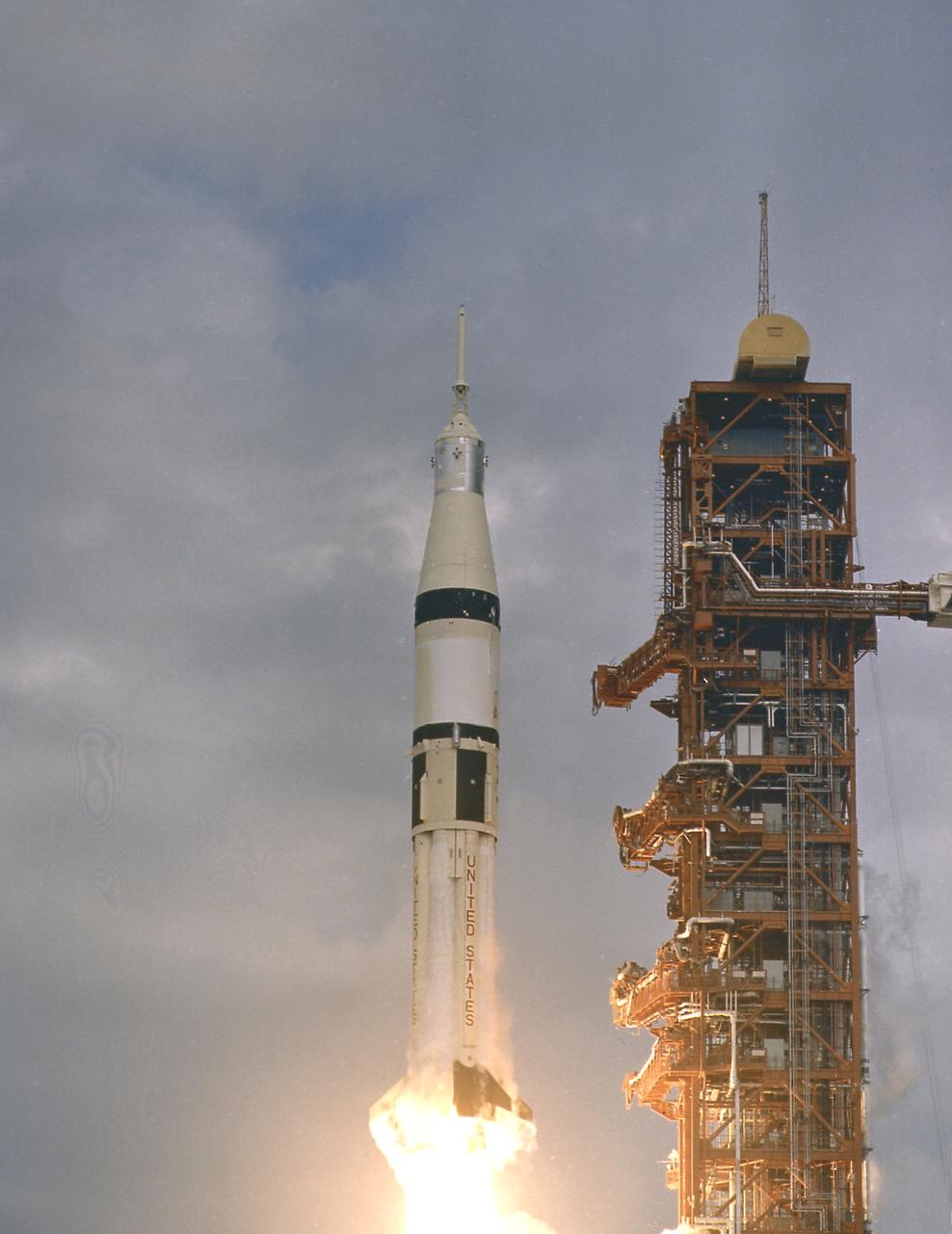
SA-206 lifts off from Kennedy Space Center's launch complex 39B, in Florida, on May 25, 1973, for the first manned Skylab mission (SL-2) with astronauts Pete Conrad, Joseph Kerwin, and Paul Weitz. The Saturn IB, developed under the direction of the Marshall Space Flight Center (MSFC), launched five manned Earth-orbital missions between 1968 and 1975: Apollo 7, Skylab 2, Skylab 3, Skylab 4, and the Apollo-Soyuz Test Project (ASTP).
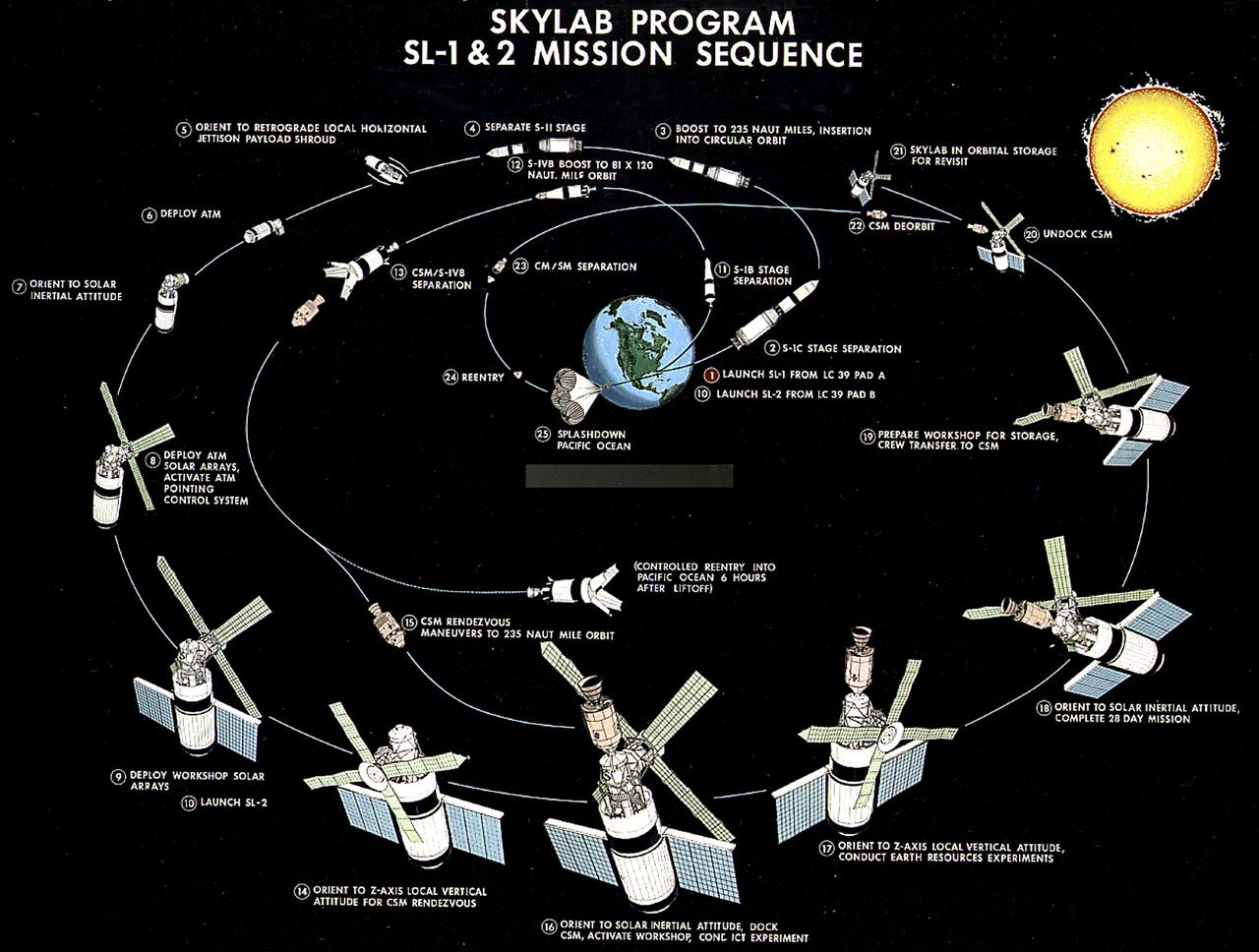
This illustration depicts the Skylab-1 and Skylab-2 mission sequence. The goals of the Skylab were to enrich our scientific knowledge of the Earth, the Sun, the stars, and cosmic space; to study the effects of weightlessness on living organisms, including man; to study the effects of the processing and manufacturing of materials utilizing the absence of gravity; and to conduct Earth resource observations. The Skylab also conducted 19 selected experiments submitted by high school students. Skylab's 3 different 3-man crews spent up to 84 days in Earth orbit. The Marshall Space Flight Center (MSFC) had responsibility for developing and integrating most of the major components of the Skylab: the Orbital Workshop (OWS), Airlock Module (AM), Multiple Docking Adapter (MDA), Apollo Telescope Mount (ATM), Payload Shroud (PS), and most of the experiments. MSFC was also responsible for providing the Saturn IB launch vehicles for three Apollo spacecraft and crews and a Saturn V launch vehicle for the Skylab.

Some of the prominences that float like lazy clouds above the solar surface suddenly erupt and break away from the Sun in cataclysmic action. The trigger of this coronal transient, like many others seen by Skylab's coronagraph, was an eruptive prominence that surged outward from the limb of the Sun, ejecting matter that disturbed the outer corona. This image is of the surge in action in ultraviolet light of ionized helium. Simultaneous observations like this made possible an almost immediate understanding of the new-found cosmic phenomenon. The elbow prominence was accidentally photographed by Astronaut Garriott (Skylab-3) while observing a small flare near the limb of the Sun beneath the mighty arch on August 9, 1973.
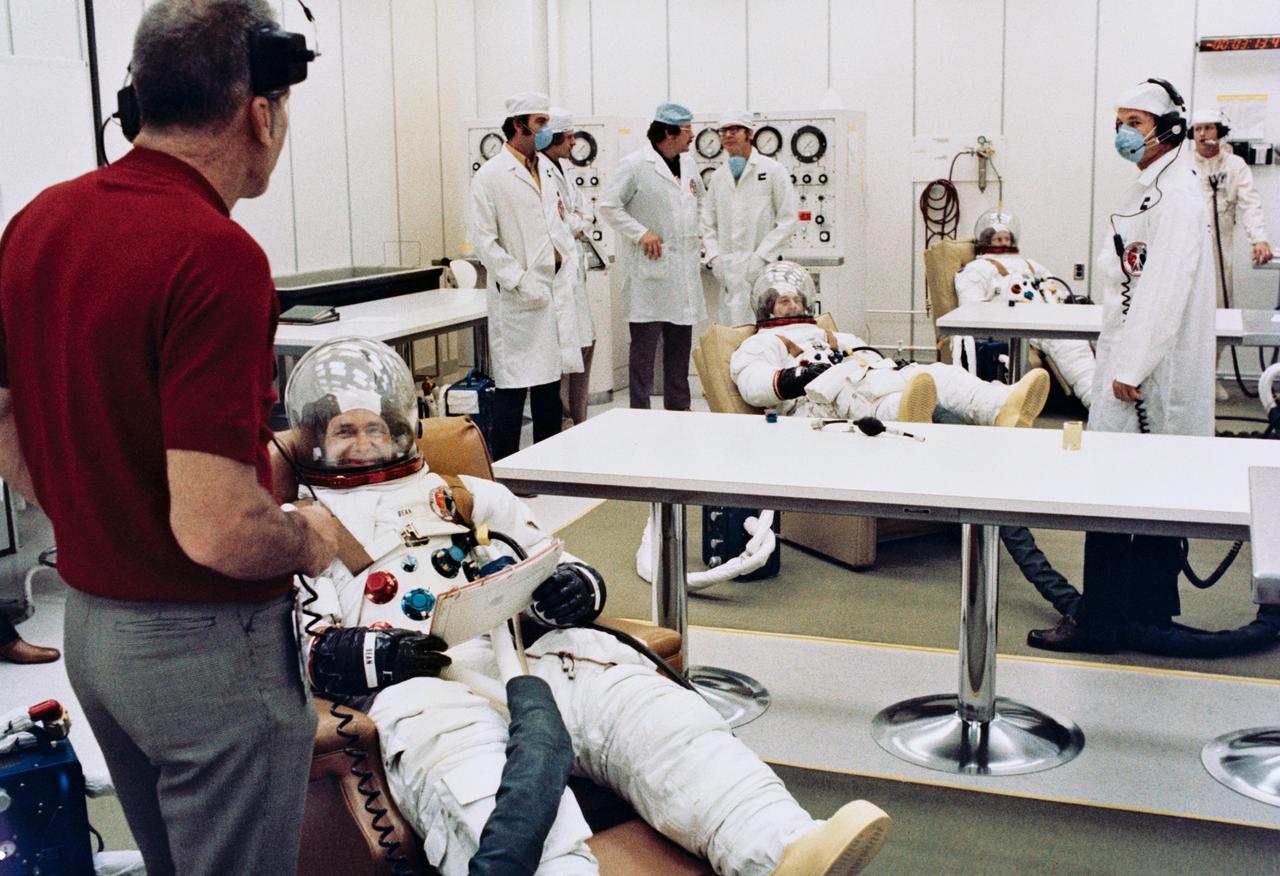
S73-31800 (28 July 1973) --- The three crewmen of the second manned Skylab mission (Skylab 3) participate in prelaunch suiting up activities in the Manned Spacecraft Operations Building at the Kennedy Space Center on the morning of the Skylab 3 launch. They are (from foreground) astronaut Alan L. Bean, commander; scientist-astronaut Owen K. Garriott, science pilot; and astronaut Jack R. Lousma, pilot. Dr. Donald K. Slayton (left foreground), Director of Flight Crew Operations, Johnson Space Center, monitors the prelaunch activities. Skylab 3 lifted off at 7:11 a.m. (EDT), Saturday, July 28, 1973. The three astronauts were scheduled to spend 59 days at the Skylab space station in Earth orbit. Photo credit: NASA
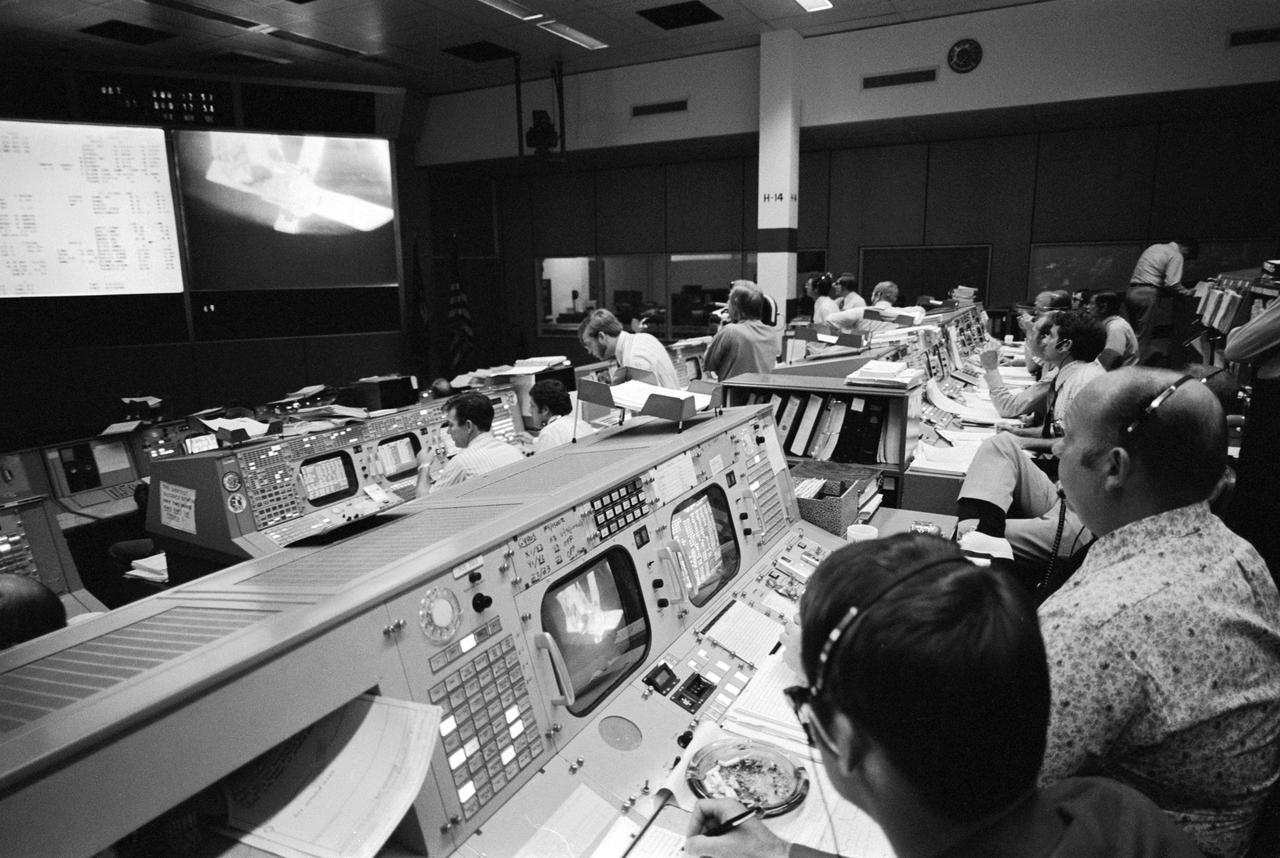
S73-31570 (July 1973) --- Overall view of the Mission Operations Control Room (MOCR) in the Mission Control Center (MCC), building 30, at Johnson Space Center during the Skylab 3 flyaround inspection of the Skylab Earth-orbiting cluster. Photo credit: NASA

S73-32568 (20 July 1973) --- Floodlights illuminate this nighttime view of the Skylab 3/Saturn 1B space vehicle at Pad B, Launch Complex 39, Kennedy Space Center, Florida, during prelaunch preparations. The reflection is the water adds to the scene. In addition to the Command/Service Module and its launch escapte system, the Skylab 3 space vehicle consists of the Saturn 1B first (S-1B) stage and the Saturn 1B second (S-IVB) stage. The crew for the scheduled 59-day Skylab 3 mission in Earth orbit will be astronauts Alan L. Bean, Owen K. Garriott and Jack R. Lousma. Skylab 3 was launched on July 28, 1973. Photo credit: NASA
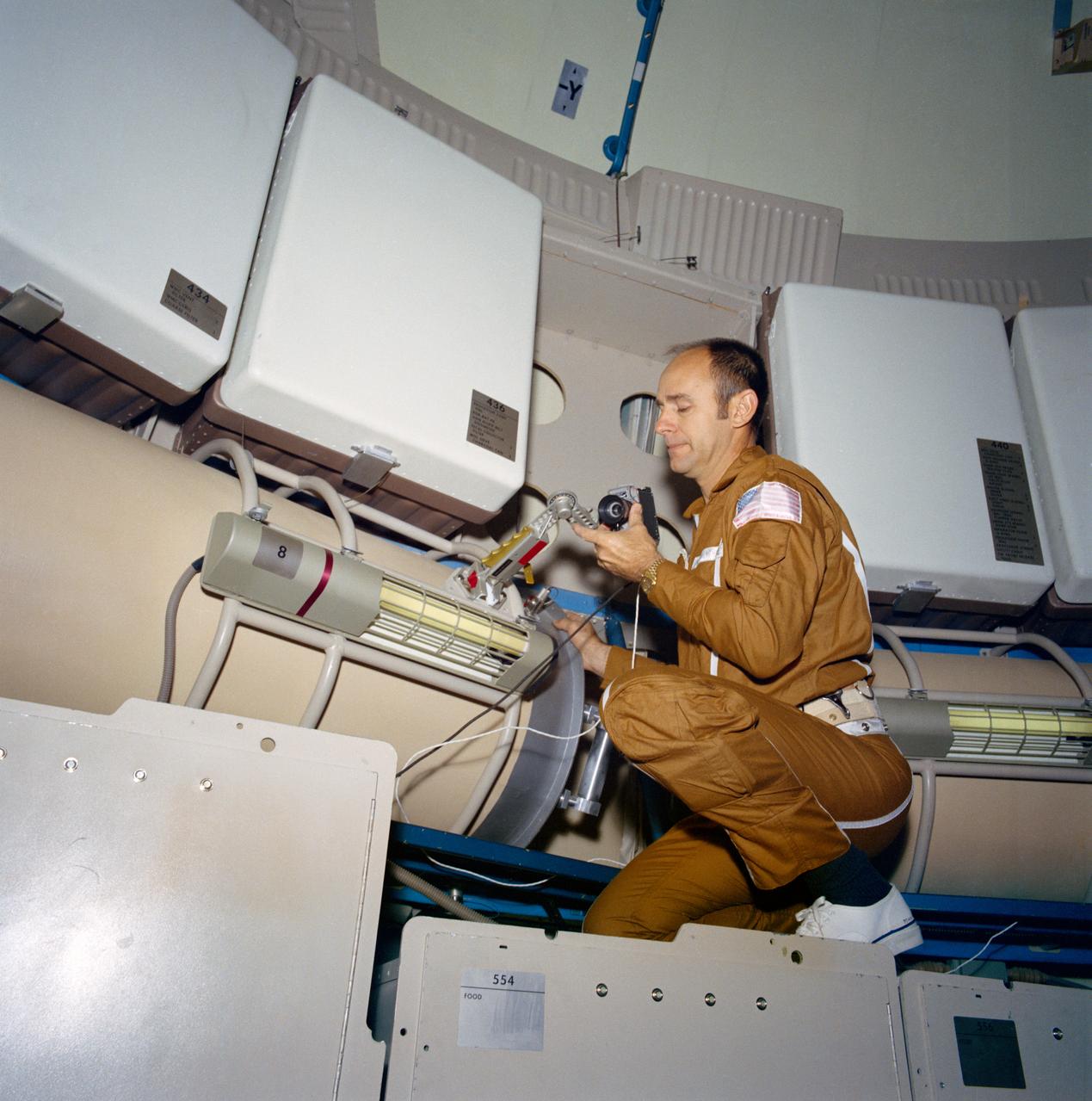
S72-39256 (1972) --- Astronaut Alan L. Bean, commander for Skylab 3, the second manned Skylab mission, looks over the data acquisition camera mounted on the water tank in the upper level of the Orbital Workshop (OWS) one-G trainer at the Manned Spacecraft Center (MSC). Photo credit: NASA

Scientist-Astronaut Owen K. Garriott, science pilot of the Skylab 3 mission, is stationed at the Apollo Telescope Mount (ATM) console in the Multiple Docking Adapter of the Skylab space station in Earth orbit. From this console the astronauts actively control the ATM solar physics telescope.
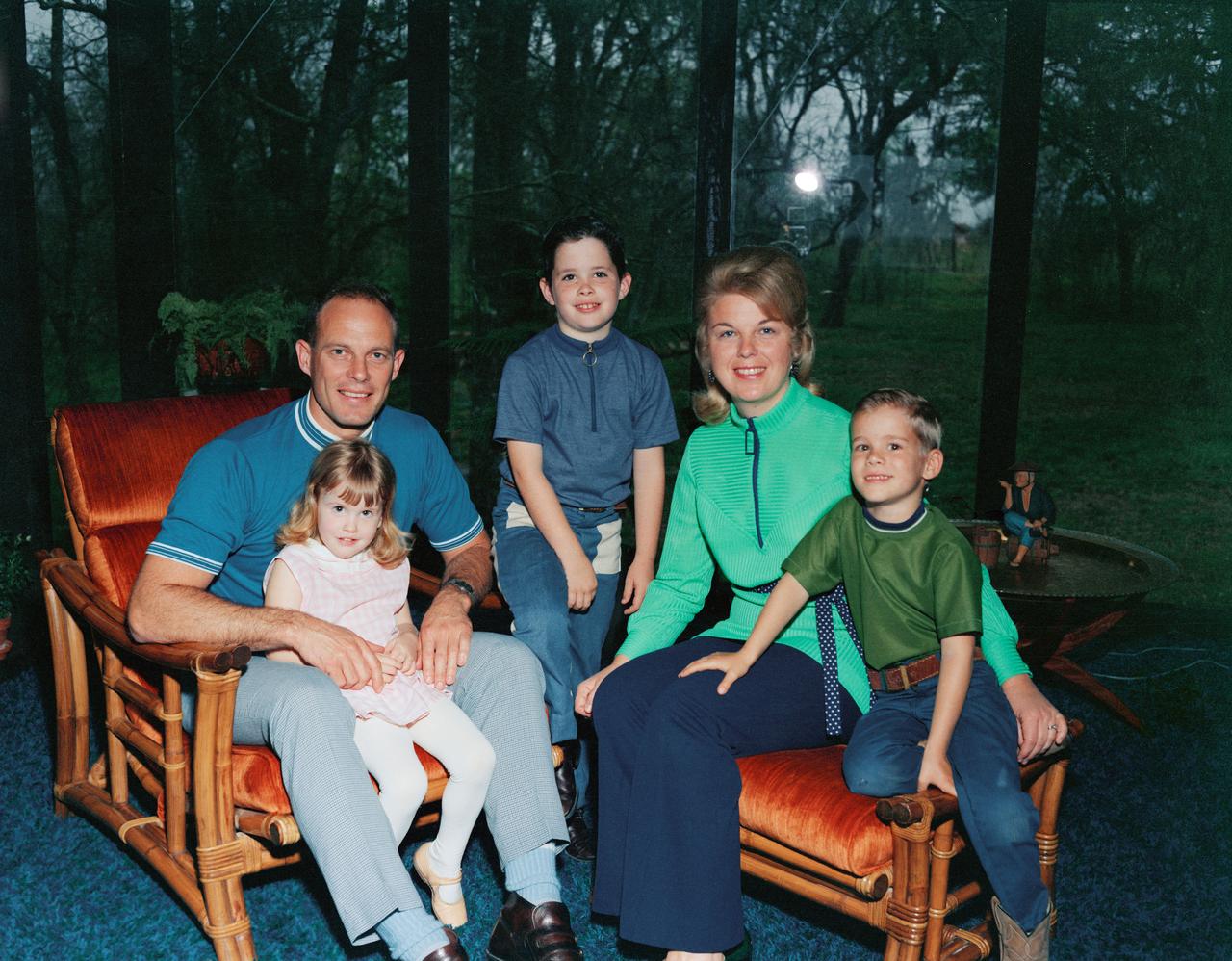
S72-31432 (November 1972) --- Astronaut Jack R. Lousma poses for a family portrait with his wife, Gratia Kay, and their three children, left to right, Mary 4; Timothy, 9; and Matthew, 7. Lousma is the pilot for the Skylab 3 or second manned Skylab mission. Photo credit: NASA
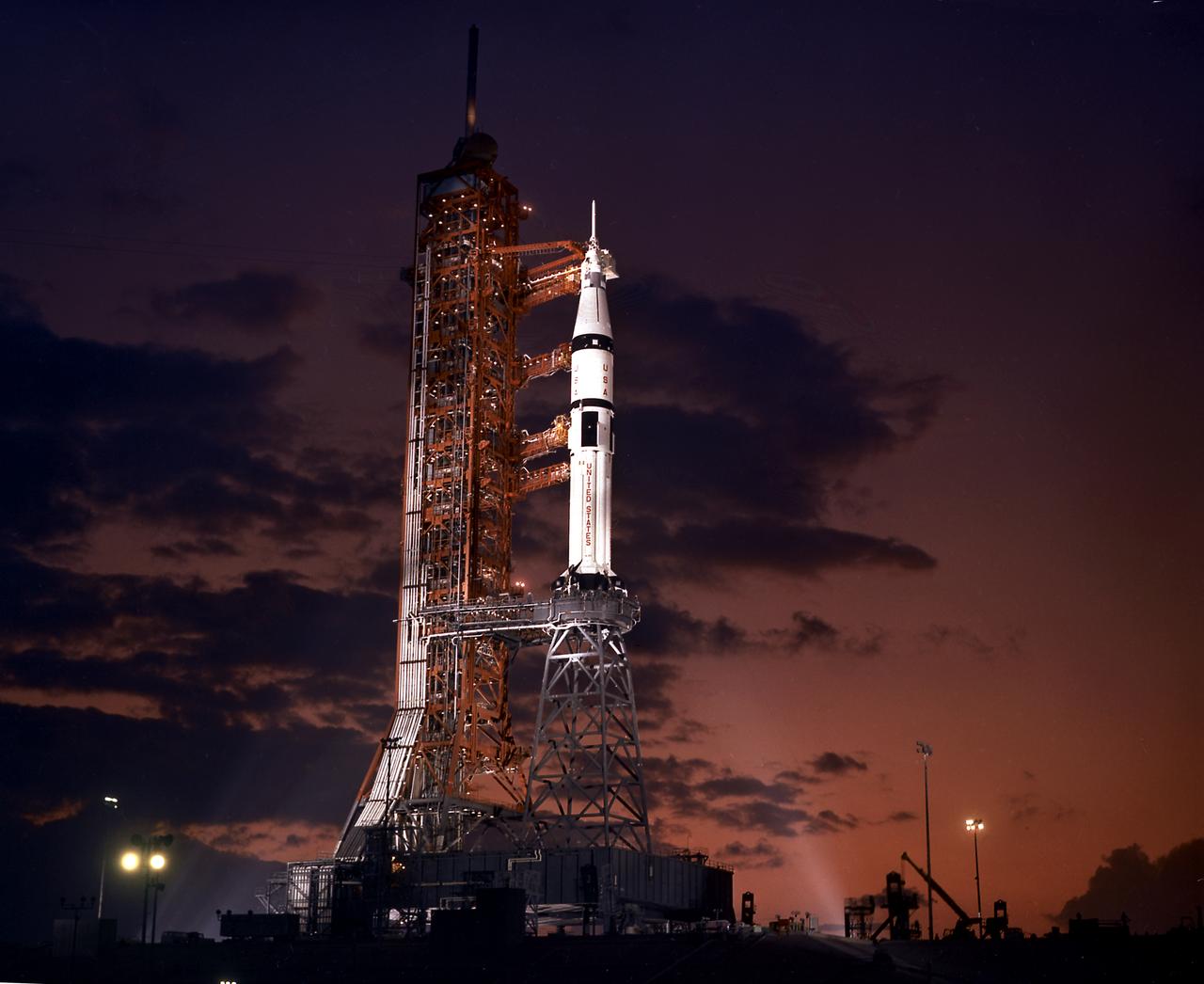
SA-210 Apollo-Soyuz Test Project (ASTP) awaits the launch scheduled on July 15, 1975 on the launch pad at the Kennedy Space Center, the ASTP mission with astronauts Thomas Stafford, Vance Brand, and Donald "Deke" Slayton. The Saturn IB, developed under the direction of the Marshall Space Flight Center (MSFC), launched five manned Earth-orbital missions between 1968 and 1975: Apollo 7, Skylab 2, Skylab 3, Skylab 4, and the Apollo-Soyuz Test Project .
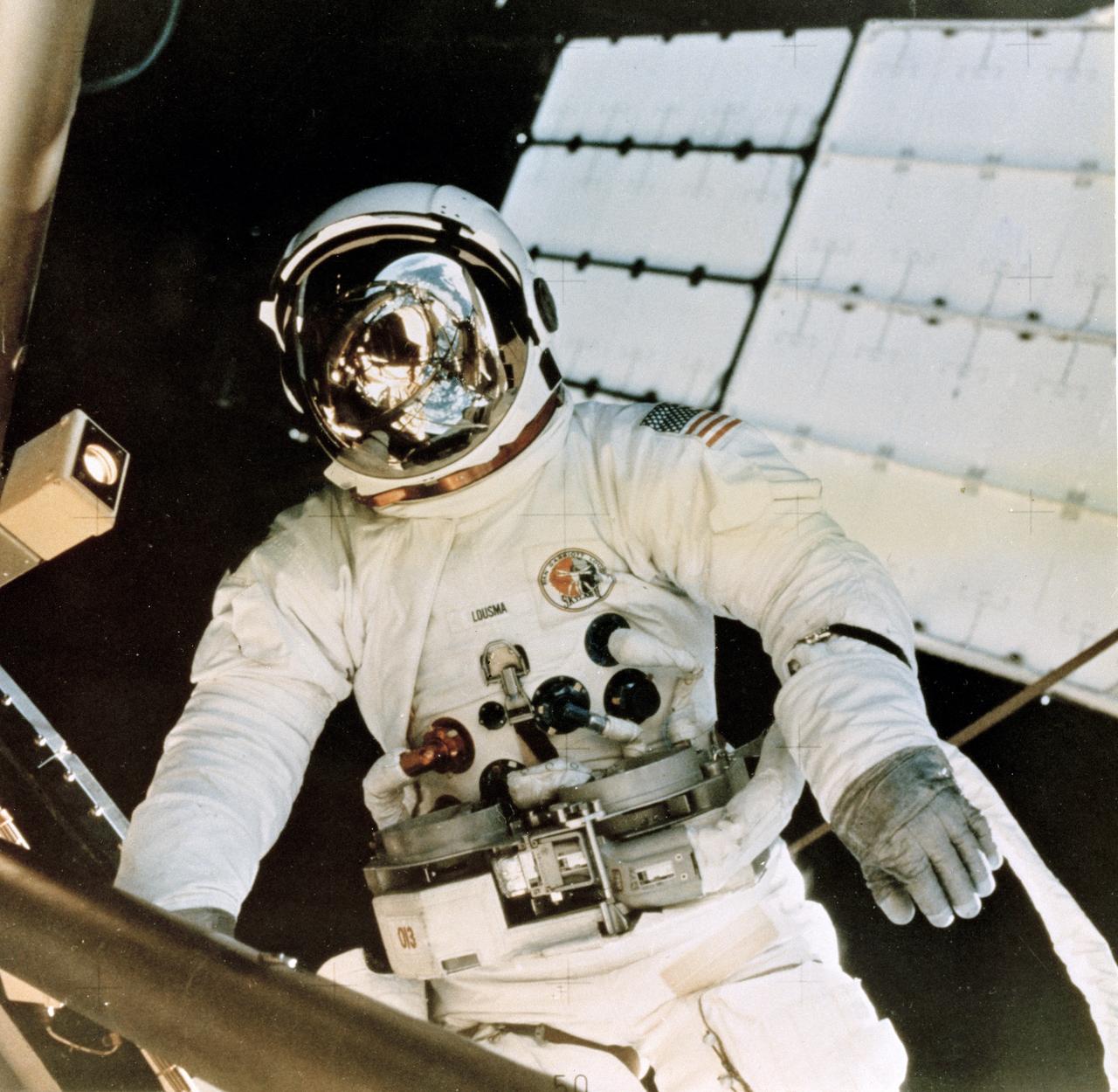
Skylab-3 was the second marned mission in the skylab project. The crew spent 59 days in orbit. In this photo, Astronaut Jack Lousma deploys the Twin Pole Sun Shield created by Marshall Space Flight Center team members to replace the micrometeoroid shield, a thin protective cylinder surrounding the workshop protecting it from tiny space particles and the sun's scorching heat. The shield was damaged during the Skylab-2 mission.
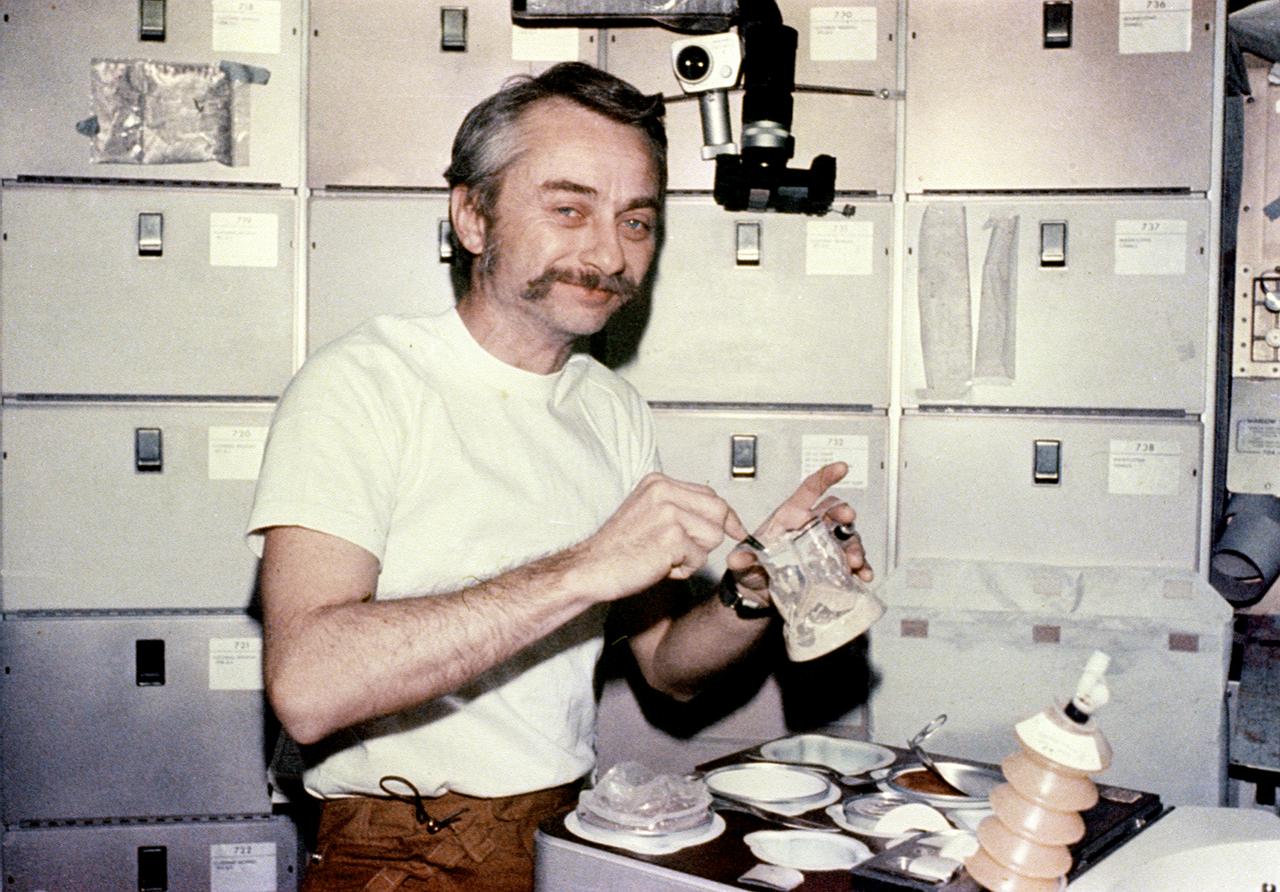
This photograph was taken during the Skylab-3 mission (2nd marned mission), showing Astronaut Owen Garriott enjoying his meal in the Orbital Workshop crew wardroom. The tray contained heating elements for preparing the individual food packets. The food on Skylab was a great improvement over that on earlier spaceflights. It was no longer necessary to squeeze liquified food from plastic tubes. Skylab's kitchen was so equipped that each crewman could select his own menu and prepare it to his own taste.
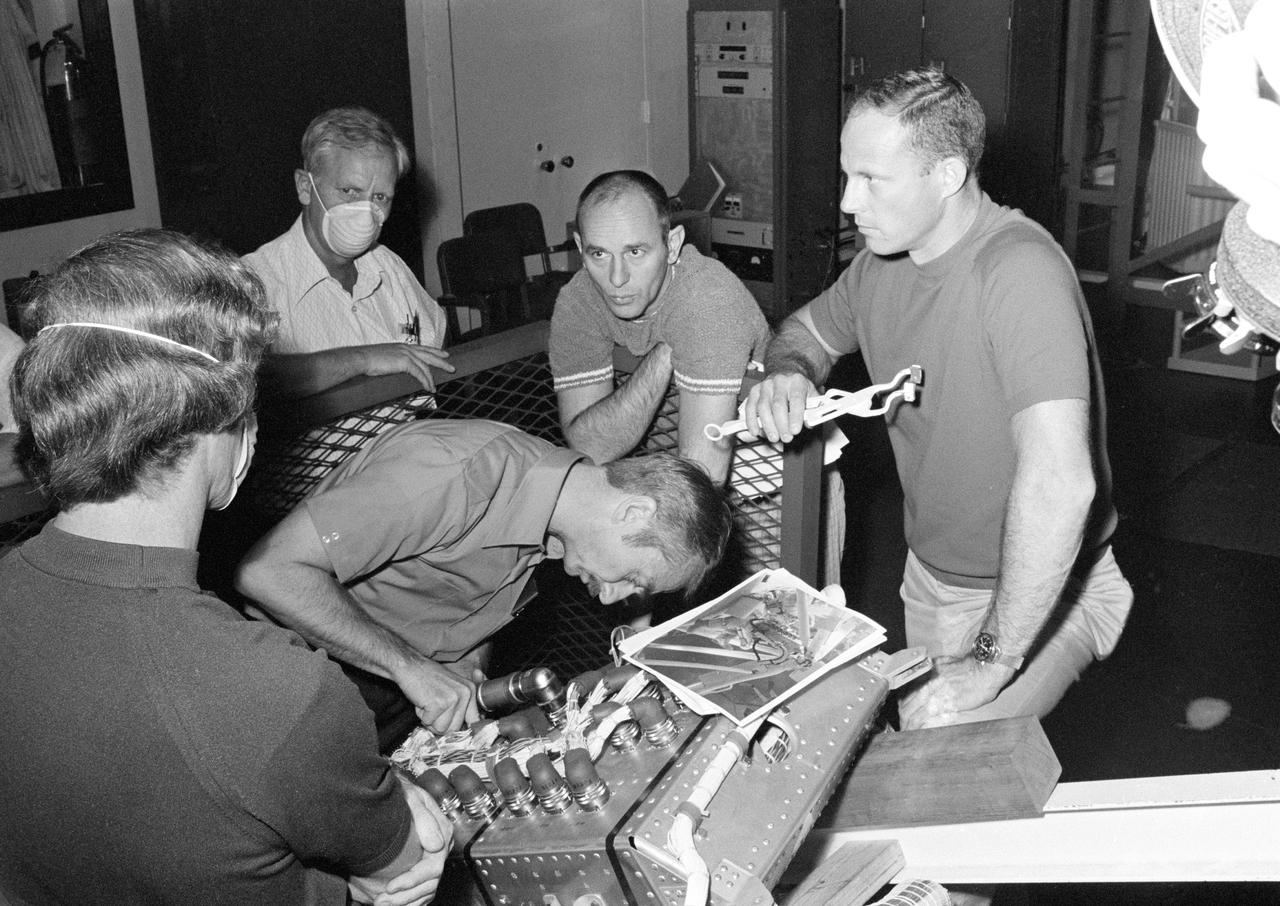
S73-31322 (30 June 1973) --- The three prime crewmen of the Skylab 3 mission practice procedures which will be used during the extravehicular activity (EVA) portion of the scheduled Skylab rate gyro six-pac installation. They are scientist-astronaut Owen K. Garriott (center), astronaut Alan L. Bean (center background) and astronaut Jack R. Lousma (right). Garriott is working with a mock-up of a trunion plug plate which is on the space station's deployment assembly. This picture was taken during Skylab 3 prelaunch training at Johnson Space Center. In the left foreground with back to camera is astronaut Russell L. Schweickart, who is assisting with the Skylab 3 training. Another training officer is in the left background. Photo credit: NASA
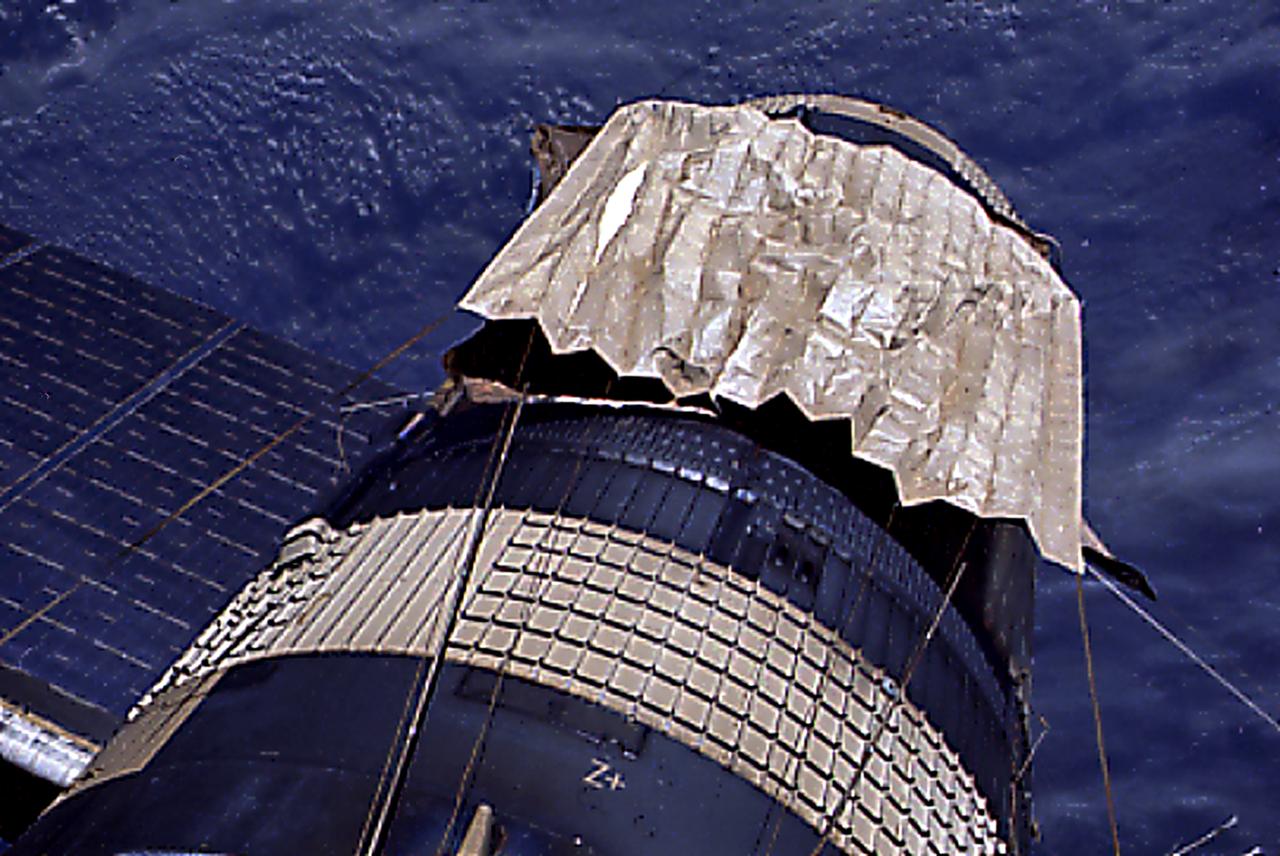
Shortly after liftoff on May 14, 1973, atmospheric drag tore off the thin metallic shield of Skylab that was designed to protect her from micro-meteorites and the Sun's intense heat. The Skylab-2 crew deployed a parasol sunshield to protect the orbiting laboratory. Concern over the possibility that materials used for the parasol would deteriorate with prolonged exposure to the Sun's rays prompted the installation of a second sunshield during the Skylab-3 mission. This time, the crew exited the space station and installed a twin-pole device to position the shield over the parasol. This photograph was taken by the Skylab-4 mission.
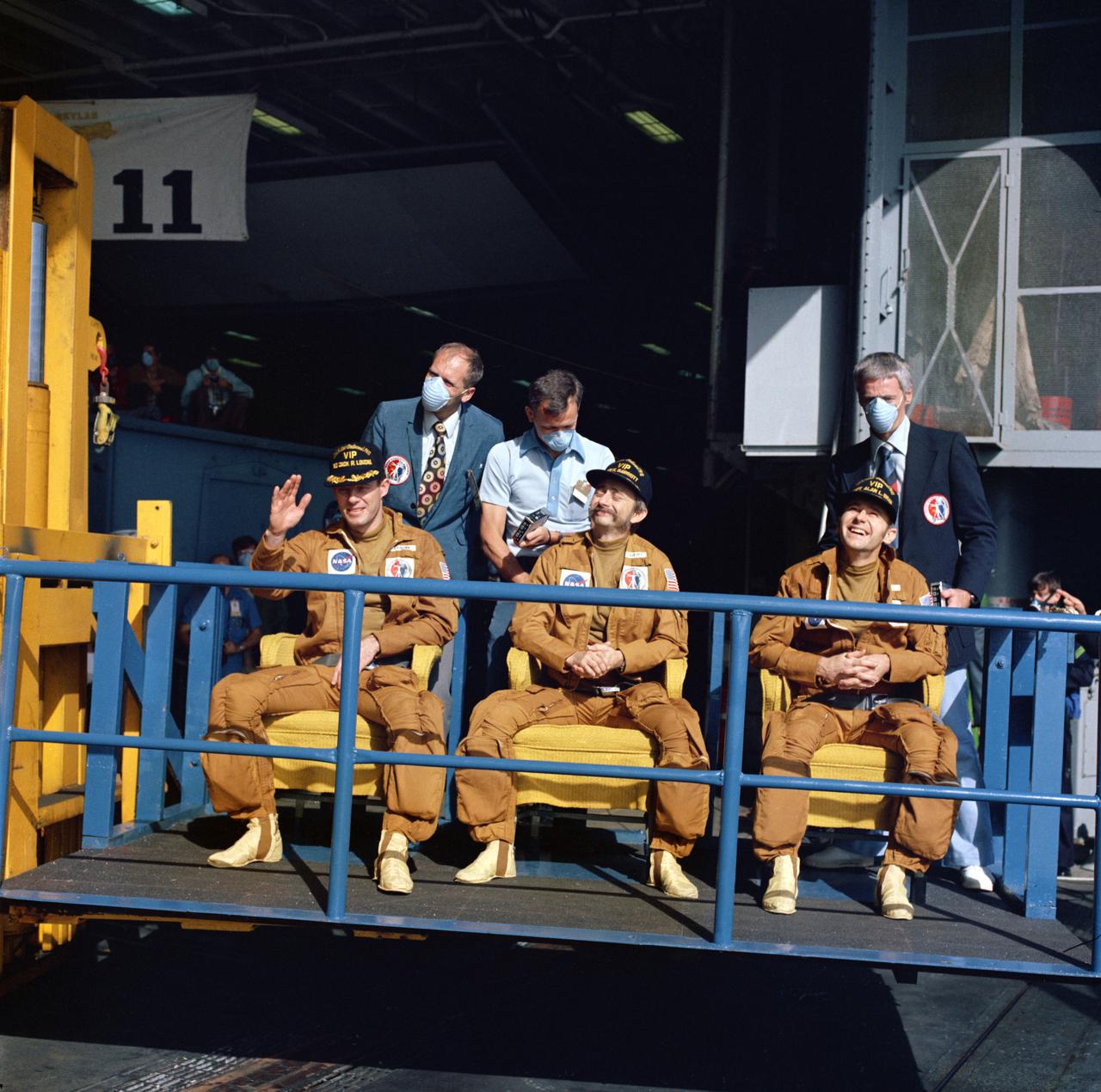
S73-36451 (25 Sept. 1973) --- The three crewmen of the Skylab 3 mission are seen aboard the prime recovery ship, USS New Orleans, following their successful 59-day visit to the Skylab space station in Earth orbit. They are, left to right, astronaut Jack R. Lousma, pilot; scientist-astronaut Owen K. Garriott, science pilot; and astronaut Alan L. Bean, commander. The Skylab 3 Command Module with the three crewmen aboard splashed down in the Pacific about 230 miles southwest of San Diego, California. They are seated atop a platform of a fork-lift dolly. Recovery support personnel are wearing face masks to prevent exposing the crewmen to disease. Photo credit: NASA
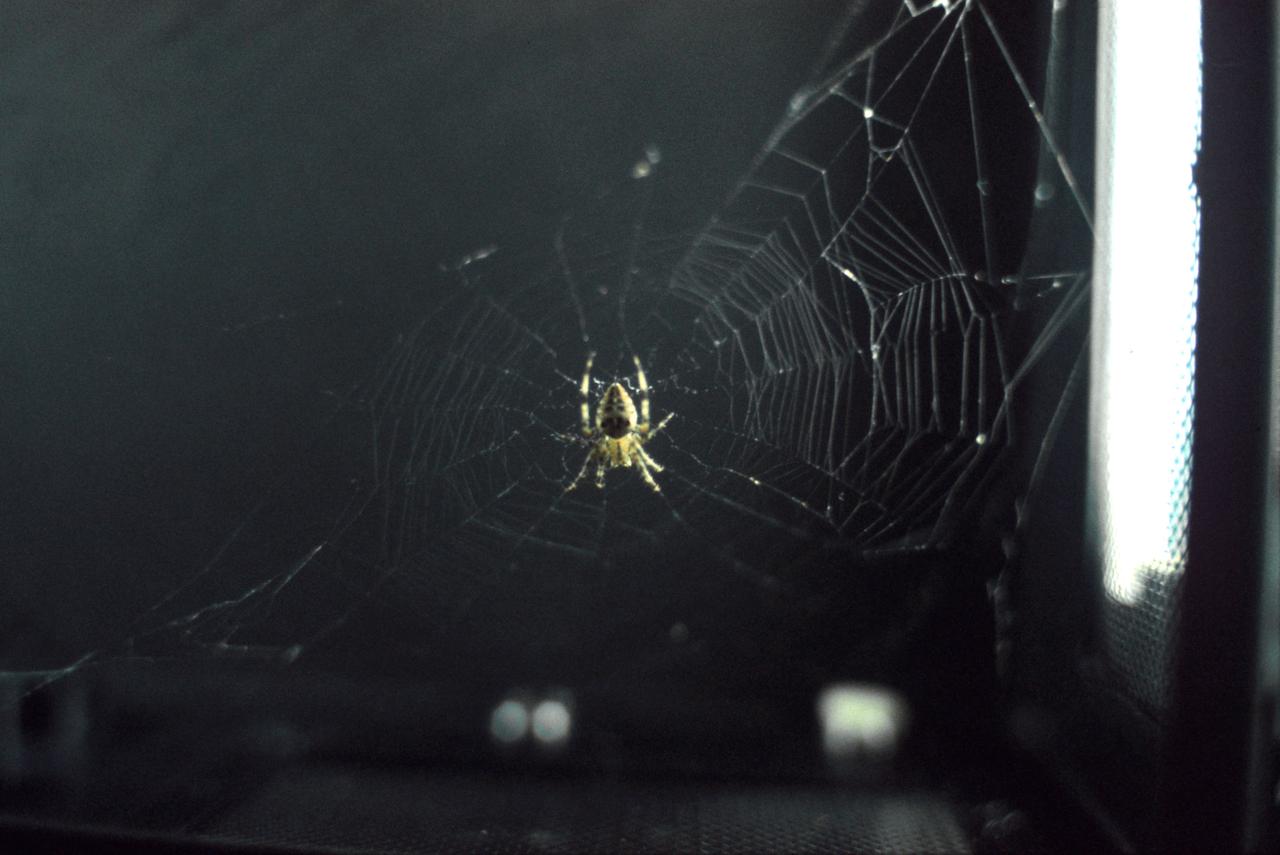
SL3-108-1307 (July-September 1973) --- A close-up view of Arabella, one of the two Skylab 3 common cross spiders "Araneus diadematus," and the web it had spun in the zero-gravity of space aboard the Skylab space station cluster in Earth orbit. This picture was taken with a hand-held 35mm Nikon camera. During the 59-day Skylab 3 mission the two spiders, Arabella and Anita, were housed in an enclosure onto which a motion picture and a still camera were attempts to build a web in the weightless environment. The spider experiment (ED52) was one of 25 experiments selected for Skylab by NASA from more than 3,400 experiment proposals submitted by high school students throughout the nation. ED52 was submitted by 17-year-old Judith S. Miles of Lexington, Massachusetts. Anita died during the last week of the mission. Photo credit: NASA
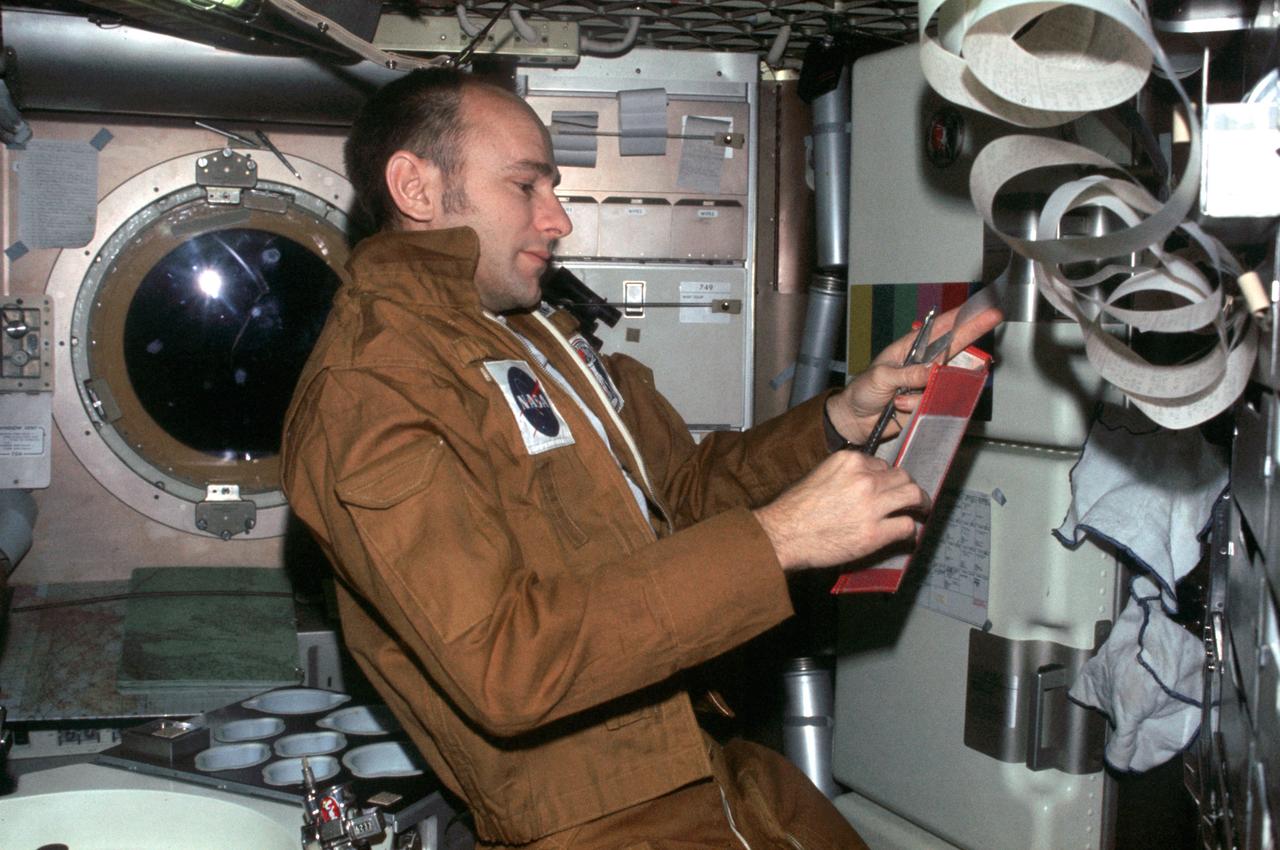
SL3-111-1514 (July-September 1973) --- Astronaut Alan L. Bean, Skylab 3 commander, reads data from book in his right hand while holding teleprinter tape in his left hand, in the ward room of the Skylab space station's Orbital Workshop (OWS) crew quarters. This photograph was taken with a 35mm Nikon camera held by one of Bean's fellow crewmen during the 56.5 day second manned Skylab mission in Earth orbit. Photo credit: NASA
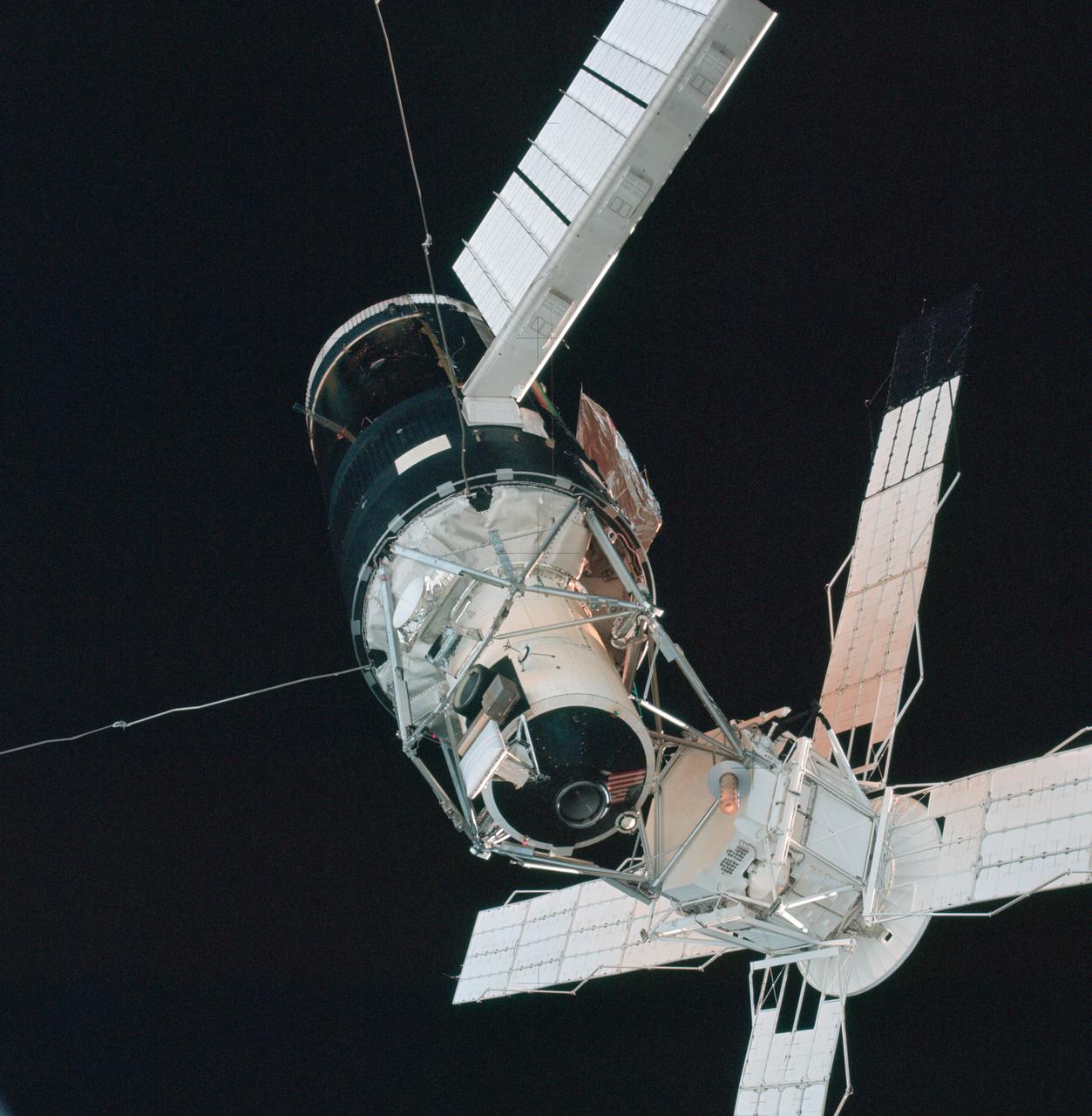
A close-up view of the Skylab space station cluster photographed against a black sky background from the Skylab 3 command module during the "fly around" inspection prior to docking. Note the one solar array system wing on the Orbital Workshop (OWS) which was successfully deployed during EVA on the first manned Skylab mission. The primary docking part at the forward end of the Multiple Docking Adapter (MDA) is visible below the Apollo Telescope Mount (ATM).
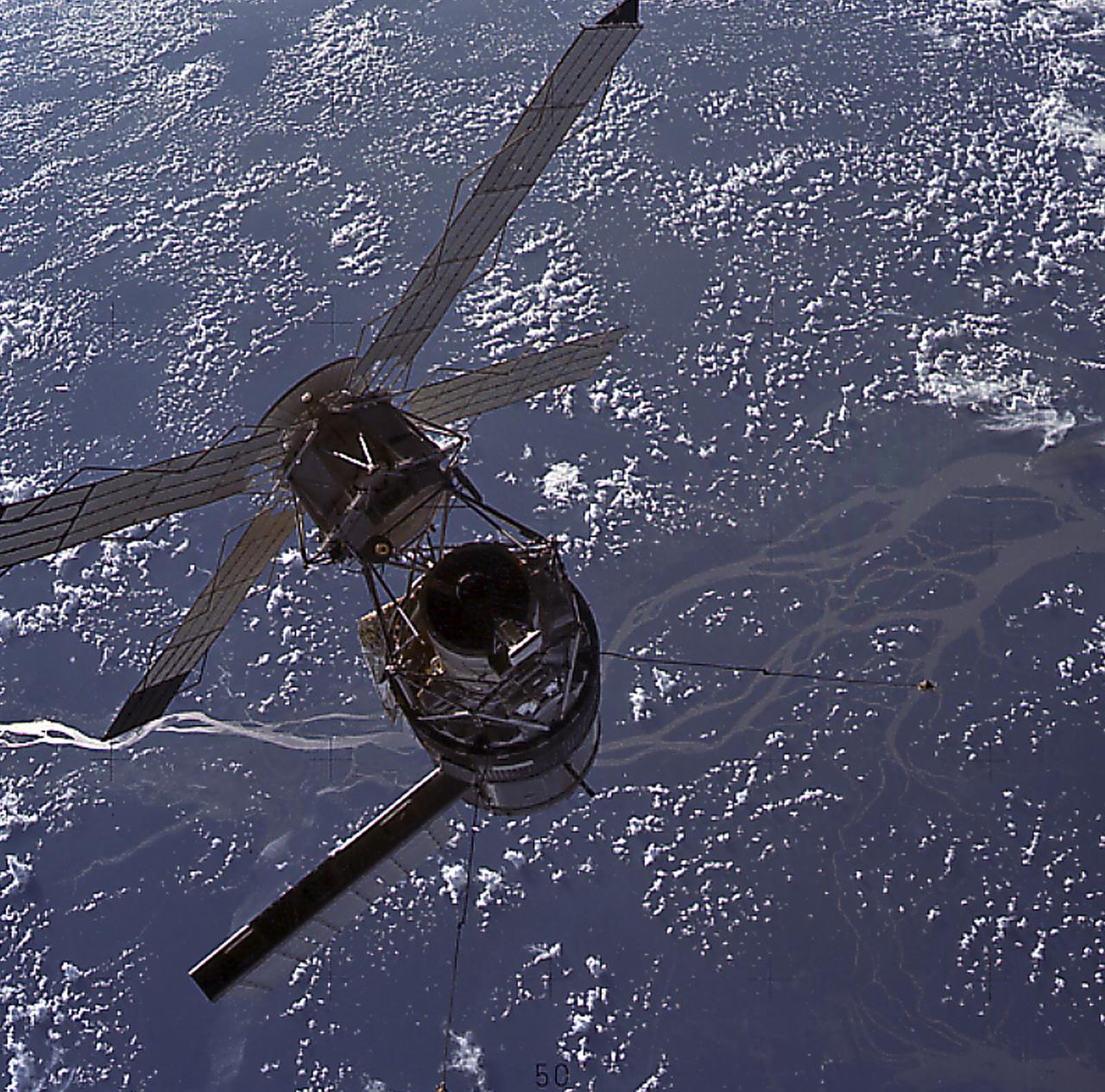
This striking image of Skylab was photographed by Astronaut Jack Lousma (Skylab-3), as the second crew reached the orbiting laboratory over the delta of the mighty Amazon River. Skylab's solar arrays were exposed directly to the Sun's rays. Solar energy was transformed into electrical power for operation of all spacecraft systems. The proper operation of these solar arrays was vital to the mission.
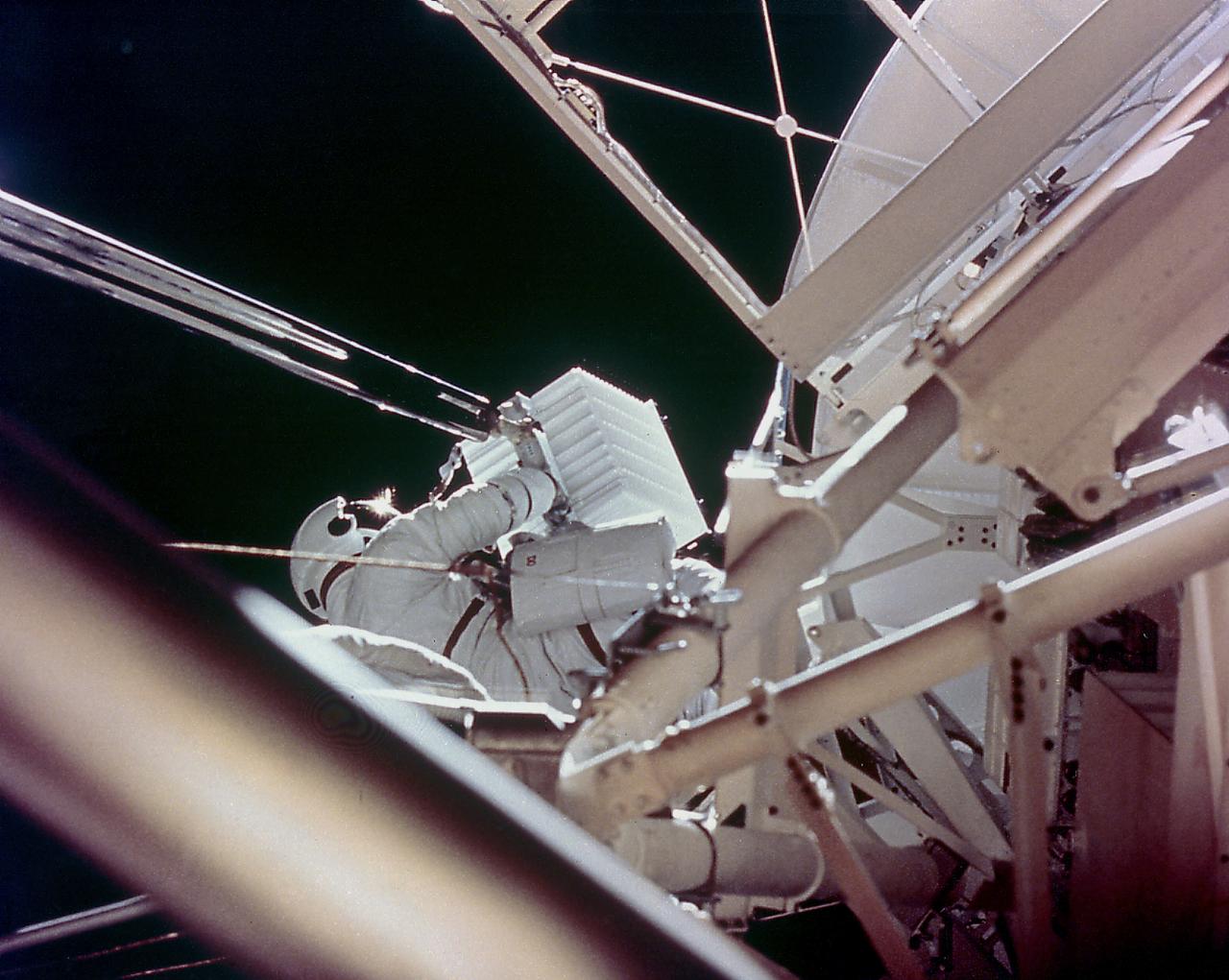
This onboard photograph depicts Astronaut Owen Garriott atop the Apollo Telescope Mount, removing a film magazine (white box) from one of Skylab's solar telescopes during an Extravehicular Activity (EVA) in the second marned Skylab mission (Skylab-3). A long boom transported it back into the waiting hands of another crew member at the airlock door below. During the operation, Garriott, film, boom, and Skylab were 435 kilometers high and speeding around the Earth at 29,000 kilometers per/hour. Because they moved together with no wind resistance, there was little sense of motion.
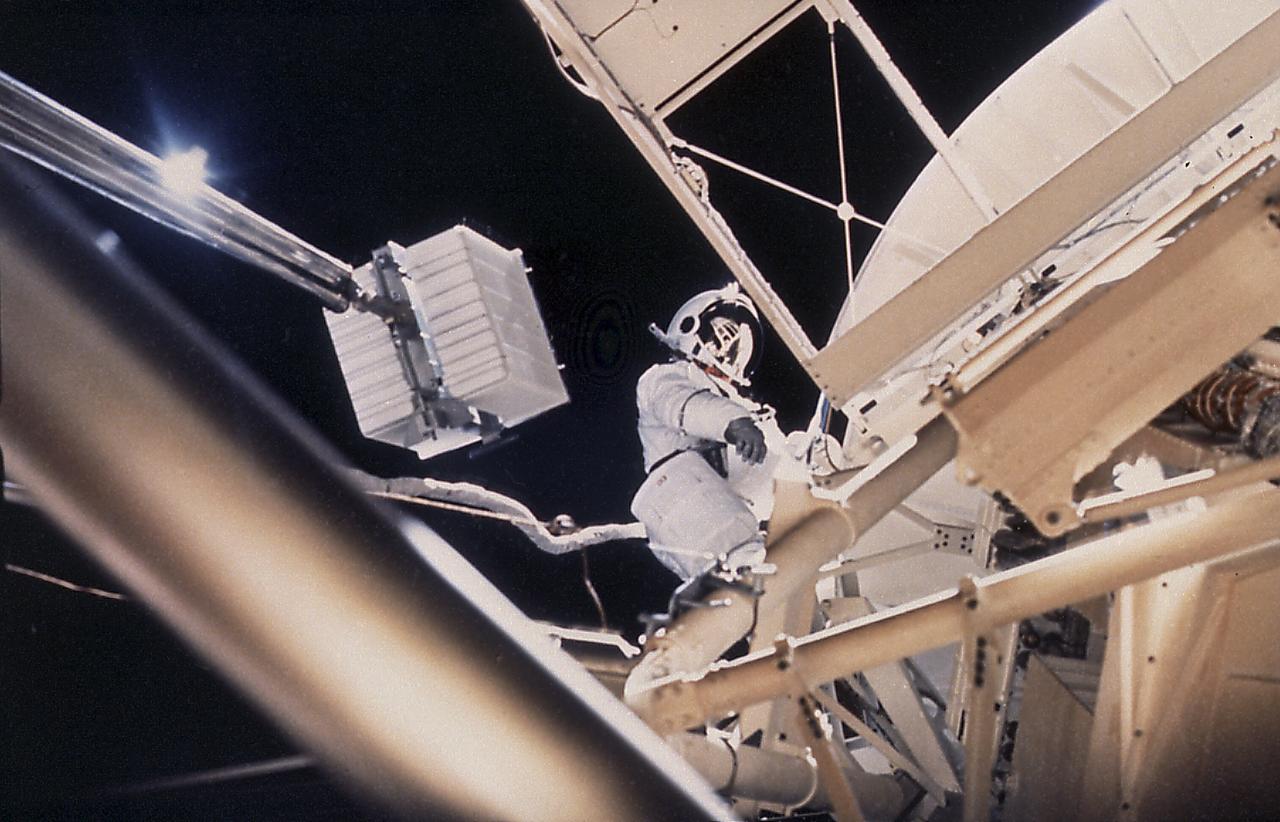
This onboard photograph depicts Astronaut Owen Garriott atop the Apollo Telescope Mount, removing a film magazine (white box) from one of Skylab's solar telescopes during an Extravehicular Activity (EVA) in the second marned Skylab mission (Skylab-3). A long boom transported it back into the waiting hands of another crew member at the airlock door below. During the operation, Garriott, film, boom, and Skylab were 435 kilometers high and speeding around the Earth at 29,000 kilometers per/hour. Because they moved together with no wind resistance, there was little sense of motion.
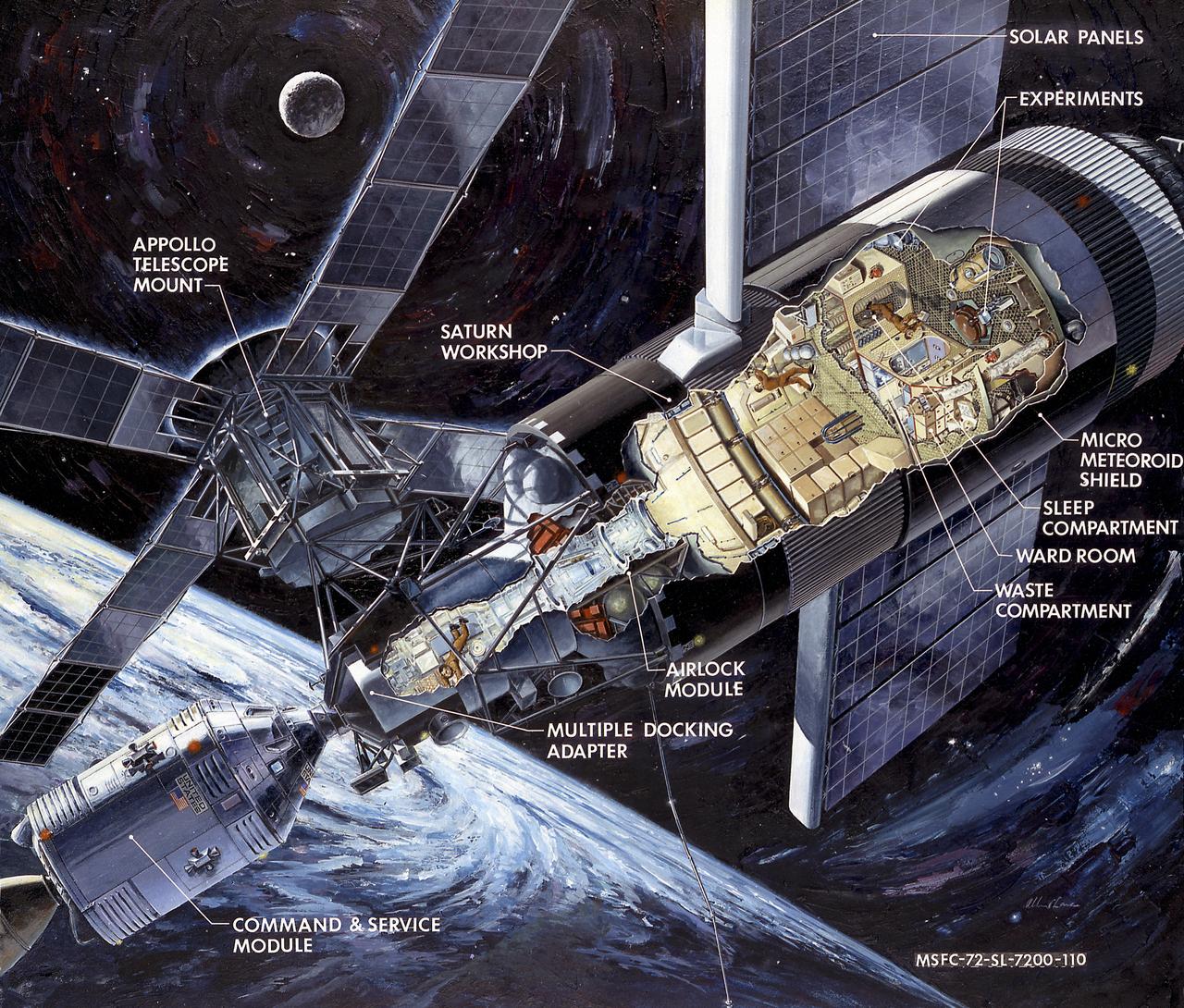
This artist's concept is a cutaway illustration of the Skylab with the Command/Service Module being docked to the Multiple Docking Adapter. In an early effort to extend the use of Apollo for further applications, NASA established the Apollo Applications Program (AAP) in August of 1965. The AAP was to include long duration Earth orbital missions during which astronauts would carry out scientific, technological, and engineering experiments in space by utilizing modified Saturn launch vehicles and the Apollo spacecraft. Established in 1970, the Skylab Program was the forerurner of the AAP. The goals of the Skylab were to enrich our scientific knowledge of the Earth, the Sun, the stars, and cosmic space; to study the effects of weightlessness on living organisms, including man; to study the effects of the processing and manufacturing of materials utilizing the absence of gravity; and to conduct Earth resource observations. The Skylab also conducted 19 selected experiments submitted by high school students. Skylab's 3 different 3-man crews spent up to 84 days in Earth orbit. The Marshall Space Flight Center (MSFC) had responsibility for developing and integrating most of the major components of the Skylab: the Orbital Workshop (OWS), Airlock Module (AM), Multiple Docking Adapter (MDA), Apollo Telescope Mount (ATM), Payload Shroud (PS), and most of the experiments. MSFC was also responsible for providing the Saturn IB launch vehicles for three Apollo spacecraft and crews and a Saturn V launch vehicle for the Skylab.
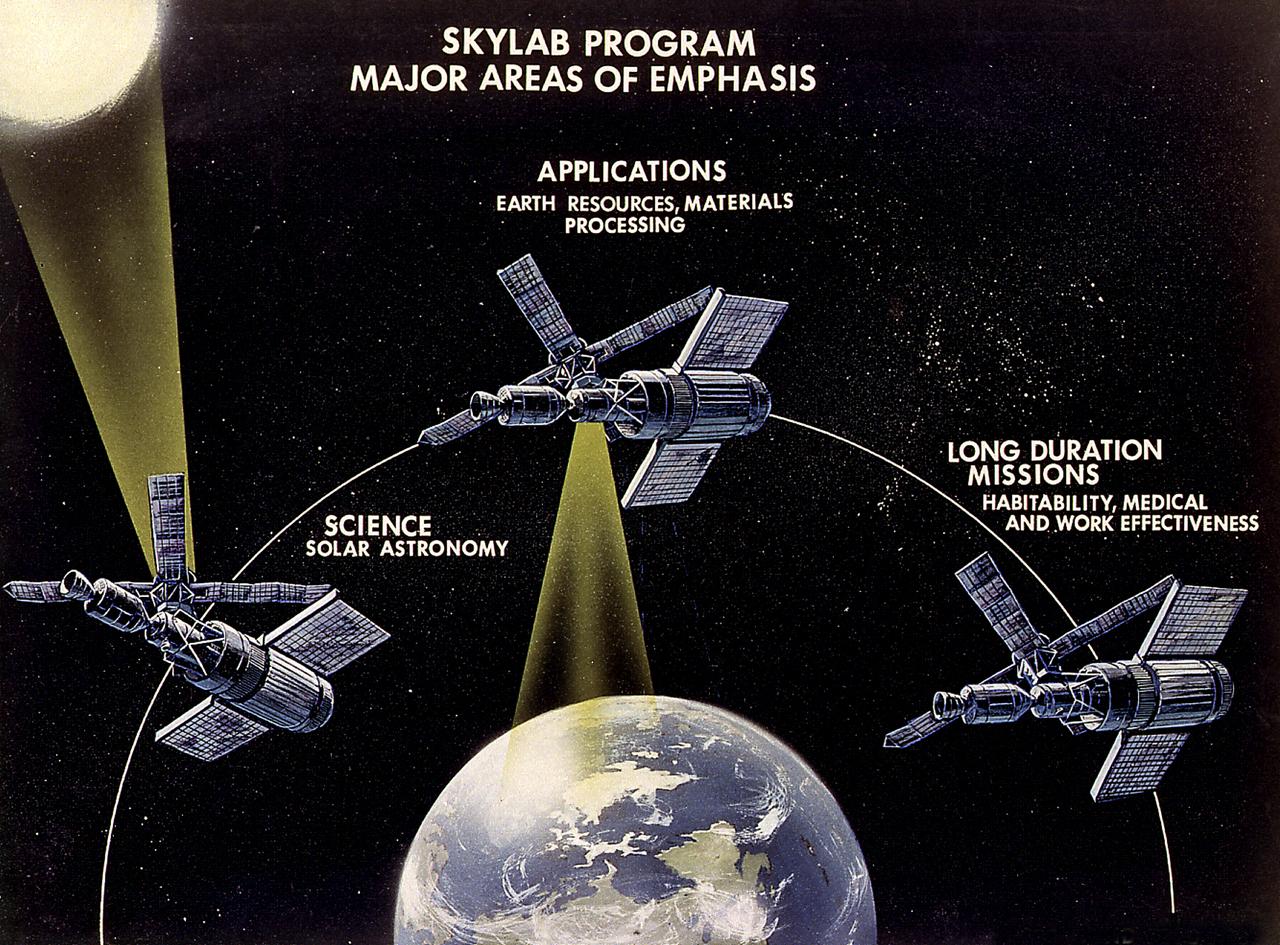
This image illustrates major areas of emphasis of the Skylab Program. In an early effort to extend the use of Apollo for further applications, NASA established the Apollo Applications Program (AAP) in August of 1965. The AAP was to include long duration Earth orbital missions during which astronauts would carry out scientific, technological, and engineering experiments in space by utilizing modified Saturn launch vehicles and the Apollo spacecraft. Established in 1970, the Skylab Program was the forerurner of the AAP. The goals of the Skylab were to enrich our scientific knowledge of the Earth, the Sun, the stars, and cosmic space; to study the effects of weightlessness on living organisms, including man; to study the effects of the processing and manufacturing of materials utilizing the absence of gravity; and to conduct Earth resource observations. The Skylab also conducted 19 selected experiments submitted by high school students. Skylab's 3 different 3-man crews spent up to 84 days in Earth orbit. The Marshall Space Flight Center (MSFC) had responsibility for developing and integrating most of the major components of the Skylab: the Orbital Workshop (OWS), Airlock Module (AM), Multiple Docking Adapter (MDA), Apollo Telescope Mount (ATM), Payload Shroud (PS), and most of the experiments. MSFC was also responsible for providing the Saturn IB launch vehicles for three Apollo spacecraft and crews and a Saturn V launch vehicle for the Skylab.
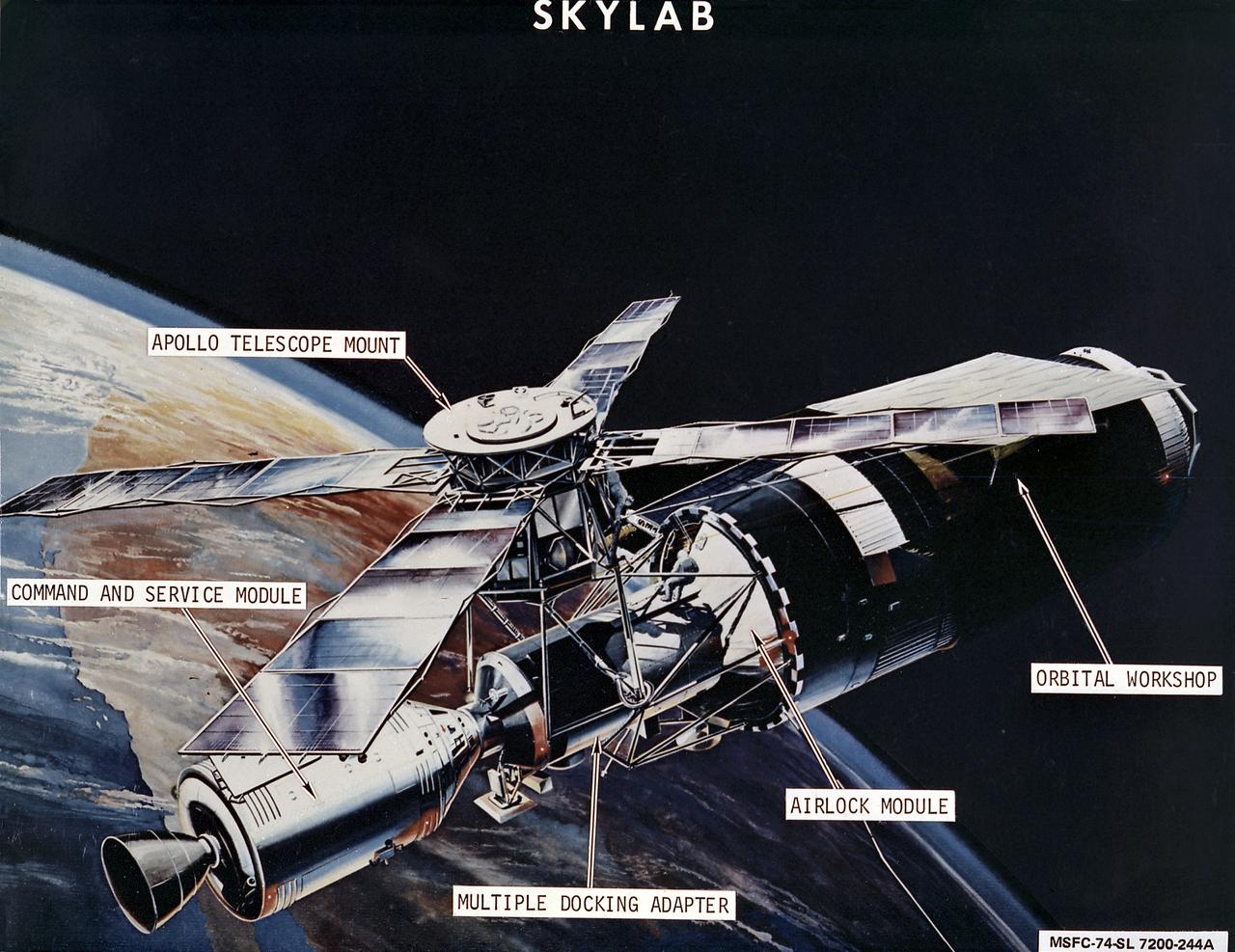
This image is an artist's concept of the Skylab in orbit with callouts of its major components. In an early effort to extend the use of Apollo for further applications, NASA established the Apollo Applications Program (AAP) in August of 1965. The AAP was to include long duration Earth orbital missions during which astronauts would carry out scientific, technological, and engineering experiments in space by utilizing modified Saturn launch vehicles and the Apollo spacecraft. Established in 1970, the Skylab Program was the forerurner of the AAP. The goals of the Skylab were to enrich our scientific knowledge of the Earth, the Sun, the stars, and cosmic space; to study the effects of weightlessness on living organisms, including man; to study the effects of the processing and manufacturing of materials utilizing the absence of gravity; and to conduct Earth resource observations. The Skylab also conducted 19 selected experiments submitted by high school students. Skylab's 3 different 3-man crews spent up to 84 days in Earth orbit. The Marshall Space Flight Center (MSFC) had responsibility for developing and integrating most of the major components of the Skylab: the Orbital Workshop (OWS), Airlock Module (AM), Multiple Docking Adapter (MDA), Apollo Telescope Mount (ATM), Payload Shroud (PS), and most of the experiments. MSFC was also responsible for providing the Saturn IB launch vehicles for three Apollo spacecraft and crews and a Saturn V launch vehicle for the Skylab.
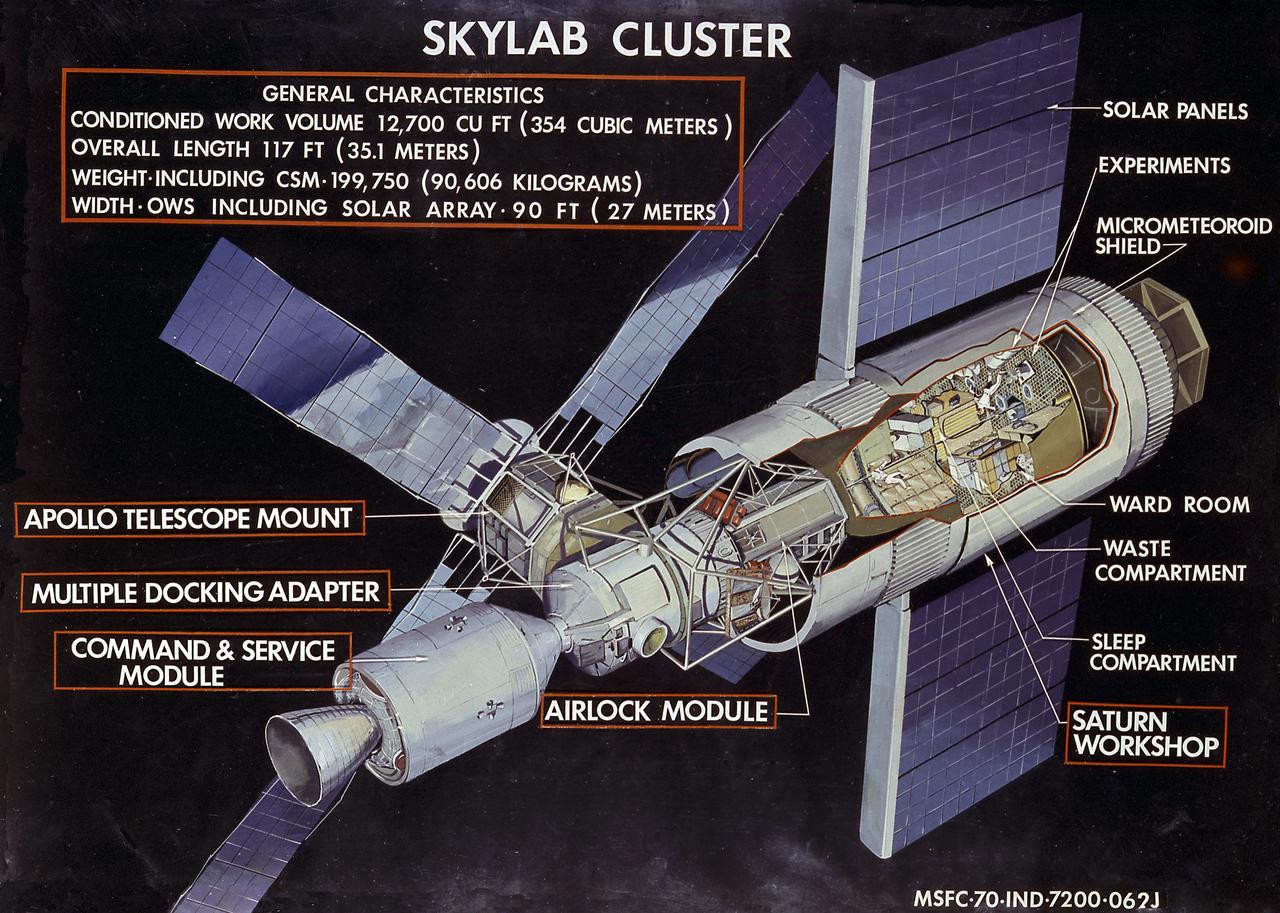
This illustration shows general characteristics of the Skylab with callouts of its major components. In an early effort to extend the use of Apollo for further applications, NASA established the Apollo Applications Program (AAP) in August of 1965. The AAP was to include long duration Earth orbital missions during which astronauts would carry out scientific, technological, and engineering experiments in space by utilizing modified Saturn launch vehicles and the Apollo spacecraft. Established in 1970, the Skylab Program was the forerurner of the AAP. The goals of the Skylab were to enrich our scientific knowledge of the Earth, the Sun, the stars, and cosmic space; to study the effects of weightlessness on living organisms, including man; to study the effects of the processing and manufacturing of materials utilizing the absence of gravity; and to conduct Earth resource observations. The Skylab also conducted 19 selected experiments submitted by high school students. Skylab's 3 different 3-man crews spent up to 84 days in Earth orbit. The Marshall Space Flight Center (MSFC) had responsibility for developing and integrating most of the major components of the Skylab: the Orbital Workshop (OWS), Airlock Module (AM), Multiple Docking Adapter (MDA), Apollo Telescope Mount (ATM), Payload Shroud (PS), and most of the experiments. MSFC was also responsible for providing the Saturn IB launch vehicles for three Apollo spacecraft and crews and a Saturn V launch vehicle for the Skylab.
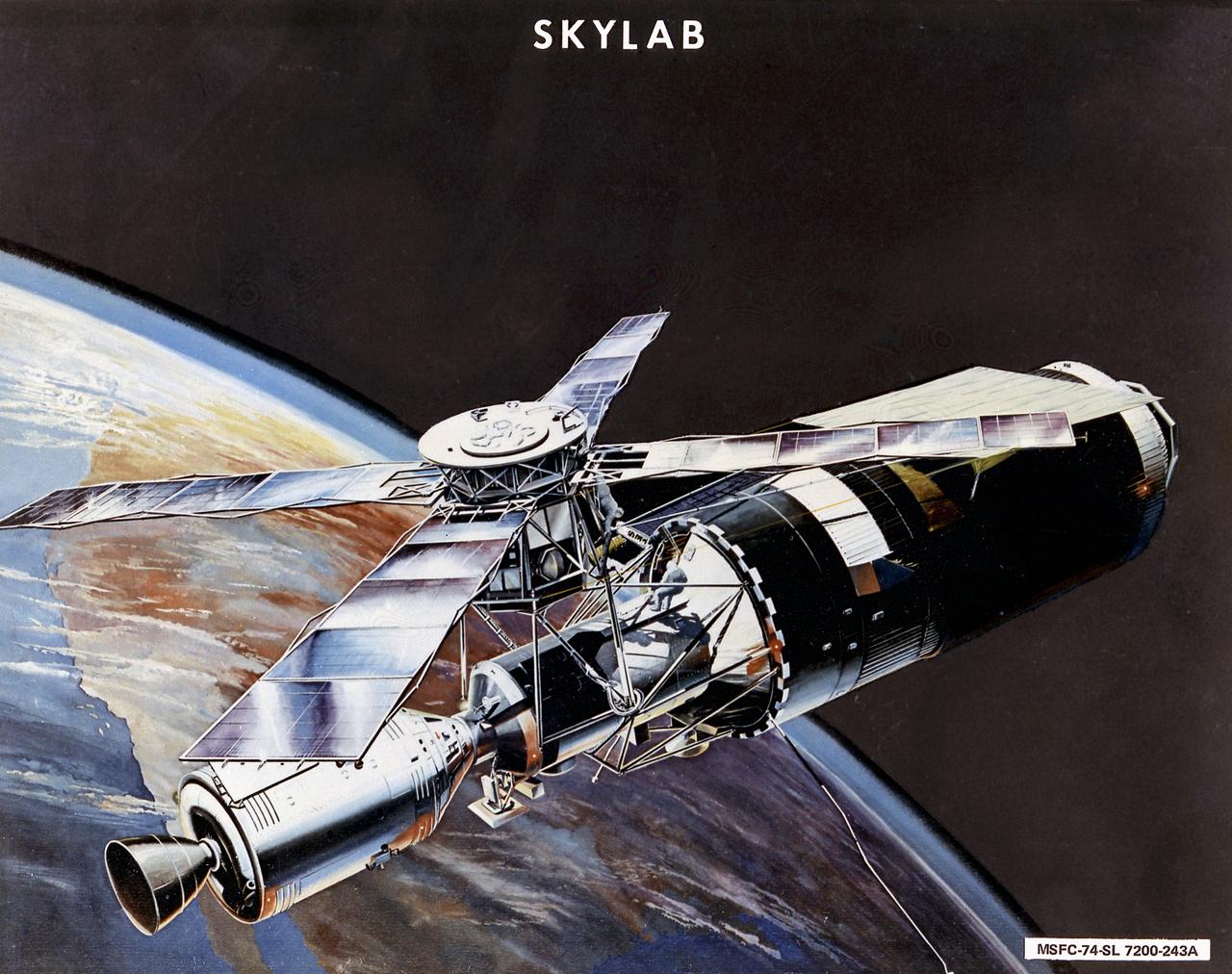
This image is an artist's concept of the Skylab in orbit. In an early effort to extend the use of Apollo for further applications, NASA established the Apollo Applications Program (AAP) in August of 1965. The AAP was to include long duration Earth orbital missions during which astronauts would carry out scientific, technological, and engineering experiments in space by utilizing modified Saturn launch vehicles and the Apollo spacecraft. Established in 1970, the Skylab program was the forerurner of the AAP. The goals of the Skylab were to enrich our scientific knowledge of the Earth, the Sun, the stars, and cosmic space; to study the effects of weightlessness on living organisms, including man; to study the effects of the processing and manufacturing of materials utilizing the absence of gravity; and to conduct Earth resource observations. The Skylab also conducted 19 selected experiments submitted by high school students. Skylab's 3 different 3-man crews spent up to 84 days in Earth orbit. The Marshall Space Flight Center (MSFC) had responsibility for developing and integrating most of the major components of the Skylab: the Orbital Workshop (OWS), Airlock Module (AM), Multiple Docking Adapter (MDA), Apollo Telescope Mount (ATM), Payload Shroud (PS), and most of the experiments. MSFC was also responsible for providing the Saturn IB launch vehicles for three Apollo spacecraft and crews and a Saturn V launch vehicle for the Skylab.
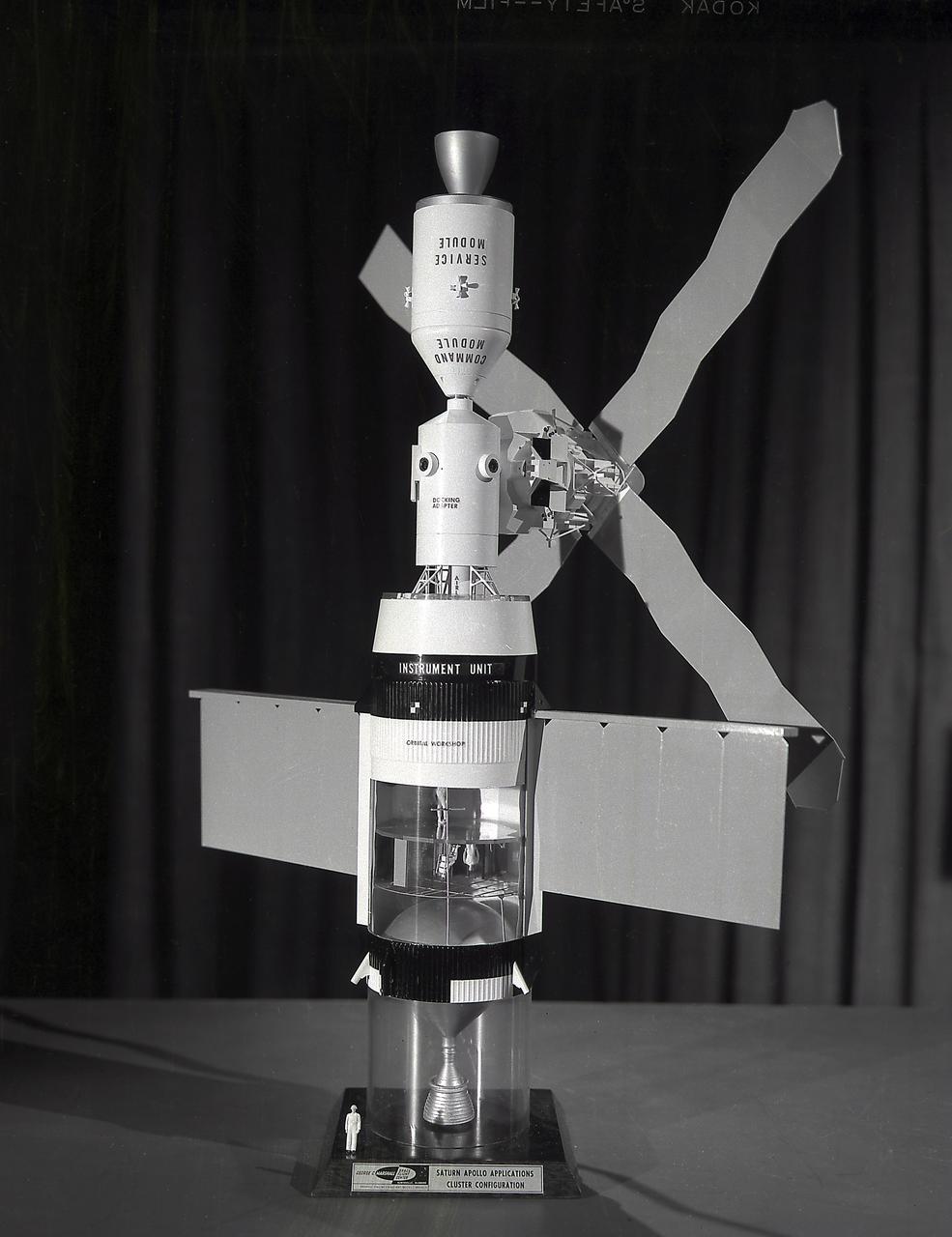
This photograph is of a model of the Skylab with the Command/Service Module being docked. In an early effort to extend the use of Apollo for further applications, NASA established the Apollo Applications Program (AAP) in August of 1965. The AAP was to include long duration Earth orbital missions during which astronauts would carry out scientific, technological, and engineering experiments in space by utilizing modified Saturn launch vehicles and the Apollo spacecraft. Established in 1970, the Skylab Program was the forerurner of the AAP. The goals of the Skylab were to enrich our scientific knowledge of the Earth, the Sun, the stars, and cosmic space; to study the effects of weightlessness on living organisms, including man; to study the effects of the processing and manufacturing of materials utilizing the absence of gravity; and to conduct Earth resource observations. The Skylab also conducted 19 selected experiments submitted by high school students. Skylab's 3 different 3-man crews spent up to 84 days in Earth orbit. The Marshall Space Flight Center (MSFC) had responsibility for developing and integrating most of the major components of the Skylab: the Orbital Workshop (OWS), Airlock Module (AM), Multiple Docking Adapter (MDA), Apollo Telescope Mount (ATM), Payload Shroud (PS), and most of the experiments. MSFC was also responsible for providing the Saturn IB launch vehicles for three Apollo spacecraft and crews and a Saturn V launch vehicle for the Skylab.
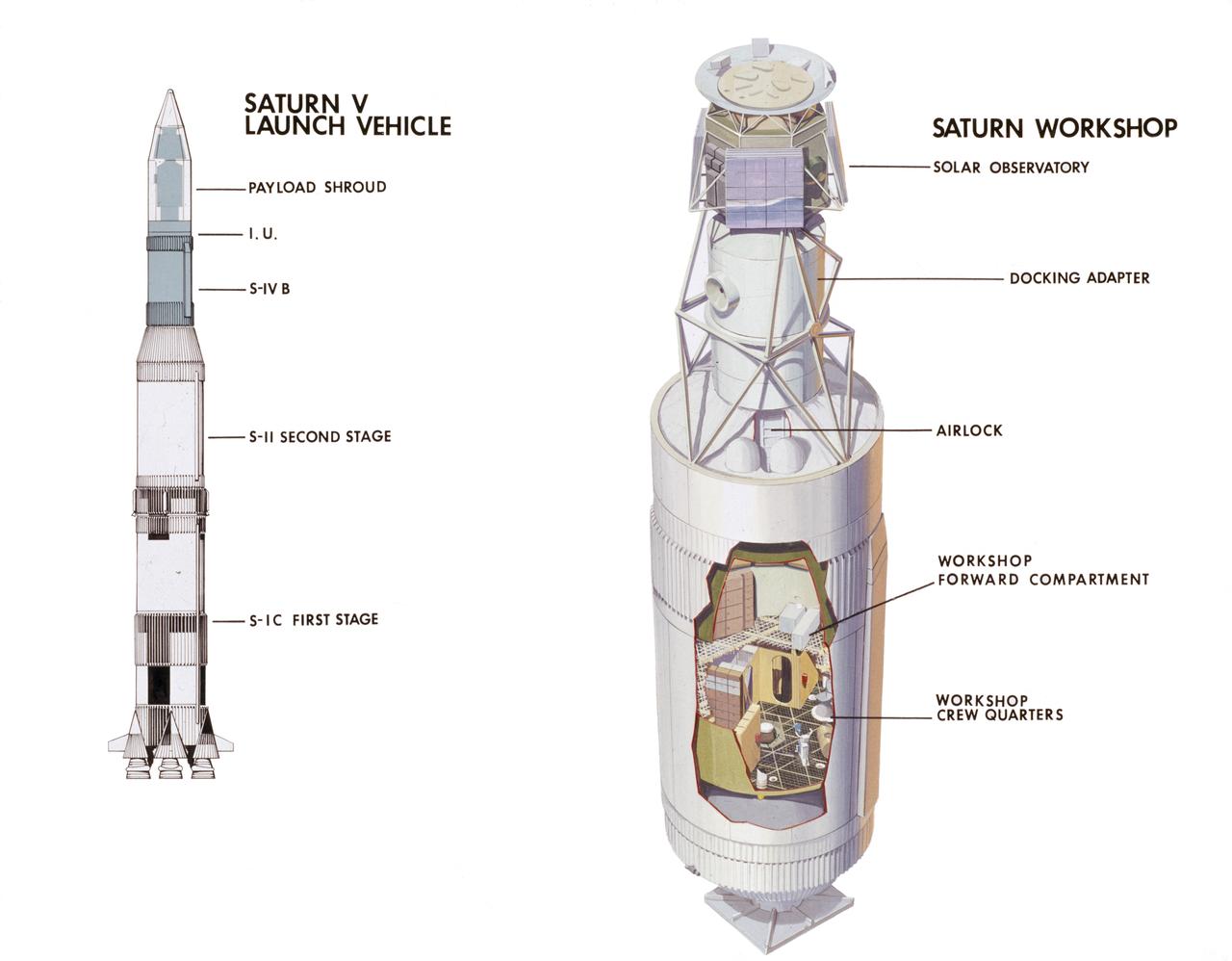
This cutaway drawing illustrates major Skylab components in launch configuration on top of the Saturn V. In an early effort to extend the use of Apollo for further applications, NASA established the Apollo Applications Program (AAP) in August of 1965. The AAP was to include long duration Earth orbital missions during which astronauts would carry out scientific, technological, and engineering experiments in space by utilizing modified Saturn launch vehicles and the Apollo spacecraft. Established in 1970, the Skylab Program was the forerurner of the AAP. The goals of the Skylab were to enrich our scientific knowledge of the Earth, the Sun, the stars, and cosmic space; to study the effects of weightlessness on living organisms, including man; to study the effects of the processing and manufacturing of materials utilizing the absence of gravity; and to conduct Earth resource observations. The Skylab also conducted 19 selected experiments submitted by high school students. Skylab's 3 different 3-man crews spent up to 84 days in Earth orbit. The Marshall Space Flight Center (MSFC) had responsibility for developing and integrating most of the major components of the Skylab: the Orbital Workshop (OWS), Airlock Module (AM), Multiple Docking Adapter (MDA), Apollo Telescope Mount (ATM), Payload Shroud (PS), and most of the experiments. MSFC was also responsible for providing the Saturn IB launch vehicles for three Apollo spacecraft and crews and a Saturn V launch vehicle for the Skylab.
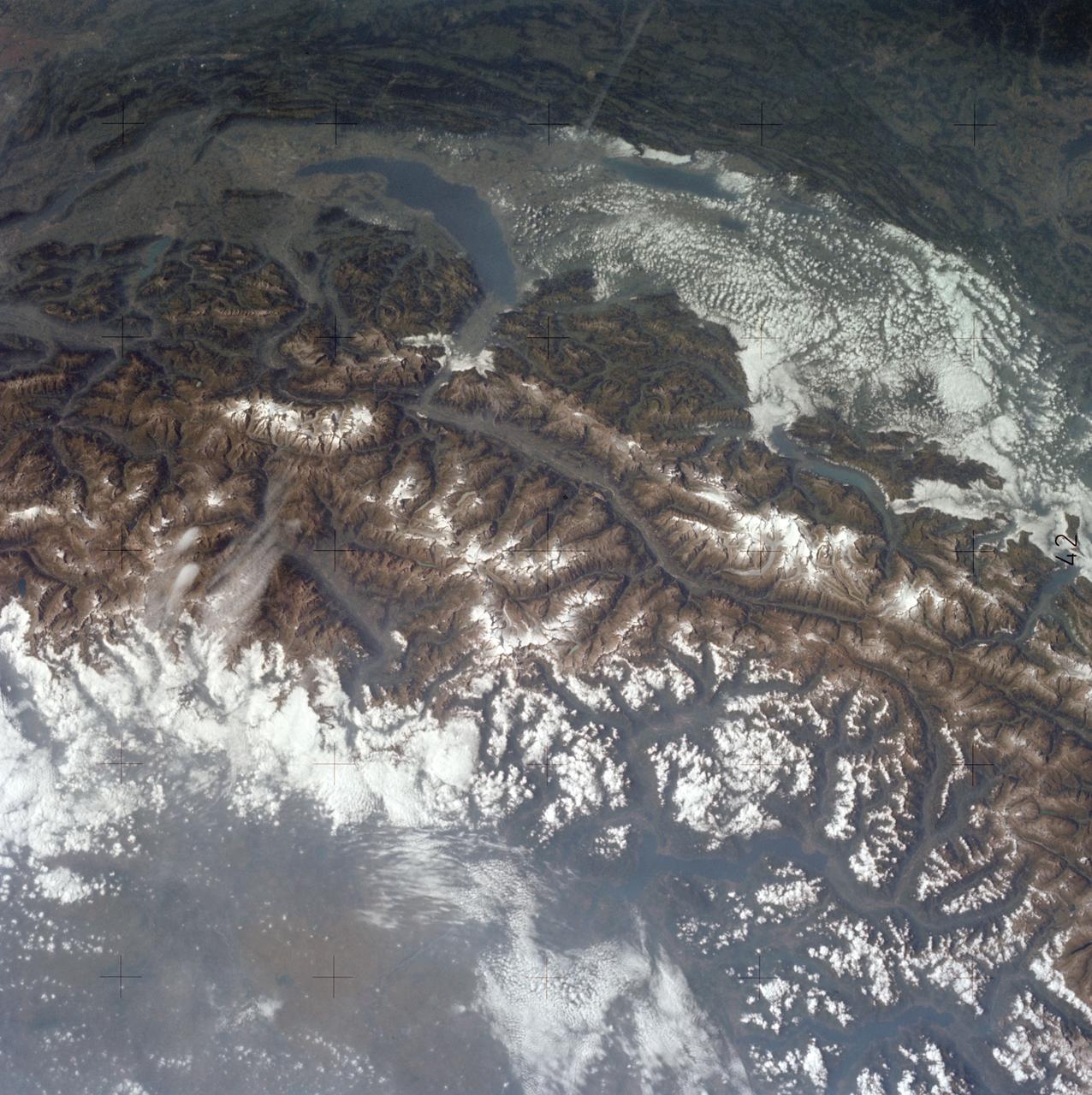
SL3-121-2438 (July-September 1973) --- The Alps of Switzerland, France and Italy are featured in this exceptional photograph taken by a hand-held camera from the Skylab space station during the second manned Skylab mission. Also visible in the out-the-window 70mm Hasselblad view are Lake Geneva, Lake of Lucerne, Rhone River and many other features. The Skylab 3 crewmen, astronauts Alan L. Bean, Owen K. Garriott and Jack R. Lousma completed a 59-day mission with a successful splashdown on Sept. 25, 1973. Photo credit: NASA
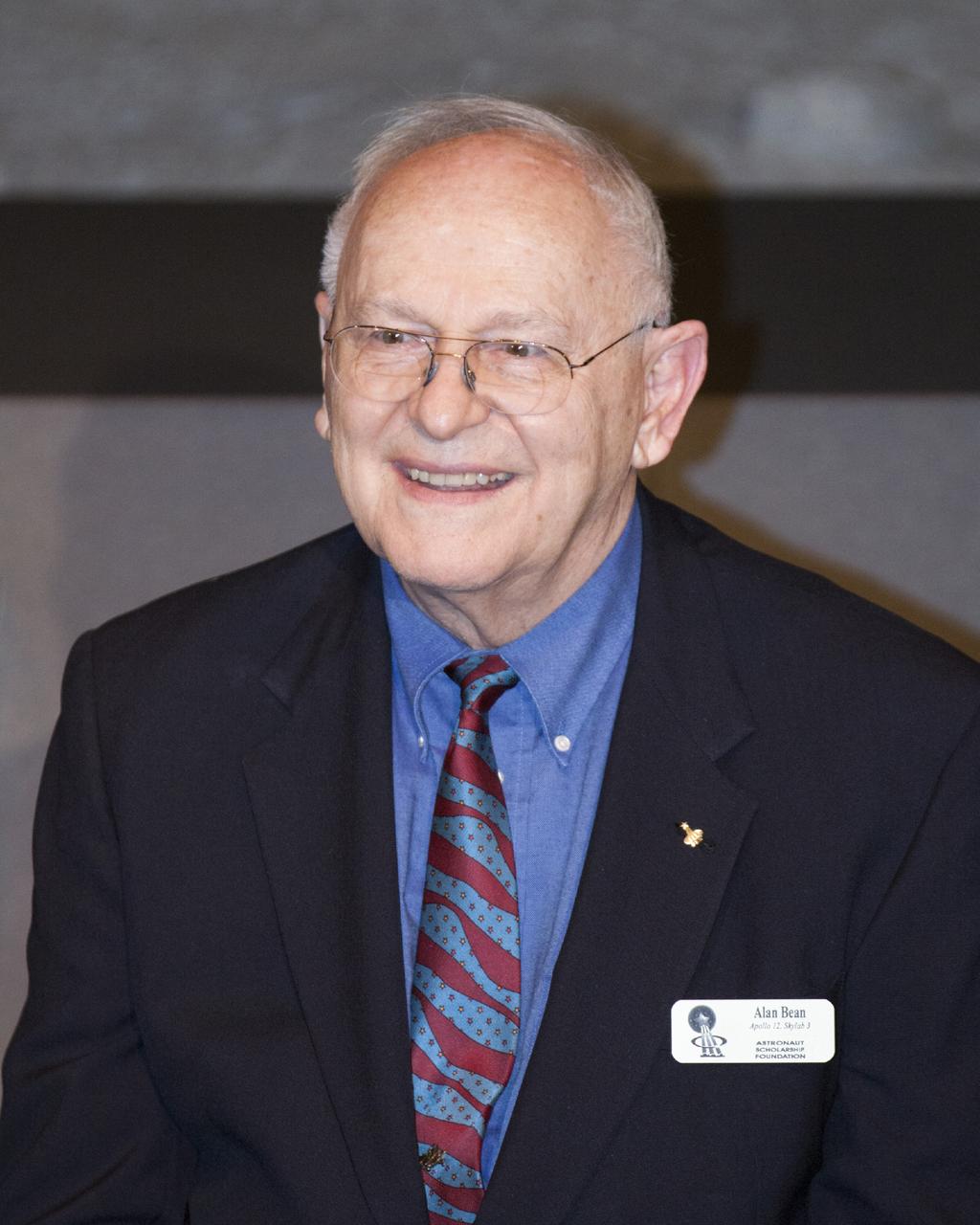
CAPE CANAVERAL, Fla. – At the Kennedy Space Center's Apollo/Saturn V Center, former NASA astronaut Alan Bean speaks to guests at the Astronaut Scholarship Foundation's event celebrating the 40th anniversary of Skylab. Bean served as commander of Skylab 3, the second piloted mission to the space station. In 1969, Bean was lunar module pilot on Apollo 12, the second mission to land on the moon. The gala commemorating the 40th anniversary of Skylab included six of the nine astronauts who flew missions to America's first space station. The orbiting laboratory was launched unpiloted from Kennedy on May 14, 1973. Between May 25, 1973 and Feb. 8, 1974, crews of three spent 28, 59 and 84 days living and working in low-Earth orbit aboard the station. For more information, visit http://www.nasa.gov/mission_pages/skylab/ Photo credit: NASA/Kim Shiflett
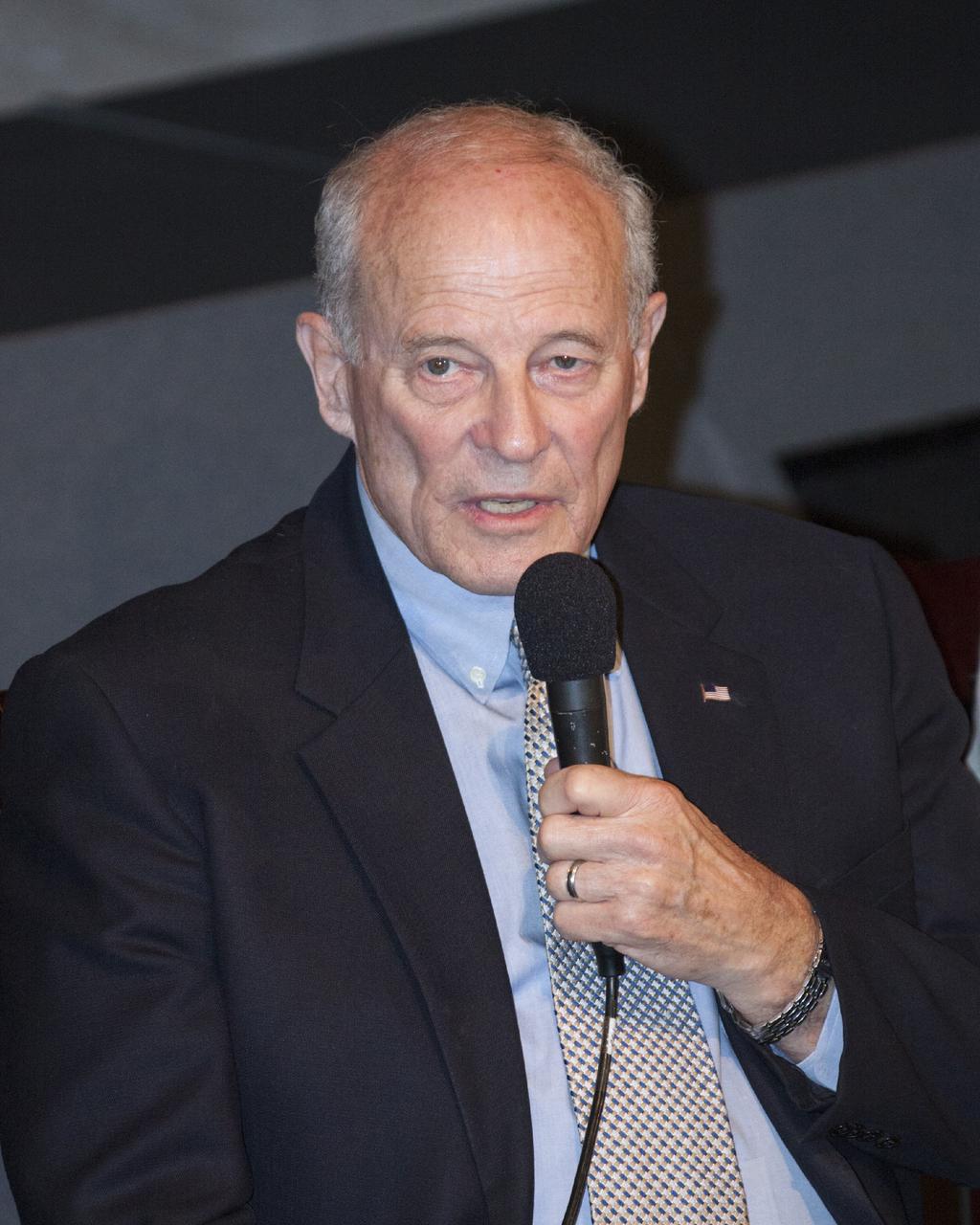
CAPE CANAVERAL, Fla. – At the Kennedy Space Center's Apollo/Saturn V Center, former NASA astronaut Jack Lousma speaks to guests at the Astronaut Scholarship Foundation's event celebrating the 40th anniversary of Skylab. Lousma served as pilot on Skylab 3, the second piloted mission to the space station. Lousma went on to command a mission of the space shuttle. The gala commemorating the 40th anniversary of Skylab included six of the nine astronauts who flew missions to America's first space station. The orbiting laboratory was launched unpiloted from Kennedy on May 14, 1973. Between May 25, 1973 and Feb. 8, 1974, crews of three spent 28, 59 and 84 days living and working in low-Earth orbit aboard the station. For more information, visit http://www.nasa.gov/mission_pages/skylab/ Photo credit: NASA/Kim Shiflett

Therrin Protze, chief operating officer of the Kennedy Space Center Visitor Complex, is photographed at a wreath-laying ceremony honoring former astronaut Owen Garriott on April 18, 2019. The ceremony was held at the Heroes and Legends exhibit within the Astronaut Hall of Fame at the center’s visitor complex in Florida. Garriott flew aboard the Skylab space station during the Skylab 3 mission and also on space shuttle Columbia for the STS-9/Spacelab-1 mission. He passed away April 15 at the age of 88.

Former NASA astronaut Jon McBride shares a few words during a wreath-laying ceremony honoring astronaut Owen Garriott on April 18, 2019. The ceremony was held at the Heroes and Legends exhibit within the Astronaut Hall of Fame at the Kennedy Space Center Visitor Complex in Florida. Garriott flew aboard the Skylab space station during the Skylab 3 mission and also on space shuttle Columbia for the STS-9/Spacelab-1 mission. He passed away April 15 at the age of 88.

Kennedy Space Center Director Bob Cabana is photographed at a wreath-laying ceremony honoring former astronaut Owen Garriott. The ceremony was held April 18, 2019, at the Heroes and Legends exhibit within the Astronaut Hall of Fame at the Florida spaceport’s visitor complex. Garriott flew aboard the Skylab space station during the Skylab 3 mission and also on space shuttle Columbia for the STS-9/Spacelab-1 mission. He passed away April 15 at the age of 88.

A memorial wreath has been placed in the Heroes and Legends exhibit at the Kennedy Space Center Visitor Complex in Florida following a ceremony honoring the memory of former astronaut Owen Garriott. The ceremony was held April 18, 2019. Garriott flew aboard the Skylab space station during the Skylab 3 mission and also on space shuttle Columbia for the STS-9/Spacelab-1 mission. He passed away April 15 at the age of 88.

Kennedy Space Center Director Bob Cabana speaks during a wreath-laying ceremony honoring former astronaut Owen Garriott on April 18, 2019. The ceremony was held at the Heroes and Legends exhibit within the Astronaut Hall of Fame at the center’s visitor complex in Florida. Garriott flew aboard the Skylab space station during the Skylab 3 mission and also on space shuttle Columbia for the STS-9/Spacelab-1 mission. He passed away April 15 at the age of 88.

A photo of former astronaut Owen Garriott is displayed during a memorial ceremony at NASA’s Kennedy Space Center in Florida. The ceremony was held April 18, 2019, at the Heroes and Legends exhibit within the Astronaut Hall of Fame at the center’s visitor complex. Garriott flew aboard the Skylab space station during the Skylab 3 mission and also on space shuttle Columbia for the STS-9/Spacelab-1 mission. He passed away April 15 at the age of 88.

In the Heroes and Legends exhibit at the Kennedy Space Center Visitor Complex in Florida, a memorial wreath was placed following a ceremony honoring the memory of former astronaut Owen Garriott. The ceremony was held April 18, 2019. Garriott flew aboard the Skylab space station during the Skylab 3 mission and also on space shuttle Columbia for the STS-9/Spacelab-1 mission. He passed away April 15 at the age of 88.

A memorial wreath has been placed in the Heroes and Legends exhibit at the Kennedy Space Center Visitor Complex in Florida following a ceremony honoring the memory of former astronaut Owen Garriott. The ceremony was held April 18, 2019. Garriott flew aboard the Skylab space station during the Skylab 3 mission and also on space shuttle Columbia for the STS-9/Spacelab-1 mission. He passed away April 15 at the age of 88.

In the Heroes and Legends exhibit at the Kennedy Space Center Visitor Complex in Florida, a memorial wreath was placed following a ceremony honoring the memory of former astronaut Owen Garriott. The ceremony was held April 18, 2019. Garriott flew aboard the Skylab space station during the Skylab 3 mission and also on space shuttle Columbia for the STS-9/Spacelab-1 mission. He passed away April 15 at the age of 88.
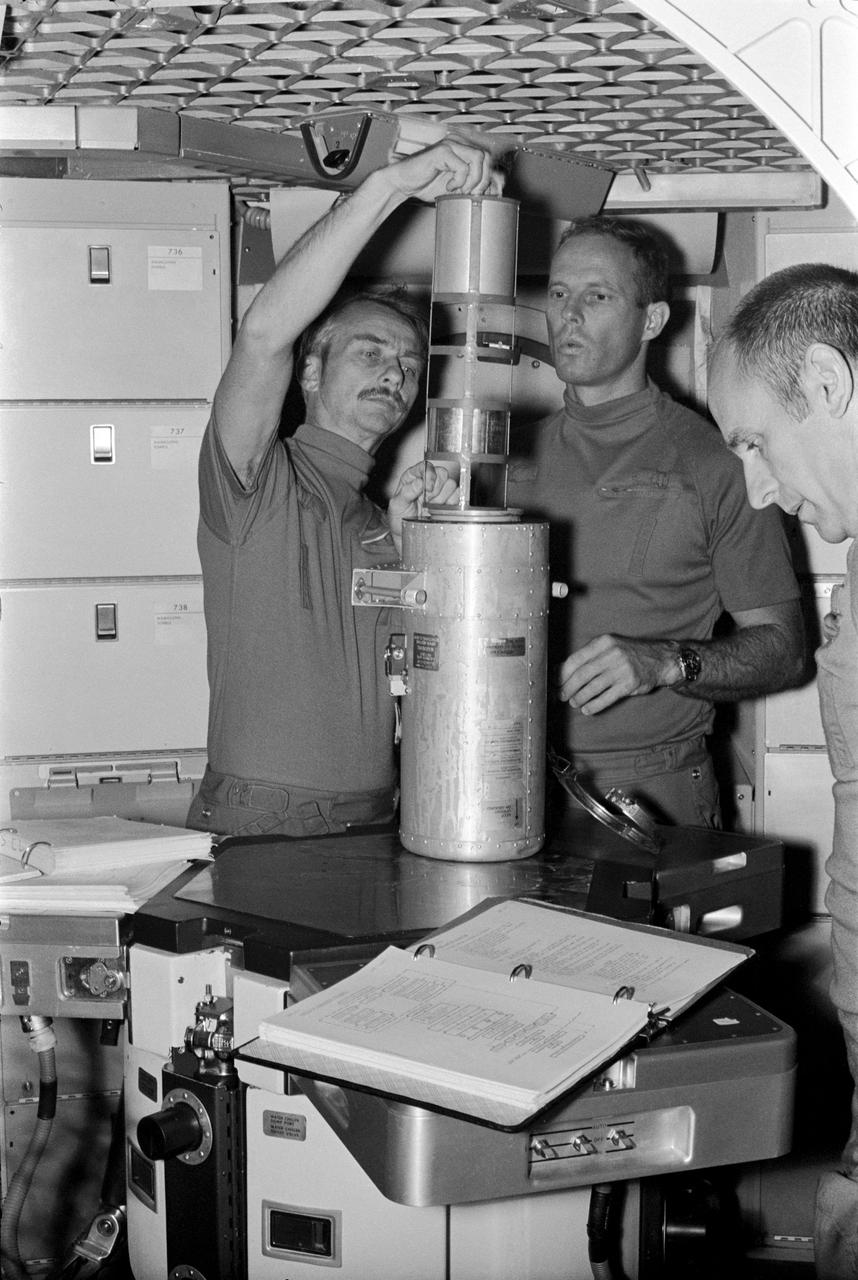
S73-28420 (16 June 1973) --- The three prime crewmen of the Skylab 3 mission check over flight data during a training session in the crew quarters of the Orbital Workshop (OWS) trainer in the Mission Simulation and Training Facility at the Johnson Space Center (JSC). Skylab 3 crew work with Inflight Medical Support System (IMSS) resupply container atop the food table in the OWS. They are from left to right, scientist-astronaut Owen K. Garriott, science pilot; and astronauts Jack R. Lousma, pilot; and Alan L. Bean, commander. Photo credit: NASA
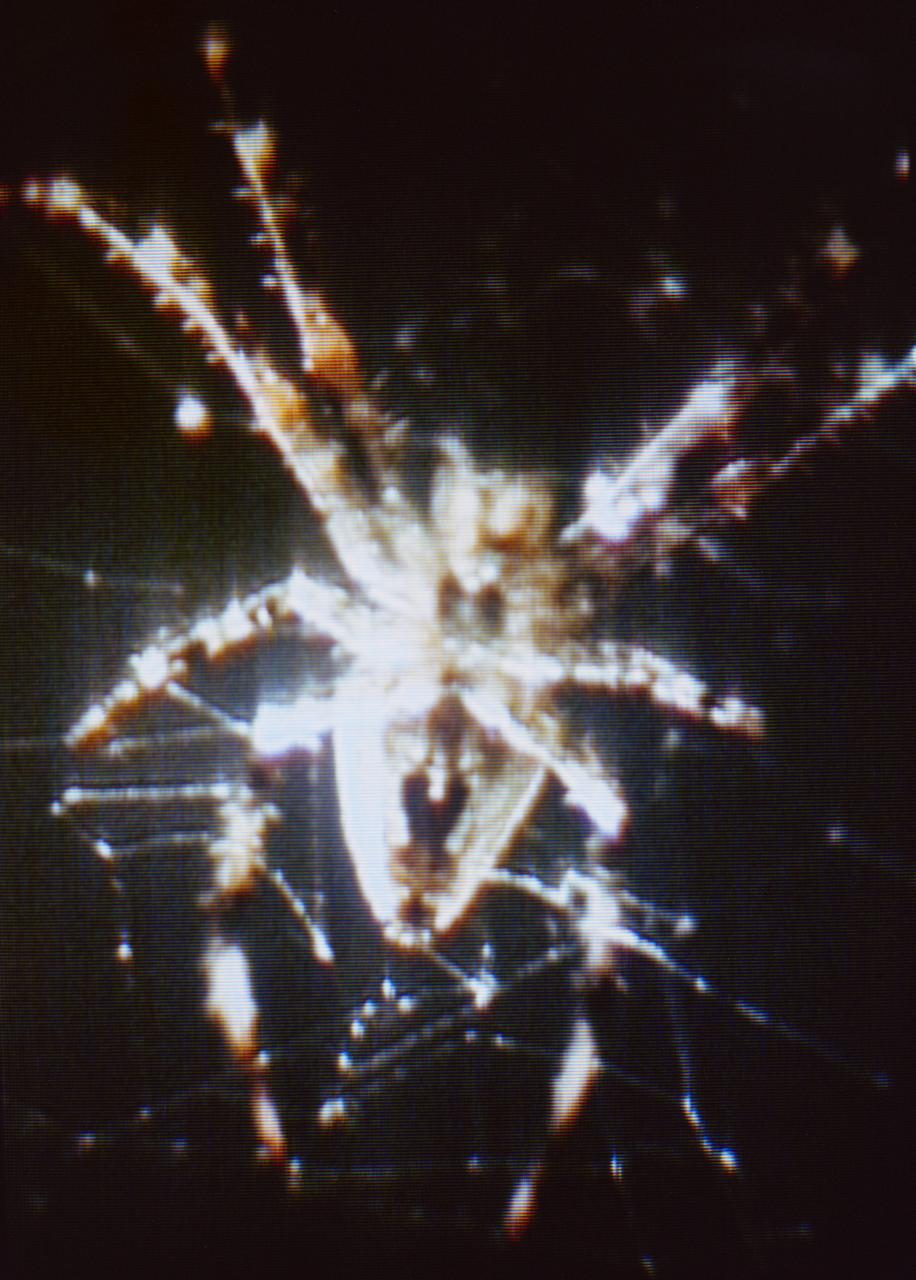
S73-34206 (8 Aug. 1973) --- A closeup view of Arabella, one of two Skylab 3 common cross spiders ?Araneus diadematus,? and the web it had spun in the zero-gravity of space aboard the Skylab space station cluster in Earth orbit. This is a photographic reproduction made a color television transmission aboard Skylab. During the 59-day Skylab 3 mission the two spiders, Arabella and Anita, were housed in an enclosure onto which a motion picture camera and a still camera were attached to record the spiders? attempts to build a web in the weightless environment. The spider experiment (ED52) was one of 25 experiments selected for Skylab by NASA from more than 3,400 experiment proposals submitted by 17-year-old Judith S. Miles of Lexington, Massachusetts. Anita died during the last week of the mission. THIS PHOTOGRAPH IS A GOVERNMENT PUBLICATION ?NOT SUBJECT TO COPYRIGHT. It may not be used to state or imply the endorsement by NASA or by any NASA employee of a commercial product, process or service, or used in any way that might mislead. Accordingly, it is requested that if this photograph is used in advertising and other commercial promotions, layout and copy be submitted to NASA prior to release. Photo credit: NASA
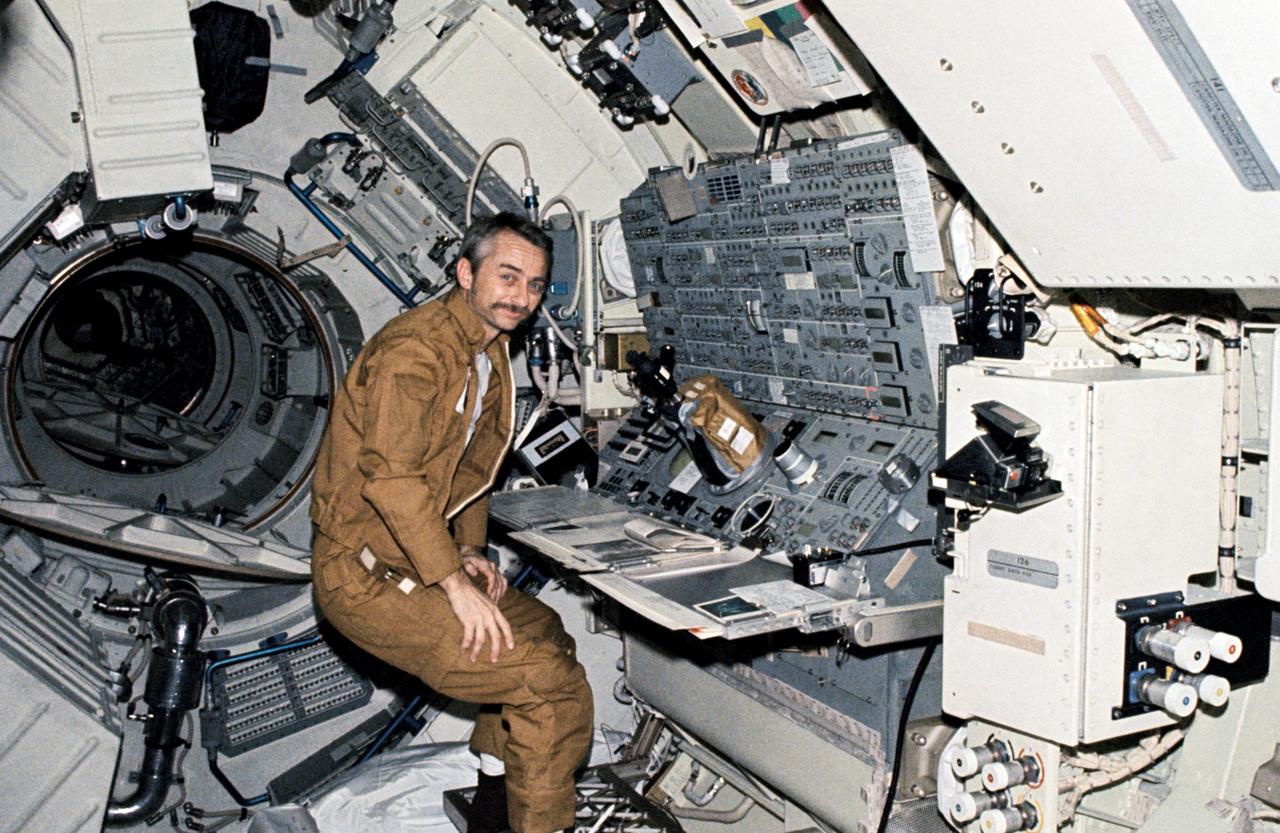
SL3-108-1288 (July-Sept. 1973) --- Astronaut Owen K. Garriott, science pilot of the Skylab 3 mission, is stationed at the Apollo Telescope Mount (ATM) console in the Multiple Docking Adapter (MDA) of the Skylab space station in Earth orbit. This picture was taken with a handheld 35mm Nikon camera. Astronauts Garriott, Alan L. Bean and Jack R. Lousma remained with the Skylab space station cluster in orbit for 59 days conducting numerous medical, scientific and technological experiments. In orbit the MDA functions as a major experiment control center for solar observations. From this console the astronauts actively control the ATM solar physics telescopes. Photo credit: NASA
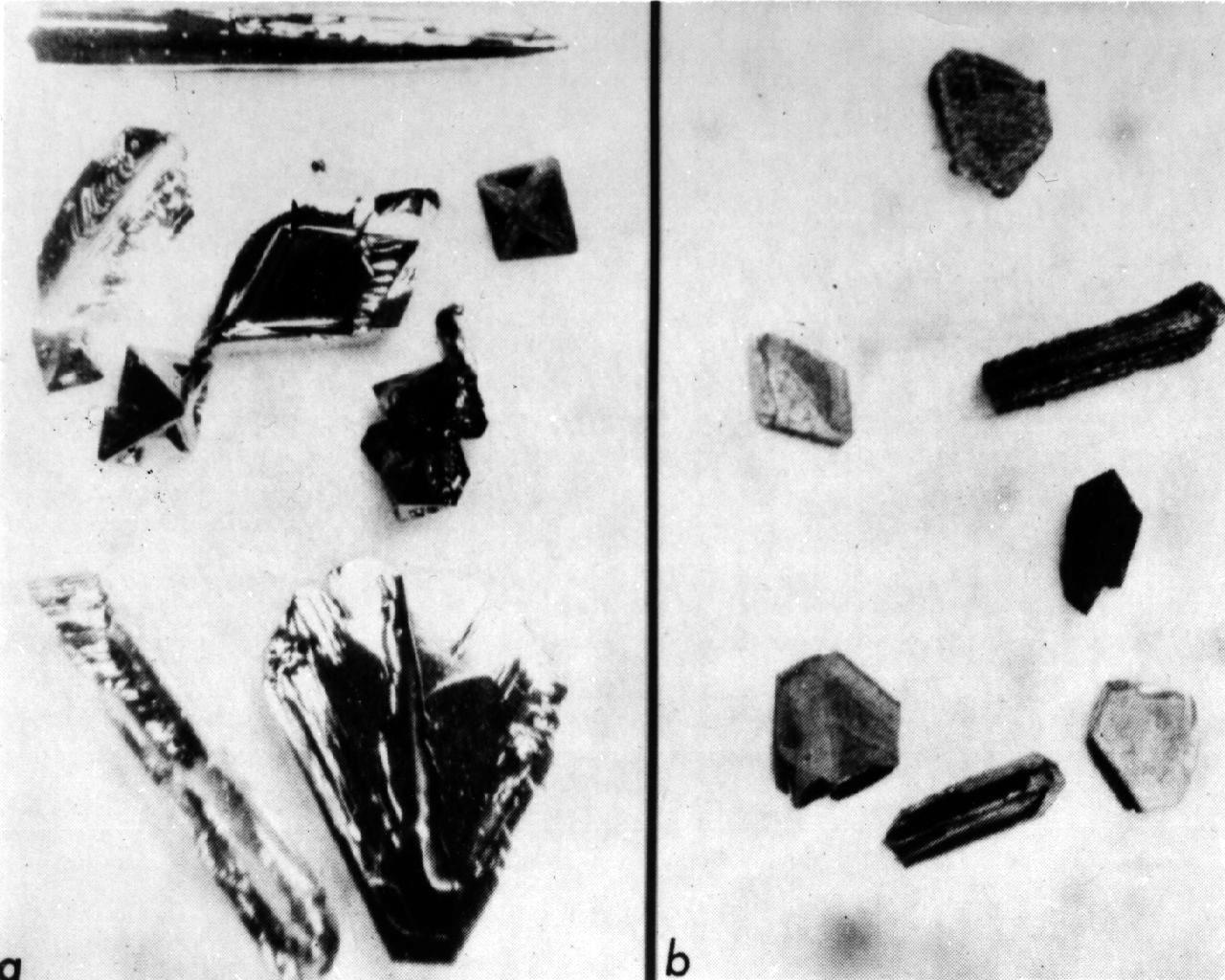
Comparison of Germanium Telluride (GeTe) Crystals grown on Earth (left) and in space (right) during the Skylab SL-3 mission. These crystals were grown using a vapor transport crystal growth method in the Multipurpose Electric Furnace System (MEFS). Crystals grown on earth are needles and platelettes with distorted surfaces and hollow growth habits. The length of the ground-based needle is approximately 2 mm and the average lenth of the platelets is 1 mm. The dull appearance of the Skylab crystals resulted from condensation of the transport agent during the long cooling period dictated by the Skylab furnace. In a dedicated process, this would be prevented by removing the ampoule from the furnace and quenching the vapor source.
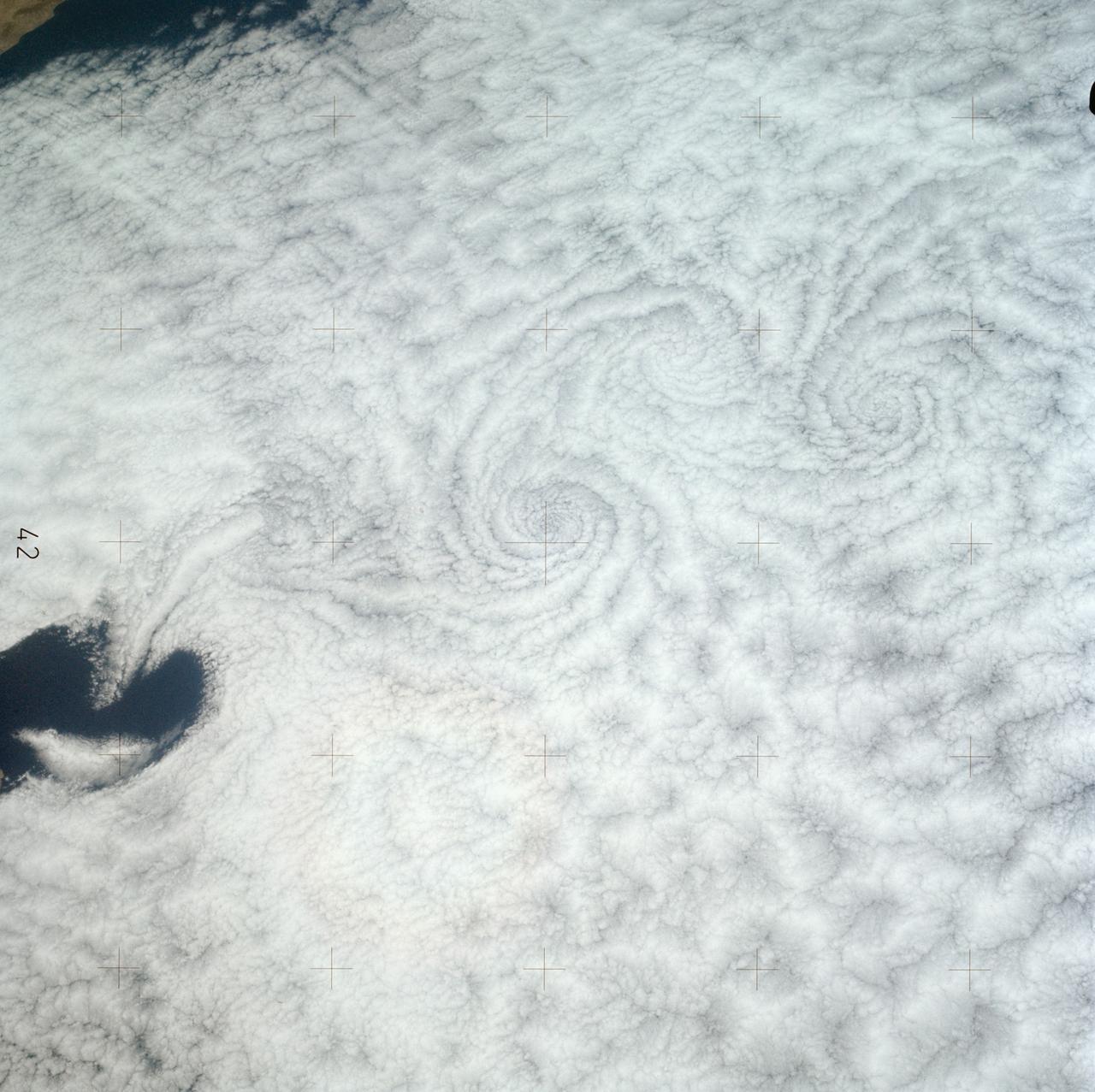
SL3-121-2371 (July-September 1973) --- A pattern of downstream eddies in the stratocumulus clouds over the Pacific Ocean west of Baja California, as photographed by the crewmen of the second Skylab manned mission (Skylab 3) from the space station cluster in Earth orbit. The clouds, produced by the cold California current running to the south and southwest, are prevented from rising by warm air above them. Photo credit: NASA
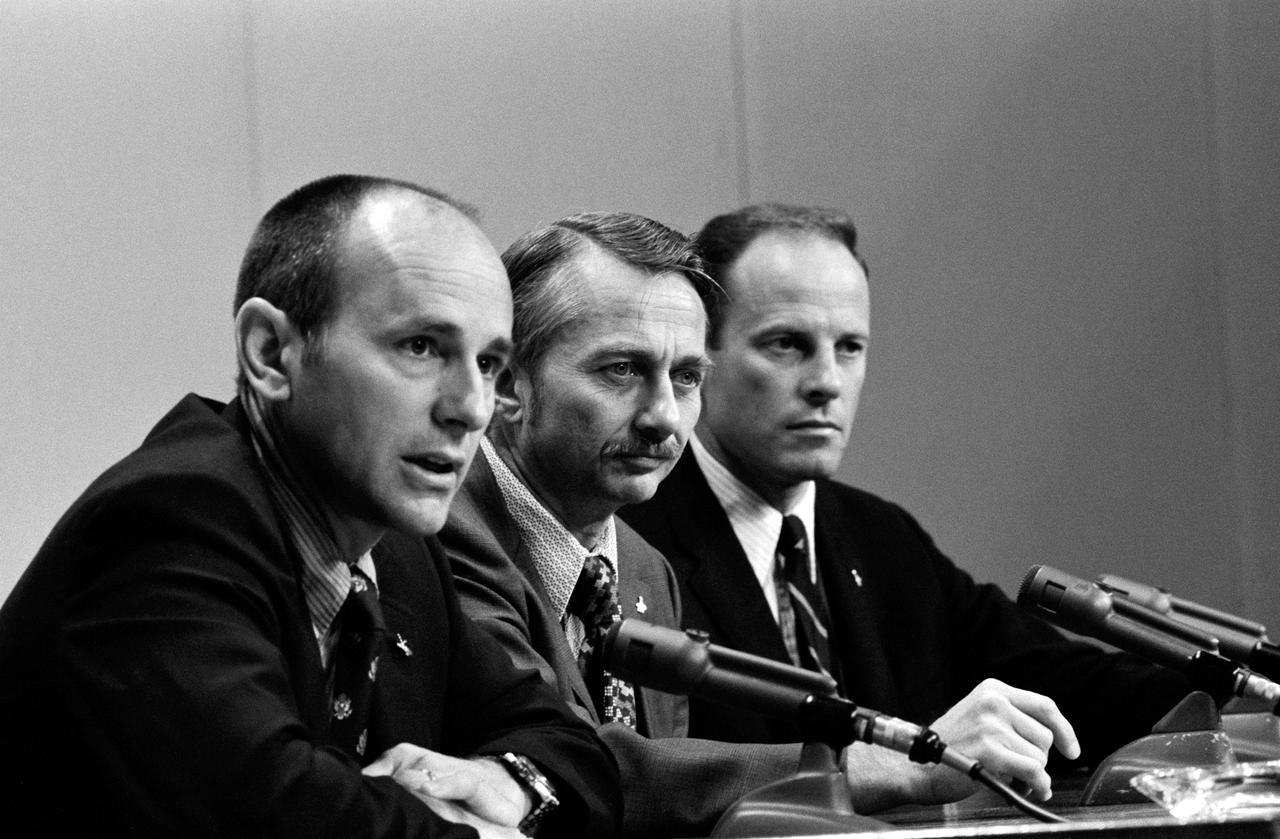
S73-30110 (30 June 1973) --- The three members of the prime crew of the second manned Skylab mission (Skylab 3) discuss their scheduled 56-day flight before a gathering of news media representatives in the large auditorium of Building 1 at the Johnson Space Center (JSC), Houston, Texas, on June 30, 1973. They are, left to right, astronaut Alan L. Bean, commander; scientist-astronaut Owen K. Garriott, science pilot; and astronaut Jack R. Lousma, pilot. Photo credit: NASA
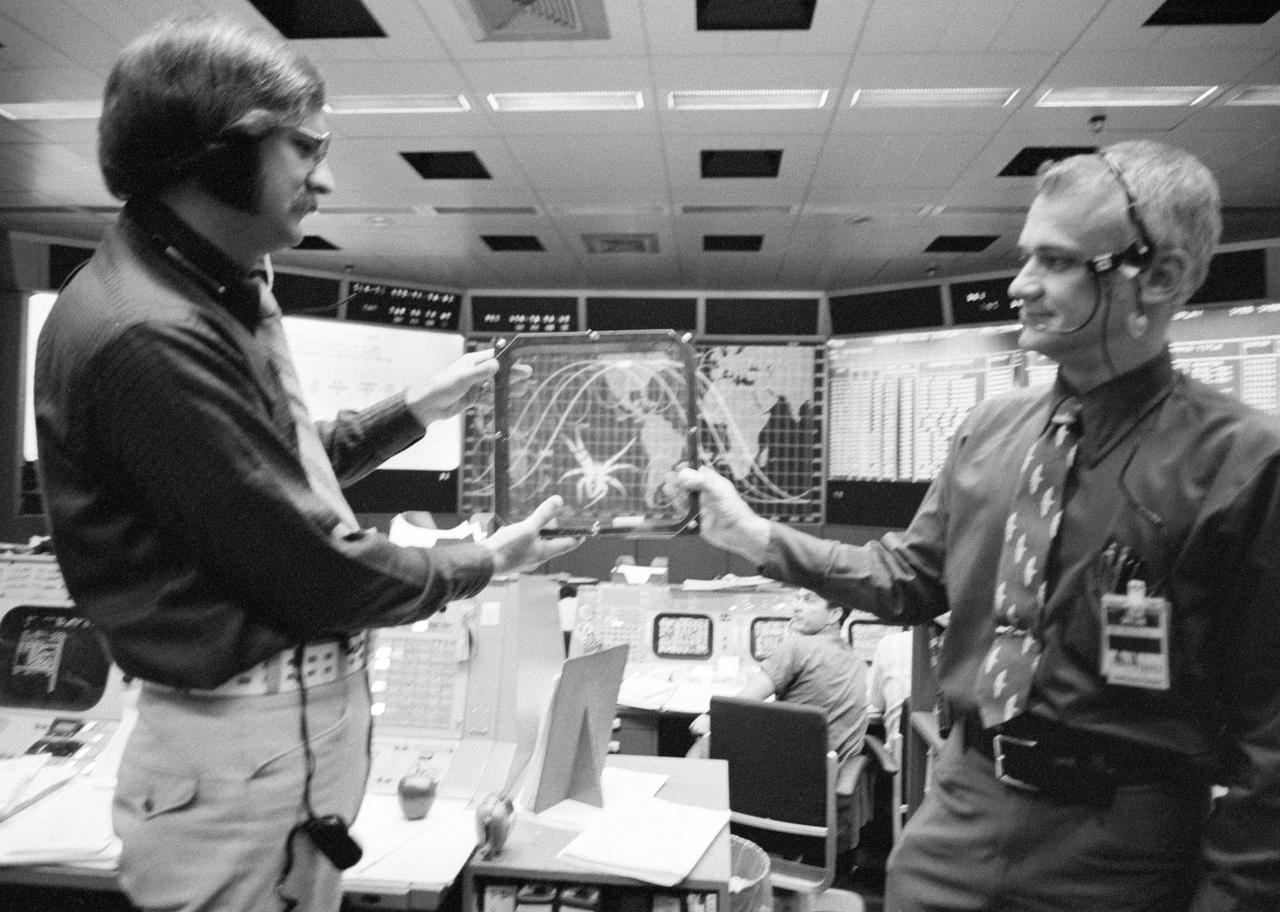
S73-34456 (September 1973) --- Flight Director Neil B. Hutchinson, left, and astronaut Bruce McCandless II hold up a glass enclosure - home for the spider Arachne, which is the same species as the two spiders carried on the Skylab 3 mission. The real spider is the one barely visible at the upper right corner of the square; the larger one is a projected image on the rear-screen-projected map in the front of the Mission Operations Control Room (MOCR) of the Mission Control Center (MCC). McCandless served as backup pilot for the first manned Skylab mission and was a spacecraft communicater (CAPCOM) for the second crew. Photo credit: NASA
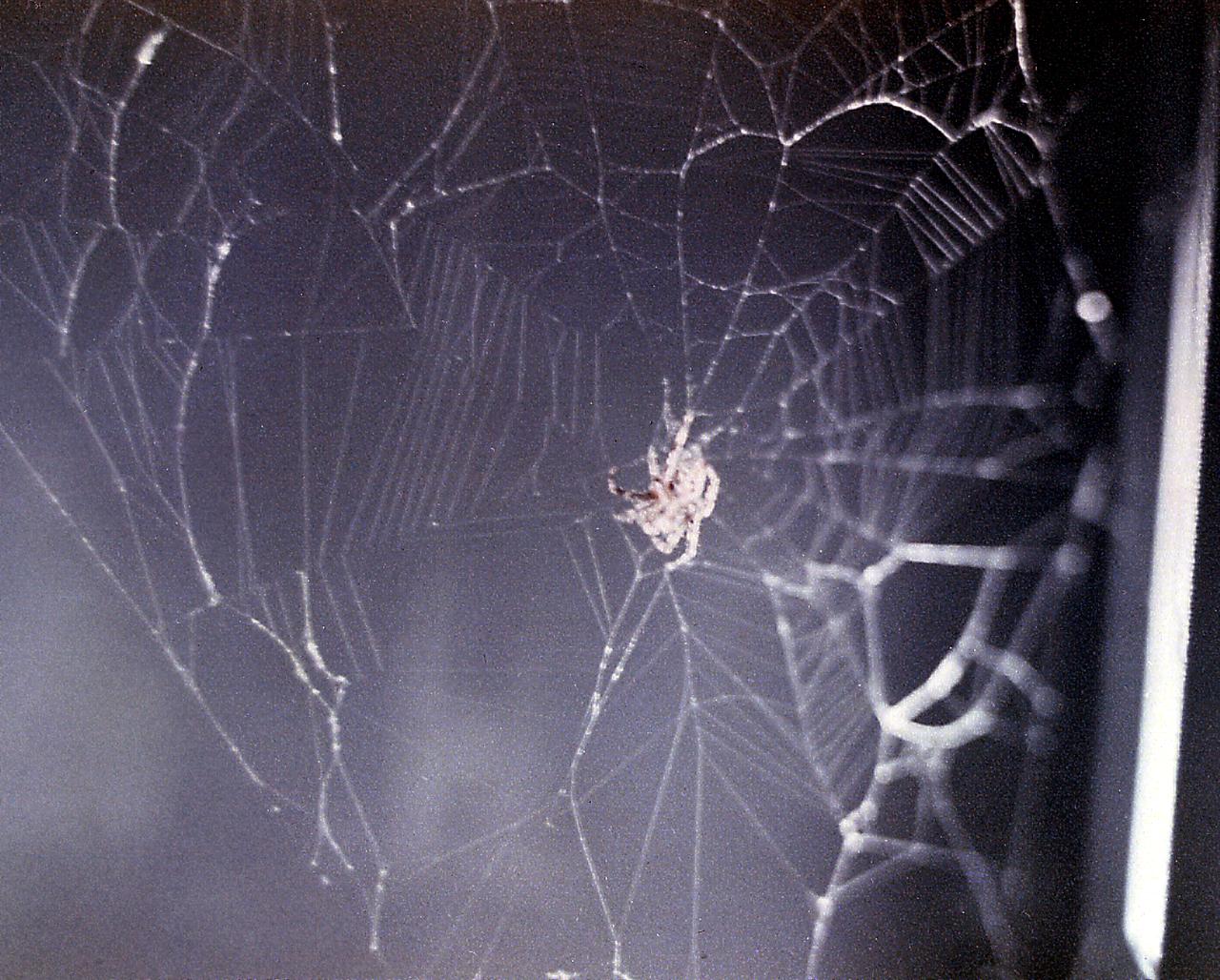
Judith S. Miles of Lexington High School, Lexington, Massachusetts, proposed skylab student experiment ED-52, Web Formation. This experiment was a study of a spider's behavior in a weightless environment. The geometrical structure of the web of the orb-weaving spider provides a good measure of the condition of its central nervous system. Since the spider senses its own weight to determine the required thickness of web material and uses both the wind and gravity to initiate construction of its web, the lack of gravitational force in Skylab provided a new and different stimulus to the spider's behavioral response. Two common cross spiders, Arabella and Anita, were used for the experiment aboard the Skylab-3 mission. After initial disoriented attempts, both spiders produced almost Earth-like webs once they had adapted to weightlessness. This photograph is of Arabella, a cross spider, in her initial attempt at spirning a web. This picture was taken by the crew of the Skylab 3 mission before Arabella adapted to her new environment.

S73-31104 (17 July 1973) --- The wife and children of astronaut Alan L. Bean are photographed at their home near the Johnson Space Center (JSC), where their husband and father is preparing for NASA?s second manned Skylab mission. Bean is commander of the Skylab 3 Earth-orbital mission and will be joined by scientist-astronaut Owen K. Garriott, science pilot, and astronaut Jack R. Lousma, pilot for the schedule two-month mission. With Mrs. Sue Bean are the couple?s children Clay, 17, and Amy Sue, 10; and the family?s pet dog. Photo credit: NASA
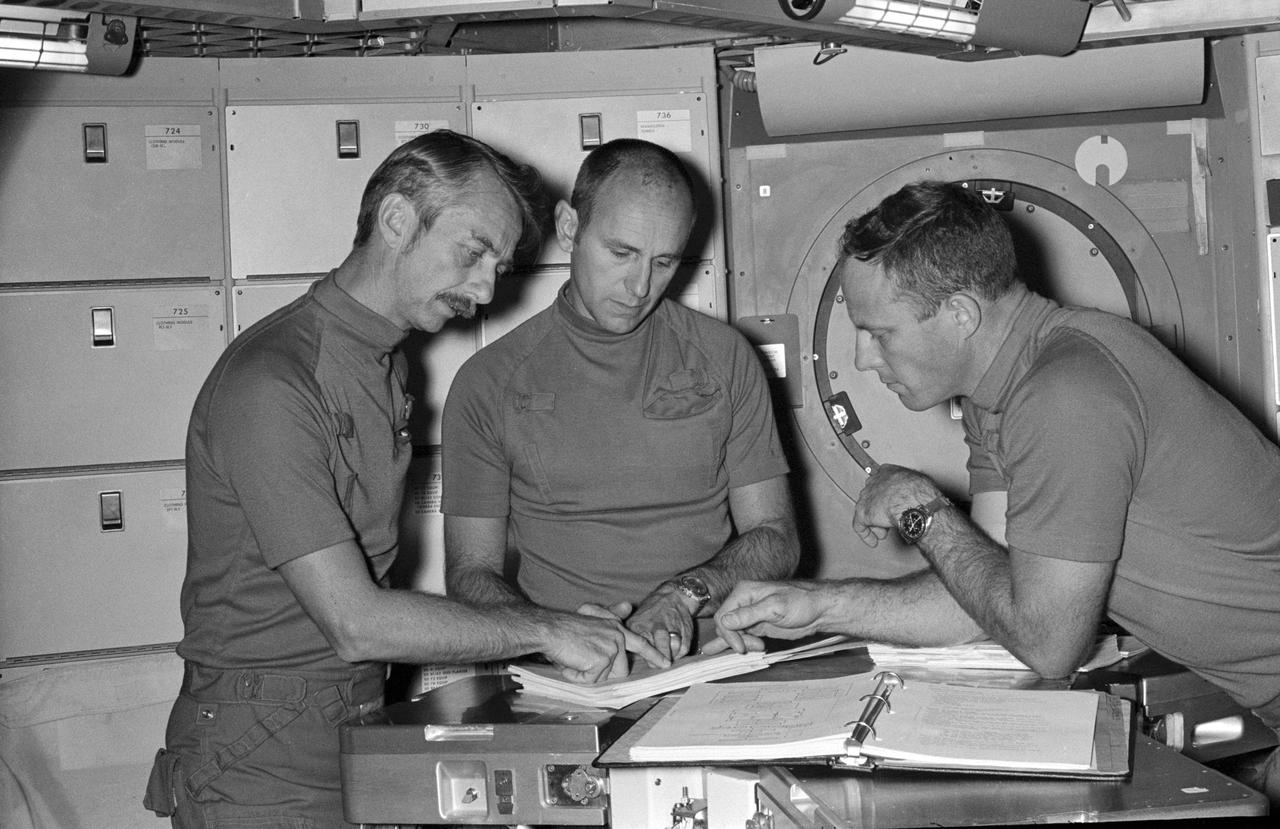
S73-28419 (16 June 1973) --- The three prime crewmen of the Skylab 3 mission check over flight data during a training session in the crew quarters of the Orbital Workshop (OWS) trainer in the Mission Simulation and Training Facility at the Johnson Space Center (JSC). They are, from left to right, scientist-astronaut Owen K. Garriott, science pilot; and astronauts Alan L. Bean, commander, and Jack R. Lousma, pilot. The 56-day, second manned Skylab Earth-orbital mission is scheduled for liftoff in the latter part of July 1973. Photo credit: NASA
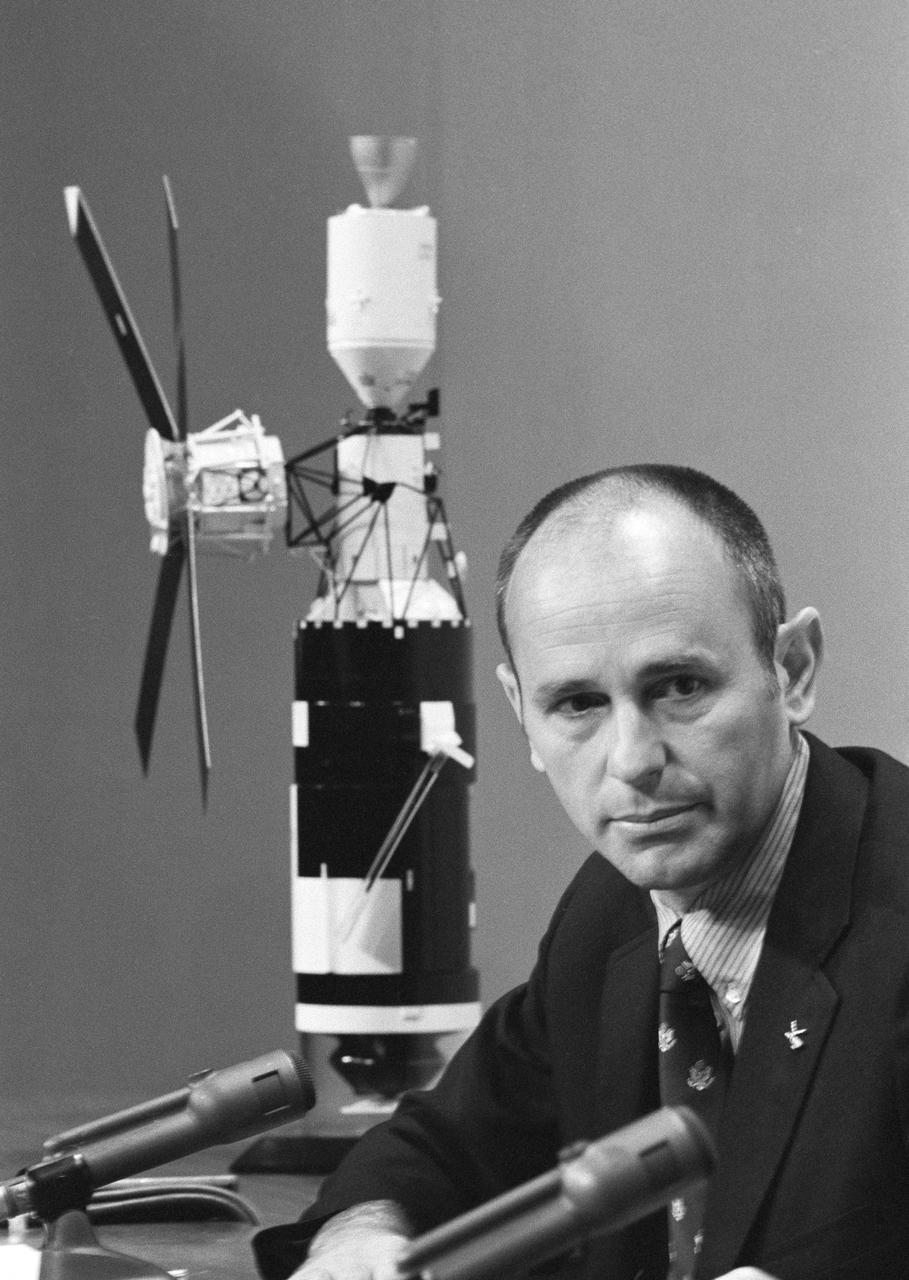
S73-30113 (30 June 1973) --- Astronaut Alan L. Bean, Skylab 3 commander, ponders a question from a newsman during the premission press conference on June 30, 1973, in the Building 1 large auditorium at Johnson Space Center. Photo credit: NASA

CAPE CANAVERAL, Fla. – Former NASA astronauts Gerald P. Carr, left, and Edward G. Gibson place a wreath on an easel during a ceremony to honor former NASA astronaut William R. Pogue at the United States Astronaut Hall of Fame at the Kennedy Space Center Visitor Complex. In the background is a painting by former NASA astronaut Alan Bean. Col. Pogue, pilot on NASA's Skylab 4 mission in 1973-74, died March 3. He was 84 years old. Skylab 4 was the third and final manned visit to the Skylab orbital workshop, launched Nov. 16, 1973, and concluded Feb. 8, 1974. At 84 days, 1 hour and 15 minutes, Skylab 4 was the longest manned space flight to that date. Pogue was accompanied on the record-setting 34.5-million-mile flight by Commander Carr and science-pilot Gibson. They conducted dozens of experiments and science demonstrations during their 1,214 orbits of Earth. Pogue logged 13 hours and 31 minutes in two spacewalks outside the orbital workshop. For more information, visit http://www.nasa.gov/content/skylab-4-pilot-william-pogue-dies. Photo credit: NASA/Kim Shiflett
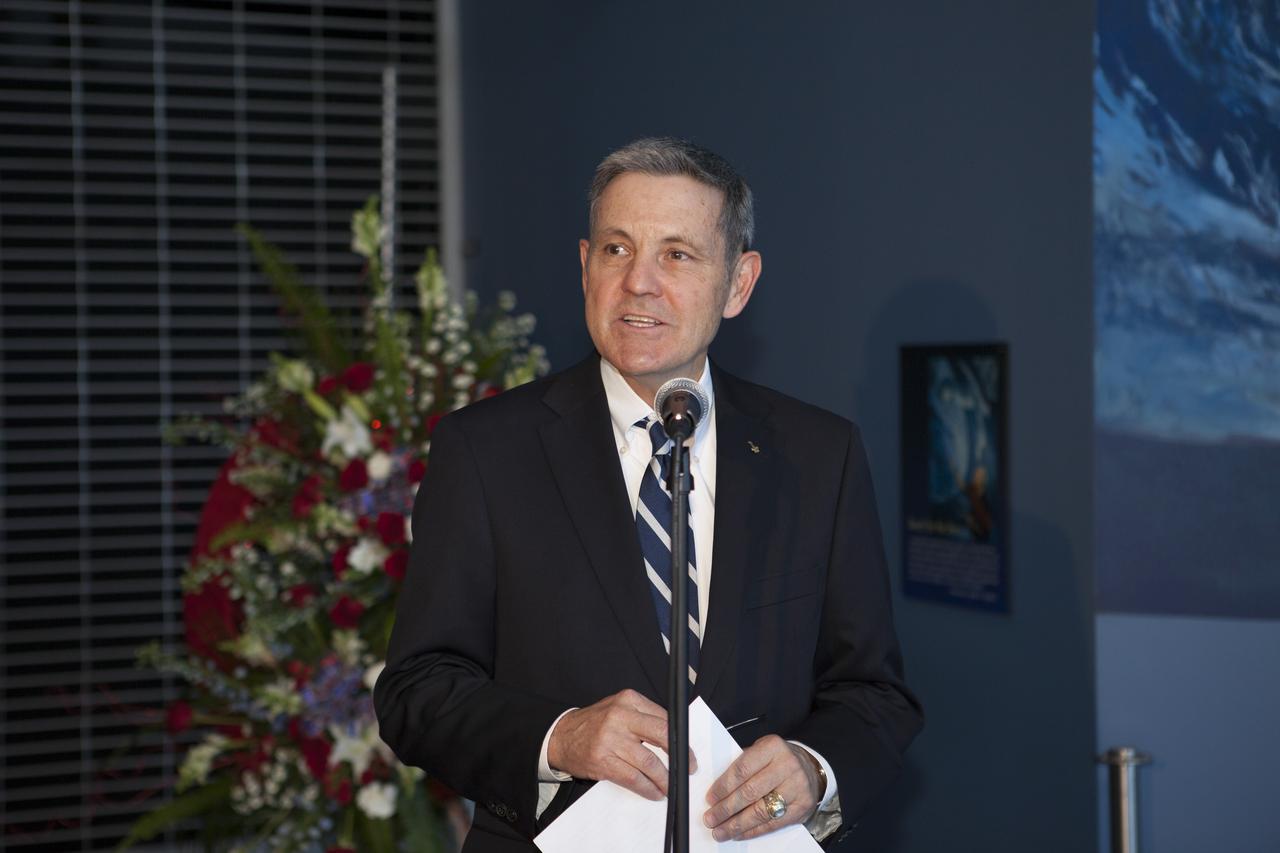
CAPE CANAVERAL, Fla. – NASA Kennedy Space Center Director Robert Cabana welcomes guests to the United States Astronaut Hall of Fame at the Kennedy Space Center Visitor Complex for a wreath laying ceremony to honor former NASA astronaut William R. Pogue. Col. Pogue, pilot on NASA's Skylab 4 mission in 1973-74, died March 3. He was 84 years old. Skylab 4 was the third and final manned visit to the Skylab orbital workshop, launched Nov. 16, 1973, and concluded Feb. 8, 1974. At 84 days, 1 hour and 15 minutes, Skylab 4 was the longest manned space flight to that date. Pogue was accompanied on the record-setting 34.5-million-mile flight by Commander Gerald P. Carr and science-pilot Dr. Edward G. Gibson. They conducted dozens of experiments and science demonstrations during their 1,214 orbits of Earth. Pogue logged 13 hours and 31 minutes in two spacewalks outside the orbital workshop. For more information, visit http://www.nasa.gov/content/skylab-4-pilot-william-pogue-dies. Photo credit: NASA/Kim Shiflett
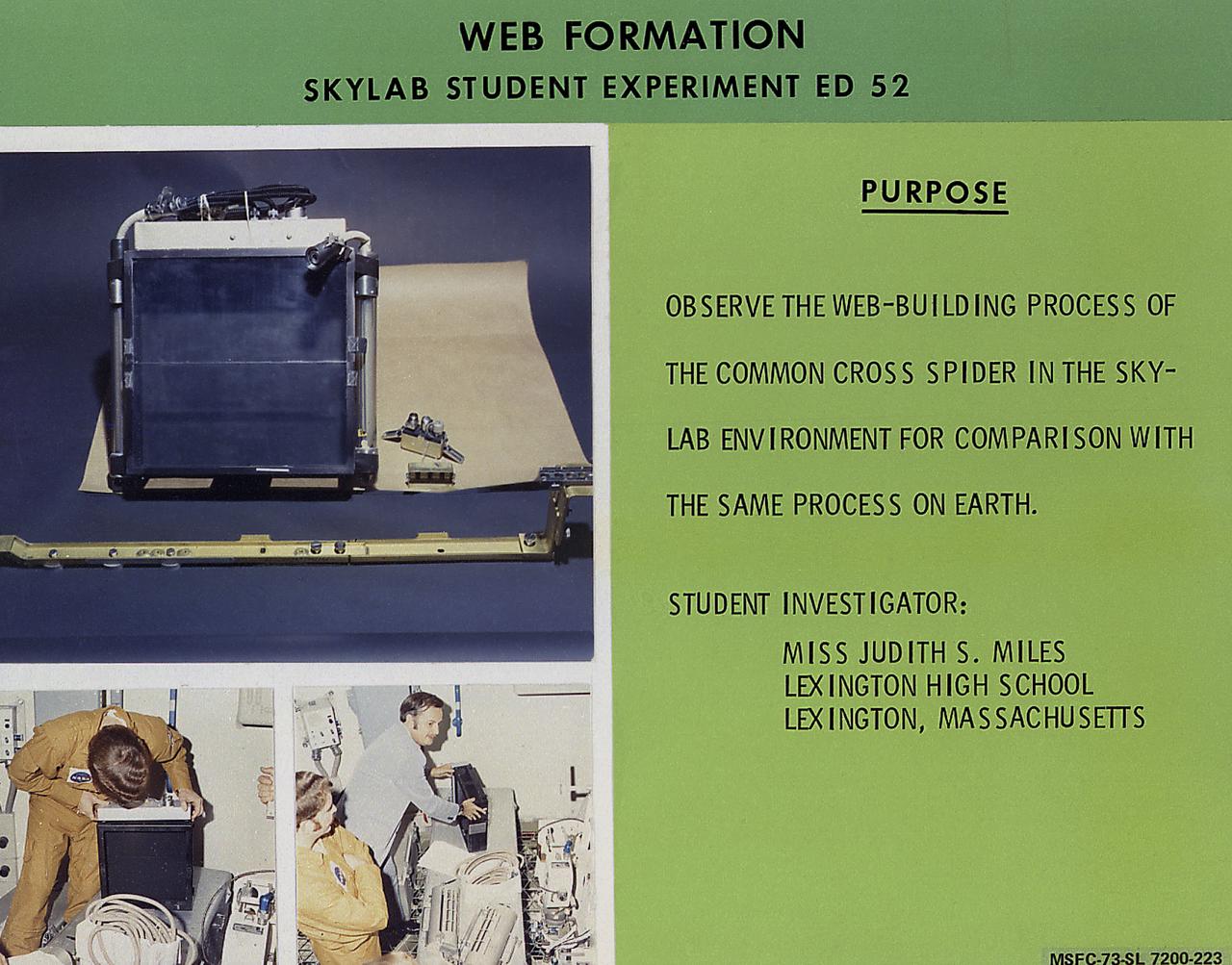
This chart describes the Skylab student experiment Web Formation. Judith S. Miles of Lexington High School, Lexington, Massachusetts, proposed a study of the spider's behavior in a weightless environment. The geometrical structure of the web of the orb-weaving spider provides a good measure of the condition of its central nervous system. Since the spider senses its own weight to determine the required thickness of web material and uses both the wind and gravity to initiate construction of its web, the lack of gravitational force in Skylab provided a new and different stimulus to the spider's behavioral response. Two common cross spiders, Arabella and Anita, were used for the experiment aboard the Skylab-3 mission. After initial disoriented attempts, both spiders produced almost Earth-like webs once they had adapted to weightlessness. In March 1972, NASA and the National Science Teachers Association selected 25 experiment proposals for flight on Skylab. Science advisors from the Marshall Space Flight Center aided and assisted the students in developing the proposals for flight on Skylab.

CAPE CANAVERAL, Fla. – Former NASA astronaut Edward G. Gibson, Ph.D., remarks on his friendship with former NASA astronaut William R. Pogue during a wreath laying ceremony at the United States Astronaut Hall of Fame at the Kennedy Space Center Visitor Complex. Col. Pogue, pilot on NASA's Skylab 4 mission in 1973-74, died March 3. He was 84 years old. Skylab 4 was the third and final manned visit to the Skylab orbital workshop, launched Nov. 16, 1973, and concluded Feb. 8, 1974. At 84 days, 1 hour and 15 minutes, Skylab 4 was the longest manned space flight to that date. Pogue was accompanied on the record-setting 34.5-million-mile flight by Commander Gerald P. Carr and science-pilot Gibson. They conducted dozens of experiments and science demonstrations during their 1,214 orbits of Earth. Pogue logged 13 hours and 31 minutes in two spacewalks outside the orbital workshop. For more information, visit http://www.nasa.gov/content/skylab-4-pilot-william-pogue-dies. Photo credit: NASA/Kim Shiflett
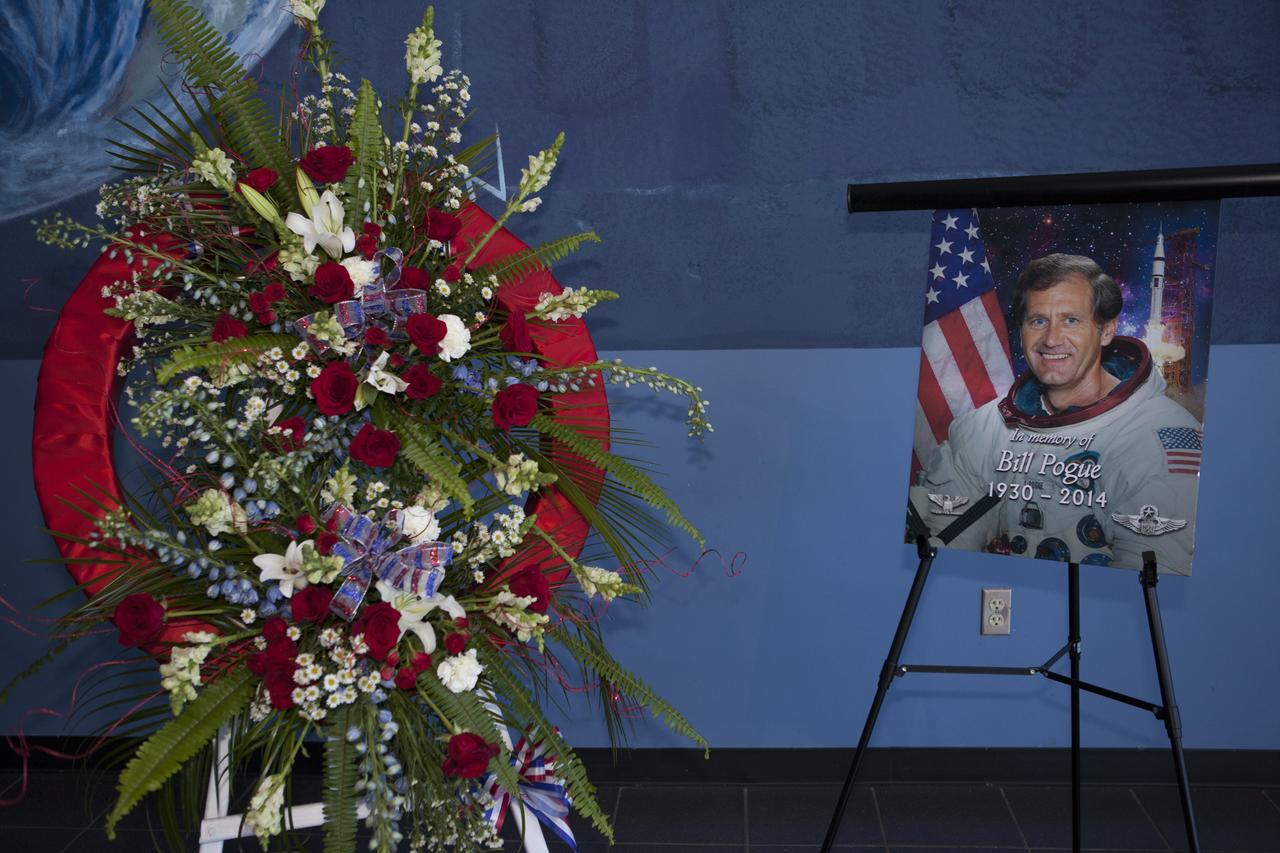
CAPE CANAVERAL, Fla. – A wreath is placed next to a photo of former NASA astronaut William R. Pogue during a ceremony to honor Pogue held at the United States Astronaut Hall of Fame at the Kennedy Space Center Visitor Complex. Col. Pogue, pilot on NASA's Skylab 4 mission in 1973-74, died March 3. He was 84 years old. Skylab 4 was the third and final manned visit to the Skylab orbital workshop, launched Nov. 16, 1973, and concluded Feb. 8, 1974. At 84 days, 1 hour and 15 minutes, Skylab 4 was the longest manned space flight to that date. Pogue was accompanied on the record-setting 34.5-million-mile flight by Commander Gerald P. Carr and science-pilot Dr. Edward G. Gibson. They conducted dozens of experiments and science demonstrations during their 1,214 orbits of Earth. Pogue logged 13 hours and 31 minutes in two spacewalks outside the orbital workshop. For more information, visit http://www.nasa.gov/content/skylab-4-pilot-william-pogue-dies. Photo credit: NASA/Kim Shiflett

CAPE CANAVERAL, Fla. – Former NASA astronaut Gerald P. Carr remarks on his friendship with former NASA astronaut William R. Pogue during a wreath laying ceremony at the United States Astronaut Hall of Fame at the Kennedy Space Center Visitor Complex. Col. Pogue, pilot on NASA's Skylab 4 mission in 1973-74, died March 3. He was 84 years old. Skylab 4 was the third and final manned visit to the Skylab orbital workshop, launched Nov. 16, 1973, and concluded Feb. 8, 1974. At 84 days, 1 hour and 15 minutes, Skylab 4 was the longest manned space flight to that date. Pogue was accompanied on the record-setting 34.5-million-mile flight by Commander Carr and science-pilot Dr. Edward G. Gibson. They conducted dozens of experiments and science demonstrations during their 1,214 orbits of Earth. Pogue logged 13 hours and 31 minutes in two spacewalks outside the orbital workshop. For more information, visit http://www.nasa.gov/content/skylab-4-pilot-william-pogue-dies. Photo credit: NASA/Kim Shiflett

CAPE CANAVERAL, Fla. – From left, former NASA astronauts Robert Cabana, Gerald P. Carr and Edward G. Gibson pay their respects to former NASA astronaut William R. Pogue during a wreath laying ceremony at the United States Astronaut Hall of Fame at the Kennedy Space Center Visitor Complex. Cabana now is the director of Kennedy Space Center. In the background is a painting by former NASA astronaut Alan Bean. Col. Pogue, pilot on NASA's Skylab 4 mission in 1973-74, died March 3. He was 84 years old. Skylab 4 was the third and final manned visit to the Skylab orbital workshop, launched Nov. 16, 1973, and concluded Feb. 8, 1974. At 84 days, 1 hour and 15 minutes, Skylab 4 was the longest manned space flight to that date. Pogue was accompanied on the record-setting 34.5-million-mile flight by Commander Carr and science-pilot Gibson. They conducted dozens of experiments and science demonstrations during their 1,214 orbits of Earth. Pogue logged 13 hours and 31 minutes in two spacewalks outside the orbital workshop. For more information, visit http://www.nasa.gov/content/skylab-4-pilot-william-pogue-dies. Photo credit: NASA/Kim Shiflett
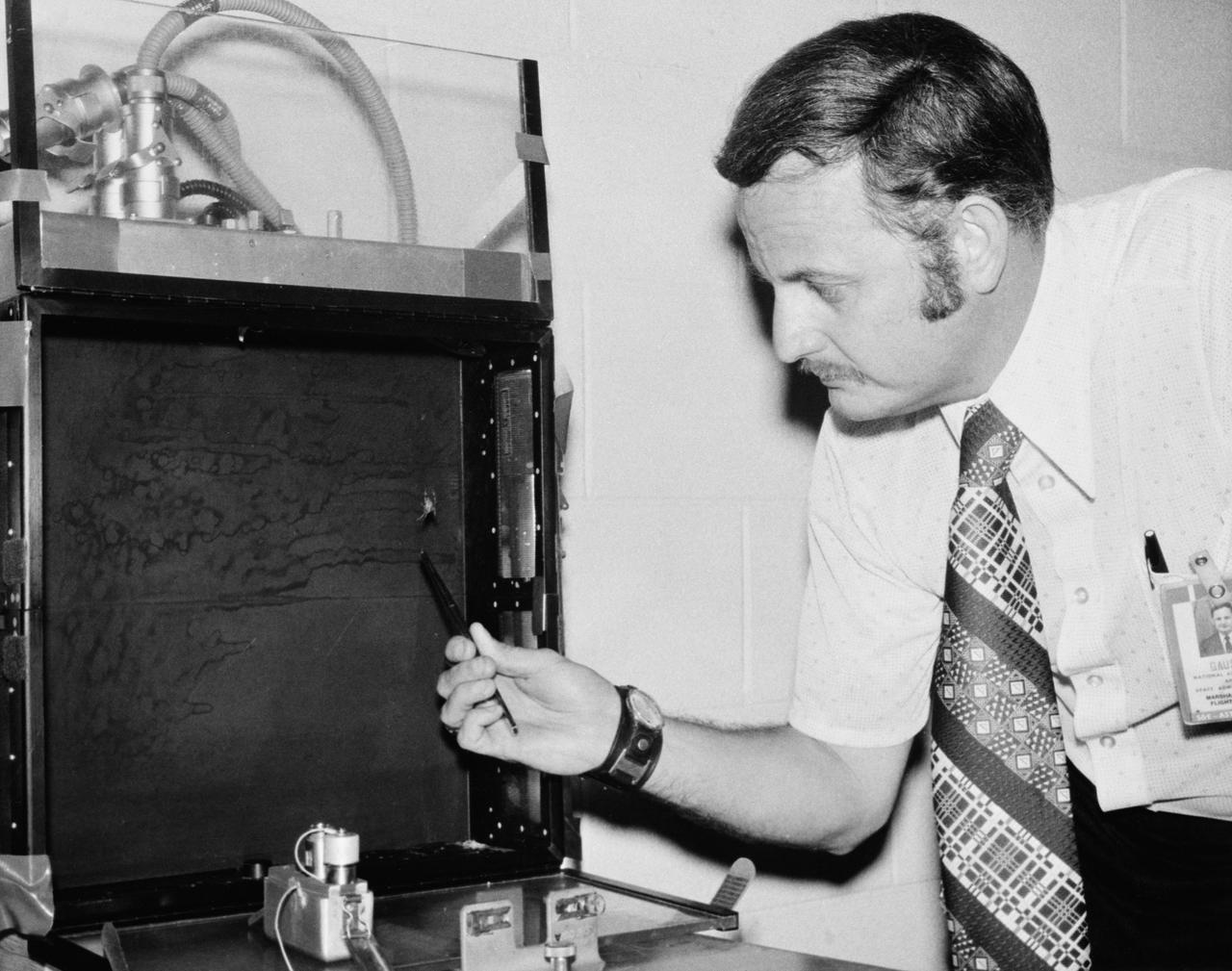
S73-32499 (July 1973) --- Dr. Ray Gause of the NASA Marshall Space Flight Center (MSFC) places dinner, in the form of a housefly, in the web of Arabella - the prime spider for the ED-52 Web Formation Experiment. Arabella can be delineated near the end of the black pen in Dr. Gause's hand. The experiment is one of 25 student experiments accepted for the Skylab program and will be performed during the Skylab 3 mission. Judy Miles, a 17-year-old high school student from Lexington, Massachusetts, is the student experimenter and Dr. Gause is the NASA student advisor. Photo credit: NASA
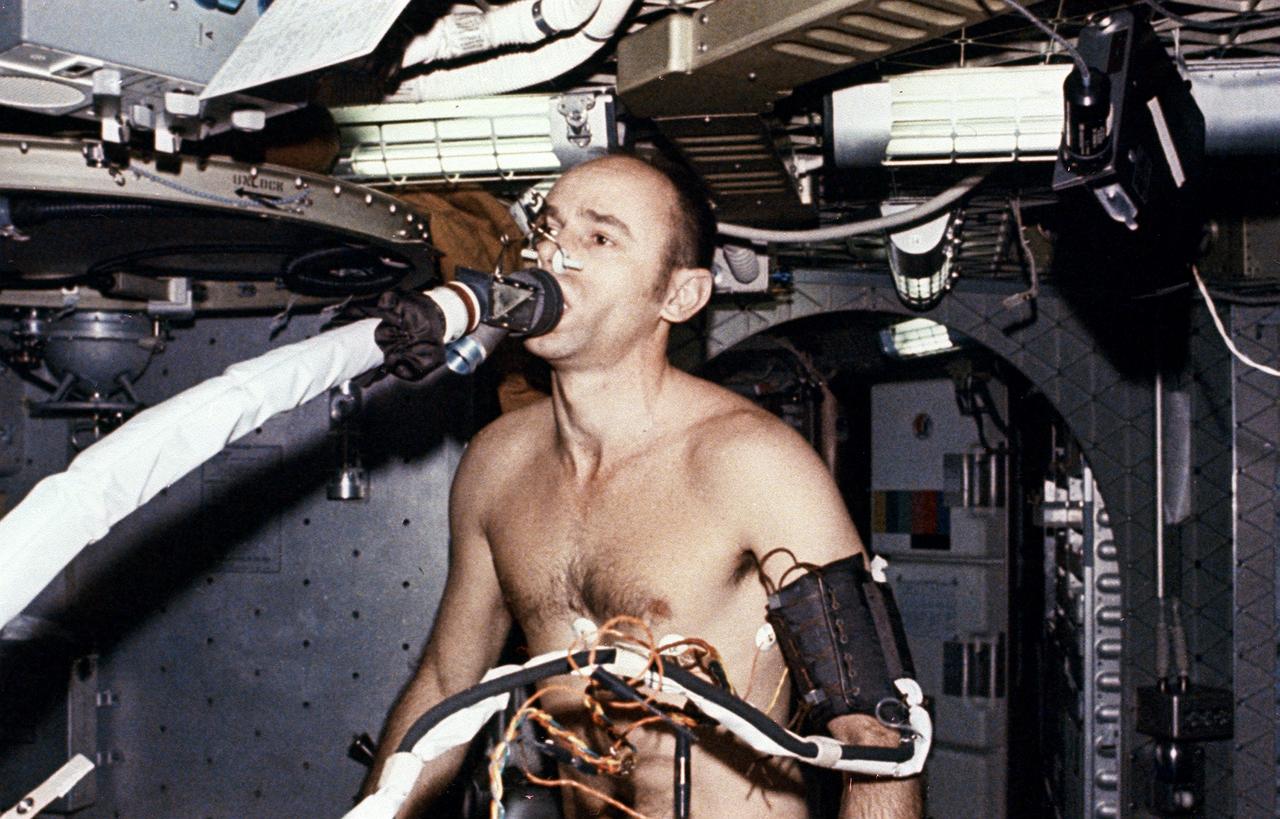
This Skylab-3 onboard photograph shows Astronaut Allen Bean on the ergometer, breathing into the metabolic analyzer. Skylab's Metabolic Activity experiment (M171), a medical evaluation facility, was designed to measure astronauts' metabolic changes while on long-term space missions. The experiment obtained information on astronauts' physiological capabilities and limitations and provided data useful in the design of future spacecraft and work programs. Physiological responses to physical activity was deduced by analyzing inhaled and exhaled air, pulse rate, blood pressure, and other selected variables of the crew while they performed controlled amounts of physical work with a bicycle ergometer.
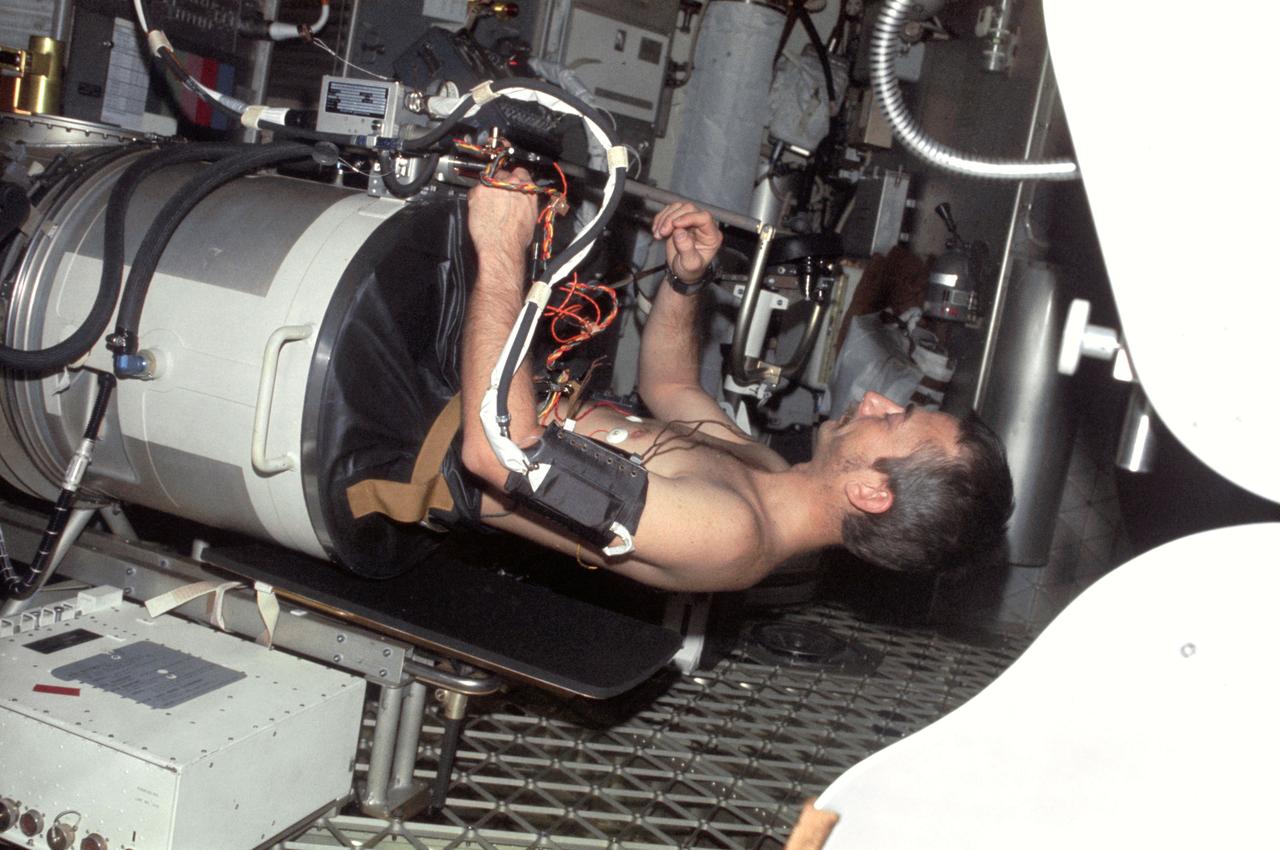
SL3-108-1278 (July-September 1973) --- Scientist-astronaut Owen K. Garriott, science pilot of the Skylab 3 mission, lies in the Lower Body Negative Pressure Device in the work and experiments area of the Orbital Workshop (OWS) crew quarters of the Skylab space station cluster in Earth orbit. This picture was taken with a hand-held 35mm Nikon camera. Astronauts Garriott, Alan L. Bean and Jack R. Lousma remained with the Skylab space station in orbit for 59 days conducting numerous medical, scientific and technological experiments. The LBNPD (MO92) Experiment is to provide information concerning the time course of cardiovascular adaptation during flight, and to provide in-flight data for predicting the degree of orthostatic intolerance and impairment of physical capacity to be expected upon return to Earth environment. The bicycle ergometer is in the right foreground. Photo credit: NASA
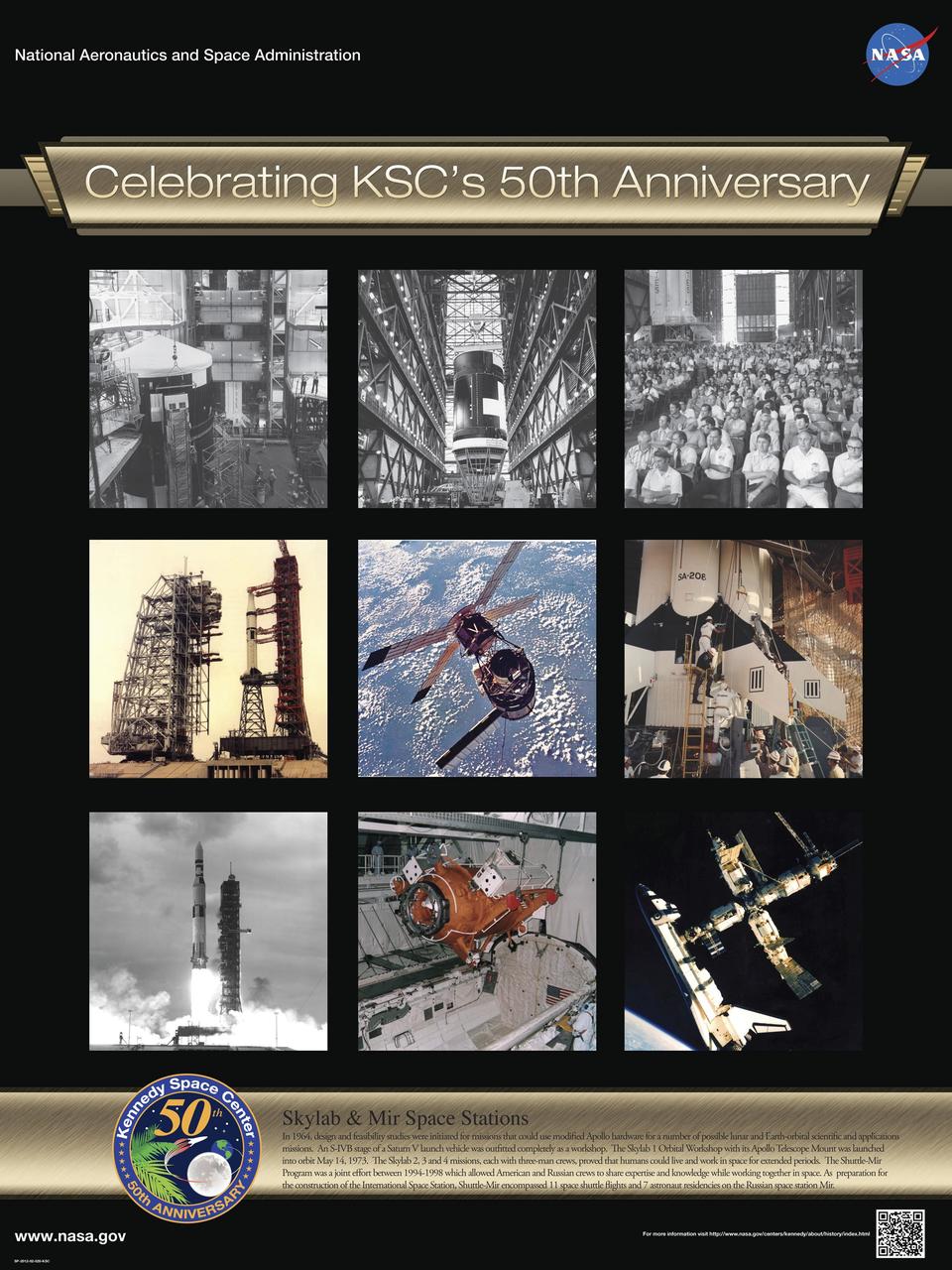
Skylab and Mir Space Stations: In 1964, design and feasibility studies were initiated for missions that could use modified Apollo hardware for a number of possible lunar and Earth-orbital scientific and applications missions. An S-IVB stage of a Saturn V launch vehicle was outfitted completely as a workshop. The Skylab 1 Orbital Workshop with its Apollo Telescope Mount was launched into orbit May 14, 1973. The Skylab 2, 3 and 4 missions, each with three-man crews, proved that humans could live and work in space for extended periods. The Shuttle-Mir Program was a joint effort between 1994-1998 which allowed American and Russian crews to share expertise and knowledge while working together in space. As preparation for the construction of the International Space Station, Shuttle-Mir encompassed 11 space shuttle flights and 7 astronaut residencies on the Russian space station Mir. Poster designed by Kennedy Space Center Graphics Department/Greg Lee. Credit: NASA
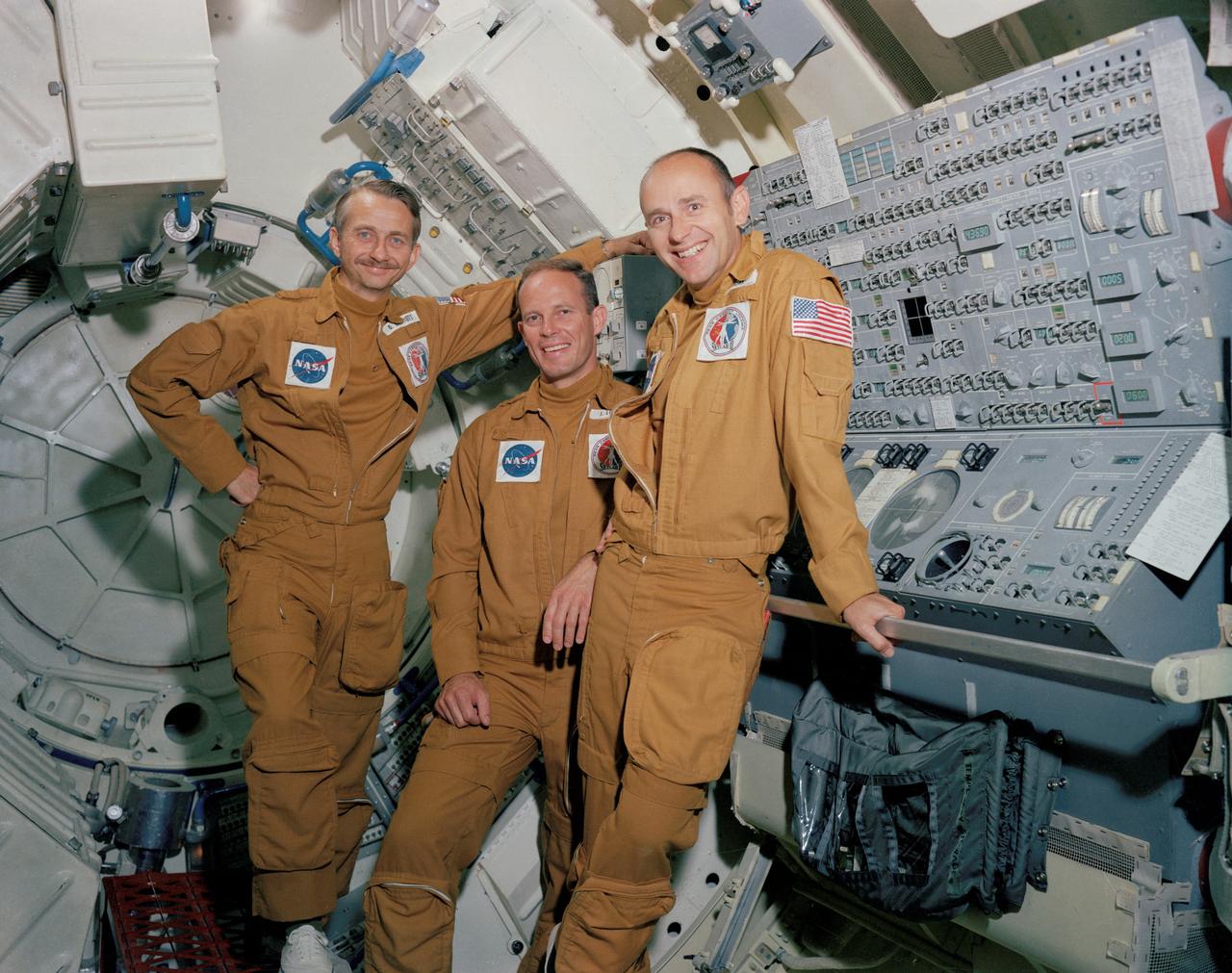
S73-28714 (29 June 1973) --- These three men are the prime crewmen for the Skylab 3 mission. Pictured in the one-G trainer Multiple Docking Adapter (MDA) at the Johnson Space Center (JSC) are, left to right, scientist-astronaut Owen K. Garriott, science pilot; and astronauts Jack R. Lousma and Alan L. Bean, pilot and commander, respectively. Photo credit: NASA
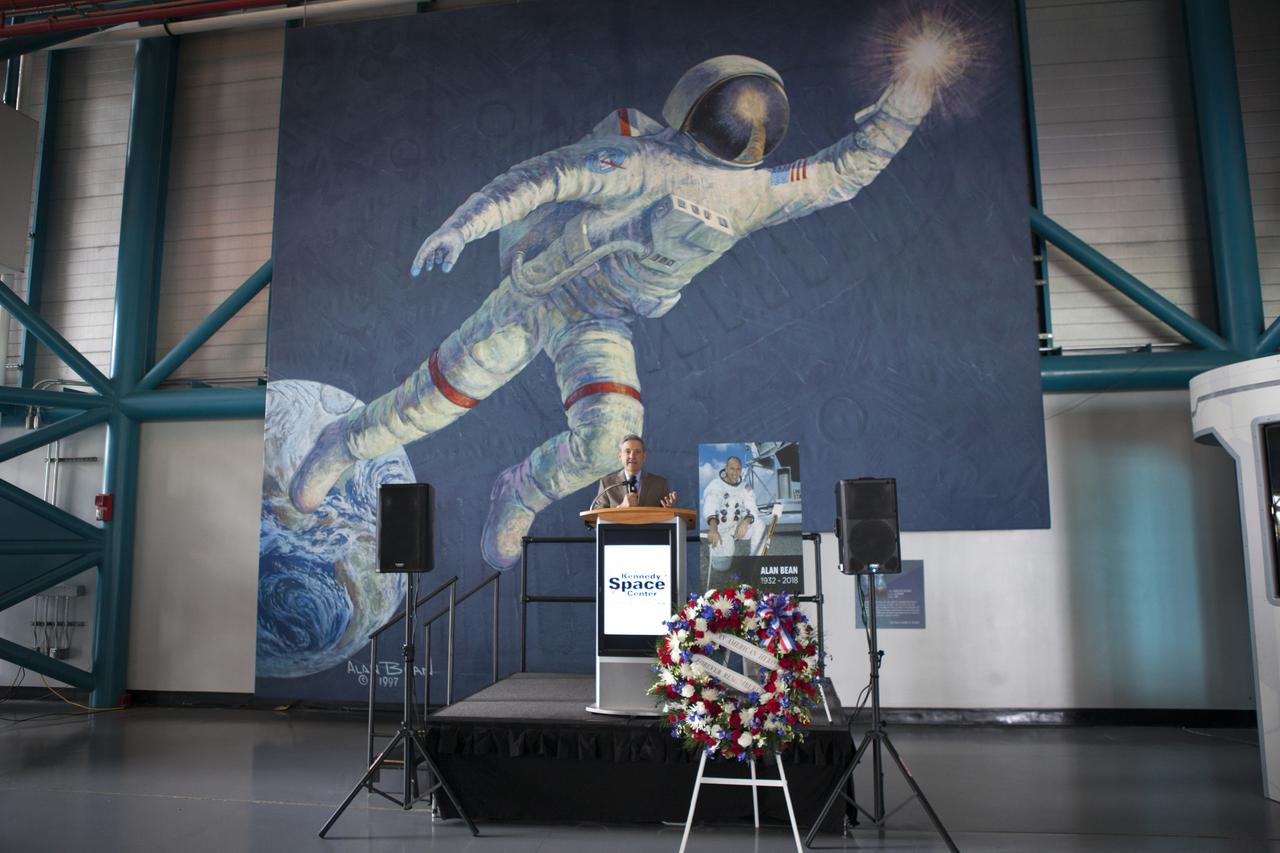
A memorial wreath placed in the Apollo-Saturn V Center of the Kennedy Space Center Visitor Complex on Wednesday, May 30, 2018, honors former NASA astronaut Alan Bean. He was the fourth person to walk on the Moon as lunar module pilot on Apollo 12 in November 1969. He went on to command the 59-day Skylab 3 mission in 1973. In the background is a large mural of a painting by Bean who became an accomplished artist after leaving NASA. He died in Houston on May 26, 2018, at the age of 86.
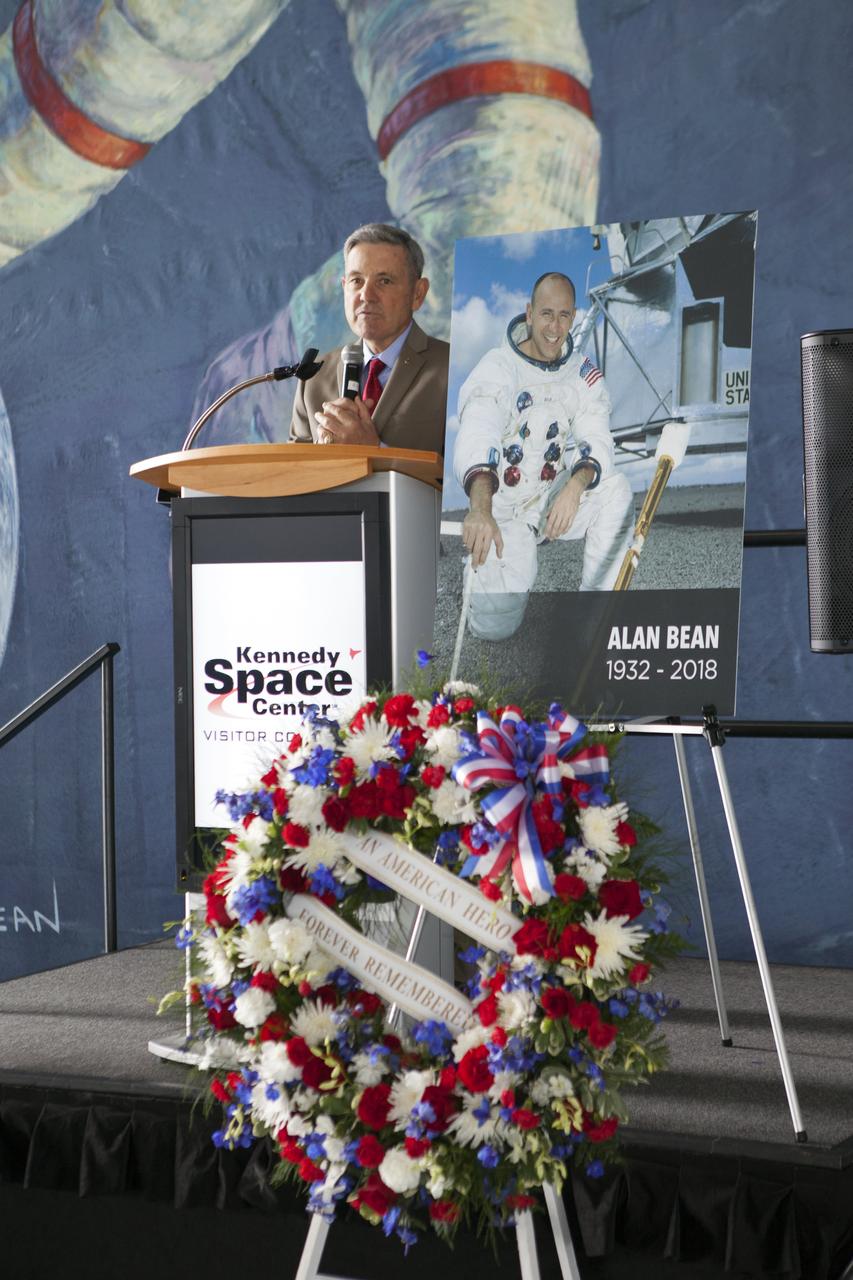
Kennedy Space Center Director Bob Cabana speaks to guests in the Apollo-Saturn V Center at the spaceport's visitor complex on Wednesday, May 30, 2018. The ceremony is honoring the memory of former NASA astronaut Alan Bean. As lunar module pilot on Apollo 12, Bean was the fourth person to walk on the Moon in November 1969. He went on to command the 59-day Skylab 3 mission in 1973. He died in Houston on May 26, 2018, at the age of 86.
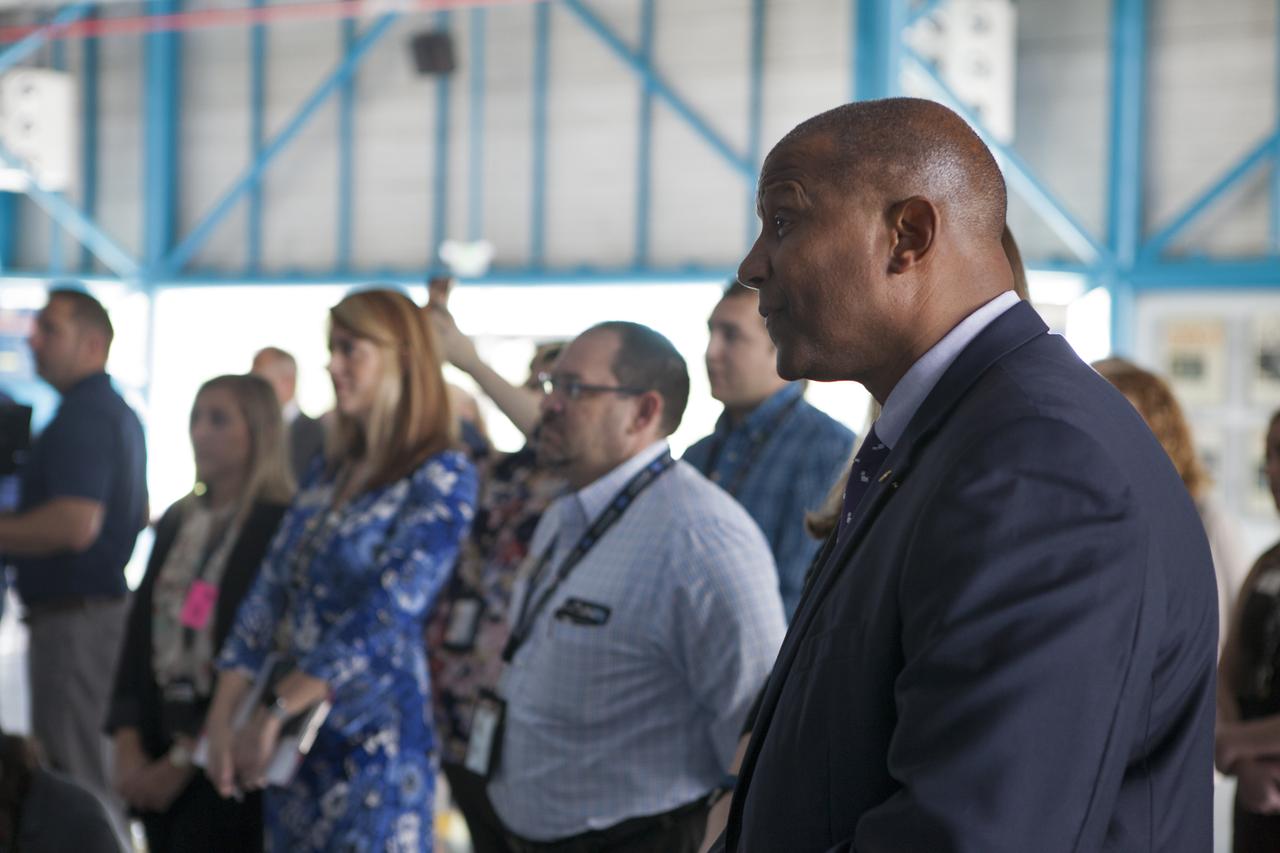
Associate Kennedy Space Center Director Kelvin Manning joins guests in a ceremony on Wednesday, May 30, 2018, honoring former NASA astronaut Alan Bean. As lunar module pilot on Apollo 12, Bean was the fourth person to walk on the Moon in November 1969. He went on to command the 59-day Skylab 3 mission in 1973. He died in Houston on May 26, 2018, at the age of 86.
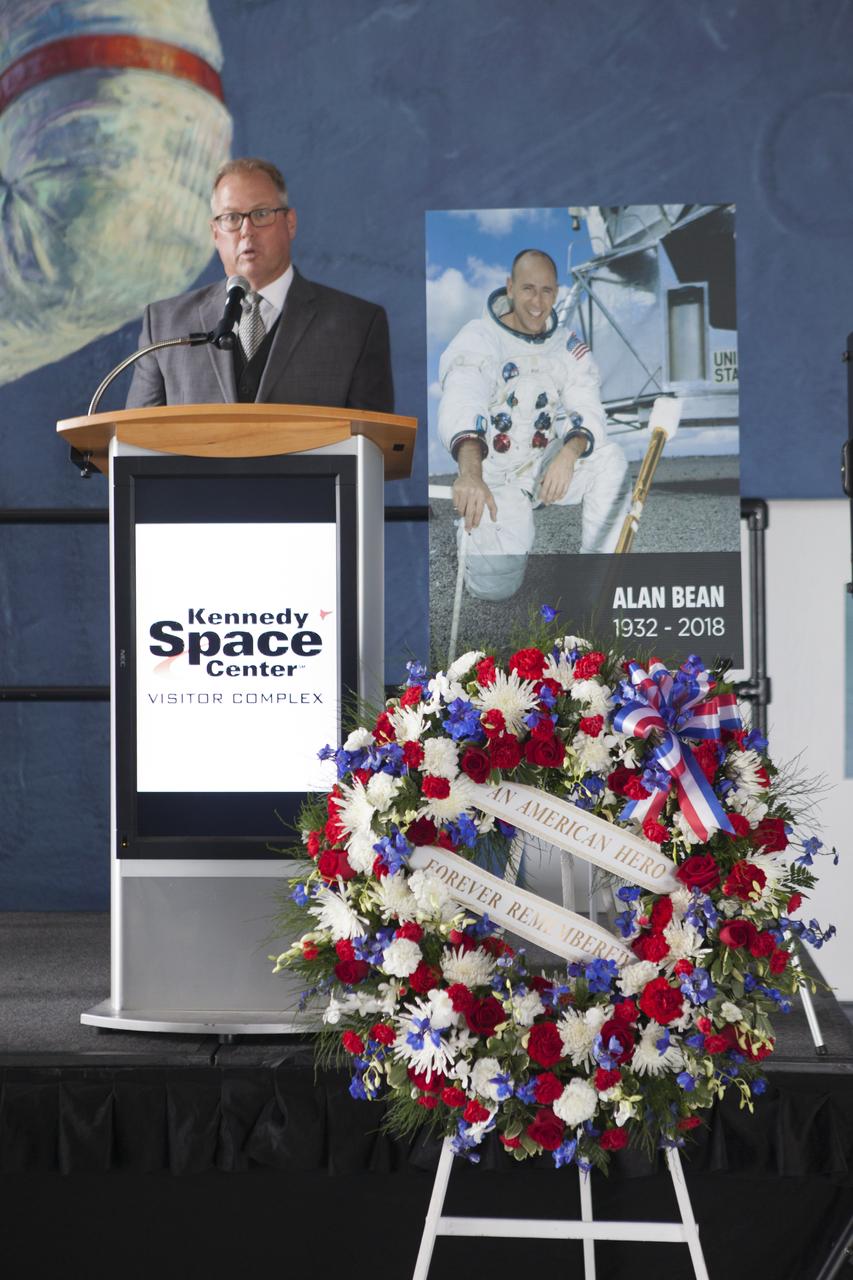
Therrin Protze, COO at the Kennedy Space Center Visitor Complex, speaks in the Apollo-Saturn V Center during a ceremony on Wednesday, May 30, 2018, honoring former NASA astronaut Alan Bean. As lunar module pilot on Apollo 12, Bean was the fourth person to walk on the Moon in November 1969. He went on to command the 59-day Skylab 3 mission in 1973. He died in Houston on May 26, 2018, at the age of 86.
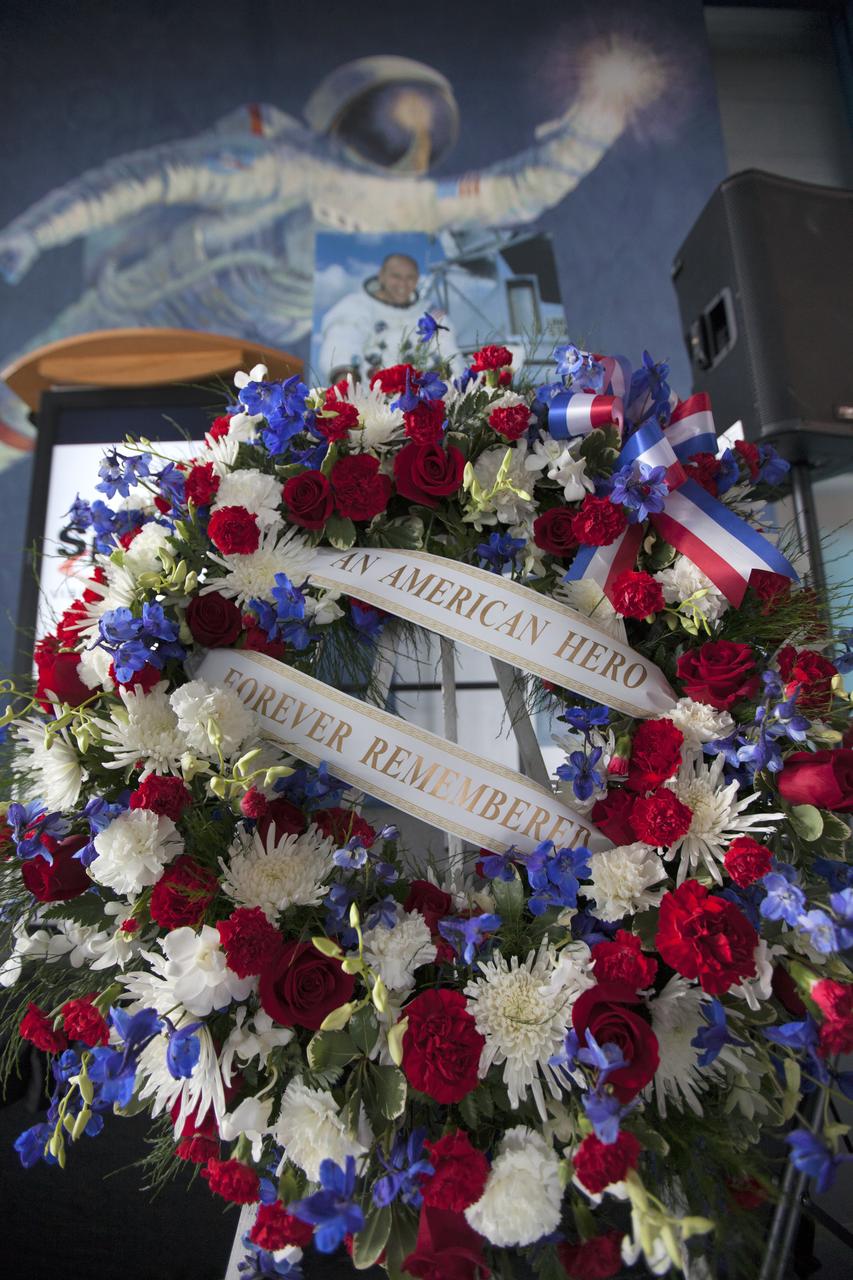
A memorial wreath placed in the Apollo-Saturn V Center of the Kennedy Space Center Visitor Complex on Wednesday, May 30, 2018, honors former NASA astronaut Alan Bean. He was the fourth person to walk on the Moon as lunar module pilot on Apollo 12 in November 1969. He went on to command the 59-day Skylab 3 mission in 1973. He died in Houston on May 26, 2018, at the age of 86.
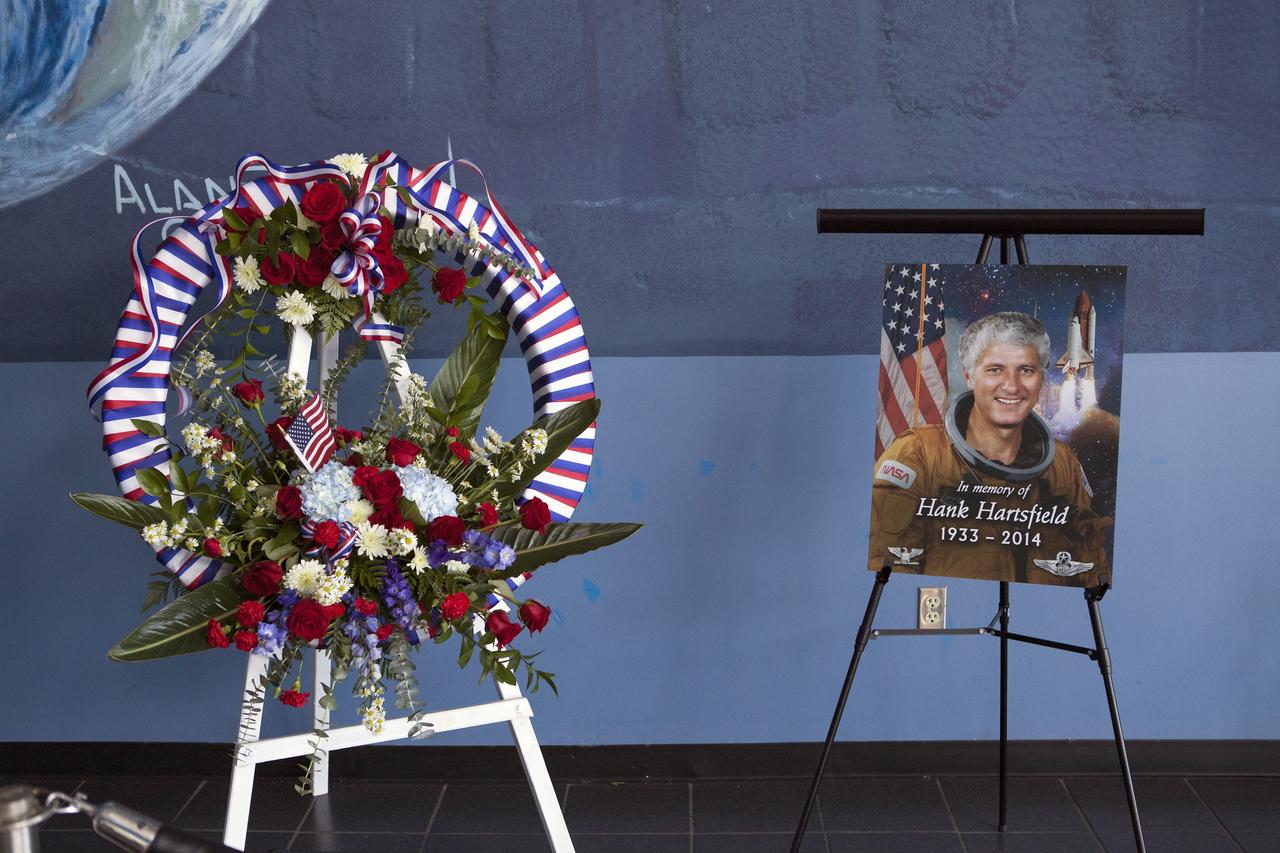
CAPE CANAVERAL, Fla. -- A wreath honoring Henry W. "Hank" Hartsfield is displayed beside his photo at the U.S. Astronaut Hall of Fame. Hartsfield commanded space shuttle Discovery's maiden mission and was a veteran of three shuttle flights. He died July 17 after an illness. He was 80 years old. Hartsfield joined NASA in 1969 and was part of the astronaut support crew for Apollo 16 and the Skylab 2, 3 and 4 missions. He logged 483 hours in space during missions STS-4, on which he served as pilot, as well as STS-41D and STS-61A, both of which he commanded. Photo credit: NASA/Dimitri Gerondidakis
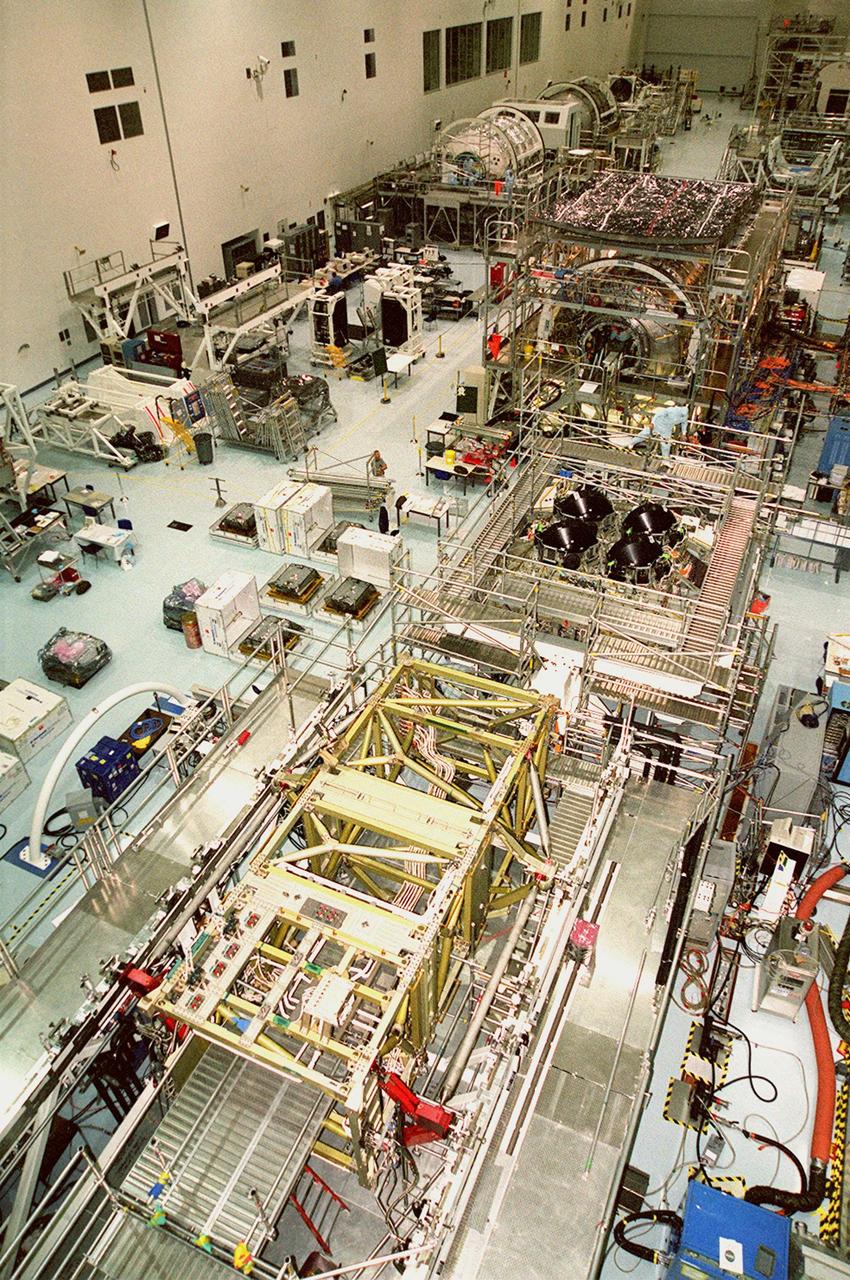
KENNEDY SPACE CENTER, FLA. -- The floor of the Space Station Processing Facility is filled with racks and hardware for testing the various components of the International Space Station (ISS). The large module in the center of the floor (top) is the U.S. Lab, Destiny. The U.S. Laboratory module continues a long tradition of microgravity materials research, first conducted by Skylab and later Shuttle and Spacelab missions. Destiny is expected to be a major feature in future research, providing facilities for biotechnology, fluid physics, combustion, and life sciences research. It is scheduled to be launched on mission STS-98 (no date determined yet for launch). At top left are the Multi-Purpose Logistics Modules Raffaello and Leonardo and the Pressurized Mating Adapter-3 (PMA-3). Italy's major contributions to the ISS program, Raffaello and Leonardo are reusable logistics carriers to resupply and return Station cargo requiring a pressurized environment. They are slated as payloads on missions STS-102 and STS-100, respectively. Dates have not yet been determined for the two missions. The PMA-3, once launched, will be mated to Node 1, a connecting passageway to the living and working areas of the Space Station. The primary purpose of PMA-3 is to serve as a Shuttle docking port through which crew members and equipment will transfer to the Space Station during later assembly missions. PMA-3 is scheduled as payload on mission STS-92, whose date for launch is not yet determined
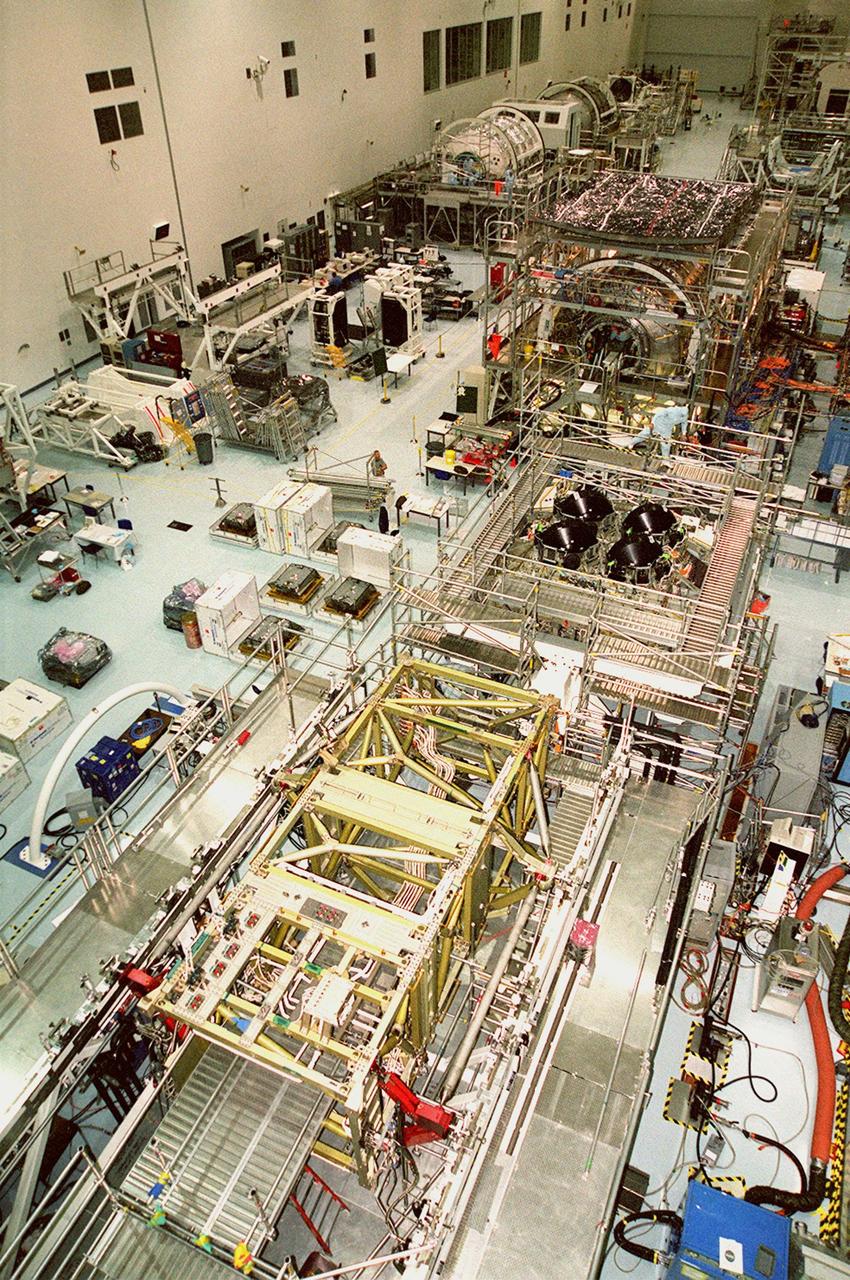
KENNEDY SPACE CENTER, FLA. -- The floor of the Space Station Processing Facility is filled with racks and hardware for testing the various components of the International Space Station (ISS). The large module in the center of the floor (top) is the U.S. Lab, Destiny. The U.S. Laboratory module continues a long tradition of microgravity materials research, first conducted by Skylab and later Shuttle and Spacelab missions. Destiny is expected to be a major feature in future research, providing facilities for biotechnology, fluid physics, combustion, and life sciences research. It is scheduled to be launched on mission STS-98 (no date determined yet for launch). At top left are the Multi-Purpose Logistics Modules Raffaello and Leonardo and the Pressurized Mating Adapter-3 (PMA-3). Italy's major contributions to the ISS program, Raffaello and Leonardo are reusable logistics carriers to resupply and return Station cargo requiring a pressurized environment. They are slated as payloads on missions STS-102 and STS-100, respectively. Dates have not yet been determined for the two missions. The PMA-3, once launched, will be mated to Node 1, a connecting passageway to the living and working areas of the Space Station. The primary purpose of PMA-3 is to serve as a Shuttle docking port through which crew members and equipment will transfer to the Space Station during later assembly missions. PMA-3 is scheduled as payload on mission STS-92, whose date for launch is not yet determined
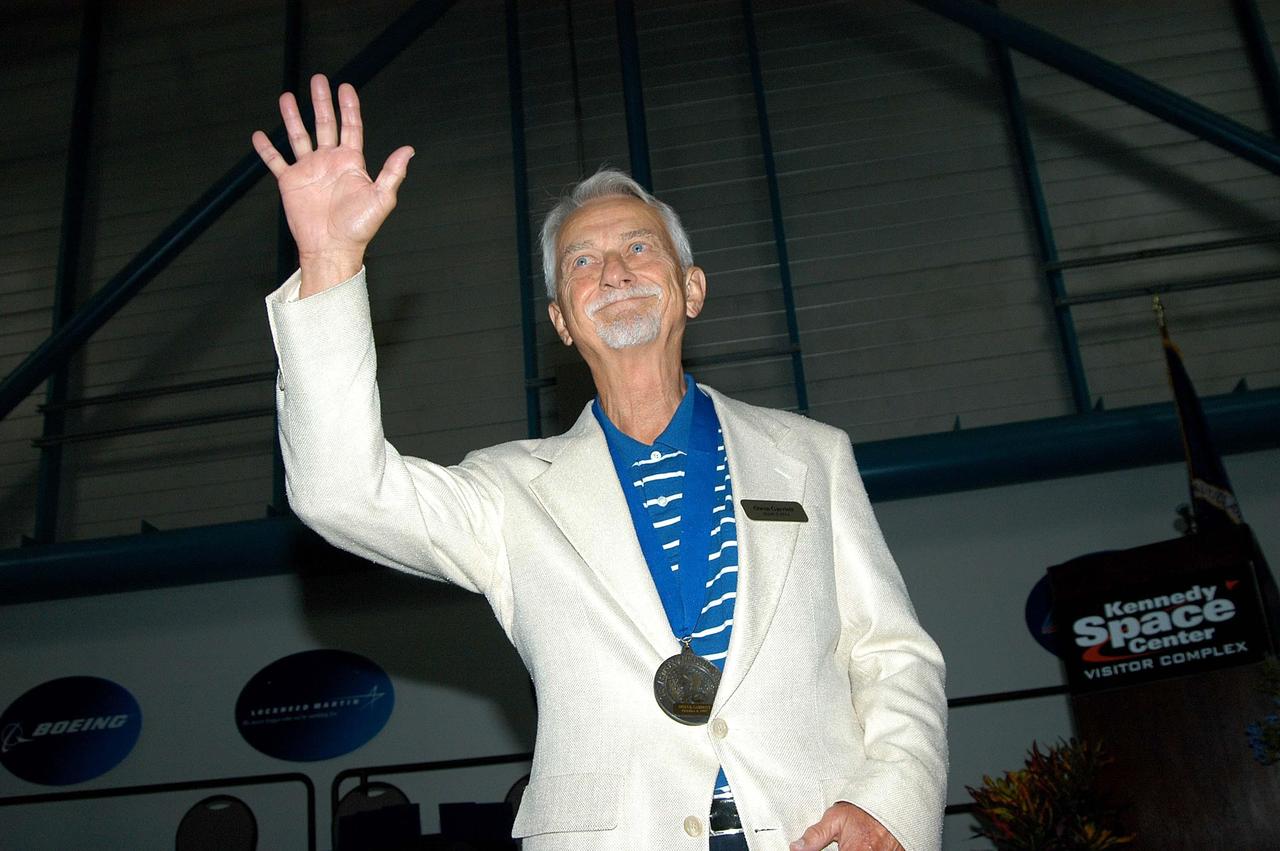
KENNEDY SPACE CENTER, FLA. -- Former astronaut Owen Garriott acknowledges the applause as he is introduced as a previous inductee into the U.S. Astronaut Hall of Fame. He and other Hall of Fame members were present for the induction of five new space program heroes into the U.S. Astronaut Hall of Fame: Richard O. Covey, commander of the Hubble Space Telescope repair mission; Norman E. Thagard, the first American to occupy Russia’s Mir space station; the late Francis R. "Dick" Scobee, commander of the ill-fated 1986 Challenger mission; Kathryn D. Sullivan, the first American woman to walk in space; and Frederick D. Gregory, the first African-American to command a space mission and the current NASA deputy administrator. Garriott exercised his expertise as a solar physicist on two space missions, the 59-day Skylab 3 flight in 1973, and an 11-day trip aboard the Space Shuttle Columbia a decade later. The induction ceremony was held at the Apollo/Saturn V Center at KSC. The U.S. Astronaut Hall of Fame opened in 1990 to provide a place where space travelers could be remembered for their participation and accomplishments in the U.S. space program. The five inductees join 52 previously honored astronauts from the ranks of the Gemini, Apollo, Skylab, Apollo-Soyuz, and Space Shuttle programs.

SL3-122-2611 (22 Sept. 1973) --- Astronaut Alan L. Bean, Skylab 3 commander, participates in the final extravehicular activity (EVA) for that mission, during which a variety of tasks were performed. Here, Bean is near the Apollo Telescope Mount (ATM) during final film change out for the giant telescope facility. Astronaut Owen K. Garriott, who took the picture, is reflected in Bean's helmet visor. The reflected Earth disk in Bean's visor is so clear that the Red Sea and Nile River area can delineated. Photo credit: NASA
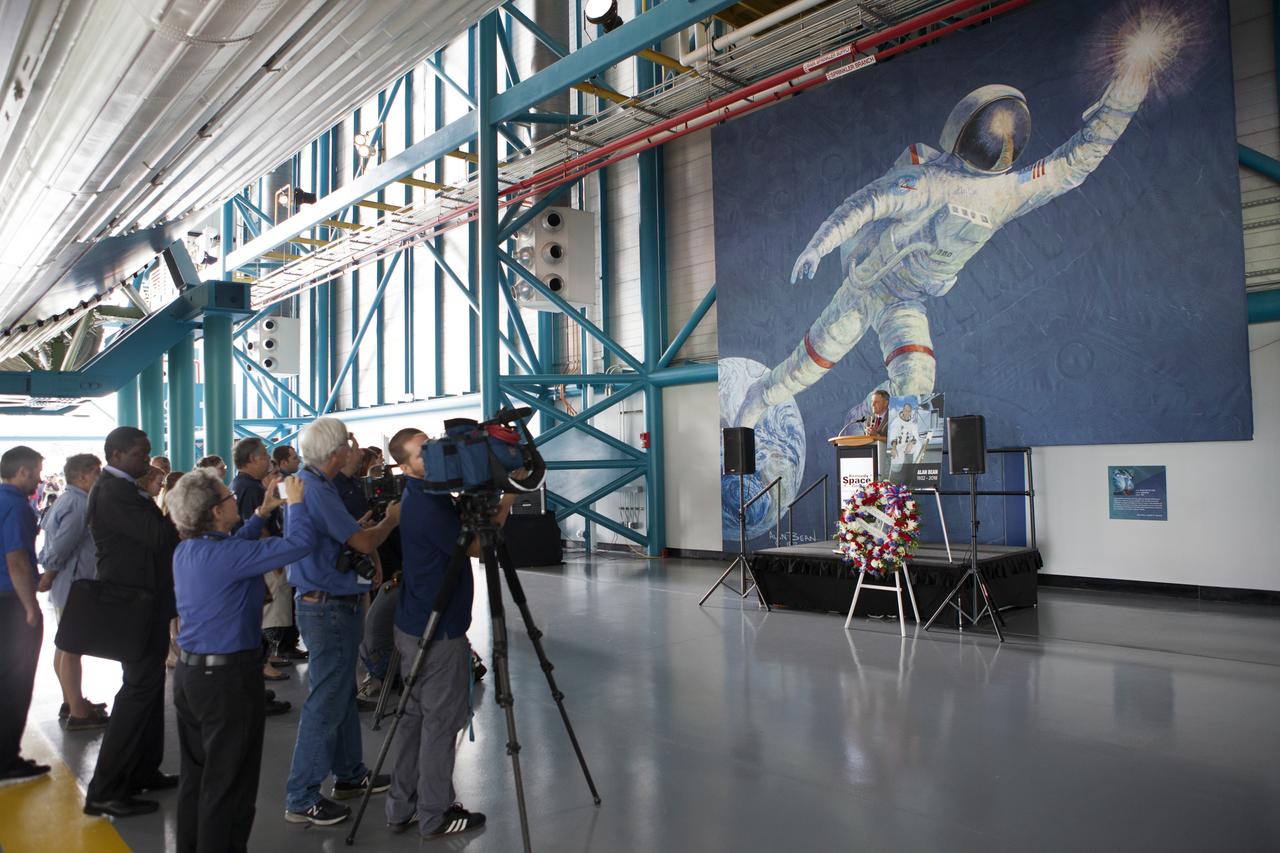
Members of the news media assemble to cover a ceremony on Wednesday, May 30, 2018, during which a memorial wreath is placed in the Apollo-Saturn V Center of the Kennedy Space Center Visitor Complex honoring former NASA astronaut Alan Bean. In the background is a large mural of a painting by Alan Bean who became an accomplished artist after leaving NASA. Bean was the fourth person to walk on the Moon as lunar module pilot on Apollo 12 in November 1969. He went on to command the 59-day Skylab 3 mission in 1973. He died in Houston on May 26, 2018, at the age of 86.
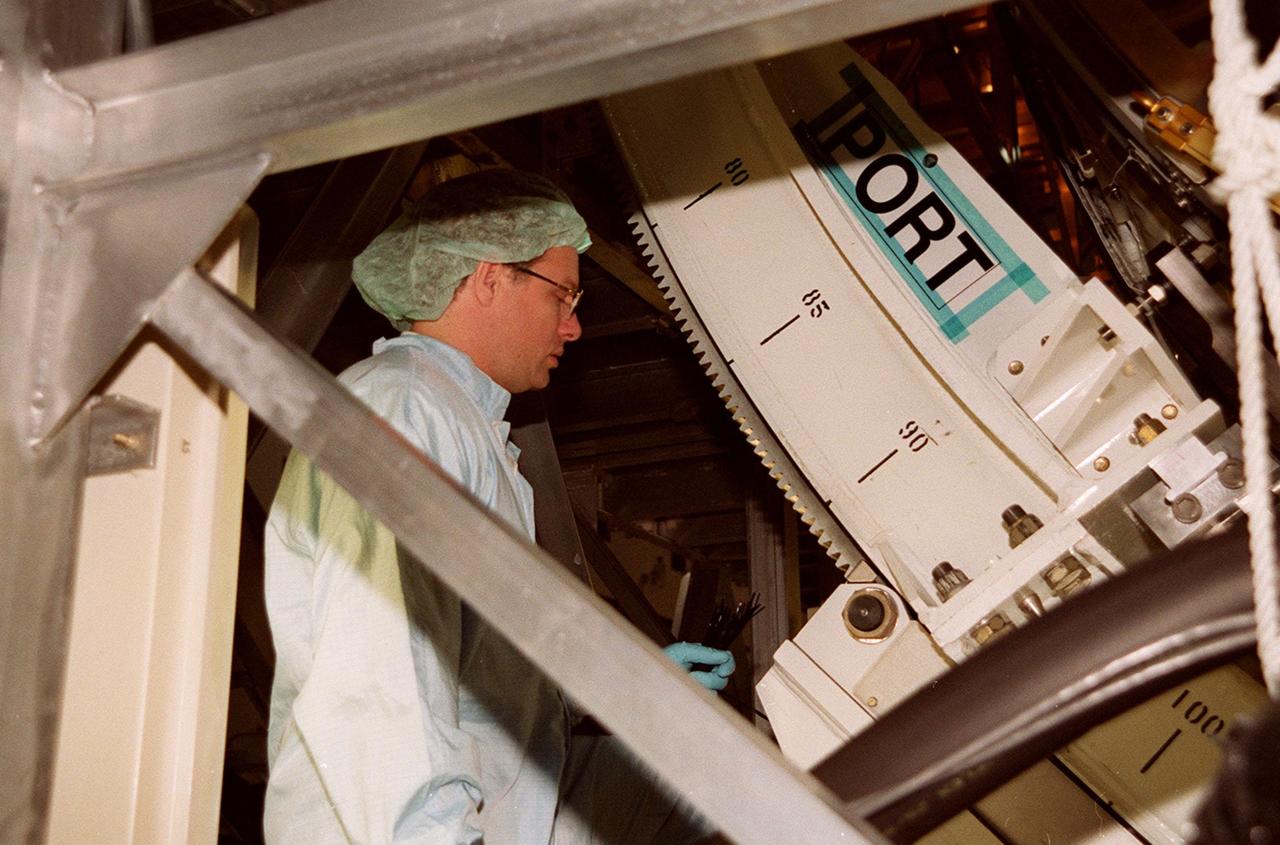
KENNEDY SPACE CENTER, FLA. -- In the Space Station Processing Facility, a worker checks the U.S. Laboratory Destiny as it rotates. A component of the International Space Station, Destiny is scheduled to fly on mission STS-98 in early 2001. During the mission, the crew will install the Lab during a series of three space walks. The STS-98 mission will provide the station with science research facilities and expand its power, life support and control capabilities. The U.S. Lab module continues a long tradition of microgravity materials research, first conducted by Skylab and later Shuttle and Spacelab missions. Destiny is expected to be a major feature in future research, providing facilities for biotechnology, fluid physics, combustion, and life sciences research.<font size="3"
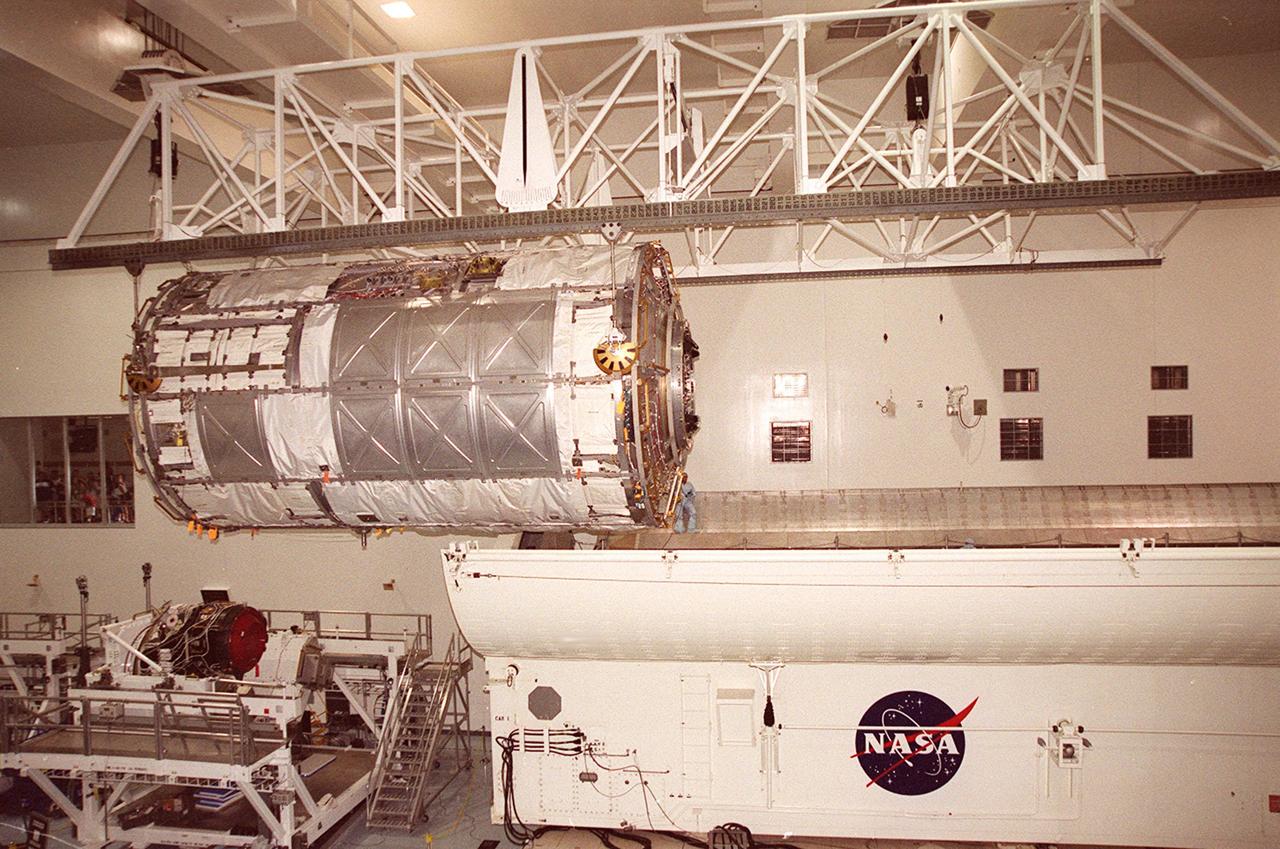
KENNEDY SPACE CENTER, FLA. -- In the Space Station Processing Facility (SSPF), the U.S. Laboratory Destiny, a component of the International Space Station, is moved to a payload canister for transfer to the Operations and Checkout Building where it will be tested in the altitude chamber. On the floor of the SSPF, left, is a Pressurized Mating Adapter-3. Destiny is scheduled to fly on mission STS-98 in early 2001. During the mission, the crew will install the Lab in the Space Station during a series of three space walks. The STS-98 mission will provide the Station with science research facilities and expand its power, life support and control capabilities. The U.S. Lab module continues a long tradition of microgravity materials research, first conducted by Skylab and later Shuttle and Spacelab missions. Destiny is expected to be a major feature in future research, providing facilities for biotechnology, fluid physics, combustion, and life sciences research
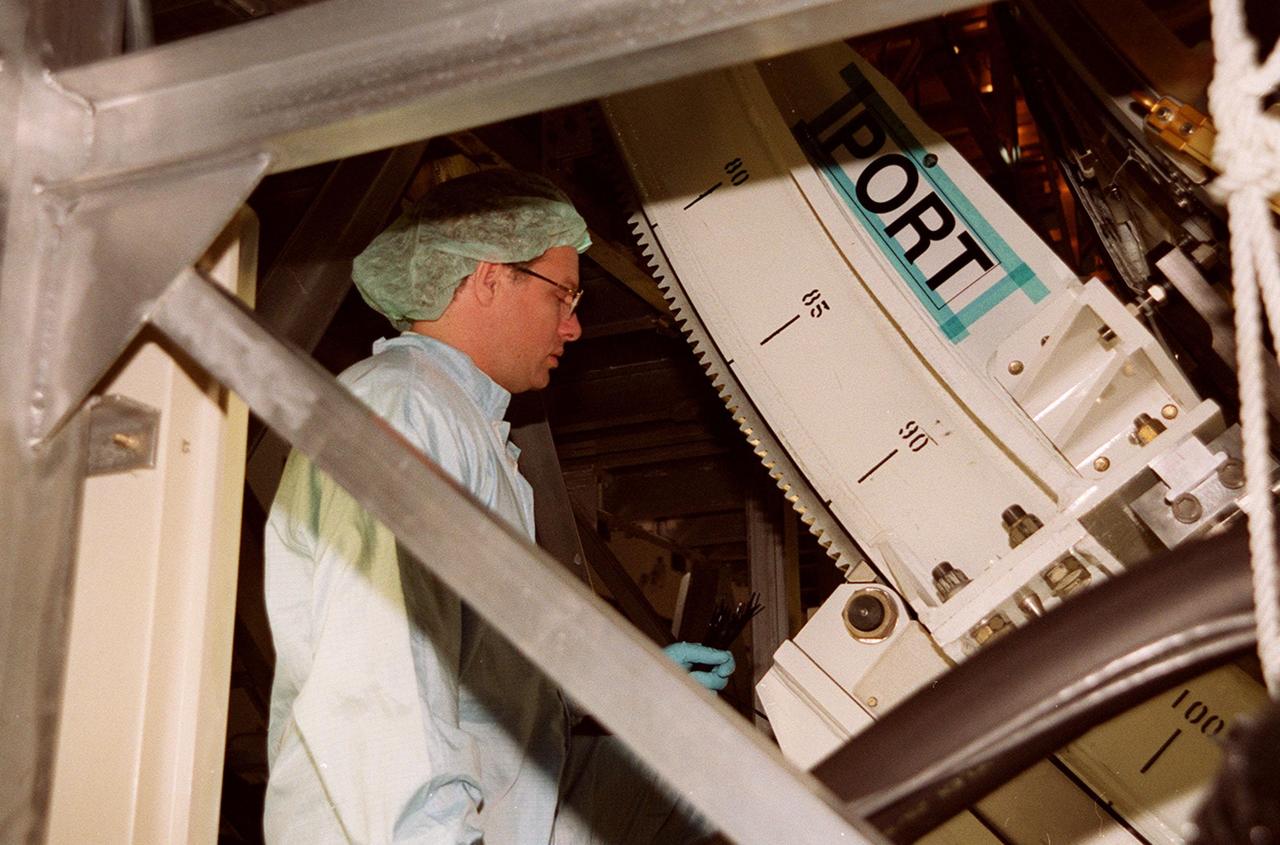
KENNEDY SPACE CENTER, FLA. -- In the Space Station Processing Facility, a worker checks the U.S. Laboratory Destiny as it rotates. A component of the International Space Station, Destiny is scheduled to fly on mission STS-98 in early 2001. During the mission, the crew will install the Lab during a series of three space walks. The STS-98 mission will provide the station with science research facilities and expand its power, life support and control capabilities. The U.S. Lab module continues a long tradition of microgravity materials research, first conducted by Skylab and later Shuttle and Spacelab missions. Destiny is expected to be a major feature in future research, providing facilities for biotechnology, fluid physics, combustion, and life sciences research.<font size="3"
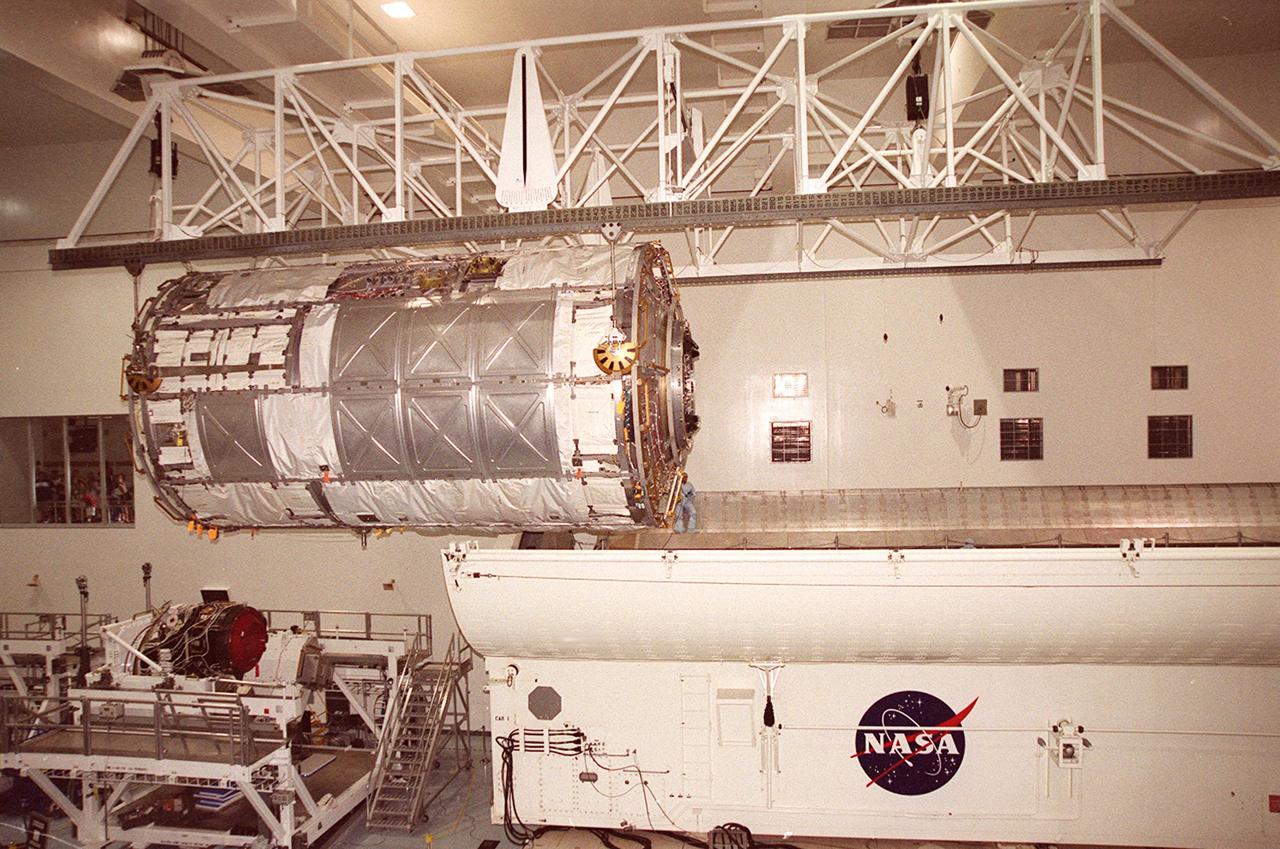
KENNEDY SPACE CENTER, FLA. -- In the Space Station Processing Facility (SSPF), the U.S. Laboratory Destiny, a component of the International Space Station, is moved to a payload canister for transfer to the Operations and Checkout Building where it will be tested in the altitude chamber. On the floor of the SSPF, left, is a Pressurized Mating Adapter-3. Destiny is scheduled to fly on mission STS-98 in early 2001. During the mission, the crew will install the Lab in the Space Station during a series of three space walks. The STS-98 mission will provide the Station with science research facilities and expand its power, life support and control capabilities. The U.S. Lab module continues a long tradition of microgravity materials research, first conducted by Skylab and later Shuttle and Spacelab missions. Destiny is expected to be a major feature in future research, providing facilities for biotechnology, fluid physics, combustion, and life sciences research
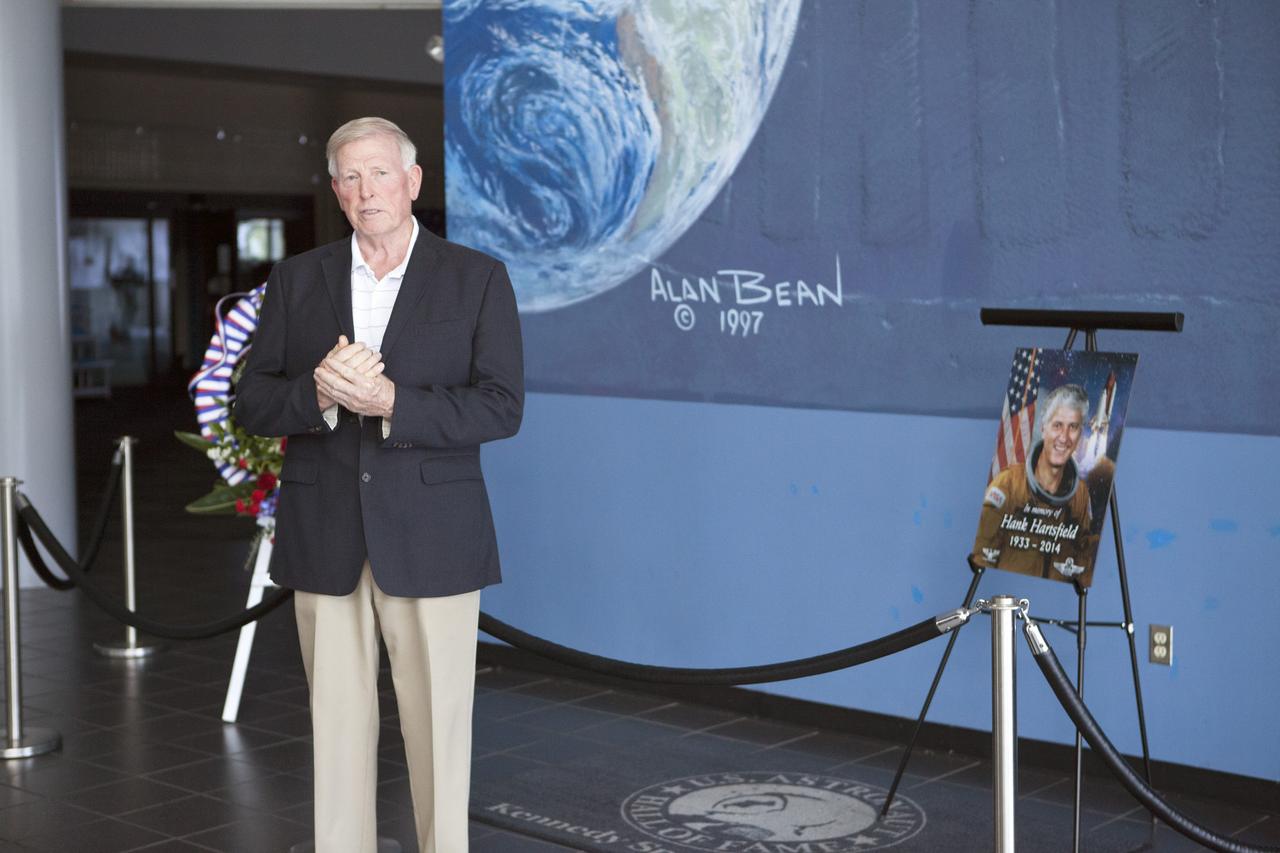
CAPE CANAVERAL, Fla. -- Former NASA astronaut Jon McBride shares his thoughts at a wreath-laying ceremony honoring Henry W. "Hank" Hartsfield at the U.S. Astronaut Hall of Fame. Hartsfield commanded space shuttle Discovery's maiden mission and was a veteran of three shuttle flights. He died July 17 after an illness. He was 80 years old. Hartsfield joined NASA in 1969 and was part of the astronaut support crew for Apollo 16 and the Skylab 2, 3 and 4 missions. He logged 483 hours in space during missions STS-4, on which he served as pilot, as well as STS-41D and STS-61A, both of which he commanded. Photo credit: NASA/Dimitri Gerondidakis
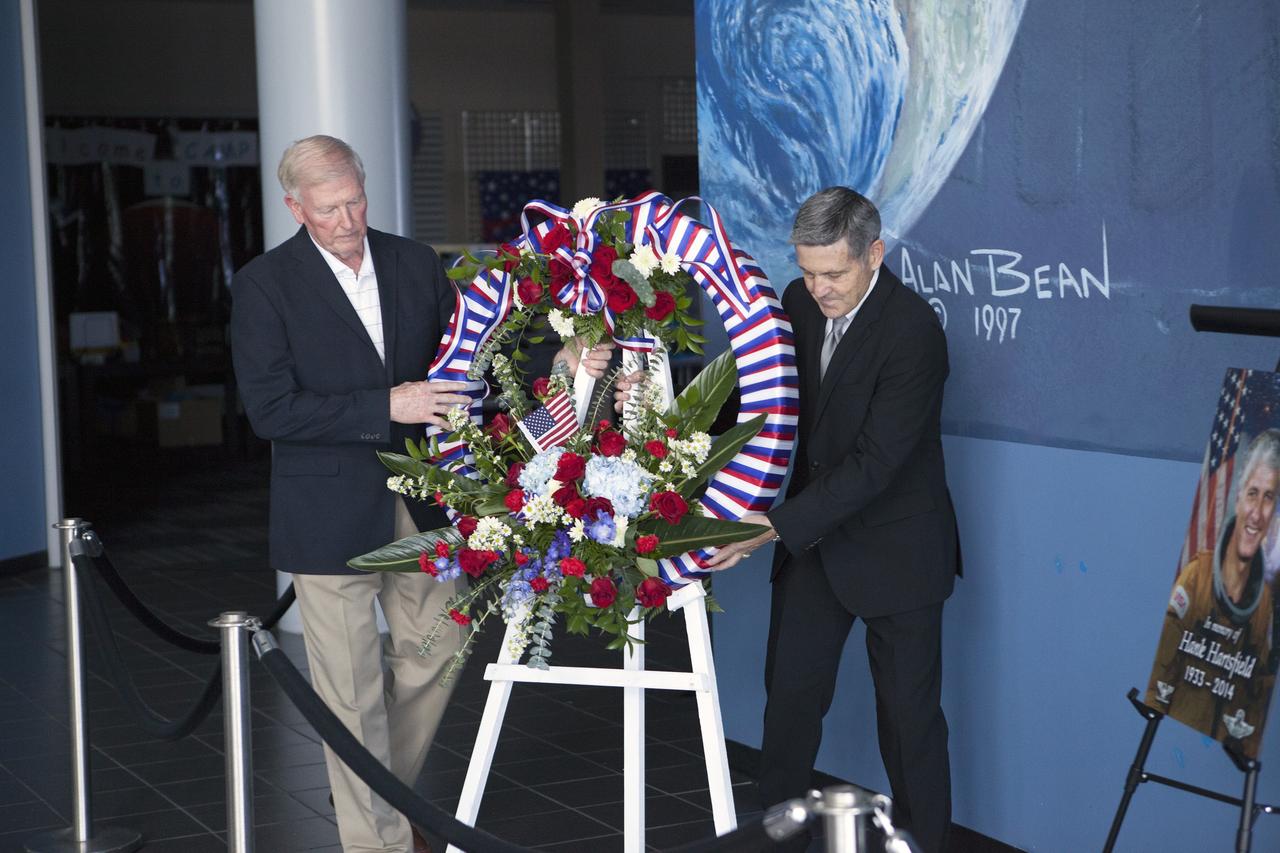
CAPE CANAVERAL, Fla. -- Former NASA astronaut Jon McBride, left, and Kennedy Space Center Director Bob Cabana place a wreath honoring Henry W. "Hank" Hartsfield at the U.S. Astronaut Hall of Fame. Hartsfield commanded space shuttle Discovery's maiden mission and was a veteran of three shuttle flights. He died July 17 after an illness. He was 80 years old. Hartsfield joined NASA in 1969 and was part of the astronaut support crew for Apollo 16 and the Skylab 2, 3 and 4 missions. He logged 483 hours in space during missions STS-4, on which he served as pilot, as well as STS-41D and STS-61A, both of which he commanded. Photo credit: NASA/Dimitri Gerondidakis
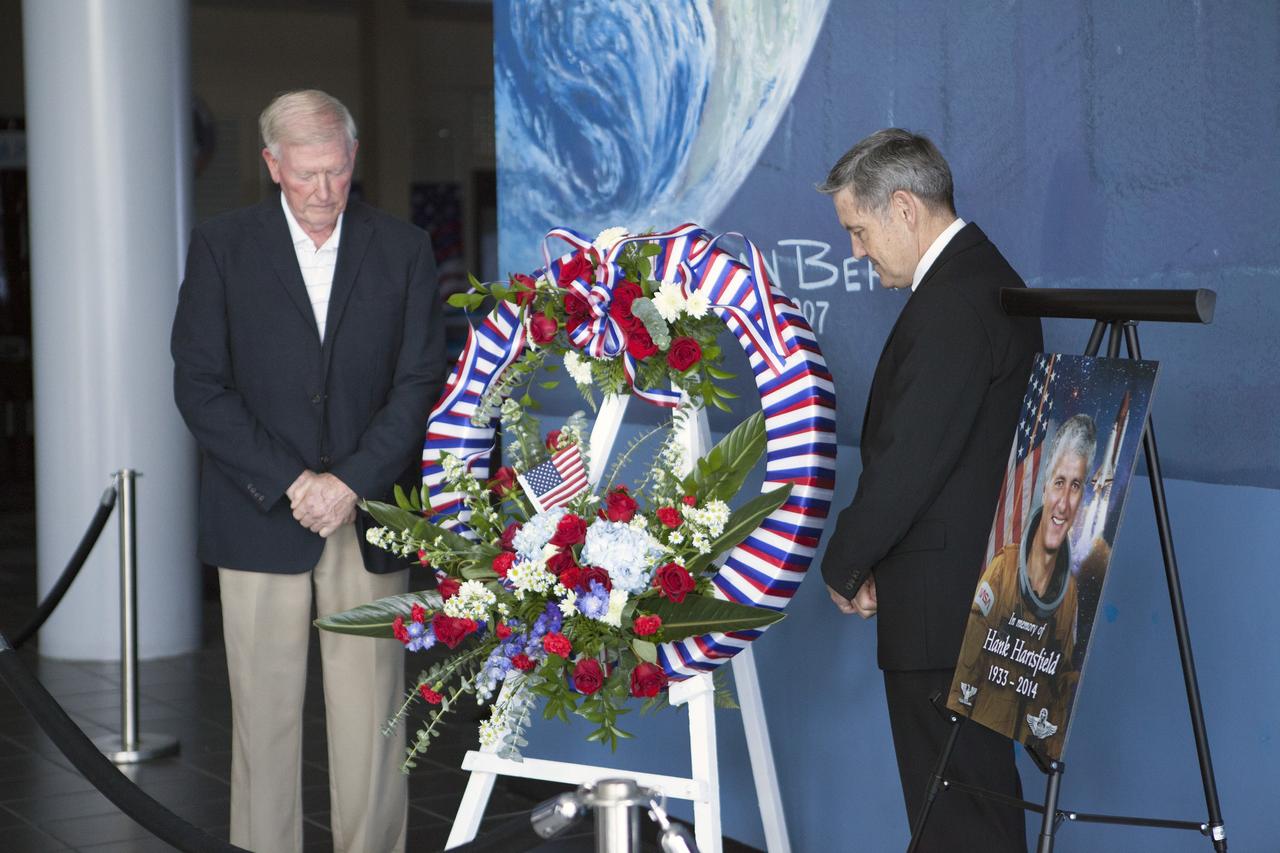
CAPE CANAVERAL, Fla. -- Former NASA astronaut Jon McBride, left, and Kennedy Space Center Director Bob Cabana pause for reflection after placing a wreath honoring Henry W. "Hank" Hartsfield at the U.S. Astronaut Hall of Fame. Hartsfield commanded space shuttle Discovery's maiden mission and was a veteran of three shuttle flights. He died July 17 after an illness. He was 80 years old. Hartsfield joined NASA in 1969 and was part of the astronaut support crew for Apollo 16 and the Skylab 2, 3 and 4 missions. He logged 483 hours in space during missions STS-4, on which he served as pilot, as well as STS-41D and STS-61A, both of which he commanded. Photo credit: NASA/Dimitri Gerondidakis
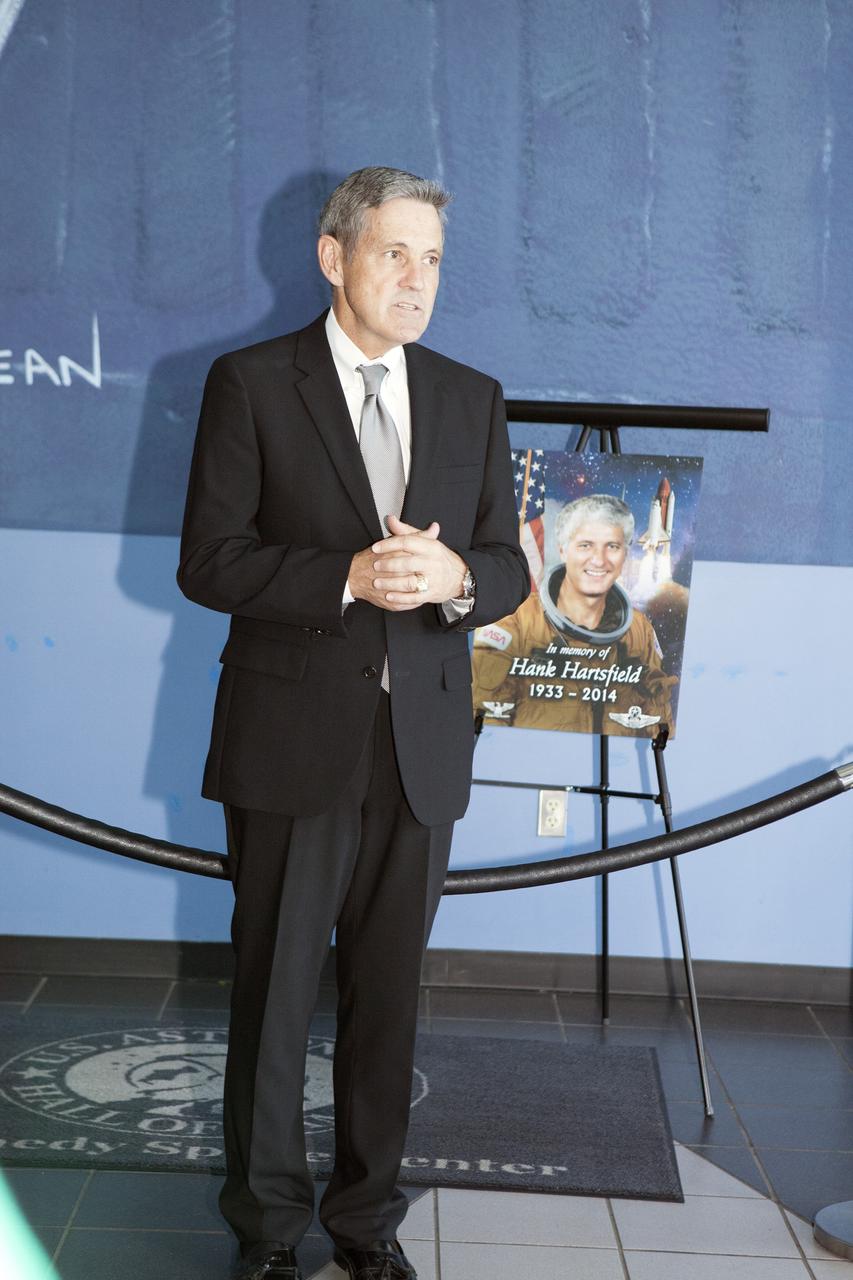
CAPE CANAVERAL, Fla. -- Kennedy Space Center Director Bob Cabana speaks at a wreath-laying ceremony honoring Henry W. "Hank" Hartsfield at the U.S. Astronaut Hall of Fame. Hartsfield commanded space shuttle Discovery's maiden mission and was a veteran of three shuttle flights. He died July 17 after an illness. He was 80 years old. Hartsfield joined NASA in 1969 and was part of the astronaut support crew for Apollo 16 and the Skylab 2, 3 and 4 missions. He logged 483 hours in space during missions STS-4, on which he served as pilot, as well as STS-41D and STS-61A, both of which he commanded. Photo credit: NASA/Dimitri Gerondidakis
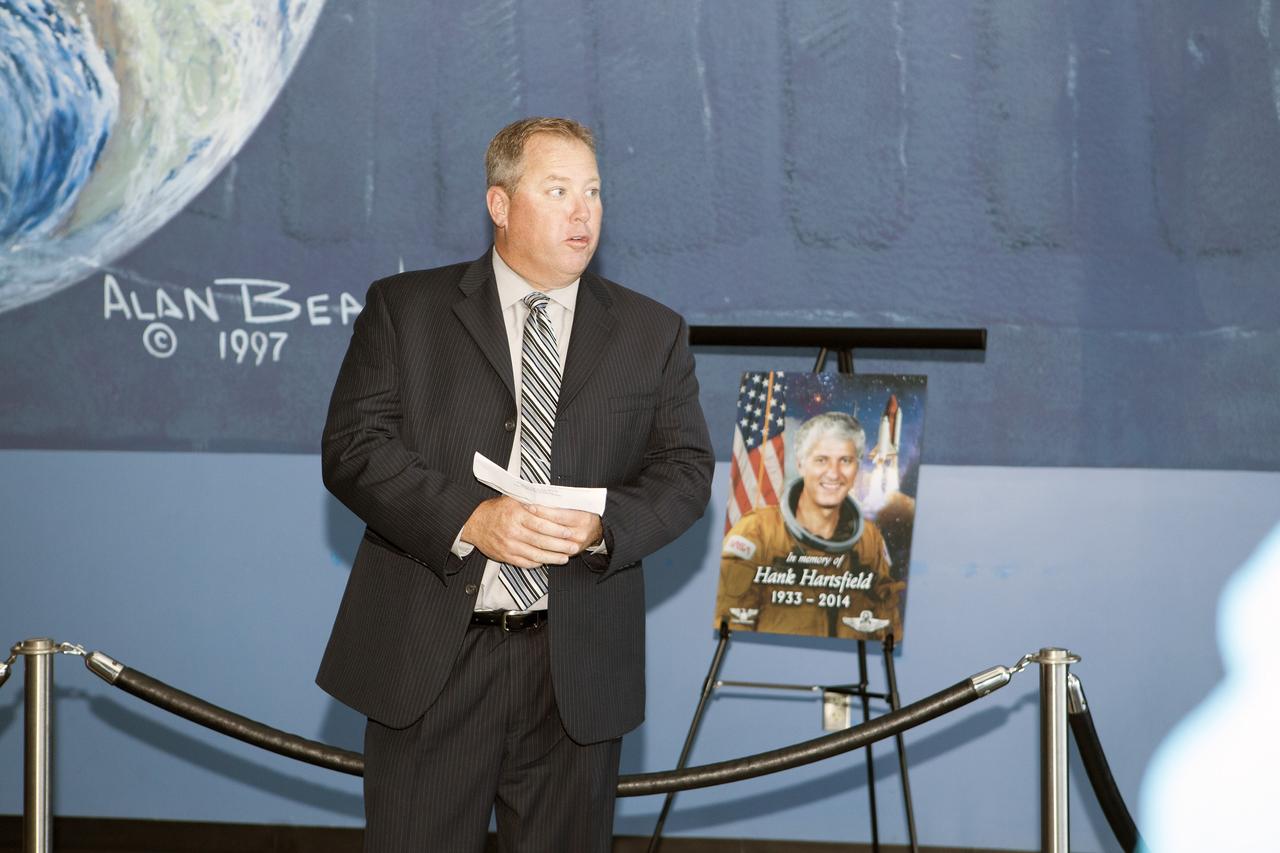
CAPE CANAVERAL, Fla. -- Therrin Protze, chief operating officer for Delaware North Parks Services at Kennedy Space Center Visitor Complex, speaks at a wreath-laying ceremony honoring Henry W. "Hank" Hartsfield at the U.S. Astronaut Hall of Fame. Hartsfield commanded space shuttle Discovery's maiden mission and was a veteran of three shuttle flights. He died July 17 after an illness. He was 80 years old. Hartsfield joined NASA in 1969 and was part of the astronaut support crew for Apollo 16 and the Skylab 2, 3 and 4 missions. He logged 483 hours in space during missions STS-4, on which he served as pilot, as well as STS-41D and STS-61A, both of which he commanded. Photo credit: NASA/Dimitri Gerondidakis
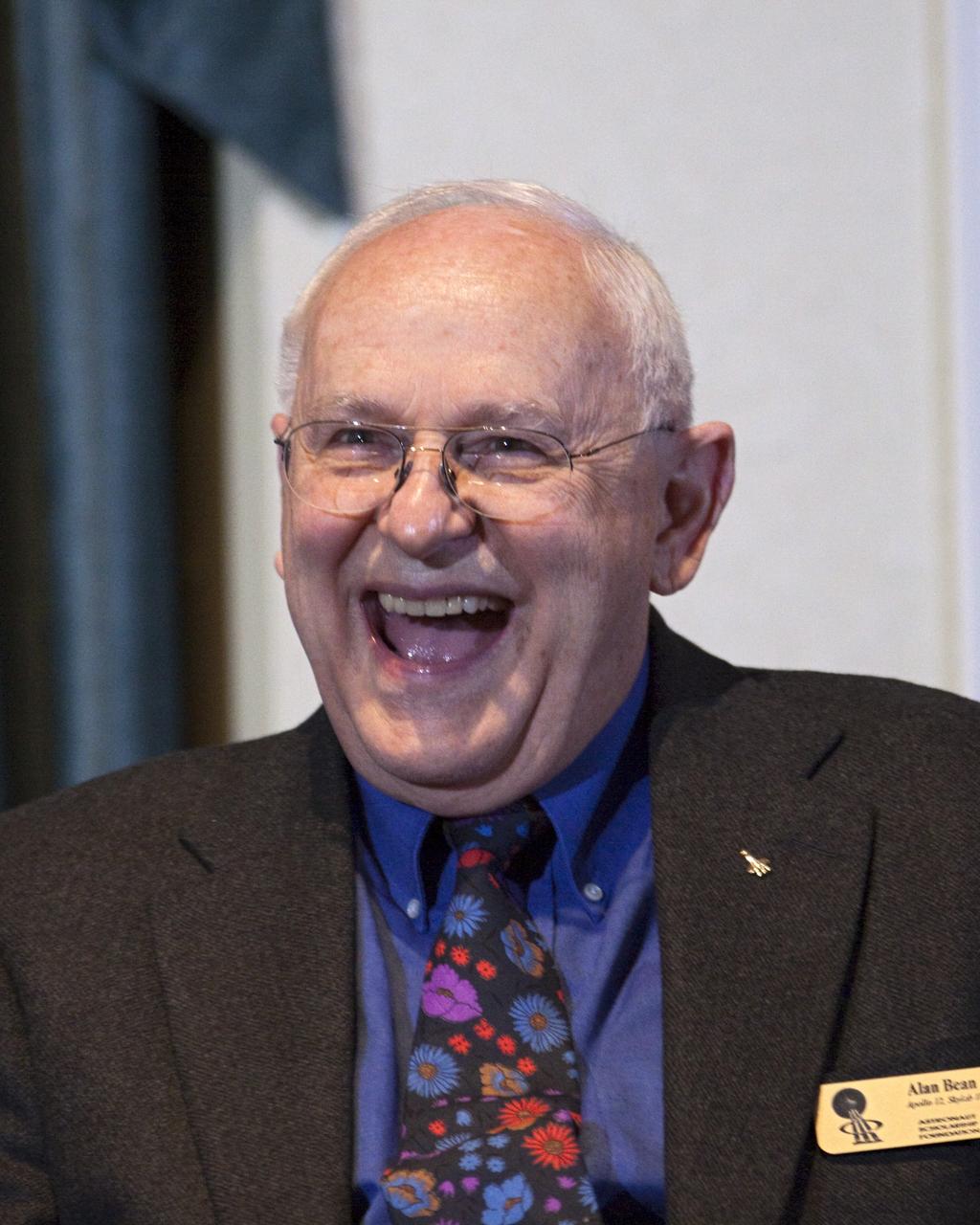
CAPE CANAVERAL, Fla. – Apollo 12 and Skylab 3 astronaut Alan Bean enjoys a light moment during a presentation to guests gathered for the Astronaut Scholarship Foundation's dinner at the Radisson Resort at the Port in Cape Canaveral celebrating the 40th anniversary of Apollo 17. The gala commemorating the anniversary of Apollo 17 included mission commander Eugene Cernan and other astronauts who flew Apollo missions. Launched Dec. 7, 1972, Cernan and lunar module pilot Harrison Schmitt landed in the moon's Taurus-Littrow highlands while command module pilot Ronald Evans remained in lunar orbit operating a scientific instrument module. For more information, visit http://www-pao.ksc.nasa.gov/history/apollo/apollo-17/apollo-17.htm Photo credit: NASA/Kim Shiflett
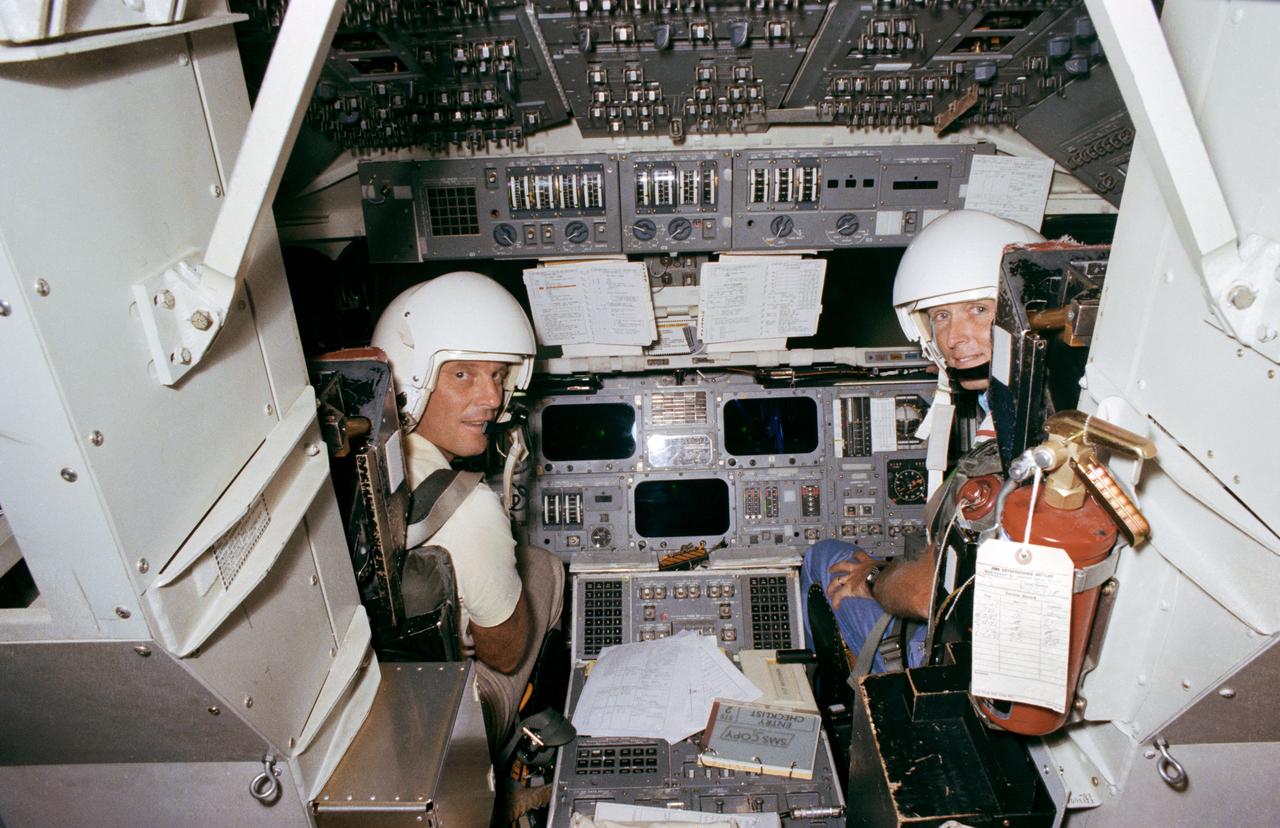
S81-36714 (14 Nov. 1981) --- These two veteran astronauts were named today as the official prime crew members of STS-3 in the space shuttle Columbia. Commander for NASA?s third space shuttle orbital flight test is astronaut Jack R. Lousma, left, seated in a Shuttle Mission Simulator (SMS) at NASA's Johnson Space Center (JSC). Astronaut C. Gordon Fullerton, right, will serve as pilot. Lousma was pilot on the second of three NASA crews to visit the Earth orbiting Skylab space station in 1973. Fullerton, though never having been in space, is a veteran of three free flights of the shuttle during approach and landing tests (ALT) with space shuttle Enterprise in 1977. Photo credit: NASA
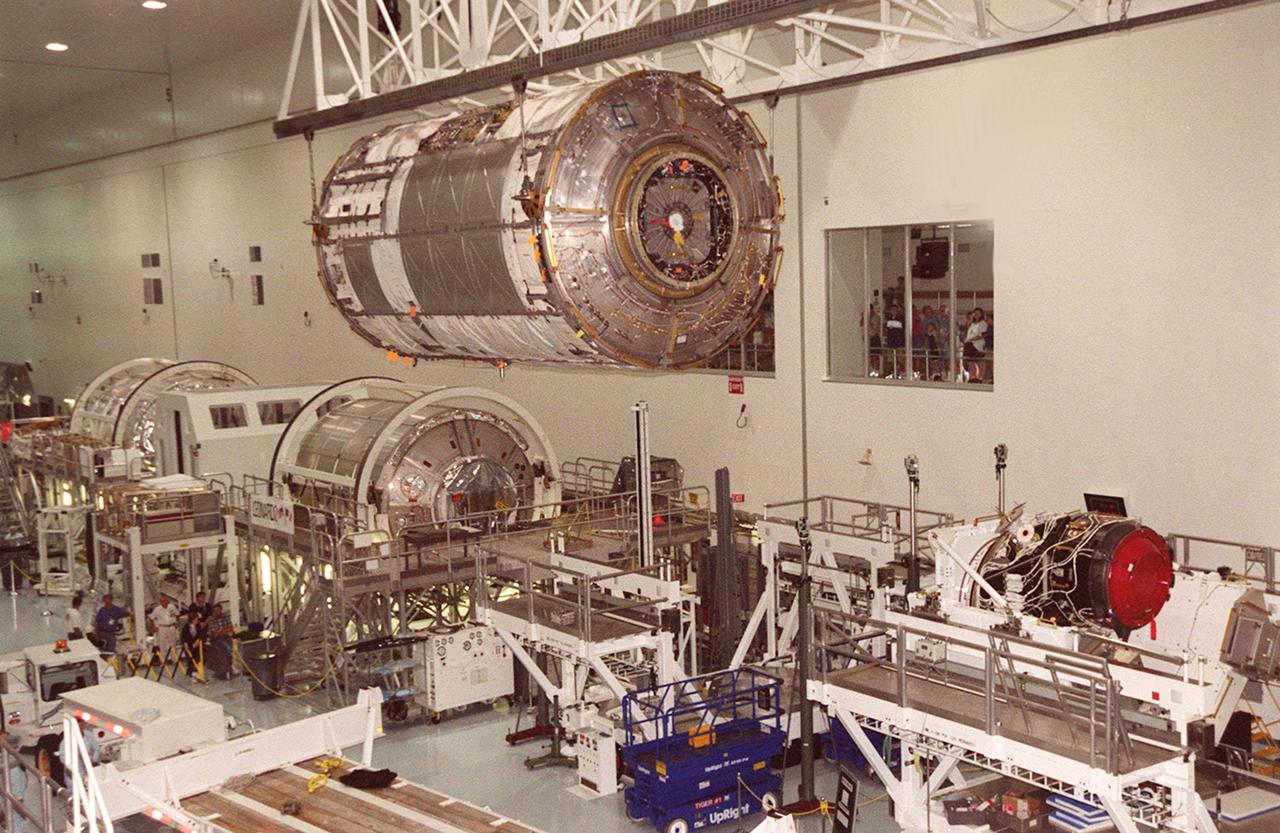
KENNEDY SPACE CENTER, FLA. -- In the Space Station Processing Facility, the U.S. Laboratory Destiny, a component of the International Space Station, glides overhead other hardware while visitors watch from a window (right). On the floor, left to right, are two Multi-Purpose Logistics Modules (MPLMs), Raffaello (far left) and Leonardo, and a Pressurized Mating Adapter-3 (right). Destiny is being moved to a payload canister for transfer to the Operations and Checkout Building where it will be tested in the altitude chamber. Destiny is scheduled to fly on mission STS-98 in early 2001. During the mission, the crew will install the Lab in the Space Station during a series of three space walks. The STS-98 mission will provide the Station with science research facilities and expand its power, life support and control capabilities. The U.S. Lab module continues a long tradition of microgravity materials research, first conducted by Skylab and later Shuttle and Spacelab missions. Destiny is expected to be a major feature in future research, providing facilities for biotechnology, fluid physics, combustion, and life sciences research
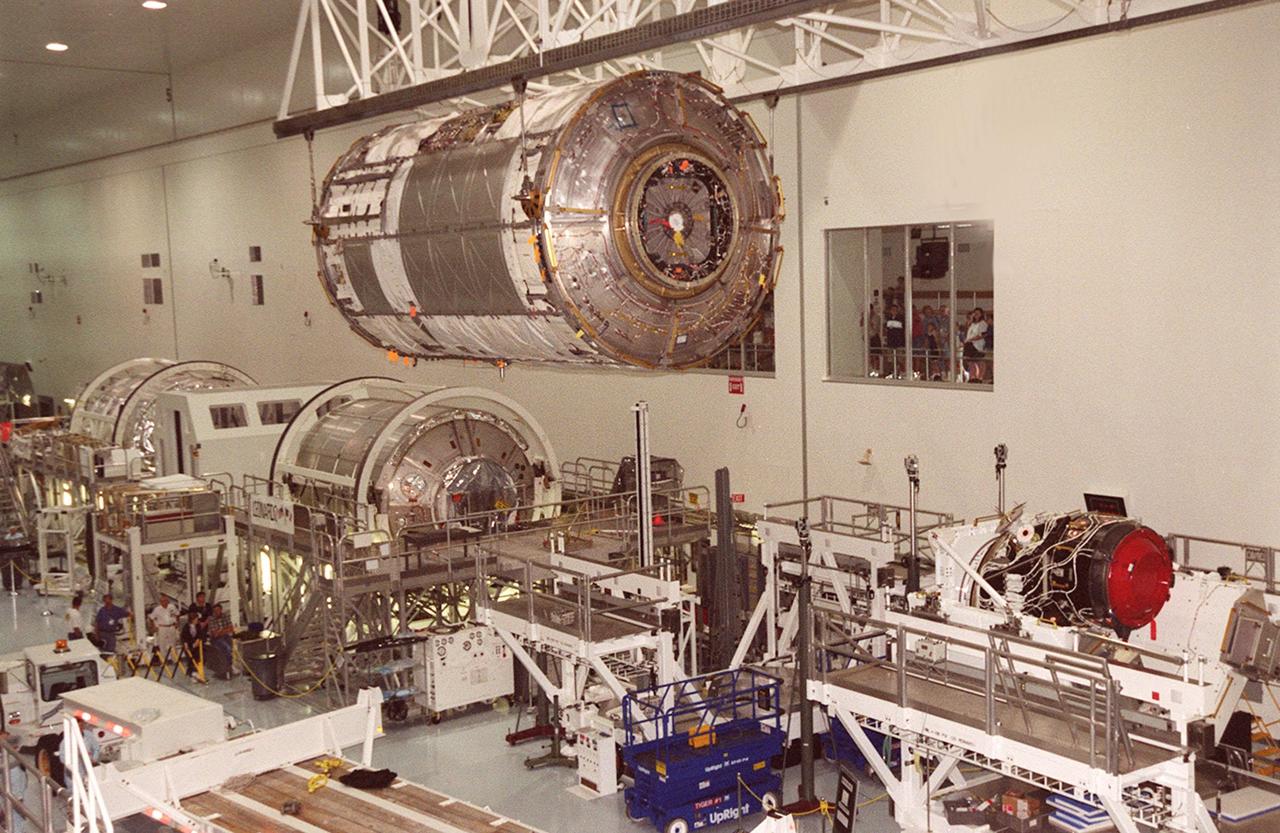
KENNEDY SPACE CENTER, FLA. -- In the Space Station Processing Facility, the U.S. Laboratory Destiny, a component of the International Space Station, glides overhead other hardware while visitors watch from a window (right). On the floor, left to right, are two Multi-Purpose Logistics Modules (MPLMs), Raffaello (far left) and Leonardo, and a Pressurized Mating Adapter-3 (right). Destiny is being moved to a payload canister for transfer to the Operations and Checkout Building where it will be tested in the altitude chamber. Destiny is scheduled to fly on mission STS-98 in early 2001. During the mission, the crew will install the Lab in the Space Station during a series of three space walks. The STS-98 mission will provide the Station with science research facilities and expand its power, life support and control capabilities. The U.S. Lab module continues a long tradition of microgravity materials research, first conducted by Skylab and later Shuttle and Spacelab missions. Destiny is expected to be a major feature in future research, providing facilities for biotechnology, fluid physics, combustion, and life sciences research
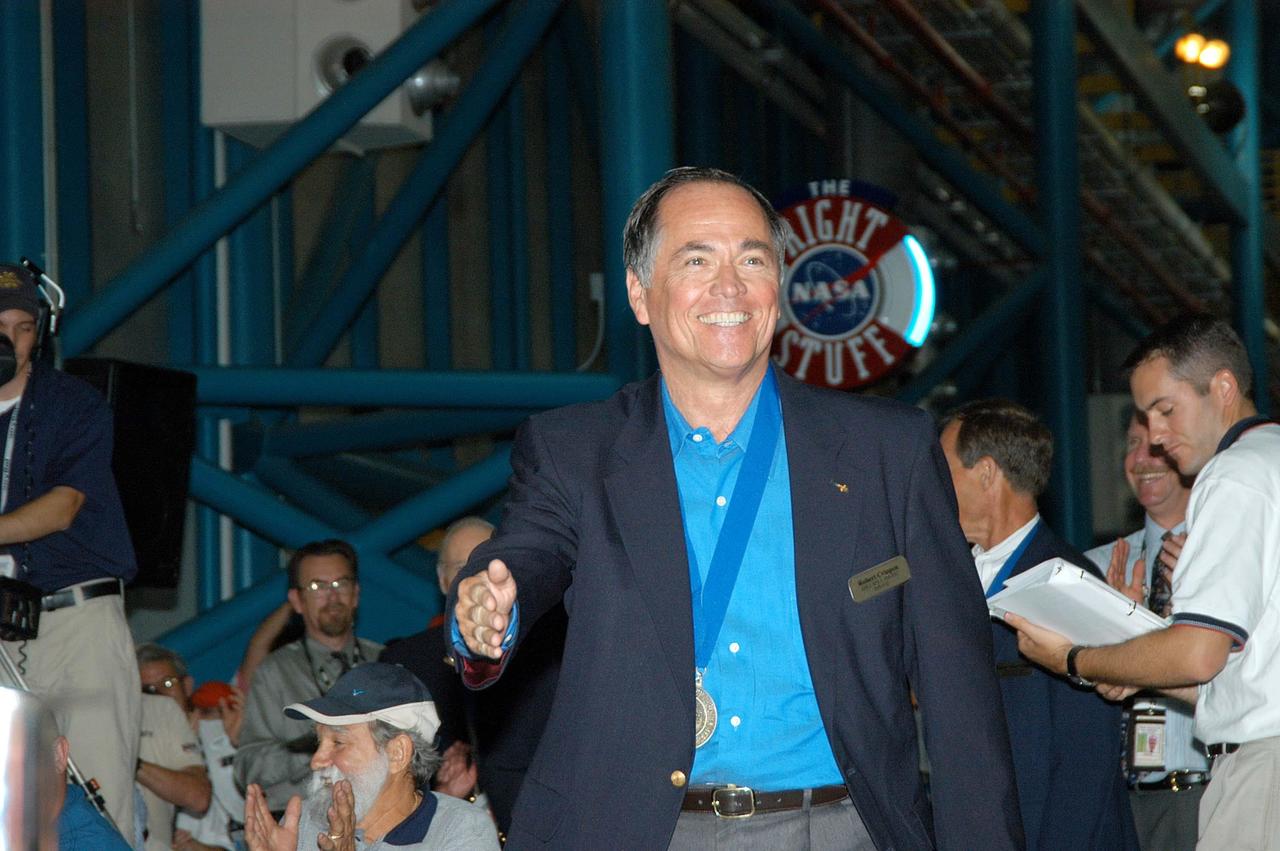
KENNEDY SPACE CENTER, FLA. -- Former astronaut Robert Crippen smiles at the warm greeting he is receiving when introduced as a previous inductee into the U.S. Astronaut Hall of Fame. He and other Hall of Fame members were present for the induction of five new space program heroes into the U.S. Astronaut Hall of Fame: Richard O. Covey, commander of the Hubble Space Telescope repair mission; Norman E. Thagard, the first American to occupy Russia’s Mir space station; the late Francis R. "Dick" Scobee, commander of the ill-fated 1986 Challenger mission; Kathryn D. Sullivan, the first American woman to walk in space; and Frederick D. Gregory, the first African-American to command a space mission and the current NASA deputy administrator. Crippen piloted the first Space Shuttle flight in 1981 and commanded three other Shuttle missions in the next 3-1/2 years. In the early 1990s he served as director of NASA’s Kennedy Space Center. The induction ceremony was held at the Apollo/Saturn V Center at KSC. The U.S. Astronaut Hall of Fame opened in 1990 to provide a place where space travelers could be remembered for their participation and accomplishments in the U.S. space program. The five inductees join 52 previously honored astronauts from the ranks of the Gemini, Apollo, Skylab, Apollo-Soyuz, and Space Shuttle programs.
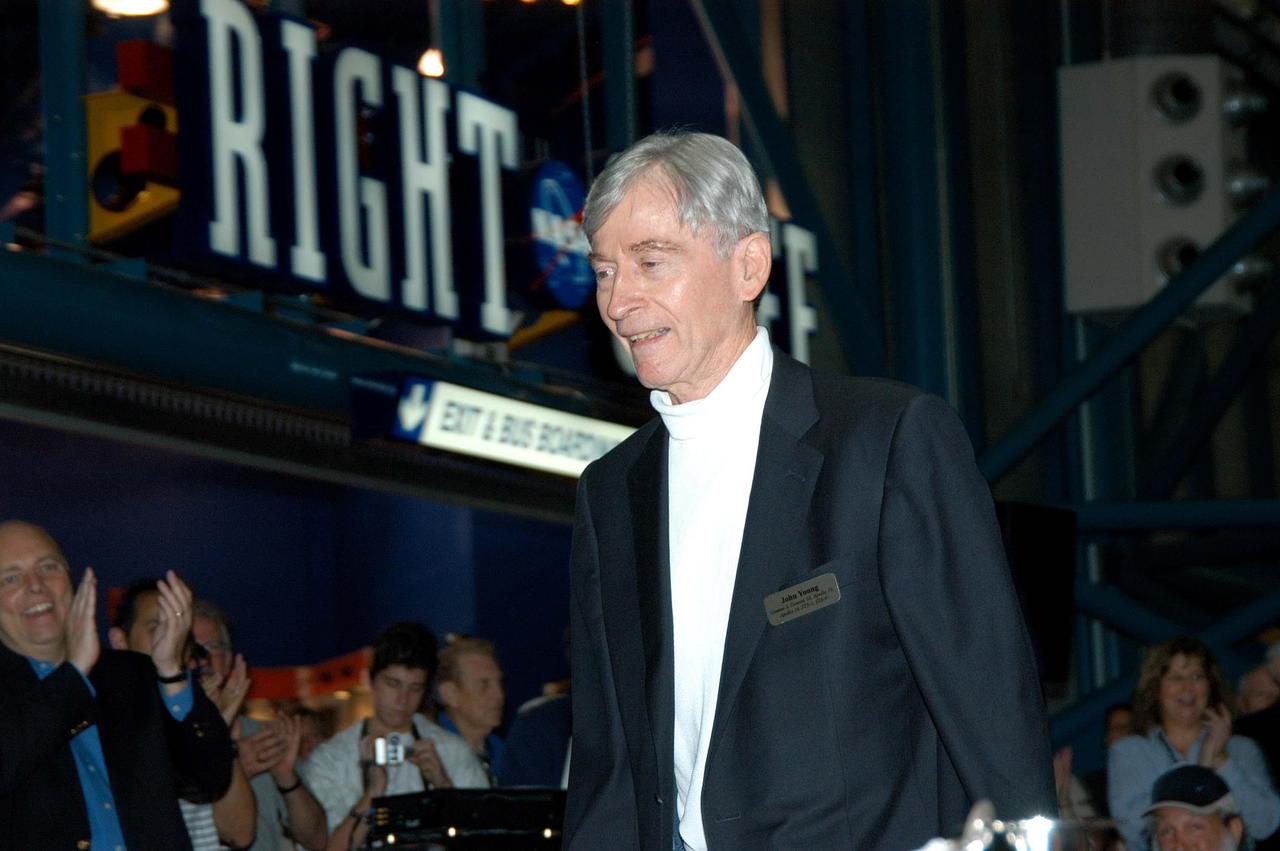
KENNEDY SPACE CENTER, FLA. -- Before the induction ceremony of five space program heroes into the U.S. Astronaut Hall of Fame, astronaut John Young is warmly greeted as he is introduced as a previous inductee. Co-holder of a record for the most space flights, six, he flew on Gemini 3 and 10, orbited the Moon on Apollo 10, walked on the Moon on Apollo 16, and commanded two space shuttle missions, STS-1 and STS-9. Young currently serves as associate director, technical, at Johnson Space Center. The induction ceremony was held at the Apollo/Saturn V Center at KSC. New inductees are Richard O. Covey, commander of the Hubble Space Telescope repair mission; Norman E. Thagard, the first American to occupy Russia’s Mir space station; the late Francis R. "Dick" Scobee, commander of the ill-fated 1986 Challenger mission; Kathryn D. Sullivan, the first American woman to walk in space; and Frederick D. Gregory, the first African-American to command a space mission and the current NASA deputy administrator. The U.S. Astronaut Hall of Fame opened in 1990 to provide a place where space travelers could be remembered for their participation and accomplishments in the U.S. space program. The five inductees join 52 previously honored astronauts from the ranks of the Gemini, Apollo, Skylab, Apollo-Soyuz, and Space Shuttle programs.
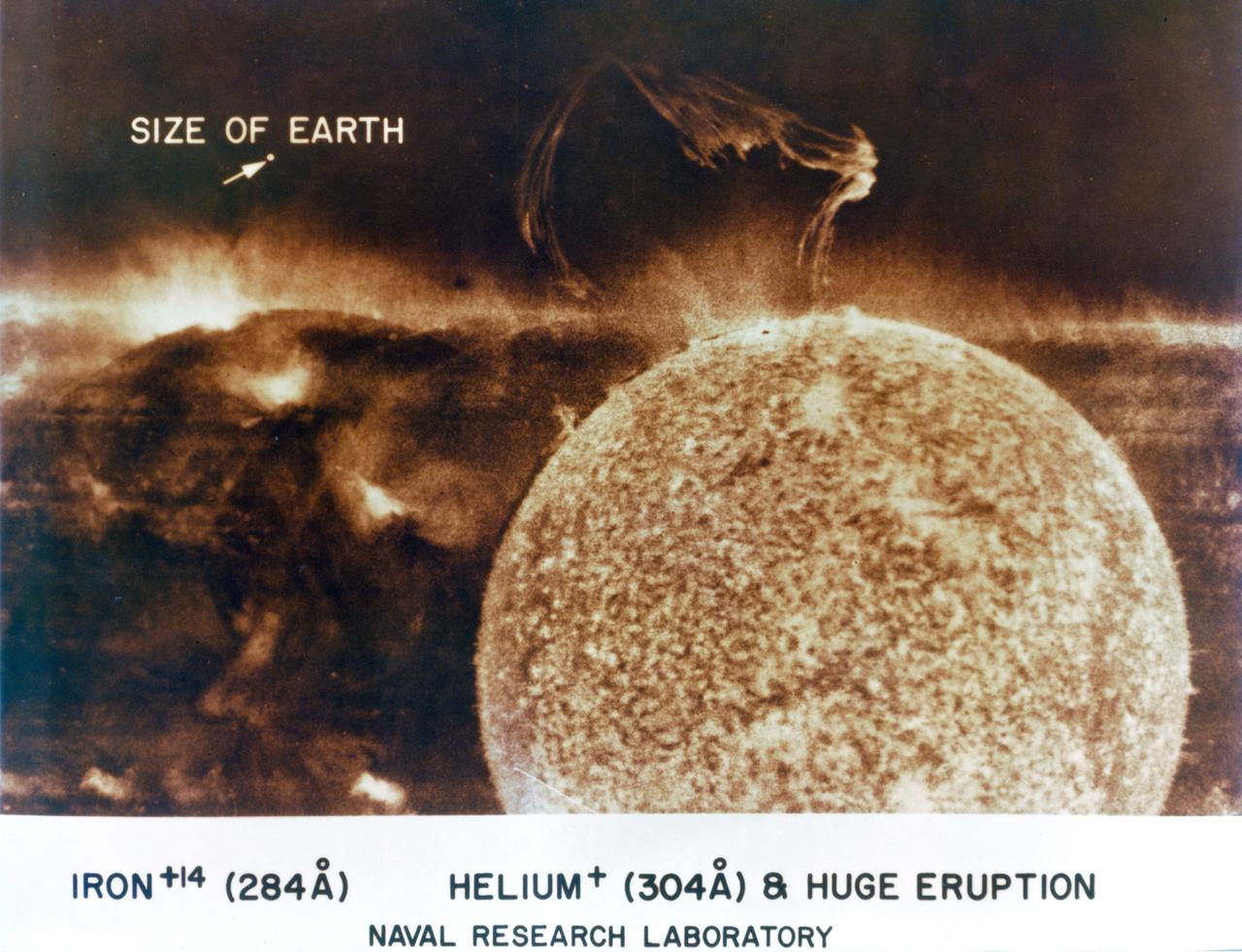
S74-15583 (July 1973) --- A huge solar eruption can be seen in this Spectroheliogram obtained during the Skylab 3 mission by the Extreme Ultraviolet Spectrograph/Spectroheliograph SO82A Experiment aboard the Skylab space station in Earth orbit. SO82 is one of the Apollo Telescope Mount experiments. The SO82 "A" instrument covers the wavelength region from 150-650 angstroms (EUV regions). The magnitude of the eruption can be visualized by comparing it with the small white dot that represents the size of Earth. This photograph reveals for the first time that helium erupting from the sun can stay together to altitudes of up to 500,000 miles. After being ejected from the sun, the gas clouds seem to have come to a standstill, as though blocked by an unseen wall. Some materials appear to have been directed back toward the sun as a rain, distinguished by fine threads. At present it is a challenge to explain this mystery--what forces expelled these huge clouds, then blocked its further progress, yet allowed the cloud to maintain its threads. Both magnetic fields and gravity must play a part, but these curious forms seem to defy explanation based on magnetic and gravitational fields alone. The EUV spectroheliograph was designed and constructed by the U.S. Naval Research Laboratory and the Ball Brothers Research Corporation under the direction of Dr. R. Tousey, the principal investigator for this NASA experiment. On the left may be seen the sun's image in emission from iron atoms which have lost 14 electrons by collision in the sun's million-degree coronal plasma gas. Photo credit: NASA