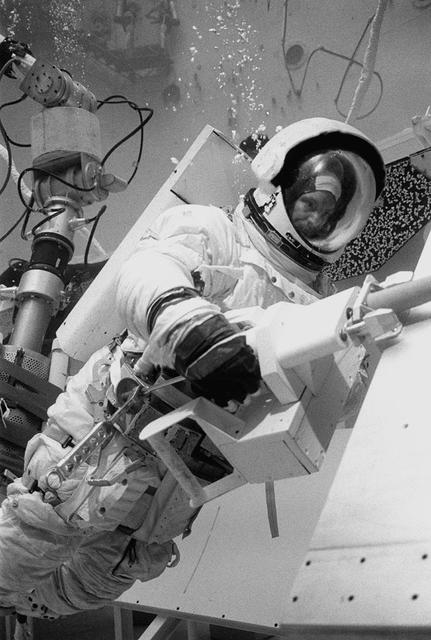
In February 1980, a satellite called Solar Maximum Mission Spacecraft, or Solar Max, was launched into Earth's orbit. Its primary objective was to provide a detailed study of solar flares, active regions on the Sun's surface, sunspots, and other solar activities. Additionally, it was to measure the total output of radiation from the Sun. Not much was known about solar activity at that time except for a slight knowledge of solar flares. After its launch, Solar Max fulfilled everyone's expectations. However, after a year in orbit, Solar Max's Altitude Control System malfunctioned, preventing the precise pointing of instruments at the Sun. NASA scientists were disappointed at the lost data, but not altogether dismayed because Solar Max had been designed for Space Shuttle retrievability enabling repair of the satellite. On April 6, 1984, Space Shuttle Challenger (STS-41C), Commanded by astronaut Robert L. Crippen and piloted by Francis R. Scobee, launched on a historic voyage. This voyage initiated a series of firsts for NASA; the first satellite retrieval, the first service use of a new space system called the Marned Maneuvering Unit (MMU), the first in-orbit repair, the first use of the Remote Manipulator System (RMS), and the Space Shuttle Challenger's first space flight. The mission was successful in retrieving Solar Max. Mission Specialist Dr. George D. Nelson, using the MMU, left the orbiter's cargo bay and rendezvoused with Solar Max. After attaching himself to the satellite, he awaited the orbiter to maneuver itself nearby. Using the RMS, Solar Max was captured and docked in the cargo bay while Dr. Nelson replaced the altitude control system and the coronagraph/polarimeter electronics box. After the repairs were completed, Solar Max was redeposited in orbit with the assistance of the RMS. Prior to the April 1984 launch, countless man-hours were spent preparing for this mission. The crew of Challenger spent months at Marshall Space Flight Center's (MSFC) Neutral Buoyancy Simulator (NBS) practicing retrieval maneuvers, piloting the MMU, and training on equipment so they could make the needed repairs to Solar Max. Pictured is Dr. Nelson performing a replacement task on the Solar Max mock-up in the NBS.
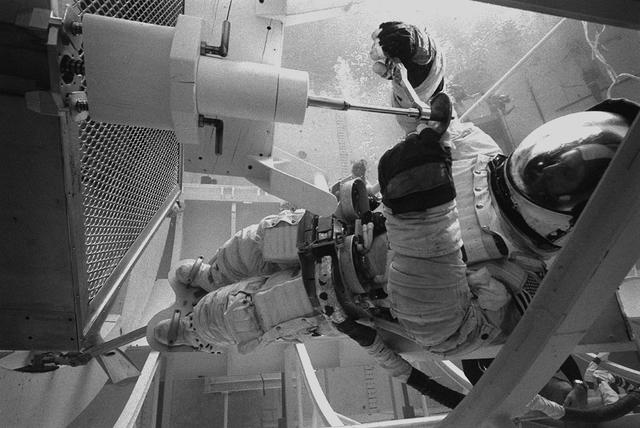
In February 1980, a satellite called Solar Maximum Mission Spacecraft, or Solar Max, was launched into Earth's orbit. Its primary objective was to provide a detailed study of solar flares,active regions on the Sun's surface, sunspots, and other solar activities. Additionally, it was to measure the total output of radiation from the Sun. Not much was known about solar activity at that time except for a slight knowledge of solar flares. After its launch, Solar Max fulfilled everyone's expectations. However, after a year in orbit, Solar Max's Altitude Control System malfunctioned, preventing the precise pointing of instruments at the Sun. NASA scientists were disappointed at the lost data, but not altogether dismayed because Solar Max had been designed for Space Shuttle retrievability enabling the repair of the satellite. On April 6, 1984, Space Shuttle Challenger (STS-41C), Commanded by astronaut Robert L. Crippen and piloted by Francis R. Scobee, launched on a historic voyage. This voyage initiated a series of firsts for NASA; the first satellite retrieval, the first service use of a new space system called the Marned Maneuvering Unit (MMU), the first in-orbit repair, the first use of the Remote Manipulator System (RMS), and the Space Shuttle Challenger's first space flight. The mission was successful in retrieving Solar Max. Mission Specialist Dr. George D. Nelson, using the MMU, left the orbiter's cargo bay and rendezvoused with Solar Max. After attaching himself to the satellite, he awaited the orbiter to maneuver itself nearby. Using the RMS, Solar Max was captured and docked in the cargo bay while Dr. Nelson replaced the altitude control system and the coronagraph/polarimeter electronics box. After the repairs were completed, Solar Max was redeposited in orbit with the assistance of the RMS. Prior to the April 1984 launch, countless man-hours were spent preparing for this mission. The crew of Challenger spent months at Marshall Space Flight Center's (MSFC) Neutral Buoyancy Simulator (NBS) practicing retrieval maneuvers, piloting the MMU, and training on equipment so they could make the needed repairs to Solar Max. Pictured is Dr. Nelson performing a replacement task on the Solar Max mock-up in the NBS.
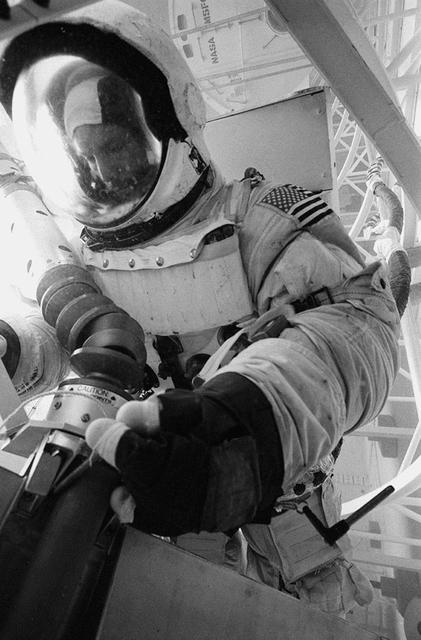
In February 1980, a satellite called Solar Maximum Mission Spacecraft, or Solar Max, was launched into Earth's orbit. Its primary objective was to provide a detailed study of solar flares,active regions on the Sun's surface, sunspots, and other solar activities. Additionally, it was to measure the total output of radiation from the Sun. Not much was known about solar activity at that time except for a slight knowledge of solar flares. After its launch, Solar Max fulfilled everyone's expectations. However, after a year in orbit, Solar Max's Altitude Control System malfunctioned, preventing the precise pointing of instruments at the Sun. NASA scientists were disappointed at the lost data, but not altogether dismayed because Solar Max had been designed for Space Shuttle retrievability, enabling repair to the satellite. On April 6, 1984, Space Shuttle Challenger (STS-41C), Commanded by astronaut Robert L. Crippen and piloted by Francis R. Scobee, launched on a historic voyage. This voyage initiated a series of firsts for NASA; the first satellite retrieval, the first service use of a new space system called the Marned Maneuvering Unit (MMU), the first in-orbit repair, the first use of the Remote Manipulator System (RMS), and the Space Shuttle Challenger's first space flight. The mission was successful in retrieving Solar Max. Mission Specialist Dr. George D. Nelson, using the MMU, left the orbiter's cargo bay and rendezvoused with Solar Max. After attaching himself to the satellite, he awaited the orbiter to maneuver itself nearby. Using the RMS, Solar Max was captured and docked in the cargo bay while Dr. Nelson replaced the altitude control system and the coronagraph/polarimeter electronics box. After the repairs were completed, Solar Max was redeposited in orbit with the assistance of the RMS. Prior to the April 1984 launch, countless man-hours were spent preparing for this mission. The crew of Challenger spent months at Marshall Space Flight Center's (MSFC) Neutral Buoyancy Simulator (NBS) practicing retrieval maneuvers, piloting the MMU, and training on equipment so they could make the needed repairs to Solar Max. Pictured is Dr. Nelson performing a replacement task on the Solar Max mock-up in the NBS.
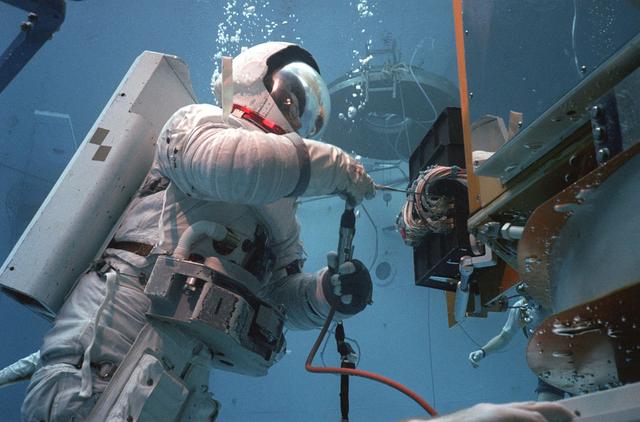
In February 1980, a satellite called Solar Maximum Mission Spacecraft, or Solar Max, was launched into Earth's orbit. Its primary objective was to provide a detailed study of solar flares, active regions on the Sun's surface, sunspots, and other solar activities. Additionally, it was to measure the total output of radiation from the Sun. Not much was known about solar activity at that time except for a slight knowledge of solar flares. After its launch, Solar Max fulfilled everyone's expectations. However, after a year in orbit, Solar Max's Altitude Control System malfunctioned, preventing the precise pointing of instruments at the Sun. NASA scientists were disappointed at the lost data, but not altogether dismayed because Solar Max had been designed for Space Shuttle retrievability enabling the repair of the satellite. On April 6, 1984, Space Shuttle Challenger (STS-41C), Commanded by astronaut Robert L. Crippen and piloted by Francis R. Scobee, launched on a historic voyage. This voyage initiated a series of firsts for NASA; the first satellite retrieval, the first service use of a new space system called the Marned Maneuvering Unit (MMU), the first in-orbit repair, the first use of the Remote Manipulator System (RMS), and the Space Shuttle Challenger's first space flight. The mission was successful in retrieving Solar Max. Mission Specialist Dr. George D. Nelson, using the MMU, left the orbiter's cargo bay and rendezvoused with Solar Max. After attaching himself to the satellite, he awaited the orbiter to maneuver itself nearby. Using the RMS, Solar Max was captured and docked in the cargo bay while Dr. Nelson replaced the altitude control system and the coronagraph/polarimeter electronics box. After the repairs were completed, Solar Max was redeposited in orbit with the assistance of the RMS. Prior to the April 1984 launch, countless man-hours were spent preparing for this mission. The crew of Challenger spent months at Marshall Space Flight Center's (MSFC) Neutral Buoyancy Simulator (NBS) practicing retrieval maneuvers, piloting the MMU, and training on equipment so they could make the needed repairs to Solar Max. Pictured is Dr. Nelson performing a replacement task on the Solar Max mock-up in the NBS.
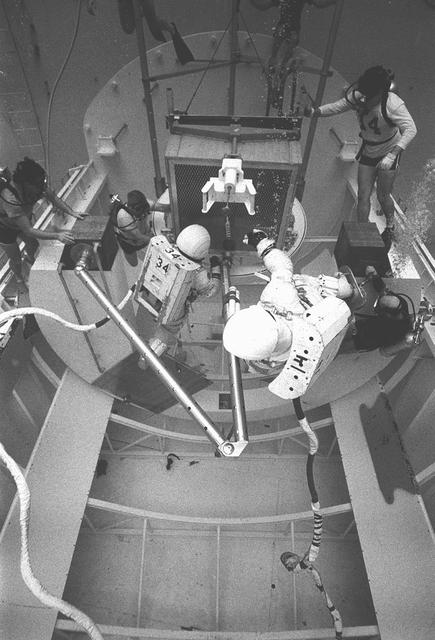
In February 1980, a satellite called Solar Maximum Mission Spacecraft, or Solar Max, was launched into Earth's orbit. Its primary objective was to provide a detailed study of solar flares, active regions on the Sun's surface, sunspots, and other solar activities. Additionally, it was to measure the total output of radiation from the Sun. Not much was known about solar activity at that time except for a slight knowledge of solar flares. After its launch, Solar Max fulfilled everyone's expectations. However, after a year in orbit, Solar Max's Altitude Control System malfunctioned, preventing the precise pointing of instruments at the Sun. NASA scientists were disappointed at the lost data, but not altogether dismayed because Solar Max had been designed for Space Shuttle retrievability enabling the repair of the satellite. On April 6, 1984, Space Shuttle Challenger (STS-41C), Commanded by astronaut Robert L. Crippen and piloted by Francis R. Scobee, launched on a historic voyage. This voyage initiated a series of firsts for NASA; the first satellite retrieval, the first service use of a new space system called the Marned Maneuvering Unit (MMU), the first in-orbit repair, the first use of the Remote Manipulator System (RMS), and the Space Shuttle Challenger's first space flight. The mission was successful in retrieving Solar Max. Mission Specialist Dr. George D. Nelson, using the MMU, left the orbiter's cargo bay and rendezvoused with Solar Max. After attaching himself to the satellite, he awaited the orbiter to maneuver itself nearby. Using the RMS, Solar Max was captured and docked in the cargo bay while Dr. Nelson replaced the altitude control system and the coronagraph/polarimeter electronics box. After the repairs were completed, Solar Max was redeposited in orbit with the assistance of the RMS. Prior to the April 1984 launch, countless man-hours were spent preparing for this mission. The crew of Challenger spent months at Marshall Space Flight Center's (MSFC) Neutral Buoyancy Simulator (NBS) practicing retrieval maneuvers, piloting the MMU, and training on equipment so they could make the needed repairs to Solar Max. Pictured are crew members training on repair tasks.
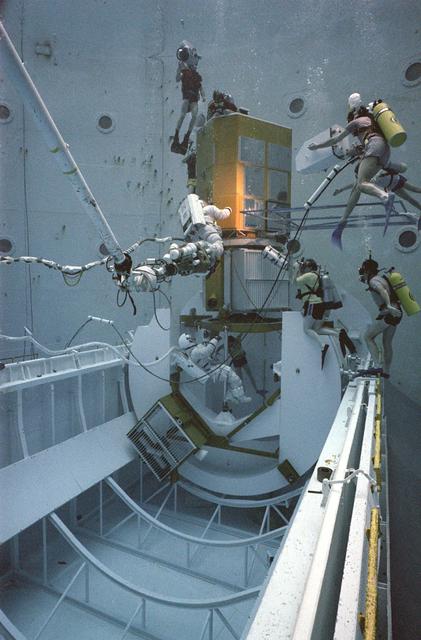
In February 1980, a satellite called Solar Maximum Mission Spacecraft, or Solar Max, was launched into Earth's orbit. Its primary objective was to provide a detailed study of solar flares, active regions on the Sun's surface, sunspots, and other solar activities. Additionally, it was to measure the total output of radiation from the Sun. Not much was known about solar activity at that time except for a slight knowledge of solar flares. After its launch, Solar Max fulfilled everyone's expectations. However, after a year in orbit, Solar Max's Altitude Control System malfunctioned, preventing the precise pointing of instruments at the Sun. NASA scientists were disappointed at the lost data, but not altogether dismayed because Solar Max had been designed for Space Shuttle retrievability enabling the repair of the satellite. On April 6, 1984, Space Shuttle Challenger (STS-41C), Commanded by astronaut Robert L. Crippen and piloted by Francis R. Scobee, launched on a historic voyage. This voyage initiated a series of firsts for NASA; the first satellite retrieval, the first service use of a new space system called the Marned Maneuvering Unit (MMU), the first in-orbit repair, the first use of the Remote Manipulator System (RMS), and the Space Shuttle Challenger's first space flight. The mission was successful in retrieving Solar Max. Mission Specialist Dr. George D. Nelson, using the MMU, left the orbiter's cargo bay and rendezvoused with Solar Max. After attaching himself to the satellite, he awaited the orbiter to maneuver itself nearby. Using the RMS, Solar Max was captured and docked in the cargo bay while Dr. Nelson replaced the altitude control system and the coronagraph/polarimeter electronics box. After the repairs were completed, Solar Max was redeposited in orbit with the assistance of the RMS. Prior to the April 1984 launch, countless man-hours were spent preparing for this mission. The crew of Challenger spent months at Marshall Space Flight Center's (MSFC) Neutral Buoyancy Simulator (NBS) practicing retrieval maneuvers, piloting the MMU, and training on equipment so they could make the needed repairs to Solar Max. Pictured are crew members training for repair tasks.
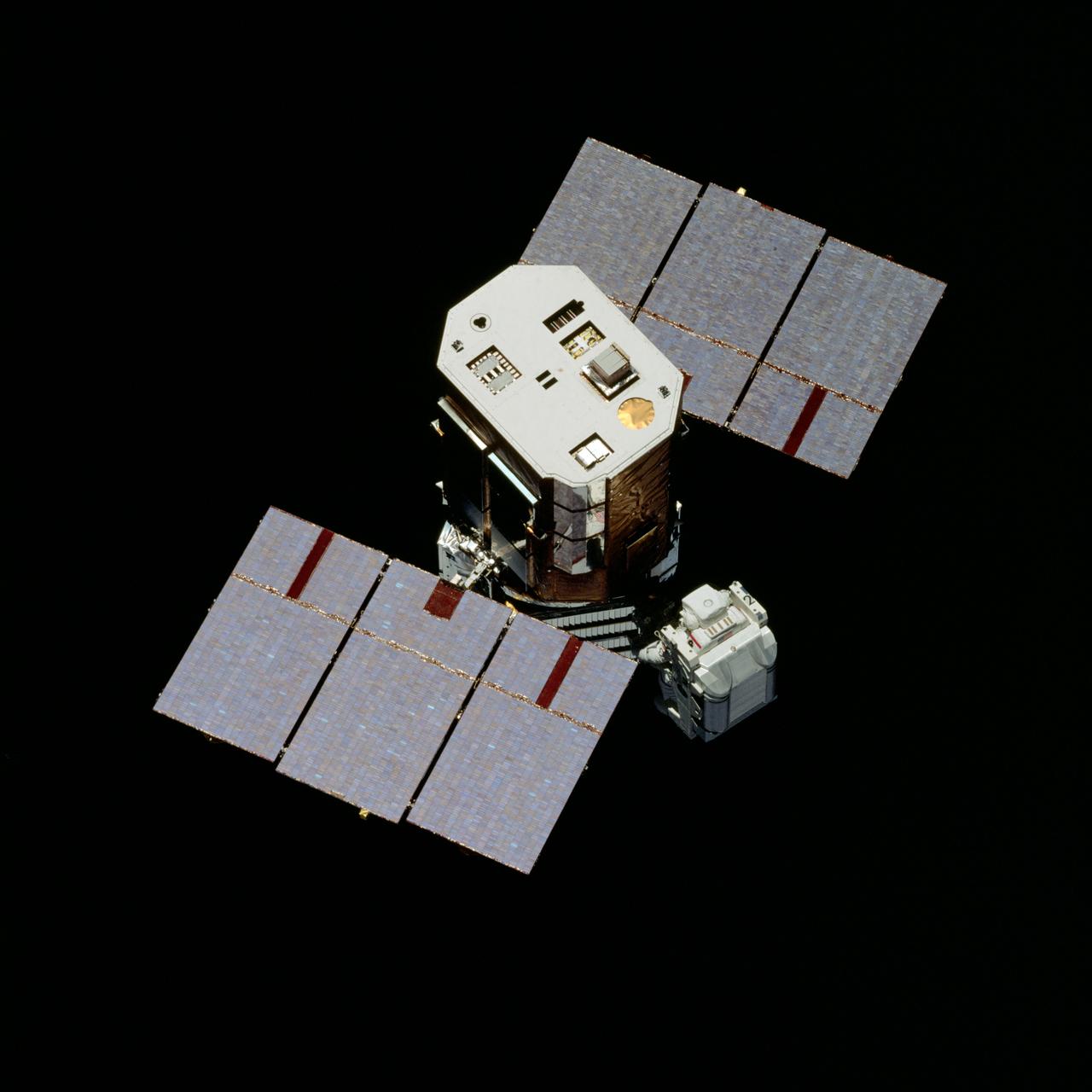
41C-34-1380 (10-11 April 1984) --- Astronaut George D. Nelson, using the manned maneuvering unit (MMU), arrives at the ailing Solar Maximum Mission Satellite (SMMS). After the STS-41C crewmembers captured the errant satellite and temporarily cradled it in Challenger?s payload bay, astronauts Nelson and James D. van Hoften repaired it and later re-released it.
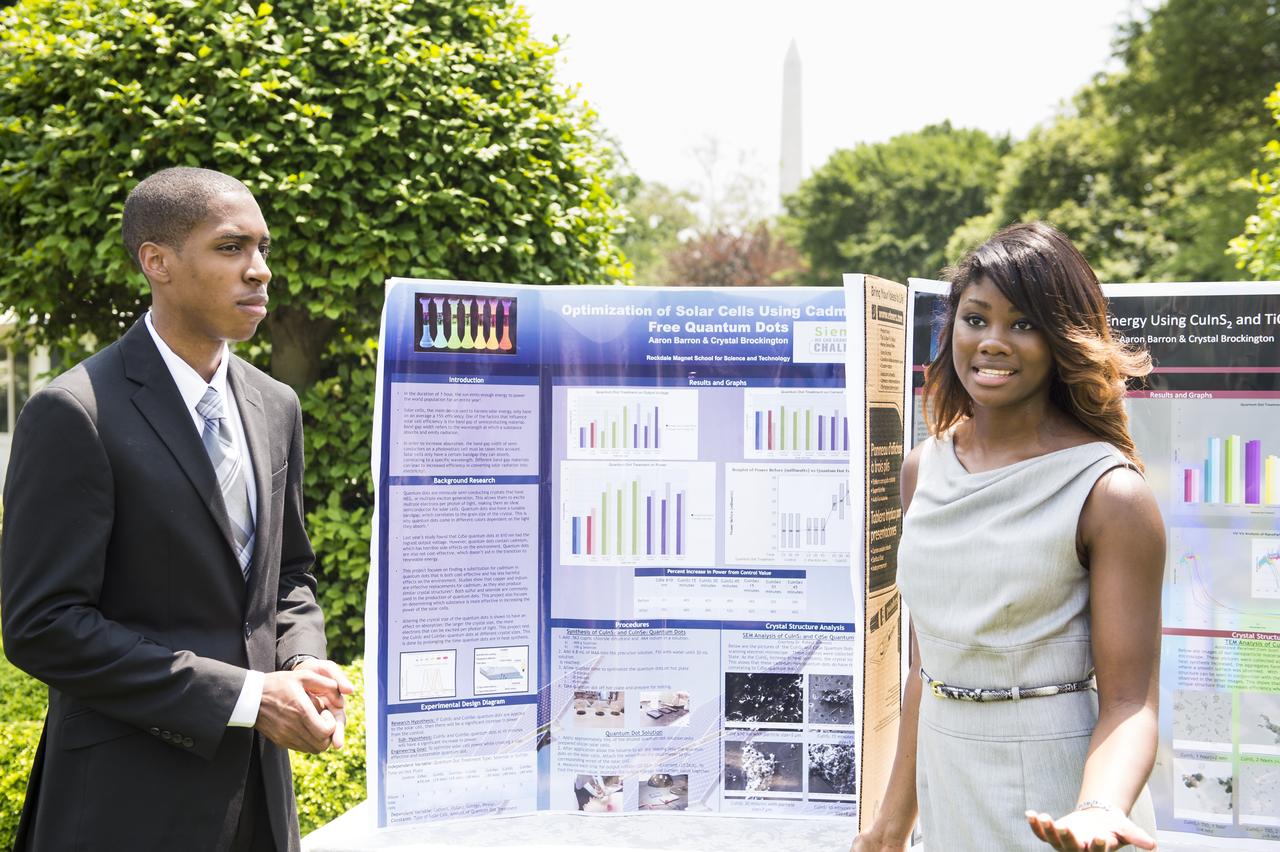
Crystal Brockington and Aaron Barron, both 18 years old, designed a more efficient and cost effective solar cell that harnesses energy without cadmium, which has been shown to be harmful to the environment. They were selected to participate in the White House Science Fair after they were awarded the High School Grand Prize at the Siemens We Can Change the World Challenge. The fourth White House Science Fair was held at the White House on May 27, 2014 and included 100 students from more than 30 different states who competed in science, technology, engineering, and math (STEM) competitions. (Photo Credit: NASA/Aubrey Gemignani)
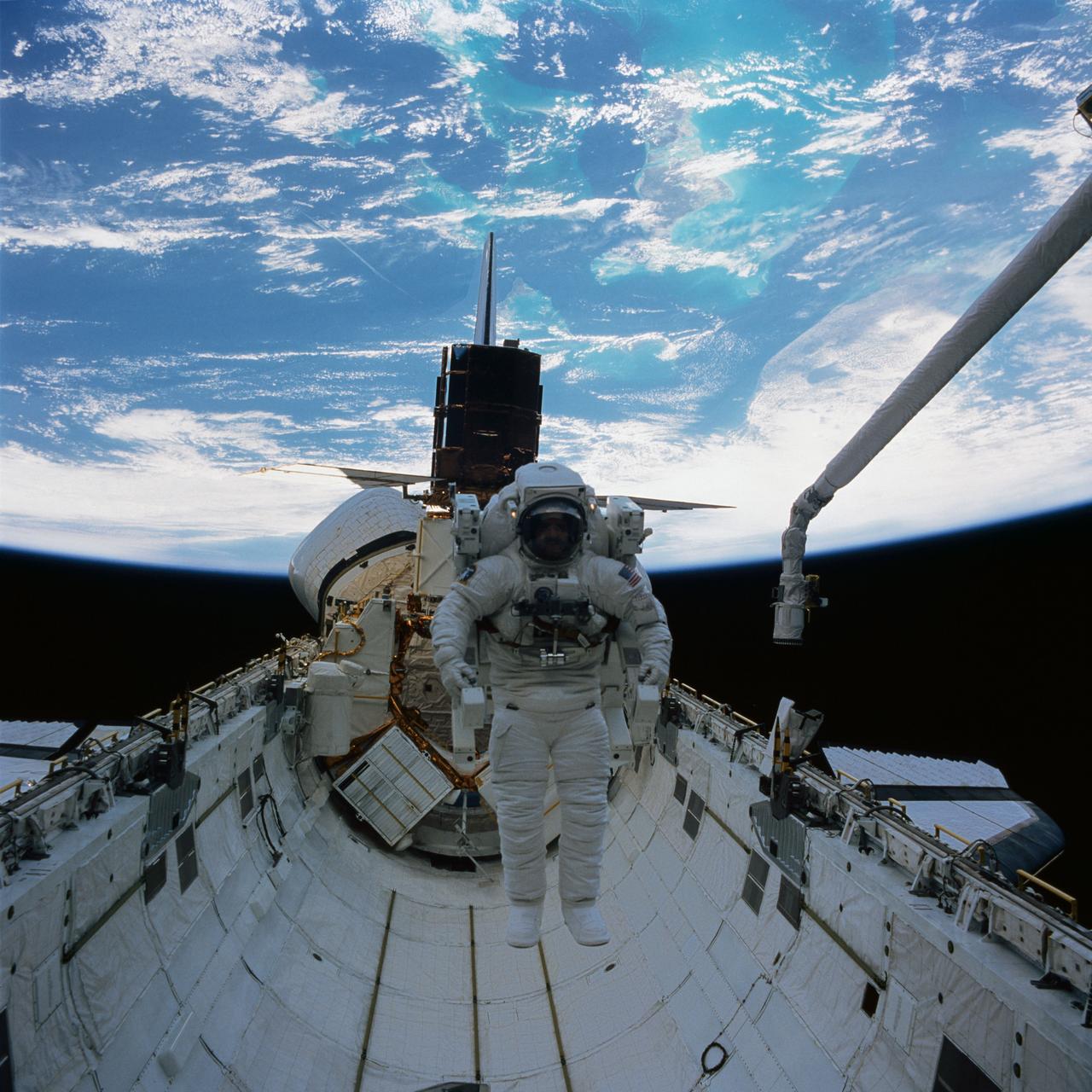
41C-37-1718 (11 April 1984) --- Astronaut James D. van Hoften and a repaired satellite are captured by a Hasselblad camera aimed through Challenger's aft cabin windows toward the cargo bay of the Earth orbiting Challenger. Dr. van Hoften is getting in his first "field" test of the manned maneuvering unit (MMU) after months of training in an underwater facility and in a simulator on Earth. The Solar Maximum Mission Satellite (SMMS), revived and almost ready for release into space once more, is docked at the flight support system (FSS).
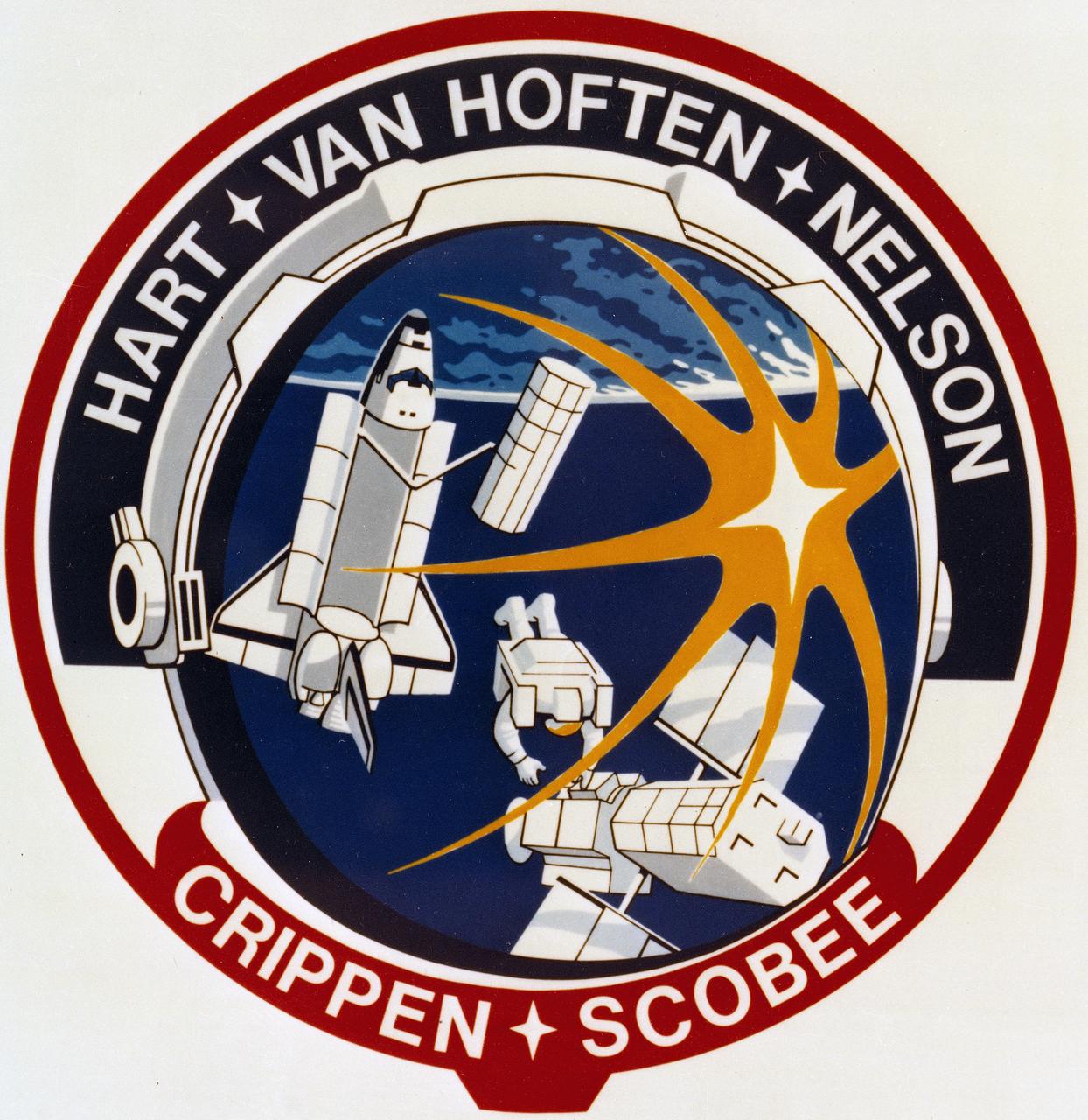
The patch features a helmet visor of an astronaut performing an extravehicular activity. In the visor are reflected the sun's rays, the Challenger and its remote manipulator system (RMS) deploying the long duration exposure facility (LDEF), the Earth and blue sky, and another astronaut working at the damaged Solar Maximum Satellite (SMS). The scene is encircled by the surnames of the crewmembers.
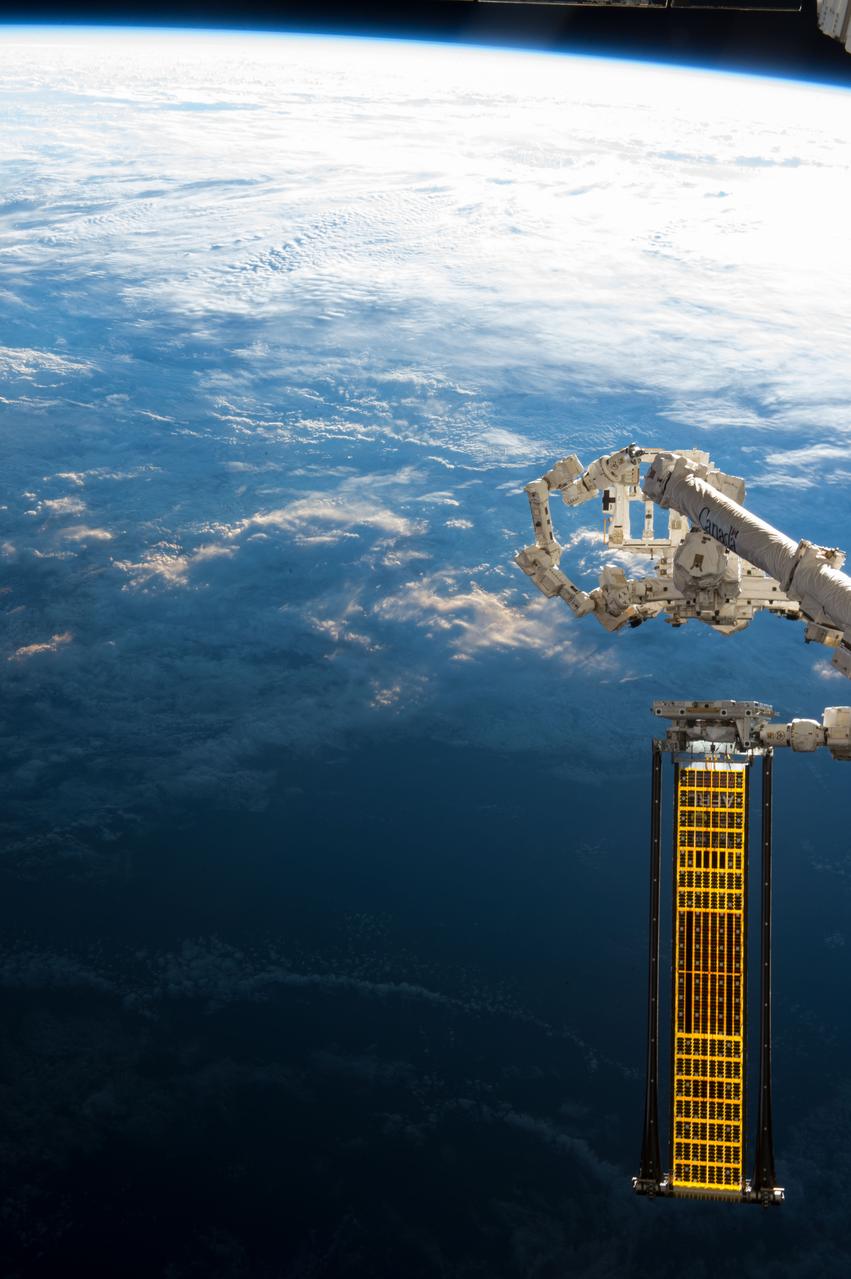
iss052e004379 (6/18/2017) --- The Roll-Out Solar Array (ROSA) is a new type of solar panel that rolls open in space like a party favor and is more compact than current rigid panel designs. The ROSA investigation tests deployment and retraction, shape changes when the Earth blocks the sun, and other physical challenges to determine the array’s strength and durability. ROSA has the potential to replace solar arrays on future satellites, making them more compact and lighter weight. Satellite radio and television, weather forecasting, GPS and other services used on Earth would all benefit from high-performance solar arrays.
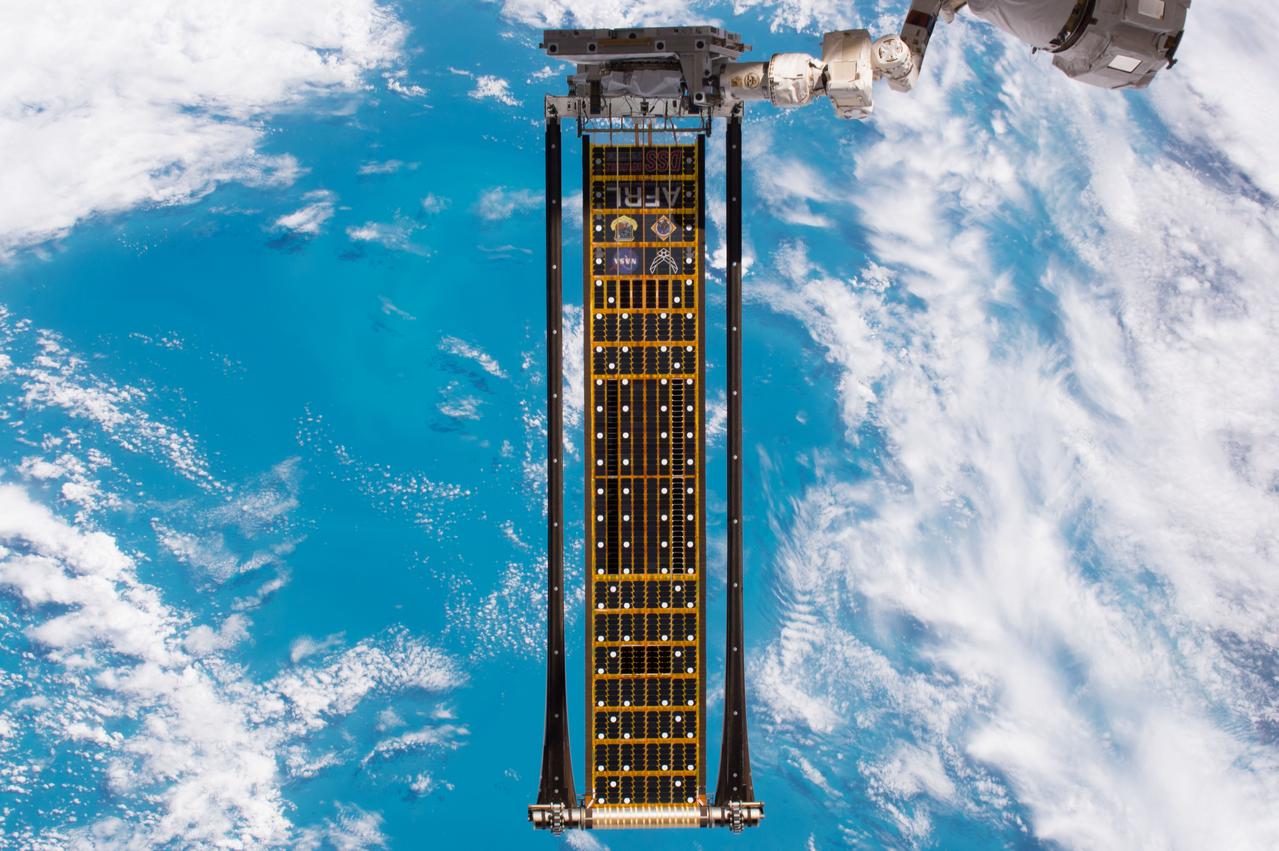
iss052e002871 (6/18/2017) --- The Roll-Out Solar Array (ROSA) is a new type of solar panel that rolls open in space like a party favor and is more compact than current rigid panel designs. The ROSA investigation tests deployment and retraction, shape changes when the Earth blocks the sun, and other physical challenges to determine the array’s strength and durability. ROSA has the potential to replace solar arrays on future satellites, making them more compact and lighter weight. Satellite radio and television, weather forecasting, GPS and other services used on Earth would all benefit from high-performance solar arrays.
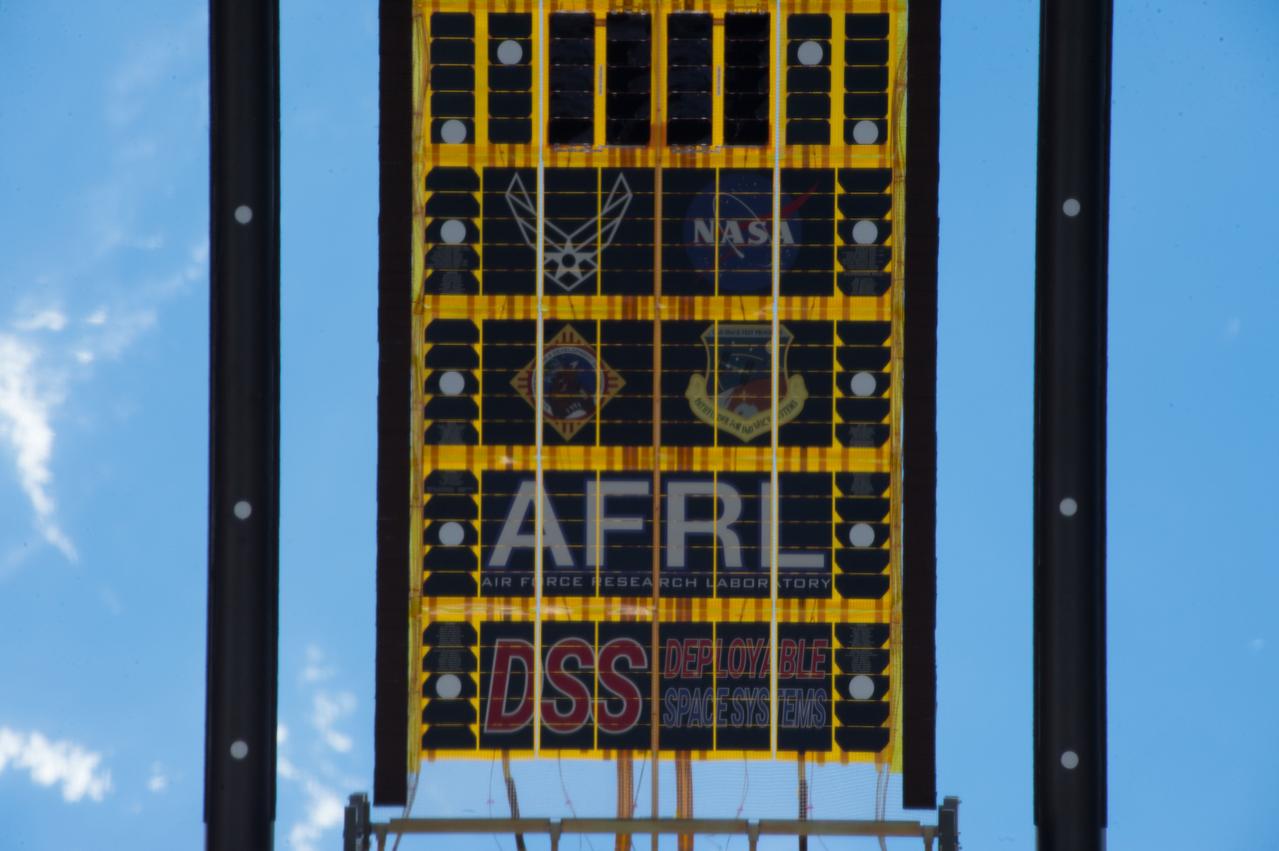
iss052e002857 (6/18/2017) --- The Roll-Out Solar Array (ROSA) is a new type of solar panel that rolls open in space like a party favor and is more compact than current rigid panel designs. The ROSA investigation tests deployment and retraction, shape changes when the Earth blocks the sun, and other physical challenges to determine the array’s strength and durability. ROSA has the potential to replace solar arrays on future satellites, making them more compact and lighter weight. Satellite radio and television, weather forecasting, GPS and other services used on Earth would all benefit from high-performance solar arrays.
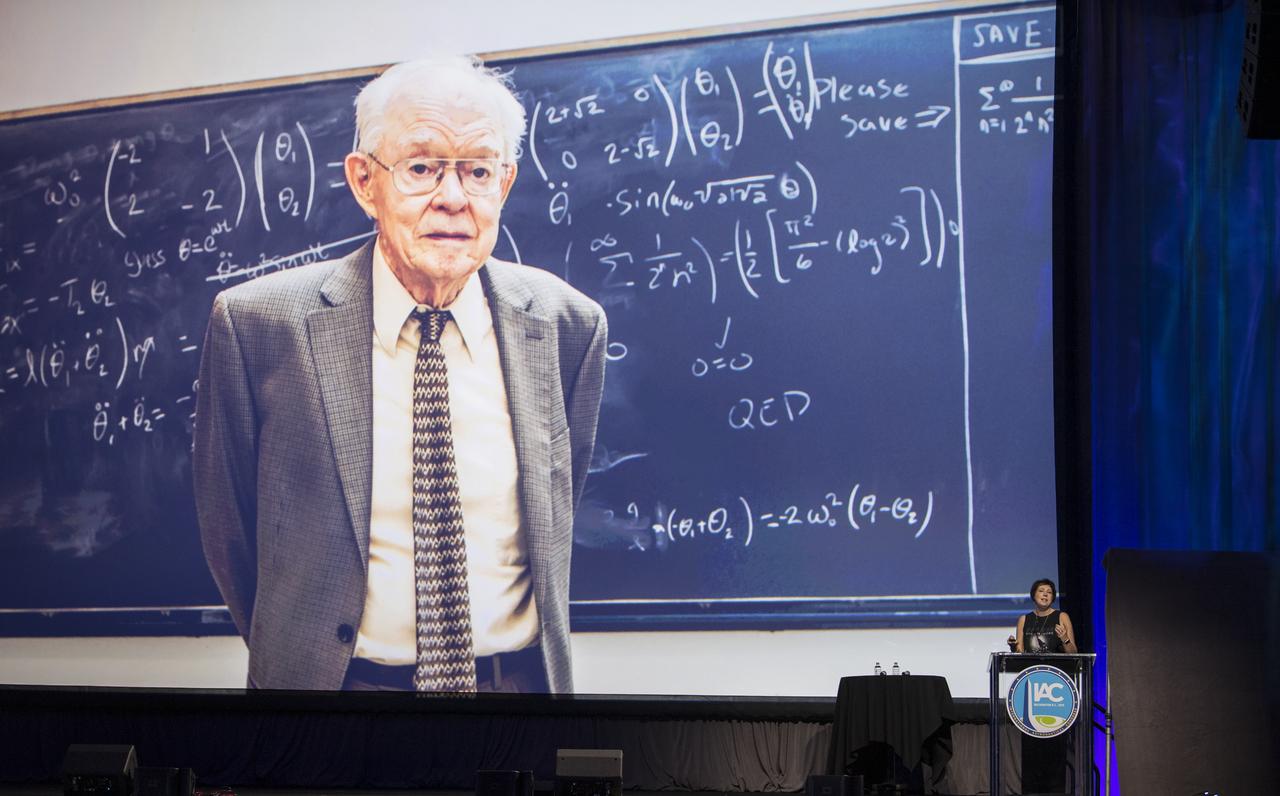
NASA director of Heliophysics division, Science Mission Directorate, Nicola Fox, shows a photo of Eugene Parker, the physicist who first predicted there was solar wind, during a presentation titled, “The Challenge of Exploring Our Sun - the 60-Year Odyssey to Parker Solar Probe,” during the 70th International Astronautical Congress, Wednesday, Oct. 23, 2019, at the Walter E. Washington Convention Center in Washington. Photo credit: (NASA/Aubrey Gemignani)
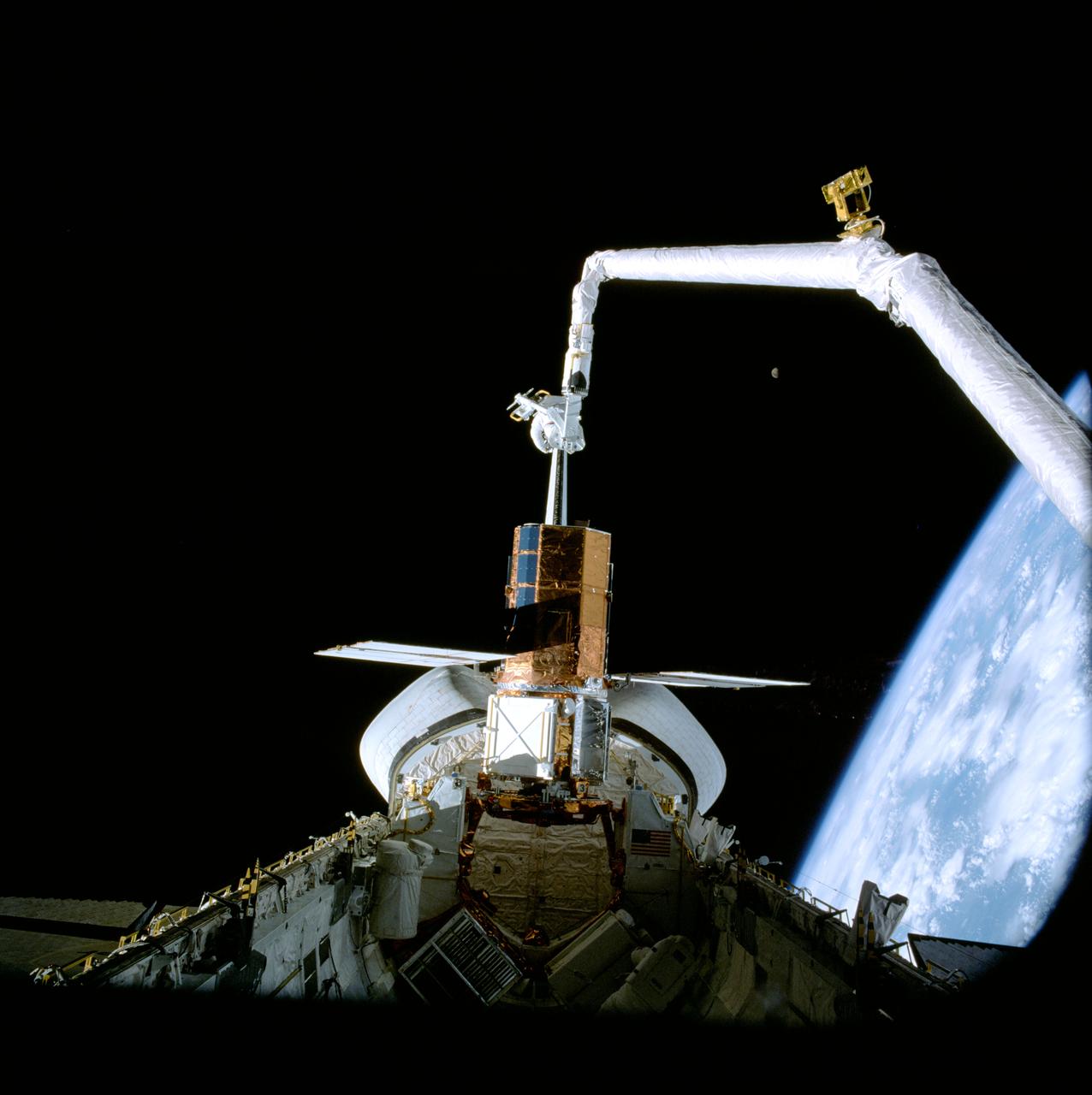
41C-37-1715 (11 April 1984) --- A scenic panorama is captured by an onboard 70mm handheld camera during the April 11, 1984, Solar Maximum Mission Satellite (SMMS) repair job aboard the Earth-orbiting Space Shuttle Challenger. The SMMS is temporarily docked at the Challenger's Flight Support System (FSS) so that astronauts George D. Nelson and James D. van Hoften could perform a series of repair tasks. The Remote Manipulator System (RMS) arm was used to move the astronauts into position for their series of chores. Note the gibbous Moon to the right of center and the horizon of the blue and white Earth in the lower right quadrant.
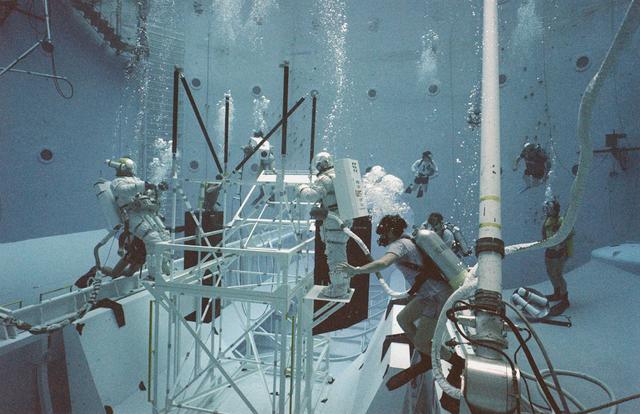
One of the main components of the Hubble Space Telescope (HST) is the Solar Array Drive Electronics (SADE) system. This system interfaces with the Support System Module (SSM) for exchange of operational commands and telemetry data. SADE operates and controls the Solar Array Drive Mechanisms (SADM) for the orientation of the Solar Array Drive (SAD). It also monitors the position of the arrays and the temperature of the SADM. During the first HST servicing mission, the astronauts replaced the SADE component because of some malfunctions. This turned out to be a very challenging extravehicular activity (EVA). Two transistors and two diodes had been thermally stressed with the conformal coating discolored and charred. Soldered cornections became molten and reflowed between the two diodes. The failed transistors gave no indication of defective construction. All repairs were made and the HST was redeposited into orbit. Prior to undertaking this challenging mission, the orbiter's crew trained at Marshall Space Flight Center's (MSFC) Neutral Buoyancy Simulator (NBS) to prepare themselves for working in a low gravity environment. They also practiced replacing HST parts and exercised maneuverability and equipment handling. Pictured are crew members practicing on a space platform.
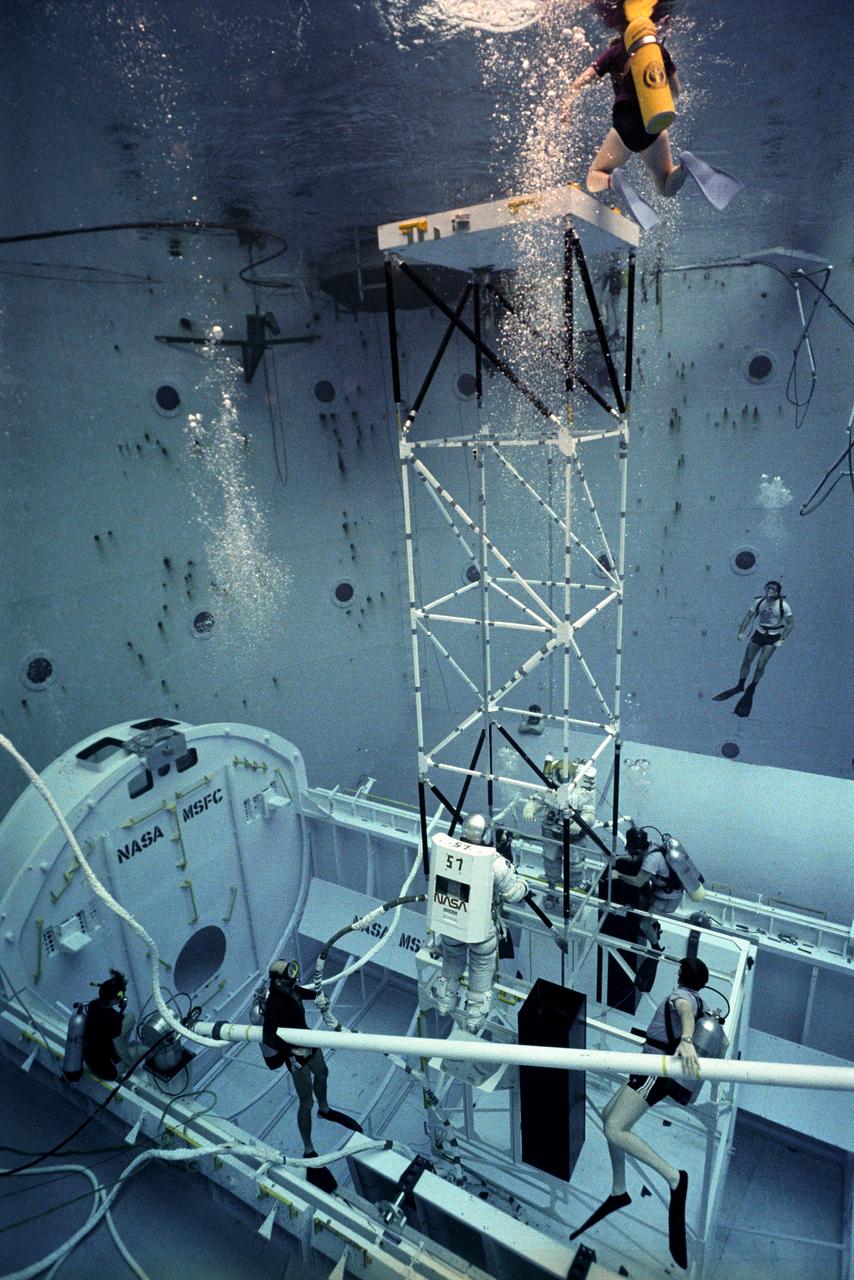
One of the main components of the Hubble Space Telescope (HST) is the Solar Array Drive Electronics (SADE) system. This system interfaces with the Support System Module (SSM) for exchange of operational commands and telemetry data. SADE operates and controls the Solar Array Drive Mechanisms (SADM) for the orientation of the Solar Array Drive (SAD). It also monitors the position of the arrays and the temperature of the SADM. During the first HST servicing mission, the astronauts replaced the SADE component because of some malfunctions. This turned out to be a very challenging extravehicular activity (EVA). Two transistors and two diodes had been thermally stressed with the conformal coating discolored and charred. Soldered cornections became molten and reflowed between the two diodes. The failed transistors gave no indication of defective construction. All repairs were made and the HST was redeposited into orbit. Prior to undertaking this challenging mission, the orbiter's crew trained at Marshall Space Flight Center's (MSFC) Neutral Buoyancy Simulator (NBS) to prepare themselves for working in a low gravity environment. They also practiced replacing HST parts and exercised maneuverability and equipment handling. Pictured is an astronaut practicing climbing a space platform that was necessary in making repairs on the HST.
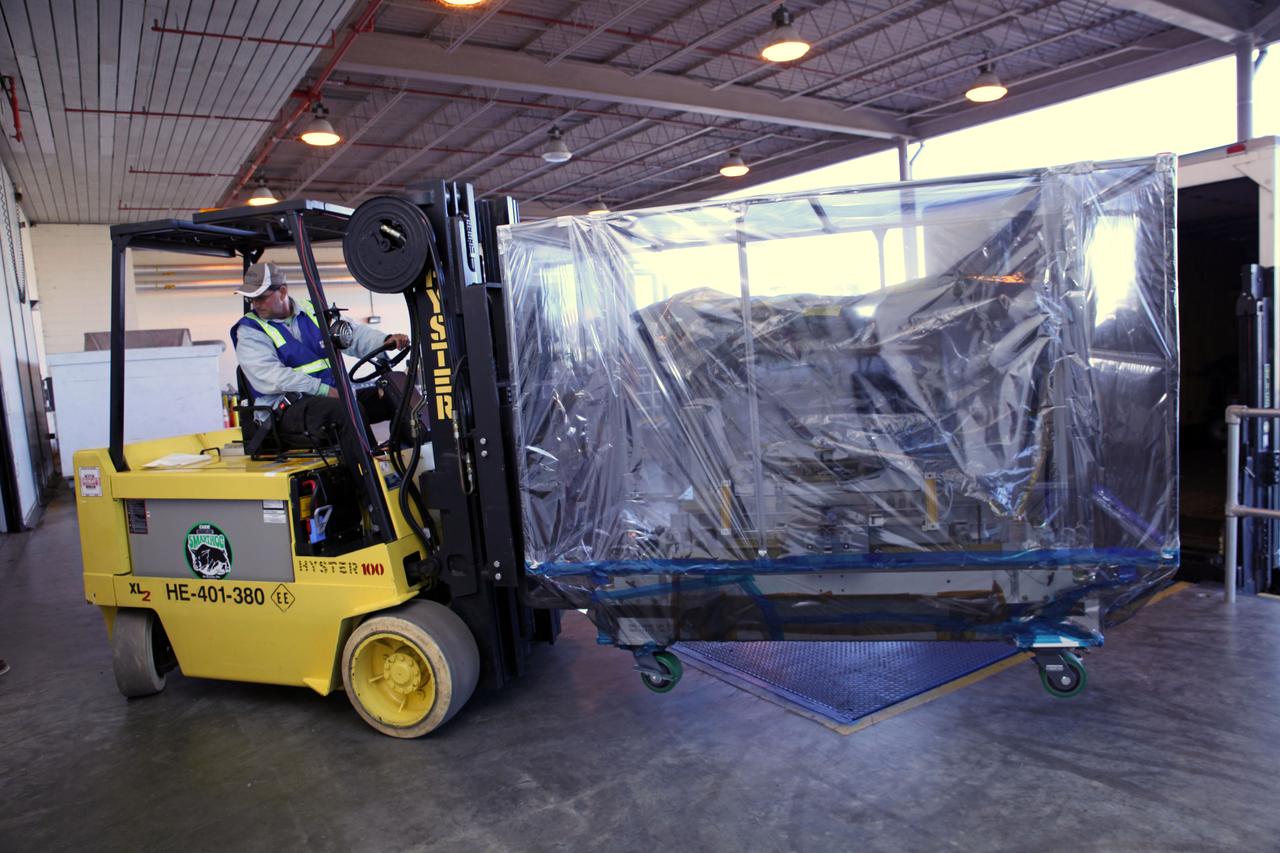
Outside the Space Station Processing Facility high bay at NASA's Kennedy Space Center in Florida, a technician uses a Hyster forklift to carry the Roll-Out Solar Array, or ROSA, to the loading dock. ROSA will be delivered to the International Space Station aboard the SpaceX Dragon cargo carrier on the company’s 11th commercial resupply services mission to the space station. ROSA is a new type of solar panel that rolls open in space and is more compact than current rigid panel designs. The ROSA investigation will test deployment and retraction, shape changes when the Earth blocks the sun, and other physical challenges to determine the array's strength and durability.
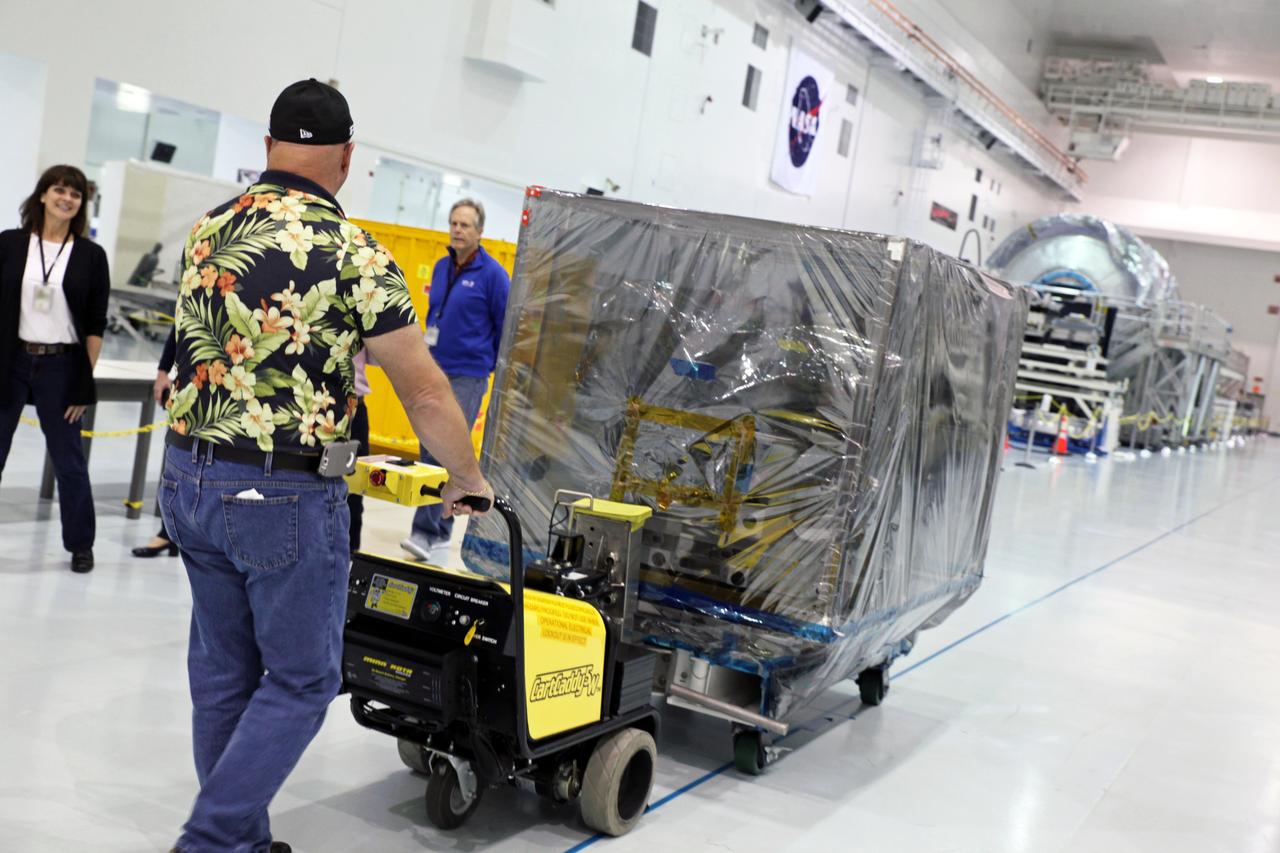
Inside the Space Station Processing Facility high bay at NASA's Kennedy Space Center in Florida, the Roll-Out Solar Array, or ROSA, is being prepared for transfer out of the high bay. ROSA will be delivered to the International Space Station aboard the SpaceX Dragon cargo carrier on the company’s 11th commercial resupply services mission to the space station. ROSA is a new type of solar panel that rolls open in space and is more compact than current rigid panel designs. The ROSA investigation will test deployment and retraction, shape changes when the Earth blocks the sun, and other physical challenges to determine the array's strength and durability.
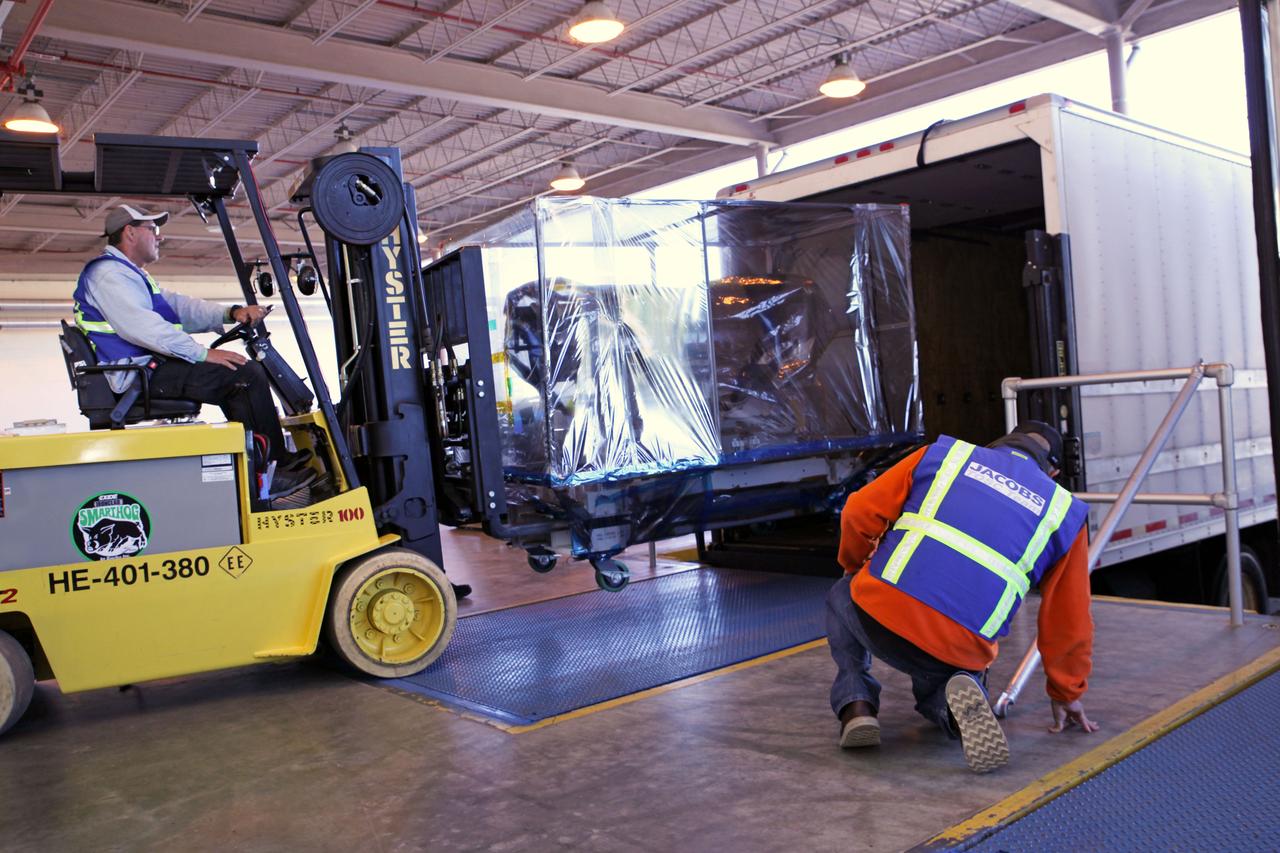
At the loading dock outside the Space Station Processing Facility high bay at NASA's Kennedy Space Center in Florida, a technician uses a Hyster forklift to load the Roll-Out Solar Array, or ROSA, into a truck. ROSA will be delivered to the International Space Station aboard the SpaceX Dragon cargo carrier on the company’s 11th commercial resupply services mission to the space station. ROSA is a new type of solar panel that rolls open in space and is more compact than current rigid panel designs. The ROSA investigation will test deployment and retraction, shape changes when the Earth blocks the sun, and other physical challenges to determine the array's strength and durability.
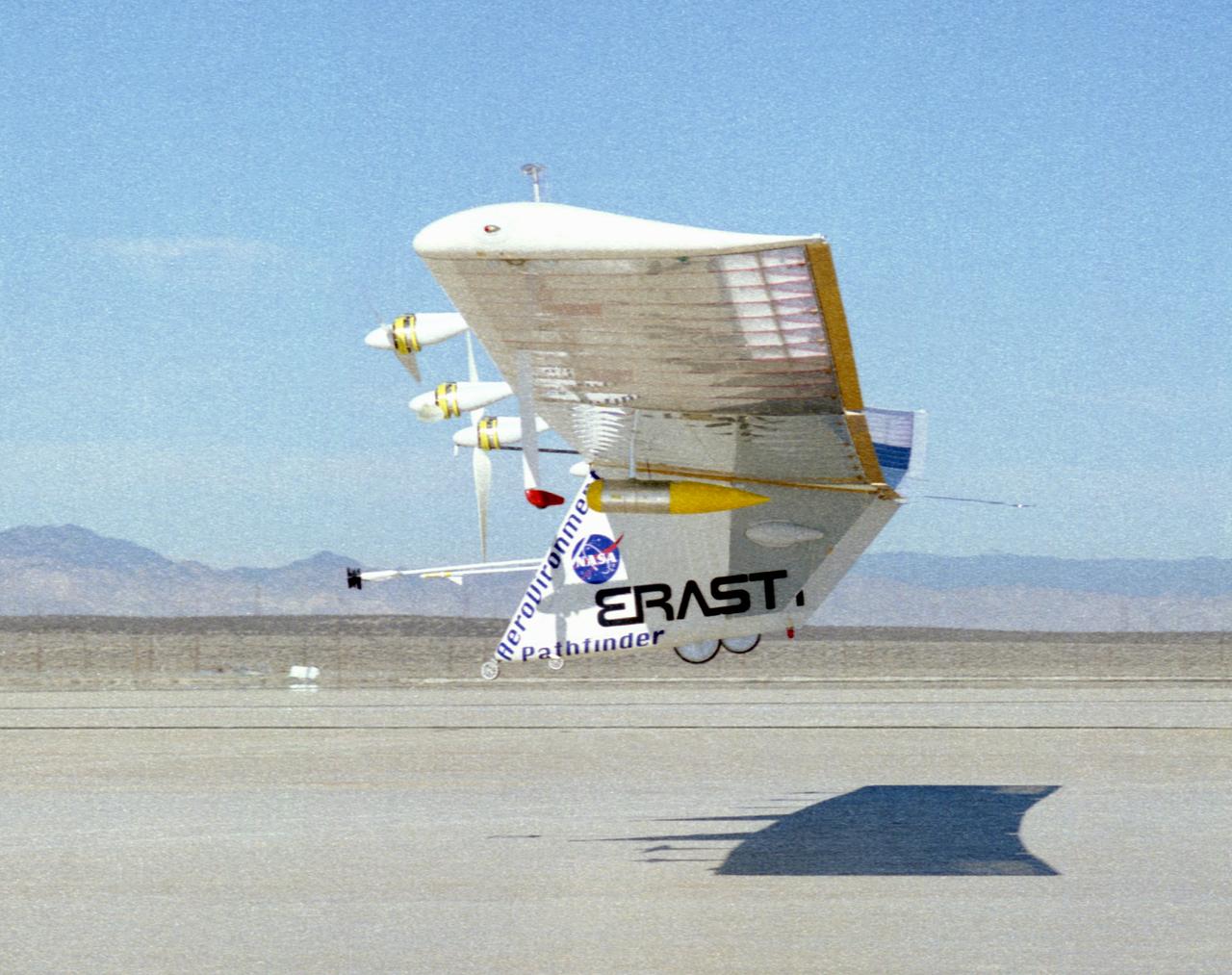
The Pathfinder solar-powered research aircraft heads for landing on the bed of Rogers Dry Lake at the Dryden Flight Research Center, Edwards, California, after a successful test flight Nov. 19, 1996.
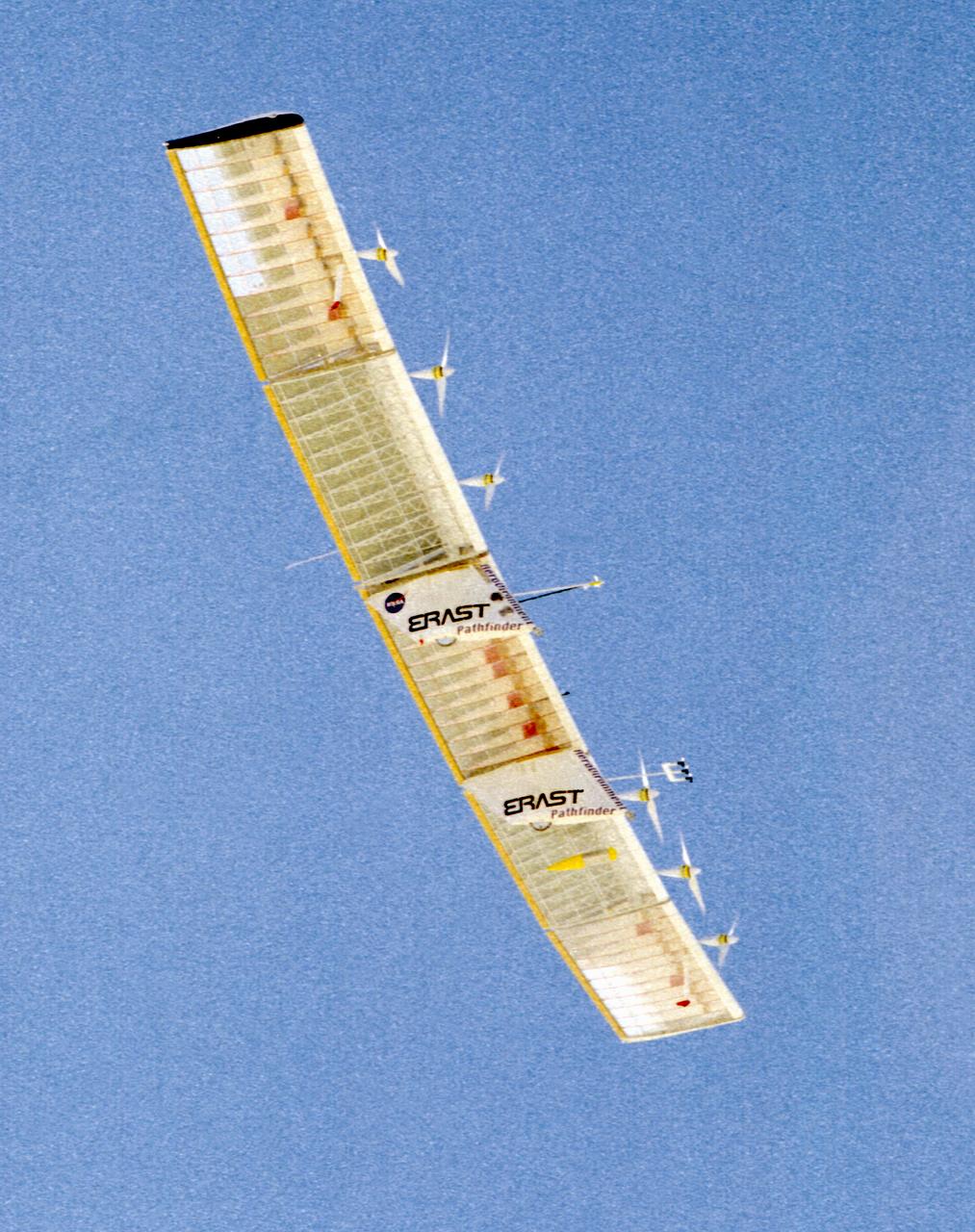
The Pathfinder research aircraft's wing structure is clearly defined as it soars under a clear blue sky during a test flight from Dryden Flight Research Center, Edwards, California, in November of 1996.
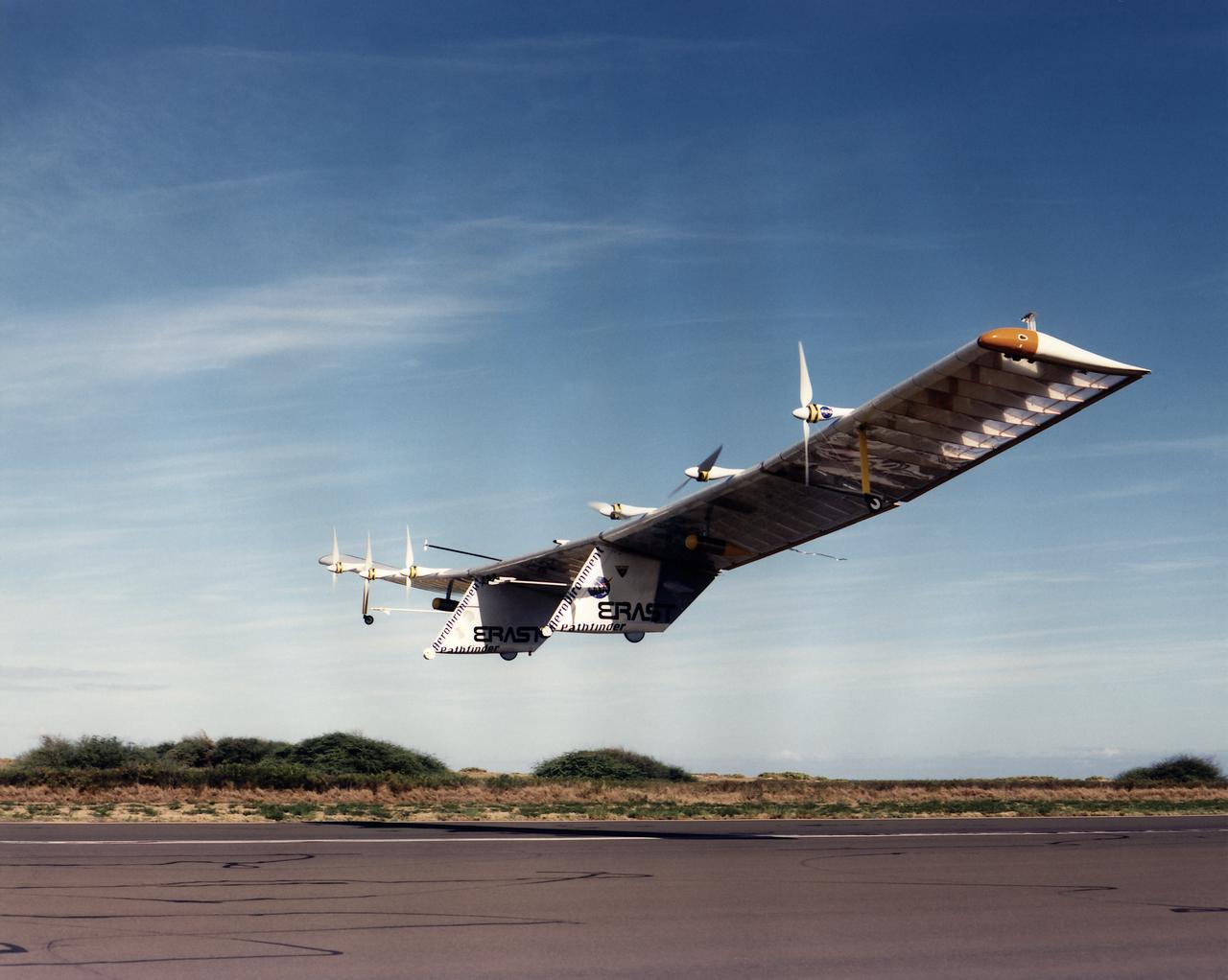
Pathfinder, NASA's solar-powered, remotely-piloted aircraft is shown while it was conducting a series of science flights to highlight the aircraft's science capabilities while collecting imagery of forest and coastal zone ecosystems on Kauai, Hawaii. The flights also tested two new scientific instruments, a high-spectral-resolution Digital Array Scanned Interferometer (DASI) and a high-spatial-resolution Airborne Real-Time Imaging System (ARTIS). The remote sensor payloads were designed by NASA's Ames Research Center, Moffett Field, California, to support NASA's Mission to Planet Earth science programs.
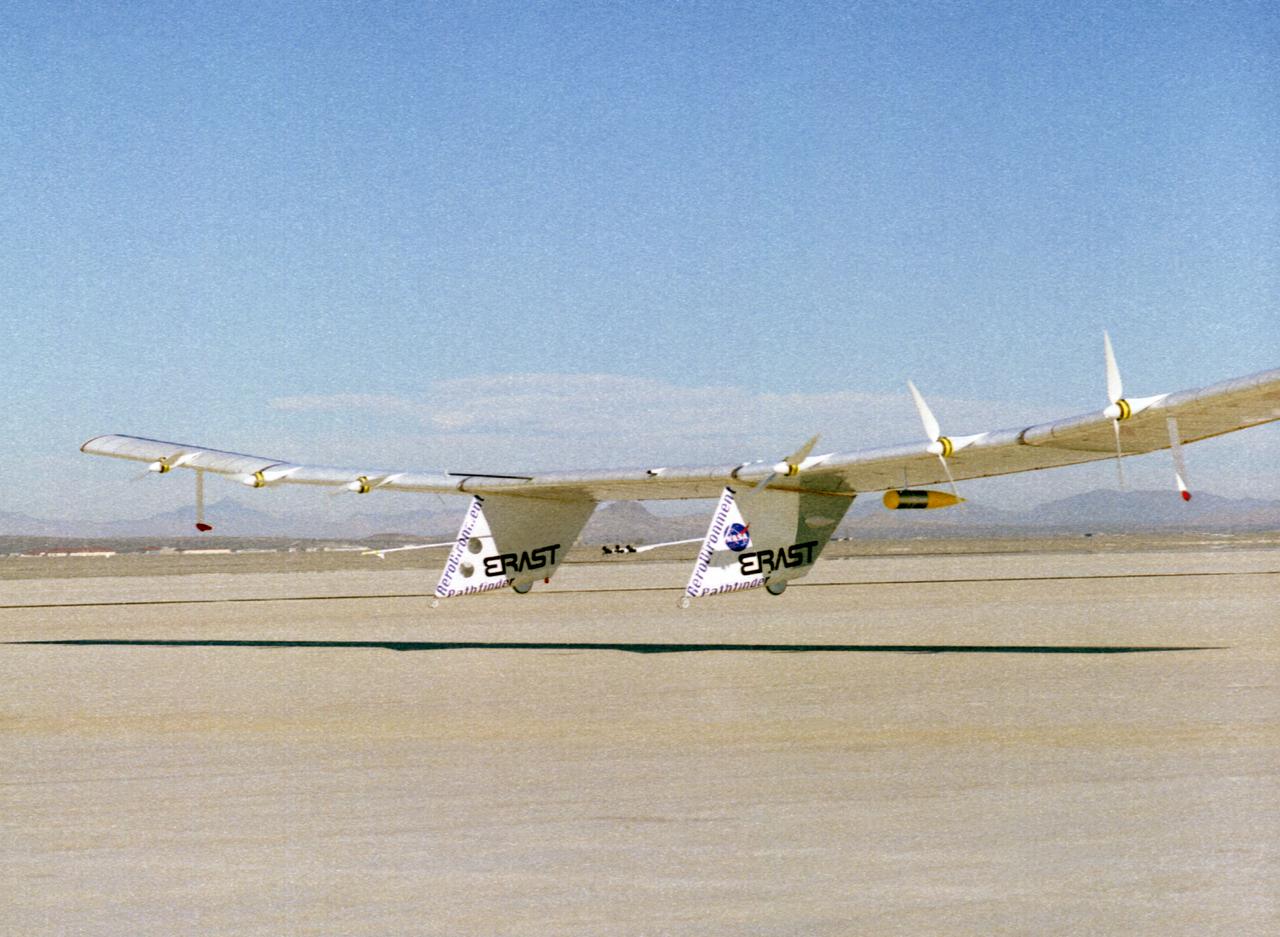
The Pathfinder solar-powered research aircraft settles in for landing on the bed of Rogers Dry Lake at the Dryden Flight Research Center, Edwards, California, after a successful test flight Nov. 19, 1996. The ultra-light craft flew a racetrack pattern at low altitudes over the flight test area for two hours while project engineers checked out various systems and sensors on the uninhabited aircraft. The Pathfinder was controlled by two pilots, one in a mobile control unit which followed the craft, the other in a stationary control station. Pathfinder, developed by AeroVironment, Inc., is one of several designs being evaluated under NASA's Environmental Research Aircraft and Sensor Technology (ERAST) program.
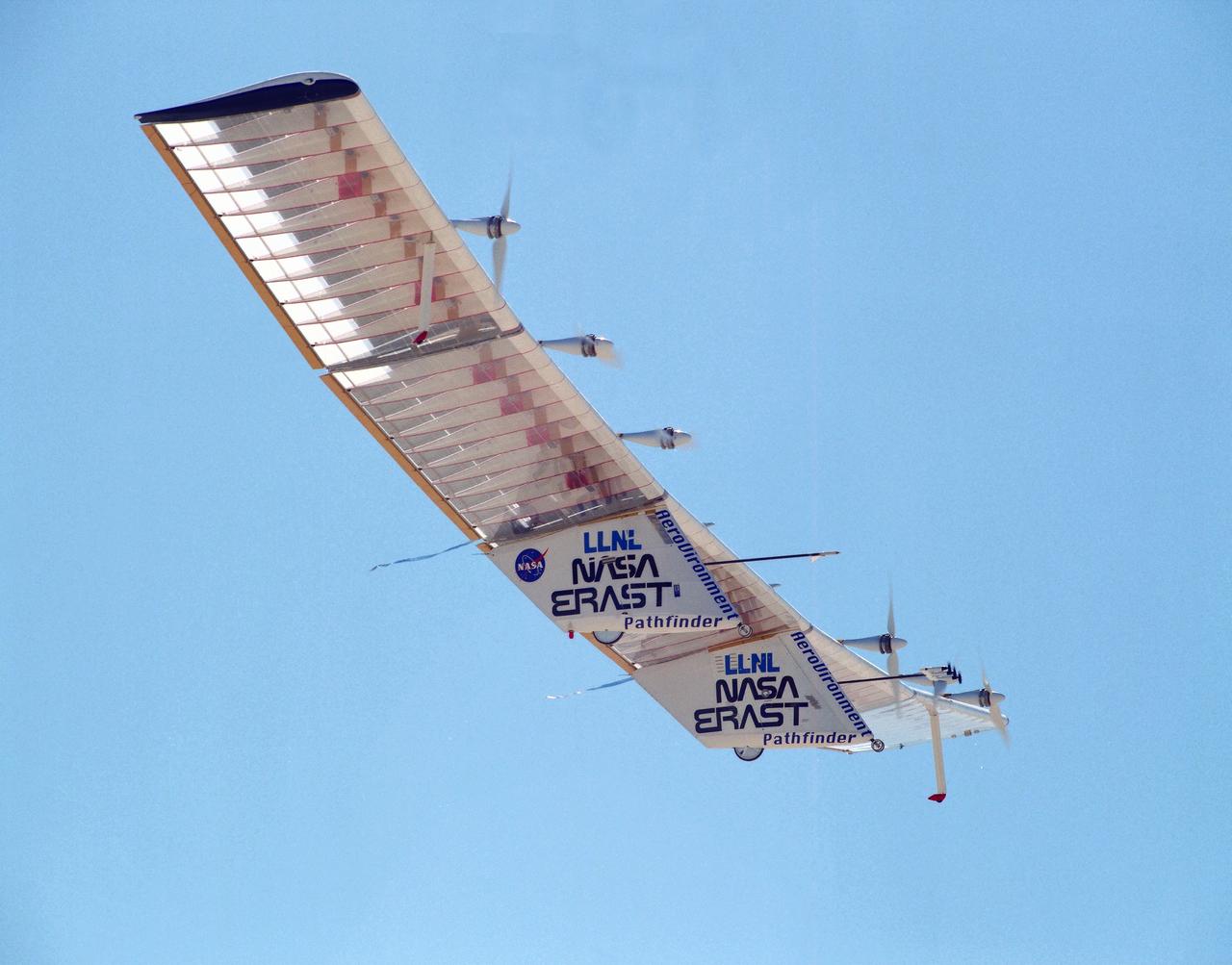
The Pathfinder research aircraft's wing structure was clearly defined as it soared under a clear blue sky during a test flight July 27, 1995, from Dryden Flight Research Center, Edwards, California. The center section and outer wing panels of the aircraft had ribs constructed of thin plastic foam, while the ribs in the inner wing panels are fabricated from lightweight composite material. Developed by AeroVironment, Inc., the Pathfinder was one of several unmanned aircraft being evaluated under NASA's Environmental Research Aircraft and Sensor Technology (ERAST) program.
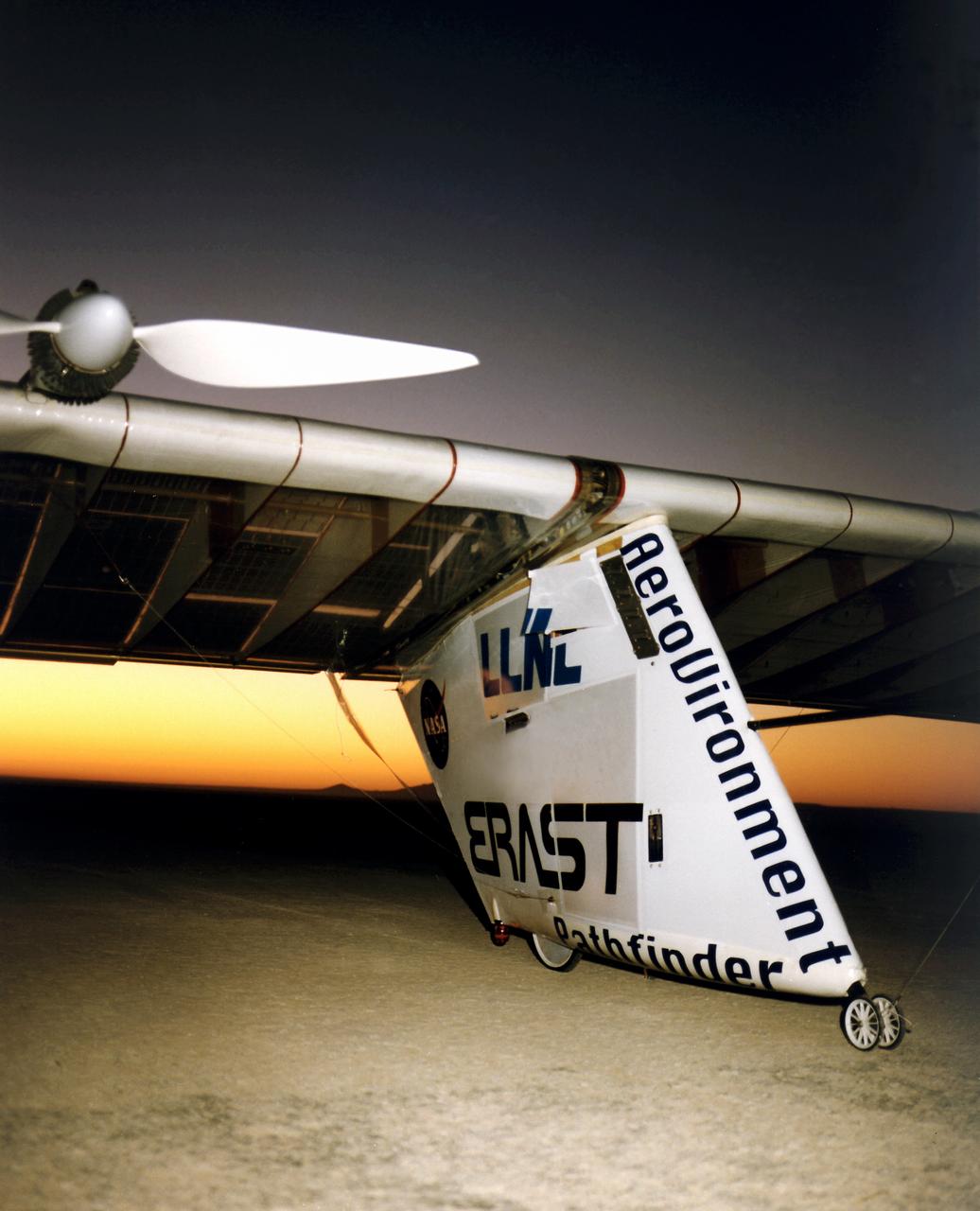
The Pathfinder solar-powered aircraft sits on Rogers Dry Lake at NASA's Dryden Flight Research Center, Edwards, California, before a research flight.
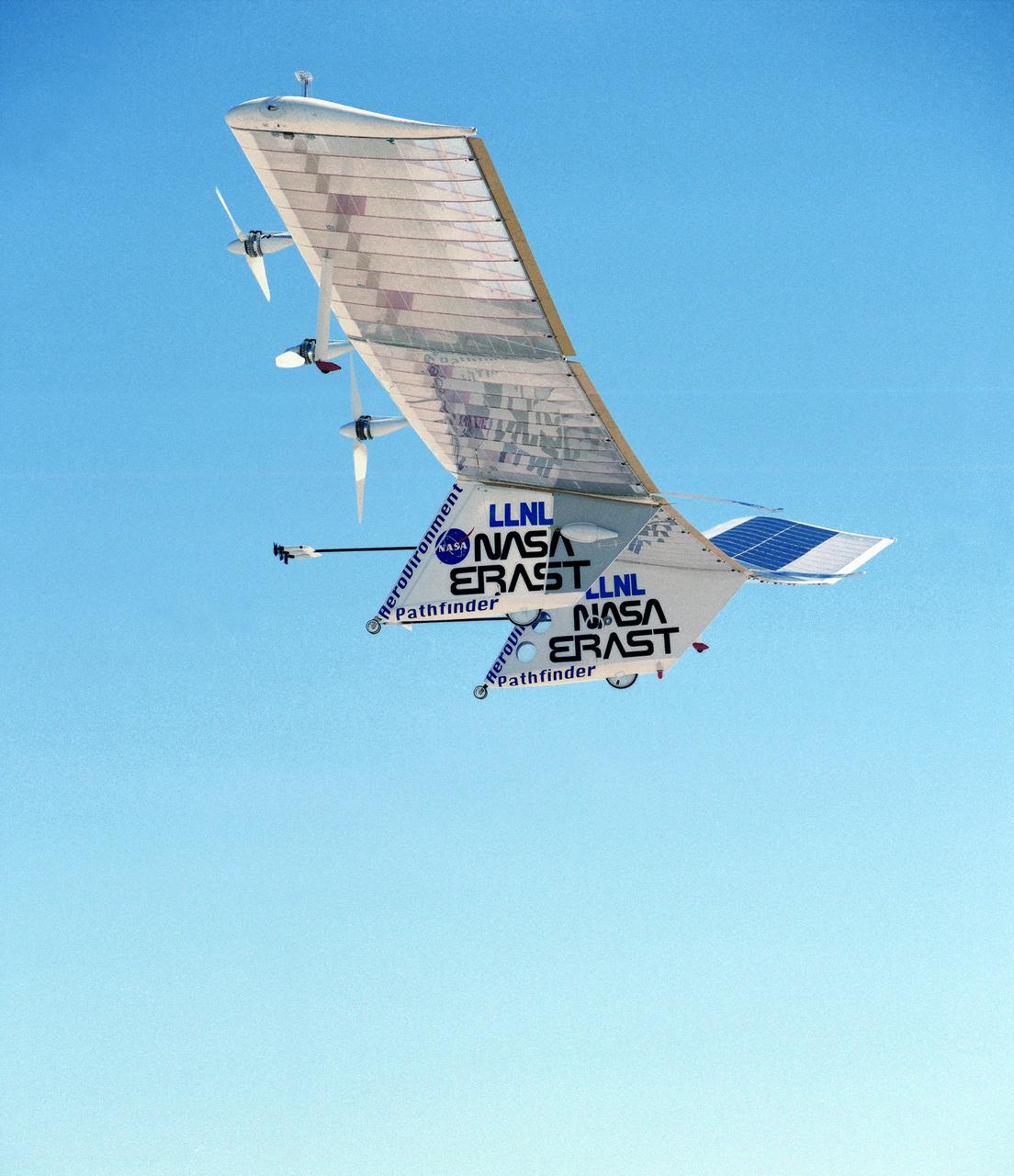
The Pathfinder solar-powered remotely piloted aircraft climbs to a record-setting altitude of 50,567 feet during a flight Sept. 11, 1995, at NASA's Dryden Flight Research Center, Edwards, California.
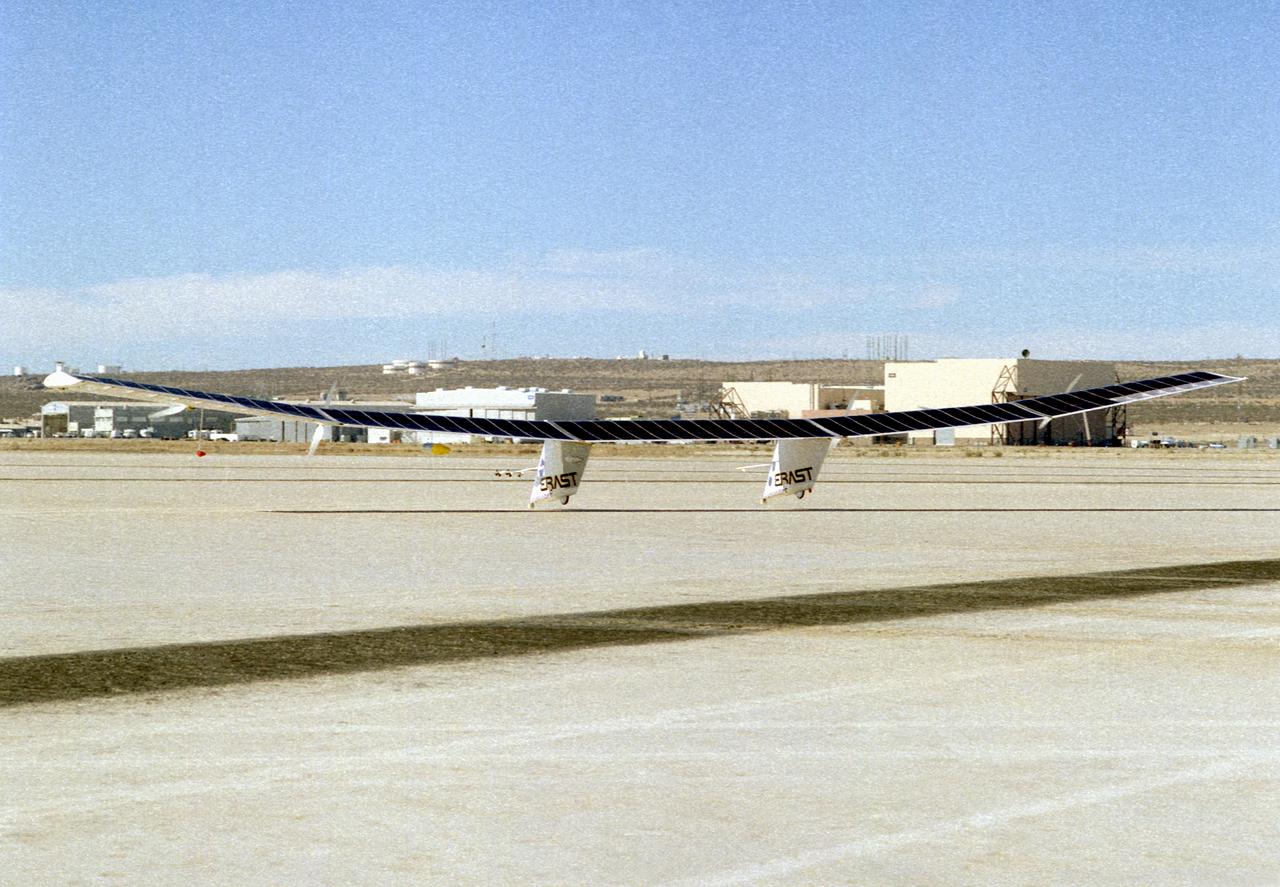
The Pathfinder research aircraft's solar cell arrays are prominently displayed as it touches down on the bed of Rogers Dry Lake at the Dryden Flight Research Center, Edwards, California, following a test flight. The solar arrays covered more than 75 percent of Pathfinder's upper wing surface, and provided electricity to power its six electric motors, flight controls, communications links and a host of scientific sensors.
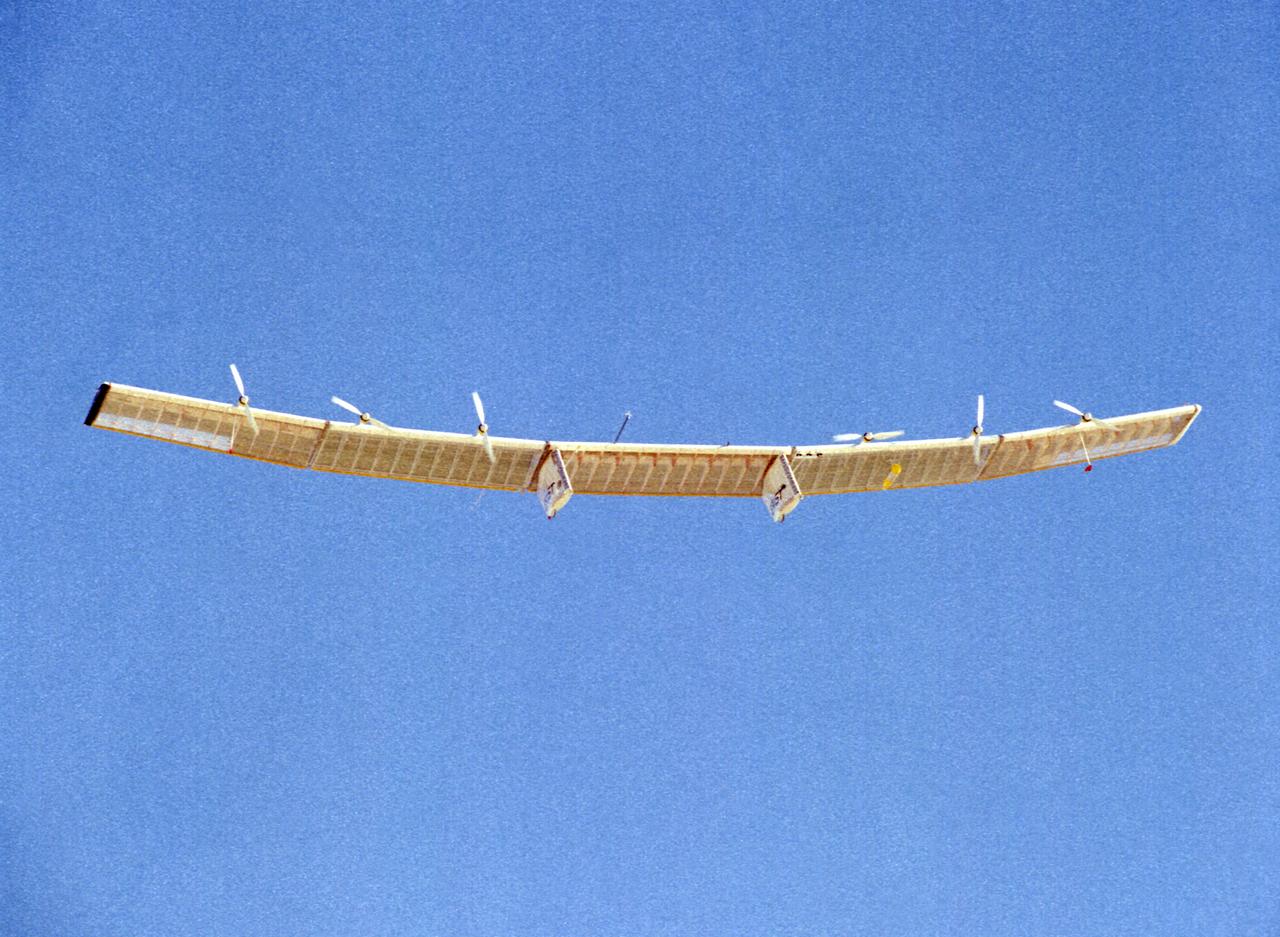
The Pathfinder solar-powered research aircraft is silhouetted against a clear blue sky as it soars aloft during a checkout flight from the Dryden Flight Research Center, Edwards, California, November, 1996.
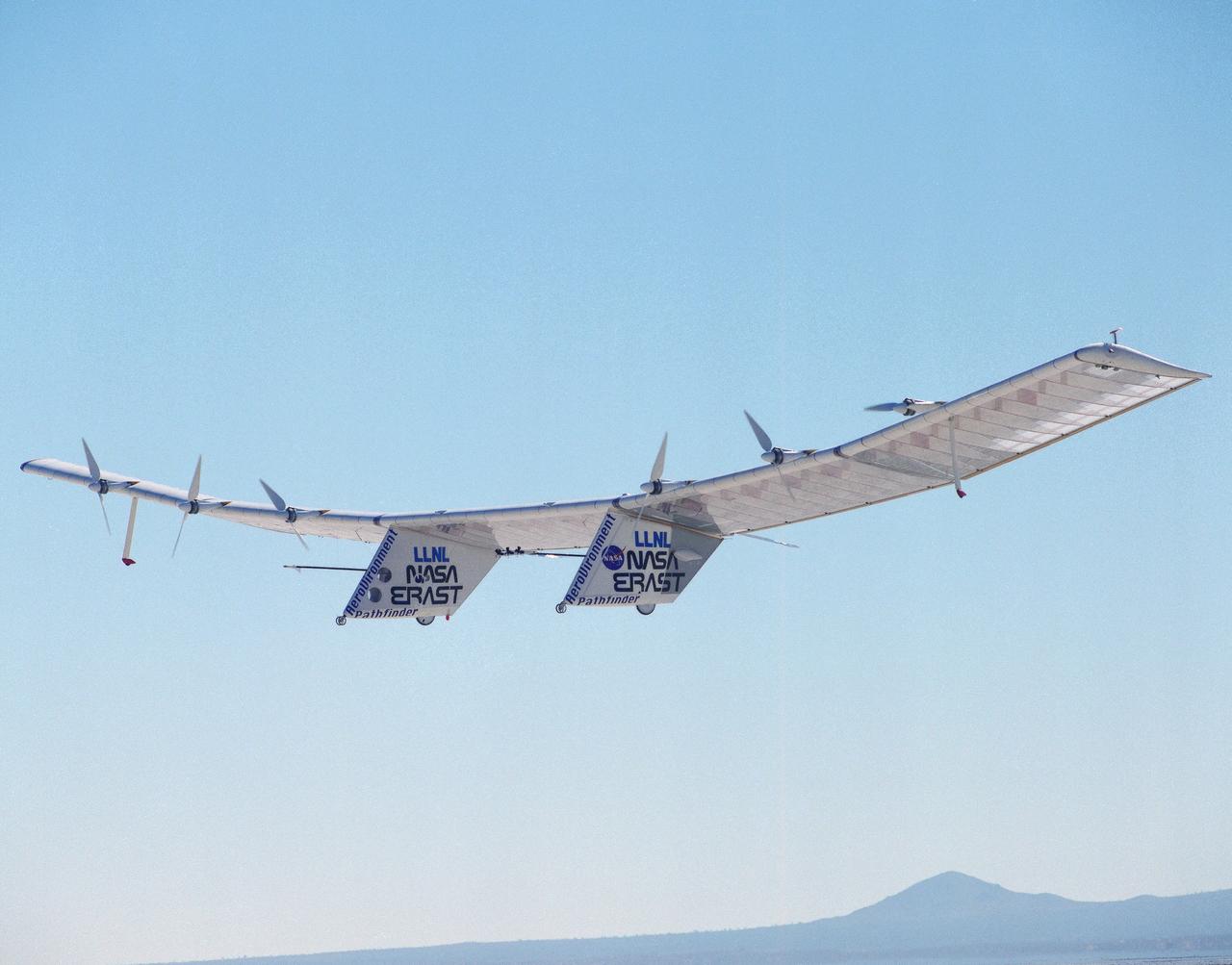
The Pathfinder solar-powered remotely piloted aircraft climbs to a record-setting altitude of 50,567 feet during a flight Sept. 11, 1995, at NASA's Dryden Flight Research Center, Edwards, California. The flight was part of the NASA ERAST (Environmental Research Aircraft and Sensor Technology) program. The Pathfinder was designed and built by AeroVironment Inc., Monrovia, California. Solar arrays cover nearly all of the upper wing surface and produce electricity to power the aircraft's six motors.
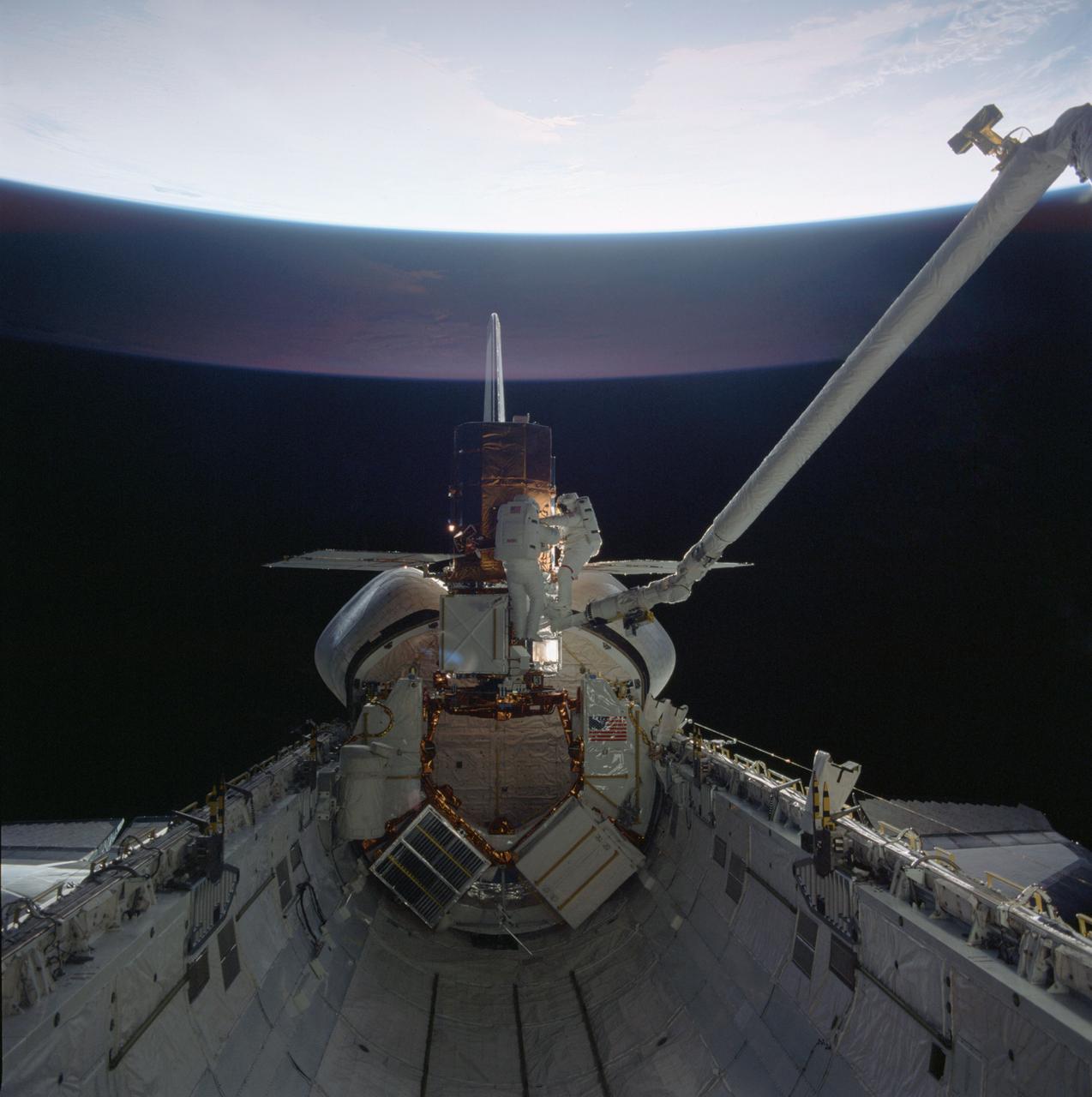
41C-37-1711 (11 April 1984) --- The two mission specialist-EVA participants of Flight 41-C share a repair task at the "captured" Solar Maximum Mission Satellite (SMMS) in the aft end of the Challenger's cargo bay. Astronauts George D. Nelson, right, and James D. van Hoften uses the mobile foot restraint and the Remote Manipulator System (RMS) as a "cherry picker" device for moving about. Later, the RMS lifted the SMMS into space once more.
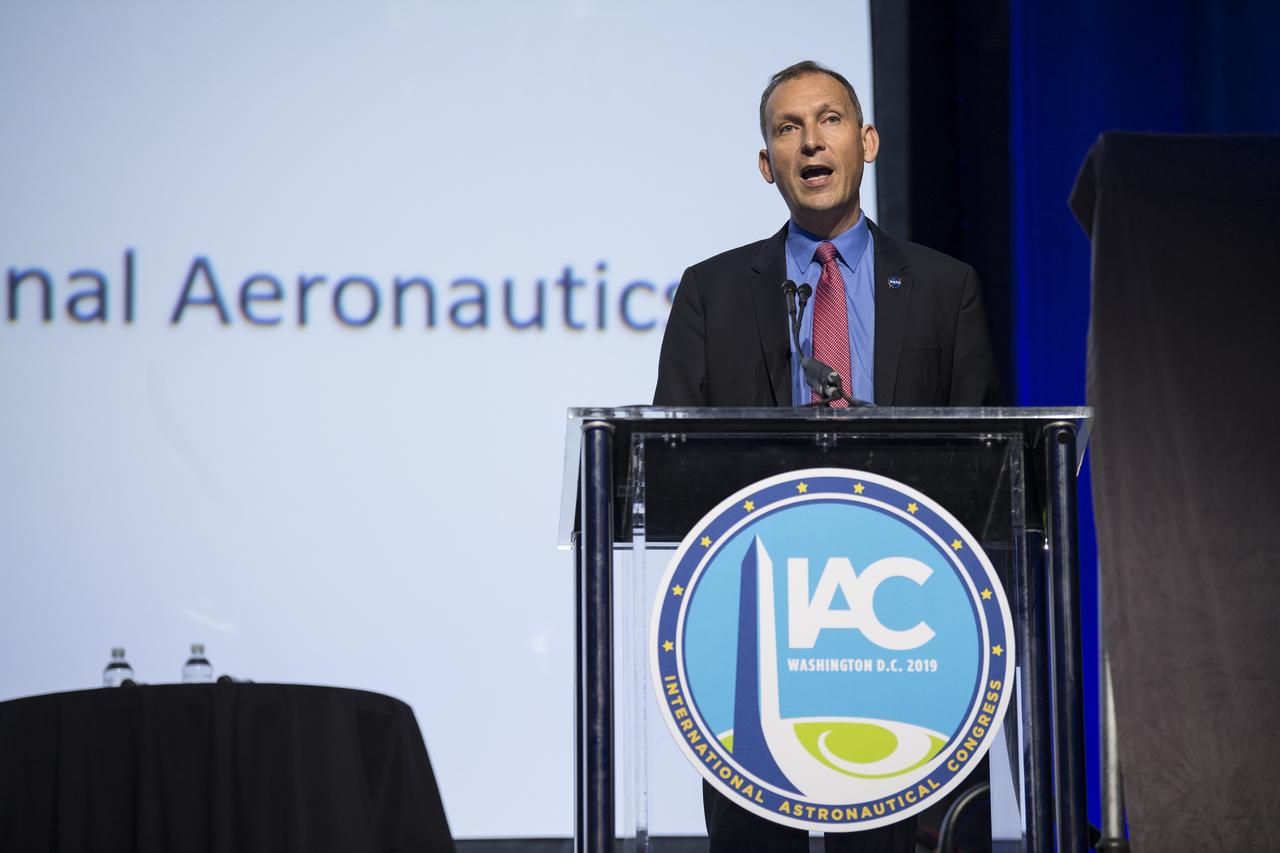
NASA Associate Administrator, Science Mission Directorate, Thomas Zurbuchen, introduces Nicola Fox, director of the Heliophysics division for the Science Mission Directorate, to give a presentation titled, “The Challenge of Exploring Our Sun - the 60-Year Odyssey to Parker Solar Probe,” during the 70th International Astronautical Congress, Wednesday, Oct. 23, 2019, at the Walter E. Washington Convention Center in Washington. Photo credit: (NASA/Aubrey Gemignani)
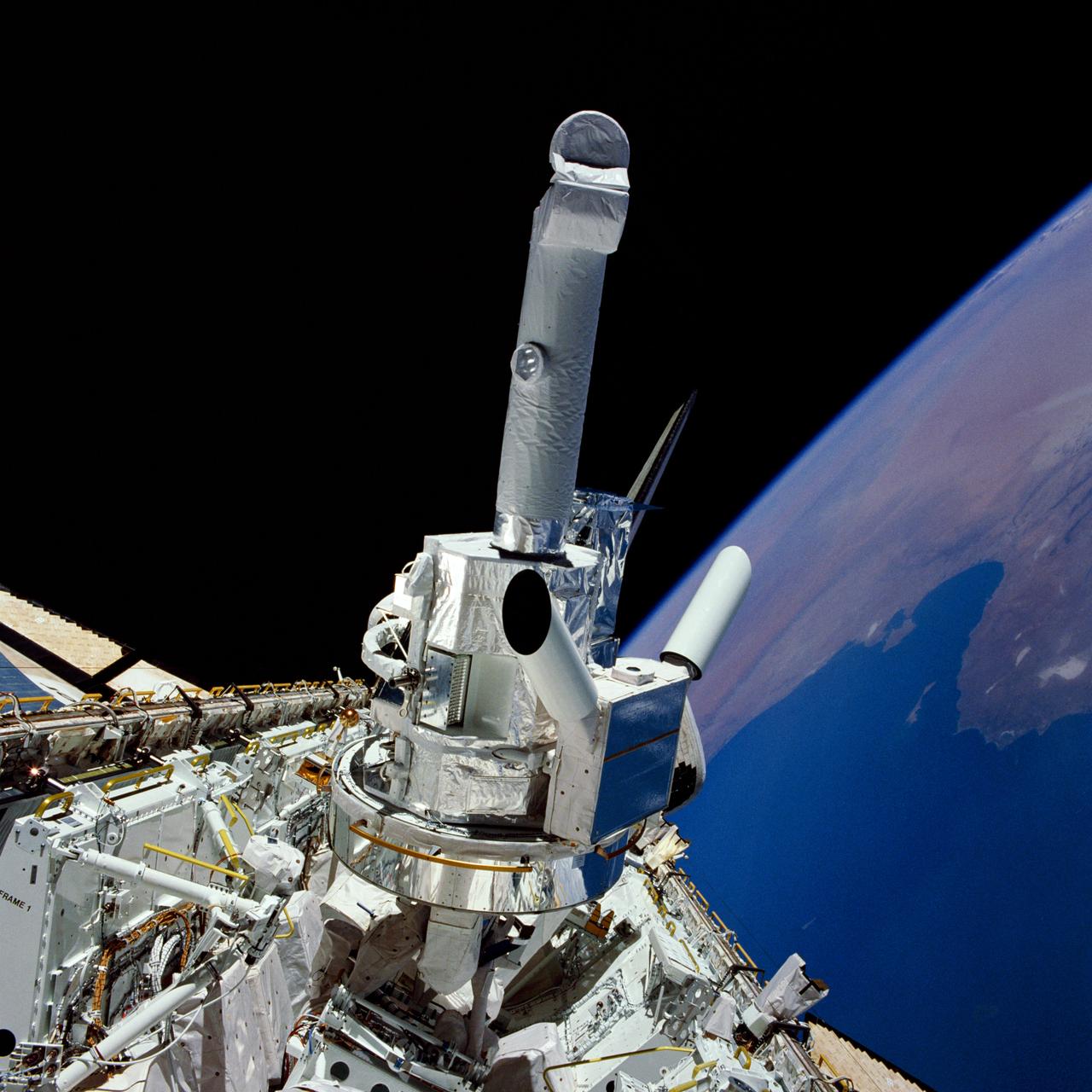
51F-33-005 (29 July - 6 August 1985) --- Experiments and the instrument pointing system (IPS) for Spacelab 2 are backdropped against the Libya/Tunisia Mediterranean coast and black space in this 70mm view photographed through the aft flight deck windows of the Space Shuttle Challenger. Also partially visible among the cluster of Spacelab 2 hardware are the solar optical universal polarimeter (SOUP) experiment and the coronal helium abundance experiment (CHASE).
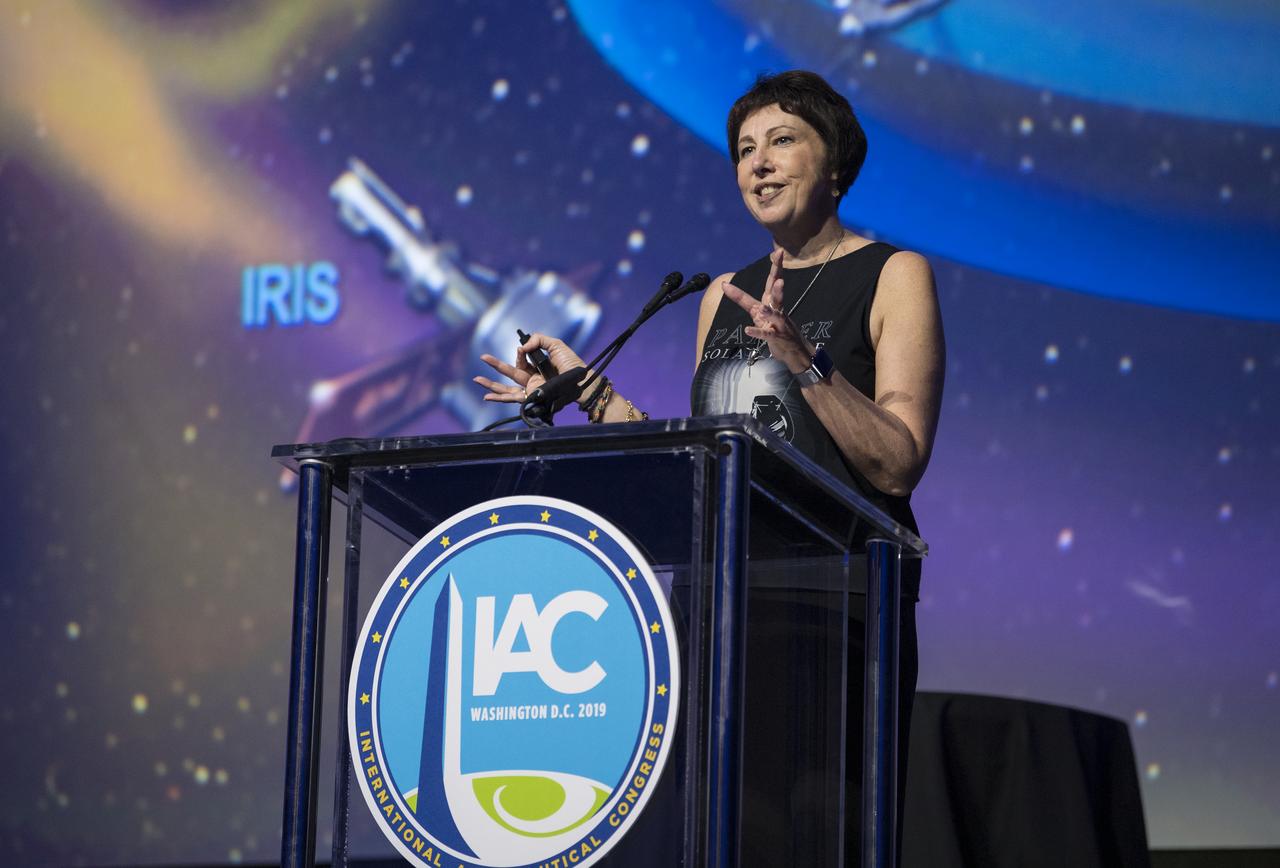
NASA director of Heliophysics division, Science Mission Directorate, Nicola Fox, speaks at a presentation titled, “The Challenge of Exploring Our Sun - the 60-Year Odyssey to Parker Solar Probe,” during the 70th International Astronautical Congress, Wednesday, Oct. 23, 2019, at the Walter E. Washington Convention Center in Washington. Photo credit: (NASA/Aubrey Gemignani)

NASA director of Heliophysics division, Science Mission Directorate, Nicola Fox, speaks at a presentation titled, “The Challenge of Exploring Our Sun - the 60-Year Odyssey to Parker Solar Probe,” during the 70th International Astronautical Congress, Wednesday, Oct. 23, 2019, at the Walter E. Washington Convention Center in Washington. Photo credit: (NASA/Aubrey Gemignani)
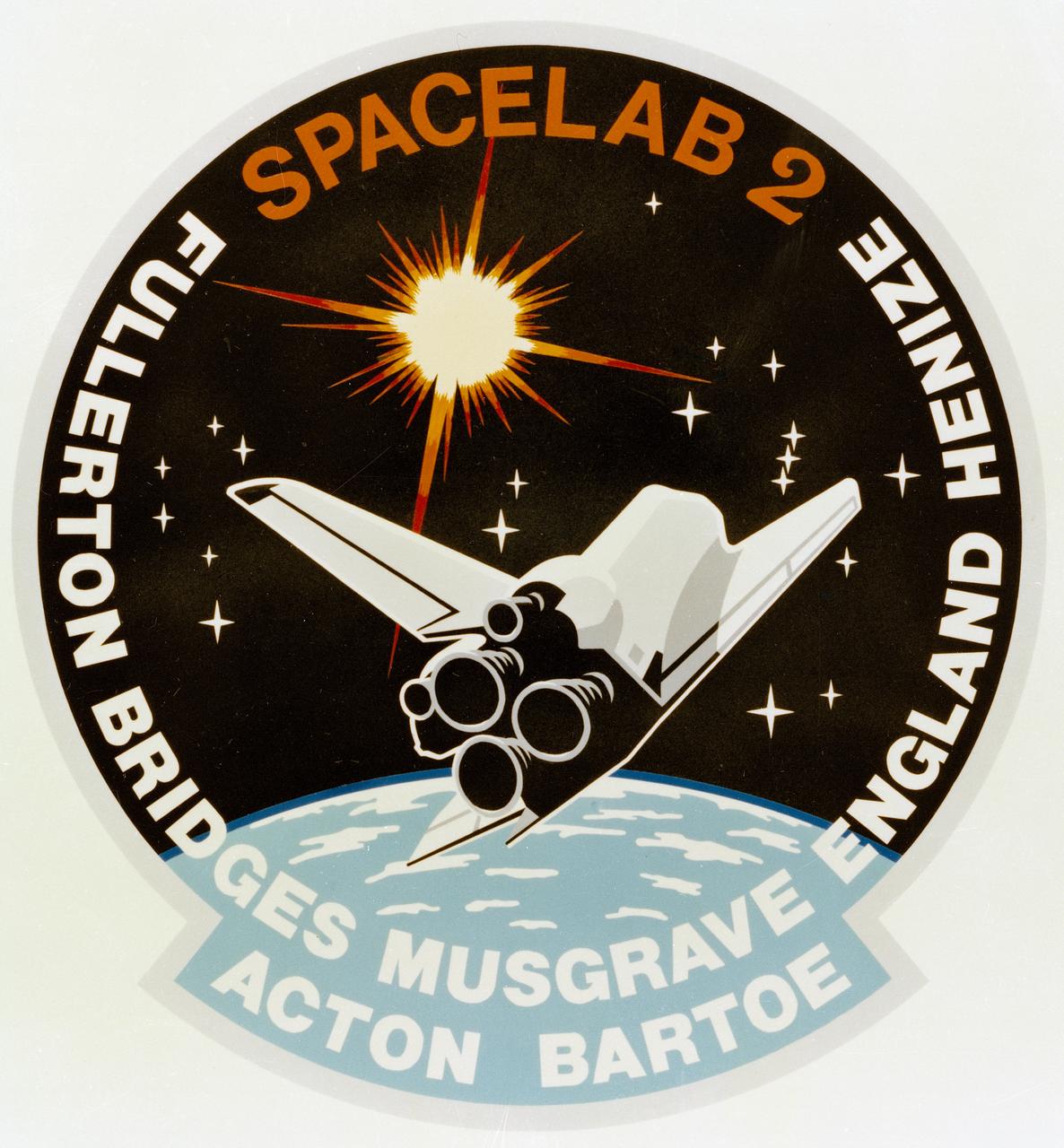
The crewmembers of Space Shuttle mission 51-F have chosen as their insignia this design by Houston artist Skip Bradley. The Space Shuttle Challenger is depicted ascending toward the heavens in search of new knowledge in the field of solar and steallar astronomy, with its Spacelab 2 payload. The constellations Leo and Orion are in the positions they will be in, relative to the sun during the flight. The nineteen stars signify that this will be the 19th STS flight.
41C-22-885 (8 April 1984) --- The 35mm camera was used to photograph this scene of Astronaut George D. Nelson, STS-41C mission specialist, as he uses the manned maneuvering unit (MMU) to make an excursion to the plagued Solar Maximum, Mission Satellite (SMMS)._Astronaut James D. van Hoften remained in the Challenger's cargo bay during the April 8 extravehicular activity (EVA).

NASA director of Heliophysics division, Science Mission Directorate, Nicola Fox, speaks at a presentation titled, “The Challenge of Exploring Our Sun - the 60-Year Odyssey to Parker Solar Probe,” during the 70th International Astronautical Congress, Wednesday, Oct. 23, 2019, at the Walter E. Washington Convention Center in Washington. Photo credit: (NASA/Aubrey Gemignani)
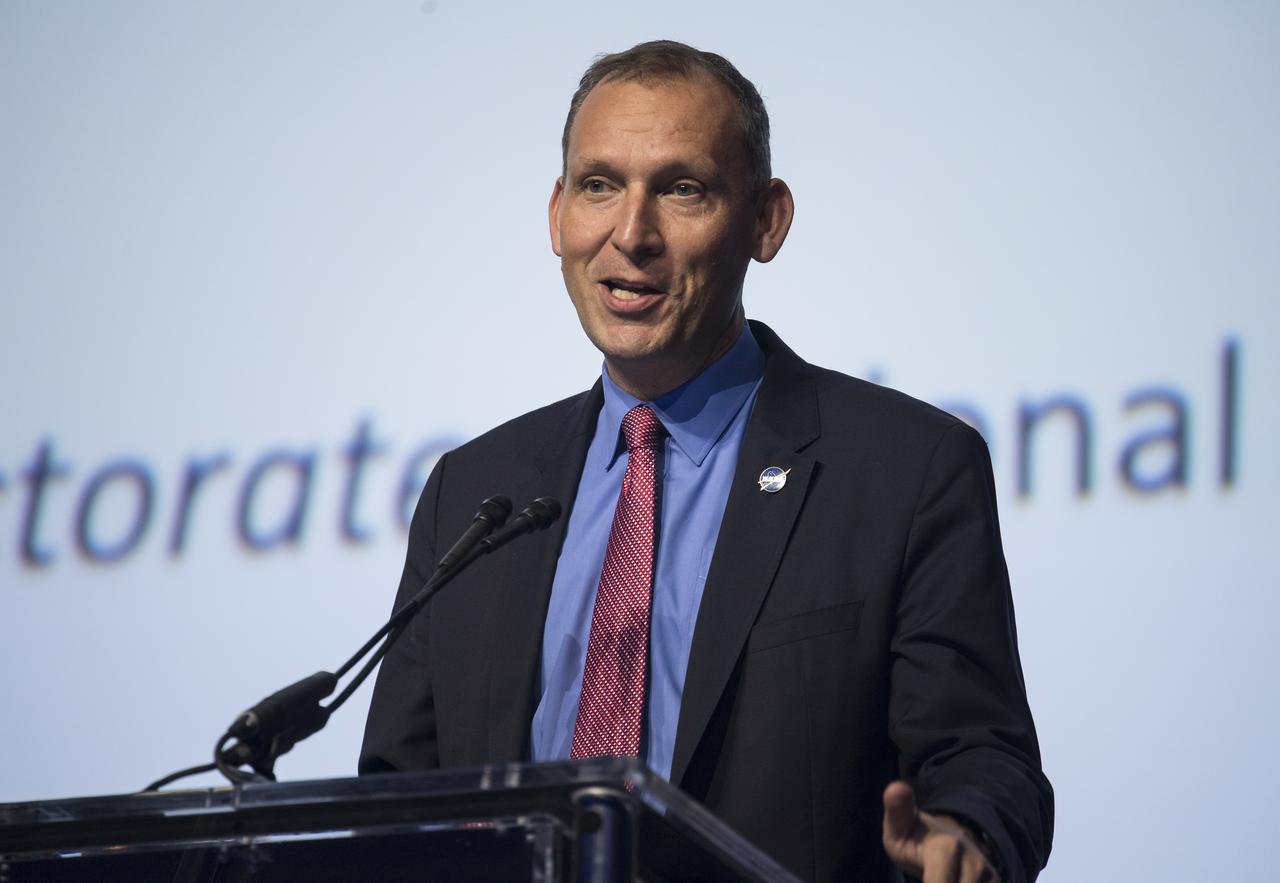
NASA Associate Administrator, Science Mission Directorate, Thomas Zurbuchen, introduces Nicola Fox, director of the Heliophysics division for the Science Mission Directorate, to give a presentation titled, “The Challenge of Exploring Our Sun - the 60-Year Odyssey to Parker Solar Probe,” during the 70th International Astronautical Congress, Wednesday, Oct. 23, 2019, at the Walter E. Washington Convention Center in Washington. Photo credit: (NASA/Aubrey Gemignani)
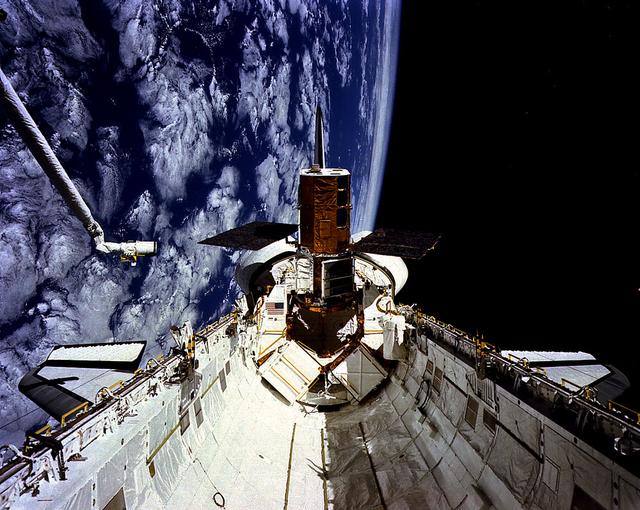
Space Shuttle mission STS-41C onboard view of the revived Solar Maximum Mission Satellite (SMMS). As part of the mission the crew demonstrated the capability of the shuttle to rendezvous, service, check-out and deploy an on-orbit satellite. Also as part of the redeployment, the SMMS was fitted with a Long Duration Exposure Facility (LDEF), which provides accommodations for experiments requiring long-term exposure to the space environment. the STS-41C mission was launched aboard the Space Shuttle Orbitor Challenger on April 6, 1984.
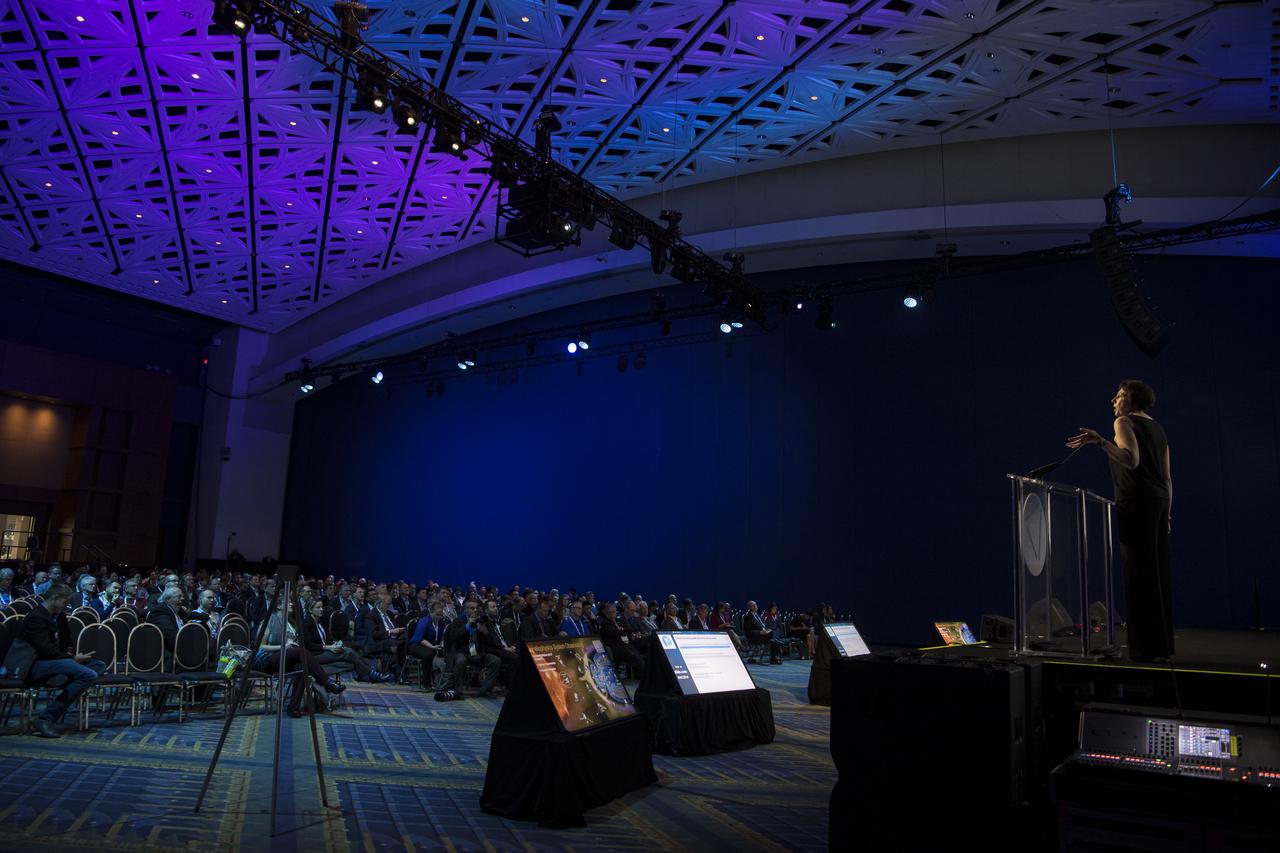
NASA director of Heliophysics division, Science Mission Directorate, Nicola Fox, speaks at a presentation titled, “The Challenge of Exploring Our Sun - the 60-Year Odyssey to Parker Solar Probe,” during the 70th International Astronautical Congress, Wednesday, Oct. 23, 2019, at the Walter E. Washington Convention Center in Washington. Photo credit: (NASA/Aubrey Gemignani)
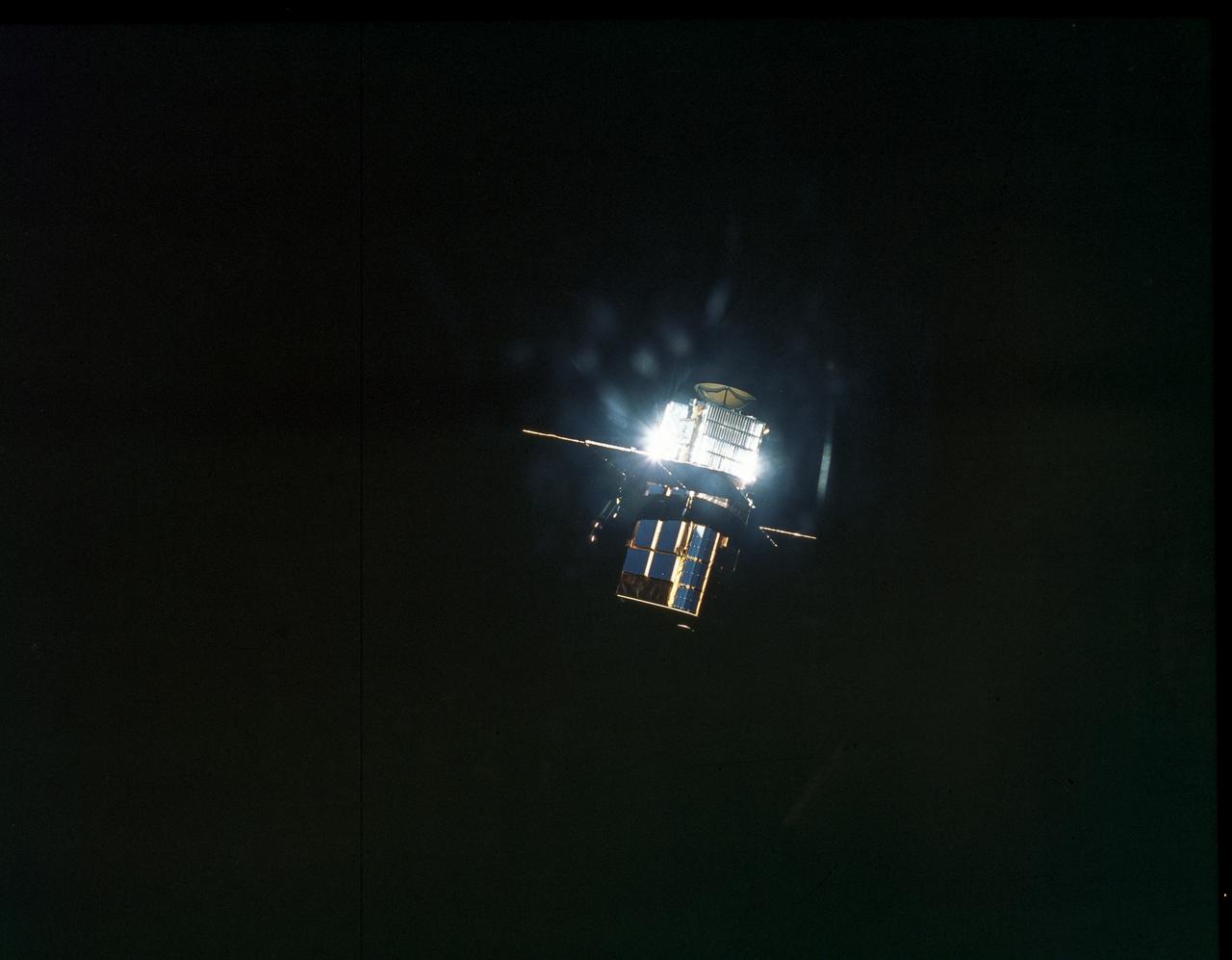
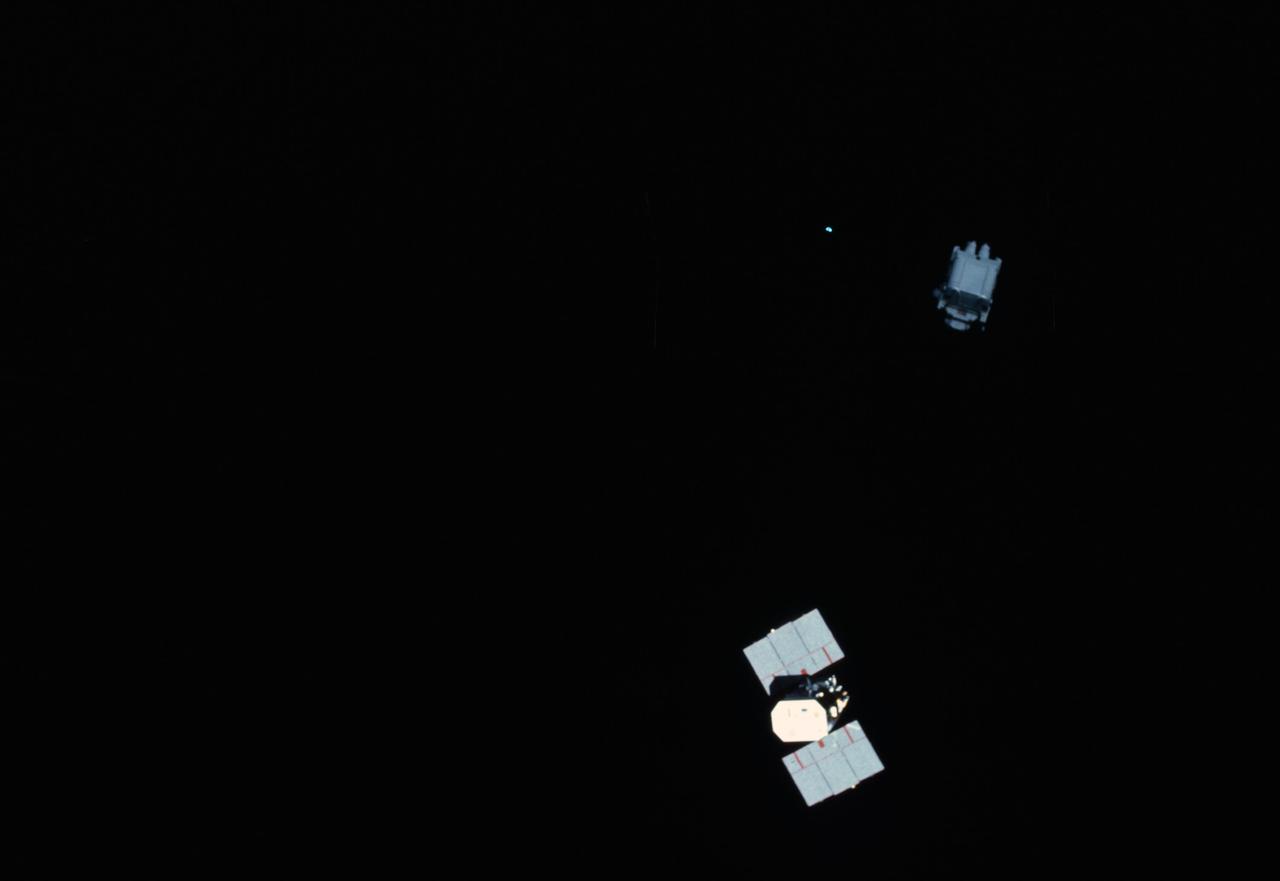
This is a photograph of the free-flying Solar Maximum Mission Satellite (SMMS), or Solar Max, as seen by the approaching Space Shuttle Orbiter Challenger STS-41C mission. Launched April 6, 1984, one of the goals of the STS-41C mission was to repair the damaged Solar Max. The original plan was to make an excursion out to the SMMS for capture to make necessary repairs, however, this attempted feat was unsuccessful. It was necessary to capture the satellite via the orbiter's Remote Manipulator System (RMS) and secure it into the cargo bay in order to perform the repairs, which included replacing the altitude control system and the coronograph/polarimeter electronics box. The SMMS was originally launched into space via the Delta Rocket in February 1980, with the purpose to provide a means of studying solar flares during the most active part of the current sunspot cycle. Dr. Einar Tandberg-Hanssen of Marshall Space Flight Center's Space Sciences Lab was principal investigator for the Ultraviolet Spectrometer and Polarimeter, one of the seven experiments on the Solar Max.
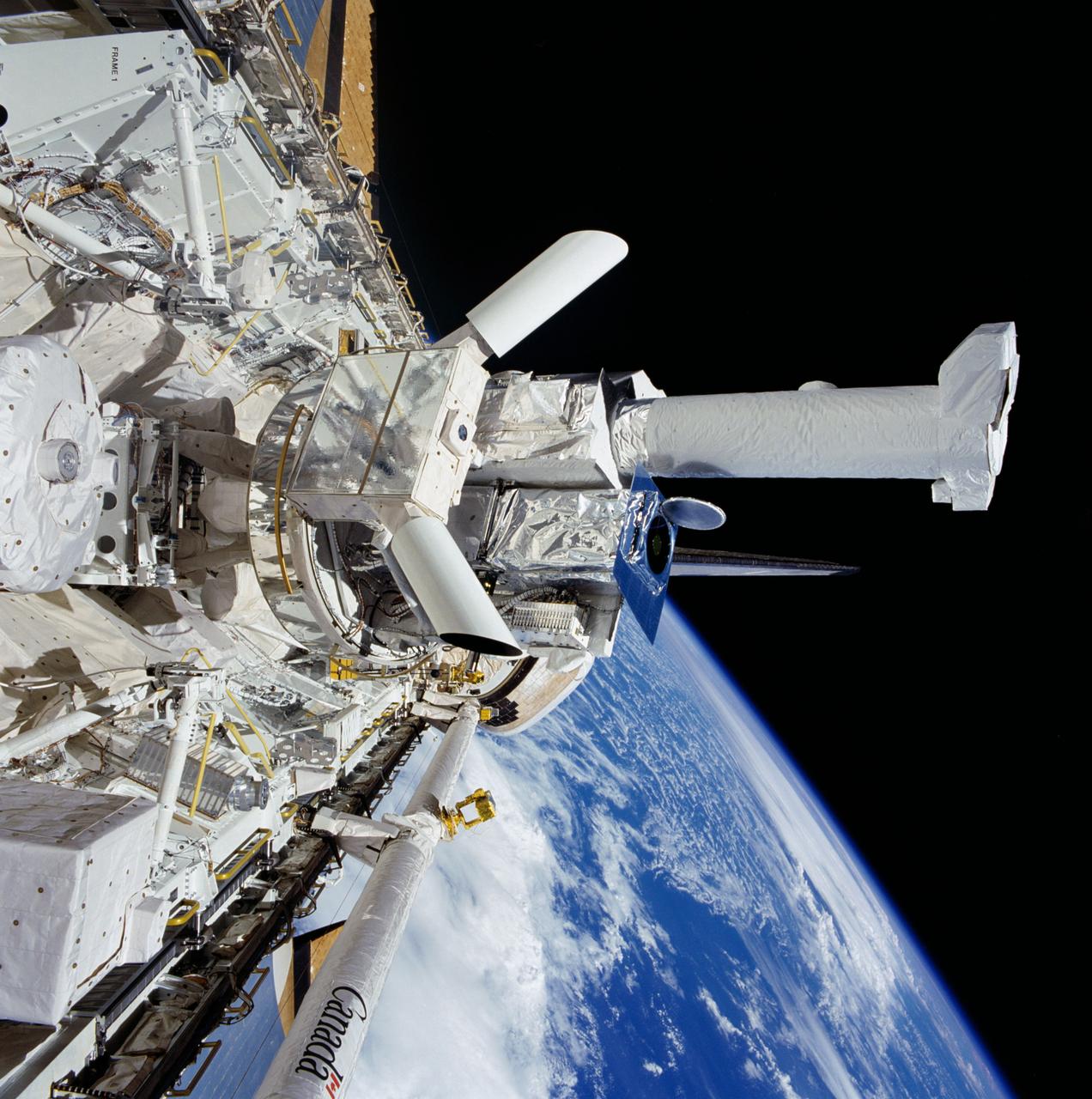
51F-42-069 (29 July-6 Aug 1985) --- The solar optical universal polarimeter (SOUP) experiment is visible among the cluster of Spacelab 2 hardware in the cargo bay of the Earth-orbiting Space Shuttle Challenger, backdropped against a curtain of white clouds over ocean waters. Various components of the instrument positioning system (IPS) are conspicuous at the center of the frame. Now resting, the remote manipulator system (RMS) was used at various points during the mission with the plasma diagnostics package (PDP) and as a support service structure for television cameras covering various activities of the busy science-oriented Spacelab 2 mission.
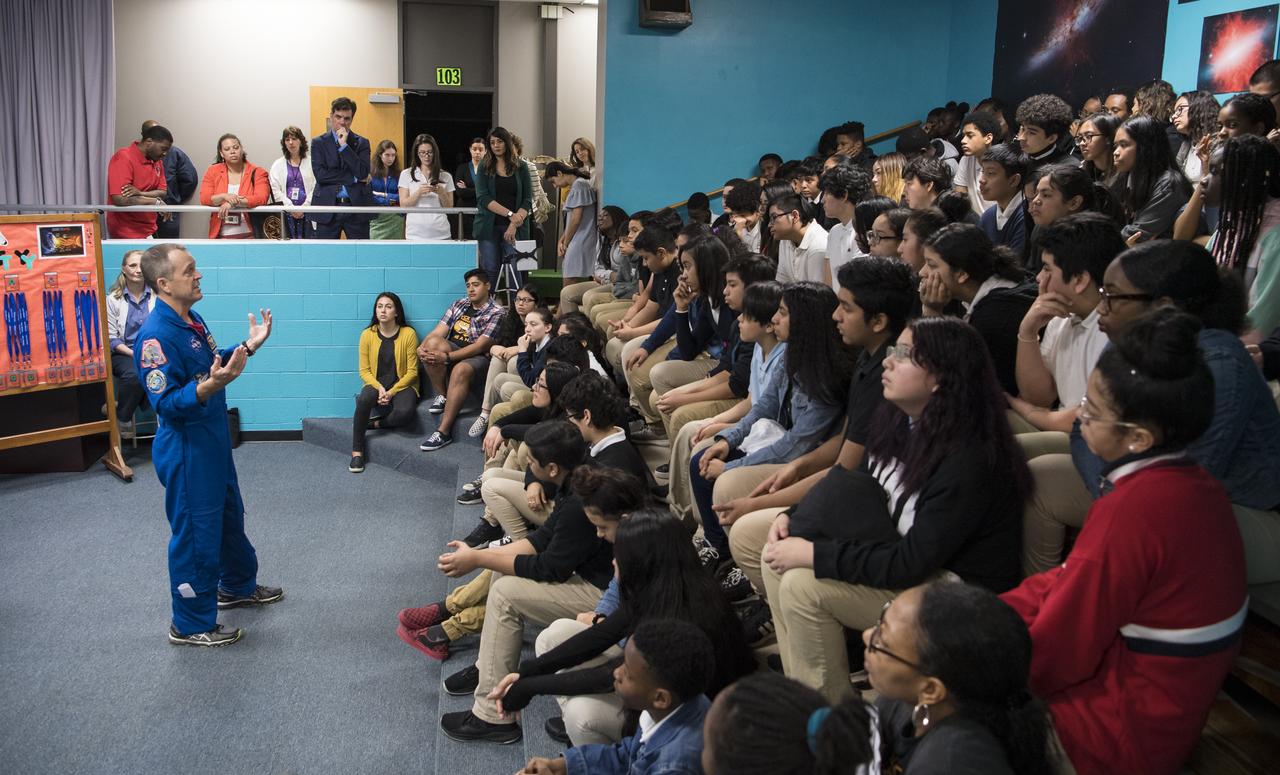
NASA astronaut Ricky Arnold speaks about his time onboard the International Space Station (ISS) during Expeditions 55 and 56, Friday, May 3, 2019 at the Challenger Center in Lanham, MD. During Expedition 55/56, Arnold completed three spacewalks for a total of 19.5 hours outside the space station, and concluded his 197 day mission when he landed in a remote area near the town of Zhezkazgan, Kazakhstan in Oct. 2018. He also flew to the space station on shuttle mission STS-119 to deliver the final pair of power-generating solar array wings. Photo Credit: (NASA/Aubrey Gemignani)
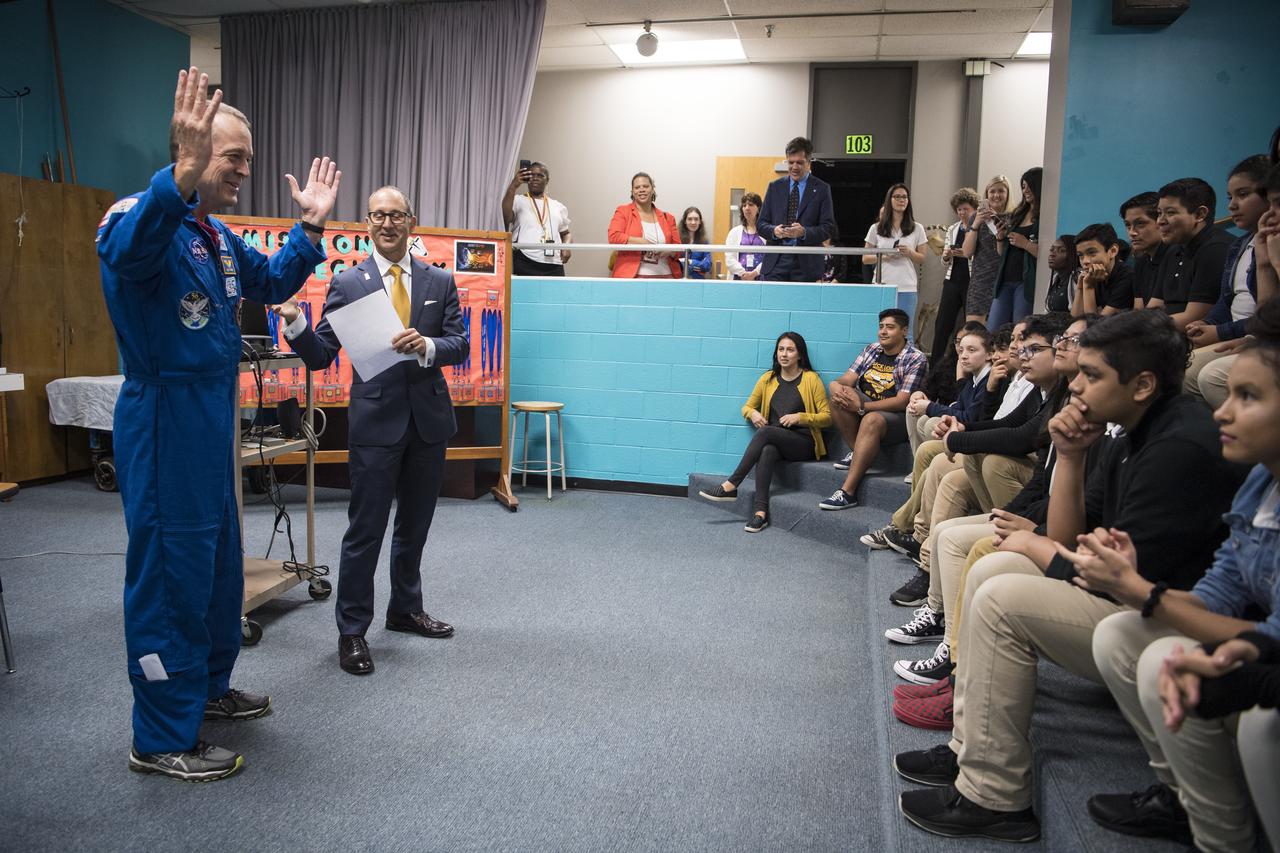
NASA astronaut Ricky Arnold is introduced to speak about his time onboard the International Space Station (ISS) during Expeditions 55 and 56, Friday, May 3, 2019 at the Challenger Center in Lanham, MD. During Expedition 55/56, Arnold completed three spacewalks for a total of 19.5 hours outside the space station, and concluded his 197 day mission when he landed in a remote area near the town of Zhezkazgan, Kazakhstan in Oct. 2018. He also flew to the space station on shuttle mission STS-119 to deliver the final pair of power-generating solar array wings. Photo Credit: (NASA/Aubrey Gemignani)
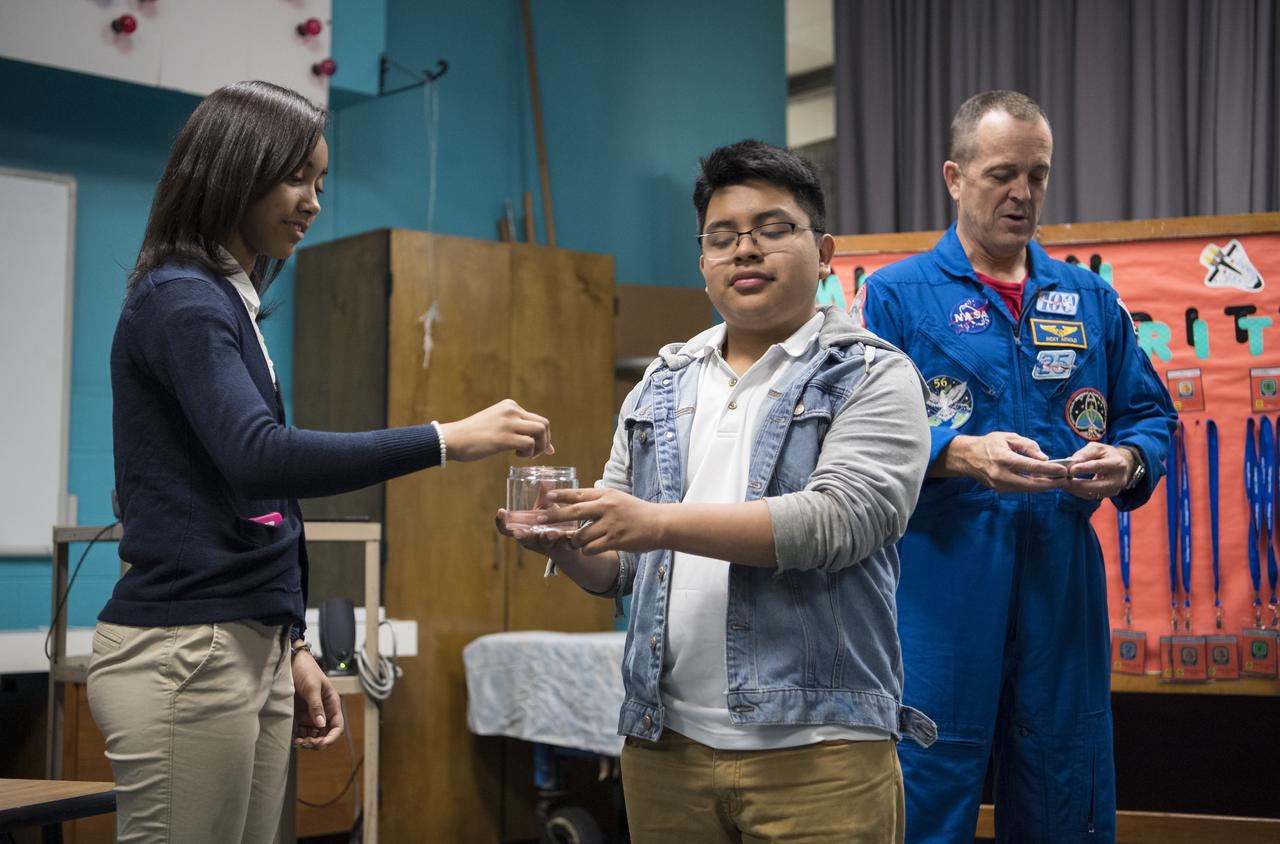
NASA astronaut Ricky Arnold watches a timer while students conduct an experiment on effervescence, Friday, May 3, 2019 at the Challenger Center in Lanham, MD. During Expedition 55/56, Arnold completed three spacewalks for a total of 19.5 hours outside the International Space Station (ISS), and concluded his 197 day mission when he landed in a remote area near the town of Zhezkazgan, Kazakhstan in Oct. 2018. He also flew to the space station on shuttle mission STS-119 to deliver the final pair of power-generating solar array wings. Photo Credit: (NASA/Aubrey Gemignani)
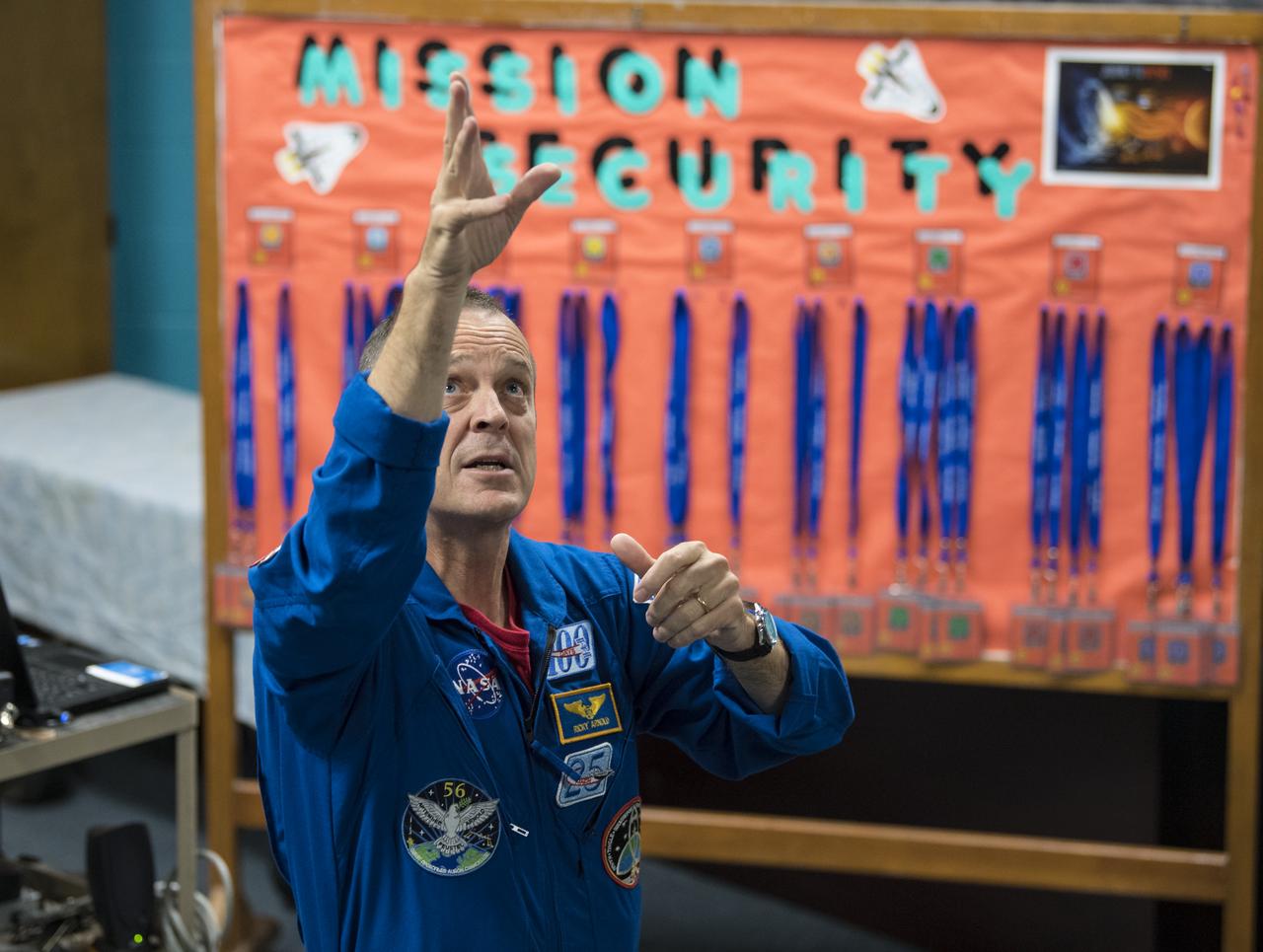
NASA astronaut Ricky Arnold speaks about his time onboard the International Space Station (ISS) during Expeditions 55 and 56, Friday, May 3, 2019 at the Challenger Center in Lanham, MD. During Expedition 55/56, Arnold completed three spacewalks for a total of 19.5 hours outside the space station, and concluded his 197 day mission when he landed in a remote area near the town of Zhezkazgan, Kazakhstan in Oct. 2018. He also flew to the space station on shuttle mission STS-119 to deliver the final pair of power-generating solar array wings. Photo Credit: (NASA/Aubrey Gemignani)
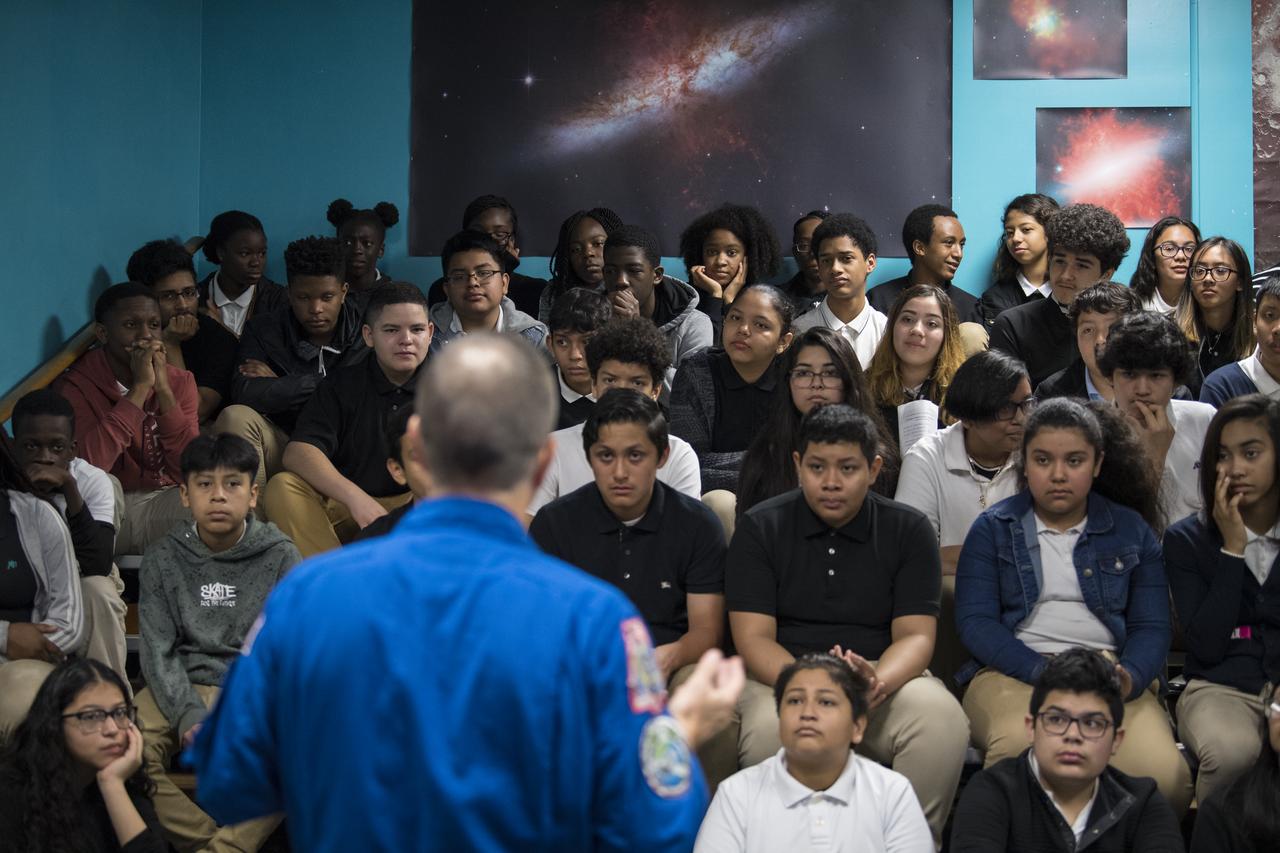
NASA astronaut Ricky Arnold speaks about his time onboard the International Space Station (ISS) during Expeditions 55 and 56, Friday, May 3, 2019 at the Challenger Center in Lanham, MD. During Expedition 55/56, Arnold completed three spacewalks for a total of 19.5 hours outside the space station, and concluded his 197 day mission when he landed in a remote area near the town of Zhezkazgan, Kazakhstan in Oct. 2018. He also flew to the space station on shuttle mission STS-119 to deliver the final pair of power-generating solar array wings. Photo Credit: (NASA/Aubrey Gemignani)
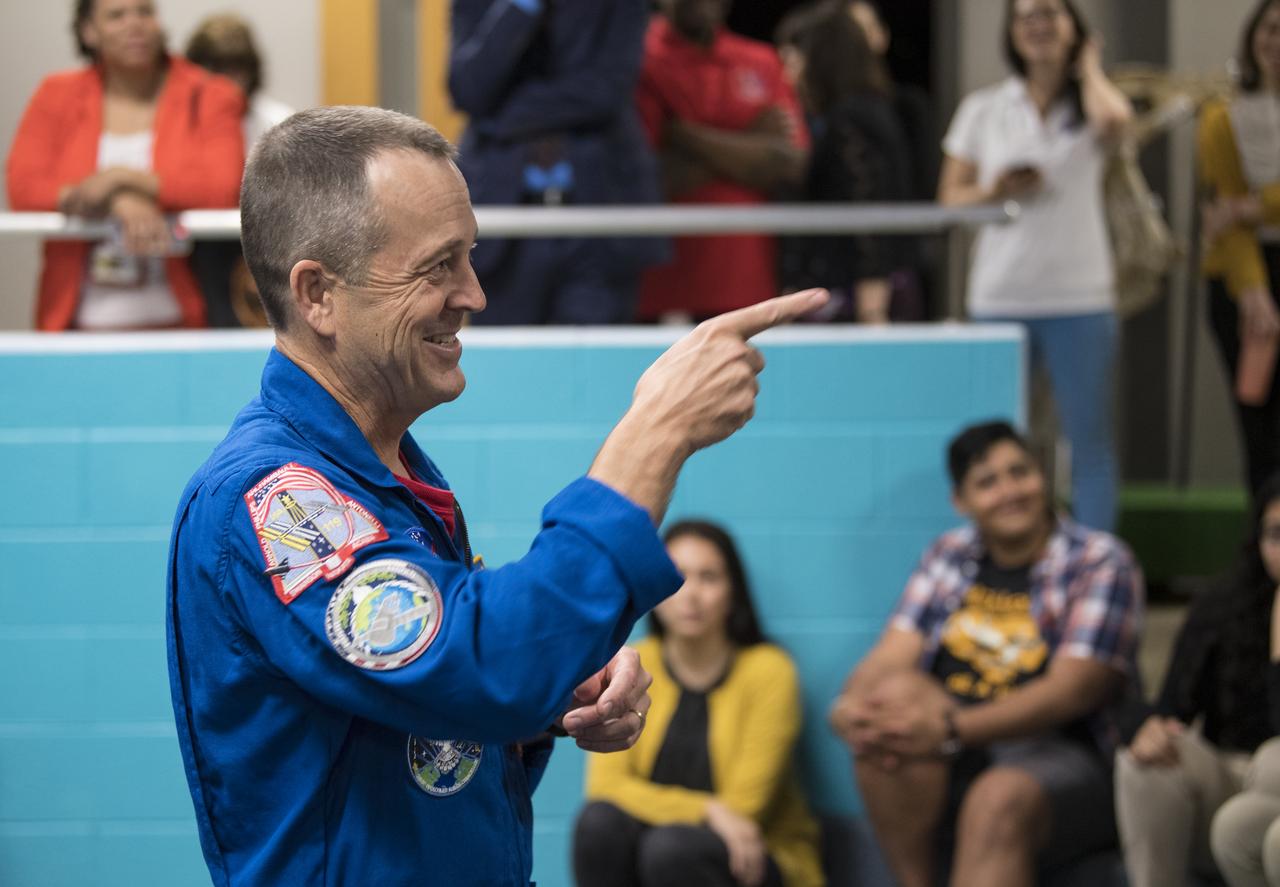
NASA astronaut Ricky Arnold speaks about his time onboard the International Space Station (ISS) during Expeditions 55 and 56, Friday, May 3, 2019 at the Challenger Center in Lanham, MD. During Expedition 55/56, Arnold completed three spacewalks for a total of 19.5 hours outside the space station, and concluded his 197 day mission when he landed in a remote area near the town of Zhezkazgan, Kazakhstan in Oct. 2018. He also flew to the space station on shuttle mission STS-119 to deliver the final pair of power-generating solar array wings. Photo Credit: (NASA/Aubrey Gemignani)
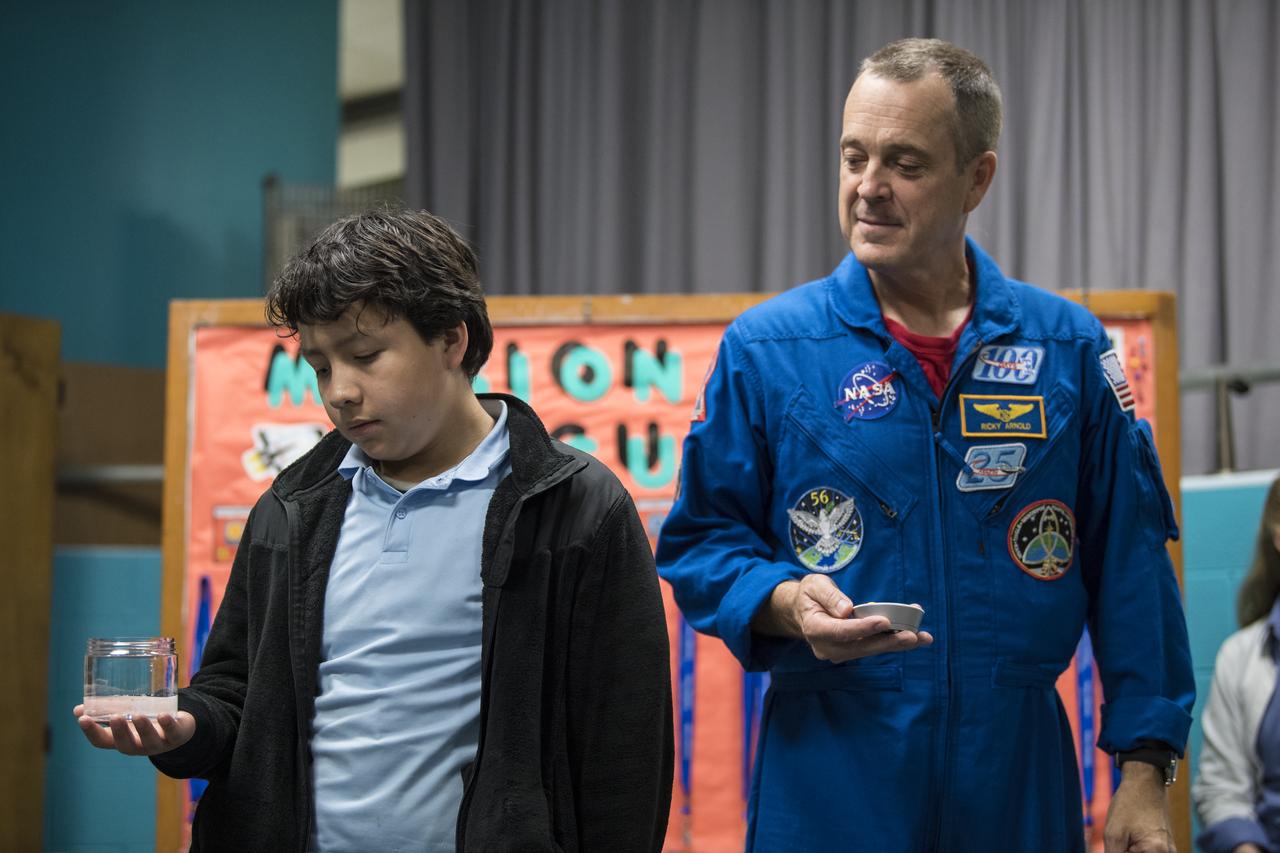
NASA astronaut Ricky Arnold watches a timer while students conduct an experiment on effervescence, Friday, May 3, 2019 at the Challenger Center in Lanham, MD. During Expedition 55/56, Arnold completed three spacewalks for a total of 19.5 hours outside the International Space Station (ISS), and concluded his 197 day mission when he landed in a remote area near the town of Zhezkazgan, Kazakhstan in Oct. 2018. He also flew to the space station on shuttle mission STS-119 to deliver the final pair of power-generating solar array wings. Photo Credit: (NASA/Aubrey Gemignani)
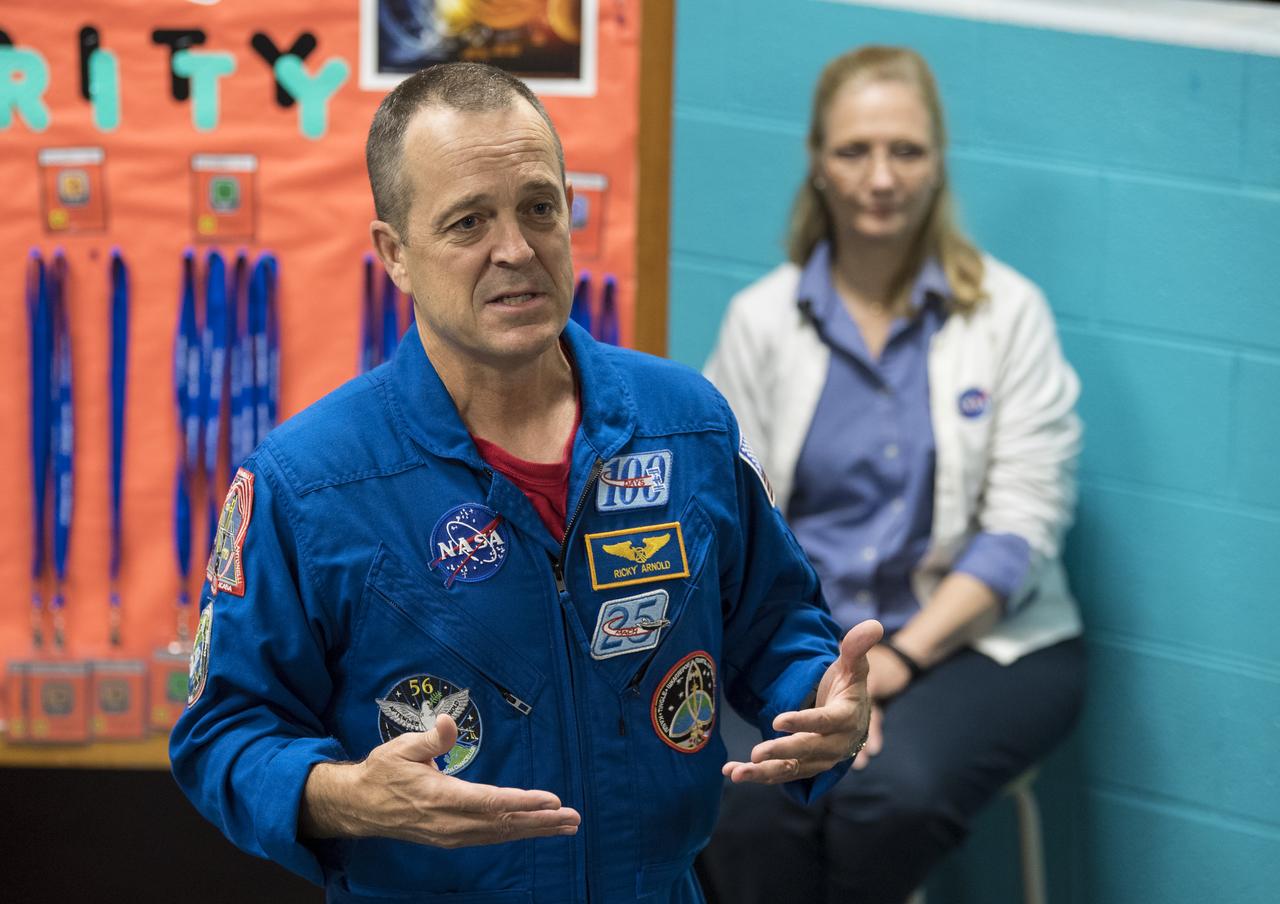
NASA astronaut Ricky Arnold speaks about his time onboard the International Space Station (ISS) during Expeditions 55 and 56, Friday, May 3, 2019 at the Challenger Center in Lanham, MD. During Expedition 55/56, Arnold completed three spacewalks for a total of 19.5 hours outside the space station, and concluded his 197 day mission when he landed in a remote area near the town of Zhezkazgan, Kazakhstan in Oct. 2018. He also flew to the space station on shuttle mission STS-119 to deliver the final pair of power-generating solar array wings. Photo Credit: (NASA/Aubrey Gemignani)
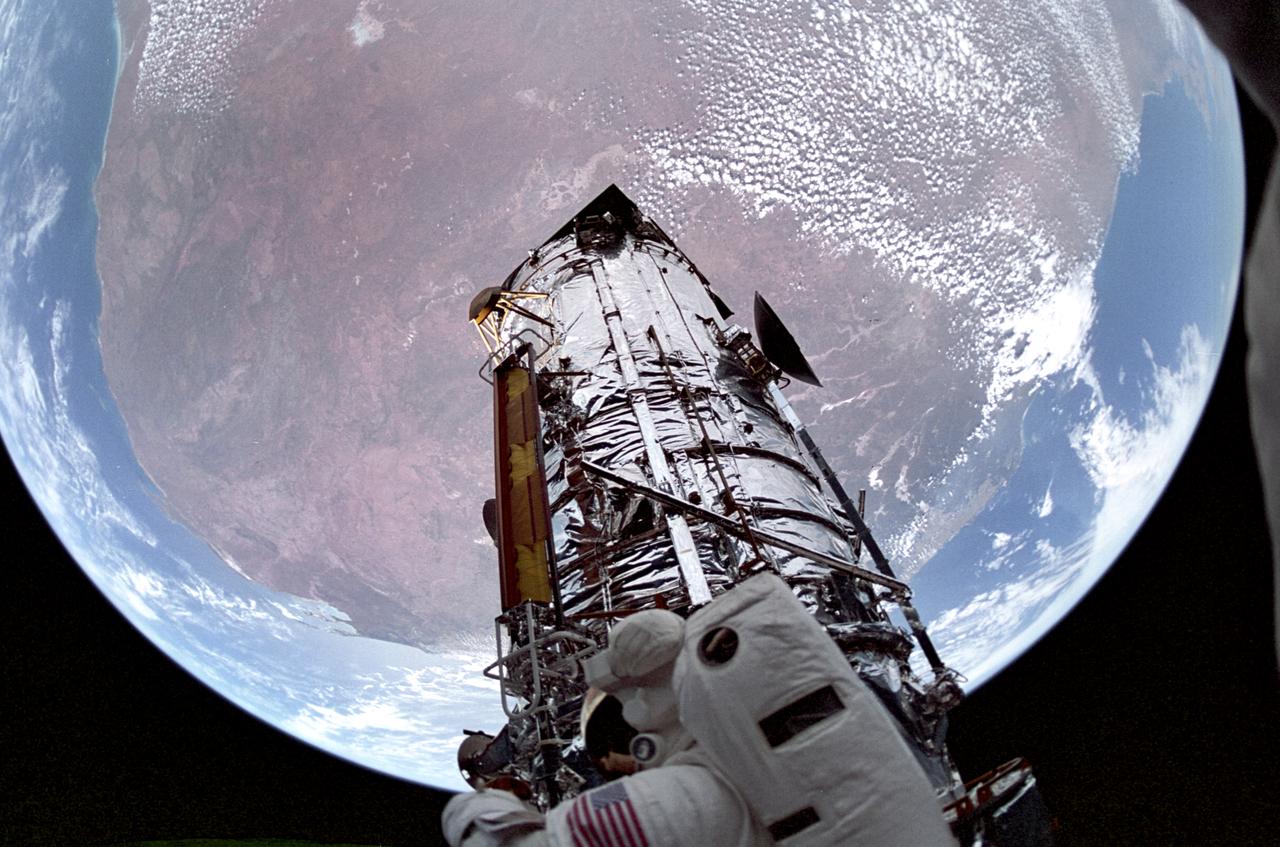
Backdropped against the Earth, the Hubble Space Telescope (HST)is shown sporting new and modified solar arrays stowed against its barrel. Orbiting Earth at an altitude of 325 nautical miles, an astronaut begins other repairs of the HST while perched atop a foot restraint on shuttle Endeavour's remote manipulator system arm. The 59th and final Shuttle flight of 1993 was one of most challenging and complex marned missions ever attempted. During record five back-to-back space walks totaling 35 hours and 28 minutes, two teams of astronauts completed the first servicing of the HST. The STS-061 mission was launched aboard Space Shuttle Endeavor on December 2, 1993.
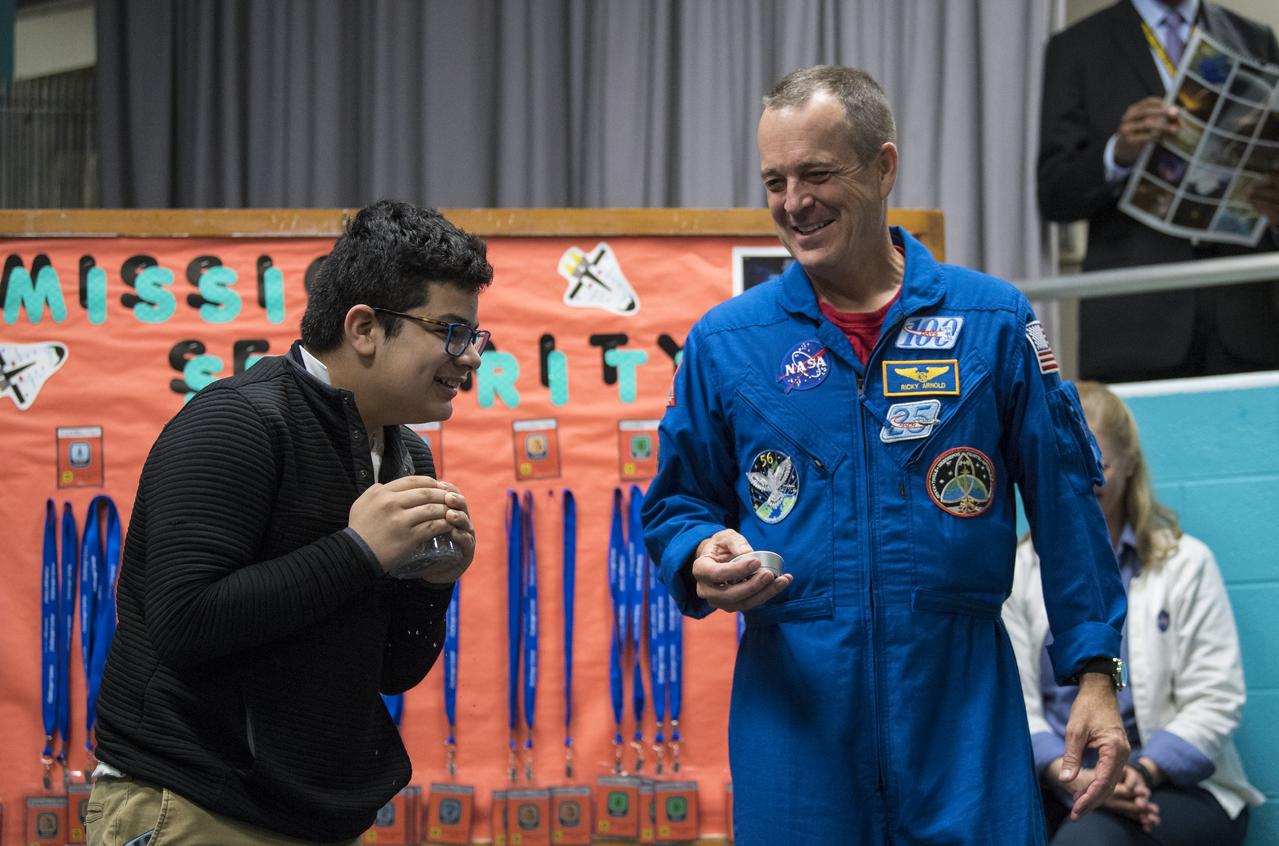
NASA astronaut Ricky Arnold watches a timer while students conduct an experiment on effervescence, Friday, May 3, 2019 at the Challenger Center in Lanham, MD. During Expedition 55/56, Arnold completed three spacewalks for a total of 19.5 hours outside the International Space Station (ISS), and concluded his 197 day mission when he landed in a remote area near the town of Zhezkazgan, Kazakhstan in Oct. 2018. He also flew to the space station on shuttle mission STS-119 to deliver the final pair of power-generating solar array wings. Photo Credit: (NASA/Aubrey Gemignani)

Students are seen in the audience as NASA astronaut Ricky Arnold speaks about his time onboard the International Space Station (ISS) during Expeditions 55 and 56, Friday, May 3, 2019 at the Challenger Center in Lanham, MD. During Expedition 55/56, Arnold completed three spacewalks for a total of 19.5 hours outside the space station, and concluded his 197 day mission when he landed in a remote area near the town of Zhezkazgan, Kazakhstan in Oct. 2018. He also flew to the space station on shuttle mission STS-119 to deliver the final pair of power-generating solar array wings. Photo Credit: (NASA/Aubrey Gemignani)
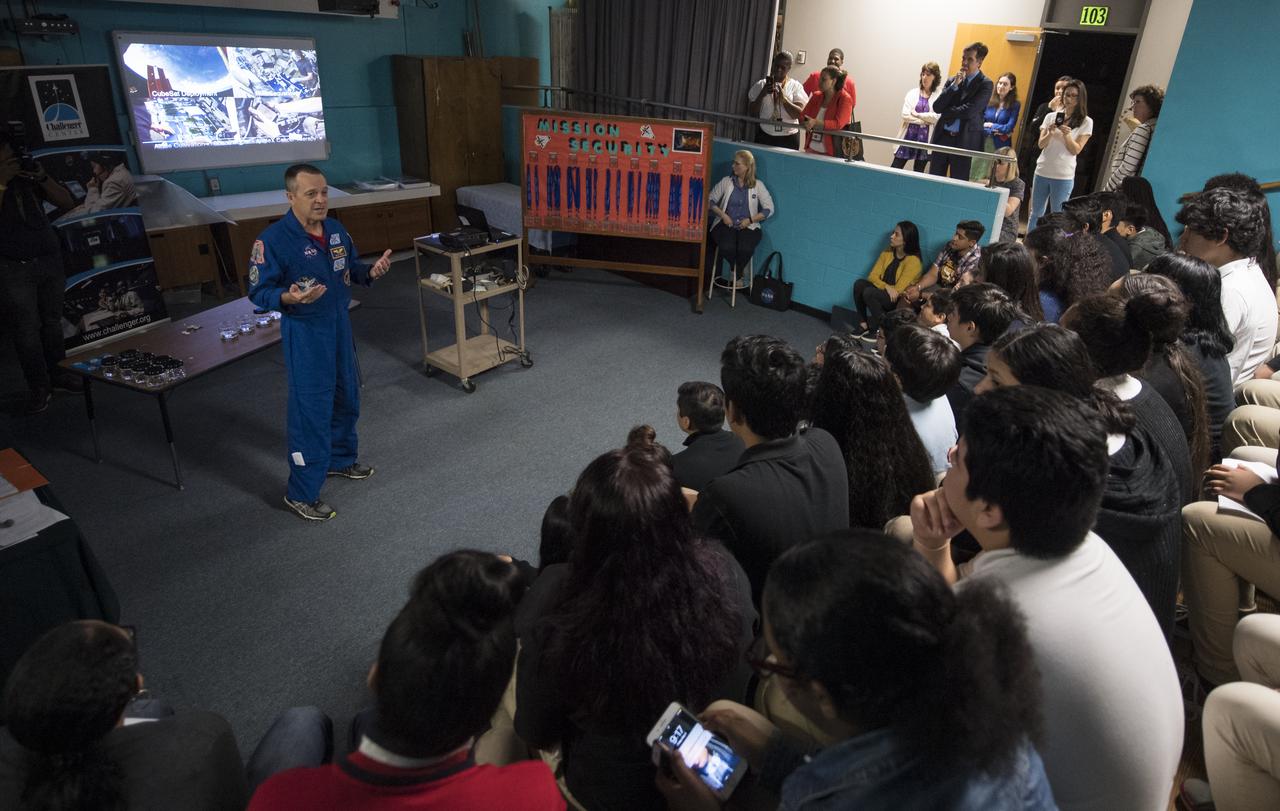
NASA astronaut Ricky Arnold speaks about his time onboard the International Space Station (ISS) during Expeditions 55 and 56, Friday, May 3, 2019 at the Challenger Center in Lanham, MD. During Expedition 55/56, Arnold completed three spacewalks for a total of 19.5 hours outside the space station, and concluded his 197 day mission when he landed in a remote area near the town of Zhezkazgan, Kazakhstan in Oct. 2018. He also flew to the space station on shuttle mission STS-119 to deliver the final pair of power-generating solar array wings. Photo Credit: (NASA/Aubrey Gemignani)
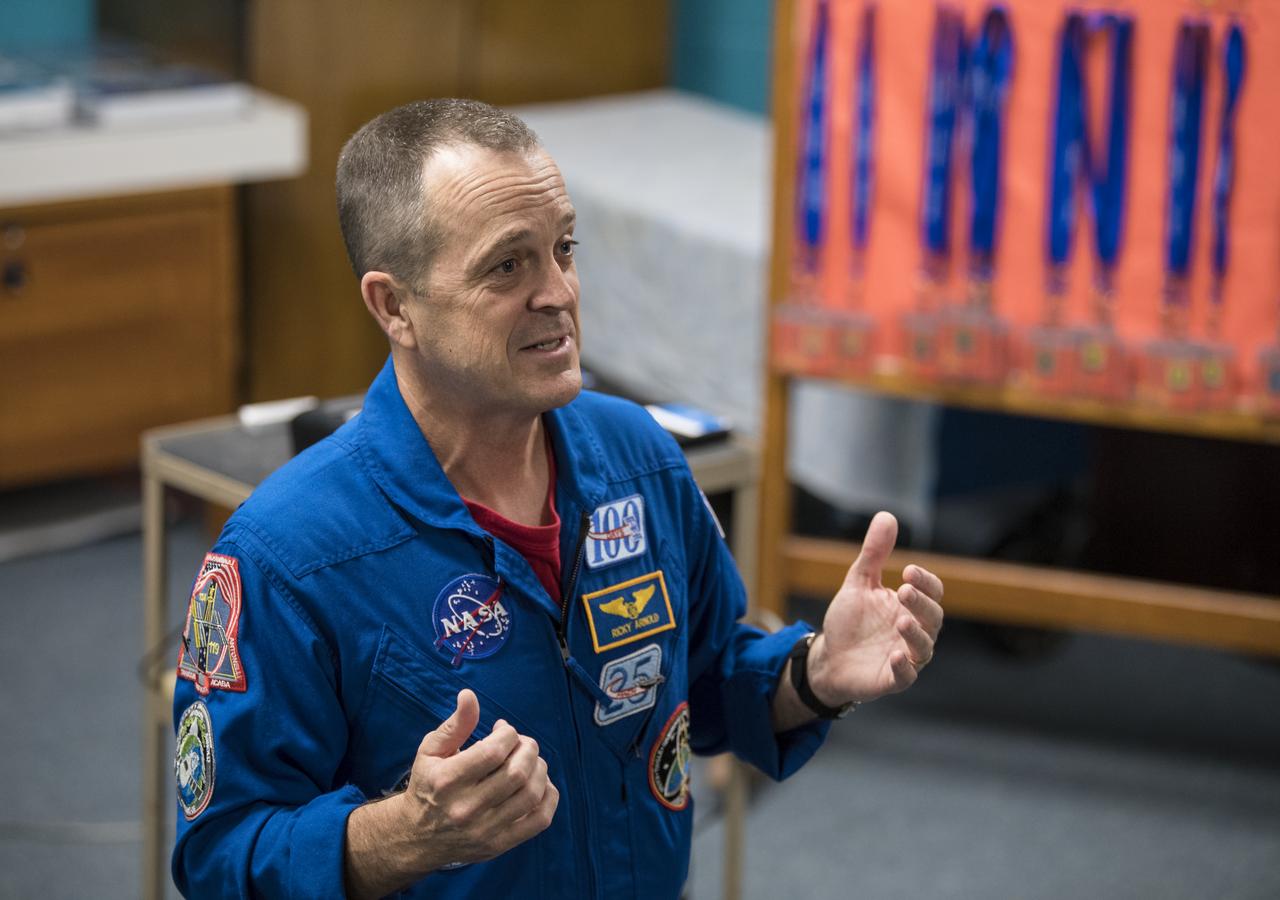
NASA astronaut Ricky Arnold speaks about his time onboard the International Space Station (ISS) during Expeditions 55 and 56, Friday, May 3, 2019 at the Challenger Center in Lanham, MD. During Expedition 55/56, Arnold completed three spacewalks for a total of 19.5 hours outside the space station, and concluded his 197 day mission when he landed in a remote area near the town of Zhezkazgan, Kazakhstan in Oct. 2018. He also flew to the space station on shuttle mission STS-119 to deliver the final pair of power-generating solar array wings. Photo Credit: (NASA/Aubrey Gemignani)
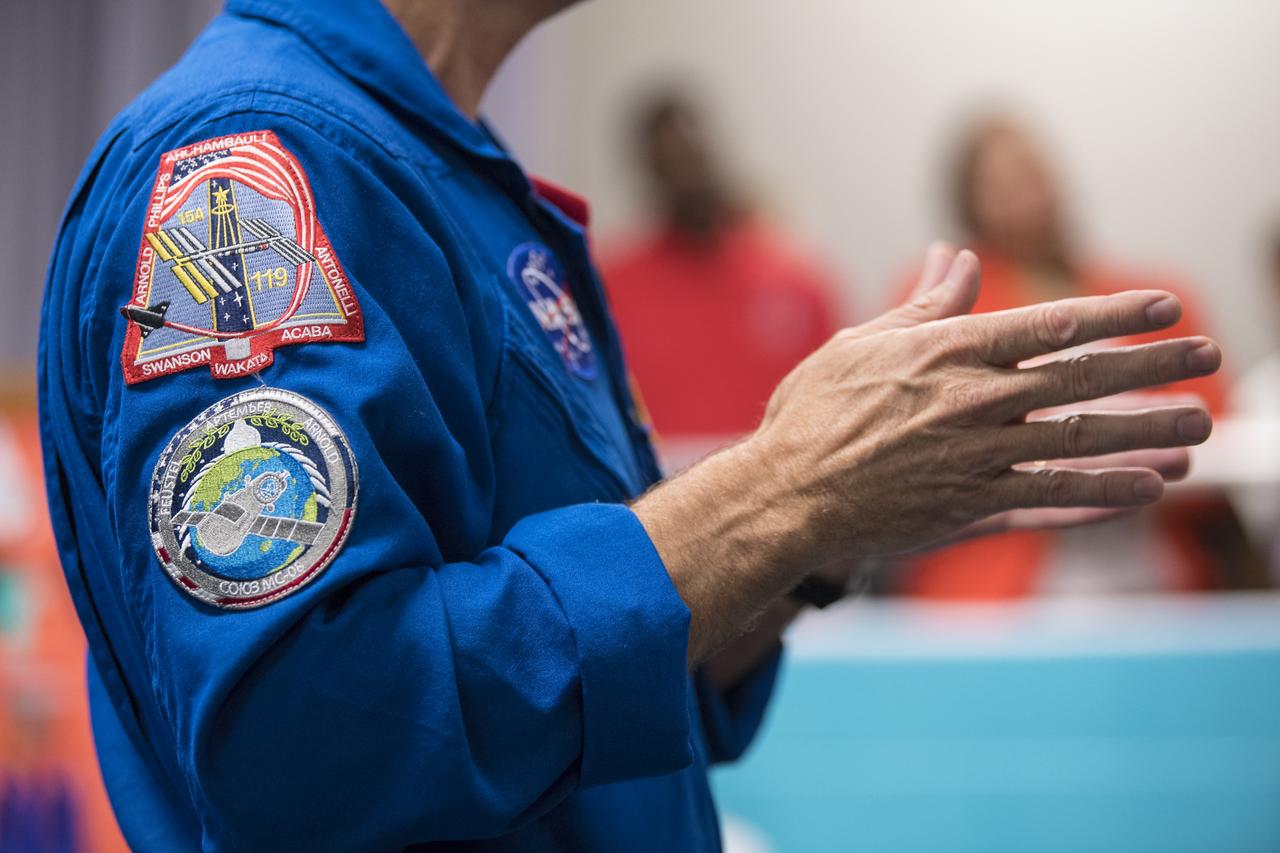
NASA astronaut Ricky Arnold speaks about his time onboard the International Space Station (ISS) during Expeditions 55 and 56, Friday, May 3, 2019 at the Challenger Center in Lanham, MD. During Expedition 55/56, Arnold completed three spacewalks for a total of 19.5 hours outside the space station, and concluded his 197 day mission when he landed in a remote area near the town of Zhezkazgan, Kazakhstan in Oct. 2018. He also flew to the space station on shuttle mission STS-119 to deliver the final pair of power-generating solar array wings. Photo Credit: (NASA/Aubrey Gemignani)
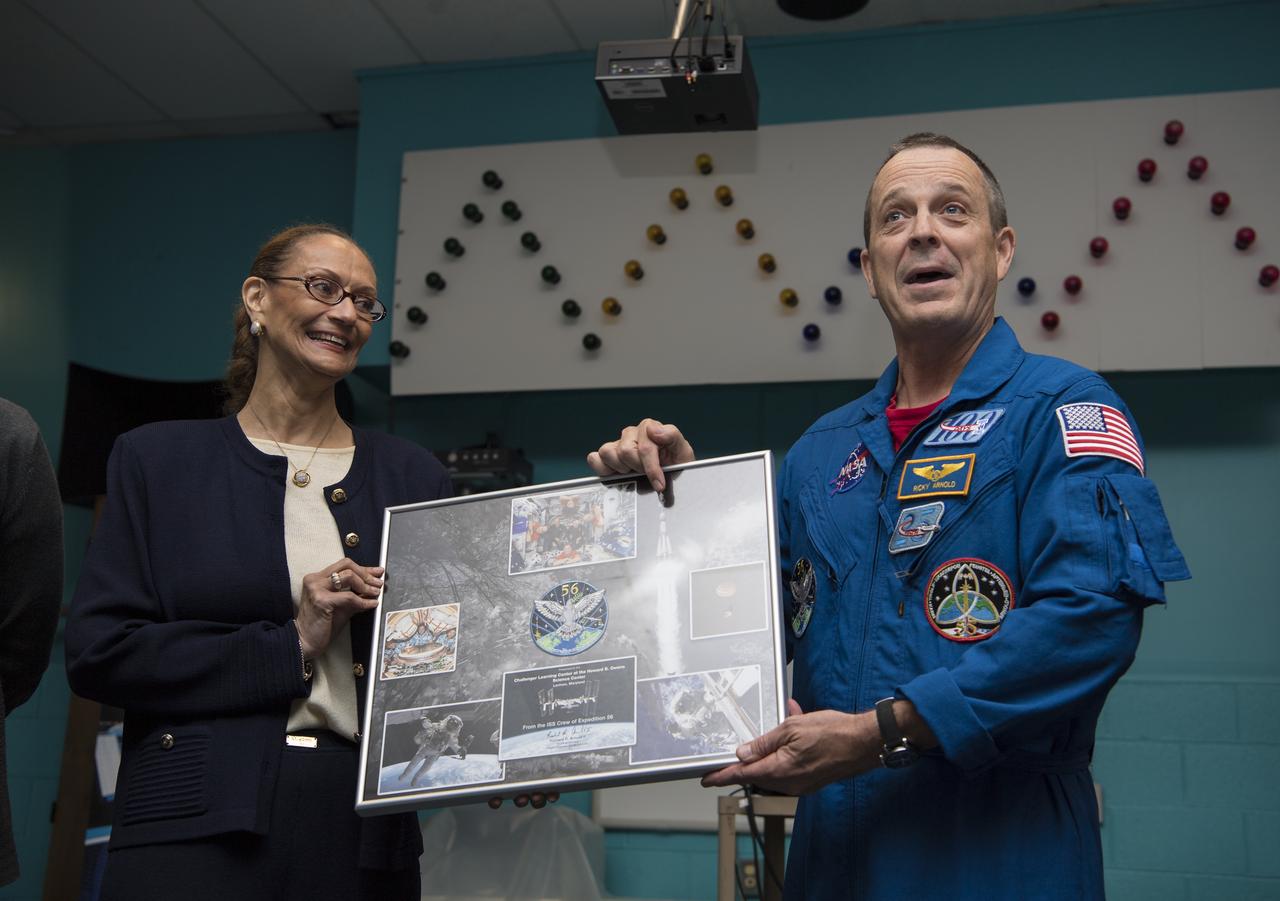
NASA astronaut Ricky Arnold presents the Challenger Center with a montage of images from his time onboard the International Space Station (ISS) during Expeditions 55 and 56, Friday, May 3, 2019 in Lanham, MD. During Expedition 55/56, Arnold completed three spacewalks for a total of 19.5 hours outside the space station, and concluded his 197 day mission when he landed in a remote area near the town of Zhezkazgan, Kazakhstan in Oct. 2018. He also flew to the space station on shuttle mission STS-119 to deliver the final pair of power-generating solar array wings. Photo Credit: (NASA/Aubrey Gemignani)
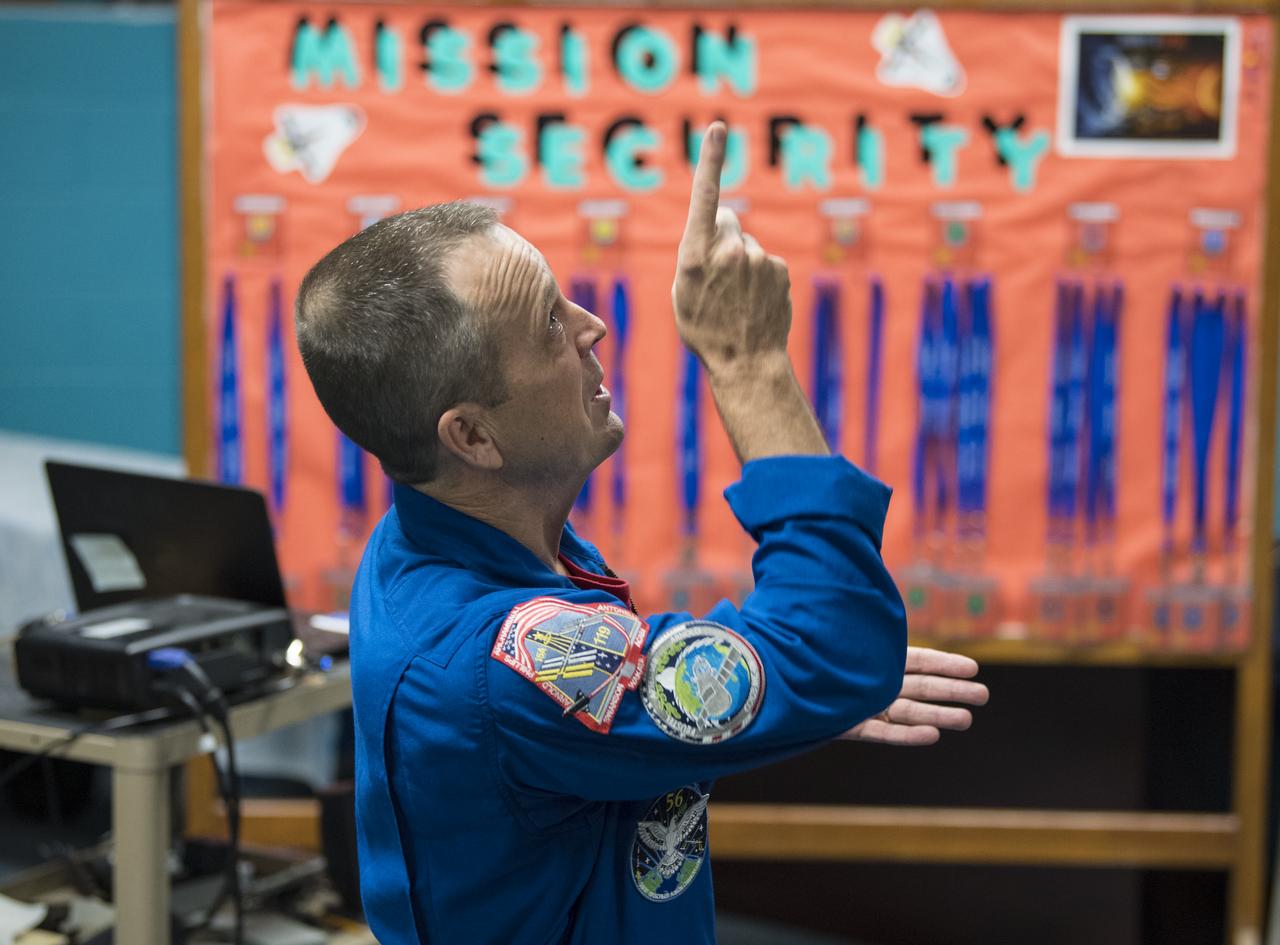
NASA astronaut Ricky Arnold speaks about his time onboard the International Space Station (ISS) during Expeditions 55 and 56, Friday, May 3, 2019 at the Challenger Center in Lanham, MD. During Expedition 55/56, Arnold completed three spacewalks for a total of 19.5 hours outside the space station, and concluded his 197 day mission when he landed in a remote area near the town of Zhezkazgan, Kazakhstan in Oct. 2018. He also flew to the space station on shuttle mission STS-119 to deliver the final pair of power-generating solar array wings. Photo Credit: (NASA/Aubrey Gemignani)
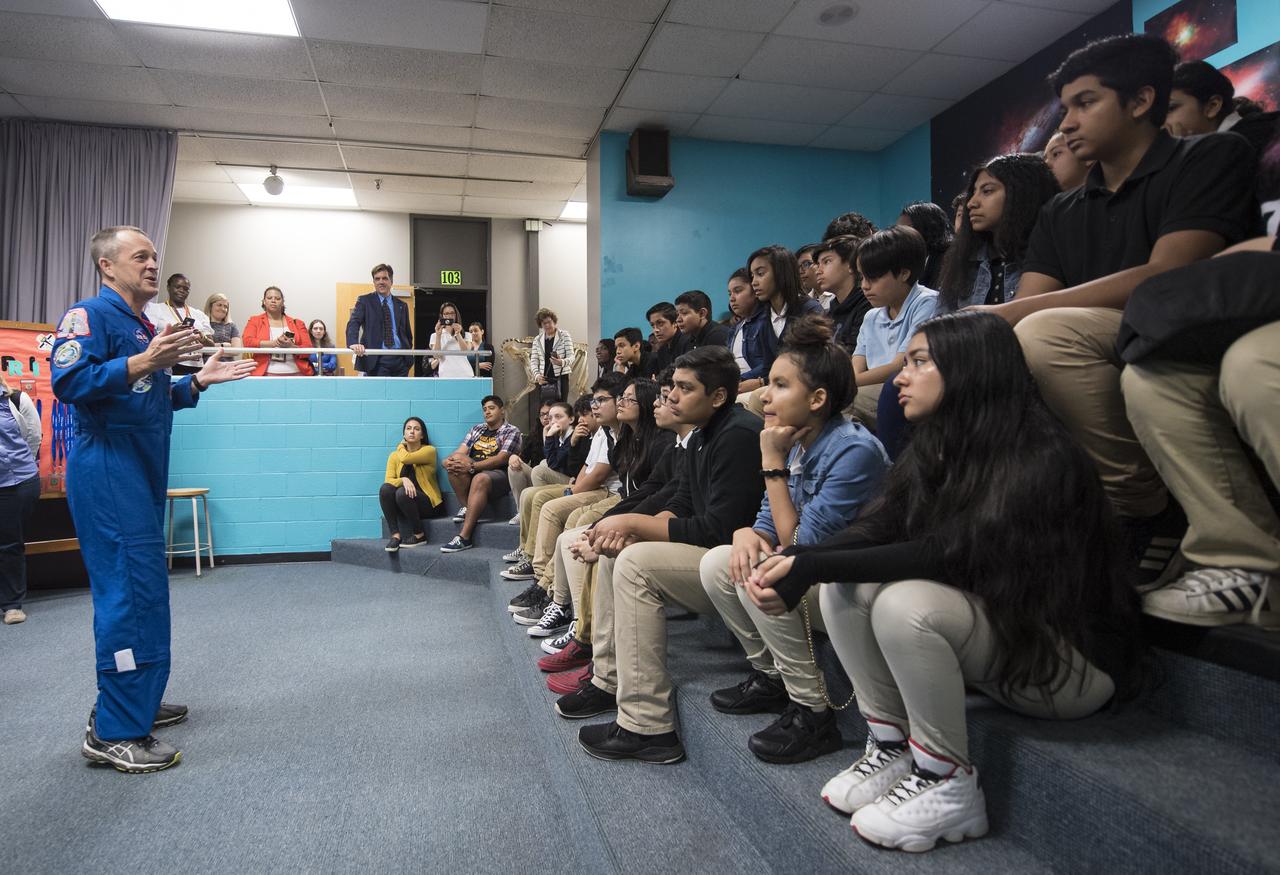
NASA astronaut Ricky Arnold speaks about his time onboard the International Space Station (ISS) during Expeditions 55 and 56, Friday, May 3, 2019 at the Challenger Center in Lanham, MD. During Expedition 55/56, Arnold completed three spacewalks for a total of 19.5 hours outside the space station, and concluded his 197 day mission when he landed in a remote area near the town of Zhezkazgan, Kazakhstan in Oct. 2018. He also flew to the space station on shuttle mission STS-119 to deliver the final pair of power-generating solar array wings. Photo Credit: (NASA/Aubrey Gemignani)
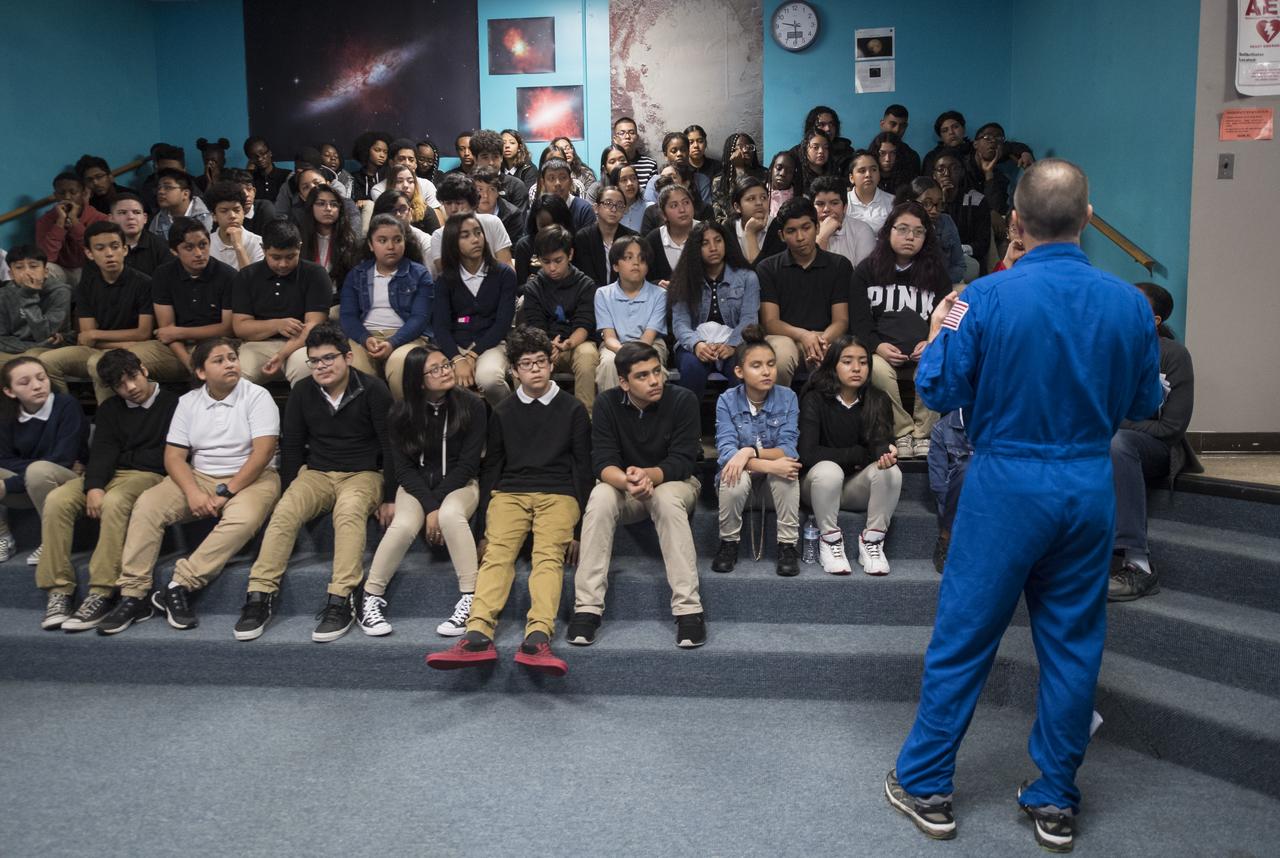
NASA astronaut Ricky Arnold speaks about his time onboard the International Space Station (ISS) during Expeditions 55 and 56, Friday, May 3, 2019 at the Challenger Center in Lanham, MD. During Expedition 55/56, Arnold completed three spacewalks for a total of 19.5 hours outside the space station, and concluded his 197 day mission when he landed in a remote area near the town of Zhezkazgan, Kazakhstan in Oct. 2018. He also flew to the space station on shuttle mission STS-119 to deliver the final pair of power-generating solar array wings. Photo Credit: (NASA/Aubrey Gemignani)
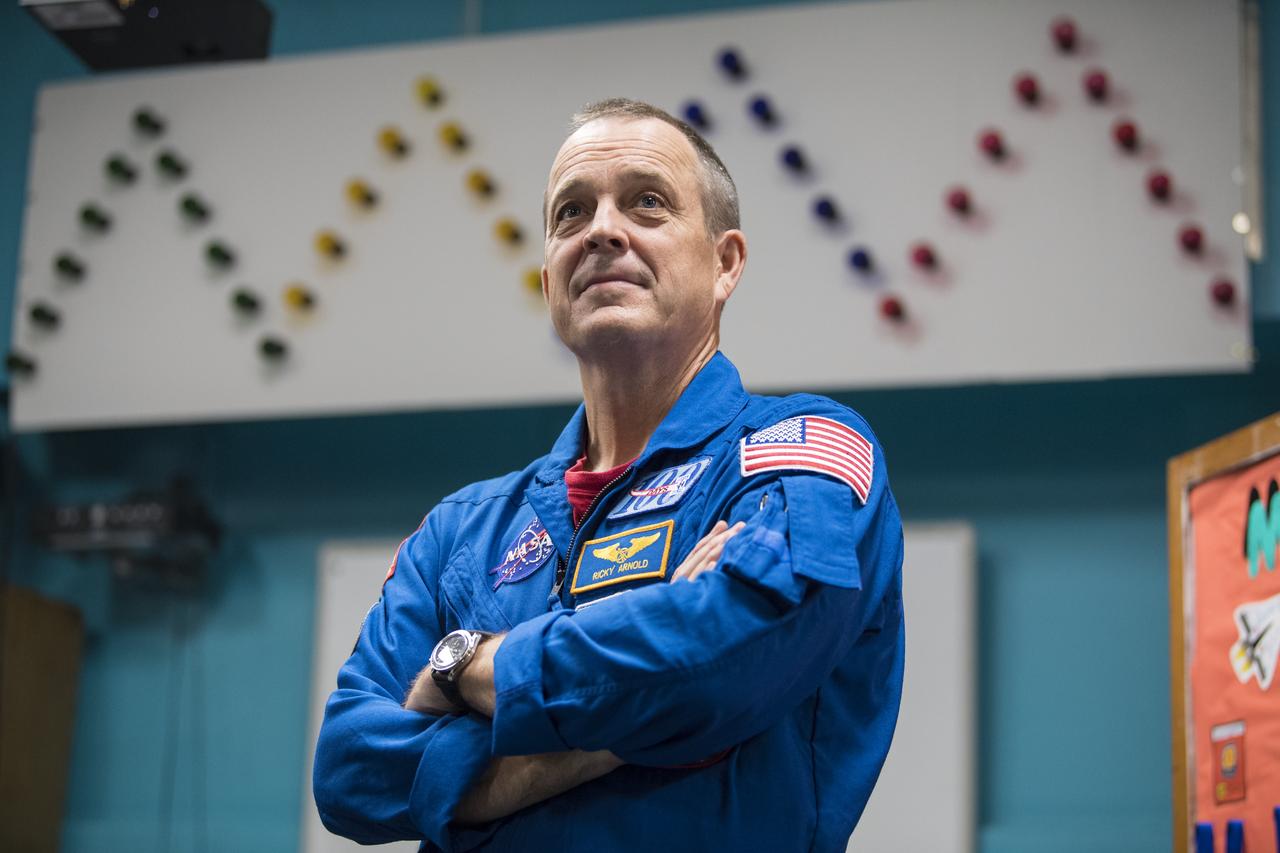
NASA astronaut Ricky Arnold is seen during a talk about his time onboard the International Space Station (ISS) during Expeditions 55 and 56, Friday, May 3, 2019 at the Challenger Center in Lanham, MD. During Expedition 55/56, Arnold completed three spacewalks for a total of 19.5 hours outside the space station, and concluded his 197 day mission when he landed in a remote area near the town of Zhezkazgan, Kazakhstan in Oct. 2018. He also flew to the space station on shuttle mission STS-119 to deliver the final pair of power-generating solar array wings. Photo Credit: (NASA/Aubrey Gemignani)
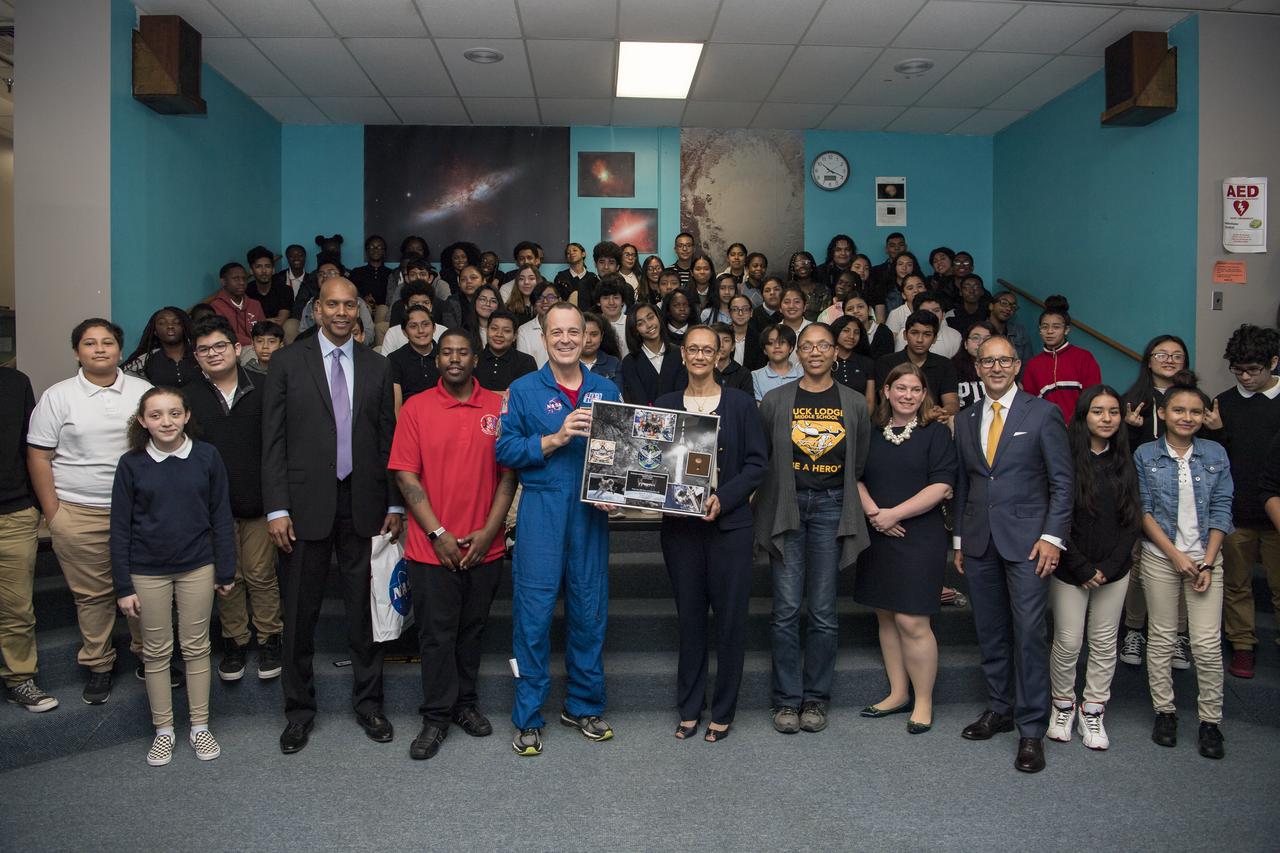
NASA astronaut Ricky Arnold poses for a photo after presenting the Challenger Center with a montage of images from his time onboard the International Space Station (ISS) during Expeditions 55 and 56, Friday, May 3, 2019 in Lanham, MD. During Expedition 55/56, Arnold completed three spacewalks for a total of 19.5 hours outside the space station, and concluded his 197 day mission when he landed in a remote area near the town of Zhezkazgan, Kazakhstan in Oct. 2018. He also flew to the space station on shuttle mission STS-119 to deliver the final pair of power-generating solar array wings. Photo Credit: (NASA/Aubrey Gemignani)

HOUSTON, Texas -- STS119-S-001: The shape of the STS-119/15A patch comes from the shape of a solar array viewed at an angle. The International Space Station (ISS), which is the destination of the mission, is placed accordingly in the center of the patch just below the gold astronaut symbol. The gold solar array of the ISS highlights the main cargo and task of STS-119/15A -- the installation of the S6 truss segment and deployment of the S6's solar arrays, the last to be delivered to the ISS. Under the Japanese Kibo module, marked by a red circle, is the name of Japanese astronaut Koichi Wakata, who goes up to the ISS to serve as flight engineer representing JAXA. The rest of the STS-119/15A crew members are denoted on the outer band of the patch. The 17 white stars on the patch represent, in the crew's words, "the enormous sacrifice the crews of Apollo1, Challenger, and Columbia have given to our space program." The U.S. flag flowing into the Space Shuttle signifies the support the people of the United States have given our space program over the years, along with pride the U.S. astronauts have in representing the United States on this mission. The NASA insignia for design for Shuttle flights is reserved for use by the astronauts and for other official use as the NASA Administrator may authorize. Public availability has been approved only in the form of illustrations by the various news media. When and if there is any change in this policy, it will be publicly announced.
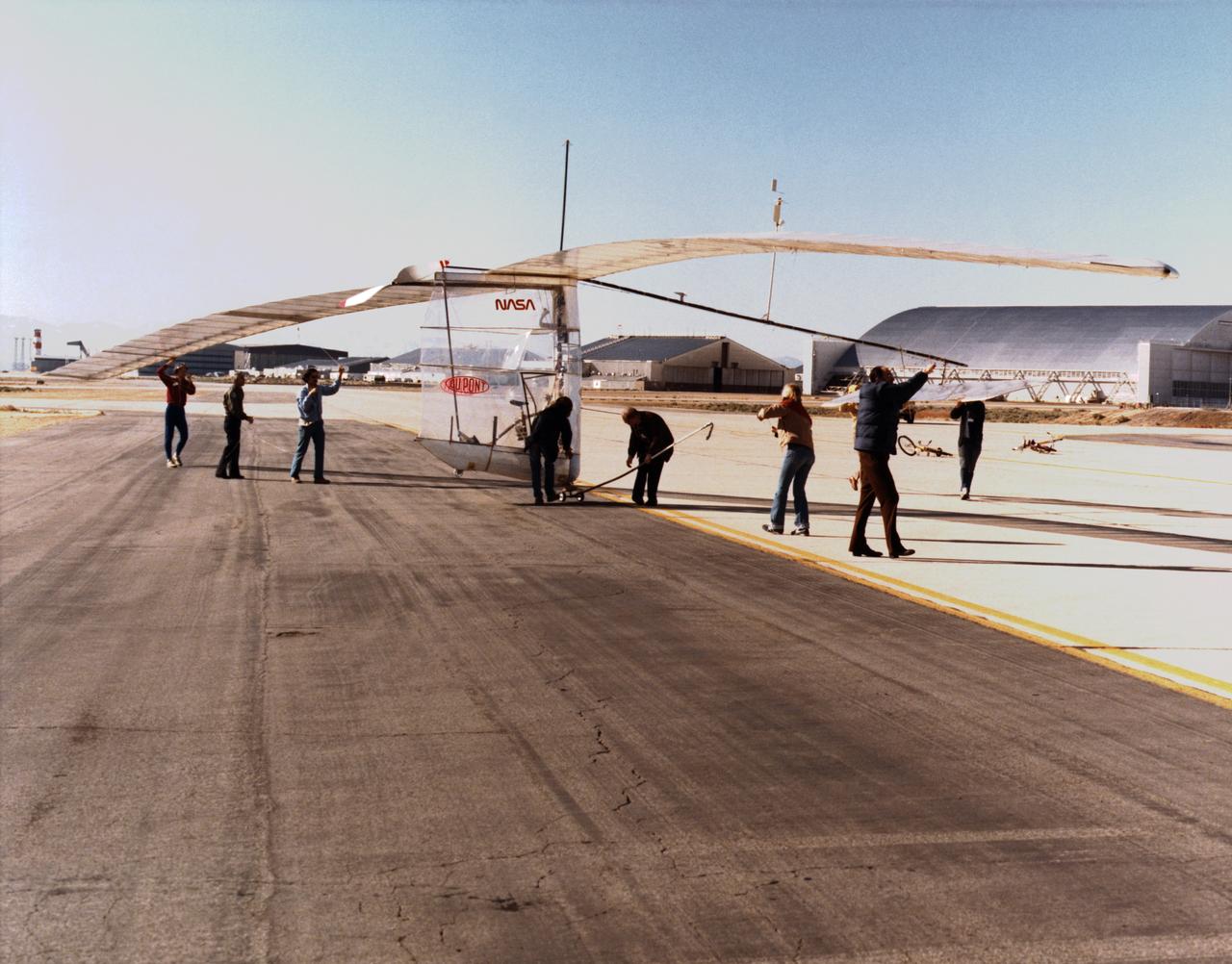
Gossamer Albatross on ramp with crew
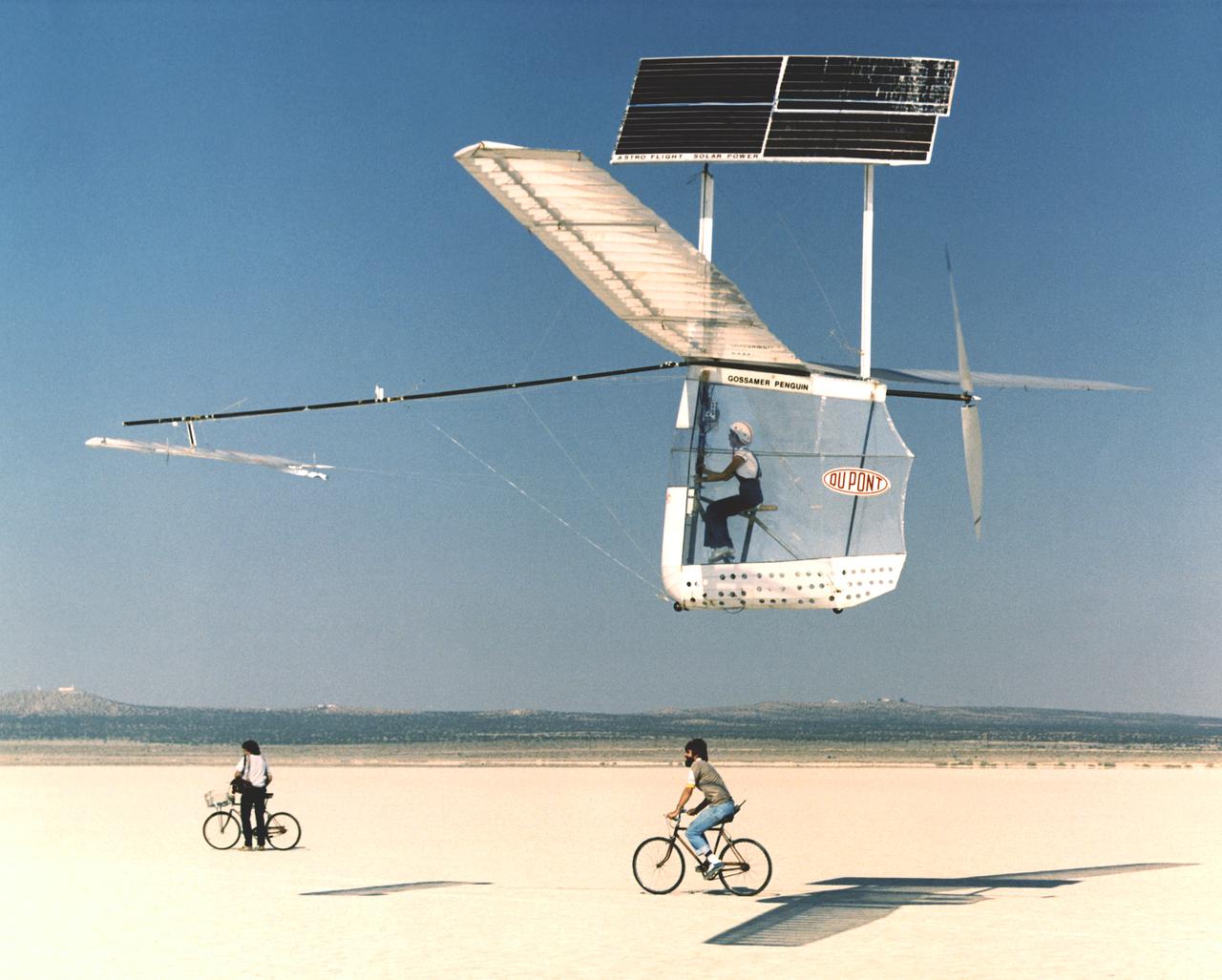
Solar-powered Gossamer Penguin in flight with Janice Brown and Ray Morgan riding chase bicycle.
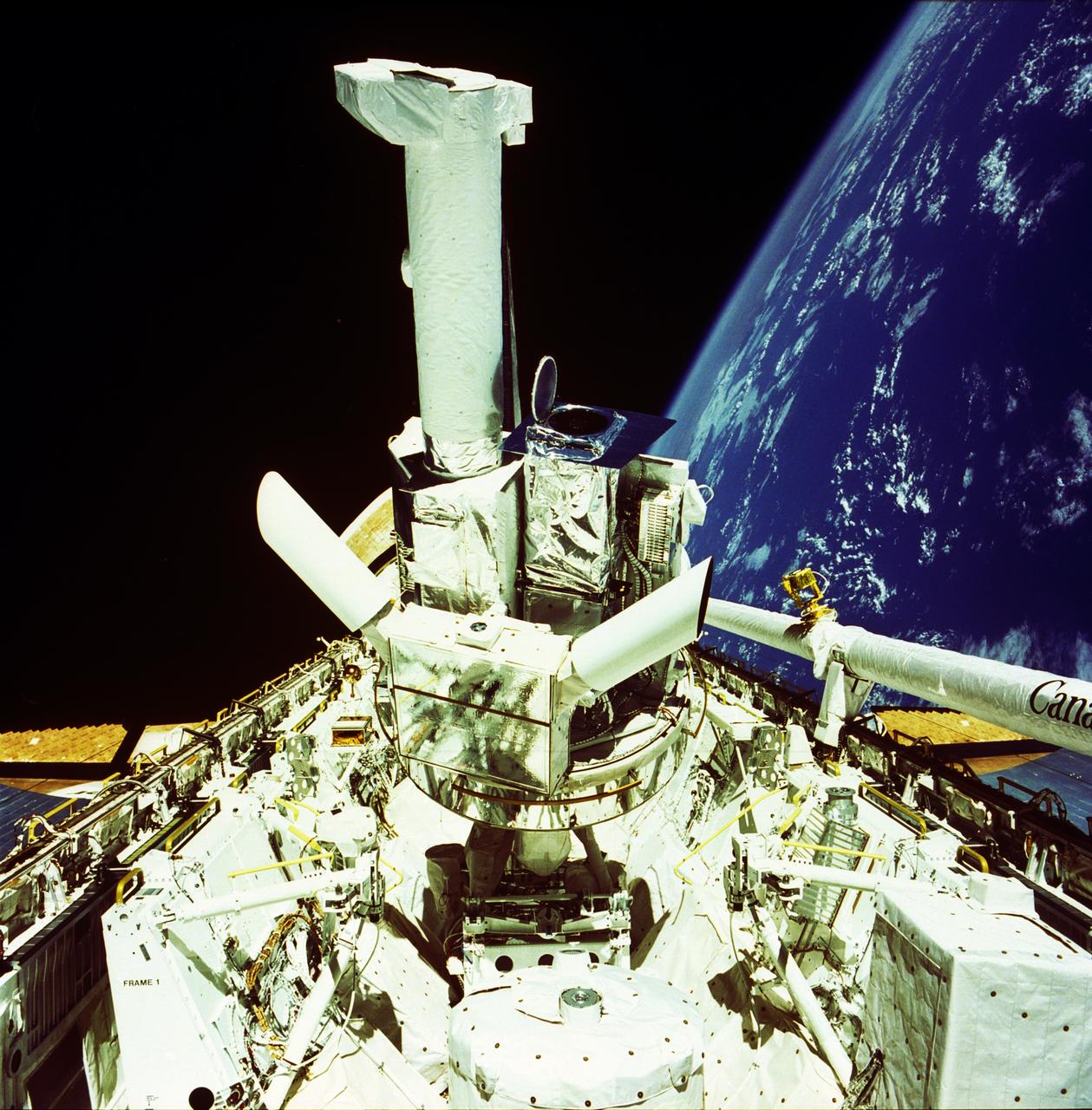
This photograph shows the Instrument Pointing System (IPS) for Spacelab-2 being deployed in the cargo bay of the Space Shuttle Orbiter Challenger. The European Space Agency (ESA) developed this irnovative pointing system for the Spacelab program. Previously, instruments were pointed toward particular celestial objects or areas by maneuvering the Shuttle to an appropriate attitude. The IPS could aim instruments more accurately than the Shuttle and kept them fixed on a target as the Shuttle moved. On the first pallet, three solar instruments and one atmospheric instrument were mounted on the IPS. Spacelab-2 was the first pallet-only mission. One of the goals of the mission was to verify that the pallets' configuration was satisfactory for observations and research. Except for two biological experiments and an experiment that uses ground-based instruments, the Spacelab-2 scientific instruments needed direct exposure to space. The Spacelab-2 mission was designed to capitalize on the Shuttle-Spacelab capabilities to carry very large instruments, launch and retrieve satellites, and point several instruments independently with accuracy and stability. Spacelab-2 (STS-51F, 19th Shuttle mission) was launched on July 29, 1985 aboard the Space Shuttle Orbiter Challenger. The Marshall Space Flight Center had overall management responsibilities of the Spacelab missions.
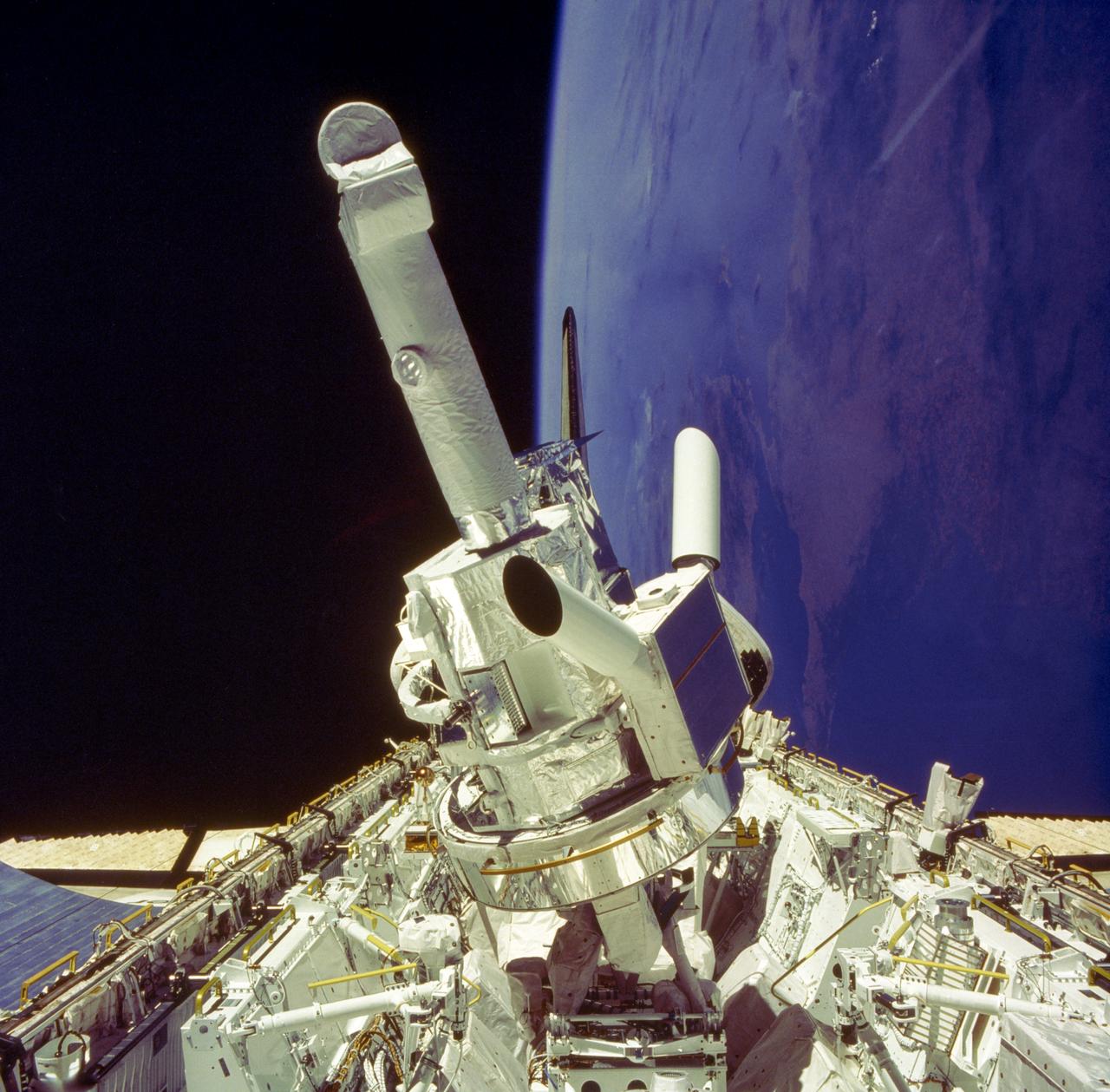
This photograph shows the Instrument Pointing System (IPS) for Spacelab-2 being deployed in the cargo bay of the Space Shuttle Orbiter Challenger. The European Space Agency (ESA) developed this irnovative pointing system for the Spacelab program. Previously, instruments were pointed toward particular celestial objects or areas by maneuvering the Shuttle to an appropriate attitude. The IPS could aim instruments more accurately than the Shuttle and kept them fixed on a target as the Shuttle moved. On the first pallet, three solar instruments and one atmospheric instrument were mounted on the IPS. Spacelab-2 was the first pallet-only mission. One of the goals of the mission was to verify that the pallets' configuration was satisfactory for observations and research. Except for two biological experiments and an experiment that used ground-based instruments, the Spacelab-2 scientific instruments needed direct exposure to space. The Spacelab-2 mission was designed to capitalize on the Shuttle-Spacelab capabilities to carry very large instruments, launch and retrieve satellites, and point several instruments independently with accuracy and stability. Spacelab-2 (STS-51F, 19th Shuttle mission) was launched on July 29, 1985 aboard the Space Shuttle Orbiter Challenger. The Marshall Space Flight Center had overall management responsibilities of the Spacelab missions.
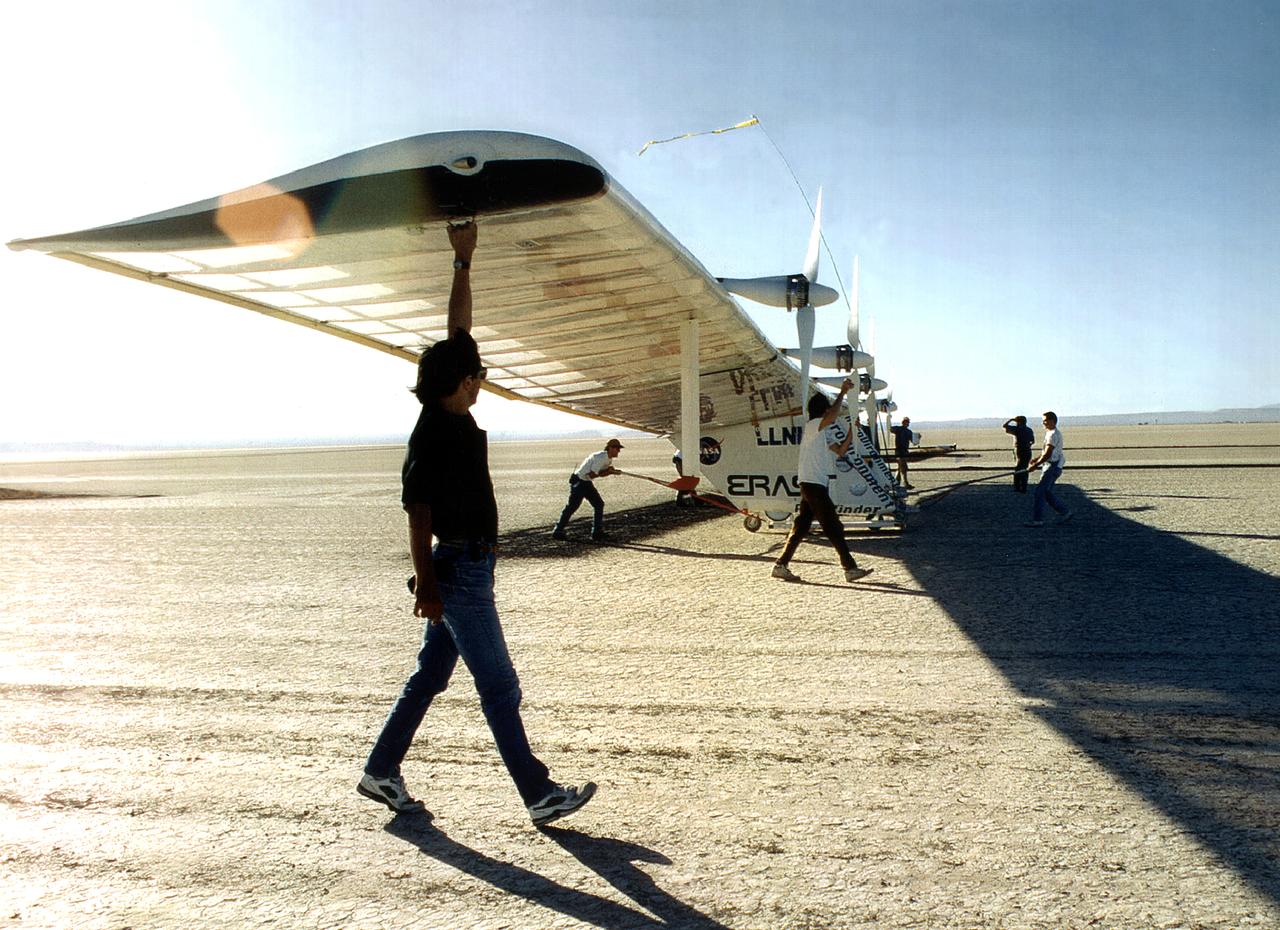
The Pathfinder research aircraft's wing structure is clearly defined in this photo as personnel from AeroVironment rolled it out onto the lakebed at NASA's Dryden Flight Research Center, Edwards, California, for another test flight.
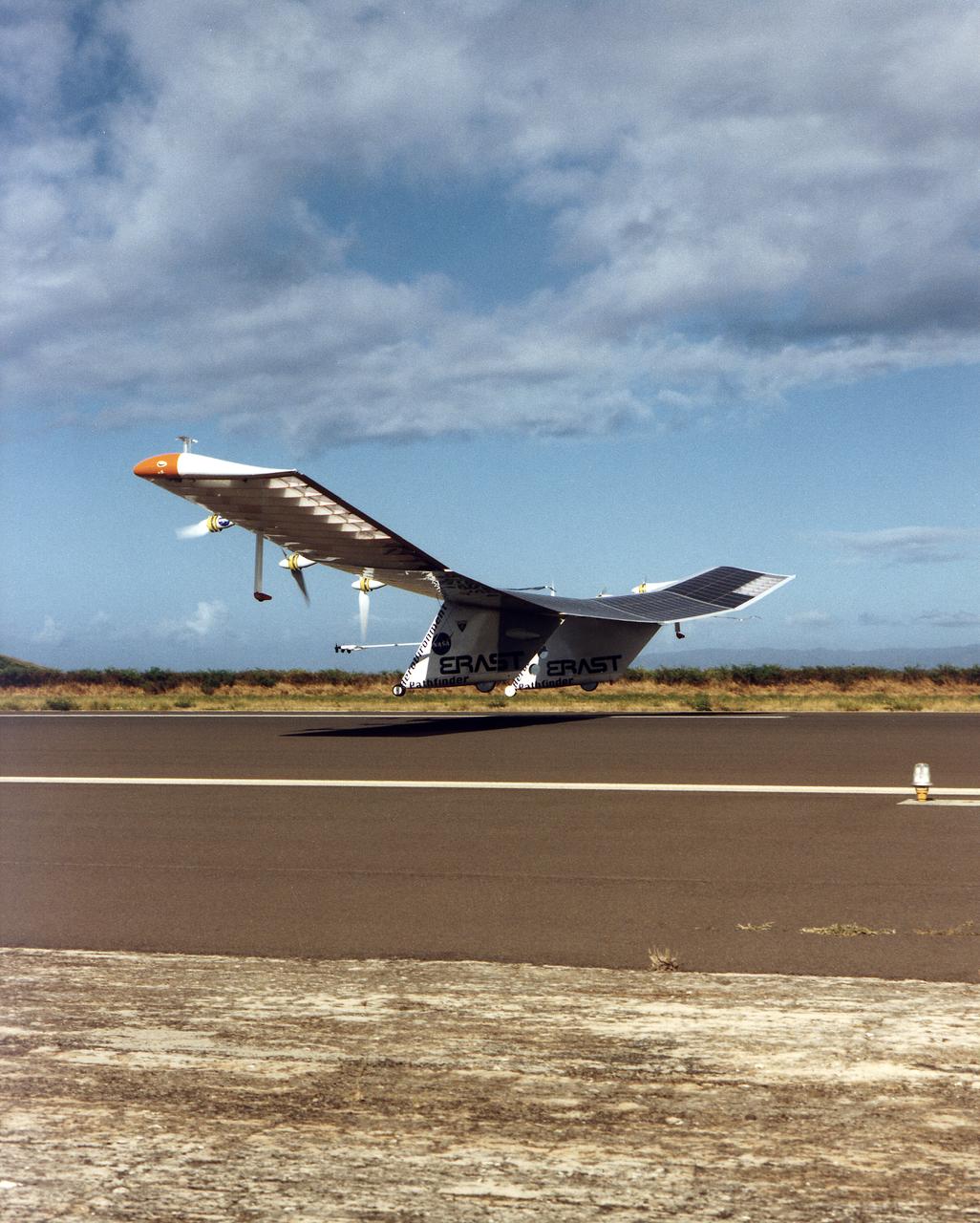
The Pathfinder aircraft has set a new unofficial world record for high-altitude flight of over 71,500 feet for solar-powered aircraft at the U.S. Navy's Pacific Missile Range Facility, Kauai, Hawaii. Pathfinder was designed and manufactured by AeroVironment, Inc, of Simi Valley, California, and was operated by the firm under a jointly sponsored research agreement with NASA's Dryden Flight Research Center, Edwards, California. Pathfinder's record-breaking flight occurred July 7, 1997. The aircraft took off at 11:34 a.m. PDT, passed its previous record altitude of 67,350 feet at about 5:45 p.m. and then reached its new record altitude at 7 p.m. The mission ended with a perfect nighttime landing at 2:05 a.m. PDT July 8. The new record is the highest altitude ever attained by a propellor-driven aircraft. Before Pathfinder, the altitude record for propellor-driven aircraft was 67,028 feet, set by the experimental Boeing Condor remotely piloted aircraft.
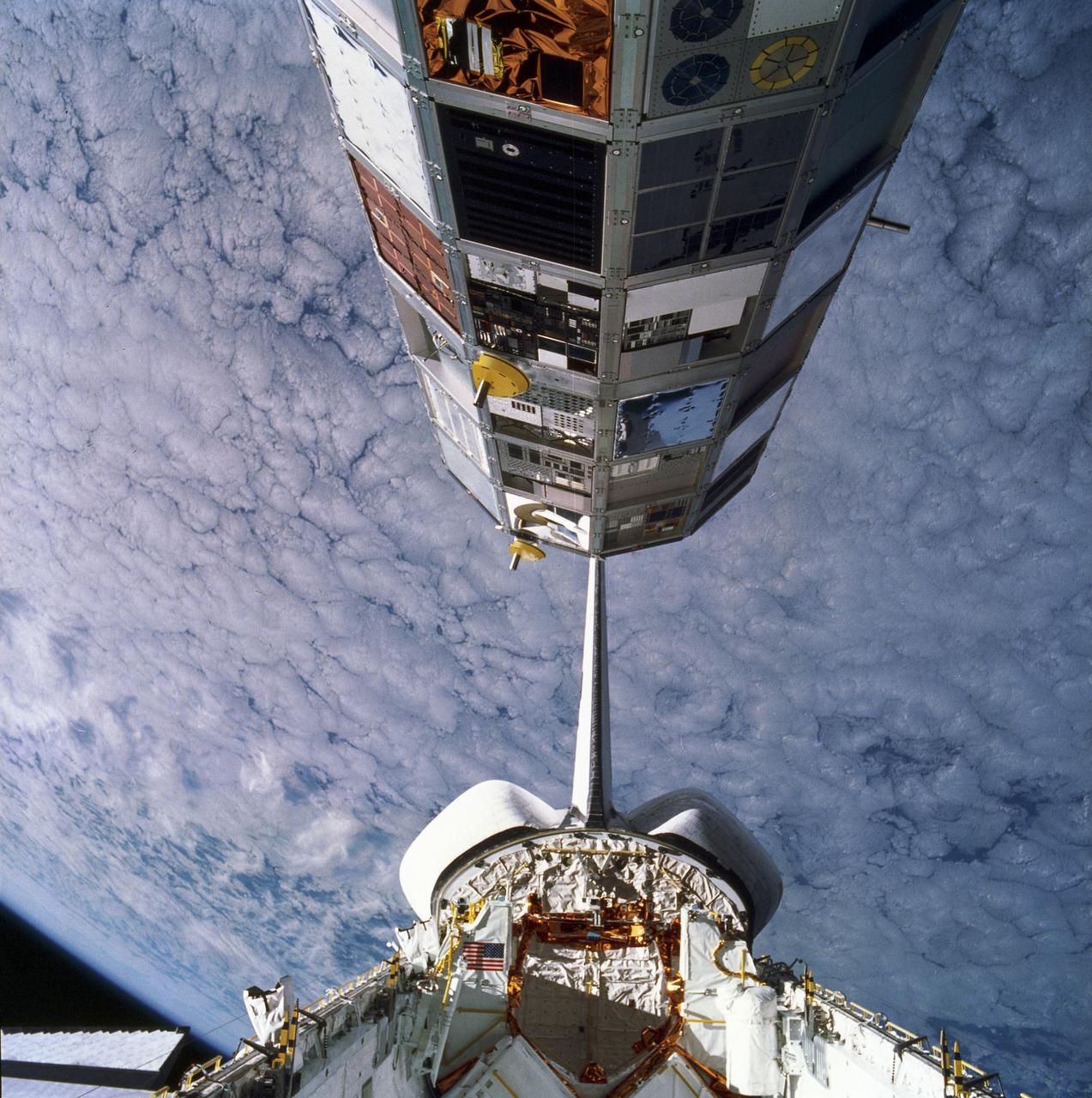
This is an onboard photo of the deployment of the Long Duration Exposure Facility (LDEF) from the cargo bay of the Space Shuttle Orbiter Challenger STS-41C mission, April 7, 1984. After a five year stay in space, the LDEF was retrieved during the STS-32 mission by the Space Shuttle Orbiter Columbia in January 1990 and was returned to Earth for close examination and analysis. The LDEF was designed by the Marshall Space Flight Center (MSFC) to test the performance of spacecraft materials, components, and systems that have been exposed to the environment of micrometeoroids, space debris, radiation particles, atomic oxygen, and solar radiation for an extended period of time. Proving invaluable to the development of both future spacecraft and the International Space Station (ISS), the LDEF carried 57 science and technology experiments, the work of more than 200 investigators, 33 private companies, 21 universities, 7 NASA centers, 9 Department of Defense laboratories, and 8 forein countries.
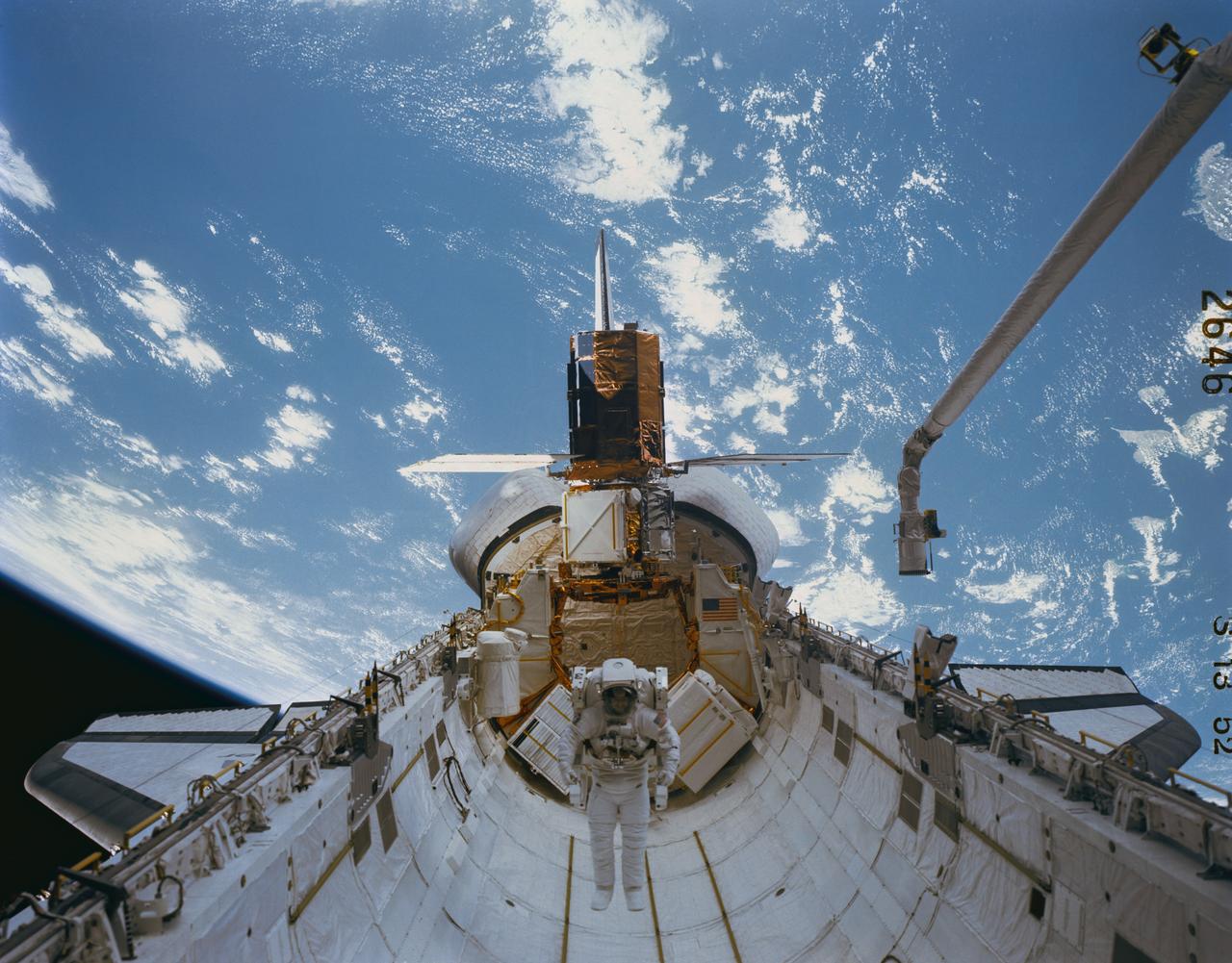
41C-52-2646 (11 April 1984) --- Astronaut James D. van Hoften and a repaired satellite are in a wide panorama recorded on film with a Linhof camera, making its initial flight aboard the Space Shuttle Challenger. Dr. van Hoften is getting in his first "field" test of the Manned Maneuvering Unit (MMU) after months of training in an underwater facility and in a simulator on Earth. The Solar Maximum Mission Satellite (SMMS), revived and almost ready for release into space once more, is docked at the Flight Support System (FSS). The Remote Manipulator System (RMS) is backdropped against the blue and white Earth at frame's edge. Outside of pictures made of the Earth from astronauts on the way to the Moon, this frame showing the planet from 285 nautical miles represents the highest orbital photography in the manned space program.
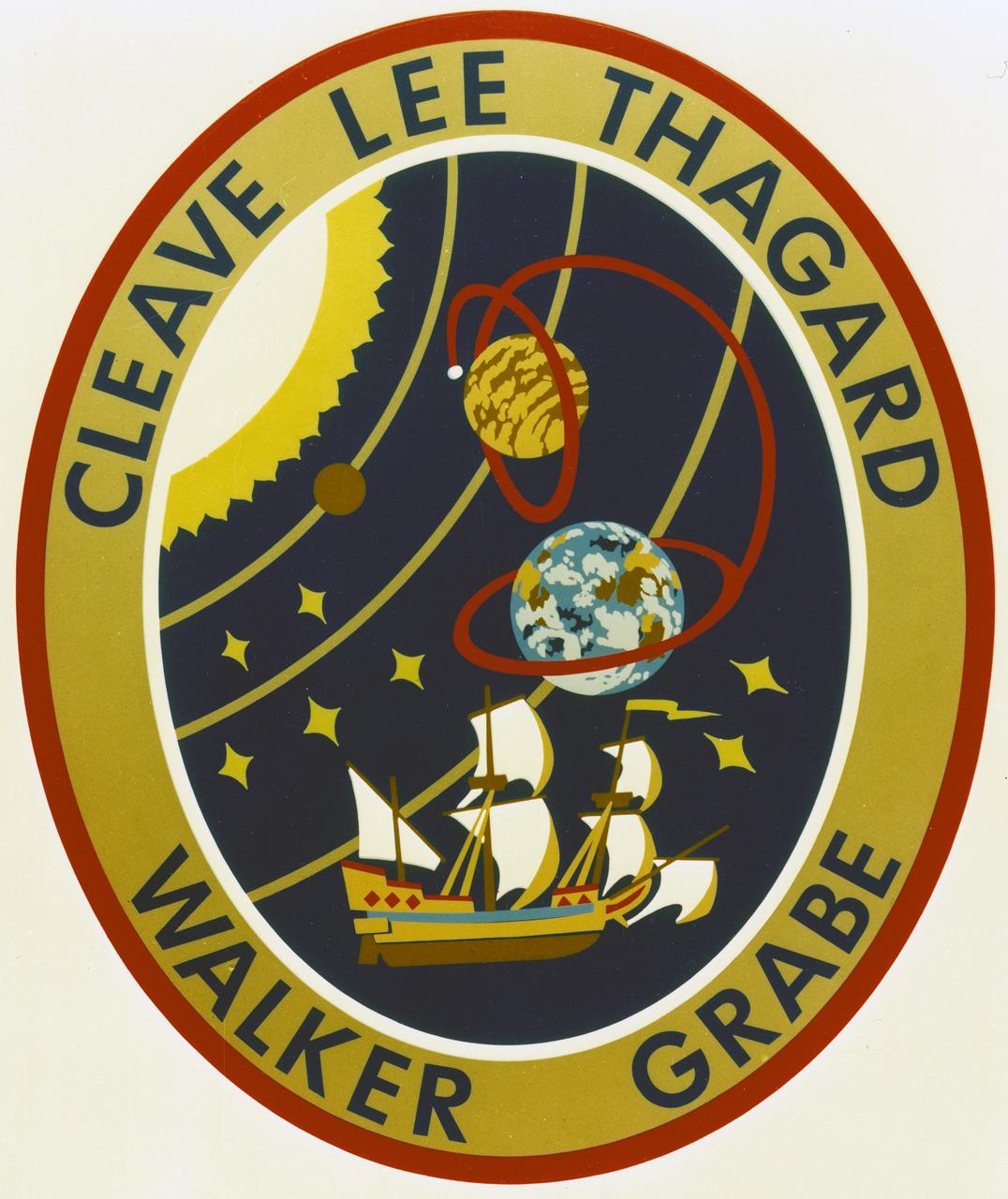
The STS-30 patch depicts the joining of NASA's manned and unmanned space programs. The sun and inner planets of our solar system are shown with the curve connecting Earth and Venus symbolizing the shuttle orbit, the spacecraft trajectory toward Venus, and its subsequent orbit around our sister planet. A Spanish caravel similar to the ship on the official Magellan program logo commemorates the 16th century explorer's journey and his legacy of adventure and discovery. Seven stars on the patch honor the crew of Challenger. The five-star cluster in the shape of the constellation Cassiopeia represent the five STS-30 crewmembers - Astronauts David Walker, Ronald Grabe, Norman Thagard, Mary Cleave and Mark Lee - who collectively designed the patch.
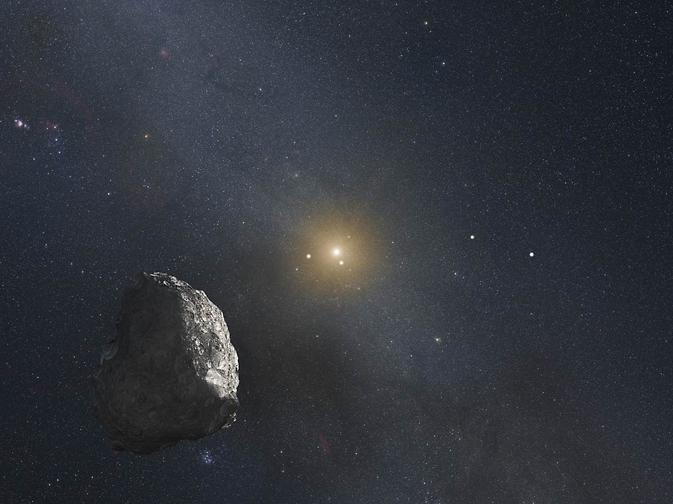
This is an artist’s impression of a Kuiper Belt object (KBO), located on the outer rim of our solar system at a staggering distance of 4 billion miles from the Sun. A HST survey uncovered three KBOs that are potentially reachable by NASA’s New Horizons spacecraft after it passes by Pluto in mid-2015. Credit: NASA, ESA, and G. Bacon (STScI) --- Peering out to the dim, outer reaches of our solar system, NASA’s Hubble Space Telescope has uncovered three Kuiper Belt objects (KBOs) the agency’s New Horizons spacecraft could potentially visit after it flies by Pluto in July 2015. The KBOs were detected through a dedicated Hubble observing program by a New Horizons search team that was awarded telescope time for this purpose. “This has been a very challenging search and it’s great that in the end Hubble could accomplish a detection – one NASA mission helping another,” said Alan Stern of the Southwest Research Institute (SwRI) in Boulder, Colorado, principal investigator of the New Horizons mission. The Kuiper Belt is a vast rim of primordial debris encircling our solar system. KBOs belong to a unique class of solar system objects that has never been visited by spacecraft and which contain clues to the origin of our solar system. The KBOs Hubble found are each about 10 times larger than typical comets, but only about 1-2 percent of the size of Pluto. Unlike asteroids, KBOs have not been heated by the sun and are thought to represent a pristine, well preserved deep-freeze sample of what the outer solar system was like following its birth 4.6 billion years ago. The KBOs found in the Hubble data are thought to be the building blocks of dwarf planets such as Pluto. Read more: <a href="http://1.usa.gov/1vzUcyK" rel="nofollow">1.usa.gov/1vzUcyK</a> <b><a href="http://www.nasa.gov/audience/formedia/features/MP_Photo_Guidelines.html" rel="nofollow">NASA image use policy.</a></b> <b><a href="http://www.nasa.gov/centers/goddard/home/index.html" rel="nofollow">NASA Goddard Space Flight Center</a></b> enables NASA’s mission through four scientific endeavors: Earth Science, Heliophysics, Solar System Exploration, and Astrophysics. Goddard plays a leading role in NASA’s accomplishments by contributing compelling scientific knowledge to advance the Agency’s mission. <b>Follow us on <a href="http://twitter.com/NASAGoddardPix" rel="nofollow">Twitter</a></b> <b>Like us on <a href="http://www.facebook.com/pages/Greenbelt-MD/NASA-Goddard/395013845897?ref=tsd" rel="nofollow">Facebook</a></b> <b>Find us on <a href="http://instagram.com/nasagoddard?vm=grid" rel="nofollow">Instagram</a></b>
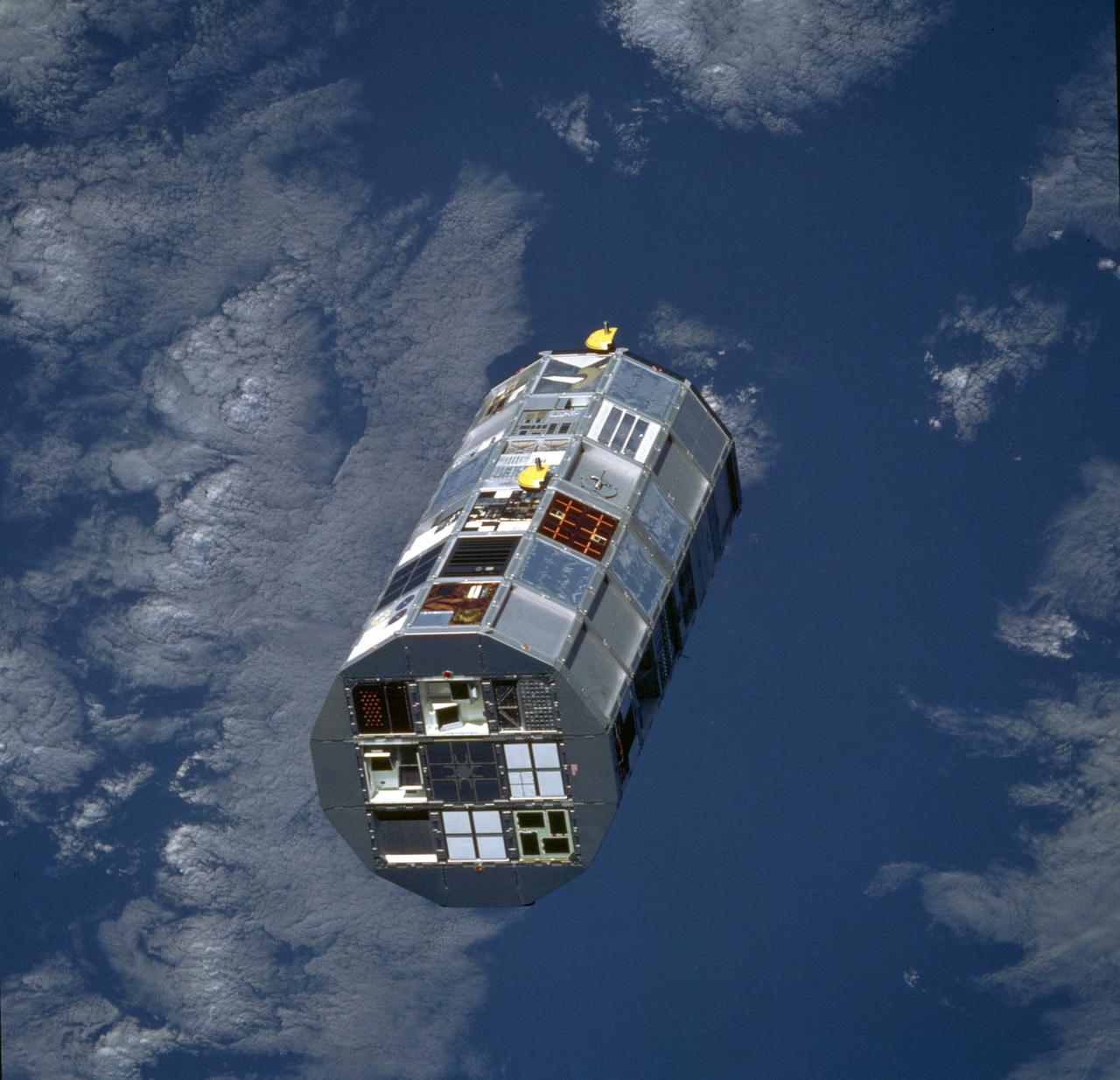
The Long Duration Exposure Facility (LDEF) was designed by the Marshall Space Flight Center (MSFC) to test the performance of spacecraft materials, components, and systems that have been exposed to the environment of micrometeoroids and space debris for an extended period of time. The LDEF proved invaluable to the development of future spacecraft and the International Space Station (ISS). The LDEF carried 57 science and technology experiments, the work of more than 200 investigators. MSFC`s experiments included: Trapped Proton Energy Determination to determine protons trapped in the Earth's magnetic field and the impact of radiation particles; Linear Energy Transfer Spectrum Measurement Experiment which measures the linear energy transfer spectrum behind different shielding configurations; Atomic oxygen-Simulated Out-gassing, an experiment that exposes thermal control surfaces to atomic oxygen to measure the damaging out-gassed products; Thermal Control Surfaces Experiment to determine the effects of the near-Earth orbital environment and the shuttle induced environment on spacecraft thermal control surfaces; Transverse Flat-Plate Heat Pipe Experiment, to evaluate the zero-gravity performance of a number of transverse flat plate heat pipe modules and their ability to transport large quantities of heat; Solar Array Materials Passive LDEF Experiment to examine the effects of space on mechanical, electrical, and optical properties of lightweight solar array materials; and the Effects of Solar Radiation on Glasses. Launched aboard the Space Shuttle Orbiter Challenger's STS-41C mission April 6, 1984, the LDEF remained in orbit for five years until January 1990 when it was retrieved by the Space Shuttle Orbiter Columbia STS-32 mission and brought back to Earth for close examination and analysis.
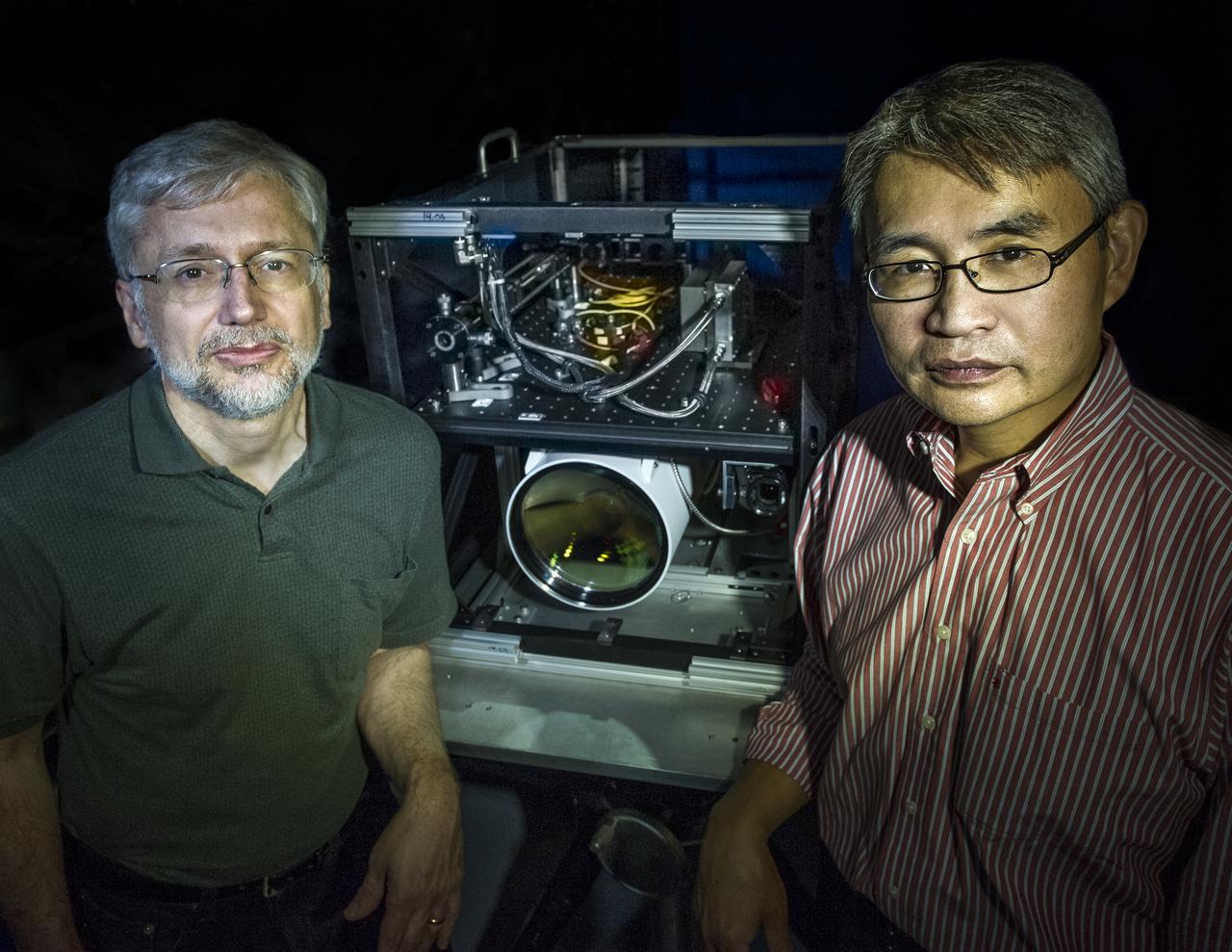
Goddard scientist David Harding and Goddard technologist Tony Yu are developing a lidar system that could meet an ambitious requirement of the proposed LIST mission. ---------- In 2007, the National Research Council threw down a challenge: Design a space-based laser altimeter that could measure the height of Earth's surface everywhere to within a mere 10 centimeters — all at 5-meter resolution. To this day, some believe it can't be done. Goddard scientist Dave Harding begs to differ. He and his team have embraced the challenge and are developing a laser altimeter that could provide the data from a berth onboard the NRC-proposed Lidar Surface Topography, or LIST, mission. It would generate highly detailed maps of topography and vegetation that scientists could use to forecast and respond to natural hazards and study carbon storage in forests. Read more: <a href="http://1.usa.gov/17N3Bql" rel="nofollow">1.usa.gov/17N3Bql</a> <b><a href="http://www.nasa.gov/audience/formedia/features/MP_Photo_Guidelines.html" rel="nofollow">NASA image use policy.</a></b> <b><a href="http://www.nasa.gov/centers/goddard/home/index.html" rel="nofollow">NASA Goddard Space Flight Center</a></b> enables NASA’s mission through four scientific endeavors: Earth Science, Heliophysics, Solar System Exploration, and Astrophysics. Goddard plays a leading role in NASA’s accomplishments by contributing compelling scientific knowledge to advance the Agency’s mission. <b>Follow us on <a href="http://twitter.com/NASA_GoddardPix" rel="nofollow">Twitter</a></b> <b>Like us on <a href="http://www.facebook.com/pages/Greenbelt-MD/NASA-Goddard/395013845897?ref=tsd" rel="nofollow">Facebook</a></b> <b>Find us on <a href="http://instagram.com/nasagoddard?vm=grid" rel="nofollow">Instagram</a></b> Credit: Bill Hrybck/NASA
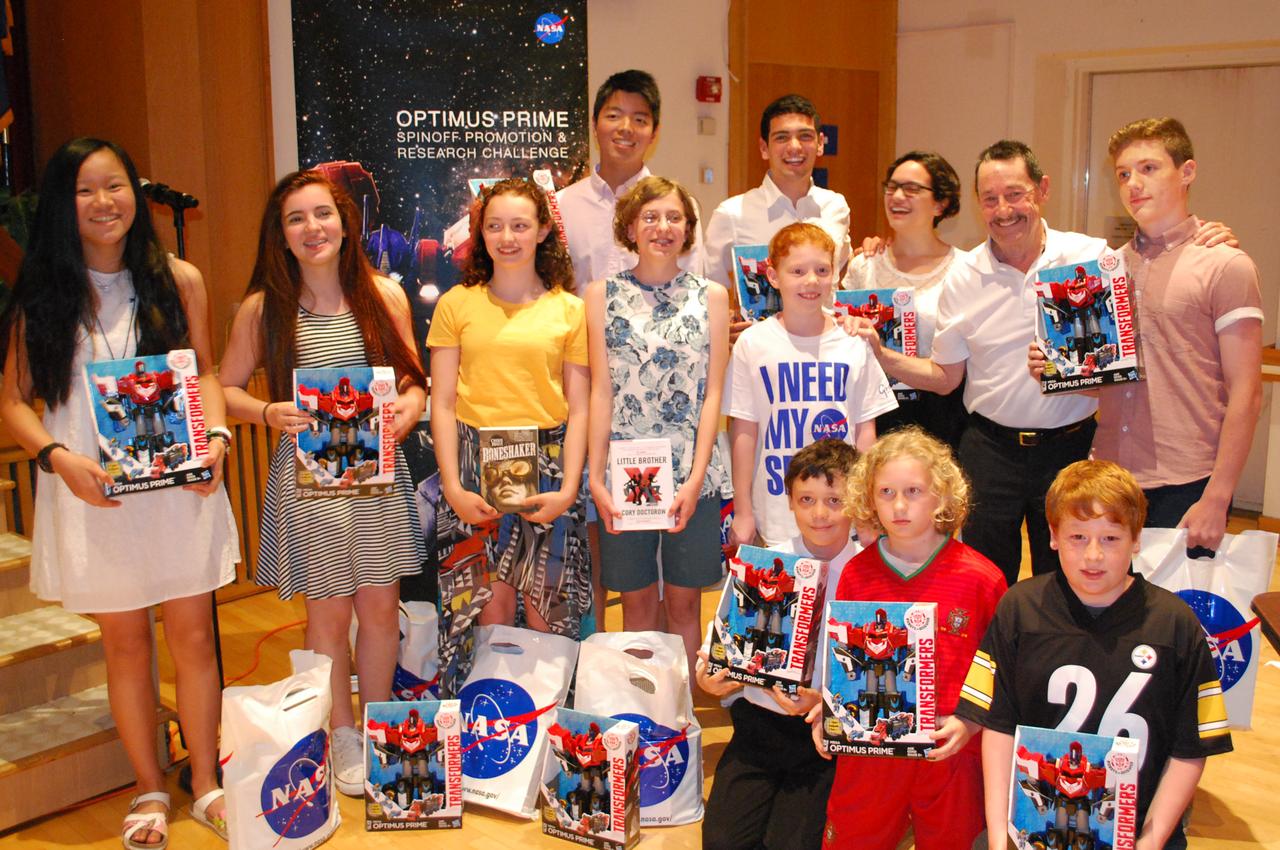
From June 28 through 30, 2016, the OPTIMUS PRIME Spinoff Promotion and Research Challenge (OPSPARC) gave the contest’s winning students the opportunity to explore NASA’s Goddard Space Flight Center in Greenbelt, Maryland. Three teams of students from elementary, middle and high school won the contest by creating the most popular ideas to use NASA technology in new and innovative ways. The students used an online platform called Glogster to make posters about their ideas, and the general public voted for their favorites. Sophia Sheehan won the elementary school prize for her invention of the “blow coat,” which would be powered by solar panels and blow warm air into winter coats, helping people in her hometown of Chicago stay warm in the winter. Heidi Long, Aubrey Nesti, Katherine Valbuena and Jasmine Wu won in the middle school category for their idea called Tent-cordion, which would use spacesuit and satellite insulation materials in a foldable tent to house refugees and the homeless. Finally, Jake Laddis, Alex Li, Isaac Wecht and Isabel Wecht won in the high school category for their idea to use James Webb Space Telescope sunshield technology to shield houses from summer heat and reduce the need for air conditioning around the world. The high school winners also had the opportunity to compete in the NASA InWorld challenge, sponsored by the James Webb Space Telescope project, and continued developing their idea in a virtual world and gaming environment. During their three-day workshop at Goddard, the students toured the center, met with scientists and engineers, took a look at the James Webb Space Telescope in Goddard’s clean room, and even made their own videos in Goddard’s TV studio. One of the students talked about how the experience inspired her. Read more: <a href="http://go.nasa.gov/298fGdQ" rel="nofollow">go.nasa.gov/298fGdQ</a>
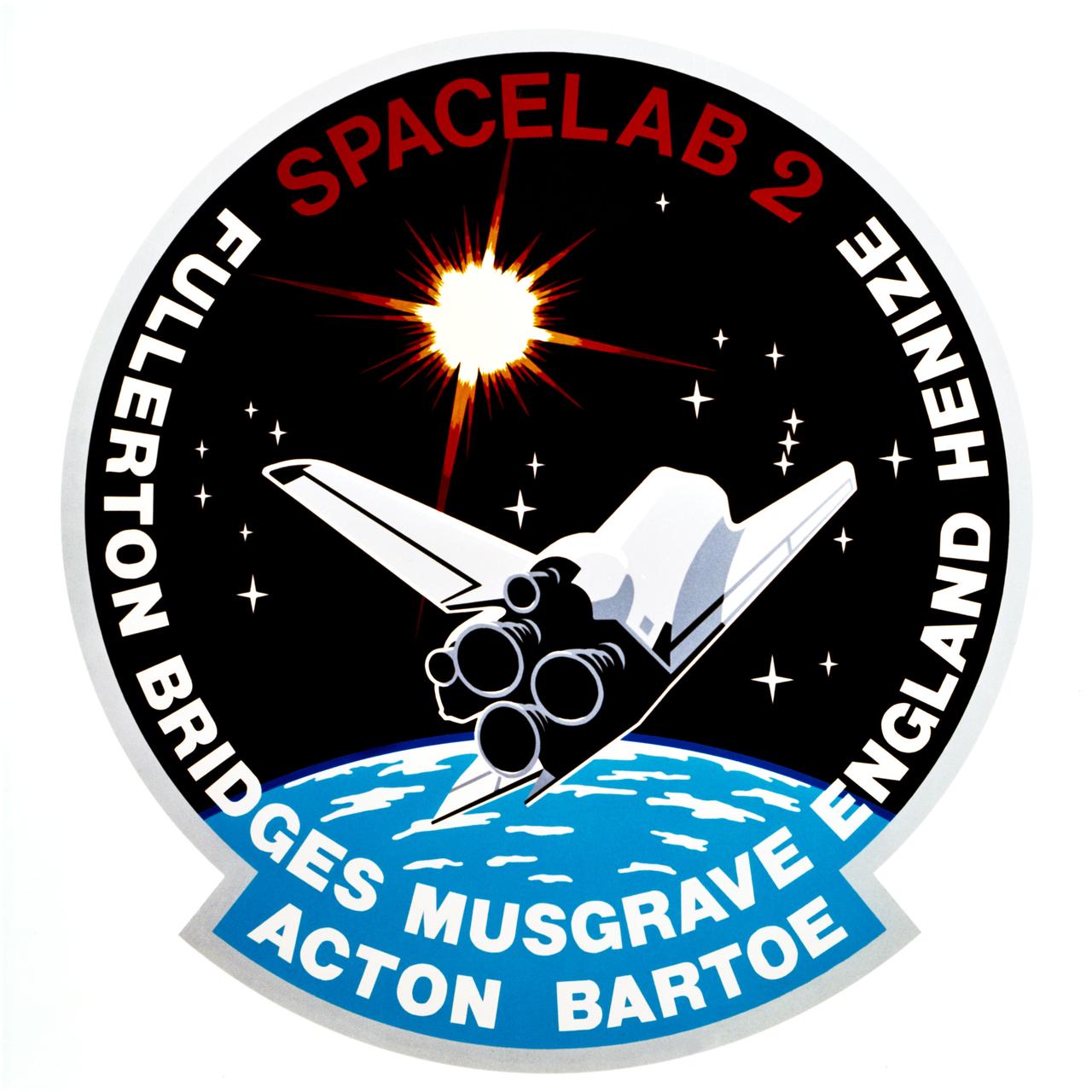
S85-29498 (June 1985) --- The crew members of space shuttle mission STS-51F have chosen as their insignia this design by Houston artist Skip Bradley. The space shuttle Challenger is depicted ascending toward the heavens in search of new knowledge in the field of solar and stellar astronomy, with its Spacelab 2 payload. The constellations Leo and Orion are in the positions they will be in, relative to the sun during the flight. The nineteen stars signify that this will be the 19th STS flight. Crew members for the mission are astronauts C. Gordon Fullerton, commander; Roy D. Bridges, pilot; F. Story Musgrave, Anthony W. England and Karl J. Henize, mission specialist; and payload specialists Loren W. Acton and John David Bartoe. The NASA insignia design for space shuttle flights is reserved for use by the astronauts and for other official use as the NASA Administrator may authorize. Public availability has been approved only in the forms of illustrations by the various news media. When and if there is any change in this policy, which is not anticipated, the change will be publicly announced. Photo credit: NASA
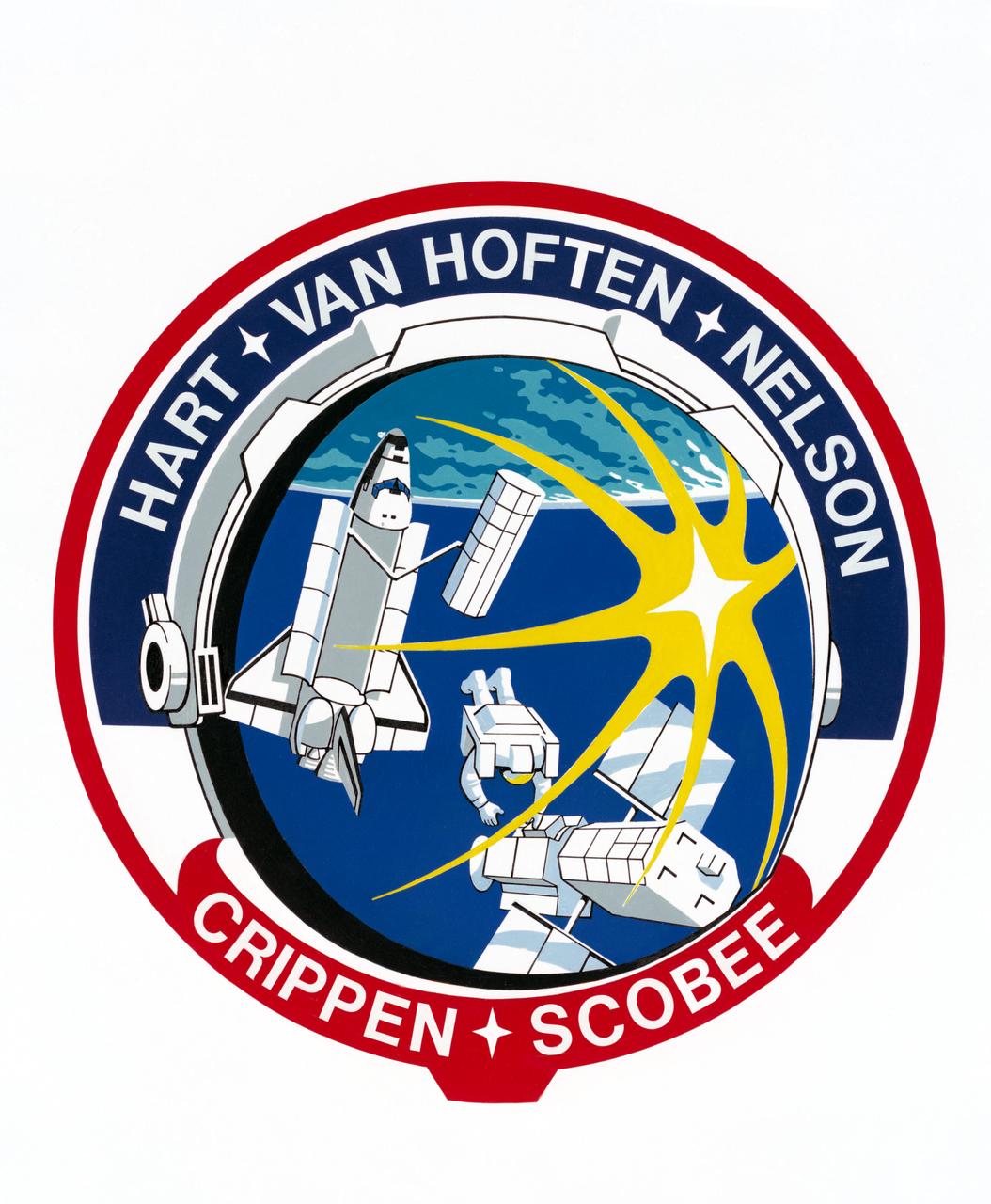
S84-25522 (15 Jan. 1984) --- The patch to be worn by the five members of NASA's STS-41C space mission tells the story of that flight. It features a helmet visor of an astronaut performing an extravehicular activity (EVA). In the visor are reflected the sun's rays, the space shuttle Challenger and its Remote Manipulator System (RMS) deploying the Long Duration Exposure Facility (LDEF), Earth and blue sky, and another astronaut working at the damaged Solar Maximum Satellite (SMS). The scene is encircled by the surnames of the crew members. They are astronauts Robert L. Crippen, commander; Francis R. (Dick) Scobee, pilot; and Terry J. Hart, James D. van Hoften and George D. Nelson, all mission specialists. The NASA insignia design for space shuttle flights is reserved for use by the astronauts and for other official use as the NASA Administrator may authorize. Public availability has been approved only in the forms of illustrations by the various news media. When and if there is any change in this policy, which is not anticipated, the change will be publicly announced. Photo credit: NASA
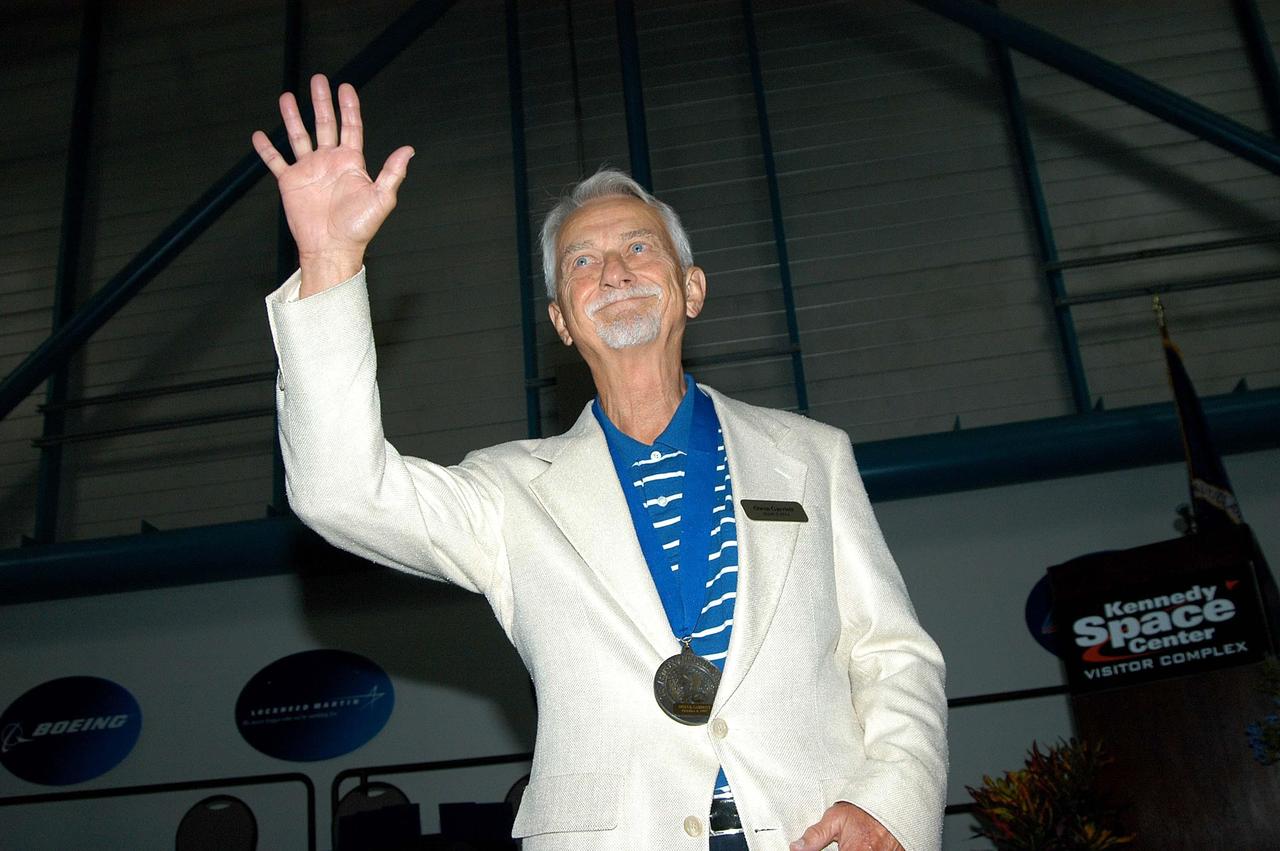
KENNEDY SPACE CENTER, FLA. -- Former astronaut Owen Garriott acknowledges the applause as he is introduced as a previous inductee into the U.S. Astronaut Hall of Fame. He and other Hall of Fame members were present for the induction of five new space program heroes into the U.S. Astronaut Hall of Fame: Richard O. Covey, commander of the Hubble Space Telescope repair mission; Norman E. Thagard, the first American to occupy Russia’s Mir space station; the late Francis R. "Dick" Scobee, commander of the ill-fated 1986 Challenger mission; Kathryn D. Sullivan, the first American woman to walk in space; and Frederick D. Gregory, the first African-American to command a space mission and the current NASA deputy administrator. Garriott exercised his expertise as a solar physicist on two space missions, the 59-day Skylab 3 flight in 1973, and an 11-day trip aboard the Space Shuttle Columbia a decade later. The induction ceremony was held at the Apollo/Saturn V Center at KSC. The U.S. Astronaut Hall of Fame opened in 1990 to provide a place where space travelers could be remembered for their participation and accomplishments in the U.S. space program. The five inductees join 52 previously honored astronauts from the ranks of the Gemini, Apollo, Skylab, Apollo-Soyuz, and Space Shuttle programs.
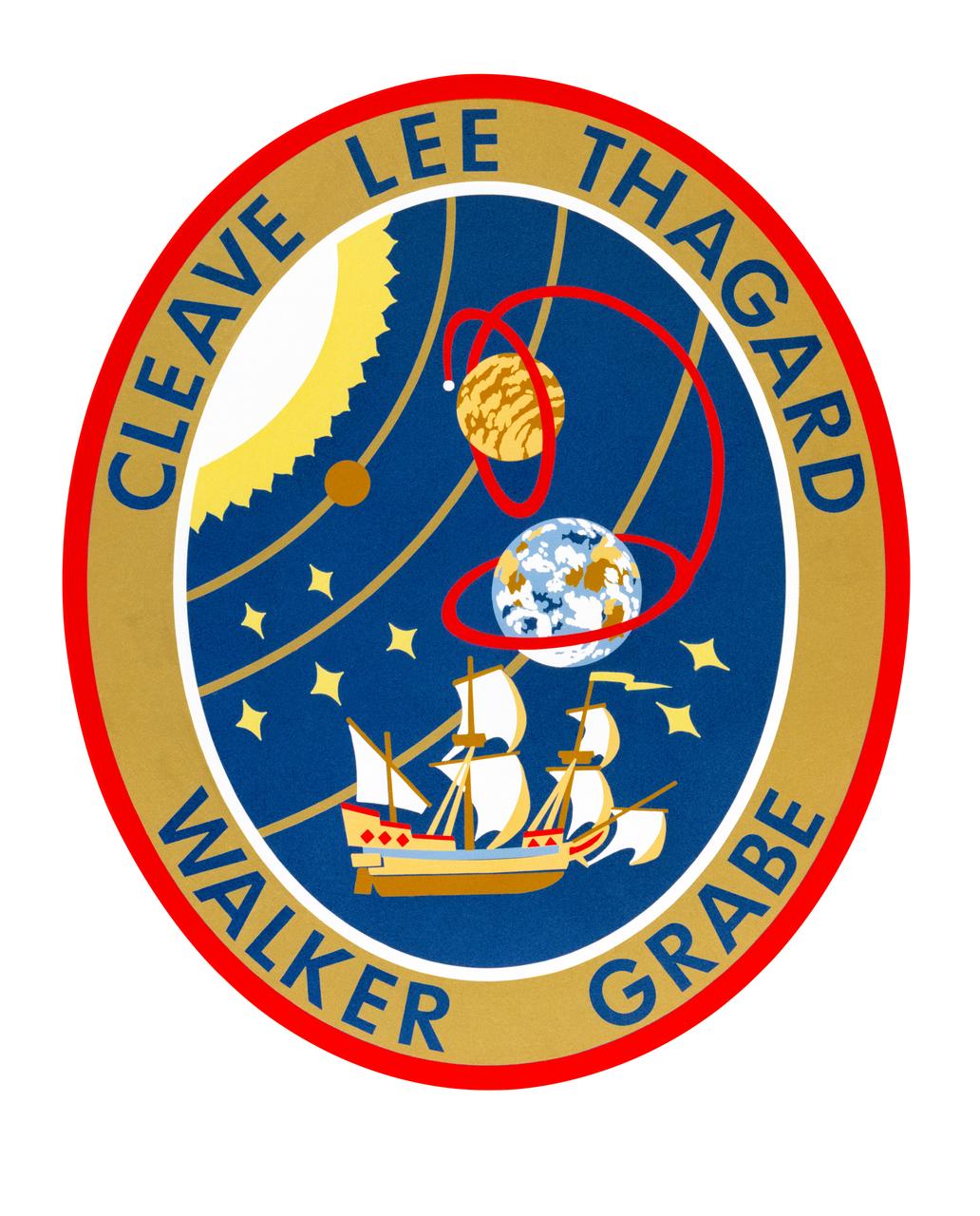
S89-20025 (3 March 1989) --- The STS-30 patch depicts the joining of NASA's manned and unmanned space programs. The sun and inner planets of our solar system are shown with the curve connecting Earth and Venus symbolizing the shuttle orbit, the spacecraft trajectory toward Venus and its subsequent orbit around our sister planet. A Spanish caravel similar to the ship on the official Magellan program logo commemorates the 16th century explorer's journey and his legacy of adventure and discovery. Seven stars on the patch honor the crew of Challenger. The five-star cluster in the shape of the constellation Cassiopeia represent the five STS-30 crew members--astronauts David M. Walker, Ronald J. Grabe, Norman E. Thagard, Mary L. Cleave and Mark C. Lee-who collectively designed the patch. The NASA insignia design for space shuttle flights is reserved for use by the astronauts and for other official use as the NASA Administrator may authorize. Public availability has been approved only in the forms of illustrations by the various news media. When and if there is any change in this policy, which is not anticipated, the change will be publicly announced. Photo credit: NASA
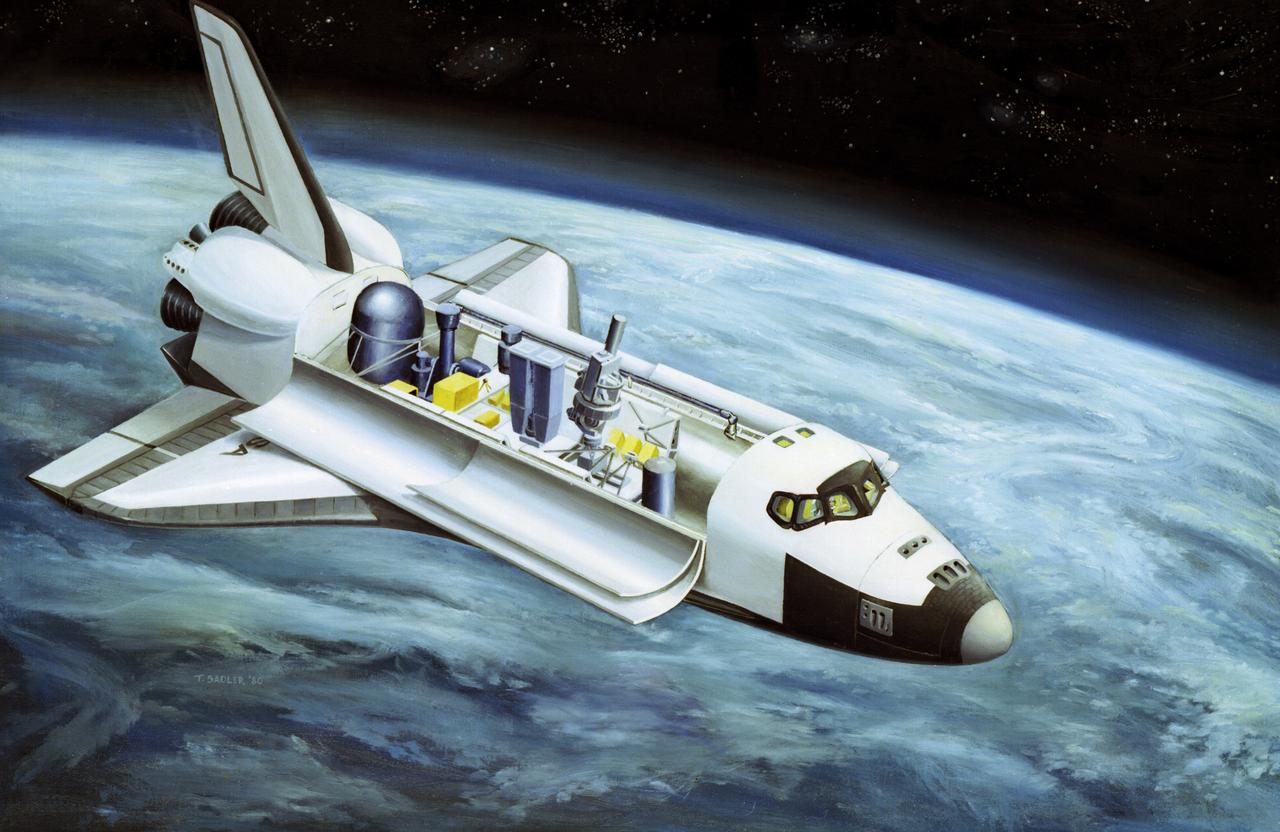
This illustration depicts the configuration of the Spacelab-2 in the cargo bay of the orbiter. Spacelab was a versatile laboratory carried in the Space Shuttle's cargo bay for scientific research flights. Each Spacelab mission had a unique design appropriate to the mission's goals. A number of Spacelab configurations could be assembled from pressurized habitation modules and exposed platforms called pallets. Spacelab-2 was the first pallet-only mission. One of the goals of the mission was to verify that the pallets' configuration was satisfactory for observations and research. Except for two biological experiments and an experiment that used ground-based instruments, the Spacelab-2 scientific instruments needed direct exposure to space. On the first pallet, three solar instruments and one atmospheric instrument were mounted on the Instrument Pointing System, which was being tested on its first flight. The second Spacelab pallet held a large double x-ray telescope and three plasma physics detectors. The last pallet supported an infrared telescope, a superfluid helium technology experiment, and a small plasma diagnostics satellite. The Spacelab-2 mission was designed to capitalize on the Shuttle-Spacelab capabilities, to launch and retrieve satellites, and to point several instruments independently with accuracy and stability. Spacelab-2 (STS-51F, 19th Shuttle mission) was launched aboard Space Shuttle Orbiter Challenger on July 29, 1985. The Marshall Space Flight Center had overall management responsibilities of the Spacelab missions.
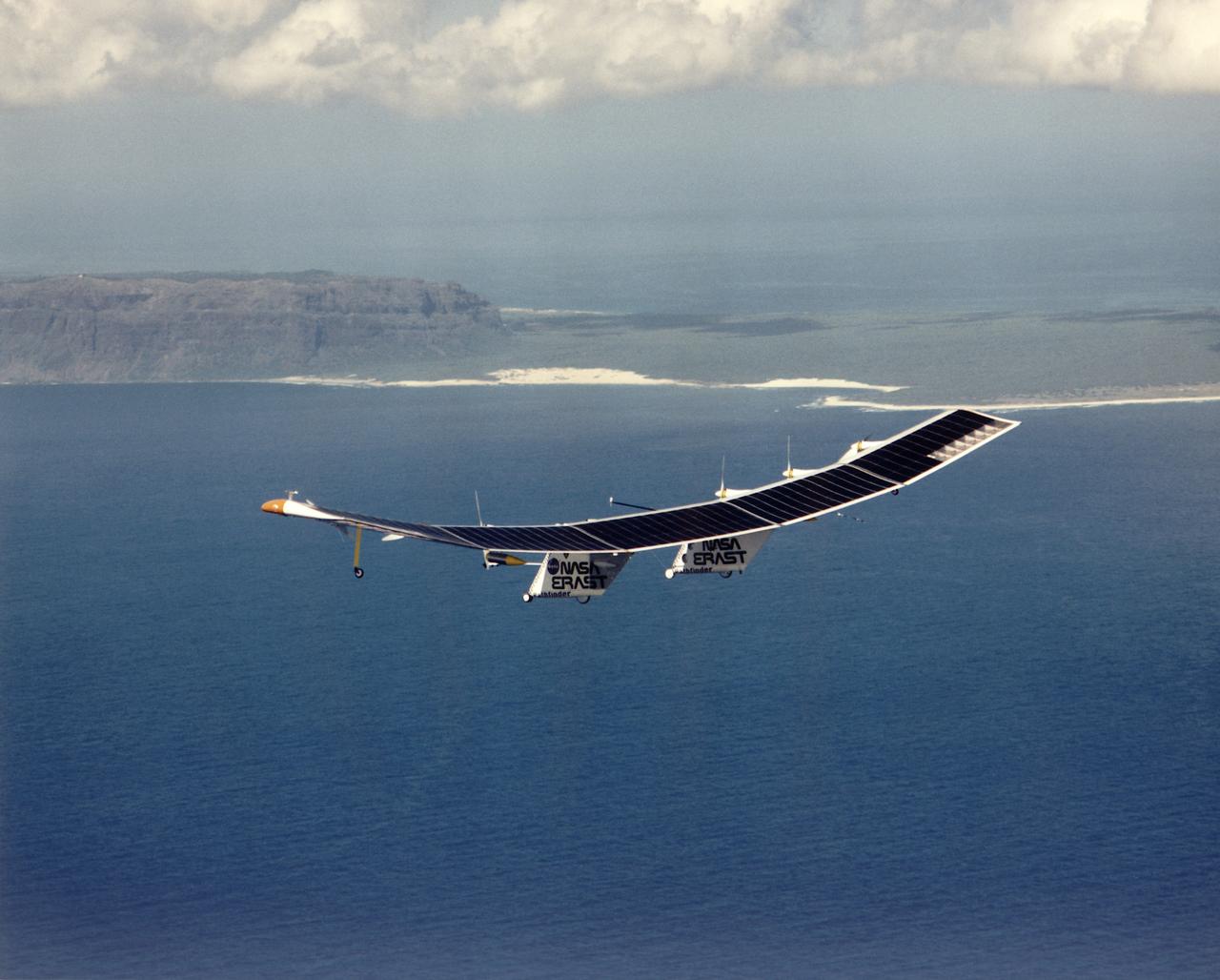
Pathfinder, NASA's solar-powered, remotely-piloted aircraft is shown while it was conducting a series of science flights to highlight the aircraft's science capabilities while collecting imagery of forest and coastal zone ecosystems on Kauai, Hawaii. The flights also tested two new scientific instruments, a high spectral resolution Digital Array Scanned Interferometer (DASI) and a high spatial resolution Airborne Real-Time Imaging System (ARTIS). The remote sensor payloads were designed by NASA's Ames Research Center, Moffett Field, California, to support NASA's Mission to Planet Earth science programs.

Astronomers using NASA's Hubble Space Telescope have found compelling evidence of a planet forming 7.5 billion miles away from its star, a finding that may challenge current theories about planet formation. Of the almost 900 planets outside our solar system that have been confirmed to date, this is the first to be found at such a great distance from its star. The suspected planet is orbiting the diminutive red dwarf TW Hydrae, a popular astronomy target located 176 light-years away from Earth in the constellation Hydra the Sea Serpent. Read more: <a href="http://1.usa.gov/196B6lZ" rel="nofollow">1.usa.gov/196B6lZ</a> NASA, ESA, J. Debes (STScI), H. Jang-Condell (University of Wyoming), A. Weinberger (Carnegie Institution of Washington), A. Roberge (Goddard Space Flight Center), G. Schneider (University of Arizona/Steward Observatory), and A. Feild (STScI/AURA) <b><a href="http://www.nasa.gov/audience/formedia/features/MP_Photo_Guidelines.html" rel="nofollow">NASA image use policy.</a></b> <b><a href="http://www.nasa.gov/centers/goddard/home/index.html" rel="nofollow">NASA Goddard Space Flight Center</a></b> enables NASA’s mission through four scientific endeavors: Earth Science, Heliophysics, Solar System Exploration, and Astrophysics. Goddard plays a leading role in NASA’s accomplishments by contributing compelling scientific knowledge to advance the Agency’s mission. <b>Follow us on <a href="http://twitter.com/NASA_GoddardPix" rel="nofollow">Twitter</a></b> <b>Like us on <a href="http://www.facebook.com/pages/Greenbelt-MD/NASA-Goddard/395013845897?ref=tsd" rel="nofollow">Facebook</a></b> <b>Find us on <a href="http://instagram.com/nasagoddard?vm=grid" rel="nofollow">Instagram</a></b>
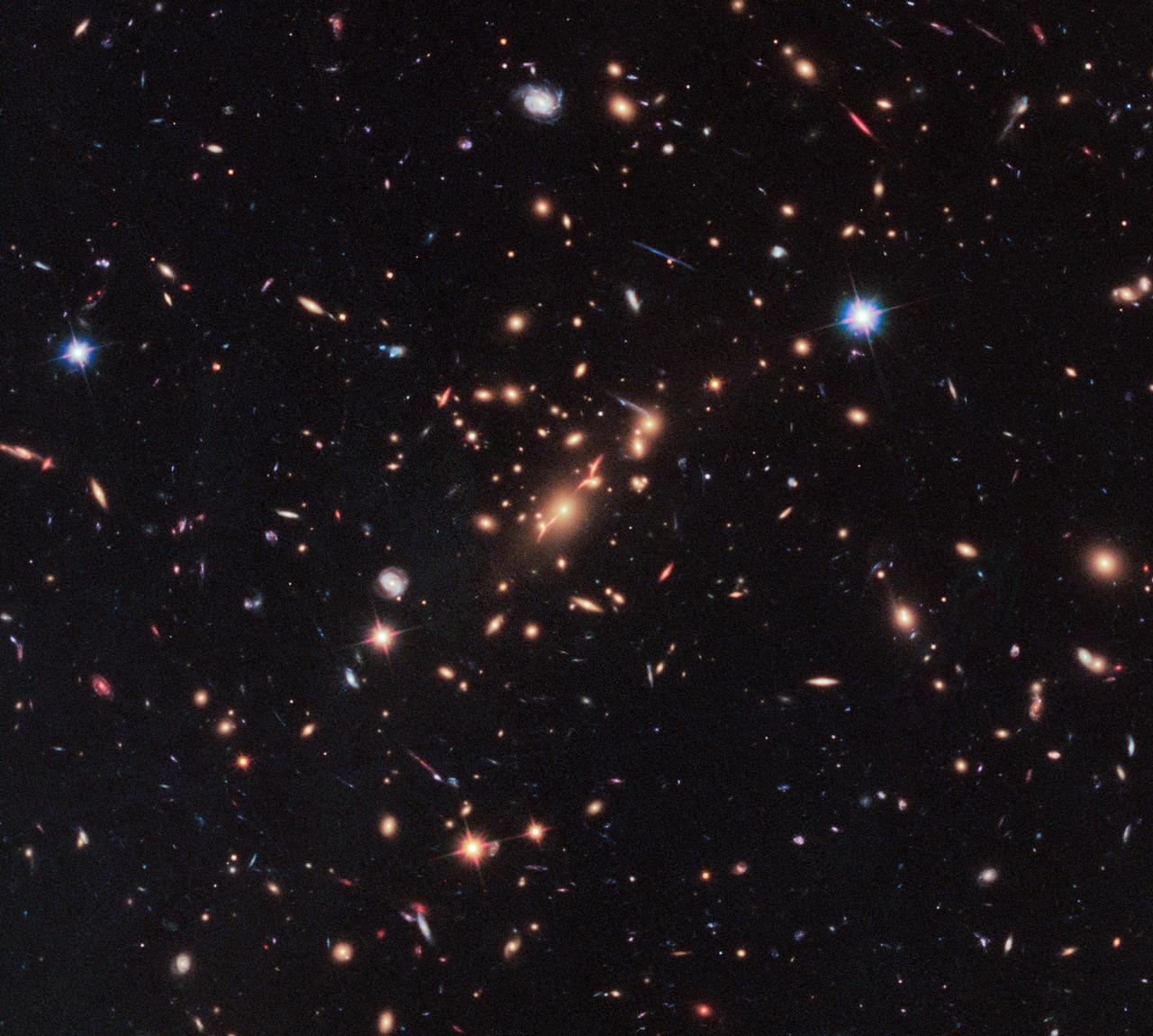
By combining the power of a "natural lens" in space with the capability of NASA's Hubble Space Telescope, astronomers made a surprising discovery—the first example of a compact yet massive, fast-spinning, disk-shaped galaxy that stopped making stars only a few billion years after the big bang. Finding such a galaxy early in the history of the universe challenges the current understanding of how massive galaxies form and evolve, say researchers. Read more: <a href="https://go.nasa.gov/2sWwKkc" rel="nofollow">go.nasa.gov/2sWwKkc</a> caption: Acting as a “natural telescope” in space, the gravity of the extremely massive foreground galaxy cluster MACS J2129-0741 magnifies, brightens, and distorts the far-distant background galaxy MACS2129-1, shown in the top box. The middle box is a blown-up view of the gravitationally lensed galaxy. In the bottom box is a reconstructed image, based on modeling that shows what the galaxy would look like if the galaxy cluster were not present. The galaxy appears red because it is so distant that its light is shifted into the red part of the spectrum. Credits: NASA, ESA, M. Postman (STScI), and the CLASH team <b><a href="http://www.nasa.gov/audience/formedia/features/MP_Photo_Guidelines.html" rel="nofollow">NASA image use policy.</a></b> <b><a href="http://www.nasa.gov/centers/goddard/home/index.html" rel="nofollow">NASA Goddard Space Flight Center</a></b> enables NASA’s mission through four scientific endeavors: Earth Science, Heliophysics, Solar System Exploration, and Astrophysics. Goddard plays a leading role in NASA’s accomplishments by contributing compelling scientific knowledge to advance the Agency’s mission. <b>Follow us on <a href="http://twitter.com/NASAGoddardPix" rel="nofollow">Twitter</a></b> <b>Like us on <a href="http://www.facebook.com/pages/Greenbelt-MD/NASA-Goddard/395013845897?ref=tsd" rel="nofollow">Facebook</a></b> <b>Find us on <a href="http://instagrid.me/nasagoddard/?vm=grid" rel="nofollow">Instagram</a></b>
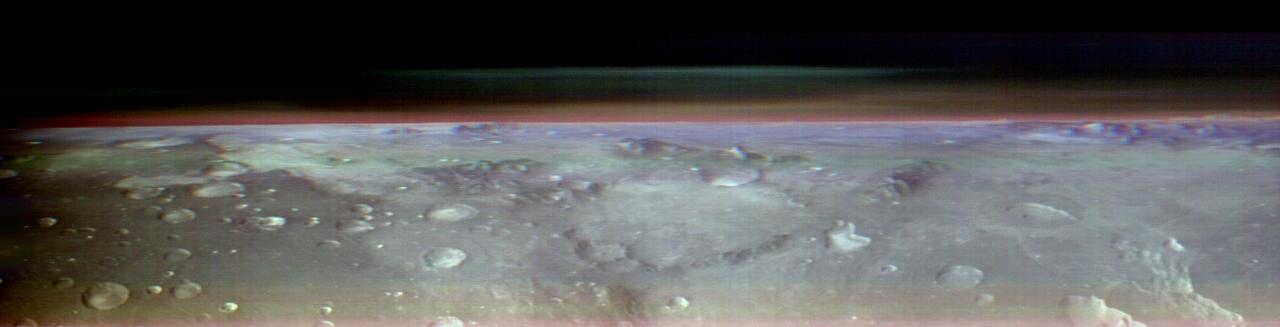
This view of Mars was captured by NASA's Odyssey orbiter using its Thermal Emission Imaging System, or THEMIS, camera. This image is a false color composite, made by combining three channels of infrared data that highlight water-ice clouds and dust in the atmosphere. This panorama was one of 10 captured on May 9, 2023, from an altitude of roughly 250 miles (400 kilometers) above the Martian surface – about the same altitude at which the International Space Station flies over Earth. The 10 panoramas of the Martian horizon were taken to capture a one-of-a-kind view of the Martian atmosphere as Odyssey circled the planet during its two-hour orbit. The reason why the view is so uncommon is because of the challenges involved in creating it. Engineers at NASA's Jet Propulsion Laboratory in Southern California (which leads the Odyssey mission) and Lockheed Martin Space (which built Odyssey and co-leads day-to-day operations) spent three months planning the observations. THEMIS' sensitivity to warmth enables it to map ice, rock, sand, and dust, along with temperature changes, on the planet's surface. It can also measure how much water ice or dust is in the atmosphere, but only in a narrow column directly below the spacecraft. That's because THEMIS is fixed in place on the orbiter; it usually points straight down. Mission scientists wanted a more expansive view of the atmosphere. Seeing where those layers of water-ice clouds and dust are in relation to each other – whether there's one layer or several stacked on top of each other – helps them improve models of Mars' atmosphere. Because THEMIS can't pivot, adjusting the angle of the camera requires adjusting the position of the whole spacecraft. In this case, the team needed to rotate the orbiter almost 90 degrees while making sure the Sun would still shine on the spacecraft's solar panels but not on sensitive equipment that could overheat. The easiest orientation turned out to be one where the orbiter's antenna pointed away from Earth. That meant the team was out of communication with Odyssey for several hours until the operation was completed. https://photojournal.jpl.nasa.gov/catalog/PIA26203
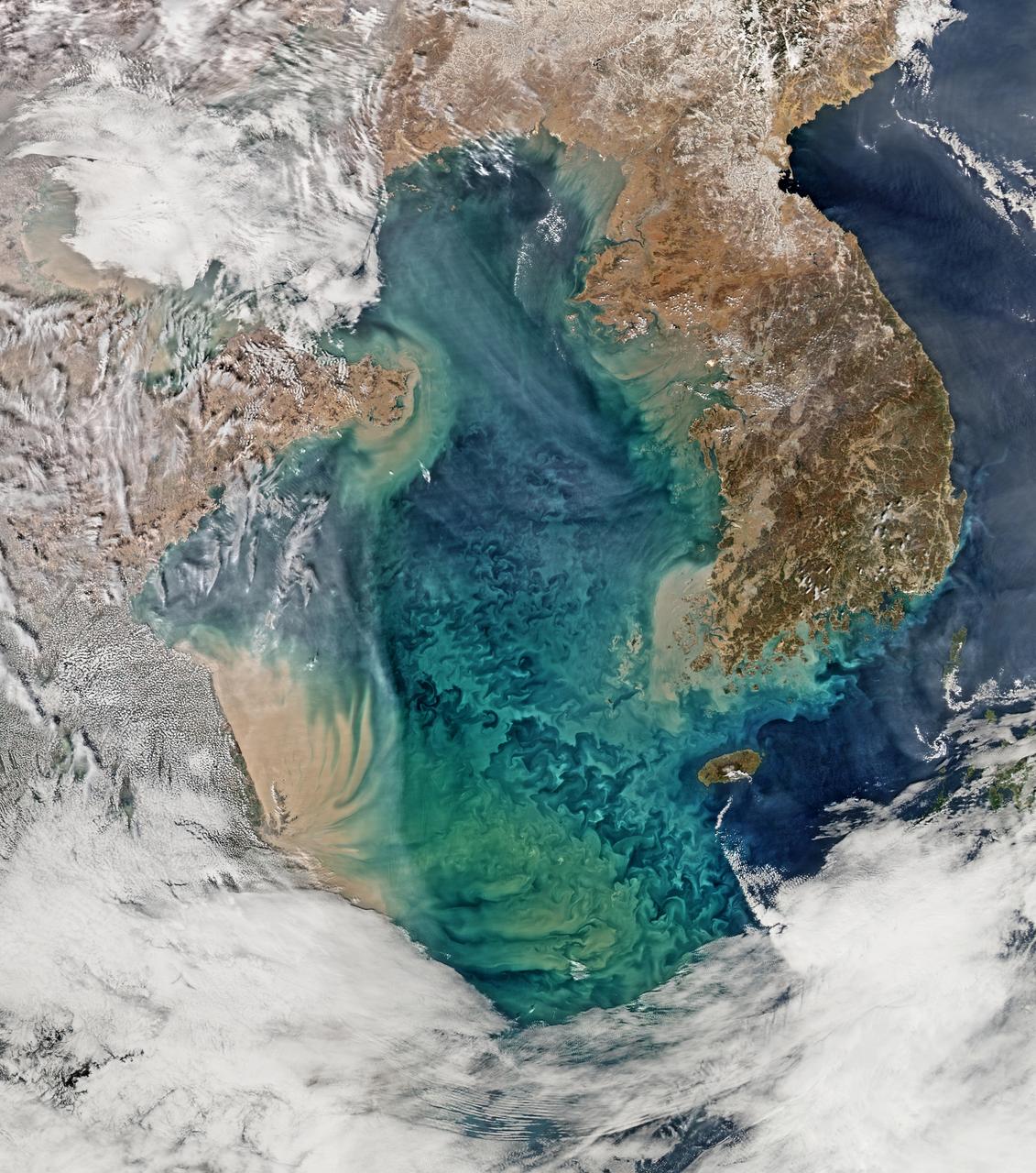
Remote sensing of ocean color in the Yellow Sea can be a challenge. Phytoplankton, suspended sediments, and dissolved organic matter color the water while various types of aerosols modify those colors before they are "seen" by orbiting radiometers. The Aqua-MODIS data used to create the above image were collected on February 24, 2015. NASA's OceanColor Web is supported by the Ocean Biology Processing Group (OBPG) at NASA's Goddard Space Flight Center. Our responsibilities include the collection, processing, calibration, validation, archive and distribution of ocean-related products from a large number of operational, satellite-based remote-sensing missions providing ocean color, sea surface temperature and sea surface salinity data to the international research community since 1996. Credit: NASA/Goddard/Ocean Color <b><a href="http://www.nasa.gov/audience/formedia/features/MP_Photo_Guidelines.html" rel="nofollow">NASA image use policy.</a></b> <b><a href="http://www.nasa.gov/centers/goddard/home/index.html" rel="nofollow">NASA Goddard Space Flight Center</a></b> enables NASA’s mission through four scientific endeavors: Earth Science, Heliophysics, Solar System Exploration, and Astrophysics. Goddard plays a leading role in NASA’s accomplishments by contributing compelling scientific knowledge to advance the Agency’s mission. <b>Follow us on <a href="http://twitter.com/NASAGoddardPix" rel="nofollow">Twitter</a></b> <b>Like us on <a href="http://www.facebook.com/pages/Greenbelt-MD/NASA-Goddard/395013845897?ref=tsd" rel="nofollow">Facebook</a></b> <b>Find us on <a href="http://instagram.com/nasagoddard?vm=grid" rel="nofollow">Instagram</a></b>
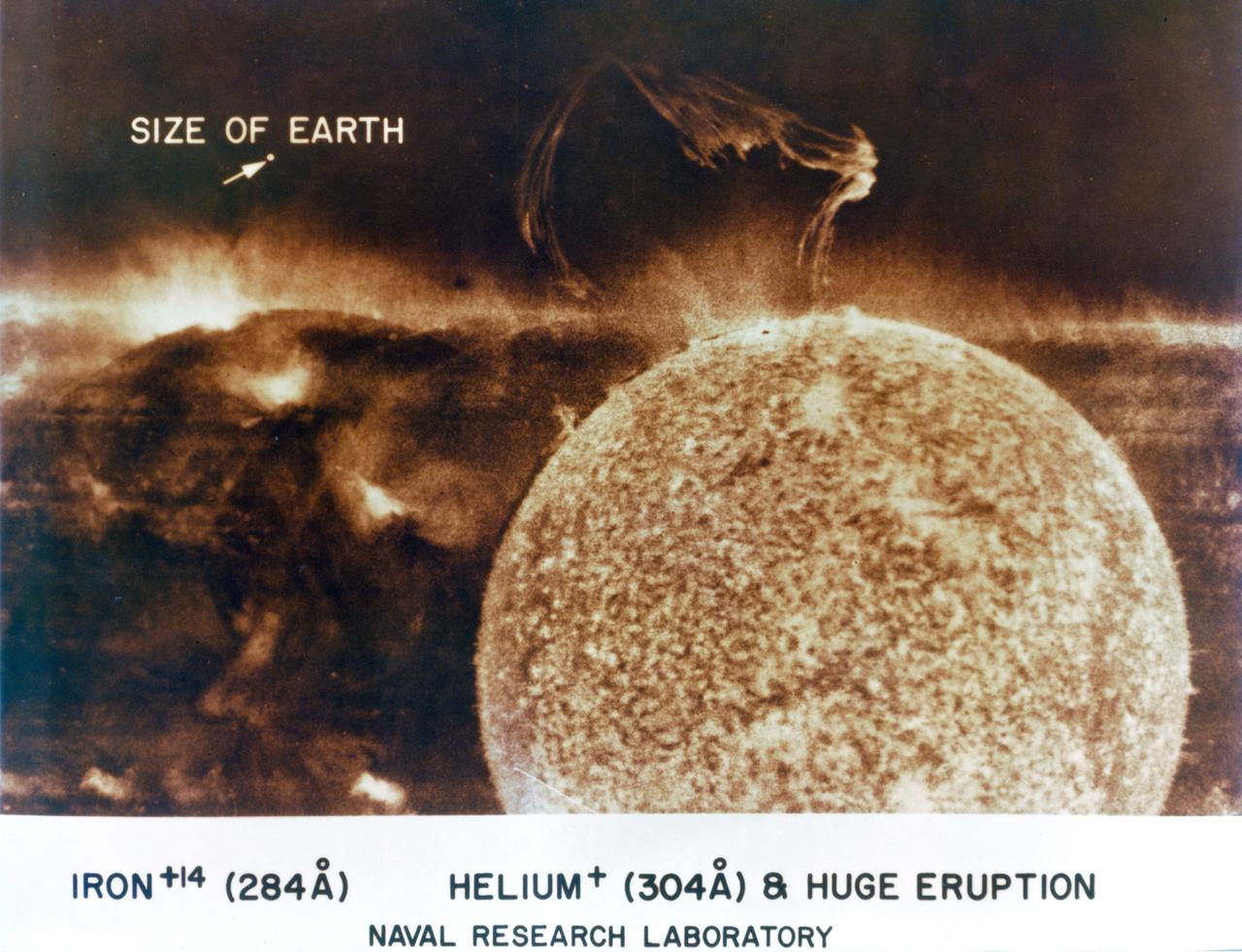
S74-15583 (July 1973) --- A huge solar eruption can be seen in this Spectroheliogram obtained during the Skylab 3 mission by the Extreme Ultraviolet Spectrograph/Spectroheliograph SO82A Experiment aboard the Skylab space station in Earth orbit. SO82 is one of the Apollo Telescope Mount experiments. The SO82 "A" instrument covers the wavelength region from 150-650 angstroms (EUV regions). The magnitude of the eruption can be visualized by comparing it with the small white dot that represents the size of Earth. This photograph reveals for the first time that helium erupting from the sun can stay together to altitudes of up to 500,000 miles. After being ejected from the sun, the gas clouds seem to have come to a standstill, as though blocked by an unseen wall. Some materials appear to have been directed back toward the sun as a rain, distinguished by fine threads. At present it is a challenge to explain this mystery--what forces expelled these huge clouds, then blocked its further progress, yet allowed the cloud to maintain its threads. Both magnetic fields and gravity must play a part, but these curious forms seem to defy explanation based on magnetic and gravitational fields alone. The EUV spectroheliograph was designed and constructed by the U.S. Naval Research Laboratory and the Ball Brothers Research Corporation under the direction of Dr. R. Tousey, the principal investigator for this NASA experiment. On the left may be seen the sun's image in emission from iron atoms which have lost 14 electrons by collision in the sun's million-degree coronal plasma gas. Photo credit: NASA
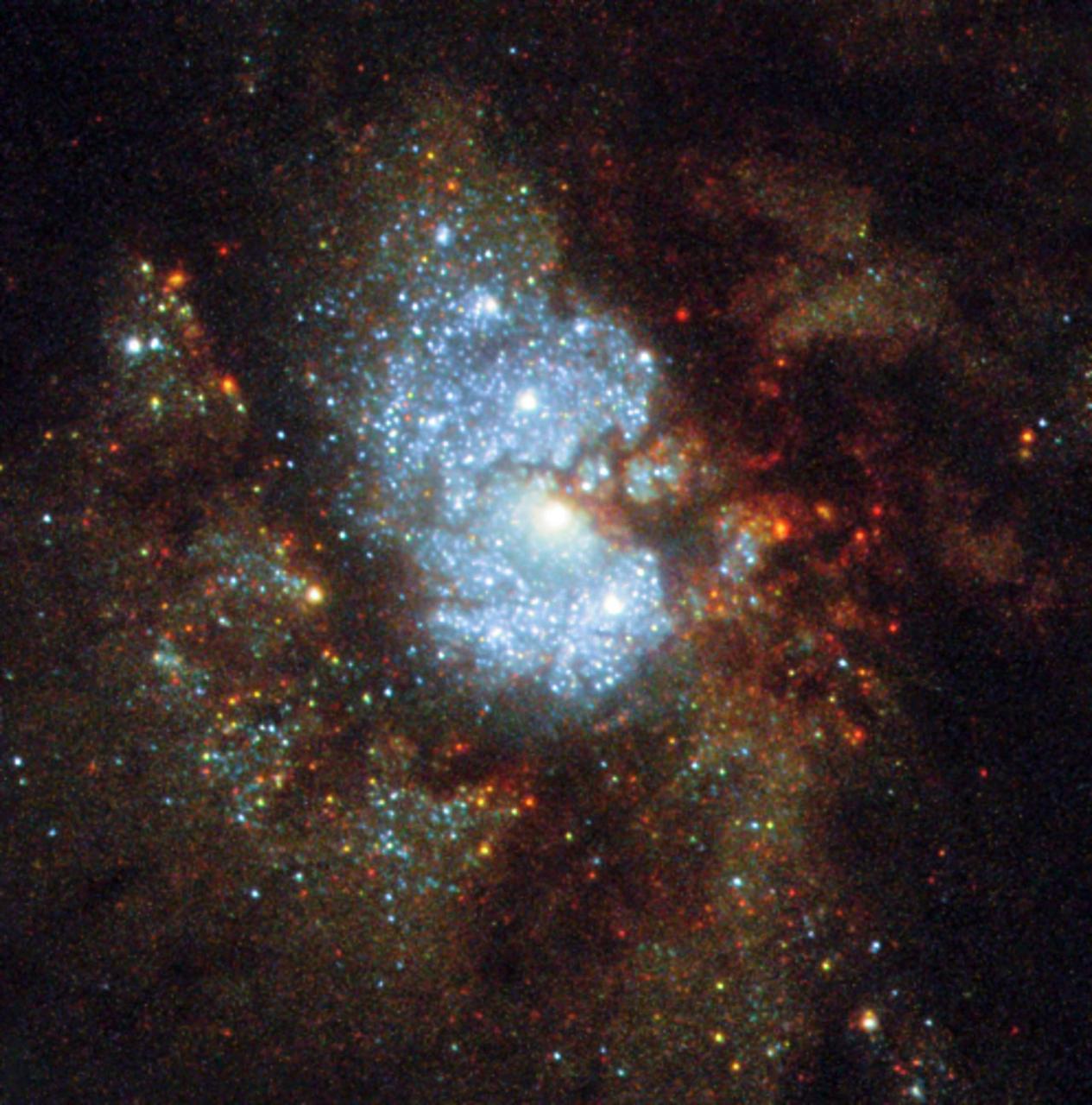
IC 342 is a challenging cosmic target. Although it is bright, the galaxy sits near the equator of the Milky Way’s galactic disk, where the sky is thick with glowing cosmic gas, bright stars, and dark, obscuring dust. In order for astronomers to see the intricate spiral structure of IC 342, they must gaze through a large amount of material contained within our own galaxy — no easy feat! As a result IC 342 is relatively difficult to spot and image, giving rise to its intriguing nickname: the “Hidden Galaxy.” Located very close (in astronomical terms) to the Milky Way, this sweeping spiral galaxy would be among the brightest in the sky were it not for its dust-obscured location. The galaxy is very active, as indicated by the range of colors visible in this NASA/ESA Hubble Space Telescope image, depicting the very central region of the galaxy. A beautiful mixture of hot, blue star-forming regions, redder, cooler regions of gas, and dark lanes of opaque dust can be seen, all swirling together around a bright core. In 2003, astronomers confirmed this core to be a specific type of central region known as an HII nucleus — a name that indicates the presence of ionized hydrogen — that is likely to be creating many hot new stars. Credit: ESA/Hubble & NASA <b><a href="http://www.nasa.gov/audience/formedia/features/MP_Photo_Guidelines.html" rel="nofollow">NASA image use policy.</a></b> <b><a href="http://www.nasa.gov/centers/goddard/home/index.html" rel="nofollow">NASA Goddard Space Flight Center</a></b> enables NASA’s mission through four scientific endeavors: Earth Science, Heliophysics, Solar System Exploration, and Astrophysics. Goddard plays a leading role in NASA’s accomplishments by contributing compelling scientific knowledge to advance the Agency’s mission. <b>Follow us on <a href="http://twitter.com/NASAGoddardPix" rel="nofollow">Twitter</a></b> <b>Like us on <a href="http://www.facebook.com/pages/Greenbelt-MD/NASA-Goddard/395013845897?ref=tsd" rel="nofollow">Facebook</a></b> <b>Find us on <a href="http://instagrid.me/nasagoddard/?vm=grid" rel="nofollow">Instagram</a></b>
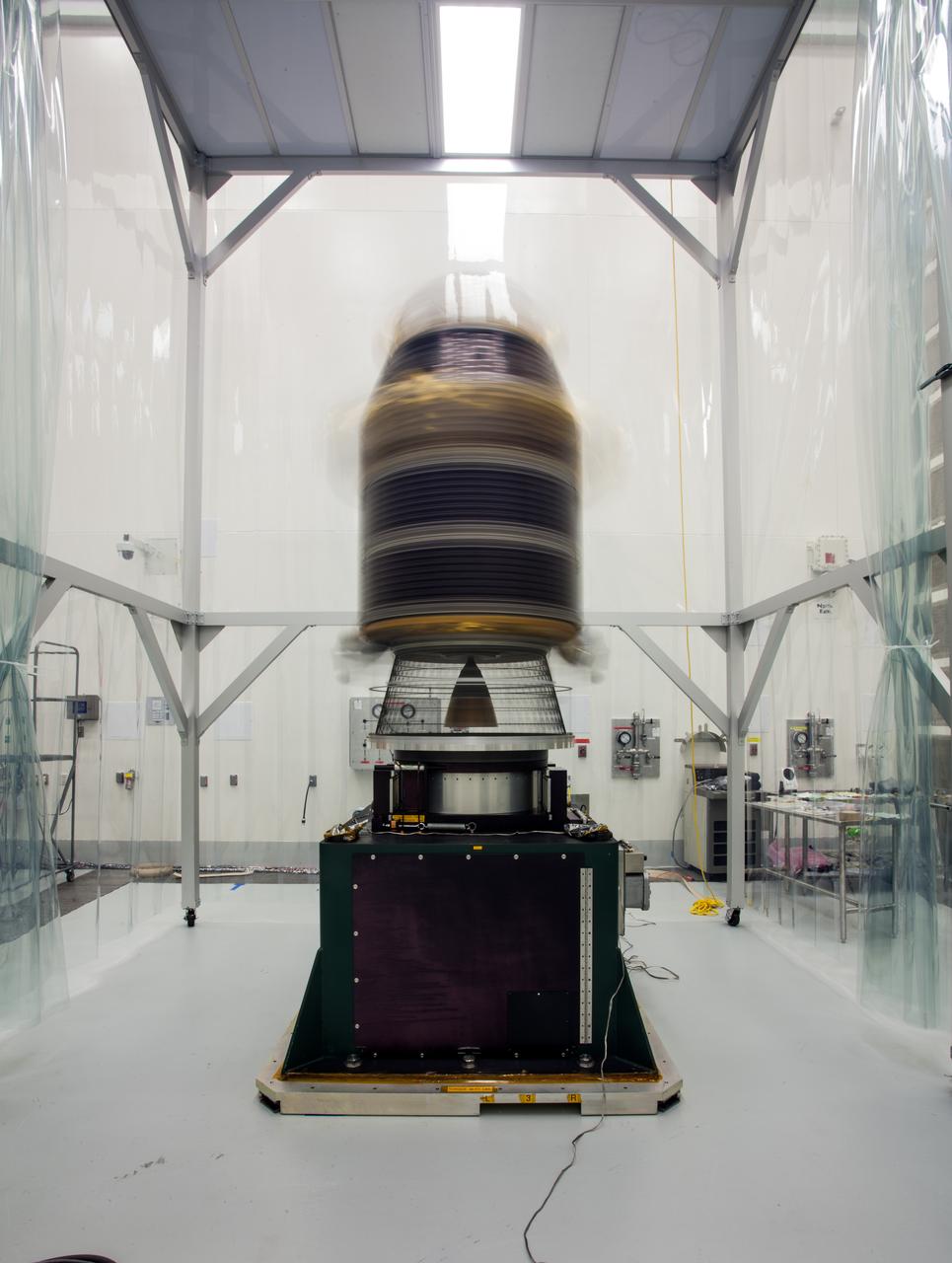
During preparations for NASA's Lunar Atmosphere and Dust Environment Explorer (LADEE) observatory launch on Sept. 6, 2013, the spacecraft went through final preparations and close-outs, which included checking alignment after its cross-country shipment, checking the propulsion system for leaks, inspecting and repairing solar panels, and final electrical tests. After these activities were completed, more challenging portions of the launch preparations began: spin testing and fueling. To make sure that the spacecraft is perfectly balanced for flight, engineers mounted it onto a spin table and rotate it at high speeds, approximately one revolution per second. The team measured any offsets during the spinning, and then added small weights to the spacecraft to balance it. Once the spacecraft was balanced dry, the team loaded the propulsion tanks with fuel, oxidizer, and pressurant. The spin testing was performed again "wet," or with fuel, in order to see if the balance changed with the full fuel tanks. Engineers from NASA's Ames Research Center in Moffett Field, Calif., have now successfully completed launch preparation activities for LADEE, which has been encapsulated into the nose-cone of the Minotaur V rocket at NASA's Wallops Flight Facility in Virginia. LADEE is ready to launch when the window opens on Friday. Image Credit: NASA ----- What is LADEE? The Lunar Atmosphere and Dust Environment Explorer (LADEE) is designed to study the Moon's thin exosphere and the lunar dust environment. An "exosphere" is an atmosphere that is so thin and tenuous that molecules don't collide with each other. Studying the Moon's exosphere will help scientists understand other planetary bodies with exospheres too, like Mercury and some of Jupiter's bigger moons. The orbiter will determine the density, composition and temporal and spatial variability of the Moon's exosphere to help us understand where the species in the exosphere come from and the role of the solar wind, lunar surface and interior, and meteoric infall as sources. The mission will also examine the density and temporal and spatial variability of dust particles that may get lofted into the atmosphere. The mission also will test several new technologies, including a modular spacecraft bus that may reduce the cost of future deep space missions and demonstrate two-way high rate laser communication for the first time from the Moon. LADEE now is ready to launch when the window opens on Sept. 6, 2013. Read more: <a href="http://www.nasa.gov/ladee" rel="nofollow">www.nasa.gov/ladee</a> <b><a href="http://www.nasa.gov/audience/formedia/features/MP_Photo_Guidelines.html" rel="nofollow">NASA image use policy.</a></b> <b><a href="http://www.nasa.gov/centers/goddard/home/index.html" rel="nofollow">NASA Goddard Space Flight Center</a></b> enables NASA’s mission through four scientific endeavors: Earth Science, Heliophysics, Solar System Exploration, and Astrophysics. Goddard plays a leading role in NASA’s accomplishments by contributing compelling scientific knowledge to advance the Agency’s mission. <b>Follow us on <a href="http://twitter.com/NASA_GoddardPix" rel="nofollow">Twitter</a></b> <b>Like us on <a href="http://www.facebook.com/pages/Greenbelt-MD/NASA-Goddard/395013845897?ref=tsd" rel="nofollow">Facebook</a></b> <b>Find us on <a href="http://instagram.com/nasagoddard?vm=grid" rel="nofollow">Instagram</a></b>

Simulation frames from this NASA Goddard neutron star merger animation: <a href="http://bit.ly/1jolBYY" rel="nofollow">bit.ly/1jolBYY</a> Credit: NASA's Goddard Space Flight Center This supercomputer simulation shows one of the most violent events in the universe: a pair of neutron stars colliding, merging and forming a black hole. A neutron star is the compressed core left behind when a star born with between eight and 30 times the sun's mass explodes as a supernova. Neutron stars pack about 1.5 times the mass of the sun — equivalent to about half a million Earths — into a ball just 12 miles (20 km) across. As the simulation begins, we view an unequally matched pair of neutron stars weighing 1.4 and 1.7 solar masses. They are separated by only about 11 miles, slightly less distance than their own diameters. Redder colors show regions of progressively lower density. As the stars spiral toward each other, intense tides begin to deform them, possibly cracking their crusts. Neutron stars possess incredible density, but their surfaces are comparatively thin, with densities about a million times greater than gold. Their interiors crush matter to a much greater degree densities rise by 100 million times in their centers. To begin to imagine such mind-boggling densities, consider that a cubic centimeter of neutron star matter outweighs Mount Everest. By 7 milliseconds, tidal forces overwhelm and shatter the lesser star. Its superdense contents erupt into the system and curl a spiral arm of incredibly hot material. At 13 milliseconds, the more massive star has accumulated too much mass to support it against gravity and collapses, and a new black hole is born. The black hole's event horizon — its point of no return — is shown by the gray sphere. While most of the matter from both neutron stars will fall into the black hole, some of the less dense, faster moving matter manages to orbit around it, quickly forming a large and rapidly rotating torus. This torus extends for about 124 miles (200 km) and contains the equivalent of 1/5th the mass of our sun. Scientists think neutron star mergers like this produce short gamma-ray bursts (GRBs). Short GRBs last less than two seconds yet unleash as much energy as all the stars in our galaxy produce over one year. The rapidly fading afterglow of these explosions presents a challenge to astronomers. A key element in understanding GRBs is getting instruments on large ground-based telescopes to capture afterglows as soon as possible after the burst. The rapid notification and accurate positions provided by NASA's Swift mission creates a vibrant synergy with ground-based observatories that has led to dramatically improved understanding of GRBs, especially for short bursts. This video is public domain and can be downloaded at: <a href="http://svs.gsfc.nasa.gov/vis/a010000/a011500/a011530/index.html" rel="nofollow">svs.gsfc.nasa.gov/vis/a010000/a011500/a011530/index.html</a> <b><a href="http://www.nasa.gov/audience/formedia/features/MP_Photo_Guidelines.html" rel="nofollow">NASA image use policy.</a></b> <b><a href="http://www.nasa.gov/centers/goddard/home/index.html" rel="nofollow">NASA Goddard Space Flight Center</a></b> enables NASA’s mission through four scientific endeavors: Earth Science, Heliophysics, Solar System Exploration, and Astrophysics. Goddard plays a leading role in NASA’s accomplishments by contributing compelling scientific knowledge to advance the Agency’s mission. <b>Follow us on <a href="http://twitter.com/NASAGoddardPix" rel="nofollow">Twitter</a></b> <b>Like us on <a href="http://www.facebook.com/pages/Greenbelt-MD/NASA-Goddard/395013845897?ref=tsd" rel="nofollow">Facebook</a></b> <b>Find us on <a href="http://instagram.com/nasagoddard?vm=grid" rel="nofollow">Instagram</a></b>

Simulation frames from this NASA Goddard neutron star merger animation: <a href="http://bit.ly/1jolBYY" rel="nofollow">bit.ly/1jolBYY</a> Credit: NASA's Goddard Space Flight Center This supercomputer simulation shows one of the most violent events in the universe: a pair of neutron stars colliding, merging and forming a black hole. A neutron star is the compressed core left behind when a star born with between eight and 30 times the sun's mass explodes as a supernova. Neutron stars pack about 1.5 times the mass of the sun — equivalent to about half a million Earths — into a ball just 12 miles (20 km) across. As the simulation begins, we view an unequally matched pair of neutron stars weighing 1.4 and 1.7 solar masses. They are separated by only about 11 miles, slightly less distance than their own diameters. Redder colors show regions of progressively lower density. As the stars spiral toward each other, intense tides begin to deform them, possibly cracking their crusts. Neutron stars possess incredible density, but their surfaces are comparatively thin, with densities about a million times greater than gold. Their interiors crush matter to a much greater degree densities rise by 100 million times in their centers. To begin to imagine such mind-boggling densities, consider that a cubic centimeter of neutron star matter outweighs Mount Everest. By 7 milliseconds, tidal forces overwhelm and shatter the lesser star. Its superdense contents erupt into the system and curl a spiral arm of incredibly hot material. At 13 milliseconds, the more massive star has accumulated too much mass to support it against gravity and collapses, and a new black hole is born. The black hole's event horizon — its point of no return — is shown by the gray sphere. While most of the matter from both neutron stars will fall into the black hole, some of the less dense, faster moving matter manages to orbit around it, quickly forming a large and rapidly rotating torus. This torus extends for about 124 miles (200 km) and contains the equivalent of 1/5th the mass of our sun. Scientists think neutron star mergers like this produce short gamma-ray bursts (GRBs). Short GRBs last less than two seconds yet unleash as much energy as all the stars in our galaxy produce over one year. The rapidly fading afterglow of these explosions presents a challenge to astronomers. A key element in understanding GRBs is getting instruments on large ground-based telescopes to capture afterglows as soon as possible after the burst. The rapid notification and accurate positions provided by NASA's Swift mission creates a vibrant synergy with ground-based observatories that has led to dramatically improved understanding of GRBs, especially for short bursts. This video is public domain and can be downloaded at: <a href="http://svs.gsfc.nasa.gov/vis/a010000/a011500/a011530/index.html" rel="nofollow">svs.gsfc.nasa.gov/vis/a010000/a011500/a011530/index.html</a> <b><a href="http://www.nasa.gov/audience/formedia/features/MP_Photo_Guidelines.html" rel="nofollow">NASA image use policy.</a></b> <b><a href="http://www.nasa.gov/centers/goddard/home/index.html" rel="nofollow">NASA Goddard Space Flight Center</a></b> enables NASA’s mission through four scientific endeavors: Earth Science, Heliophysics, Solar System Exploration, and Astrophysics. Goddard plays a leading role in NASA’s accomplishments by contributing compelling scientific knowledge to advance the Agency’s mission. <b>Follow us on <a href="http://twitter.com/NASAGoddardPix" rel="nofollow">Twitter</a></b> <b>Like us on <a href="http://www.facebook.com/pages/Greenbelt-MD/NASA-Goddard/395013845897?ref=tsd" rel="nofollow">Facebook</a></b> <b>Find us on <a href="http://instagram.com/nasagoddard?vm=grid" rel="nofollow">Instagram</a></b>

Simulation frames from this NASA Goddard neutron star merger animation: <a href="http://bit.ly/1jolBYY" rel="nofollow">bit.ly/1jolBYY</a> Credit: NASA's Goddard Space Flight Center This supercomputer simulation shows one of the most violent events in the universe: a pair of neutron stars colliding, merging and forming a black hole. A neutron star is the compressed core left behind when a star born with between eight and 30 times the sun's mass explodes as a supernova. Neutron stars pack about 1.5 times the mass of the sun — equivalent to about half a million Earths — into a ball just 12 miles (20 km) across. As the simulation begins, we view an unequally matched pair of neutron stars weighing 1.4 and 1.7 solar masses. They are separated by only about 11 miles, slightly less distance than their own diameters. Redder colors show regions of progressively lower density. As the stars spiral toward each other, intense tides begin to deform them, possibly cracking their crusts. Neutron stars possess incredible density, but their surfaces are comparatively thin, with densities about a million times greater than gold. Their interiors crush matter to a much greater degree densities rise by 100 million times in their centers. To begin to imagine such mind-boggling densities, consider that a cubic centimeter of neutron star matter outweighs Mount Everest. By 7 milliseconds, tidal forces overwhelm and shatter the lesser star. Its superdense contents erupt into the system and curl a spiral arm of incredibly hot material. At 13 milliseconds, the more massive star has accumulated too much mass to support it against gravity and collapses, and a new black hole is born. The black hole's event horizon — its point of no return — is shown by the gray sphere. While most of the matter from both neutron stars will fall into the black hole, some of the less dense, faster moving matter manages to orbit around it, quickly forming a large and rapidly rotating torus. This torus extends for about 124 miles (200 km) and contains the equivalent of 1/5th the mass of our sun. Scientists think neutron star mergers like this produce short gamma-ray bursts (GRBs). Short GRBs last less than two seconds yet unleash as much energy as all the stars in our galaxy produce over one year. The rapidly fading afterglow of these explosions presents a challenge to astronomers. A key element in understanding GRBs is getting instruments on large ground-based telescopes to capture afterglows as soon as possible after the burst. The rapid notification and accurate positions provided by NASA's Swift mission creates a vibrant synergy with ground-based observatories that has led to dramatically improved understanding of GRBs, especially for short bursts. This video is public domain and can be downloaded at: <a href="http://svs.gsfc.nasa.gov/vis/a010000/a011500/a011530/index.html" rel="nofollow">svs.gsfc.nasa.gov/vis/a010000/a011500/a011530/index.html</a> <b><a href="http://www.nasa.gov/audience/formedia/features/MP_Photo_Guidelines.html" rel="nofollow">NASA image use policy.</a></b> <b><a href="http://www.nasa.gov/centers/goddard/home/index.html" rel="nofollow">NASA Goddard Space Flight Center</a></b> enables NASA’s mission through four scientific endeavors: Earth Science, Heliophysics, Solar System Exploration, and Astrophysics. Goddard plays a leading role in NASA’s accomplishments by contributing compelling scientific knowledge to advance the Agency’s mission. <b>Follow us on <a href="http://twitter.com/NASAGoddardPix" rel="nofollow">Twitter</a></b> <b>Like us on <a href="http://www.facebook.com/pages/Greenbelt-MD/NASA-Goddard/395013845897?ref=tsd" rel="nofollow">Facebook</a></b> <b>Find us on <a href="http://instagram.com/nasagoddard?vm=grid" rel="nofollow">Instagram</a></b>

Simulation frames from this NASA Goddard neutron star merger animation: <a href="http://bit.ly/1jolBYY" rel="nofollow">bit.ly/1jolBYY</a> Credit: NASA's Goddard Space Flight Center This supercomputer simulation shows one of the most violent events in the universe: a pair of neutron stars colliding, merging and forming a black hole. A neutron star is the compressed core left behind when a star born with between eight and 30 times the sun's mass explodes as a supernova. Neutron stars pack about 1.5 times the mass of the sun — equivalent to about half a million Earths — into a ball just 12 miles (20 km) across. As the simulation begins, we view an unequally matched pair of neutron stars weighing 1.4 and 1.7 solar masses. They are separated by only about 11 miles, slightly less distance than their own diameters. Redder colors show regions of progressively lower density. As the stars spiral toward each other, intense tides begin to deform them, possibly cracking their crusts. Neutron stars possess incredible density, but their surfaces are comparatively thin, with densities about a million times greater than gold. Their interiors crush matter to a much greater degree densities rise by 100 million times in their centers. To begin to imagine such mind-boggling densities, consider that a cubic centimeter of neutron star matter outweighs Mount Everest. By 7 milliseconds, tidal forces overwhelm and shatter the lesser star. Its superdense contents erupt into the system and curl a spiral arm of incredibly hot material. At 13 milliseconds, the more massive star has accumulated too much mass to support it against gravity and collapses, and a new black hole is born. The black hole's event horizon — its point of no return — is shown by the gray sphere. While most of the matter from both neutron stars will fall into the black hole, some of the less dense, faster moving matter manages to orbit around it, quickly forming a large and rapidly rotating torus. This torus extends for about 124 miles (200 km) and contains the equivalent of 1/5th the mass of our sun. Scientists think neutron star mergers like this produce short gamma-ray bursts (GRBs). Short GRBs last less than two seconds yet unleash as much energy as all the stars in our galaxy produce over one year. The rapidly fading afterglow of these explosions presents a challenge to astronomers. A key element in understanding GRBs is getting instruments on large ground-based telescopes to capture afterglows as soon as possible after the burst. The rapid notification and accurate positions provided by NASA's Swift mission creates a vibrant synergy with ground-based observatories that has led to dramatically improved understanding of GRBs, especially for short bursts. This video is public domain and can be downloaded at: <a href="http://svs.gsfc.nasa.gov/vis/a010000/a011500/a011530/index.html" rel="nofollow">svs.gsfc.nasa.gov/vis/a010000/a011500/a011530/index.html</a> <b><a href="http://www.nasa.gov/audience/formedia/features/MP_Photo_Guidelines.html" rel="nofollow">NASA image use policy.</a></b> <b><a href="http://www.nasa.gov/centers/goddard/home/index.html" rel="nofollow">NASA Goddard Space Flight Center</a></b> enables NASA’s mission through four scientific endeavors: Earth Science, Heliophysics, Solar System Exploration, and Astrophysics. Goddard plays a leading role in NASA’s accomplishments by contributing compelling scientific knowledge to advance the Agency’s mission. <b>Follow us on <a href="http://twitter.com/NASAGoddardPix" rel="nofollow">Twitter</a></b> <b>Like us on <a href="http://www.facebook.com/pages/Greenbelt-MD/NASA-Goddard/395013845897?ref=tsd" rel="nofollow">Facebook</a></b> <b>Find us on <a href="http://instagram.com/nasagoddard?vm=grid" rel="nofollow">Instagram</a></b>

Simulation frames from this NASA Goddard neutron star merger animation: <a href="http://bit.ly/1jolBYY" rel="nofollow">bit.ly/1jolBYY</a> Credit: NASA's Goddard Space Flight Center This supercomputer simulation shows one of the most violent events in the universe: a pair of neutron stars colliding, merging and forming a black hole. A neutron star is the compressed core left behind when a star born with between eight and 30 times the sun's mass explodes as a supernova. Neutron stars pack about 1.5 times the mass of the sun — equivalent to about half a million Earths — into a ball just 12 miles (20 km) across. As the simulation begins, we view an unequally matched pair of neutron stars weighing 1.4 and 1.7 solar masses. They are separated by only about 11 miles, slightly less distance than their own diameters. Redder colors show regions of progressively lower density. As the stars spiral toward each other, intense tides begin to deform them, possibly cracking their crusts. Neutron stars possess incredible density, but their surfaces are comparatively thin, with densities about a million times greater than gold. Their interiors crush matter to a much greater degree densities rise by 100 million times in their centers. To begin to imagine such mind-boggling densities, consider that a cubic centimeter of neutron star matter outweighs Mount Everest. By 7 milliseconds, tidal forces overwhelm and shatter the lesser star. Its superdense contents erupt into the system and curl a spiral arm of incredibly hot material. At 13 milliseconds, the more massive star has accumulated too much mass to support it against gravity and collapses, and a new black hole is born. The black hole's event horizon — its point of no return — is shown by the gray sphere. While most of the matter from both neutron stars will fall into the black hole, some of the less dense, faster moving matter manages to orbit around it, quickly forming a large and rapidly rotating torus. This torus extends for about 124 miles (200 km) and contains the equivalent of 1/5th the mass of our sun. Scientists think neutron star mergers like this produce short gamma-ray bursts (GRBs). Short GRBs last less than two seconds yet unleash as much energy as all the stars in our galaxy produce over one year. The rapidly fading afterglow of these explosions presents a challenge to astronomers. A key element in understanding GRBs is getting instruments on large ground-based telescopes to capture afterglows as soon as possible after the burst. The rapid notification and accurate positions provided by NASA's Swift mission creates a vibrant synergy with ground-based observatories that has led to dramatically improved understanding of GRBs, especially for short bursts. This video is public domain and can be downloaded at: <a href="http://svs.gsfc.nasa.gov/vis/a010000/a011500/a011530/index.html" rel="nofollow">svs.gsfc.nasa.gov/vis/a010000/a011500/a011530/index.html</a> <b><a href="http://www.nasa.gov/audience/formedia/features/MP_Photo_Guidelines.html" rel="nofollow">NASA image use policy.</a></b> <b><a href="http://www.nasa.gov/centers/goddard/home/index.html" rel="nofollow">NASA Goddard Space Flight Center</a></b> enables NASA’s mission through four scientific endeavors: Earth Science, Heliophysics, Solar System Exploration, and Astrophysics. Goddard plays a leading role in NASA’s accomplishments by contributing compelling scientific knowledge to advance the Agency’s mission. <b>Follow us on <a href="http://twitter.com/NASAGoddardPix" rel="nofollow">Twitter</a></b> <b>Like us on <a href="http://www.facebook.com/pages/Greenbelt-MD/NASA-Goddard/395013845897?ref=tsd" rel="nofollow">Facebook</a></b> <b>Find us on <a href="http://instagram.com/nasagoddard?vm=grid" rel="nofollow">Instagram</a></b>

This supercomputer simulation shows one of the most violent events in the universe: a pair of neutron stars colliding, merging and forming a black hole. A neutron star is the compressed core left behind when a star born with between eight and 30 times the sun's mass explodes as a supernova. Neutron stars pack about 1.5 times the mass of the sun — equivalent to about half a million Earths — into a ball just 12 miles (20 km) across. As the simulation begins, we view an unequally matched pair of neutron stars weighing 1.4 and 1.7 solar masses. They are separated by only about 11 miles, slightly less distance than their own diameters. Redder colors show regions of progressively lower density. As the stars spiral toward each other, intense tides begin to deform them, possibly cracking their crusts. Neutron stars possess incredible density, but their surfaces are comparatively thin, with densities about a million times greater than gold. Their interiors crush matter to a much greater degree densities rise by 100 million times in their centers. To begin to imagine such mind-boggling densities, consider that a cubic centimeter of neutron star matter outweighs Mount Everest. By 7 milliseconds, tidal forces overwhelm and shatter the lesser star. Its superdense contents erupt into the system and curl a spiral arm of incredibly hot material. At 13 milliseconds, the more massive star has accumulated too much mass to support it against gravity and collapses, and a new black hole is born. The black hole's event horizon — its point of no return — is shown by the gray sphere. While most of the matter from both neutron stars will fall into the black hole, some of the less dense, faster moving matter manages to orbit around it, quickly forming a large and rapidly rotating torus. This torus extends for about 124 miles (200 km) and contains the equivalent of 1/5th the mass of our sun. Scientists think neutron star mergers like this produce short gamma-ray bursts (GRBs). Short GRBs last less than two seconds yet unleash as much energy as all the stars in our galaxy produce over one year. The rapidly fading afterglow of these explosions presents a challenge to astronomers. A key element in understanding GRBs is getting instruments on large ground-based telescopes to capture afterglows as soon as possible after the burst. The rapid notification and accurate positions provided by NASA's Swift mission creates a vibrant synergy with ground-based observatories that has led to dramatically improved understanding of GRBs, especially for short bursts. This video is public domain and can be downloaded at: : <a href="http://svs.gsfc.nasa.gov/goto?11530" rel="nofollow">svs.gsfc.nasa.gov/goto?11530</a>
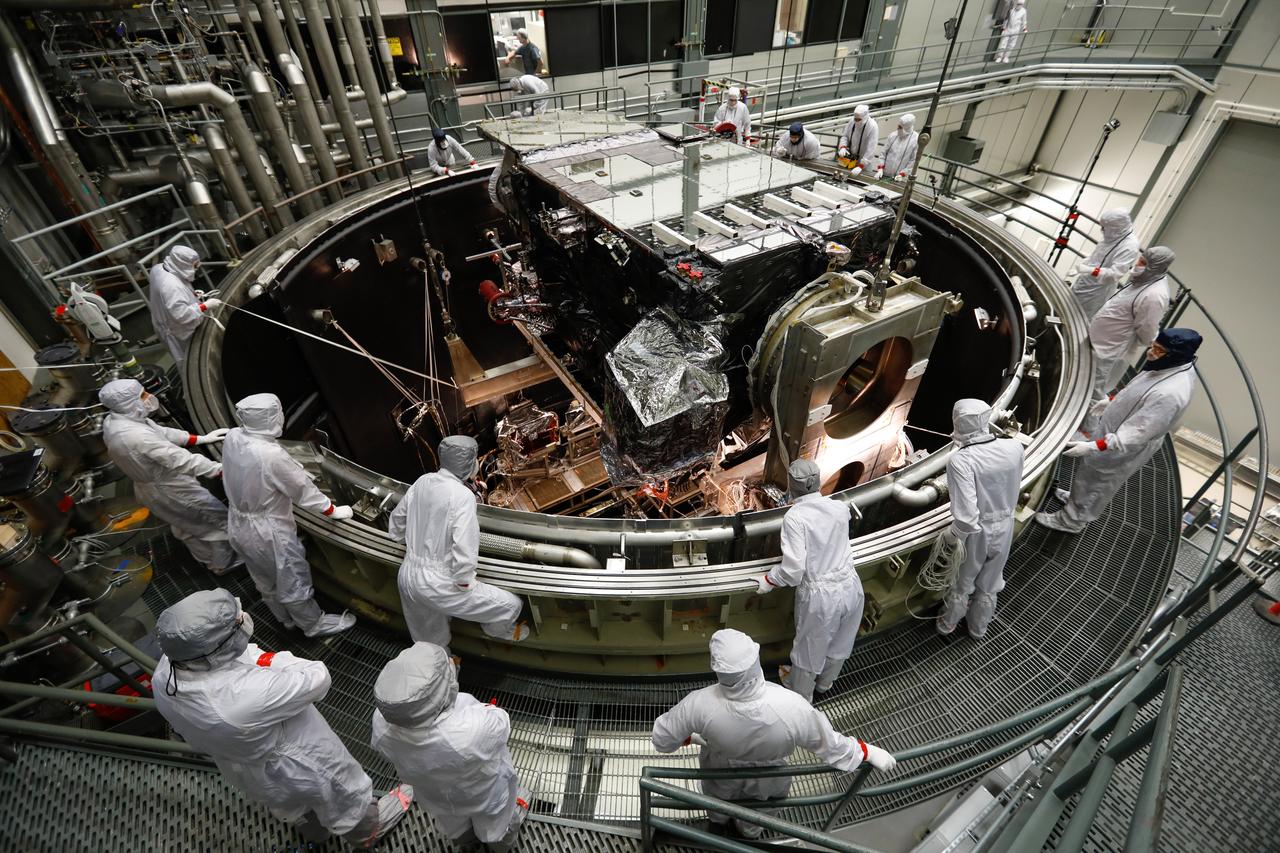
In March, NOAA's Geostationary Operational Environmental Satellite-S (GOES-S) satellite was lifted into a thermal vacuum chamber to test its ability to function in the cold void of space in its orbit 22,300 miles above the Earth. The most complicated and challenging test is thermal vacuum where a satellite experiences four cycles of extreme cold to extreme heat in a giant vacuum chamber. To simulate the environment of space, the chamber is cooled to below minus 100 degrees Celsius or minus 148 degrees Fahrenheit and air is pumped out. The test simulates the temperature changes GOES-S will encounter in space, as well as worst case scenarios of whether the instruments can come back to life in case of a shut down that exposes them to even colder temperatures. In this photo from March 8, the GOES-S satellite was lowered into the giant vacuum chamber at Lockheed Martin Space Systems, Denver, Colorado. GOES-S will be in the thermal vacuum chamber for 45 days. As of March 30, two of four thermal cycles were complete. GOES-S is the second in the GOES-R series. The GOES-R program is a collaborative development and acquisition effort between the National Oceanic and Atmospheric Administration and NASA. The GOES-R series of satellites will help meteorologists observe and predict local weather events, including thunderstorms, tornadoes, fog, flash floods, and other severe weather. In addition, GOES-R will monitor hazards such as aerosols, dust storms, volcanic eruptions, and forest fires and will also be used for space weather, oceanography, climate monitoring, in-situ data collection, and for search and rescue. Credit: Lockheed Martin <b><a href="http://www.nasa.gov/audience/formedia/features/MP_Photo_Guidelines.html" rel="nofollow">NASA image use policy.</a></b> <b><a href="http://www.nasa.gov/centers/goddard/home/index.html" rel="nofollow">NASA Goddard Space Flight Center</a></b> enables NASA’s mission through four scientific endeavors: Earth Science, Heliophysics, Solar System Exploration, and Astrophysics. Goddard plays a leading role in NASA’s accomplishments by contributing compelling scientific knowledge to advance the Agency’s mission. <b>Follow us on <a href="http://twitter.com/NASAGoddardPix" rel="nofollow">Twitter</a></b> <b>Like us on <a href="http://www.facebook.com/pages/Greenbelt-MD/NASA-Goddard/395013845897?ref=tsd" rel="nofollow">Facebook</a></b> <b>Find us on <a href="http://instagrid.me/nasagoddard/?vm=grid" rel="nofollow">Instagram</a></b>
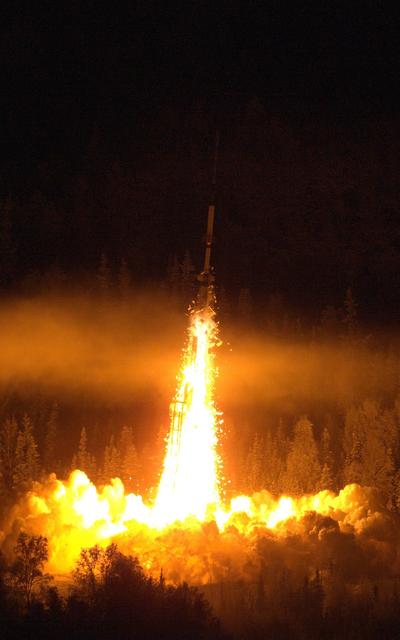
A NASA Oriole IV sounding rocket with the Aural Spatial Structures Probe leaves the launch pad on Jan. 28, 2015, from the Poker Flat Research Range in Alaska. Credit: NASA/Lee Wingfield More info: On count day number 15, the Aural Spatial Structures Probe, or ASSP, was successfully launched on a NASA Oriole IV sounding rocket at 5:41 a.m. EST on Jan. 28, 2015, from the Poker Flat Research Range in Alaska. Preliminary data show that all aspects of the payload worked as designed and the principal investigator Charles Swenson at Utah State University described the mission as a “raging success.” “This is likely the most complicated mission the sounding rocket program has ever undertaken and it was not easy by any stretch," said John Hickman, operations manager of the NASA sounding rocket program office at the Wallops Flight Facility, Virginia. "It was technically challenging every step of the way.” “The payload deployed all six sub-payloads in formation as planned and all appeared to function as planned. Quite an amazing feat to maneuver and align the main payload, maintain the proper attitude while deploying all six 7.3-pound sub payloads at about 40 meters per second," said Hickman. Read more: <a href="http://www.nasa.gov/content/assp-sounding-rocket-launches-successfully-from-alaska/#.VMkOnEhpEhJ" rel="nofollow">www.nasa.gov/content/assp-sounding-rocket-launches-succes...</a> <b><a href="http://www.nasa.gov/audience/formedia/features/MP_Photo_Guidelines.html" rel="nofollow">NASA image use policy.</a></b> <b><a href="http://www.nasa.gov/centers/goddard/home/index.html" rel="nofollow">NASA Goddard Space Flight Center</a></b> enables NASA’s mission through four scientific endeavors: Earth Science, Heliophysics, Solar System Exploration, and Astrophysics. Goddard plays a leading role in NASA’s accomplishments by contributing compelling scientific knowledge to advance the Agency’s mission. <b>Follow us on <a href="http://twitter.com/NASAGoddardPix" rel="nofollow">Twitter</a></b> <b>Like us on <a href="http://www.facebook.com/pages/Greenbelt-MD/NASA-Goddard/395013845897?ref=tsd" rel="nofollow">Facebook</a></b> <b>Find us on <a href="http://instagram.com/nasagoddard?vm=grid" rel="nofollow">Instagram</a></b>
![This image from NASA Spitzer Space Telescope, shows the wispy filamentary structure of Henize 206, is a four-color composite mosaic created by combining data from an infrared array camera IRAC. The LMC is a small satellite galaxy gravitationally bound to our own Milky Way. Yet the gravitational effects are tearing the companion to shreds in a long-playing drama of 'intergalactic cannibalism.' These disruptions lead to a recurring cycle of star birth and star death. Astronomers are particularly interested in the LMC because its fractional content of heavy metals is two to five times lower than is seen in our solar neighborhood. [In this context, 'heavy elements' refer to those elements not present in the primordial universe. Such elements as carbon, oxygen and others are produced by nucleosynthesis and are ejected into the interstellar medium via mass loss by stars, including supernova explosions.] As such, the LMC provides a nearby cosmic laboratory that may resemble the distant universe in its chemical composition. The primary Spitzer image, showing the wispy filamentary structure of Henize 206, is a four-color composite mosaic created by combining data from an infrared array camera (IRAC) at near-infrared wavelengths and the mid-infrared data from a multiband imaging photometer (MIPS). Blue represents invisible infrared light at wavelengths of 3.6 and 4.5 microns. Note that most of the stars in the field of view radiate primarily at these short infrared wavelengths. Cyan denotes emission at 5.8 microns, green depicts the 8.0 micron light, and red is used to trace the thermal emission from dust at 24 microns. The separate instrument images are included as insets to the main composite. An inclined ring of emission dominates the central and upper regions of the image. This delineates a bubble of hot, x-ray emitting gas that was blown into space when a massive star died in a supernova explosion millions of years ago. The shock waves from that explosion impacted a cloud of nearby hydrogen gas, compressed it, and started a new generation of star formation. The death of one star led to the birth of many new stars. This is particularly evident in the MIPS inset, where the 24-micron emission peaks correspond to newly formed stars. The ultraviolet and visible-light photons from the new stars are absorbed by surrounding dust and re-radiated at longer infrared wavelengths, where it is detected by Spitzer. This emission nebula was cataloged by Karl Henize (HEN-eyes) while spending 1948-1951 in South Africa doing research for his Ph.D. dissertation at the University of Michigan. Henize later became a NASA astronaut and, at age 59, became the oldest rookie to fly on the Space Shuttle during an eight-day flight of the Challenger in 1985. He died just short of his 67th birthday in 1993 while attempting to climb the north face of Mount Everest, the world's highest peak. http://photojournal.jpl.nasa.gov/catalog/PIA05517](https://images-assets.nasa.gov/image/PIA05517/PIA05517~medium.jpg)
This image from NASA Spitzer Space Telescope, shows the wispy filamentary structure of Henize 206, is a four-color composite mosaic created by combining data from an infrared array camera IRAC. The LMC is a small satellite galaxy gravitationally bound to our own Milky Way. Yet the gravitational effects are tearing the companion to shreds in a long-playing drama of 'intergalactic cannibalism.' These disruptions lead to a recurring cycle of star birth and star death. Astronomers are particularly interested in the LMC because its fractional content of heavy metals is two to five times lower than is seen in our solar neighborhood. [In this context, 'heavy elements' refer to those elements not present in the primordial universe. Such elements as carbon, oxygen and others are produced by nucleosynthesis and are ejected into the interstellar medium via mass loss by stars, including supernova explosions.] As such, the LMC provides a nearby cosmic laboratory that may resemble the distant universe in its chemical composition. The primary Spitzer image, showing the wispy filamentary structure of Henize 206, is a four-color composite mosaic created by combining data from an infrared array camera (IRAC) at near-infrared wavelengths and the mid-infrared data from a multiband imaging photometer (MIPS). Blue represents invisible infrared light at wavelengths of 3.6 and 4.5 microns. Note that most of the stars in the field of view radiate primarily at these short infrared wavelengths. Cyan denotes emission at 5.8 microns, green depicts the 8.0 micron light, and red is used to trace the thermal emission from dust at 24 microns. The separate instrument images are included as insets to the main composite. An inclined ring of emission dominates the central and upper regions of the image. This delineates a bubble of hot, x-ray emitting gas that was blown into space when a massive star died in a supernova explosion millions of years ago. The shock waves from that explosion impacted a cloud of nearby hydrogen gas, compressed it, and started a new generation of star formation. The death of one star led to the birth of many new stars. This is particularly evident in the MIPS inset, where the 24-micron emission peaks correspond to newly formed stars. The ultraviolet and visible-light photons from the new stars are absorbed by surrounding dust and re-radiated at longer infrared wavelengths, where it is detected by Spitzer. This emission nebula was cataloged by Karl Henize (HEN-eyes) while spending 1948-1951 in South Africa doing research for his Ph.D. dissertation at the University of Michigan. Henize later became a NASA astronaut and, at age 59, became the oldest rookie to fly on the Space Shuttle during an eight-day flight of the Challenger in 1985. He died just short of his 67th birthday in 1993 while attempting to climb the north face of Mount Everest, the world's highest peak. http://photojournal.jpl.nasa.gov/catalog/PIA05517
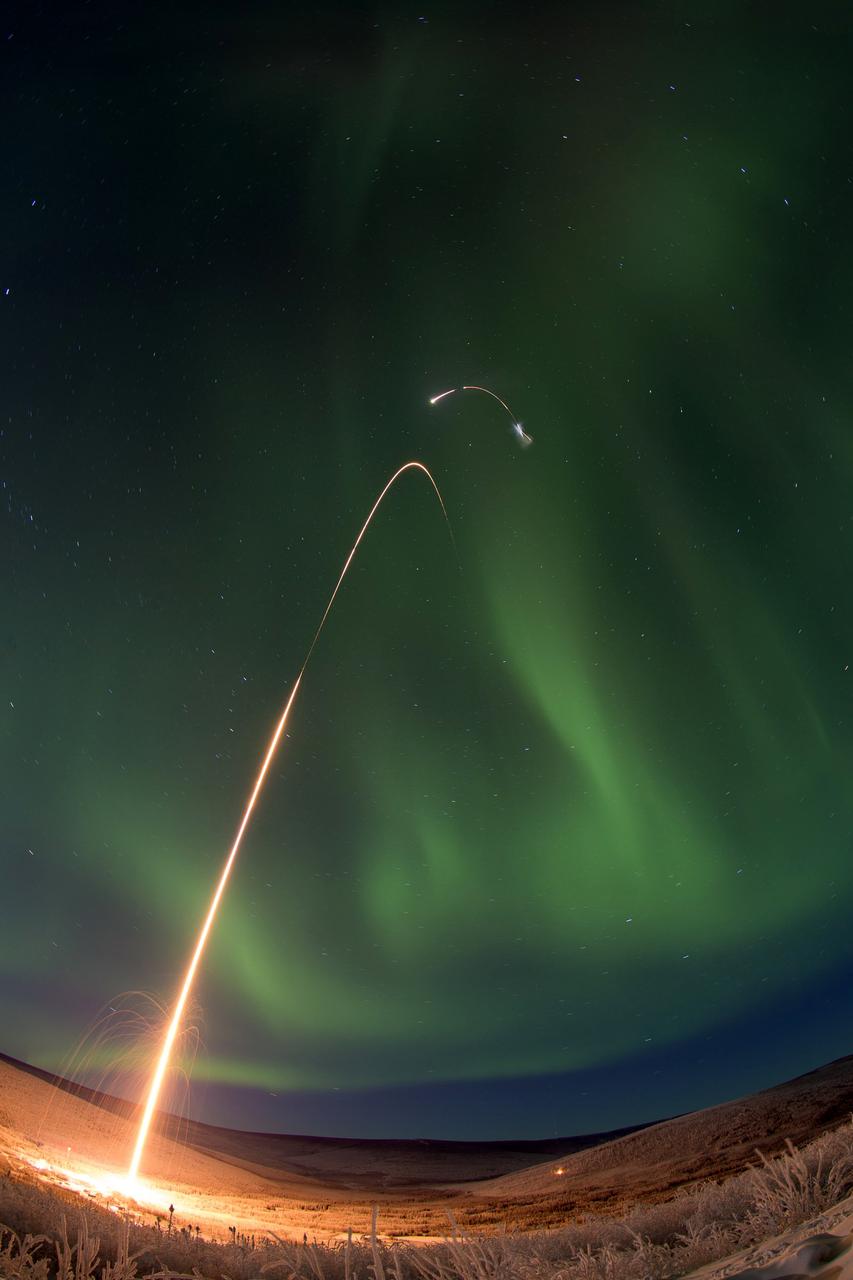
Caption: Time lapse photo of the NASA Oriole IV sounding rocket with Aural Spatial Structures Probe as an aurora dances over Alaska. All four stages of the rocket are visible in this image. Credit: NASA/Jamie Adkins More info: On count day number 15, the Aural Spatial Structures Probe, or ASSP, was successfully launched on a NASA Oriole IV sounding rocket at 5:41 a.m. EST on Jan. 28, 2015, from the Poker Flat Research Range in Alaska. Preliminary data show that all aspects of the payload worked as designed and the principal investigator Charles Swenson at Utah State University described the mission as a “raging success.” “This is likely the most complicated mission the sounding rocket program has ever undertaken and it was not easy by any stretch," said John Hickman, operations manager of the NASA sounding rocket program office at the Wallops Flight Facility, Virginia. "It was technically challenging every step of the way.” “The payload deployed all six sub-payloads in formation as planned and all appeared to function as planned. Quite an amazing feat to maneuver and align the main payload, maintain the proper attitude while deploying all six 7.3-pound sub payloads at about 40 meters per second," said Hickman. Read more: <a href="http://www.nasa.gov/content/assp-sounding-rocket-launches-successfully-from-alaska/#.VMkOnEhpEhJ" rel="nofollow">www.nasa.gov/content/assp-sounding-rocket-launches-succes...</a> <b><a href="http://www.nasa.gov/audience/formedia/features/MP_Photo_Guidelines.html" rel="nofollow">NASA image use policy.</a></b> <b><a href="http://www.nasa.gov/centers/goddard/home/index.html" rel="nofollow">NASA Goddard Space Flight Center</a></b> enables NASA’s mission through four scientific endeavors: Earth Science, Heliophysics, Solar System Exploration, and Astrophysics. Goddard plays a leading role in NASA’s accomplishments by contributing compelling scientific knowledge to advance the Agency’s mission. <b>Follow us on <a href="http://twitter.com/NASAGoddardPix" rel="nofollow">Twitter</a></b> <b>Like us on <a href="http://www.facebook.com/pages/Greenbelt-MD/NASA-Goddard/395013845897?ref=tsd" rel="nofollow">Facebook</a></b> <b>Find us on <a href="http://instagram.com/nasagoddard?vm=grid" rel="nofollow">Instagram</a></b>