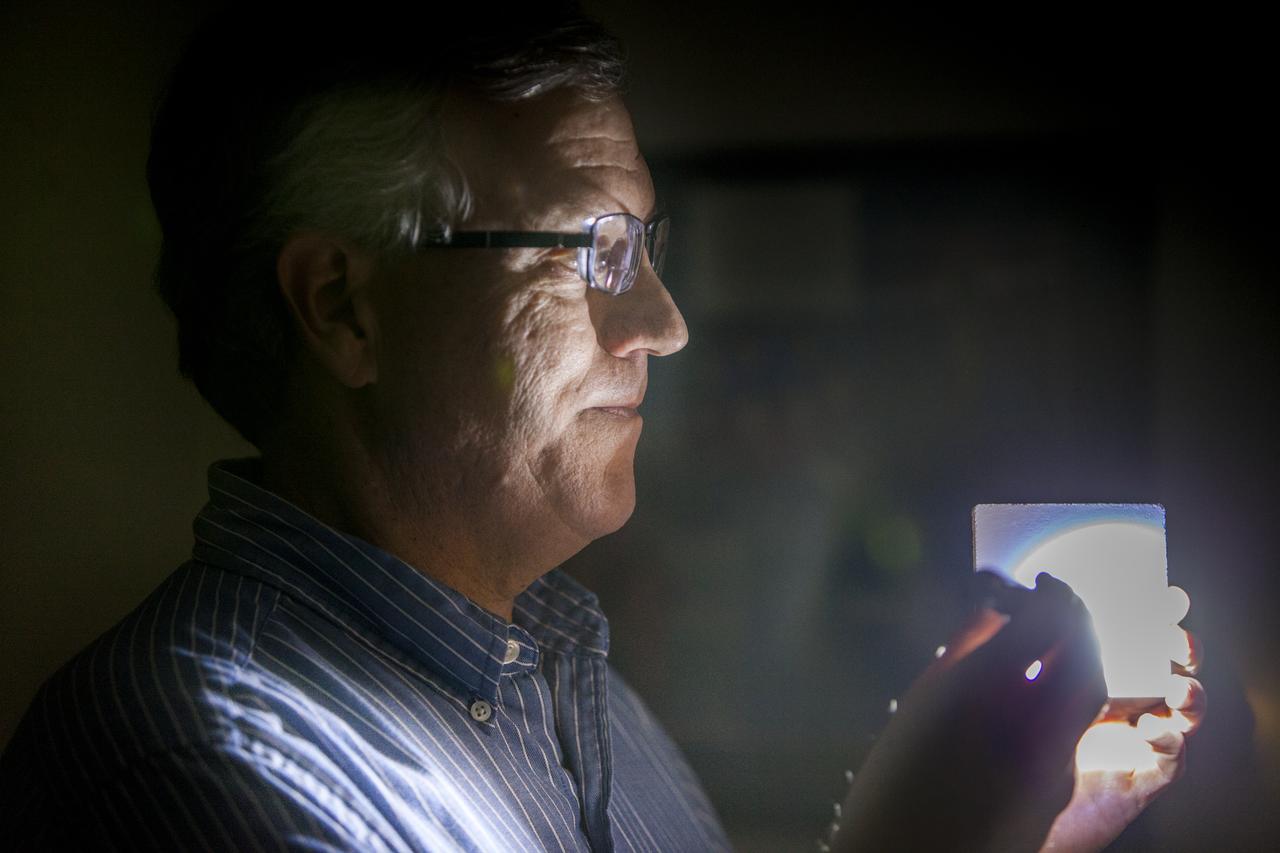
Robert Youngquist, Ph.D., tests a sample disk with a "Solar White" cryogenic selective surface coating with a flash light, demonstrating the coating’s reflective properties. The innovative coating is predicted to reflect more than 99.9 percent of the simulated solar infrared radiation. This technology could enable storing super-cold, or cryogenic, liquids and support systems that shield astronauts against radiation during the Journey to Mars.
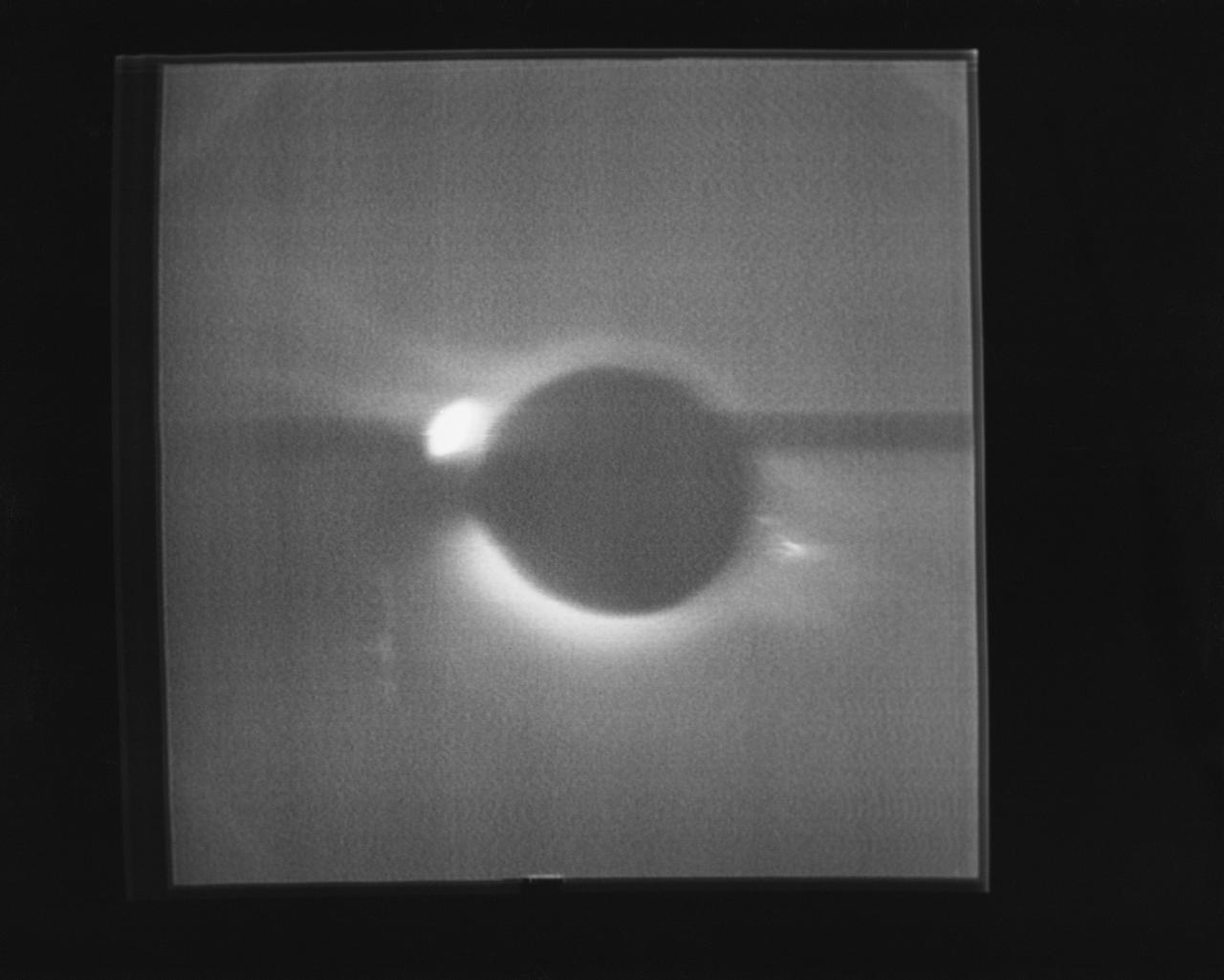
S74-15697 (17 Jan. 1974) --- The solar corona and a solar prominence as seen through the White Light Coronograph, Skylab Experiment S052, on Jan. 17, 1974. This view was reproduced from a television transmission made by a TV camera aboard the Skylab space station in Earth orbit. The bright spot is a burn in the vidicon. The solar corona is the halo around the sun which is normally visible only at the time of solar eclipse by the moon. The Skylab coronography uses an externally-mounted disk system which occults the brilliant solar surface while allowing the fainter radiation of the corona to enter an annulus and be photographed. A mirror system allows either TV viewing of the corona or photographic recording of the image. Photo credit: NASA
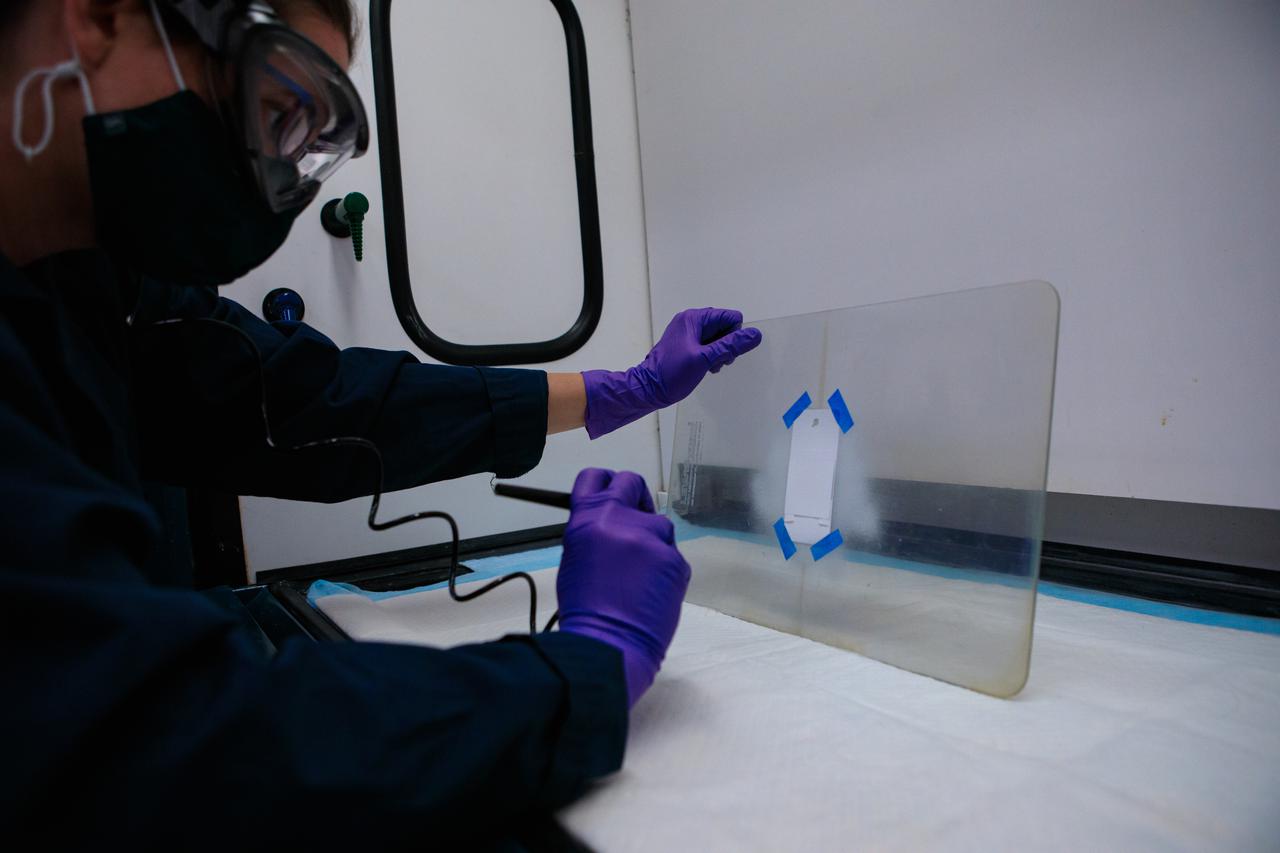
Inside a laboratory at the Neil Armstrong Operations and Checkout Building at NASA’s Kennedy Space Center in Florida, research scientist Sarah Snyder applies a selective surface coating to an Electrodynamic Dust Shield (EDS) on March 31, 2021. This is one of several concurrent activities preparing dust shield samples for testing in space. Dust mitigation technologies could one day be applied to diminish dust hazards on lunar surface systems such as cameras, solar panels, spacesuits, and instrumentation, enabling sustainable exploration of the Moon under the Artemis program.
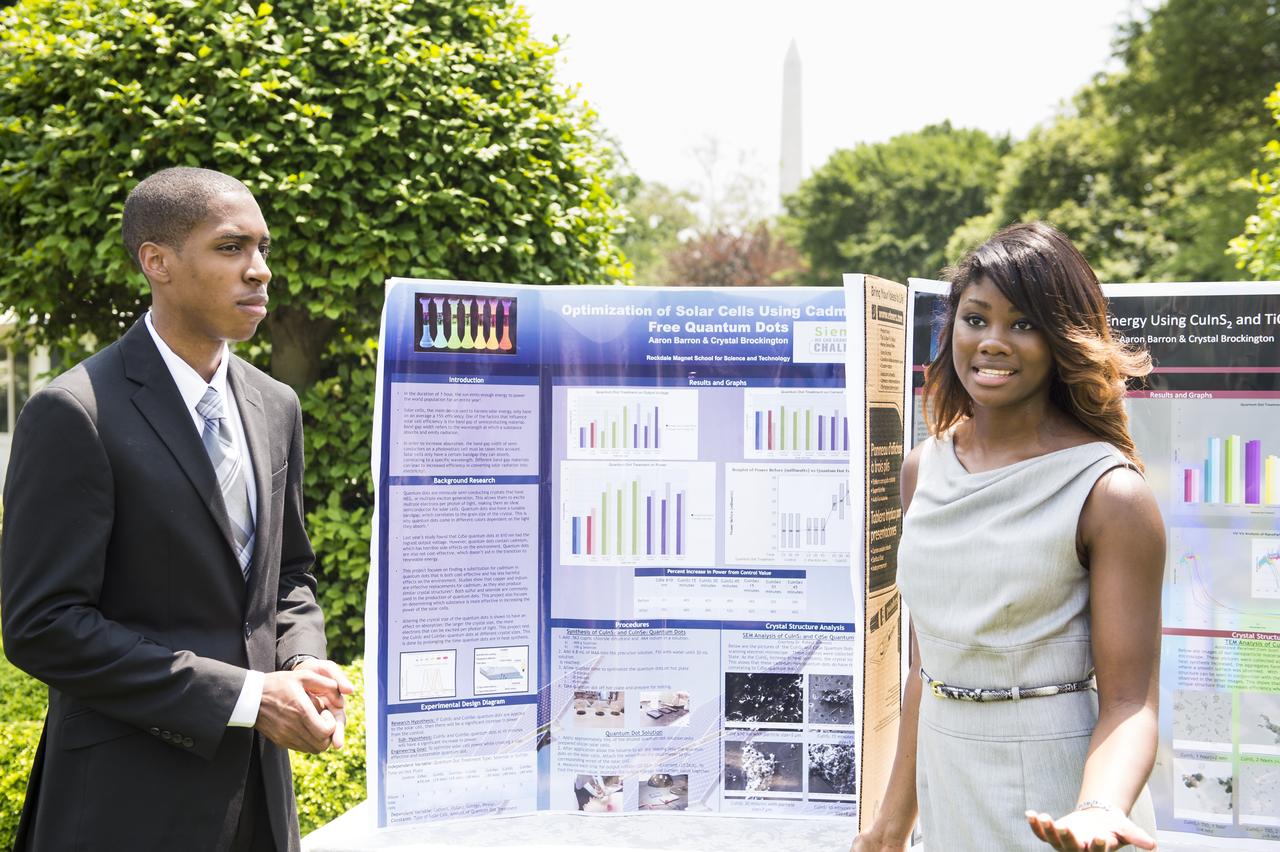
Crystal Brockington and Aaron Barron, both 18 years old, designed a more efficient and cost effective solar cell that harnesses energy without cadmium, which has been shown to be harmful to the environment. They were selected to participate in the White House Science Fair after they were awarded the High School Grand Prize at the Siemens We Can Change the World Challenge. The fourth White House Science Fair was held at the White House on May 27, 2014 and included 100 students from more than 30 different states who competed in science, technology, engineering, and math (STEM) competitions. (Photo Credit: NASA/Aubrey Gemignani)

This artist concept shows hundreds of brown dwarfs deep red, expected to be added to the population of known stars in our solar neighborhood. Our sun and other known stars appear white, yellow or red.

A minor solar eruption triggered a crackling, white flash that sent an expanding wave of plasma below it over about six hours (Nov. 4, 2016). Some of the plasma also appeared to surge along a narrow path above the active region as well. Such occurrences are fairly common, but still interesting to watch up close. The images were taken in a wavelength of extreme ultraviolet light. Movies are available at http://photojournal.jpl.nasa.gov/catalog/PIA21202
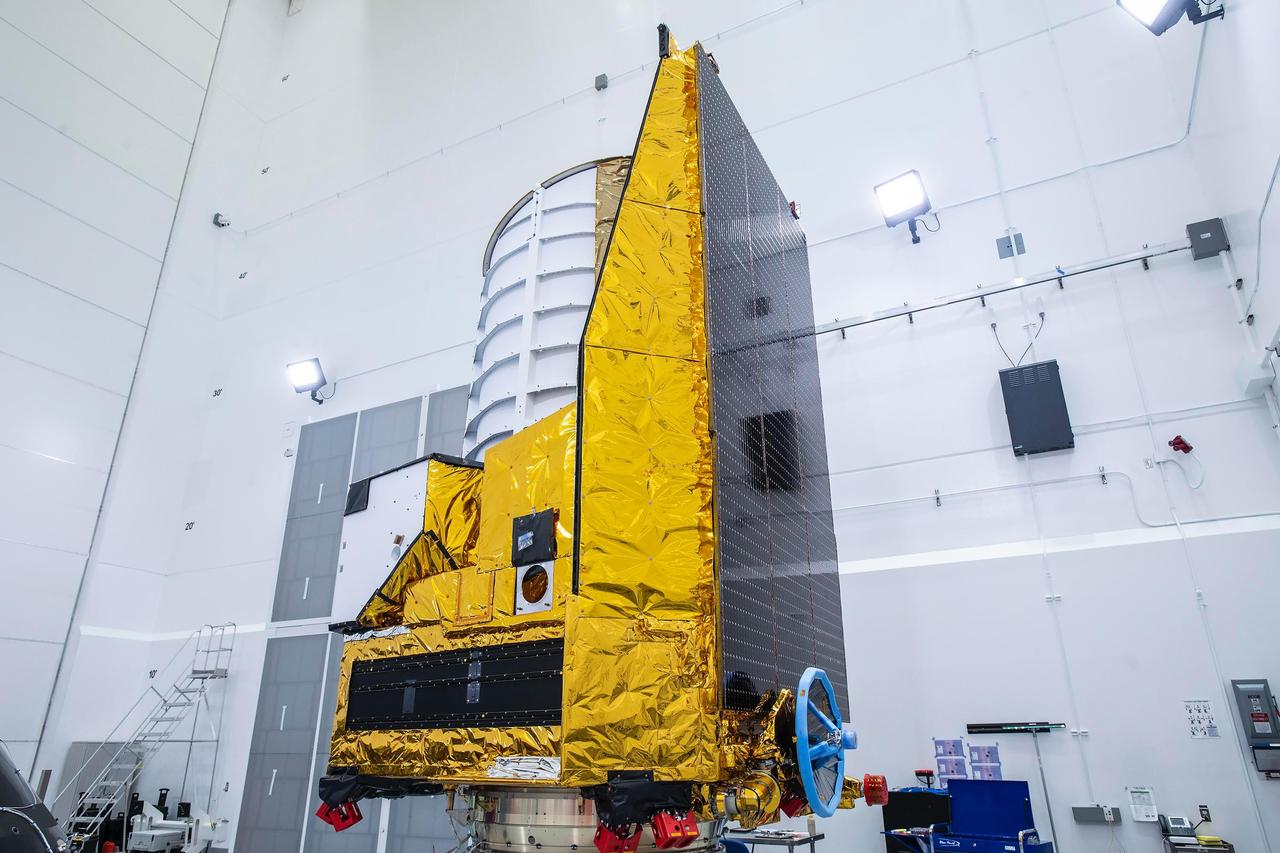
The ESA (European Space Agency) Euclid telescope, with contributions from NASA, is shown here on Friday 23 June, being secured to the adaptor of a SpaceX Falcon 9 rocket before launch. Black solar panels line the right side of the spacecraft. The telescope will view the cosmos through the top of the white cylinder that sits above the spacecraft's instruments. https://photojournal.jpl.nasa.gov/catalog/PIA25783
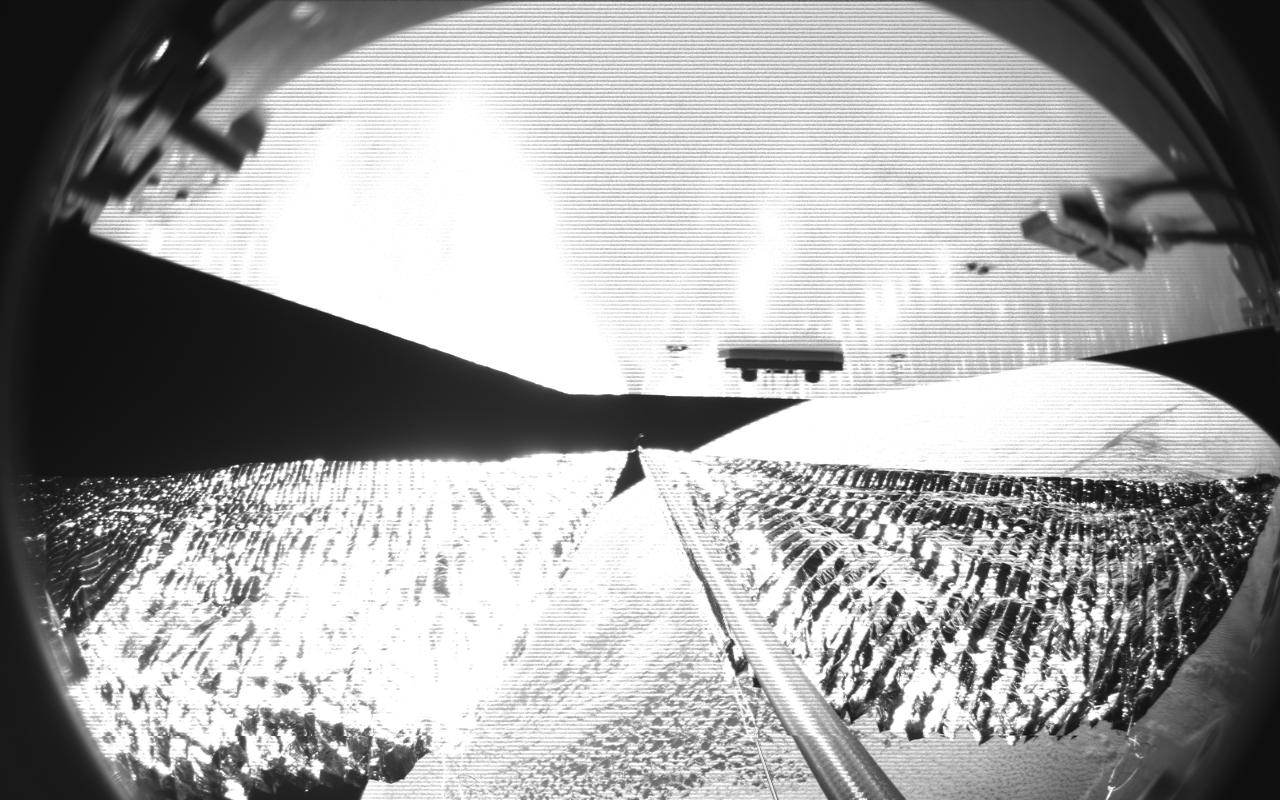
Four cameras aboard the Advanced Composite Solar Sail System spacecraft show the four reflective sail quadrants supported by composite booms. The booms are mounted at right angles and the spacecraft’s solar panel is rectangular, but lines appear distorted because of the wide-angle camera field of view. View from a black-and-white wide-angle camera aboard the Advanced Composite Solar Sail System taken during sail unfurling in low Earth orbit. The spacecraft has four such cameras, centrally located aboard the spacecraft. Here, reflective sail quadrants supported by composite booms are seen when the booms are partially extended and the sail quadrants are not taut. At the top of the photo is the back surface of one of the spacecraft’s solar panels. On the lower right Earth is seen below.
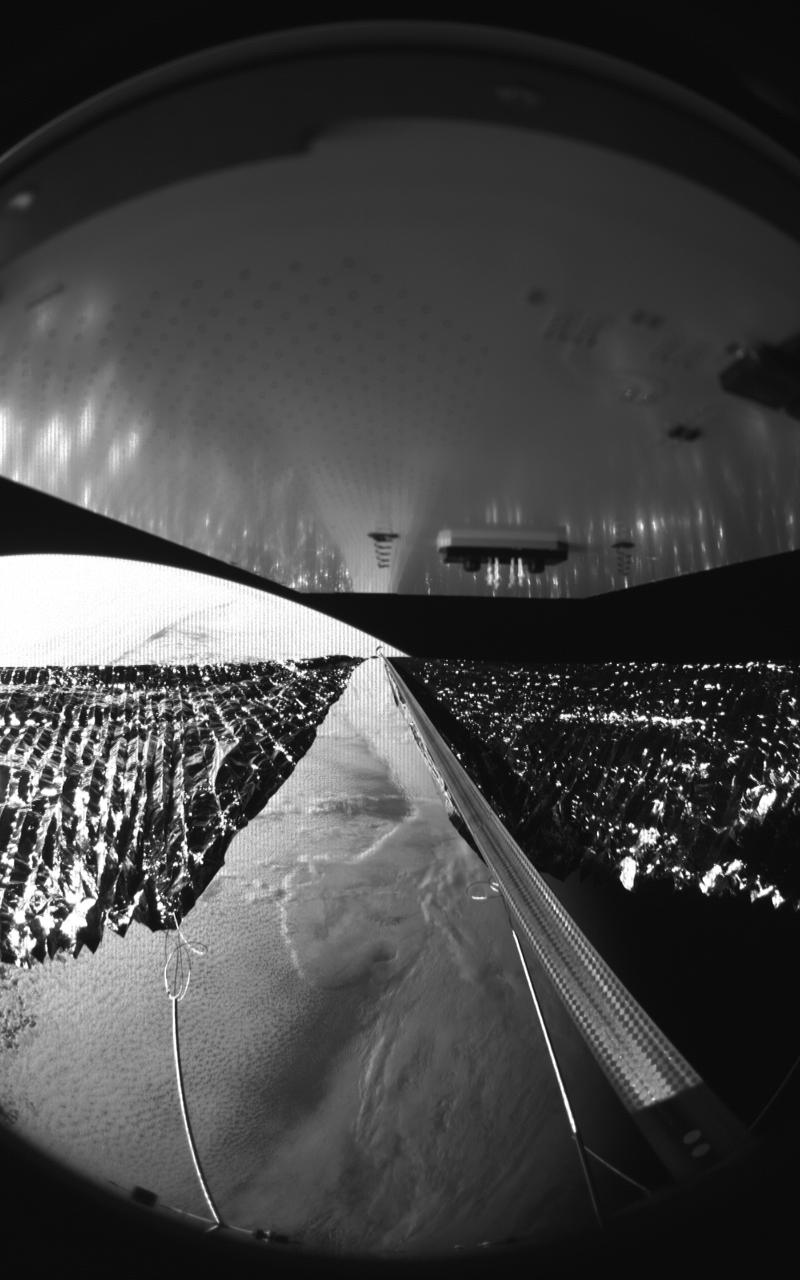
Four cameras aboard the Advanced Composite Solar Sail System spacecraft show the four reflective sail quadrants supported by composite booms. The booms are mounted at right angles and the spacecraft’s solar panel is rectangular, but lines appear distorted because of the wide-angle camera field of view. View from a black-and-white wide-angle camera aboard the Advanced Composite Solar Sail System taken during sail unfurling in low Earth orbit. The spacecraft has four such cameras, centrally located aboard the spacecraft. Here, reflective sail quadrants supported by composite booms are seen when the booms are partially extended and the sail quadrants are not taut. At the top of the photo is the back surface of one of the spacecraft’s solar panels. On the lower left Earth is seen below.
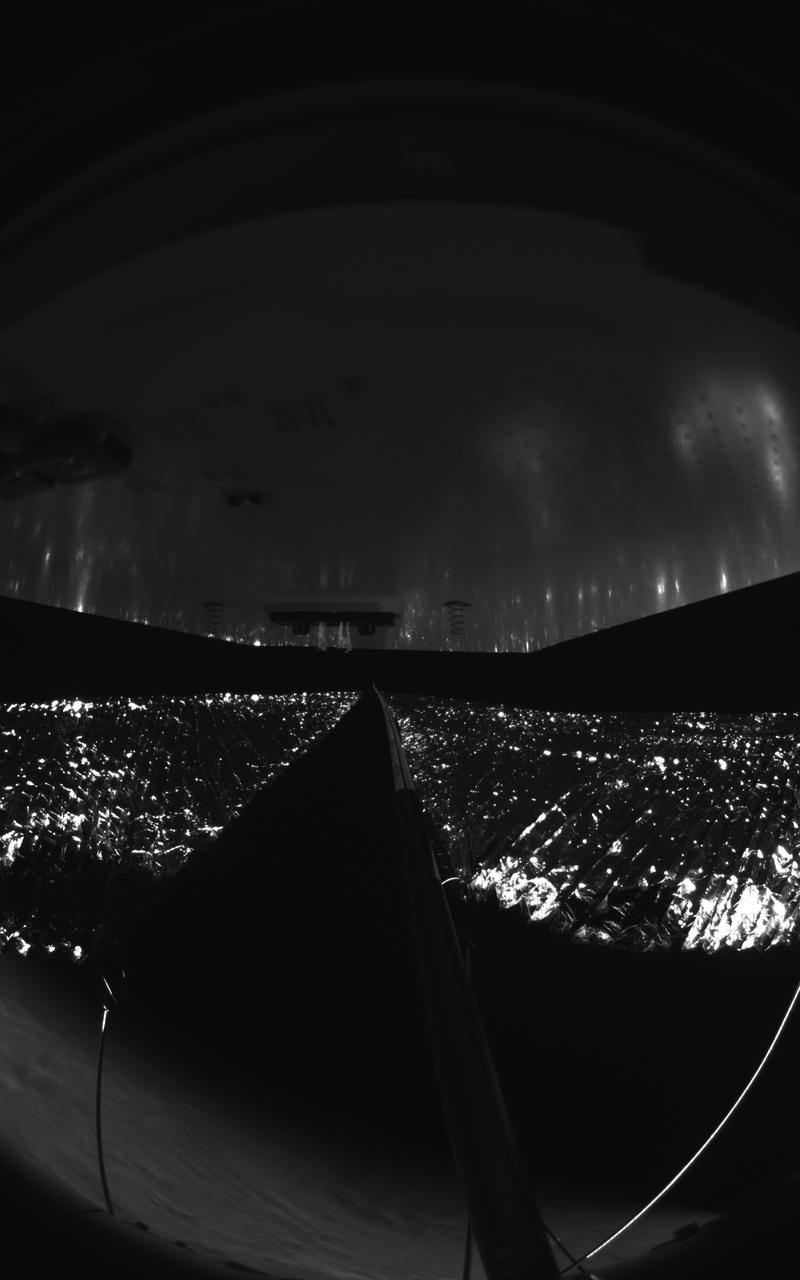
Four cameras aboard the Advanced Composite Solar Sail System spacecraft show the four reflective sail quadrants supported by composite booms. The booms are mounted at right angles and the spacecraft’s solar panel is rectangular, but lines appear distorted because of the wide-angle camera field of view. View from a black-and-white wide-angle camera aboard the Advanced Composite Solar Sail System taken during sail unfurling in low Earth orbit. The spacecraft has four such cameras, centrally located aboard the spacecraft. Here, reflective sail quadrants supported by composite booms are seen when the booms are partially extended and the sail quadrants are not taut. At the top of the photo is the back surface of one of the spacecraft’s solar panels. On the lower left Earth’s limb is seen below.
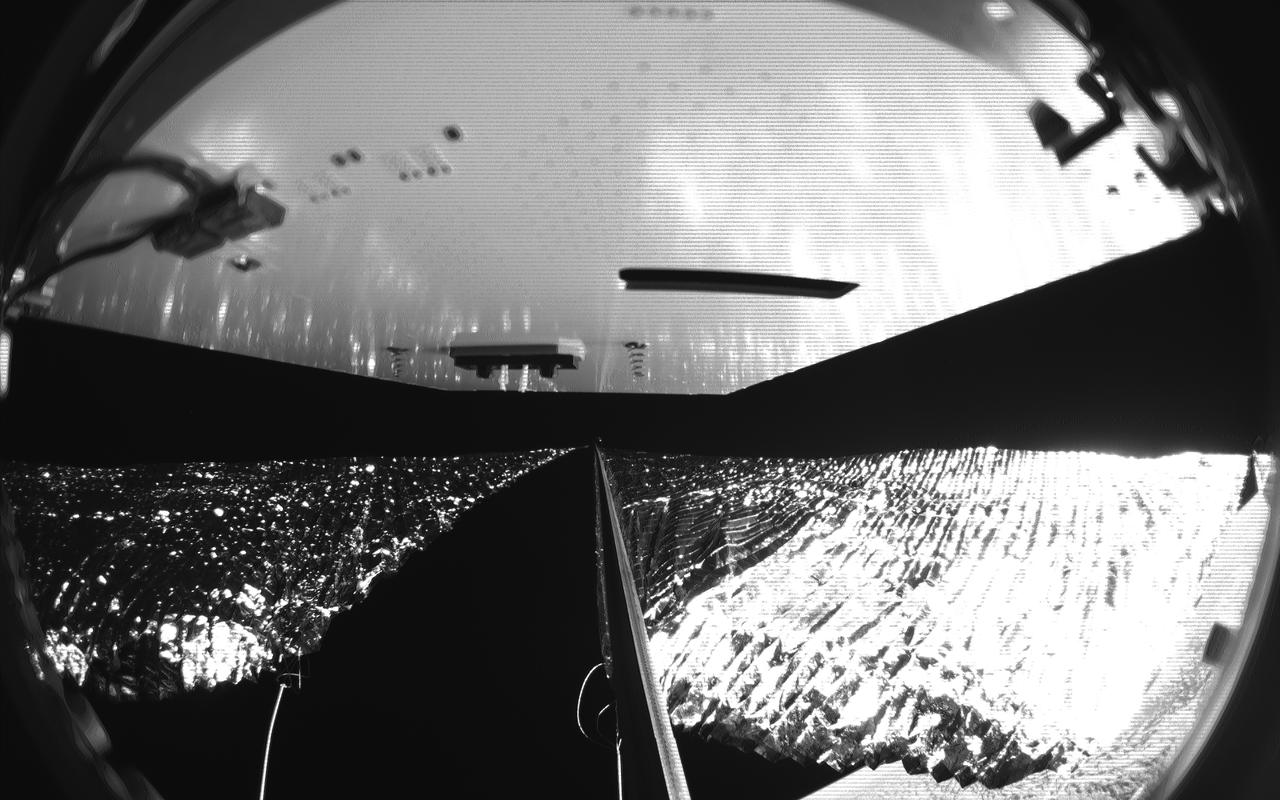
Four cameras aboard the Advanced Composite Solar Sail System spacecraft show the four reflective sail quadrants supported by composite booms. The booms are mounted at right angles and the spacecraft’s solar panel is rectangular, but lines appear distorted because of the wide-angle camera field of view. View from a black-and-white wide-angle camera aboard the Advanced Composite Solar Sail System taken during sail unfurling in low Earth orbit. The spacecraft has four such cameras, centrally located aboard the spacecraft. Here, reflective sail quadrants supported by composite booms are seen when the booms are partially extended and the sail quadrants are not taut. At the top of the photo is the back surface of one of the spacecraft’s solar panels. On the lower right Earth is seen below.
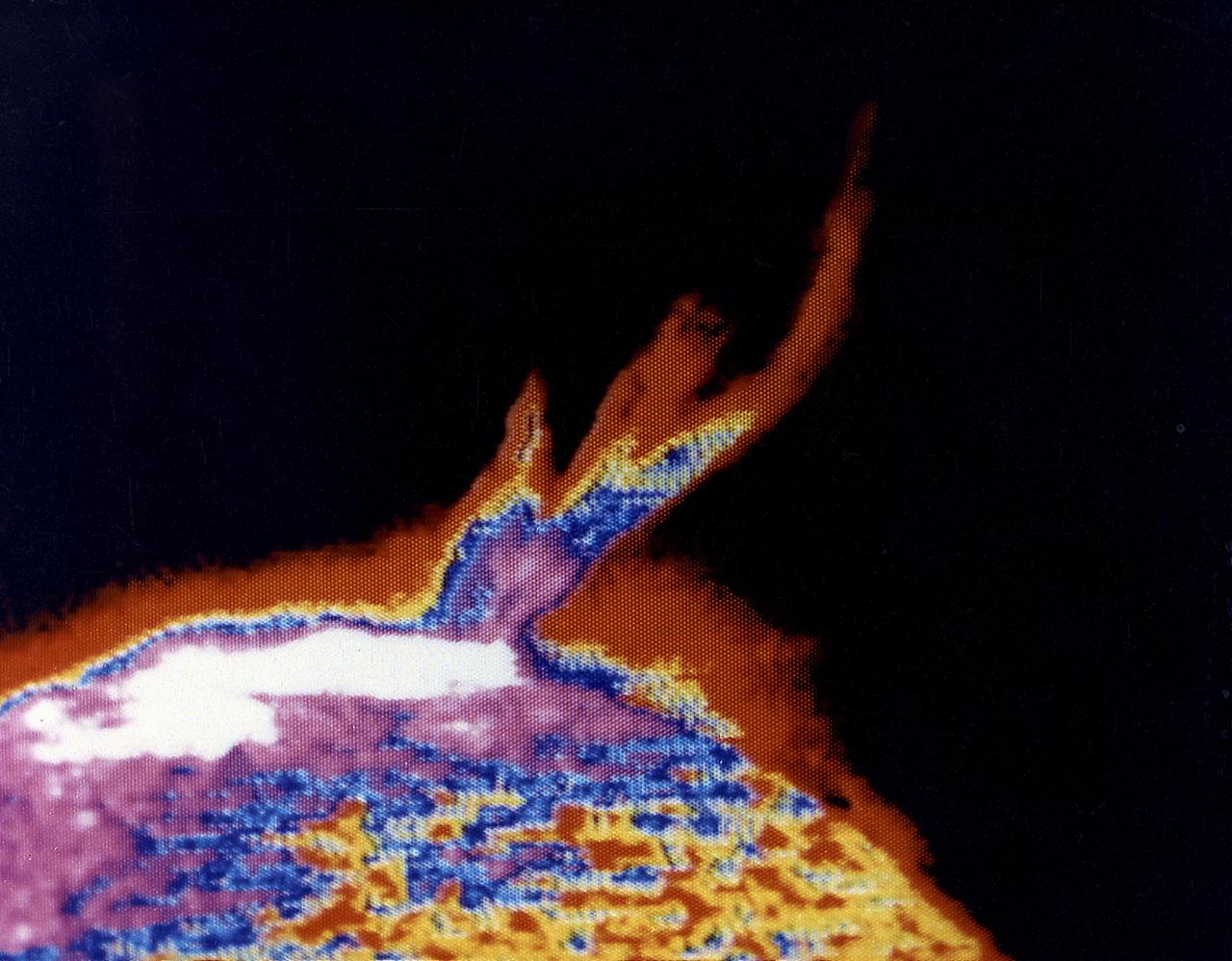
This photograph shows a solar prominence in action, one of Skylab's many splendorous views. It was taken on August 21, 1973. Interpretation of the rich store of Skylab ultraviolet solar data was facilitated by computerized color enhancement of the original black-and-white images, highlighting subtle but important brightness differences.

ISS036-E-047951 (7 Sept. 2013) --- Backdropped by a blue and white part of Earth and the blackness of space, International Space Station solar array panels are featured in this image photographed by an Expedition 36 crew member aboard the station.
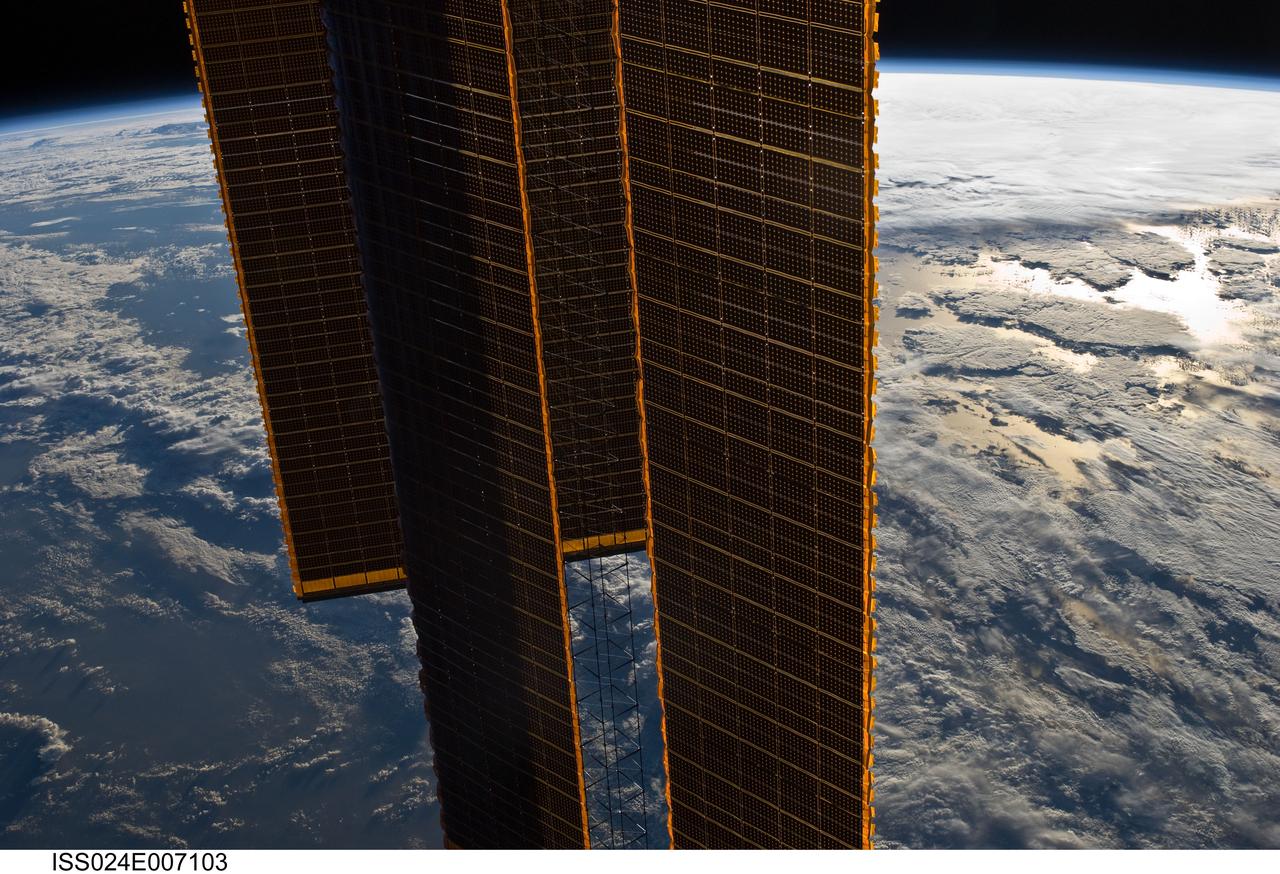
ISS024-E-007103 (29 June 2010) --- Backdropped by a blue and white part of Earth and the blackness of space, International Space Station solar array panels are featured in this image photographed by an Expedition 24 crew member aboard the station.
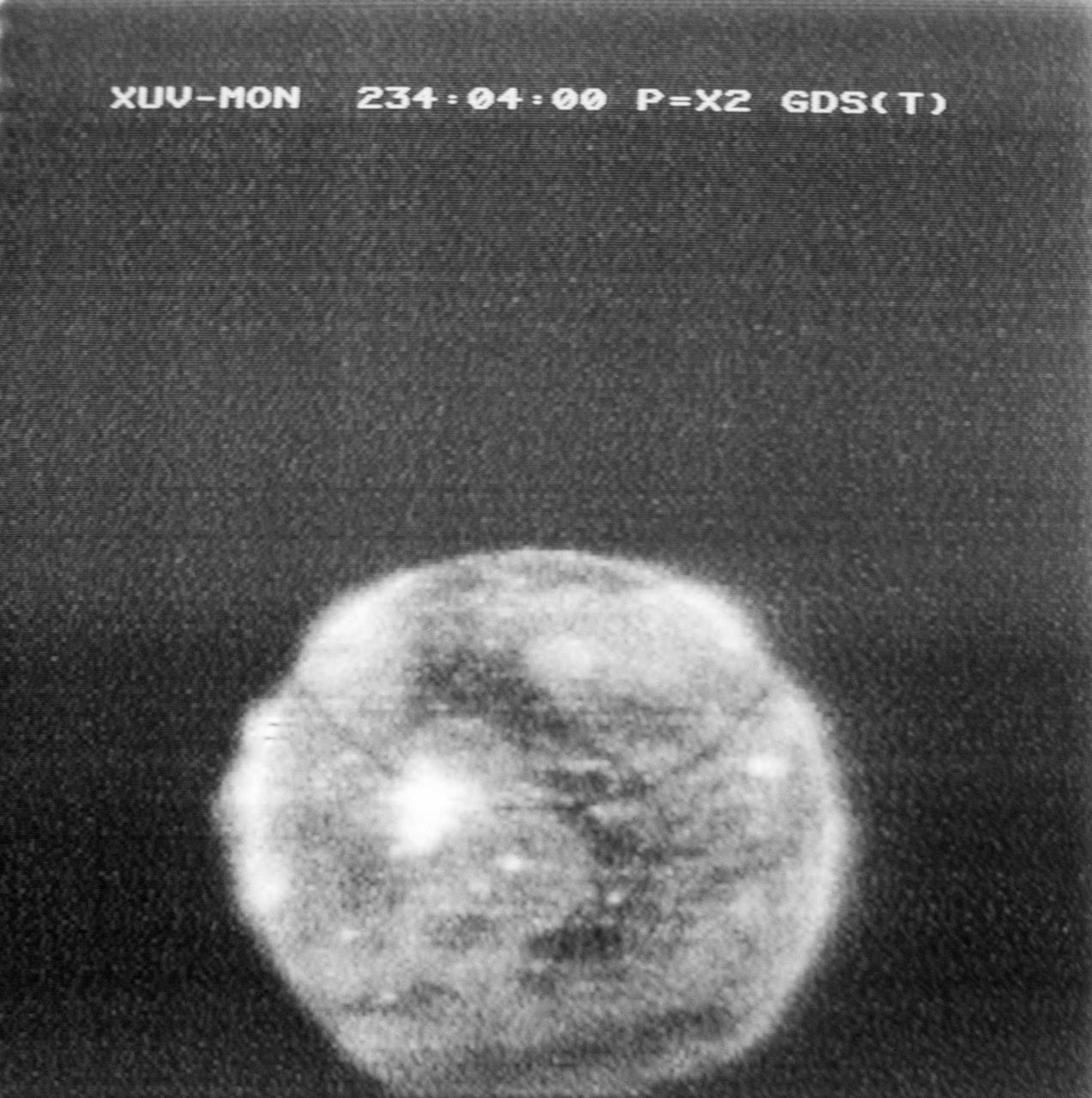
S73-32867 (21 Aug. 1973) --- The solar sphere viewed through the Skylab solar physics experiment (S082) Extreme Ultraviolet Spectroheliographis seen in this photographic reproduction taken from a color television transmission made by a TV camera aboard the Skylab space station in Earth orbit. The solar chromosphere and lower corona are much hotter than the surface of the sun characterized by the white light emissions. This image was recorded during the huge solar prominence which occurred on Aug. 21, 1973. Photo credit: NASA

Each day NASA solar scientists produce overlays (in white lines) that show their estimation of how the magnetic field lines above the sun are configured (June16, 2016). In the video clip we show the sun in a wavelength of extreme ultraviolet light, then reveal the magnetic field line configuration in the same wavelength. Notice how the lines are tightly bundled near the lighter-toned active regions, which are magnetically intense regions. The magnetic lines from the darker areas, called coronal holes, open out into space and the extended lines show that. Our magnetically active sun is a dynamic body that changes all the time. Movie are also available at the Photojournal. http://photojournal.jpl.nasa.gov/catalog/PIA20881
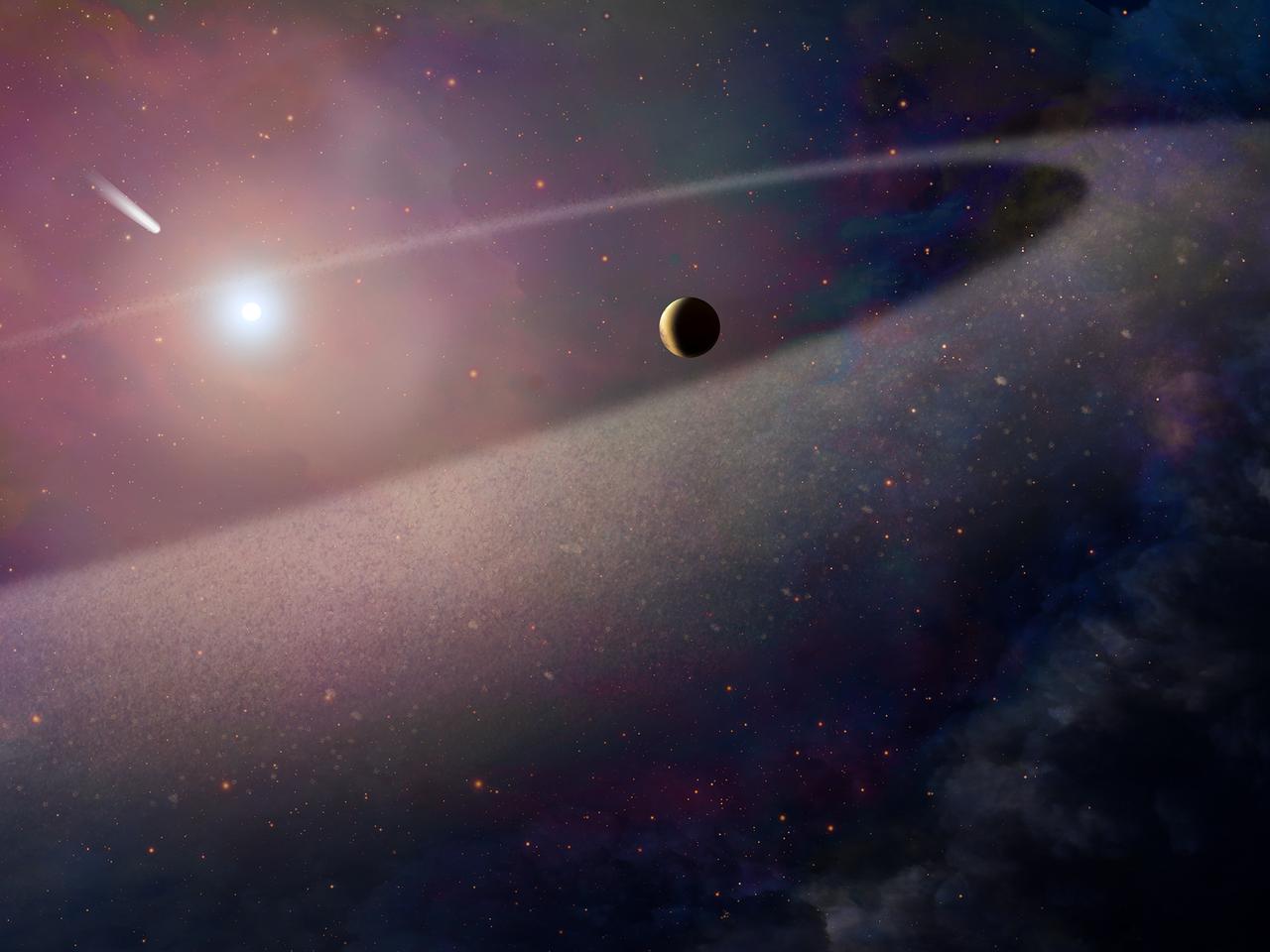
For the first time, scientists using NASA’s Hubble Space Telescope have witnessed a massive object with the makeup of a comet being ripped apart and scattered in the atmosphere of a white dwarf, the burned-out remains of a compact star. The object has a chemical composition similar to Halley’s Comet, but it is 100,000 times more massive and has a much higher amount of water. It is also rich in the elements essential for life, including nitrogen, carbon, oxygen, and sulfur. These findings are evidence for a belt of comet-like bodies orbiting the white dwarf, similar to our solar system’s Kuiper Belt. These icy bodies apparently survived the star’s evolution as it became a bloated red giant and then collapsed to a small, dense white dwarf. Caption: This artist's concept shows a massive, comet-like object falling toward a white dwarf. New Hubble Space Telescope findings are evidence for a belt of comet-like bodies orbiting the white dwarf, similar to our solar system's Kuiper Belt. The findings also suggest the presence of one or more unseen surviving planets around the white dwarf, which may have perturbed the belt to hurl icy objects into the burned-out star. Credits: NASA, ESA, and Z. Levay (STScI) <b><a href="http://www.nasa.gov/audience/formedia/features/MP_Photo_Guidelines.html" rel="nofollow">NASA image use policy.</a></b> <b><a href="http://www.nasa.gov/centers/goddard/home/index.html" rel="nofollow">NASA Goddard Space Flight Center</a></b> enables NASA’s mission through four scientific endeavors: Earth Science, Heliophysics, Solar System Exploration, and Astrophysics. Goddard plays a leading role in NASA’s accomplishments by contributing compelling scientific knowledge to advance the Agency’s mission. <b>Follow us on <a href="http://twitter.com/NASAGoddardPix" rel="nofollow">Twitter</a></b> <b>Like us on <a href="http://www.facebook.com/pages/Greenbelt-MD/NASA-Goddard/395013845897?ref=tsd" rel="nofollow">Facebook</a></b> <b>Find us on <a href="http://instagrid.me/nasagoddard/?vm=grid" rel="nofollow">Instagram</a></b>

ISS038-E-042665 (5 Feb. 2014) --- Solar array panels on the Russian segment of the International Space Station and a blue and white part of Earth are photographed by an Expedition 38 crew member while the crew watches for the arrival of the ISS Progress 54 cargo spacecraft, loaded with 2.8 tons of food, fuel and supplies for the station crew.

iss069e031369 (July 13, 2023) -- White and pink clouds cover Earth as the International Space Station orbited 259 miles above the coast of the Red Sea, the northernmost tropical sea in the world. A roll-out solar array is displayed in the bottom right corner of the image.

S134-E-008214 (21 May 2011) --- International Space Station solar array panels and a blue and white part of Earth are featured in this image photographed by an STS-134 crew member onboard the station during flight day six activities. Photo credit: NASA
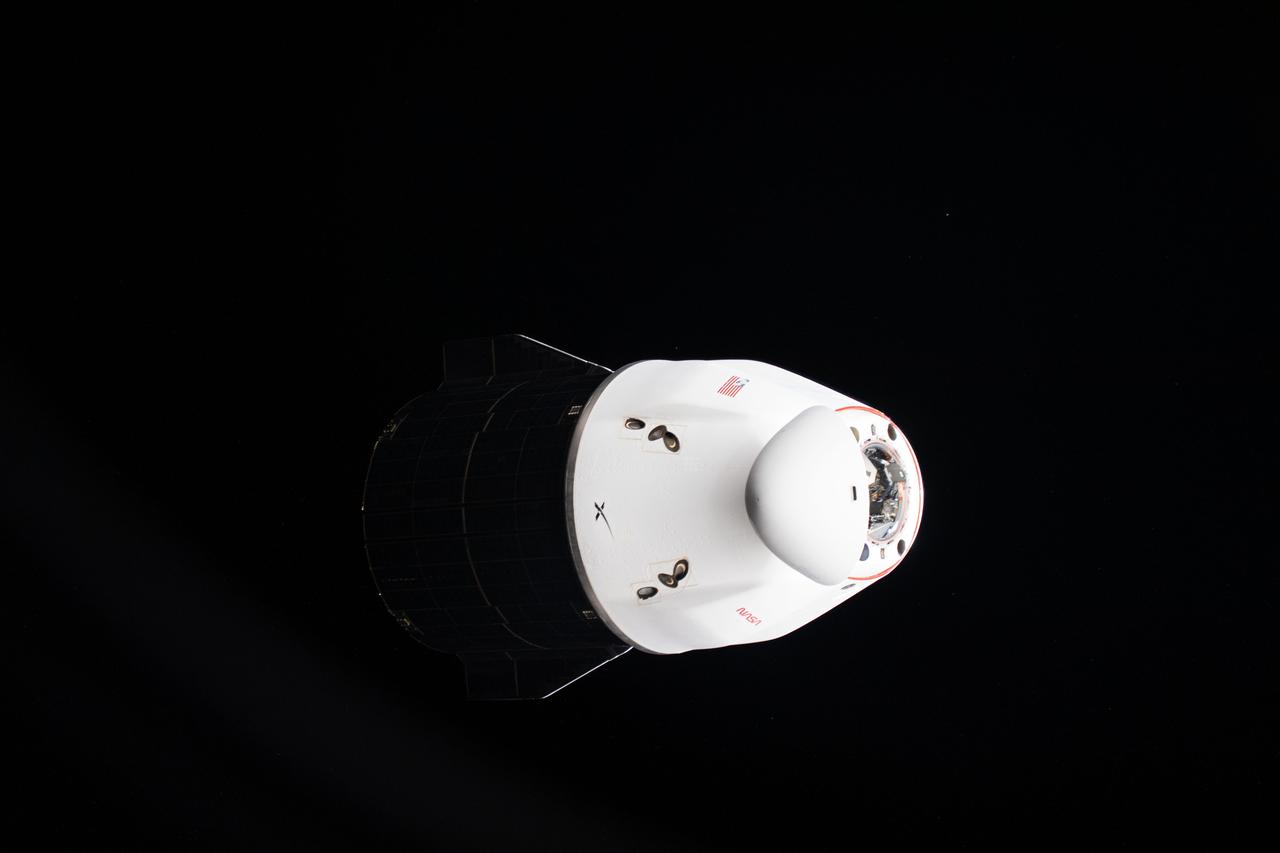
iss066e125299 (Jan. 23, 2022) --- The bright, white pressurized capsule of the SpaceX Cargo Dragon resupply ship with its nose cone open nearly obscures its dark solar panel-covered, unpressurized trunk as the vehicle departs the International Space Station.
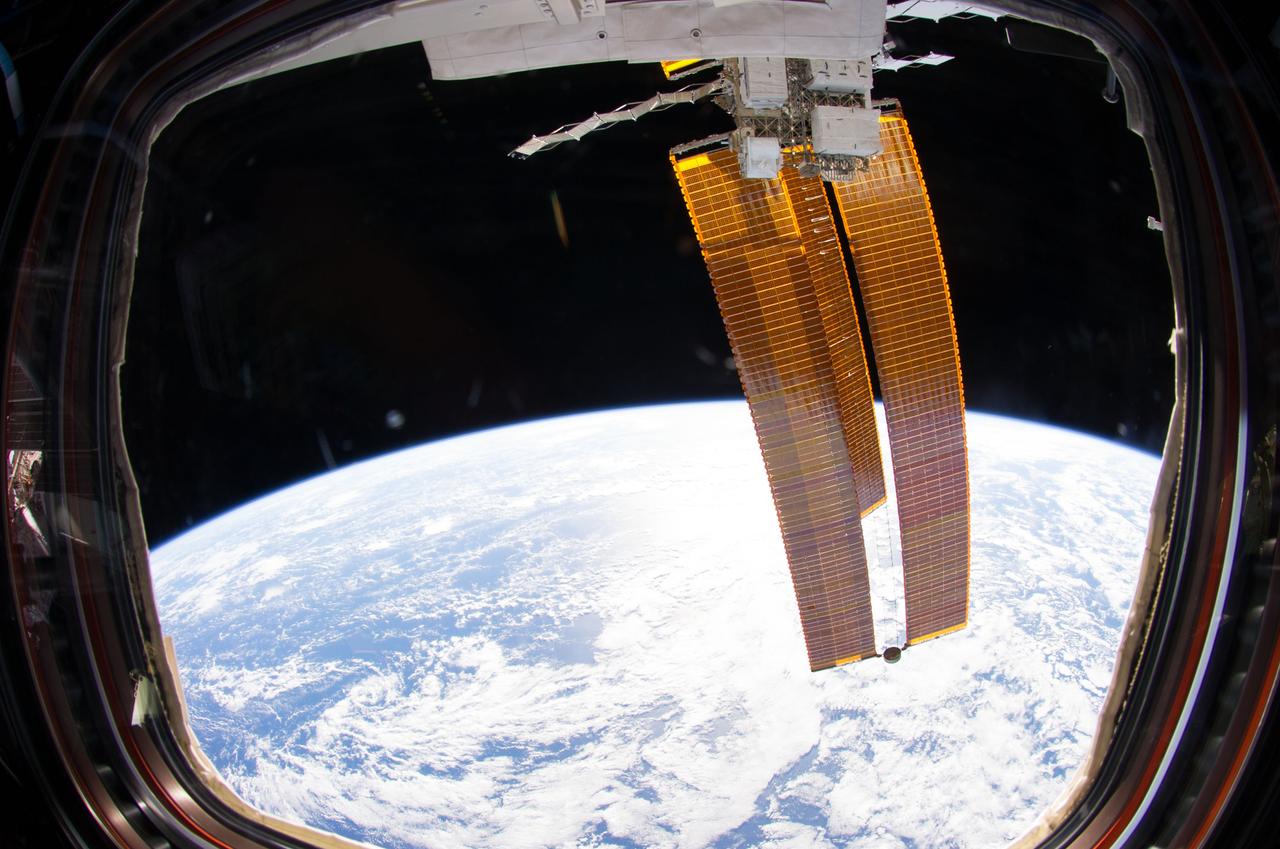
ISS040-E-006193 (1 June 2014) --- Backdropped by a blue and white part of Earth and the blackness of space, solar array wings are featured in this image photographed by an Expedition 40 crew member from a window in the Cupola of the International Space Station.
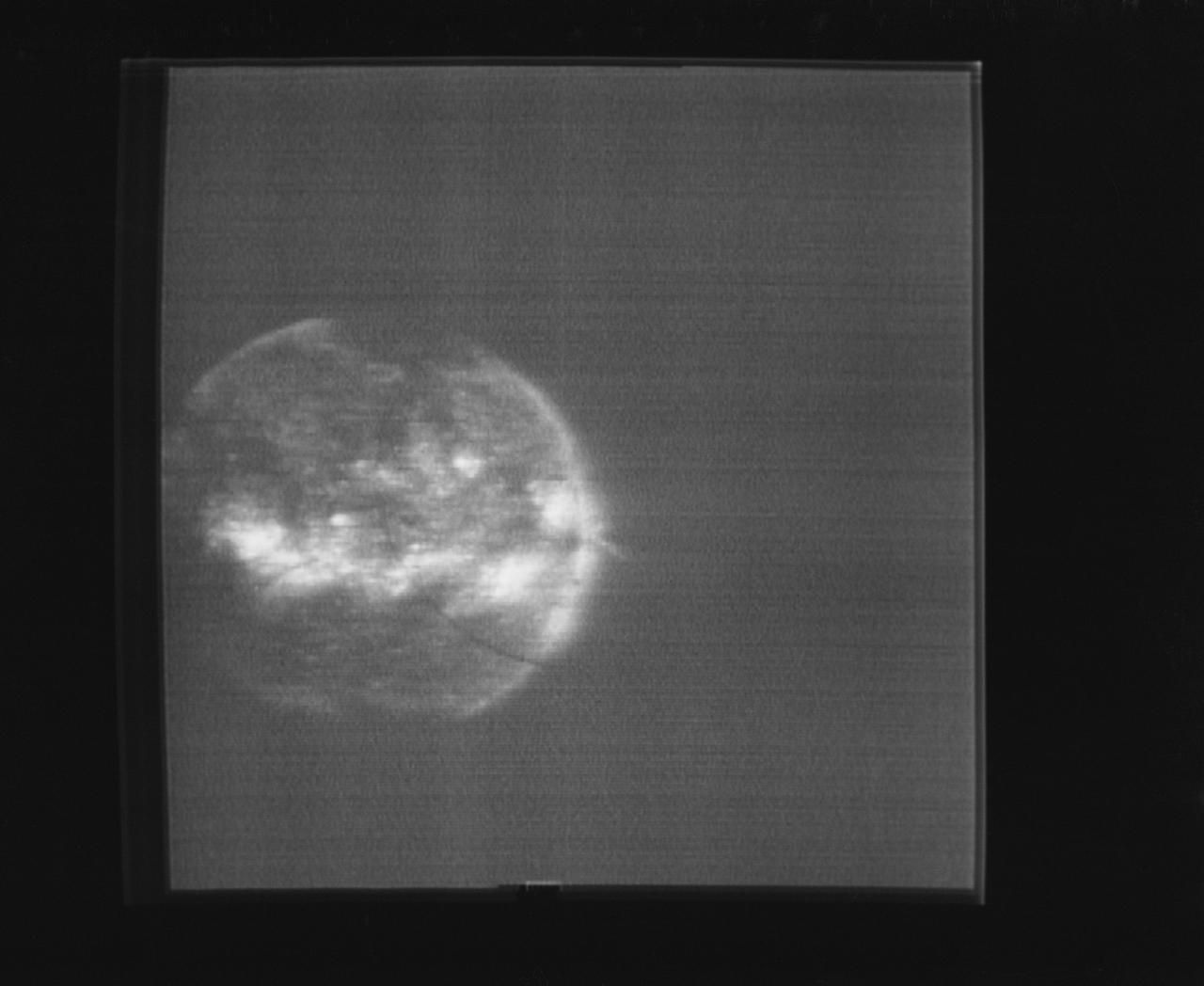
S74-15696 (1974) --- The solar disk photographed through the Skylab S082 Ultraviolet Spectrograph/Heliograph can be seen in this reproduction taken from a television tranmission made by a TV camera aboard the Skylab space station in Earth orbit. The S082 experiment is located in the Apollo Telescope Mount. This spectroheliogram shows specific emission features greatly enhanced over photographs of the solar disk in white light. Photo credit: NASA
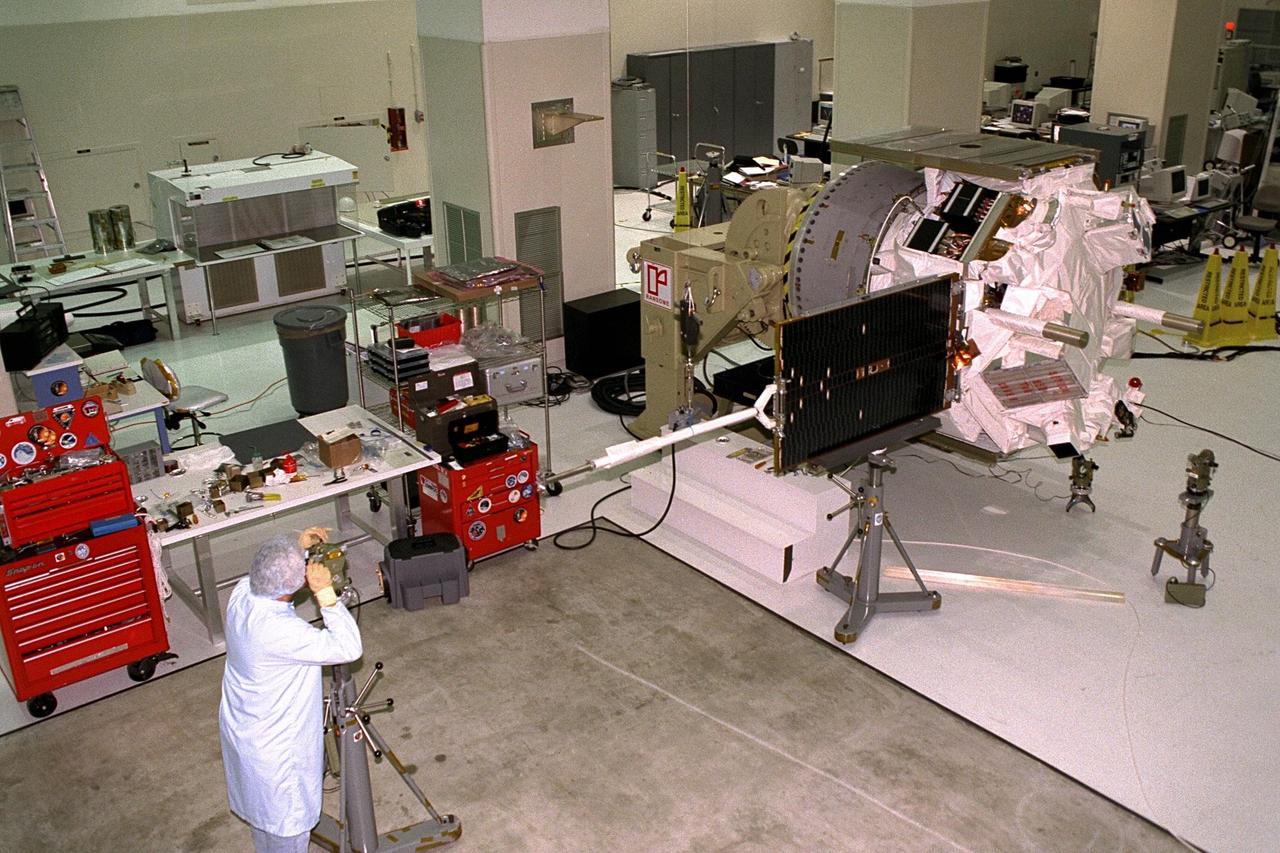
An Applied Physics Laboratory engineer from Johns Hopkins University tests for true perpendicular solar array deployment of the Advanced Composition Explorer (ACE) in KSC’s Spacecraft Assembly and Encapsulation Facility-II (SAEF-II). The white magnetometer boom seen across the solar array panel will deploy the panel once in space. Scheduled for launch on a Delta II rocket from Cape Canaveral Air Station on Aug. 25, ACE will study low-energy particles of solar origin and high-energy galactic particles. The ACE observatory will be placed into an orbit almost a million miles (1.5 million kilometers) away from the Earth, about 1/100 the distance from the Earth to the Sun
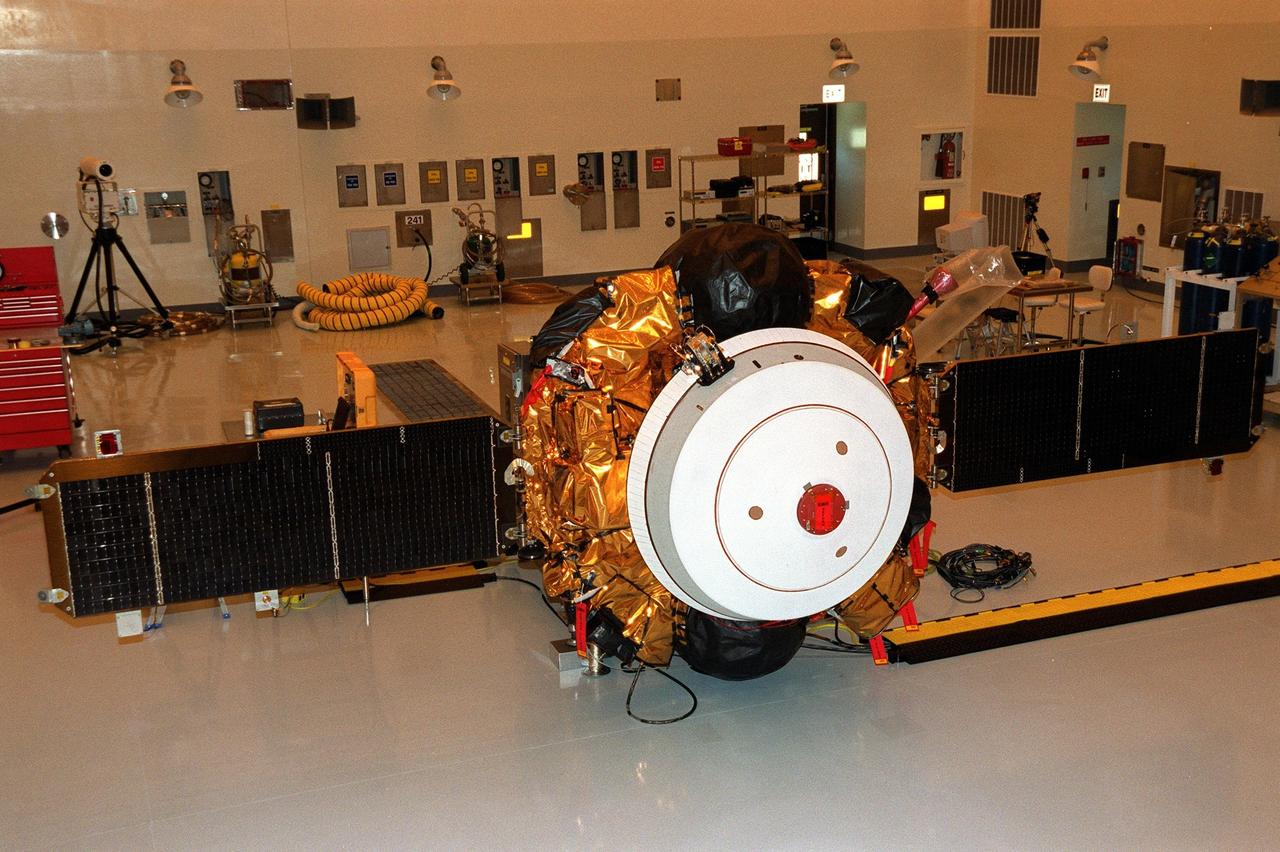
KENNEDY SPACE CENTER, Fla. -- In the Payload Hazardous Servicing Facility, both solar arrays on the Genesis spacecraft are deployed. Genesis is designed to collect samples of solar wind particles and return them to Earth so that scientists can study the exact composition of the Sun and probe the solar system’s origin. The white object on the end in front of the arrays is the Sample Return Canister backshell, inside of which are the collector arrays. Genesis is scheduled to be launched on a Delta II Lite launch vehicle from Complex 17-A, Cape Canaveral Air Force Station, July 30, at 12:36 p.m. EDT
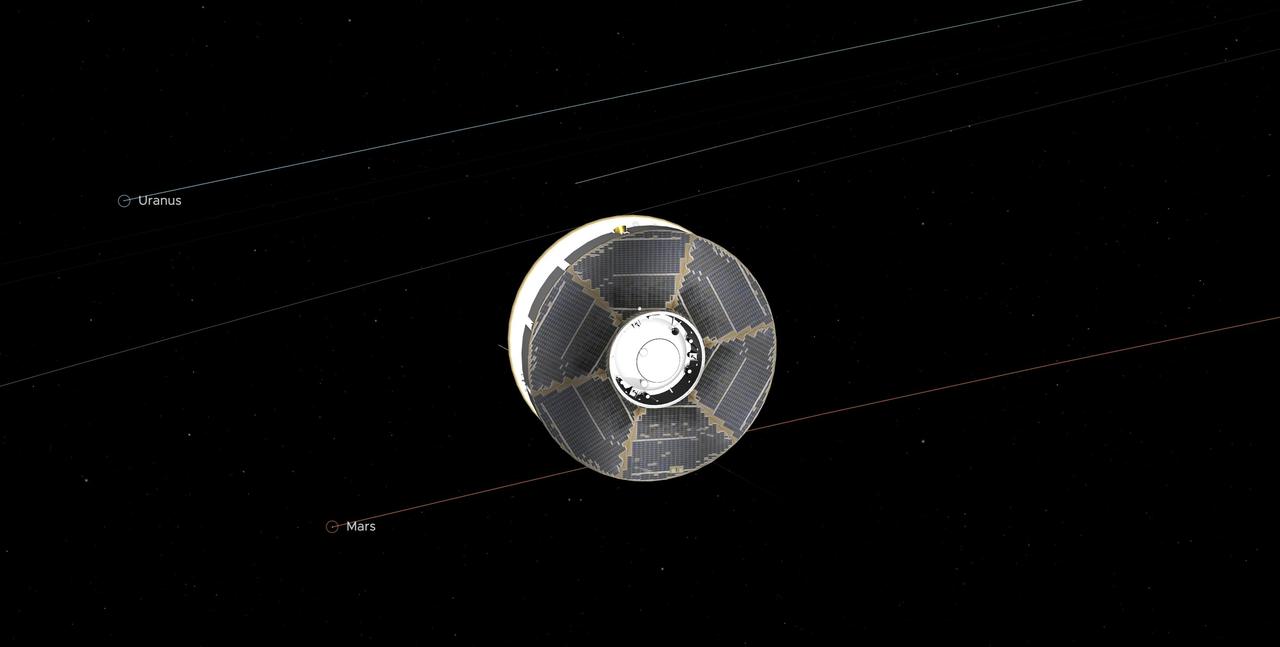
This illustration of the Mars 2020 spacecraft (the solar-panel-covered cruise stage most visible here along with a portion of the white back shell) in interplanetary space was generated using imagery from NASA's Eyes on the Solar System. The image is from the mission's midway point between Earth and Mars — 146.3 million miles (235.4 million kilometers) away from each. In straight-line distance, Earth is 26.6 million miles (42.7 million kilometers) behind Perseverance, and Mars is 17.9 million miles (28.8 million kilometers) in front. Visible in the graphic are the solar panels on the cruise stage surrounding the top of the aeroshell. https://photojournal.jpl.nasa.gov/catalog/PIA24231
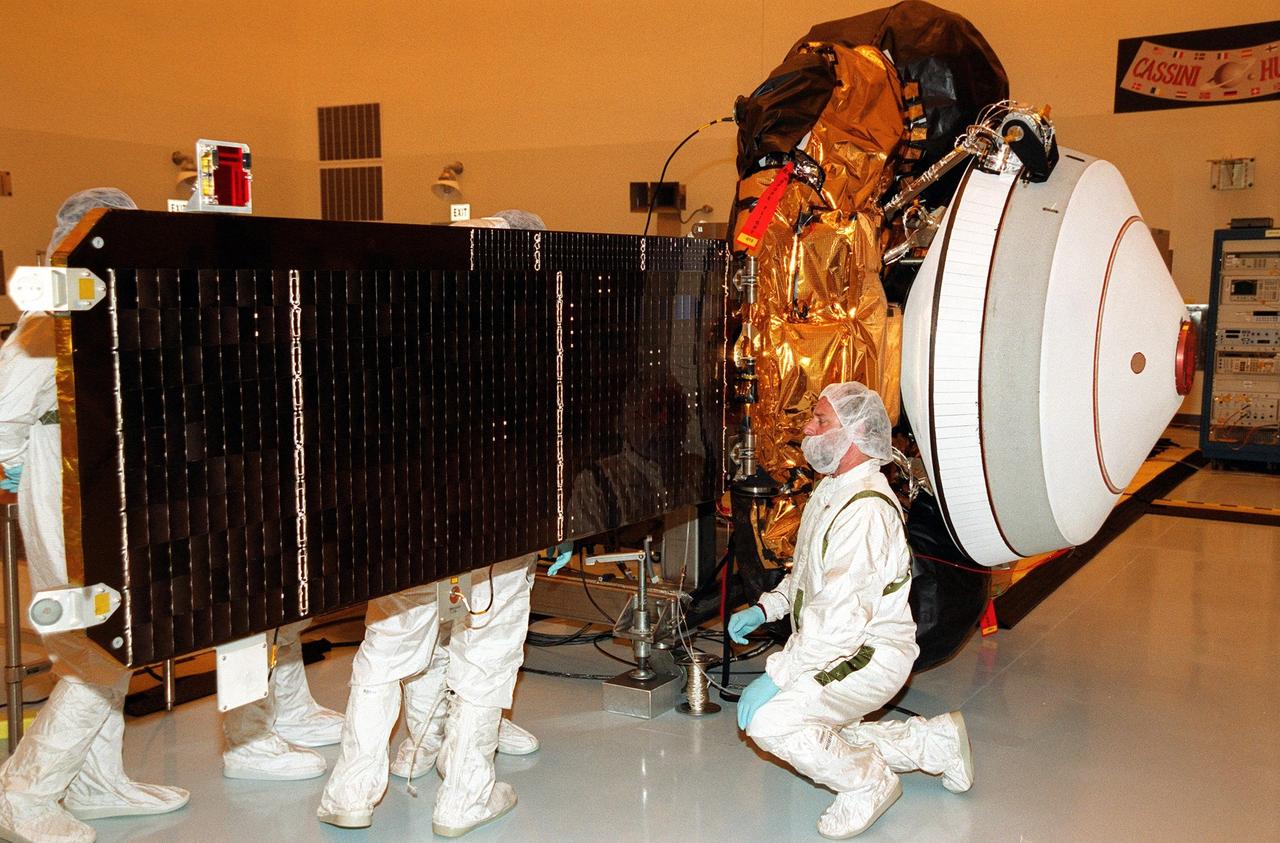
KENNEDY SPACE CENTER, Fla. -- Workers in the Payload Hazardous Servicing Facility check closely the solar arrays on the Genesis spacecraft. Genesis is designed to collect samples of solar wind particles and return them to Earth so that scientists can study the exact composition of the Sun and probe the solar system’s origin. The white object on the end in front of the arrays is the Sample Return Canister backshell, inside of which are the collector arrays. Genesis is scheduled to be launched on a Delta II Lite launch vehicle from Complex 17-A, Cape Canaveral Air Force Station, July 30, at 12:36 p.m. EDT
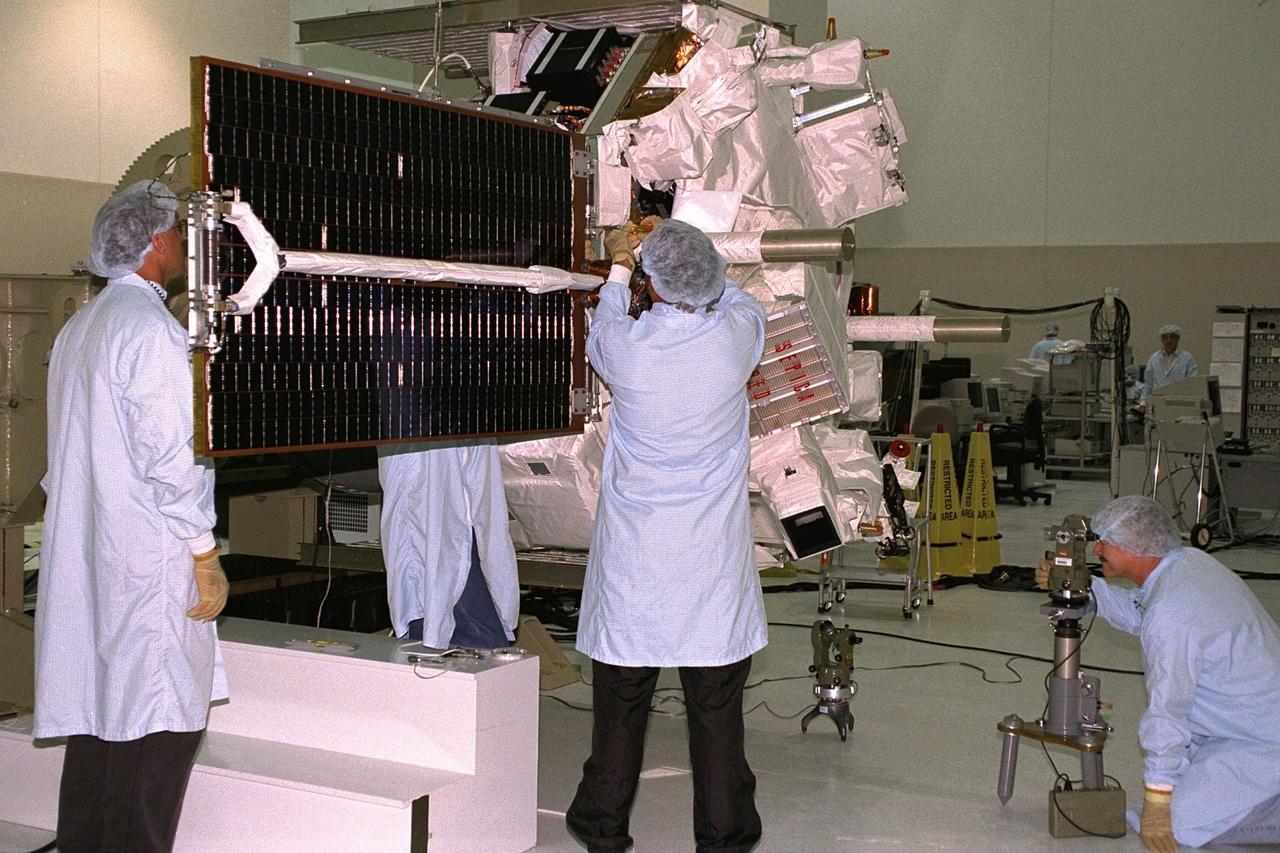
Applied Physics Laboratory engineers and technicians from Johns Hopkins University test for true perpendicular solar array deployment of the Advanced Composition Explorer (ACE) in KSC’s Spacecraft Assembly and Encapsulation Facility-II (SAEF-II). The white magnetometer boom seen across the solar array panel will deploy the panel once in space. Scheduled for launch on a Delta II rocket from Cape Canaveral Air Station on Aug. 25, ACE will study low-energy particles of solar origin and high-energy galactic particles. The ACE observatory will be placed into an orbit almost a million miles (1.5 million kilometers) away from the Earth, about 1/100 the distance from the Earth to the Sun
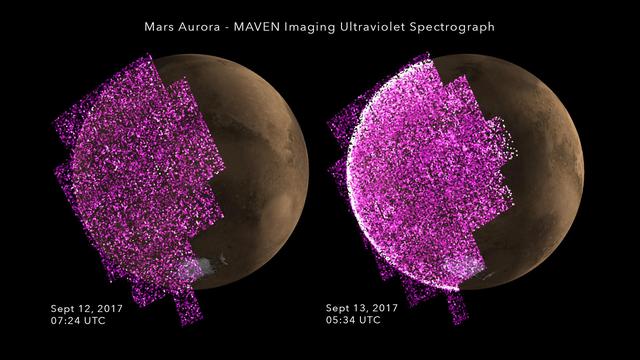
These images show the sudden appearance of a bright aurora on Mars during a solar storm in September 2017. The purple-white color scheme shows the intensity of ultraviolet light seen on Mars' night side before (left) and during (right) the event. A simulated image of Mars for the same time and orientation has been added, with the dayside crescent visible on the right. The auroral emission appears brightest at the edges of the planet where the line of sight passes along the length of the glowing atmosphere layer. The data are from observations by the Imaging Ultraviolet Spectrograph instrument (IUVS) on NASA's Mars Atmosphere and Volatile Evolution orbiter, or MAVEN. Note that, unlike auroras on Earth, the Martian aurora is not concentrated at the planet's polar regions. This is because Mars has no strong magnetic field like Earth's to concentrate the aurora near the poles. https://photojournal.jpl.nasa.gov/catalog/PIA21855
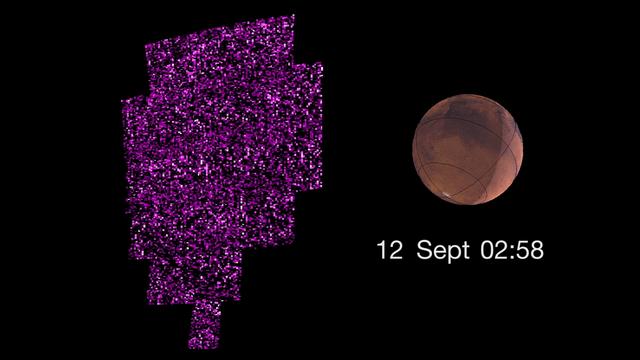
This frame from an animation shows the sudden appearance of a bright aurora on Mars during a solar storm. The purple-white color scheme shows the intensity of ultraviolet light seen on Mars' night side over the course of the event. The data are from observations on Sept. 12 and 13, 2017, by the Imaging Ultraviolet Spectrograph instrument (IUVS) on NASA's Mars Atmosphere and Volatile Evolution orbiter, or MAVEN. The aurora is occurring because energetic particles from the solar storm are bombarding gases in the planet's atmosphere, causing them to glow. A simulated image of the Mars surface for the same time and orientation is also shown, with the dayside crescent visible on the right. The auroral emission appears brightest at the edges of the planet where the line of sight passes along the length of the glowing atmosphere layer. Note that, unlike auroras on Earth, the Martian aurora is not concentrated at the planet's polar regions. This is because Mars has no strong magnetic field like Earth's to concentrate the aurora near the poles. An animation is available at https://photojournal.jpl.nasa.gov/catalog/PIA21854

S115-E-06765 (17 Sept. 2006) --- This view of the International Space Station, backdropped against a blue and white Earth, was taken shortly after the Space Shuttle Atlantis undocked from the orbital outpost at 7:50 a.m. CDT. The unlinking completed six days, two hours and two minutes of joint operations with the station crew. Atlantis left the station with a new, second pair of 240-foot solar wings, attached to a new 17.5-ton section of truss with batteries, electronics and a giant rotating joint. The new solar arrays eventually will double the station's onboard power when their electrical systems are brought online during the next shuttle flight, planned for launch in December.

S115-E-06764 (17 Sept. 2006) --- This view of the International Space Station, backdropped against a blue and white Earth, was photographed shortly after the Space Shuttle Atlantis undocked from the orbital outpost at 7:50 a.m. (CDT). The unlinking completed six days, two hours and two minutes of joint operations with the station crew. Atlantis left the station with a new, second pair of 240-foot solar wings, attached to a new 17.5-ton section of truss with batteries, electronics and a giant rotating joint. The new solar arrays eventually will double the station's onboard power when their electrical systems are brought online during the next shuttle flight, planned for launch in December.

ISS016-E-017501 (18 Dec. 2007) --- Astronaut Peggy A. Whitson, Expedition 16 commander, participates in a session of extravehicular activity (EVA). During the 6-hour, 56-minute spacewalk, Whitson and astronaut Daniel Tani (out of frame), flight engineer, looked for the cause of partial loss of electrical power to one of the International Space Station's two Beta Gimbal Assemblies (BGA) for starboard solar wings and examined damage to the starboard Solar Alpha Rotary Joint (SARJ). The spacewalk was the 100th for the construction and maintenance of the station. A blue and white Earth provides the background for the scene.

S115-E-06759 (17 Sept. 2006) --- This view of the International Space Station over a blue and white Earth was taken shortly after the Space Shuttle Atlantis undocked from the orbital outpost at 7:50 a.m. CDT. The unlinking completed six days, two hours and two minutes of joint operations with the station crew. Atlantis left the station with a new, second pair of 240-foot solar wings, attached to a new 17.5-ton section of truss with batteries, electronics and a giant rotating joint. The new solar arrays eventually will double the station's onboard power when their electrical systems are brought online during the next shuttle flight, planned for launch in December.

S115-E-06767 (17 Sept. 2006) --- This view of the International Space Station, backdropped against a blue and white Earth, was taken shortly after the Space Shuttle Atlantis undocked from the orbital outpost at 7:50 a.m. (CDT). The unlinking completed six days, two hours and two minutes of joint operations with the station crew. Atlantis left the station with a new, second pair of 240-foot solar wings, attached to a new 17.5-ton section of truss with batteries, electronics and a giant rotating joint. The new solar arrays eventually will double the station's onboard power when their electrical systems are brought online during the next shuttle flight, planned for launch in December.
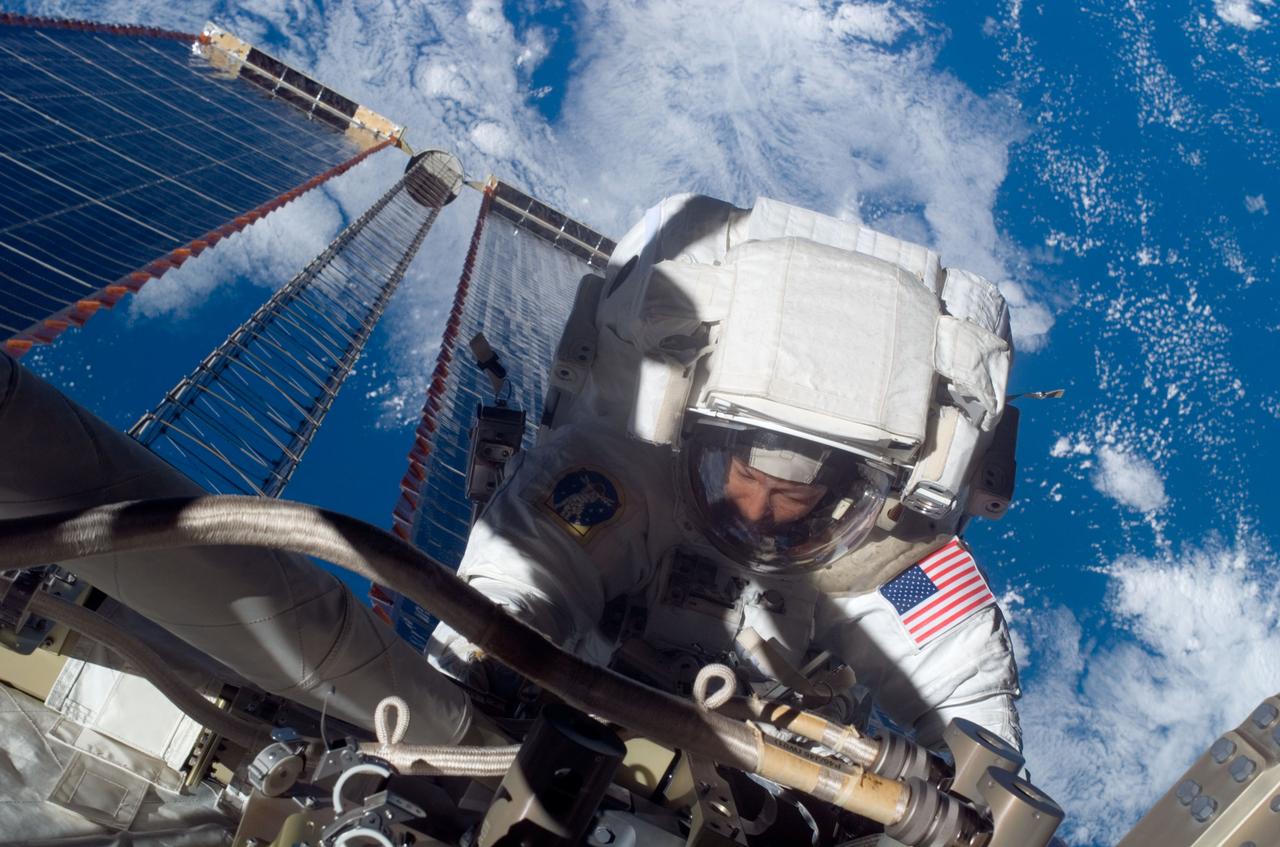
ISS016-E-017499 (18 Dec. 2007) --- Astronaut Peggy A. Whitson, Expedition 16 commander, participates in a session of extravehicular activity (EVA). During the 6-hour, 56-minute spacewalk, Whitson and astronaut Daniel Tani (out of frame), flight engineer, looked for the cause of partial loss of electrical power to one of the International Space Station's two Beta Gimbal Assemblies (BGA) for starboard solar wings and examined damage to the starboard Solar Alpha Rotary Joint (SARJ). The spacewalk was the 100th for the construction and maintenance of the station. A blue and white Earth provides the background for the scene.
![For the first time in a long time the Sun has gone an entire month without any sunspots (Feb. 1-18, 2019). To put this in context, for five years (2011-2015) surrounding the latest solar maximum in March 2014 - the period when the Sun's magnetic activity is the most intense - there were only three days without any sunspots[MH1]. What a difference! The change in the level of activity during the Sun's average 11-year solar cycle is quite dramatic. We are probably not quite at the minimum level of activity yet, but are certainly getting close. The images were taken in filtered white (visible) light. Movies available at https://photojournal.jpl.nasa.gov/catalog/PIA21218](https://images-assets.nasa.gov/image/PIA21218/PIA21218~medium.jpg)
For the first time in a long time the Sun has gone an entire month without any sunspots (Feb. 1-18, 2019). To put this in context, for five years (2011-2015) surrounding the latest solar maximum in March 2014 - the period when the Sun's magnetic activity is the most intense - there were only three days without any sunspots[MH1]. What a difference! The change in the level of activity during the Sun's average 11-year solar cycle is quite dramatic. We are probably not quite at the minimum level of activity yet, but are certainly getting close. The images were taken in filtered white (visible) light. Movies available at https://photojournal.jpl.nasa.gov/catalog/PIA21218
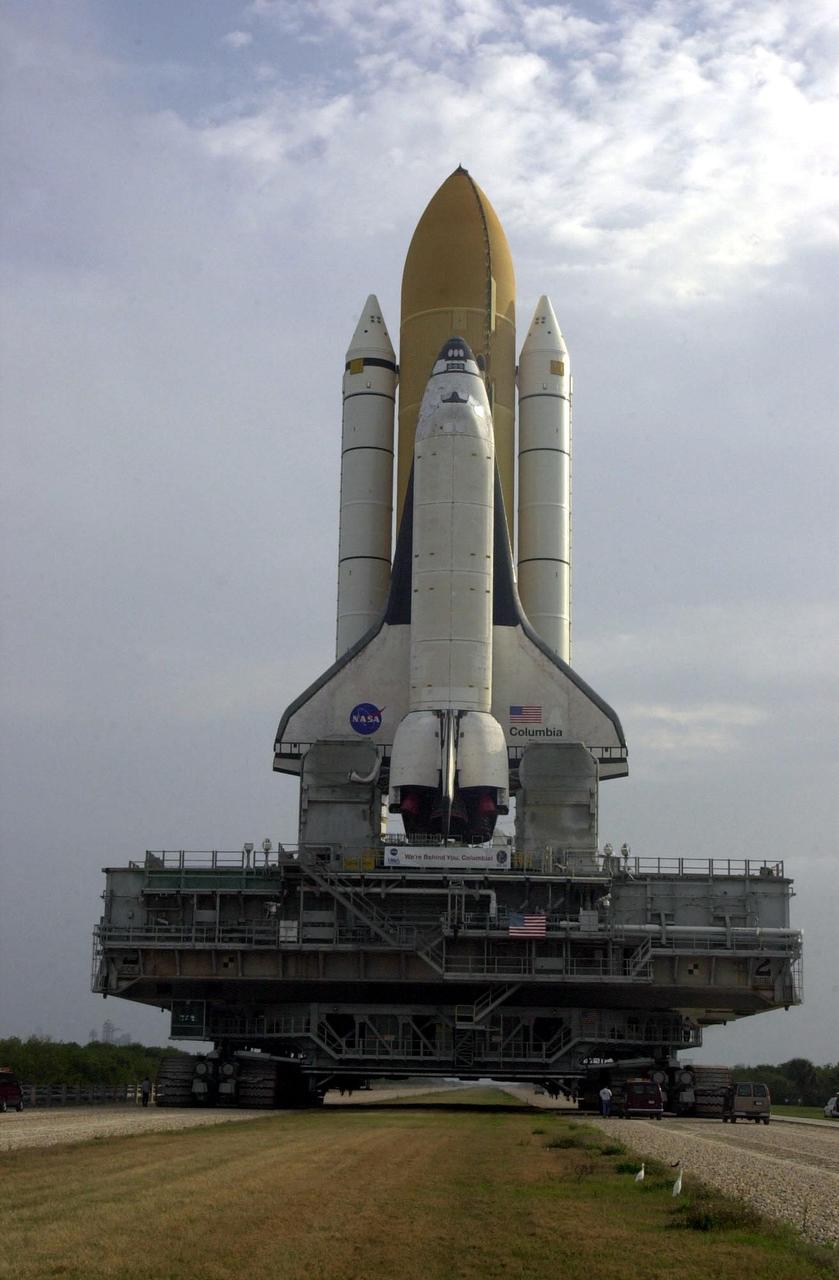
KENNEDY SPACE CENTER, FLA. -- A grey sky silhouettes Space Shuttle Columbia, atop its Mobile Launcher Platform, as it rolls out to Launch Pad 39A. Underneath is the crawler-transporter, which carries the multi-ton vehicles to the pad. In the grass behind the towering structures are two white herons. Columbia is scheduled to be launched Feb. 28 on mission STS-109, a Hubble Servicing Mission. The goal of the mission is to replace Solar Array 2 with Solar Array 3, replace the Power Control Unit, remove the Faint Object Camera and install the ACS, install the Near Infrared Camera and Multi-Object Spectrometer (NICMOS) Cooling System, and install New Outer Blanket Layer insulation
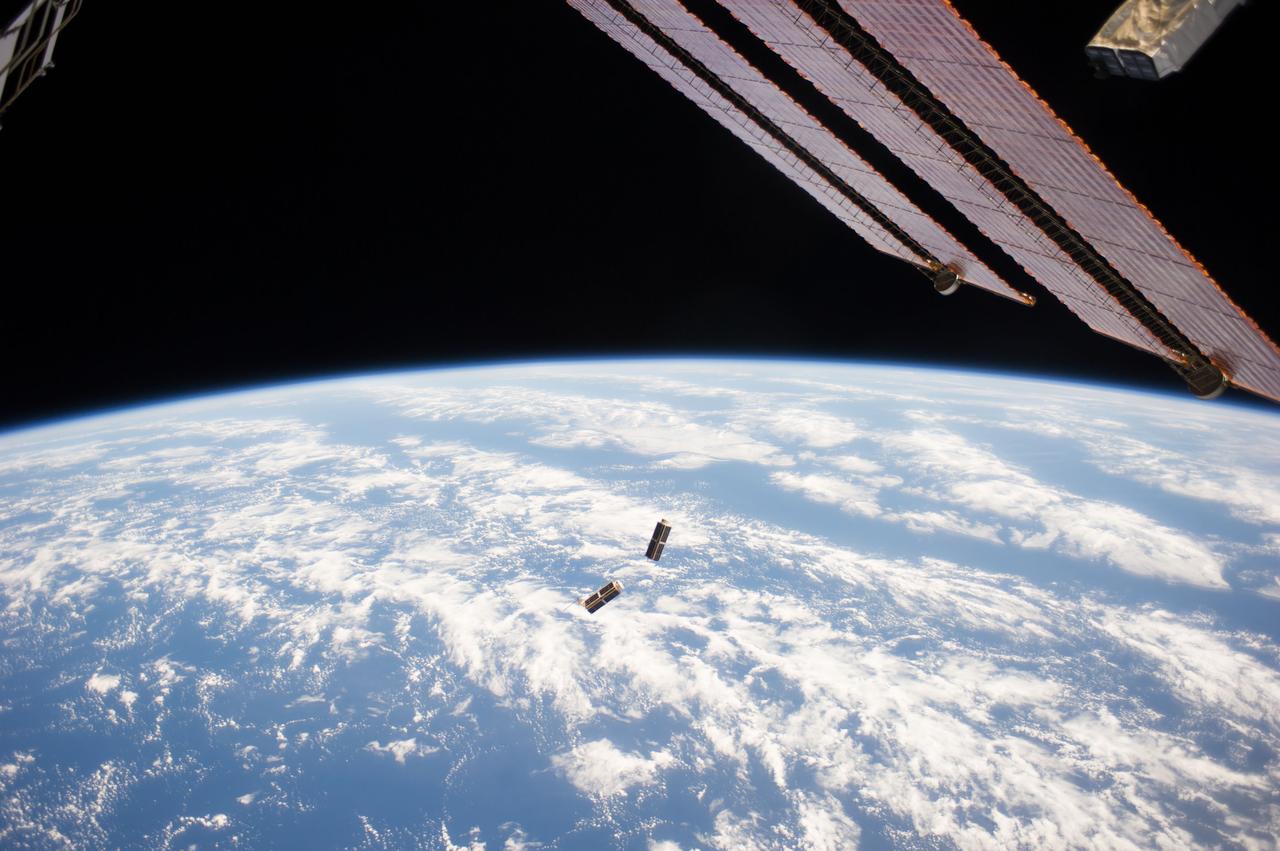
ISS040-E-103545 (19 Aug. 2014) --- In the grasp of the Japanese robotic arm, the CubeSat deployer (mostly out of frame, upper right) releases a pair of NanoRacks CubeSat miniature satellites (center). The Planet Labs Dove satellites that were carried to the International Space Station aboard the Orbital Sciences Cygnus commercial cargo craft are being deployed between Aug. 19 and Aug. 25. A section of the station solar array wings is at top right. A blue and white part of Earth and the blackness of space provide the backdrop for the scene.
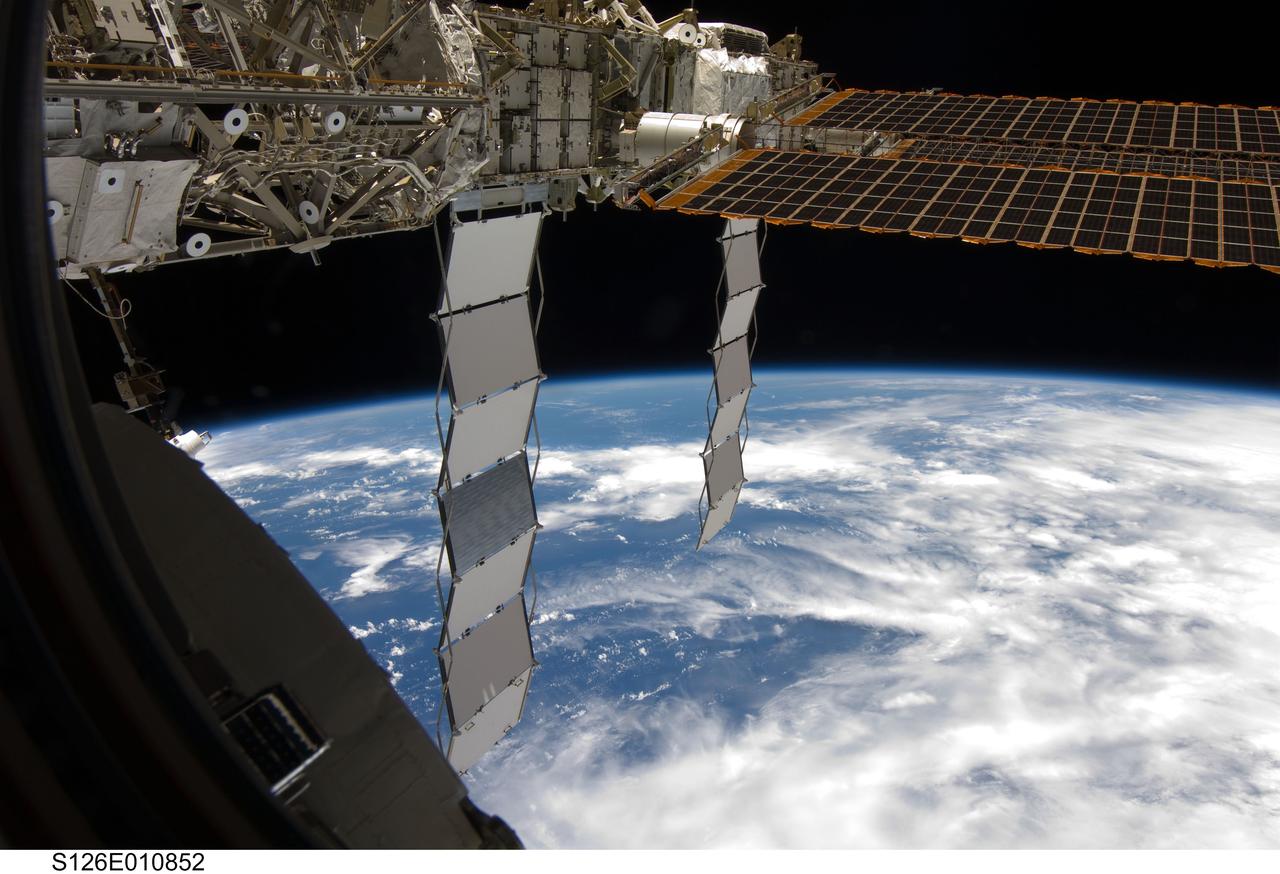
S126-E-010852 (26 Nov. 2008) --- From inside Endeavour, one of the STS-126 astronauts recorded this view of part of one of the International Space Station trusses and part of a solar panel, backdropped against a blue and white Earth on the eve of Thanksgiving. The ISS and Endeavour crewmembers, after spending almost two weeks together in space, will go separate ways in a couple of days when the two spacecraft undock.

iss073e1047001 (Nov. 2, 2025) --- Tripoli, Libya—a city founded approximately 2,700 years ago on the Mediterranean Sea coast—is pictured at about 11:10 p.m. local time from the International Space Station as it orbited 259 miles above the African nation. The city’s modern, cool white lights reflect a major transition to LED and solar-powered LED lighting, part of efforts to modernize urban design, enhance safety, and support tourism infrastructure.

During the total solar eclipse, the Sun’s corona, only visible during the total eclipse, is shown as a crown of white flares from the surface. The red spots called Bailey's beads occurs where the moon grazes by the Sun and the rugged lunar limb topography allows beads of sunlight to shine through in some areas as photographed from NASA Armstrong’s Gulfstream III. Photo Credit: (NASA/Carla Thomas)

ISS018-E-042056 (17 March 2009) --- Backdropped by a blue and white Earth, Space Shuttle Discovery is featured in this image photographed by an Expedition 18 crewmember as the shuttle approaches the International Space Station during STS-119 rendezvous and docking operations. Docking occurred at 4:20 p.m. (CDT) on March 17, 2009. The final pair of power-generating solar array wings and the S6 truss segment are visible in Discovery’s cargo bay. A Russian spacecraft docked to the station is visible at left.
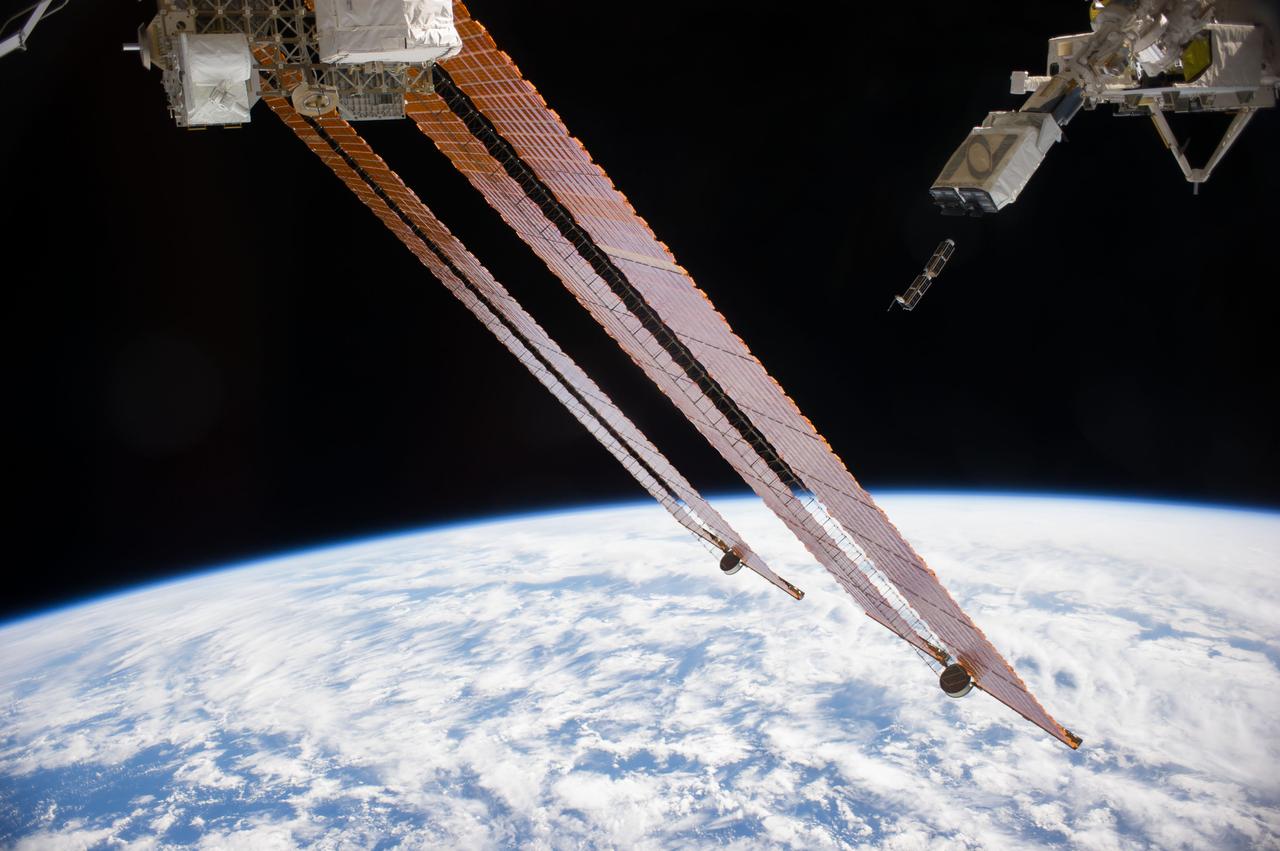
ISS040-E-103340 (20 Aug. 2014) --- In the grasp of the Japanese robotic arm, the CubeSat deployer (upper right) releases a pair of NanoRacks CubeSat miniature satellites. The Planet Labs Dove satellites that were carried to the International Space Station aboard the Orbital Sciences Cygnus commercial cargo craft are being deployed between Aug. 19 and Aug. 25. A section of the station solar array wings is at center. A blue and white part of Earth and the blackness of space provide the backdrop for the scene.

S127-E-011186 (28 July 2009) --- Backdropped by a blue and white Earth, the International Space Station is seen from Space Shuttle Endeavour as the two spacecraft begin their relative separation. Earlier the STS-127 and Expedition 20 crews concluded 11 days of cooperative work onboard the shuttle and station. Undocking of the two spacecraft occurred at 12:26 p.m. (CDT) on July 28, 2009. A partial shadow of Endeavour is visible on the solar array wing panels.
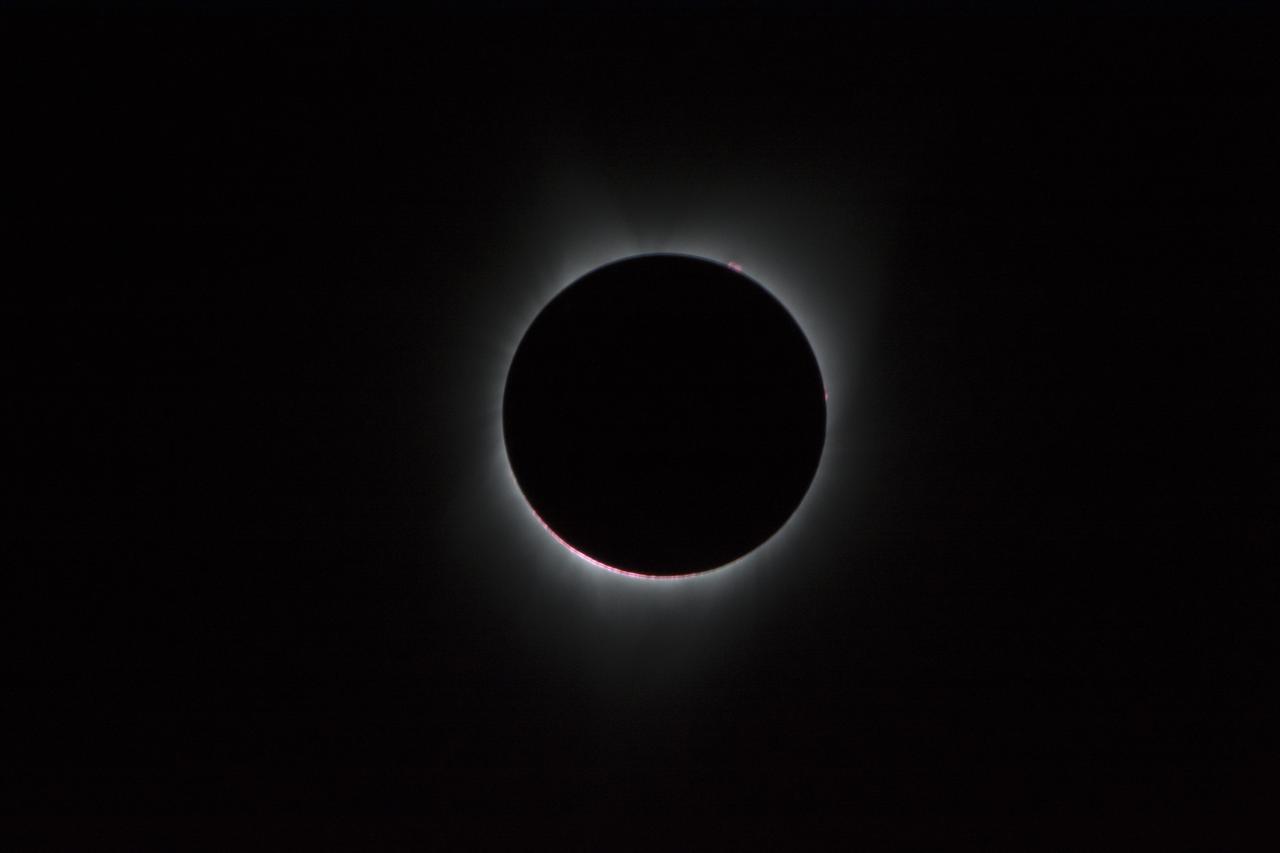
During the total solar eclipse, the Sun’s corona, only visible during the total eclipse, is shown as a crown of white flares from the surface. The red spots called Bailey's beads occurs where the moon grazes by the Sun and the rugged lunar limb topography allows beads of sunlight to shine through in some areas as photographed from NASA Armstrong’s Gulfstream III. Photo Credit: (NASA/Carla Thomas)
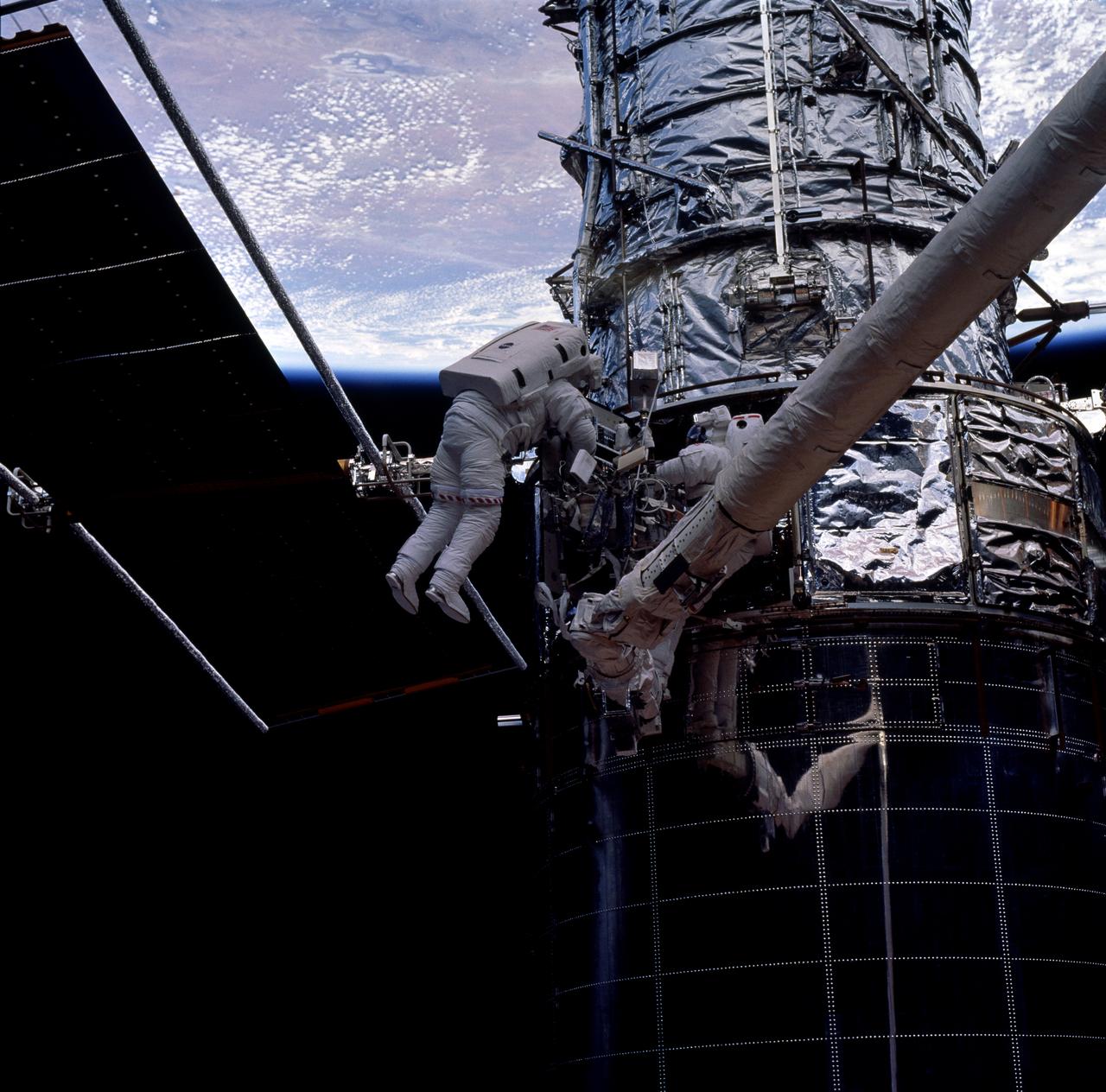
STS082-744-060 (11-21 Feb. 1997) --- Astronauts Joseph R. Tanner (left-with red and white stripes) and Gregory J. Harbaugh (partially obscured) team up to replace the Solar Drive Electronics (SADE) on the temporarily captured Hubble Space Telescope (HST) in the Space Shuttle Discovery's cargo bay. The Extravehicular Activity (EVA) took place on Flight Day 7, during the fourth of five total EVA's utilized to service HST.

ISS018-E-042051 (17 March 2009) --- Backdropped by a blue and white Earth, Space Shuttle Discovery is featured in this image photographed by an Expedition 18 crewmember as the shuttle approaches the International Space Station during STS-119 rendezvous and docking operations. Docking occurred at 4:20 p.m. (CDT) on March 17, 2009. The final pair of power-generating solar array wings and the S6 truss segment are visible in Discovery?s cargo bay. A Russian spacecraft docked to the station is visible at top.
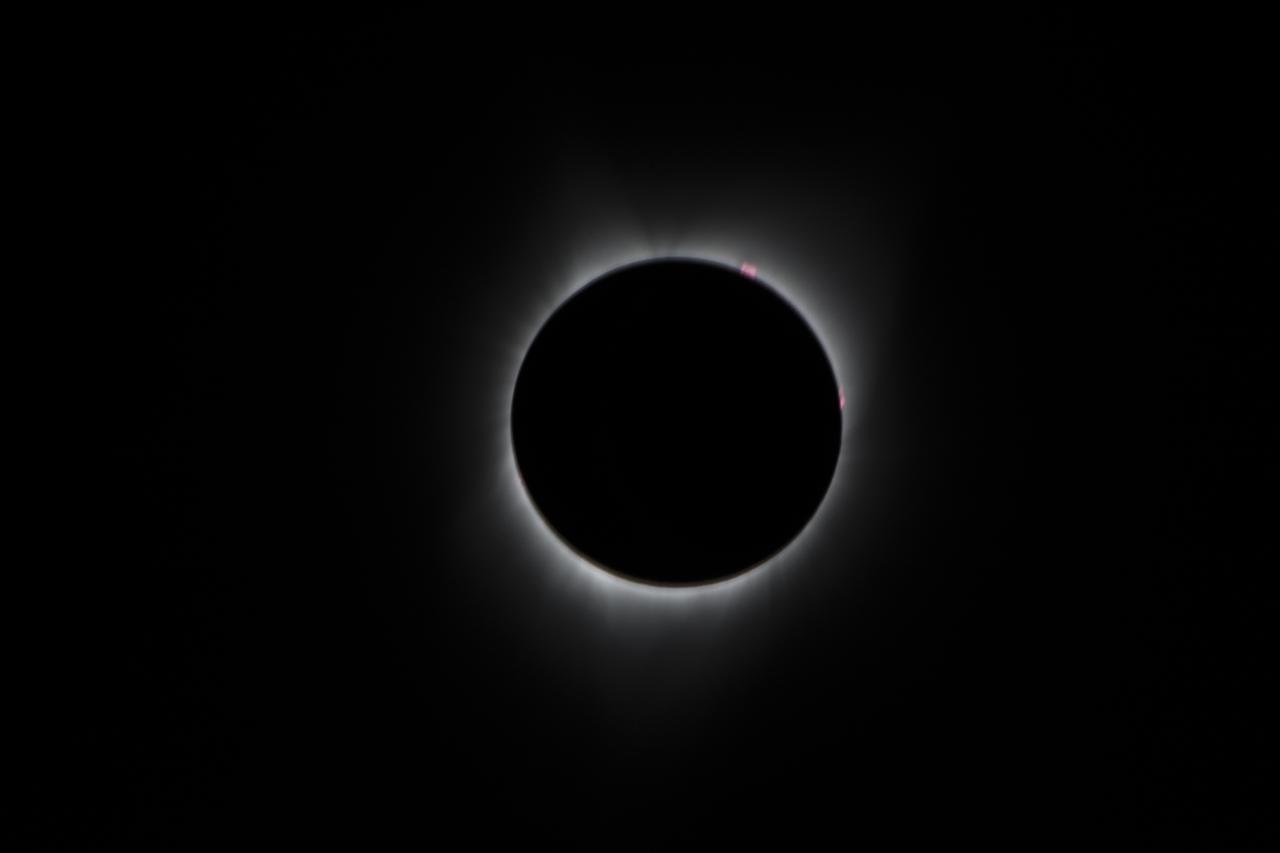
During the total solar eclipse, the Sun’s corona, only visible during the total eclipse, is shown as a crown of white flares from the surface. The red spots called Bailey's beads occurs where the moon grazes by the Sun and the rugged lunar limb topography allows beads of sunlight to shine through in some areas as photographed from NASA Armstrong’s Gulfstream III. Photo Credit: (NASA/Carla Thomas)

S123-E-007088 (18 March 2008) --- In the grasp of the station's robotic Canadarm2, Dextre (center), also known as the Special Purpose Dextrous Manipulator (SPDM), is featured in this image photographed by a crewmember on the International Space Station while Space Shuttle Endeavour is docked with the station. Also pictured are solar array panels (right) and a section of a station truss (left). A blue and white Earth provides the backdrop for the scene.
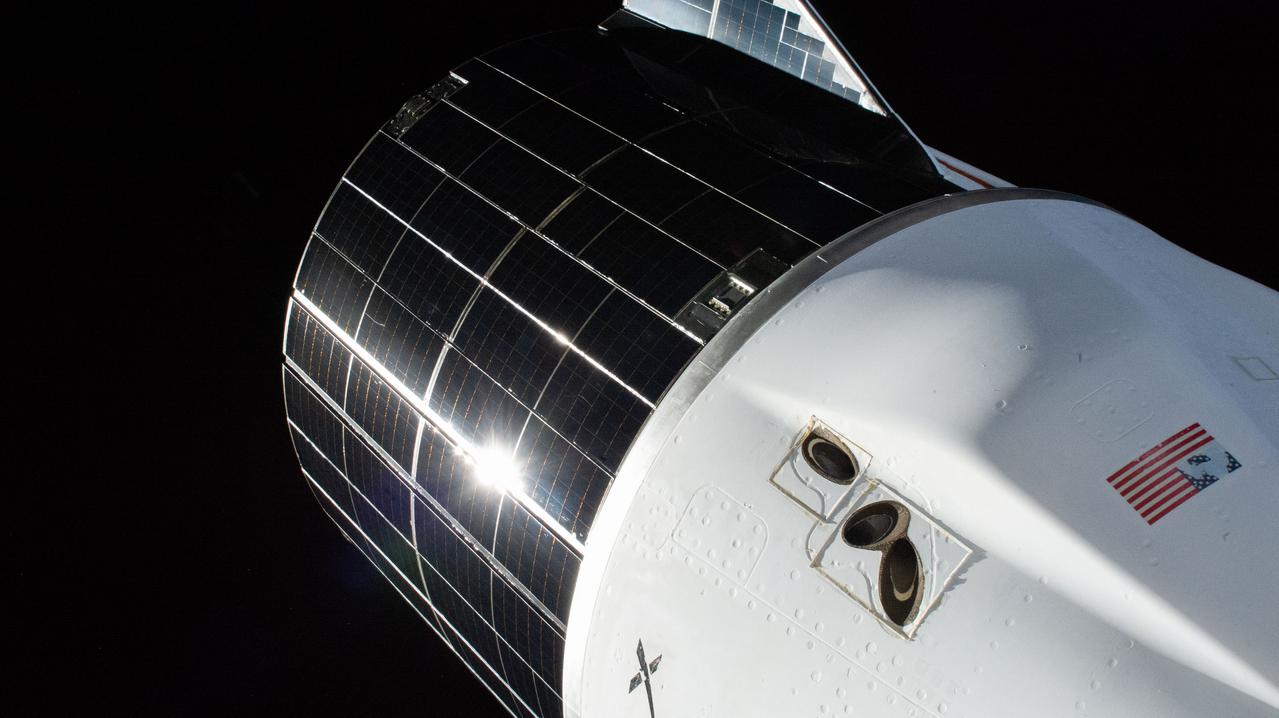
iss066e125326 (Jan. 22, 2022) --- The SpaceX Cargo Dragon resupply ship, with its white pressurized capsule and dark solar panel-covered, unpressurized trunk, is pictured moments before undocking from the Harmony module's space-facing port on the International Space Station. Also seen on the capsule, are a set of Draco engines that help the spacecraft maneuver and orient itself in orbit.

ISS018-E-042074 (17 March 2009) --- Backdropped by a blue and white Earth, Space Shuttle Discovery is featured in this image photographed by an Expedition 18 crewmember as the shuttle approaches the International Space Station during STS-119 rendezvous and docking operations. Docking occurred at 4:20 p.m. (CDT) on March 17, 2009. The final pair of power-generating solar array wings and the S6 truss segment are visible in Discovery’s cargo bay.
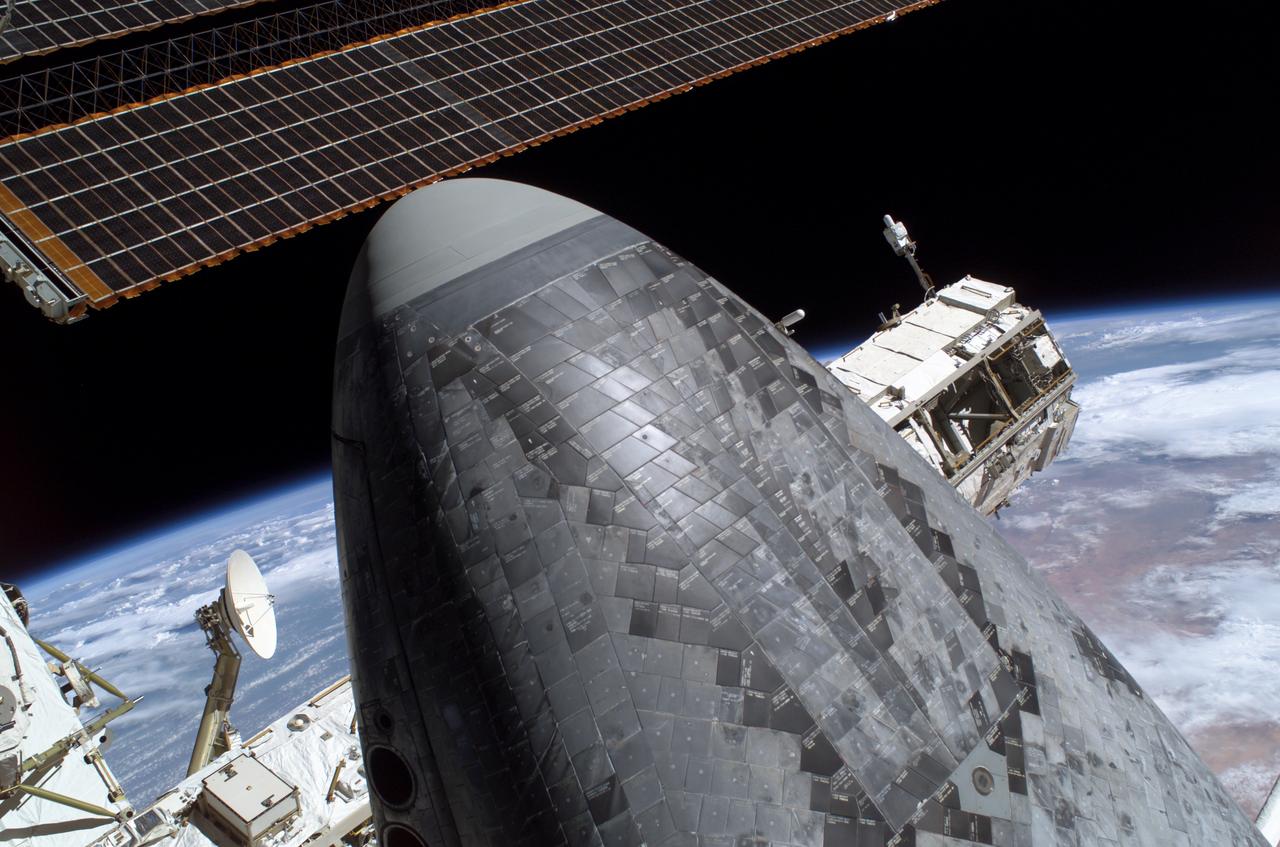
S114-E-6405 (3 August 2005) --- Space Shuttle Discovery’s underside nosecone thermal protection tiles are featured in this image photographed by astronaut Stephen K. Robinson, STS-114 mission specialist, during the mission’s third session of extravehicular activities (EVA). Part of the P1 truss and a solar array are visible in the background. The blackness of space and a blue and white Earth form the backdrop for the image.
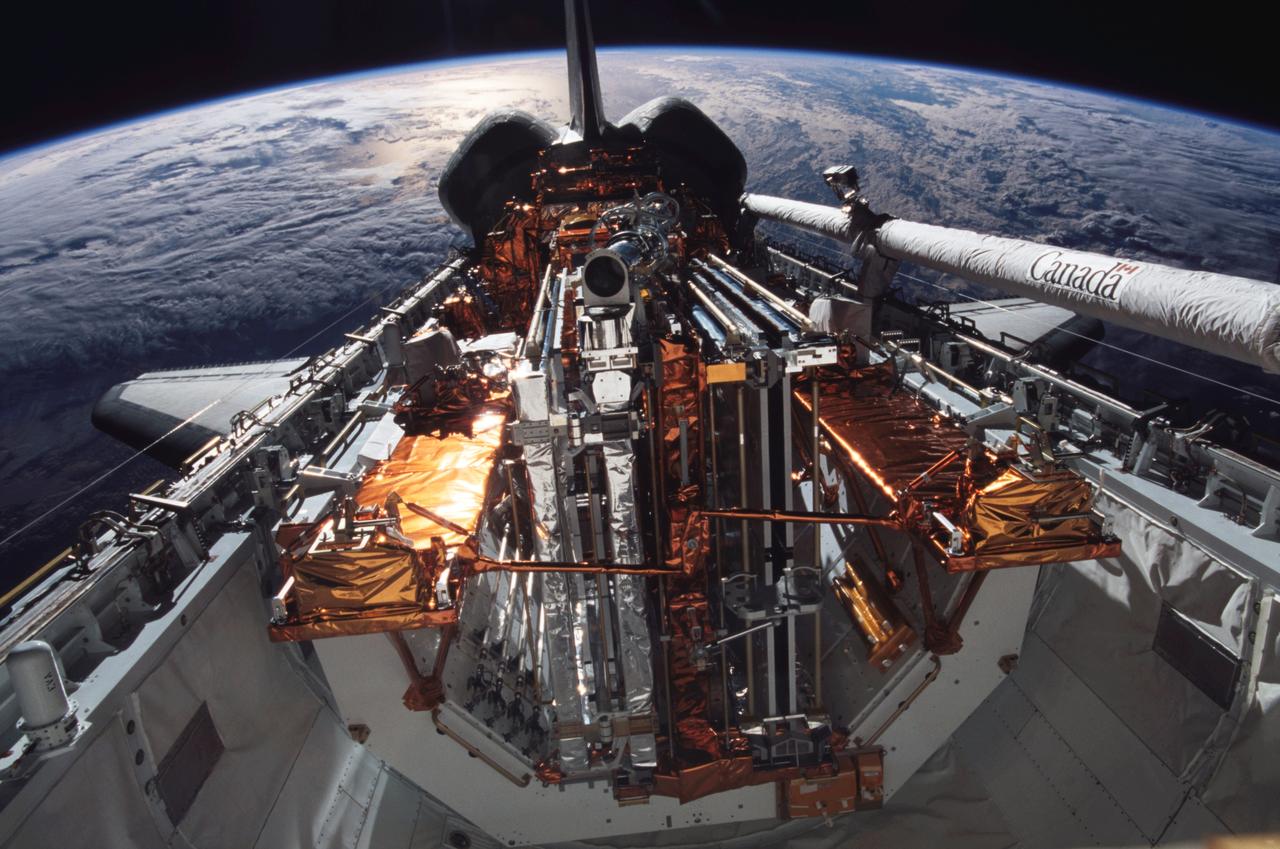
STS109-329-021 (1-12 March 2002) --- The horizon of a blue and white Earth and the blackness of space form the backdrop for this view of the cargo bay of the Space Shuttle Columbia, as seen through windows on the aft flight deck during the STS-109 mission. Pictured in the cargo bay is the Rigid Array Carrier (RAC) holding the new Hubble Solar Arrays. In its stowed position at right center of the frame is the Canadian-built Remote Manipulator System (RMS) arm.

ISS015-E-11759 (10 June 2007) --- Backdropped by a blue and white Earth, the Space Shuttle Atlantis approaches the International Space Station during STS-117 rendezvous and docking operations. Docking occurred at 2:36 p.m. (CDT) on June 10, 2007. A pair of solar arrays and starboard truss segments (S3/S4), which are later to be attached to the station and outfitted during three spacewalks, can be seen in Atlantis' cargo bay. A docked Soyuz spacecraft is visible at top center.

This 1970 photograph shows the flight unit for Skylab's White Light Coronagraph, an Apollo Telescope Mount (ATM) facility that photographed the solar corona in the visible light spectrum. A TV camera in the instrument provided real-time pictures of the occulted Sun to the astronauts at the control console and also transmitted the images to the ground. The Marshall Space Flight Center had program management responsibility for the development of Skylab hardware and experiments.
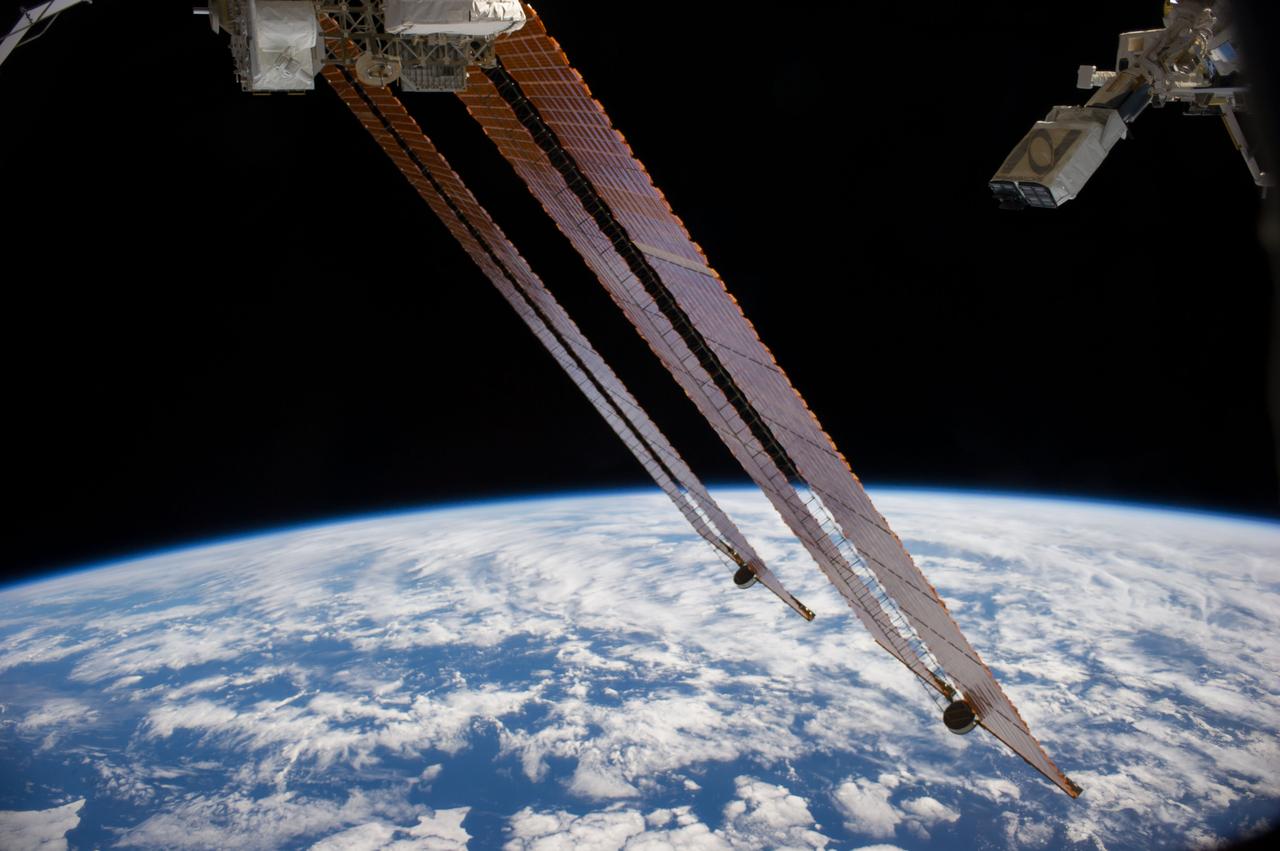
ISS040-E-103327 (20 Aug. 2014) --- In the grasp of the Japanese robotic arm, the CubeSat deployer (upper right) is about to release a pair of NanoRacks CubeSat miniature satellites. The Planet Labs Dove satellites that were carried to the International Space Station aboard the Orbital Sciences Cygnus commercial cargo craft are being deployed between Aug. 19 and Aug. 25. A section of the station solar array wings is at center. A blue and white part of Earth and the blackness of space provide the backdrop for the scene.
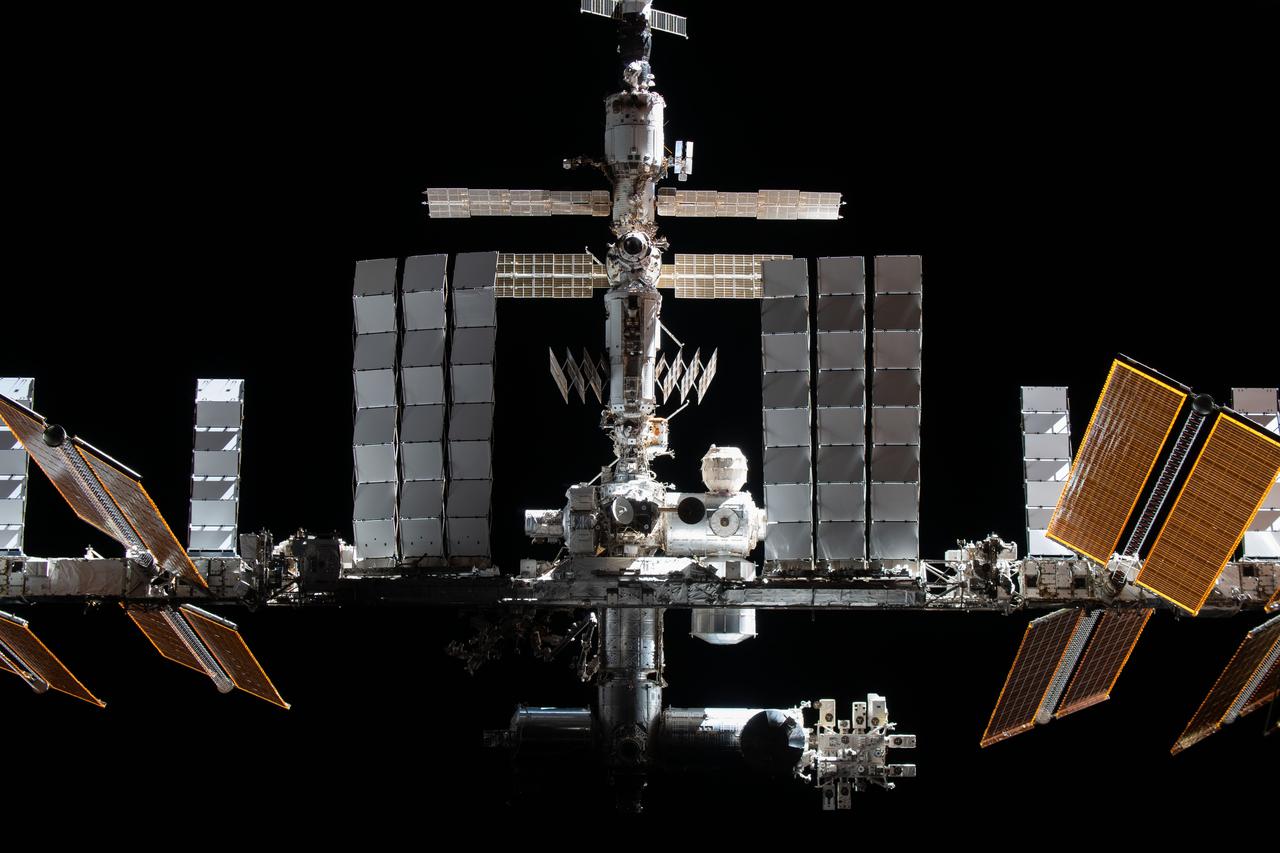
iss066e079893 (Nov. 8, 2021) --- The International Space Station is pictured from the SpaceX Crew Dragon Endeavour during a fly around of the orbiting lab that took place following its undocking from the Harmony module’s space-facing port on Nov. 8, 2021. This view shows the habitable volume of the station (modules arranged vertically through the center) along with white radiators used to dissipate heat and the large solar arrays used to generate electricity.

During the total solar eclipse, the Sun’s corona, only visible during the total eclipse, is shown as a crown of white flares from the surface. The red spots called Bailey's beads occurs where the moon grazes by the Sun and the rugged lunar limb topography allows beads of sunlight to shine through in some areas as photographed from NASA Armstrong’s Gulfstream III. Photo Credit: (NASA/Carla Thomas)
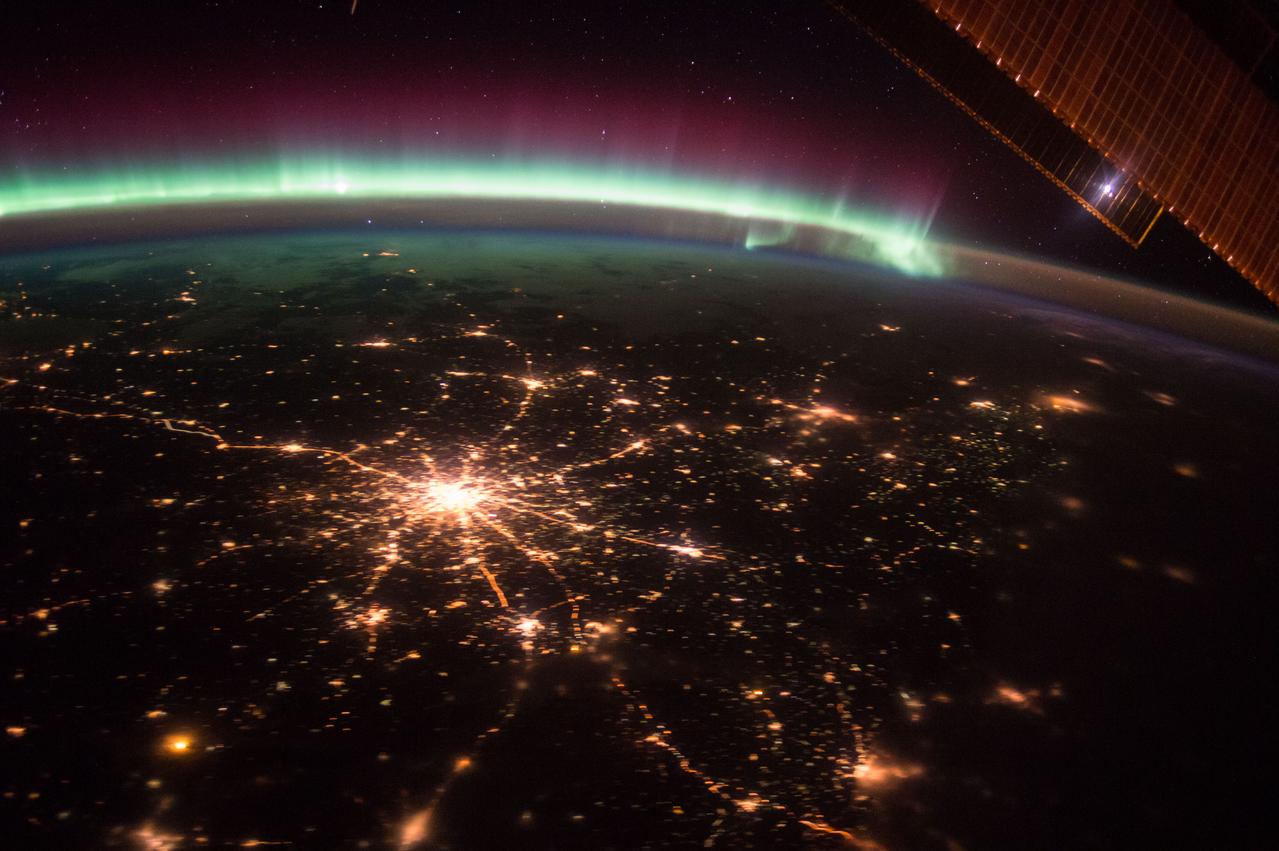
ISS045E048653 (10/06/2015) --- The International Space Station crew witness nightly scenes of our Earths beauty after performing their duties. Here on Oct. 6, 2015, framed by the edge of a huge Station solar panel, the city of Moscow Russia sparkles in the night with spoke streets streaming out across the land while an aurora of blue white and purple contrast the star filled sky.
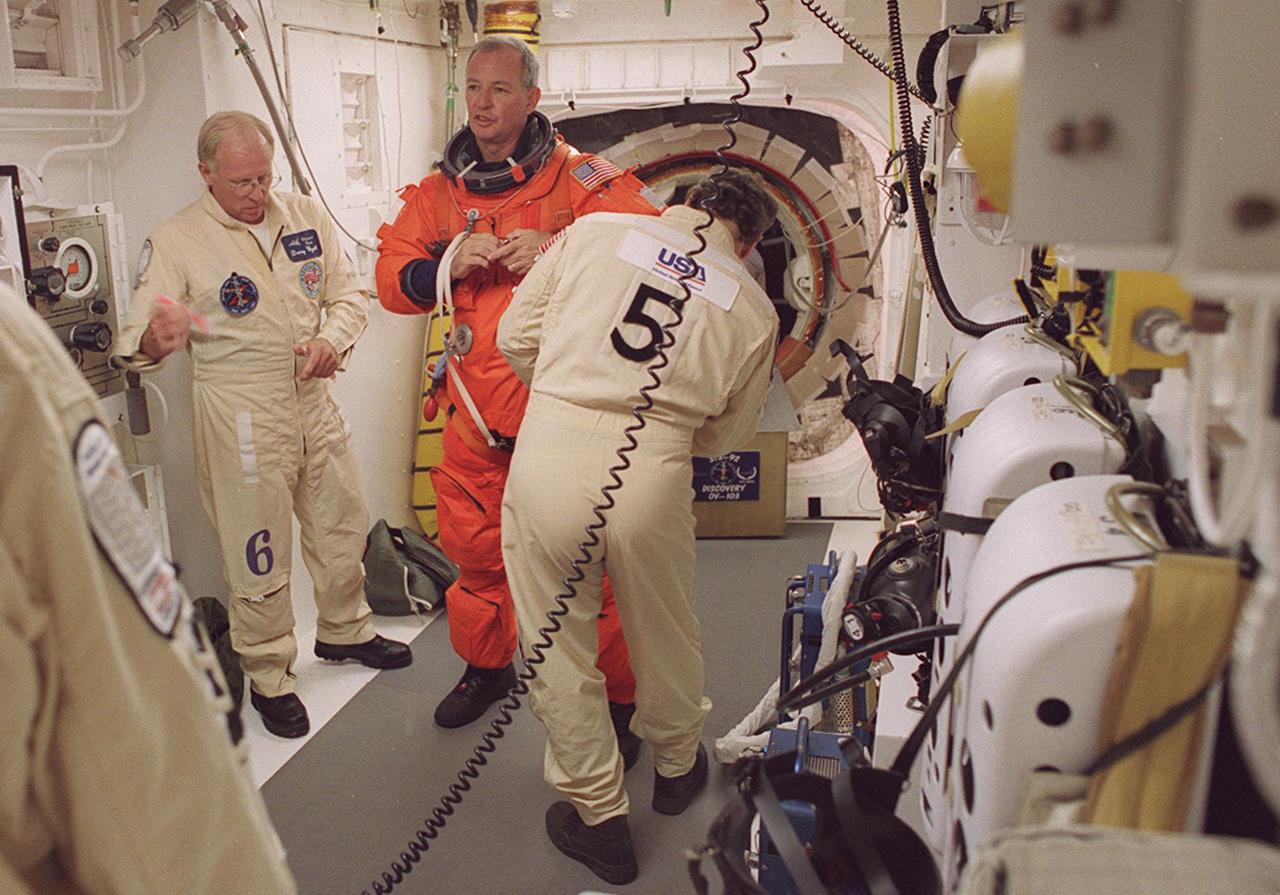
STS-92 Commander Brian Duffy is helped with final suit check in the White Room before entering Discovery. The White Room is an environmentally controlled area at the end of the Orbiter Access Arm that provides entry to the orbiter as well as emergency egress if needed. The arm remains in the extended position until 7 minutes 24 seconds before launch. Duffy and the rest of the crew are undertaking the fifth flight to the International Space Station for construction. Discovery carries a payload that includes the Integrated Truss Structure Z-1, first of 10 trusses that will form the backbone of the Space Station, and the third Pressurized Mating Adapter that will provide a Shuttle docking port for solar array installation on the sixth Station flight and Lab installation on the seventh Station flight. The mission includes four spacewalks for the construction activities. Discovery’s landing is expected Oct. 22 at 2:10 p.m. EDT
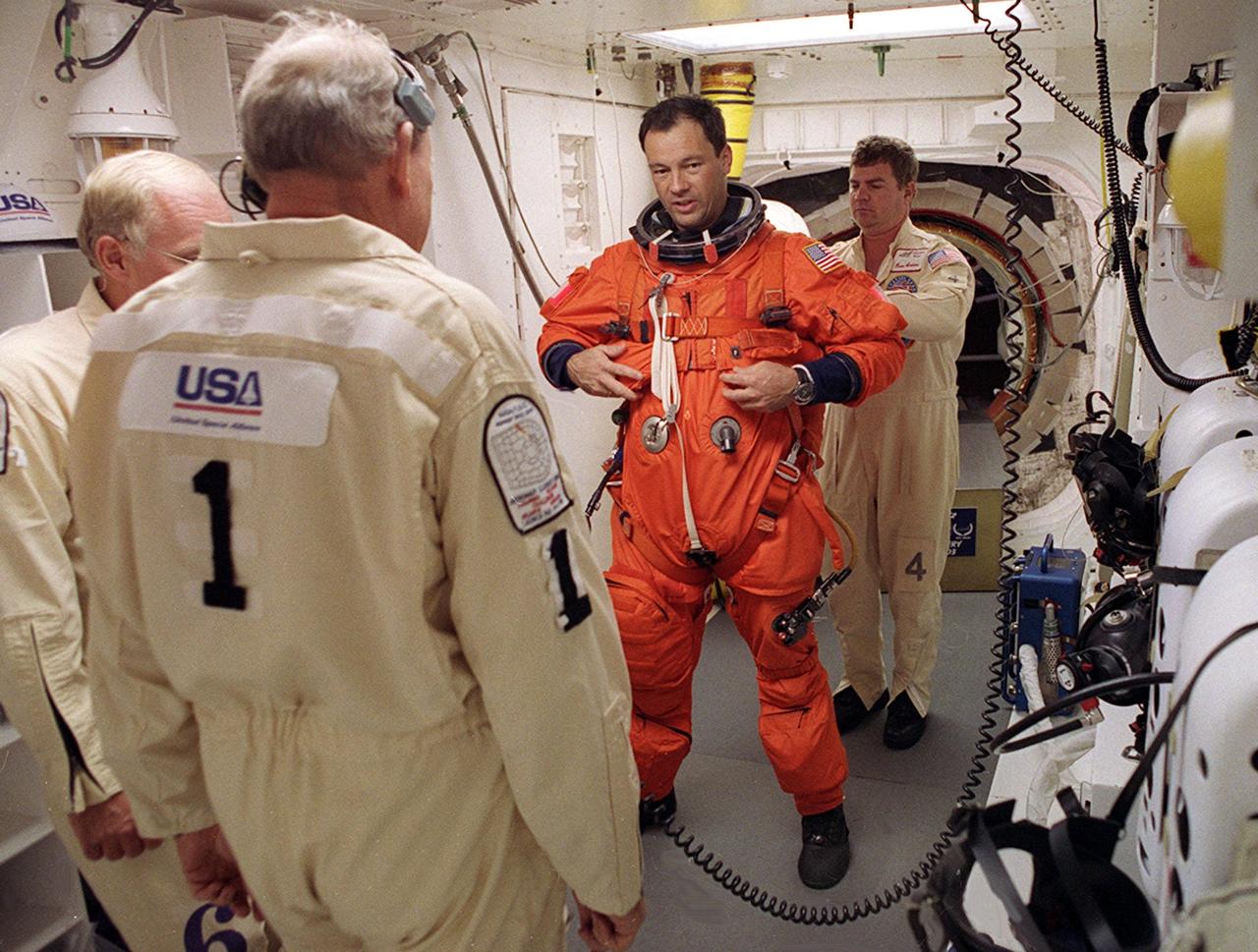
STS-92 Mission Specialist Michael E. Lopez-Alegria gets a final check of his launch and entry suit in the White Room before entering Discovery. The White Room is an environmentally controlled area at the end of the Orbiter Access Arm that provides entry to the orbiter as well as emergency egress if needed. The arm remains in the extended position until 7 minutes 24 seconds before launch. Lopez-Alegria and the rest of the crew are undertaking the fifth flight to the International Space Station for construction. Discovery carries a payload that includes the Integrated Truss Structure Z-1, first of 10 trusses that will form the backbone of the Space Station, and the third Pressurized Mating Adapter that will provide a Shuttle docking port for solar array installation on the sixth Station flight and Lab installation on the seventh Station flight. The mission includes four spacewalks for the construction activities. Discovery’s landing is expected Oct. 22 at 2:10 p.m. EDT
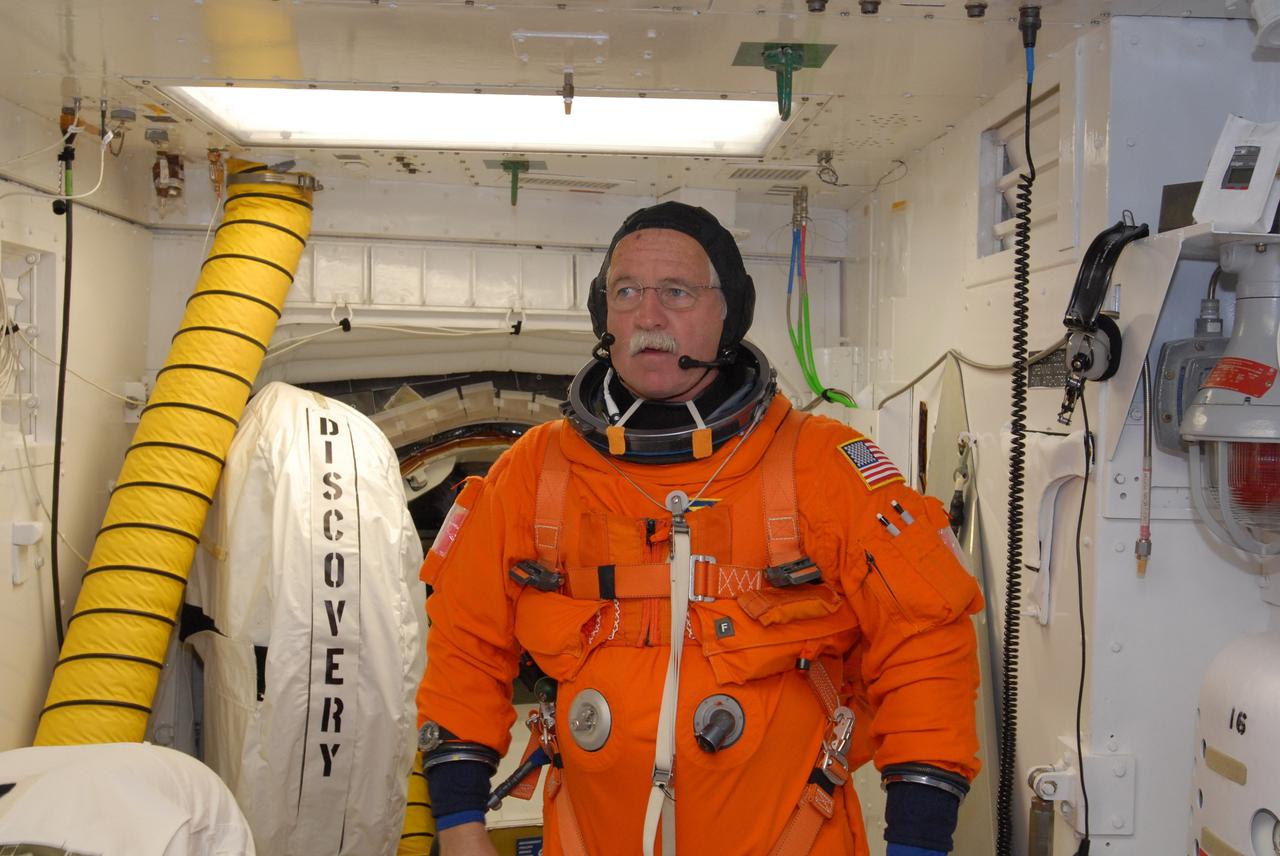
CAPE CANAVERAL, Fla. – In the White Room on Launch Pad 39A at NASA's Kennedy Space Center in Florida, STS-119 Mission Specialist John Phillips has donned the harness over his launch-and-entry suit. The White Room provides access into space shuttle Discovery. Phillips and other crew members will conduct a simulated launch countdown as part of the prelaunch preparation known as Terminal Countdown Demonstration Test. The TCDT also includes equipment familiarization and emergency egress training. Discovery is targeted to launch on the STS-119 mission Feb. 12. During the 14-day mission, the crew will install the S6 truss segment and solar arrays to the starboard side of the International Space Station, completing the station's truss, or backbone. Photo credit: NASA/Jim Grossmann
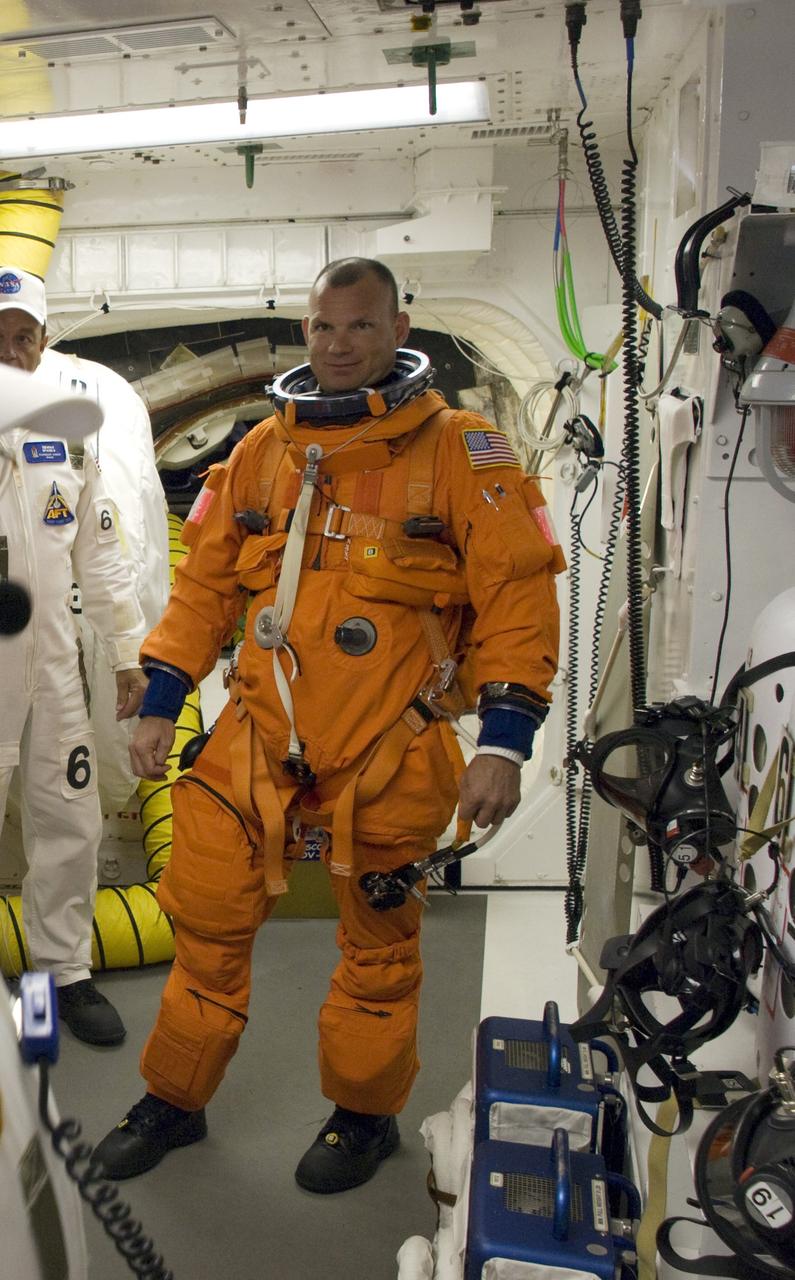
CAPE CANAVERAL, Fla. – In the White Room on Launch Pad 39A at NASA's Kennedy Space Center in Florida, STS-119 Pilot Tony Antonelli is getting into his harness, which includes a parachute pack, before crawling through the open hatch into space shuttle Discovery. The White Room is at the end of the orbiter access arm on the fixed service structure and provides access into the shuttle. The STS-119 mission is the 28th to the International Space Station and the 125th space shuttle flight. Discovery will deliver the final pair of power-generating solar array wings and the S6 truss segment. Installation of S6 will signal the station's readiness to house a six-member crew for conducting increased science. Liftoff is scheduled for 7:43 p.m. EDT. Photo credit: NASA/Tony Gray, Tom Farrar

STS-92 Mission Specialist Leroy Chiao waves while waiting for suit check in the White Room. Behind him is Commander Brian Duffy. The White Room is an environmentally controlled area at the end of the Orbiter Access Arm that provides entry to the orbiter as well as emergency egress if needed. The arm remains in the extended position until 7 minutes 24 seconds before launch. Chiao, Duffy and the rest of the crew are undertaking the fifth flight to the International Space Station for construction. Discovery carries a payload that includes the Integrated Truss Structure Z-1, first of 10 trusses that will form the backbone of the Space Station, and the third Pressurized Mating Adapter that will provide a Shuttle docking port for solar array installation on the sixth Station flight and Lab installation on the seventh Station flight. The mission includes four spacewalks for the construction activities. Discovery’s landing is expected Oct. 22 at 2:10 p.m. EDT

The yellow-white cloud in the bottom-center of this image is a Mars "dust tower" — a concentrated cloud of dust that can be lofted dozens of miles above the surface. The blue-white plumes are water vapor clouds. Olympus Mons, the tallest volcano in the solar system, is visible in the upper left corner, while Valles Marineris can be seen in the lower right. Heat-sensitive instruments like the Mars Climate Sounder, carried aboard NASA's Mars Reconnaissance Orbiter (MRO), can map the formation of these dust towers, which form almost continuously during global dust storms. Taken on Nov. 30, 2010, the image was produced by MRO's Mars Color Imager (MARCI), which was built and is operated by Malin Space Science Systems in San Diego. https://photojournal.jpl.nasa.gov/catalog/PIA23513
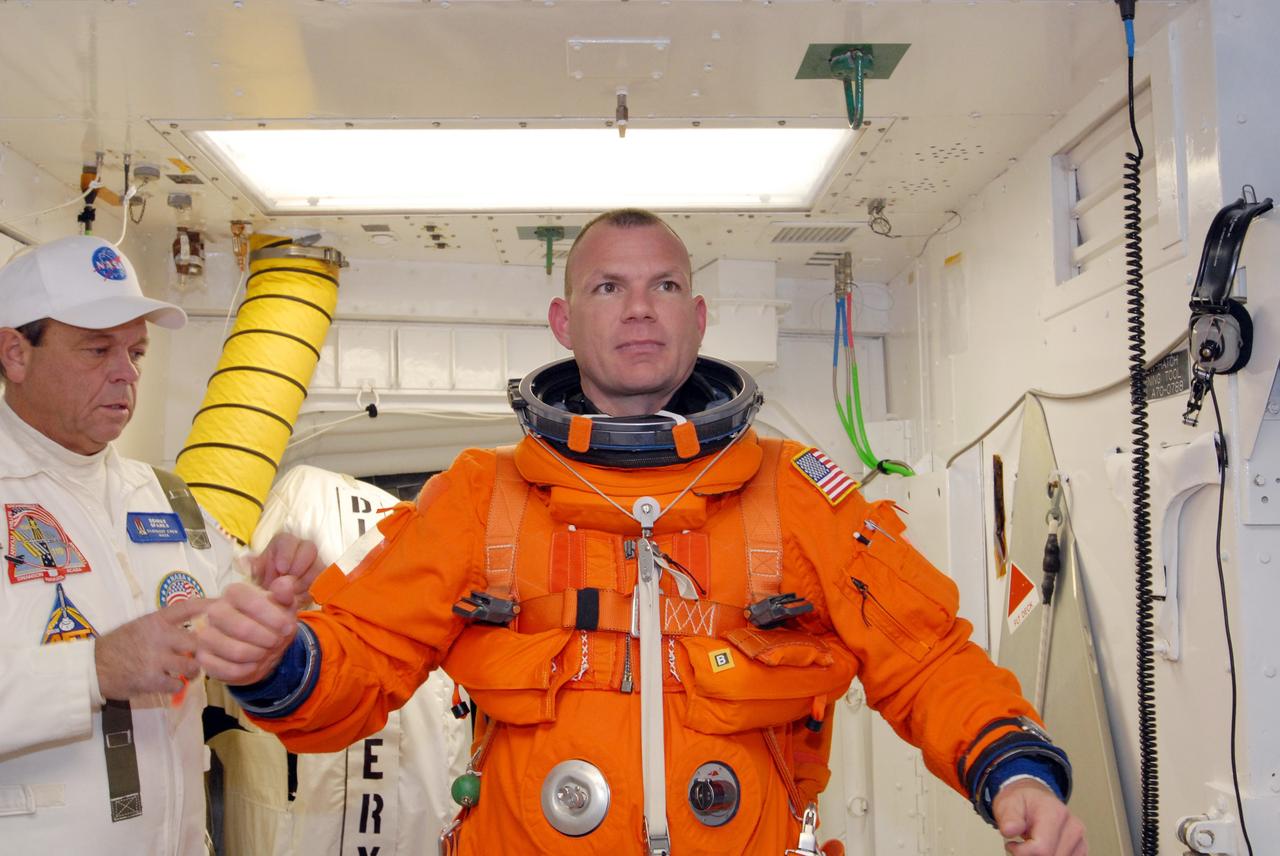
CAPE CANAVERAL, Fla. – In the White Room on Launch Pad 39A at NASA's Kennedy Space Center in Florida, STS-119 Pilot Tony Antonelli is helped by the Closeout Crew to put on his harness. The White Room provides access into space shuttle Discovery. Antonelli and other crew members will conduct a simulated launch countdown as part of the prelaunch preparation known as Terminal Countdown Demonstration Test. The TCDT also includes equipment familiarization and emergency egress training. Discovery is targeted to launch on the STS-119 mission Feb. 12. During the 14-day mission, the crew will install the S6 truss segment and solar arrays to the starboard side of the International Space Station, completing the station's truss, or backbone. Photo credit: NASA/Jim Grossmann

STS-92 Mission Specialist William S. McArthur Jr. undergoes final suit check in the White Room before entering Discovery. The White Room is an environmentally controlled area at the end of the Orbiter Access Arm that provides entry to the orbiter as well as emergency egress if needed. The arm remains in the extended position until 7 minutes 24 seconds before launch. McArthur and the rest of the crew are making the fifth flight to the International Space Station for construction. Discovery carries a payload that includes the Integrated Truss Structure Z-1, first of 10 trusses that will form the backbone of the Space Station, and the third Pressurized Mating Adapter that will provide a Shuttle docking port for solar array installation on the sixth Station flight and Lab installation on the seventh Station flight. The mission includes four spacewalks for the construction activities. Discovery’s landing is expected Oct. 22 at 2:10 p.m. EDT
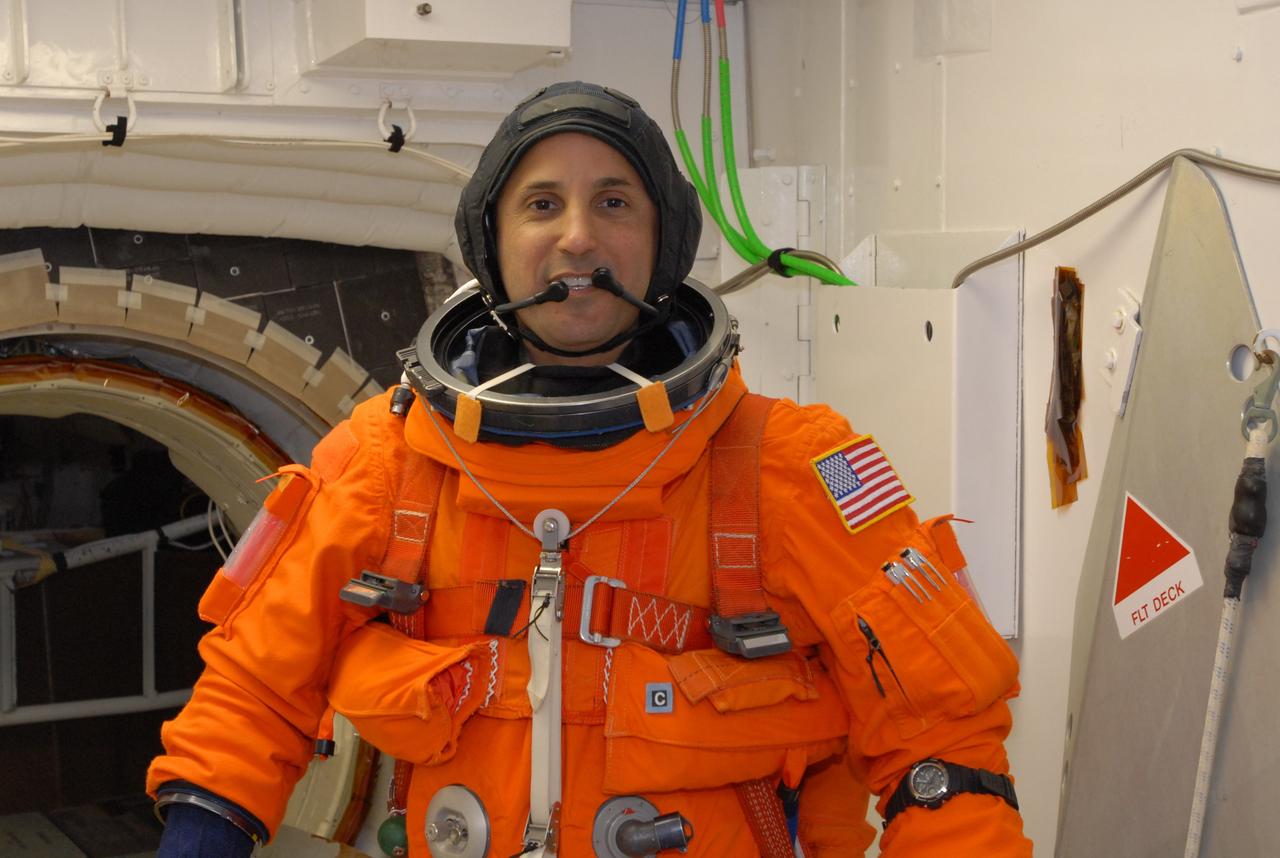
CAPE CANAVERAL, Fla. – In the White Room on Launch Pad 39A at NASA's Kennedy Space Center in Florida, STS-119 Mission Specialist Joseph Acaba is ready to enter space shuttle Discovery, behind him. The White Room provides access into Discovery. Acaba and other crew members will conduct a simulated launch countdown as part of the prelaunch preparation known as Terminal Countdown Demonstration Test. The TCDT also includes equipment familiarization and emergency egress training. Discovery is targeted to launch on the STS-119 mission Feb. 12. During the 14-day mission, the crew will install the S6 truss segment and solar arrays to the starboard side of the International Space Station, completing the station's truss, or backbone. Photo credit: NASA/Jim Grossmann
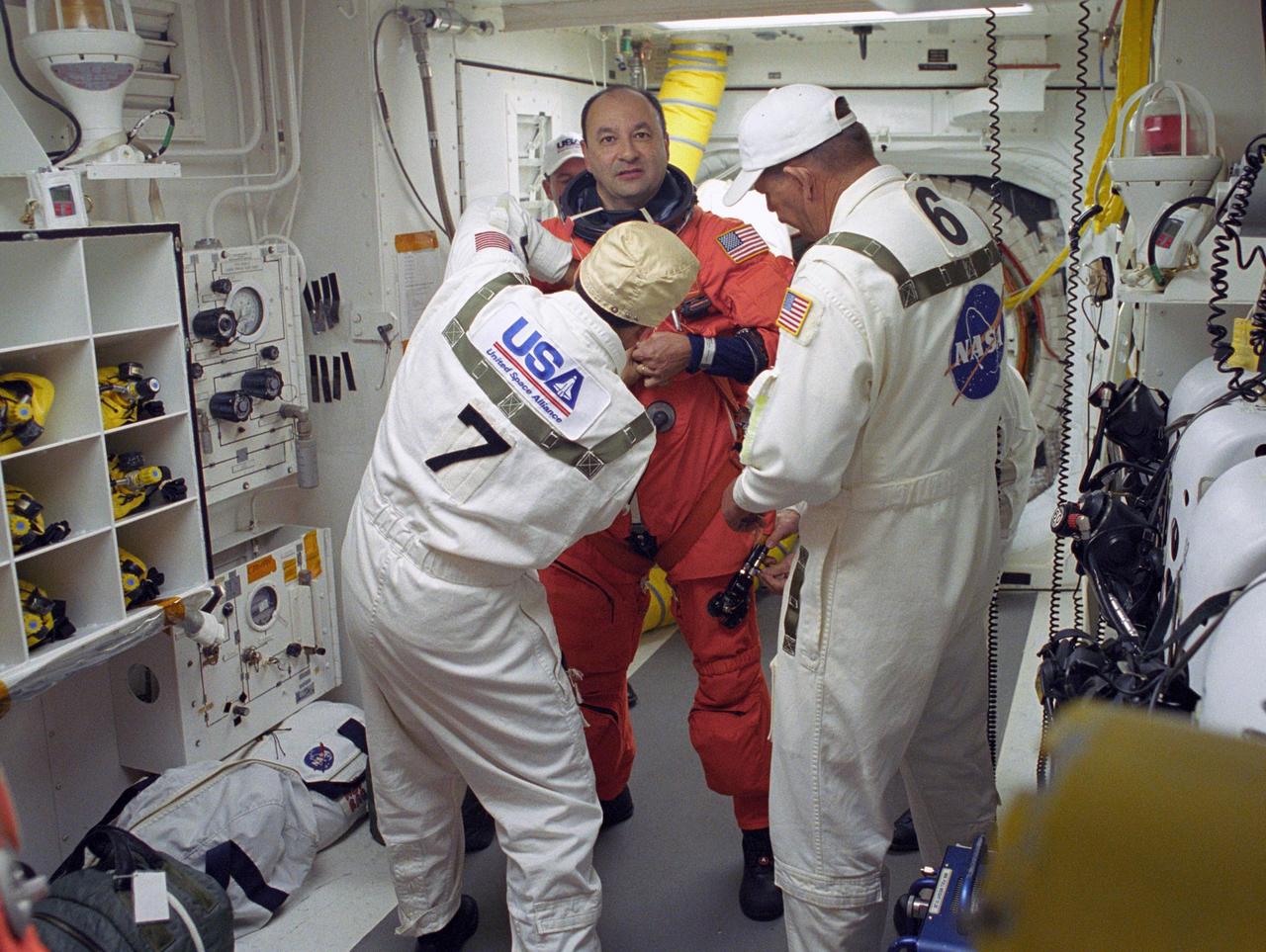
KENNEDY SPACE CENTER, FLA. -- STS-116 Commander Mark Polansky is helped by the closeout crew in the White Room to secure his launch suit before climbing into Space Shuttle Discovery. The White Room is at the end of the orbiter access arm that extends from the fixed service structure and provides entry into the orbiter. The first launch attempt of STS-116 on Dec. 7 was postponed due a low cloud ceiling over Kennedy Space Center. This second launch attempt is scheduled for 8:47 p.m. This is Discovery's 33rd mission and the first night launch since 2002. The 20th shuttle mission to the International Space Station, STS-116 carries another truss segment, P5. It will serve as a spacer, mated to the P4 truss that was attached in September. After installing the P5, the crew will reconfigure and redistribute the power generated by two pairs of U.S. solar arrays. Landing is expected Dec. 21 at KSC. Photo credit: NASA/Tony Gray & Don Kight

As daylight creeps over the horizon, STS-95 Space Shuttle Discovery, on the Mobile Launch Platform, arrives at Launch Complex Pad 39B after a 4.2-mile trip taking approximately 6 hours. At the left is the "white room," attached to the orbiter access arm. The white room is an environmental chamber that mates with the orbiter and holds six persons. At the launch pad, the orbiter, external tank and solid rocket boosters will undergo final preparations for the launch, scheduled to lift off Oct. 29. The mission includes research payloads such as the Spartan solar-observing deployable spacecraft, the Hubble Space Telescope Orbital Systems Test Platform, the International Extreme Ultraviolet Hitchhiker, as well as the SPACEHAB single module with experiments on space flight and the aging process
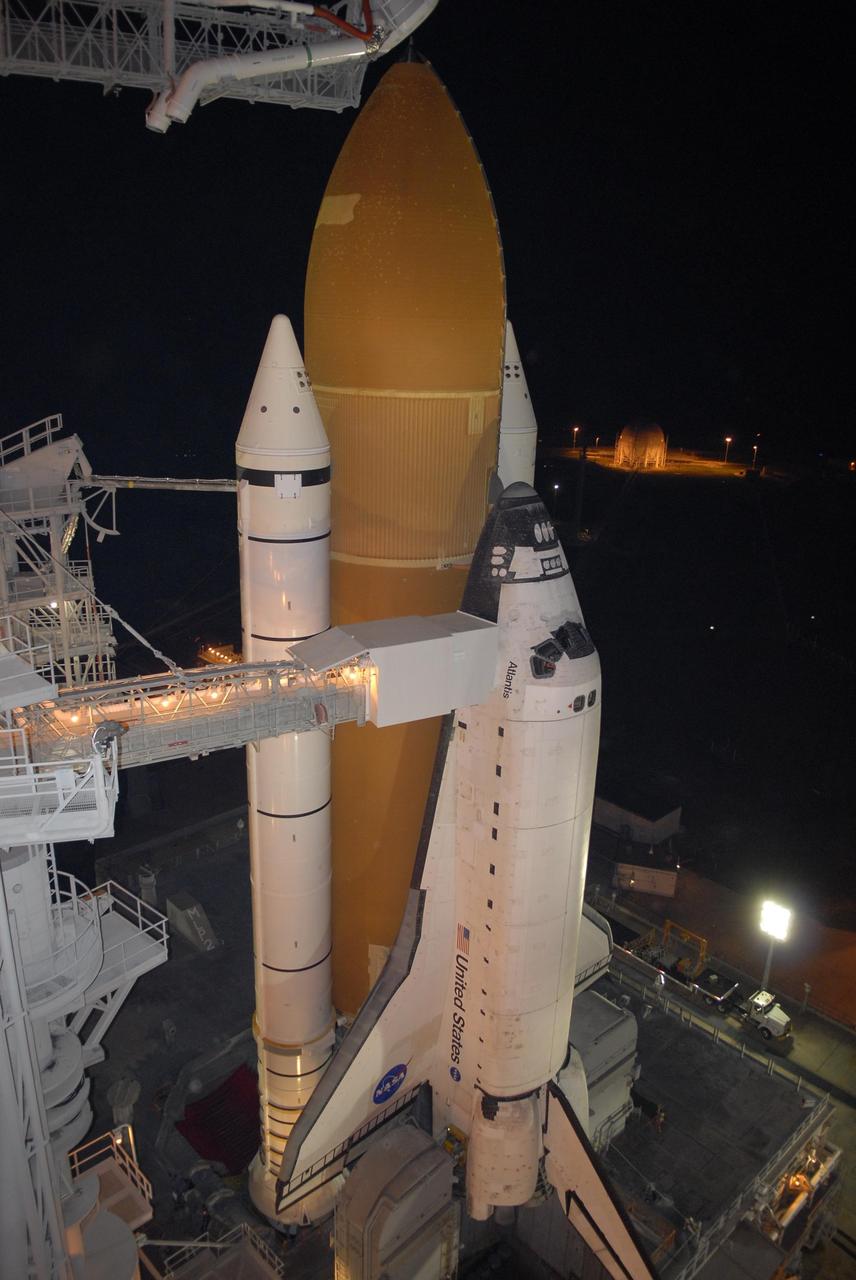
KENNEDY SPACE CENTER, FLA. -- Following rollback of the rotating service structure, or RSS, on Launch Pad 39A, Space Shuttle Atlantis stands bathed in lights atop a mobile launch platform. Rollback is one of the milestones in preparation for the launch of mission STS-117 on June 8. Rollback started at 10:56 p.m. and was complete at 11:34 p.m EDT. The RSS provides protected access to the orbiter for changeout and servicing of payloads at the pad. Connecting the RSS to the cockpit of the shuttle is the orbiter access arm with the White Room extended. The White Room provides access into the orbiter for the astronauts. This mission is the 118th shuttle flight and the 21st U.S. flight to the International Space Station and will deliver and install the S3/S4 truss segment, deploy a set of solar arrays and prepare them for operation. Photo credit: NASA/Kim Shiflett
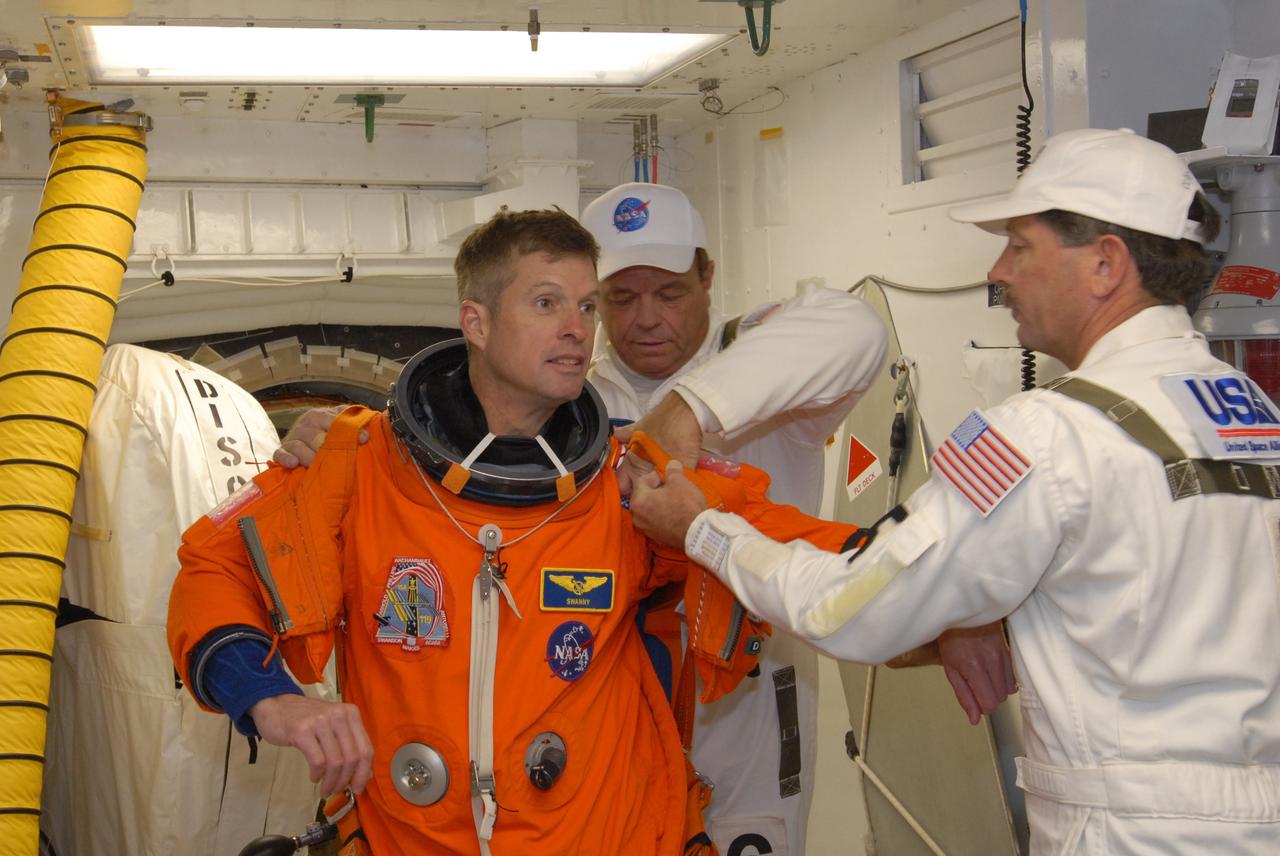
CAPE CANAVERAL, Fla. – In the White Room on Launch Pad 39A at NASA's Kennedy Space Center in Florida, STS-119 Mission Specialist Steve Swanson is helped by the Closeout Crew to put on his harness. The White Room provides access into space shuttle Discovery. Swanson and other crew members will conduct a simulated launch countdown as part of the prelaunch preparation known as Terminal Countdown Demonstration Test. The TCDT also includes equipment familiarization and emergency egress training. Discovery is targeted to launch on the STS-119 mission Feb. 12. During the 14-day mission, the crew will install the S6 truss segment and solar arrays to the starboard side of the International Space Station, completing the station's truss, or backbone. Photo credit: NASA/Jim Grossmann
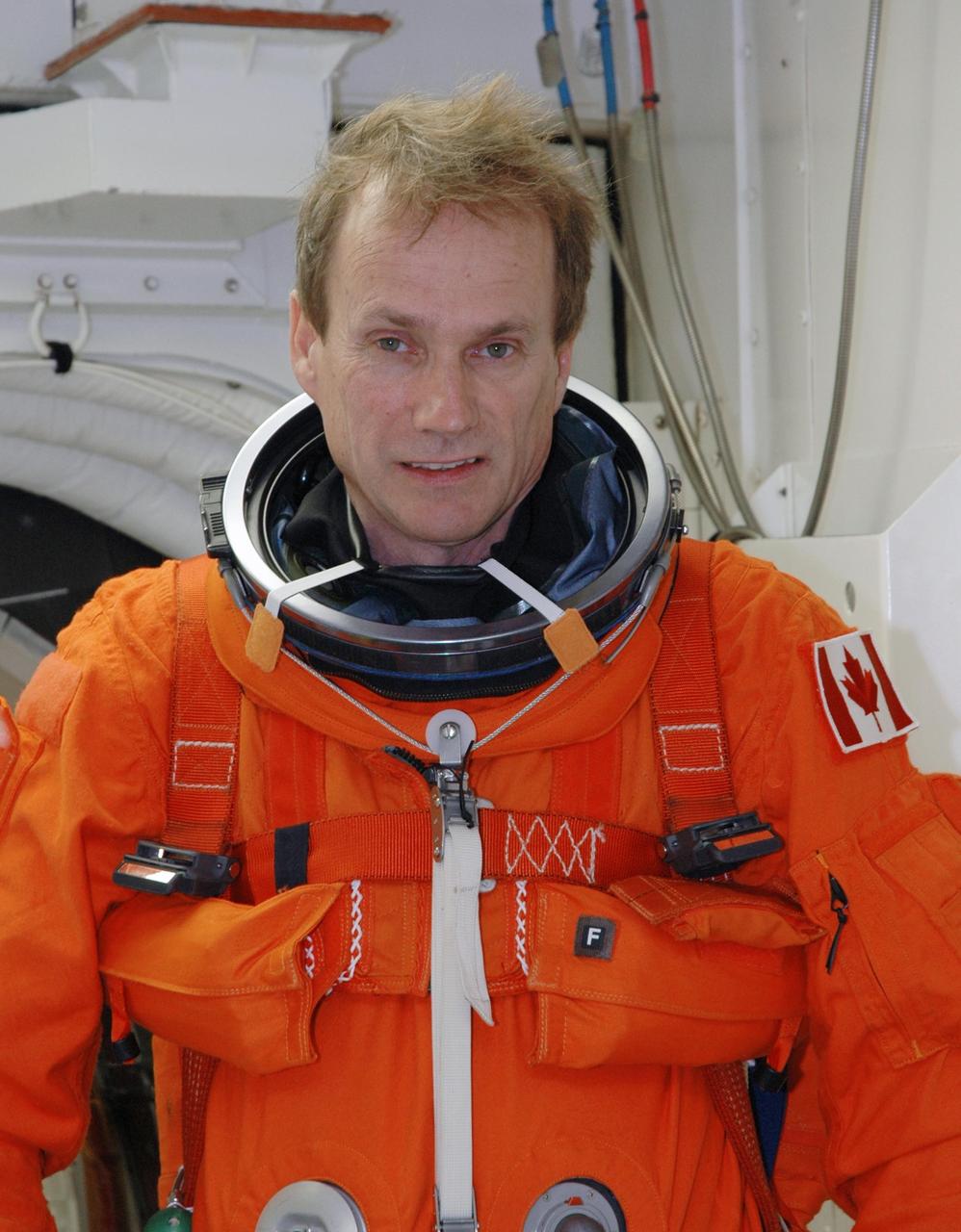
KENNEDY SPACE CENTER, FLA. - The STS-115 crew members complete their suitup in the White Room before entering Space Shuttle Atlantis on Launch Pad 39B for a simulated launch countdown. Shown here is Mission Specialist Steven MacLean. The White Room, which is located at the end of the orbiter access arm, allows entry into the orbiter through the crew access hatch. The mission crew is at KSC for Terminal Countdown Demonstration Test (TCDT) activities that are preparation for launch. Liftoff of Atlantis is scheduled to take place in a window that opens Aug. 27. During their 11-day mission to the International Space Station, the STS-115 crew will continue construction of the station and attach the payload elements, the Port 3/4 truss segment with its two large solar arrays. Photo credit: NASA/Jim Grossmann
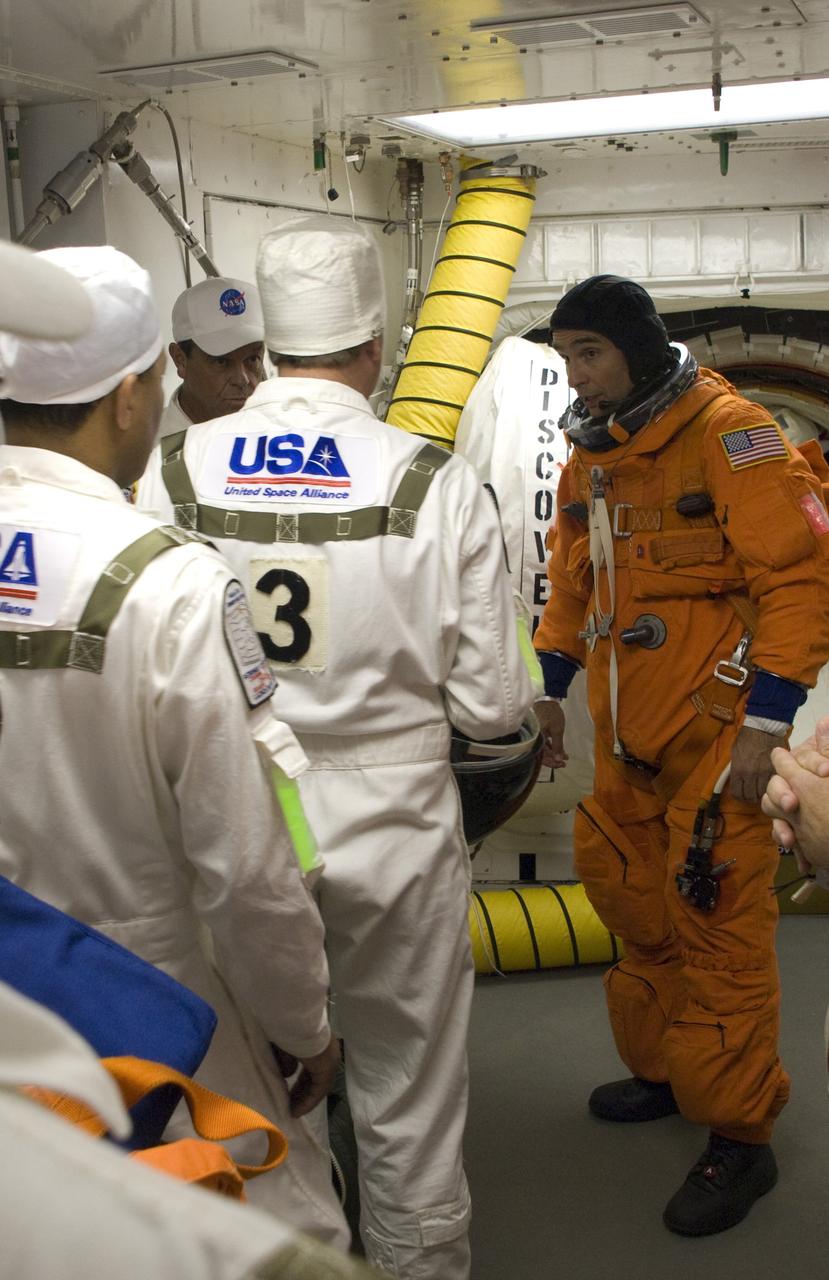
CAPE CANAVERAL, Fla. – In the White Room on Launch Pad 39A at NASA's Kennedy Space Center in Florida, STS-119 Commander Lee Archambault talks to the closeout crew who will put on his harness, which includes a parachute pack, before crawling through the open hatch into the shuttle. The White Room is at the end of the orbiter access arm on the fixed service structure and provides access into space shuttle Discovery. The STS-119 mission is the 28th to the International Space Station and the 125th space shuttle flight. Discovery will deliver the final pair of power-generating solar array wings and the S6 truss segment. Installation of S6 will signal the station's readiness to house a six-member crew for conducting increased science. Liftoff is scheduled for 7:43 p.m. EDT. Photo credit: Photo credit: NASA/Tony Gray, Tom Farrar
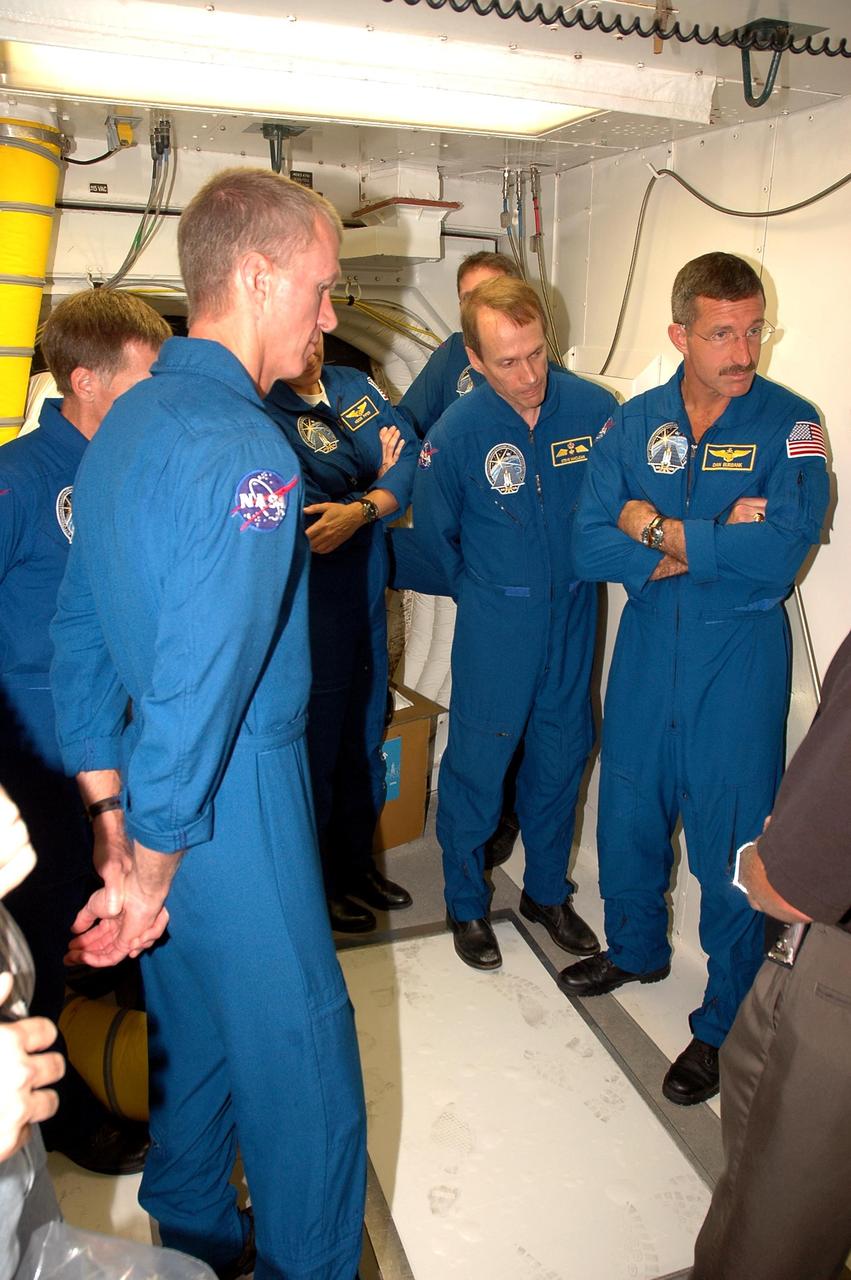
KENNEDY SPACE CENTER, FLA. - The STS-115 crew is in the White Room on the orbiter access arm on Launch Pad 39B to get instruction on using the emergency egress system. From left are Commander Brent Jett, Pilot Chris Ferguson, and Mission Specialists Heidemarie Stefanyshyn-Piper, Joseph Tanner, Steven MacLean and Daniel Burbank. MacLean is with the Canadian Space Agency. he White Room provides access into the orbiter through the crew access hatch. The mission crew is at KSC for Terminal Countdown Demonstration Test (TCDT) activities that are preparation for launch on Space Shuttle Atlantis, scheduled to take place in a window that opens Aug. 27. During their 11-day mission to the International Space Station, the STS-115 crew will continue construction of the station and attach the payload elements, the Port 3/4 truss segment with its two large solar arrays. Photo credit: NASA/Cory Huston
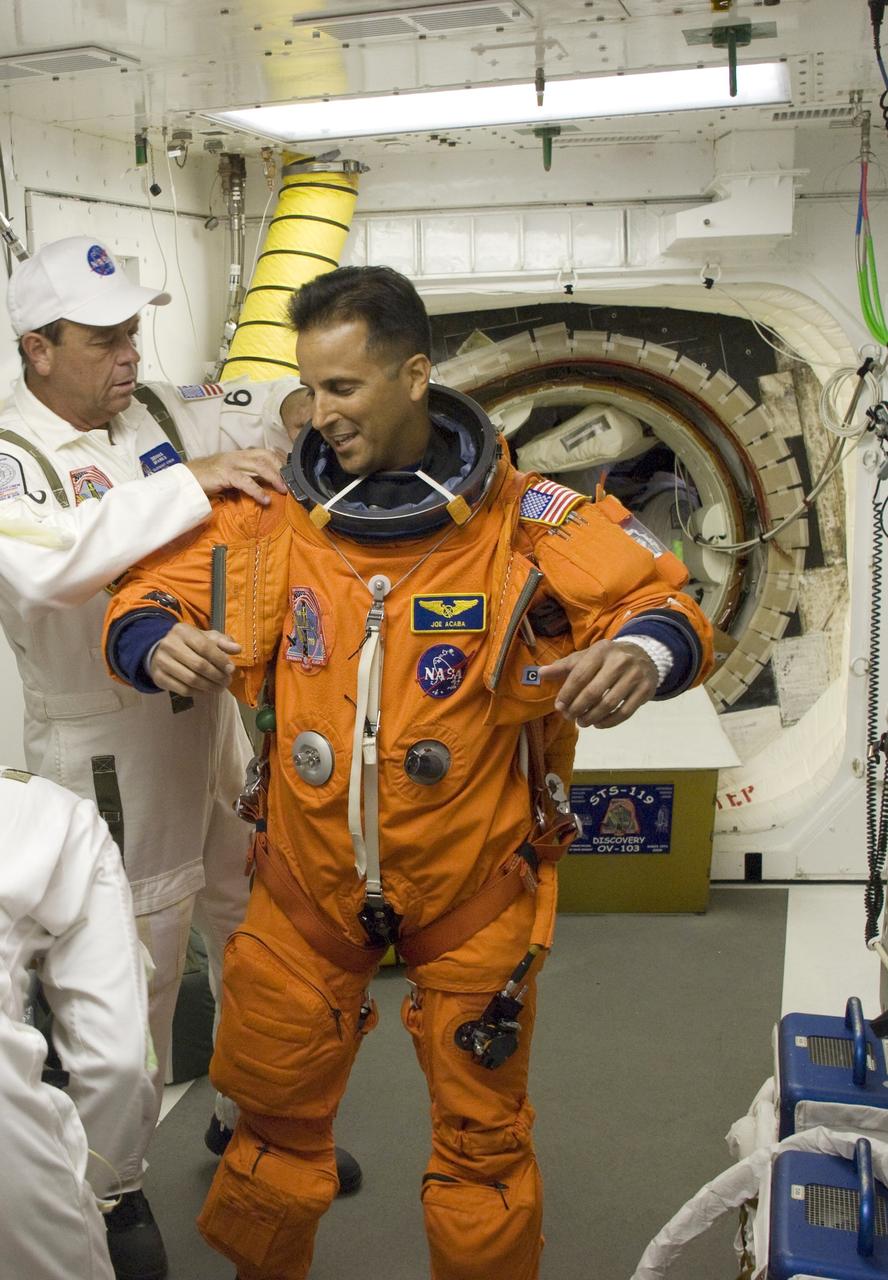
CAPE CANAVERAL, Fla. – In the White Room on Launch Pad 39A at NASA's Kennedy Space Center in Florida, STS-119 Mission Specialist Joseph Acaba is helped by the closeout crew putting on his harness, which includes a parachute pack, before crawling through the open hatch into space shuttle Discovery. The White Room is at the end of the orbiter access arm on the fixed service structure and provides access into the shuttle. The STS-119 mission is the 28th to the International Space Station and the 125th space shuttle flight. Discovery will deliver the final pair of power-generating solar array wings and the S6 truss segment. Installation of S6 will signal the station's readiness to house a six-member crew for conducting increased science. Liftoff is scheduled for 7:43 p.m. EDT. Photo credit: NASA/Tony Gray, Tom Farrar
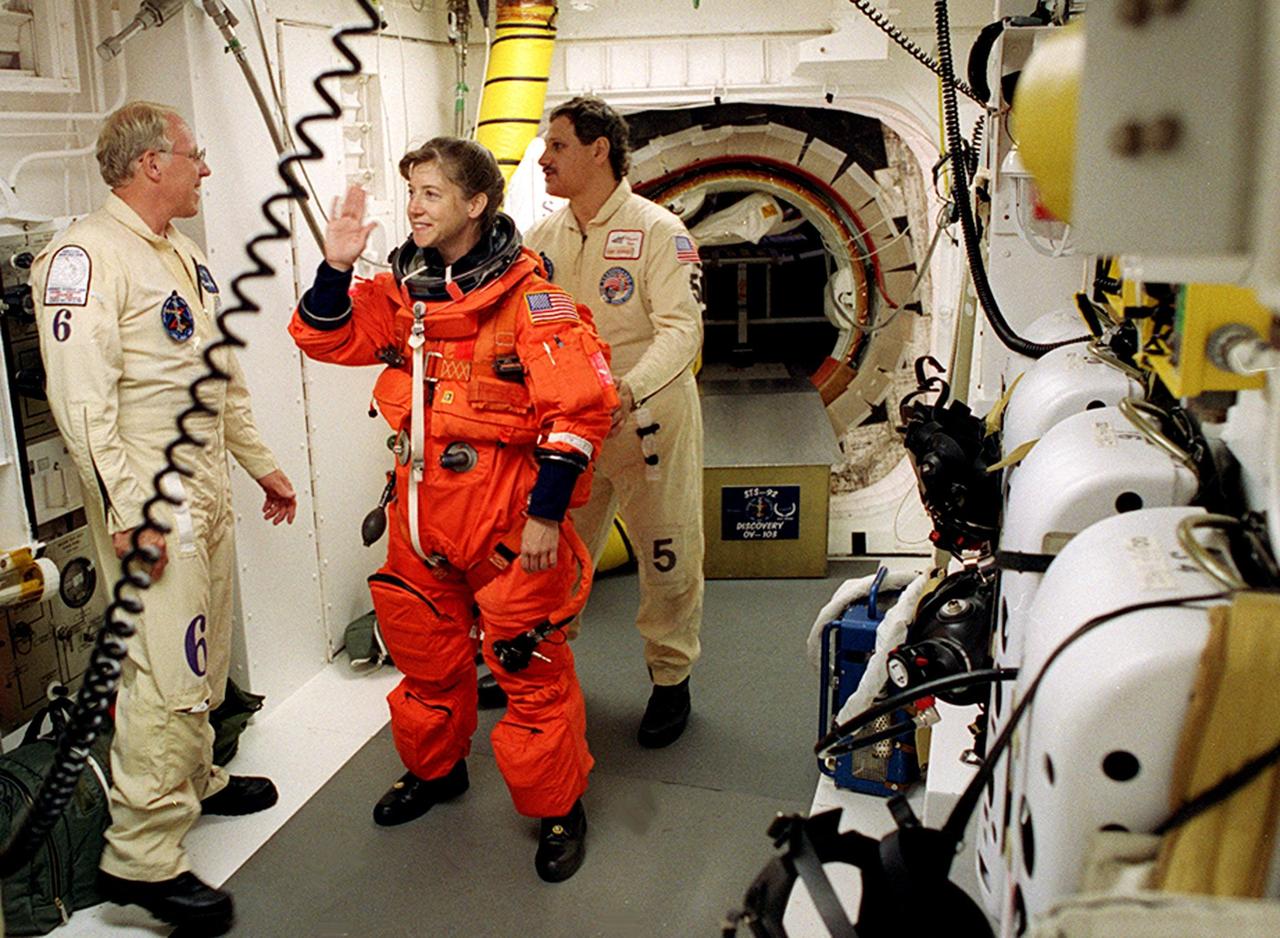
STS-92 Pilot Pamela Ann Melroy has a final check on her launch and entry suit in the White Room before entering Discovery. The White Room is an environmentally controlled area at the end of the Orbiter Access Arm that provides entry to the orbiter as well as emergency egress if needed. The arm remains in the extended position until 7 minutes 24 seconds before launch. Melroy and the rest of the crew are undertaking the fifth flight to the International Space Station for construction. Discovery carries a payload that includes the Integrated Truss Structure Z-1, first of 10 trusses that will form the backbone of the Space Station, and the third Pressurized Mating Adapter that will provide a Shuttle docking port for solar array installation on the sixth Station flight and Lab installation on the seventh Station flight. The mission includes four spacewalks for the construction activities. Discovery’s landing is expected Oct. 22 at 2:10 p.m. EDT
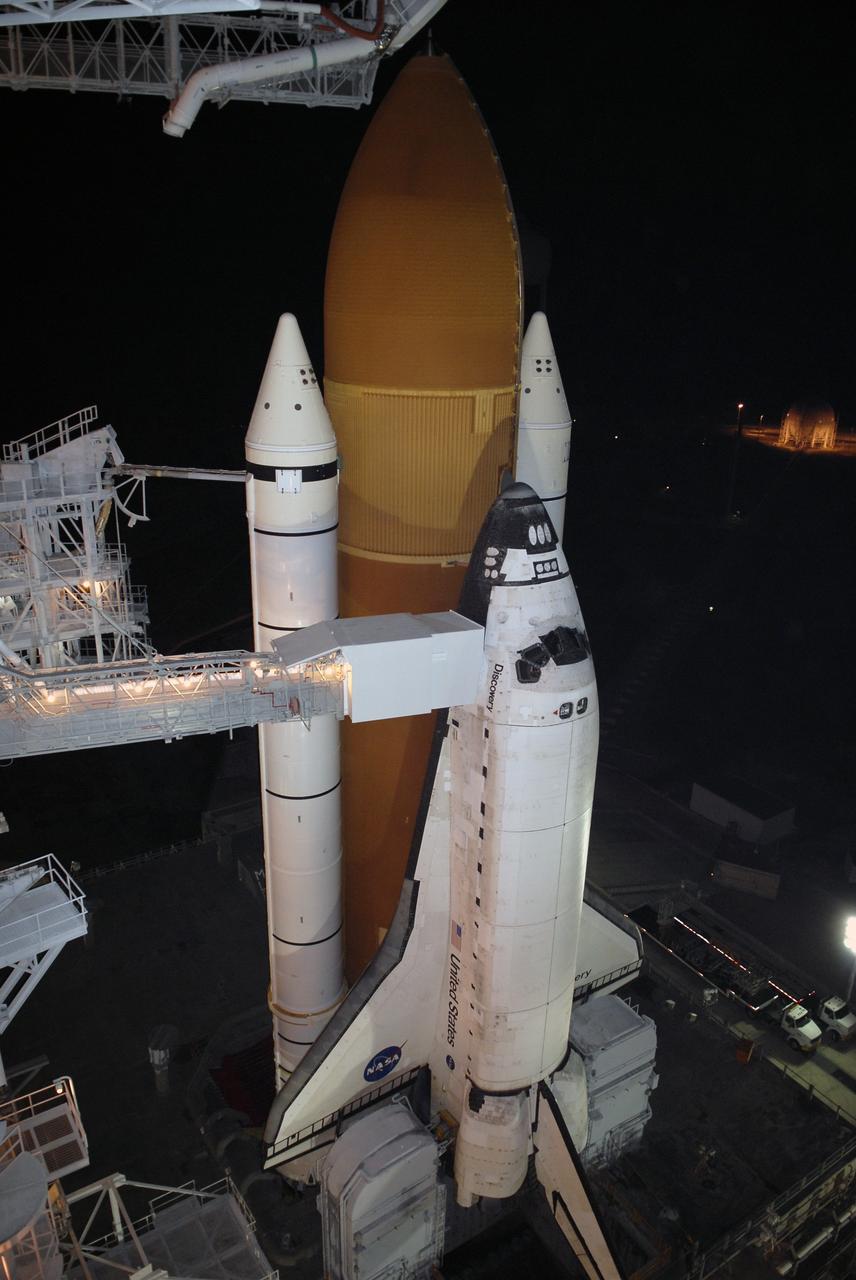
CAPE CANAVERAL, Fla. – On Launch Pad 39A at NASA's Kennedy Space Center in Florida, the orbiter access arm and White Room are extended toward space shuttle Discovery after rollback of the rotating service structure. The White Room provides crew access into the shuttle. The rollback is in preparation for Discovery's liftoff on the STS-119 mission with a crew of seven. The rotating structure provides protected access to the shuttle for changeout and servicing of payloads at the pad. After the RSS is rolled back, the orbiter is ready for fuel cell activation and external tank cryogenic propellant loading operations. The mission is the 28th to the International Space Station and the 125th space shuttle flight. Discovery will deliver the final pair of power-generating solar array wings and the S6 truss segment. Installation of S6 will signal the station's readiness to house a six-member crew for conducting increased science. Liftoff of Discovery is scheduled for 9:20 p.m. EDT on March 11. Photo credit: NASA/Kim Shiflett
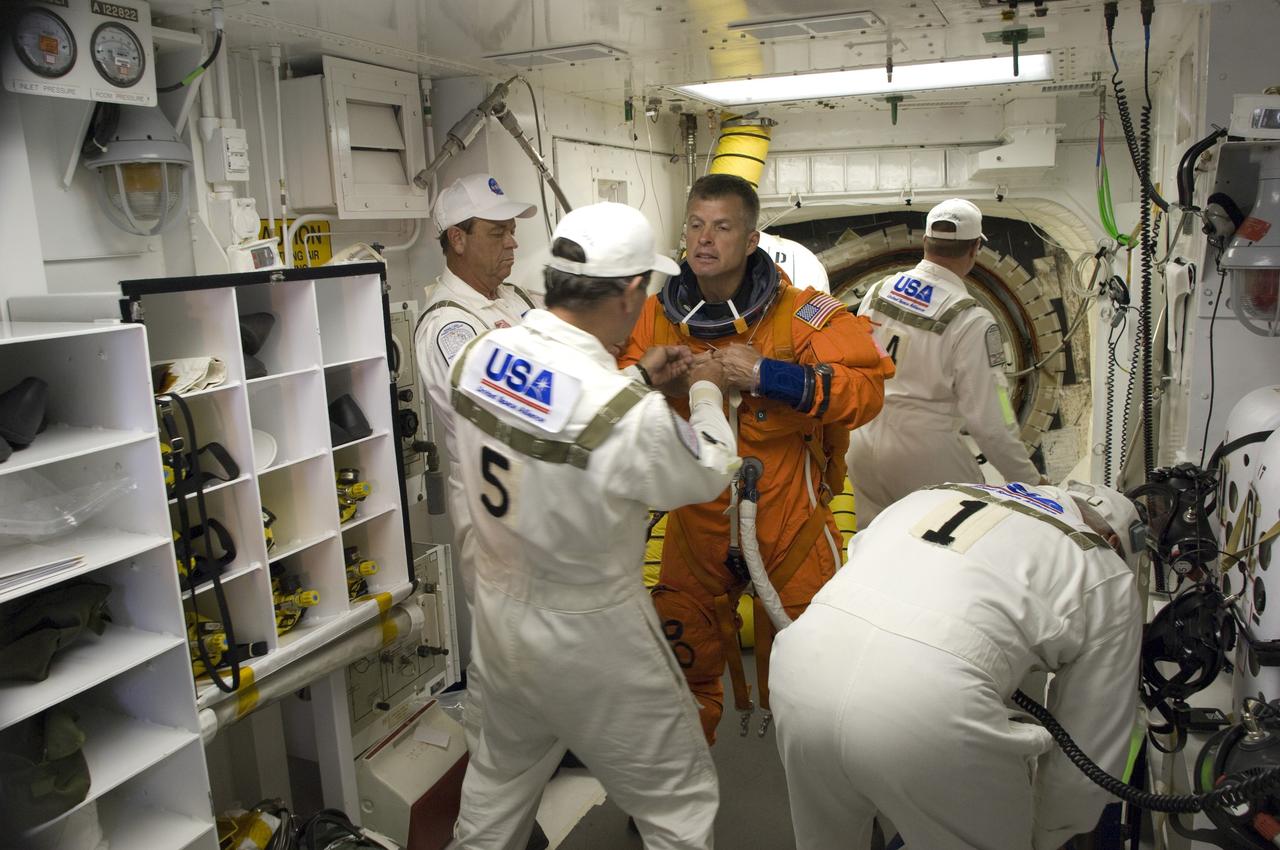
CAPE CANAVERAL, Fla. – In the White Room on Launch Pad 39A at NASA's Kennedy Space Center in Florida, STS-119 Mission Specialist Steve Swanson is helped by the closeout crew putting on his harness, which includes a parachute pack, before crawling through the open hatch into space shuttle Discovery. The White Room is at the end of the orbiter access arm on the fixed service structure and provides access into the shuttle. The STS-119 mission is the 28th to the International Space Station and the 125th space shuttle flight. Discovery will deliver the final pair of power-generating solar array wings and the S6 truss segment. Installation of S6 will signal the station's readiness to house a six-member crew for conducting increased science. Liftoff is scheduled for 7:43 p.m. EDT. Photo credit: NASA/Tony Gray, Tom Farrar
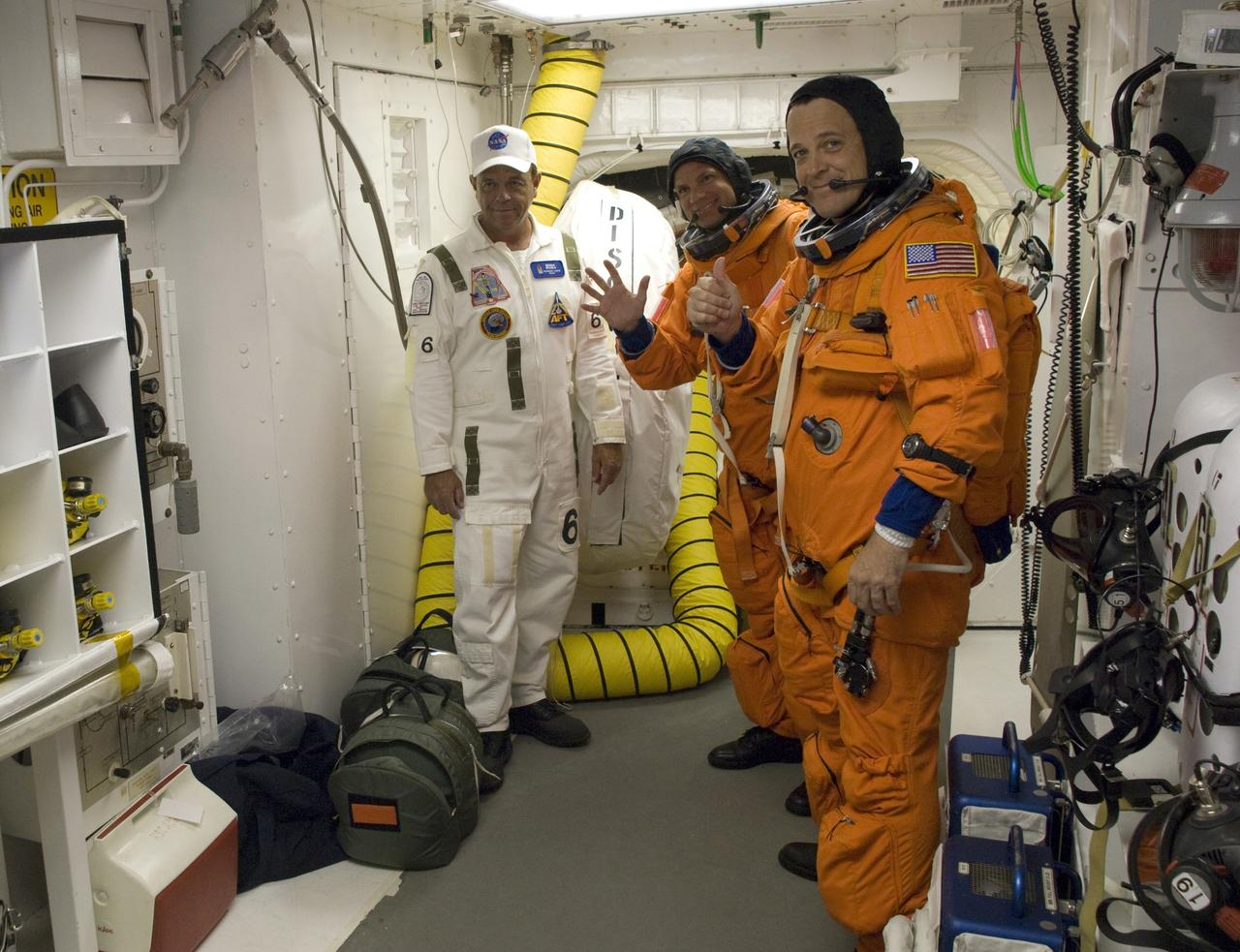
CAPE CANAVERAL, Fla. – In the White Room on Launch Pad 39A at NASA's Kennedy Space Center in Florida, STS-119 Pilot Tony Antonelli (center) and Mission Specialist Richard Arnold are getting ready to enter the open hatch into space shuttle Discovery. The White Room is at the end of the orbiter access arm on the fixed service structure and provides access into the shuttle. The STS-119 mission is the 28th to the International Space Station and the 125th space shuttle flight. Discovery will deliver the final pair of power-generating solar array wings and the S6 truss segment. Installation of S6 will signal the station's readiness to house a six-member crew for conducting increased science. Liftoff is scheduled for 7:43 p.m. EDT. Photo credit: NASA/Tony Gray, Tom Farrar
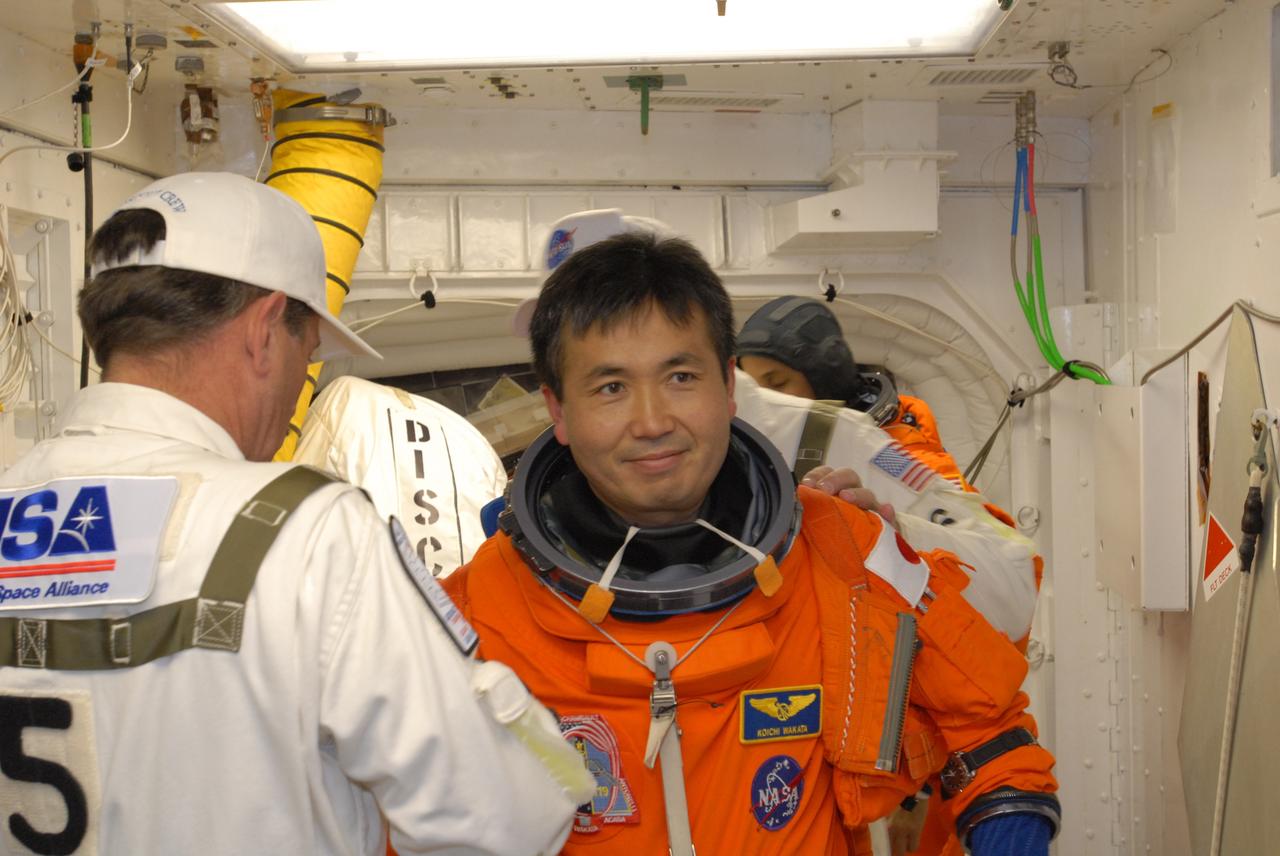
CAPE CANAVERAL, Fla. – In the White Room on Launch Pad 39A at NASA's Kennedy Space Center in Florida, STS-119 Mission Specialist Koichi Wakata is helped by the Closeout Crew to put on his harness. The White Room provides access into space shuttle Discovery. Wakata and other crew members will conduct a simulated launch countdown as part of the prelaunch preparation known as Terminal Countdown Demonstration Test. The TCDT also includes equipment familiarization and emergency egress training. Discovery is targeted to launch on the STS-119 mission Feb. 12. During the 14-day mission, the crew will install the S6 truss segment and solar arrays to the starboard side of the International Space Station, completing the station's truss, or backbone. Photo credit: NASA/Jim Grossmann
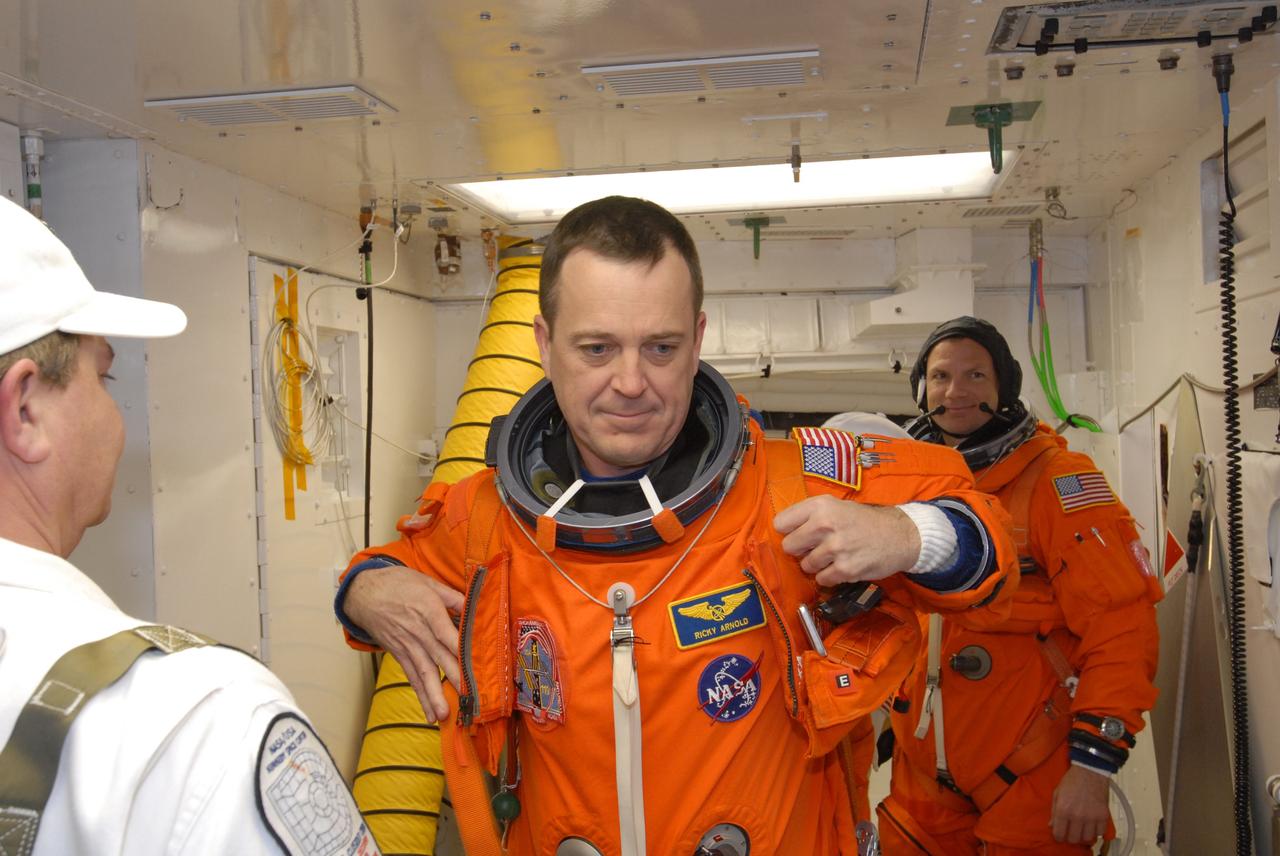
CAPE CANAVERAL, Fla. – In the White Room on Launch Pad 39A at NASA's Kennedy Space Center in Florida, STS-119 Mission Specialist Richard Arnold is helped by the Closeout Crew to put on his harness. The White Room provides access into space shuttle Discovery. Behind Arnold is Pilot Tony Antonelli. Arnold, Antonelli and other crew members will conduct a simulated launch countdown as part of the prelaunch preparation known as Terminal Countdown Demonstration Test. The TCDT also includes equipment familiarization and emergency egress training. Discovery is targeted to launch on the STS-119 mission Feb. 12. During the 14-day mission, the crew will install the S6 truss segment and solar arrays to the starboard side of the International Space Station, completing the station's truss, or backbone. Photo credit: NASA/Jim Grossmann
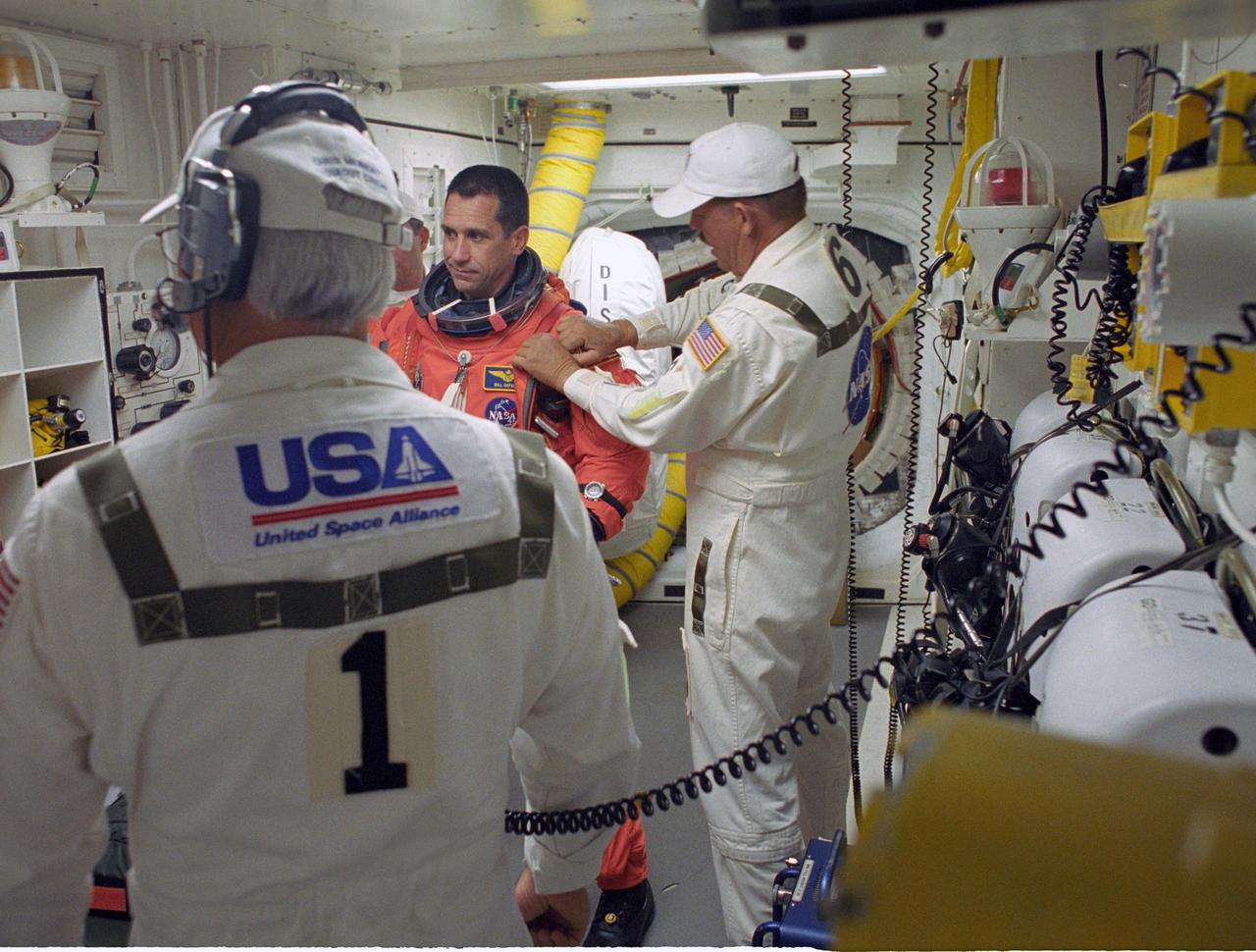
KENNEDY SPACE CENTER, FLA. -- STS-116 Commander William Oefelein is helped by the closeout crew in the White Room to secure his launch suit before climbing into Space Shuttle Discovery. The White Room is at the end of the orbiter access arm that extends from the fixed service structure and provides entry into the orbiter. The first launch attempt of STS-116 on Dec. 7 was postponed due a low cloud ceiling over Kennedy Space Center. This second launch attempt is scheduled for 8:47 p.m. This is Discovery's 33rd mission and the first night launch since 2002. The 20th shuttle mission to the International Space Station, STS-116 carries another truss segment, P5. It will serve as a spacer, mated to the P4 truss that was attached in September. After installing the P5, the crew will reconfigure and redistribute the power generated by two pairs of U.S. solar arrays. Landing is expected Dec. 21 at KSC. Photo credit: NASA/Tony Gray & Don Kight
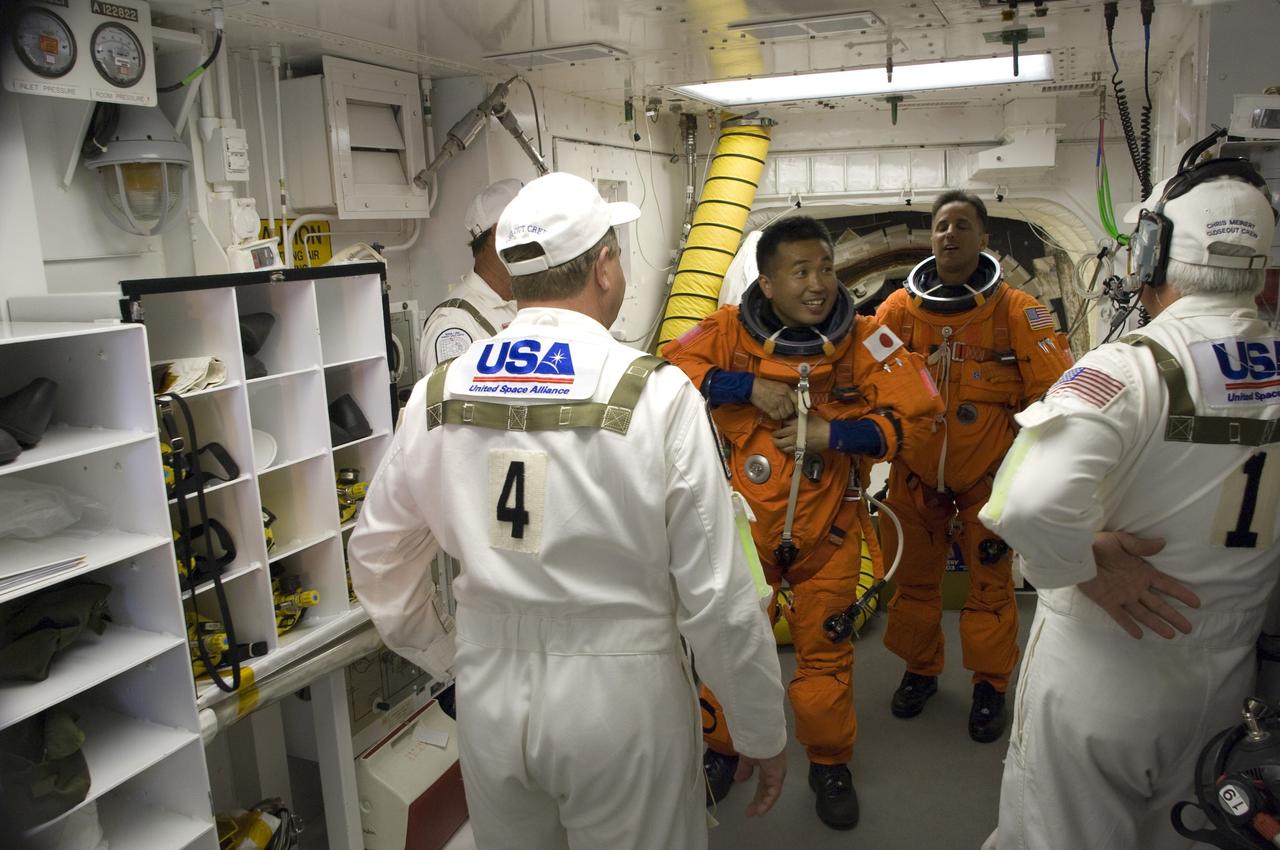
CAPE CANAVERAL, Fla. – In the White Room on Launch Pad 39A at NASA's Kennedy Space Center in Florida, STS-119 Mission Specialists Koichi Wakata (center) and Steve Swanson are getting into their harnesses, which include a parachute pack, before crawling through the open hatch into space shuttle Discovery. The White Room is at the end of the orbiter access arm on the fixed service structure and provides access into the shuttle. The STS-119 mission is the 28th to the International Space Station and the 125th space shuttle flight. Discovery will deliver the final pair of power-generating solar array wings and the S6 truss segment. Installation of S6 will signal the station's readiness to house a six-member crew for conducting increased science. Liftoff is scheduled for 7:43 p.m. EDT. Photo credit: NASA/Tony Gray, Tom Farrar
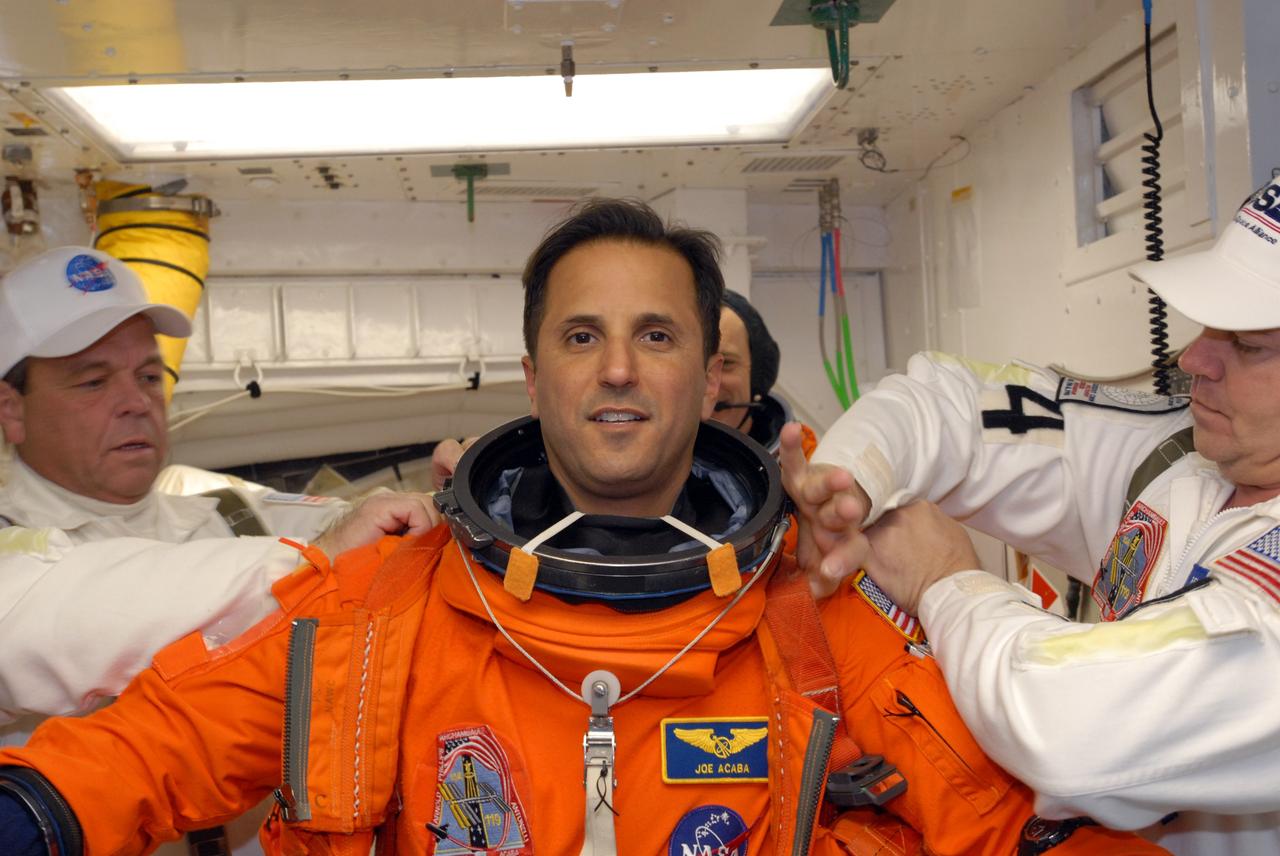
CAPE CANAVERAL, Fla. – In the White Room on Launch Pad 39A at NASA's Kennedy Space Center in Florida, STS-119 Mission Specialist Joseph Acaba is helped by the Closeout Crew to put on his harness. The White Room provides access into space shuttle Discovery. Acaba and other crew members will conduct a simulated launch countdown as part of the prelaunch preparation known as Terminal Countdown Demonstration Test. The TCDT also includes equipment familiarization and emergency egress training. Discovery is targeted to launch on the STS-119 mission Feb. 12. During the 14-day mission, the crew will install the S6 truss segment and solar arrays to the starboard side of the International Space Station, completing the station's truss, or backbone. Photo credit: NASA/Jim Grossmann
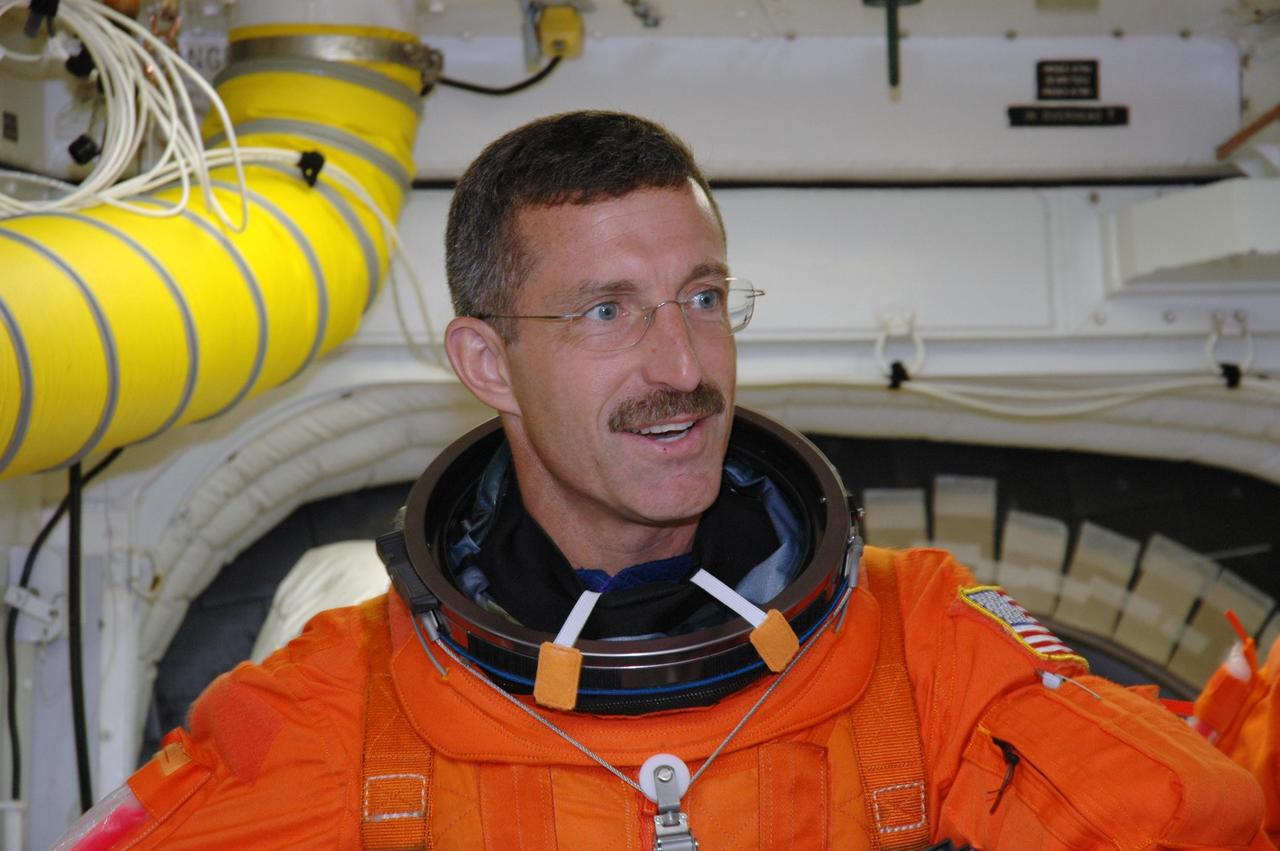
KENNEDY SPACE CENTER, FLA. - The STS-115 crew members complete their suitup in the White Room before entering Space Shuttle Atlantis on Launch Pad 39B for a simulated launch countdown. Shown here is Mission Specialist Daniel Burbank. The White Room, which is located at the end of the orbiter access arm, allows entry into the orbiter through the crew access hatch. The mission crew is at KSC for Terminal Countdown Demonstration Test (TCDT) activities that are preparation for launch. Liftoff of Atlantis is scheduled to take place in a window that opens Aug. 27. During their 11-day mission to the International Space Station, the STS-115 crew will continue construction of the station and attach the payload elements, the Port 3/4 truss segment with its two large solar arrays. Photo credit: NASA/Jim Grossmann
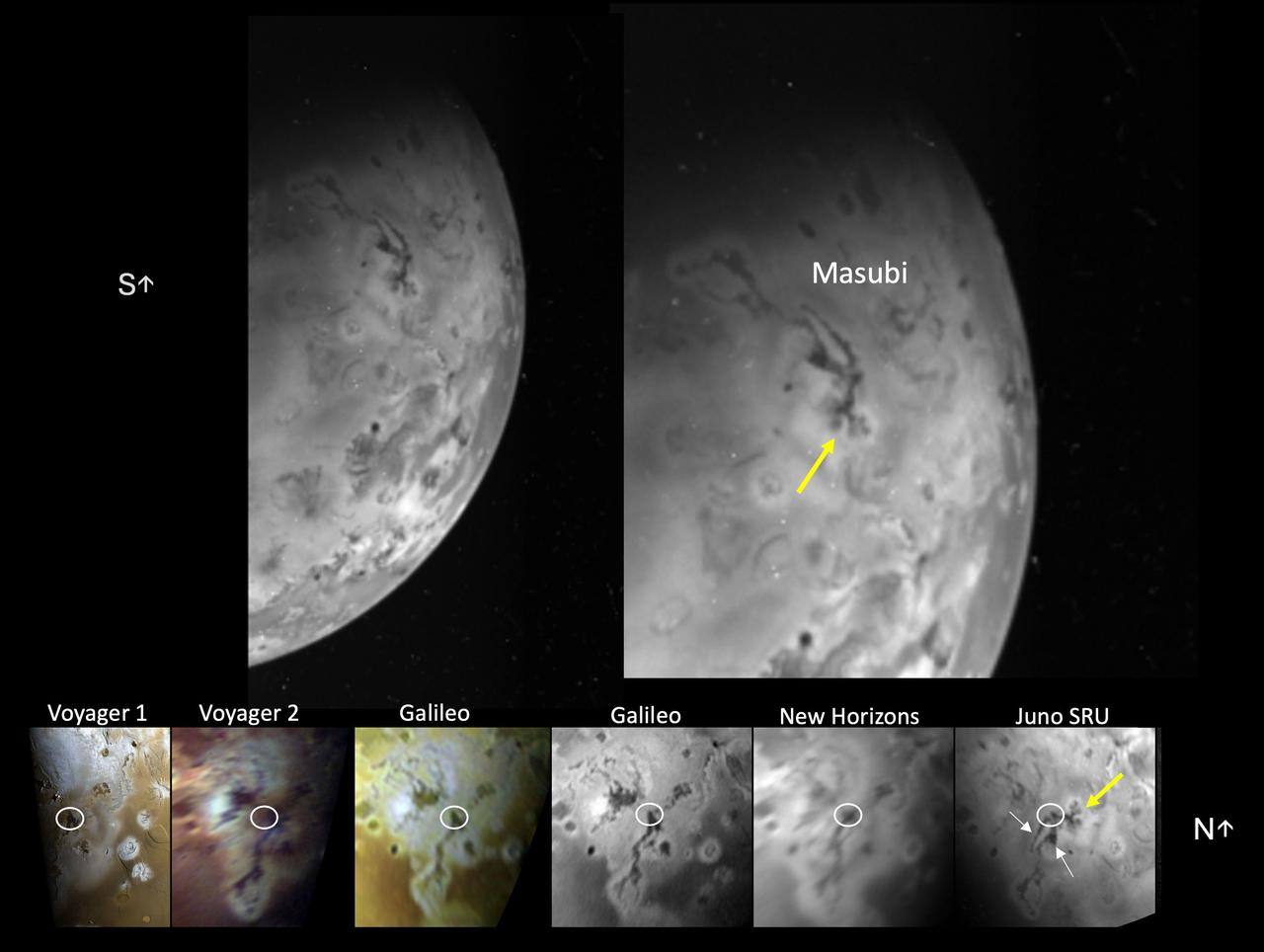
The Stellar Reference Unit (SRU) on NASA's Juno spacecraft collected this visible wavelength image of Io's night side while the surface was illuminated by Jupiter-shine on April 4, 2024. The image features the large compound flow field, Masubi, located on Io's southern hemisphere. Masubi was first observed by NASA's Voyager 1 in 1979 and has continued to expand ever since. A co-registered time sequence of Masubi observations covering 45 years is shown in the bottom panel. The location of the plume first observed by Galileo is circled in white in each image of the time sequence. The SRU observed even further expansion of pre-existing flows (white arrows) and two new flows with multiple lobes (yellow arrow). As of April 4, 2024, Masubi's total compound flow length is about 994 miles (1,600 kilometers), making it the longest currently active lava flow in the solar system. https://photojournal.jpl.nasa.gov/catalog/PIA26524
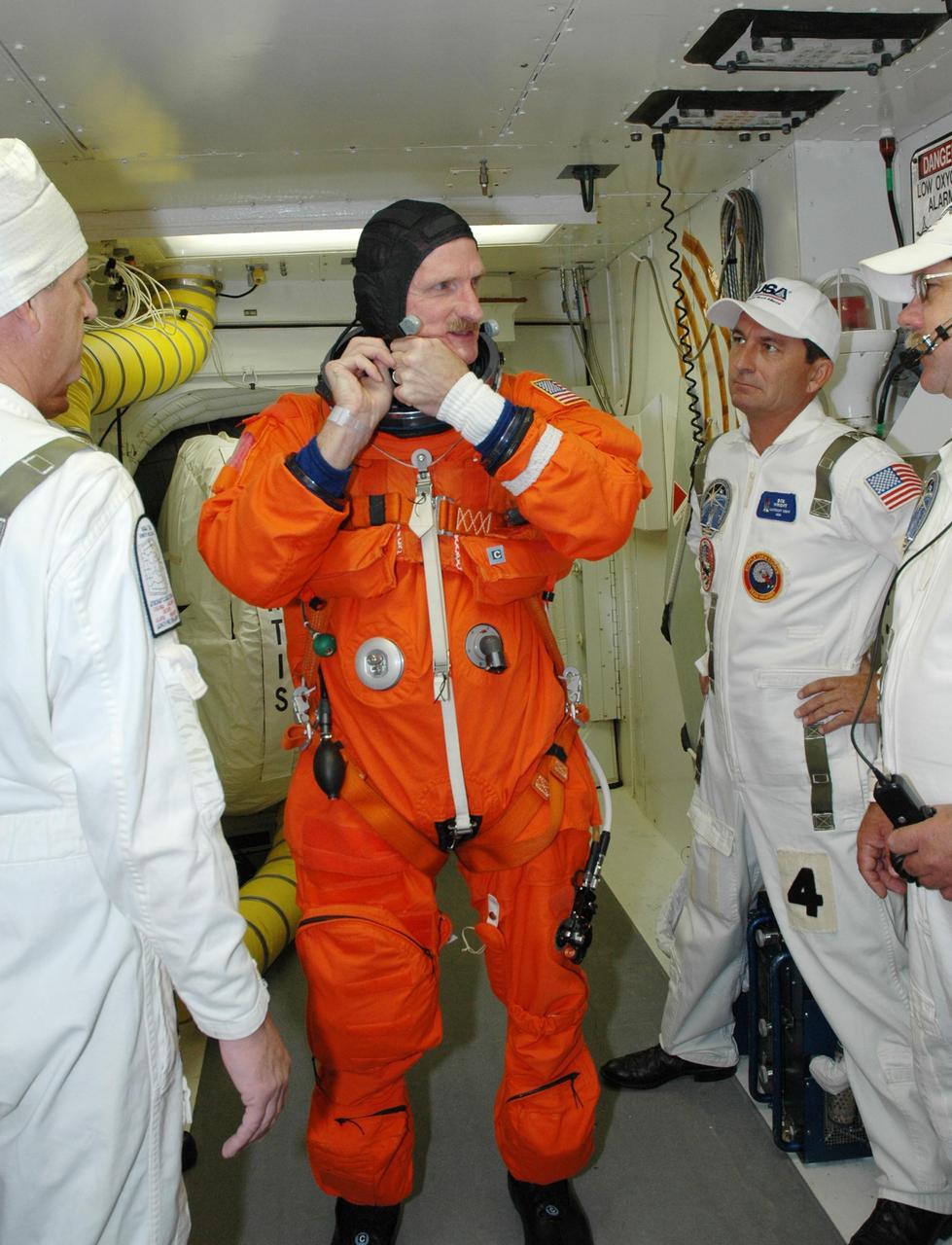
KENNEDY SPACE CENTER, FLA. - The STS-115 crew members complete their suitup in the White Room before entering Space Shuttle Atlantis on Launch Pad 39B for a simulated launch countdown. Shown here is Mission Specialist Joseph Tanner. The White Room, which is located at the end of the orbiter access arm, allows entry into the orbiter through the crew access hatch. The mission crew is at KSC for Terminal Countdown Demonstration Test (TCDT) activities that are preparation for launch. Liftoff of Atlantis is scheduled to take place in a window that opens Aug. 27. During their 11-day mission to the International Space Station, the STS-115 crew will continue construction of the station and attach the payload elements, the Port 3/4 truss segment with its two large solar arrays. Photo credit: NASA/Jim Grossmann
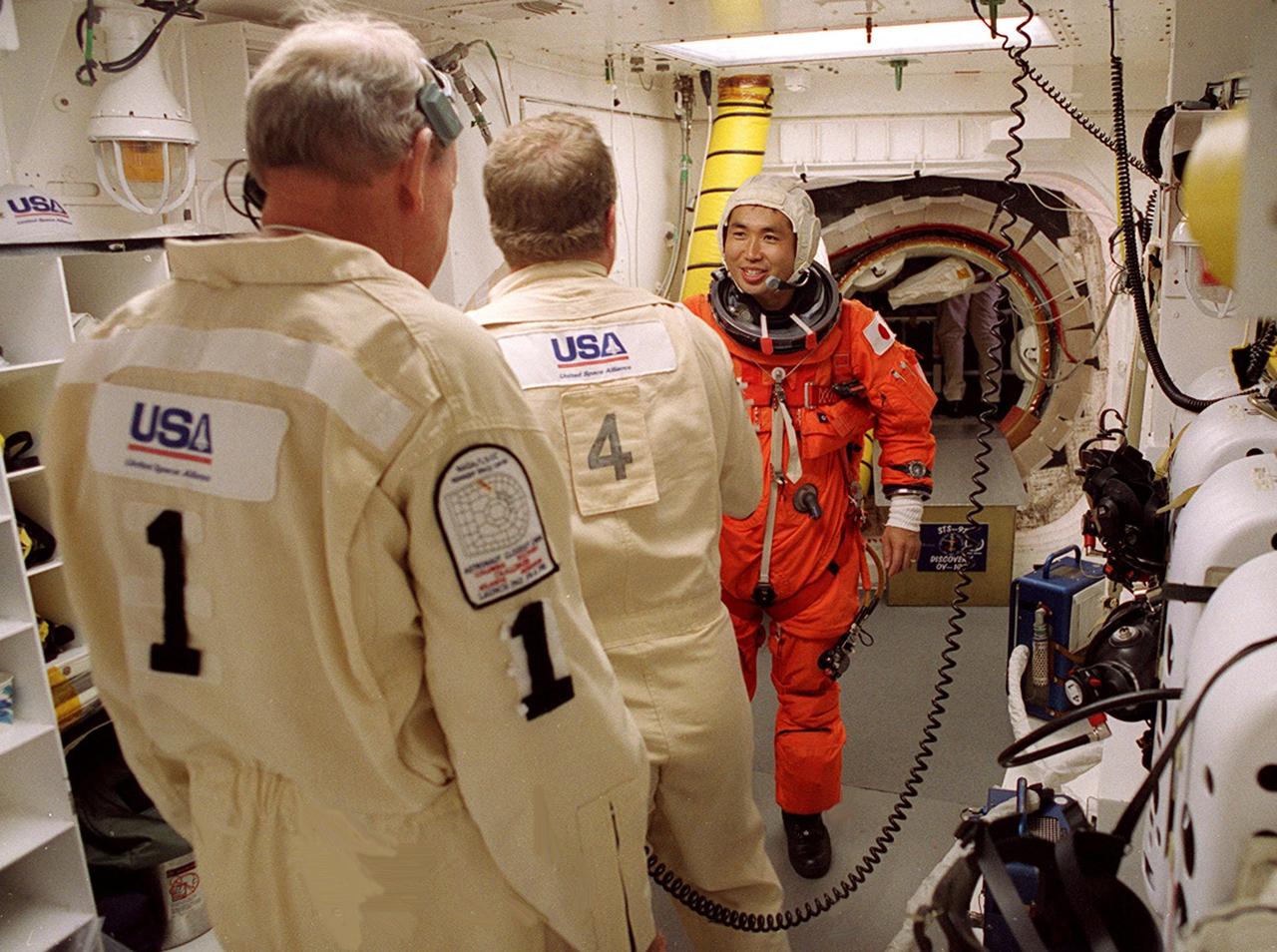
STS-92 Mission Specialist Koichi Wakata of Japan gets a final check of his launch and entry suit in the White Room before entering Discovery. The White Room is an environmentally controlled area at the end of the Orbiter Access Arm that provides entry to the orbiter as well as emergency egress if needed. The arm remains in the extended position until 7 minutes 24 seconds before launch. Wakata and the rest of the crew are making the fifth flight to the International Space Station for construction. Discovery carries a payload that includes the Integrated Truss Structure Z-1, first of 10 trusses that will form the backbone of the Space Station, and the third Pressurized Mating Adapter that will provide a Shuttle docking port for solar array installation on the sixth Station flight and Lab installation on the seventh Station flight. The mission includes four spacewalks for the construction activities. Discovery’s landing is expected Oct. 22 at 2:10 p.m. EDT

KENNEDY SPACE CENTER, FLA. - The STS-115 crew is in the White Room on the orbiter access arm on Launch Pad 39B to get instruction on using the emergency egress system. From left are Commander Brent Jett, Pilot Chris Ferguson, and Mission Specialists Heidemarie Stefanyshyn-Piper, Joseph Tanner, Steven MacLean and Daniel Burbank. MacLean is with the Canadian Space Agency. The White Room provides access into the orbiter through the crew access hatch. The mission crew is at KSC for Terminal Countdown Demonstration Test (TCDT) activities that are preparation for launch on Space Shuttle Atlantis, scheduled to take place in a window that opens Aug. 27. During their 11-day mission to the International Space Station, the STS-115 crew will continue construction of the station and attach the payload elements, the Port 3/4 truss segment with its two large solar arrays. Photo credit: NASA/Cory Huston
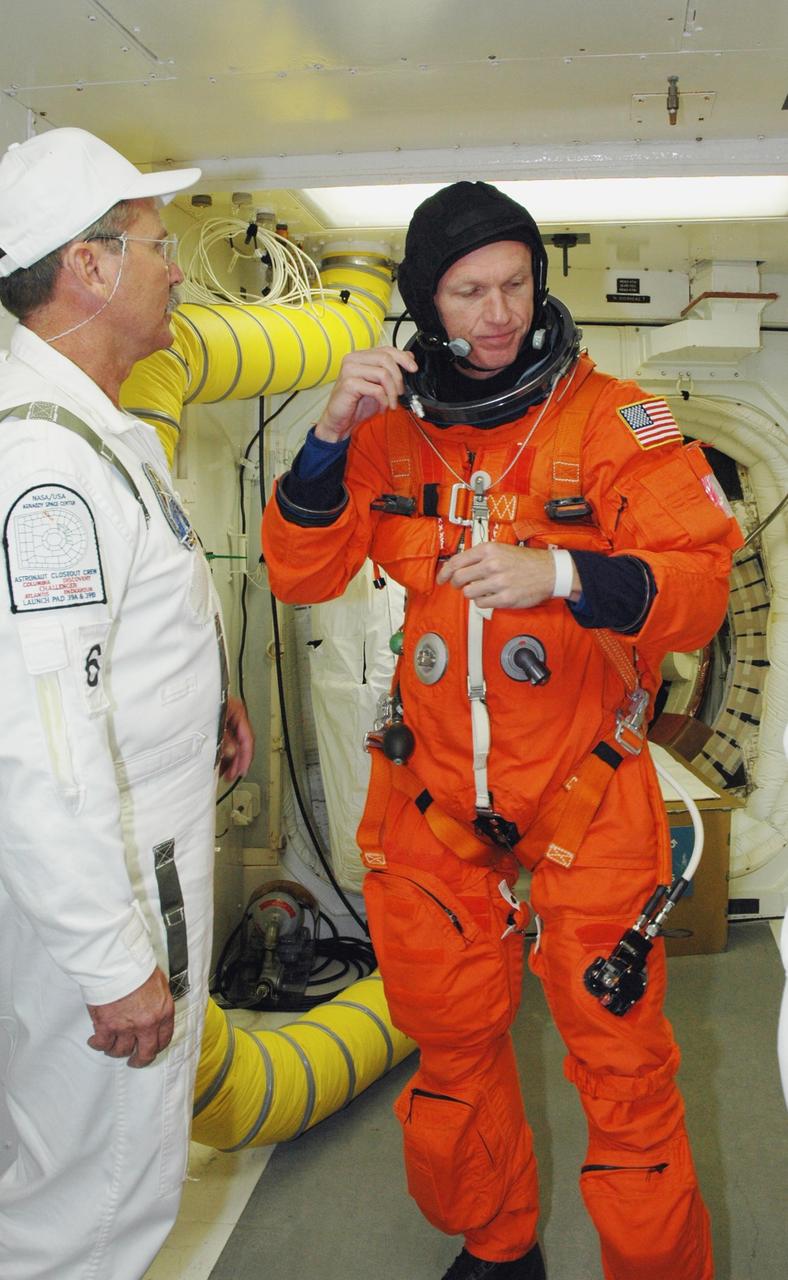
KENNEDY SPACE CENTER, FLA. - The STS-115 crew members complete their suitup in the White Room before entering Space Shuttle Atlantis on Launch Pad 39B for a simulated launch countdown. Shown here is Commander Brent Jett. The White Room, which is located at the end of the orbiter access arm, allows entry into the orbiter through the crew access hatch. The mission crew is at KSC for Terminal Countdown Demonstration Test (TCDT) activities that are preparation for launch. Liftoff of Atlantis is scheduled to take place in a window that opens Aug. 27. During their 11-day mission to the International Space Station, the STS-115 crew will continue construction of the station and attach the payload elements, the Port 3/4 truss segment with its two large solar arrays. Photo credit: NASA/Jim Grossmann
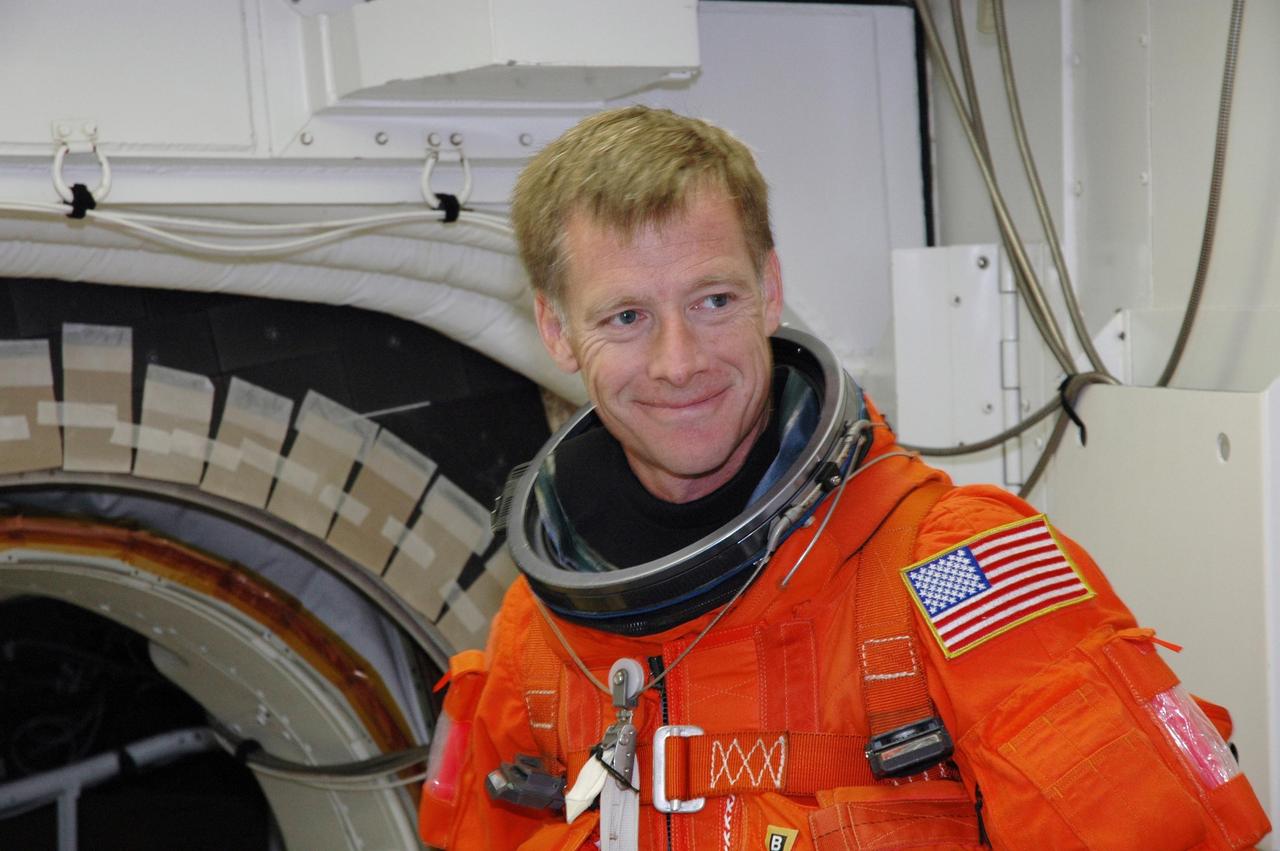
KENNEDY SPACE CENTER, FLA. - The STS-115 crew members complete their suitup in the White Room before entering Space Shuttle Atlantis on Launch Pad 39B for a simulated launch countdown. Shown here is Pilot Christopher Ferguson. The White Room, which is located at the end of the orbiter access arm, allows entry into the orbiter through the crew access hatch. The mission crew is at KSC for Terminal Countdown Demonstration Test (TCDT) activities that are preparation for launch. Liftoff of Atlantis is scheduled to take place in a window that opens Aug. 27. During their 11-day mission to the International Space Station, the STS-115 crew will continue construction of the station and attach the payload elements, the Port 3/4 truss segment with its two large solar arrays. Photo credit: NASA/Jim Grossmann
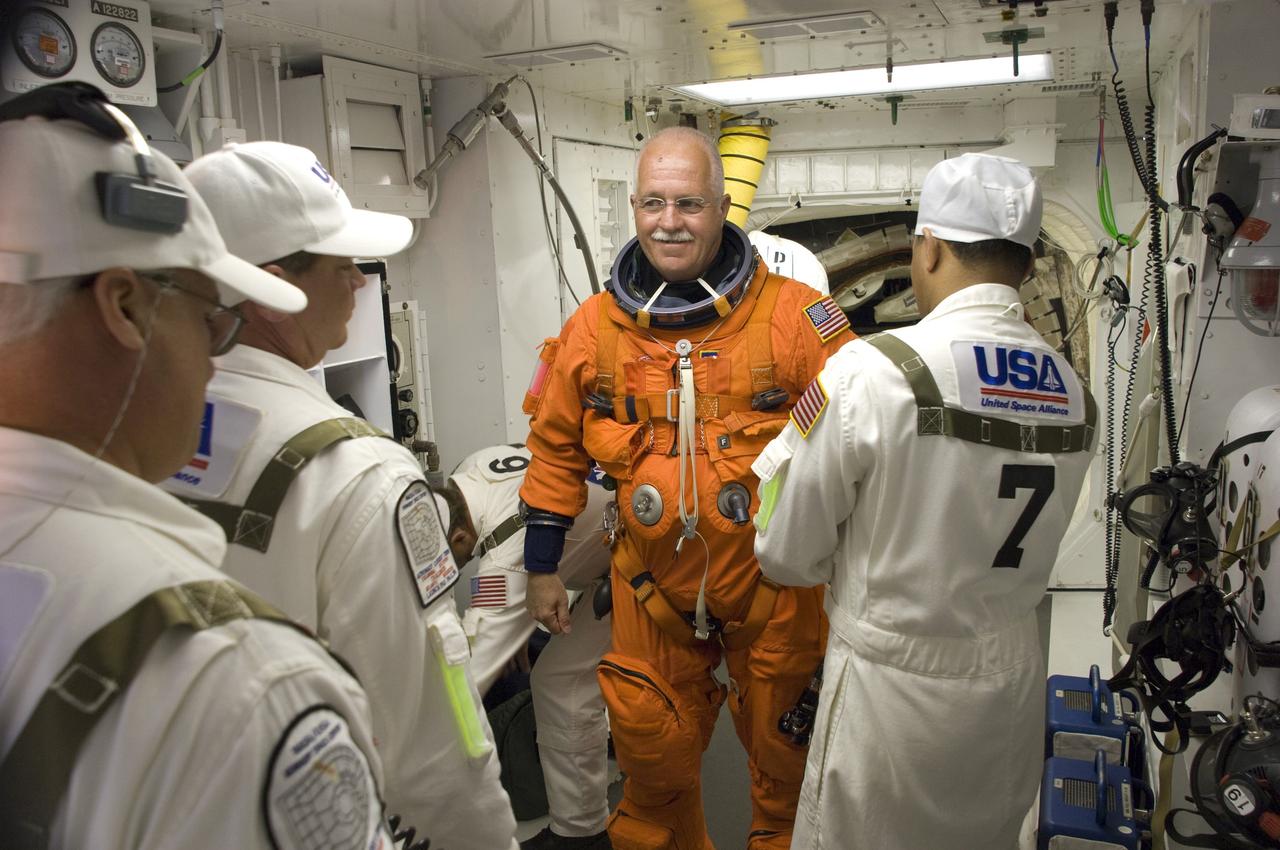
CAPE CANAVERAL, Fla. – In the White Room on Launch Pad 39A at NASA's Kennedy Space Center in Florida, STS-119 Mission Specialist John Phillips is helped by the closeout crew putting on his harness, which includes a parachute pack, before crawling through the open hatch into space shuttle Discovery. The White Room is at the end of the orbiter access arm on the fixed service structure and provides access into the shuttle. The STS-119 mission is the 28th to the International Space Station and the 125th space shuttle flight. Discovery will deliver the final pair of power-generating solar array wings and the S6 truss segment. Installation of S6 will signal the station's readiness to house a six-member crew for conducting increased science. Liftoff is scheduled for 7:43 p.m. EDT. Photo credit: NASA/Tony Gray, Tom Farrar
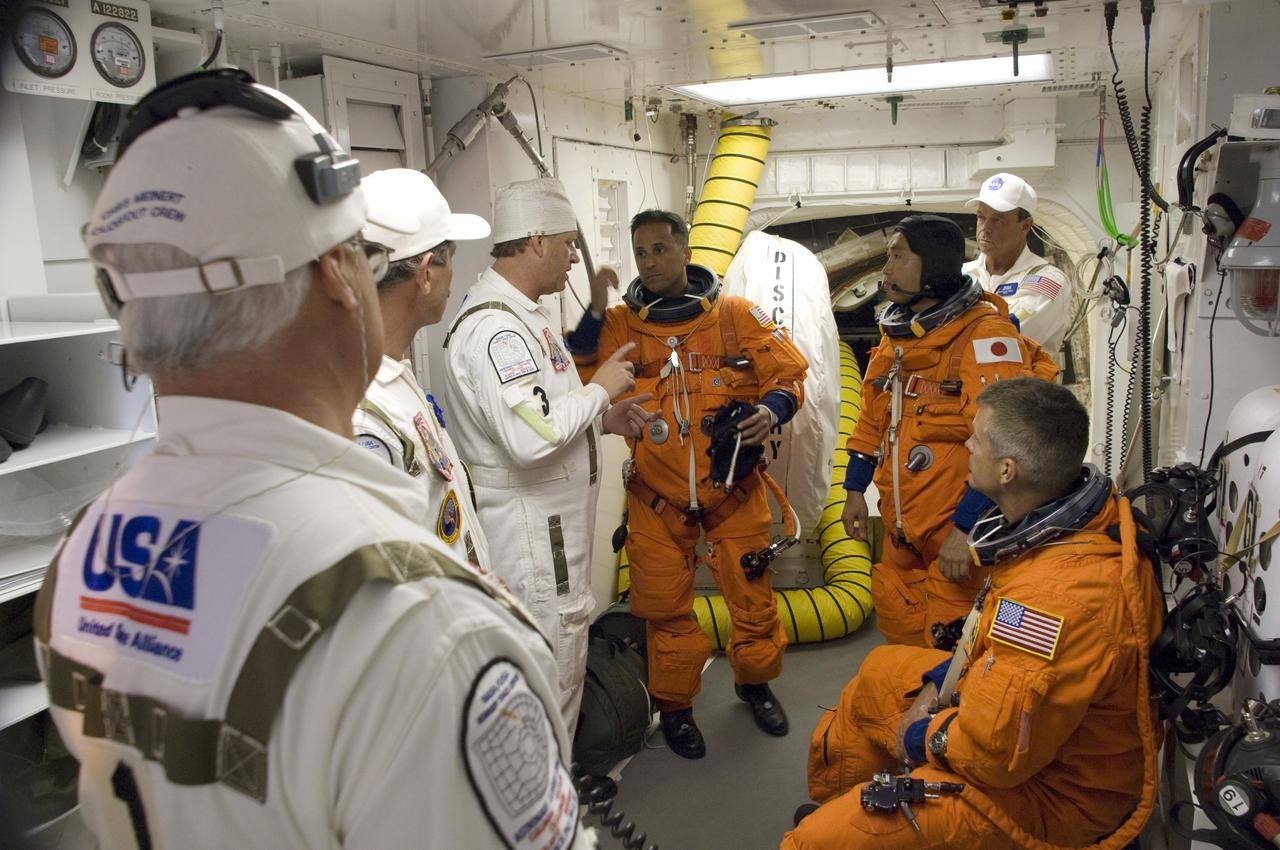
CAPE CANAVERAL, Fla. – In the White Room on Launch Pad 39A at NASA's Kennedy Space Center in Florida, STS-119 Mission Specialists Joseph Acaba (left), Koichi Wakata (center) and Steve Swanson (right) talk to the closeout crew as they prepare to go through the open hatch into space shuttle Discovery. The White Room is at the end of the orbiter access arm on the fixed service structure and provides access into the shuttle. The STS-119 mission is the 28th to the International Space Station and the 125th space shuttle flight. Discovery will deliver the final pair of power-generating solar array wings and the S6 truss segment. Installation of S6 will signal the station's readiness to house a six-member crew for conducting increased science. Liftoff is scheduled for 7:43 p.m. EDT. Photo credit: NASA/Tony Gray, Tom Farrar
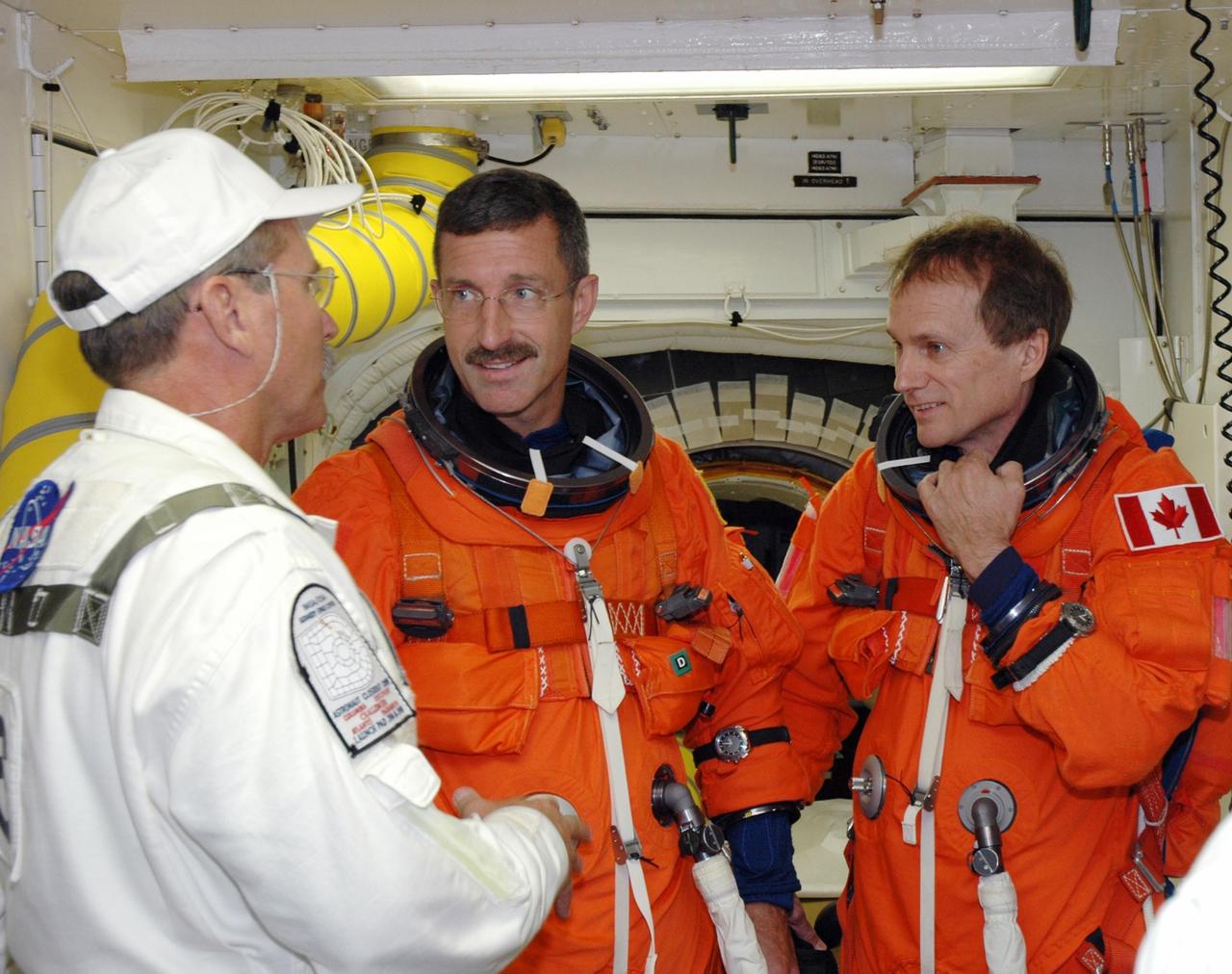
KENNEDY SPACE CENTER, FLA. - The STS-115 crew members complete their suitup in the White Room before entering Space Shuttle Atlantis on Launch Pad 39B for a simulated launch countdown. Shown here are Mission Specialists Daniel Burbank (left) and Steven MacLean. The White Room, which is located at the end of the orbiter access arm, allows entry into the orbiter through the crew access hatch. The mission crew is at KSC for Terminal Countdown Demonstration Test (TCDT) activities that are preparation for launch. Liftoff of Atlantis is scheduled to take place in a window that opens Aug. 27. During their 11-day mission to the International Space Station, the STS-115 crew will continue construction of the station and attach the payload elements, the Port 3/4 truss segment with its two large solar arrays. Photo credit: NASA/Jim Grossmann
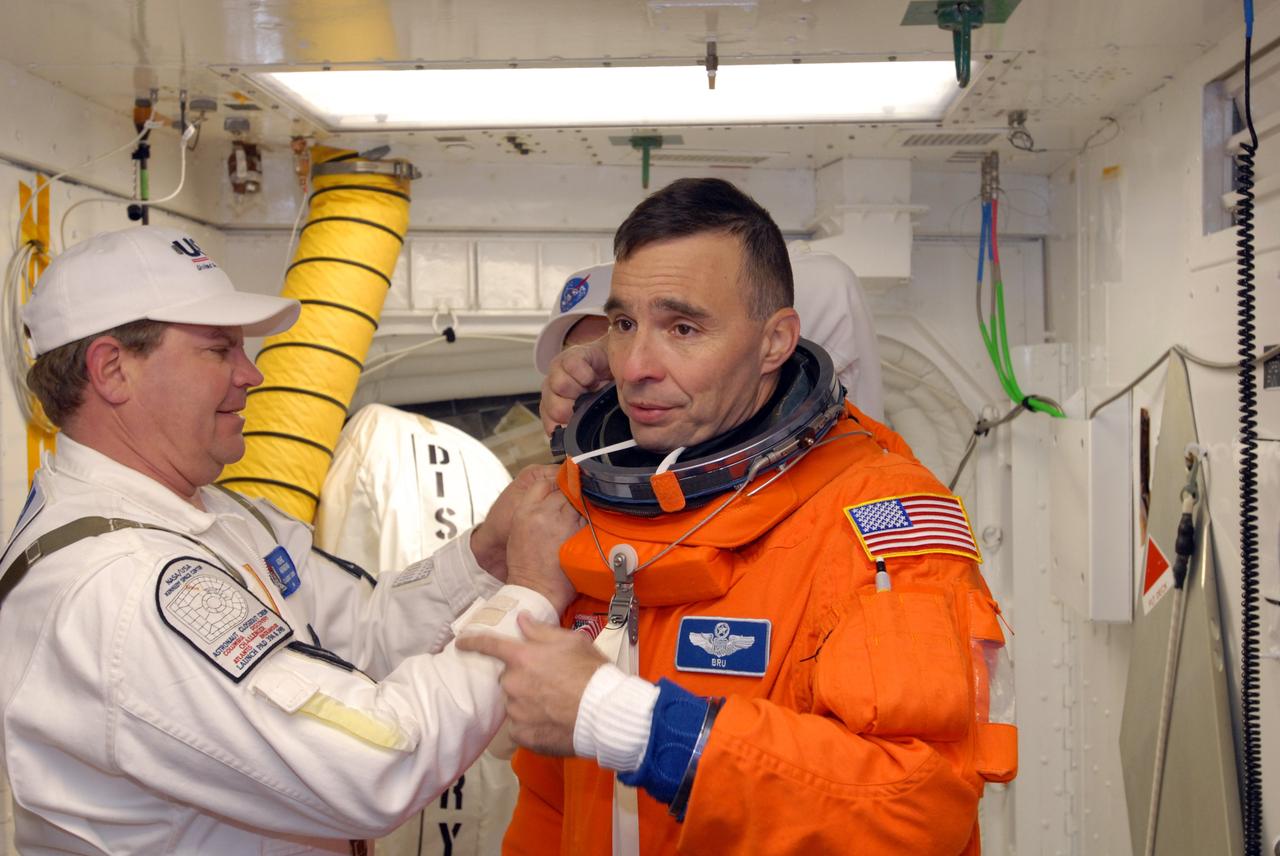
CAPE CANAVERAL, Fla. – In the White Room on Launch Pad 39A at NASA's Kennedy Space Center in Florida, STS-119 Commander Lee Archambault is helped by the Closeout Crew to put on his harness. The White Room provides access into space shuttle Discovery. Archambault and other crew members will conduct a simulated launch countdown as part of the prelaunch preparation known as Terminal Countdown Demonstration Test. The TCDT also includes equipment familiarization and emergency egress training. Discovery is targeted to launch on the STS-119 mission Feb. 12. During the 14-day mission, the crew will install the S6 truss segment and solar arrays to the starboard side of the International Space Station, completing the station's truss, or backbone. Photo credit: NASA/Jim Grossmann

KENNEDY SPACE CENTER, FLA. - The STS-115 crew members complete their suitup in the White Room before entering Space Shuttle Atlantis on Launch Pad 39B for a simulated launch countdown. Shown here is being helped by the closeout crew is Mission Specialist Heidemarie Stefanyshyn-Piper. The White Room, which is located at the end of the orbiter access arm, allows entry into the orbiter through the crew access hatch. The mission crew is at KSC for Terminal Countdown Demonstration Test (TCDT) activities that are preparation for launch. Liftoff of Atlantis is scheduled to take place in a window that opens Aug. 27. During their 11-day mission to the International Space Station, the STS-115 crew will continue construction of the station and attach the payload elements, the Port 3/4 truss segment with its two large solar arrays. Photo credit: NASA/Jim Grossmann
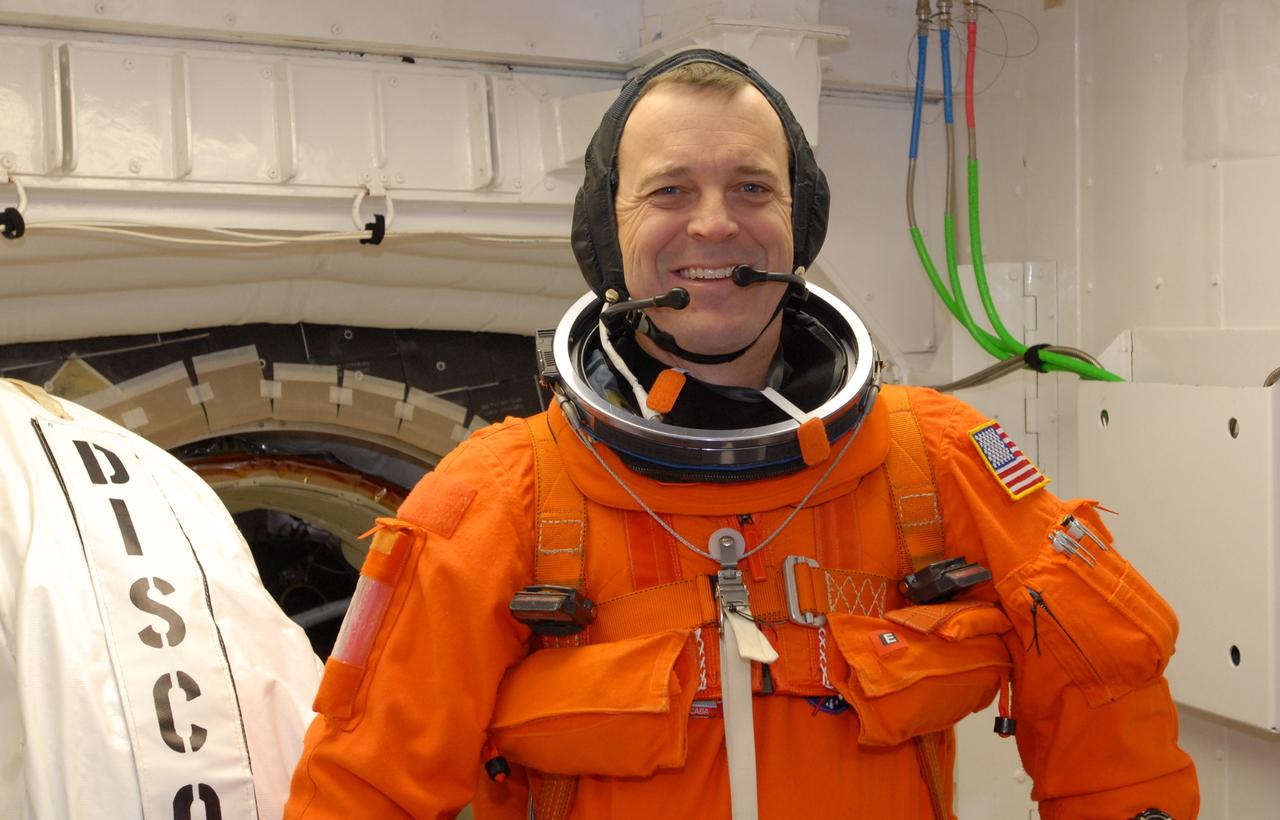
CAPE CANAVERAL, Fla. – In the White Room on Launch Pad 39A at NASA's Kennedy Space Center in Florida, STS-119 Mission Specialist Richard Arnold gets ready to enter space shuttle Discovery, behind him. The White Room provides access into Discovery. Arnold and other crew members will conduct a simulated launch countdown as part of the prelaunch preparation known as Terminal Countdown Demonstration Test. The TCDT also includes equipment familiarization and emergency egress training. Discovery is targeted to launch on the STS-119 mission Feb. 12. During the 14-day mission, the crew will install the S6 truss segment and solar arrays to the starboard side of the International Space Station, completing the station's truss, or backbone. Photo credit: NASA/Jim Grossmann

KENNEDY SPACE CENTER, FLA. - The STS-115 crew is in the White Room on the orbiter access arm on Launch Pad 39B to get instruction on using the emergency egress system. From left are Pilot Chris Ferguson, Commander Brent Jett, and Mission Specialists Heidemarie Stefanyshyn-Piper, Joseph Tanner, Steven MacLean and Daniel Burbank. MacLean is with the Canadian Space Agency. The White Room provides access into the orbiter through the crew access hatch. The mission crew is at KSC for Terminal Countdown Demonstration Test (TCDT) activities that are preparation for launch on Space Shuttle Atlantis, scheduled to take place in a window that opens Aug. 27. During their 11-day mission to the International Space Station, the STS-115 crew will continue construction of the station and attach the payload elements, the Port 3/4 truss segment with its two large solar arrays. Photo credit: NASA/Cory Huston