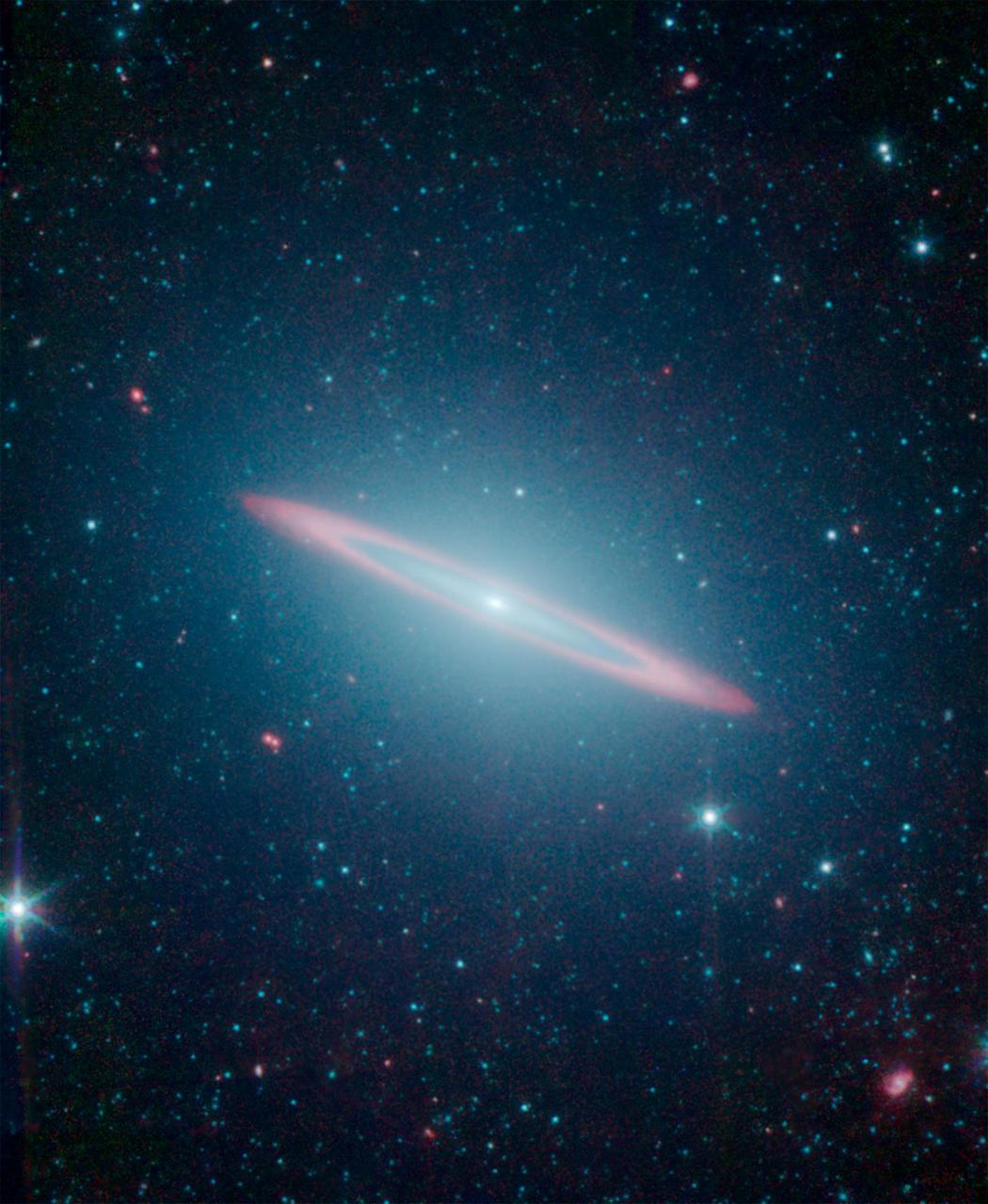
This infrared vision of NASA Spitzer Space Telescope has revealed that the Sombrero galaxy, named after its appearance in visible light to a wide-brimmed hat, is in fact two galaxies in one.

New observations from NASA Spitzer Space Telescope reveal the Sombrero galaxy is not simply a regular flat disk galaxy of stars as previously believed, but a more round elliptical galaxy with a flat disk tucked inside.
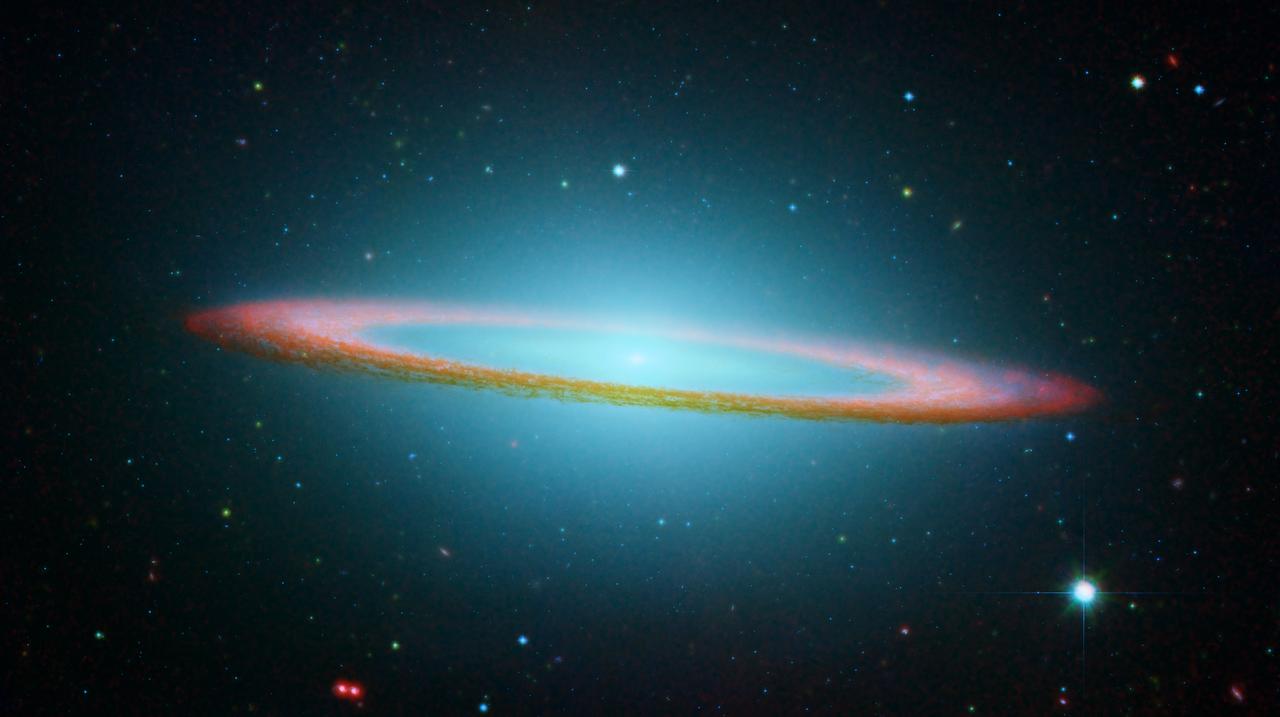
The razor sharp eye of the Hubble Space Telescope (HST) easily resolves the Sombrero galaxy, Messier 104 (M104). 50,000 light-years across, the galaxy is located 28 million light-years from Earth at the southern edge of the rich Virgo cluster of galaxies. Equivalent to 800 billion suns, Sombrero is one of the most massive objects in that group. The hallmark of Sombrero is a brilliant white, bulbous core encircled by the thick dust lanes comprising the spiral structure of the galaxy. As seen from Earth, the galaxy is tilted nearly edge-on. We view it from just six degrees north of its equatorial plane. This rich system of globular clusters is estimated to be nearly 2,000 in number which is 10 times as many as in our Milky Way galaxy. Similar to the clusters in the Milky Way, the ages range from 10-13 billion years old. Embedded in the bright core of M104 is a smaller disk, which is tilted relative to the large disk. The HST paired with the Spitzer infrared telescope, offers this striking composite capturing the magnificence of the Sombrero galaxy. In the Hubble view, the galaxy resembles a broad-rimmed Mexican hat, whereas in the Spitzer striking infrared view, the galaxy looks more like a bulls eye. The full view provided by Spitzer shows the disk is warped, which is often the result of a gravitational encounter with another galaxy, and clumpy areas spotted in the far edges of the ring indicate young star forming regions. Spitzer detected infrared emission not only from the ring, but from the center of the galaxy as well, where there is a huge black hole believed to be a billion times more massive than our Sun. The Marshall Space Flight Center (MSFC) had responsibility for design, development, and construction of the HST.

In the 19th century, astronomer V. M. Slipher first discovered a hat-like object that appeared to be rushing away from us at 700 miles per second. This enormous velocity offered some of the earliest clues that it was really another galaxy, and that the universe was expanding in all directions. The trained razor sharp eye of the Hubble Space Telescope (HST) easily resolves this Sombrero galaxy, Messier 104 (M104). The galaxy is 50,000 light-years across and is located 28 million light-years from Earth at the southern edge of the rich Virgo cluster of galaxies. Equivalent to 800 billion suns, Sombrero is one of the most massive objects in that group. The hallmark of Sombrero is a brilliant white, bulbous core encircled by the thick dust lanes comprising the spiral structure of the galaxy. As seen from Earth, the galaxy is tilted nearly edge-on. We view it from just six degrees north of its equatorial plane. At a relatively bright magnitude of +8, M104 is just beyond the limit of naked-eye visibility and is easily seen through small telescopes. This rich system of globular clusters are estimated to be nearly 2,000 in number which is 10 times as many as in our Milky Way galaxy. The ages of the clusters are similar to the clusters in the Milky Way, ranging from 10-13 billion years old. Embedded in the bright core of M104 is a smaller disk, which is tilted relative to the large disk. X-ray emission suggests that there is material falling into the compact core, where a 1-billion-solar-mass black hole resides. The Marshall Space Flight Center (MSFC) had responsibility for design, development, and construction of the HST.
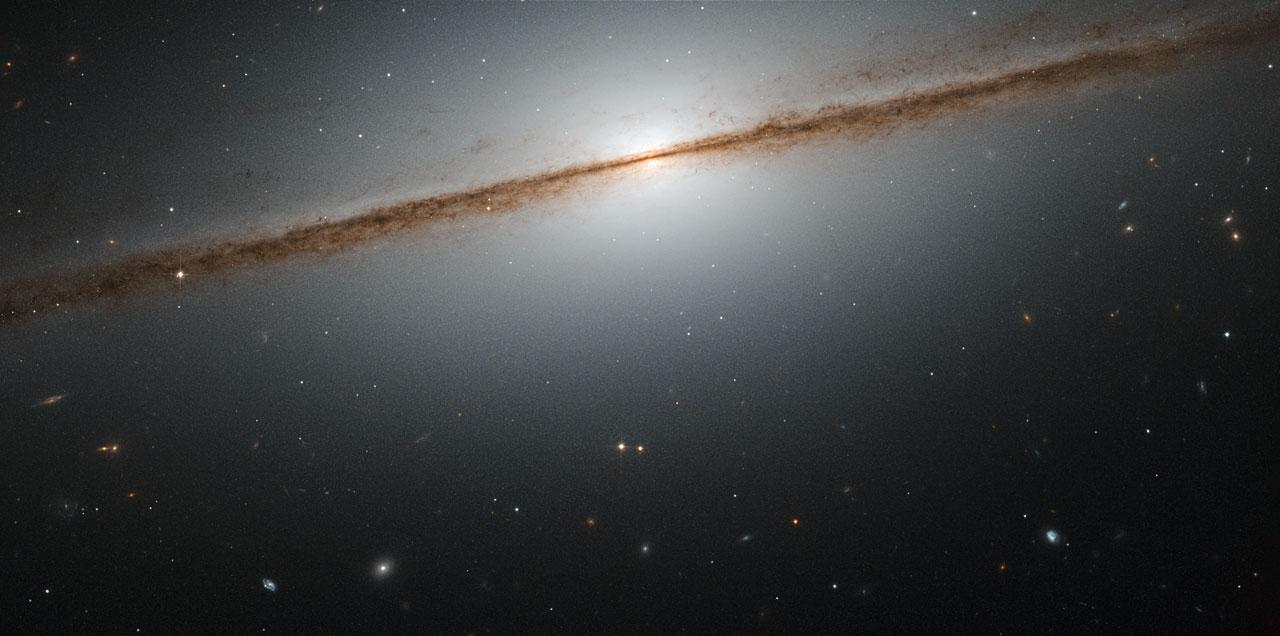
Galaxies can take many shapes and be oriented any way relative to us in the sky. This can make it hard to figure out their actual morphology, as a galaxy can look very different from different viewpoints. A special case is when we are lucky enough to observe a spiral galaxy directly from its edge, providing us with a spectacular view like the one seen in this picture of the week. This is NGC 7814, also known as the “Little Sombrero.” Its larger namesake, the Sombrero Galaxy, is another stunning example of an edge-on galaxy — in fact, the “Little Sombrero” is about the same size as its bright namesake at about 60,000 light-years across, but as it lies farther away, and so appears smaller in the sky. NGC 7814 has a bright central bulge and a bright halo of glowing gas extending outwards into space. The dusty spiral arms appear as dark streaks. They consist of dusty material that absorbs and blocks light from the galactic center behind it. The field of view of this NASA/ESA Hubble Space Telescope image would be very impressive even without NGC 7814 in front; nearly all the objects seen in this image are galaxies as well. Credit: ESA/Hubble & NASA Acknowledgement: Josh Barrington <b><a href="http://www.nasa.gov/audience/formedia/features/MP_Photo_Guidelines.html" rel="nofollow">NASA image use policy.</a></b> <b><a href="http://www.nasa.gov/centers/goddard/home/index.html" rel="nofollow">NASA Goddard Space Flight Center</a></b> enables NASA’s mission through four scientific endeavors: Earth Science, Heliophysics, Solar System Exploration, and Astrophysics. Goddard plays a leading role in NASA’s accomplishments by contributing compelling scientific knowledge to advance the Agency’s mission. <b>Follow us on <a href="http://twitter.com/NASAGoddardPix" rel="nofollow">Twitter</a></b> <b>Like us on <a href="http://www.facebook.com/pages/Greenbelt-MD/NASA-Goddard/395013845897?ref=tsd" rel="nofollow">Facebook</a></b> <b>Find us on <a href="http://instagram.com/nasagoddard?vm=grid" rel="nofollow">Instagram</a></b>

Lying at the southern edge of the rich Virgo cluster of galaxies, Messier 104, also called the Sombrero galaxy, is one of the most famous objects in the sky in this image from NASA Hubble Space Telescope.
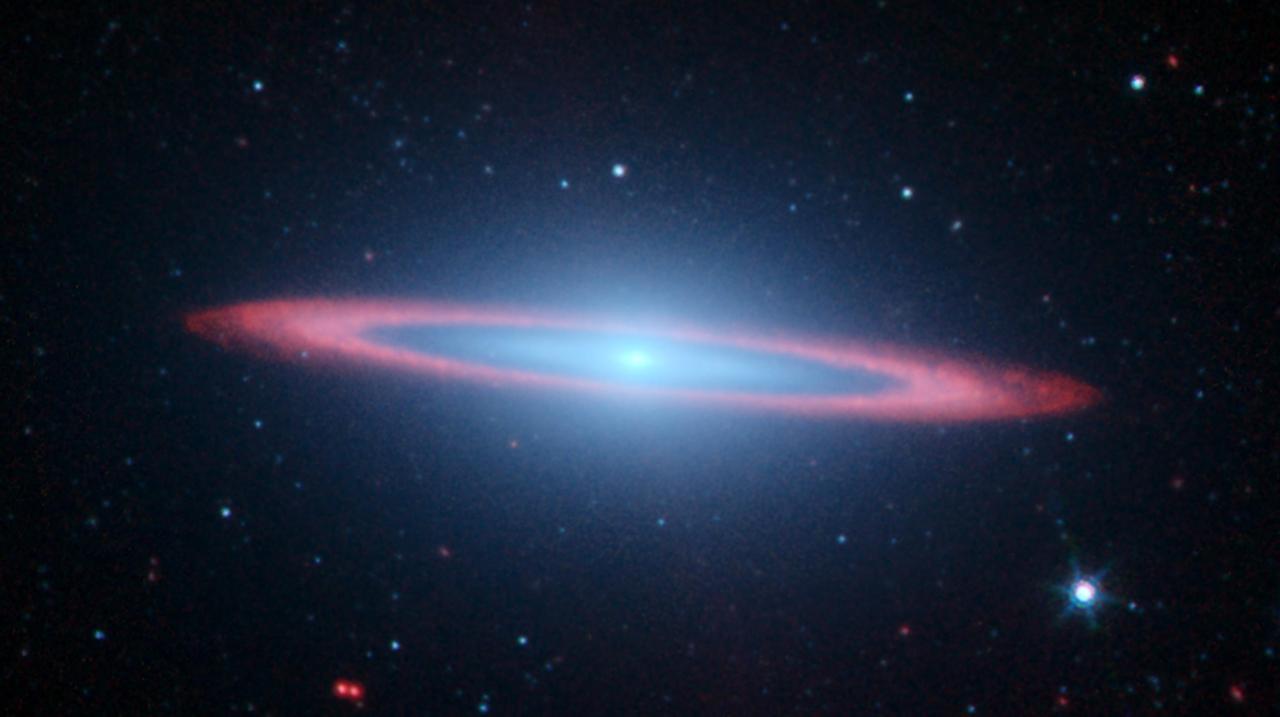
NASA's Spitzer Space Telescope set its infrared eyes on one of the most famous objects in the sky, Messier 104, also called the Sombrero galaxy. In this striking infrared picture, Spitzer sees an exciting new view of a galaxy that in visible light has been likened to a "sombrero," but here looks more like a "bulls-eye." Recent observations using Spitzer's infrared array camera uncovered the bright, smooth ring of dust circling the galaxy, seen in red. In visible light, because this galaxy is seen nearly edge-on, only the near rim of dust can be clearly seen in silhouette. Spitzer's full view shows the disk is warped, which is often the result of a gravitational encounter with another galaxy, and clumpy areas spotted in the far edges of the ring indicate young star-forming regions. Spitzer's infrared view of the starlight from this galaxy, seen in blue, can pierce through obscuring murky dust that dominates in visible light. As a result, the full extent of the bulge of stars and an otherwise hidden disk of stars within the dust ring are easily seen. The Sombrero galaxy is located some 28 million light years away. Viewed from Earth, it is just six degrees south of its equatorial plane. Spitzer detected infrared emission not only from the ring, but from the center of the galaxy too, where there is a huge black hole, believed to be a billion times more massive than our Sun. This picture is composed of four images taken at 3.6 (blue), 4.5 (green), 5.8 (orange), and 8.0 (red) microns. The contribution from starlight (measured at 3.6 microns) has been subtracted from the 5.8 and 8-micron images to enhance the visibility of the dust features. http://photojournal.jpl.nasa.gov/catalog/PIA07899
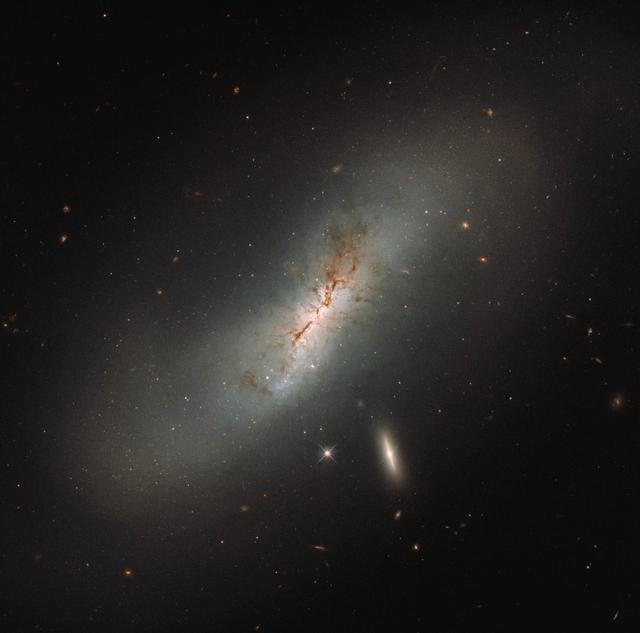
Some astronomical objects have endearing or quirky nicknames, inspired by mythology or their own appearance. Take, for example, the constellation of Orion (The Hunter), the Sombrero Galaxy, the Horsehead Nebula, or even the Milky Way. However, the vast majority of cosmic objects appear in astronomical catalogs and are given rather less poetic names based on the order of their discovery. Two galaxies are clearly visible in this Hubble image, the larger of which is NGC 4424. This galaxy is cataloged in the New General Catalog of Nebulae and Clusters of Stars (NGC), which was compiled in 1888. The NGC is one of the largest astronomical catalogs, which is why so many Hubble Pictures of the Week feature NGC objects. In total there are 7,840 entries in the catalog and they are also generally the larger, brighter, and more eye-catching objects in the night sky, and hence the ones more easily spotted by early stargazers. The smaller, flatter, bright galaxy sitting just below NGC 4424 is named LEDA 213994. The Lyon-Meudon Extragalactic Database (LEDA) is far more modern than the NGC and contains millions of objects. Many NGC objects still go by their initial names simply because they were christened within the NGC first. However, since astronomers can't resist a good acronym and “Leda” is more appealing than “the LMED,” the smaller galaxy is called "Leda." Leda was a princess in Ancient Greek mythology. Image credit: ESA/Hubble & NASA <b><a href="http://www.nasa.gov/audience/formedia/features/MP_Photo_Guidelines.html" rel="nofollow">NASA image use policy.</a></b> <b><a href="http://www.nasa.gov/centers/goddard/home/index.html" rel="nofollow">NASA Goddard Space Flight Center</a></b> enables NASA’s mission through four scientific endeavors: Earth Science, Heliophysics, Solar System Exploration, and Astrophysics. Goddard plays a leading role in NASA’s accomplishments by contributing compelling scientific knowledge to advance the Agency’s mission. <b>Follow us on <a href="http://twitter.com/NASAGoddardPix" rel="nofollow">Twitter</a></b> <b>Like us on <a href="http://www.facebook.com/pages/Greenbelt-MD/NASA-Goddard/395013845897?ref=tsd" rel="nofollow">Facebook</a></b> <b>Find us on <a href="http://instagrid.me/nasagoddard/?vm=grid" rel="nofollow">Instagram</a></b>