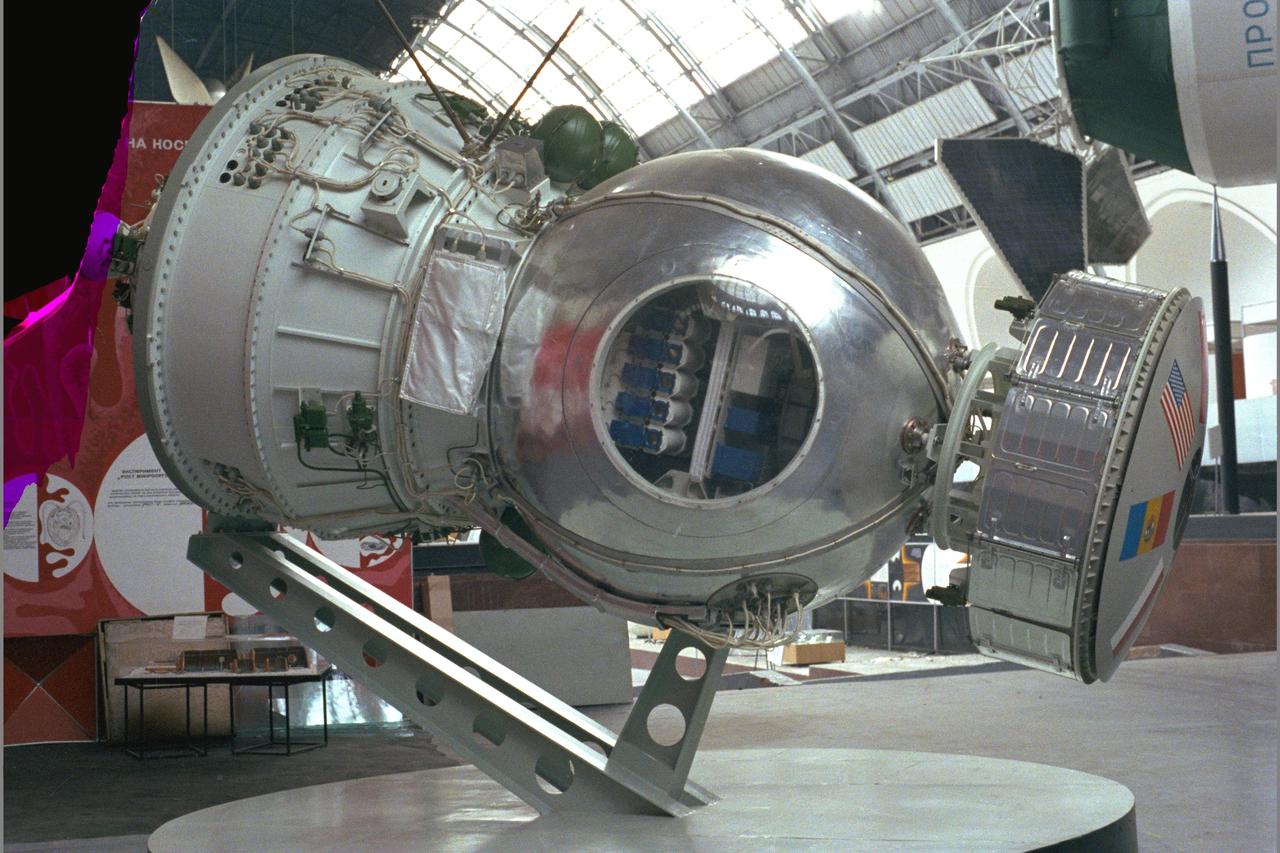
Soviet COSMOS unmanned biosatellite
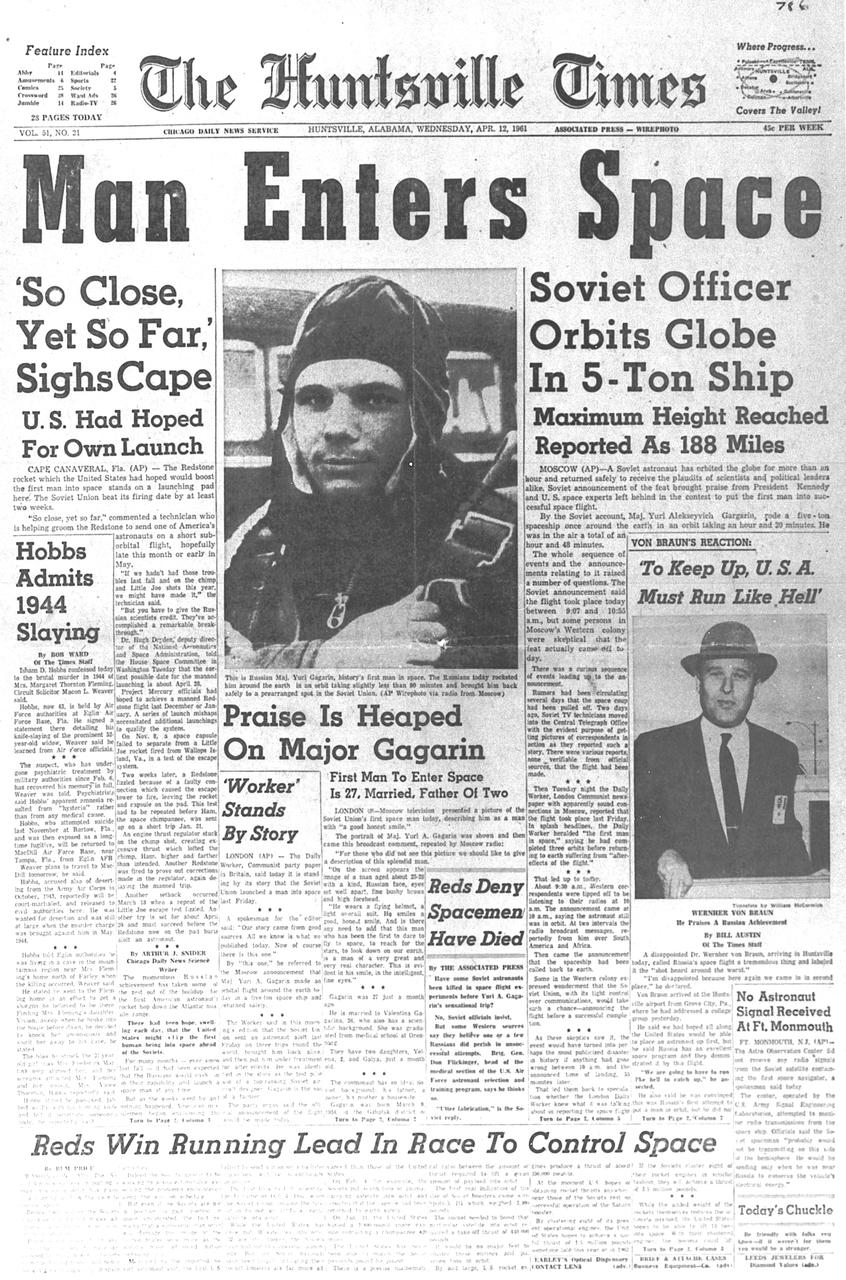
The urgency and importance of the Marshall Space Flight Center's mission in the 1960s was apparent from the begirning. It became even more apparent on April 12, 1962, when the Soviet cosmonaut, Yuri Gagarin, became the first man in space.
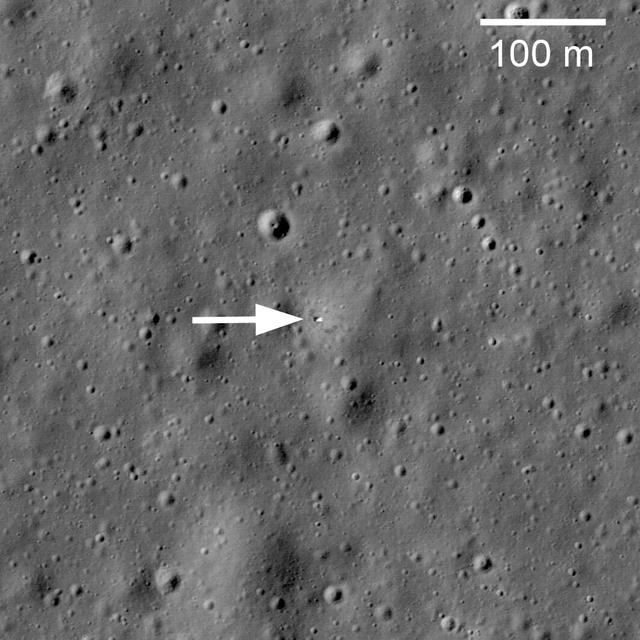
This image taken by NASA Lunar Reconnaissance Orbiter shows Soviet robotic lander Luna 17 still sitting on Mare Imbrium where it delivered the Lunokhod 1 Rover in November 1970.
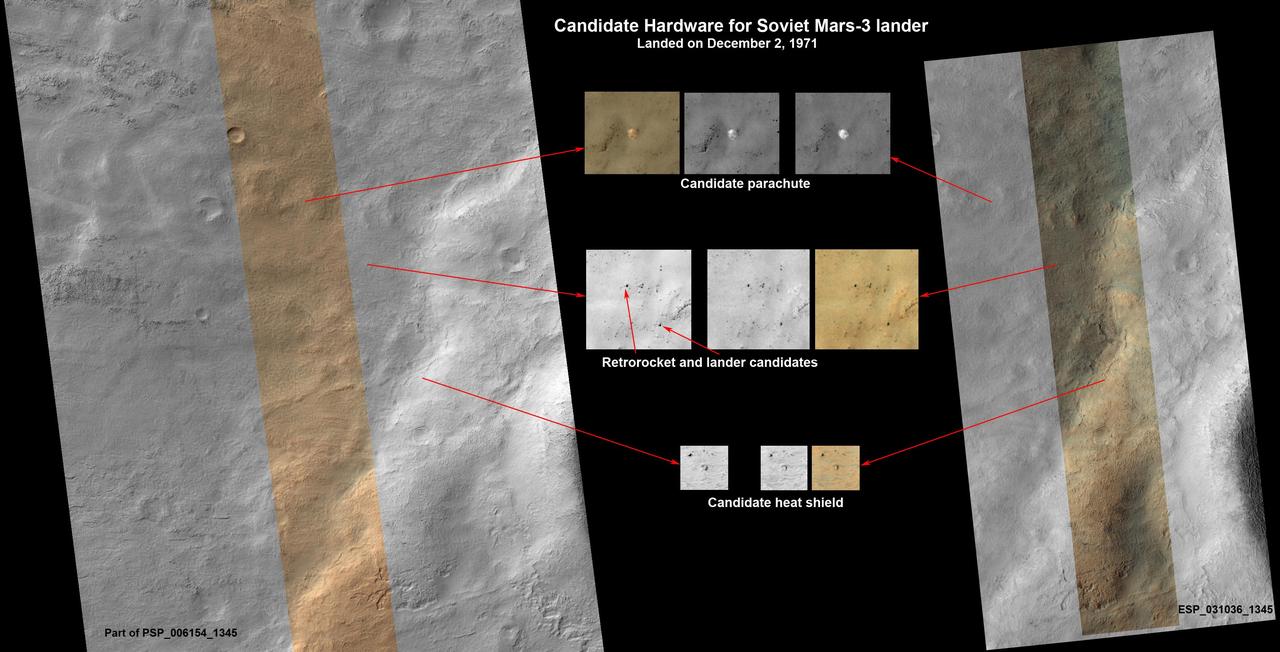
This set of images shows what might be hardware from the Soviet Union 1971 Mars 3 lander, seen in a pair of images from the High Resolution Imaging Science Experiment HiRISE camera on NASA Mars Reconnaissance Orbiter.
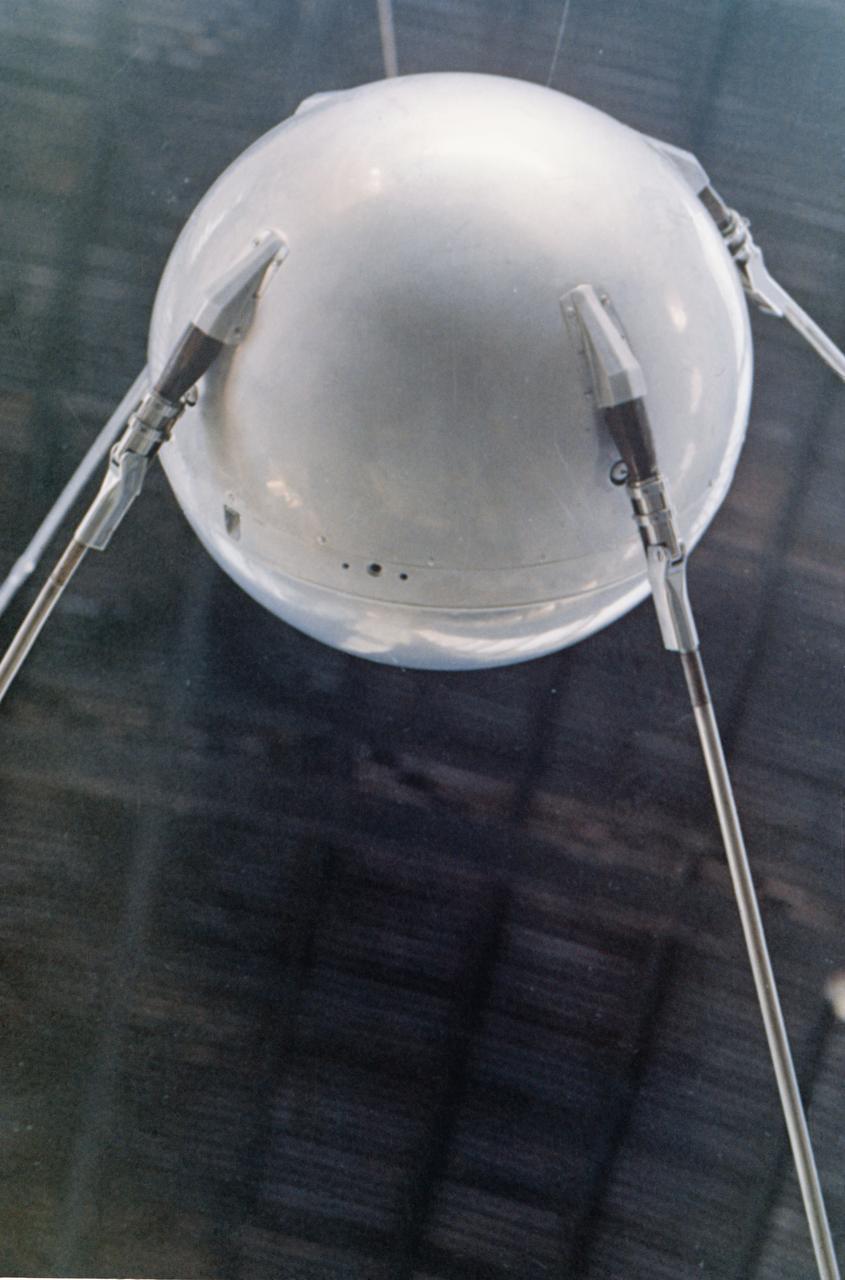
S76-22361 (June 1975) --- A close-up view of the full-scale mockup of the Sputnik 1 spacecraft on display at the Soviet Pavilion at the Paris Air Show, France. Photo credit: NASA or National Aeronautics and Space Administration
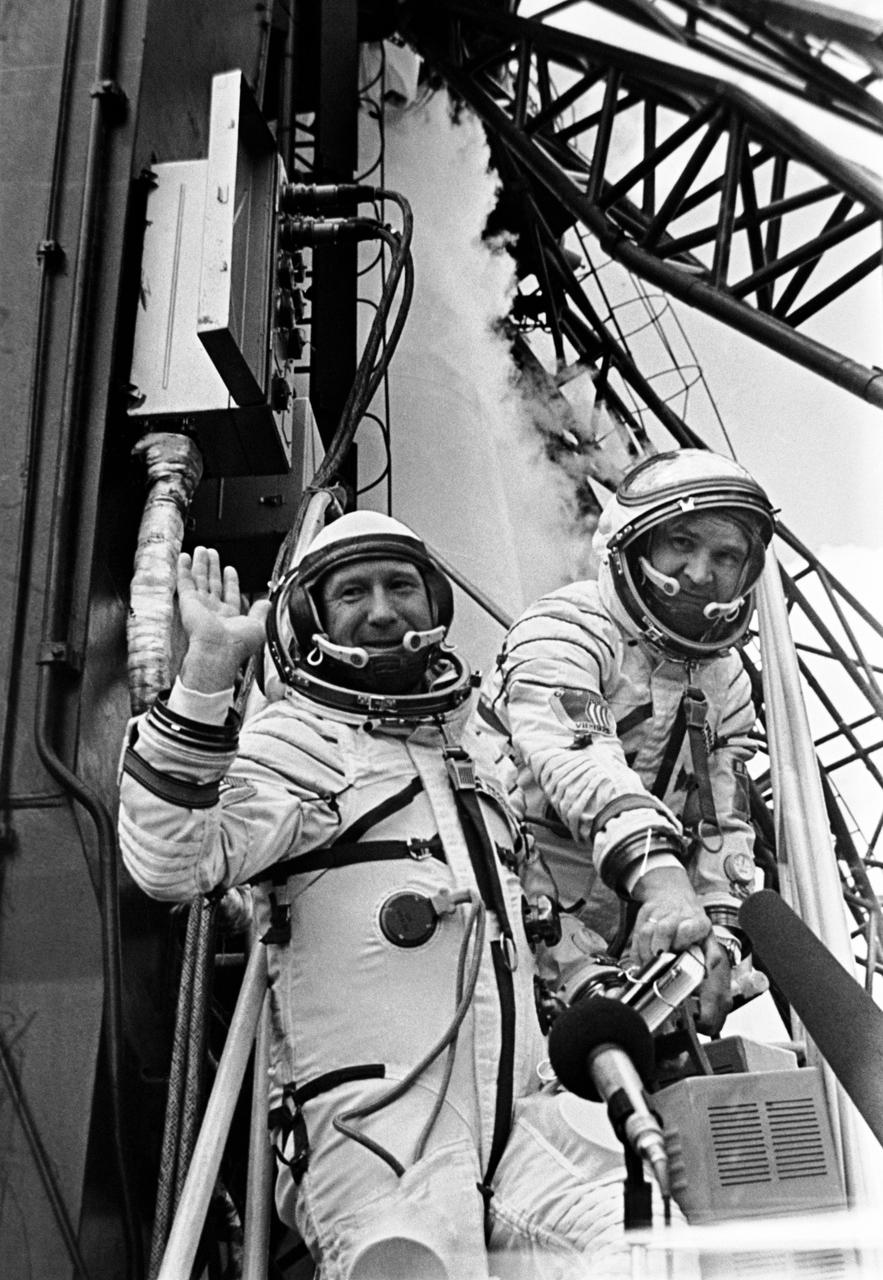
S75-32343 (15 July 1975) --- The two Soviet crewmen for the Apollo-Soyuz Test Project mission are photographed at the launch pad at the Baikonur Cosmodrome in Kazakhstan on the morning of the Soviet ASTP liftoff on July 15, 1975. They are cosmonauts Aleksey A. Leonov (left), commander; and Valeriy N. Kubasov, flight engineer. Leonov is waving to well-wishers at the launch pad. The Soviet ASTP launch preceded the American ASTP Apollo liftoff by seven and one-half hours. The American and Soviet spacecraft were docked in Earth orbit for a total of about 47 hours on July 17-19, 1975. PHOTO COURTESY: USSR ACADEMY OF SCIENCES
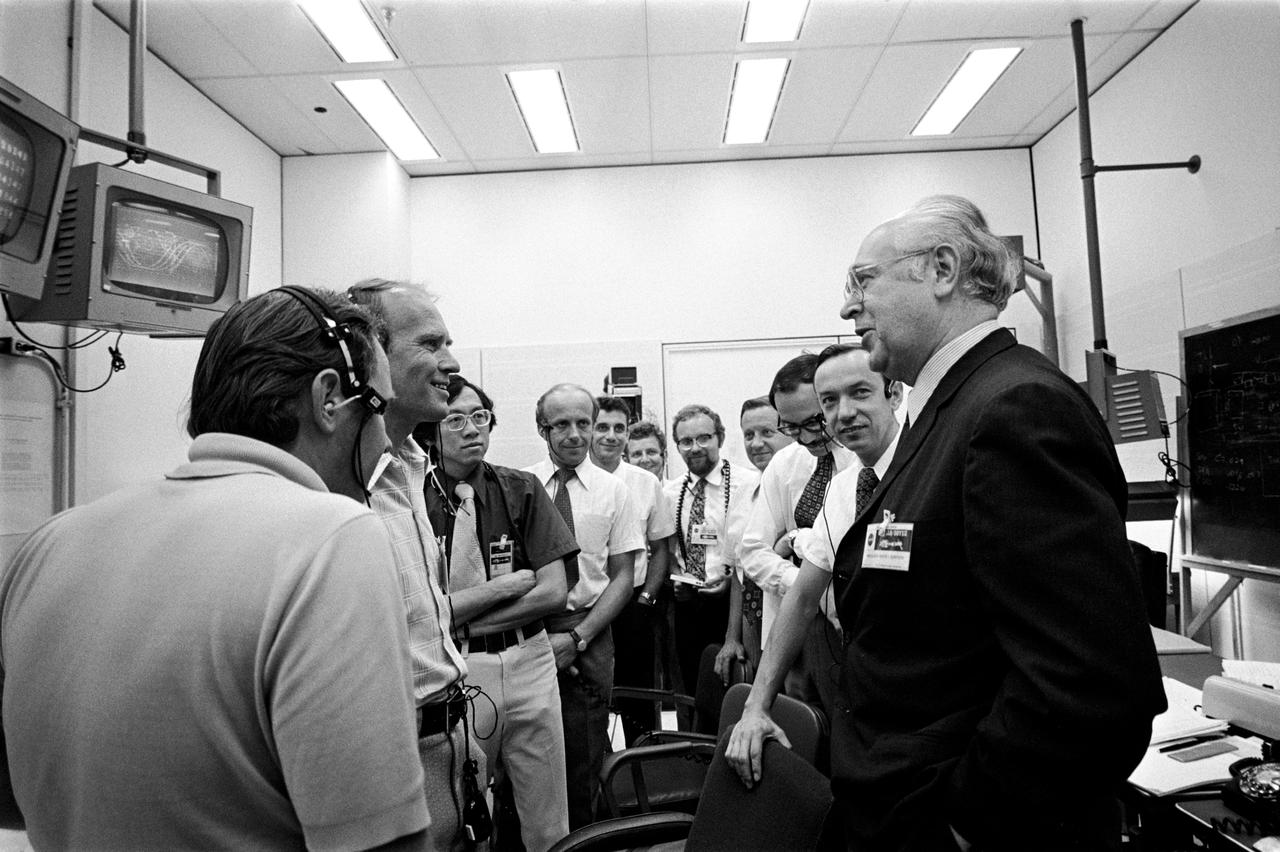
S75-28534 (17 July 1975) --- Anatoliy Dobrynin (right), Soviet Union ambassador to the United States, visits with a group of USSR ASTP flight controllers in the Mission Control Center during a tour of NASA's Johnson Space Center (JSC). Dobrynin was at JSC on the day the Soviet Soyuz and the American Apollo spacecraft docked in Earth orbit. The group also includes a couple of American ASTP flight controllers.
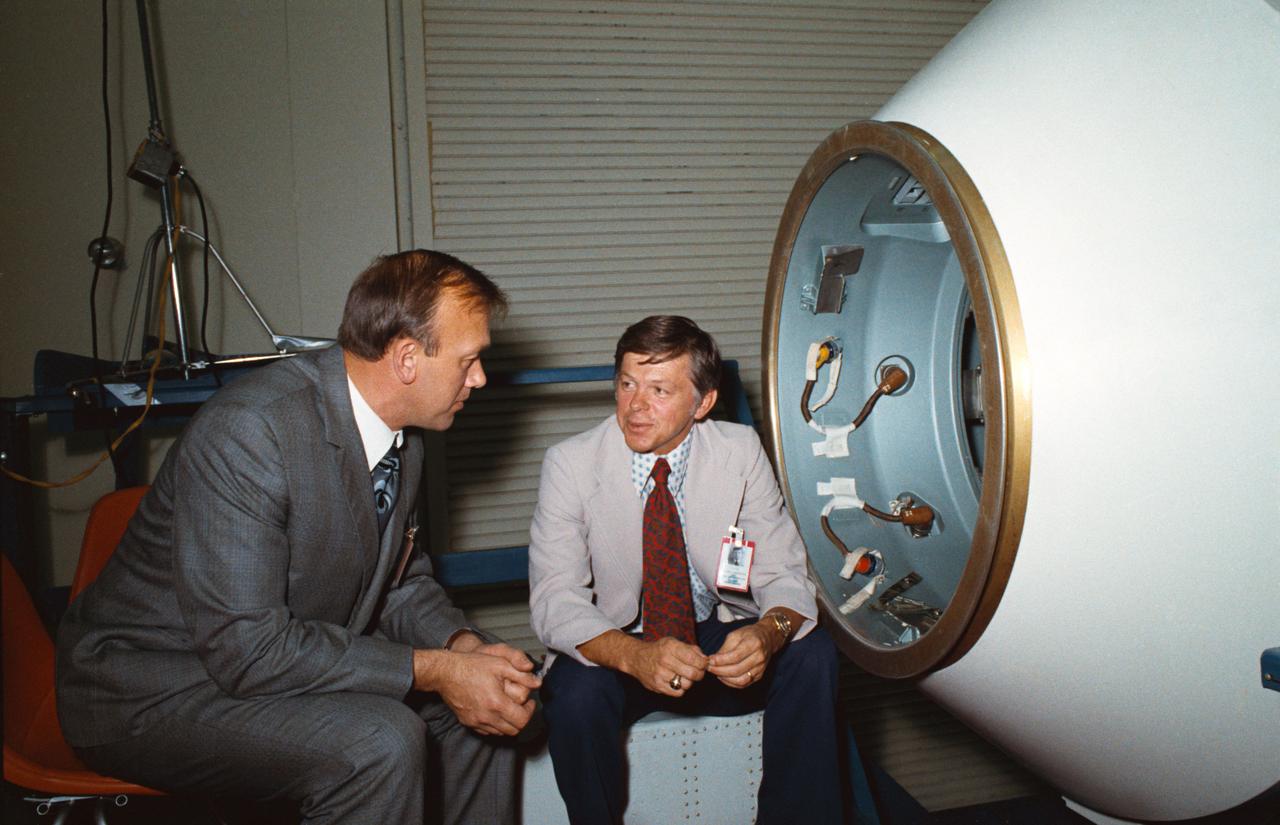
S74-32481 (November 1974) --- These two men are flight directors for the joint U.S.-USSR Apollo-Soyuz Test Project mission scheduled for July 1975. Cosmonaut Aleksey A. Yeliseyev (left) is the Soviet ASTP senior flight director; M.P. Frank is the American ASTP senior flight director. They are seated beside a Docking Module training mock-up in Building 35 at the Johnson Space Center. Cosmonaut Yeliseyev was head of a delegation of USSR flight controllers who were at JSC for two weeks of ASTP training.
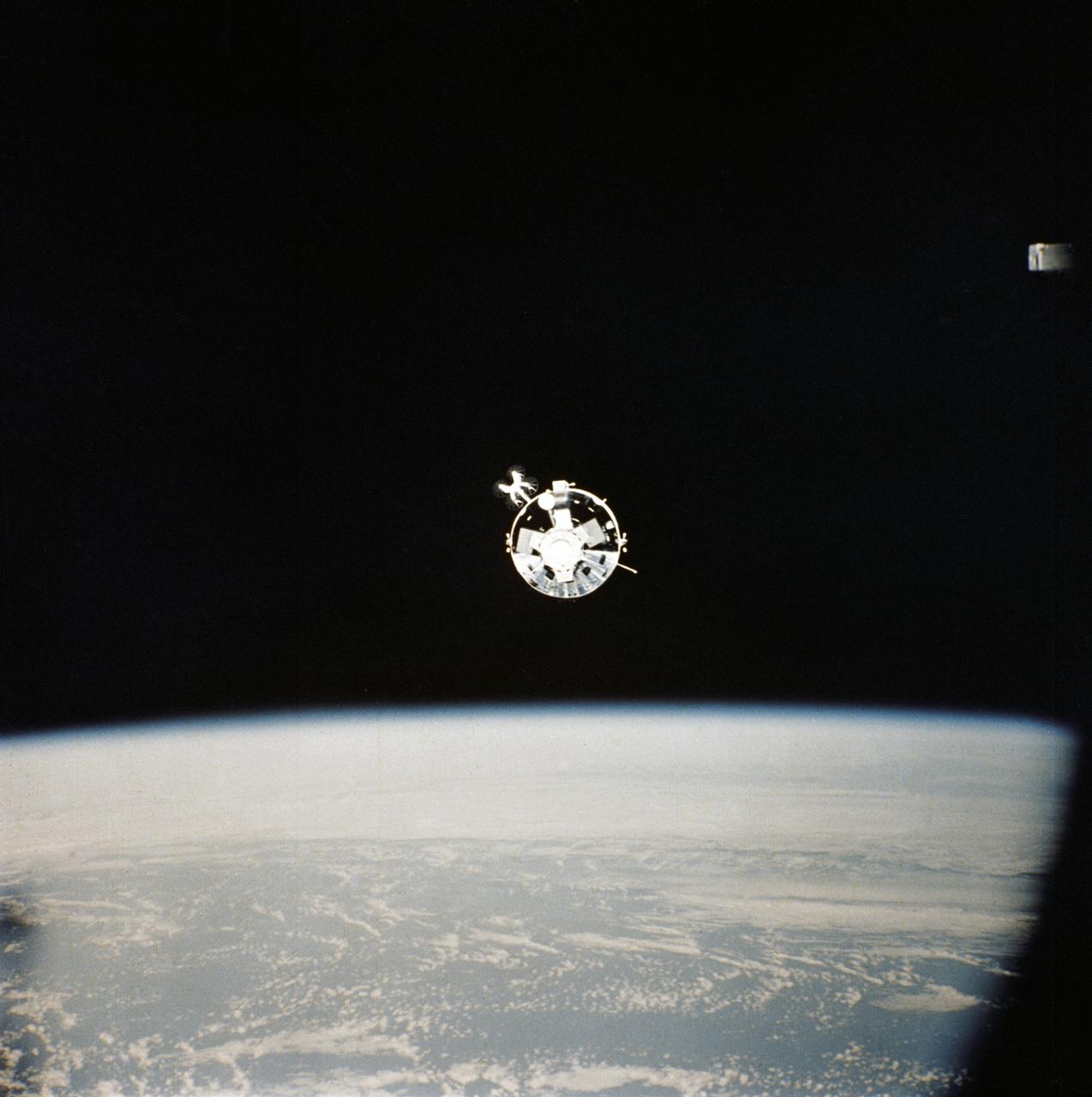
AST-32-2675 (17-19 July 1975) --- The American Apollo spacecraft as seen in Earth orbit from the Soviet Soyuz spacecraft during the joint U.S.-USSR Apollo-Soyuz Test Project mission. The Command/Service Module and Docking Module are contrasted against a black-sky background. This is a "head on" view of the Apollo. The horizon of Earth is below. This picture was furnished by the USSR in an exchange of photography taken during the ASTP flight. The American and Soviet spacecraft were joined together in space for approximately 47 hours on July 17-18-19, 1975. Note the docking mechanism on the Docking Module. PHOTO COURTESY: USSR ACADEMY OF SCIENCES
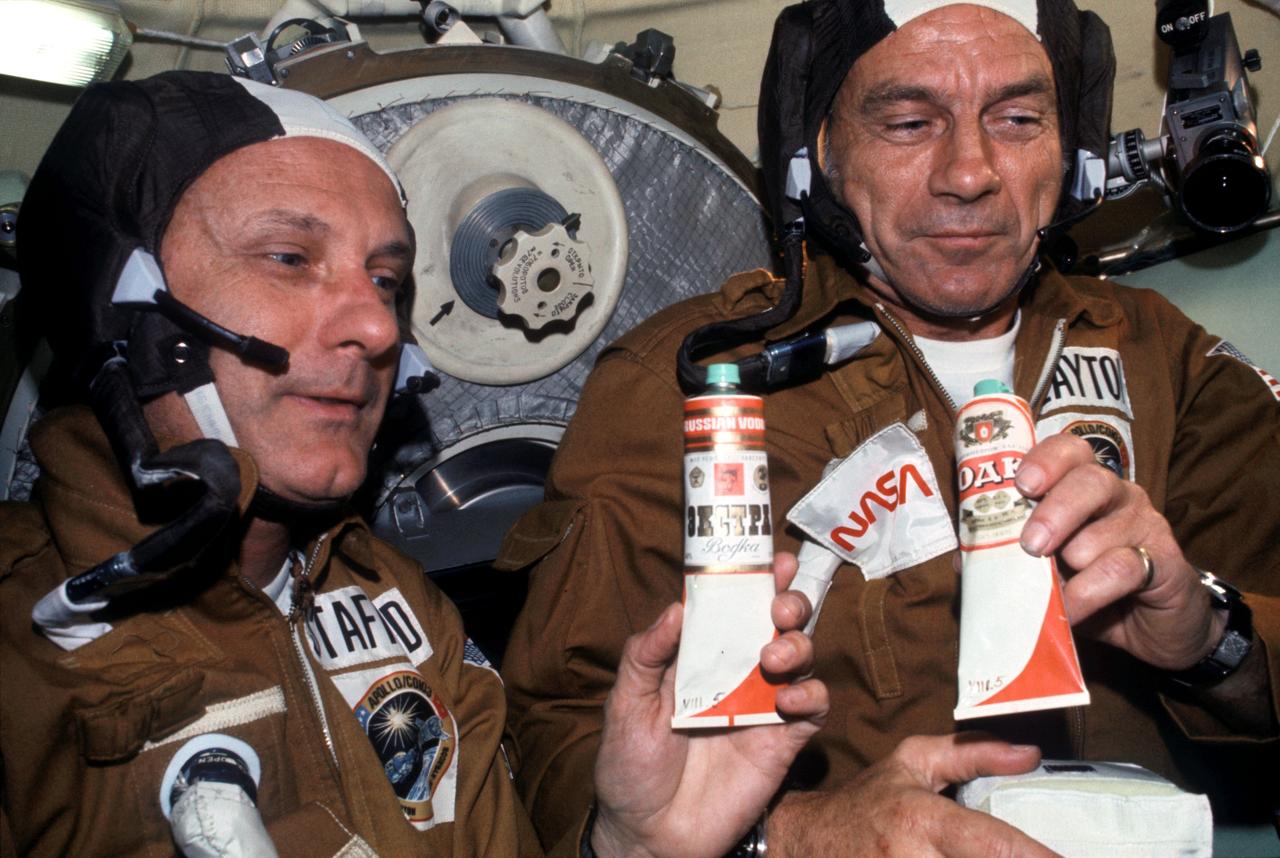
AST-03-175 (17-19 July 1975) --- Astronauts Thomas P. Stafford (left) and Donald K. Slayton hold containers of Soviet space food in the Soyuz Orbital Module during the joint U.S.-USSR Apollo-Soyuz Test Project docking mission in Earth orbit. The containers hold borsch (beet soup) over which vodka labels have been pasted. This was the crews' way of toasting each other.
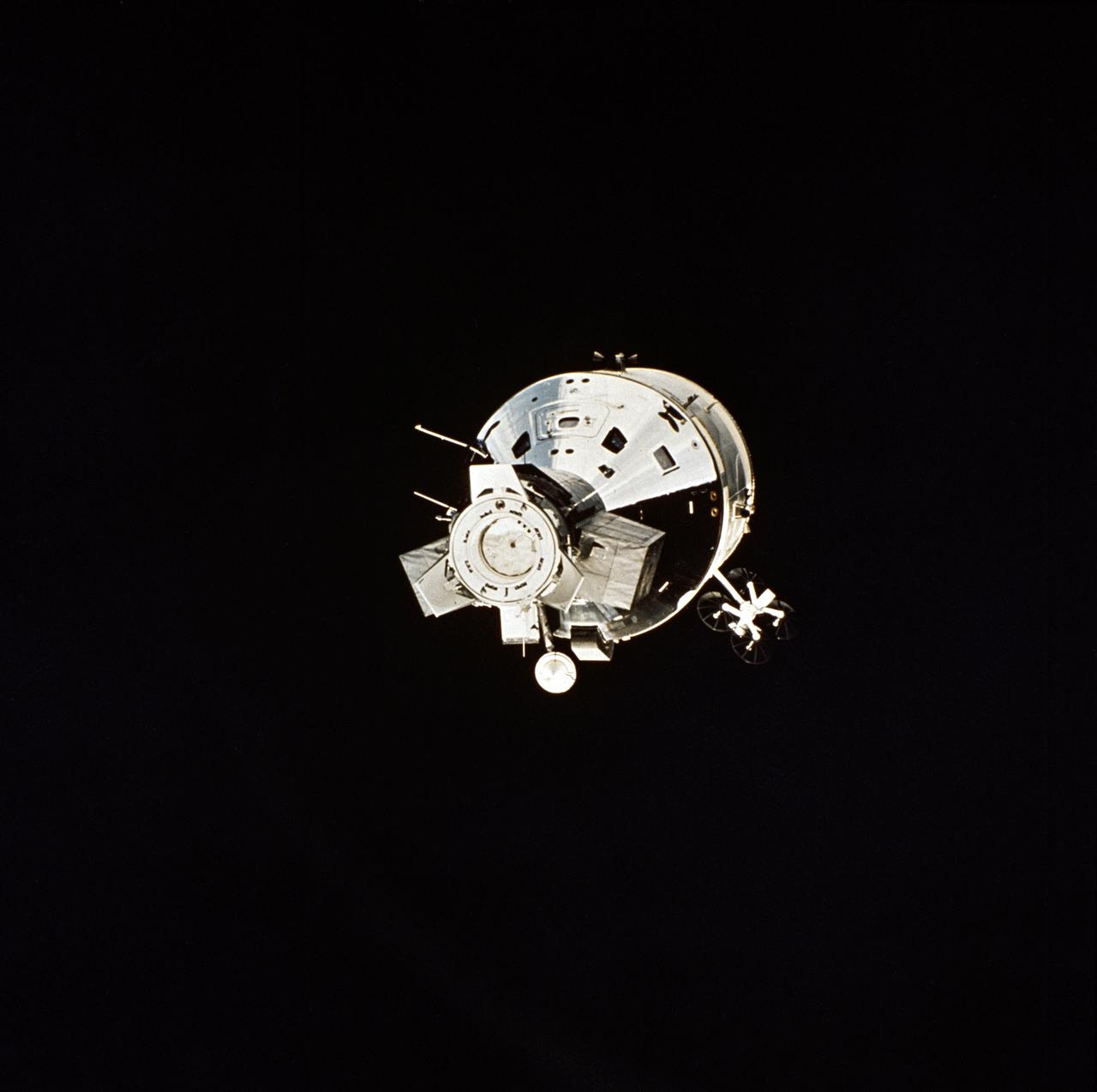
AST-32-2691 (17-19 July 1975) --- The American Apollo spacecraft as seen in Earth orbit from the Soviet Soyuz spacecraft during the joint U.S.-USSR Apollo-Soyuz Test Project mission. The Command/Service Module and Docking Module are contrasted against a black-sky background. This is a near "head on" view of the Apollo. This picture was furnished by the USSR in an exchange of photography taken during the ASTP flight. Note the docking mechanism and docking target on the Docking Module. The four dish-like reflectors of the unified S-band high-gain antenna protrude from the side of the Service Module. The American and Soviet spacecraft were joined together in space for approximately 47 hours on July 17-18-19, 1975. PHOTO COURTESY: USSR ACADEMY OF SCIENCES
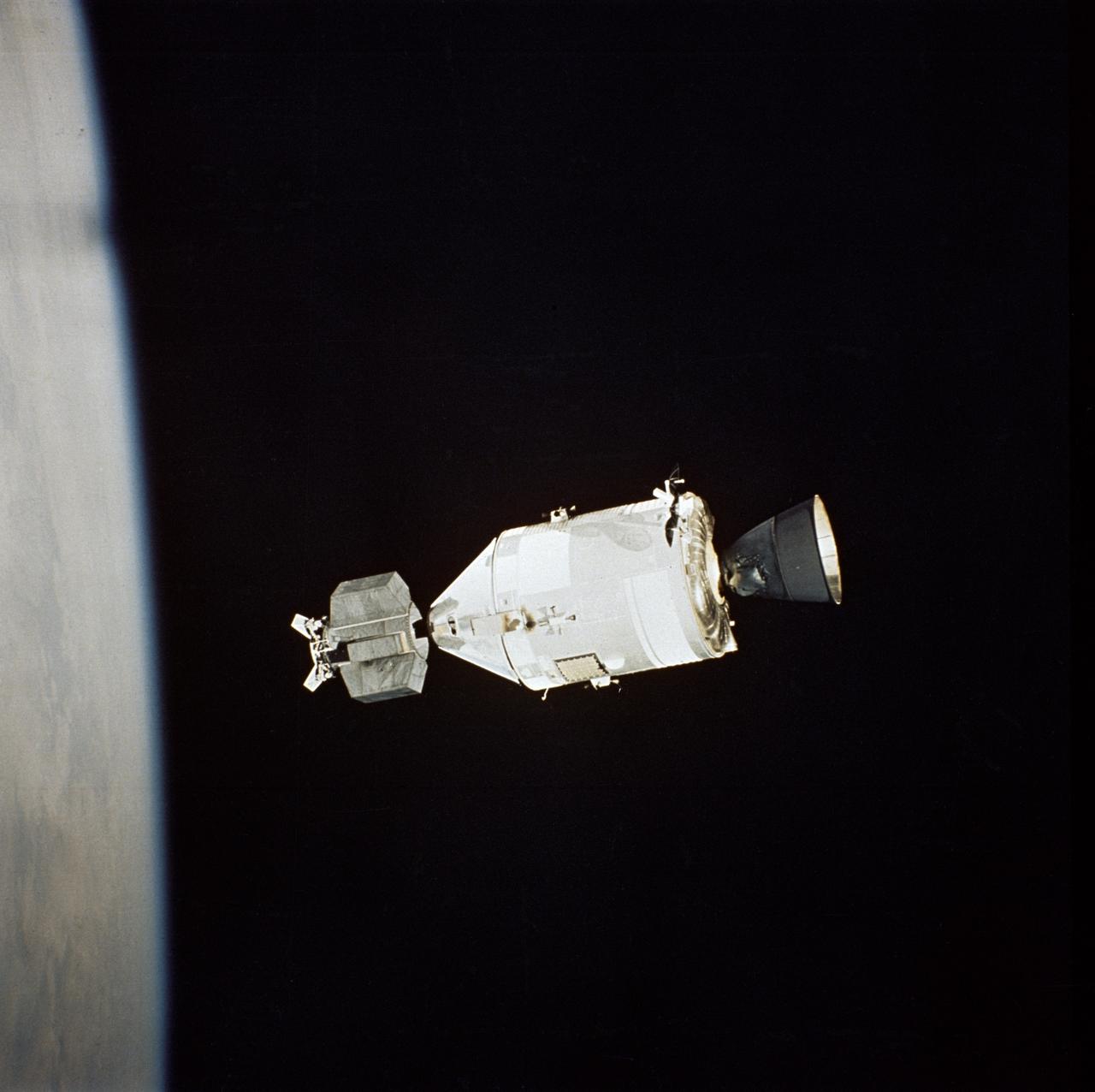
AST-32-2695 (17-19 July 1975) --- The American Apollo spacecraft as seen in Earth orbit from the Soviet Soyuz spacecraft during the joint U.S.-USSR Apollo-Soyuz Test Project mission. The Command/Service Module and Docking Module are contrasted against a black-sky background. The horizon of Earth is below. This picture was furnished by the USSR in an exchange of photography taken during the ASTP flight. The bell-shaped engine nozzle of the service propulsion system protrudes from the rear of the Service Module. Note the docking mechanism on the Docking Module. The American and Soviet spacecraft were joined together in space for approximately 47 hours on July 17-18-19, 1975. PHOTO COURTESY: USSR ACADEMY OF SCIENCES
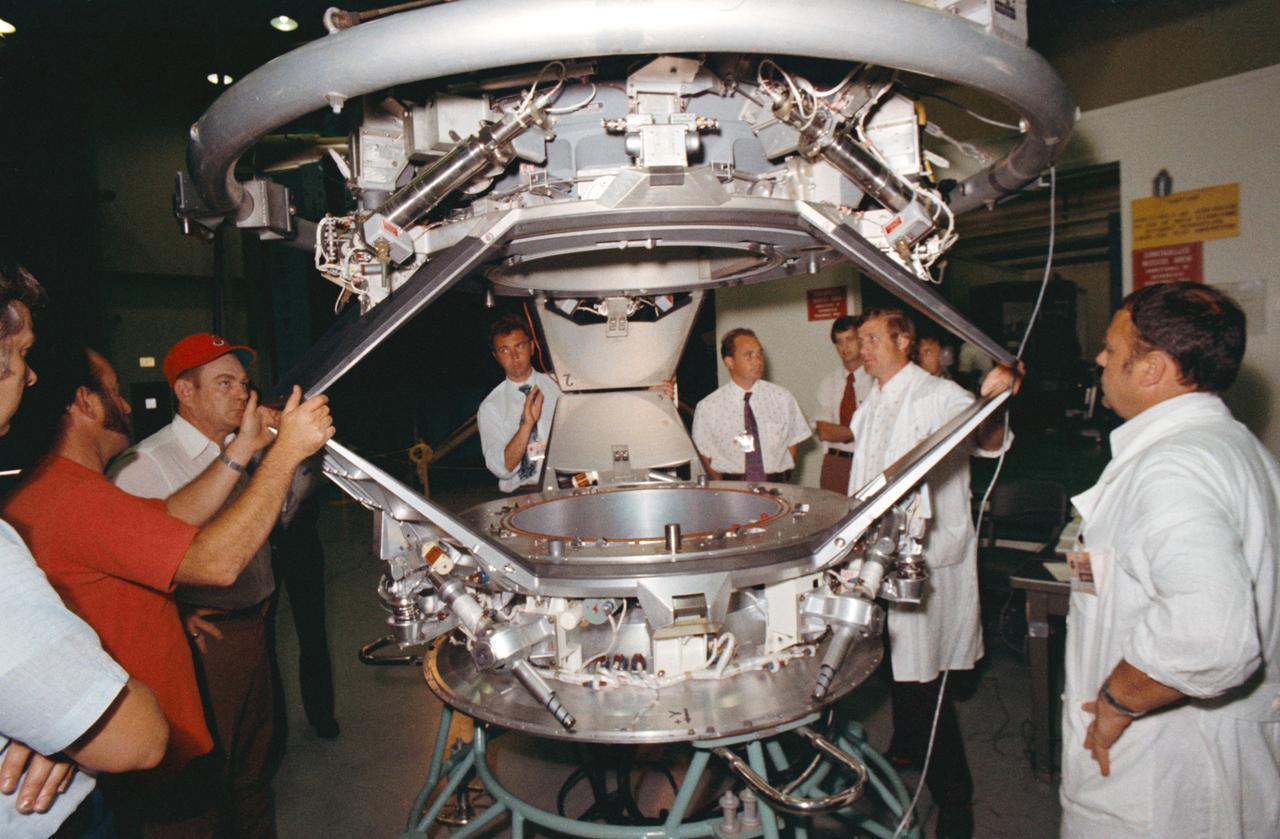
S74-25394 (10 July 1974) --- A group of American and Soviet engineers of the Apollo-Soyuz Test Project working group three examines an ASTP docking set-up following a docking mechanism fitness test conducted in Building 13 at the Johnson Space Center. Working Group No. 3 is concerned with ASTP docking problems and techniques. The joint U.S.-USSR ASTP docking mission in Earth orbit is scheduled for the summer of 1975. The Apollo docking mechanism is atop the Soyuz docking mechanism.
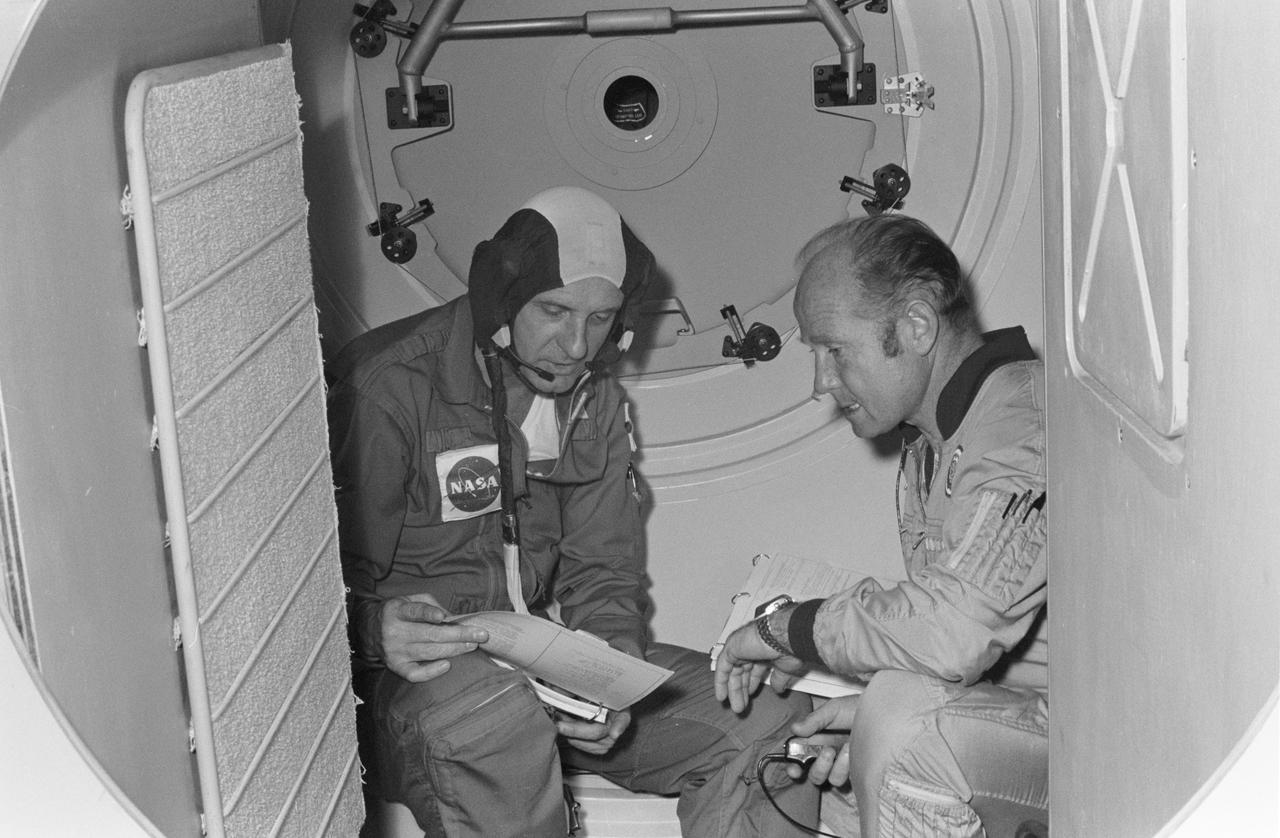
S74-29041 (September 1974) --- The commanders of the American astronaut and Soviet cosmonaut crews for the joint U.S.?USSR Apollo-Soyuz Test Project mission compare notes in a Soyuz spacecraft?s orbital module mock-up in Building 35 at the Johnson Space Center during a training and simulation exercise. They are Aleksey A. Leonov, right, and Thomas P. Stafford. The hatchway in the background leads to the Docking Module. The prime crewmen, along with backup crewmen, are training in both the U.S. and USSR for the joint mission scheduled for the summer of 1975.
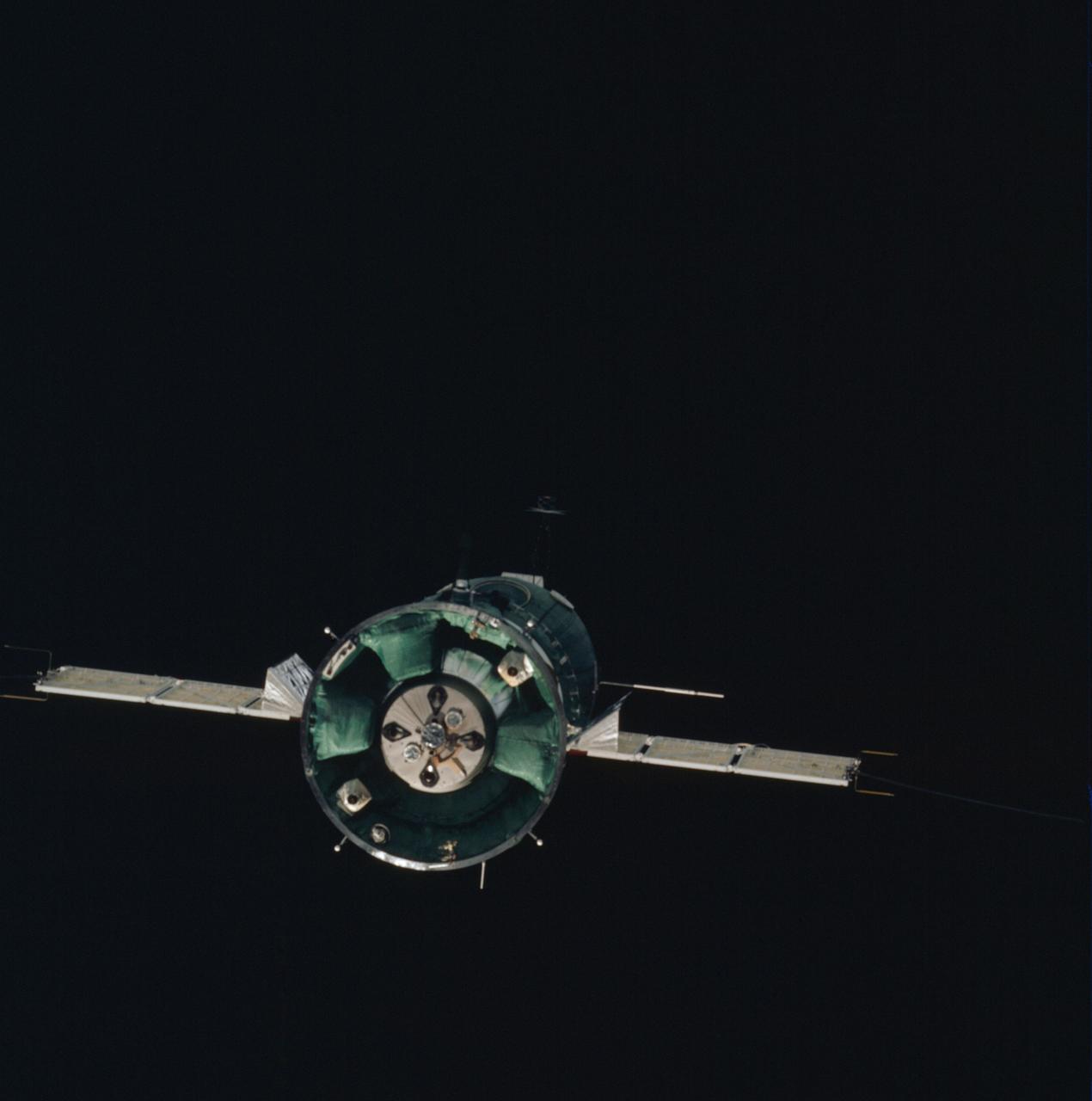
AST-01-053 (17-19 July 1975) --- The Soviet Soyuz spacecraft is contrasted against a black-sky background in this photograph taken in Earth orbit. This view is looking toward the aft end of the Soyuz. Two solar panels protrude out from the spacecraft's Instrument Assembly Module. The ASTP astronauts and cosmonauts visited each other's spacecraft while the Soyuz and Apollo were docked in Earth orbit for two days.
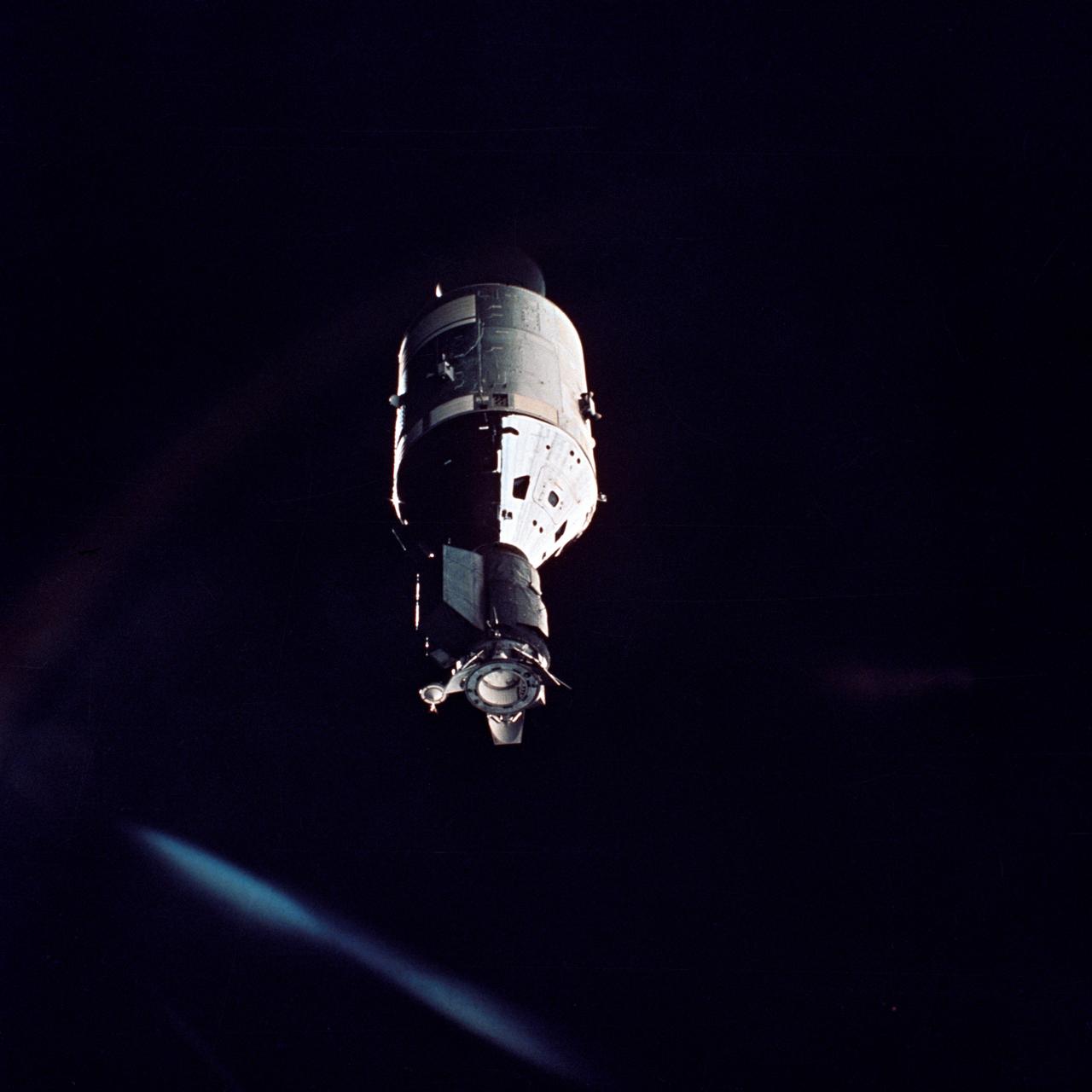
AST-32-2686 (17-19 July 1975) --- The American Apollo spacecraft as seen in Earth orbit from the Soviet Soyuz 19 spacecraft during the joint U.S.-USSR Apollo Soyuz Test Project (ASTP) mission. The Command and Service Module (CSM) and Docking Module (DM) are contrasted against a black-sky background. Light reflected in the camera streaks the image. Note the docking mechanism and docking target on the DM. On the left the bell-shaped engine nozzle of the service propulsion system protrudes from the rear of the Service Module (SM). The American and Soviet spacecraft were joined together in space for approximately 47 hours on July 17, 18, 19, 1975. This picture was furnished by the USSR in an exchange of photography taken during the ASTP flight. The Apollo crew consisted of astronauts Thomas P. Stafford, commander; Donald K. "Deke" Slayton, docking module pilot; and Vance D. Brand, command module pilot. The Soyuz 19 crew consisted of cosmonauts Aleksei A. Leonov, command pilot; and Valeri N. Kubasov, flight engineer.
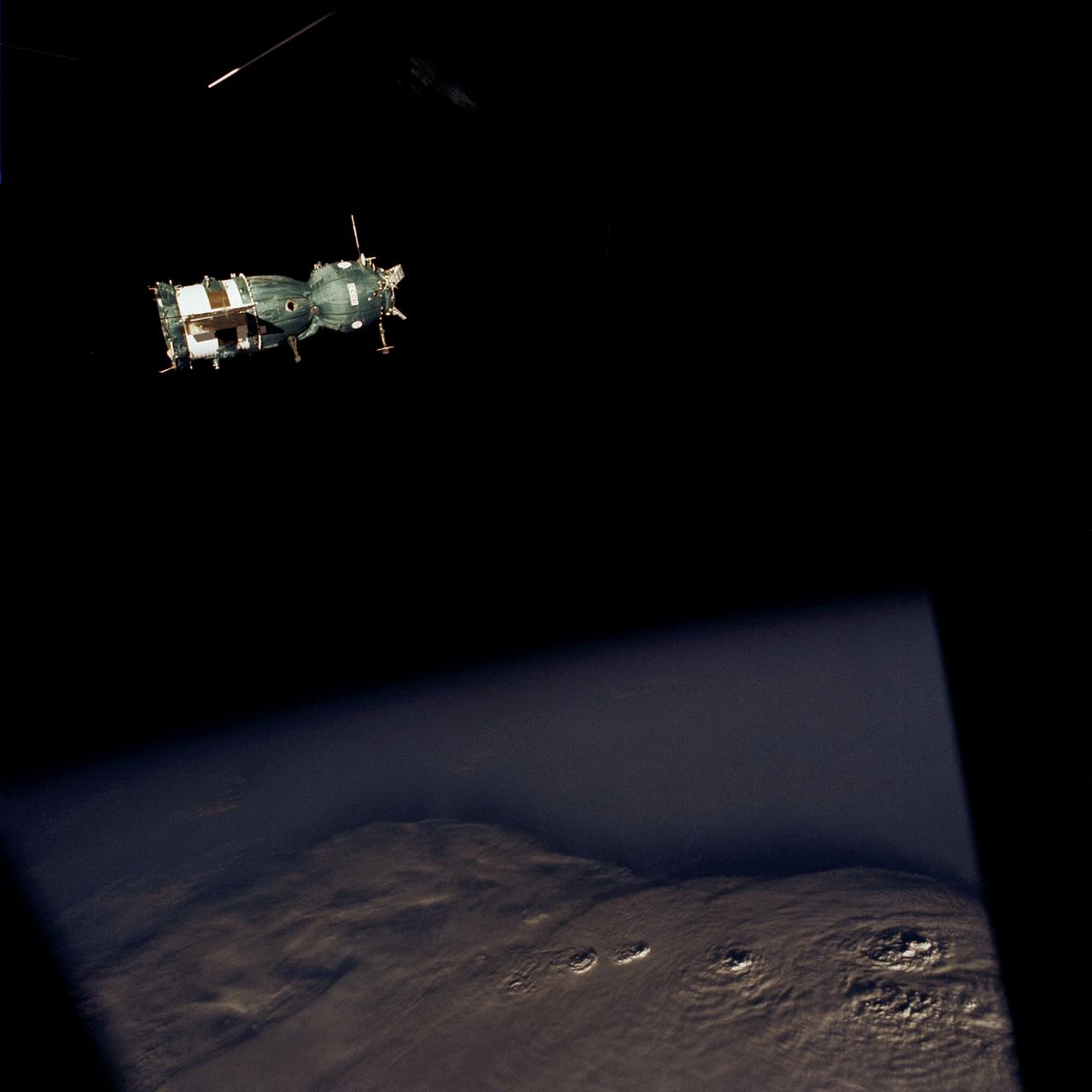
AST-02-096 (18 July 1975) --- This scene photograph from a rendezvous window of the American Apollo spacecraft in Earth orbit shows the Soviet Soyuz spacecraft contrasted against a black-sky background with a heavily cloud-covered Earth below. The three major components of the Soyuz are the spherical-shaped Orbital Module, the bell-shaped Descent Vehicle, the cylindrical-shaped Instrument Assembly Module. The docking system on the Orbital Module was specially designed to interface with the docking system on the Apollo's Docking Module. The ASTP astronauts and cosmonauts visited each other's spacecraft while the Soyuz and Apollo were docked in Earth orbit for two days.
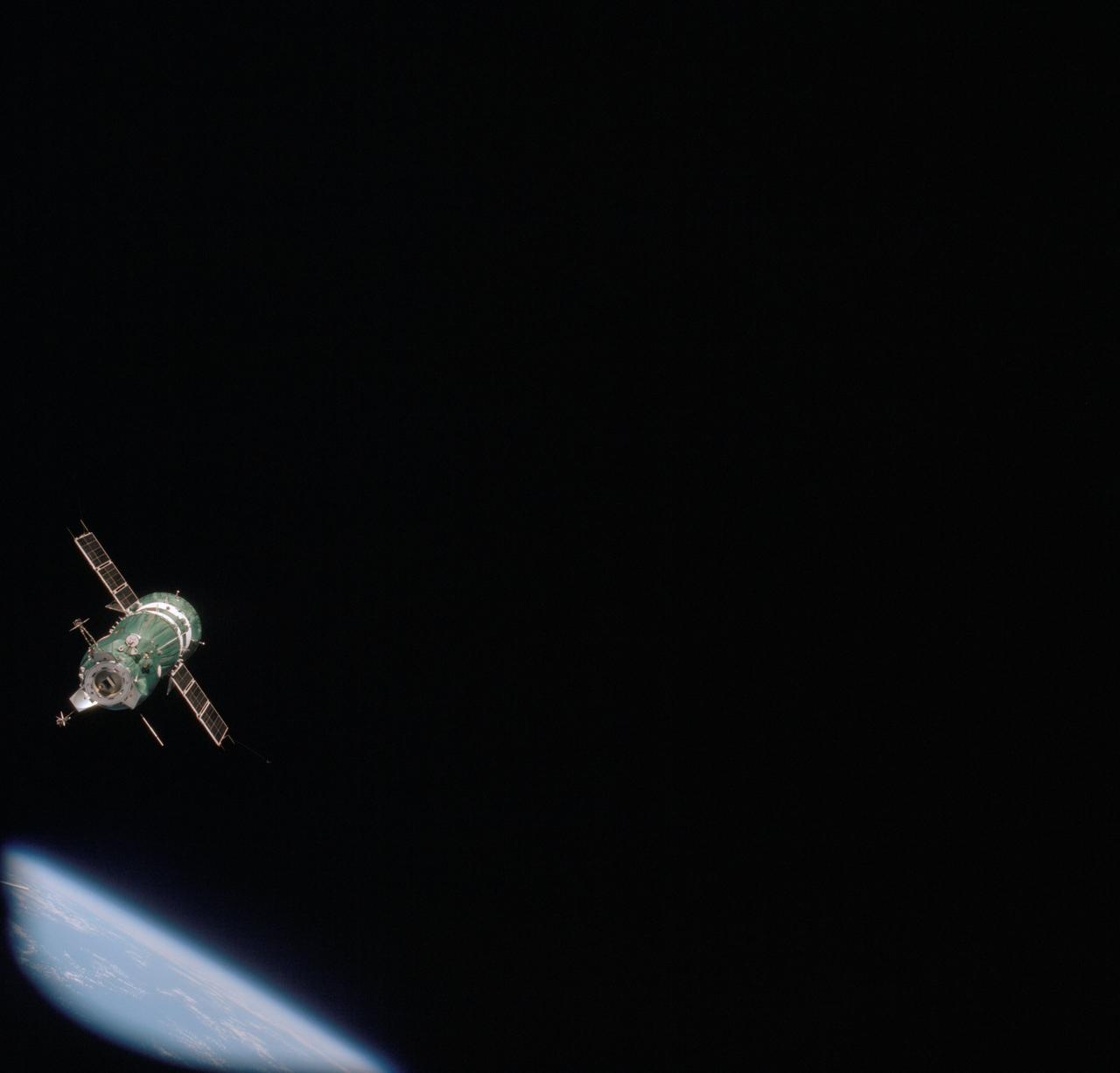
AST-09-572 (17-18 July 1975) --- The Soviet Soyuz 19 spacecraft is photographed from the American Apollo spacecraft during the joint U.S.-USSR Apollo-Soyuz Test Project (ASTP) docking mission in Earth orbit. Earth is visible in the lower left corner. This picture was taken with a 70mm camera. The Apollo crew consisted of astronauts Thomas P. Stafford, commander; Donald K. "Deke" Slayton, docking module pilot; and Vance D. Brand, command module pilot. The Soyuz 19 crew consisted of cosmonauts Aleksei A. Leonov, command pilot; and Valeri N. Kubasov, flight engineer.
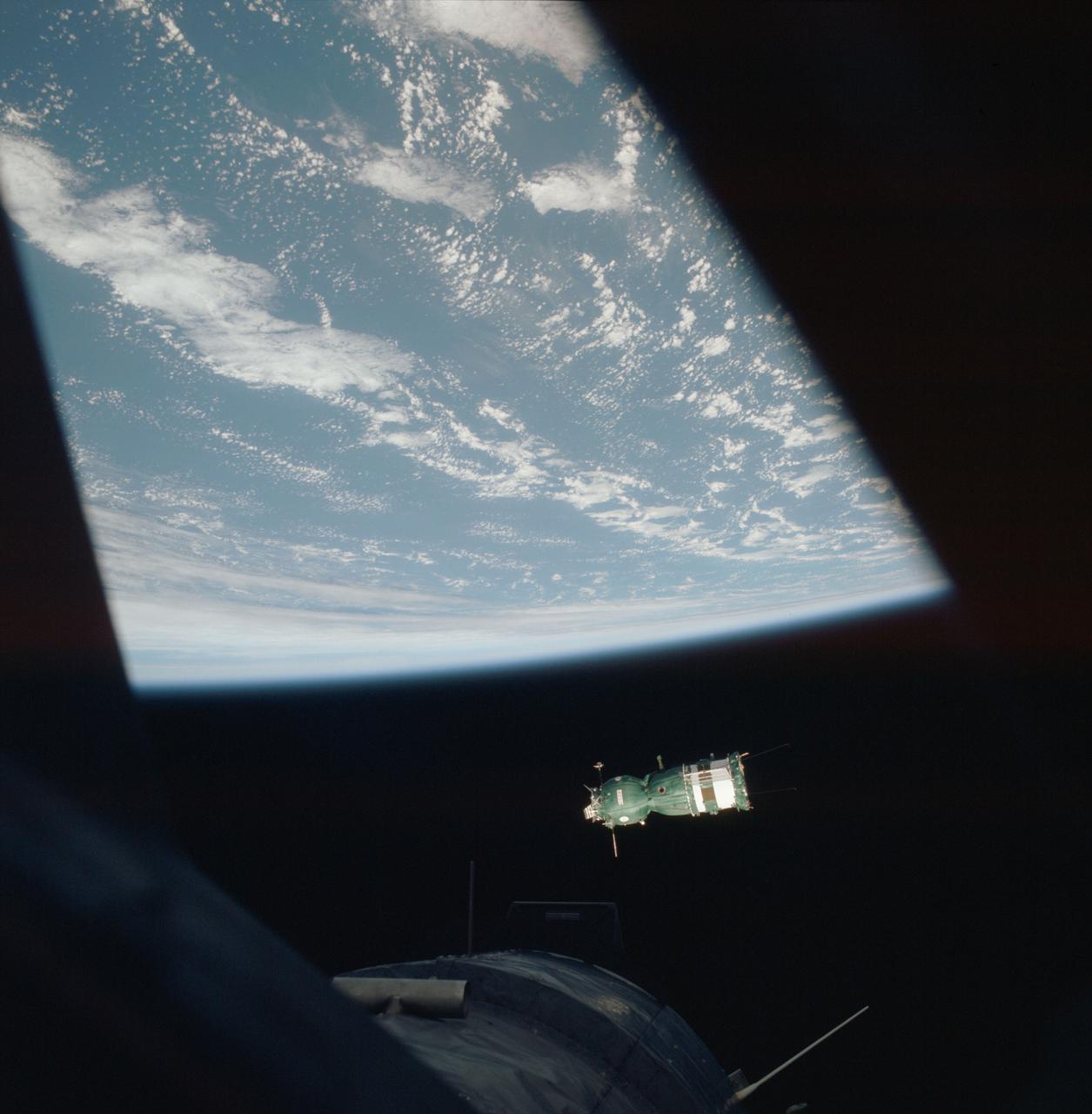
AST-02-093 (18 July 1975) --- This scene photographed with a hand-held 70mm camera from a rendezvous window of the American Apollo spacecraft in Earth orbit shows the Soviet Soyuz spacecraft contrasted against a black-sky background with Earth's horizon below. The three major components of the Soyuz are the spherical-shaped Orbital Module (OM), the bell-shaped Descent Vehicle (DV) and the cylindrical-shaped instrument Assembly Module (AM). The docking system on the Orbital Module was specially designed to interface with the docking system on the Apollo's Docking Module (DM). The DM is visible very faintly at the bottom of the picture. The ASTP astronauts and cosmonauts visited each other's spacecraft while the Soyuz and Apollo were docked in Earth orbit for two days.
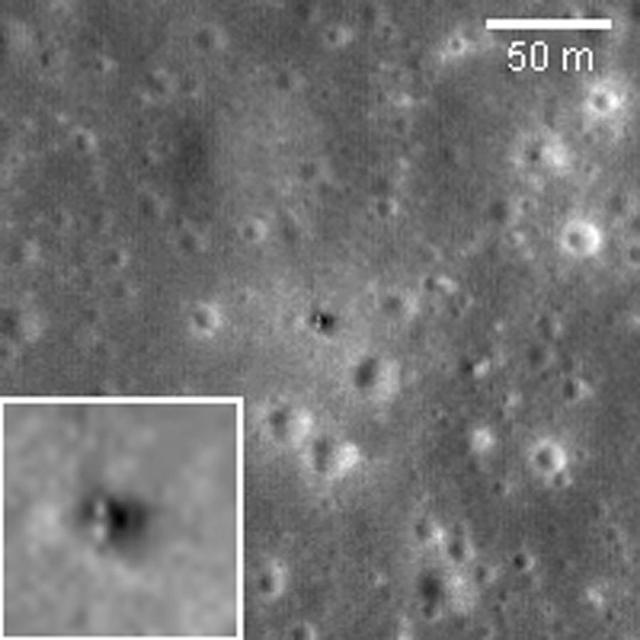
Luna 16 was the first robotic mission to land on the Moon on basaltic plains of Mare Fecunditatis and return a sample to the Earth. It was launched by the Soviet Union on 12 September 1970. This image was taken by NASA Lunar Reconnaissance Orbiter.
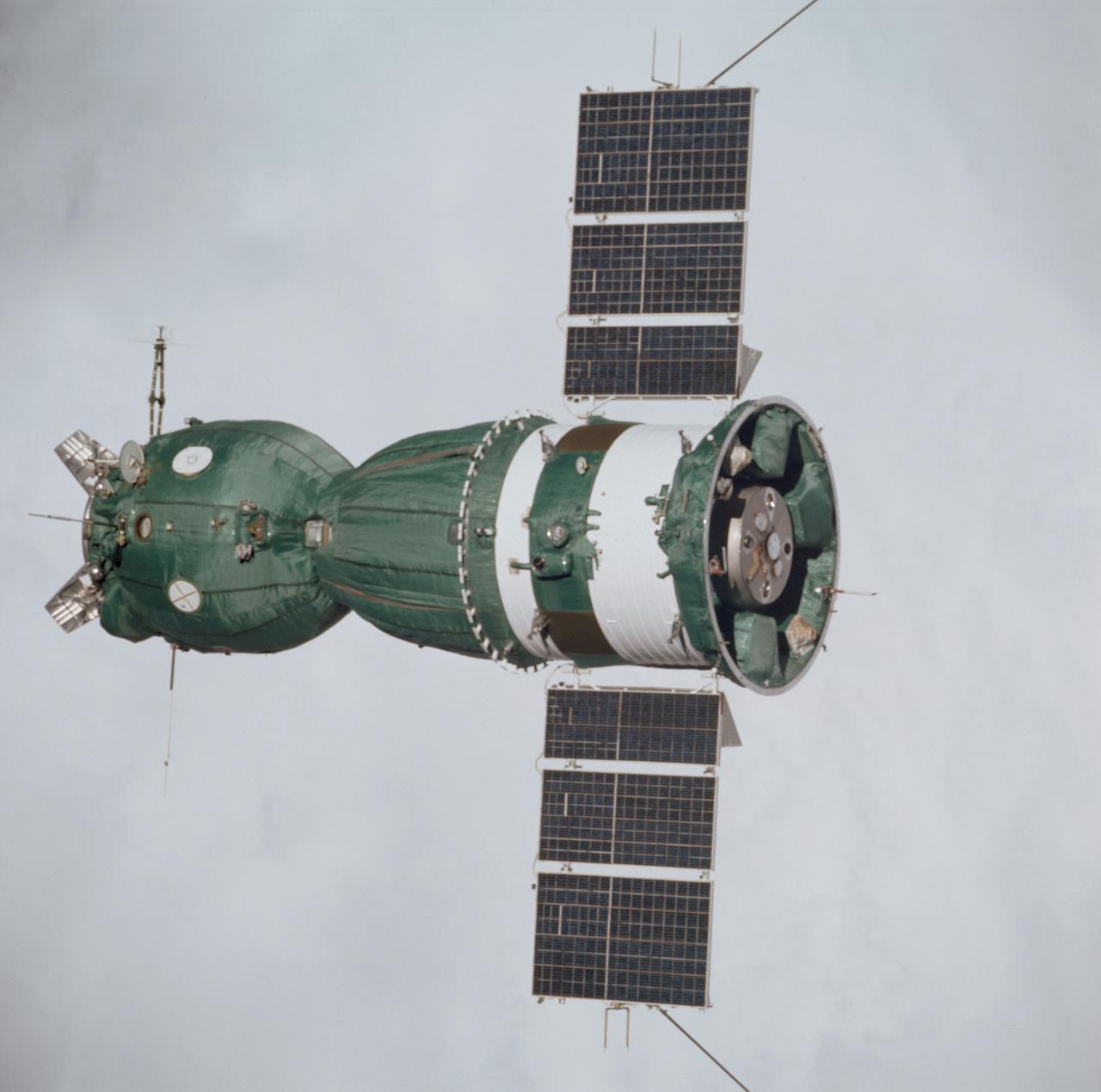
AST-01-056 (18 July 1975) --- An excellent view of the Soviet Soyuz spacecraft in Earth orbit, photographed from the American Apollo spacecraft during the joint U.S.-USSR Apollo-Soyuz Test Project (ASTP) docking mission in Earth orbit. The Soyuz is contrasted against a white-cloud background in this overhead view. The three major components of the Soyuz are the spherical-shaped Orbital Module, the bell-shaped Descent Vehicle and the cylindrical-shaped instrument Assembly Module from which two solar panels protrude. The docking system on the Orbital Module was specially designed to interface with the docking system on the Apollo's Docking Module. The ASTP astronauts and cosmonauts visited each other's spacecraft while the Soyuz and Apollo were docked in Earth orbit for two days. The Apollo crew consisted of astronauts Stafford, commander; Donald K. "Deke" Slayton, docking module pilot; and Vance D. Brand, command module pilot. The Soyuz 19 crew consisted of cosmonauts Leonov, command pilot; and Valeri N. Kubasov, flight engineer.
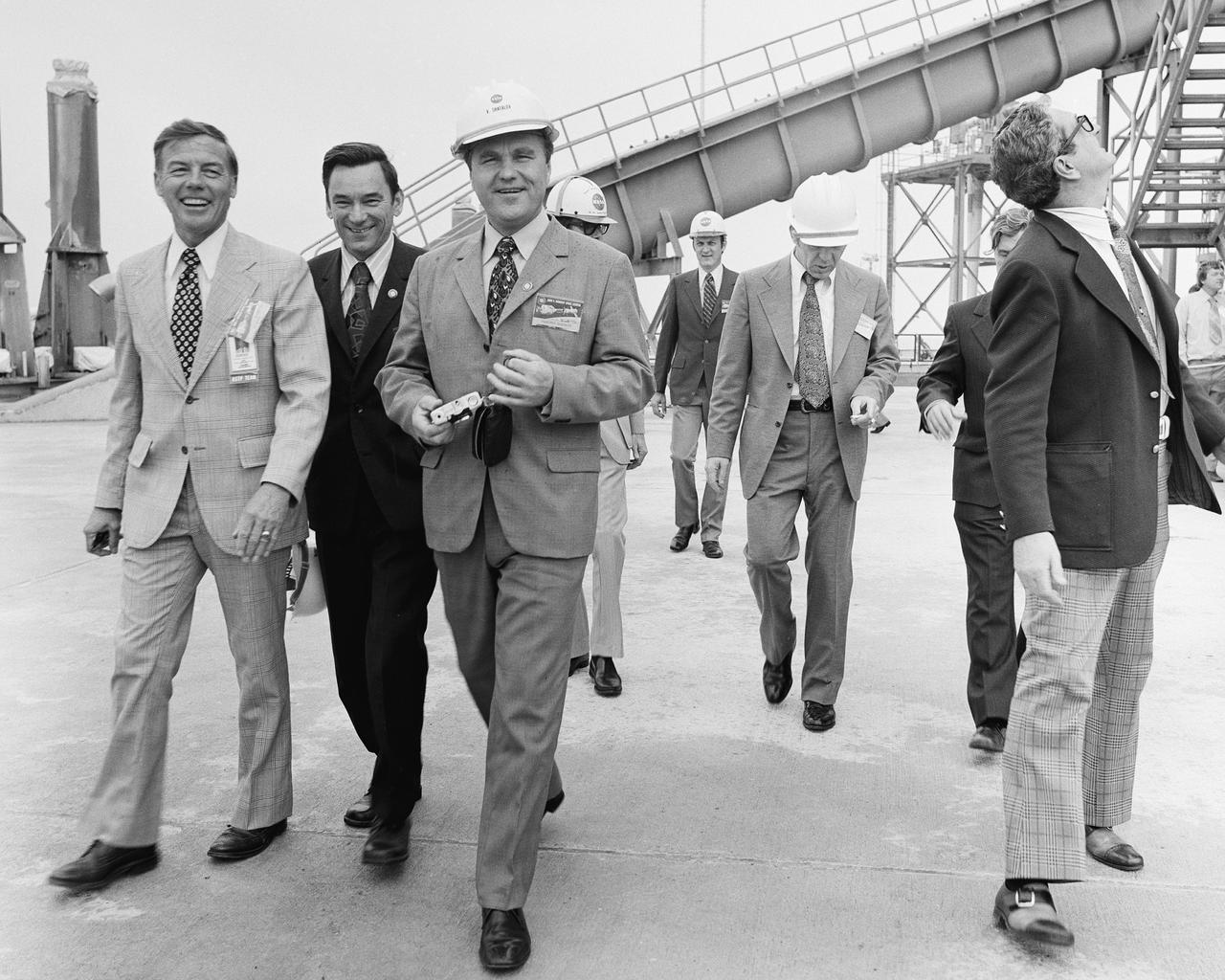
CAPE CANAVERAL, Fla. – KSC Director Lee Scherer, left, escorts a Soviet interpreter and Vladimir Shatalov, Soviet Cosmonaut Training Chief, on a tour of Pad 39B at the Spaceport. The Soviet and American personnel connected with July's Apollo Soyuz Test Project were at KSC February 8-10 to inspect equipment and tour facilities. The first international crewed spaceflight was a joint U.S.-U.S.S.R. rendezvous and docking mission. The Apollo-Soyuz Test Project, or ASTP, took its name from the spacecraft employed: the American Apollo and the Soviet Soyuz. The three-man Apollo crew lifted off from Kennedy Space Center aboard a Saturn IB rocket on July 15, 1975, to link up with the Soyuz that had launched a few hours earlier. A cylindrical docking module served as an airlock between the two spacecraft for transfer of the crew members. Photo credit: NASA
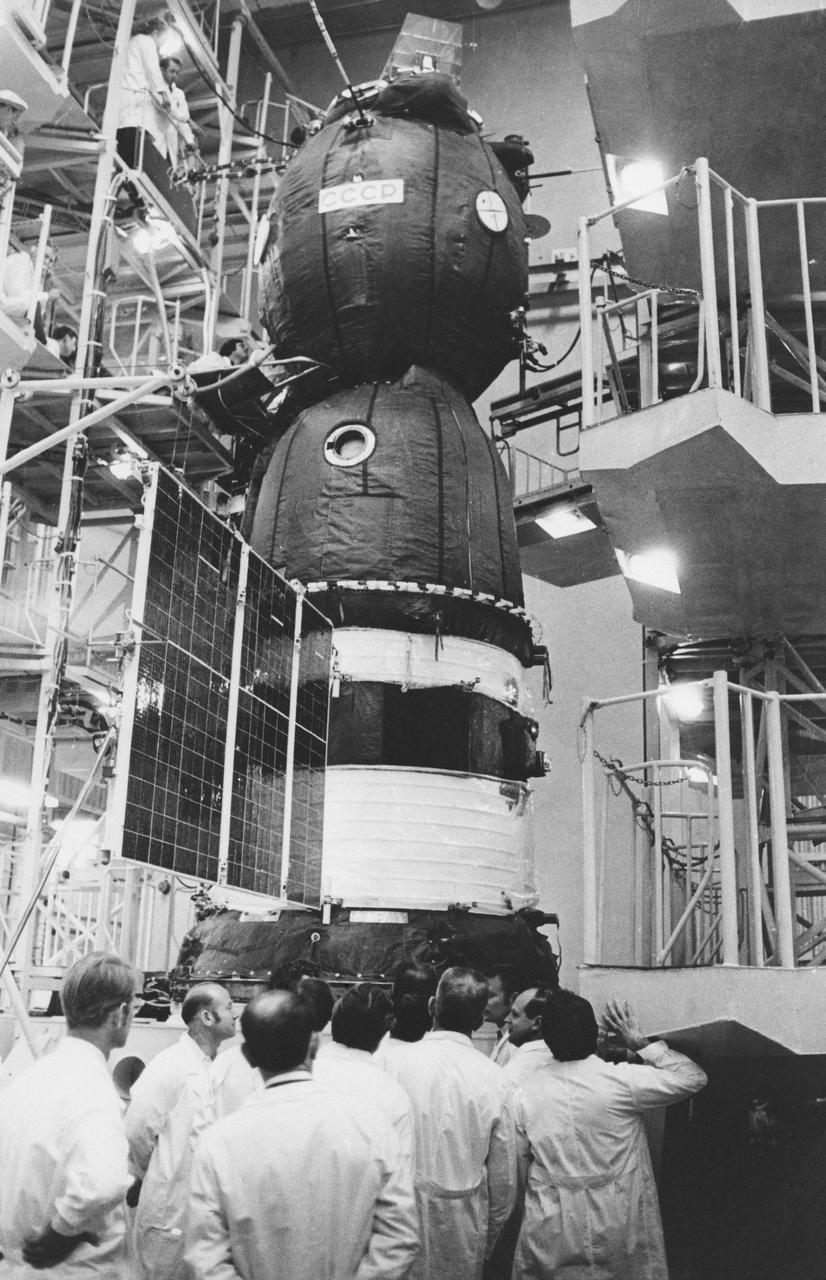
S75-25615 (April 1975) --- The Soviet Soyuz spacecraft for the Apollo-Soyuz Test Project mission is seen during prelaunch preparations at the Baikonur launch complex near Tyuratam in the Kazakh Soviet Socialist Republic. American ASTP crewmen visited the site while in the Soviet Union for training at the Cosmonaut Training Center (Star City) near Moscow. The Baikonur launch facility is located some 2,100 kilometers (1,300 miles) southeast of Moscow. The three major components of the Soyuz spacecraft are the Orbital Module (top), Descent Vehicle (in middle) and the Instrument Assemble Module (at bottom with solar panels). PHOTO COURTESY: USSR ACADEMY OF SCIENCES
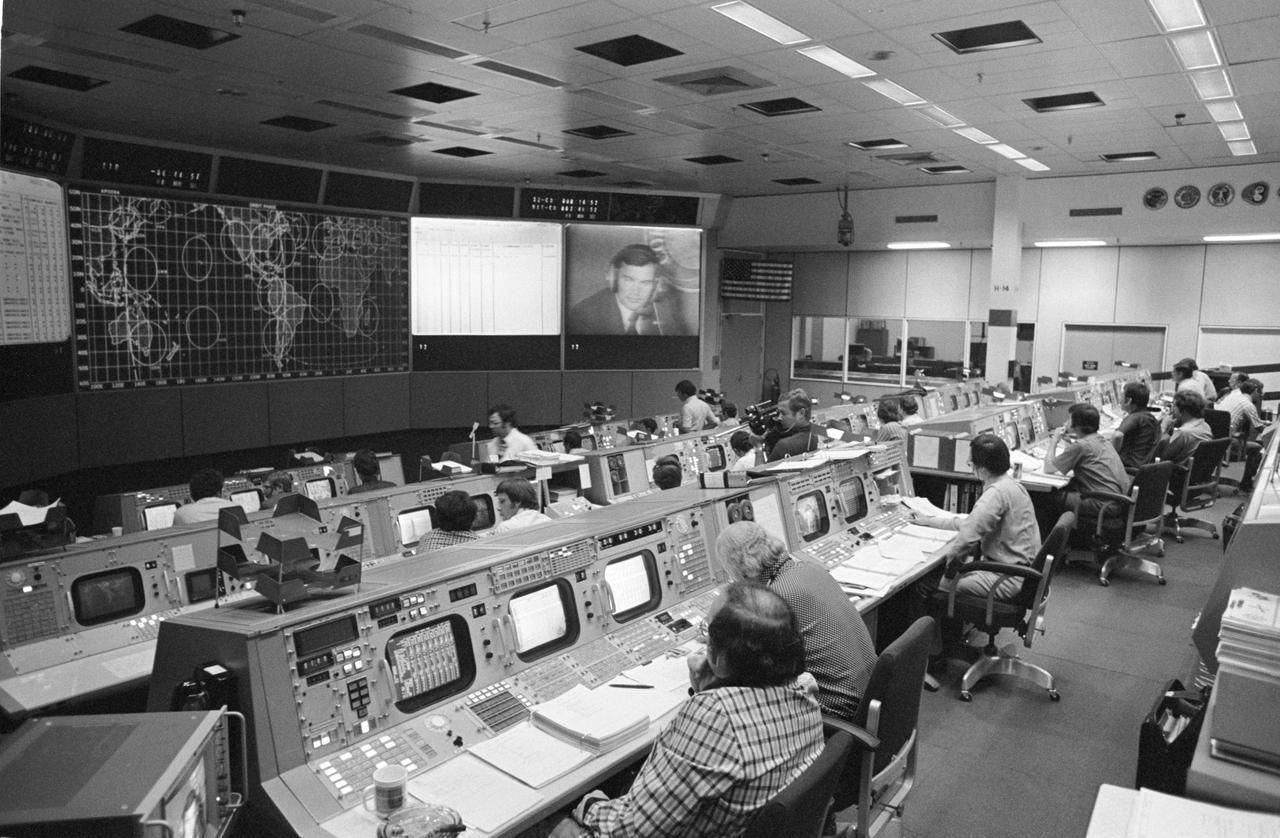
S75-28483 (15 July 1975) --- An overall view of the Mission Operations Control Room in the Mission Control Center on the first day of the Apollo-Soyuz Test Project docking mission in Earth orbit. The American ASTP flight controllers at NASA's Johnson Space Center were monitoring the progress of the Soviet ASTP launch when this photograph was taken. The television monitor shows cosmonaut Yuri V. Romanenko at his spacecraft communicator?s console in the ASTP mission control center in the Soviet Union. The American ASTP liftoff followed the Soviet ASTP launch by seven and one-half hours.
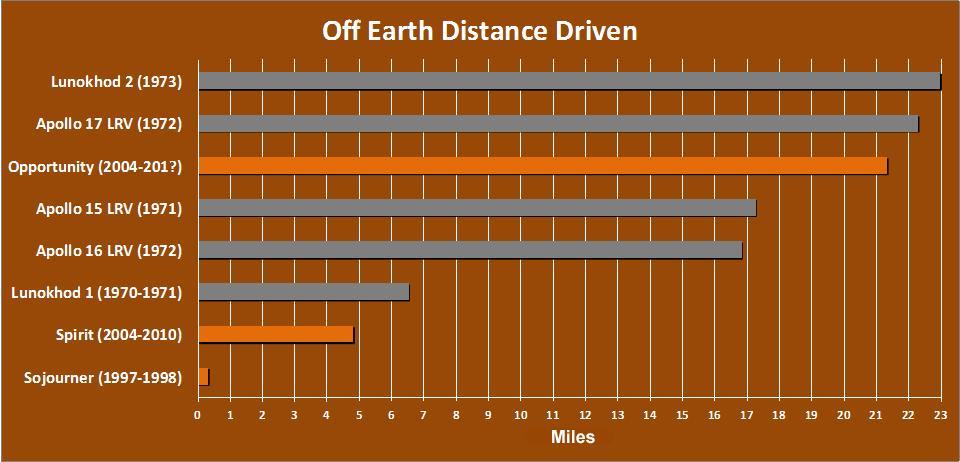
The total distance driven on Mars by NASA Mars Exploration Rover, 21.35 miles by early December 2011, is approaching the record total for off-Earth driving, held by the robotic Lunokhod 2 rover operated on Earth moon by the Soviet Union in 1973.
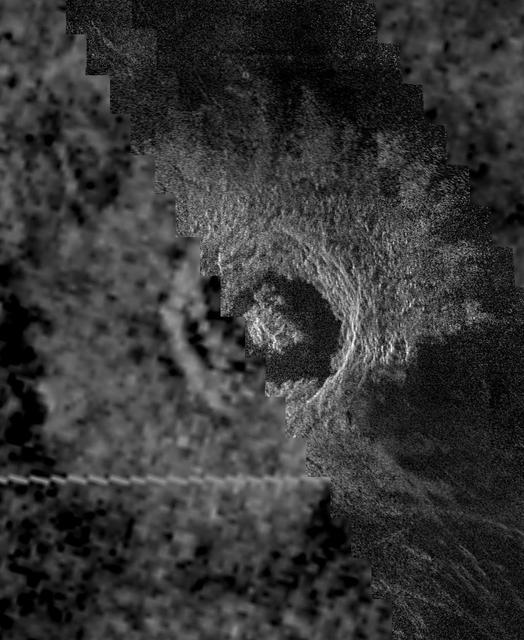
This image of the Venusian crater Golubkina, a 340 kilometer 20.4 miles diameter impact crater located at about 60.5 degrees north latitude, 287.2 degrees east longitude, contains NASA Magellan data mosaiced with a Soviet Venera radar image. http://photojournal.jpl.nasa.gov/catalog/PIA00210
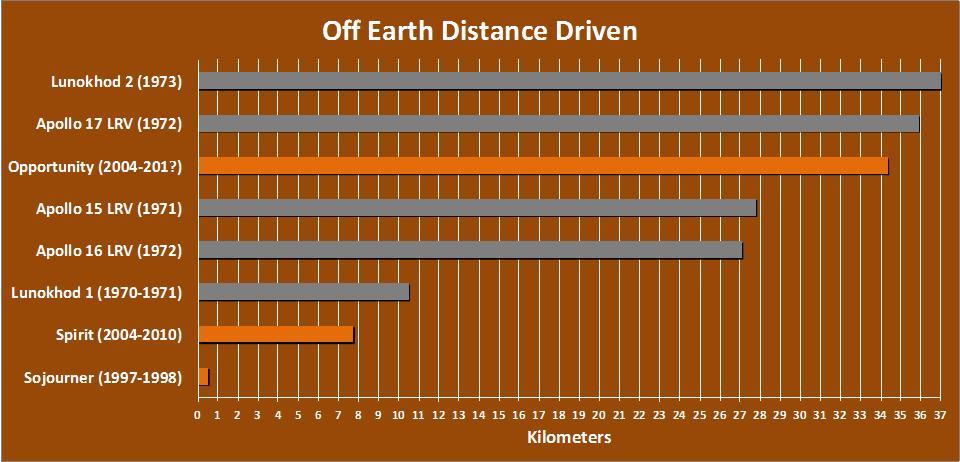
The total distance driven on Mars by NASA Mars Exploration Rover, 34.36 kilometers by early December 2011, is approaching the record total for off-Earth driving, held by the robotic Lunokhod 2 rover operated on Earth moon by the Soviet Union in 1973.
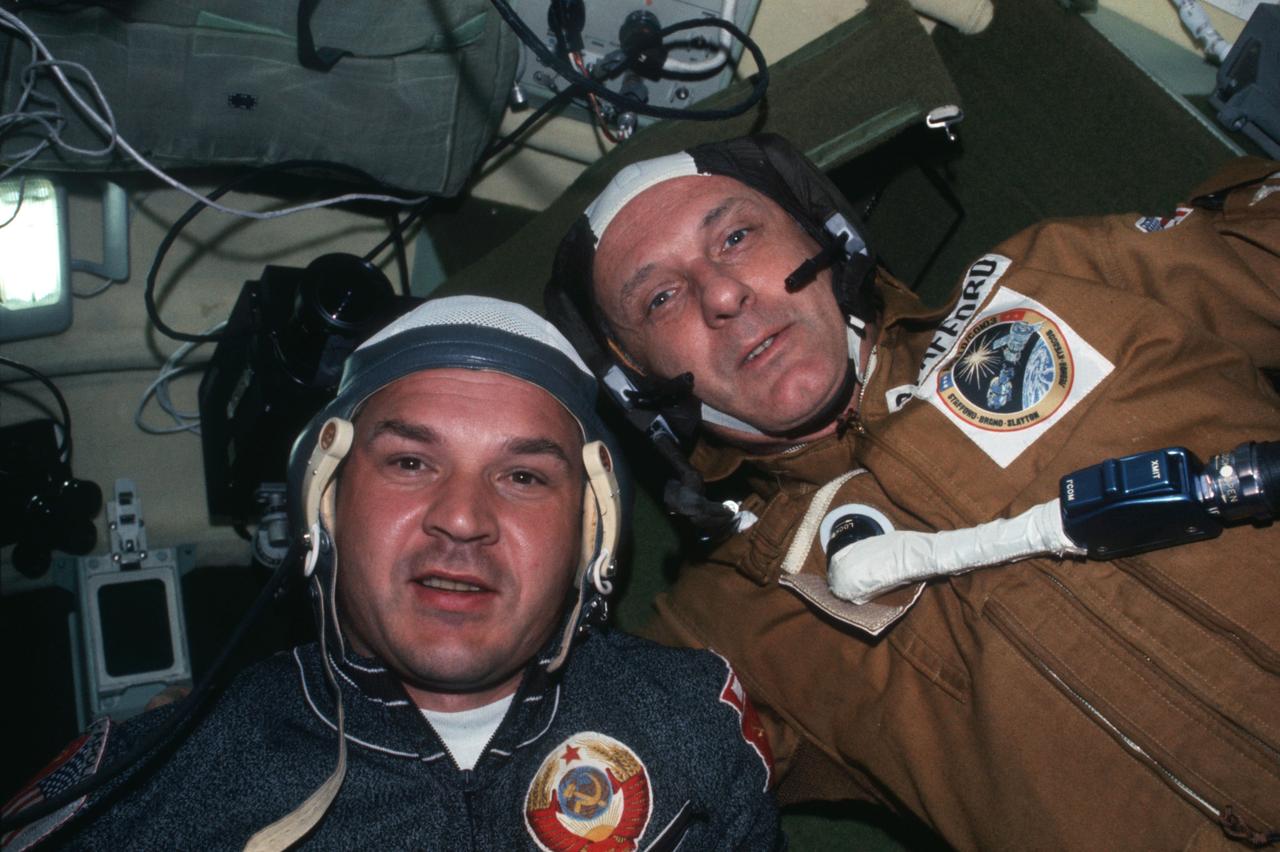
AST-03-189 (17-19 July 1975) --- Cosmonaut Valeriy N. Kubasov, left, Soviet ASTP engineer; and astronaut Thomas P. Stafford, Apollo crew commander, are seen during a visit by the two crewmen to the Soviet Soyuz Orbital Module during the joint U.S.-USSR Apollo-Soyuz Test Project docking mission in Earth orbit. The visit was one of four made among the five crewmen on July 17-18-19, 1975. A 35mm camera was used to make this picture.
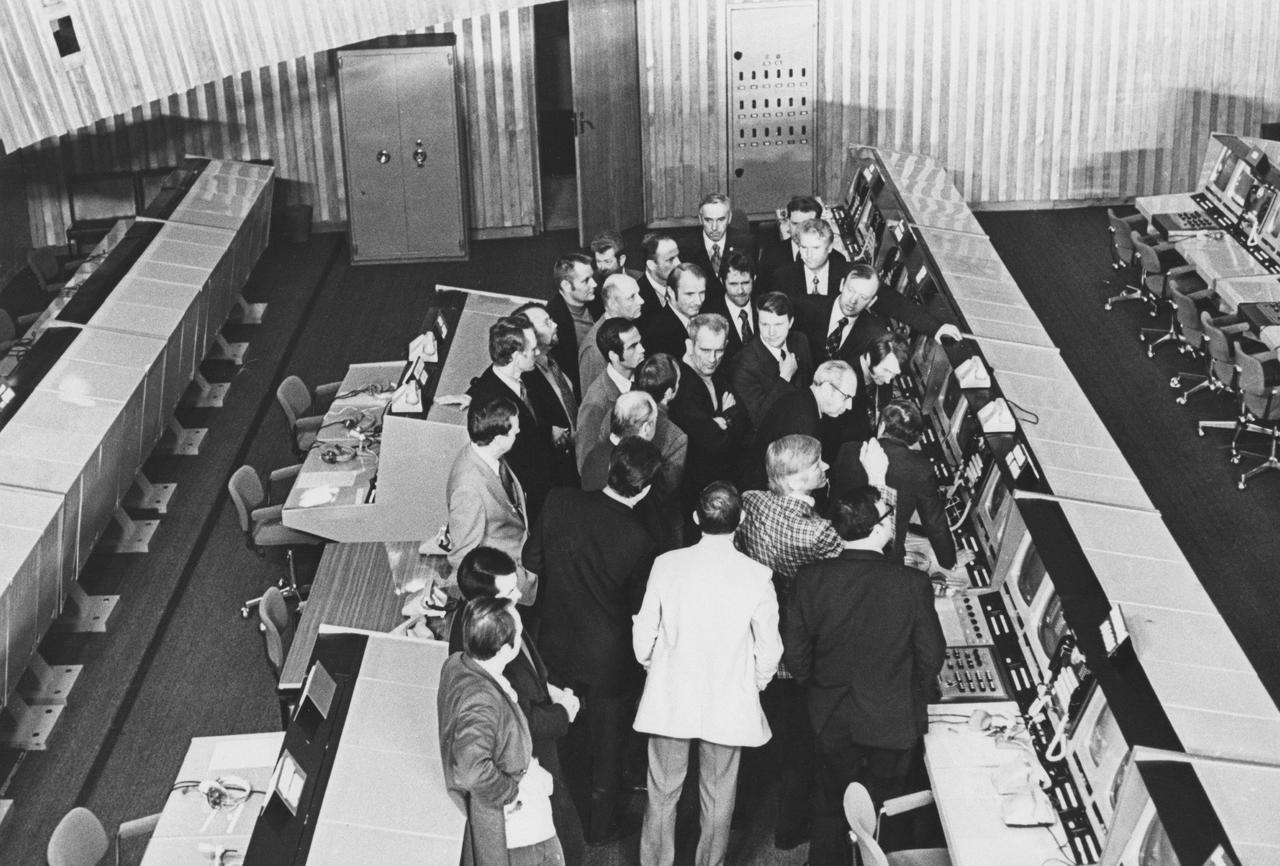
S75-25619 (25 April 1975) --- A group of American ASTP crewmen is briefed on the operation of the consoles in the main control room at the ASTP flight control center at the Cosmonaut Training Center (Star City) near Moscow. The astronauts were in the Soviet Union for ASTP joint crew training with the Soviet ASTP crewmen. PHOTO COURTESY: USSR ACADEMY OF SCIENCES
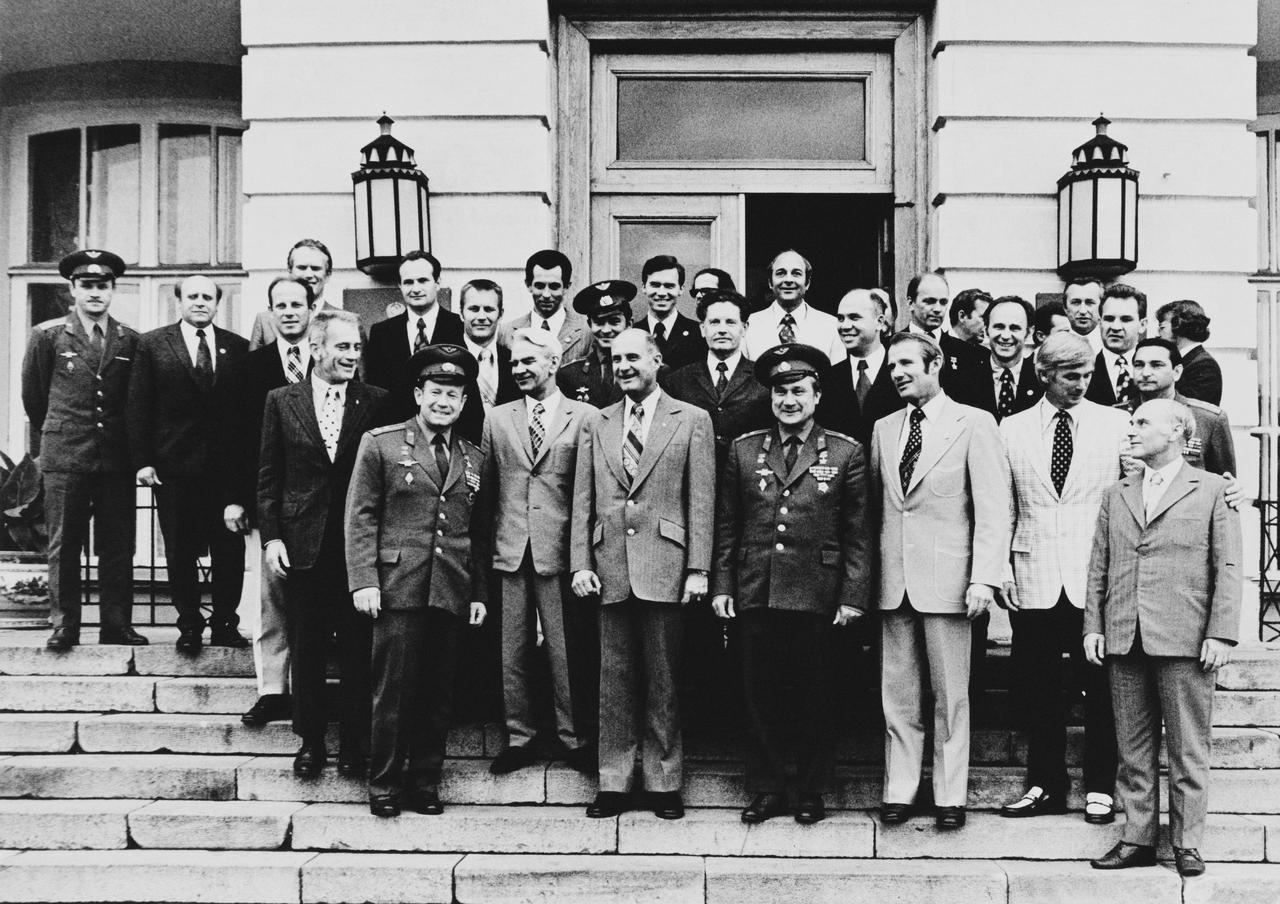
S74-24948 (4 July 1974) --- A group of astronauts from the Apollo-Soyuz Test Project office at the Johnson Space Center are photographed with their Soviet hosts after attending a reception at the USSR Academy of Sciences in Moscow. They are standing on the front steps of the scientific institution. The Americans were in the Soviet Union to take part in ASTP familiarization training at the Cosmonaut Training Center near Moscow. PHOTO COURTESY: USSR ACADEMY OF SCIENCES

S73-02395 (August 1973) --- An artist?s concept illustrating an Apollo-type spacecraft (on left) about to dock with a Soviet Soyuz-type spacecraft. A recent agreement between the United States and the Union of Soviet Socialist Republics provides for the docking in space of the Soyuz and Apollo-type spacecraft in Earth orbit in 1975. The joint venture is called the Apollo-Soyuz Test Project.
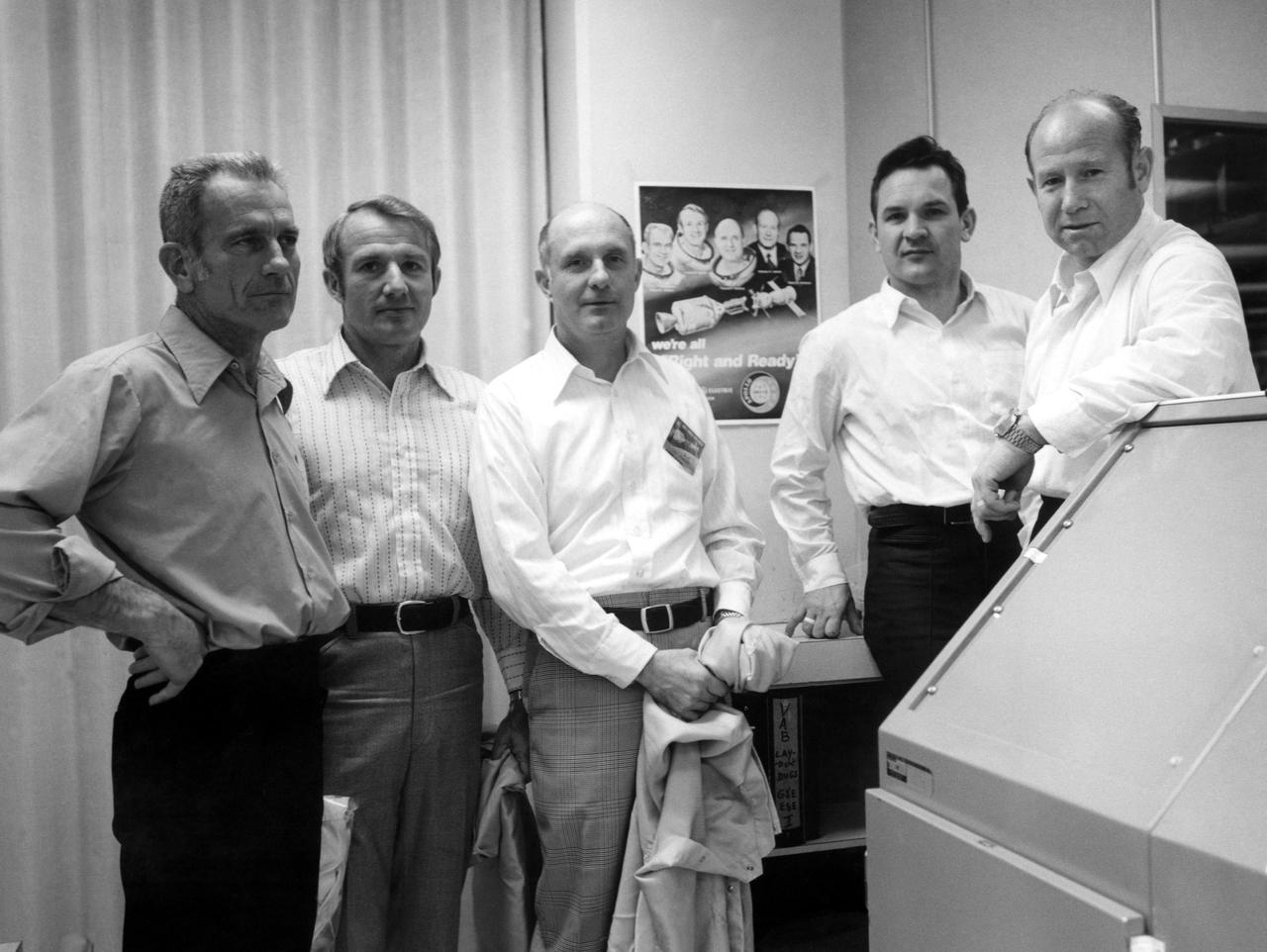
KENNEDY SPACE CENTER, FLA. -- Soviet Cosmonaut tour of KSC. United States, Soviet Union, prime crews for Apollo Soyuz Test Project inspect spacecraft checkout facilities in Manned Spacecraft Operations Building ACE Station. From left are astronauts Donald K. Slayton, Vance D. Brand and Thomas P. Stafford; cosmonauts Valeriy Kubasov and Aleksey Leonov.
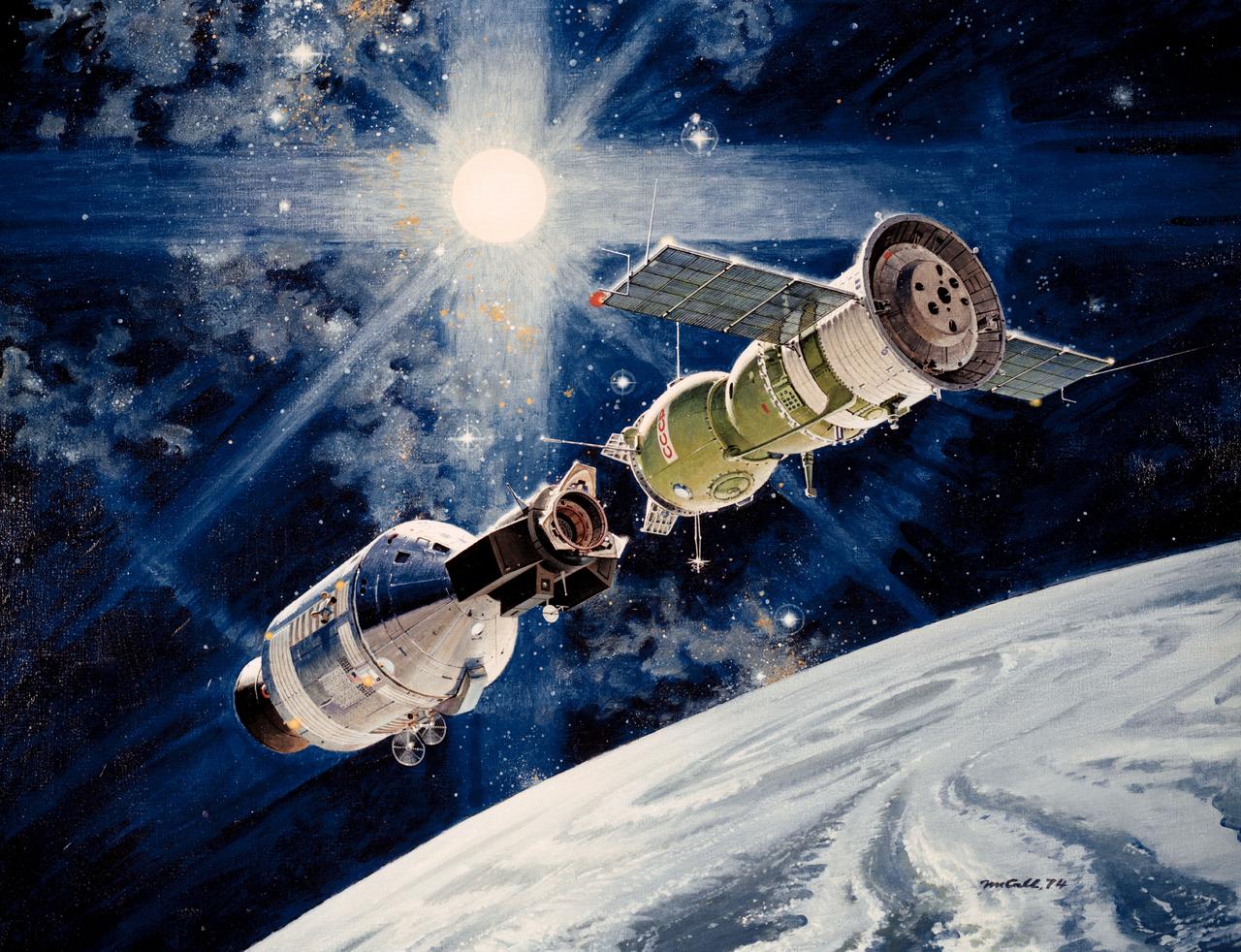
S74-24913 (August 1973) --- An artist's concept illustrating an Apollo-type spacecraft (left) about to dock with a Soviet Soyuz-type spacecraft. A recent agreement between the United States (USA) and the Union of Soviet Socialist Republic (USSR) provides for the docking in space of the Soyuz and Apollo-type spacecraft in Earth orbit in 1975. The joint space venture is called the Apollo-Soyuz Test Project (ASTP).
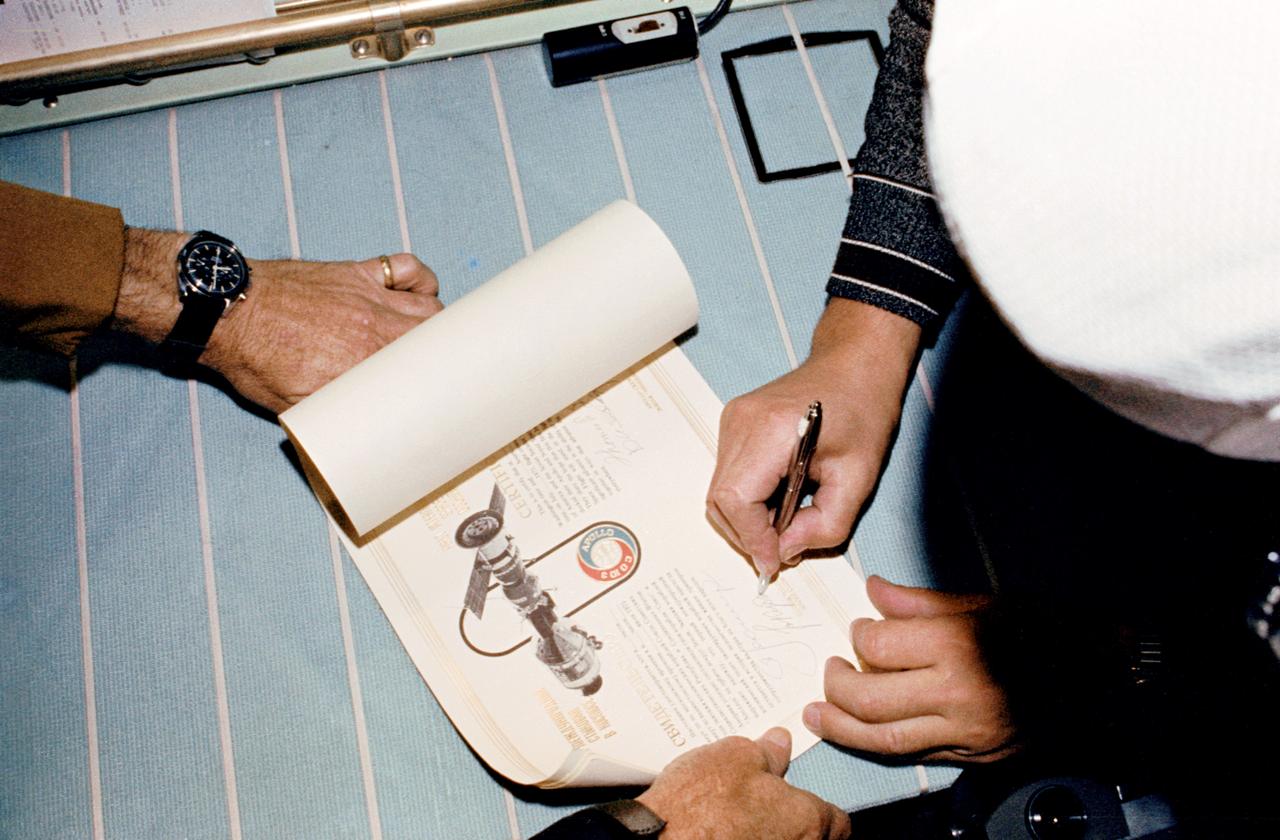
AST-03-171 (17 July 1975) --- The hands of cosmonaut Valerly N. Kubasov are seen as the ASTP engineer adds his name to the signature on the Soviet side of the official joint certificate marking an historical moment during the rendezvous day of the Apollo-Soyuz Test Project. The left hand of astronaut Donald K. Slayton, NASA's docking module pilot, is seen at left. The certificate had earlier been signed by astronauts Thomas P. Stafford, American crew commander; Slayton and cosmonaut Aleksey A. Leonov, Soviet crew commander, and it awaits the signature of astronaut Vance D. Brand, NASA's command module pilot who remained in the CM while the others signed in the Soviet Orbital Module of the Soyuz.
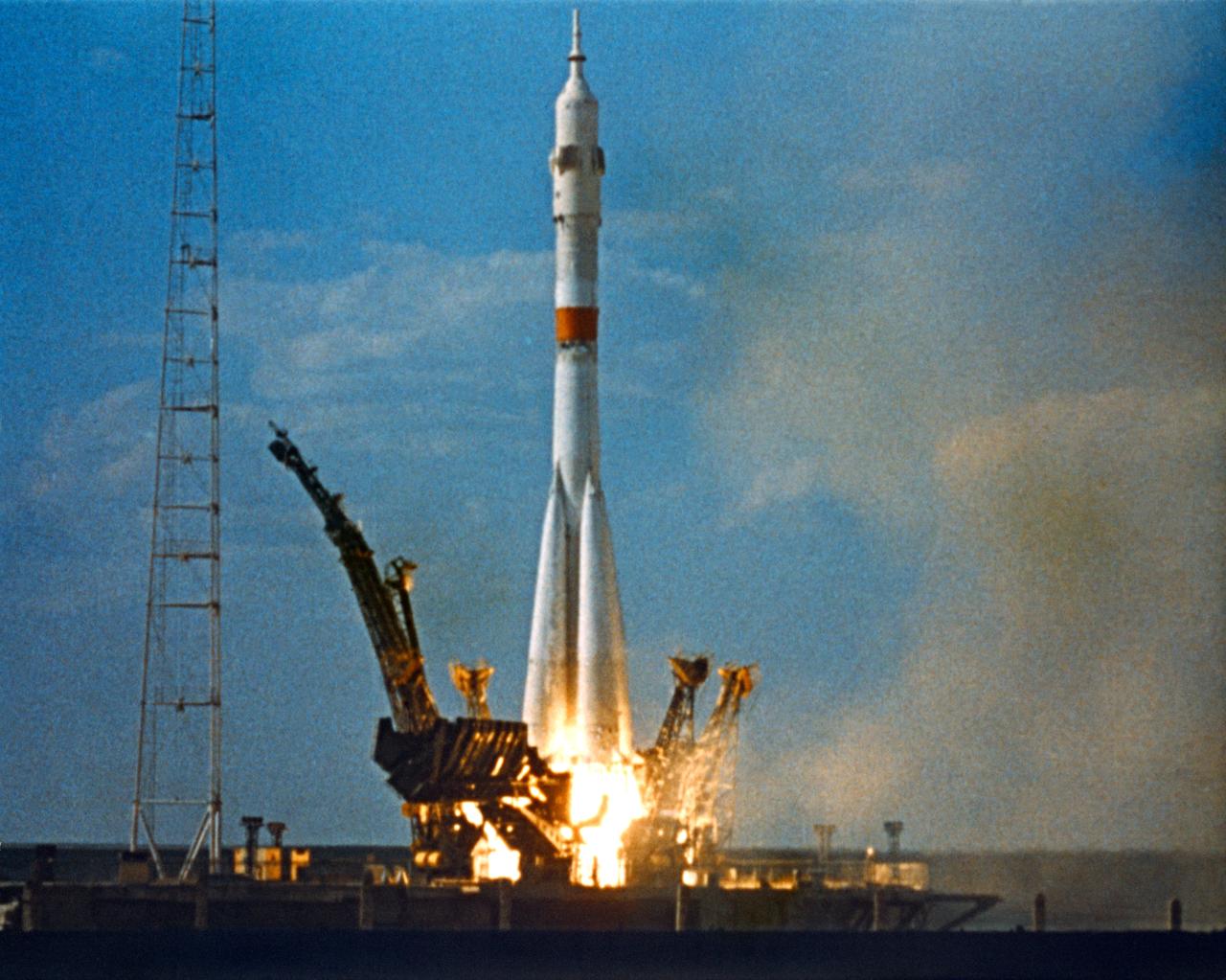
S75-33375 (15 July 1975) --- The Soviet Soyuz space vehicle, with cosmonauts Aleksey A. Leonov and Valeriy N. Kubasov aboard, is launched on the morning of July 15, 1975 from a pad at the Baikonur Cosmodrome in Kazahstan to begin the joint U.S.-USSR Apollo-Soyuz Test Project docking mission in Earth orbit. The Soyuz space vehicle is composed of the three-stage launch vehicle, the two-man, three-module Soyuz spacecraft and the launch escape system. The Soviet spacecraft (Soyuz 19) was launched seven and one-half hours before the American ASTP/Apollo-Saturn 1B liftoff from Kennedy Space Center (KSC), Florida. The American and Soviet spacecraft were joined together in space for approximately 47 hours on July 17-18-19, 1975. This picture was reproduced from a frame of 35mm film furnished by the USSR in an exchange of photography taken during the mission. PHOTO COURTESY: USSR ACADEMY OF SCIENCES
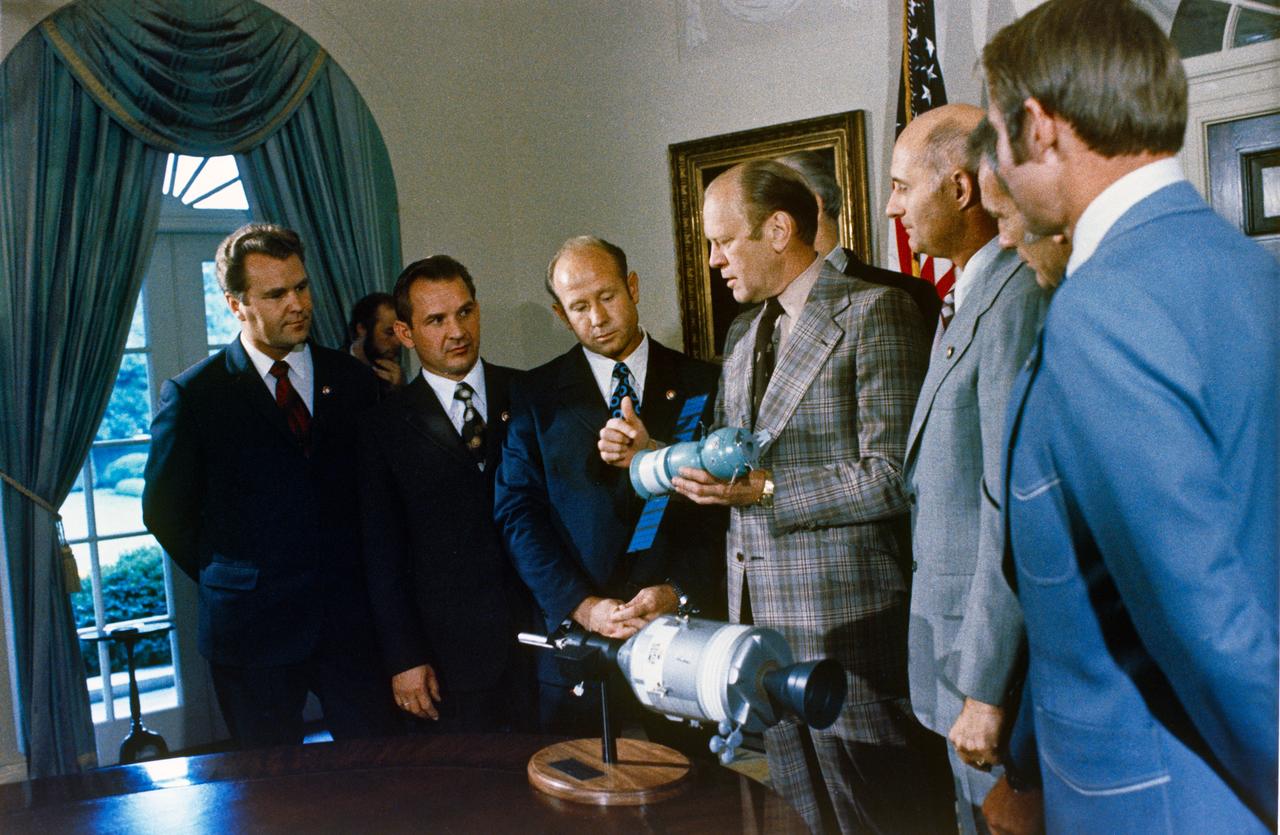
S74-29892 (7 Sept. 1974) --- President Gerald R. Ford removes the Soviet Soyuz spacecraft model from a model set depicting the 1975 Apollo-Soyuz Test Project, an Earth orbital docking and rendezvous mission involving crewmen from the U.S. and USSR, who visited Mr. Ford at the White House. The cosmonauts and astronauts are, left to right, Vladimir A. Shatalov, Chief, Cosmonaut Training; Valeriy N. Kubasov, ASTP Soviet engineer; Aleksey A. Leonov, ASTP Soviet crew commander; Thomas P. Stafford, ASTP American crew commander; Donald K. Slayton, American crew?s docking module pilot; and Vance D. Brand, command module pilot for the U.S. team. Dr. George M. Low, Deputy Administrator, National Aeronautics and Space Administration, is partially obscured behind Mr. Ford.
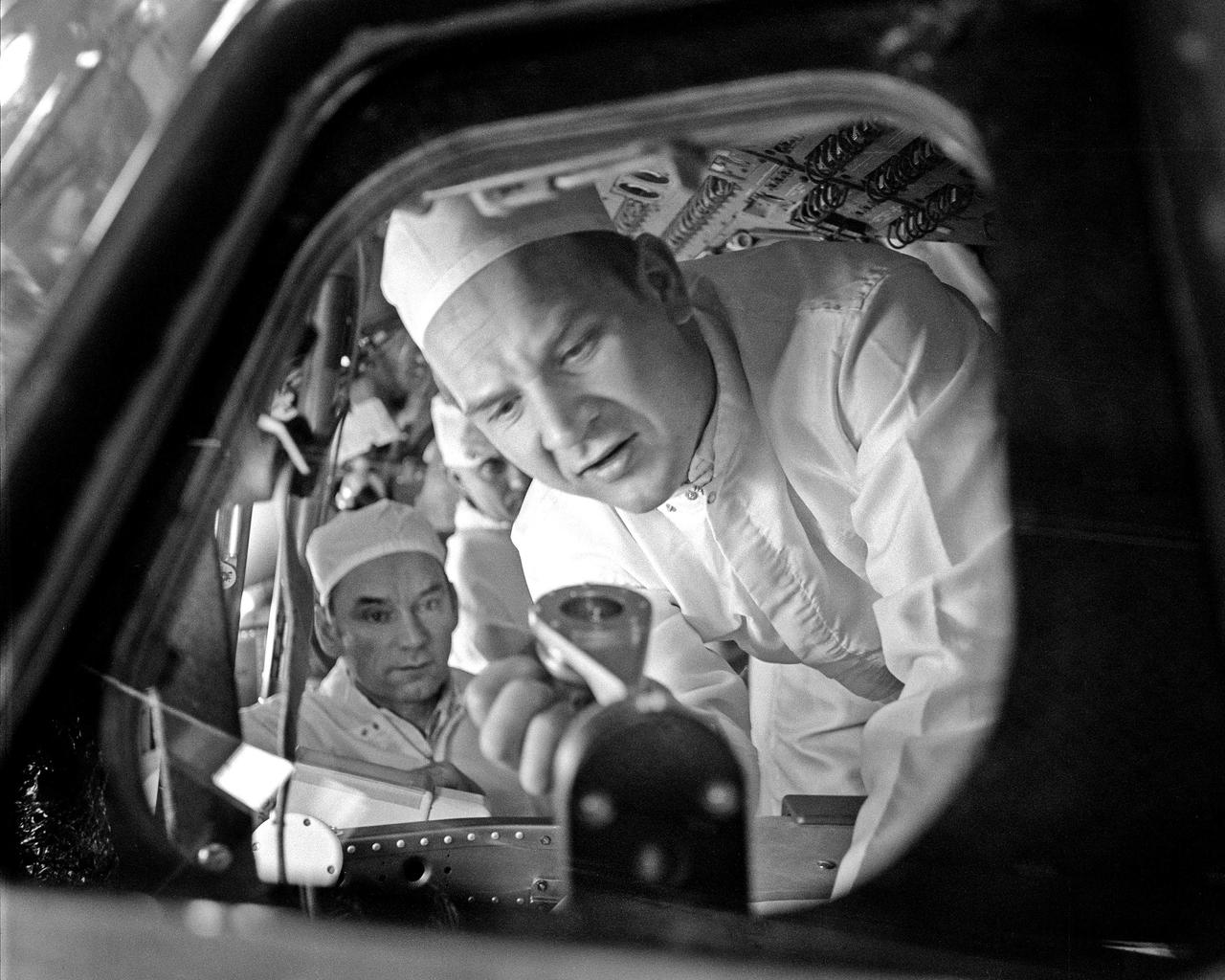
CAPE CANAVERAL, Fla. – Soviet Apollo Soyuz Test Project prime crew member Valeriy Kubasov inspects equipment inside the Apollo Command Module. The Soviet and American ASTP crews were at KSC February 8-10 to tour facilities and inspect equipment in preparation for the mid-July joint mission. The first international crewed spaceflight was a joint U.S.-U.S.S.R. rendezvous and docking mission. The Apollo-Soyuz Test Project, or ASTP, took its name from the spacecraft employed: the American Apollo and the Soviet Soyuz. The three-man Apollo crew lifted off from Kennedy Space Center aboard a Saturn IB rocket on July 15, 1975, to link up with the Soyuz that had launched a few hours earlier. A cylindrical docking module served as an airlock between the two spacecraft for transfer of the crew members. Photo credit: NASA
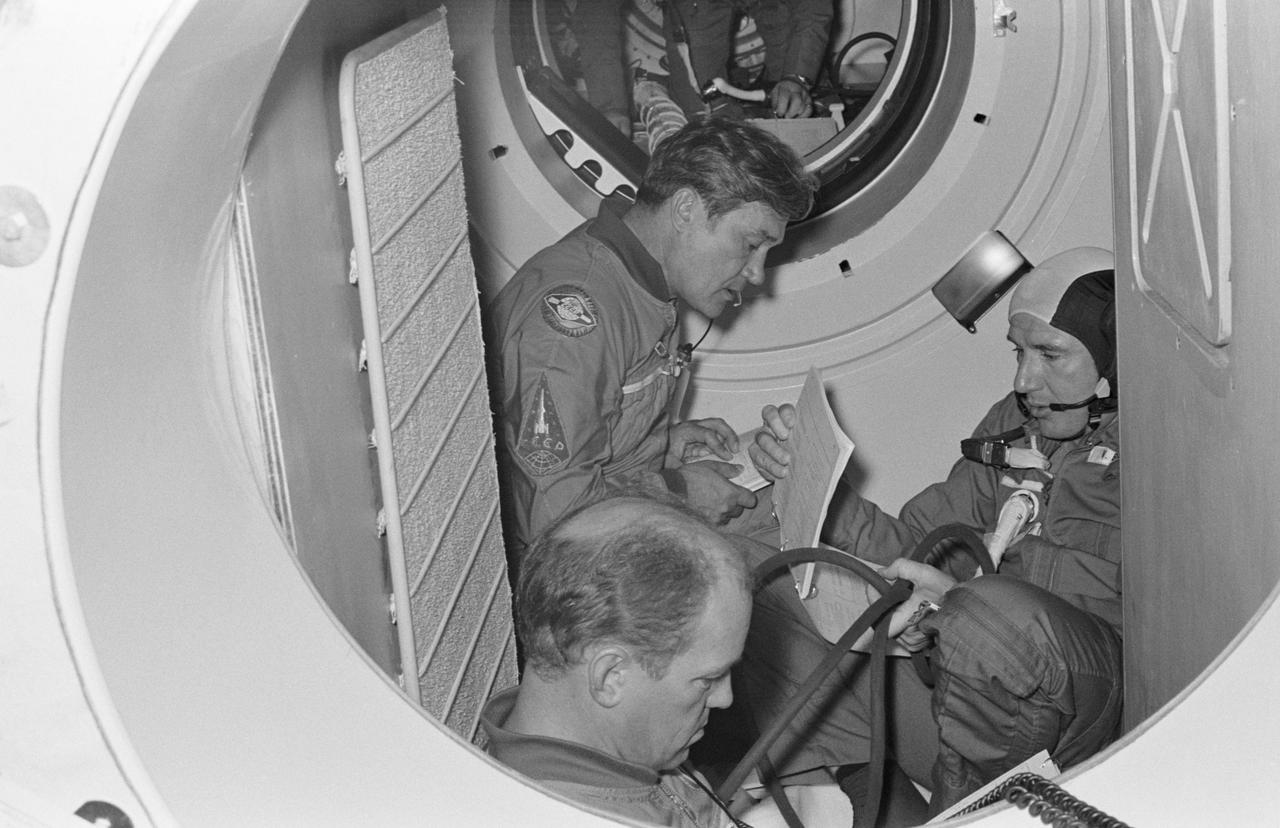
S74-28649 (16 Sept. 1974) --- Three crewmen of the Apollo-Soyuz Test Project are seated in a Soviet Soyuz spacecraft orbital module mock-up in Building 35 during ASTP simulation training at the Johnson Space Center. They are cosmonaut Anatoliy V. Filipchenko (left background), commander of the Soviet ASTP second (backup) crew; cosmonaut Nikolay N. Rukavishnikov (left foreground), engineer on the crew; and astronaut Vance D. Brand (right), command module pilot of the American ASTP prime crew. The hatch in the background leads to the Docking Module. During the exercise the American ASTP crew and the Soviet ASTP crew simulated docking the Apollo and Soyuz in Earth orbit and transferring to each other?s spacecraft. Here, Brand is visiting the Soyuz spacecraft. The crewmen are training in both the U.S. and the USSR for the joint mission scheduled for the summer of 1975.
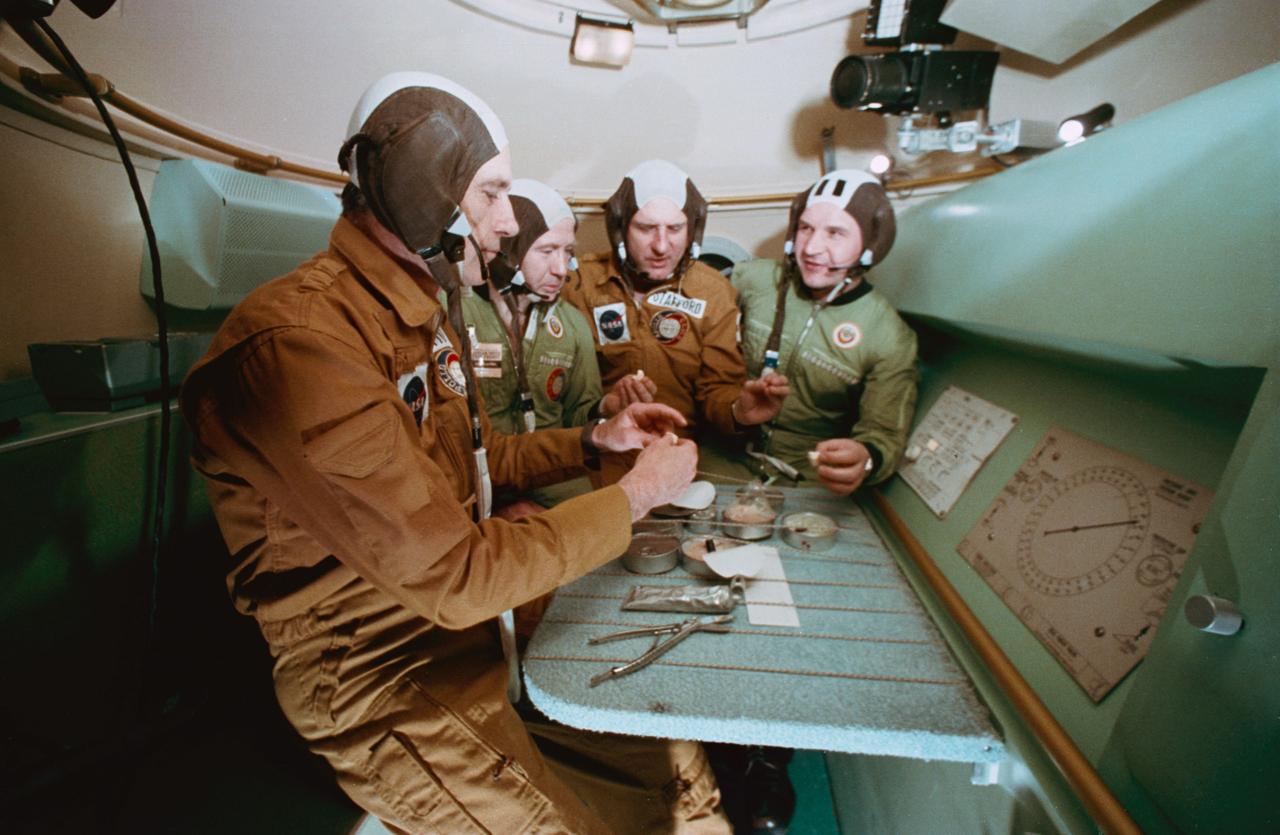
S75-22770 (25 Feb. 1975) --- Two American ASTP prime crewmen have a meal with the Soviet ASTP first (prime) crewmen during Apollo-Soyuz Test Project joint crew training at NASA's Johnson Space Center. The four are inside the Soyuz orbital module mock-up in Building 35. They are, left to right, astronaut Donald K. Slayton, docking module pilot of the American crew; cosmonaut Aleksey A. Leonov, commander of the Soviet crew; astronaut Thomas P. Stafford, commander of the American crew; and cosmonaut Valeriy N. Kubasov, engineer on the Soviet crew. The training session simulated activities on the second day in Earth orbit. During the actual mission the other American crewmen, astronaut Vance D. Brand, command module pilot, would be in the Command Module.
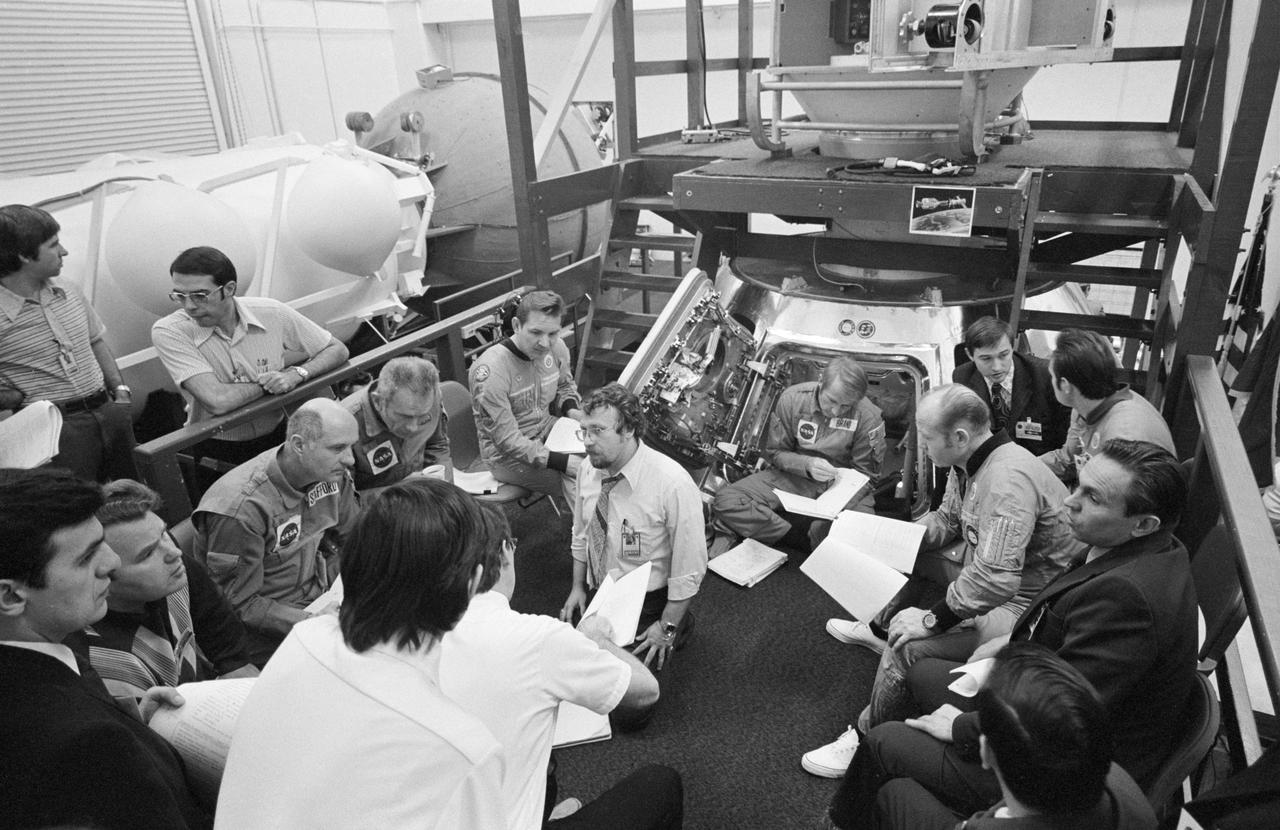
S75-21599 (12 Feb. 1975) --- Six Apollo-Soyuz Test Project crewmen participate in joint crew training in Building 35 at the Johnson Space Center. They are (wearing flight suits), left to right, astronaut Thomas P. Stafford, commander of the American ASTP prime crew; astronaut Donald K. Slayton, docking module pilot on Stafford?s crew; cosmonaut Valeriy N. Kubasov, engineer on the Soviet ASTP first (prime) crew; astronaut Vance D. Brand, command module pilot on Stafford?s crew; cosmonaut Aleksey A. Leonov, commander of the Soviet ASTP first (prime) crew; and cosmonaut Vladimir A. Dzhanibekov, commander of the Soviet ASTP third (backup) crew. Brand is seated next to the hatch of the Apollo Command Module trainer. This picture was taken during a ?walk-through? of the first day?s activities in Earth orbit. The other men are interpreters and training personnel.
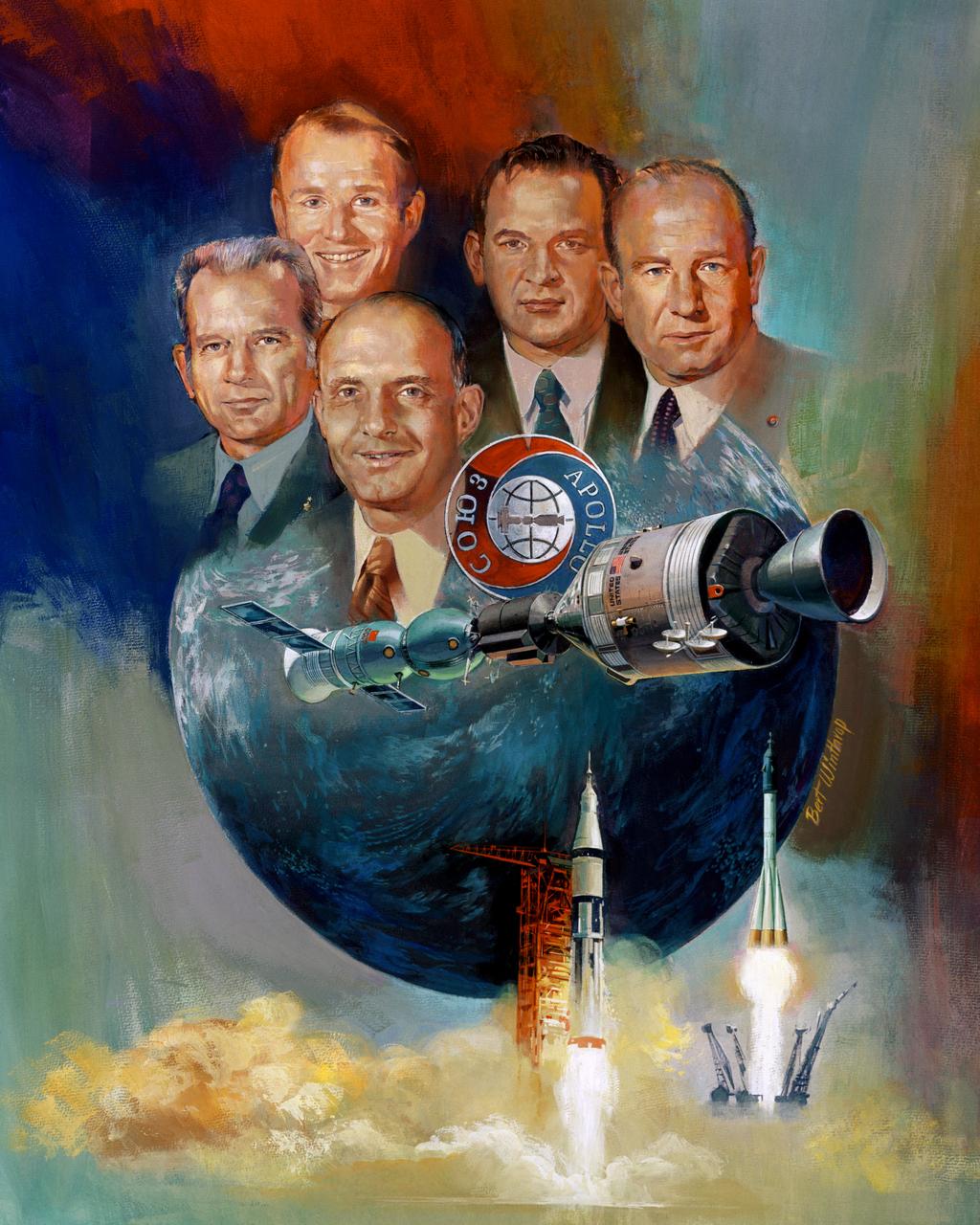
S75-25941 (April 1975) --- An Apollo-Soyuz Test Project (ASTP) symbolic painting by artist Bert Winthrop of Rockwell International Space Division, Downey, California. The artwork is composed of the ASTP mission insignia, the docked Apollo-Soyuz spacecraft, and portraits of the five ASTP prime crewmen, all superimposed against Earth's sphere in the center of the picture. The launches of both the American ASTP space vehicle (on left) and the Soviet ASTP space vehicle are depicted in the lower right corner. The five crewmen are, clockwise from the ASTP emblem, astronaut Thomas P. Stafford, commander of the American crew; astronaut Donald K. Slayton, docking module pilot of the American crew; astronaut Vance D. Brand, command module pilot of the American crew; cosmonaut Valeriy N. Kubasov, engineer on the Soviet crew; and cosmonaut Aleksey A. Leonov, commander of the Soviet crew. The joint U.S.-USSR ASTP docking mission in Earth orbit is scheduled for July 1975.
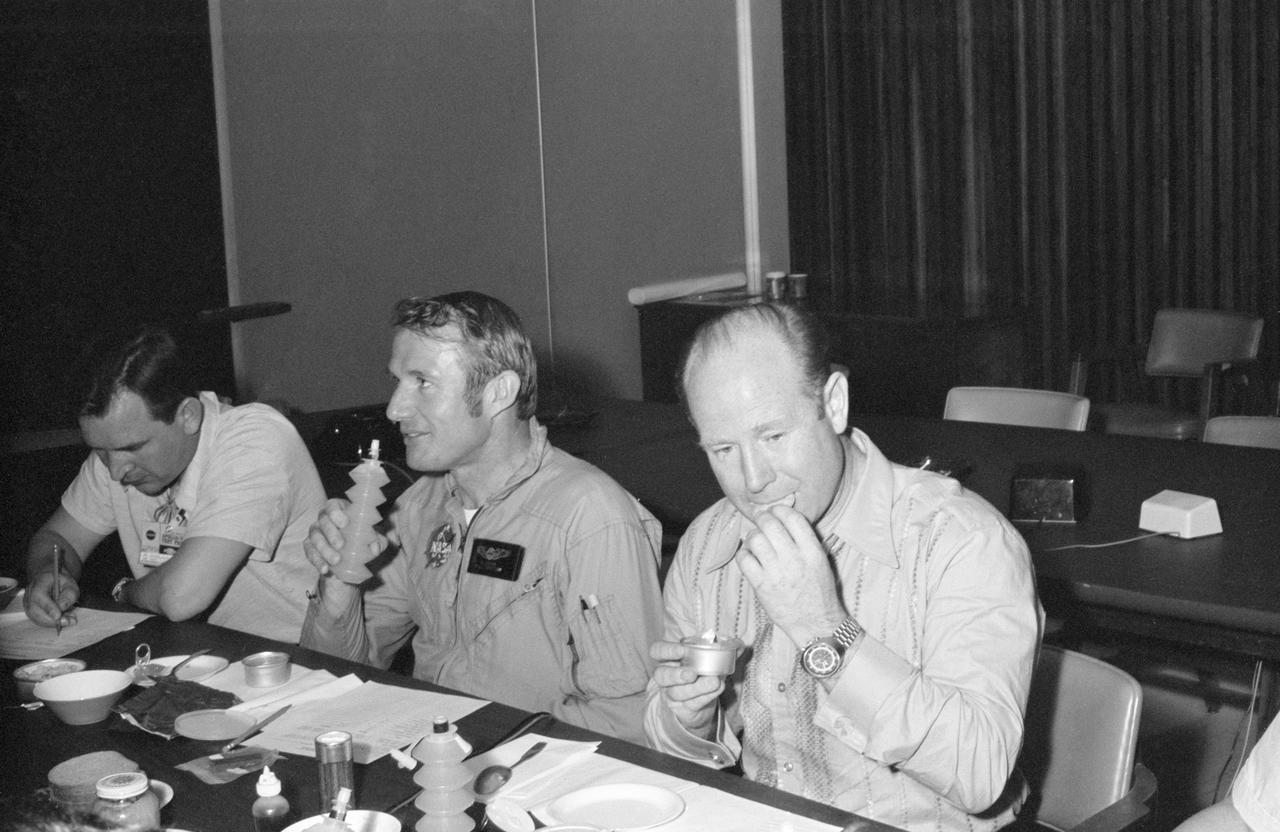
S74-20797 (23 April 1974) --- Candidate food items being considered for the joint U.S.-USSR Apollo-Soyuz Test Project mission are sampled by three ASTP crewmen in Building 4 at the Johnson Space Center. They are, left to right, cosmonaut Valeriy N. Kubasov, engineer on the Soviet ASTP crew; astronaut Vance D. Brand, command module pilot of the American ASTP crew; and cosmonaut Aleksey A. Leonov, commander of the Soviet ASTP crew. Kubasov is marking a food rating chart on which the crewmen mark their choices, likes and dislikes of the food being sampled. Brand is drinking orange juice from an accordion-like dispenser. Leonov is eating butter cookies. The two Soviet crewmen will have an opportunity to eat with the three American crewmen while the Apollo and Soyuz spacecraft are docked in Earth orbit. Leonov and Kubasov will dine on food being chosen individually by them now.
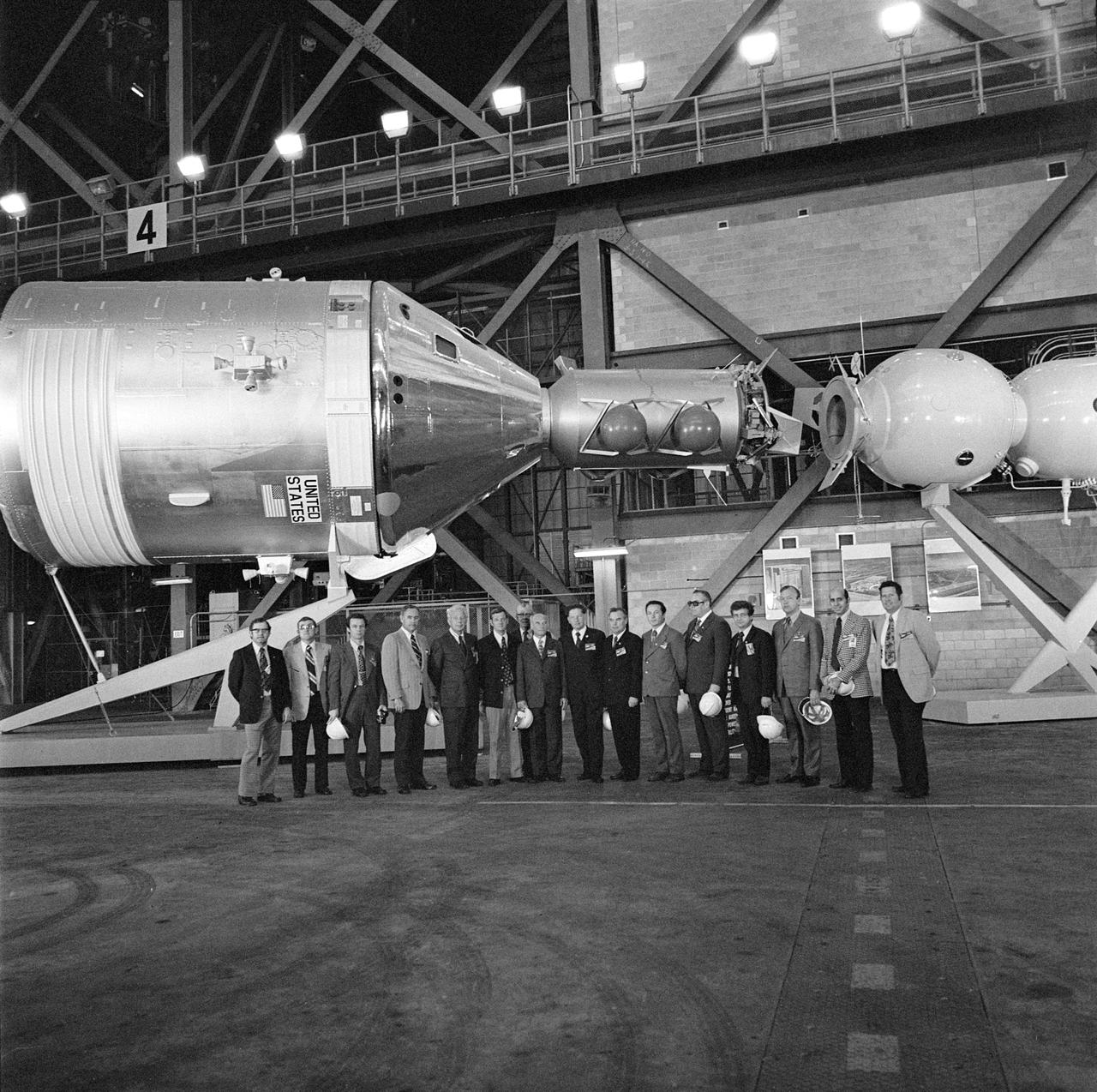
S75-24026 (4 Feb. 1975) --- A group of Soviet and American ASTP officials during a tour of the Kennedy Space Center. They were photographed next to the Apollo-Soyuz Test Project docking in Earth orbit mock-up at KSC.
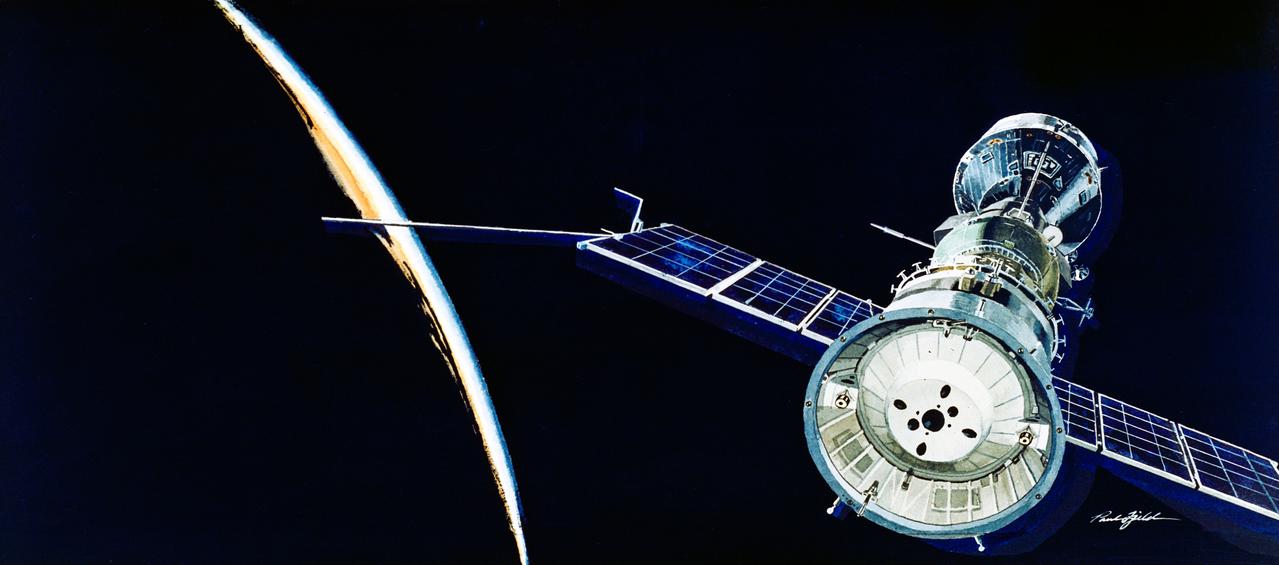
S75-27287 (May 1975) --- An artist?s concept depicting an American Apollo spacecraft docked with a Soviet Soyuz spacecraft in Earth orbit. This view is looking toward the aft end of Soyuz, with the Apollo in the background. Two solar panels protrude out from the instrument assembly module of the Soyuz. The glow on Earth?s horizon is seen on the left. During the joint U.S.-USSR Apollo-Soyuz Test Project mission, scheduled for July 1975, the American and Soviet crews will visit one another?s spacecraft while the Soyuz and Apollo are docked for a maximum period of two days. This artwork is by Paul Fjeld.
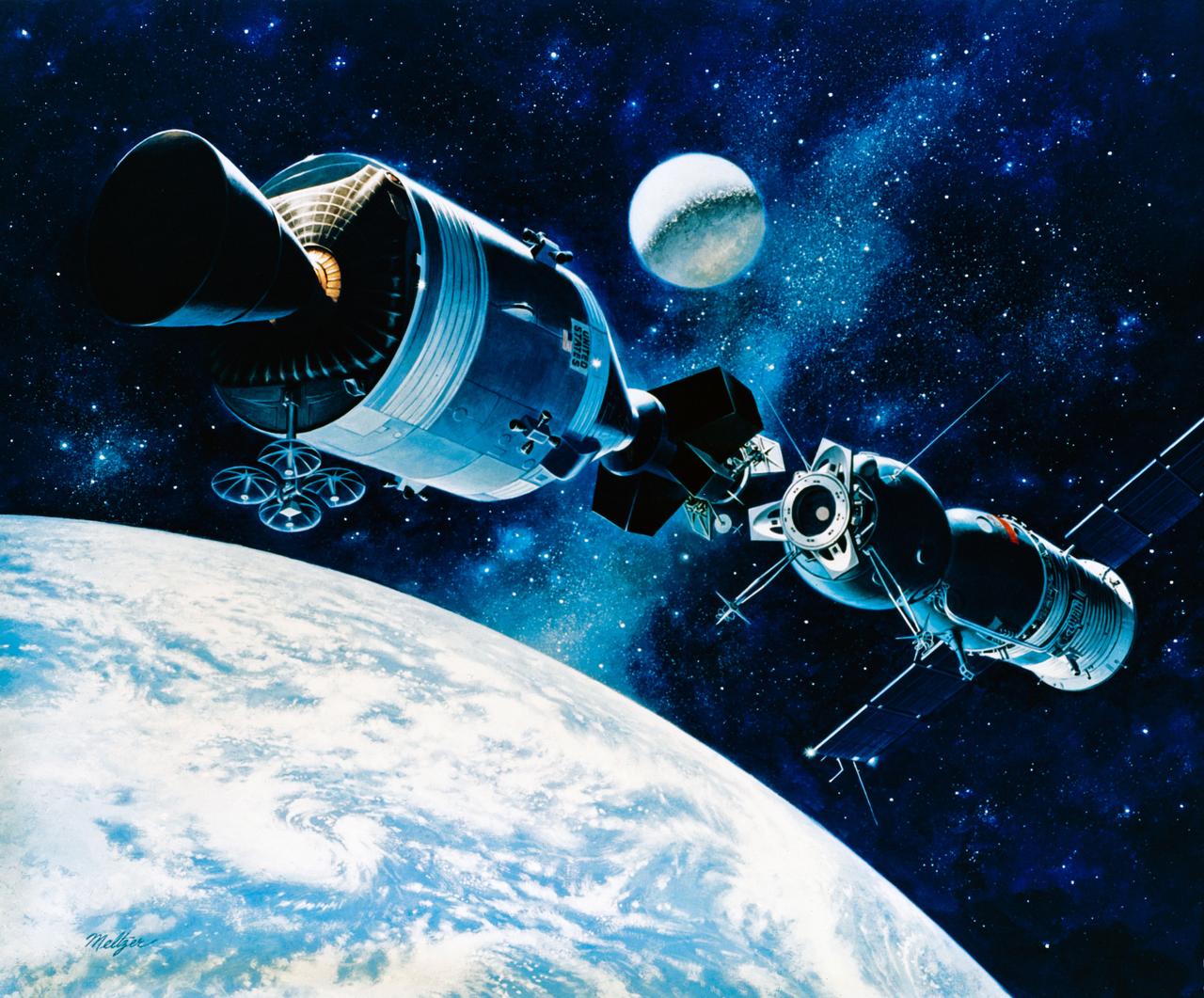
S75-27285 (April 1975) --- An artist's concept depicting an American Apollo spacecraft rendezvousing with a Soviet Soyuz spacecraft in Earth orbit. The two spacecraft are in a near-docked configuration. During the joint U.S.-USSR Apollo-Soyuz Test Project (ASTP) mission, which is scheduled for July 1975, the American and Soviet crews will visit each other's spacecraft while the Soyuz and Apollo are docked for a maximum period of two days. The mission is designed to test equipment and techniques that will establish international crew rescue capability in space, as well as permit future cooperative scientific missions. This artwork is by Davis Meltzer.
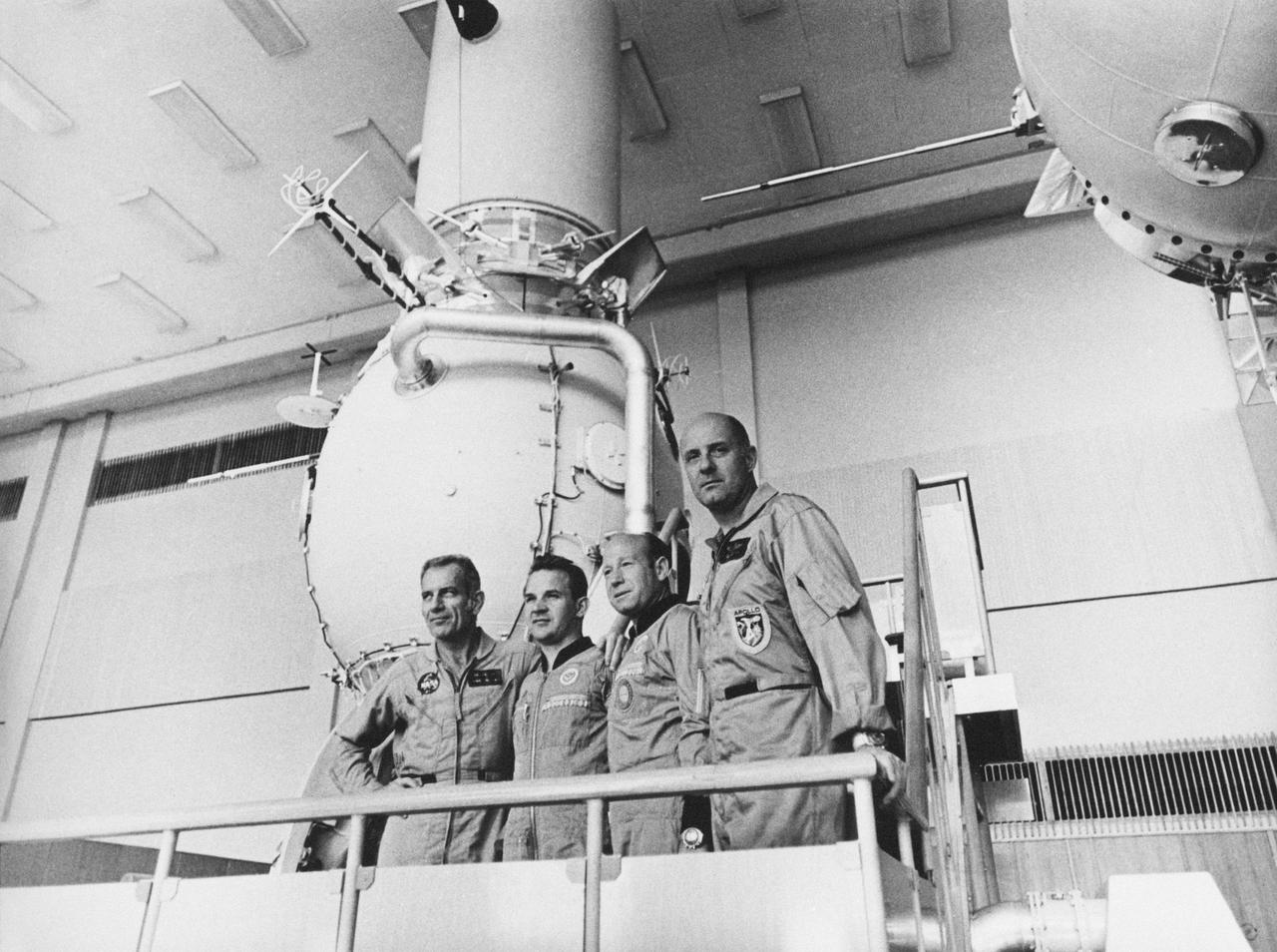
S74-25259 (June 1974) --- Four crewmen of the joint U.S.-USSR Apollo-Soyuz Test Project mission are photographed beside a Soyuz spacecraft trainer during ASTP crew training activity at the Cosmonaut Training Center (Star City) near Moscow. They are, left to right, astronaut Donald K. Slayton, docking module pilot of the American ASTP prime crew; cosmonaut Valeriy N. Kubasov, engineer of the Soviet ASTP first (prime) crew; cosmonaut Aleksey A. Leonov, commander of the Soviet ASTP first (prime) crew; and astronaut Thomas P. Stafford, commander of the American ASTP prime crew.
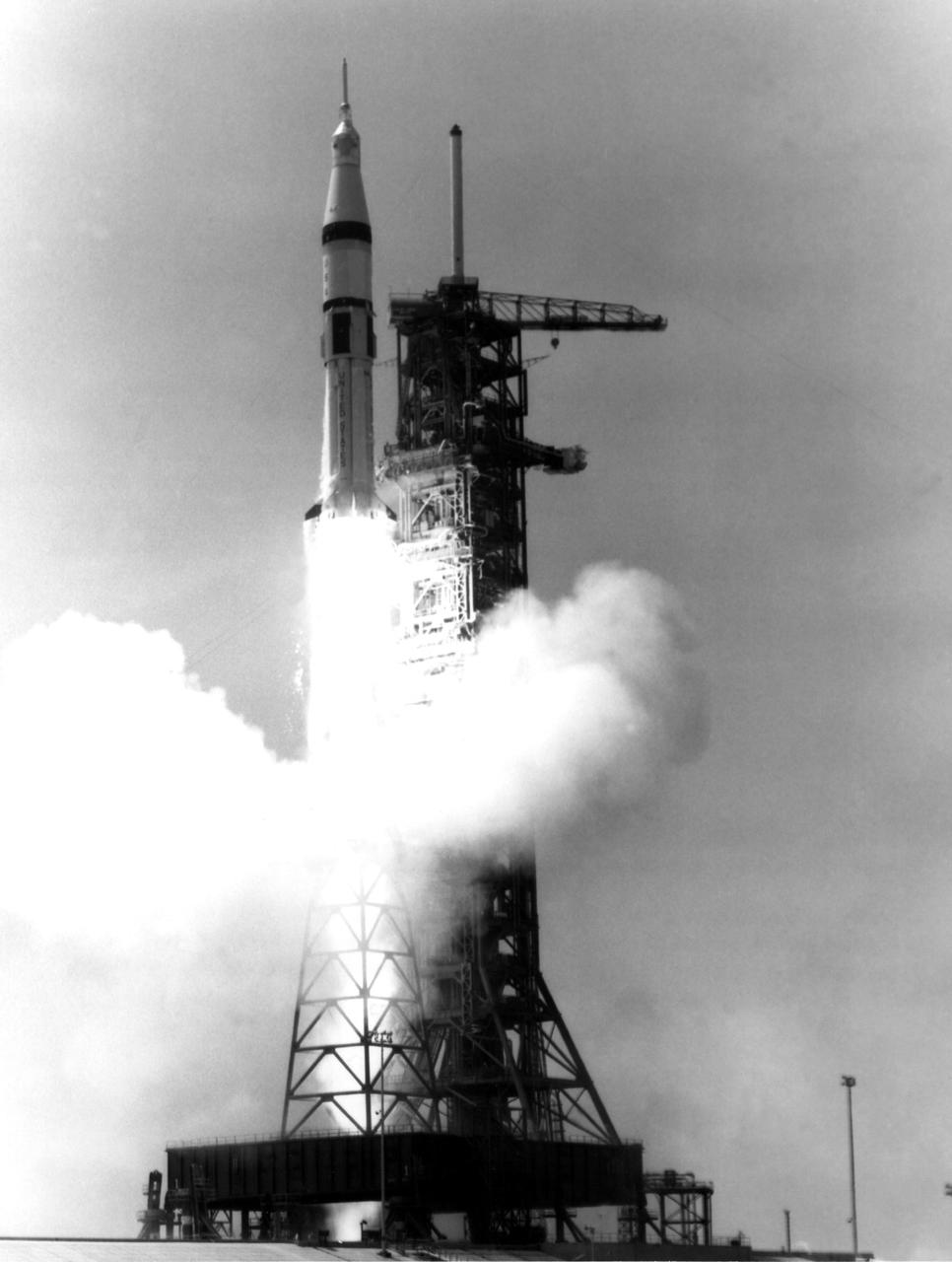
KENNEDY SPACE CENTER, FLA. -- The Apollo Soyuz Test Project Saturn IB launch vehicle thundered away from KSC's Launch Complex 39B at 3:50 p.m. today. Aboard the Apollo Command Module were ASTP astronauts Thomas Stafford, Vance Brand and Donald Slayton. The astronauts will rendezvous and dock with a Soyuz spacecraft, launched this morning from the Baykonur launch facility in the Soviet Union, carrying Soviet cosmonauts Aleksey Leonov and Valeriy Kubasov. The ASTP launches mark the first time that manned spacecraft of two nations have met in space for joint engineering and scientific investigations.
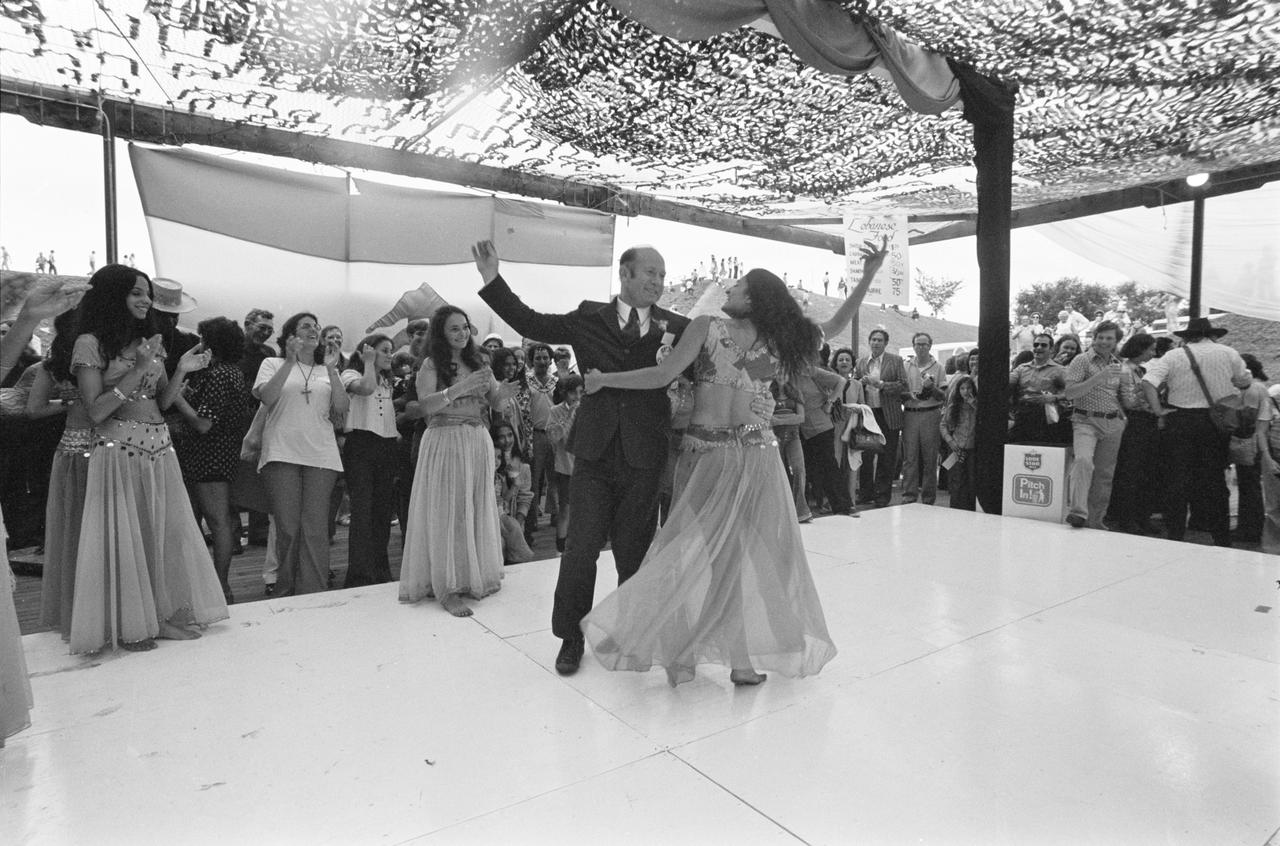
S74-28666 (14 Sept. 1974) --- Cosmonaut Aleksey A. Leonov, in one of the lighter moments of activity involving Soviet cosmonauts and American astronauts, joins a belly dancer on stage as several visitors to weekend activity at the site of San Antonio?s HemisFair look on. Leonov is commander of the Soviet Apollo-Soyuz Test Project (ASTP) crew. A group of cosmonauts is in this country training with American astronauts for the joint U.S.-USSR ASTP rendezvous and docking mission scheduled for the summer of 1975. The Lebanese dancing was just one feature among many during the Texas Folklife Festival, in which members of 26 ethnic groups participated.
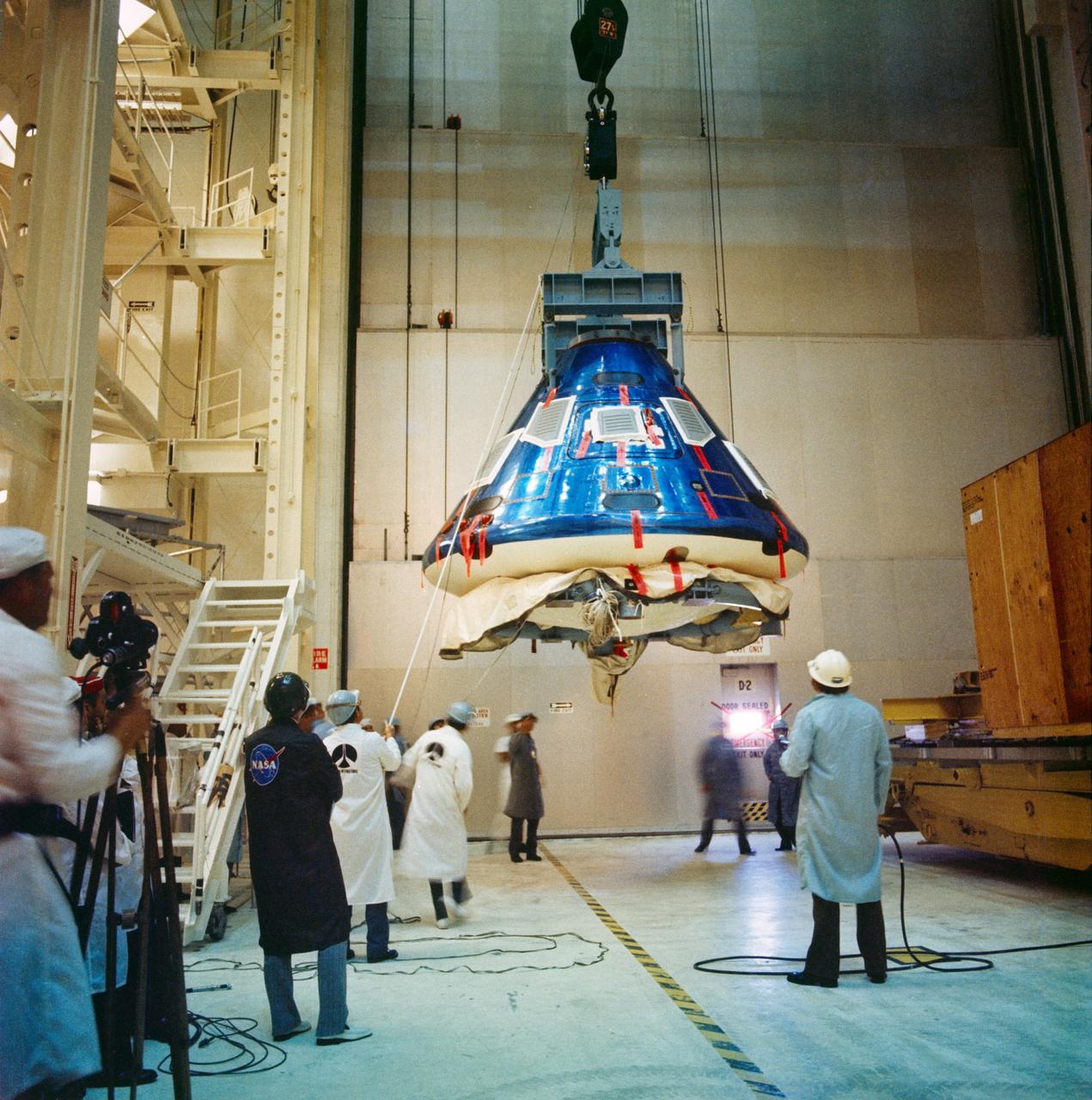
S74-32049 (8 Sept. 1974) --- The Apollo Command Module for the Apollo-Soyuz Test Project mission goes through receiving, inspection and checkout procedures in the Manned Spacecraft Operations Building at the Kennedy Space Center. The spacecraft had just arrived by air from the Rockwell International plant at Downey, California. The Apollo spacecraft (Command Module, Service Module and Docking Module), with astronauts Thomas P. Stafford, Vance D. Brand and Donald K. Slayton aboard, will dock in Earth orbit with a Soviet Soyuz spacecraft during the joint U.S.-USSR ASTP flight scheduled for July 1975. The Soviet and American crews will visit one another?s spacecraft.
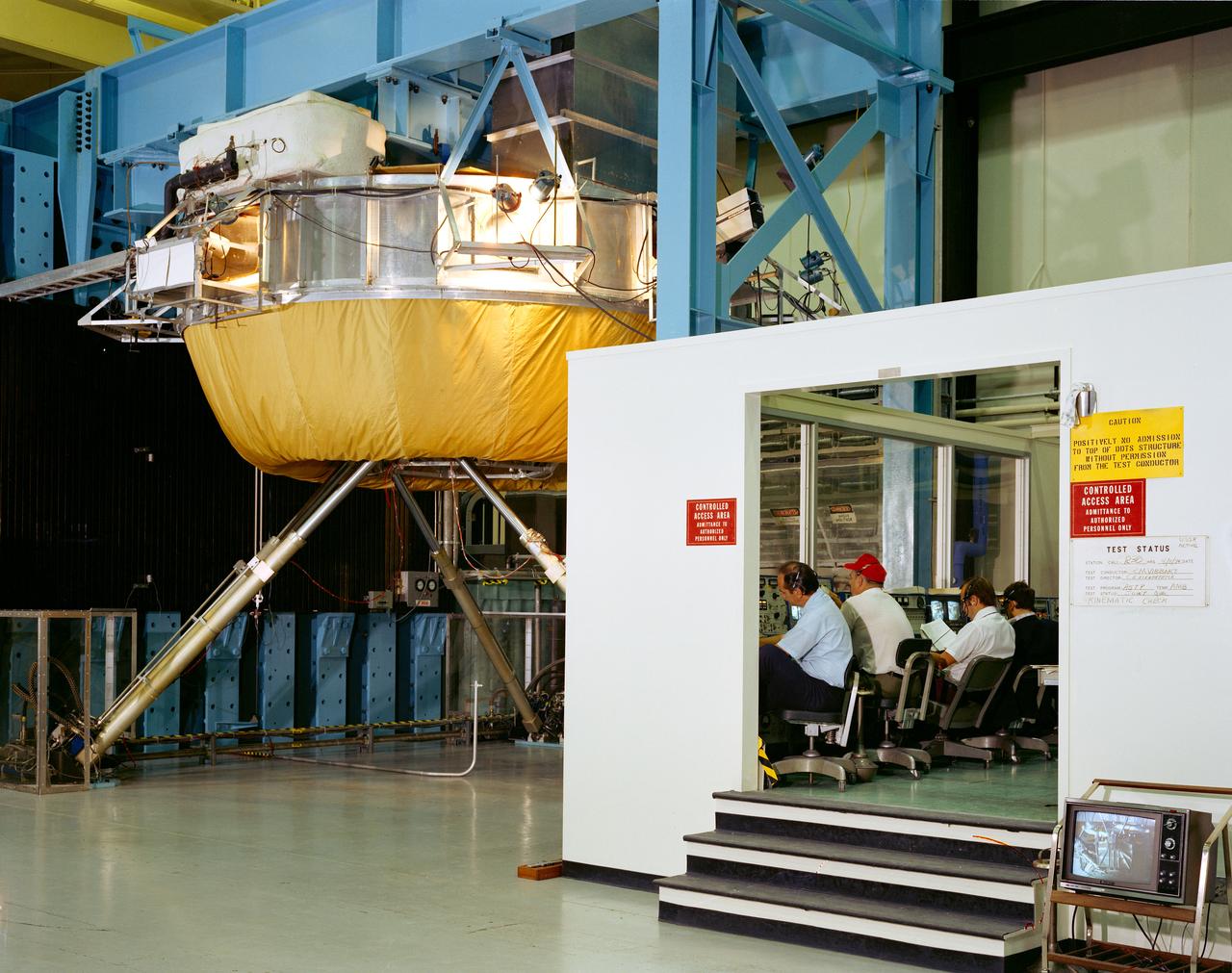
S74-27049 (4 Aug. 1974) --- Overall view of test set-up in Building 23 at the Johnson Space Center during testing of the docking mechanisms for the joint U.S.-USSR Apollo-Soyuz Test Project. The cinematic check was being made when this picture was taken. The test control room is on the right. The Soviet-developed docking system is atop the USA-NASA developed docking system. Both American and Soviet engineers can be seen taking part in the docking testing. The ASTP docking mission in Earth orbit is scheduled for July 1975.
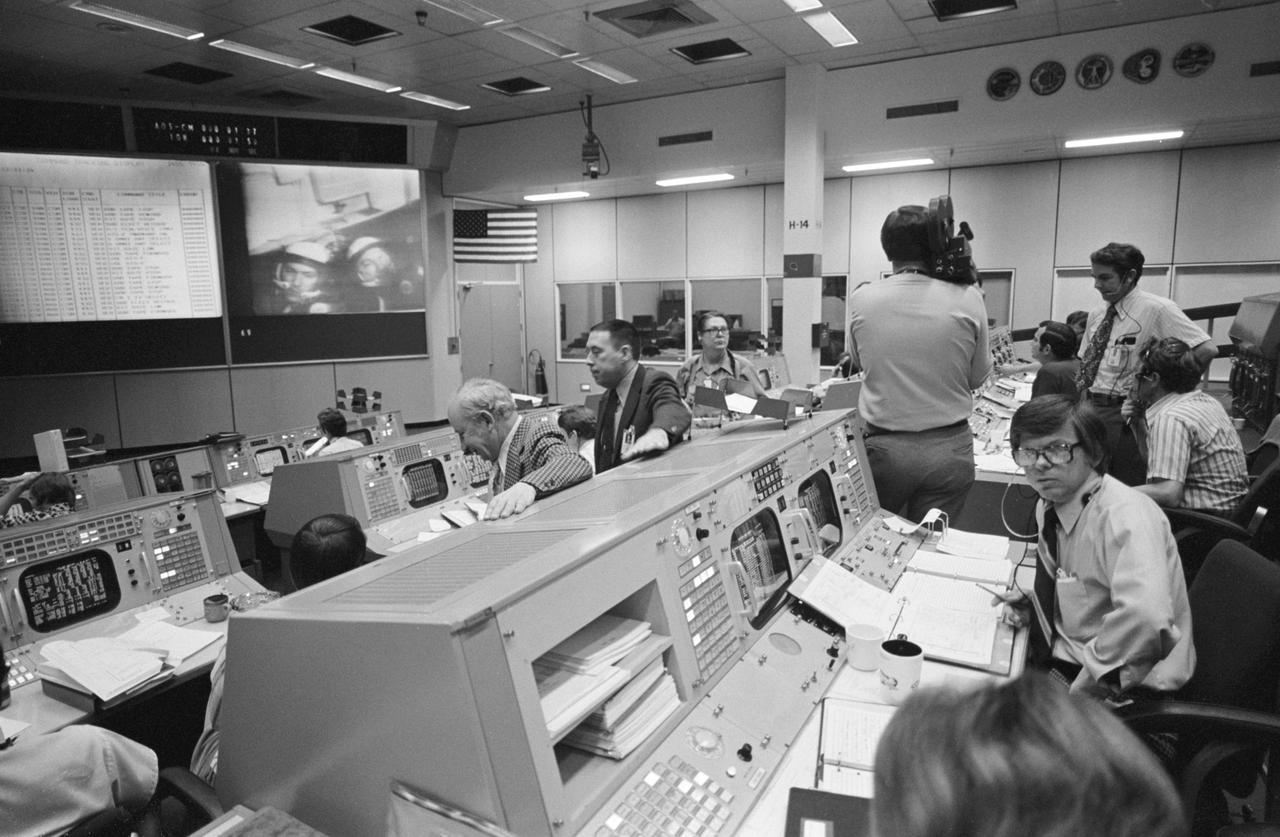
S75-23638 (20 March 1975) --- An overall view of the Mission Operations Control Room in the Mission Control Center during joint ASTP simulation activity at NASA's Johnson Space Center. The simulations are part of the preparations for the U.S.-USSR Apollo-Soyuz Test Project docking mission in Earth orbit scheduled for July 1975. M.P. Frank (seated, right) is the senior American flight director for the mission. Sigurd A. Sjoberg (in center, checked jacket), JSC Deputy Director, watches some of the console activity. George W.S. Abbey, Technical Assistant to the JSC Director, is standing next to Sjoberg. The television monitor in the background shows Soviet Soyuz crew activity from the Soviet Union.
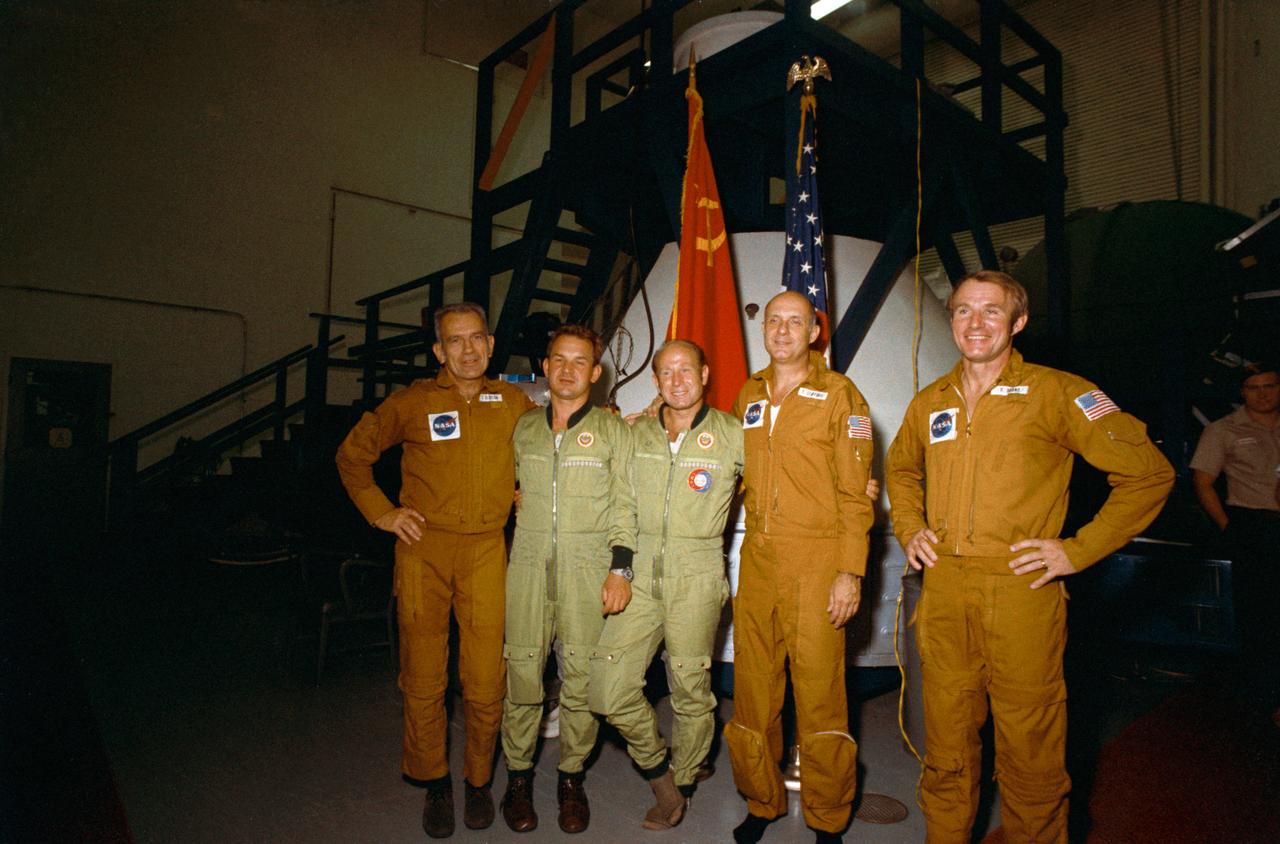
S74-28811 (23 Sept. 1974) --- The five prime crewmen of the joint U.S.-USSR Apollo-Soyuz Test Project mission are photographed in the Flight Crew Training Facility, Building 35, at the Johnson Space Center during ASTP crew training activity. They are, left to right, astronaut Donald K. Slayton, docking module pilot of the American crew; cosmonaut Valeriy N. Kubasov, engineer on the Soviet crew; cosmonaut Aleksey A. Leonov, commander of the Soviet crew; astronaut Thomas P. Stafford, commander of the American crew; and astronaut Vance D. Brand, command module pilot of the American crew.
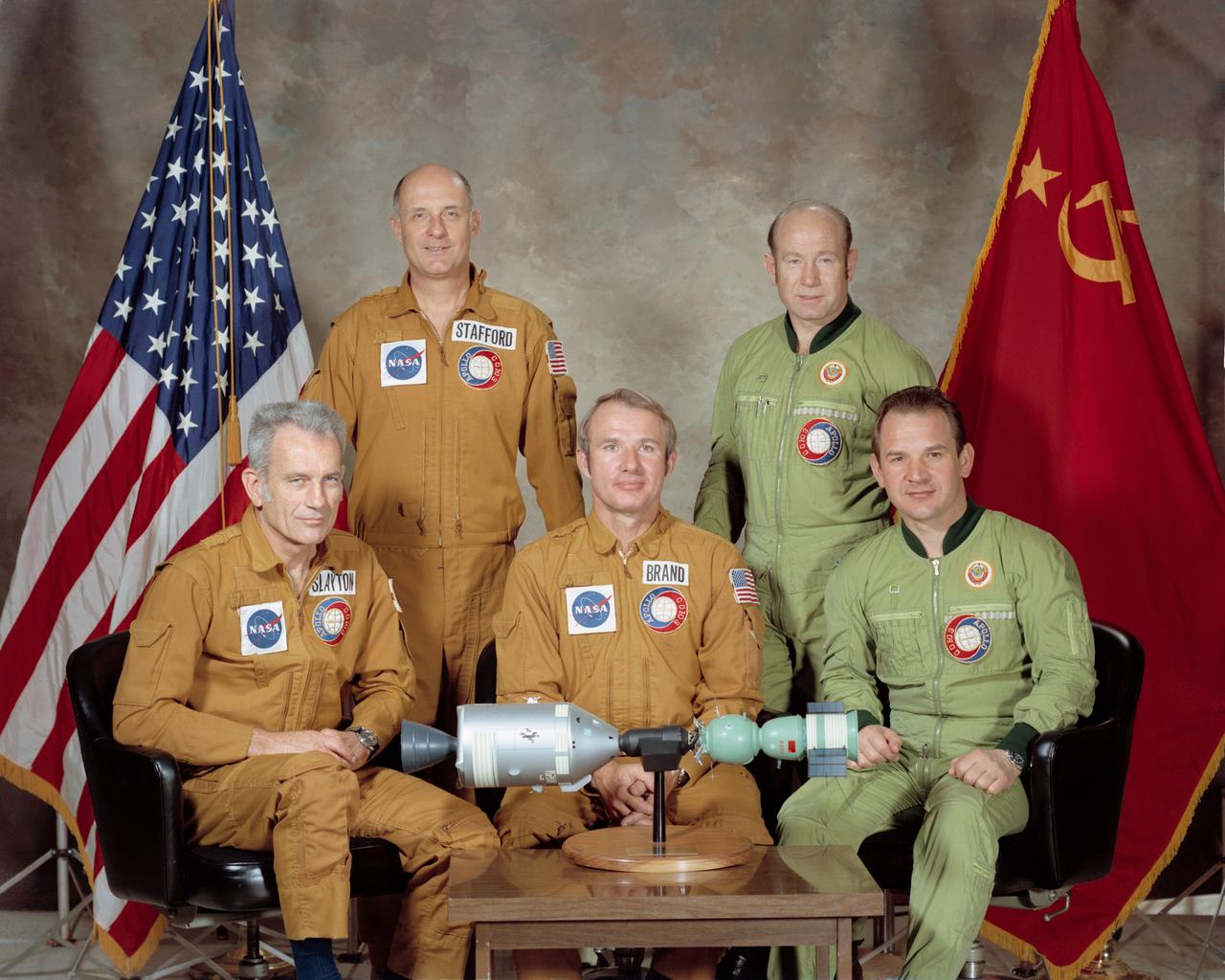
S75-22410 (March 1975) --- These five men compose the two prime crews of the joint United States-USSR Apollo-Soyuz Test Project (ASTP) docking mission in Earth orbit scheduled for July 1975. They are astronaut Thomas P. Stafford (standing on left), commander of the American crew; cosmonaut Aleksey A. Leonov (standing on right), commander of the Soviet crew; astronaut Donald K. Slayton (seated on left), docking module pilot of the American crew; astronaut Vance D. Brand (seated center), command module pilot of the American crew; and cosmonaut Valeriy N. Kubasov (seated on right), engineer on the Soviet crew.
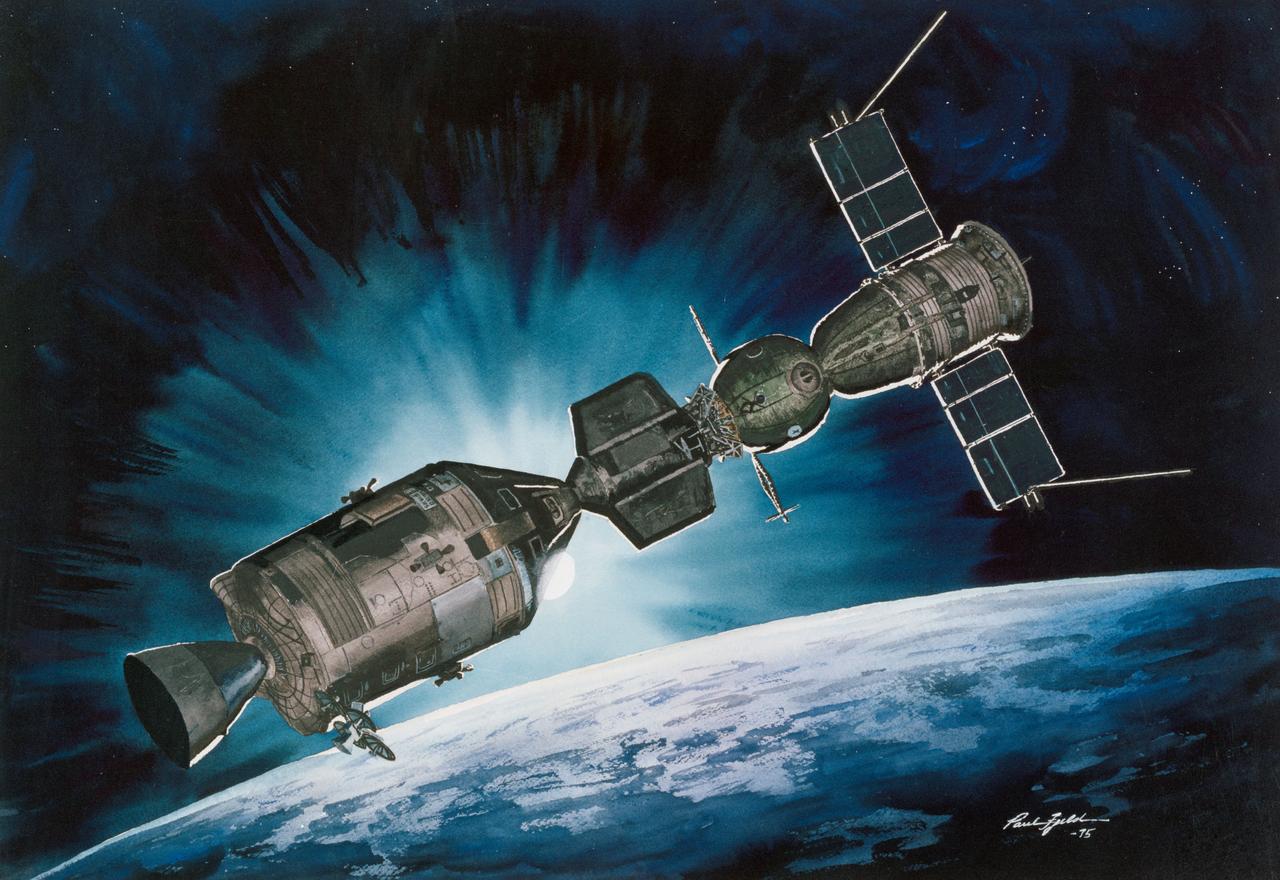
S75-28511 (July 1975) --- An artist?s concept depicting the American and Soviet spacecraft docked in Earth orbit during the July 1975 Apollo-Soyuz Test Project mission. The Apollo Command/Service Module is on the left, the Docking Module is in the center, and the Soyuz spacecraft is on the right. The first docking of spacecraft from two different nations was scheduled for July 17, 1975. The American and Soviet ASTP crewmen planned to visit each other?s spacecraft while Apollo and Soyuz are docked for a maximum period of two days. The docking system on the Docking Module and the docking system on the Soyuz Orbital Module are designed to interface with each other. The painting is by artist Paul Fjeld.
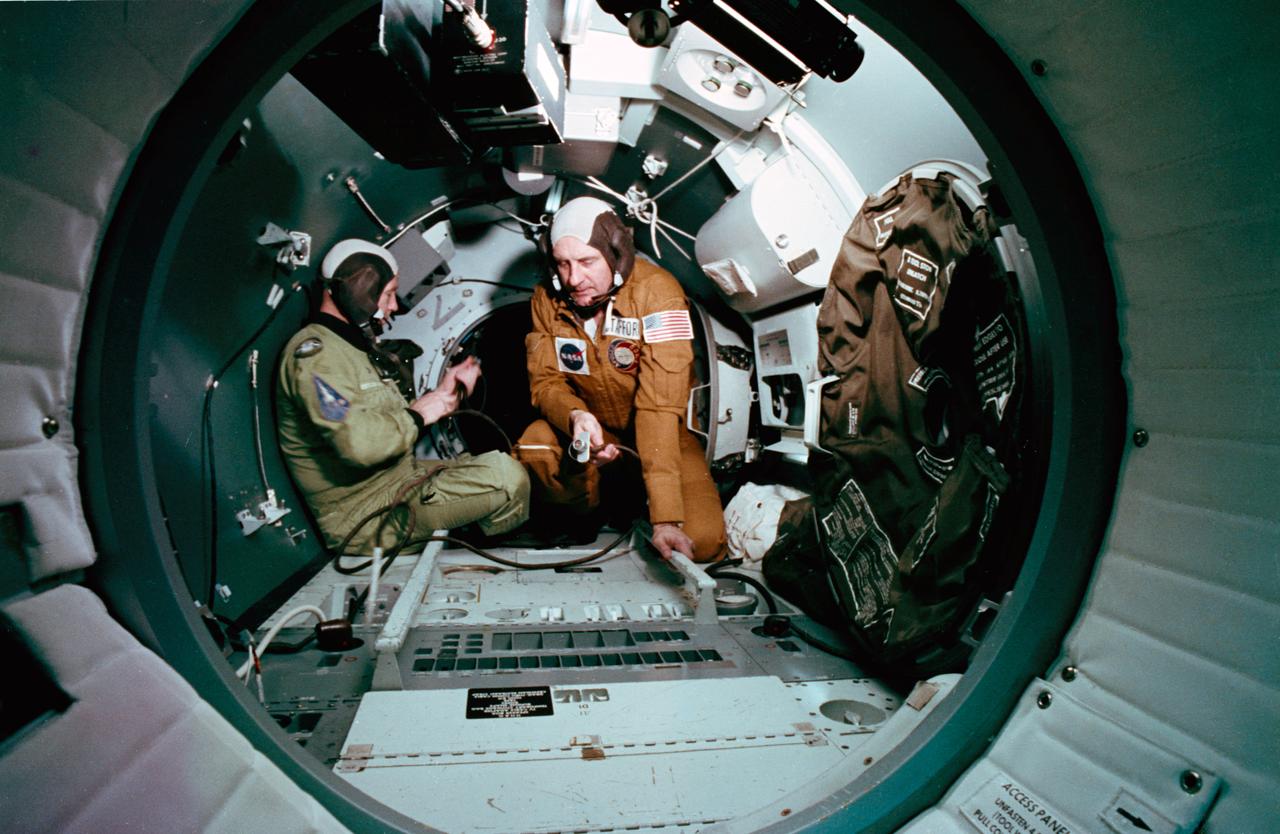
S75-22785 (25 Feb. 1975) --- An interior view of the Docking Module trainer, in Building 35, during Apollo-Soyuz Test Project (ASTP) joint crew training at NASA's Johnson Space Center (JSC). Astronaut Thomas P. Stafford, commander of the American ASTP prime crew, is on the right. The other crewman is cosmonaut Aleksky A. Leonov, commander of the Soviet ASTP prime crew. The training session simulated activities on the second day in Earth orbit. The American and Soviet crews will visit each other's spacecraft during the July 1975 docking mission in Earth orbit. The Docking Module is designed to link the Apollo and Soyuz spacecraft.
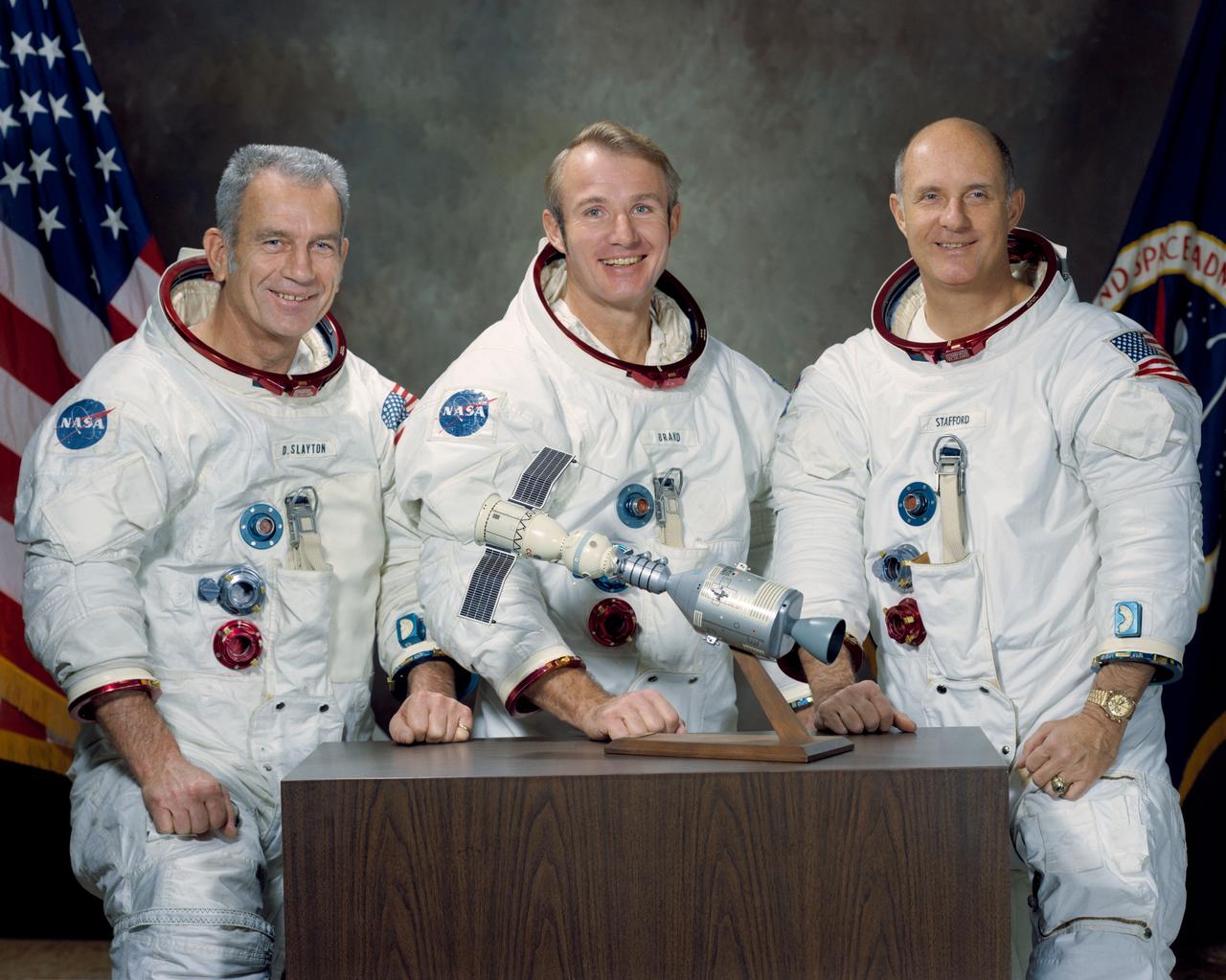
S74-15241 (January 1974) --- These three NASA astronauts are the United States flight crew for the 1975 Apollo-Soyuz Test Project (ASTP) mission. The prime crew members for the joint United States - Soviet Union spaceflight are, left to right, Donald K. Slayton, docking module pilot; Vance D. Brand, command module pilot; and Thomas P. Stafford, commander. The American and Soviet crews will visit one another?s spacecraft while the Soyuz and Apollo are docked in Earth orbit for a maximum of two days. The ASTP mission is designed to test equipment and techniques that will establish international crew rescue capability in space, as well as permit future cooperative scientific missions.
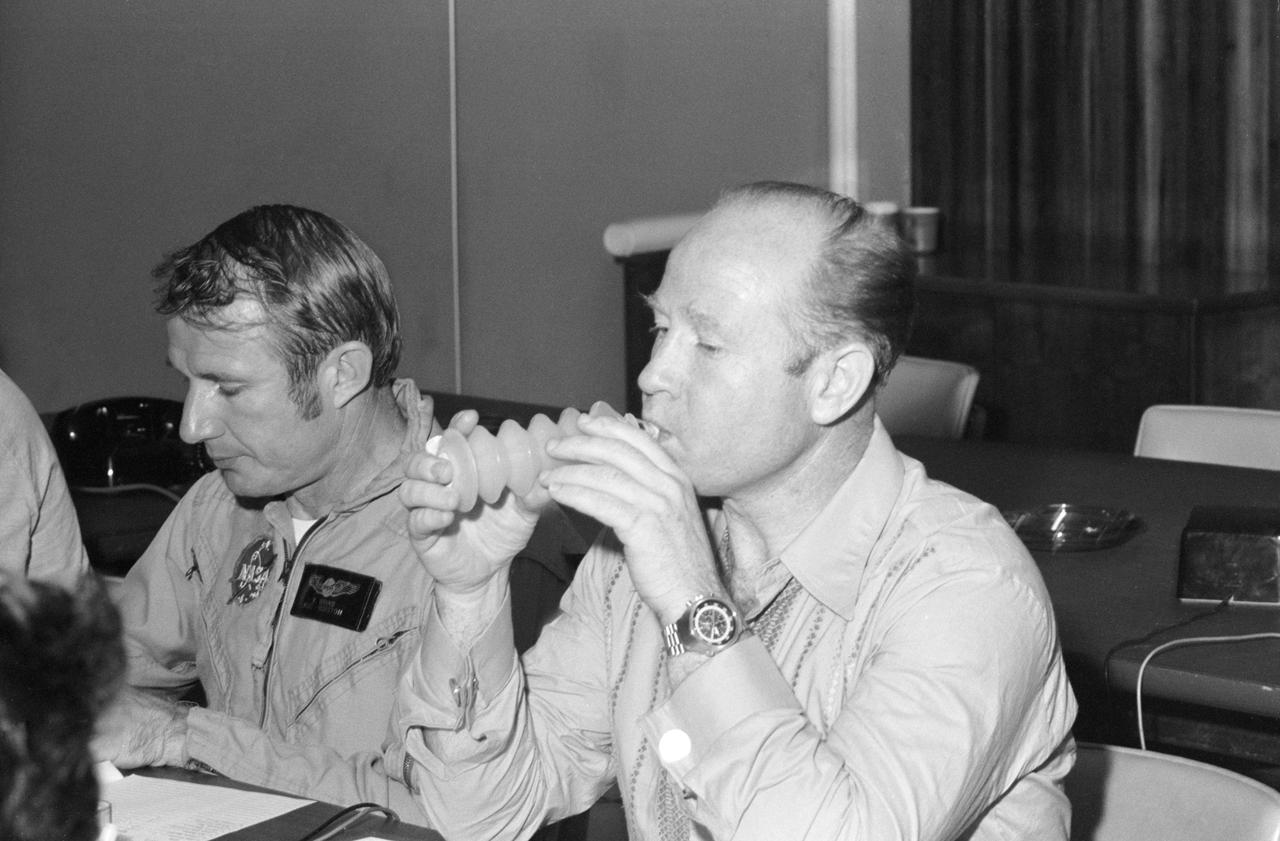
S74-20798 (23 April 1974) --- Candidate food items being considered for the joint U.S.-USSR Apollo-Soyuz Test Project mission are sampled by two ASTP crewmen in Building 4 at the Johnson Space Center. They are, left to right, astronaut Vance D. Brand, command module pilot of the American ASTP crew; and cosmonaut Aleksey A. Leonov, commander of the Soviet ASTP crew. Leonov is drinking orange juice from an accordion-like dispenser. The two Soviet crewmen will have an opportunity to eat with the three American crewmen while the Apollo and Soyuz spacecraft are docked in Earth orbit. Leonov will dine on food being chosen by him now.
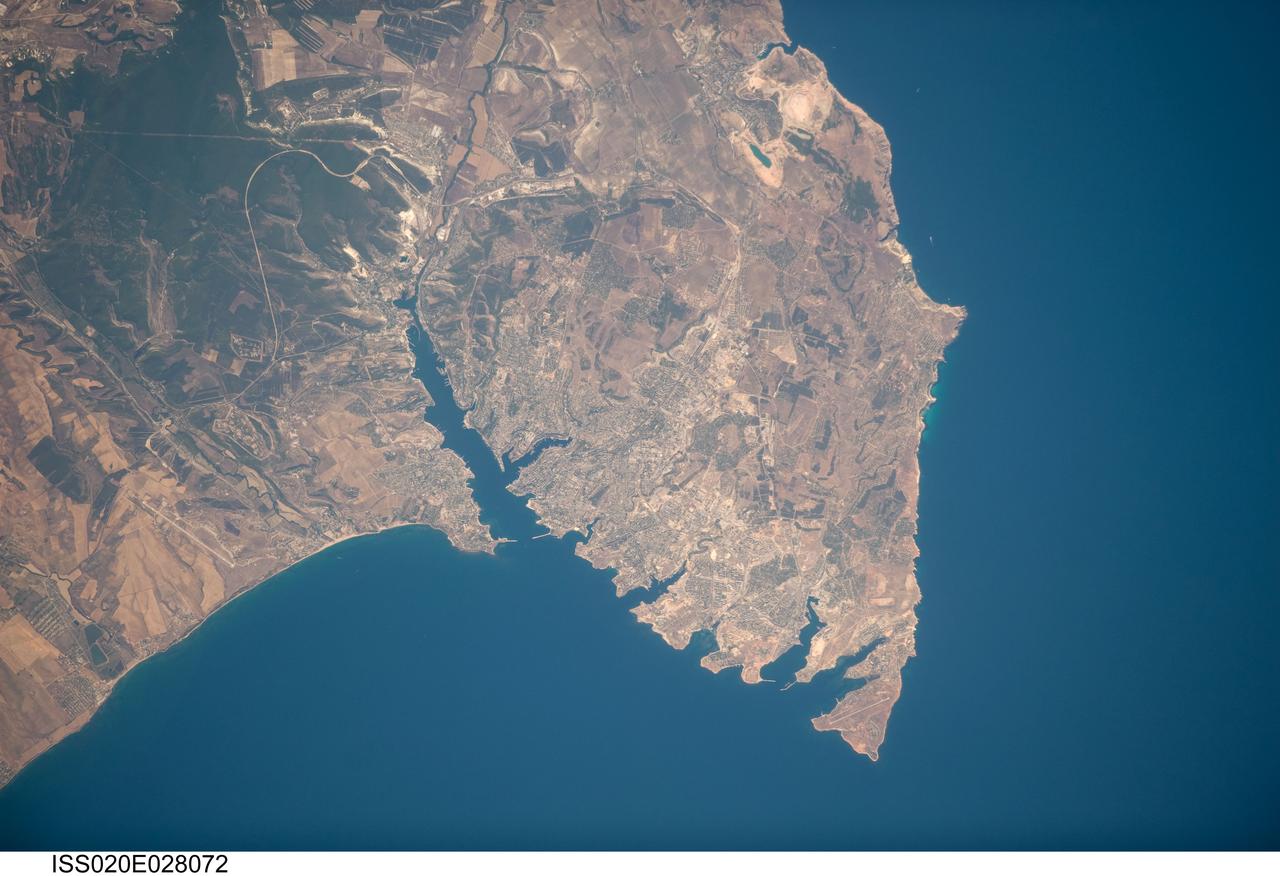
ISS020-E-028072 (5 Aug. 2009) --- Sevastopol, Ukraine is featured in this image photographed by an Expedition 20 crew member on the International Space Station. The port city of Sevastopol is located in southernmost Ukraine on the Crimean Peninsula. The city is an important naval base due to the numerous inlets and bays along the coastline (bottom center). During the Cold War, the city was the base of the Soviet Black Sea Fleet, but now services vessels of both the Ukraine and Russia. The main economy of the city is based on trade and shipbuilding, but Sevastopol is also a popular tourist and resort destination for visitors from the Commonwealth of Independent Countries (formed from former Soviet Republics). This photograph highlights the jagged coastline of the southern Crimean Peninsula and the various docking areas of Sevastopol. The urban area is light gray, and is bounded to the north and west by the Black Sea, to the south by vegetated (light green) and fallow (tan) agricultural fields, and to the east by the city of Inkerman and green vegetated uplands to the northwest of the Crimean Mountains. The city of Balaklava to the south houses another relic of the Cold War ? an underground Soviet submarine base that is now open to the public as a monument. The Chernaya River issues into the Black Sea near Inkerman, flowing into the Sevastopol Inlet to the west.
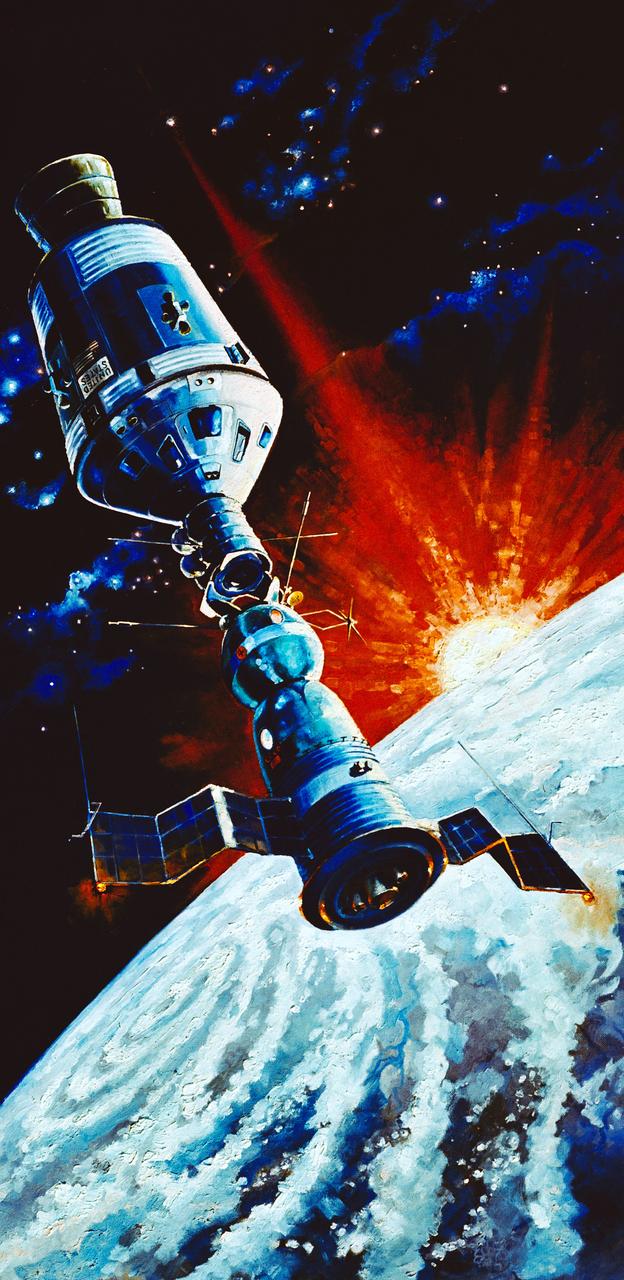
S75-25077 (May 1975) --- A photographic copy of a painting made by cosmonaut Aleksey A. Leonov, commander of the Soviet ASTP first (prime) crew. This symbolic artwork, representing a Soviet Soyuz spacecraft docking in Earth orbit with an American Apollo spacecraft, was finished in May 1974. The sketch for the painting was made in 1973 following the signing of the space agreement between the United Stated and the Soviet Union. Leonov said that his painting symbolizes the new type of international cooperation of working together in space. The original painting, which measures 80 centimeters by 160 centimeters (1 cm. = 0.39 in.), is on display in a museum in the city of Baku on the Caspian Sea. In making the sketch for the painting Leonov used a model of an earlier Soyuz spacecraft and a picture of an Apollo spacecraft. Later, he obtained a model of an Apollo which helped him check the configuration of the American spacecraft. The tanks on the Docking Module are no longer exposed on the current DM configuration, he noted. Also, this would not be an exact view of the sun as seen from Earth orbit. Leonov took artist license in stressing the symbolism in his artwork. The Soyuz is represented smaller in the painting than it actually is, Leonov added.
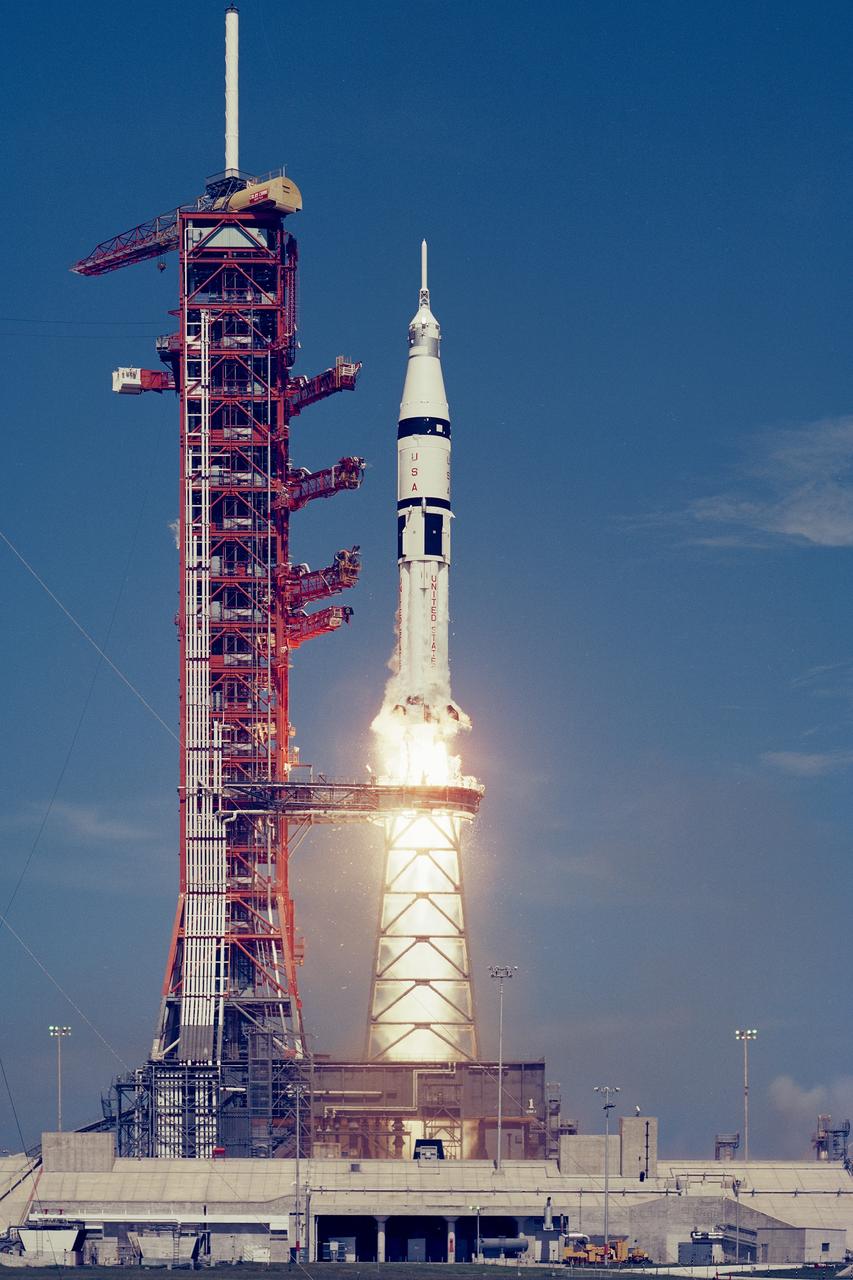
CAPE CANAVERAL, Fla. – The Apollo Soyuz Test Project Saturn IB launch vehicle thundered away from KSC’s Launch Complex 39B at 3:50 p.m. today. Aboard the Apollo Command Module were ASTP Astronauts Thomas Stafford, Vance Brand and Donald Slayton. The astronauts will rendezvous and dock with a Soyuz spacecraft, launched this morning from the Baikonur launch facility in the Soviet Union, carrying Soviet cosmonauts Aleksey Leonov and Valeriy Kubasov. The first international crewed spaceflight was a joint U.S.-U.S.S.R. rendezvous and docking mission. The Apollo-Soyuz Test Project, or ASTP, took its name from the spacecraft employed: the American Apollo and the Soviet Soyuz. The three-man Apollo crew lifted off from Kennedy Space Center aboard a Saturn IB rocket on July 15, 1975, to link up with the Soyuz that had launched a few hours earlier. A cylindrical docking module served as an airlock between the two spacecraft for transfer of the crew members. Photo credit: NASA
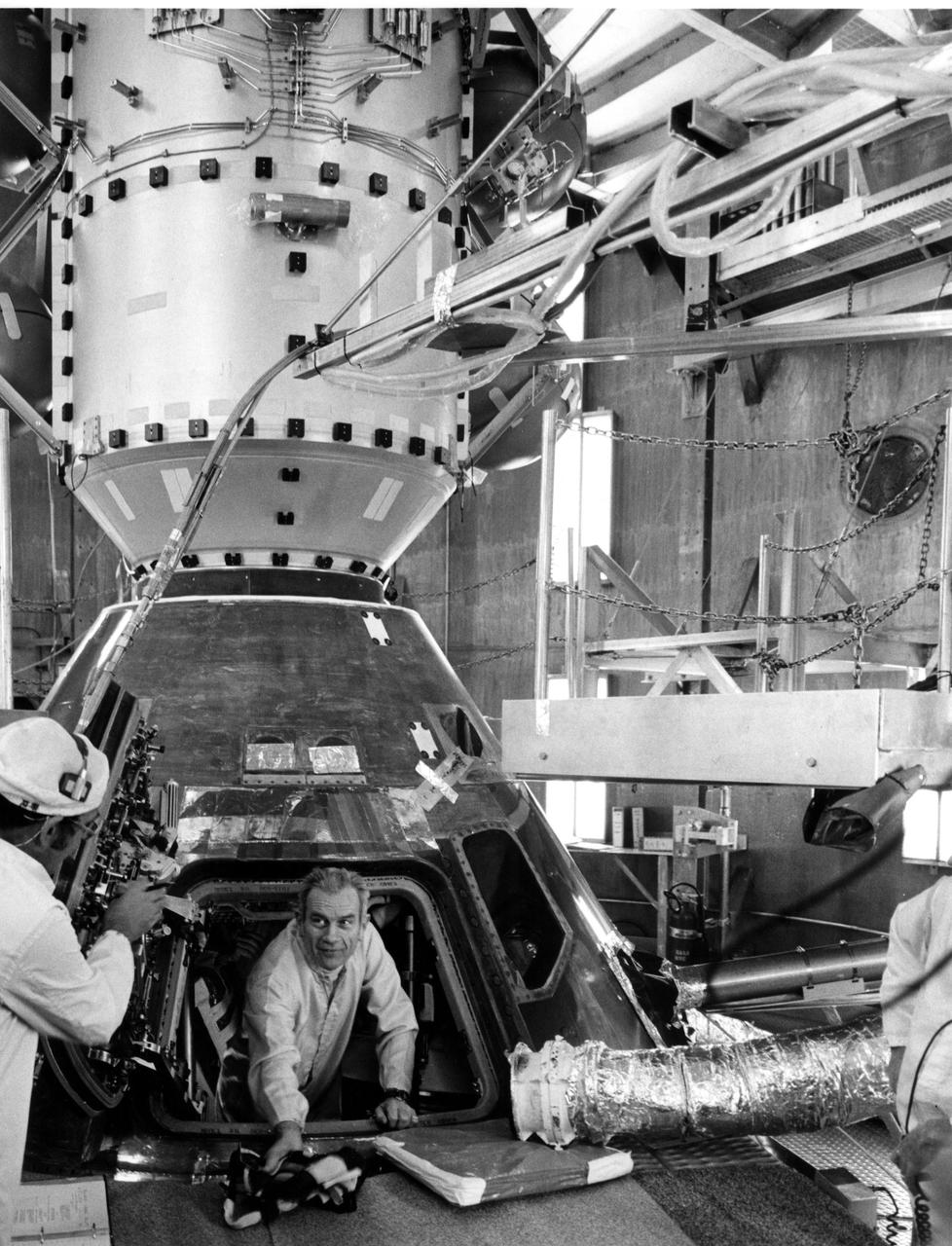
KENNEDY SPACE CENTER, FLA. -- Astronaut Donald Slayton is shown in the Apollo Command Module for July's Apollo-Soyuz Test Project space mission. Slayton was at KSC for fit checks between the Apollo and the Docking Module, which will be used during the mission as a link between the Soviet Soyuz and American Apollo.
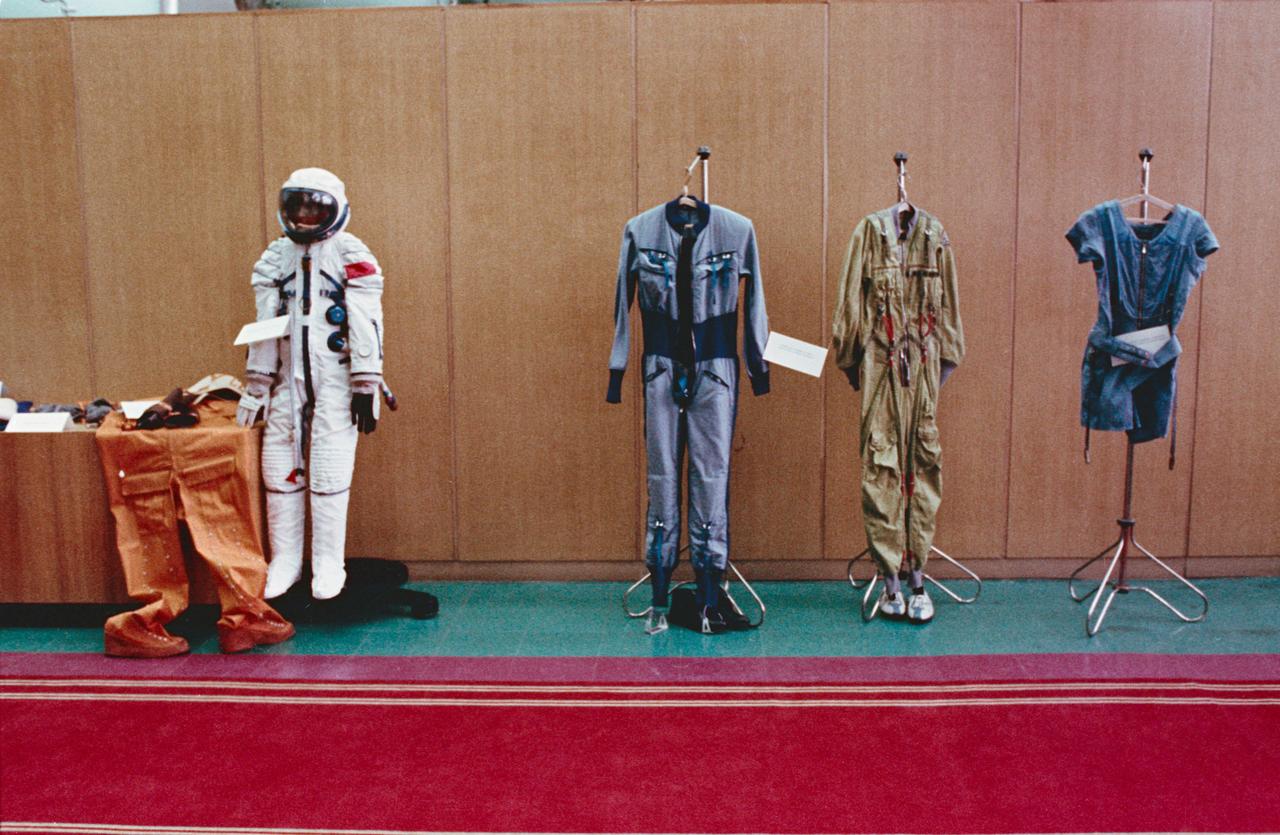
S75-24899 (April 1975) --- An exhibit illustrating the space suits designed for the Soviet cosmonaut crewmen of the joint U.S.-USSR Apollo-Soyuz Test Project docking mission in Earth orbit. These were on display in the training building at the Cosmonaut Training Center (Star City) near Moscow.

AST-05-263 (17-18 July 1975) --- The Apollo-Soyuz Test Project (ASTP) Commemorative Plaque is assembled in the Soviet Soyuz Orbital Module during the joint U.S.-USSR Apollo-Soyuz Test Project docking mission in Earth orbit. The plaque is written both in English and Russian.
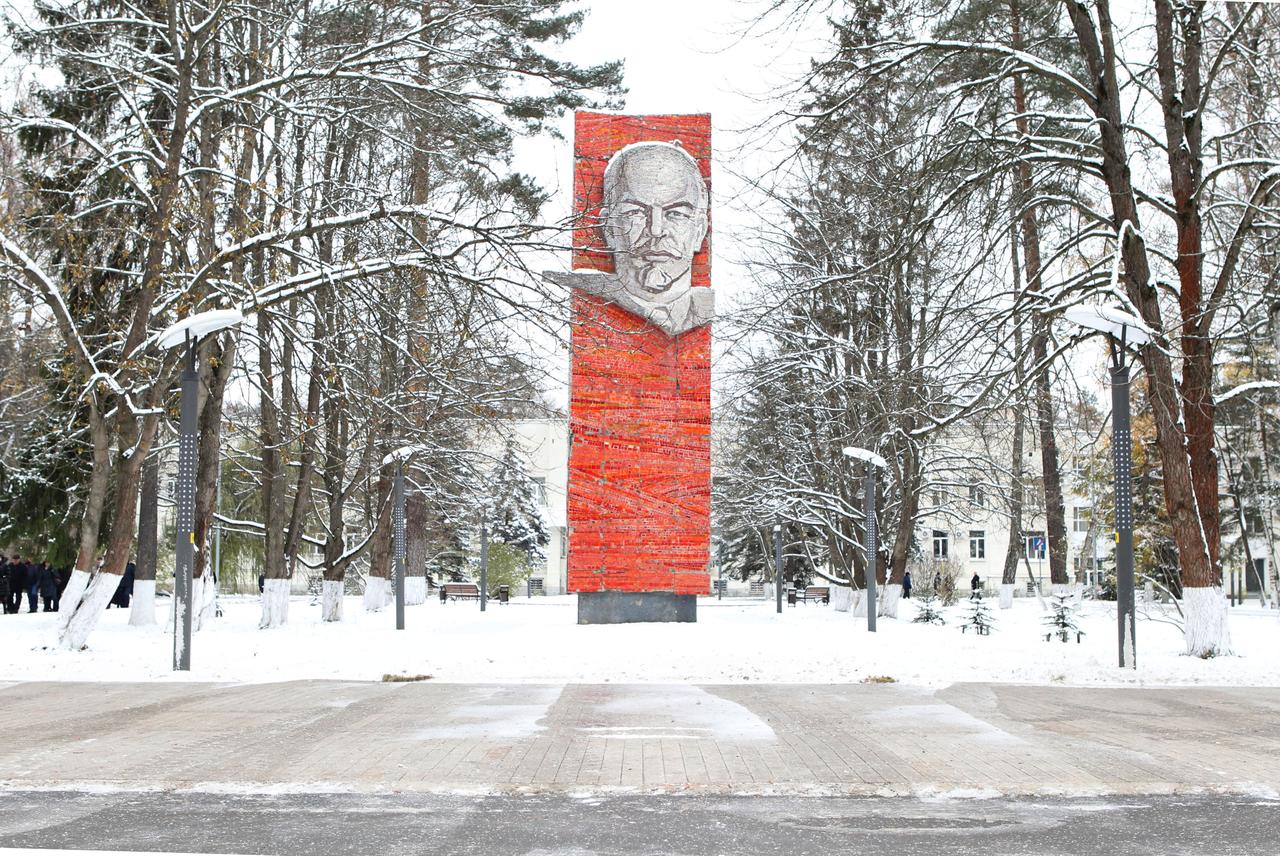
At the Gagarin Cosmonaut Training Center in Star City, Russia, a wintry scene serves as a backdrop for a familiar sight – Lenin’s Statue --- commemorating Vladimir Lenin’s who led an evolving Soviet Union from 1917-1924. The photo was captured on Nov. 1, 2016. NASA/Stephanie Stoll
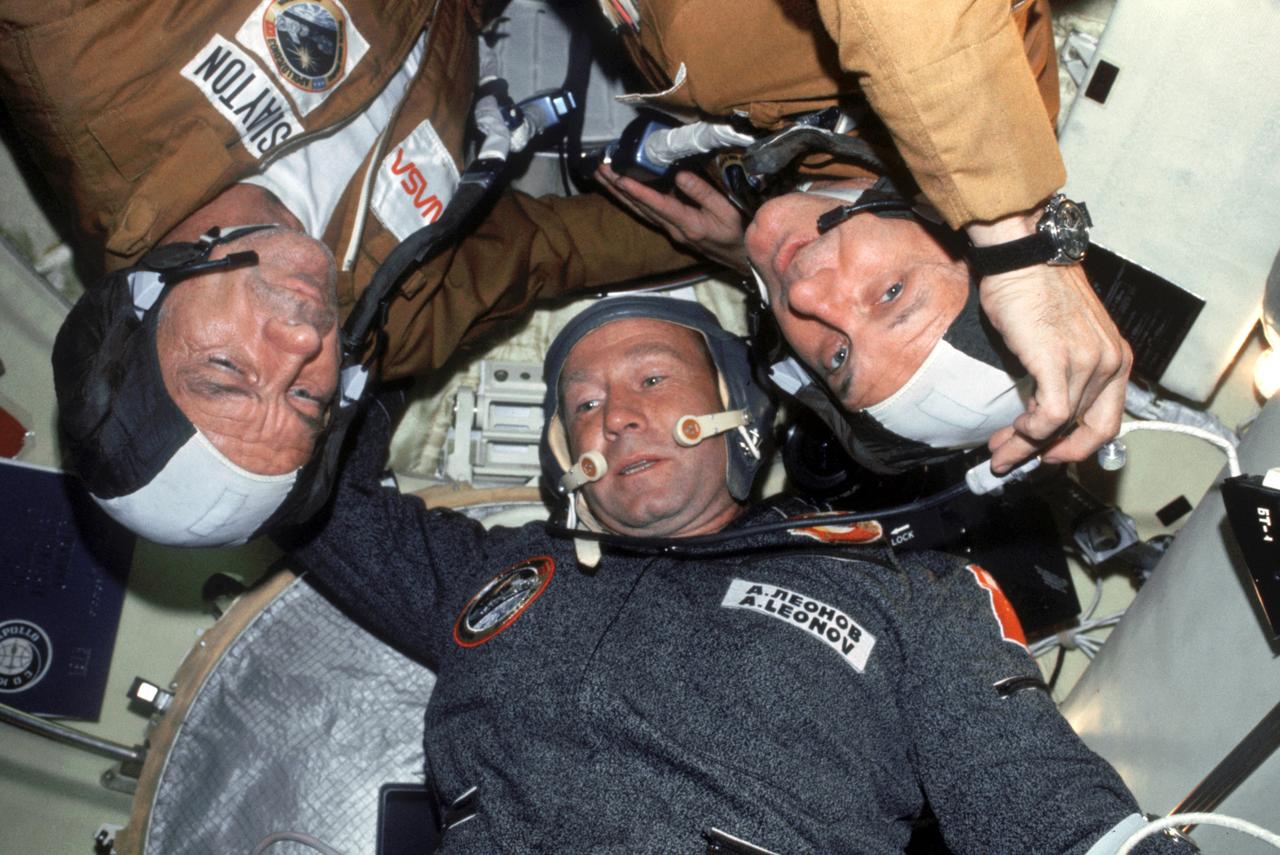
AST-05-301 (17-19 July 1975) --- Astronaut Donald K. Slayton, cosmonaut Aleksey A. Leonov and astronaut Thomas P. Stafford are photographed in the Soviet Soyuz during the Apollo-Soyuz Test Project docking mission in Earth orbit. This picture was taken with a 35mm camera.
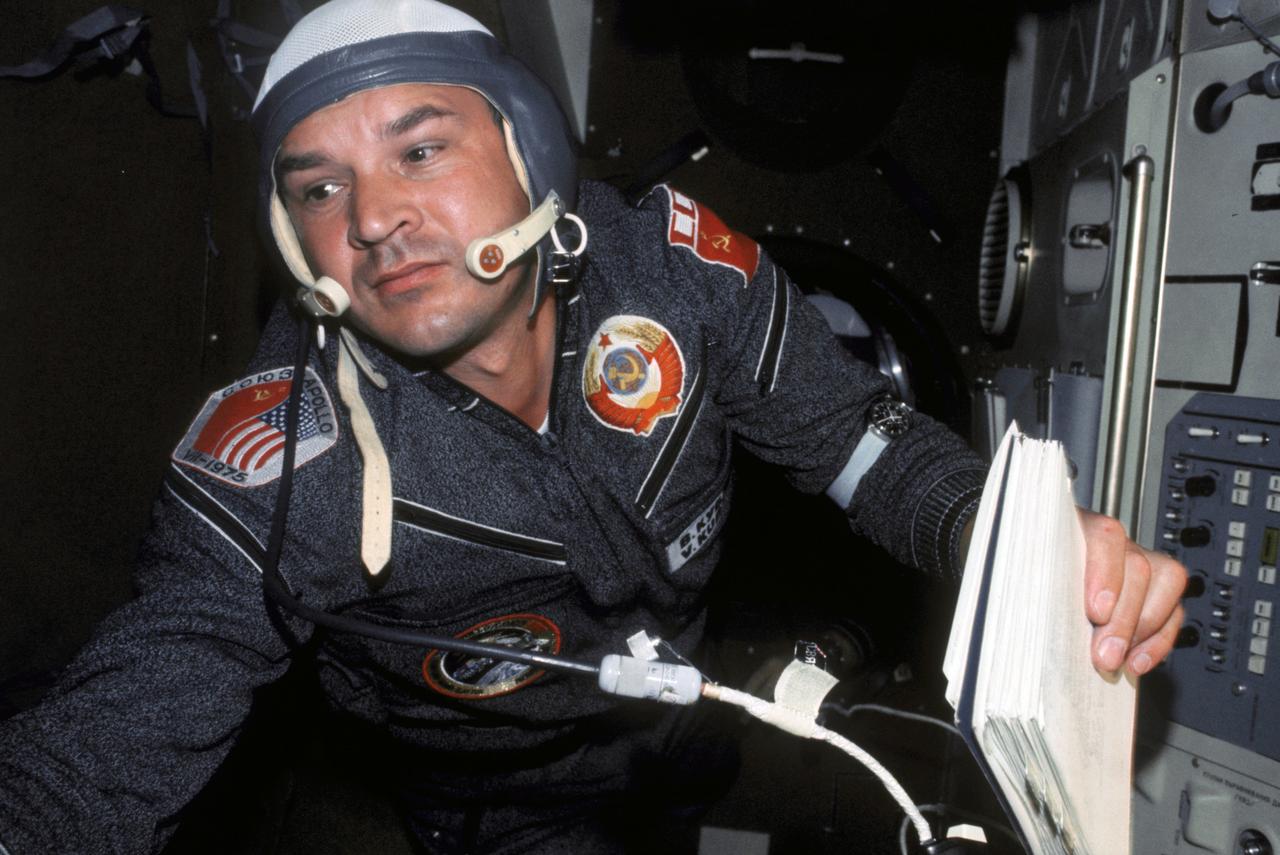
AST-05-305 (17-19 July 1975) --- Cosmonaut Valeriy N. Kubasov, engineer on the Soviet crew, is photographed in the Soyuz Orbital Module during the joint U.S.-USSR Apollo-Soyuz Test Project docking mission in Earth orbit. This picture was taken with a 35mm camera.
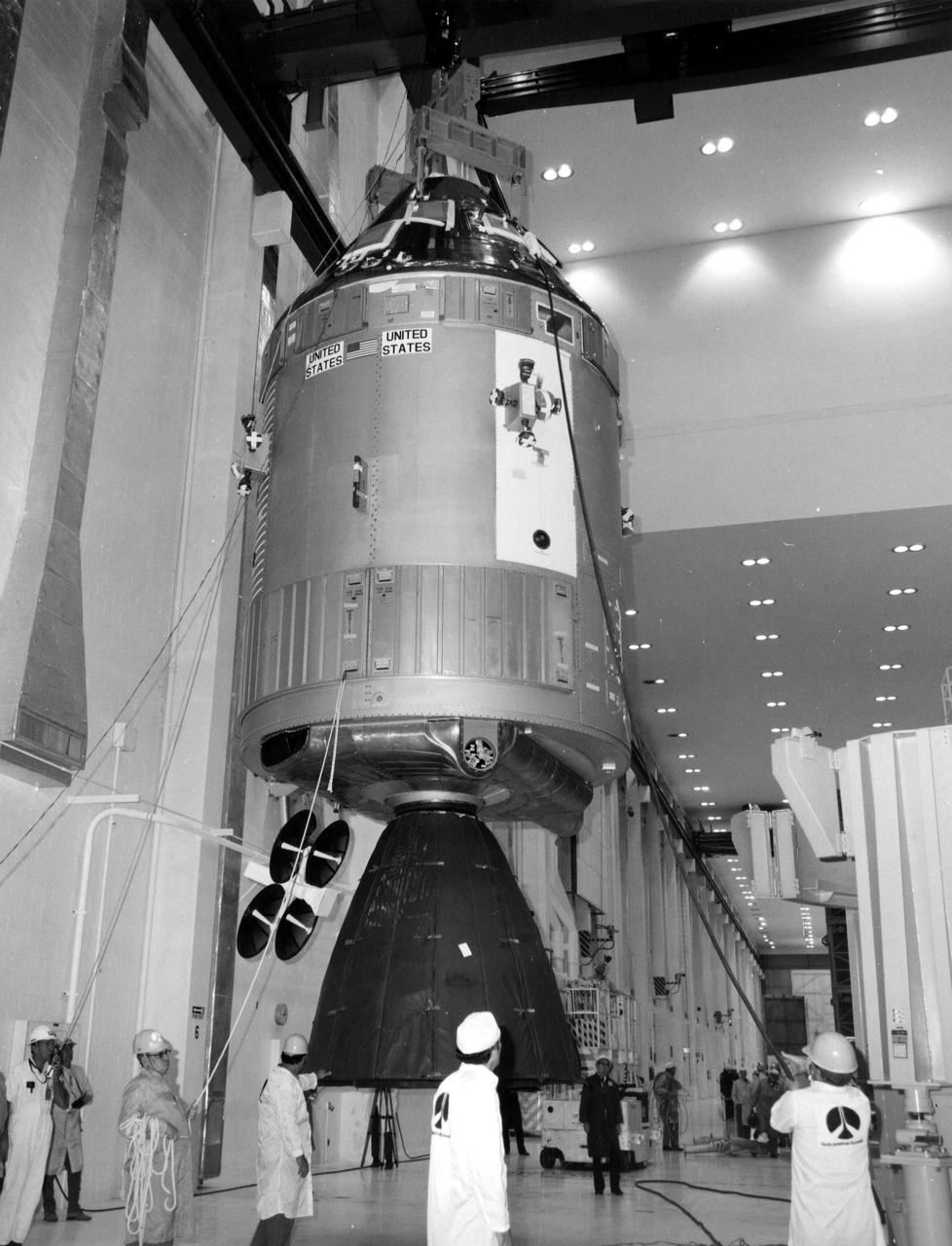
KENNEDY SPACE CENTER, FLA. -- The Apollo spacecraft, which will be flown in this summer's joint mission with the Soviet Union, was mated with its Spacecraft Launcher Adapter (SLA) in the Manned Spacecraft Operations Building today. The spacecraft has been undergoing checkout in the MSOB since it arrived at KSC last September.
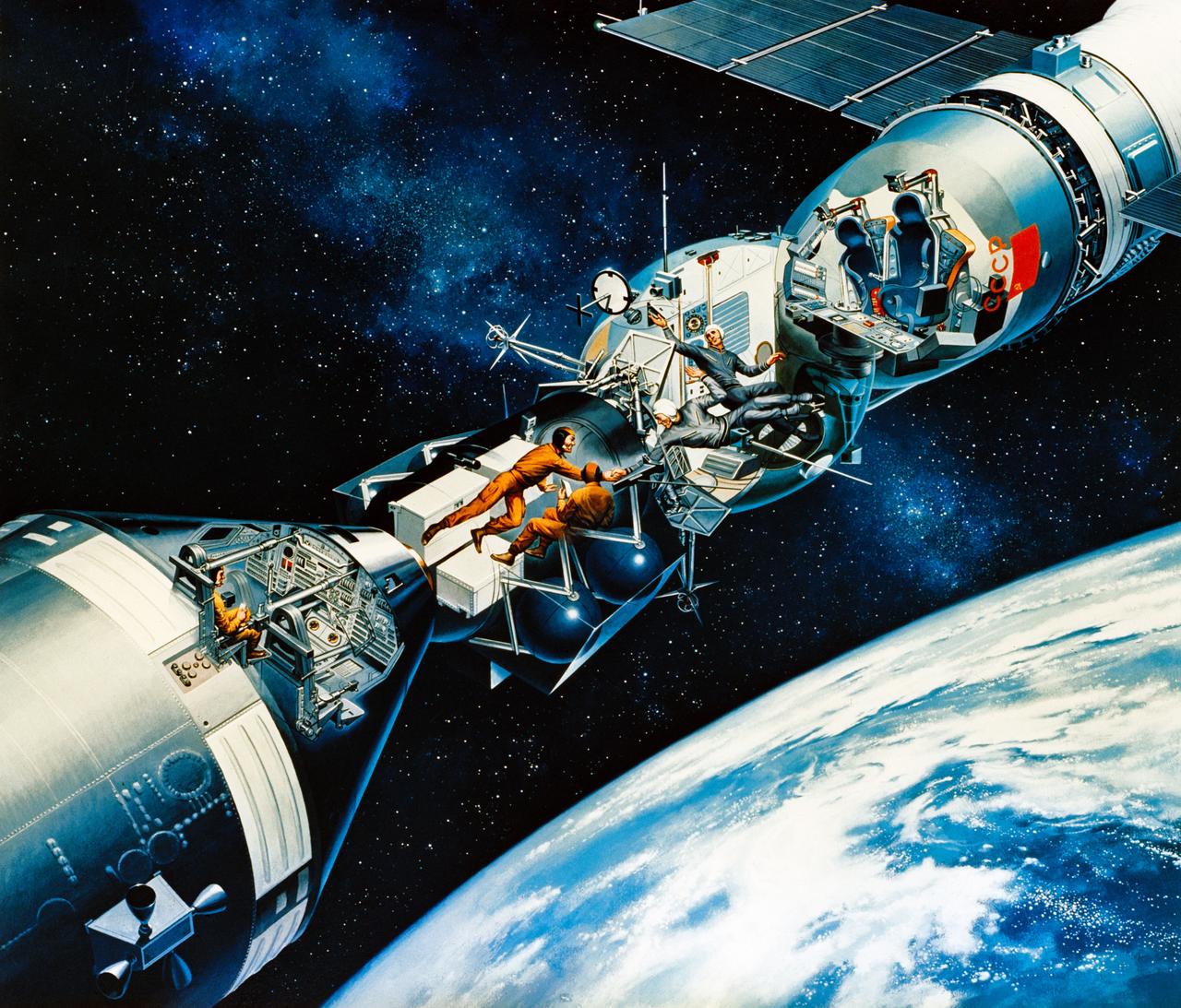
S75-27290 (April 1975) --- An artist?s concept illustrating a cutaway view of the docked Apollo and Soyuz spacecraft in Earth orbit. This scene depicts the moment the two international crews meet in space for the first time. Two of the three American crewmen are in the Docking Module. The two Soviet crewmen are in the Soyuz spacecraft?s Orbital Module. The two crew commanders are shaking hands through the hatchway. The third American crewman is in the Apollo Command Module. During the joint U.S.-USSR Apollo-Soyuz Test Project mission, which is scheduled for July 1975, the American and Soviet crews will visit one another?s spacecraft while the Soyuz and Apollo are docked for a maximum period of two days. The mission is designed to test equipment and techniques that will establish international crew rescue capability in space, as well as permit future cooperative scientific missions. The artwork is by Davis Meltzer.
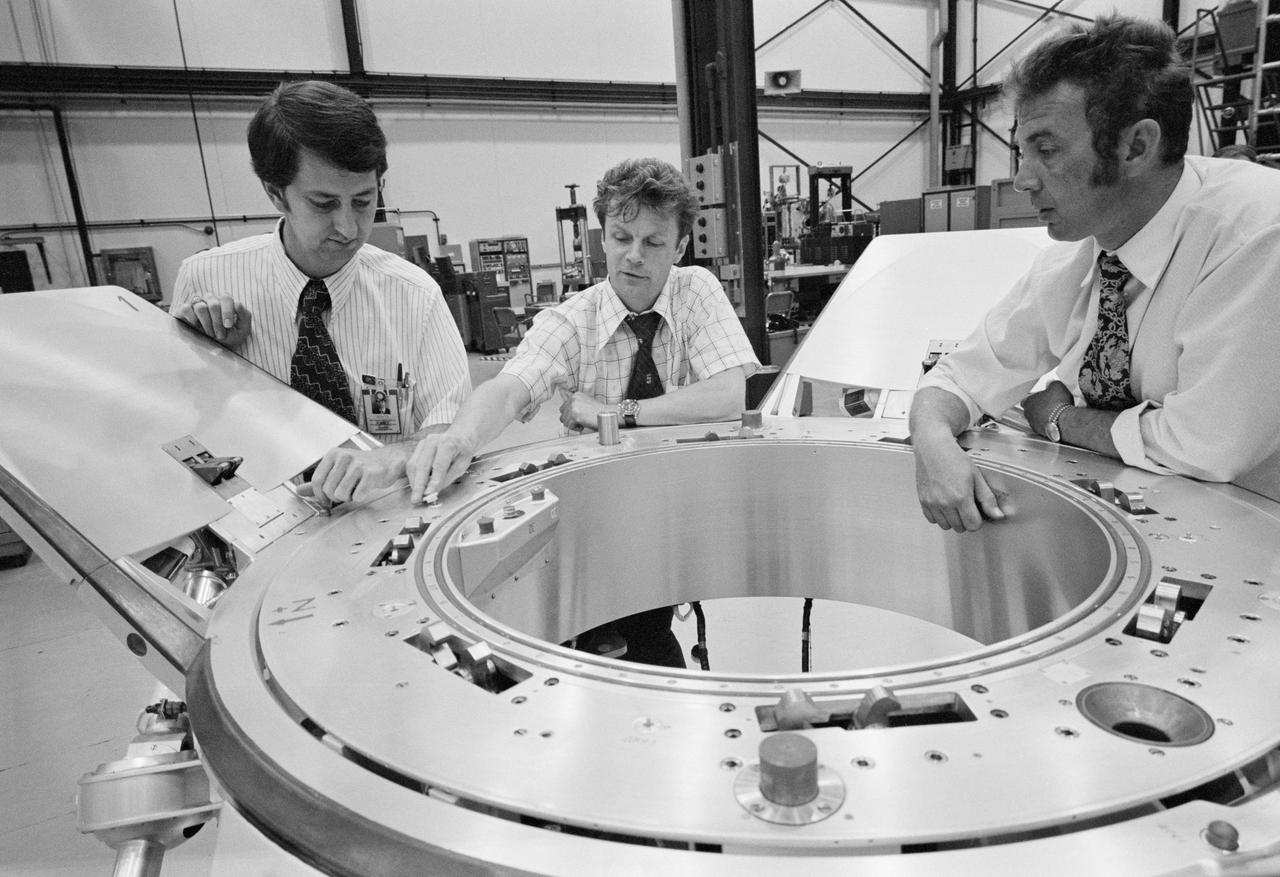
S74-24671 (10 July 1974) --- Three Apollo-Soyuz Test Project (ASTP) engineers look over a Soyuz spacecraft docking system prior to an ASTP docking mechanism fitness test conducted in Building 13 at the Johnson Space Center (JSC). They are (left to right) Robert White, Vladimir Syromyatnikov and Yevgeniy Bobrov. White is the American chairman of ASTP Working Group Number 3, and Syromyatnikov is his Soviet counterpart. This working group is concerned with ASTP docking problems and procedures. White is with JSC's Spacecraft Design Division. Syromyatnikov is senior researcher of the Soviet State Research Institute of Machine Building. Bobrov is a junior researcher with the Institute of Machine Building. The joint United States - USSR ASTP docking mission in Earth orbit is scheduled for the summer of 1975.
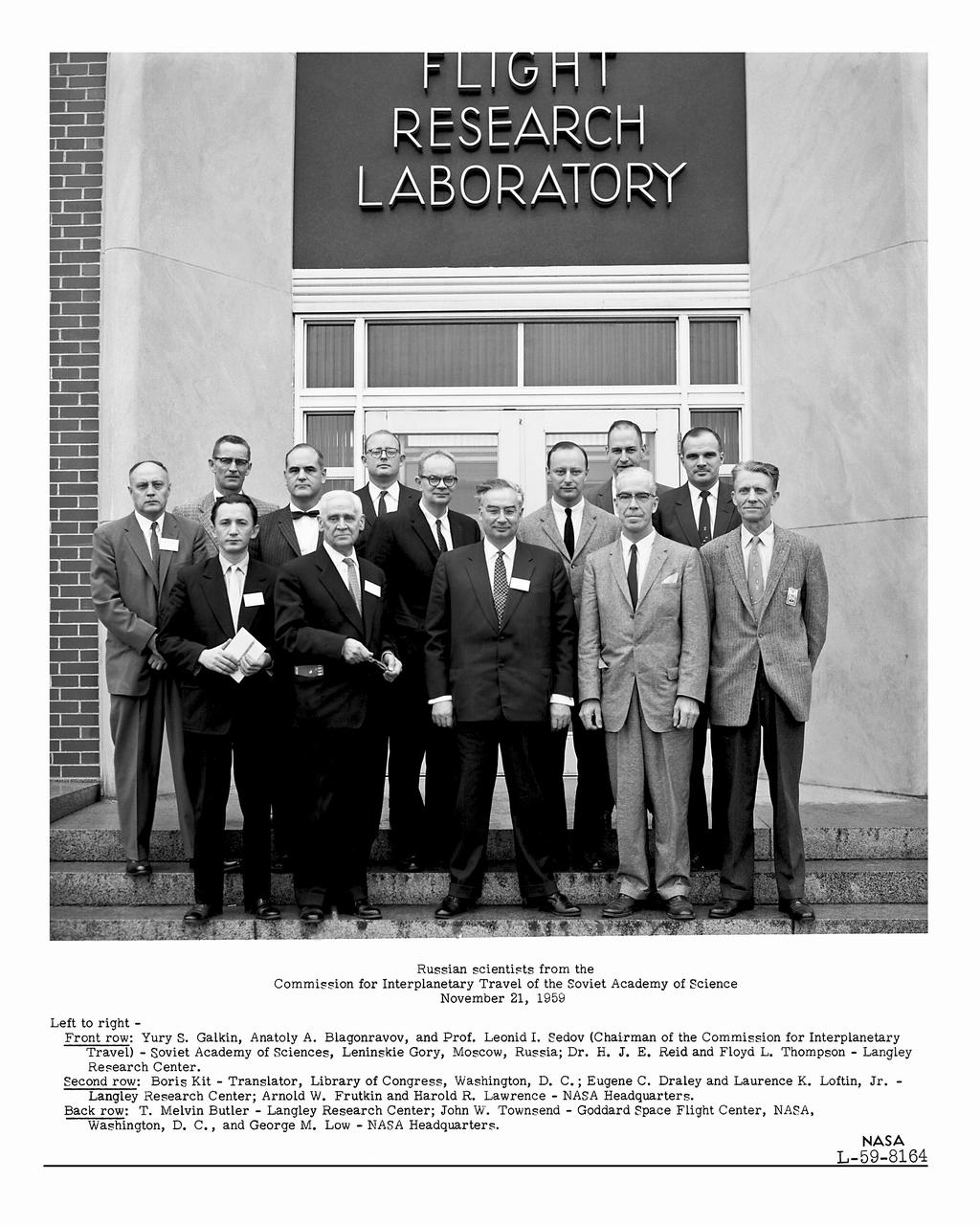
Russian Scientists from the Commission of Interplanetary Travel of the Soviet Academy of Science November 21,1959 Left to right: Front row: Yury S. Galkin, Anatoly A. Blagonravov, and Prof. Leonid I. Sedov (Chair of the Commission for Interplanetary Travel)-Soviet Academy of Science, Leninski Gory, Moscow, Russia Dr. H.J. E. Reid and Floyd L. Thompson Langley Research Center. Second row: Boris Kit Translator, Library of Congress, Washington, D.C. Eugene C. Draley and Laurence K. Loftin, Jr. -Langley Research Center Arnold W. Frutkin and Harold R. Lawrence NASA Headquarters. Back row: T.Melvin Butler-Langley Research Center John W. Townsend Goddard Space Flight Center, NASA, Washington D.C., and George M. Low NASA Headquarters.
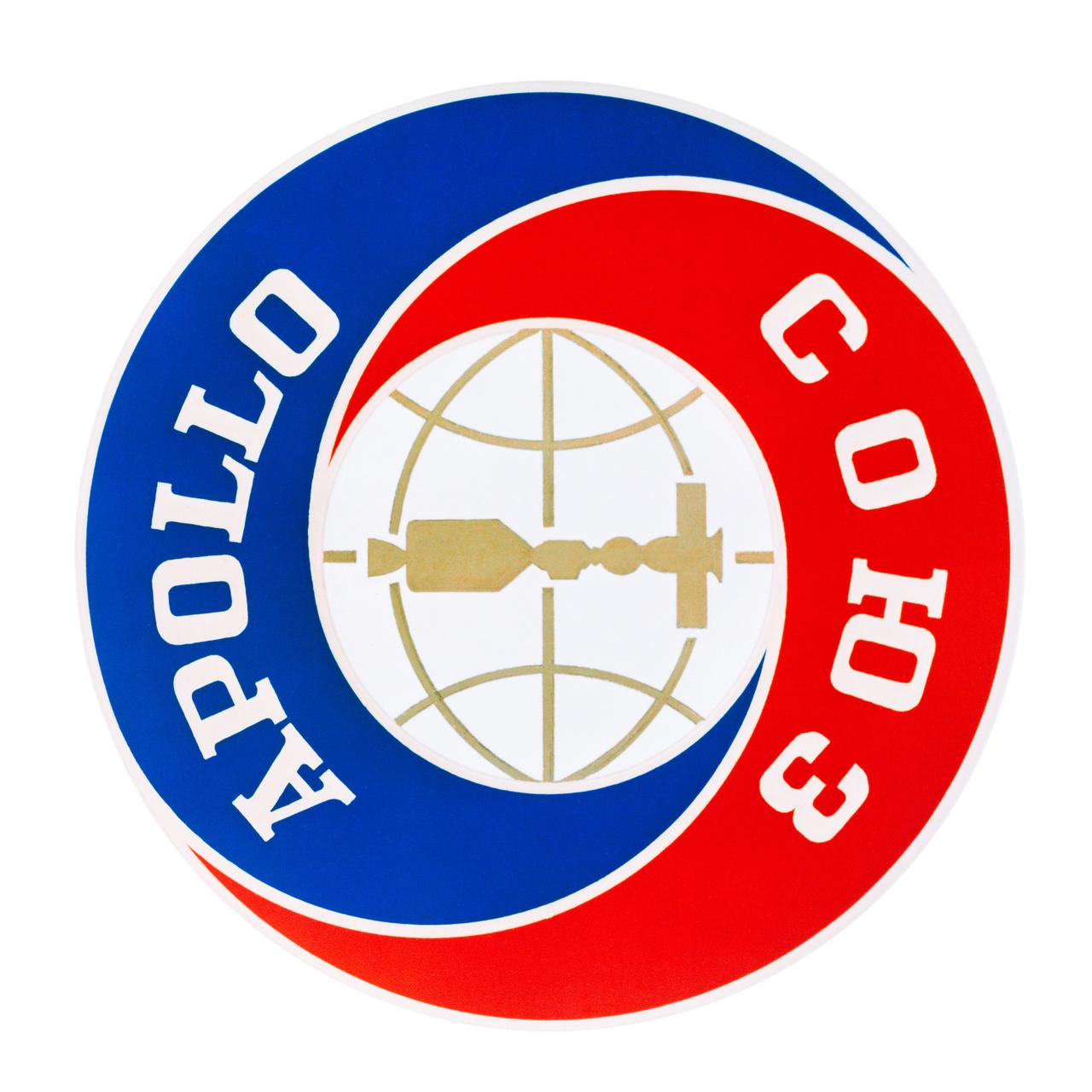
S74-17843 (March 1974) --- This is the official emblem of the Apollo-Soyuz Test Project chosen by NASA and the Soviet Academy of Sciences. The joint U.S.-USSR space mission is scheduled to be flown in July 1975. Of circular design, the emblem has the words Apollo in English and Soyuz in Russian around a center disc which depicts the two spacecraft docked together in Earth orbit. The Apollo-Soyuz Test Project will be carried out by a Soviet Soyuz spacecraft and a U.S. Apollo spacecraft which will rendezvous and dock in orbit. Soyuz and Apollo will remain docked for as long as two days in which period, the three Apollo astronauts will enter Soyuz and the two Soyuz cosmonauts will visit Apollo via a docking module. The Russian word "soyuz" means "union" in English.
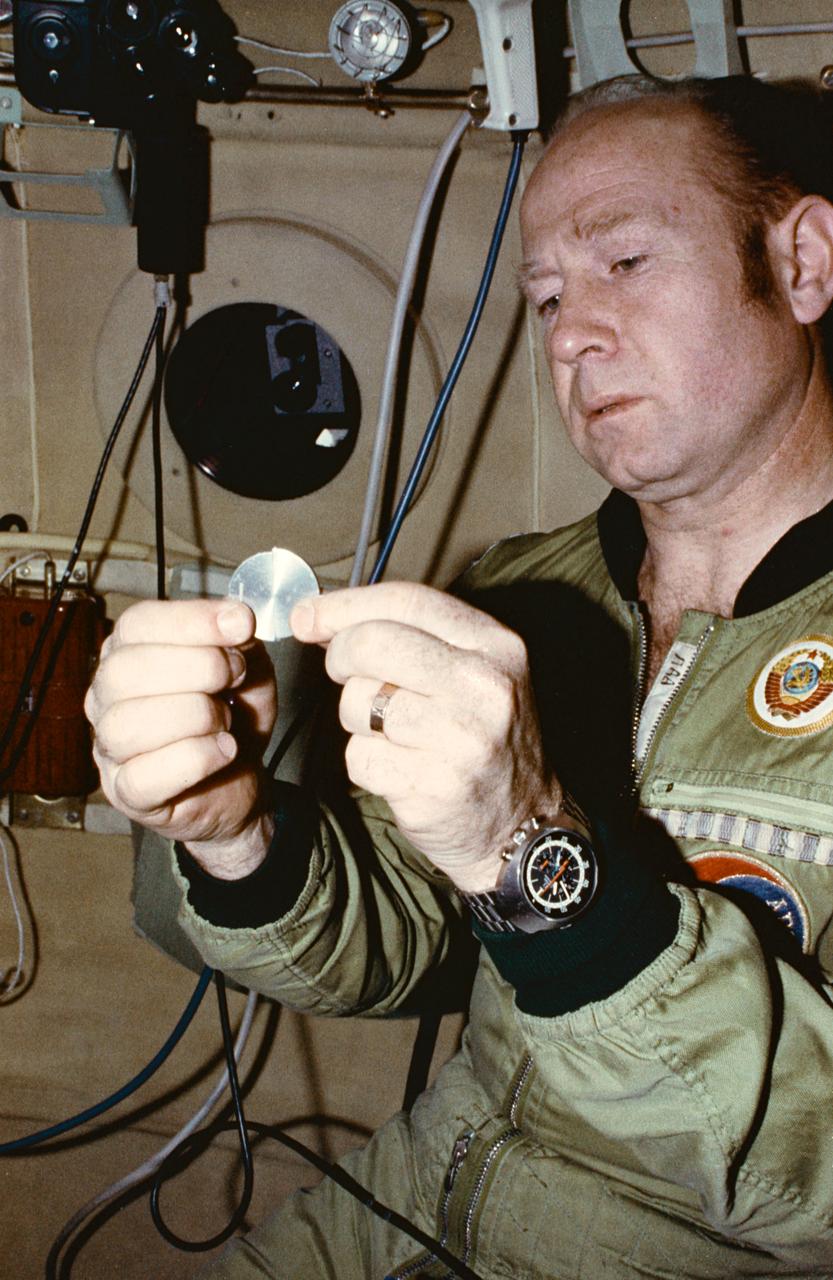
S75-24926 (April 1975) --- Cosmonaut Aleksey A. Leonov, commander of the Soviet ASTP prime crew, practices with a training mock-up of the ASTP commemorative medal during Apollo-Soyuz Test Project activity at the Cosmonaut Training Center (Star City) near Moscow. Leonov is in the Soyuz orbital module trainer. Two medals divided into two halves each will be flown on the mission. The American ASTP crew will carry two halves aboard Apollo; and the Soviet ASTP crew will carry the other two halves aboard Soyuz. The four halves will be joined together to make two complete medals after the two spacecraft rendezvous and dock in Earth orbit. Grooved slots in the halves will allow the medals to be fitted together. One medal then will be returned to Earth by the astronauts; and the second medal will be brought back by the cosmonauts.
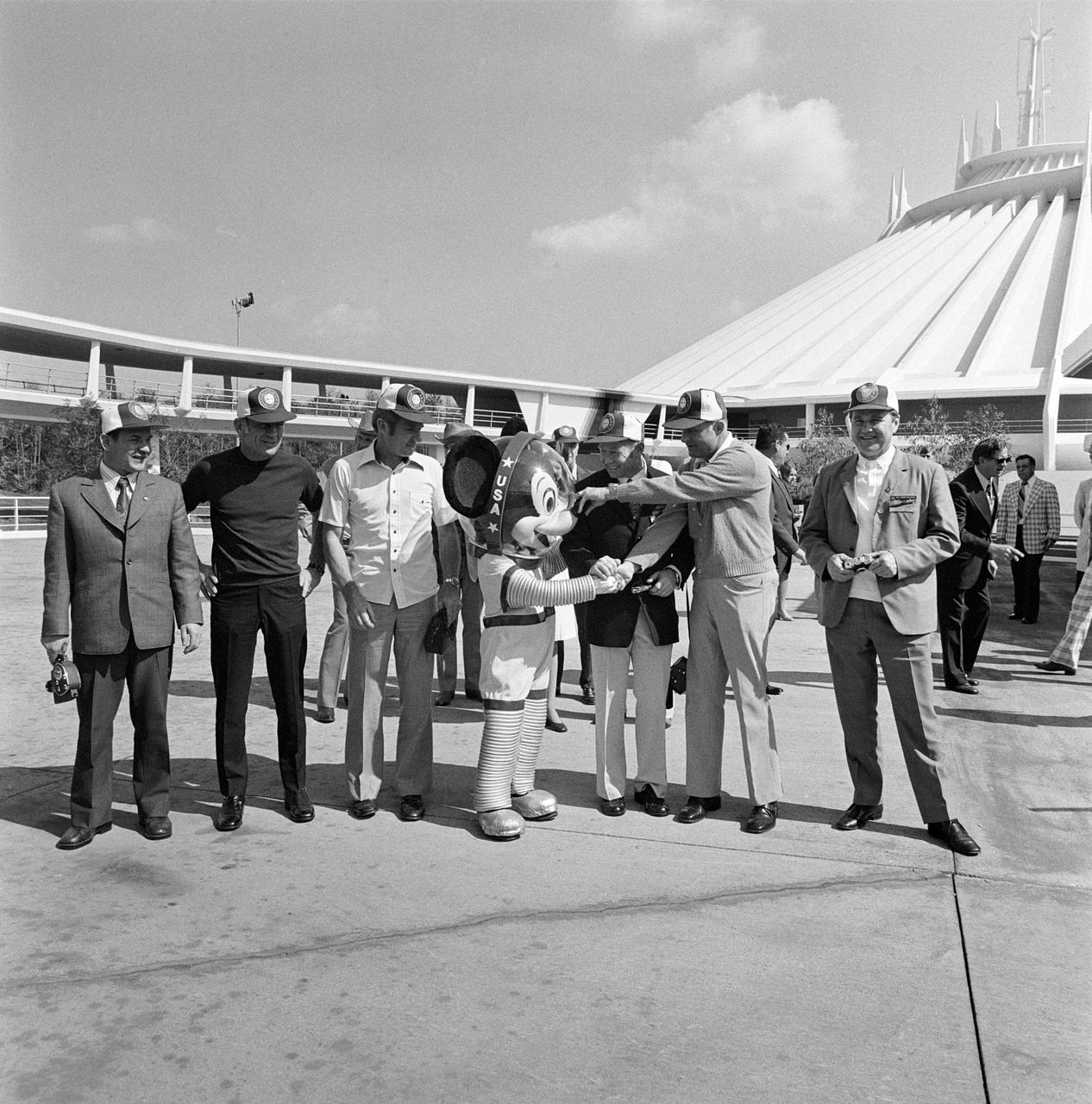
S75-24052 (8-10 Feb. 1975) --- A space-suited Mickey Mouse character welcomes the prime crewmen of the Apollo-Soyuz Test Project mission to Florida?s Disney World near Orlando. The crewmen made a side-trip to Disney World during a three-day inspection tour of NASA's Kennedy Space Center. The crewmen were at KSC to look over launch facilities and flight hardware. Receiving the jovial Disney World welcome are, left to right, cosmonaut Valeriy N. Kubasov, engineer on the Soviet crew; astronaut Donald K. Slayton, docking module pilot of the American crew; astronaut Vance D. Brand, command module pilot of the American crew; cosmonaut Aleksey A. Leonov, commander of the Soviet crew; astronaut Thomas P. Stafford, commander of the American crew; and cosmonaut Vladimir A. Shatalov, Chief of Cosmonaut Training for the USSR.
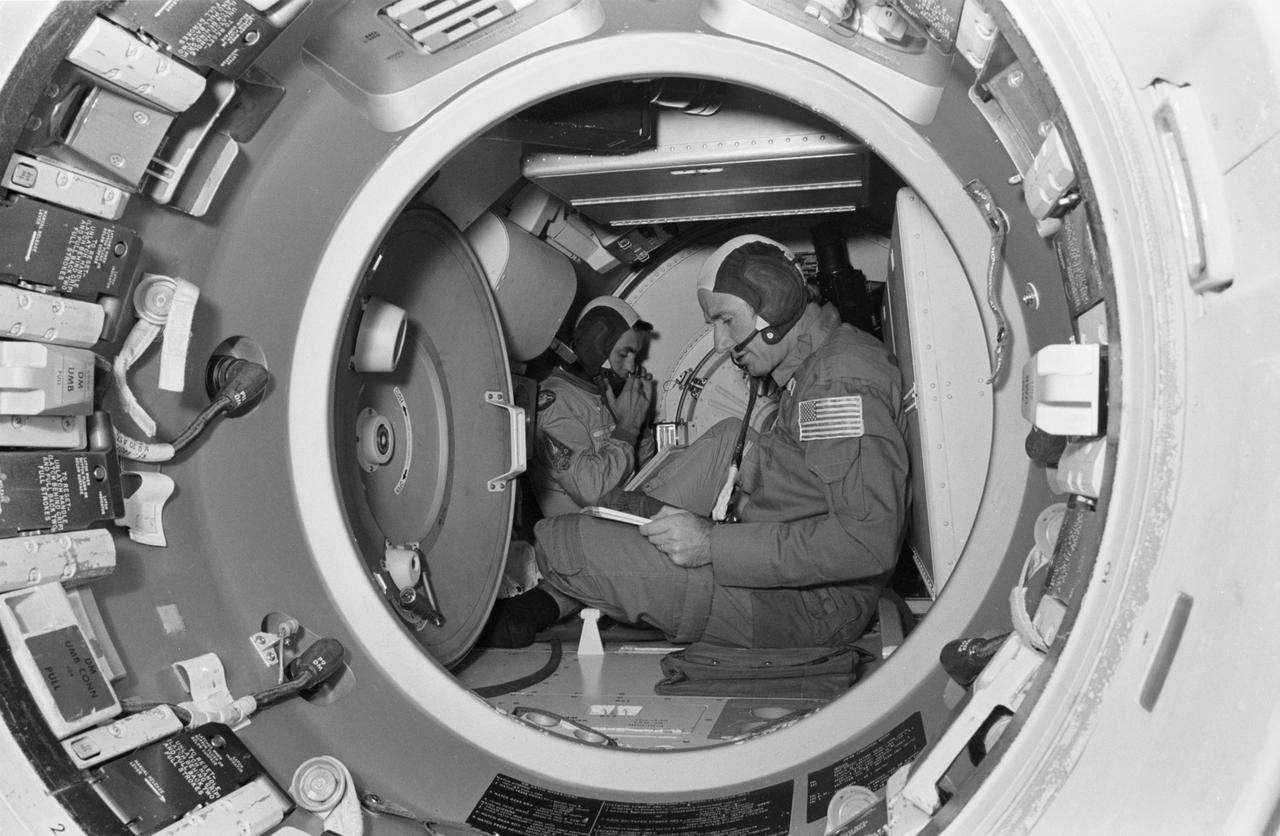
S74-28972 (20 Sept. 1974) --- Astronaut Vance D. Brand (foreground) and cosmonaut Aleksandr S. Ivanchenko are seated in the Docking Module trainer in Building 35 during Apollo-Soyuz Test Project simulation training at the Johnson Space Center. Brand is the command module pilot of the American ASTP prime crew. Ivanchenko is the engineer on the Soviet ASTP fourth crew (backup). During the exercise the American ASTP crew and the Soviet ASTP crew simulated docking the Apollo and Soyuz in Earth orbit and transferring to each other?s spacecraft. The Docking Module is designed to link the Apollo and Soyuz spacecraft. The ASTP crewmen are training in both the U.S. and USSR for the joint mission scheduled for the summer of 1975. This view is looking from inside the Command Module into the Docking Module. The hatchway loading into the Soyuz spacecraft orbital module mock-up is in the background.
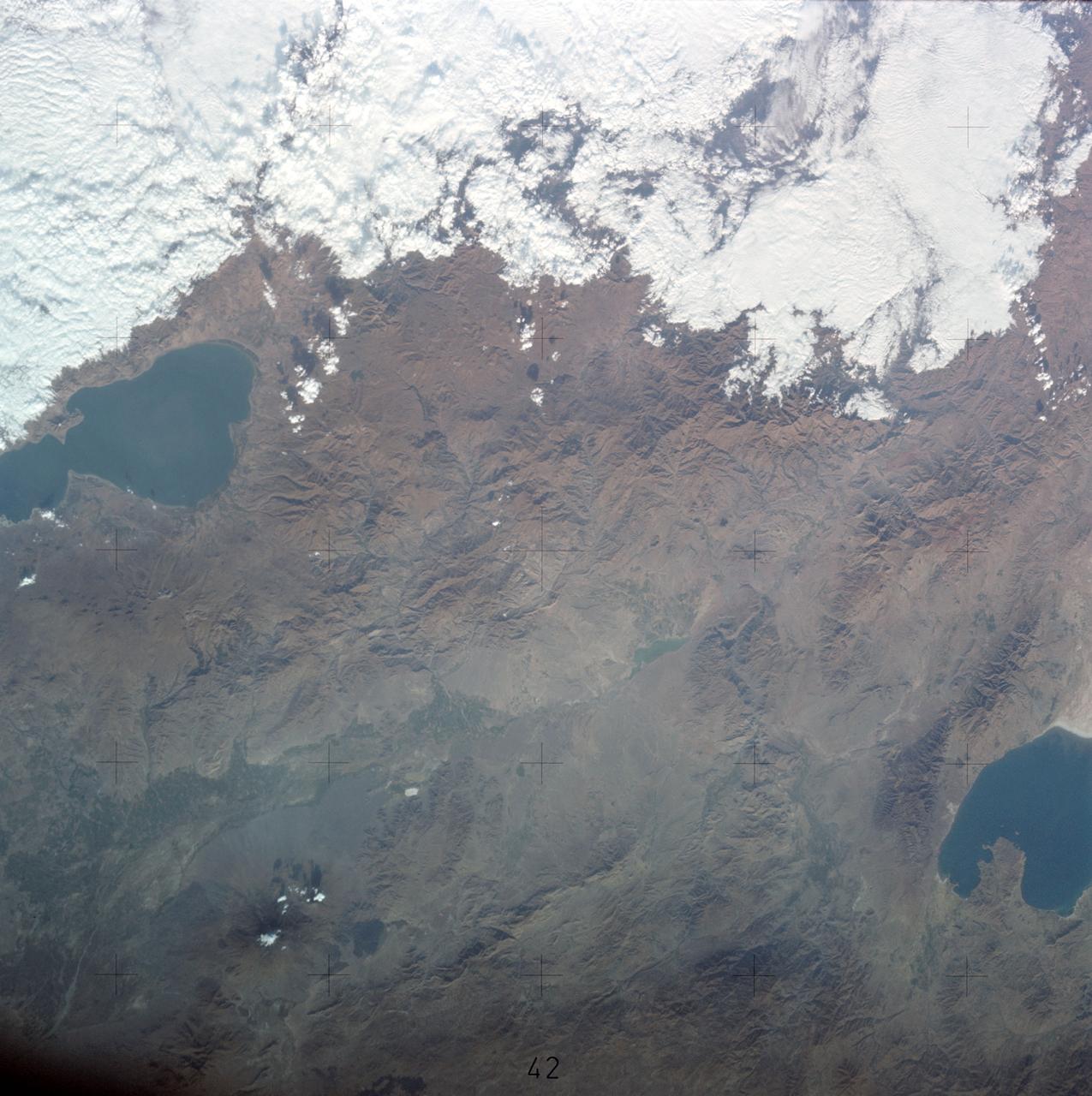
SL3-122-2562 (July-September 1973) --- A near vertical view of the border area of Turkey-Iran?Union of Soviet Socialist Republics as seen from the Skylab space station in Earth orbit. This picture was taken by one of the Skylab 3 crewmen using a hand-held 70mm Hasselblad camera. THE PICTURE SHOULD BE HELD WITH THE MASS OF WHITE CLOUDS ON THE RIGHT SIDE. The lake at the top center edge is Ozero (Lake) Sevan in the USSR?s Armenian Soviet Socialist Republic. The other body of water is Iran?s Lake Urmia. The major feature in this photograph can be seen in the upper left corner. Mount Ararat is in Turkey only a few miles from Iran and USSR borders. Yerevan, the capital of Armenian SSR, is located north-northwest of Mount Ararat. Photo credit: NASA
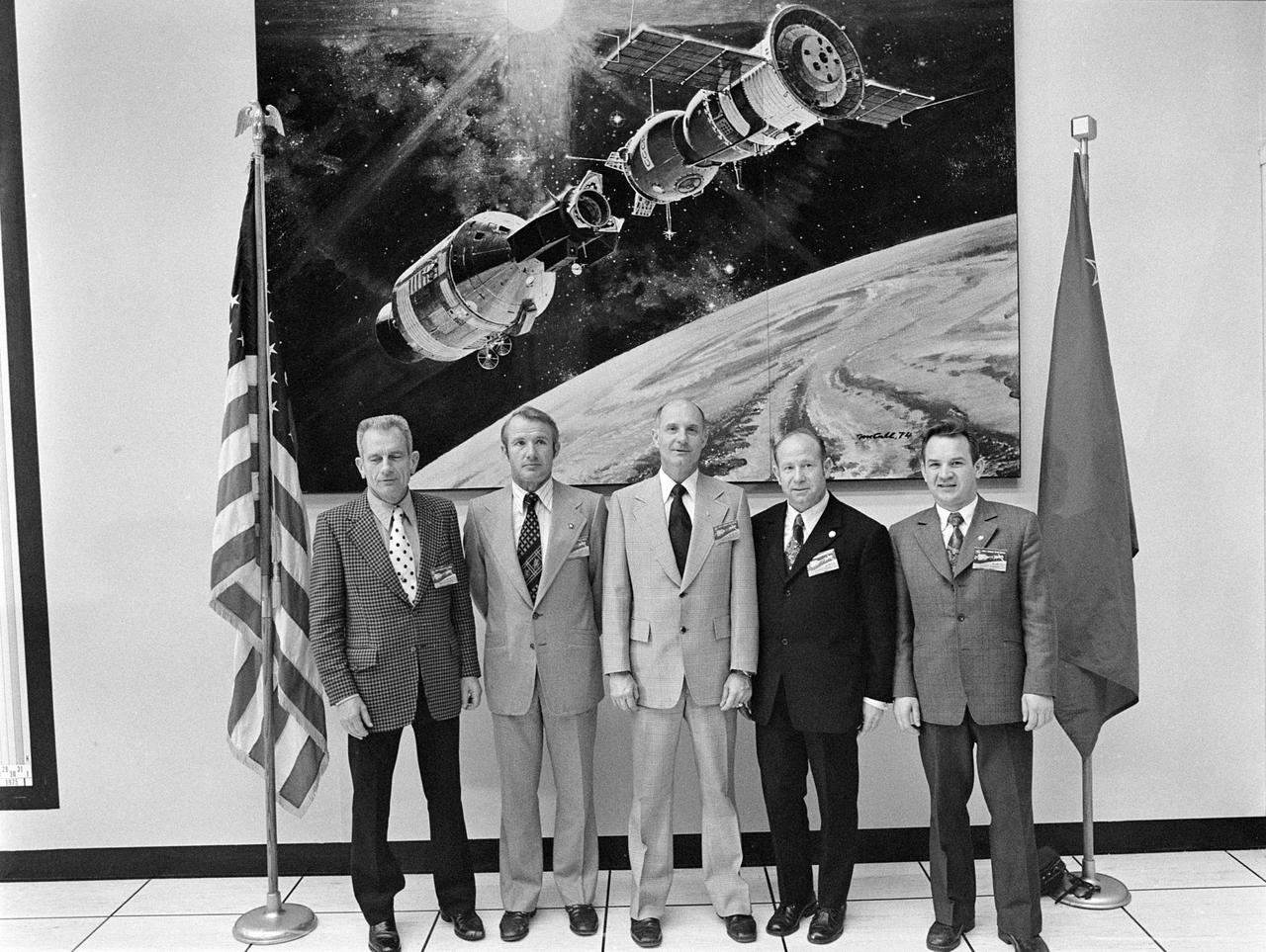
S75-24030 (8-10 Feb. 1975) --- The five prime crew members of the Apollo-Soyuz Test Project (ASTP) mission pose for a group photograph while at NASA's Kennedy Space Center (KSC) for a three-day inspection tour. They are, left to right, astronaut Donald K. (Deke) Slayton, docking module pilot of the American crew; astronaut Vance D. Brand, command module pilot of the American crew; astronaut Thomas P. Stafford, commander of the American crew; cosmonaut Aleksey A. Leonov, commander of the Soviet crew; and cosmonaut Valeriy N. Kubasov, engineer of the Soviet crew. They were at KSC to look over launch facilities and flight hardware. They are standing in front of artist Robert McCall?s painting of an ASTP docking in Earth orbit.
![CAPE CANAVERAL, Fla. – The Soviet and American crews for the July Apollo Soyuz Test Project [standing, center] addressed personnel assembled in a firing room at KSC on February 10. The crews for the joint manned space mission toured the Center during their three-day visit which also included inspection of ASTP equipment and facilities and a trip to Disney World. The first international crewed spaceflight was a joint U.S.-U.S.S.R. rendezvous and docking mission. The Apollo-Soyuz Test Project, or ASTP, took its name from the spacecraft employed: the American Apollo and the Soviet Soyuz. The three-man Apollo crew lifted off from Kennedy Space Center aboard a Saturn IB rocket on July 15, 1975, to link up with the Soyuz that had launched a few hours earlier. A cylindrical docking module served as an airlock between the two spacecraft for transfer of the crew members. Photo credit: NASA](https://images-assets.nasa.gov/image/KSC-108-75P-0057/KSC-108-75P-0057~medium.jpg)
CAPE CANAVERAL, Fla. – The Soviet and American crews for the July Apollo Soyuz Test Project [standing, center] addressed personnel assembled in a firing room at KSC on February 10. The crews for the joint manned space mission toured the Center during their three-day visit which also included inspection of ASTP equipment and facilities and a trip to Disney World. The first international crewed spaceflight was a joint U.S.-U.S.S.R. rendezvous and docking mission. The Apollo-Soyuz Test Project, or ASTP, took its name from the spacecraft employed: the American Apollo and the Soviet Soyuz. The three-man Apollo crew lifted off from Kennedy Space Center aboard a Saturn IB rocket on July 15, 1975, to link up with the Soyuz that had launched a few hours earlier. A cylindrical docking module served as an airlock between the two spacecraft for transfer of the crew members. Photo credit: NASA
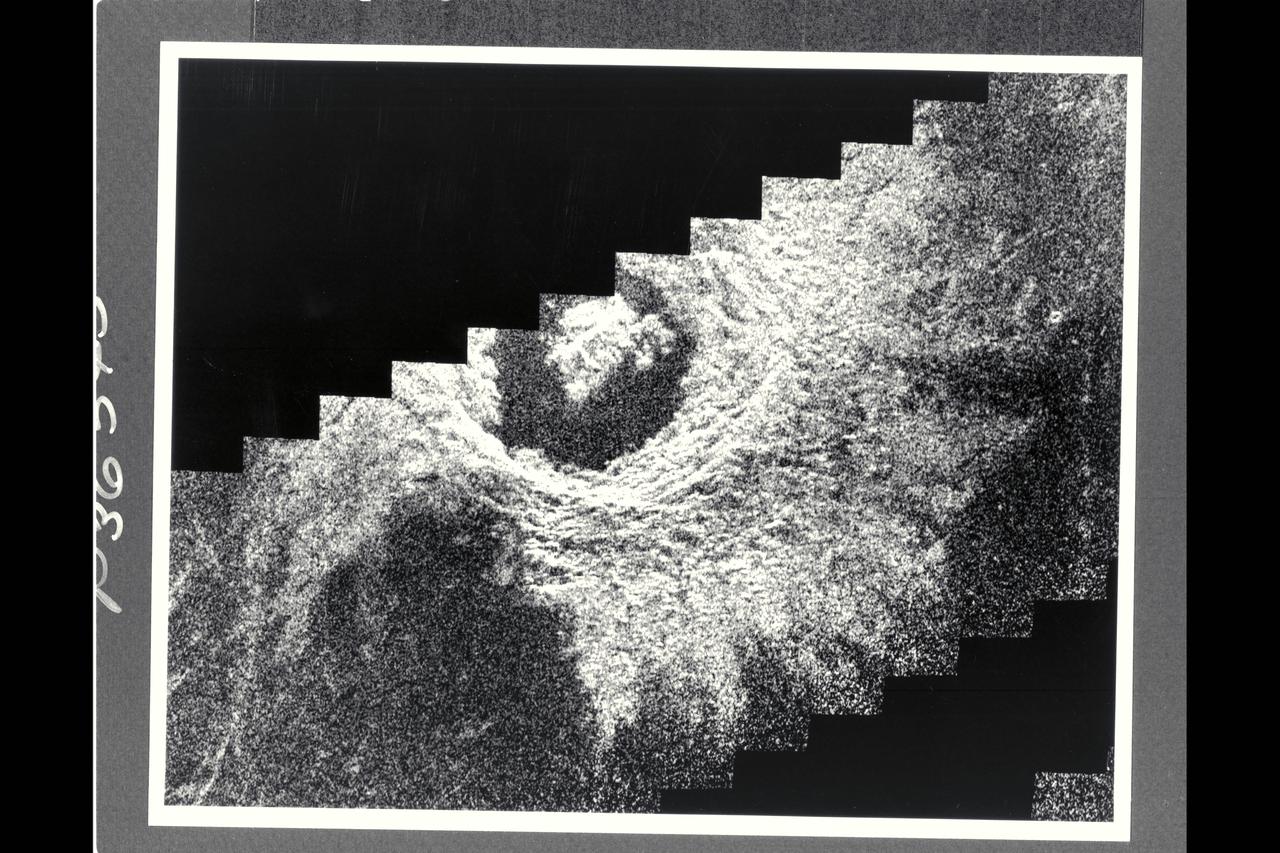
This Magellan image mosaic shows the impact crater Golubkina, first identified in Soviet Venera 15/16 data. The crater is names after Anna Golubkina (1864-1927), a Soviet sculptor. The crater is about 34 km (20.4 mi.) across, similar to the size of the West Clearwater impact structure in Canada. The crater Golubkina is located at about 60.5 degrees north latitude, 286.7 degrees est longitude. Magellan data reveal that Golubkina has many characteristics typical of craters formed by a mereorite impact including terraced inner walls, a central peak, and radar-bright rough ejecta surrounding the crater. The extreme darkness of the crater floor indicates a smooth surface, perhaps formed by the ponding of lava flows in the crater floor as seen in may lunar impact craters. The radar-bright ejecta surrounding the crater indicates a relatively fresh or young crater. Craters with centeral peaks in the Soviet data range in size from about 10-60 km (6-36 mi.) across. The largest crater identifed in the Soviet Venera data is 140 km (84 mi) in diameter. This Magellan image strip in approx. 100 km (62 mi.) long. The image is a mosaic of two orbits obtained in the first Magellan radar test and played back to Earth to the Deep Space Network stations near Goldstone, CA and Canberra, Australia, respectively. The resolution of this image is approximately 120 meters (400 feet). The see-saw margins result from the offset of individual radar frames obtained along the orbit. The spacecraft moved from the north (top) to the south, looking to the left.
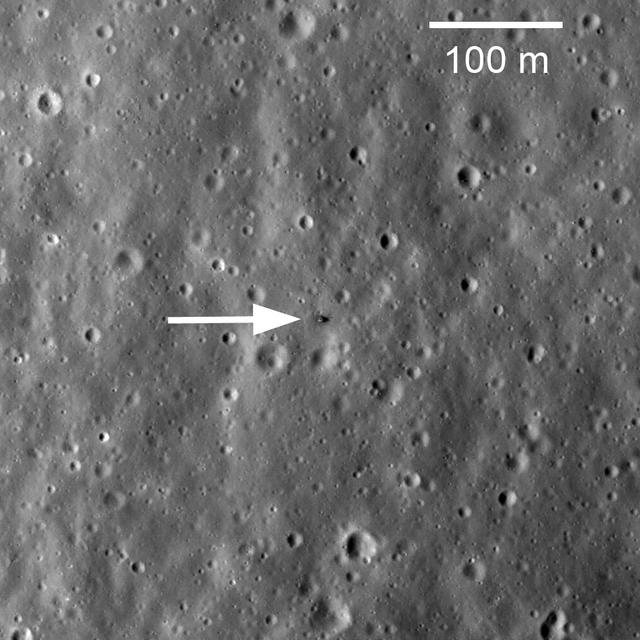
On February 21, 1972, Luna 20 soft landed in the rugged highlands between Mare Fecunditatis and Mare Crisium. The Luna 20 descent stage still sits silently on the Moon, clearly visible in this image taken by NASA Lunar Reconnaissance Orbiter.
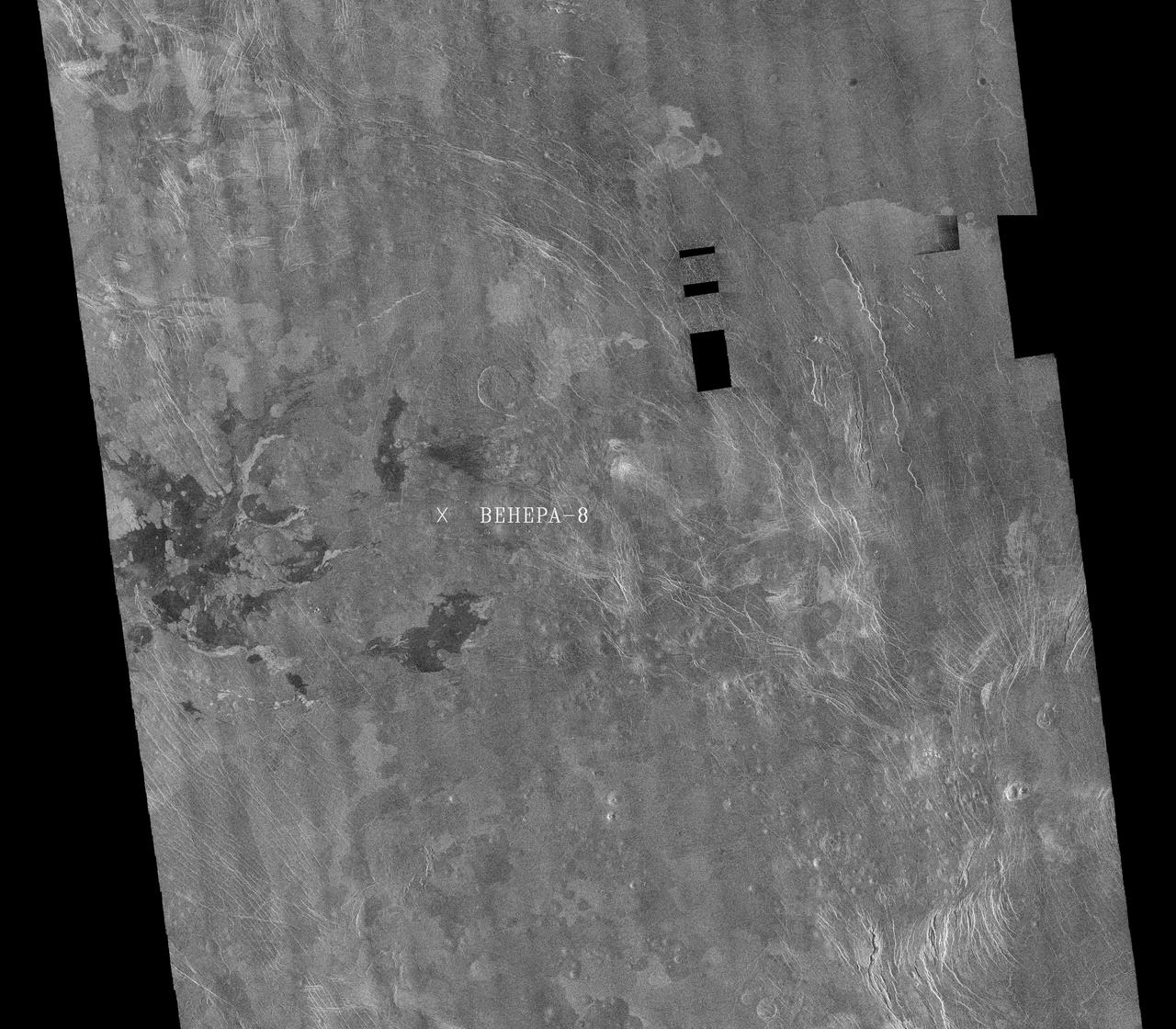
This image is a mosaic of 24 orbits of the Navka region of Venus. The image is centered at about 10 degrees south latitude and 335 degrees east longitude. The image is about 400 km (240 miles) across. 'Behepa 8' marks the approximate landing site of the Soviet Venera 8 lander, which took measurements at the surface of Venus in 1972. The Venera 8 lander measured granitic or continental-like materials at the landing site. Magellan data reveals the landing site to lie in a region of plains cut by tectonic ridges and troughs. Volcanic domes and flows are seen throughout the region. Studying the regional setting of the Venera landing sites is important in linking information about surface composition to surface morphology seen in radar images. Resolution of the Magellan data is about 120 meters (400 feet). http://photojournal.jpl.nasa.gov/catalog/PIA00460
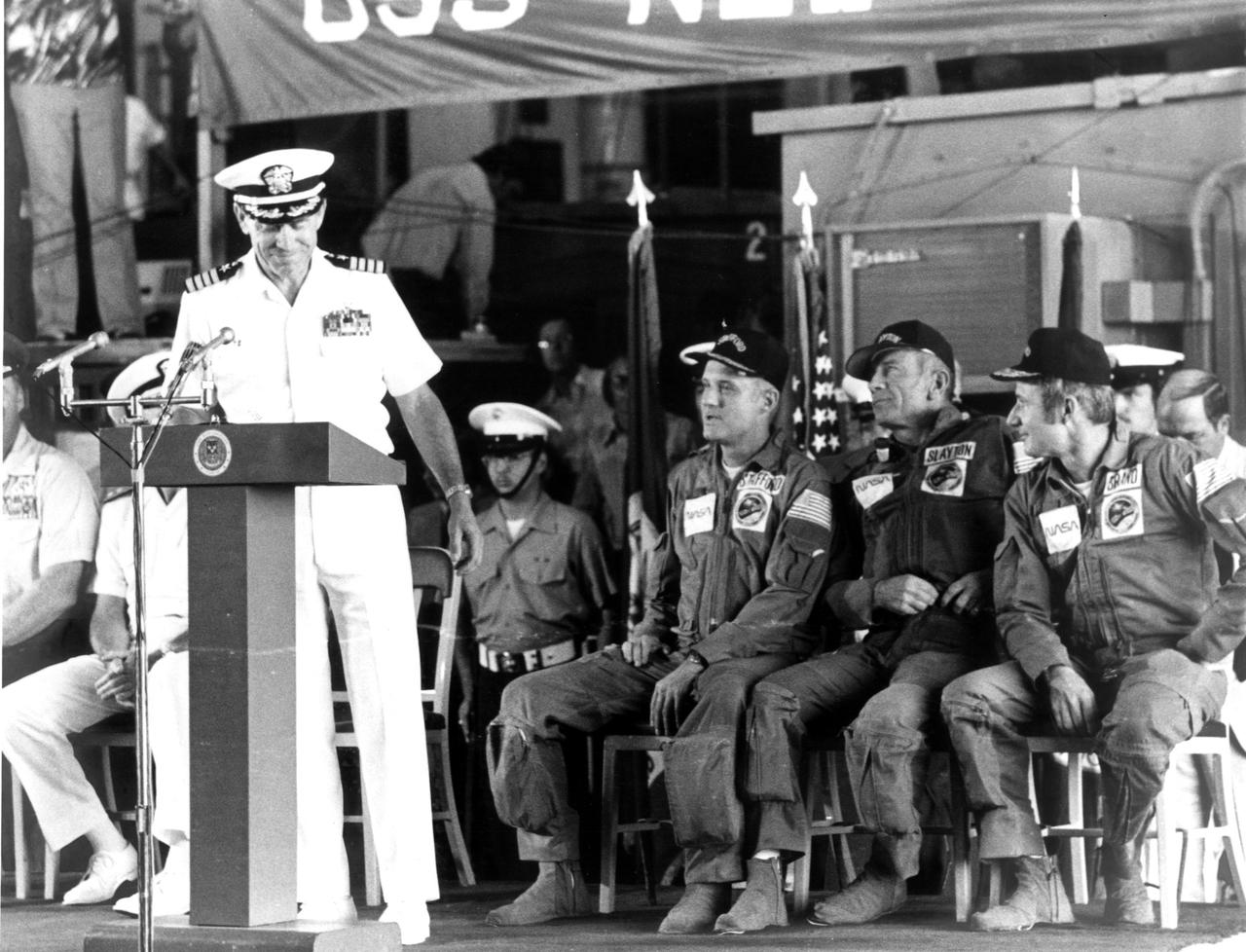
KENNEDY SPACE CENTER, FLA. -- The Commanding Officer of the USS New Orleans, Captain Ralph E. Neiger, welcomes aboard ASTP astronauts Thomas Stafford, Donald Slayton and Vance Brand. The astronauts splashed down in the Pacific Ocean west of Hawaii at 5:18 p.m. today, ending the nine-day ASTP mission. Themission was highlighted by the rendezvous and docking with a Soviet Soyuz spacecraft in Earth orbit.
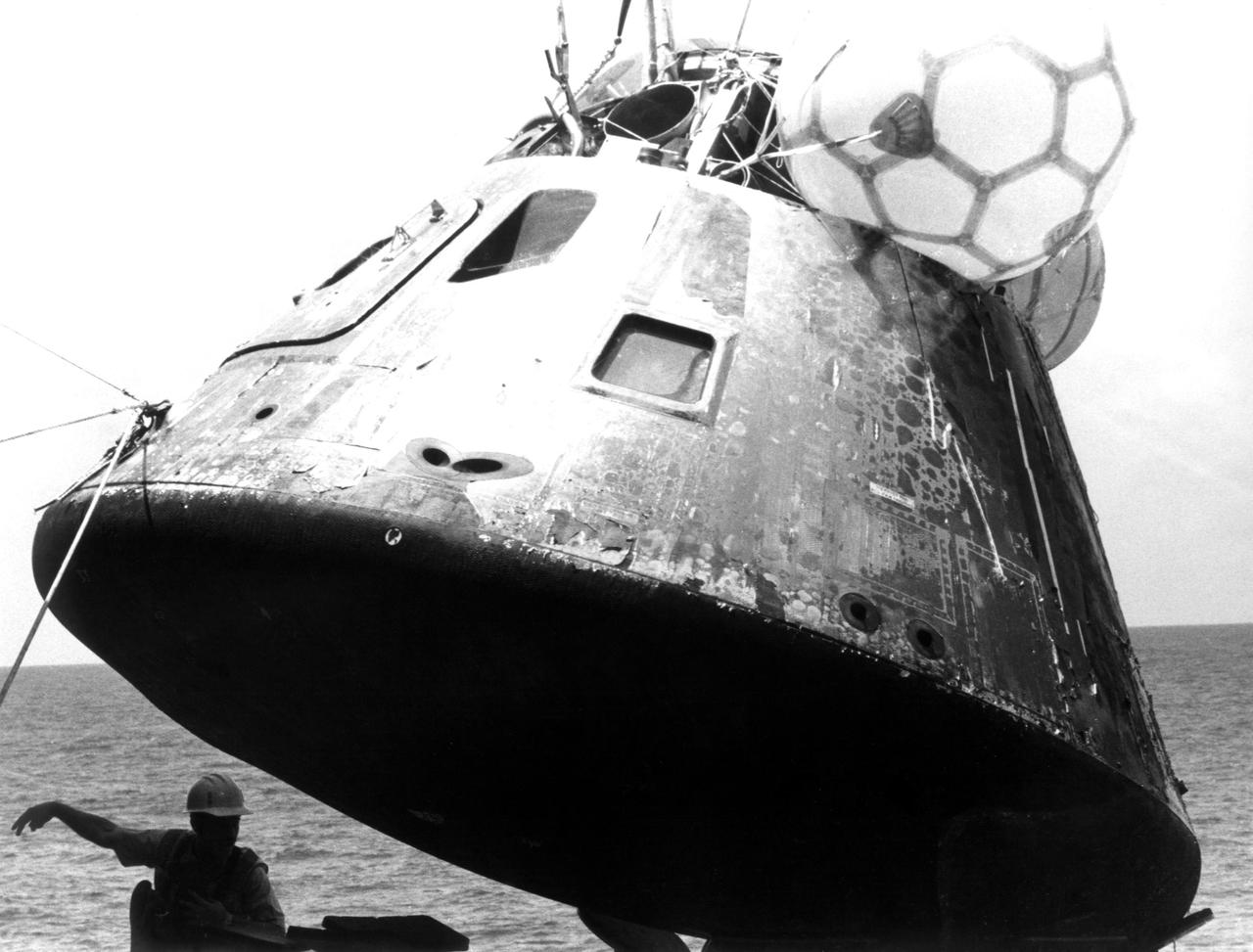
KENNEDY SPACE CENTER, FLA. -- The ASTP Apollo Command Module is lowered onto the deck of the USS New Orleans following splashdown in the Pacific Ocean, west of Hawaii, at 5:18 p.m. today. Once aboard the ship, the ASTP astronauts Thomas Stafford, Vance Brand, and Donald Slayton emerged from the spacecraft and participated in ceremonies during which they spoke by telephone to President Gerald Ford. The splashdown ended the crew's historic nine-day mission, highlighted by their rendezvous and docking with a Soviet Soyuz spacecraft while in Earth orbit.
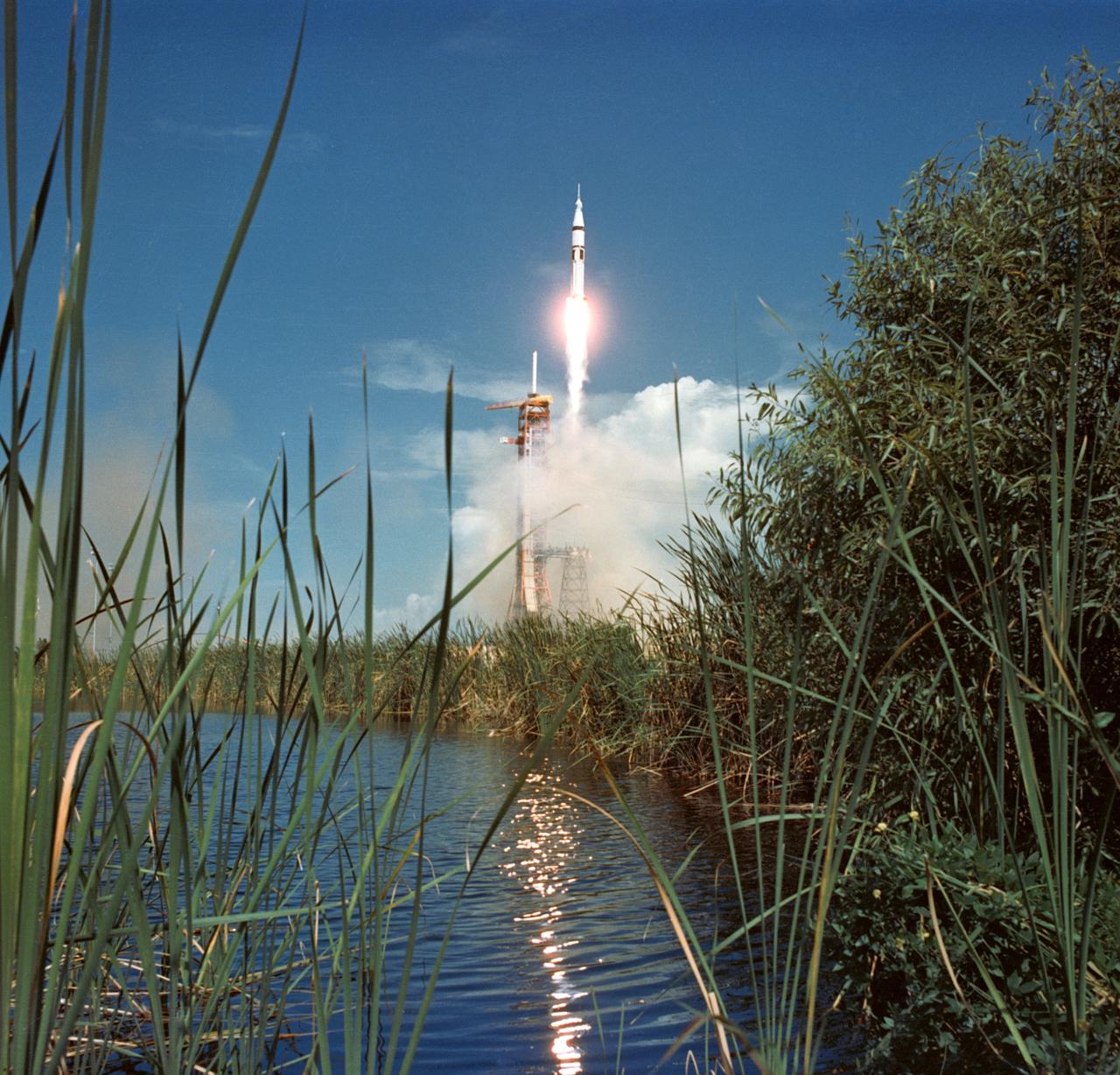
S75-28547 (15 July 1975) --- The Apollo-Soyuz Test Project's (ASTP) NASA Apollo/Saturn 1B space vehicle is launched from Pad B, Launch Complex 39, Kennedy Space Center (KSC), Florida, at 3:50 p.m. (EDT), July 15, 1975, to begin Apollo's catch-up journey toward the already Earth-orbiting Soviet Soyuz spacecraft. Aboard the Apollo spacecraft were astronauts Thomas P. Stafford, Vance D. Brand and Donald K. (Deke) Slayton.
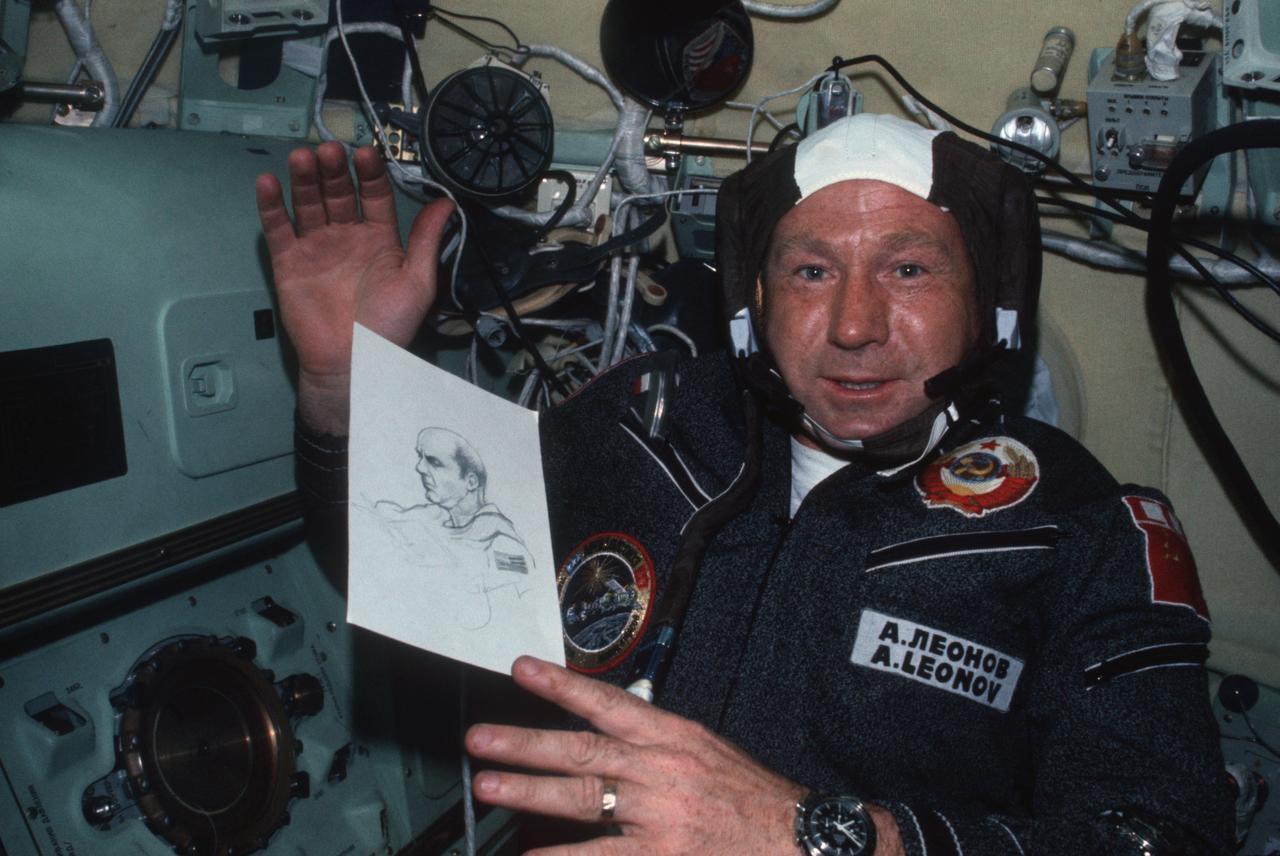
AST-05-275 (17-19 July 1975) --- Cosmonaut Aleksey A. Leonov, commander of the Soviet ASTP crew, displays a drawing of astronaut Thomas P. Stafford during the joint U.S.-USSR Apollo-Soyuz Test Project docking mission in Earth orbit. He is in the Soyuz Orbital Module. This picture was taken by an American ASTP crewman with a 35mm camera.
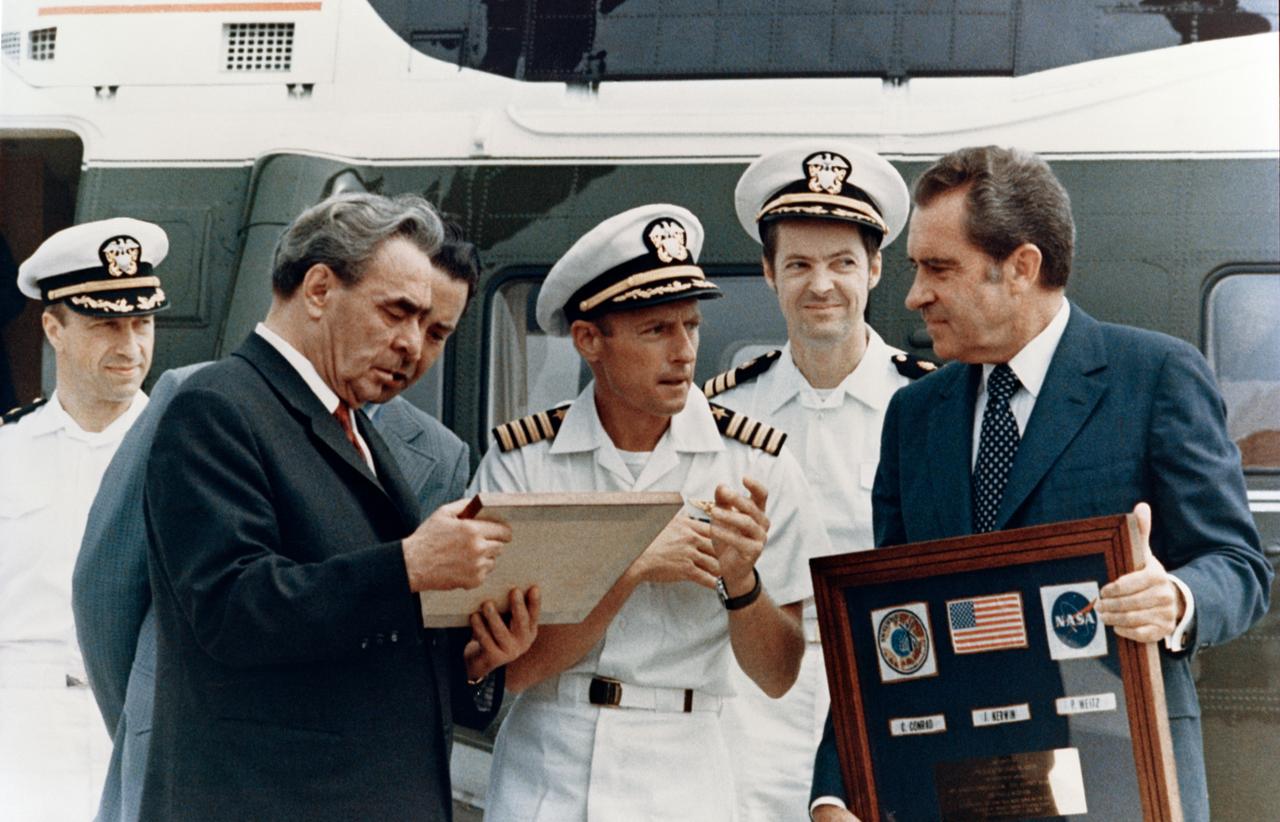
S73-30889 (June 1973) --- Leonid I. Breznev, General Secretary of the Communist Party, Union of Soviet Socialist Republics, and President Richard M. Nixon, during ceremonies at the Western White House in San Clemente, California, examine plaques presented by Skylab astronauts Charles Conrad Jr., center; Joseph P. Kerwin, second from right; and Paul J. Weitz, left. Photo credit: NASA
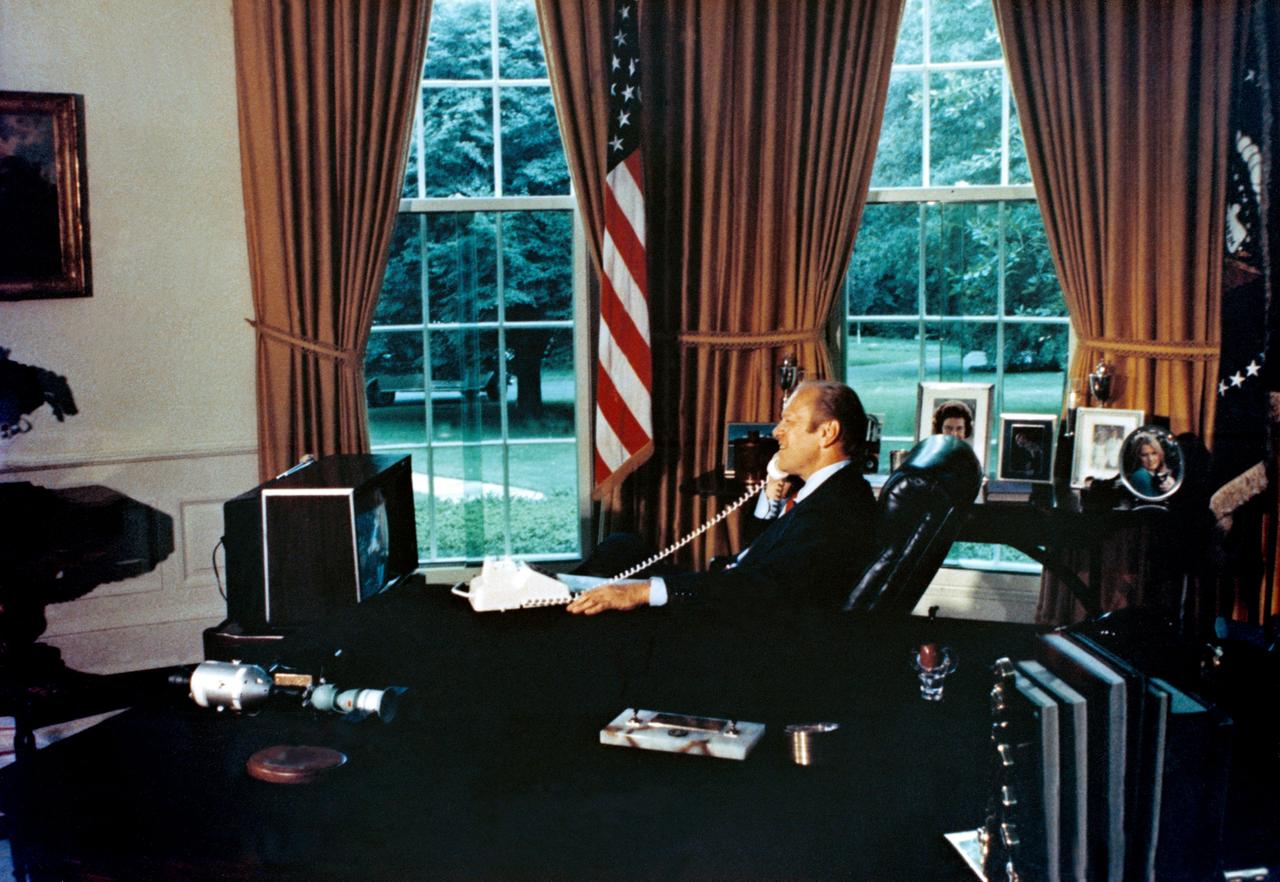
S75-30515 (18 July 1975) --- President Gerald R. Ford watches ASTP crewmen Thomas P. Stafford, Donald K. Slayton and Valeriy N. Kubasov on television as he talks to them via radio-telephone while they orbited Earth on July 18, 1975. The American Apollo spacecraft and Soviet Soyuz spacecraft were docked. The five ASTP crewmen visited each other?s spacecraft while the Soyuz and Apollo were linked in space.
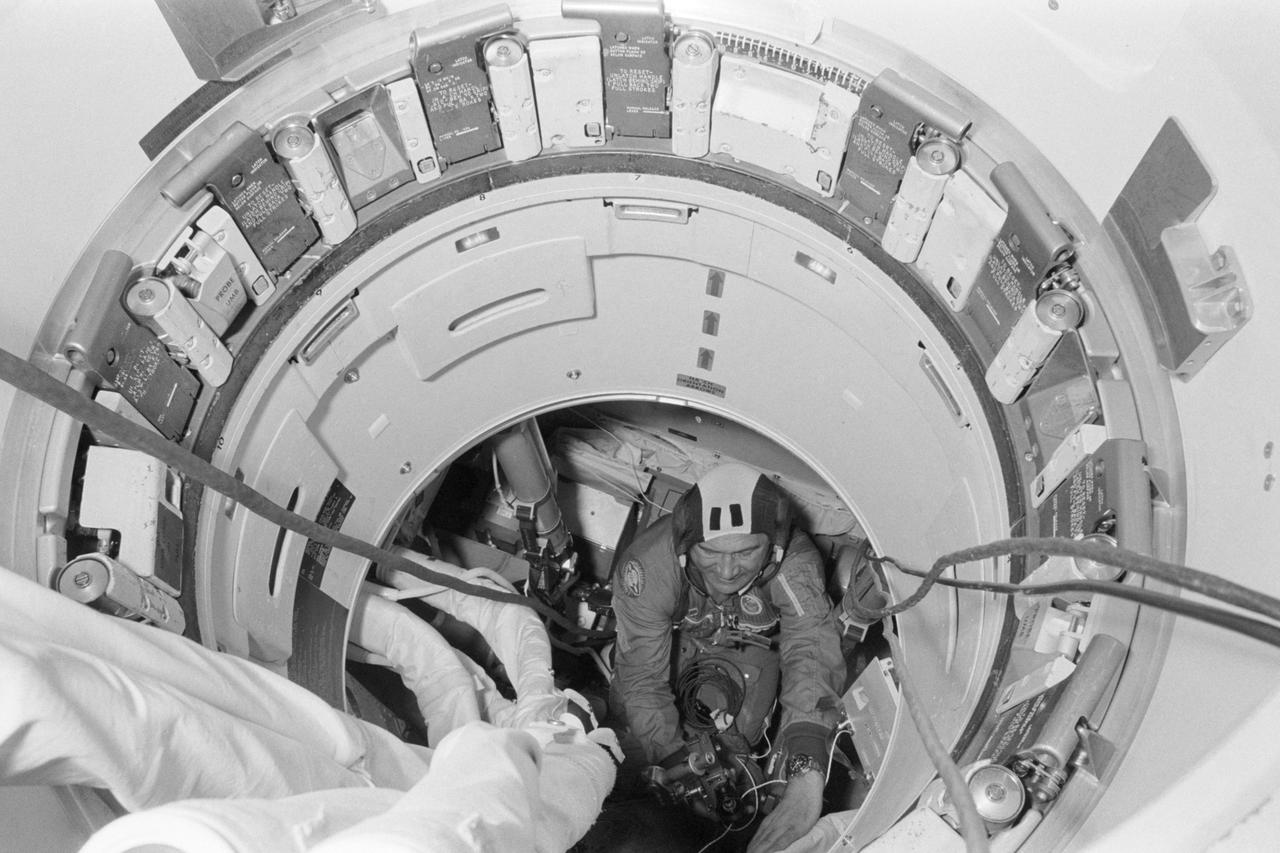
S75-21836 (20 Feb. 1975) --- Cosmonaut Anatoliy V. Filipchenko, commander of the Soviet ASTP second (backup) crew, participates in Apollo-Soyuz Test Project joint crew training in Building 35 at NASA's Johnson Space Center. Filipchenko is in the Apollo Command Module trainer. This picture was taken from inside the Docking Module during a ?walk-through? of the second day?s activities in Earth orbit.
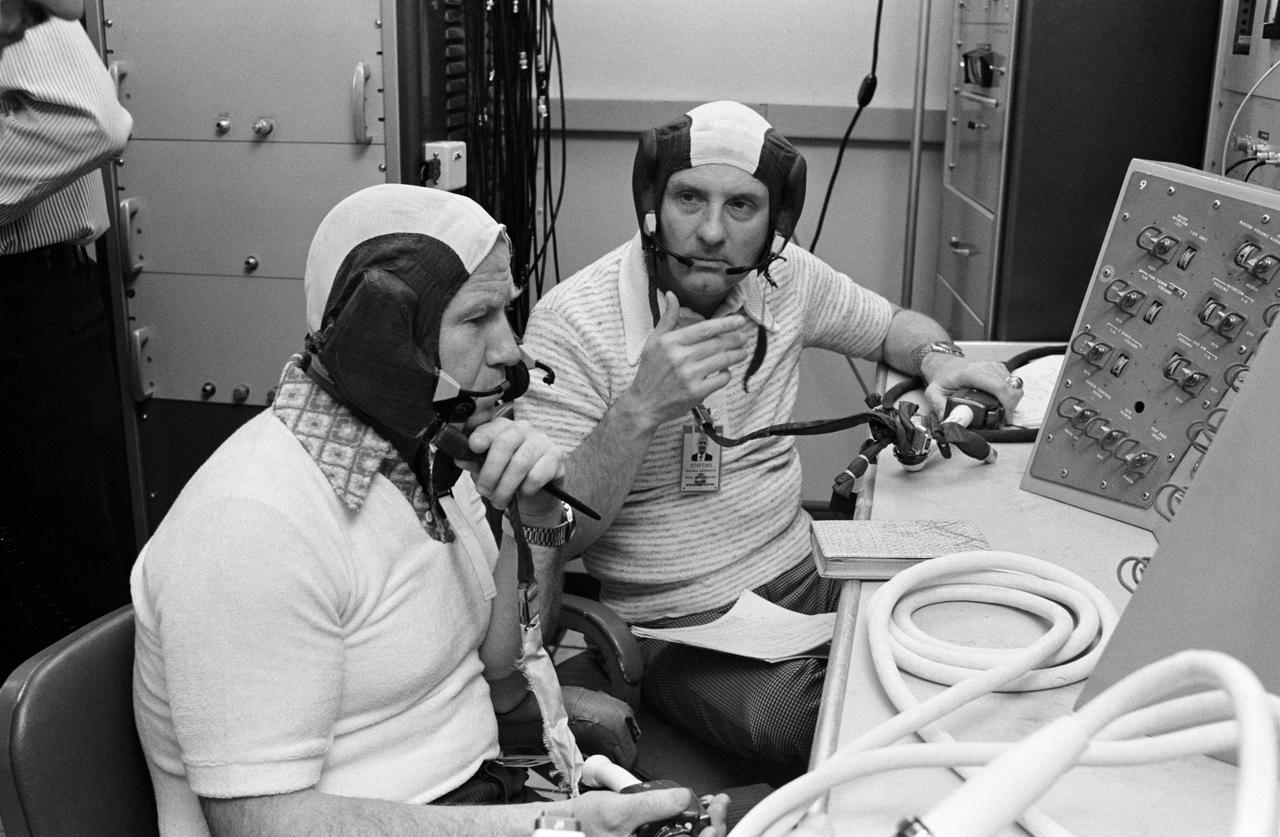
S74-20807 (23 April 1974) --- Cosmonaut Aleksey A. Leonov (foreground) is briefed on the Apollo communications test system console in the Building 440 laboratory during the joint U.S.-USSR Apollo-Soyuz Test Project training activity at the Johnson Space Center. Leonov is the commander of the Soviet ASTP crew. Leonov is being briefed by astronaut Thomas P. Stafford, commander of the American ASTP crew.

JSC2000-E-27077 (16 October 2000) --- Expedition One crew members in Moscow's Red Square. From left, Soyuz pilot Yuri Gidzenko, flight engineer Sergei Krikalev, and expedition commander William M. (Bill) Shepherd. While in Moscow, the trio also visited the grave of Soviet cosmonaut Yuri Gagarin (1934-1968). Paying respects to the first man in space is customary in Russia prior to a spaceflight.
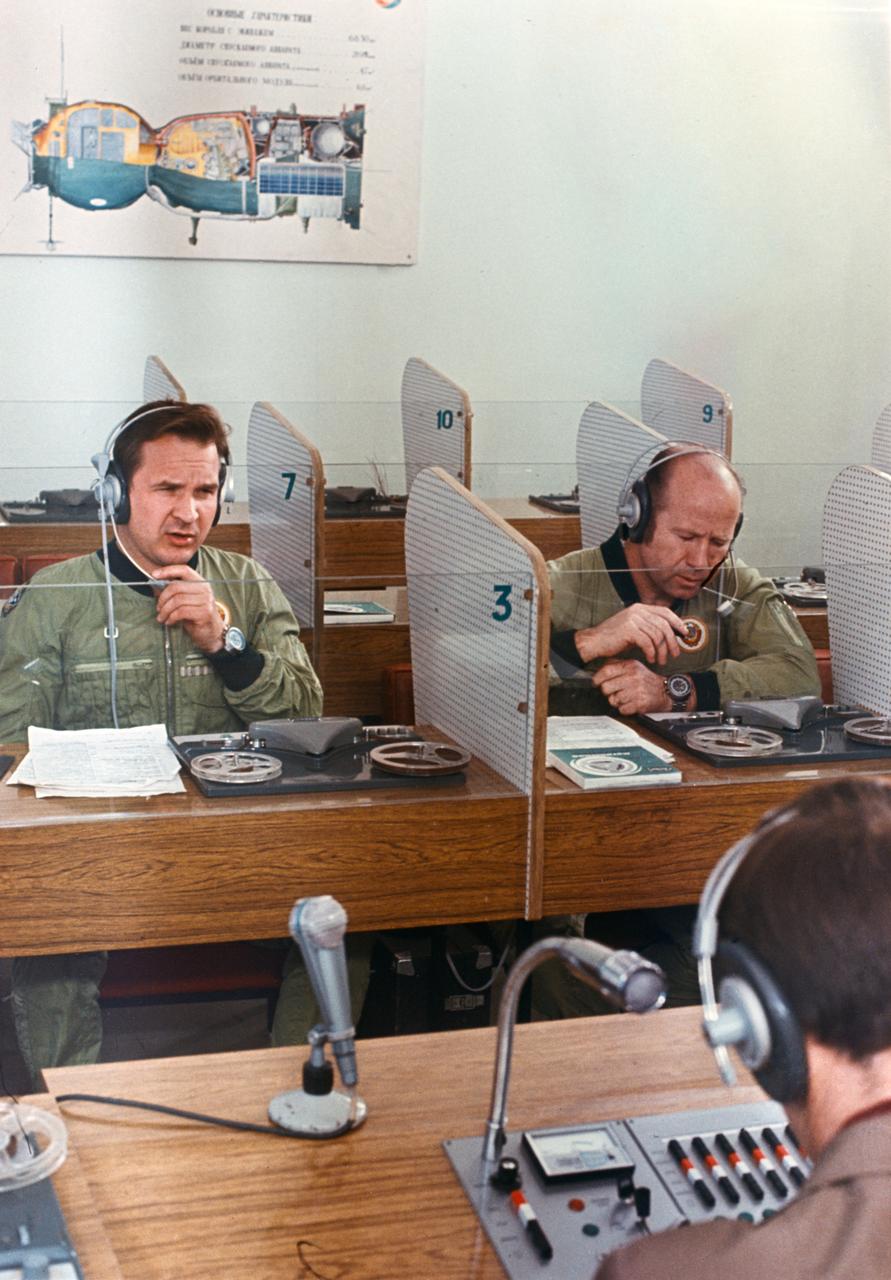
S75-32340 (July 1975) --- Cosmonauts Valeriy N. Kubasov (left) and Aleksey A. Leonov participate in English language training during Apollo-Soyuz Test Project preflight preparations at the Cosmonaut Training Center (Star City) near Moscow. Leonov was the commander of the Soviet ASTP first (prime) crew; and Kubasov was the flight engineer on the same crew. They are seated in the language laboratory at Star City. PHOTO COURTESY: USSR ACADEMY OF SCIENCES
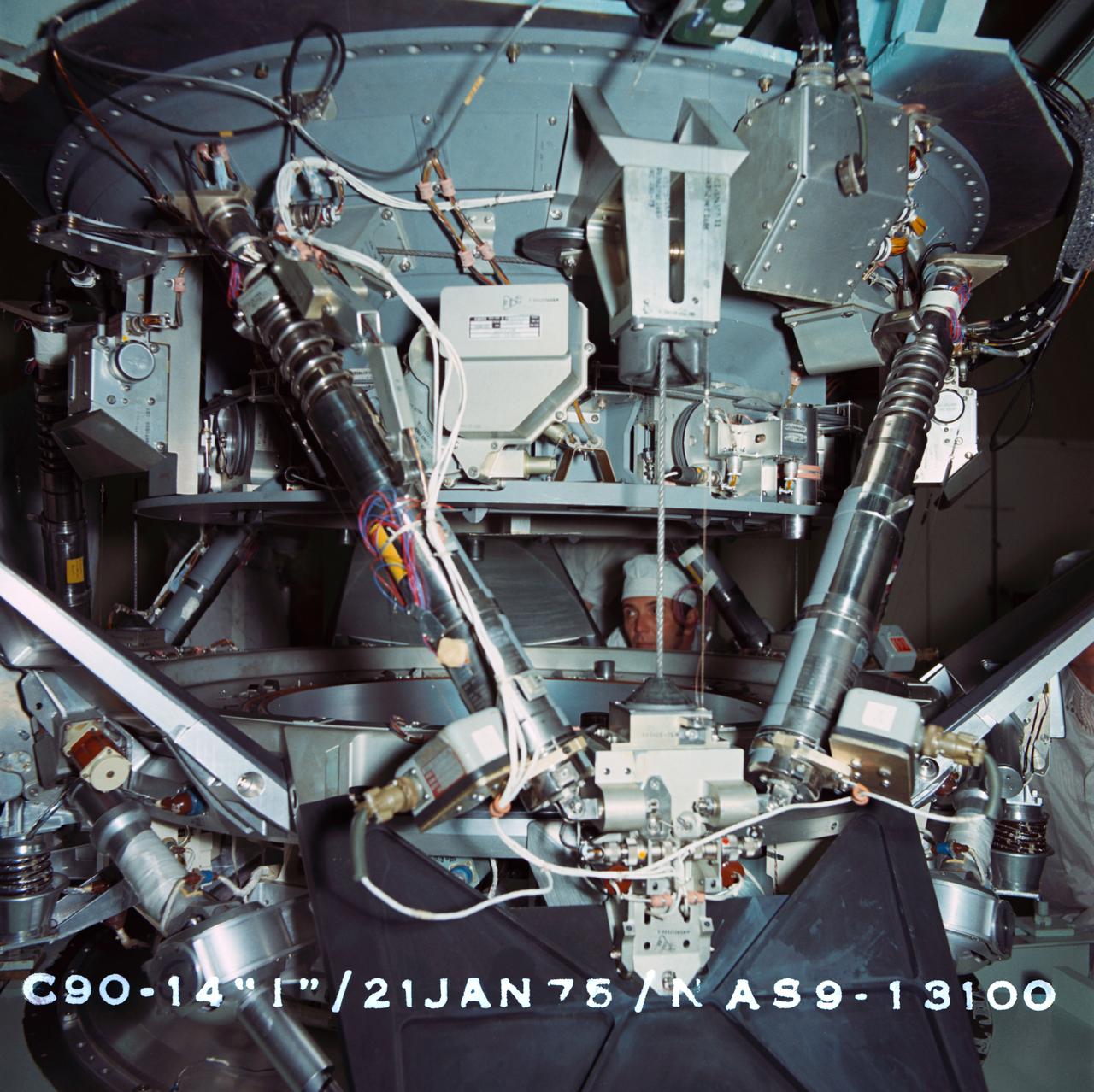
S95-02815 (21 Jan. 1975) --- Soviet junior researcher Y.G. Pobrov observes testing of the Apollo-Soyuz docking system at Rockwell International's plant in Downey, California. The United States' Docking System 3 (DS-3) here is being positioned onto the USSR's CA-4 system during a Pin and Socket Alignment Test. DS-5 has been designated as the prime flight article for the joint U.S.-USSR Apollo-Soyuz Test Project (ASTP) docking mission in Earth orbit, scheduled for July 1975.
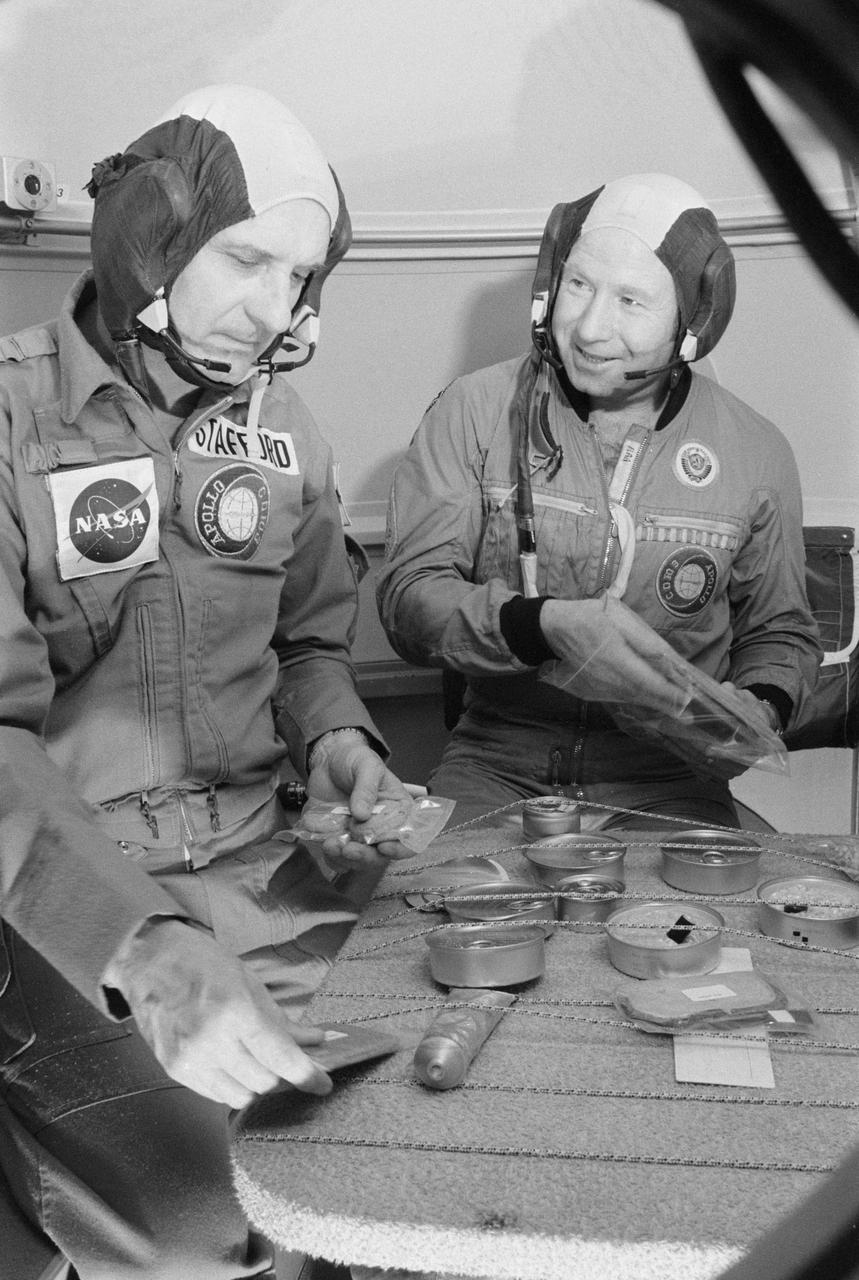
S75-22187 (25 Feb. 1975) --- Two ASTP crewmen look over food cans and packages in the Soyuz orbital module trainer in Building 35 during Apollo-Soyuz Test Project joint crew training at NASA's Johnson Space Center. They are astronaut Thomas P. Stafford (left), commander of the American ASTP prime crew; and cosmonaut Aleksey A. Leonov, commander of the Soviet ASTP first (prime) crew. The training session simulated activity on the second day in Earth orbit.
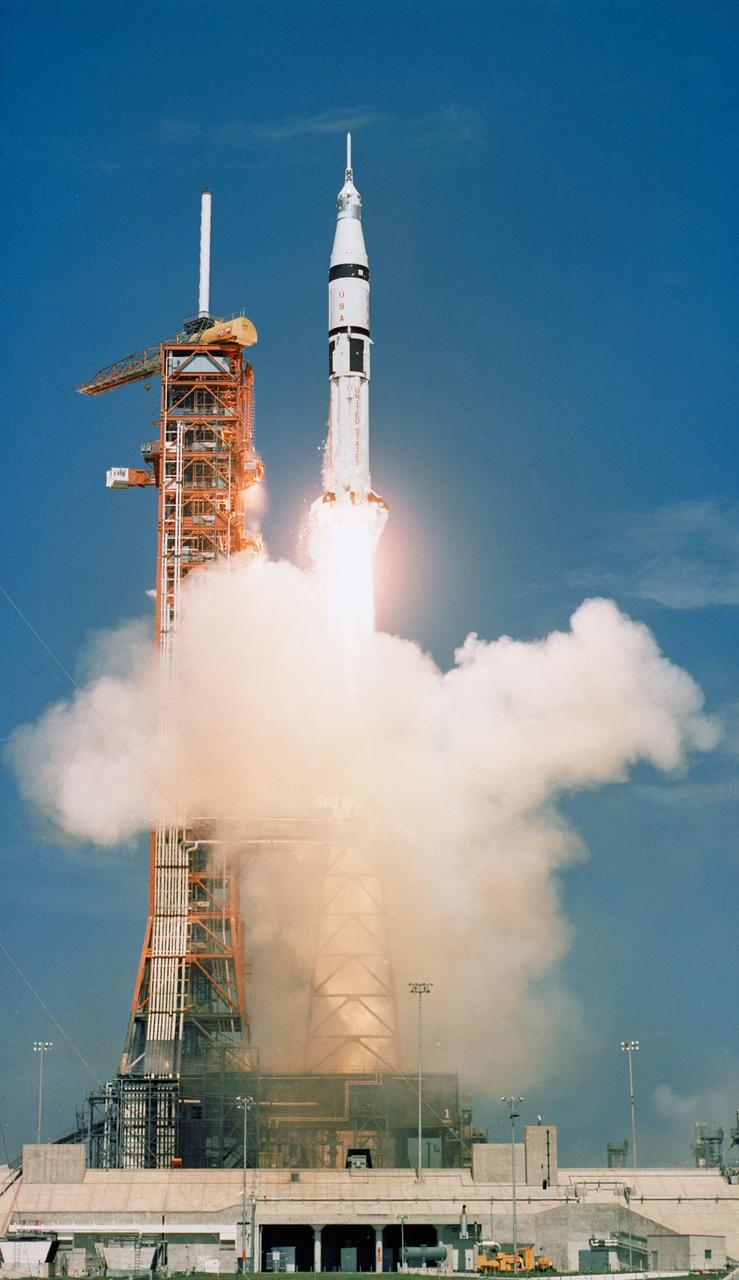
S75-28550 (15 July 1975) --- The Apollo-Soyuz Test Project's (ASTP) NASA Apollo/Saturn 1B space vehicle is launched from Pad B, Launch Complex 39, Kennedy Space Center (KSC), Florida, at 3:50 p.m. (EDT), July 15, 1975, to begin Apollo's catch-up journey toward the already Earth-orbiting Soviet Soyuz spacecraft. Aboard the Apollo spacecraft were astronauts Thomas P. Stafford, Vance D. Brand and Donald K. (Deke) Slayton.
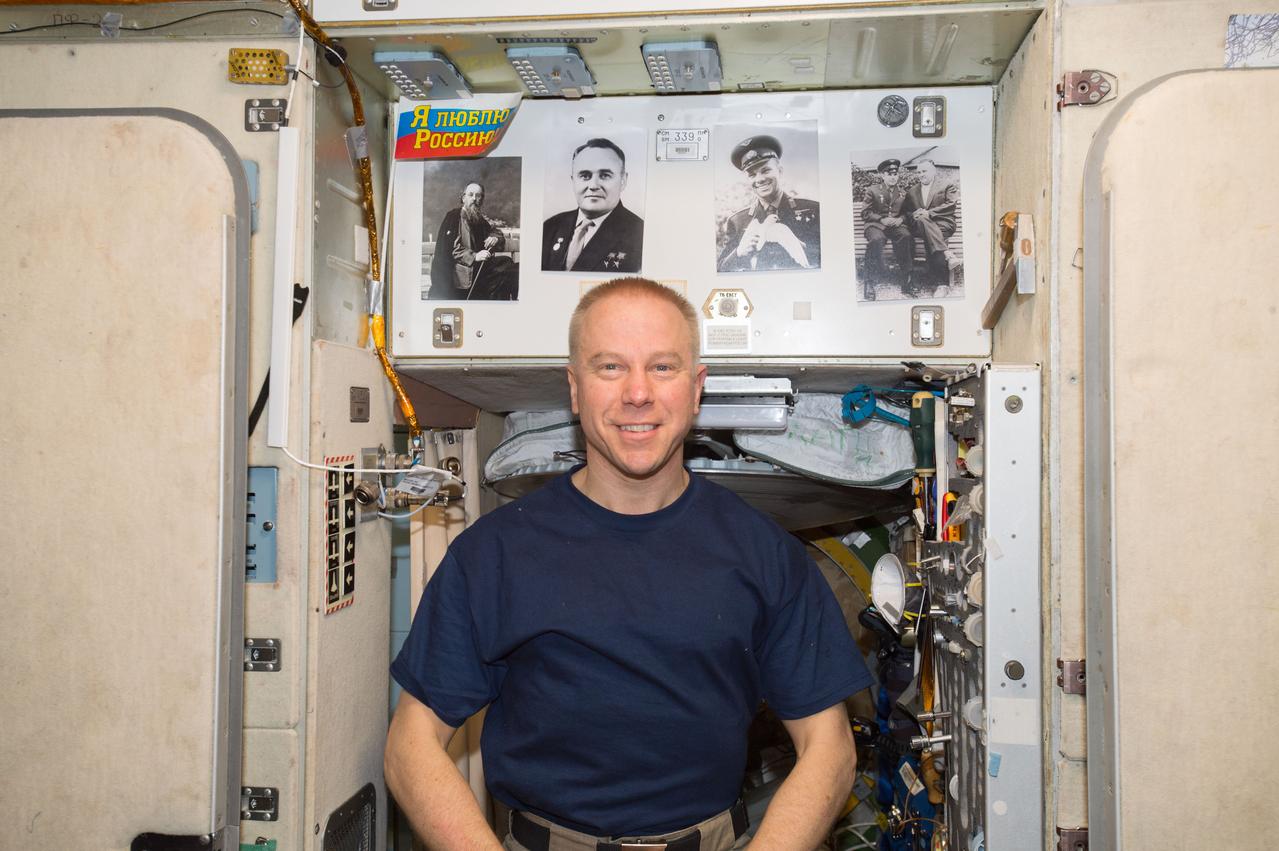
ISS047e056031 (04/12/2016) --- NASA astronaut Tim Kopra, Commander of Expedition 47, floats inside the Russian segment on Cosmonautics Day 2016. Behind him are photographs (left to right) of Konstantin Tsiolkovsky, a Russian rocket scientist and pioneer of rocketry and astronautics, Sergei Korolev, the lead Soviet rocket and spacecraft engineer during the Space Race, Yuri Gagarin, the first human to fly in outer space, and a photo of Gagarin and Korolev together. Apr. 12, 2016 marked the 55th anniversary of Gagarin’s flight.
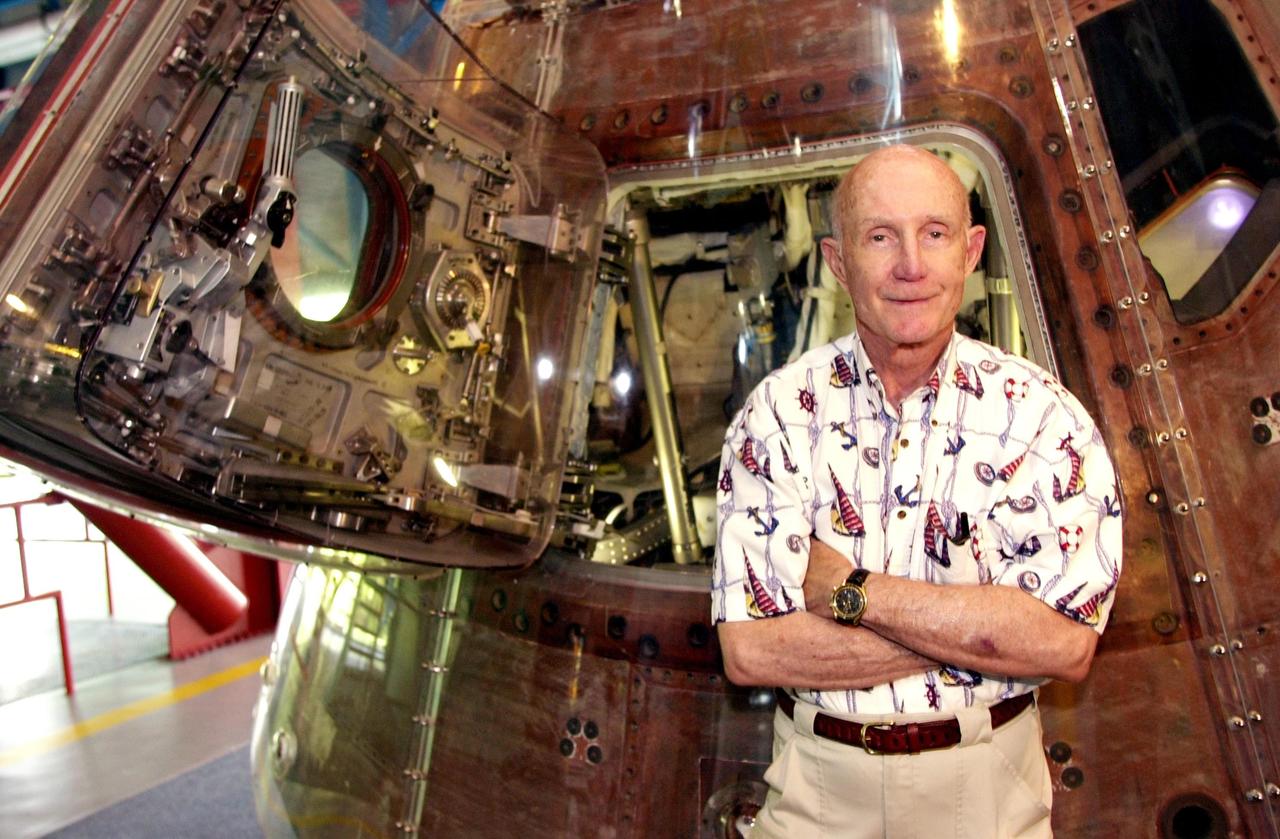
KENNEDY SPACE CENTER, FLA. -- Former astronaut Thomas Staford visits KSC, shown here at the Apollo Saturn V Center. He is standing in front of the module he flew Stafford logged his fourth space flight as Apollo commander of the Apollo-Soyuz Test Project (ASTP) mission, July 15-24, 1975, a joint space flight culminating in the historic first meeting in space between American astronauts and Soviet cosmonauts.
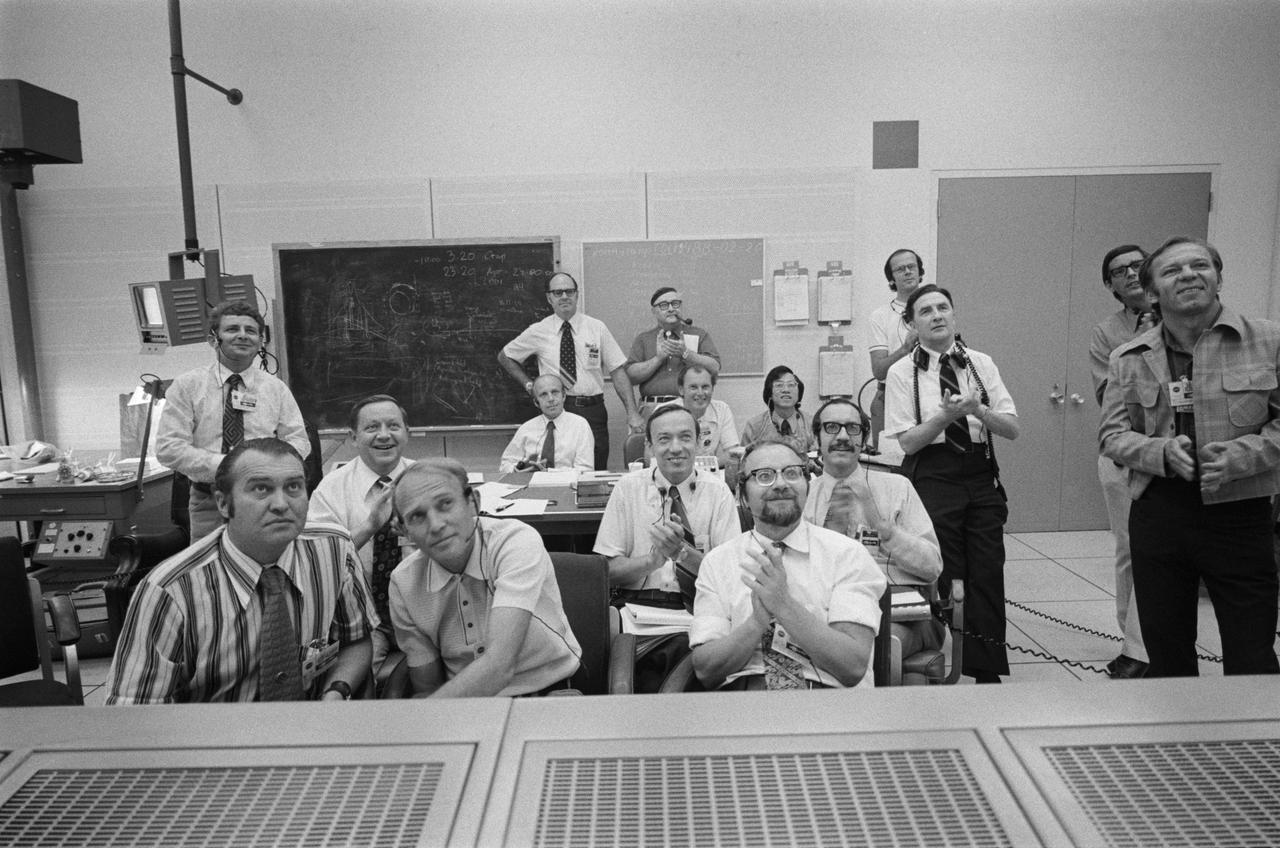
S75-28659 (21 July 1975) --- An overall view of the group of Soviet Union flight controllers who served at the Mission Control Center during the joint U.S.-USSR Apollo-Soyuz Test Project docking mission in Earth orbit. They are applauding the successful touchdown of the Soyuz spacecraft in Central Asia. The television monitor had just shown the land landing of the Soyuz descent vehicle.
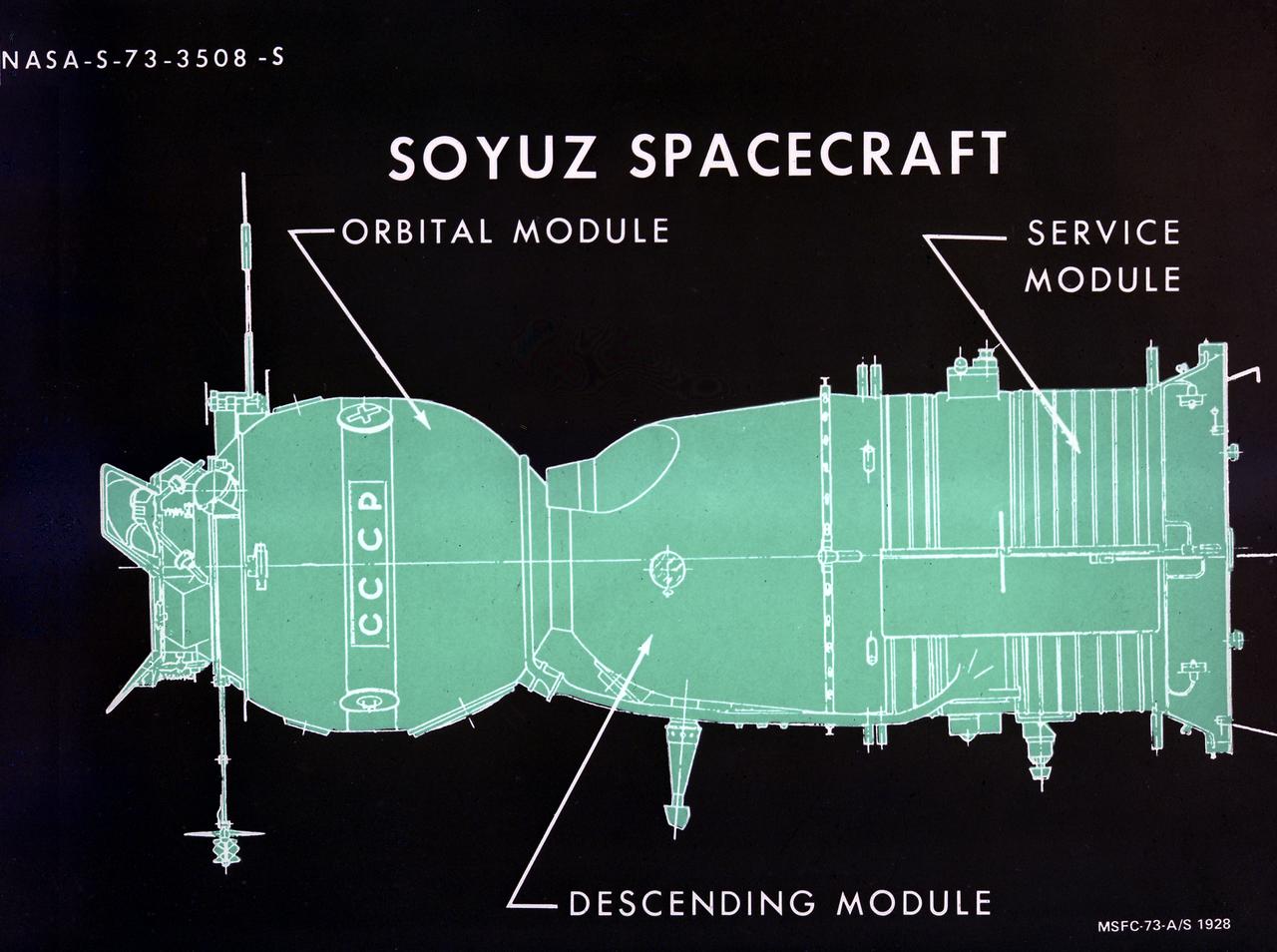
This illustration depicts a configuration of the Soyuz spacecraft for the Apollo-Soyuz Test Project (ASTP). The ASTP was the first international docking of the U.S.'s Apollo spacecraft and the U.S.S.R.'s Soyuz spacecraft in space. For this project, the Soviets built another in their continuing series of Soyuz space capsules. The U.S. used the Saturn IB Apollo capsule. A joint engineering team from the two countries met to develop a docking system that permitted the two spacecraft to link in space and allowed the crews to travel from one spacecraft to the other.
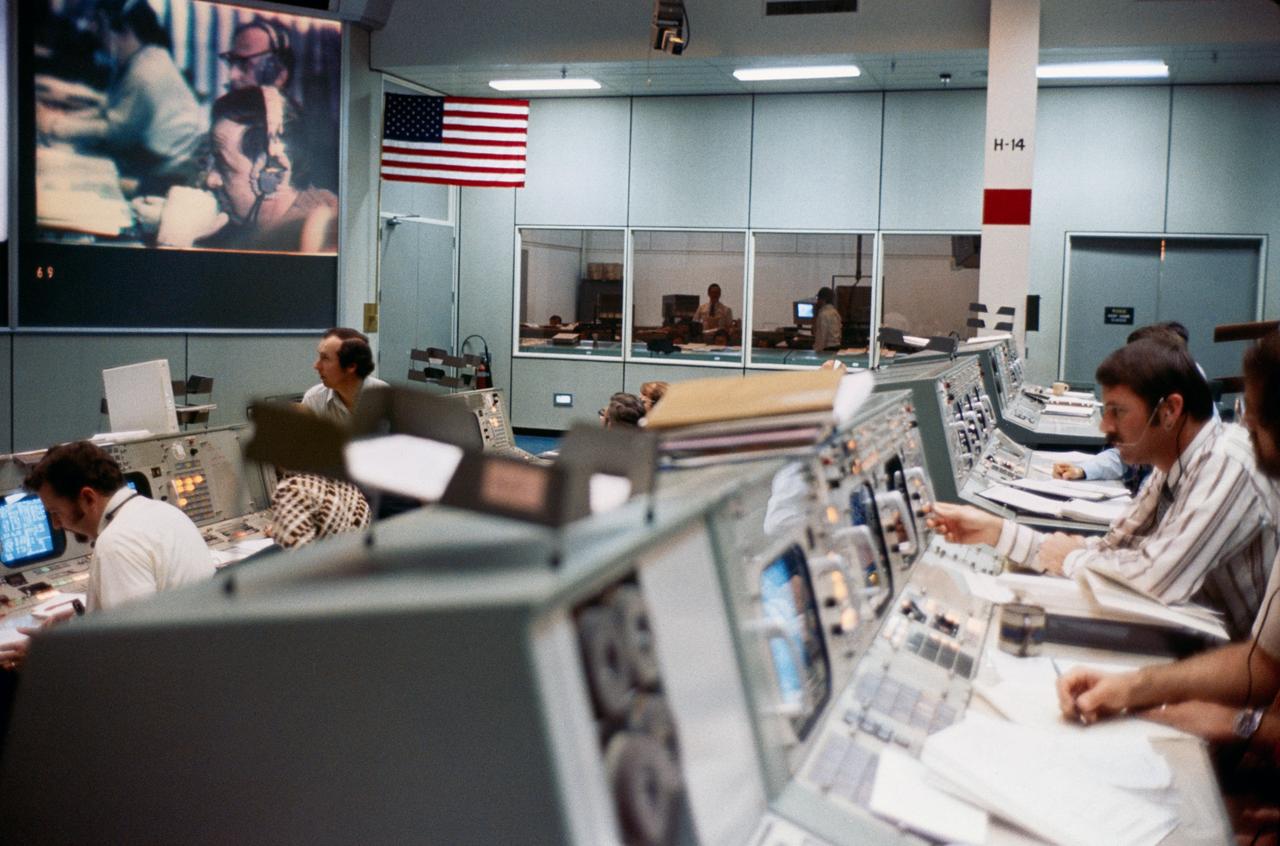
S75-23880 (20 March 1975) --- An overall view of the Mission Operations Control Room in the Mission Control Center during ASTP joint simulation activity at NASA's Johnson Space Center. Flight director Donald R. Puddy (stripped shirt) is seated at his console on the right. The television monitor in the left background shows a scene from the ASTP control center in the Soviet Union. The simulations are part of the preparations for the U.S.-USSR Apollo-Soyuz Test Project docking mission in Earth orbit scheduled for July 1975.
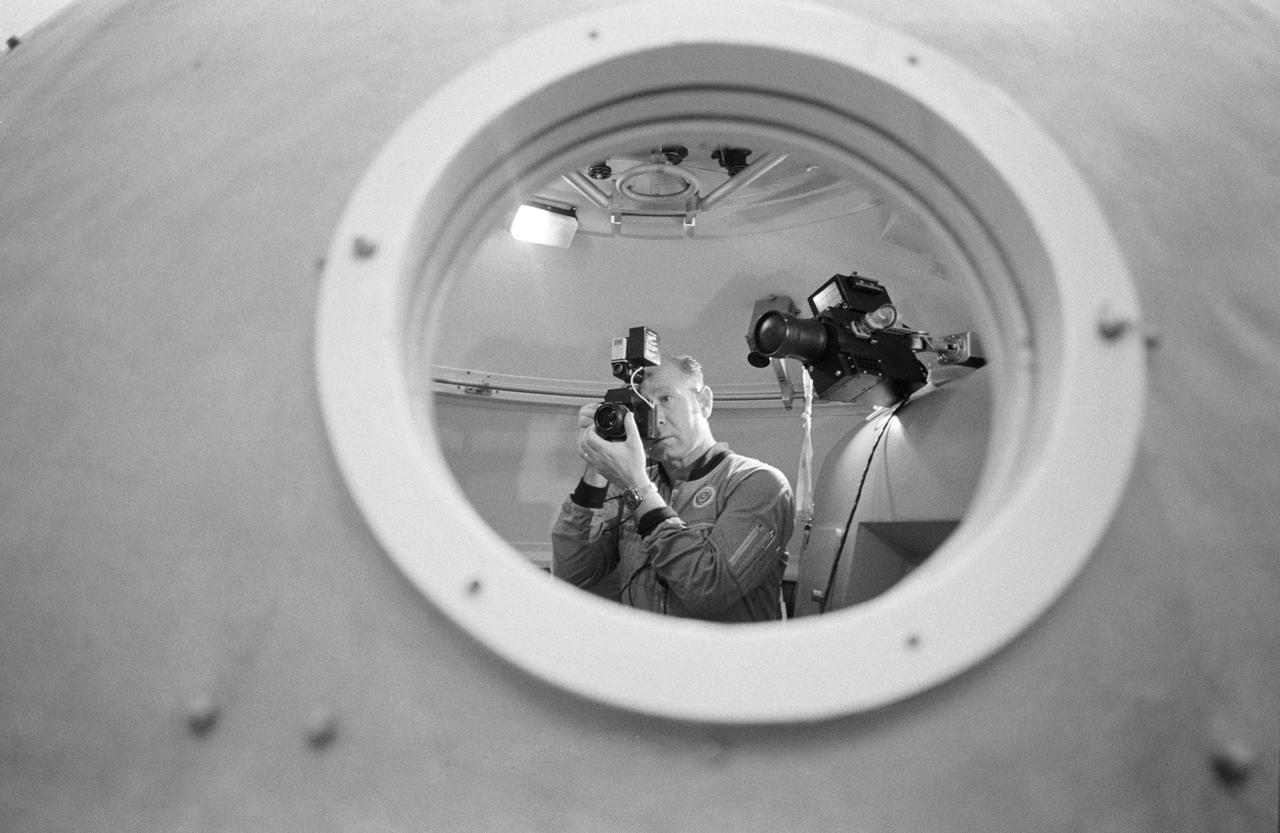
S75-21715 (19 Feb. 1975) --- Cosmonaut Aleksey A. Leonov focuses his camera for an interior shot during a simulation exercise for the Apollo-Soyuz Test Project (ASTP). Leonov is inside the Soyuz orbital module mock-up in Building 35 at the Johnson Space Center (JSC), scene of current simulations for the joint U.S.-USSR space mission scheduled for July of this year. Astronauts and cosmonauts were taking part in second-day activity simulations when this photo was made. Leonov is the Soviet ASTP crew commander.
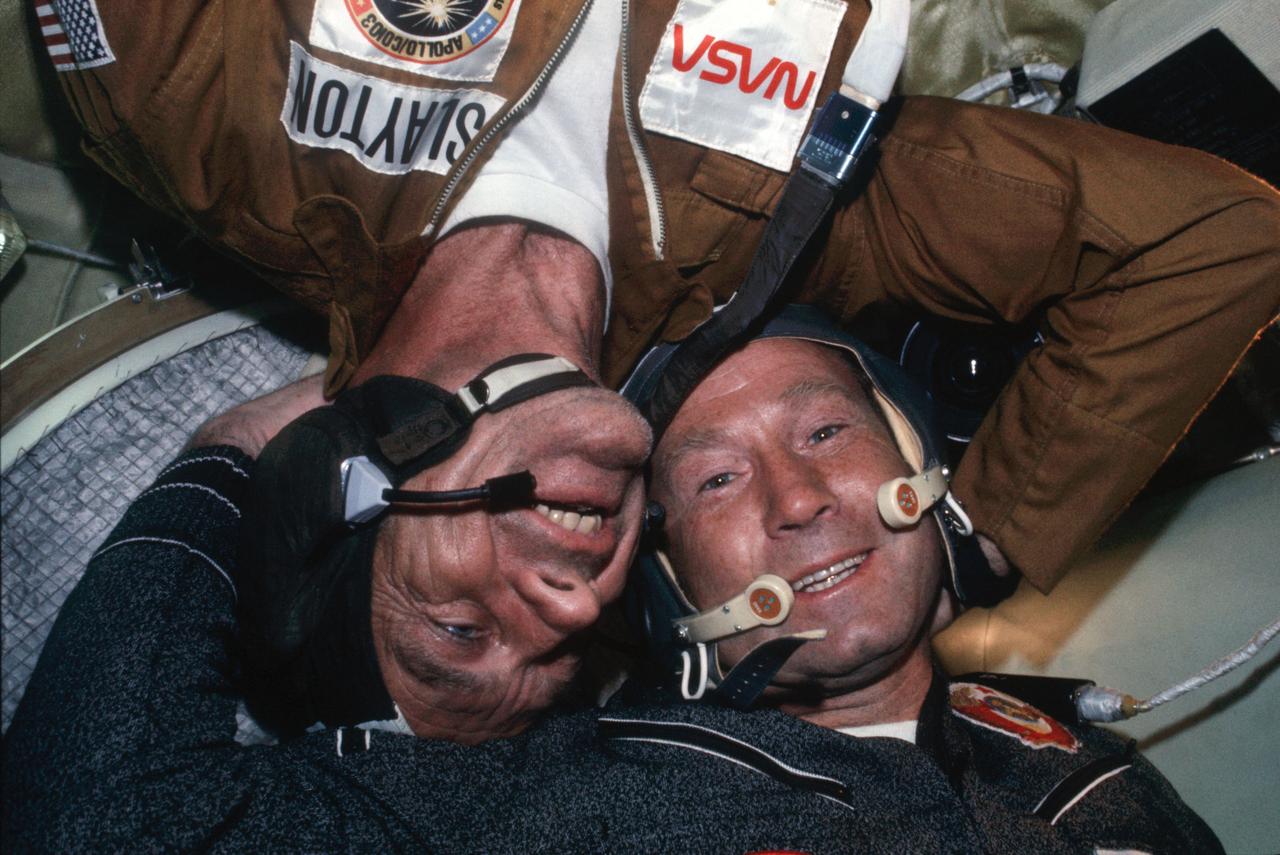
AST-05-298 (17-19 July 1975) --- Astronaut Donald K. Slayton and cosmonaut Aleksey A. Leonov are seen together in the Soyuz Orbital Module during the joint U.S.-USSR Apollo-Soyuz Test Project docking mission in Earth orbit. Slayton is the docking module pilot of the American crew. Leonov is the Soviet crew commander. This picture was taken with a 35mm camera.