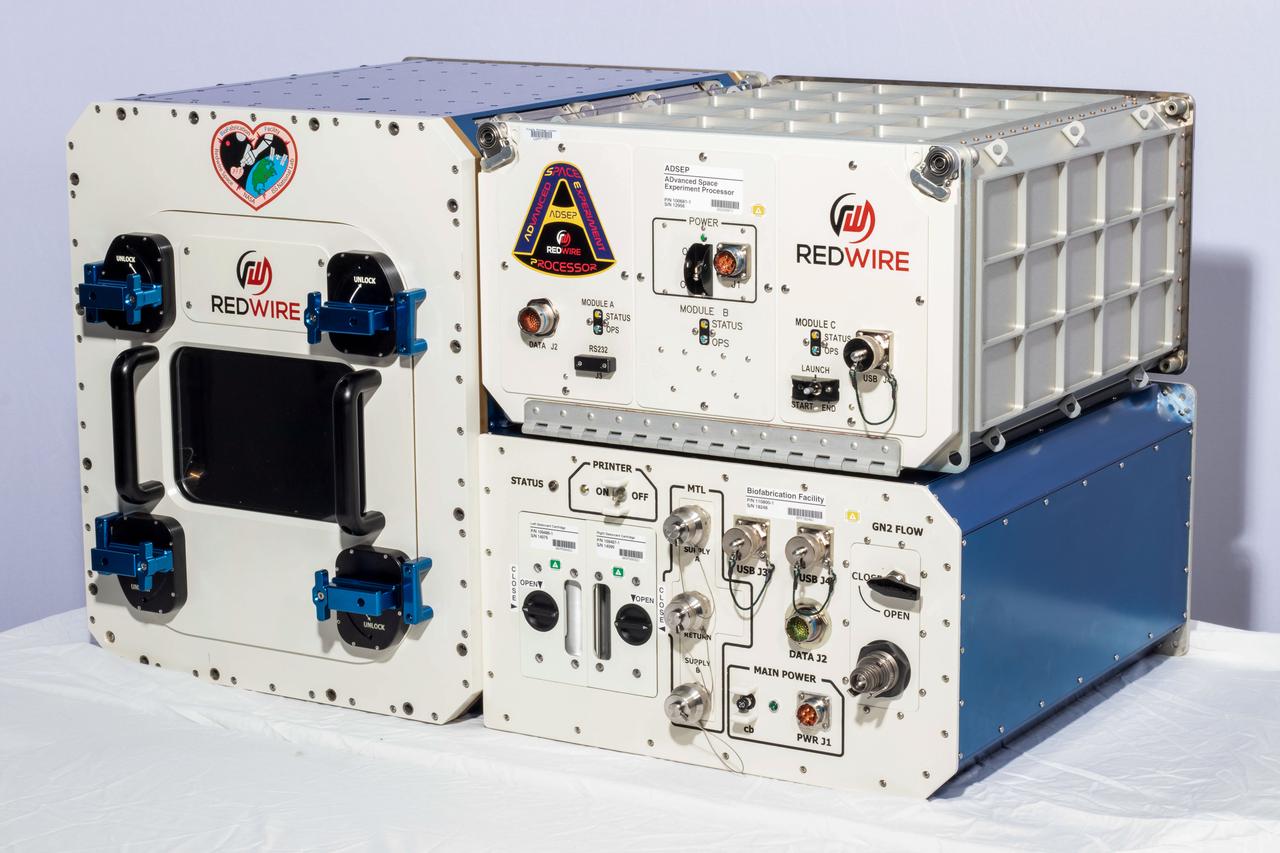
jsc2022e072969 (8/12/2022) ---    The BioFabrication Facility (BFF) and the ADvanced Space Experiment Processor (ADSEP) together comprise a system capable of manufacturing human tissue in the microgravity environment of space. BFF is returning to the International Space Station after coming back to Earth for upgrades in 2020. The first investigation to be conducted in the upgraded facility is BioFabrication Facility Assembled Next-gen Development of Collagenous Allograft Meniscal Prosthetics aboard the International Space Station (BFF-Meniscus-2). The study attempts to 3D print a meniscus, also known as knee cartilage tissue, using only bioinks and cells. Image courtesy of Redwire.
BioFabrication Facility (BFF) and the ADvanced Space Experiment Processor (ADSEP) together
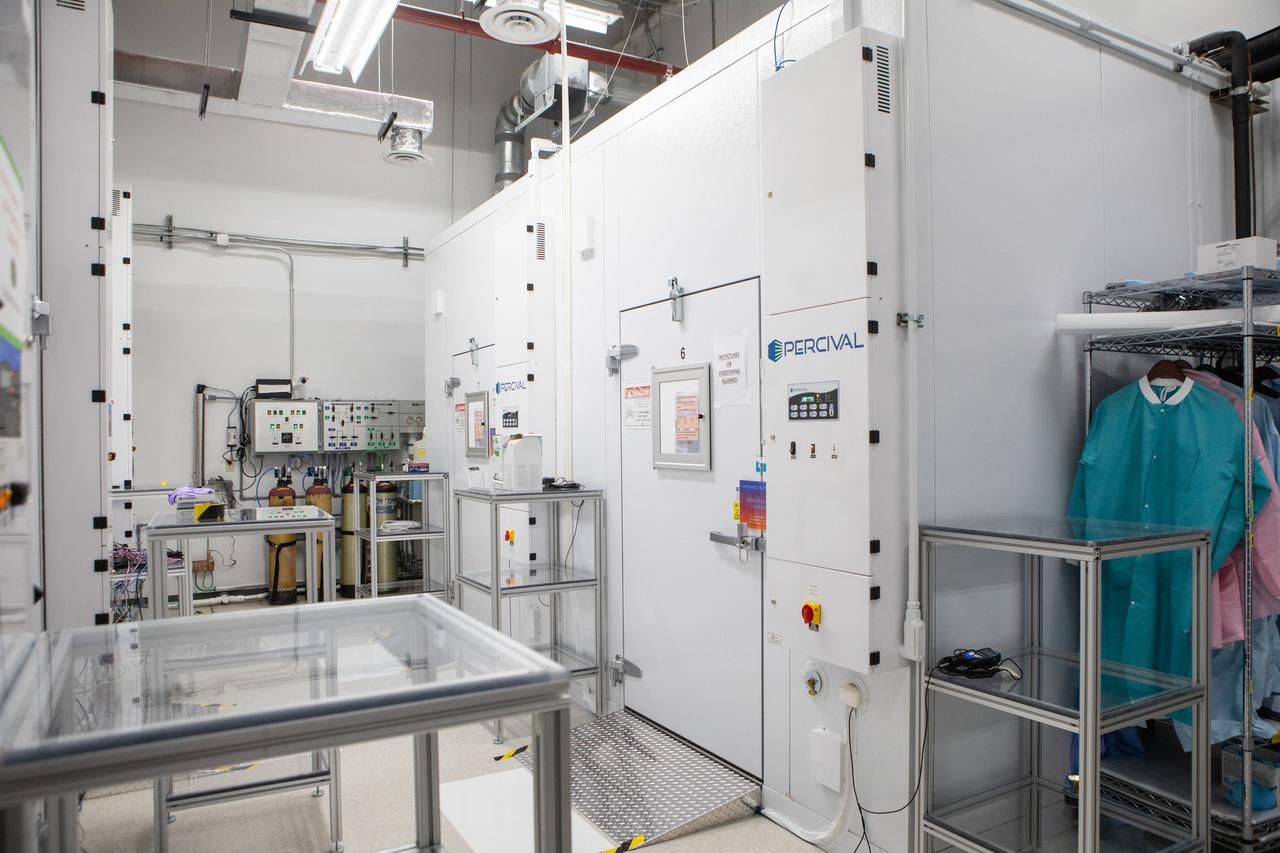
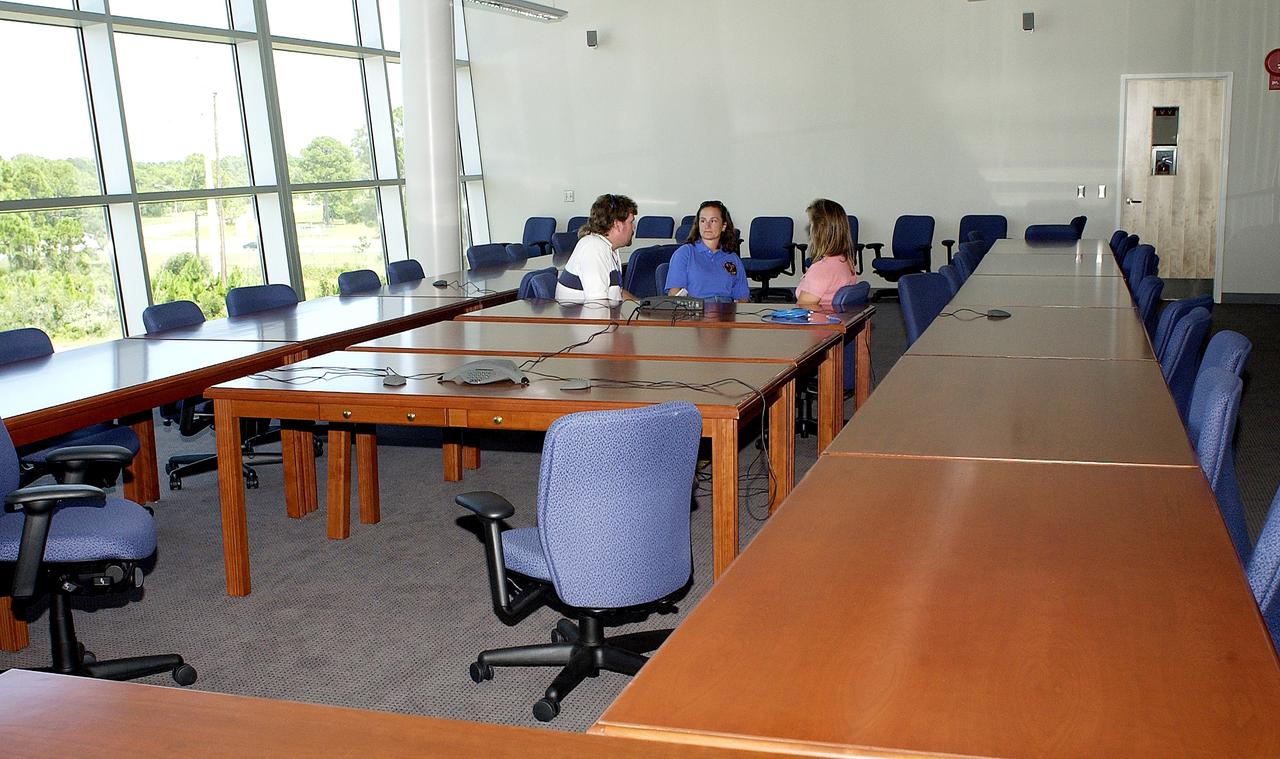
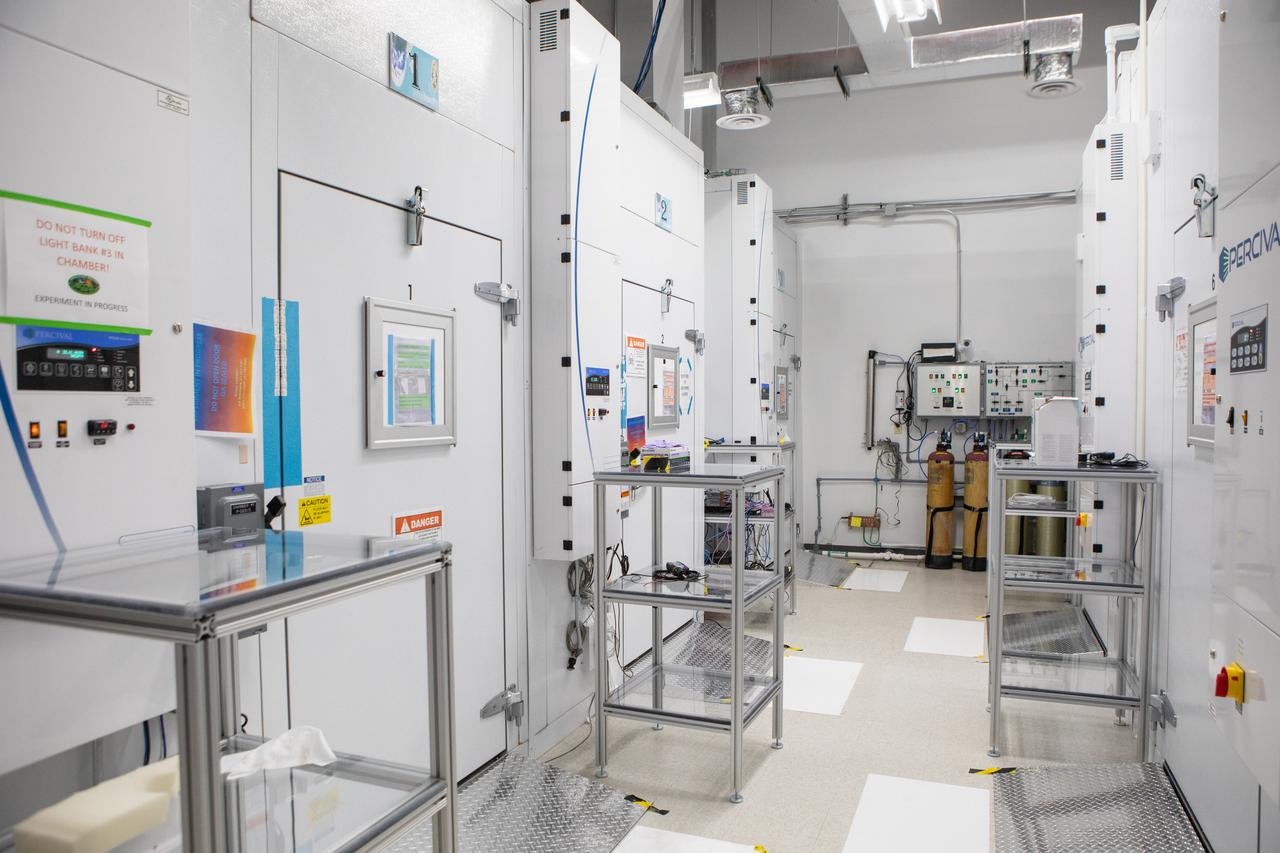
A walk-in experiment chamber for the Center for the Advancement of Science in Space (CASIS) is in view in the foreground inside a laboratory in the Space Station Processing Facility (SSPF) at NASA's Kennedy Space Center in Florida, on May 16, 2019. Further back is an experiment chamber for ground test flight experiments. The center is celebrating the SSPF’s 25th anniversary. The facility was built to process elements for the International Space Station. Now it is providing support for current and future NASA and commercial provider programs, including Commercial Resupply Services, Artemis 1, sending the first woman and next man to the Moon, and deep space destinations including Mars.
SSPF - 25 Year Anniversary Then & Now
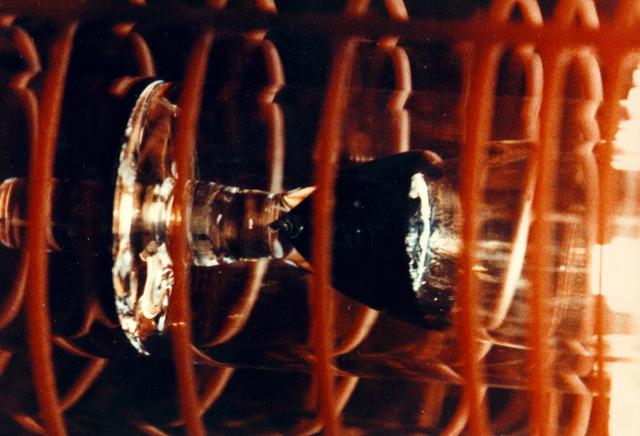
The objective of this facility is to investigate the potential of space grown semiconductor materials by the vapor transport technique and develop powdered metal and ceramic sintering techniques in microgravity. The materials processed or developed in the SEF have potential application for improving infrared detectors, nuclear particle detectors, photovoltaic cells, bearing cutting tools, electrical brushes and catalysts for chemical production. Flown on STS-60 Commercial Center: Consortium for Materials Development in Space - University of Alabama Huntsville (UAH)
Microgravity
A walk-in experiment chamber for the Center for the Advancement of Science in Space (CASIS) is in view inside a laboratory in the Space Station Processing Facility (SSPF) at NASA's Kennedy Space Center in Florida, on May 16, 2019. The center is celebrating the SSPF’s 25th anniversary. The facility was built to process elements for the International Space Station. Now it is providing support for current and future NASA and commercial provider programs, including Commercial Resupply Services, Artemis 1, sending the first woman and next man to the Moon, and deep space destinations including Mars.
SSPF - 25 Year Anniversary Then & Now
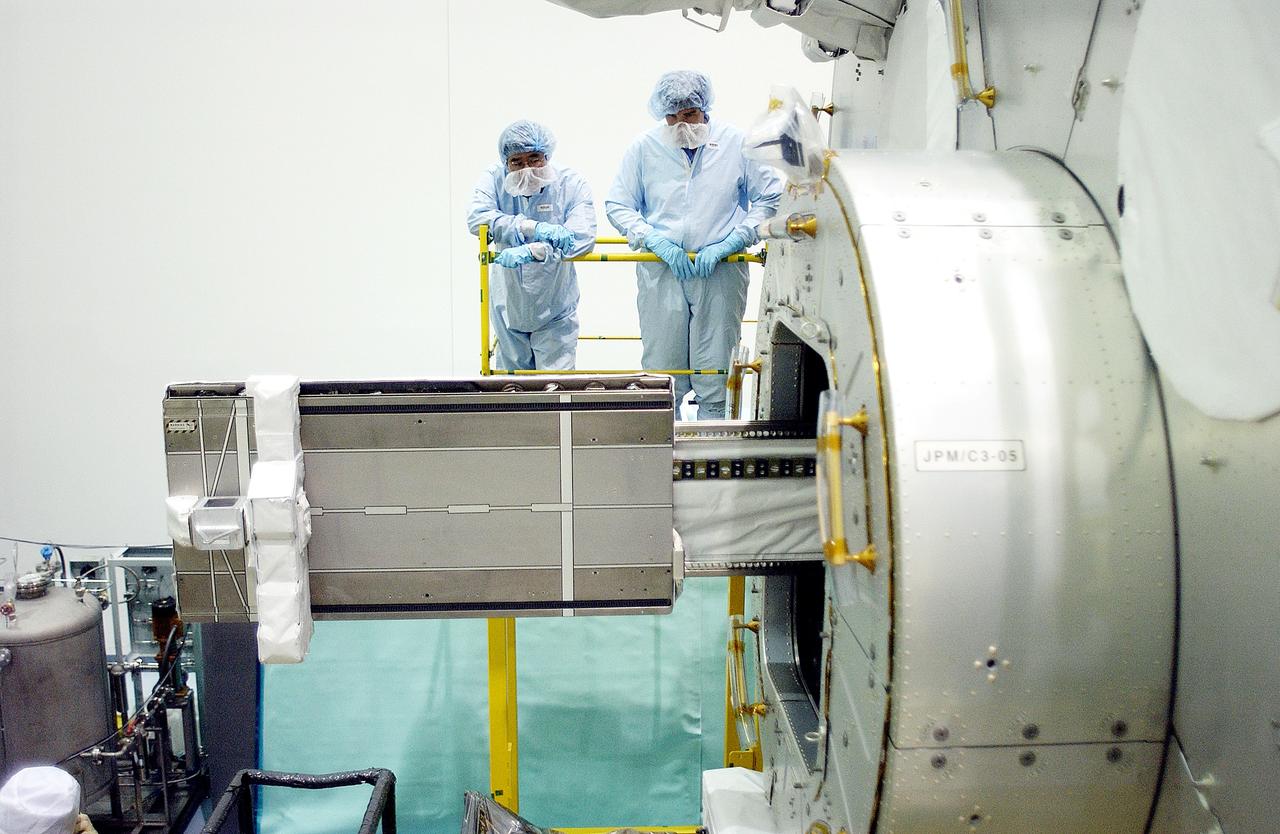
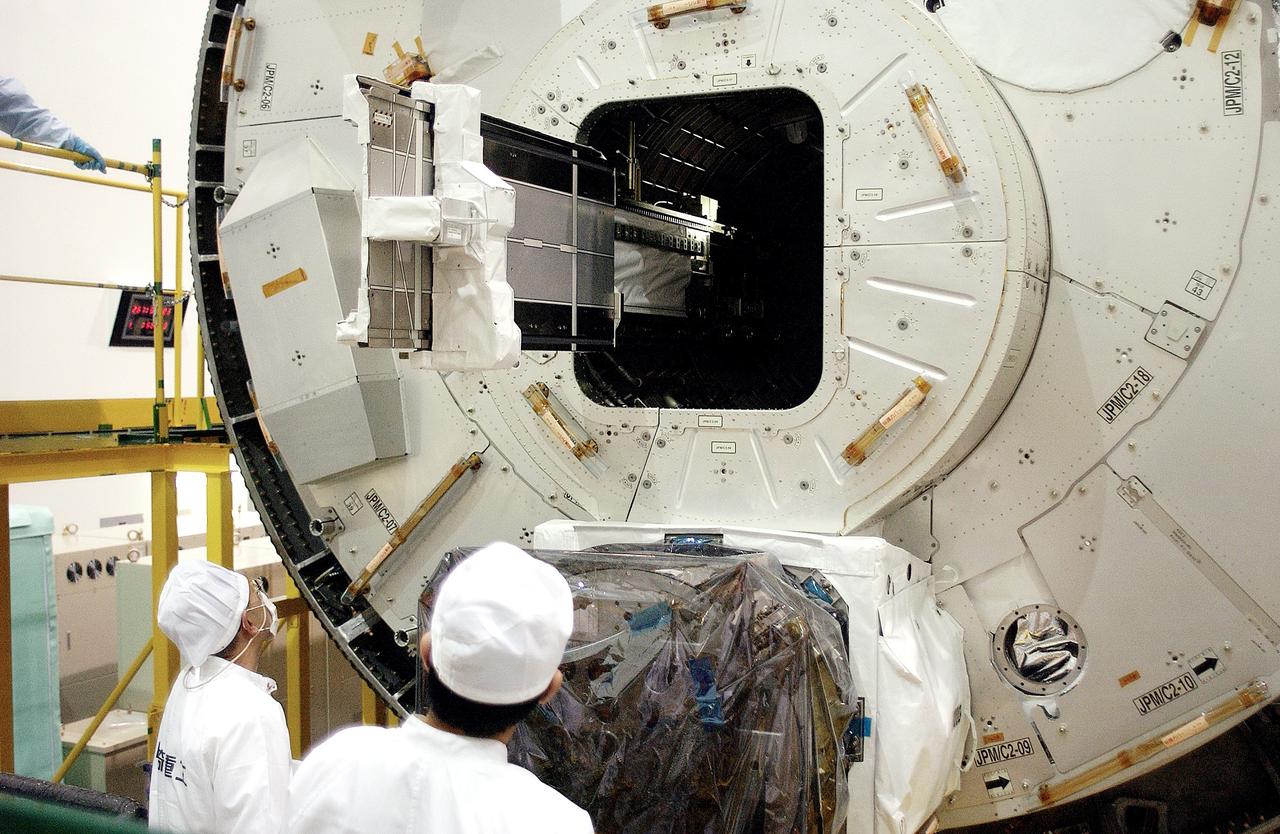
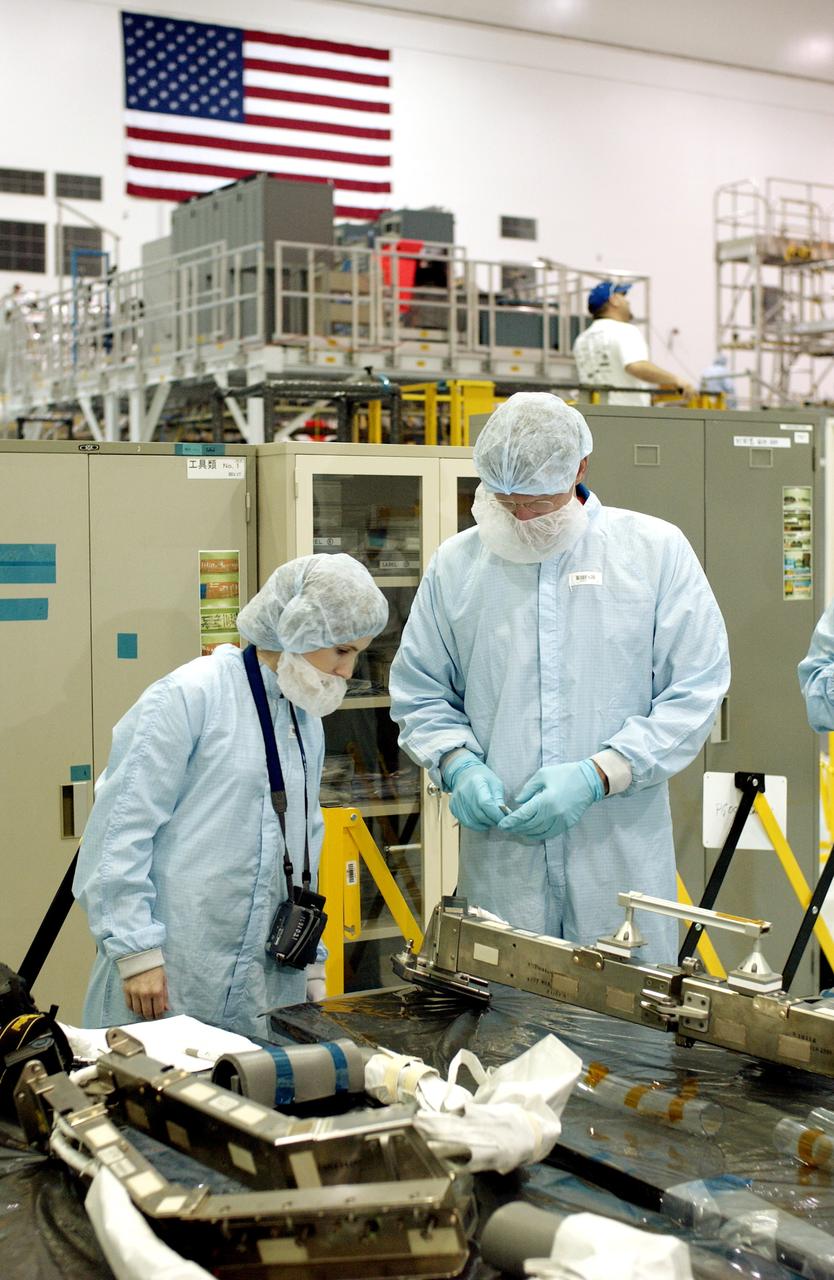
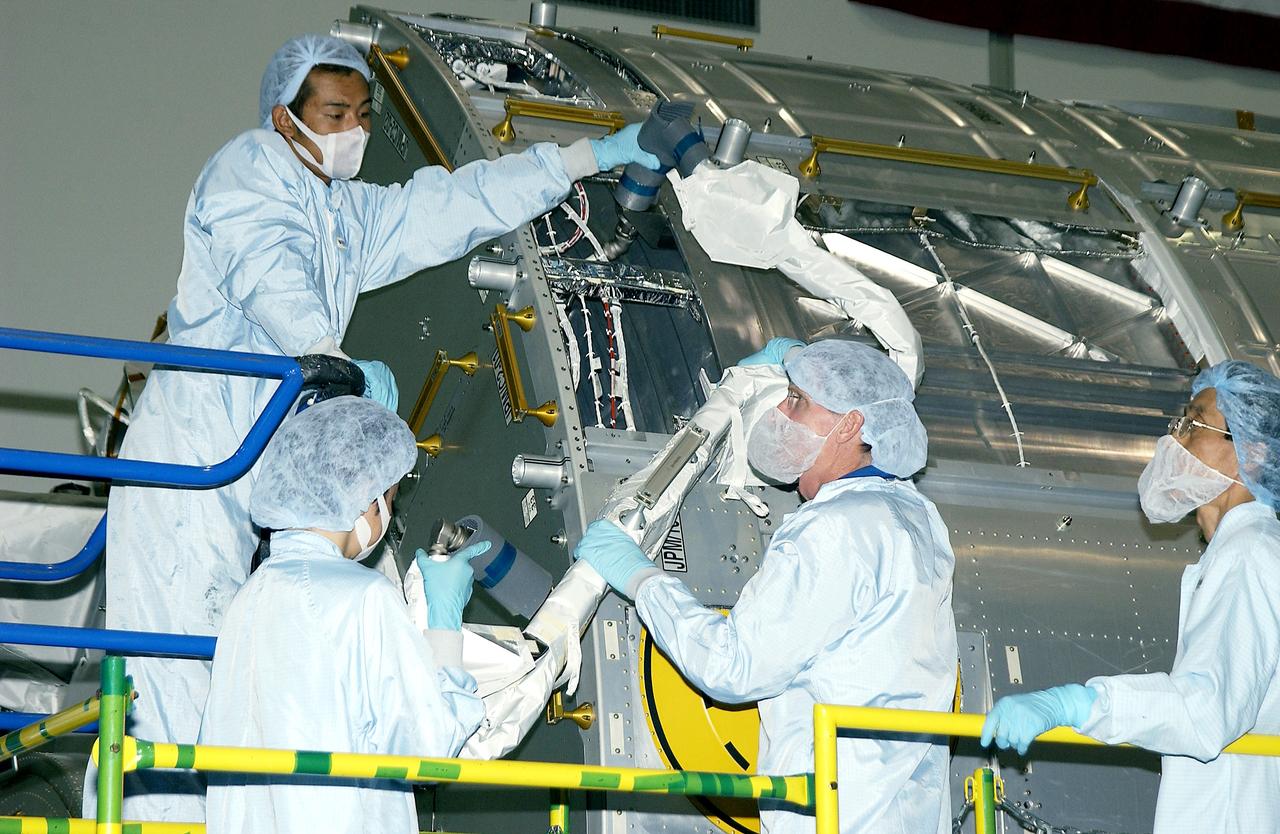
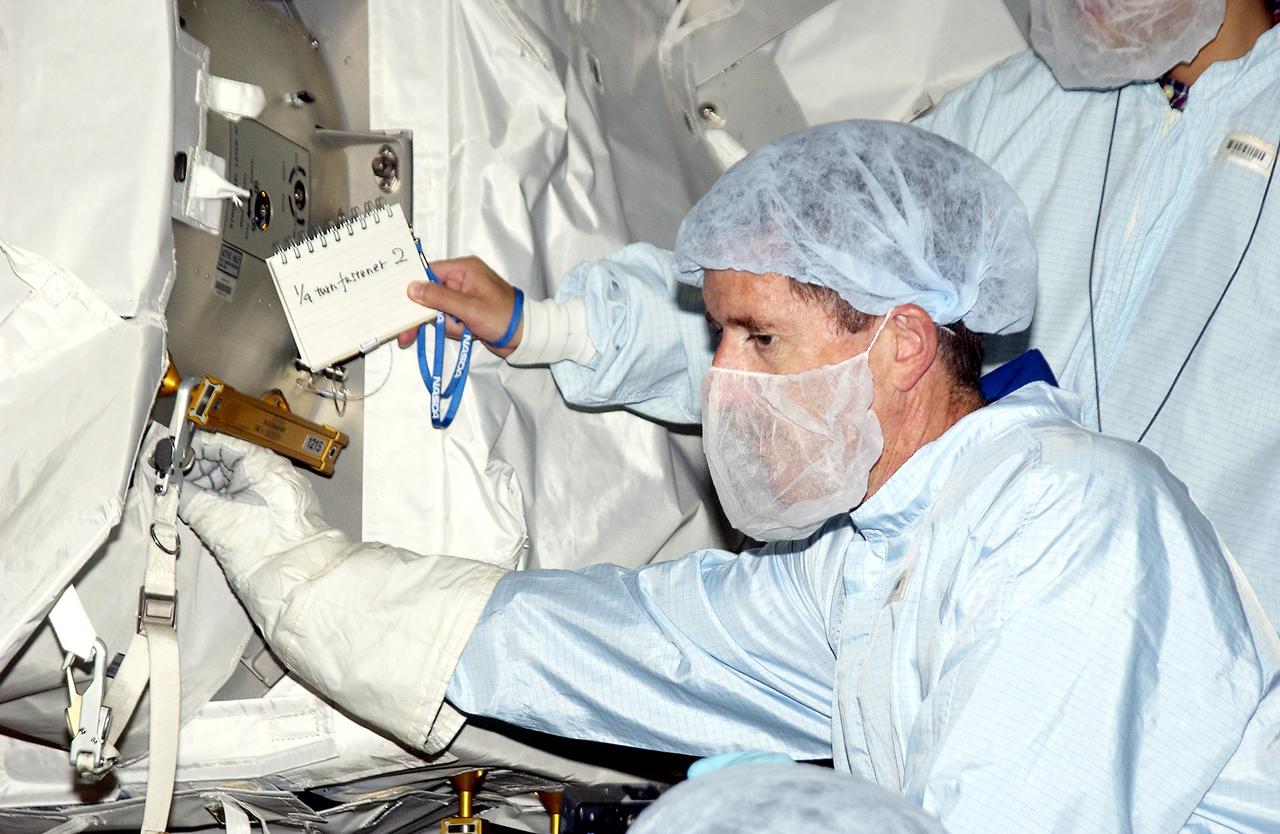
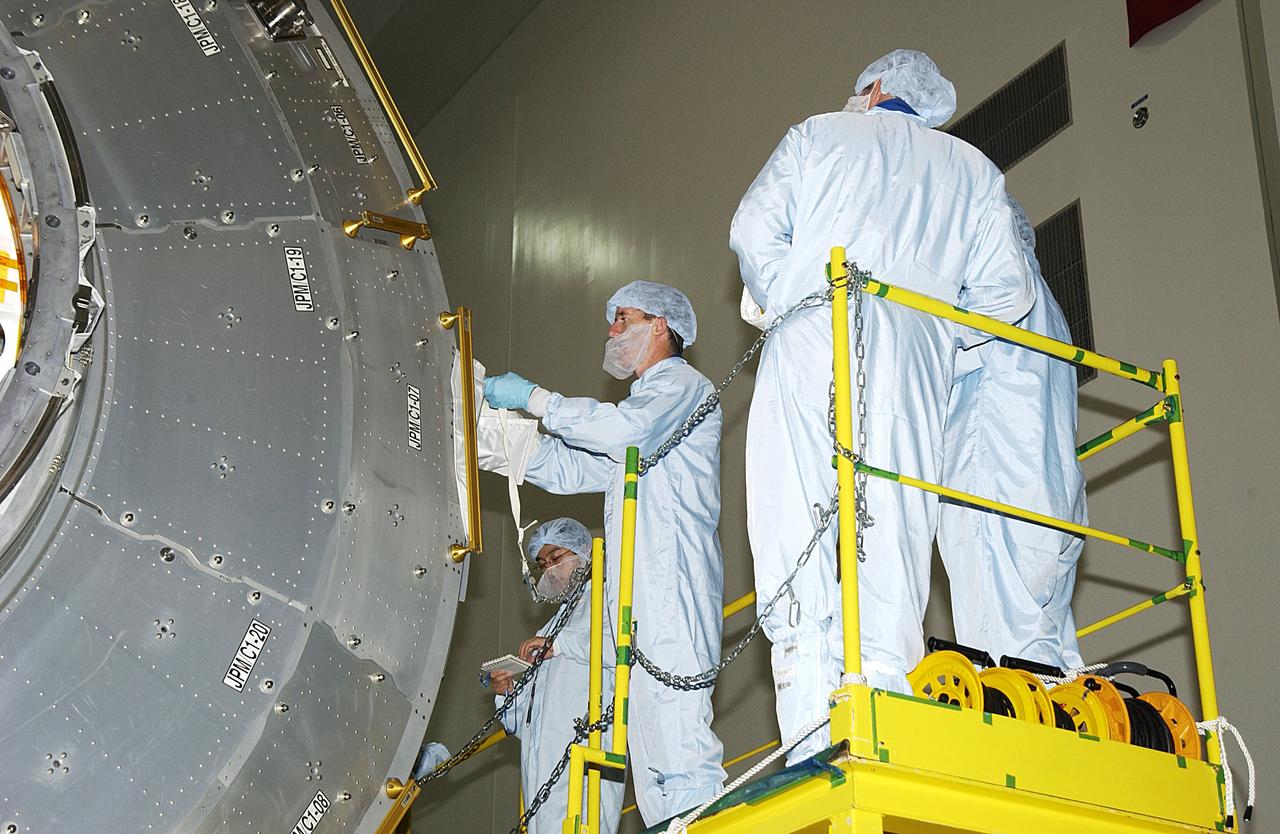
KENNEDY SPACE CENTER, FLA. -  In the Space Station Processing Facility, Japanese astronaut Koichi Wakata (top left) and technicians watch as a tray is extended from inside the Pressurized Module, or PM, part of the Japanese Experiment Module (JEM).   The PM provides a shirt-sleeve environment in which astronauts on the International Space Station can conduct microgravity experiments. There are a total of 23 racks, including 10 experiment racks, inside the PM providing a power supply, communications, air conditioning, hardware cooling, water control and experiment support functions.
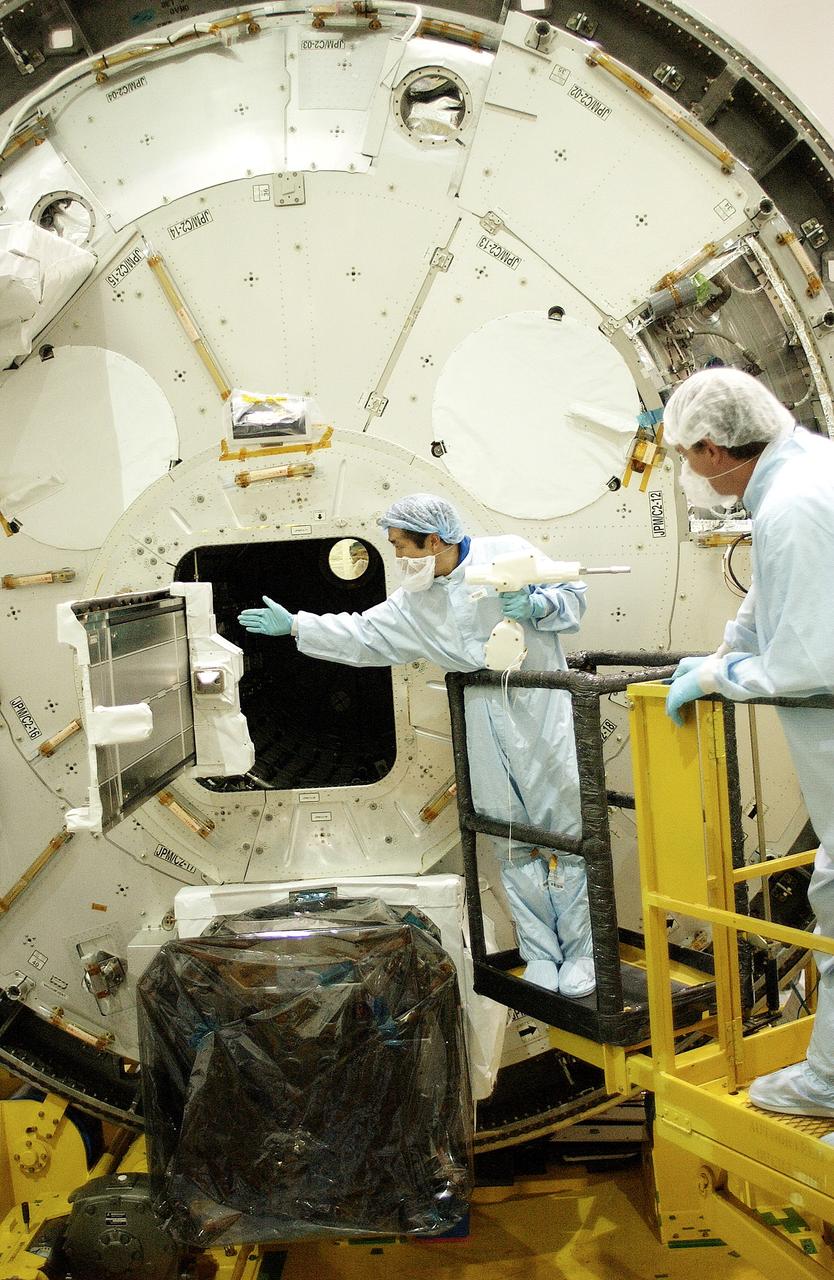
KENNEDY SPACE CENTER, FLA. - In the Space Station Processing Facility, Japanese astronaut Koichi Wakata (top left) and technicians watch as a tray is extended from inside the Pressurized Module, or PM, part of the Japanese Experiment Module (JEM). The PM provides a shirt-sleeve environment in which astronauts on the International Space Station can conduct microgravity experiments. There are a total of 23 racks, including 10 experiment racks, inside the PM providing a power supply, communications, air conditioning, hardware cooling, water control and experiment support functions.
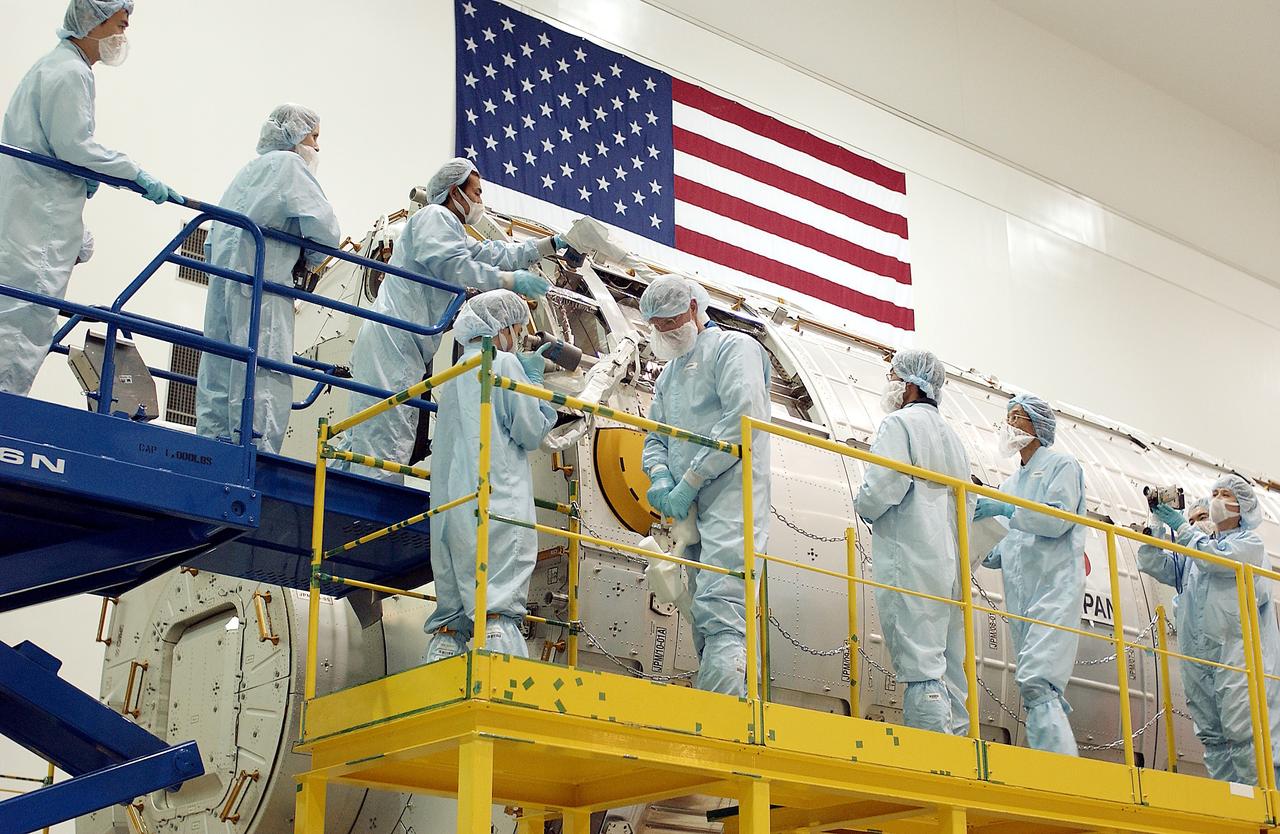
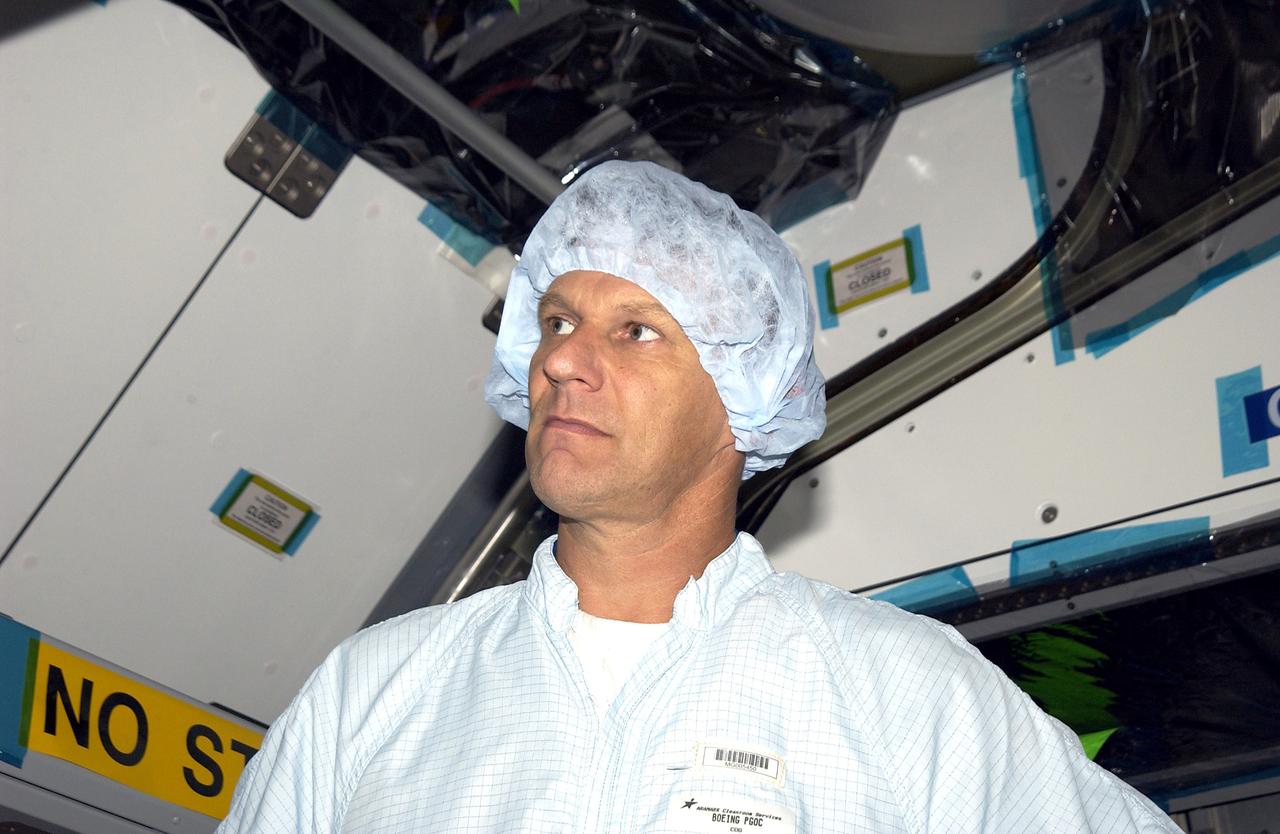
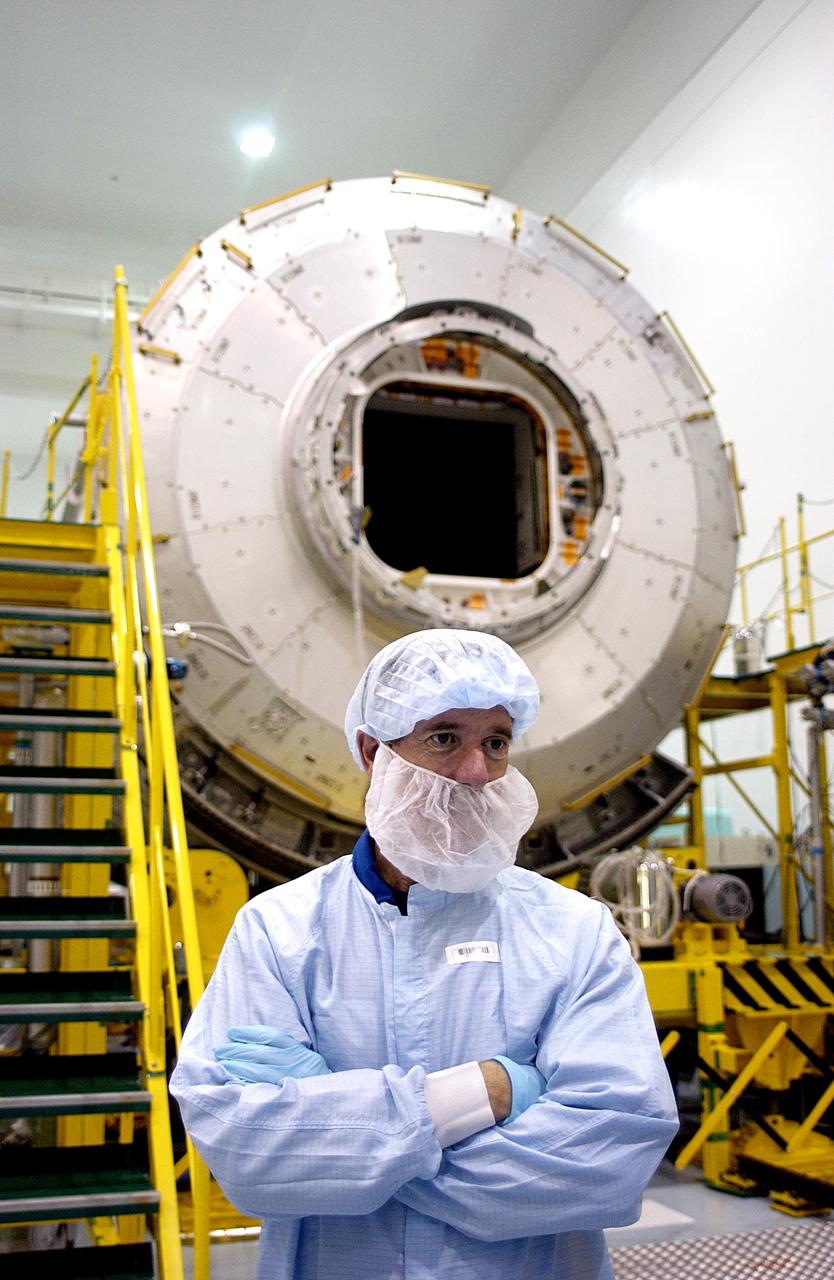
KENNEDY SPACE CENTER, FLA. - In the Space Station Processing Facility, Japanese astronaut Koichi Wakata looks over the Pressurized Module, or PM, part of the Japanese Experiment Module (JEM).  The PM provides a shirt-sleeve environment in which astronauts on the International Space Station can conduct microgravity experiments. There are a total of 23 racks, including 10 experiment racks, inside the PM providing a power supply, communications, air conditioning, hardware cooling, water control and experiment support functions.
KENNEDY SPACE CENTER, FLA. - In the Space Station Processing Facility, Japanese astronaut Koichi Wakata looks over the Pressurized Module, or PM, part of the Japanese Experiment Module (JEM). The PM provides a shirt-sleeve environment in which astronauts on the International Space Station can conduct microgravity experiments. There are a total of 23 racks, including 10 experiment racks, inside the PM providing a power supply, communications, air conditioning, hardware cooling, water control and experiment support functions.
KENNEDY SPACE CENTER, FLA. - In the Space Station Processing Facility, technicians on the floor watch as a tray is extended from inside the Pressurized Module, or PM, part of the Japanese Experiment Module (JEM).   The PM provides a shirt-sleeve environment in which astronauts on the International Space Station can conduct microgravity experiments. There are a total of 23 racks, including 10 experiment racks, inside the PM providing a power supply, communications, air conditioning, hardware cooling, water control and experiment support functions.
KENNEDY SPACE CENTER, FLA. - In the Space Station Processing Facility, technicians on the floor watch as a tray is extended from inside the Pressurized Module, or PM, part of the Japanese Experiment Module (JEM). The PM provides a shirt-sleeve environment in which astronauts on the International Space Station can conduct microgravity experiments. There are a total of 23 racks, including 10 experiment racks, inside the PM providing a power supply, communications, air conditioning, hardware cooling, water control and experiment support functions.
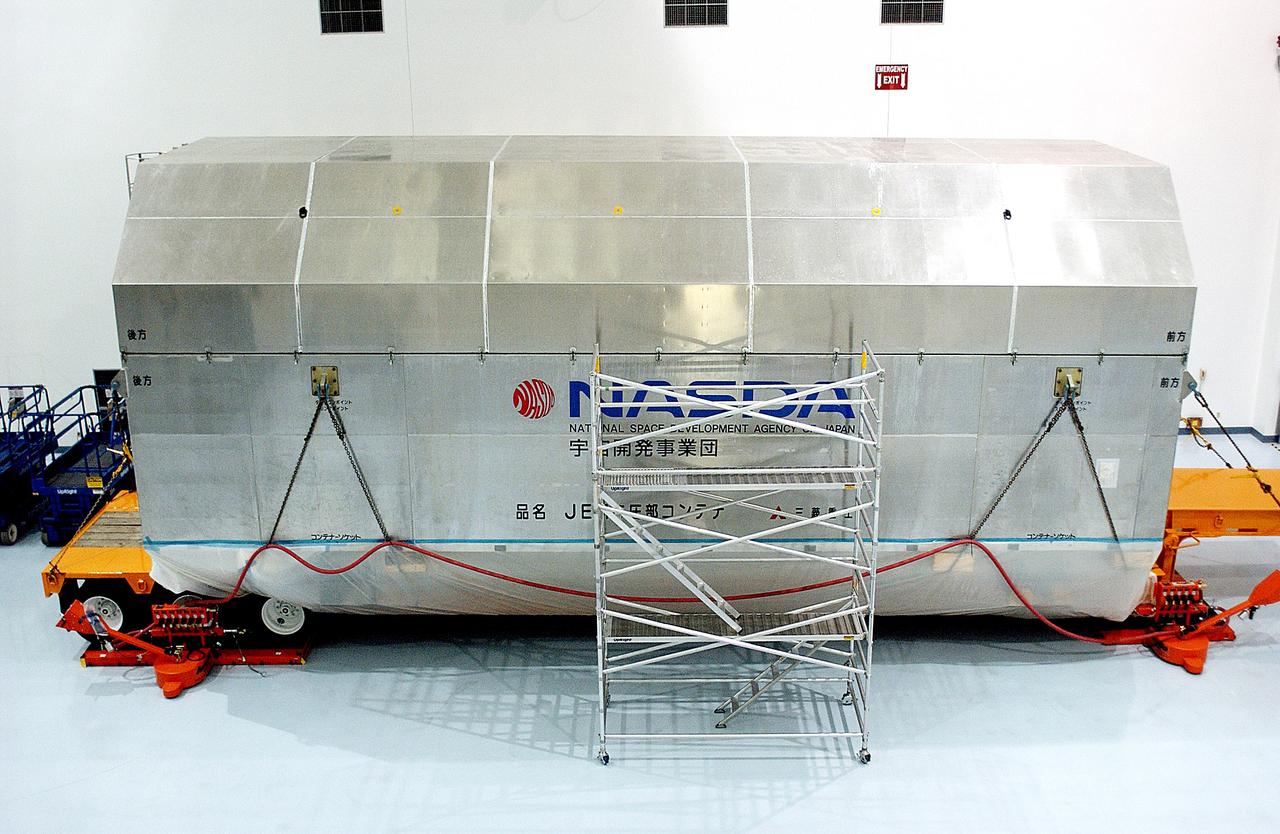
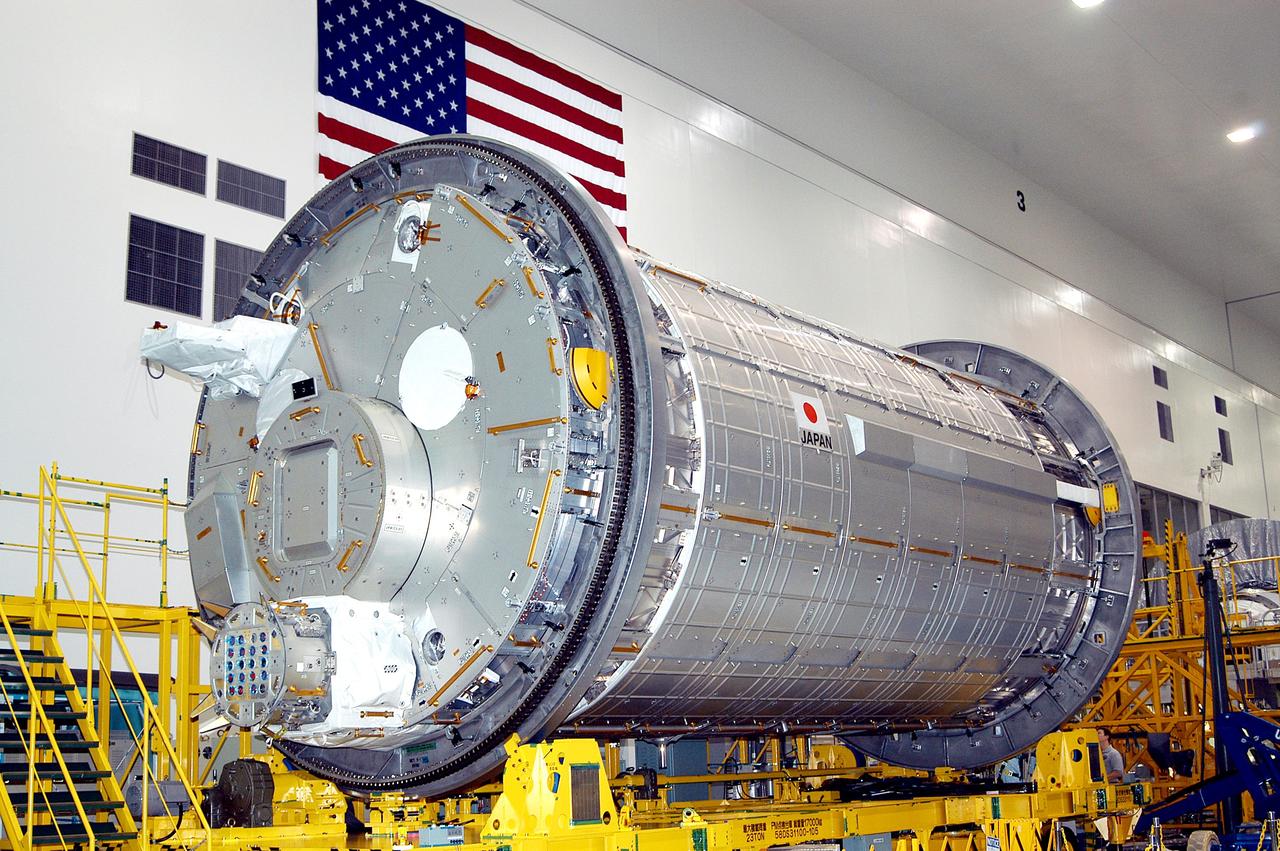
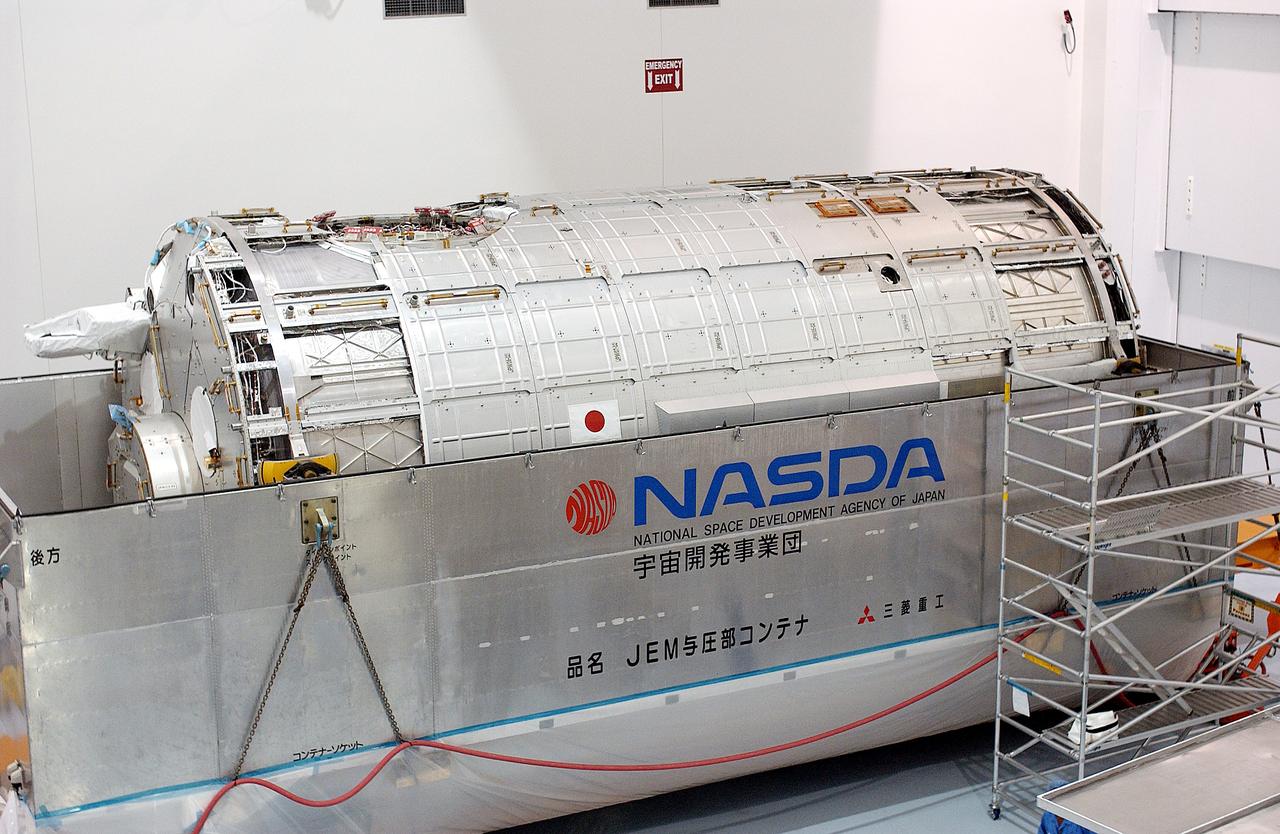
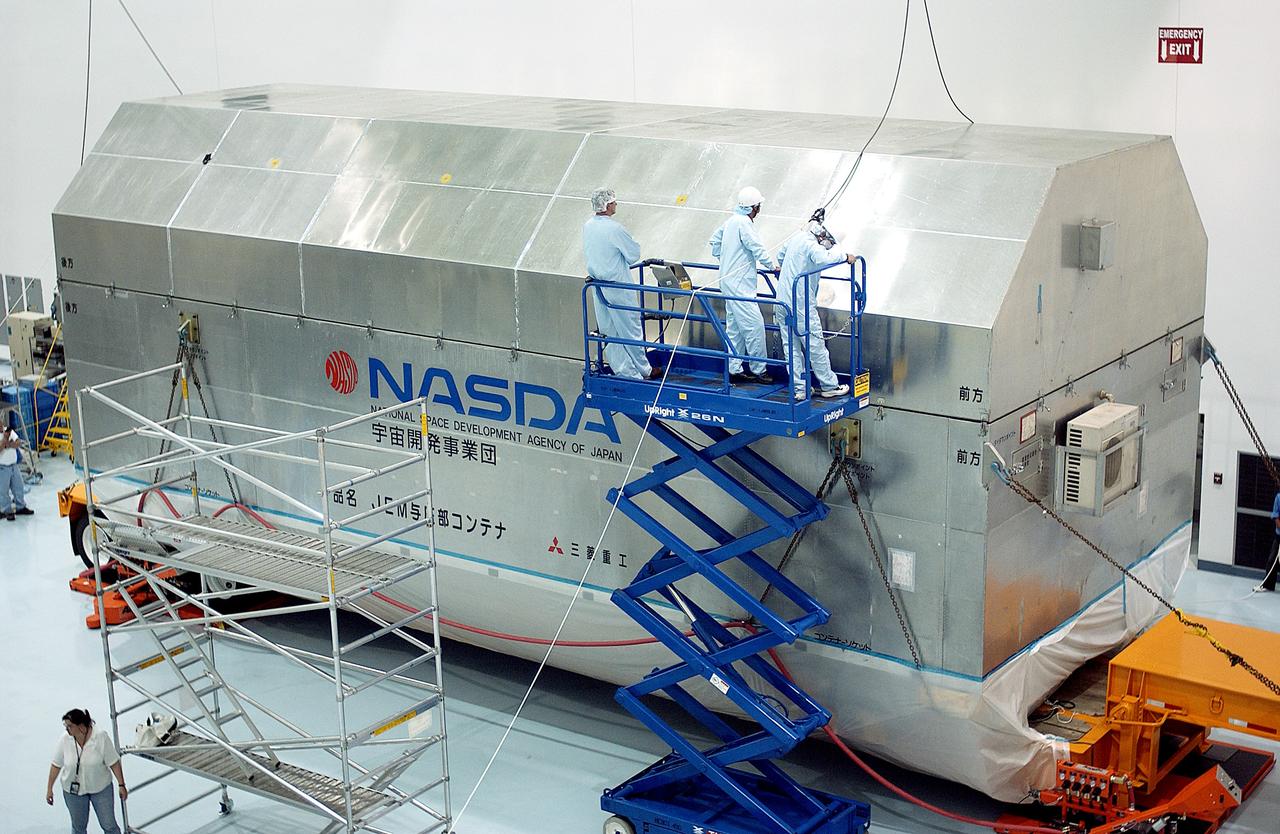
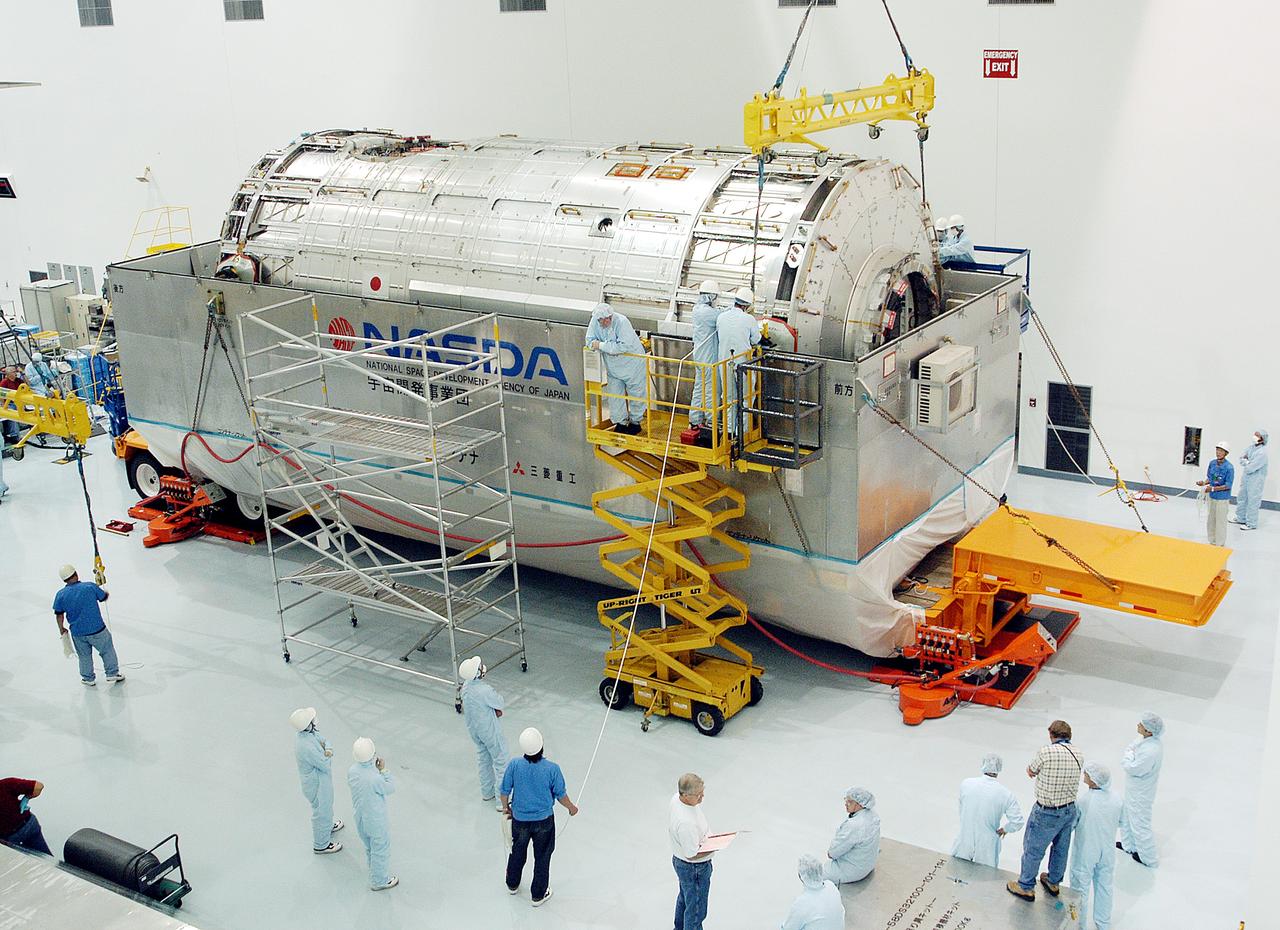
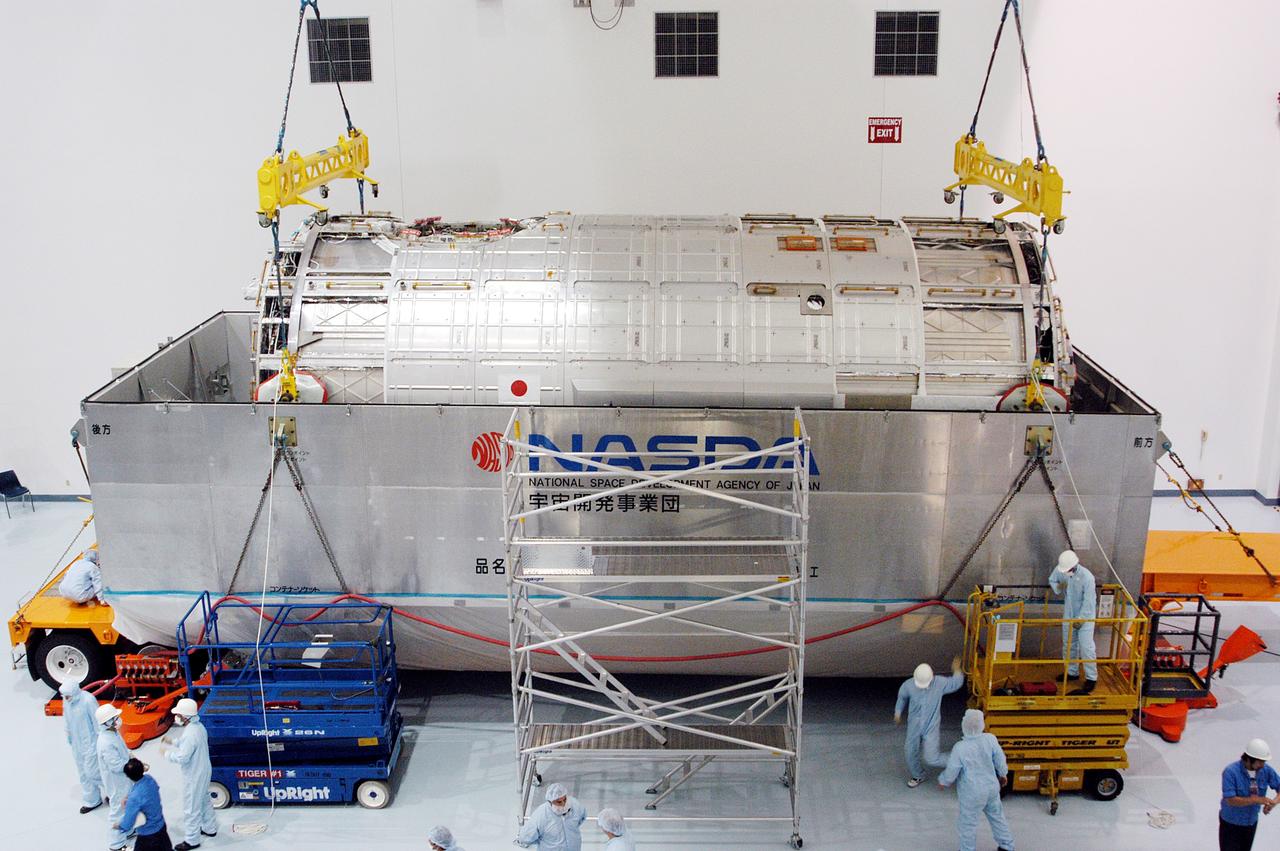
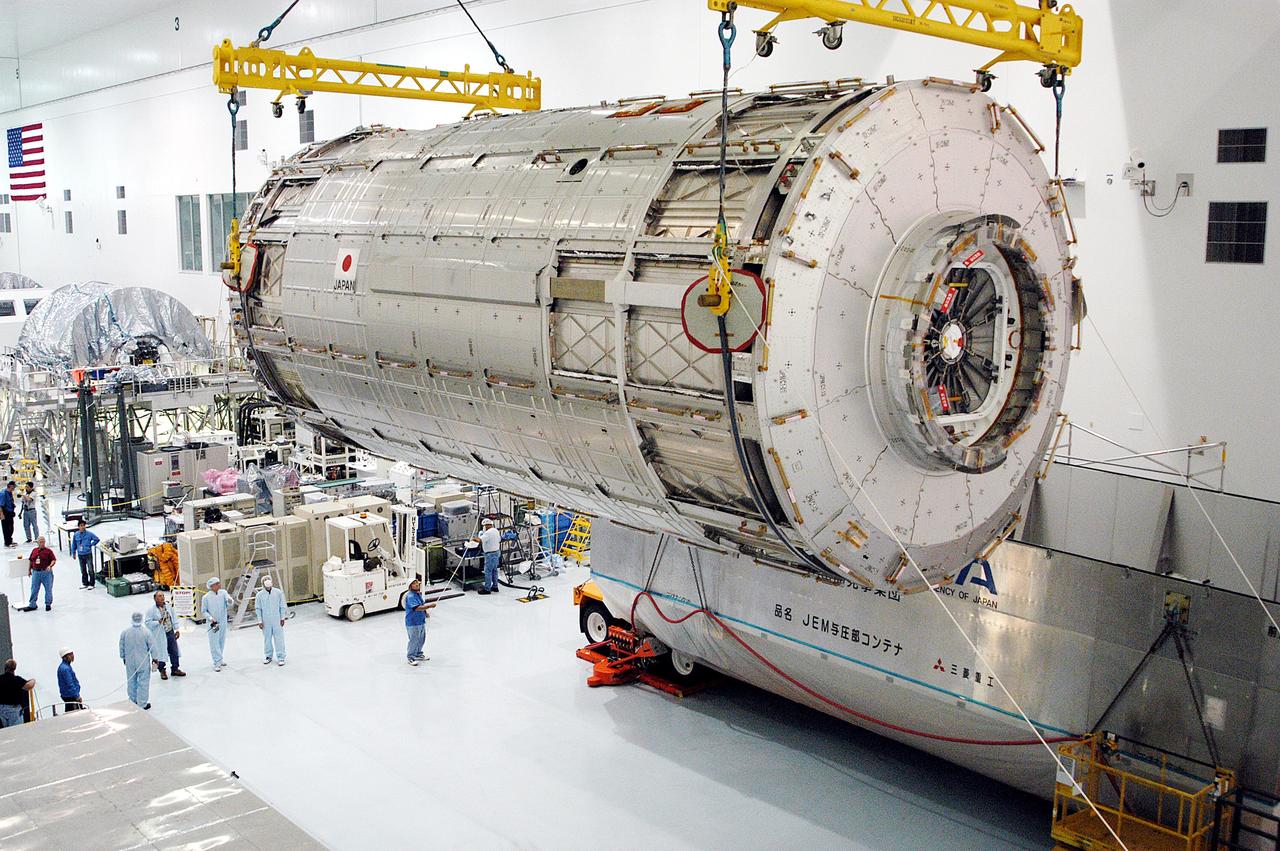
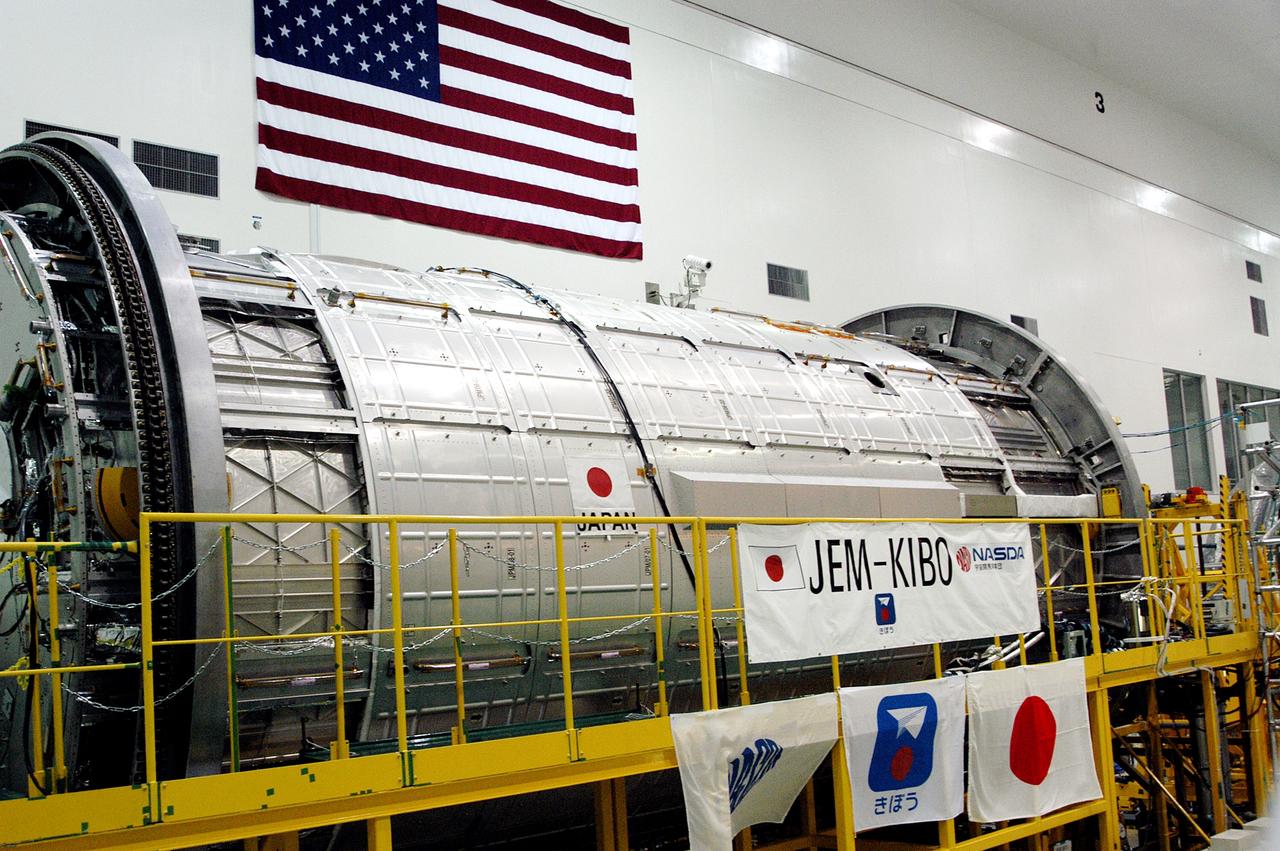
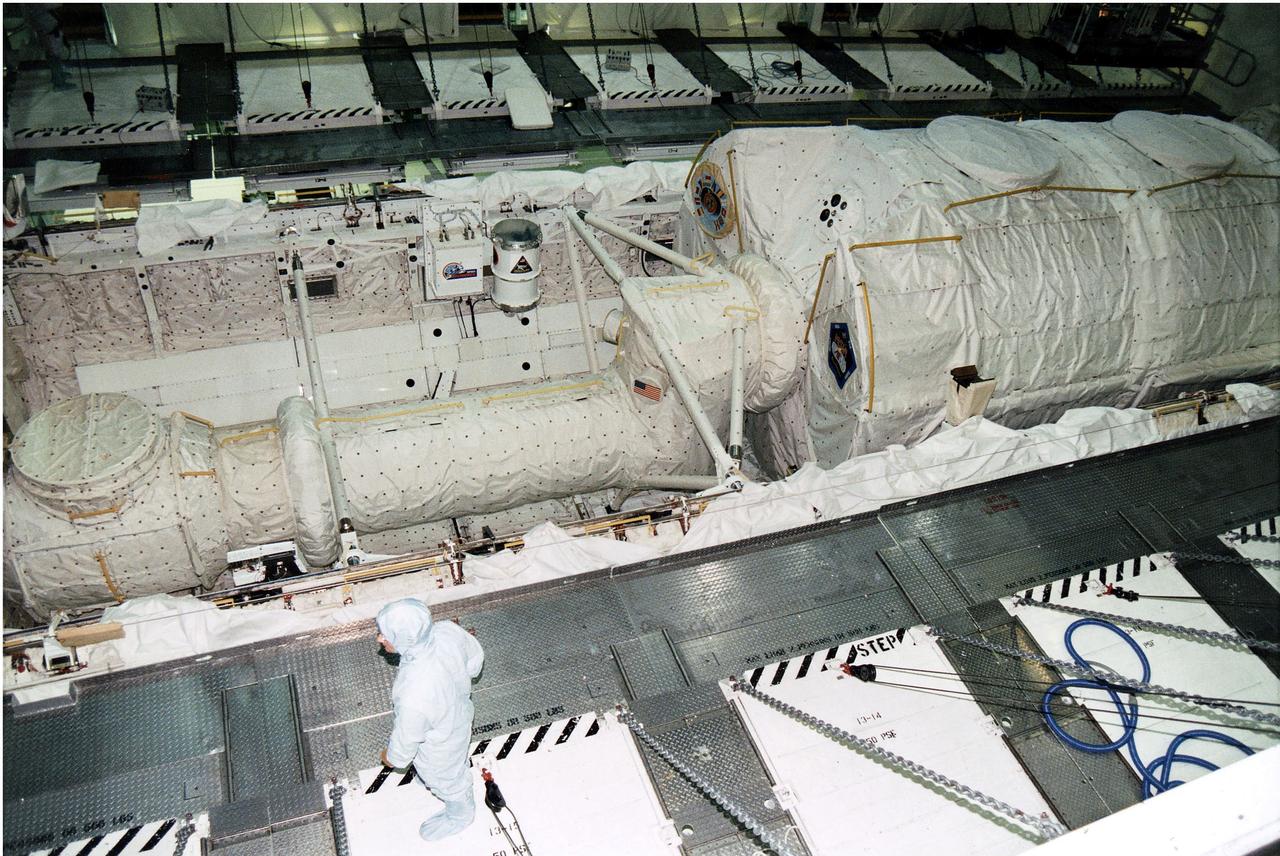
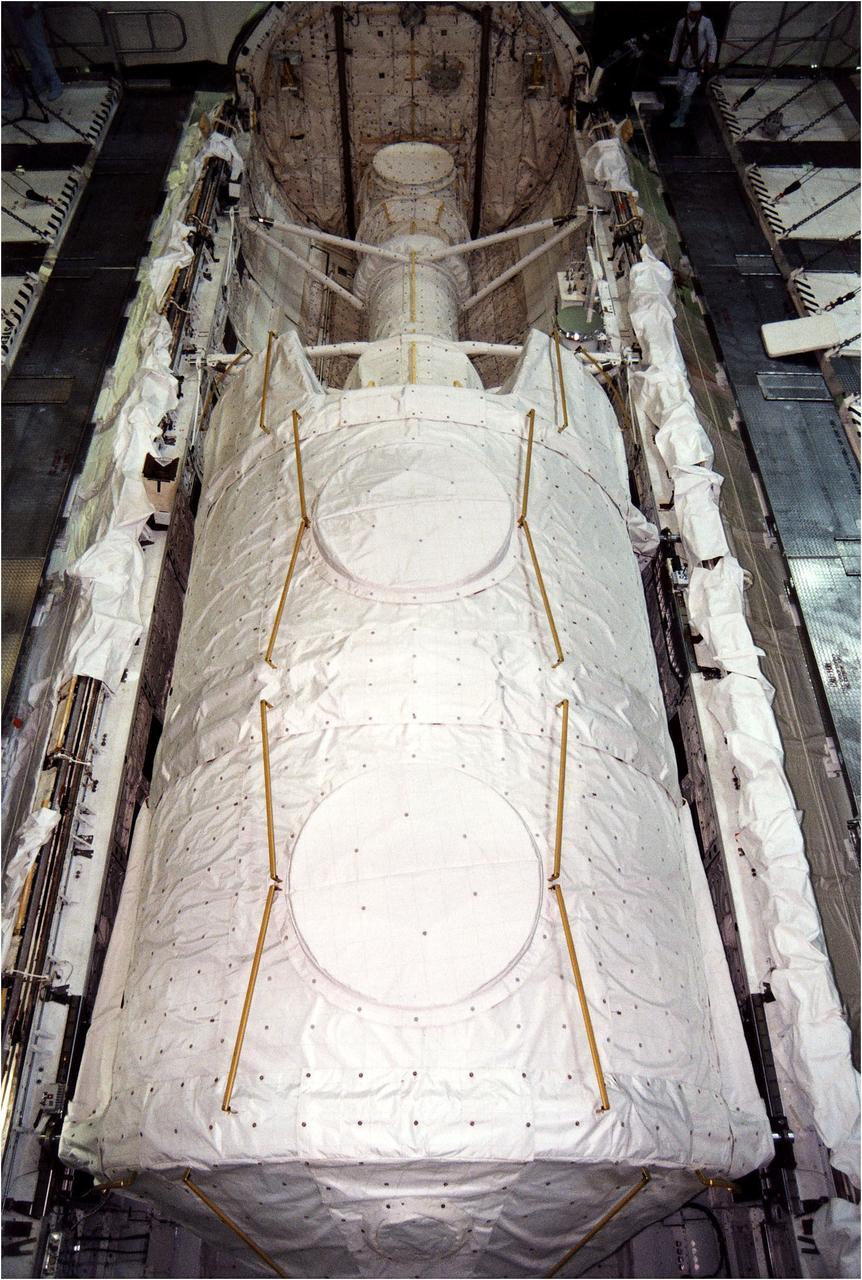
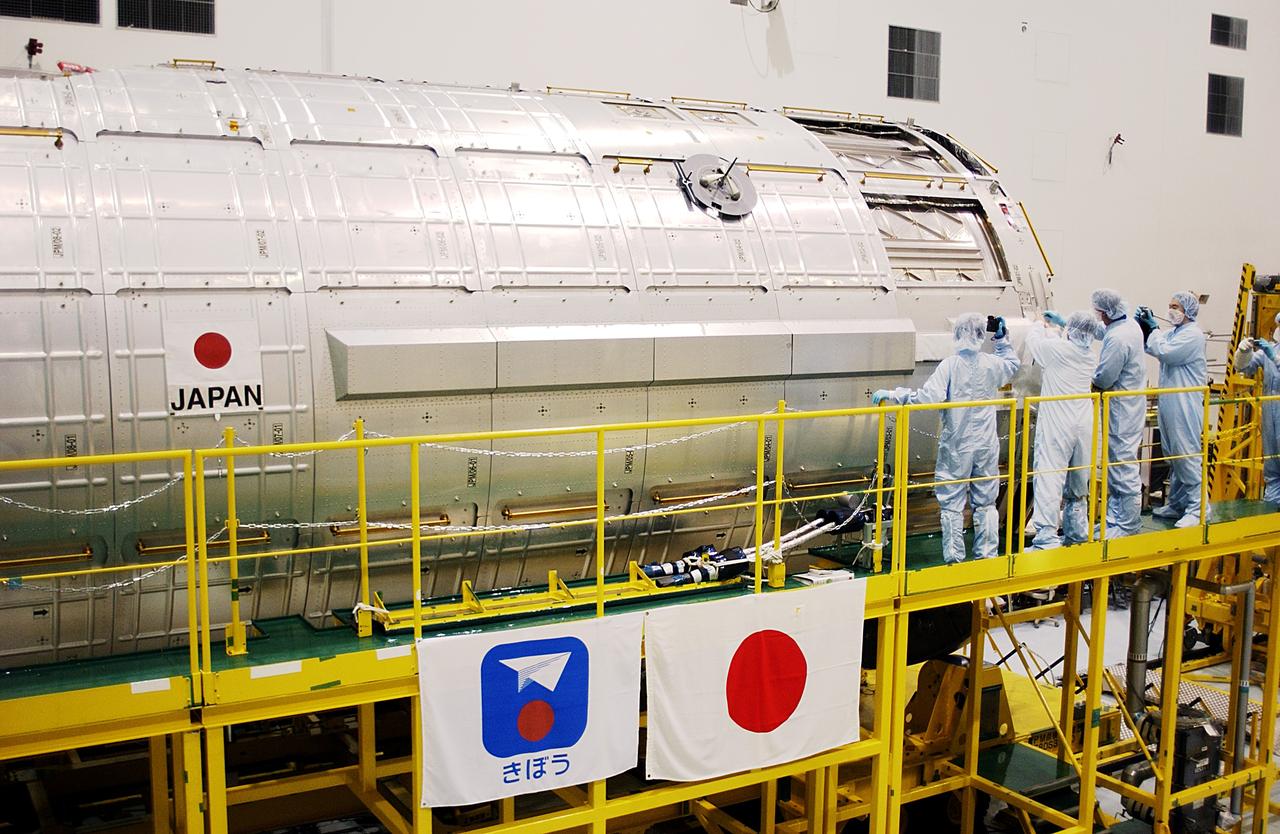
KENNEDY SPACE CENTER, FLA. - The container with the Japanese Experiment Module (JEM)’s pressurized module is inside the Space Station Processing Facility.  The National Space Development Agency of Japan (NASDA) developed the laboratory at the Tsukuba Space Center near Tokyo. The Pressurized Module is the first element of the JEM, named "Kibo" (Hope), to be delivered to KSC. The JEM is Japan's primary contribution to the Station. It will enhance the unique research capabilities of the orbiting complex by providing an additional environment for astronauts to conduct science experiments.  The JEM also includes an exposed facility (platform) for space environment experiments, a robotic manipulator system, and two logistics modules. The various JEM components will be  assembled in space over the course of three Shuttle missions.
KENNEDY SPACE CENTER, FLA. - The container with the Japanese Experiment Module (JEM)’s pressurized module is inside the Space Station Processing Facility. The National Space Development Agency of Japan (NASDA) developed the laboratory at the Tsukuba Space Center near Tokyo. The Pressurized Module is the first element of the JEM, named "Kibo" (Hope), to be delivered to KSC. The JEM is Japan's primary contribution to the Station. It will enhance the unique research capabilities of the orbiting complex by providing an additional environment for astronauts to conduct science experiments. The JEM also includes an exposed facility (platform) for space environment experiments, a robotic manipulator system, and two logistics modules. The various JEM components will be assembled in space over the course of three Shuttle missions.
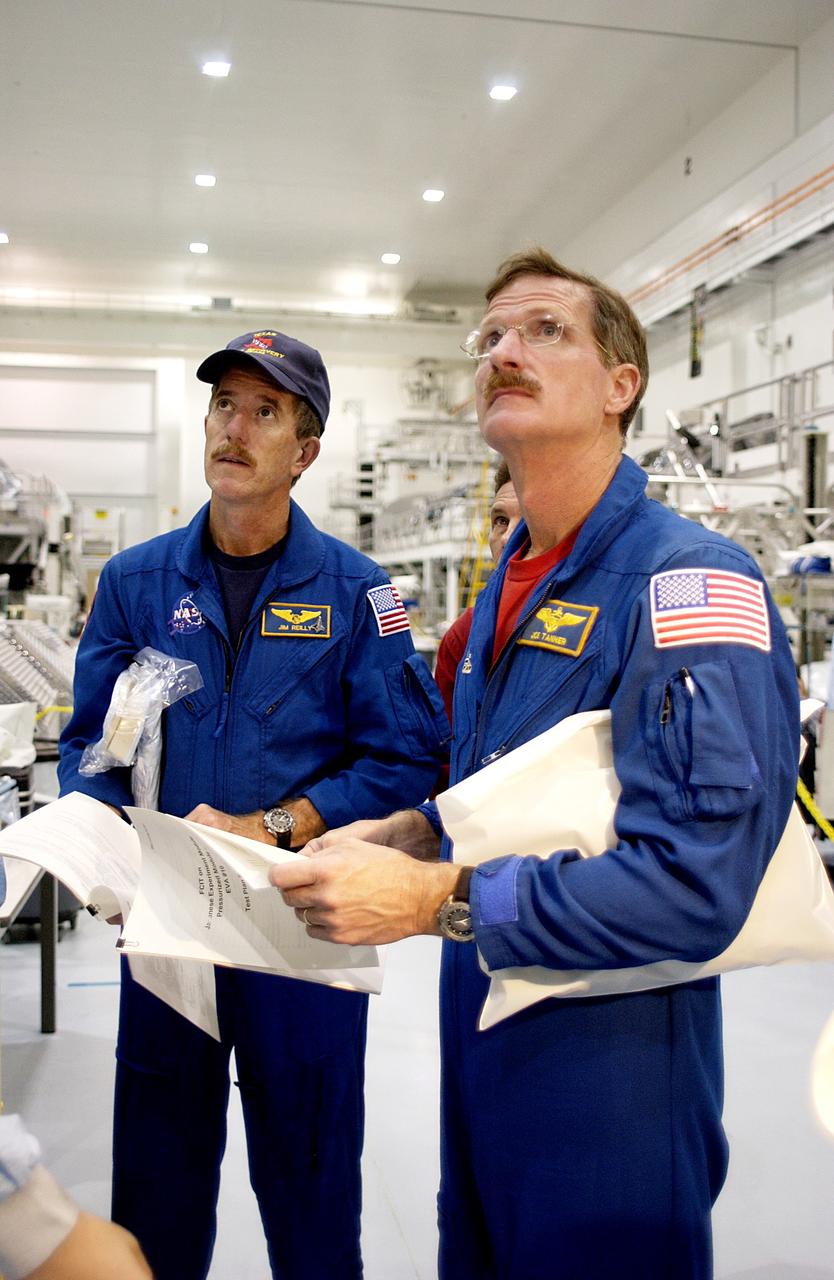
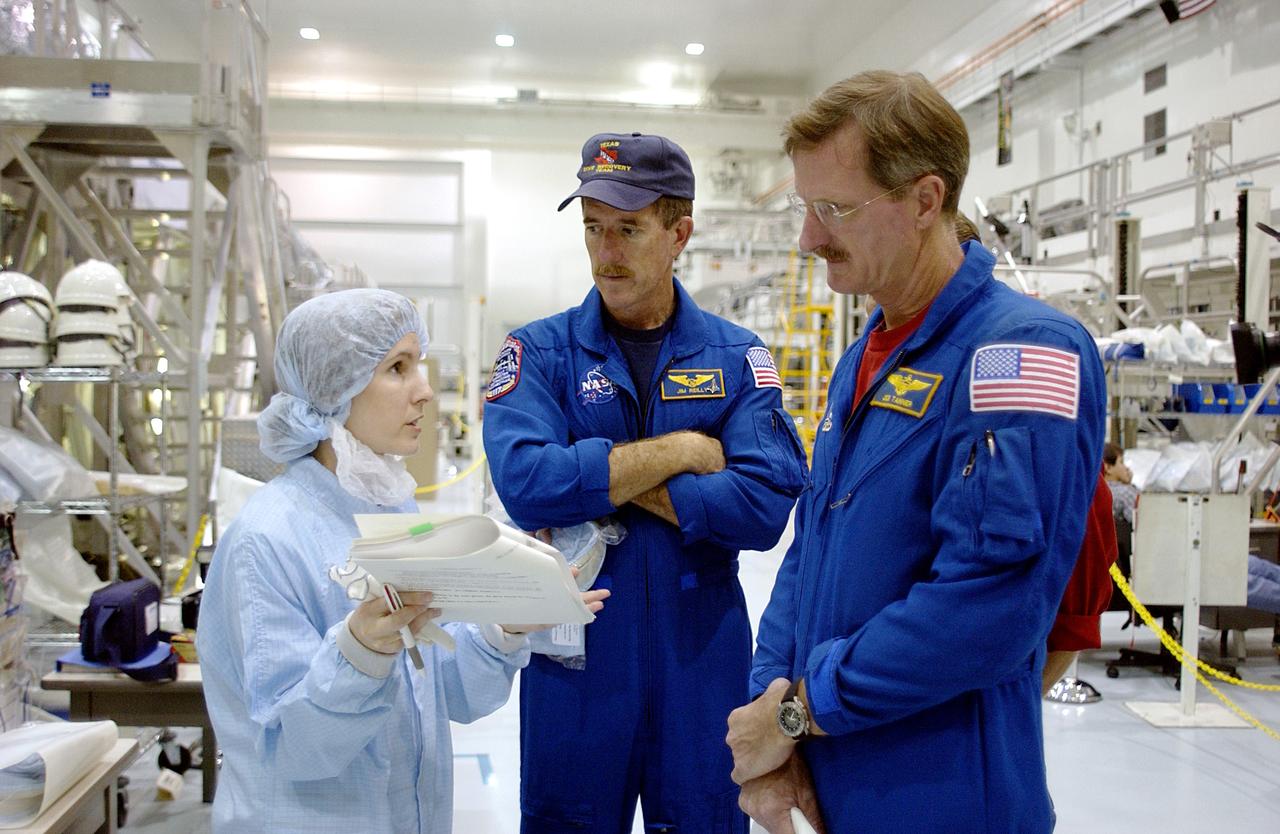
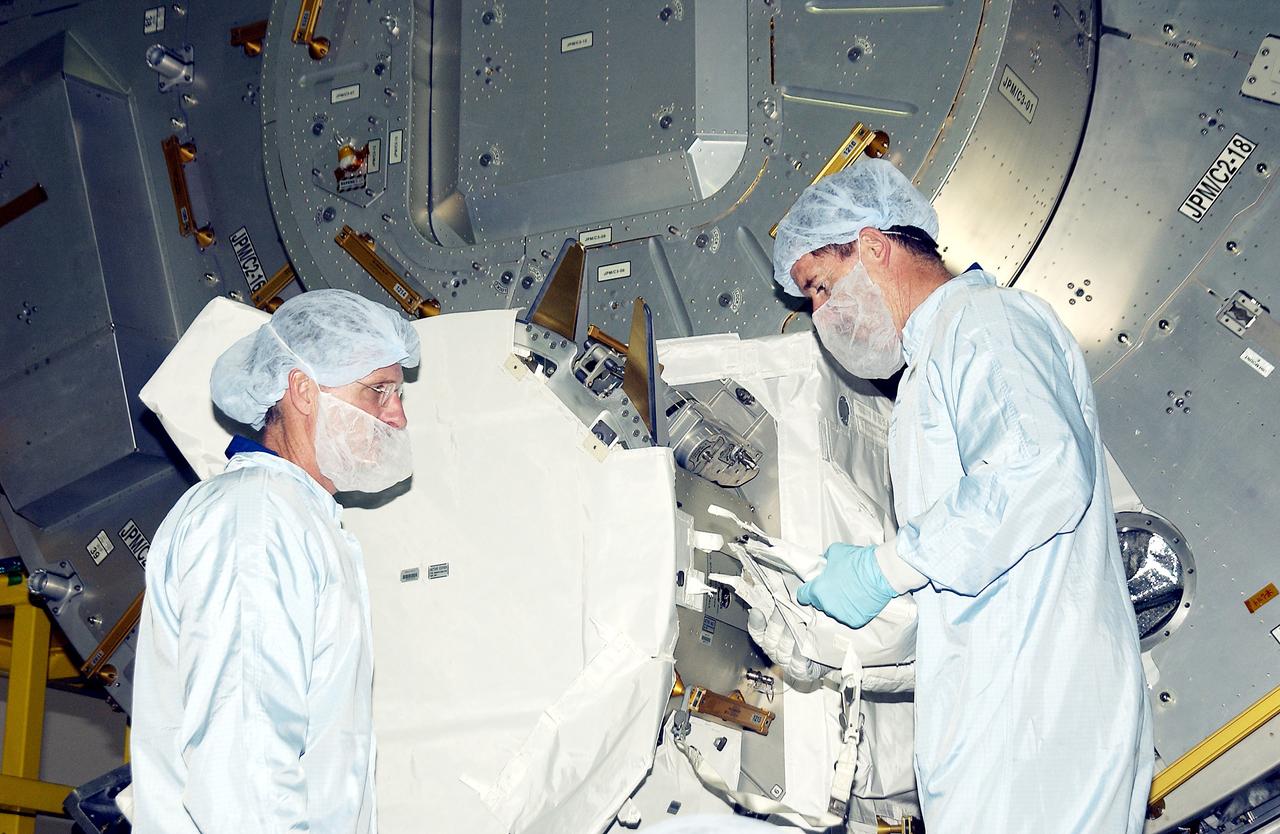
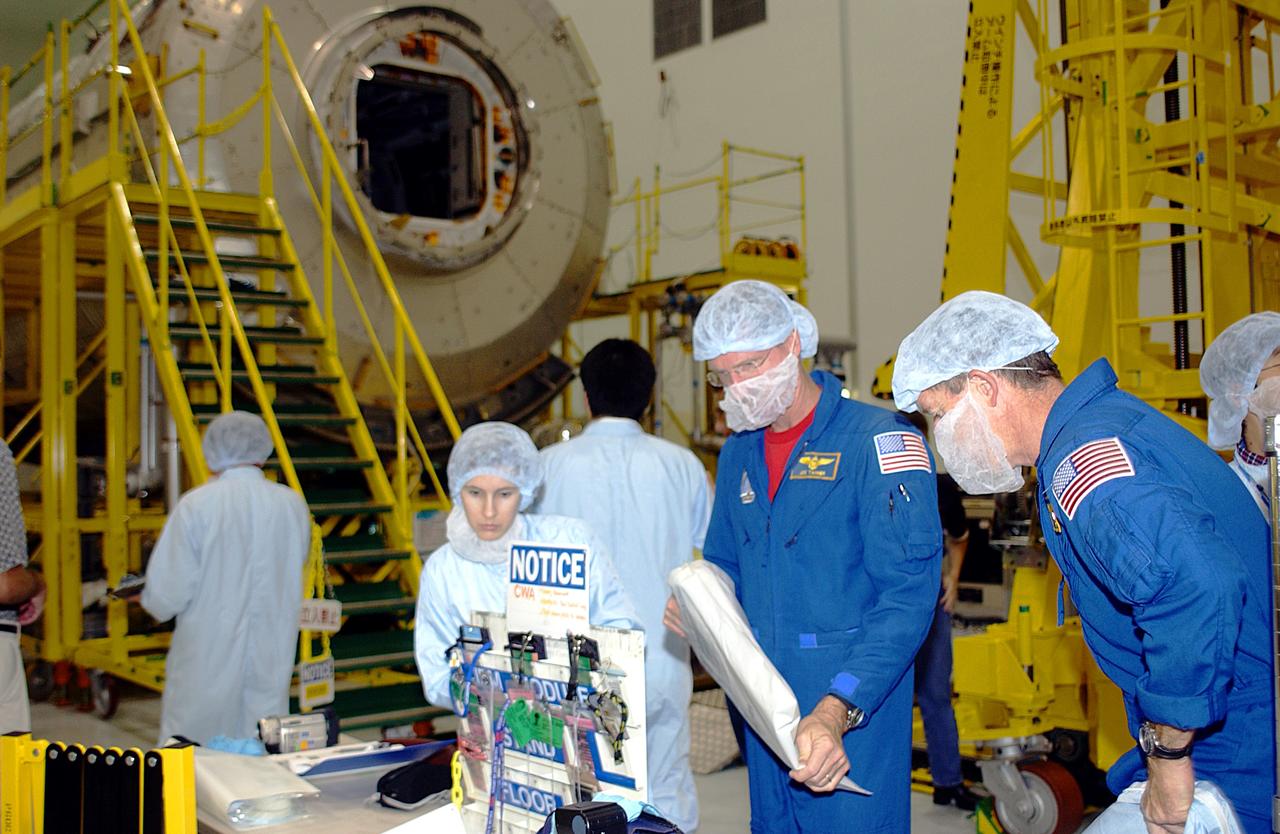
KENNEDY SPACE CENTER, FLA. -  In the Space Station Processing Facility, STS-115 Mission Specialist Joseph Tanner gets hands-on experience with the Japanese Experiment Module (JEM).  Tanner and STS-117 Mission Specialist James Reilly  are at KSC for equipment familiarization, a routine part of astronaut training and launch preparations.
KENNEDY SPACE CENTER, FLA. - In the Space Station Processing Facility, STS-115 Mission Specialist Joseph Tanner gets hands-on experience with the Japanese Experiment Module (JEM). Tanner and STS-117 Mission Specialist James Reilly are at KSC for equipment familiarization, a routine part of astronaut training and launch preparations.
KENNEDY SPACE CENTER, FLA. -  In the Space Station Processing Facility, STS-117 Mission Specialist James Reilly (left) and STS-115 Mission Specialist Joseph Tanner get hands-on experience with the Japanese Experiment Module (JEM).  Reilly and Tanner are at KSC for equipment familiarization, a routine part of astronaut training and launch preparations.
KENNEDY SPACE CENTER, FLA. - In the Space Station Processing Facility, STS-117 Mission Specialist James Reilly (left) and STS-115 Mission Specialist Joseph Tanner get hands-on experience with the Japanese Experiment Module (JEM). Reilly and Tanner are at KSC for equipment familiarization, a routine part of astronaut training and launch preparations.
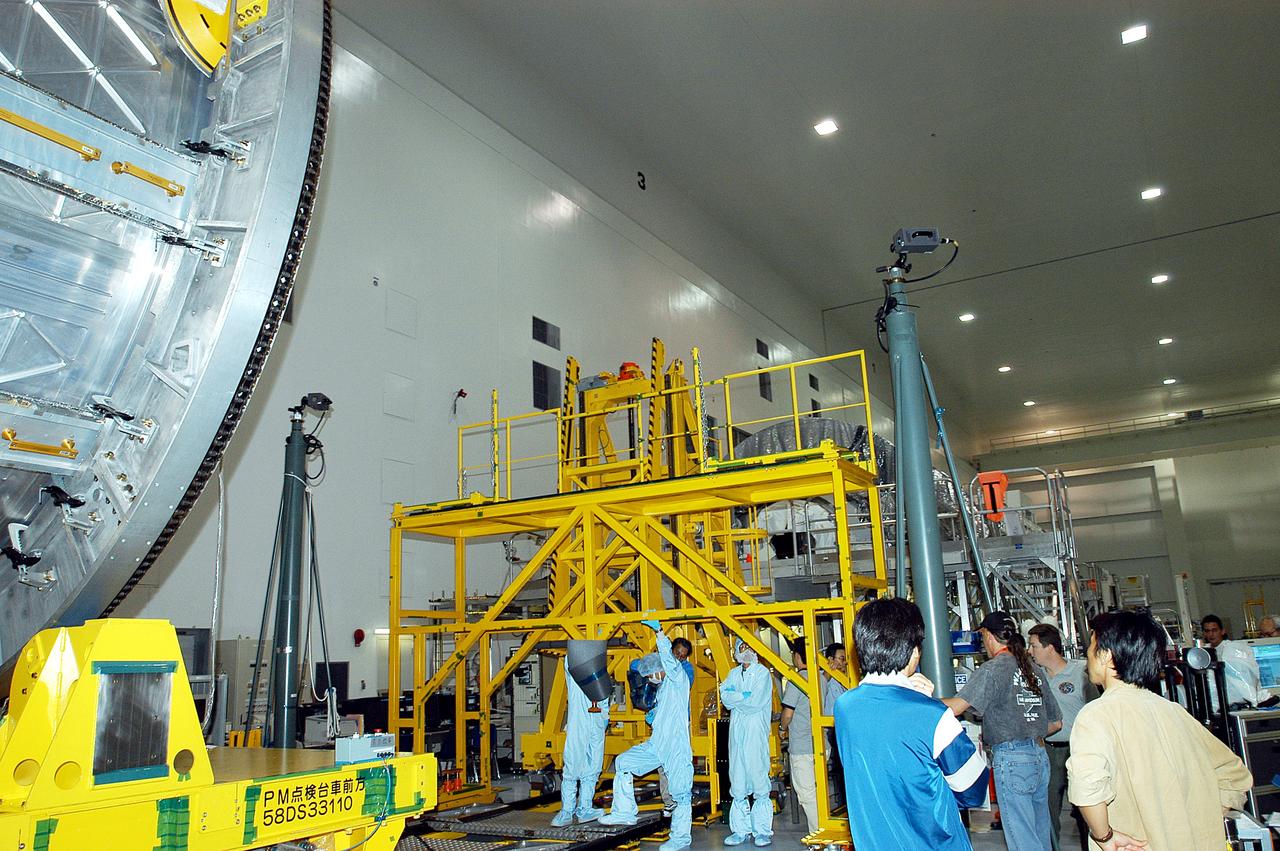
KENNEDY SPACE CENTER, FLA. -  The Japanese Experiment Module (JEM) is moved on its workstand in the Space Station Processing Facility.  The JEM will undergo pre-assembly measurements.  Developed by the Japan Aerospace Exploration Agency (JAXA), the JEM will enhance the unique research capabilities of the orbiting complex by providing an additional environment for astronauts to conduct science experiments.
KENNEDY SPACE CENTER, FLA. - The Japanese Experiment Module (JEM) is moved on its workstand in the Space Station Processing Facility. The JEM will undergo pre-assembly measurements. Developed by the Japan Aerospace Exploration Agency (JAXA), the JEM will enhance the unique research capabilities of the orbiting complex by providing an additional environment for astronauts to conduct science experiments.
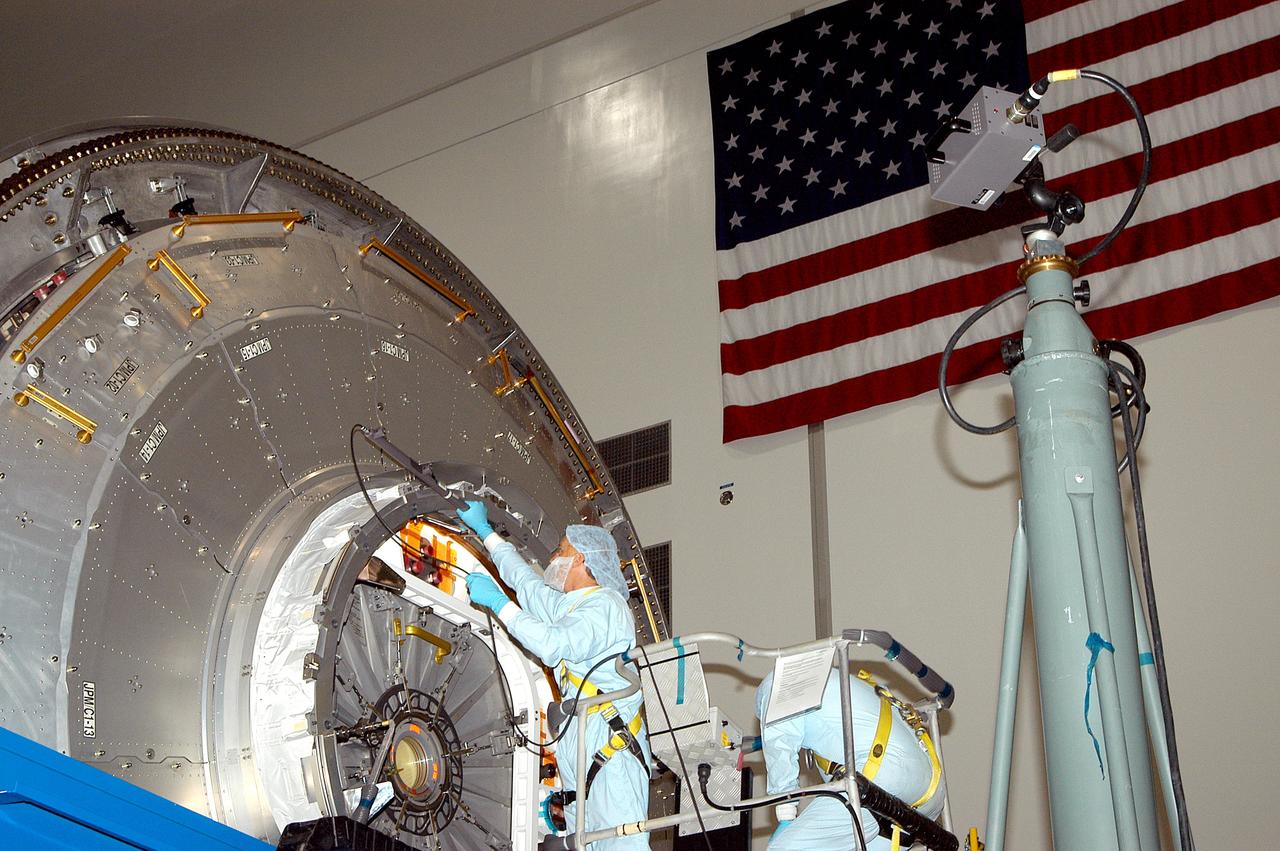
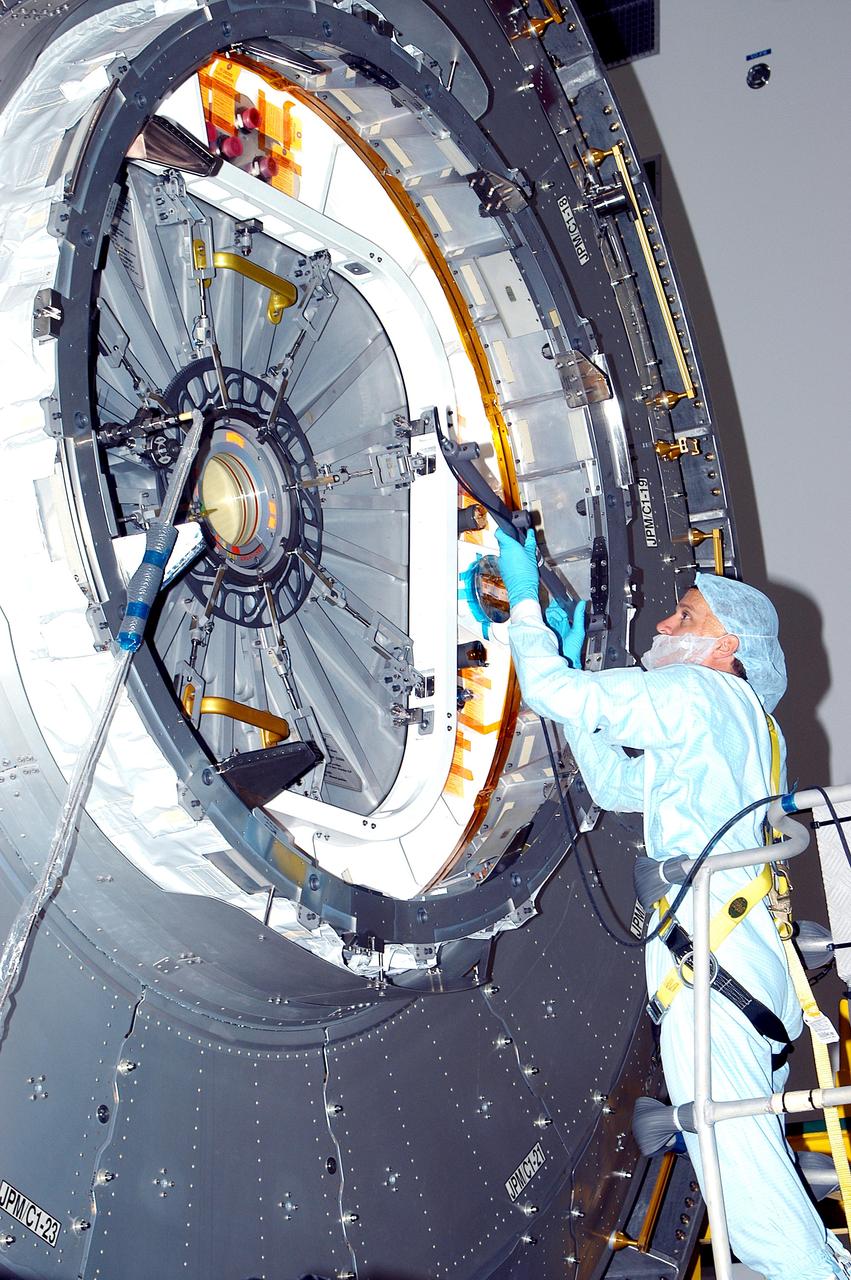
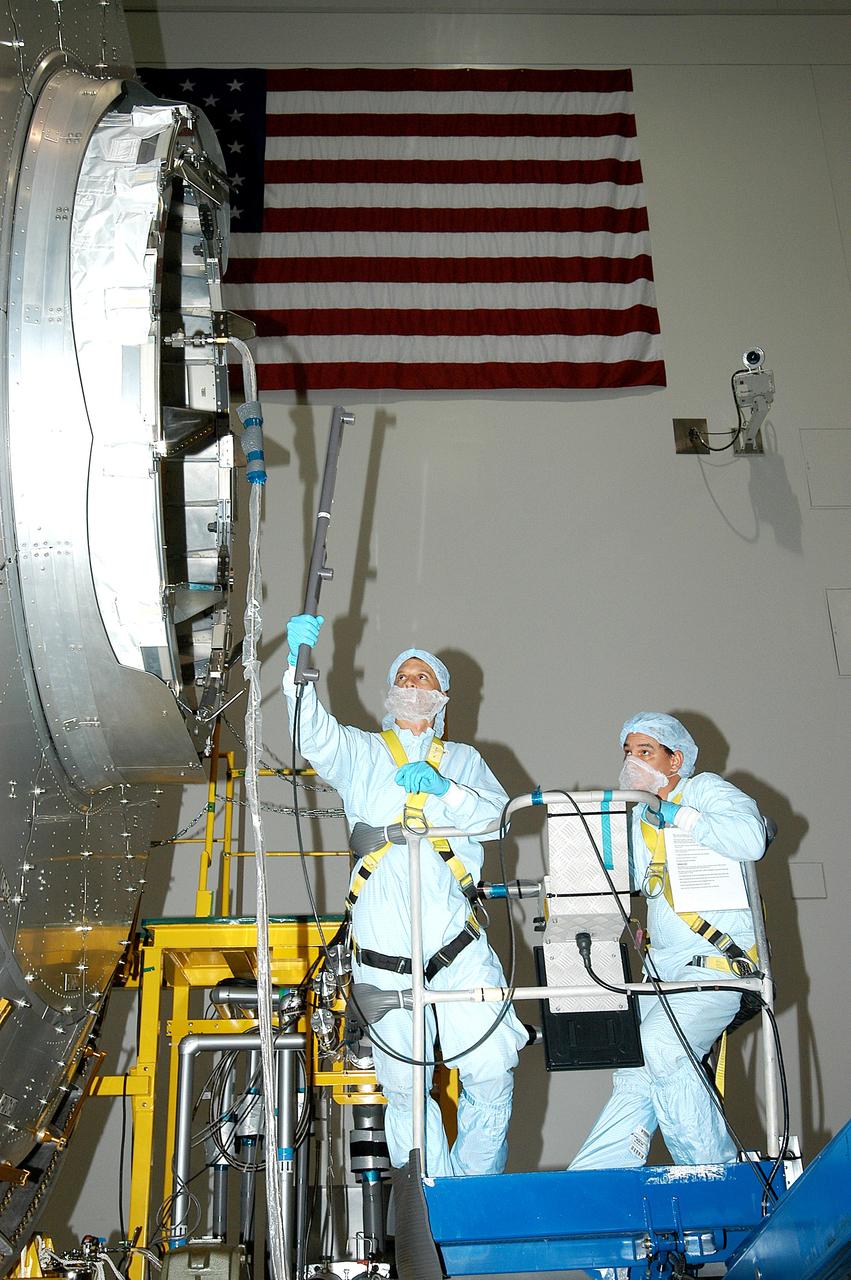
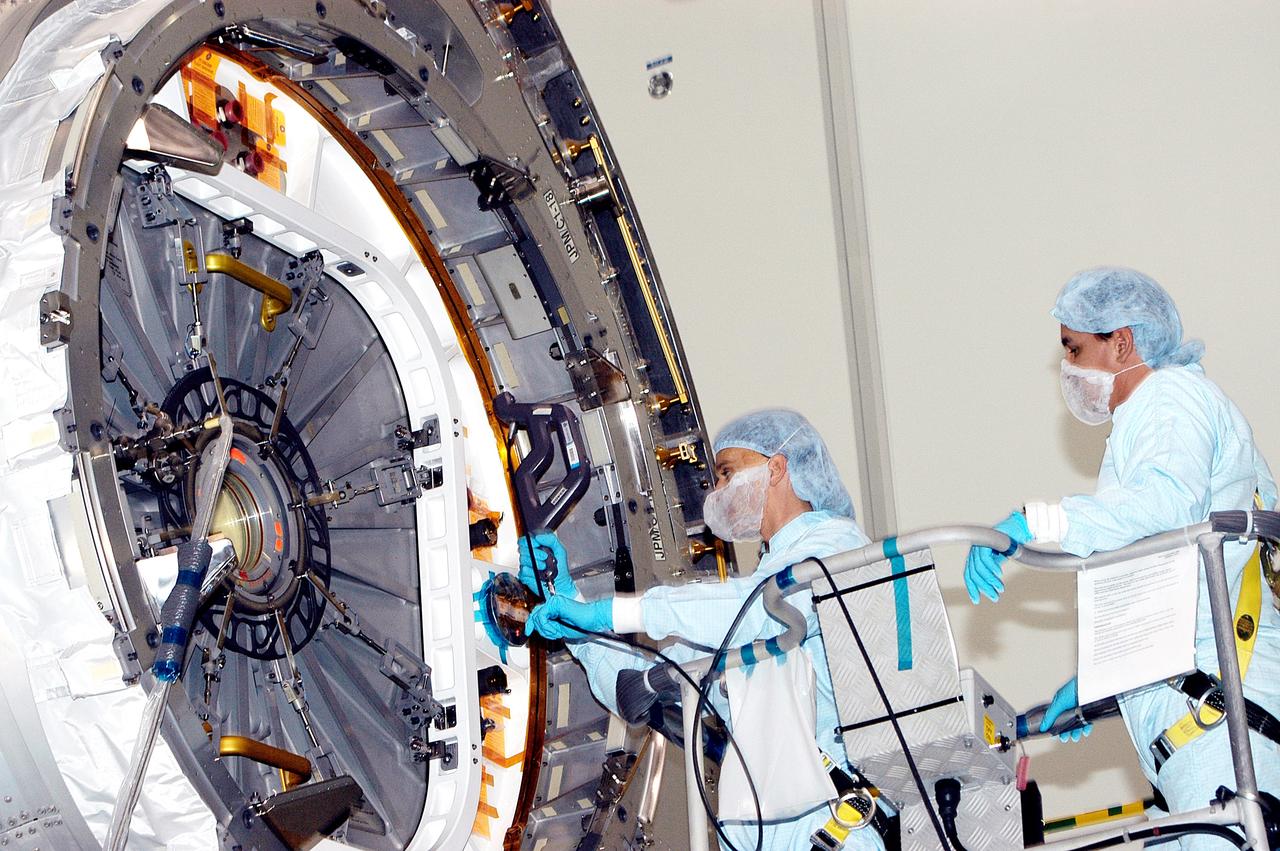
KENNEDY SPACE CENTER, FLA. - In the Space Station Processing Facility, technicians take readings for pre-assembly measurements on the Japanese Experiment Module (JEM).  Developed by the Japan Aerospace Exploration Agency (JAXA), the JEM will enhance the unique research capabilities of the orbiting complex by providing an additional environment for astronauts to conduct science experiments.
KENNEDY SPACE CENTER, FLA. - In the Space Station Processing Facility, technicians take readings for pre-assembly measurements on the Japanese Experiment Module (JEM). Developed by the Japan Aerospace Exploration Agency (JAXA), the JEM will enhance the unique research capabilities of the orbiting complex by providing an additional environment for astronauts to conduct science experiments.
KENNEDY SPACE CENTER, FLA. -  In the Space Station Processing Facility, technicians begin pre-assembly measurements on the Japanese Experiment Module (JEM).  Developed by the Japan Aerospace Exploration Agency (JAXA), the JEM will enhance the unique research capabilities of the orbiting complex by providing an additional environment for astronauts to conduct science experiments.
KENNEDY SPACE CENTER, FLA. - In the Space Station Processing Facility, technicians begin pre-assembly measurements on the Japanese Experiment Module (JEM). Developed by the Japan Aerospace Exploration Agency (JAXA), the JEM will enhance the unique research capabilities of the orbiting complex by providing an additional environment for astronauts to conduct science experiments.
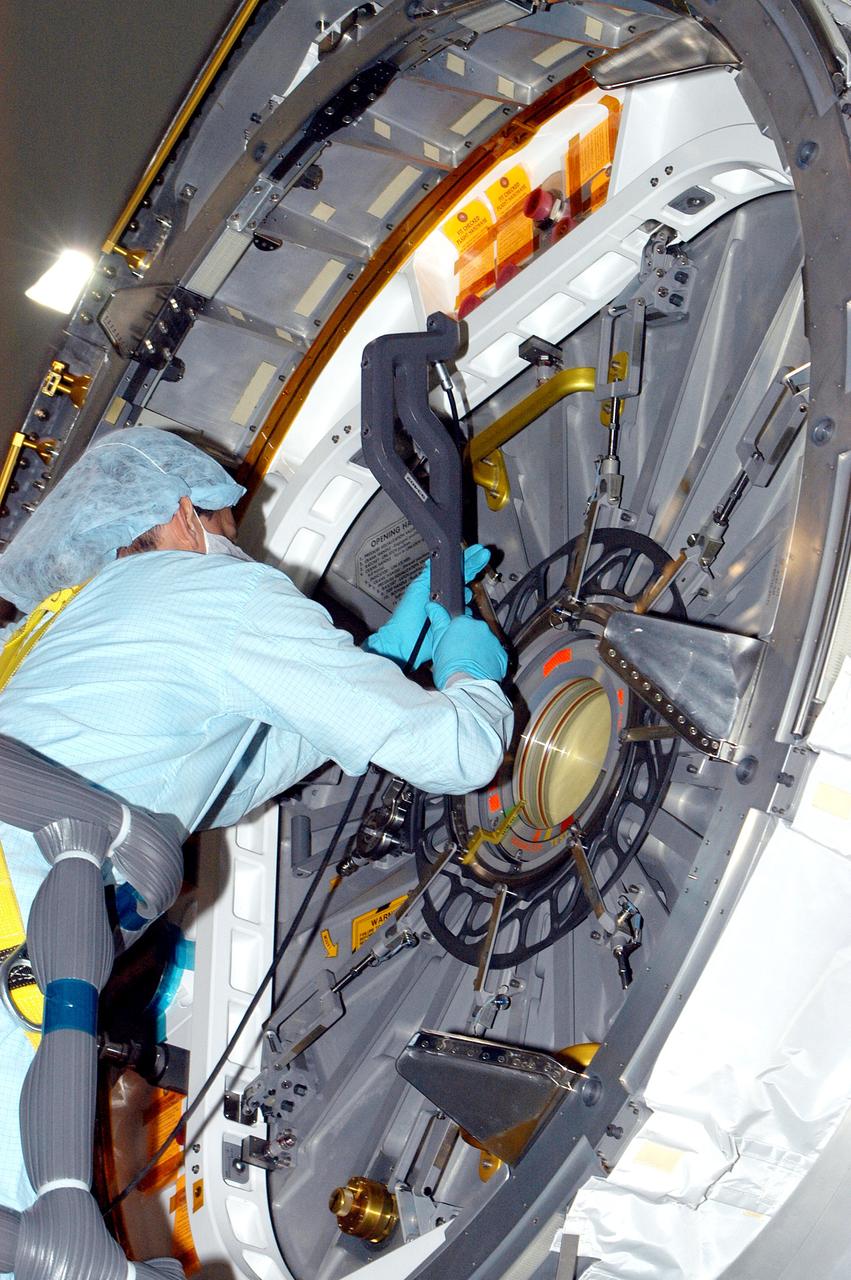
KENNEDY SPACE CENTER, FLA. - In the Space Station Processing Facility, a technician takes readings for pre-assembly measurements on the Japanese Experiment Module (JEM).  Developed by the Japan Aerospace Exploration Agency (JAXA), the JEM will enhance the unique research capabilities of the orbiting complex by providing an additional environment for astronauts to conduct science experiments.
KENNEDY SPACE CENTER, FLA. - In the Space Station Processing Facility, a technician takes readings for pre-assembly measurements on the Japanese Experiment Module (JEM). Developed by the Japan Aerospace Exploration Agency (JAXA), the JEM will enhance the unique research capabilities of the orbiting complex by providing an additional environment for astronauts to conduct science experiments.
KENNEDY SPACE CENTER, FLA. - In the Space Station Processing Facility, a technician takes readings for pre-assembly measurements on the Japanese Experiment Module (JEM).  Developed by the Japan Aerospace Exploration Agency (JAXA), the JEM will enhance the unique research capabilities of the orbiting complex by providing an additional environment for astronauts to conduct science experiments.
KENNEDY SPACE CENTER, FLA. - In the Space Station Processing Facility, a technician takes readings for pre-assembly measurements on the Japanese Experiment Module (JEM). Developed by the Japan Aerospace Exploration Agency (JAXA), the JEM will enhance the unique research capabilities of the orbiting complex by providing an additional environment for astronauts to conduct science experiments.
KENNEDY SPACE CENTER, FLA. - In the Space Station Processing Facility, a technician takes readings for pre-assembly measurements on the Japanese Experiment Module (JEM).  Developed by the Japan Aerospace Exploration Agency (JAXA), the JEM will enhance the unique research capabilities of the orbiting complex by providing an additional environment for astronauts to conduct science experiments.
KENNEDY SPACE CENTER, FLA. - In the Space Station Processing Facility, a technician takes readings for pre-assembly measurements on the Japanese Experiment Module (JEM). Developed by the Japan Aerospace Exploration Agency (JAXA), the JEM will enhance the unique research capabilities of the orbiting complex by providing an additional environment for astronauts to conduct science experiments.
KENNEDY SPACE CENTER, FLA. - In the Space Station Processing Facility, the Japanese Experiment Module (JEM) rests on a workstand during pre-assembly measurement activities. Developed by the Japan Aerospace Exploration Agency (JAXA), the JEM will enhance the unique research capabilities of the orbiting complex by providing an additional environment for astronauts to conduct science experiments.
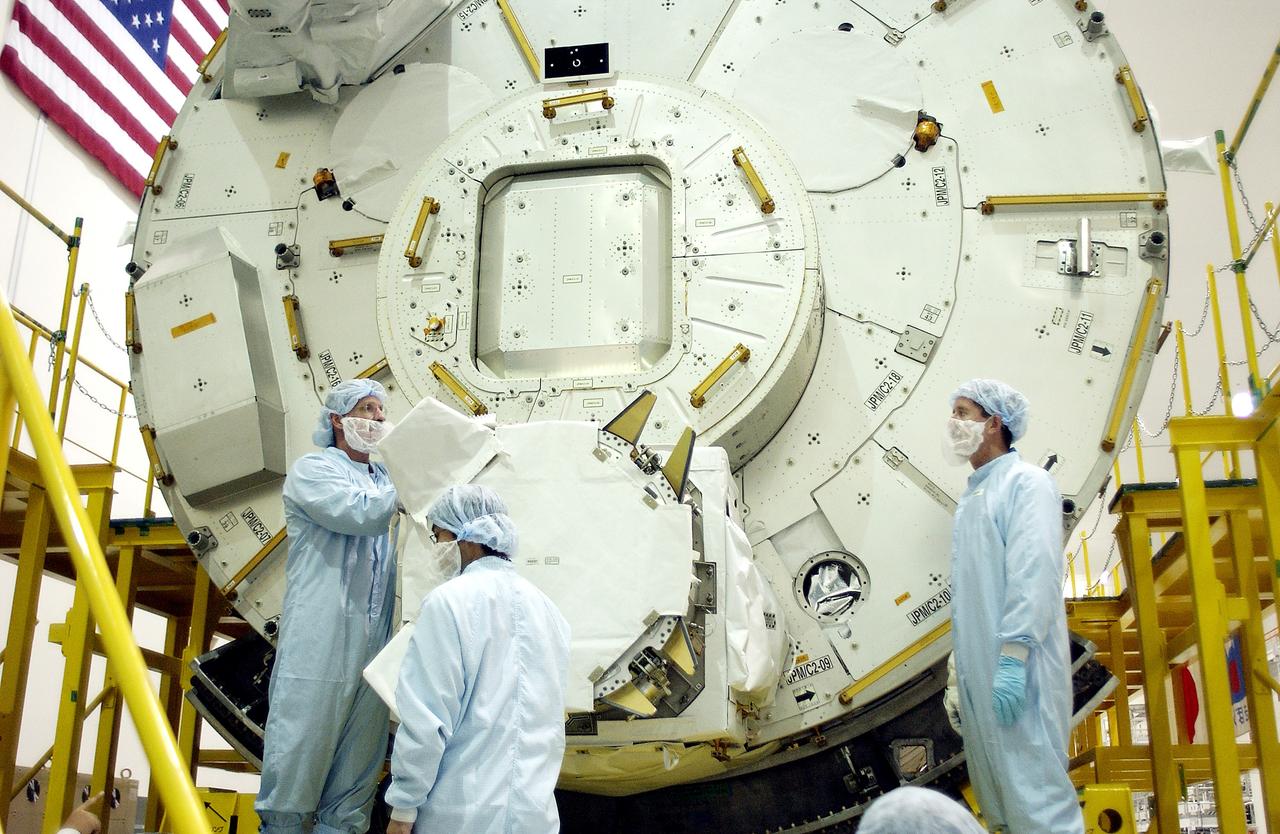
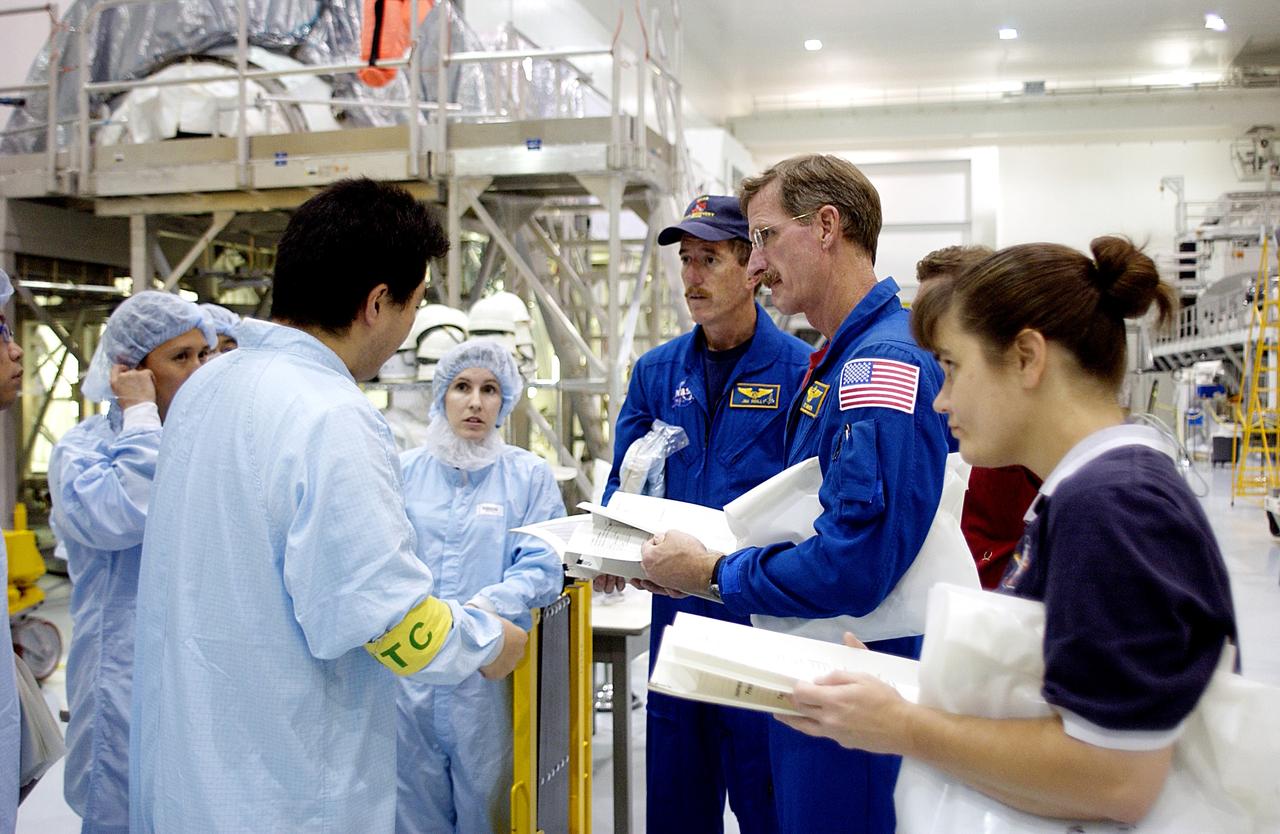
KENNEDY SPACE CENTER, FLA. -  In the Space Station Processing Facility, STS-115 Mission Specialist Joseph Tanner (left)  checks out a camera and cables to be used in the Japanese Experiment Module (JEM). Known as Kibo, the JEM consists of six components: two research facilities - the Pressurized Module and the Exposed Facility; a Logistics Module attached to each of them; a Remote Manipulator System; and an Inter-Orbit Communication System unit. Kibo also has a scientific airlock through which experiments are transferred and exposed to the external environment of space. The various components of JEM will be assembled in space over the course of three Space Shuttle missions. Equipment familiarization is a routine part of astronaut training and launch preparations.
KENNEDY SPACE CENTER, FLA. - In the Space Station Processing Facility, STS-115 Mission Specialist Joseph Tanner (left) checks out a camera and cables to be used in the Japanese Experiment Module (JEM). Known as Kibo, the JEM consists of six components: two research facilities - the Pressurized Module and the Exposed Facility; a Logistics Module attached to each of them; a Remote Manipulator System; and an Inter-Orbit Communication System unit. Kibo also has a scientific airlock through which experiments are transferred and exposed to the external environment of space. The various components of JEM will be assembled in space over the course of three Space Shuttle missions. Equipment familiarization is a routine part of astronaut training and launch preparations.
KENNEDY SPACE CENTER, FLA. -  In the Space Station Processing Facility, STS-115 Mission Specialist Joseph Tanner (center, foreground) works with technicians to learn more about the Japanese Experiment Module (JEM), known as Kibo.  The JEM consists of six components: two research facilities - the Pressurized Module and the Exposed Facility; a Logistics Module attached to each of them; a Remote Manipulator System; and an Inter-Orbit Communication System unit. Kibo also has a scientific airlock through which experiments are transferred and exposed to the external environment of space. The various components of JEM will be assembled in space over the course of three Space Shuttle missions. Equipment familiarization is a routine part of astronaut training and launch preparations.
KENNEDY SPACE CENTER, FLA. - In the Space Station Processing Facility, STS-115 Mission Specialist Joseph Tanner (center, foreground) works with technicians to learn more about the Japanese Experiment Module (JEM), known as Kibo. The JEM consists of six components: two research facilities - the Pressurized Module and the Exposed Facility; a Logistics Module attached to each of them; a Remote Manipulator System; and an Inter-Orbit Communication System unit. Kibo also has a scientific airlock through which experiments are transferred and exposed to the external environment of space. The various components of JEM will be assembled in space over the course of three Space Shuttle missions. Equipment familiarization is a routine part of astronaut training and launch preparations.
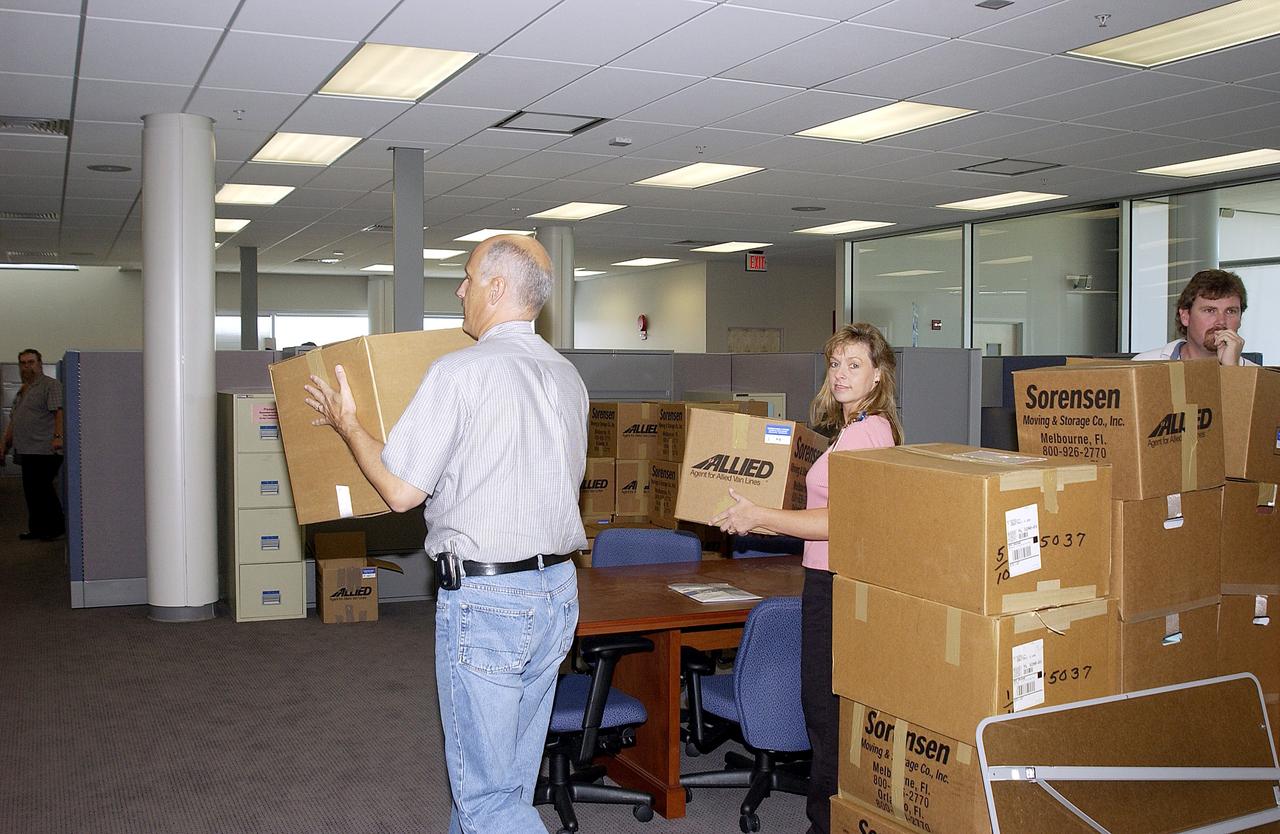
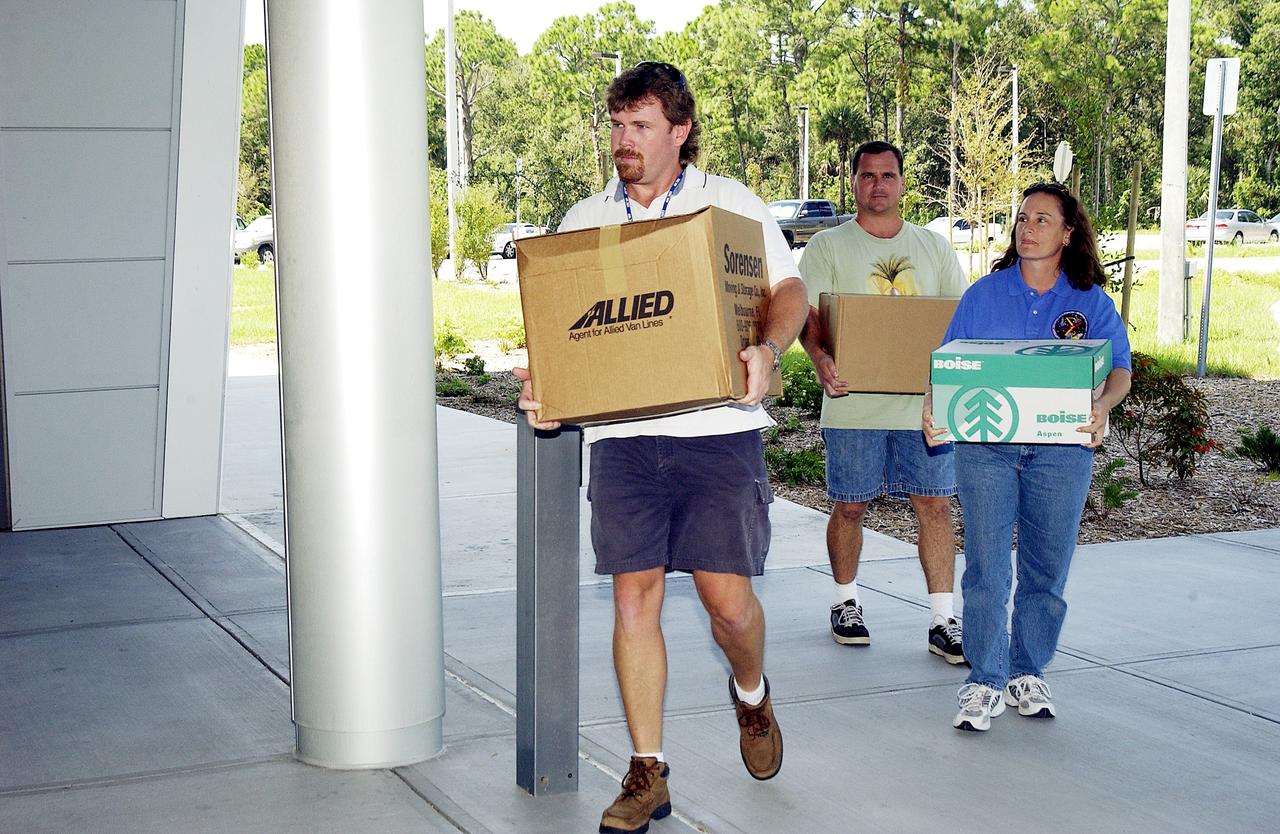
KENNEDY SPACE CENTER, FLA. -  Dynamac employees (from left) Larry Burns, Debbie Wells and Neil  Yorio carry boxes of hardware into the Space Life Sciences Lab (SLSL), formerly known as the Space Experiment Research and Processing Laboratory (SERPL).  They are transferring equipment from Hangar L. The new lab is a state-of-the-art facility being built for ISS biotechnology research. Developed as a partnership between NASA-KSC and the State of Florida, NASA’s life sciences contractor will be the primary tenant of the facility, leasing space to conduct flight experiment processing and NASA-sponsored research. About 20 percent of the facility will be available for use by Florida’s university researchers through the Florida Space Research Institute.
KENNEDY SPACE CENTER, FLA. - Dynamac employees (from left) Larry Burns, Debbie Wells and Neil Yorio carry boxes of hardware into the Space Life Sciences Lab (SLSL), formerly known as the Space Experiment Research and Processing Laboratory (SERPL). They are transferring equipment from Hangar L. The new lab is a state-of-the-art facility being built for ISS biotechnology research. Developed as a partnership between NASA-KSC and the State of Florida, NASA’s life sciences contractor will be the primary tenant of the facility, leasing space to conduct flight experiment processing and NASA-sponsored research. About 20 percent of the facility will be available for use by Florida’s university researchers through the Florida Space Research Institute.
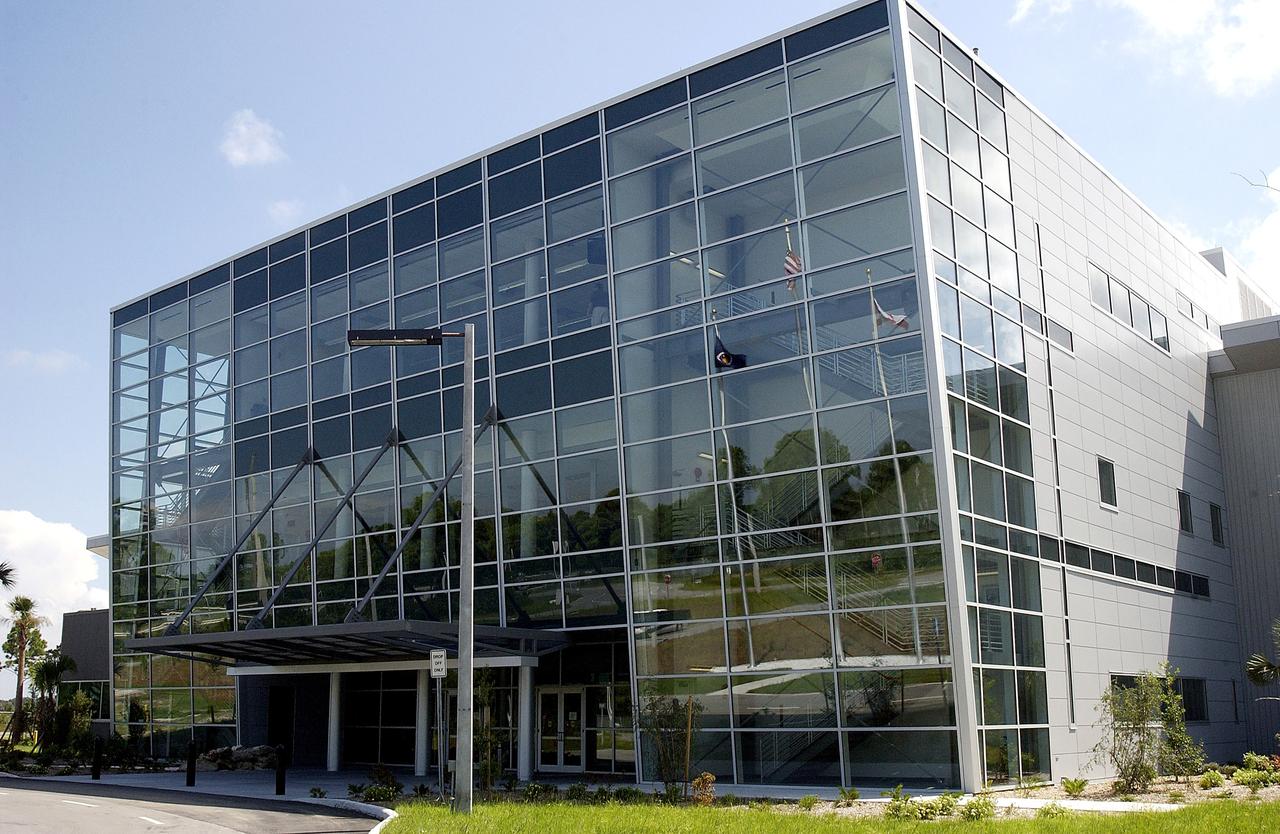
KENNEDY SPACE CENTER, FLA. -  The Space Life Sciences Lab (SLSL), formerly known as the Space Experiment Research and Processing Laboratory (SERPL), is nearing completion.  The new lab is a state-of-the-art facility being built for ISS biotechnology research. Developed as a partnership between NASA-KSC and the State of Florida, NASA’s life sciences contractor will be the primary tenant of the facility, leasing space to conduct flight experiment processing and NASA-sponsored research. About 20 percent of the facility will be available for use by Florida’s university researchers through the Florida Space Research Institute.
KENNEDY SPACE CENTER, FLA. - The Space Life Sciences Lab (SLSL), formerly known as the Space Experiment Research and Processing Laboratory (SERPL), is nearing completion. The new lab is a state-of-the-art facility being built for ISS biotechnology research. Developed as a partnership between NASA-KSC and the State of Florida, NASA’s life sciences contractor will be the primary tenant of the facility, leasing space to conduct flight experiment processing and NASA-sponsored research. About 20 percent of the facility will be available for use by Florida’s university researchers through the Florida Space Research Institute.
KENNEDY SPACE CENTER, FLA. - STS-115 Mission Specialist Joseph Tanner (second from right) checks out a camera and cables for the Japanese Experiment Module (JEM) in the Space Station Processing Facility. Known as Kibo, the JEM consists of six components: two research facilities - the Pressurized Module and the Exposed Facility; a Logistics Module attached to each of them; a Remote Manipulator System; and an Inter-Orbit Communication System unit. Kibo also has a scientific airlock through which experiments are transferred and exposed to the external environment of space. The various components of JEM will be assembled in space over the course of three Space Shuttle missions. Equipment familiarization is a routine part of astronaut training and launch preparations.
KENNEDY SPACE CENTER, FLA. -  Ivan Rodriguez, with Bionetics, and Michelle Crouch and Larry Burns, with Dynamac, carry boxes of equipment into the Space Life Sciences Lab (SLSL), formerly known as the Space Experiment Research and Processing Laboratory (SERPL).    They are transferring equipment from Hangar L. The new lab is a state-of-the-art facility being built for ISS biotechnology research. Developed as a partnership between NASA-KSC and the State of Florida, NASA’s life sciences contractor will be the primary tenant of the facility, leasing space to conduct flight experiment processing and NASA-sponsored research. About 20 percent of the facility will be available for use by Florida’s university researchers through the Florida Space Research Institute.
KENNEDY SPACE CENTER, FLA. - Ivan Rodriguez, with Bionetics, and Michelle Crouch and Larry Burns, with Dynamac, carry boxes of equipment into the Space Life Sciences Lab (SLSL), formerly known as the Space Experiment Research and Processing Laboratory (SERPL). They are transferring equipment from Hangar L. The new lab is a state-of-the-art facility being built for ISS biotechnology research. Developed as a partnership between NASA-KSC and the State of Florida, NASA’s life sciences contractor will be the primary tenant of the facility, leasing space to conduct flight experiment processing and NASA-sponsored research. About 20 percent of the facility will be available for use by Florida’s university researchers through the Florida Space Research Institute.
KENNEDY SPACE CENTER, FLA. - STS-115 Mission Specialist Joseph Tanner checks out a camera for the Japanese Experiment Module (JEM) in the Space Station Processing Facility.  Known as Kibo, the JEM consists of six components: two research facilities -- the Pressurized Module and the Exposed Facility; a Logistics Module attached to each of them; a Remote Manipulator System; and an Inter-Orbit Communication System unit. Kibo also has a scientific airlock through which experiments are transferred and exposed to the external environment of space. The various components of JEM will be assembled in space over the course of three Space Shuttle missions. Equipment familiarization is a routine part of astronaut training and launch preparations.
KENNEDY SPACE CENTER, FLA. - STS-115 Mission Specialist Joseph Tanner checks out a camera for the Japanese Experiment Module (JEM) in the Space Station Processing Facility. Known as Kibo, the JEM consists of six components: two research facilities -- the Pressurized Module and the Exposed Facility; a Logistics Module attached to each of them; a Remote Manipulator System; and an Inter-Orbit Communication System unit. Kibo also has a scientific airlock through which experiments are transferred and exposed to the external environment of space. The various components of JEM will be assembled in space over the course of three Space Shuttle missions. Equipment familiarization is a routine part of astronaut training and launch preparations.
KENNEDY SPACE CENTER, FLA. -  In the Space Station Processing Facility, STS-115 Mission Specialist Joseph Tanner takes a closer look at the Japanese Experiment Module (JEM). Known as Kibo, the JEM consists of six components: two research facilities - the Pressurized Module and the Exposed Facility; a Logistics Module attached to each of them; a Remote Manipulator System; and an Inter-Orbit Communication System unit. Kibo also has a scientific airlock through which experiments are transferred and exposed to the external environment of space. The various components of JEM will be assembled in space over the course of three Space Shuttle missions. Equipment familiarization is a routine part of astronaut training and launch preparations.
KENNEDY SPACE CENTER, FLA. - In the Space Station Processing Facility, STS-115 Mission Specialist Joseph Tanner takes a closer look at the Japanese Experiment Module (JEM). Known as Kibo, the JEM consists of six components: two research facilities - the Pressurized Module and the Exposed Facility; a Logistics Module attached to each of them; a Remote Manipulator System; and an Inter-Orbit Communication System unit. Kibo also has a scientific airlock through which experiments are transferred and exposed to the external environment of space. The various components of JEM will be assembled in space over the course of three Space Shuttle missions. Equipment familiarization is a routine part of astronaut training and launch preparations.
KENNEDY SPACE CENTER, FLA. -  In the Space Station Processing Facility, STS-115 Mission Specialist Joseph Tanner (right)  checks out a camera and cables for the Japanese Experiment Module (JEM). Known as Kibo, the JEM consists of six components: two research facilities - the Pressurized Module and the Exposed Facility; a Logistics Module attached to each of them; a Remote Manipulator System; and an Inter-Orbit Communication System unit. Kibo also has a scientific airlock through which experiments are transferred and exposed to the external environment of space. The various components of JEM will be assembled in space over the course of three Space Shuttle missions. Equipment familiarization is a routine part of astronaut training and launch preparations.
KENNEDY SPACE CENTER, FLA. - In the Space Station Processing Facility, STS-115 Mission Specialist Joseph Tanner (right) checks out a camera and cables for the Japanese Experiment Module (JEM). Known as Kibo, the JEM consists of six components: two research facilities - the Pressurized Module and the Exposed Facility; a Logistics Module attached to each of them; a Remote Manipulator System; and an Inter-Orbit Communication System unit. Kibo also has a scientific airlock through which experiments are transferred and exposed to the external environment of space. The various components of JEM will be assembled in space over the course of three Space Shuttle missions. Equipment familiarization is a routine part of astronaut training and launch preparations.
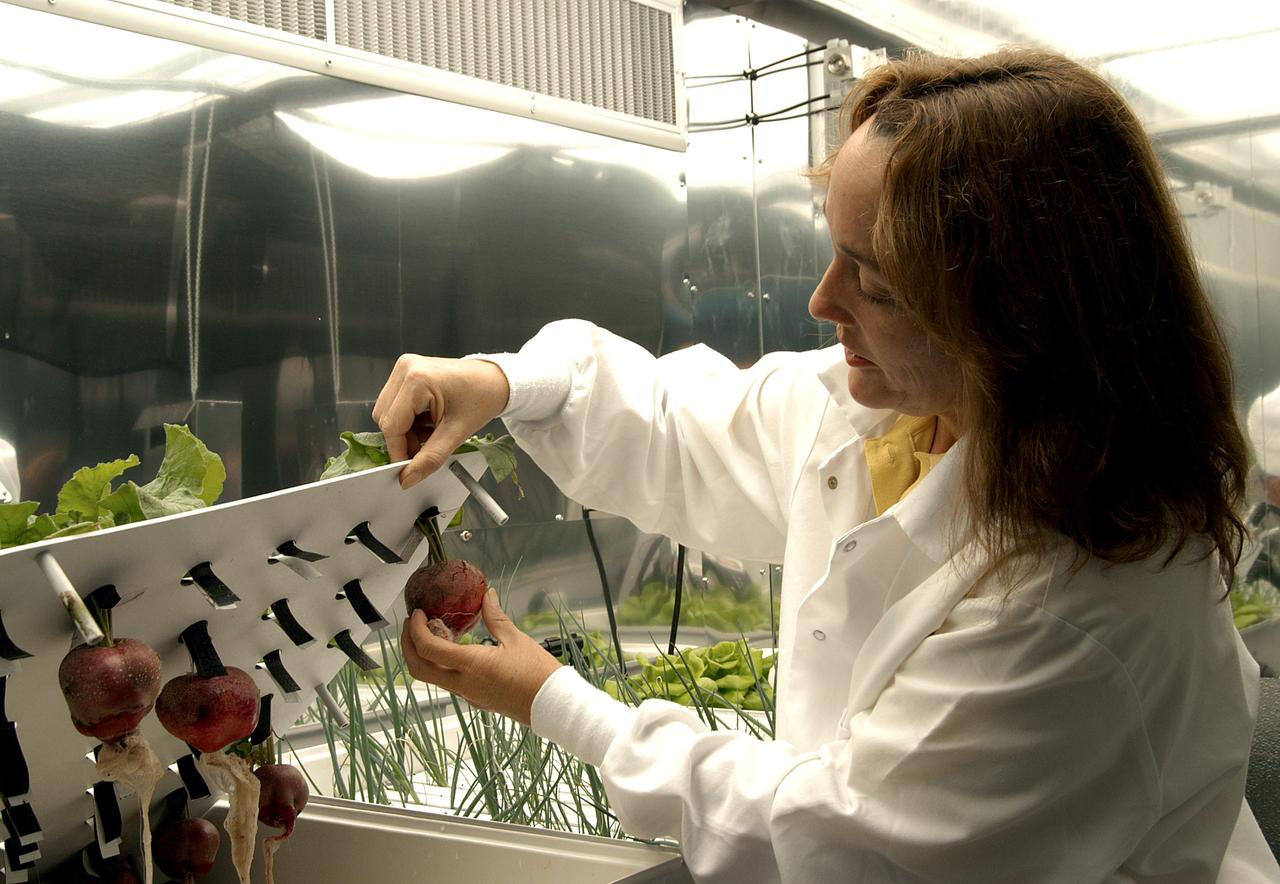
KENNEDY SPACE CENTER, FLA. -- Sharon Edney, with Dynamac Corp., checks the growth of radishes being grown hydroponically for study in the Space Life Sciences Lab.  The 100,000 square-foot facility houses labs for NASA’s ongoing research efforts, microbiology/microbial ecology studies and analytical chemistry labs. Also calling the new lab home are facilities for space flight-experiment and flight-hardware development, new plant growth chambers, and an Orbiter Environment Simulator that will be used to conduct ground control experiments in simulated flight conditions for space flight experiments.  The SLS Lab, formerly known as the Space Experiment Research and Processing Laboratory or SERPL, provides space for NASA’s Life Sciences Services contractor Dynamac Corporation, Bionetics Corporation, and researchers from the University of Florida. NASA’s Office of Biological and Physical Research will use the facility for processing life sciences experiments that will be conducted on the International Space Station. The SLS Lab is the magnet facility for the International Space Research Park at KSC being developed in partnership with Florida Space Authority.
KENNEDY SPACE CENTER, FLA. -- Sharon Edney, with Dynamac Corp., checks the growth of radishes being grown hydroponically for study in the Space Life Sciences Lab. The 100,000 square-foot facility houses labs for NASA’s ongoing research efforts, microbiology/microbial ecology studies and analytical chemistry labs. Also calling the new lab home are facilities for space flight-experiment and flight-hardware development, new plant growth chambers, and an Orbiter Environment Simulator that will be used to conduct ground control experiments in simulated flight conditions for space flight experiments. The SLS Lab, formerly known as the Space Experiment Research and Processing Laboratory or SERPL, provides space for NASA’s Life Sciences Services contractor Dynamac Corporation, Bionetics Corporation, and researchers from the University of Florida. NASA’s Office of Biological and Physical Research will use the facility for processing life sciences experiments that will be conducted on the International Space Station. The SLS Lab is the magnet facility for the International Space Research Park at KSC being developed in partnership with Florida Space Authority.
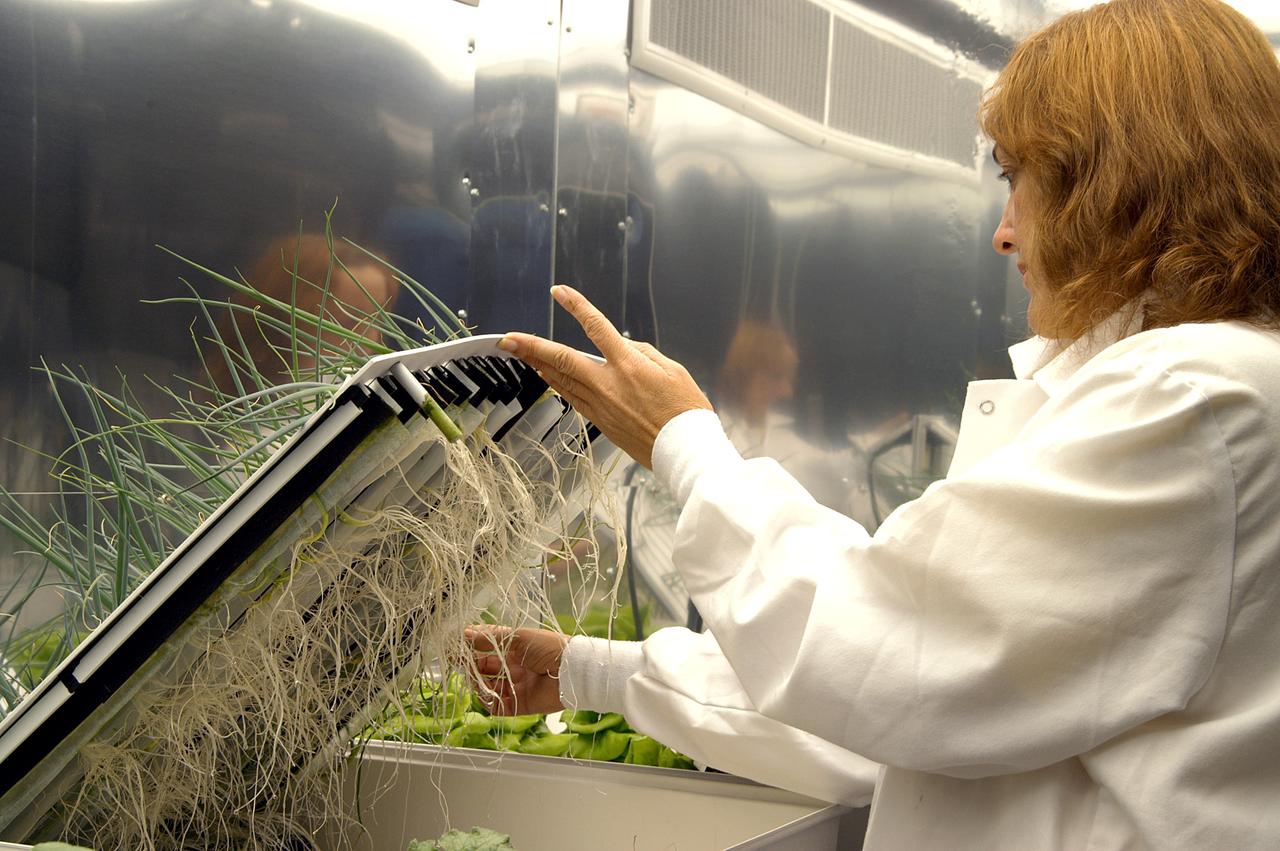
KENNEDY SPACE CENTER, FLA. -- Sharon Edney, with Dynamac Corp., checks the roots of green onions being grown hydroponically for study in the Space Life Sciences Lab.  The 100,000 square-foot facility houses labs for NASA’s ongoing research efforts, microbiology/microbial ecology studies and analytical chemistry labs. Also calling the new lab home are facilities for space flight-experiment and flight-hardware development, new plant growth chambers, and an Orbiter Environment Simulator that will be used to conduct ground control experiments in simulated flight conditions for space flight experiments.  The SLS Lab, formerly known as the Space Experiment Research and Processing Laboratory or SERPL, provides space for NASA’s Life Sciences Services contractor Dynamac Corporation, Bionetics Corporation, and researchers from the University of Florida. NASA’s Office of Biological and Physical Research will use the facility for processing life sciences experiments that will be conducted on the International Space Station. The SLS Lab is the magnet facility for the International Space Research Park at KSC being developed in partnership with Florida Space Authority.
KENNEDY SPACE CENTER, FLA. -- Sharon Edney, with Dynamac Corp., checks the roots of green onions being grown hydroponically for study in the Space Life Sciences Lab. The 100,000 square-foot facility houses labs for NASA’s ongoing research efforts, microbiology/microbial ecology studies and analytical chemistry labs. Also calling the new lab home are facilities for space flight-experiment and flight-hardware development, new plant growth chambers, and an Orbiter Environment Simulator that will be used to conduct ground control experiments in simulated flight conditions for space flight experiments. The SLS Lab, formerly known as the Space Experiment Research and Processing Laboratory or SERPL, provides space for NASA’s Life Sciences Services contractor Dynamac Corporation, Bionetics Corporation, and researchers from the University of Florida. NASA’s Office of Biological and Physical Research will use the facility for processing life sciences experiments that will be conducted on the International Space Station. The SLS Lab is the magnet facility for the International Space Research Park at KSC being developed in partnership with Florida Space Authority.
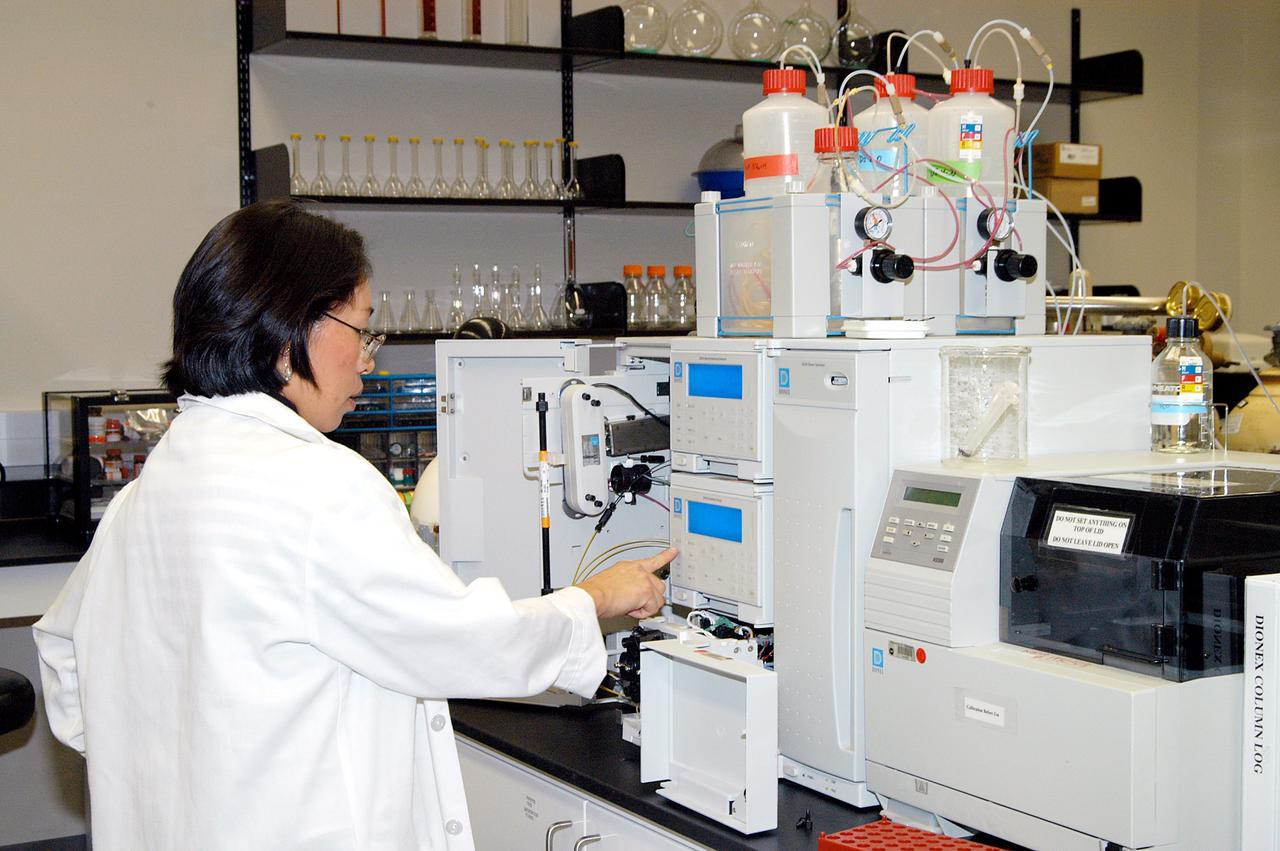
KENNEDY SPACE CENTER, FLA. -- In the Space Life Sciences Lab, Lanfang Levine, with Dynamac Corp., transfers material into a sample bottle for analysis.  She is standing in front of new equipment in the lab that will provide gas chromatography and mass spectrometry.  The equipment will enable analysis of volatile compounds, such as from plants.  The 100,000 square-foot facility houses labs for NASA’s ongoing research efforts, microbiology/microbial ecology studies and analytical chemistry labs. Also calling the new lab home are facilities for space flight-experiment and flight-hardware development, new plant growth chambers, and an Orbiter Environment Simulator that will be used to conduct ground control experiments in simulated flight conditions for space flight experiments.  The SLS Lab, formerly known as the Space Experiment Research and Processing Laboratory or SERPL, provides space for NASA’s Life Sciences Services contractor Dynamac Corporation, Bionetics Corporation, and researchers from the University of Florida. NASA’s Office of Biological and Physical Research will use the facility for processing life sciences experiments that will be conducted on the International Space Station. The SLS Lab is the magnet facility for the International Space Research Park at KSC being developed in partnership with Florida Space Authority.
KENNEDY SPACE CENTER, FLA. -- In the Space Life Sciences Lab, Lanfang Levine, with Dynamac Corp., transfers material into a sample bottle for analysis. She is standing in front of new equipment in the lab that will provide gas chromatography and mass spectrometry. The equipment will enable analysis of volatile compounds, such as from plants. The 100,000 square-foot facility houses labs for NASA’s ongoing research efforts, microbiology/microbial ecology studies and analytical chemistry labs. Also calling the new lab home are facilities for space flight-experiment and flight-hardware development, new plant growth chambers, and an Orbiter Environment Simulator that will be used to conduct ground control experiments in simulated flight conditions for space flight experiments. The SLS Lab, formerly known as the Space Experiment Research and Processing Laboratory or SERPL, provides space for NASA’s Life Sciences Services contractor Dynamac Corporation, Bionetics Corporation, and researchers from the University of Florida. NASA’s Office of Biological and Physical Research will use the facility for processing life sciences experiments that will be conducted on the International Space Station. The SLS Lab is the magnet facility for the International Space Research Park at KSC being developed in partnership with Florida Space Authority.
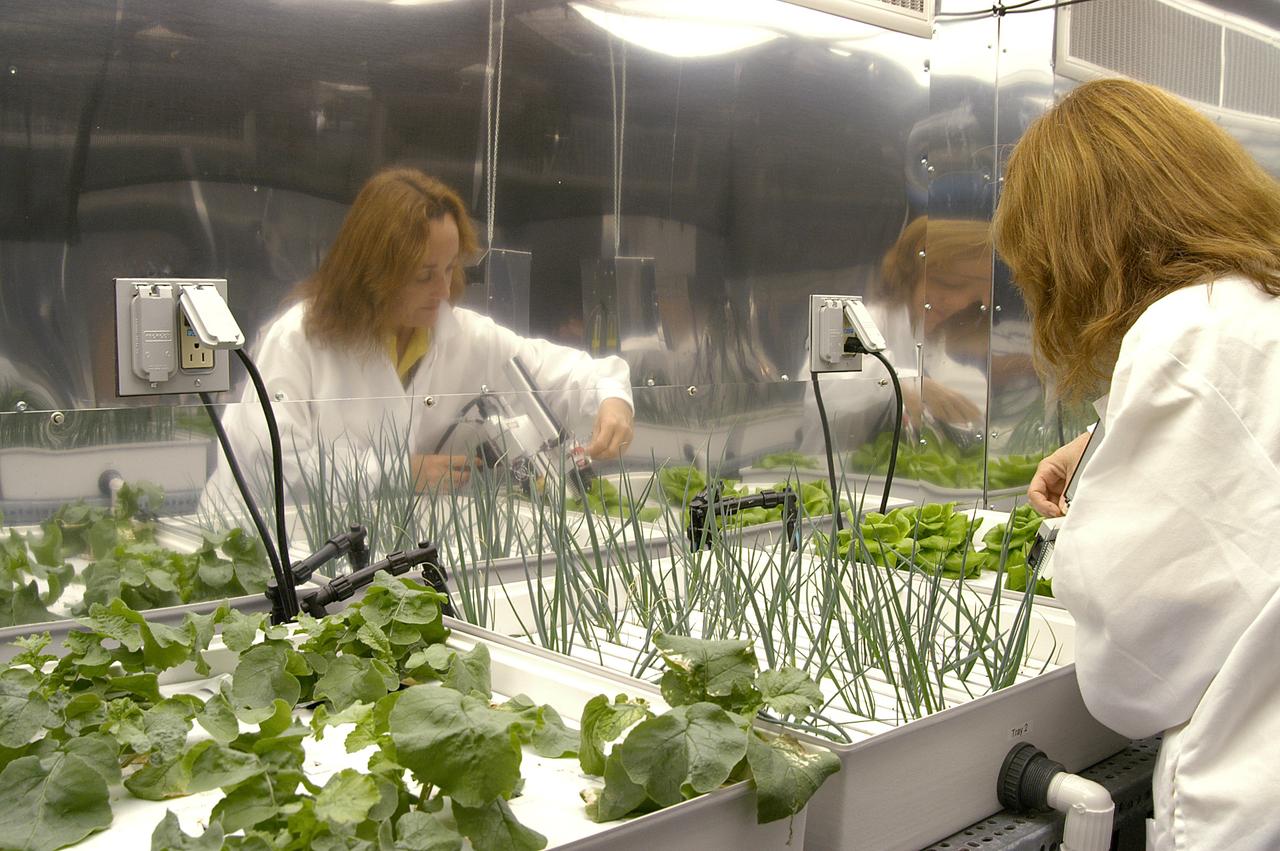
KENNEDY SPACE CENTER, FLA. -- Sharon Edney, with Dynamac Corp., measures photosynthesis on Bibb lettuce being grown hydroponically for study in the Space Life Sciences Lab.  The 100,000 square-foot facility houses labs for NASA’s ongoing research efforts, microbiology/microbial ecology studies and analytical chemistry labs. Also calling the new lab home are facilities for space flight-experiment and flight-hardware development, new plant growth chambers, and an Orbiter Environment Simulator that will be used to conduct ground control experiments in simulated flight conditions for space flight experiments.  The SLS Lab, formerly known as the Space Experiment Research and Processing Laboratory or SERPL, provides space for NASA’s Life Sciences Services contractor Dynamac Corporation, Bionetics Corporation, and researchers from the University of Florida. NASA’s Office of Biological and Physical Research will use the facility for processing life sciences experiments that will be conducted on the International Space Station. The SLS Lab is the magnet facility for the International Space Research Park at KSC being developed in partnership with Florida Space Authority.
KENNEDY SPACE CENTER, FLA. -- Sharon Edney, with Dynamac Corp., measures photosynthesis on Bibb lettuce being grown hydroponically for study in the Space Life Sciences Lab. The 100,000 square-foot facility houses labs for NASA’s ongoing research efforts, microbiology/microbial ecology studies and analytical chemistry labs. Also calling the new lab home are facilities for space flight-experiment and flight-hardware development, new plant growth chambers, and an Orbiter Environment Simulator that will be used to conduct ground control experiments in simulated flight conditions for space flight experiments. The SLS Lab, formerly known as the Space Experiment Research and Processing Laboratory or SERPL, provides space for NASA’s Life Sciences Services contractor Dynamac Corporation, Bionetics Corporation, and researchers from the University of Florida. NASA’s Office of Biological and Physical Research will use the facility for processing life sciences experiments that will be conducted on the International Space Station. The SLS Lab is the magnet facility for the International Space Research Park at KSC being developed in partnership with Florida Space Authority.
KENNEDY SPACE CENTER, FLA. -- Lanfang Levine, with Dynamac Corp., helps install a Dionex DX-500 IC/HPLC system  in the Space Life Sciences Lab.  The equipment will enable analysis of volatile compounds, such as from plants. The 100,000 square-foot facility houses labs for NASA’s ongoing research efforts, microbiology/microbial ecology studies and analytical chemistry labs. Also calling the new lab home are facilities for space flight-experiment and flight-hardware development, new plant growth chambers, and an Orbiter Environment Simulator that will be used to conduct ground control experiments in simulated flight conditions for space flight experiments.  The SLS Lab, formerly known as the Space Experiment Research and Processing Laboratory or SERPL, provides space for NASA’s Life Sciences Services contractor Dynamac Corporation, Bionetics Corporation, and researchers from the University of Florida. NASA’s Office of Biological and Physical Research will use the facility for processing life sciences experiments that will be conducted on the International Space Station. The SLS Lab is the magnet facility for the International Space Research Park at KSC being developed in partnership with Florida Space Authority.
KENNEDY SPACE CENTER, FLA. -- Lanfang Levine, with Dynamac Corp., helps install a Dionex DX-500 IC/HPLC system in the Space Life Sciences Lab. The equipment will enable analysis of volatile compounds, such as from plants. The 100,000 square-foot facility houses labs for NASA’s ongoing research efforts, microbiology/microbial ecology studies and analytical chemistry labs. Also calling the new lab home are facilities for space flight-experiment and flight-hardware development, new plant growth chambers, and an Orbiter Environment Simulator that will be used to conduct ground control experiments in simulated flight conditions for space flight experiments. The SLS Lab, formerly known as the Space Experiment Research and Processing Laboratory or SERPL, provides space for NASA’s Life Sciences Services contractor Dynamac Corporation, Bionetics Corporation, and researchers from the University of Florida. NASA’s Office of Biological and Physical Research will use the facility for processing life sciences experiments that will be conducted on the International Space Station. The SLS Lab is the magnet facility for the International Space Research Park at KSC being developed in partnership with Florida Space Authority.
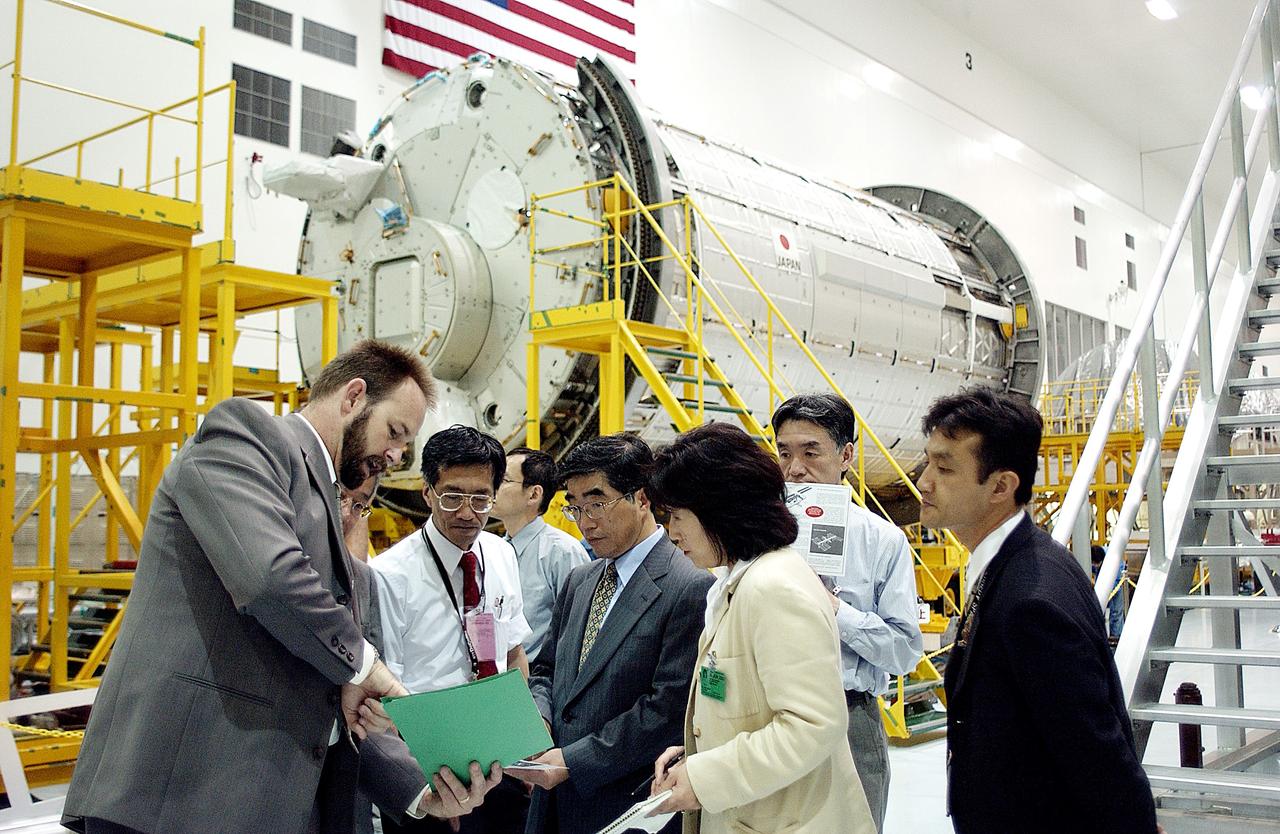
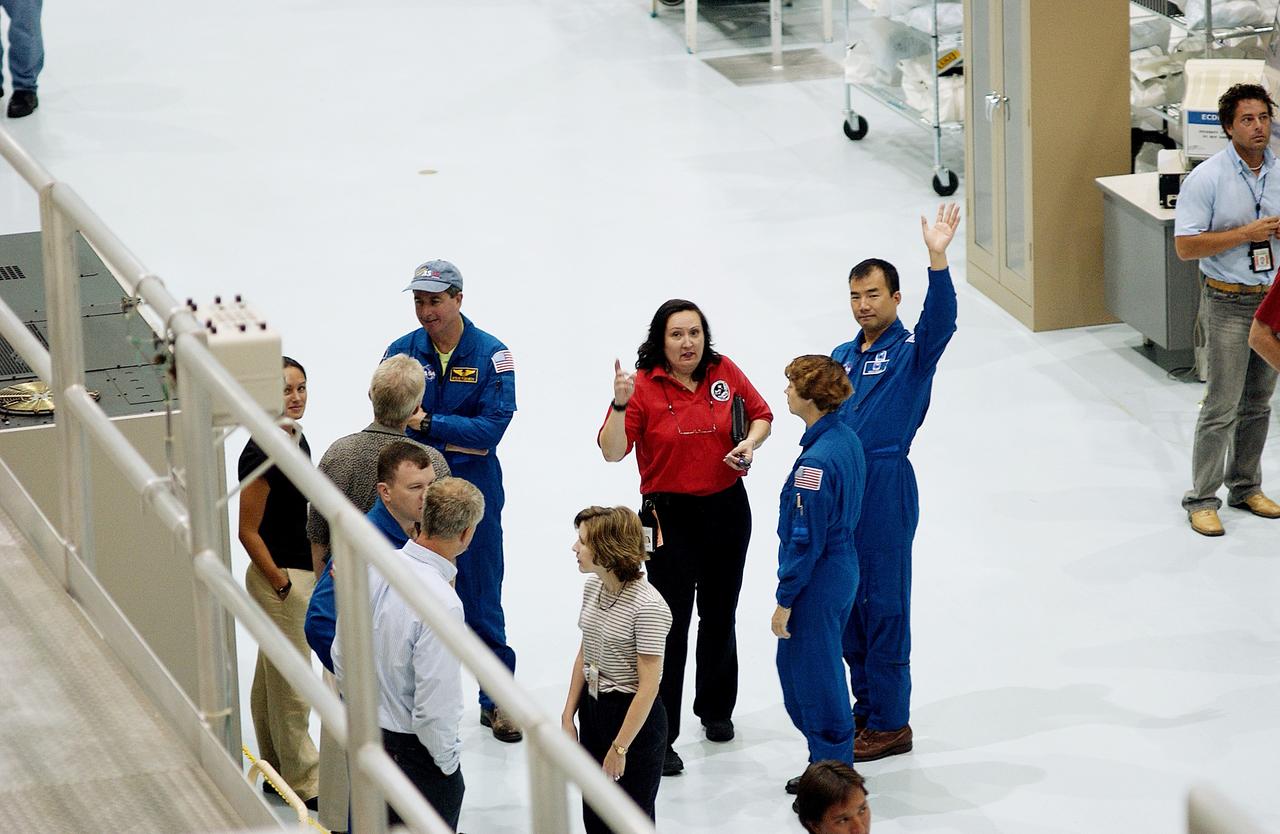
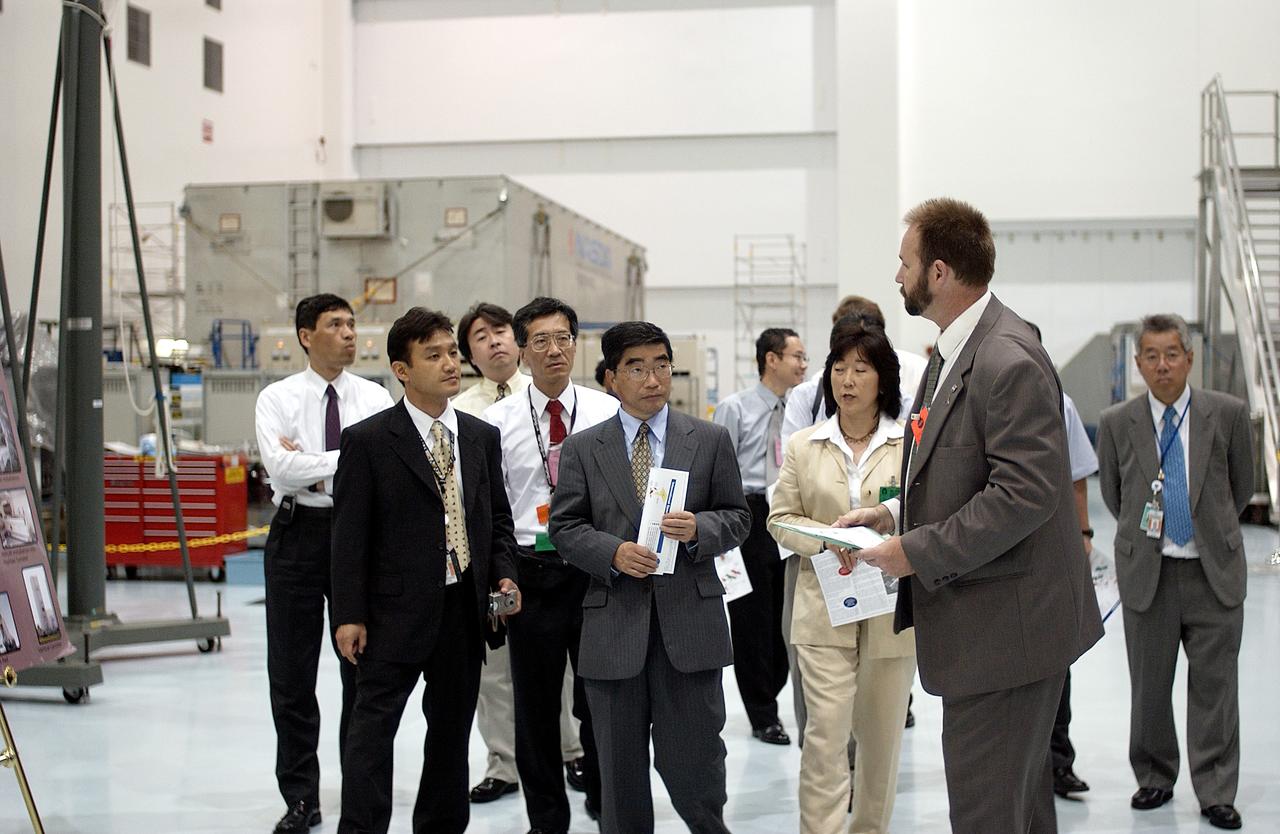
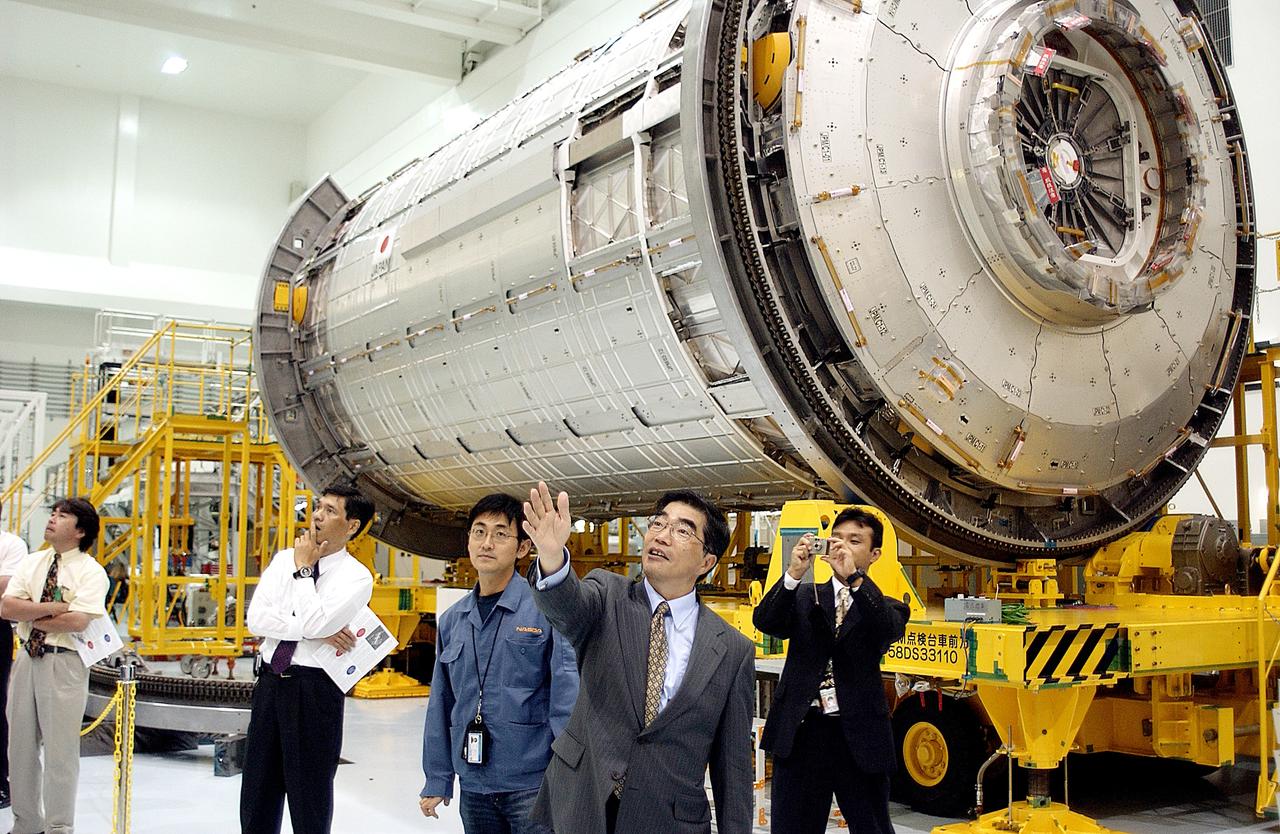
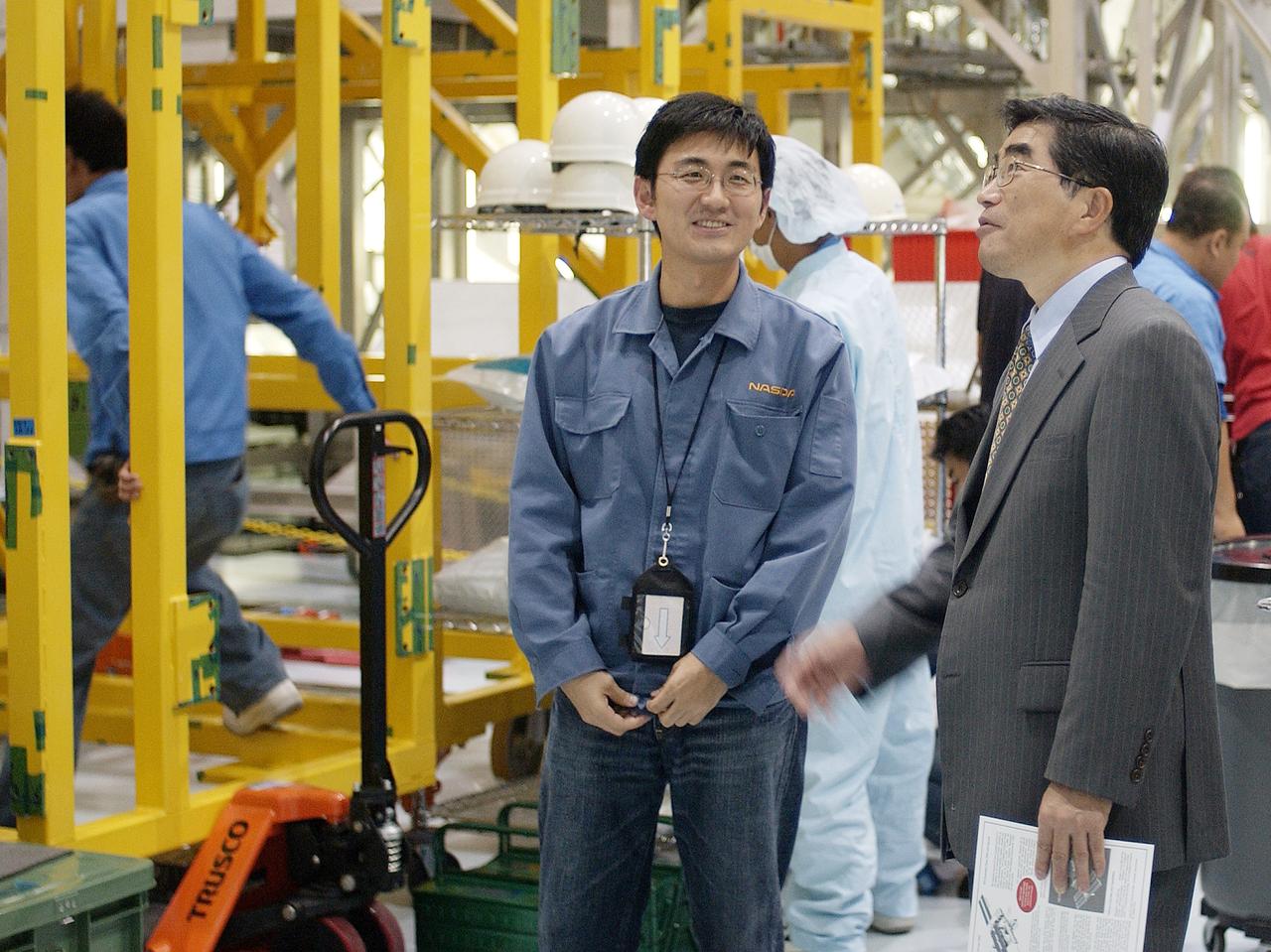
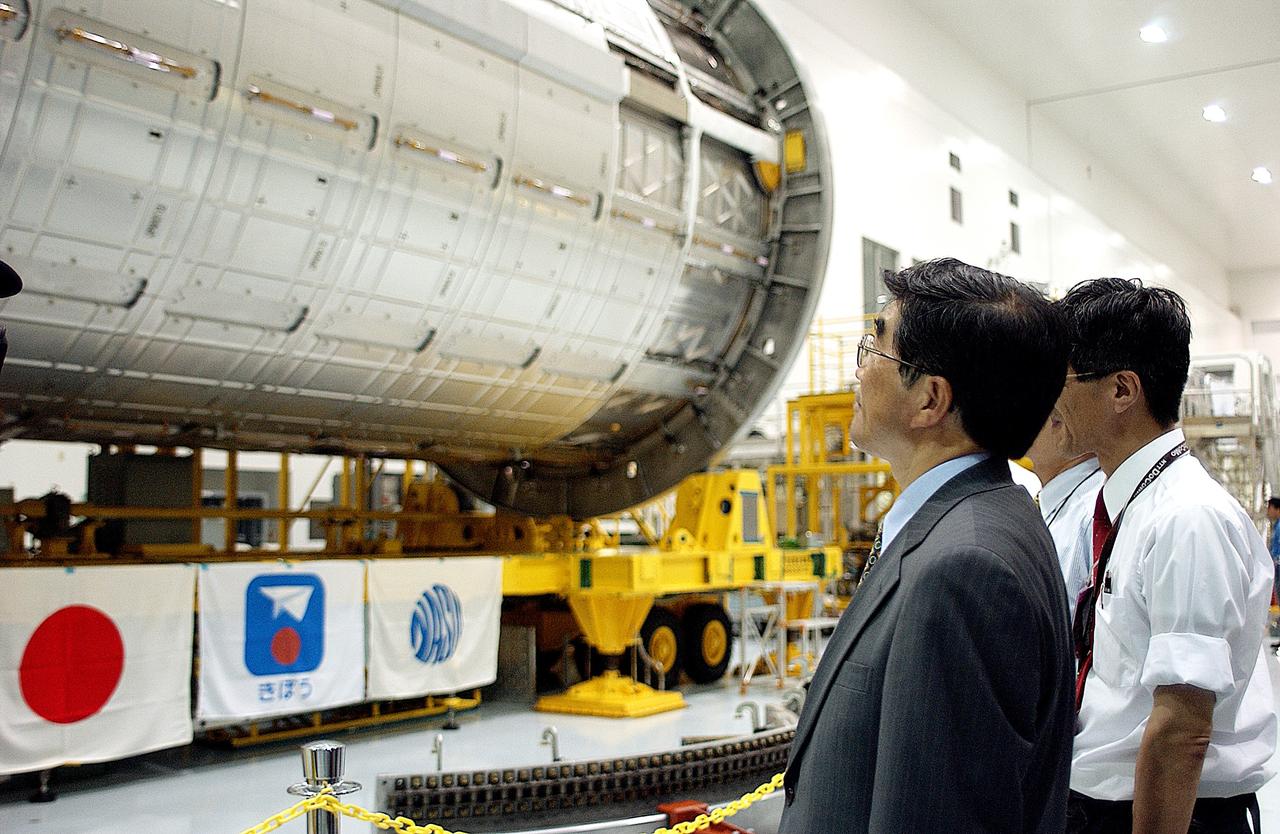
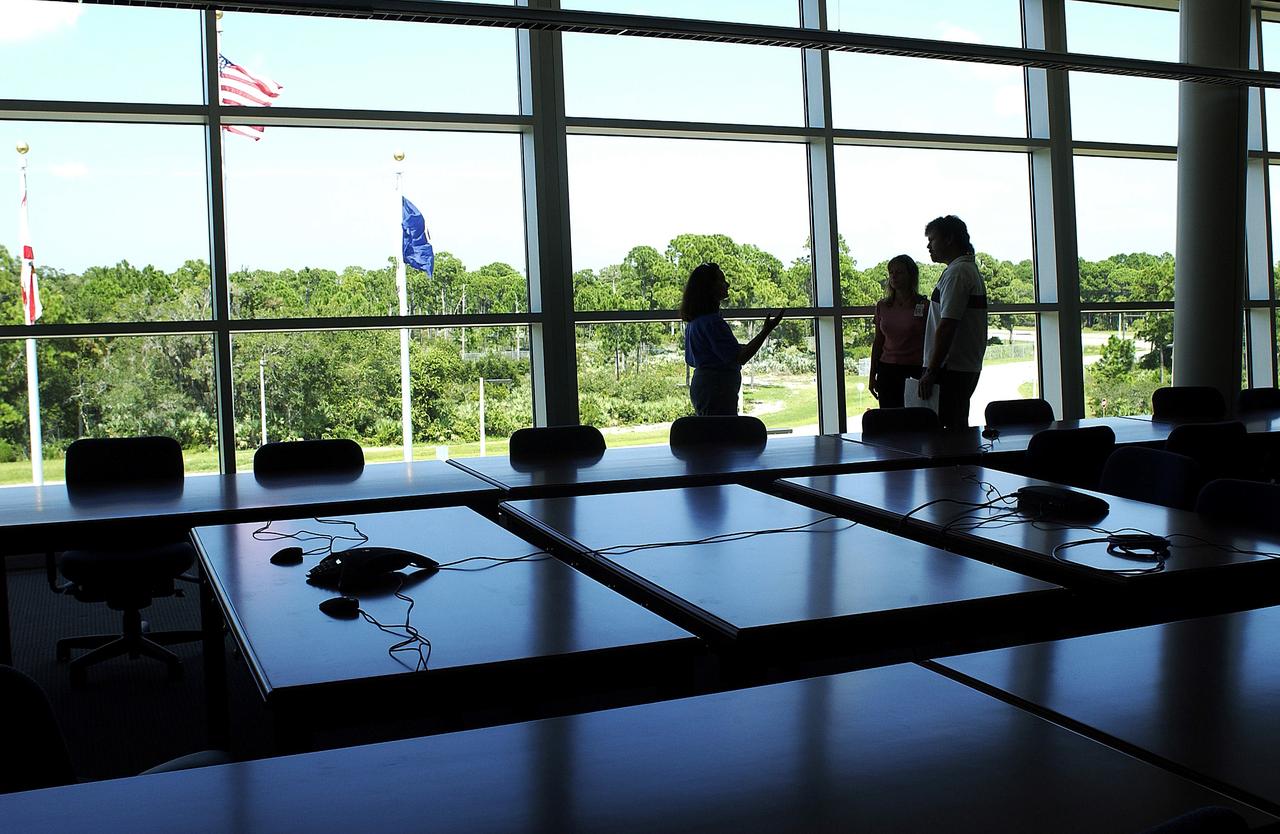
KENNEDY SPACE CENTER, FLA. -  In the Space Station Processing Facility, Executive Director of NASDA Koji Yamamoto (center) gets information about the facility while on a tour of KSC.  Behind the group is the Japanese Experiment Module (JEM)/pressurized module.  Mr. Yamamoto is at KSC for a welcome ceremony involving the arrival of JEM.
KENNEDY SPACE CENTER, FLA. - In the Space Station Processing Facility, Executive Director of NASDA Koji Yamamoto (center) gets information about the facility while on a tour of KSC. Behind the group is the Japanese Experiment Module (JEM)/pressurized module. Mr. Yamamoto is at KSC for a welcome ceremony involving the arrival of JEM.
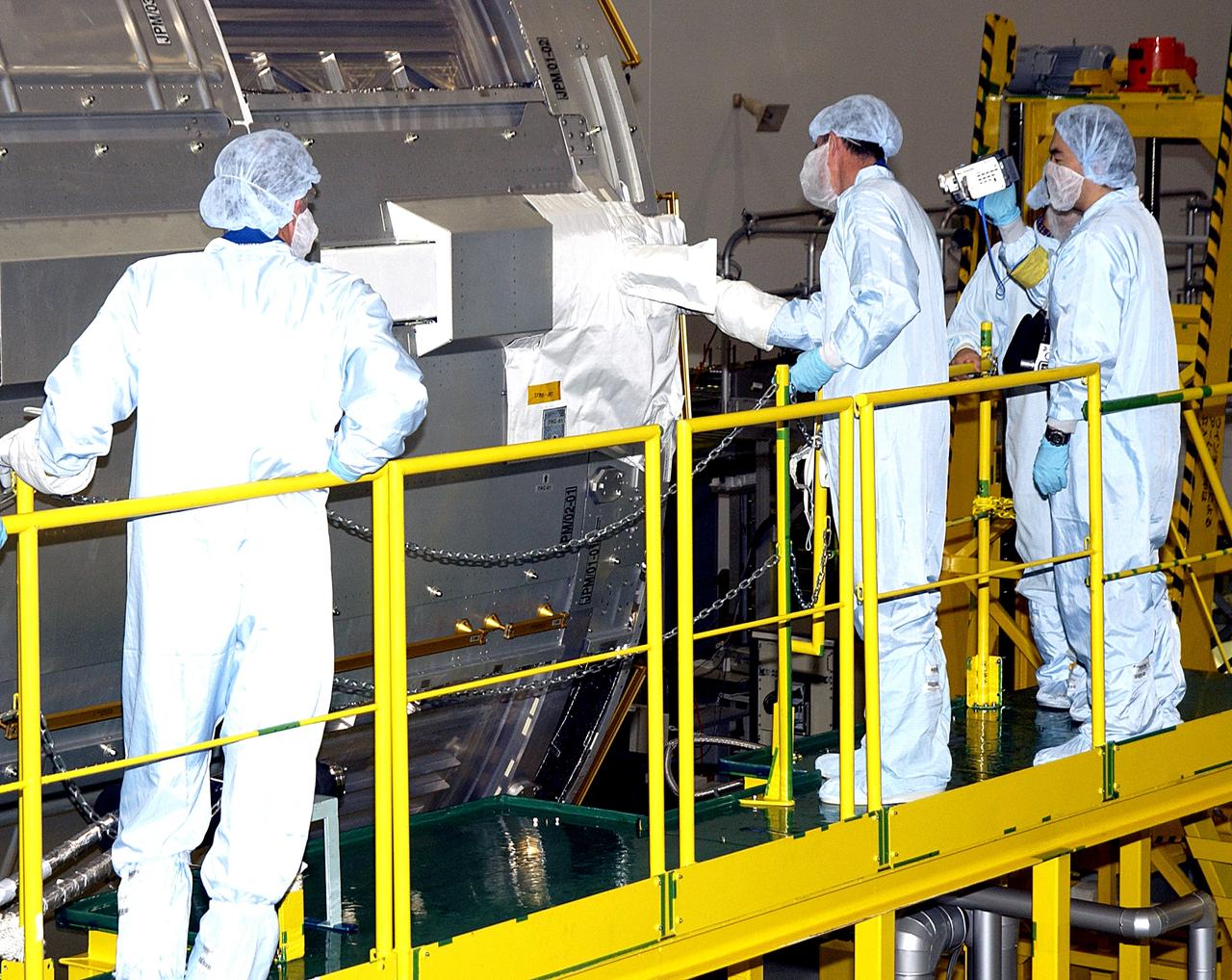
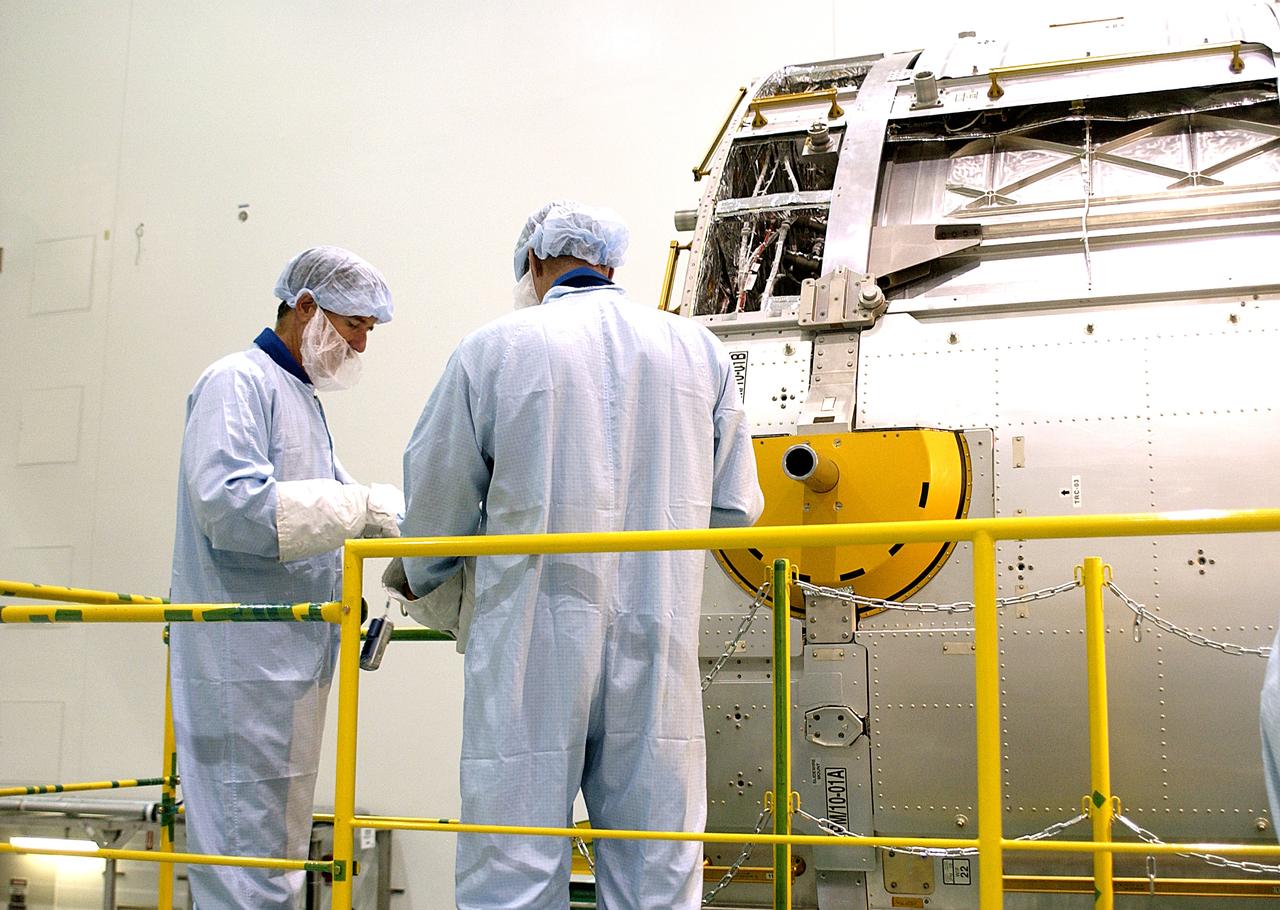
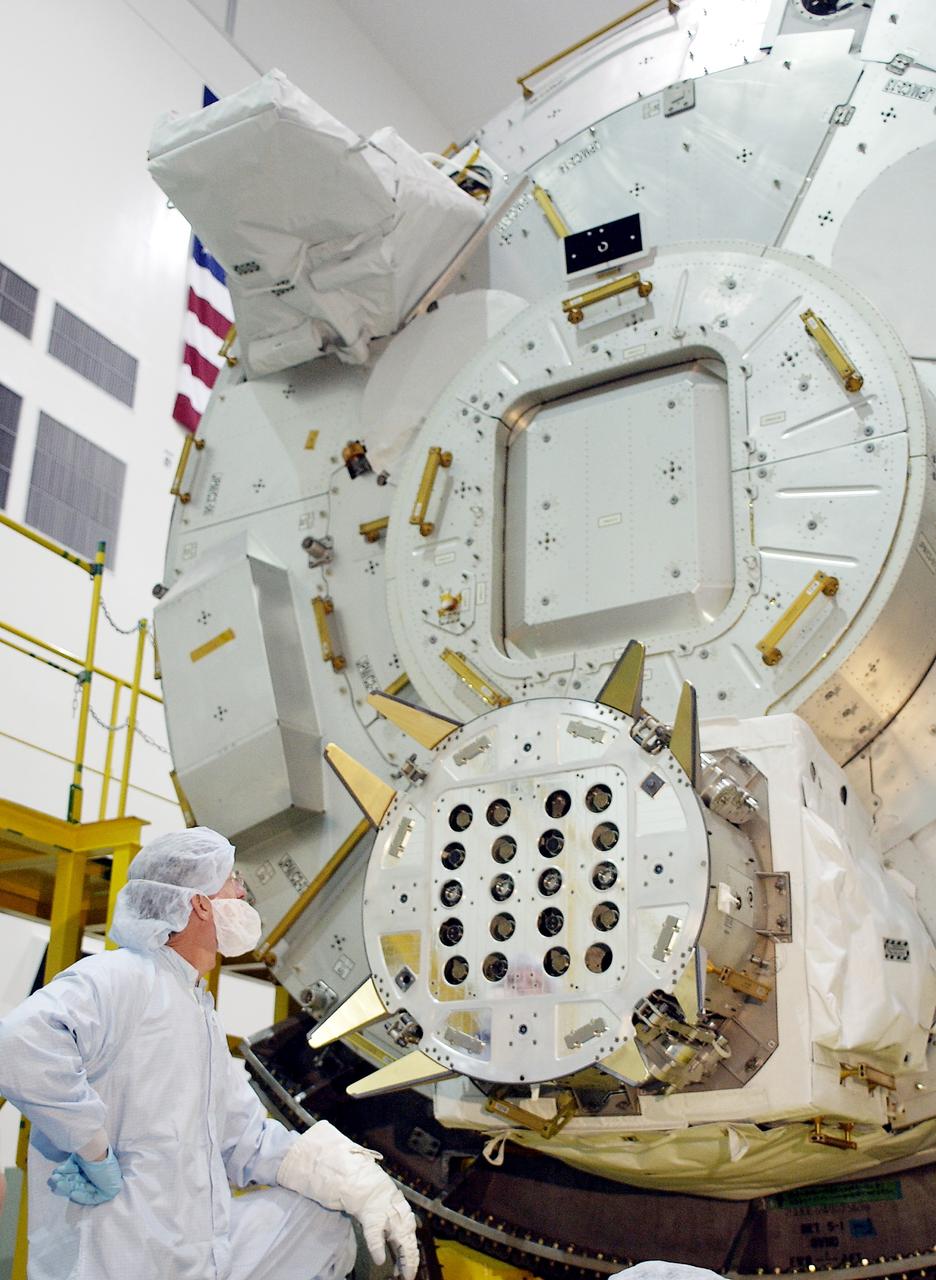
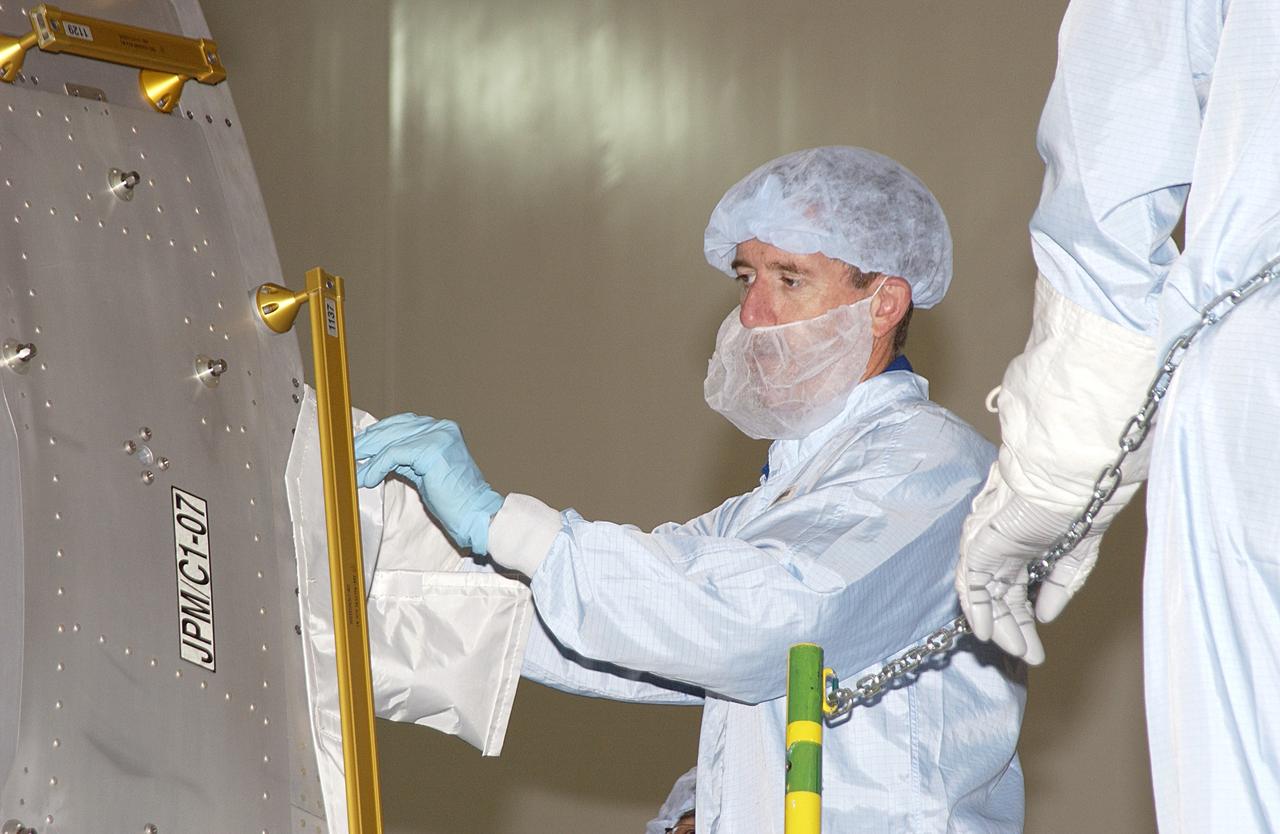
KENNEDY SPACE CENTER, FLA. - In the Space Station Processing Facility, STS-115 Mission Specialist Joseph Tanner looks at the Exposed Facility Berthing Mechanism (EFBM)  on the Japanese Experiment Module (JEM), after removing its cover.  Equipment familiarization is a routine part of astronaut training and launch preparations.
KENNEDY SPACE CENTER, FLA. - In the Space Station Processing Facility, STS-115 Mission Specialist Joseph Tanner looks at the Exposed Facility Berthing Mechanism (EFBM) on the Japanese Experiment Module (JEM), after removing its cover. Equipment familiarization is a routine part of astronaut training and launch preparations.
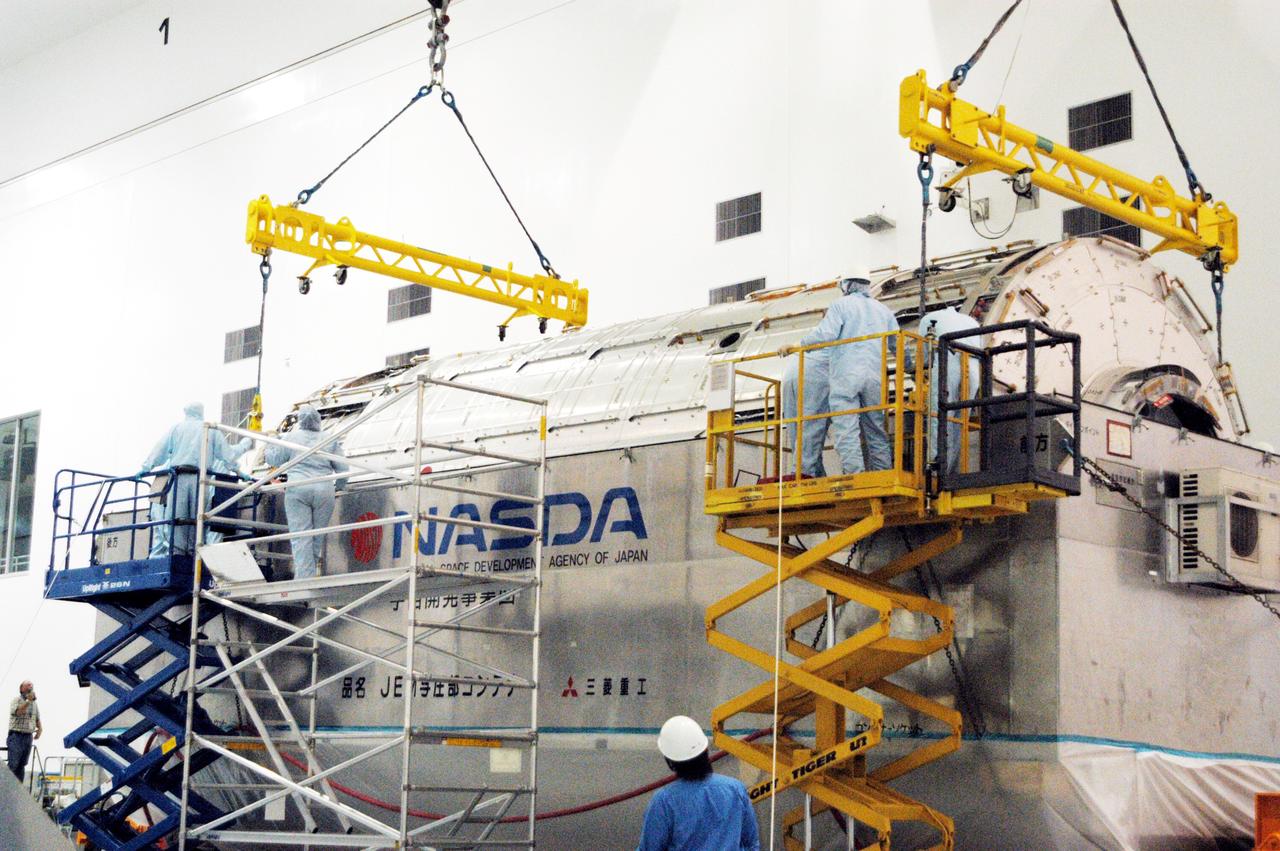
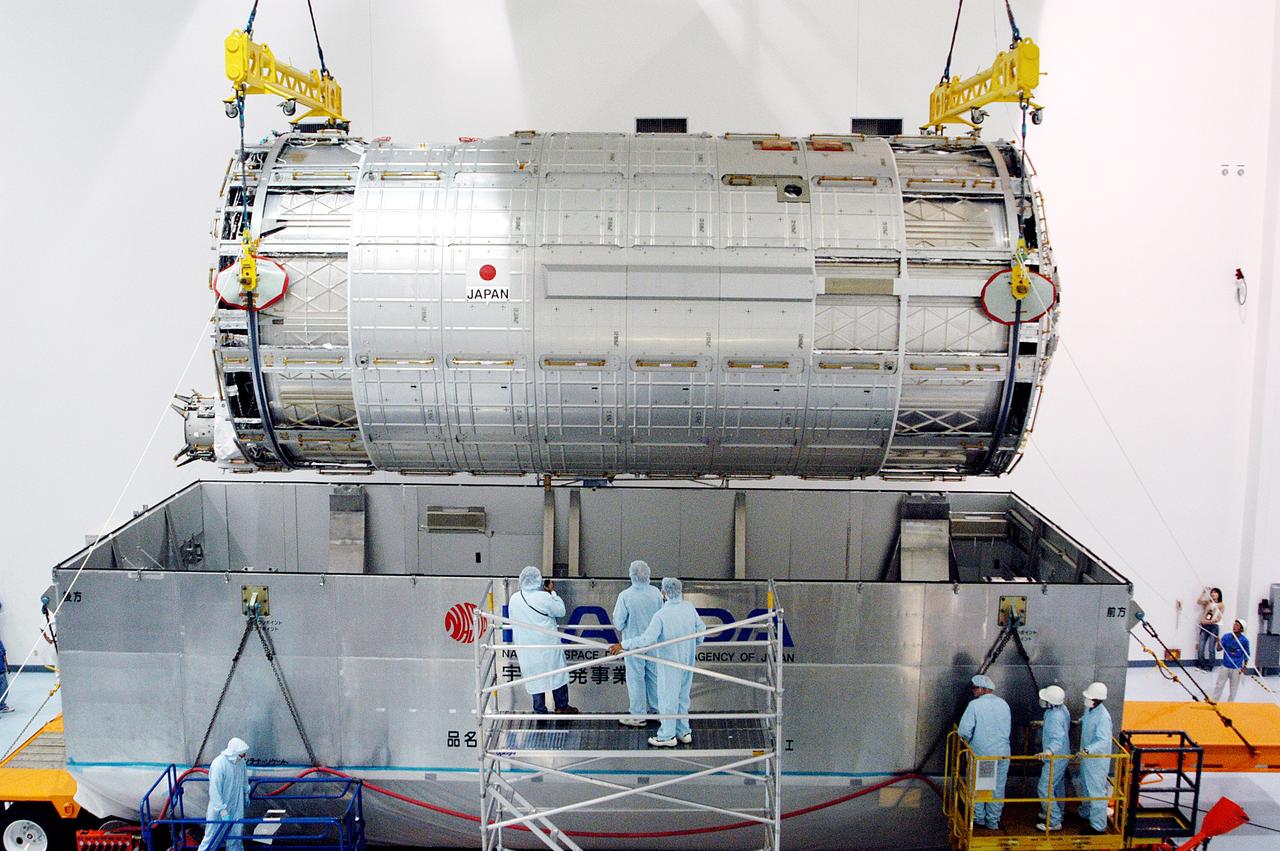
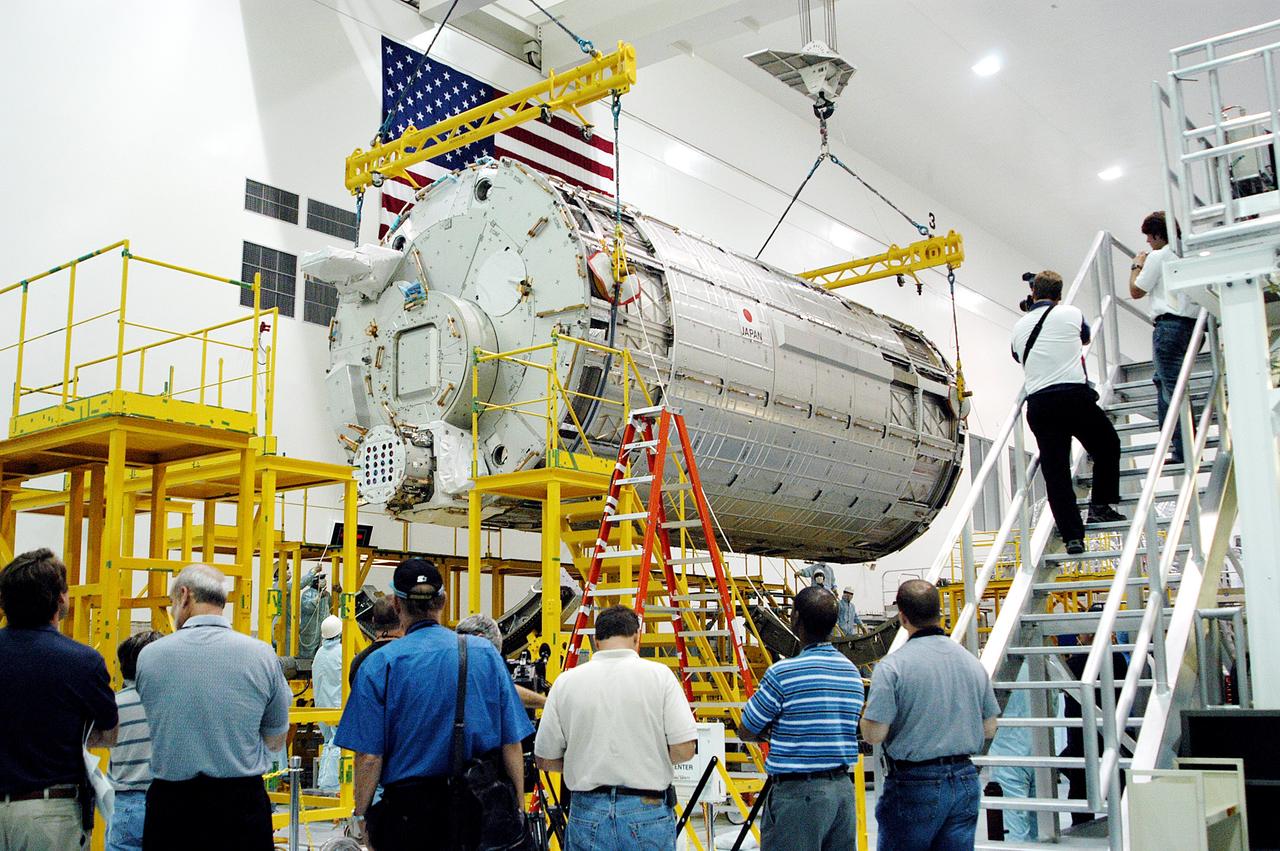
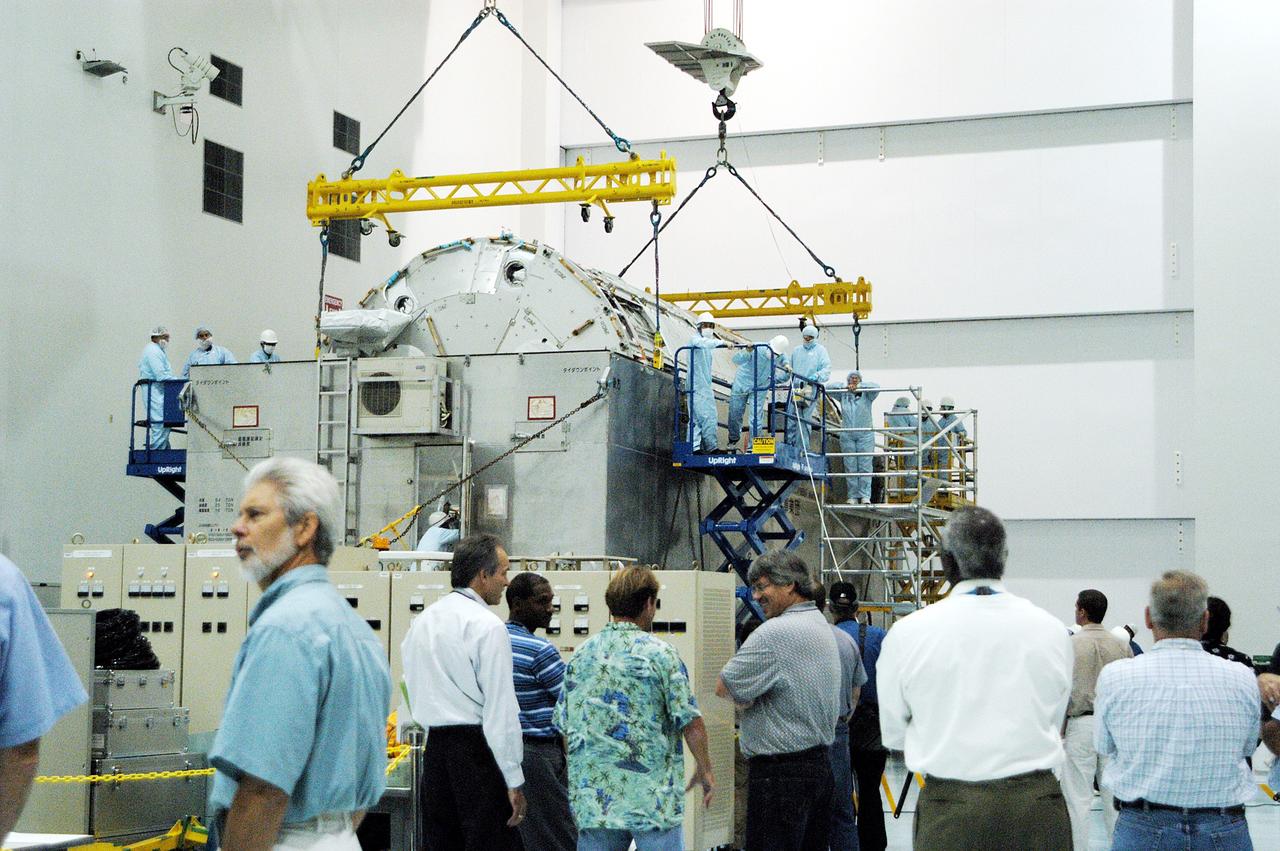
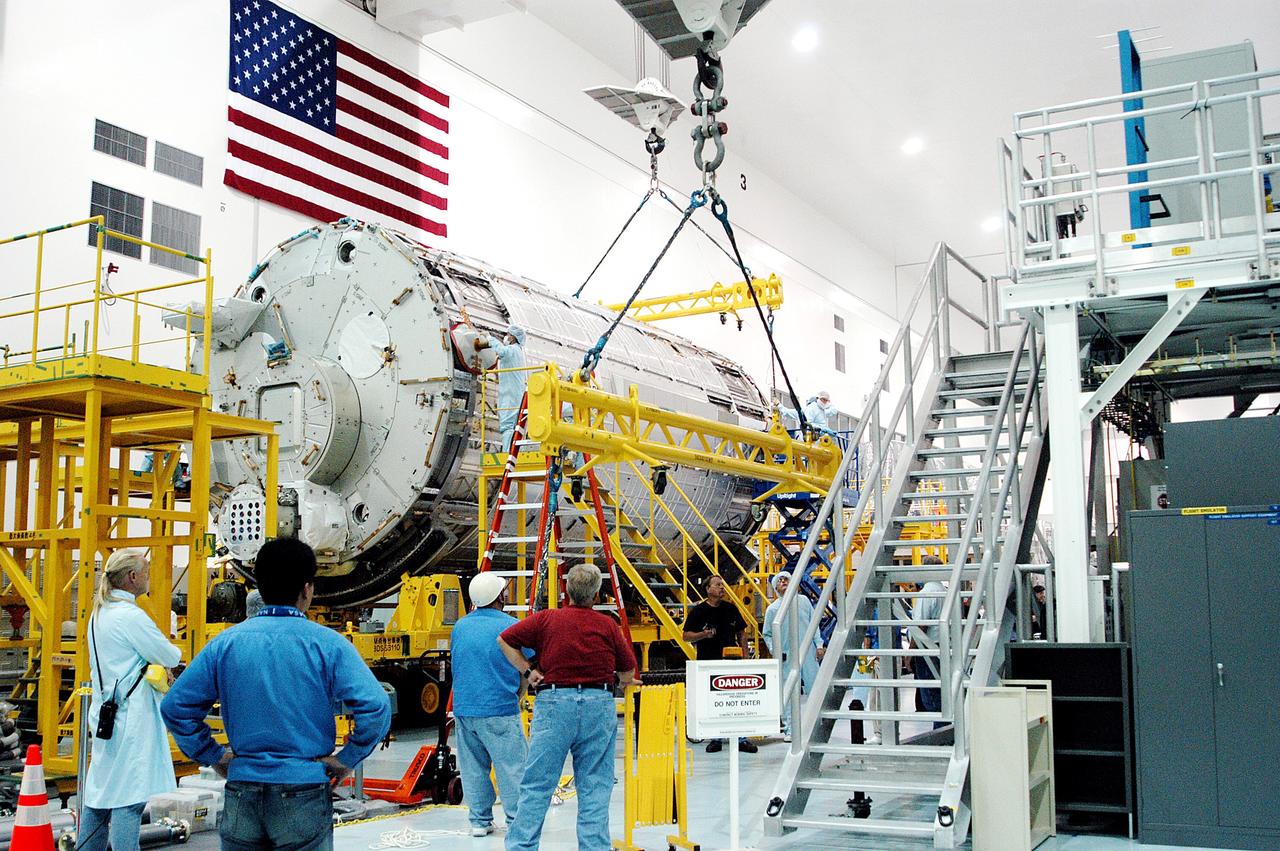
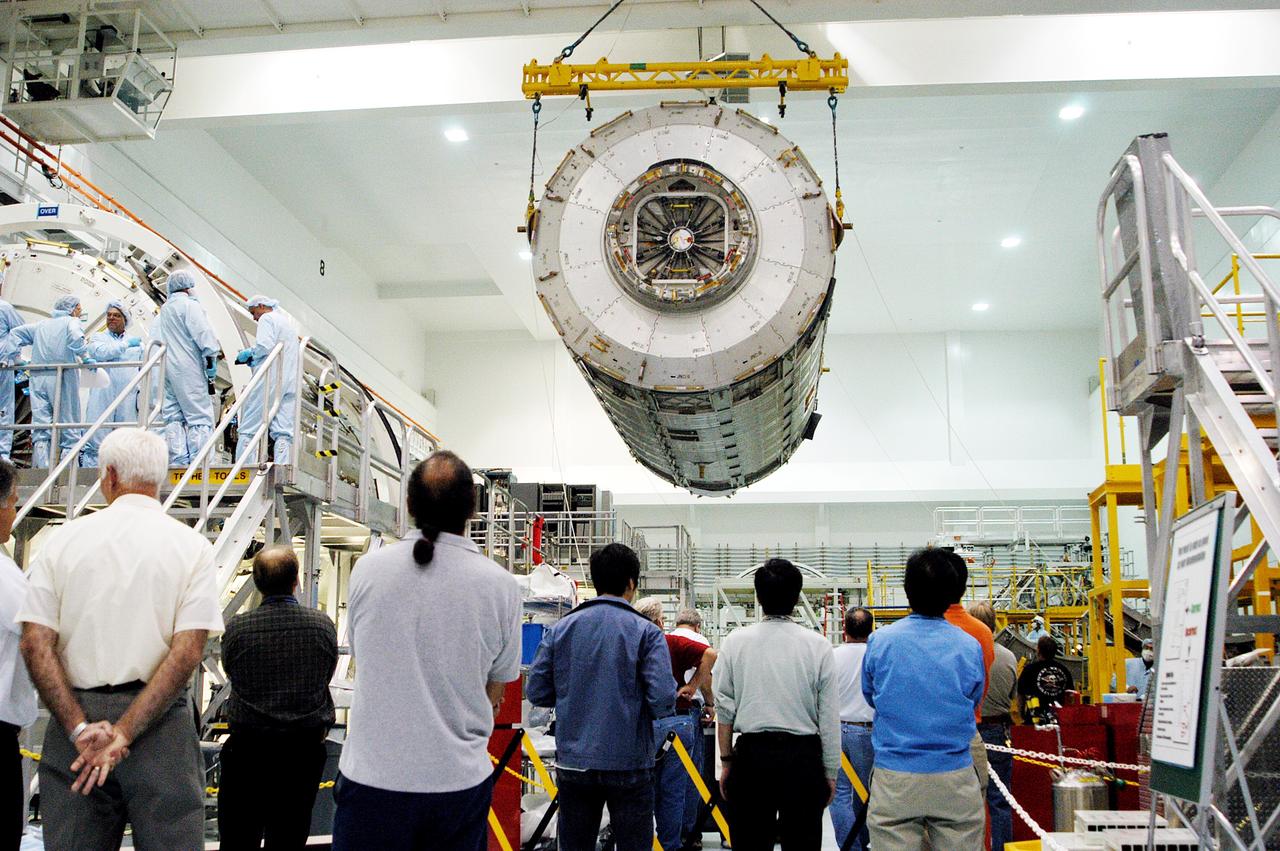
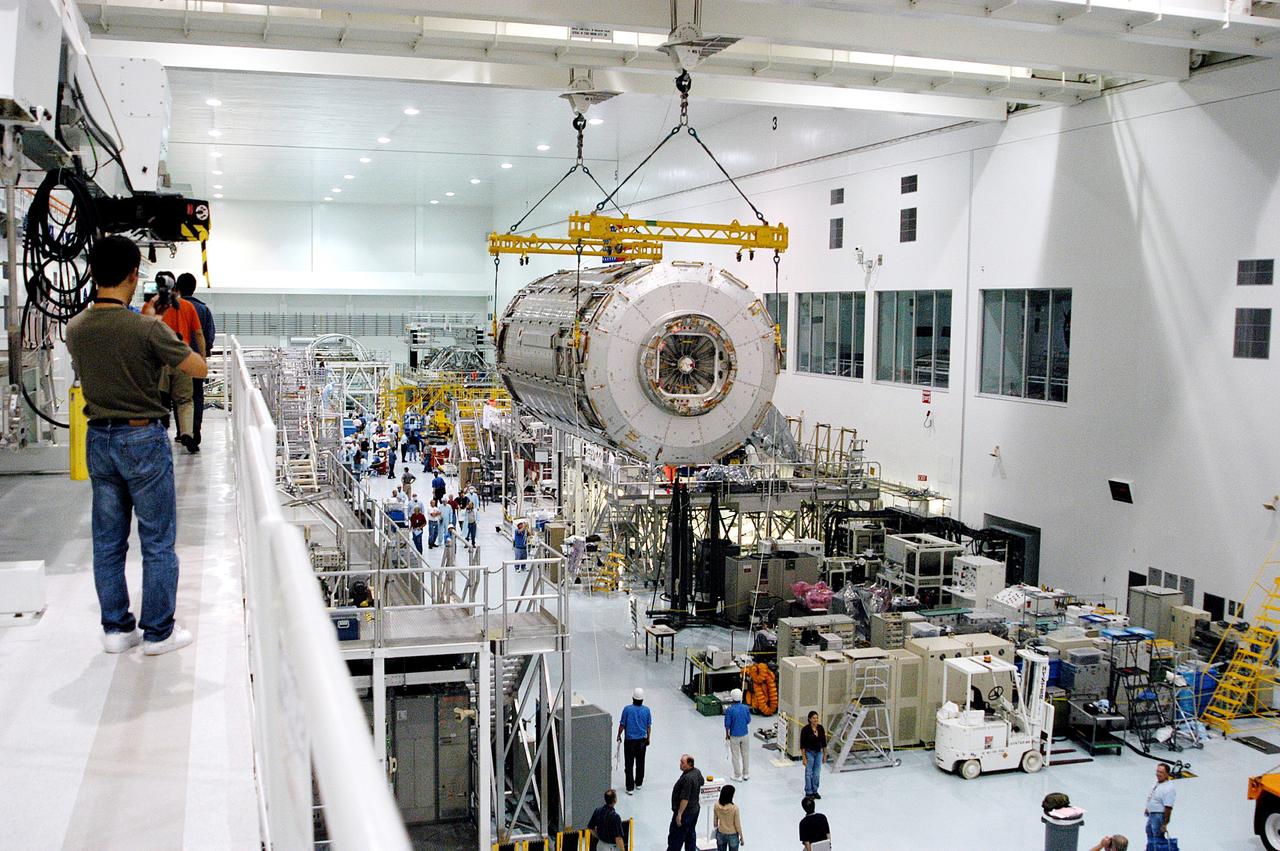
KENNEDY SPACE CENTER, FLA. -  Workers in the Space Station Processing Facility attach an overhead crane to the Japanese Experiment Module (JEM) pressure module inside its canister.  The module will be removed and transferred to a work stand in the Space Station Processing Facility.  A research laboratory, the pressurized module is the first element of the JEM, named "Kibo" (Hope), to be delivered to KSC.   The National Space Development Agency of Japan (NASDA) developed the laboratory at the Tsukuba Space Center near Tokyo and is Japan's primary contribution to the Station. It will enhance the unique research capabilities of the orbiting complex by providing an additional environment for astronauts to conduct science experiments.  The JEM also includes an exposed facility (platform) for space environment experiments, a robotic manipulator system, and two logistics modules. The various JEM components will be  assembled in space over the course of three Shuttle missions.
KENNEDY SPACE CENTER, FLA. - Workers in the Space Station Processing Facility attach an overhead crane to the Japanese Experiment Module (JEM) pressure module inside its canister. The module will be removed and transferred to a work stand in the Space Station Processing Facility. A research laboratory, the pressurized module is the first element of the JEM, named "Kibo" (Hope), to be delivered to KSC. The National Space Development Agency of Japan (NASDA) developed the laboratory at the Tsukuba Space Center near Tokyo and is Japan's primary contribution to the Station. It will enhance the unique research capabilities of the orbiting complex by providing an additional environment for astronauts to conduct science experiments. The JEM also includes an exposed facility (platform) for space environment experiments, a robotic manipulator system, and two logistics modules. The various JEM components will be assembled in space over the course of three Shuttle missions.
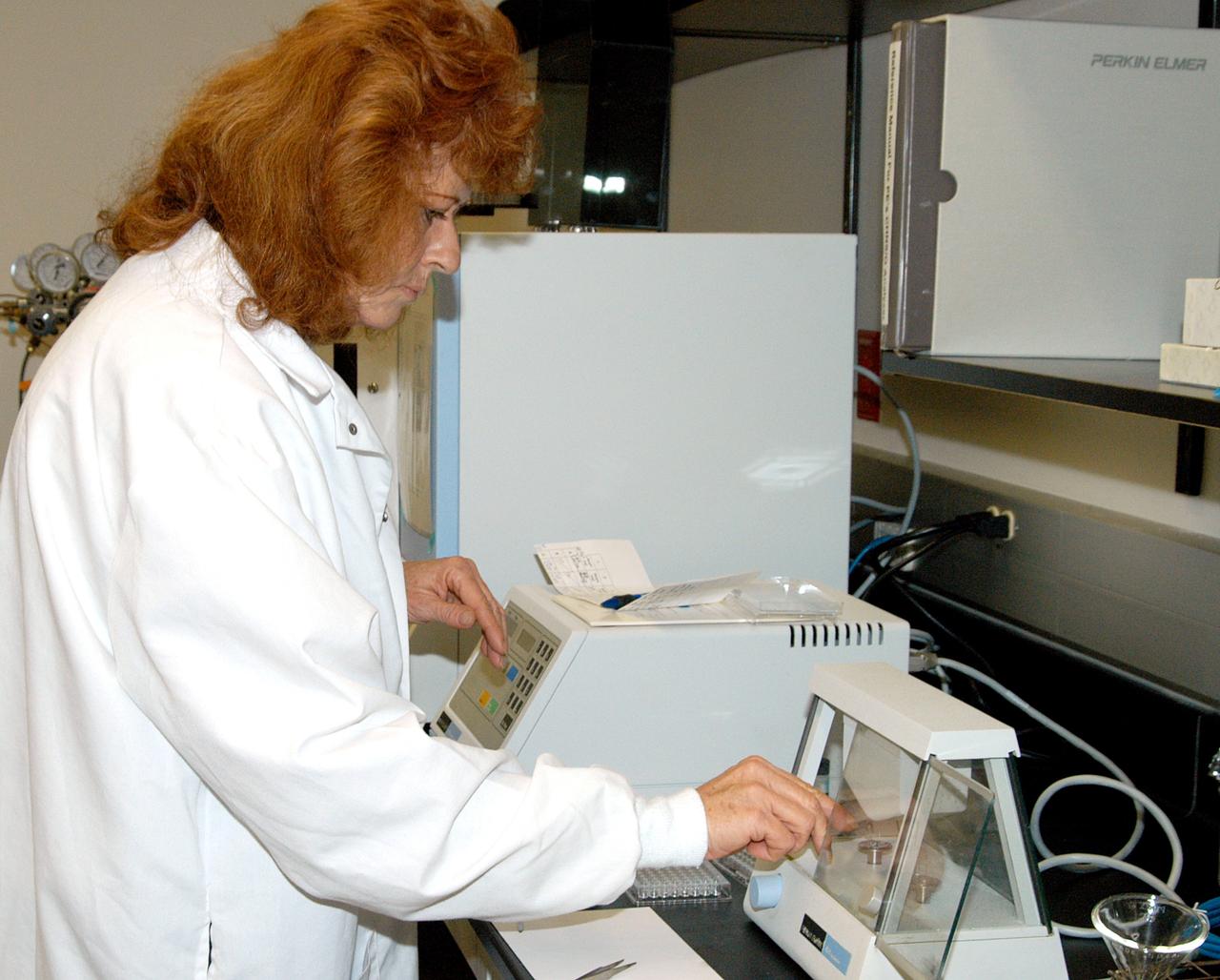
KENNEDY SPACE CENTER, FLA. -- In the Space Life Sciences (SLS) Lab, Jan Bauer, with Dynamac Corp., places samples of onion tissue in the elemental analyzer, which analyzes for carbon, hydrogen, nitrogen and sulfur. The 100,000 square-foot SLS houses labs for NASA’s ongoing research efforts, microbiology/microbial ecology studies and analytical chemistry labs. Also calling the new lab home are facilities for space flight-experiment and flight-hardware development, new plant growth chambers, and an Orbiter Environment Simulator that will be used to conduct ground control experiments in simulated flight conditions for space flight experiments.  The SLS Lab, formerly known as the Space Experiment Research and Processing Laboratory or SERPL, provides space for NASA’s Life Sciences Services contractor Dynamac Corporation, Bionetics Corporation, and researchers from the University of Florida. NASA’s Office of Biological and Physical Research will use the facility for processing life sciences experiments that will be conducted on the International Space Station. The SLS Lab is the magnet facility for the International Space Research Park at KSC being developed in partnership with Florida Space Authority.
KENNEDY SPACE CENTER, FLA. -- In the Space Life Sciences (SLS) Lab, Jan Bauer, with Dynamac Corp., places samples of onion tissue in the elemental analyzer, which analyzes for carbon, hydrogen, nitrogen and sulfur. The 100,000 square-foot SLS houses labs for NASA’s ongoing research efforts, microbiology/microbial ecology studies and analytical chemistry labs. Also calling the new lab home are facilities for space flight-experiment and flight-hardware development, new plant growth chambers, and an Orbiter Environment Simulator that will be used to conduct ground control experiments in simulated flight conditions for space flight experiments. The SLS Lab, formerly known as the Space Experiment Research and Processing Laboratory or SERPL, provides space for NASA’s Life Sciences Services contractor Dynamac Corporation, Bionetics Corporation, and researchers from the University of Florida. NASA’s Office of Biological and Physical Research will use the facility for processing life sciences experiments that will be conducted on the International Space Station. The SLS Lab is the magnet facility for the International Space Research Park at KSC being developed in partnership with Florida Space Authority.
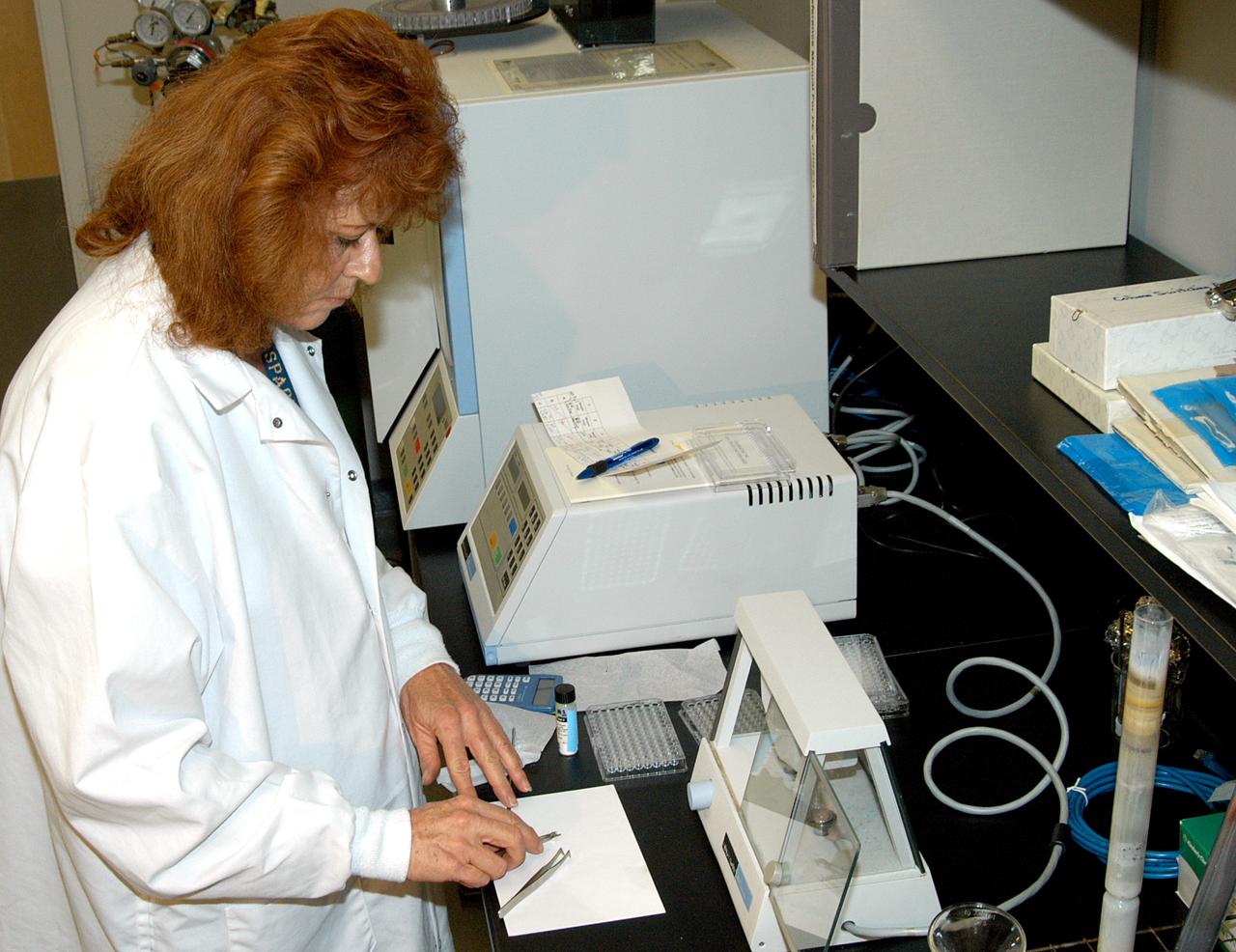
KENNEDY SPACE CENTER, FLA. -- In the Space Life Sciences (SLS) Lab, Jan Bauer, with Dynamac Corp., weighs samples of onion tissue for processing in the elemental analyzer behind it.  The equipment analyzes for carbon, hydrogen, nitrogen and sulfur. The 100,000 square-foot SLS houses labs for NASA’s ongoing research efforts, microbiology/microbial ecology studies and analytical chemistry labs. Also calling the new lab home are facilities for space flight-experiment and flight-hardware development, new plant growth chambers, and an Orbiter Environment Simulator that will be used to conduct ground control experiments in simulated flight conditions for space flight experiments.  The SLS Lab, formerly known as the Space Experiment Research and Processing Laboratory or SERPL, provides space for NASA’s Life Sciences Services contractor Dynamac Corporation, Bionetics Corporation, and researchers from the University of Florida. NASA’s Office of Biological and Physical Research will use the facility for processing life sciences experiments that will be conducted on the International Space Station. The SLS Lab is the magnet facility for the International Space Research Park at KSC being developed in partnership with Florida Space Authority.
KENNEDY SPACE CENTER, FLA. -- In the Space Life Sciences (SLS) Lab, Jan Bauer, with Dynamac Corp., weighs samples of onion tissue for processing in the elemental analyzer behind it. The equipment analyzes for carbon, hydrogen, nitrogen and sulfur. The 100,000 square-foot SLS houses labs for NASA’s ongoing research efforts, microbiology/microbial ecology studies and analytical chemistry labs. Also calling the new lab home are facilities for space flight-experiment and flight-hardware development, new plant growth chambers, and an Orbiter Environment Simulator that will be used to conduct ground control experiments in simulated flight conditions for space flight experiments. The SLS Lab, formerly known as the Space Experiment Research and Processing Laboratory or SERPL, provides space for NASA’s Life Sciences Services contractor Dynamac Corporation, Bionetics Corporation, and researchers from the University of Florida. NASA’s Office of Biological and Physical Research will use the facility for processing life sciences experiments that will be conducted on the International Space Station. The SLS Lab is the magnet facility for the International Space Research Park at KSC being developed in partnership with Florida Space Authority.
KENNEDY SPACE CENTER, FLA. -    Members of the STS-114 crew take a look at the Japanese Experiment Module (JEM) pressure module in the Space Station Processing Facility.  A research laboratory, the pressurized module is the first element of the JEM, named "Kibo" (Hope), to be delivered to KSC.   The National Space Development Agency of Japan (NASDA) developed the laboratory at the Tsukuba Space Center near Tokyo and is Japan's primary contribution to the Station. The JEM also includes an exposed facility (platform) for space environment experiments, a robotic manipulator system, and two logistics modules. The various JEM components will be  assembled in space over the course of three Shuttle missions.
KENNEDY SPACE CENTER, FLA. - Members of the STS-114 crew take a look at the Japanese Experiment Module (JEM) pressure module in the Space Station Processing Facility. A research laboratory, the pressurized module is the first element of the JEM, named "Kibo" (Hope), to be delivered to KSC. The National Space Development Agency of Japan (NASDA) developed the laboratory at the Tsukuba Space Center near Tokyo and is Japan's primary contribution to the Station. The JEM also includes an exposed facility (platform) for space environment experiments, a robotic manipulator system, and two logistics modules. The various JEM components will be assembled in space over the course of three Shuttle missions.
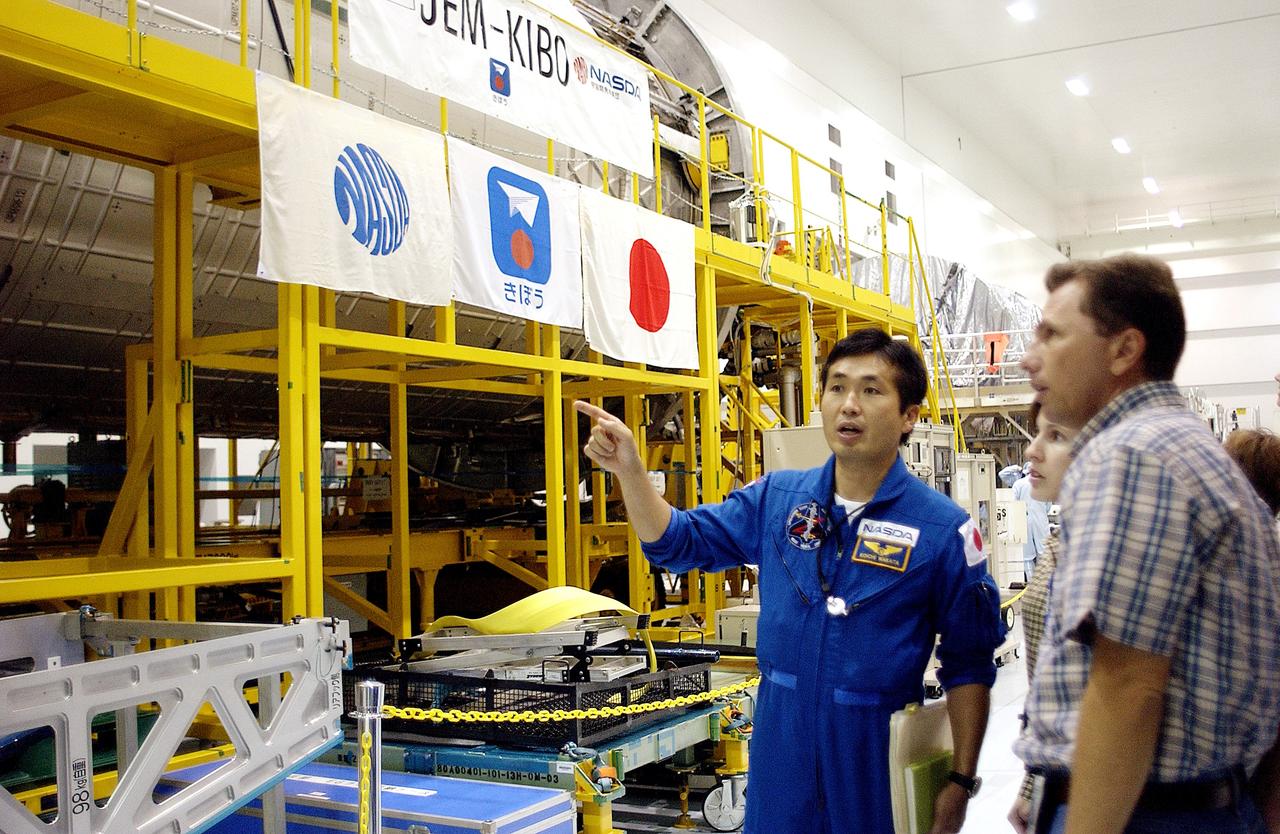
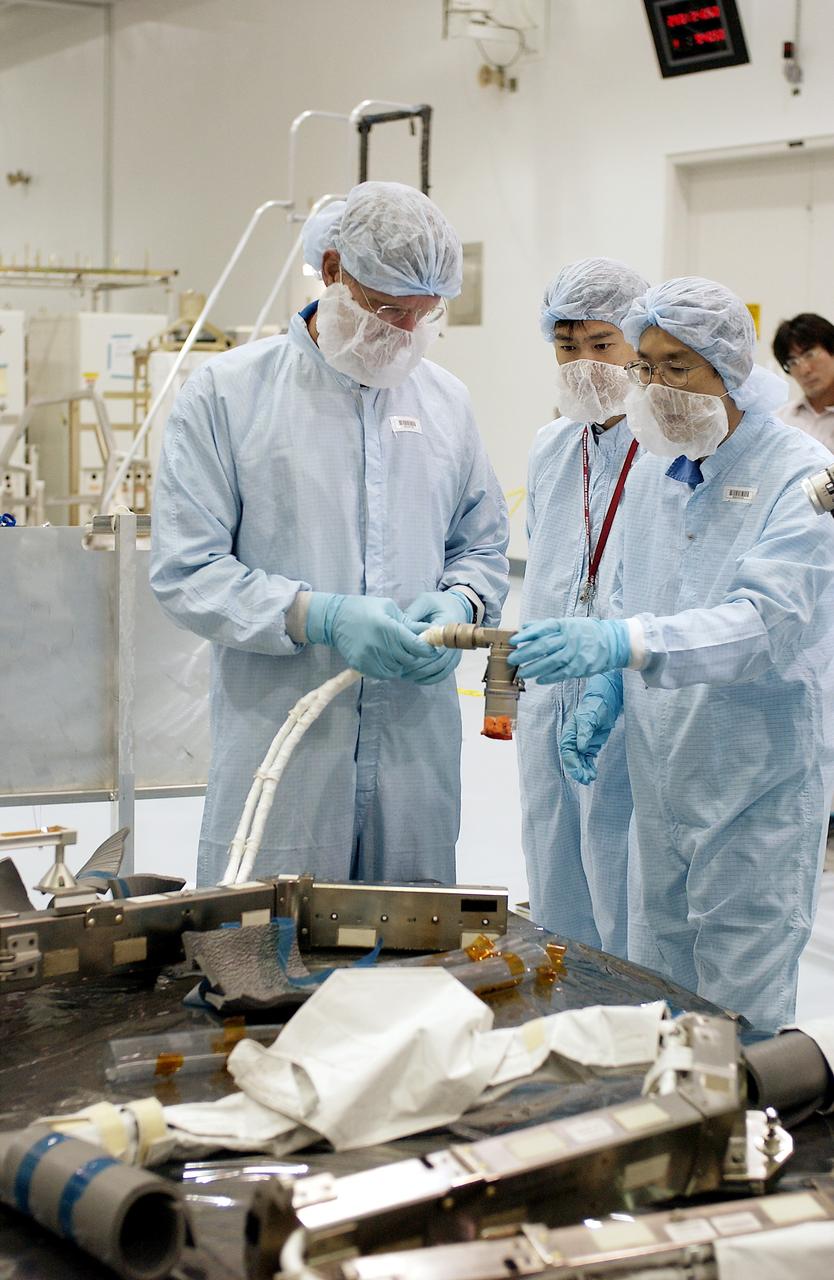
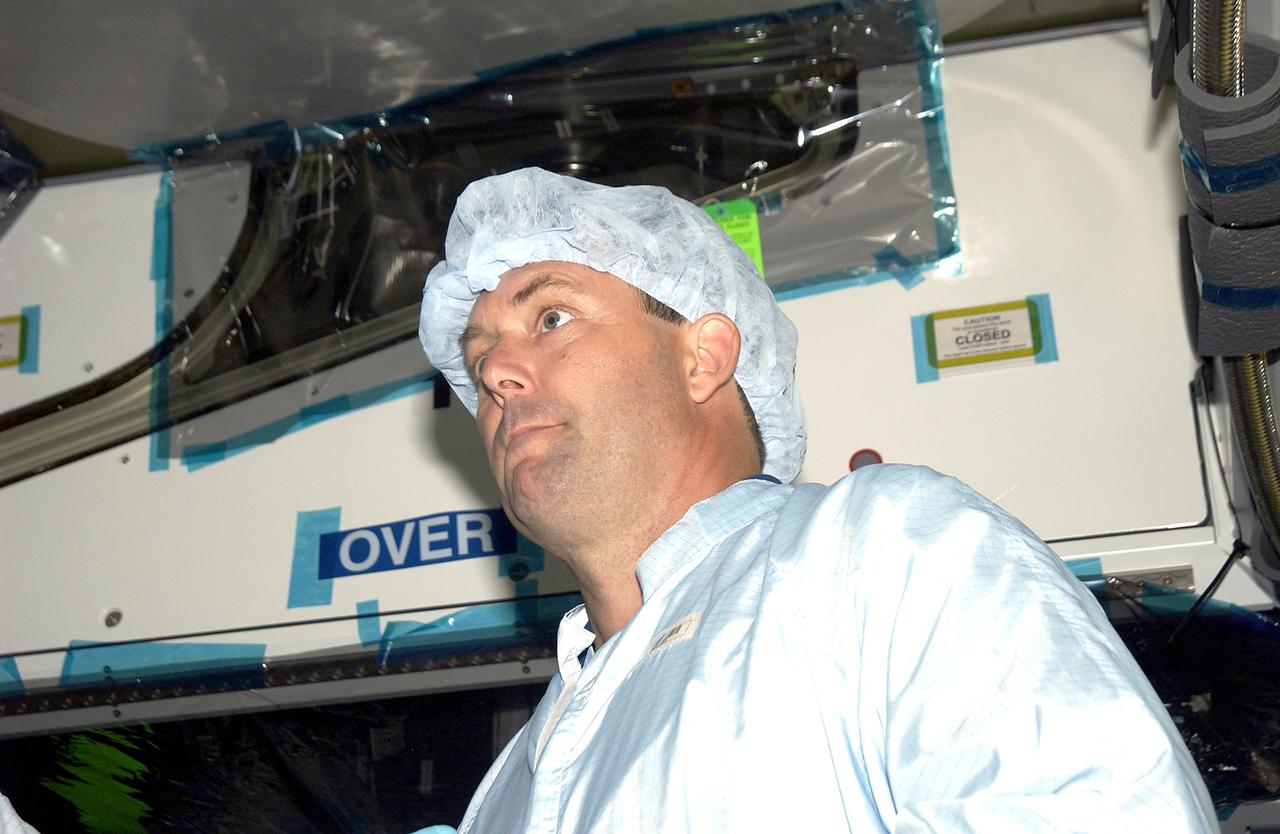
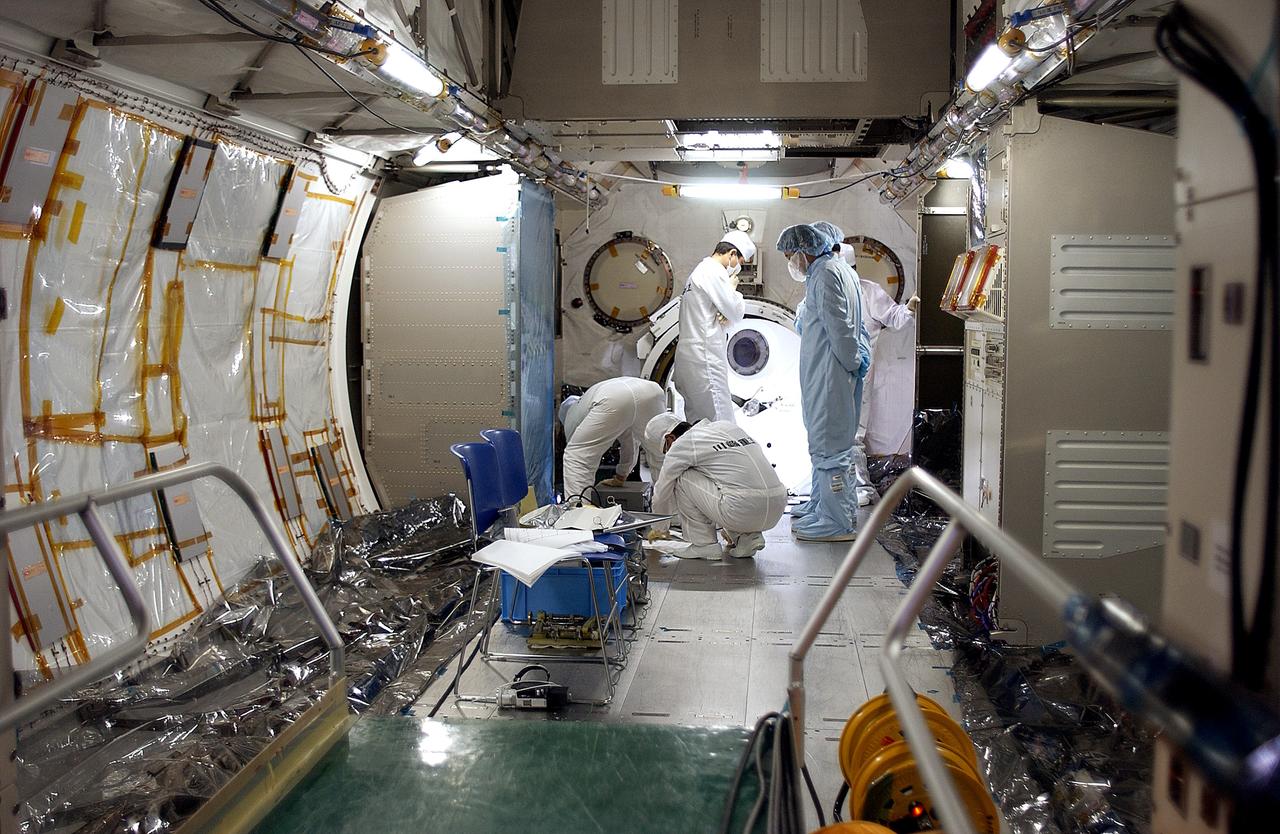
KENNEDY SPACE CENTER, FLA. - In the Space Station Processing Facility, Japanese astronaut Koichi Wakata,  dressed in blue protective clothing (at right),  looks at the inside of the Pressurized Module, or PM, part of the Japanese Experiment Module (JEM), along with technicians.  The PM provides a shirt-sleeve environment in which astronauts on the International Space Station can conduct microgravity experiments. There are a total of 23 racks, including 10 experiment racks, inside the PM providing a power supply, communications, air conditioning, hardware cooling, water control and experiment support functions.
KENNEDY SPACE CENTER, FLA. - In the Space Station Processing Facility, Japanese astronaut Koichi Wakata, dressed in blue protective clothing (at right), looks at the inside of the Pressurized Module, or PM, part of the Japanese Experiment Module (JEM), along with technicians. The PM provides a shirt-sleeve environment in which astronauts on the International Space Station can conduct microgravity experiments. There are a total of 23 racks, including 10 experiment racks, inside the PM providing a power supply, communications, air conditioning, hardware cooling, water control and experiment support functions.
KENNEDY SPACE CENTER, FLA. -   Japanese astronaut Koichi Wakata (left) releases a tray  extended from inside the Pressurized Module, or PM, that he was working with.  Part of the Japanese Experiment Module (JEM), the PM provides a shirt-sleeve environment in which astronauts on the International Space Station can conduct microgravity experiments. There are a total of 23 racks, including 10 experiment racks, inside the PM providing a power supply, communications, air conditioning, hardware cooling, water control and experiment support functions.  The JEM/PM is in the Space Station Processing Facility.
KENNEDY SPACE CENTER, FLA. - Japanese astronaut Koichi Wakata (left) releases a tray extended from inside the Pressurized Module, or PM, that he was working with. Part of the Japanese Experiment Module (JEM), the PM provides a shirt-sleeve environment in which astronauts on the International Space Station can conduct microgravity experiments. There are a total of 23 racks, including 10 experiment racks, inside the PM providing a power supply, communications, air conditioning, hardware cooling, water control and experiment support functions. The JEM/PM is in the Space Station Processing Facility.
KENNEDY SPACE CENTER, FLA. -  In the Space Station Processing Facility, Executive Director of NASDA Koji Yamamoto points to other Space Station elements.  Behind him is the Japanese Experiment Module (JEM)/pressurized module.  Mr. Yamamoto is at KSC for a welcome ceremony involving the arrival of JEM.
KENNEDY SPACE CENTER, FLA. - In the Space Station Processing Facility, Executive Director of NASDA Koji Yamamoto points to other Space Station elements. Behind him is the Japanese Experiment Module (JEM)/pressurized module. Mr. Yamamoto is at KSC for a welcome ceremony involving the arrival of JEM.
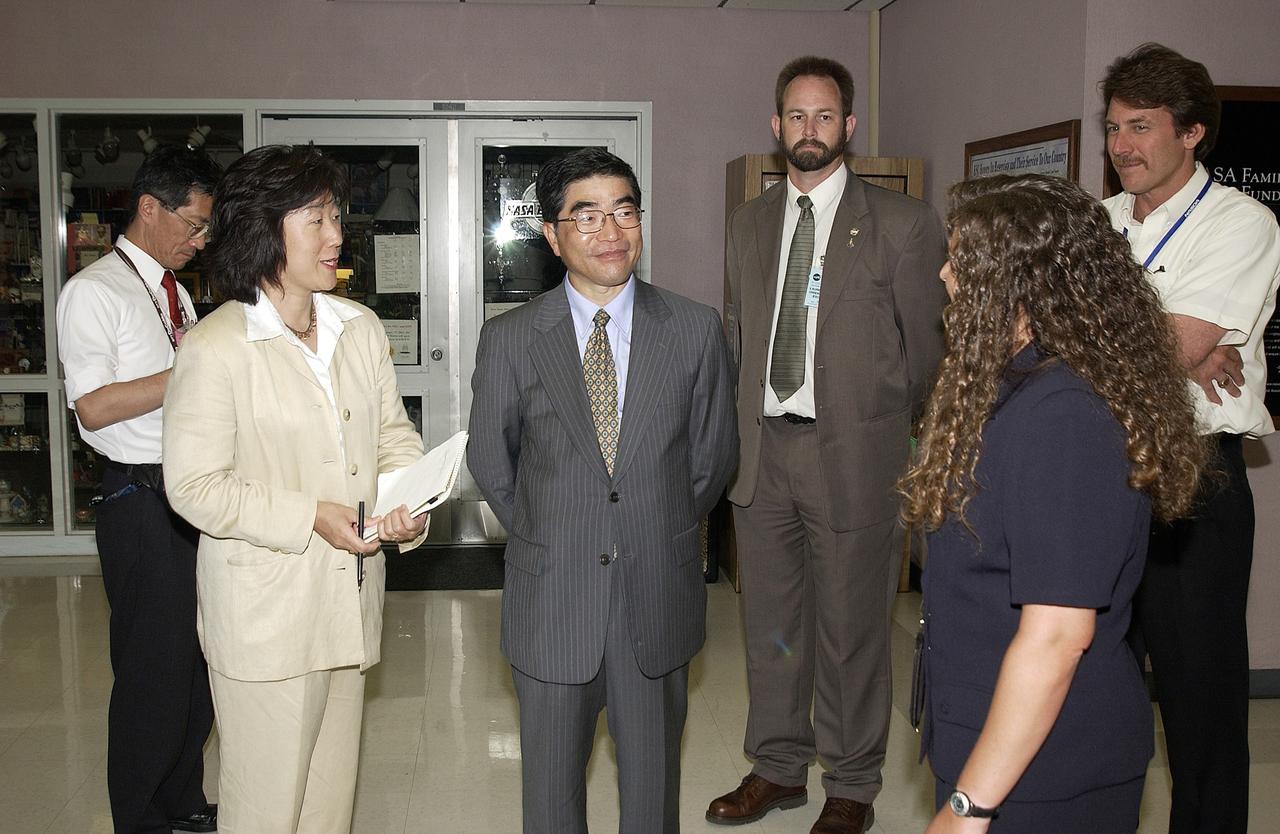
KENNEDY SPACE CENTER, FLA. -  In the Space Station Processing Facility, Executive Director of NASDA Koji Yamamoto (center) joins others for a tour.  Mr. Yamamoto is at KSC for a welcome ceremony involving the arrival of the newest Space Station module, the Japanese Experiment Module/pressurized module.
KENNEDY SPACE CENTER, FLA. - In the Space Station Processing Facility, Executive Director of NASDA Koji Yamamoto (center) joins others for a tour. Mr. Yamamoto is at KSC for a welcome ceremony involving the arrival of the newest Space Station module, the Japanese Experiment Module/pressurized module.
KENNEDY SPACE CENTER, FLA. -  In the Space Station Processing Facility, Executive Director of NASDA Koji Yamamoto (center) joins others for a tour.  Mr. Yamamoto is at KSC for a welcome ceremony involving the arrival of the newest Space Station module, the Japanese Experiment Module/pressurized module.
KENNEDY SPACE CENTER, FLA. - In the Space Station Processing Facility, Executive Director of NASDA Koji Yamamoto (center) joins others for a tour. Mr. Yamamoto is at KSC for a welcome ceremony involving the arrival of the newest Space Station module, the Japanese Experiment Module/pressurized module.
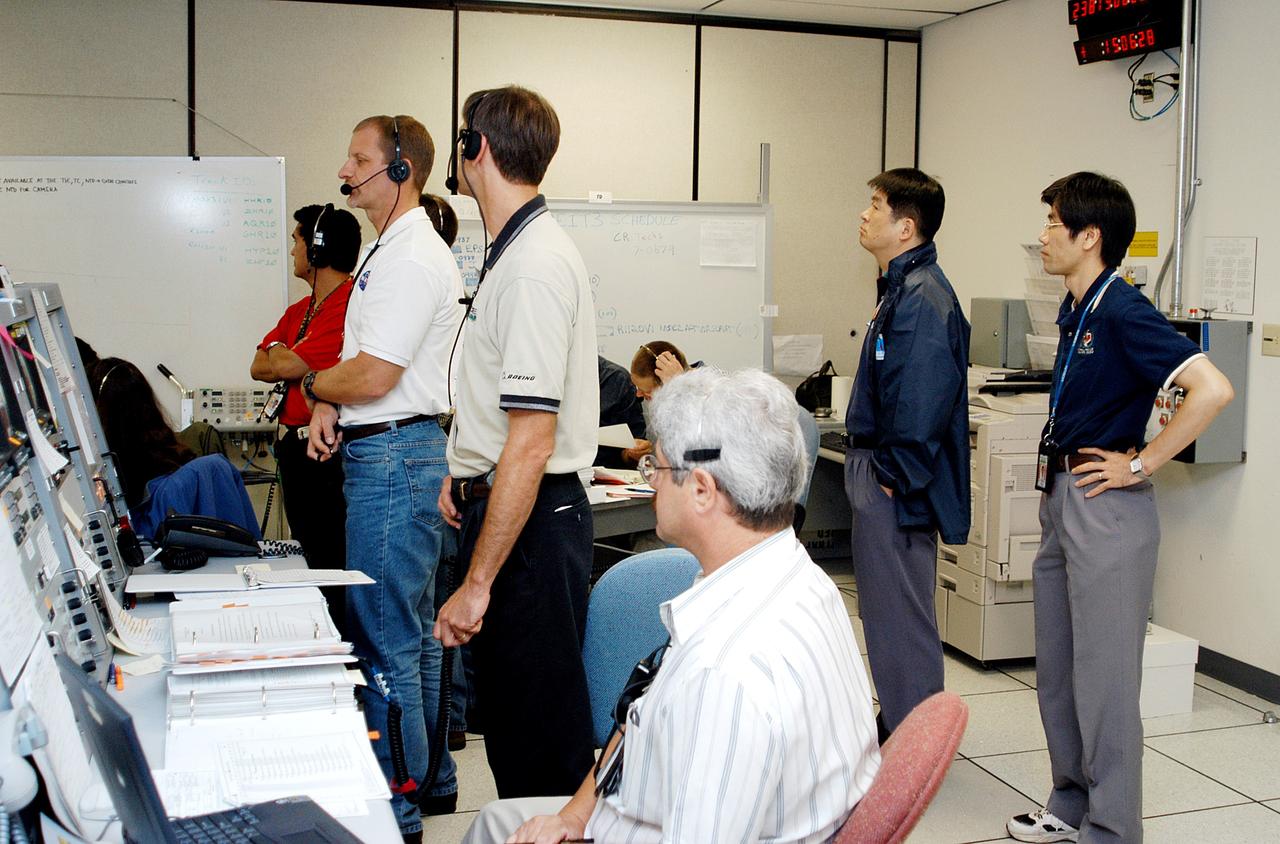
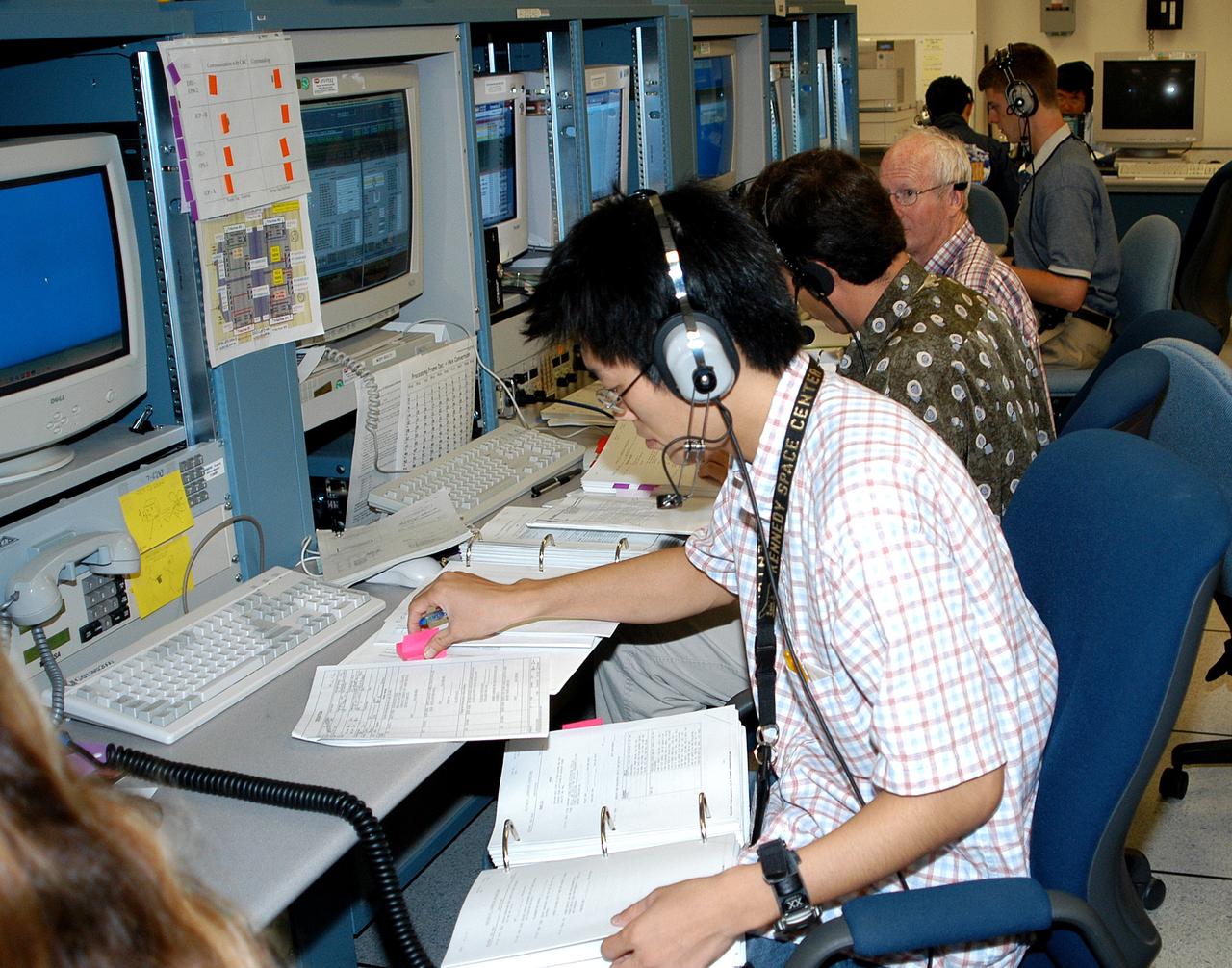
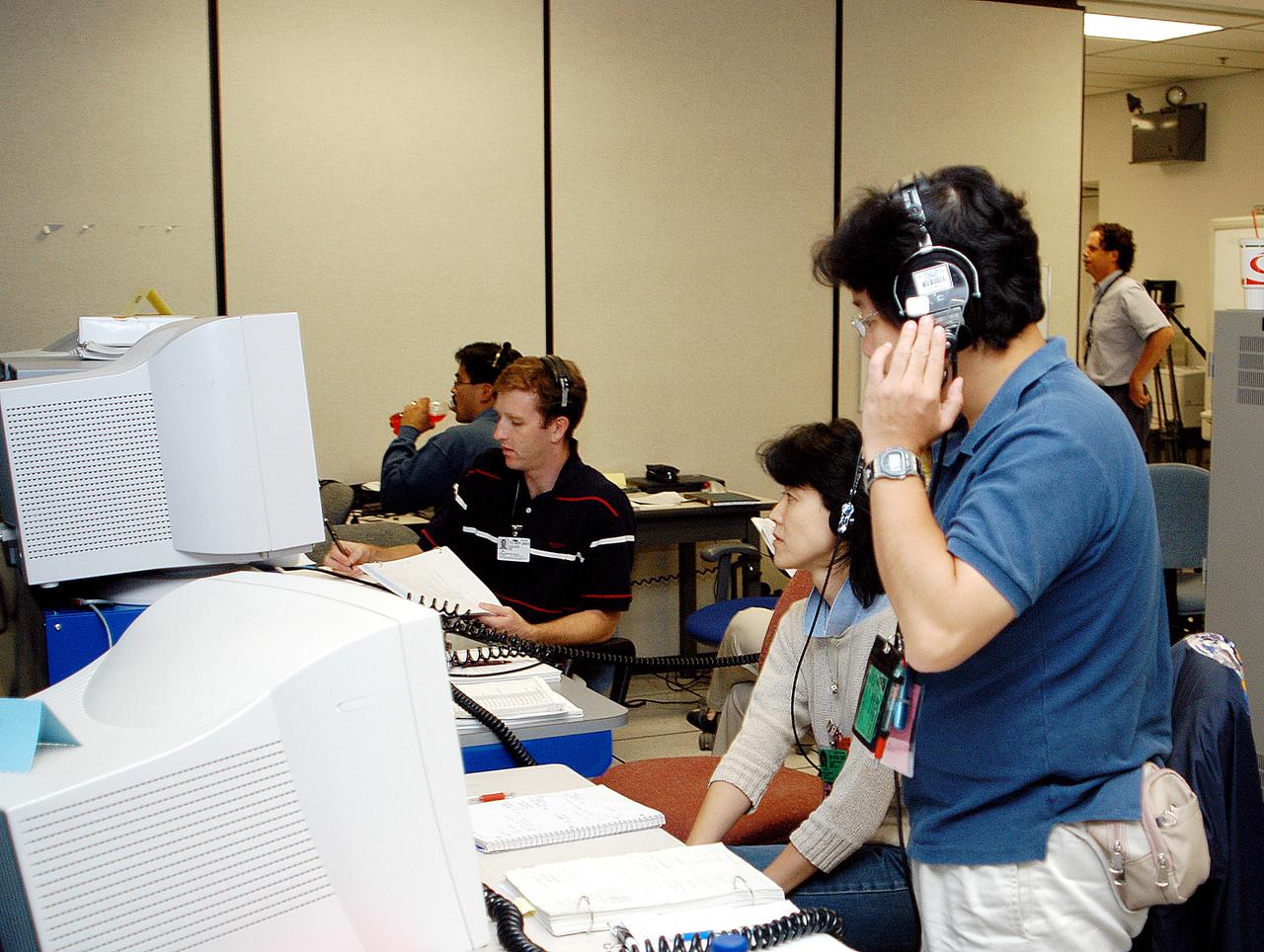
KENNEDY SPACE CENTER, FLA. -  In the Space Station Processing Facility, personnel observe sensors during a Multi-Equipment Interface Test (MEIT) on the Japanese Experiment Module (JEM).  The National Space Development Agency of Japan (NASDA) developed the laboratory at the Tsukuba Space Center near Tokyo. It is the first element, named "Kibo" (Hope), to be delivered to KSC. The JEM is Japan's primary contribution to the Station. It will enhance the unique research capabilities of the orbiting complex by providing an additional environment for astronauts to conduct science experiments.
KENNEDY SPACE CENTER, FLA. - In the Space Station Processing Facility, personnel observe sensors during a Multi-Equipment Interface Test (MEIT) on the Japanese Experiment Module (JEM). The National Space Development Agency of Japan (NASDA) developed the laboratory at the Tsukuba Space Center near Tokyo. It is the first element, named "Kibo" (Hope), to be delivered to KSC. The JEM is Japan's primary contribution to the Station. It will enhance the unique research capabilities of the orbiting complex by providing an additional environment for astronauts to conduct science experiments.
KENNEDY SPACE CENTER, FLA. - In the Space Station Processing Facility, Japanaese astronauts and personnel observe sensors during a Multi-Equipment Interface Test (MEIT) on the Japanese Experiment Module (JEM).  The National Space Development Agency of Japan (NASDA) developed the laboratory at the Tsukuba Space Center near Tokyo. It is the first element, named "Kibo" (Hope), to be delivered to KSC. The JEM is Japan's primary contribution to the Station. It will enhance the unique research capabilities of the orbiting complex by providing an additional environment for astronauts to conduct science experiments.
KENNEDY SPACE CENTER, FLA. - In the Space Station Processing Facility, Japanaese astronauts and personnel observe sensors during a Multi-Equipment Interface Test (MEIT) on the Japanese Experiment Module (JEM). The National Space Development Agency of Japan (NASDA) developed the laboratory at the Tsukuba Space Center near Tokyo. It is the first element, named "Kibo" (Hope), to be delivered to KSC. The JEM is Japan's primary contribution to the Station. It will enhance the unique research capabilities of the orbiting complex by providing an additional environment for astronauts to conduct science experiments.
KENNEDY SPACE CENTER, FLA. -  Japanese astronauts and other personnel in the Space Station Processing Facility observe sensors during a Multi-Equipment Interface Test (MEIT) on the Japanese Experiment Module (JEM).  The National Space Development Agency of Japan (NASDA) developed the laboratory at the Tsukuba Space Center near Tokyo. It is the first element, named "Kibo" (Hope), to be delivered to KSC. The JEM is Japan's primary contribution to the Station. It will enhance the unique research capabilities of the orbiting complex by providing an additional environment for astronauts to conduct science experiments.
KENNEDY SPACE CENTER, FLA. - Japanese astronauts and other personnel in the Space Station Processing Facility observe sensors during a Multi-Equipment Interface Test (MEIT) on the Japanese Experiment Module (JEM). The National Space Development Agency of Japan (NASDA) developed the laboratory at the Tsukuba Space Center near Tokyo. It is the first element, named "Kibo" (Hope), to be delivered to KSC. The JEM is Japan's primary contribution to the Station. It will enhance the unique research capabilities of the orbiting complex by providing an additional environment for astronauts to conduct science experiments.
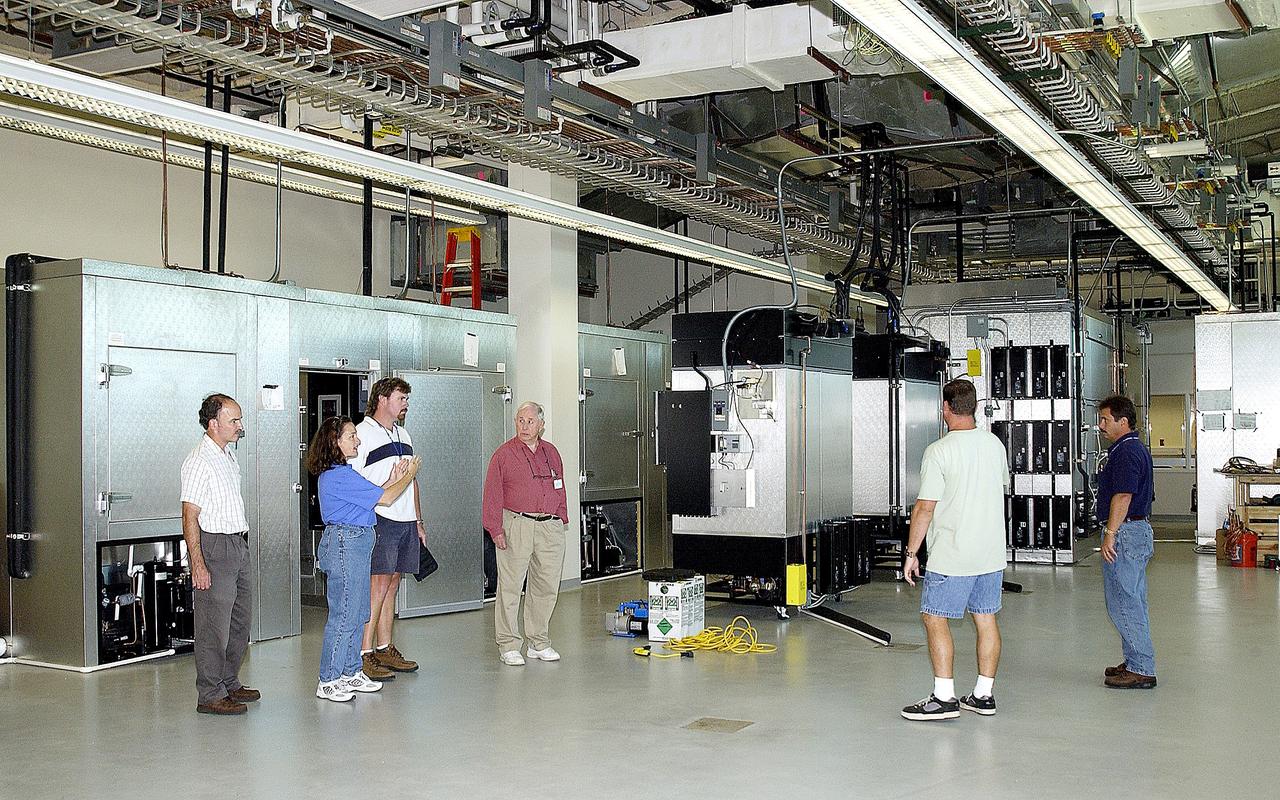
KENNEDY SPACE CENTER, FLA. -  Employees check out the new chamber facilities of the Space Life Sciences Lab (SLSL), formerly known as the Space Experiment Research and Processing Laboratory (SERPL).  From left are Ray Wheeler, with NASA; Debbie Wells and Larry Burns, with Dynamac; A.O. Rule, president of Environmental Growth Chambers, Inc. (ECG); Neil Yorio, with Dynamac; and John Wiezchowski, with ECG.  The SLSL is a state-of-the-art facility being built for ISS biotechnology research. Developed as a partnership between NASA-KSC and the State of Florida, NASA’s life sciences contractor will be the primary tenant of the facility, leasing space to conduct flight experiment processing and NASA-sponsored research. About 20 percent of the facility will be available for use by Florida’s university researchers through the Florida Space Research Institute.
KENNEDY SPACE CENTER, FLA. - Employees check out the new chamber facilities of the Space Life Sciences Lab (SLSL), formerly known as the Space Experiment Research and Processing Laboratory (SERPL). From left are Ray Wheeler, with NASA; Debbie Wells and Larry Burns, with Dynamac; A.O. Rule, president of Environmental Growth Chambers, Inc. (ECG); Neil Yorio, with Dynamac; and John Wiezchowski, with ECG. The SLSL is a state-of-the-art facility being built for ISS biotechnology research. Developed as a partnership between NASA-KSC and the State of Florida, NASA’s life sciences contractor will be the primary tenant of the facility, leasing space to conduct flight experiment processing and NASA-sponsored research. About 20 percent of the facility will be available for use by Florida’s university researchers through the Florida Space Research Institute.
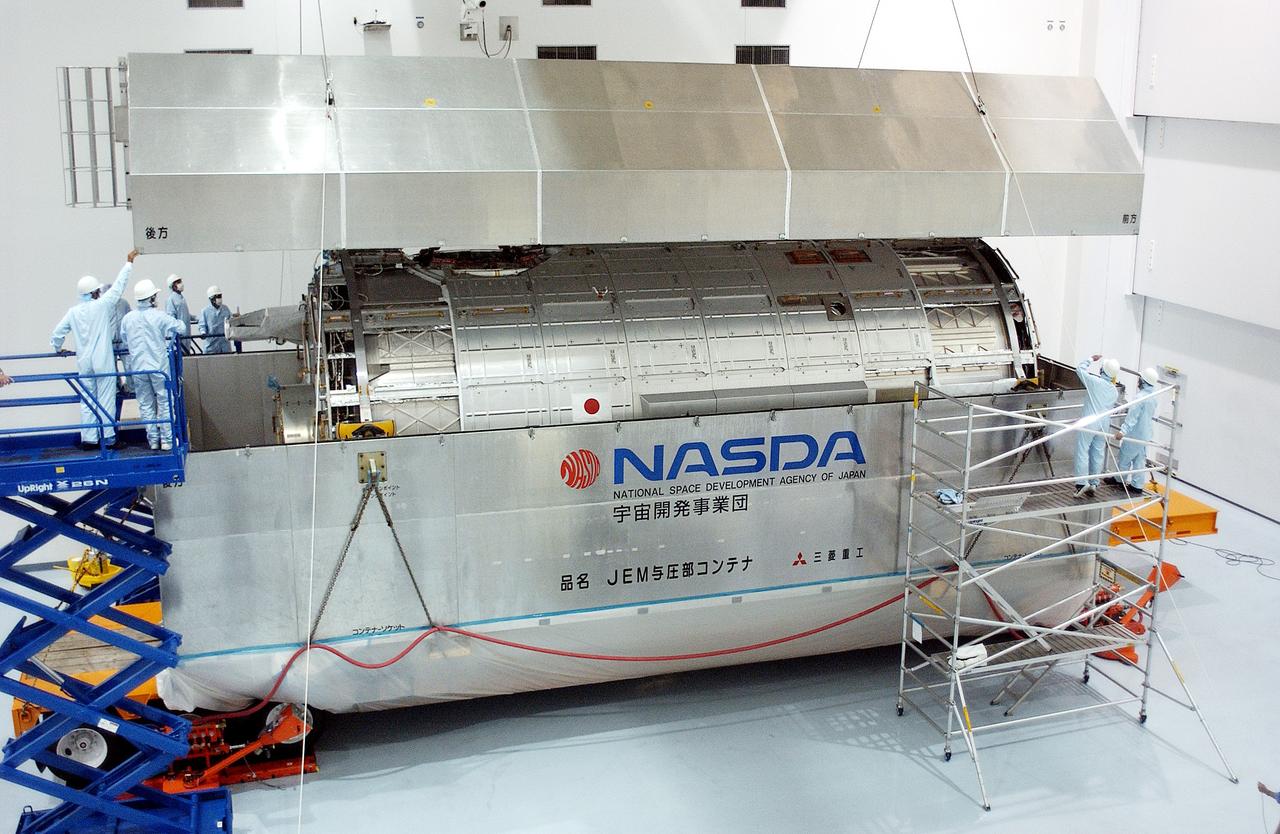
KENNEDY SPACE CENTER, FLA. -   In the Space Station Processing Facility, the lid is removed from the container with the Japanese Experiment Module (JEM) pressure module inside.  A research laboratory, the pressurized module is the first element of the JEM, named "Kibo" (Hope), to be delivered to KSC.   The National Space Development Agency of Japan (NASDA) developed the laboratory at the Tsukuba Space Center near Tokyo and is Japan's primary contribution to the Station. It will enhance the unique research capabilities of the orbiting complex by providing an additional environment for astronauts to conduct science experiments.  The JEM also includes an exposed facility (platform) for space environment experiments, a robotic manipulator system, and two logistics modules. The various JEM components will be  assembled in space over the course of three Shuttle missions.
KENNEDY SPACE CENTER, FLA. - In the Space Station Processing Facility, the lid is removed from the container with the Japanese Experiment Module (JEM) pressure module inside. A research laboratory, the pressurized module is the first element of the JEM, named "Kibo" (Hope), to be delivered to KSC. The National Space Development Agency of Japan (NASDA) developed the laboratory at the Tsukuba Space Center near Tokyo and is Japan's primary contribution to the Station. It will enhance the unique research capabilities of the orbiting complex by providing an additional environment for astronauts to conduct science experiments. The JEM also includes an exposed facility (platform) for space environment experiments, a robotic manipulator system, and two logistics modules. The various JEM components will be assembled in space over the course of three Shuttle missions.
KENNEDY SPACE CENTER, FLA. -  In the Space Station Processing Facility, the lid is removed from the container with the Japanese Experiment Module (JEM) pressure module inside.  A research laboratory, the pressurized module is the first element of the JEM, named "Kibo" (Hope), to be delivered to KSC.   The National Space Development Agency of Japan (NASDA) developed the laboratory at the Tsukuba Space Center near Tokyo and is Japan's primary contribution to the Station. It will enhance the unique research capabilities of the orbiting complex by providing an additional environment for astronauts to conduct science experiments.  The JEM also includes an exposed facility (platform) for space environment experiments, a robotic manipulator system, and two logistics modules. The various JEM components will be  assembled in space over the course of three Shuttle missions.
KENNEDY SPACE CENTER, FLA. - In the Space Station Processing Facility, the lid is removed from the container with the Japanese Experiment Module (JEM) pressure module inside. A research laboratory, the pressurized module is the first element of the JEM, named "Kibo" (Hope), to be delivered to KSC. The National Space Development Agency of Japan (NASDA) developed the laboratory at the Tsukuba Space Center near Tokyo and is Japan's primary contribution to the Station. It will enhance the unique research capabilities of the orbiting complex by providing an additional environment for astronauts to conduct science experiments. The JEM also includes an exposed facility (platform) for space environment experiments, a robotic manipulator system, and two logistics modules. The various JEM components will be assembled in space over the course of three Shuttle missions.
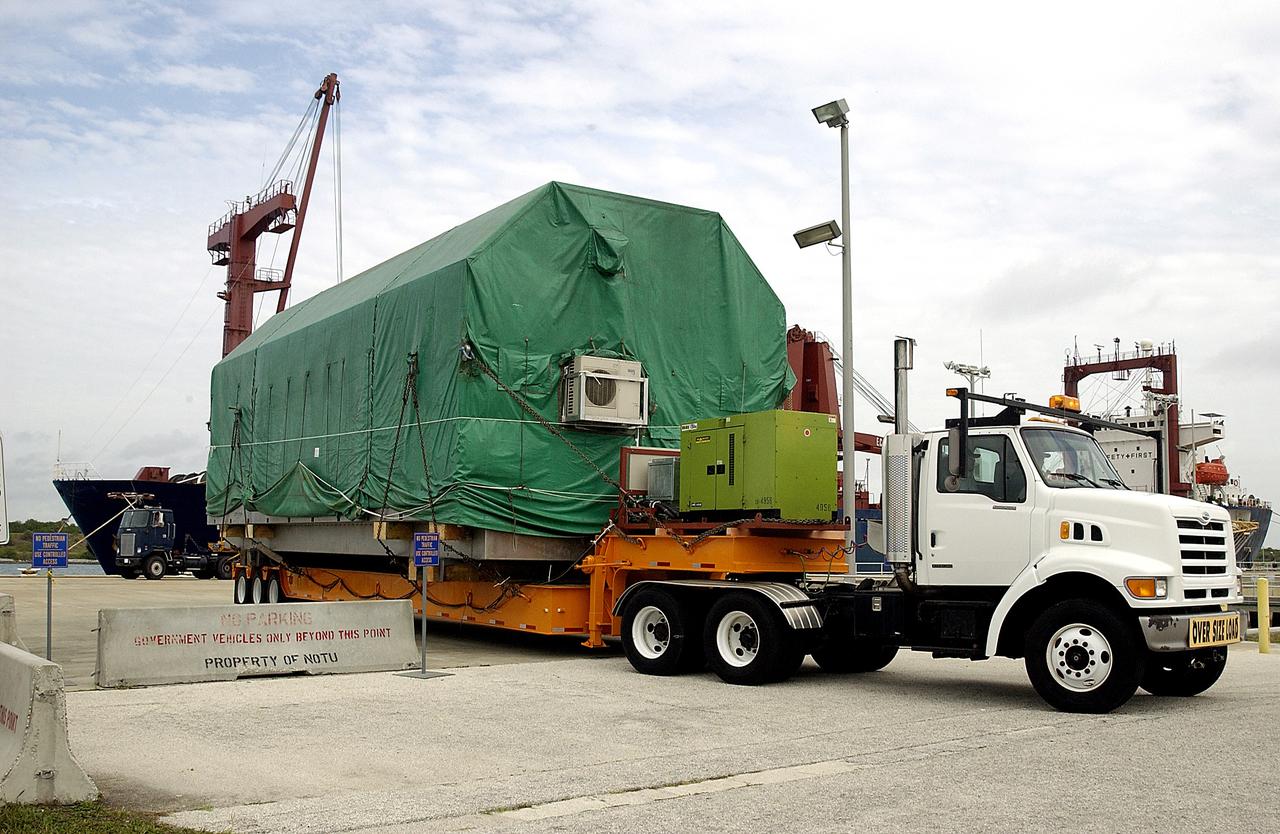
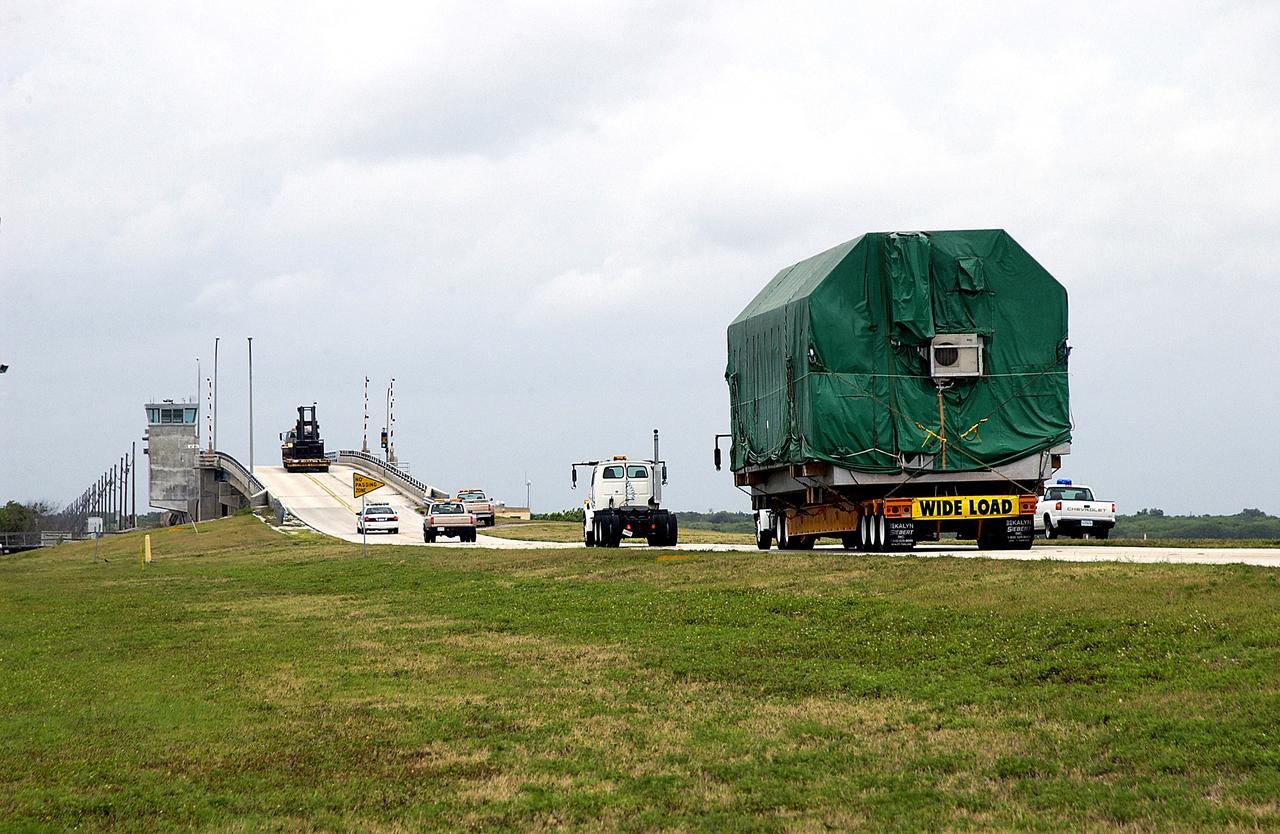
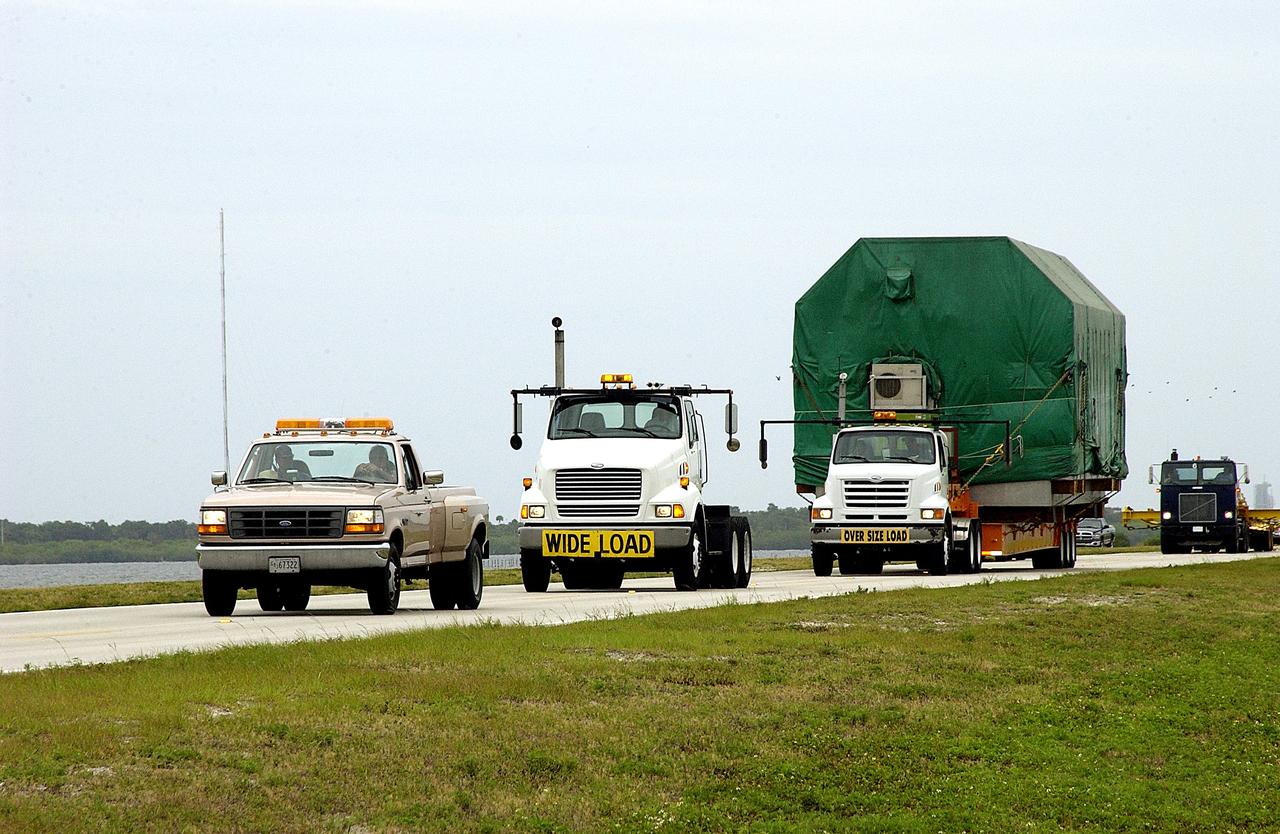
KENNEDY SPACE CENTER, FLA. -  A convoy accompanies the truck transporting the Pressurized Module of the Japanese Experiment Module (JEM) to KSC’s Space Station Processing Facility.  The National Space Development Agency of Japan (NASDA) developed the laboratory at the Tsukuba Space Center near Tokyo. The Pressurized Module is the first element of the JEM, named "Kibo" (Hope), to be delivered to KSC.  The JEM is Japan's primary contribution to the Station. It will enhance the unique research capabilities of the orbiting complex by providing an additional environment for astronauts to conduct science experiments.  The JEM also includes an exposed facility (platform) for space environment experiments, a robotic manipulator system, and two logistics modules. The various JEM components will be  assembled in space over the course of three Shuttle missions.
KENNEDY SPACE CENTER, FLA. - A convoy accompanies the truck transporting the Pressurized Module of the Japanese Experiment Module (JEM) to KSC’s Space Station Processing Facility. The National Space Development Agency of Japan (NASDA) developed the laboratory at the Tsukuba Space Center near Tokyo. The Pressurized Module is the first element of the JEM, named "Kibo" (Hope), to be delivered to KSC. The JEM is Japan's primary contribution to the Station. It will enhance the unique research capabilities of the orbiting complex by providing an additional environment for astronauts to conduct science experiments. The JEM also includes an exposed facility (platform) for space environment experiments, a robotic manipulator system, and two logistics modules. The various JEM components will be assembled in space over the course of three Shuttle missions.
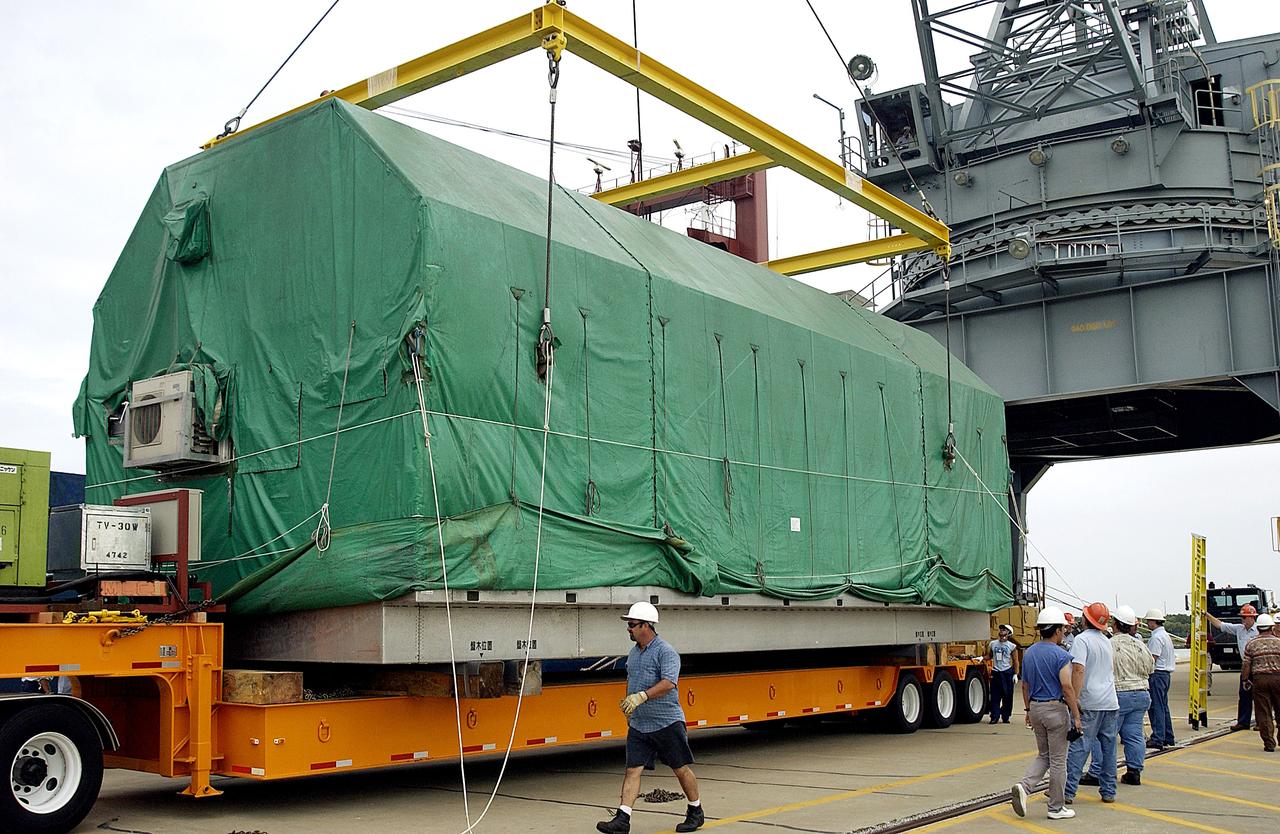
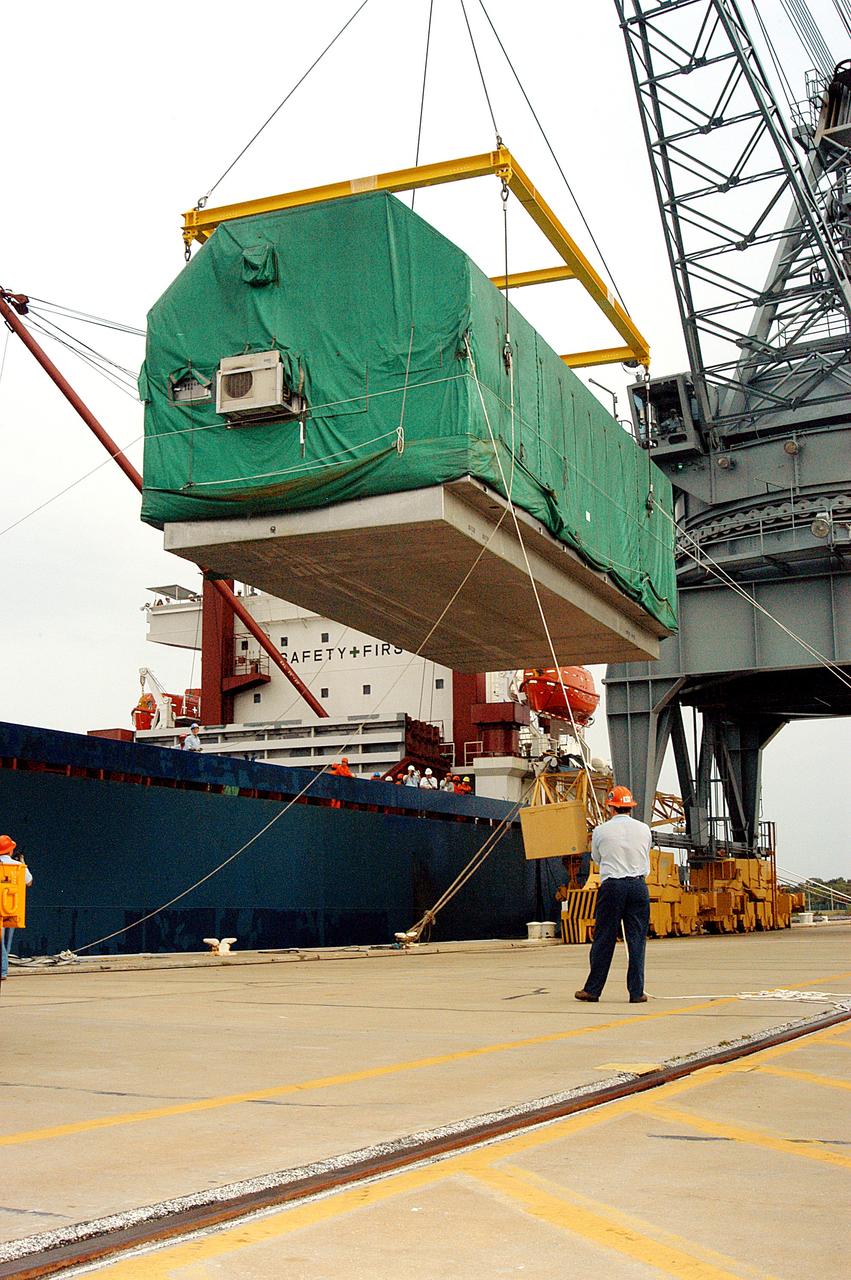
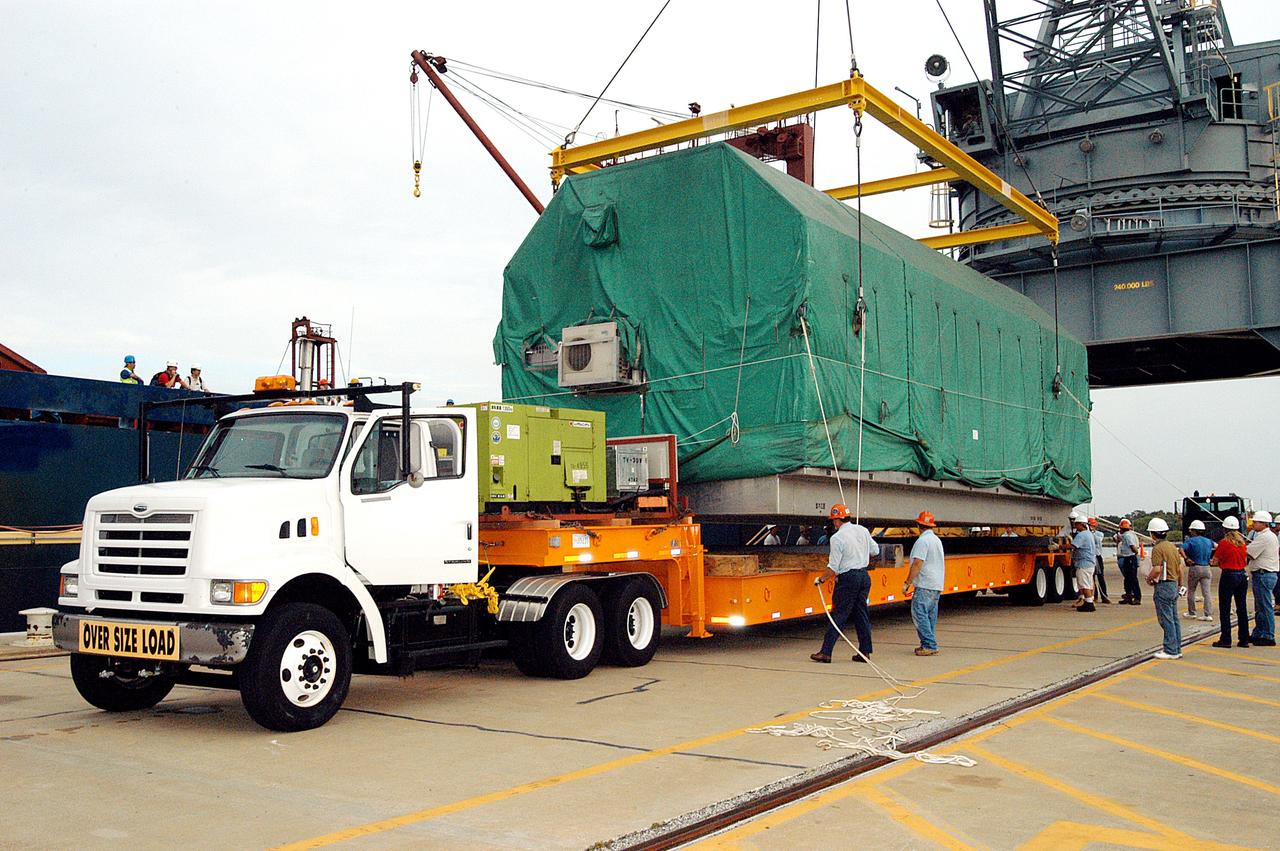
KENNEDY SPACE CENTER, FLA. - At Port Canaveral, the Pressurized Module of the Japanese Experiment Module (JEM) is lowered onto a truck bed for transfer to KSC’s Space Station Processing Facility.  The container transport ship carrying JEM departed May 2 from Yokohama Harbor in Japan for the voyage to the United States. The National Space Development Agency of Japan (NASDA) developed the laboratory at the Tsukuba Space Center near Tokyo. The Pressurized Module is the first element of the JEM, named "Kibo" (Hope), to be delivered to KSC. The JEM is Japan's primary contribution to the Station. It will enhance the unique research capabilities of the orbiting complex by providing an additional environment for astronauts to conduct science experiments.  The JEM also includes an exposed facility (platform) for space environment experiments, a robotic manipulator system, and two logistics modules. The various JEM components will be  assembled in space over the course of three Shuttle missions.
KENNEDY SPACE CENTER, FLA. - At Port Canaveral, the Pressurized Module of the Japanese Experiment Module (JEM) is lowered onto a truck bed for transfer to KSC’s Space Station Processing Facility. The container transport ship carrying JEM departed May 2 from Yokohama Harbor in Japan for the voyage to the United States. The National Space Development Agency of Japan (NASDA) developed the laboratory at the Tsukuba Space Center near Tokyo. The Pressurized Module is the first element of the JEM, named "Kibo" (Hope), to be delivered to KSC. The JEM is Japan's primary contribution to the Station. It will enhance the unique research capabilities of the orbiting complex by providing an additional environment for astronauts to conduct science experiments. The JEM also includes an exposed facility (platform) for space environment experiments, a robotic manipulator system, and two logistics modules. The various JEM components will be assembled in space over the course of three Shuttle missions.
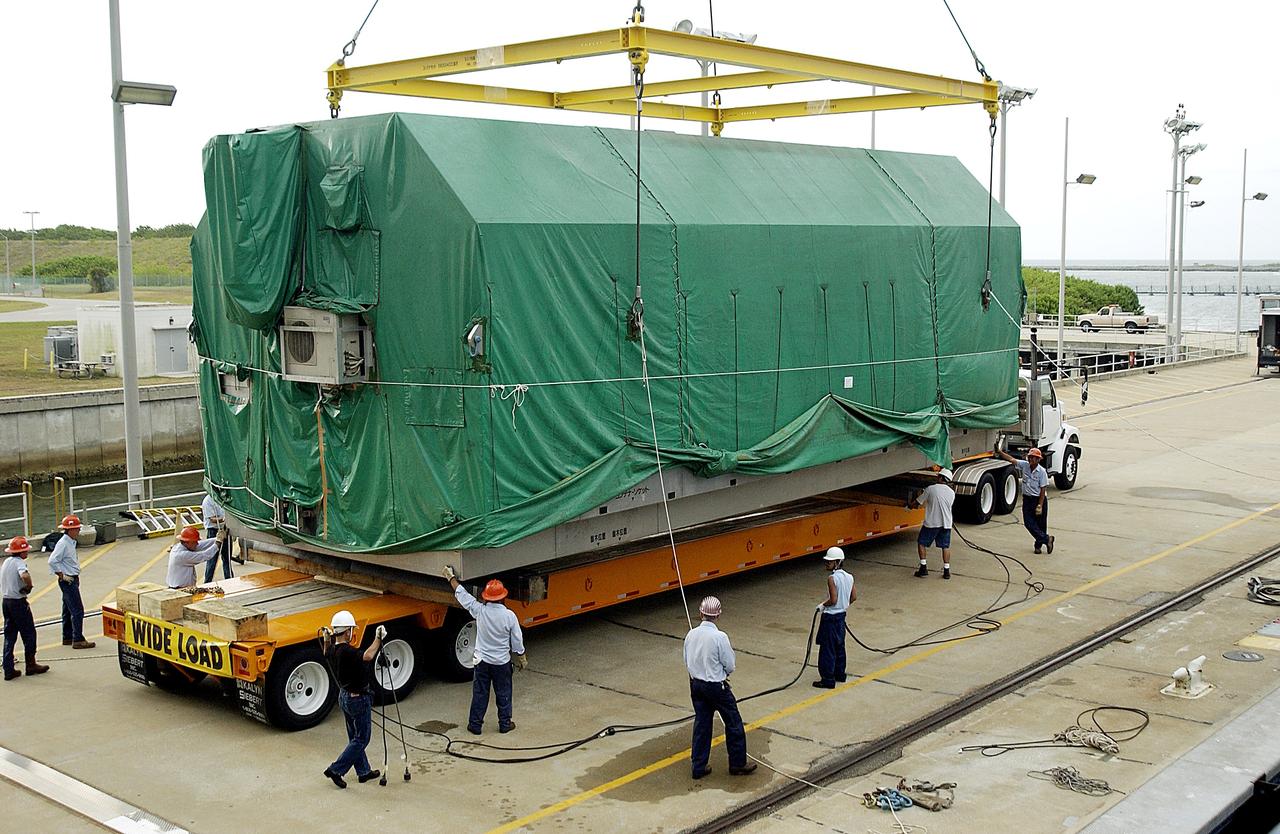
KENNEDY SPACE CENTER, FLA. - At Port Canaveral, workers release the overhead crane that lifted the Pressurized Module of the Japanese Experiment Module (JEM) from the ship onto the truck bed.  The container transport ship carrying JEM departed May 2 from Yokohama Harbor in Japan for the voyage to the United States. The National Space Development Agency of Japan (NASDA) developed the laboratory at the Tsukuba Space Center near Tokyo. The Pressurized Module is the first element of the JEM, named "Kibo" (Hope), to be delivered to KSC, and will be transferred to KSC’s Space Station Processing Facility.  The JEM is Japan's primary contribution to the Station. It will enhance the unique research capabilities of the orbiting complex by providing an additional environment for astronauts to conduct science experiments.  The JEM also includes an exposed facility (platform) for space environment experiments, a robotic manipulator system, and two logistics modules. The various JEM components will be  assembled in space over the course of three Shuttle missions.
KENNEDY SPACE CENTER, FLA. - At Port Canaveral, workers release the overhead crane that lifted the Pressurized Module of the Japanese Experiment Module (JEM) from the ship onto the truck bed. The container transport ship carrying JEM departed May 2 from Yokohama Harbor in Japan for the voyage to the United States. The National Space Development Agency of Japan (NASDA) developed the laboratory at the Tsukuba Space Center near Tokyo. The Pressurized Module is the first element of the JEM, named "Kibo" (Hope), to be delivered to KSC, and will be transferred to KSC’s Space Station Processing Facility. The JEM is Japan's primary contribution to the Station. It will enhance the unique research capabilities of the orbiting complex by providing an additional environment for astronauts to conduct science experiments. The JEM also includes an exposed facility (platform) for space environment experiments, a robotic manipulator system, and two logistics modules. The various JEM components will be assembled in space over the course of three Shuttle missions.
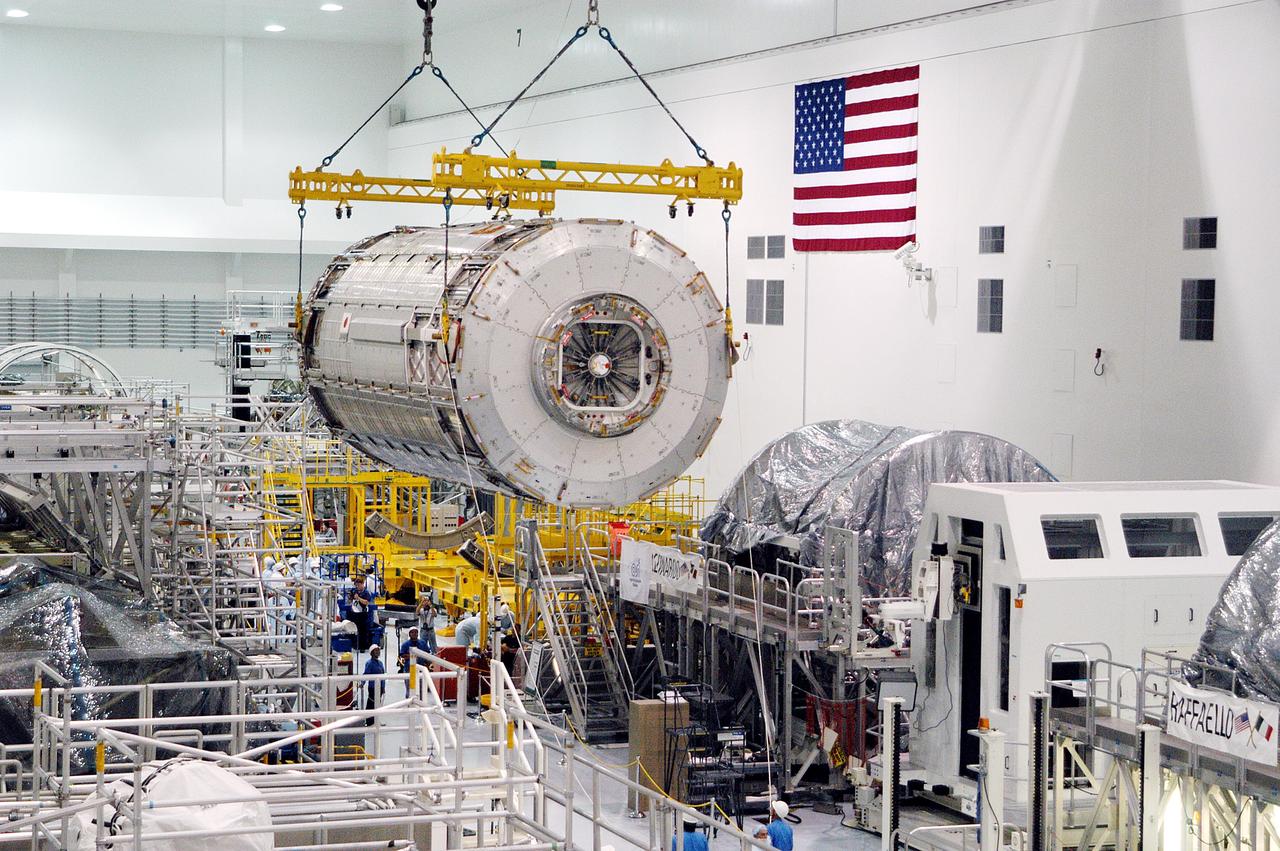
KENNEDY SPACE CENTER, FLA. -  In the Space Station Processing Facility, an overhead crane begins to lift the Japanese Experiment Module (JEM) pressure module out of the shipping canister to move it to a work stand.  A research laboratory, the pressurized module is the first element of the JEM, named "Kibo" (Hope), to be delivered to KSC.   The National Space Development Agency of Japan (NASDA) developed the laboratory at the Tsukuba Space Center near Tokyo and is Japan's primary contribution to the Station. It will enhance the unique research capabilities of the orbiting complex by providing an additional environment for astronauts to conduct science experiments.  The JEM also includes an exposed facility (platform) for space environment experiments, a robotic manipulator system, and two logistics modules. The various JEM components will be  assembled in space over the course of three Shuttle missions.
KENNEDY SPACE CENTER, FLA. - In the Space Station Processing Facility, an overhead crane begins to lift the Japanese Experiment Module (JEM) pressure module out of the shipping canister to move it to a work stand. A research laboratory, the pressurized module is the first element of the JEM, named "Kibo" (Hope), to be delivered to KSC. The National Space Development Agency of Japan (NASDA) developed the laboratory at the Tsukuba Space Center near Tokyo and is Japan's primary contribution to the Station. It will enhance the unique research capabilities of the orbiting complex by providing an additional environment for astronauts to conduct science experiments. The JEM also includes an exposed facility (platform) for space environment experiments, a robotic manipulator system, and two logistics modules. The various JEM components will be assembled in space over the course of three Shuttle missions.
KENNEDY SPACE CENTER, FLA. - At Port Canaveral, the Pressurized Module of the Japanese Experiment Module (JEM) is lifted out of the ship’s cargo hold.  It will be loaded onto the truck bed in the background for transfer to KSC’s Space Station Processing Facility.  The container transport ship carrying JEM departed May 2 from Yokohama Harbor in Japan for the voyage to the United States. The National Space Development Agency of Japan (NASDA) developed the laboratory at the Tsukuba Space Center near Tokyo. The Pressurized Module is the first element of the JEM, named "Kibo" (Hope), to be delivered to KSC. The JEM is Japan's primary contribution to the Station. It will enhance the unique research capabilities of the orbiting complex by providing an additional environment for astronauts to conduct science experiments.  The JEM also includes an exposed facility (platform) for space environment experiments, a robotic manipulator system, and two logistics modules. The various JEM components will be  assembled in space over the course of three Shuttle missions.
KENNEDY SPACE CENTER, FLA. - At Port Canaveral, the Pressurized Module of the Japanese Experiment Module (JEM) is lifted out of the ship’s cargo hold. It will be loaded onto the truck bed in the background for transfer to KSC’s Space Station Processing Facility. The container transport ship carrying JEM departed May 2 from Yokohama Harbor in Japan for the voyage to the United States. The National Space Development Agency of Japan (NASDA) developed the laboratory at the Tsukuba Space Center near Tokyo. The Pressurized Module is the first element of the JEM, named "Kibo" (Hope), to be delivered to KSC. The JEM is Japan's primary contribution to the Station. It will enhance the unique research capabilities of the orbiting complex by providing an additional environment for astronauts to conduct science experiments. The JEM also includes an exposed facility (platform) for space environment experiments, a robotic manipulator system, and two logistics modules. The various JEM components will be assembled in space over the course of three Shuttle missions.
KENNEDY SPACE CENTER, FLA. - At Port Canaveral, the overhead crane that lifted the Pressurized Module of the Japanese Experiment Module (JEM) from the ship onto the truck bed is released.  The container transport ship carrying JEM departed May 2 from Yokohama Harbor in Japan for the voyage to the United States. The National Space Development Agency of Japan (NASDA) developed the laboratory at the Tsukuba Space Center near Tokyo. The Pressurized Module is the first element of the JEM, named "Kibo" (Hope), to be delivered to KSC, and will be transferred to KSC’s Space Station Processing Facility.  The JEM is Japan's primary contribution to the Station. It will enhance the unique research capabilities of the orbiting complex by providing an additional environment for astronauts to conduct science experiments.  The JEM also includes an exposed facility (platform) for space environment experiments, a robotic manipulator system, and two logistics modules. The various JEM components will be  assembled in space over the course of three Shuttle missions.
KENNEDY SPACE CENTER, FLA. - At Port Canaveral, the overhead crane that lifted the Pressurized Module of the Japanese Experiment Module (JEM) from the ship onto the truck bed is released. The container transport ship carrying JEM departed May 2 from Yokohama Harbor in Japan for the voyage to the United States. The National Space Development Agency of Japan (NASDA) developed the laboratory at the Tsukuba Space Center near Tokyo. The Pressurized Module is the first element of the JEM, named "Kibo" (Hope), to be delivered to KSC, and will be transferred to KSC’s Space Station Processing Facility. The JEM is Japan's primary contribution to the Station. It will enhance the unique research capabilities of the orbiting complex by providing an additional environment for astronauts to conduct science experiments. The JEM also includes an exposed facility (platform) for space environment experiments, a robotic manipulator system, and two logistics modules. The various JEM components will be assembled in space over the course of three Shuttle missions.
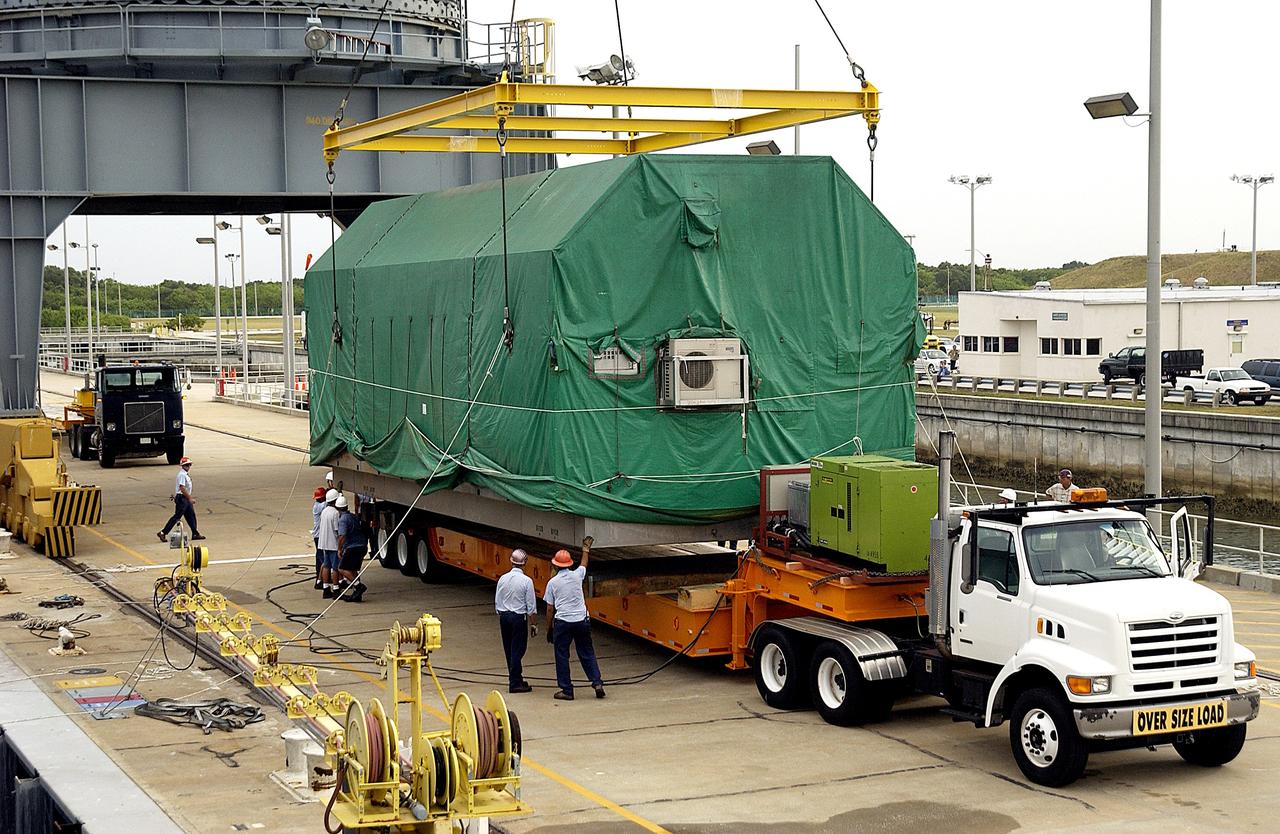
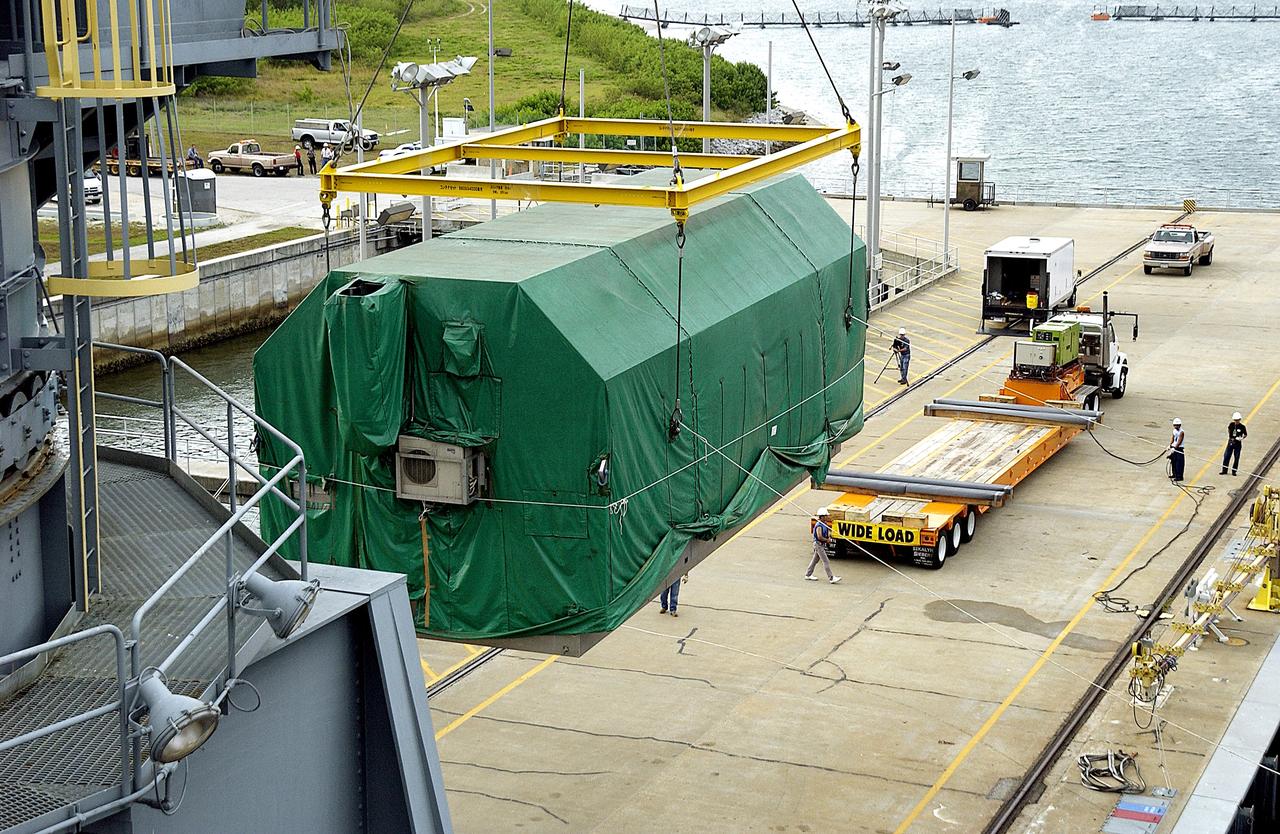
KENNEDY SPACE CENTER, FLA. - At Port Canaveral, the Pressurized Module of the Japanese Experiment Module (JEM) is suspended over the dock, waiting for a truck that will transfer it to KSC’s Space Station Processing Facility. The container transport ship carrying JEM departed May 2 from Yokohama Harbor in Japan for the voyage to the United States. The National Space Development Agency of Japan (NASDA) developed the laboratory at the Tsukuba Space Center near Tokyo.  The Pressurized Module is the first element of the JEM, named "Kibo" (Hope), to be delivered to KSC. The JEM is Japan's primary contribution to the Station. It will enhance the unique research capabilities of the orbiting complex by providing an additional environment for astronauts to conduct science experiments.  The JEM also includes an exposed facility (platform) for space environment experiments, a robotic manipulator system, and two logistics modules. The various JEM components will be  assembled in space over the course of three Shuttle missions.
KENNEDY SPACE CENTER, FLA. - At Port Canaveral, the Pressurized Module of the Japanese Experiment Module (JEM) is suspended over the dock, waiting for a truck that will transfer it to KSC’s Space Station Processing Facility. The container transport ship carrying JEM departed May 2 from Yokohama Harbor in Japan for the voyage to the United States. The National Space Development Agency of Japan (NASDA) developed the laboratory at the Tsukuba Space Center near Tokyo. The Pressurized Module is the first element of the JEM, named "Kibo" (Hope), to be delivered to KSC. The JEM is Japan's primary contribution to the Station. It will enhance the unique research capabilities of the orbiting complex by providing an additional environment for astronauts to conduct science experiments. The JEM also includes an exposed facility (platform) for space environment experiments, a robotic manipulator system, and two logistics modules. The various JEM components will be assembled in space over the course of three Shuttle missions.
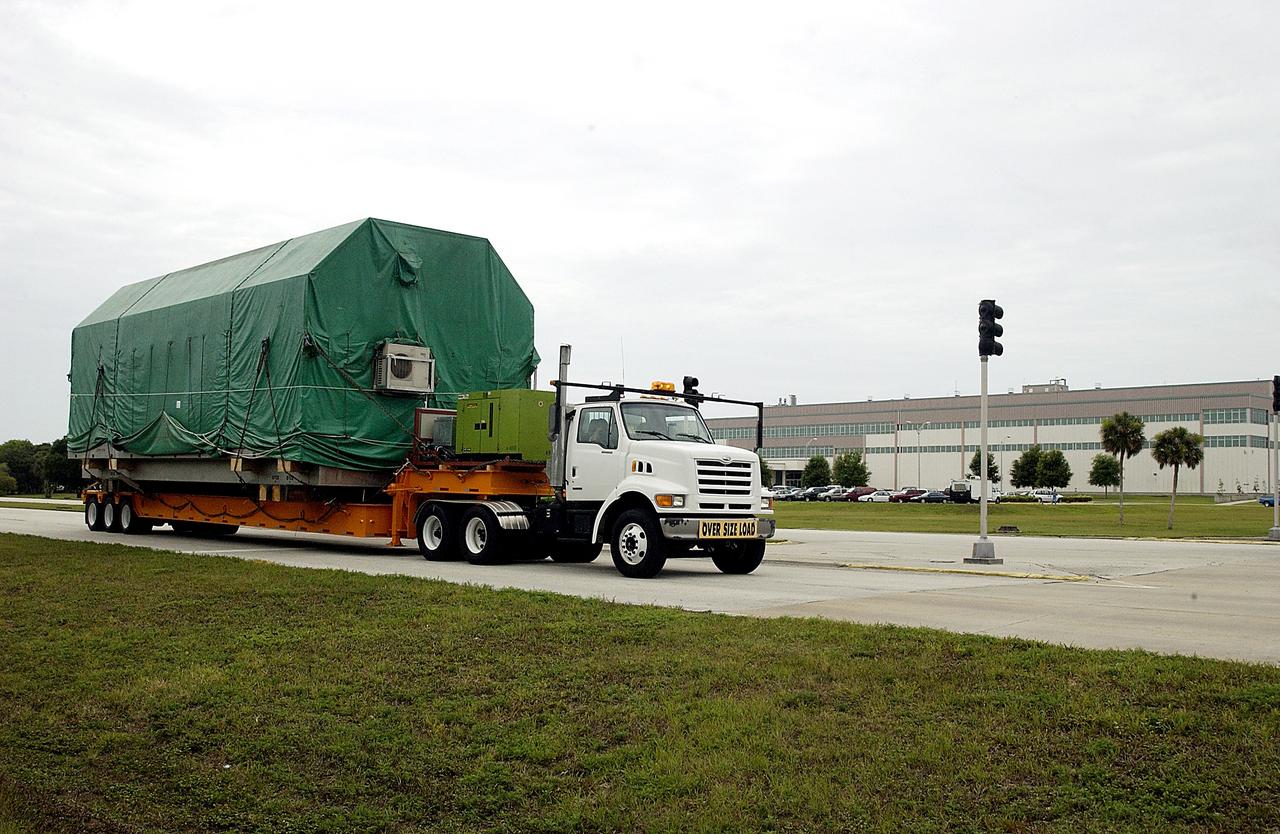
KENNEDY SPACE CENTER, FLA. - The truck transporting the Pressurized Module of the Japanese Experiment Module (JEM) to KSC’s Space Station Processing Facility arrives on Center.  The National Space Development Agency of Japan (NASDA) developed the laboratory at the Tsukuba Space Center near Tokyo. The Pressurized Module is the first element of the JEM, named "Kibo" (Hope), to be delivered to KSC.  The JEM is Japan's primary contribution to the Station. It will enhance the unique research capabilities of the orbiting complex by providing an additional environment for astronauts to conduct science experiments.  The JEM also includes an exposed facility (platform) for space environment experiments, a robotic manipulator system, and two logistics modules. The various JEM components will be  assembled in space over the course of three Shuttle missions.
KENNEDY SPACE CENTER, FLA. - The truck transporting the Pressurized Module of the Japanese Experiment Module (JEM) to KSC’s Space Station Processing Facility arrives on Center. The National Space Development Agency of Japan (NASDA) developed the laboratory at the Tsukuba Space Center near Tokyo. The Pressurized Module is the first element of the JEM, named "Kibo" (Hope), to be delivered to KSC. The JEM is Japan's primary contribution to the Station. It will enhance the unique research capabilities of the orbiting complex by providing an additional environment for astronauts to conduct science experiments. The JEM also includes an exposed facility (platform) for space environment experiments, a robotic manipulator system, and two logistics modules. The various JEM components will be assembled in space over the course of three Shuttle missions.
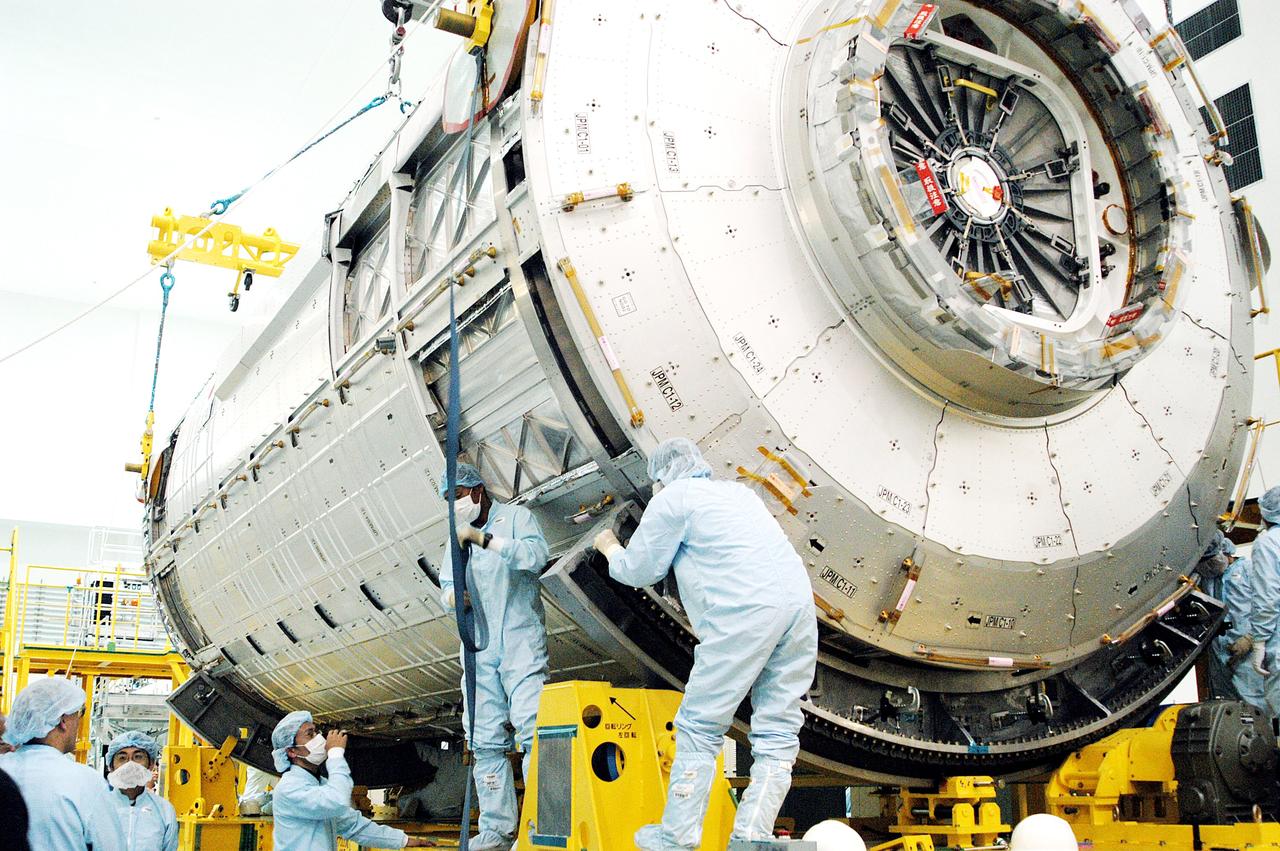
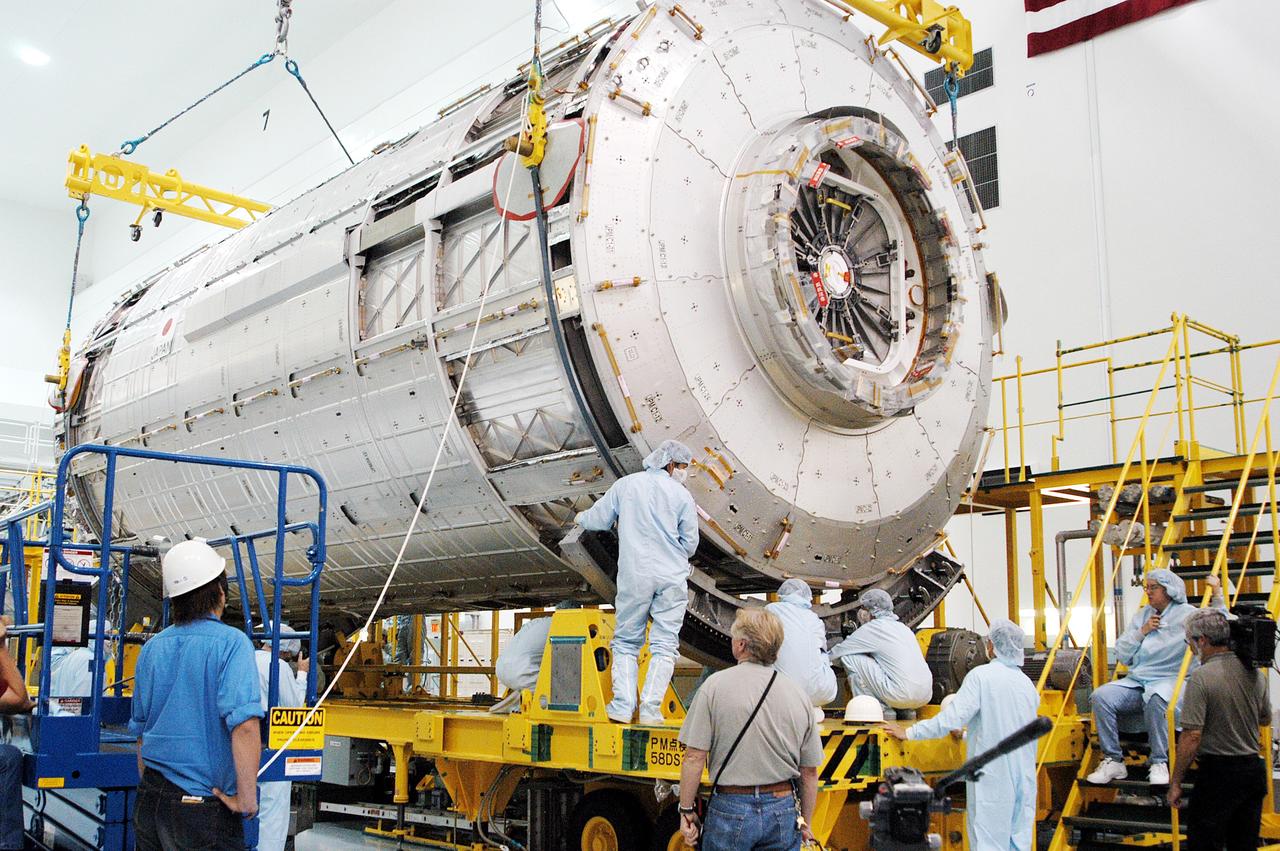
KENNEDY SPACE CENTER, FLA. - In the Space Station Processing Facility, overhead cranes are removed from the Japanese Experiment Module (JEM) pressure module now on its work stand.  A research laboratory, the pressurized module is the first element of the JEM, named "Kibo" (Hope), to be delivered to KSC.   The National Space Development Agency of Japan (NASDA) developed the laboratory at the Tsukuba Space Center near Tokyo and is Japan's primary contribution to the Station. It will enhance the unique research capabilities of the orbiting complex by providing an additional environment for astronauts to conduct science experiments.  The JEM also includes an exposed facility (platform) for space environment experiments, a robotic manipulator system, and two logistics modules. The various JEM components will be  assembled in space over the course of three Shuttle missions.
KENNEDY SPACE CENTER, FLA. - In the Space Station Processing Facility, overhead cranes are removed from the Japanese Experiment Module (JEM) pressure module now on its work stand. A research laboratory, the pressurized module is the first element of the JEM, named "Kibo" (Hope), to be delivered to KSC. The National Space Development Agency of Japan (NASDA) developed the laboratory at the Tsukuba Space Center near Tokyo and is Japan's primary contribution to the Station. It will enhance the unique research capabilities of the orbiting complex by providing an additional environment for astronauts to conduct science experiments. The JEM also includes an exposed facility (platform) for space environment experiments, a robotic manipulator system, and two logistics modules. The various JEM components will be assembled in space over the course of three Shuttle missions.
KENNEDY SPACE CENTER, FLA. - In the Space Station Processing Facility, the Japanese Experiment Module (JEM) pressure module is lowered onto a work stand.  A research laboratory, the pressurized module is the first element of the JEM, named "Kibo" (Hope), to be delivered to KSC.   The National Space Development Agency of Japan (NASDA) developed the laboratory at the Tsukuba Space Center near Tokyo and is Japan's primary contribution to the Station. It will enhance the unique research capabilities of the orbiting complex by providing an additional environment for astronauts to conduct science experiments.  The JEM also includes an exposed facility (platform) for space environment experiments, a robotic manipulator system, and two logistics modules. The various JEM components will be  assembled in space over the course of three Shuttle missions.
KENNEDY SPACE CENTER, FLA. - In the Space Station Processing Facility, the Japanese Experiment Module (JEM) pressure module is lowered onto a work stand. A research laboratory, the pressurized module is the first element of the JEM, named "Kibo" (Hope), to be delivered to KSC. The National Space Development Agency of Japan (NASDA) developed the laboratory at the Tsukuba Space Center near Tokyo and is Japan's primary contribution to the Station. It will enhance the unique research capabilities of the orbiting complex by providing an additional environment for astronauts to conduct science experiments. The JEM also includes an exposed facility (platform) for space environment experiments, a robotic manipulator system, and two logistics modules. The various JEM components will be assembled in space over the course of three Shuttle missions.
KENNEDY SPACE CENTER, FLA. - A convoy accompanies the truck transporting the Pressurized Module of the Japanese Experiment Module (JEM) to KSC’s Space Station Processing Facility.  The National Space Development Agency of Japan (NASDA) developed the laboratory at the Tsukuba Space Center near Tokyo. The Pressurized Module is the first element of the JEM, named "Kibo" (Hope), to be delivered to KSC.  The JEM is Japan's primary contribution to the Station. It will enhance the unique research capabilities of the orbiting complex by providing an additional environment for astronauts to conduct science experiments.  The JEM also includes an exposed facility (platform) for space environment experiments, a robotic manipulator system, and two logistics modules. The various JEM components will be  assembled in space over the course of three Shuttle missions.
KENNEDY SPACE CENTER, FLA. - A convoy accompanies the truck transporting the Pressurized Module of the Japanese Experiment Module (JEM) to KSC’s Space Station Processing Facility. The National Space Development Agency of Japan (NASDA) developed the laboratory at the Tsukuba Space Center near Tokyo. The Pressurized Module is the first element of the JEM, named "Kibo" (Hope), to be delivered to KSC. The JEM is Japan's primary contribution to the Station. It will enhance the unique research capabilities of the orbiting complex by providing an additional environment for astronauts to conduct science experiments. The JEM also includes an exposed facility (platform) for space environment experiments, a robotic manipulator system, and two logistics modules. The various JEM components will be assembled in space over the course of three Shuttle missions.
KENNEDY SPACE CENTER, FLA. -  In the Space Station Processing Facility, an overhead crane lifts the Japanese Experiment Module (JEM) pressure module out of the shipping canister to move it to a work stand.  A research laboratory, the pressurized module is the first element of the JEM, named "Kibo" (Hope), to be delivered to KSC.   The National Space Development Agency of Japan (NASDA) developed the laboratory at the Tsukuba Space Center near Tokyo and is Japan's primary contribution to the Station. It will enhance the unique research capabilities of the orbiting complex by providing an additional environment for astronauts to conduct science experiments.  The JEM also includes an exposed facility (platform) for space environment experiments, a robotic manipulator system, and two logistics modules. The various JEM components will be  assembled in space over the course of three Shuttle missions.
KENNEDY SPACE CENTER, FLA. - In the Space Station Processing Facility, an overhead crane lifts the Japanese Experiment Module (JEM) pressure module out of the shipping canister to move it to a work stand. A research laboratory, the pressurized module is the first element of the JEM, named "Kibo" (Hope), to be delivered to KSC. The National Space Development Agency of Japan (NASDA) developed the laboratory at the Tsukuba Space Center near Tokyo and is Japan's primary contribution to the Station. It will enhance the unique research capabilities of the orbiting complex by providing an additional environment for astronauts to conduct science experiments. The JEM also includes an exposed facility (platform) for space environment experiments, a robotic manipulator system, and two logistics modules. The various JEM components will be assembled in space over the course of three Shuttle missions.
KENNEDY SPACE CENTER, FLA. -   Removed from its shipping canister (lower right), the Japanese Experiment Module (JEM) pressure module is moved across the floor of the Space Station Processing Facility to a work stand.  A research laboratory, the pressurized module is the first element of the JEM, named "Kibo" (Hope), to be delivered to KSC.   The National Space Development Agency of Japan (NASDA) developed the laboratory at the Tsukuba Space Center near Tokyo and is Japan's primary contribution to the Station. It will enhance the unique research capabilities of the orbiting complex by providing an additional environment for astronauts to conduct science experiments.  The JEM also includes an exposed facility (platform) for space environment experiments, a robotic manipulator system, and two logistics modules. The various JEM components will be  assembled in space over the course of three Shuttle missions.
KENNEDY SPACE CENTER, FLA. - Removed from its shipping canister (lower right), the Japanese Experiment Module (JEM) pressure module is moved across the floor of the Space Station Processing Facility to a work stand. A research laboratory, the pressurized module is the first element of the JEM, named "Kibo" (Hope), to be delivered to KSC. The National Space Development Agency of Japan (NASDA) developed the laboratory at the Tsukuba Space Center near Tokyo and is Japan's primary contribution to the Station. It will enhance the unique research capabilities of the orbiting complex by providing an additional environment for astronauts to conduct science experiments. The JEM also includes an exposed facility (platform) for space environment experiments, a robotic manipulator system, and two logistics modules. The various JEM components will be assembled in space over the course of three Shuttle missions.
KENNEDY SPACE CENTER, FLA. -  An overhead crane is attached to the Japanese Experiment Module (JEM) pressure module inside its canister.  The module will be removed and transferred to a work stand in the Space Station Processing Facility.  A research laboratory, the pressurized module is the first element of the JEM, named "Kibo" (Hope), to be delivered to KSC.   The National Space Development Agency of Japan (NASDA) developed the laboratory at the Tsukuba Space Center near Tokyo and is Japan's primary contribution to the Station. It will enhance the unique research capabilities of the orbiting complex by providing an additional environment for astronauts to conduct science experiments.  The JEM also includes an exposed facility (platform) for space environment experiments, a robotic manipulator system, and two logistics modules. The various JEM components will be  assembled in space over the course of three Shuttle missions.
KENNEDY SPACE CENTER, FLA. - An overhead crane is attached to the Japanese Experiment Module (JEM) pressure module inside its canister. The module will be removed and transferred to a work stand in the Space Station Processing Facility. A research laboratory, the pressurized module is the first element of the JEM, named "Kibo" (Hope), to be delivered to KSC. The National Space Development Agency of Japan (NASDA) developed the laboratory at the Tsukuba Space Center near Tokyo and is Japan's primary contribution to the Station. It will enhance the unique research capabilities of the orbiting complex by providing an additional environment for astronauts to conduct science experiments. The JEM also includes an exposed facility (platform) for space environment experiments, a robotic manipulator system, and two logistics modules. The various JEM components will be assembled in space over the course of three Shuttle missions.
KENNEDY SPACE CENTER, FLA. -   Workers in the Space Station Processing Facility prepare to remove the lid of the container with the Japanese Experiment Module (JEM) pressure module inside. A research laboratory, the pressurized module is the first element of the JEM, named "Kibo" (Hope), to be delivered to KSC.   The National Space Development Agency of Japan (NASDA) developed the laboratory at the Tsukuba Space Center near Tokyo and is Japan's primary contribution to the Station. It will enhance the unique research capabilities of the orbiting complex by providing an additional environment for astronauts to conduct science experiments.  The JEM also includes an exposed facility (platform) for space environment experiments, a robotic manipulator system, and two logistics modules. The various JEM components will be  assembled in space over the course of three Shuttle missions.
KENNEDY SPACE CENTER, FLA. - Workers in the Space Station Processing Facility prepare to remove the lid of the container with the Japanese Experiment Module (JEM) pressure module inside. A research laboratory, the pressurized module is the first element of the JEM, named "Kibo" (Hope), to be delivered to KSC. The National Space Development Agency of Japan (NASDA) developed the laboratory at the Tsukuba Space Center near Tokyo and is Japan's primary contribution to the Station. It will enhance the unique research capabilities of the orbiting complex by providing an additional environment for astronauts to conduct science experiments. The JEM also includes an exposed facility (platform) for space environment experiments, a robotic manipulator system, and two logistics modules. The various JEM components will be assembled in space over the course of three Shuttle missions.
KENNEDY SPACE CENTER, FLA. - At Port Canaveral, the Pressurized Module of the Japanese Experiment Module (JEM) is swung away from the ship. The container transport ship carrying JEM departed May 2 from Yokohama Harbor in Japan for the voyage to the United States. The National Space Development Agency of Japan (NASDA) developed the laboratory at the Tsukuba Space Center near Tokyo.  The module will be loaded onto a truck bed and transferred to KSC’s Space Station Processing Facility.  The Pressurized Module is the first element of the JEM, named "Kibo" (Hope), to be delivered to KSC. The JEM is Japan's primary contribution to the Station. It will enhance the unique research capabilities of the orbiting complex by providing an additional environment for astronauts to conduct science experiments.  The JEM also includes an exposed facility (platform) for space environment experiments, a robotic manipulator system, and two logistics modules. The various JEM components will be  assembled in space over the course of three Shuttle missions.
KENNEDY SPACE CENTER, FLA. - At Port Canaveral, the Pressurized Module of the Japanese Experiment Module (JEM) is swung away from the ship. The container transport ship carrying JEM departed May 2 from Yokohama Harbor in Japan for the voyage to the United States. The National Space Development Agency of Japan (NASDA) developed the laboratory at the Tsukuba Space Center near Tokyo. The module will be loaded onto a truck bed and transferred to KSC’s Space Station Processing Facility. The Pressurized Module is the first element of the JEM, named "Kibo" (Hope), to be delivered to KSC. The JEM is Japan's primary contribution to the Station. It will enhance the unique research capabilities of the orbiting complex by providing an additional environment for astronauts to conduct science experiments. The JEM also includes an exposed facility (platform) for space environment experiments, a robotic manipulator system, and two logistics modules. The various JEM components will be assembled in space over the course of three Shuttle missions.
KENNEDY SPACE CENTER, FLA. -  In the Space Station Processing Facility, the Japanese Experiment Module (JEM) pressure module is ready to be lifted out of the shipping canister and transferred to a work stand.  A research laboratory, the pressurized module is the first element of the JEM, named "Kibo" (Hope), to be delivered to KSC.   The National Space Development Agency of Japan (NASDA) developed the laboratory at the Tsukuba Space Center near Tokyo and is Japan's primary contribution to the Station. It will enhance the unique research capabilities of the orbiting complex by providing an additional environment for astronauts to conduct science experiments.  The JEM also includes an exposed facility (platform) for space environment experiments, a robotic manipulator system, and two logistics modules. The various JEM components will be  assembled in space over the course of three Shuttle missions.
KENNEDY SPACE CENTER, FLA. - In the Space Station Processing Facility, the Japanese Experiment Module (JEM) pressure module is ready to be lifted out of the shipping canister and transferred to a work stand. A research laboratory, the pressurized module is the first element of the JEM, named "Kibo" (Hope), to be delivered to KSC. The National Space Development Agency of Japan (NASDA) developed the laboratory at the Tsukuba Space Center near Tokyo and is Japan's primary contribution to the Station. It will enhance the unique research capabilities of the orbiting complex by providing an additional environment for astronauts to conduct science experiments. The JEM also includes an exposed facility (platform) for space environment experiments, a robotic manipulator system, and two logistics modules. The various JEM components will be assembled in space over the course of three Shuttle missions.
KENNEDY SPACE CENTER, FLA. -  In the Space Station Processing Facility, the Japanese Experiment Module (JEM) pressure module is exposed after removal of the lid of its shipping container.  A research laboratory, the pressurized module is the first element of the JEM, named "Kibo" (Hope), to be delivered to KSC.   The National Space Development Agency of Japan (NASDA) developed the laboratory at the Tsukuba Space Center near Tokyo and is Japan's primary contribution to the Station. It will enhance the unique research capabilities of the orbiting complex by providing an additional environment for astronauts to conduct science experiments.  The JEM also includes an exposed facility (platform) for space environment experiments, a robotic manipulator system, and two logistics modules. The various JEM components will be  assembled in space over the course of three Shuttle missions.
KENNEDY SPACE CENTER, FLA. - In the Space Station Processing Facility, the Japanese Experiment Module (JEM) pressure module is exposed after removal of the lid of its shipping container. A research laboratory, the pressurized module is the first element of the JEM, named "Kibo" (Hope), to be delivered to KSC. The National Space Development Agency of Japan (NASDA) developed the laboratory at the Tsukuba Space Center near Tokyo and is Japan's primary contribution to the Station. It will enhance the unique research capabilities of the orbiting complex by providing an additional environment for astronauts to conduct science experiments. The JEM also includes an exposed facility (platform) for space environment experiments, a robotic manipulator system, and two logistics modules. The various JEM components will be assembled in space over the course of three Shuttle missions.
KENNEDY SPACE CENTER, FLA. -  The transporter rolls out of Port Canaveral with the Pressurized Module of the Japanese Experiment Module (JEM) aboard.  The National Space Development Agency of Japan (NASDA) developed the laboratory at the Tsukuba Space Center near Tokyo. The Pressurized Module is the first element of the JEM, named "Kibo" (Hope), to be delivered to KSC, and will be transferred to KSC’s Space Station Processing Facility.  The JEM is Japan's primary contribution to the Station. It will enhance the unique research capabilities of the orbiting complex by providing an additional environment for astronauts to conduct science experiments.  The JEM also includes an exposed facility (platform) for space environment experiments, a robotic manipulator system, and two logistics modules. The various JEM components will be  assembled in space over the course of three Shuttle missions.
KENNEDY SPACE CENTER, FLA. - The transporter rolls out of Port Canaveral with the Pressurized Module of the Japanese Experiment Module (JEM) aboard. The National Space Development Agency of Japan (NASDA) developed the laboratory at the Tsukuba Space Center near Tokyo. The Pressurized Module is the first element of the JEM, named "Kibo" (Hope), to be delivered to KSC, and will be transferred to KSC’s Space Station Processing Facility. The JEM is Japan's primary contribution to the Station. It will enhance the unique research capabilities of the orbiting complex by providing an additional environment for astronauts to conduct science experiments. The JEM also includes an exposed facility (platform) for space environment experiments, a robotic manipulator system, and two logistics modules. The various JEM components will be assembled in space over the course of three Shuttle missions.
KENNEDY SPACE CENTER, FLA. -  At Port Canaveral, the Pressurized Module of the Japanese Experiment Module (JEM) is lowered onto a truck bed.  The container transport ship carrying JEM departed May 2 from Yokohama Harbor in Japan for the voyage to the United States. The National Space Development Agency of Japan (NASDA) developed the laboratory at the Tsukuba Space Center near Tokyo. The Pressurized Module is the first element of the JEM, named "Kibo" (Hope), to be delivered to KSC and will be transferred to the Space Station Processing Facility. The JEM is Japan's primary contribution to the Station. It will enhance the unique research capabilities of the orbiting complex by providing an additional environment for astronauts to conduct science experiments.  The JEM also includes an exposed facility (platform) for space environment experiments, a robotic manipulator system, and two logistics modules. The various JEM components will be  assembled in space over the course of three Shuttle missions.
KENNEDY SPACE CENTER, FLA. - At Port Canaveral, the Pressurized Module of the Japanese Experiment Module (JEM) is lowered onto a truck bed. The container transport ship carrying JEM departed May 2 from Yokohama Harbor in Japan for the voyage to the United States. The National Space Development Agency of Japan (NASDA) developed the laboratory at the Tsukuba Space Center near Tokyo. The Pressurized Module is the first element of the JEM, named "Kibo" (Hope), to be delivered to KSC and will be transferred to the Space Station Processing Facility. The JEM is Japan's primary contribution to the Station. It will enhance the unique research capabilities of the orbiting complex by providing an additional environment for astronauts to conduct science experiments. The JEM also includes an exposed facility (platform) for space environment experiments, a robotic manipulator system, and two logistics modules. The various JEM components will be assembled in space over the course of three Shuttle missions.
KENNEDY SPACE CENTER, FLA. -  In the Space Station Processing Facility, an overhead crane moves the Japanese Experiment Module (JEM) pressure module past other ISS elements to a work stand.  A research laboratory, the pressurized module is the first element of the JEM, named "Kibo" (Hope), to be delivered to KSC.   The National Space Development Agency of Japan (NASDA) developed the laboratory at the Tsukuba Space Center near Tokyo and is Japan's primary contribution to the Station. It will enhance the unique research capabilities of the orbiting complex by providing an additional environment for astronauts to conduct science experiments.  The JEM also includes an exposed facility (platform) for space environment experiments, a robotic manipulator system, and two logistics modules. The various JEM components will be  assembled in space over the course of three Shuttle missions.
KENNEDY SPACE CENTER, FLA. - In the Space Station Processing Facility, an overhead crane moves the Japanese Experiment Module (JEM) pressure module past other ISS elements to a work stand. A research laboratory, the pressurized module is the first element of the JEM, named "Kibo" (Hope), to be delivered to KSC. The National Space Development Agency of Japan (NASDA) developed the laboratory at the Tsukuba Space Center near Tokyo and is Japan's primary contribution to the Station. It will enhance the unique research capabilities of the orbiting complex by providing an additional environment for astronauts to conduct science experiments. The JEM also includes an exposed facility (platform) for space environment experiments, a robotic manipulator system, and two logistics modules. The various JEM components will be assembled in space over the course of three Shuttle missions.
KENNEDY SPACE CENTER, FLA. - At Port Canaveral, the Pressurized Module of the Japanese Experiment Module (JEM) is settled on a truck bed for transfer to KSC’s Space Station Processing Facility.  The container transport ship carrying JEM departed May 2 from Yokohama Harbor in Japan for the voyage to the United States. The National Space Development Agency of Japan (NASDA) developed the laboratory at the Tsukuba Space Center near Tokyo. The Pressurized Module is the first element of the JEM, named "Kibo" (Hope), to be delivered to KSC. The JEM is Japan's primary contribution to the Station. It will enhance the unique research capabilities of the orbiting complex by providing an additional environment for astronauts to conduct science experiments.  The JEM also includes an exposed facility (platform) for space environment experiments, a robotic manipulator system, and two logistics modules. The various JEM components will be  assembled in space over the course of three Shuttle missions.
KENNEDY SPACE CENTER, FLA. - At Port Canaveral, the Pressurized Module of the Japanese Experiment Module (JEM) is settled on a truck bed for transfer to KSC’s Space Station Processing Facility. The container transport ship carrying JEM departed May 2 from Yokohama Harbor in Japan for the voyage to the United States. The National Space Development Agency of Japan (NASDA) developed the laboratory at the Tsukuba Space Center near Tokyo. The Pressurized Module is the first element of the JEM, named "Kibo" (Hope), to be delivered to KSC. The JEM is Japan's primary contribution to the Station. It will enhance the unique research capabilities of the orbiting complex by providing an additional environment for astronauts to conduct science experiments. The JEM also includes an exposed facility (platform) for space environment experiments, a robotic manipulator system, and two logistics modules. The various JEM components will be assembled in space over the course of three Shuttle missions.
KENNEDY SPACE CENTER, FLA. - In the Space Station Processing Facility, the Japanese Experiment Module (JEM) pressure module is moved toward a work stand.  A research laboratory, the pressurized module is the first element of the JEM, named "Kibo" (Hope), to be delivered to KSC.   The National Space Development Agency of Japan (NASDA) developed the laboratory at the Tsukuba Space Center near Tokyo and is Japan's primary contribution to the Station. It will enhance the unique research capabilities of the orbiting complex by providing an additional environment for astronauts to conduct science experiments.  The JEM also includes an exposed facility (platform) for space environment experiments, a robotic manipulator system, and two logistics modules. The various JEM components will be  assembled in space over the course of three Shuttle missions.
KENNEDY SPACE CENTER, FLA. - In the Space Station Processing Facility, the Japanese Experiment Module (JEM) pressure module is moved toward a work stand. A research laboratory, the pressurized module is the first element of the JEM, named "Kibo" (Hope), to be delivered to KSC. The National Space Development Agency of Japan (NASDA) developed the laboratory at the Tsukuba Space Center near Tokyo and is Japan's primary contribution to the Station. It will enhance the unique research capabilities of the orbiting complex by providing an additional environment for astronauts to conduct science experiments. The JEM also includes an exposed facility (platform) for space environment experiments, a robotic manipulator system, and two logistics modules. The various JEM components will be assembled in space over the course of three Shuttle missions.
KENNEDY SPACE CENTER, FLA. - In the Space Station Processing Facility, workers check the Japanese Experiment Module (JEM) pressure module on its work stand.  A research laboratory, the pressurized module is the first element of the JEM, named "Kibo" (Hope), to be delivered to KSC.   The National Space Development Agency of Japan (NASDA) developed the laboratory at the Tsukuba Space Center near Tokyo and is Japan's primary contribution to the Station. It will enhance the unique research capabilities of the orbiting complex by providing an additional environment for astronauts to conduct science experiments.  The JEM also includes an exposed facility (platform) for space environment experiments, a robotic manipulator system, and two logistics modules. The various JEM components will be  assembled in space over the course of three Shuttle missions.
KENNEDY SPACE CENTER, FLA. - In the Space Station Processing Facility, workers check the Japanese Experiment Module (JEM) pressure module on its work stand. A research laboratory, the pressurized module is the first element of the JEM, named "Kibo" (Hope), to be delivered to KSC. The National Space Development Agency of Japan (NASDA) developed the laboratory at the Tsukuba Space Center near Tokyo and is Japan's primary contribution to the Station. It will enhance the unique research capabilities of the orbiting complex by providing an additional environment for astronauts to conduct science experiments. The JEM also includes an exposed facility (platform) for space environment experiments, a robotic manipulator system, and two logistics modules. The various JEM components will be assembled in space over the course of three Shuttle missions.
KENNEDY SPACE CENTER, FLA. -  The Japanese Experiment Module (JEM) pressure module is moved past other ISS elements in the Space Station Processing Facility to a work stand.  A research laboratory, the pressurized module is the first element of the JEM, named "Kibo" (Hope), to be delivered to KSC.   The National Space Development Agency of Japan (NASDA) developed the laboratory at the Tsukuba Space Center near Tokyo and is Japan's primary contribution to the Station. It will enhance the unique research capabilities of the orbiting complex by providing an additional environment for astronauts to conduct science experiments.  The JEM also includes an exposed facility (platform) for space environment experiments, a robotic manipulator system, and two logistics modules. The various JEM components will be  assembled in space over the course of three Shuttle missions.
KENNEDY SPACE CENTER, FLA. - The Japanese Experiment Module (JEM) pressure module is moved past other ISS elements in the Space Station Processing Facility to a work stand. A research laboratory, the pressurized module is the first element of the JEM, named "Kibo" (Hope), to be delivered to KSC. The National Space Development Agency of Japan (NASDA) developed the laboratory at the Tsukuba Space Center near Tokyo and is Japan's primary contribution to the Station. It will enhance the unique research capabilities of the orbiting complex by providing an additional environment for astronauts to conduct science experiments. The JEM also includes an exposed facility (platform) for space environment experiments, a robotic manipulator system, and two logistics modules. The various JEM components will be assembled in space over the course of three Shuttle missions.
KENNEDY SPACE CENTER, FLA. -   Removed from its shipping canister, the Japanese Experiment Module (JEM) pressure module is moved across the floor of the Space Station Processing Facility to a work stand.  A research laboratory, the pressurized module is the first element of the JEM, named "Kibo" (Hope), to be delivered to KSC.   The National Space Development Agency of Japan (NASDA) developed the laboratory at the Tsukuba Space Center near Tokyo and is Japan's primary contribution to the Station. It will enhance the unique research capabilities of the orbiting complex by providing an additional environment for astronauts to conduct science experiments.  The JEM also includes an exposed facility (platform) for space environment experiments, a robotic manipulator system, and two logistics modules. The various JEM components will be  assembled in space over the course of three Shuttle missions.
KENNEDY SPACE CENTER, FLA. - Removed from its shipping canister, the Japanese Experiment Module (JEM) pressure module is moved across the floor of the Space Station Processing Facility to a work stand. A research laboratory, the pressurized module is the first element of the JEM, named "Kibo" (Hope), to be delivered to KSC. The National Space Development Agency of Japan (NASDA) developed the laboratory at the Tsukuba Space Center near Tokyo and is Japan's primary contribution to the Station. It will enhance the unique research capabilities of the orbiting complex by providing an additional environment for astronauts to conduct science experiments. The JEM also includes an exposed facility (platform) for space environment experiments, a robotic manipulator system, and two logistics modules. The various JEM components will be assembled in space over the course of three Shuttle missions.
Gioia Massa, a NASA project scientist, poses inside a lab at the Space Station Processing Facility located at the agency’s Kennedy Space Center in Florida. Massa’s responsibilities include studying the effects of a microgravity environment on plant growth, discovering the perfect conditions for growing plants in space and determining what plant species grow the most effectively under those conditions. Massa and her team are currently experimenting with growing plants aboard the International Space Station to develop the knowhow to supplement astronauts’ packaged diets with freshly grown crops, which should facilitate long-duration exploration missions into deep space.
Artistic Photos of Gioia Massa
Gioia Massa, a NASA project scientist, poses inside a lab at the Space Station Processing Facility located at the agency’s Kennedy Space Center in Florida. Massa’s responsibilities include studying the effects of a microgravity environment on plant growth, discovering the perfect conditions for growing plants in space and determining what plant species grow the most effectively under those conditions. Massa and her team are currently experimenting with growing plants aboard the International Space Station to develop the knowhow to supplement astronauts’ packaged diets with freshly grown crops, which should facilitate long-duration exploration missions into deep space.
Artistic Photos of Gioia Massa
KENNEDY SPACE CENTER, FLA. - The Japanese Experiment Module (JEM), named Kibo (Hope), is undergoing a Multi-Element Integrated Test (MEIT) in the Space Station Processing Facility.  Developed by the National Space Development Agency of Japan (NASDA), the JEM is Japan's primary contribution to the Station. It will enhance the unique research capabilities of the orbiting complex by providing an additional environment for astronauts to conduct science experiments.
KENNEDY SPACE CENTER, FLA. - The Japanese Experiment Module (JEM), named Kibo (Hope), is undergoing a Multi-Element Integrated Test (MEIT) in the Space Station Processing Facility. Developed by the National Space Development Agency of Japan (NASDA), the JEM is Japan's primary contribution to the Station. It will enhance the unique research capabilities of the orbiting complex by providing an additional environment for astronauts to conduct science experiments.
KENNEDY SPACE CENTER, FLA. -   In the Space Station Processing Facility, STS-120 Mission Specialist Michael Foreman looks over the Japanese Experiment Module (JEM) Pressurized Module. Known as Kibo, the JEM consists of six components: two research facilities -- the Pressurized Module and Exposed Facility; a Logistics Module attached to each of them; a Remote Manipulator System; and an Inter-Orbit Communication System unit. Kibo also has a scientific airlock through which experiments are transferred and exposed to the external environment of space. The various components of JEM will be assembled in space over the course of three Space Shuttle missions.  The STS-120 mission will deliver the second of three Station connecting modules, Node 2, which attaches to the end of U.S. Lab.  It will provide attach locations for the Japanese laboratory, European laboratory, the Centrifuge Accommodation Module and later Multi-Purpose Logistics Modules.  The addition of Node 2 will complete the U.S. core of the International Space Station.
KENNEDY SPACE CENTER, FLA. - In the Space Station Processing Facility, STS-120 Mission Specialist Michael Foreman looks over the Japanese Experiment Module (JEM) Pressurized Module. Known as Kibo, the JEM consists of six components: two research facilities -- the Pressurized Module and Exposed Facility; a Logistics Module attached to each of them; a Remote Manipulator System; and an Inter-Orbit Communication System unit. Kibo also has a scientific airlock through which experiments are transferred and exposed to the external environment of space. The various components of JEM will be assembled in space over the course of three Space Shuttle missions. The STS-120 mission will deliver the second of three Station connecting modules, Node 2, which attaches to the end of U.S. Lab. It will provide attach locations for the Japanese laboratory, European laboratory, the Centrifuge Accommodation Module and later Multi-Purpose Logistics Modules. The addition of Node 2 will complete the U.S. core of the International Space Station.
KENNEDY SPACE CENTER, FLA. -  In the Space Station Processing Facility, STS-120 Mission Specialist Piers Sellers looks over the Japanese Experiment Module (JEM) Pressurized Module. Known as Kibo, the JEM consists of six components: two research facilities -- the Pressurized Module and Exposed Facility; a Logistics Module attached to each of them; a Remote Manipulator System; and an Inter-Orbit Communication System unit. Kibo also has a scientific airlock through which experiments are transferred and exposed to the external environment of space. The various components of JEM will be assembled in space over the course of three Space Shuttle missions.   The STS-120 mission will deliver the second of three Station connecting modules, Node 2, which attaches to the end of U.S. Lab.  It will provide attach locations for the Japanese laboratory, European laboratory, the Centrifuge Accommodation Module and later Multi-Purpose Logistics Modules.  The addition of Node 2 will complete the U.S. core of the International Space Station.
KENNEDY SPACE CENTER, FLA. - In the Space Station Processing Facility, STS-120 Mission Specialist Piers Sellers looks over the Japanese Experiment Module (JEM) Pressurized Module. Known as Kibo, the JEM consists of six components: two research facilities -- the Pressurized Module and Exposed Facility; a Logistics Module attached to each of them; a Remote Manipulator System; and an Inter-Orbit Communication System unit. Kibo also has a scientific airlock through which experiments are transferred and exposed to the external environment of space. The various components of JEM will be assembled in space over the course of three Space Shuttle missions. The STS-120 mission will deliver the second of three Station connecting modules, Node 2, which attaches to the end of U.S. Lab. It will provide attach locations for the Japanese laboratory, European laboratory, the Centrifuge Accommodation Module and later Multi-Purpose Logistics Modules. The addition of Node 2 will complete the U.S. core of the International Space Station.
KENNEDY SPACE CENTER, FLA. - STS-120 Mission Specialists Piers Sellers and Michael Foreman look at the Japanese Experiment Module (JEM) Pressurized Module located in the Space Station Processing Facility. Known as Kibo, the JEM consists of six components: two research facilities -- the Pressurized Module and Exposed Facility; a Logistics Module attached to each of them; a Remote Manipulator System; and an Inter-Orbit Communication System unit. Kibo also has a scientific airlock through which experiments are transferred and exposed to the external environment of space. The various components of JEM will be assembled in space over the course of three Space Shuttle missions.  The STS-120 mission will deliver the second of three Station connecting modules, Node 2, which attaches to the end of U.S. Lab.  It will provide attach locations for the JEM, European laboratory, the Centrifuge Accommodation Module and later Multi-Purpose Logistics Modules.  The addition of Node 2 will complete the U.S. core of the International Space Station.
KENNEDY SPACE CENTER, FLA. - STS-120 Mission Specialists Piers Sellers and Michael Foreman look at the Japanese Experiment Module (JEM) Pressurized Module located in the Space Station Processing Facility. Known as Kibo, the JEM consists of six components: two research facilities -- the Pressurized Module and Exposed Facility; a Logistics Module attached to each of them; a Remote Manipulator System; and an Inter-Orbit Communication System unit. Kibo also has a scientific airlock through which experiments are transferred and exposed to the external environment of space. The various components of JEM will be assembled in space over the course of three Space Shuttle missions. The STS-120 mission will deliver the second of three Station connecting modules, Node 2, which attaches to the end of U.S. Lab. It will provide attach locations for the JEM, European laboratory, the Centrifuge Accommodation Module and later Multi-Purpose Logistics Modules. The addition of Node 2 will complete the U.S. core of the International Space Station.
Test hardware for Orion crew capsule from the Artemis 1 flight arrives in the SEC (Space Experiments Complex) at ATF (Armstrong Test Facility), The LAS (Launch Abort System) arrived in four separate shipments from locations in Florida and Colorado.  It is now being integrated with the Orion CM (crew module) for critical testing before the flight of Artemis II.
Orion ETA Hardware, Launch Abort System and Crew Module Documentation Photographs
KENNEDY SPACE CENTER, FLA. - The Microgravity Science Laboratory-1 (MSL-1) Spacelab module is installed into the payload bay of the Space Shuttle Orbiter Columbia in Orbiter Processing Facility 1.  The Spacelab long crew transfer tunnel that leads from the orbiter's crew airlock to the module is also aboard, as well as the Hitchhiker Cryogenic Flexible Diode (CRYOFD) experiment payload, which is attached to the right side of Columbia's payload bay.  During the scheduled 16-day STS-83 mission, the MSL-1 will be used to test some of the hardware, facilities and procedures that are planned for use on the International Space Station while the flight crew conducts combustion, protein crystal growth and materials processing experiments.
KENNEDY SPACE CENTER, FLA. - The Microgravity Science Laboratory-1 (MSL-1) Spacelab module is installed into the payload bay of the Space Shuttle Orbiter Columbia in Orbiter Processing Facility 1. The Spacelab long crew transfer tunnel that leads from the orbiter's crew airlock to the module is also aboard, as well as the Hitchhiker Cryogenic Flexible Diode (CRYOFD) experiment payload, which is attached to the right side of Columbia's payload bay. During the scheduled 16-day STS-83 mission, the MSL-1 will be used to test some of the hardware, facilities and procedures that are planned for use on the International Space Station while the flight crew conducts combustion, protein crystal growth and materials processing experiments.
KENNEDY SPACE CENTER, FLA. - The Microgravity Science Laboratory-1 (MSL-1) Spacelab module is installed into the payload bay of the Space Shuttle Orbiter Columbia in Orbiter Processing Facility 1.  The Spacelab long crew transfer tunnel that leads from the orbiter's crew airlock to the module is also aboard, as well as the Hitchhiker Cryogenic Flexible Diode (CRYOFD) experiment payload, which is attached to the right side of Columbia's payload bay.  During the scheduled 16-day STS-83 mission, the MSL-1 will be used to test some of the hardware, facilities and procedures that are planned for use on the International Space Station while the flight crew conducts combustion, protein crystal growth and materials processing experiments.
KENNEDY SPACE CENTER, FLA. - The Microgravity Science Laboratory-1 (MSL-1) Spacelab module is installed into the payload bay of the Space Shuttle Orbiter Columbia in Orbiter Processing Facility 1. The Spacelab long crew transfer tunnel that leads from the orbiter's crew airlock to the module is also aboard, as well as the Hitchhiker Cryogenic Flexible Diode (CRYOFD) experiment payload, which is attached to the right side of Columbia's payload bay. During the scheduled 16-day STS-83 mission, the MSL-1 will be used to test some of the hardware, facilities and procedures that are planned for use on the International Space Station while the flight crew conducts combustion, protein crystal growth and materials processing experiments.
KENNEDY SPACE CENTER, FLA. - In the Space Station Processing Facility, STS-117 Mission Specialist James Reilly (left) and STS-115 Mission Specialist Joseph Tanner (right) look over the Japanese Experiment Module (JEM).  Equipment familiarization is a routine part of astronaut training and launch preparations.
KENNEDY SPACE CENTER, FLA. - In the Space Station Processing Facility, STS-117 Mission Specialist James Reilly (left) and STS-115 Mission Specialist Joseph Tanner (right) look over the Japanese Experiment Module (JEM). Equipment familiarization is a routine part of astronaut training and launch preparations.
KENNEDY SPACE CENTER, FLA. - In the Space Station Processing Facility, STS-115 Mission Specialist Joseph Tanner (left) and STS-117 Mission Specialist James Reilly (right) are donning protective clothing to interface with the Japanese Experiment Module (JEM), in the background.  Equipment familiarization is a routine part of astronaut training and launch preparations.
KENNEDY SPACE CENTER, FLA. - In the Space Station Processing Facility, STS-115 Mission Specialist Joseph Tanner (left) and STS-117 Mission Specialist James Reilly (right) are donning protective clothing to interface with the Japanese Experiment Module (JEM), in the background. Equipment familiarization is a routine part of astronaut training and launch preparations.
KENNEDY SPACE CENTER, FLA. - In the Space Station Processing Facility, STS-115 Mission Specialist Joseph Tanner (left) and STS-117 Mission Specialist James Reilly (right) look over the Japanese Experiment Module (JEM) behind them. Equipment familiarization is a routine part of astronaut training and launch preparations.
KENNEDY SPACE CENTER, FLA. -  In the Space Station Processing Facility, Executive Director of NASDA Koji Yamamoto (left) looks at the newly arrived Japanese Experiment Module (JEM)/pressurized module.  Mr. Yamamoto is at KSC for a welcome ceremony involving the arrival of JEM.
KENNEDY SPACE CENTER, FLA. - In the Space Station Processing Facility, Executive Director of NASDA Koji Yamamoto (left) looks at the newly arrived Japanese Experiment Module (JEM)/pressurized module. Mr. Yamamoto is at KSC for a welcome ceremony involving the arrival of JEM.
KENNEDY SPACE CENTER, FLA. - In the Space Station Processing Facility, STS-117 Mission Specialist James Reilly (center) and STS-115 Mission Specialist Joseph Tanner (right) talk with a worker about the Japanese Experiment Module (JEM).  Equipment familiarization is a routine part of astronaut training and launch preparations.
KENNEDY SPACE CENTER, FLA. - In the Space Station Processing Facility, STS-117 Mission Specialist James Reilly (center) and STS-115 Mission Specialist Joseph Tanner (right) talk with a worker about the Japanese Experiment Module (JEM). Equipment familiarization is a routine part of astronaut training and launch preparations.
KENNEDY SPACE CENTER, FLA. - In the Space Station Processing Facility, STS-117 Mission Specialist James Reilly  works with equipment in the Japanese Experiment Module (JEM) as part of training for ExtraVehicular Activity (EVA).  Equipment familiarization is a routine part of astronaut training and launch preparations.
KENNEDY SPACE CENTER, FLA. - In the Space Station Processing Facility, STS-117 Mission Specialist James Reilly works with equipment in the Japanese Experiment Module (JEM) as part of training for ExtraVehicular Activity (EVA). Equipment familiarization is a routine part of astronaut training and launch preparations.
KENNEDY SPACE CENTER, FLA. - In the Space Station Processing Facility, workers (in protective clothing) brief STS-117 Mission Specialist James Reilly (center) and STS-115 Mission Specialist Joseph Tanner (right) about the Japanese Experiment Module (JEM).  Equipment familiarization is a routine part of astronaut training and launch preparations.
KENNEDY SPACE CENTER, FLA. - In the Space Station Processing Facility, workers (in protective clothing) brief STS-117 Mission Specialist James Reilly (center) and STS-115 Mission Specialist Joseph Tanner (right) about the Japanese Experiment Module (JEM). Equipment familiarization is a routine part of astronaut training and launch preparations.
KENNEDY SPACE CENTER, FLA. -  In the Space Station Processing Facility, STS-115 Mission Specialist Joseph Tanner and STS-117 Mission Specialist James Reilly get a close look at the Japanese Experiment Module (JEM).  Reilly and Tanner are at KSC for equipment familiarization, a routine part of astronaut training and launch preparations.
KENNEDY SPACE CENTER, FLA. - In the Space Station Processing Facility, STS-115 Mission Specialist Joseph Tanner and STS-117 Mission Specialist James Reilly get a close look at the Japanese Experiment Module (JEM). Reilly and Tanner are at KSC for equipment familiarization, a routine part of astronaut training and launch preparations.
KENNEDY SPACE CENTER, FLA. -  In the Space Station Processing Facility, STS-117 Mission Specialist James Reilly (left) and STS-115 Mission Specialist Joseph Tanner (right) look over components in the Japanese Experiment Module (JEM).  Equipment familiarization is a routine part of astronaut training and launch preparations.
KENNEDY SPACE CENTER, FLA. - In the Space Station Processing Facility, STS-117 Mission Specialist James Reilly (left) and STS-115 Mission Specialist Joseph Tanner (right) look over components in the Japanese Experiment Module (JEM). Equipment familiarization is a routine part of astronaut training and launch preparations.
KENNEDY SPACE CENTER, FLA. -  In the Space Station Processing Facility, Executive Director of NASDA Koji Yamamoto (right) looks at the newly arrived Japanese Experiment Module (JEM)/pressurized module.  Mr. Yamamoto is at KSC for a welcome ceremony involving the arrival of JEM.
KENNEDY SPACE CENTER, FLA. - In the Space Station Processing Facility, Executive Director of NASDA Koji Yamamoto (right) looks at the newly arrived Japanese Experiment Module (JEM)/pressurized module. Mr. Yamamoto is at KSC for a welcome ceremony involving the arrival of JEM.
KENNEDY SPACE CENTER, FLA. -  In the Space Station Processing Facility, STS-117 Mission Specialist James Reilly stands in front of the Japanese Experiment Module (JEM).  Reilly and STS-115 Mission Specialist Joseph Tanner are at KSC for equipment familiarization, a routine part of astronaut training and launch preparations.
KENNEDY SPACE CENTER, FLA. - In the Space Station Processing Facility, STS-117 Mission Specialist James Reilly stands in front of the Japanese Experiment Module (JEM). Reilly and STS-115 Mission Specialist Joseph Tanner are at KSC for equipment familiarization, a routine part of astronaut training and launch preparations.
KENNEDY SPACE CENTER, FLA. -  In the Space Station Processing Facility, STS-117 Mission Specialist James Reilly (center) works with the Japanese Experiment Module (JEM).  Reilly and STS-115 Mission Specialist Joseph Tanner are at KSC for equipment familiarization, a routine part of astronaut training and launch preparations.
KENNEDY SPACE CENTER, FLA. - In the Space Station Processing Facility, STS-117 Mission Specialist James Reilly (center) works with the Japanese Experiment Module (JEM). Reilly and STS-115 Mission Specialist Joseph Tanner are at KSC for equipment familiarization, a routine part of astronaut training and launch preparations.
KENNEDY SPACE CENTER, FLA. -  In the Space Station Processing Facility, STS-117 Mission Specialist James Reilly works with the Japanese Experiment Module (JEM).  Reilly and STS-115 Mission Specialist Joseph Tanner are at KSC for equipment familiarization, a routine part of astronaut training and launch preparations.
KENNEDY SPACE CENTER, FLA. - In the Space Station Processing Facility, STS-117 Mission Specialist James Reilly works with the Japanese Experiment Module (JEM). Reilly and STS-115 Mission Specialist Joseph Tanner are at KSC for equipment familiarization, a routine part of astronaut training and launch preparations.
KENNEDY SPACE CENTER, FLA. -  In the Space Station Processing Facility, STS-117 Mission Specialist James Reilly works with the Japanese Experiment Module (JEM).  Reilly and STS-115 Mission Specialist Joseph Tanner are at KSC for equipment familiarization, a routine part of astronaut training and launch preparations.
KENNEDY SPACE CENTER, FLA. - In the Space Station Processing Facility, STS-117 Mission Specialist James Reilly works with the Japanese Experiment Module (JEM). Reilly and STS-115 Mission Specialist Joseph Tanner are at KSC for equipment familiarization, a routine part of astronaut training and launch preparations.
KENNEDY SPACE CENTER, FLA. - Dynamac employees Debbie Wells, Michelle Crouch and Larry Burns are silhouetted as they talk inside a conference room of the Space Life Sciences Lab (SLSL), formerly known as the Space Experiment Research and Processing Laboratory (SERPL).  They have been transferring equipment from Hangar L.  The new lab is a state-of-the-art facility being built for ISS biotechnology research. Developed as a partnership between NASA-KSC and the State of Florida, NASA’s life sciences contractor will be the primary tenant of the facility, leasing space to conduct flight experiment processing and NASA-sponsored research. About 20 percent of the facility will be available for use by Florida’s university researchers through the Florida Space Research Institute.
KENNEDY SPACE CENTER, FLA. - Dynamac employees Debbie Wells, Michelle Crouch and Larry Burns are silhouetted as they talk inside a conference room of the Space Life Sciences Lab (SLSL), formerly known as the Space Experiment Research and Processing Laboratory (SERPL). They have been transferring equipment from Hangar L. The new lab is a state-of-the-art facility being built for ISS biotechnology research. Developed as a partnership between NASA-KSC and the State of Florida, NASA’s life sciences contractor will be the primary tenant of the facility, leasing space to conduct flight experiment processing and NASA-sponsored research. About 20 percent of the facility will be available for use by Florida’s university researchers through the Florida Space Research Institute.
KENNEDY SPACE CENTER, FLA. - In the Space Station Processing Facility, STS-115 Mission Specialist Joseph Tanner (second from left, foreground) works with technicians to learn more about the Japanese Experiment Module (JEM), known as Kibo.  The JEM consists of six components: two research facilities - the Pressurized Module and the Exposed Facility; a Logistics Module attached to each of them; a Remote Manipulator System; and an Inter-Orbit Communication System unit. Kibo also has a scientific airlock through which experiments are transferred and exposed to the external environment of space. The various components of JEM will be assembled in space over the course of three Space Shuttle missions. Equipment familiarization is a routine part of astronaut training and launch preparations.
KENNEDY SPACE CENTER, FLA. - In the Space Station Processing Facility, STS-115 Mission Specialist Joseph Tanner (second from left, foreground) works with technicians to learn more about the Japanese Experiment Module (JEM), known as Kibo. The JEM consists of six components: two research facilities - the Pressurized Module and the Exposed Facility; a Logistics Module attached to each of them; a Remote Manipulator System; and an Inter-Orbit Communication System unit. Kibo also has a scientific airlock through which experiments are transferred and exposed to the external environment of space. The various components of JEM will be assembled in space over the course of three Space Shuttle missions. Equipment familiarization is a routine part of astronaut training and launch preparations.
KENNEDY SPACE CENTER, FLA. - Dynamac employees (from left) Larry Burns, Debbie Wells and Michelle Crouch talk in a conference room of the Space Life Sciences Lab (SLSL), formerly known as the Space Experiment Research and Processing Laboratory (SERPL). They have been transferring equipment from Hangar L.  The new lab is a state-of-the-art facility being built for ISS biotechnology research. Developed as a partnership between NASA-KSC and the State of Florida, NASA’s life sciences contractor will be the primary tenant of the facility, leasing space to conduct flight experiment processing and NASA-sponsored research. About 20 percent of the facility will be available for use by Florida’s university researchers through the Florida Space Research Institute.
KENNEDY SPACE CENTER, FLA. - Dynamac employees (from left) Larry Burns, Debbie Wells and Michelle Crouch talk in a conference room of the Space Life Sciences Lab (SLSL), formerly known as the Space Experiment Research and Processing Laboratory (SERPL). They have been transferring equipment from Hangar L. The new lab is a state-of-the-art facility being built for ISS biotechnology research. Developed as a partnership between NASA-KSC and the State of Florida, NASA’s life sciences contractor will be the primary tenant of the facility, leasing space to conduct flight experiment processing and NASA-sponsored research. About 20 percent of the facility will be available for use by Florida’s university researchers through the Florida Space Research Institute.