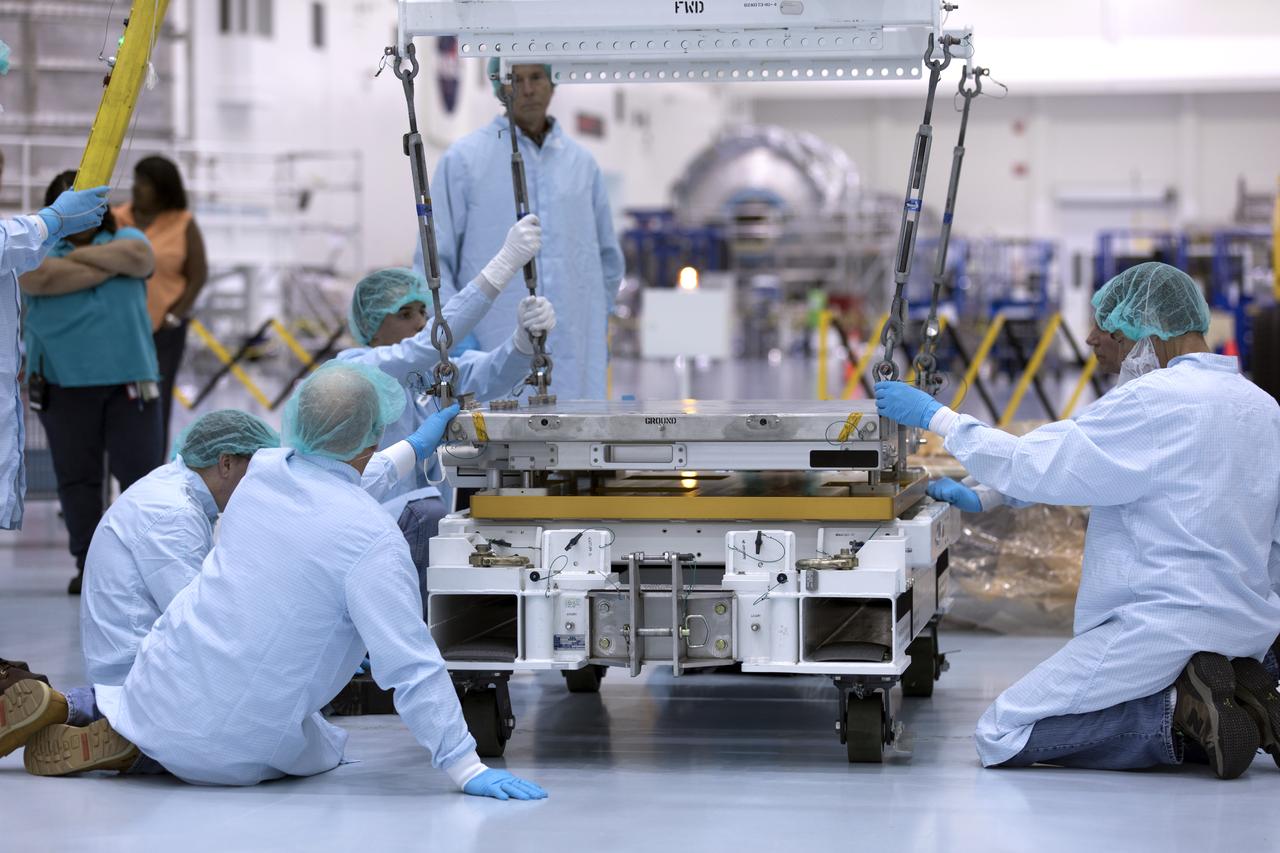
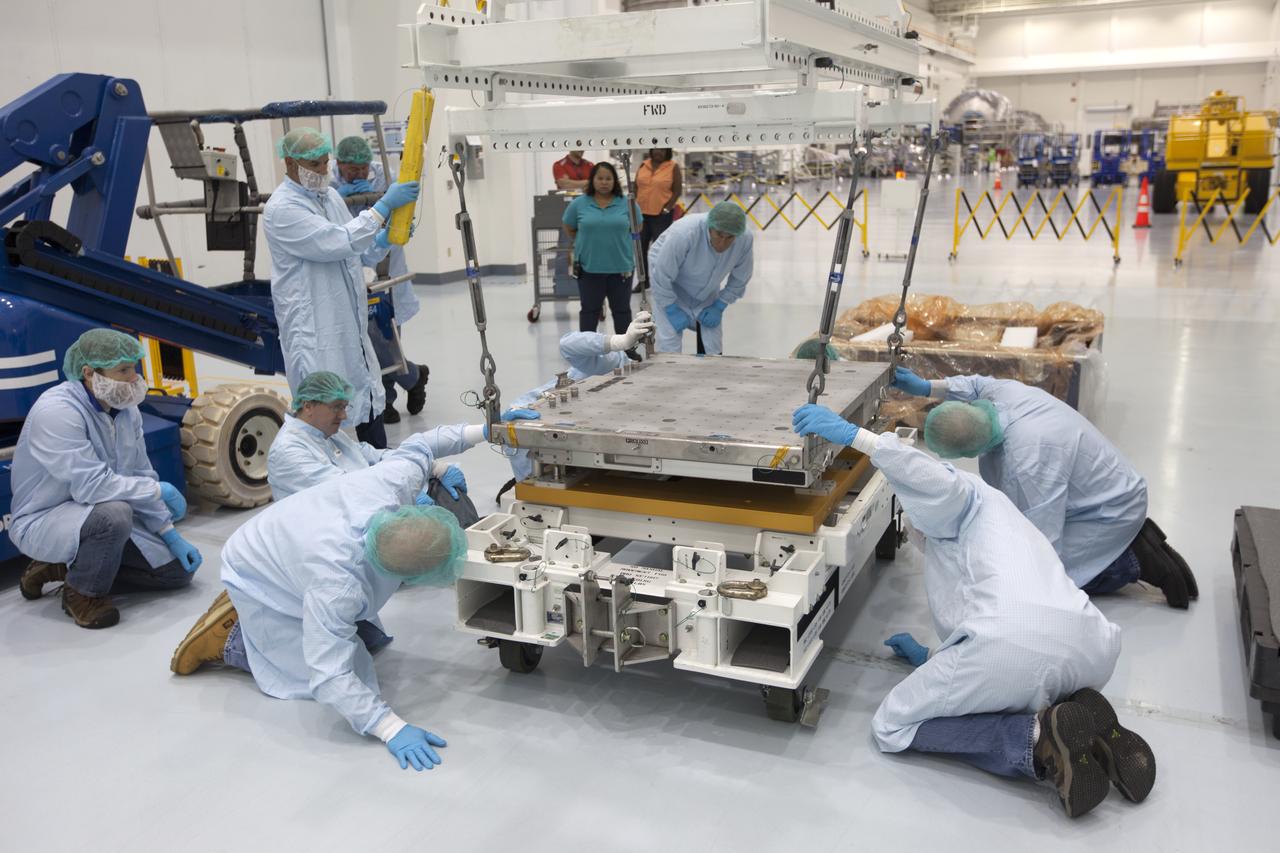
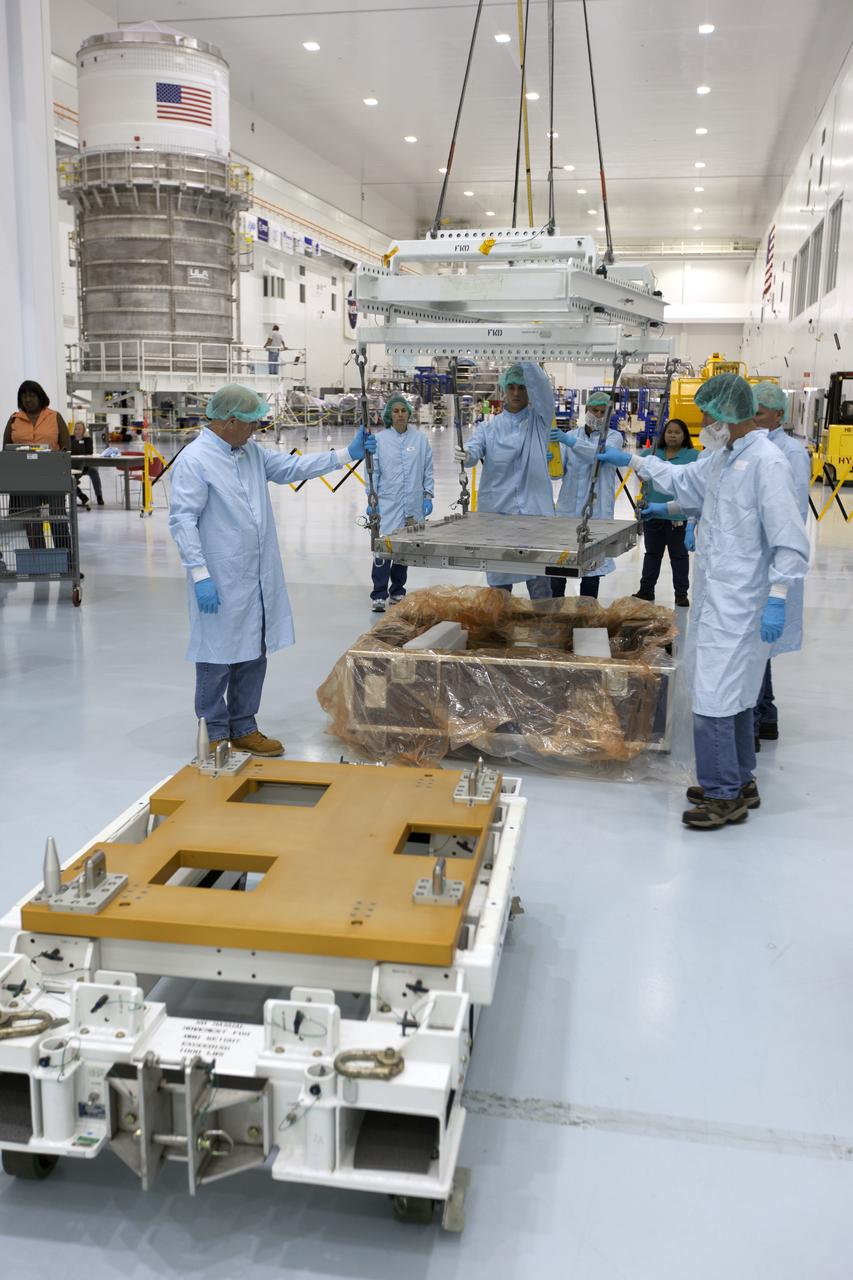
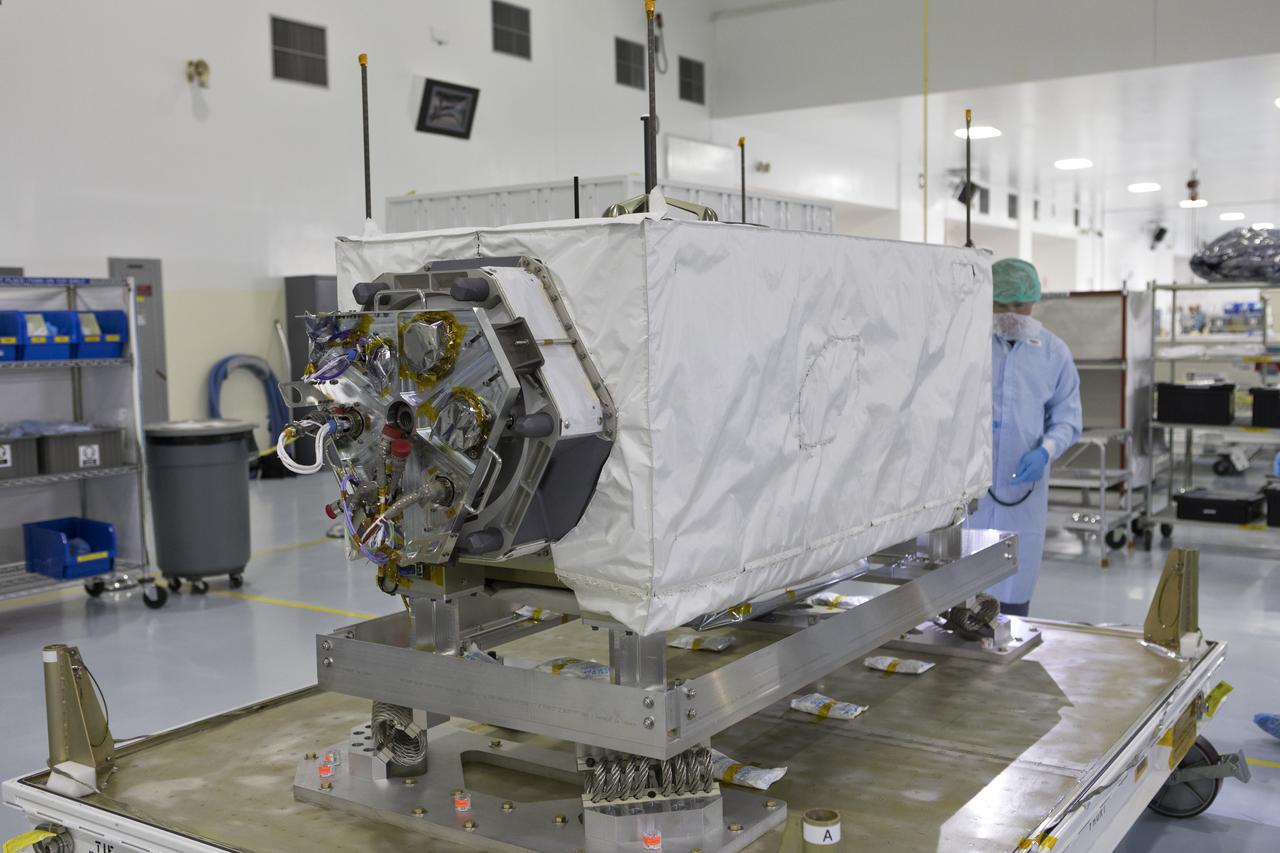
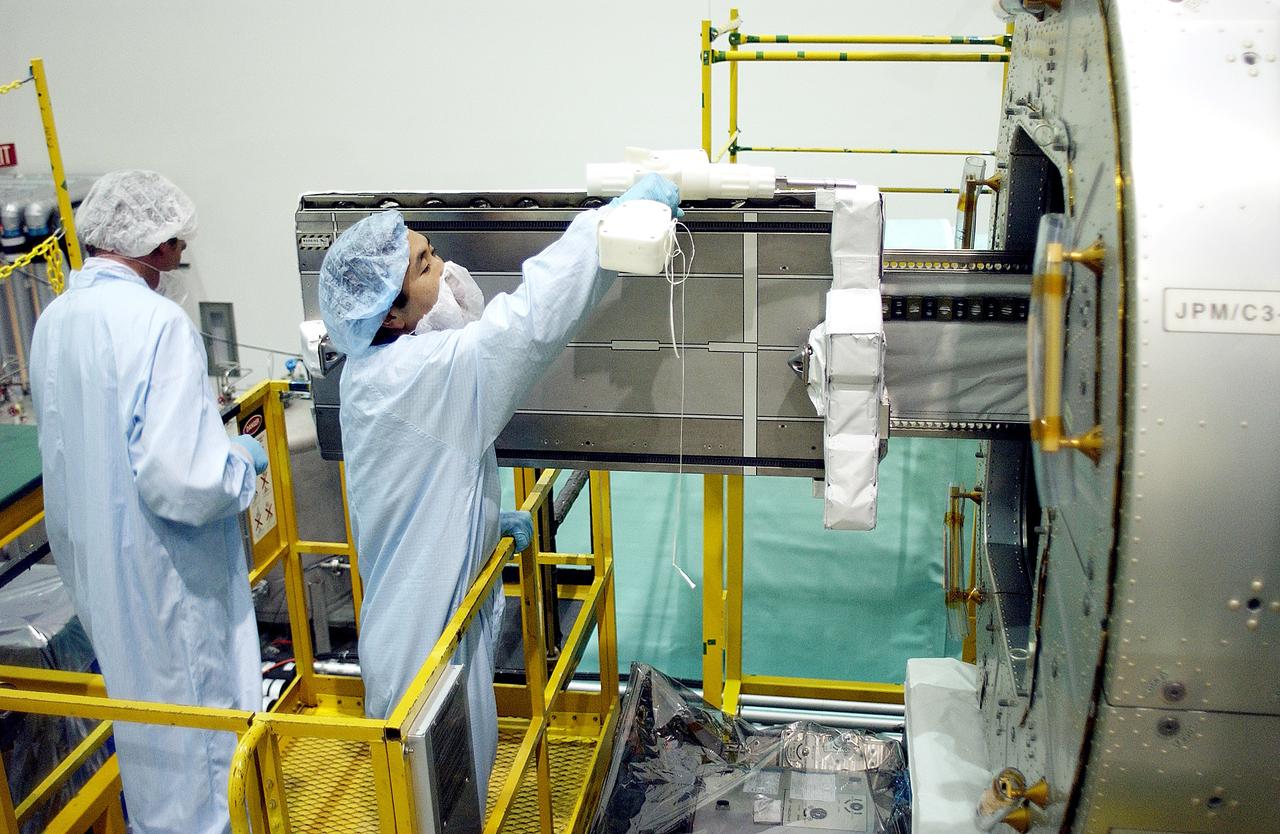
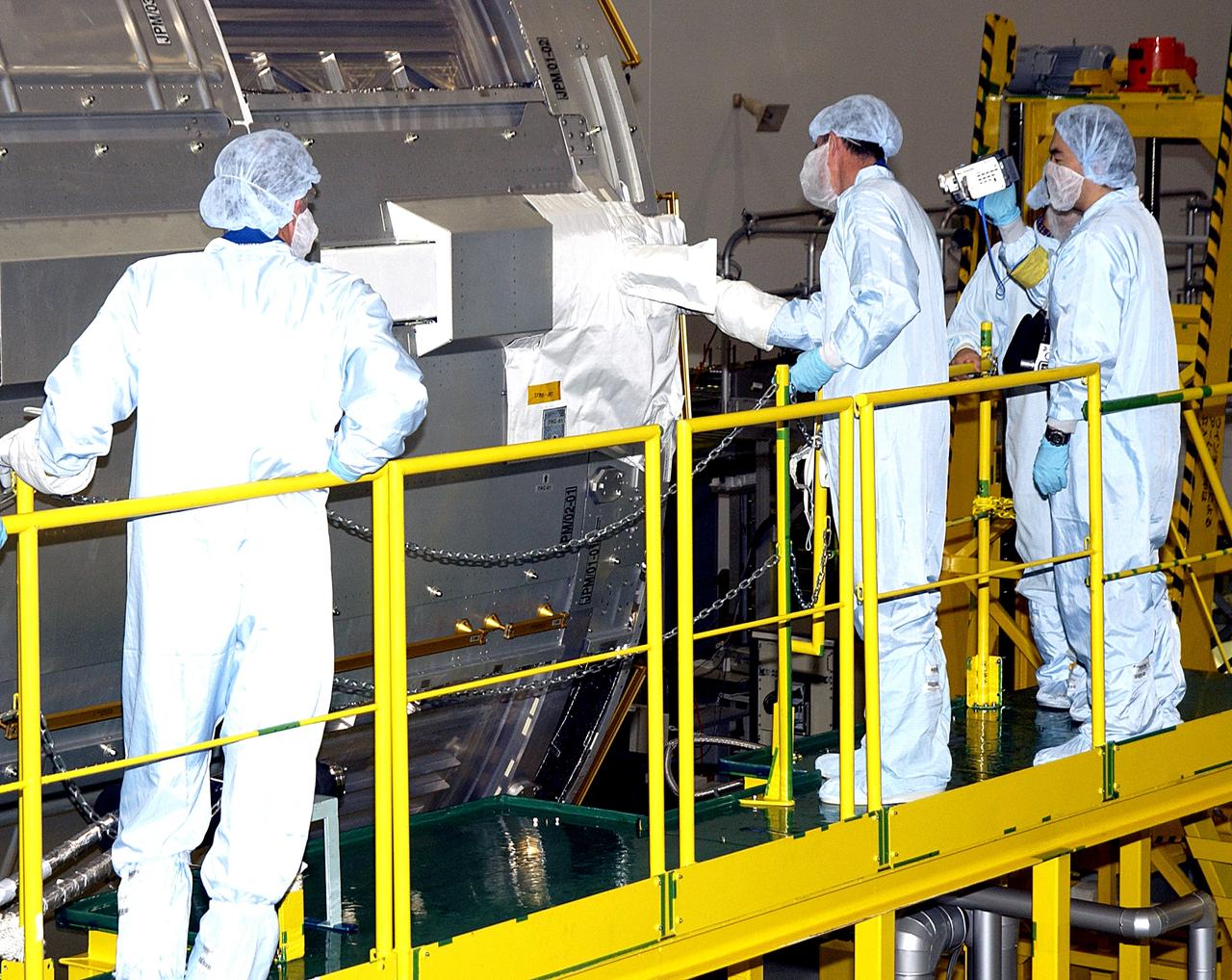
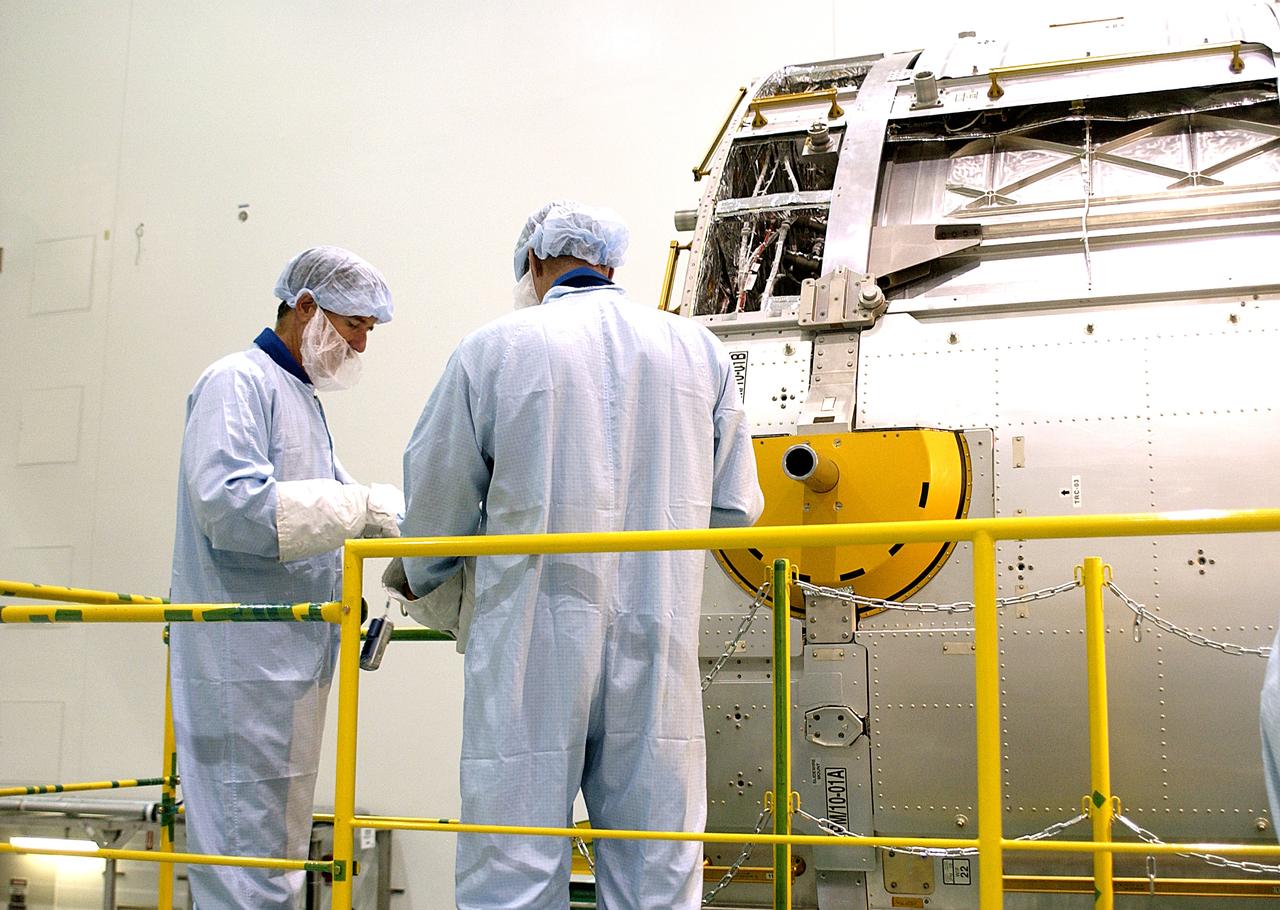
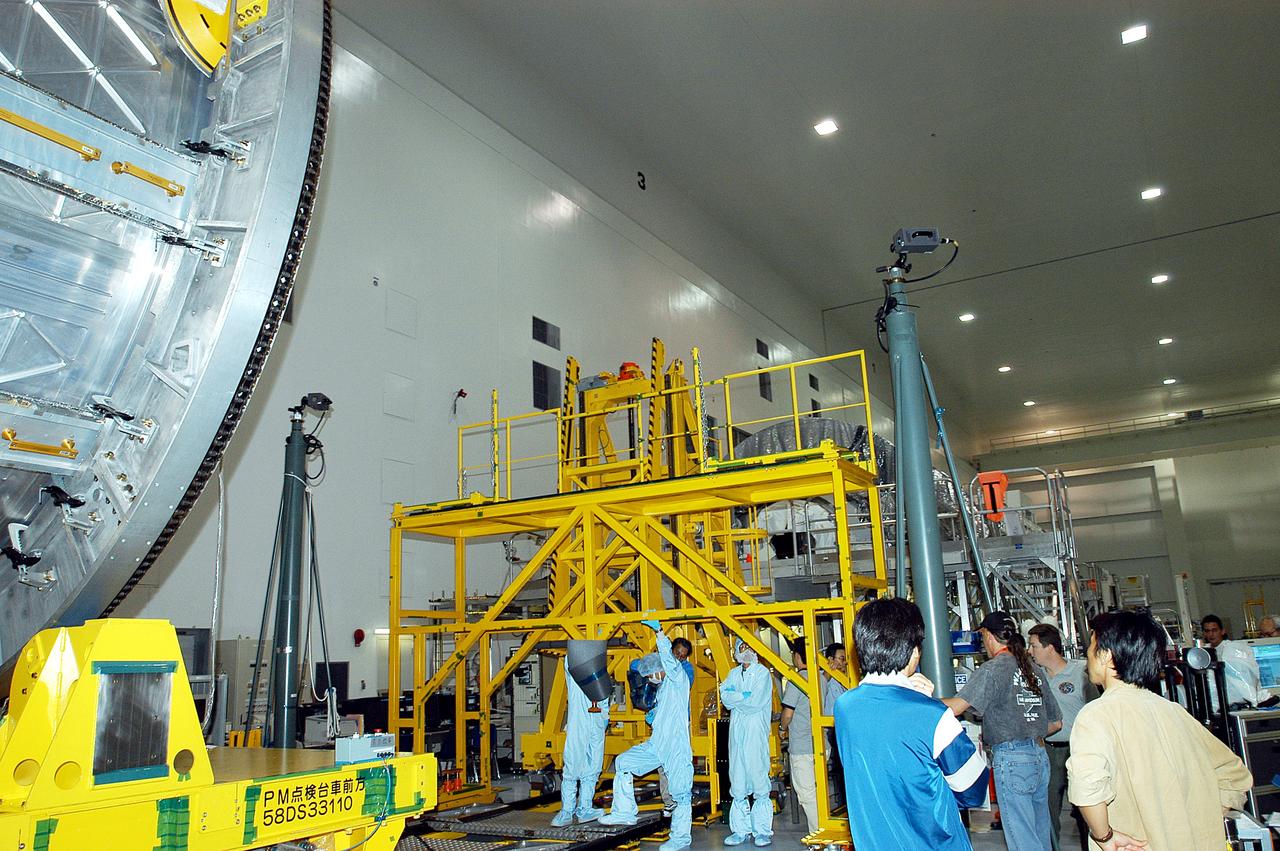
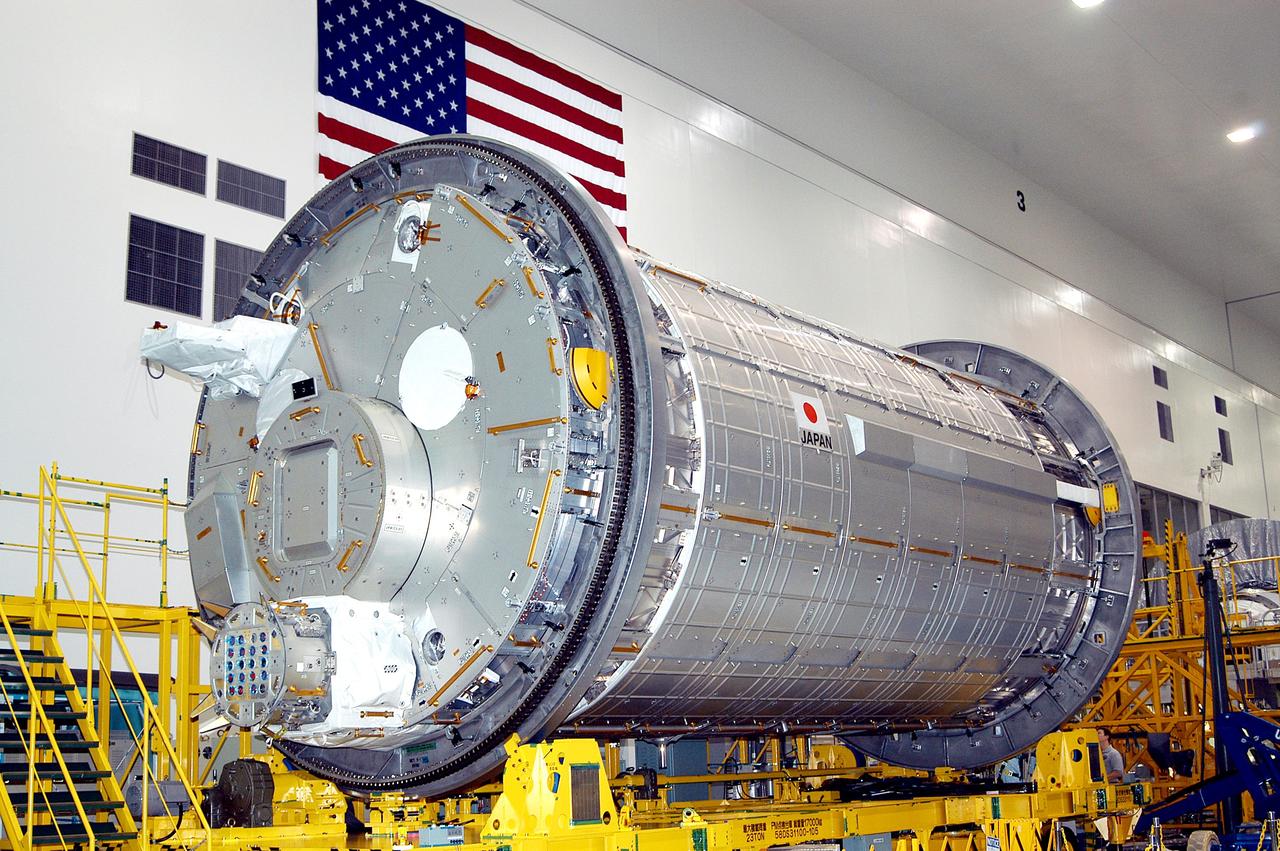
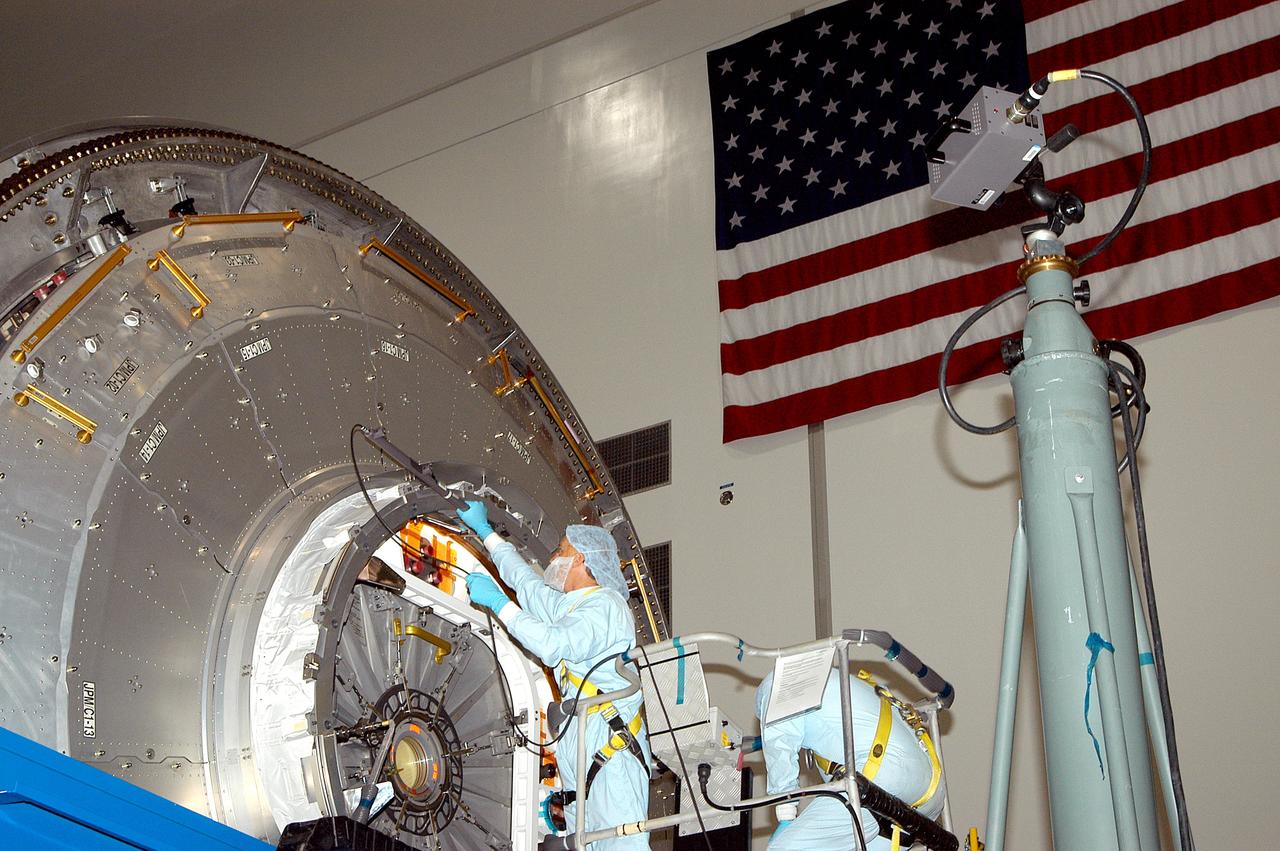
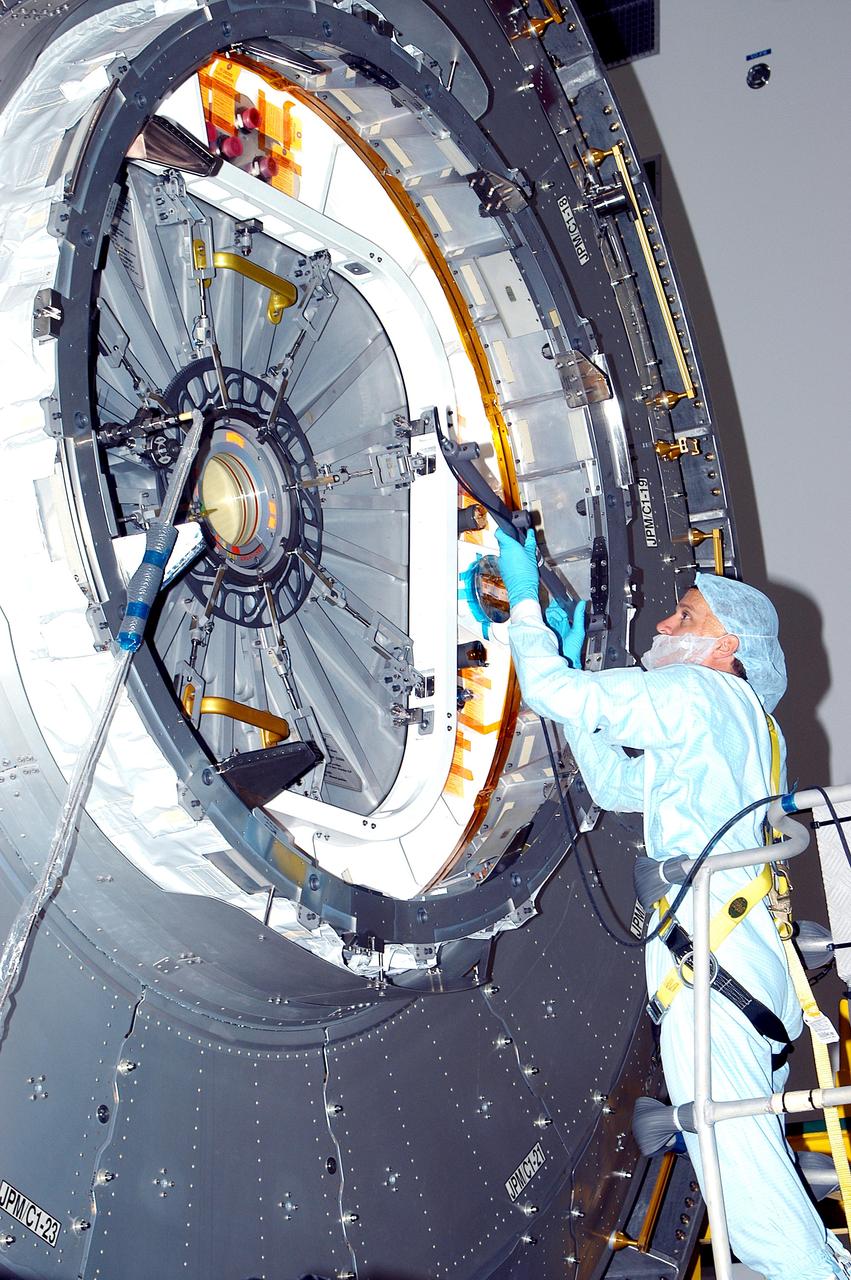
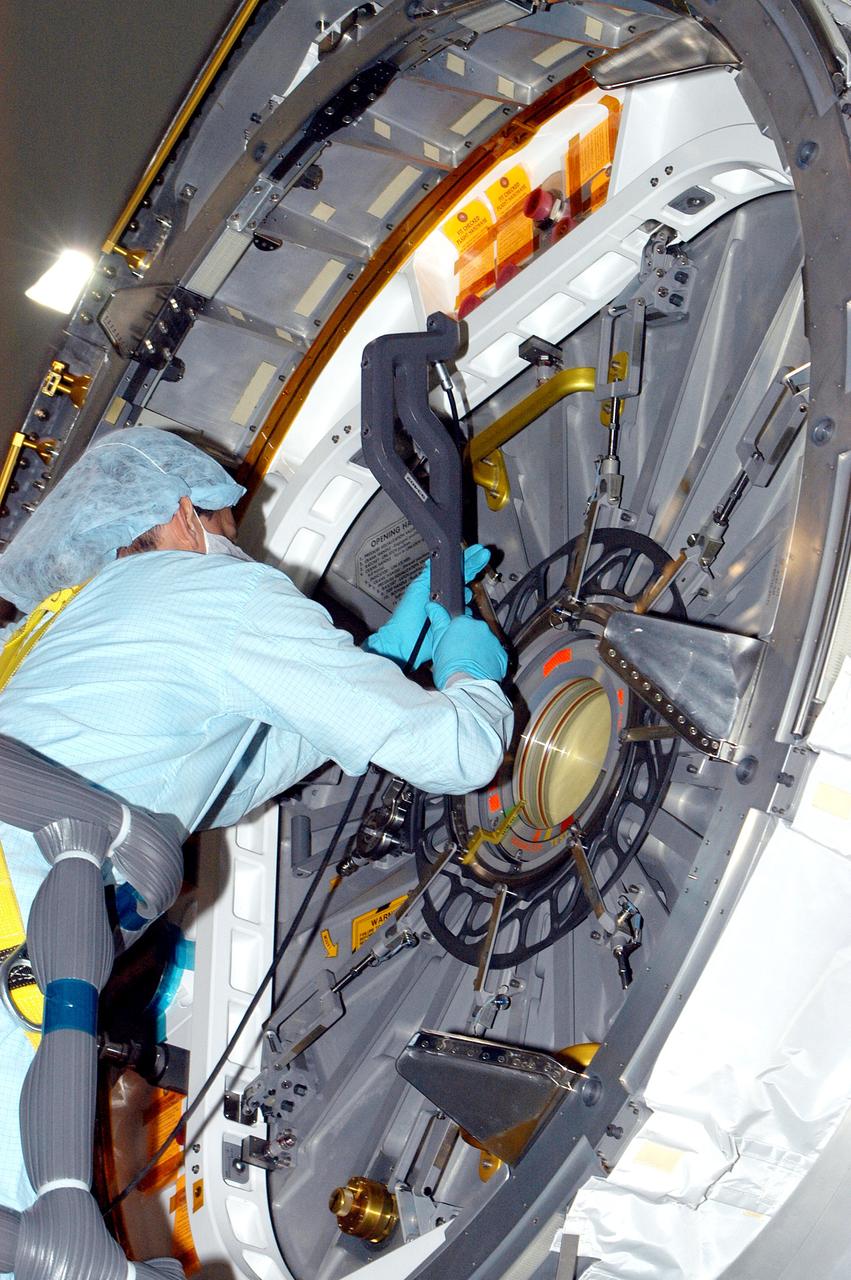
The Materials International Space Station Experiment-Flight Facility, or MISSE-FF, hardware arrived at the Space Station Processing Facility low bay at NASA's Kennedy Space Center in Florida. Technicians assist as one of the components is lowered onto another MISSE component. MISSE will be used to test various materials and computing elements on the exterior of the space station. They will be exposed to the harsh environment of low-Earth orbit, including to a vacuum, atomic oxygen, ultraviolet radiation, direct sunlight and extreme heat and cold. The experiment will provide a better understanding of material durability, from coatings to electronic sensors, which could be applied to future spacecraft designs. MISSE will be delivered to the space station on a future commercial resupply mission.
Materials International Space Station Experiment (MISSE) Arrival
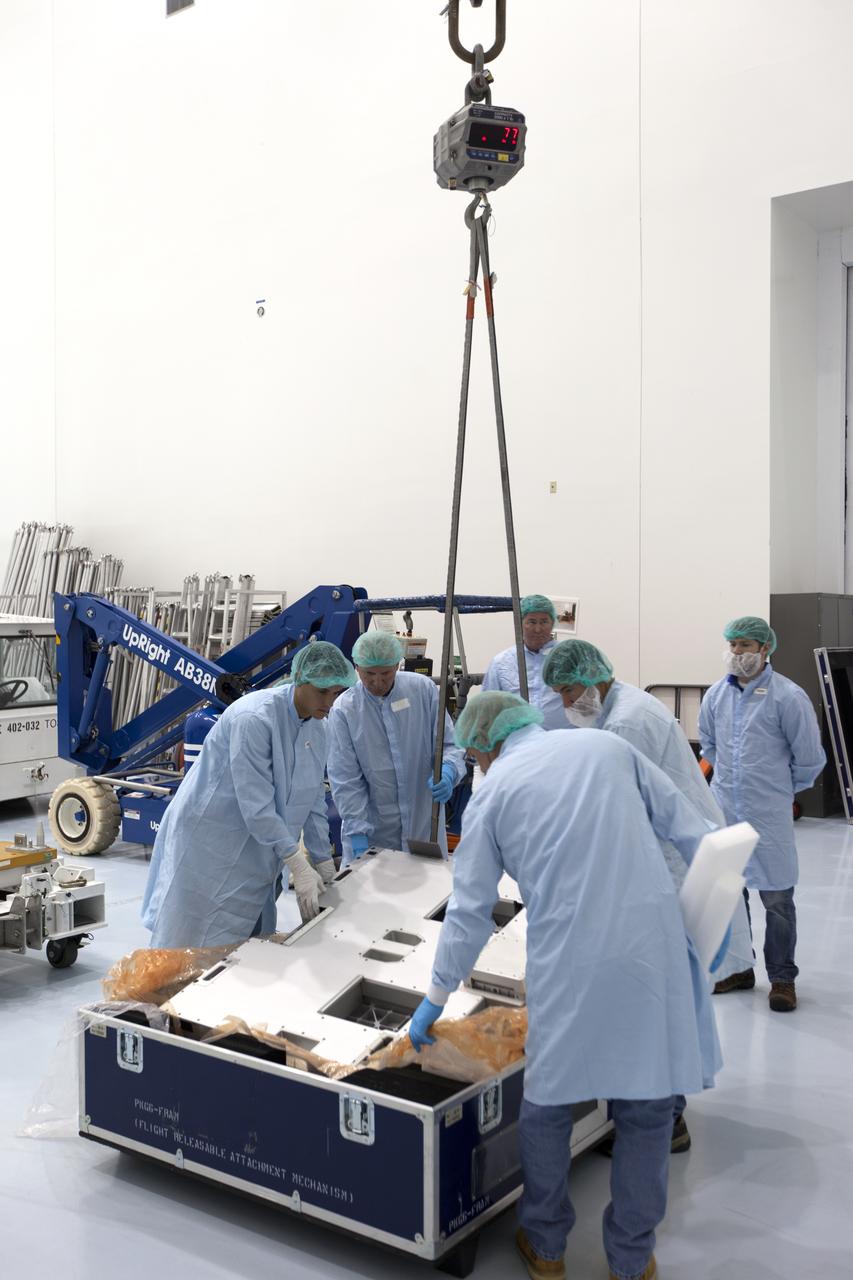
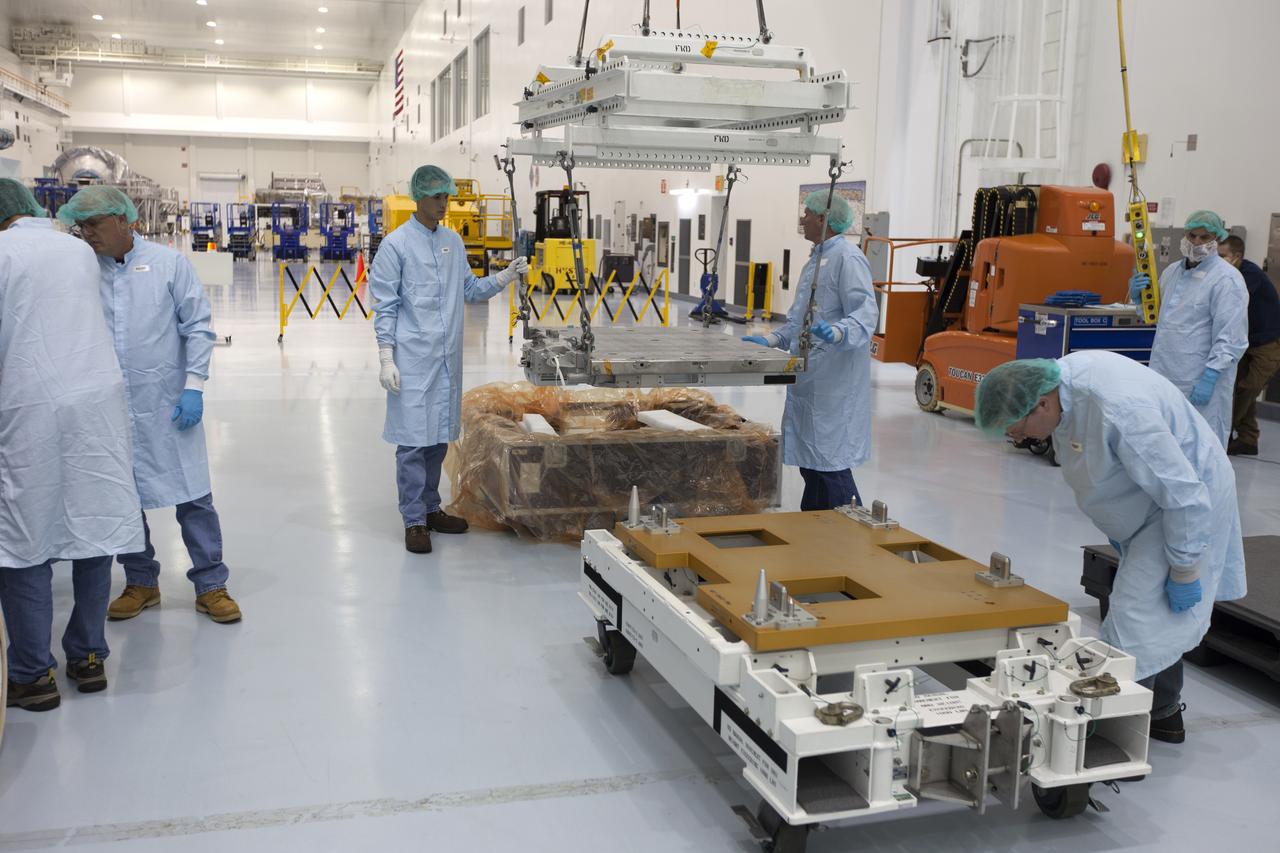
The Materials International Space Station Experiment-Flight Facility, or MISSE-FF, hardware arrived at the Space Station Processing Facility low bay at NASA's Kennedy Space Center in Florida. Technicians work to attach a crane to MISSE for lifting out of its shipping container. MISSE will be used to test various materials and computing elements on the exterior of the space station. They will be exposed to the harsh environment of low-Earth orbit, including to a vacuum, atomic oxygen, ultraviolet radiation, direct sunlight and extreme heat and cold. The experiment will provide a better understanding of material durability, from coatings to electronic sensors, which could be applied to future spacecraft designs. MISSE will be delivered to the space station on a future commercial resupply mission.
Materials International Space Station Experiment (MISSE) Arrival
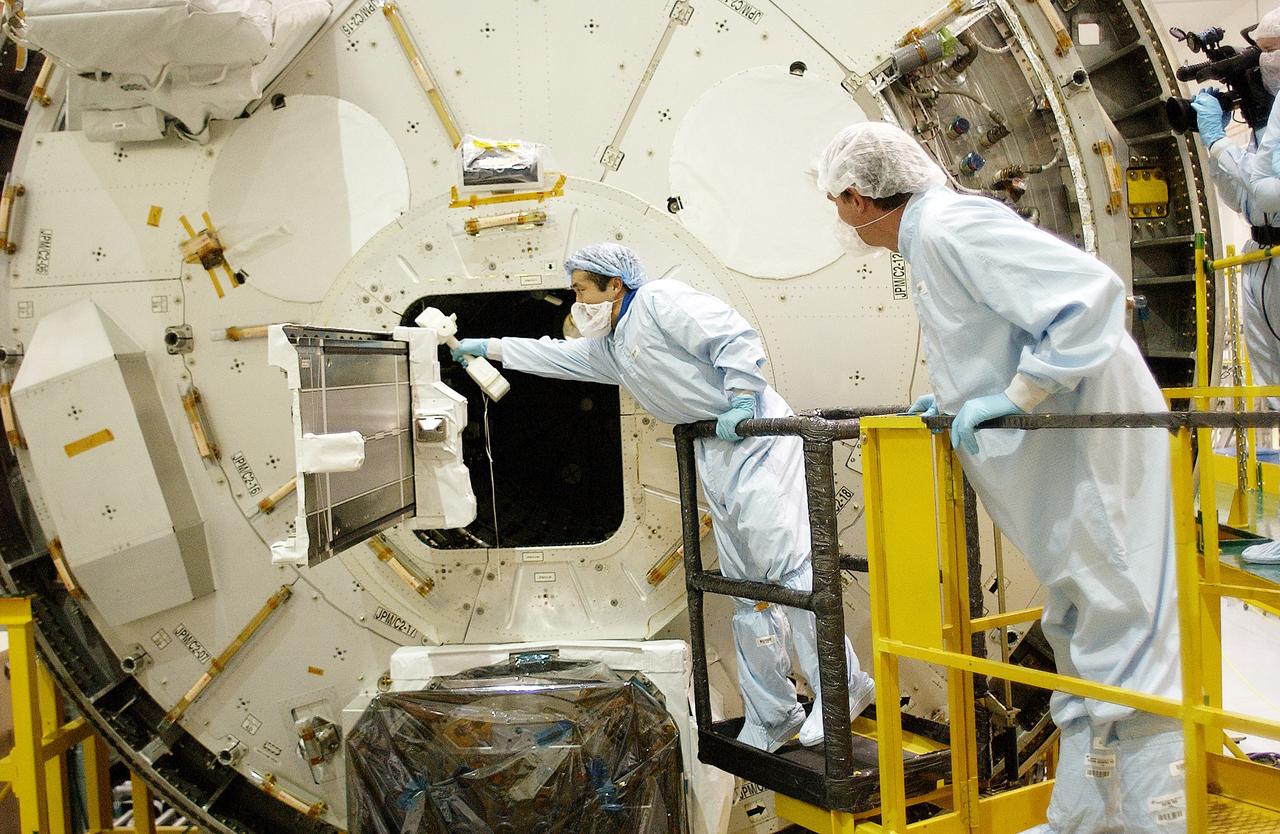
The Materials International Space Station Experiment-Flight Facility, or MISSE-FF, hardware arrived at the Space Station Processing Facility low bay at NASA's Kennedy Space Center in Florida. Technicians assist as one of the components is lowered onto another MISSE component. MISSE will be used to test various materials and computing elements on the exterior of the space station. They will be exposed to the harsh environment of low-Earth orbit, including to a vacuum, atomic oxygen, ultraviolet radiation, direct sunlight and extreme heat and cold. The experiment will provide a better understanding of material durability, from coatings to electronic sensors, which could be applied to future spacecraft designs. MISSE will be delivered to the space station on a future commercial resupply mission.
Materials International Space Station Experiment (MISSE) Arrival
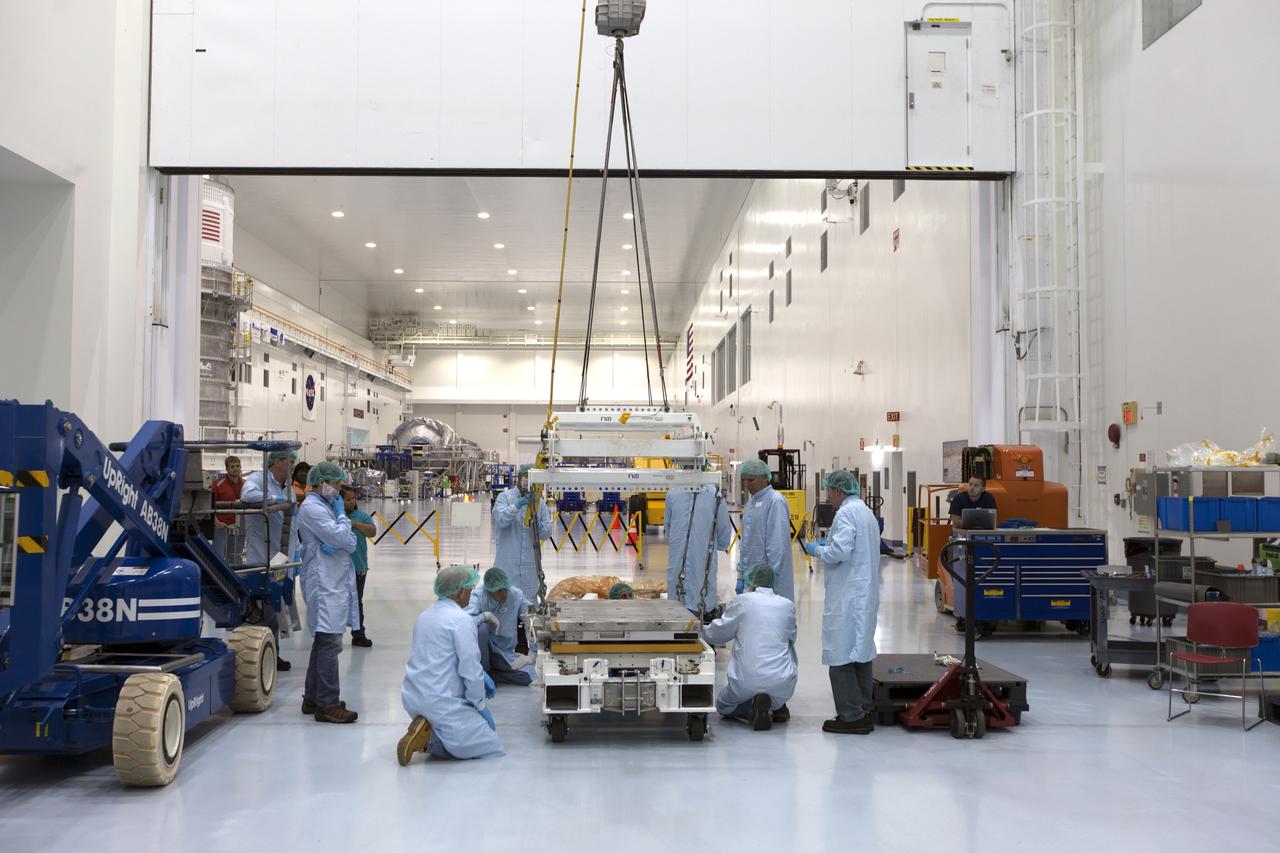
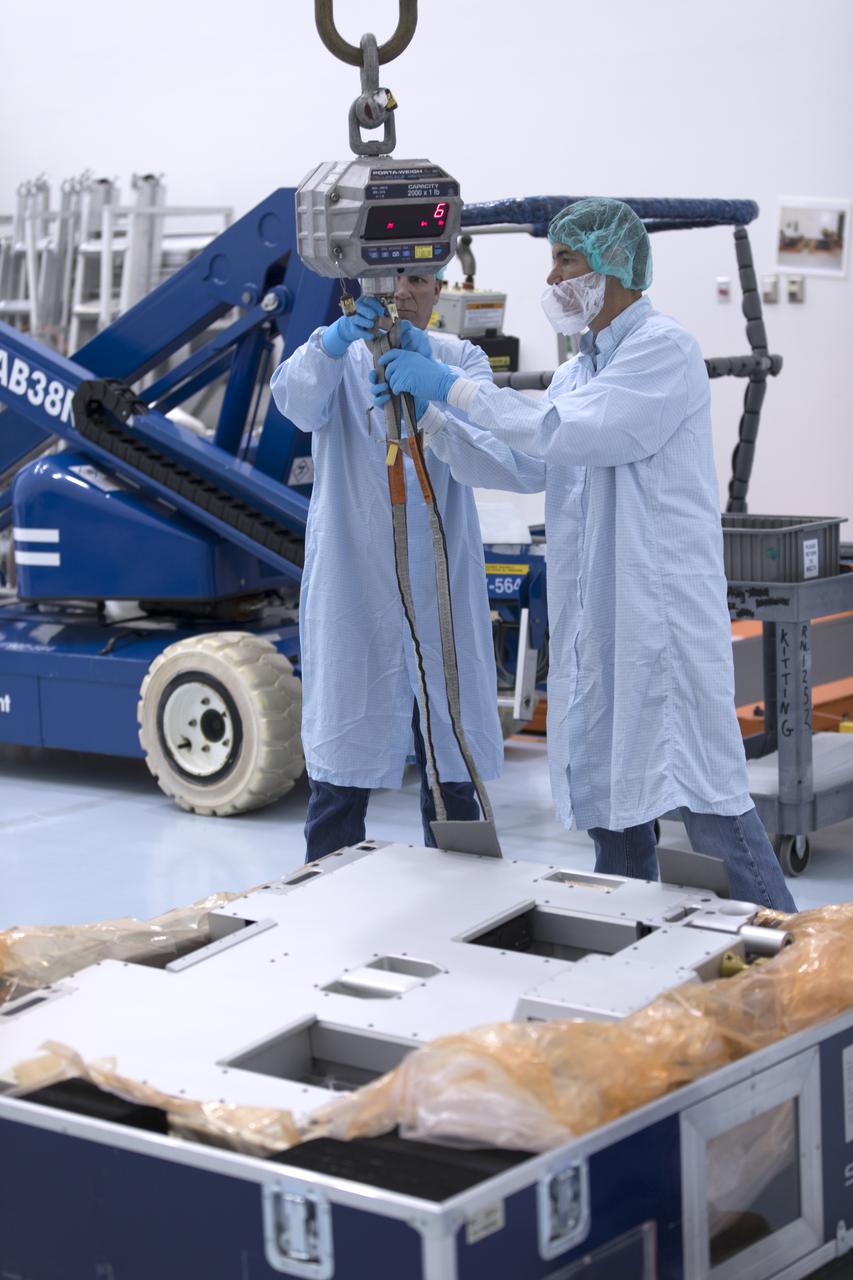
The Materials International Space Station Experiment-Flight Facility, or MISSE-FF, hardware arrived at the Space Station Processing Facility low bay at NASA's Kennedy Space Center in Florida. Technicians assist as a crane is used to lift MISSE out of its shipping container. MISSE will be used to test various materials and computing elements on the exterior of the space station. They will be exposed to the harsh environment of low-Earth orbit, including to a vacuum, atomic oxygen, ultraviolet radiation, direct sunlight and extreme heat and cold. The experiment will provide a better understanding of material durability, from coatings to electronic sensors, which could be applied to future spacecraft designs. MISSE will be delivered to the space station on a future commercial resupply mission.
Materials International Space Station Experiment (MISSE) Arrival
The Materials International Space Station Experiment-Flight Facility, or MISSE-FF, hardware arrived at the Space Station Processing Facility low bay at NASA's Kennedy Space Center in Florida. Technicians assist as MISSE is lifted by crane from its shipping container. MISSE will be used to test various materials and computing elements on the exterior of the space station. They will be exposed to the harsh environment of low-Earth orbit, including to a vacuum, atomic oxygen, ultraviolet radiation, direct sunlight and extreme heat and cold. The experiment will provide a better understanding of material durability, from coatings to electronic sensors, which could be applied to future spacecraft designs. MISSE will be delivered to the space station on a future commercial resupply mission.
Materials International Space Station Experiment (MISSE) Arrival
The Materials International Space Station Experiment-Flight Facility, or MISSE-FF, hardware arrived at the Space Station Processing Facility low bay at NASA's Kennedy Space Center in Florida. Technicians assist as one of the components is lowered and secured onto another MISSE component. MISSE will be used to test various materials and computing elements on the exterior of the space station. They will be exposed to the harsh environment of low-Earth orbit, including to a vacuum, atomic oxygen, ultraviolet radiation, direct sunlight and extreme heat and cold. The experiment will provide a better understanding of material durability, from coatings to electronic sensors, which could be applied to future spacecraft designs. MISSE will be delivered to the space station on a future commercial resupply mission.
Materials International Space Station Experiment (MISSE) Arrival
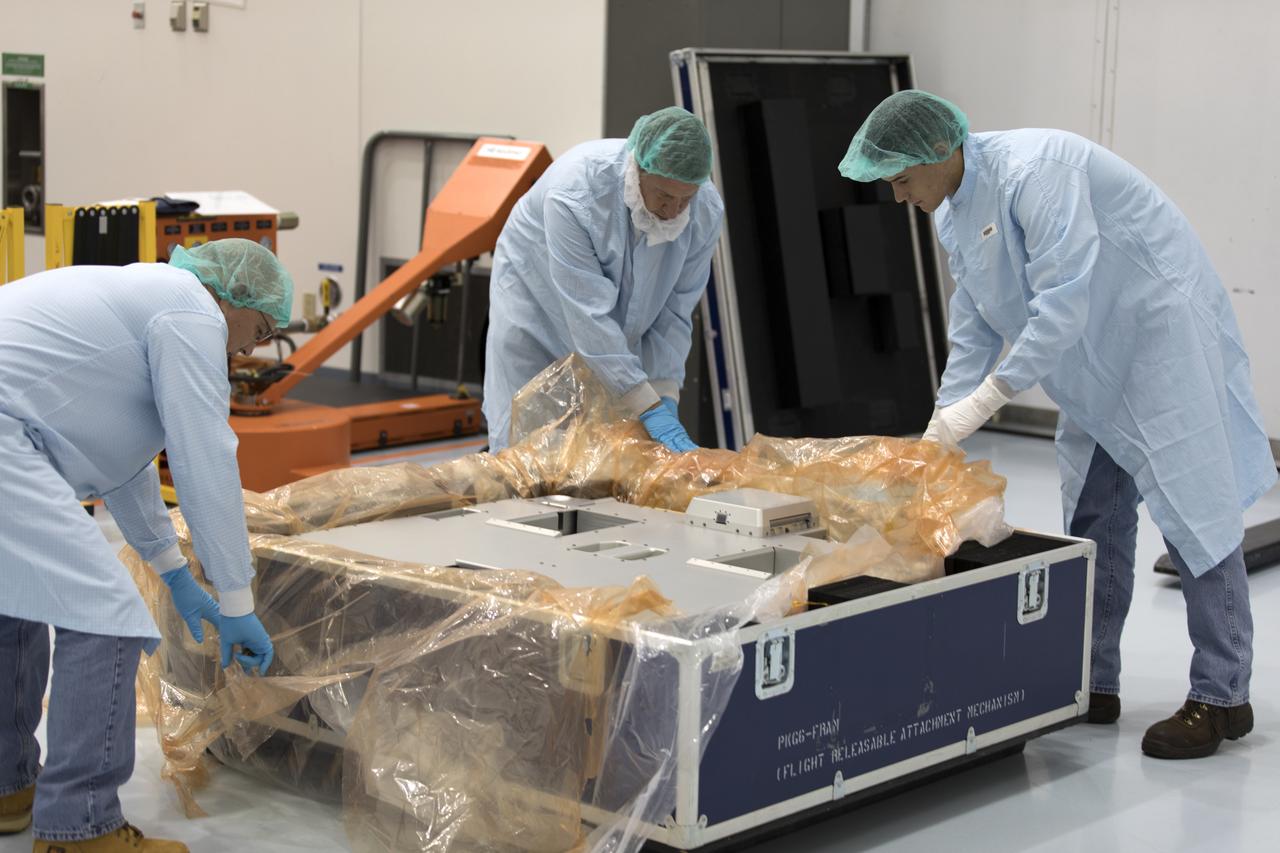
The Materials International Space Station Experiment-Flight Facility, or MISSE-FF, hardware arrived at the Space Station Processing Facility low bay at NASA's Kennedy Space Center in Florida. MISSE will be unpacked for integration and processing. MISSE will be used to test various materials and computing elements on the exterior of the space station. They will be exposed to the harsh environment of low-Earth orbit, including to a vacuum, atomic oxygen, ultraviolet radiation, direct sunlight and extreme heat and cold. The experiment will provide a better understanding of material durability, from coatings to electronic sensors, which could be applied to future spacecraft designs. MISSE will be delivered to the space station on a future commercial resupply mission.
Materials International Space Station Experiment (MISSE) Arrival
The Materials International Space Station Experiment-Flight Facility, or MISSE-FF, hardware arrived at the Space Station Processing Facility low bay at NASA's Kennedy Space Center in Florida. Technicians assist as MISSE is lifted by crane from its shipping container. MISSE will be used to test various materials and computing elements on the exterior of the space station. They will be exposed to the harsh environment of low-Earth orbit, including to a vacuum, atomic oxygen, ultraviolet radiation, direct sunlight and extreme heat and cold. The experiment will provide a better understanding of material durability, from coatings to electronic sensors, which could be applied to future spacecraft designs. MISSE will be delivered to the space station on a future commercial resupply mission.
Materials International Space Station Experiment (MISSE) Arrival
The Materials International Space Station Experiment-Flight Facility, or MISSE-FF, hardware arrived at the Space Station Processing Facility low bay at NASA's Kennedy Space Center in Florida. Technicians attach a crane to MISSE for lifting out of its shipping container. MISSE will be used to test various materials and computing elements on the exterior of the space station. They will be exposed to the harsh environment of low-Earth orbit, including to a vacuum, atomic oxygen, ultraviolet radiation, direct sunlight and extreme heat and cold. The experiment will provide a better understanding of material durability, from coatings to electronic sensors, which could be applied to future spacecraft designs. MISSE will be delivered to the space station on a future commercial resupply mission.
Materials International Space Station Experiment (MISSE) Arrival
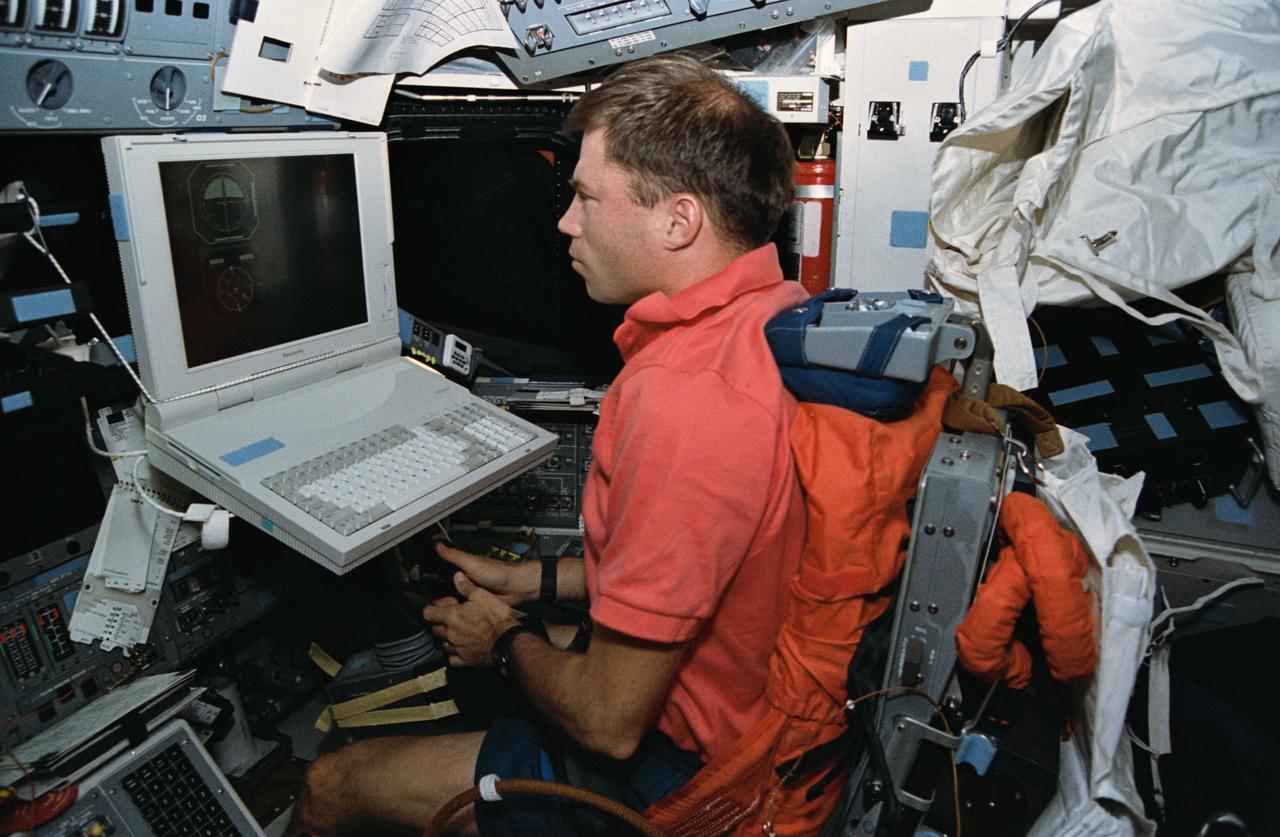
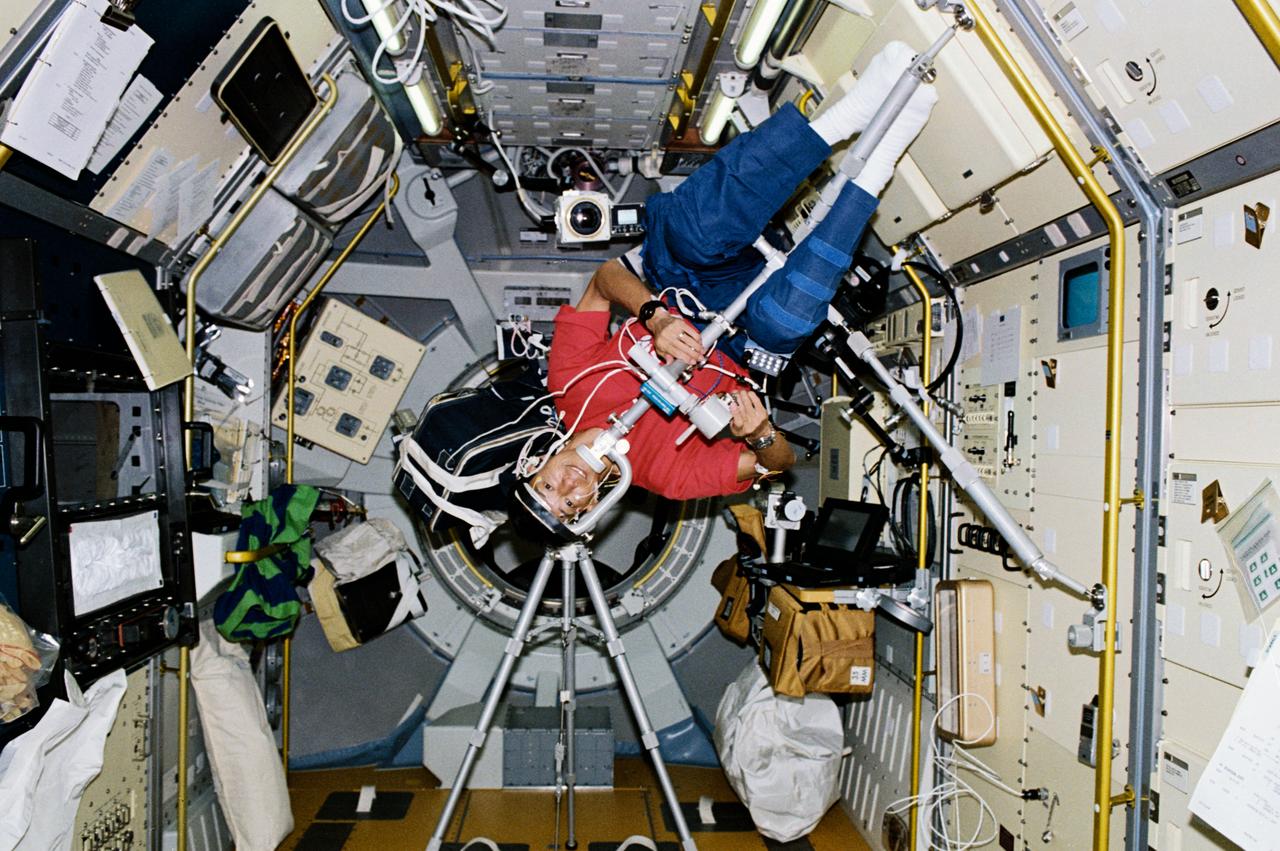
STS058-14-006 (18 Oct- 1 Nov 1993) --- Astronaut Richard A. Searfoss, pilot, participates in an experiment that measures the effects of space flight on pilot proficiency.  Astronauts Searfoss (seen here at the pilot's station) and John E. Blaha, mission commander, are conducting the first tests of the Portable Inflight Landing Operations Trainer (PILOT).  STS-58 is the first of six scheduled test flights of PILOT designed to determine its effectiveness as a training tool.
Pilot Searfoss in experiment measuring effects space flight & pilot ability
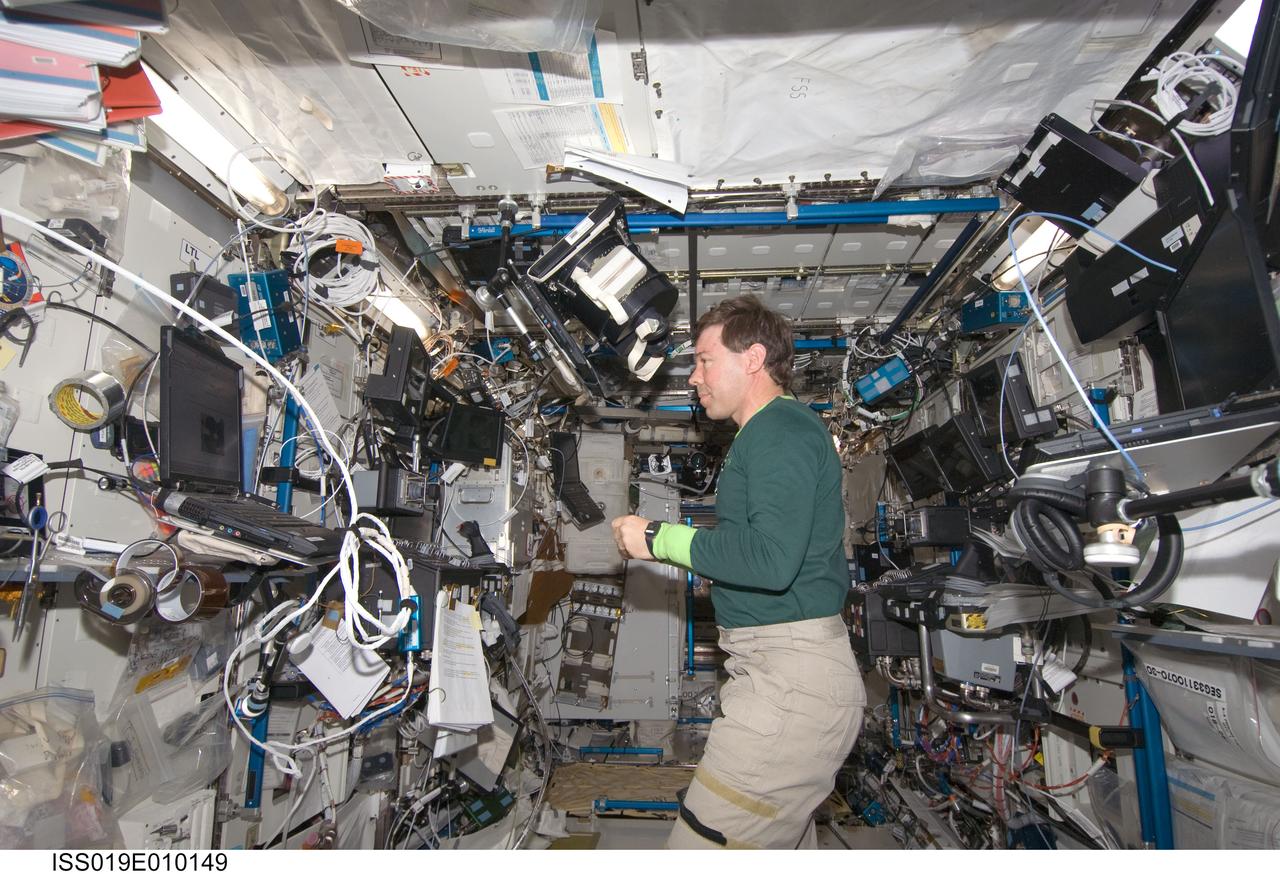
ISS019-E-010149 (18 April 2009) --- Astronaut Michael Barratt, Expedition 19/20 flight engineer, sets up equipment for the Bodies in the Space Environment (BISE) experiment in the Destiny laboratory of the International Space Station. The Canadian Space Agency-sponsored BISE experiment studies how astronauts perceive up and down in microgravity.
BISE (Bodies in the Space Environment) experiment
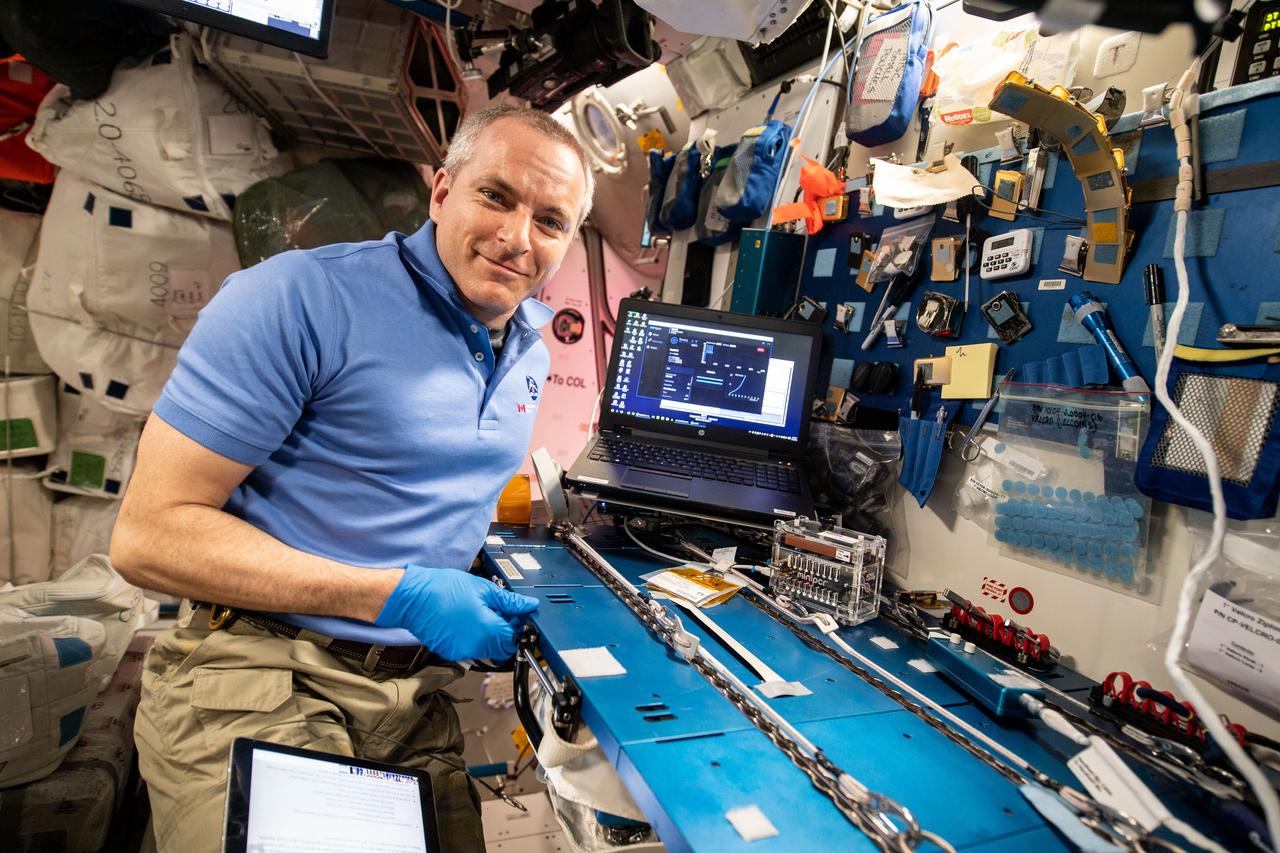
iss059e061607 (5/14/2019) --- Canadian Space Agency (CSA) astronaut David Saint-Jacques works with the miniPCR hardware inside the Columbus laboratory module onboard the International Space Station (ISS) for the Genes In Space-6 experiment that is exploring how space radiation damages DNA and how the cell repair mechanism works in microgravity.
Genes In Space-6 experiment
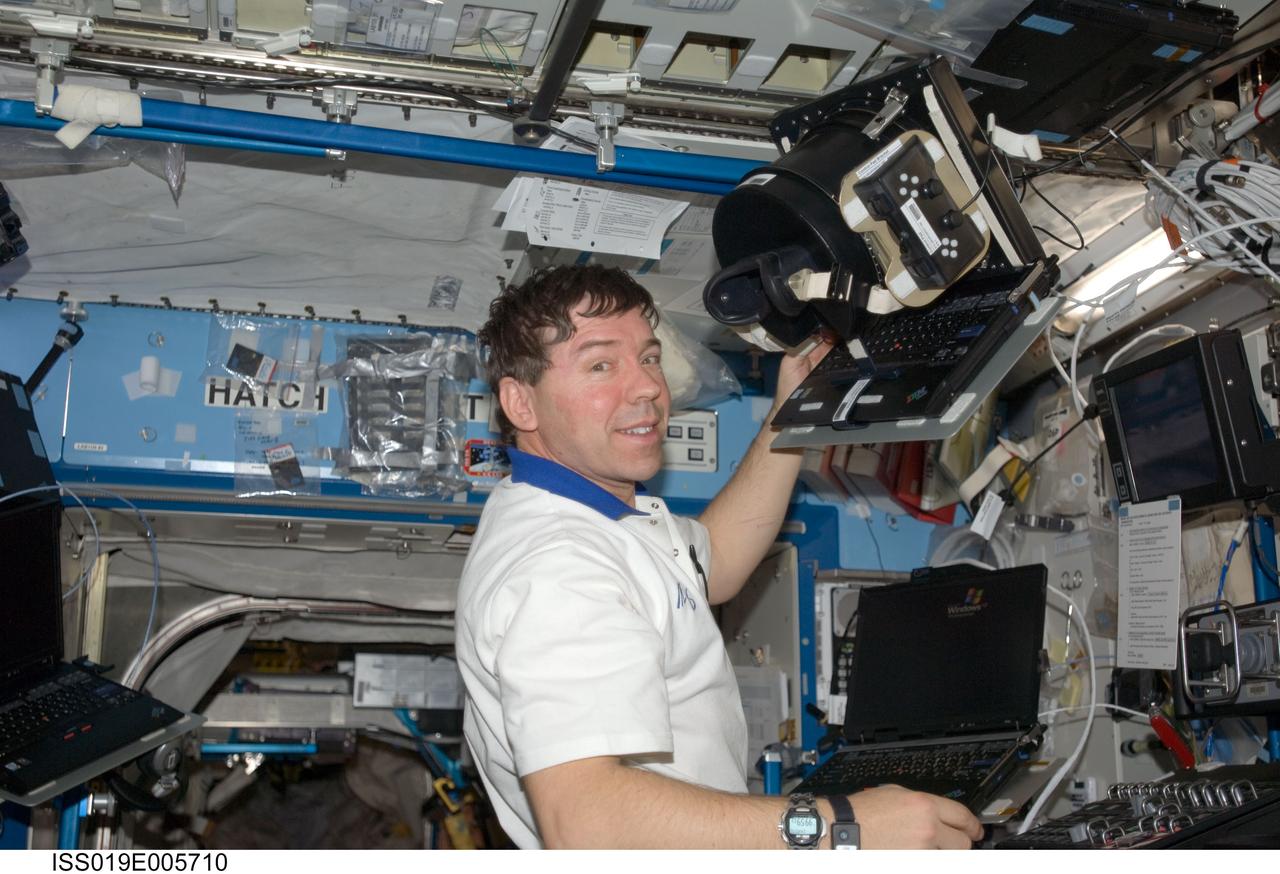
ISS019-E-005710 (9 April 2009) --- Astronaut Michael Barratt, Expedition 19/20 flight engineer, uses Neurospat hardware to perform the Bodies in the Space Environment (BISE) experiment in the Destiny laboratory of the International Space Station. The Canadian Space Agency-sponsored BISE experiment studies how astronauts perceive up and down in microgravity.
BISE (Bodies in the Space Environment) experiment
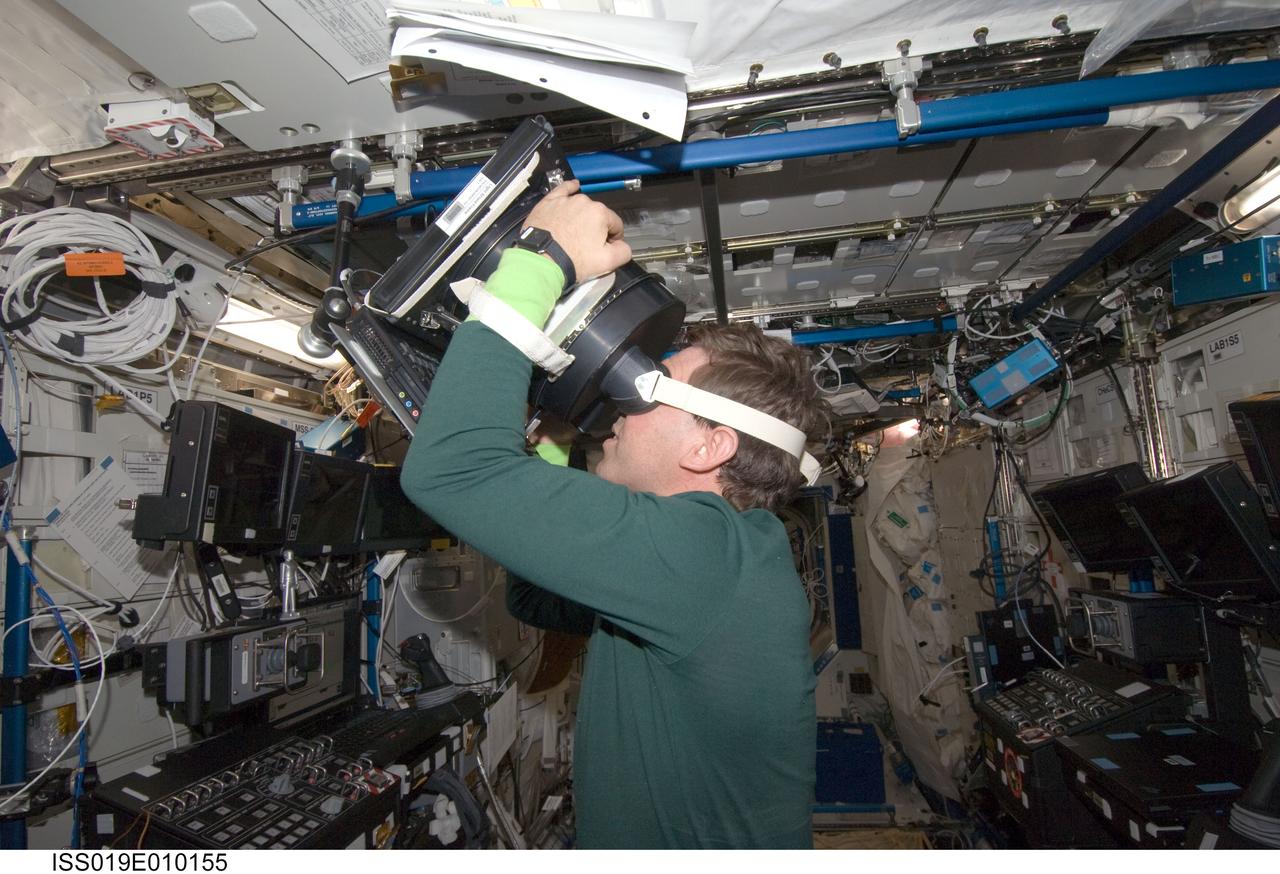
ISS019-E-010155 (18 April 2009) --- Astronaut Michael Barratt, Expedition 19/20 flight engineer, uses Neurospat hardware to perform the Bodies in the Space Environment (BISE) experiment in the Destiny laboratory of the International Space Station. The Canadian Space Agency-sponsored BISE experiment studies how astronauts perceive up and down in microgravity.
BISE (Bodies in the Space Environment) experiment
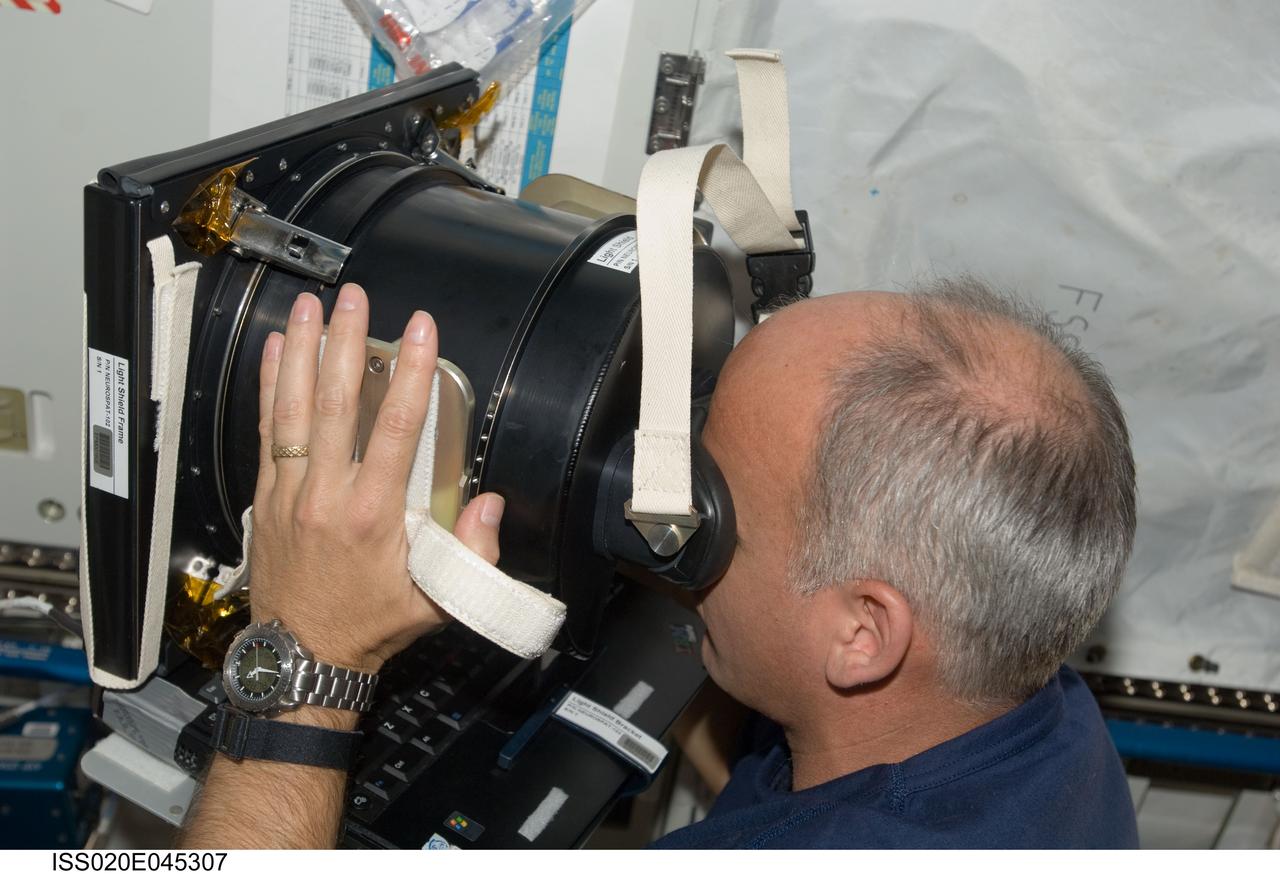
ISS020-E-045307 (5 Oct. 2009) --- NASA astronaut Jeffrey Williams, Expedition 21 flight engineer, uses Neurospat hardware to perform the Bodies in the Space Environment (BISE) experiment in the Destiny laboratory of the International Space Station. The Canadian Space Agency-sponsored BISE experiment studies how astronauts perceive up and down in microgravity.
BISE (Bodies in the Space Environment) experiment
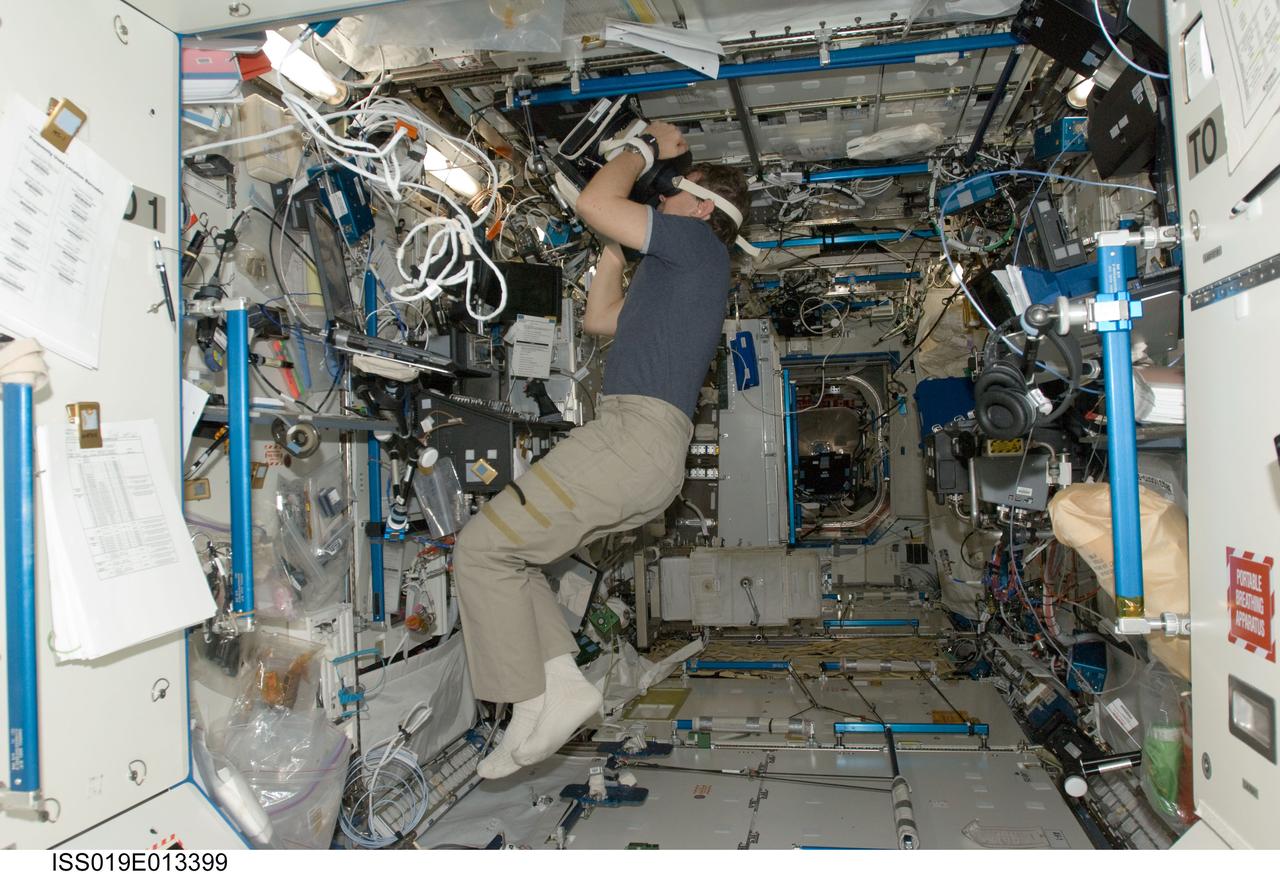
ISS019-E-013399 (2 May 2009) --- Astronaut Michael Barratt, Expedition 19/20 flight engineer, uses Neurospat hardware to perform the Bodies in the Space Environment (BISE) experiment in the Destiny laboratory of the International Space Station. The Canadian Space Agency-sponsored BISE experiment studies how astronauts perceive up and down in microgravity.
BISE (Bodies in the Space Environment) experiment
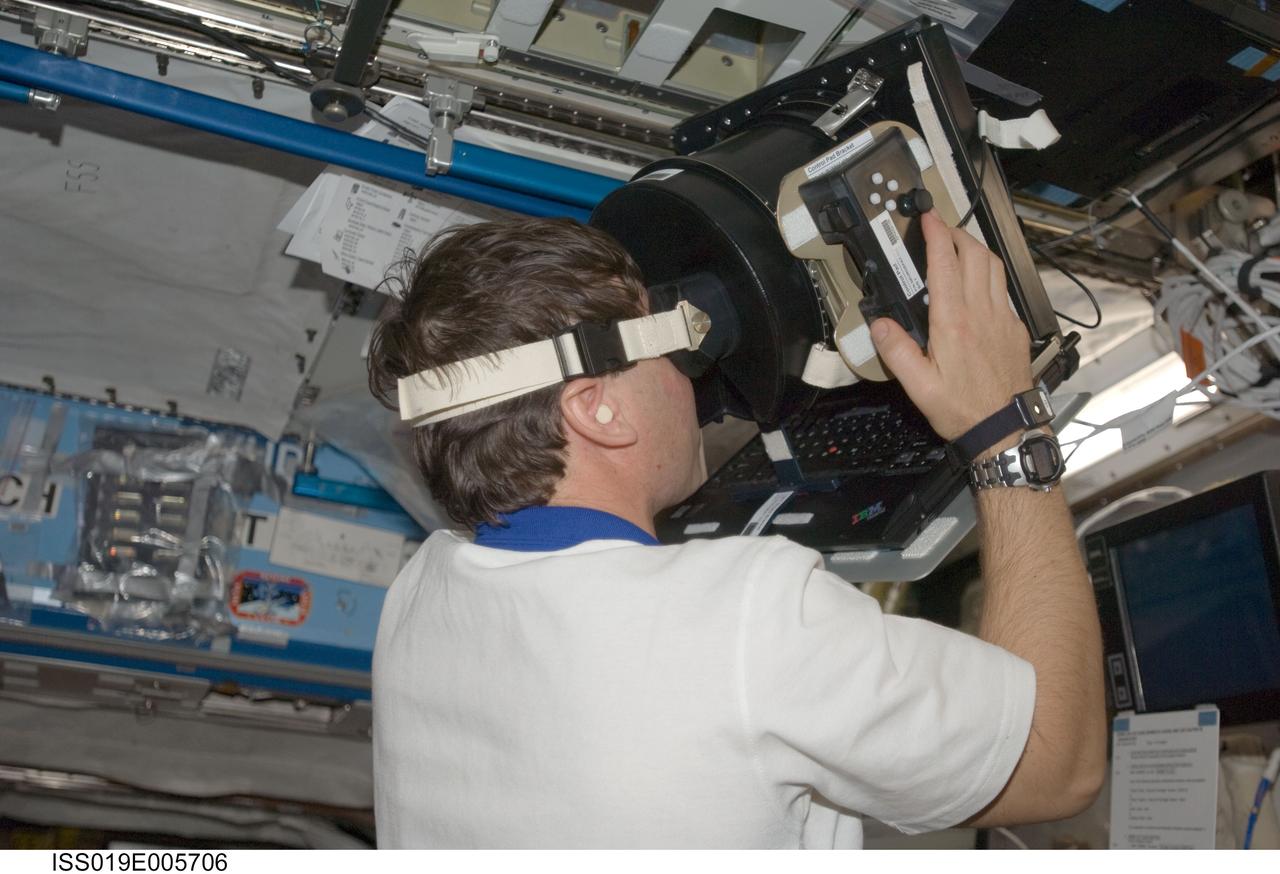
ISS019-E-005706 (9 April 2009) --- Astronaut Michael Barratt, Expedition 19/20 flight engineer, uses Neurospat hardware to perform the Bodies in the Space Environment (BISE) experiment in the Destiny laboratory of the International Space Station. The Canadian Space Agency-sponsored BISE experiment studies how astronauts perceive up and down in microgravity.
BISE (Bodies in the Space Environment) experiment
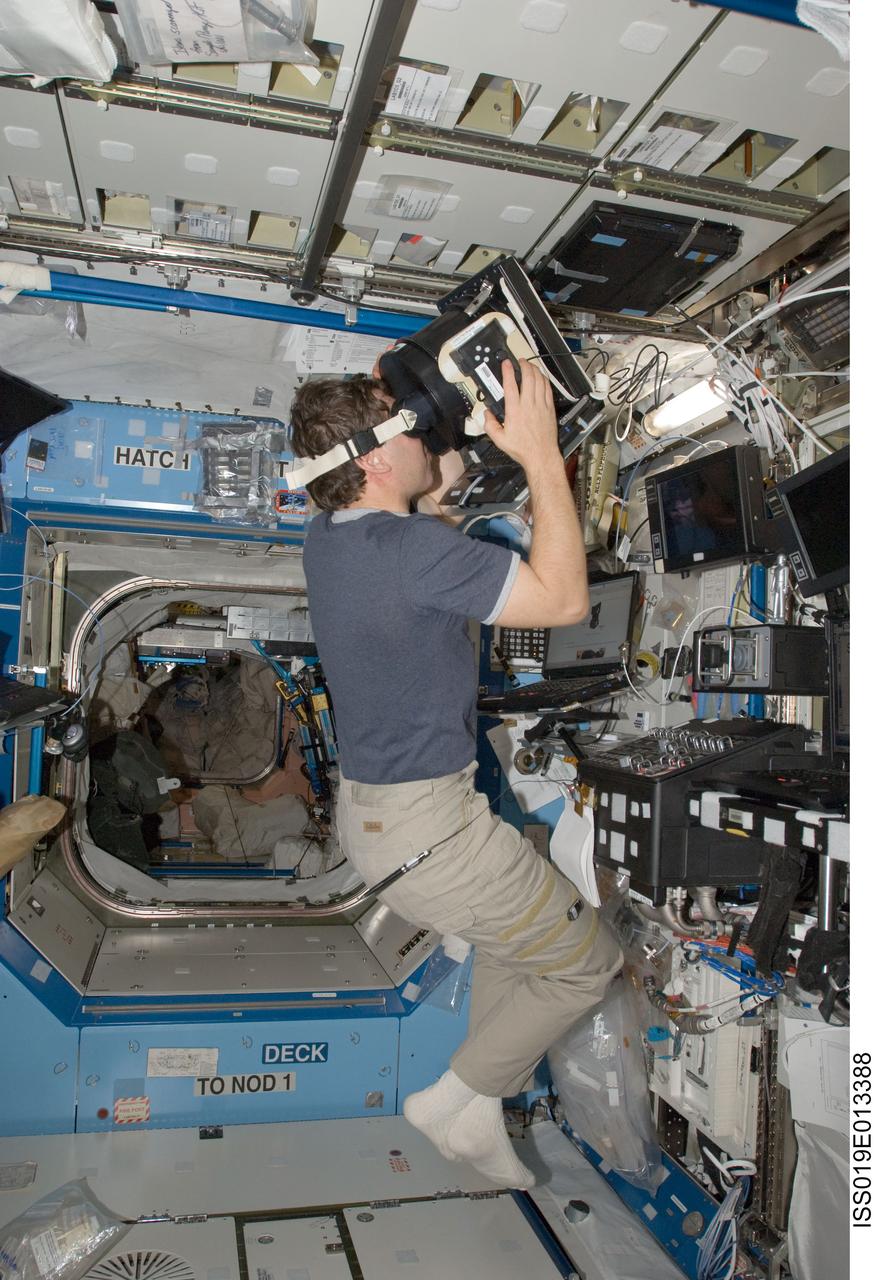
ISS019-E-013388 (2 May 2009) --- Astronaut Michael Barratt, Expedition 19/20 flight engineer, uses Neurospat hardware to perform the Bodies in the Space Environment (BISE) experiment in the Destiny laboratory of the International Space Station. The Canadian Space Agency-sponsored BISE experiment studies how astronauts perceive up and down in microgravity.
BISE (Bodies in the Space Environment) experiment
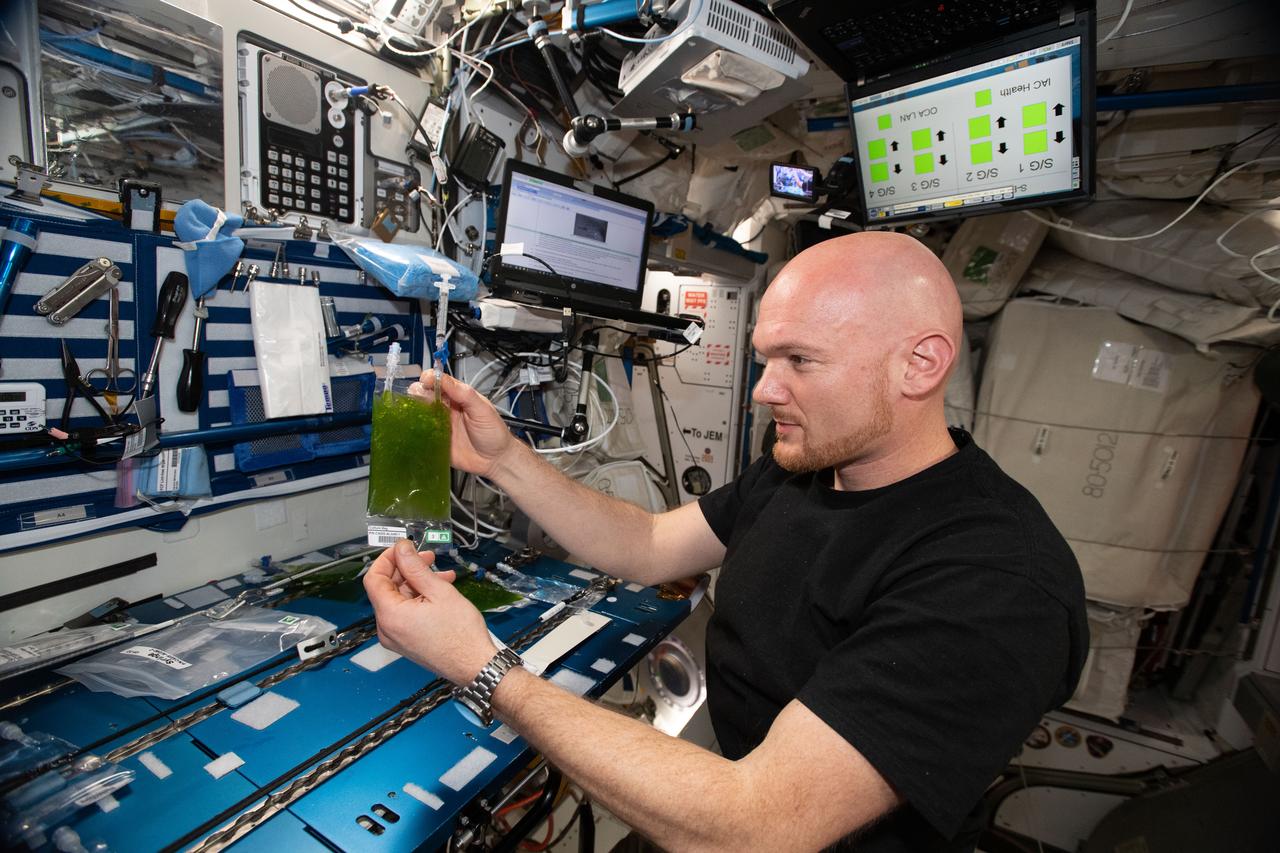
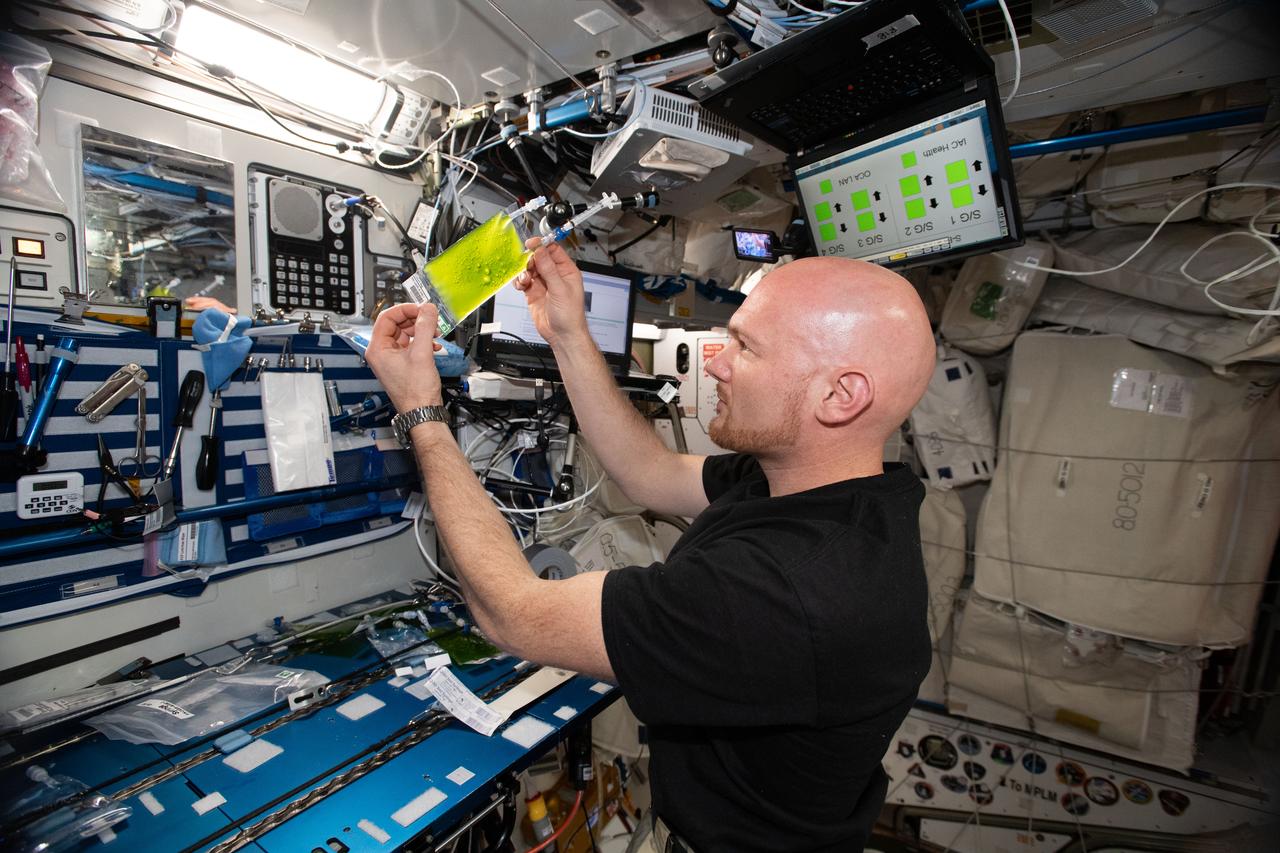
iss056e098238 (July 23, 2018) --- Astronaut Alexander Gerst of ESA (European Space Agency) checks a culture bag for the Space Algae experiment that is exploring the potential of cultivating algae for recycling carbon dioxide and providing food for crew members on long space voyages. The culture bags are placed in the VEGGIE facility to promote growth over a few weeks with the samples returned to Earth for analysis.
Space Algae Experiment Install
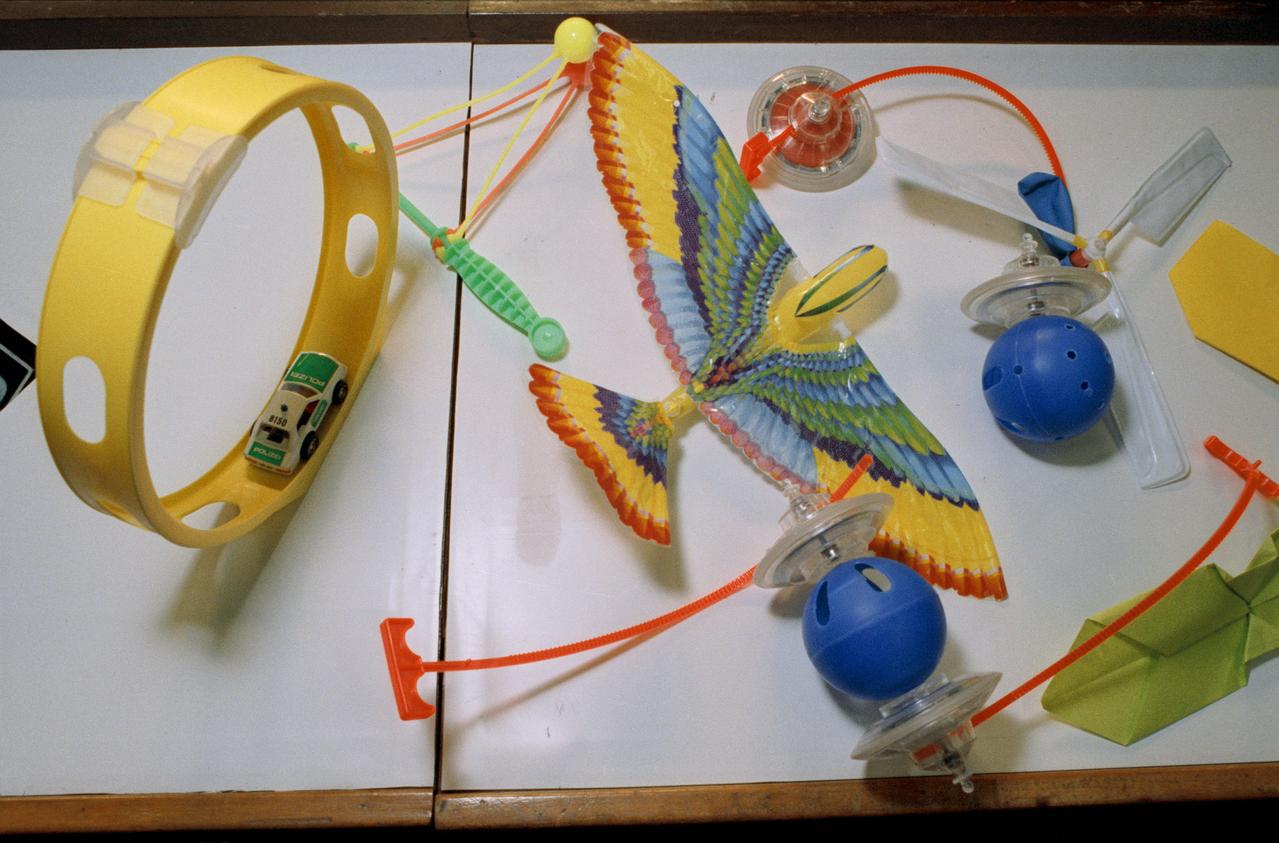
S93-25647 (6 Jan 1993) --- Part of the educational activities onboard the Space Shuttle Endeavour for STS-54 will include several experiments with various toys, some of which are depicted here.  The detailed supplementary objective (DSO-802) will allow the Shuttle crewmembers to experiment with the various types of toys in a microgravity environment while talking to pupils who will be able to monitor (via classroom TV sets) the activities at a number of schools. Among toys seen here are a friction car and loop track, paper eagle, and a balloon helicopter.
STS-54 toys in space experiment
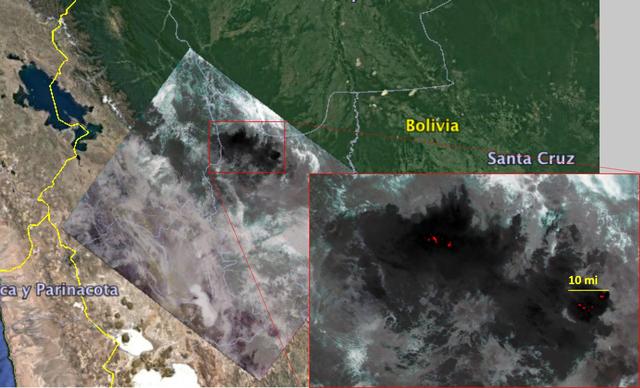
NASA's Ecosystem Spaceborne Thermal Radiometer Experiment on Space Station (ECOSTRESS) captured new imagery of fires in the Amazon regions of Brazil and Bolivia on Aug. 23, 2019. The red areas are where surface temperatures exceeded the maximum measureable temperature of the instrument's sensor (approximately 220 degrees Fahrenheit or 104 degrees Celsius), highlighting the burning areas along the fire fronts. The dark wispy areas indicate thick smoke — thick enough that it obscures much of the fire from view. The measurements cover areas of about 77 by 77 yards (70 by 70 meters) each, or about the size of a football field.  https://photojournal.jpl.nasa.gov/catalog/PIA23357
Amazon Fires Seen by NASA's ECOSTRESS
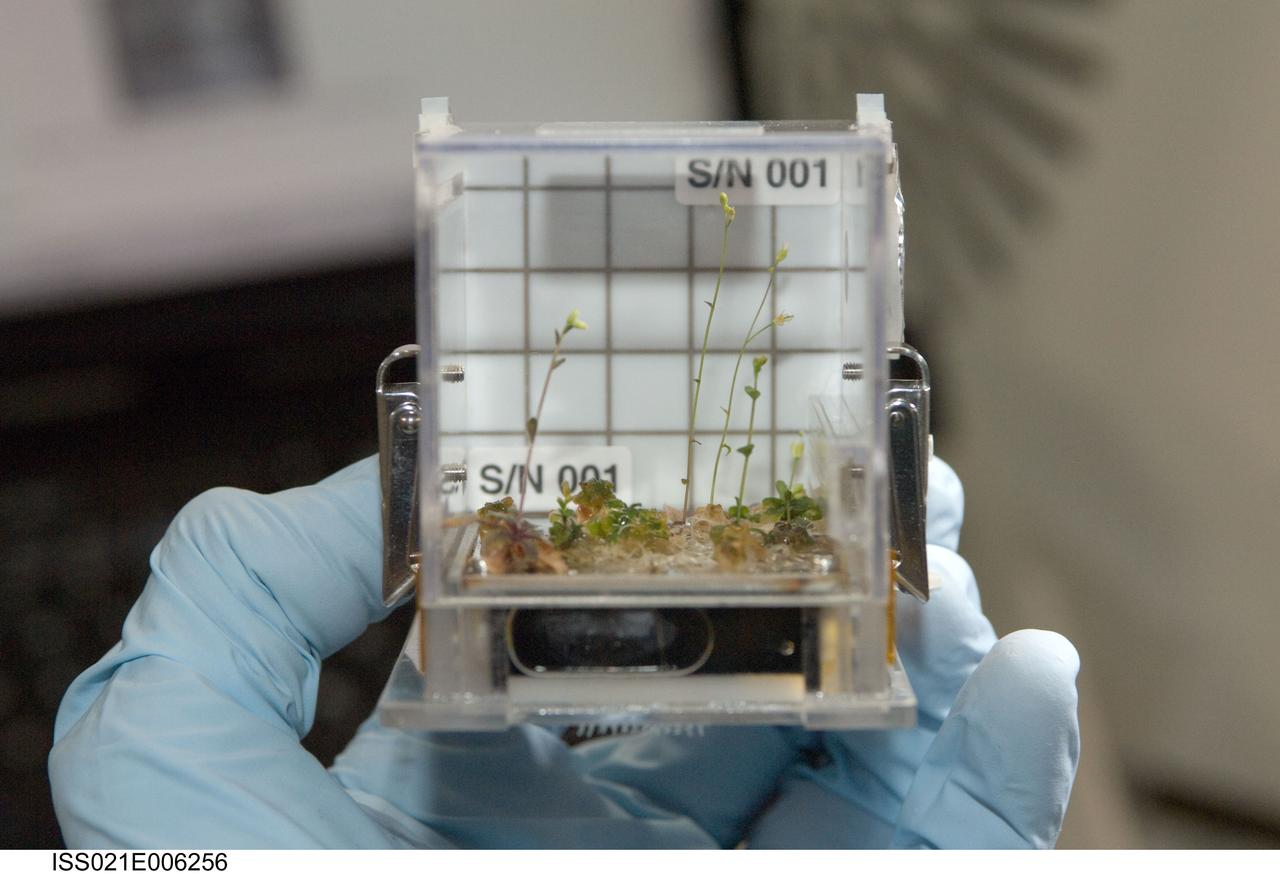
ISS021-E-006256 (13 Oct. 2009) --- A close-up view of the Cell Biology Experiment Facility (CBEF) SPACE SEED experiment is featured in this image photographed by an Expedition 21 crew member in the Kibo laboratory on the International Space Station.
View of CBEF Space Seed Experiment Hardware
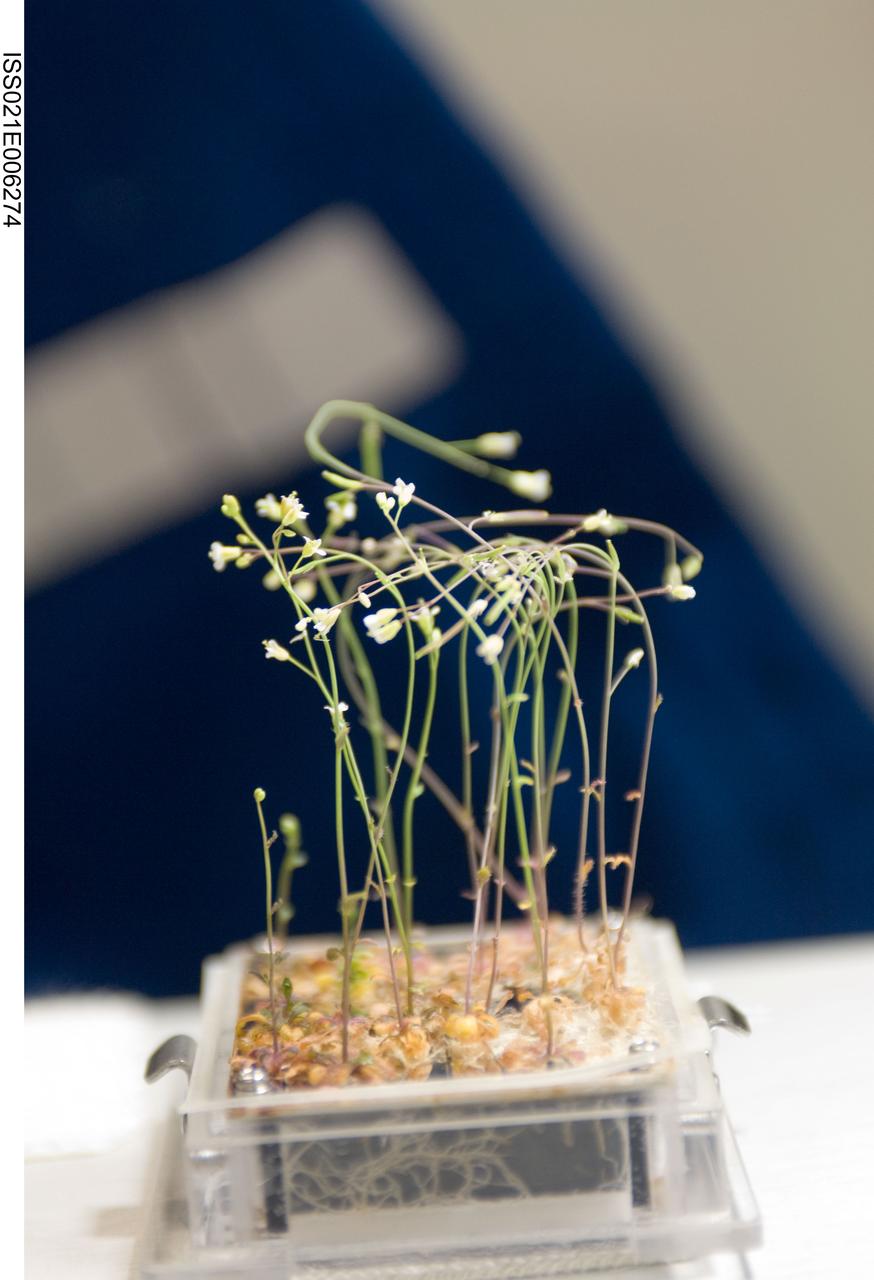
ISS021-E-006274 (13 Oct. 2009) --- A close-up view of the Cell Biology Experiment Facility (CBEF) SPACE SEED experiment is featured in this image photographed by an Expedition 21 crew member in the Kibo laboratory on the International Space Station.
View of CBEF Space Seed Experiment Hardware
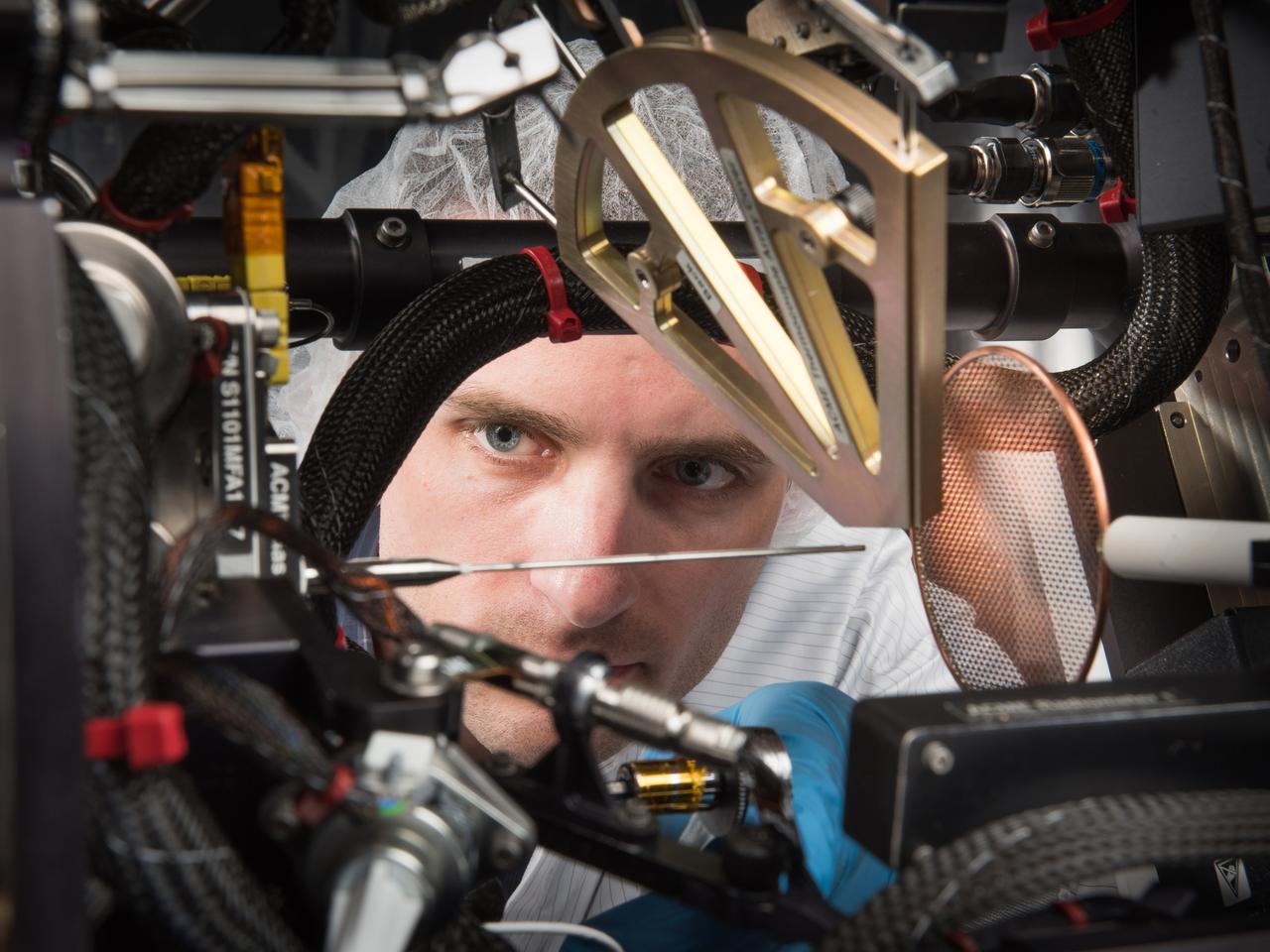
NASA Glenn engineer Christopher Mroczka inspects the gas-jet burner within the Advanced Combustion via Microgravity Experiments, ACME insert for the Combustion Integrated Rack, CIR. The apparatus allows researchers to conduct experiments with flames of gaseous fuels on the International Space Station, ISS
Advanced Combustion via Microgravity Experiments, ACME chamber insert
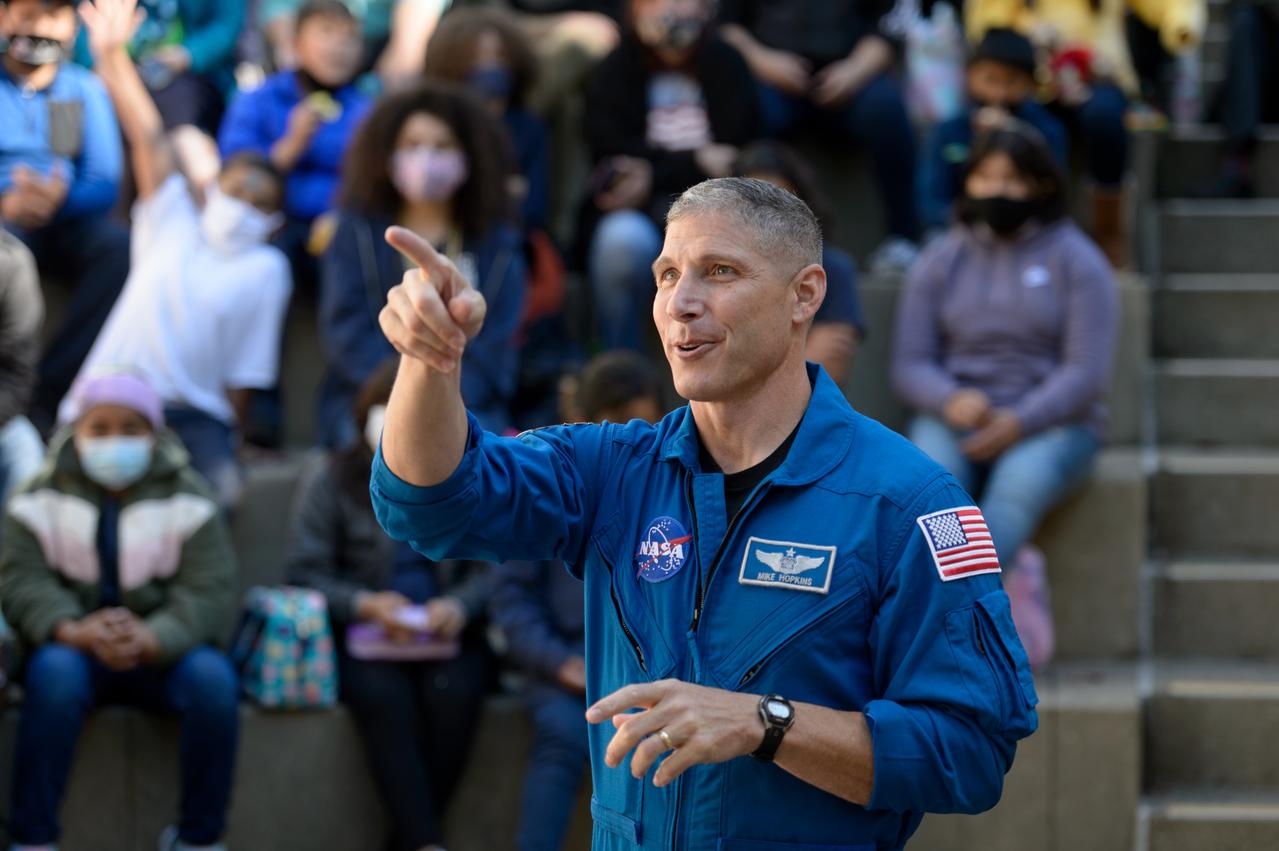
Astronaut Mike Hopkins talks to students during the NASA Experience opening ceremony at the Chabot Space and Science Center in Oakland, California.
Opening of the NASA Experience Exhibit at Chabot Space and Scien
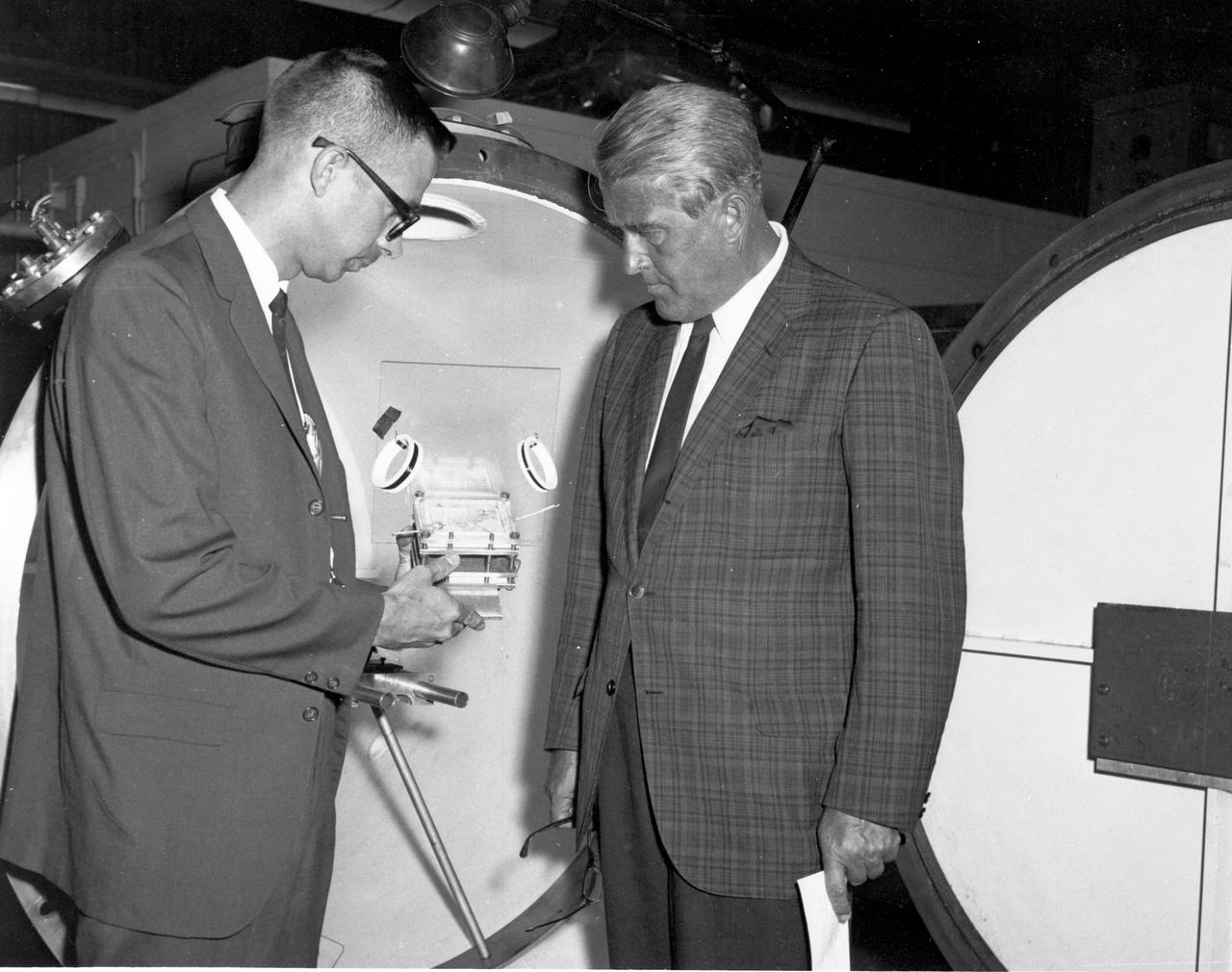
Marshall Space Flight Center’s (MSFC) director, Dr. Wernher von Braun (right), inspects a component of a laser experiment being conducted in MSFC’s Space Sciences Laboratory during a tour on August 28, 1967.
Wernher von Braun
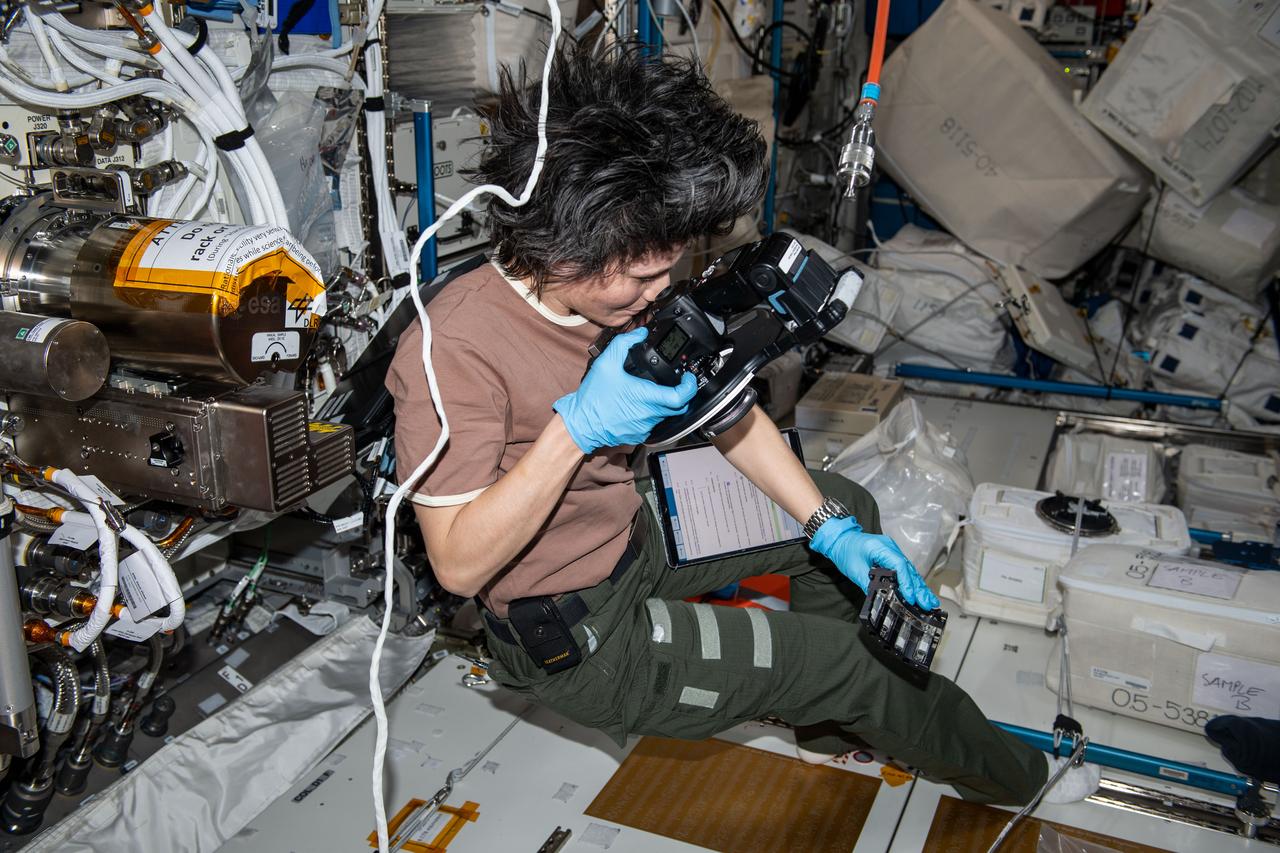
iss067e253397 (Dec. 2, 2024) --- ESA (European Space Agency) astronaut and Expedition 67 Flight Engineer Samantha Cristoforetti photographs and exchanges samples for the Fluids Science Laboratory Soft Matter Dynamics space physics experiment aboard the Intenational Space Station's Columbus laboratory module. The microgravity environment enables the observation of "wet" foams and the study of rearrangement phenomena, such as coarsening and coalescence, disentangled from drainage issues caused by Earth's gravity. Results may benefit Earth and space industries.
Astronaut Samantha Cristoforetti photographs samples for a space physics experiment
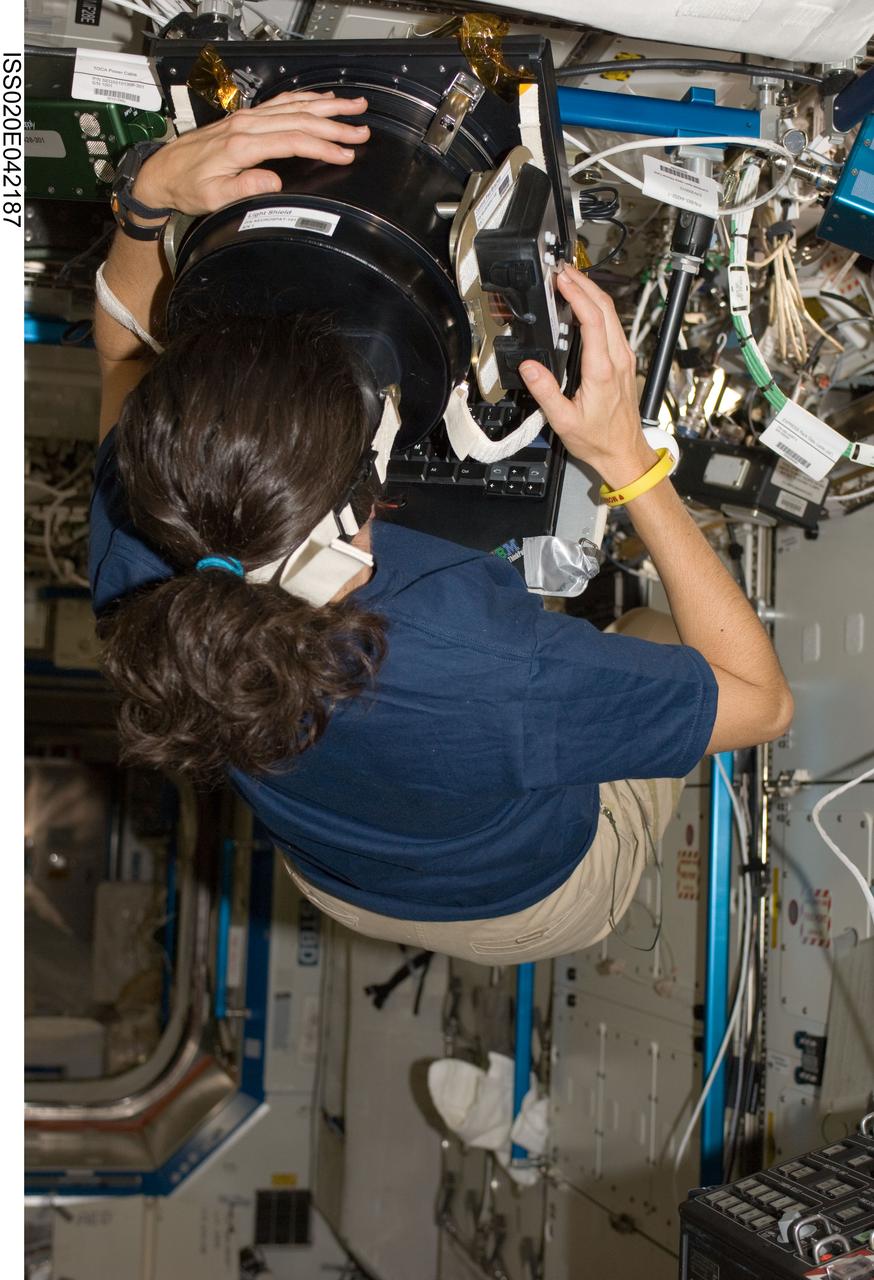
ISS020-E-042187 (26 Sept. 2009) --- NASA astronaut Nicole Stott, Expedition 20 flight engineer, uses Neurospat hardware to perform the Bodies in the Space Environment (BISE) experiment in the Destiny laboratory of the International Space Station. The Canadian Space Agency-sponsored BISE experiment studies how astronauts perceive up and down in microgravity.
BISE (Bodies in the Space Environment) experiment run
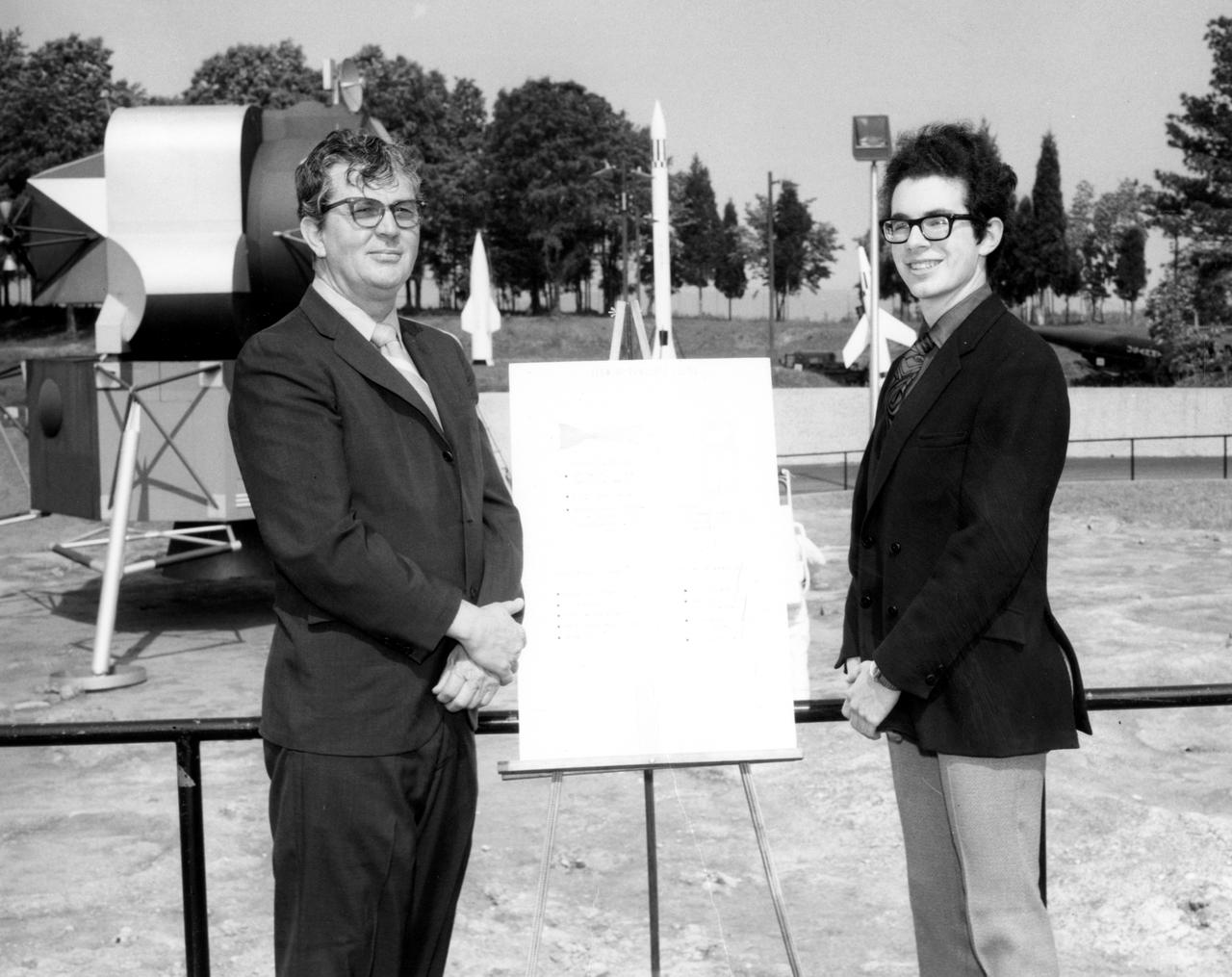
Kirk M. Sherhart, high school student from Berkley, Michigan, discussed a his proposed Skylab experiment with Dr. Robert Head of the Marshall Space Flight Center (MSFC) during his visit to the center. The lunar surface scene in the background is one of many space exhibits at the Alabama Space and Rocket Center in nearby Huntsville, Alabama. Sherhart was among 25 winners of a contest in which some 3,500 high school students proposed experiments for the following year’s Skylab mission. The nationwide scientific competition was sponsored by the National Science Teachers Association and the National Aeronautics and Space Administration (NASA). The winning students, along with their parents and sponsor teachers, visited MSFC where they met with scientists and engineers, participated in design reviews for their experiments, and toured MSFC facilities. Of the 25 students, 6 did not see their experiments conducted on Skylab because the experiments were not compatible with Skylab hardware and timelines. Of the 19 remaining, 11 experiments required the manufacture of additional equipment.
Skylab
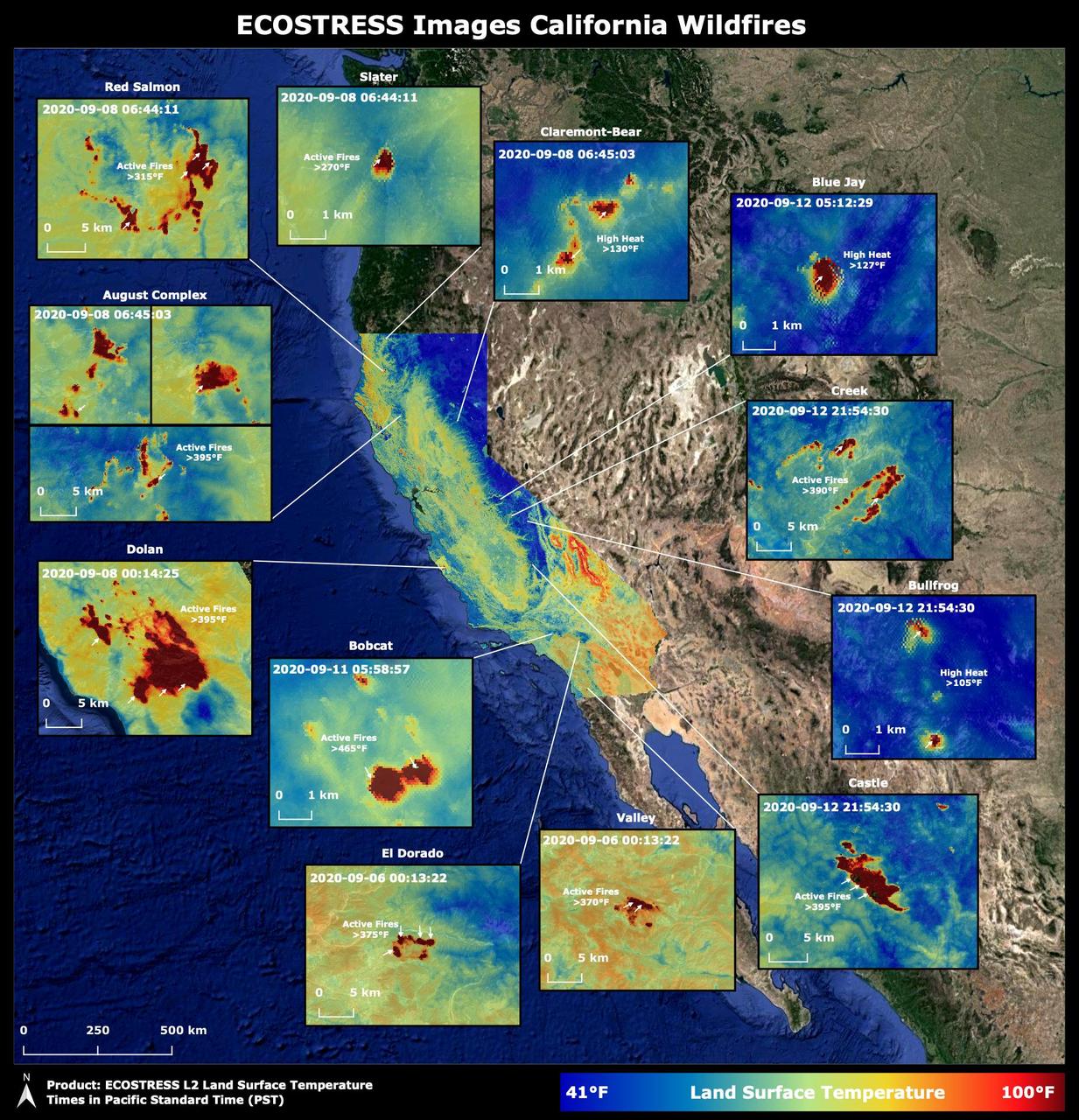
Throughout the month of September 2020, NASA's ECOsystem Spaceborne Thermal Radiometer Experiment on Space Station (ECOSTRESS) imaged multiple wildfires across the state of California.  The image above shows the ECOSTRESS land surface temperature of California. Multiple insets highlight a fraction of the multiple fires that have impacted California, with effects seen throughout the U.S. and beyond. The dark red spots show areas of high heat, with arrows pointing out the active fires. The contiguous California image was stitched together from multiple evening (10 p.m.-6 a.m. PDT) ECOSTRESS images from Sept 6 to 12, 2020, to generate a cloud-free statewide map.  NASA's Jet Propulsion Laboratory in Southern California built and manages the ECOSTRESS mission for the Earth Science Division in the Science Mission Directorate at NASA Headquarters in Washington. ECOSTRESS is an Earth Venture Instrument mission; the program is managed by NASA's Earth System Science Pathfinder program at NASA's Langley Research Center in Hampton, Virginia. Future studies could use ECOSTRESS data products in a similar fashion as LST was used to assess the fires pictured above.  https://photojournal.jpl.nasa.gov/catalog/PIA23721
NASA's ECOSTRESS Images California Wildfires From Space
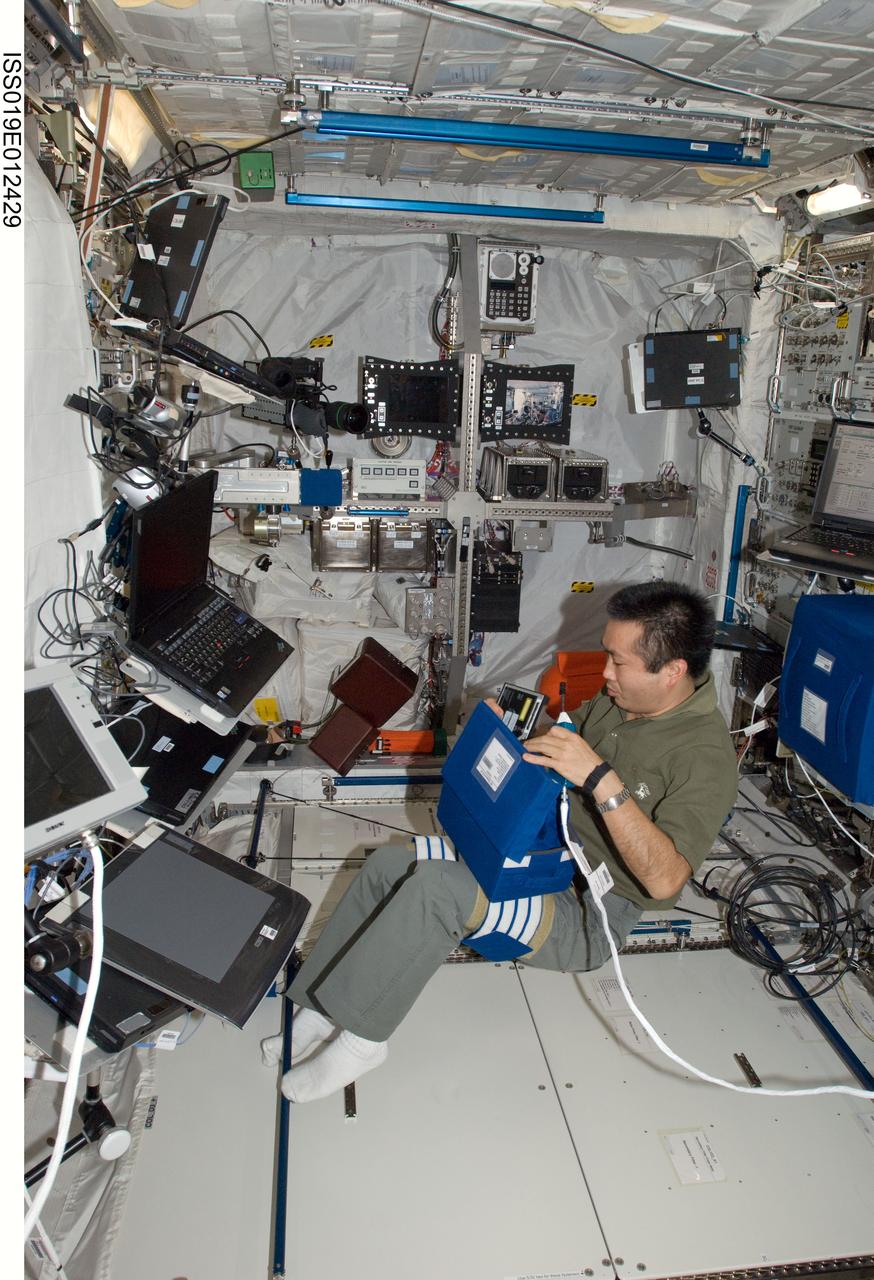
ISS019-E-012429 (30 April 2009) --- Japan Aerospace Exploration Agency (JAXA) astronaut Koichi Wakata, Expedition 19/20 flight engineer, prepares to perform the Mental Representation of Spatial Cues During Space Flight (3D-Space) experiment in the Columbus module of the International Space Station. The experiment is designed to investigate the effects of exposure to microgravity on the mental representation of spatial cues by astronauts during and after spaceflight.
Mental Representation of Spatial Cues During Space Flight (3D-Space) experiment
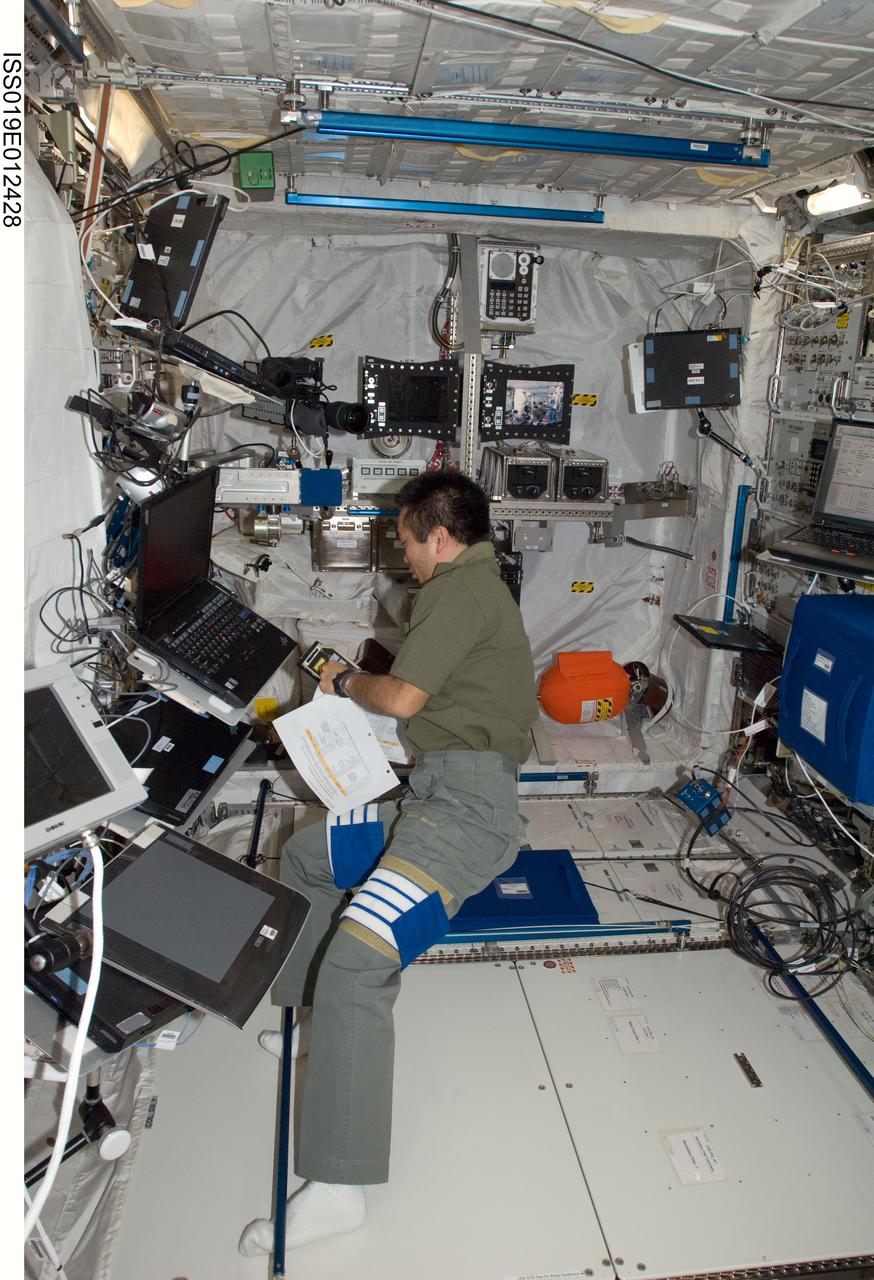
ISS019-E-012428 (30 April 2009) --- Japan Aerospace Exploration Agency (JAXA) astronaut Koichi Wakata, Expedition 19/20 flight engineer, prepares to perform the Mental Representation of Spatial Cues During Space Flight (3D-Space) experiment in the Columbus module of the International Space Station. The experiment is designed to investigate the effects of exposure to microgravity on the mental representation of spatial cues by astronauts during and after spaceflight.
Mental Representation of Spatial Cues During Space Flight (3D-Space) experiment
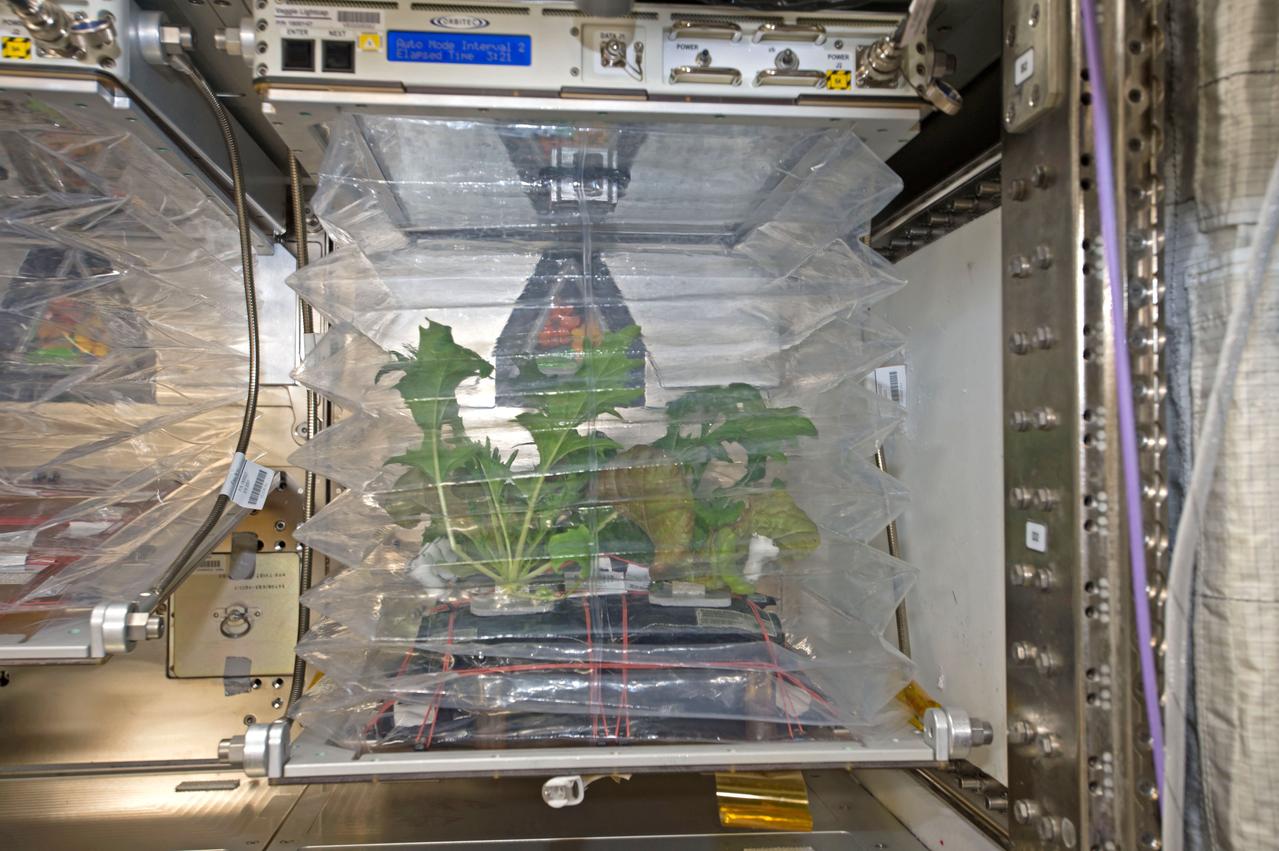
Veg-03D Experiment Onboard the International Space Station. First time three different plant varieties are being grown simultaneously in the Veggie chamber -- Mizuna mustard, Waldmann's green lettuce and Outredgeous Red Romaine lettuce.
Veg-03D Experiment Onboard the International Space Station
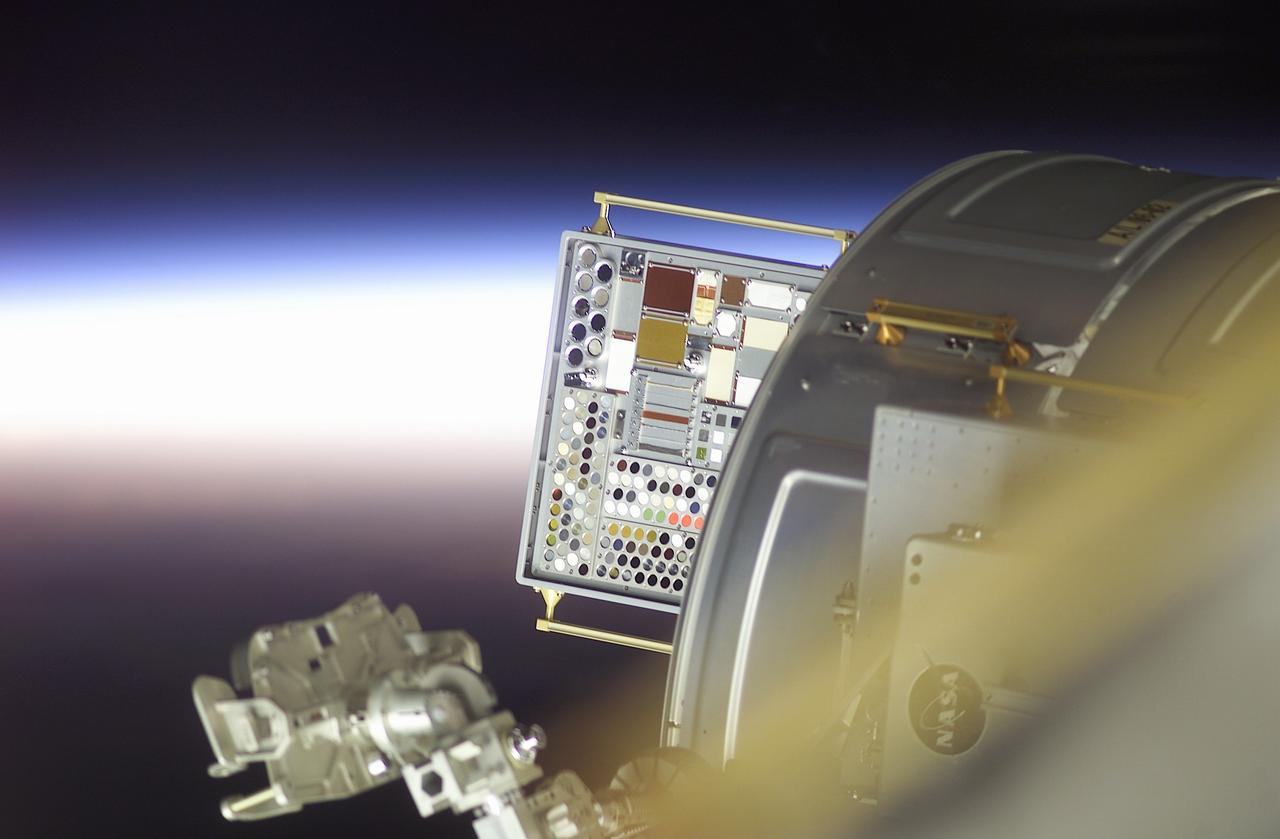
Backdropped by a sunrise, the newly installed Materials International Space Station Experiment (MISSE) is visible on this image. MISSE would expose 750 material samples for about 18 months and collect information on how different materials weather the space environment. The objective of MISSE is to develop early, low-cost, non-intrusive opportunities to conduct critical space exposure tests of space materials and components plarned for use on future spacecraft. The experiment was the first externally mounted experiment conducted on the International Space Station (ISS) and was installed on the outside of the ISS Quest Airlock during extravehicular activity (EVA) of the STS-105 mission. MISSE was launched on August 10, 2001 aboard the Space Shuttle Orbiter Discovery.
International Space Station (ISS)
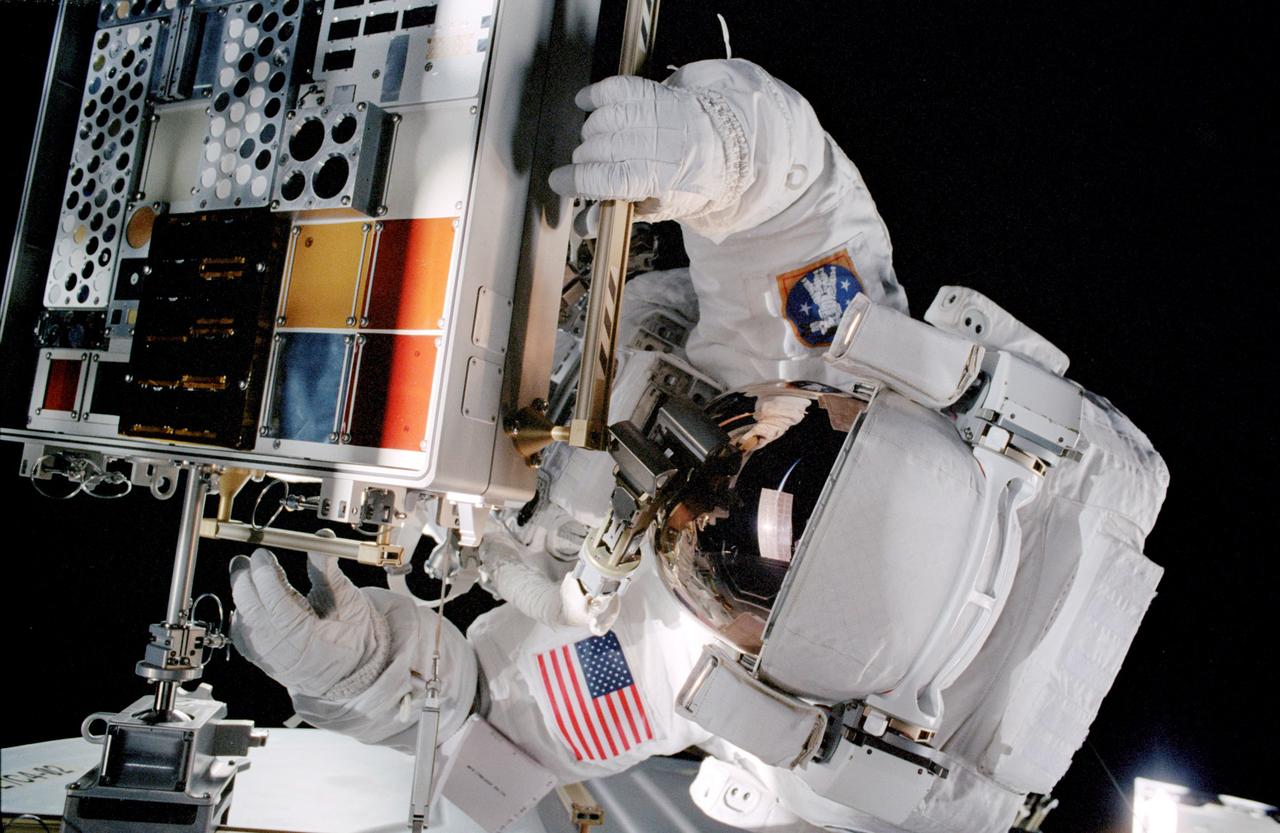
Astronaut Patrick G. Forrester works with the the Materials International Space Station Experiment (MISSE) during extravehicular activity (EVA). MISSE would expose 750 material samples for about 18 months and collect information on how different materials weather the space environment The objective of MISSE is to develop early, low-cost, non-intrusive opportunities to conduct critical space exposure tests of space materials and components plarned for use on future spacecraft. The experiment was the first externally mounted experiment conducted on the International Space Station (ISS) and was installed on the outside of the ISS Quest Airlock. MISSE was launched on August 10, 2001 aboard the Space Shuttle Orbiter Discovery.
International Space Station (ISS)
ISS021-E-006261 (13 Oct. 2009) --- NASA astronaut Nicole Stott, Expedition 21 flight engineer, works with the Cell Biology Experiment Facility (CBEF) SPACE SEED experiment in the Kibo laboratory of the International Space Station.
FE-2 Nicole Stott works on the CBEF Space Seed Experiment
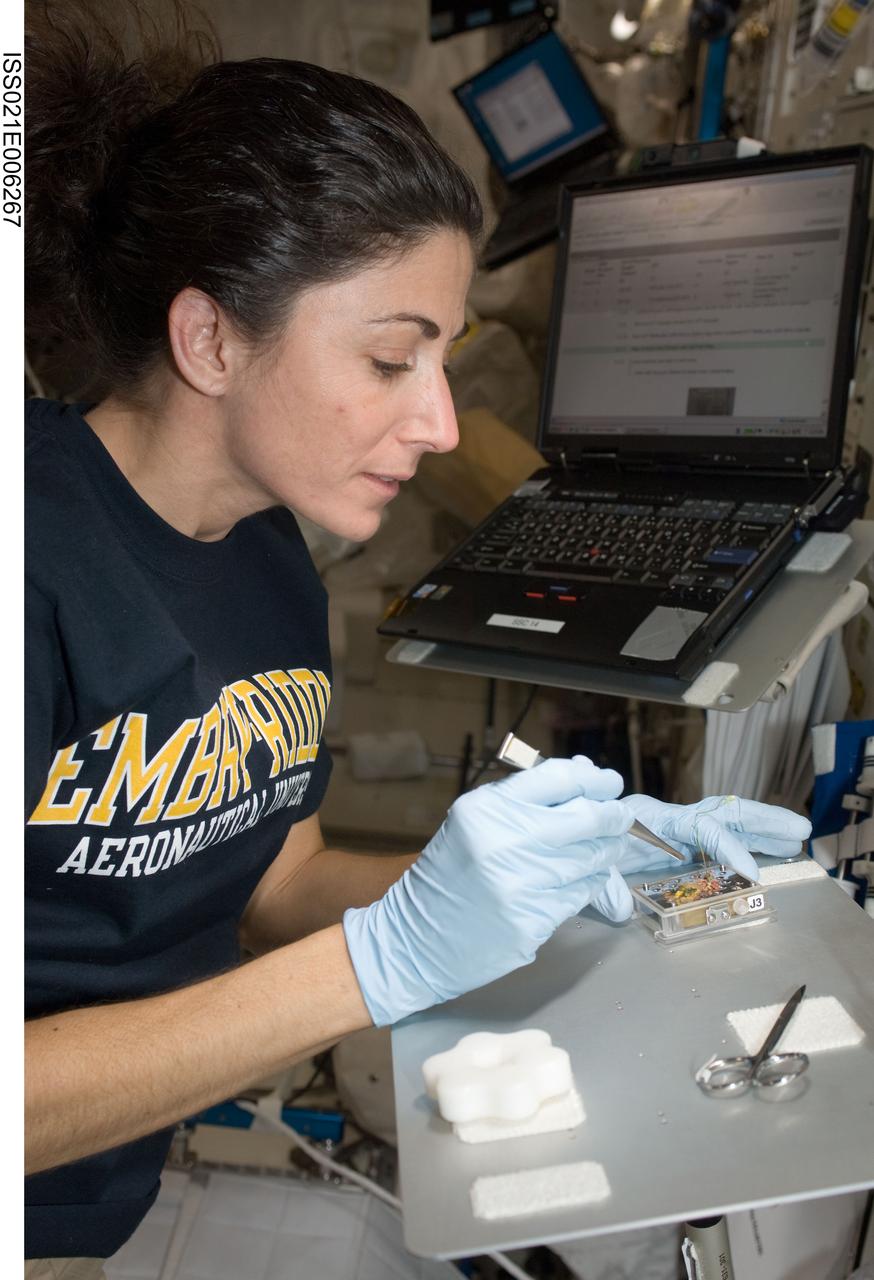
ISS021-E-006267 (13 Oct. 2009) --- NASA astronaut Nicole Stott, Expedition 21 flight engineer, works with the Cell Biology Experiment Facility (CBEF) SPACE SEED experiment in the Kibo laboratory of the International Space Station.
FE-2 Nicole Stott works on the CBEF Space Seed Experiment
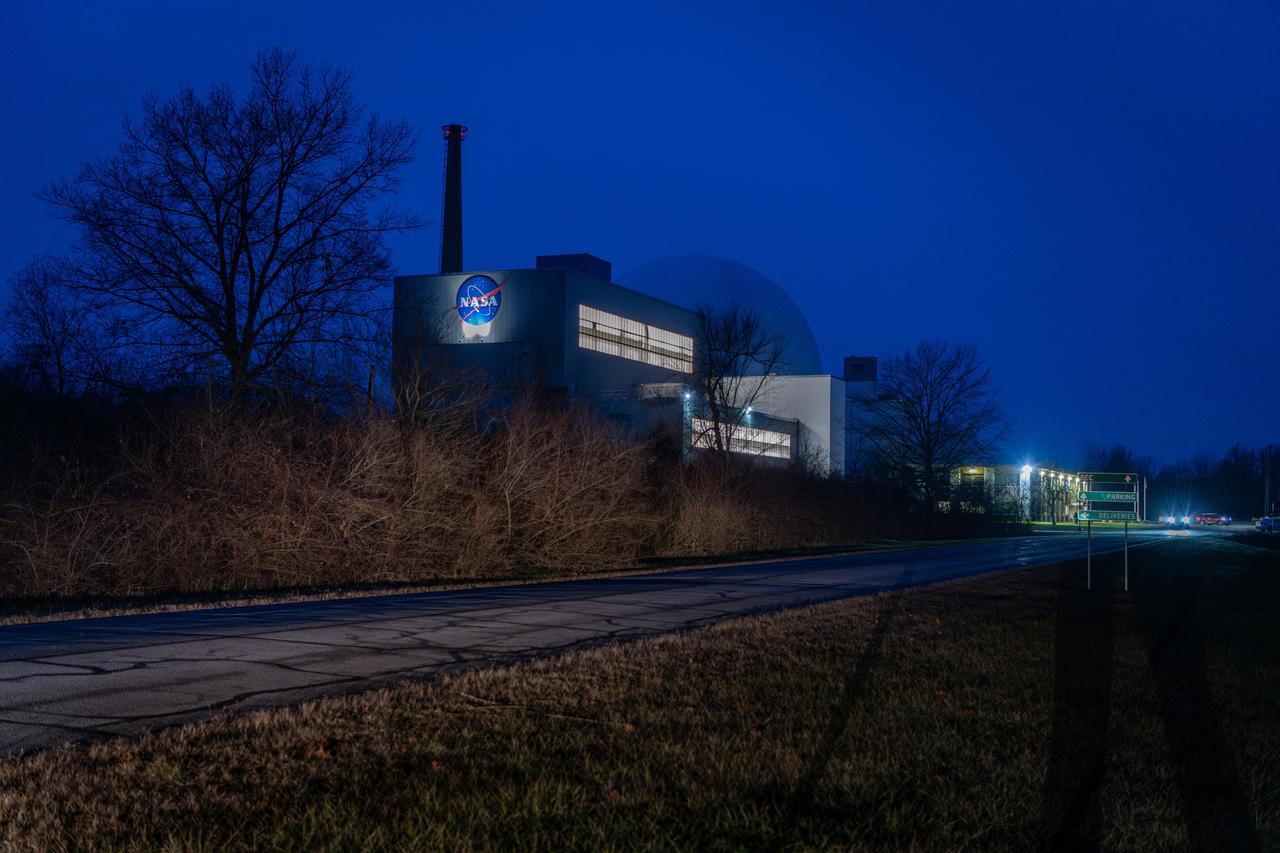
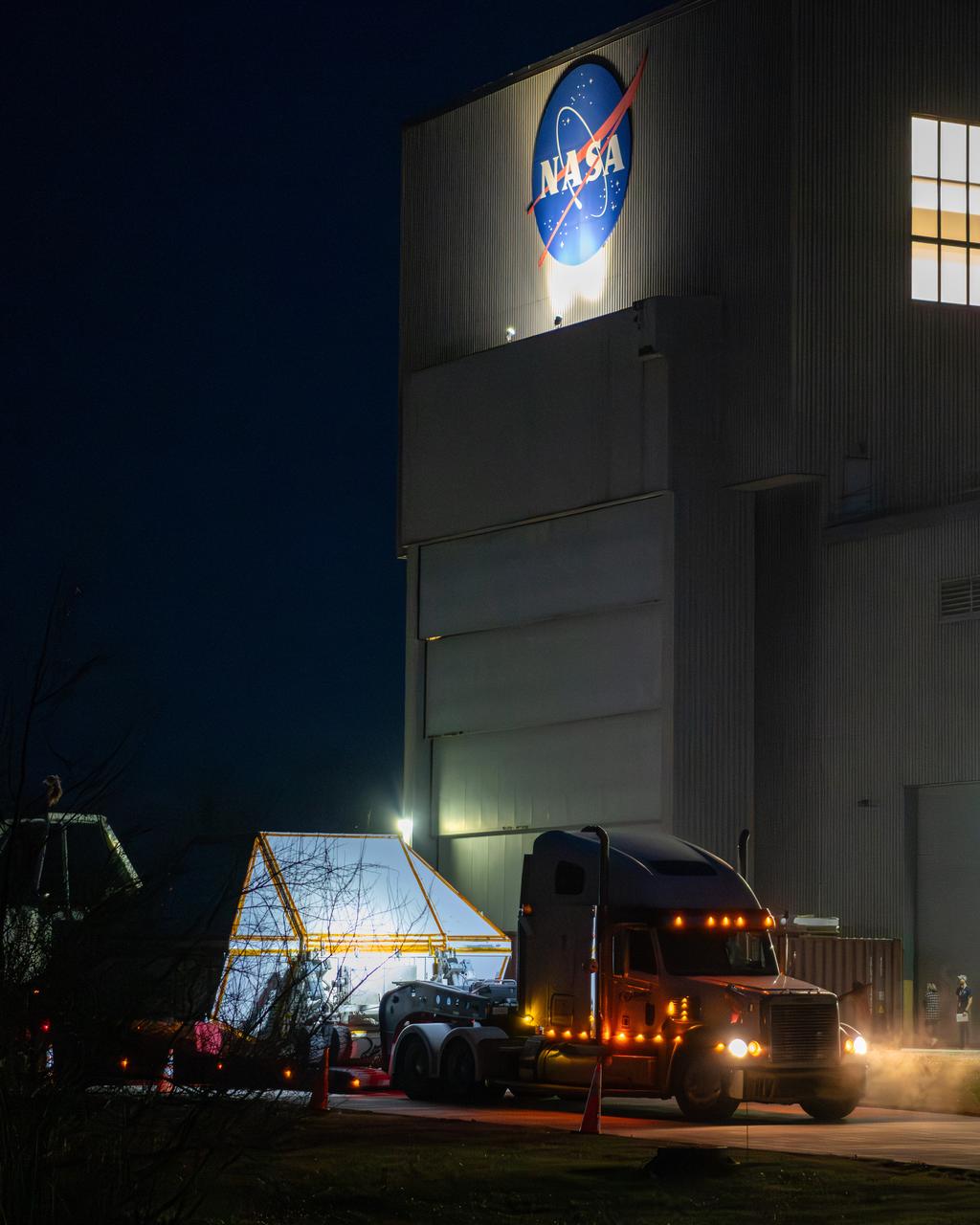
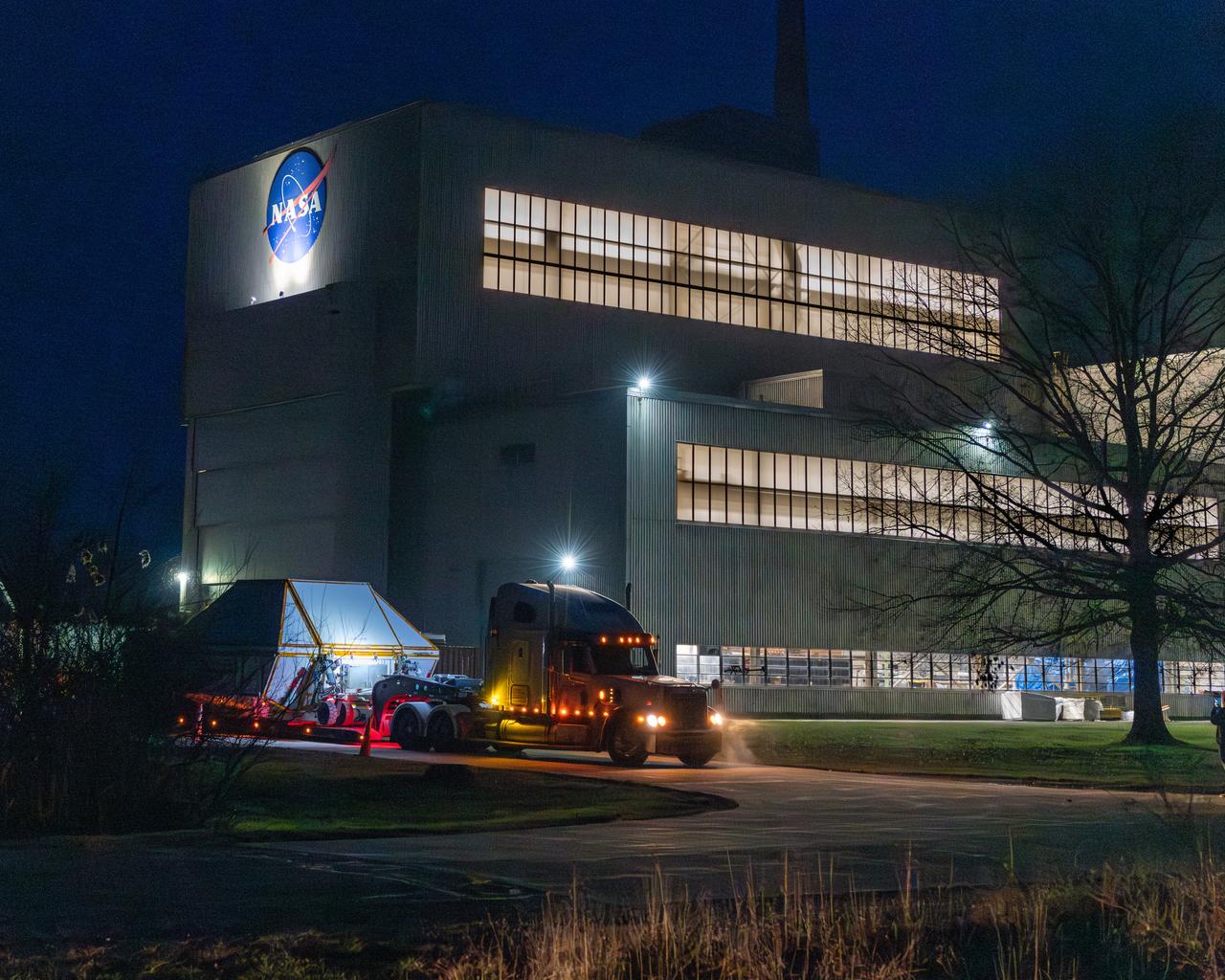
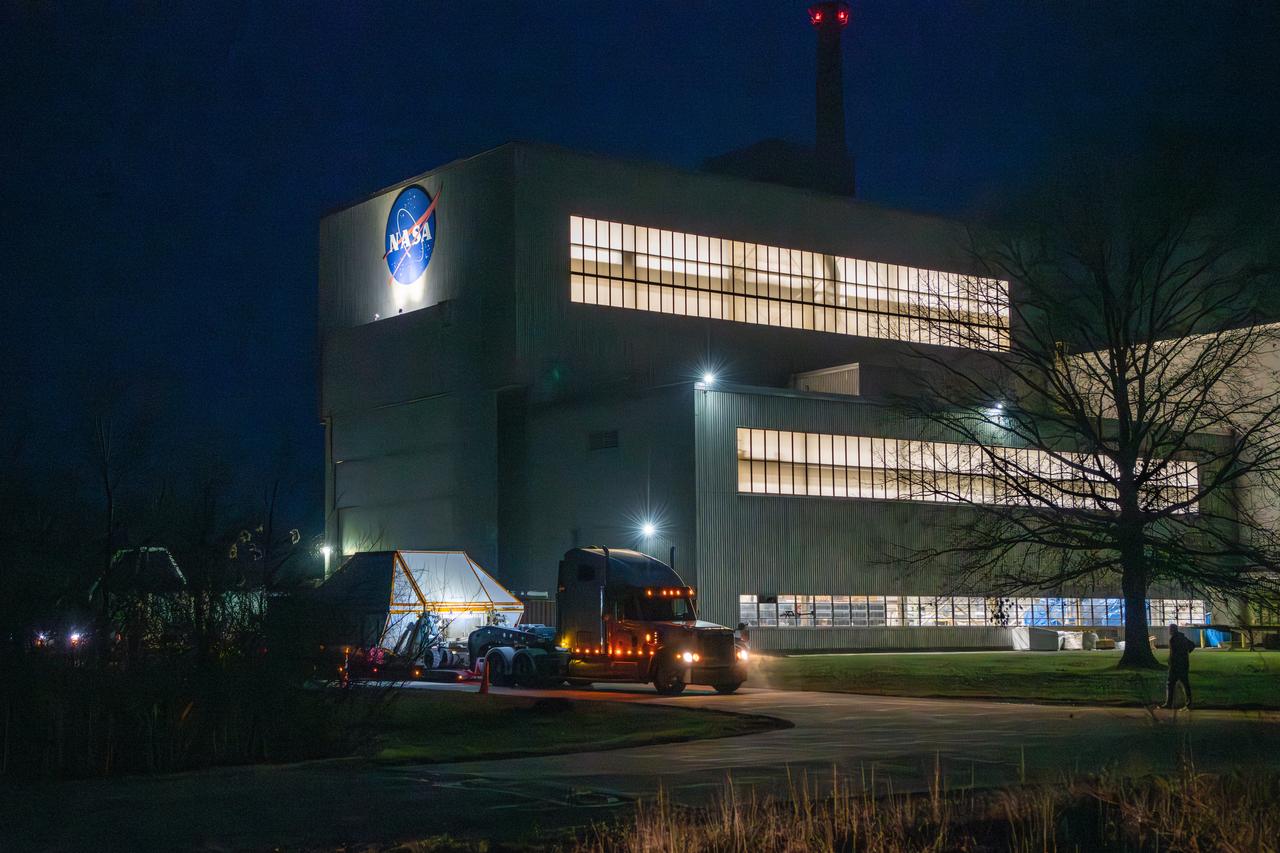
Evening photo of the Space Experiments Complex in the evening of the arrival of the Orion ETA (Environmental Test Article) having been shipped from Florida by truck. The Orion ETA flew on Artemis I and will undergo testing of the docking module jettison and the forward by cover jettison in preparation of the Artemis II launch.
Evening photo of the Space Experiments Complex (SEC) at Armstron
Evening photo of the Space Experiments Complex in the evening of the arrival of the Orion ETA (Environmental Test Article) having been shipped from Florida by truck. The Orion ETA flew on Artemis I and will undergo testing of the docking module jettison and the forward by cover jettison in preparation of the Artemis II launch.
Orion ETA arrival in the evening at the Space Experiments Comple
Evening photo of the Space Experiments Complex in the evening of the arrival of the Orion ETA (Environmental Test Article) having been shipped from Florida by truck. The Orion ETA flew on Artemis I and will undergo testing of the docking module jettison and the forward by cover jettison in preparation of the Artemis II launch.
Orion ETA arrival in the evening at the Space Experiments Comple
Evening photo of the Space Experiments Complex in the evening of the arrival of the Orion ETA (Environmental Test Article) having been shipped from Florida by truck. The Orion ETA flew on Artemis I and will undergo testing of the docking module jettison and the forward by cover jettison in preparation of the Artemis II launch.
Orion ETA arrival in the evening at the Space Experiments Comple
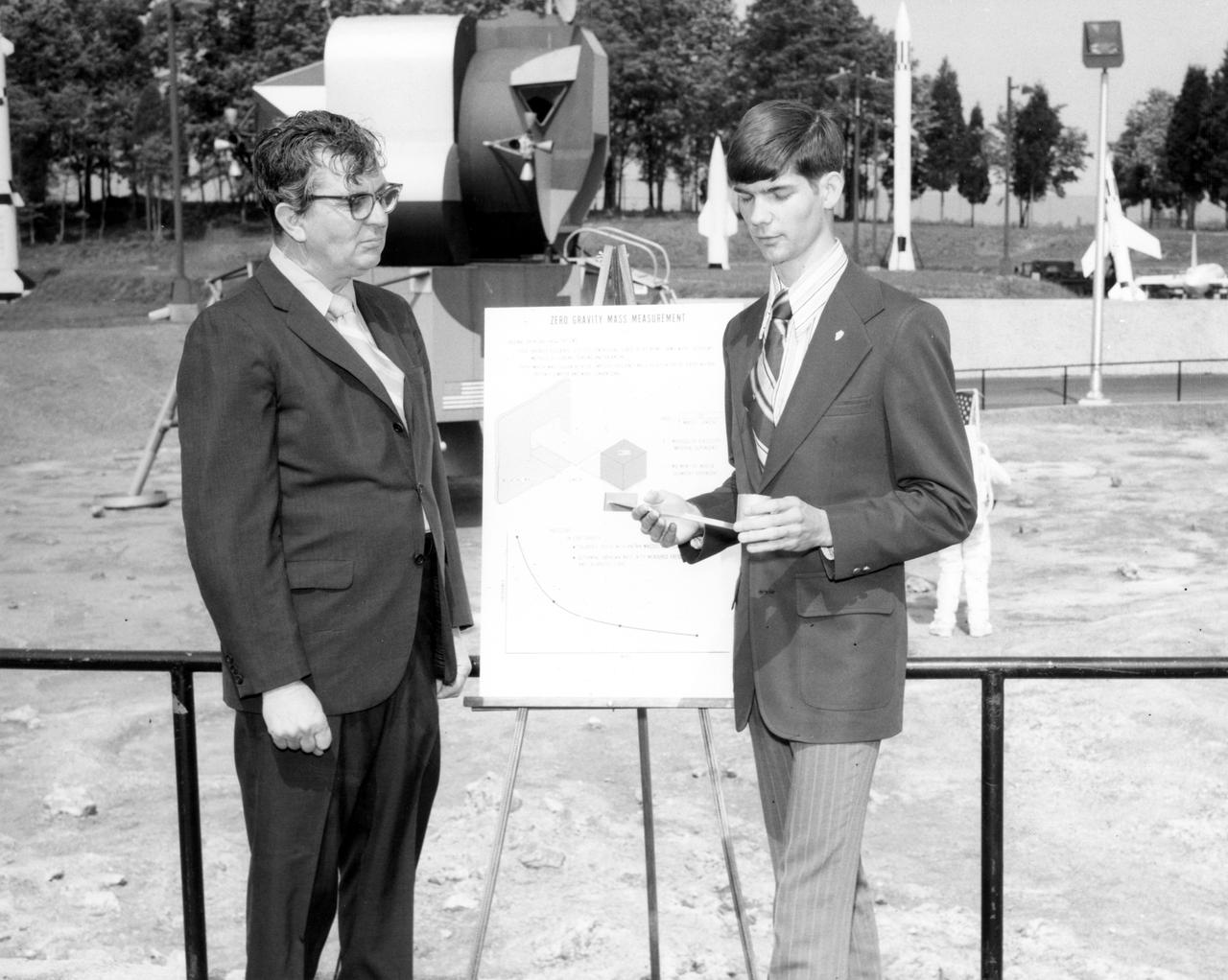
Vincent W. Converse, high school student from Rockford, Illinois, discussed a mass measurement device he proposed for the Skylab mission with Dr. Robert Head of the Marshall Space Flight Center (MSFC) during his visit to the center.  The lunar surface scene in the background is one of many space exhibits at the Alabama Space and Rocket Center in nearby Huntsville, Alabama. Converse was among 25 winners of a contest in which some 3,500 high school students proposed experiments for the following year’s Skylab mission. The nationwide scientific competition was sponsored by the National Science Teachers Association and the National Aeronautics and Space Administration (NASA). The winning students, along with their parents and sponsor teachers, visited MSFC where they met with scientists and engineers, participated in design reviews for their experiments, and toured MSFC facilities. Of the 25 students, 6 did not see their experiments conducted on Skylab because the experiments were not compatible with Skylab hardware and timelines. Of the 19 remaining, 11 experiments required the manufacture of additional equipment.
Skylab
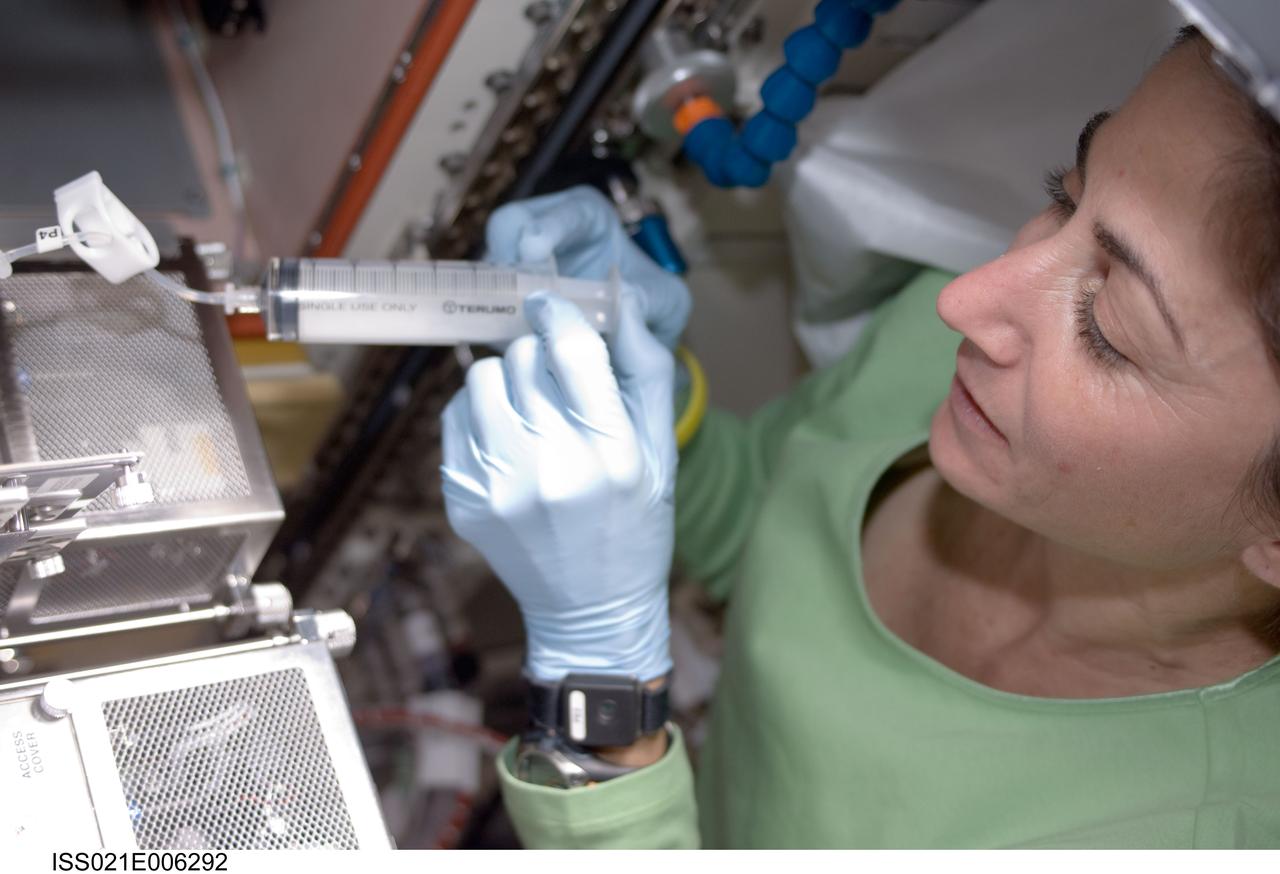
ISS021-E-006292 (14 Oct. 2009) --- NASA astronaut Nicole Stott, Expedition 21 flight engineer, using a watering syringe, supplies water to the Cell Biology Experiment Facility (CBEF) SPACE SEED experiment in the Kibo laboratory on the International Space Station.
FE-2 Nicole Stott works on the CBEF Space Seed Experiment
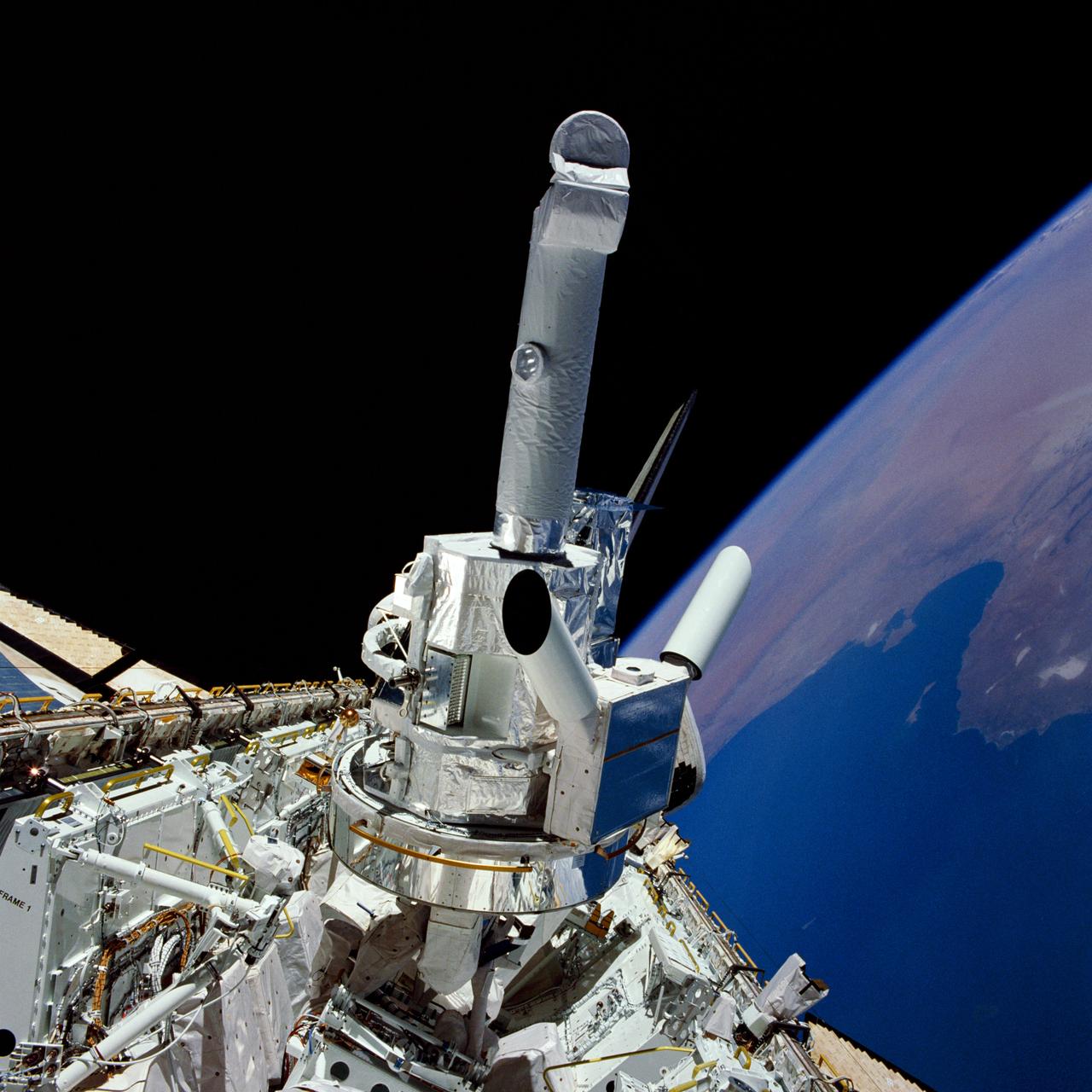
51F-33-005 (29 July - 6 August 1985) --- Experiments and the instrument pointing system (IPS) for Spacelab 2 are backdropped against the Libya/Tunisia Mediterranean coast and black space in this 70mm view photographed through the aft flight deck windows of the Space Shuttle Challenger. Also partially visible among the cluster of Spacelab 2 hardware are the solar optical universal polarimeter (SOUP) experiment and the coronal helium abundance experiment (CHASE).
View of Spacelab 2 pallet in the open payload bay
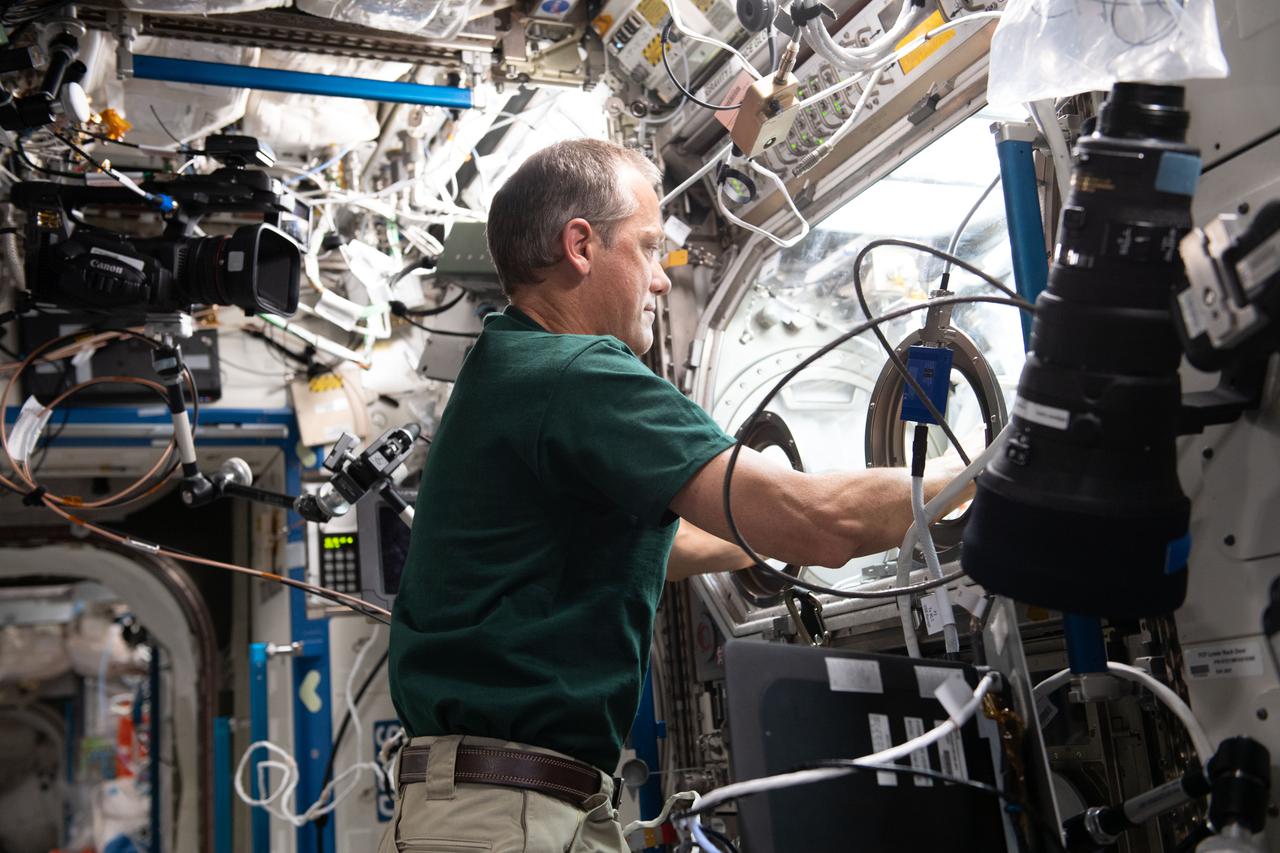
iss066e078282 (November 17, 2021) --- NASA astronaut Tom Marshburn works on the SUBSA-BRAINS space physics experiment, which examines differences in capillary flow, interface reactions, and bubble formation during solidification of brazing alloys in microgravity. Brazing technology bonds similar materials (such as an aluminum alloy to aluminum) or dissimilar ones (such as aluminum alloy to ceramics) at temperatures above 450°C. It is a potential tool for construction of human space habitats and manufactured systems as well as to repair damage from micrometeoroids or space debris.
SUBSA-BRAINS (BRazing of Aluminum alloys IN Space) space physics experiment
Advanced Colloids Experiment, Thermal 5-2, ACE T5-2 International Space Station, ISS, Fluids Integrated Rack, FIR Operations in the Telescience Support Center, TSC
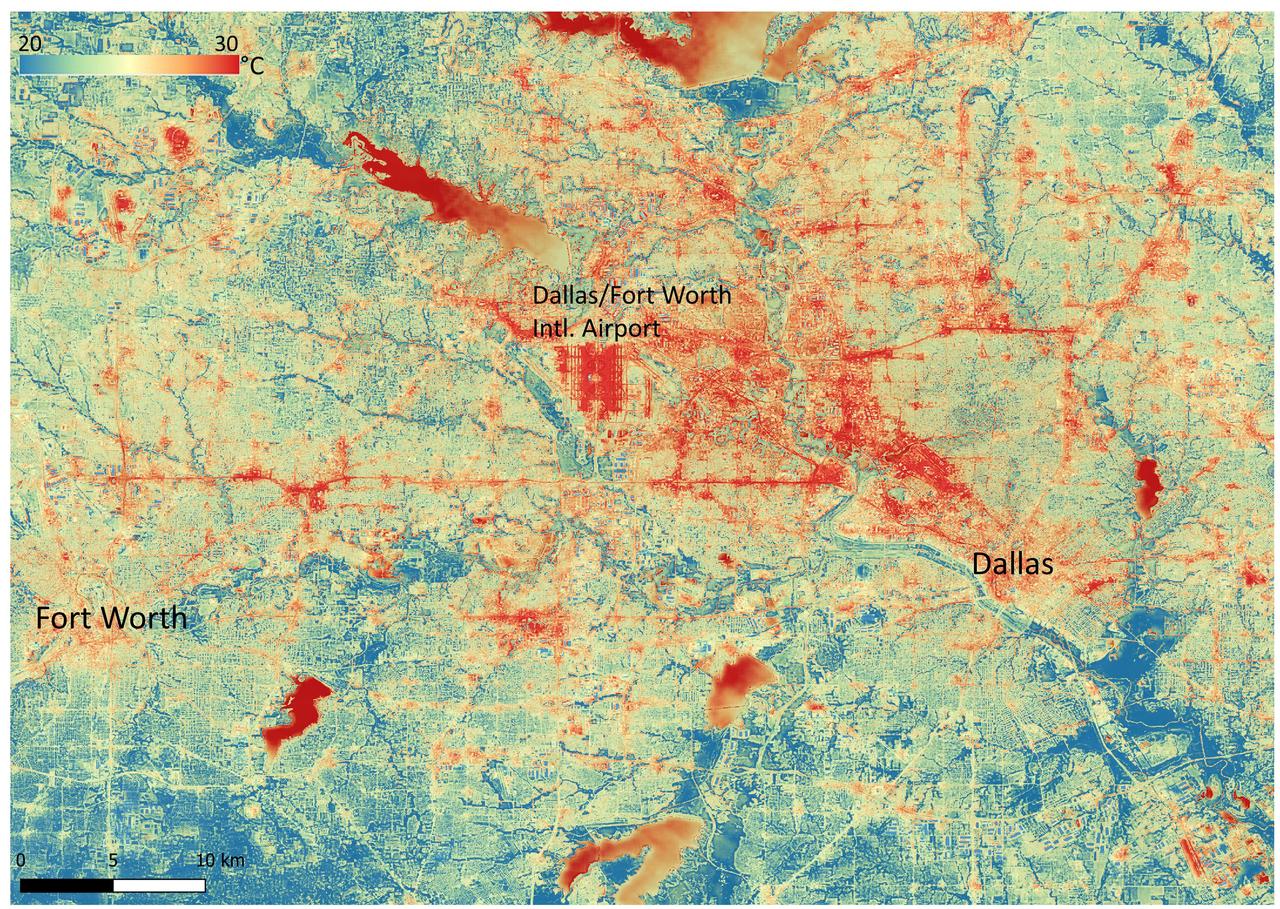
NASA's Ecosystem Spaceborne Thermal Radiometer Experiment on Space Station (ECOSTRESS) instrument recorded this image of ground surface temperatures in Dallas and Fort Worth, Texas, on June 20, 2022, at 7:17 a.m. Central Daylight Time.  Even early in the day, manmade urban surfaces near city centers and transportation networks – streets, roads, and highways shown in red and orange – are warmer than the outskirts by up to 18 degrees Fahrenheit (10 degrees Celsius). The paved surfaces at Dallas/Fort Worth International Airport, shown in red near the top-center of the image, had the warmest temperatures, exceeding 86 F (30 C).  Natural land surfaces such as vegetation and streams in rural areas, shown in green and blue, are cooler than nearby large bodies of water, shown in red and yellow, that tend to retain more heat overnight due to their higher heat capacity.  Cities are usually warmer than open land because of human activities and the materials used in building and construction. Streets are often the hottest part of the built environment due to asphalt paving. Dark-colored surfaces absorb more heat from the Sun than lighter-colored ones; asphalt absorbs up to 95% of solar radiation and retains the heat for hours into the nighttime.  ECOSTRESS measures the temperature of the ground, which is hotter than the air temperature during the daytime. The instrument launched to the space station in 2018. Its primary mission is to identify plants' thresholds for water use and water stress, giving insight into their ability to adapt to a warming climate. However, ECOSTRESS is also useful for documenting other heat-related phenomena, like patterns of heat absorption and retention. Its high-resolution images, with a pixel size of about 225 feet (70 meters) by 125 feet (38 meters), are a powerful tool for understanding our environment.  https://photojournal.jpl.nasa.gov/catalog/PIA25422
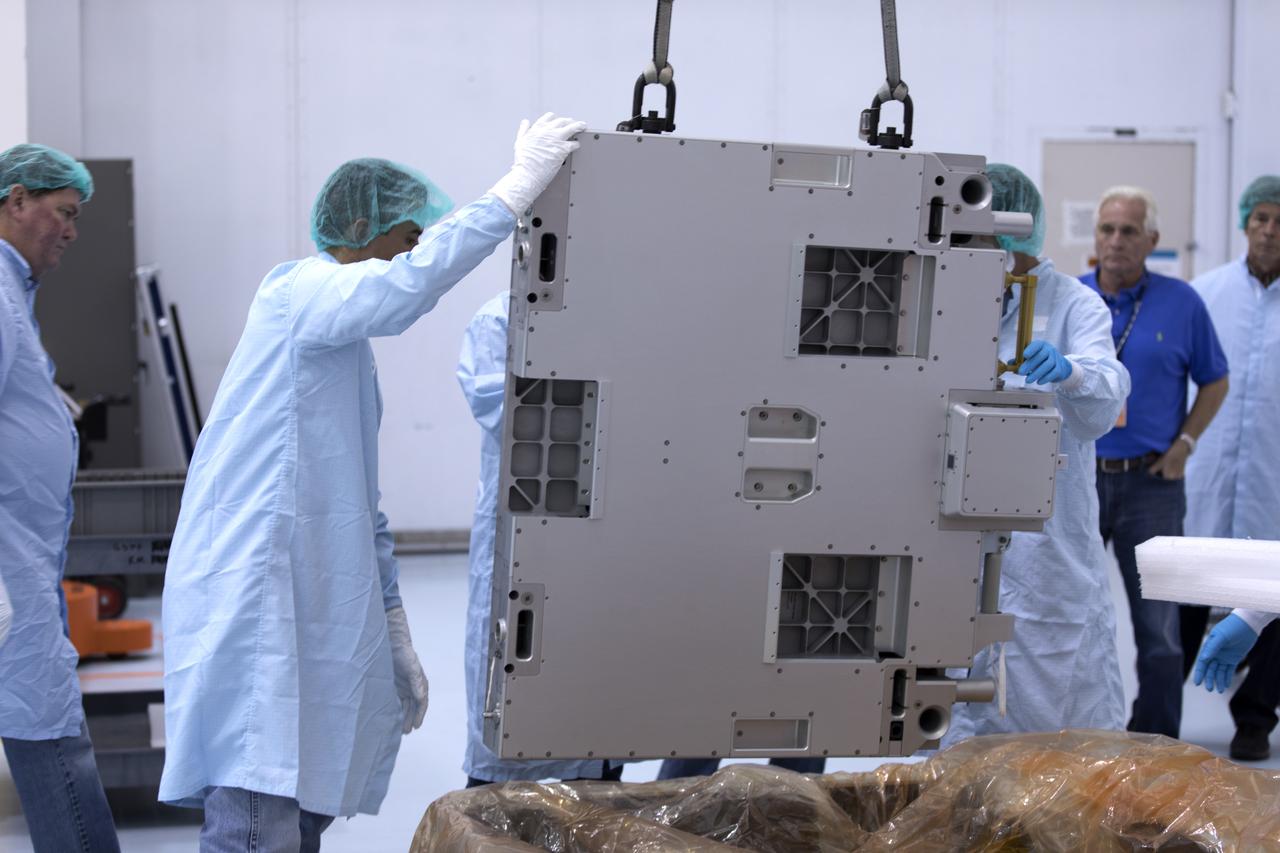
NASA's ECOSTRESS Shows Heat in Dallas and Fort Worth
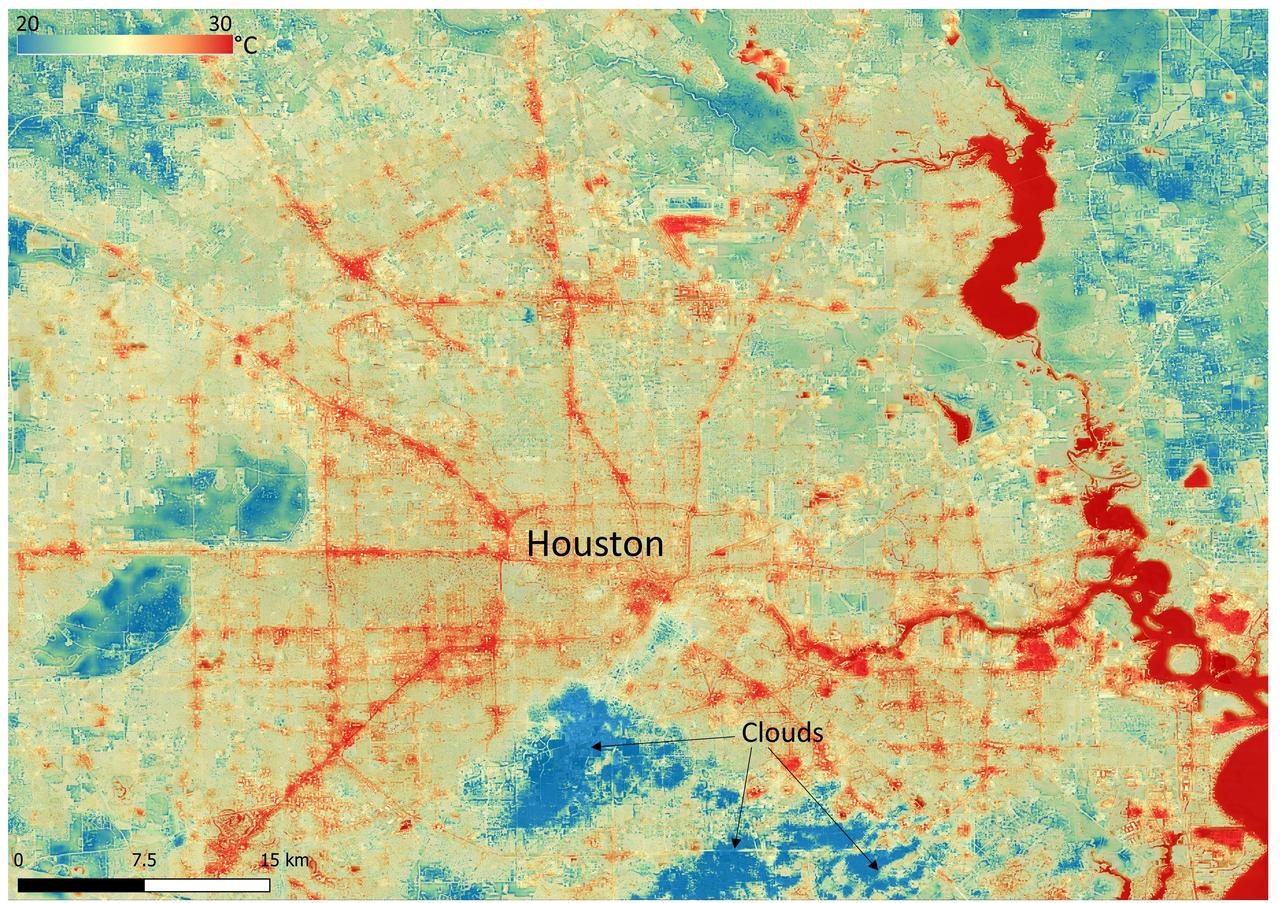
NASA's Ecosystem Spaceborne Thermal Radiometer Experiment on Space Station (ECOSTRESS) instrument recorded this image of ground surface temperatures in Houston and its environs on June 20, 2022, at 6:29 a.m. Central Daylight Time.  Even just after sunrise, manmade urban surfaces near the city center and transportation networks – streets, roads, and highways shown in red and orange – were significantly warmer than the outskirts by up to 18 degrees Fahrenheit (10 degrees Celsius). Clouds, which are cool compared with the ground, are shown in blue and labeled in the image.  Cities are usually warmer than open land because of human activities and the materials used in building and construction. Streets are often the hottest part of the built environment due to asphalt paving. Dark-colored surfaces absorb more heat from the Sun than lighter-colored ones; asphalt absorbs up to 95% of solar radiation and retains the heat for hours into the nighttime.  ECOSTRESS measures the temperature of the ground, which is hotter than the air temperature during the daytime. The instrument launched to the space station in 2018. Its primary mission is to identify plants' thresholds for water use and water stress, giving insight into their ability to adapt to a warming climate. However, ECOSTRESS is also useful for documenting other heat-related phenomena, like patterns of heat absorption and retention. Its high-resolution images, with a pixel size of about 225 feet (70 meters) by 125 feet (38 meters), are a powerful tool for understanding our environment.  https://photojournal.jpl.nasa.gov/catalog/PIA25421
NASA's ECOSTRESS Shows Surface Heat in Houston
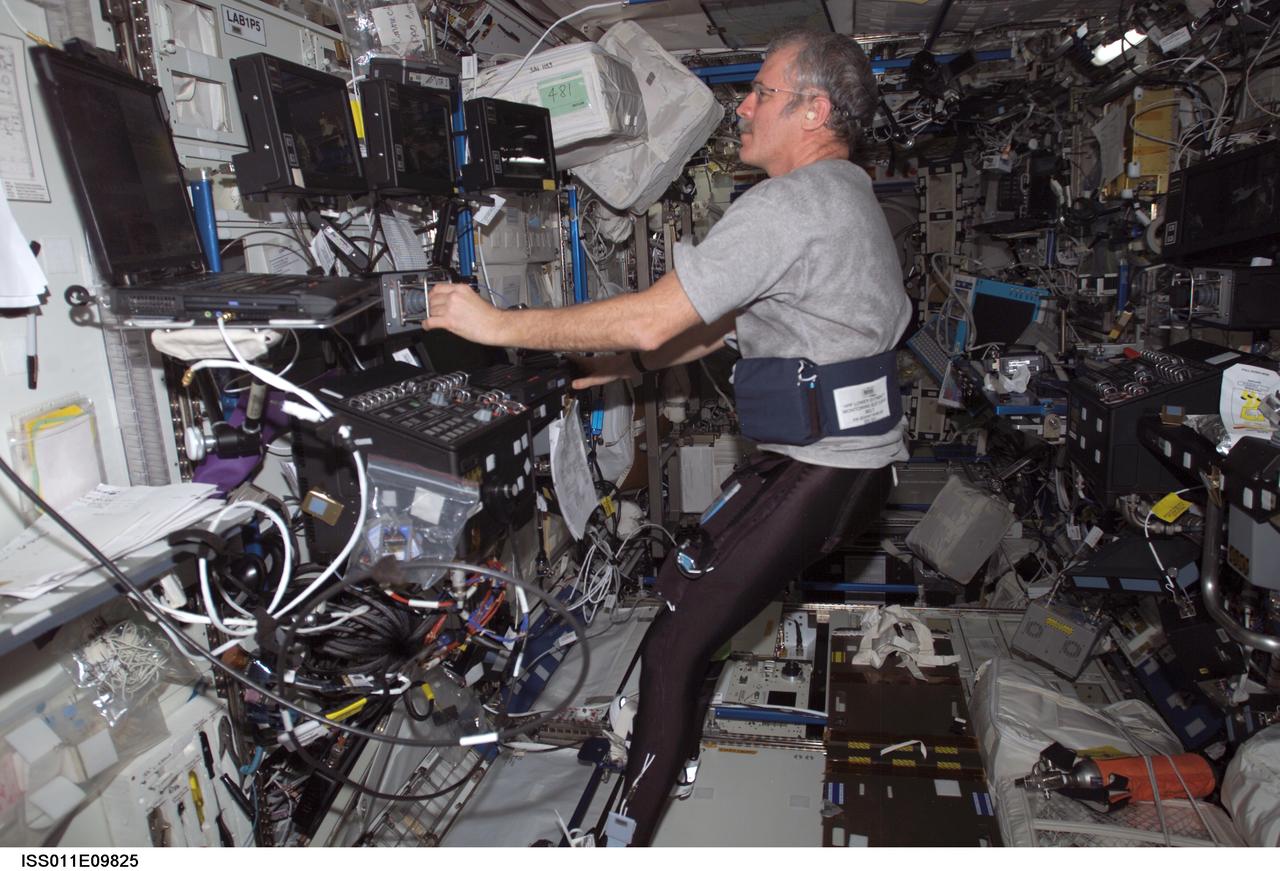
ISS011-E-09825 (29 June 2005) --- Astronaut John L. Phillips, Expedition 11 NASA Space Station science officer and flight engineer, enters data into a computer while participating in the Foot/Ground Reaction Forces During Spaceflight (FOOT) experiment in the Destiny laboratory of the International Space Station. Phillips wore the specially instrumented Lower Extremity Monitoring Suit (LEMS), cycling tights outfitted with sensors, during the experiment.
FOOT experiment (Foot/Ground Reaction Forces during Space Flight)
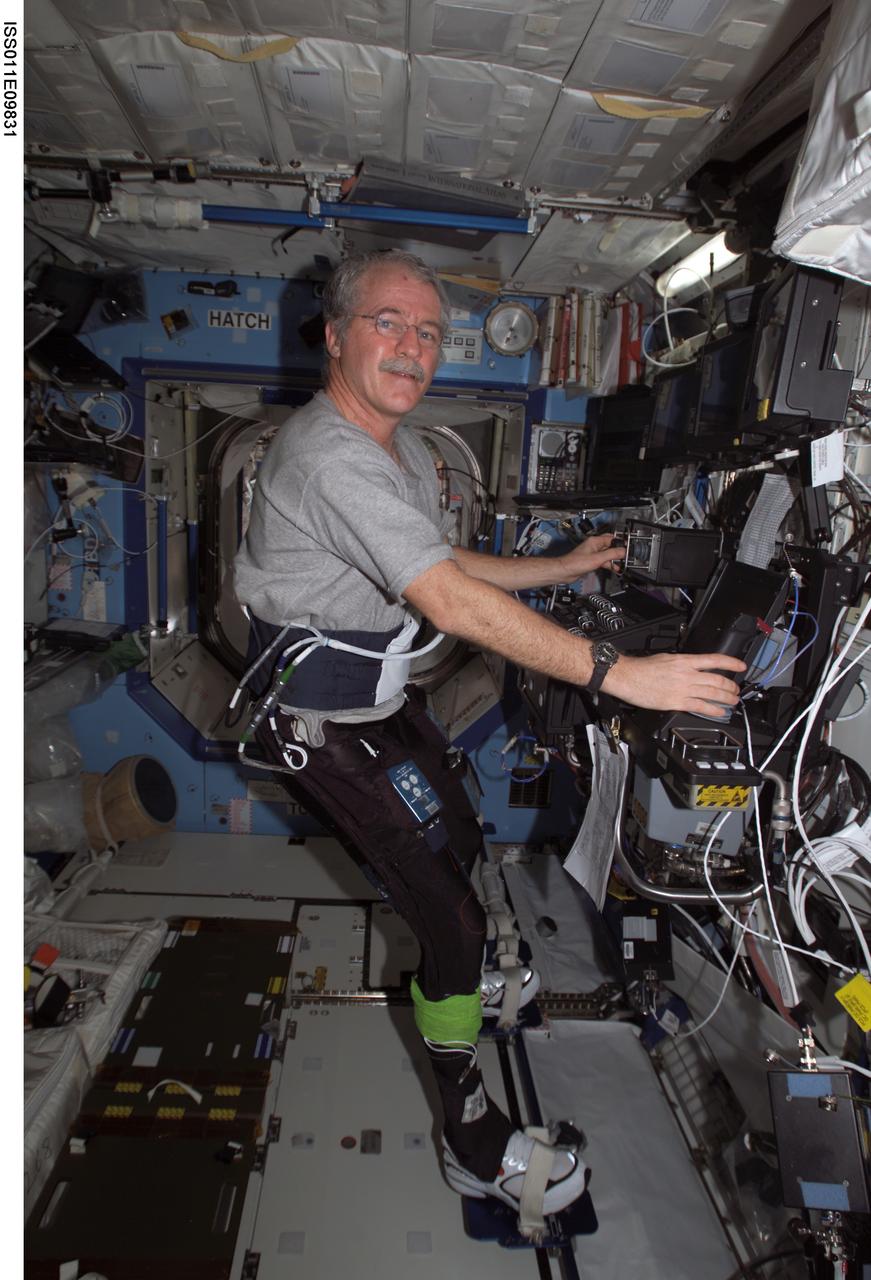
ISS011-E-09831 (29 June 2005) --- Astronaut John L. Phillips, Expedition 11 NASA Space Station science officer and flight engineer, works at the Canadarm2 controls while participating in the Foot/Ground Reaction Forces During Spaceflight (FOOT) experiment in the Destiny laboratory of the International Space Station. Phillips wore the specially instrumented Lower Extremity Monitoring Suit (LEMS), cycling tights outfitted with sensors, during the experiment.
FOOT experiment (Foot/Ground Reaction Forces during Space Flight)
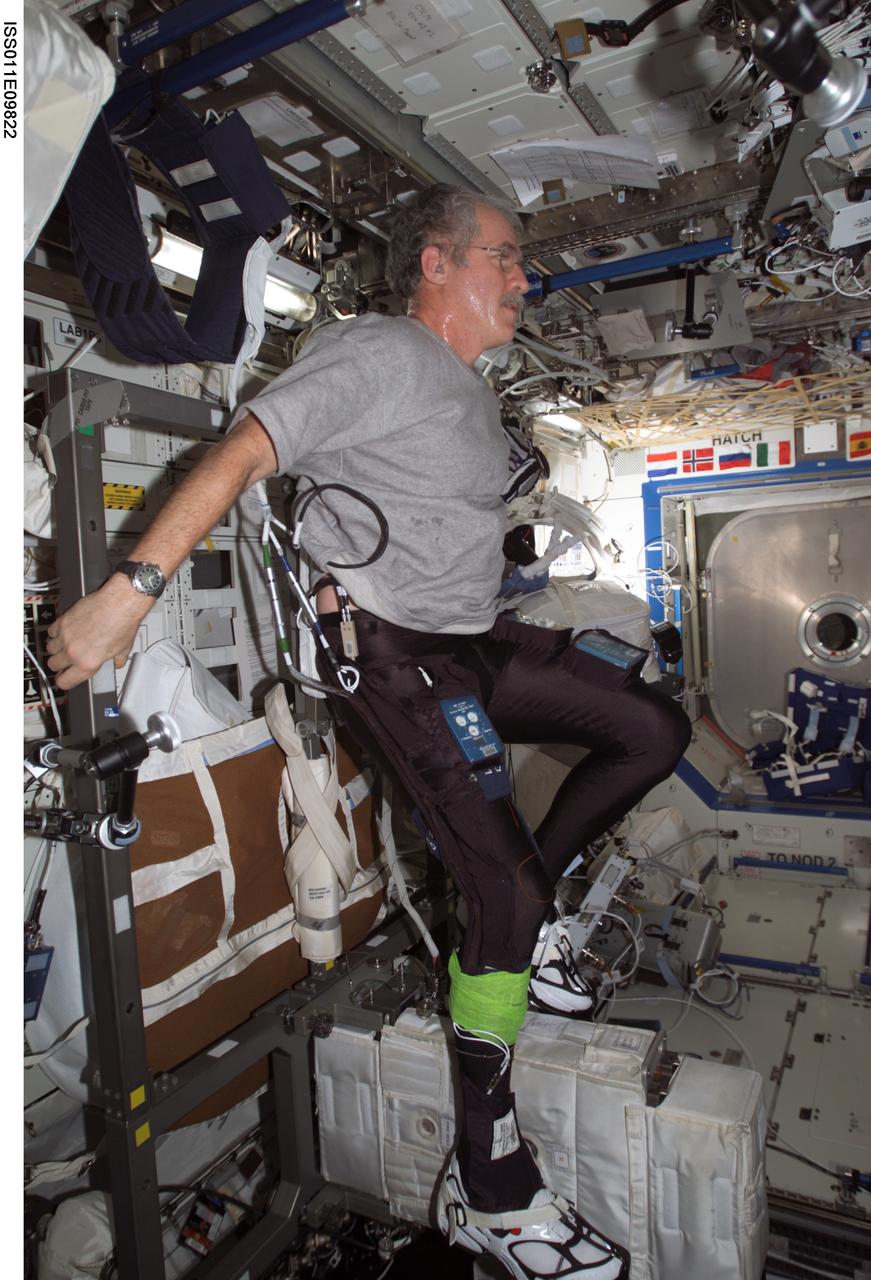
ISS011-E-09822 (29 June 2005) --- Astronaut John L. Phillips, Expedition 11 NASA Space Station science officer and flight engineer, uses the Cycle Ergometer with Vibration Isolation System (CEVIS) while participating in the Foot/Ground Reaction Forces During Spaceflight (FOOT) experiment in the Destiny laboratory of the International Space Station. Phillips wore the specially instrumented Lower Extremity Monitoring Suit (LEMS), cycling tights outfitted with sensors, during the experiment.
FOOT experiment (Foot/Ground Reaction Forces during Space Flight)
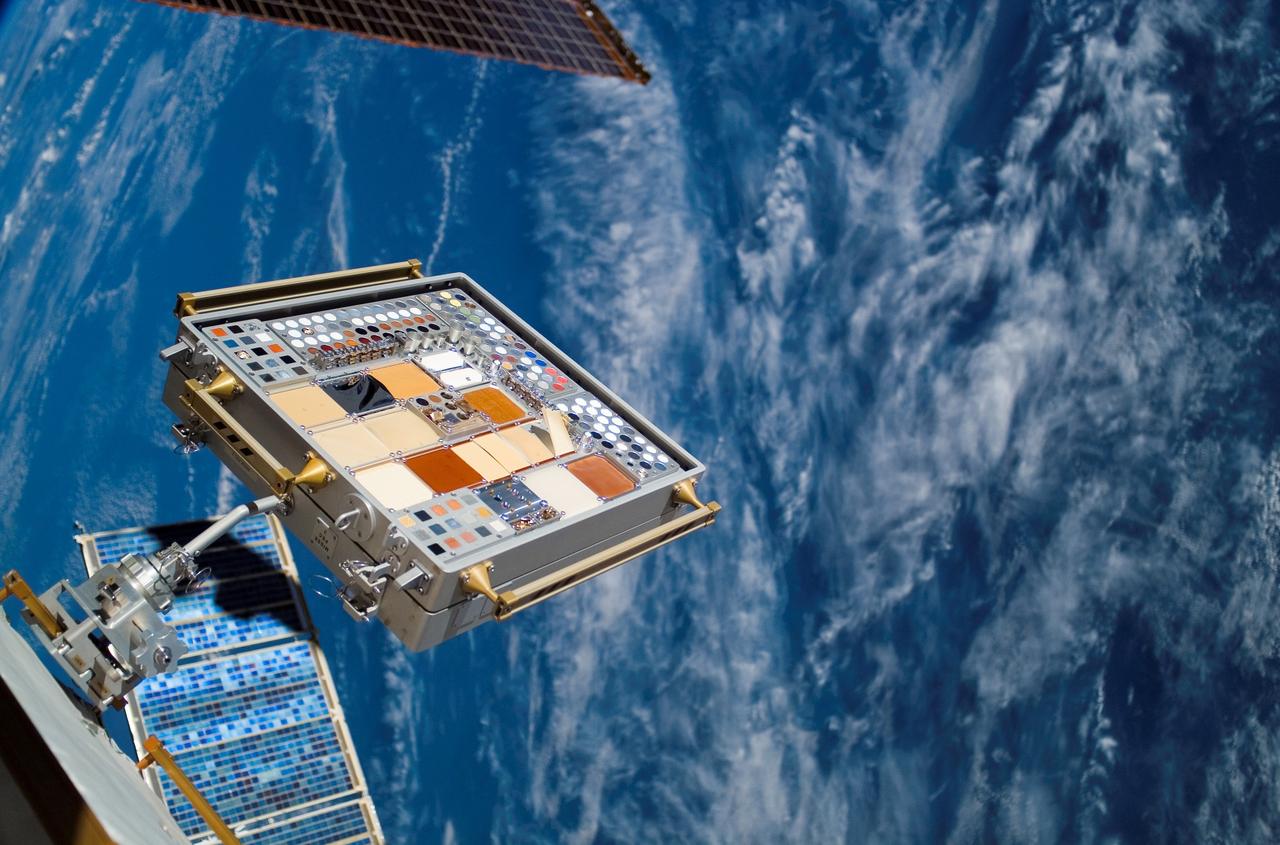
Back dropped by the blue and white Earth is a Materials International Space Station Experiment (MISSE) on the exterior of the Station. The photograph was taken during the second bout of STS-118 Extra Vehicular Activity (EVA). MISSE collects information on how different materials weather in the environment of space.
International Space Station (ISS)
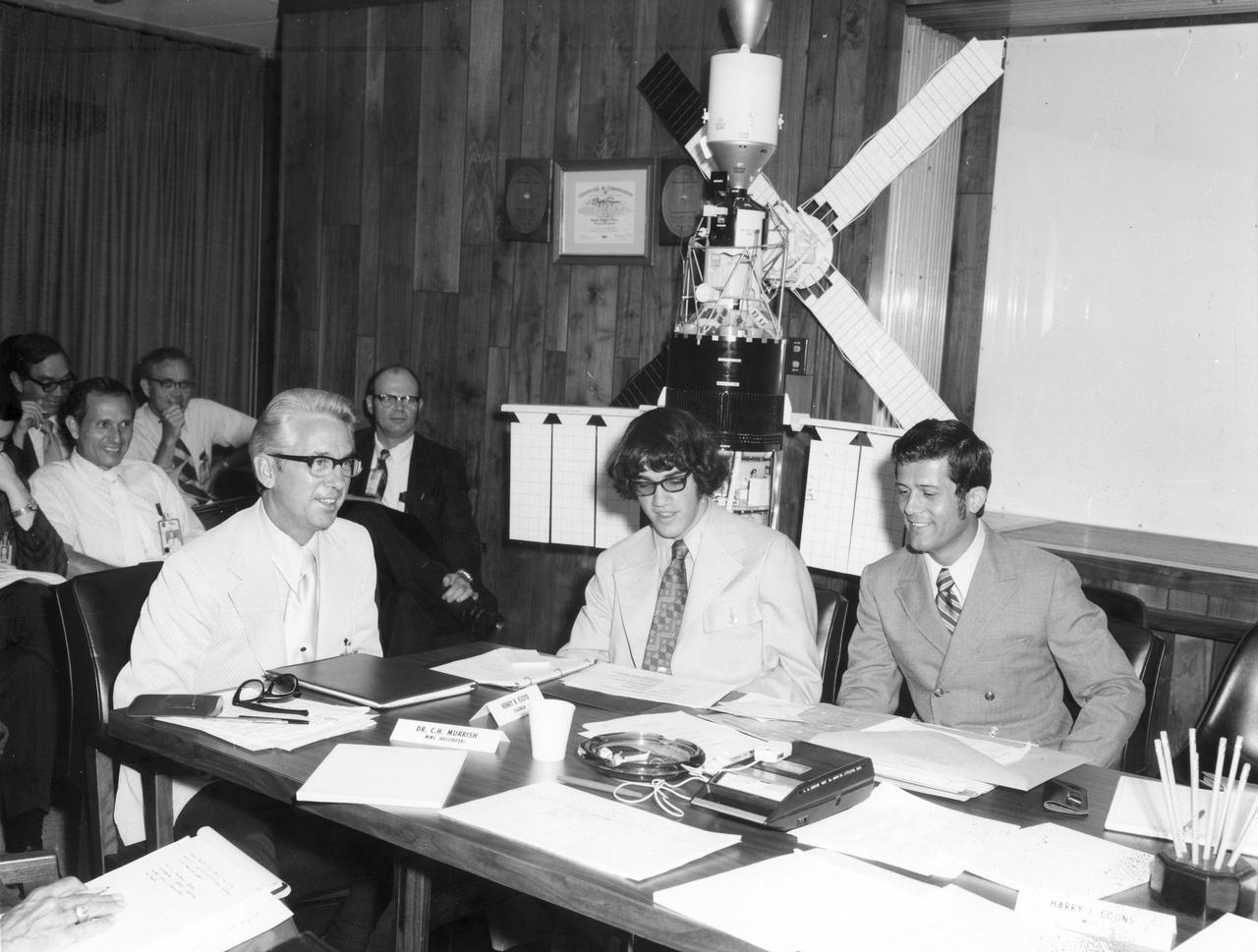
Robert L. Staehle (center), high school student from Harley School, Rochester New York, talks with Steven Hall (advisor to Staehle) and Henry Floyd, both of the Marshall Space Flight Center (MSFC) about his experiment “Behavior of Bacteria and Bacterial Spores in the Skylab Space Environment”. He was one of the 25 winners of a contest in which some 3,500 high school students proposed experiments for the following year’s Skylab mission. Of the 25 students, 6 did not see their experiments conducted on Skylab because the experiments were not compatible with Skylab hardware and timelines. Of the 19 remaining, 11 experiments required the manufacture of equipment.
Skylab
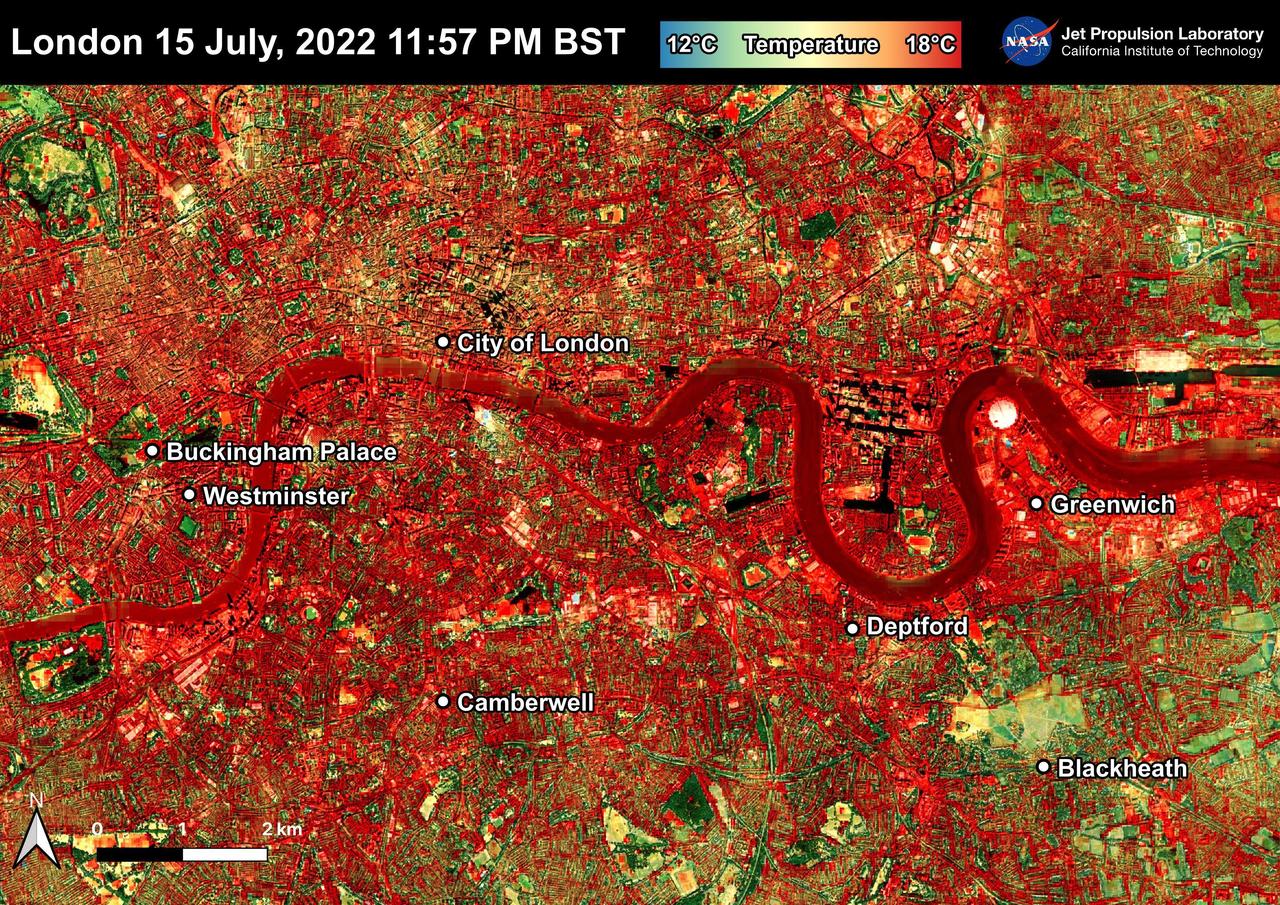
NASA's Ecosystem Spaceborne Thermal Radiometer Experiment on Space Station (ECOSTRESS) instrument recorded this image of ground surface temperatures in London and surrounding areas on July 15, 2022, just before midnight local time. It shows surface temperatures exceeding 68 degrees Fahrenheit (20 degrees Celsius) at 11:57 p.m. British Summer Time.  Parts of Europe in mid-July experienced a record-breaking heat wave. The United Kingdom reaching its highest air temperature on record on July 19, 104.5 F (40.3 C) in Coningsby, about 110 miles (177 kilometers) north of London, which itself saw a high of 104.3 F (40.2 C) the same day. That evening, the overnight low was also a record-breaker: 78.4 F (25.8 C) at Kenley Airfield in Greater London.  In this image, the red areas indicate hotter temperatures commonly associated with developed areas. These surfaces – roofs, paved streets, and other built structures – remain warm long after the sun sets. Blue and green areas indicate cooler areas commonly associated with parks and other natural land surfaces. Because this image was acquired at night, it shows bodies of water being warmer than the land surface. This is because water tends to change temperature more slowly, so its temperature stays elevated long after land surfaces have cooled down.  Cities are usually warmer than open land with natural surfaces because of human activities as well as the materials used in building and construction. Streets are often the hottest part of the built environment due to asphalt paving. Dark-colored surfaces absorb more heat from the Sun than lighter-colored ones; asphalt absorbs up to 95% of solar radiation and retains the heat for hours into nighttime. This image overlays ECOSTRESS surface temperature data on a Google satellite map for context.  ECOSTRESS measures the temperature of the ground, which is hotter than the air temperature during the daytime. The instrument launched to the space station in 2018. Its primary mission is to identify plants' thresholds for water use and water stress, giving insight into their ability to adapt to a warming climate. However, ECOSTRESS is also useful for documenting other heat-related phenomena, like patterns of heat absorption and retention. Its high-resolution images, with a pixel size of about 225 feet (70 meters) by 125 feet (38 meters), are a powerful tool for understanding our environment.  https://photojournal.jpl.nasa.gov/catalog/PIA25423
NASA's ECOSTRESS Shows Overnight Heat in London
ECOSTRESS Unbagging
ECOSTRESS Unbagging
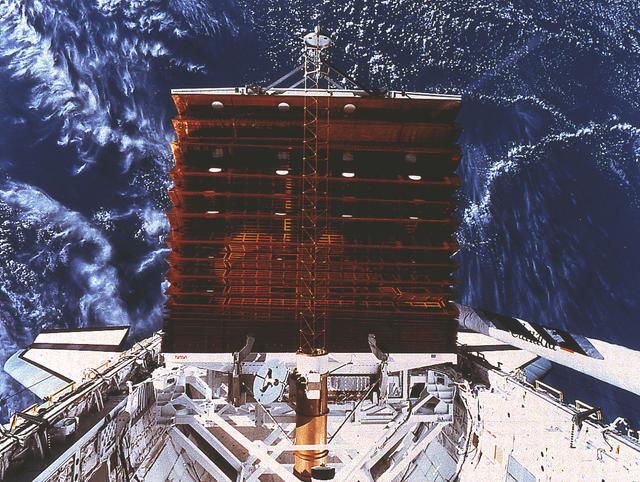
An STS-41D onboard photo shows the Solar Array Experiment (SAE) panel deployment for the Office of Aeronautics and space Technology-1 (OAST-1). OAST-1 is several advanced space technology experiments utilizing a common data system and is mounted on a platform in the Shuttle cargo bay.
Space Shuttle Projects
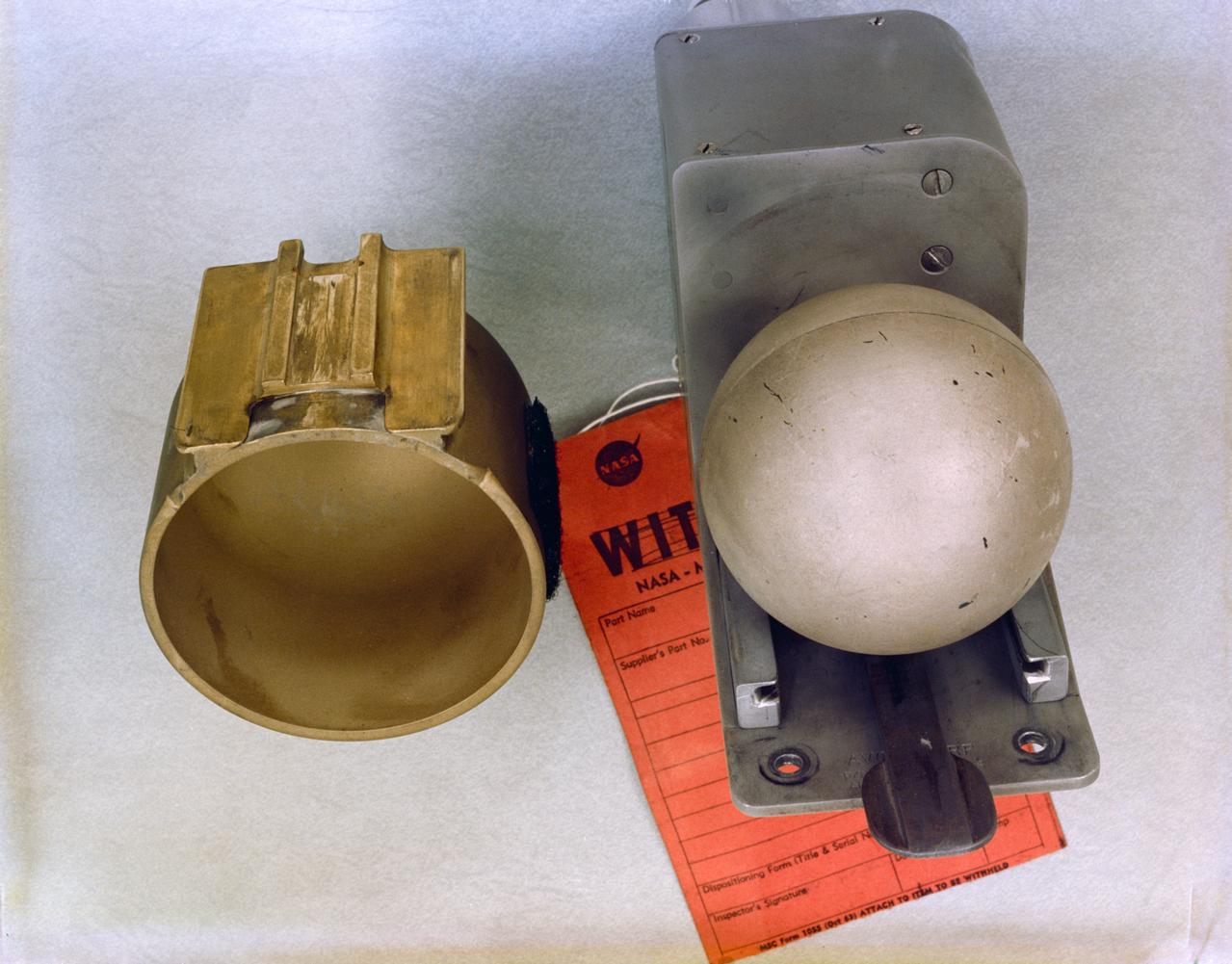
S65-58941 (27 Aug. 1965) --- U.S. Air Force Weapons Laboratory D-8 (Radiation in Space) experiment for Gemini-6 spaceflight. Kennedy Space Center alternative photo number is 104-KSC-65C-5533. Photo credit: NASA
U.S. Air Force Radiation in Space experiment for Gemini 6 flight
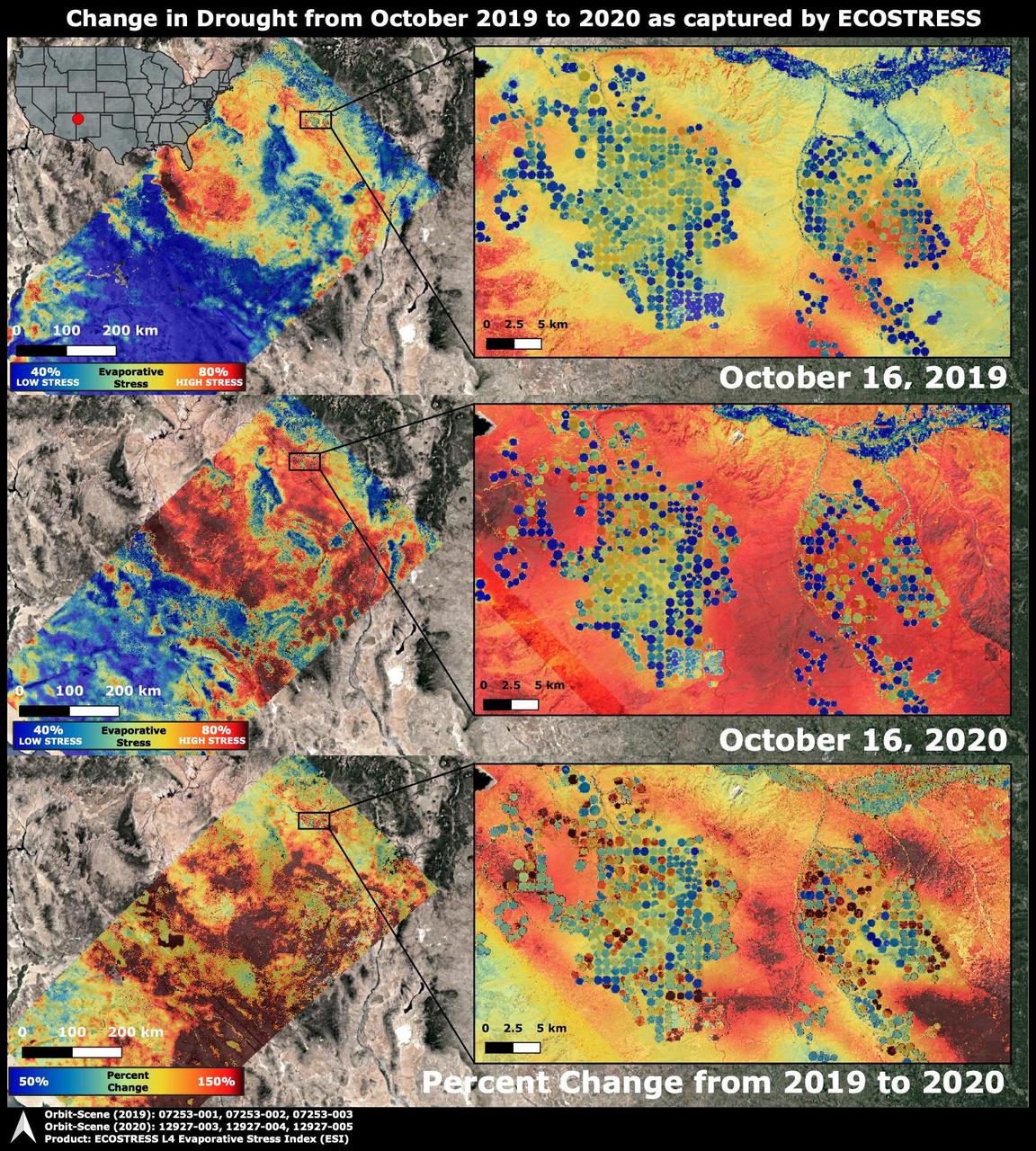
The Western United States has been entrenched in an Extreme and Exceptional drought that has extended from the summer and into the fall of 2020. NASA's ECOsystem Spaceborne Thermal Radiometer Experiment on Space Station (ECOSTRESS) imaged the drought on Oct. 16, 2020, and compared the same area to an image from ECOSTRESS taken a year earlier on Oct. 16, 2019. The bottom image shows the percentage change in plant water stress from 2019 to 2020.  The images at left zoom into the Arizona and New Mexico border and Navajo Nation Territory area, featuring the ECOSTRESS Evaporative Stress Index (ESI), which shows plant water stress. The inset images on the right zoom further into the region, showing circular agricultural fields that have been irrigated. Blue colors represent low stress and high water use, whereas red colors represent high stress and low water use. Irrigation is able to alleviate plant water stress in many of the fields while the surrounding landscape suffers from the drought, though numerous agricultural fields are shut down in the drought image.  The primary mission of ECOSTRESS, which launched to the International Space Station in June 2018, is to provide insight into plants' health, especially in a drought, by taking their temperature. Plants regulate their temperature by releasing water through tiny pores on their leaves. With sufficient water, they can maintain their temperature. When they lack water, their temperatures rise; ECOSTRESS can measure this change.   https://photojournal.jpl.nasa.gov/catalog/PIA24132
ECOSTRESS Drought Stress Comparison
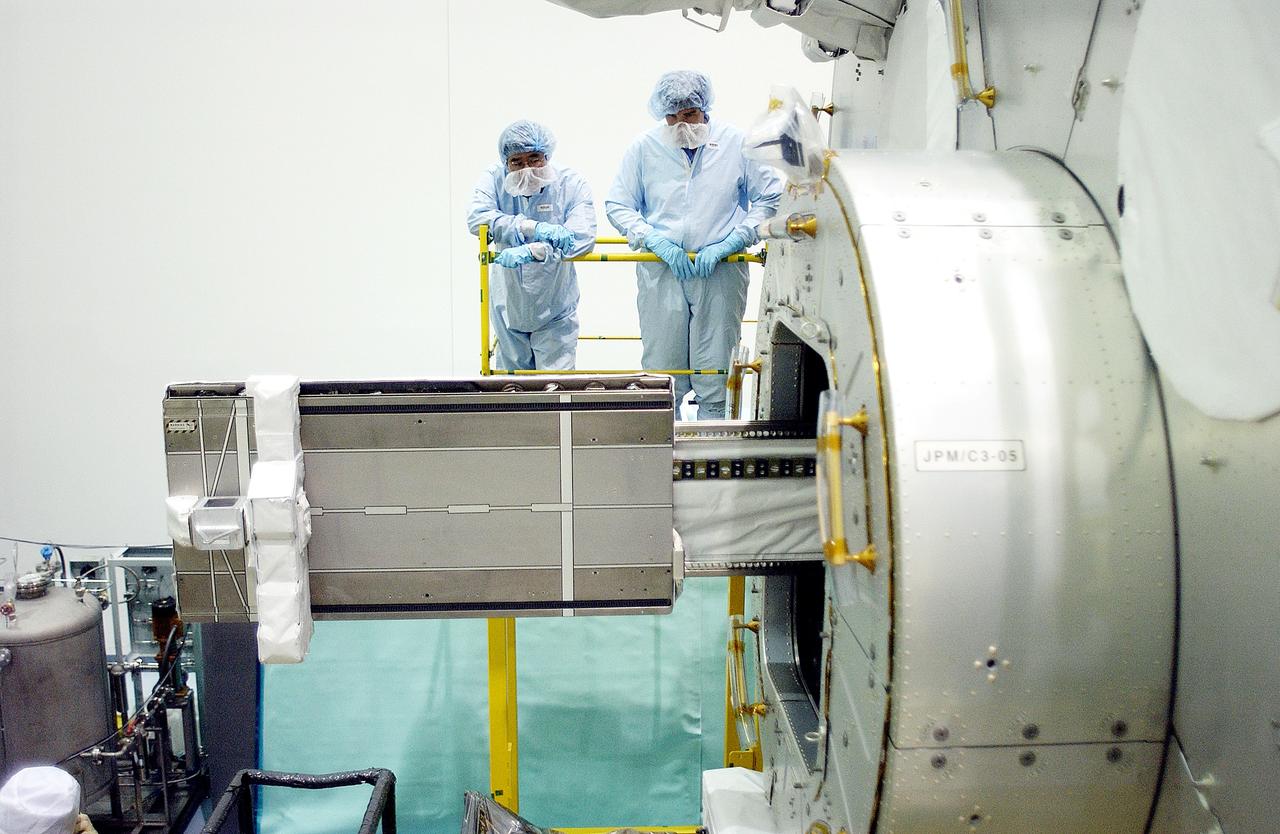
KENNEDY SPACE CENTER, FLA. -  In the Space Station Processing Facility, Japanese astronaut Koichi Wakata (top left) and technicians watch as a tray is extended from inside the Pressurized Module, or PM, part of the Japanese Experiment Module (JEM).   The PM provides a shirt-sleeve environment in which astronauts on the International Space Station can conduct microgravity experiments. There are a total of 23 racks, including 10 experiment racks, inside the PM providing a power supply, communications, air conditioning, hardware cooling, water control and experiment support functions.
KENNEDY SPACE CENTER, FLA. - In the Space Station Processing Facility, Japanese astronaut Koichi Wakata (top left) and technicians watch as a tray is extended from inside the Pressurized Module, or PM, part of the Japanese Experiment Module (JEM). The PM provides a shirt-sleeve environment in which astronauts on the International Space Station can conduct microgravity experiments. There are a total of 23 racks, including 10 experiment racks, inside the PM providing a power supply, communications, air conditioning, hardware cooling, water control and experiment support functions.
KENNEDY SPACE CENTER, FLA. - In the Space Station Processing Facility, Japanese astronaut Koichi Wakata looks over the Pressurized Module, or PM, part of the Japanese Experiment Module (JEM).  The PM provides a shirt-sleeve environment in which astronauts on the International Space Station can conduct microgravity experiments. There are a total of 23 racks, including 10 experiment racks, inside the PM providing a power supply, communications, air conditioning, hardware cooling, water control and experiment support functions.
KENNEDY SPACE CENTER, FLA. - In the Space Station Processing Facility, Japanese astronaut Koichi Wakata looks over the Pressurized Module, or PM, part of the Japanese Experiment Module (JEM). The PM provides a shirt-sleeve environment in which astronauts on the International Space Station can conduct microgravity experiments. There are a total of 23 racks, including 10 experiment racks, inside the PM providing a power supply, communications, air conditioning, hardware cooling, water control and experiment support functions.
KENNEDY SPACE CENTER, FLA. - In the Space Station Processing Facility, technicians on the floor watch as a tray is extended from inside the Pressurized Module, or PM, part of the Japanese Experiment Module (JEM).   The PM provides a shirt-sleeve environment in which astronauts on the International Space Station can conduct microgravity experiments. There are a total of 23 racks, including 10 experiment racks, inside the PM providing a power supply, communications, air conditioning, hardware cooling, water control and experiment support functions.
KENNEDY SPACE CENTER, FLA. - In the Space Station Processing Facility, technicians on the floor watch as a tray is extended from inside the Pressurized Module, or PM, part of the Japanese Experiment Module (JEM). The PM provides a shirt-sleeve environment in which astronauts on the International Space Station can conduct microgravity experiments. There are a total of 23 racks, including 10 experiment racks, inside the PM providing a power supply, communications, air conditioning, hardware cooling, water control and experiment support functions.
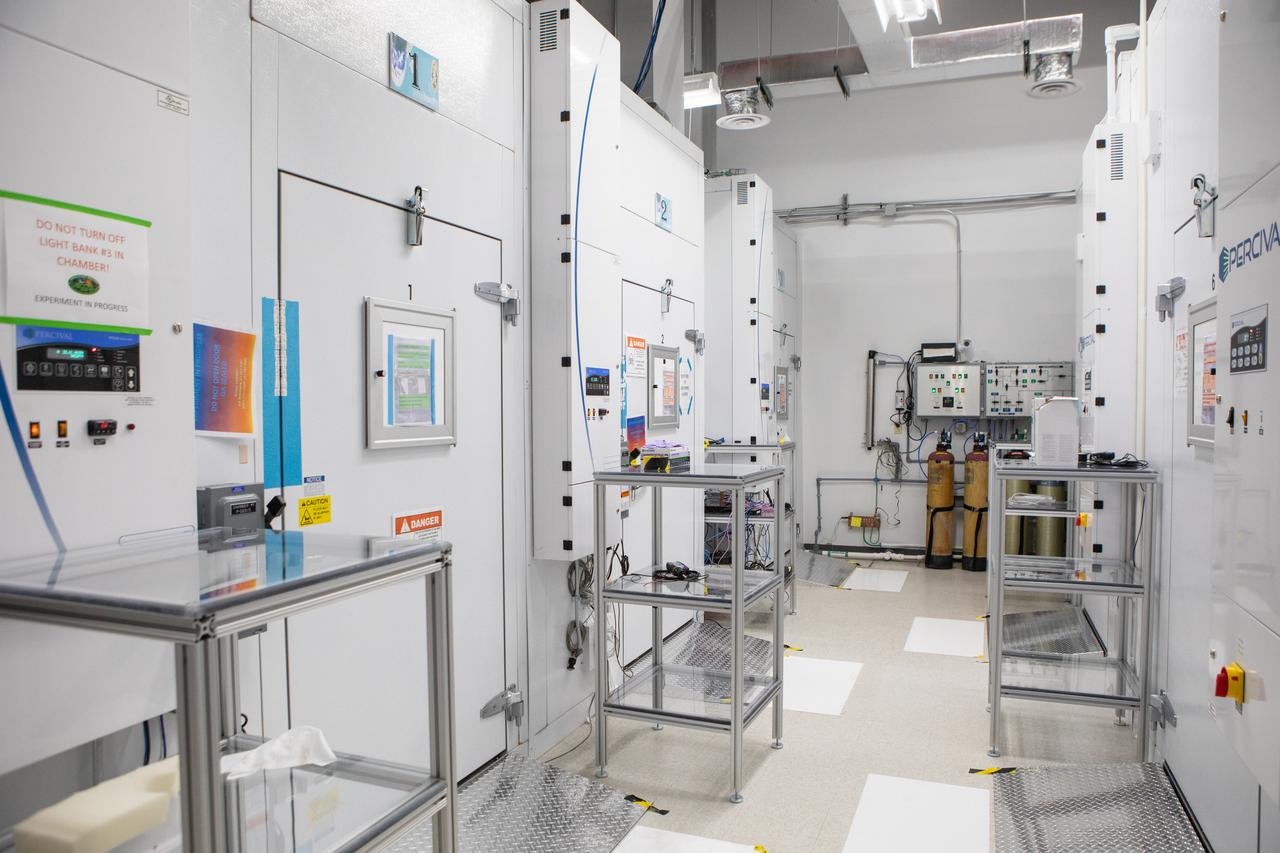
A walk-in experiment chamber for the Center for the Advancement of Science in Space (CASIS) is in view in the foreground inside a laboratory in the Space Station Processing Facility (SSPF) at NASA's Kennedy Space Center in Florida, on May 16, 2019. Further back is an experiment chamber for ground test flight experiments. The center is celebrating the SSPF’s 25th anniversary. The facility was built to process elements for the International Space Station. Now it is providing support for current and future NASA and commercial provider programs, including Commercial Resupply Services, Artemis 1, sending the first woman and next man to the Moon, and deep space destinations including Mars.
SSPF - 25 Year Anniversary Then & Now
Evening photo of the Space Experiments Complex in the evening of the arrival of the Orion ETA (Environmental Test Article) having been shipped from Florida by truck. The Orion ETA flew on Artemis I and will undergo testing of the docking module jettison and the forward by cover jettison in preparation of the Artemis II launch.
Evening photo of the Space Experiments Complex (SEC) at Glenn Re
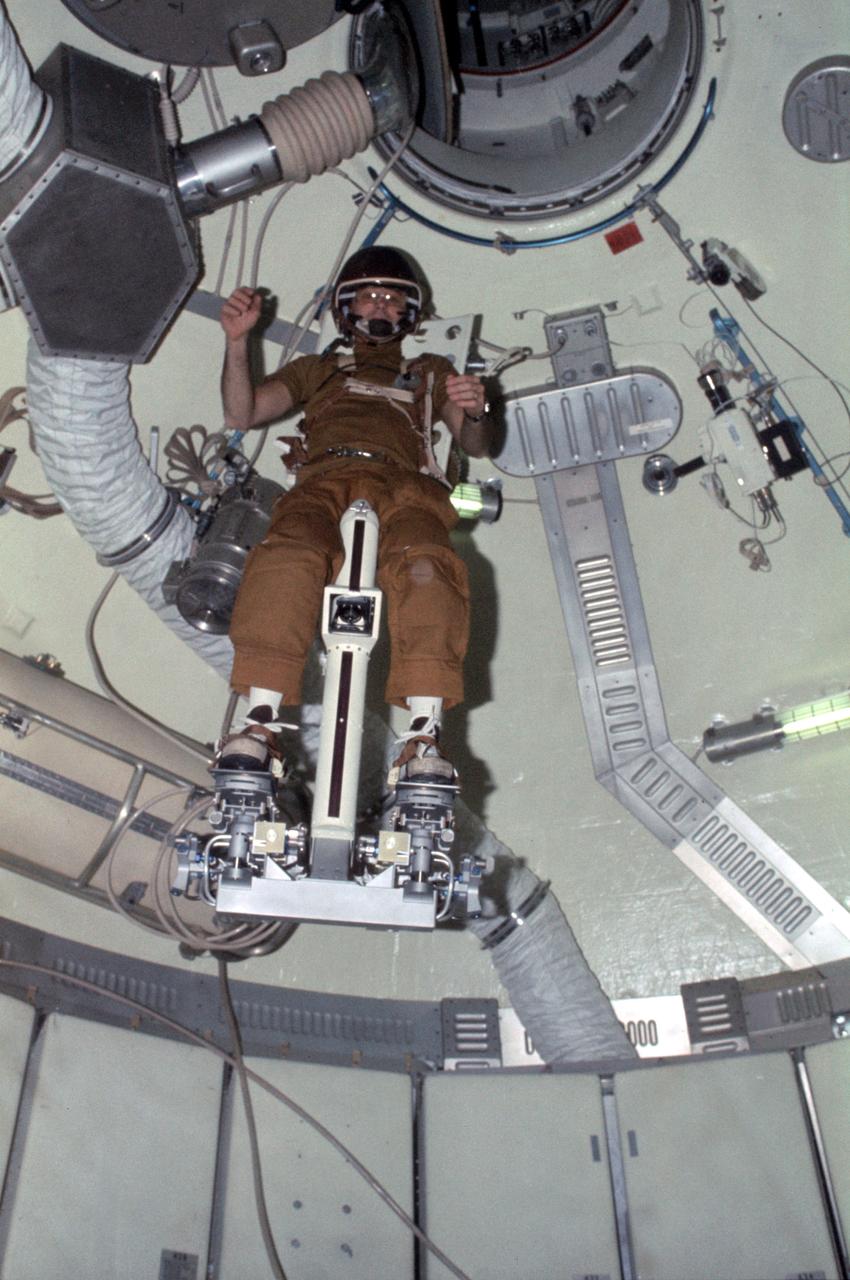
SL3-108-1304 (July-September 1973) --- Astronaut Alan L. Bean, Skylab 3 commander, flies the M509 Astronaut Maneuvering Equipment in the forward dome area of the Orbital Workshop (OWS) on the space station cluster in Earth orbit. Bean is strapped in to the back-mounted, hand-controlled Automatically Stabilized Maneuvering Unit (ASMU). This ASMU experiment is being done in shirt sleeves. The dome area where the experiment is conducted is about 22 feet in diameter and 19 feet from top to bottom. Photo credit: NASA
Astronaut Alan Bean flies the Astronaut Maneuvering Equipment
iss056e098239 (7/23/2018) --- Astronaut Alexander Gerst of ESA (European Space Agency) checking a Space Algae culture bag making sure it is green, gently agitating each one, and making sure each label colors match. The Space Algae investigation explores the genetic basis for productivity of algae cultivated in space and whether this requires genetic adaptations or not.
Space Algae Experiment Install
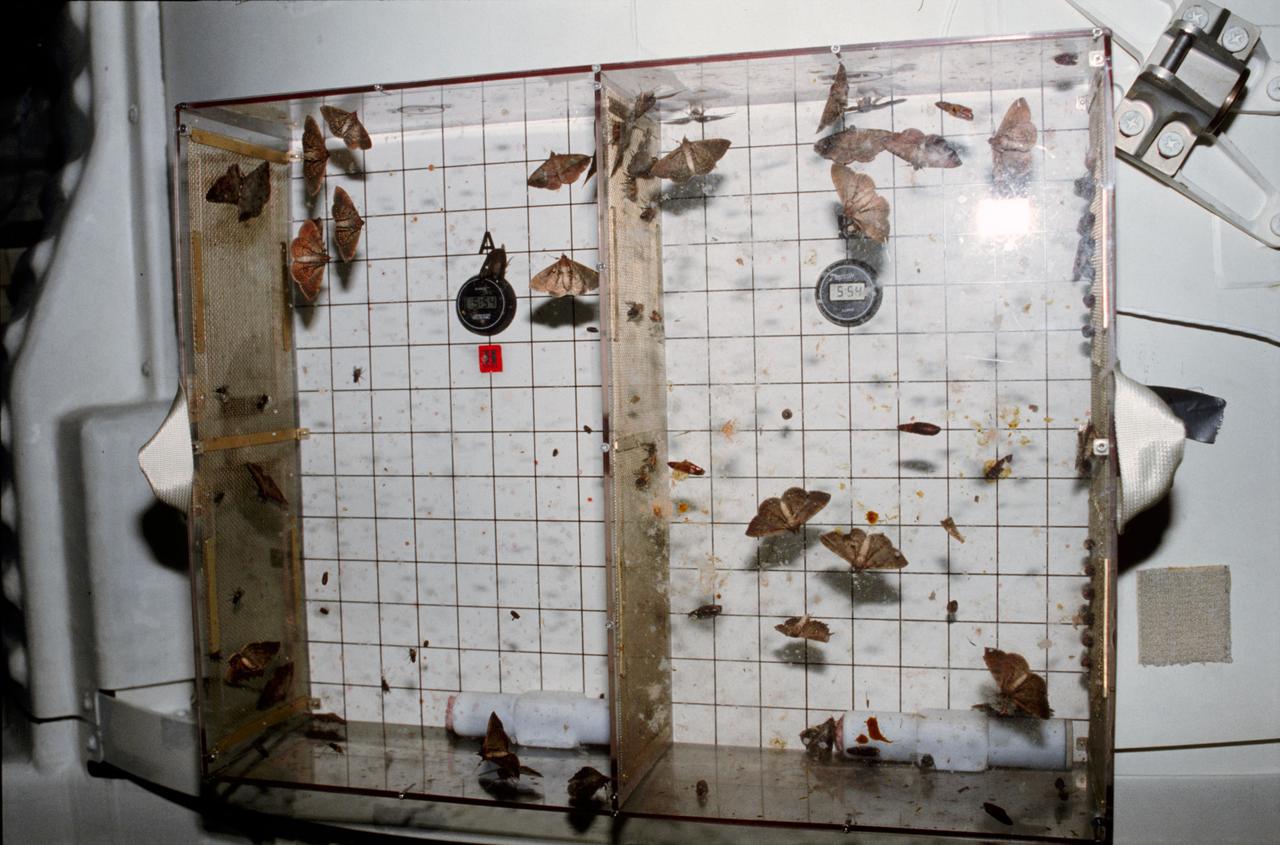
STS003-23-175 (22-30 March 1982) --- Student Experiment 81-8 (SE-81-8) Insect Flight Motion Study taped to the airlock on aft middeck of space shuttle Columbia. Photo credit: NASA
Student Experiment 81-8 (SE-81-8) Insect Flight Motion Study on middeck
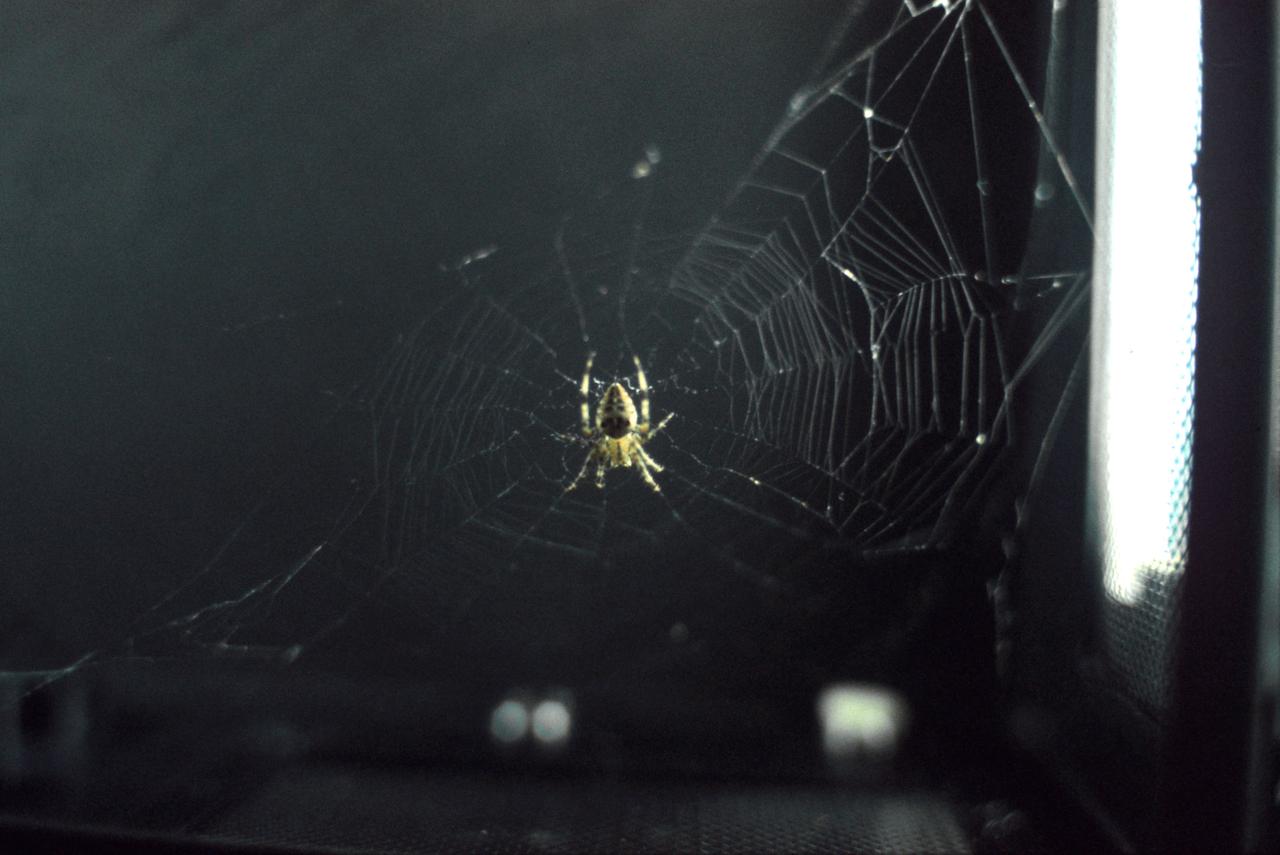
SL3-108-1307 (July-September 1973) --- A close-up view of Arabella, one of the two Skylab 3 common cross spiders "Araneus diadematus," and the web it had spun in the zero-gravity of space aboard the Skylab space station cluster in Earth orbit. This picture was taken with a hand-held 35mm Nikon camera. During the 59-day Skylab 3 mission the two spiders, Arabella and Anita, were housed in an enclosure onto which a motion picture and a still camera were attempts to build a web in the weightless environment. The spider experiment (ED52) was one of 25 experiments selected for Skylab by NASA from more than 3,400 experiment proposals submitted by high school students throughout the nation. ED52 was submitted by 17-year-old Judith S. Miles of Lexington, Massachusetts. Anita died during the last week of the mission. Photo credit: NASA
View of Arabella, one of two Skylab spiders and her web
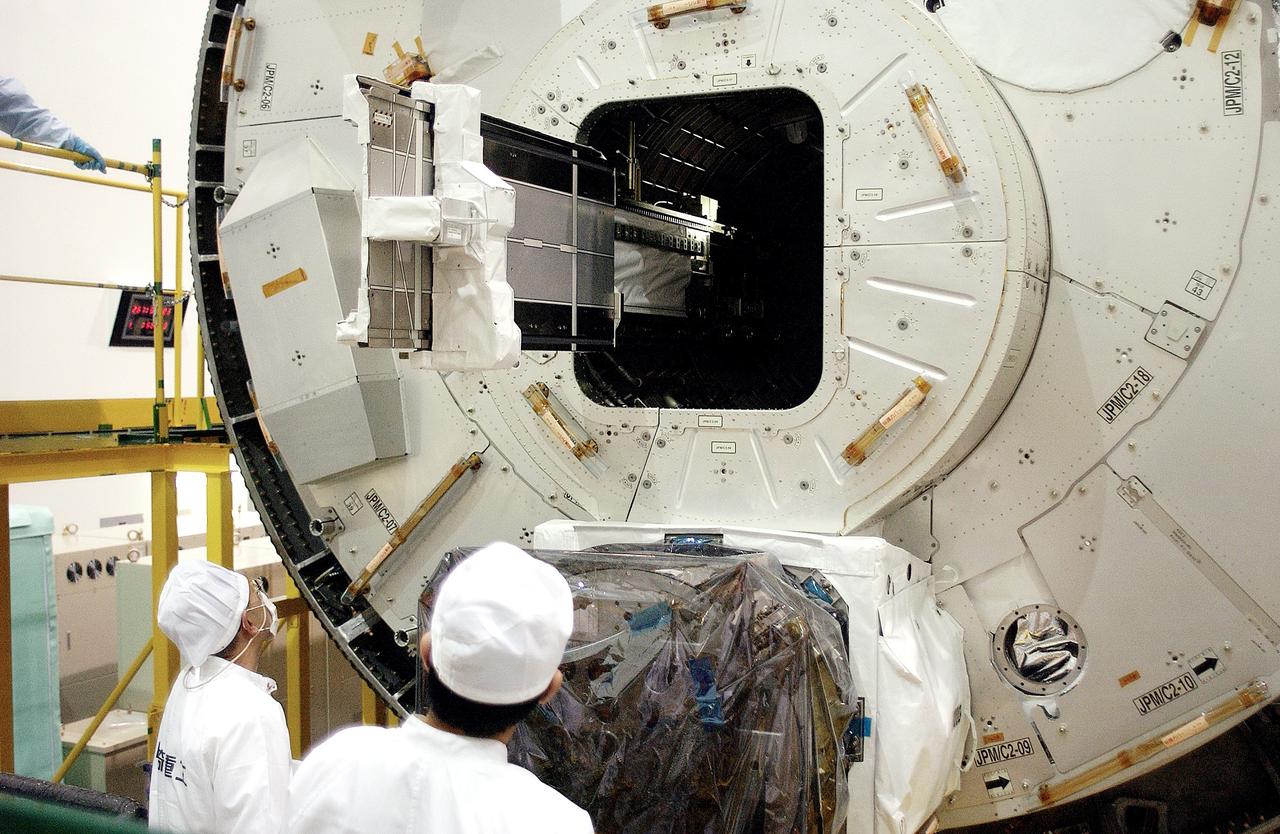
KENNEDY SPACE CENTER, FLA. -   Japanese astronaut Koichi Wakata (right) works with a tray extended  from inside the Pressurized Module, or PM, part of the Japanese Experiment Module (JEM).   The PM provides a shirt-sleeve environment in which astronauts on the International Space Station can conduct microgravity experiments. There are a total of 23 racks, including 10 experiment racks, inside the PM providing a power supply, communications, air conditioning, hardware cooling, water control and experiment support functions.
KENNEDY SPACE CENTER, FLA. - Japanese astronaut Koichi Wakata (right) works with a tray extended from inside the Pressurized Module, or PM, part of the Japanese Experiment Module (JEM). The PM provides a shirt-sleeve environment in which astronauts on the International Space Station can conduct microgravity experiments. There are a total of 23 racks, including 10 experiment racks, inside the PM providing a power supply, communications, air conditioning, hardware cooling, water control and experiment support functions.
KENNEDY SPACE CENTER, FLA. -  Japanese astronaut Koichi Wakata (left) works with a tray extended from inside the Pressurized Module, or PM, part of the Japanese Experiment Module (JEM).   The PM provides a shirt-sleeve environment in which astronauts on the International Space Station can conduct microgravity experiments. There are a total of 23 racks, including 10 experiment racks, inside the PM providing a power supply, communications, air conditioning, hardware cooling, water control and experiment support functions.
KENNEDY SPACE CENTER, FLA. - Japanese astronaut Koichi Wakata (left) works with a tray extended from inside the Pressurized Module, or PM, part of the Japanese Experiment Module (JEM). The PM provides a shirt-sleeve environment in which astronauts on the International Space Station can conduct microgravity experiments. There are a total of 23 racks, including 10 experiment racks, inside the PM providing a power supply, communications, air conditioning, hardware cooling, water control and experiment support functions.
STS047-204-006 (12 - 20 Sept 1992) --- Dr. Mamoru Mohri, payload specialist representing Japan's National Space Development Agency (NASDA), participates in an experiment designed to learn more about Space Adaptation Syndrome (SAS).  The experiment is titled, "Comparative Measurement of Visual Stability in Earth and Cosmic Space."  During the experiment, Dr. Mohri tracked a flickering light target while eye movements and neck muscle tension were measured.  This 45-degree angle position was one of four studied during the eight-day Spacelab-J mission.
STS-47 Payload Specialist Mohri conducts visual stability experiment in SLJ
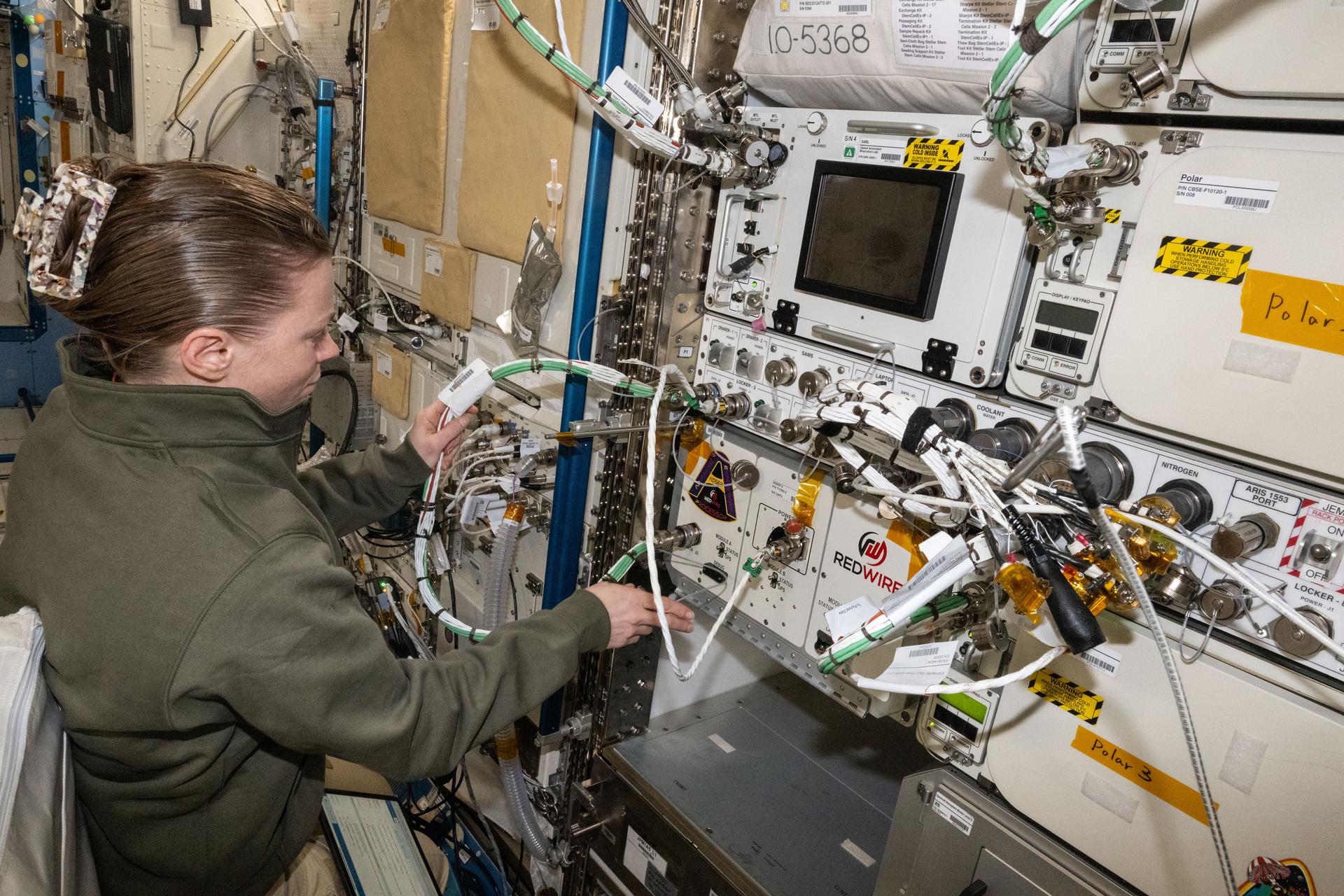
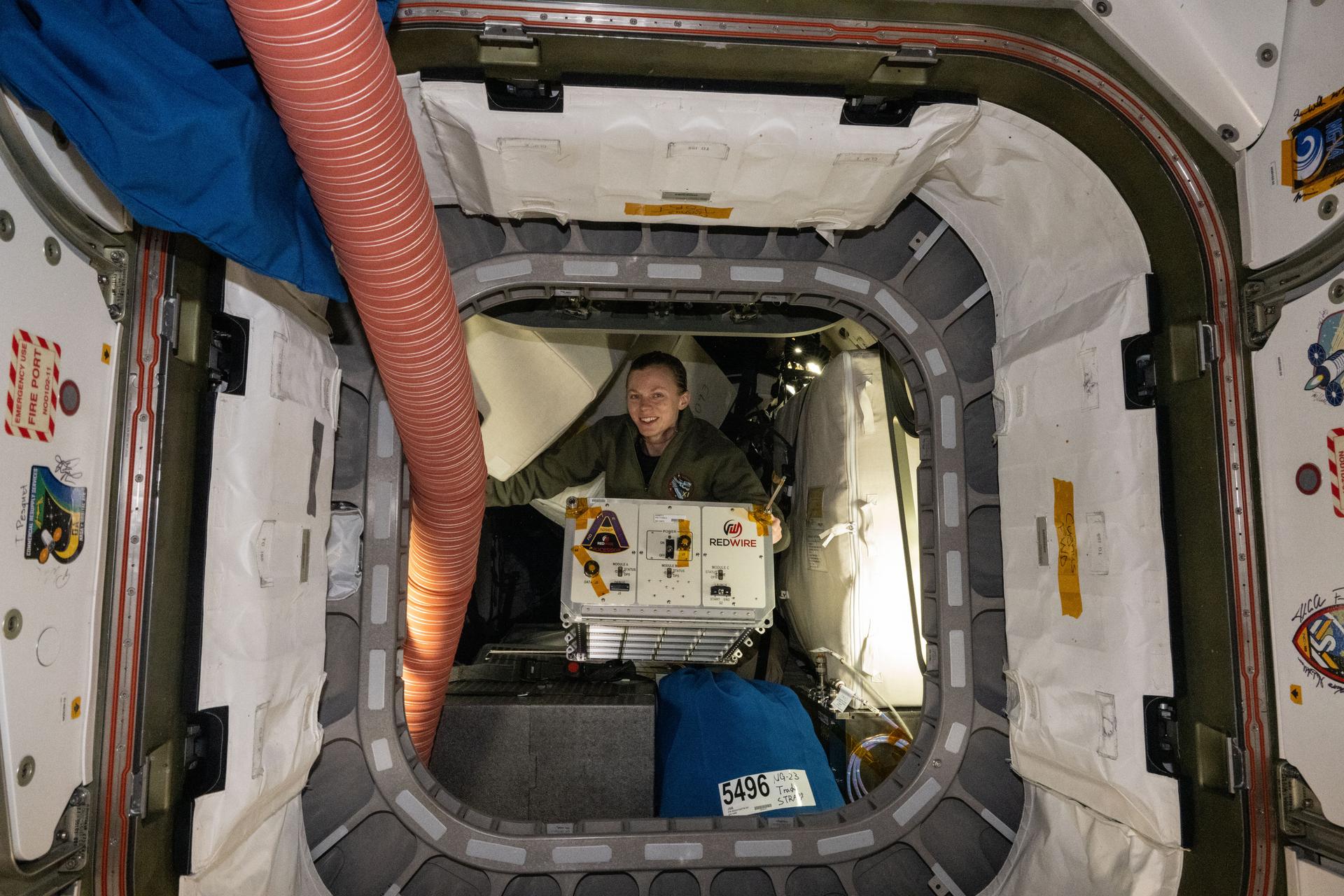
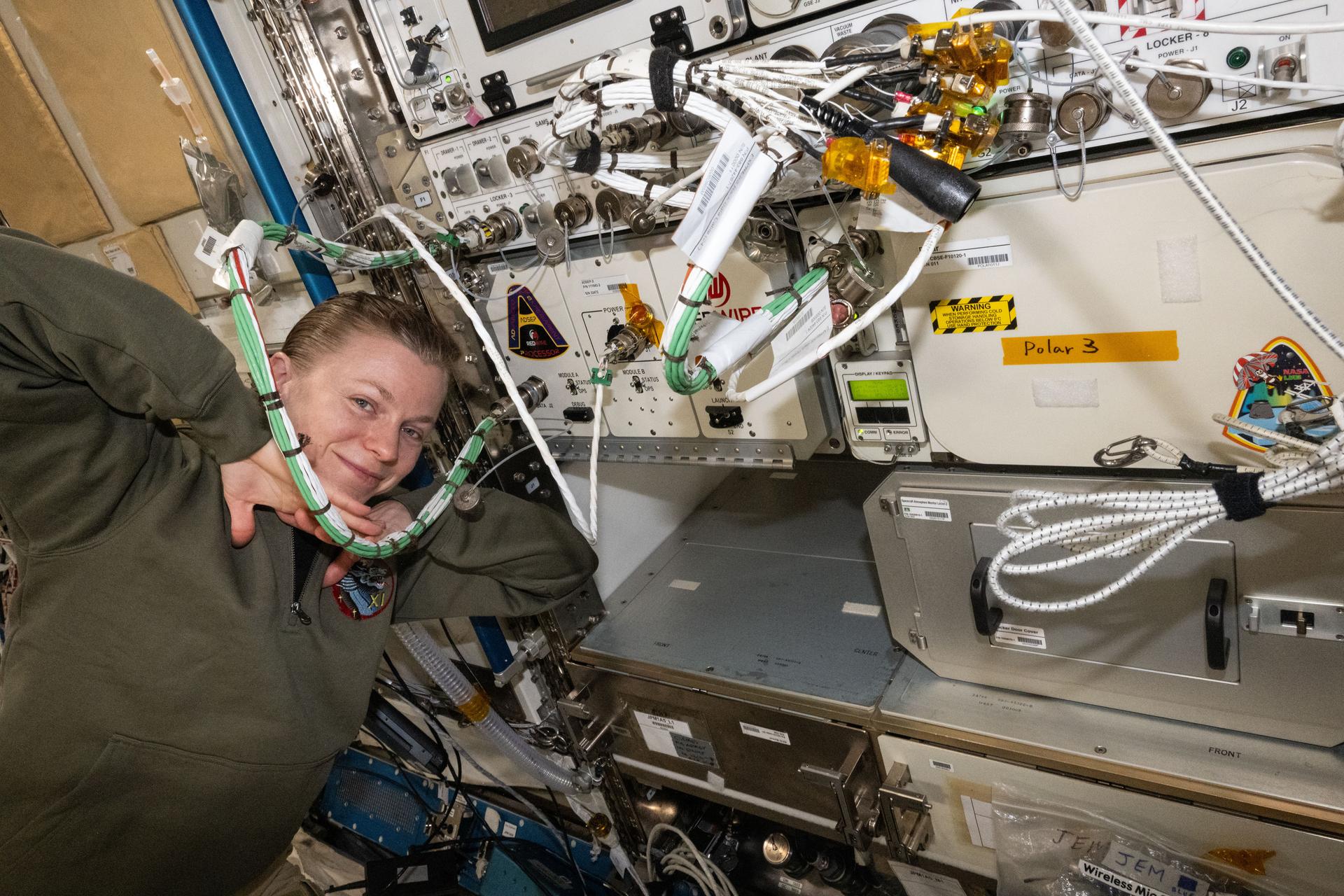
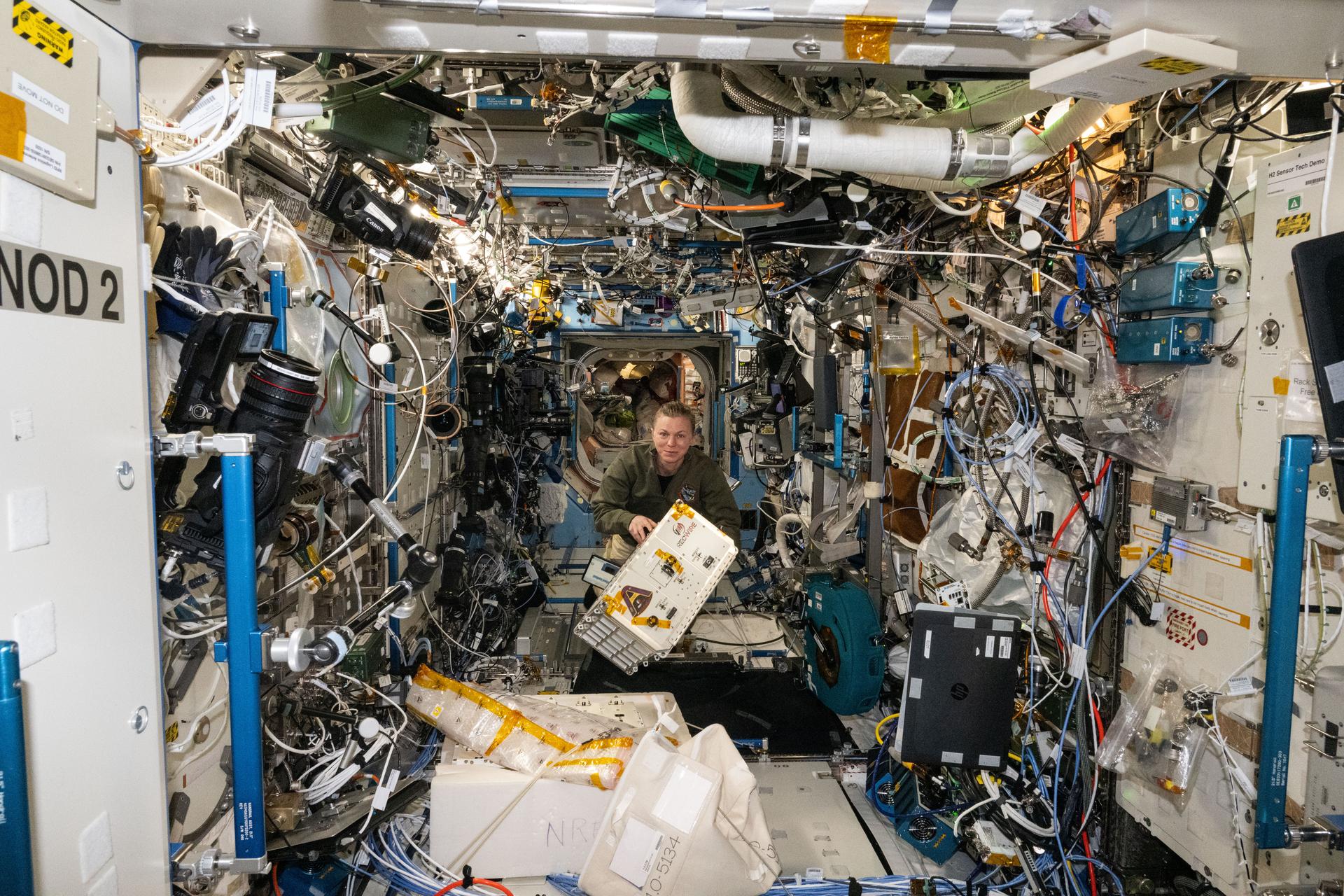
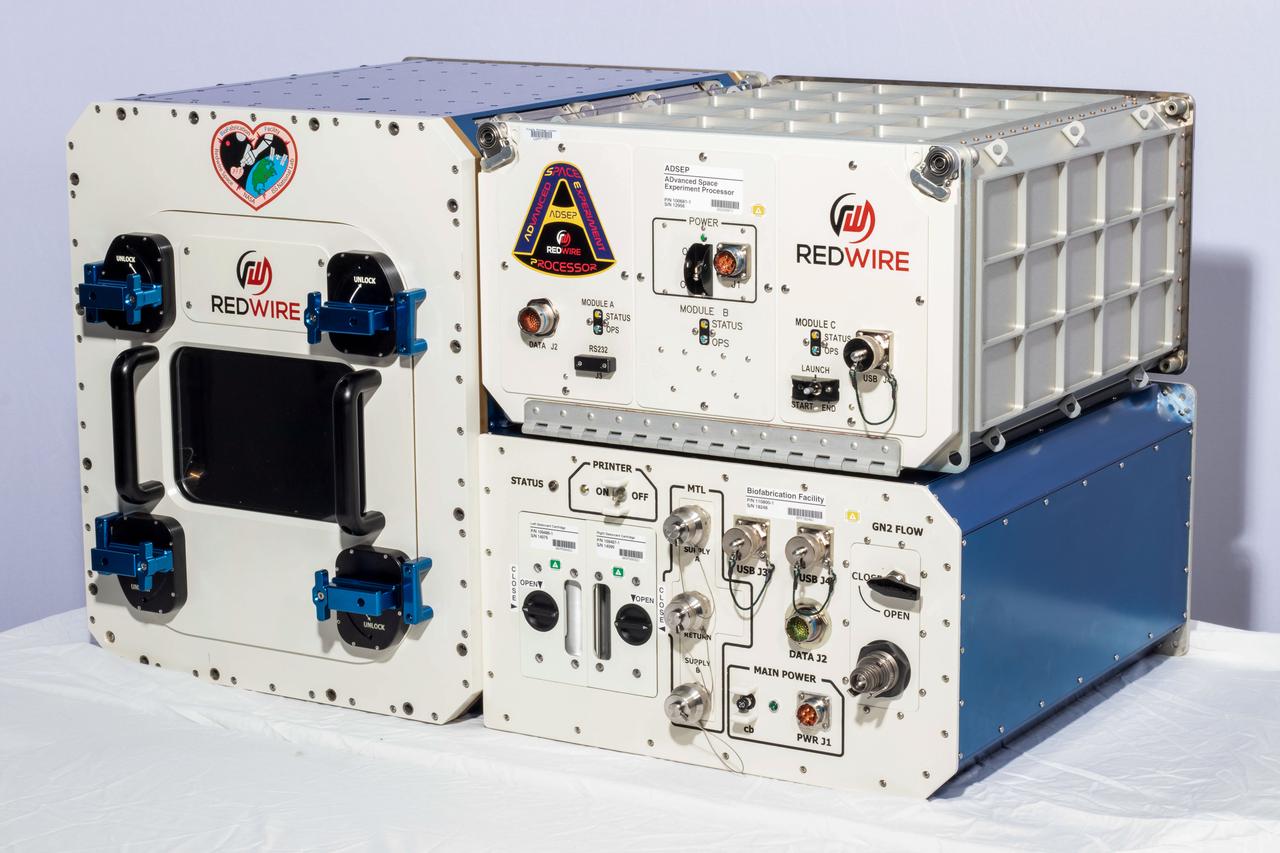
jsc2022e072969 (8/12/2022) ---    The BioFabrication Facility (BFF) and the ADvanced Space Experiment Processor (ADSEP) together comprise a system capable of manufacturing human tissue in the microgravity environment of space. BFF is returning to the International Space Station after coming back to Earth for upgrades in 2020. The first investigation to be conducted in the upgraded facility is BioFabrication Facility Assembled Next-gen Development of Collagenous Allograft Meniscal Prosthetics aboard the International Space Station (BFF-Meniscus-2). The study attempts to 3D print a meniscus, also known as knee cartilage tissue, using only bioinks and cells. Image courtesy of Redwire.
BioFabrication Facility (BFF) and the ADvanced Space Experiment Processor (ADSEP) together
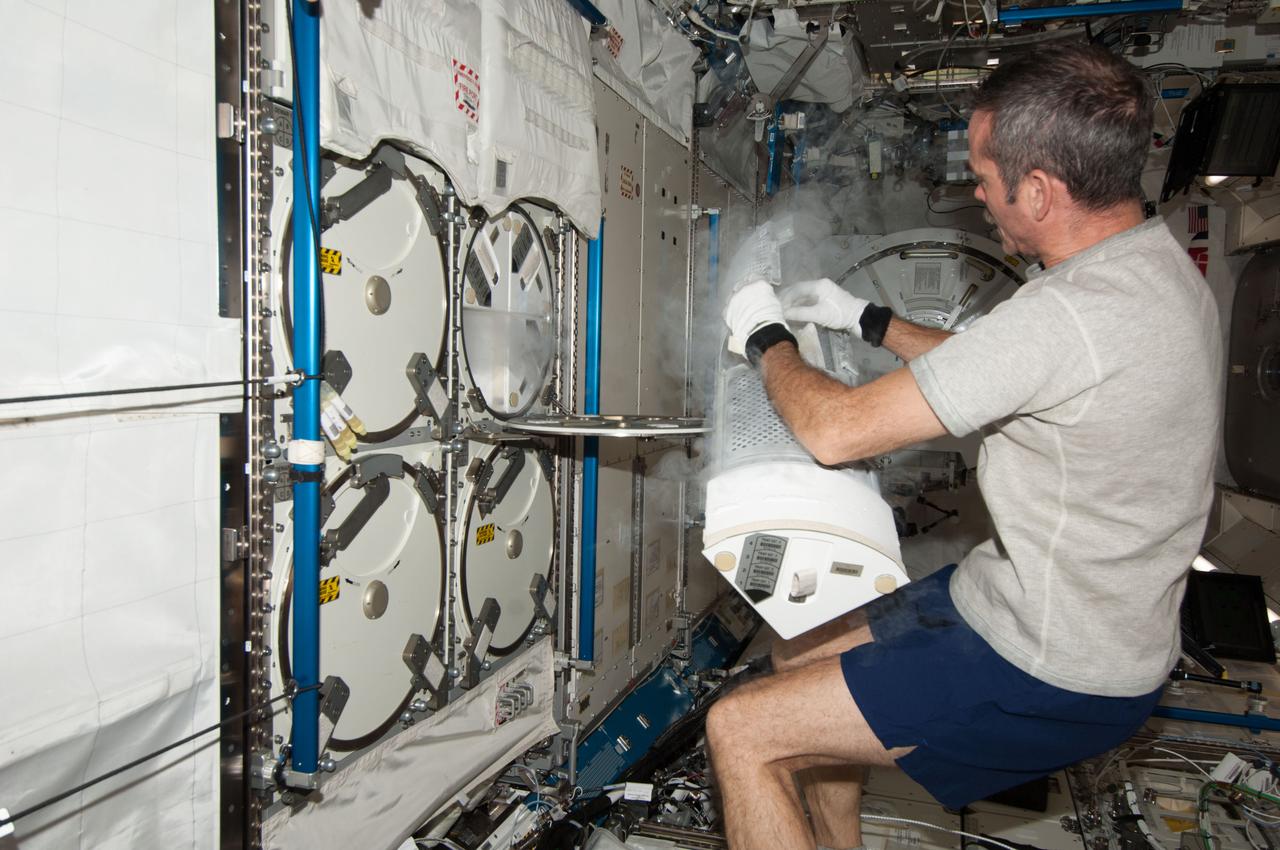
View of Canadian Space Agency (CSA) Chris Hadfield,Expedition 34 Flight Engineer (FE),preparing to insert biological samples in the Minus Eighty Laboratory Freezer for International Space Station (ISS) - (MELFI-1),in the Japanese Experiment Module (JEM) Pressurized Module (JPM).  Photo was taken during Expedition 34.
Hadfield prepares to insert biological samples in the MELFI-1
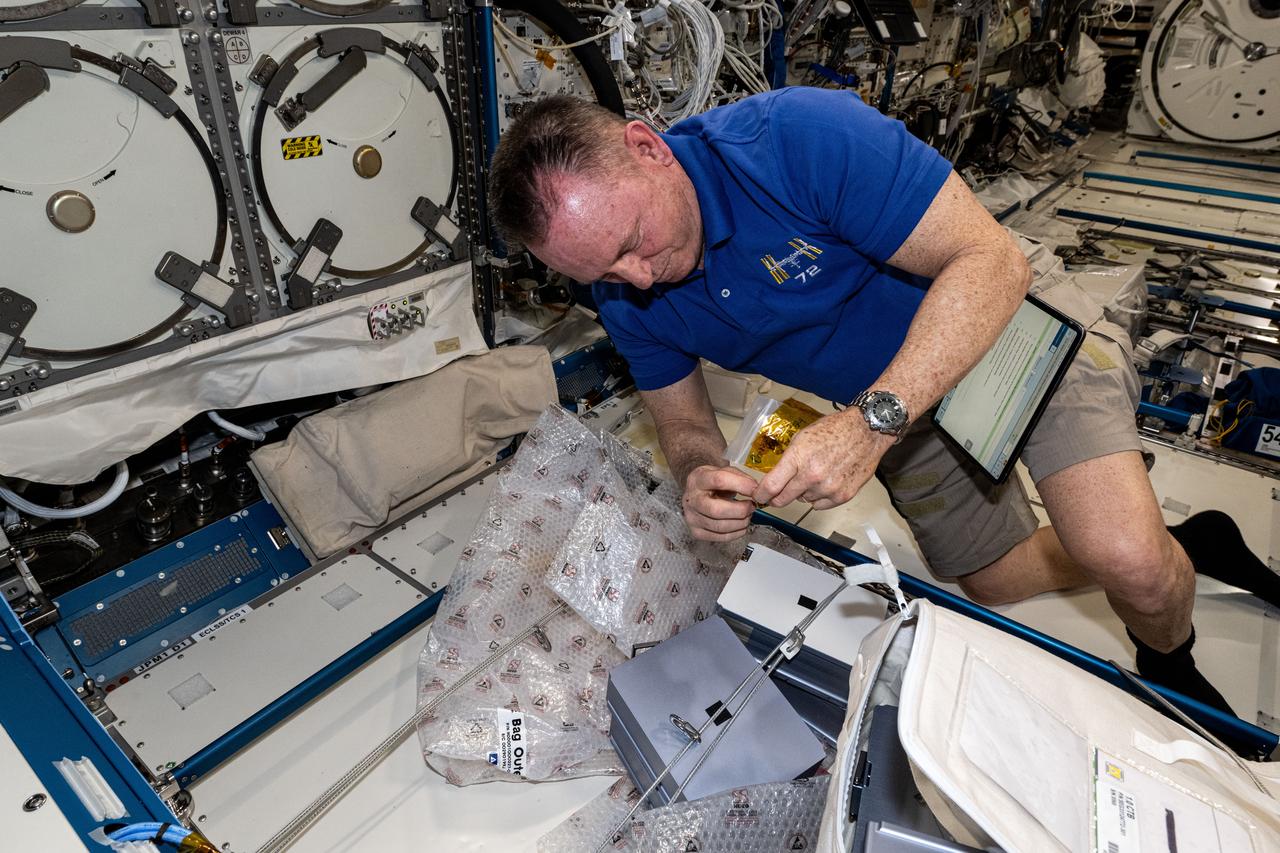
iss072e217983 (Nov. 18, 2024) --- NASA astronaut and Expedition 72 Flight Engineer Butch Wilmore swaps sample cassettes inside the Advanced Space Experiment Processor-4 (ADSEP-4) located aboard the International Space Station's Kibo laboratory module. The ADSEP-4 is a portable research facility that supports multiple types of science experiments on the orbital outpost and also interfaces with the SpaceX Dragon and Northrop Grumman Cygnus cargo spacecraft.
Astronaut Butch Wilmore swaps sample cassettes inside the Advanced Space Experiment Processor-4
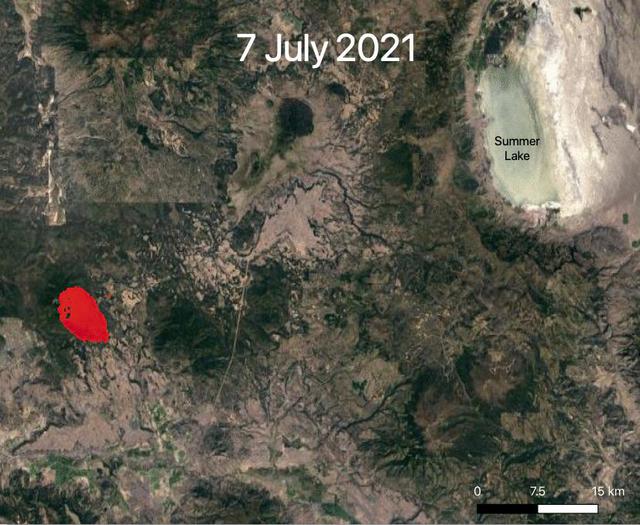
NASA's ECOsystem Spaceborne Thermal Radiometer Experiment on Space Station (ECOSTRESS) is aiding in the fight against fires in the Western U.S. As of July 27, 2021, the Bootleg Fire in southern Oregon had ballooned to more than 410,000 acres, damaging hundreds of buildings and vehicles in its path.  ECOSTRESS measures surface temperature from the vantage point of the International Space Station. Researchers of the RADR-Fire team at Pacific Northwest National Laboratory have been experimenting with ECOSTRESS data as part of a new tool now being implemented for first responders like the U.S. Forest Service.  In the visualization, ECOSTRESS is tracking the movement of the Bootleg Fire between July 7 and July and identifying its proximity to critical infrastructure — areas in red represent the hottest pixels ECOSTRESS detected. The extreme heat in those areas indicates the fire front, or where resources are most needed.  Tasked with detecting plant water use and stress, ECOSTRESS's primary mission is to measure the temperature of plants heating up as they run out of water. But it can also measure and track heat-related phenomena like wildfires, heat waves, and volcanoes. ECOSTRESS observations have a spatial resolution of about 77 by 77 yards (70 by 70 meters), which enables researchers to study surface-temperature conditions down to the size of a football field. Due to the space station's unique orbit, the mission can acquire images of the same regions at different times of the day, as opposed to crossing over each area at the same time of day like satellites in other orbits do. This is advantageous when monitoring plant stress in the same area throughout the day, for example.   Movie available at https://photojournal.jpl.nasa.gov/catalog/PIA23695
ECOSTRESS Views 2021 Southern Oregon Bootleg Fire
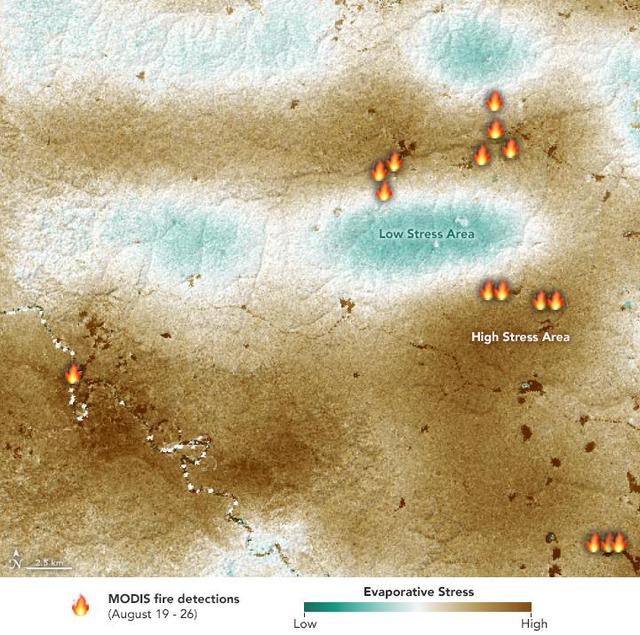
NASA's ECOsystem Spaceborne Thermal Radiometer Experiment on Space Station (ECOSTRESS) sensor measured the water-stress levels of plants when it passed over the Peruvian Amazon rainforest on Aug. 7, 2019, before the fires there began. The map shows areas of plants in distress (brown) and areas of less stress (blue). Water-stressed plants released measurably less water vapor into the air at the time of the summer fires. The fire icons represent fires imaged by NASA's Terra satellite between Aug. 19 and 26. The burn pattern reveals that the fires were concentrated in areas of highly water-stressed plants, pointing to how water-stressed plants can impact the spread of fires. The data may one day help NASA's Earth-observing missions predict the path of future forest or brush fires.  https://photojournal.jpl.nasa.gov/catalog/PIA23432
Drought-Stressed Forest Fueled Amazon Fires
KENNEDY SPACE CENTER, FLA. -  In the Space Station Processing Facility, STS-115 Mission Specialist Joseph Tanner gets hands-on experience with the Japanese Experiment Module (JEM).  Tanner and STS-117 Mission Specialist James Reilly  are at KSC for equipment familiarization, a routine part of astronaut training and launch preparations.
KENNEDY SPACE CENTER, FLA. - In the Space Station Processing Facility, STS-115 Mission Specialist Joseph Tanner gets hands-on experience with the Japanese Experiment Module (JEM). Tanner and STS-117 Mission Specialist James Reilly are at KSC for equipment familiarization, a routine part of astronaut training and launch preparations.
KENNEDY SPACE CENTER, FLA. -  In the Space Station Processing Facility, STS-117 Mission Specialist James Reilly (left) and STS-115 Mission Specialist Joseph Tanner get hands-on experience with the Japanese Experiment Module (JEM).  Reilly and Tanner are at KSC for equipment familiarization, a routine part of astronaut training and launch preparations.
KENNEDY SPACE CENTER, FLA. - In the Space Station Processing Facility, STS-117 Mission Specialist James Reilly (left) and STS-115 Mission Specialist Joseph Tanner get hands-on experience with the Japanese Experiment Module (JEM). Reilly and Tanner are at KSC for equipment familiarization, a routine part of astronaut training and launch preparations.
KENNEDY SPACE CENTER, FLA. -  The Japanese Experiment Module (JEM) is moved on its workstand in the Space Station Processing Facility.  The JEM will undergo pre-assembly measurements.  Developed by the Japan Aerospace Exploration Agency (JAXA), the JEM will enhance the unique research capabilities of the orbiting complex by providing an additional environment for astronauts to conduct science experiments.
KENNEDY SPACE CENTER, FLA. - The Japanese Experiment Module (JEM) is moved on its workstand in the Space Station Processing Facility. The JEM will undergo pre-assembly measurements. Developed by the Japan Aerospace Exploration Agency (JAXA), the JEM will enhance the unique research capabilities of the orbiting complex by providing an additional environment for astronauts to conduct science experiments.
KENNEDY SPACE CENTER, FLA. - In the Space Station Processing Facility, technicians take readings for pre-assembly measurements on the Japanese Experiment Module (JEM).  Developed by the Japan Aerospace Exploration Agency (JAXA), the JEM will enhance the unique research capabilities of the orbiting complex by providing an additional environment for astronauts to conduct science experiments.
KENNEDY SPACE CENTER, FLA. - In the Space Station Processing Facility, technicians take readings for pre-assembly measurements on the Japanese Experiment Module (JEM). Developed by the Japan Aerospace Exploration Agency (JAXA), the JEM will enhance the unique research capabilities of the orbiting complex by providing an additional environment for astronauts to conduct science experiments.
KENNEDY SPACE CENTER, FLA. -  In the Space Station Processing Facility, technicians begin pre-assembly measurements on the Japanese Experiment Module (JEM).  Developed by the Japan Aerospace Exploration Agency (JAXA), the JEM will enhance the unique research capabilities of the orbiting complex by providing an additional environment for astronauts to conduct science experiments.
KENNEDY SPACE CENTER, FLA. - In the Space Station Processing Facility, technicians begin pre-assembly measurements on the Japanese Experiment Module (JEM). Developed by the Japan Aerospace Exploration Agency (JAXA), the JEM will enhance the unique research capabilities of the orbiting complex by providing an additional environment for astronauts to conduct science experiments.
KENNEDY SPACE CENTER, FLA. - In the Space Station Processing Facility, a technician takes readings for pre-assembly measurements on the Japanese Experiment Module (JEM).  Developed by the Japan Aerospace Exploration Agency (JAXA), the JEM will enhance the unique research capabilities of the orbiting complex by providing an additional environment for astronauts to conduct science experiments.
KENNEDY SPACE CENTER, FLA. - In the Space Station Processing Facility, a technician takes readings for pre-assembly measurements on the Japanese Experiment Module (JEM). Developed by the Japan Aerospace Exploration Agency (JAXA), the JEM will enhance the unique research capabilities of the orbiting complex by providing an additional environment for astronauts to conduct science experiments.
KENNEDY SPACE CENTER, FLA. - In the Space Station Processing Facility, a technician takes readings for pre-assembly measurements on the Japanese Experiment Module (JEM).  Developed by the Japan Aerospace Exploration Agency (JAXA), the JEM will enhance the unique research capabilities of the orbiting complex by providing an additional environment for astronauts to conduct science experiments.
KENNEDY SPACE CENTER, FLA. - In the Space Station Processing Facility, a technician takes readings for pre-assembly measurements on the Japanese Experiment Module (JEM). Developed by the Japan Aerospace Exploration Agency (JAXA), the JEM will enhance the unique research capabilities of the orbiting complex by providing an additional environment for astronauts to conduct science experiments.
KENNEDY SPACE CENTER, FLA. - In the Space Station Processing Facility, a technician takes readings for pre-assembly measurements on the Japanese Experiment Module (JEM).  Developed by the Japan Aerospace Exploration Agency (JAXA), the JEM will enhance the unique research capabilities of the orbiting complex by providing an additional environment for astronauts to conduct science experiments.
KENNEDY SPACE CENTER, FLA. - In the Space Station Processing Facility, a technician takes readings for pre-assembly measurements on the Japanese Experiment Module (JEM). Developed by the Japan Aerospace Exploration Agency (JAXA), the JEM will enhance the unique research capabilities of the orbiting complex by providing an additional environment for astronauts to conduct science experiments.
KENNEDY SPACE CENTER, FLA. - In the Space Station Processing Facility, the Japanese Experiment Module (JEM) rests on a workstand during pre-assembly measurement activities. Developed by the Japan Aerospace Exploration Agency (JAXA), the JEM will enhance the unique research capabilities of the orbiting complex by providing an additional environment for astronauts to conduct science experiments.
KENNEDY SPACE CENTER, FLA. - The container with the Japanese Experiment Module (JEM)’s pressurized module is inside the Space Station Processing Facility.  The National Space Development Agency of Japan (NASDA) developed the laboratory at the Tsukuba Space Center near Tokyo. The Pressurized Module is the first element of the JEM, named "Kibo" (Hope), to be delivered to KSC. The JEM is Japan's primary contribution to the Station. It will enhance the unique research capabilities of the orbiting complex by providing an additional environment for astronauts to conduct science experiments.  The JEM also includes an exposed facility (platform) for space environment experiments, a robotic manipulator system, and two logistics modules. The various JEM components will be  assembled in space over the course of three Shuttle missions.
KENNEDY SPACE CENTER, FLA. - The container with the Japanese Experiment Module (JEM)’s pressurized module is inside the Space Station Processing Facility. The National Space Development Agency of Japan (NASDA) developed the laboratory at the Tsukuba Space Center near Tokyo. The Pressurized Module is the first element of the JEM, named "Kibo" (Hope), to be delivered to KSC. The JEM is Japan's primary contribution to the Station. It will enhance the unique research capabilities of the orbiting complex by providing an additional environment for astronauts to conduct science experiments. The JEM also includes an exposed facility (platform) for space environment experiments, a robotic manipulator system, and two logistics modules. The various JEM components will be assembled in space over the course of three Shuttle missions.
 Miria Finckenor, a researcher at NASA’s Marshall Space Flight Center in Huntsville, Alabama, shows off the 15th Materials International Space Station Experiment, or MISSE, an external science payload berthed on the International Space Station since 2001
Miria Finckenor, a researcher at NASA’s Marshall Space Flight Center in Huntsville, Alabama, shows off the 15th Materials International Space Station Experiment, or MISSE, an external science payload berthed on the International Space Station since 2001
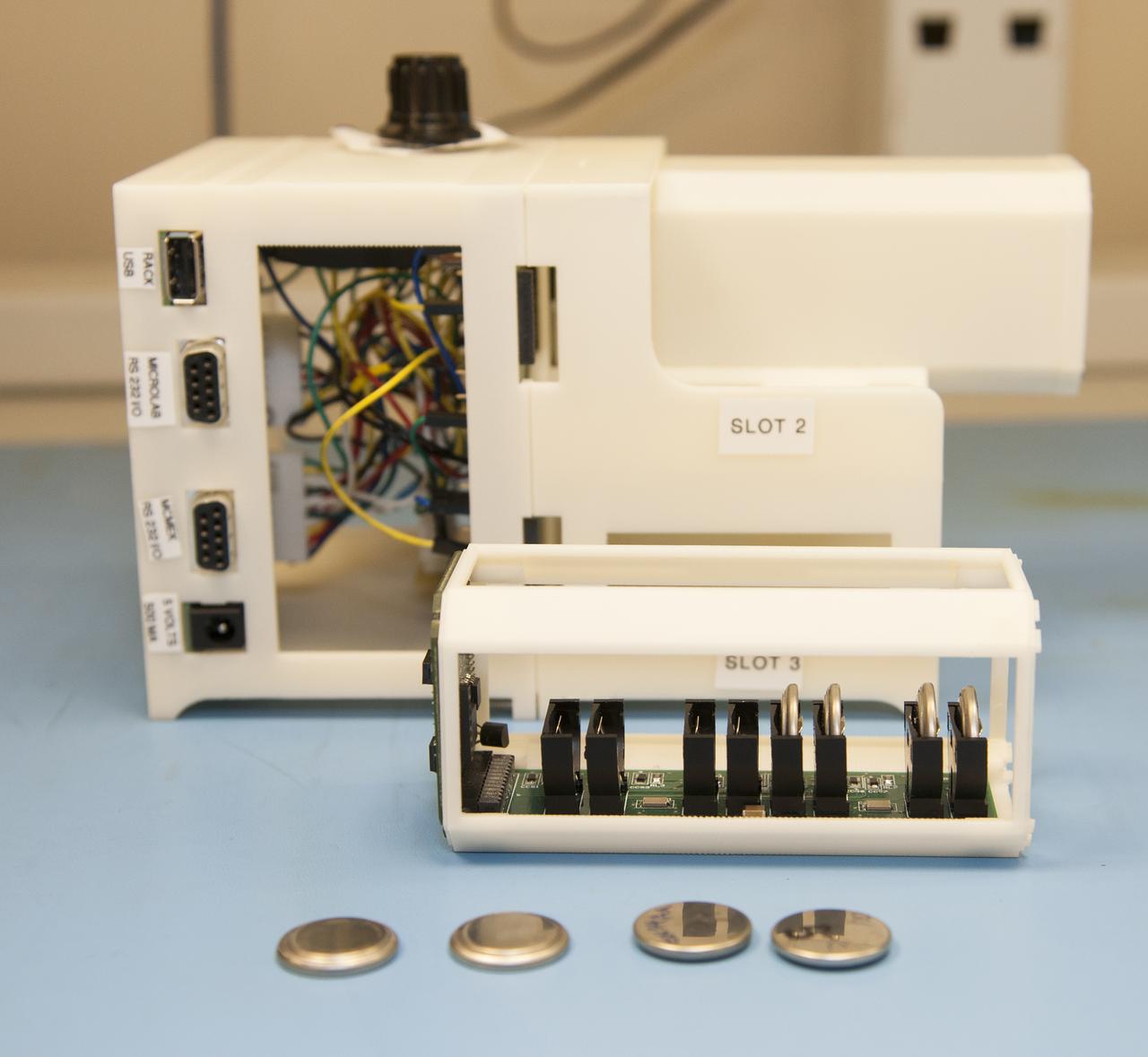
These are the components of the Desert Christian experiment launched to space Dec. 3 that could one day lead to fast-charging batteries.
ED15-0229-02
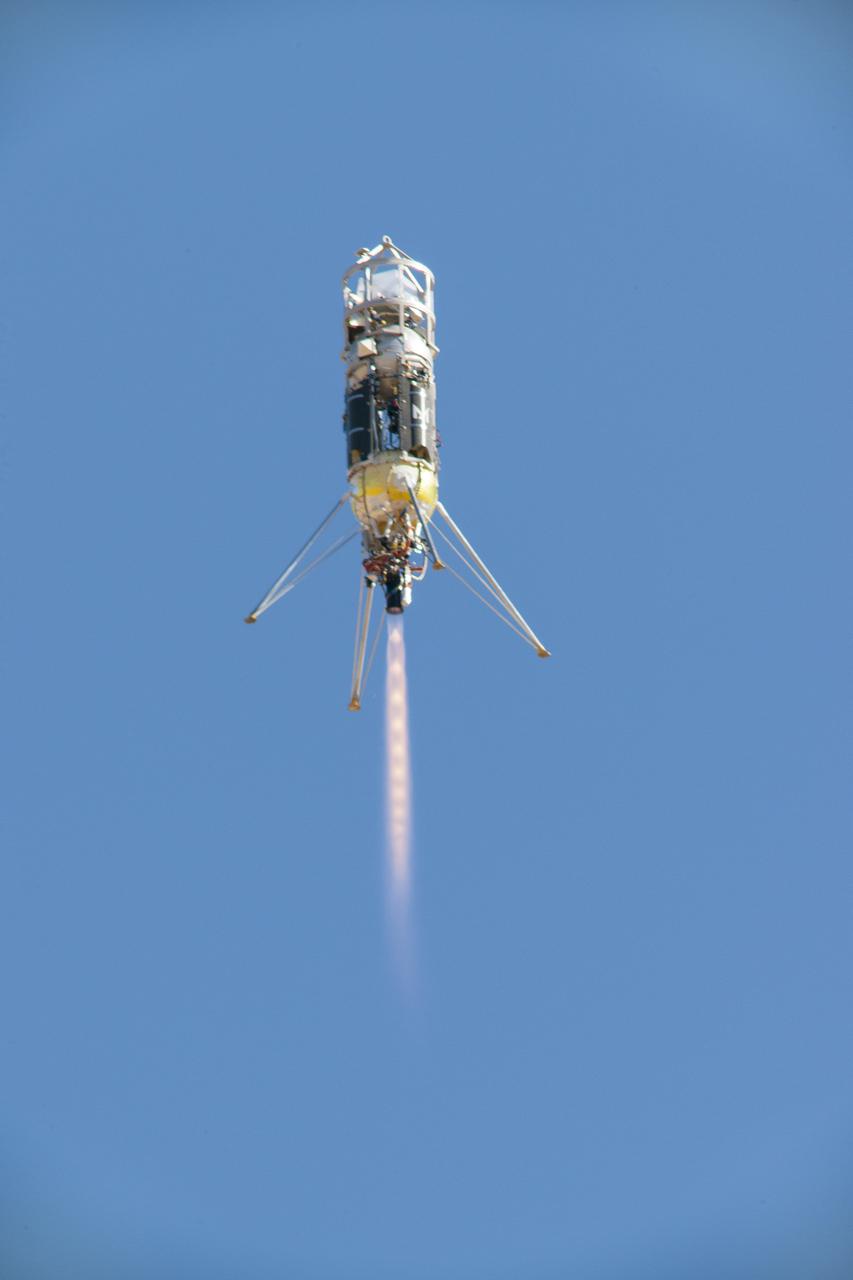
Masten rocket, Xodiac, launches out of Mojave Air and Space Port carrying JHU APL electromagnetic field measurement experiment.
Monitoring System Could Allow Multiple Experiments to be Flown Together
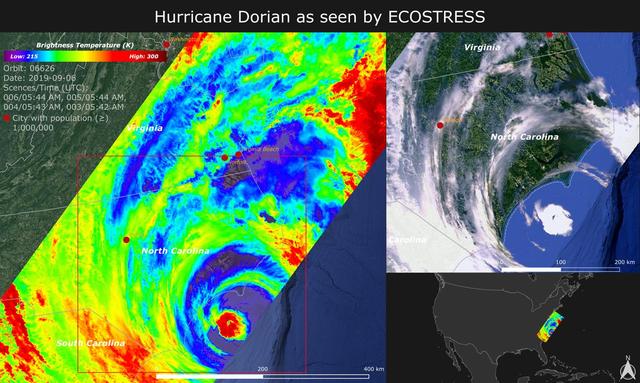
NASA's ECOsystem Spaceborne Thermal Radiometer Experiment on Space Station (ECOSTRESS) imaged the temperature of Hurricane Dorian from the International Space Station on Sept. 6, 2019 as the storm made landfall in North Carolina.  ECOSTRESS senses the amount of emitted infrared radiation from Earth, which is converted into an equivalent temperature scale in units of degrees Kelvin. In the image, red colors such as the well-defined eye represent warmer temperatures while purple/blue represent the cooler cloud top temperatures of strong storm clouds with the potential of producing heavy rain. The temperature patterns reveal fine cloud structures that contribute to the formation of the larger hurricane. The width of the image (~400 km) is based on what ECOSTRESS sees as the Space Station flies over any given spot on Earth.  ECOSTRESS launched to the space station in June 2018. It can measure variations in temperature to within a few tenths of a degree and is able to detect temperature changes at various times of day over areas as small as a football field. ECOSTRESS' primary mission is to detect plant health from space; however, its measurements can be used to detect other heat-related phenomena — including urban heat, fires, and volcanic activity — as well. Although disaster response is not one of its primary objectives, these highly detailed hurricane temperature estimates can be used to improve weather models.  https://photojournal.jpl.nasa.gov/catalog/PIA23422
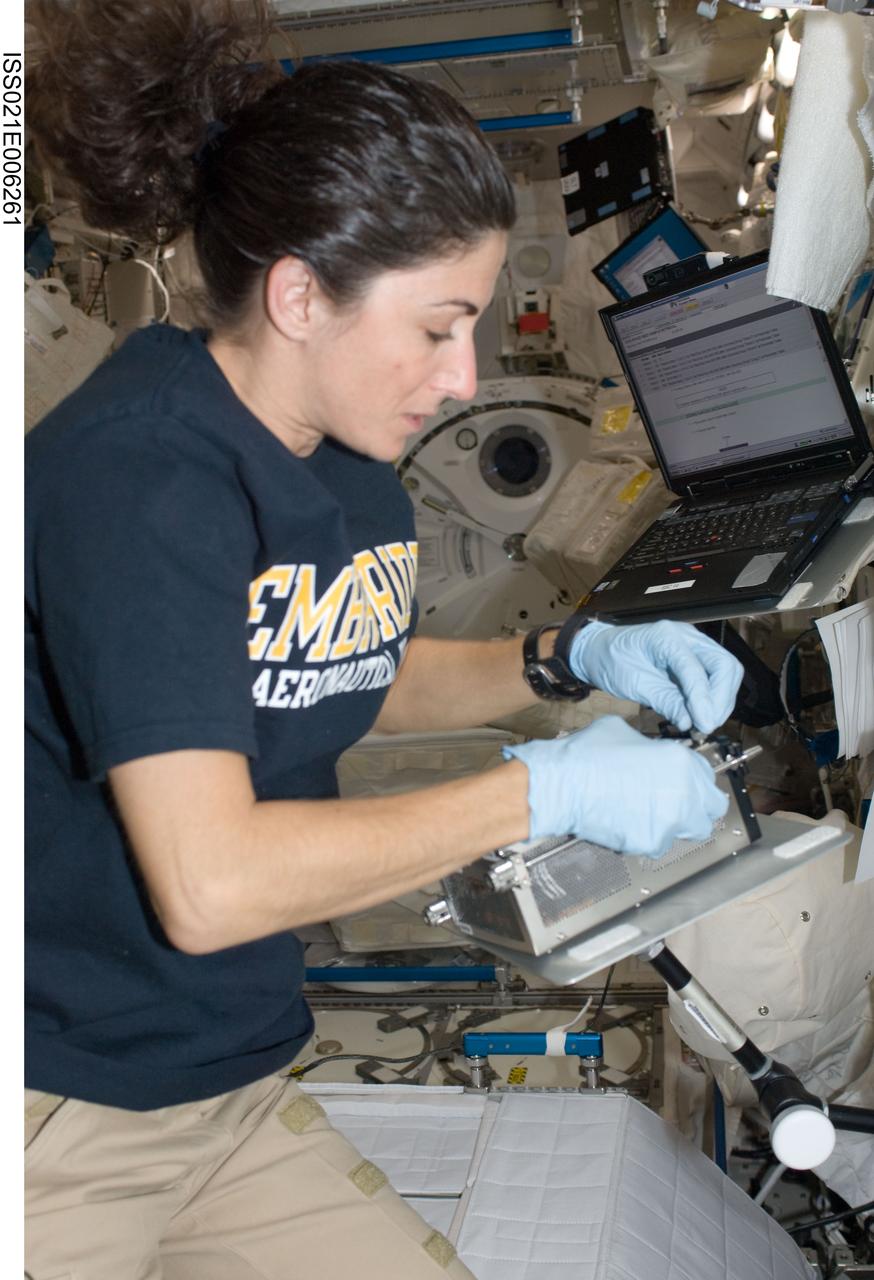
NASA Images Hurricane Dorian's Temperature from Space
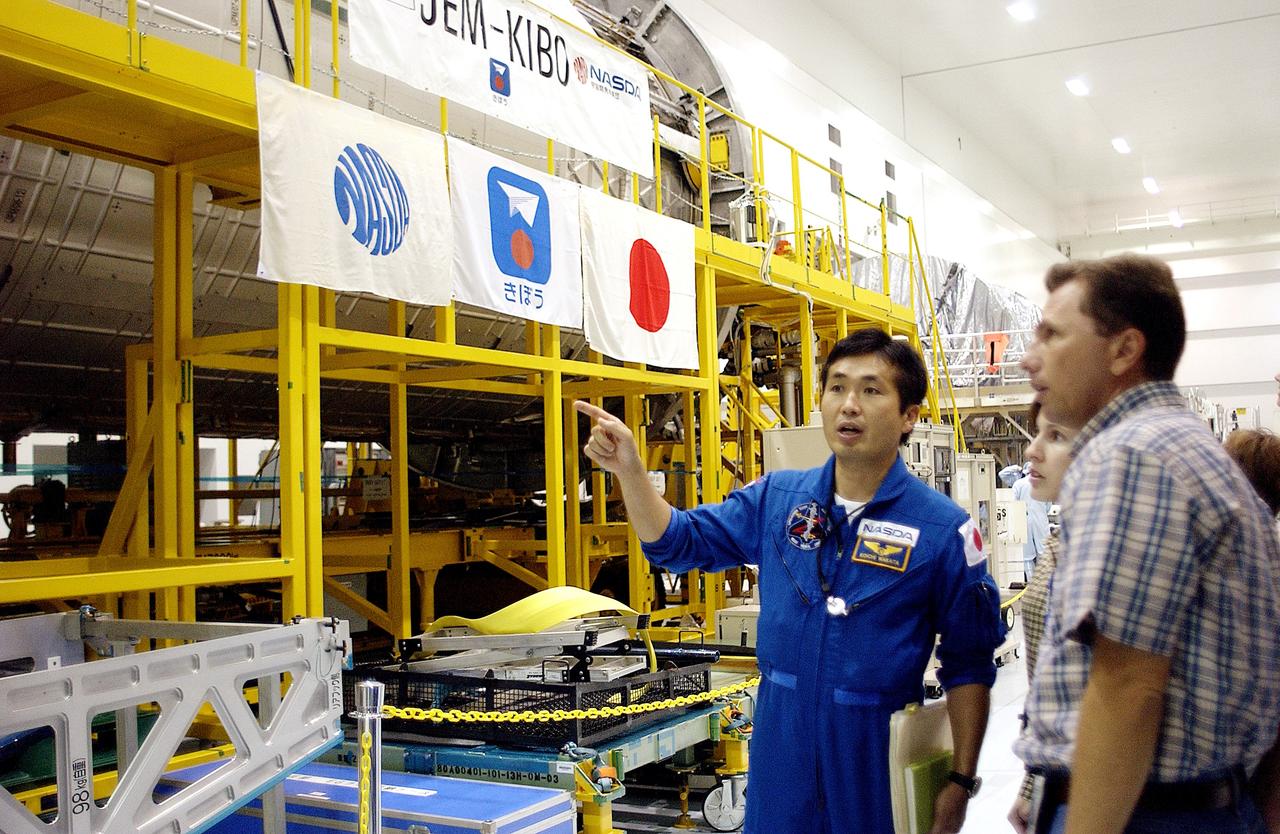
KENNEDY SPACE CENTER, FLA. - In the Space Station Processing Facility, Japanese astronaut Koichi Wakata,  dressed in blue protective clothing (at right),  looks at the inside of the Pressurized Module, or PM, part of the Japanese Experiment Module (JEM), along with technicians.  The PM provides a shirt-sleeve environment in which astronauts on the International Space Station can conduct microgravity experiments. There are a total of 23 racks, including 10 experiment racks, inside the PM providing a power supply, communications, air conditioning, hardware cooling, water control and experiment support functions.
KENNEDY SPACE CENTER, FLA. - In the Space Station Processing Facility, Japanese astronaut Koichi Wakata, dressed in blue protective clothing (at right), looks at the inside of the Pressurized Module, or PM, part of the Japanese Experiment Module (JEM), along with technicians. The PM provides a shirt-sleeve environment in which astronauts on the International Space Station can conduct microgravity experiments. There are a total of 23 racks, including 10 experiment racks, inside the PM providing a power supply, communications, air conditioning, hardware cooling, water control and experiment support functions.
KENNEDY SPACE CENTER, FLA. -   Japanese astronaut Koichi Wakata (left) releases a tray  extended from inside the Pressurized Module, or PM, that he was working with.  Part of the Japanese Experiment Module (JEM), the PM provides a shirt-sleeve environment in which astronauts on the International Space Station can conduct microgravity experiments. There are a total of 23 racks, including 10 experiment racks, inside the PM providing a power supply, communications, air conditioning, hardware cooling, water control and experiment support functions.  The JEM/PM is in the Space Station Processing Facility.
KENNEDY SPACE CENTER, FLA. - Japanese astronaut Koichi Wakata (left) releases a tray extended from inside the Pressurized Module, or PM, that he was working with. Part of the Japanese Experiment Module (JEM), the PM provides a shirt-sleeve environment in which astronauts on the International Space Station can conduct microgravity experiments. There are a total of 23 racks, including 10 experiment racks, inside the PM providing a power supply, communications, air conditioning, hardware cooling, water control and experiment support functions. The JEM/PM is in the Space Station Processing Facility.
STS003-09-444 (22-30 March 1982) --- The darkness of space provides the backdrop for this scene of the plasma diagnostics package (PDR) experiment in the grasp of the end effector or ?hand? of the remote manipulator system (RMS) arm, and other components of the Office of Space Sciences (OSS-1) package in the aft section of the Columbia?s cargo hold.  The PDP is a compact, comprehensive assembly of electromagnetic and particle sensors that will be used to study the interaction of the orbiter with its surrounding environment; to test the capabilities of the shuttle?s remote manipulator system; and to carry out experiments in conjunction with the fast pulse electron generator of the vehicle charging and potential experiment, another experiment on the OSS-1 payload pallet. This photograph was exposed with a 70mm handheld camera by the astronaut crew of STS-3, with a handheld camera aimed through the flight deck?s aft window. Photo credit: NASA
View of the Columbia's remote manipulator system
ISS017-E-011917 (30 July 2008) --- NASA astronaut Greg Chamitoff, Expedition 17 flight engineer, works with an experiment in the Columbus laboratory of the International Space Station.
Chamitoff works with 3-D Space Experiment Hardware in the European Laboratory during Expedition 17
ISS017-E-011910 (30 July 2008) --- NASA astronaut Greg Chamitoff, Expedition 17 flight engineer, works with an experiment in the Columbus laboratory of the International Space Station.
Chamitoff works with 3-D Space Experiment Hardware in the European Laboratory during Expedition 17
Astronaut Donald Thomas conducts the Fertilization and Embryonic Development of Japanese Newt in Space (AstroNewt) experiment at the Aquatic Animal Experiment Unit (AAEU) inside the International Microgravity Laboratory-2 (IML-2) science module. The AstroNewt experiment aims to know the effects of gravity on the early developmental process of fertilized eggs using a unique aquatic animal, the Japanese red-bellied newt. The newt egg is a large single cell at the begirning of development. The Japanese newt mates in spring and autumn. In late autumn, female newts enter hibernation with sperm in their body cavity and in spring lay eggs and fertilized them with the stored sperm. The experiment takes advantage of this feature of the newt. Groups of newts were sent to the Kennedy Space Center and kept in hibernation until the mission. The AAEU cassettes carried four newts aboard the Space Shuttle. Two newts in one cassette are treated by hormone injection on the ground to simulate egg laying. The other two newts are treated on orbit by the crew. The former group started maturization of eggs before launch. The effects of gravity on that early process were differentiated by comparison of the two groups. The IML-2 was the second in a series of Spacelab flights designed to conduct research by the international science community in a microgravity environment. Managed by the Marshall Space Flight Center, the IML-2 was launch on July 8, 1994 aboard the STS-65 Space Shuttle Orbiter Columbia mission.
Spacelab
Astronaut Donald Thomas conducts the Fertilization and Embryonic Development of Japanese Newt in Space (AstroNewt) experiment at the Aquatic Animal Experiment Unit (AAEU) inside the International Microgravity Laboratory-2 (IML-2) science module. The AstroNewt experiment aims to know the effects of gravity on the early developmental process of fertilized eggs using a unique aquatic animal, the Japanese red-bellied newt. The newt egg is a large single cell at the begirning of development. The Japanese newt mates in spring and autumn. In late autumn, female newts enter hibernation with sperm in their body cavity and in spring lay eggs and fertilize them with the stored sperm. The experiment takes advantage of this feature of the newt. Groups of newts were sent to the Kennedy Space Center and kept in hibernation until the mission. The AAEU cassettes carried four newts aboard the Space Shuttle. Two newts in one cassette are treated by hormone injection on the ground to simulate egg laying. The other two newts are treated on orbit by the crew. The former group started maturization of eggs before launch. The effects of gravity on that early process were differentiated by comparison of the two groups. The IML-2 was the second in a series of Spacelab flights designed to conduct research by the international science community in a microgravity environment. Managed by the Marshall Space Flight Center, the IML-2 was launched on July 8, 1994 aboard the STS-65 Space Shuttle mission, Orbiter Columbia.
Spacelab
S73-34171 (9 Aug. 1973) --- Scientist-astronaut Owen K. Garriott, Skylab 3 science pilot, serves as test subject for the Skylab ?Human Vestibular Function? M131 Experiment, as seen in this photographic reproduction taken from a television transmission made by a color TV camera aboard the Skylab space station in Earth orbit. The objectives of the Skylab M131 experiment are to obtain data pertinent to establishing the validity of measurements of specific behavioral/physiological responses influenced by vestibular activity under one-g and zero-g conditions; to determine man?s adaptability to unusual vestibular conditions and predict habitability of future spacecraft conditions involving reduced gravity and Coriollis forces; and to measure the accuracy and variability in man?s judgment of spatial coordinates based on atypical gravity receptor cues and inadequate visual cures. Dr. Garriott is seated in the experiment?s litter chair which can rotate the test subject at predetermined rotational velocity or programmed acceleration/decelerational profile. Photo credit: NASA
Astronaut Owen Garriott - Test Subject - Human Vestibular Function Experiment
61A-01-030 (30 Oct.-6 Nov. 1985) --- Mission specialist Guion S. Bluford prepares to perform a physics experiment onboard the D-1 science module in the cargo bay of the earth-orbiting Space Shuttle Challenger.  In the backgroud, three European payload specialists busy themselves with experiment chores:  (L-R) Wubbo J. Ockels (partially obscured), Reinhard Furrer and Ernst Messerschmid.
STS 61-A crewmembers in Spacelab D-1 science module
This observation shows the burn area and smoke plume created by the Apple fire in Southern California on Aug. 1, 2020. The observation was made possible by NASA's Ecosystem Spaceborne Thermal Radiometer Experiment on Space Station (ECOSTRESS). Data gathered by the mission can be further refined to measure the temperature of the wildfire, smoke plume and surrounding landscape.  ECOSTRESS collected this data when the space station passed over the region at about 1:15 p.m. PST on Saturday, Aug. 1, 2020, when the burn area was approximately 4,000 acres in size. As of Aug. 3, it was more than 26,000 acres. Black smoke can be seen drifting east and over Joshua Tree National Park in the Mojave Desert. With a resolution of about 77 by 77 yards (70 by 70 meters), the image enables surface-temperature conditions down to the size of a football field to be studied.  Tasked with detecting plant water use and stress, ECOSTRESS measures the temperature of plants as they heat up when they run out of water. But it can also measure and track heat-related phenomena like fires, heat waves, and volcanoes.  https://photojournal.jpl.nasa.gov/catalog/PIA23799
ECOSTRESS Spies Apple Fire's Smoke Plume
On July 8, NASA's ECOsystem Spaceborne Thermal Radiometer Experiment on Space Station (ECOSTRESS) instrument captured ground surface temperature data over California. In the image, areas in red – including Death Valley – had surpassed 86 degrees Fahrenheit (30 degrees Celsius) by 7:16 a.m. local time, well above average ground surface temperatures for the area.  Tasked with detecting plant water use and stress, ECOSTRESS's primary mission is to measure the temperature of plants heating up as they run out of water. But it can also measure and track heat-related phenomena like heat waves, wildfires, and volcanoes. ECOSTRESS observations have a spatial resolution of about 77 by 77 yards (70 by 70 meters), which enables researchers to study surface-temperature conditions down to the size of a football field. Due to the space station's unique orbit, the mission can acquire images of the same regions at different times of the day, as opposed to crossing over each area at the same time of day like satellites in other orbits do. This is advantageous when monitoring plant stress in the same area throughout the day, for example.  https://photojournal.jpl.nasa.gov/catalog/PIA23694
July 2021 Heat Wave Ground Temperature