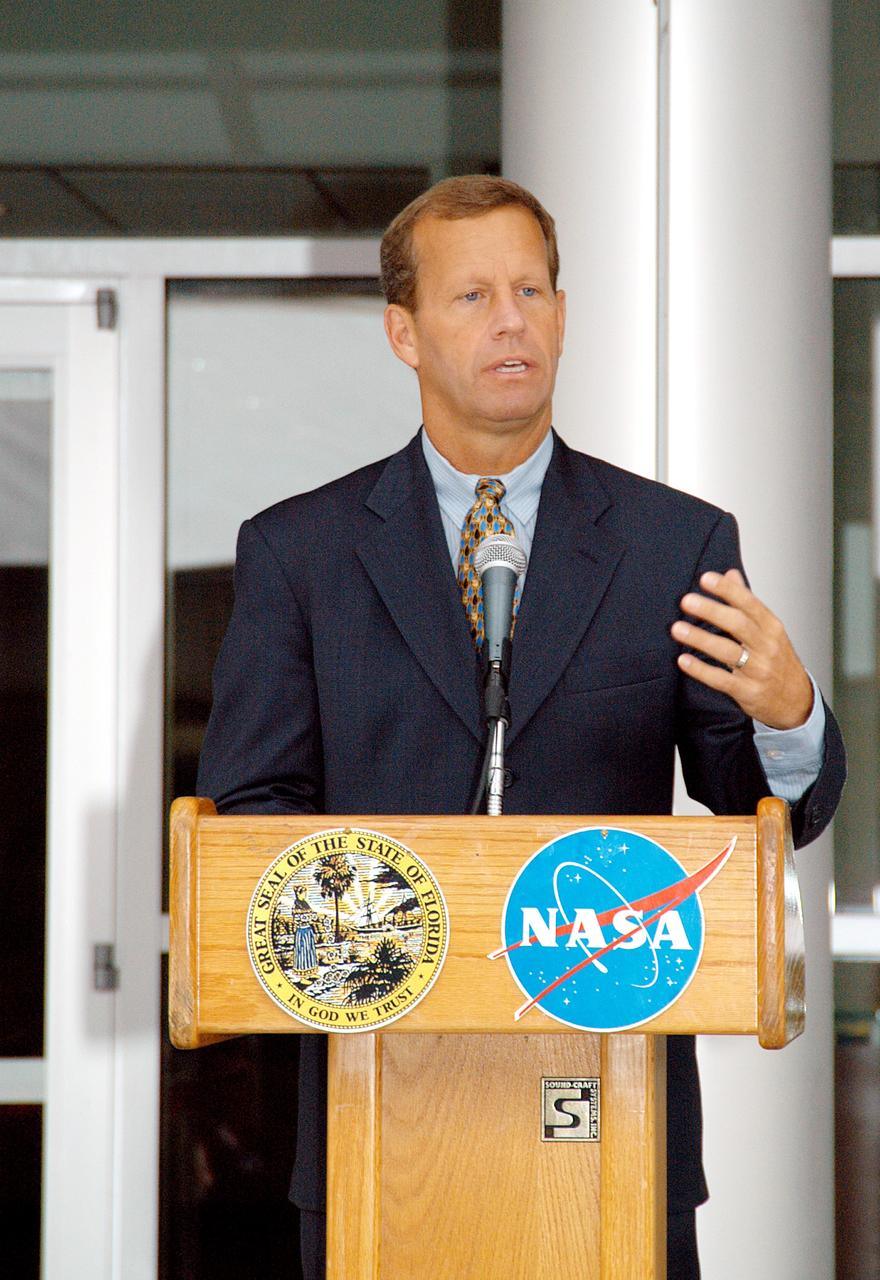
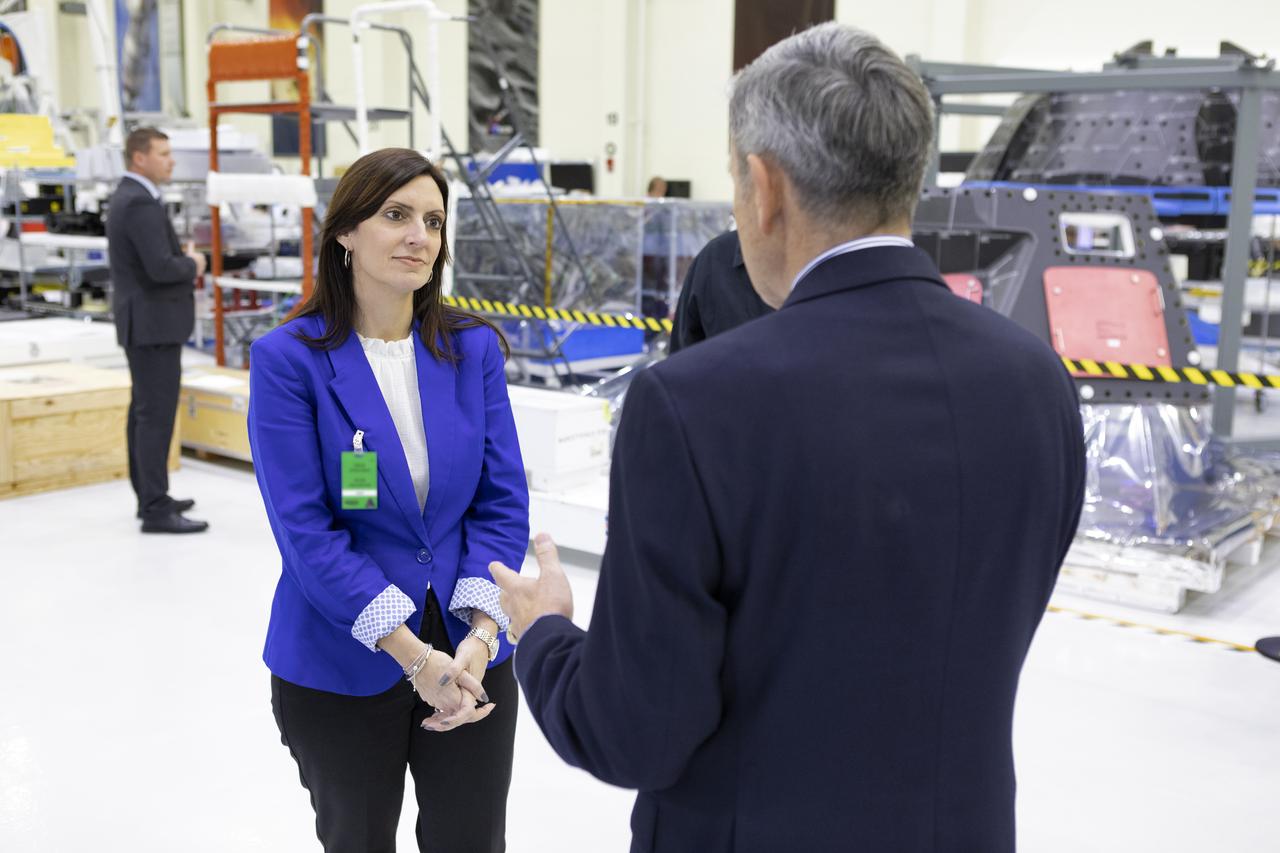
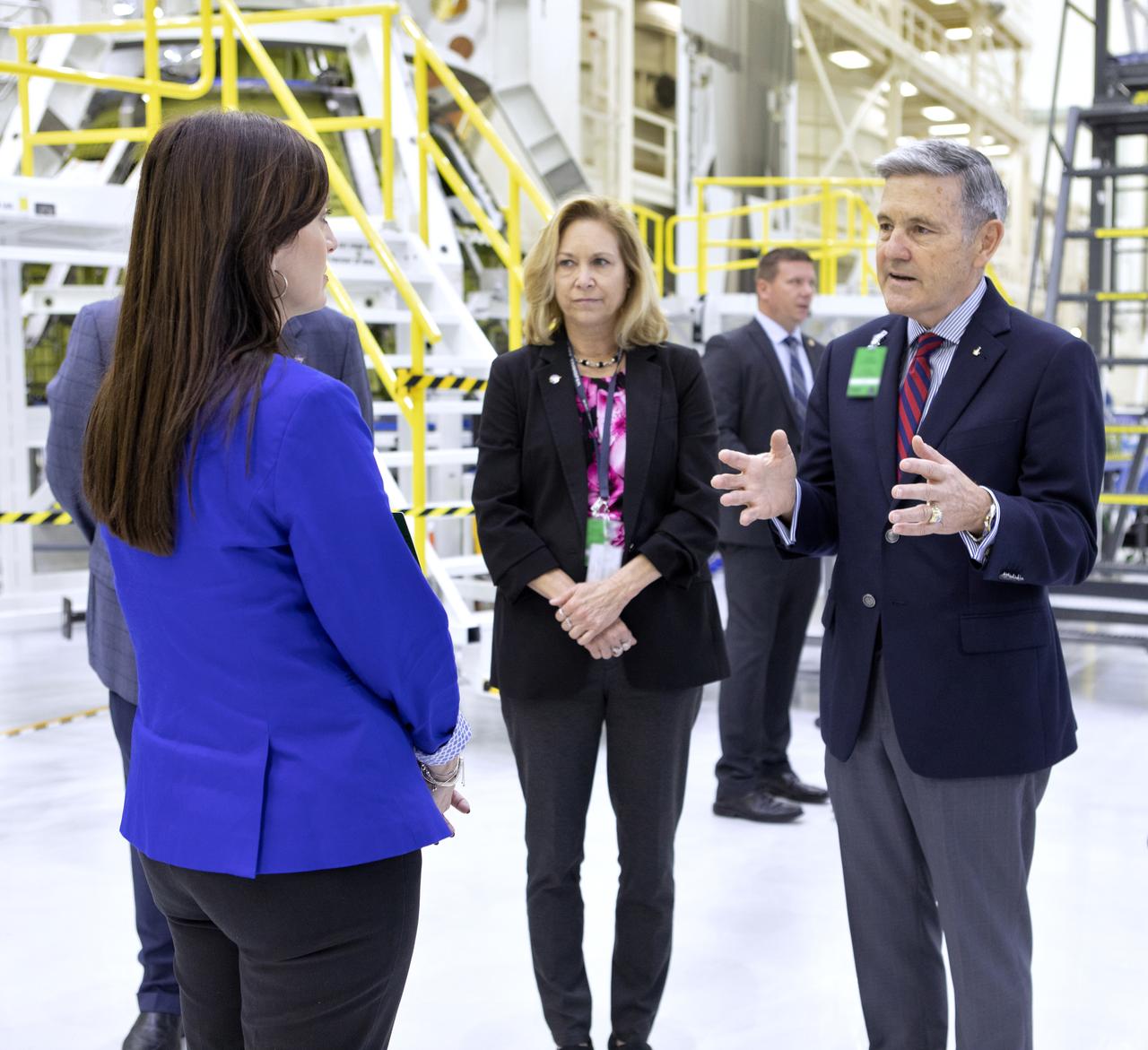
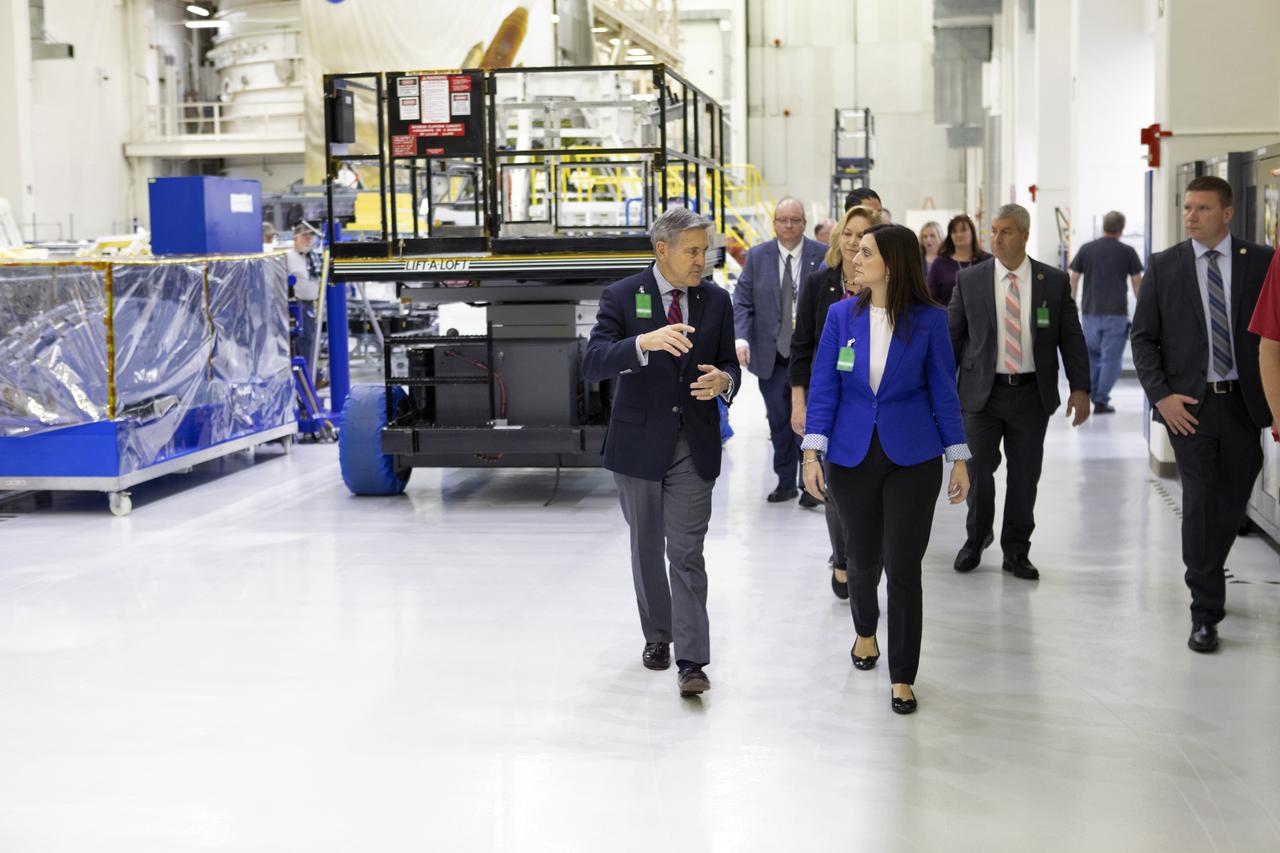
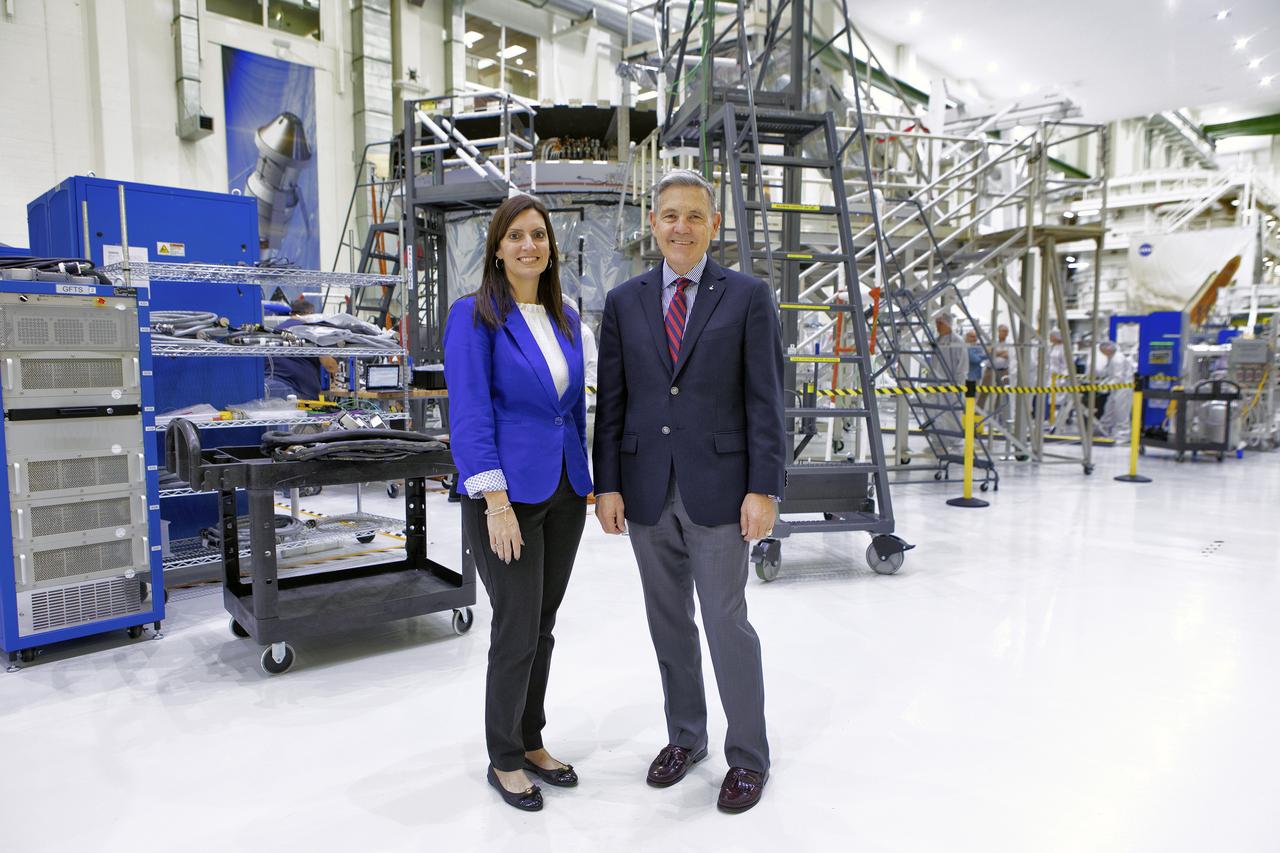
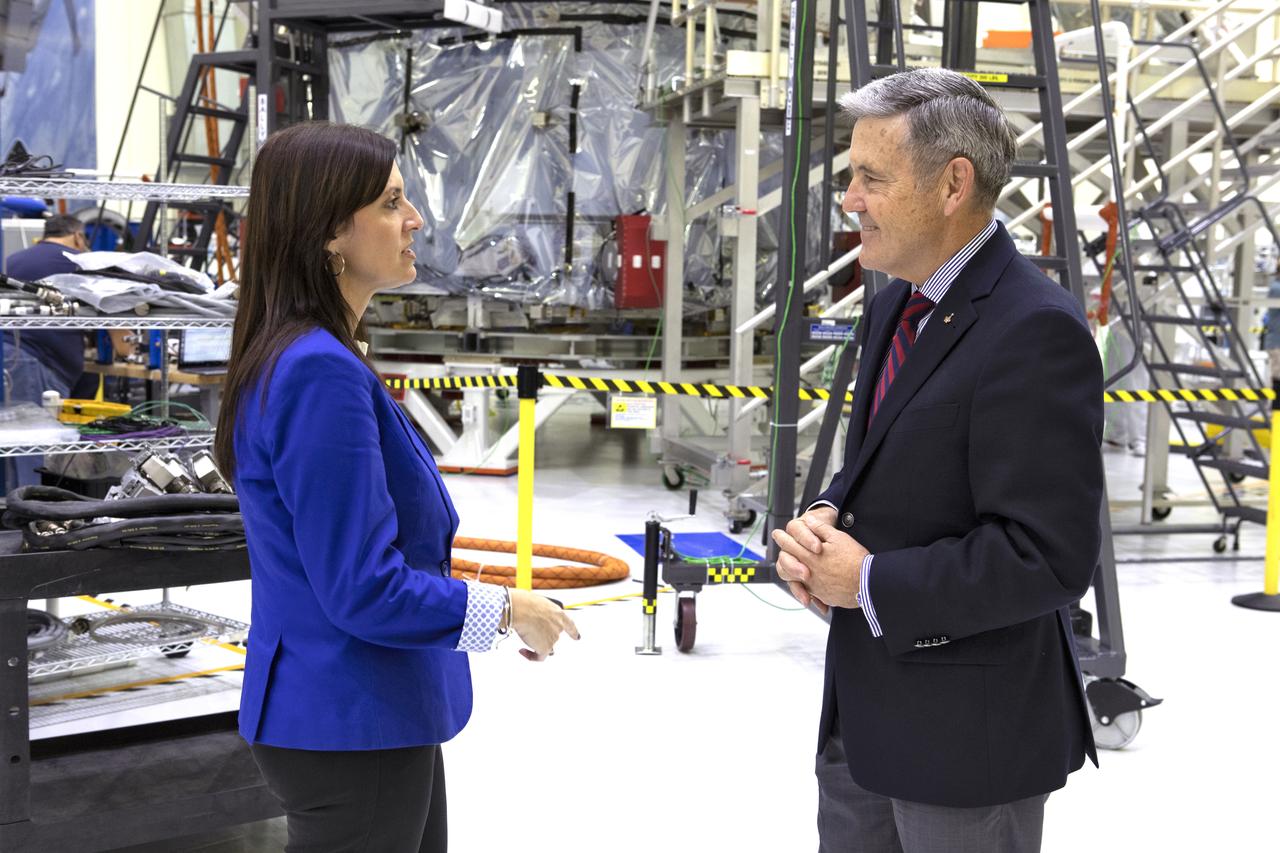
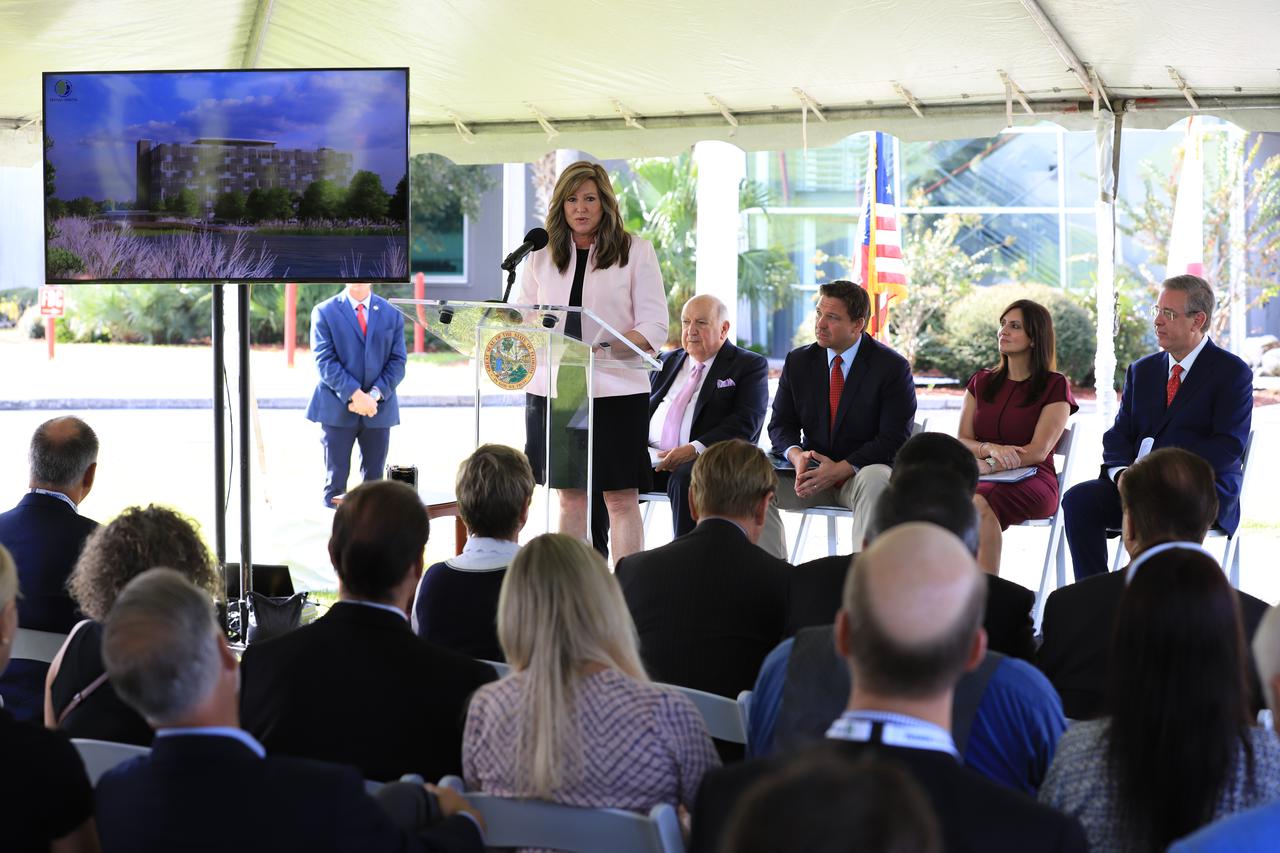
Kennedy Space Center Associate Director, Technical, Jennifer Kunz speaks at an event Sept. 27, 2021, announcing that Terran Orbital will locate its Commercial Spacecraft and Constellation Facility on NASA’s Kennedy Space Center in Florida. The new manufacturing facility will be built near the center’s Launch and Landing Facility, which is being managed and developed by Space Florida under a long-term agreement with NASA. Terran Orbital develops end-to-end satellite solutions as well as commercial spacecraft. The 660,000 square foot manufacturing facility will consist of ten automated and augmented hangers capable of producing thousands of different types of space vehicles and electro-mechanical devices per year. The project is expected to create about 2,100 new jobs, with a planned completion date in 2025. The announcement ceremony was held at Space Florida’s Space Life Sciences Lab in Exploration Park, Florida. Seated directly behind Kunz is Space Florida President and CEO Frank DiBello (left) and Florida Gov. Ron DeSantis (second from left).
Terran Orbital Space Florida Announcement
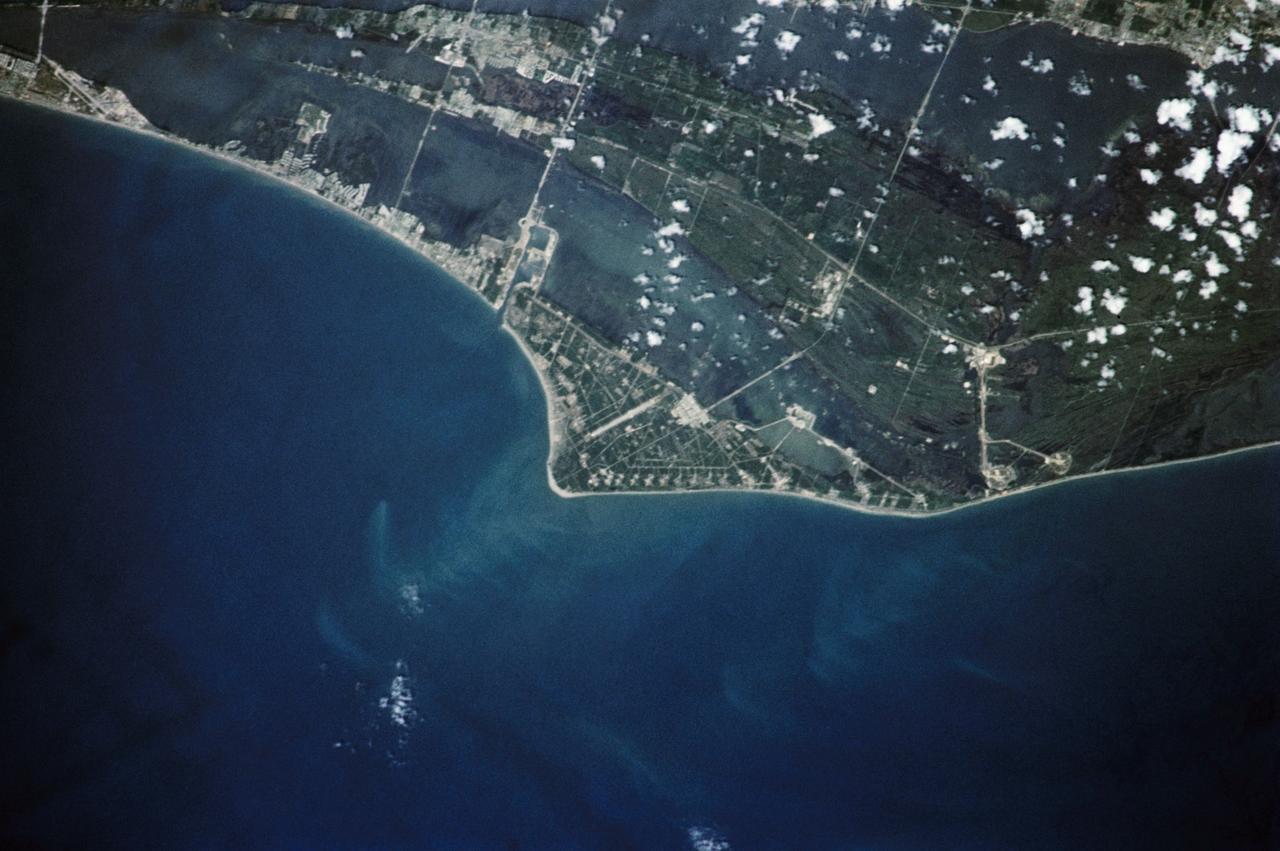
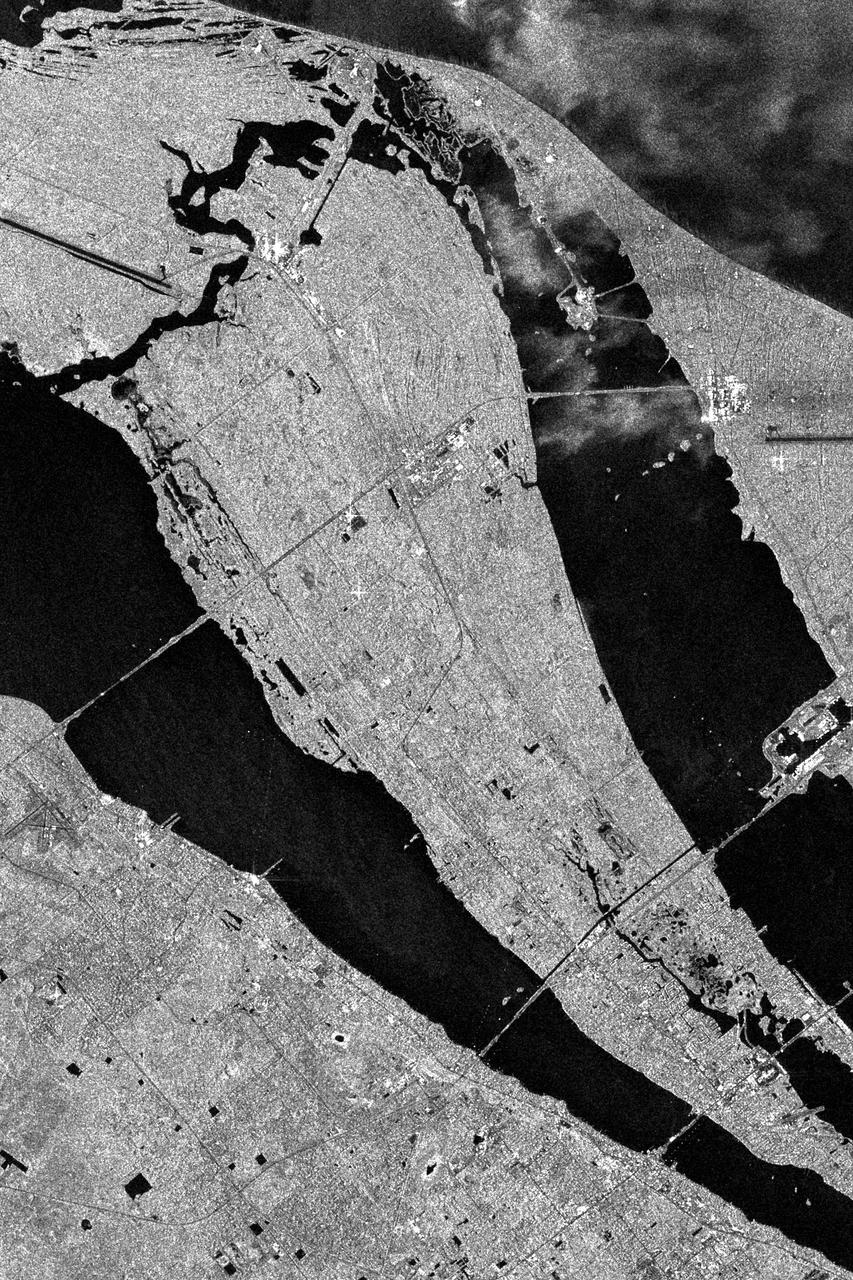
This is an X-band Synthetic Aperture Radar image spanning an area of about 20 kilometers by 40 kilometers 12 miles by 25 miles of NASA Kennedy Space Center, Florida.
Space Radar Image of Kennedy Space Center, Florida
SL2-106-1194 (22 June 1973) --- This overhead view of the central eastern shore of Florida shows the Cape Canaveral and Kennedy Space Center (28.5N, 80.5W), where all of the NASA manned space missions originate. Sprinkled along the jutting cape are a number of KSC launch pads from the earlier Mercury, Gemini Apollo and Skylab series of spaceflights. Merritt Island, just south of Kennedy Space Center, is where the spacecraft liftoff tracking station is located. Photo credit: NASA
Cape Canaveral, Kennedy Space Center, Florida
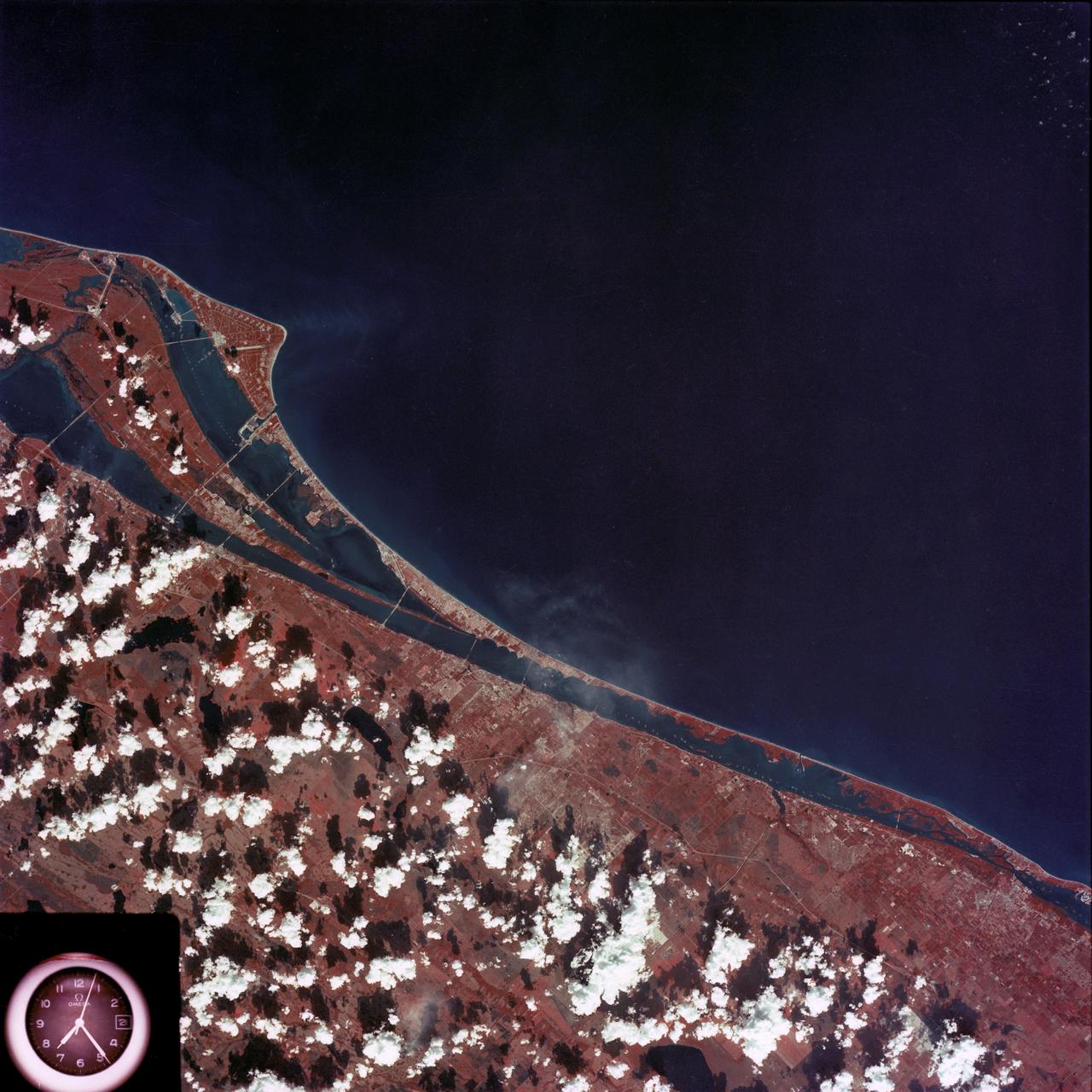
SL4-93-167 (February 1974) --- A vertical view of the Kennedy Space Center and the Florida Atlantic coast area is seen in this Skylab 4 Earth Resources Experiments Package S190-B (five-inch earth terrain camera) infrared photography taken from the Skylab space station in Earth orbit. This photograph shows the major land-ocean features of the Florida coast near Vero Beach northward to Cape Canaveral and the KSC complex. The launch pads for the Skylab missions are clearly visible. Identification of living vegetation is possible through the use of the color infrared film. Various shades of red portray differences in the vegetation such as shown in the patterns in the agricultural area near Vero Beach. In the Kennedy Space Center, the nearly continuous and uniform red color shows that most of the land areas are heavily vegetated. The white coastal beach areas are strongly contrasted to the red land and the blue Atlantic Ocean. Old dunal areas in KSC are visible on Merritt Island which is separated from the Launch areas by the Banana River and the mainland by the Indian River. Federal and state highways and numerous causeways over the rivers are easily identified. The Florida mainland is partly shadowed by small white clouds which cast a pronounced shadow to the east of each cloud indicated the Sun is west of solar noon. Federal agencies participating with NASA on the EREP project are the Departments of Agriculture, Commerce, Interior, the Environmental Protection Agency and the Core of Engineers. All EREP photography is available to the public through the Department of Interior's Earth Resources Observations Systems Data Center, Sioux Falls, South Dakota, 57198. Photo credit: NASA
Kennedy Space Center and the Florida Atlantic coast area
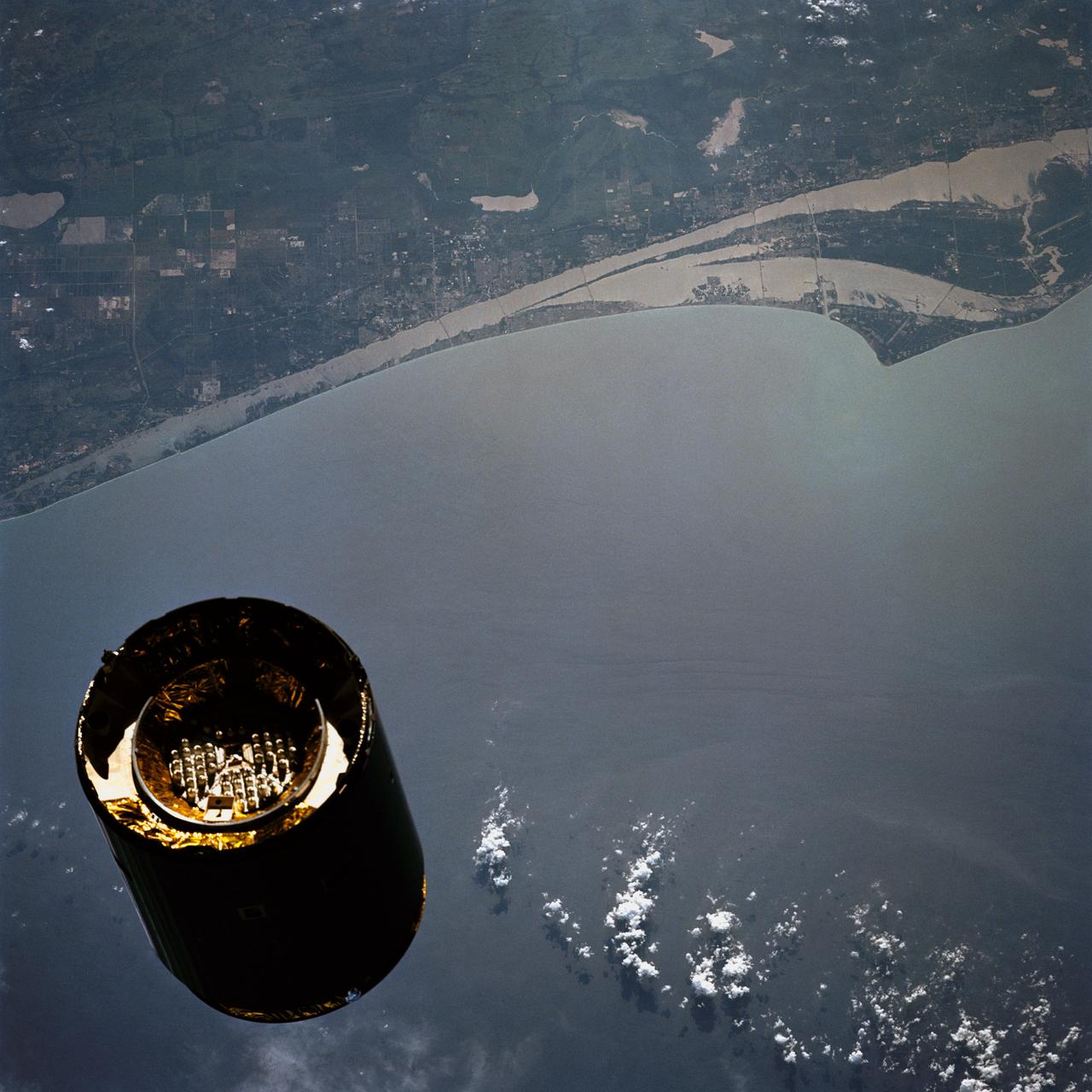
STS049-79-024 (13 May 1992) --- Florida's Atlantic Coast and the Cape Canaveral area form the backdrop for this 70mm scene of Intelsat VI's approach to the Space Shuttle Endeavour.  Later, the seven-member crew was successful in capturing the satellite and adding a perigee phase.  The new motor allowed the needed boost for Intelsat, once the crew members had released it into space.
Pre Capture view of Intelsat VI Over Kennedy Space Center, Florida
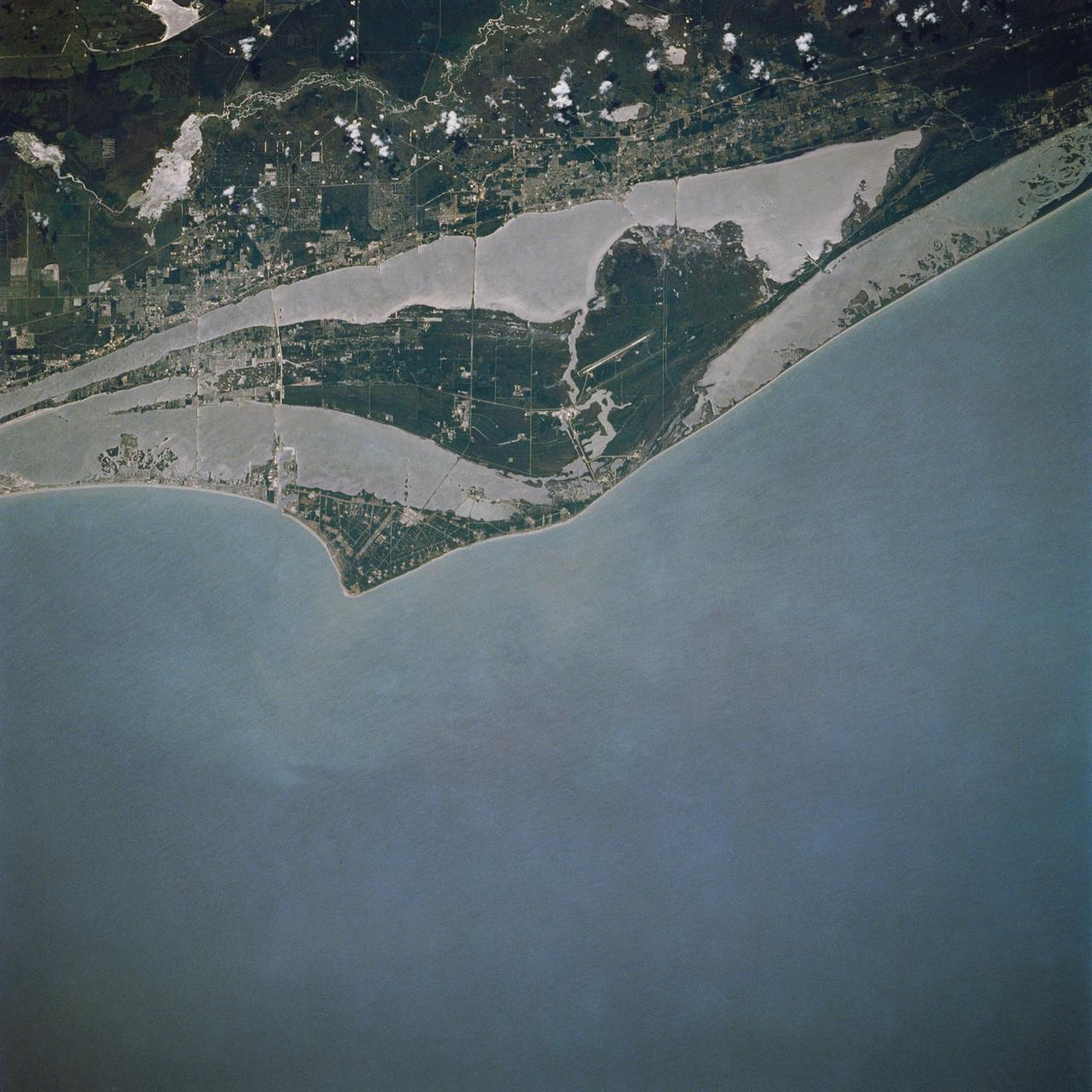
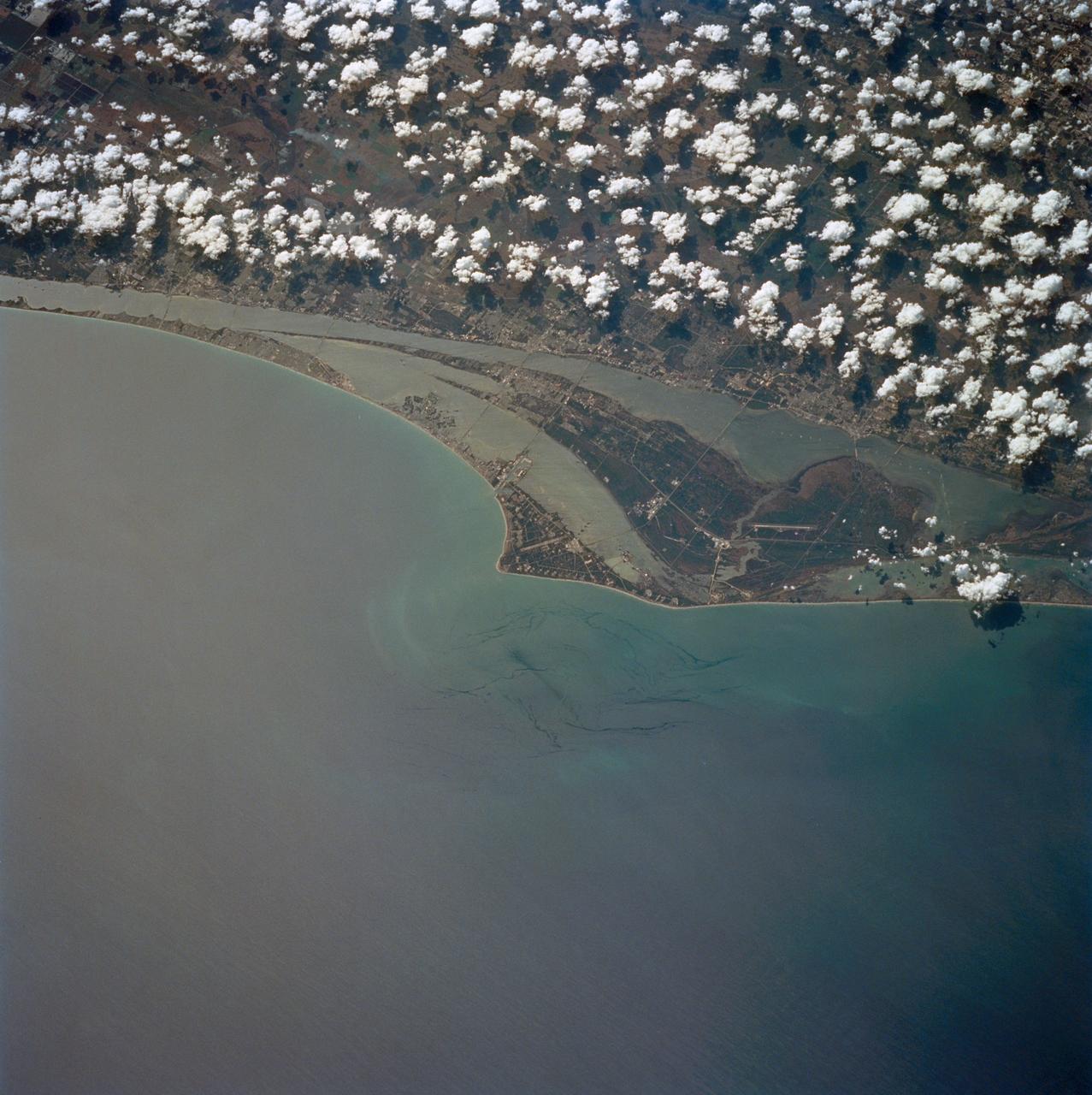
STS030-76-042 (4-8 May 1989) --- For two decades, astronauts have been photographing their launching area from space, but in terms of sharpness and clarity, NASA photo experts feel, few rival this  STS-30 vertical scene over the Cape Canaveral area. Sprinkled along the jutting cape feature are a number of launching pads of Kennedy Space Center, and nearby is seen the Shuttle landing facility. Titusville can be seen just above center on the north; Cocoa, Cocoa Beach and Merritt Island are south, near bottom of the frame.  St. Johns, Banana and Indian Rivers are easily traced as well.
Cape Canaveral and Kennedy Space Center, Florida
STS060-84-021 (3-11 Feb 1994) --- The Kennedy Space Center (KSC) and its partially cloud-covered environs were captured on 70mm by one of the STS-60 crew members during the eight-day mission.  The Shuttle landing facility, on which Discovery landed February 11, 1994, visible at left center.
Kennedy Space Center, Florida as seen from STS-60
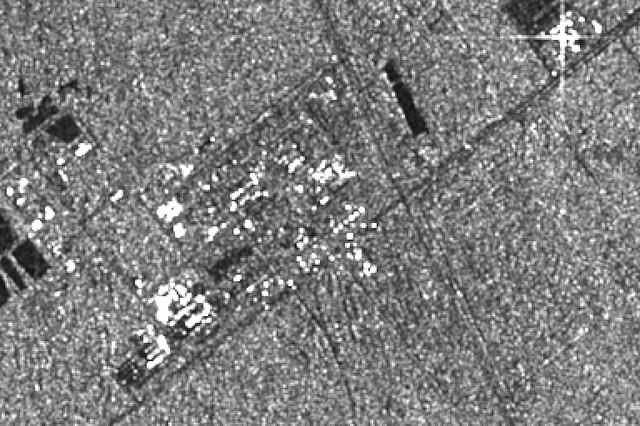
This image was produced during radar observations taken by the Spaceborne Imaging Radar-C/X-band Synthetic Aperture Radar as it flew over the Gulf Stream, Florida, and past the Atlantic Ocean on October 7, 1994. The data were produced using the X-band radar frequency. Knowing ahead of time that this region would be included in a regularly scheduled radar pass, the Kennedy Space Center team, who assembled and integrated the SIR-C/X-SAR equipment with the Spacelab pallet system, designed a set of radar reflectors from common construction materials and formed the letters "KSC" on the ground adjacent to the main headquarters building at the entrance to the Cape Canaveral launch facility. The point of light formed by the bright return from these reflectors are visible in the image. Other more diffuse bright spots are reflections from building faces, roofs and other large structures at the Kennedy Space Center complex. This frame covers an area of approximately 6 kilometers by 8 kilometers (4 miles by 5 miles), which was just a small portion of the data taken on this particular pass.   http://photojournal.jpl.nasa.gov/catalog/PIA01747
Space Radar Image of Kennedy Space Center, Florida
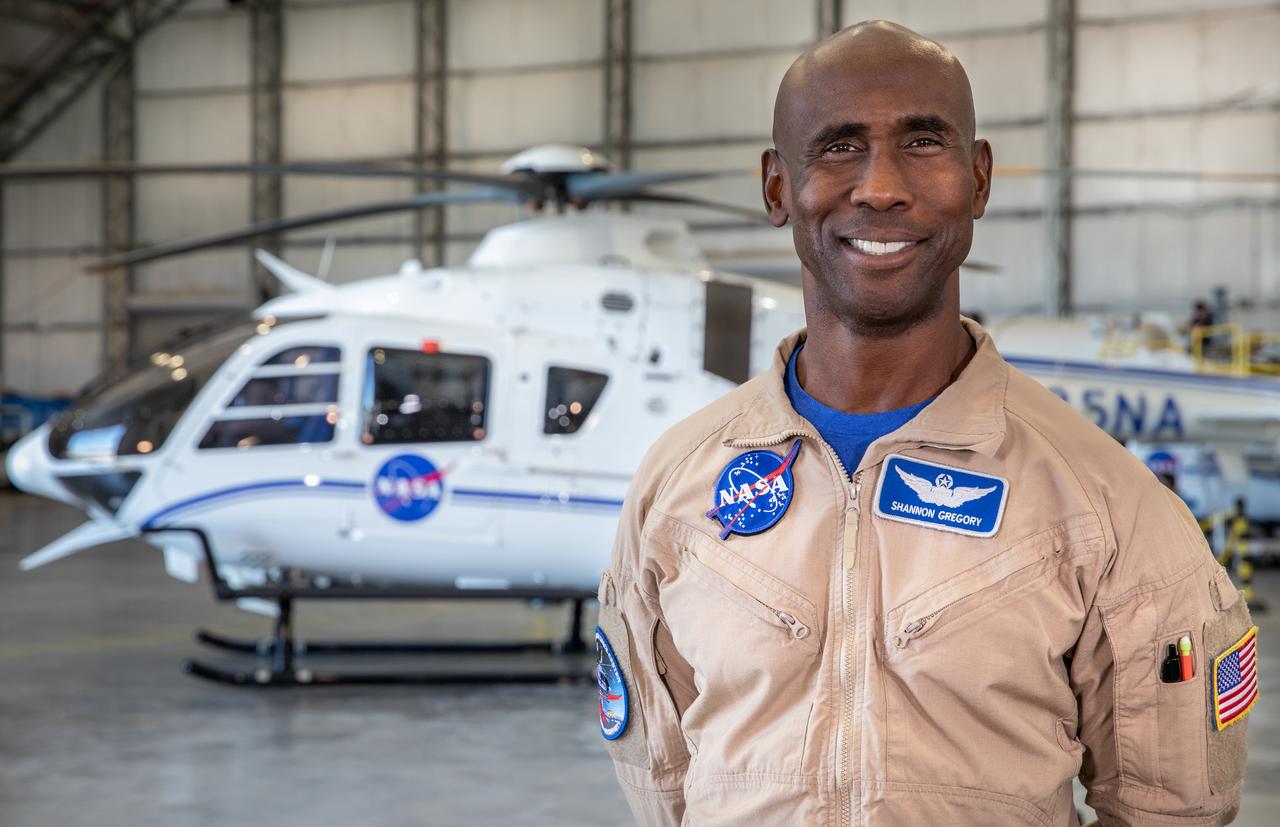
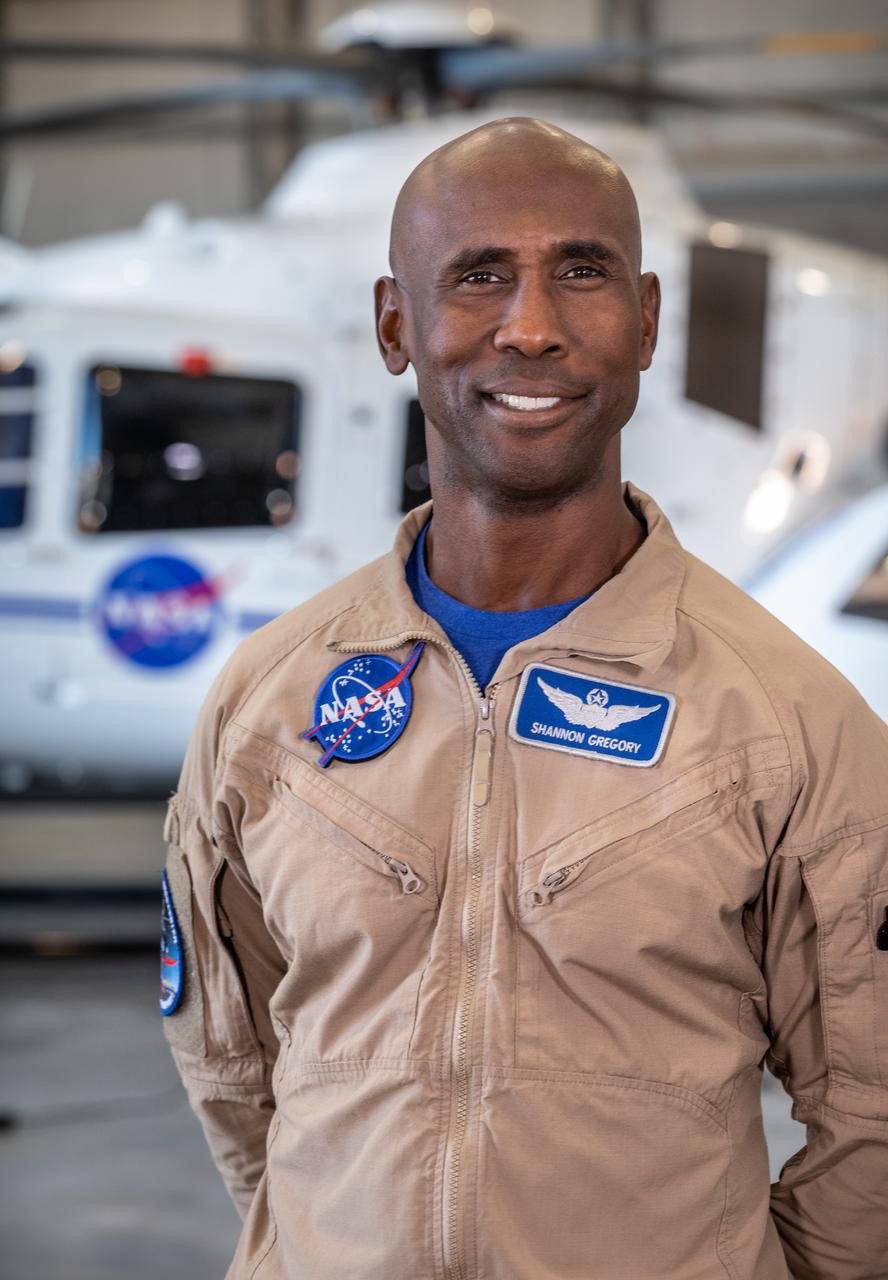
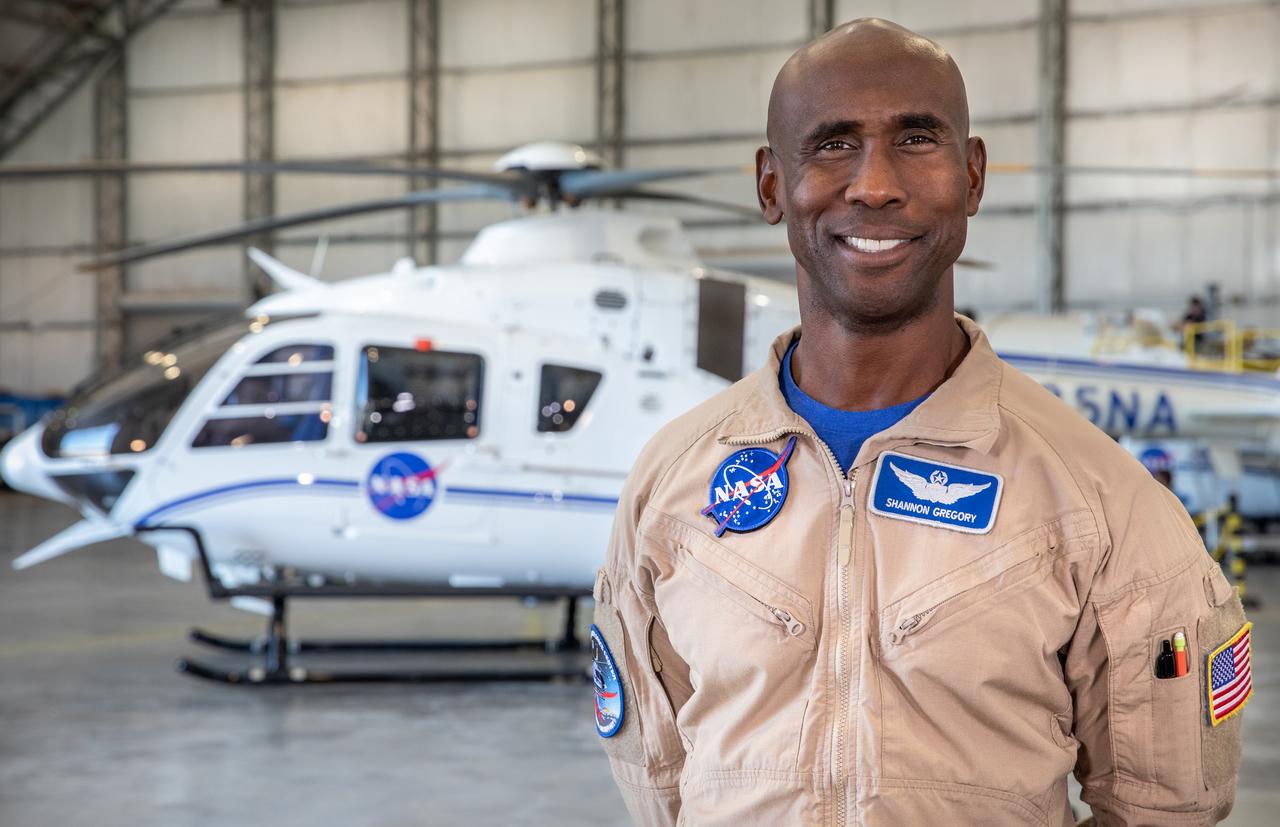
Shannon Gregory, chief of Flight Operations at NASA’s Kennedy Space Center, stands in front of one of the agency’s Airbus H135 (T3) helicopters inside a hangar at Kennedy’s Launch and Landing Facility in Florida on Tuesday, Oct. 17, 2023. Gregory leads his team to provide support at launches and recoveries, securing the airspace, shooting video, and coordinating with mission control.
Shannon Gregory Headshots
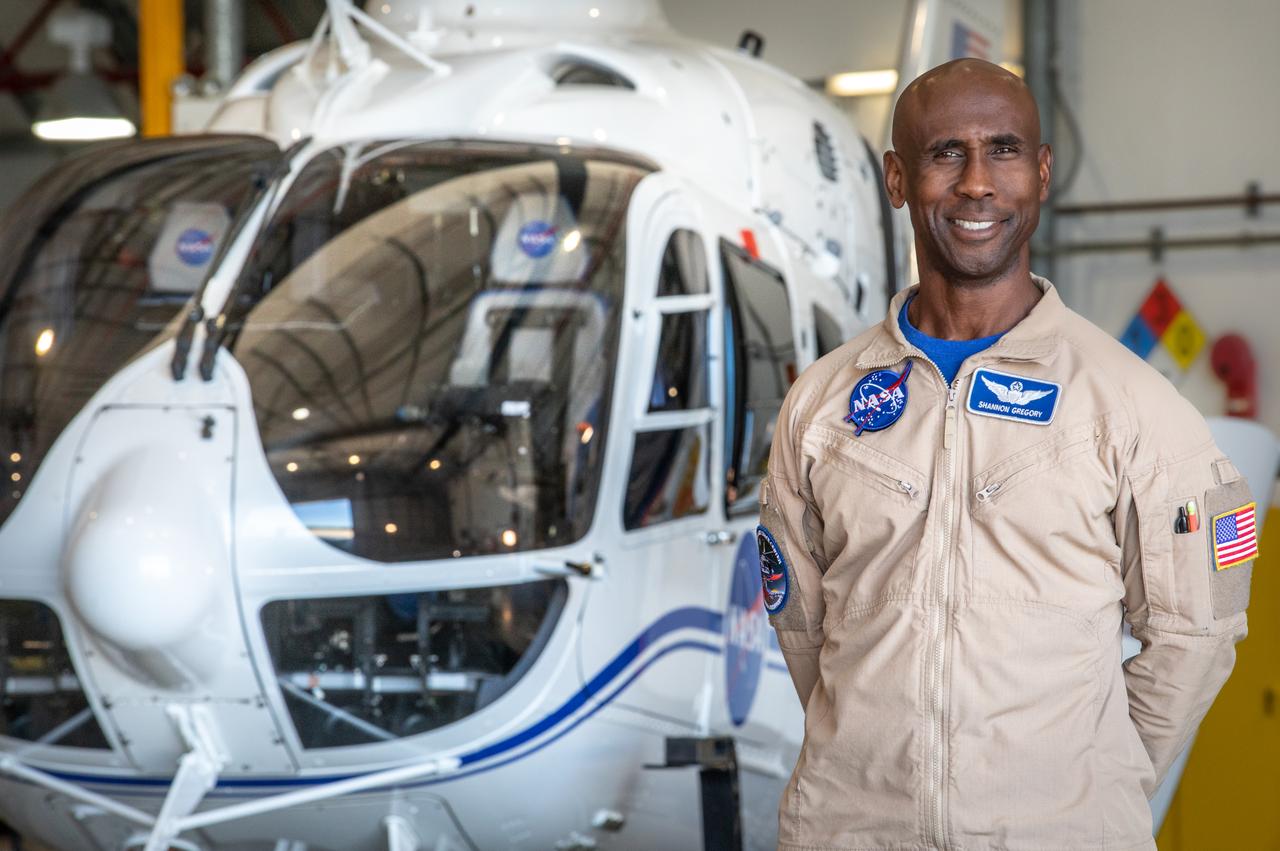
Shannon Gregory, chief of Flight Operations at NASA’s Kennedy Space Center, stands in front of one of the agency’s Airbus H135 (T3) helicopters inside a hangar at Kennedy’s Launch and Landing Facility in Florida on Tuesday, Oct. 17, 2023. Gregory leads his team to provide support at launches and recoveries, securing the airspace, shooting video, and coordinating with mission control.
Shannon Gregory Headshots
Shannon Gregory, chief of Flight Operations at NASA’s Kennedy Space Center, stands in front of one of the agency’s Airbus H135 (T3) helicopters inside a hangar at Kennedy’s Launch and Landing Facility in Florida on Tuesday, Oct. 17, 2023. Gregory leads his team to provide support at launches and recoveries, securing the airspace, shooting video, and coordinating with mission control.
Shannon Gregory Headshots
Shannon Gregory, chief of Flight Operations at NASA’s Kennedy Space Center, stands in front of one of the agency’s Airbus H135 (T3) helicopters inside a hangar at Kennedy’s Launch and Landing Facility in Florida on Tuesday, Oct. 17, 2023. Gregory leads his team to provide support at launches and recoveries, securing the airspace, shooting video, and coordinating with mission control.
Shannon Gregory Headshots
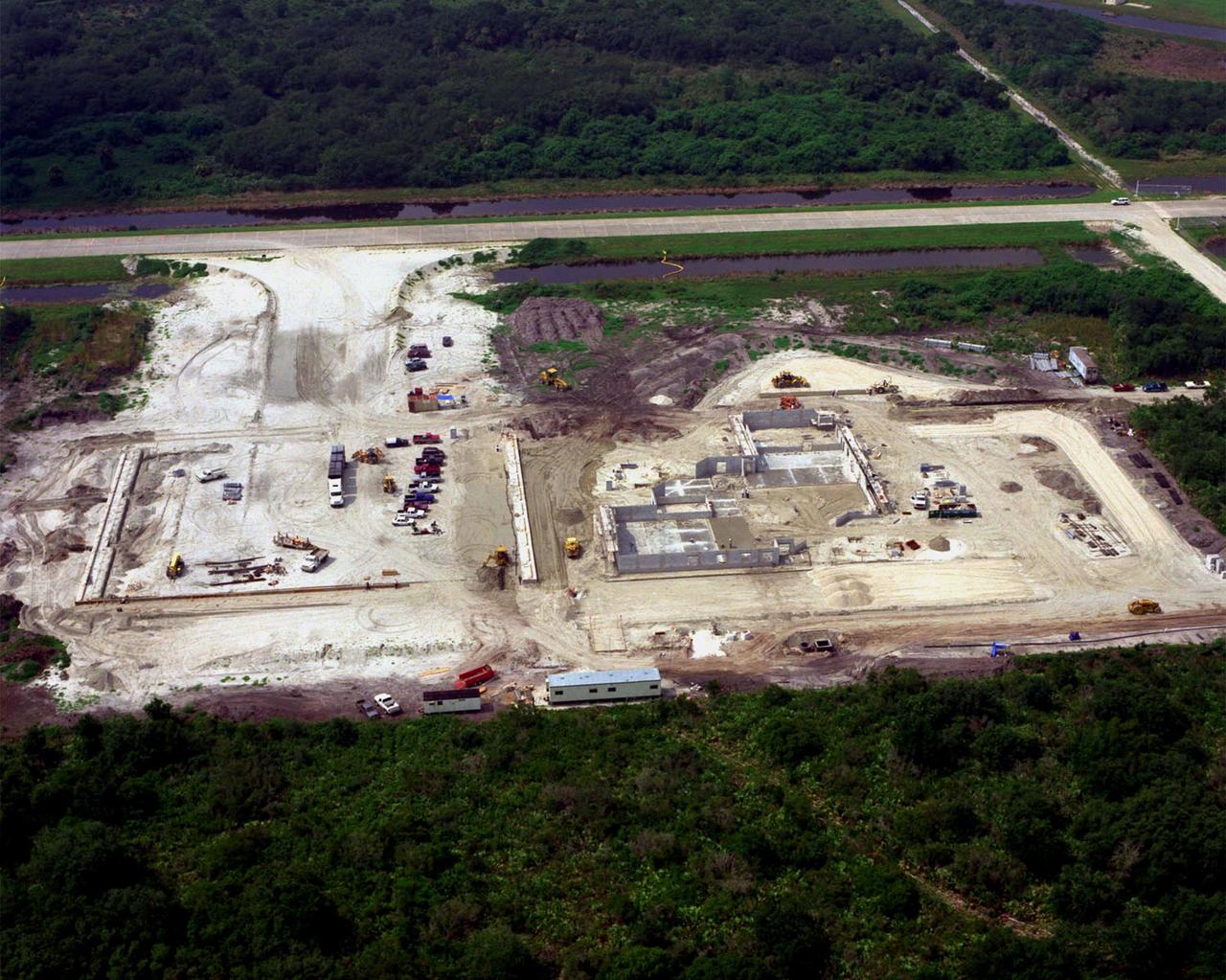
Looking southwest, this view shows ongoing construction of a multi-purpose hangar, which is part of the $8 million Reusable Launch Vehicle (RLV) Support Complex at Kennedy Space Center. Edging the construction is Sharkey Road, which parallels the landing strip of the Shuttle Landing Facility nearby. The RLV complex will include facilities for related ground support equipment and administrative/ technical support. It will be available to accommodate the Space Shuttle; the X-34 RLV technology demonstrator; the L-1011 carrier aircraft for Pegasus and X-34; and other RLV and X-vehicle programs. The complex is jointly funded by the Spaceport Florida Authority, NASA's Space Shuttle Program and KSC. The facility will be operational in early 2000.
KSC-99PP-1047
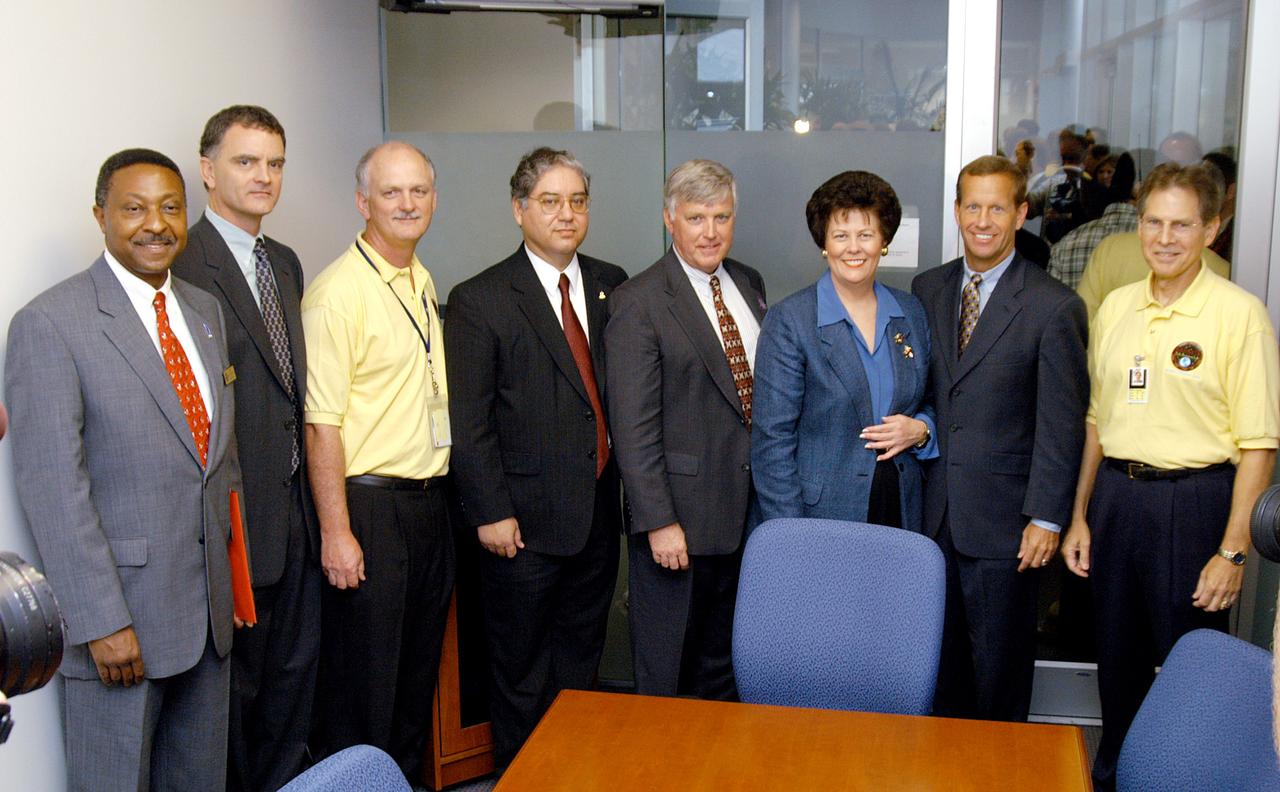
KENNEDY SPACE CENTER, FLA. -  Officials of the NASA-Kennedy Space Center and the state of Florida pose for a group portrait at a dedication and ribbon-cutting ceremony for the Space Life Sciences Lab at the new lab. From left are Capt. Winston Scott, executive director of the Florida Space Authority; Dr. Robert J. Ferl, director of Space Agriculture Biotechnology Research and Education (SABRE), University of Florida; Charlie Quincy, chief of the Biological Sciences Office, Kennedy Space Center; Jose Perez-Morales, NASA Project Manager for the Space Life Sciences Lab; Jim Kennedy, director of the Kennedy Space Center; The Honorable Toni Jennings, lieutenant governor of the state of Florida; Frank T. Brogan, president of the Florida Atlantic University; and Dr. Samuel Durrance, executive director of the Florida Space Research Institute.  Completed in August, the facility encompasses more than 100,000 square feet and was formerly known as the Space Experiment Research and Processing Laboratory or SERPL. The state, through the Florida Space Authority, built the research lab which is host to NASA, NASA’s Life Sciences Services contractor Dynamac Corp., Bionetics Corp., and researchers from the University of Florida.  Dynamac Corp. leases the facility.  The Florida Space Research Institute is responsible for gaining additional tenants from outside the NASA community.
KENNEDY SPACE CENTER, FLA. - Officials of the NASA-Kennedy Space Center and the state of Florida pose for a group portrait at a dedication and ribbon-cutting ceremony for the Space Life Sciences Lab at the new lab. From left are Capt. Winston Scott, executive director of the Florida Space Authority; Dr. Robert J. Ferl, director of Space Agriculture Biotechnology Research and Education (SABRE), University of Florida; Charlie Quincy, chief of the Biological Sciences Office, Kennedy Space Center; Jose Perez-Morales, NASA Project Manager for the Space Life Sciences Lab; Jim Kennedy, director of the Kennedy Space Center; The Honorable Toni Jennings, lieutenant governor of the state of Florida; Frank T. Brogan, president of the Florida Atlantic University; and Dr. Samuel Durrance, executive director of the Florida Space Research Institute. Completed in August, the facility encompasses more than 100,000 square feet and was formerly known as the Space Experiment Research and Processing Laboratory or SERPL. The state, through the Florida Space Authority, built the research lab which is host to NASA, NASA’s Life Sciences Services contractor Dynamac Corp., Bionetics Corp., and researchers from the University of Florida. Dynamac Corp. leases the facility. The Florida Space Research Institute is responsible for gaining additional tenants from outside the NASA community.
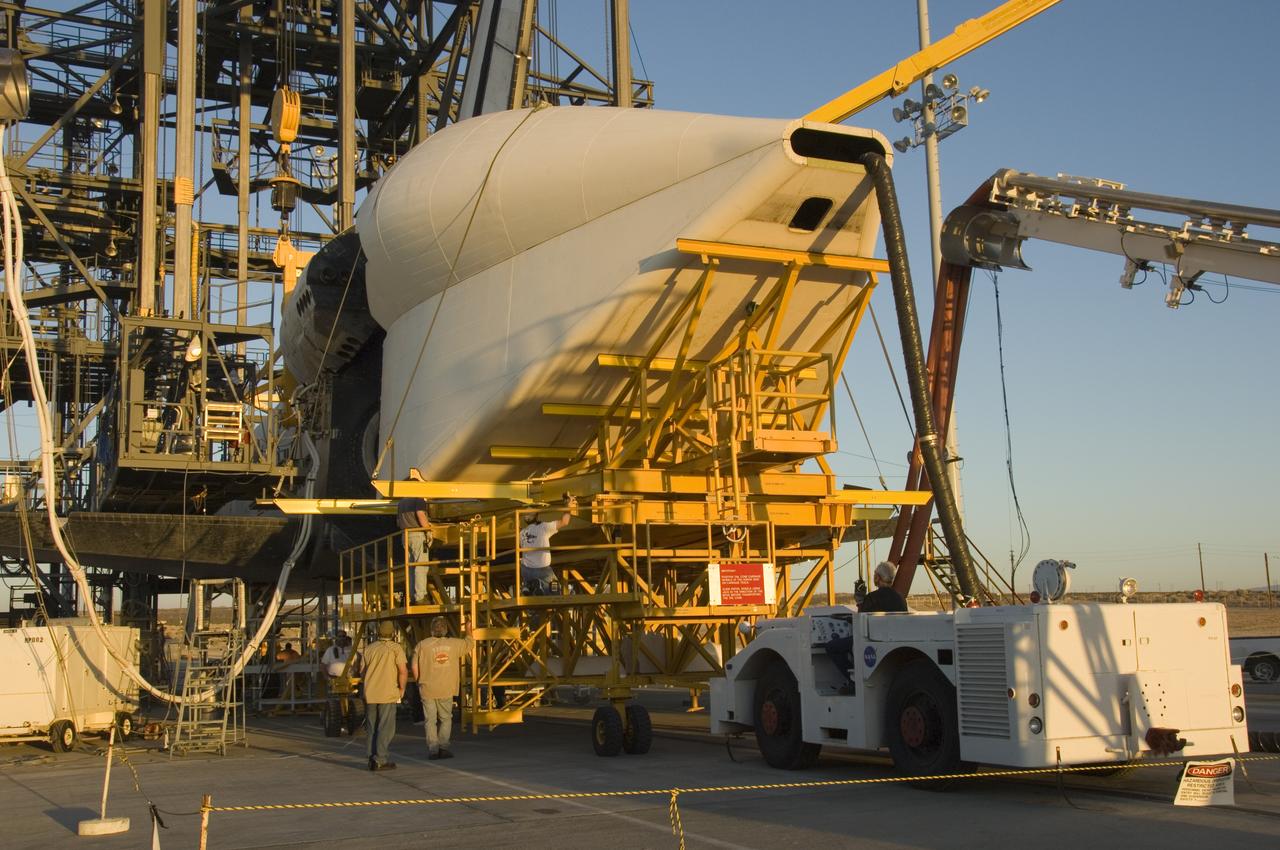
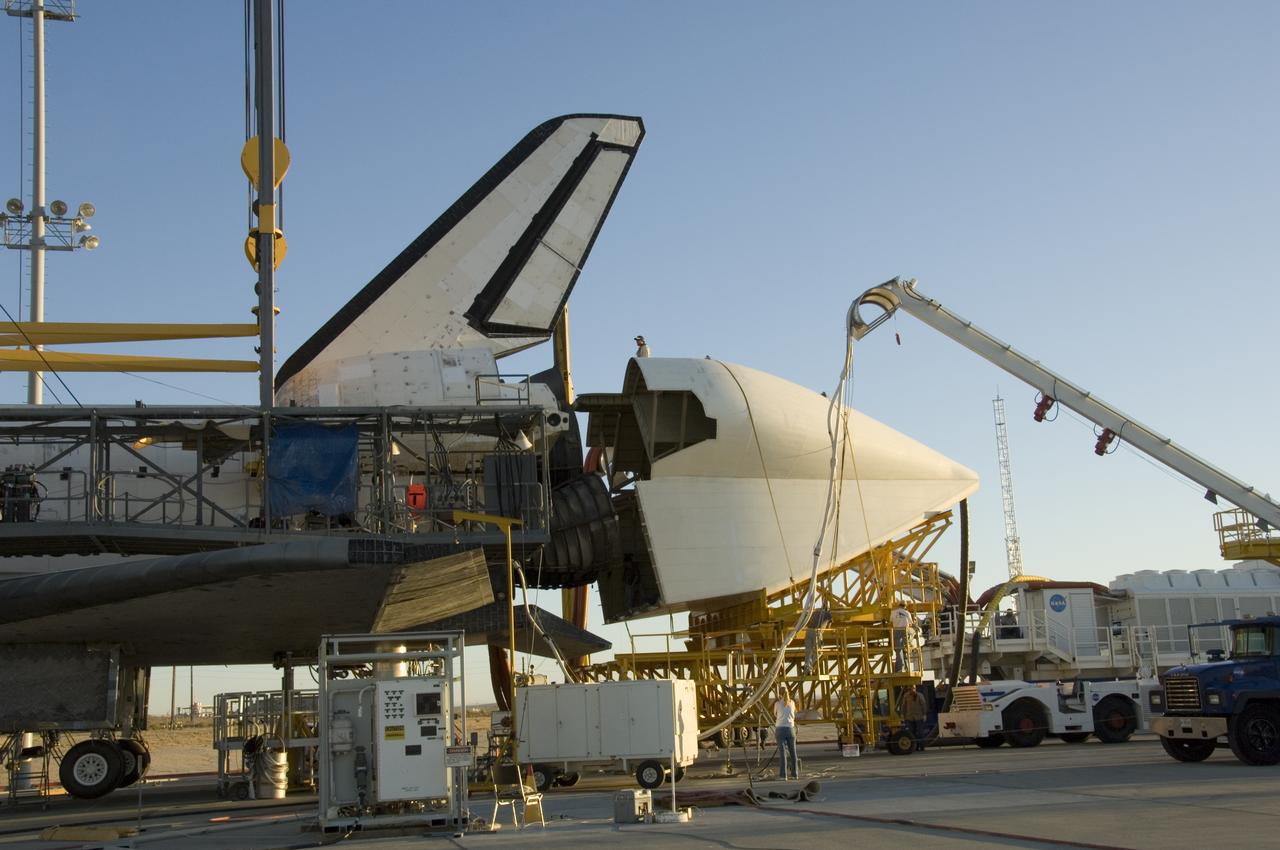
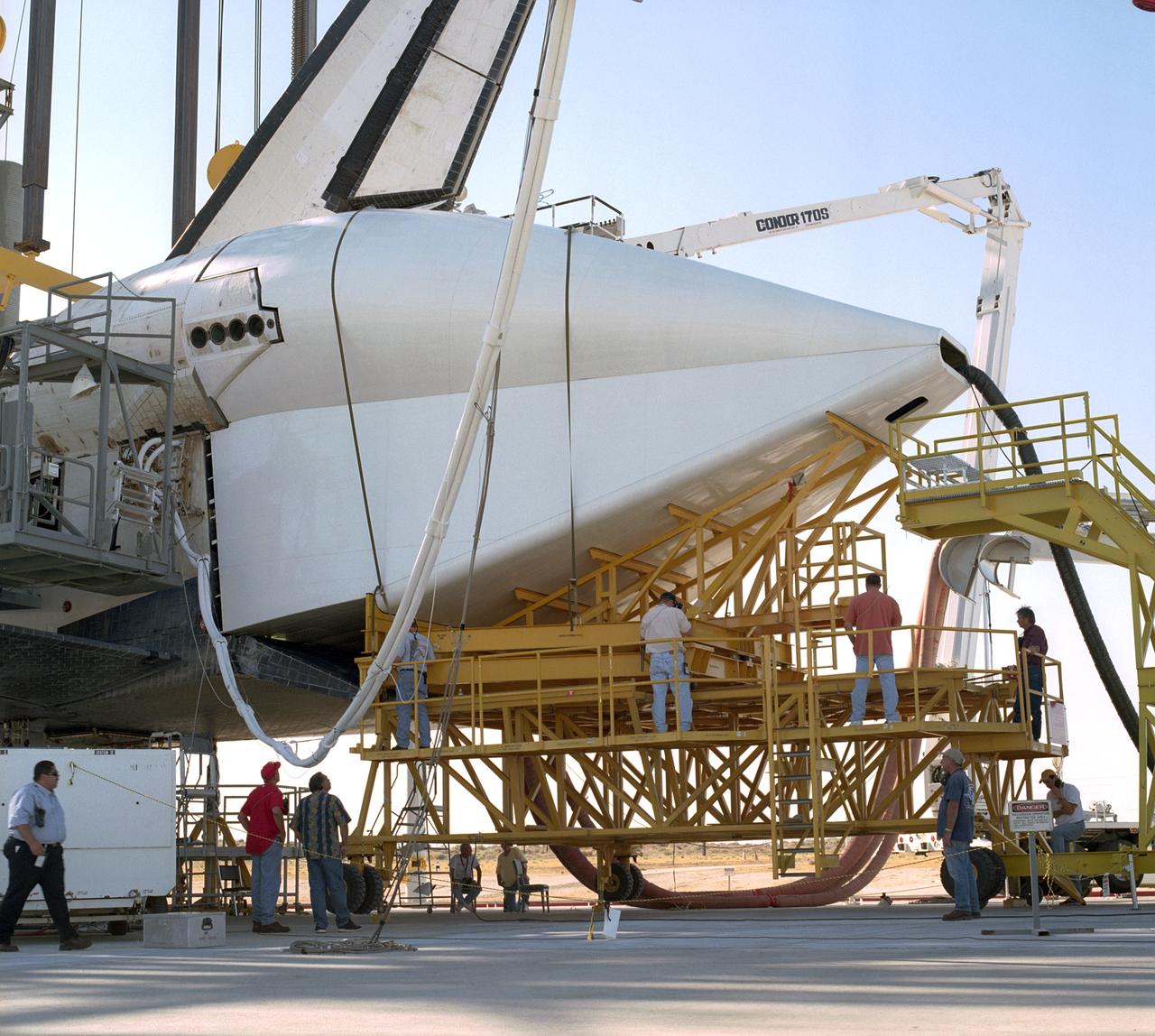
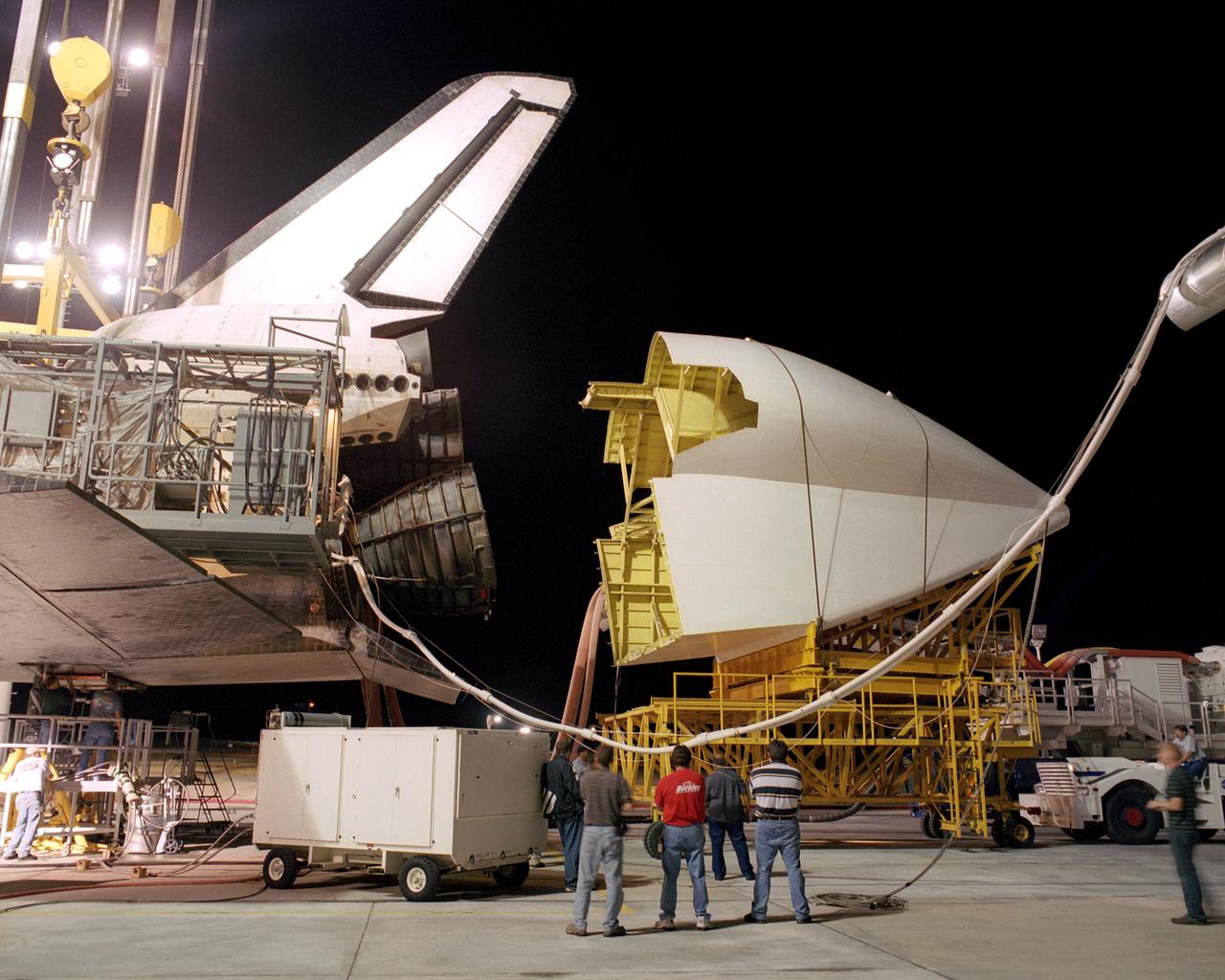
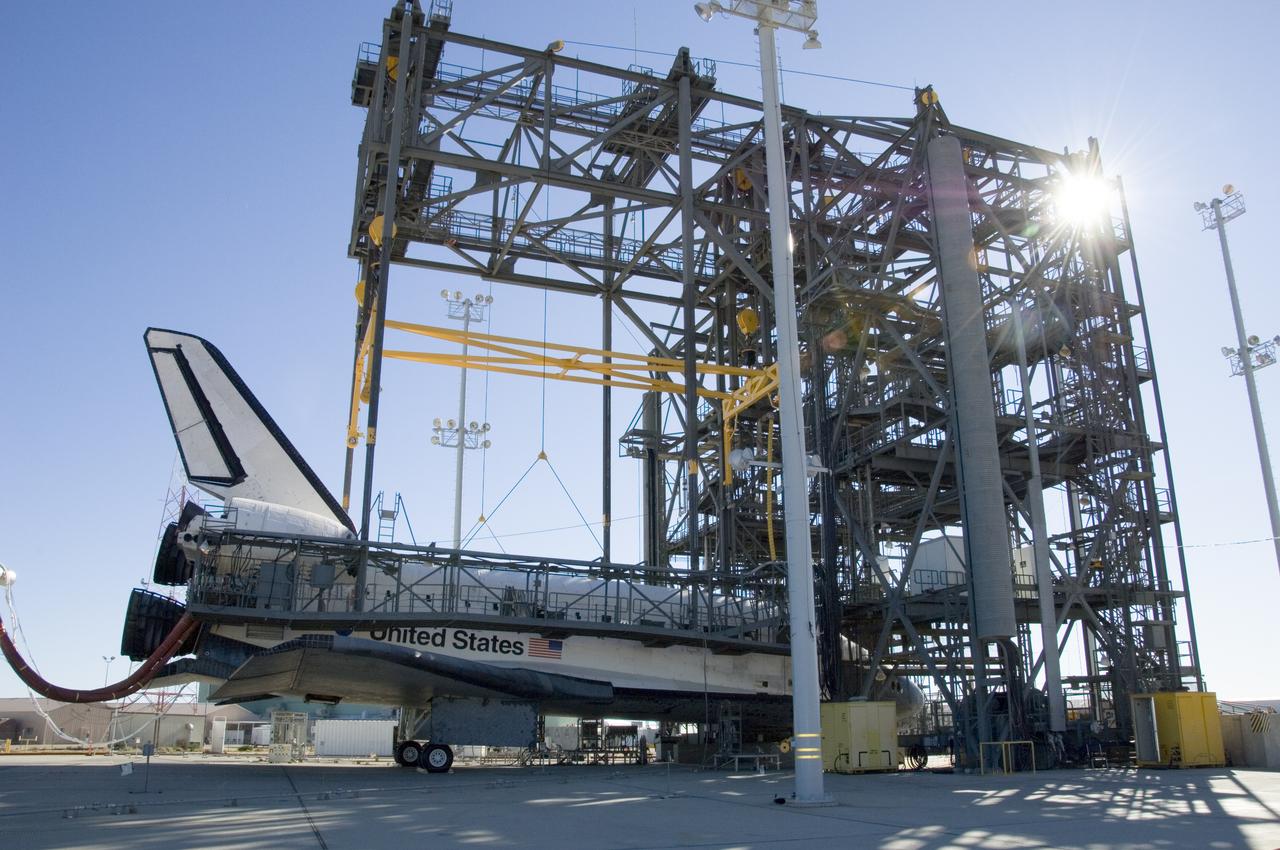
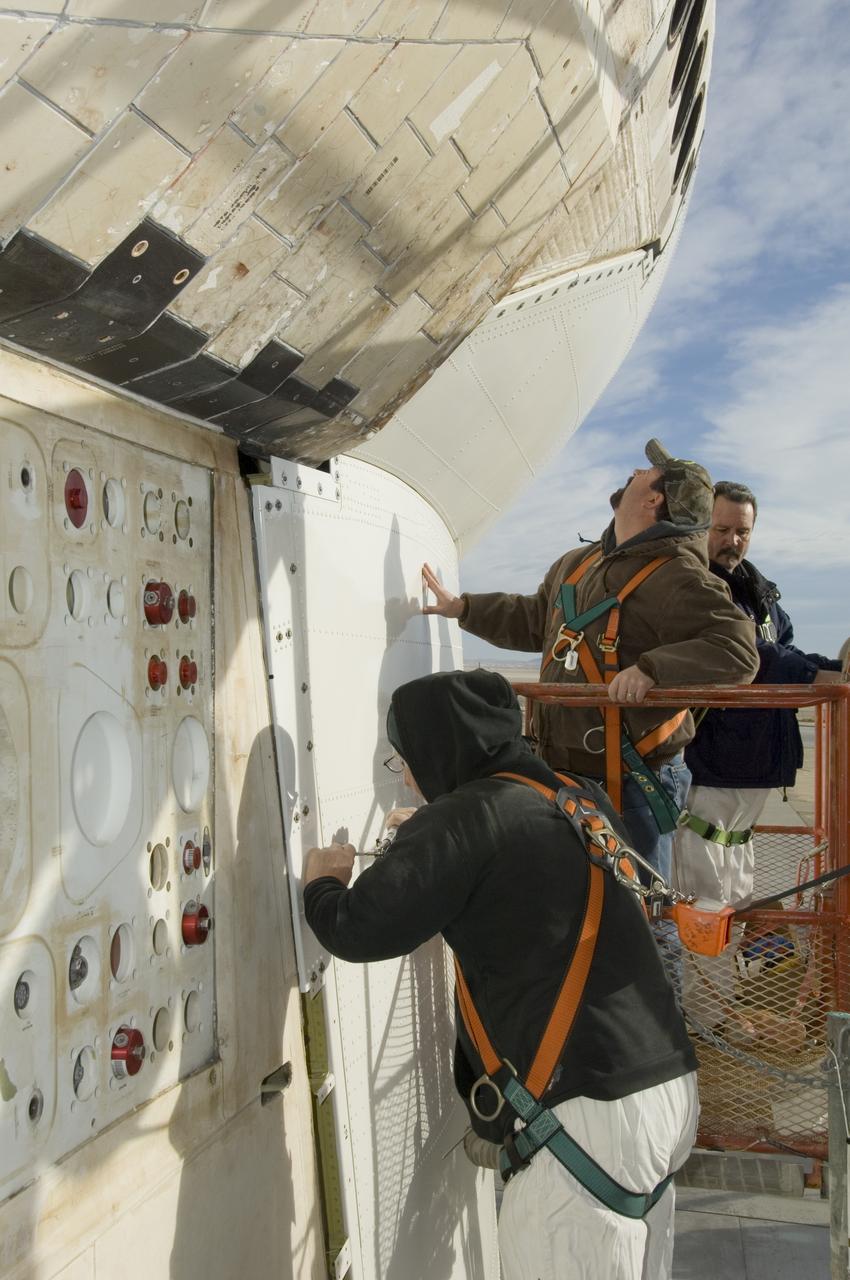
Technicians attach the tail cone, which helps reduce aerodynamic drag and turbulence during its ferry flight, to the Space Shuttle Atlantis in preparation for its return to NASA's Kennedy Space Center in Florida. After the tail-cone is installed, Discovery will be mounted on NASA's modified Boeing 747 Shuttle Carrier Aircraft, or SCA, for the return flight.
Technicians attach the tail cone to the Space Shuttle Atlantis in preparation for its return to NASA's Kennedy Space Center in Florida
Technicians attach the tail cone, which helps reduce aerodynamic drag and turbulence during its ferry flight, to the Space Shuttle Atlantis in preparation for its return to NASA's Kennedy Space Center in Florida. After the tail-cone is installed, Discovery will be mounted on NASA's modified Boeing 747 Shuttle Carrier Aircraft, or SCA, for the return flight.
Technicians attach the tail cone to the Space Shuttle Atlantis in preparation for its return to NASA's Kennedy Space Center in Florida
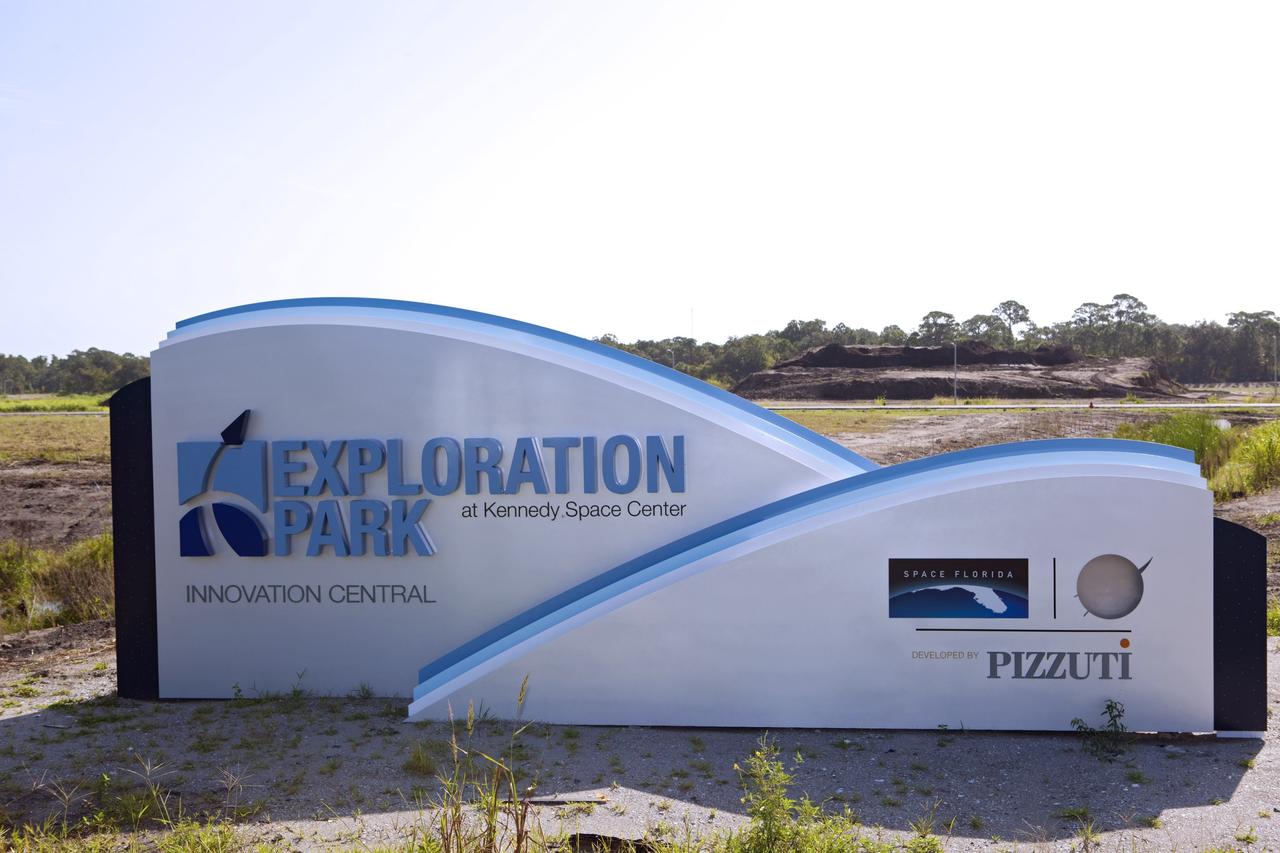
CAPE CANAVERAL, Fla. -- A new sign on Space Commerce Way marks the entrance to Exploration Park near NASA’s Kennedy Space Center in Florida.  Land in the background has been cleared for the first phase of construction.    Exploration Park encompasses 60 acres just outside Kennedy’s security gates. The park is designed to be a strategically located complex, adjacent to the Space Life Sciences Laboratory, for servicing diverse tenants and uses that will engage in activities to support the space-related activities of NASA, other government agencies and the U.S. commercial space industry. Its nine sustainable, state-of-the art buildings will include educational, office, research and laboratory, and high bay facilities and provide 350,000-square-feet of work space. Photo credit: NASA/Dimitri Gerondidakis
KSC-2012-4419
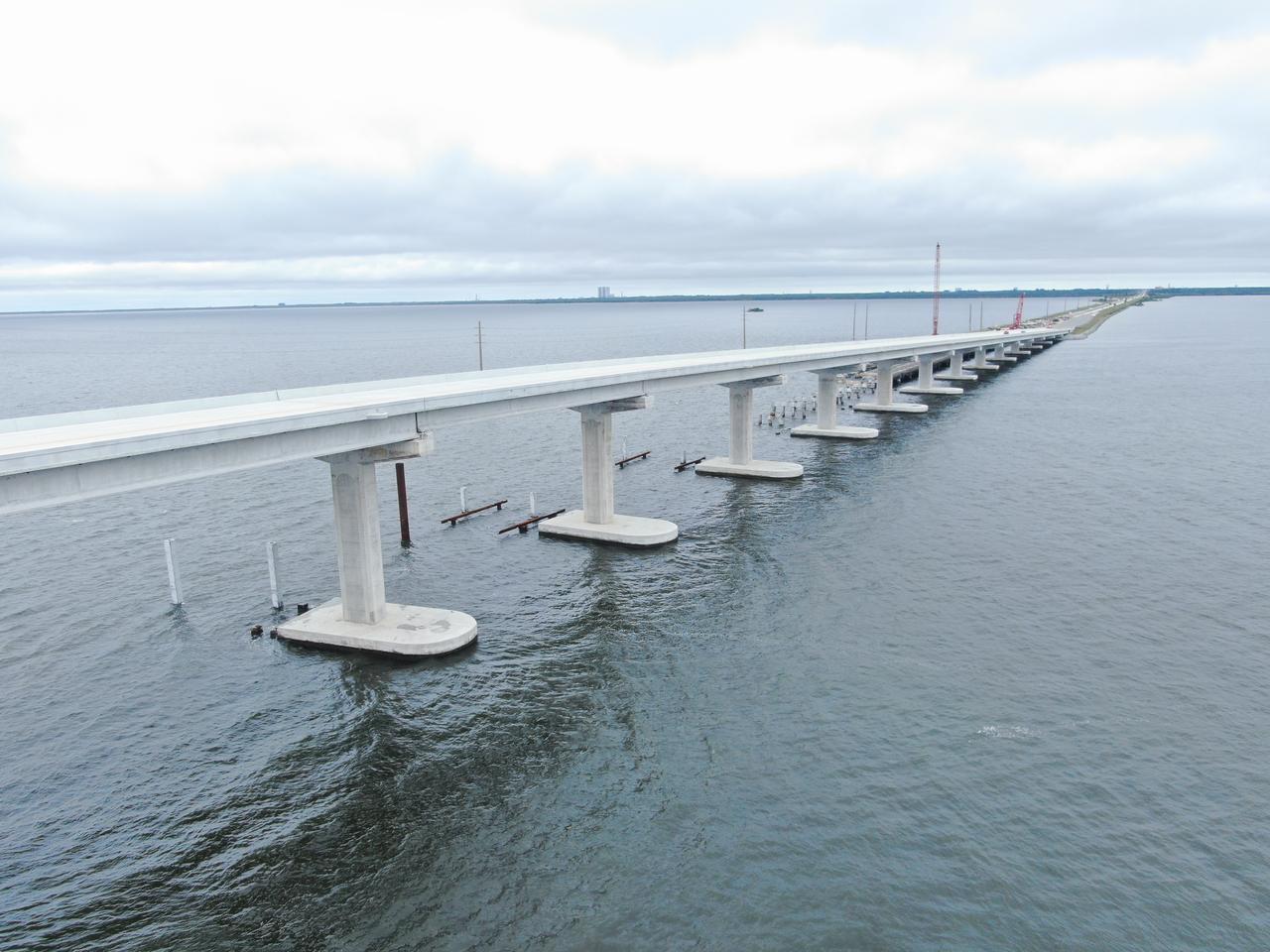
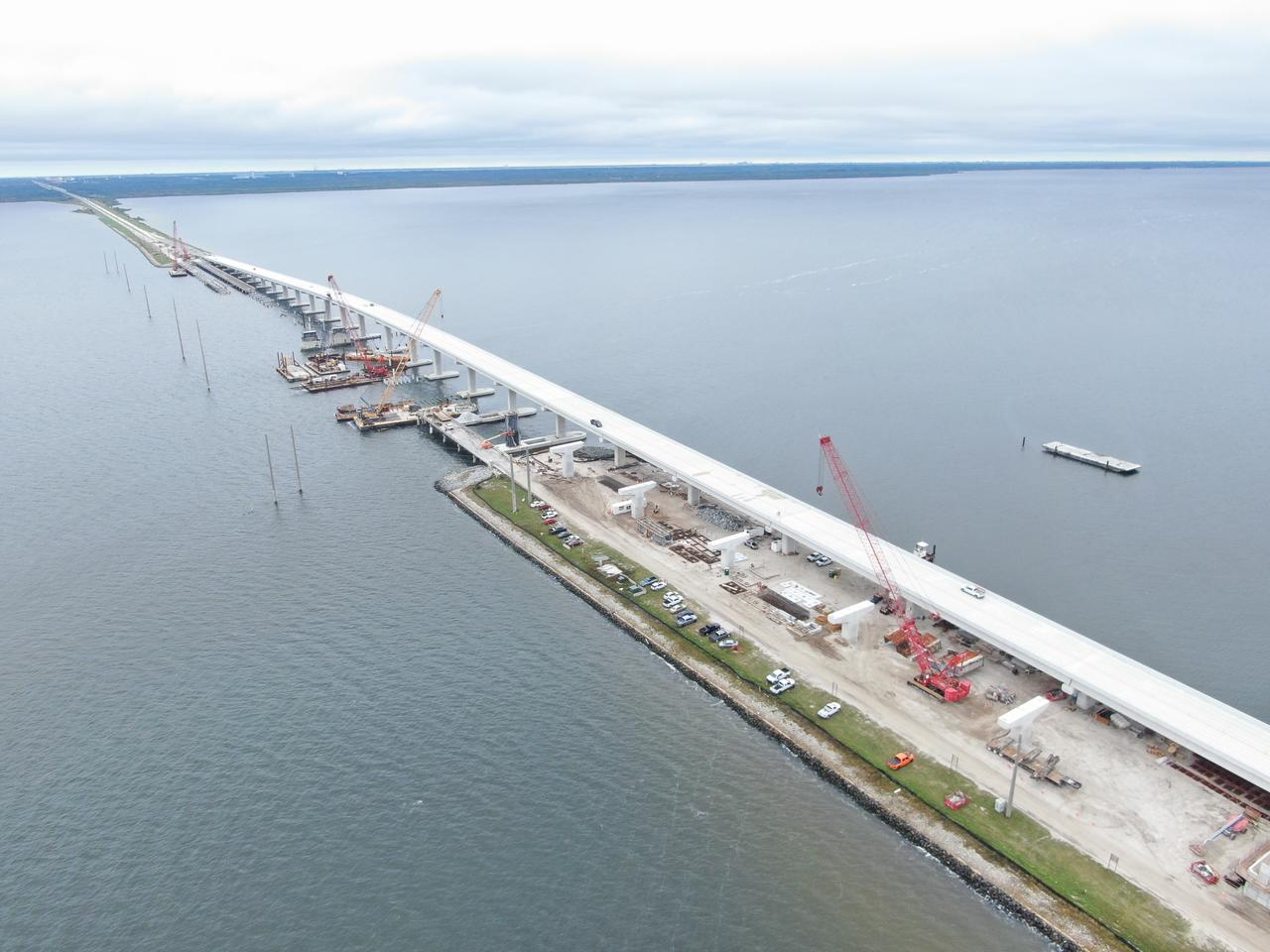
In this aerial view, crews with Orion Marine Construction work to complete the westbound span of the Indian River Bridge while daily traffic moves along the upgraded eastbound lanes of the bridge leading to NASA’s Kennedy Space Center in Florida on Monday, Nov. 27, 2023. The bridge crosses the Indian River Lagoon and connects Kennedy and the Cape Canaveral Space Force Station to the mainland via State Road 405/NASA Causeway in nearby Titusville. The new high-rise bridge serves as the primary entrance and exit to the space center for employees and visitors. The new bridge spans replace a pair of two-lane drawbridges built in the mid-1960s to support NASA’s Apollo program. The first of the two new spans opened to the public ahead of schedule on June 9, 2023. In development for well over a decade, the load capacity, width, and grade of the bridge were designed to support the largest future payloads and vehicles at the spaceport while simultaneously supporting increased public traffic to and from Kennedy.
NASA Kennedy Space Center Florida NASA Causeway Bridge Replaceme
In this aerial view, crews with Orion Marine Construction work to complete the westbound span of the Indian River Bridge while daily traffic moves along the upgraded eastbound lanes of the bridge leading to NASA’s Kennedy Space Center in Florida on Monday, Nov. 27, 2023. The bridge crosses the Indian River Lagoon and connects Kennedy and the Cape Canaveral Space Force Station to the mainland via State Road 405/NASA Causeway in nearby Titusville. The new high-rise bridge serves as the primary entrance and exit to the space center for employees and visitors. The new bridge spans replace a pair of two-lane drawbridges built in the mid-1960s to support NASA’s Apollo program. The first of the two new spans opened to the public ahead of schedule on June 9, 2023. In development for well over a decade, the load capacity, width, and grade of the bridge were designed to support the largest future payloads and vehicles at the spaceport while simultaneously supporting increased public traffic to and from Kennedy.
NASA Kennedy Space Center Florida NASA Causeway Bridge Replaceme
In this aerial view, crews with Orion Marine Construction work to complete the westbound span of the Indian River Bridge while daily traffic moves along the upgraded eastbound lanes of the bridge leading to NASA’s Kennedy Space Center in Florida on Monday, Nov. 27, 2023. The bridge crosses the Indian River Lagoon and connects Kennedy and the Cape Canaveral Space Force Station to the mainland via State Road 405/NASA Causeway in nearby Titusville. The new high-rise bridge serves as the primary entrance and exit to the space center for employees and visitors. The new bridge spans replace a pair of two-lane drawbridges built in the mid-1960s to support NASA’s Apollo program. The first of the two new spans opened to the public ahead of schedule on June 9, 2023. In development for well over a decade, the load capacity, width, and grade of the bridge were designed to support the largest future payloads and vehicles at the spaceport while simultaneously supporting increased public traffic to and from Kennedy.
NASA Kennedy Space Center Florida NASA Causeway Bridge Replaceme
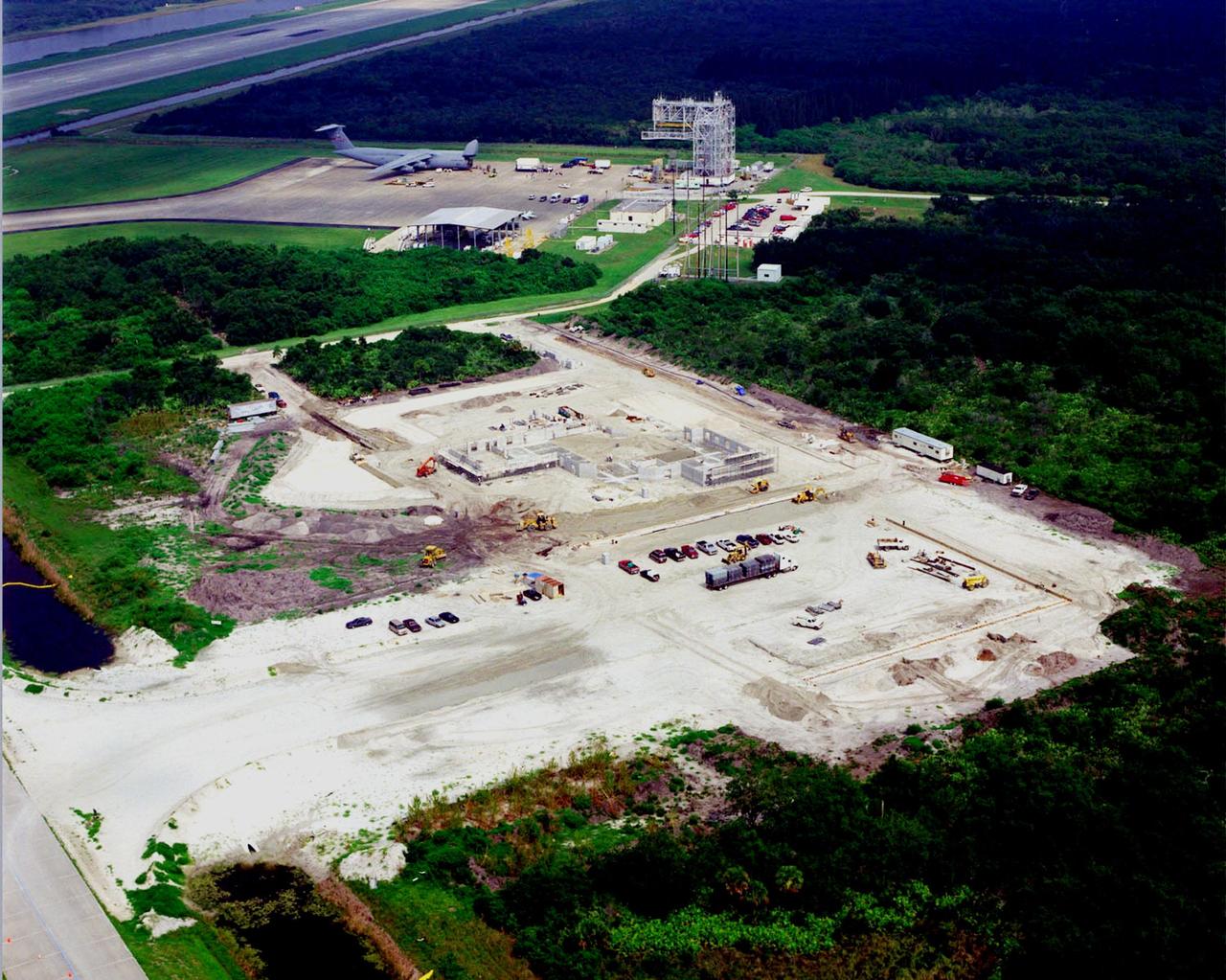
This aerial view shows the construction of a multi-purpose hangar, which is part of the $8 million Reusable Launch Vehicle (RLV) Support Complex at Kennedy Space Center. In the background is the Shuttle Landing Facility, with (left) a C-5 air cargo plane, the offloaded canister in front of it containing the Multi-Purpose Logistics Module Raffaello, and (right) the mate/demate tower that is used when an orbiter is transported to and from KSC atop a modified Boeing 747. The RLV complex will also include facilities for related ground support equipment and administrative/ technical support. It will be available to accommodate the Space Shuttle; the X-34 RLV technology demonstrator; the L-1011 carrier aircraft for Pegasus and X-34; and other RLV and X-vehicle programs. The complex is jointly funded by the Spaceport Florida Authority, NASA's Space Shuttle Program and KSC. The facility will be operational in early 2000.
KSC-99pp-1046
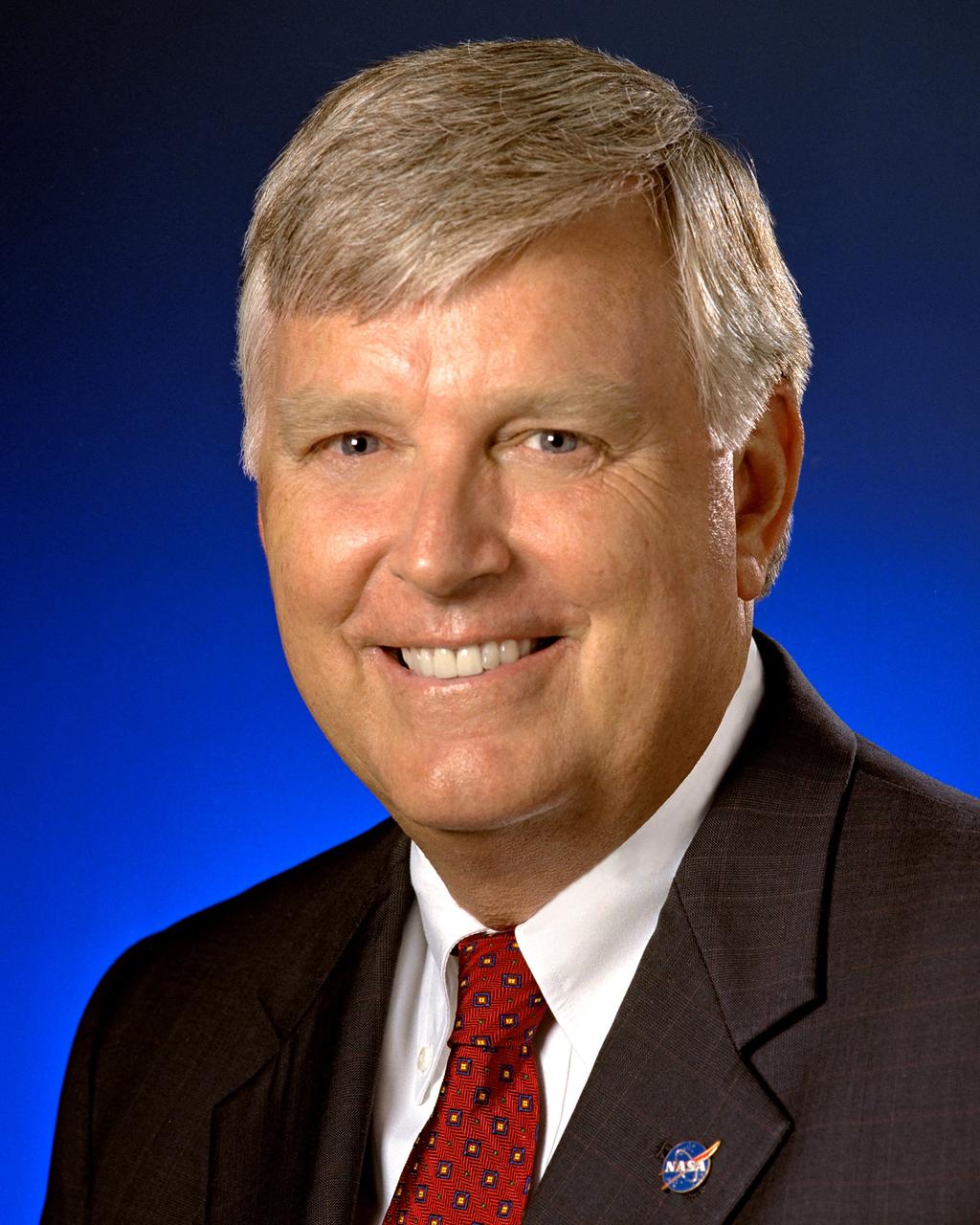
KENNEDY SPACE CENTER, FLA. -  Official portrait of James W. Kennedy, the director of the NASA Kennedy Space Center in Florida from August 2003 to January 2007.
KENNEDY SPACE CENTER, FLA. - Official portrait of James W. Kennedy, the director of the NASA Kennedy Space Center in Florida from August 2003 to January 2007.
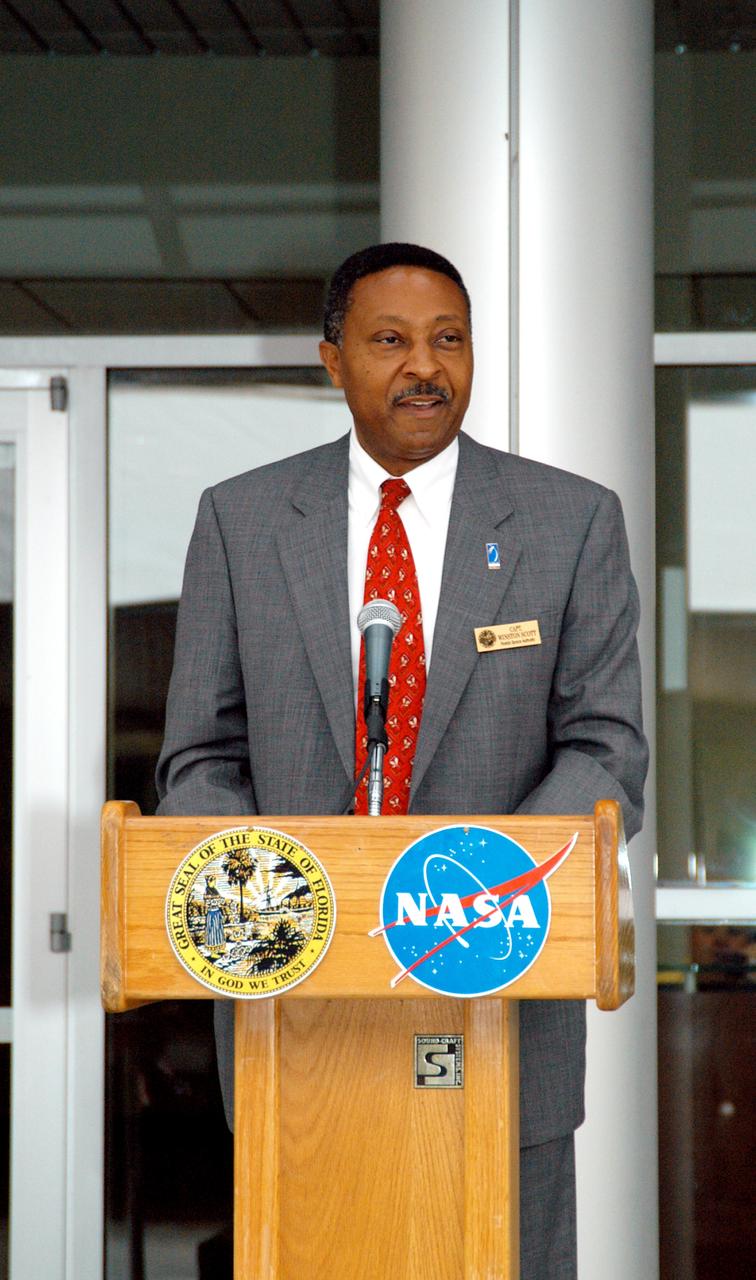
KENNEDY SPACE CENTER, FLA. -  Capt. Winston Scott, executive director of the Florida Space Authority, speaks at a dedication and ribbon-cutting ceremony for the Space Life Sciences Lab hosted by NASA-Kennedy Space Center and the state of Florida at the new lab. Completed in August, the facility encompasses more than 100,000 square feet and was formerly known as the Space Experiment Research and Processing Laboratory or SERPL. The state, through the Florida Space Authority, built the research lab which is host to NASA, NASA’s Life Sciences Services contractor Dynamac Corp., Bionetics Corp., and researchers from the University of Florida.  Dynamac Corp. leases the facility.  The Florida Space Research Institute is responsible for gaining additional tenants from outside the NASA community.
KENNEDY SPACE CENTER, FLA. - Capt. Winston Scott, executive director of the Florida Space Authority, speaks at a dedication and ribbon-cutting ceremony for the Space Life Sciences Lab hosted by NASA-Kennedy Space Center and the state of Florida at the new lab. Completed in August, the facility encompasses more than 100,000 square feet and was formerly known as the Space Experiment Research and Processing Laboratory or SERPL. The state, through the Florida Space Authority, built the research lab which is host to NASA, NASA’s Life Sciences Services contractor Dynamac Corp., Bionetics Corp., and researchers from the University of Florida. Dynamac Corp. leases the facility. The Florida Space Research Institute is responsible for gaining additional tenants from outside the NASA community.
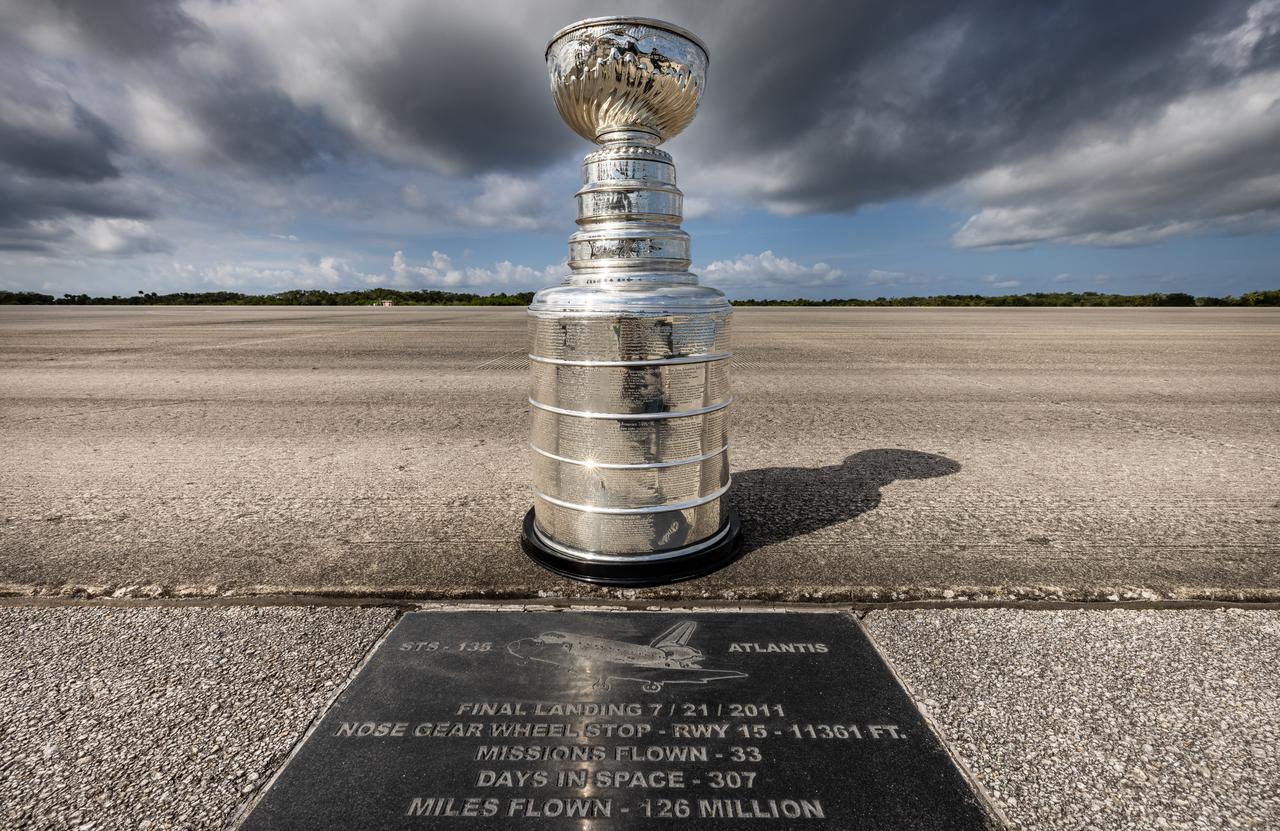
Earlier this year, the Florida Panthers won their first NHL championship and brought victory to the state of Florida. As part of its championship tour, the Stanley Cup made a visit to Kennedy Space Center. Pictured here is the Stanley Cup on the runway of the Launch and Landing Facility, formerly the Shuttle Landing Facility at NASA’s Kennedy Space Center on Tuesday Sept. 17, 2024. The trophy is beside the Space Shuttle Atlantis landmark, a commemorative plaque marking the landing spot of the last shuttle flight that occurred in July 2011.
NHL Florida Panthers Stanley Cup Visit
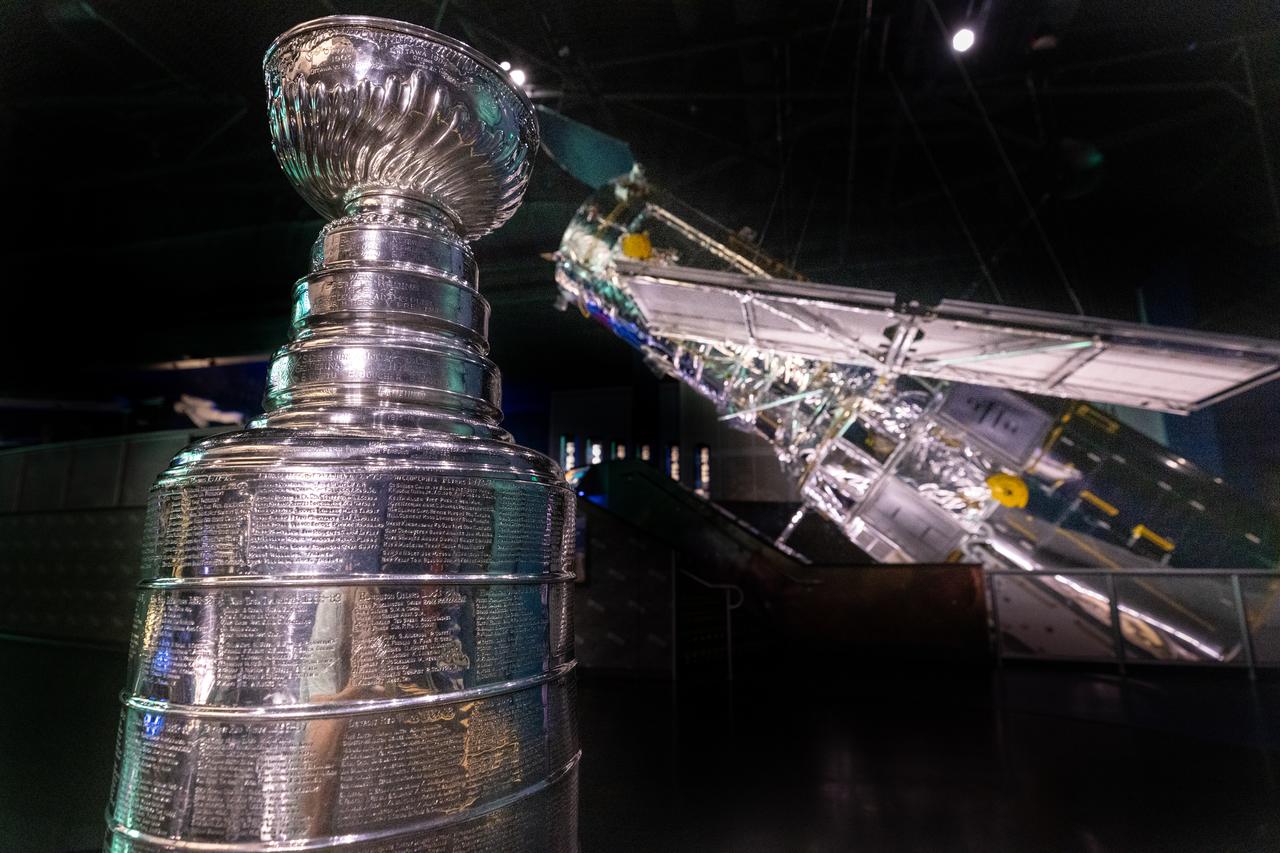
Earlier this year, the Florida Panthers won their first NHL championship and brought victory to the state of Florida. As part of its championship tour, the Stanley Cup made a visit to NASA’s Kennedy Space Center. Pictured here is the shining silver Stanley Cup in the foreground with a large-scale mockup of the Hubble Space Telescope in the background at the Kennedy Space Center Visitor’s Complex on Tuesday Sept. 17, 2024.
NHL Florida Panthers Stanley Cup Visit
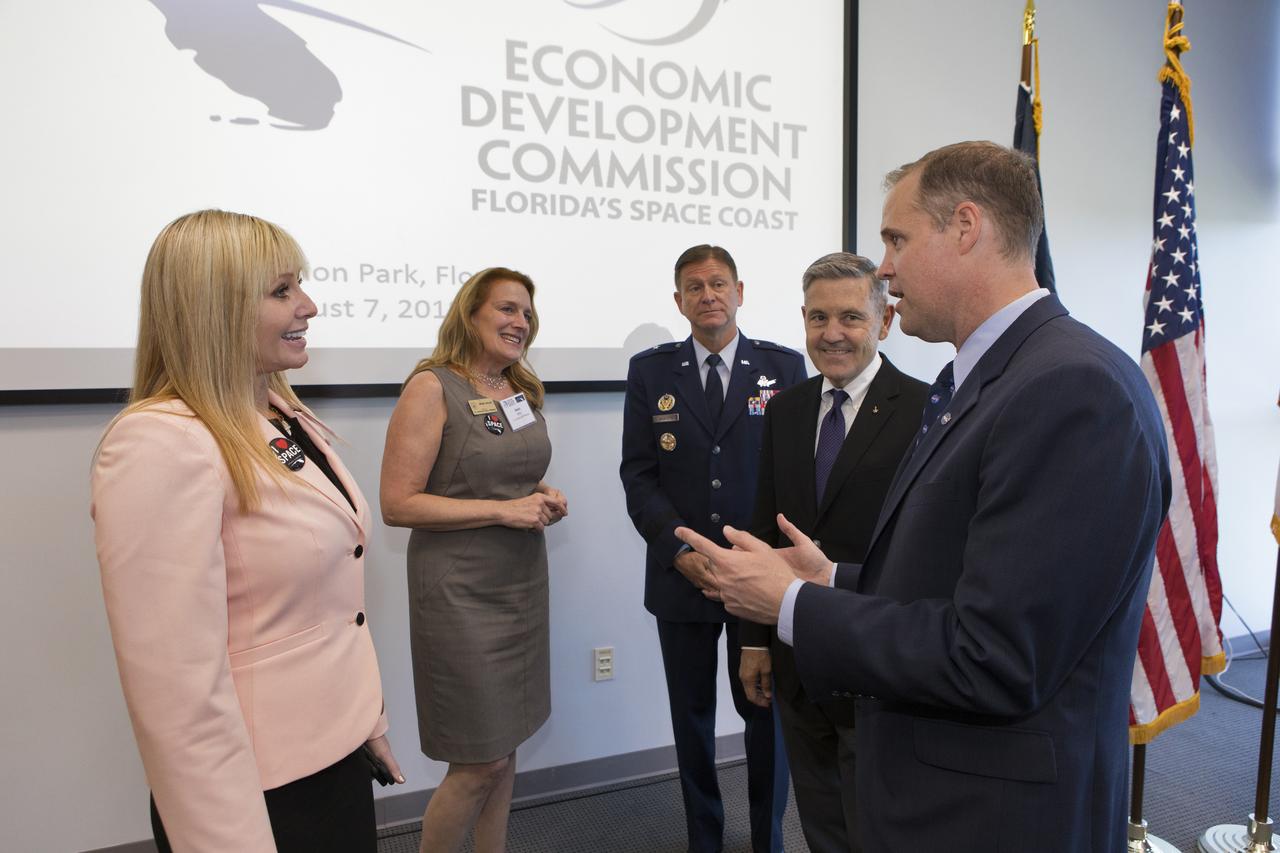
NASA Administrator Jim Bridenstine, far right, talks with participants of an Economic Development Commission roundtable discussion hosted by Space Florida at the Space Life Sciences Laboratory on Aug. 7, 2018, near NASA's Kennedy Space Center in Florida. In view next to Bridenstine is Kennedy Center Director Bob Cabana, and Brigadier General Wayne Monteith, commander, 45th Space Wing, and director, Eastern Range, at Patrick Air Force Base in Florida. The administrator also toured Kennedy facilities and received updates on various center accomplishments.
NASA Administrator Jim Bridenstine Visits KSC - Space Life Scien
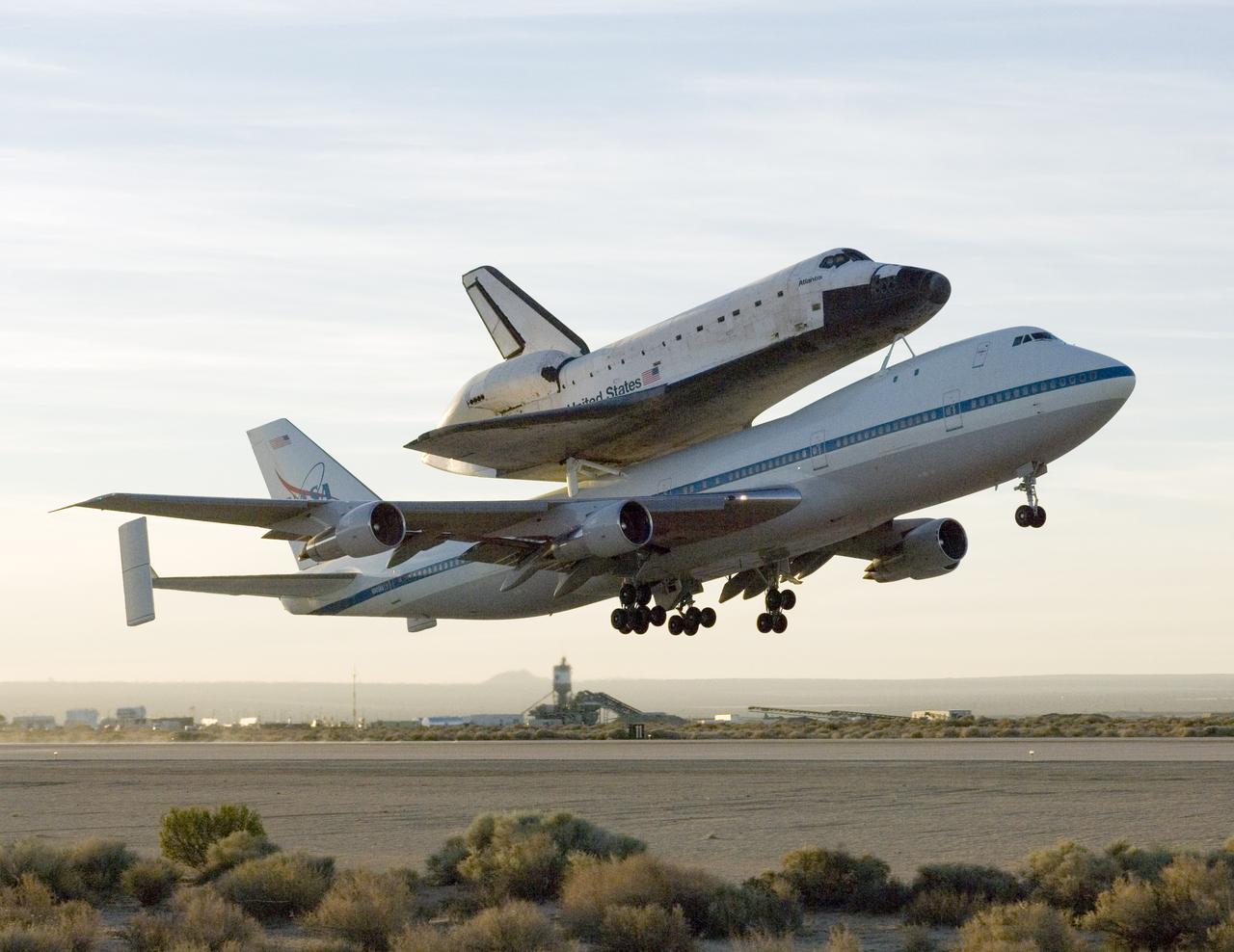
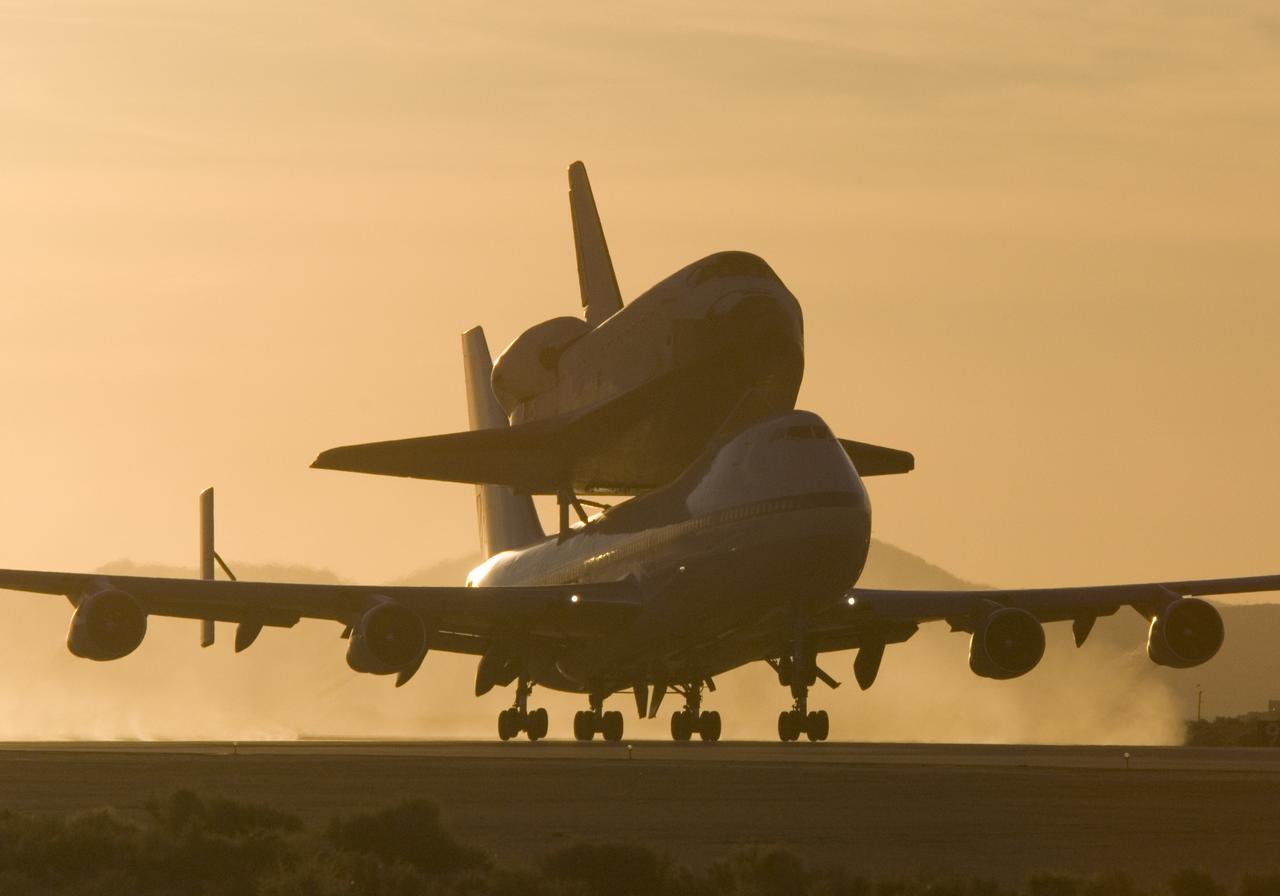
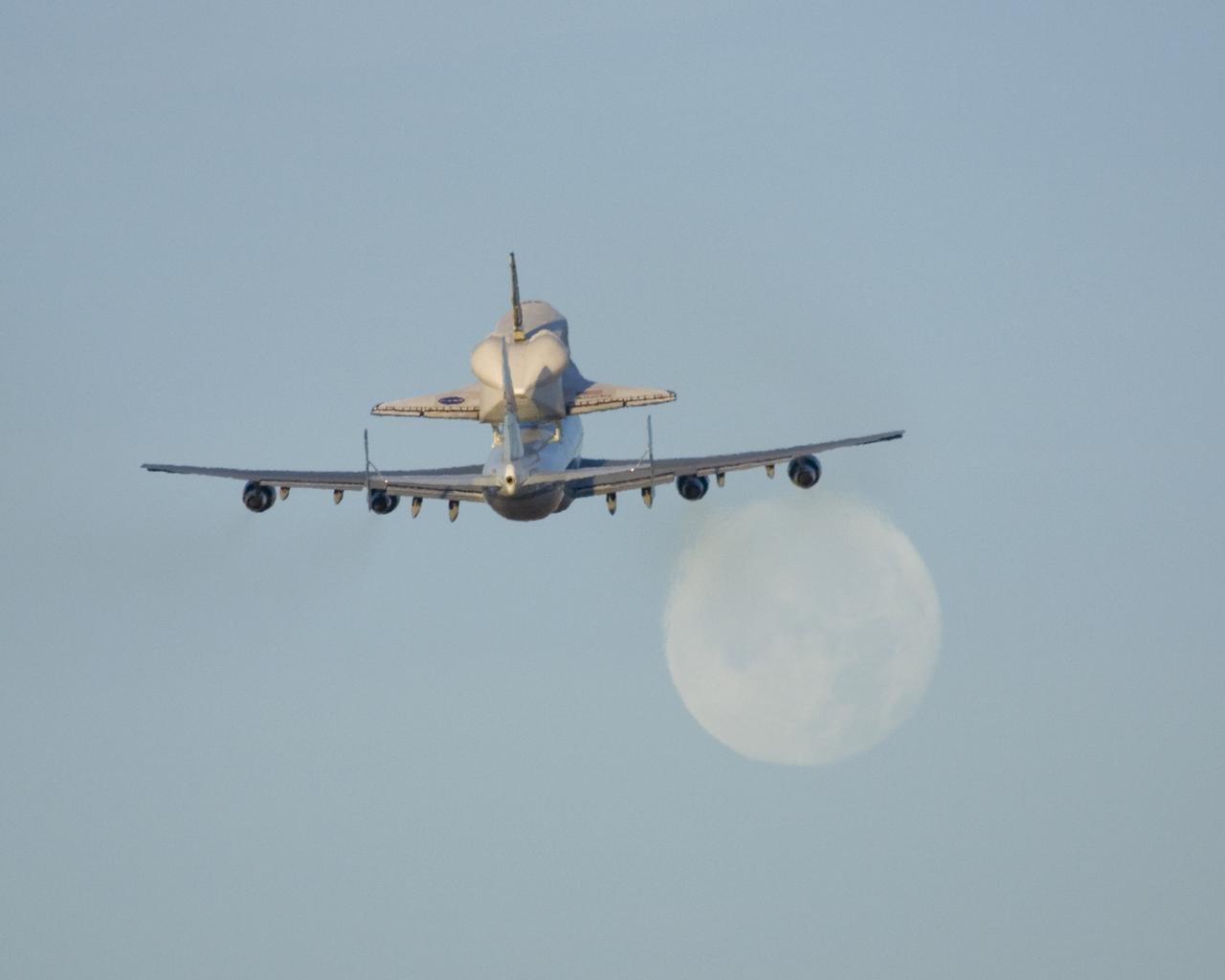
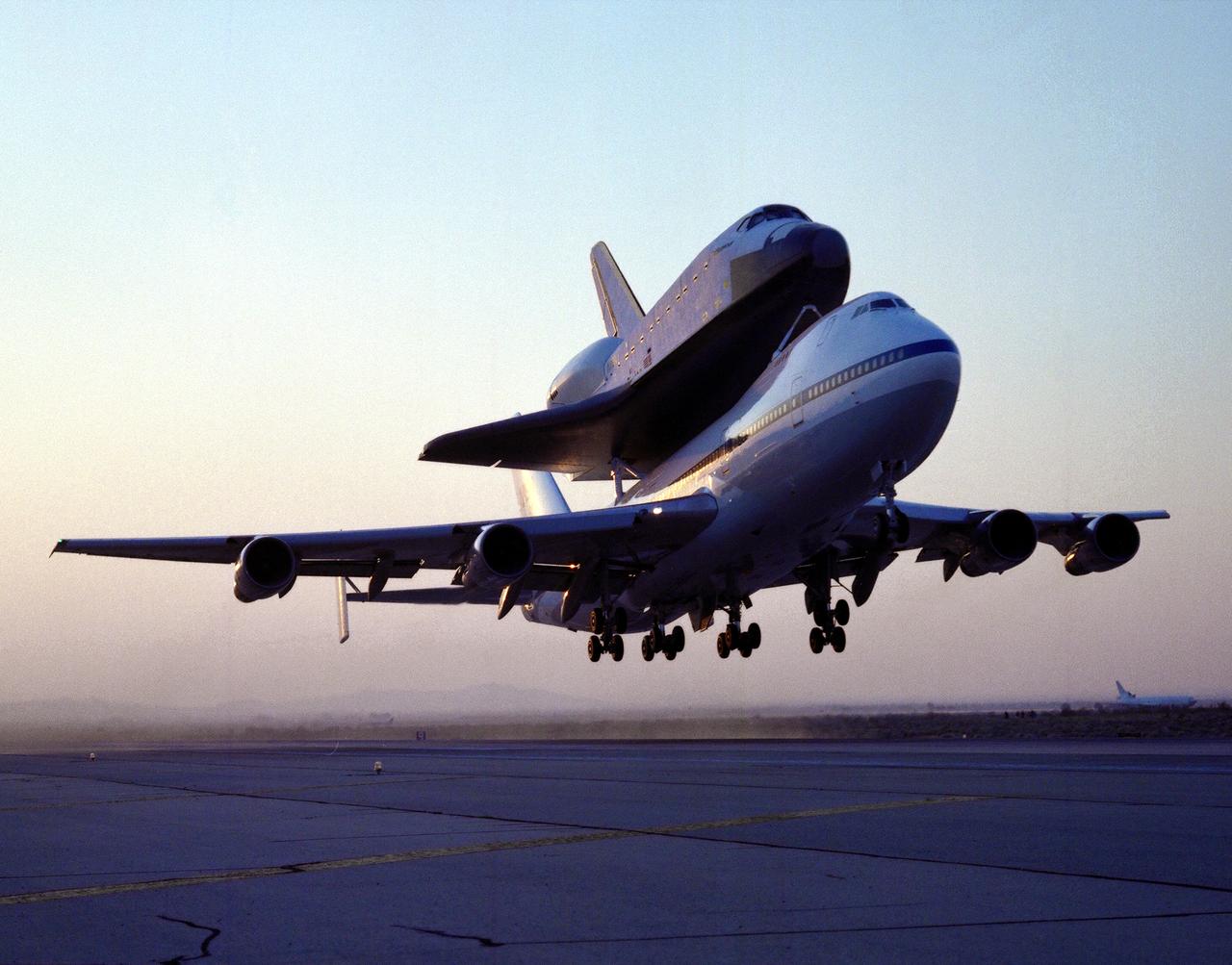
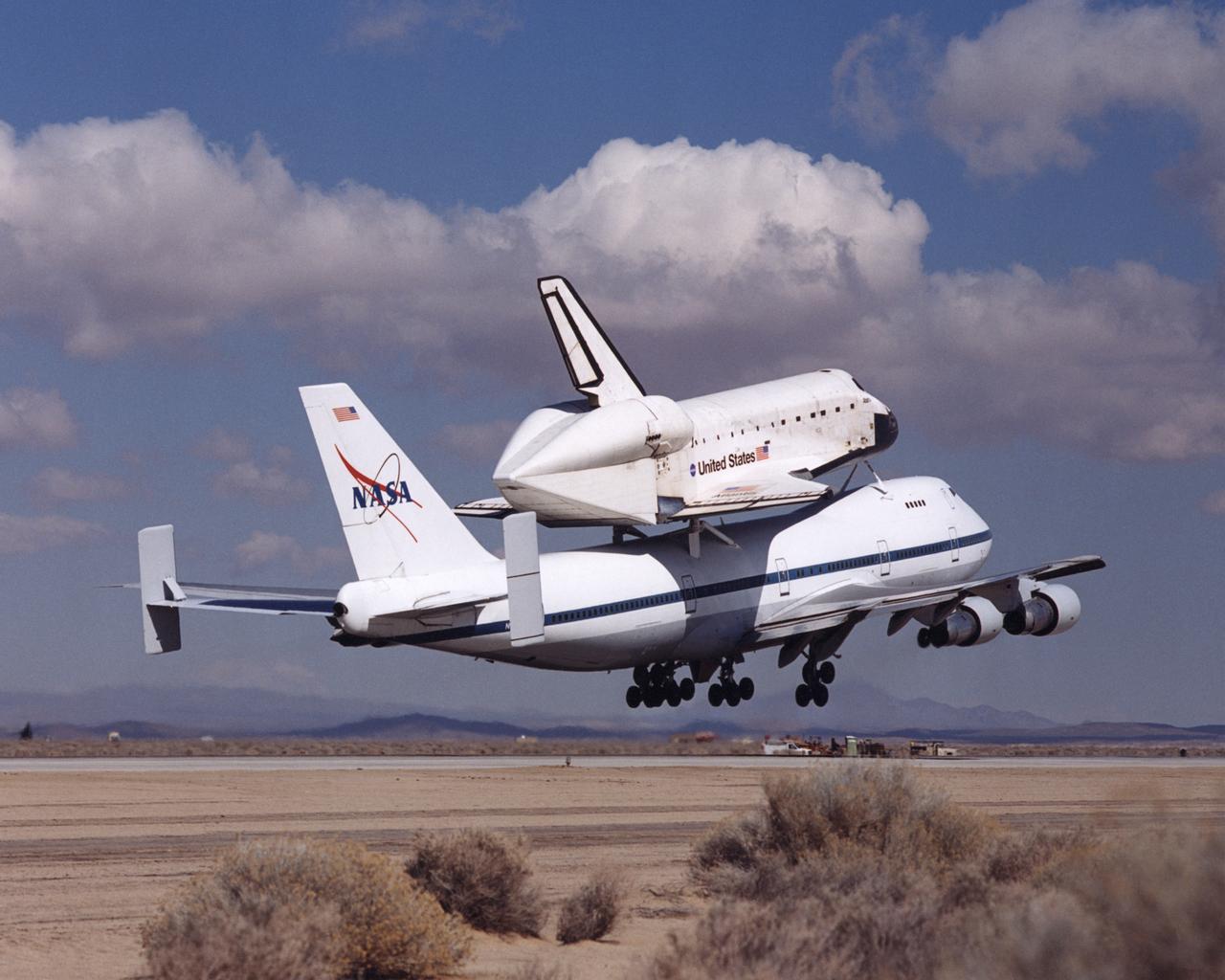
NASA's modified Boeing 747 Shuttle Carrier Aircraft with the Space Shuttle Atlantis on top lifts off from Edwards Air Force Base to begin its ferry flight back to the Kennedy Space Center in Florida. The cross-country journey will take approximately two days, with stops at several intermediate points for refueling.
NASA's 747 Shuttle Carrier Aircraft with the Space Shuttle Atlantis on top lifts off to begin its ferry flight back to the Kennedy Space Center in Florida
NASA's modified Boeing 747 Shuttle Carrier Aircraft with the Space Shuttle Atlantis on top lifts off from Edwards Air Force Base to begin its ferry flight back to the Kennedy Space Center in Florida. The cross-country journey will take approximately two days, with stops at several intermediate points for refueling.
NASA's 747 Shuttle Carrier Aircraft with the Space Shuttle Atlantis on top lifts off to begin its ferry flight back to the Kennedy Space Center in Florida
NASA's modified Boeing 747 Shuttle Carrier Aircraft with the Space Shuttle Atlantis on top lifts off from Edwards Air Force Base to begin its ferry flight back to the Kennedy Space Center in Florida. The cross-country journey will take approximately two days, with stops at several intermediate points for refueling.
NASA's 747 Shuttle Carrier Aircraft with the Space Shuttle Atlantis on top lifts off to begin its ferry flight back to the Kennedy Space Center in Florida
The Moon is seen during a total lunar eclipse, Tuesday, Nov. 8, 2022, at NASA’s Kennedy Space Center in Florida.  Photo Credit: (NASA/Joel Kowsky)
Total Lunar Eclipse
The Moon is seen during a total lunar eclipse, Tuesday, Nov. 8, 2022, at NASA’s Kennedy Space Center in Florida.  Photo Credit: (NASA/Joel Kowsky)
Total Lunar Eclipse
The Moon is seen during a total lunar eclipse, Tuesday, Nov. 8, 2022, at NASA’s Kennedy Space Center in Florida.  Photo Credit: (NASA/Joel Kowsky)
Total Lunar Eclipse
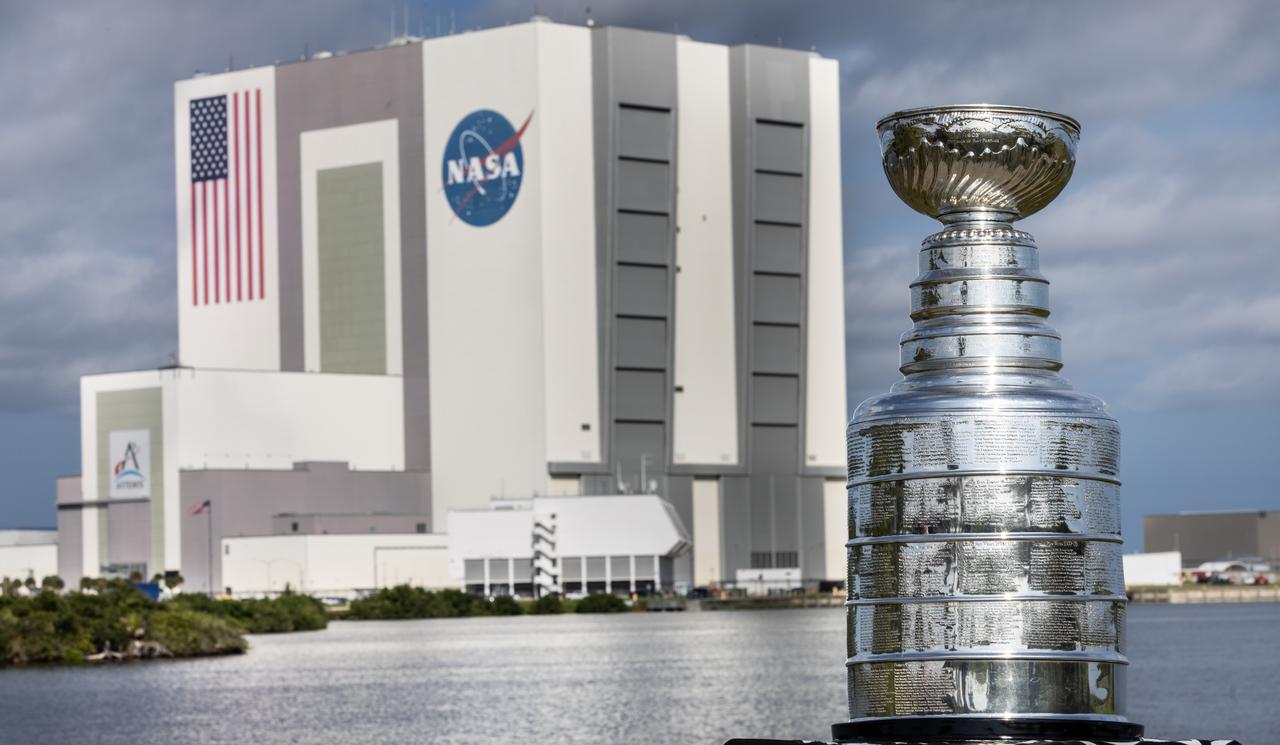
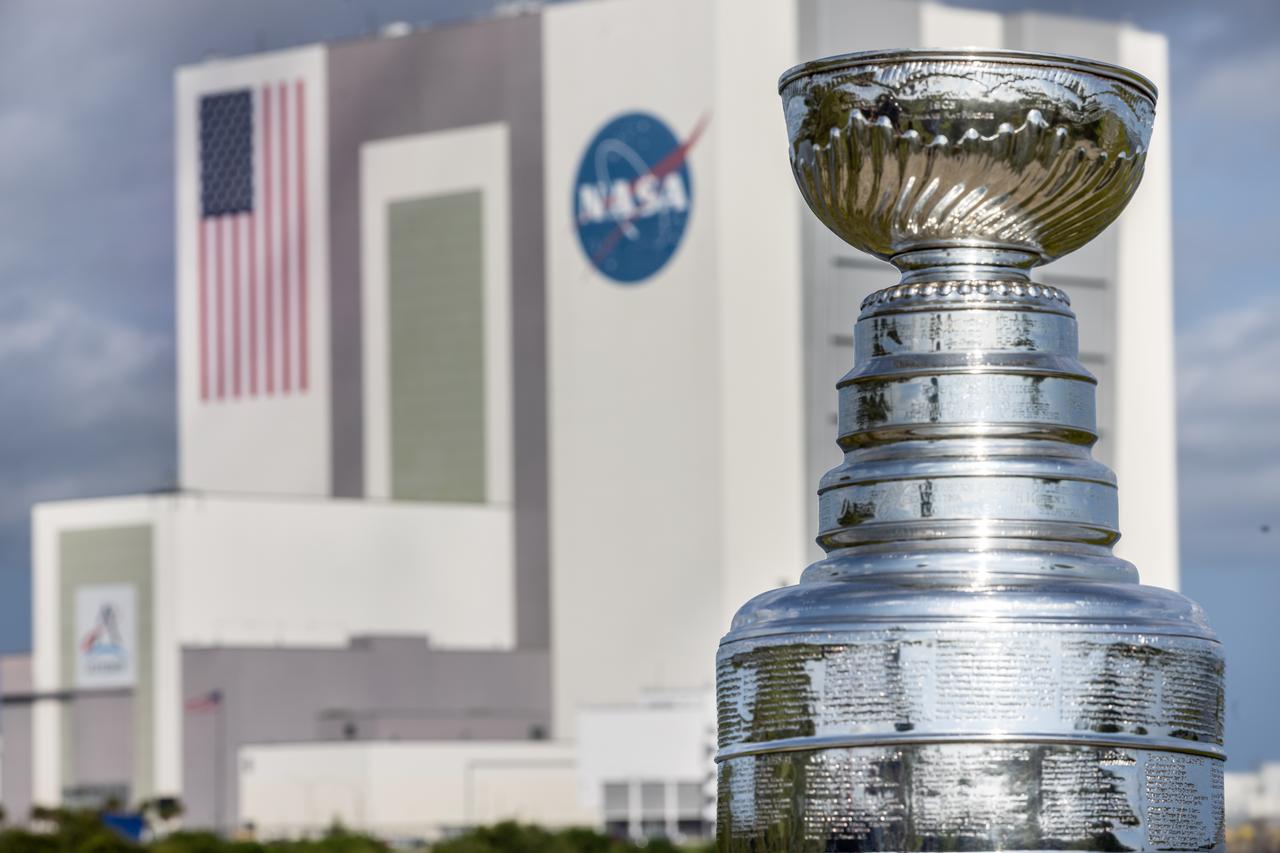
Earlier this year, the Florida Panthers won their first NHL championship and brought victory to the state of Florida. As part of its championship tour, the Stanley Cup made a visit to NASA’s Kennedy Space Center. Pictured here is the silver Stanley Cup with NASA’s iconic Vehicle Assembly Building, which currently houses components of the agency’s Artemis II mission, shown in the background at the Kennedy Space Center on Tuesday Sept. 17, 2024.
NHL Florida Panthers Stanley Cup Visit
Earlier this year, the Florida Panthers won their first NHL championship and brought victory to the state of Florida. As part of its championship tour, the Stanley Cup made a visit to NASA’s Kennedy Space Center. Pictured here is the silver Stanley Cup with NASA’s iconic Vehicle Assembly Building, which currently houses components of the agency’s Artemis II mission, shown in the background at the Kennedy Space Center on Tuesday Sept. 17, 2024.
NHL Florida Panthers Stanley Cup Visit
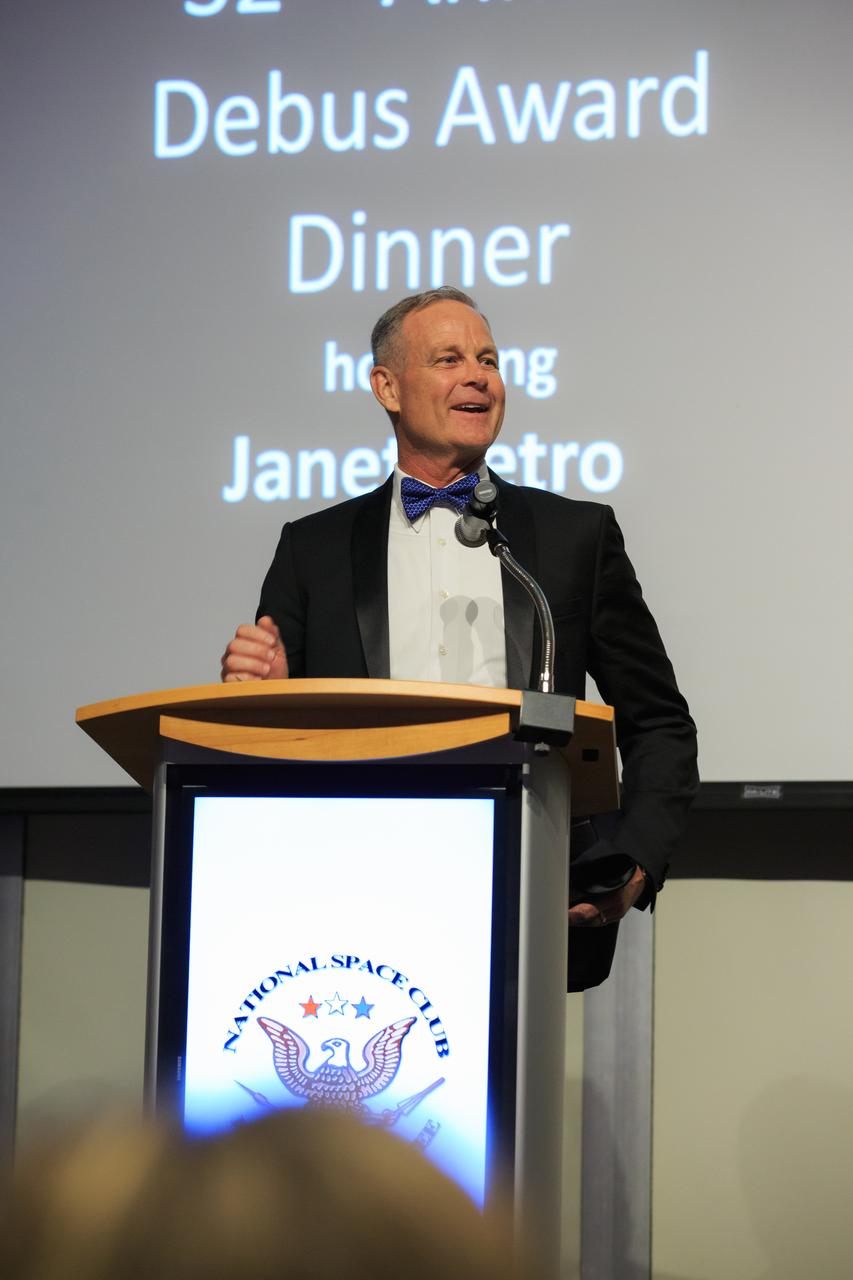
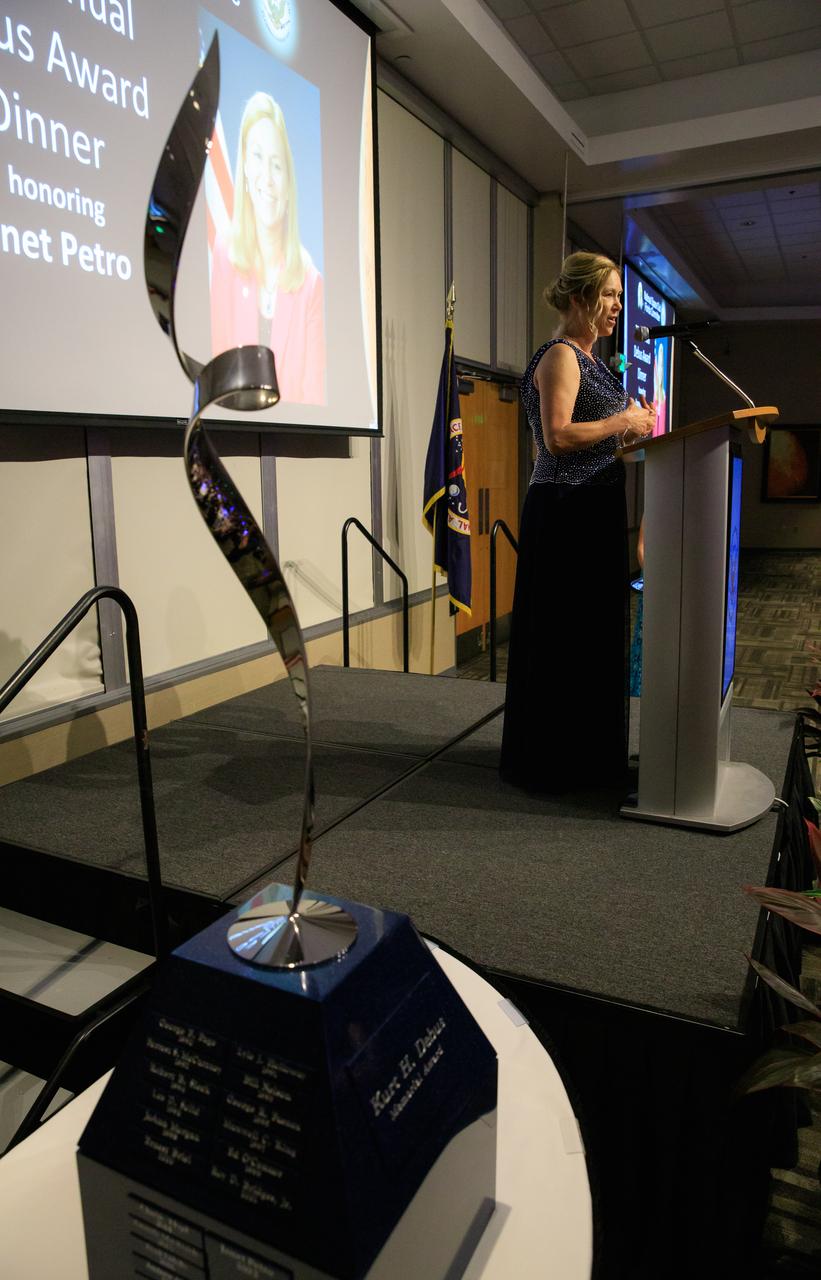
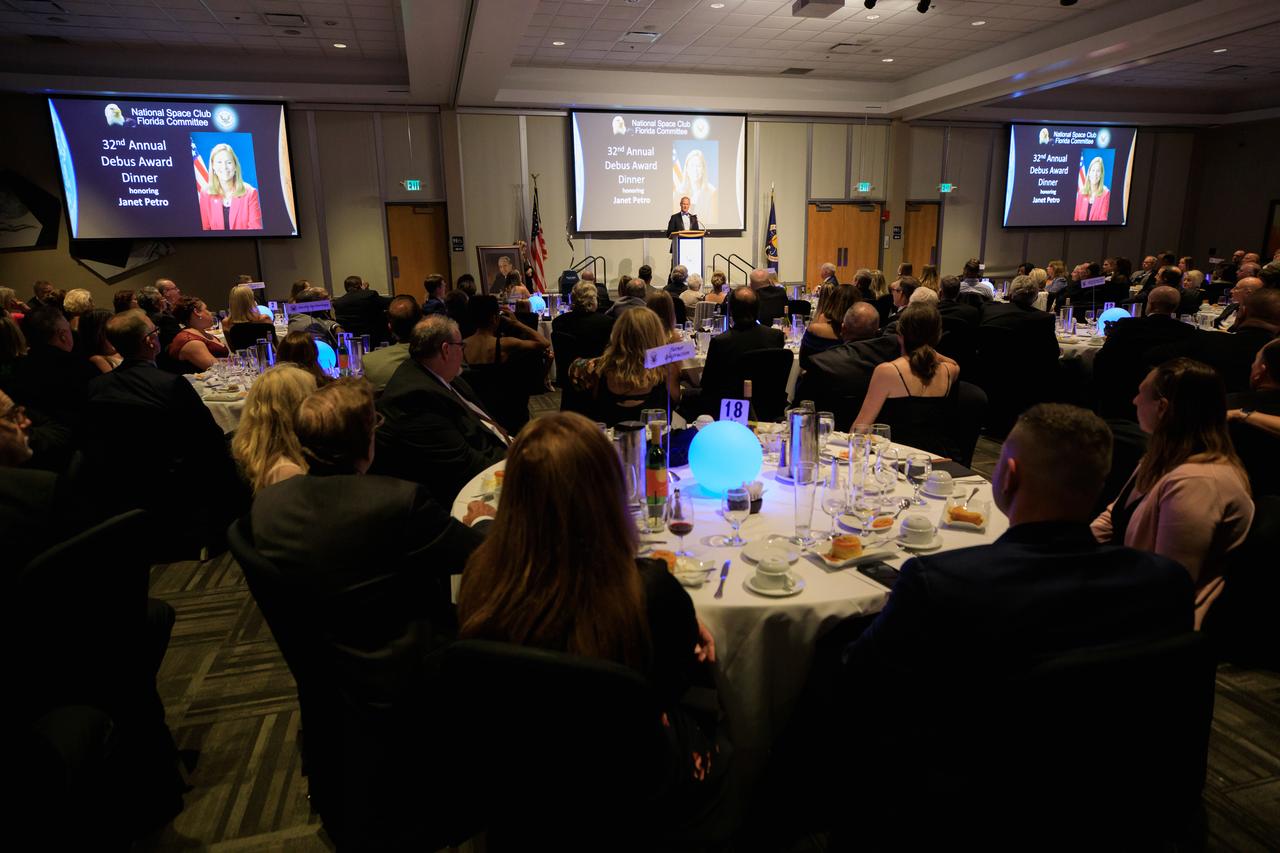
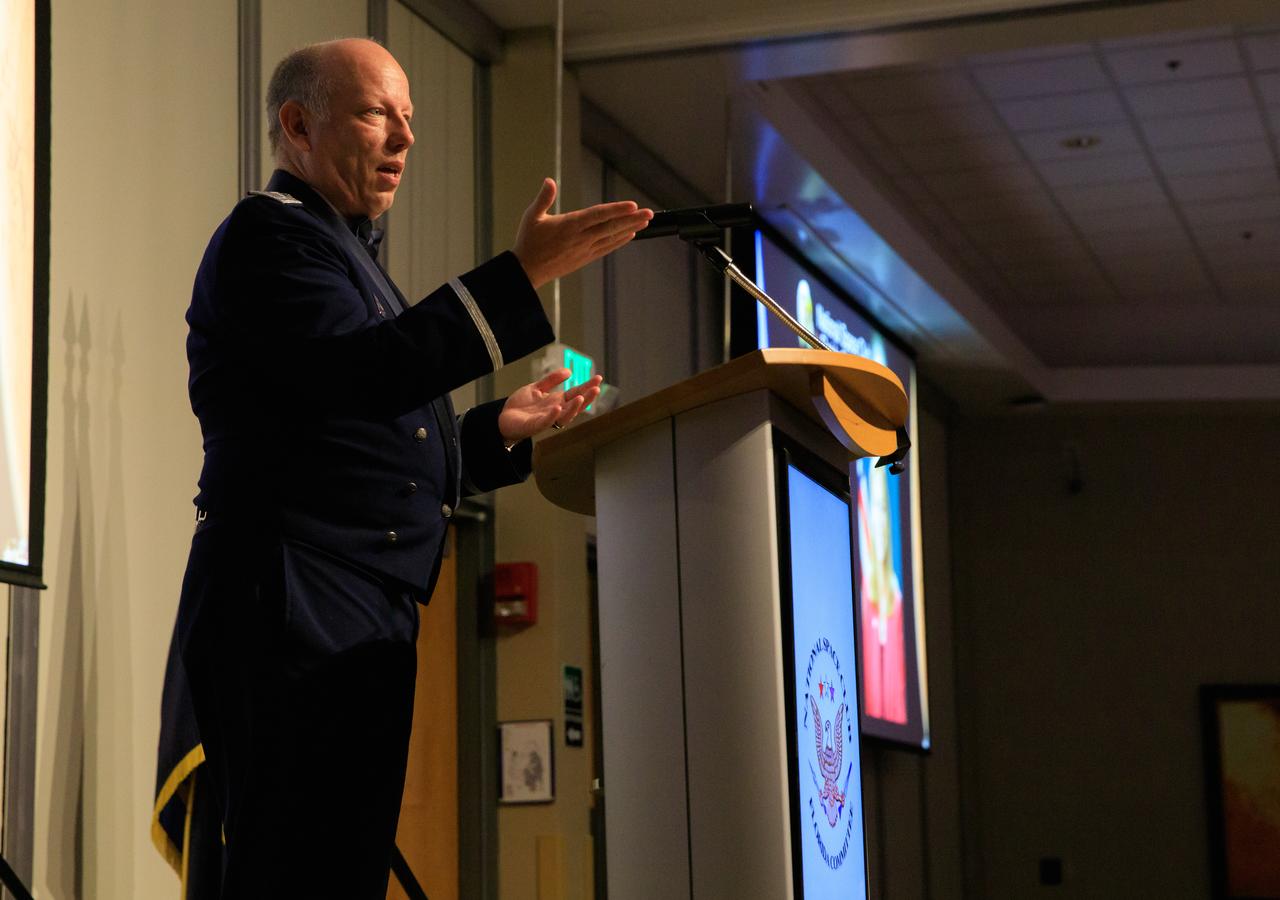
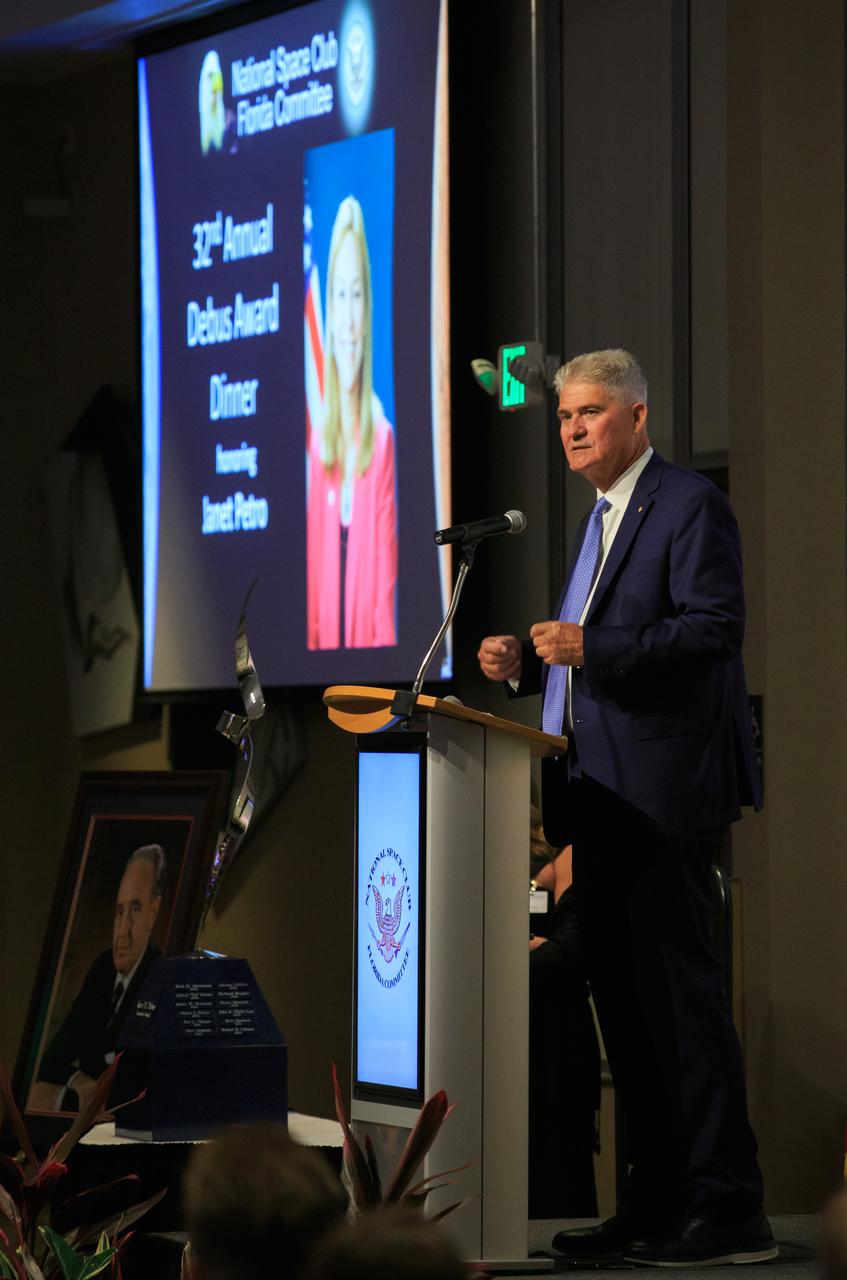
Brigadier General Stephen Purdy, commander of Space Launch Delta 45, speaks at a ceremony honoring Kennedy Space Center Director Janet Petro with the Dr. Kurt H. Debus Award on June 24, 2022, at the Florida spaceport’s visitor complex. The National Space Club Florida Committee presented Petro with the prestigious award for her contributions to America’s aerospace efforts within the state of Florida. The award – originating in 1990 – is named after Kennedy’s first director.
Debus Award Presentation to Janet Petro
Bill Parsons, vice president of Human Space Programs at Peraton, speaks at a ceremony honoring Kennedy Space Center Director Janet Petro with the Dr. Kurt H. Debus Award on June 24, 2022, at the Florida spaceport’s visitor complex. The National Space Club Florida Committee presented Petro with the prestigious award for her contributions to America’s aerospace efforts within the state of Florida. The award – originating in 1990 – is named after Kennedy’s first director.
Debus Award Presentation to Janet Petro
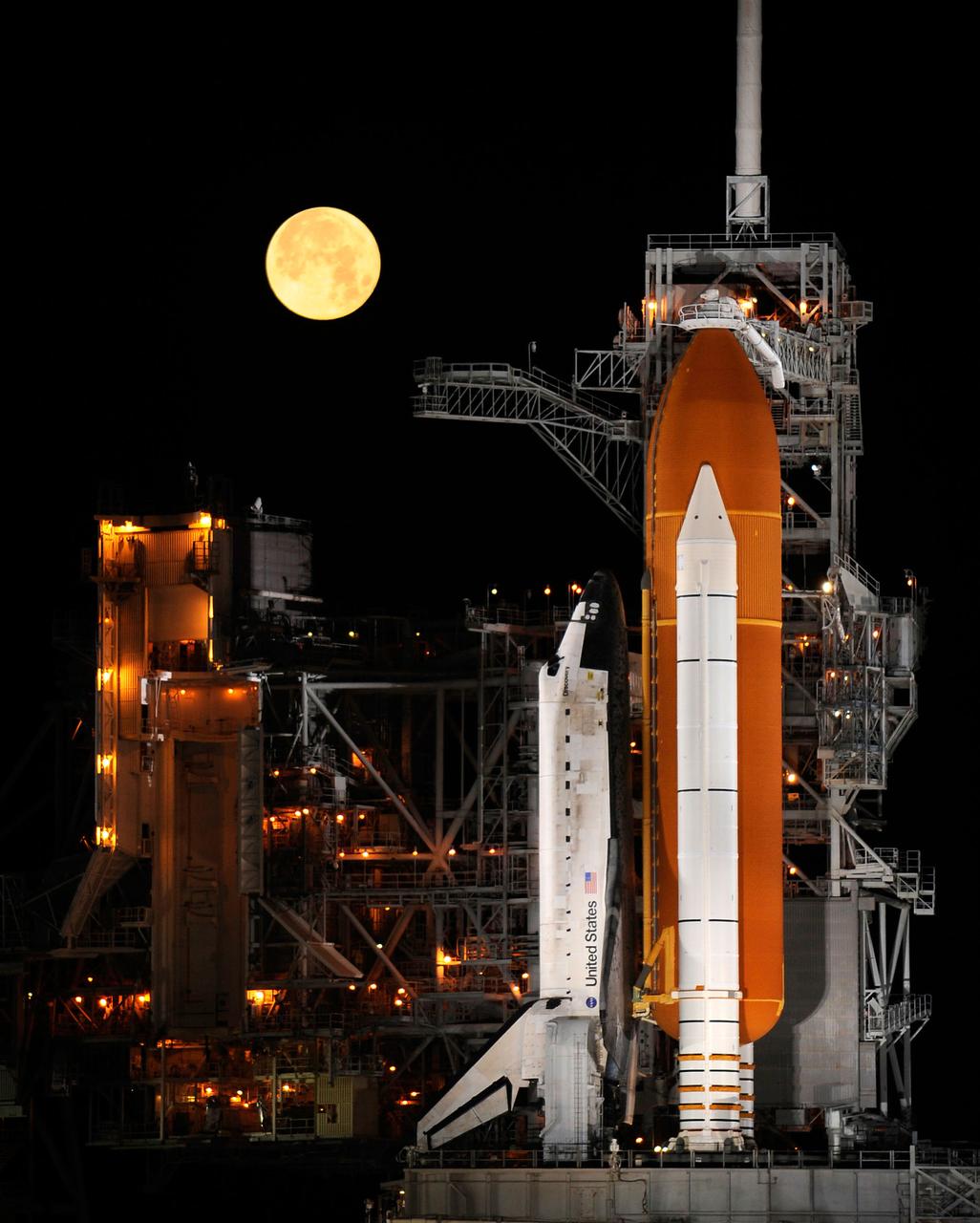
A nearly full Moon sets as the space shuttle Discovery sits atop Launch pad 39A at the Kennedy Space Center in Cape Canaveral, Florida, Wednesday, March 11, 2009.  Photo Credit: (NASA/Bill Ingalls)
STS-119 Shuttle Discovery With Moon
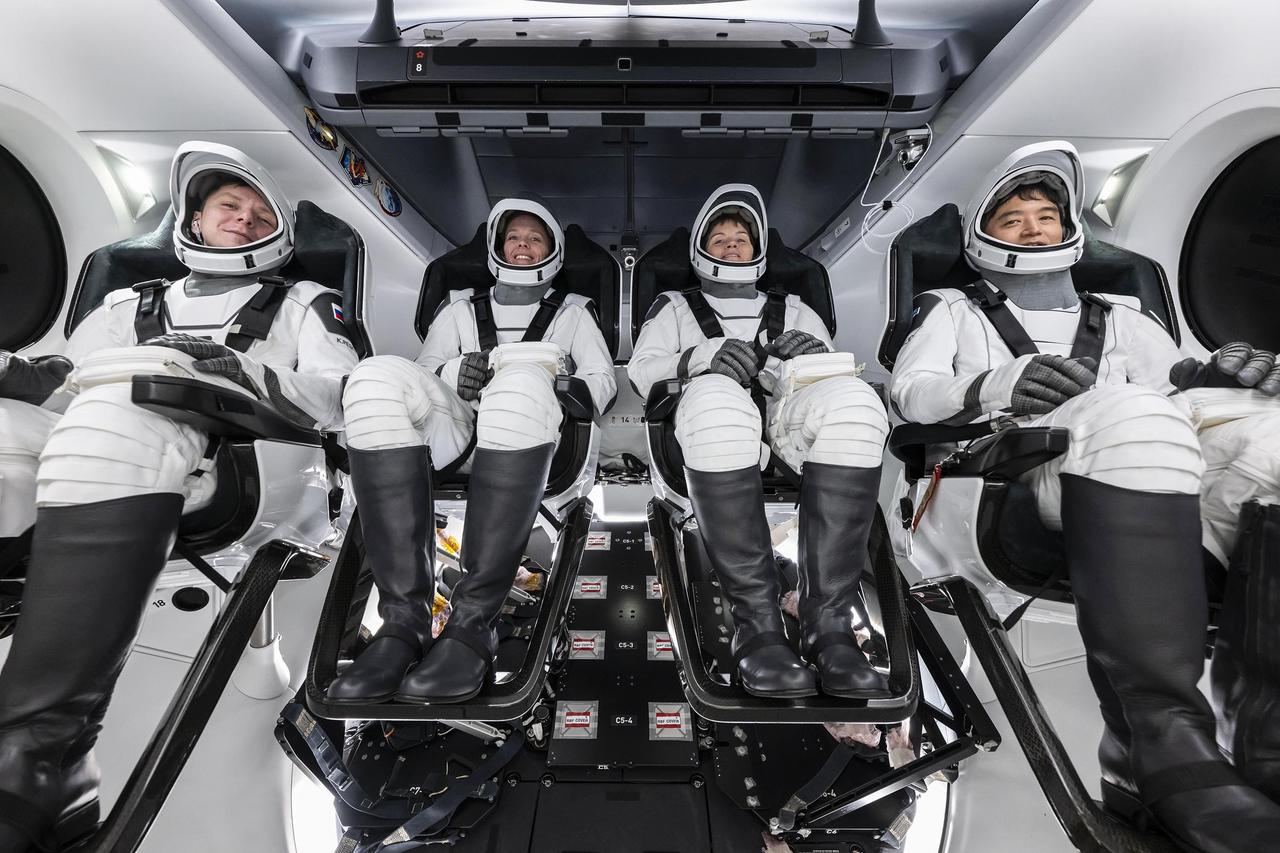
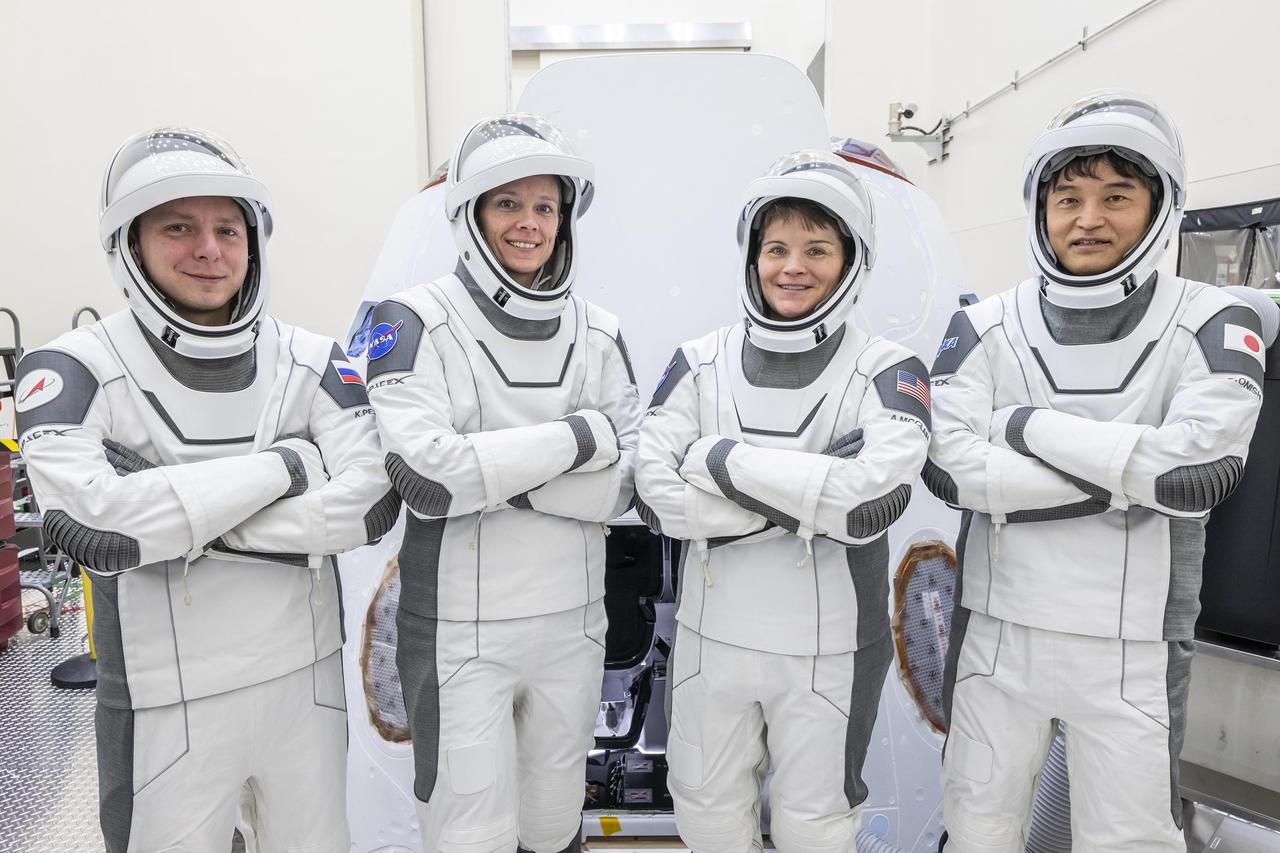
The crew of NASA’s SpaceX Crew-10 mission poses for a photo during a crew equipment interface test (CEIT) inside SpaceX’s new Dragon processing facility at the agency’s Kennedy Space Center in Florida on Monday, Feb. 17, 2025. From left, Roscosmos cosmonaut Kirill Peskov, mission specialist; NASA astronauts Nichole Ayers, pilot and Anne McClain, commander; and JAXA (Japan Aerospace Exploration Agency) astronaut Takuya Onishi, mission specialist, participated in the CEIT, which plays an important role in familiarizing crew members with the interior of the Dragon spacecraft ahead of their four-month mission to International Space Station.
SpaceX Crew-10 CEIT
The crew of NASA’s SpaceX Crew-10 mission poses for a photo during a crew equipment interface test (CEIT) inside SpaceX’s new Dragon processing facility at the agency’s Kennedy Space Center in Florida on Monday, Feb. 17, 2025. From left, Roscosmos cosmonaut Kirill Peskov, mission specialist; NASA astronauts Nichole Ayers, pilot and Anne McClain, commander; and JAXA (Japan Aerospace Exploration Agency) astronaut Takuya Onishi, mission specialist, participated in the CEIT, which plays an important role in familiarizing crew members with the interior of the Dragon spacecraft ahead of their four-month mission to International Space Station.
SpaceX Crew-10 CEIT
KENNEDY SPACE CENTER, FLA. -  Frank T. Brogan, president of the Florida Atlantic University, speaks at a dedication and ribbon-cutting ceremony for the Space Life Sciences Lab hosted by NASA-Kennedy Space Center and the state of Florida at the new lab. Completed in August, the facility encompasses more than 100,000 square feet and was formerly known as the Space Experiment Research and Processing Laboratory or SERPL. The state, through the Florida Space Authority, built the research lab which is host to NASA, NASA’s Life Sciences Services contractor Dynamac Corp., Bionetics Corp., and researchers from the University of Florida.  Dynamac Corp. leases the facility.  The Florida Space Research Institute is responsible for gaining additional tenants from outside the NASA community.
KENNEDY SPACE CENTER, FLA. - Frank T. Brogan, president of the Florida Atlantic University, speaks at a dedication and ribbon-cutting ceremony for the Space Life Sciences Lab hosted by NASA-Kennedy Space Center and the state of Florida at the new lab. Completed in August, the facility encompasses more than 100,000 square feet and was formerly known as the Space Experiment Research and Processing Laboratory or SERPL. The state, through the Florida Space Authority, built the research lab which is host to NASA, NASA’s Life Sciences Services contractor Dynamac Corp., Bionetics Corp., and researchers from the University of Florida. Dynamac Corp. leases the facility. The Florida Space Research Institute is responsible for gaining additional tenants from outside the NASA community.
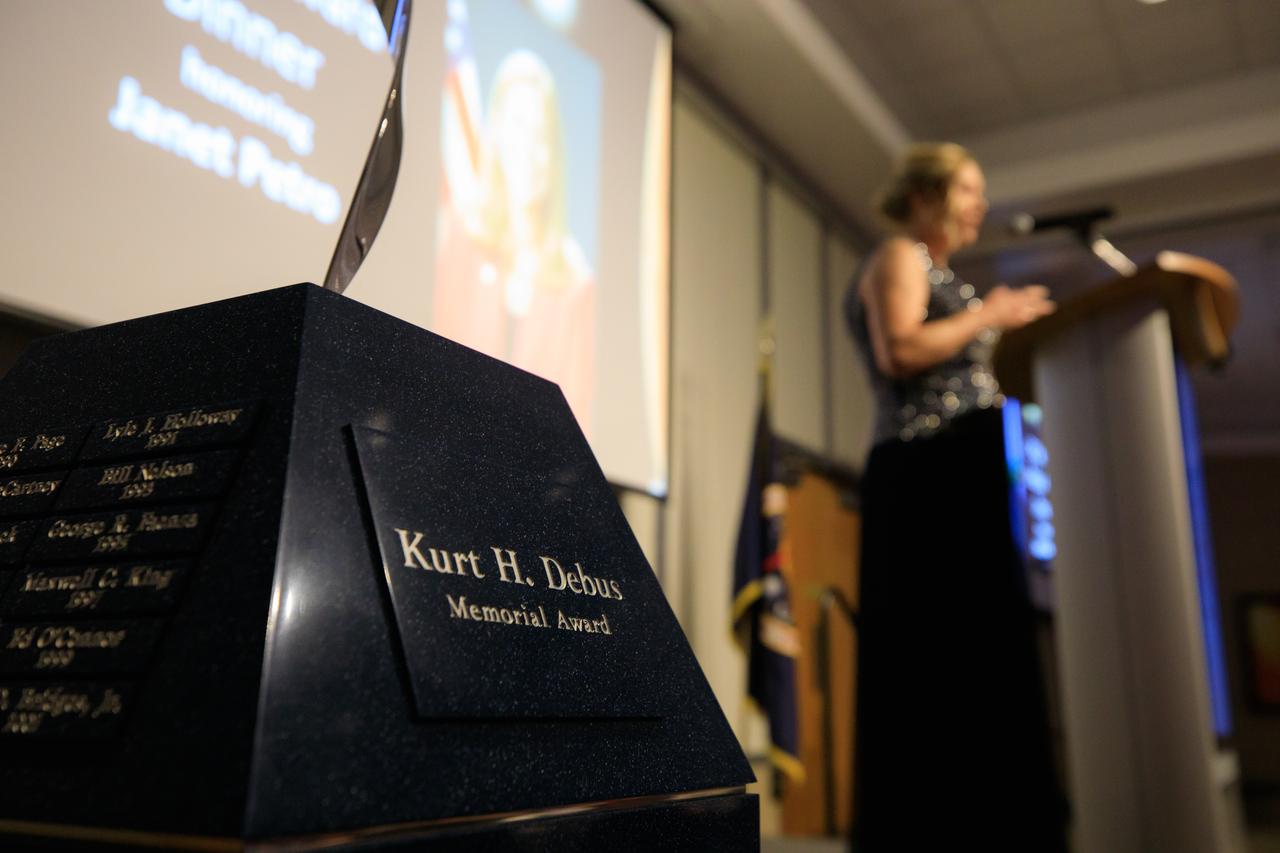
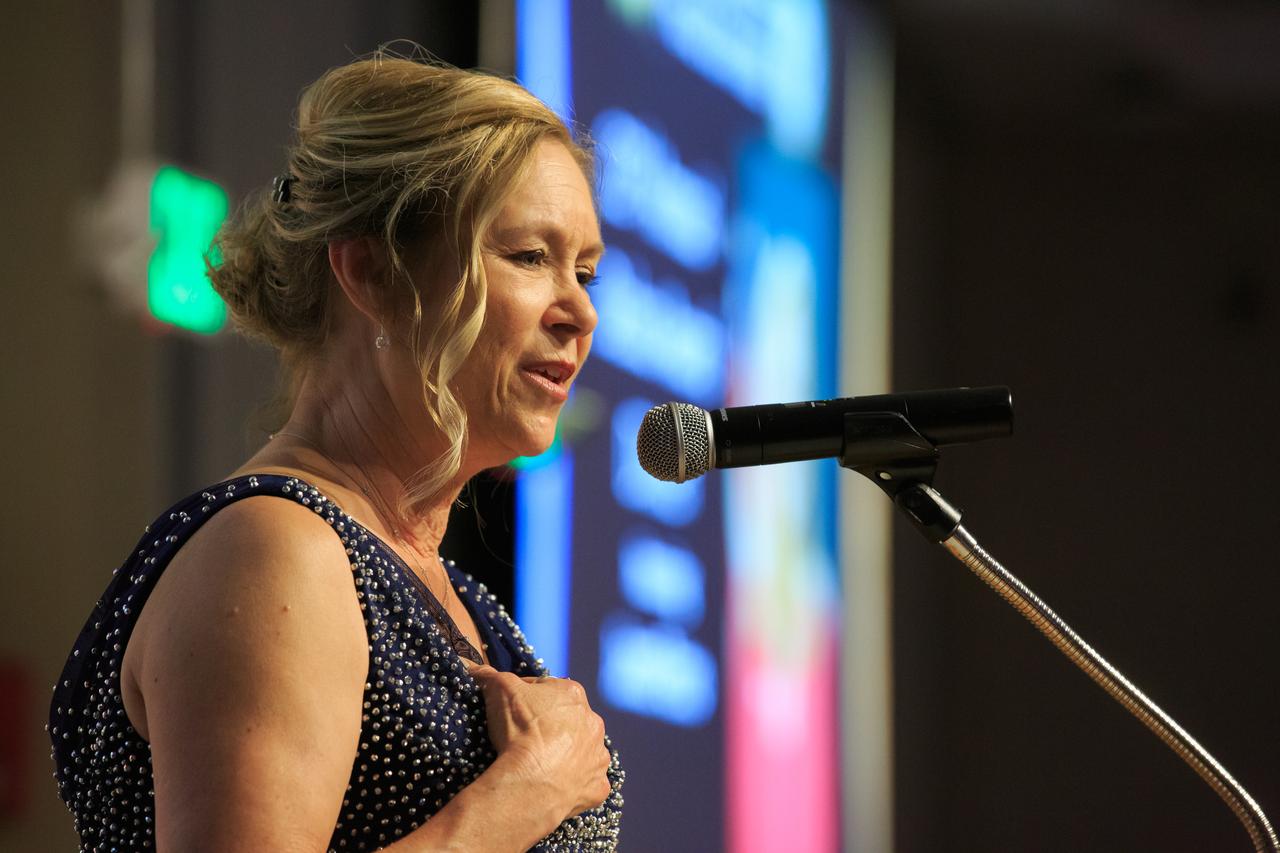
Kennedy Space Center Director Janet Petro addresses friends, colleagues, and family following her acceptance of the Dr. Kurt H. Debus Award on June 24, 2022, during a ceremony held at the Florida spaceport’s visitor complex. The National Space Club Florida Committee presented Petro with the prestigious award for her contributions to America’s aerospace efforts within the state of Florida. The award – originating in 1990 – is named after Kennedy’s first director.
Debus Award Presentation to Janet Petro
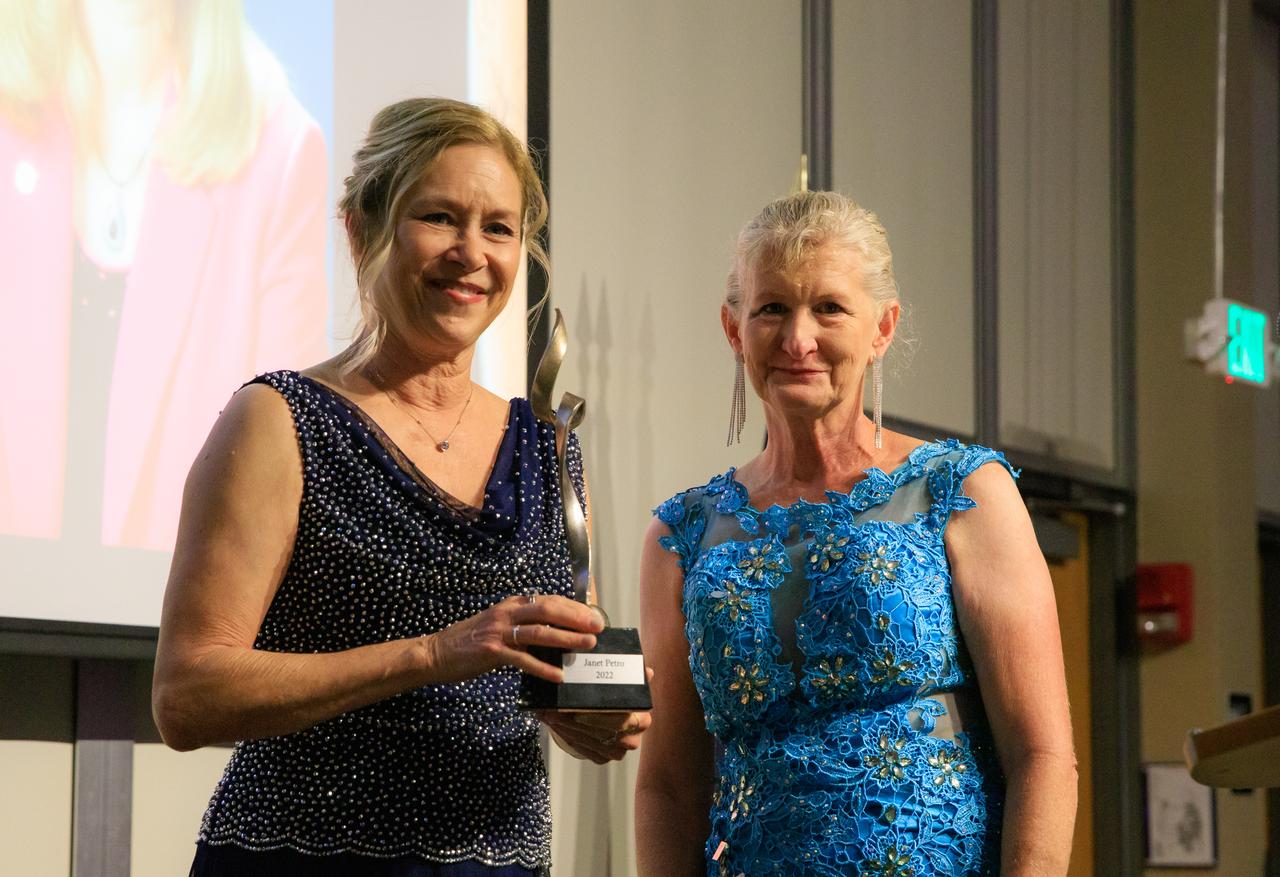
National Space Club Florida Chapter Chair Tara Miller presents Kennedy Space Center Director Janet Petro with the Dr. Kurt H. Debus Award during a ceremony held at the Florida spaceport’s visitor complex on June 24, 2022. The committee presented Petro with the prestigious award for her contributions to America’s aerospace efforts within the state of Florida. The award – originating in 1990 – is named after Kennedy’s first director.
Debus Award Presentation to Janet Petro
Scott Henderson, vice president of Test and Operations at Blue Origin, speaks at a ceremony honoring Kennedy Space Center Director Janet Petro with the Dr. Kurt H. Debus Award on June 24, 2022, at the Florida spaceport’s visitor complex. The National Space Club Florida Committee presented Petro with the prestigious award for her contributions to America’s aerospace efforts within the state of Florida. The award – originating in 1990 – is named after Kennedy’s first director.
Debus Award Presentation to Janet Petro
Kennedy Space Center Director Janet Petro addresses friends, colleagues, and family following her acceptance of the Dr. Kurt H. Debus Award on June 24, 2022, during a ceremony held at the Florida spaceport’s visitor complex. The National Space Club Florida Committee presented Petro with the prestigious award for her contributions to America’s aerospace efforts within the state of Florida. The award – originating in 1990 – is named after Kennedy’s first director.
Debus Award Presentation to Janet Petro
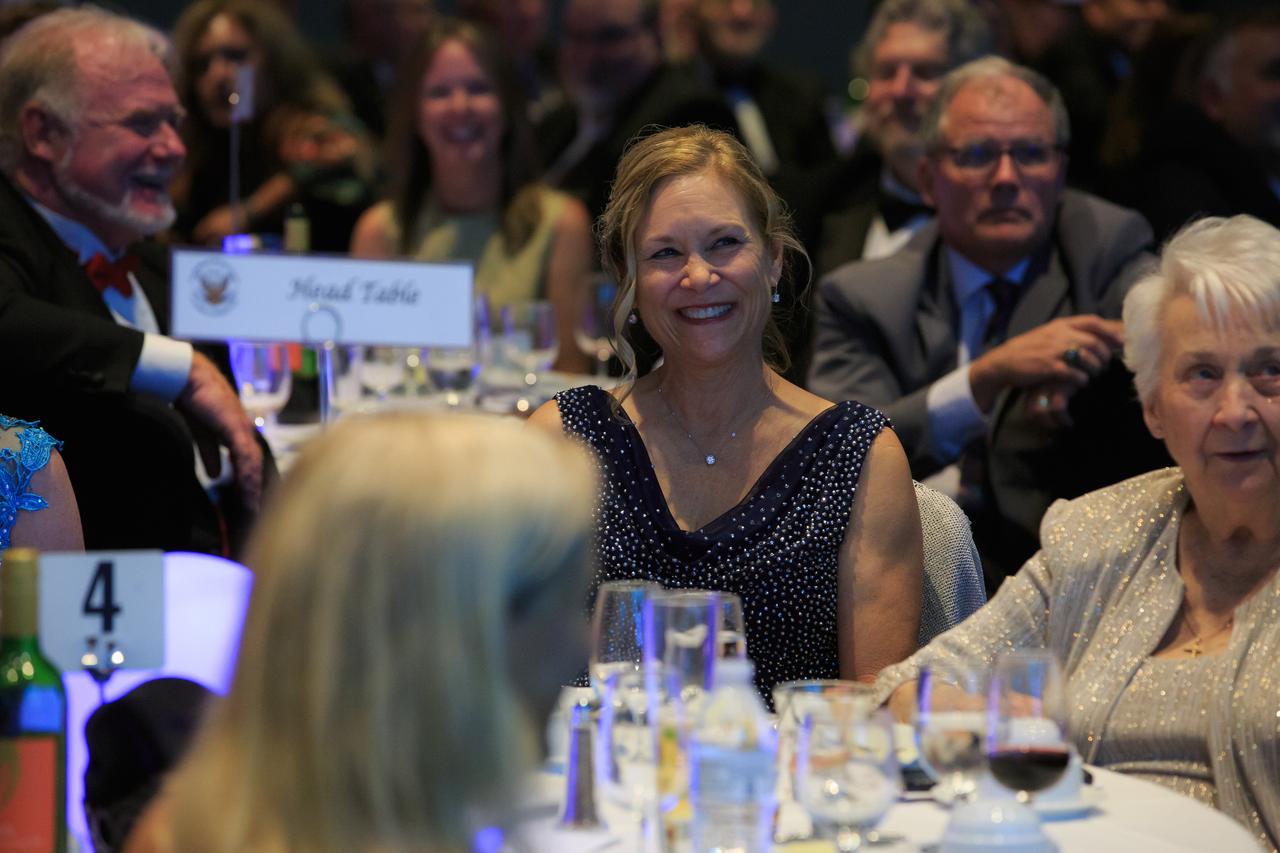
Kennedy Space Center Director Janet Petro is photographed in the audience during an award ceremony held in her honor on June 24, 2022, at the Florida spaceport’s visitor complex. The National Space Club Florida Committee presented Petro with the Dr. Kurt H. Debus Award for her contributions to America’s aerospace efforts within the state of Florida. The award – originating in 1990 – is named after Kennedy’s first director.
Debus Award Presentation to Janet Petro
Scott Henderson, vice president of Test and Operations at Blue Origin, speaks at a ceremony honoring Kennedy Space Center Director Janet Petro with the Dr. Kurt H. Debus Award on June 24, 2022, at the Florida spaceport’s visitor complex. The National Space Club Florida Committee presented Petro with the prestigious award for her contributions to America’s aerospace efforts within the state of Florida. The award – originating in 1990 – is named after Kennedy’s first director.
Debus Award Presentation to Janet Petro
Kennedy Space Center Director Janet Petro addresses friends, colleagues, and family following her acceptance of the Dr. Kurt H. Debus Award on June 24, 2022, during a ceremony held at the Florida spaceport’s visitor complex. The National Space Club Florida Committee presented Petro with the prestigious award for her contributions to America’s aerospace efforts within the state of Florida. The award – originating in 1990 – is named after Kennedy’s first director.
Debus Award Presentation to Janet Petro
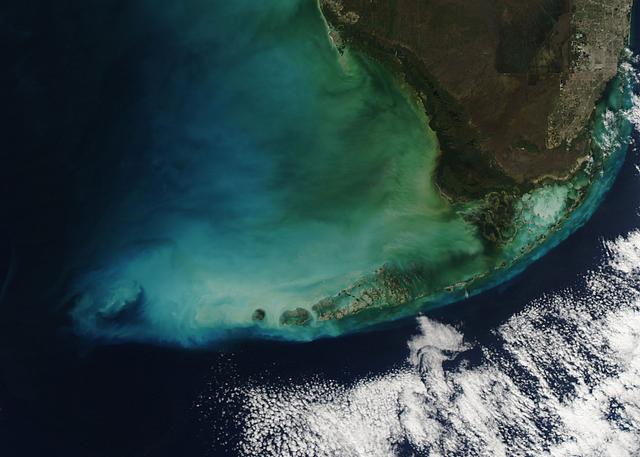
NASA image acquired January 4, 2012  The Florida Keys many colors were captured  when the Moderate Resolution Imaging Spectroradiometer (MODIS) aboard the Aqua satellite captured this true-color image.  NASA/GSFC/Jeff Schmaltz/MODIS Land Rapid Response Team  <b><a href="http://www.nasa.gov/audience/formedia/features/MP_Photo_Guidelines.html" rel="nofollow">NASA image use policy.</a></b>  <b><a href="http://www.nasa.gov/centers/goddard/home/index.html" rel="nofollow">NASA Goddard Space Flight Center</a></b> enables NASA’s mission through four scientific endeavors: Earth Science, Heliophysics, Solar System Exploration, and Astrophysics. Goddard plays a leading role in NASA’s accomplishments by contributing compelling scientific knowledge to advance the Agency’s mission.  <b>Follow us on <a href="http://twitter.com/NASA_GoddardPix" rel="nofollow">Twitter</a></b>  <b>Like us on <a href="http://www.facebook.com/pages/Greenbelt-MD/NASA-Goddard/395013845897?ref=tsd" rel="nofollow">Facebook</a></b>  <b>Find us on <a href="http://instagrid.me/nasagoddard/?vm=grid" rel="nofollow">Instagram</a></b>
Florida Keys
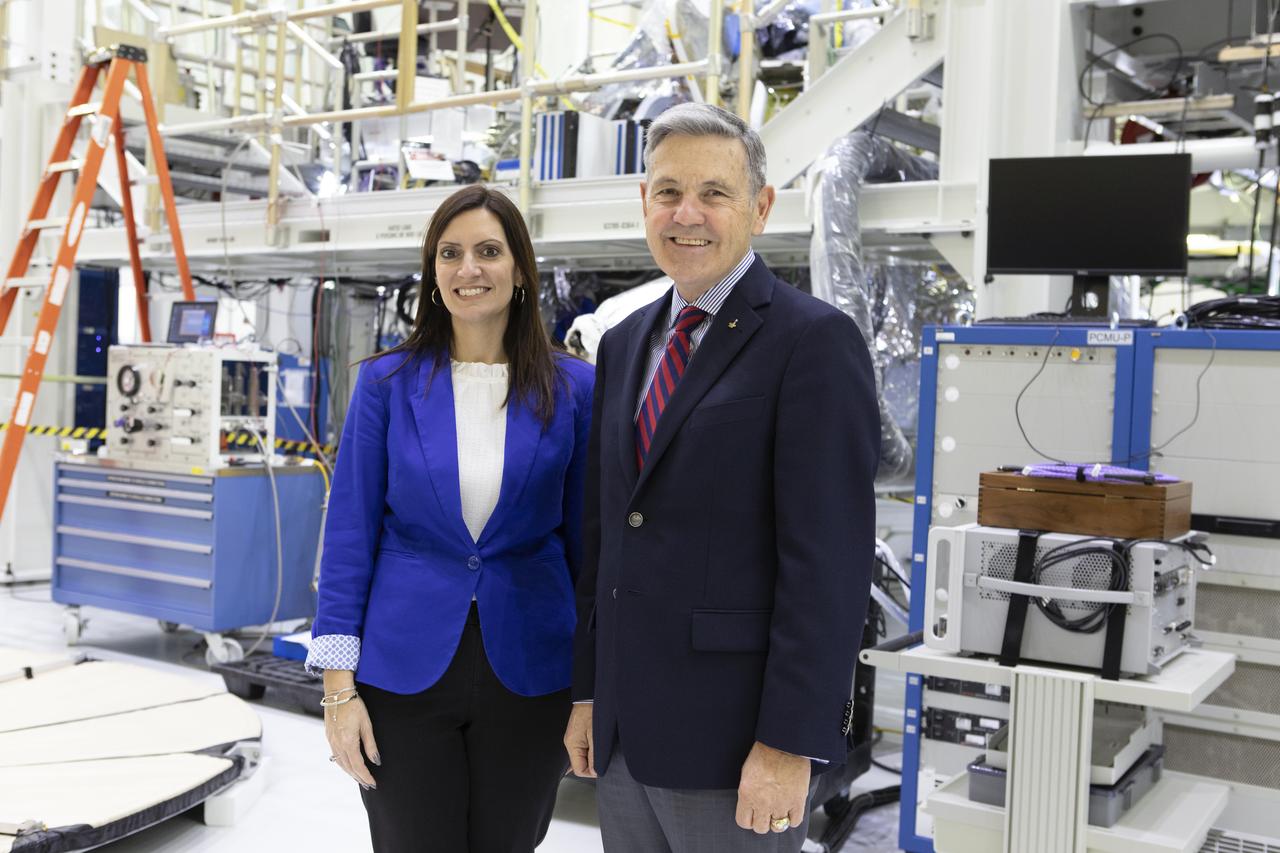
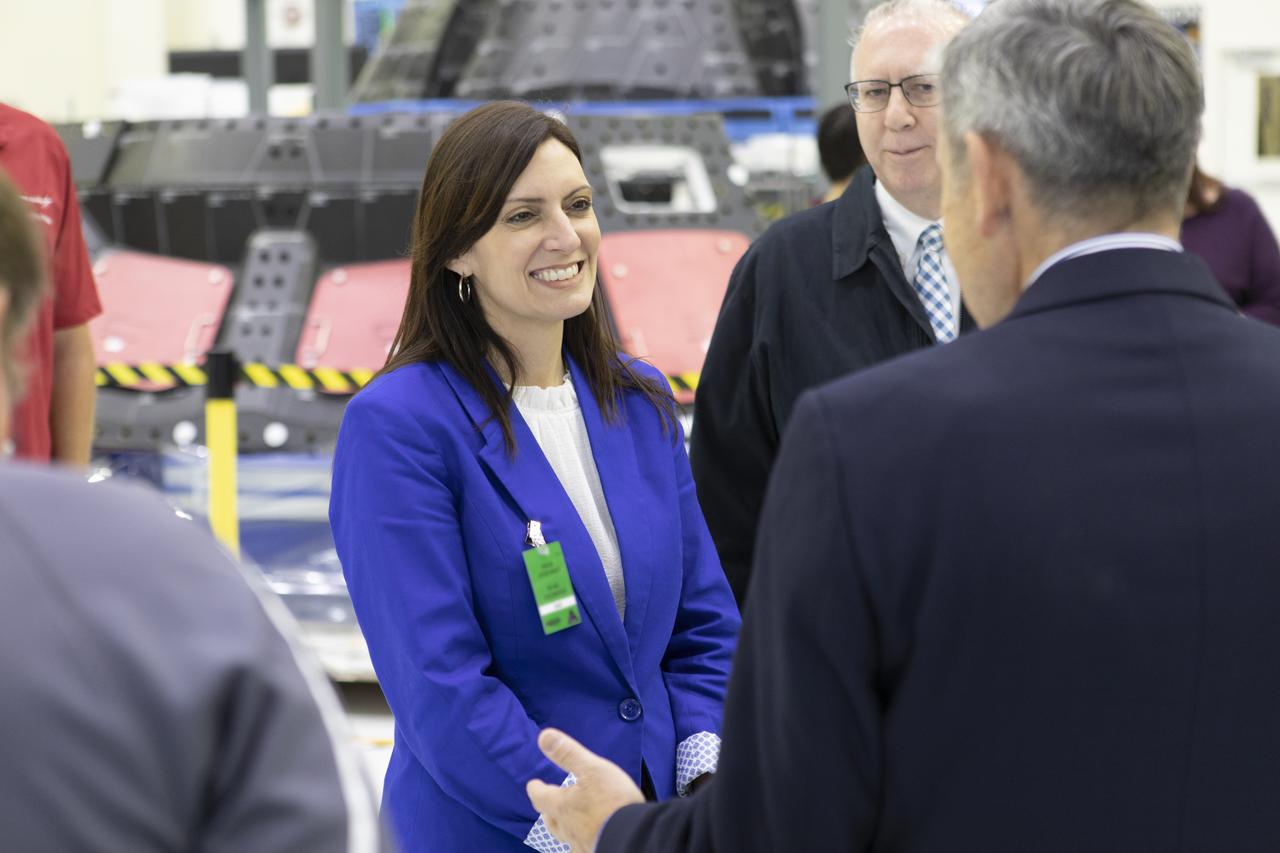
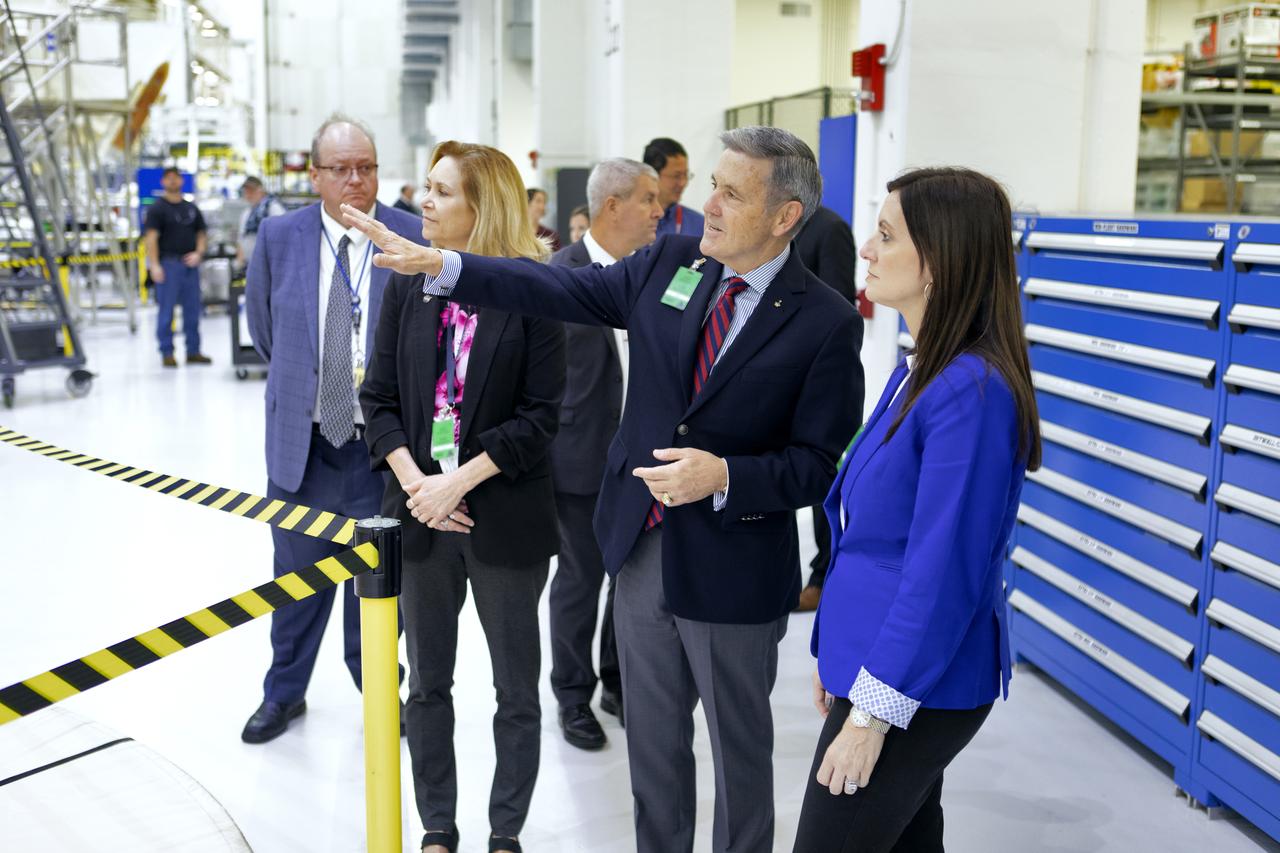
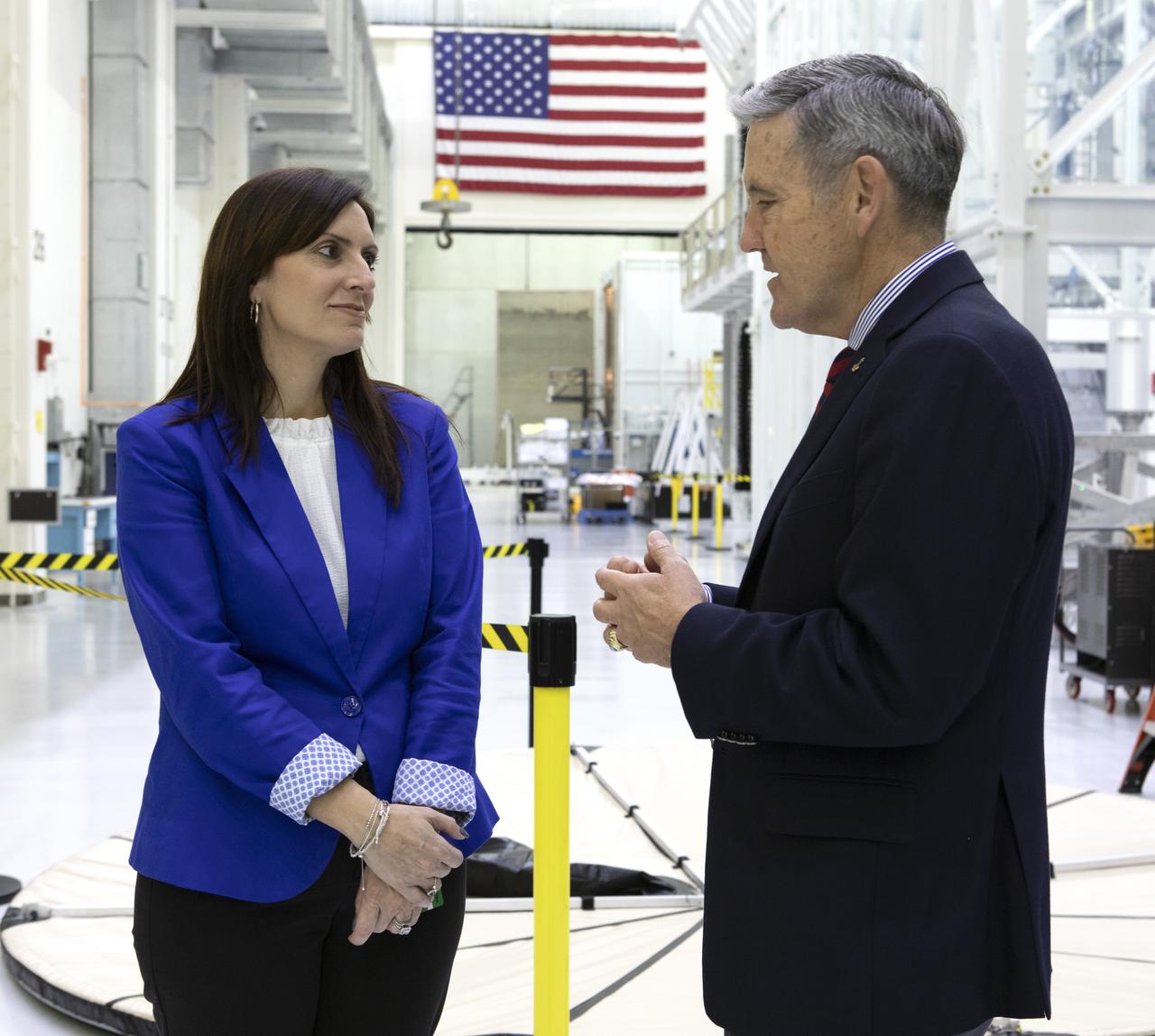
Kennedy Space Center Director Bob Cabana gives Florida Lt. Governor Jeanette Nunez (left) a tour of the Florida spaceport’s Neil Armstrong Operations and Checkout Building high bay on April 5, 2019. Also in attendance was Kennedy Deputy Director Janet Petro (center). During her tour, Nunez was shown NASA’s Orion spacecraft, which will be flown on the agency’s Exploration Mission-1 (EM-1). Orion will launch atop the Space Launch System rocket from Kennedy’s Launch Complex 39B. This uncrewed mission will provide the foundation for human deep space exploration and pave the way for the crewed EM-2 mission.
Lieutenant Governor of Florida tours O&C with Center Director Bo
Florida Lt. Governor Jeanette Nunez and Kennedy Space Center Director Bob Cabana are photographed inside the Florida spaceport’s Neil Armstrong Operations and Checkout (O&C) Building high bay on April 5, 2019. During her tour of the O&C, Nunez was shown NASA’s Orion spacecraft, which will be flown on the agency’s Exploration Mission-1 (EM-1). Orion will launch atop the Space Launch System rocket from Kennedy’s Launch Complex 39B. This uncrewed mission will provide the foundation for human deep space exploration and pave the way for the crewed EM-2 mission.
Lieutenant Governor of Florida tours O&C with Center Director Bo
Kennedy Space Center Director Bob Cabana gives Florida Lt. Governor Jeanette Nunez a tour of the Florida spaceport’s Neil Armstrong Operations and Checkout Building high bay on April 5, 2019. During her tour, Nunez was shown NASA’s Orion spacecraft, which will be flown on the agency’s Exploration Mission-1 (EM-1). Orion will launch atop the Space Launch System rocket from Kennedy’s Launch Complex 39B. This uncrewed mission will provide the foundation for human deep space exploration and pave the way for the crewed EM-2 mission.
Lieutenant Governor of Florida tours O&C with Center Director Bo
Kennedy Space Center Director Bob Cabana gives Florida Lt. Governor Jeanette Nunez (right) a tour of the Florida spaceport’s Neil Armstrong Operations and Checkout Building High Bay on April 5, 2019. Also in attendance was Kennedy Deputy Director Janet Petro (left). During her tour, Nunez was shown NASA’s Orion spacecraft, which will be flown on the agency’s Exploration Mission-1 (EM-1). Orion will launch atop the Space Launch System rocket from Kennedy’s Launch Complex 39B. This uncrewed mission will provide the foundation for human deep space exploration and pave the way for the crewed EM-2 mission.
Lieutenant Governor of Florida tours O&C with Center Director Bo
Kennedy Space Center Director Bob Cabana gives Florida Lt. Governor Jeanette Nunez a tour of the Florida spaceport’s Neil Armstrong Operations and Checkout Building high bay on April 5, 2019. During her tour, Nunez was shown NASA’s Orion spacecraft, which will be flown on the agency’s Exploration Mission-1 (EM-1). Orion will launch atop the Space Launch System rocket from Kennedy’s Launch Complex 39B. This uncrewed mission will provide the foundation for human deep space exploration and pave the way for the crewed EM-2 mission.
Lieutenant Governor of Florida tours O&C with Center Director Bo
Florida Lt. Governor Jeanette Nunez and Kennedy Space Center Director Bob Cabana are photographed inside the Florida spaceport’s Neil Armstrong Operations and Checkout (O&C) Building high bay on April 5, 2019. During her tour of the O&C, Nunez was shown NASA’s Orion spacecraft, which will be flown on the agency’s Exploration Mission-1 (EM-1). Orion will launch atop the Space Launch System rocket from Kennedy’s Launch Complex 39B. This uncrewed mission will provide the foundation for human deep space exploration and pave the way for the crewed EM-2 mission.
Lieutenant Governor of Florida tours O&C with Center Director Bo
Kennedy Space Center Director Bob Cabana gives Florida Lt. Governor Jeanette Nunez a tour of the Florida spaceport’s Neil Armstrong Operations and Checkout Building high bay on April 5, 2019. During her tour, Nunez was shown NASA’s Orion spacecraft, which will be flown on the agency’s Exploration Mission-1 (EM-1). Orion will launch atop the Space Launch System rocket from Kennedy’s Launch Complex 39B. This uncrewed mission will provide the foundation for human deep space exploration and pave the way for the crewed EM-2 mission.
Lieutenant Governor of Florida tours O&C with Center Director Bo
Kennedy Space Center Director Bob Cabana gives Florida Lt. Governor Jeanette Nunez a tour of the Florida spaceport’s Neil Armstrong Operations and Checkout Building high bay on April 5, 2019. During her tour, Nunez was shown NASA’s Orion spacecraft, which will be flown on the agency’s Exploration Mission-1 (EM-1). Orion will launch atop the Space Launch System rocket from Kennedy’s Launch Complex 39B. This uncrewed mission will provide the foundation for human deep space exploration and pave the way for the crewed EM-2 mission.
Lieutenant Governor of Florida tours O&C with Center Director Bo
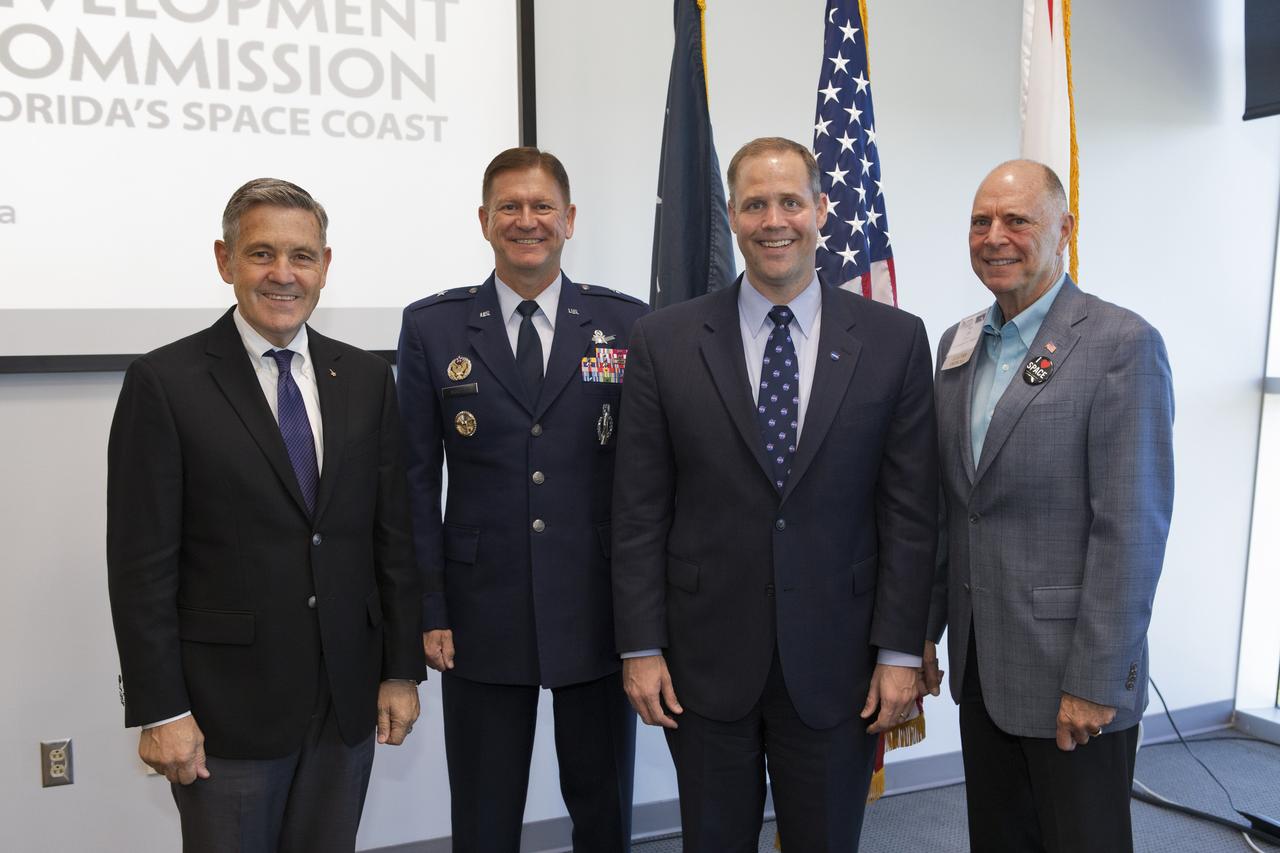
NASA Administrator Jim Bridenstine, second from right, participates in an Economic Development Commission roundtable discussion hosted by Space Florida at the Space Life Sciences Laboratory on Aug. 7, 2018, near NASA's Kennedy Space Center in Florida. With him, from left, are Kennedy Center Director Bob Cabana; Brigadier General Wayne Monteith, commander, 45th Space Wing, and director, Eastern Range, Patrick Air Force Base in Florida;  and U.S. Rep. Bill Posey. The administrator also toured Kennedy facilities and received updates on various center accomplishments.
NASA Administrator Jim Bridenstine Visits KSC - Space Life Scien
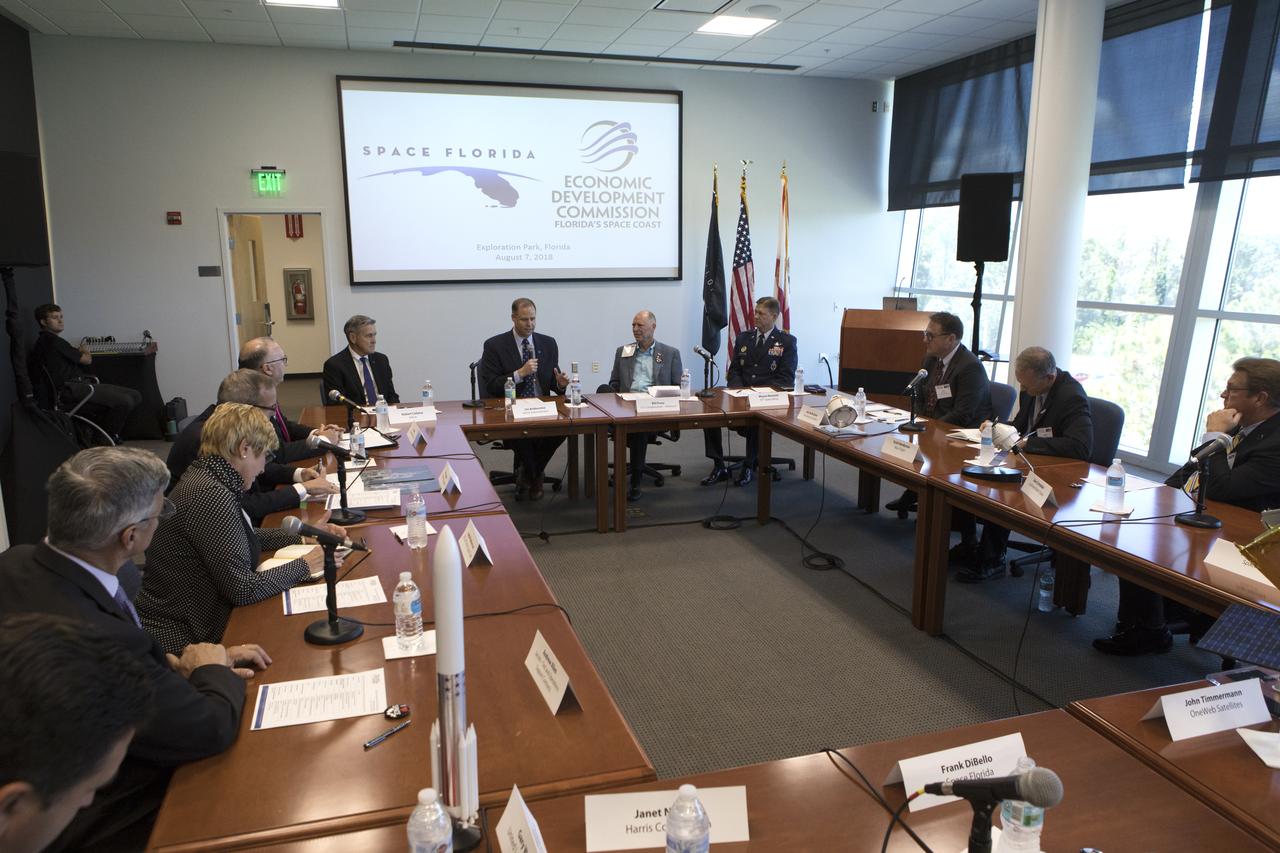
NASA Administrator Jim Bridenstine, seated at the far table, center, participates in an Economic Development Commission roundtable discussion hosted by Space Florida at the Space Life Sciences Laboratory on Aug. 7, 2018, near NASA's Kennedy Space Center in Florida. Seated at left is Kennedy Center Director Bob Cabana. Seated at right is U.S. Rep. Bill Posey, and Brigadier General Wayne Monteith, commander, 45th Space Wing, and director, Eastern Range, Patrick Air Force Base in Florida. The administrator also toured Kennedy facilities and received updates on various center accomplishments.
NASA Administrator Jim Bridenstine Visits KSC - Space Life Scien
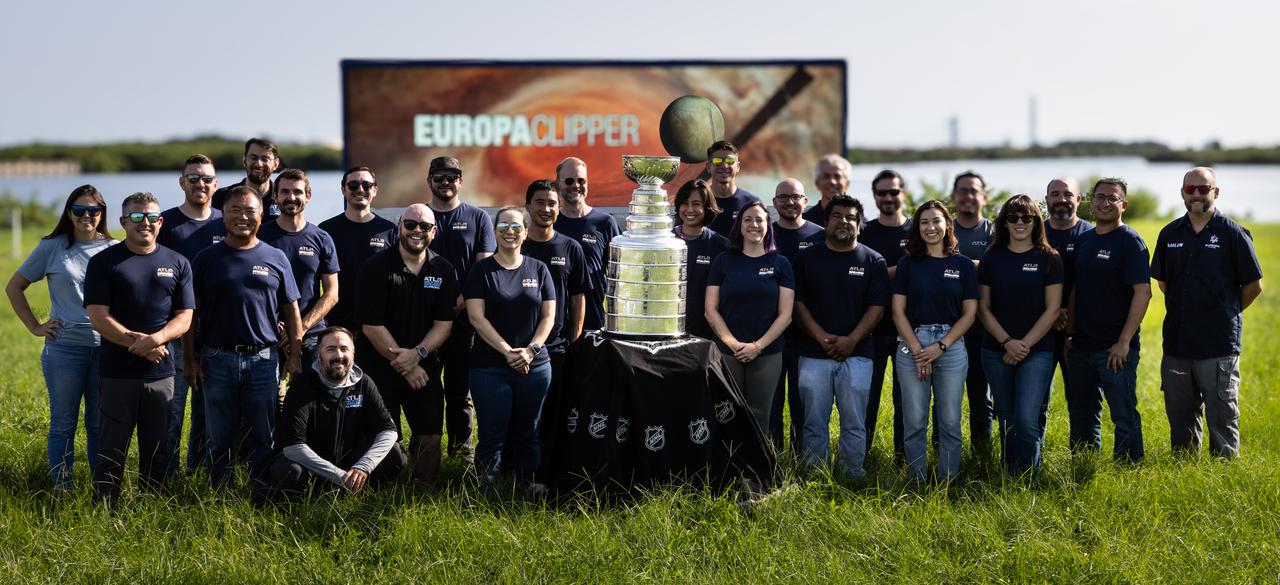
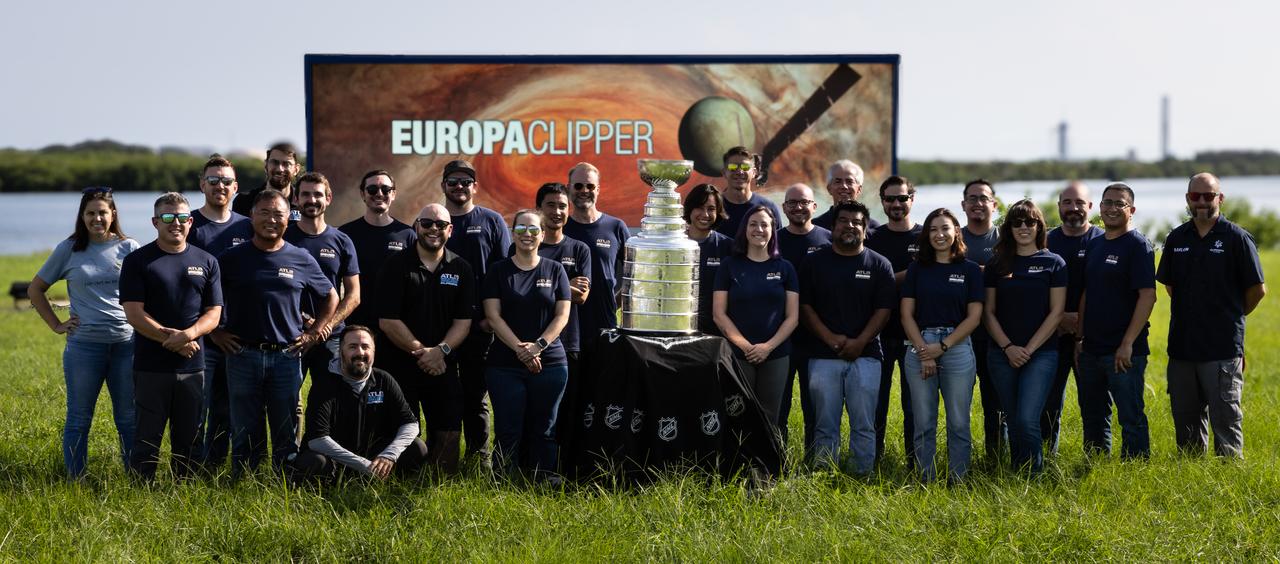
Earlier this year, the Florida Panthers won their first NHL championship and brought victory to the state of Florida. As part of its championship tour, the Stanley Cup made a visit to NASA’s Kennedy Space Center. Here, members of NASA’s Europa Clipper team pose with the National Hockey League’s Stanley Cup trophy in front of the countdown clock near the NASA News Center at Kennedy on Tuesday, Sept. 17, 2024. Europa Clipper will soon begin its Jupiter to explore if places below Europa’s surface could support life.
NHL Florida Panthers Stanley Cup Visit
Earlier this year, the Florida Panthers won their first NHL championship and brought victory to the state of Florida. As part of its championship tour, the Stanley Cup made a visit to NASA’s Kennedy Space Center. Here, members of NASA’s Europa Clipper team pose with the National Hockey League’s Stanley Cup trophy in front of the countdown clock near the NASA News Center at Kennedy on Tuesday, Sept. 17, 2024. Europa Clipper will soon begin its Jupiter to explore if places below Europa’s surface could support life.
NHL Florida Panthers Stanley Cup Visit
Technicians attach the tail cone, which helps reduce aerodynamic drag and turbulence during its ferry flight, to the Space Shuttle Discovery in preparation for its return to NASA's Kennedy Space Center in Florida. After the tail-cone is installed, Discovery will be mounted on NASA's modified Boeing 747 Shuttle Carrier Aircraft, or SCA, for the return flight. Space Shuttle Discovery landed safely at NASA's Dryden Flight Research Center at Edwards Air Force Base in California at 5:11:22 a.m. PDT, August 9, 2005, following the very successful 14-day STS-114 return to flight mission.  During their two weeks in space, Commander Eileen Collins and her six crewmates tested out new safety procedures and delivered supplies and equipment the International Space Station.  Discovery spent two weeks in space, where the crew demonstrated new methods to inspect and repair the Shuttle in orbit. The crew also delivered supplies, outfitted and performed maintenance on the International Space Station. A number of these tasks were conducted during three spacewalks.  In an unprecedented event, spacewalkers were called upon to remove protruding gap fillers from the heat shield on Discovery's underbelly. In other spacewalk activities, astronauts installed an external platform onto the Station's Quest Airlock and replaced one of the orbital outpost's Control Moment Gyroscopes.  Inside the Station, the STS-114 crew conducted joint operations with the Expedition 11 crew. They unloaded fresh supplies from the Shuttle and the Raffaello Multi-Purpose Logistics Module. Before Discovery undocked, the crews filled Raffeallo with unneeded items and returned to Shuttle payload bay.  Discovery launched on July 26 and spent almost 14 days on orbit.
Technicians attach the tail cone to the Space Shuttle Discovery in preparation for its return to NASA's Kennedy Space Center in Florida
Workers position the tail cone on the Space Shuttle Discovery in preparation for its return to NASA's Kennedy Space Center in Florida. After the tail-cone is installed, Discovery will be mounted on NASA's modified Boeing 747 Shuttle Carrier Aircraft, or SCA, for the return flight. The tail cone is a fitting that helps reduce aerodynamic drag and turbulence during its ferry flight. Space Shuttle Discovery landed safely at NASA's Dryden Flight Research Center at Edwards Air Force Base in California at 5:11:22 a.m. PDT, August 9, 2005, following the very successful 14-day STS-114 return to flight mission.  During their two weeks in space, Commander Eileen Collins and her six crewmates tested out new safety procedures and delivered supplies and equipment the International Space Station.  Discovery spent two weeks in space, where the crew demonstrated new methods to inspect and repair the Shuttle in orbit. The crew also delivered supplies, outfitted and performed maintenance on the International Space Station. A number of these tasks were conducted during three spacewalks.  In an unprecedented event, spacewalkers were called upon to remove protruding gap fillers from the heat shield on Discovery's underbelly. In other spacewalk activities, astronauts installed an external platform onto the Station's Quest Airlock and replaced one of the orbital outpost's Control Moment Gyroscopes.  Inside the Station, the STS-114 crew conducted joint operations with the Expedition 11 crew. They unloaded fresh supplies from the Shuttle and the Raffaello Multi-Purpose Logistics Module. Before Discovery undocked, the crews filled Raffeallo with unneeded items and returned to Shuttle payload bay.  Discovery launched on July 26 and spent almost 14 days on orbit.
Workers position the tail cone on the Space Shuttle Discovery in preparation for its return to NASA's Kennedy Space Center in Florida
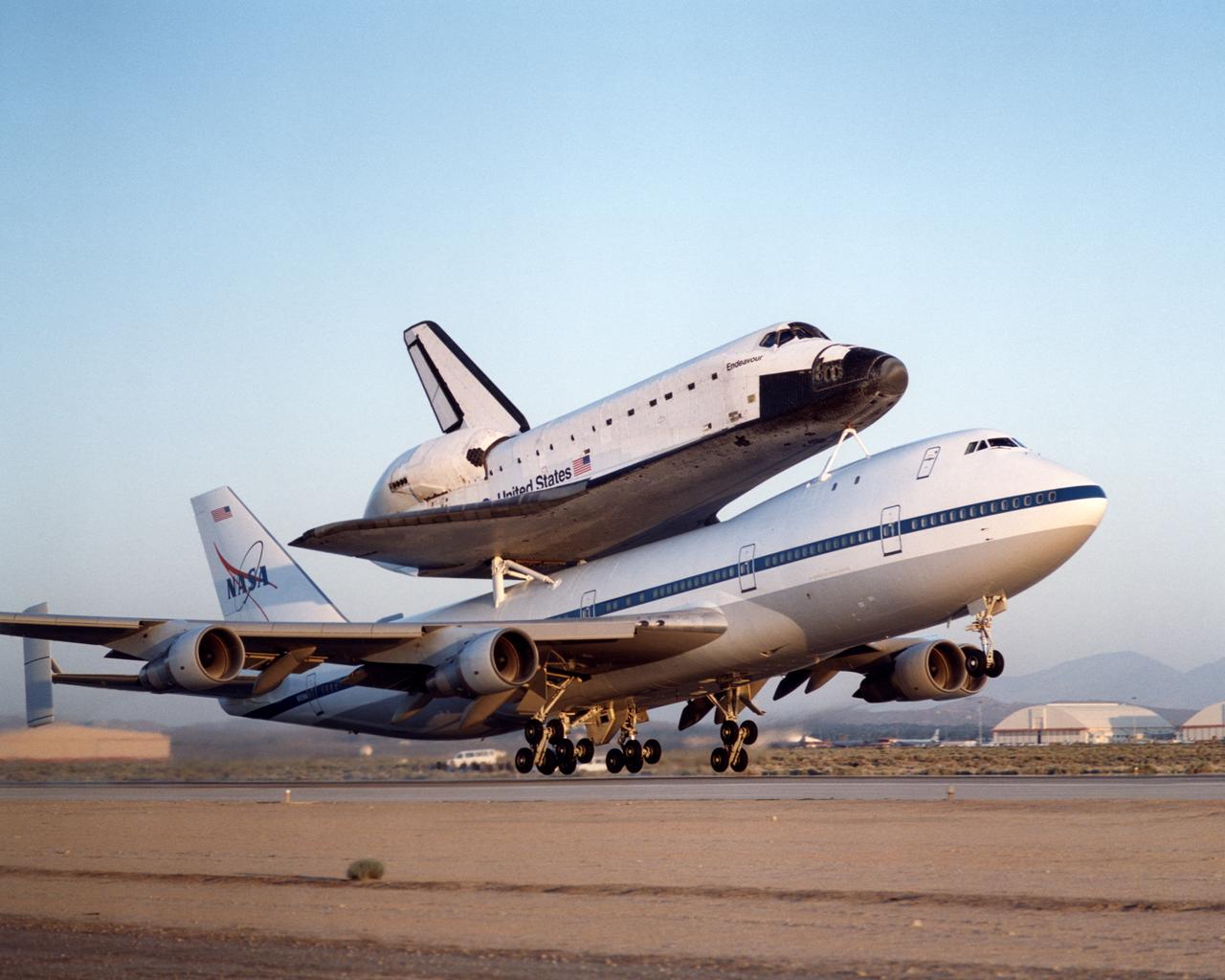
The Space Shuttle Endeavour, atop NASA's 747 Shuttle Carrier Aircraft (SCA), taking off for the Kennedy Space Center shortly after its landing on 11 October 1994, at Edwards, California, to complete mission STS-68. Endeavour was being ferried from the Kennedy Space Center, Florida, to Air Force Plant 42, Palmdale, California, where it will undergo six months of inspections, modifications, and systems upgrades. The STS-68 11-day mission was devoted to radar imaging of Earth's geological features with the Space Radar Laboratory.
STS-68 747 SCA Ferry Flight Takeoff for Delivery to Kennedy Space Center, Florida
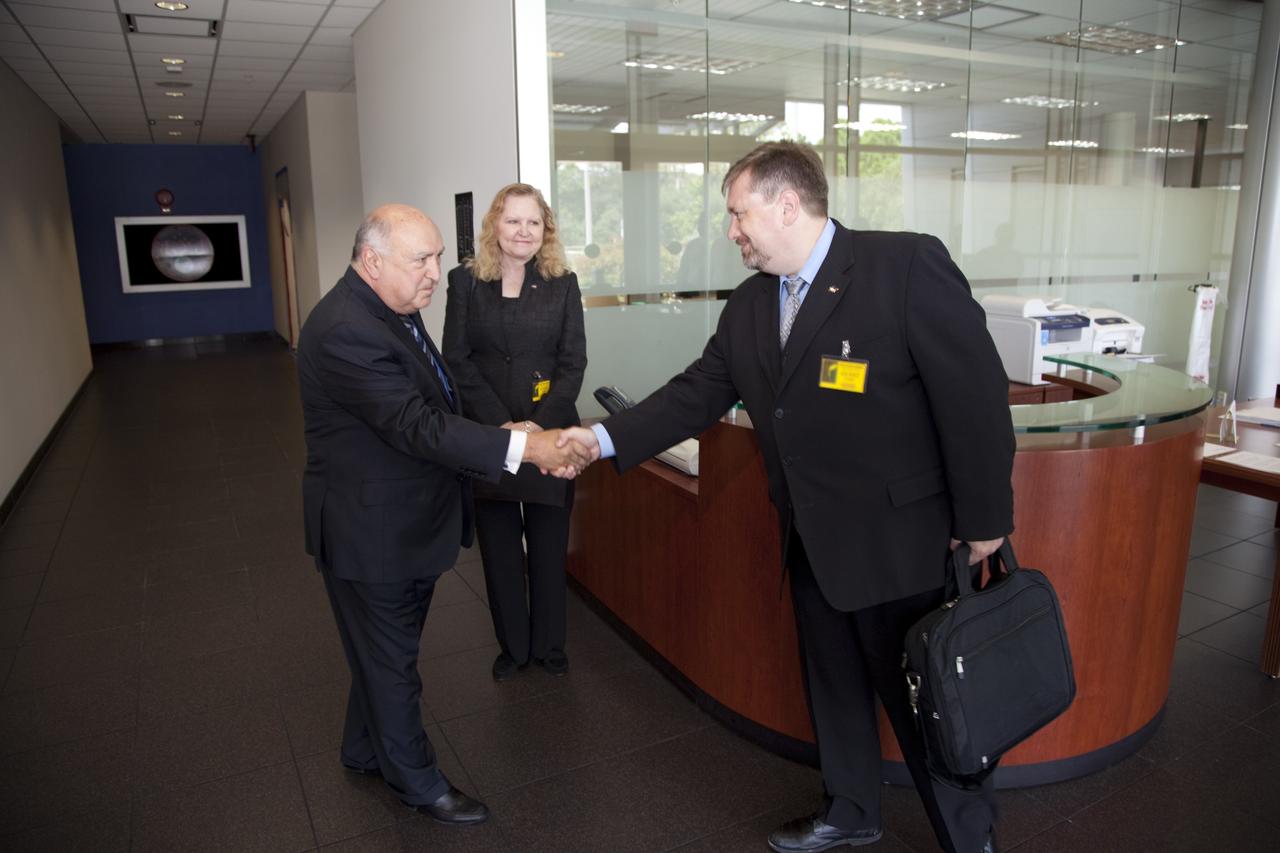
CAPE CANAVERAL, Fla. – Dr. Mason Peck, right, NASA's chief Technologist, greets Frank DiBello, president and CEO of Space Florida as Karen L. Thompson, chief technologist for Kennedy Space Center, looks on. Space Florida manages the Space Life Sciences Laboratory at Kennedy. Peck toured the lab facility during a visit to the space center. Photo credit: NASA/Frankie Martin
KSC-2012-4080
NASA Administrator Jim Bridenstine, center, facing away from the camera, participates in an Economic Development Commission roundtable discussion hosted by Space Florida at the Space Life Sciences Laboratory on Aug. 7, 2018, near NASA's Kennedy Space Center in Florida. At right is Kennedy Center Director Bob Cabana. The administrator also toured Kennedy facilities and received updates on various center accomplishments.
NASA Administrator Jim Bridenstine Visits KSC - Space Life Scien
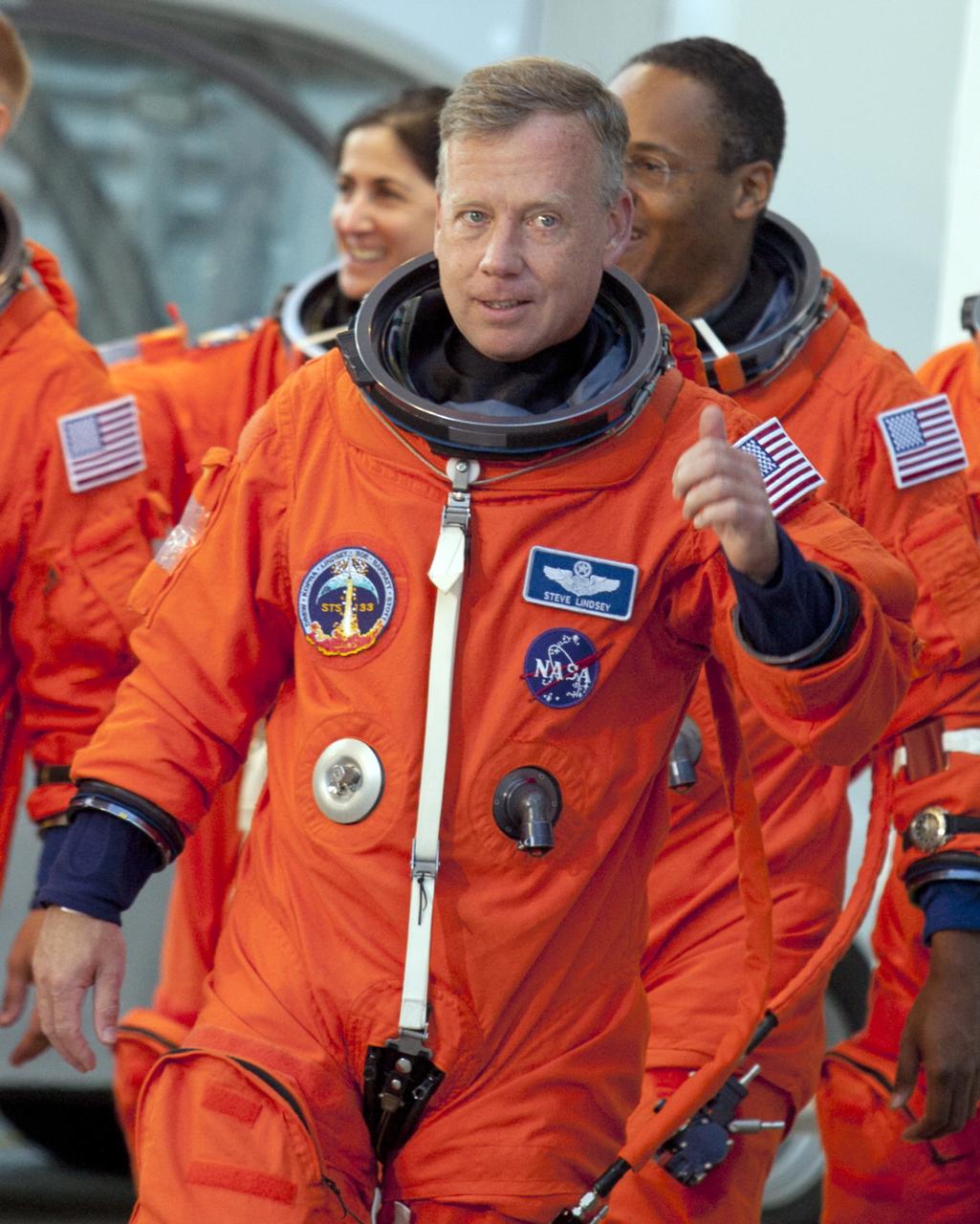
Shuttle Discovery STS-133 Mission Commander Steve Lindsey gives a thumbs up during a practice crew walkout at Kennedy Space Center, Cape Canaveral, Florida, USA 15 October 2010. The crew of six is headed to launch pad 39A for a mock countdown that completes the three day Terminal Countdown Demonstration Test. Shuttle Discovery is being prepared for what is to be it's final mission to the International Space Station, with launch scheduled for no earlier than 01 November 2010.
USA Shuttle Discovery STS-133 TCDT Crew Walkout Kennedy Space Center Florida
KENNEDY SPACE CENTER, FLA. -  The Honorable Toni Jennings (left), lieutenant governor of the state of Florida, and Frank T. Brogan, president of Florida Atlantic University, receive a briefing on the research that will be conducted in the Space Life Sciences Lab from Dr. Robert J. Ferl (right), director of Space Agriculture Biotechnology Research and Education (SABRE), University of Florida.  Jennings and Brogan are speaking at a dedication and ribbon-cutting ceremony for the lab hosted by NASA-Kennedy Space Center and the state of Florida at the new lab. Completed in August, the facility encompasses more than 100,000 square feet and was formerly known as the Space Experiment Research and Processing Laboratory or SERPL. The state, through the Florida Space Authority, built the research lab which is host to NASA, NASA’s Life Sciences Services contractor Dynamac Corp., Bionetics Corp., and researchers from the University of Florida.  Dynamac Corp. leases the facility.  The Florida Space Research Institute is responsible for gaining additional tenants from outside the NASA community.
KENNEDY SPACE CENTER, FLA. - The Honorable Toni Jennings (left), lieutenant governor of the state of Florida, and Frank T. Brogan, president of Florida Atlantic University, receive a briefing on the research that will be conducted in the Space Life Sciences Lab from Dr. Robert J. Ferl (right), director of Space Agriculture Biotechnology Research and Education (SABRE), University of Florida. Jennings and Brogan are speaking at a dedication and ribbon-cutting ceremony for the lab hosted by NASA-Kennedy Space Center and the state of Florida at the new lab. Completed in August, the facility encompasses more than 100,000 square feet and was formerly known as the Space Experiment Research and Processing Laboratory or SERPL. The state, through the Florida Space Authority, built the research lab which is host to NASA, NASA’s Life Sciences Services contractor Dynamac Corp., Bionetics Corp., and researchers from the University of Florida. Dynamac Corp. leases the facility. The Florida Space Research Institute is responsible for gaining additional tenants from outside the NASA community.
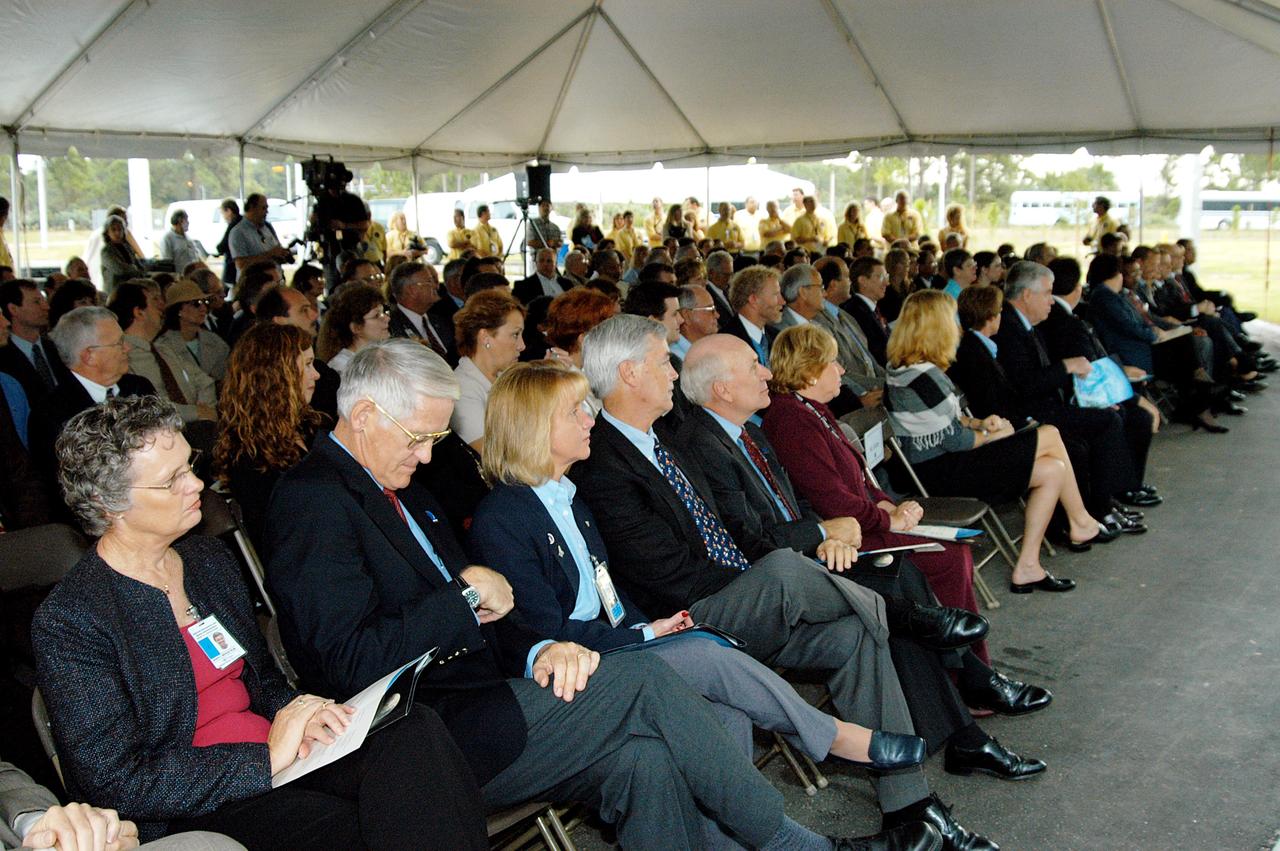
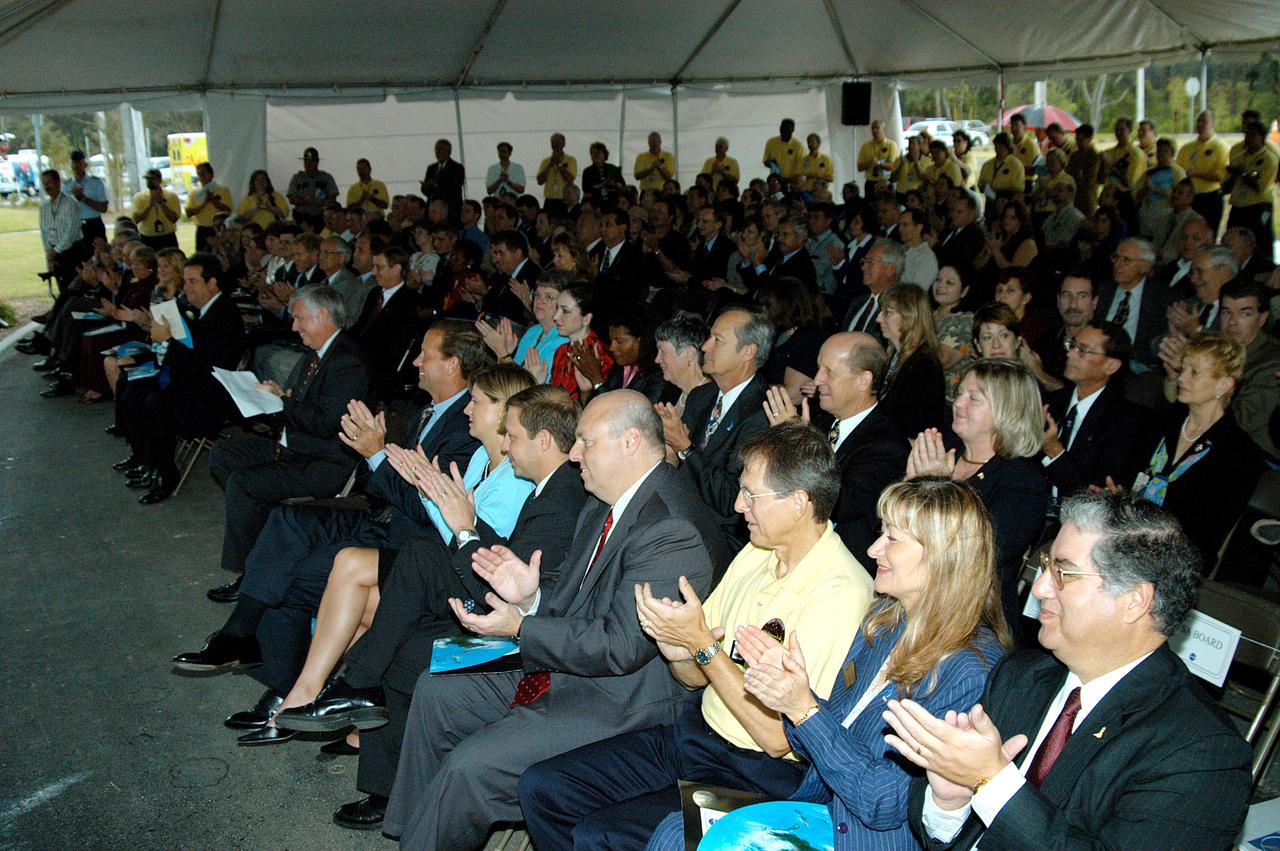
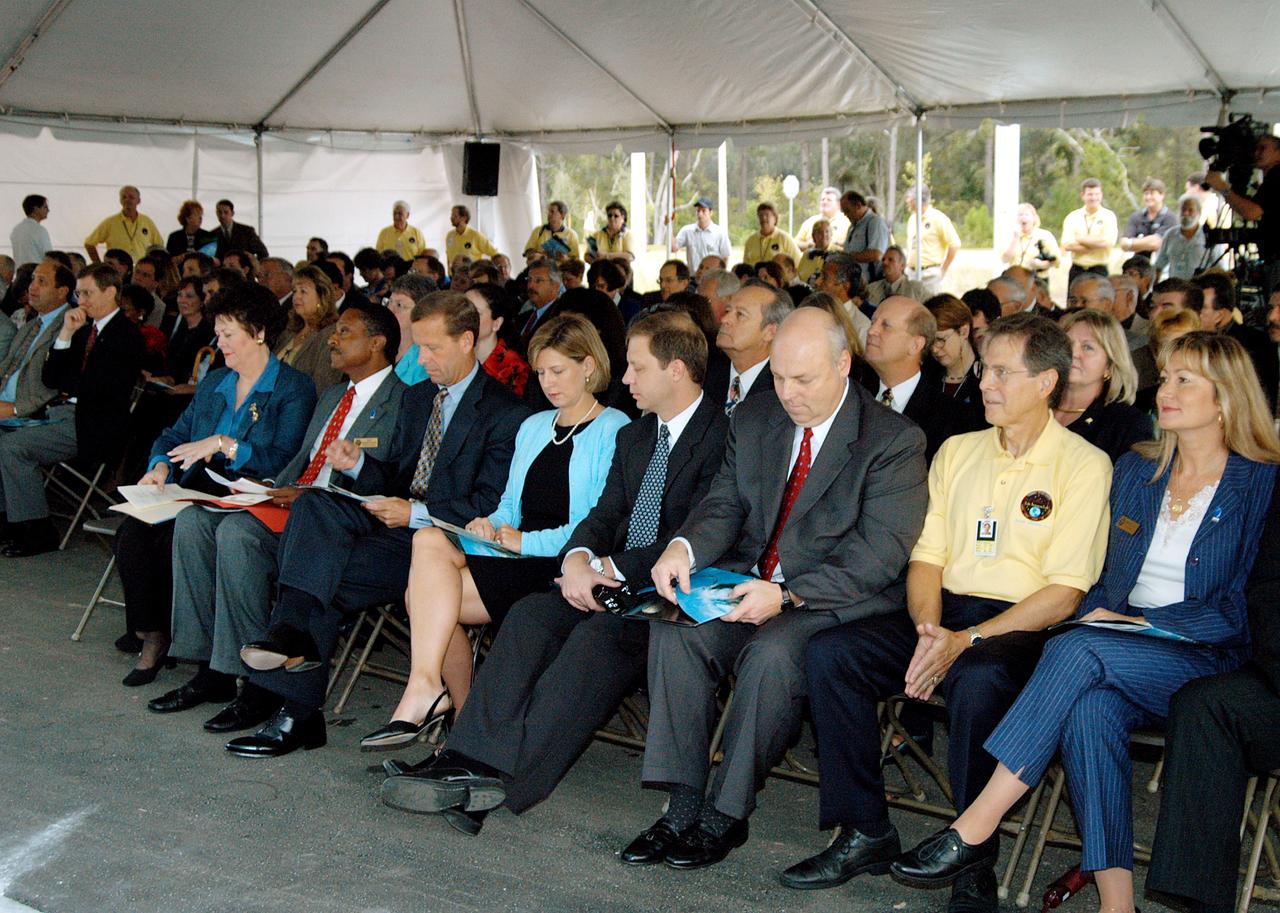
KENNEDY SPACE CENTER, FLA. -  Dignitaries, invited guests, space center employees, and the media gather for a dedication and ribbon-cutting ceremony for the Space Life Sciences Lab hosted by NASA-Kennedy Space Center and the state of Florida at the new lab. Completed in August, the facility encompasses more than 100,000 square feet and was formerly known as the Space Experiment Research and Processing Laboratory or SERPL. The state, through the Florida Space Authority, built the research lab which is host to NASA, NASA’s Life Sciences Services contractor Dynamac Corp., Bionetics Corp., and researchers from the University of Florida.  Dynamac Corp. leases the facility.  The Florida Space Research Institute is responsible for gaining additional tenants from outside the NASA community.
KENNEDY SPACE CENTER, FLA. - Dignitaries, invited guests, space center employees, and the media gather for a dedication and ribbon-cutting ceremony for the Space Life Sciences Lab hosted by NASA-Kennedy Space Center and the state of Florida at the new lab. Completed in August, the facility encompasses more than 100,000 square feet and was formerly known as the Space Experiment Research and Processing Laboratory or SERPL. The state, through the Florida Space Authority, built the research lab which is host to NASA, NASA’s Life Sciences Services contractor Dynamac Corp., Bionetics Corp., and researchers from the University of Florida. Dynamac Corp. leases the facility. The Florida Space Research Institute is responsible for gaining additional tenants from outside the NASA community.
KENNEDY SPACE CENTER, FLA. -  Dignitaries, invited guests, space center employees, and the media show their appreciation for the speakers at a dedication and ribbon-cutting ceremony for the Space Life Sciences Lab hosted by NASA-Kennedy Space Center and the state of Florida at the new lab. Completed in August, the facility encompasses more than 100,000 square feet and was formerly known as the Space Experiment Research and Processing Laboratory or SERPL. The state, through the Florida Space Authority, built the research lab which is host to NASA, NASA’s Life Sciences Services contractor Dynamac Corp., Bionetics Corp., and researchers from the University of Florida.  Dynamac Corp. leases the facility.  The Florida Space Research Institute is responsible for gaining additional tenants from outside the NASA community.
KENNEDY SPACE CENTER, FLA. - Dignitaries, invited guests, space center employees, and the media show their appreciation for the speakers at a dedication and ribbon-cutting ceremony for the Space Life Sciences Lab hosted by NASA-Kennedy Space Center and the state of Florida at the new lab. Completed in August, the facility encompasses more than 100,000 square feet and was formerly known as the Space Experiment Research and Processing Laboratory or SERPL. The state, through the Florida Space Authority, built the research lab which is host to NASA, NASA’s Life Sciences Services contractor Dynamac Corp., Bionetics Corp., and researchers from the University of Florida. Dynamac Corp. leases the facility. The Florida Space Research Institute is responsible for gaining additional tenants from outside the NASA community.
KENNEDY SPACE CENTER, FLA. -  Dignitaries, invited guests, space center employees, and the media gather for a dedication and ribbon-cutting ceremony for the Space Life Sciences Lab hosted by NASA-Kennedy Space Center and the state of Florida at the new lab. Completed in August, the facility encompasses more than 100,000 square feet and was formerly known as the Space Experiment Research and Processing Laboratory or SERPL. The state, through the Florida Space Authority, built the research lab which is host to NASA, NASA’s Life Sciences Services contractor Dynamac Corp., Bionetics Corp., and researchers from the University of Florida.  Dynamac Corp. leases the facility.  The Florida Space Research Institute is responsible for gaining additional tenants from outside the NASA community.
KENNEDY SPACE CENTER, FLA. - Dignitaries, invited guests, space center employees, and the media gather for a dedication and ribbon-cutting ceremony for the Space Life Sciences Lab hosted by NASA-Kennedy Space Center and the state of Florida at the new lab. Completed in August, the facility encompasses more than 100,000 square feet and was formerly known as the Space Experiment Research and Processing Laboratory or SERPL. The state, through the Florida Space Authority, built the research lab which is host to NASA, NASA’s Life Sciences Services contractor Dynamac Corp., Bionetics Corp., and researchers from the University of Florida. Dynamac Corp. leases the facility. The Florida Space Research Institute is responsible for gaining additional tenants from outside the NASA community.
NASA's 747 Shuttle Carrier Aircraft No. 911, with the space shuttle orbiter Endeavour securely mounted atop its fuselage, taxies to the runway to begin the ferry flight from Rockwell's Plant 42 at Palmdale, California, where the orbiter was built, to the Kennedy Space Center, Florida. At Kennedy, the space vehicle was processed and launched on orbital mission STS-49, which landed at NASA's Ames-Dryden Flight Research Facility (later redesignated Dryden Flight Research Center), Edwards, California, 16 May 1992. NASA 911, the second modified 747 that went into service in November 1990, has special support struts atop the fuselage and internal strengthening to accommodate the added weight of the orbiters.
Shuttle Endeavour Mated to 747 SCA Taxi to Runway for Delivery to Kennedy Space Center, Florida
NASA's 747 Shuttle Carrier Aircraft No. 911, with the space shuttle orbiter Endeavour securely mounted atop its fuselage, begins the ferry flight from Rockwell's Plant 42 at Palmdale, California, where the orbiter was built, to the Kennedy Space Center, Florida. At Kennedy, the space vehicle was processed and launched on orbital mission STS-49, which landed at NASA's Ames-Dryden Flight Research Facility (later redesignated Dryden Flight Research Center), Edwards, California, 16 May 1992. NASA 911, the second modified 747 that went into service in November 1990, has special support struts atop the fuselage and internal strengthening to accommodate the added weight of the orbiters.
Shuttle Endeavour Mated to 747 SCA Takeoff for Delivery to Kennedy Space Center, Florida
The space shuttle Atlantis atop NASA's 747 Shuttle Carrier Aircraft (SCA) during takeoff for a return ferry flight to the Kennedy Space Center from Edwards, California. The STS-66 mission was dedicated to the third flight of the Atmospheric Laboratory for Applications and Science-3 (ATLAS-3), part of NASA's Mission to Planet Earth program. The astronauts also deployed and retrieved a free-flying satellite designed to study the middle and lower thermospheres and perform a series of experiments covering life sciences research and microgravity processing. The landing was at 7:34 a.m. (PST) 14 November 1994, after being waved off from the Kennedy Space Center, Florida, due to adverse weather.
STS-66 Atlantis 747 SCA Ferry Flight Morning Takeoff for Delivery to Kennedy Space Center, Florida
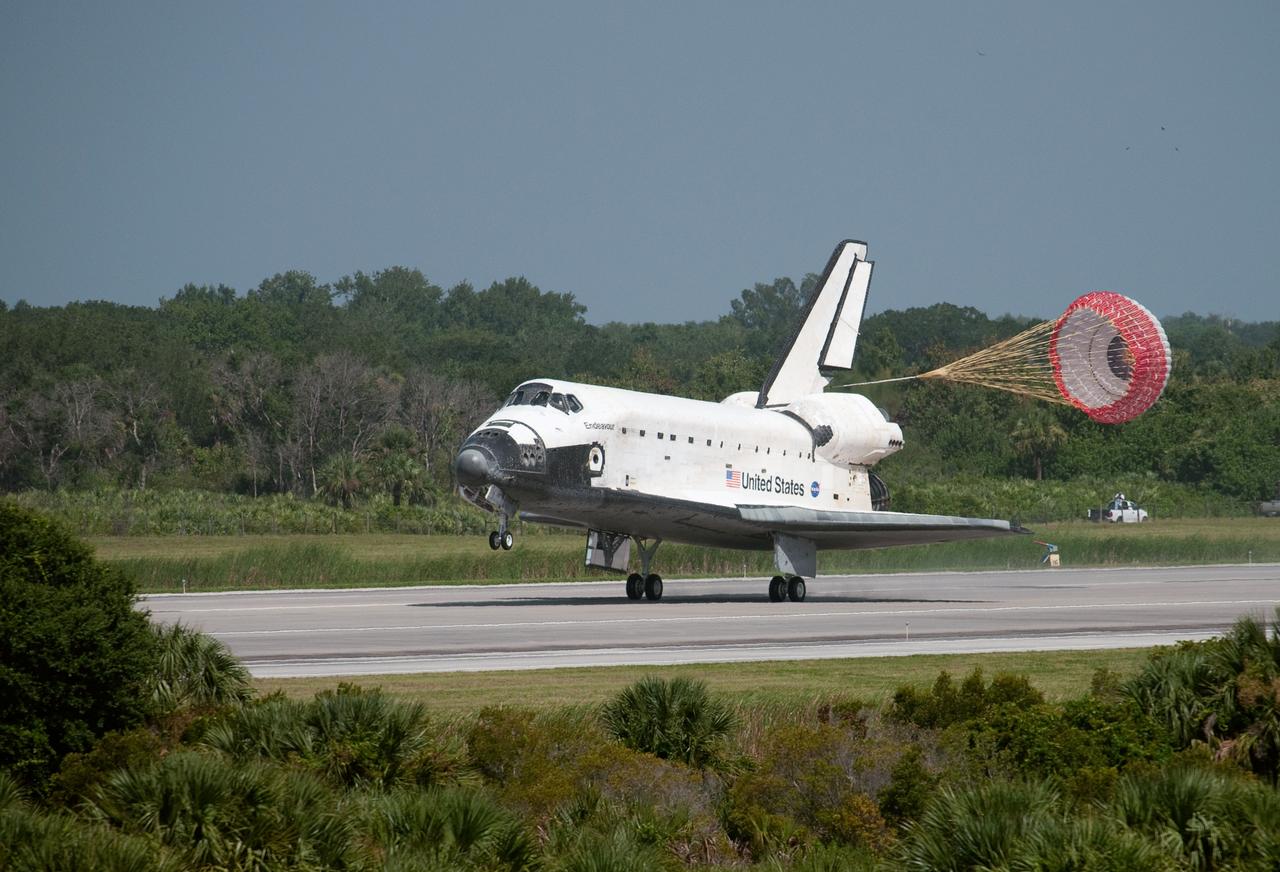
The space shuttle Endeavour and its crew land, Friday, July 31, 2009 at NASA's Kennedy Space Center in Cape Canaveral, Florida, completing a 16-day journey of more than 6.5 million miles. Endeavour delivered the final segment to the Japan Aerospace Exploration Agency's Kibo laboratory and a new crew member to the International Space Station. Photo Credit: (NASA/Bill Ingalls)
STS-127 Shuttle Endeavour Landing
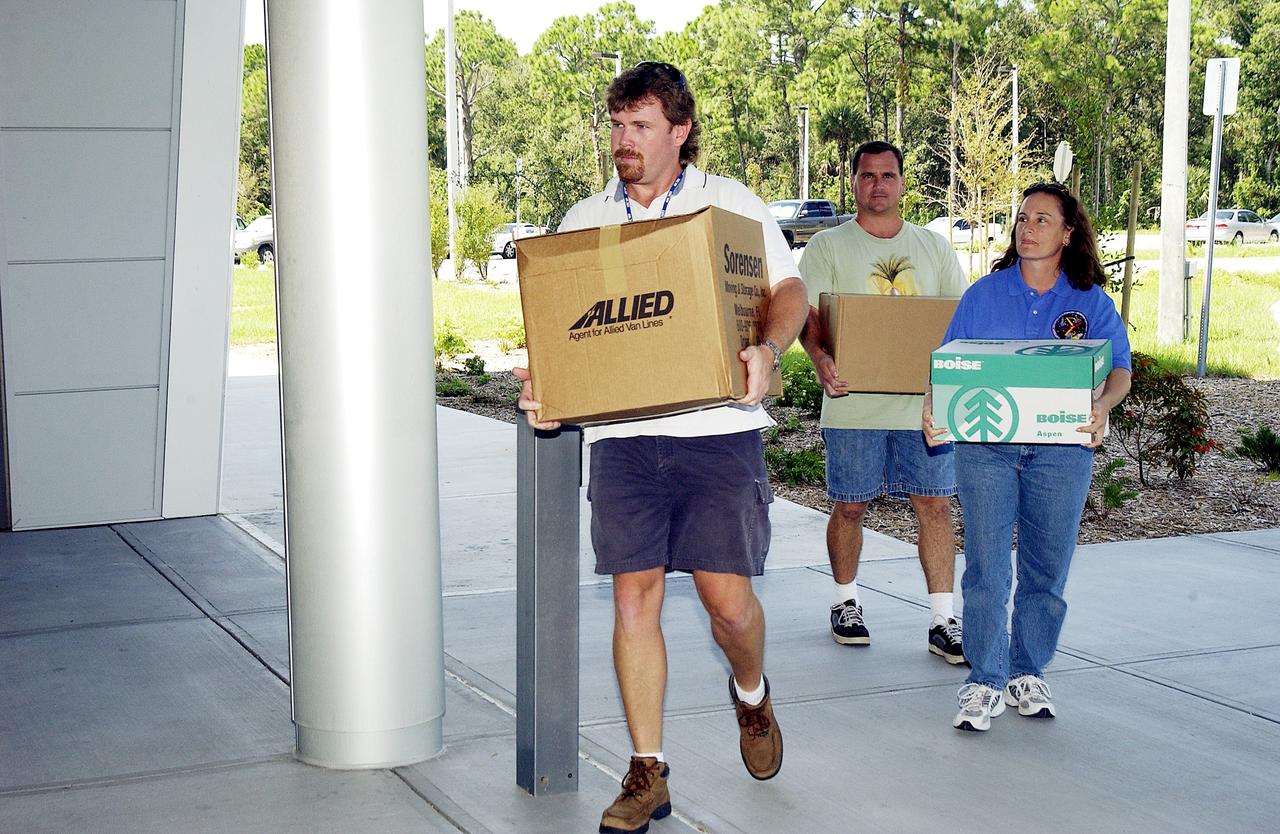
KENNEDY SPACE CENTER, FLA. -  Dynamac employees (from left) Larry Burns, Debbie Wells and Neil  Yorio carry boxes of hardware into the Space Life Sciences Lab (SLSL), formerly known as the Space Experiment Research and Processing Laboratory (SERPL).  They are transferring equipment from Hangar L. The new lab is a state-of-the-art facility being built for ISS biotechnology research. Developed as a partnership between NASA-KSC and the State of Florida, NASA’s life sciences contractor will be the primary tenant of the facility, leasing space to conduct flight experiment processing and NASA-sponsored research. About 20 percent of the facility will be available for use by Florida’s university researchers through the Florida Space Research Institute.
KENNEDY SPACE CENTER, FLA. - Dynamac employees (from left) Larry Burns, Debbie Wells and Neil Yorio carry boxes of hardware into the Space Life Sciences Lab (SLSL), formerly known as the Space Experiment Research and Processing Laboratory (SERPL). They are transferring equipment from Hangar L. The new lab is a state-of-the-art facility being built for ISS biotechnology research. Developed as a partnership between NASA-KSC and the State of Florida, NASA’s life sciences contractor will be the primary tenant of the facility, leasing space to conduct flight experiment processing and NASA-sponsored research. About 20 percent of the facility will be available for use by Florida’s university researchers through the Florida Space Research Institute.
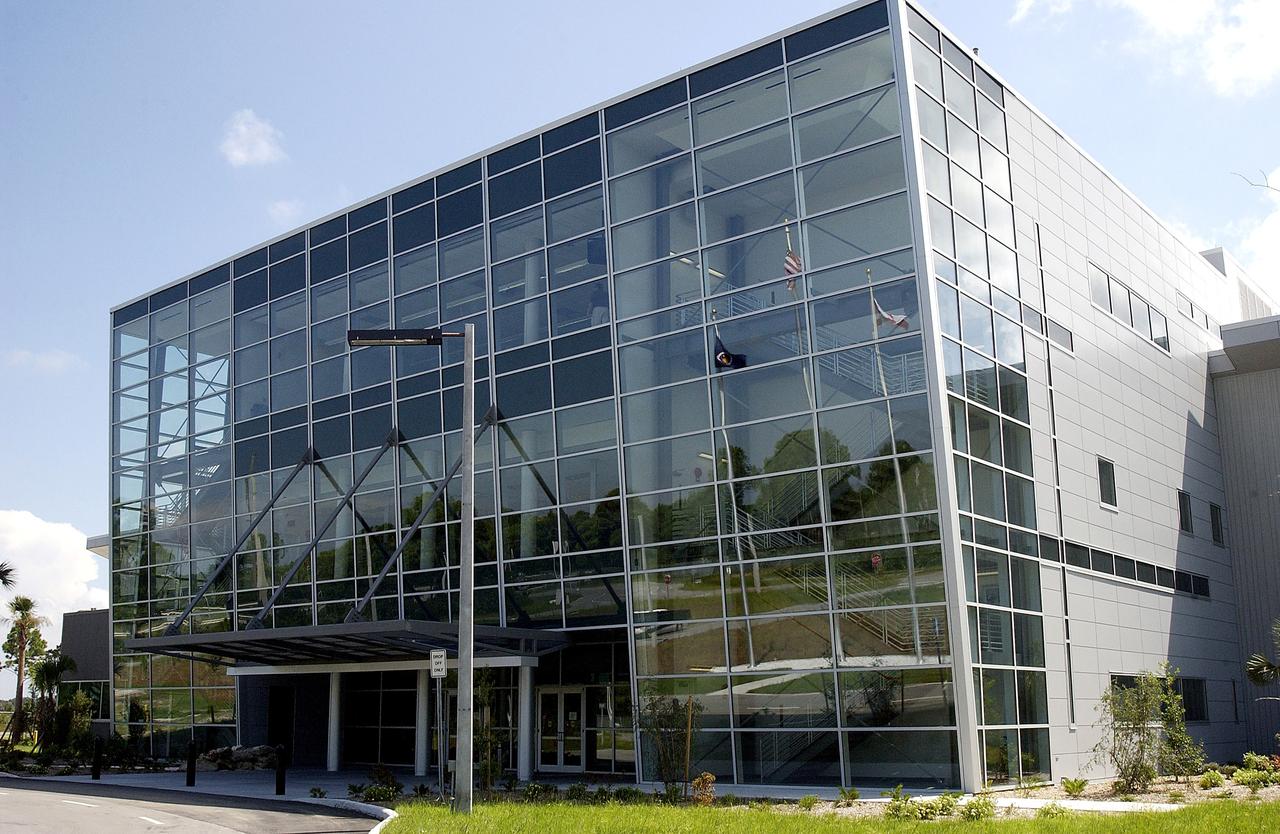
KENNEDY SPACE CENTER, FLA. -  The Space Life Sciences Lab (SLSL), formerly known as the Space Experiment Research and Processing Laboratory (SERPL), is nearing completion.  The new lab is a state-of-the-art facility being built for ISS biotechnology research. Developed as a partnership between NASA-KSC and the State of Florida, NASA’s life sciences contractor will be the primary tenant of the facility, leasing space to conduct flight experiment processing and NASA-sponsored research. About 20 percent of the facility will be available for use by Florida’s university researchers through the Florida Space Research Institute.
KENNEDY SPACE CENTER, FLA. - The Space Life Sciences Lab (SLSL), formerly known as the Space Experiment Research and Processing Laboratory (SERPL), is nearing completion. The new lab is a state-of-the-art facility being built for ISS biotechnology research. Developed as a partnership between NASA-KSC and the State of Florida, NASA’s life sciences contractor will be the primary tenant of the facility, leasing space to conduct flight experiment processing and NASA-sponsored research. About 20 percent of the facility will be available for use by Florida’s university researchers through the Florida Space Research Institute.
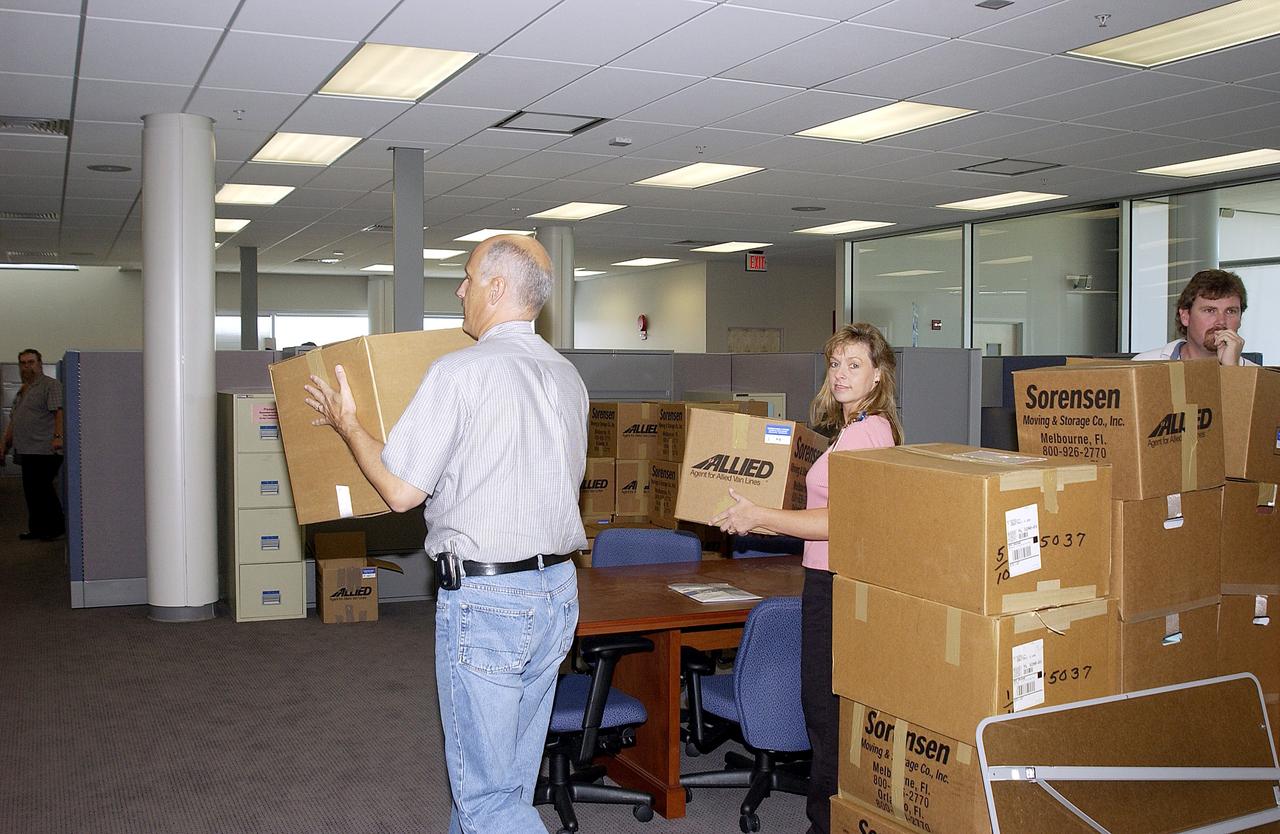
KENNEDY SPACE CENTER, FLA. -  Ivan Rodriguez, with Bionetics, and Michelle Crouch and Larry Burns, with Dynamac, carry boxes of equipment into the Space Life Sciences Lab (SLSL), formerly known as the Space Experiment Research and Processing Laboratory (SERPL).    They are transferring equipment from Hangar L. The new lab is a state-of-the-art facility being built for ISS biotechnology research. Developed as a partnership between NASA-KSC and the State of Florida, NASA’s life sciences contractor will be the primary tenant of the facility, leasing space to conduct flight experiment processing and NASA-sponsored research. About 20 percent of the facility will be available for use by Florida’s university researchers through the Florida Space Research Institute.
KENNEDY SPACE CENTER, FLA. - Ivan Rodriguez, with Bionetics, and Michelle Crouch and Larry Burns, with Dynamac, carry boxes of equipment into the Space Life Sciences Lab (SLSL), formerly known as the Space Experiment Research and Processing Laboratory (SERPL). They are transferring equipment from Hangar L. The new lab is a state-of-the-art facility being built for ISS biotechnology research. Developed as a partnership between NASA-KSC and the State of Florida, NASA’s life sciences contractor will be the primary tenant of the facility, leasing space to conduct flight experiment processing and NASA-sponsored research. About 20 percent of the facility will be available for use by Florida’s university researchers through the Florida Space Research Institute.
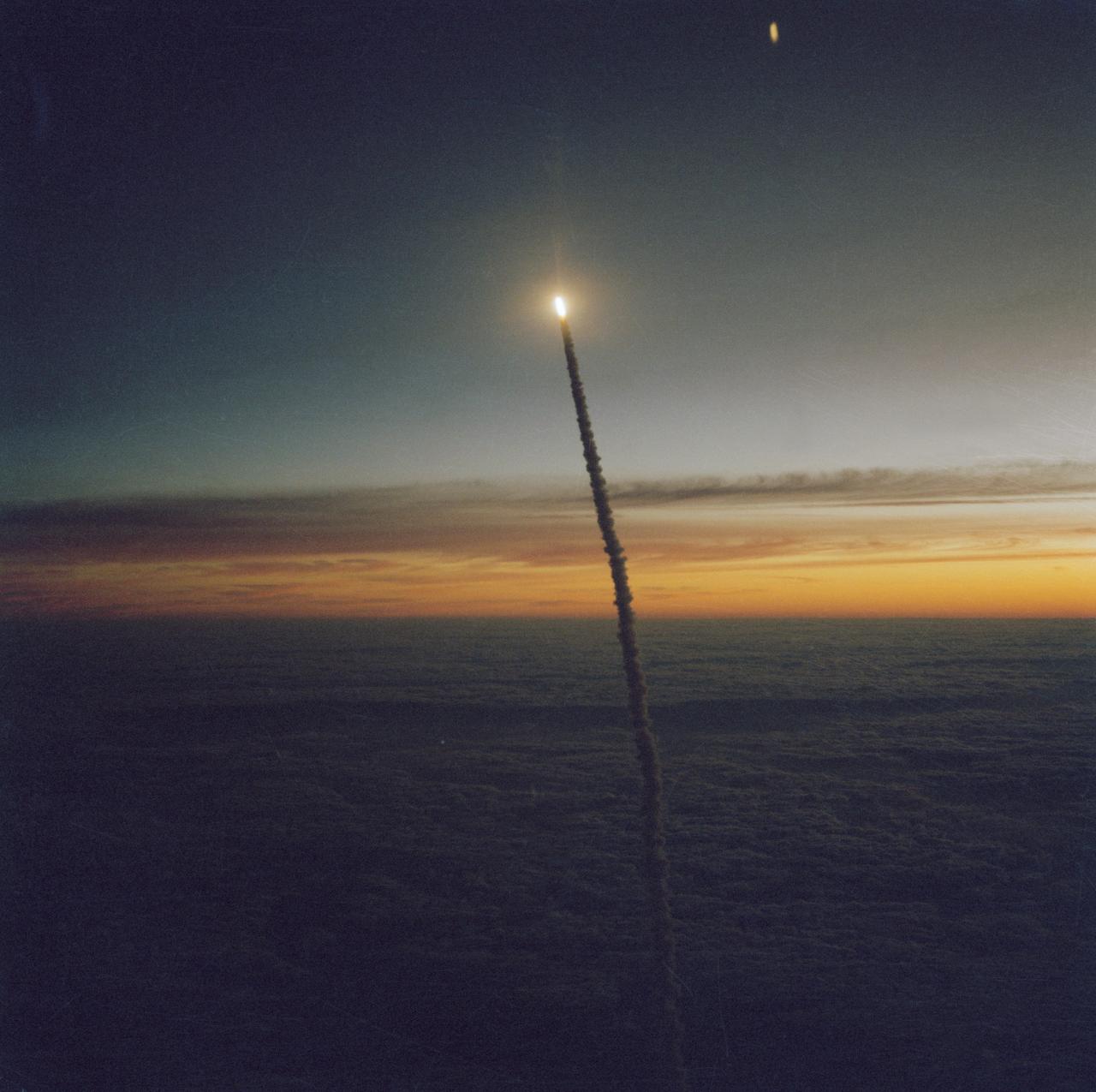
41G-90139 (5 October 1984) --- A Florida dawn scene forms the backdrop for the climbing Space Shuttle Challenger, its two solid rocket boosters and external fuel tank. Seven crewmembers, a space record, head for a busy eight-day stay in Earth orbit. The scene was photographed by astronaut Paul J. Weitz, who was piloting the Shuttle training aircraft (STA).
View of the early morning launch of STS 41-G Challenger
Technicians fasten down the flanges of the aerodynamic tail cone after installation on NASA's Space Shuttle Endeavour prior to its ferry flight from NASA's Dryden Flight Research Center to NASA's Kennedy Space Center in Florida.
Technicians fasten down the flanges of the aerodynamic tail cone after installation on NASA's Space Shuttle Endeavour prior to its ferry flight back to Florida
The Space Shuttle Endeavour is nestled in the Mate-DeMate Device at NASA's Dryden Flight Research Center as deservicing and turnaround operations get underway for its ferry flight back to the Kennedy Space Center in Florida.
The Space Shuttle Endeavour is nestled in the Mate-DeMate Device at NASA DFRC as turnaround operations get underway for its ferry flight back to KSC in Florida
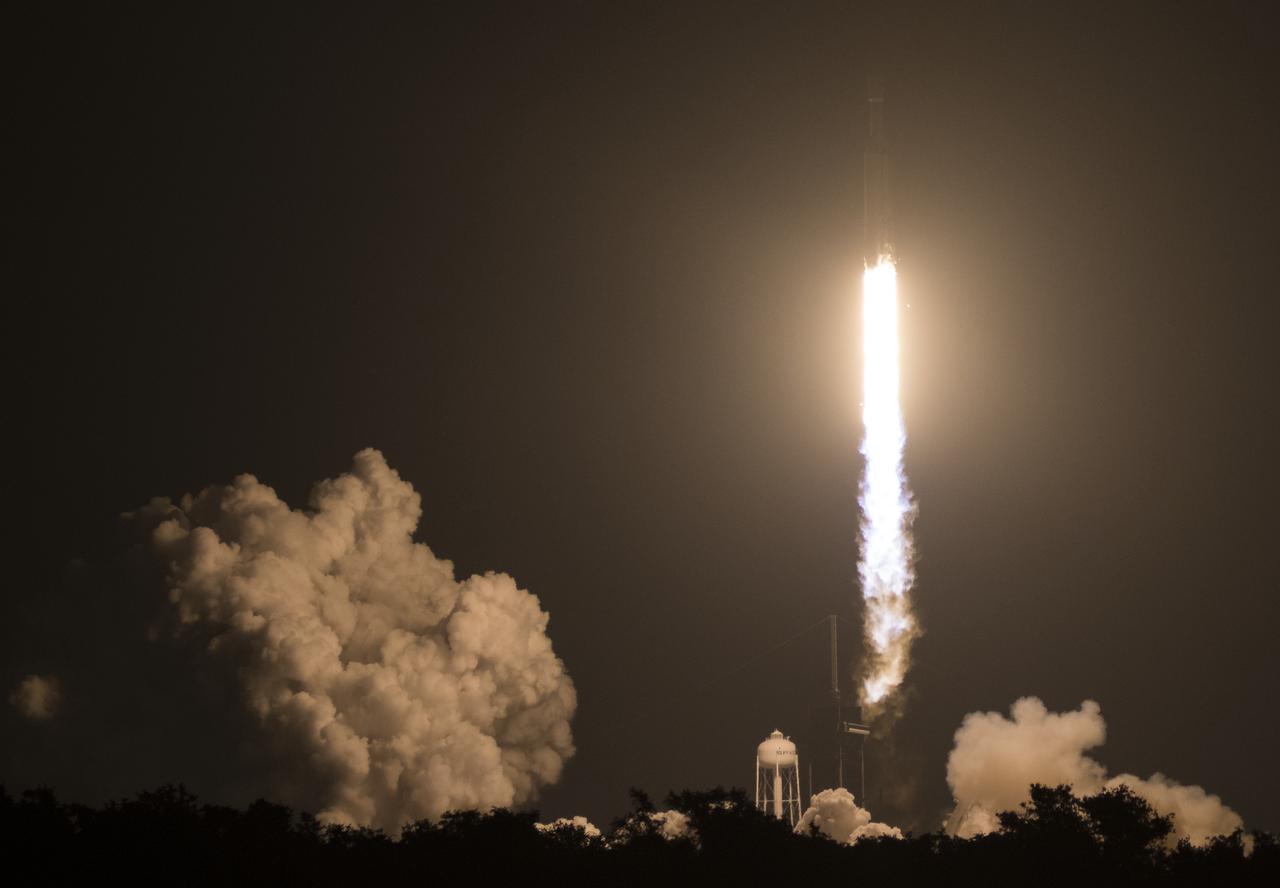
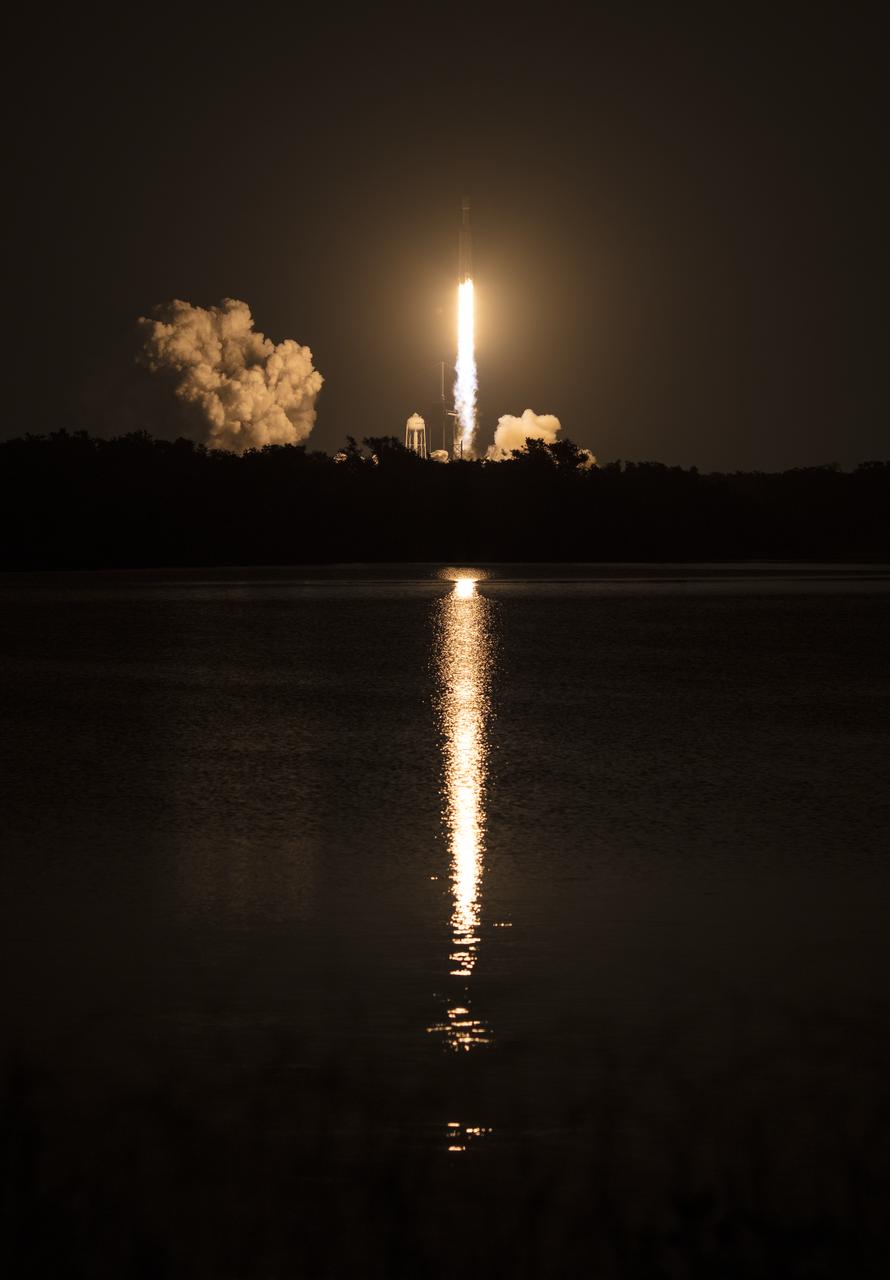
A SpaceX Falcon Heavy rocket carrying 24 satellites as part of the Department of Defense's Space Test Program-2 (STP-2) mission launches from Launch Complex 39A, Tuesday, June 25, 2019 at NASA's Kennedy Space Center in Florida. Four NASA technology and science payloads which will study non-toxic spacecraft fuel, deep space navigation, "bubbles" in the electrically-charged layers of Earth's upper atmosphere, and radiation protection for satellites are among the two dozen satellites that will be put into orbit. Photo Credit: (NASA/Joel Kowsky)
SpaceX Falcon Heavy DoD STP-2 Launch
A SpaceX Falcon Heavy rocket carrying 24 satellites as part of the Department of Defense's Space Test Program-2 (STP-2) mission launches from Launch Complex 39A, Tuesday, June 25, 2019 at NASA's Kennedy Space Center in Florida. Four NASA technology and science payloads which will study non-toxic spacecraft fuel, deep space navigation, "bubbles" in the electrically-charged layers of Earth's upper atmosphere, and radiation protection for satellites are among the two dozen satellites that will be put into orbit. Photo Credit: (NASA/Joel Kowsky)
SpaceX Falcon Heavy DoD STP-2 Launch
A SpaceX Falcon Heavy rocket carrying 24 satellites as part of the Department of Defense's Space Test Program-2 (STP-2) mission launches from Launch Complex 39A, Tuesday, June 25, 2019 at NASA's Kennedy Space Center in Florida. Four NASA technology and science payloads which will study non-toxic spacecraft fuel, deep space navigation, "bubbles" in the electrically-charged layers of Earth's upper atmosphere, and radiation protection for satellites are among the two dozen satellites that will be put into orbit. Photo Credit: (NASA/Joel Kowsky)
SpaceX Falcon Heavy DoD STP-2 Launch
A SpaceX Falcon Heavy rocket carrying 24 satellites as part of the Department of Defense's Space Test Program-2 (STP-2) mission launches from Launch Complex 39A, Tuesday, June 25, 2019 at NASA's Kennedy Space Center in Florida. Four NASA technology and science payloads which will study non-toxic spacecraft fuel, deep space navigation, "bubbles" in the electrically-charged layers of Earth's upper atmosphere, and radiation protection for satellites are among the two dozen satellites that will be put into orbit. Photo Credit: (NASA/Joel Kowsky)
SpaceX Falcon Heavy DoD STP-2 Launch
A SpaceX Falcon Heavy rocket carrying 24 satellites as part of the Department of Defense's Space Test Program-2 (STP-2) mission launches from Launch Complex 39A, Tuesday, June 25, 2019 at NASA's Kennedy Space Center in Florida. Four NASA technology and science payloads which will study non-toxic spacecraft fuel, deep space navigation, "bubbles" in the electrically-charged layers of Earth's upper atmosphere, and radiation protection for satellites are among the two dozen satellites that will be put into orbit. Photo Credit: (NASA/Joel Kowsky)
SpaceX Falcon Heavy DoD STP-2 Launch
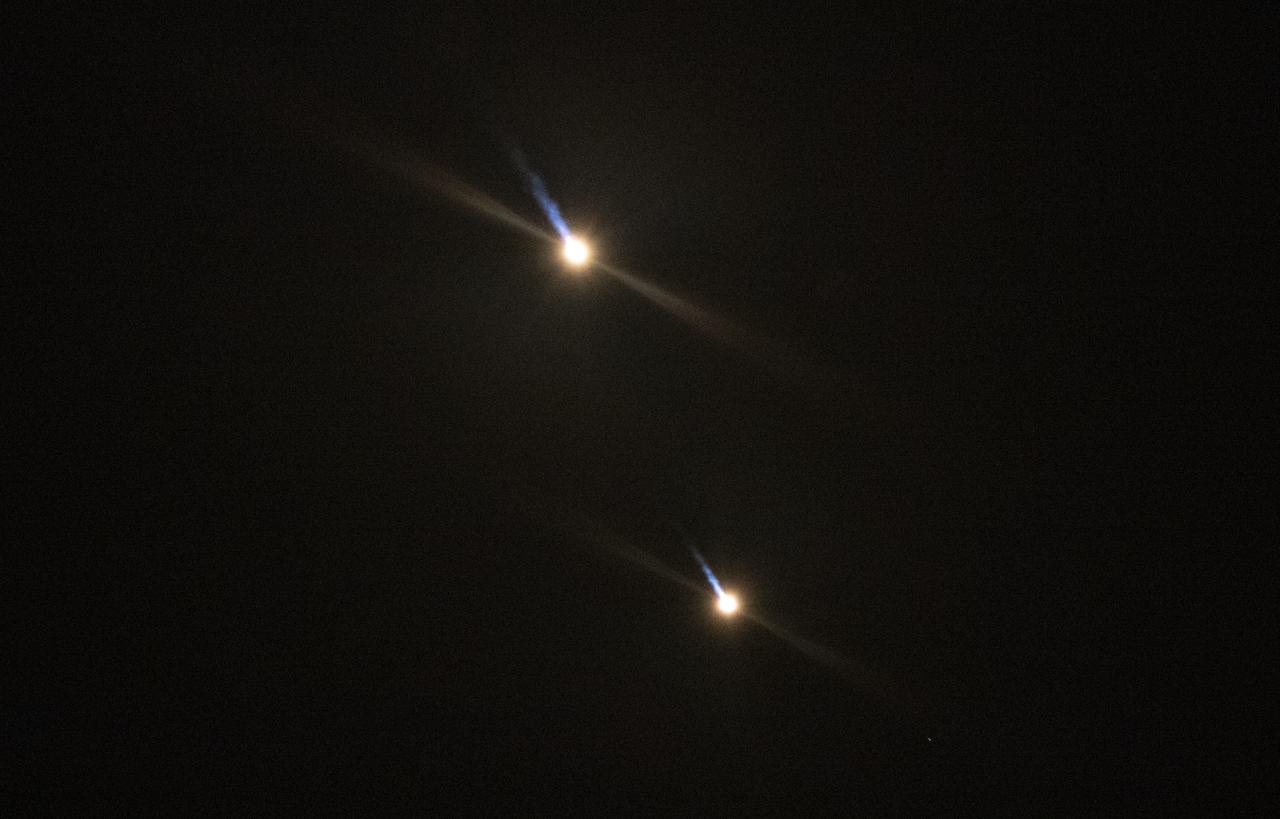
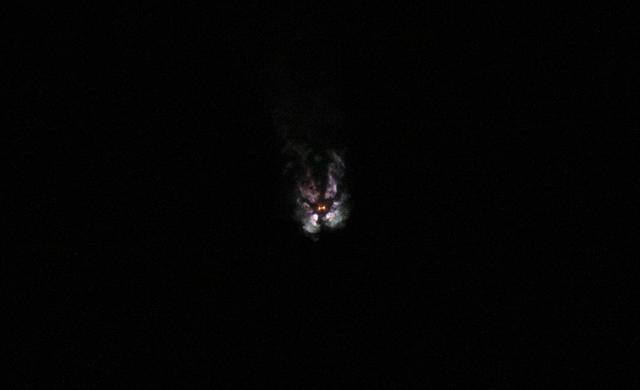
The two side boosters of the SpaceX Falcon Heavy rocket carrying 24 satellites as part of the Department of Defense's Space Test Program-2 (STP-2) mission are seen as they conduct a boost back burn to return to Landing Zone 1, Tuesday, June 25, 2019 at NASA's Kennedy Space Center in Florida. Four NASA technology and science payloads which will study non-toxic spacecraft fuel, deep space navigation, "bubbles" in the electrically-charged layers of Earth's upper atmosphere, and radiation protection for satellites are among the two dozen satellites that will be put into orbit. Photo Credit: (NASA/Joel Kowsky)
SpaceX Falcon Heavy DoD STP-2 Launch
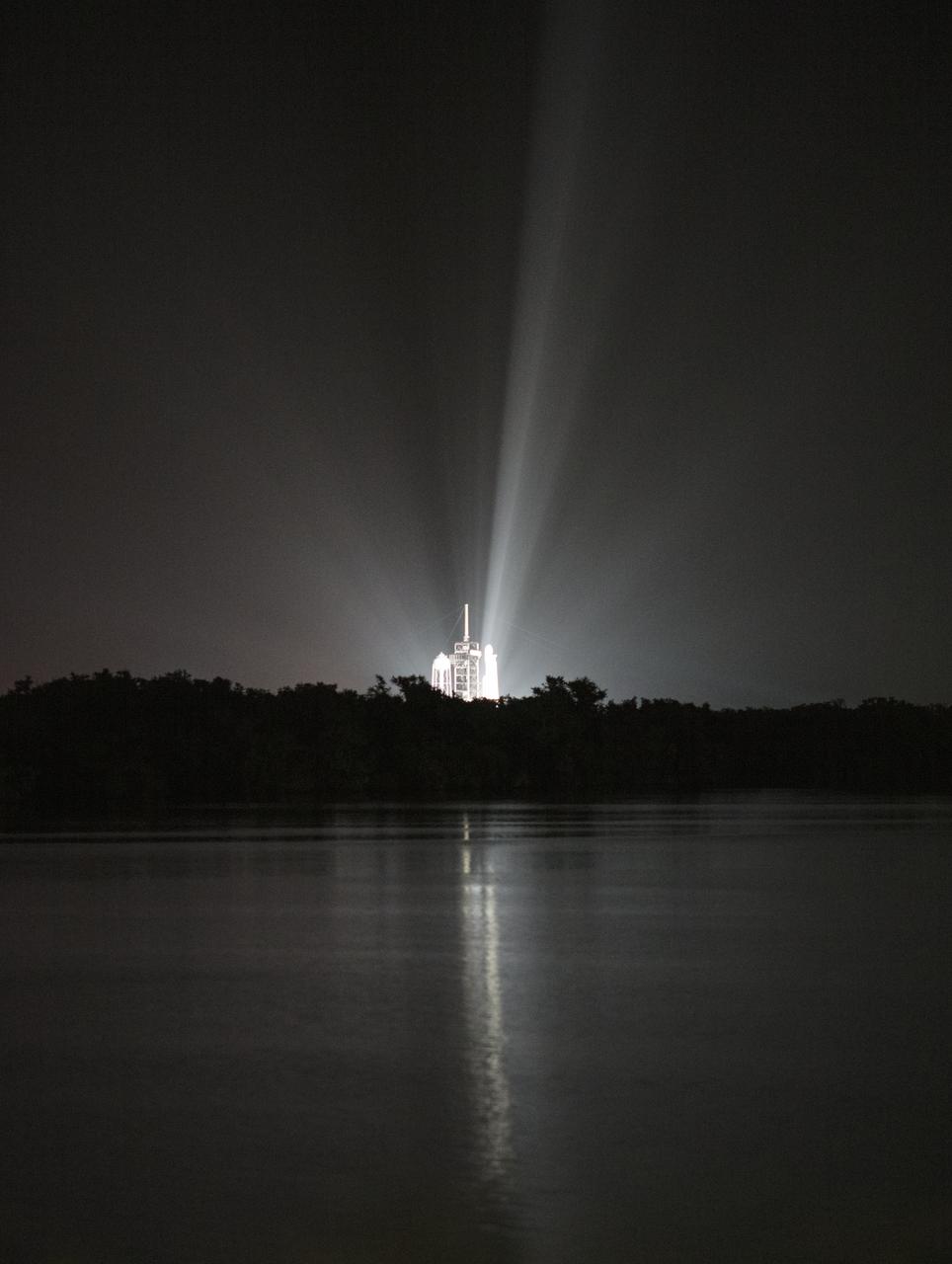
A SpaceX Falcon Heavy rocket carrying 24 satellites as part of the Department of Defense's Space Test Program-2 (STP-2) mission is seen illuminated by lights at Launch Complex 39A, Tuesday, June 25, 2019 at NASA's Kennedy Space Center in Florida. Four NASA technology and science payloads which will study non-toxic spacecraft fuel, deep space navigation, "bubbles" in the electrically-charged layers of Earth's upper atmosphere, and radiation protection for satellites are among the two dozen satellites that will be put into orbit. Photo Credit: (NASA/Joel Kowsky)
SpaceX Falcon Heavy DoD STP-2 Launch
Florida Lt. Governor Jeanette Nunez is given a tour of the Neil Armstrong Operations and Checkout (O&C) Building high bay by Kennedy Space Center Director Bob Cabana on April 5, 2019. During the tour, Nunez was shown NASA’s Orion spacecraft, which will be flown on the agency’s Exploration Mission-1 (EM-1). Orion will launch atop the Space Launch System rocket from Kennedy’s Launch Complex 39B. This uncrewed mission will provide the foundation for human deep space exploration and pave the way for the crewed EM-2 mission.
Lieutenant Governor of Florida tours O&C with Center Director Bo
A SpaceX Falcon Heavy rocket carrying 24 satellites as part of the Department of Defense's Space Test Program-2 (STP-2) mission launches from Launch Complex 39A, Tuesday, June 25, 2019 at NASA's Kennedy Space Center in Florida. Four NASA technology and science payloads which will study non-toxic spacecraft fuel, deep space navigation, "bubbles" in the electrically-charged layers of Earth's upper atmosphere, and radiation protection for satellites are among the two dozen satellites that will be put into orbit. Photo Credit: (NASA/Joel Kowsky)
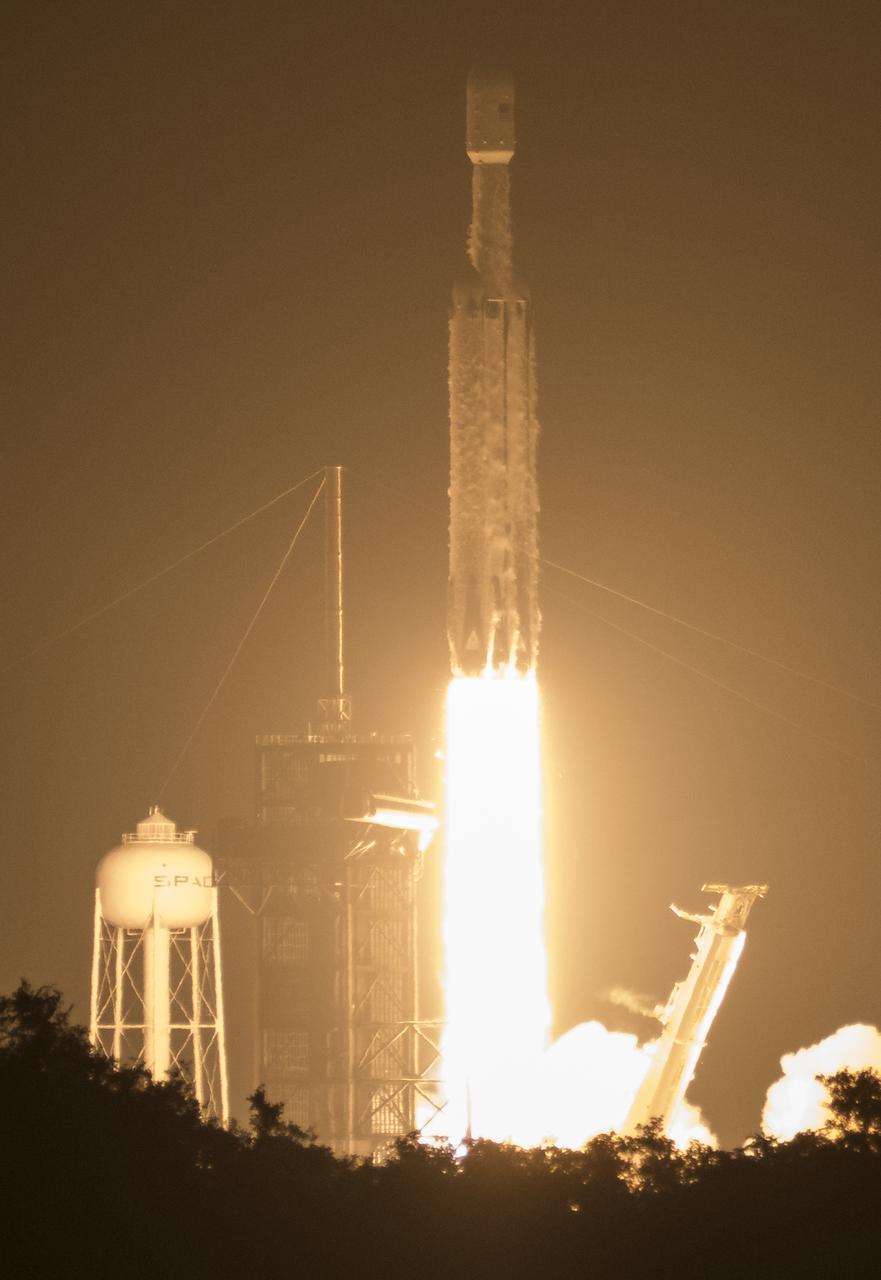
SpaceX Falcon Heavy DoD STP-2 Launch
The two side boosters of the SpaceX Falcon Heavy rocket carrying 24 satellites as part of the Department of Defense's Space Test Program-2 (STP-2) mission are seen as they begin their landing burns to return to Landing Zone 1, Tuesday, June 25, 2019 at NASA's Kennedy Space Center in Florida. Four NASA technology and science payloads which will study non-toxic spacecraft fuel, deep space navigation, "bubbles" in the electrically-charged layers of Earth's upper atmosphere, and radiation protection for satellites are among the two dozen satellites that will be put into orbit. Photo Credit: (NASA/Joel Kowsky)
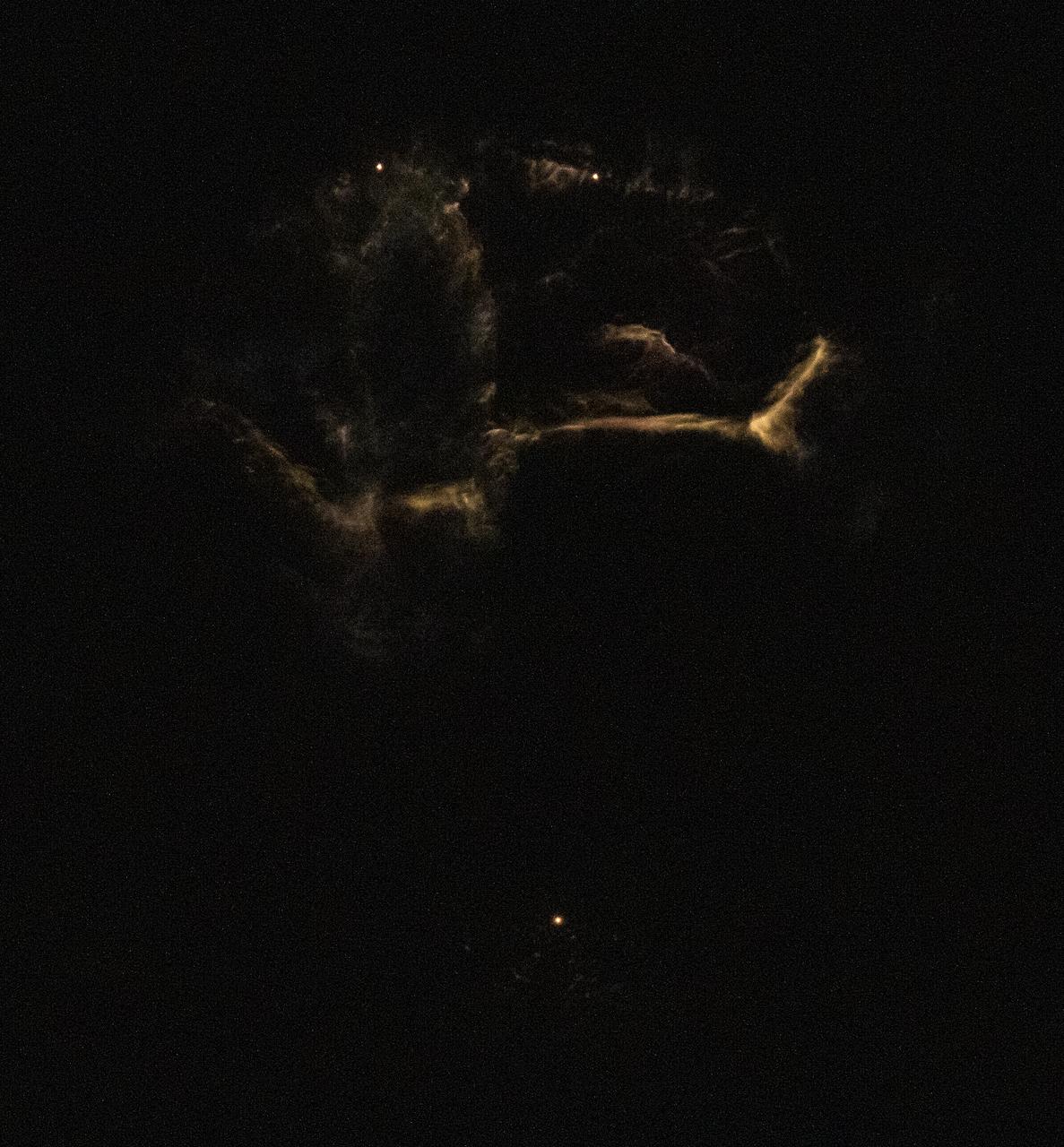
SpaceX Falcon Heavy DoD STP-2 Launch
A SpaceX Falcon Heavy rocket carrying 24 satellites as part of the Department of Defense's Space Test Program-2 (STP-2) mission launches from Launch Complex 39A, Tuesday, June 25, 2019 at NASA's Kennedy Space Center in Florida. Four NASA technology and science payloads which will study non-toxic spacecraft fuel, deep space navigation, "bubbles" in the electrically-charged layers of Earth's upper atmosphere, and radiation protection for satellites are among the two dozen satellites that will be put into orbit. Photo Credit: (NASA/Joel Kowsky)
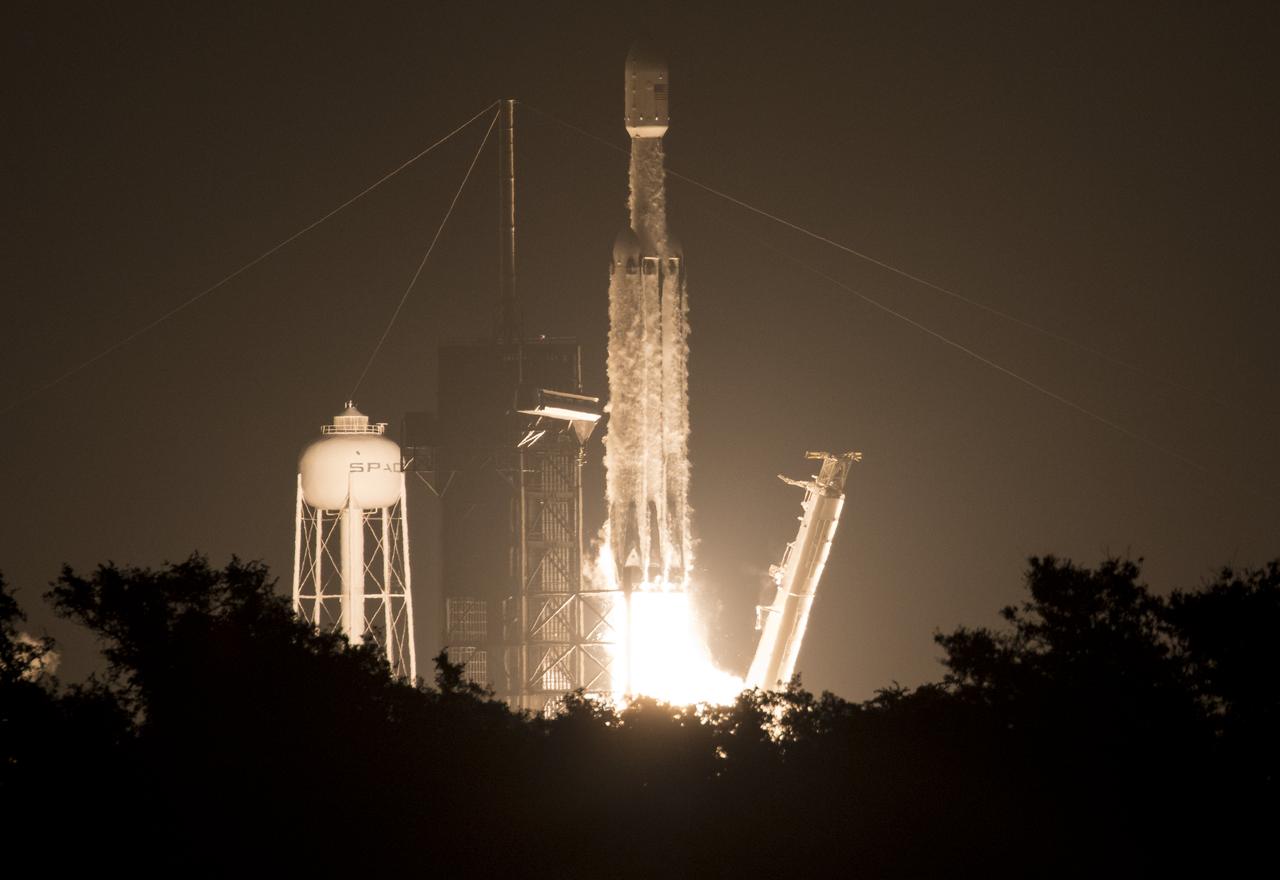
SpaceX Falcon Heavy DoD STP-2 Launch
The super guppy is seen as NASA Administrator Jim Bridenstine arrives to see how the Orion crew module and service module will be secured inside, and taken to a testing facility in Sandusky, Ohio, for full thermal vacuum testing, Monday March 11, 2019 at Kennedy Space Center in Florida. For information on NASA's Moon to Mars plans, visit: www.nasa.gov/moontomars Photo credit: (NASA/Aubrey Gemignani)
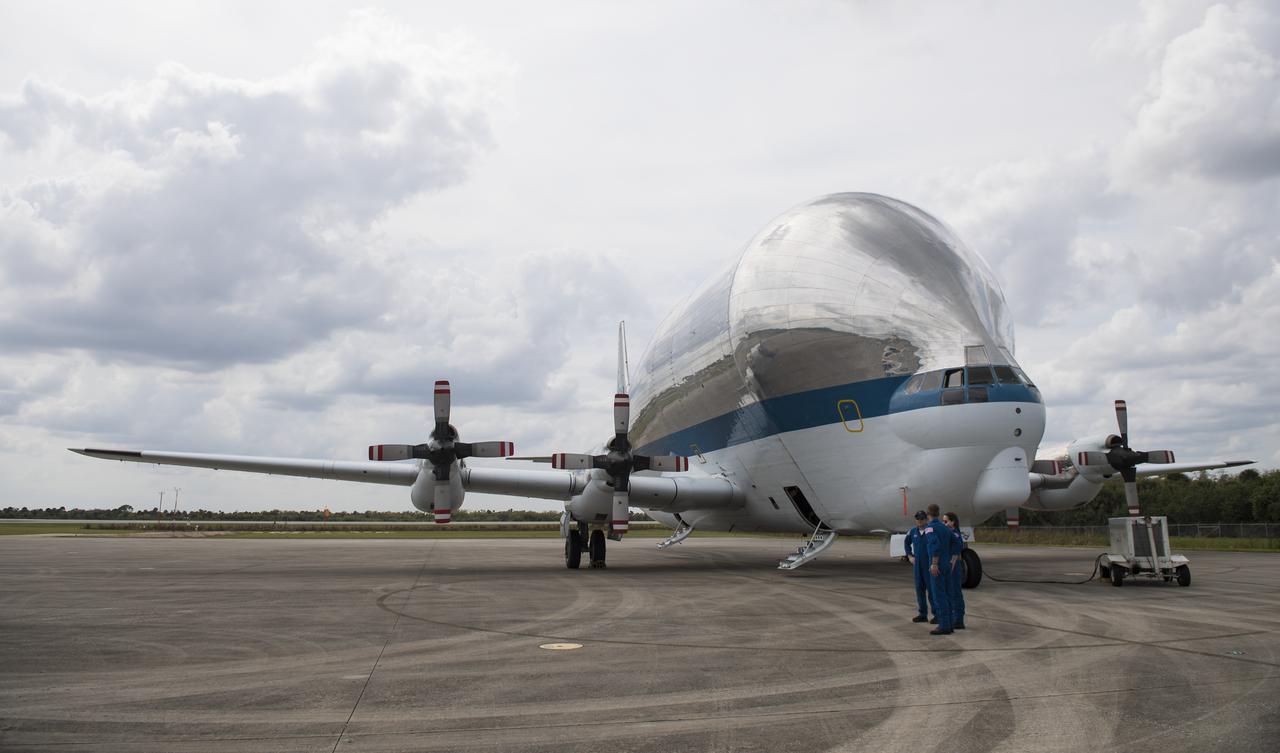
Moon to Mars Event
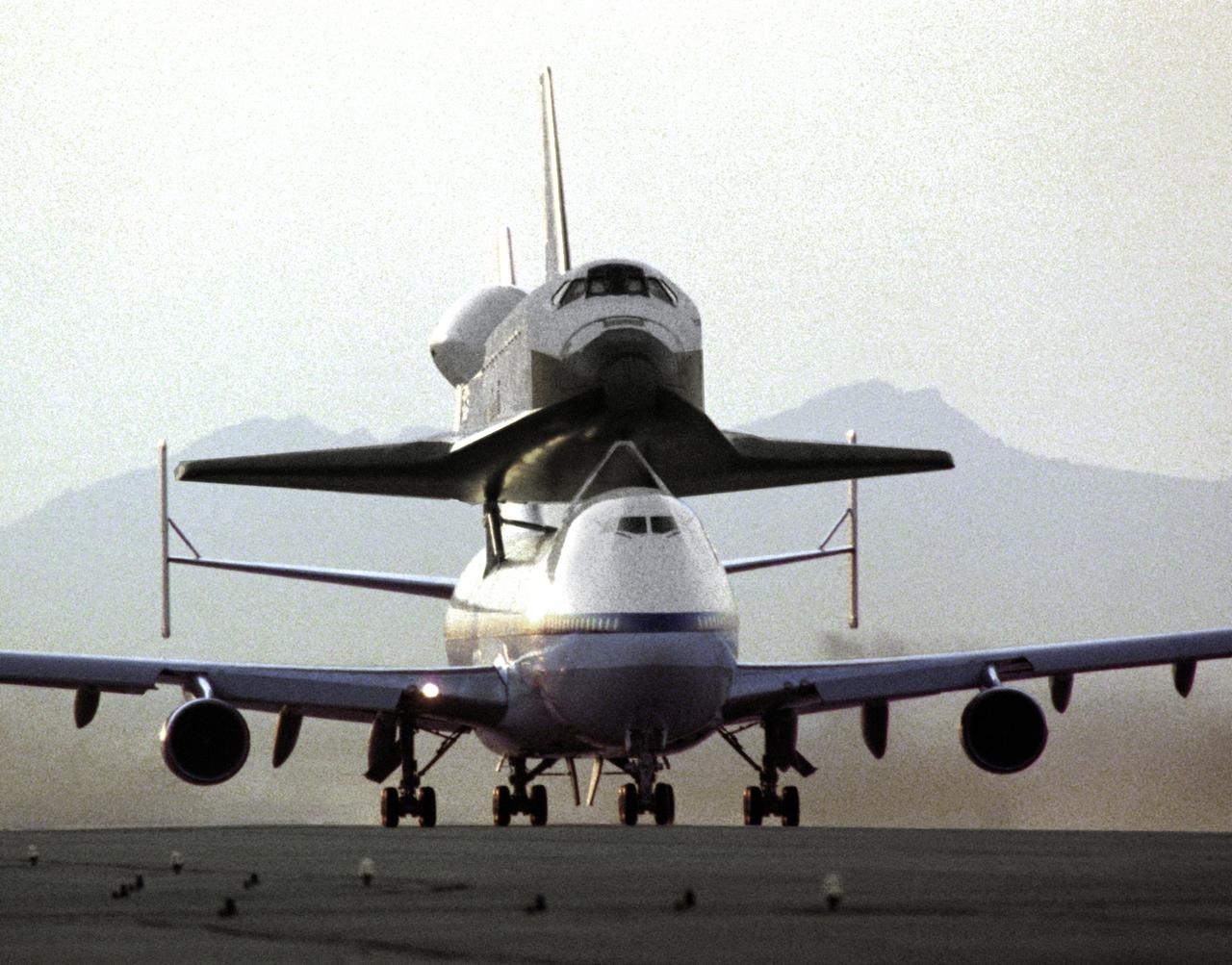
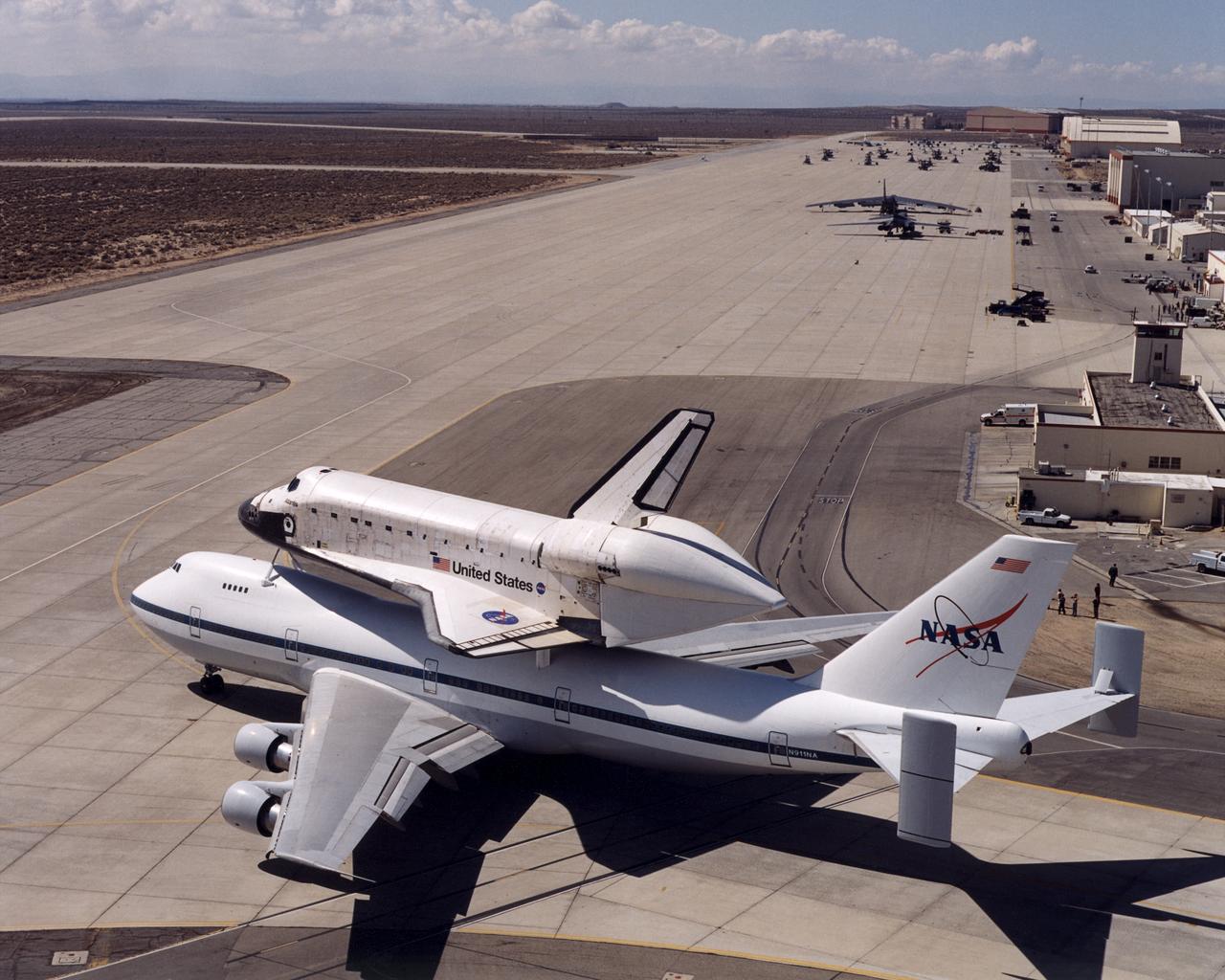
NASA's space shuttle Atlantis and its 747 carrier taxied on the Edwards Air Force Base flightline as the unusual combination left for Kennedy Space Center, Florida, on March 1, 2001. Atlantis and the shuttle Columbia were both airborne on the same day as they migrated from California to Florida. Columbia underwent refurbishing at nearby Palmdale, California.
NASA's space shuttle Atlantis and its 747 carrier taxied on the Edwards Air Force Base flightline as the unusual combination left for Kennedy Space Center, Florida, on March 1, 2001
NASA's space shuttle Atlantis and its 747 carrier taxied on the Edwards Air Force Base flightline as the unusual combination left for Kennedy Space Center, Florida, on March 1, 2001. Atlantis and the shuttle Columbia were both airborne on the same day as they migrated from California to Florida. Columbia underwent refurbishing at nearby Palmdale, California.
NASA's space shuttle Atlantis and its 747 carrier taxied on the Edwards Air Force Base flightline as the unusual combination left for Kennedy Space Center, Florida, on March 1, 2001
NASA's modified Boeing 747 Shuttle Carrier Aircraft with the Space Shuttle Endeavour on top lifts off from Edwards Air Force Base to begin its ferry flight back to the Kennedy Space Center in Florida.
NASA's modified Boeing 747 Shuttle Carrier Aircraft with the Space Shuttle Endeavour on top lifts off to begin its ferry flight back to the Kennedy Space Center in Florida
NASA technicians position the aerodynamic tailcone around the engine nozzles of the Space Shuttle Endeavour Dec. 7 in preparation for its ferry flight from NASA's Dryden Flight Research Center at Edwards Air Force Base back to the Kennedy Space Center in Florida.
NASA technicians position the aerodynamic tailcone around the engine nozzles of the Space Shuttle Endeavour in preparation for its ferry back to KSC in Florida
NASA Administrator Jim Bridenstine, center, and Kennedy Space Center Director Bob Cabana, right, visit Florida Institute of Technology on Thursday, May 23, 2019. Bridenstine delivered the keynote address at the Melbourne, FL campus during the university’s Space Technology Day. Among the key topics Bridenstine discussed was NASA’s Artemis missions to the Moon, including the lunar Gateway, which will serve as an orbiting outpost for astronauts.
NASA Adiminstrator Jim Bridenstine visits FIT
jsc2025e012276 - (February 25, 2025) ---The crew of NASA’s SpaceX Crew-10 mission to the International Space Station poses for a photo during training at NASA’s Kennedy Space Center in Florida.
The crew of NASA’s SpaceX Crew-10 mission
A nearly full Moon sets as the space shuttle Discovery sits atop Launch pad 39A at the Kennedy Space Center in Cape Canaveral, Florida, Wednesday, March 11, 2009.  Photo Credit: (NASA/Bill Ingalls)
STS-119 Shuttle Discovery With Moon
NASA’s Space Launch System (SLS) rocket with the Orion spacecraft aboard is seen in a reflection in the windows of a shuttle bus, Thursday, April 21, 2022, at NASA’s Kennedy Space Center in Florida. Photo Credit: (NASA/Aubrey Gemignani)
Artemis 1 on Launch Pad 39B