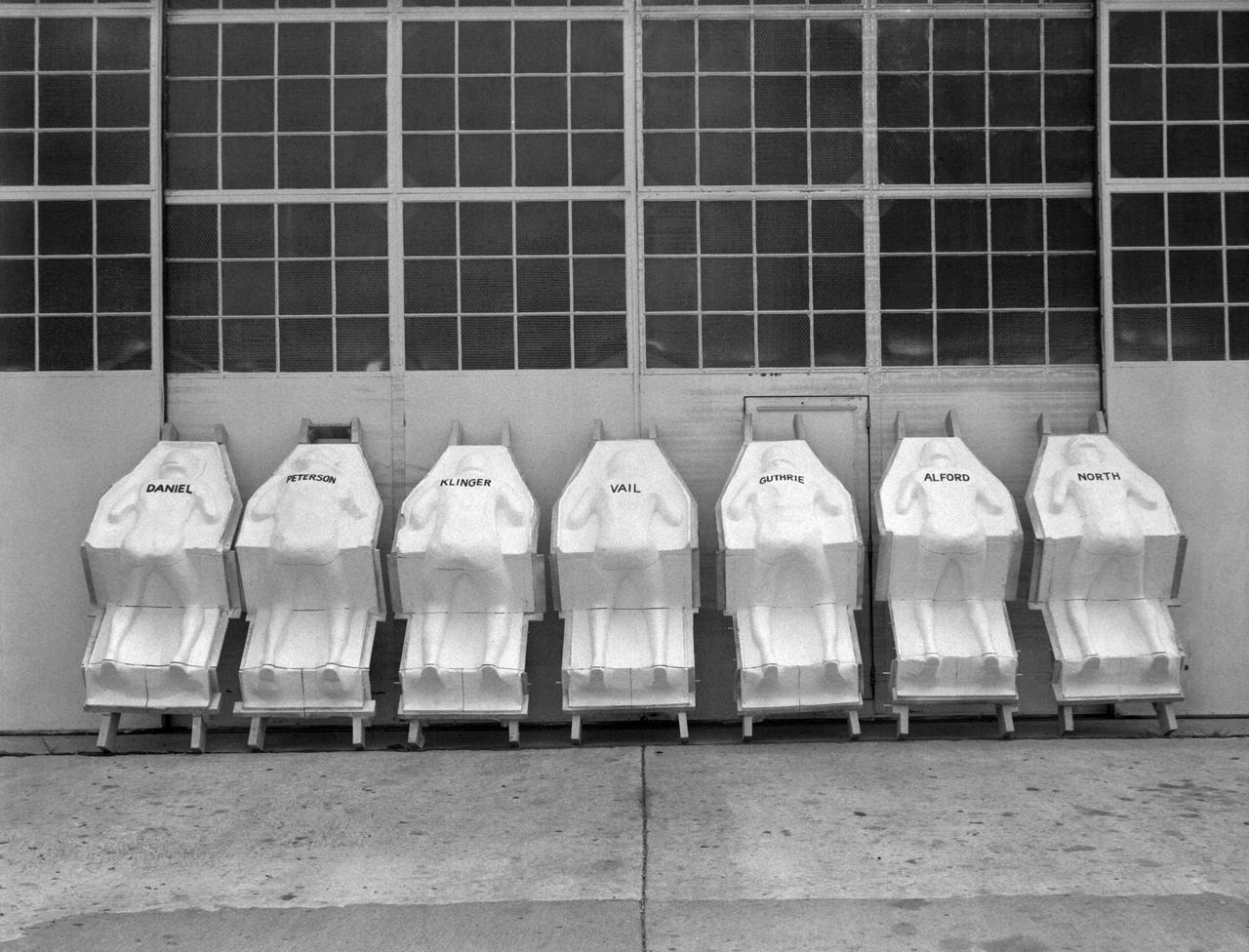
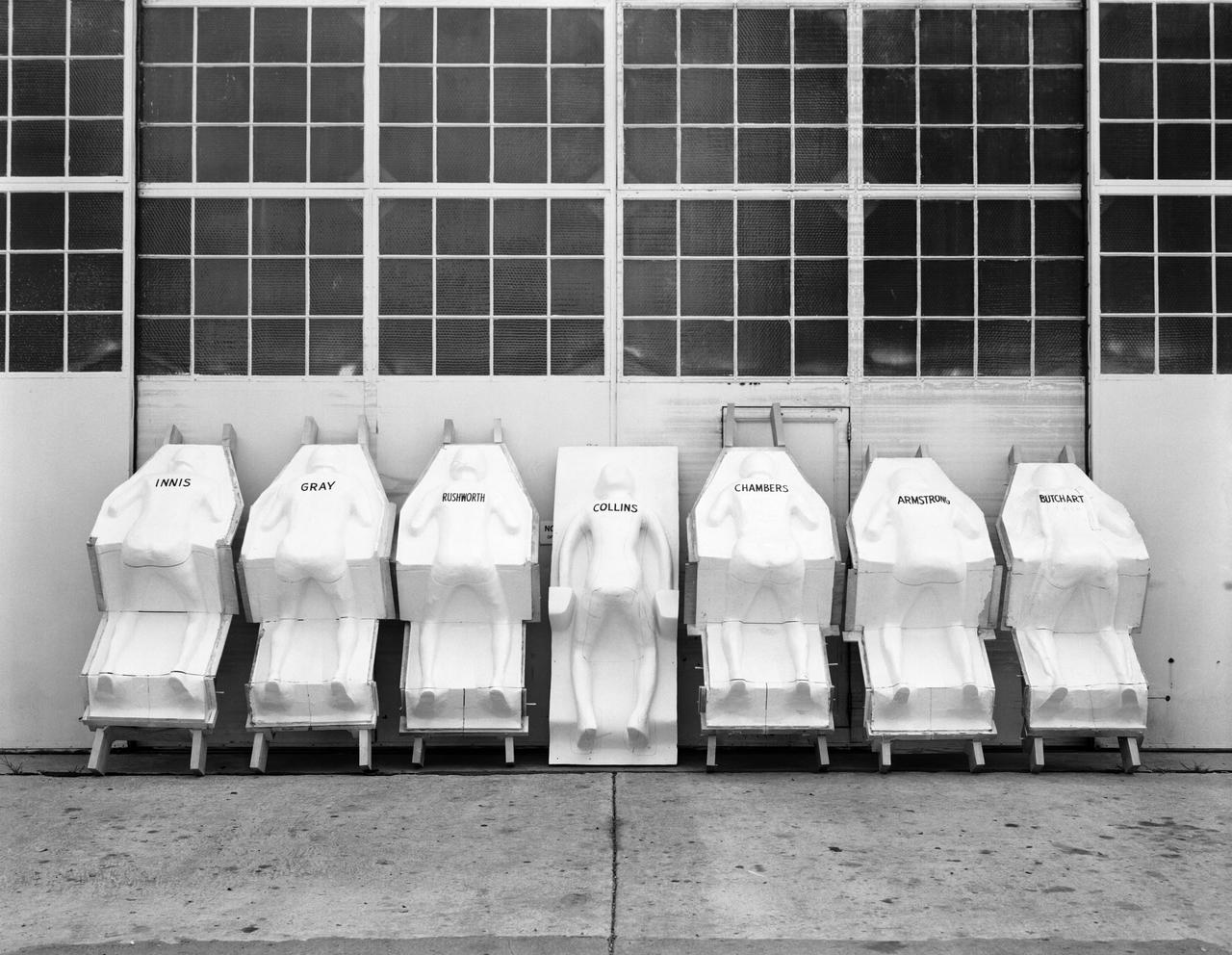
Molds for couches for test pilots, line the NASA Langley Research Centers model shop wall. The names of the test subjects (Langley employees) are written on the back.  The couches are similar to those made for each astronaut and fitted into the Mercury capsules for manned spaceflight.
Molds for Couches for Test Pilots
Molds for couches for test pilots, line the NASA Langley Research Centers model shop wall. The names of the test subjects (Langley employees) are written on the back.  The couches are similar to those made for each astronaut and fitted into the Mercury capsules for manned spaceflight.
Molds for Couches for Test Pilots
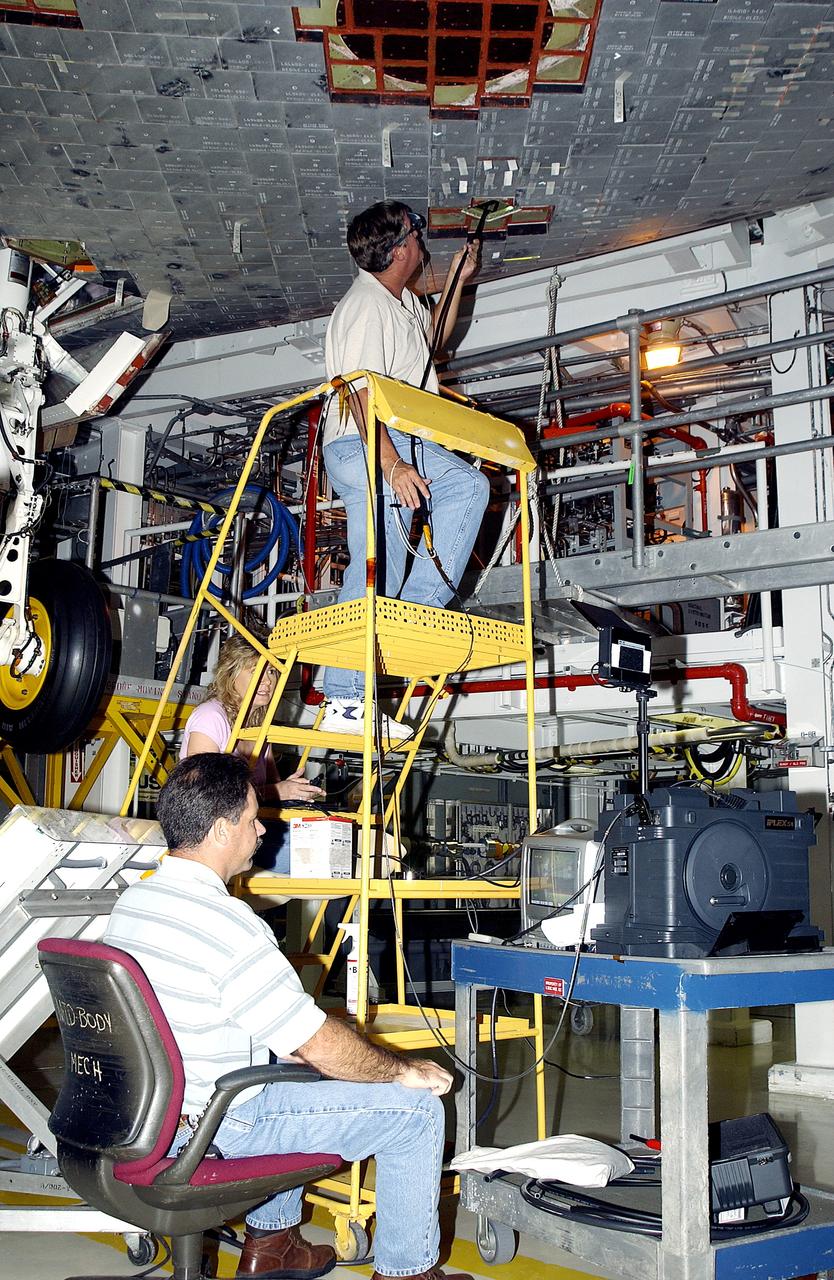
KENNEDY SPACE CENTER, FLA. -   In the Orbiter Processing Facility, while Greg Harlow, with United Space Alliance (USA) (above) threads a camera under the tiles of the orbiter Endeavour, Peggy Ritchie, USA, (behind the stand) and NASA’s Richard Parker (seated) watch the images on a monitor to inspect for corrosion.
KENNEDY SPACE CENTER, FLA. - In the Orbiter Processing Facility, while Greg Harlow, with United Space Alliance (USA) (above) threads a camera under the tiles of the orbiter Endeavour, Peggy Ritchie, USA, (behind the stand) and NASA’s Richard Parker (seated) watch the images on a monitor to inspect for corrosion.
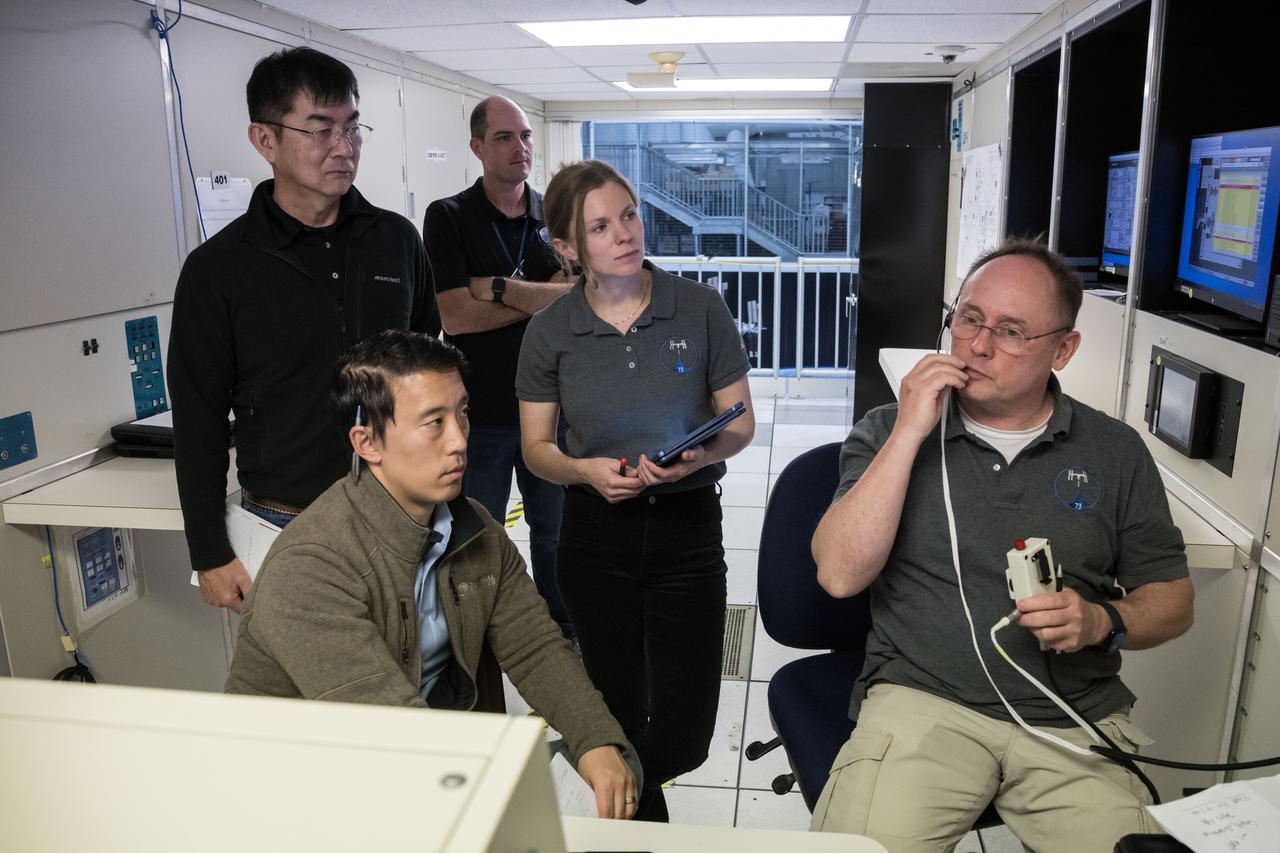
jsc2025e006033 (Feb. 3, 2025) --- From left to right: JAXA astronaut Kimiya Yui, and NASA astronauts Jonny Kim (seated), Zena Cardman, and Mike Fincke conduct training scenarios with their instructors at NASA’s Johnson Space Center in Houston, Texas for their upcoming mission to the International Space Station. Credit: NASA/Helen Arase Vargas
SpaceX Crew-11 and Expedition 73 crew members train together
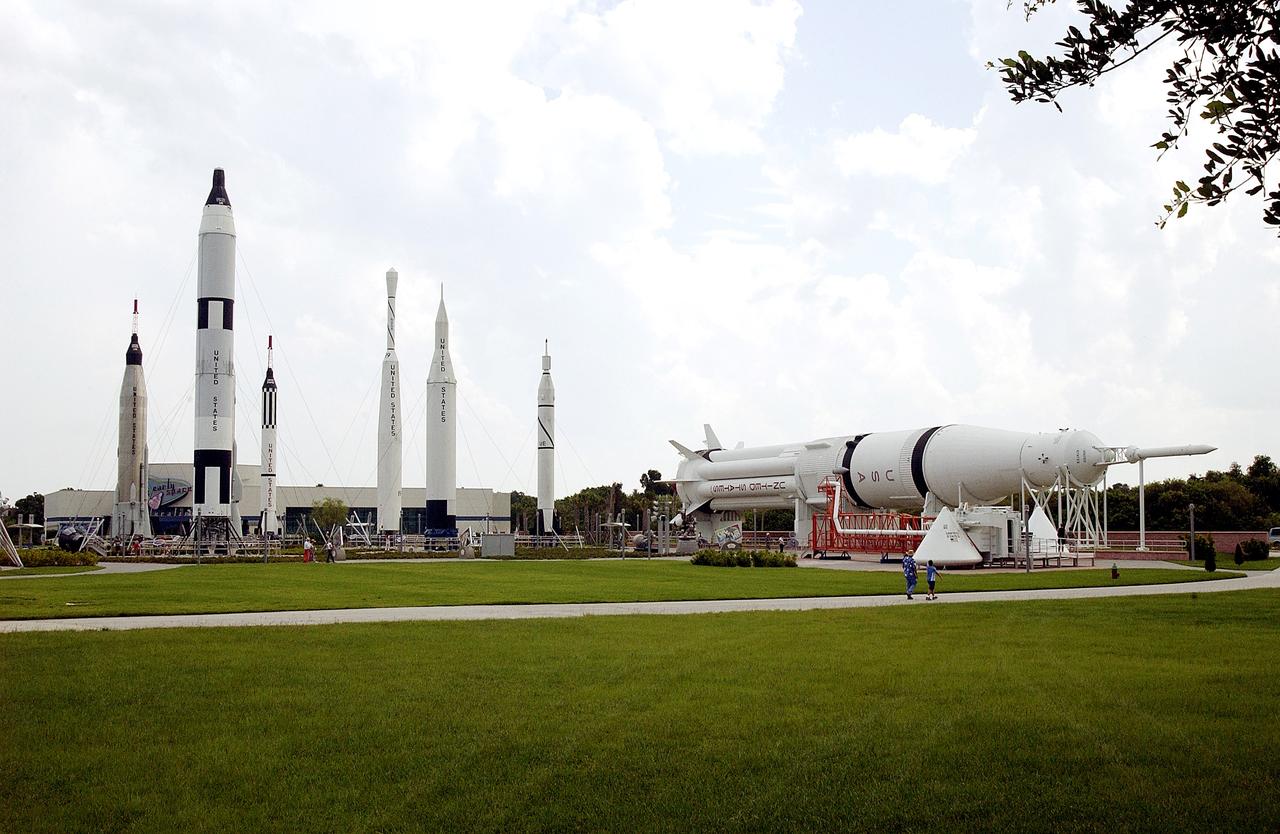
KENNEDY SPACE CENTER, FLA.  -  The Rocket Garden at the KSC Visitor Complex features eight authentic rockets from the past, including a Mercury-Atlas rocket.  The garden also features a climb-in Mercury, Gemino and Apollo capsule replicas, seating pods and informative graphic elements.
KENNEDY SPACE CENTER, FLA. - The Rocket Garden at the KSC Visitor Complex features eight authentic rockets from the past, including a Mercury-Atlas rocket. The garden also features a climb-in Mercury, Gemino and Apollo capsule replicas, seating pods and informative graphic elements.
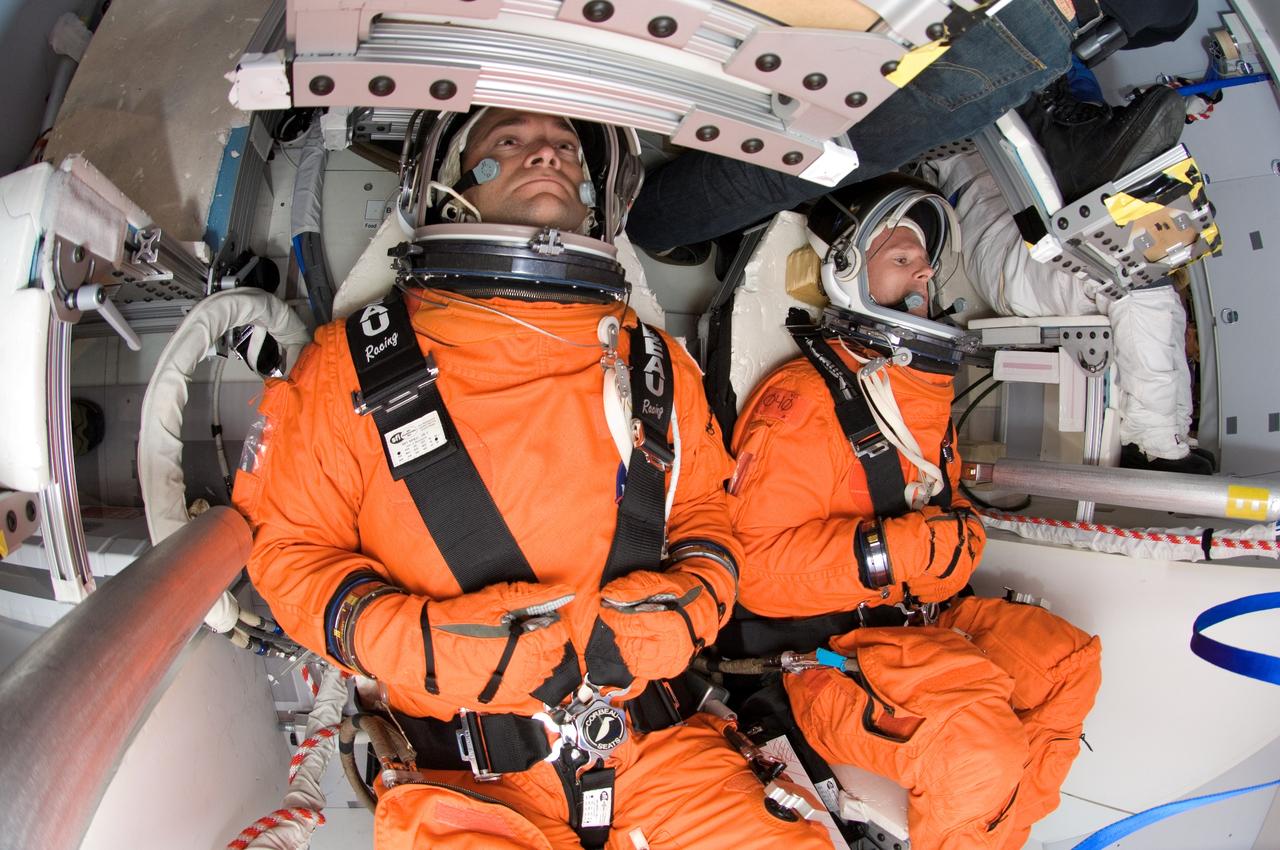
Photographic documentation of the CEV Seat Layout Evaluation taken in the Orion mockup located in bldg 9NW, Johnson Space Center (JSC).  Test subjects in orange Launch and Entry Suit (LES) is visible in the seat.
CEV Seat Layout Evaluation
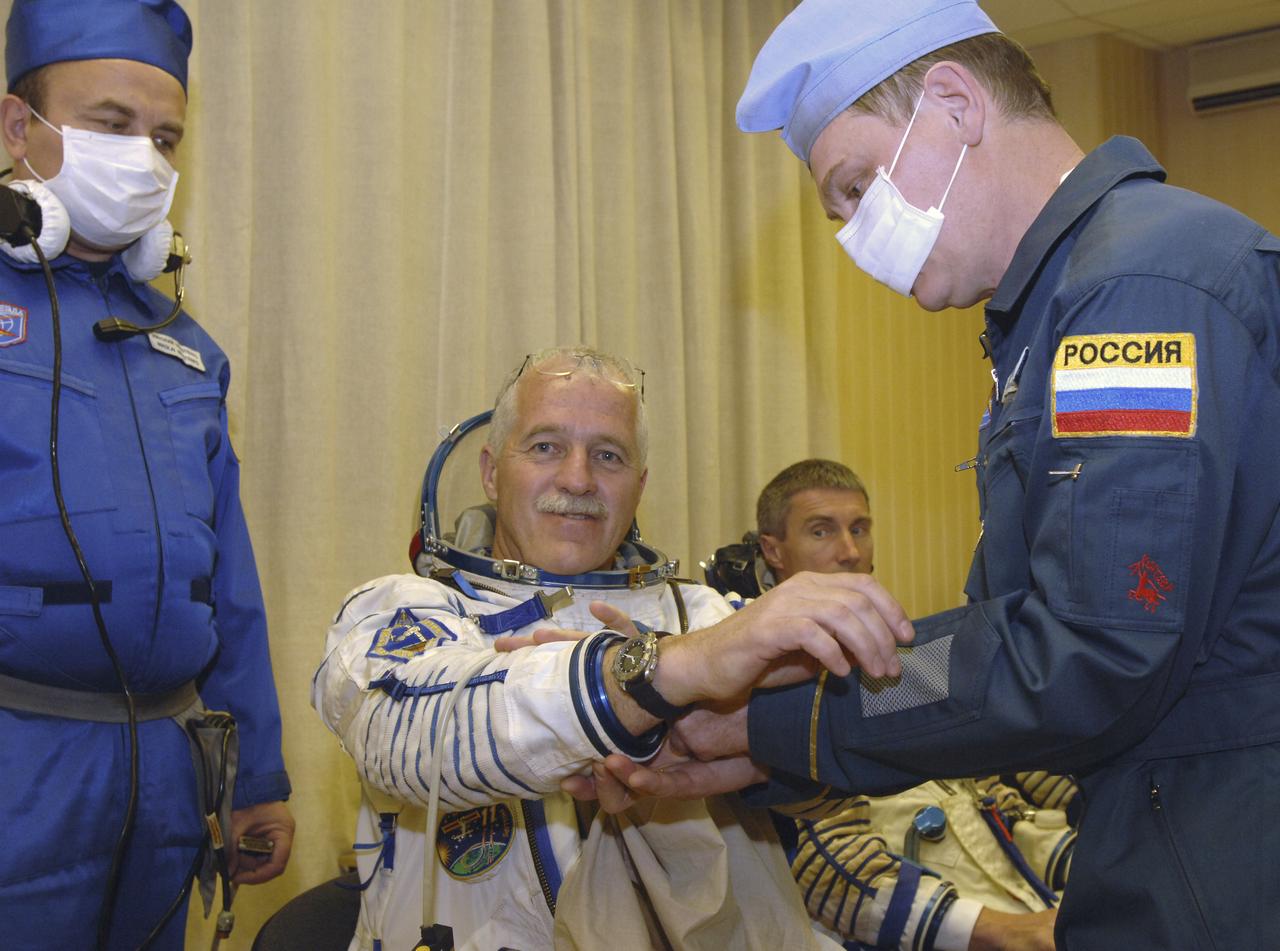
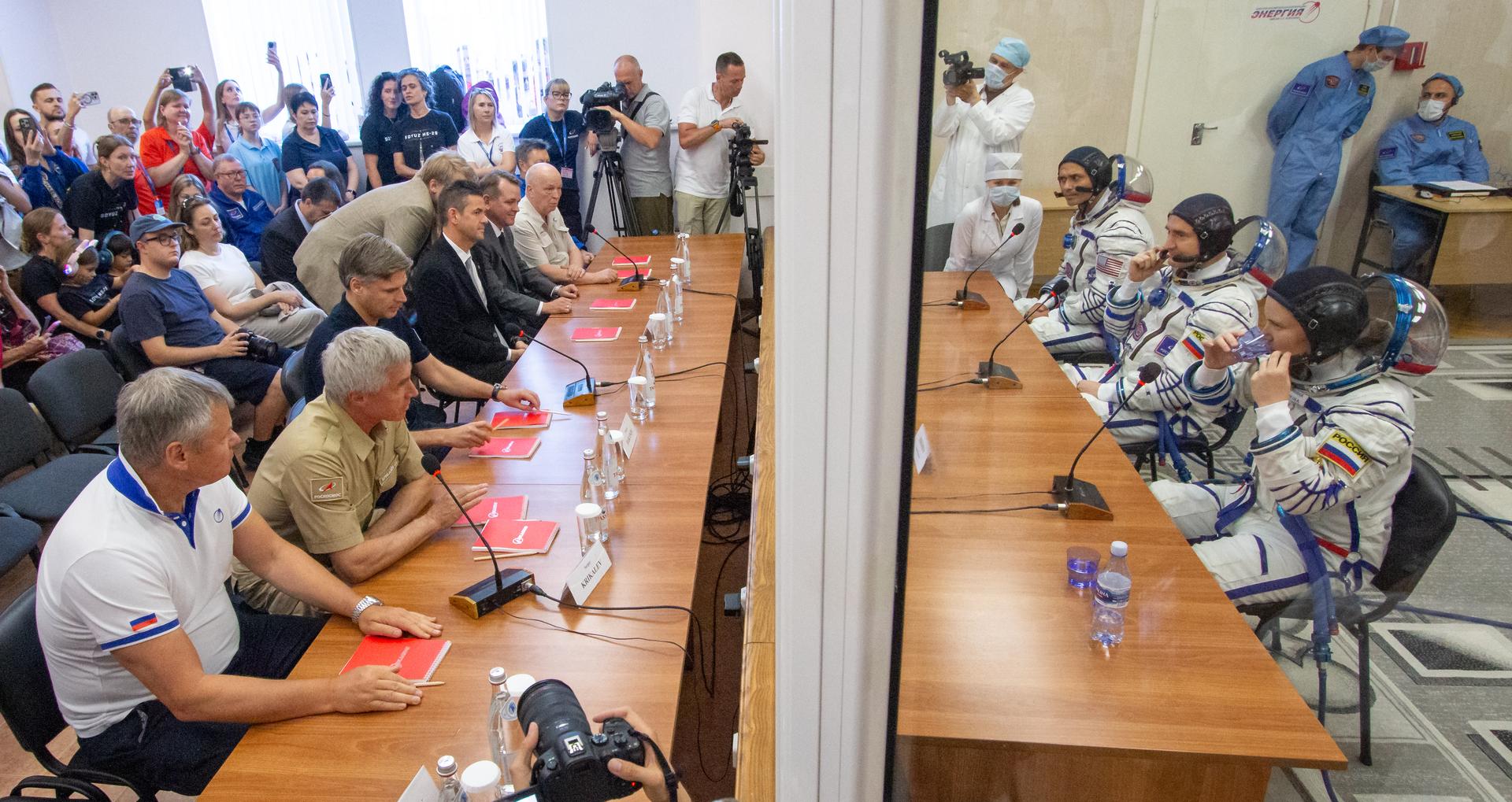
Expedition 11 Commander Sergei Krikalev, seated center, Flight Engineer and NASA Science Officer John Phillips, seated left and European Space Agency Astronaut Roberto Vittori, of Italy, seated right, relax prior to launch aboard the Soyuz TMA-6 spacecraft from the Baikonur Cosmodrome in Kazakhstan, Friday, April 15, 2005 for a two-day trip to the International Space Station. Photo Credit: (NASA/Bill Ingalls)
Expedition 11 Launch Day
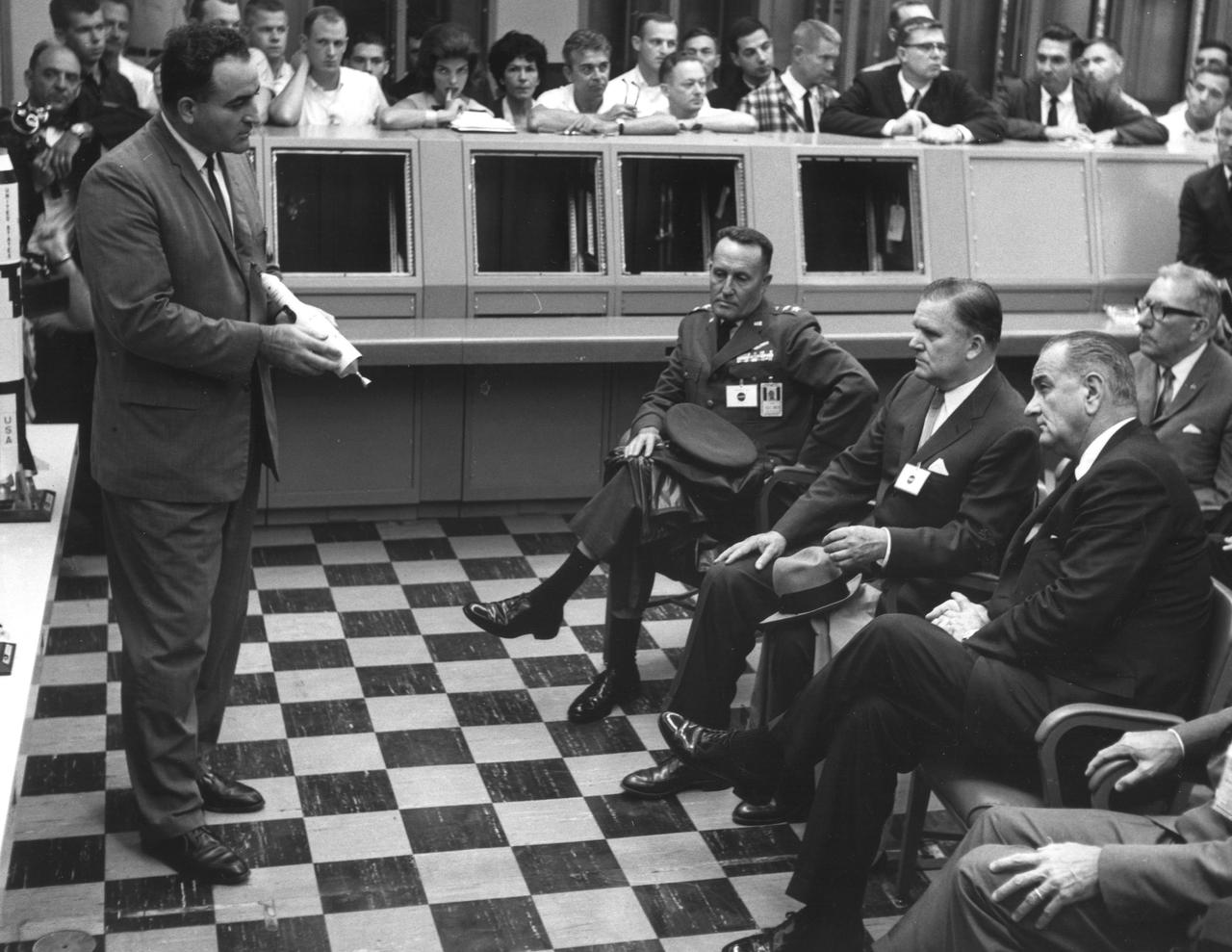
KENNEDY SPACE CENTER, FLA. -- President Lyndon B. Johnson (seated at right), NASA Administrator James T. Webb (seated, center) and Major General Vincent G. Huston (seated, left), commander, Air Force Eastern Test Range, are briefed by Rocco A. Petrone (left), director of Kennedy Space Center Launch Operations, during the Sept. 15, 1964 visit.
KSC-64-17676
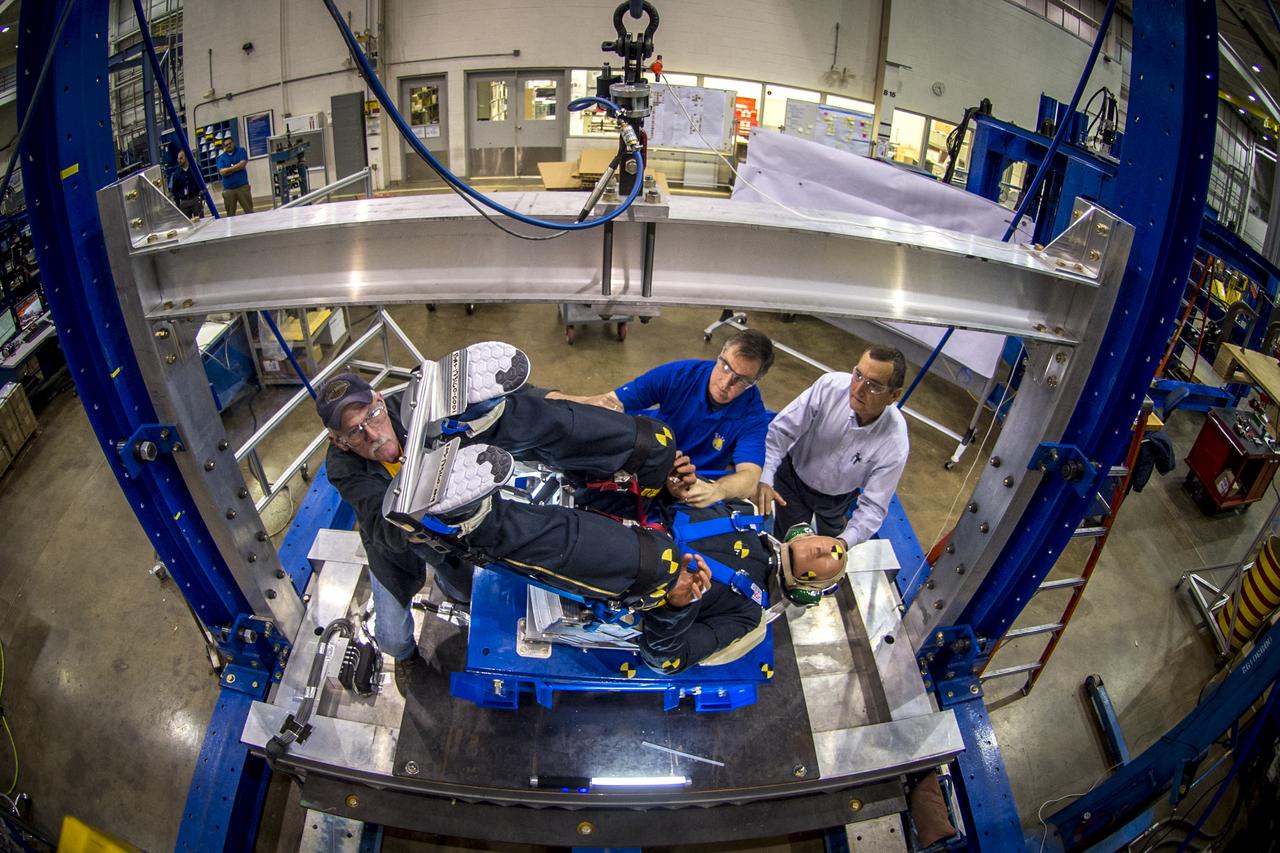
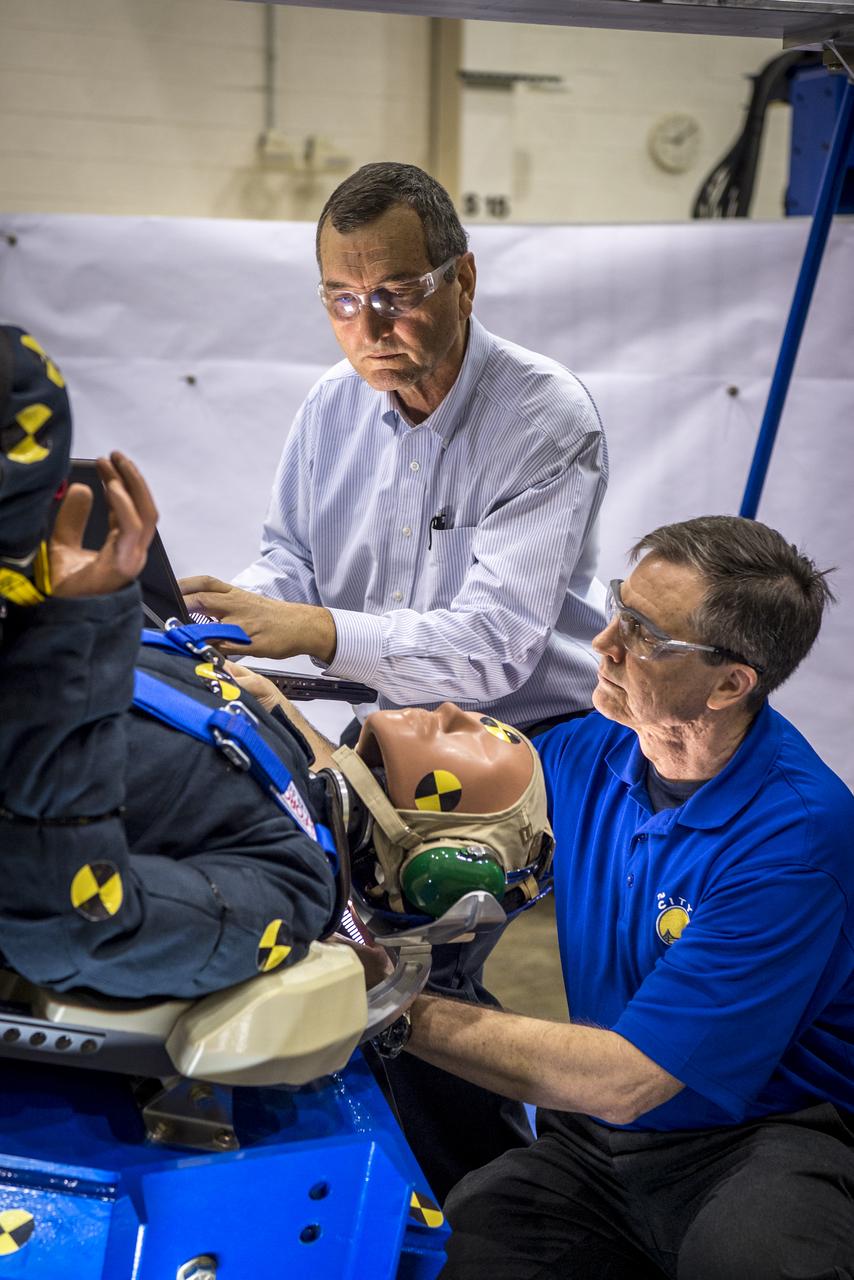
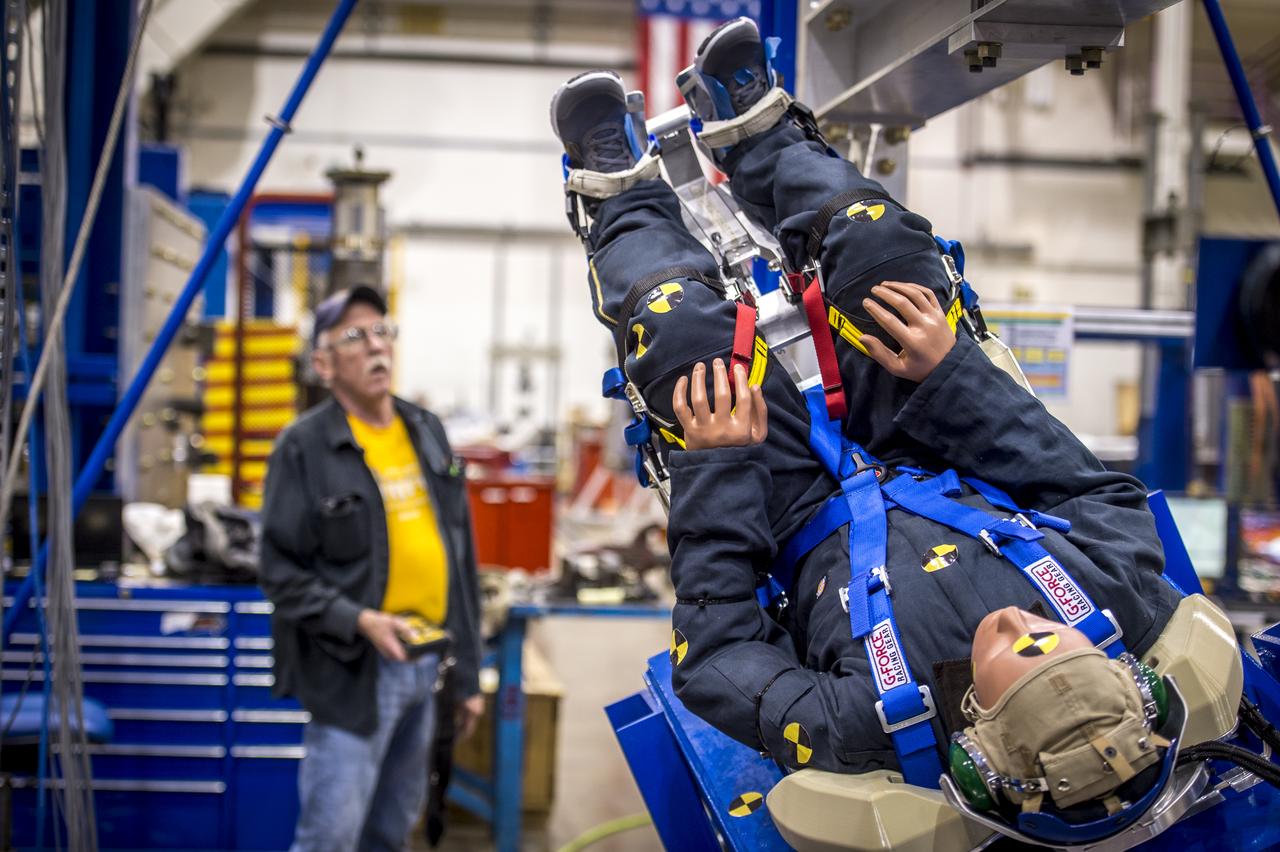
Engineers working with Boeing's CST-100 Starliner test the spacecraft's seat design in Mesa, Arizona, focusing on how the spacecraft seats would protect an astronaut's head, neck and spine during the 240-mile descent from the International Space Station. The company incorporated test dummies for a detailed analysis of impacts on a crew returning to earth. The human-sized dummies were equipped with sensitive instrumentation and secured in the seats for 30 drop tests at varying heights, angles, velocities and seat orientations in order to mimic actual landing conditions. High-speed cameras captured the footage for further analysis. The Starliner spacecraft is being developed in partnership with NASA's Commercial Crew Program.
Boeing CST-100 Starliner Seat Test
Engineers working with Boeing's CST-100 Starliner test the spacecraft's seat design in Mesa, Arizona, focusing on how the spacecraft seats would protect an astronaut's head, neck and spine during the 240-mile descent from the International Space Station. The company incorporated test dummies for a detailed analysis of impacts on a crew returning to earth. The human-sized dummies were equipped with sensitive instrumentation and secured in the seats for 30 drop tests at varying heights, angles, velocities and seat orientations in order to mimic actual landing conditions. High-speed cameras captured the footage for further analysis. The Starliner spacecraft is being developed in partnership with NASA's Commercial Crew Program.
Boeing CST-100 Starliner Seat Test
Engineers working with Boeing's CST-100 Starliner test the spacecraft's seat design in Mesa, Arizona, focusing on how the spacecraft seats would protect an astronaut's head, neck and spine during the 240-mile descent from the International Space Station. The company incorporated test dummies for a detailed analysis of impacts on a crew returning to earth. The human-sized dummies were equipped with sensitive instrumentation and secured in the seats for 30 drop tests at varying heights, angles, velocities and seat orientations in order to mimic actual landing conditions. High-speed cameras captured the footage for further analysis. The Starliner spacecraft is being developed in partnership with NASA's Commercial Crew Program.
Boeing CST-100 Starliner Seat Test
Engineers working with Boeing's CST-100 Starliner test the spacecraft's seat design in Mesa, Arizona, focusing on how the spacecraft seats would protect an astronaut's head, neck and spine during the 240-mile descent from the International Space Station. The company incorporated test dummies for a detailed analysis of impacts on a crew returning to earth. The human-sized dummies were equipped with sensitive instrumentation and secured in the seats for 30 drop tests at varying heights, angles, velocities and seat orientations in order to mimic actual landing conditions. High-speed cameras captured the footage for further analysis. The Starliner spacecraft is being developed in partnership with NASA's Commercial Crew Program.
Boeing CST-100 Starliner Seat Test
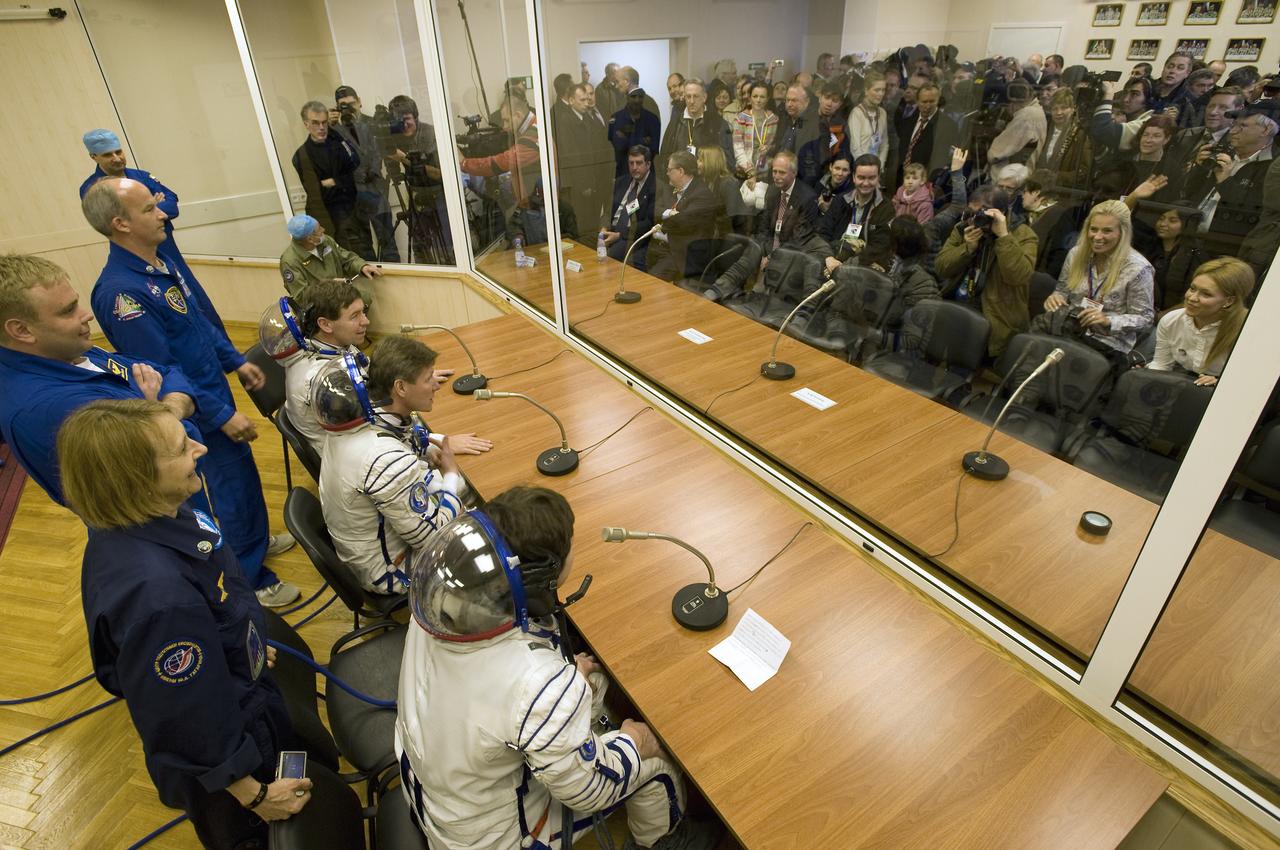
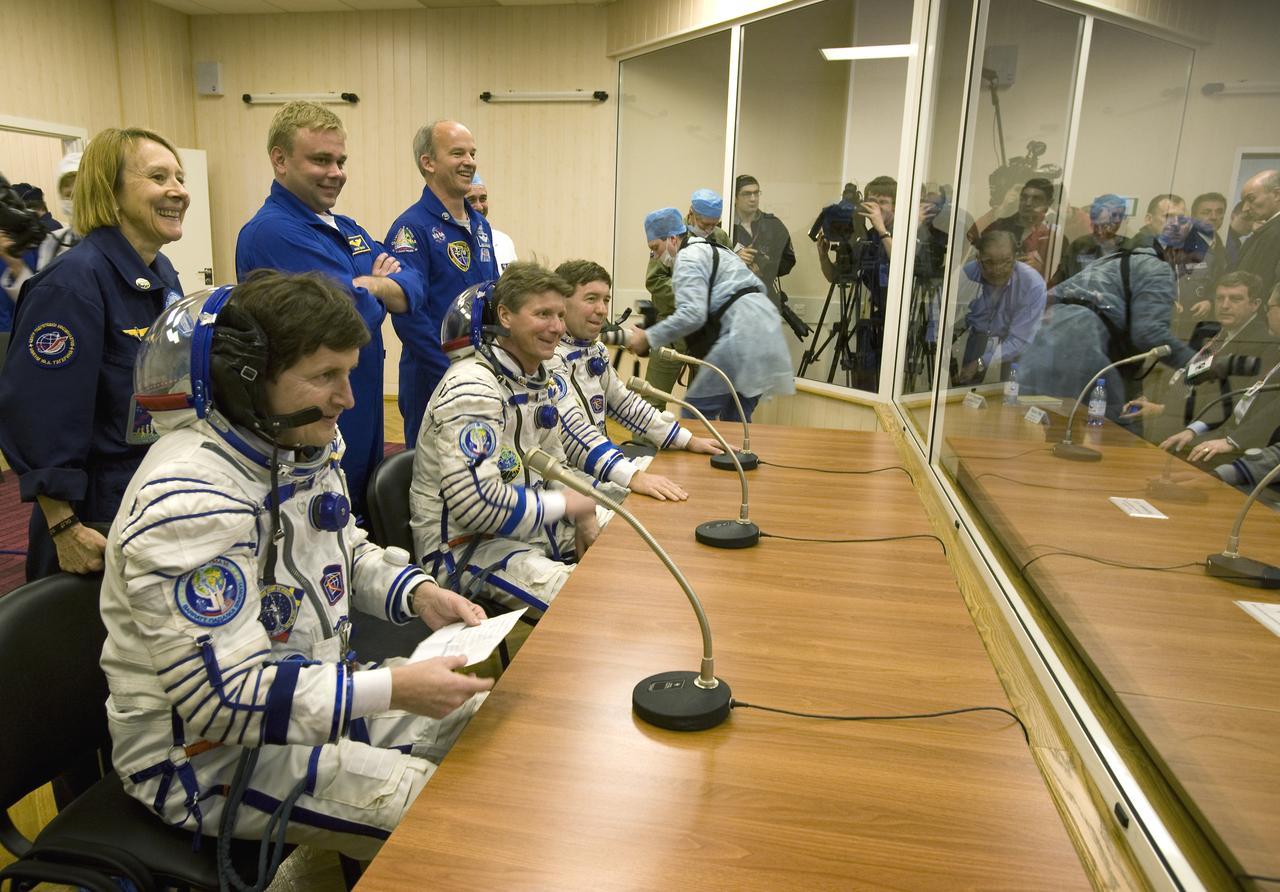
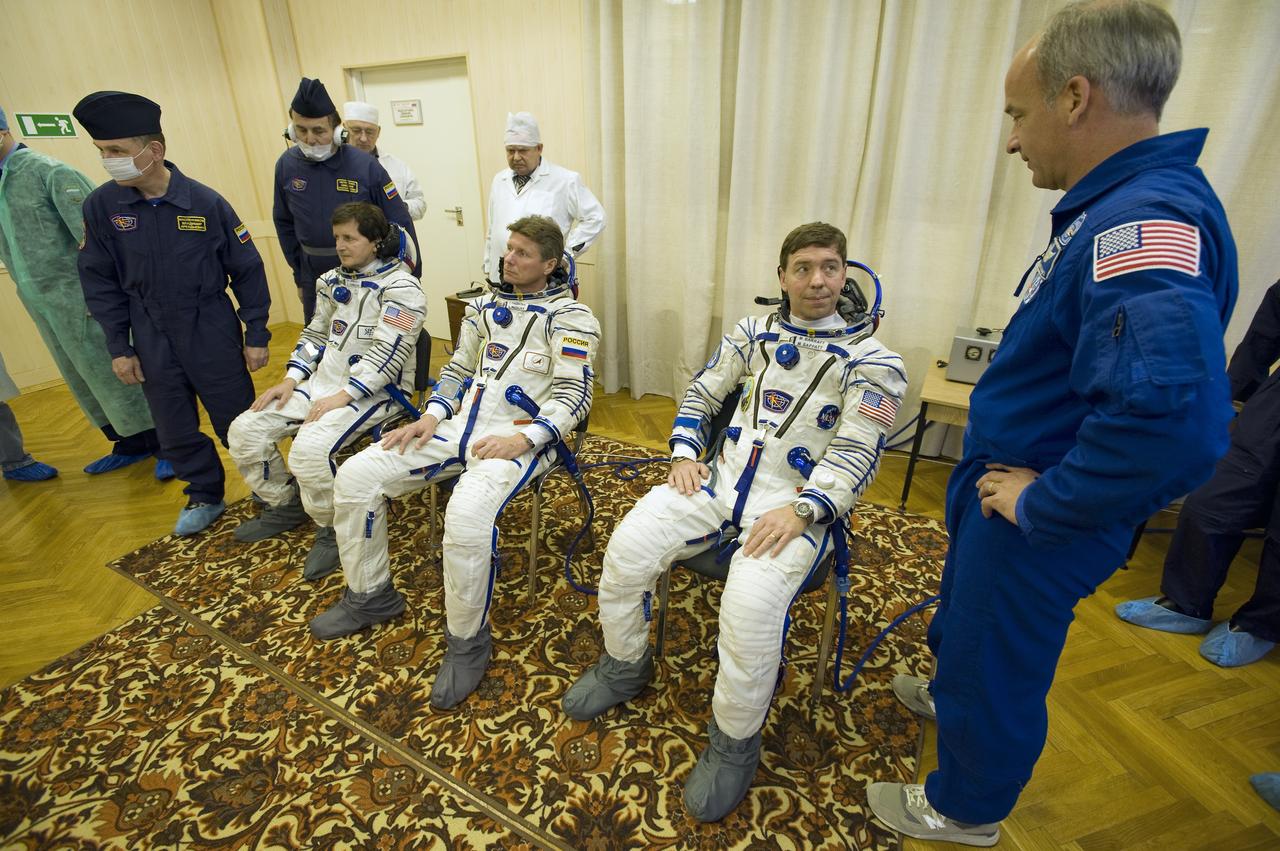
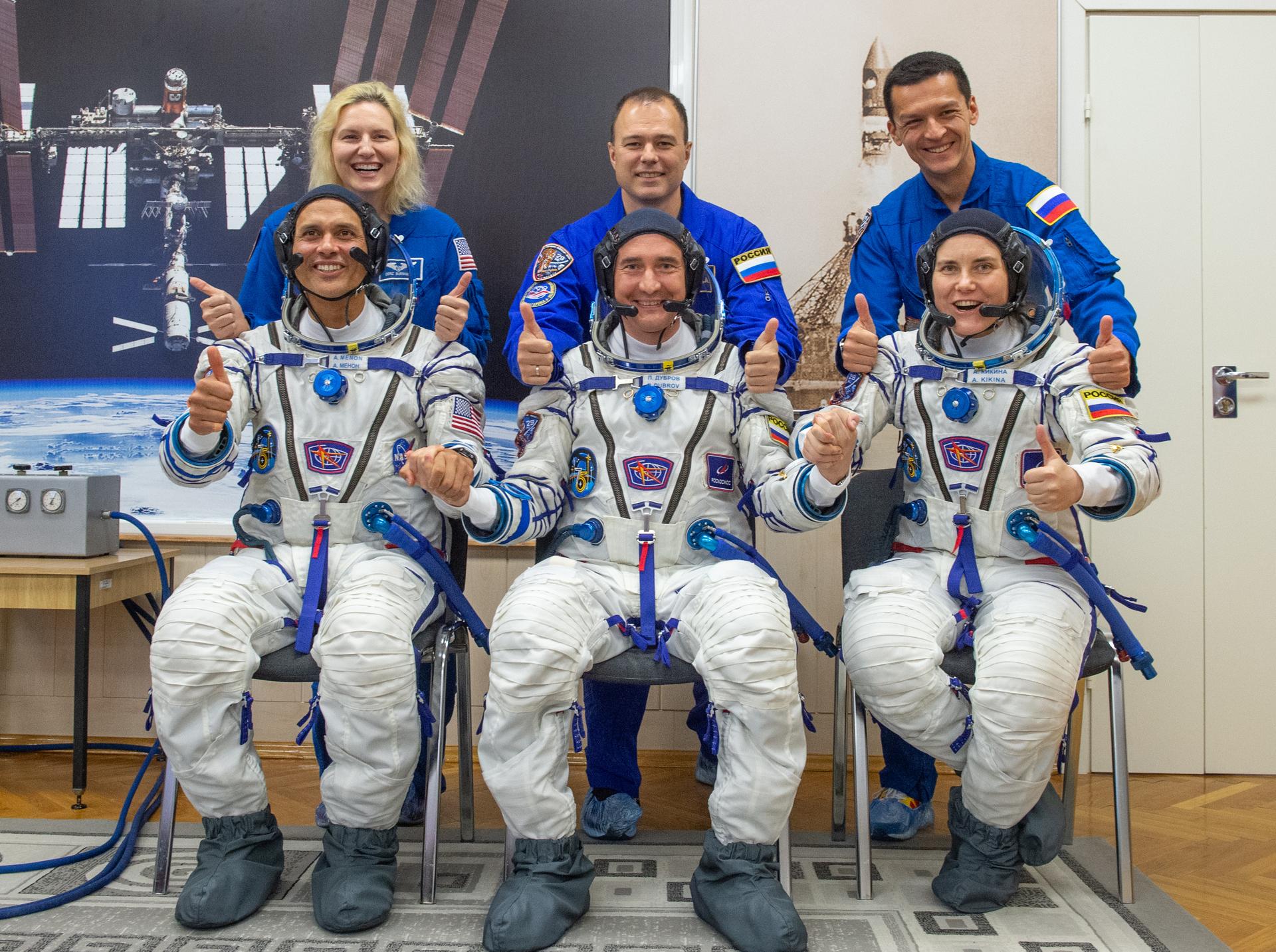
Spaceflight Participant Charles Simonyi, seated left, Expedition 19 Commander Gennady I. Padalka, seated center, Flight Engineer Michael R. Barratt, seated right, backup spaceflight participant Esther Dyson, standing left, backup Expedition 19 flight engineer Maxim Suraev, standing center, and backup commander Jeffrey Williams prepare to talk with space agency officials prior to the launch on Thursday, March 26, 2009 in Baikonur, Kazakhstan.  Photo Credit: (NASA/Bill Ingalls)
Expedition 19 Launch Day
Spaceflight Participant Charles Simonyi, seated foreground, Expedition 19 Commander Gennady I. Padalka, seated center, Flight Engineer Michael R. Barratt, seated background, backup spaceflight participant Esther Dyson, standing foreground, backup Expedition 19 flight engineer Maxim Suraev, standing center, and backup commander Jeffrey Williams prepare to talk with space agency officials prior to the launch on Thursday, March 26, 2009 in Baikonur, Kazakhstan.  Photo Credit: (NASA/Bill Ingalls)
Expedition 19 Launch Day
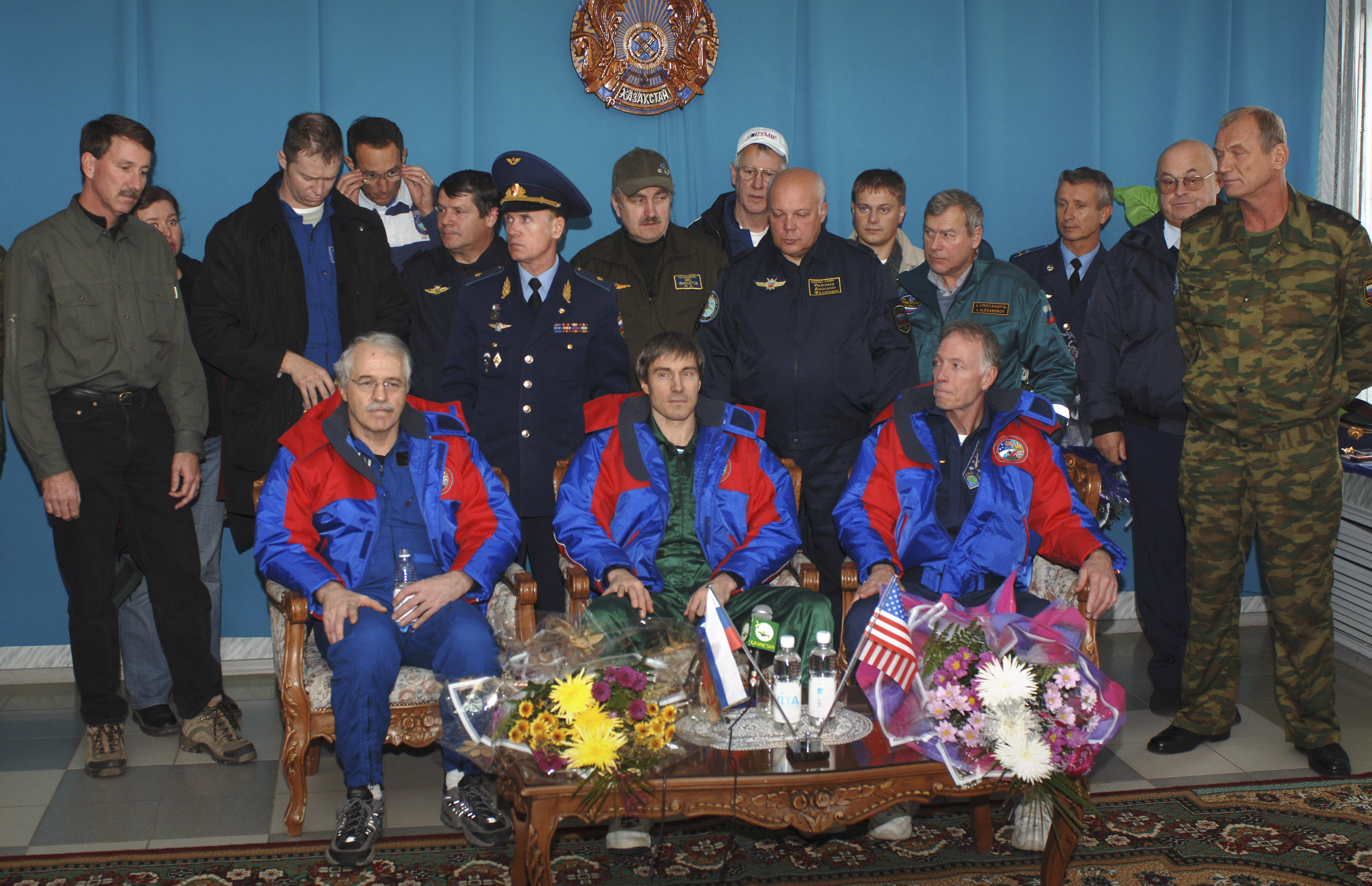
Members of the 11th expedition to the International Space Station, astronaut John Phillips, seated left, and Cosmonaut Sergei Krikalev, seated center, landed near Arlalyk, Kazakhstan Tuesday, Oct. 11 2005, after a six-month mission in orbit.  Along with American businessman Greg Olsen, seated right, who visited the station for more than a week, Phillips and Krikalev returned to Earth aboard a Russian Soyuz spacecraft. Photo Credit: (NASA/Bill Ingalls)
Expedition 11 Landing
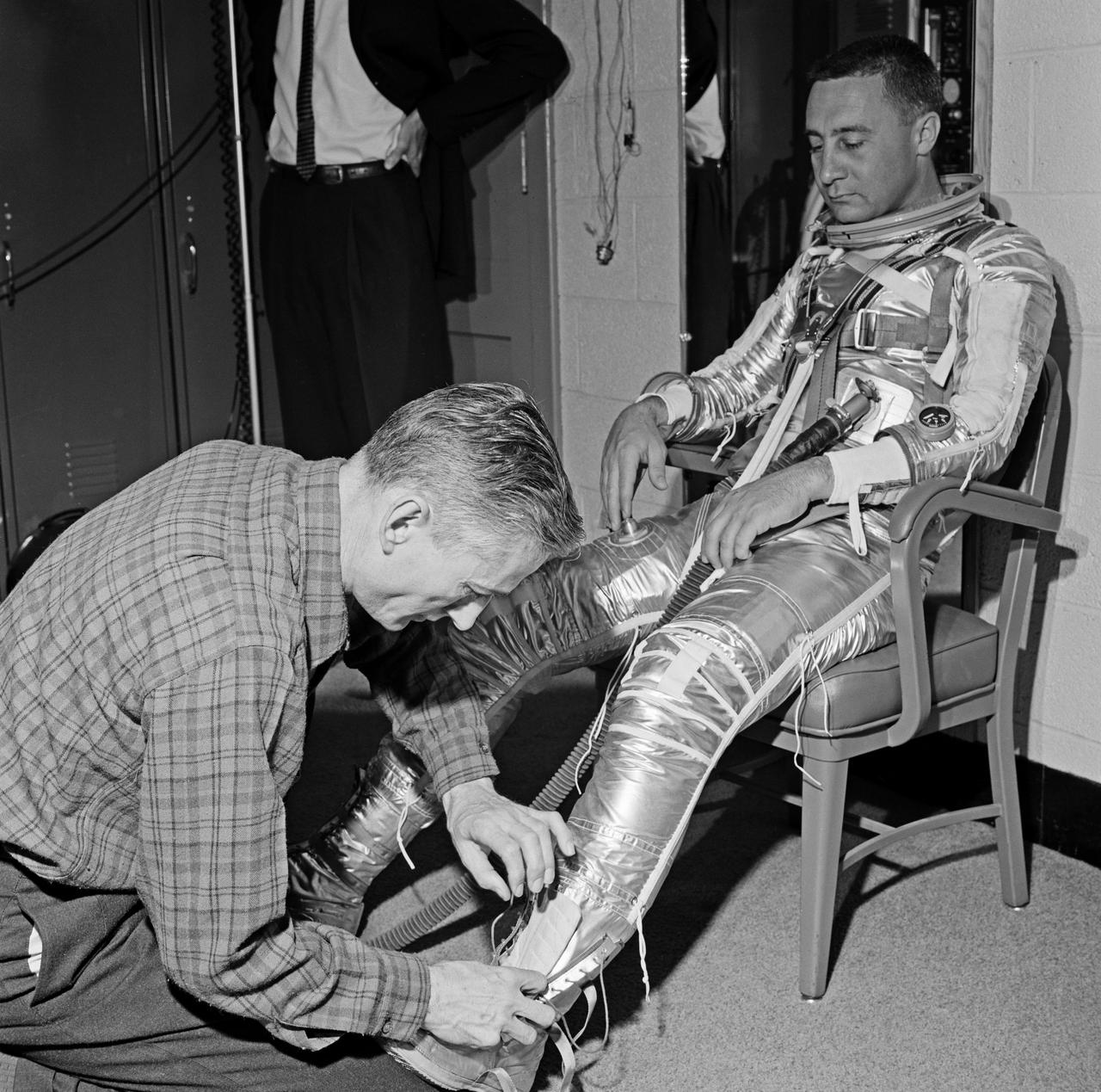
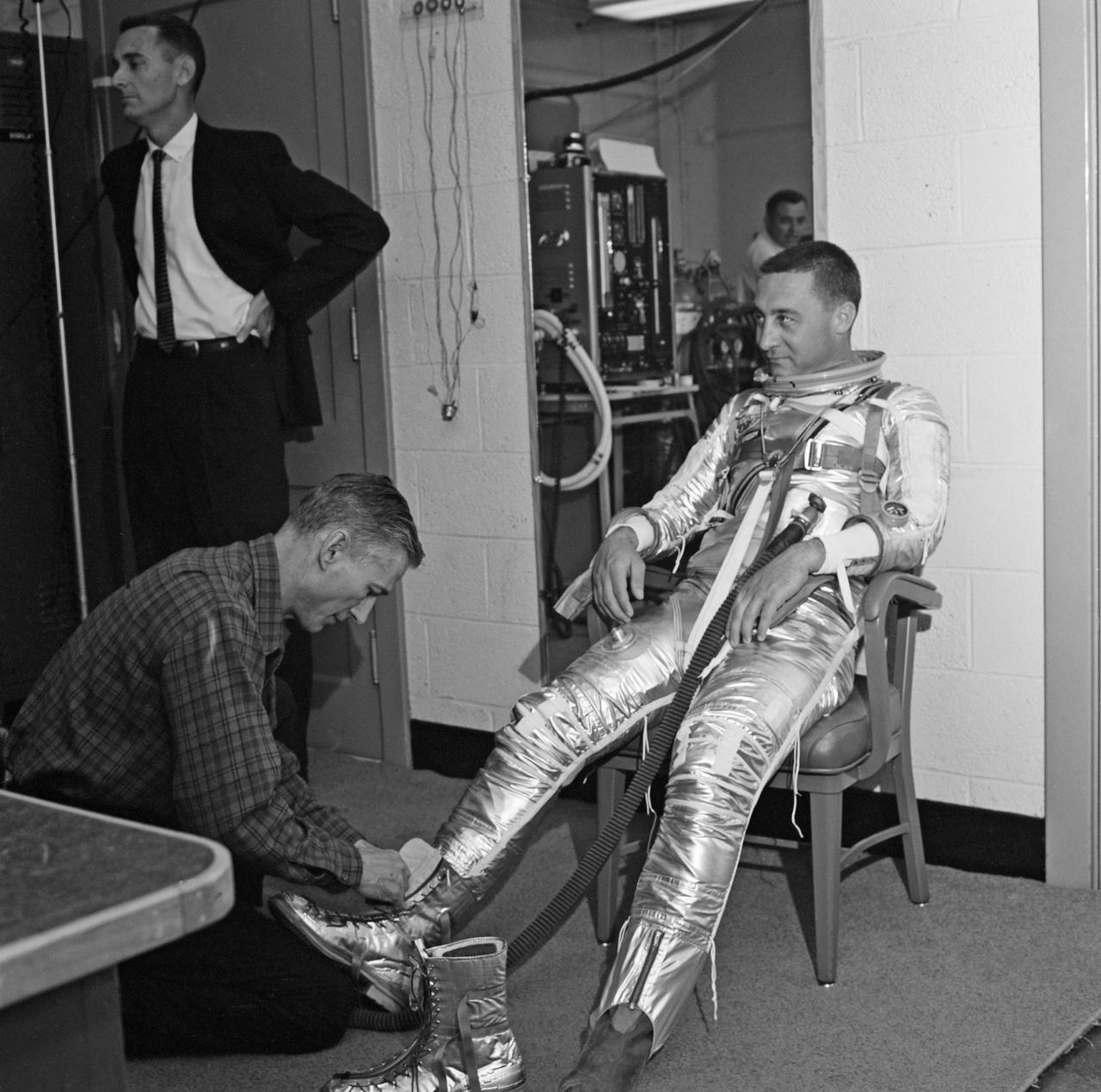
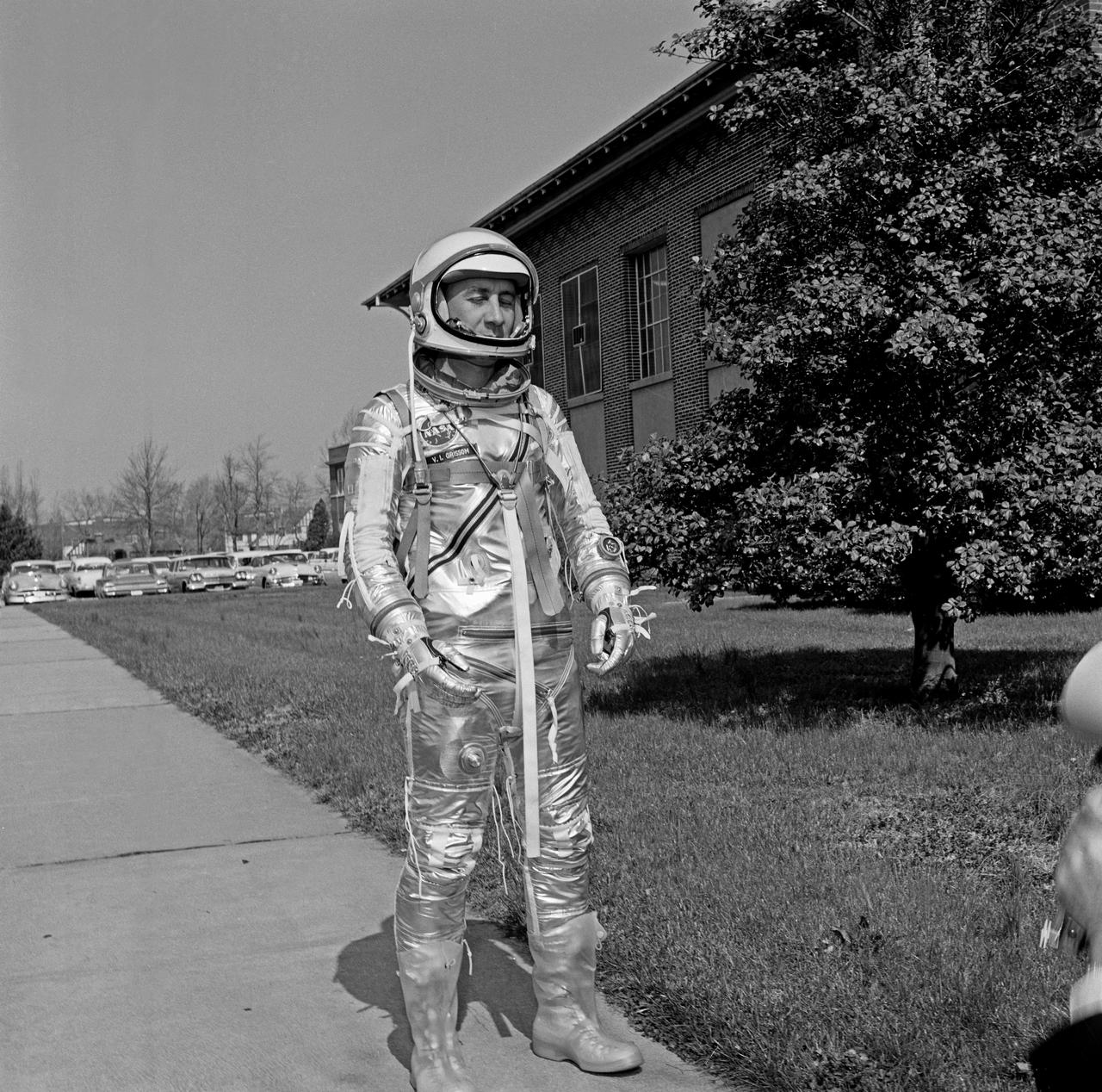
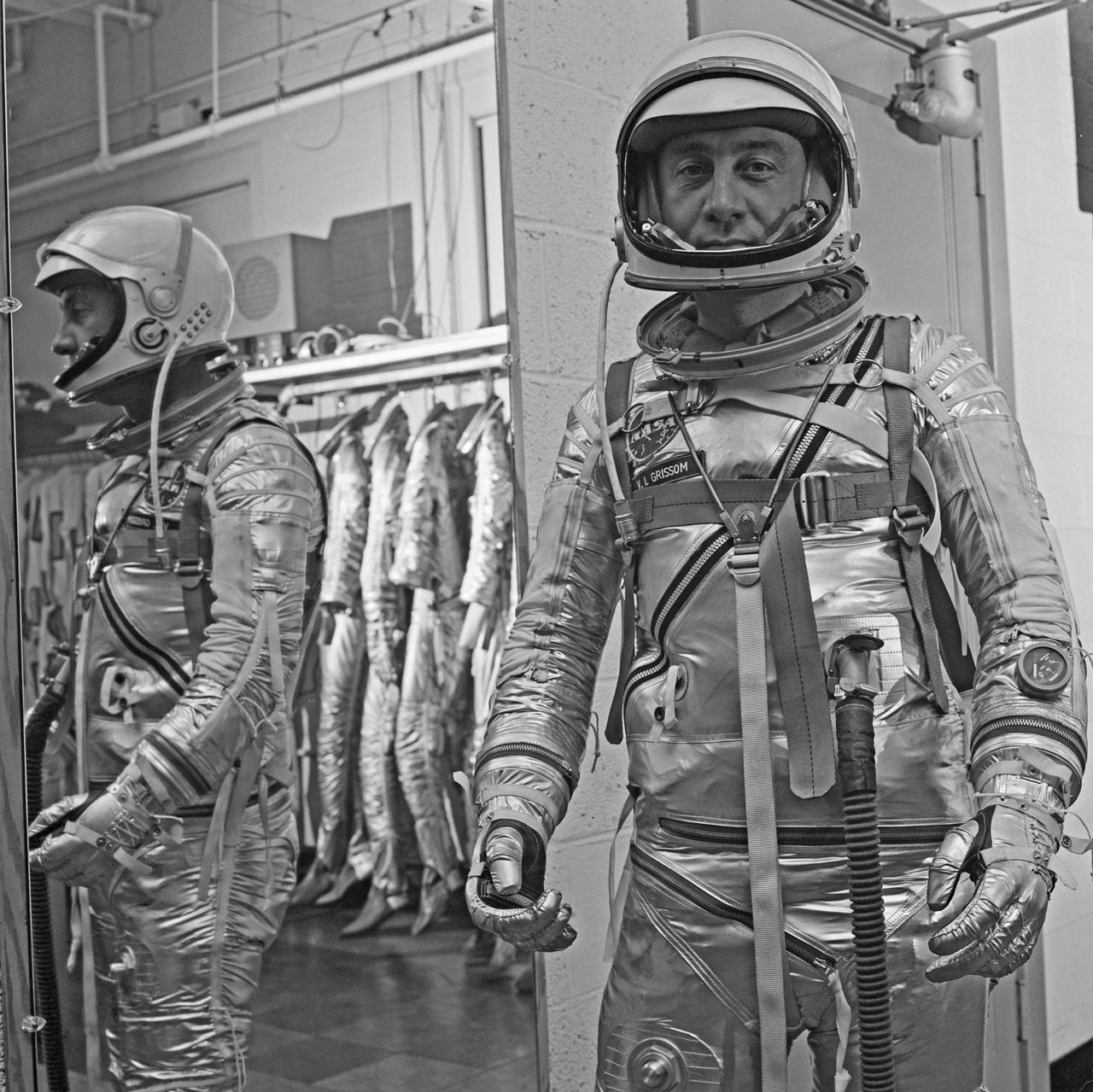
Gus Grissom trying on a Spacesuit; Seated with assistant; Seated with assistant putting on boots; Standing by mirror, name tag visible; Outside in suit, name tag visible. Mercury Project photo, 1961. Original negatives sent to Johnson Space Center when astronauts moved to that center.  Photograph take on 03/27/1961.
Astronaut Virgil I. Gus Grissom in Space Suit
Spaceflight Participant Charles Simonyi, seated left, Expedition 19 Commander Gennady I. Padalka, seated center, and Flight Engineer Michael R. Barratt don their Russian Sokol suits in preparation for their Soyuz launch to the International Space Station on Thursday, March 26, 2009 in Baikonur, Kazakhstan. (Photo Credit: NASA/Bill Ingalls)
Expedition 19 Launch Day
Gus Grissom trying on a Spacesuit; Seated with assistant; Seated with assistant putting on boots; Standing by mirror, name tag visible; Outside in suit, name tag visible. Mercury Project photo, 1961. Original negatives sent to Johnson Space Center when astronauts moved to that center.  Photograph take on 03/27/1961.
Astronaut Virgil I. Gus Grissom in Space Suit
Gus Grissom trying on a Spacesuit; Seated with assistant; Seated with assistant putting on boots; Standing by mirror, name tag visible; Outside in suit, name tag visible. Mercury Project photo, 1961. Original negatives sent to Johnson Space Center when astronauts moved to that center.  Photograph take on 03/27/1961.
Astronaut Virgil I. Gus Grissom in Space Suit
Gus Grissom trying on a Spacesuit; Seated with assistant; Seated with assistant putting on boots; Standing by mirror, name tag visible; Outside in suit, name tag visible. Mercury Project photo, 1961. Original negatives sent to Johnson Space Center when astronauts moved to that center.  Photograph take on 03/27/1961.
Astronaut Virgil I. Gus Grissom in Space Suit
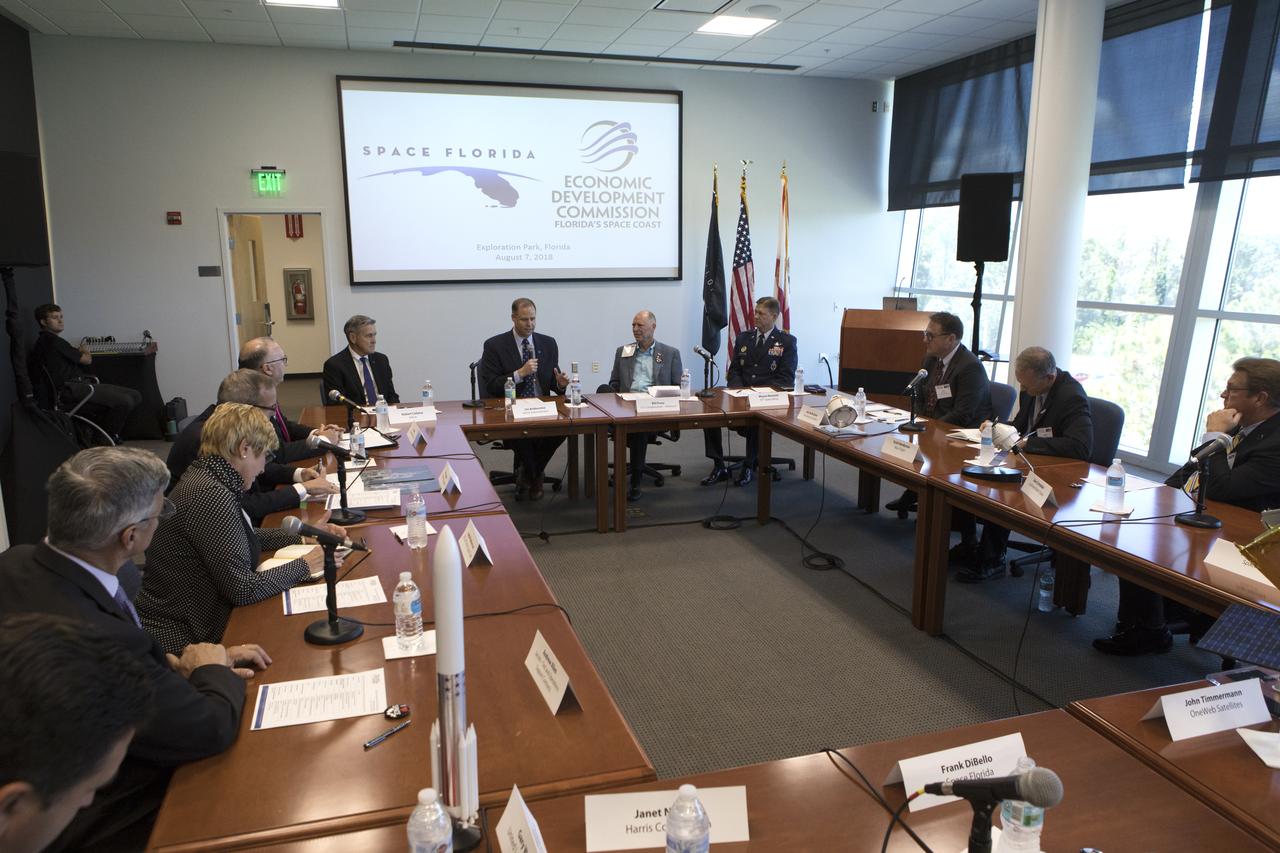
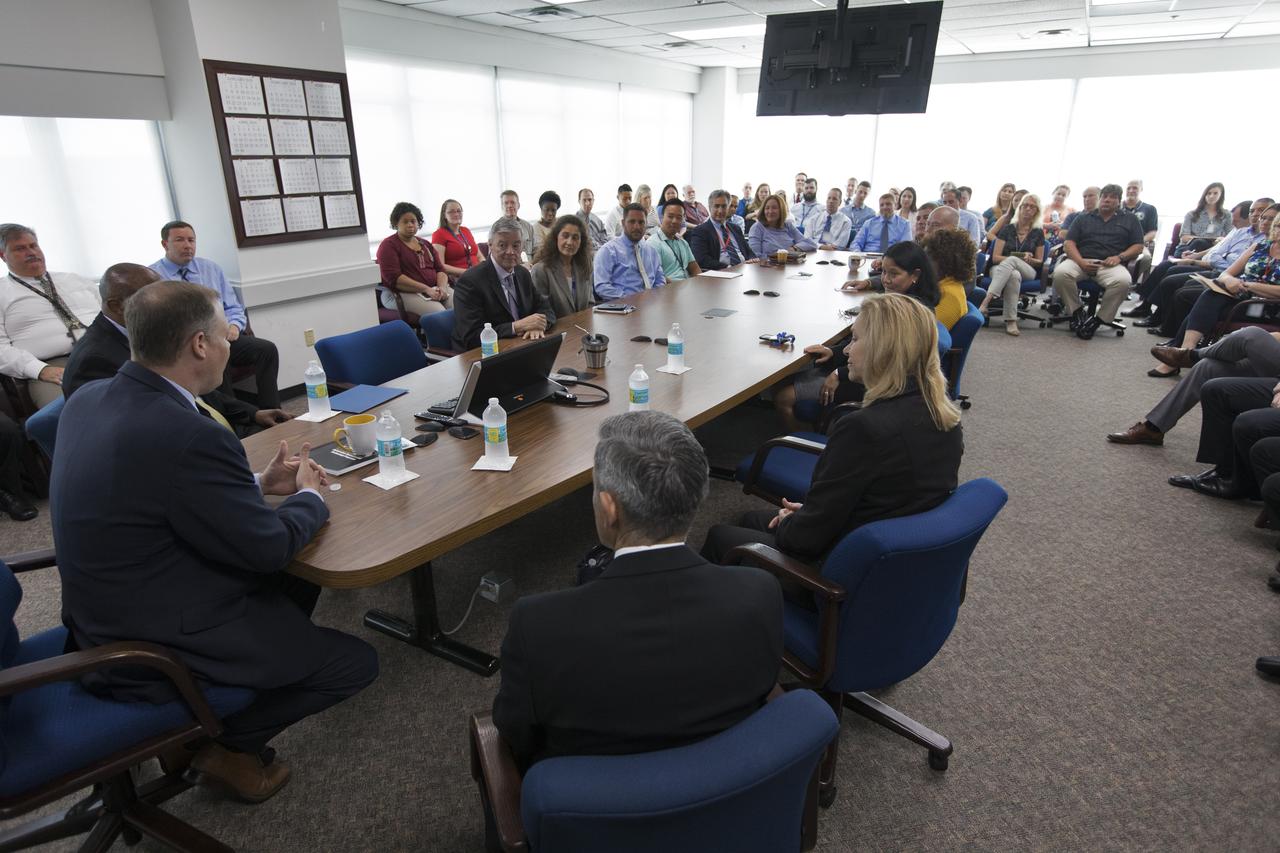
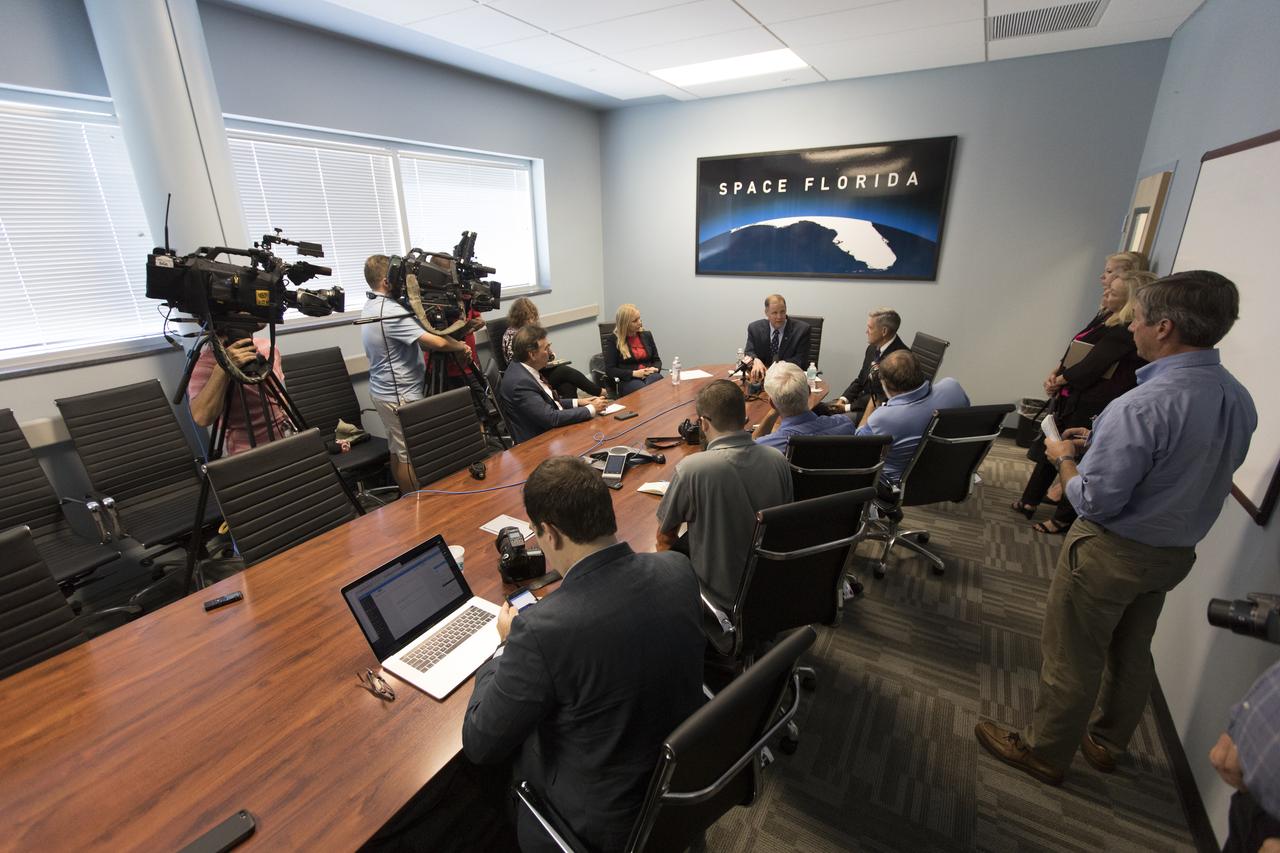
NASA Administrator Jim Bridenstine, seated at the far table, center, participates in an Economic Development Commission roundtable discussion hosted by Space Florida at the Space Life Sciences Laboratory on Aug. 7, 2018, near NASA's Kennedy Space Center in Florida. Seated at left is Kennedy Center Director Bob Cabana. Seated at right is U.S. Rep. Bill Posey, and Brigadier General Wayne Monteith, commander, 45th Space Wing, and director, Eastern Range, Patrick Air Force Base in Florida. The administrator also toured Kennedy facilities and received updates on various center accomplishments.
NASA Administrator Jim Bridenstine Visits KSC - Space Life Scien
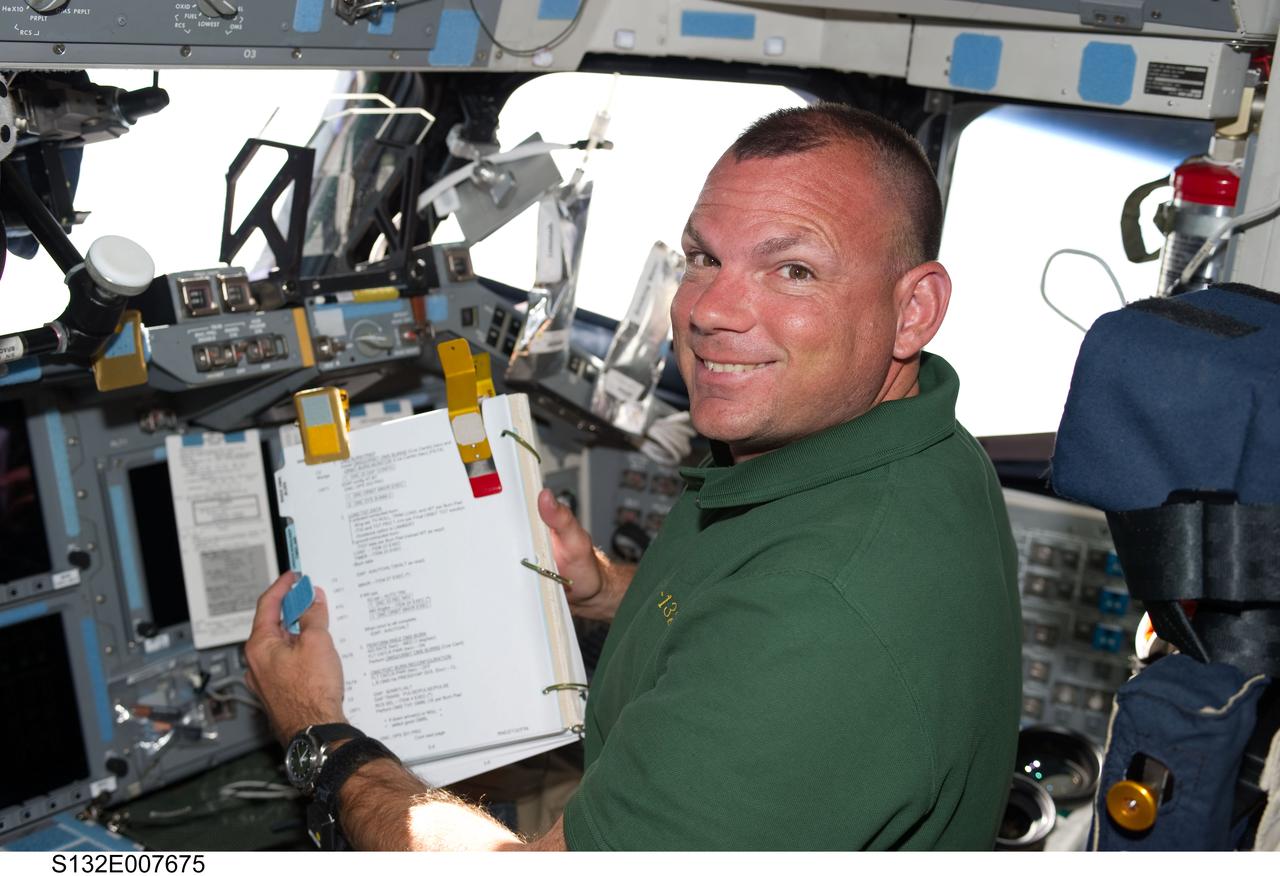
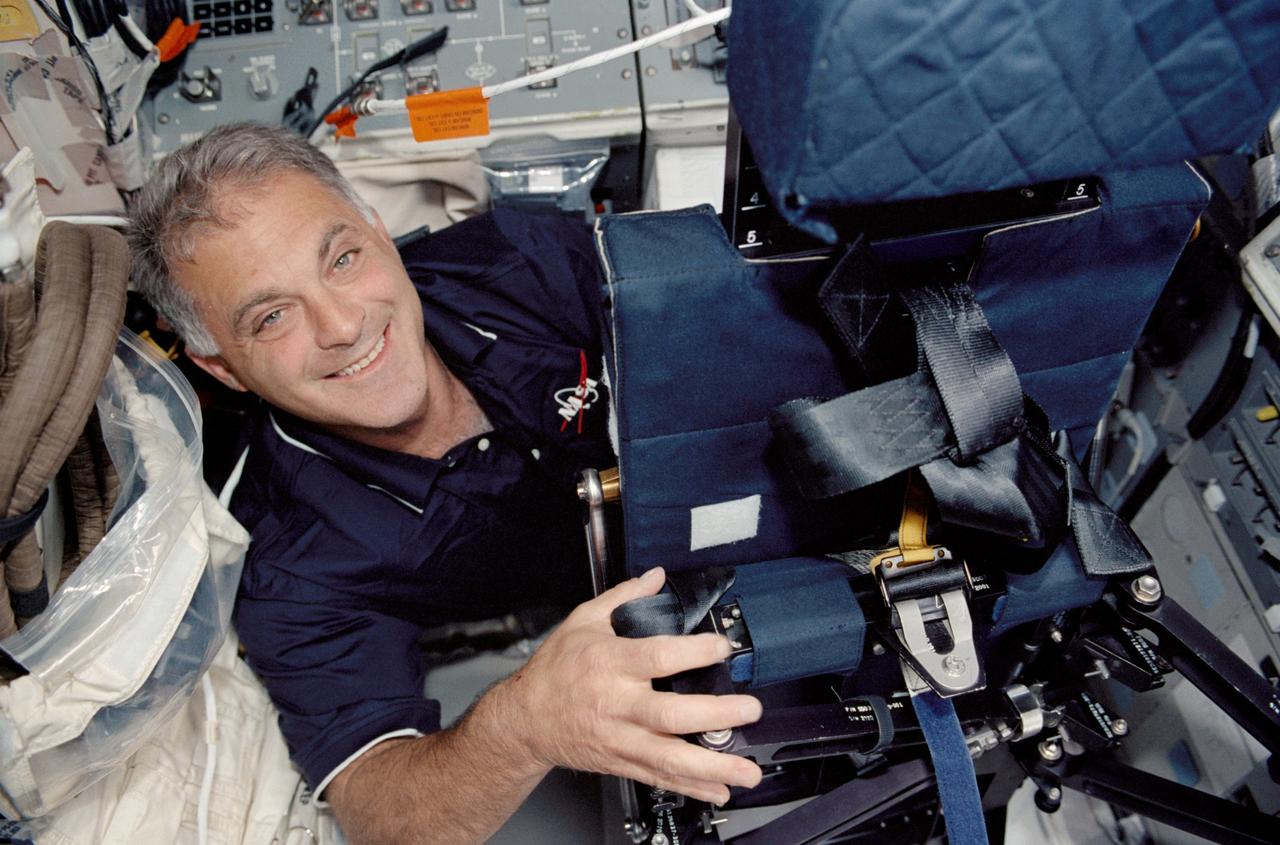
S132-E-007675 (16 May 2010) --- NASA astronaut Tony Antonelli, STS-132 pilot, is pictured at the pilot’s station on the forward flight deck of the space shuttle Atlantis during flight day three activities.
Antonelli in the Pilot's Seat on Space Shuttle Atlantis during STS-132
KENNEDY SPACE CENTER, FLA. -  John Macke (standing, center), with Boeing St. Louis, Alden Pitard (seated, left) and Dan Clark (right), with KSC Boeing, check results after 3D digital scanning of actuators in the Orbiter Processing Facility.  There are two actuators per engine on the Shuttle, one for pitch motion and one for yaw motion. The Space Shuttle Main Engine hydraulic servoactuators are used to gimbal the main engine.
KENNEDY SPACE CENTER, FLA. - John Macke (standing, center), with Boeing St. Louis, Alden Pitard (seated, left) and Dan Clark (right), with KSC Boeing, check results after 3D digital scanning of actuators in the Orbiter Processing Facility. There are two actuators per engine on the Shuttle, one for pitch motion and one for yaw motion. The Space Shuttle Main Engine hydraulic servoactuators are used to gimbal the main engine.
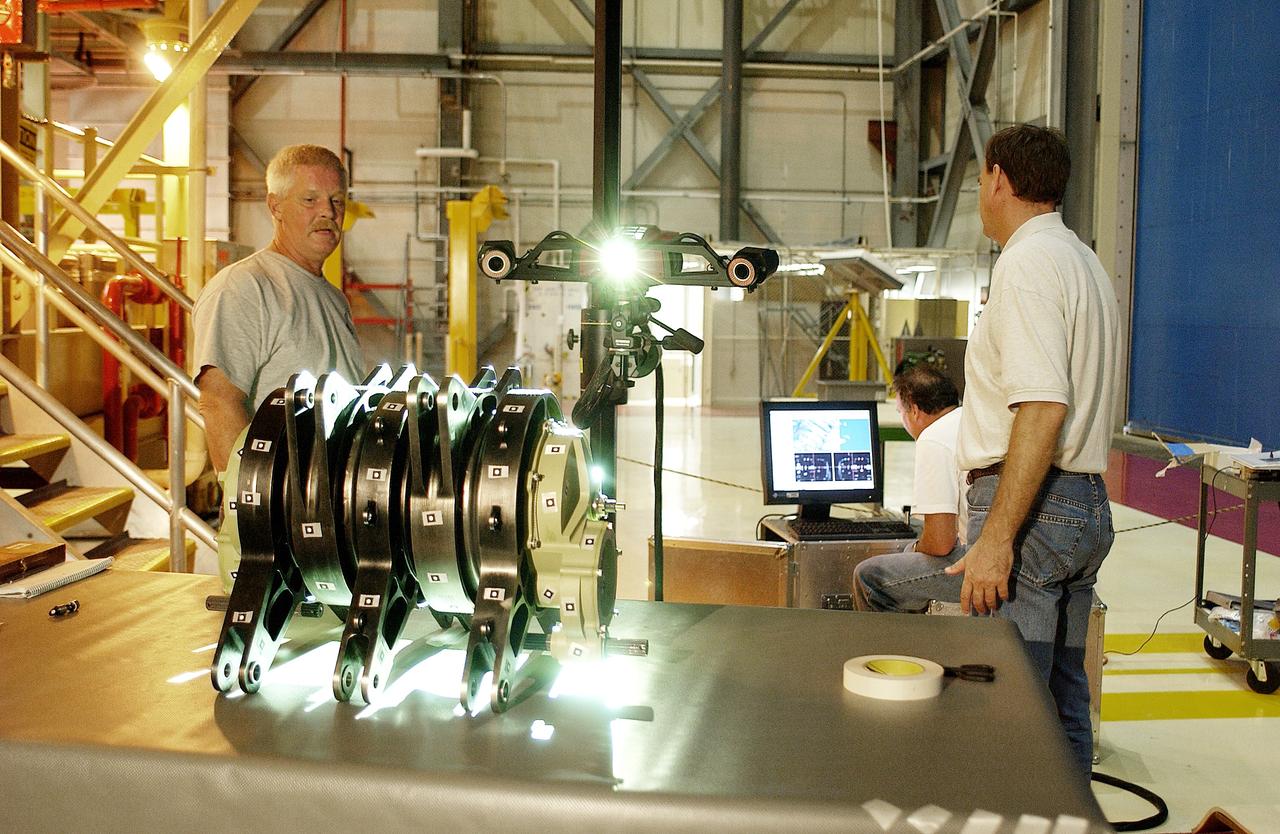
KENNEDY SPACE CENTER, FLA. - Boeing workers perform a 3D digital scan of the actuator on the table.  At left is Dan Clark.  At right are Alden Pitard (seated at computer) and  John Macke, from Boeing, St. Louis.  .  There are two actuators per engine on the Shuttle, one for pitch motion and one for yaw motion. The Space Shuttle Main Engine hydraulic servoactuators are used to gimbal the main engine.
KENNEDY SPACE CENTER, FLA. - Boeing workers perform a 3D digital scan of the actuator on the table. At left is Dan Clark. At right are Alden Pitard (seated at computer) and John Macke, from Boeing, St. Louis. . There are two actuators per engine on the Shuttle, one for pitch motion and one for yaw motion. The Space Shuttle Main Engine hydraulic servoactuators are used to gimbal the main engine.
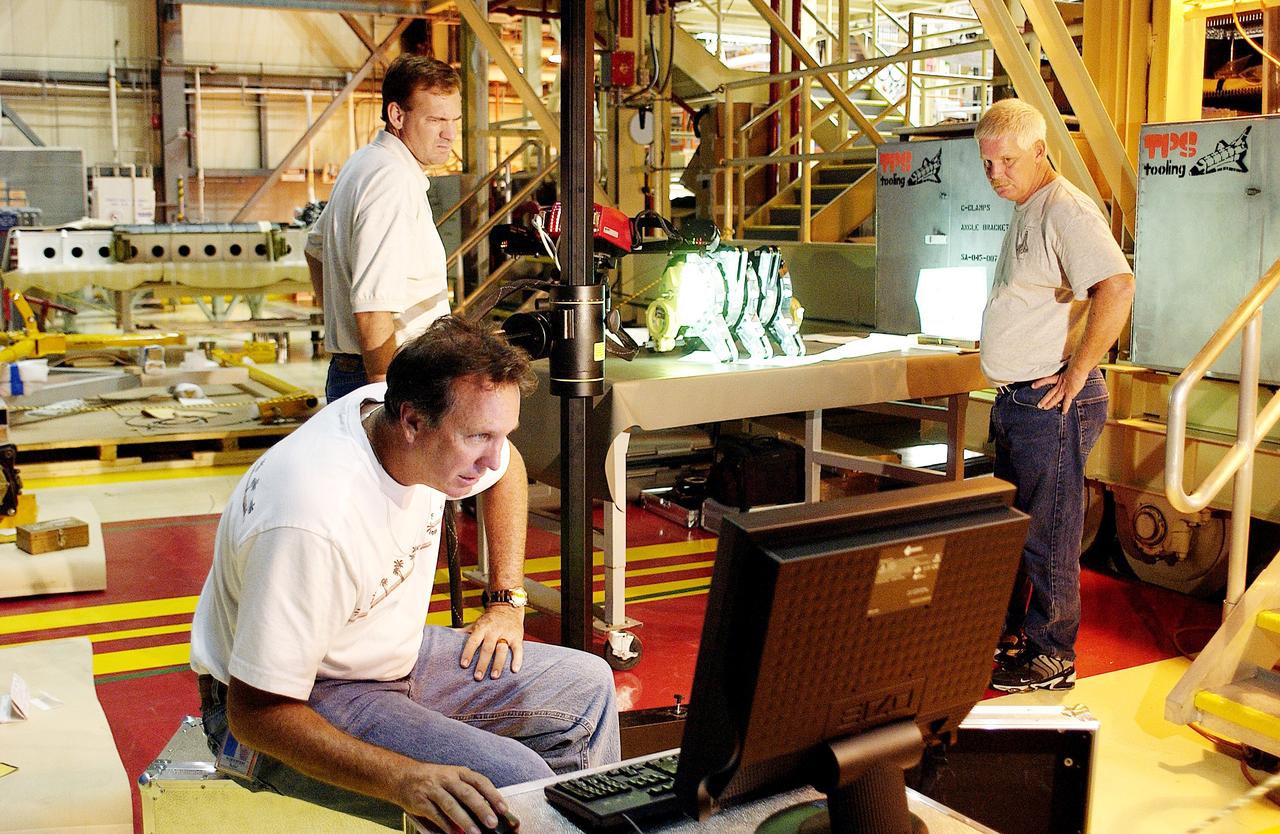
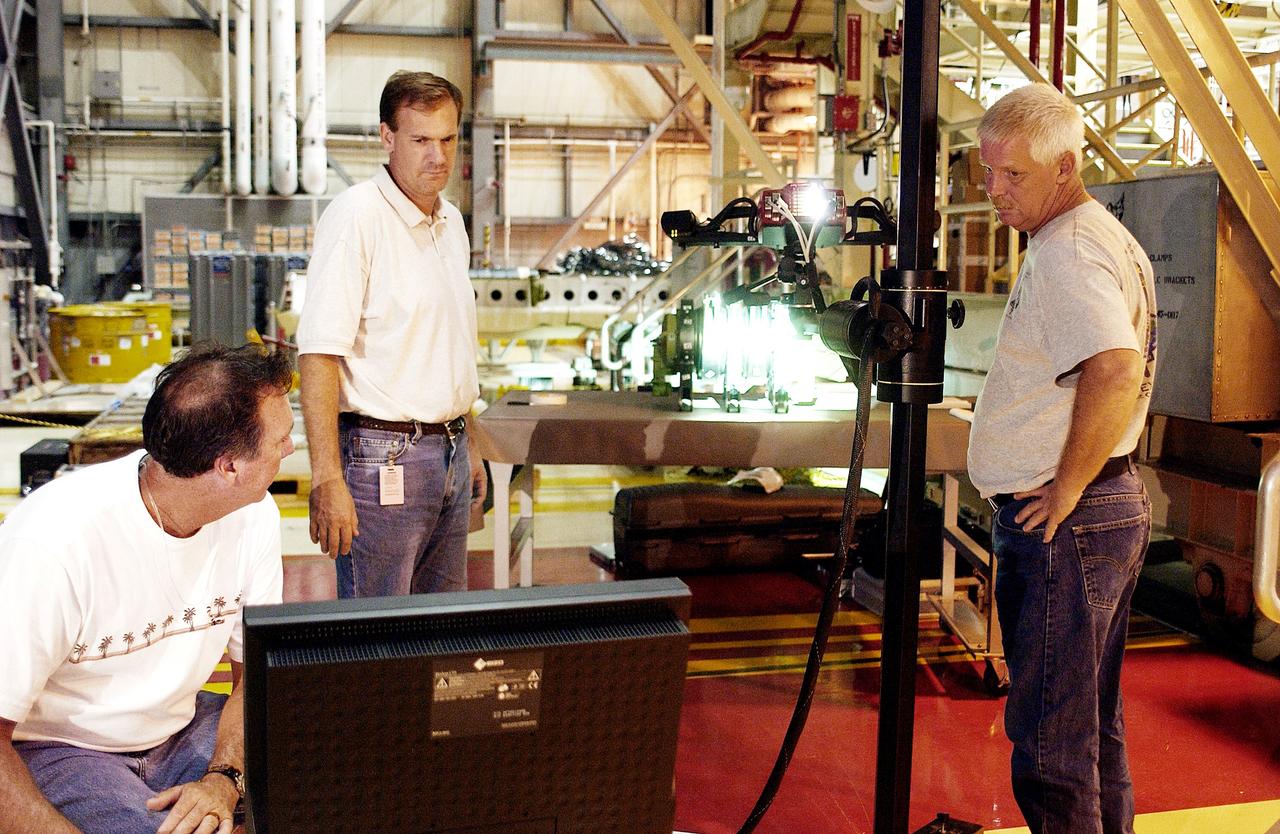
KENNEDY SPACE CENTER, FLA. -  John Macke (standing, left), with Boeing St. Louis, Alden Pitard (seated, left) and Dan Clark (right), with KSC Boeing, look at a monitor after 3D digital scanning of actuators in the Orbiter Processing Facility.  There are two actuators per engine on the Shuttle, one for pitch motion and one for yaw motion. The Space Shuttle Main Engine hydraulic servoactuators are used to gimbal the main engine.
KENNEDY SPACE CENTER, FLA. - John Macke (standing, left), with Boeing St. Louis, Alden Pitard (seated, left) and Dan Clark (right), with KSC Boeing, look at a monitor after 3D digital scanning of actuators in the Orbiter Processing Facility. There are two actuators per engine on the Shuttle, one for pitch motion and one for yaw motion. The Space Shuttle Main Engine hydraulic servoactuators are used to gimbal the main engine.
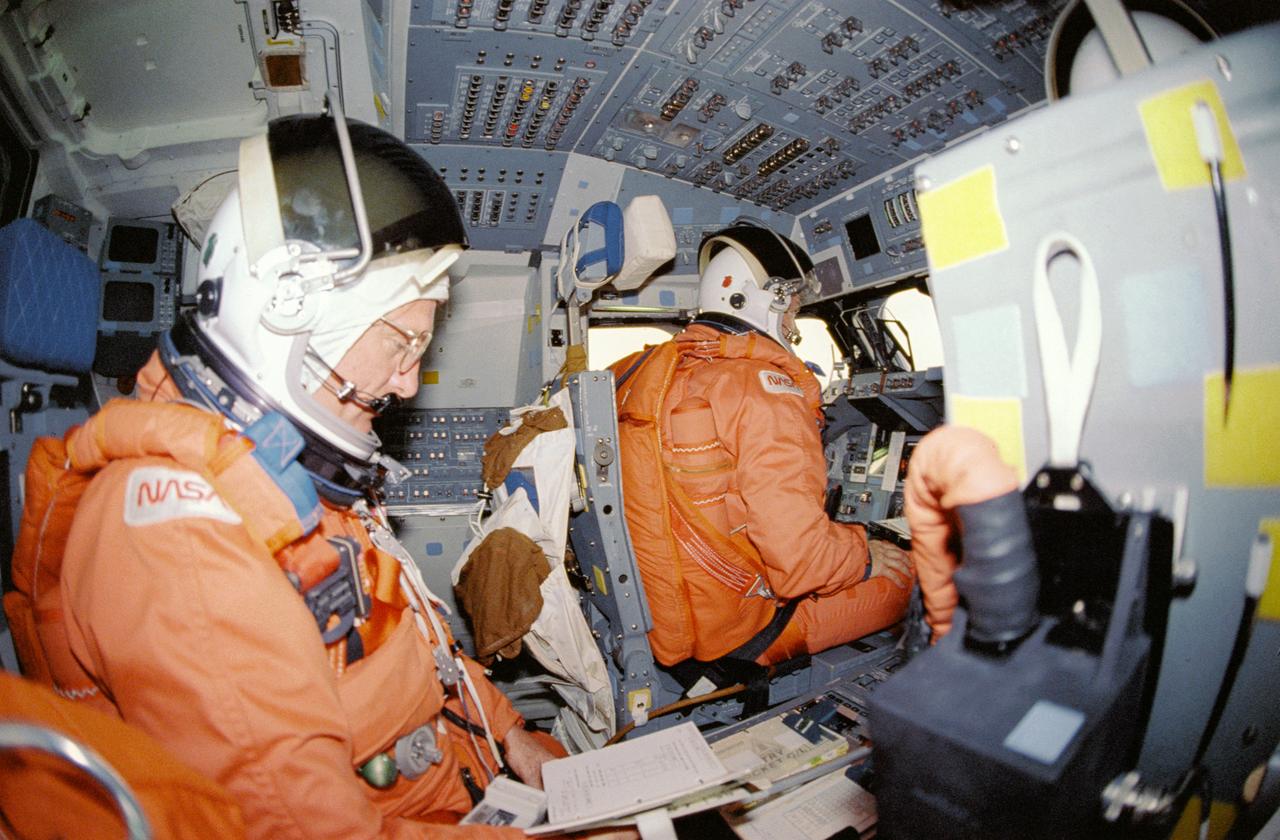
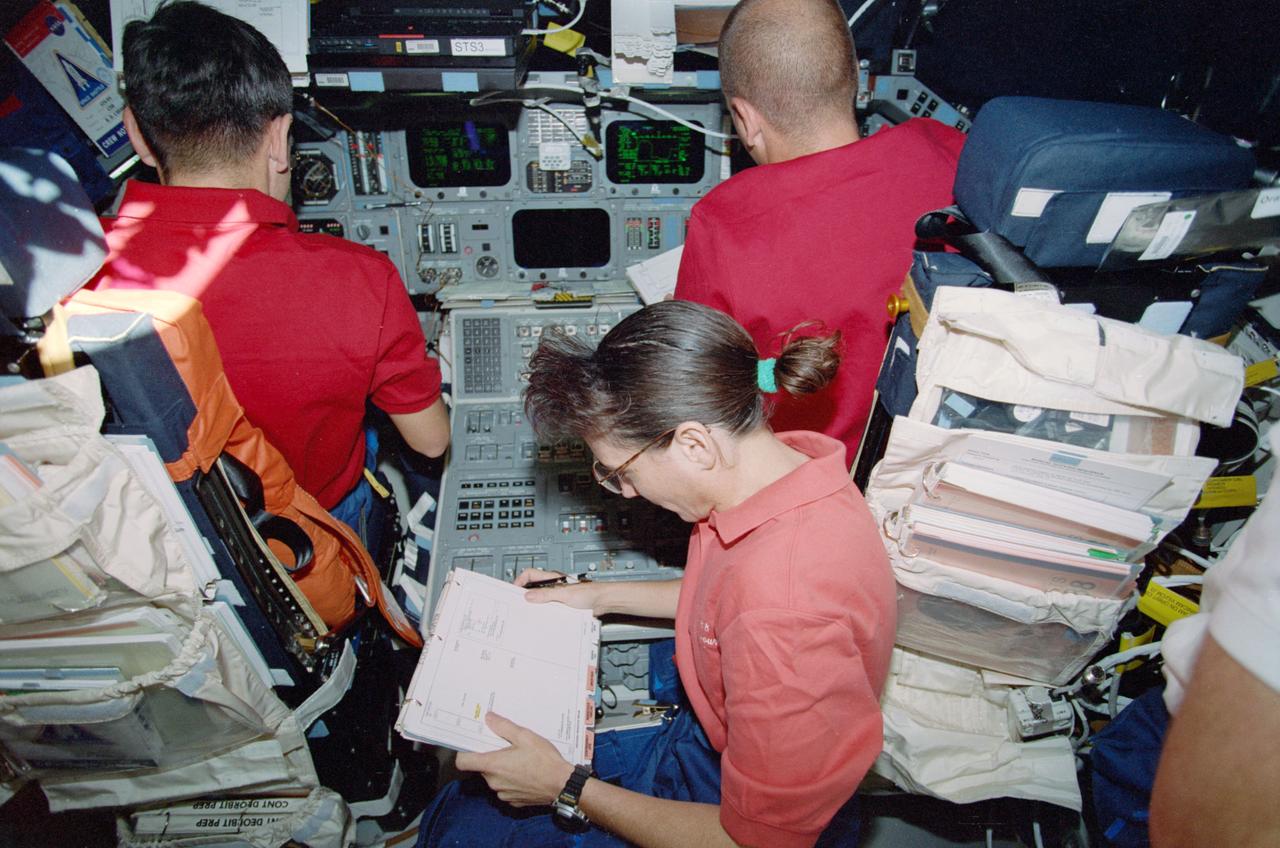
STS029-24-004 (18 March 1989) --- STS-29 crewmembers, wearing launch and entry suits (LESs) and launch and entry helmets (LEHs), review checklists on Discovery, Orbiter Vehicle (OV) 103, flight deck. Commander Michael L. Coats is seated at the forward flight deck commanders station with Mission Specialist (MS) James F. Buchli on aft flight deck strapped in mission specialist seat. OV-103 makes its return after five days in space. Note color in forward windows W1, W2, W3 caused by friction of entry through the Earth's atmosphere. Personal Egress Air Pack (PEAP) is visible on pilots seat back.
STS-29 Discovery, OV-103, crew on flight deck prepares for reentry
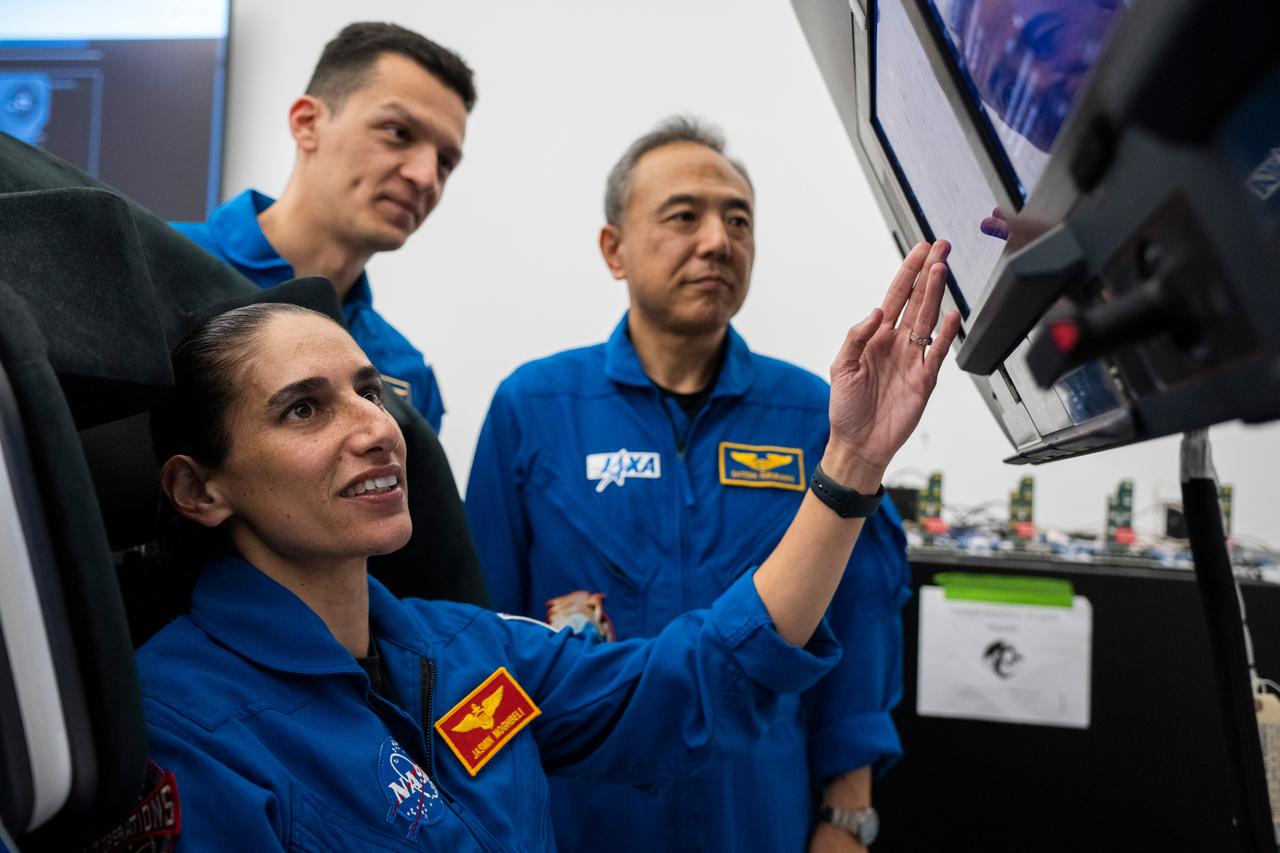
NASA's SpaceX Crew-7 in training at SpaceX in Hawthorne, California before their mission to the International Space Station. Jasmin Moghbeli is seated at the controls. Imagery provided by SpaceX
jsc2023e037677
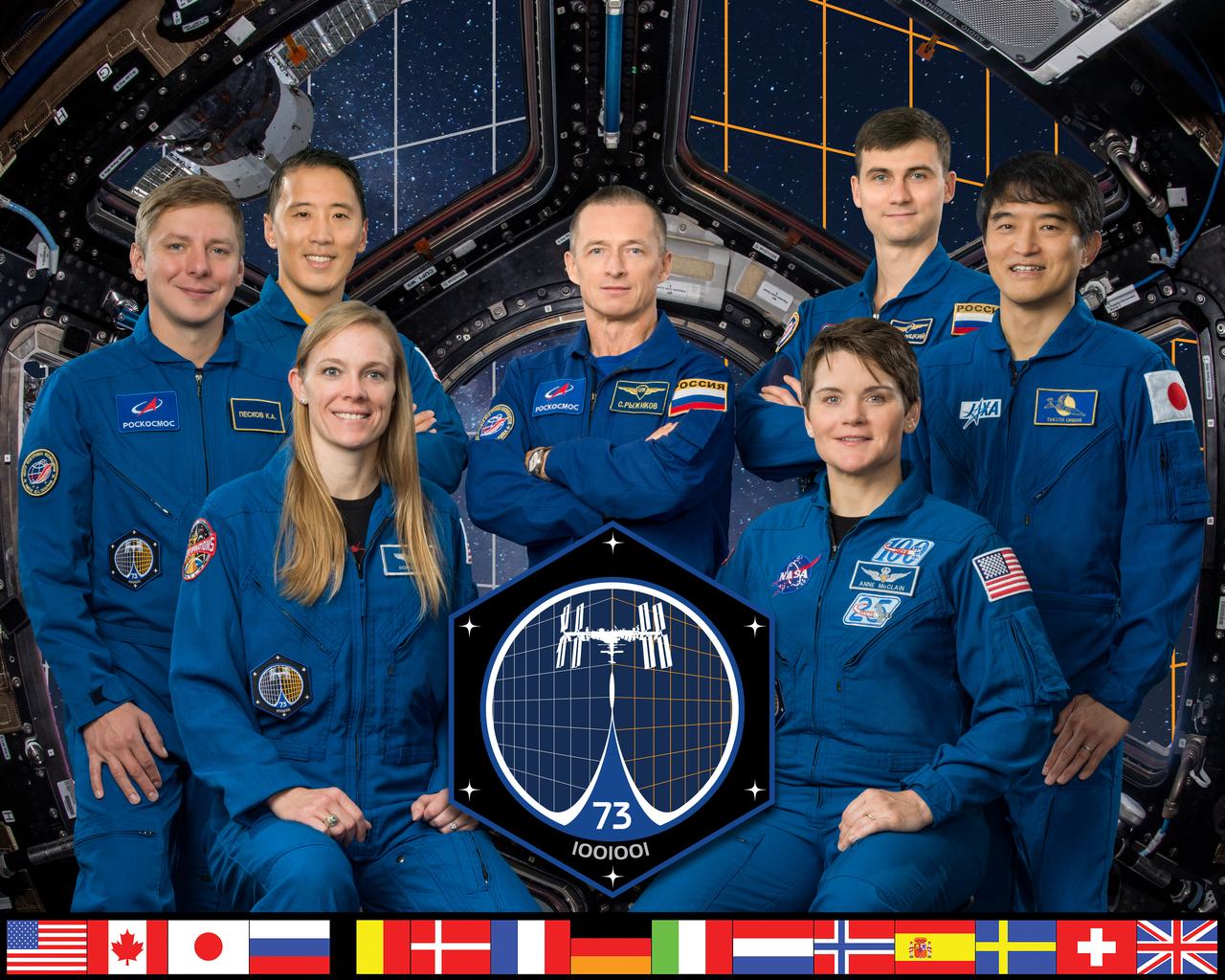
iss073-s-002 (Oct. 16, 2024) --- The official portrait of the International Space Station's seven-member Expedition 73 crew from three different space agencies. Seated in the front row from left, are NASA astronauts Nichole Ayers and Anne McClain. In the back row from left are, Roscosmos cosmonaut Kirill Peskov; NASA astronaut Jonny Kim; Roscosmos cosmonauts Sergey Ryzhikov and Alexey Zubritsky; and JAXA (Japan Aerospace Exploration Agency) astronaut Takuya Onishi. Credit: NASA/Josh Valcarcel
The official portrait of the Expedition 73 crew
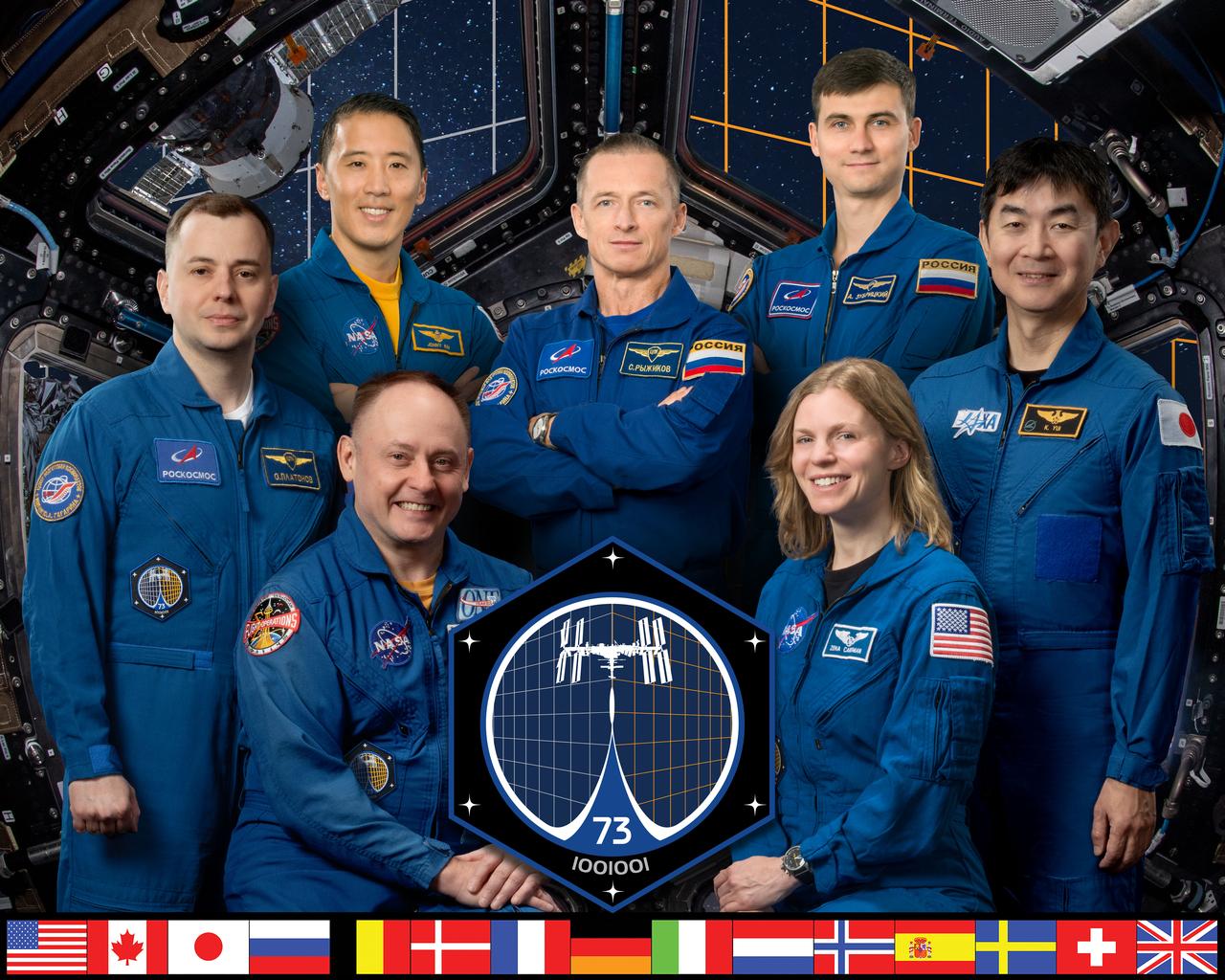
iss073-s-002b (Oct. 16, 2024) --- The updated official portrait of the International Space Station's seven-member Expedition 73 crew from three different space agencies. Seated in the front row are NASA astronauts Mike Fincke and Zena Cardman. In the back row from left are, Roscosmos cosmonaut Oleg Platonov; NASA astronaut Jonny Kim; Roscosmos cosmonauts Sergey Ryzhikov and Alexey Zubritsky; and JAXA (Japan Aerospace Exploration Agency) astronaut Kimiya Yui. Credit: NASA/Josh Valcarcel
The updated official portrait of the International Space Station's seven-member Expedition 73 crew
NASA Administrator Jim Bridenstine, seated left, and NASA Johnson Space Center Director Mark Geyer, seated right participate in a media roundtable in front of the Orion test crew capsule for the Ascent Abort-2 (AA-2) test, Thursday, Aug. 2, 2018 at NASA’s Johnson Space Center in Houston, Texas. Photo Credit: (NASA/Bill Ingalls)
Orion Ascent Abort-2
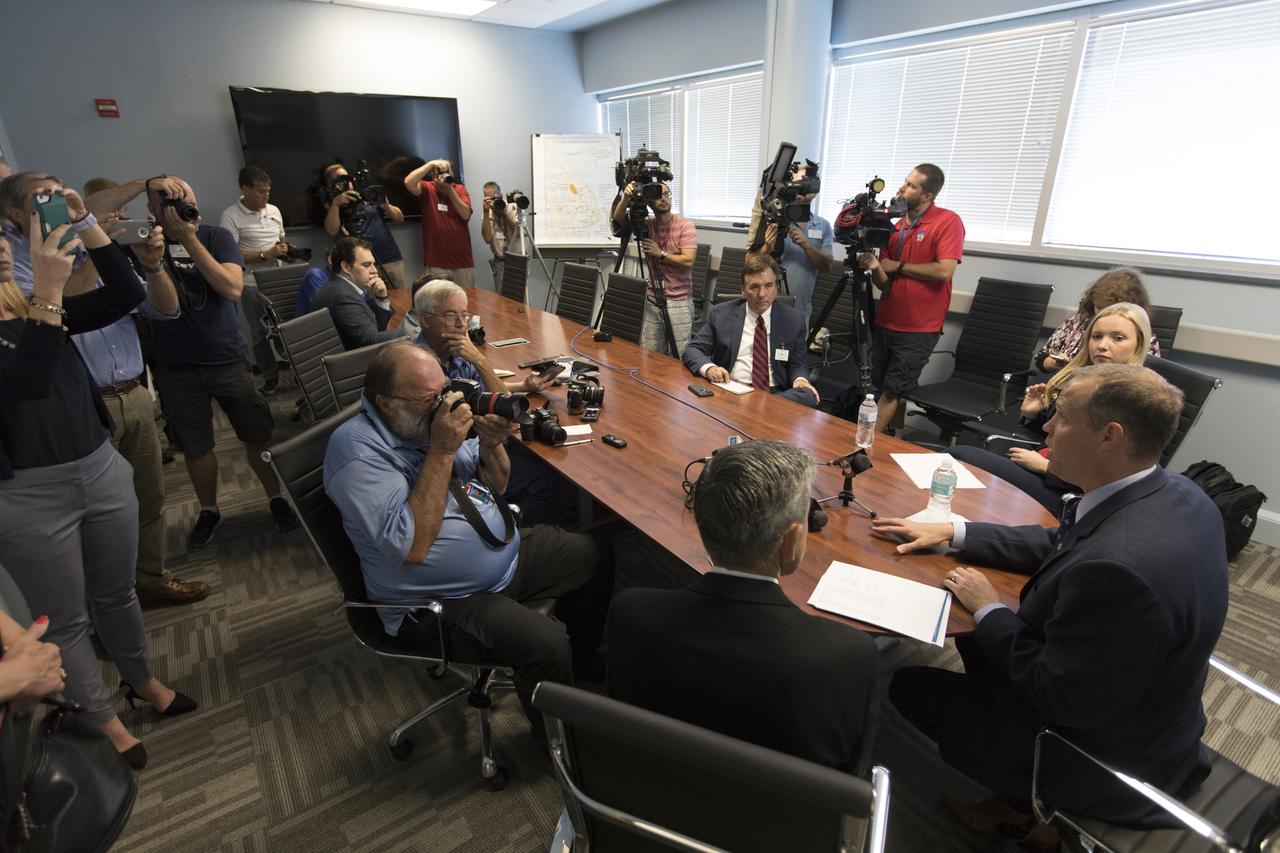
NASA Administrator Jim Bridenstine, seated, far end of the table, center, talks with members of the local media in a conference room inside the Space Life Sciences Laboratory during his tour of Kennedy Space Center in Florida, on Aug. 7, 2018. Seated next to him is Kennedy Center Director Bob Cabana. The administrator toured Kennedy facilities and received updates on various center accomplishments.
NASA Administrator Jim Bridenstine Visits KSC - Space Life Scien
NASA Administrator Jim Bridenstine, seated at left, talks with workers in the Exploration Research and Technology directorate inside the Space Station Processing Facility at NASA's Kennedy Space Center in Florida, on Aug. 7, 2018. Seated to his right are Kennedy Center Director Bob Cabana, Deputy Center Director Janet Petro, and Josie Burnett, director of Exploration Research and Technology.
NASA Administrator Jim Bridenstine Visits KSC - SSPF
NASA Administrator Jim Bridenstine, seated at far right, talks with members of the local media in a conference room inside the Space Life Sciences Laboratory during his tour of Kennedy Space Center in Florida, on Aug. 7, 2018. Seated at his left is Kennedy Center Director Bob Cabana. The administrator toured Kennedy facilities and received updates on various center accomplishments.
NASA Administrator Jim Bridenstine Visits KSC - Space Life Scien
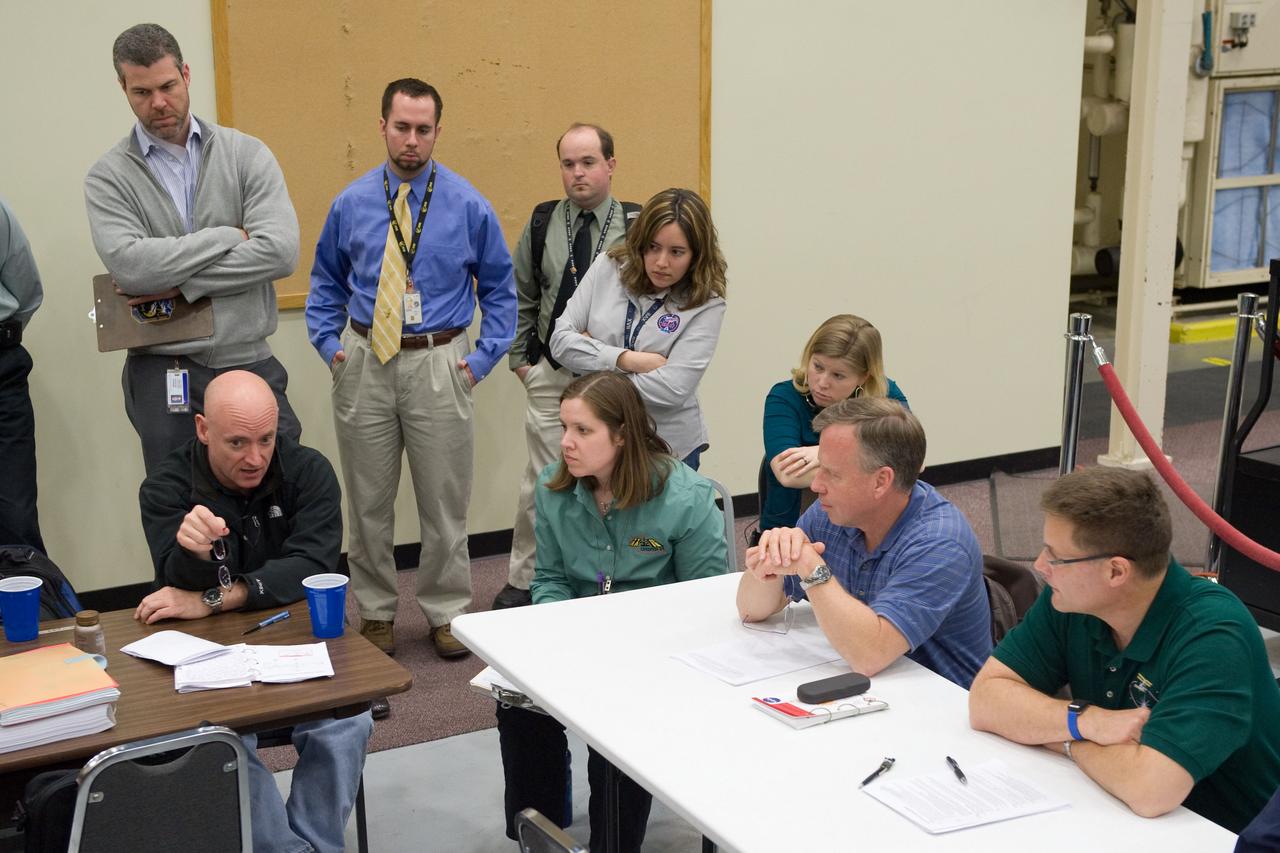
JSC2010-E-024375 (18 Feb. 2010) --- NASA astronauts Scott Kelly (seated, left), Expedition 25 flight engineer and Expedition 26 commander; Steve Lindsey (seated, second right), STS-133 commander; and Doug Wheelock (right), Expedition 24 flight engineer and Expedition 25 commander, participate in a training session in the Space Vehicle Mock-up Facility at NASA's Johnson Space Center.
STS-133, Expedition 24 and 25 together during their ISS/STS-133 EMER training
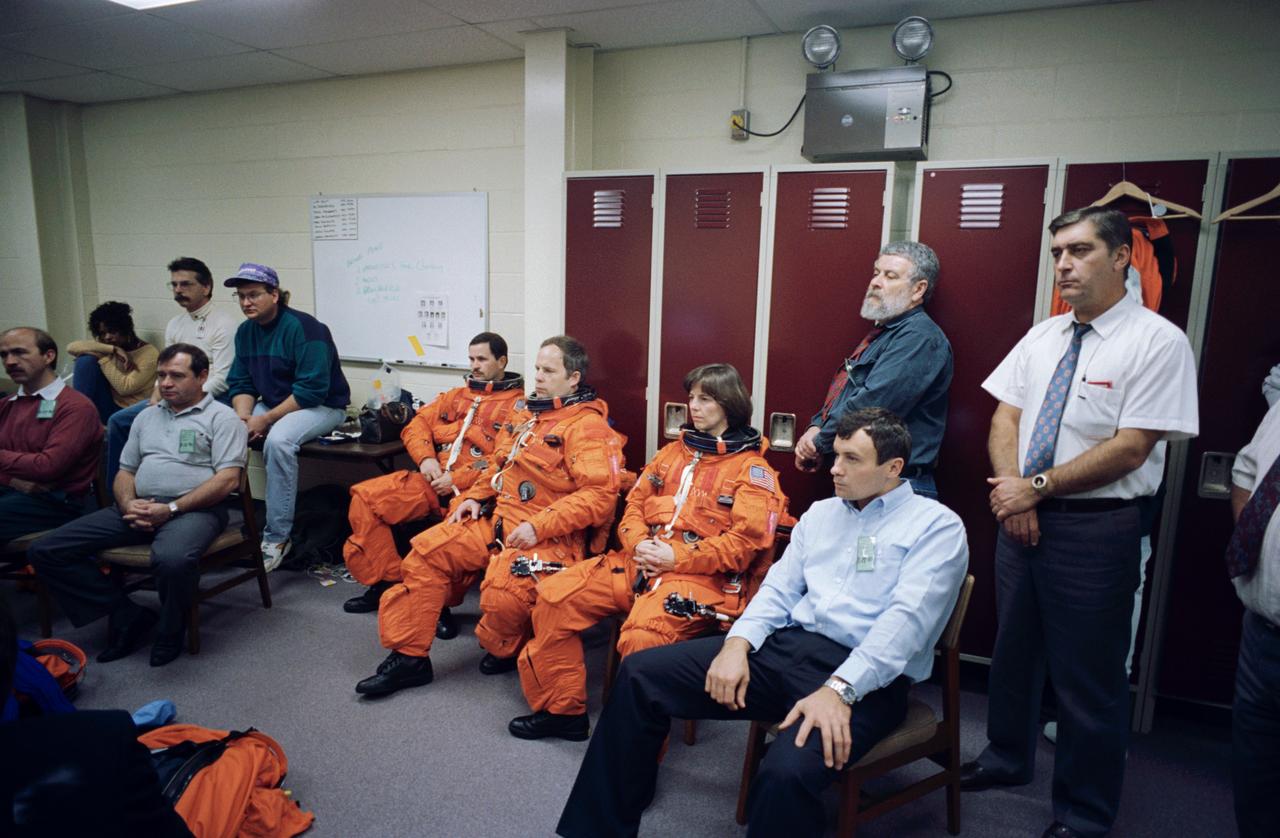
S94-47218 (28 Oct 1994) --- A number of Russian cosmonauts and an American astronaut listen to a briefing on launch and landing emergency situations during a training session in the Systems Integration Facility at the Johnson Space Center (JSC).  Scheduled to launch aboard the Space Shuttle Atlantis with the STS-71 crew (in orange suits, left to right) are Nikolai M. Budarin, Mir 19 flight engineer; Anatoliy Y. Solovyev, Mir 19 mission commander; and Bonnie J. Dunbar, STS-71 mission specialist.  The three are flanked by cosmonauts Gennadiy M. Strekalov (seated, second left) and Vladimir N. Dezhurov (seated, right foreground), flight engineer and commander, respectively, for the Mir-18 mission, who will return from a Russian Mir Space Station stay in Atlantis along with the two-way crew members of the STS-71 mission.  Alexsandr F. Poleshchuk (seated, far left) is a Mir-reserve crew member.
STS-71 astronauts and cosmonauts listen to briefing during training session
Ed Weiler, Associate Administrator, Science Mission Directorate at NASA Headquarters, seated second from left, speaks during a press conference on the upcoming Hubble Space Telescope servicing mission as David Leckrone, Hubble Project Scientist, Preston Burch and Mike Klenlen, seated right, look on, Thursday, April 23, 2009, at NASA Headquarters in Washington. J.D. Harrington, Public Affairs officer for the Science Mission Directorate looks on at left.  Photo Credit: (NASA/Paul. E. Alers)
Hubble Servicing Mission Press Conference
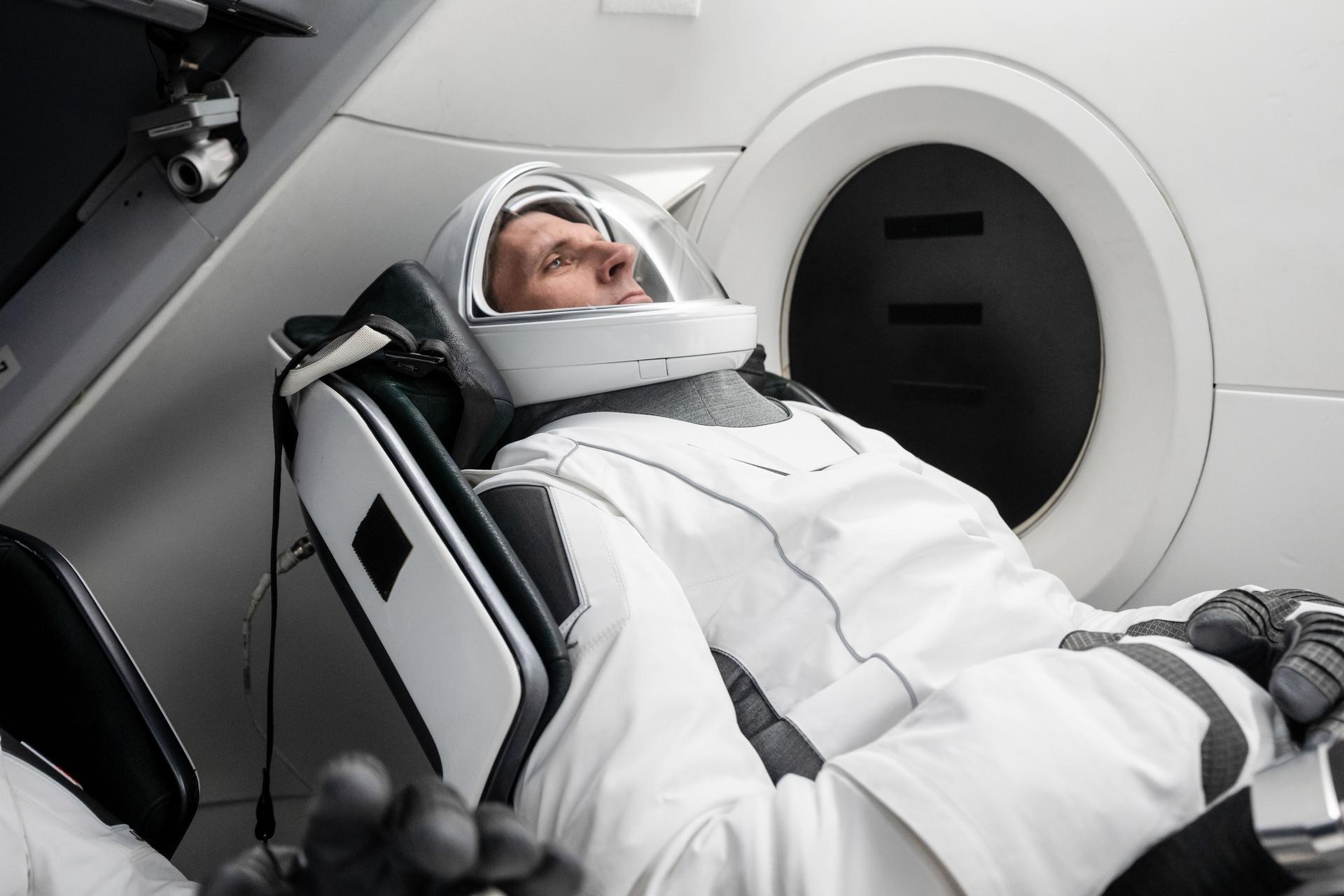
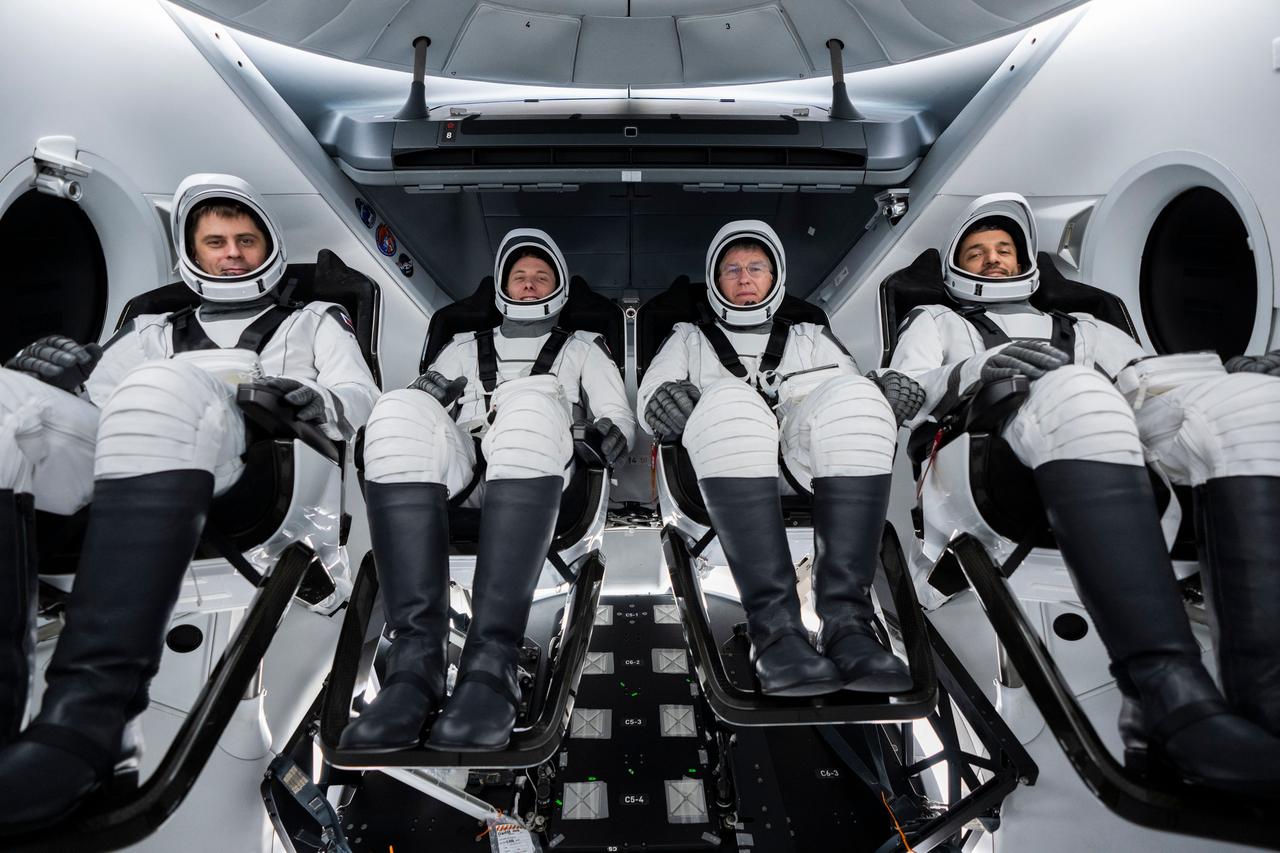
jsc2023e005758 (Jan. 30, 2023) --- The four crew members that comprise the SpaceX Crew-6 mission are seated inside the SpaceX Dragon crew ship during a crew equipment integration test at SpaceX headquarters in Hawthorne, California. Seated from left in their pressure suits are, Mission Specialist Andrey Fedyaev of Roscosmos; Pilot Warren "Woody" Hoburg and Commander Stephen Bowen, both from NASA; and Mission Specialist Sultan Alneyadi from the Mohammed bin Rashid Space Centre. Credit: SpaceX
jsc2023e005758
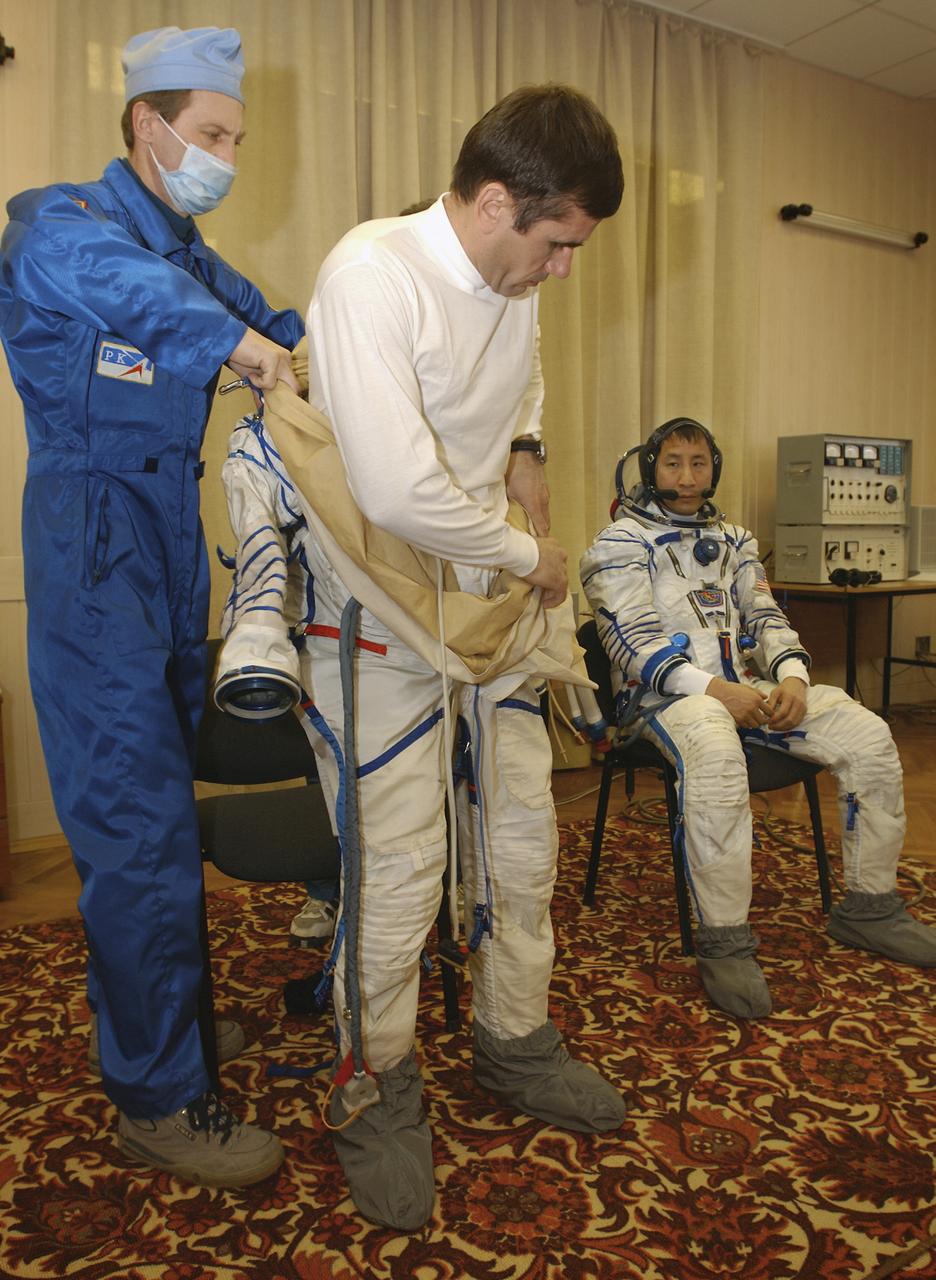
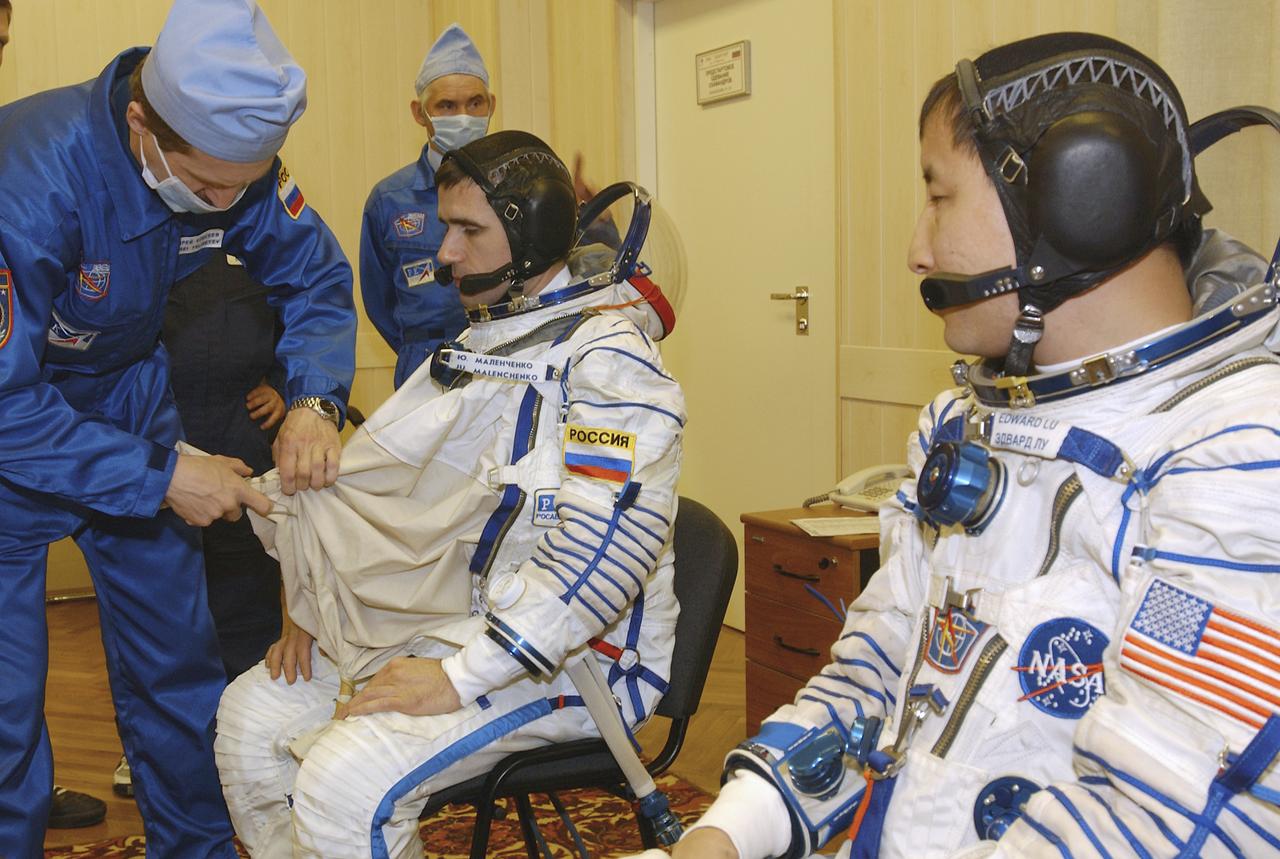
Expedition 7 Commander Yuri I. Malenchenko, center, dons his Russian Sokol suit for the leak check, seat liner check and Soyuz inspection at the Soyuz Integration Facility at the Baikonur Cosmodrome in Baikonur, Kazakhstan, Thursday, April 10, 2003.  Seated next to him is astronaut Edward T. Lu, NASA International Space Station Science Officer and Flight Engineer for Expedition 7.  Photo Credit: (NASA/Bill Ingalls)
Expedition 7 Leak Check
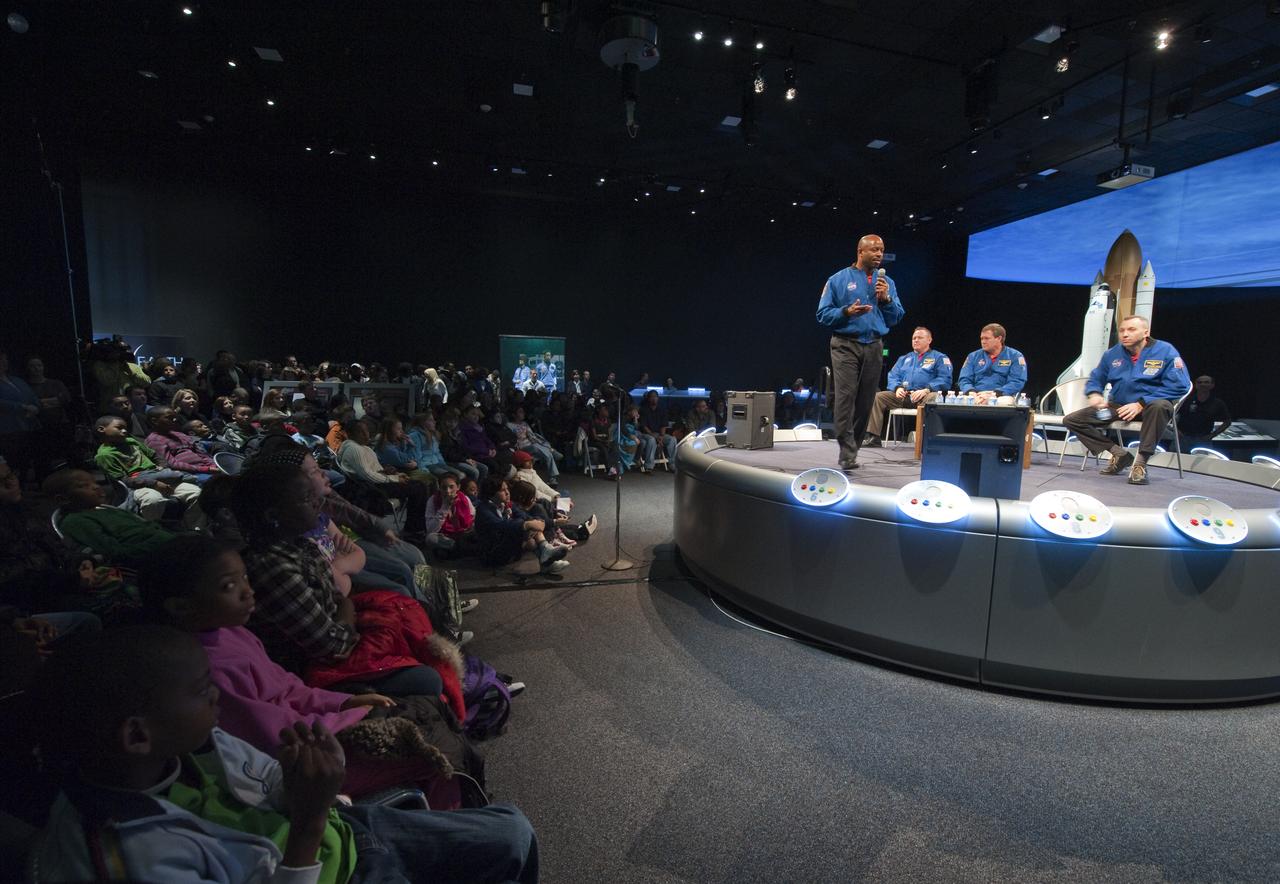
NASA STS-129 mission specialist Leland Melvin, standing, speaks to students assembled as fellow crew members Barry Wilmore, seated left, Mike Foreman and Randy Bresnick, seated right, look on during a presentation about their recent mission, Thursday, Jan. 14, 2010, at the Smithsonian National Air and Space Museum in Washington. Photo Credit: (NASA/Paul E. Alers)
NASA STS-129 Air and Space Museum
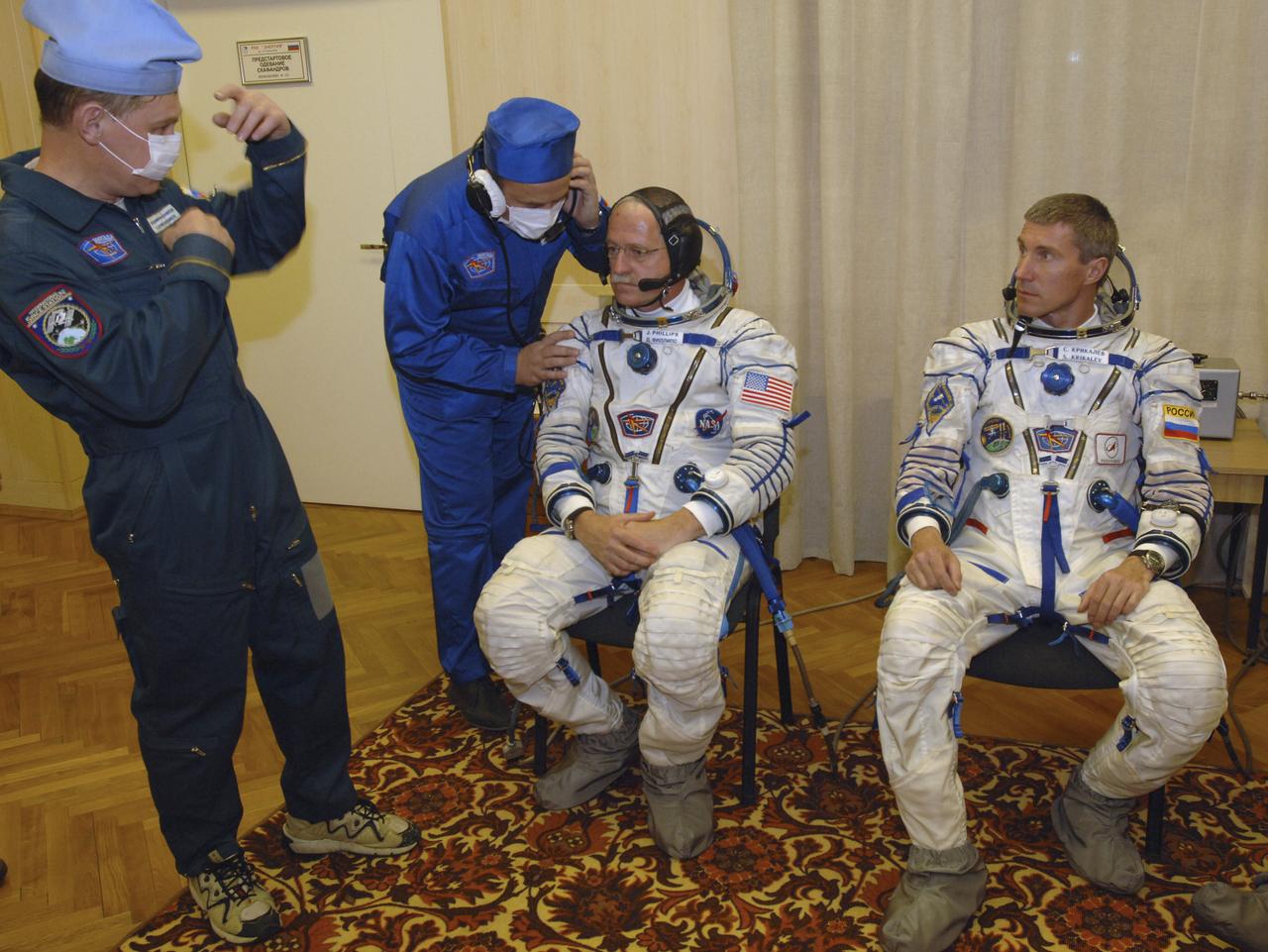
Technicians work on the Russian Sokol suits of Expedition 11 Flight Engineer and NASA Science Officer John Phillips, seated left, and Commander Sergei Krikalev, seated right,  prior to launch aboard the Soyuz TMA-6 spacecraft at the Baikonur Cosmodrome in Baikonur, Kazakhstan, Friday, April 15, 2005, for a two-day trip to the International Space Station.  Photo Credit: (NASA/Bill Ingalls)
Expedition 11 Launch Day
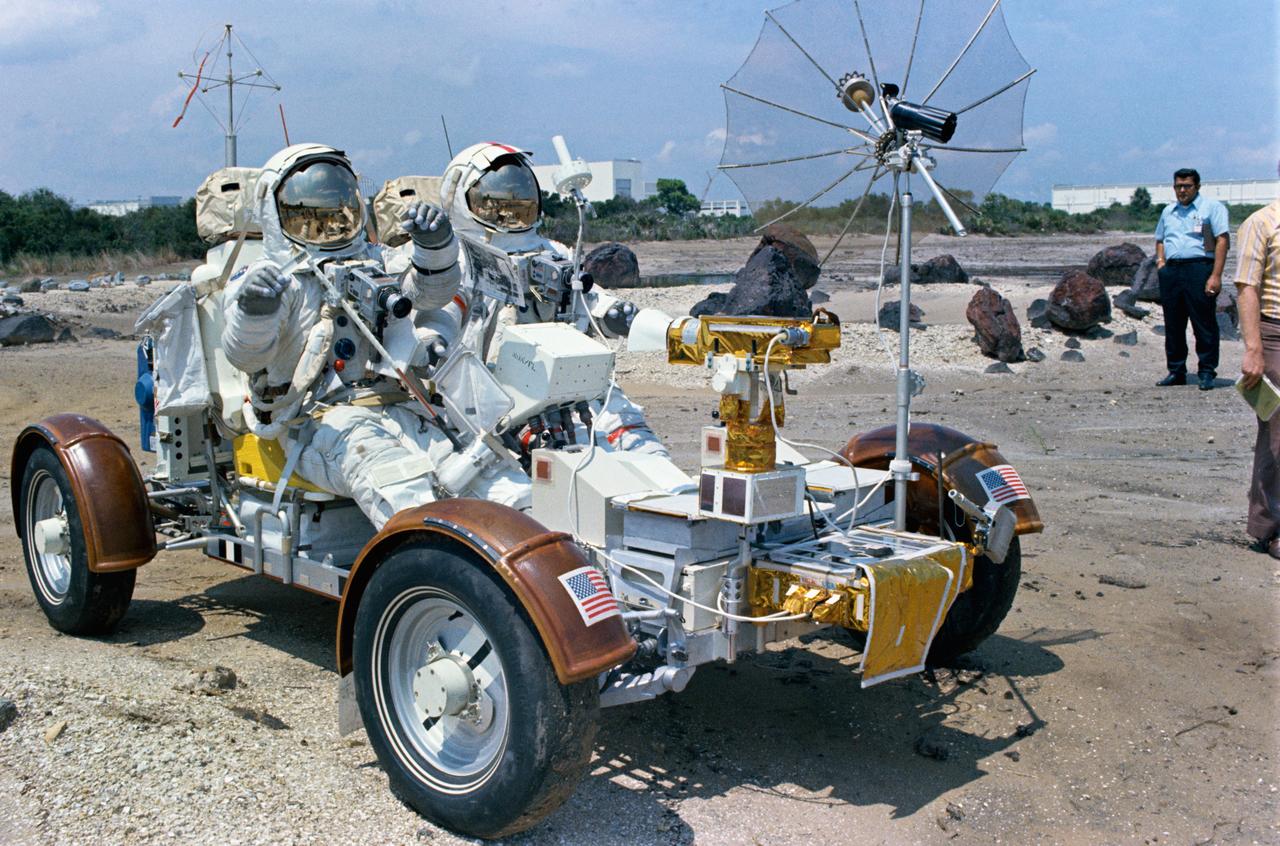
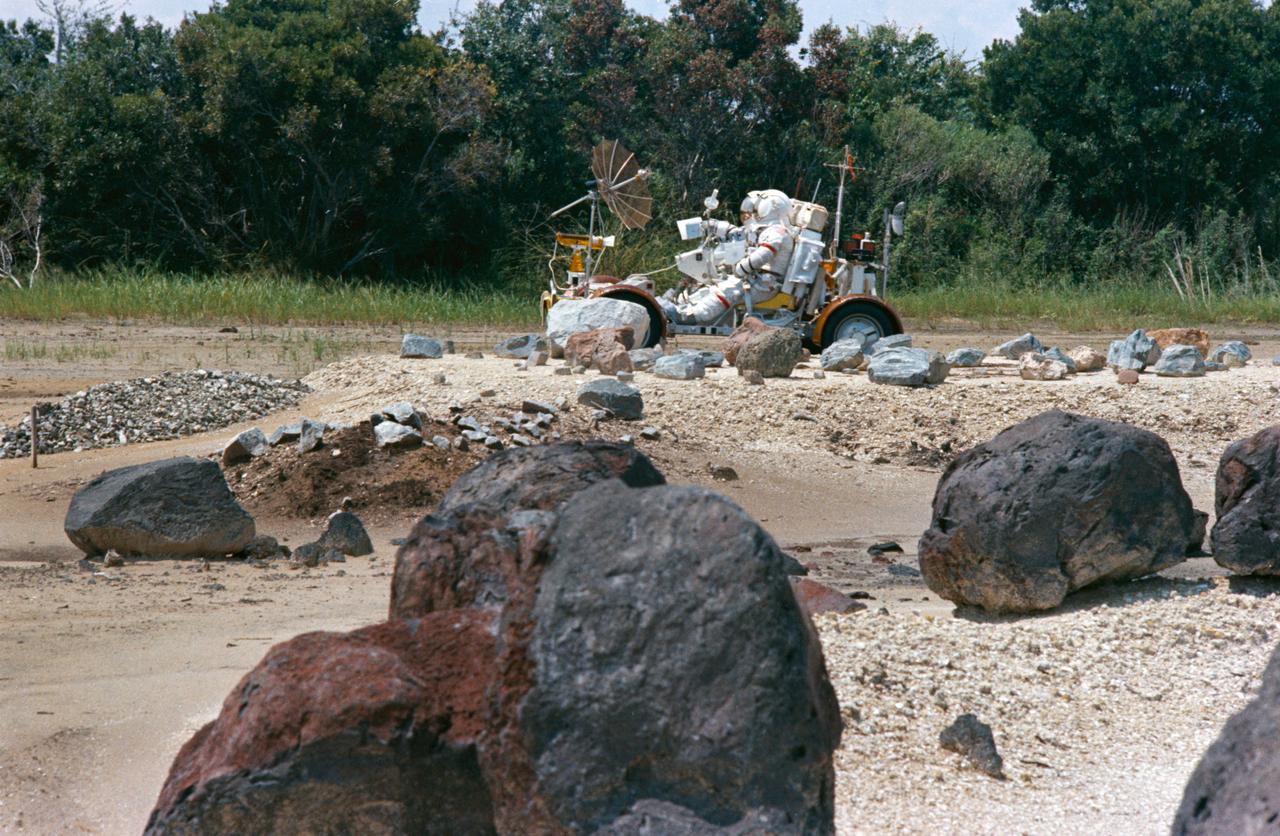
S72-48889 (September 1972) --- Two members of the prime crew of the Apollo 17 lunar landing mission ride in a lunar roving vehicle trainer during lunar surface extravehicular activity simulation training at the Kennedy Space Center, Florida. Astronaut Eugene A. Cernan, commander, is seated in the left-hand seat. Scientist-astronaut Harrison H. Schmitt, lunar module pilot, is on Cernan's right.
Apollo 17 training at KSC
Expedition 7 Commander Yuri I. Malenchenko, center, dons his Russian Sokol suit for the leak check, seat liner check and Soyuz inspection at the Soyuz Integration Facility at the Baikonur Cosmodrome in Baikonur, Kazakhstan, Thursday, April 10, 2003.  Seated is astronaut Edward T. Lu, NASA International Space Station Science Officer and Flight Engineer for Expedition 7.  Photo Credit: (NASA/Bill Ingalls)
Expedition 7 Leak Check
STS088-329-025 (4-15 Dec. 1998) --- Astronauts Robert D. Cabana, commander (left), seated in the commanders station; Frederick W. “Rick” Sturckow, pilot (right), seated in the pilot’s station; and Nancy J. Currie, mission specialist, on the flight deck of the Space Shuttle Endeavour.  The three were involved with rendezvous operations with the Russian-built FGB Module (Zarya) at the time the photo was taken.
Various STS-88 crewmembers pose for photos on the aft flight deck
Technicians work on the Russian Sokol suit of Expedition 11 Flight Engineer and NASA Science Officer John Phillips, seated left, and Commander Sergei Krikalev, seated right,  prior to launch aboard the Soyuz TMA-6 spacecraft at the Baikonur Cosmodrome in Baikonur, Kazakhstan, Friday, April 15, 2005, for a two-day trip to the International Space Station.  Photo Credit: (NASA/Bill Ingalls)
Expedition 11 Launch Day
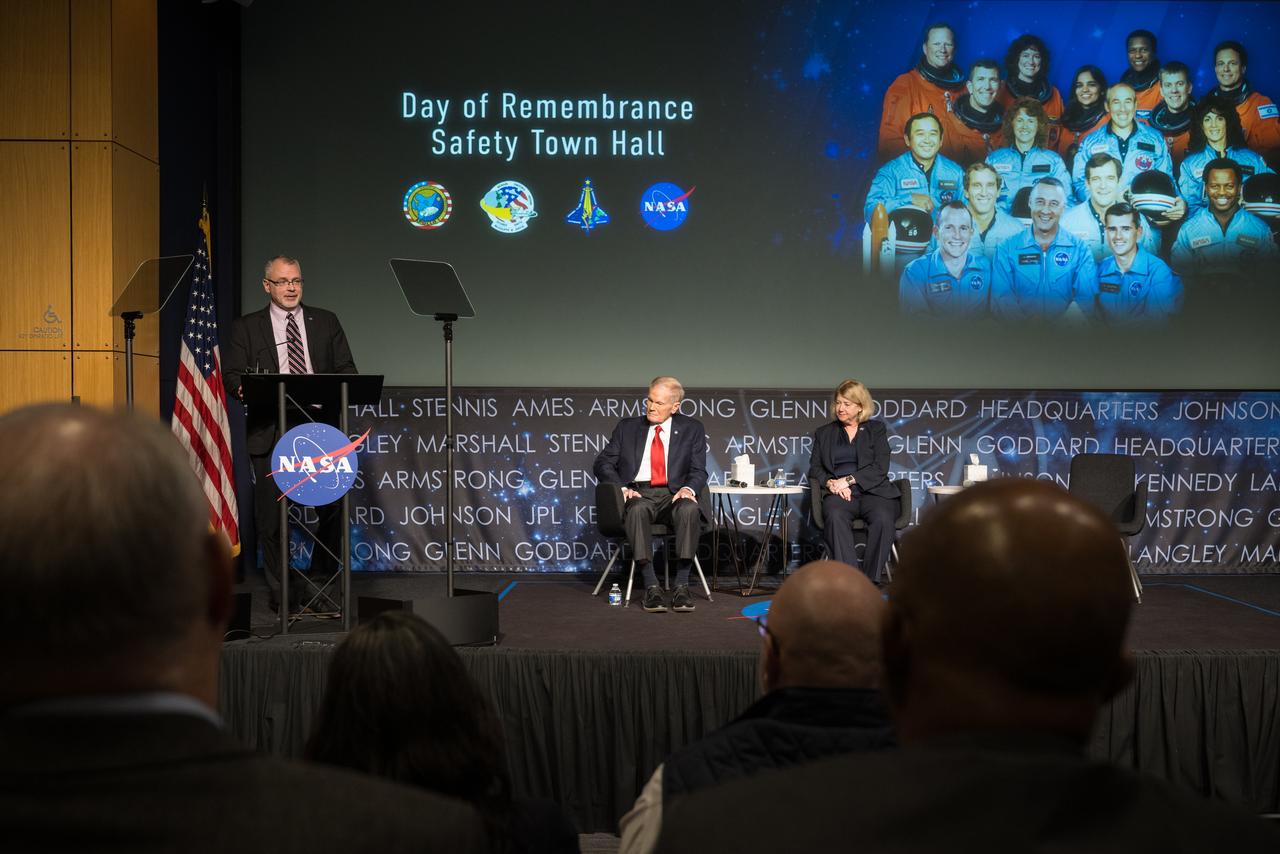
NASA Associate Administrator Jim Free speaks on a panel with NASA Administrator Bill Nelson, seated left, and NASA Deputy Administrator Pam Melroy, seated right, during a NASA Safety Town Hall, Tuesday, Jan. 23, 2024 at the Mary W. Jackson NASA Headquarters building in Washington. The Safety Town Hall is held annually near the Day of Remembrance to learn from past errors and pay tribute to those that lost their lives in the quest for space exploration. Photo Credit: (NASA/Aubrey Gemignani)
NASA Safety Town Hall
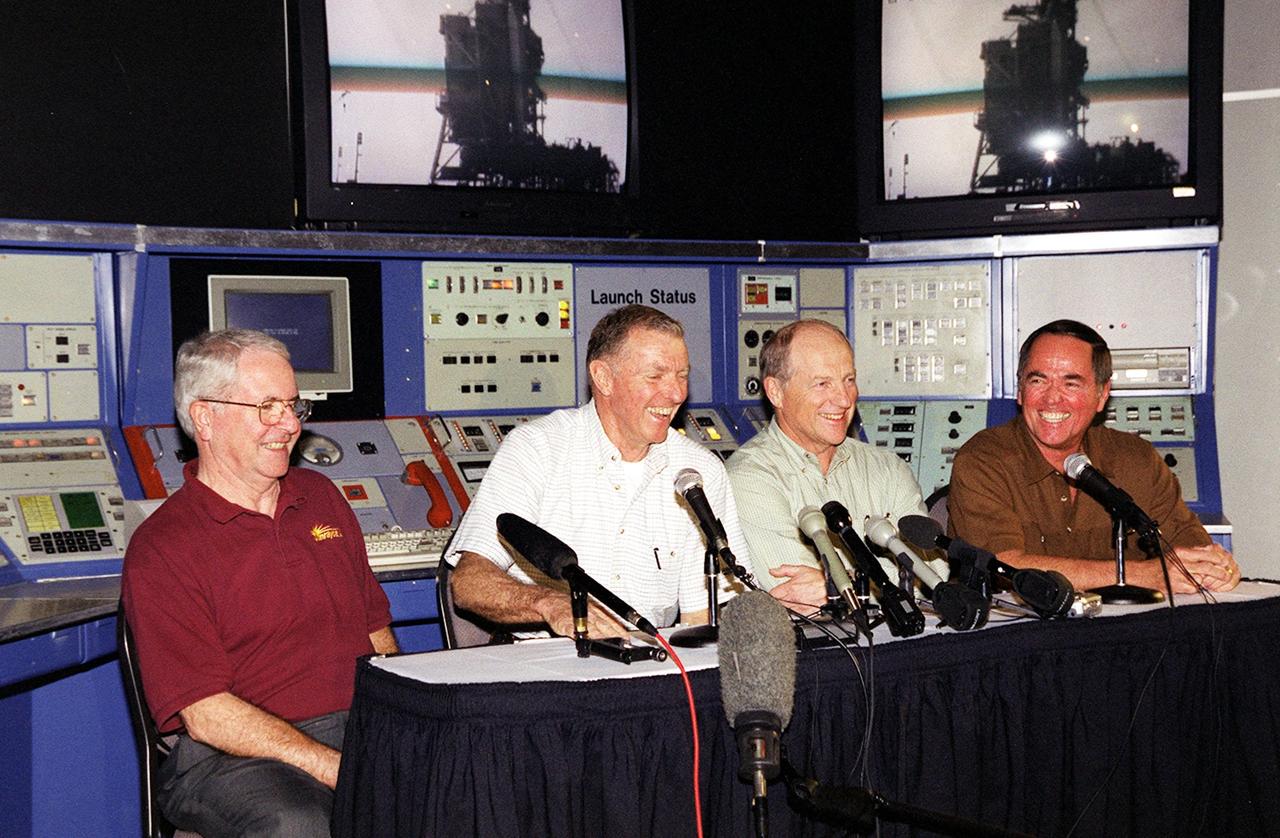
KENNEDY SPACE CENTER, Fla. -- The first four Shuttle astronauts -- seated, from left, Richard Truly, Joe Engle, Frederick "Rick" Hauck and Robert Crippen -- share a light moment about their experiences while seated in a replica of the early launch control center in the KSC Visitor Complex. All were inducted into the U.S. Astronaut Hall of Fame Nov. 10
KSC-01pp1748
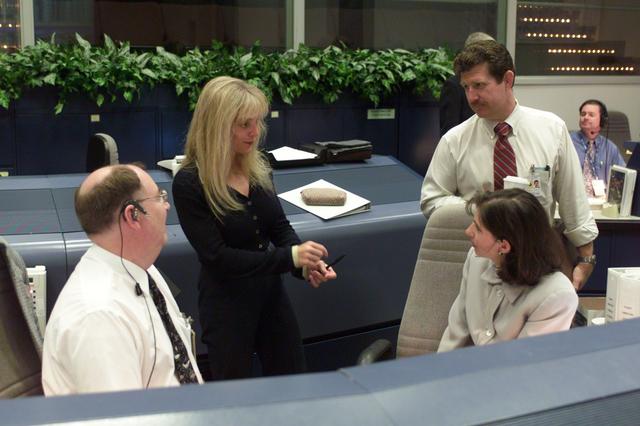
JSC2001-E-21560 (16 July 2001) --- STS-104 flight directors Wayne Hale (seated left), Catherine Koerner (seated right) and Phil Engelauf (standing left) speak with Linda Ham, Special Assistant to the Manager of the Space Shuttle Program Office, at the flight director's console in the shuttle flight control room (WFCR) in Houston's Mission Control Center (MCC).
WFCR during STS-104
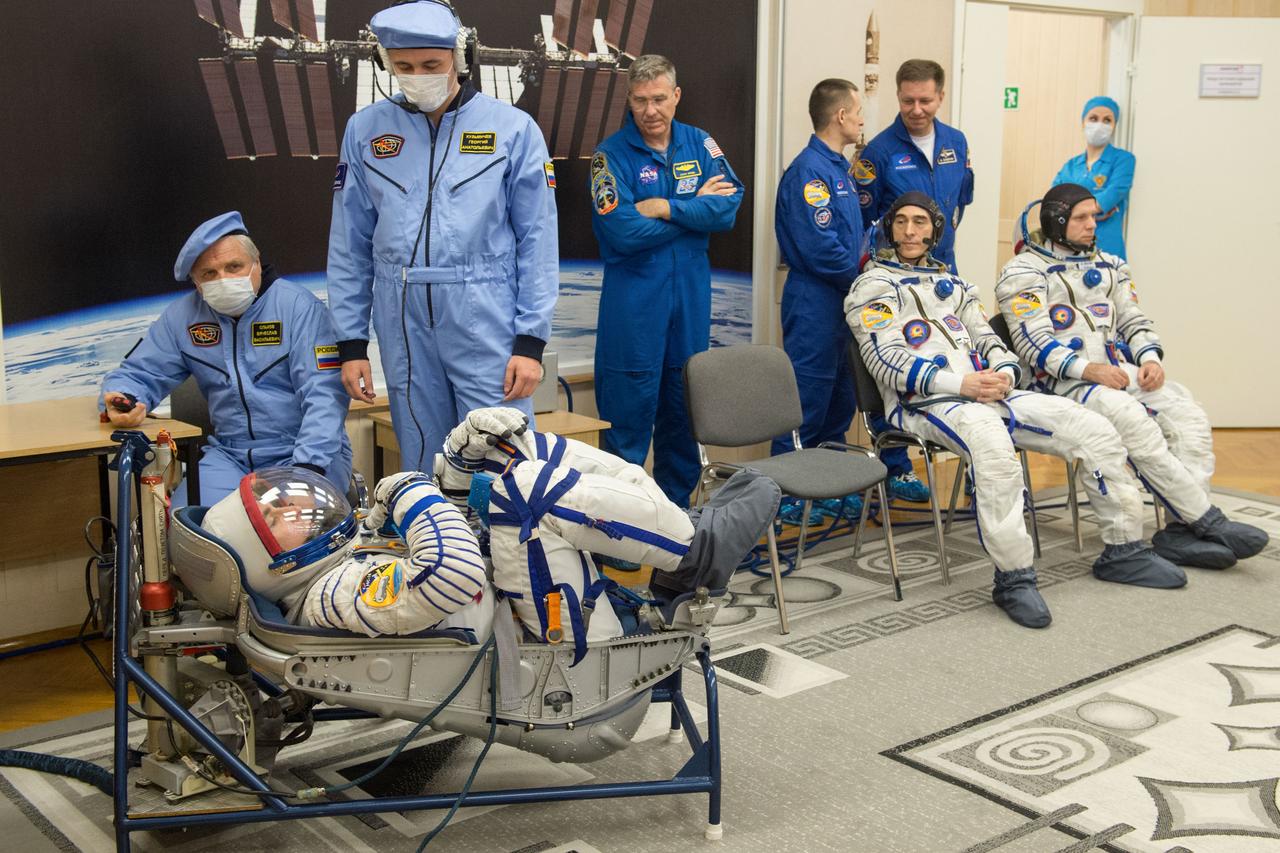
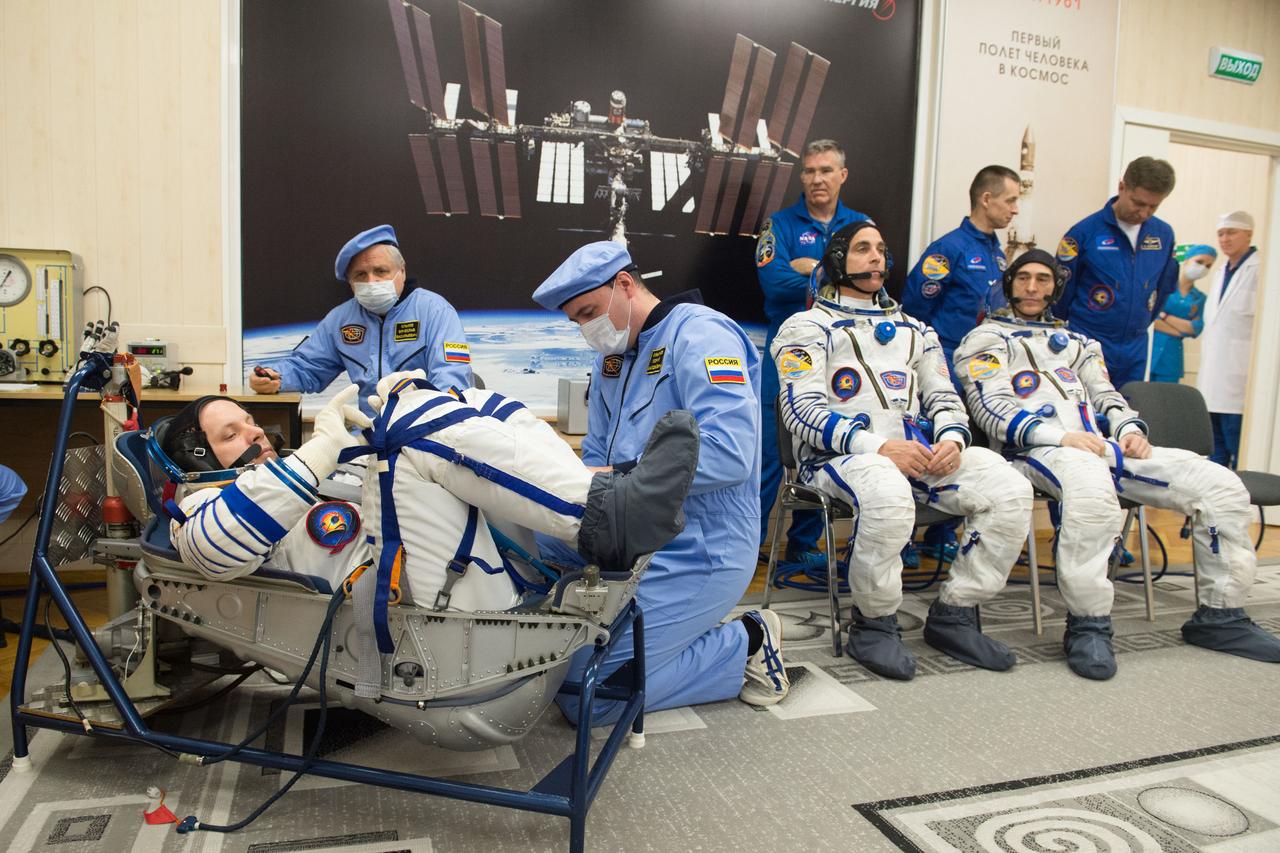
jsc2020e017089 - Expedition 63 Preflight - Expedition 63 crewmember Ivan Vagner of Roscosmos, left, has his Sokol suit pressure checked ahead of his launch on a Soyuz rocket with Chris Cassidy of NASA, seated center, and Anatoly Ivanishin of Roscosmos, seated right, Thursday, April 9, 2020 at the Baikonur Cosmodrome in Kazakhstan. A few hours later, they lifted off for a six-and-a-half month mission on the International Space Station. Photo Credit: (NASA/GCTC/Andrey Shelepin)
Expedition 63 Preflight
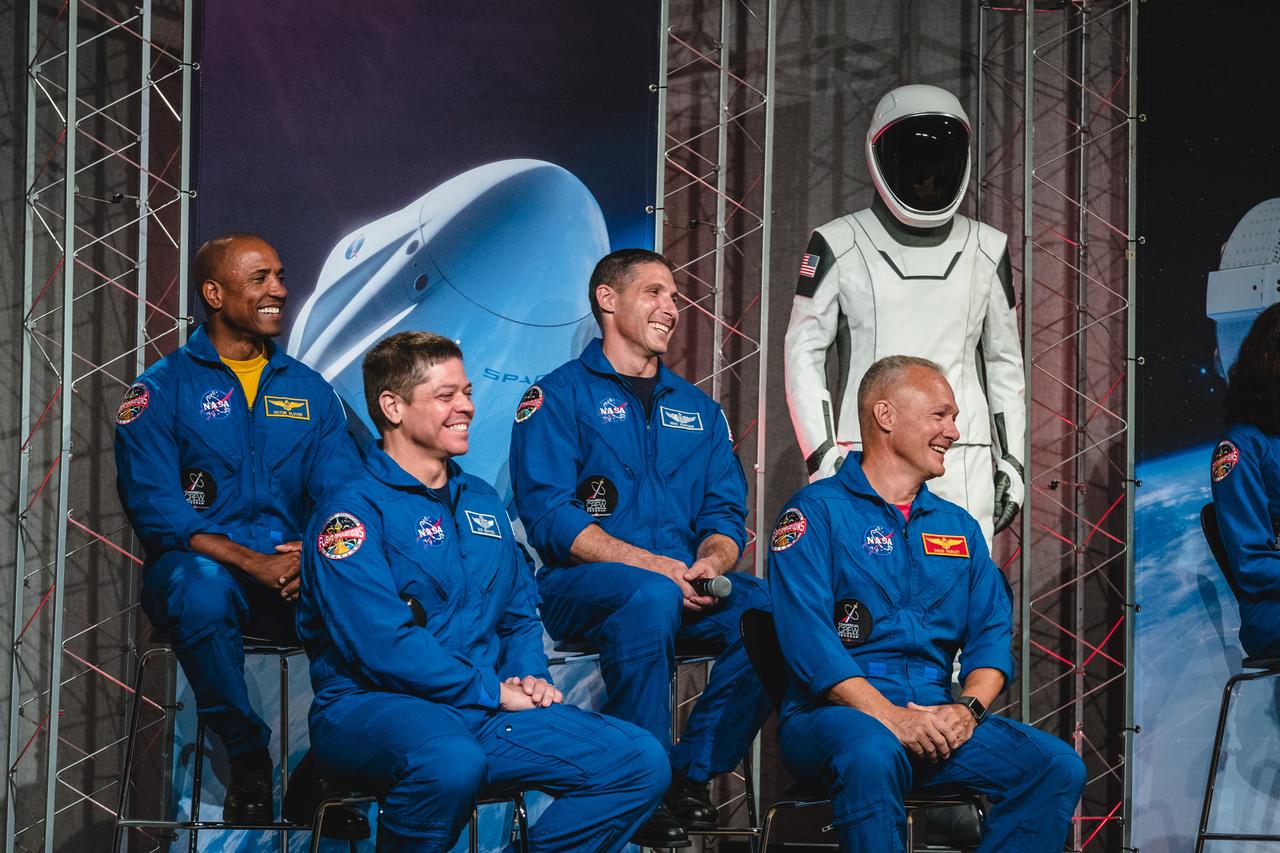
NASA announces the nine astronauts selected for commercial crew flight assignments on the crew test flights and first operational missions for Boeing's CST-100 Starliner and SpaceX's Crew Dragon on Aug. 3, 2018, at the agency's Johnson Space Center in Houston. Seated in front, from left, are Bob Behnken and Doug Hurley. They are assigned to the first test flight of SpaceX's Crew Dragon. Seated in back, from left, are Victor Glover and Mike Hopkins. They are assigned to fly on the first operational mission of SpaceX's Crew Dragon.
Commerical Crew Astronauts - Crew Annoucement at JSC
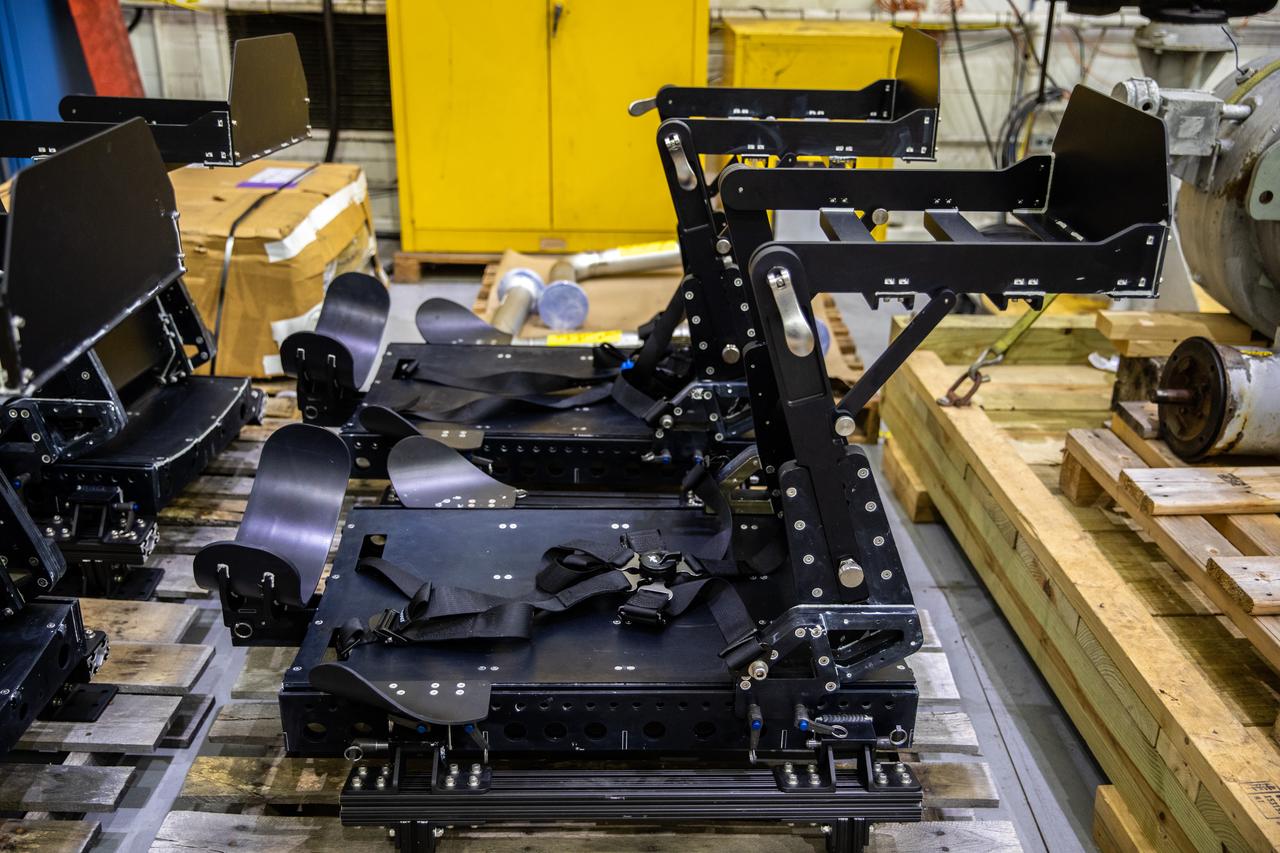
Two seats for the Artemis Orion crew module test article (CMTA) are in view in the high bay inside the Launch Equipment Test Facility at NASA's Kennedy Space Center in Florida on March 18, 2022. The seats were built by the center’s Prototype Laboratory. The CMTA is used to practice recovery after splashdown of the Orion spacecraft to prepare for Artemis missions. Exploration Ground Systems leads recovery efforts.
Artemis Recovery CMTA
jsc2020e017096 - Expedition 63 Preflight - Expedition 63 crewmember Chris Cassidy of NASA, left, has his Sokol suit pressure checked ahead of his launch on a Soyuz rocket with Anatoly Ivanishin of Roscosmos, seated center, and Ivan Vagner of Roscosmos, seated right, Thursday, April 9, 2020 at the Baikonur Cosmodrome in Kazakhstan. A few hours later, they lifted off for a six-and-a-half month mission on the International Space Station. Photo Credit: (NASA/GCTC/Andrey Shelepin)...
Expedition 63 Preflight
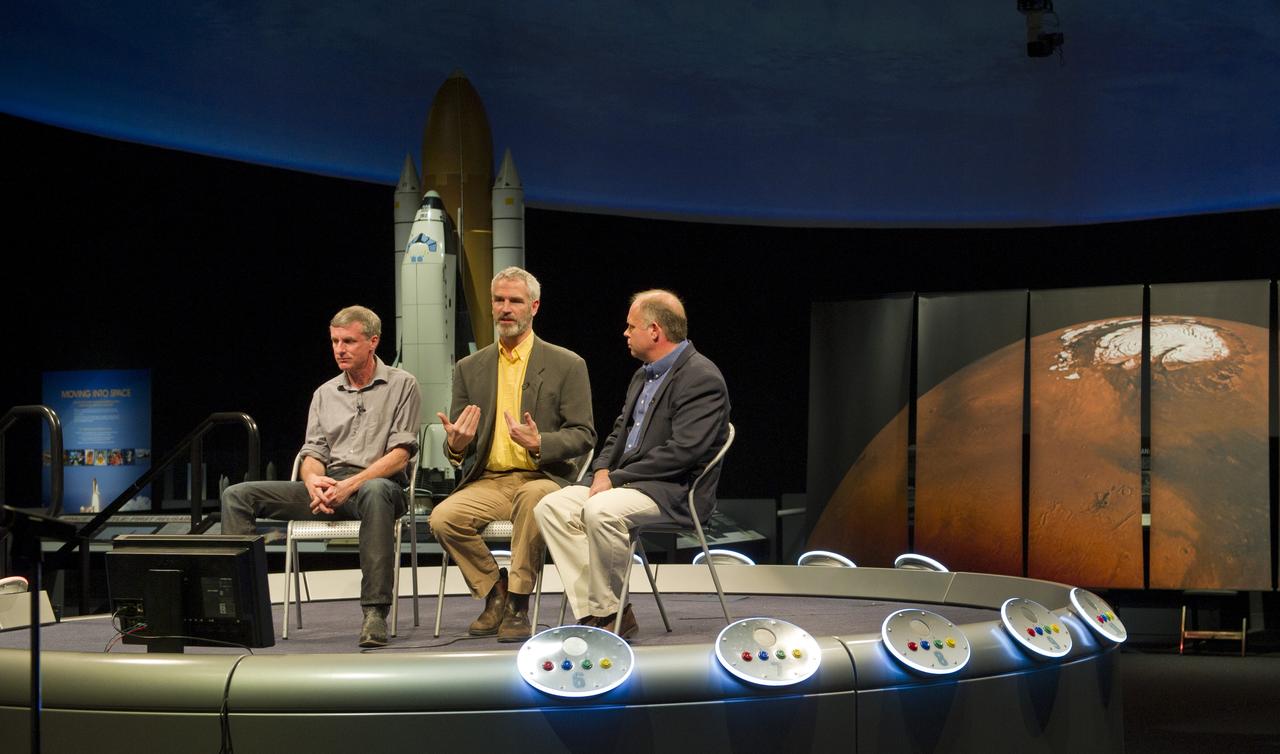
Dr. John Grant, seated right, moderates a discussion with Dr. Jack Mustard, from Brown University, and Dr. Steve Squyres, from Cornell University, seated left, during a Mars Program Update, Thursday, Jan. 13, 2011, at the Smithsonian National Air and Space Museum in Washington. Prominent scientists discussed evidence of water on Mars, current Program status, including the 7th Anniversary of the Mars rovers and the upcoming Mars Science Laboratory mission and previewed exciting discoveries to come. Photo Credit: (NASA/Paul E. Alers)
Mars Symposium NASM
S72-48892 (September 1972) --- Two members of the prime crew of the Apollo 17 lunar landing mission ride in a Lunar Roving Vehicle trainer during lunar surface extravehicular activity simulation training at the Kennedy Space Center (KSC), Florida. Astronaut Eugene A. Cernan, commander, is seated in the left-hand seat. Scientist-astronaut Harrison H. Schmitt, lunar module pilot, is on Cernan's right.
APOLLO 17 - CREW TRAINING - EXTRAVEHICULAR (EVA) - KSC
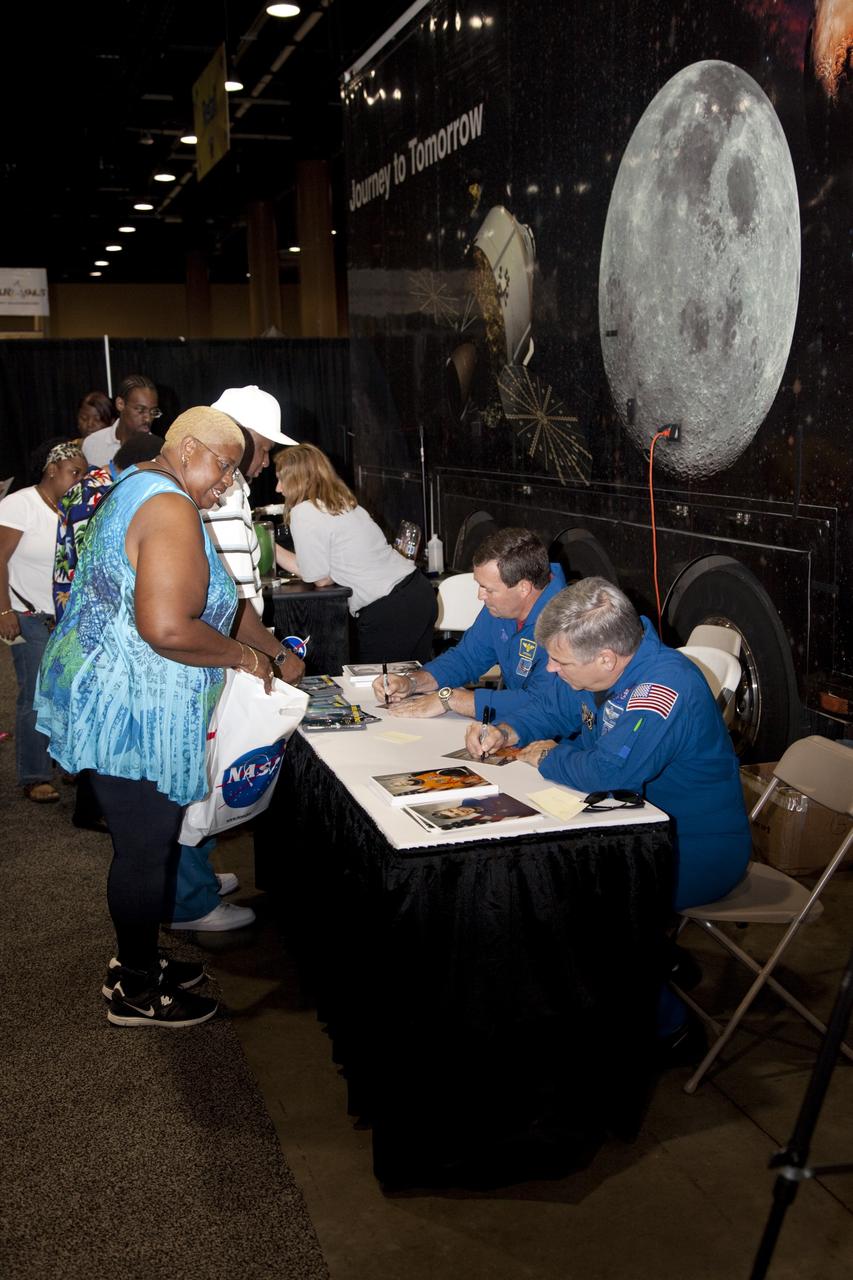
CAPE CANAVERAL, Fla. -- NASA astronauts Mike Foreman (seated, left) and Greg Johnson (seated, right) sign autographs for the nationwide attendees of the Tom Joyner Family Reunion. They are seated in front of NASA’s Journey to Tomorrow trailer at reunion headquarters at the Gaylord Palms Resort and Convention Center in Kissimmee, Fla. The reunion was hosted by nationally syndicated radio personality Tom Joyner during the extended Labor Day weekend Sept. 1-4. Besides offering attendees the opportunity to visit tourist attractions in the Orlando area, the reunion gave NASA education specialists an avenue to tout the benefits of math and scientific learning, as well as the many educational opportunities offered by the space agency.    For more information on NASA's education initiatives, visit http://www.nasa.gov/education. Photo credit: NASA/Frankie Martin
KSC-2011-6762
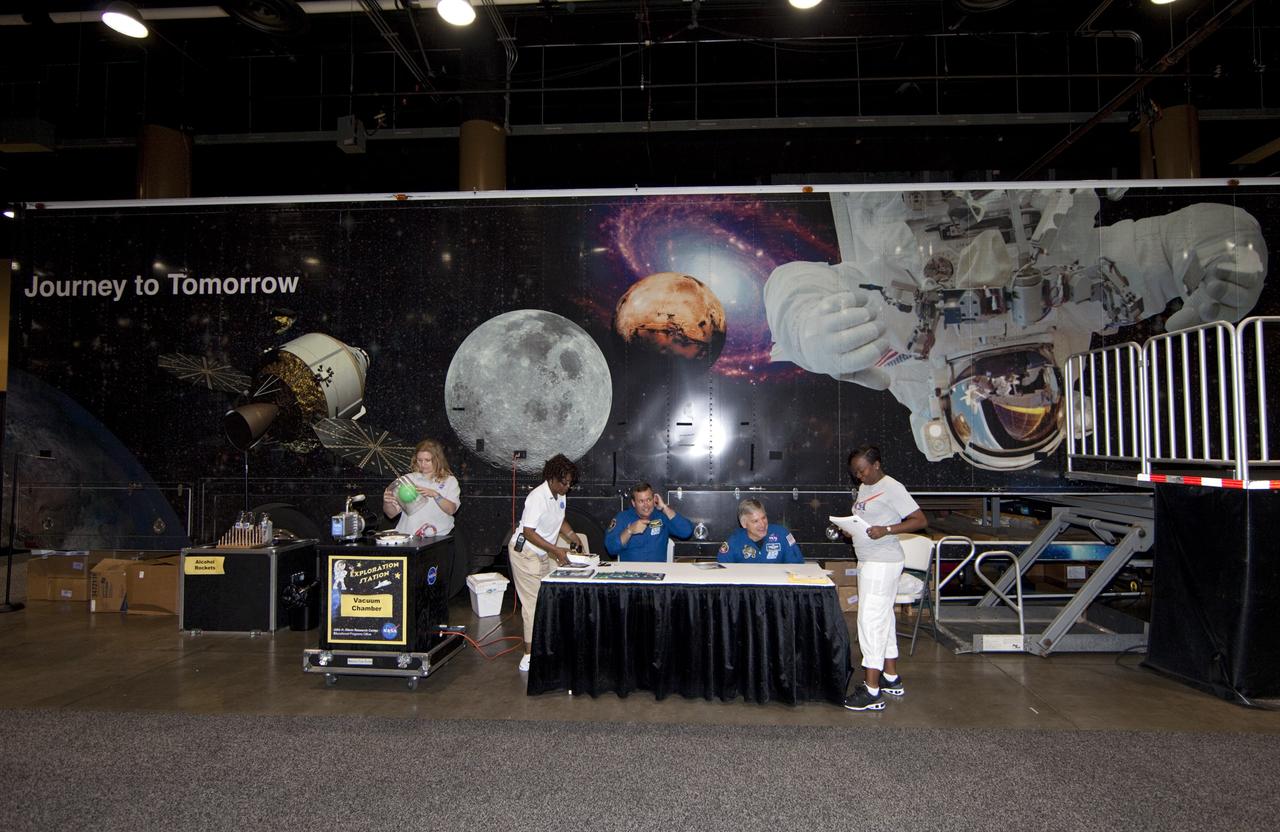
CAPE CANAVERAL, Fla. -- NASA astronauts Mike Foreman (seated, left) and Greg Johnson (seated, right) enjoy the quiet before the storm as they prepare to sign autographs for the nationwide attendees of the Tom Joyner Family Reunion. They are seated in front of NASA’s Journey to Tomorrow trailer at reunion headquarters at the Gaylord Palms Resort and Convention Center in Kissimmee, Fla. The reunion was hosted by nationally syndicated radio personality Tom Joyner during the extended Labor Day weekend Sept. 1-4. Besides offering attendees the opportunity to visit tourist attractions in the Orlando area, the reunion gave NASA education specialists an avenue to tout the benefits of math and scientific learning, as well as the many educational opportunities offered by the space agency.    For more information on NASA's education initiatives, visit http://www.nasa.gov/education. Photo credit: NASA/Frankie Martin
KSC-2011-6761
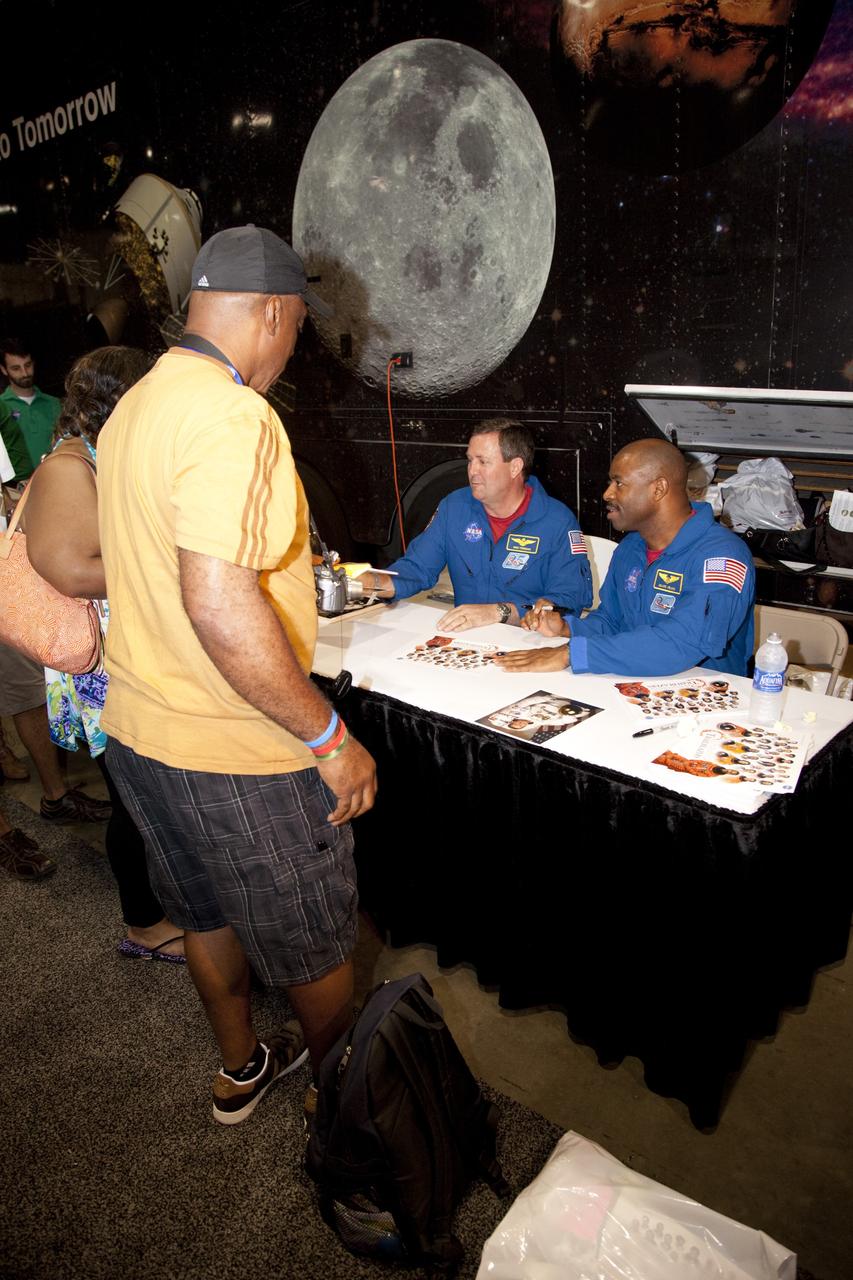
CAPE CANAVERAL, Fla. -- NASA astronauts Mike Foreman (seated, left) and Leland Melvin (seated, right) sign autographs for the nationwide attendees of the Tom Joyner Family Reunion. Melvin also is NASA's associate administrator for education. They are seated in front of NASA’s Journey to Tomorrow trailer at reunion headquarters at the Gaylord Palms Resort and Convention Center in Kissimmee, Fla. The reunion was hosted by nationally syndicated radio personality Tom Joyner during the extended Labor Day weekend Sept. 1-4. Besides offering attendees the opportunity to visit tourist attractions in the Orlando area, the reunion gave NASA education specialists an avenue to tout the benefits of math and scientific learning, as well as the many educational opportunities offered by the space agency.    For more information on NASA's education initiatives, visit http://www.nasa.gov/education. Photo credit: NASA/Frankie Martin
KSC-2011-6763
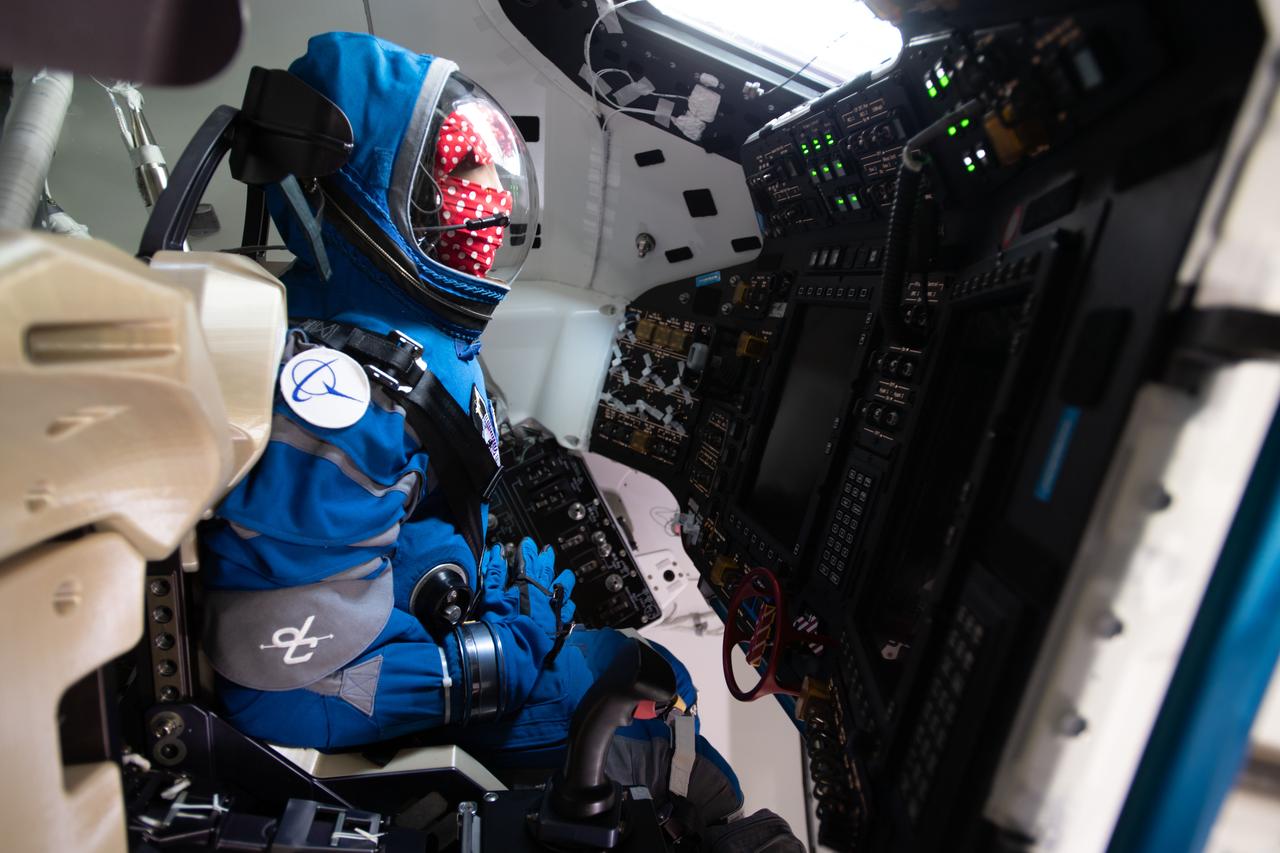
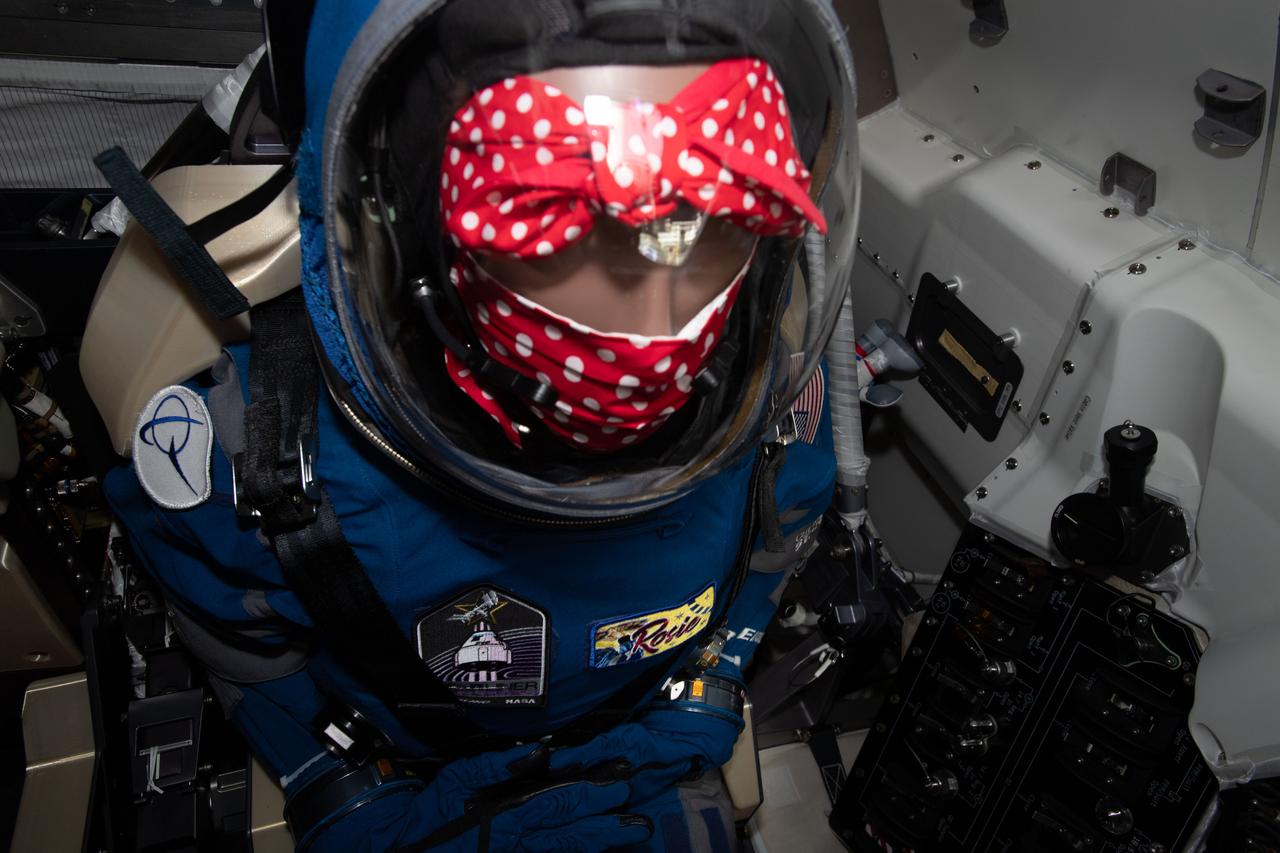
iss067e066358 (May 21, 2022) --- Rosie the Rocketeer, Boeing's anthropometric test device, is pictured in the commander's seat of the company's CST-100 Starliner crew ship for the Orbital Flight Test-2 mission at the International Space Station.
iss067e066358
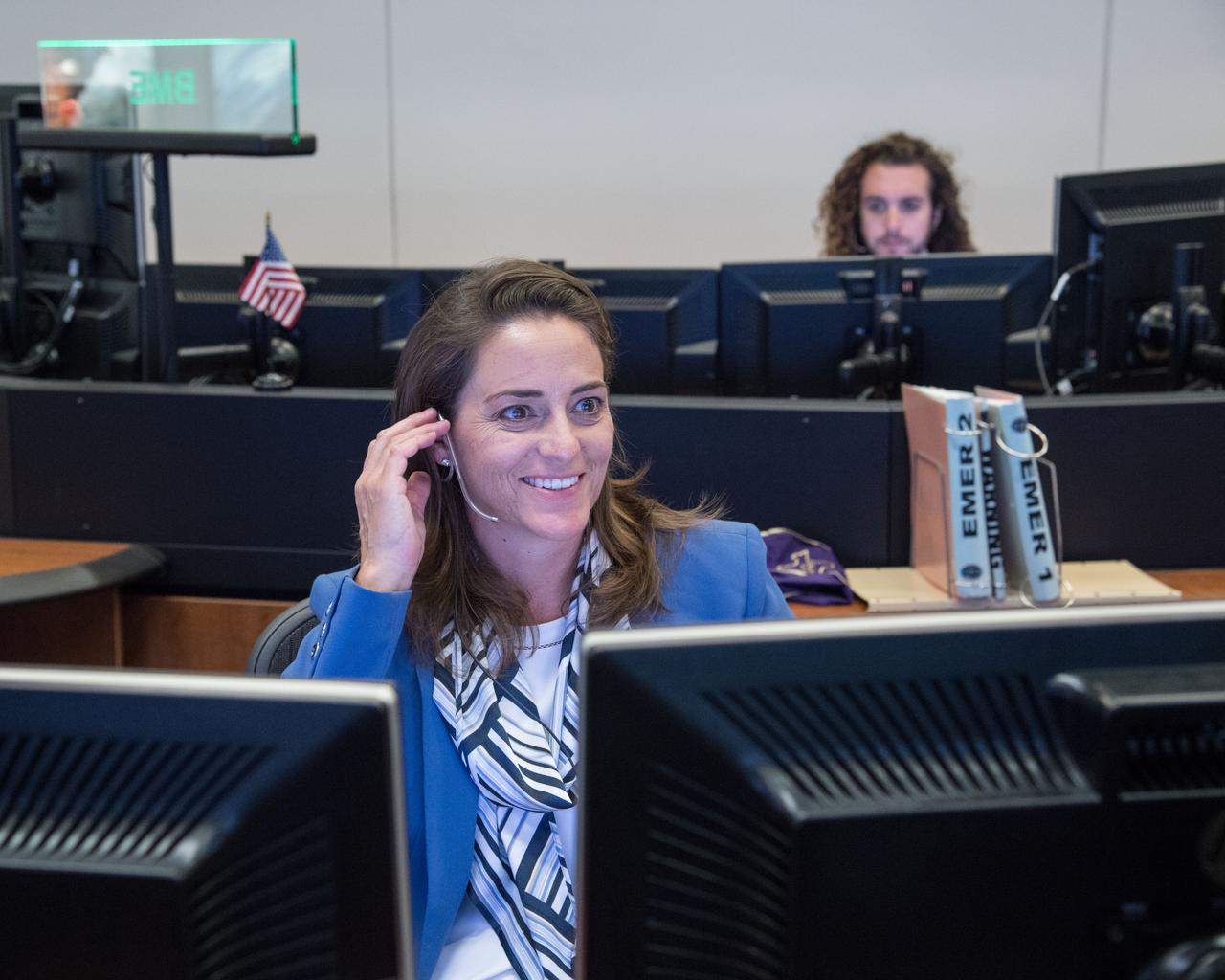
jsc2018e088236 (July 3, 2017) --- Portrait of NASA astronaut Nicole Mann seated at the CAPCOM console in Houston's Mission Control Center during the release of the SpaceX Dragon cargo vehicle from the International Space Station.
jsc2017e088236
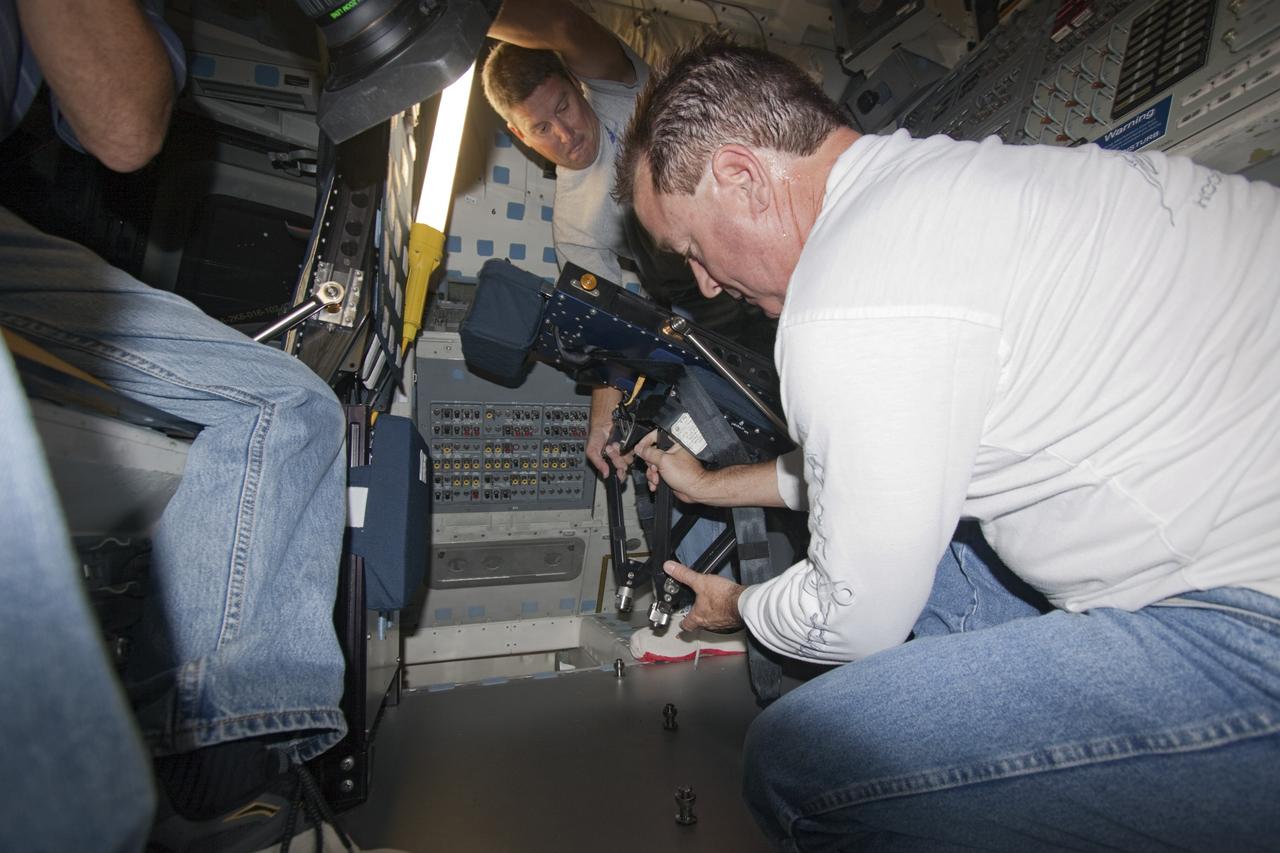
STS112-324-008 (7-18 October 2002) --- Astronaut David A. Wolf, STS-112 mission specialist, works with a temporary flight deck seat, used for launch and entry, on the Space Shuttle Atlantis.
STS-112 Wolf with seat on flight deck
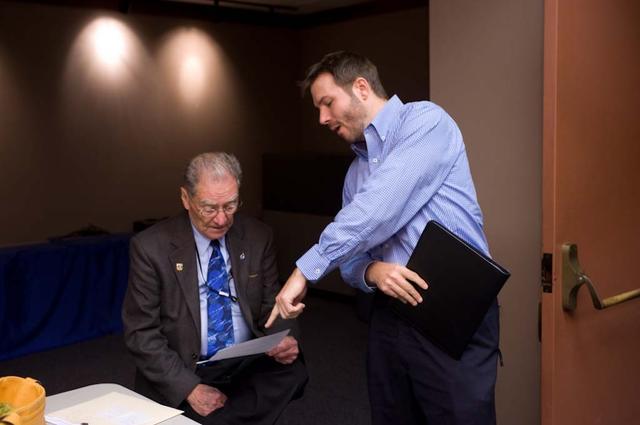
Ames hosts Press Event for talk with STS-135 Astronauts onboard the Space Shuttle,  Jack Boyd (seated) and John Yembrick, PAO chief go over interview points.
ARC-2011-ACD11-0110-003
iss067e066341 (May 21, 2022) --- Rosie the Rocketeer, Boeing's anthropometric test device, is pictured in the commander's seat of the company's CST-100 Starliner crew ship for the Orbital Flight Test-2 mission at the International Space Station.
iss067e066341
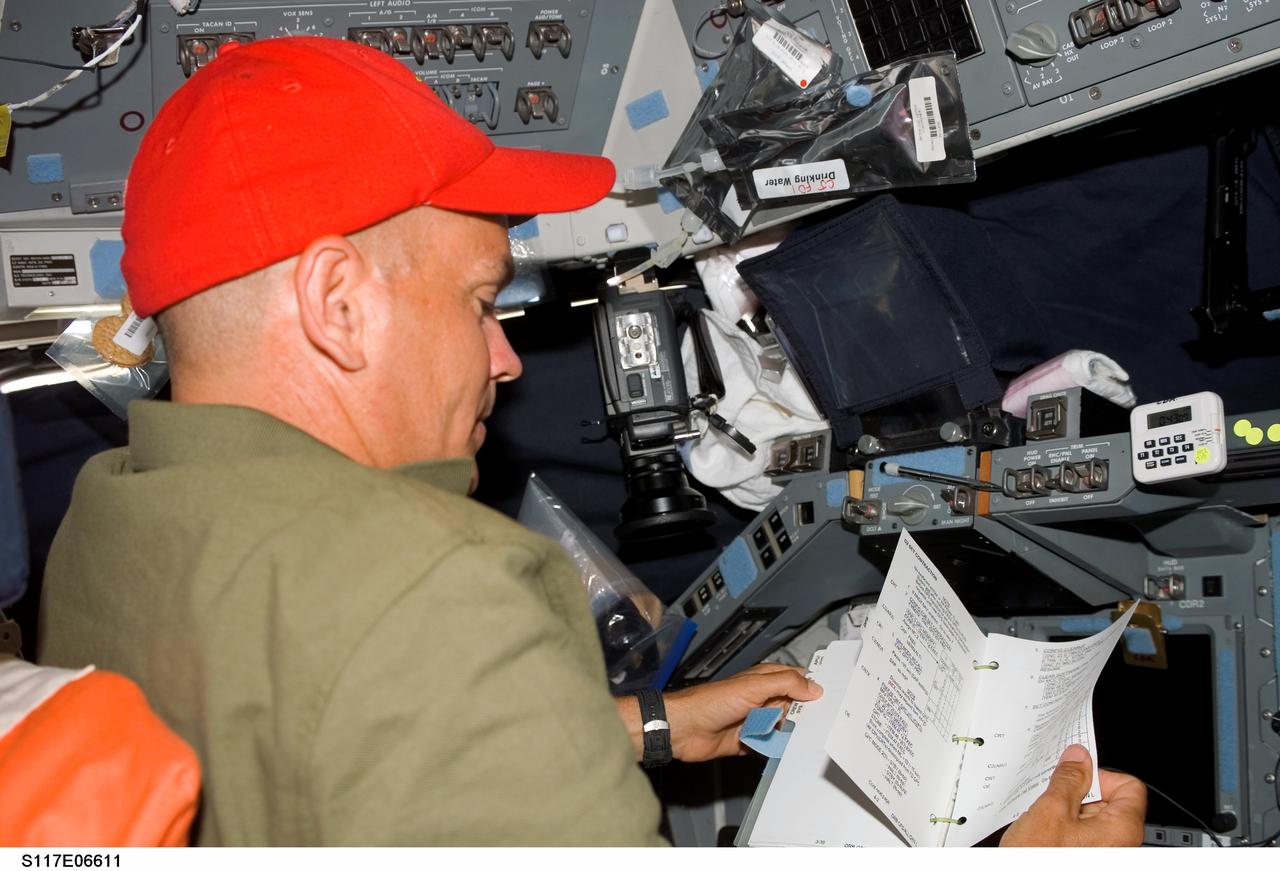
S117-E-06611 (9 June 2007) --- Astronaut Rick Sturckow, STS-117 commander, looks over procedures checklists while seated at the commander's station on the flight deck of Space Shuttle Atlantis.
Sturckow looks over procedures on the FD of STS-117 Space Shuttle Atlantis
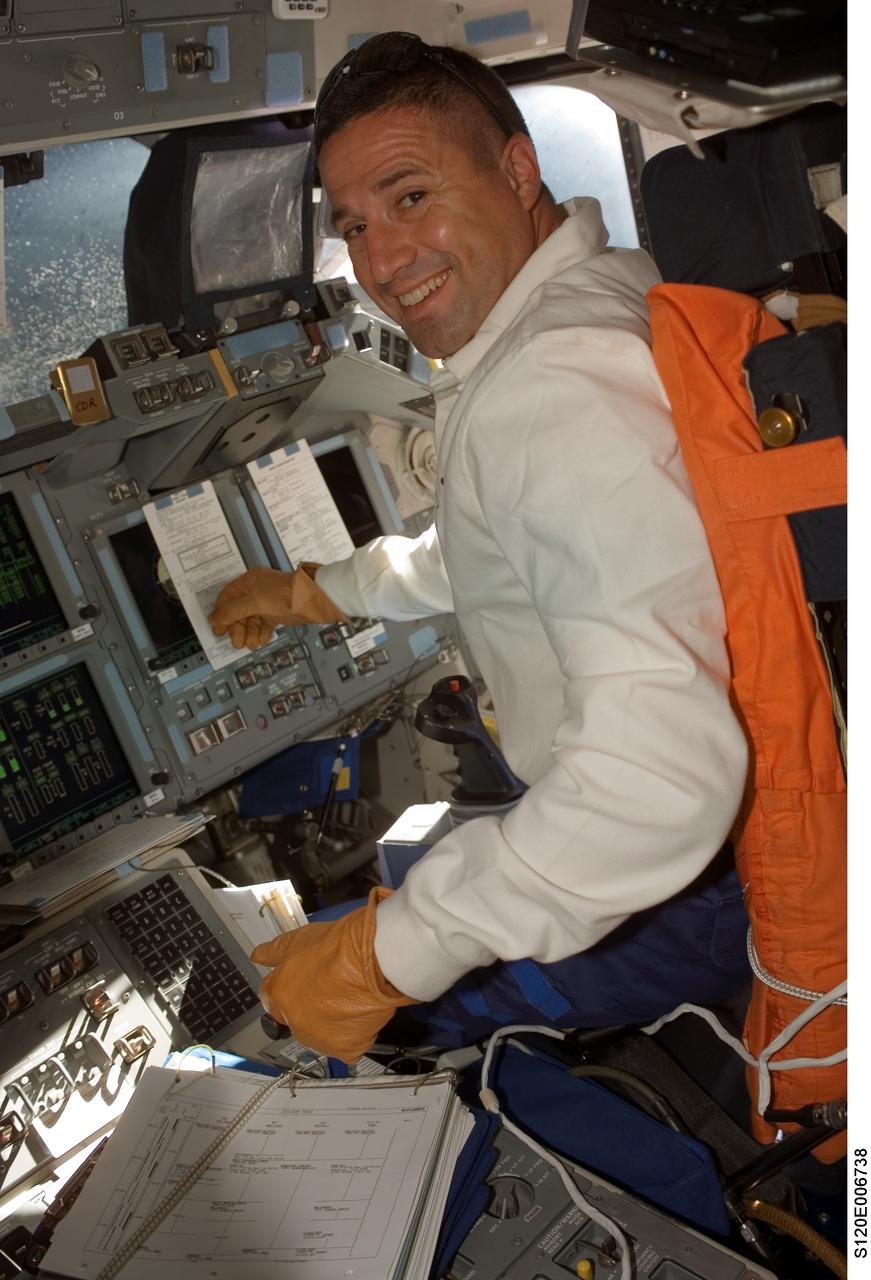
S120-E-006738 (25 Oct. 2007) --- Astronaut George Zamka, STS-120 pilot, seated at the pilot's station on the forward flight deck of the Space Shuttle Discovery during rendezvous and docking operations.
Zamka on Flight Deck
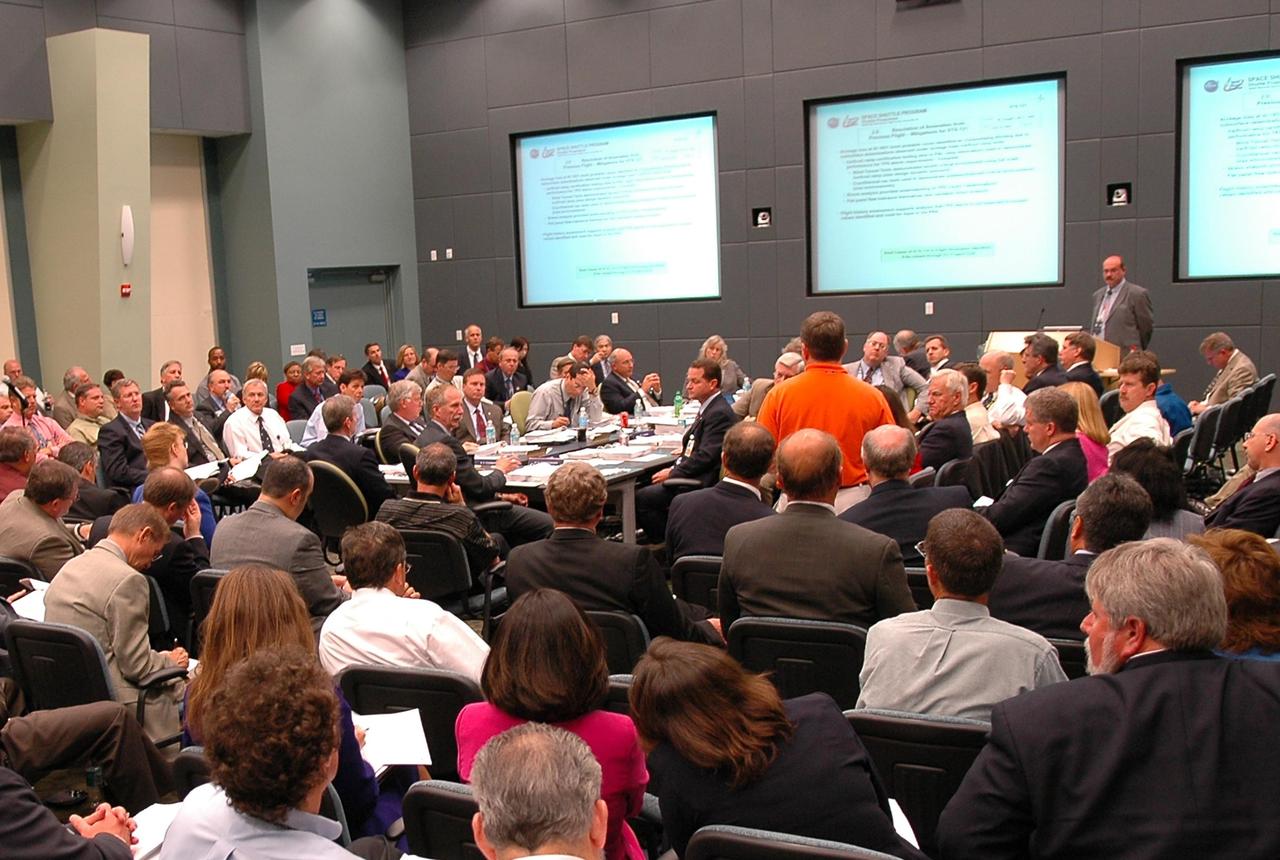
KENNEDY SPACE CENTER, FLA. -     Space Shuttle Program and mission managers meet for the traditional Flight Readiness Review, a thorough assessment of preparations for the mission. Among those seated at the table on the left are Center Director Jim Kennedy, Associate Administrator for Space Operations William Gerstenmaier and Marshall Space Flight Center Director Dave King.  Shuttle Program Manager Wayne Hale is seated under the center screen on the back wall.  Also attending is NASA Administrator Mike Griffin.  The June 16-17 meeting is designed to produce a number of key decisions about Discovery's mission, STS-121, including selection of an official launch date. Photo credit: NASA/Kim Shiflett
KSC-06pd1140
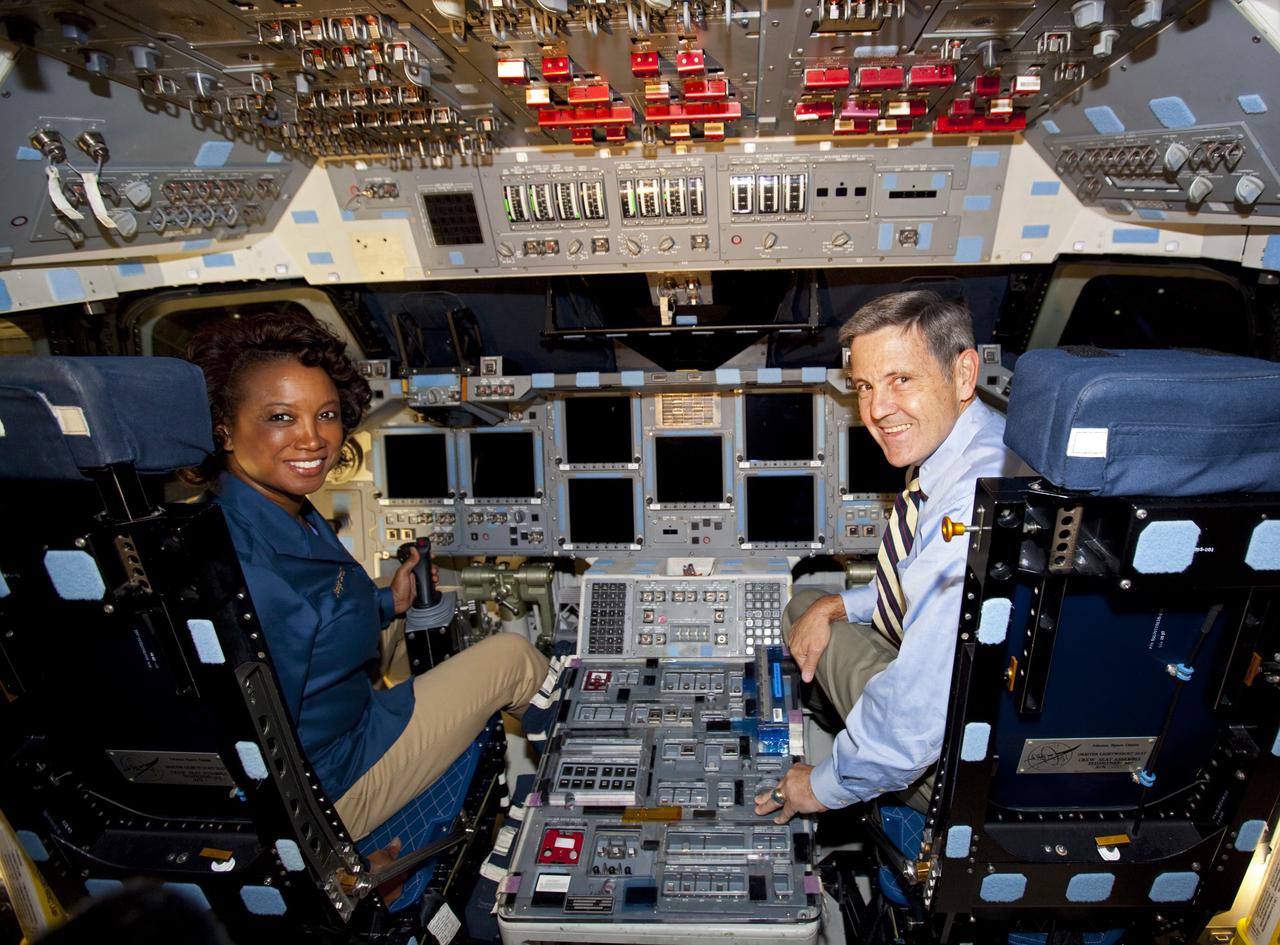
CAPE CANAVERAL, Fla. – Florida’s Lt. Gov. Jennifer Carroll, left, gets the feel of the commander’s seat on the flight deck of space shuttle Atlantis during a tour of Kennedy Space Center’s Orbiter Processing Facility-1. Kennedy Director Bob Cabana, a former astronaut, is right at home in the pilot’s seat beside her.    The tour coincided with Carroll’s visit to Kennedy for a meeting with Cabana. Atlantis is being prepared for public display at the Kennedy Space Center Visitor Complex in 2013. The groundbreaking for Atlantis’ exhibit hall took place in January Atlantis is scheduled to be moved to the visitor complex in November. For more information, visit http://www.nasa.gov/shuttle.  Photo credit: NASA/Jim Grossmann
KSC-2012-1965
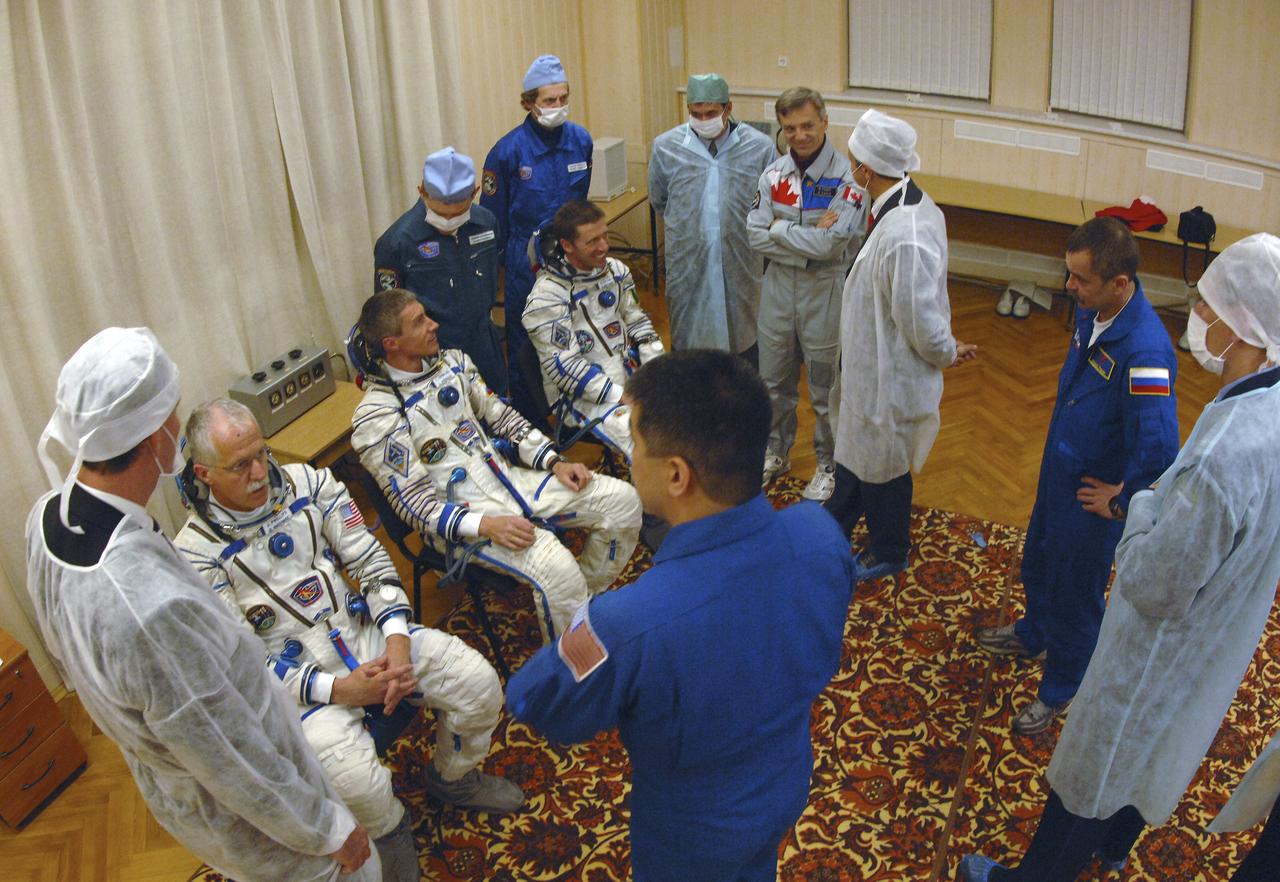
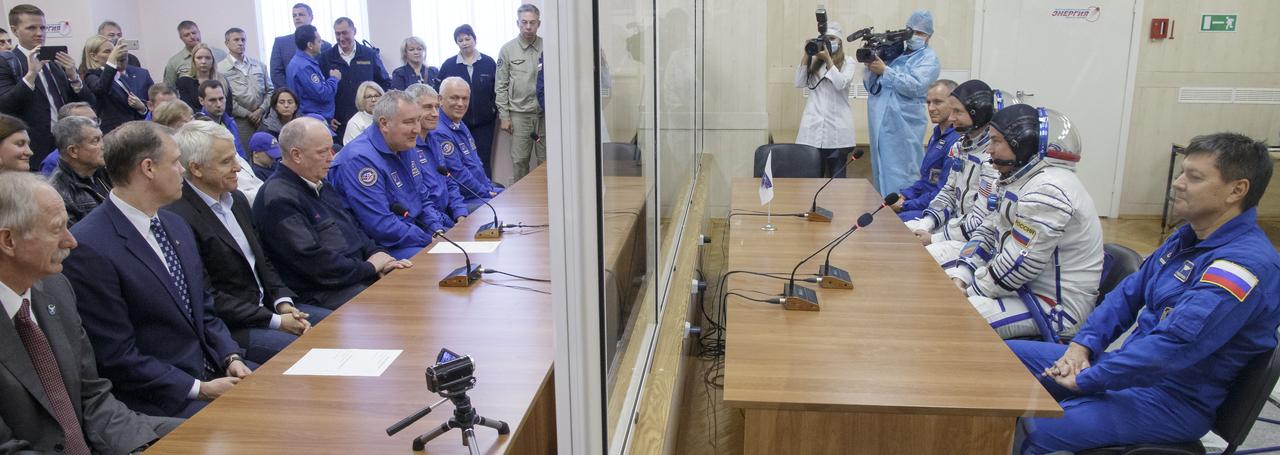
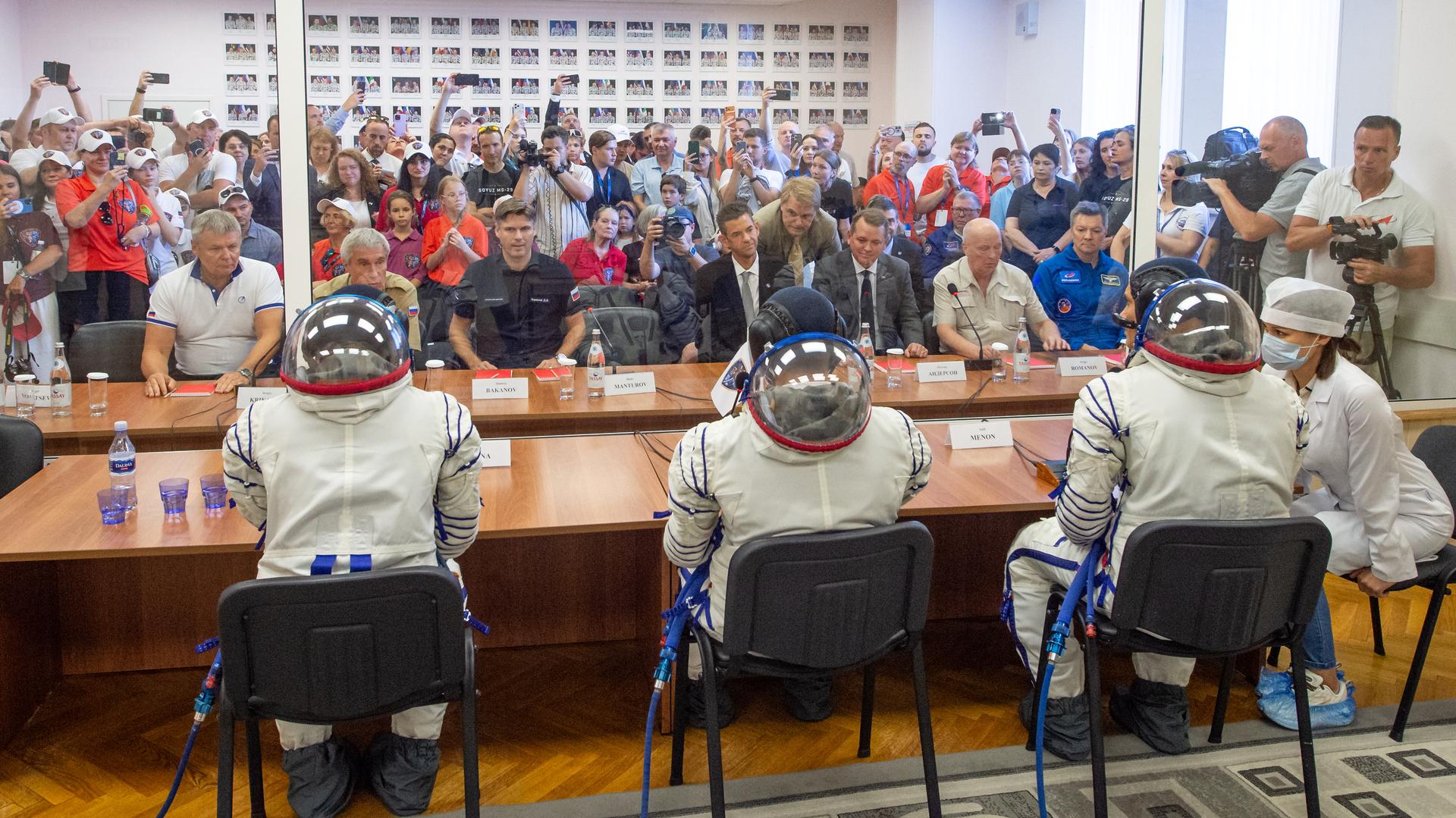
Expedition 57 prime crew members; Flight Engineer Nick Hague of NASA, space suit on seated left, and Flight Engineer Alexey Ovchinin of Roscosmos, space suit on seated right, along with, Expedition 57 backup crewmember David Saint-Jacques of the Canadian Space Agency, and Expedition 57 backup crewmember Oleg Kononenko of Roscosmos, far right, talk to NASA and Roscosmos management ahead of Hague and Ovchinin's launch on a Soyuz rocket, Thursday, Oct. 11, 2018 at the Baikonur Cosmodrome in Kazakhstan. During the Soyuz spacecraft's climb to orbit, an anomaly occurred, resulting in an abort downrange. The crew was quickly recovered and is in good condition. Photo Credit: (NASA/Victor Zelentsov)
Expedition 57 Preflight
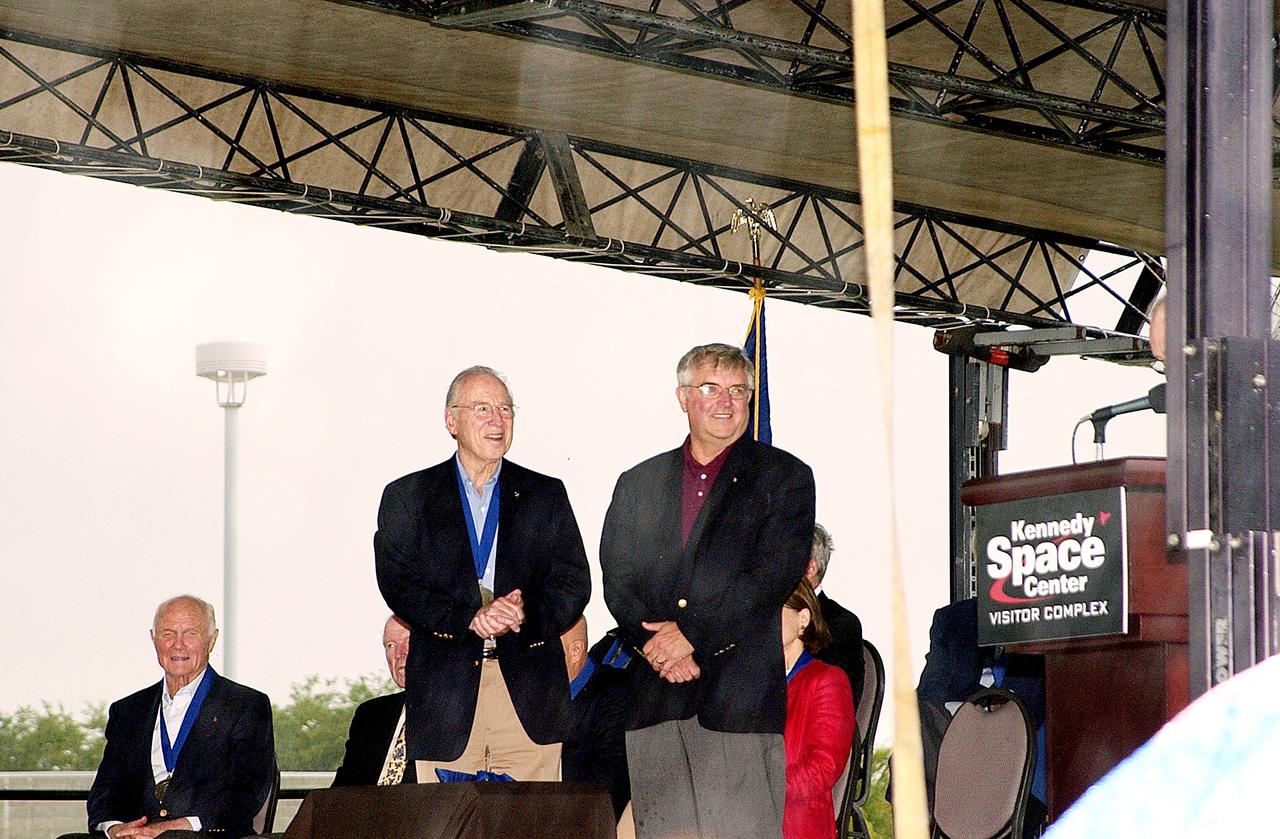
KENNEDY SPACE CENTER, FLA. -  At the KSC Visitor Complex, former astronaut James A. Lovell (standing left) greets former astronaut Story Musgrave (standing right) at his induction ceremony into the U.S. Astronaut Hall of Fame. Also seated on the dais are, from left, former astronaut and Senator John H. Glenn, astronaut and Associate Director (Technical) of the Johnson Space Center John W. Young, and former astronaut Buzz Aldrin, all previously inducted into the Hall of Fame. Being inducted with Musgrave are Space Shuttle astronauts Daniel Brandenstein, Robert "Hoot" Gibson, and Sally Ride. Conceived by six of the Mercury Program astronauts, the U.S. Astronaut Hall of Fame opened in 1990 to provide a place where space travelers could be remembered for their participation and accomplishments in the U.S. space program. The four new inductees join 48 previously honored astronauts from the ranks of the Gemini, Apollo, Skylab, Apollo-Soyuz, and Space Shuttle programs.
KENNEDY SPACE CENTER, FLA. - At the KSC Visitor Complex, former astronaut James A. Lovell (standing left) greets former astronaut Story Musgrave (standing right) at his induction ceremony into the U.S. Astronaut Hall of Fame. Also seated on the dais are, from left, former astronaut and Senator John H. Glenn, astronaut and Associate Director (Technical) of the Johnson Space Center John W. Young, and former astronaut Buzz Aldrin, all previously inducted into the Hall of Fame. Being inducted with Musgrave are Space Shuttle astronauts Daniel Brandenstein, Robert "Hoot" Gibson, and Sally Ride. Conceived by six of the Mercury Program astronauts, the U.S. Astronaut Hall of Fame opened in 1990 to provide a place where space travelers could be remembered for their participation and accomplishments in the U.S. space program. The four new inductees join 48 previously honored astronauts from the ranks of the Gemini, Apollo, Skylab, Apollo-Soyuz, and Space Shuttle programs.
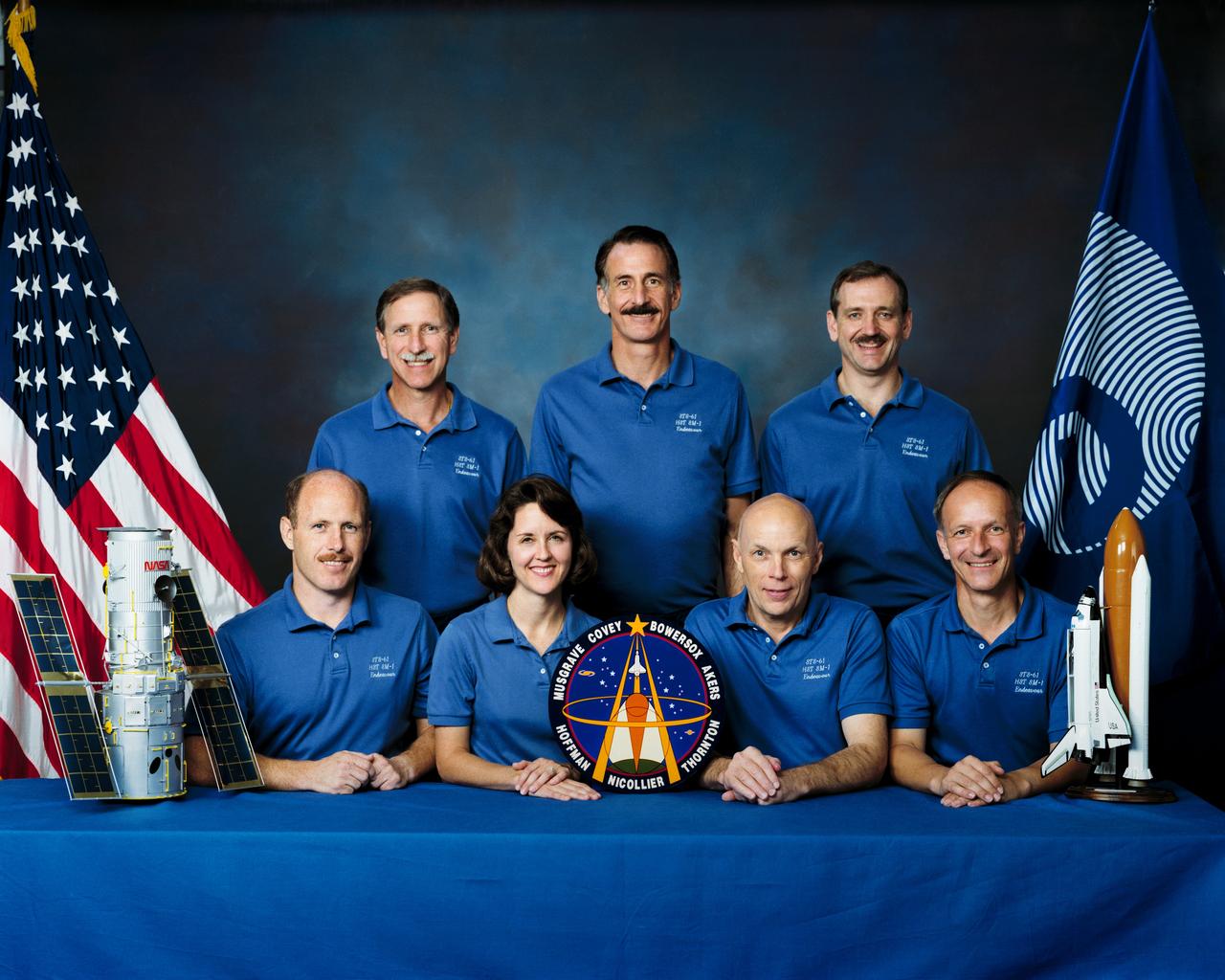
STS061-S-002 (1 Oct. 1993) --- These seven NASA astronauts are currently in training for the Hubble Space Telescope (HST) servicing mission, scheduled for later this year. Astronaut Richard O. Covey, mission commander, is standing at left, with astronaut Kenneth D. Bowersox, pilot, seated at left. The five mission specialists for the mission are (left to right, seated) astronauts Kathryn C. Thornton and F. Story Musgrave, and the European Space Agency (ESA) astronaut Claude Nicollier; and (left to right, standing), astronauts Jeffrey A. Hoffman and Thomas D. Akers. Musgrave, Akers, Thornton and Hoffman are all assigned to participate in five total sessions of extravehicular activity (EVA) for the servicing tasks.
STS-61 crew portrait
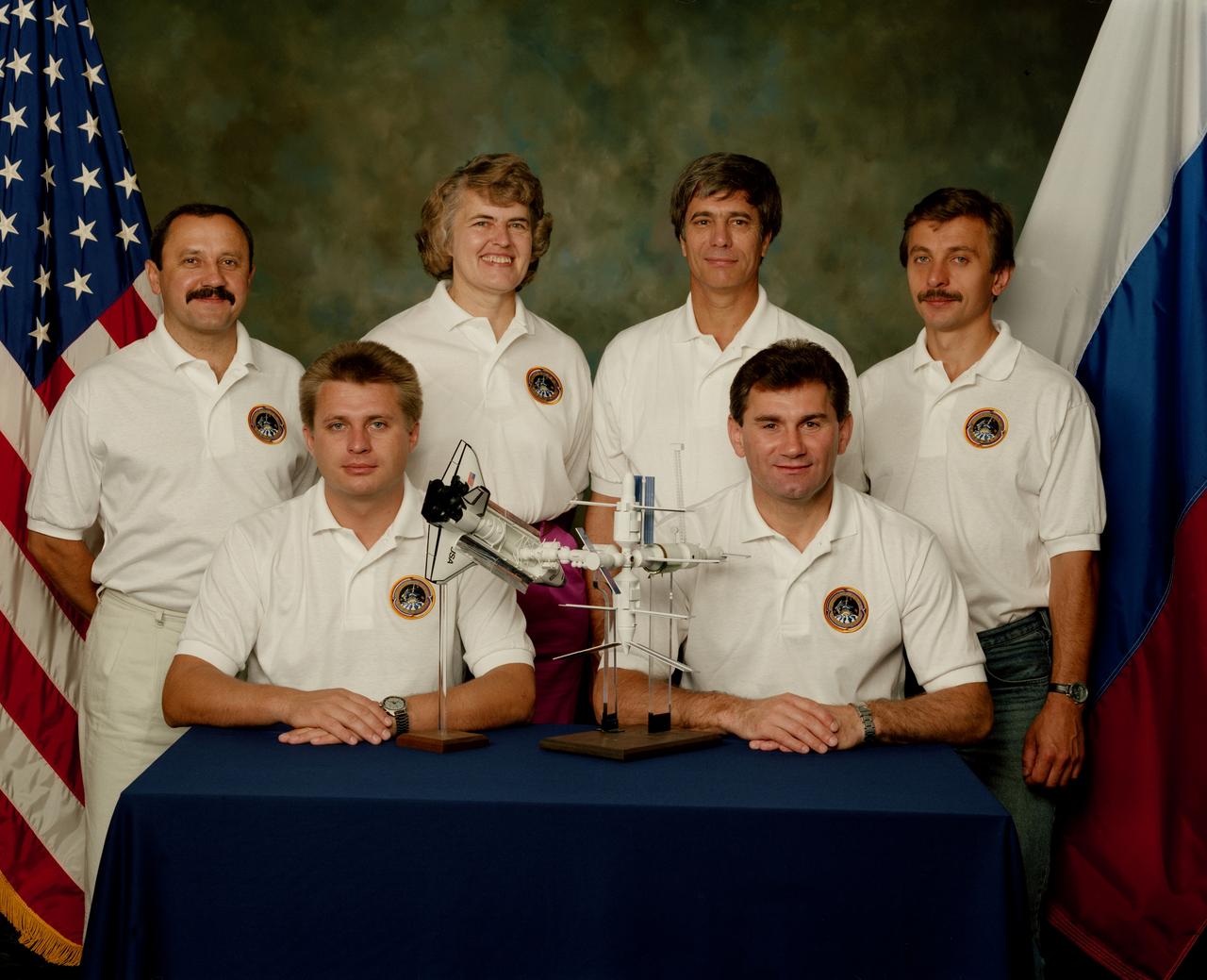
S95-16674 (14 July 1995) --- On the left is the Mir-21 crew consisting of cosmonaut Yuriy V. Usachov (standing), flight engineer; Yuriy I. Onufriyenko (seated), commander; and Shannon W. Lucid, cosmonaut guest researcher. On the right side is the Mir-23 crew consisting of John E. Blaha (standing), cosmonaut guest researcher; Vasili V. Tsibliyev (seated), commander; and Aleksandr I. Lazutkin, flight engineer.  NASA astronauts Lucid and Blaha each will go into space to board Russia's Mir Space Station for lengthy research on their respective missions.  Lucid will board the Mir during the STS-76 mission.  Blaha will replace Lucid onboard the Mir during the STS-79 mission.
Mir 21 crew portraits
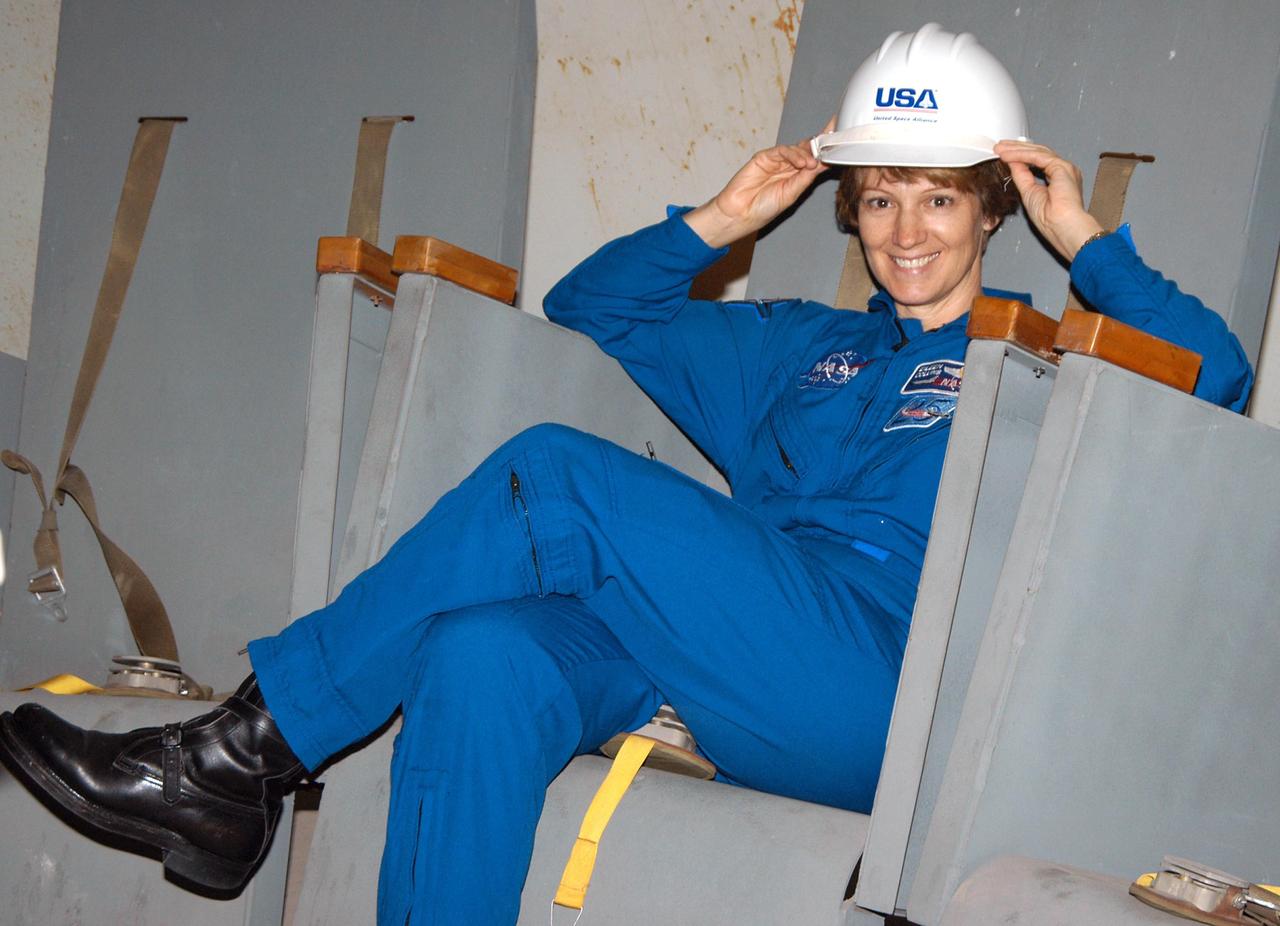
KENNEDY SPACE CENTER, FLA. -- STS-114 Mission Commander Eileen Collins tries out one of the seats in the Rubber Room.  Located under the launch pad, the steel dome Rubber Room floats on rubber isolators. It was the escape area used during the Apollo launches and it could not be removed when the pad was modified for the Shuttle. In case of an emergency on the pad, the astronauts would slide down the long vertical tube to the Rubber Room, strap themselves into the seats and wait for the danger to clear. The STS-114 mission is Logistics Flight 1, which is scheduled to deliver supplies and equipment plus the external stowage platform to the International Space Station.
KSC-04pd1046
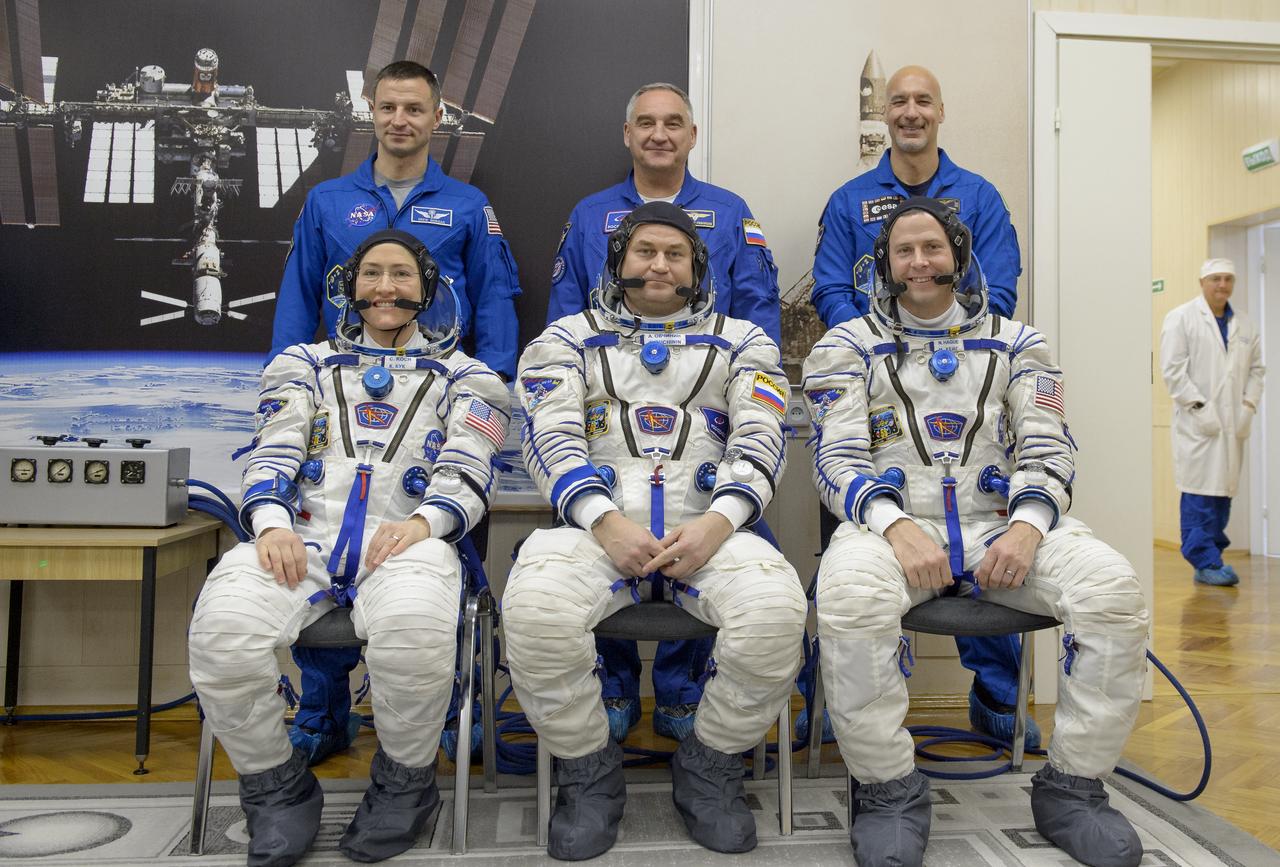
Expedition 59 prime crewmembers Christina Koch of NASA, seated left, Alexey Ovchinin of Roscosmos, and Nick Hague of NASA, seated right, pose for a group photograph with backup crewmembers Drew Morgan of NASA, standing left, Alexander Skvortsov of Roscosmos, and Luca Parmitano of the European Space Agency, Thursday, March 14, 2019 at the Baikonur Cosmodrome in Kazakhstan. Hague, Koch, and Ovchinin launched March 14, U.S. time, on the Soyuz MS-12 spacecraft from the Baikonur Cosmodrome for a six-and-a-half month mission on the International Space Station. Photo Credit: (NASA/GCTC/Irina Spector)
Expedition 59 Preflight
KENNEDY SPACE CENTER, FLA. -- STS-114 Mission Specialist Wendy Lawrence examines one of the seats in the Rubber Room.  Located under the launch pad, the steel dome Rubber Room floats on rubber isolators. It was the escape area used during the Apollo launches and it could not be removed when the pad was modified for the Shuttle. In case of an emergency on the pad, the astronauts would slide down the long vertical tube to the Rubber Room, strap themselves into the seats and wait for the danger to clear. The STS-114 mission is Logistics Flight 1, which is scheduled to deliver supplies and equipment plus the external stowage platform to the International Space Station.
KSC-04pd1047
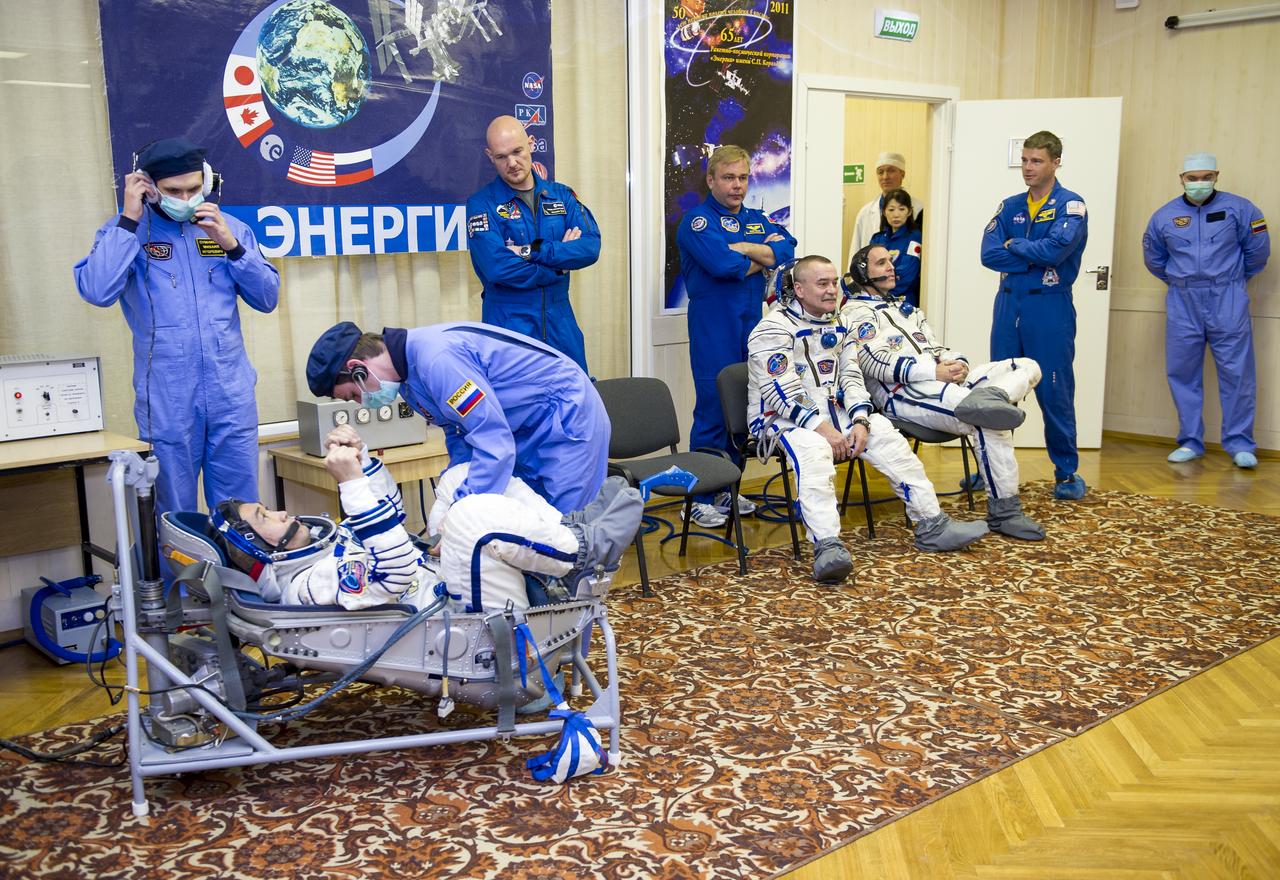
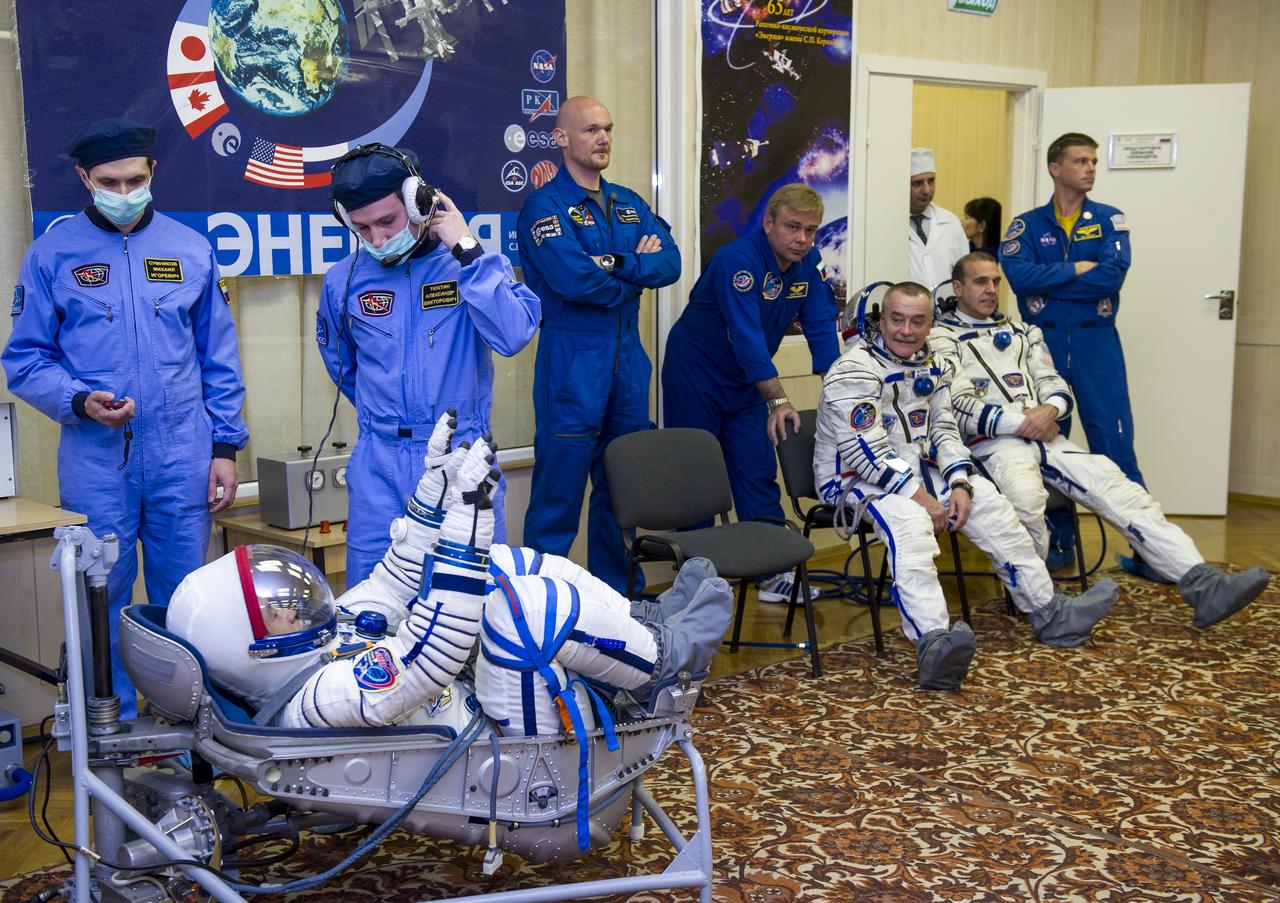
Expedition 38 Flight Engineer Koichi Wakata of the Japan Aerospace Exploration Agency is seen laying in a seat liner as he and fellow crew mates, Soyuz Commander Mikhail Tyurin of Roscosmos, seated left, and, Flight Engineer Rick Mastracchio of NASA, have their Russian Sokol suits pressure checked a few hours ahead of their launch, Thursday, Nov. 7, 2013, in Baikonur, Kazakhstan. Tyurin, Wakata, and, Mastracchio will launch in their Soyuz TMA-11M spacecraft to the International Space Station to begin a six-month mission. Photo Credit: (NASA/GCTC/Irina Peshkova)
Expedition 38 Prelaunch
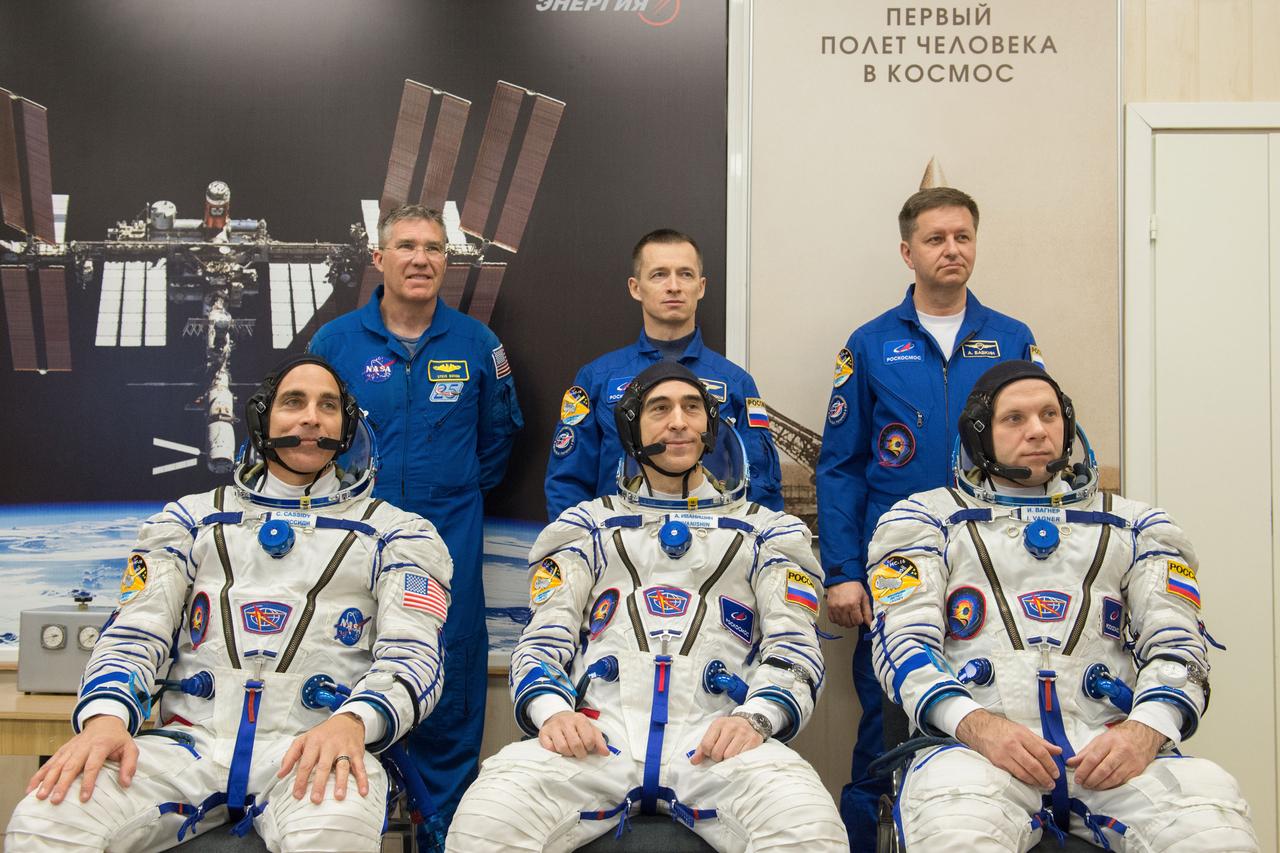
jsc2020e017100 - Expedition 63 Preflight - Expedition 63 crewmembers Chris Cassidy of NASA, seated left, Anatoly Ivanishin and Ivan Vagner of Roscosmos, seated right, pose for a photo with backup crew members Steve Bowen of NASA, standing left, Sergey Ryzhikov  and Andrei Babkin and of Roscosmos , standing right after the crew had their Sokol suits pressure checked prior to launch on a Soyuz rocket, Thursday, April 9, 2020 at the Baikonur Cosmodrome in Kazakhstan. A few hours later, they lifted off for a six-and-a-half month mission on the International Space Station. Photo Credit: (NASA/GCTC/Andrey Shelepin)...
Expedition 63 Preflight
Expedition 38 Flight Engineer Koichi Wakata of the Japan Aerospace Exploration Agency is seen laying in a seat liner as he and fellow crew mates, Soyuz Commander Mikhail Tyurin of Roscosmos, seated left, and, Flight Engineer Rick Mastracchio of NASA, have their Russian Sokol suits pressure checked a few hours ahead of their launch, Thursday, Nov. 7, 2013, in Baikonur, Kazakhstan. Tyurin, Wakata, and, Mastracchio will launch in their Soyuz TMA-11M spacecraft to the International Space Station to begin a six-month mission. Photo Credit: (NASA/GCTC/Irina Peshkova)
Expedition 38 Prelaunch
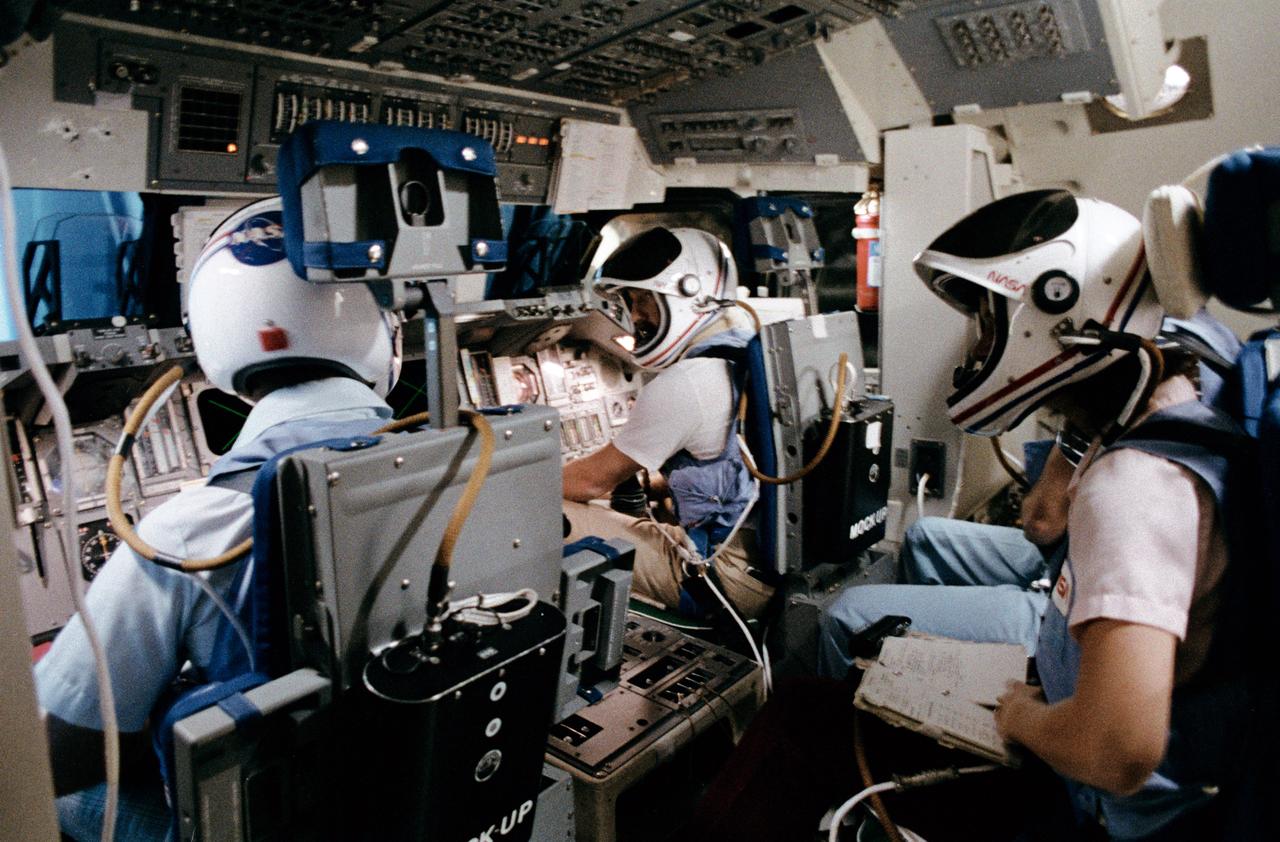
S83-32723 (23 May 1983) --- This scene in the Shuttle Mission Simulator (SMS) previews next month?s STS-7 flight in the space shuttle Challenger. Taken during a simulation session, the photo illustrates the seating arrangement for launch and landing phases of the Challenger?s second spaceflight and its first with five crew members. Pictured, left to right, are astronauts Robert L. Crippen, commander; Frederick H. Hauck, pilot; Sally K. Ride and John M. Fabian (almost totally obscured), mission specialists. Dr. Norman E. Thagard, a third mission specialist, will be seated in the middeck for launch and landing phases. Photo credit: NASA/Otis Imboden/National Geographic Society.
CREW TRAINING (SIMULATOR) - STS-7 - JSC
Expedition 57 Flight Engineer Alexey Ovchinin of Roscosmos, seated left, and Flight Engineer Nick Hague of NASA, seated right, pose for a photograph with Expedition 57 backup crewmember Oleg Kononenko of Roscosmos, standing left, and backup crewmember David Saint-Jacques of the Canadian Space Agency, after the two donned their Sokol suits for their launch on a Soyuz rocket, Thursday, Oct. 11, 2018 at the Baikonur Cosmodrome in Kazakhstan. During the Soyuz spacecraft's climb to orbit, an anomaly occurred, resulting in an abort downrange. The crew was quickly recovered and is in good condition. Photo Credit: (NASA/GCTC/Irina Spector)
Expedition 57 Preflight
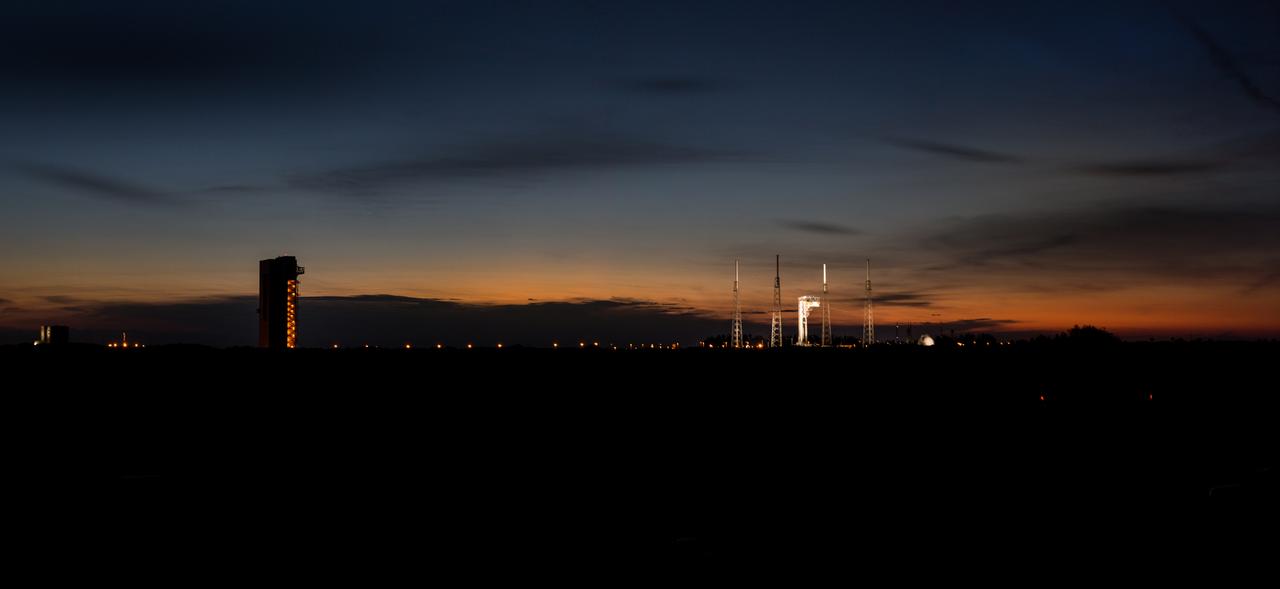
The sun sets on Cape Canaveral Air Force Station’s Launch Complex 41 in Florida during a Boeing/United Launch Alliance (ULA) emergency egress system demonstration on June 19, 2018. The emergency egress system features folding seats attached to slide wires. In the unlikely event of an emergency on launch day prior to liftoff, each person on the Crew Access Tower would get his or her own seat and slide more than 1,300 feet to a safe area. The Boeing CST-100 Starliner will launch on a ULA Atlas V rocket, carrying astronauts to the International Space Station
Boeing/ULA Egress Demonstration
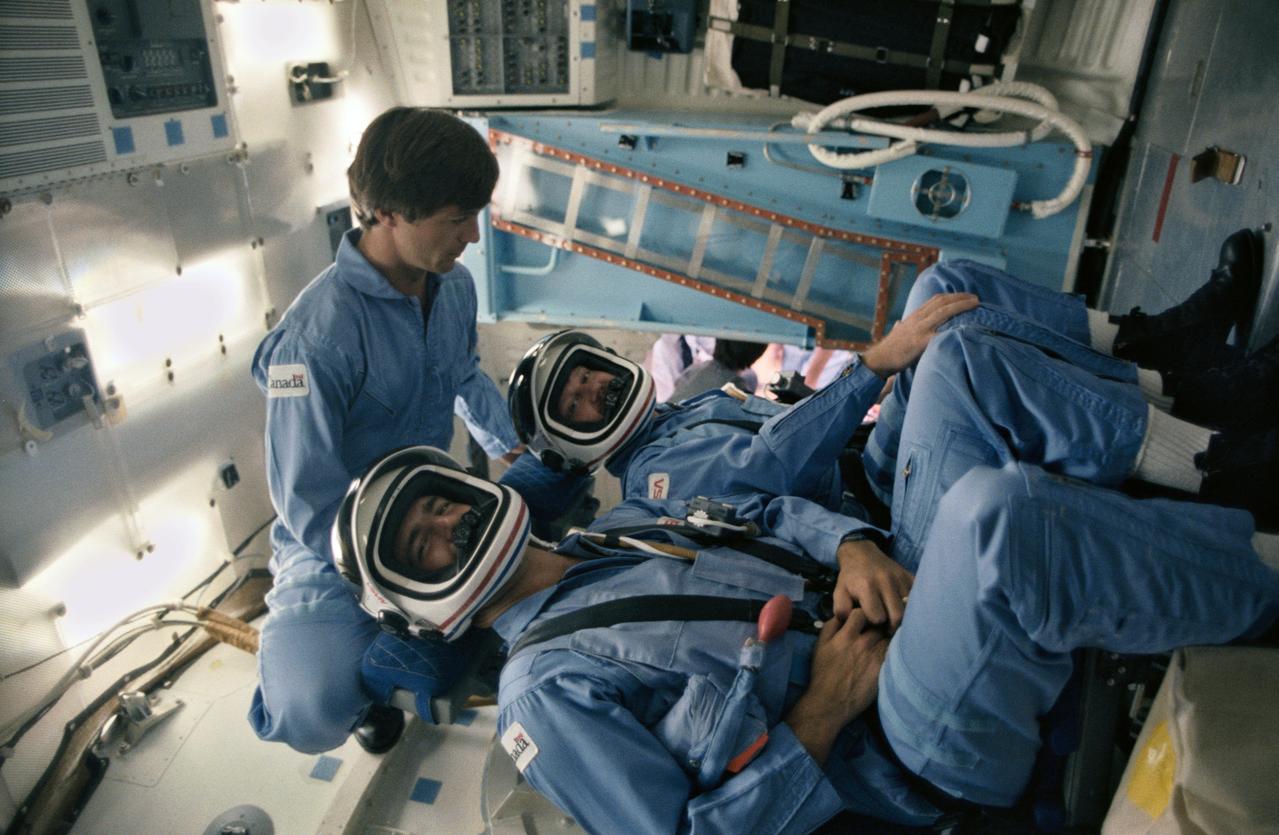
41D-3138 (4 Sept 1984)--- Canada's backup payload specialist assists the two 41-G prime payload specialists during a training session in the Johnson Space Center's Shuttle mockup and integration laboratory.  Robert Thirsk (without helmet) represents the National Research Council (NRC) and is backup to Marc Garneau (nearest camera), also of the NRC.  Paul D. Scully-Power, seated in the other middeck seat for the launch phase, is a civilian oceanographer with the U.S. Navy.  The 41-G flight aboard the Challenger is NASA's first to utilize a crew of more than six persons.  This photograph was taken by Otis Imboden.
Payload specialists Marc Garneau and Paul Scully-Power in SMS
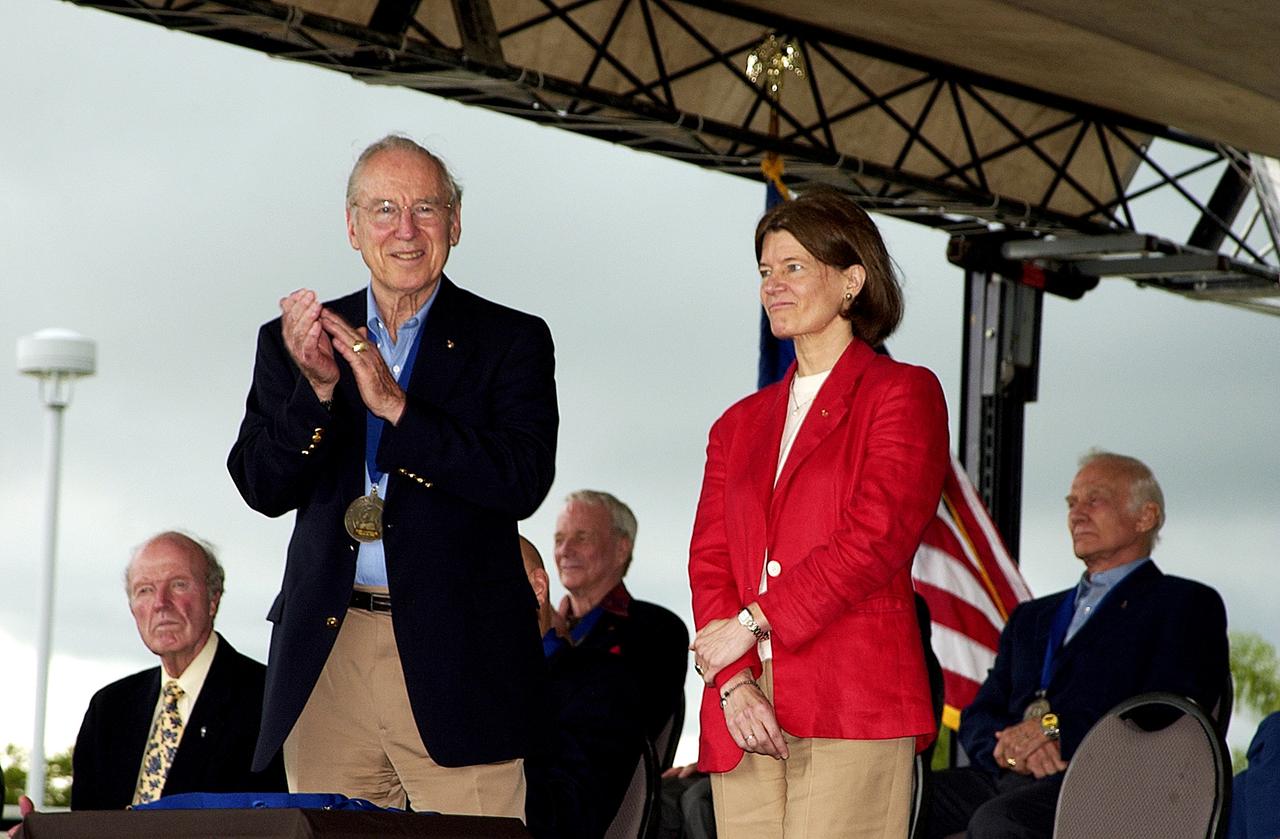
KENNEDY SPACE CENTER, FLA. -  At the KSC Visitor Complex, former astronaut James A. Lovell (standing left) applauds former astronaut Sally K. Ride at her induction ceremony into the U.S. Astronaut Hall of Fame. Seated on the dais, from left, are former astronauts Gordon Cooper, Scott Carpenter, and  Buzz Aldrin, all previously inducted into the Hall of Fame. Being inducted with Ride are Space Shuttle astronauts Daniel Brandenstein, Robert "Hoot" Gibson, and Story Musgrave. Conceived by six of the Mercury Program astronauts, the U.S. Astronaut Hall of Fame opened in 1990 to provide a place where space travelers could be remembered for their participation and accomplishments in the U.S. space program. The four new inductees join 48 previously honored astronauts from the ranks of the Gemini, Apollo, Skylab, Apollo-Soyuz, and Space Shuttle programs.
KENNEDY SPACE CENTER, FLA. - At the KSC Visitor Complex, former astronaut James A. Lovell (standing left) applauds former astronaut Sally K. Ride at her induction ceremony into the U.S. Astronaut Hall of Fame. Seated on the dais, from left, are former astronauts Gordon Cooper, Scott Carpenter, and Buzz Aldrin, all previously inducted into the Hall of Fame. Being inducted with Ride are Space Shuttle astronauts Daniel Brandenstein, Robert "Hoot" Gibson, and Story Musgrave. Conceived by six of the Mercury Program astronauts, the U.S. Astronaut Hall of Fame opened in 1990 to provide a place where space travelers could be remembered for their participation and accomplishments in the U.S. space program. The four new inductees join 48 previously honored astronauts from the ranks of the Gemini, Apollo, Skylab, Apollo-Soyuz, and Space Shuttle programs.
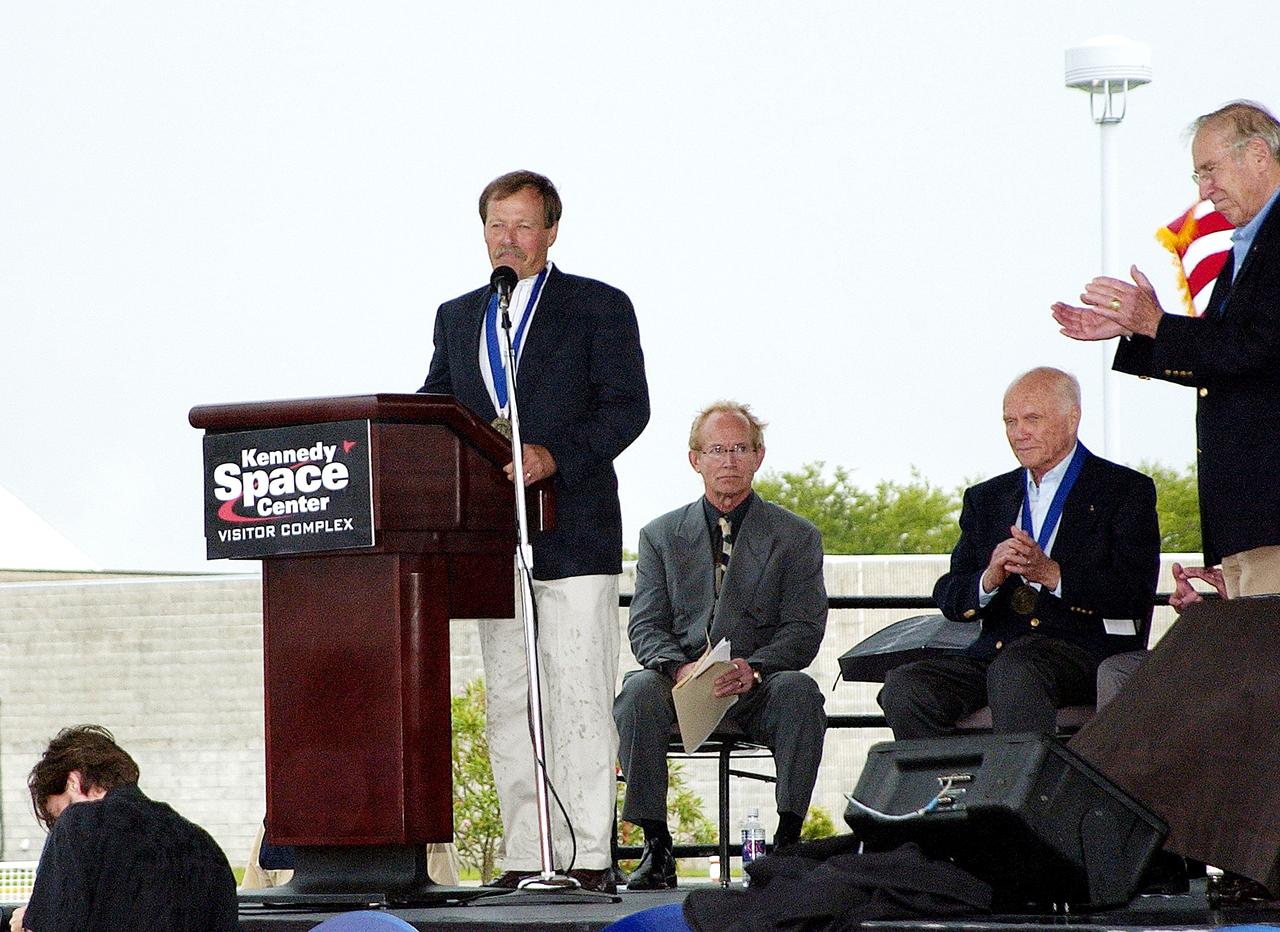
KENNEDY SPACE CENTER, FLA. -  At the KSC Visitor Complex, former astronaut Robert "Hoot" Gibson (at podium) addresses the audience at his induction ceremony into the U.S. Astronaut Hall of Fame. Also standing is former astronaut James A. Lovell.  Seated on the dais, from left, are actor and Master of Ceremonies Lance Henriksen and former astronaut John H. Glenn.  Also being inducted with Gibson are Space Shuttle astronauts Daniel Brandenstein, Story Musgrave, and Sally K. Ride. Conceived by six of the Mercury Program astronauts, the U.S. Astronaut Hall of Fame opened in 1990 to provide a place where space travelers could be remembered for their participation and accomplishments in the U.S. space program. The four new inductees join 48 previously honored astronauts from the ranks of the Gemini, Apollo, Skylab, Apollo-Soyuz, and Space Shuttle programs.
KENNEDY SPACE CENTER, FLA. - At the KSC Visitor Complex, former astronaut Robert "Hoot" Gibson (at podium) addresses the audience at his induction ceremony into the U.S. Astronaut Hall of Fame. Also standing is former astronaut James A. Lovell. Seated on the dais, from left, are actor and Master of Ceremonies Lance Henriksen and former astronaut John H. Glenn. Also being inducted with Gibson are Space Shuttle astronauts Daniel Brandenstein, Story Musgrave, and Sally K. Ride. Conceived by six of the Mercury Program astronauts, the U.S. Astronaut Hall of Fame opened in 1990 to provide a place where space travelers could be remembered for their participation and accomplishments in the U.S. space program. The four new inductees join 48 previously honored astronauts from the ranks of the Gemini, Apollo, Skylab, Apollo-Soyuz, and Space Shuttle programs.
KENNEDY SPACE CENTER, FLA. -  At the KSC Visitor Complex, former astronaut Frederick H. (Rick) Hauck (standing right) congratulates former astronaut Daniel Brandenstein (standing center) at his induction ceremony into the U.S. Astronaut Hall of Fame. Also standing is former astronaut James A. Lovell.  Seated on the dais, from left, are former astronauts John H. Glenn and Gordon Cooper, both previously inducted into the Hall of Fame. Being inducted with Brandenstein are Space Shuttle astronauts Robert "Hoot" Gibson, Story Musgrave, and Sally K. Ride. Conceived by six of the Mercury Program astronauts, the U.S. Astronaut Hall of Fame opened in 1990 to provide a place where space travelers could be remembered for their participation and accomplishments in the U.S. space program. The four new inductees join 48 previously honored astronauts from the ranks of the Gemini, Apollo, Skylab, Apollo-Soyuz, and Space Shuttle programs.
KENNEDY SPACE CENTER, FLA. - At the KSC Visitor Complex, former astronaut Frederick H. (Rick) Hauck (standing right) congratulates former astronaut Daniel Brandenstein (standing center) at his induction ceremony into the U.S. Astronaut Hall of Fame. Also standing is former astronaut James A. Lovell. Seated on the dais, from left, are former astronauts John H. Glenn and Gordon Cooper, both previously inducted into the Hall of Fame. Being inducted with Brandenstein are Space Shuttle astronauts Robert "Hoot" Gibson, Story Musgrave, and Sally K. Ride. Conceived by six of the Mercury Program astronauts, the U.S. Astronaut Hall of Fame opened in 1990 to provide a place where space travelers could be remembered for their participation and accomplishments in the U.S. space program. The four new inductees join 48 previously honored astronauts from the ranks of the Gemini, Apollo, Skylab, Apollo-Soyuz, and Space Shuttle programs.
KENNEDY SPACE CENTER, FLA. -  At the KSC Visitor Complex, former astronaut Robert L. Crippen (right) presents former astronaut Sally K. Ride (standing center) at her induction ceremony into the U.S. Astronaut Hall of Fame. Also standing is former astronaut James A. Lovell.  Seated on the dais are, from left, former astronauts John H. Glenn, Gordon Cooper, Buzz Aldrin, and Walter Cunningham, all previously inducted into the Hall of Fame. Being inducted with Ride are Space Shuttle astronauts Daniel Brandenstein, Robert "Hoot" Gibson, and Story Musgrave. Conceived by six of the Mercury Program astronauts, the U.S. Astronaut Hall of Fame opened in 1990 to provide a place where space travelers could be remembered for their participation and accomplishments in the U.S. space program. The four new inductees join 48 previously honored astronauts from the ranks of the Gemini, Apollo, Skylab, Apollo-Soyuz, and Space Shuttle programs.
KENNEDY SPACE CENTER, FLA. - At the KSC Visitor Complex, former astronaut Robert L. Crippen (right) presents former astronaut Sally K. Ride (standing center) at her induction ceremony into the U.S. Astronaut Hall of Fame. Also standing is former astronaut James A. Lovell. Seated on the dais are, from left, former astronauts John H. Glenn, Gordon Cooper, Buzz Aldrin, and Walter Cunningham, all previously inducted into the Hall of Fame. Being inducted with Ride are Space Shuttle astronauts Daniel Brandenstein, Robert "Hoot" Gibson, and Story Musgrave. Conceived by six of the Mercury Program astronauts, the U.S. Astronaut Hall of Fame opened in 1990 to provide a place where space travelers could be remembered for their participation and accomplishments in the U.S. space program. The four new inductees join 48 previously honored astronauts from the ranks of the Gemini, Apollo, Skylab, Apollo-Soyuz, and Space Shuttle programs.
KENNEDY SPACE CENTER, FLA. -  At the KSC Visitor Complex, former astronaut Daniel Brandenstein (standing right) is presented to the audience at his induction ceremony into the U.S. Astronaut Hall of Fame. Also standing is former astronaut James A. Lovell.  Seated on the dais, from left, are former astronauts John H. Glenn and Gordon Cooper, both previously inducted into the Hall of Fame. Being inducted with Brandenstein are Space Shuttle astronauts Robert "Hoot" Gibson, Story Musgrave, and Sally K. Ride. Conceived by six of the Mercury Program astronauts, the U.S. Astronaut Hall of Fame opened in 1990 to provide a place where space travelers could be remembered for their participation and accomplishments in the U.S. space program. The four new inductees join 48 previously honored astronauts from the ranks of the Gemini, Apollo, Skylab, Apollo-Soyuz, and Space Shuttle programs.
KENNEDY SPACE CENTER, FLA. - At the KSC Visitor Complex, former astronaut Daniel Brandenstein (standing right) is presented to the audience at his induction ceremony into the U.S. Astronaut Hall of Fame. Also standing is former astronaut James A. Lovell. Seated on the dais, from left, are former astronauts John H. Glenn and Gordon Cooper, both previously inducted into the Hall of Fame. Being inducted with Brandenstein are Space Shuttle astronauts Robert "Hoot" Gibson, Story Musgrave, and Sally K. Ride. Conceived by six of the Mercury Program astronauts, the U.S. Astronaut Hall of Fame opened in 1990 to provide a place where space travelers could be remembered for their participation and accomplishments in the U.S. space program. The four new inductees join 48 previously honored astronauts from the ranks of the Gemini, Apollo, Skylab, Apollo-Soyuz, and Space Shuttle programs.
KENNEDY SPACE CENTER, FLA. -  At the KSC Visitor Complex, former astronaut John H. Glenn (at podium) presents former astronaut Robert "Hoot" Gibson (standing right) at his induction ceremony into the U.S. Astronaut Hall of Fame. Also standing is former astronaut James A. Lovell.  Seated on the dais, from left, are actor and Master of Ceremonies Lance Henriksen (left), and former astronauts Sally K. Ride and Daniel Brandenstein (right), both inducted into the Hall of Fame today. Also being inducted is Space Shuttle astronaut Story Musgrave. Conceived by six of the Mercury Program astronauts, the U.S. Astronaut Hall of Fame opened in 1990 to provide a place where space travelers could be remembered for their participation and accomplishments in the U.S. space program. The four new inductees join 48 previously honored astronauts from the ranks of the Gemini, Apollo, Skylab, Apollo-Soyuz, and Space Shuttle programs.
KENNEDY SPACE CENTER, FLA. - At the KSC Visitor Complex, former astronaut John H. Glenn (at podium) presents former astronaut Robert "Hoot" Gibson (standing right) at his induction ceremony into the U.S. Astronaut Hall of Fame. Also standing is former astronaut James A. Lovell. Seated on the dais, from left, are actor and Master of Ceremonies Lance Henriksen (left), and former astronauts Sally K. Ride and Daniel Brandenstein (right), both inducted into the Hall of Fame today. Also being inducted is Space Shuttle astronaut Story Musgrave. Conceived by six of the Mercury Program astronauts, the U.S. Astronaut Hall of Fame opened in 1990 to provide a place where space travelers could be remembered for their participation and accomplishments in the U.S. space program. The four new inductees join 48 previously honored astronauts from the ranks of the Gemini, Apollo, Skylab, Apollo-Soyuz, and Space Shuttle programs.
KENNEDY SPACE CENTER, FLA. -  At the KSC Visitor Complex, former astronaut Robert L. Crippen (standing right) congratulates former astronaut Sally K. Ride at her induction ceremony into the U.S. Astronaut Hall of Fame. Also standing is former astronaut James A. Lovell.  Seated on the dais, from left, are former astronauts Gordon Cooper, Scott Carpenter, Buzz Aldrin, Walter Cunningham, Edgar B. Mitchell, and Fred W. Haise, all previously inducted into the Hall of Fame. Being inducted with Ride are Space Shuttle astronauts Daniel Brandenstein, Robert "Hoot" Gibson, and Story Musgrave. Conceived by six of the Mercury Program astronauts, the U.S. Astronaut Hall of Fame opened in 1990 to provide a place where space travelers could be remembered for their participation and accomplishments in the U.S. space program. The four new inductees join 48 previously honored astronauts from the ranks of the Gemini, Apollo, Skylab, Apollo-Soyuz, and Space Shuttle programs.
KENNEDY SPACE CENTER, FLA. - At the KSC Visitor Complex, former astronaut Robert L. Crippen (standing right) congratulates former astronaut Sally K. Ride at her induction ceremony into the U.S. Astronaut Hall of Fame. Also standing is former astronaut James A. Lovell. Seated on the dais, from left, are former astronauts Gordon Cooper, Scott Carpenter, Buzz Aldrin, Walter Cunningham, Edgar B. Mitchell, and Fred W. Haise, all previously inducted into the Hall of Fame. Being inducted with Ride are Space Shuttle astronauts Daniel Brandenstein, Robert "Hoot" Gibson, and Story Musgrave. Conceived by six of the Mercury Program astronauts, the U.S. Astronaut Hall of Fame opened in 1990 to provide a place where space travelers could be remembered for their participation and accomplishments in the U.S. space program. The four new inductees join 48 previously honored astronauts from the ranks of the Gemini, Apollo, Skylab, Apollo-Soyuz, and Space Shuttle programs.
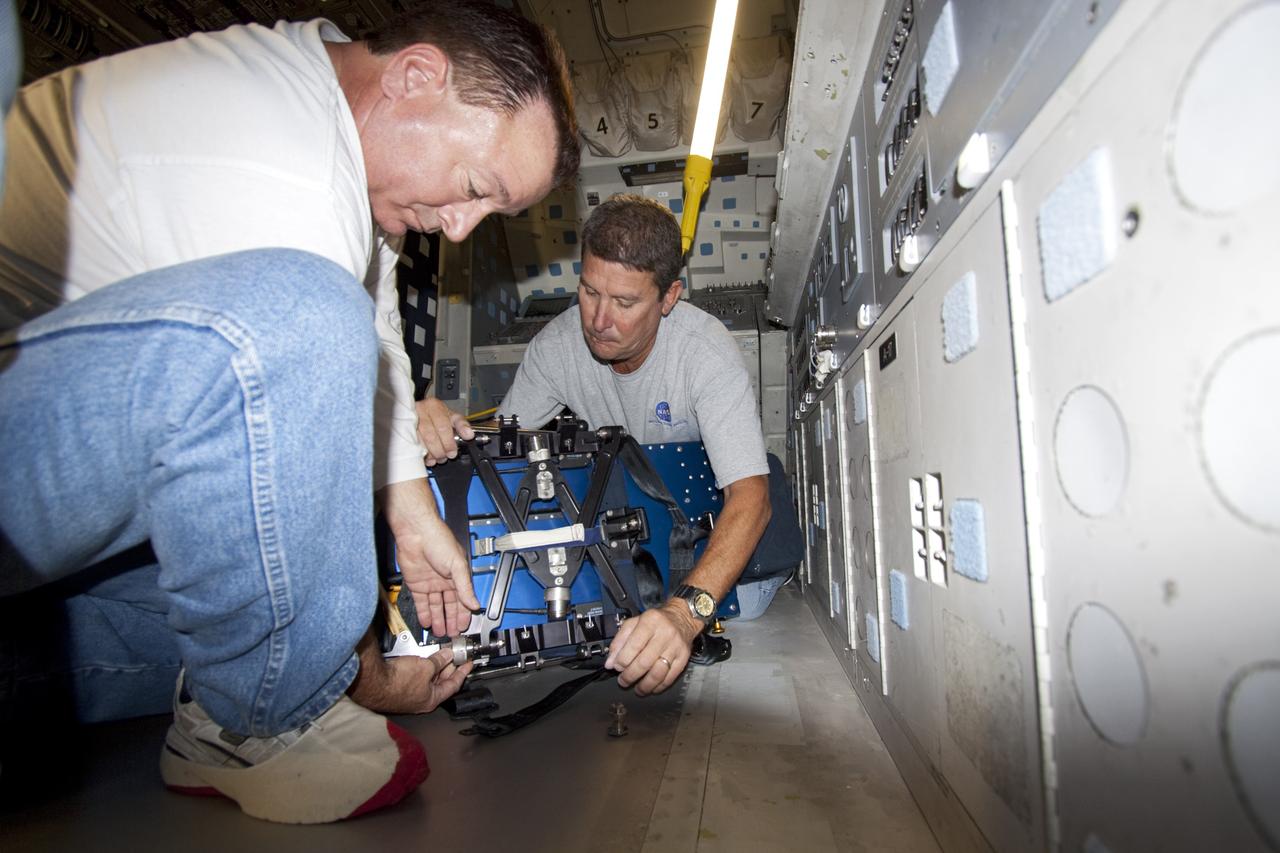
A technician outfits the commander and pilot seats on the flight deck of space shuttle Atlantis as the spacecraft is prepared for public display. The work is taking place as Atlantis sits inside Orbiter Processing Facility-1 at NASA's Kennedy Space Center in Florida. Photo credit: NASA/Dmitri Gerondidakis
KSC-2012-3191
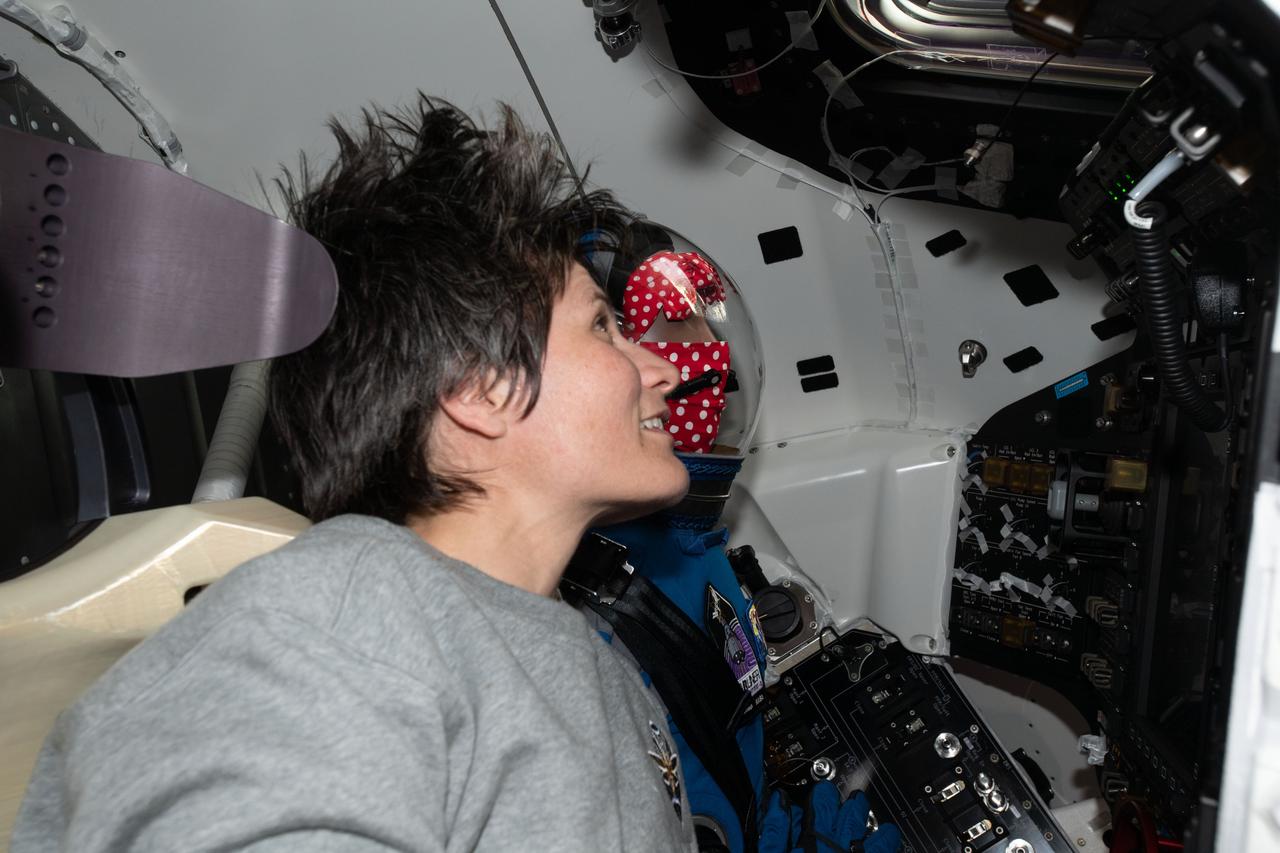
iss067e065447 (May 21, 2022) --- ESA (European Space Agency) astronaut Samantha Cristoforetti is seated next to "Rosie the Rocketeer" inside Boeing's CST-100 Starliner spacecraft the day after it had docked to the International Space Station's Harmony module on the company's Orbital Flight Test-2 mission.
iss067e065447
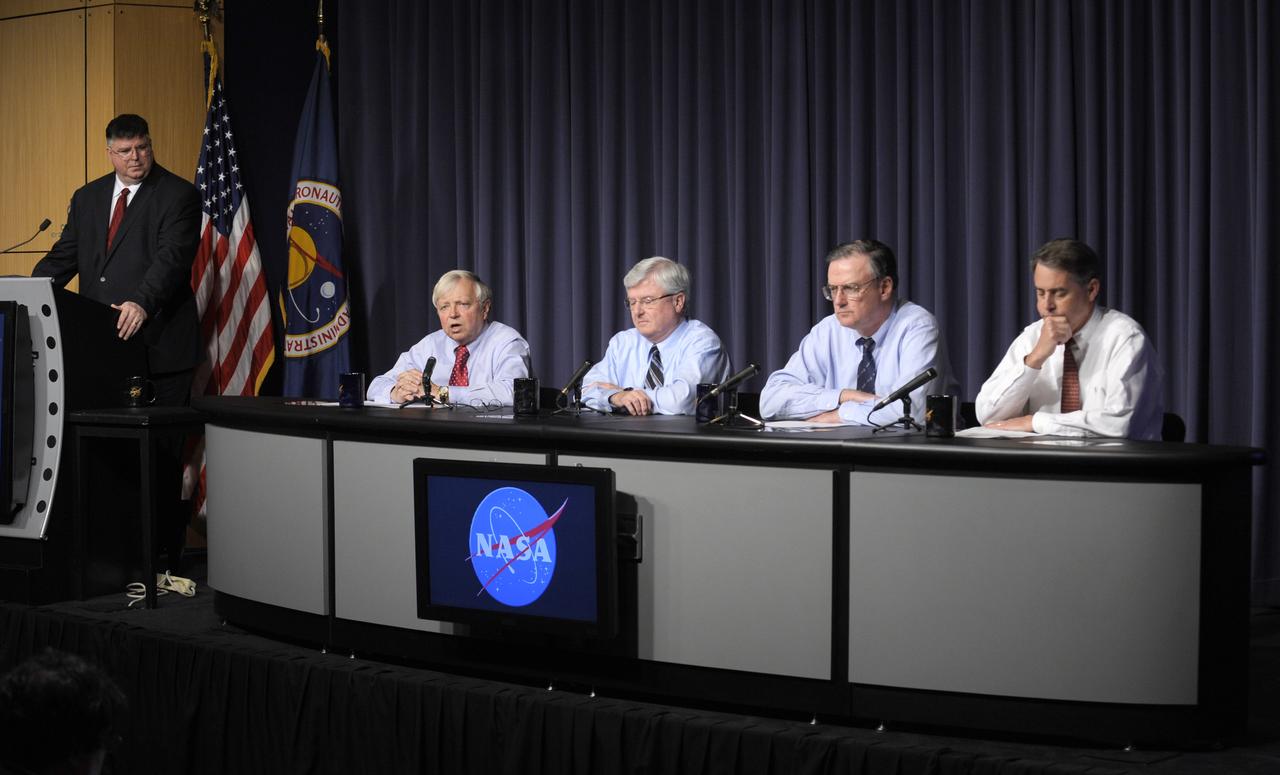
Center Director Jim Kennedy addresses the group of employees gathered for an all-hands briefing in the Training Auditorium. Seated on stage are (left to right) Mike Kostelnik, deputy associate administrator, Space Shuttle and International Space Station Programs, and Bill Parsons, Shuttle Program manager. Topics discussed were return to flight and the Shuttle program.
Center Director All-hands Briefing
The flight deck of space shuttle Atlantis following installation of the crew seats. The spacecraft is prepared for public display. The work is taking place as Atlantis sits inside Orbiter Processing Facility-1 at NASA's Kennedy Space Center in Florida. Photo credit: NASA/Dmitri Gerondidakis
KSC-2012-3197
S66-51054 (15 Aug. 1966) --- Astronaut James A. Lovell Jr., prime crew command pilot of the Gemini-12 space mission, simulates using space food packet while seated in the Gemini-12 spacecraft in the 30-feet Altitude Chamber at McDonnell Aircraft Corporation, St. Louis, Missouri. Photo credit: NASA
TRAINING - GEMINI-TITAN (GT)-12 - SPACE FOOD - MCDONNELL AIRCRAFT CORP. (MDAC), MO
Technicians move mission specialist seat into place inside space shuttle Atlantis as the spacecraft is prepared for public display. The work is taking place as Atlantis sits inside Orbiter Processing Facility-1 at NASA's Kennedy Space Center in Florida. Photo credit: NASA/Dmitri Gerondidakis
KSC-2012-3195
ISS015-E-23899 (24 Aug. 2007) --- Cosmonaut Oleg V. Kotov, Expedition 15 flight engineer representing Russia's Federal Space Agency, works in the Zvezda Service Module of the International Space Station. Kotov occupied an "operator seat", which is a portable chair that replicates a crewmember's anatomical back curvature.
View of Kotov during Operator Seat setup in the SM taken during Expedition 15
JSC2010-E-024579 (11 Feb. 2010) --- NASA astronauts Mark Kelly (seated), STS-134 commander; and Gregory H. Johnson, pilot, attired in training versions of their shuttle launch and entry suits, prepare for a training session in the Space Vehicle Mock-up Facility at NASA's Johnson Space Center.
STS-134 bailout training
During a tour of KSC, Lady Margaret Thatcher, former Prime Minister of Britain, takes a seat in the cockpit of the orbiter Endeavour.  At right is United Space Alliance technician Mike Parrish.   The orbiter, which is in the Orbiter Processing Facility bay 2, is flying on mission STS-100, the ninth construction flight to the International Space Station
KSC-01PP-0386
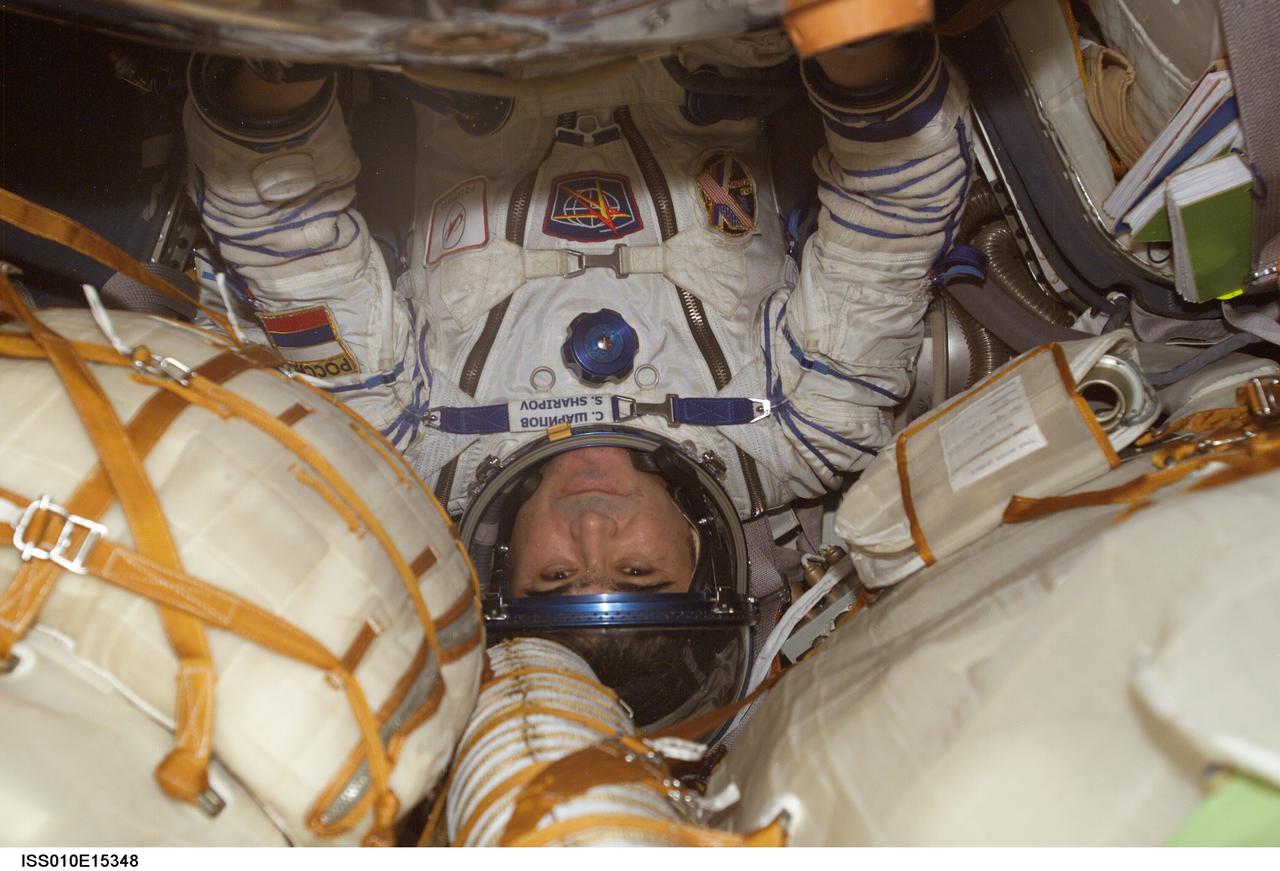
ISS010-E-15348 (1 February 2005) --- Wearing a Russian Sokol suit, cosmonaut Salizhan S. Sharipov, Expedition 10 flight engineer representing Russia's Federal Space Agency, is seated in a Soyuz spacecraft that is docked to the International Space Station (ISS).
Sharipov wearing Sokol suit during Expedition 10
Technicians move mission specialist seat into place inside space shuttle Atlantis as the spacecraft is prepared for public display. The work is taking place as Atlantis sits inside Orbiter Processing Facility-1 at NASA's Kennedy Space Center in Florida. Photo credit: NASA/Dmitri Gerondidakis
KSC-2012-3194
A technician outfits the commander and pilot seats on the flight deck of space shuttle Atlantis as the spacecraft is prepared for public display. The work is taking place as Atlantis sits inside Orbiter Processing Facility-1 at NASA's Kennedy Space Center in Florida. Photo credit: NASA/Dmitri Gerondidakis
KSC-2012-3190
JSC2010-E-081916 (18 May 2010) --- ISS flight directors Holly Ridings (seated) and Emily Nelson monitor data at their console in the space station flight control room in the Mission Control Center at NASA's Johnson Space Center during STS-132/ULF-4 mission flight day five activities.
STS-132/ULF4 Flight Controllers on Console
ISS015-E-23906 (24 Aug. 2007) --- Cosmonaut Fyodor N. Yurchikhin, Expedition 15 commander representing Russia's Federal Space Agency, works in the Zvezda Service Module of the International Space Station. Yurchikhin occupied an "operator seat", which is a portable chair that replicates a crewmember's anatomical back curvature.
View of Yurchikhin during Operator Seat setup in the SM taken during Expedition 15