Jules Verne published his first science fiction novel in 1865 called "From the Earth to the Moon." As shown here in an illustration, passengers in Verne's space ship enjoy their first taste of weightlessness.
Early Rockets
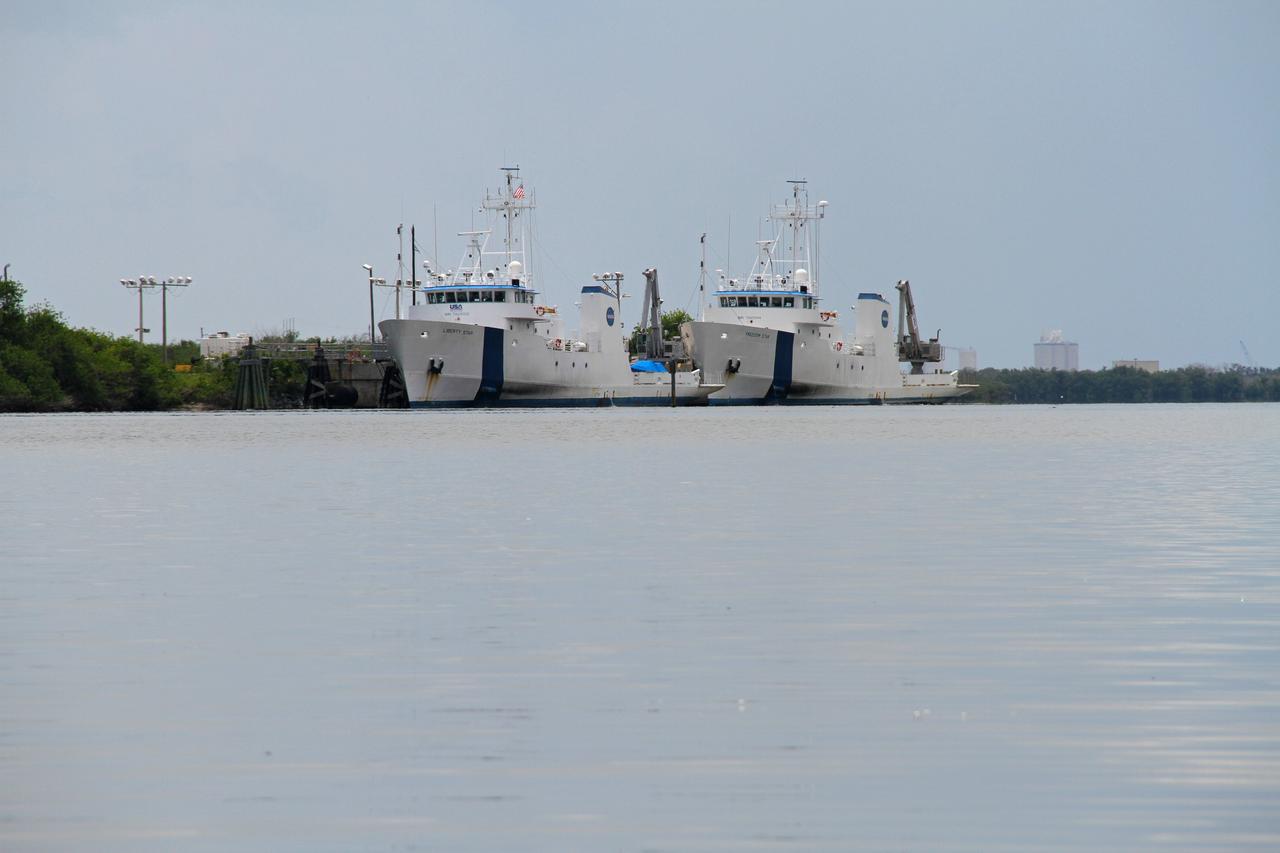
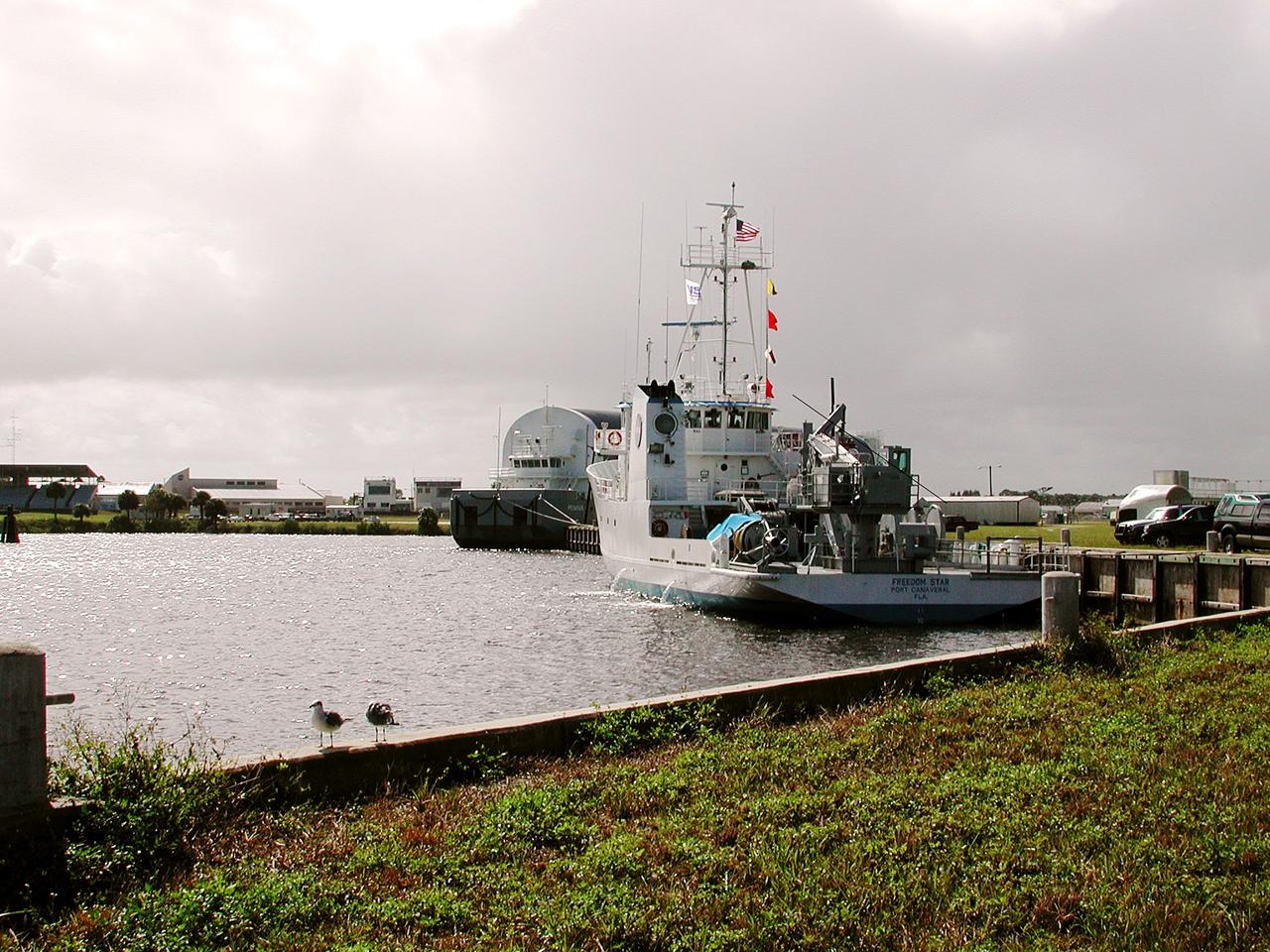
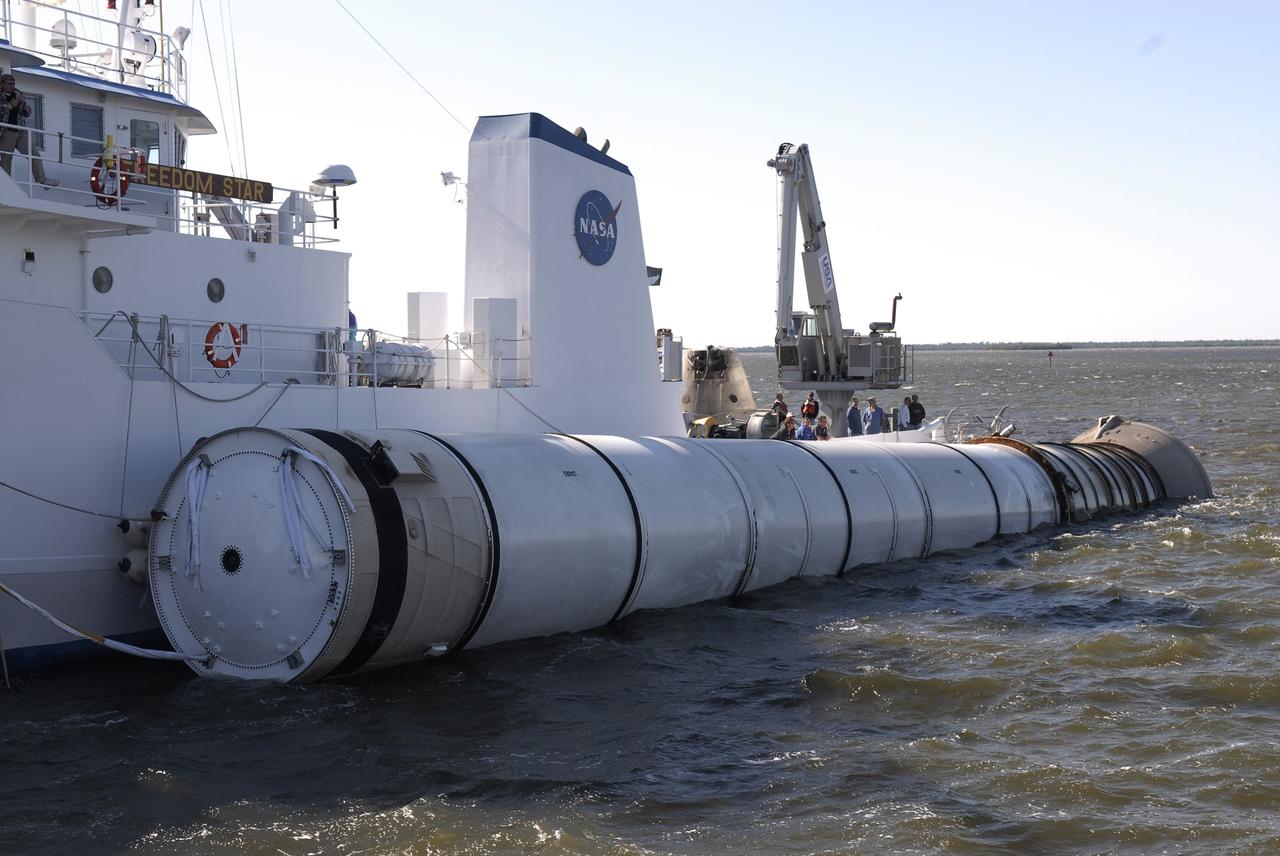
CAPE CANAVERAL, Fla. – The solid rocket booster SRB retrieval ships, Liberty Star and Freedom Star, are docked in the Banana River at Cape Canaveral Air Force Station's Hangar A F. The NASA vessels were used during the space shuttle era to retrieve the SRBs following shuttle launches.       Kennedy is located on Merritt Island, a barrier island, about 34 miles long and varying in width from five to 10 miles. Only 6,000 acres are actually used for operational activities. The Kennedy Space Center is also a National Wildlife Refuge. Consisting of 140,000 acres, the refuge provides a wide variety of habitats: coastal dunes, saltwater estuaries and marshes, freshwater impoundments, scrub, pine flatwoods and hardwood hammocks providing habitat for more than 1,500 species of plants and animals. For more information, visit: http://ipv6.nasa.gov/centers/kennedy/shuttleoperations/alligators/kscovrv.html Photo credit: NASA/Ben Smegelsky

KSC-2012-4542
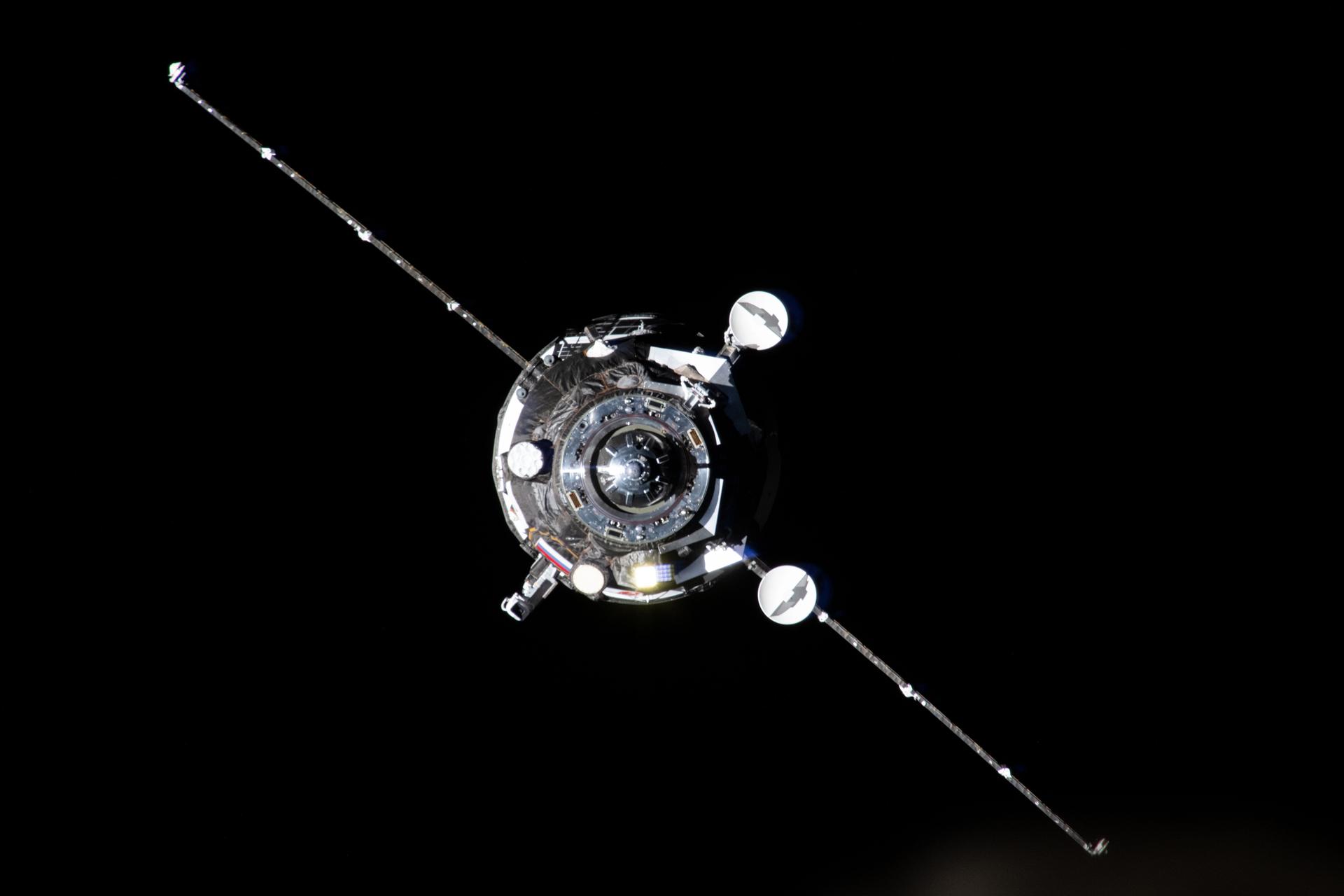
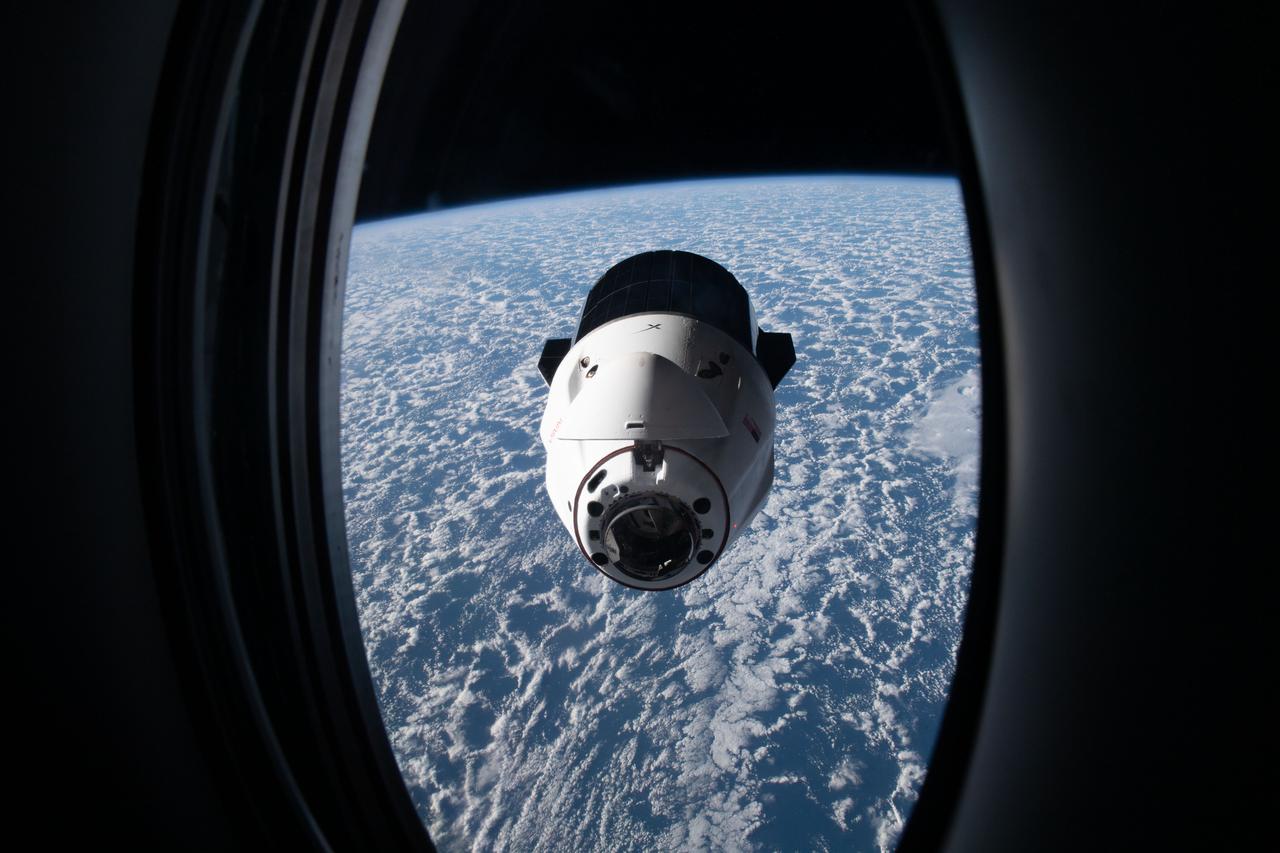
iss073e0698630 (Sept. 13, 2025) --- The Progress 93 resupply ship from Roscosmos, carrying about three tons of food, fuel, and supplies for the Expedition 73 crew, is pictured automatically approaching the International Space Station before docking to the Zvezda service module's rear port for six months of cargo activities.
The Progress 93 resupply ship approaches the International Space Station
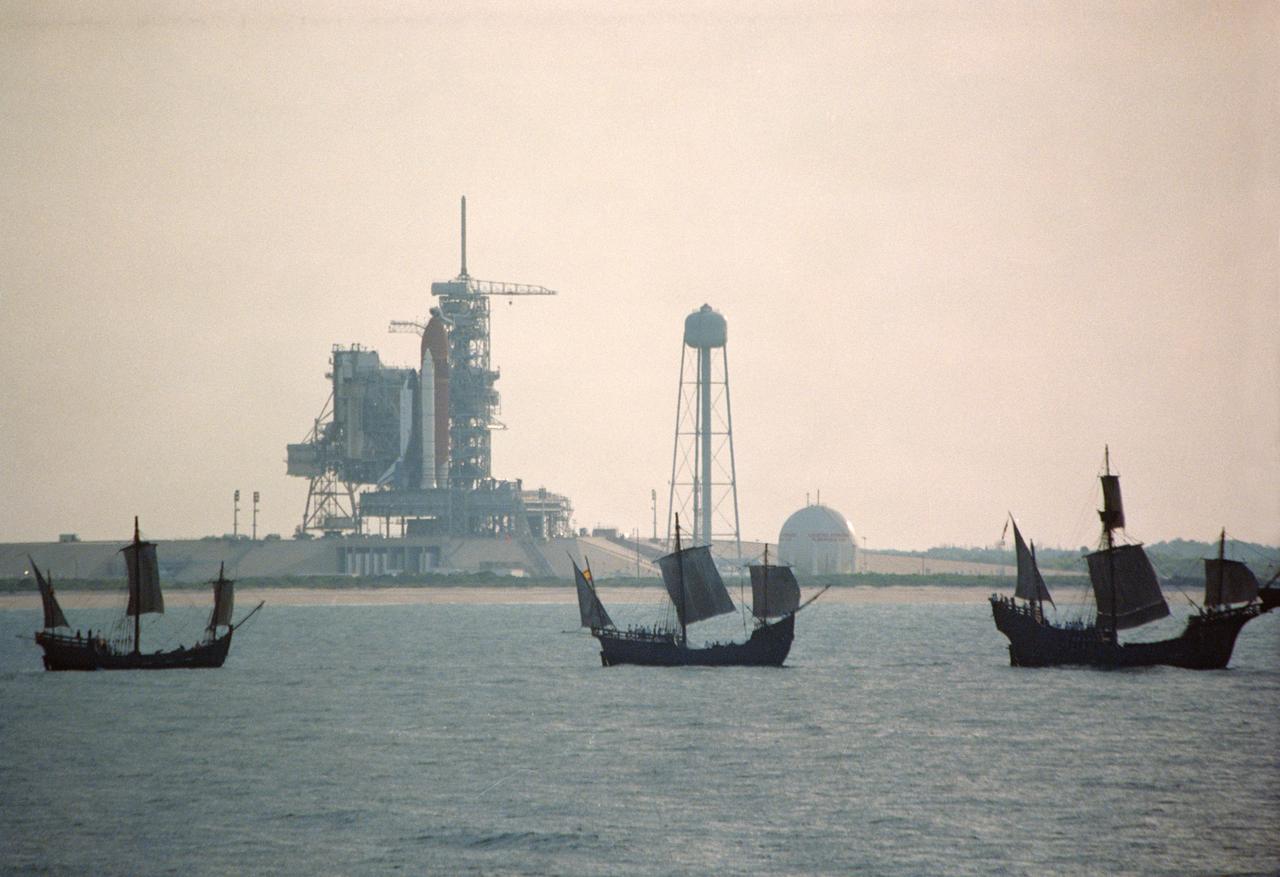
Replicas of Christopher Columbus' sailing ships Santa Maria, Nina, and Pinta sail by Endeavour, Orbiter Vehicle (OV) 105, on Kennedy Space Center (KSC) Launch Complex (LC) Pad 39B awaiting liftoff on its maiden voyage, STS-49. This view was taken from the water showing the three ships silhouetted in the foreground with OV-105 on mobile launcher platform profiled against fixed service structure (FSS) tower and rectracted rotating service structure (RSS) in the background. Next to the launch pad (at right) are the sound suppression water system tower and the liquid hydrogen (LH2) storage tank. View provided by KSC with alternate number KSC-92PC-970.
Replicas of the Santa Maria, Nina, Pinta sail by OV-105 on KSC LC Pad 39B
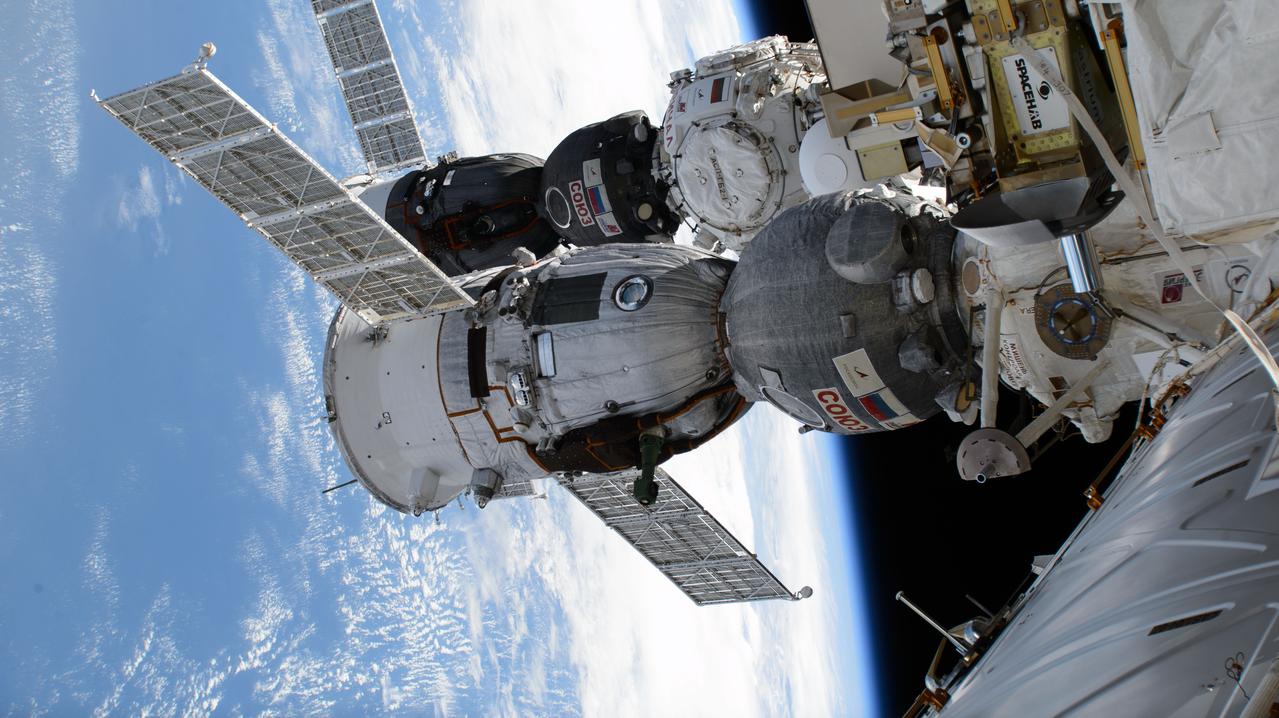
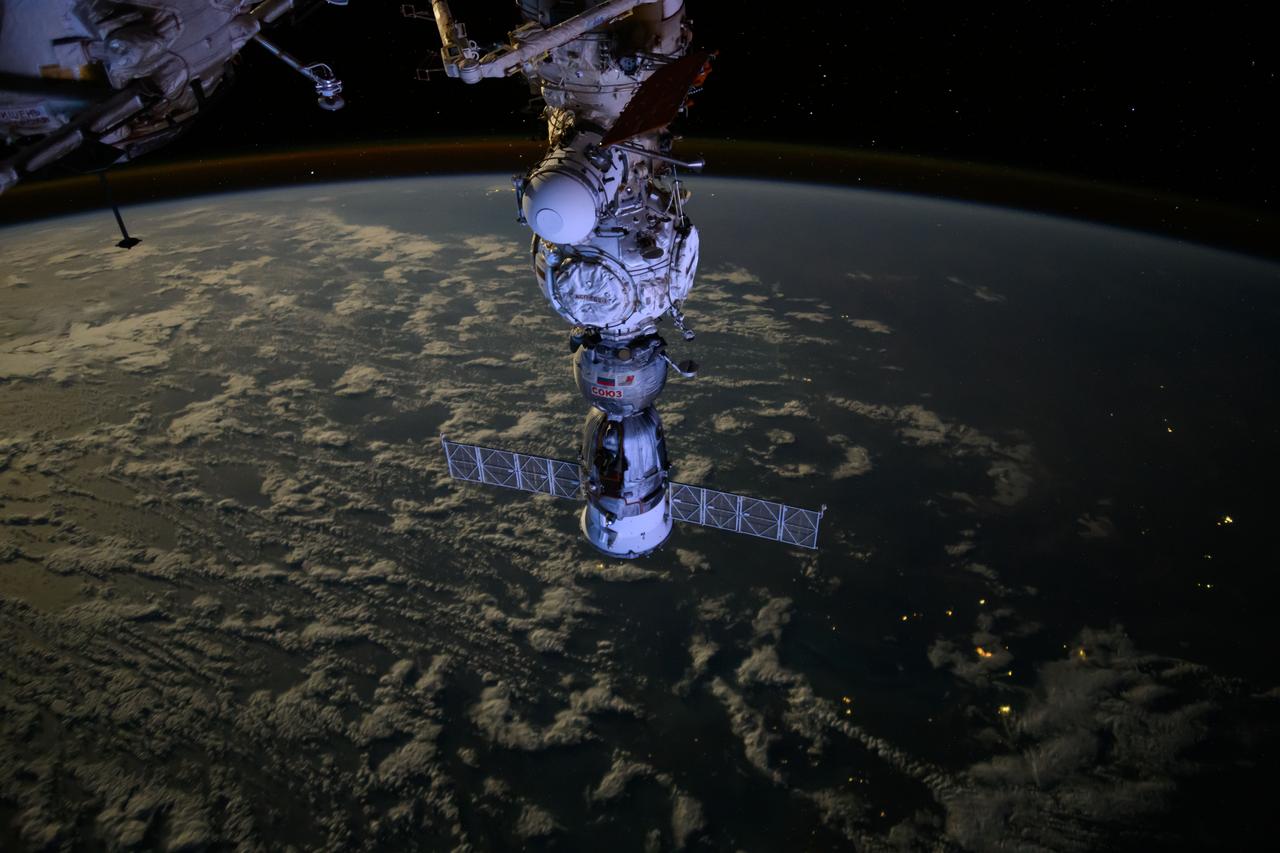
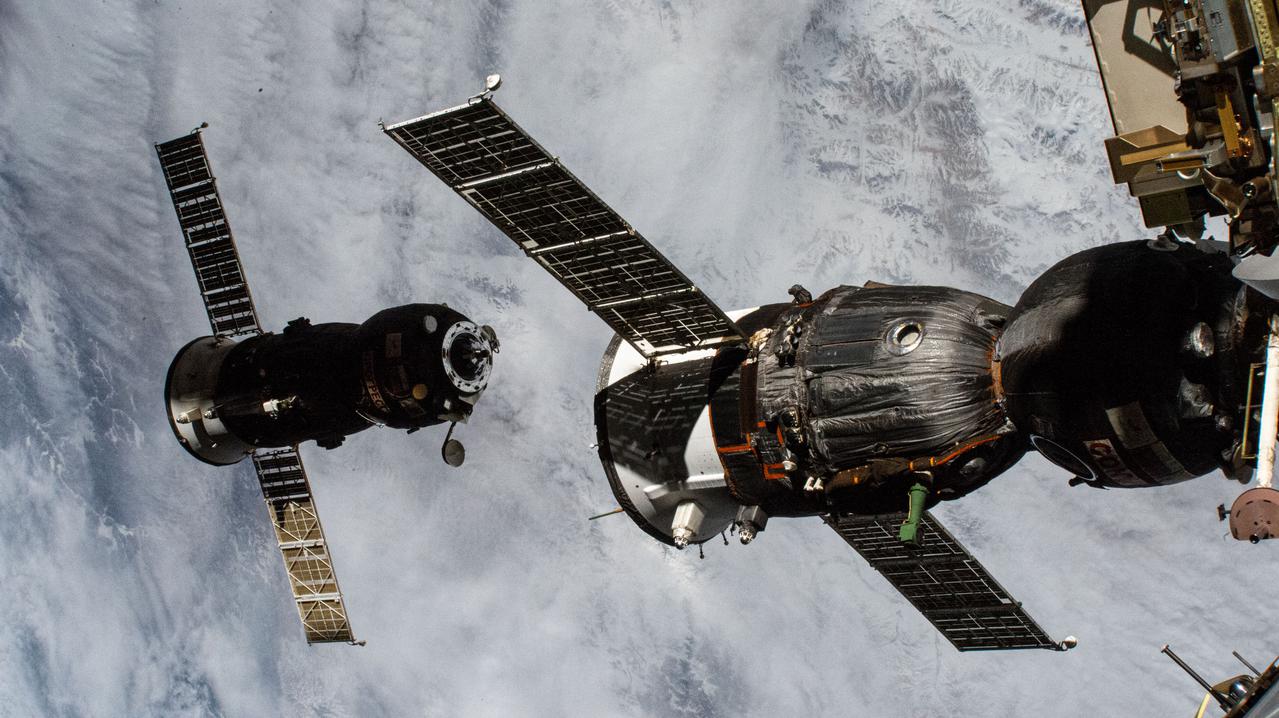
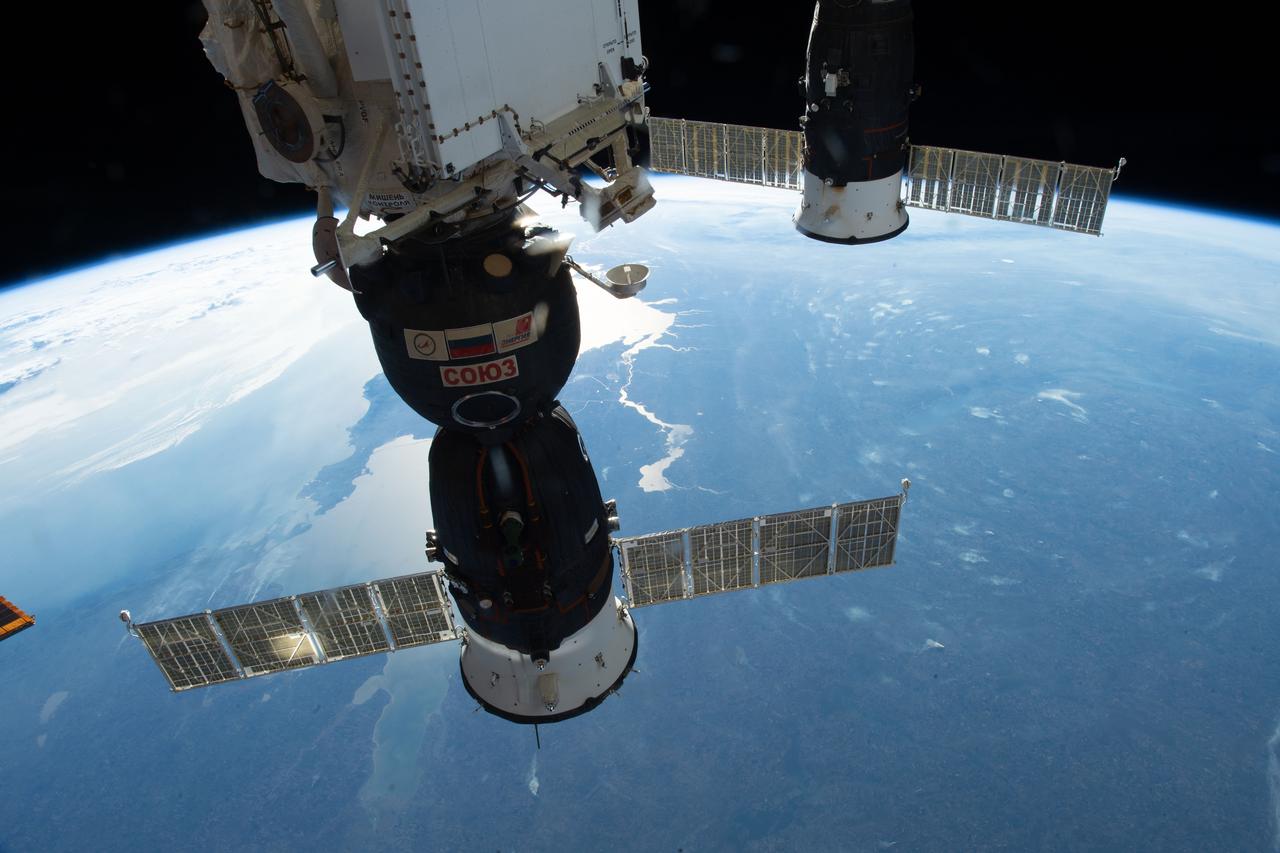
iss072e1021804 (April 19, 2025) --- The Soyuz crew ships that each brought three crew members to the International Space Station are pictured docked to the orbital outpost. In the foreground, is the Soyuz MS-26 spacecraft docked to the Rassvet module moments before it undocked and returned to Earth with NASA astronaut Pettit and Roscosmos cosmonauts Alexey Ovchinin and Ivan Vagner after 220 days in space. In the rear, is the Soyuz MS-27 spacecraft docked to the Prichal module after it launched on April 8, 2025, with NASA astronaut Jonny Kim and Roscosmos cosmonauts Sergey Ryzhikov and Alexey Zubritsky beginning an eight-month space research mission.
Two Soyuz crew ships are pictured docked to the International Space Station
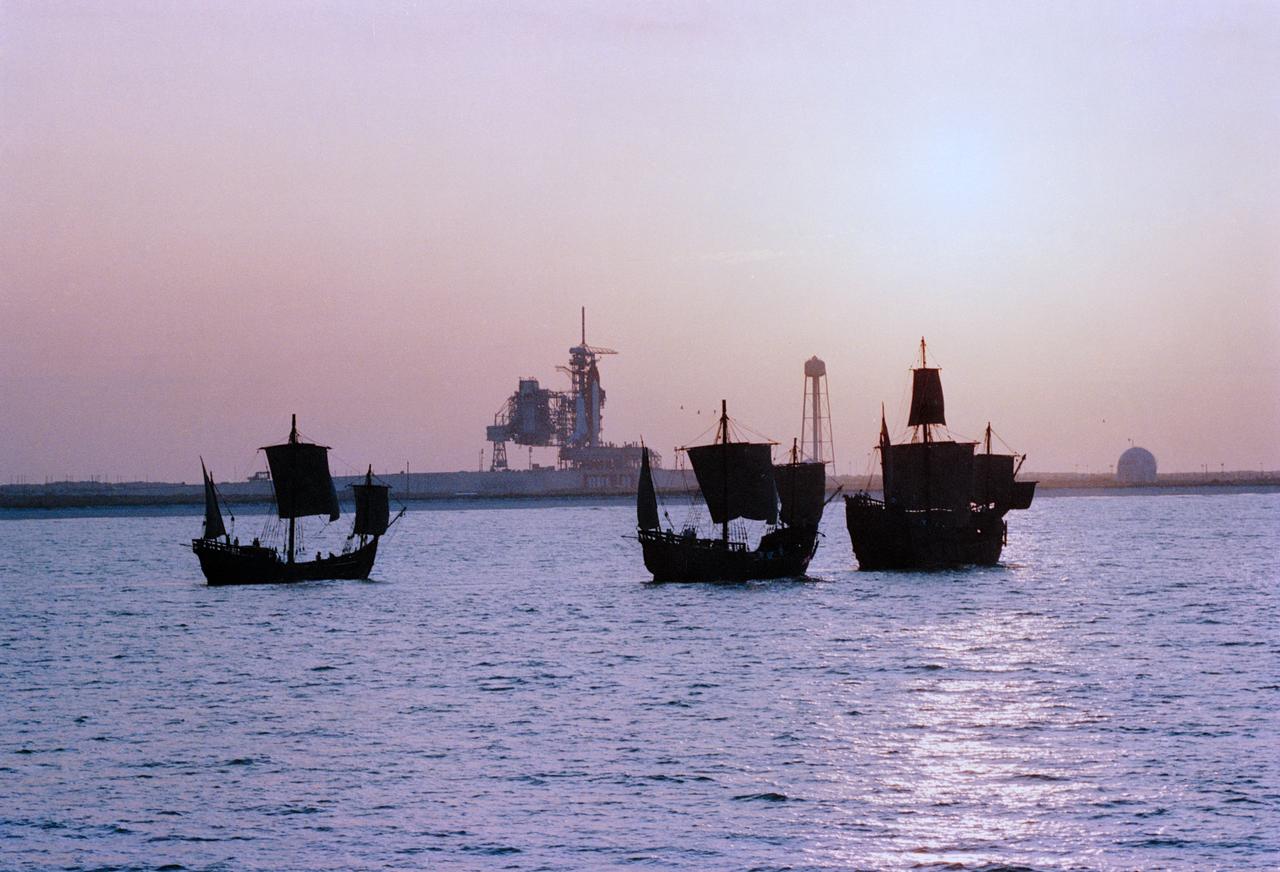
S92-39074 (6 May 1992) --- The centuries-old technology that built Christopher Columbus' three sailing ships passes within a half mile of the 20th-Century Space Shuttle Endeavour, in background, awaiting liftoff on Launch Pad 39B.  The replicas of the Santa Maria, Nina, and Pinta wind-powered ships, managed by the Spain '92 Foundation, are on a tour to ports around the Gulf of Mexico and up the Atlantic Coast of the United States. Endeavour is set to lift off on its maiden voyage, STS-49, on May 7, 1992.  Video footage of the two types of exploration vessels will be used by NASA for a variety of productions, including the annual Von Braun Exploration forum sponsored by NASA's Marshall Space Flight Center (MSFC), Huntsville, Alabama, in October, 1992. This year's theme is Exploration and the Evolution of Nations. 1992 is the 500th anniversary of Columbus' voyage to the New World.
Replicas of the Santa Maria, Nina, Pinta sail by OV-105 on KSC LC Pad 39B
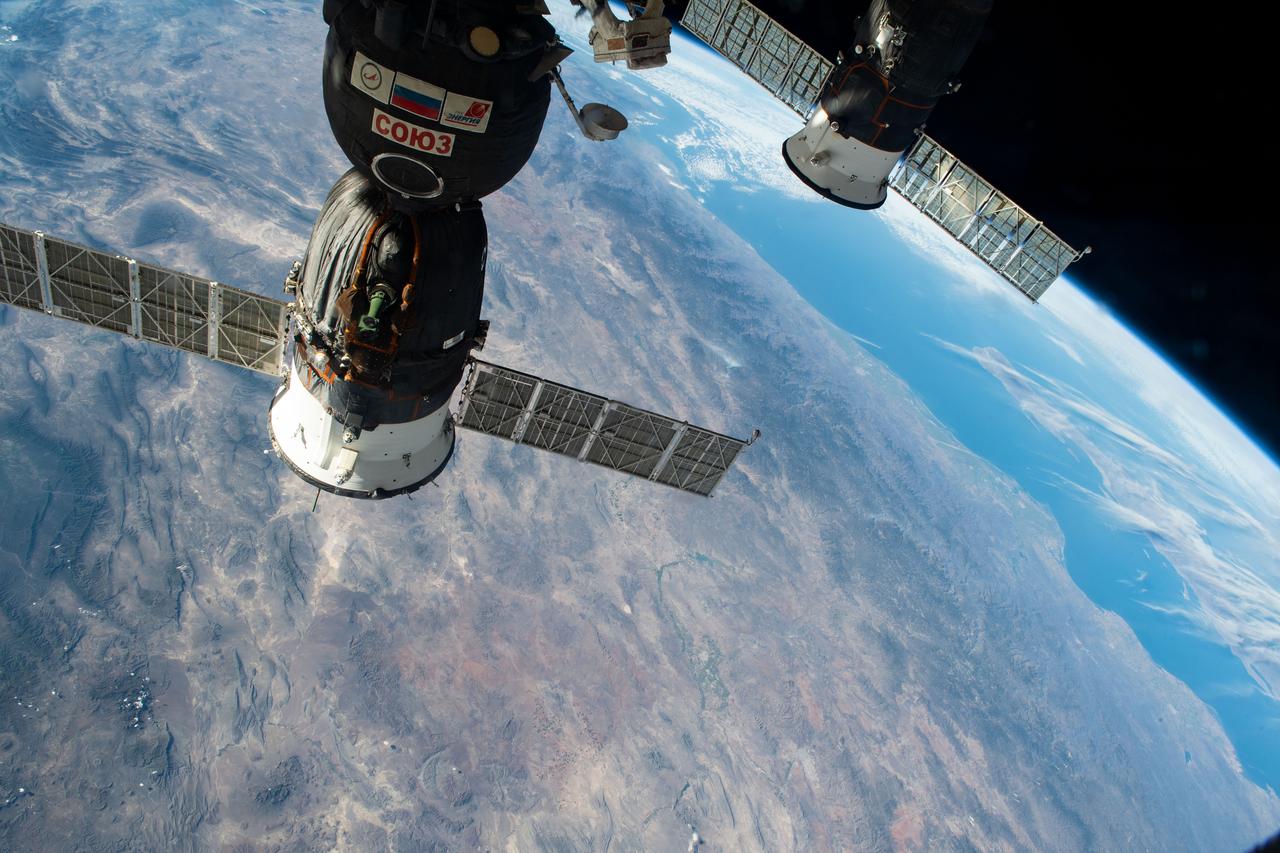
iss072e977423 (April 9, 2025) --- The Soyuz MS-26 (foreground) and MS-27 crew ships are pictured docked to the International Space Station's Rassvet module and Prichal module, respectively. The orbital outpost was soaring 261 miles above Wyoming at the time of this photograph.
The Soyuz MS-26 and MS-27 crew ships docked to the International Space Station
iss072e977434 (April 9, 2025) --- The Soyuz MS-26 (foreground) and MS-27 crew ships are pictured docked to the International Space Station's Rassvet module and Prichal module, respectively. At right, is the 214 million-year-old Manicouagan crater located in Quebec as the orbital outpost soared 263 miles above far eastern Canada.
The Soyuz MS-26 and MS-27 crew ships docked to the International Space Station
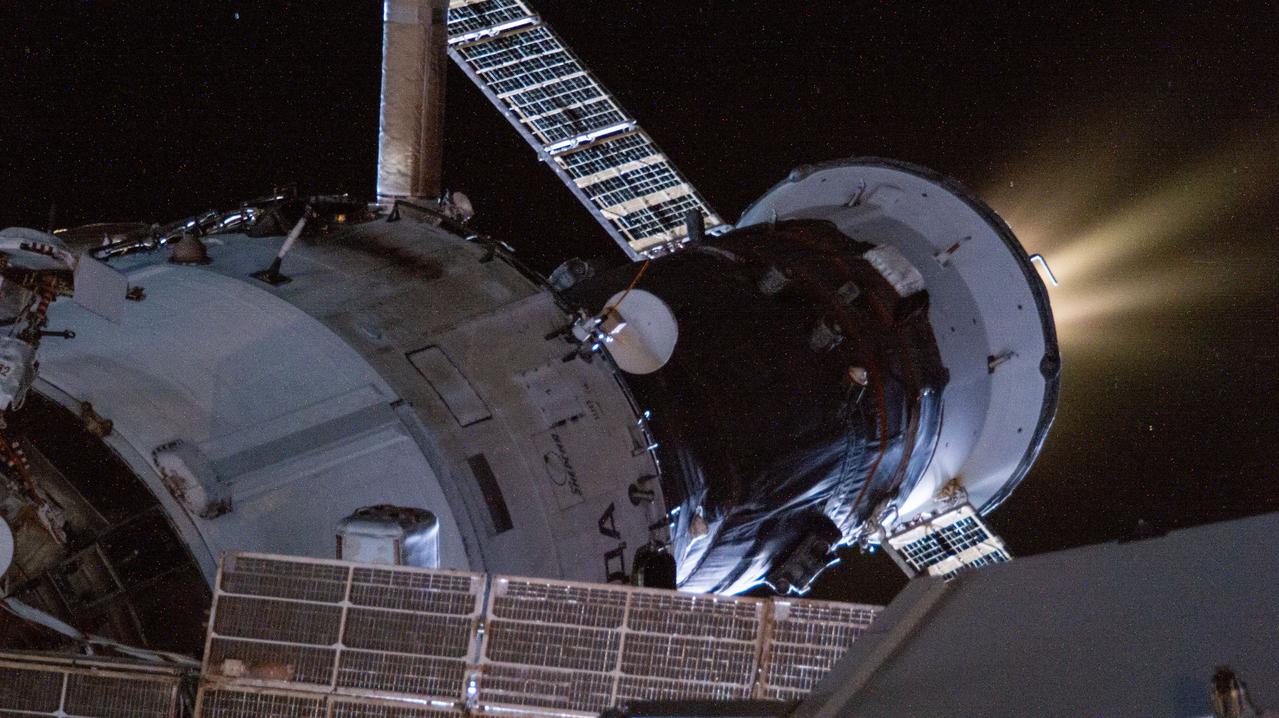
iss073e0429326 (Aug. 14, 2025) --- The Progress 91 resupply ship, docked to the rear port of the Zvezda service module, fires its thrusters to reboost the International Space Station’s orbit. This maneuver sets the correct altitude for the arrival of the next Roscosmos cargo craft, Progress 93, scheduled to launch and dock in September.
The Progress 91 resupply ship fires its thrusters to reboost the International Space Station
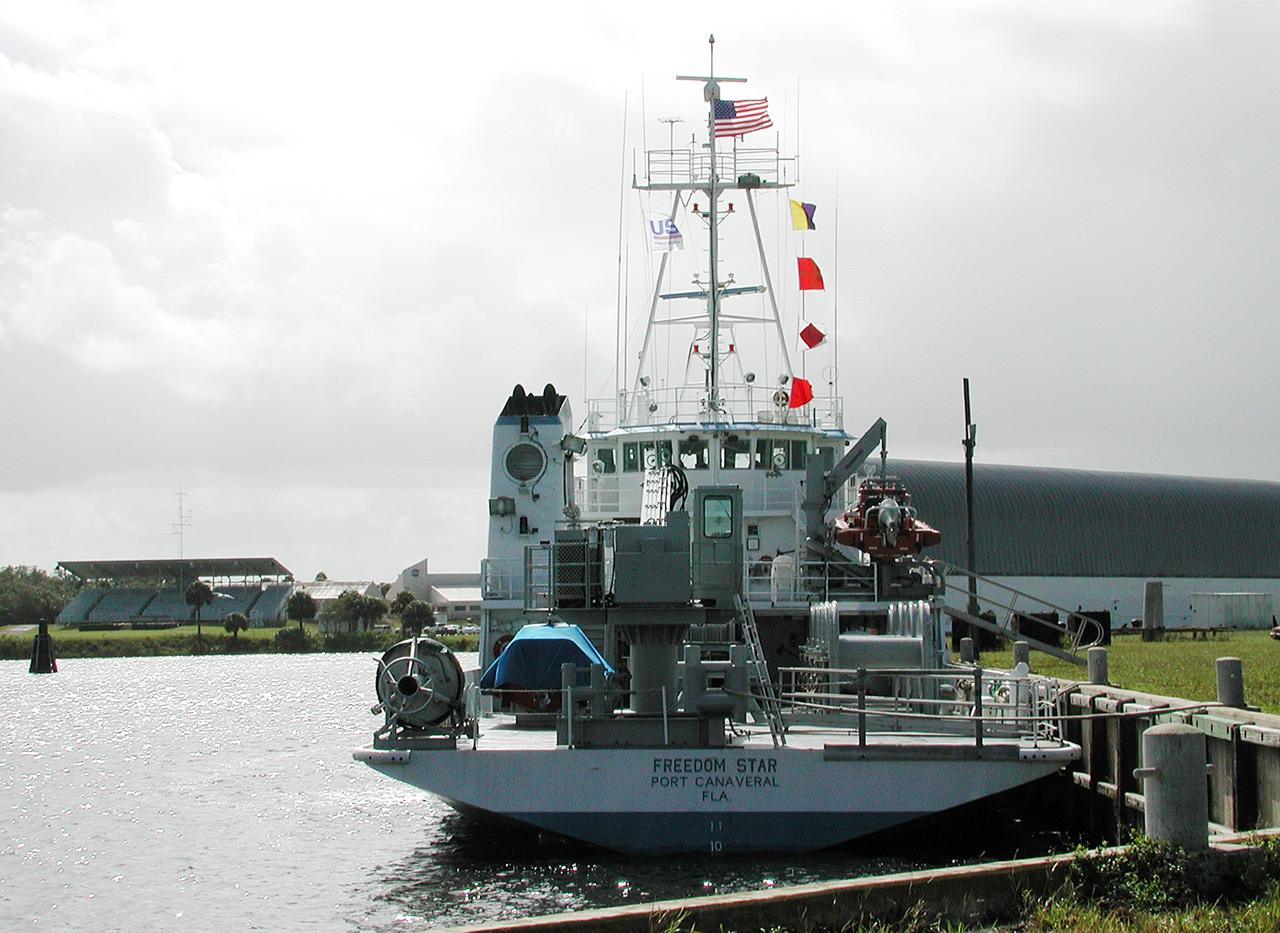
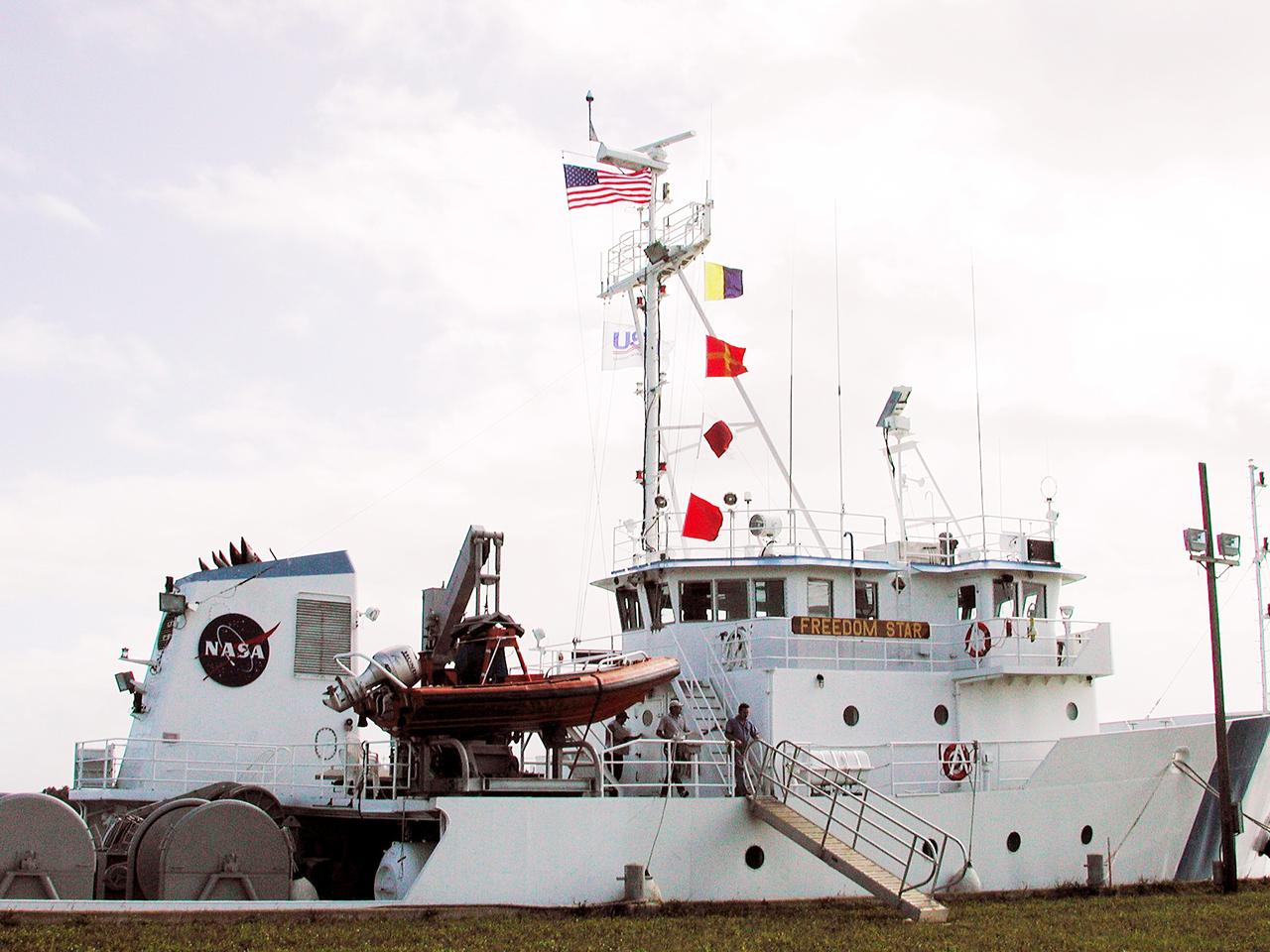
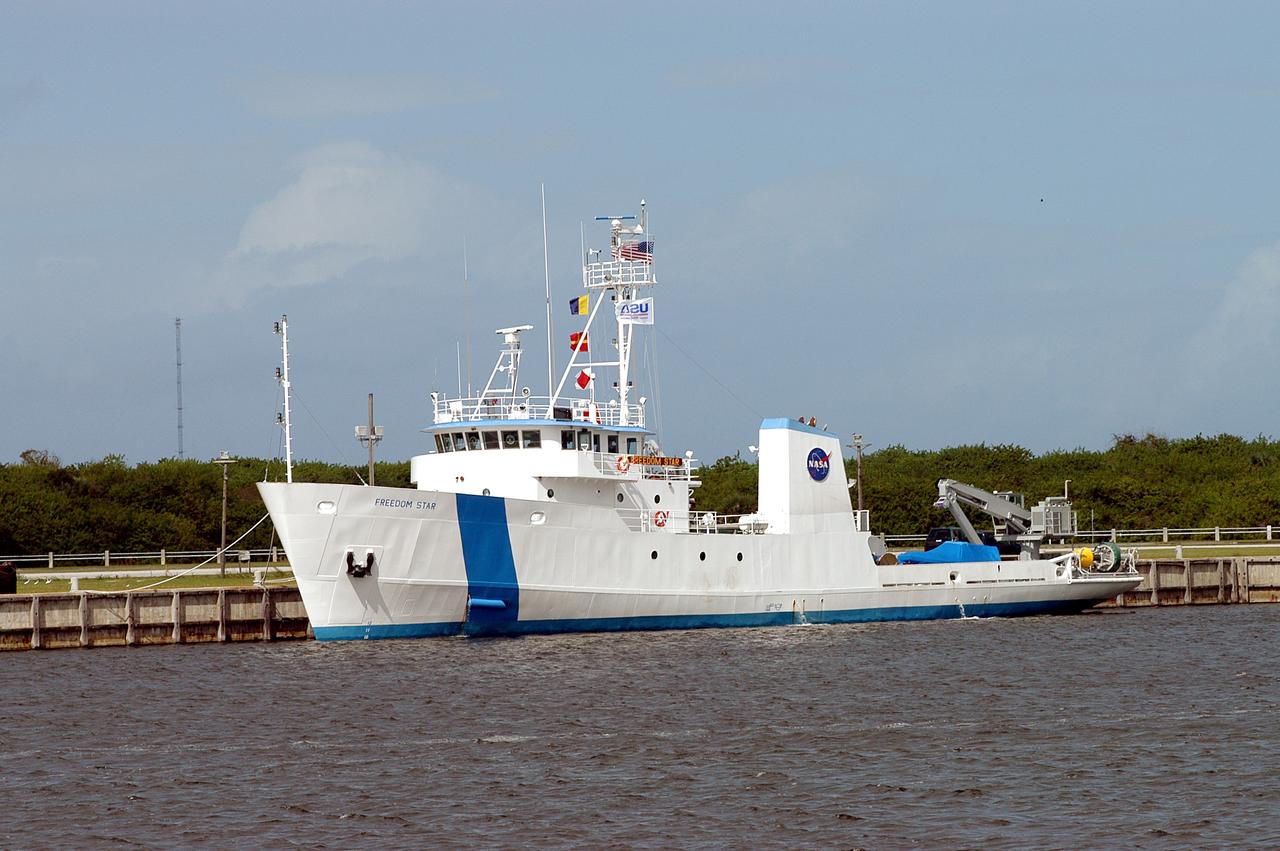
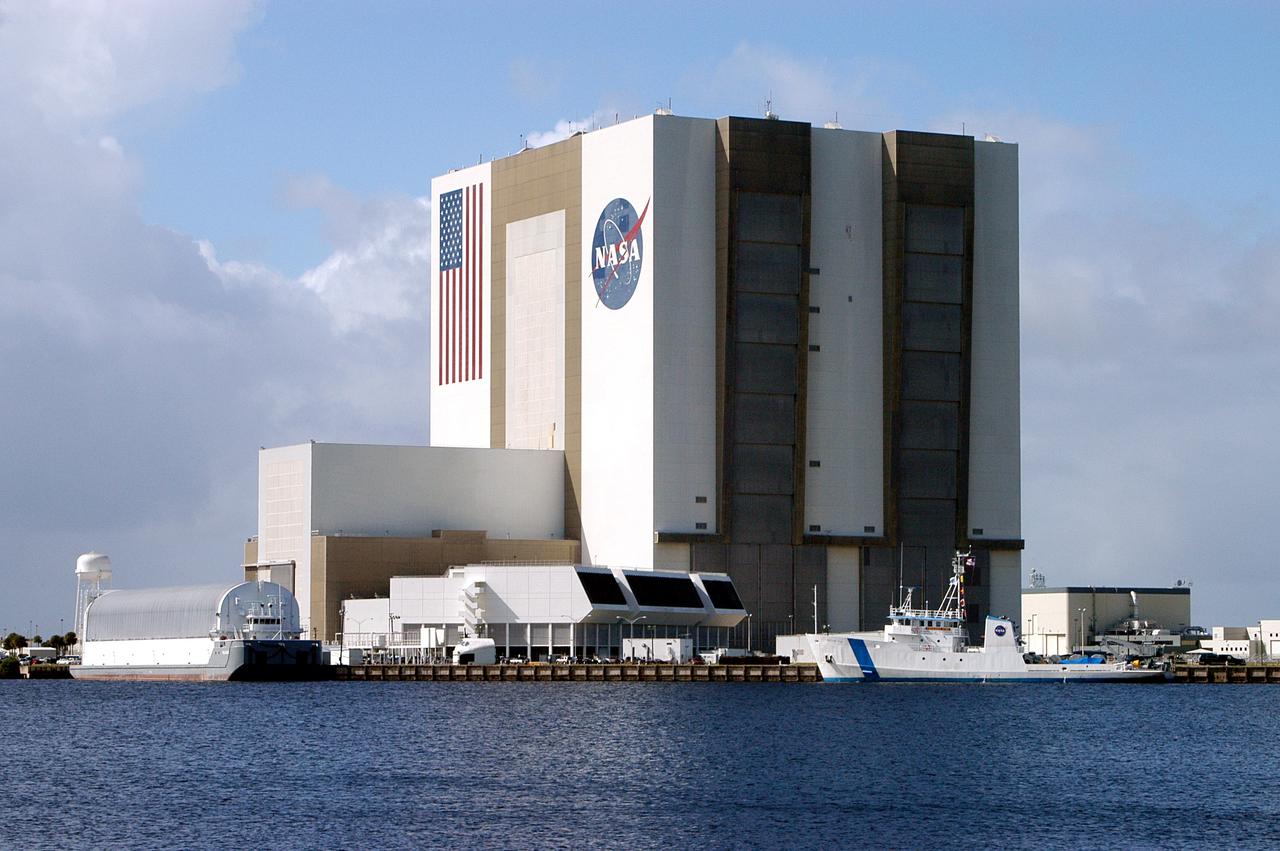
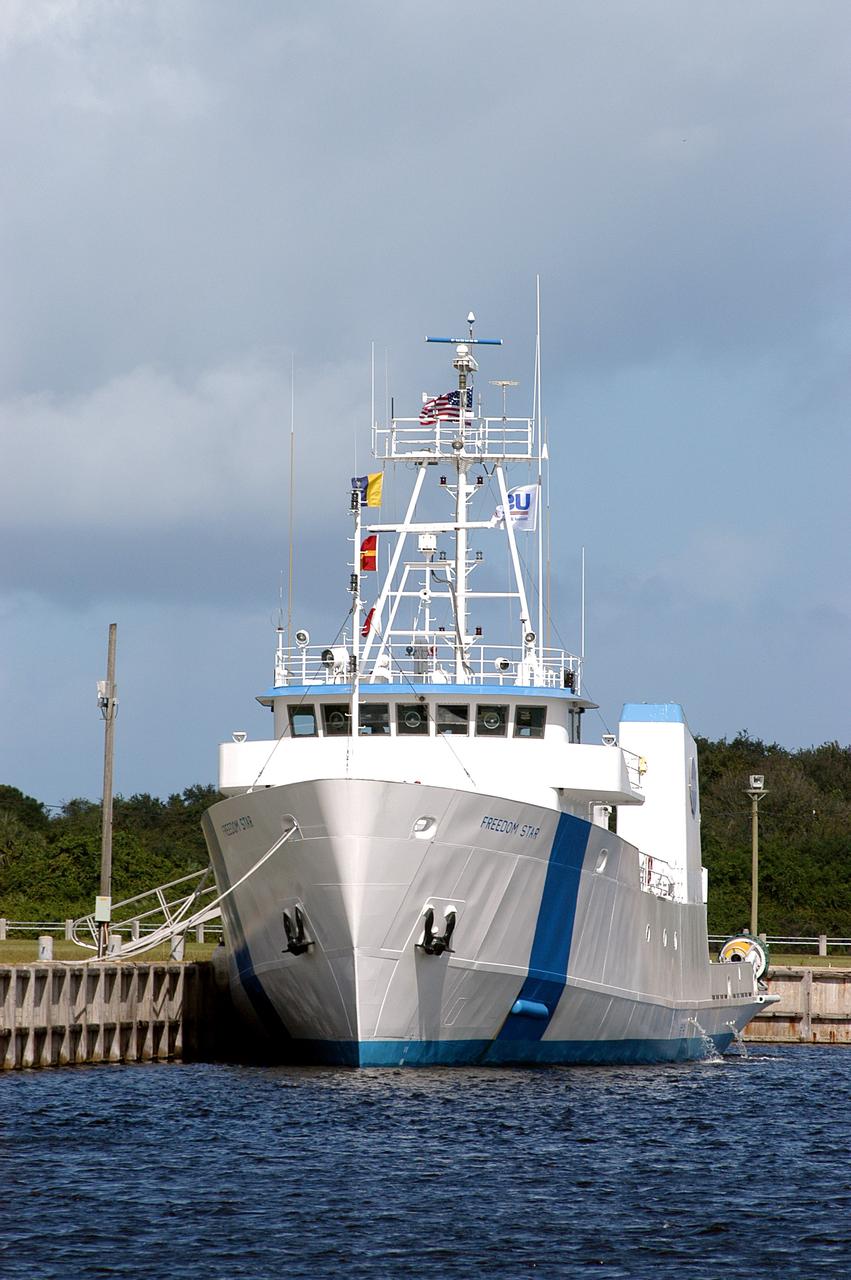
KENNEDY SPACE CENTER, FLA. - The Freedom Star is berthed at the Turn Basin near the Vehicle Assembly Building.  The ship has recently returned to KSC after refurbishment at Fort George Island, Fla., including new paint.  Freedom Star is one of the solid rocket booster (SRB) retrieval ships built to recover the SRB casings released over the Atlantic Ocean after launch of a Space Shuttle.  In addition to the SRBs, the ship recovers the drogue and main parachutes that slow the boosters’ speed before splashdown.  Some of the retrieval equipment can be seen on the rear deck.  The ships also tow the external tanks built at the Michoud Space Systems Assembly Facility near New Orleans to Port Canaveral, Fla.  Freedom Star was brought to KSC today for a visit by NATO Parliamentarians.
KENNEDY SPACE CENTER, FLA. - The Freedom Star is berthed at the Turn Basin near the Vehicle Assembly Building. The ship has recently returned to KSC after refurbishment at Fort George Island, Fla., including new paint. Freedom Star is one of the solid rocket booster (SRB) retrieval ships built to recover the SRB casings released over the Atlantic Ocean after launch of a Space Shuttle. In addition to the SRBs, the ship recovers the drogue and main parachutes that slow the boosters’ speed before splashdown. Some of the retrieval equipment can be seen on the rear deck. The ships also tow the external tanks built at the Michoud Space Systems Assembly Facility near New Orleans to Port Canaveral, Fla. Freedom Star was brought to KSC today for a visit by NATO Parliamentarians.
KENNEDY SPACE CENTER, FLA. - The Freedom Star is berthed at the Turn Basin near the Vehicle Assembly Building.  The ship has recently returned to KSC after refurbishment at Fort George Island, Fla., including new paint.  Freedom Star is one of the solid rocket booster (SRB) retrieval ships built to recover the SRB casings released over the Atlantic Ocean after launch of a Space Shuttle.  In addition to the SRBs, the ship recovers the drogue and main parachutes that slow the boosters’ speed before splashdown.  Some of the retrieval equipment can be seen on the rear deck.  The ships also tow the external tanks built at the Michoud Space Systems Assembly Facility near New Orleans to Port Canaveral, Fla.  Freedom Star was brought to KSC today for a visit by NATO Parliamentarians.
KENNEDY SPACE CENTER, FLA. - The Freedom Star is berthed at the Turn Basin near the Vehicle Assembly Building. The ship has recently returned to KSC after refurbishment at Fort George Island, Fla., including new paint. Freedom Star is one of the solid rocket booster (SRB) retrieval ships built to recover the SRB casings released over the Atlantic Ocean after launch of a Space Shuttle. In addition to the SRBs, the ship recovers the drogue and main parachutes that slow the boosters’ speed before splashdown. Some of the retrieval equipment can be seen on the rear deck. The ships also tow the external tanks built at the Michoud Space Systems Assembly Facility near New Orleans to Port Canaveral, Fla. Freedom Star was brought to KSC today for a visit by NATO Parliamentarians.
KENNEDY SPACE CENTER, FLA. - The Freedom Star is berthed at the Turn Basin near the Vehicle Assembly Building.  The ship has recently returned to KSC after refurbishment at Fort George Island, Fla., including new paint.  Freedom Star is one of the solid rocket booster (SRB) retrieval ships built to recover the SRB casings released over the Atlantic Ocean after launch of a Space Shuttle.  In addition to the SRBs, the ship recovers the drogue and main parachutes that slow the boosters’ speed before splashdown.  Some of the retrieval equipment can be seen on the rear deck.  The ships also tow the external tanks built at the Michoud Space Systems Assembly Facility near New Orleans to Port Canaveral, Fla.  Freedom Star was brought to KSC today for a visit by NATO Parliamentarians.
KENNEDY SPACE CENTER, FLA. - The Freedom Star is berthed at the Turn Basin near the Vehicle Assembly Building. The ship has recently returned to KSC after refurbishment at Fort George Island, Fla., including new paint. Freedom Star is one of the solid rocket booster (SRB) retrieval ships built to recover the SRB casings released over the Atlantic Ocean after launch of a Space Shuttle. In addition to the SRBs, the ship recovers the drogue and main parachutes that slow the boosters’ speed before splashdown. Some of the retrieval equipment can be seen on the rear deck. The ships also tow the external tanks built at the Michoud Space Systems Assembly Facility near New Orleans to Port Canaveral, Fla. Freedom Star was brought to KSC today for a visit by NATO Parliamentarians.
KENNEDY SPACE CENTER, FLA. -  The Freedom Star is berthed at the Turn Basin near the Vehicle Assembly Building.  The ship has recently returned to KSC after refurbishment at Fort George Island, Fla., including new paint.  Freedom Star is one of the solid rocket booster (SRB) retrieval ships built to recover the SRB casings released over the Atlantic Ocean after launch of a Space Shuttle.  In addition to the SRBs, the ship recovers the drogue and main parachutes that slow the boosters’ speed before splashdown.  Some of the retrieval equipment can be seen on the rear deck.  The ships also tow the external tanks built at the Michoud Space Systems Assembly Facility near New Orleans to Port Canaveral, Fla.  Freedom Star was brought to KSC today for a visit by NATO Parliamentarians.
KENNEDY SPACE CENTER, FLA. - The Freedom Star is berthed at the Turn Basin near the Vehicle Assembly Building. The ship has recently returned to KSC after refurbishment at Fort George Island, Fla., including new paint. Freedom Star is one of the solid rocket booster (SRB) retrieval ships built to recover the SRB casings released over the Atlantic Ocean after launch of a Space Shuttle. In addition to the SRBs, the ship recovers the drogue and main parachutes that slow the boosters’ speed before splashdown. Some of the retrieval equipment can be seen on the rear deck. The ships also tow the external tanks built at the Michoud Space Systems Assembly Facility near New Orleans to Port Canaveral, Fla. Freedom Star was brought to KSC today for a visit by NATO Parliamentarians.
KENNEDY SPACE CENTER, FLA. - The Freedom Star is berthed at the Turn Basin near the Vehicle Assembly Building.  The ship has recently returned to KSC after refurbishment at Fort George Island, Fla., including new paint.  Freedom Star is one of the solid rocket booster (SRB) retrieval ships built to recover the SRB casings released over the Atlantic Ocean after launch of a Space Shuttle.  In addition to the SRBs, the ship recovers the drogue and main parachutes that slow the boosters’ speed before splashdown.  The ships also tow the external tanks built at the Michoud Space Systems Assembly Facility near New Orleans to Port Canaveral, Fla.  Freedom Star was brought to KSC today for a visit by NATO Parliamentarians.
KENNEDY SPACE CENTER, FLA. - The Freedom Star is berthed at the Turn Basin near the Vehicle Assembly Building. The ship has recently returned to KSC after refurbishment at Fort George Island, Fla., including new paint. Freedom Star is one of the solid rocket booster (SRB) retrieval ships built to recover the SRB casings released over the Atlantic Ocean after launch of a Space Shuttle. In addition to the SRBs, the ship recovers the drogue and main parachutes that slow the boosters’ speed before splashdown. The ships also tow the external tanks built at the Michoud Space Systems Assembly Facility near New Orleans to Port Canaveral, Fla. Freedom Star was brought to KSC today for a visit by NATO Parliamentarians.
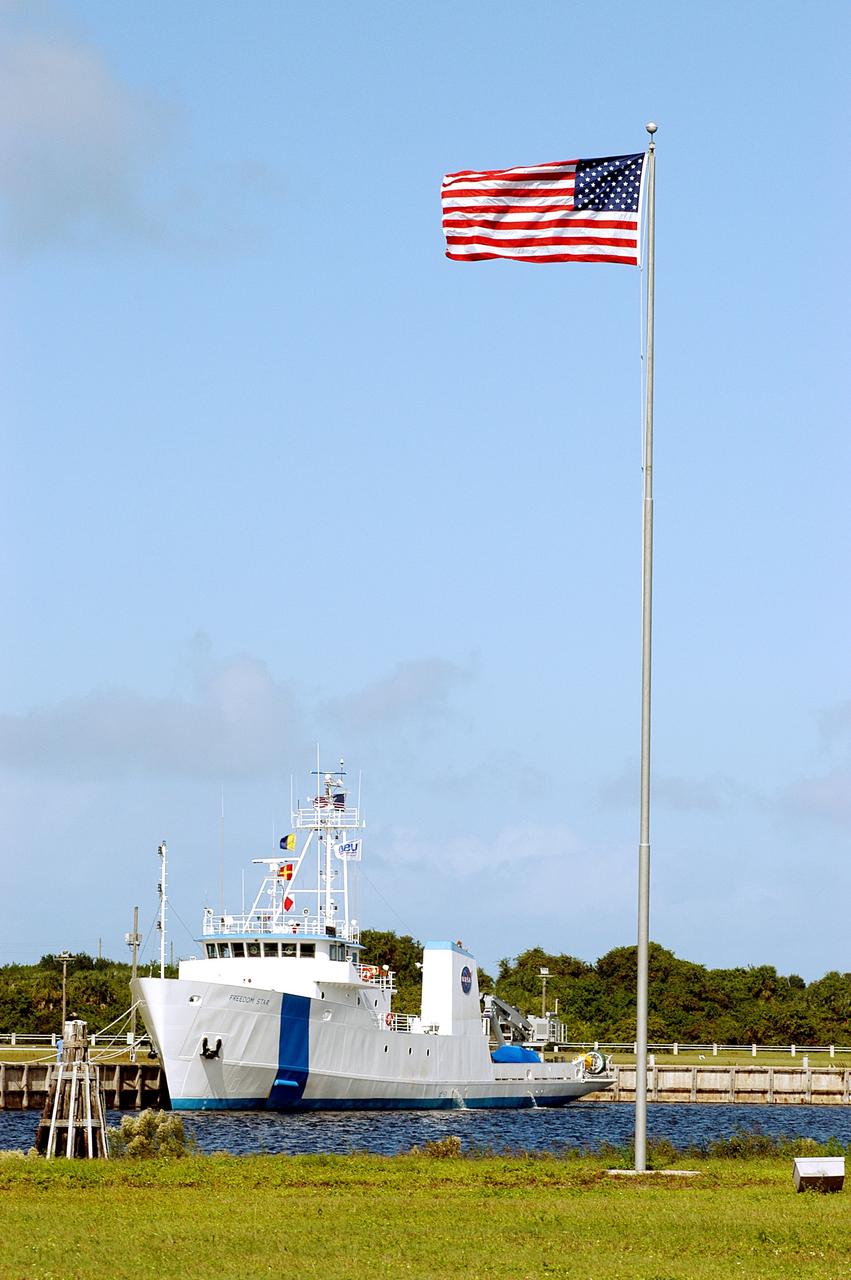
KENNEDY SPACE CENTER, FLA. -  The Freedom Star is berthed at the Turn Basin near the Vehicle Assembly Building and NASA-KSC News Center.  The flag is near the News Center.   The ship has recently returned to KSC after refurbishment at Fort George Island, Fla., including new paint.  Freedom Star is one of the solid rocket booster (SRB) retrieval ships built to recover the SRB casings released over the Atlantic Ocean after launch of a Space Shuttle.  In addition to the SRBs, the ship recovers the drogue and main parachutes that slow the boosters’ speed before splashdown.   The ships also tow the external tanks built at the Michoud Space Systems Assembly Facility near New Orleans to Port Canaveral, Fla.  Freedom Star was brought to KSC today for a visit by NATO Parliamentarians.
KENNEDY SPACE CENTER, FLA. - The Freedom Star is berthed at the Turn Basin near the Vehicle Assembly Building and NASA-KSC News Center. The flag is near the News Center. The ship has recently returned to KSC after refurbishment at Fort George Island, Fla., including new paint. Freedom Star is one of the solid rocket booster (SRB) retrieval ships built to recover the SRB casings released over the Atlantic Ocean after launch of a Space Shuttle. In addition to the SRBs, the ship recovers the drogue and main parachutes that slow the boosters’ speed before splashdown. The ships also tow the external tanks built at the Michoud Space Systems Assembly Facility near New Orleans to Port Canaveral, Fla. Freedom Star was brought to KSC today for a visit by NATO Parliamentarians.
KENNEDY SPACE CENTER, FLA. -  The Freedom Star is berthed at the Turn Basin near the Vehicle Assembly Building.  The ship has recently returned to KSC after refurbishment at Fort George Island, Fla., including new paint.  Freedom Star is one of the solid rocket booster (SRB) retrieval ships built to recover the SRB casings released over the Atlantic Ocean after launch of a Space Shuttle.  In addition to the SRBs, the ship recovers the drogue and main parachutes that slow the boosters’ speed before splashdown.   The ships also tow the external tanks built at the Michoud Space Systems Assembly Facility near New Orleans to Port Canaveral, Fla.  Freedom Star was brought to KSC today for a visit by NATO Parliamentarians.
KENNEDY SPACE CENTER, FLA. - The Freedom Star is berthed at the Turn Basin near the Vehicle Assembly Building. The ship has recently returned to KSC after refurbishment at Fort George Island, Fla., including new paint. Freedom Star is one of the solid rocket booster (SRB) retrieval ships built to recover the SRB casings released over the Atlantic Ocean after launch of a Space Shuttle. In addition to the SRBs, the ship recovers the drogue and main parachutes that slow the boosters’ speed before splashdown. The ships also tow the external tanks built at the Michoud Space Systems Assembly Facility near New Orleans to Port Canaveral, Fla. Freedom Star was brought to KSC today for a visit by NATO Parliamentarians.
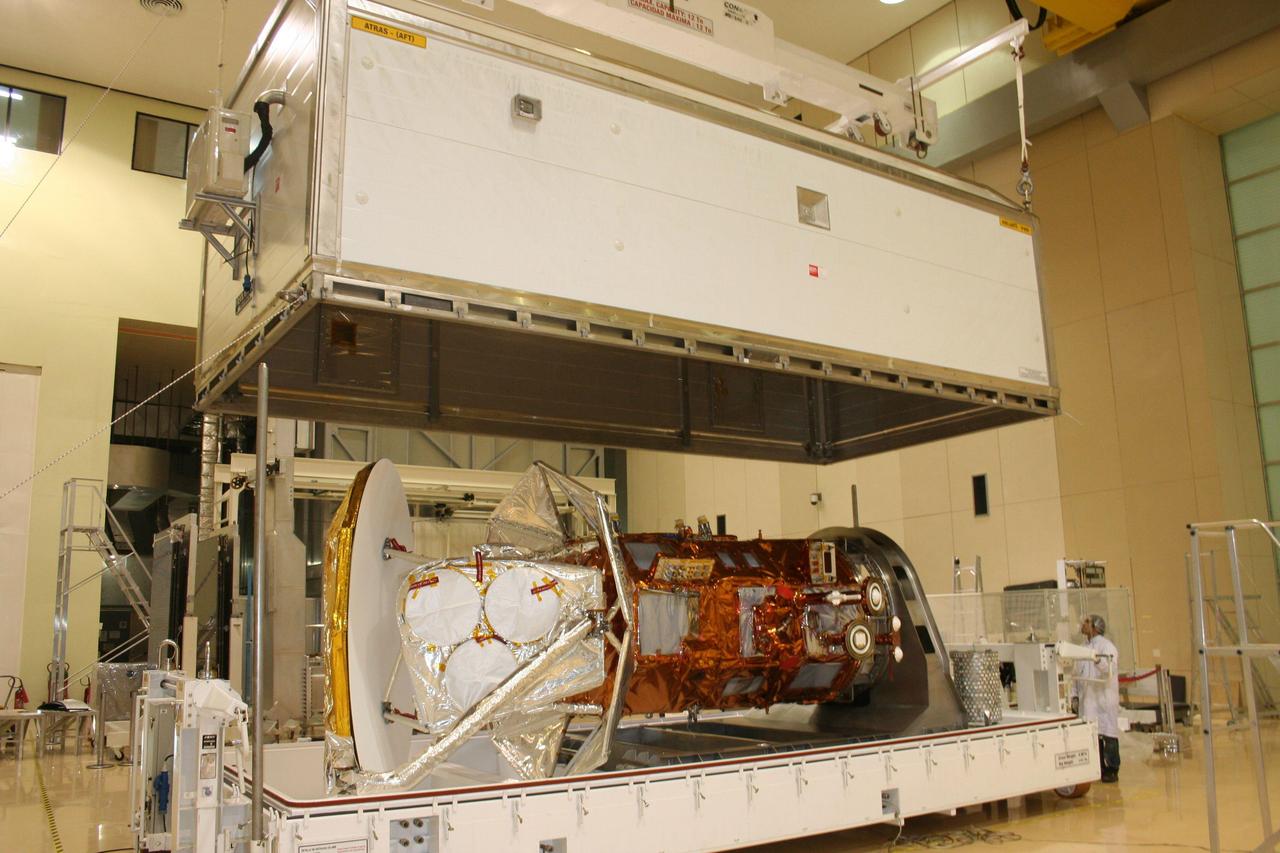
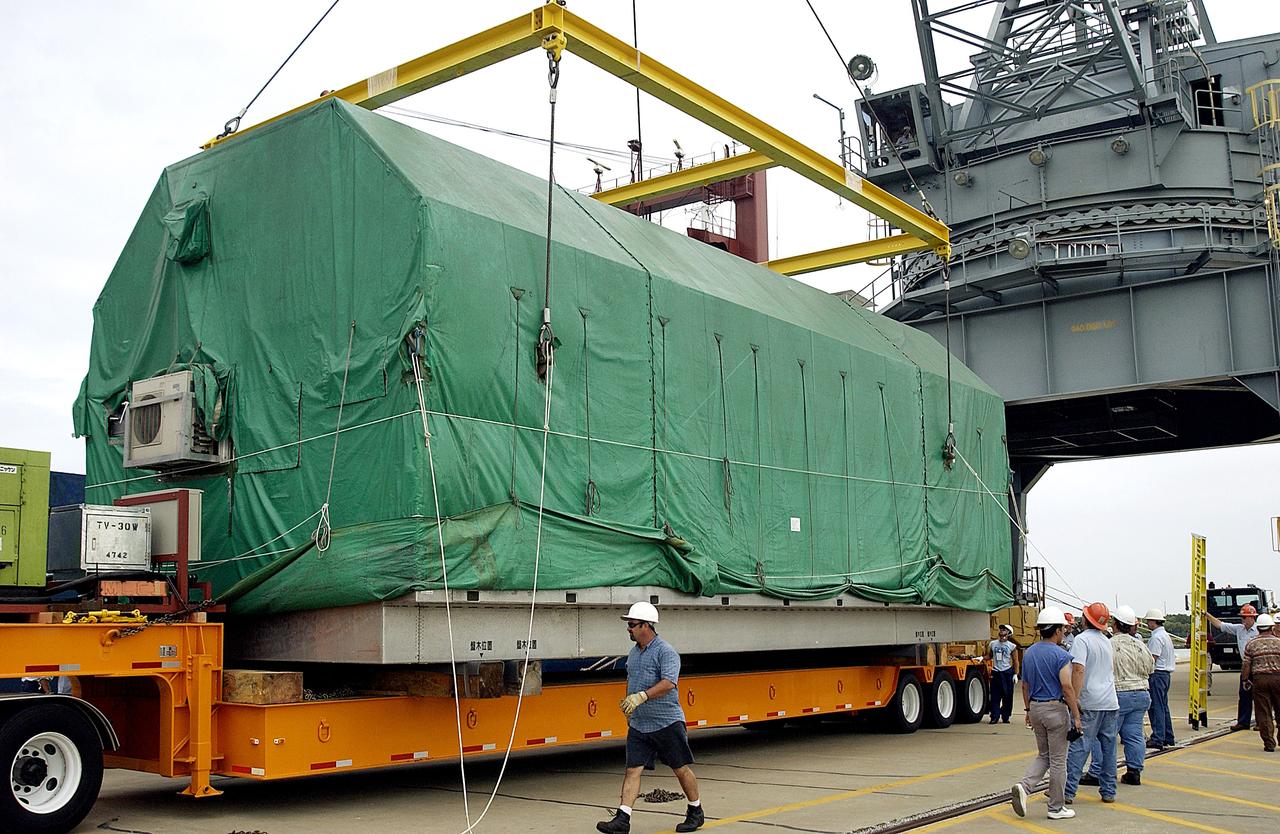
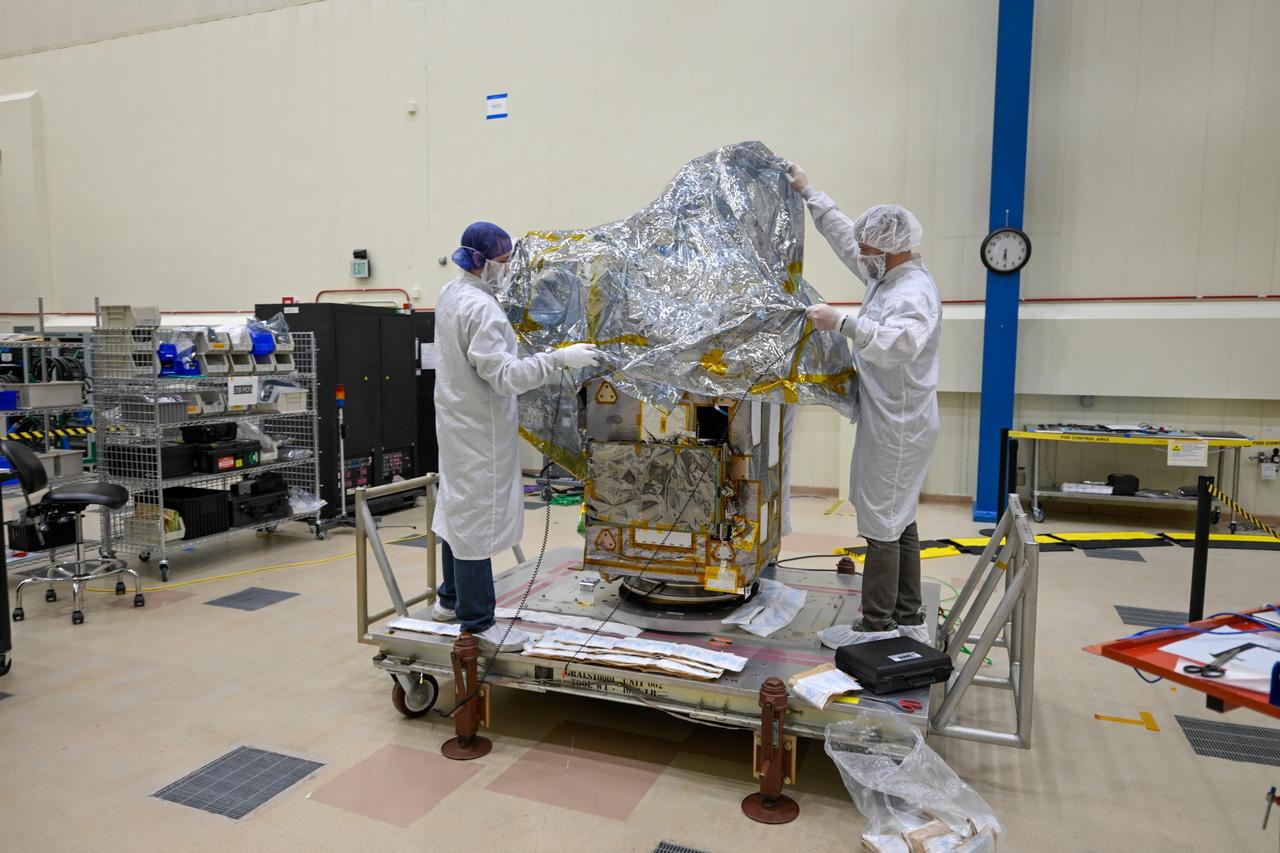
Technicians lower the cover over the shipping container holding the international Aquarius/SAC-D spacecraft at Brazil National Institute for Space Research.
Aquarius - SAC-D Spacecraft is Prepped for Shipping to California
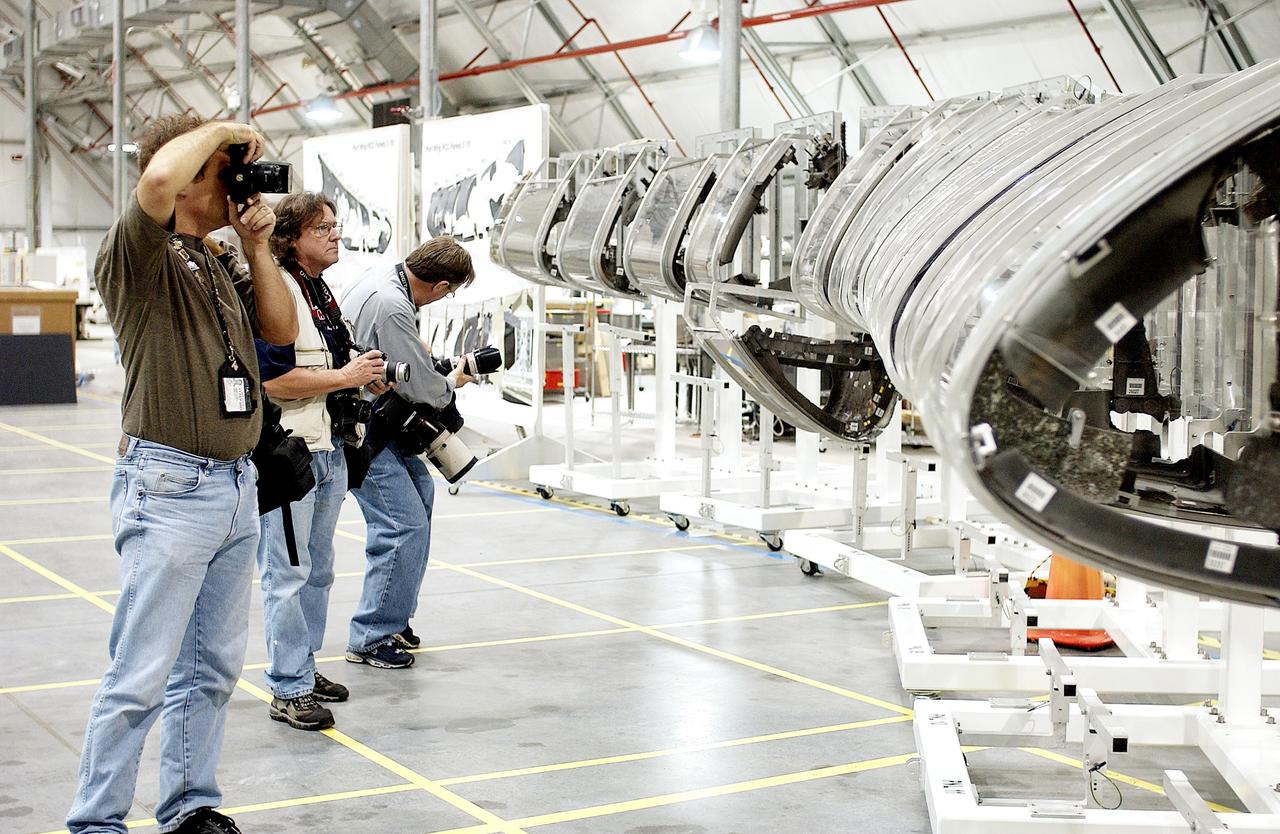
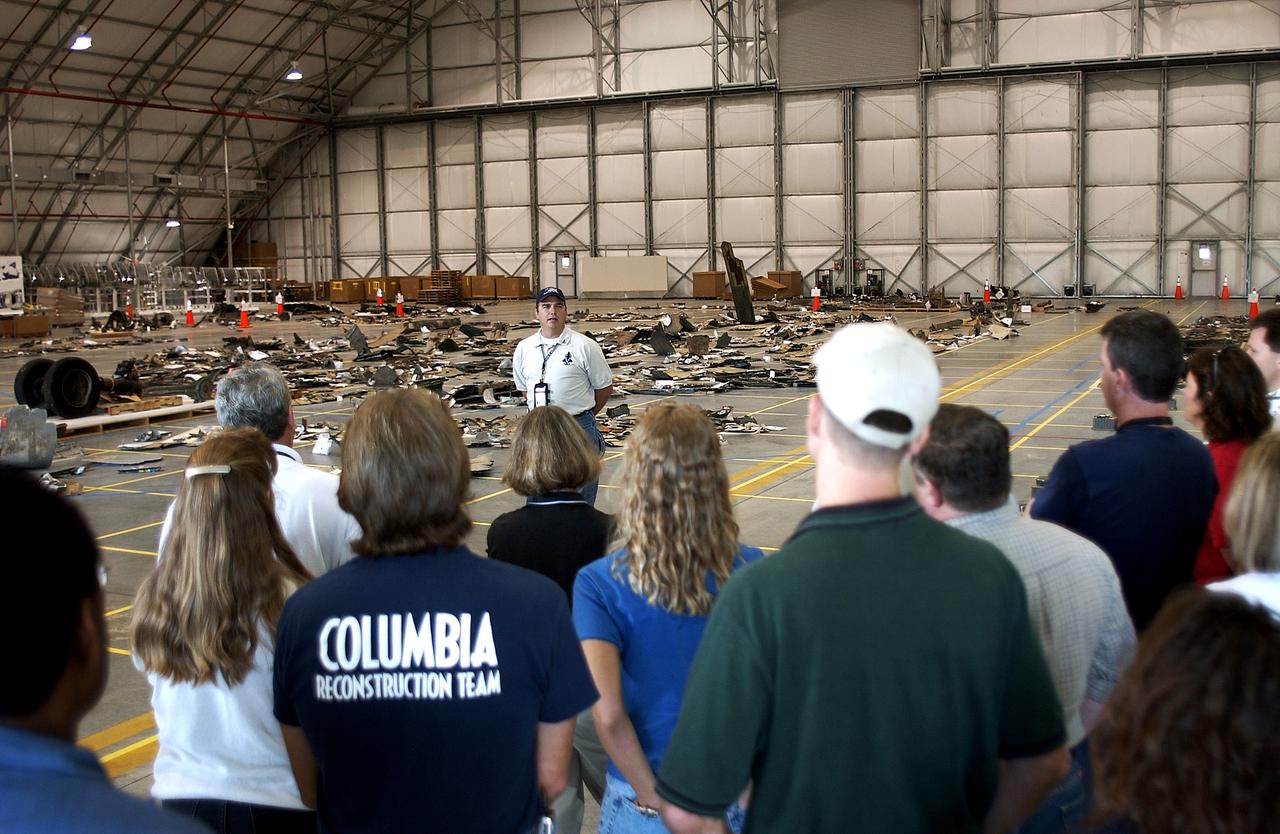
KENNEDY SPACE CENTER, FLA. - During a media tour of the Columbia Debris Hangar, a photographer gets a close-up of the mockup of the leading edge of Columbia’s left wing.  About 83,000 pieces of debris were shipped to KSC from search and recovery efforts in East Texas.  About 83,000 pieces of debris from Columbia were shipped to KSC, which represents about 38 percent of the dry weight of Columbia, equaling almost 85,000 pounds.  The debris is being packaged for storage in an area of the Vehicle Assembly Building.
KENNEDY SPACE CENTER, FLA. - During a media tour of the Columbia Debris Hangar, a photographer gets a close-up of the mockup of the leading edge of Columbia’s left wing. About 83,000 pieces of debris were shipped to KSC from search and recovery efforts in East Texas. About 83,000 pieces of debris from Columbia were shipped to KSC, which represents about 38 percent of the dry weight of Columbia, equaling almost 85,000 pounds. The debris is being packaged for storage in an area of the Vehicle Assembly Building.
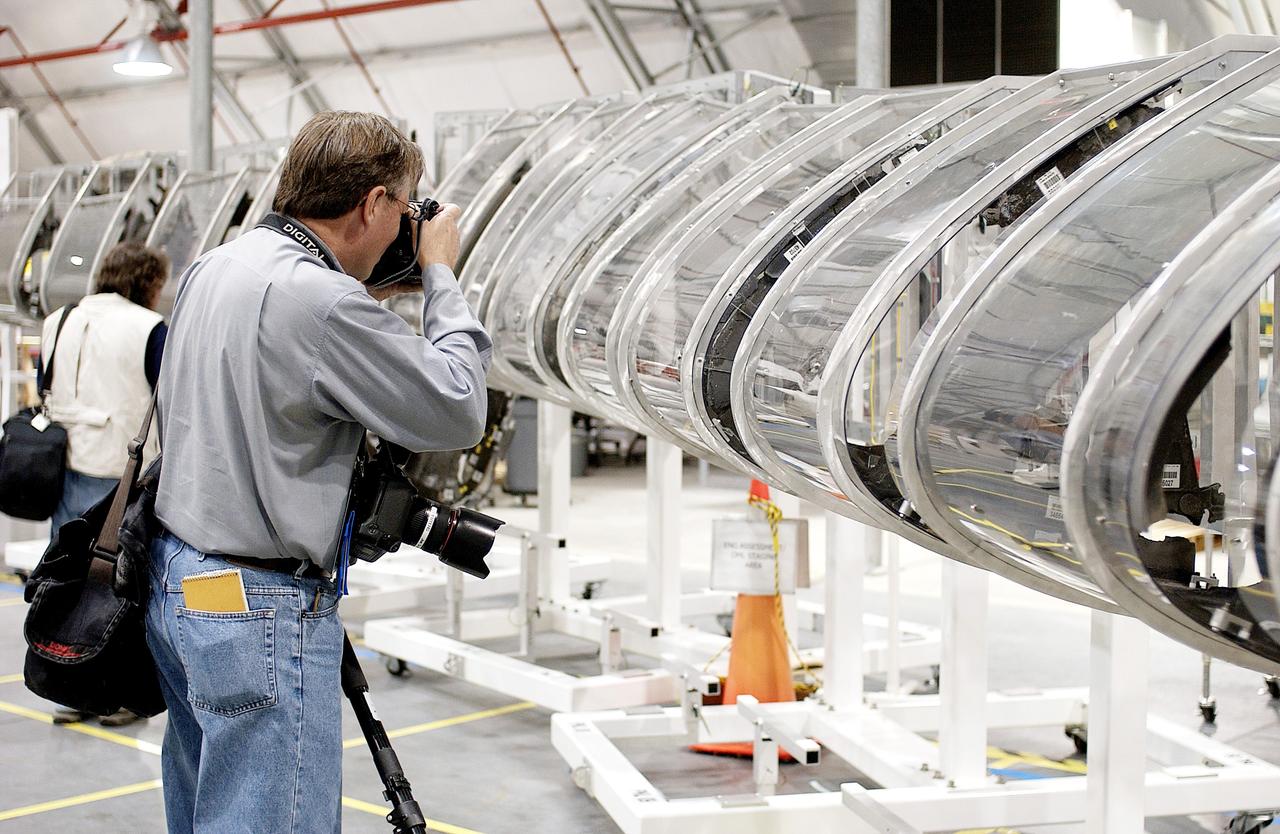
KENNEDY SPACE CENTER, FLA. - During a media tour of the Columbia Debris Hangar, photographers pause at the mockup of the leading edge of Columbia’s left wing.  About 83,000 pieces of debris from Columbia were shipped to KSC from search and recovery efforts in East Texas.  About 83,000 pieces of debris were shipped to KSC, which represents about 38 percent of the dry weight of Columbia, equaling almost 85,000 pounds.  The debris is being packaged for storage in an area of the Vehicle Assembly Building.
KENNEDY SPACE CENTER, FLA. - During a media tour of the Columbia Debris Hangar, photographers pause at the mockup of the leading edge of Columbia’s left wing. About 83,000 pieces of debris from Columbia were shipped to KSC from search and recovery efforts in East Texas. About 83,000 pieces of debris were shipped to KSC, which represents about 38 percent of the dry weight of Columbia, equaling almost 85,000 pounds. The debris is being packaged for storage in an area of the Vehicle Assembly Building.
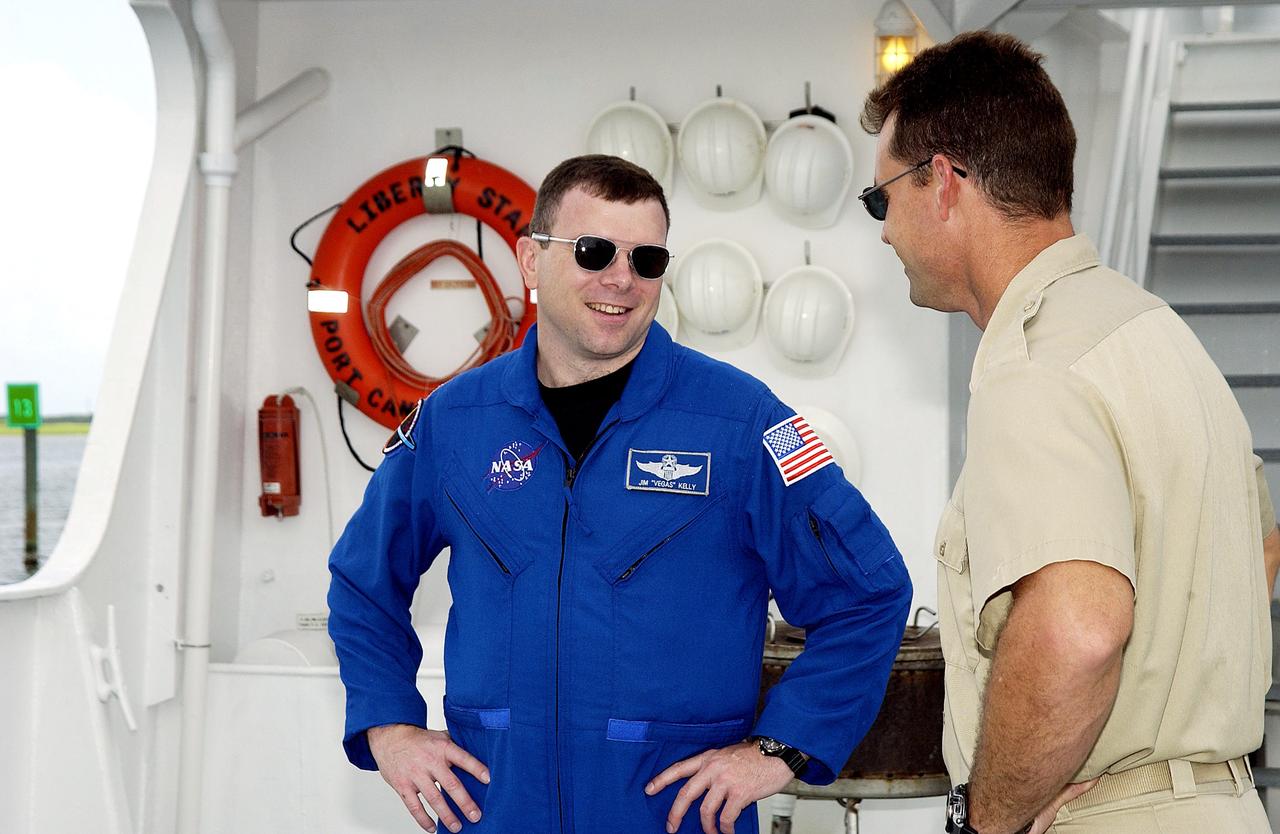
KENNEDY SPACE CENTER, FLA. -  STS-114 Pilot James Kelly talks with Bren Wade, captain of the Liberty Star, one of the SRB Retrieval Ships docked at Hangar AF on the Banana River.  Kelly and other crew members Commander Eileen Collins and Mission Specialists  Soichi Noguchi and Stephen Robinson toured the ships.  Noguchi is with the Japanese space agency NASDA.  Mission STS-114 will carry the MultiPurpose Logistics Module (MPLM) Raffaello and External Stowage Platform 2 to the International Space Station.  The MPLM will contain supplies and equipment.  Another goal of the mission is to remove and replace a Control Moment Gyro.  Launch date for mission STS-114 is under review.
KENNEDY SPACE CENTER, FLA. - STS-114 Pilot James Kelly talks with Bren Wade, captain of the Liberty Star, one of the SRB Retrieval Ships docked at Hangar AF on the Banana River. Kelly and other crew members Commander Eileen Collins and Mission Specialists Soichi Noguchi and Stephen Robinson toured the ships. Noguchi is with the Japanese space agency NASDA. Mission STS-114 will carry the MultiPurpose Logistics Module (MPLM) Raffaello and External Stowage Platform 2 to the International Space Station. The MPLM will contain supplies and equipment. Another goal of the mission is to remove and replace a Control Moment Gyro. Launch date for mission STS-114 is under review.
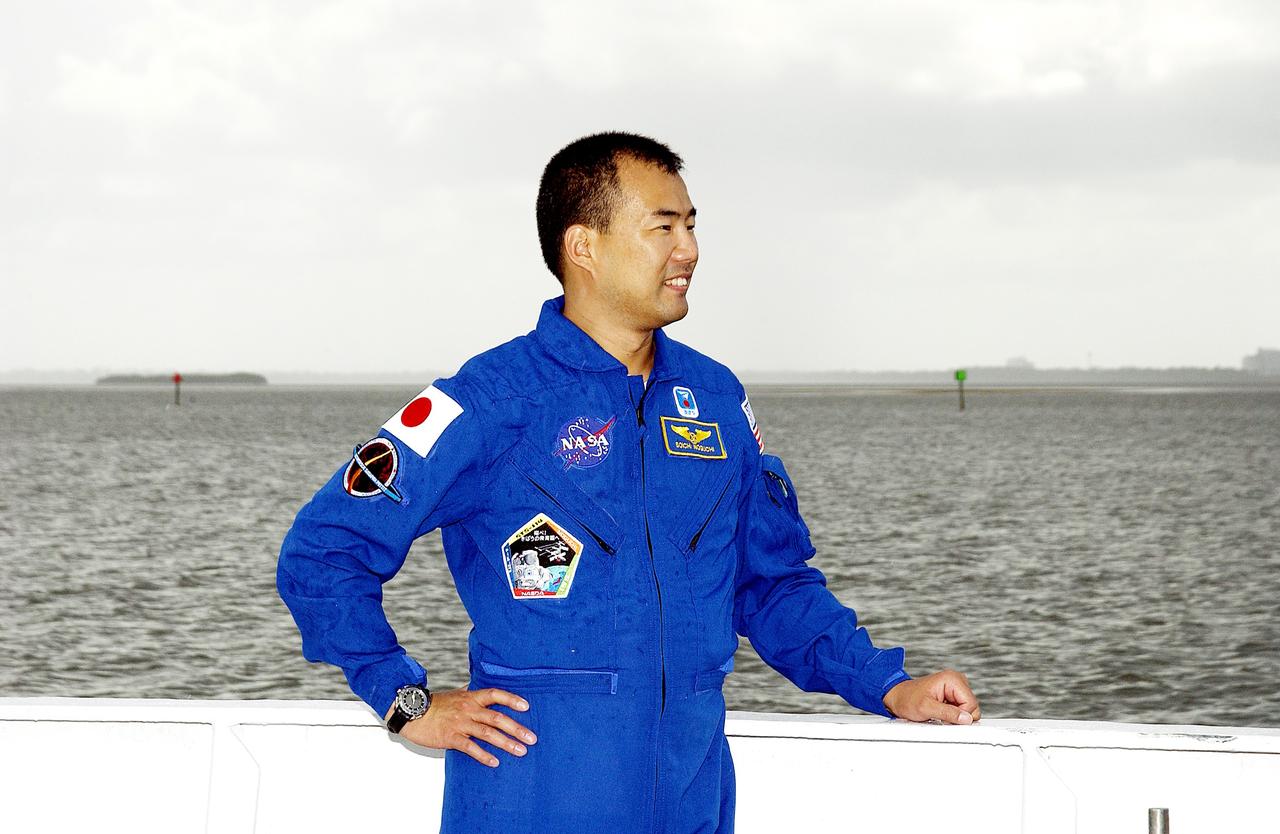
KENNEDY SPACE CENTER, FLA. -  STS-114 Mission Specialist Soichi Noguchi, who is with the Japanese space agency NASDA, poses on the deck of one of the SRB Retrieval Ships docked at Hangar AF on the Banana River.  He and other crew members Commander Eileen Collins, Pilot James Kelly and Mission Specialist Stephen Robinson toured the ships.  Mission STS-114 will carry the MultiPurpose Logistics Module (MPLM) Raffaello and External Stowage Platform 2 to the International Space Station.  The MPLM will contain supplies and equipment.  Another goal of the mission is to remove and replace a Control Moment Gyro.  Launch date for mission STS-114 is under review.
KENNEDY SPACE CENTER, FLA. - STS-114 Mission Specialist Soichi Noguchi, who is with the Japanese space agency NASDA, poses on the deck of one of the SRB Retrieval Ships docked at Hangar AF on the Banana River. He and other crew members Commander Eileen Collins, Pilot James Kelly and Mission Specialist Stephen Robinson toured the ships. Mission STS-114 will carry the MultiPurpose Logistics Module (MPLM) Raffaello and External Stowage Platform 2 to the International Space Station. The MPLM will contain supplies and equipment. Another goal of the mission is to remove and replace a Control Moment Gyro. Launch date for mission STS-114 is under review.
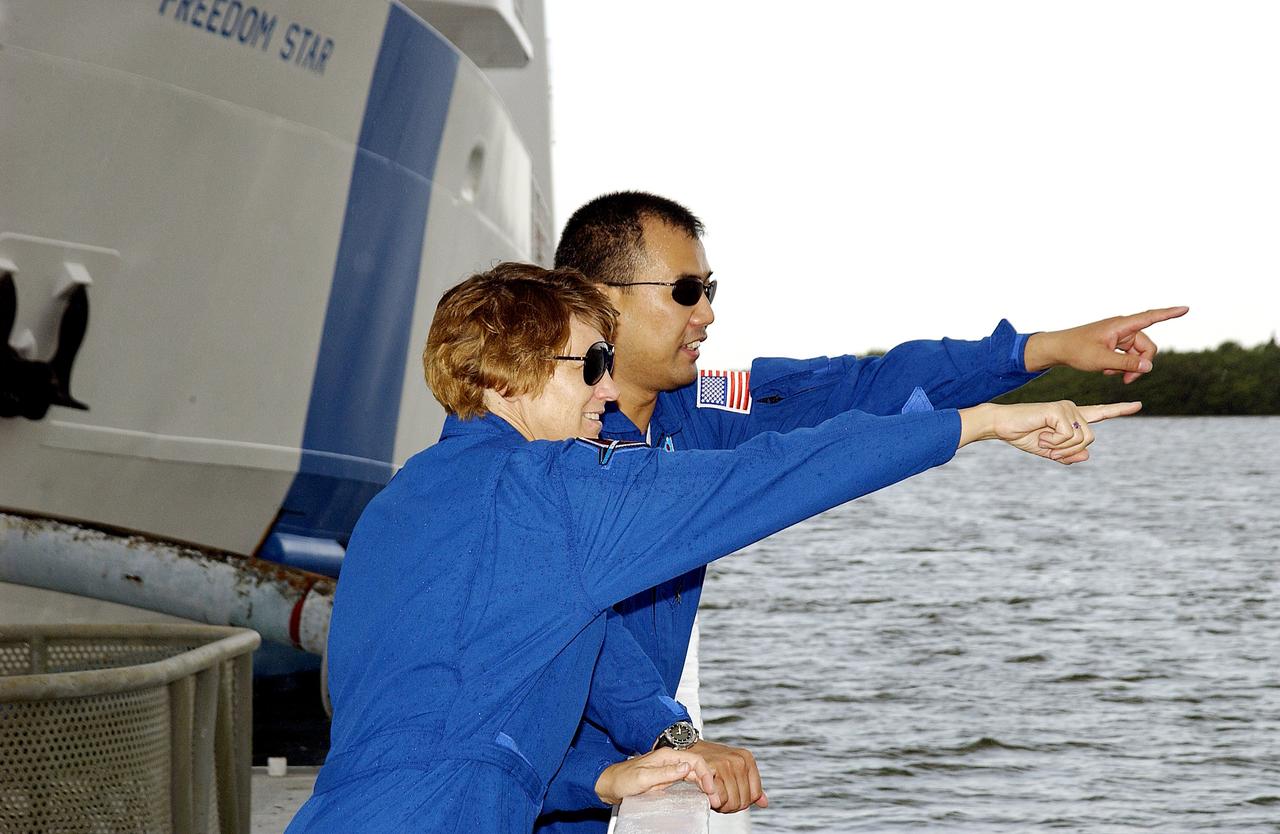
KENNEDY SPACE CENTER, FLA. -   While touring the SRB Retrieval Ship Freedom Star, STS-114 Commander Eileen Collins and Mission Specialist Soichi Noguchi point at something on the Banana River. Noguchi is with the Japanese space agency NASDA.  The ships routinely are docked at Hangar AF on the river.  On their mission, the crew - which also includes Pilot James Kelly and Mission Specialist Stephen Robinson - will carry the MultiPurpose Logistics Module (MPLM) Raffaello and External Stowage Platform 2 to the International Space Station.  The MPLM will contain supplies and equipment.  Another goal of the mission is to remove and replace a Control Moment Gyro.  Launch date for mission STS-114 is under review.
KENNEDY SPACE CENTER, FLA. - While touring the SRB Retrieval Ship Freedom Star, STS-114 Commander Eileen Collins and Mission Specialist Soichi Noguchi point at something on the Banana River. Noguchi is with the Japanese space agency NASDA. The ships routinely are docked at Hangar AF on the river. On their mission, the crew - which also includes Pilot James Kelly and Mission Specialist Stephen Robinson - will carry the MultiPurpose Logistics Module (MPLM) Raffaello and External Stowage Platform 2 to the International Space Station. The MPLM will contain supplies and equipment. Another goal of the mission is to remove and replace a Control Moment Gyro. Launch date for mission STS-114 is under review.
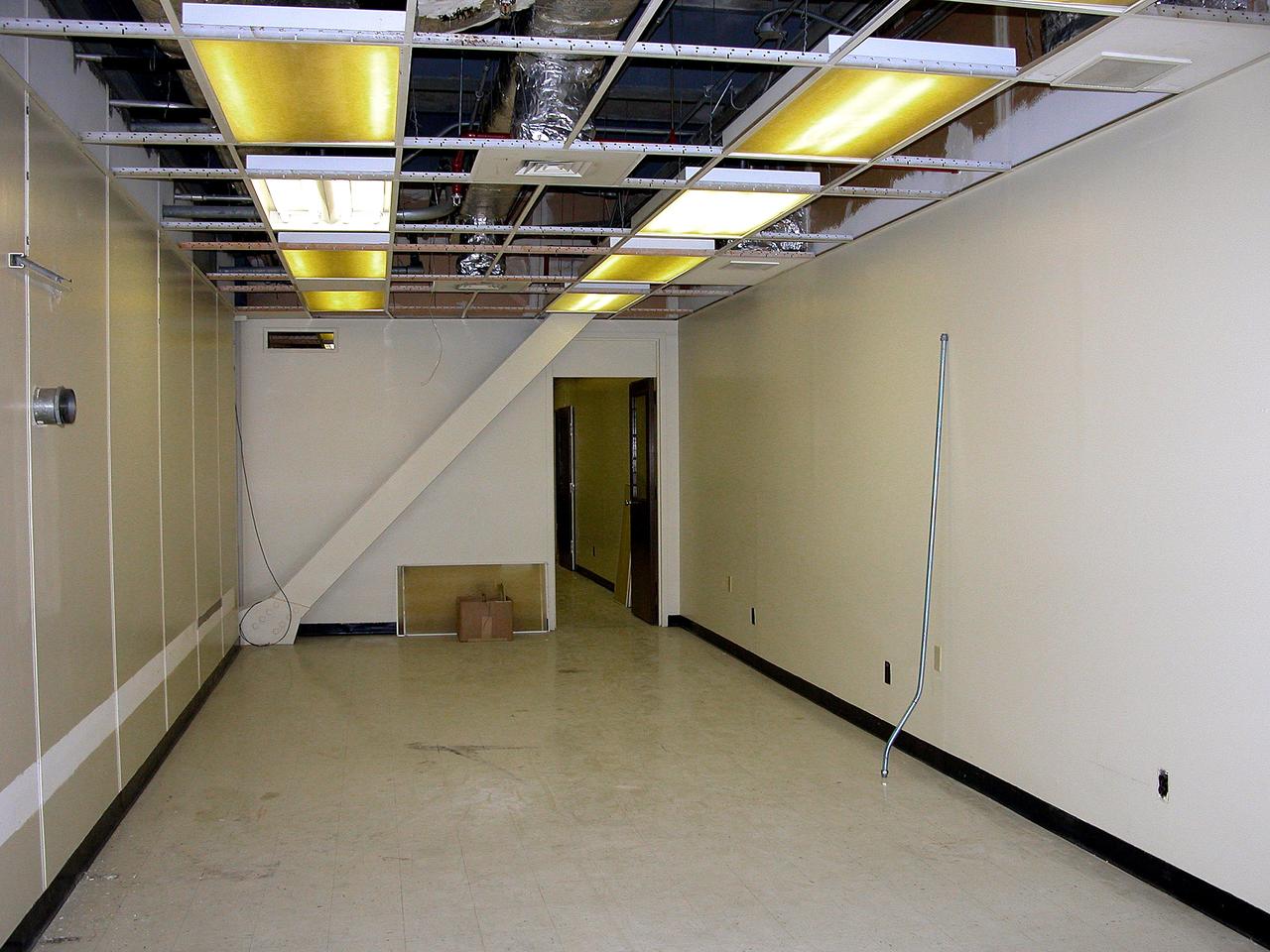
KENNEDY SPACE CENTER, FLA.  -  An area of the Vehicle Assembly Building is being prepared to store the debris collected from Space Shuttle Columbia.  About 83,000 pieces were shipped to KSC during search and recovery efforts in East Texas.
KENNEDY SPACE CENTER, FLA. - An area of the Vehicle Assembly Building is being prepared to store the debris collected from Space Shuttle Columbia. About 83,000 pieces were shipped to KSC during search and recovery efforts in East Texas.
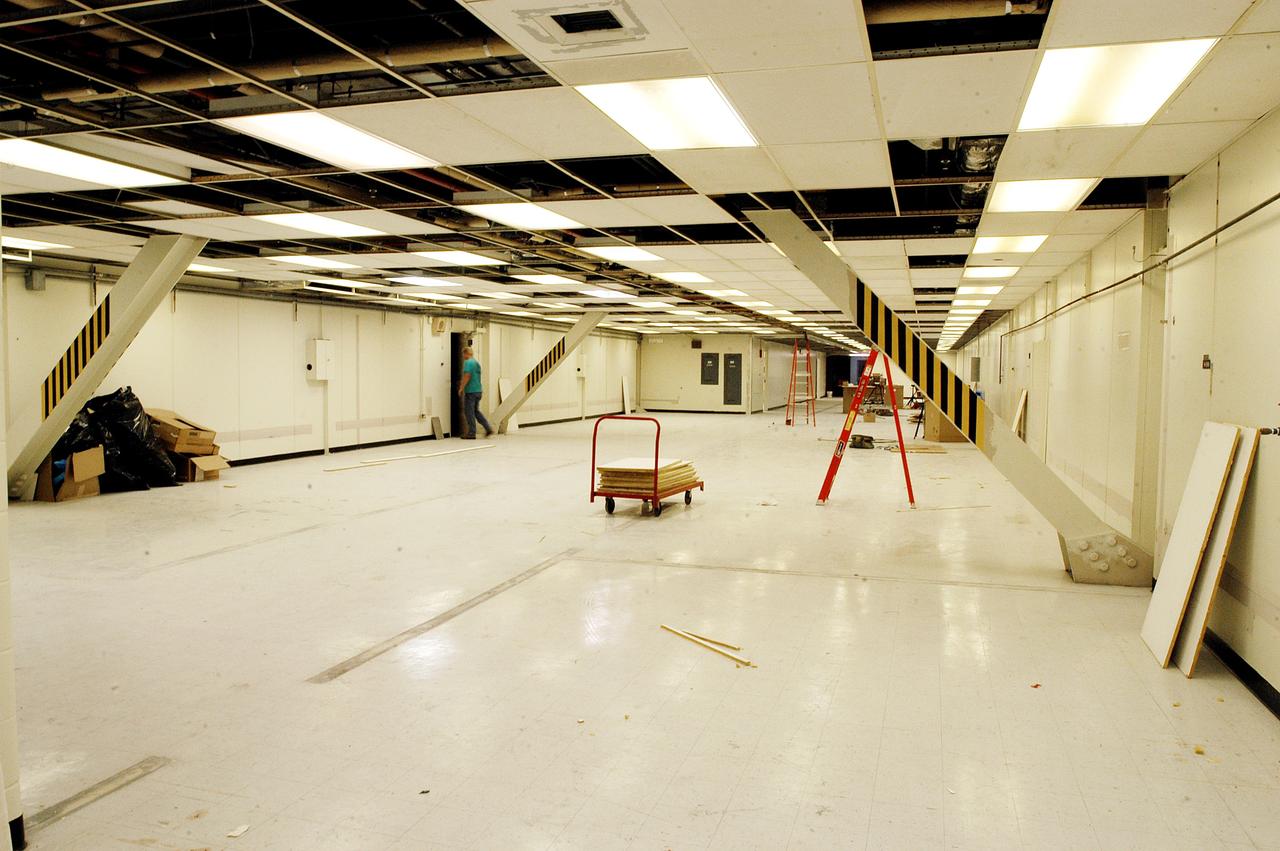
KENNEDY SPACE CENTER, FLA.  -  An area of the Vehicle Assembly Building is being prepared to store the debris collected from Space Shuttle Columbia.  About 83,000 pieces were shipped to KSC during search and recovery efforts in East Texas.
KENNEDY SPACE CENTER, FLA. - An area of the Vehicle Assembly Building is being prepared to store the debris collected from Space Shuttle Columbia. About 83,000 pieces were shipped to KSC during search and recovery efforts in East Texas.
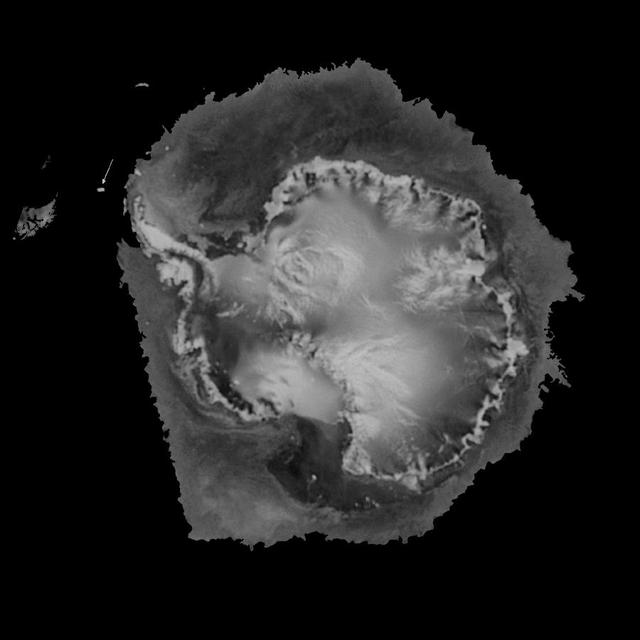
NASA QuikScat satellite instrument kept an eye on an iceberg the size of Rhode Island, the first time this space technology had been used to track a potential threat to international shipping.
SeaWinds Watches for Breakup of Giant Iceberg
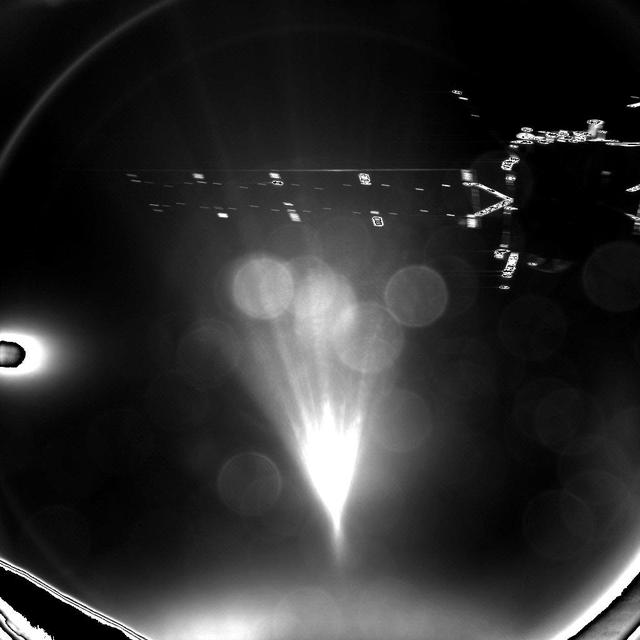
The Philae lander of the European Space Agency Rosetta mission took this parting shot of its mother ship, Rosetta, shortly after separation on Nov. 12, 2014. The image was taken with the lander CIVA-P imaging system.
Farewell Shot of Rosetta by Philae Lander
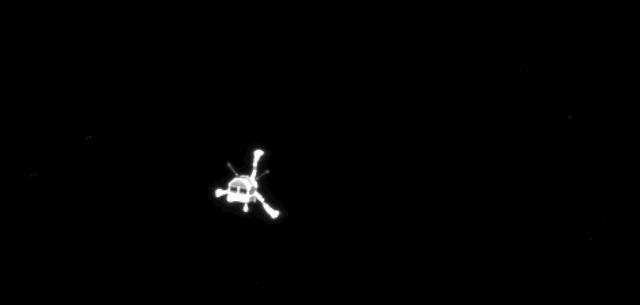
The Onboard Scientific Imaging System OSIRIS on the European Space Agency Rosetta spacecraft captured this parting shot of the mission Philae lander after its separation from the mother ship on Nov. 12, 2014.
Farewell, Philae
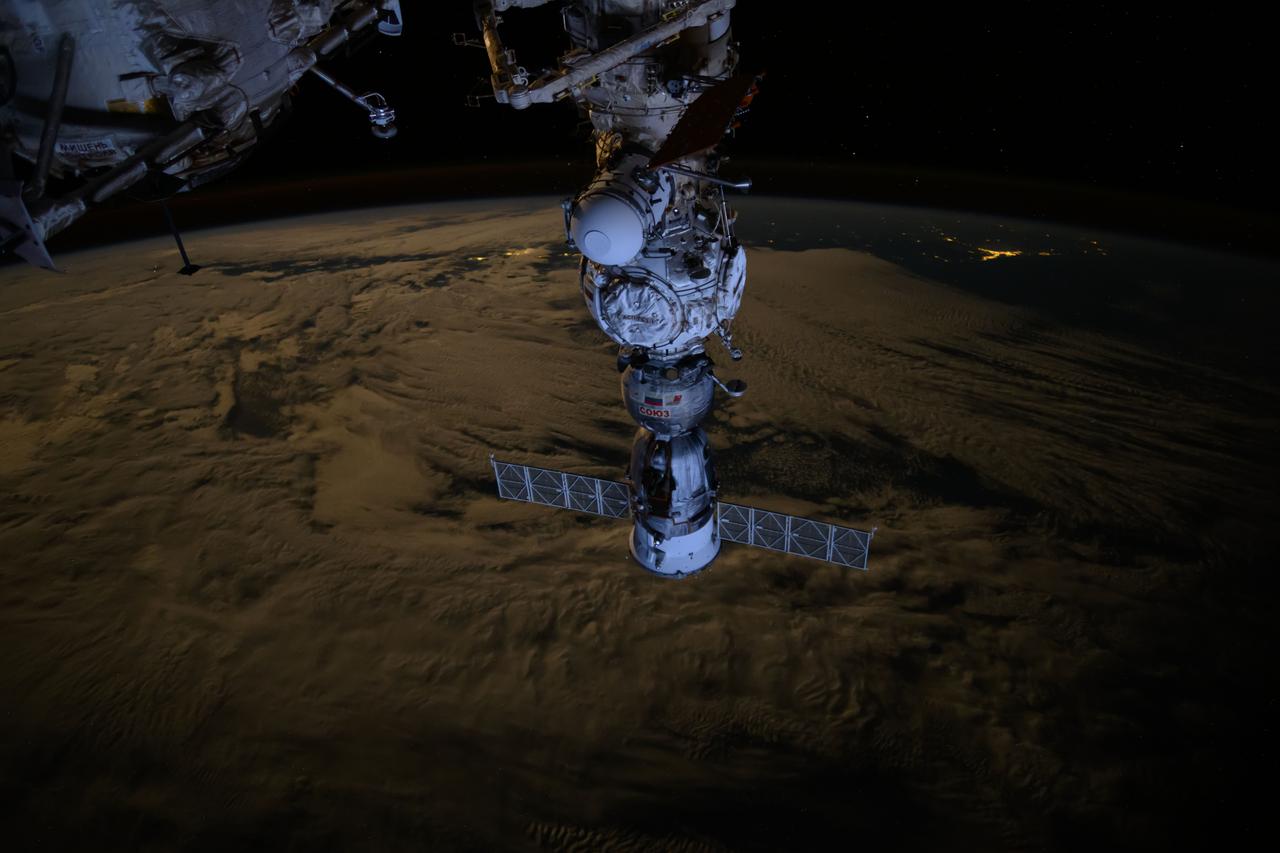
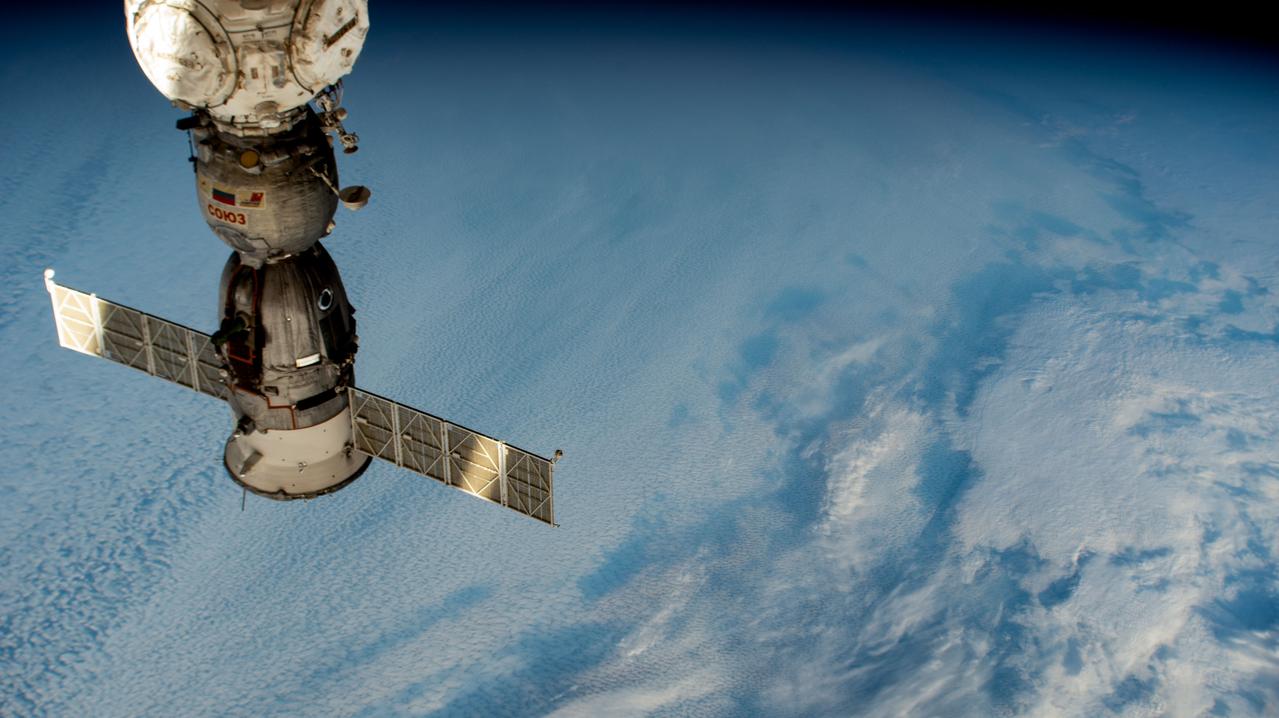
iss071e365226 (July 19, 2024) --- The Soyuz MS-25 crew ship is picture docked to the Prichal docking module as the International Space Station orbited 271 miles above the Tasman Sea off the coast of New Zealand.
The Soyuz MS-25 crew ship docked to the Prichal docking module
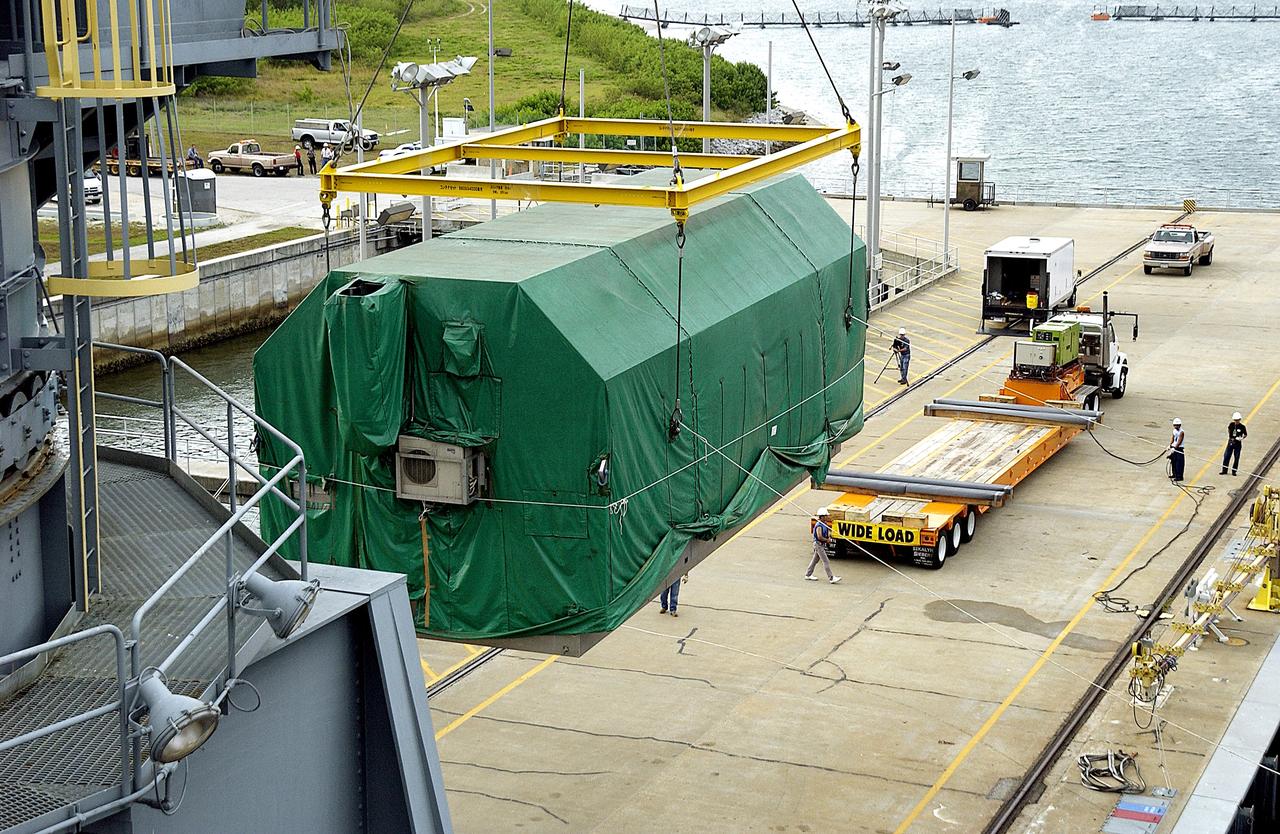
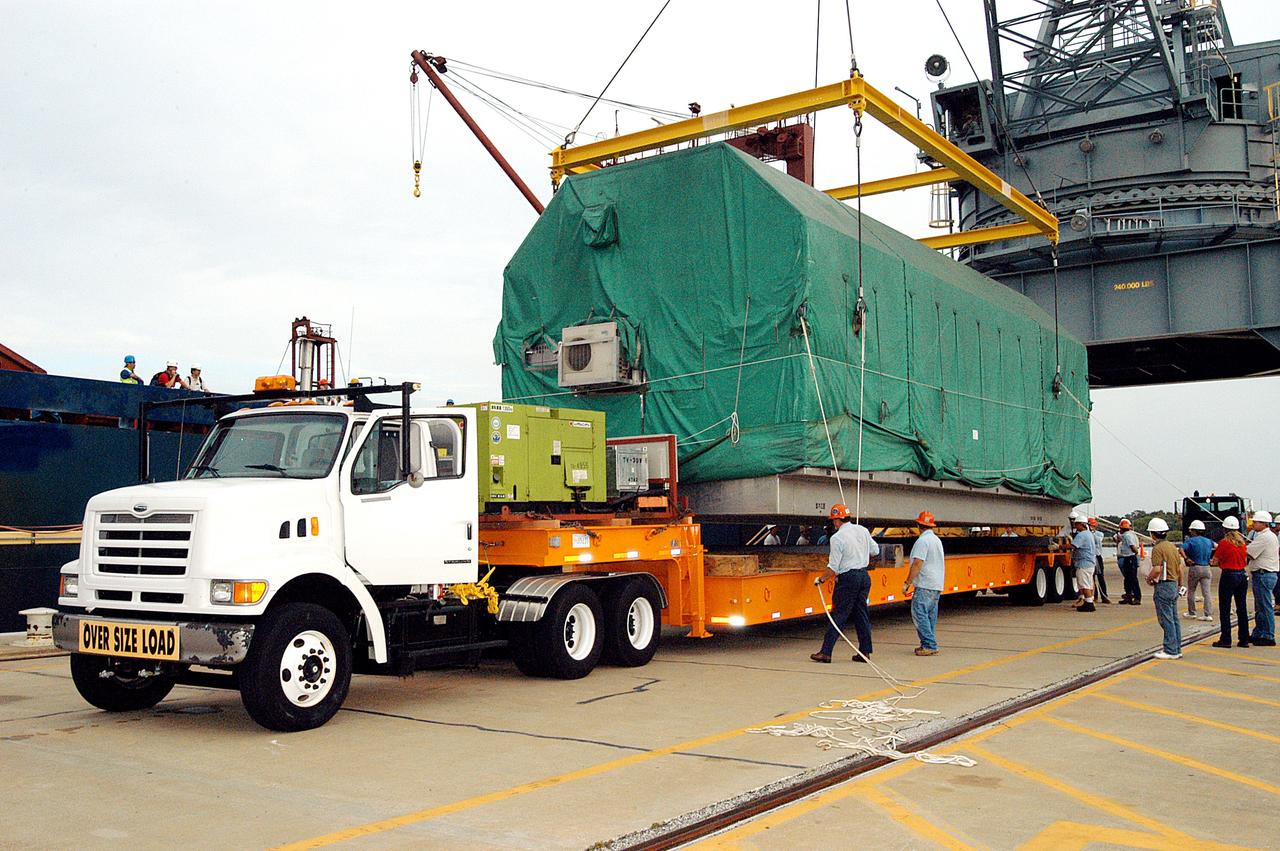
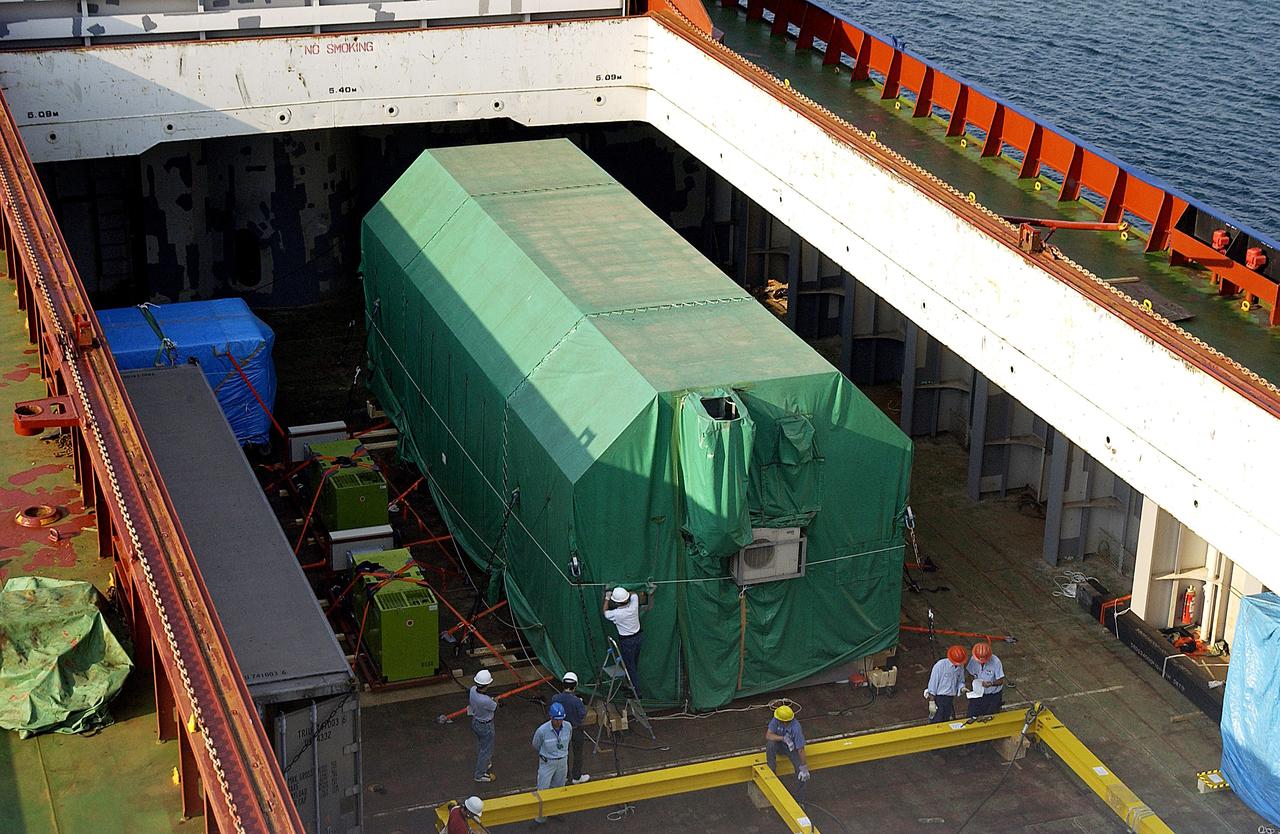
KENNEDY SPACE CENTER, FLA. - At Port Canaveral, workers release the overhead crane that lifted the Pressurized Module of the Japanese Experiment Module (JEM) from the ship onto the truck bed.  The container transport ship carrying JEM departed May 2 from Yokohama Harbor in Japan for the voyage to the United States. The National Space Development Agency of Japan (NASDA) developed the laboratory at the Tsukuba Space Center near Tokyo. The Pressurized Module is the first element of the JEM, named "Kibo" (Hope), to be delivered to KSC, and will be transferred to KSC’s Space Station Processing Facility.  The JEM is Japan's primary contribution to the Station. It will enhance the unique research capabilities of the orbiting complex by providing an additional environment for astronauts to conduct science experiments.  The JEM also includes an exposed facility (platform) for space environment experiments, a robotic manipulator system, and two logistics modules. The various JEM components will be  assembled in space over the course of three Shuttle missions.
KENNEDY SPACE CENTER, FLA. - At Port Canaveral, workers release the overhead crane that lifted the Pressurized Module of the Japanese Experiment Module (JEM) from the ship onto the truck bed. The container transport ship carrying JEM departed May 2 from Yokohama Harbor in Japan for the voyage to the United States. The National Space Development Agency of Japan (NASDA) developed the laboratory at the Tsukuba Space Center near Tokyo. The Pressurized Module is the first element of the JEM, named "Kibo" (Hope), to be delivered to KSC, and will be transferred to KSC’s Space Station Processing Facility. The JEM is Japan's primary contribution to the Station. It will enhance the unique research capabilities of the orbiting complex by providing an additional environment for astronauts to conduct science experiments. The JEM also includes an exposed facility (platform) for space environment experiments, a robotic manipulator system, and two logistics modules. The various JEM components will be assembled in space over the course of three Shuttle missions.
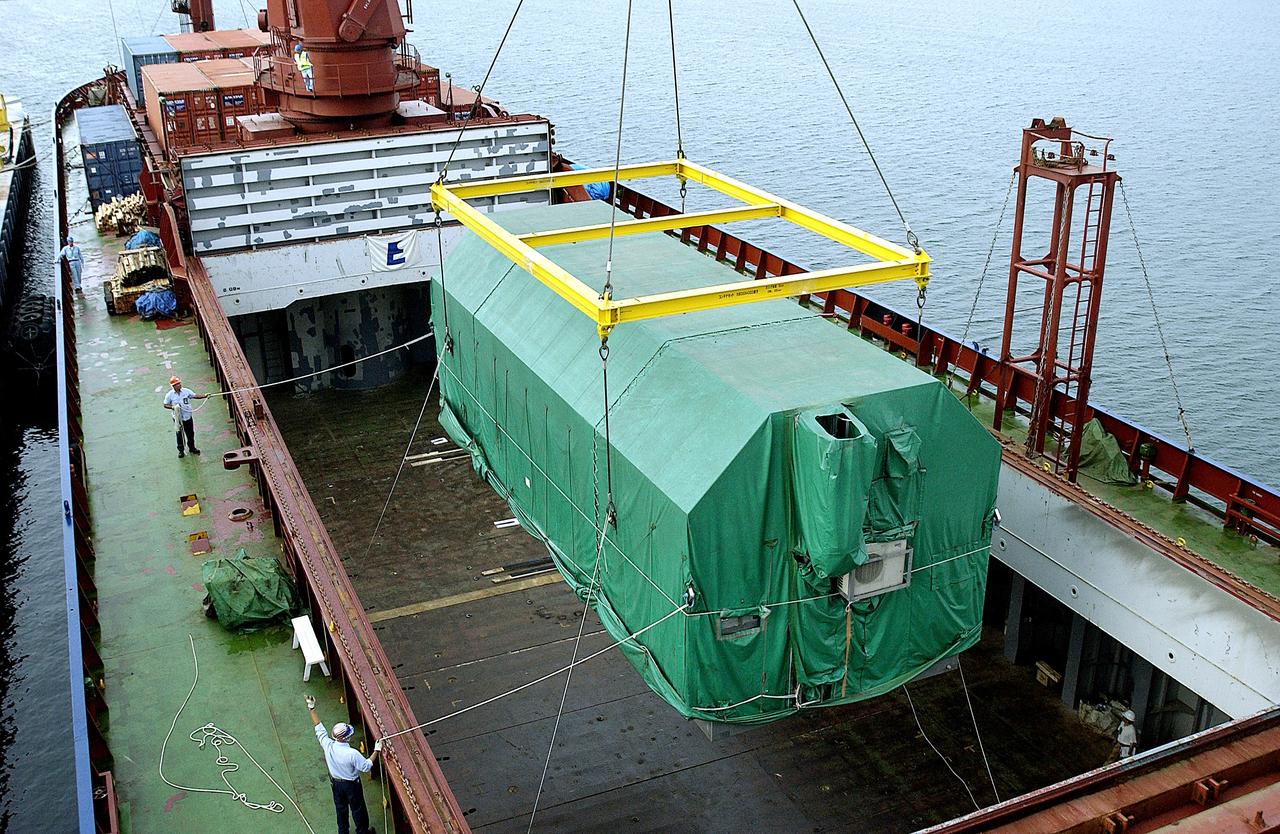
KENNEDY SPACE CENTER, FLA. - At Port Canaveral, the Pressurized Module of the Japanese Experiment Module (JEM) is lifted out of the ship’s cargo hold.  It will be loaded onto the truck bed in the background for transfer to KSC’s Space Station Processing Facility.  The container transport ship carrying JEM departed May 2 from Yokohama Harbor in Japan for the voyage to the United States. The National Space Development Agency of Japan (NASDA) developed the laboratory at the Tsukuba Space Center near Tokyo. The Pressurized Module is the first element of the JEM, named "Kibo" (Hope), to be delivered to KSC. The JEM is Japan's primary contribution to the Station. It will enhance the unique research capabilities of the orbiting complex by providing an additional environment for astronauts to conduct science experiments.  The JEM also includes an exposed facility (platform) for space environment experiments, a robotic manipulator system, and two logistics modules. The various JEM components will be  assembled in space over the course of three Shuttle missions.
KENNEDY SPACE CENTER, FLA. - At Port Canaveral, the Pressurized Module of the Japanese Experiment Module (JEM) is lifted out of the ship’s cargo hold. It will be loaded onto the truck bed in the background for transfer to KSC’s Space Station Processing Facility. The container transport ship carrying JEM departed May 2 from Yokohama Harbor in Japan for the voyage to the United States. The National Space Development Agency of Japan (NASDA) developed the laboratory at the Tsukuba Space Center near Tokyo. The Pressurized Module is the first element of the JEM, named "Kibo" (Hope), to be delivered to KSC. The JEM is Japan's primary contribution to the Station. It will enhance the unique research capabilities of the orbiting complex by providing an additional environment for astronauts to conduct science experiments. The JEM also includes an exposed facility (platform) for space environment experiments, a robotic manipulator system, and two logistics modules. The various JEM components will be assembled in space over the course of three Shuttle missions.
KENNEDY SPACE CENTER, FLA. - At Port Canaveral, the overhead crane that lifted the Pressurized Module of the Japanese Experiment Module (JEM) from the ship onto the truck bed is released.  The container transport ship carrying JEM departed May 2 from Yokohama Harbor in Japan for the voyage to the United States. The National Space Development Agency of Japan (NASDA) developed the laboratory at the Tsukuba Space Center near Tokyo. The Pressurized Module is the first element of the JEM, named "Kibo" (Hope), to be delivered to KSC, and will be transferred to KSC’s Space Station Processing Facility.  The JEM is Japan's primary contribution to the Station. It will enhance the unique research capabilities of the orbiting complex by providing an additional environment for astronauts to conduct science experiments.  The JEM also includes an exposed facility (platform) for space environment experiments, a robotic manipulator system, and two logistics modules. The various JEM components will be  assembled in space over the course of three Shuttle missions.
KENNEDY SPACE CENTER, FLA. - At Port Canaveral, the overhead crane that lifted the Pressurized Module of the Japanese Experiment Module (JEM) from the ship onto the truck bed is released. The container transport ship carrying JEM departed May 2 from Yokohama Harbor in Japan for the voyage to the United States. The National Space Development Agency of Japan (NASDA) developed the laboratory at the Tsukuba Space Center near Tokyo. The Pressurized Module is the first element of the JEM, named "Kibo" (Hope), to be delivered to KSC, and will be transferred to KSC’s Space Station Processing Facility. The JEM is Japan's primary contribution to the Station. It will enhance the unique research capabilities of the orbiting complex by providing an additional environment for astronauts to conduct science experiments. The JEM also includes an exposed facility (platform) for space environment experiments, a robotic manipulator system, and two logistics modules. The various JEM components will be assembled in space over the course of three Shuttle missions.
KENNEDY SPACE CENTER, FLA. - At Port Canaveral, the Pressurized Module of the Japanese Experiment Module (JEM) is swung away from the ship. The container transport ship carrying JEM departed May 2 from Yokohama Harbor in Japan for the voyage to the United States. The National Space Development Agency of Japan (NASDA) developed the laboratory at the Tsukuba Space Center near Tokyo.  The module will be loaded onto a truck bed and transferred to KSC’s Space Station Processing Facility.  The Pressurized Module is the first element of the JEM, named "Kibo" (Hope), to be delivered to KSC. The JEM is Japan's primary contribution to the Station. It will enhance the unique research capabilities of the orbiting complex by providing an additional environment for astronauts to conduct science experiments.  The JEM also includes an exposed facility (platform) for space environment experiments, a robotic manipulator system, and two logistics modules. The various JEM components will be  assembled in space over the course of three Shuttle missions.
KENNEDY SPACE CENTER, FLA. - At Port Canaveral, the Pressurized Module of the Japanese Experiment Module (JEM) is swung away from the ship. The container transport ship carrying JEM departed May 2 from Yokohama Harbor in Japan for the voyage to the United States. The National Space Development Agency of Japan (NASDA) developed the laboratory at the Tsukuba Space Center near Tokyo. The module will be loaded onto a truck bed and transferred to KSC’s Space Station Processing Facility. The Pressurized Module is the first element of the JEM, named "Kibo" (Hope), to be delivered to KSC. The JEM is Japan's primary contribution to the Station. It will enhance the unique research capabilities of the orbiting complex by providing an additional environment for astronauts to conduct science experiments. The JEM also includes an exposed facility (platform) for space environment experiments, a robotic manipulator system, and two logistics modules. The various JEM components will be assembled in space over the course of three Shuttle missions.
KENNEDY SPACE CENTER, FLA. - At Port Canaveral, the Pressurized Module of the Japanese Experiment Module (JEM) is lifted out of the ship’s cargo hold.  The container transport ship carrying JEM departed May 2 from Yokohama Harbor in Japan for the voyage to the United States. The National Space Development Agency of Japan (NASDA) developed the laboratory at the Tsukuba Space Center near Tokyo. The Pressurized Module is the first element of the JEM, named "Kibo" (Hope), to be delivered to KSC. The JEM is Japan's primary contribution to the Station. It will enhance the unique research capabilities of the orbiting complex by providing an additional environment for astronauts to conduct science experiments.  The JEM also includes an exposed facility (platform) for space environment experiments, a robotic manipulator system, and two logistics modules. The various JEM components will be  assembled in space over the course of three Shuttle missions.
KENNEDY SPACE CENTER, FLA. - At Port Canaveral, the Pressurized Module of the Japanese Experiment Module (JEM) is lifted out of the ship’s cargo hold. The container transport ship carrying JEM departed May 2 from Yokohama Harbor in Japan for the voyage to the United States. The National Space Development Agency of Japan (NASDA) developed the laboratory at the Tsukuba Space Center near Tokyo. The Pressurized Module is the first element of the JEM, named "Kibo" (Hope), to be delivered to KSC. The JEM is Japan's primary contribution to the Station. It will enhance the unique research capabilities of the orbiting complex by providing an additional environment for astronauts to conduct science experiments. The JEM also includes an exposed facility (platform) for space environment experiments, a robotic manipulator system, and two logistics modules. The various JEM components will be assembled in space over the course of three Shuttle missions.
iss071e364343 (July 18, 2024) --- The Soyuz MS-25 crew ship is pictured docked to the International Space Station's Prichal docking module, where it has remained since March 25, 2024, as it soared 274 miles above a cloudy Indian Ocean.
The Soyuz MS-25 crew ship docked to the Prichal docking module
iss071e365604 (July 19, 2024) --- The Soyuz MS-25 crew ship is picture docked to the Prichal docking module as the International Space Station orbited 271 miles above the Bass Strait in between Australia's mainland province of Victoria and its island province of Tasmania.
The Soyuz MS-25 crew ship docked to the Prichal docking module
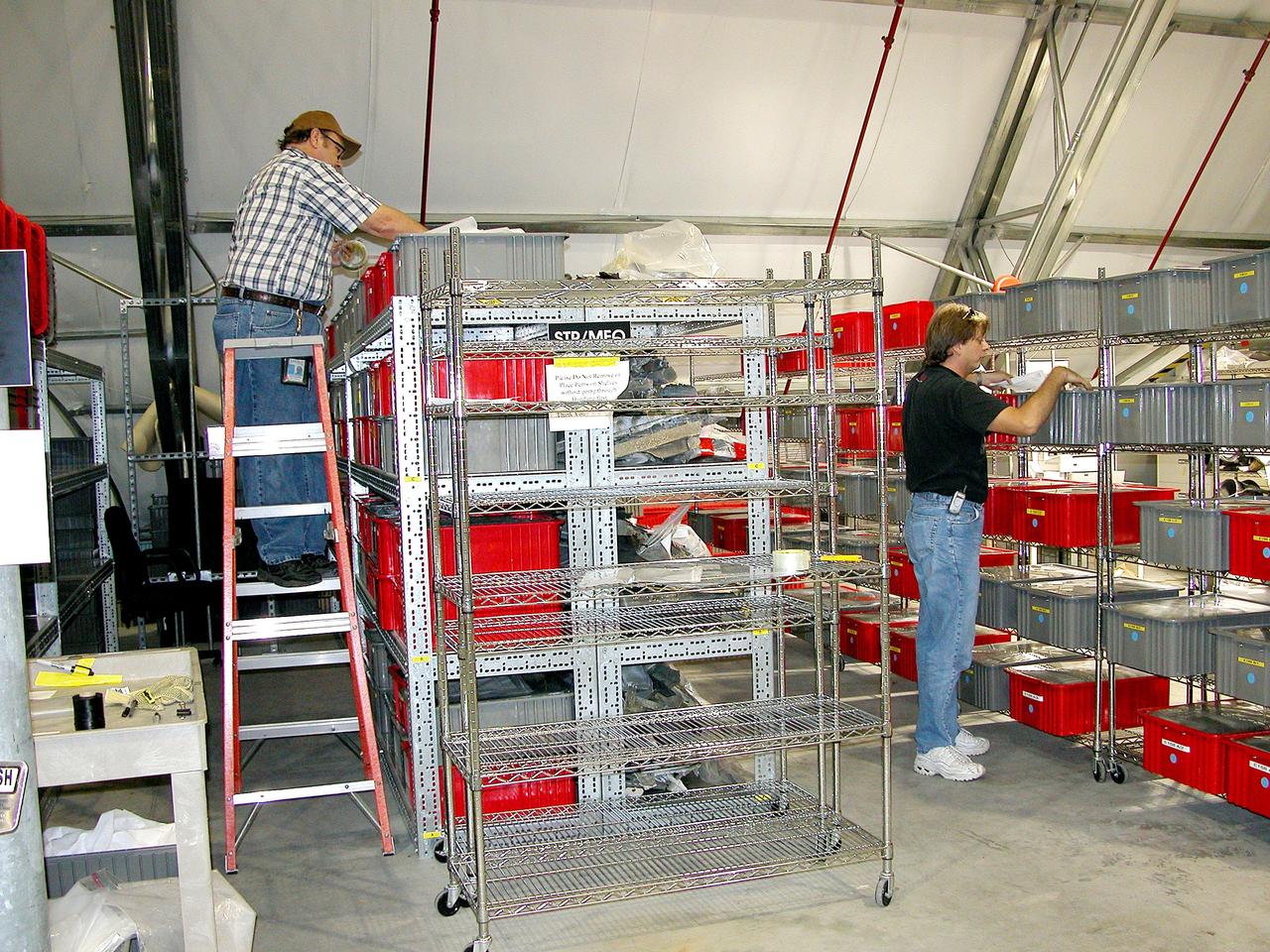
KENNEDY SPACE CENTER, FLA.  - Workers in the Columbia Debris Hangar  pull items from storage containers to transfer  to storage in the Vehicle Assembly Building.   About 83,000 pieces were shipped to KSC during search and recovery efforts in East Texas.
KENNEDY SPACE CENTER, FLA. - Workers in the Columbia Debris Hangar pull items from storage containers to transfer to storage in the Vehicle Assembly Building. About 83,000 pieces were shipped to KSC during search and recovery efforts in East Texas.
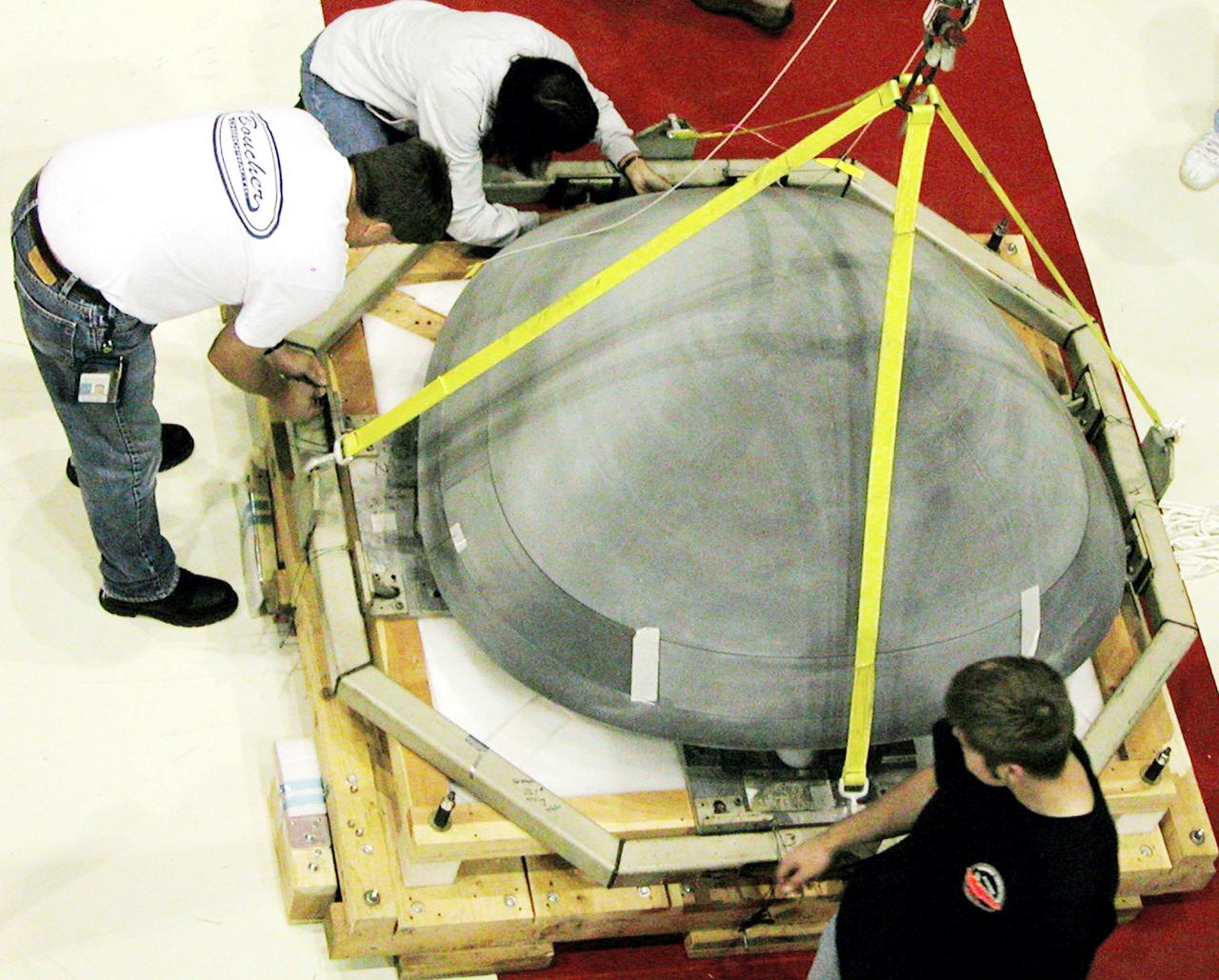
KENNEDY SPACE CENTER, FLA. -  In the Orbiter Processing Facility, the nose cap from Atlantis is secured on a shipping pallet.  The reinforced carbon-carbon (RCC) nose cap is being sent to the original manufacturing company, Vought in Ft. Worth, Texas, a subsidiary of Lockheed Martin, to undergo non-destructive testing such as CAT scan and thermography.
KENNEDY SPACE CENTER, FLA. - In the Orbiter Processing Facility, the nose cap from Atlantis is secured on a shipping pallet. The reinforced carbon-carbon (RCC) nose cap is being sent to the original manufacturing company, Vought in Ft. Worth, Texas, a subsidiary of Lockheed Martin, to undergo non-destructive testing such as CAT scan and thermography.
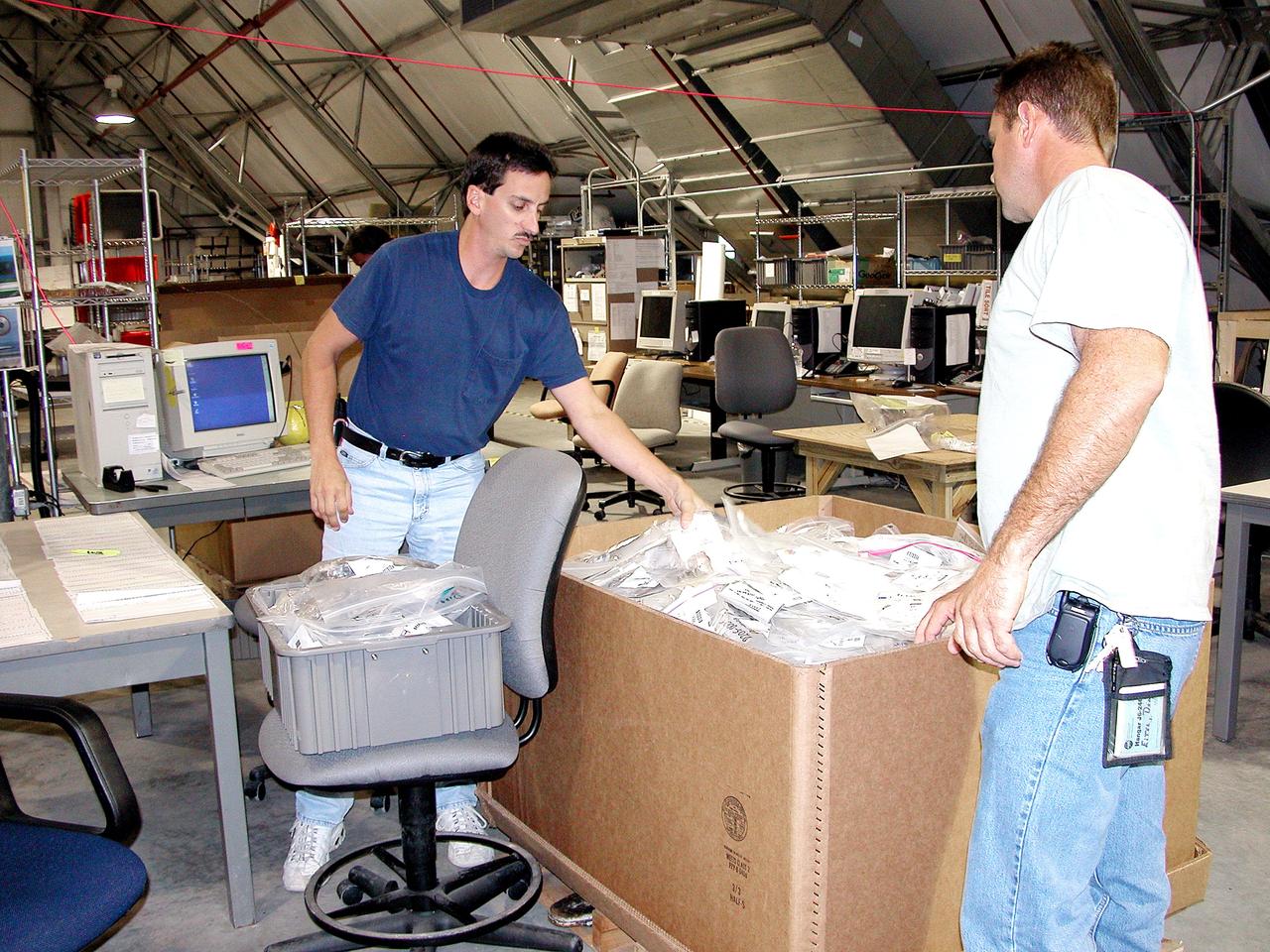
KENNEDY SPACE CENTER, FLA.  -  A worker in the Columbia Debris Hangar sorts bagged items of Columbia debris that will be transferred to storage in the Vehicle Assembly Building.  About 83,000 pieces were shipped to KSC during search and recovery efforts in East Texas.
KENNEDY SPACE CENTER, FLA. - A worker in the Columbia Debris Hangar sorts bagged items of Columbia debris that will be transferred to storage in the Vehicle Assembly Building. About 83,000 pieces were shipped to KSC during search and recovery efforts in East Texas.
KENNEDY SPACE CENTER, FLA.  -  Workers in the Columbia Debris Hangar move some of the STS-107 debris into boxes for transfer to storage in the Vehicle Assembly Building.   About 83,000 pieces were shipped to KSC during search and recovery efforts in East Texas.
KENNEDY SPACE CENTER, FLA. - Workers in the Columbia Debris Hangar move some of the STS-107 debris into boxes for transfer to storage in the Vehicle Assembly Building. About 83,000 pieces were shipped to KSC during search and recovery efforts in East Texas.
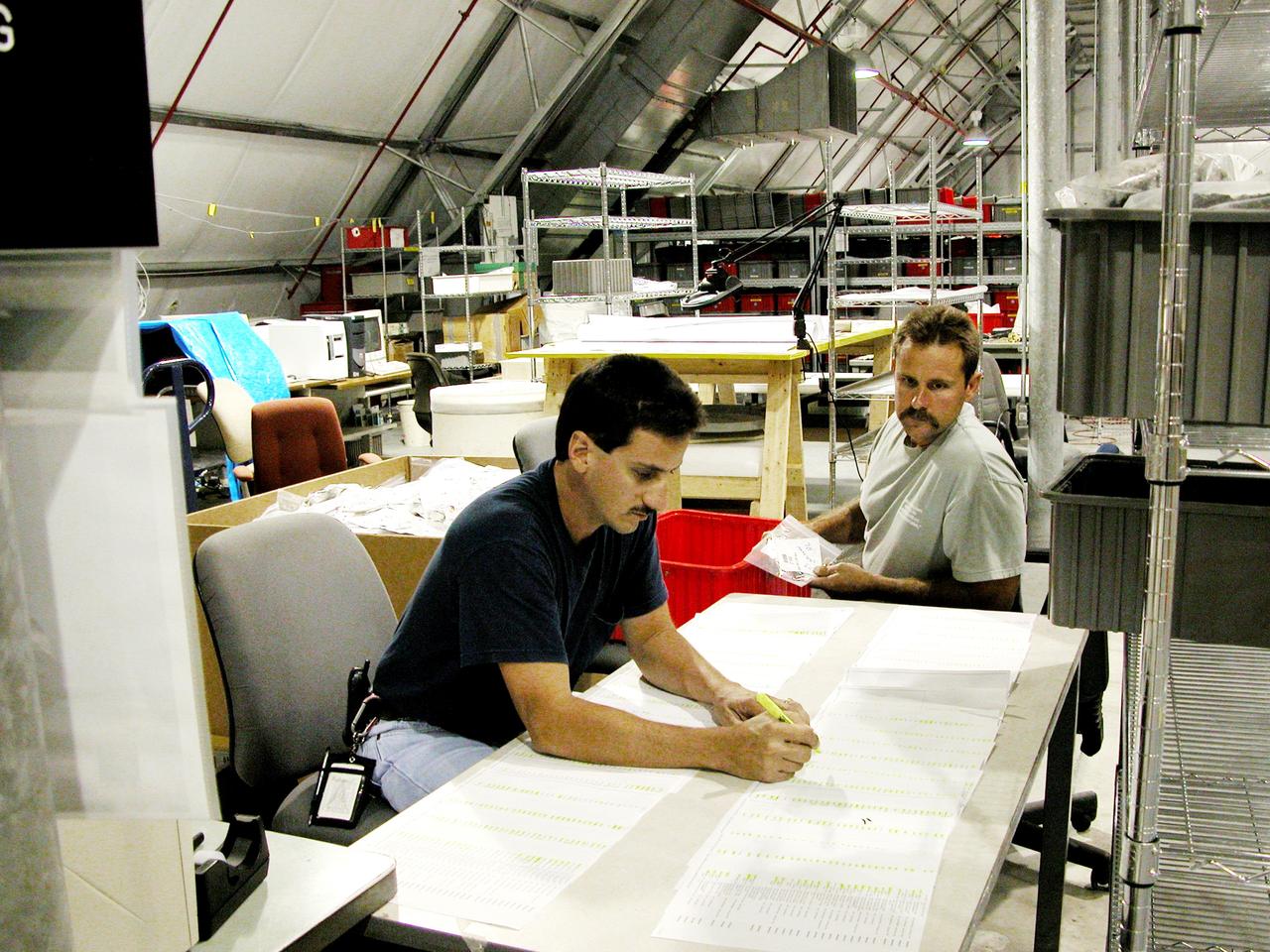
KENNEDY SPACE CENTER, FLA.  -  Workers in the Columbia Debris Hangar record the first items of the STS-107 debris to be transferred to storage in the Vehicle Assembly Building.   About 83,000 pieces were shipped to KSC during search and recovery efforts in East Texas.
KENNEDY SPACE CENTER, FLA. - Workers in the Columbia Debris Hangar record the first items of the STS-107 debris to be transferred to storage in the Vehicle Assembly Building. About 83,000 pieces were shipped to KSC during search and recovery efforts in East Texas.
KENNEDY SPACE CENTER, FLA. -   In the Columbia Debris Hangar, Jack Nowling moves a box filled with part of the Columbia debris.  About 83,000 pieces were shipped to KSC during search and recovery efforts in East Texas. An area of the Vehicle Assembly Building is being prepared to store the debris.
KENNEDY SPACE CENTER, FLA. - In the Columbia Debris Hangar, Jack Nowling moves a box filled with part of the Columbia debris. About 83,000 pieces were shipped to KSC during search and recovery efforts in East Texas. An area of the Vehicle Assembly Building is being prepared to store the debris.
KENNEDY SPACE CENTER, FLA. -  In the Orbiter Processing Facility, the nose cap from Atlantis is lowered toward a shipping pallet.  The reinforced carbon-carbon (RCC) nose cap is being sent to the original manufacturing company, Vought in Ft. Worth, Texas, a subsidiary of Lockheed Martin, to undergo non-destructive testing such as CAT scan and thermography.
KENNEDY SPACE CENTER, FLA. - In the Orbiter Processing Facility, the nose cap from Atlantis is lowered toward a shipping pallet. The reinforced carbon-carbon (RCC) nose cap is being sent to the original manufacturing company, Vought in Ft. Worth, Texas, a subsidiary of Lockheed Martin, to undergo non-destructive testing such as CAT scan and thermography.
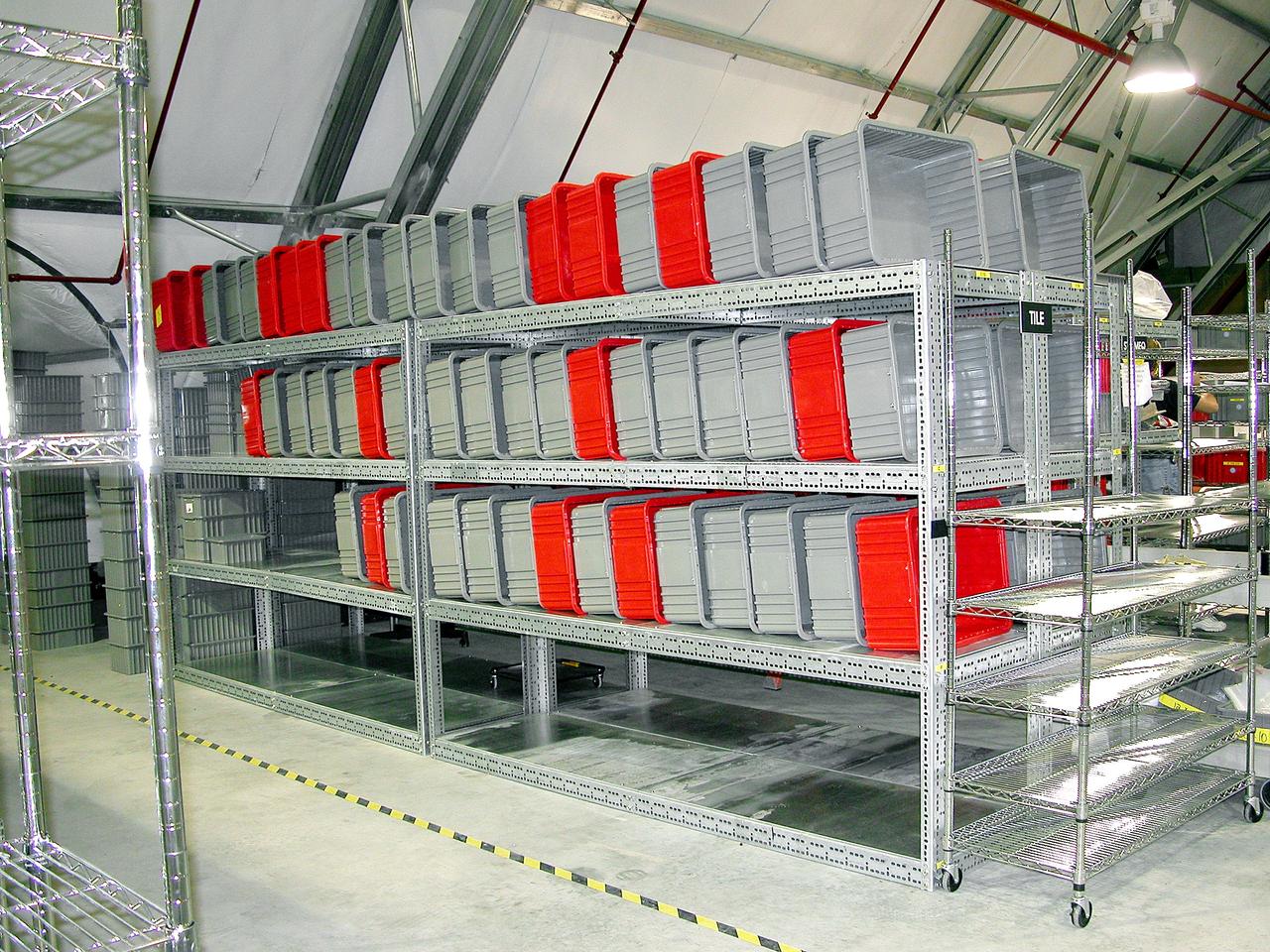
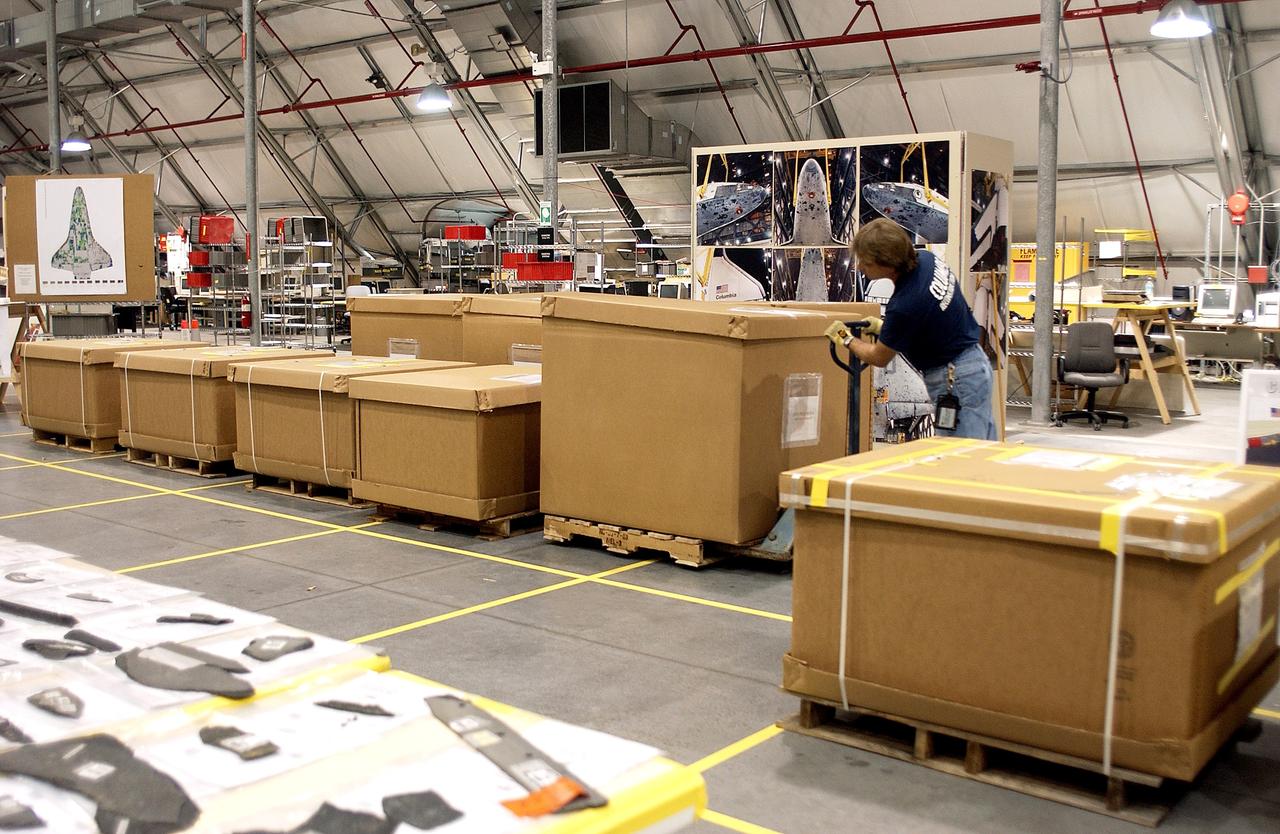
KENNEDY SPACE CENTER, FLA.  -  Containers in the Columbia Debris Hangar are lined up after being emptied of the Columbia debris.  The debris is being transferred to storage in the Vehicle Assembly Building.  About 83,000 pieces were shipped to KSC during search and recovery efforts in East Texas.
KENNEDY SPACE CENTER, FLA. - Containers in the Columbia Debris Hangar are lined up after being emptied of the Columbia debris. The debris is being transferred to storage in the Vehicle Assembly Building. About 83,000 pieces were shipped to KSC during search and recovery efforts in East Texas.
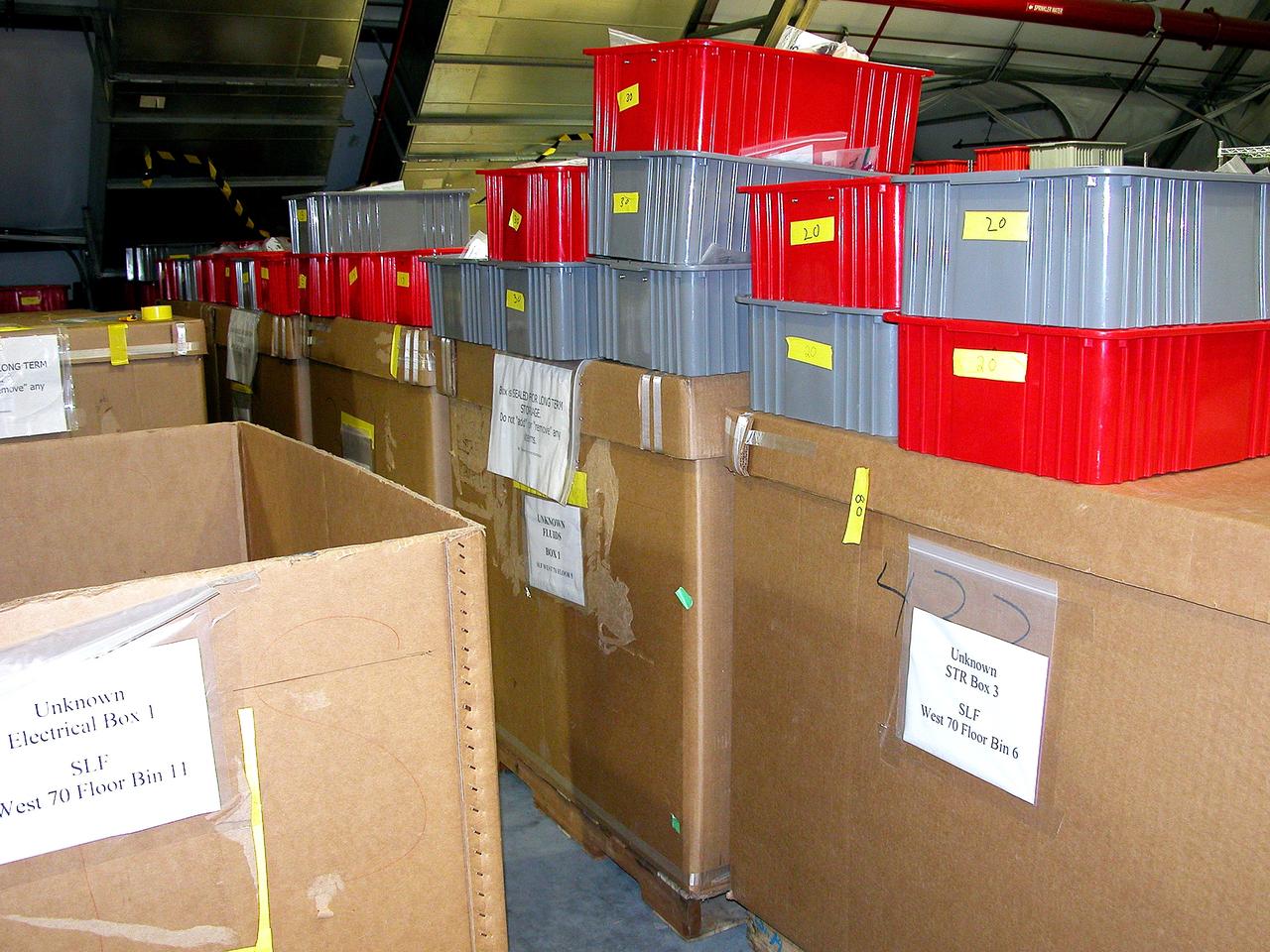
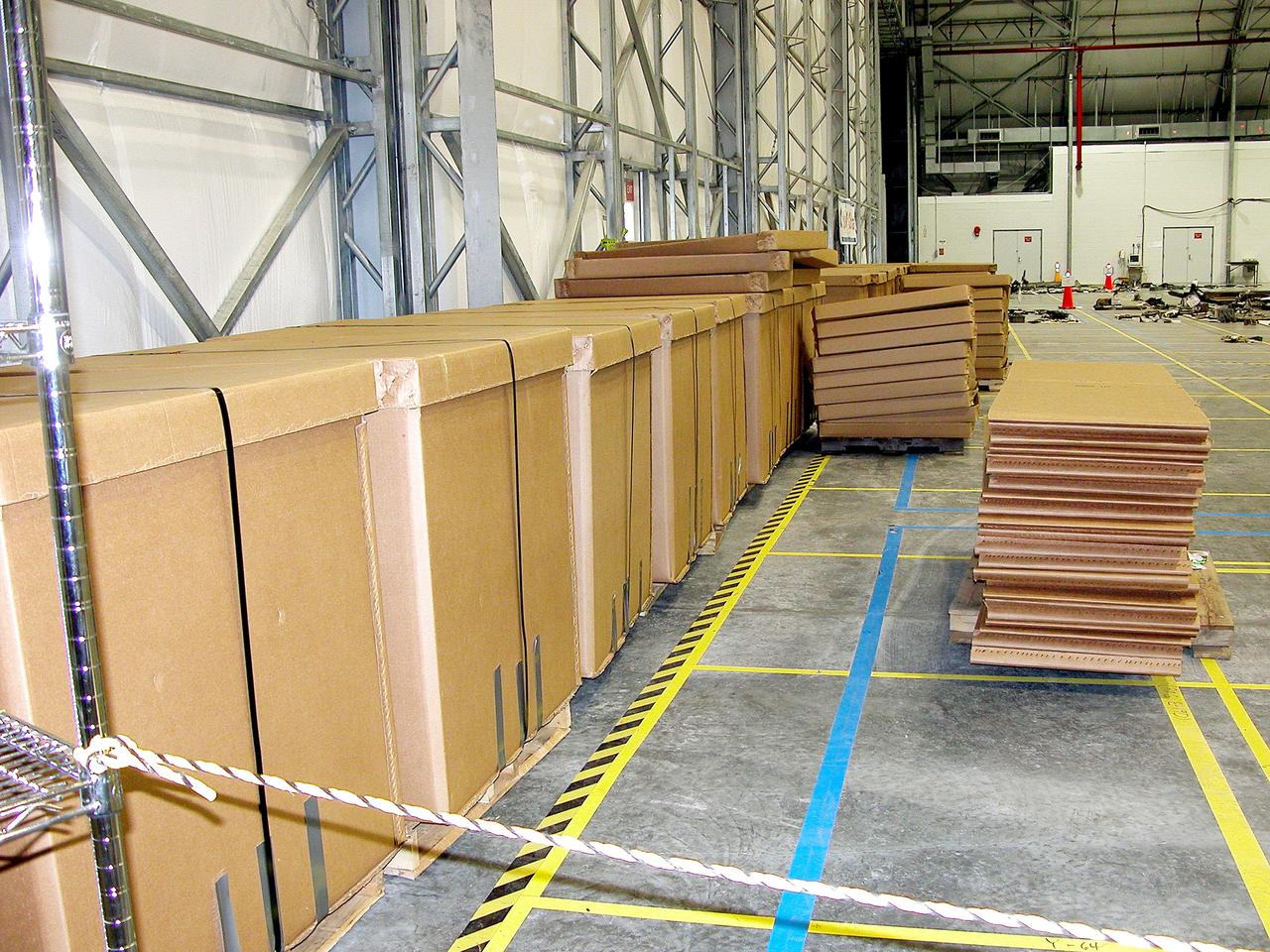
KENNEDY SPACE CENTER, FLA.  -  Storage boxes and other containers of Columbia debris wait in the Columbia Debris Hangar for transfer to storage in the Vehicle Assembly Building.  About 83,000 pieces were shipped to KSC during search and recovery efforts in East Texas.
KENNEDY SPACE CENTER, FLA. - Storage boxes and other containers of Columbia debris wait in the Columbia Debris Hangar for transfer to storage in the Vehicle Assembly Building. About 83,000 pieces were shipped to KSC during search and recovery efforts in East Texas.
KENNEDY SPACE CENTER, FLA.  -  Storage boxes filled with Columbia debris (left) await transfer to storage in the Vehicle Assembly Building.  Empty boxes at right wait to be filled with more of the approximately 83,000 pieces shipped to KSC during search and recovery efforts in East Texas.
KENNEDY SPACE CENTER, FLA. - Storage boxes filled with Columbia debris (left) await transfer to storage in the Vehicle Assembly Building. Empty boxes at right wait to be filled with more of the approximately 83,000 pieces shipped to KSC during search and recovery efforts in East Texas.
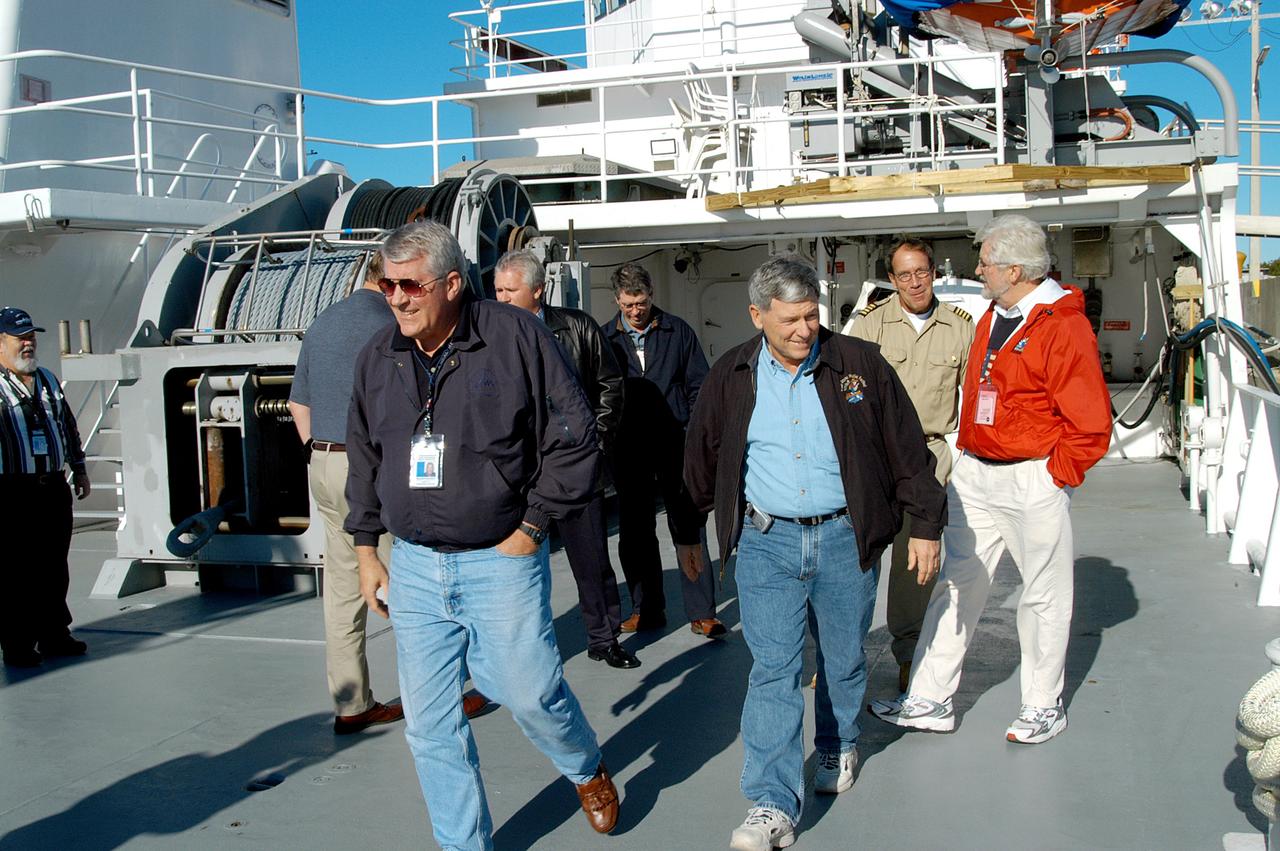
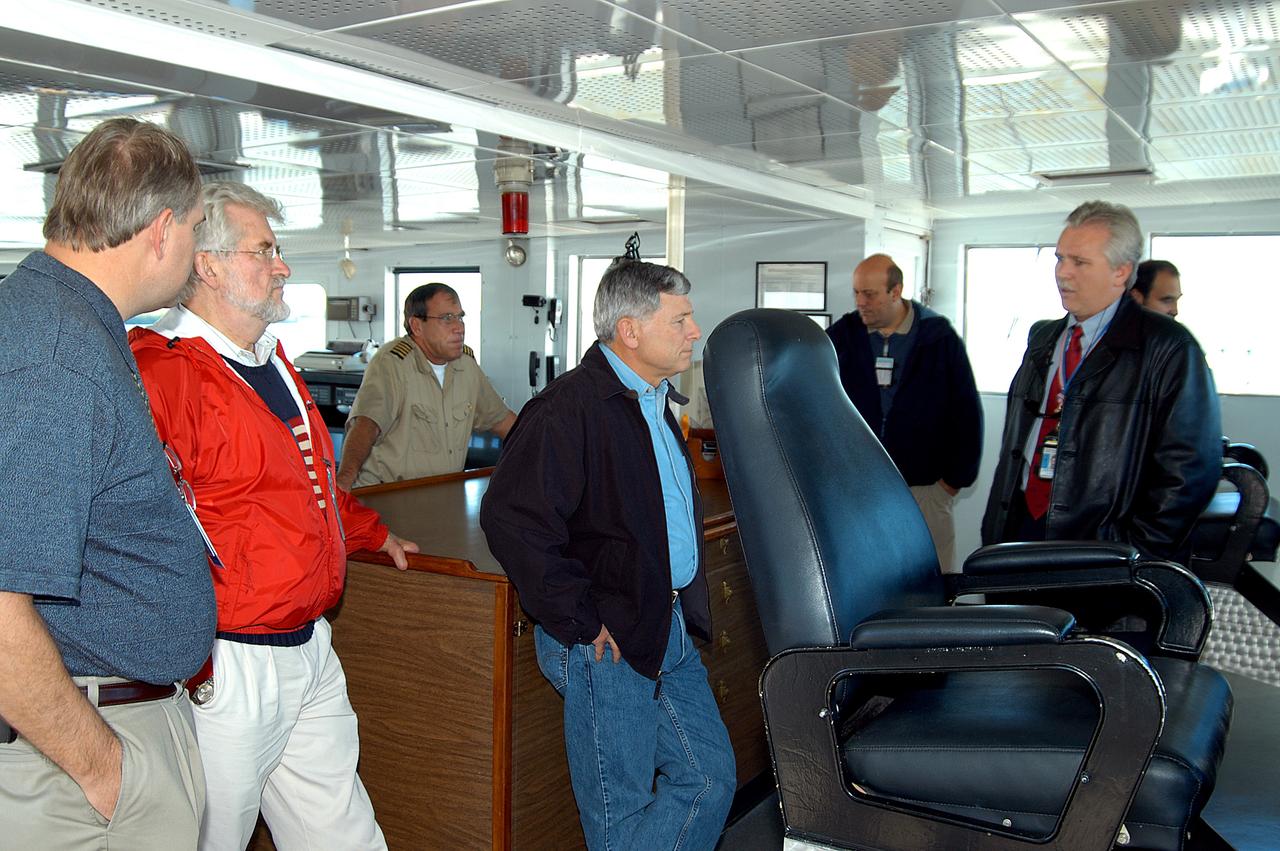
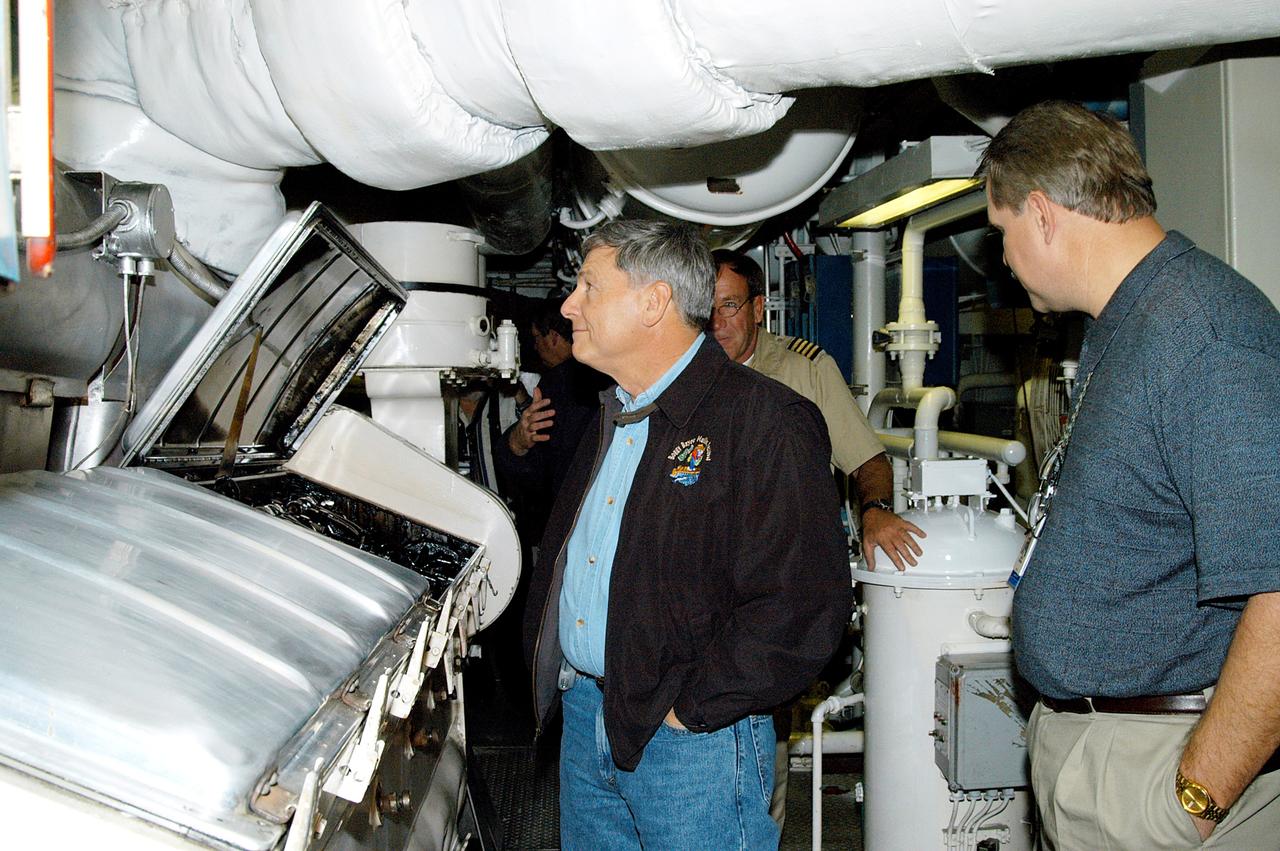
KENNEDY SPACE CENTER, FLA. -- NASA Deputy Associate Administrator for Space Station and Shuttle Programs Michael Kostelnik (center) is given a tour of a solid rocket booster (SRB) retrieval ship by United Space Alliance (USA) employee Joe Chaput (right).  NASA and USA Space Shuttle program management are participating in a leadership workday.  The day is intended to provide management with an in-depth, hands-on look at Shuttle processing activities at KSC.
KENNEDY SPACE CENTER, FLA. -- NASA Deputy Associate Administrator for Space Station and Shuttle Programs Michael Kostelnik (center) is given a tour of a solid rocket booster (SRB) retrieval ship by United Space Alliance (USA) employee Joe Chaput (right). NASA and USA Space Shuttle program management are participating in a leadership workday. The day is intended to provide management with an in-depth, hands-on look at Shuttle processing activities at KSC.
KENNEDY SPACE CENTER, FLA. -- NASA Deputy Associate Administrator for Space Station and Shuttle Programs Michael Kostelnik (left) tours a solid rocket booster (SRB) retrieval ship at Cape Canaveral.  NASA and United Space Alliance (USA) Space Shuttle program management are participating in a leadership workday.  The day is intended to provide management with an in-depth, hands-on look at Shuttle processing activities at KSC.
KENNEDY SPACE CENTER, FLA. -- NASA Deputy Associate Administrator for Space Station and Shuttle Programs Michael Kostelnik (left) tours a solid rocket booster (SRB) retrieval ship at Cape Canaveral. NASA and United Space Alliance (USA) Space Shuttle program management are participating in a leadership workday. The day is intended to provide management with an in-depth, hands-on look at Shuttle processing activities at KSC.
KENNEDY SPACE CENTER, FLA. -- United Space Alliance (USA) Vice President and Associate Program Manager of Florida Operations Bill Pickavance (left front) and NASA Deputy Associate Administrator for Space Station and Shuttle Programs Michael Kostelnik (right front) tour a solid rocket booster (SRB) retrieval ship at Cape Canaveral.  NASA and USA Space Shuttle program management are participating in a leadership workday.  The day is intended to provide management with an in-depth, hands-on look at Shuttle processing activities at KSC.
KENNEDY SPACE CENTER, FLA. -- United Space Alliance (USA) Vice President and Associate Program Manager of Florida Operations Bill Pickavance (left front) and NASA Deputy Associate Administrator for Space Station and Shuttle Programs Michael Kostelnik (right front) tour a solid rocket booster (SRB) retrieval ship at Cape Canaveral. NASA and USA Space Shuttle program management are participating in a leadership workday. The day is intended to provide management with an in-depth, hands-on look at Shuttle processing activities at KSC.
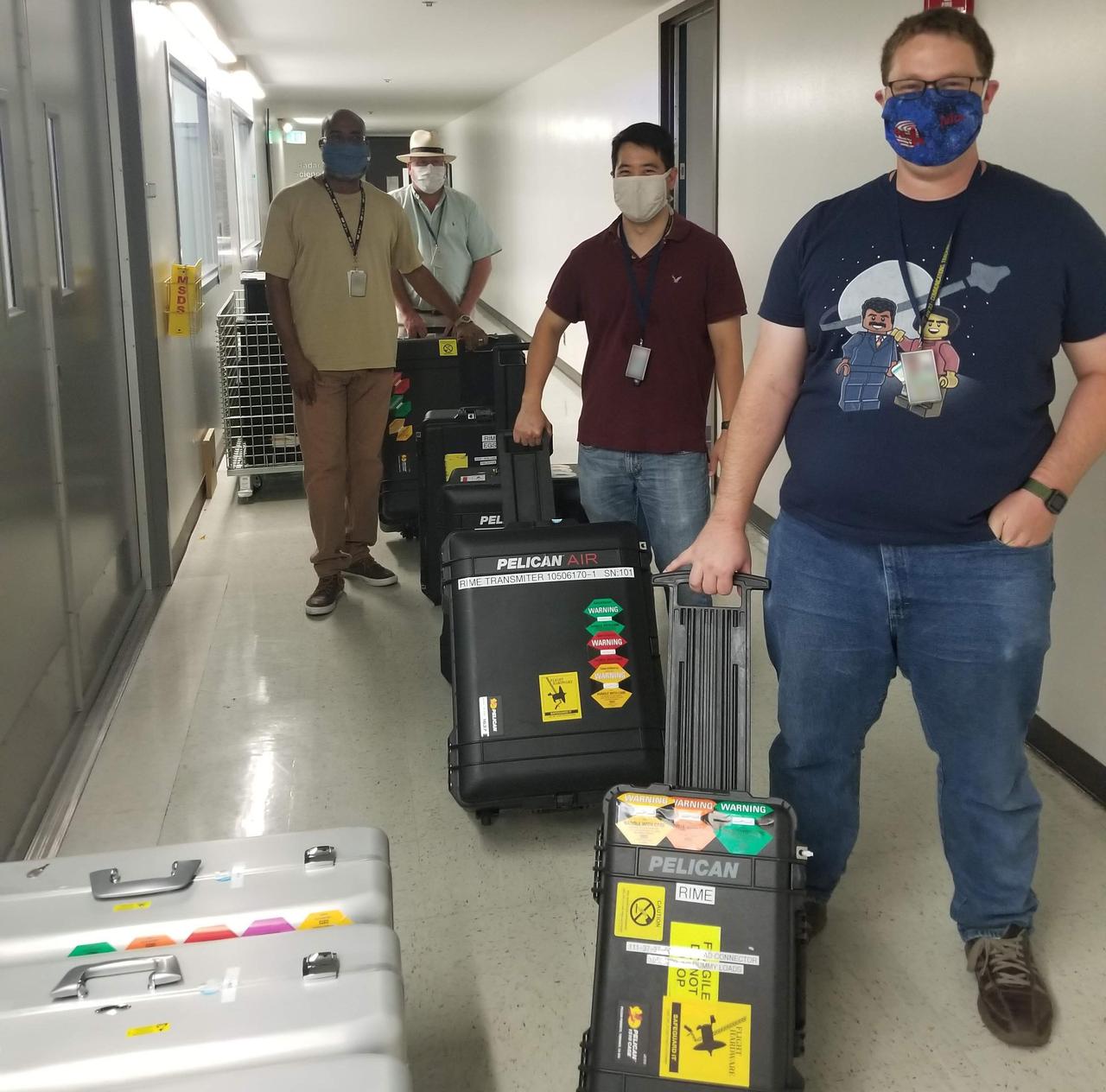
NASA's Jet Propulsion Laboratory built and shipped the receiver, transmitter and electronics necessary to complete the radar instrument for the Jupiter Icy Moons Explorer (JUICE) mission. Set to launch in 2022, JUICE is the ESA (European Space Agency) mission to explore Jupiter and its three large icy moons.  From front: JPL engineers and technicians Jeremy Steinert, Jordan Tanabe, Glenn Jeffery, and Robert Johnson follow COVID-19 Safe-at-Work guidelines as they transport the transmitter and electronics on Aug. 19, 2020, for shipping to the Italian Space Agency (ASI).  ASI is collaborating with JPL to build the instrument, called Radar for Icy Moon Exploration (RIME). It is one of 10 instruments that will fly aboard JUICE.  https://photojournal.jpl.nasa.gov/catalog/PIA24026
RIME Instrument en Route to JUICE
KENNEDY SPACE CENTER, FLA. -  Shipped in an air-conditioned transportation van from NASA’s Goddard Space Flight Center in Greenbelt, Md., NASA’s MESSENGER spacecraft, the first Mercury orbiter, arrives at the Astrotech Space Operations processing facilities near KSC.    MESSENGER - short for MErcury Surface, Space ENvironment, GEochemistry and Ranging - will be offloaded and taken into a high bay clean room.  After the spacecraft is removed from its shipping container, employees of the Johns Hopkins University Applied Physics Laboratory, builders of the spacecraft, will perform an initial state-of-health check.  Then processing for launch can begin, including checkout of the power systems, communications systems and control systems.  The thermal blankets will also be attached for flight.  MESSENGER will be launched May 11 on a six-year mission aboard a Boeing Delta II rocket.  Liftoff is targeted for 2:26 a.m. EDT on Tuesday, May 11.
KENNEDY SPACE CENTER, FLA. - Shipped in an air-conditioned transportation van from NASA’s Goddard Space Flight Center in Greenbelt, Md., NASA’s MESSENGER spacecraft, the first Mercury orbiter, arrives at the Astrotech Space Operations processing facilities near KSC. MESSENGER - short for MErcury Surface, Space ENvironment, GEochemistry and Ranging - will be offloaded and taken into a high bay clean room. After the spacecraft is removed from its shipping container, employees of the Johns Hopkins University Applied Physics Laboratory, builders of the spacecraft, will perform an initial state-of-health check. Then processing for launch can begin, including checkout of the power systems, communications systems and control systems. The thermal blankets will also be attached for flight. MESSENGER will be launched May 11 on a six-year mission aboard a Boeing Delta II rocket. Liftoff is targeted for 2:26 a.m. EDT on Tuesday, May 11.
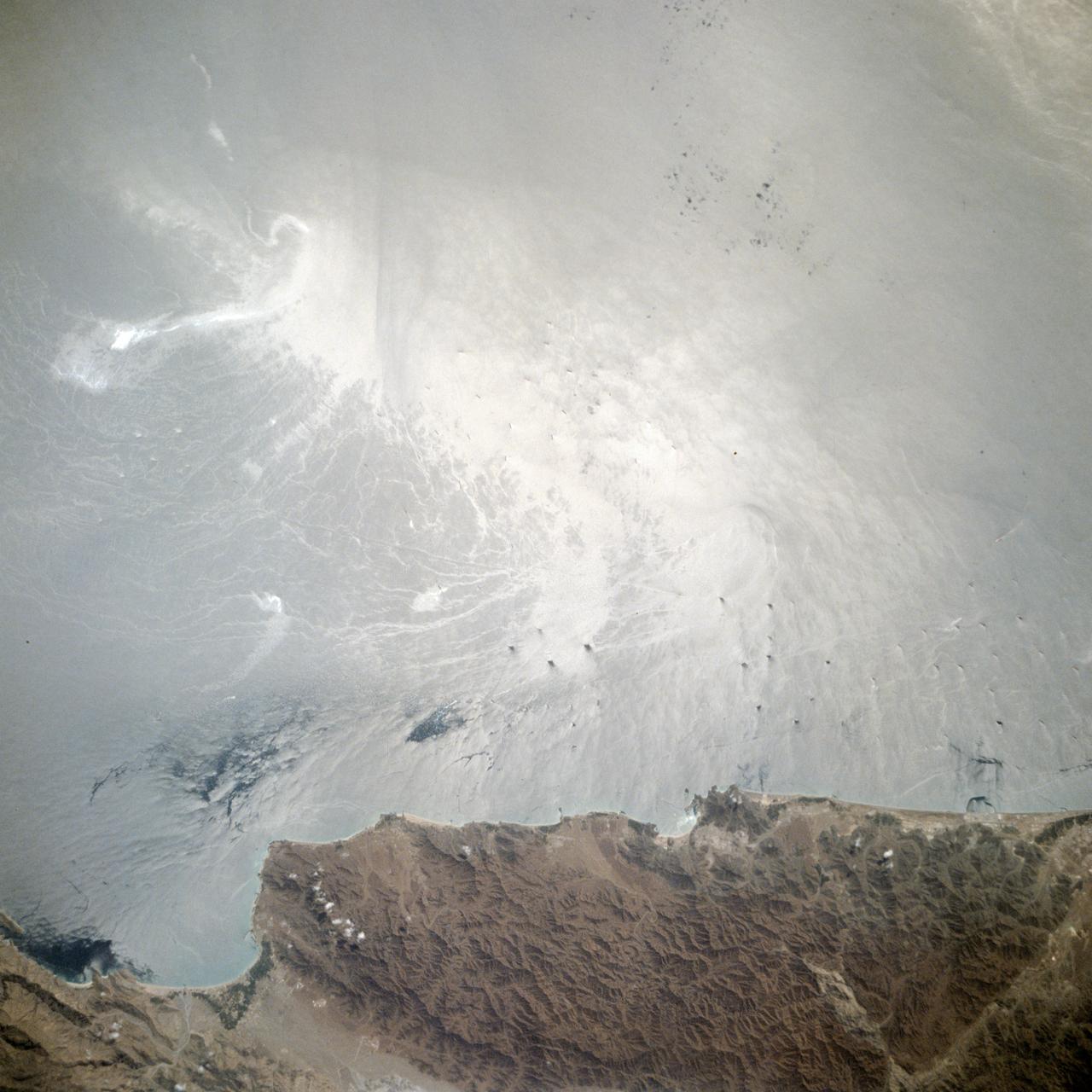
STS006-44-532 (4-9 April 1983) --- This is one of a series of photographs taken through the “ceiling” windows of the Earth-orbiting space shuttle Challenger by members of the STS-6 crew on its five-day mission in space. Many unused oil tankers lie in the roadstead along the coast of U.A.E. between the ports of Khawn Fakkan and Fujayrah. The sunglint on the Gulf of Oman permits the viewer to see the surface features much clearer. Such surface features as gynes, slicks, wakes, and sea state are clearly seen. Photo credit: NASA
Ships at anchor, Gulf of Oman
KENNEDY SPACE CENTER, FLA. - The JEM Pressurized Module is seen in the hold of the ship that carried it from Japan.  The National Space Development Agency of Japan (NASDA) built the laboratory at the Tsukuba Space Center near Tokyo.  The Pressurized Module is the first element of the JEM, Japan’s primary contribution to the space station, to be delivered to KSC. It will enhance the unique research capabilities of the orbiting complex by providing an additional shirt-sleeve environment for astronauts to conduct science experiments. The JEM also includes two logistics modules, an exposed pallet for space environment experiments and a robotic manipulator system that are still under construction in Japan. The various JEM components will be assembled in space over the course of three space shuttle missions.
KENNEDY SPACE CENTER, FLA. - The JEM Pressurized Module is seen in the hold of the ship that carried it from Japan. The National Space Development Agency of Japan (NASDA) built the laboratory at the Tsukuba Space Center near Tokyo. The Pressurized Module is the first element of the JEM, Japan’s primary contribution to the space station, to be delivered to KSC. It will enhance the unique research capabilities of the orbiting complex by providing an additional shirt-sleeve environment for astronauts to conduct science experiments. The JEM also includes two logistics modules, an exposed pallet for space environment experiments and a robotic manipulator system that are still under construction in Japan. The various JEM components will be assembled in space over the course of three space shuttle missions.
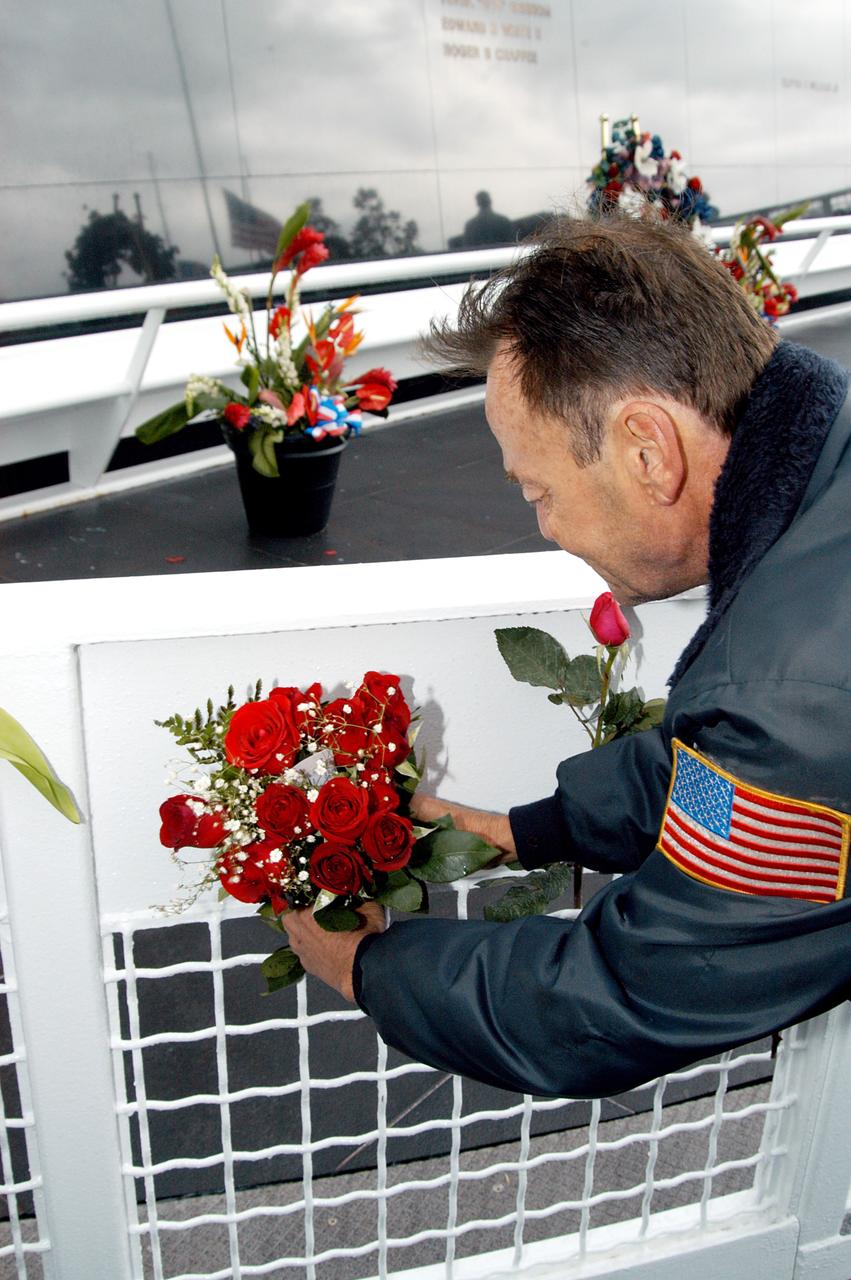
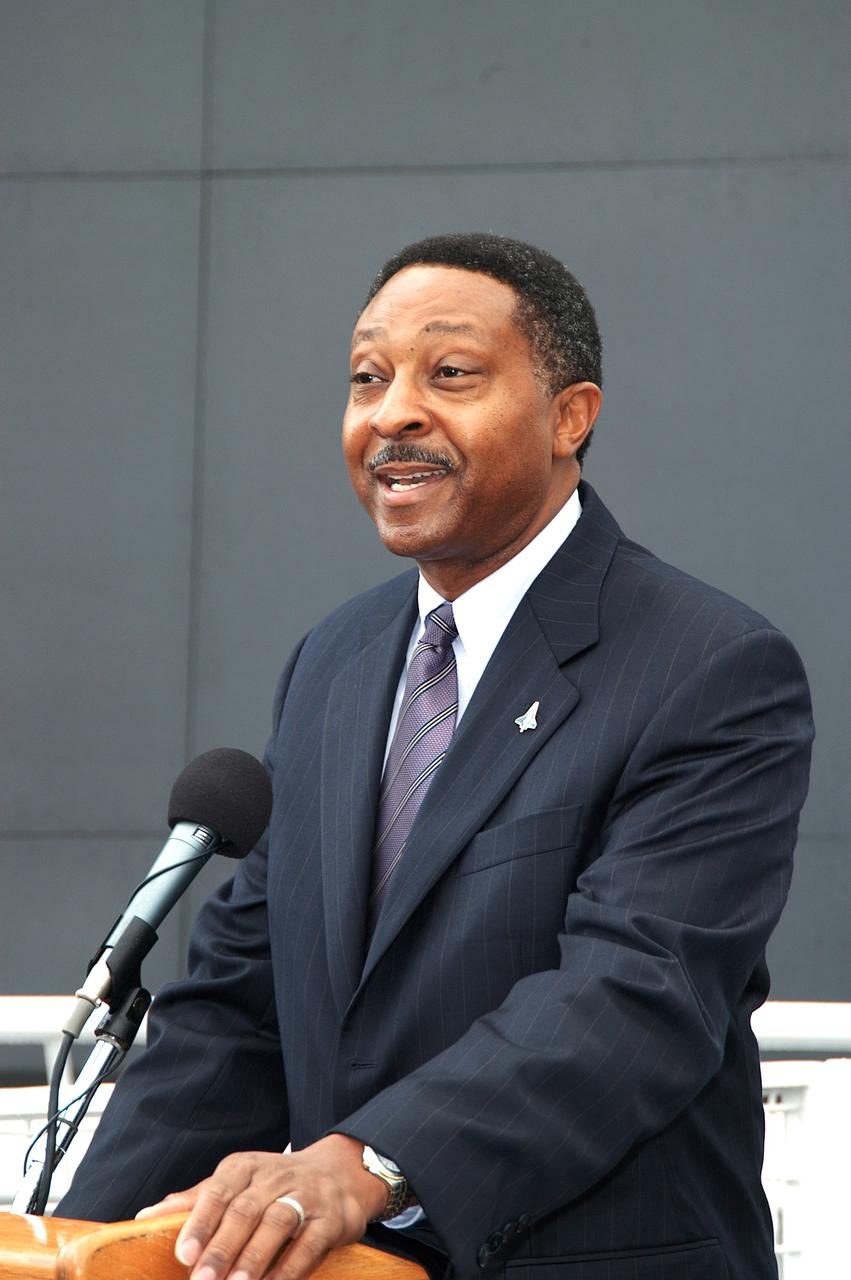
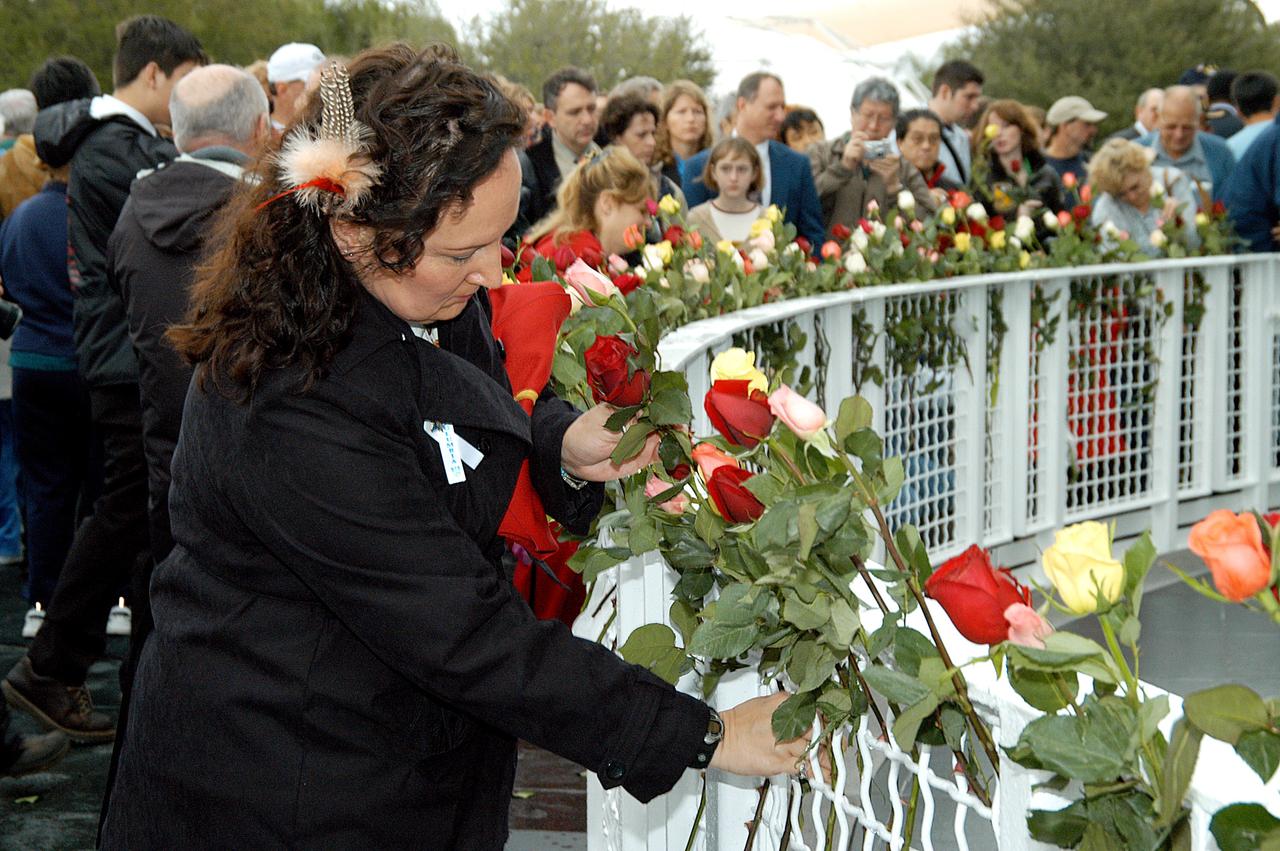
KENNEDY SPACE CENTER, FLA. -  Following the memorial service for the crew of Columbia at the Space Memorial Mirror, a visitor leaves a rose bouquet behind. Feb. 1 is the one-year anniversary of the loss of the crew and orbiter Columbia in a tragic accident as the ship returned to Earth following mission STS-107. The public was invited to the memorial service, held in the KSC Visitor Complex, which included comments by Center Director Jim Kennedy and Executive Director of Florida Space Authority Winston Scott.  Scott is a former astronaut who flew on Columbia in 1997.
KENNEDY SPACE CENTER, FLA. - Following the memorial service for the crew of Columbia at the Space Memorial Mirror, a visitor leaves a rose bouquet behind. Feb. 1 is the one-year anniversary of the loss of the crew and orbiter Columbia in a tragic accident as the ship returned to Earth following mission STS-107. The public was invited to the memorial service, held in the KSC Visitor Complex, which included comments by Center Director Jim Kennedy and Executive Director of Florida Space Authority Winston Scott. Scott is a former astronaut who flew on Columbia in 1997.
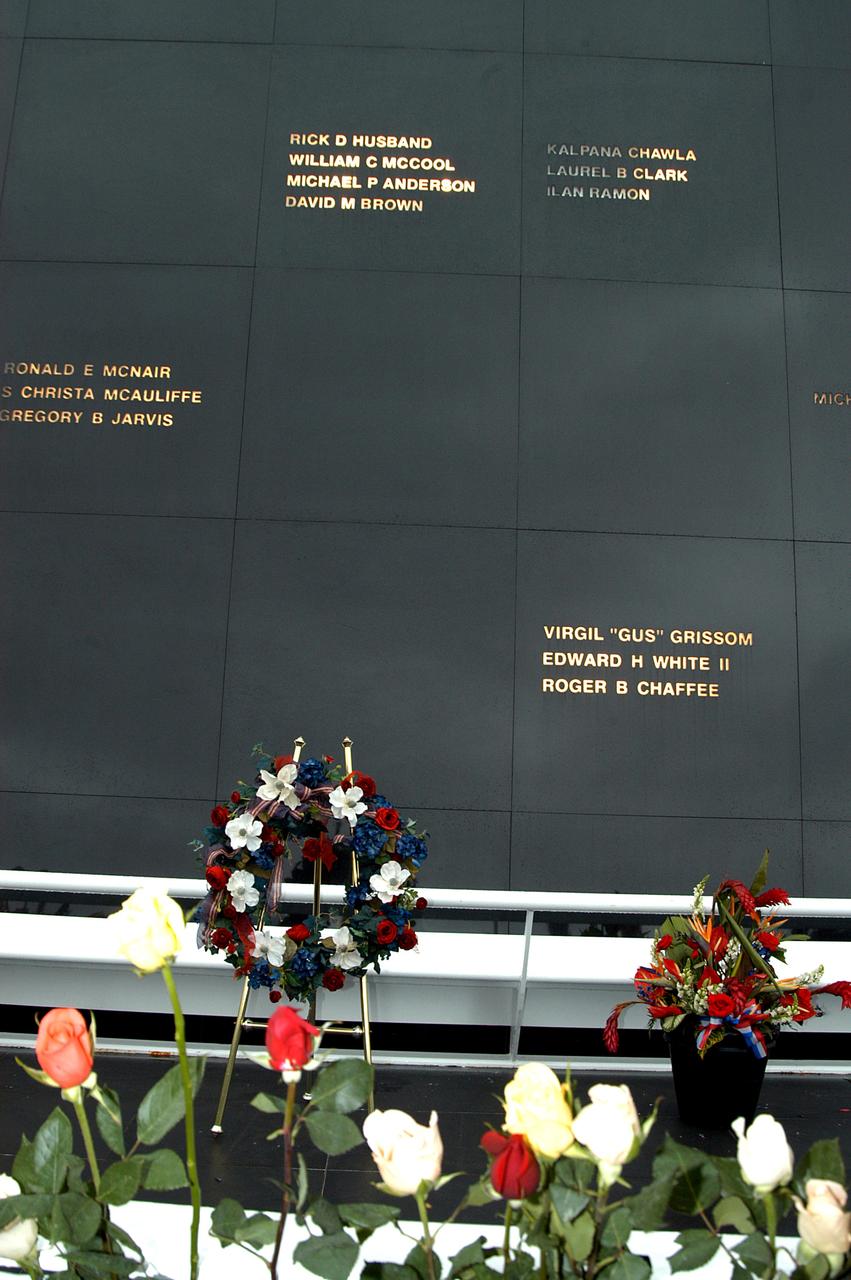
KENNEDY SPACE CENTER, FLA. -  Roses and a floral wreath adorn the Space Memorial Mirror following a memorial service for the crew of Columbia.  Feb. 1 is the one-year anniversary of the loss of the crew and orbiter Columbia in a tragic accident as the ship returned to Earth following mission STS-107. The public was invited to the memorial service, which included comments by Center Director Jim Kennedy and Executive Director of Florida Space Authority Winston Scott.  Scott is a former astronaut who flew on Columbia in 1997.
KENNEDY SPACE CENTER, FLA. - Roses and a floral wreath adorn the Space Memorial Mirror following a memorial service for the crew of Columbia. Feb. 1 is the one-year anniversary of the loss of the crew and orbiter Columbia in a tragic accident as the ship returned to Earth following mission STS-107. The public was invited to the memorial service, which included comments by Center Director Jim Kennedy and Executive Director of Florida Space Authority Winston Scott. Scott is a former astronaut who flew on Columbia in 1997.
KENNEDY SPACE CENTER, FLA. -  Winston Scott, executive director of Florida Space Authority, speaks to attendees at a memorial service honoring the crew of Columbia.  He stands in front of the Space Memorial Mirror at the KSC Visitor Complex.  Feb. 1 is the one-year anniversary of the loss of the crew and orbiter Columbia in a tragic accident as the ship returned to Earth following mission STS-107.  Scott is a former astronaut who flew on Columbia in 1997.  Attended by many friends, co-workers and families, the memorial service was also open to the public.
KENNEDY SPACE CENTER, FLA. - Winston Scott, executive director of Florida Space Authority, speaks to attendees at a memorial service honoring the crew of Columbia. He stands in front of the Space Memorial Mirror at the KSC Visitor Complex. Feb. 1 is the one-year anniversary of the loss of the crew and orbiter Columbia in a tragic accident as the ship returned to Earth following mission STS-107. Scott is a former astronaut who flew on Columbia in 1997. Attended by many friends, co-workers and families, the memorial service was also open to the public.
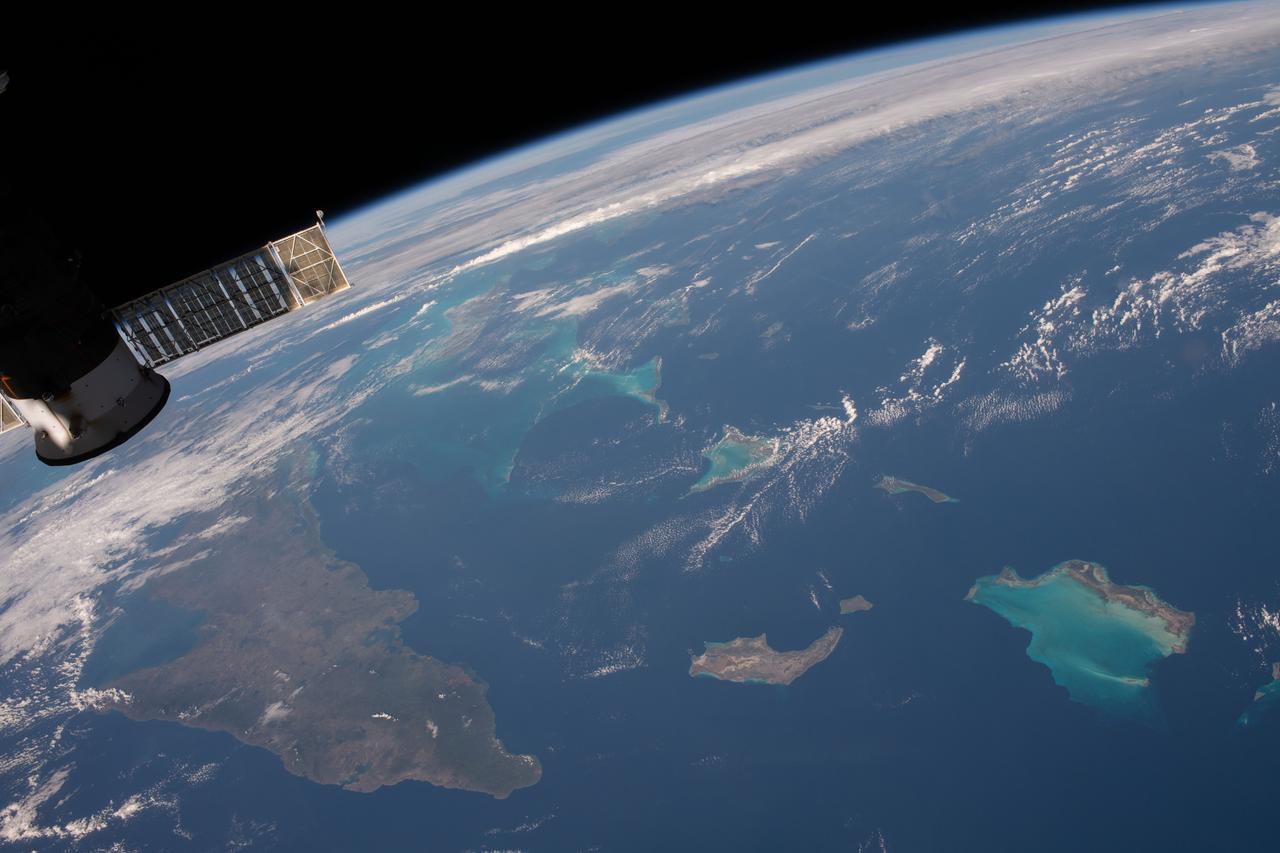
iss058e002206 (Jan. 5, 2018) --- Portions of Cuba, The Bahamas and the Turks and Caicos Islands are viewed from the International Space Station as the orbital complex flew 252 miles above the Atlantic Ocean. At left, is the aft end of the Progress 70 resupply ship from Russia attached to the Pirs docking compartment.
Cuba, The Bahamas and the Turks and Caicos Islands
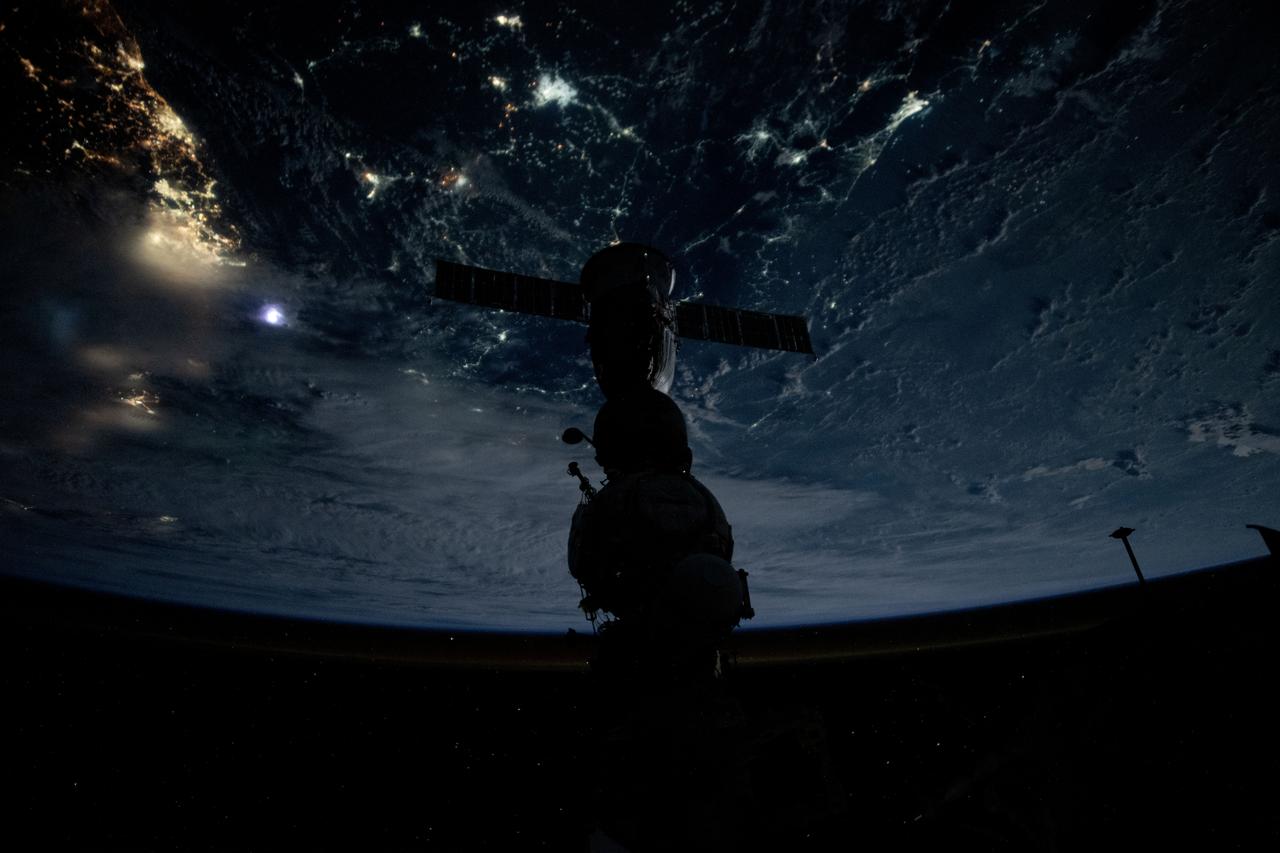
iss071e373018 (July 18, 2024) --- Silhouetted against the backdrop of the Earth below, is the Soyuz MS-25 crew ship docked to the Prichal docking module during an orbital nighttime pass. The International Space Station was soaring 261 miles above Jakarta on Indonesia's island of Java at the time of this photograph.
The Soyuz MS-25 crew ship is silhouetted against the backdrop of the Earth18
NASA's Lunar Trailblazer spacecraft gets covered in anti-static wrap before being shipped from Lockheed Martin Space in Littleton, Colorado, to Florida, where it arrived on Jan. 29, 2025. The spacecraft was built and tested at Lockheed and will launch no earlier than Feb. 26 from Launch Complex 39A at the agency's Kennedy Space Center.  Lunar Trailblazer was a selection of NASA's SIMPLEx (Small Innovative Missions for Planetary Exploration), which provides opportunities for low-cost science spacecraft to ride-share with selected primary missions. To maintain the lower overall cost, SIMPLEx missions have a higher risk posture and lighter requirements for oversight and management. This higher risk acceptance allows NASA to test pioneering technologies, and the definition of success for these missions includes the lessons learned from more experimental endeavors.  https://photojournal.jpl.nasa.gov/catalog/PIA26458
NASA's Lunar Trailblazer Gets Bagged Up
The Roman Coronagraph Instrument on NASA's upcoming Nancy Grace Roman Space Telescope will test new tools that block starlight, revealing planets hidden by the glare of their parent stars. The technology demonstration instrument is shown here on May 17, 2024, at NASA's Jet Propulsion Laboratory in Southern California, where it was designed and built. Mission team members are using a crane to lift the top portion of the shipping container that the instrument was stored in for its journey to the agency's Goddard Space Flight Center in Greenbelt, Maryland, where it will join the rest of the space observatory in preparation for launch by May 2027.  https://photojournal.jpl.nasa.gov/catalog/PIA26277
Coronagraph Prepared for Shipping
The Roman Coronagraph Instrument on NASA's upcoming Nancy Grace Roman Space Telescope will test new tools that block starlight, revealing planets hidden by the glare of their parent stars. The technology demonstration instrument is shown here – inside a shipping container – on May 17, 2024, at NASA's Jet Propulsion Laboratory in Southern California, where it was designed and built. Mission team members said farewell to the instrument by signing their names to a flag (featuring the mission logo) on the outside of the container, which carried the instrument from JPL to NASA's Goddard Space Flight Center in Greenbelt, Maryland. There, it will join the rest of the space observatory in preparation for launch by May 2027.  https://photojournal.jpl.nasa.gov/catalog/PIA26278
Coronagraph Team Signs Flag Farewell
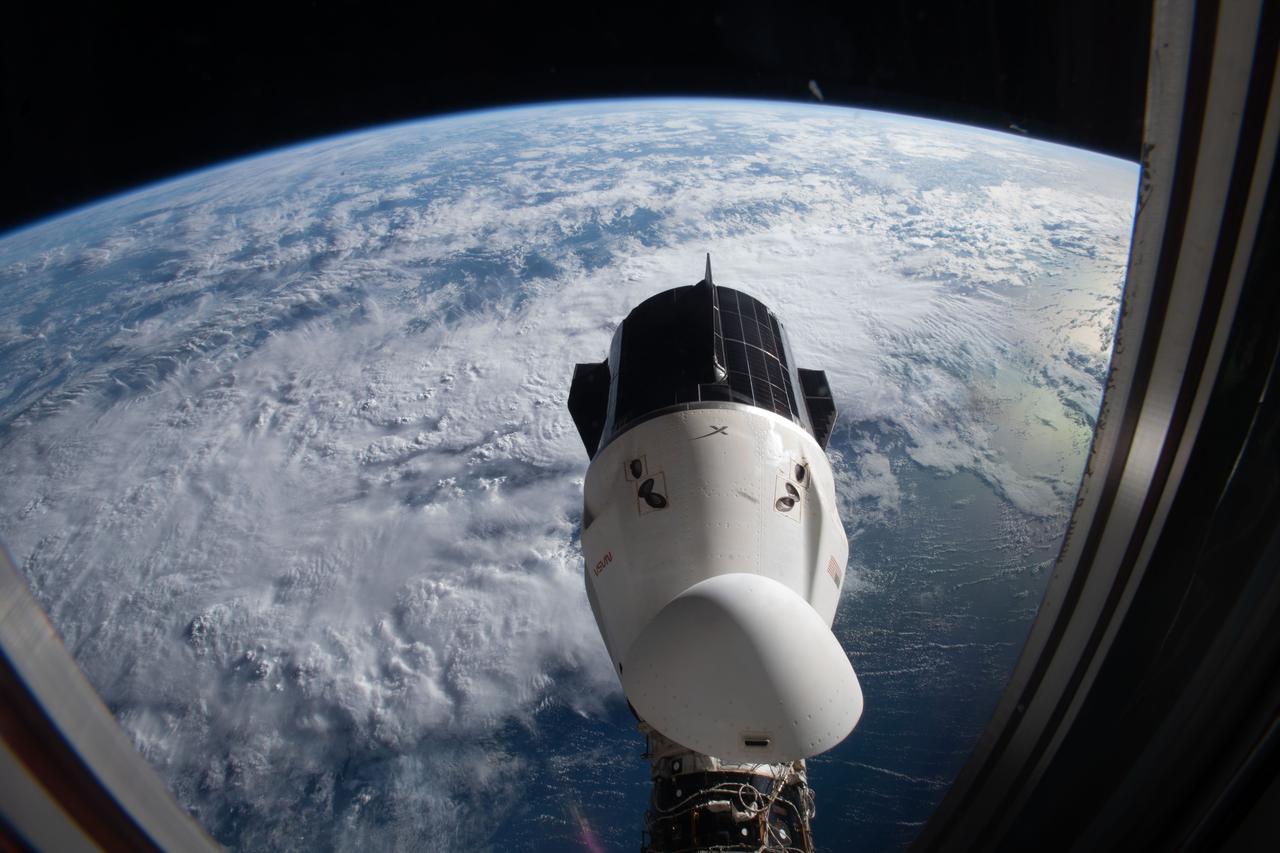
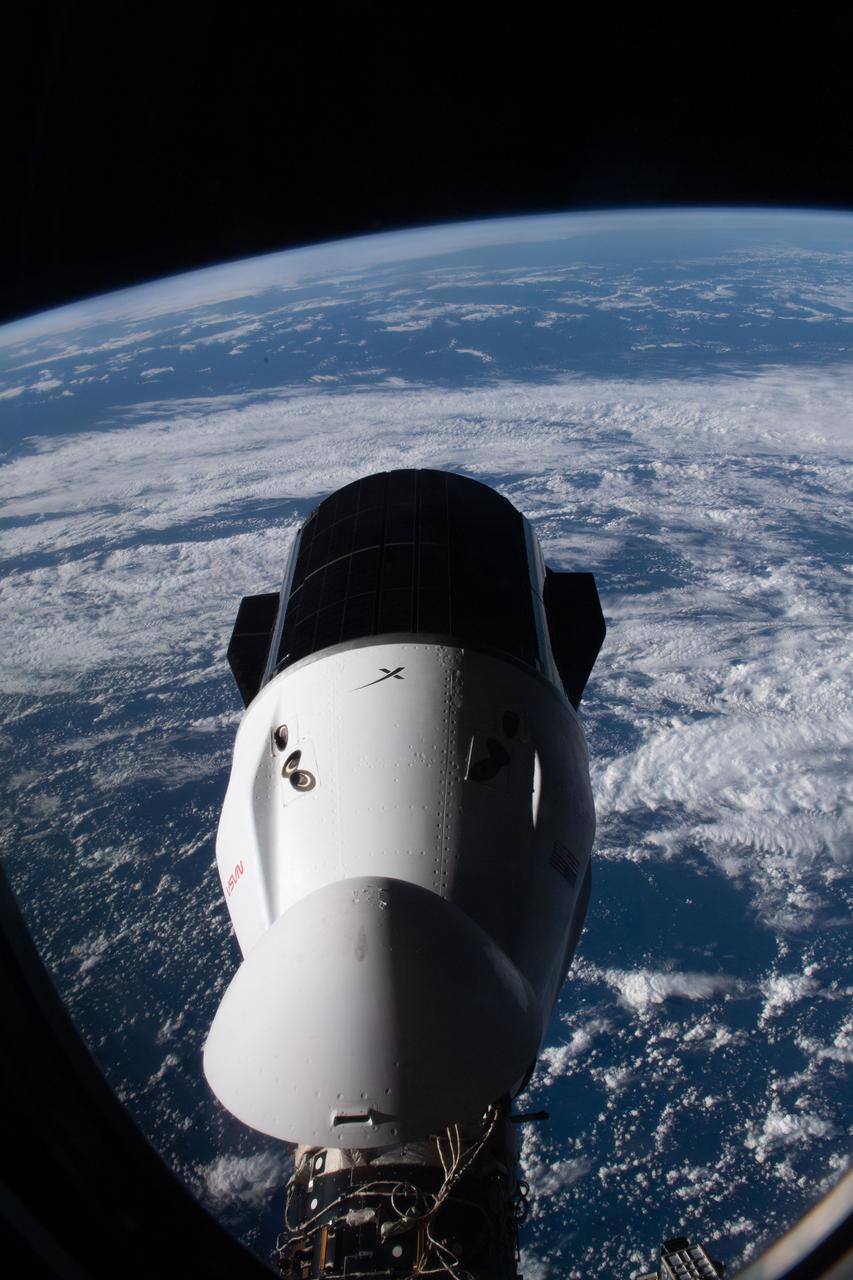
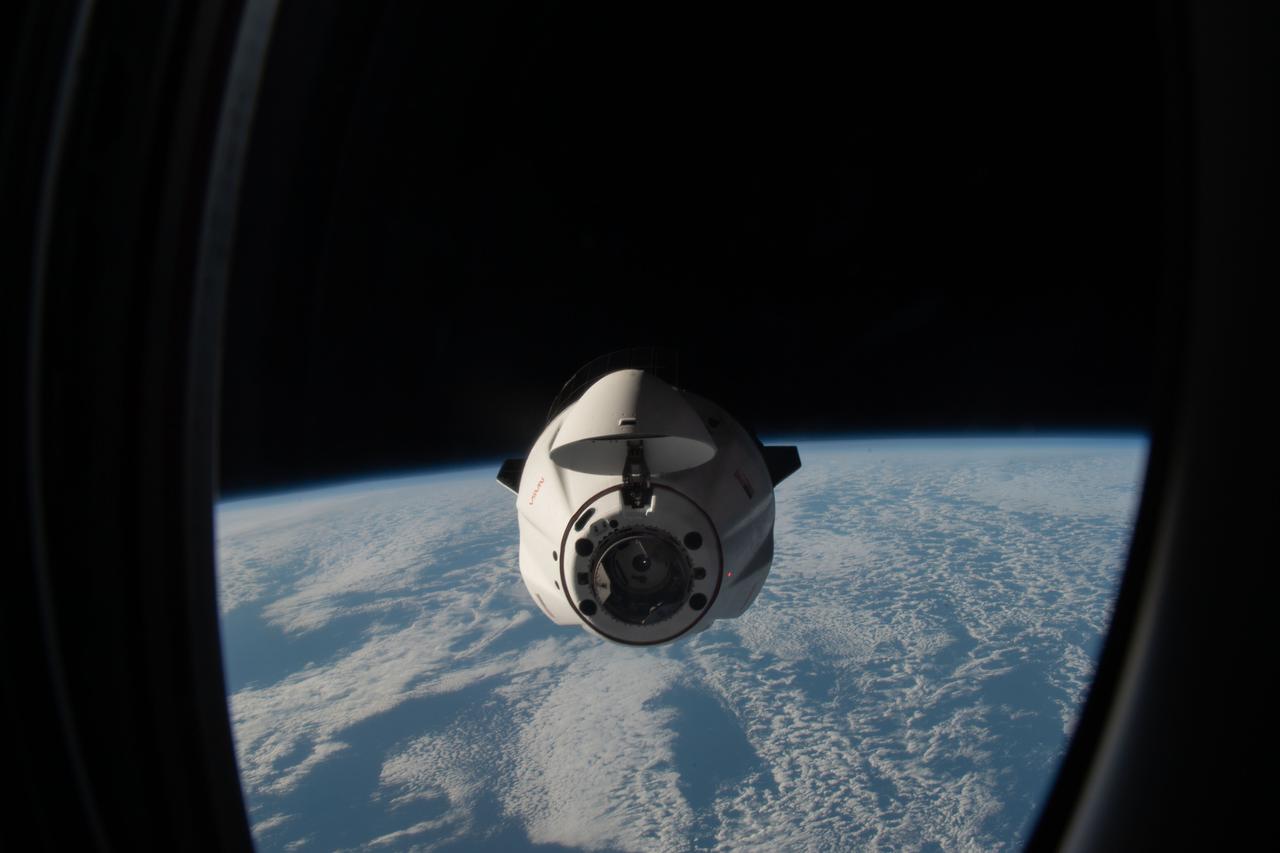
iss068e017228 (Oct. 14, 2022) --- The SpaceX Dragon Endurance crew ship is pictured docked to the forward port of the International Space Station's Harmony module. Endurance was photographed from a window inside the Dragon Freedom crew ship docked to Harmony's space-facing port. Credit: JAXA/Koichi Wakata
iss068e017228
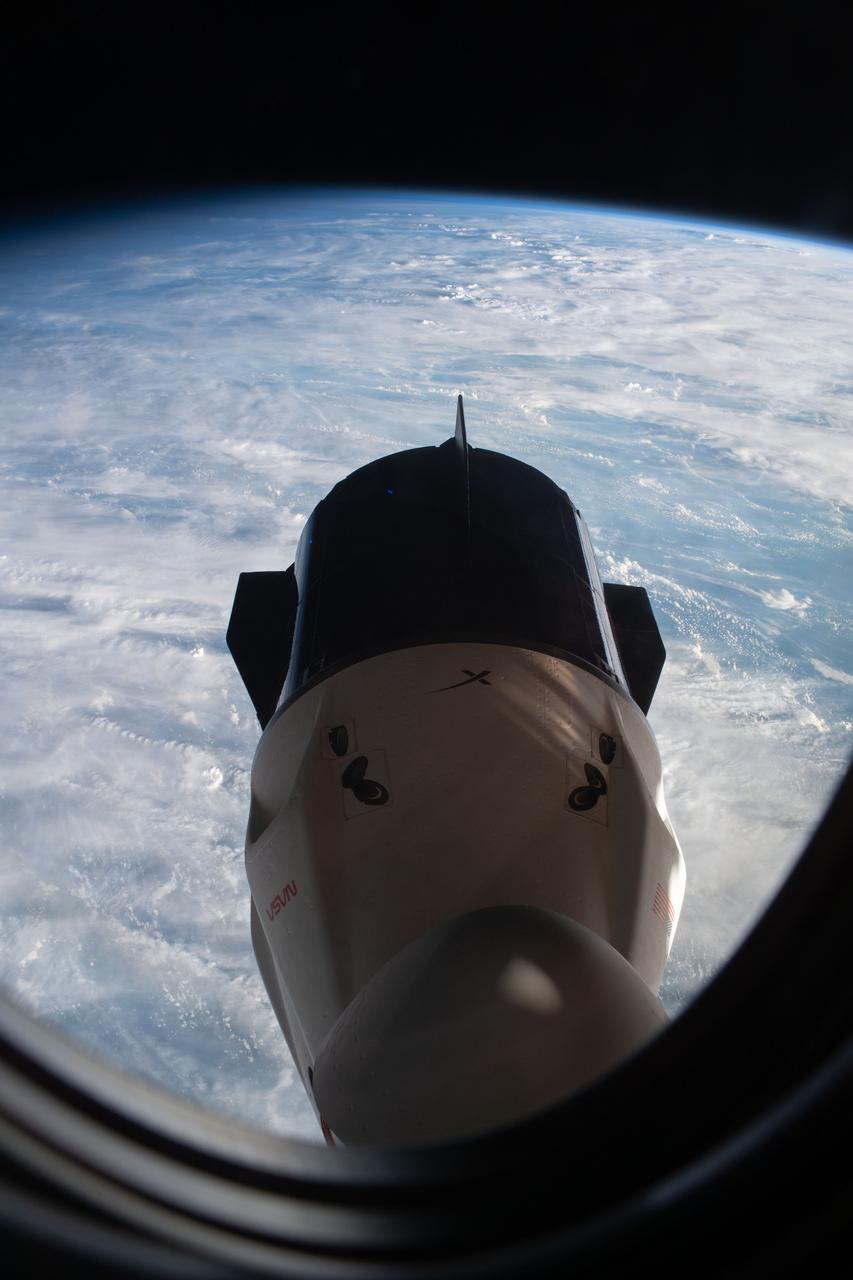
iss067e014471 (April 12, 2022) --- The SpaceX Dragon Endurance crew ship is pictured from a window aboard the SpaceX Dragon Endeavour crew ship. Endurance is docked to the Harmony module's forward-facing port while Endeavour is docked to Harmony's space-facing port on the International Space Station.
iss067e014471
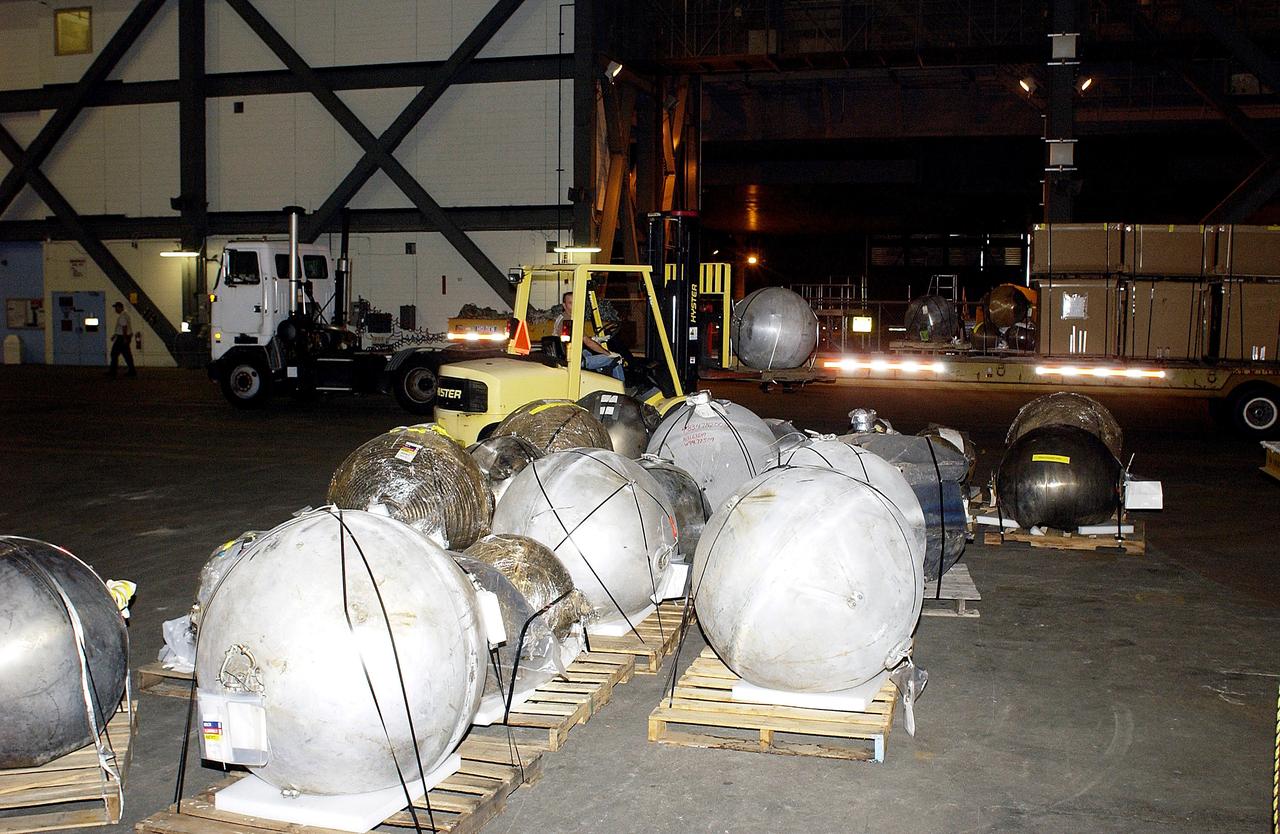
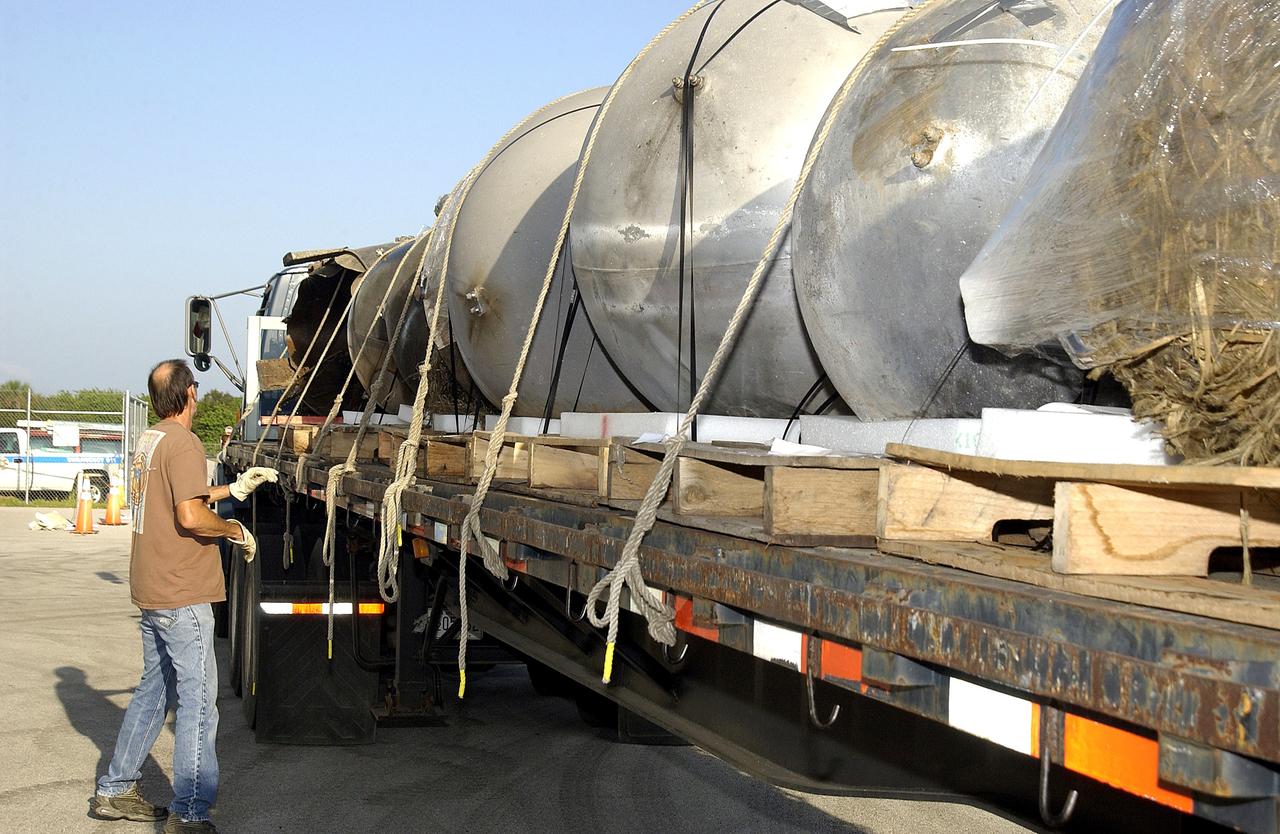
KENNEDY SPACE CENTER, FLA. -  Pieces of debris of Space Shuttle Columbia are offloaded from a flatbed truck in the transfer aisle of the Vehicle Assembly Building (VAB).  The debris is being moved from the Columbia Debris Hangar to the VAB for permanent storage.  More than 83,000 pieces of debris were shipped to KSC during search and recovery efforts in East Texas. That represents about 38 percent of the dry weight of Columbia, equaling almost 85,000 pounds.
KENNEDY SPACE CENTER, FLA. - Pieces of debris of Space Shuttle Columbia are offloaded from a flatbed truck in the transfer aisle of the Vehicle Assembly Building (VAB). The debris is being moved from the Columbia Debris Hangar to the VAB for permanent storage. More than 83,000 pieces of debris were shipped to KSC during search and recovery efforts in East Texas. That represents about 38 percent of the dry weight of Columbia, equaling almost 85,000 pounds.
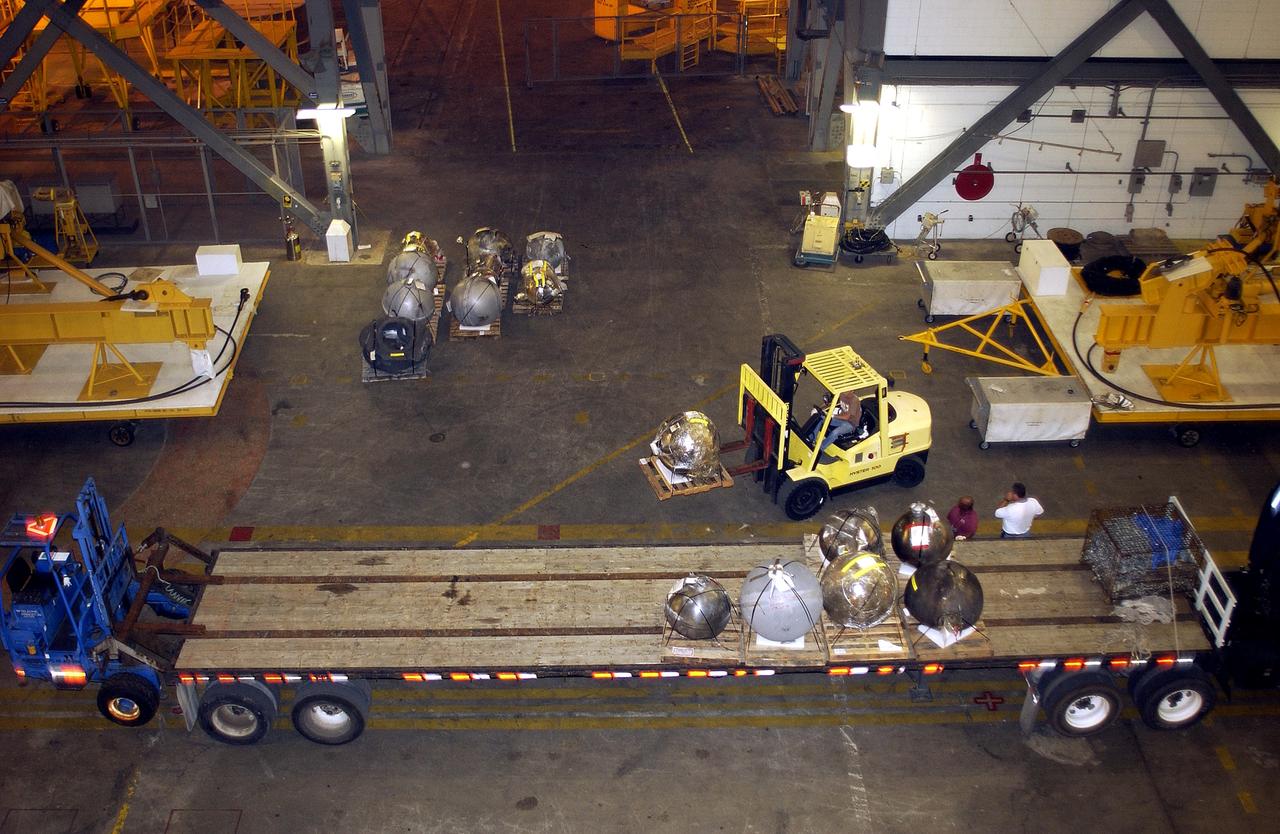
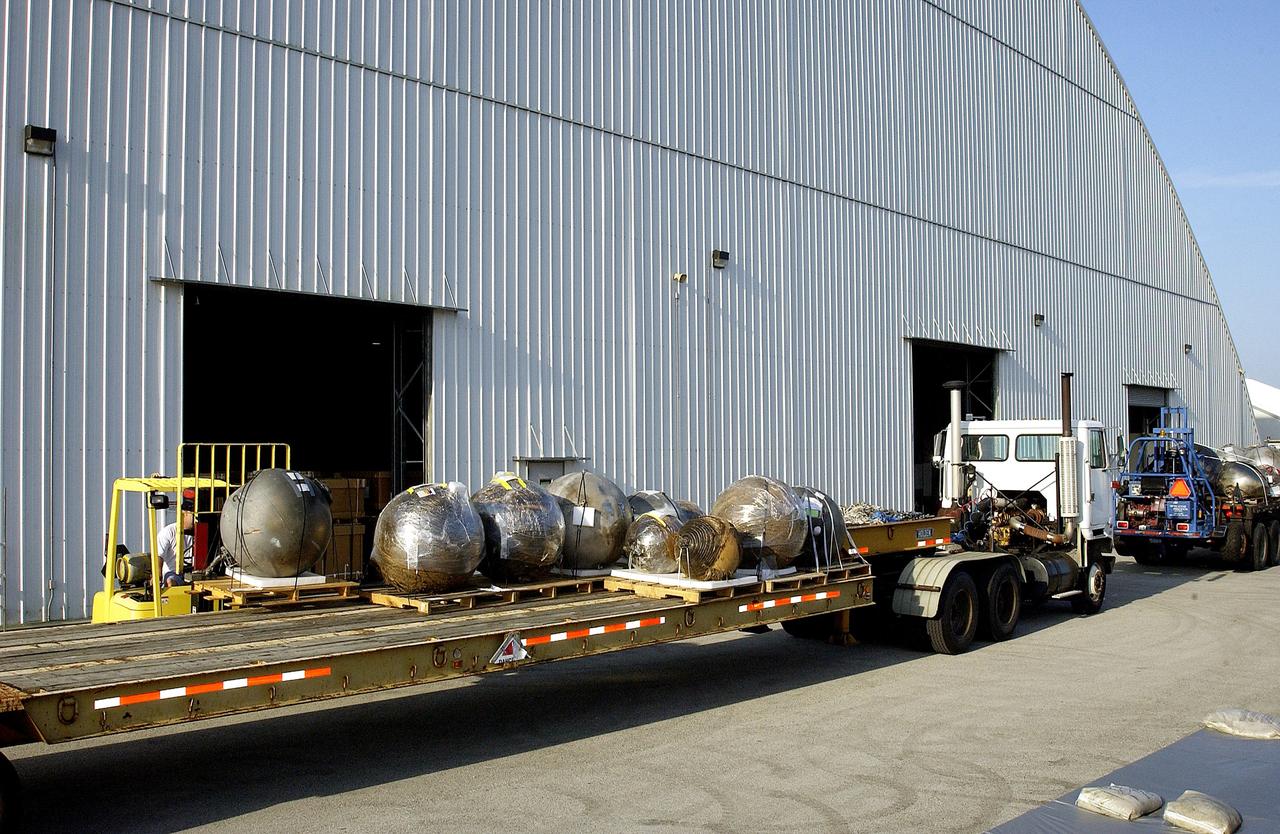
KENNEDY SPACE CENTER, FLA. -  At the Columbia Debris Hangar, some of the debris of Space Shuttle Columbia is moved onto a flatbed truck for transfer to the Vehicle Assembly Building for permanent storage.  More than 83,000 pieces of debris were shipped to KSC during search and recovery efforts in East Texas. That represents about 38 percent of the dry weight of Columbia, equaling almost 85,000 pounds.
KENNEDY SPACE CENTER, FLA. - At the Columbia Debris Hangar, some of the debris of Space Shuttle Columbia is moved onto a flatbed truck for transfer to the Vehicle Assembly Building for permanent storage. More than 83,000 pieces of debris were shipped to KSC during search and recovery efforts in East Texas. That represents about 38 percent of the dry weight of Columbia, equaling almost 85,000 pounds.
KENNEDY SPACE CENTER, FLA. -  Center Director Jim Kennedy speaks to attendees at a memorial service honoring the crew of Columbia.  He stands in front of the Space Memorial Mirror at the KSC Visitor Complex.  Feb. 1 is the one-year anniversary of the loss of the crew and orbiter Columbia in a tragic accident as the ship returned to Earth following mission STS-107.  Attended by many friends, co-workers and families, the memorial service was also open to the public.
KENNEDY SPACE CENTER, FLA. - Center Director Jim Kennedy speaks to attendees at a memorial service honoring the crew of Columbia. He stands in front of the Space Memorial Mirror at the KSC Visitor Complex. Feb. 1 is the one-year anniversary of the loss of the crew and orbiter Columbia in a tragic accident as the ship returned to Earth following mission STS-107. Attended by many friends, co-workers and families, the memorial service was also open to the public.
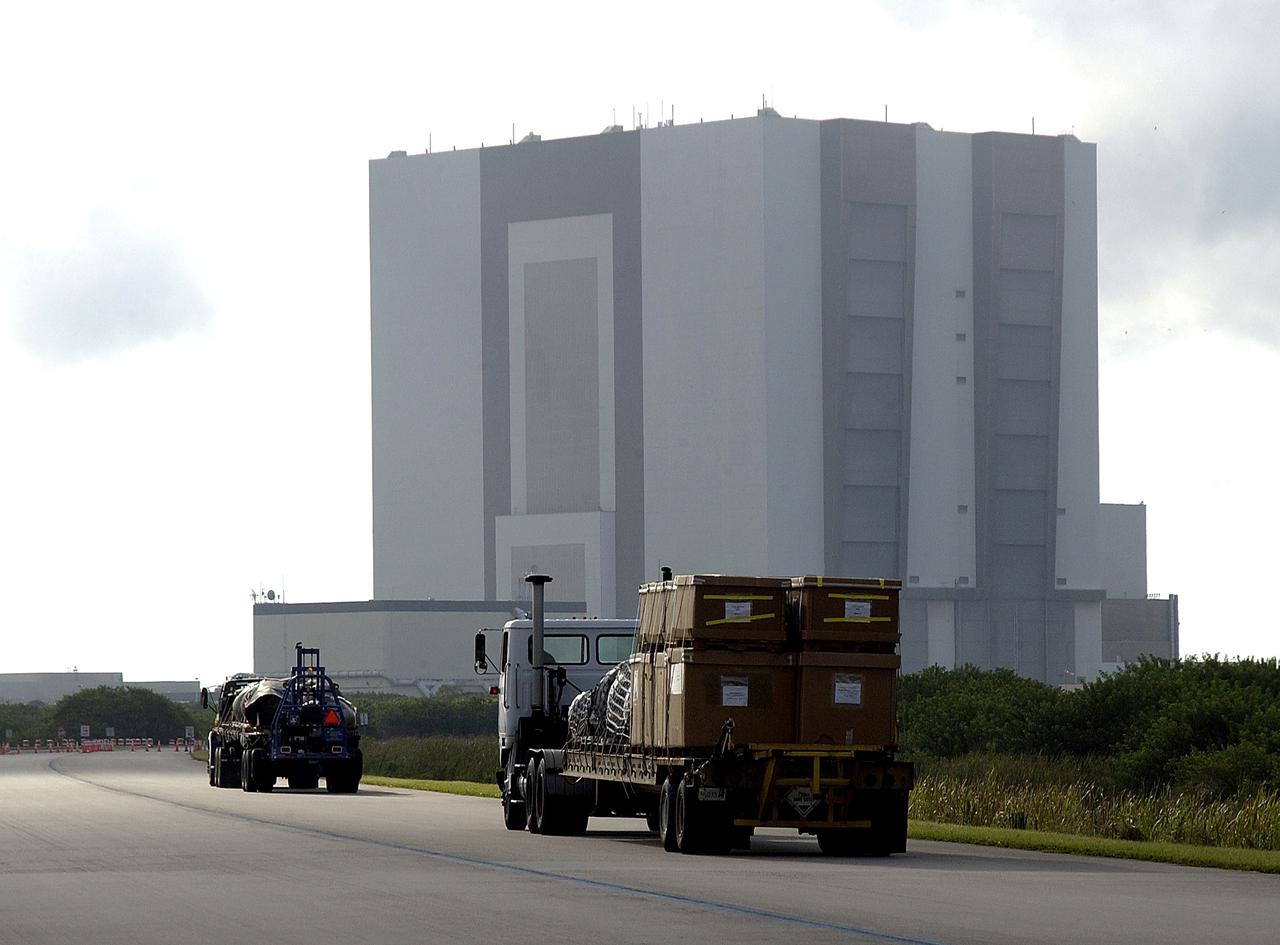
KENNEDY SPACE CENTER, FLA. -  Flatbed trucks carrying some of the debris of Space Shuttle Columbia approach the Vehicle Assembly Building (VAB).  The debris is being transferred from the Columbia Debris Hangar to the VAB for permanent storage.  More than 83,000 pieces of debris were shipped to KSC during search and recovery efforts in East Texas. That represents about 38 percent of the dry weight of Columbia, equaling almost 85,000 pounds.
KENNEDY SPACE CENTER, FLA. - Flatbed trucks carrying some of the debris of Space Shuttle Columbia approach the Vehicle Assembly Building (VAB). The debris is being transferred from the Columbia Debris Hangar to the VAB for permanent storage. More than 83,000 pieces of debris were shipped to KSC during search and recovery efforts in East Texas. That represents about 38 percent of the dry weight of Columbia, equaling almost 85,000 pounds.
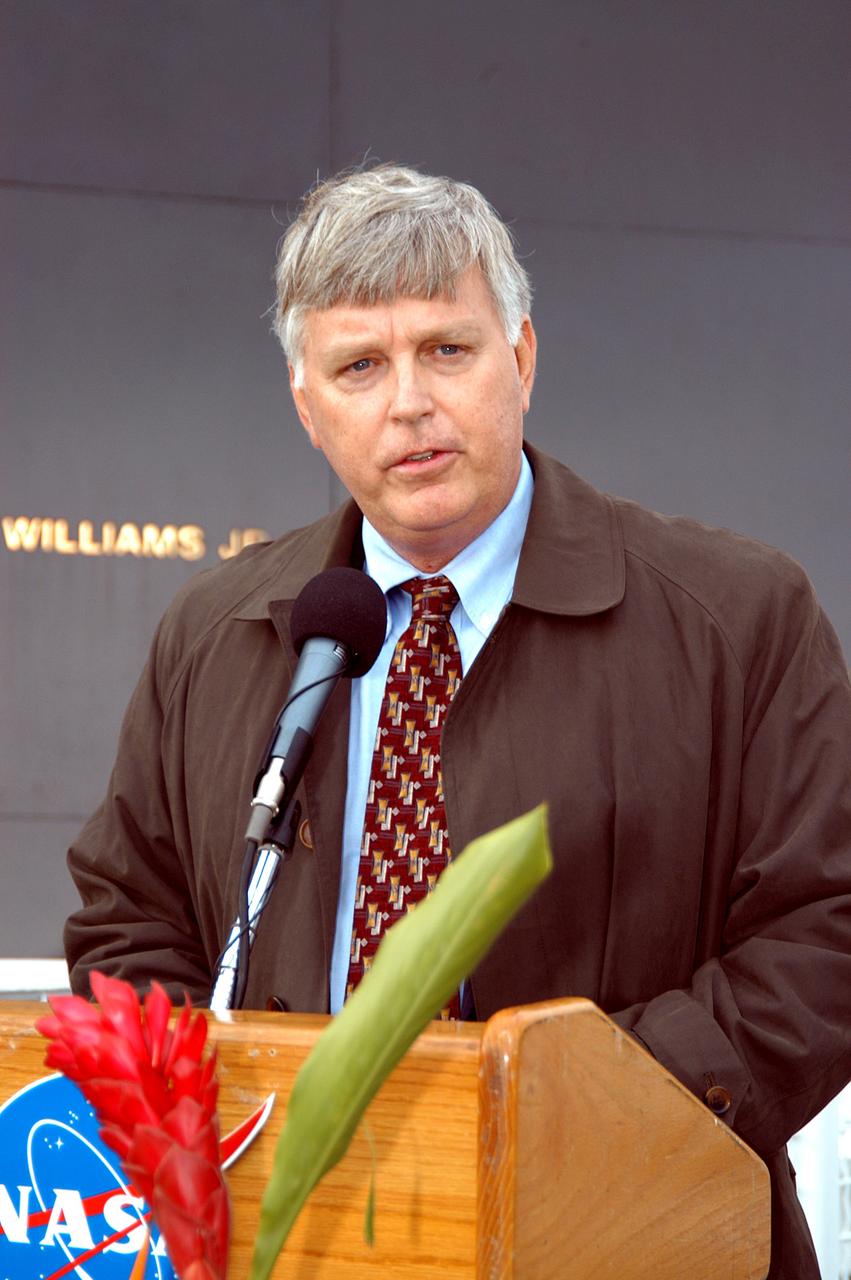
KENNEDY SPACE CENTER, FLA. -  Jim Comer, United Space Alliance project leader for Columbia reconstruction, speaks to members of the Columbia Reconstruction Team during transfer of debris from the Columbia Debris Hangar to its permanent storage site in the Vehicle Assembly Building.  More than 83,000 pieces of debris were shipped to KSC during search and recovery efforts in East Texas. That represents about 38 percent of the dry weight of Columbia, equaling almost 85,000 pounds.
KENNEDY SPACE CENTER, FLA. - Jim Comer, United Space Alliance project leader for Columbia reconstruction, speaks to members of the Columbia Reconstruction Team during transfer of debris from the Columbia Debris Hangar to its permanent storage site in the Vehicle Assembly Building. More than 83,000 pieces of debris were shipped to KSC during search and recovery efforts in East Texas. That represents about 38 percent of the dry weight of Columbia, equaling almost 85,000 pounds.
KENNEDY SPACE CENTER, FLA. -  Pieces of debris of Space Shuttle Columbia are offloaded from a flatbed truck in the transfer aisle of the Vehicle Assembly Building (VAB).  The debris is being moved from the Columbia Debris Hangar to the VAB for permanent storage.  More than 83,000 pieces of debris were shipped to KSC during search and recovery efforts in East Texas. That represents about 38 percent of the dry weight of Columbia, equaling almost 85,000 pounds.
KENNEDY SPACE CENTER, FLA. - Pieces of debris of Space Shuttle Columbia are offloaded from a flatbed truck in the transfer aisle of the Vehicle Assembly Building (VAB). The debris is being moved from the Columbia Debris Hangar to the VAB for permanent storage. More than 83,000 pieces of debris were shipped to KSC during search and recovery efforts in East Texas. That represents about 38 percent of the dry weight of Columbia, equaling almost 85,000 pounds.
KENNEDY SPACE CENTER, FLA. -  At the Columbia Debris Hangar, some of the debris of Space Shuttle Columbia is secured onto a flatbed truck for transfer to the Vehicle Assembly Building for permanent storage.  More than 83,000  pieces of debris were shipped to KSC during search and recovery efforts in East Texas. That represents about 38 percent of the dry weight of Columbia, equaling almost 85,000 pounds.
KENNEDY SPACE CENTER, FLA. - At the Columbia Debris Hangar, some of the debris of Space Shuttle Columbia is secured onto a flatbed truck for transfer to the Vehicle Assembly Building for permanent storage. More than 83,000 pieces of debris were shipped to KSC during search and recovery efforts in East Texas. That represents about 38 percent of the dry weight of Columbia, equaling almost 85,000 pounds.
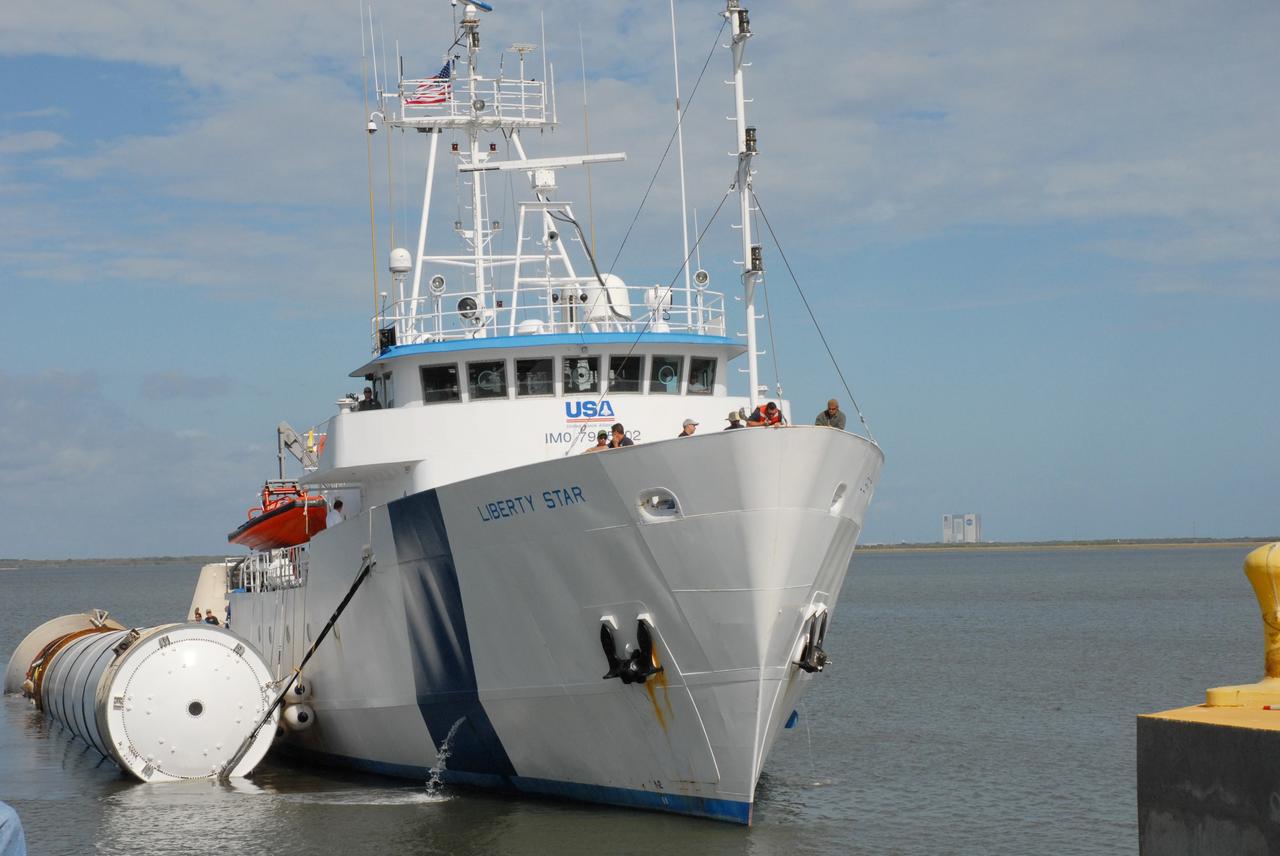
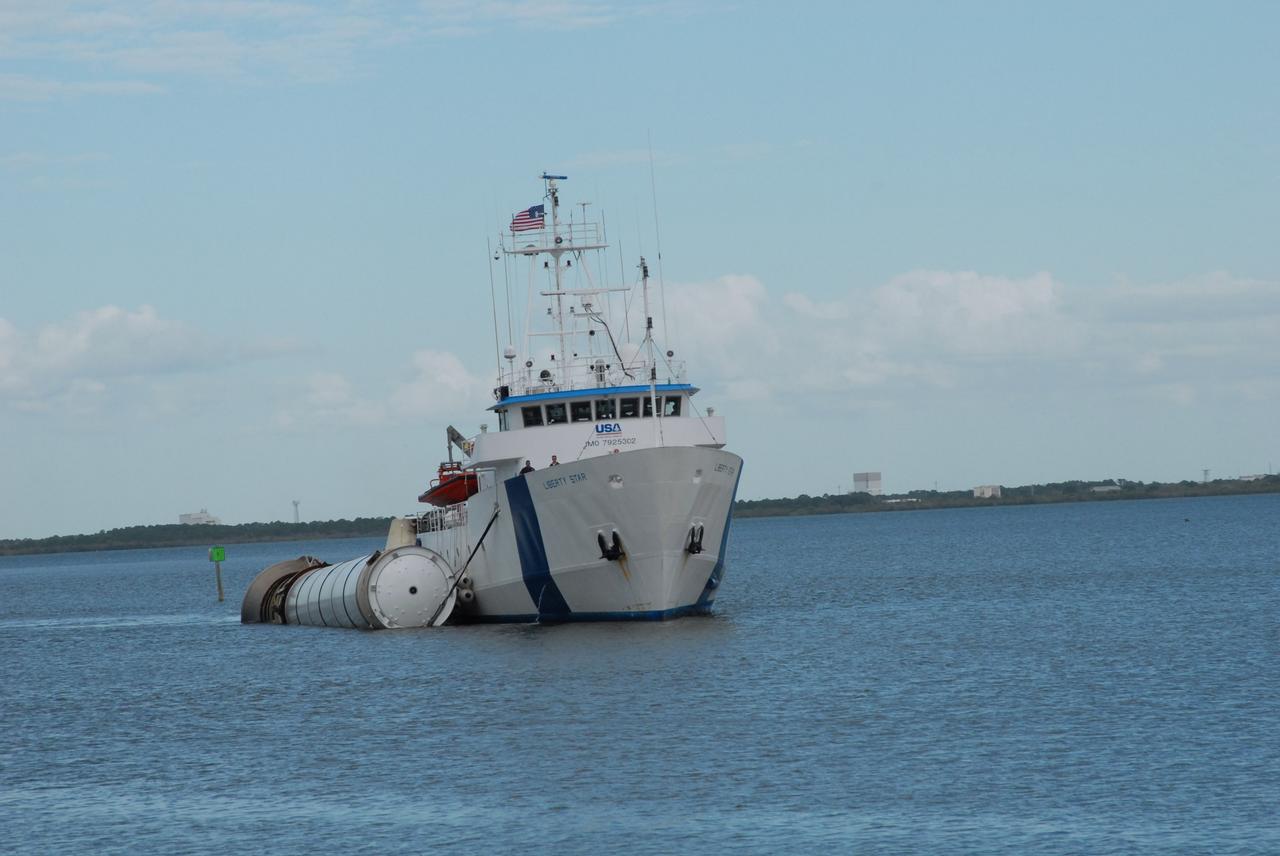
CAPE CANAVERAL, Fla. – The Solid Rocket Booster Retrieval Ship Liberty Star tows a booster to the dock at Hangar AF at Cape Canaveral Air Force Station in Florida.  The booster was used during space shuttle Discovery's launch from NASA's Kennedy Space Center in Florida March 15 on mission STS-119. The space shuttle’s solid rocket booster casings and associated flight hardware are recovered at sea after a launch. The spent rockets were recovered by NASA's Solid Rocket Booster Retrieval Ships Freedom Star and Liberty Star. The boosters impact the Atlantic Ocean approximately seven minutes after liftoff.  The splashdown area is a square of about six by nine nautical miles located about 140 nautical miles downrange from the launch pad. The retrieval ships are stationed approximately 8 to 10 nautical miles from the impact area at the time of splashdown. As soon as the boosters enter the water, the ships accelerate to a speed of 15 knots and quickly close on the boosters. The pilot chutes and main parachutes are the first items to be brought on board. With the chutes and frustum recovered, attention turns to the boosters. The ship’s tow line is connected and the booster is returned to the Port and, after transfer to a position alongside the ship, to Hangar AF. There, the expended boosters are disassembled, refurbished and reloaded with solid propellant for reuse.  Photo credit: NASA/Jack Pfaller
KSC-2009-2144
CAPE CANAVERAL, Fla. – The Solid Rocket Booster Retrieval Ship Liberty Star tows a booster to the dock at Hangar AF at Cape Canaveral Air Force Station in Florida.  The booster was used during space shuttle Discovery's launch from NASA's Kennedy Space Center in Florida March 15 on mission STS-119.  The space shuttle’s solid rocket booster casings and associated flight hardware are recovered at sea after a launch. The spent rockets were recovered by NASA's Solid Rocket Booster Retrieval Ships Freedom Star and Liberty Star. The boosters impact the Atlantic Ocean approximately seven minutes after liftoff.  The splashdown area is a square of about six by nine nautical miles located about 140 nautical miles downrange from the launch pad. The retrieval ships are stationed approximately 8 to 10 nautical miles from the impact area at the time of splashdown. As soon as the boosters enter the water, the ships accelerate to a speed of 15 knots and quickly close on the boosters. The pilot chutes and main parachutes are the first items to be brought on board. With the chutes and frustum recovered, attention turns to the boosters. The ship’s tow line is connected and the booster is returned to the Port and, after transfer to a position alongside the ship, to Hangar AF. There, the expended boosters are disassembled, refurbished and reloaded with solid propellant for reuse.  Photo credit: NASA/Jack Pfaller
KSC-2009-2141
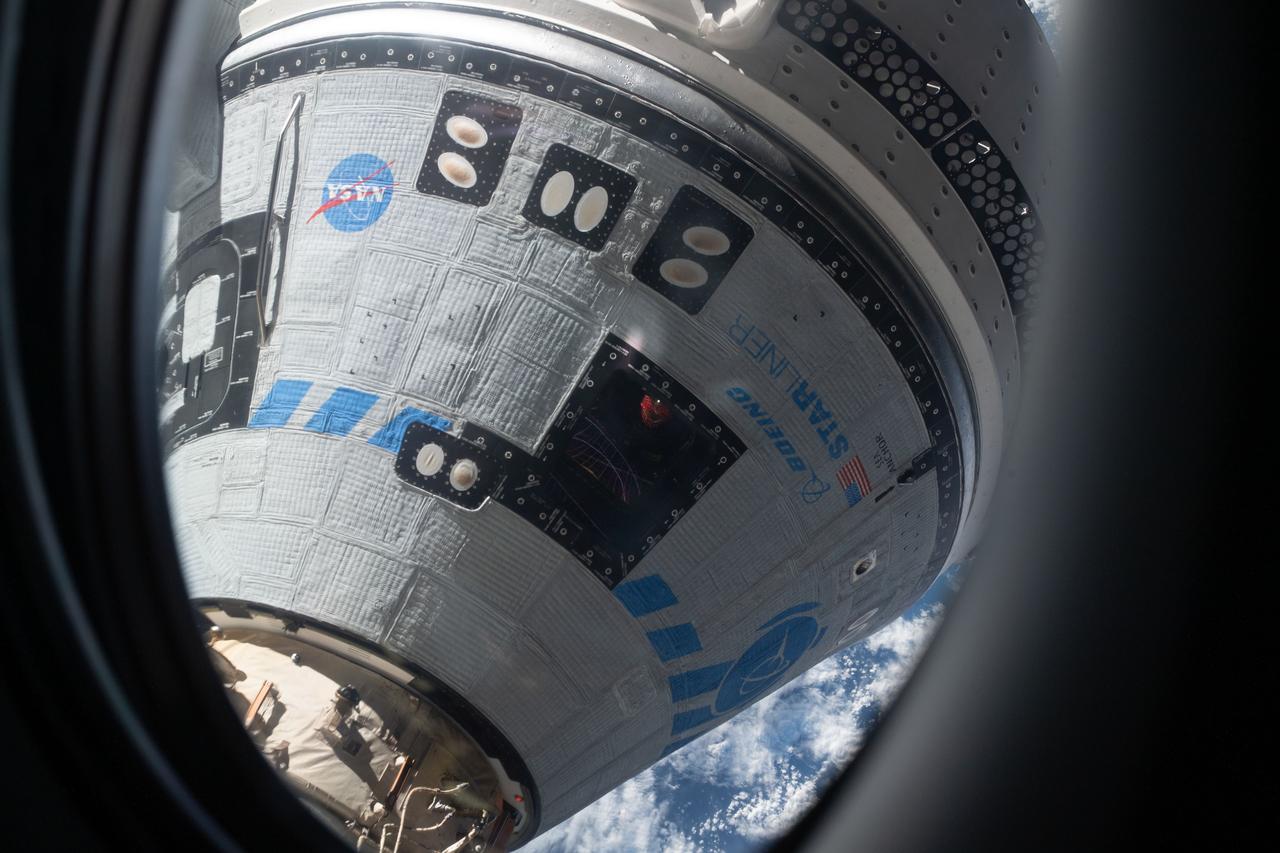
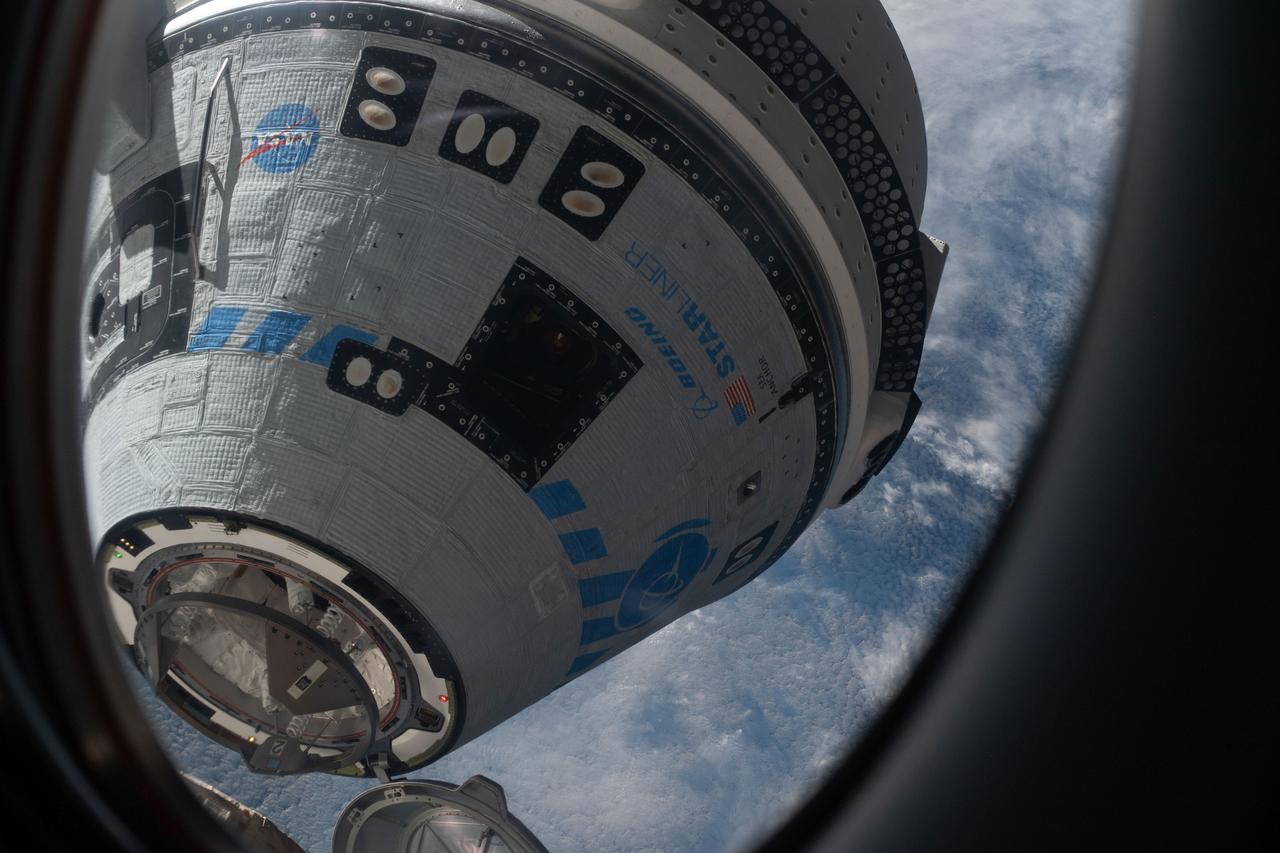
iss067e075991 (May 25, 2022) --- Boeing's CST-100 Starliner crew ship is pictured maneuvering away from the International Space Station after undocking from the Harmony module's forward port. In the foreground, is the aft end of the SpaceX Dragon Freedom crew ship that delivered the Crew-4 astronauts to the orbiting lab.
iss067e075991
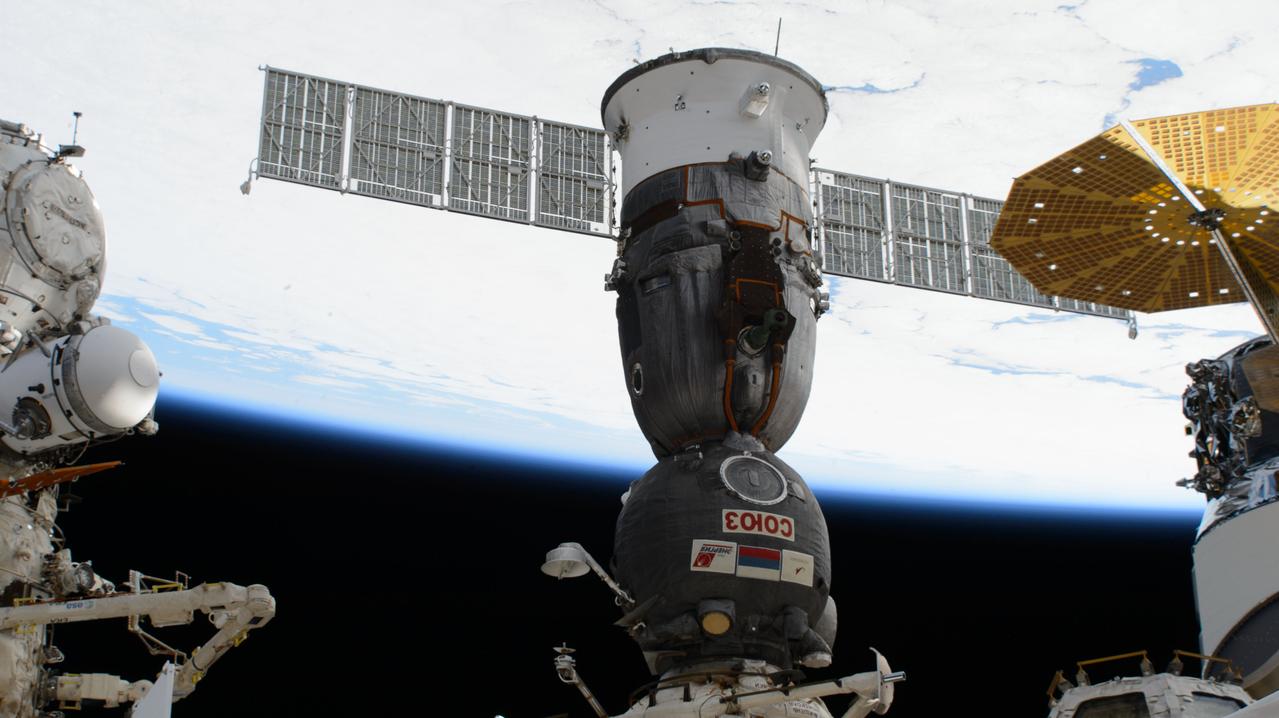
iss072e576564 (Feb. 2, 2025) --- The Soyuz MS-26 crew ship that launched NASA astronaut Don Pettit and Roscosmos cosmonauts Alexey Ovchinin and Ivan Vagner to the International Space Station is pictured docked to the Rassvet module. At right, is a portion of the Northrop Grumman Cygnus resupply ship. At left, is the partially obscured Pirs docking compartment.
The Soyuz MS-26 crew ship docked to the Rassvet module
iss064e030164 (Feb. 9, 2021) --- An external high definition camera captured this image of the ISS Progress 76 resupply ship backing away from the International Space Station after it had undocked moments earlier from the Pirs docking compartment. In the foreground is the Soyuz MS-17 crew ship docked to the Rassvet module.
iss064e030164
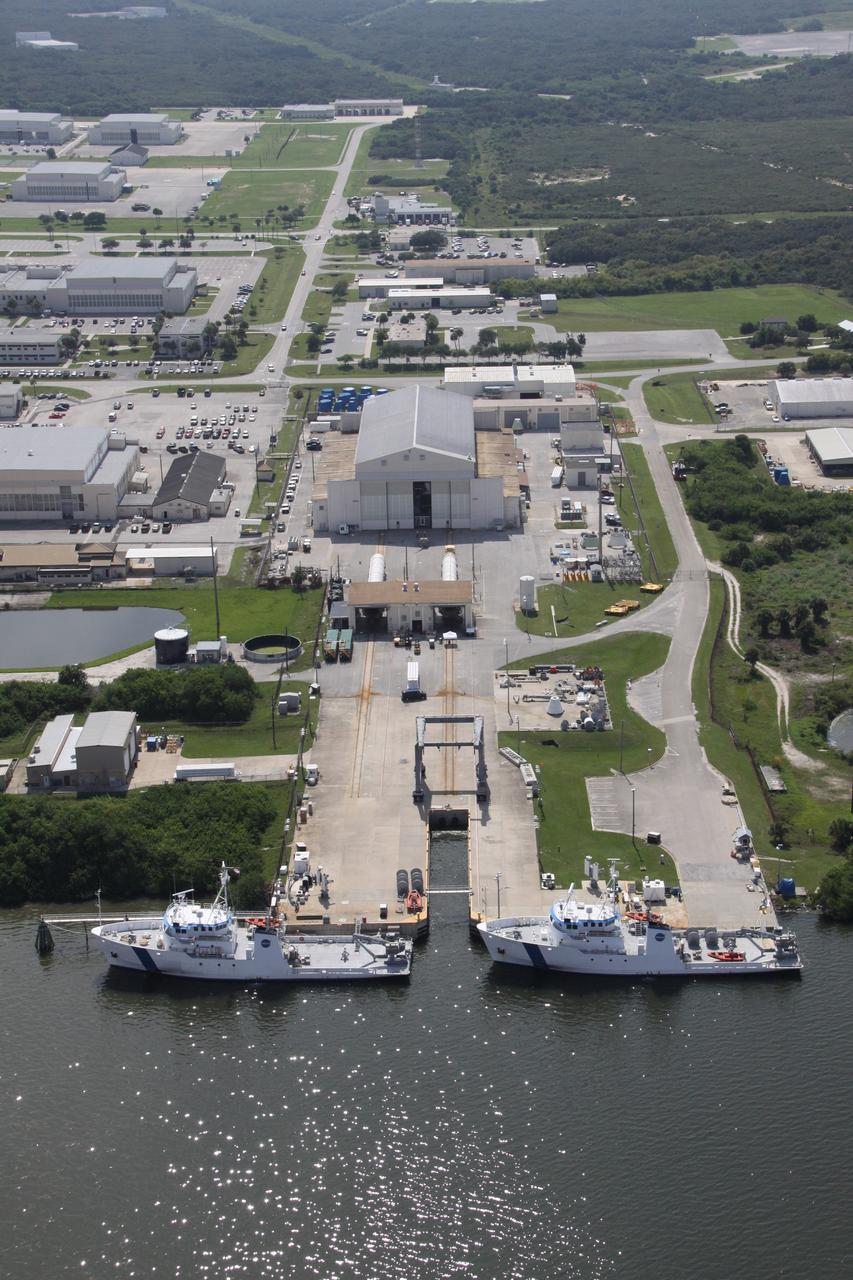
CAPE CANAVERAL, Fla. – An aerial view of the Solid Rocket Booster Recovery Ships Liberty Star and Freedom Star at Cape Canaveral Air Force Station's Hangar AF.  The ships recently returned from recovering the boosters from space shuttle Discovery's launch on the STS-128 mission.  Photo credit: NASA/Troy Cryder
KSC-2009-5009
iss059e027451 (April 18, 2019) --- The Gulf of California and the southern tip of Baja California (far right) are pictured as the International Space Station orbited 256 miles above northern Mexico. From front to back, Russia's Soyuz MS-12 crew ship and Progress 72 resupply ship are seen docked to the orbital complex.
iss059e025451
iss057e050440 (Oct. 13, 2018) --- Two Russian spacecraft, the Soyuz MS-09 crew ship (foreground) and the Progress 70 resupply ship, are pictured docked to the International Space Station as the orbital complex orbited nearly 257 miles above Ukraine.
iss057e050440
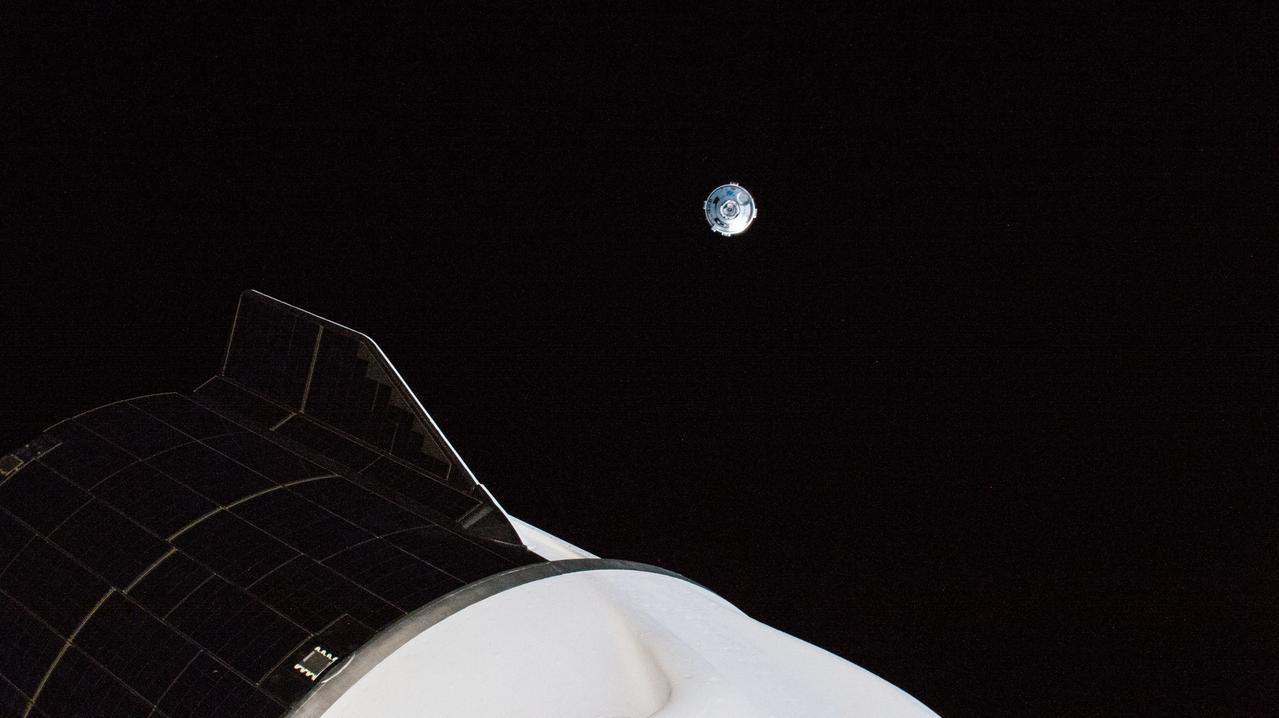
iss067e065888 (May 20, 2022) --- This view from a window on the SpaceX Crew Dragon Freedom crew ship shows Boeing's CST-100 Starliner crew ship moments away from docking to the Harmony module's forward port on the International Space Station for the company's Orbital Flight Test-2 mission.
iss067e065888
iss059e102792 (June 12, 2019) --- Two docked Russian spaceships, the Soyuz MS-12 crew ship (foreground) and the Progress 72 resupply ship, are pictured as the International Space Station orbited 258 miles above the Atlantic Ocean northeast of Puerto Rico.
iss059e102792
iss067e188909 (July 16, 2022) --- The SpaceX Dragon resupply ship carrying over 5,800 pounds of new science experiments and crew supplies, pictured from a window on the SpaceX Dragon Freedom crew ship, approaches the International Space Station above the south Atlantic Ocean.
iss067e188909
iss067e066295 (May 20, 2022) --- This view from a window on the SpaceX Crew Dragon Freedom crew ship shows Boeing's CST-100 Starliner crew ship after it had docked to the Harmony module's forward port on the International Space Station for the company's Orbital Flight Test-2 mission.
iss067e066295
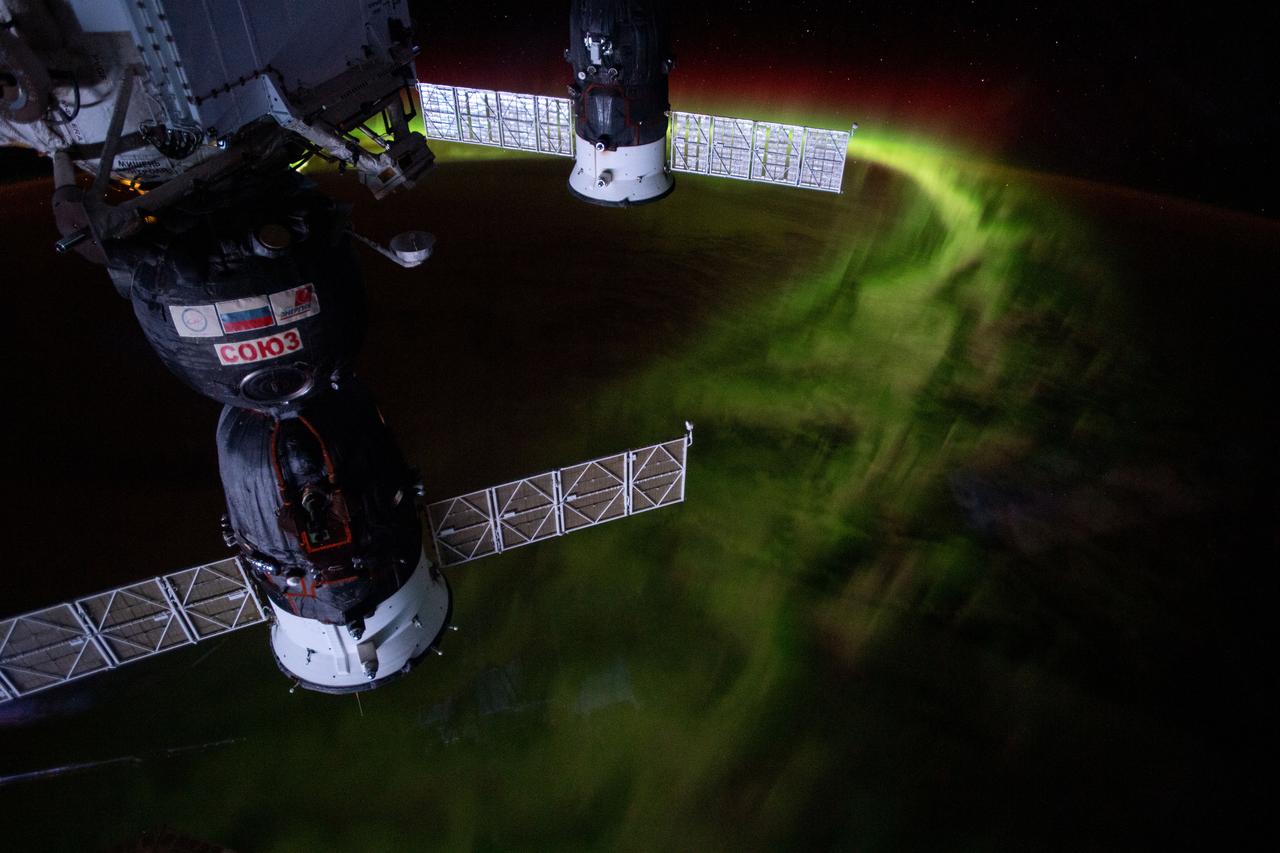
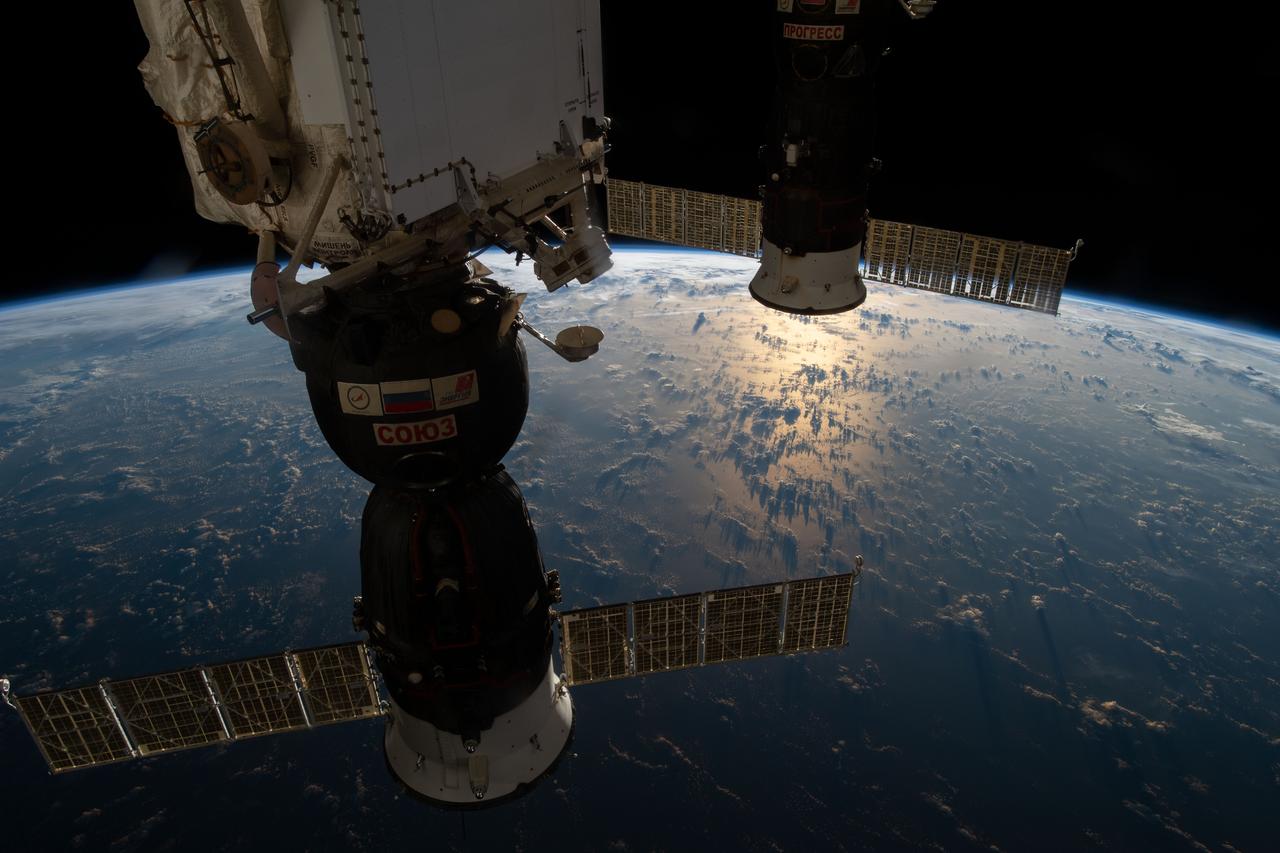
iss059e099150 (June 8, 2019) --- The International Space Station was orbiting 269 miles above the Indian Ocean southwest of Australia when this nighttime photograph was taken of the aurora australis, or "southern lights." Russia's Soyuz MS-12 crew ship (foreground) and Progress 72 resupply ship are seen in this mesmerizing view.
iss059e099150
iss056e139443 (Aug. 15, 2018) --- Russia's two docked spacecraft, the Soyuz MS-09 (left) crew ship and the Progress 70 resupply ship, are pictured as the International Space Station orbited nearly 254 miles above over northern Kazakhstan.
iss056e139443
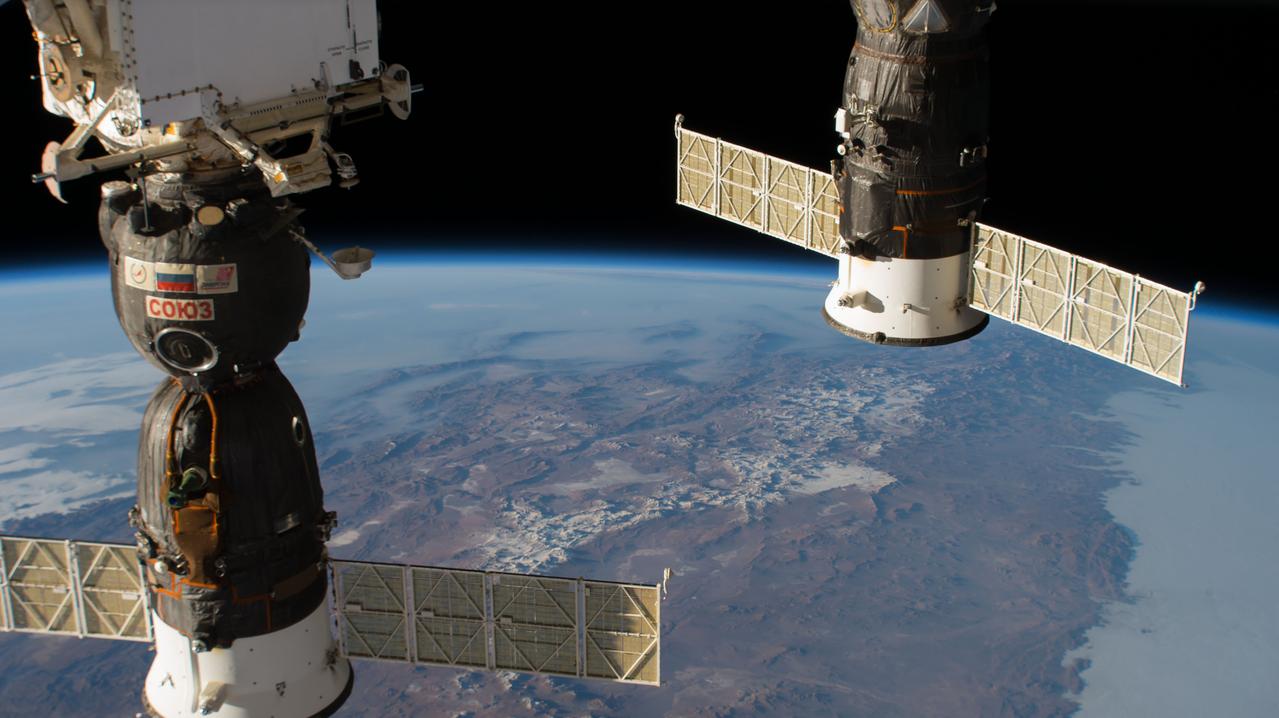
iss056e139451 (Aug. 15, 2018) --- Two docked Russian spacecraft on the International Space Station, the Soyuz MS-09 crew ship and the Progress 70 resupply ship, were pictured as the orbital complex flew 253 miles above the Andes mountain range and the South American continent.
iss056e139451
iss067e188948 (July 16, 2022) --- The SpaceX Dragon resupply ship carrying over 5,800 pounds of new science experiments and crew supplies, pictured from a window on the SpaceX Dragon Freedom crew ship, is docked to the Harmony module's forward port on the International Space Station.
iss067e188948
iss066e010713 (Oct. 24, 2021) --- Two Russian spaceships are pictured docked to the International Space Station. From left, are the Soyuz MS-19 crew ship docked to the Rassvet module and the ISS Progress 78 resupply ship docked to the Nauka multipurpose laboratory module.
Soyuz MS-19 and Progress 78 docked to the ISS
CAPE CANAVERAL, Fla. – An aerial view of the Solid Rocket Booster Recovery Ships Liberty Star and Freedom Star at Cape Canaveral Air Force Station's Hangar AF.  The ships recently returned from recovering the boosters from space shuttle Discovery's launch on the STS-128 mission.  Photo credit: NASA/Troy Cryder
KSC-2009-5006
iss067e188939 (July 16, 2022) --- The SpaceX Dragon resupply ship carrying over 5,800 pounds of new science experiments and crew supplies, pictured from a window on the SpaceX Dragon Freedom crew ship, approaches the International Space Station above the south Atlantic Ocean.
iss067e188939
KENNEDY SPACE CENTER, FLA. - Following the memorial service for the crew of Columbia at the Space Memorial Mirror, Louise Kleba, who is with United Space Alliance, joins other visitors placing roses in the wire mesh fence surrounding the mirror.  Feb. 1 is the one-year anniversary of the loss of the crew and orbiter Columbia in a tragic accident as the ship returned to Earth following mission STS-107. The public was invited to the memorial service, held in the KSC Visitor Complex, which included comments by Center Director Jim Kennedy and Executive Director of Florida Space Authority Winston Scott.  Scott is a former astronaut who flew on Columbia in 1997.
KENNEDY SPACE CENTER, FLA. - Following the memorial service for the crew of Columbia at the Space Memorial Mirror, Louise Kleba, who is with United Space Alliance, joins other visitors placing roses in the wire mesh fence surrounding the mirror. Feb. 1 is the one-year anniversary of the loss of the crew and orbiter Columbia in a tragic accident as the ship returned to Earth following mission STS-107. The public was invited to the memorial service, held in the KSC Visitor Complex, which included comments by Center Director Jim Kennedy and Executive Director of Florida Space Authority Winston Scott. Scott is a former astronaut who flew on Columbia in 1997.
CAPE CANAVERAL, Fla. –   NASA's Solid Rocket Booster Retrieval Ship Freedom Star tows along its side one of the spent booster rockets from the space shuttle Endeavour launch Nov. 14 on the STS-126 mission.  The ship is returning the spent rocket to Hangar AF at Cape Canaveral Air Force Station in Florida. The space shuttle’s solid rocket booster casings and associated flight hardware are recovered at sea. The boosters impact the Atlantic Ocean approximately seven minutes after liftoff. The splashdown area is a square of about six by nine nautical miles located about 140 nautical miles downrange from the launch pad. The retrieval ships are stationed approximately 8 to 10 nautical miles from the impact area at the time of splashdown. As soon as the boosters enter the water, the ships accelerate to a speed of 15 knots and quickly close on the boosters. The pilot chutes and main parachutes are the first items to be brought on board. With the chutes and frustum recovered, attention turns to the boosters. The ship’s tow line is connected and the booster is returned to the Port and, after transfer to a position alongside the ship, to Hangar AF. There, the expended boosters are disassembled, refurbished and reloaded with solid propellant for reuse. Photo credit: NASA/Kim Shiflett
KSC-08pd3730
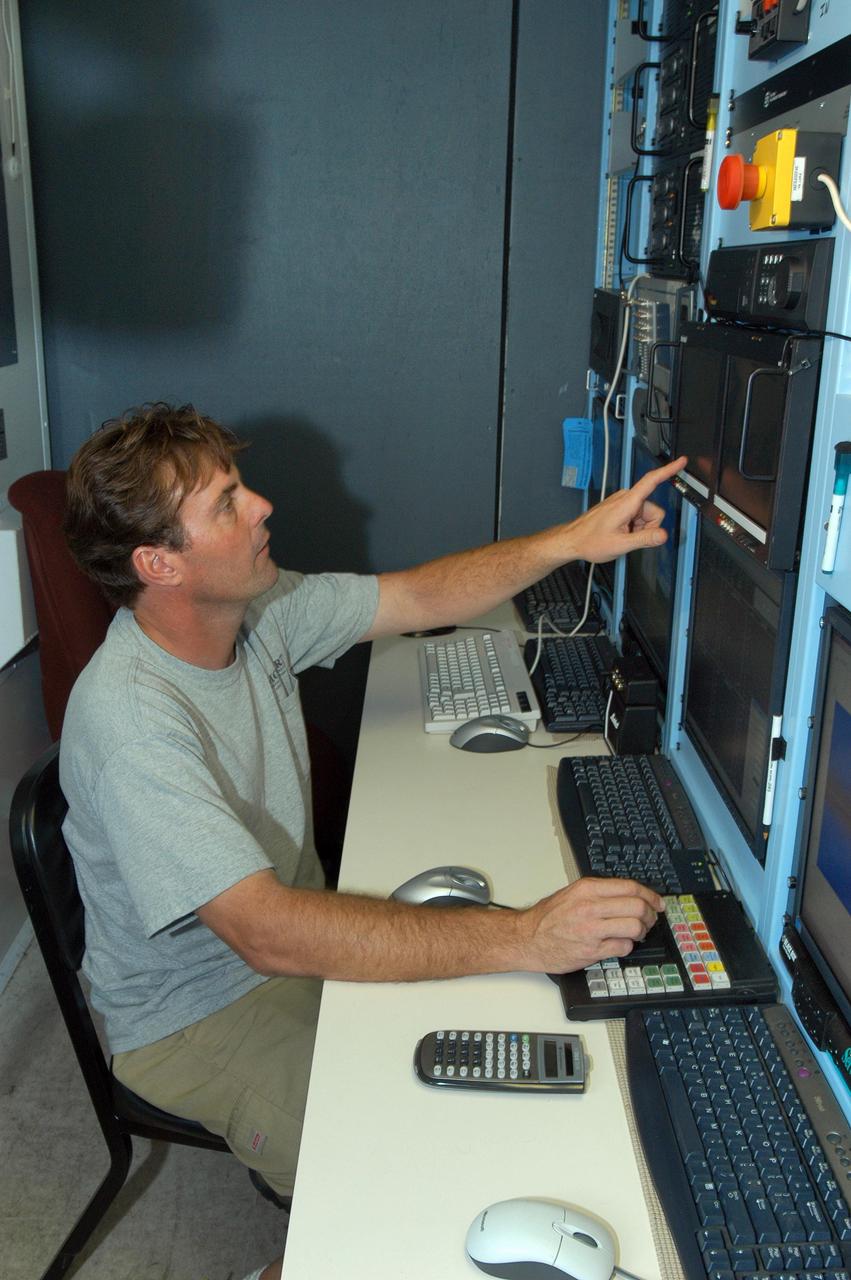
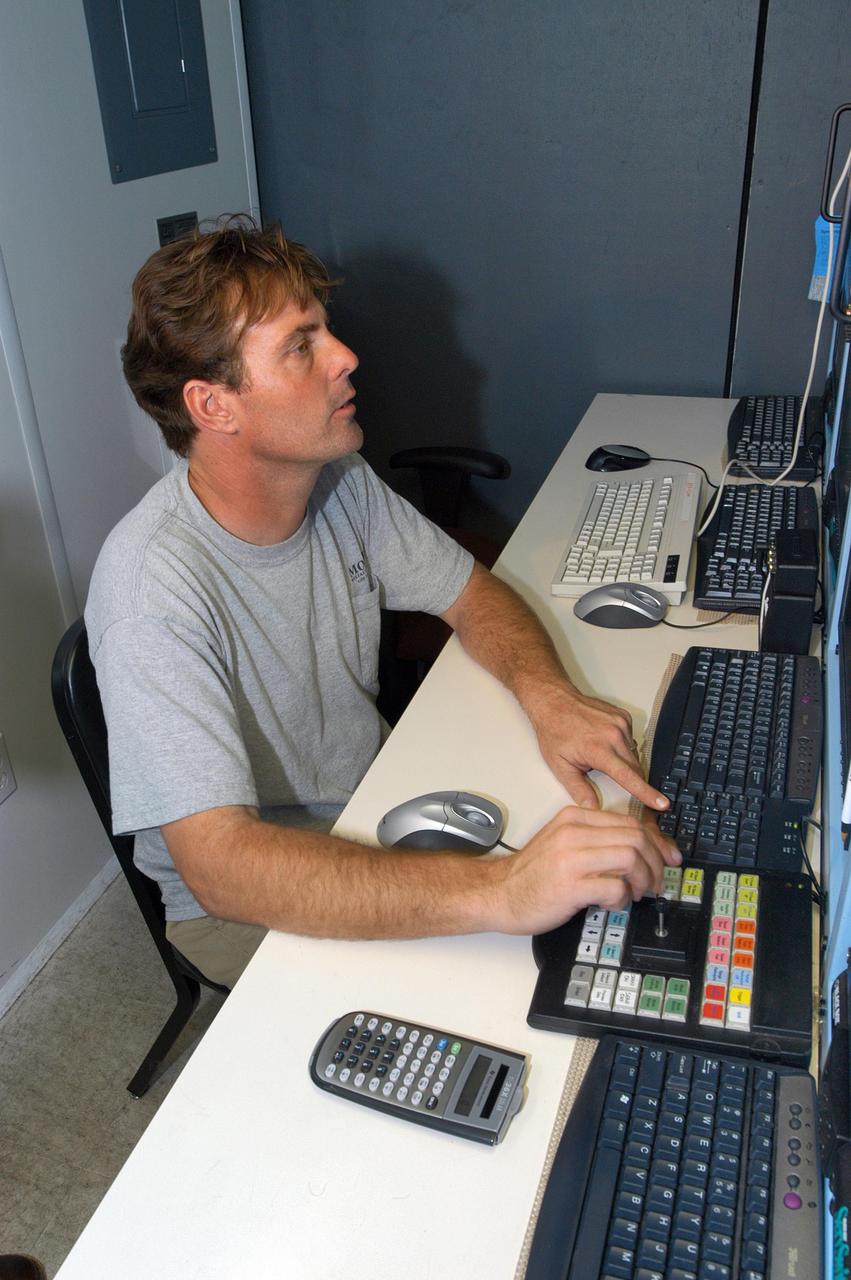
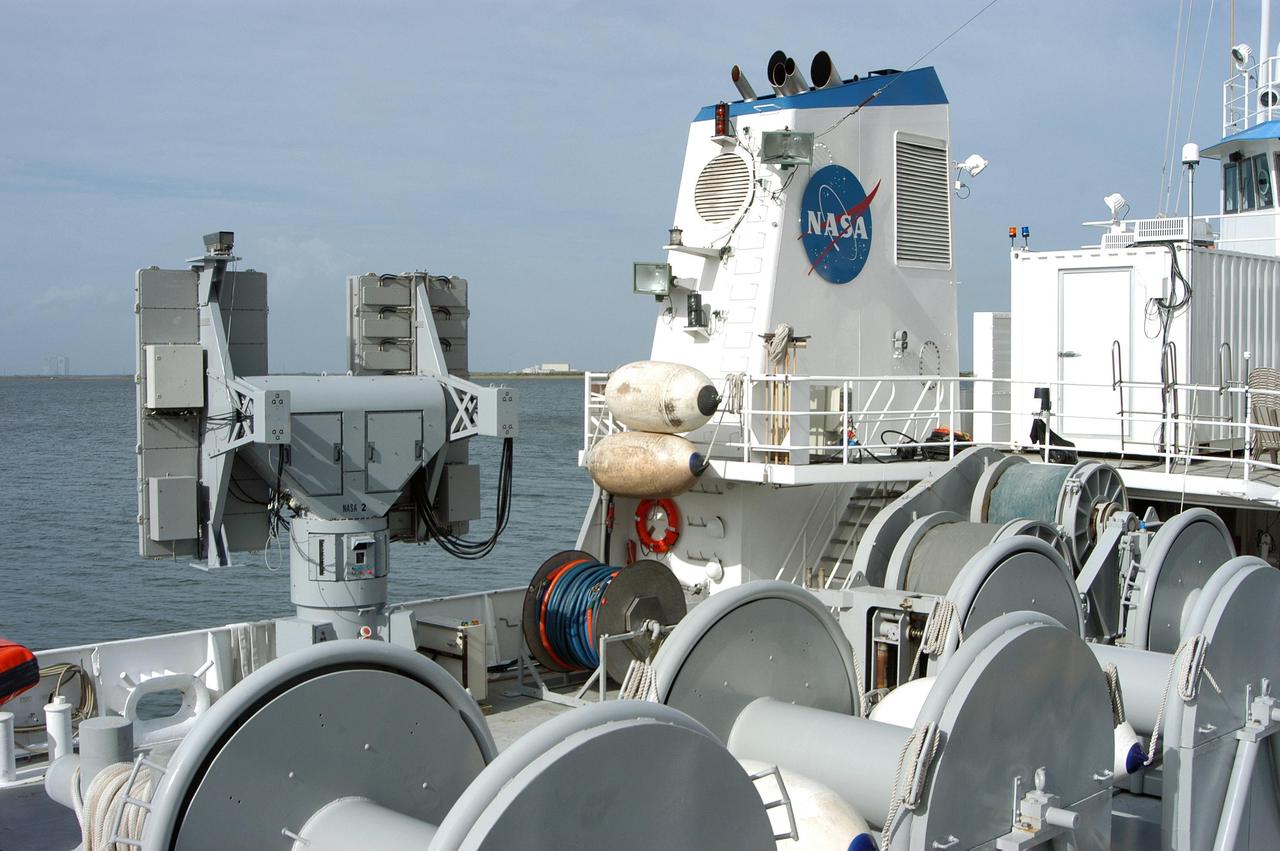
KENNEDY SPACE CENTER, FLA. --  Radar operator Scott Peabody tests the X-band radar array installed on the solid rocket booster retrieval ship Liberty before launch of Space Shuttle Discovery.  It is one of  two Weibel Continuous Pulse Doppler X-band radars located on each of the two SRB retrieval ships.  This one will be located downrange of the launch site. It is one of  two Weibel Continuous Pulse Doppler X-band radars located on each of the two SRB retrieval ships.  This one will be located downrange of the launch site.  Working with the land-based C-band radar, the X-band radars provide velocity and differential shuttle/debris motion information during launch.  The radar data will be sent from the ships via satellite link and analyzed at the C-band radar site located on north Kennedy Space Center.  Photo credit: NASA/George Shelton
KSC-06pd2648
KENNEDY SPACE CENTER, FLA. --  Radar operator Scott Peabody tests the X-band radar array installed on the solid rocket booster retrieval ship Liberty before launch of Space Shuttle Discovery.  It is one of  two Weibel Continuous Pulse Doppler X-band radars located on each of the two SRB retrieval ships.  This one will be located downrange of the launch site. It is one of  two Weibel Continuous Pulse Doppler X-band radars located on each of the two SRB retrieval ships.  This one will be located downrange of the launch site.  Working with the land-based C-band radar, the X-band radars provide velocity and differential shuttle/debris motion information during launch.  The radar data will be sent from the ships via satellite link and analyzed at the C-band radar site located on north Kennedy Space Center.  Photo credit: NASA/George Shelton
KSC-06pd2647
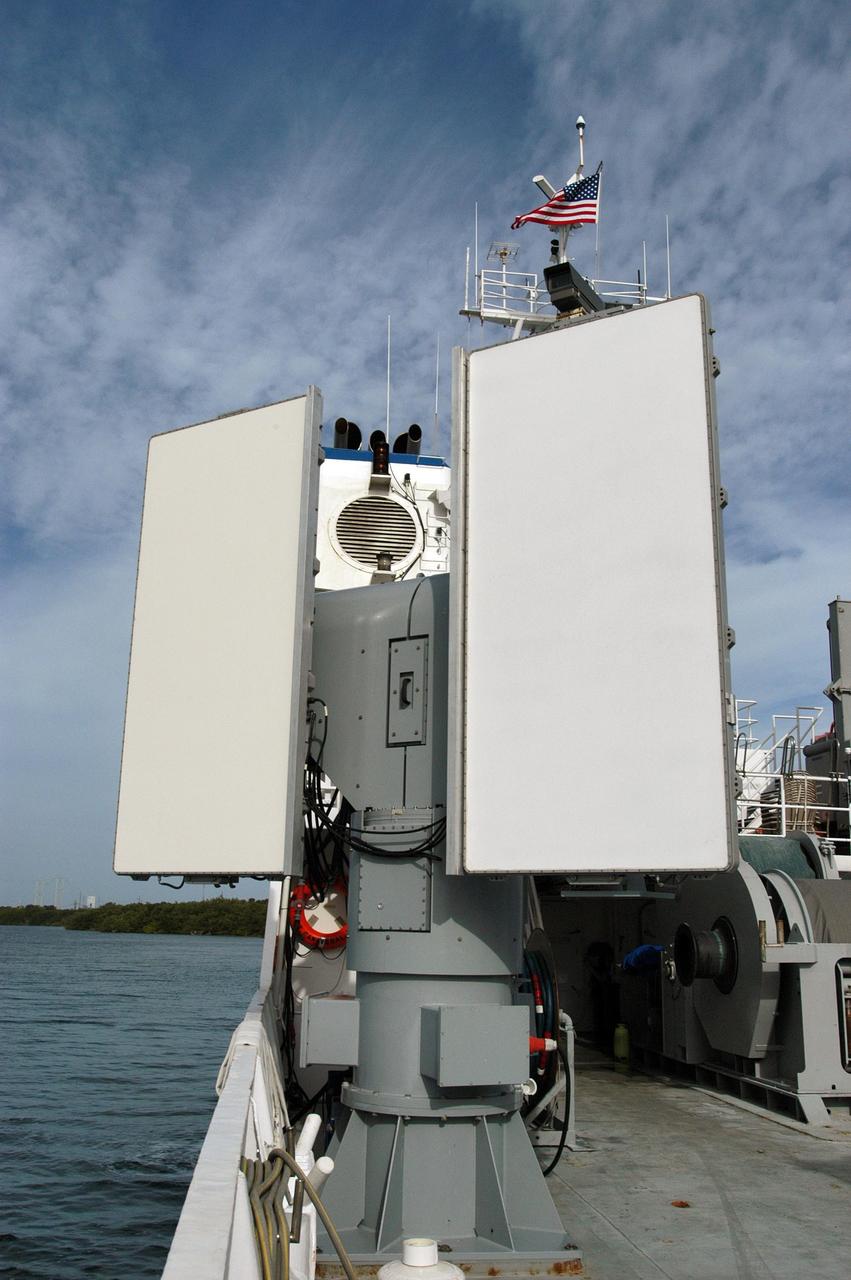
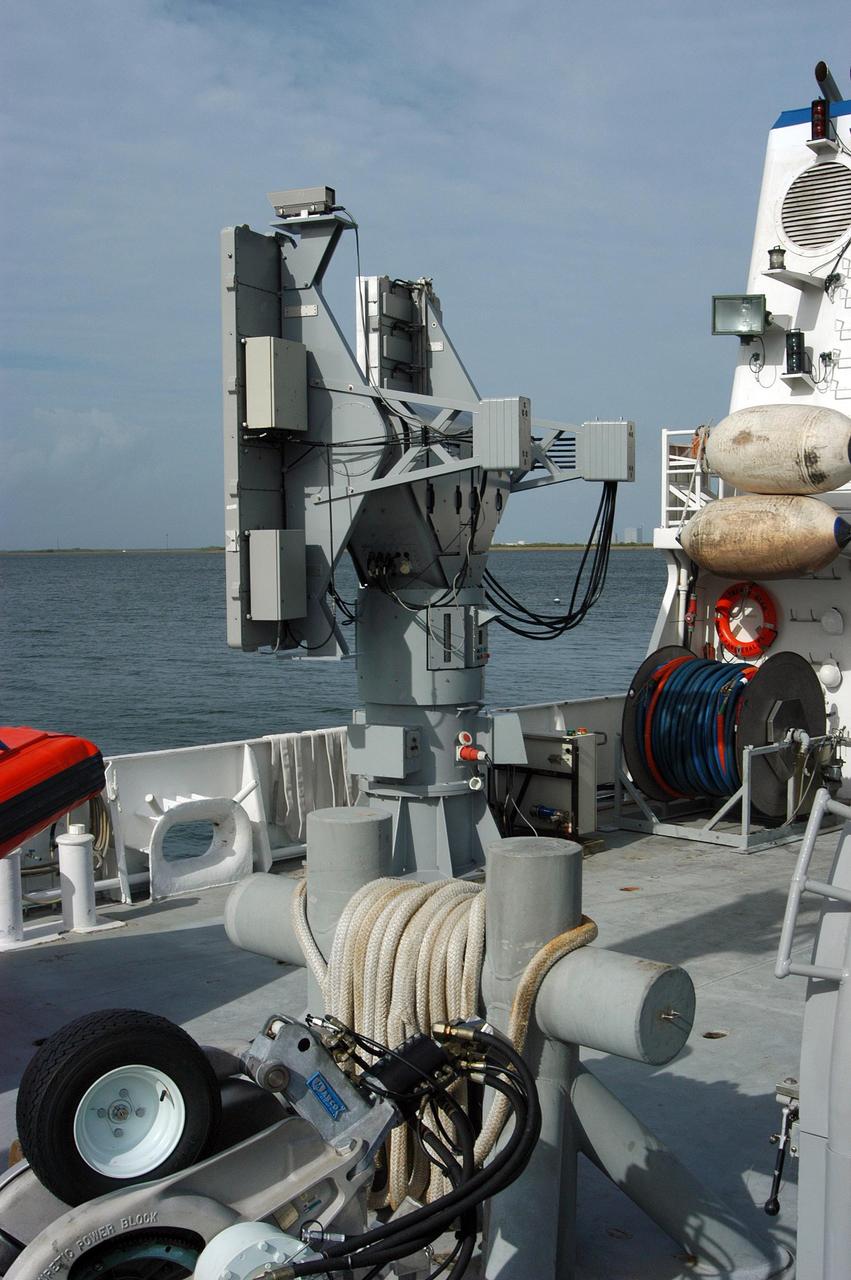
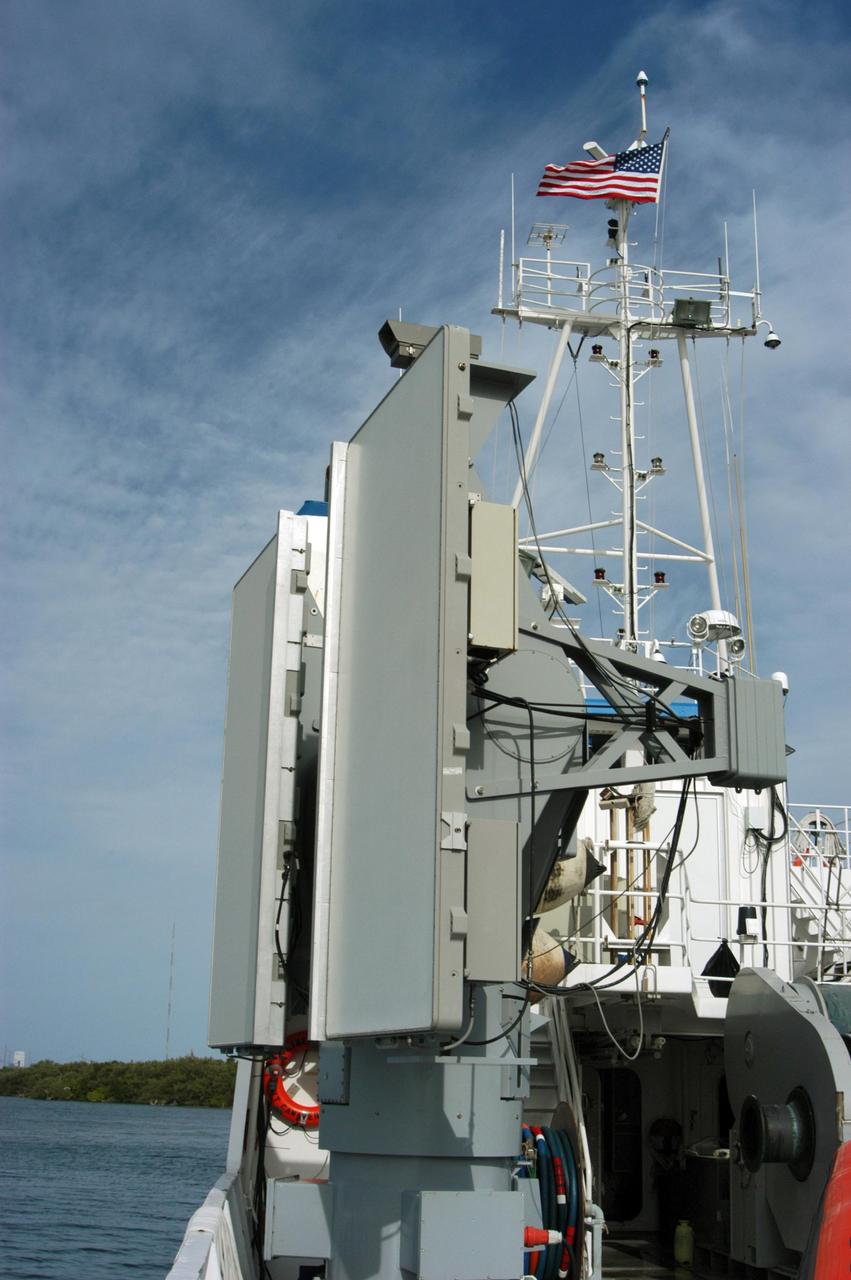
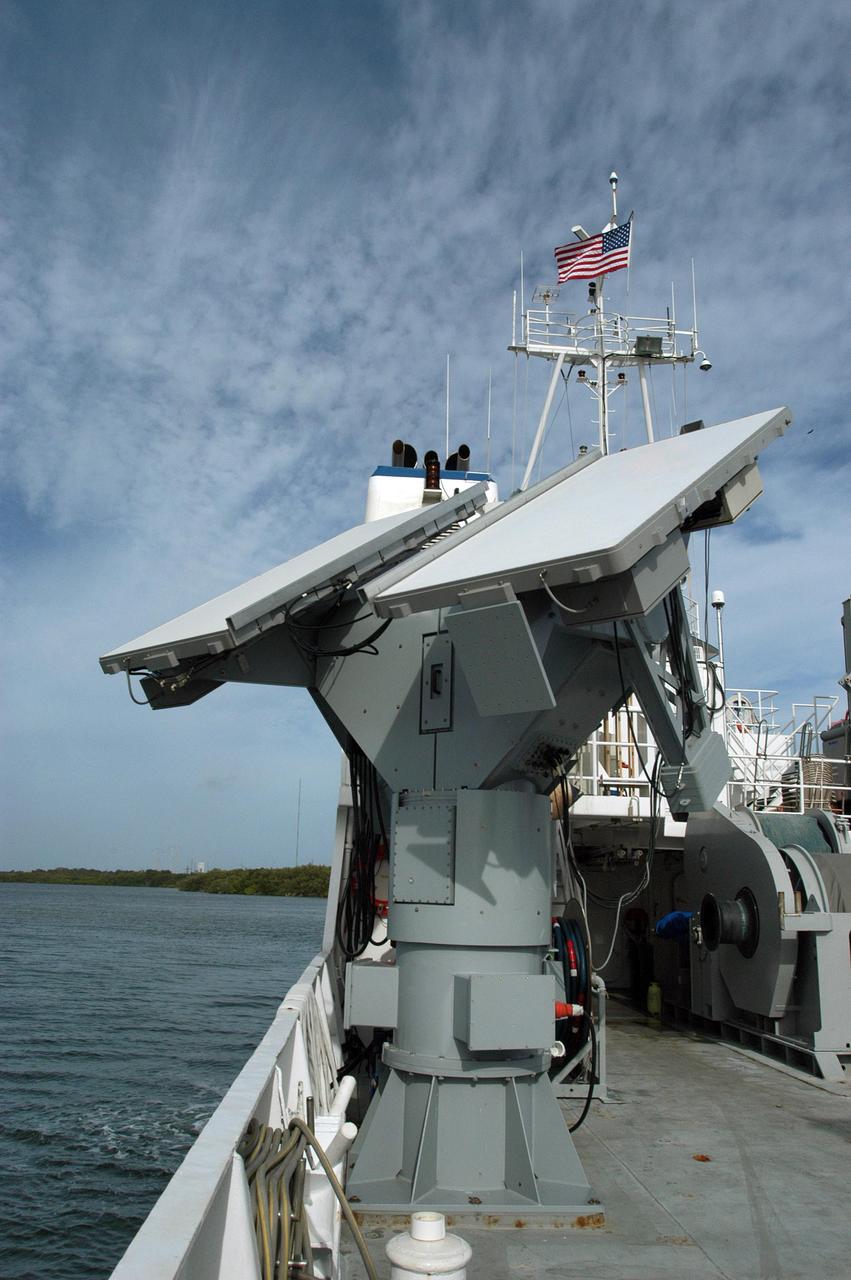
KENNEDY SPACE CENTER, FLA. --  The X-band radar array is installed on the solid rocket booster retrieval ship Liberty before launch of Space Shuttle Discovery.  It is one of  two Weibel Continuous Pulse Doppler X-band radars located on each of the two SRB retrieval ships.  This one will be located downrange of the launch site.  Working with the land-based C-band radar, the X-band radars provide velocity and differential shuttle/debris motion information during launch.  The radar data will be sent from the ships via satellite link and analyzed at the C-band radar site located on north Kennedy Space Center.  Photo credit: NASA/George Shelton
KSC-06pd2644
KENNEDY SPACE CENTER, FLA. --  The X-band radar array is installed on the solid rocket booster retrieval ship Liberty before launch of Space Shuttle Discovery.  It is one of  two Weibel Continuous Pulse Doppler X-band radars located on each of the two SRB retrieval ships.  This one will be located downrange of the launch site.  Working with the land-based C-band radar, the X-band radars provide velocity and differential shuttle/debris motion information during launch.  The radar data will be sent from the ships via satellite link and analyzed at the C-band radar site located on north Kennedy Space Center.  Photo credit: NASA/George Shelton
KSC-06pd2643
KENNEDY SPACE CENTER, FLA. --  The X-band radar array is installed on the solid rocket booster retrieval ship Liberty before launch of Space Shuttle Discovery.  It is one of  two Weibel Continuous Pulse Doppler X-band radars located on each of the two SRB retrieval ships.  This one will be located downrange of the launch site.  Working with the land-based C-band radar, the X-band radars provide velocity and differential shuttle/debris motion information during launch.  The radar data will be sent from the ships via satellite link and analyzed at the C-band radar site located on north Kennedy Space Center.  Photo credit: NASA/George Shelton
KSC-06pd2646
KENNEDY SPACE CENTER, FLA. --  The X-band radar array is installed on the solid rocket booster retrieval ship Liberty before launch of Space Shuttle Discovery.  It is one of  two Weibel Continuous Pulse Doppler X-band radars located on each of the two SRB retrieval ships.  This one will be located downrange of the launch site.  Working with the land-based C-band radar, the X-band radars provide velocity and differential shuttle/debris motion information during launch.  The radar data will be sent from the ships via satellite link and analyzed at the C-band radar site located on north Kennedy Space Center.  Photo credit: NASA/George Shelton
KSC-06pd2645
KENNEDY SPACE CENTER, FLA. --  The X-band radar array is being installed on the solid rocket booster retrieval ship Liberty before launch of Space Shuttle Discovery.  It is one of  two Weibel Continuous Pulse Doppler X-band radars located on each of the two SRB retrieval ships.  This one will be located downrange of the launch site.  Working with the land-based C-band radar, the X-band radars provide velocity and differential shuttle/debris mo¬tion information during launch.  The radar data will be sent from the ships via satellite link and analyzed at the C-band radar site located on north Kennedy Space Center.  Photo credit: NASA/George Shelton
KSC-06pd2642
KENNEDY SPACE CENTER, FLA. --  United Space Alliance workers on board the Freedom Star, one of the Shuttle Rocket Booster retrieval ships, check the controls on the recompression chamber at right.  The ship and its dive team, including a diver medical technician, Andy Fish, were instrumental in rescuing a lobster diver in distress off Cape Canaveral Sept. 11. The ship was on a certification exercise and near the location of a lobster diving boat that radioed the U.S. Coast Guard for help when one of the divers experienced difficulty breathing on his return to the surface.  Hearing the call for help, the captain of the Freedom Star offered to help. Fish stayed with the diver in the recompression chamber aboard the Freedom Star until the ship reached Port Canaveral where a KSC Occupational Health doctor waited.  The diver was stabilized and taken to  Florida Hospital.
KSC-02pd1300
KENNEDY SPACE CENTER, FLA. -   On the dock at Port Canaveral in Florida, a worker secures a crane hook on an X-band radar to be transferred to and installed on the U.S. Naval Ship Hayes.  The radar will support the July 1 launch of Space Shuttle Discovery on mission STS-121.  There are two Continuous Pulse Doppler X-band radars located on ships for the STS-121 launch.  The other one is mounted on a booster recovery ship downrange of the launch site. The two radars provide velocity and differential Shuttle/debris motion information.  Combined with the C-band radar located at the Haulover Canal near the launch site, they provide high definition images of any debris that might fall from the external tank/shuttle.  The X-band data (screen captures) will be sent from the ships via satellite link to the National Center for Atmospheric Research site.  Photo credit: NASA/Jim Grossmann
KSC-06pd1272
KENNEDY SPACE CENTER, FLA. -   An X-band radar is ready to be loaded on the U.S. Naval Ship Hayes at Port Canaveral in Florida to support the July 1 launch of Space Shuttle Discovery on mission STS-121. There are two Continuous Pulse Doppler X-band radars located on ships for the STS-121 launch.  The other one is mounted on a booster recovery ship downrange of the launch site. The two radars provide velocity and differential Shuttle/debris motion information.  Combined with the C-band radar located at the Haulover Canal near the launch site, they provide high definition images of any debris that might fall from the external tank/shuttle.  The X-band data (screen captures) will be sent from the ships via satellite link to the National Center for Atmospheric Research site.  Photo credit: NASA/Jim Grossmann
KSC-06pd1271