
CAPE CANAVERAL, Fla. – At the Kennedy Space Center in Florida, the new space shuttle, Atlantis, arrives at the Shuttle Landing Facility. The shuttle is mounted atop the Shuttle Carrier Aircraft, a modified Boeing 747. Over the next seven months Atlantis will be prepared for its maiden voyage, STS-51J. Atlantis, NASA's fourth space-rated shuttle, was named after the two-masted boat that served as the primary research vessel for the Woods Hole Oceanographic Institute in Massachusetts from 1930 to 1966. The boat had a 17-member crew and accommodated up to five scientists who worked in two onboard laboratories, examining water samples and marine life. Like its predecessors, Atlantis was constructed by Rockwell International in Palmdale, Calif. The spacecraft was transported over land from Palmdale to Edwards Air Force Base on April 3, 1985 for the cross-country ferry flight to Kennedy. For more: http://www.nasa.gov/centers/kennedy/shuttleoperations/orbiters/atlantis-info.html Photo credit: NASA/Louie Rochefort
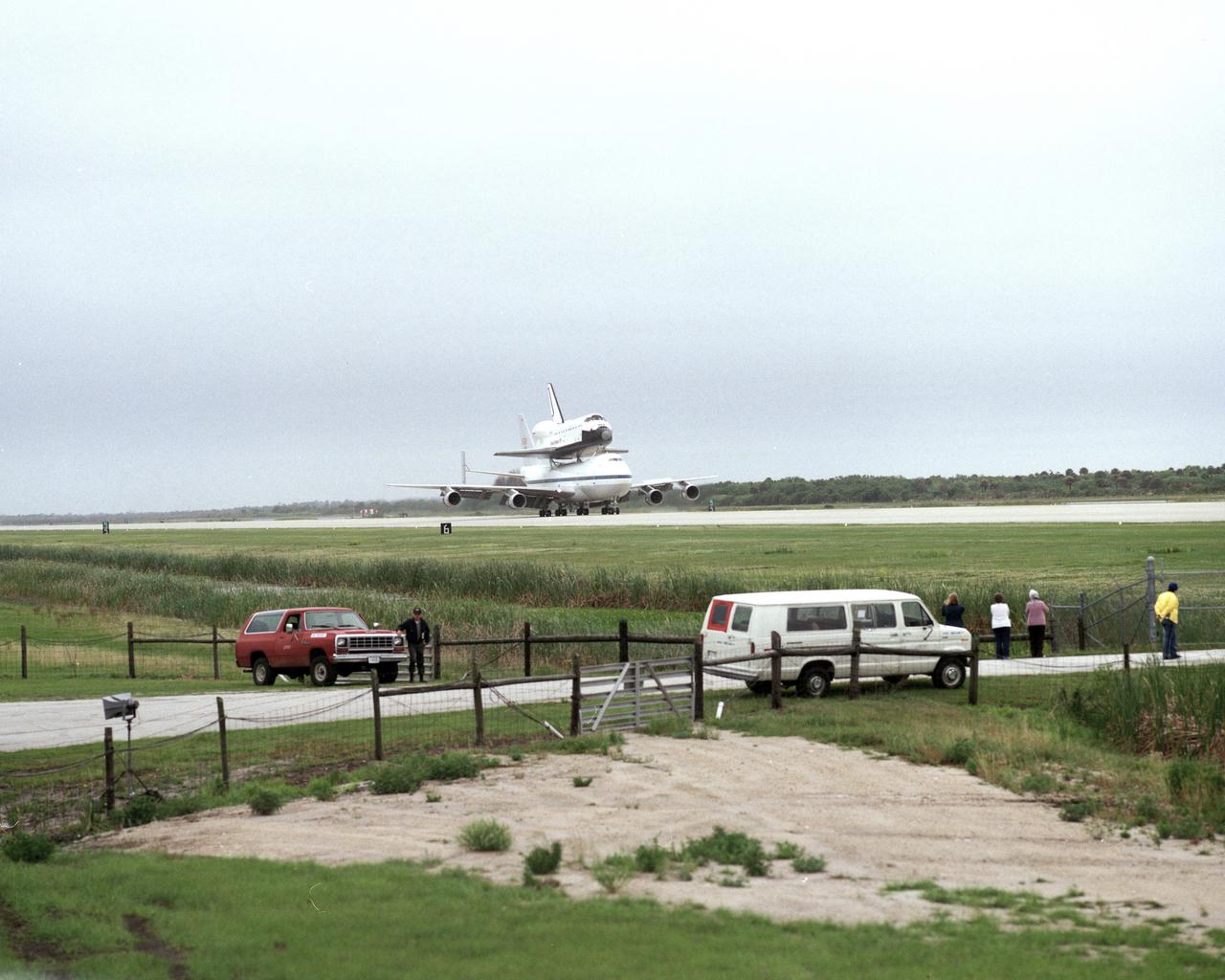
CAPE CANAVERAL, Fla. – At the Kennedy Space Center in Florida, the new space shuttle, Atlantis, arrives at the Shuttle Landing Facility. The shuttle is mounted atop the Shuttle Carrier Aircraft, a modified Boeing 747. Over the next seven months Atlantis will be prepared for its maiden voyage, STS-51J. Atlantis, NASA's fourth space-rated shuttle, was named after the two-masted boat that served as the primary research vessel for the Woods Hole Oceanographic Institute in Massachusetts from 1930 to 1966. The boat had a 17-member crew and accommodated up to five scientists who worked in two onboard laboratories, examining water samples and marine life. Like its predecessors, Atlantis was constructed by Rockwell International in Palmdale, Calif. The spacecraft was transported over land from Palmdale to Edwards Air Force Base on April 3, 1985 for the cross-country ferry flight to Kennedy. For more: http://www.nasa.gov/centers/kennedy/shuttleoperations/orbiters/atlantis-info.html Photo credit: NASA/Louie Rochefort
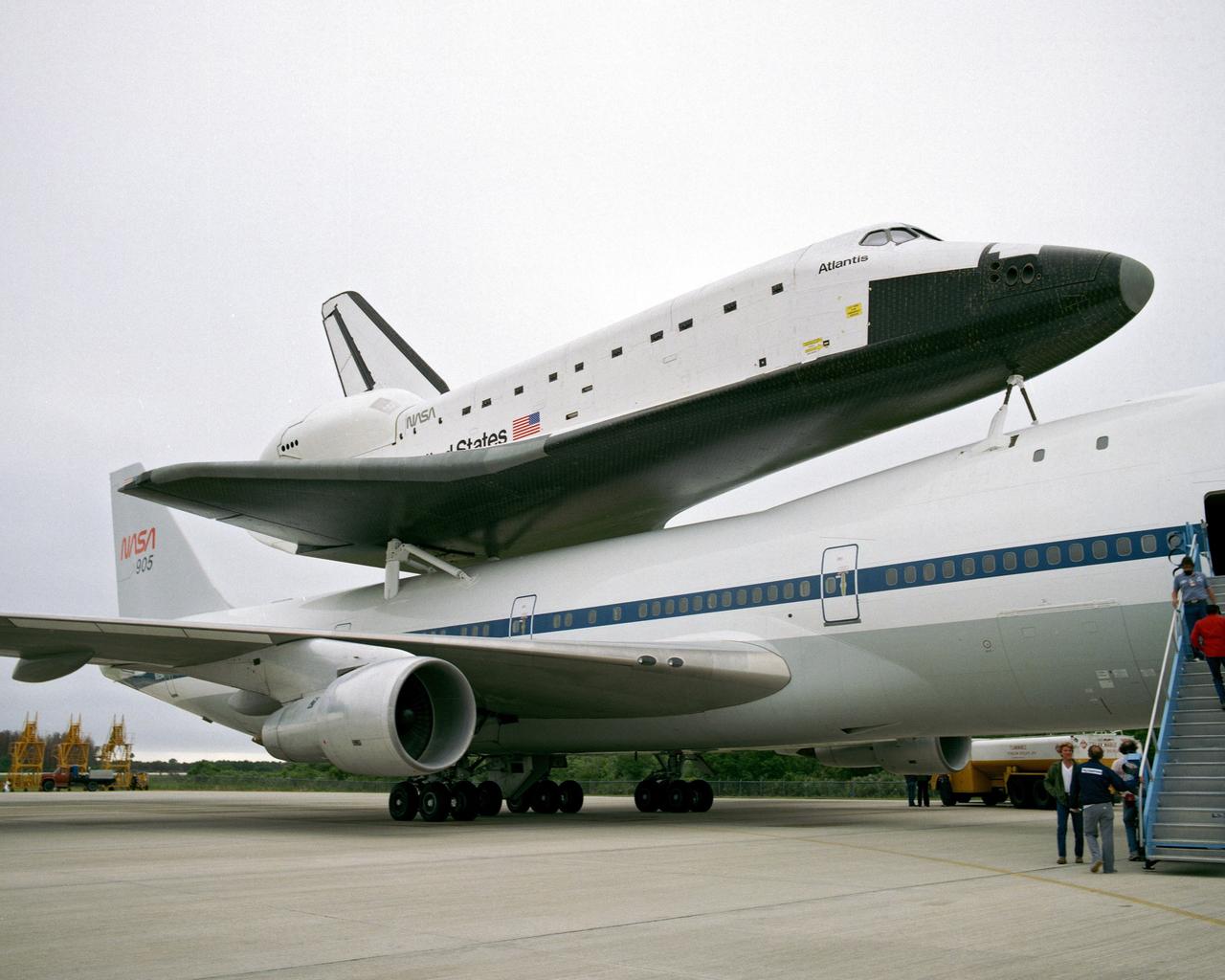
CAPE CANAVERAL, Fla. – At the Kennedy Space Center in Florida, the new space shuttle, Atlantis, arrives at the Shuttle Landing Facility. The shuttle is mounted atop the Shuttle Carrier Aircraft, a modified Boeing 747. Over the next seven months Atlantis will be prepared for its maiden voyage, STS-51J. Atlantis, NASA's fourth space-rated shuttle, was named after the two-masted boat that served as the primary research vessel for the Woods Hole Oceanographic Institute in Massachusetts from 1930 to 1966. The boat had a 17-member crew and accommodated up to five scientists who worked in two onboard laboratories, examining water samples and marine life. Like its predecessors, Atlantis was constructed by Rockwell International in Palmdale, Calif. The spacecraft was transported over land from Palmdale to Edwards Air Force Base on April 3, 1985 for the cross-country ferry flight to Kennedy. For more: http://www.nasa.gov/centers/kennedy/shuttleoperations/orbiters/atlantis-info.html Photo credit: NASA/Louie Rochefort
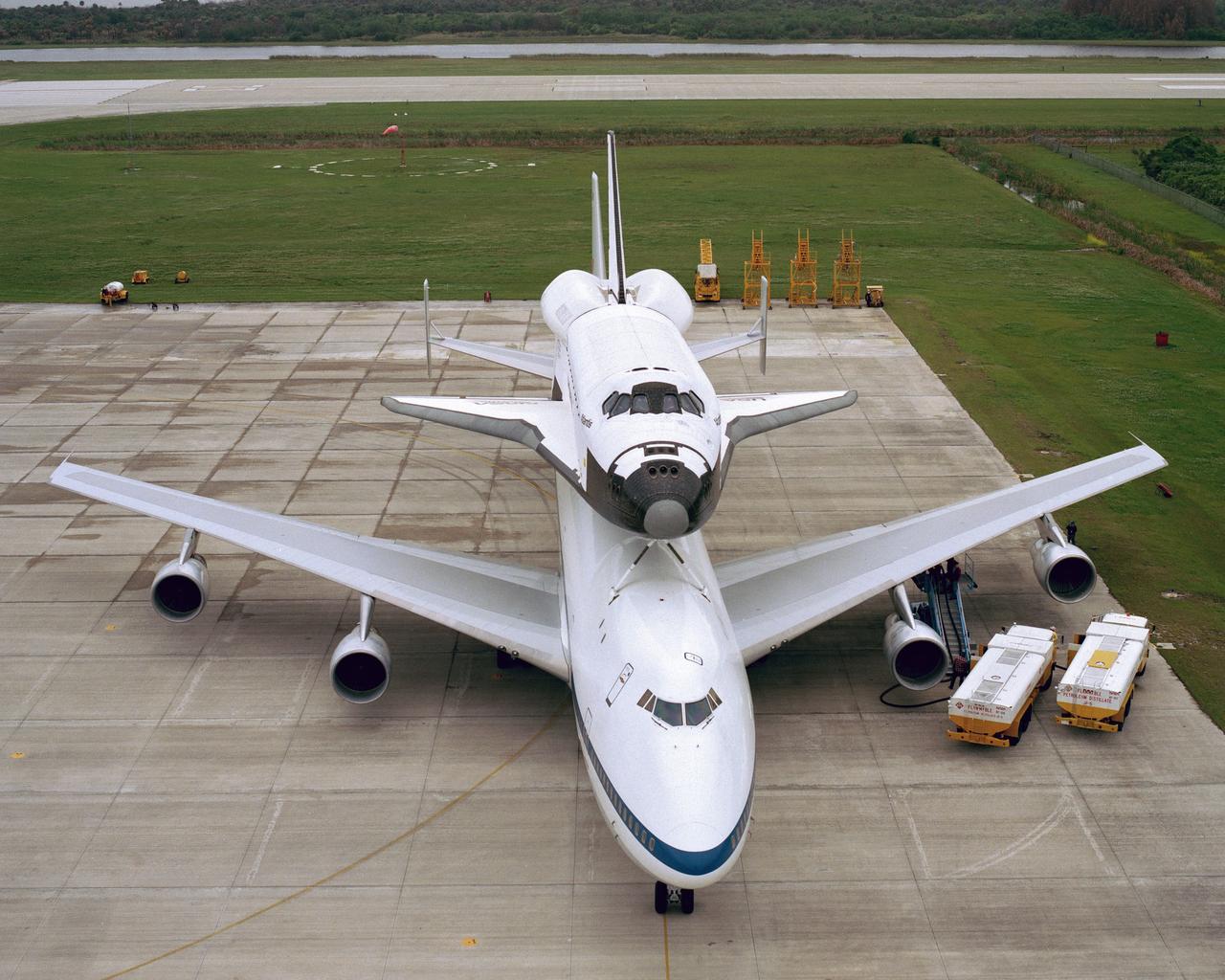
CAPE CANAVERAL, Fla. – At the Kennedy Space Center in Florida, the new space shuttle, Atlantis, arrives at the Shuttle Landing Facility. The shuttle is mounted atop the Shuttle Carrier Aircraft, a modified Boeing 747. Over the next seven months Atlantis will be prepared for its maiden voyage, STS-51J. Atlantis, NASA's fourth space-rated shuttle, was named after the two-masted boat that served as the primary research vessel for the Woods Hole Oceanographic Institute in Massachusetts from 1930 to 1966. The boat had a 17-member crew and accommodated up to five scientists who worked in two onboard laboratories, examining water samples and marine life. Like its predecessors, Atlantis was constructed by Rockwell International in Palmdale, Calif. The spacecraft was transported over land from Palmdale to Edwards Air Force Base on April 3, 1985 for the cross-country ferry flight to Kennedy. For more: http://www.nasa.gov/centers/kennedy/shuttleoperations/orbiters/atlantis-info.html Photo credit: NASA/Louie Rochefort
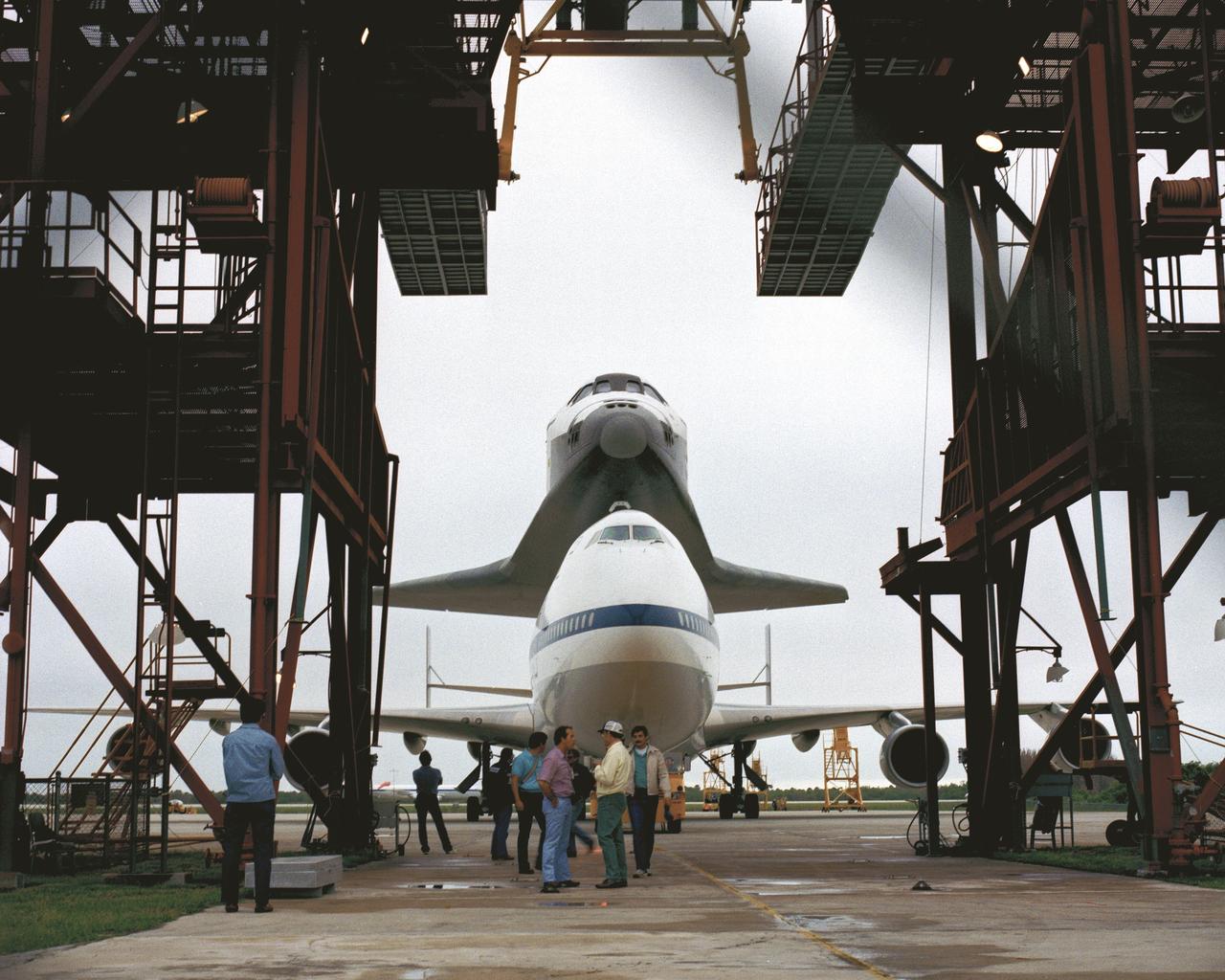
CAPE CANAVERAL, Fla. – At the Kennedy Space Center in Florida, the new space shuttle, Atlantis, arrives at the Shuttle Landing Facility. The shuttle is mounted atop the Shuttle Carrier Aircraft, a modified Boeing 747. Over the next seven months Atlantis will be prepared for its maiden voyage, STS-51J. Atlantis, NASA's fourth space-rated shuttle, was named after the two-masted boat that served as the primary research vessel for the Woods Hole Oceanographic Institute in Massachusetts from 1930 to 1966. The boat had a 17-member crew and accommodated up to five scientists who worked in two onboard laboratories, examining water samples and marine life. Like its predecessors, Atlantis was constructed by Rockwell International in Palmdale, Calif. The spacecraft was transported over land from Palmdale to Edwards Air Force Base on April 3, 1985 for the cross-country ferry flight to Kennedy. For more: http://www.nasa.gov/centers/kennedy/shuttleoperations/orbiters/atlantis-info.html Photo credit: NASA/Louie Rochefort
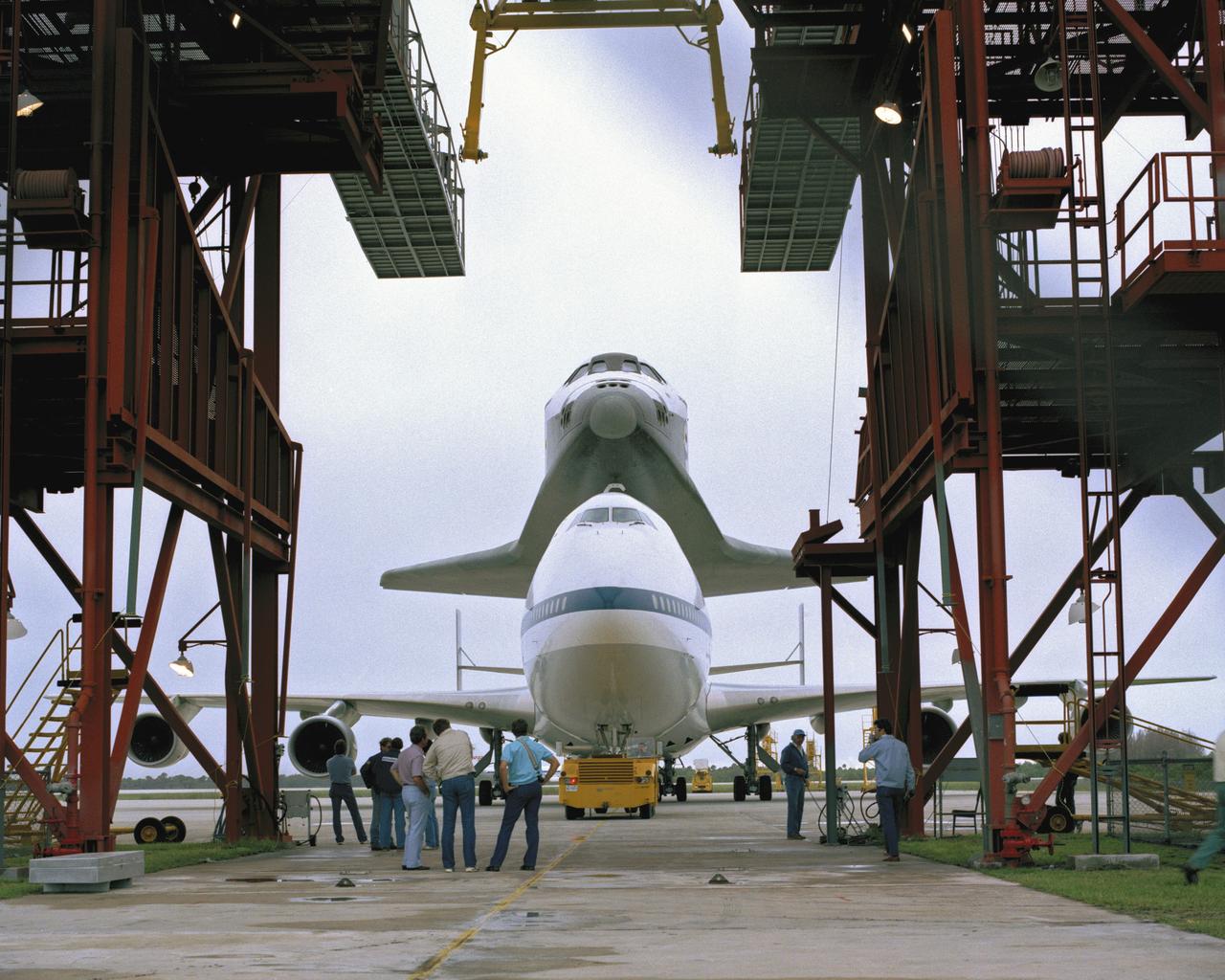
CAPE CANAVERAL, Fla. – At the Kennedy Space Center in Florida, the new space shuttle, Atlantis, arrives at the Shuttle Landing Facility. The shuttle is mounted atop the Shuttle Carrier Aircraft, a modified Boeing 747. Over the next seven months Atlantis will be prepared for its maiden voyage, STS-51J. Atlantis, NASA's fourth space-rated shuttle, was named after the two-masted boat that served as the primary research vessel for the Woods Hole Oceanographic Institute in Massachusetts from 1930 to 1966. The boat had a 17-member crew and accommodated up to five scientists who worked in two onboard laboratories, examining water samples and marine life. Like its predecessors, Atlantis was constructed by Rockwell International in Palmdale, Calif. The spacecraft was transported over land from Palmdale to Edwards Air Force Base on April 3, 1985 for the cross-country ferry flight to Kennedy. For more: http://www.nasa.gov/centers/kennedy/shuttleoperations/orbiters/atlantis-info.html Photo credit: NASA/Louie Rochefort
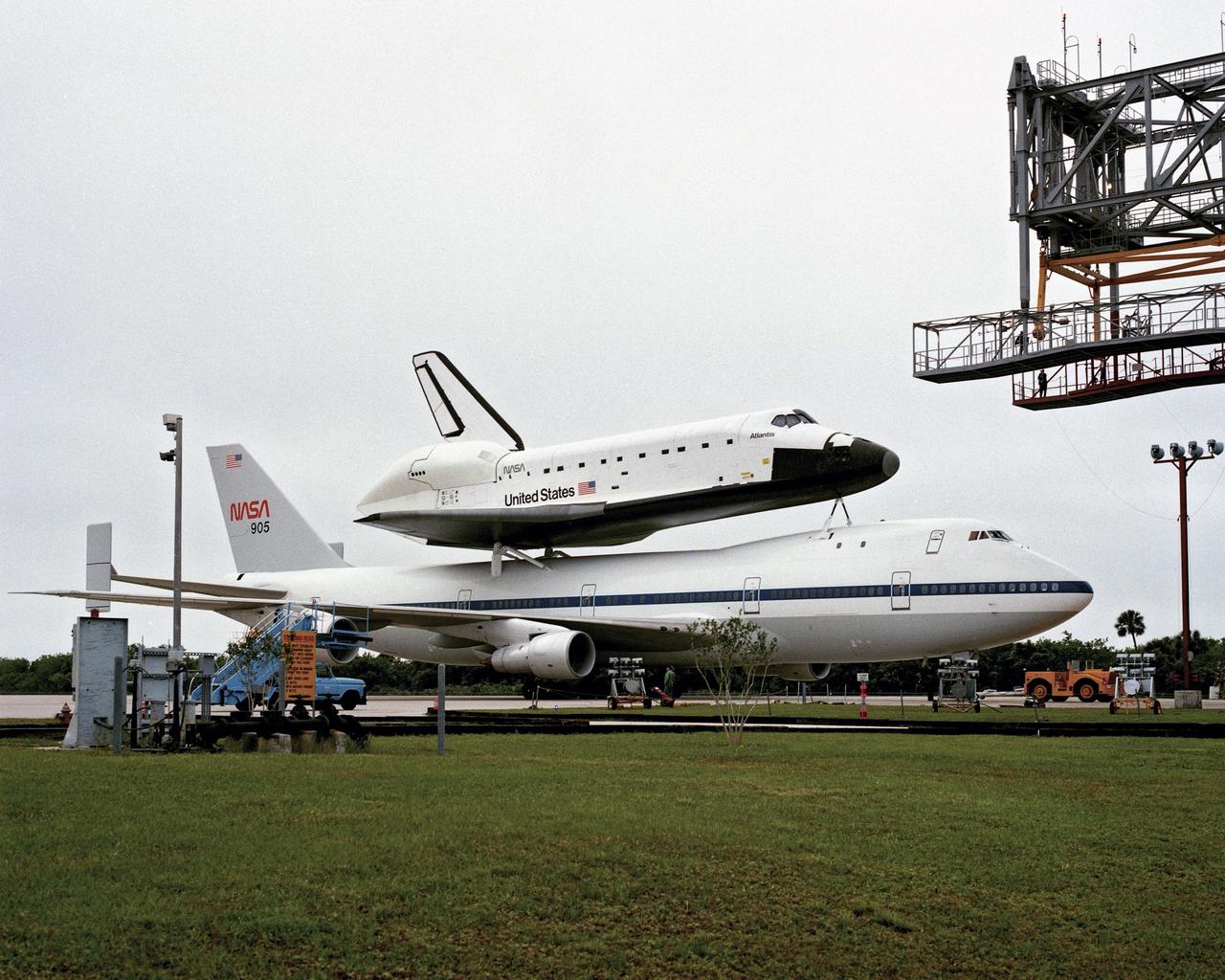
CAPE CANAVERAL, Fla. – At the Kennedy Space Center in Florida, the new space shuttle, Atlantis, arrives at the Shuttle Landing Facility. The shuttle is mounted atop the Shuttle Carrier Aircraft, a modified Boeing 747. Over the next seven months Atlantis will be prepared for its maiden voyage, STS-51J. Atlantis, NASA's fourth space-rated shuttle, was named after the two-masted boat that served as the primary research vessel for the Woods Hole Oceanographic Institute in Massachusetts from 1930 to 1966. The boat had a 17-member crew and accommodated up to five scientists who worked in two onboard laboratories, examining water samples and marine life. Like its predecessors, Atlantis was constructed by Rockwell International in Palmdale, Calif. The spacecraft was transported over land from Palmdale to Edwards Air Force Base on April 3, 1985 for the cross-country ferry flight to Kennedy. For more: http://www.nasa.gov/centers/kennedy/shuttleoperations/orbiters/atlantis-info.html Photo credit: NASA/Louie Rochefort
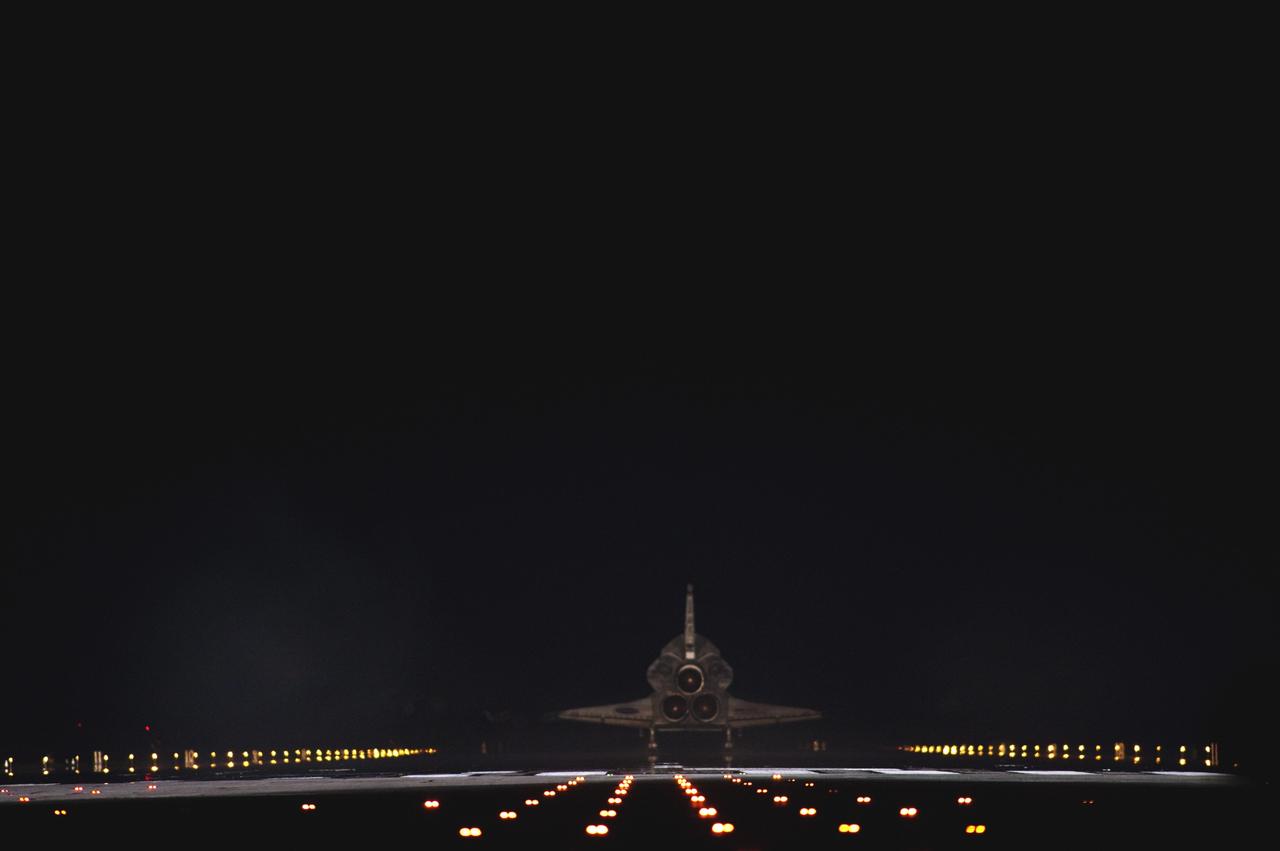
CAPE CANAVERAL, Fla. -- Space shuttle Atlantis begins to disappear into the darkness as it rolls to a stop on Runway 15 on the Shuttle Landing Facility at NASA's Kennedy Space Center in Florida for the final time. Atlantis marked the 26th nighttime landing of NASA's Space Shuttle Program and the 78th landing at Kennedy. It also was the final mission for the shuttle program. STS-135 was the 33rd and final flight for Atlantis, which has spent 307 days in space, orbited Earth 4,848 times and traveled 125,935,769 miles. For more information on the space shuttle era, visit www.nasa.gov/mission_pages/shuttle/flyout. Photo credit: NASA/Sandra Joseph and Kevin O'Connell
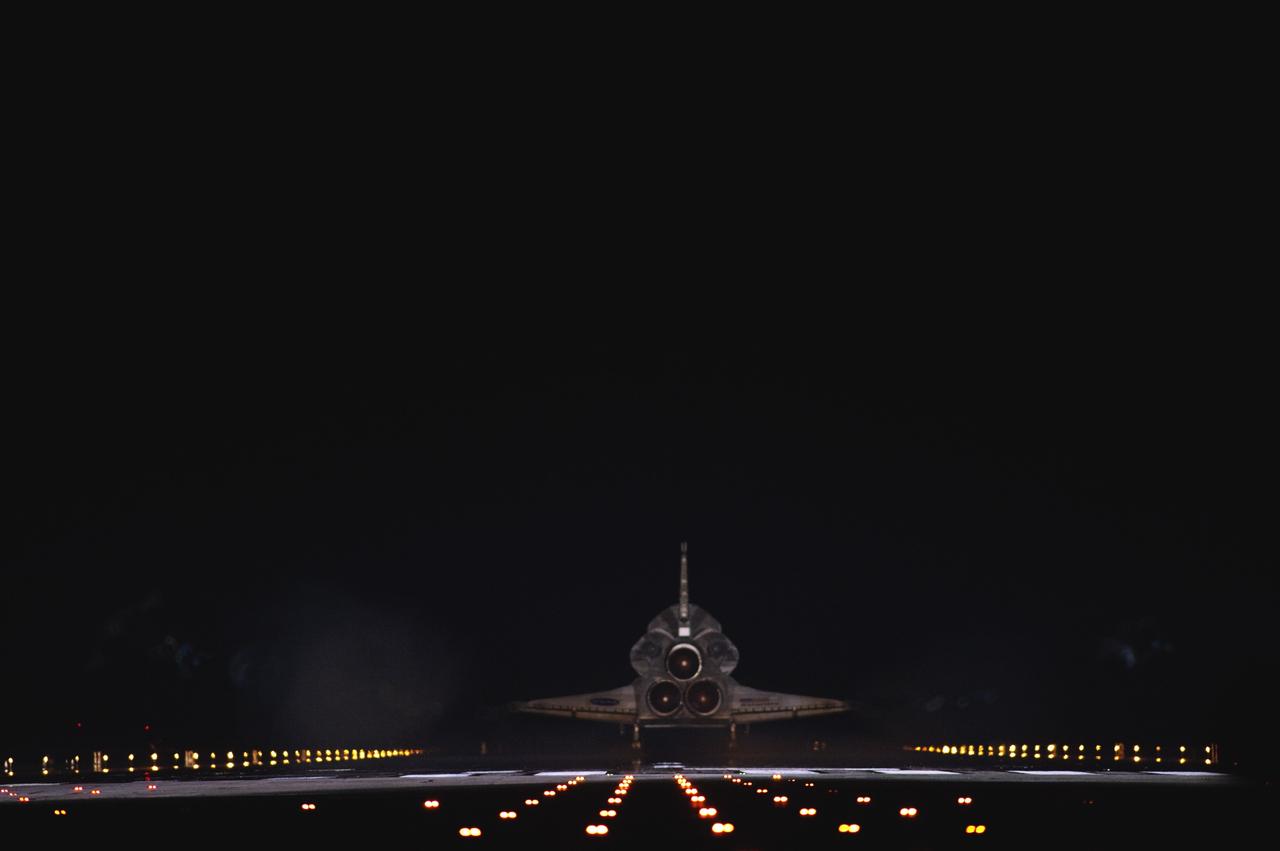
CAPE CANAVERAL, Fla. -- Space shuttle Atlantis begins to disappear into the darkness as it rolls to a stop on Runway 15 on the Shuttle Landing Facility at NASA's Kennedy Space Center in Florida for the final time. Atlantis marked the 26th nighttime landing of NASA's Space Shuttle Program and the 78th landing at Kennedy. It also was the final mission for the shuttle program. STS-135 was the 33rd and final flight for Atlantis, which has spent 307 days in space, orbited Earth 4,848 times and traveled 125,935,769 miles. For more information on the space shuttle era, visit www.nasa.gov/mission_pages/shuttle/flyout. Photo credit: NASA/Sandra Joseph and Kevin O'Connell
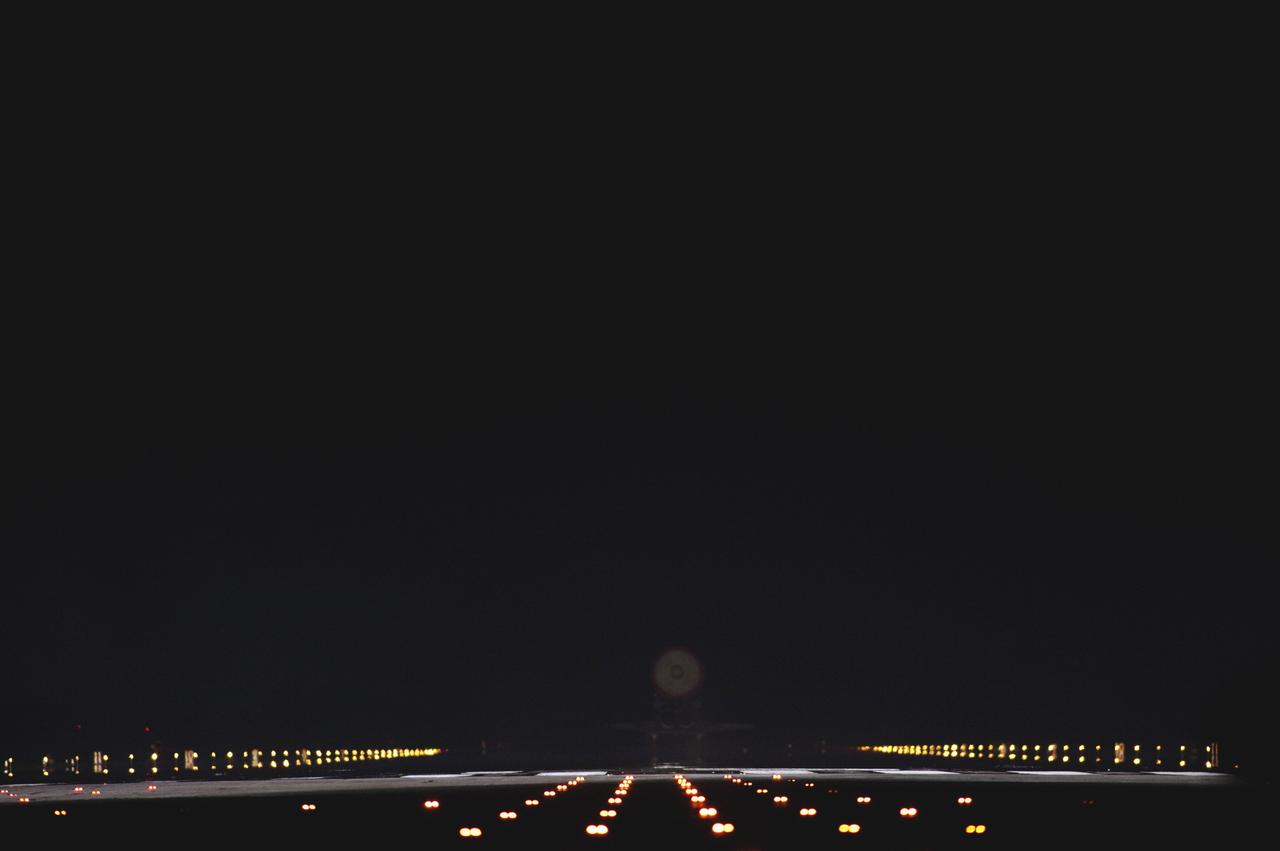
CAPE CANAVERAL, Fla. -- Only space shuttle Atlantis' drag chute is visible as the spacecraft disappears into the darkness and rolls to a stop on Runway 15 on the Shuttle Landing Facility at NASA's Kennedy Space Center in Florida for the final time. Atlantis marked the 26th nighttime landing of NASA's Space Shuttle Program and the 78th landing at Kennedy. It also was the final mission for the shuttle program. STS-135 was the 33rd and final flight for Atlantis, which has spent 307 days in space, orbited Earth 4,848 times and traveled 125,935,769 miles. For more information on the space shuttle era, visit www.nasa.gov/mission_pages/shuttle/flyout. Photo credit: NASA/Sandra Joseph and Kevin O'Connell
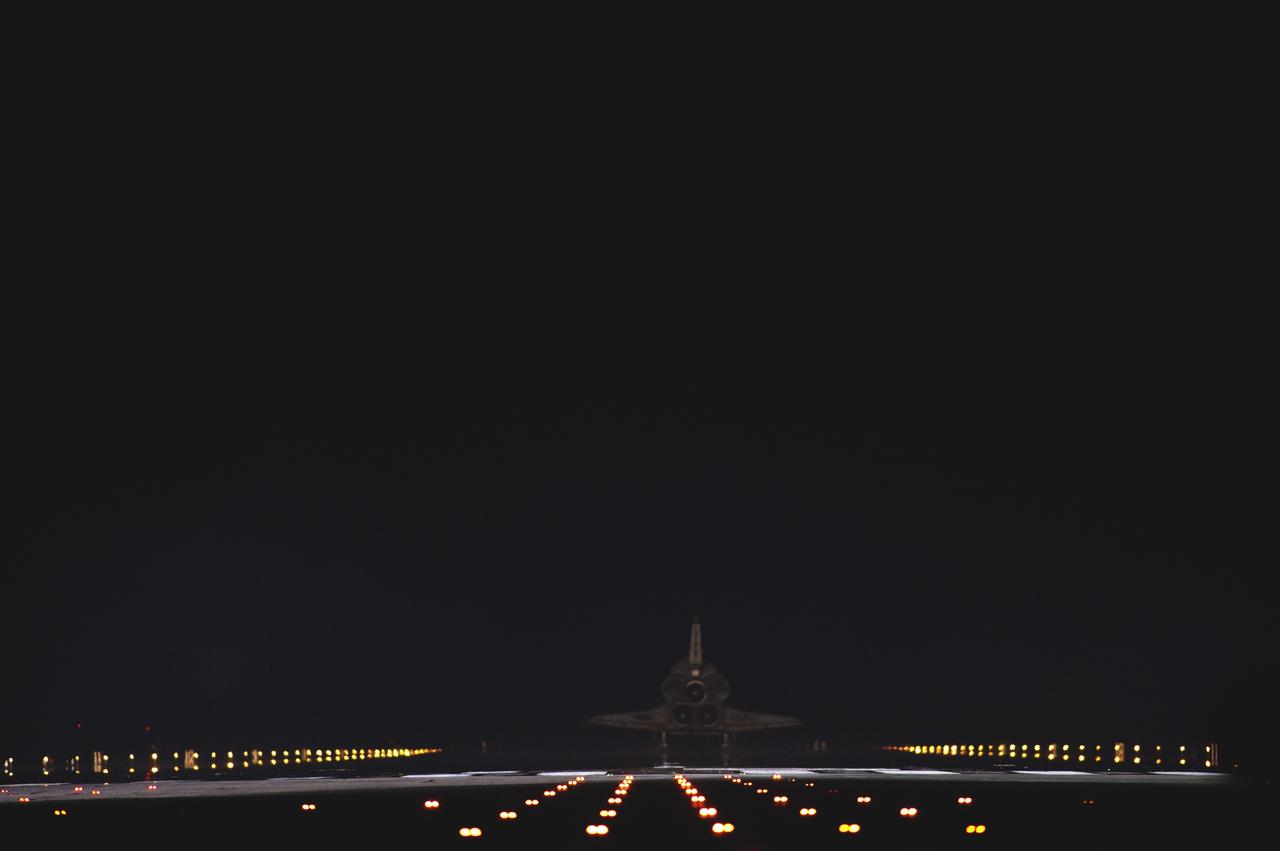
CAPE CANAVERAL, Fla. -- Space shuttle Atlantis disappears into the darkness as it rolls to a stop on Runway 15 on the Shuttle Landing Facility at NASA's Kennedy Space Center in Florida for the final time. Atlantis marked the 26th nighttime landing of NASA's Space Shuttle Program and the 78th landing at Kennedy. It also was the final mission for the shuttle program. STS-135 was the 33rd and final flight for Atlantis, which has spent 307 days in space, orbited Earth 4,848 times and traveled 125,935,769 miles. For more information on the space shuttle era, visit www.nasa.gov/mission_pages/shuttle/flyout. Photo credit: NASA/Sandra Joseph and Kevin O'Connell
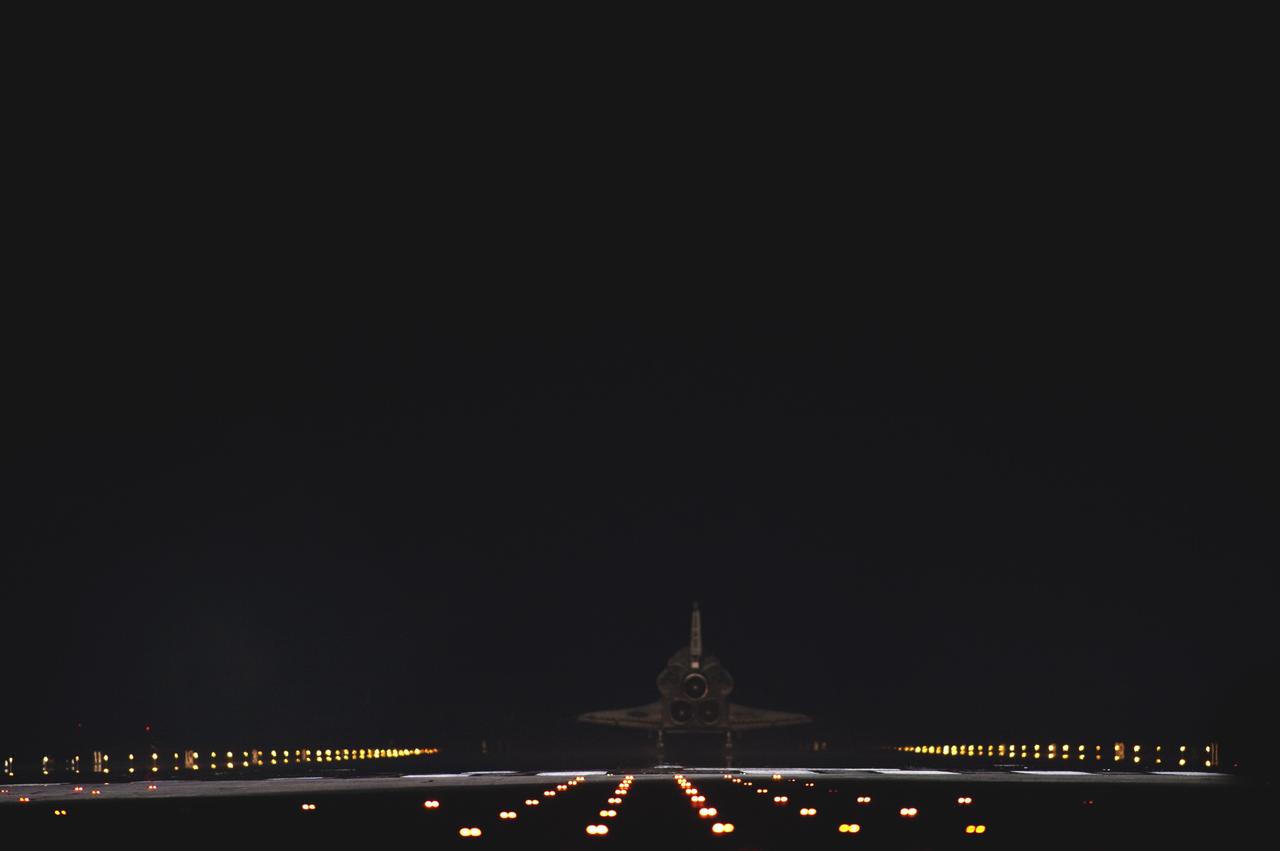
CAPE CANAVERAL, Fla. -- Space shuttle Atlantis disappears into the darkness as it rolls to a stop on Runway 15 on the Shuttle Landing Facility at NASA's Kennedy Space Center in Florida for the final time. Atlantis marked the 26th nighttime landing of NASA's Space Shuttle Program and the 78th landing at Kennedy. It also was the final mission for the shuttle program. STS-135 was the 33rd and final flight for Atlantis, which has spent 307 days in space, orbited Earth 4,848 times and traveled 125,935,769 miles. For more information on the space shuttle era, visit www.nasa.gov/mission_pages/shuttle/flyout. Photo credit: NASA/Sandra Joseph and Kevin O'Connell
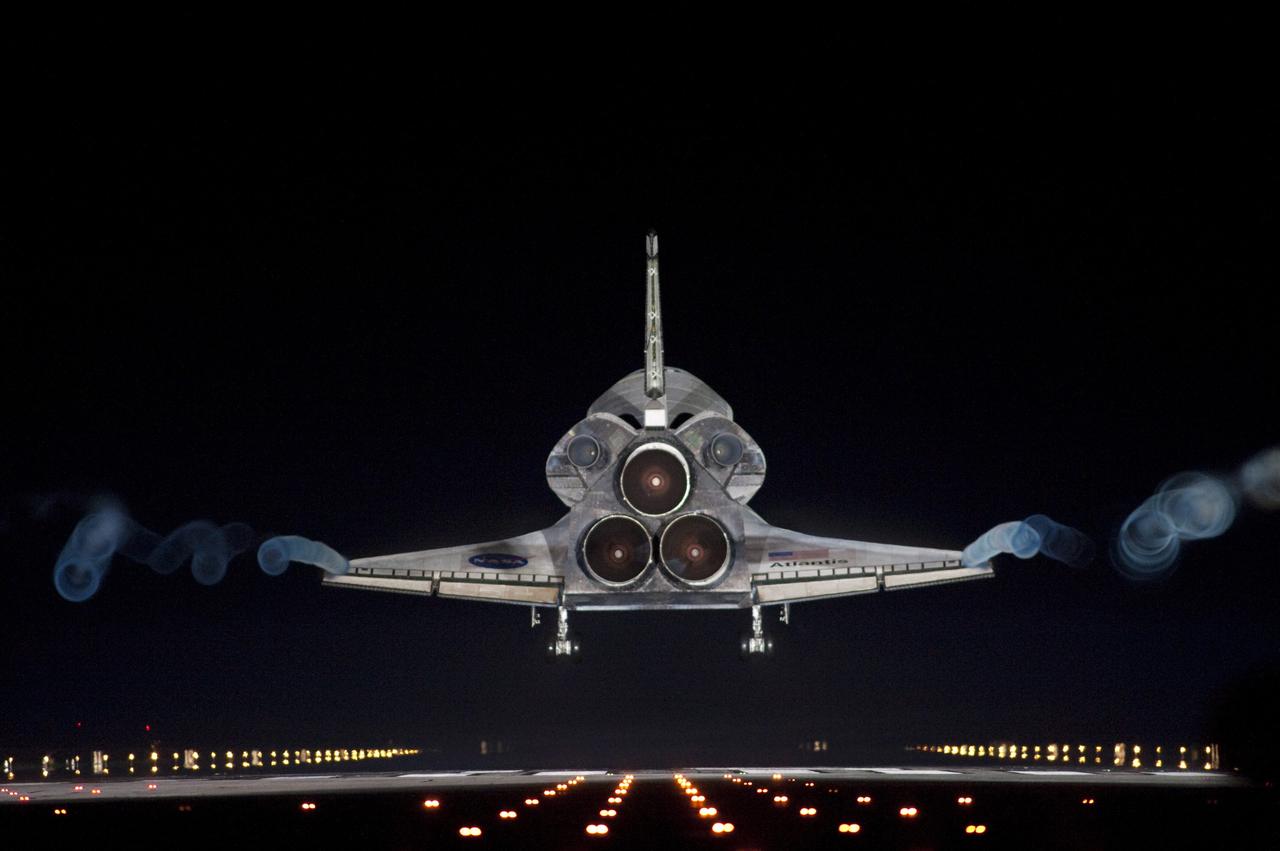
CAPE CANAVERAL, Fla. -- Vapor trails follow space shuttle Atlantis as it approaches Runway 15 on the Shuttle Landing Facility at NASA's Kennedy Space Center in Florida for the final time. A vapor trail, known as a contrail, is a cloud of water vapor that condenses and freezes around the small particles in aircraft exhaust. Atlantis marked the 26th nighttime landing of NASA's Space Shuttle Program and the 78th landing at Kennedy. It also was the final mission for the shuttle program. STS-135 was the 33rd and final flight for Atlantis, which has spent 307 days in space, orbited Earth 4,848 times and traveled 125,935,769 miles. For more information on the space shuttle era, visit www.nasa.gov/mission_pages/shuttle/flyout. Photo credit: NASA/Sandra Joseph and Kevin O'Connell
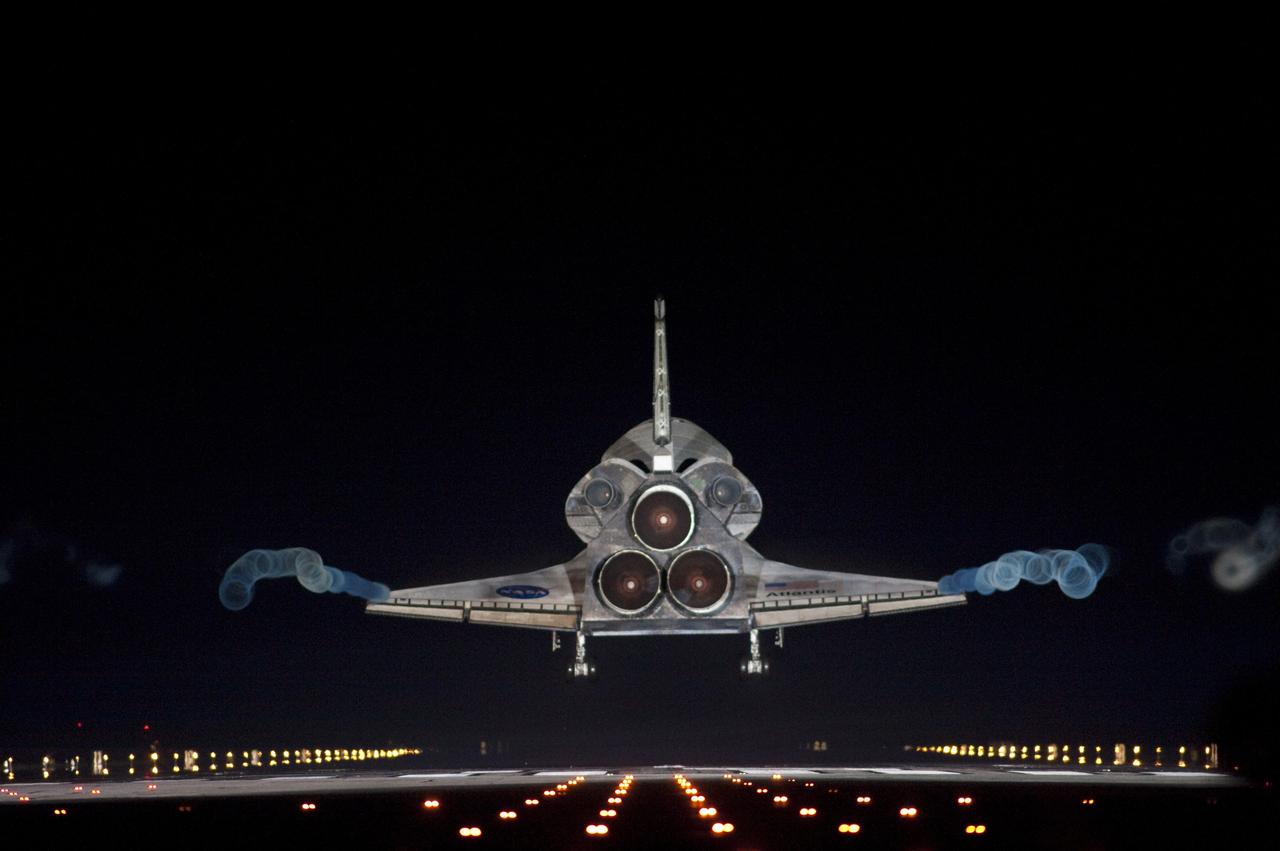
CAPE CANAVERAL, Fla. -- Vapor trails follow space shuttle Atlantis as it approaches Runway 15 on the Shuttle Landing Facility at NASA's Kennedy Space Center in Florida for the final time. A vapor trail, known as a contrail, is a cloud of water vapor that condenses and freezes around the small particles in aircraft exhaust. Atlantis marked the 26th nighttime landing of NASA's Space Shuttle Program and the 78th landing at Kennedy. It also was the final mission for the shuttle program. STS-135 was the 33rd and final flight for Atlantis, which has spent 307 days in space, orbited Earth 4,848 times and traveled 125,935,769 miles. For more information on the space shuttle era, visit www.nasa.gov/mission_pages/shuttle/flyout. Photo credit: NASA/Sandra Joseph and Kevin O'Connell
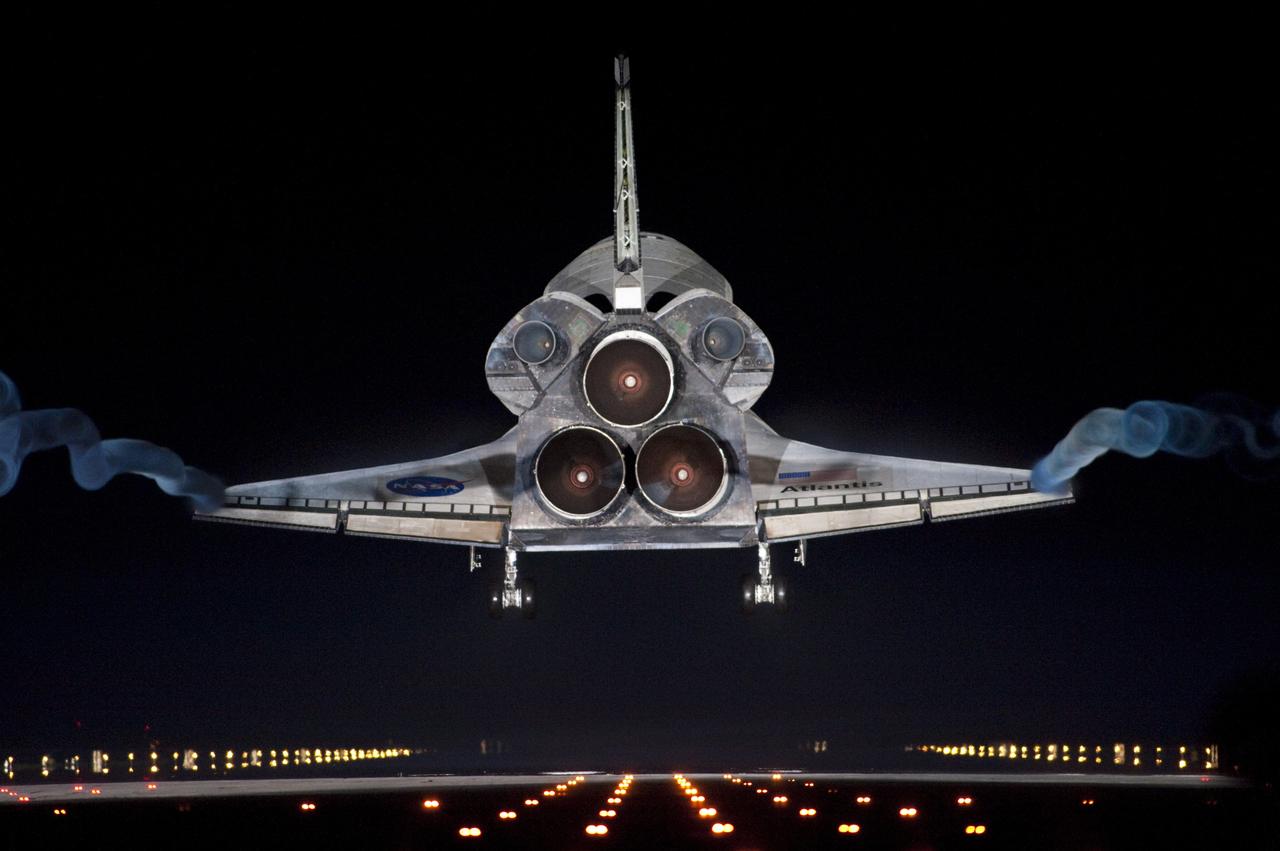
CAPE CANAVERAL, Fla. -- Vapor trails follow space shuttle Atlantis as it approaches Runway 15 on the Shuttle Landing Facility at NASA's Kennedy Space Center in Florida for the final time. A vapor trail, known as a contrail, is a cloud of water vapor that condenses and freezes around the small particles in aircraft exhaust. Atlantis marked the 26th nighttime landing of NASA's Space Shuttle Program and the 78th landing at Kennedy. It also was the final mission for the shuttle program. STS-135 was the 33rd and final flight for Atlantis, which has spent 307 days in space, orbited Earth 4,848 times and traveled 125,935,769 miles. For more information on the space shuttle era, visit www.nasa.gov/mission_pages/shuttle/flyout. Photo credit: NASA/Sandra Joseph and Kevin O'Connell

CAPE CANAVERAL, Fla. -- Vapor trails follow space shuttle Atlantis as it approaches Runway 15 on the Shuttle Landing Facility at NASA's Kennedy Space Center in Florida for the final time. A vapor trail, known as a contrail, is a cloud of water vapor that condenses and freezes around the small particles in aircraft exhaust. Atlantis marked the 26th nighttime landing of NASA's Space Shuttle Program and the 78th landing at Kennedy. It also was the final mission for the shuttle program. STS-135 was the 33rd and final flight for Atlantis, which has spent 307 days in space, orbited Earth 4,848 times and traveled 125,935,769 miles. For more information on the space shuttle era, visit www.nasa.gov/mission_pages/shuttle/flyout. Photo credit: NASA/Sandra Joseph and Kevin O'Connell
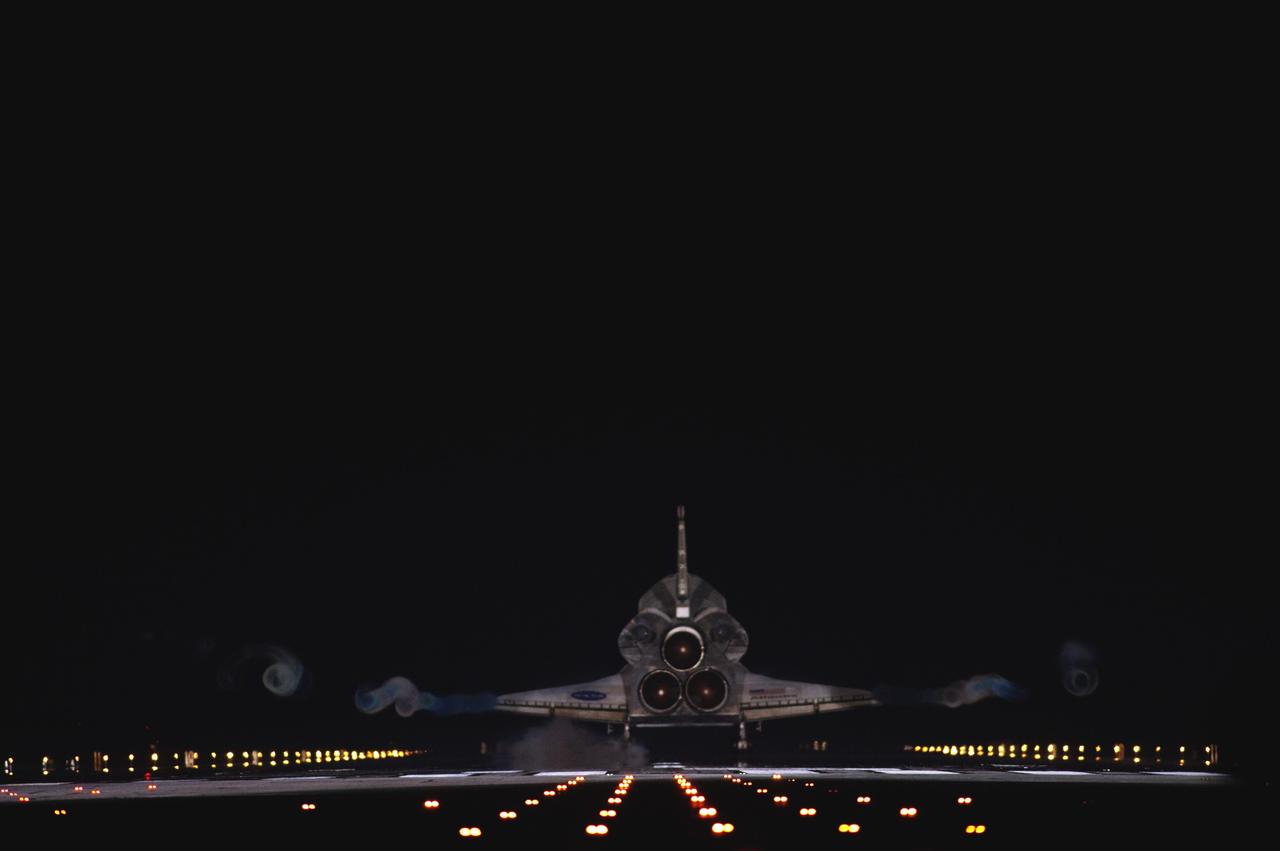
CAPE CANAVERAL, Fla. -- Vapor trails follow space shuttle Atlantis as it touches down on Runway 15 on the Shuttle Landing Facility at NASA's Kennedy Space Center in Florida for the final time. A vapor trail, known as a contrail, is a cloud of water vapor that condenses and freezes around the small particles in aircraft exhaust. Atlantis marked the 26th nighttime landing of NASA's Space Shuttle Program and the 78th landing at Kennedy. It also was the final mission for the shuttle program. STS-135 was the 33rd and final flight for Atlantis, which has spent 307 days in space, orbited Earth 4,848 times and traveled 125,935,769 miles. For more information on the space shuttle era, visit www.nasa.gov/mission_pages/shuttle/flyout. Photo credit: NASA/Sandra Joseph and Kevin O'Connell
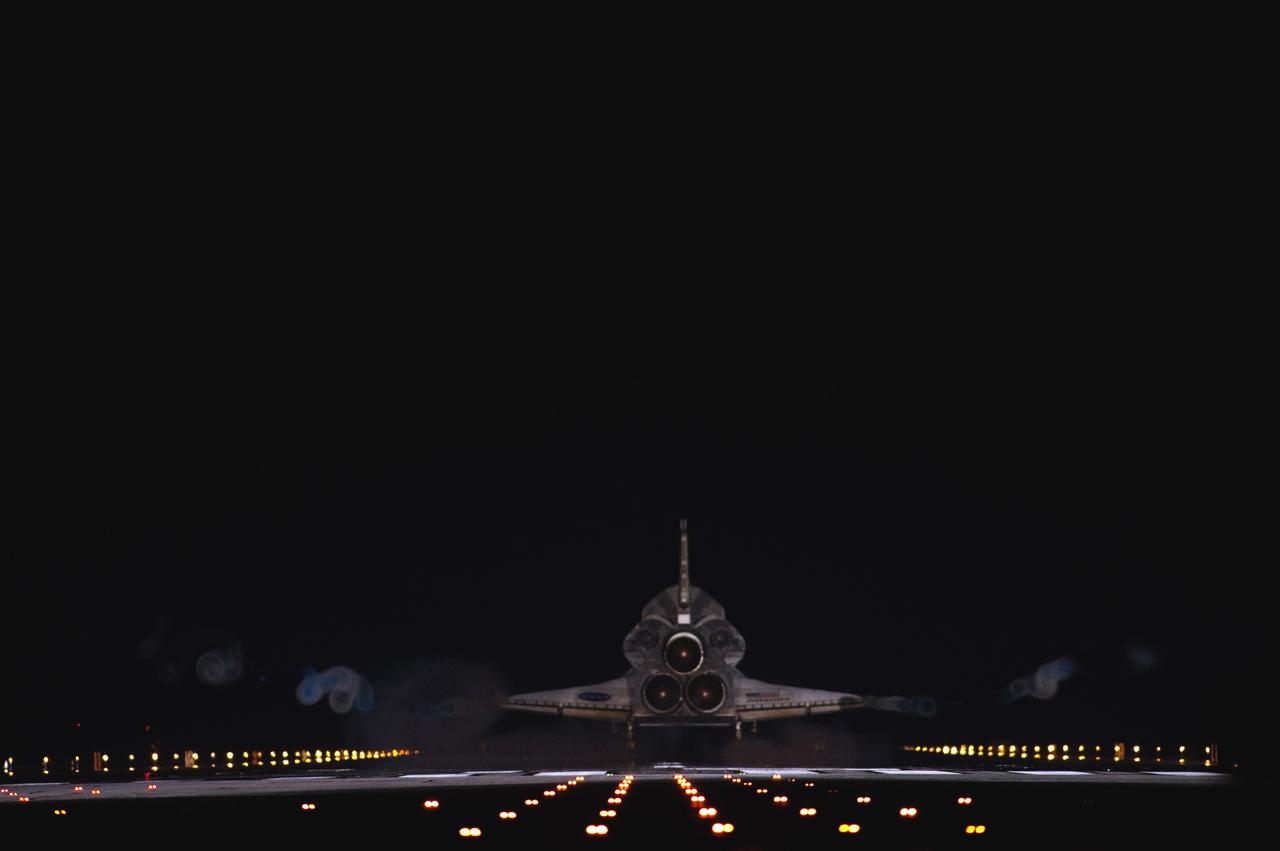
CAPE CANAVERAL, Fla. -- Vapor trails follow space shuttle Atlantis as it touches down on Runway 15 on the Shuttle Landing Facility at NASA's Kennedy Space Center in Florida for the final time. A vapor trail, known as a contrail, is a cloud of water vapor that condenses and freezes around the small particles in aircraft exhaust. Atlantis marked the 26th nighttime landing of NASA's Space Shuttle Program and the 78th landing at Kennedy. It also was the final mission for the shuttle program. STS-135 was the 33rd and final flight for Atlantis, which has spent 307 days in space, orbited Earth 4,848 times and traveled 125,935,769 miles. For more information on the space shuttle era, visit www.nasa.gov/mission_pages/shuttle/flyout. Photo credit: NASA/Sandra Joseph and Kevin O'Connell
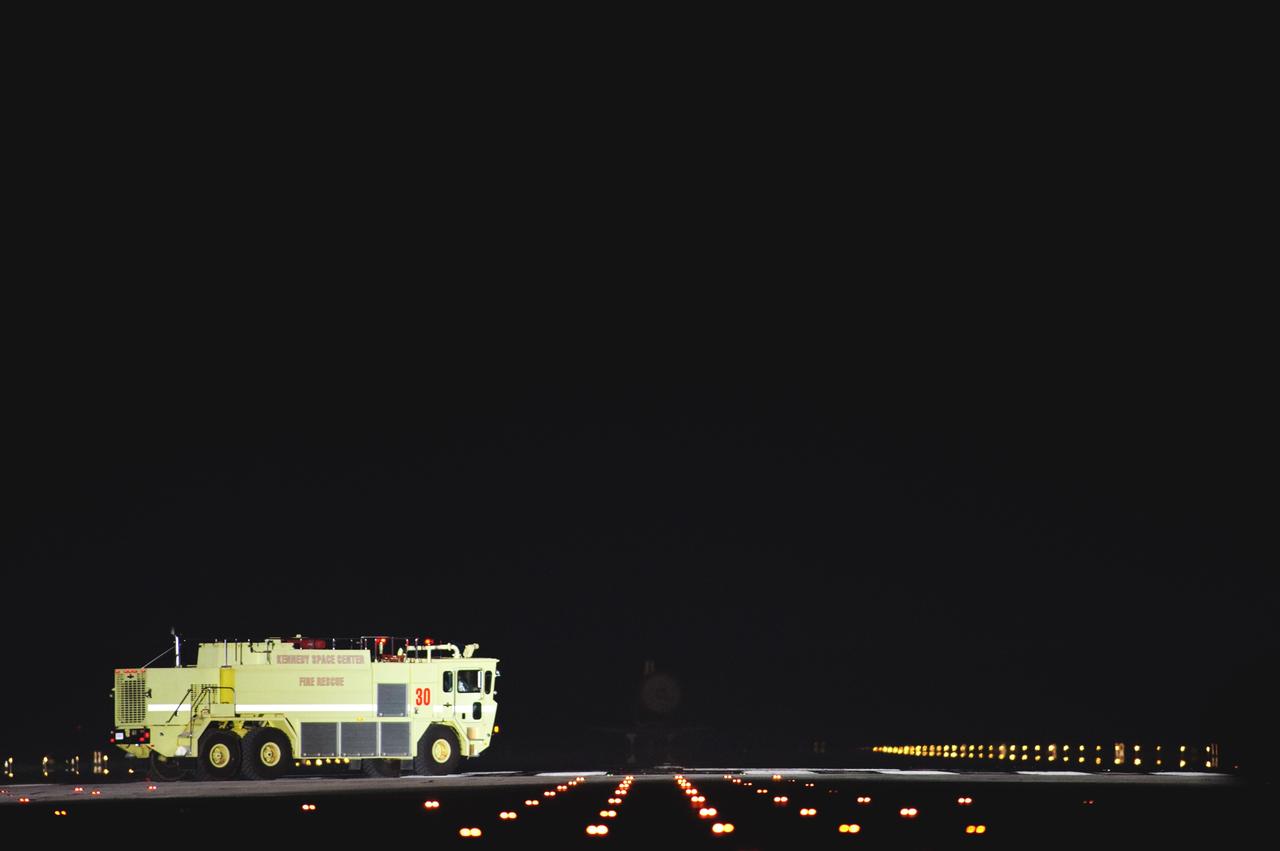
CAPE CANAVERAL, Fla. -- A NASA Fire Rescue truck, which is part of the landing convoy at NASA's Kennedy Space Center in Florida, heads out toward space shuttle Atlantis after it rolled to a stop on the Shuttle Landing Facility's Runway for the final time. Atlantis marked the 26th nighttime landing of NASA's Space Shuttle Program and the 78th landing at Kennedy. It also was the final mission for the shuttle program. STS-135 was the 33rd and final flight for Atlantis, which has spent 307 days in space, orbited Earth 4,848 times and traveled 125,935,769 miles. For more information on the space shuttle era, visit www.nasa.gov/mission_pages/shuttle/flyout. Photo credit: NASA/Sandra Joseph and Kevin O'Connell

CAPE CANAVERAL, Fla. -- Vapor trails follow space shuttle Atlantis as it approaches Runway 15 on the Shuttle Landing Facility at NASA's Kennedy Space Center in Florida for the final time. A vapor trail, known as a contrail, is a cloud of water vapor that condenses and freezes around the small particles in aircraft exhaust. Atlantis marked the 26th nighttime landing of NASA's Space Shuttle Program and the 78th landing at Kennedy. It also was the final mission for the shuttle program. STS-135 was the 33rd and final flight for Atlantis, which has spent 307 days in space, orbited Earth 4,848 times and traveled 125,935,769 miles. For more information on the space shuttle era, visit www.nasa.gov/mission_pages/shuttle/flyout. Photo credit: NASA/Sandra Joseph and Kevin O'Connell

A large group of Astronauts from the Shuttle and Apollo projects wave to crowds as the Space shuttle Atlantis makes its trip to its new home at the Kennedy Space Center Visitor Complex, early Friday, Nov. 2, 2012, in Cape Canaveral, Fla. The spacecraft traveled 125,935,769 miles during 33 spaceflights, including 12 missions to the International Space Station. Its final flight, STS-135, closed out the Space Shuttle Program era with a landing on July 21, 2011. Photo Credit: (NASA/Bill Ingalls)

Space shuttle Atlantis is seen as it rolls down Kennedy Parkway on its way to its new home at the Kennedy Space Center Visitor Complex, Friday, Nov. 2, 2012, in Cape Canaveral, Fla. The spacecraft traveled 125,935,769 miles during 33 spaceflights, including 12 missions to the International Space Station. Its final flight, STS-135, closed out the Space Shuttle Program era with a landing on July 21, 2011. Photo Credit: (NASA/Bill Ingalls)

Space shuttle Atlantis is seen near the Orbiter Processing Facility during its trip to its new home at the Kennedy Space Center Visitor Complex, early Friday, Nov. 2, 2012, in Cape Canaveral, Fla. The spacecraft traveled 125,935,769 miles during 33 spaceflights, including 12 missions to the International Space Station. Its final flight, STS-135, closed out the Space Shuttle Program era with a landing on July 21, 2011. Photo Credit: (NASA/Bill Ingalls)

Onlookers watch as space shuttle Atlantis rolls to its new home at the Kennedy Space Center Visitor Complex, early Friday, Nov. 2, 2012, in Cape Canaveral, Fla. The spacecraft traveled 125,935,769 miles during 33 spaceflights, including 12 missions to the International Space Station. Its final flight, STS-135, closed out the Space Shuttle Program era with a landing on July 21, 2011. Photo Credit: (NASA/Bill Ingalls)

Space shuttle Atlantis, (OV-104), is seen as it begins its trip to its new home at the Kennedy Space Center Visitor Complex, early Friday, Nov. 2, 2012, in Cape Canaveral, Fla. The spacecraft traveled 125,935,769 miles during 33 spaceflights, including 12 missions to the International Space Station. Its final flight, STS-135, closed out the Space Shuttle Program era with a landing on July 21, 2011. Photo Credit: (NASA/Bill Ingalls)

Kennedy Space Center Director Robert Cabana speaks at the signing ceremony for space shuttle Atlantis, background, Friday, Nov. 2, 2012, in Cape Canaveral, Fla. The spacecraft traveled 125,935,769 miles during 33 spaceflights, including 12 missions to the International Space Station. Its final flight, STS-135, closed out the Space Shuttle Program era with a landing on July 21, 2011. Photo Credit: (NASA/Bill Ingalls)
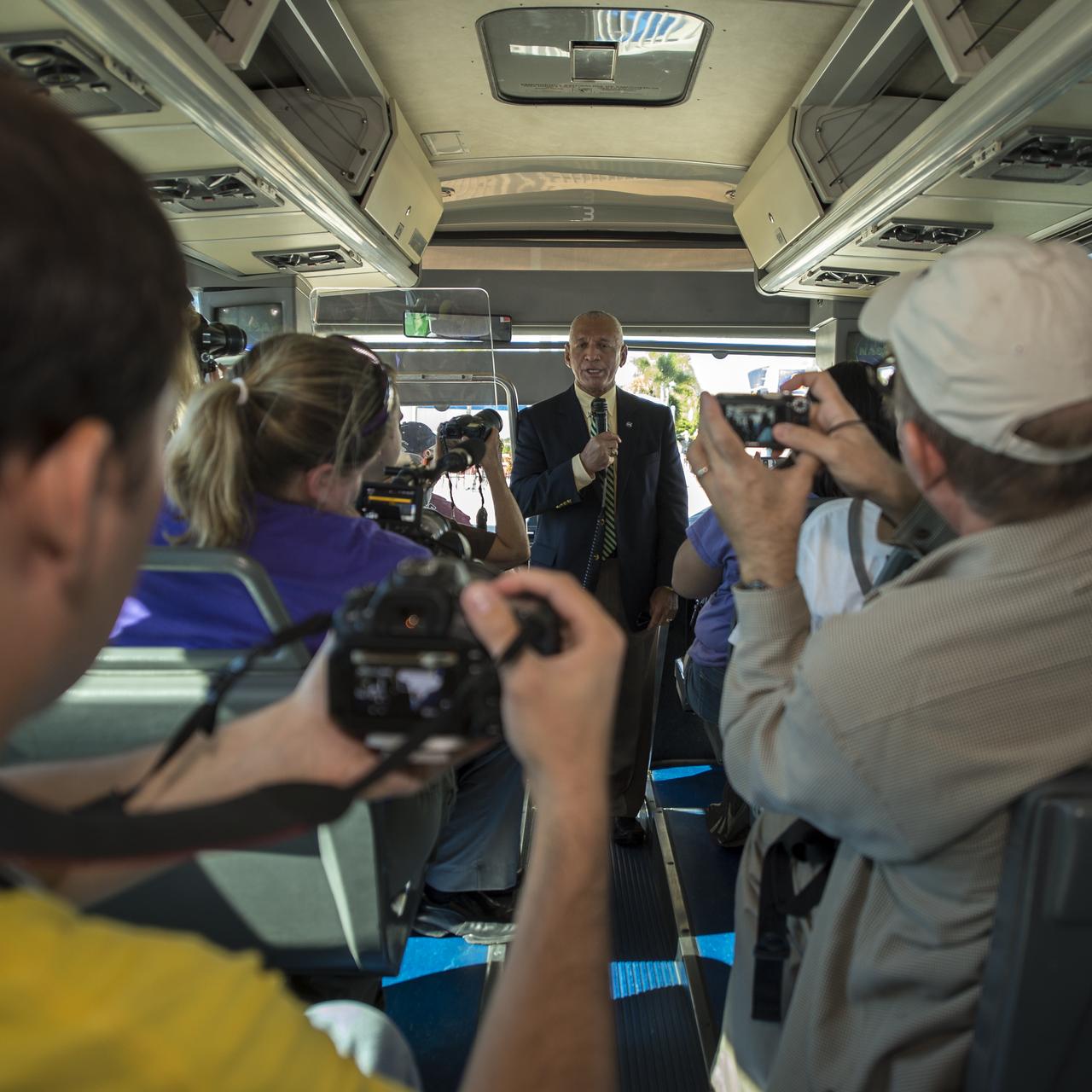
NASA Administrator Charles Bolden speaks with NASA Social attendees during the move of space shuttle Atlantis, Friday, Nov. 2, 2012, at Kennedy Space Center in Cape Canaveral, Fla. The spacecraft traveled 125,935,769 miles during 33 spaceflights, including 12 missions to the International Space Station. Its final flight, STS-135, closed out the Space Shuttle Program era with a landing on July 21, 2011. Photo Credit: (NASA/Bill Ingalls)

Onlookers wearing commemorative t-shirts watch as space shuttle Atlantis rolls to ts new home at the Kennedy Space Center Visitor Complex, early Friday, Nov. 2, 2012, in Cape Canaveral, Fla. The spacecraft traveled 125,935,769 miles during 33 spaceflights, including 12 missions to the International Space Station. Its final flight, STS-135, closed out the Space Shuttle Program era with a landing on July 21, 2011. Photo Credit: (NASA/Bill Ingalls)

Kennedy Space Center Director Robert Cabana, left, and NASA Administrator Charles Bolden talk about space shuttle Atlantis, Friday, Nov. 2, 2012, in Cape Canaveral, Fla. The spacecraft traveled 125,935,769 miles during 33 spaceflights, including 12 missions to the International Space Station. Its final flight, STS-135, closed out the Space Shuttle Program era with a landing on July 21, 2011. Photo Credit: (NASA/Bill Ingalls)

NASA Administrator Charles Bolden speaks with NASA Social attendees during the move of space shuttle Atlantis, Friday, Nov. 2, 2012, at Kennedy Space Center in Cape Canaveral, Fla. The spacecraft traveled 125,935,769 miles during 33 spaceflights, including 12 missions to the International Space Station. Its final flight, STS-135, closed out the Space Shuttle Program era with a landing on July 21, 2011. Photo Credit: (NASA/Bill Ingalls)

Space shuttle Atlantis is seen during its trip to its new home at the Kennedy Space Center Visitor Complex, early Friday, Nov. 2, 2012, in Cape Canaveral, Fla. The spacecraft traveled 125,935,769 miles during 33 spaceflights, including 12 missions to the International Space Station. Its final flight, STS-135, closed out the Space Shuttle Program era with a landing on July 21, 2011. Photo Credit: (NASA/Bill Ingalls)

Space shuttle Atlantis is seen during its trip to its new home at the Kennedy Space Center Visitor Complex, early Friday, Nov. 2, 2012, in Cape Canaveral, Fla. The spacecraft traveled 125,935,769 miles during 33 spaceflights, including 12 missions to the International Space Station. Its final flight, STS-135, closed out the Space Shuttle Program era with a landing on July 21, 2011. Photo Credit: (NASA/Bill Ingalls)

Space shuttle Atlantis is seen during its trip to its new home at the Kennedy Space Center Visitor Complex, early Friday, Nov. 2, 2012, in Cape Canaveral, Fla. The spacecraft traveled 125,935,769 miles during 33 spaceflights, including 12 missions to the International Space Station. Its final flight, STS-135, closed out the Space Shuttle Program era with a landing on July 21, 2011. Photo Credit: (NASA/Bill Ingalls)

Space shuttle Atlantis is seen as it rolls out of the Vehicle Assembly Building to start its trip to its new home at the Kennedy Space Center Visitor Complex, Friday, Nov. 2, 2012, in Cape Canaveral, Fla. The spacecraft traveled 125,935,769 miles during 33 spaceflights, including 12 missions to the International Space Station. Its final flight, STS-135, closed out the Space Shuttle Program era with a landing on July 21, 2011. Photo Credit: (NASA/Bill Ingalls)

Cheryl Hurst, Director of Education and External Relations at Kennedy Space Center, speaks at the signing ceremony for space shuttle Atlantis, background, Friday, Nov. 2, 2012, in Cape Canaveral, Fla. The spacecraft traveled 125,935,769 miles during 33 spaceflights, including 12 missions to the International Space Station. Its final flight, STS-135, closed out the Space Shuttle Program era with a landing on July 21, 2011. Photo Credit: (NASA/Bill Ingalls)

The Titusville High School band parades ahead of space shuttle Atlantis as it makes its way to its new home at the Kennedy Space Center Visitor Complex, early Friday, Nov. 2, 2012, in Cape Canaveral, Fla. The spacecraft traveled 125,935,769 miles during 33 spaceflights, including 12 missions to the International Space Station. Its final flight, STS-135, closed out the Space Shuttle Program era with a landing on July 21, 2011. Photo Credit: (NASA/Bill Ingalls)

Space shuttle Atlantis is seen during its trip to its new home at the Kennedy Space Center Visitor Complex, early Friday, Nov. 2, 2012, in Cape Canaveral, Fla. The spacecraft traveled 125,935,769 miles during 33 spaceflights, including 12 missions to the International Space Station. Its final flight, STS-135, closed out the Space Shuttle Program era with a landing on July 21, 2011. Photo Credit: (NASA/Bill Ingalls)

Workers carry a banner full of signatures while following behind space shuttle Atlantis as it begins its trek to its new home at the Kennedy Space Center Visitor Complex, early Friday, Nov. 2, 2012, in Cape Canaveral, Fla. The spacecraft traveled 125,935,769 miles during 33 spaceflights, including 12 missions to the International Space Station. Its final flight, STS-135, closed out the Space Shuttle Program era with a landing on July 21, 2011. Photo Credit: (NASA/Bill Ingalls)

An onlooker holds up a mobile device to record space shuttle Atlantis as it rolls to ts new home at the Kennedy Space Center Visitor Complex, early Friday, Nov. 2, 2012, in Cape Canaveral, Fla. The spacecraft traveled 125,935,769 miles during 33 spaceflights, including 12 missions to the International Space Station. Its final flight, STS-135, closed out the Space Shuttle Program era with a landing on July 21, 2011. Photo Credit: (NASA/Bill Ingalls)
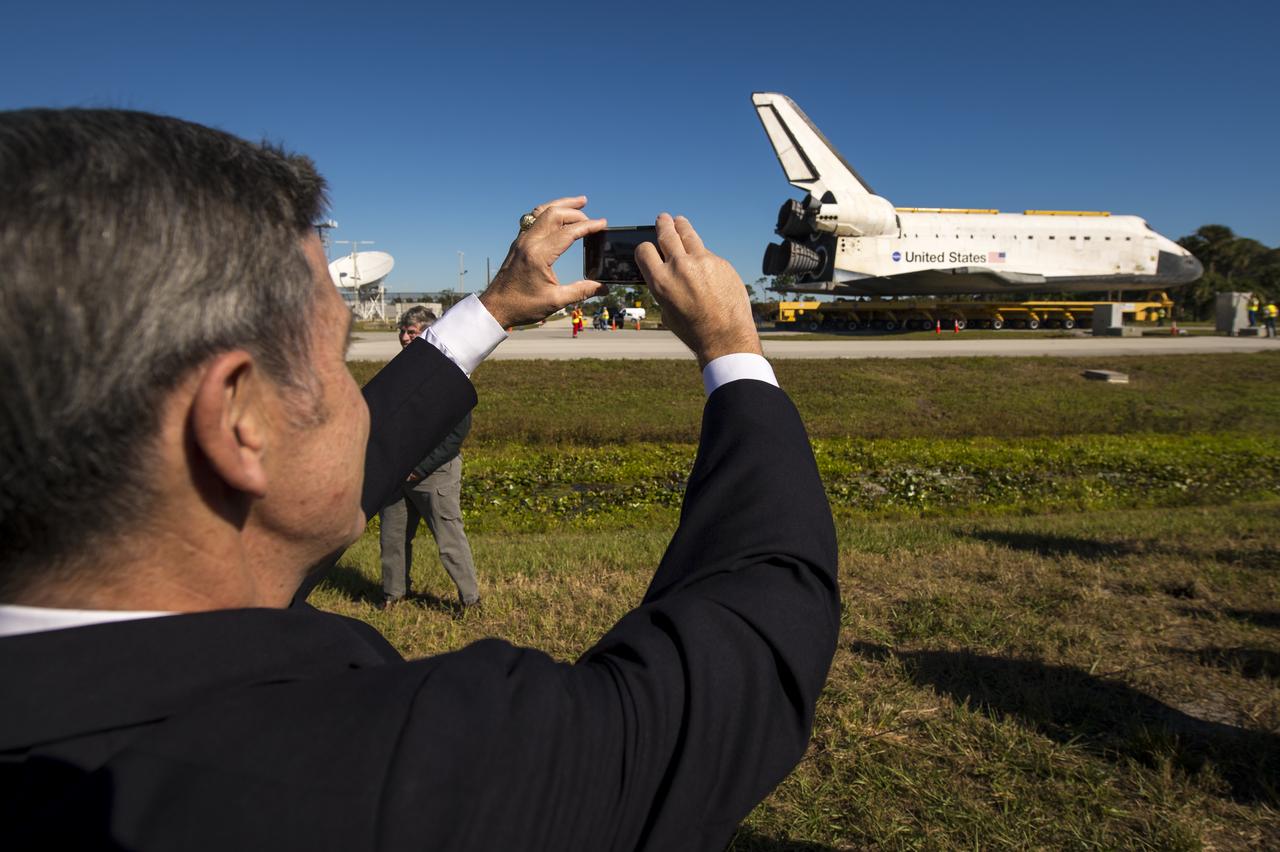
Kennedy Space Center Director Robert Cabana takes a picture of space shuttle Atlantis, Friday, Nov. 2, 2012, in Cape Canaveral, Fla. The spacecraft traveled 125,935,769 miles during 33 spaceflights, including 12 missions to the International Space Station. Its final flight, STS-135, closed out the Space Shuttle Program era with a landing on July 21, 2011. Photo Credit: (NASA/Bill Ingalls)

Space shuttle Atlantis is seen during its trip to its new home at the Kennedy Space Center Visitor Complex, early Friday, Nov. 2, 2012, in Cape Canaveral, Fla. The spacecraft traveled 125,935,769 miles during 33 spaceflights, including 12 missions to the International Space Station. Its final flight, STS-135, closed out the Space Shuttle Program era with a landing on July 21, 2011. Photo Credit: (NASA/Bill Ingalls)

Space shuttle Atlantis rolls away from the Vehicle Assembly Building as it begins its trip to its new home at the Kennedy Space Center Visitor Complex, early Friday, Nov. 2, 2012, in Cape Canaveral, Fla. The spacecraft traveled 125,935,769 miles during 33 spaceflights, including 12 missions to the International Space Station. Its final flight, STS-135, closed out the Space Shuttle Program era with a landing on July 21, 2011. Photo Credit: (NASA/Bill Ingalls)

Space shuttle Atlantis, (OV-104), is seen as it begins its trip to its new home at the Kennedy Space Center Visitor Complex, early Friday, Nov. 2, 2012, in Cape Canaveral, Fla. The spacecraft traveled 125,935,769 miles during 33 spaceflights, including 12 missions to the International Space Station. Its final flight, STS-135, closed out the Space Shuttle Program era with a landing on July 21, 2011. Photo Credit: (NASA/Bill Ingalls)

A small color guard carry flags during the procession for space shuttle Atlantis as it makes its way to its new home at the Kennedy Space Center Visitor Complex, early Friday, Nov. 2, 2012, in Cape Canaveral, Fla. The spacecraft traveled 125,935,769 miles during 33 spaceflights, including 12 missions to the International Space Station. Its final flight, STS-135, closed out the Space Shuttle Program era with a landing on July 21, 2011. Photo Credit: (NASA/Bill Ingalls)

Space shuttle Atlantis is seen during its trip to its new home at the Kennedy Space Center Visitor Complex, early Friday, Nov. 2, 2012, in Cape Canaveral, Fla. The spacecraft traveled 125,935,769 miles during 33 spaceflights, including 12 missions to the International Space Station. Its final flight, STS-135, closed out the Space Shuttle Program era with a landing on July 21, 2011. Photo Credit: (NASA/Bill Ingalls)

Military personnel salute as Searra Weeks, from Kennedy Middle School, sings the National Anthem, at the signing ceremony for space shuttle Atlantis, background, Friday, Nov. 2, 2012, in Cape Canaveral, Fla. The spacecraft traveled 125,935,769 miles during 33 spaceflights, including 12 missions to the International Space Station. Its final flight, STS-135, closed out the Space Shuttle Program era with a landing on July 21, 2011. Photo Credit: (NASA/Bill Ingalls)

William Moore, COO, KSC VC, DNC Parks & Recreation, speaks at the signing ceremony, for space shuttle Atlantis, background, Friday, Nov. 2, 2012, in Cape Canaveral, Fla. The spacecraft traveled 125,935,769 miles during 33 spaceflights, including 12 missions to the International Space Station. Its final flight, STS-135, closed out the Space Shuttle Program era with a landing on July 21, 2011. Photo Credit: (NASA/Bill Ingalls)

Karol Bobko, who commanded STS-51, the first flight of space shuttle Atlantis, background, speaks at the signing ceremony, Friday, Nov. 2, 2012, in Cape Canaveral, Fla. The spacecraft traveled 125,935,769 miles during 33 spaceflights, including 12 missions to the International Space Station. Its final flight, STS-135, closed out the Space Shuttle Program era with a landing on July 21, 2011. Photo Credit: (NASA/Bill Ingalls)

Searra Weeks, from Kennedy Middle School, sings the National Anthem, at the signing ceremony for space shuttle Atlantis, background, Friday, Nov. 2, 2012, in Cape Canaveral, Fla. The spacecraft traveled 125,935,769 miles during 33 spaceflights, including 12 missions to the International Space Station. Its final flight, STS-135, closed out the Space Shuttle Program era with a landing on July 21, 2011. Photo Credit: (NASA/Bill Ingalls)
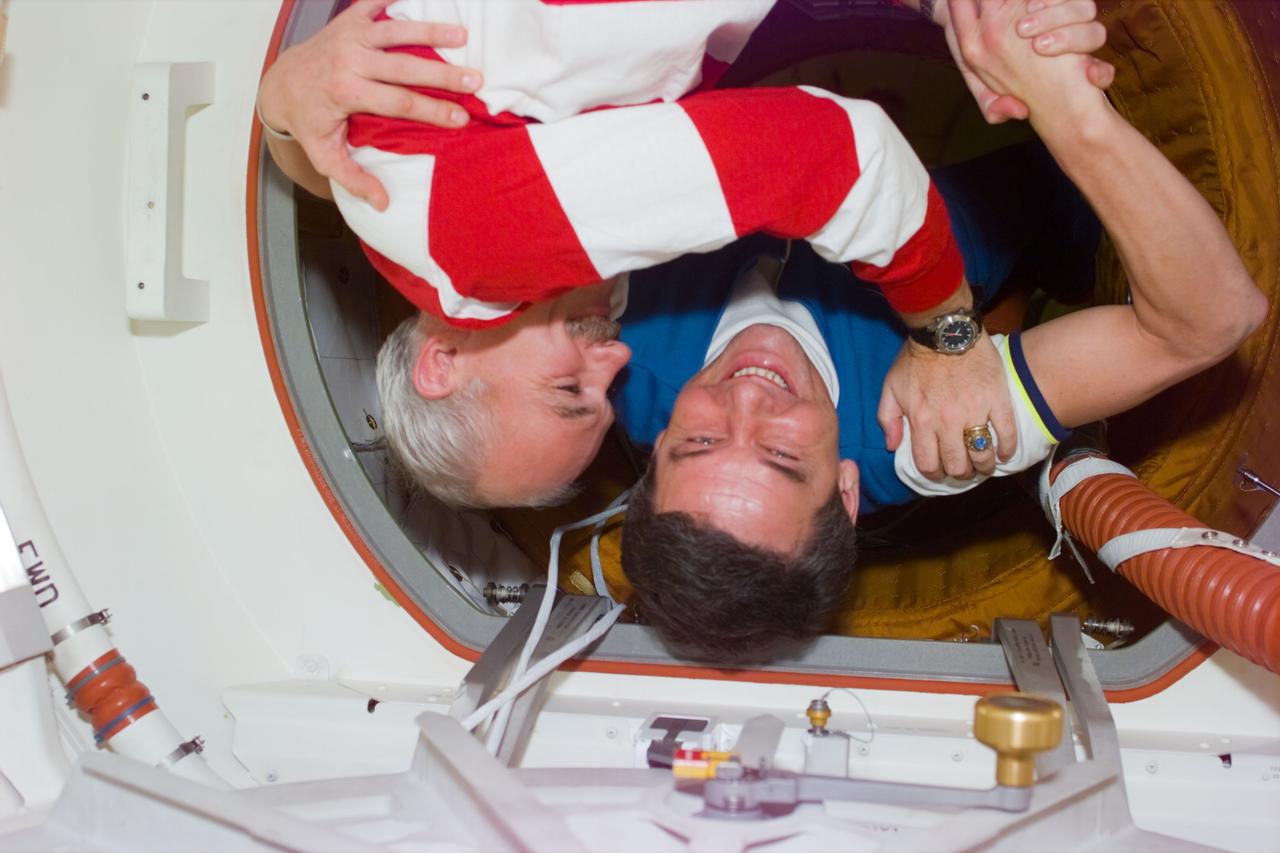
STS79-E-5090 (19 September 1996) --- Cosmonaut Valeri G. Korzun, Mir-22 commander, greets his American counterpart - astronaut William F. Readdy in the tunnel connecting the Space Shuttle Atlantis to Russia's Mir Space Station, during Flight Day 4. This mission marks the fourth such reunion involving astronauts and cosmonauts during the Shuttle era and the fifth overall, going back to the historic Apollo-Soyuz Test Project (ASTP) in 1975.
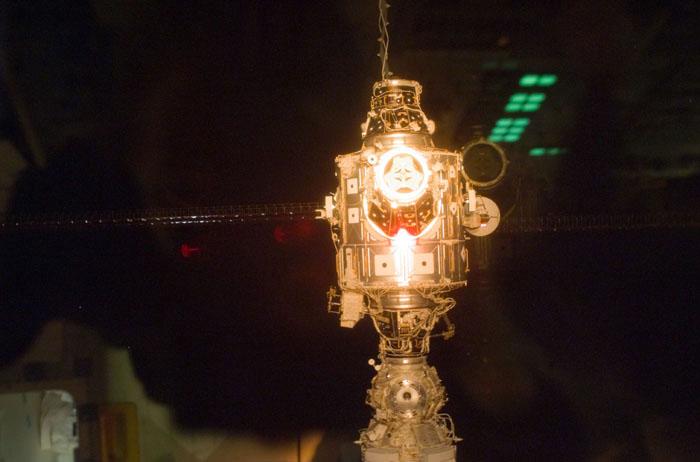
STS98-E-5040 (9 February 2001) --- One of a series of three digital still camera's views of the station's Unity node and the docking mechanism just prior to link up between the station and the Space Shuttle Atlantis. Sailing at 17,000 miles per hour 200 miles above the Pacific Ocean, astronaut Kenneth D. Cockrell, STS-98 mission commander, flawlessly pulled the shuttle alongside the International Space Station and docked, in position to add the new Destiny laboratory to the complex on the following day and begin a new era in space research. Atlantis went on to dock with the station on schedule at 10:51 a.m. (CST), February 9, and the station and shuttle crews opened hatches between the spacecraft at 1:03 p.m.
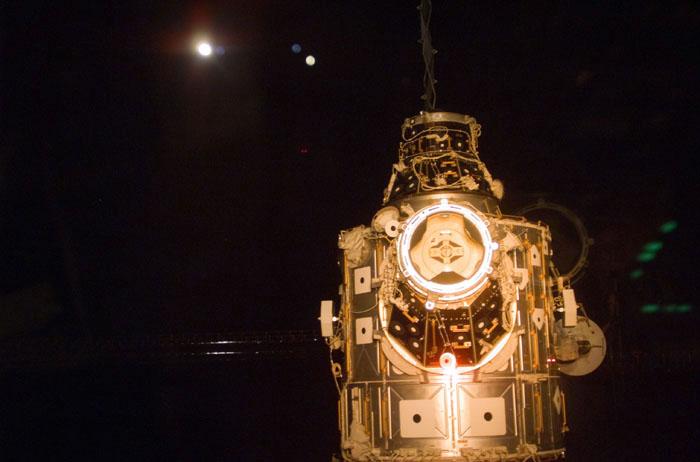
STS98-E-5041 (9 February 2001) --- One of a series of three digital still camera's views of the station's Unity node and the docking mechanism just prior to link up between the station and the Space Shuttle Atlantis. Sailing at 17,000 miles per hour 200 miles above the Pacific Ocean, astronaut Kenneth D. Cockrell, STS-98 mission commander, flawlessly pulled the shuttle alongside the International Space Station and docked, in position to add the new Destiny laboratory to the complex on the following day and begin a new era in space research. Atlantis went on to dock with the station on schedule at 10:51 a.m. (CST), February 9, and the station and shuttle crews opened hatches between the spacecraft at 1:03 p.m.
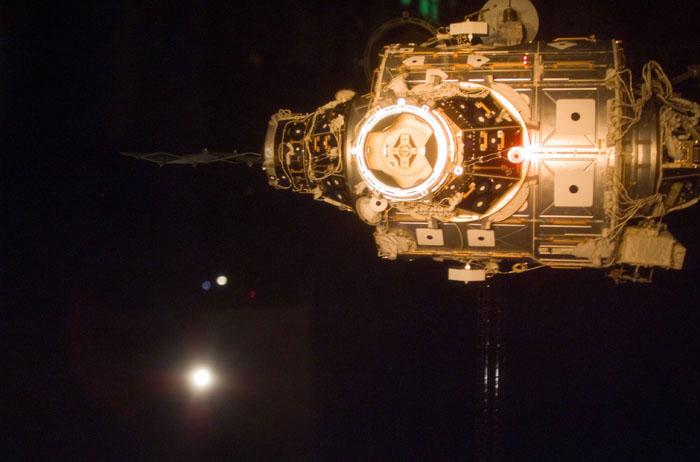
STS98-E-5042 (9 February 2001) --- One of a series of three digital still camera's views of the station's Unity node and the docking mechanism just prior to link up between the station and the Space Shuttle Atlantis. Sailing at 17,000 miles per hour 200 miles above the Pacific Ocean, astronaut Kenneth D. Cockrell, STS-98 mission commander, went on to flawlessly pull the shuttle alongside the International Space Station and dock it, in position to add the new Destiny laboratory to the complex on the following day and begin a new era in space research. Atlantis docked with the station on schedule at 10:51 a.m. (CST), February 9, and the station and shuttle crews opened hatches between the spacecraft at 1:03 p.m.

NASA Administrator Charles Bolden, left, and Kennedy Space Center director Robert Cabana pose for a photo as space shuttle Atlantis rolls toward its new home at the Kennedy Space Center Visitor Complex, early Friday, Nov. 2, 2012, in Cape Canaveral, Fla. The spacecraft traveled 125,935,769 miles during 33 spaceflights, including 12 missions to the International Space Station. Its final flight, STS-135, closed out the Space Shuttle Program era with a landing on July 21, 2011. Photo Credit: (NASA/Bill Ingalls)

STS071-S-001 (April 1995) --- The STS-71 crew patch design depicts the orbiter Atlantis in the process of the first international docking mission of the space shuttle Atlantis with the Russian Mir Space Station. The names of the 10 astronauts and cosmonauts who will fly aboard the orbiter as shown along the outer border of the patch. The rising sun symbolizes the dawn of a new era of cooperation between the two countries. The vehicles Atlantis and Mir are shown in separate circles converging at the center of the emblem symbolizing the merger of the space programs of the two space faring nations. The flags of the United States and Russia emphasize the equal partnership of the mission. The joint program symbol at the lower center of the patch acknowledges the extensive contributions made by the Mission Control Centers (MCC) of both countries. The crew insignia was designed by aviation and space artist, Bob McCall, who also designed the crew patch for the Apollo-Soyuz Test Project (ASTP) in 1975, the first international space docking mission. The NASA insignia design for space shuttle flights is reserved for use by the astronauts and for other official use as the NASA Administrator may authorize. Public availability has been approved only in the forms of illustrations by the various news media. When and if there is any change in this policy, which is not anticipated, the change will be publicly announced. Photo credit: NASA
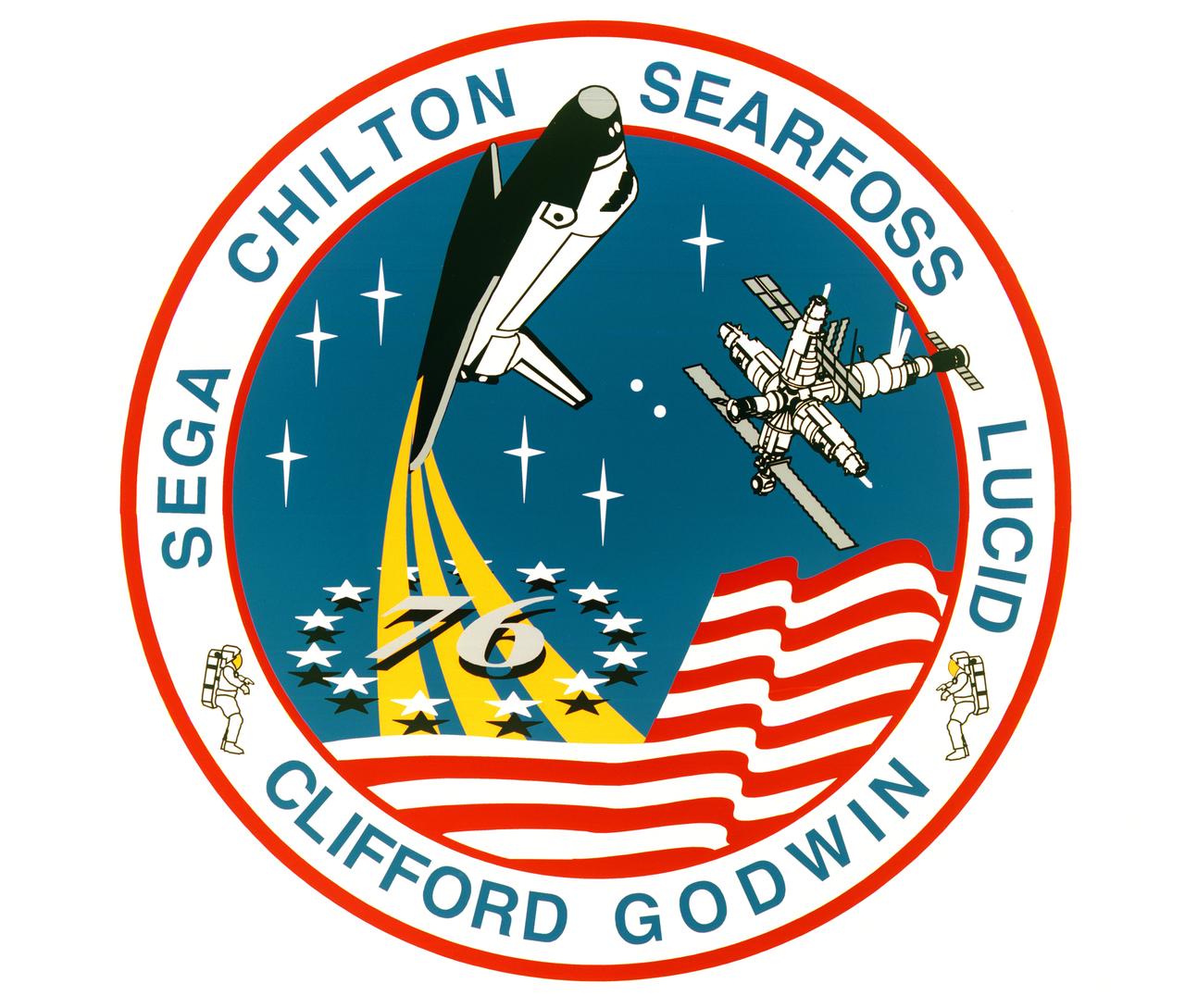
The STS-76 crew patch depicts the Space Shuttle Atlantis and Russia's Mir Space Station as the space ships prepare for a rendezvous and docking. The Spirit of 76, an era of new beginnings, is represented by the Space Shuttle rising through the circle of 13 stars in the Betsy Ross flag. STS-76 begins a new period of international cooperation in space exploration with the first Shuttle transport of a United States astronaut, Shannon W. Lucid, to the Mir Space Station for extended joint space research. Frontiers for future exploration are represented by stars and the planets. The three gold trails and the ring of stars in union form the astronaut logo. Two suited extravehicular activity (EVA) crew members in the outer ring represent the first EVA during Shuttle-Mir docked operations. The EVA objectives were to install science experiments on the Mir exterior and to develop procedures for future EVA's on the International Space Station. The surnames of the crew members encircle the patch: Kevin P. Chilton, mission commander; Richard A. Searfoss, pilot; Ronald M. Sega, Michael R. ( Rich) Clifford, Linda M. Godwin and Lucid, all mission specialists. This patch was designed by Brandon Clifford, age 12, and the crew members of STS-76.
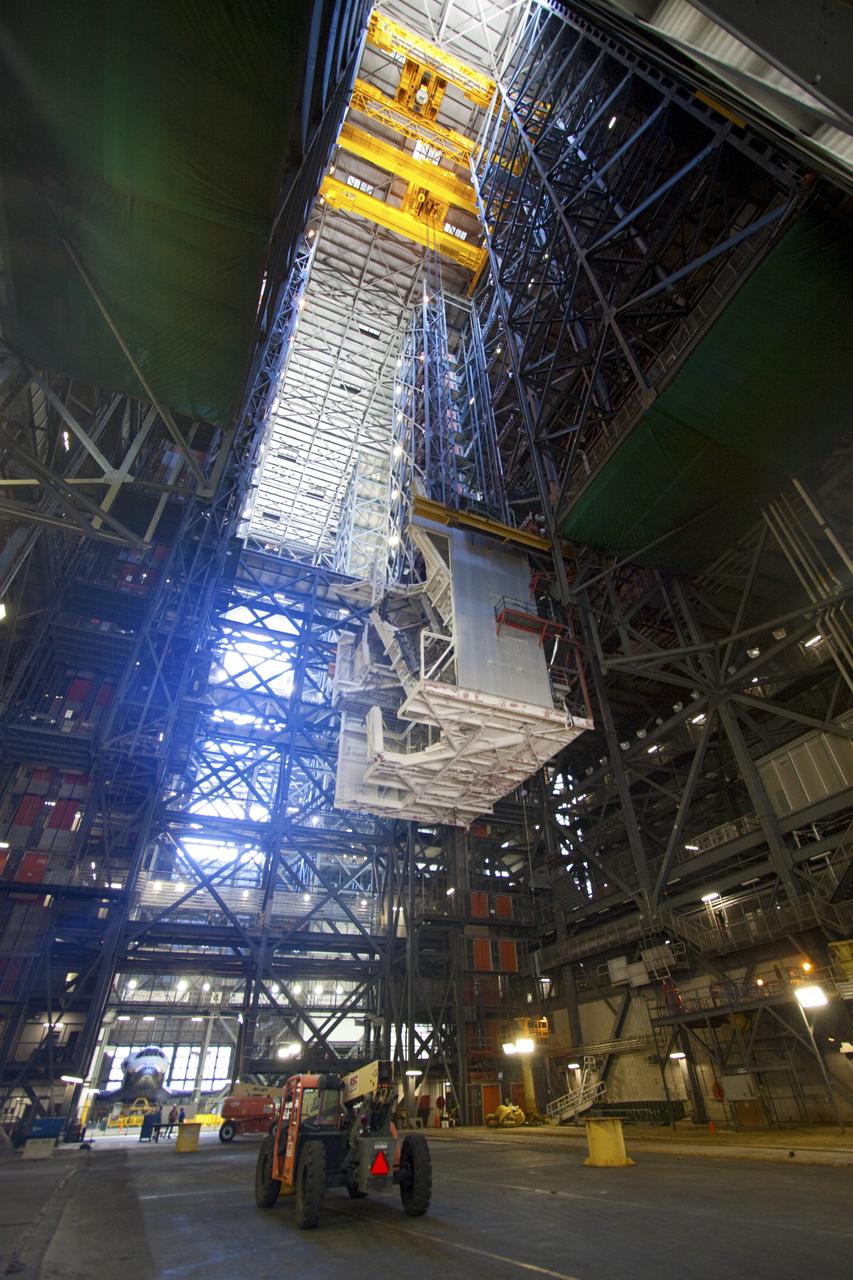
CAPE CANAVERAL, Fla. – As part of NASA's Ground Systems Development and Operations Program at the Kennedy Space Center in Florida, a large space shuttle-era work platform is being removed from high bay 3 of the Vehicle Assembly Building, or VAB. The work is part of a center-wide modernization and refurbishment initiative to accommodate NASA’s Space Launch System and a variety of other spacecraft instead of the whole building supporting one design. Visible in the background on the lower left is the space shuttle Atlantis being readied for its move to the Kennedy Space Center Visitor Complex. The Ground Systems Development and Operations Program is developing the necessary ground systems, infrastructure and operational approaches required to safely process, assemble, transport and launch the next generation of rockets and spacecraft in support of NASA’s exploration objectives. Future work also will replace the antiquated communications, power and vehicle access resources with modern efficient systems. Some of the utilities and systems slated for replacement have been used since the VAB opened in 1965. For more information, visit http://www.nasa.gov/exploration/systems/ground/index.html Photo credit: NASA/Jim Grossmann
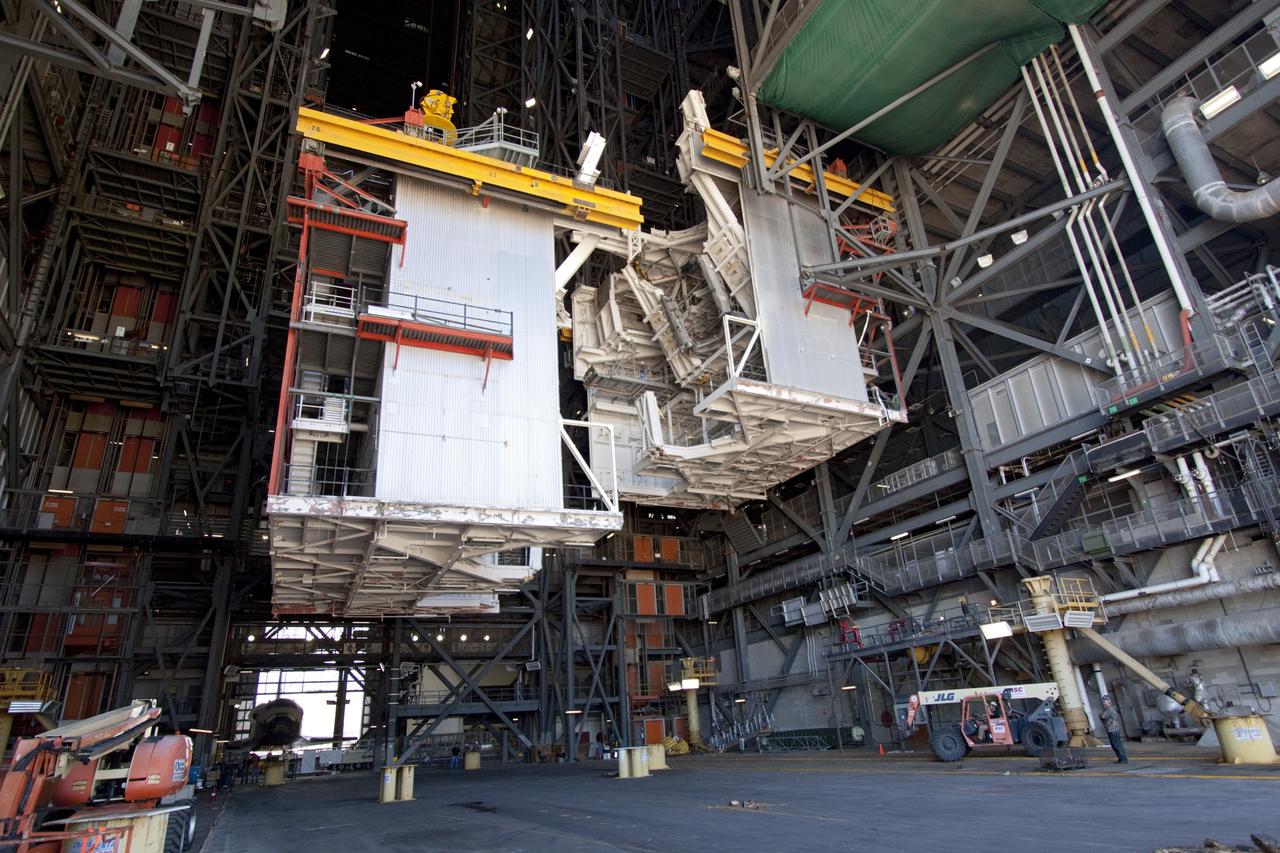
CAPE CANAVERAL, Fla. – As part of NASA's Ground Systems Development and Operations Program at the Kennedy Space Center in Florida, a large space shuttle-era work platform is being removed from high bay 3 of the Vehicle Assembly Building, or VAB. The work is part of a center-wide modernization and refurbishment initiative to accommodate NASA’s Space Launch System and a variety of other spacecraft instead of the whole building supporting one design. Visible in the lower-left background is the space shuttle Atlantis being readied for its move to the Kennedy Space Center Visitor Complex. The Ground Systems Development and Operations Program is developing the necessary ground systems, infrastructure and operational approaches required to safely process, assemble, transport and launch the next generation of rockets and spacecraft in support of NASA’s exploration objectives. Future work also will replace the antiquated communications, power and vehicle access resources with modern efficient systems. Some of the utilities and systems slated for replacement have been used since the VAB opened in 1965. For more information, visit http://www.nasa.gov/exploration/systems/ground/index.html Photo credit: NASA/Jim Grossmann

STS074-S-001 (July 1995) --- Designed by crew members, this STS-74 crew patch depicts the space shuttle Atlantis docked to Russia's Mir Space Station. The central focus is on the Russian-built Docking Module (DM), drawn with shading to accentuate its pivotal importance to both mission STS-74 and the NASA - Mir Program. The rainbow across the horizon represents Earth's atmosphere, the thin membrane protecting all nations, while the three flags across the bottom show those nations participating in STS-74 - Russia, Canada and the United States. The sunrise is symbolic of the dawn of a new era in NASA space flight - that of space station construction. The NASA insignia design for space shuttle flights is reserved for use by the astronauts and for other official use as the NASA Administrator may authorize. Public availability has been approved only in the forms of illustrations by the various news media. When and if there is any change in this policy, which is not anticipated, the change will be publicly announced. Photo credit: NASA

CAPE CANAVERAL, Fla. – As part of NASA's Ground Systems Development and Operations Program at the Kennedy Space Center in Florida, space shuttle-era work platforms have been removed from high bay 3 of the Vehicle Assembly Building, or VAB. The work is part of a center-wide modernization and refurbishment initiative to accommodate NASA’s Space Launch System and a variety of other spacecraft instead of the whole building supporting one design. Visible in the lower background is the space shuttle Atlantis being readied for its move to the Kennedy Space Center Visitor Complex. The Ground Systems Development and Operations Program is developing the necessary ground systems, infrastructure and operational approaches required to safely process, assemble, transport and launch the next generation of rockets and spacecraft in support of NASA’s exploration objectives. Future work also will replace the antiquated communications, power and vehicle access resources with modern efficient systems. Some of the utilities and systems slated for replacement have been used since the VAB opened in 1965. For more information, visit http://www.nasa.gov/exploration/systems/ground/index.html Photo credit: NASA/Kim Shiflett
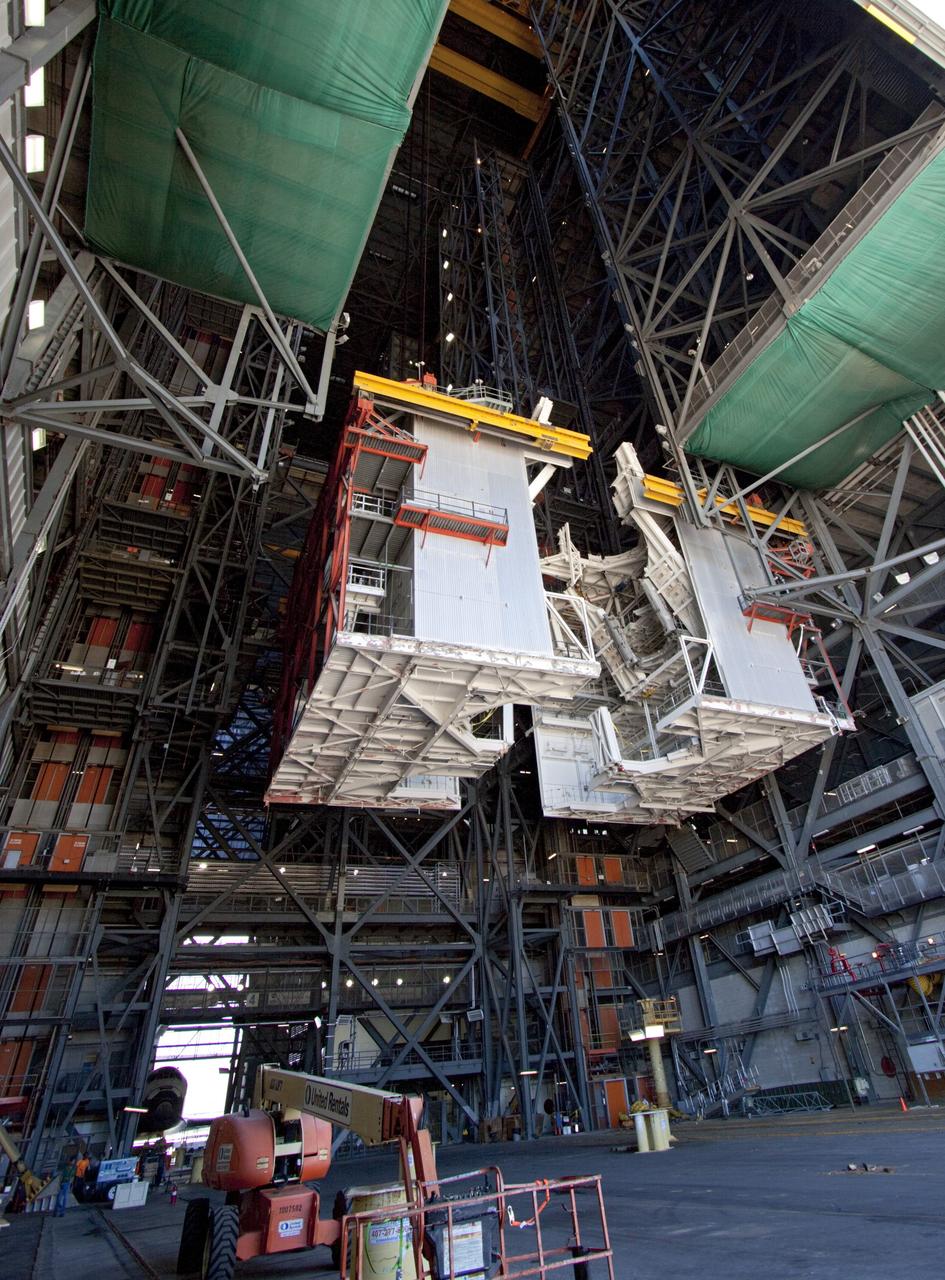
CAPE CANAVERAL, Fla. – As part of NASA's Ground Systems Development and Operations Program at the Kennedy Space Center in Florida, a large space shuttle-era work platform is being removed from high bay 3 of the Vehicle Assembly Building, or VAB. The work is part of a center-wide modernization and refurbishment initiative to accommodate NASA’s Space Launch System and a variety of other spacecraft instead of the whole building supporting one design. Visible in the lower-left background is the space shuttle Atlantis being readied for its move to the Kennedy Space Center Visitor Complex. The Ground Systems Development and Operations Program is developing the necessary ground systems, infrastructure and operational approaches required to safely process, assemble, transport and launch the next generation of rockets and spacecraft in support of NASA’s exploration objectives. Future work also will replace the antiquated communications, power and vehicle access resources with modern efficient systems. Some of the utilities and systems slated for replacement have been used since the VAB opened in 1965. For more information, visit http://www.nasa.gov/exploration/systems/ground/index.html Photo credit: NASA/Jim Grossmann
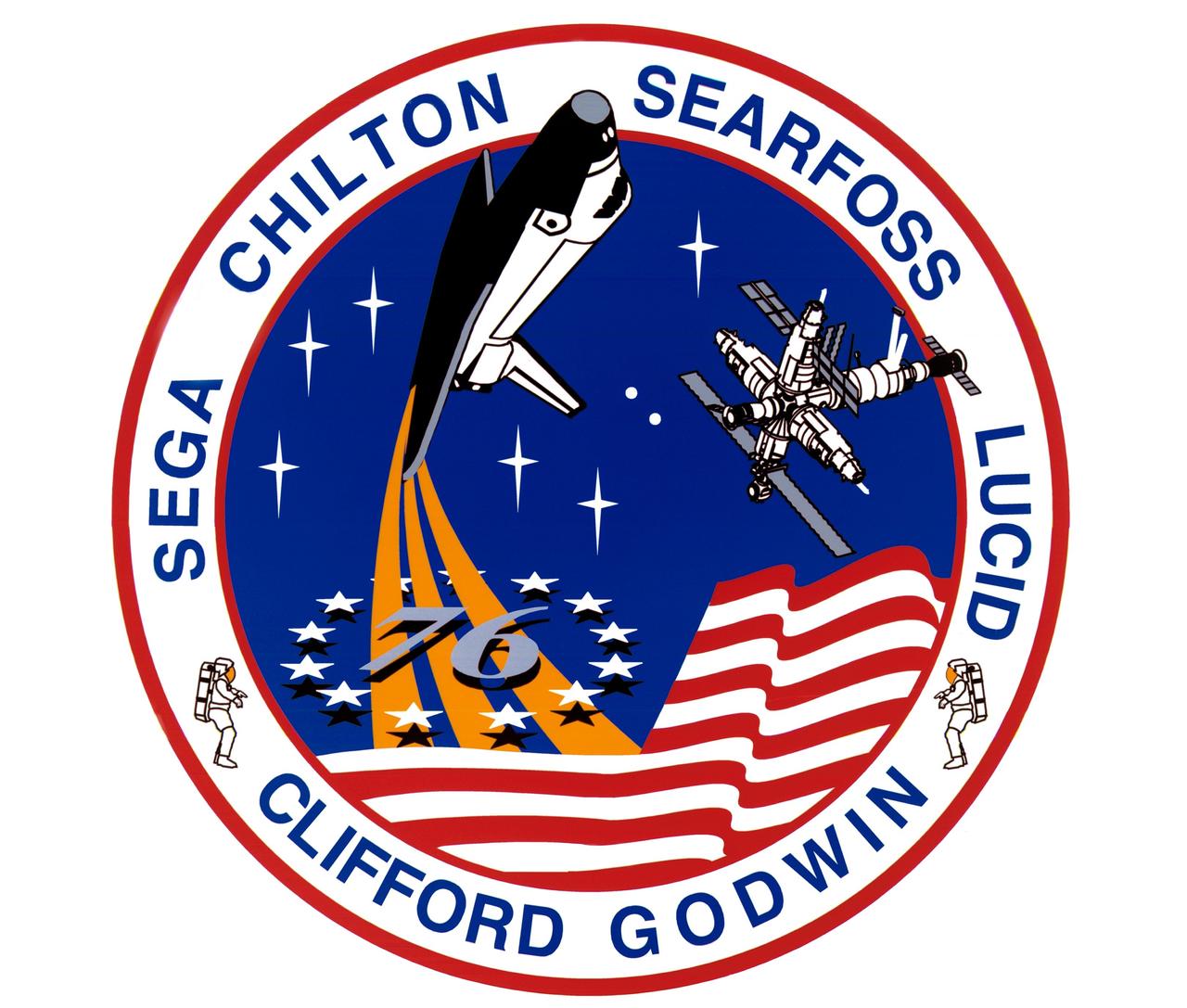
STS076-S-001 (November 1995) --- The STS-76 crew patch depicts the space shuttle Atlantis and Russia's Mir Space Station as the space ships prepare for a rendezvous and docking. The "Spirit of 76," an era of new beginnings, is represented by the space shuttle rising through the circle of 13 stars in the Betsy Ross flag. STS-76 begins a new period of international cooperation in space exploration with the first shuttle transport of a United States astronaut, Shannon W. Lucid, to the Mir Space Station for extended joint space research. Frontiers for future exploration are represented by stars and the planets. The three gold trails and the ring of stars in union form the astronaut logo. Two suited extravehicular activity (EVA) crew members in the outer ring represent the first EVA during Shuttle-Mir docked operations. The EVA objectives are to install science experiments on the Mir exterior and to develop procedures for future EVA's on the International Space Station. The surnames of the crew members encircle the patch: Kevin P. Chilton, mission commander; Richard A. Searfoss, pilot; Ronald M. Sega, Michael R. ( Rich) Clifford, Linda M. Godwin and Lucid, all mission specialists. This patch was designed by Brandon Clifford, age 12, and the crew members of STS-76. The NASA insignia design for space shuttle flights is reserved for use by the astronauts and for other official use as the NASA Administrator may authorize. Public availability has been approved only in the forms of illustrations by the various news media. When and if there is any change in this policy, which is not anticipated, the change will be publicly announced. Photo credit: NASA