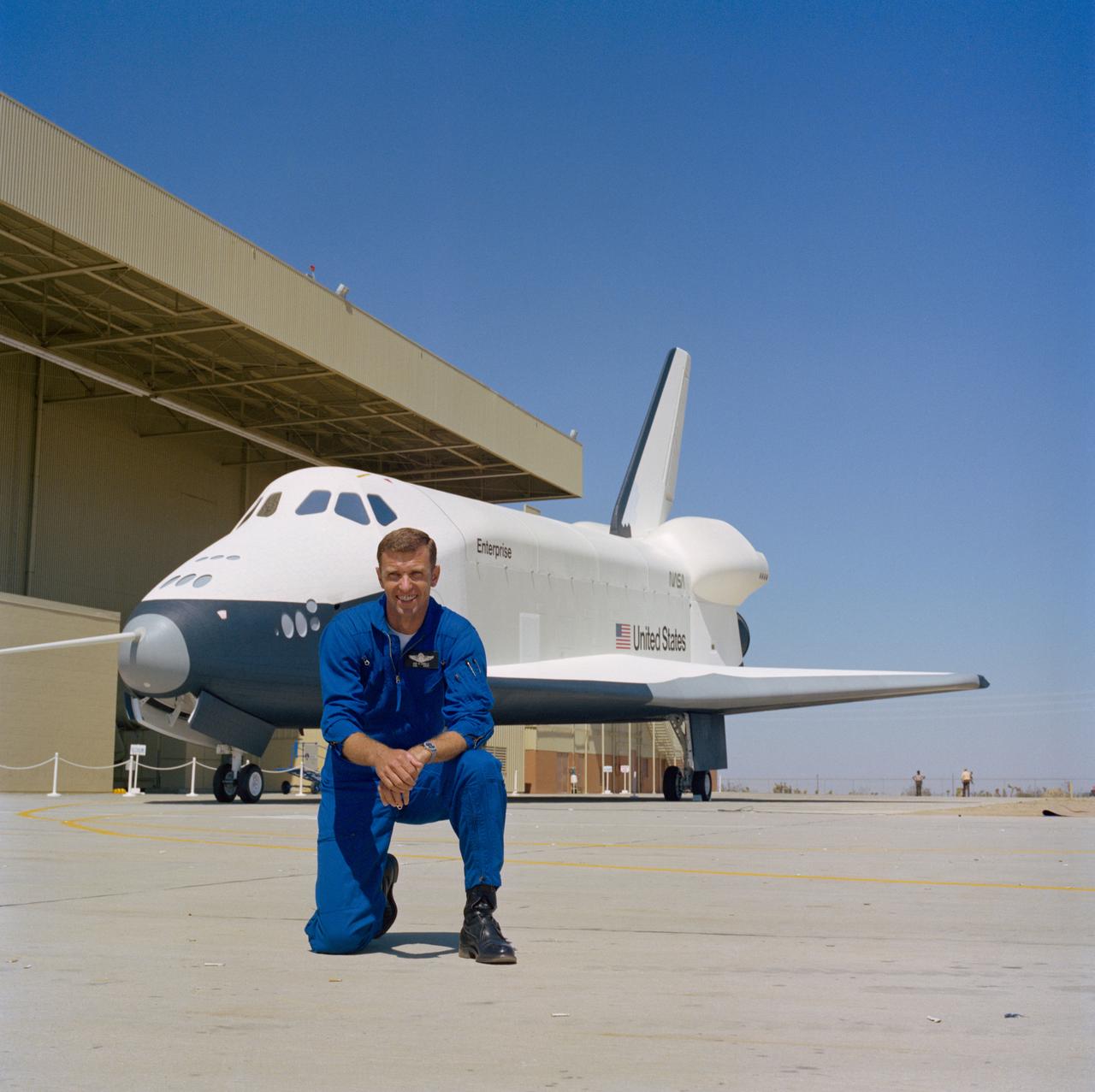
S76-29560 (17 Sept 1976) - - - Astronaut Joe H. Engle, commander of the second crew for the Space Shuttle Approach and Landing Tests (ALT), is photographed at the Rockwell International Space Division?s Orbiter assembly facility at Palmdale, California on the day of the roll out of the Space Shuttle Orbiter 101 ?Enterprise? spacecraft. The DC-size airplane-like Orbiter 101 is in the background.
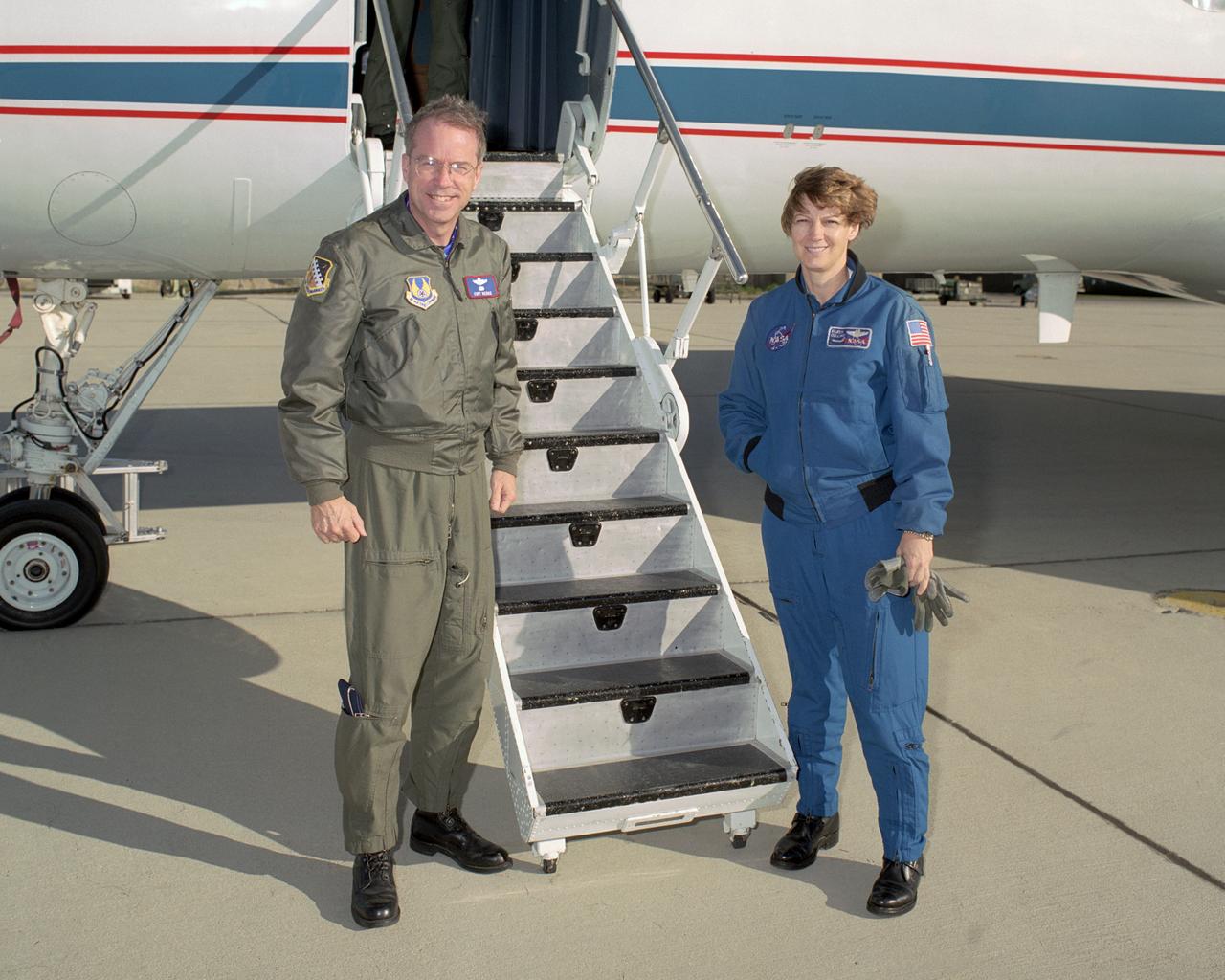
Brig. Gen. Curtis Bedke, commander of the Air Force Flight Test Center at Edwards Air Force Base, received some first-hand insight on how to fly a Space Shuttle approach and landing, courtesy of NASA astronaut and STS-114 mission commander Eileen Collins. The series of proficiency flights in NASA's modified Grumman Gulfstream-II Shuttle Training Aircraft were in preparation for the STS-114 mission with the shuttle Discovery. Although NASA's Kennedy Space Center in Florida is the primary landing site for Space Shuttle missions, flight crews also practice the shuttle's steep approach and landing at Edwards in case weather or other situations preclude a landing at the Florida site and force a diversion to Edwards AFB.
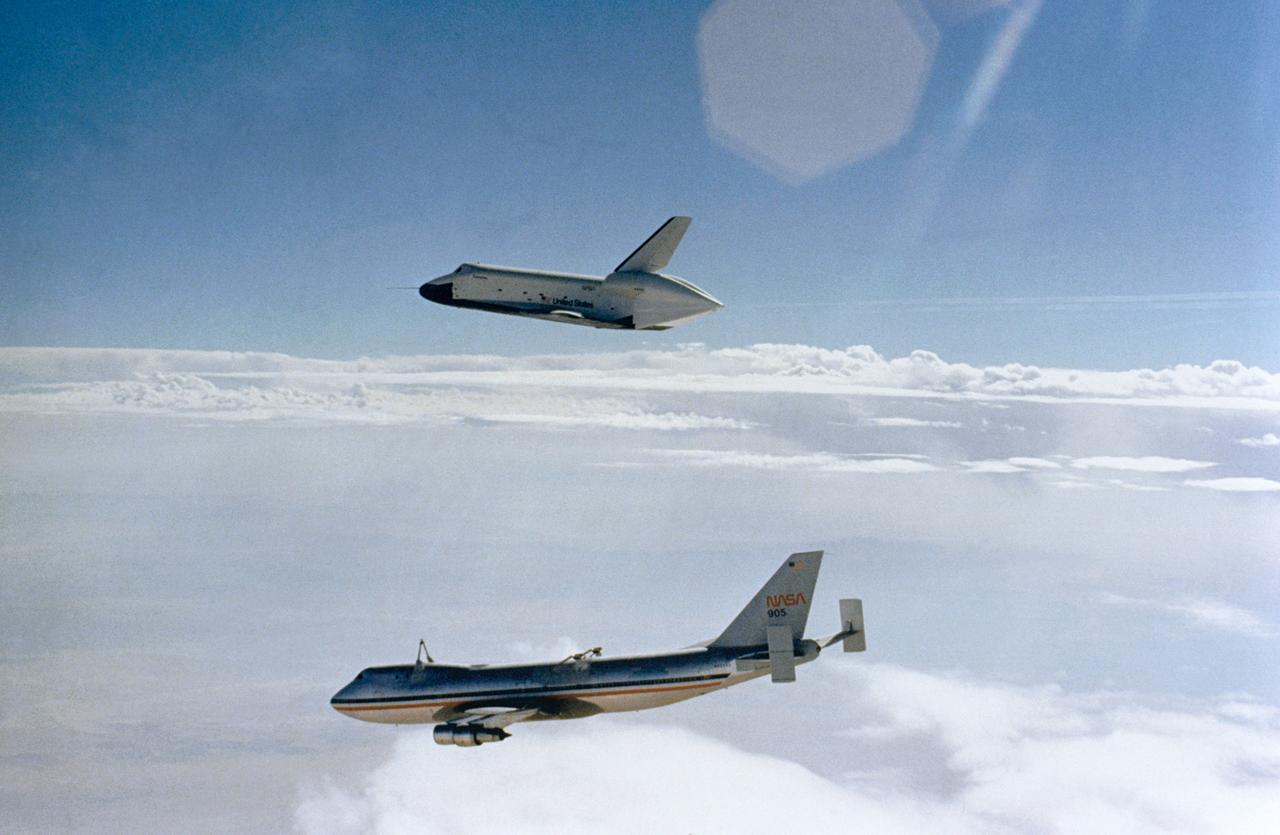
S77-27512 (12 Aug 1977) --- The Shuttle Orbiter 101 "Enterprise" soars above the NASA 747 carrier aircraft only seconds after separating during the first free flight of the Shuttle Approach and Landing Tests (ALTs) conducted on August 12, 1977 at Dryden Flight Research Center in Southern California. Astronauts Fred W. Haise Jr., and C. Gordon Fullerton were the crew of the "Enterprise." The ALT free flights are designed to verify Orbiter subsonic airworthiness, integrated systems operations and pilot-guided approach and landing capability and satisfying prerequisites to automatic flight control and navigation mode.
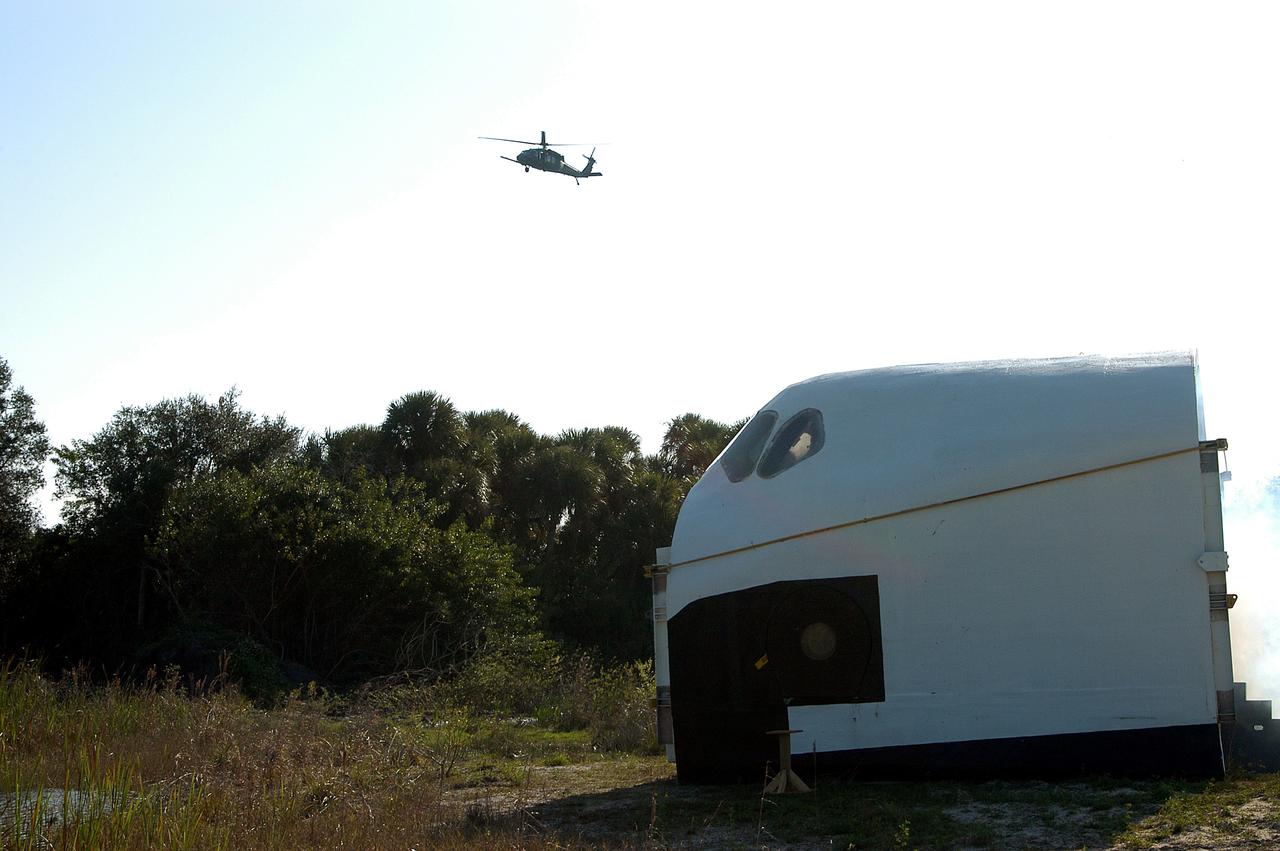
KENNEDY SPACE CENTER, FLA. - A helicopter approaches an orbiter crew compartment mock-up as part of a “Mode VII” emergency landing simulation at Kennedy Space Center. The purpose is to exercise emergency preparedness personnel, equipment and facilities in rescuing astronauts from a downed orbiter and providing immediate medical attention. This simulation presents an orbiter that has crashed short of the Shuttle Landing Facility in a wooded area 2-1/2 miles south of Runway 33. Emergency crews will respond to the volunteer “astronauts” simulating various injuries. Rescuers must remove the crew, provide triage and transport to hospitals those who need further treatment. Local hospitals are participating in the exercise.
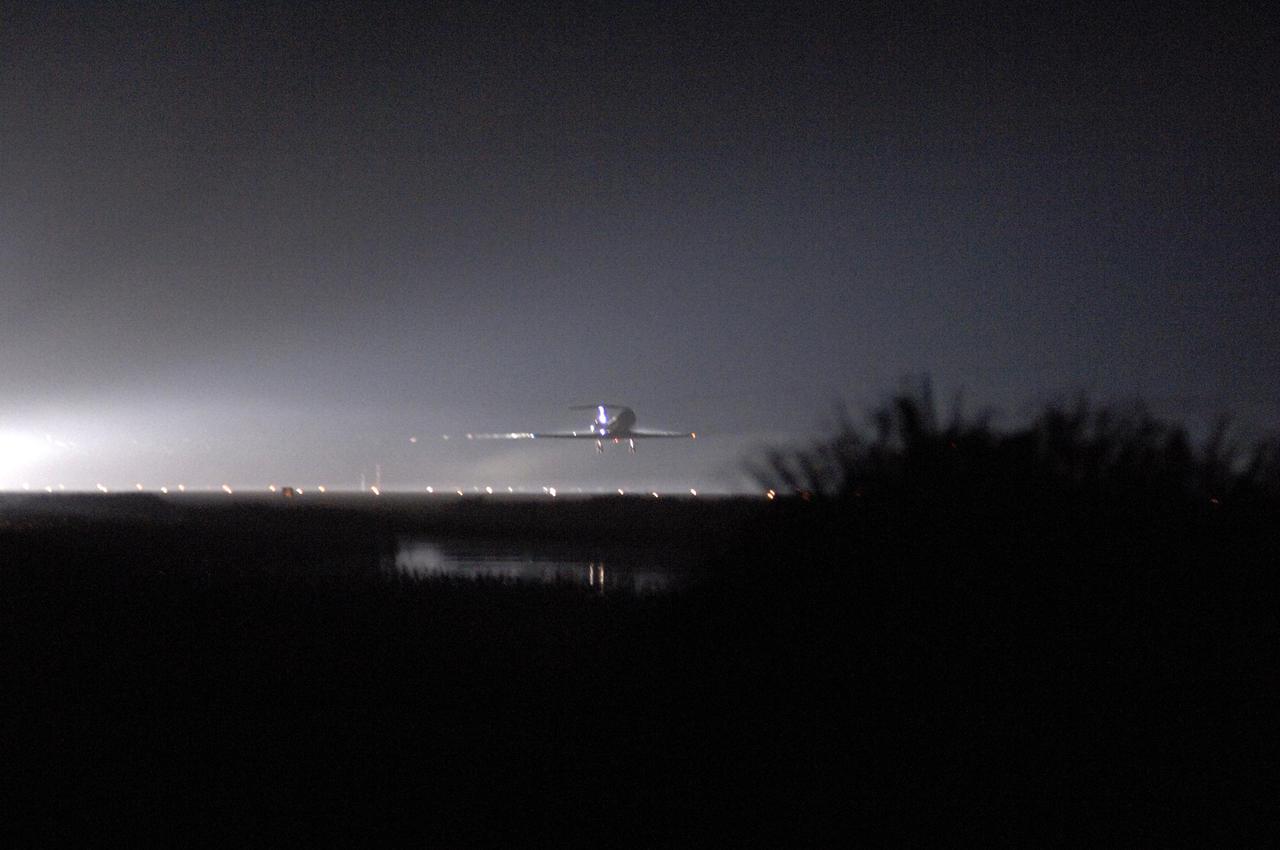
KENNEDY SPACE CENTER, FLA. - In the pre-dawn hours, the Shuttle Training Aircraft (STA) approaches the runway on NASA Kennedy Space Center’s Shuttle Landing Facility. The STA was in the air to observe flying conditions for the pending landing of Space Shuttle Discovery to conclude Return to Flight mission STS-114. The landing was postponed until Aug. 9.
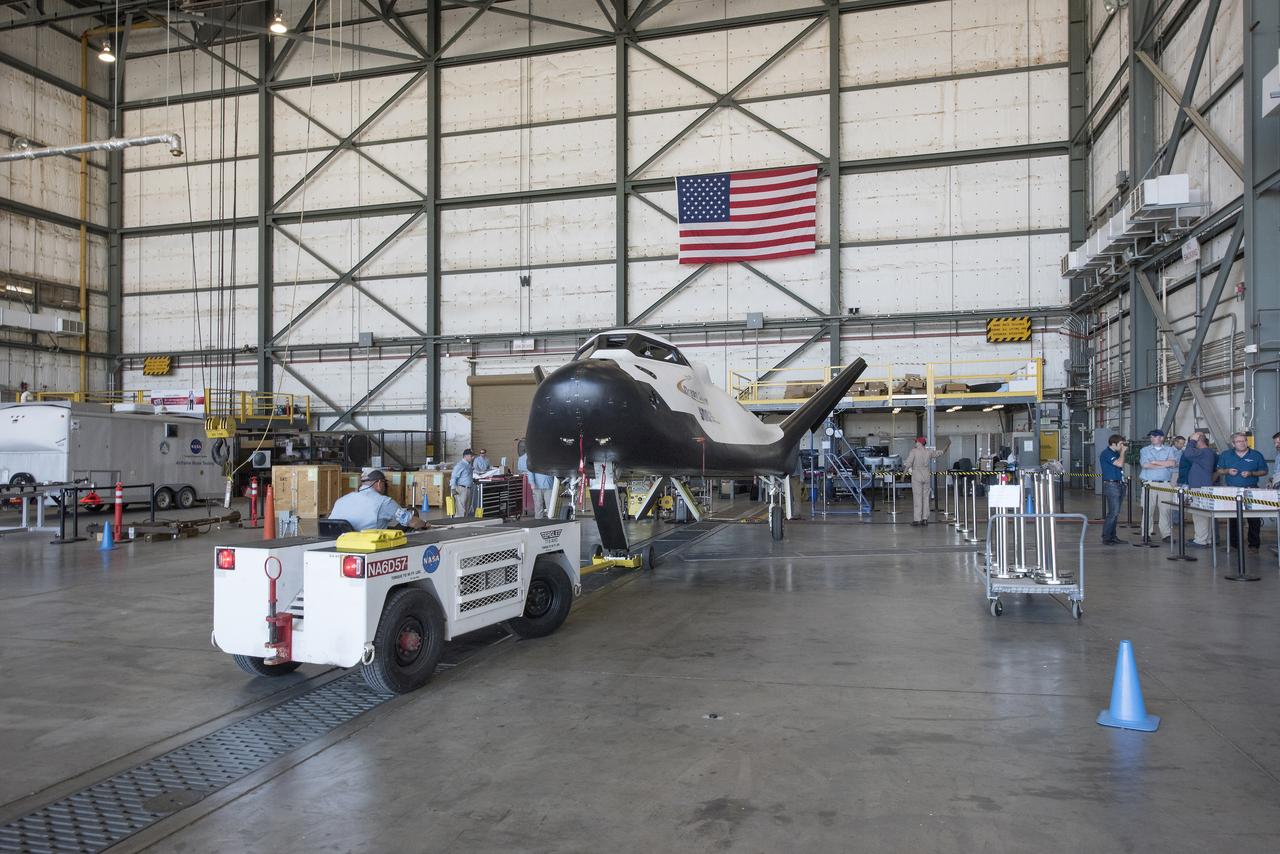
After a successful approach and landing flight test on Nov. 11, 2017, Sierra Nevada Corp’s Dream Chaser was towed back to NASA Armstrong Flight Research Center in California, and placed in the former space shuttle hangar.
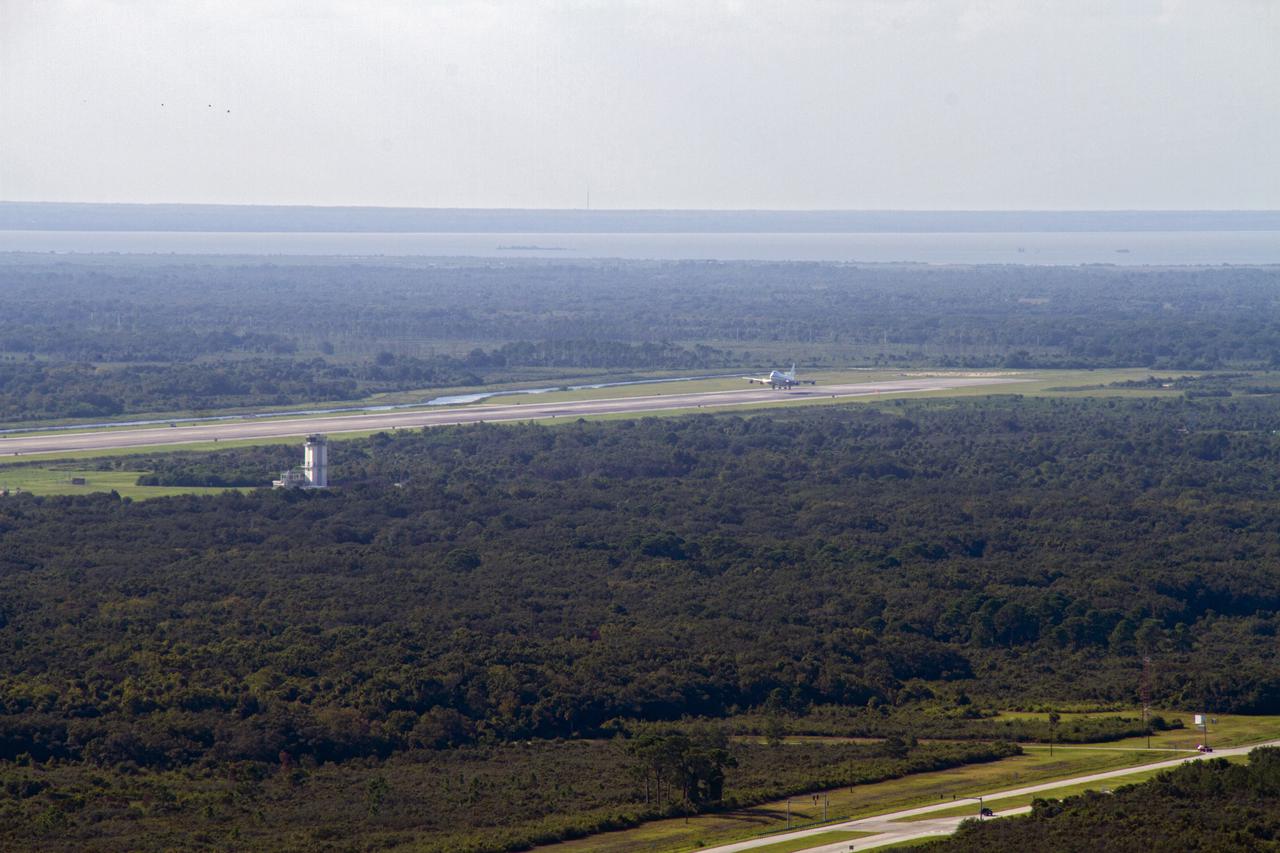
CAPE CANAVERAL, Fla. – The Shuttle Carrier Aircraft, or SCA, approaches the runway at NASA Kennedy Space Center’s Shuttle Landing Facility in Florida. The SCA touched down at 5:05 p.m. EDT to prepare for shuttle Endeavour’s ferry flight to the Los Angeles International Airport on Sept. 17. Photo credit: NASA_Chris Chamberland
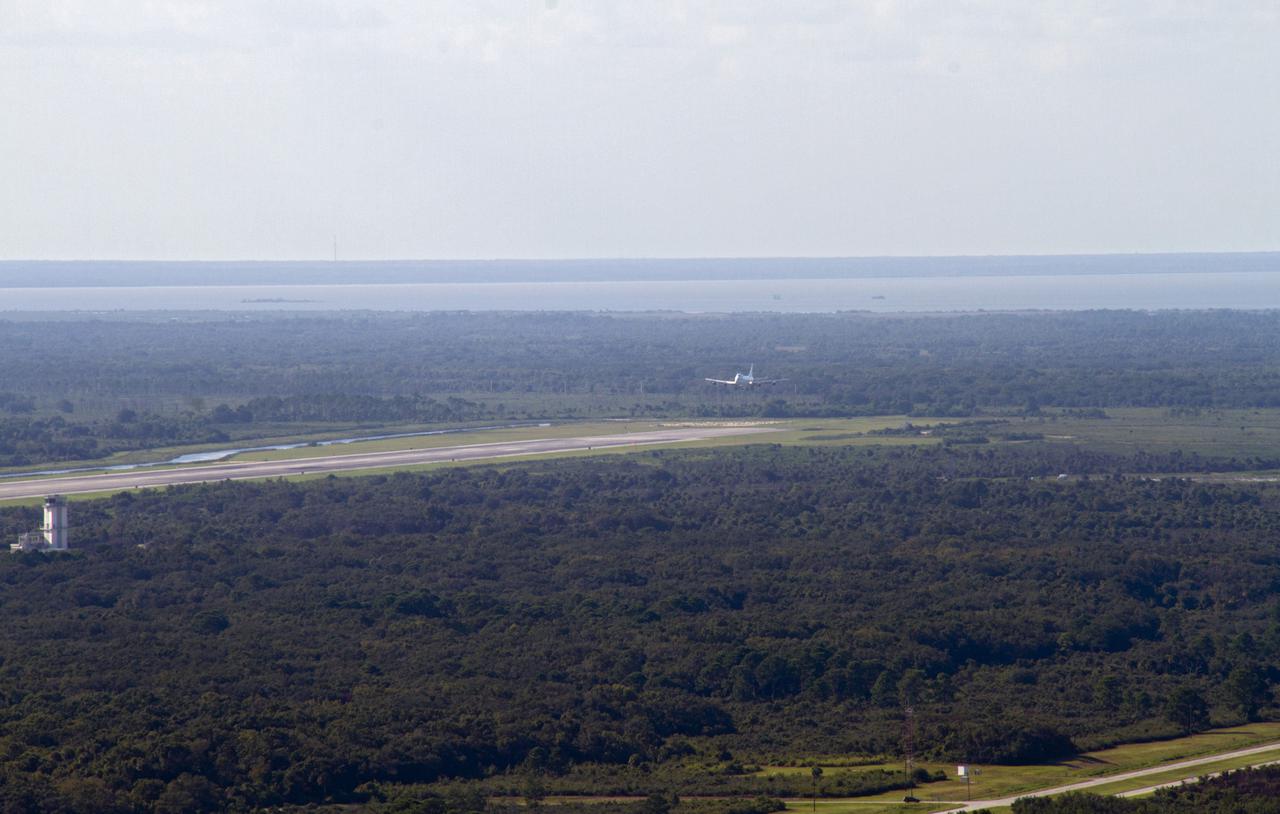
4980 - CAPE CANAVERAL, Fla. – The Shuttle Carrier Aircraft, or SCA, approaches the runway at NASA Kennedy Space Center’s Shuttle Landing Facility in Florida. The SCA touched down at 5:05 p.m. EDT to prepare for shuttle Endeavour’s ferry flight to the Los Angeles International Airport on Sept. 17. Photo credit: NASA_Chris Chamberland
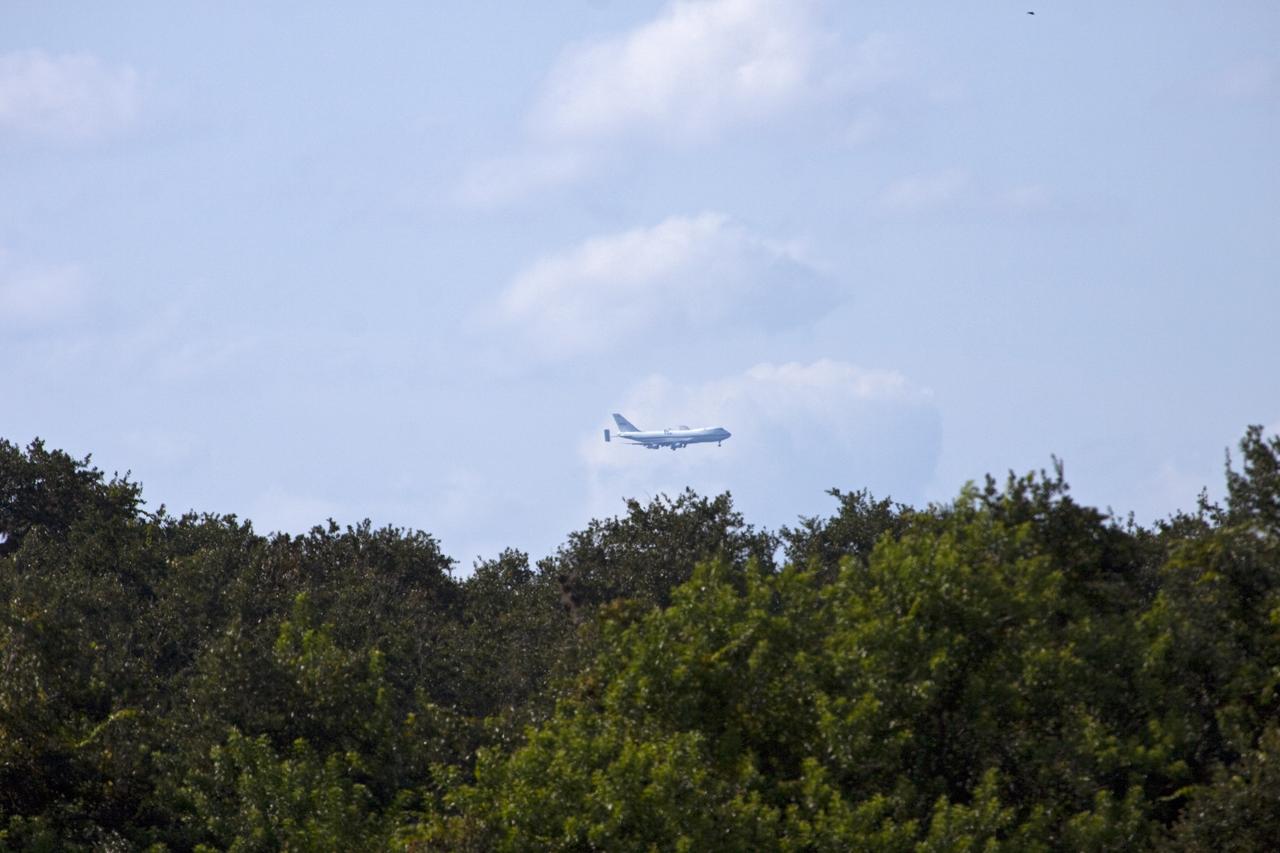
CAPE CANAVERAL, Fla. – The Shuttle Carrier Aircraft, or SCA, approaches the runway at NASA Kennedy Space Center’s Shuttle Landing Facility in Florida. The SCA touched down at 5:05 p.m. EDT to prepare for shuttle Endeavour’s ferry flight to the Los Angeles International Airport on Sept. 17. Photo credit: NASA/Jim Grossmann
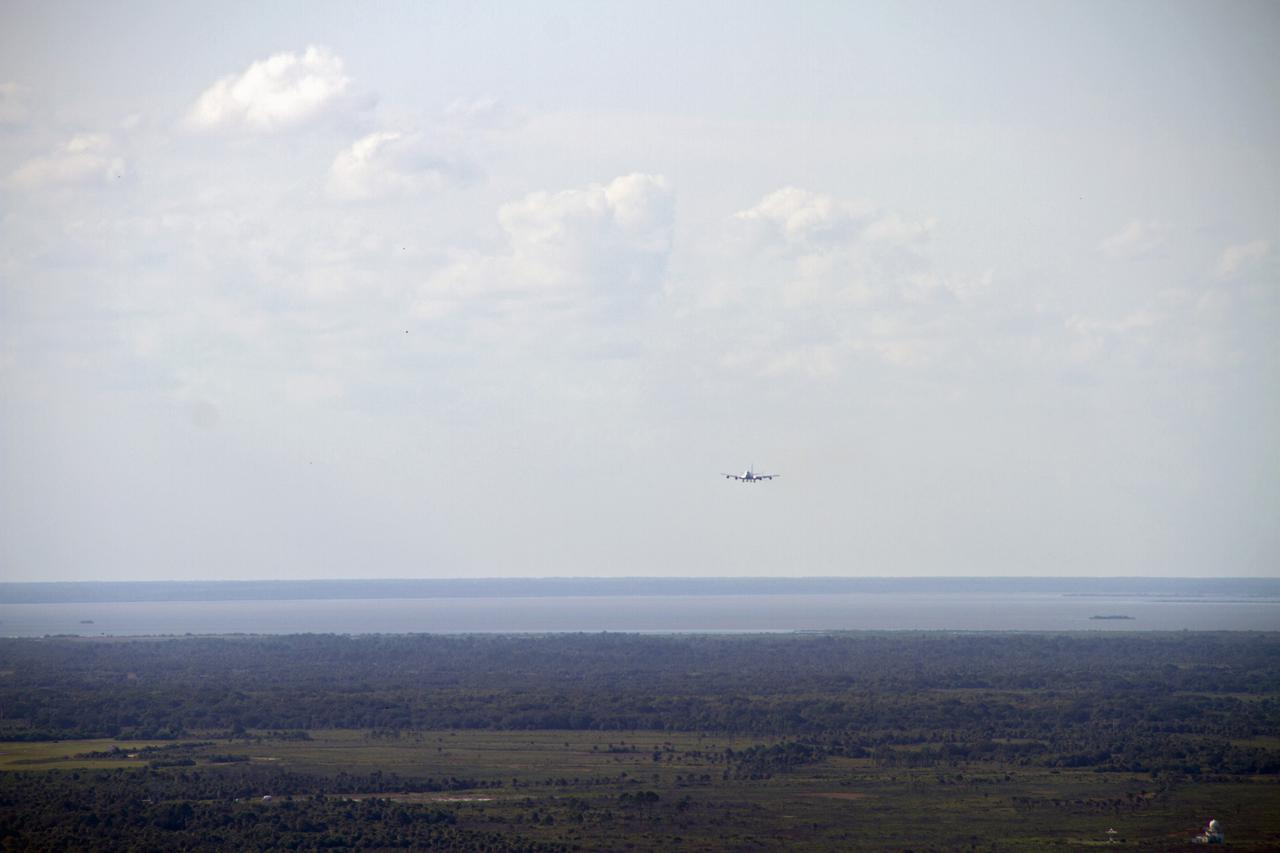
CAPE CANAVERAL, Fla. – The Shuttle Carrier Aircraft, or SCA, approaches the runway at NASA Kennedy Space Center’s Shuttle Landing Facility in Florida. The SCA touched down at 5:05 p.m. EDT to prepare for shuttle Endeavour’s ferry flight to the Los Angeles International Airport on Sept. 17. Photo credit: NASA_Chris Chamberland
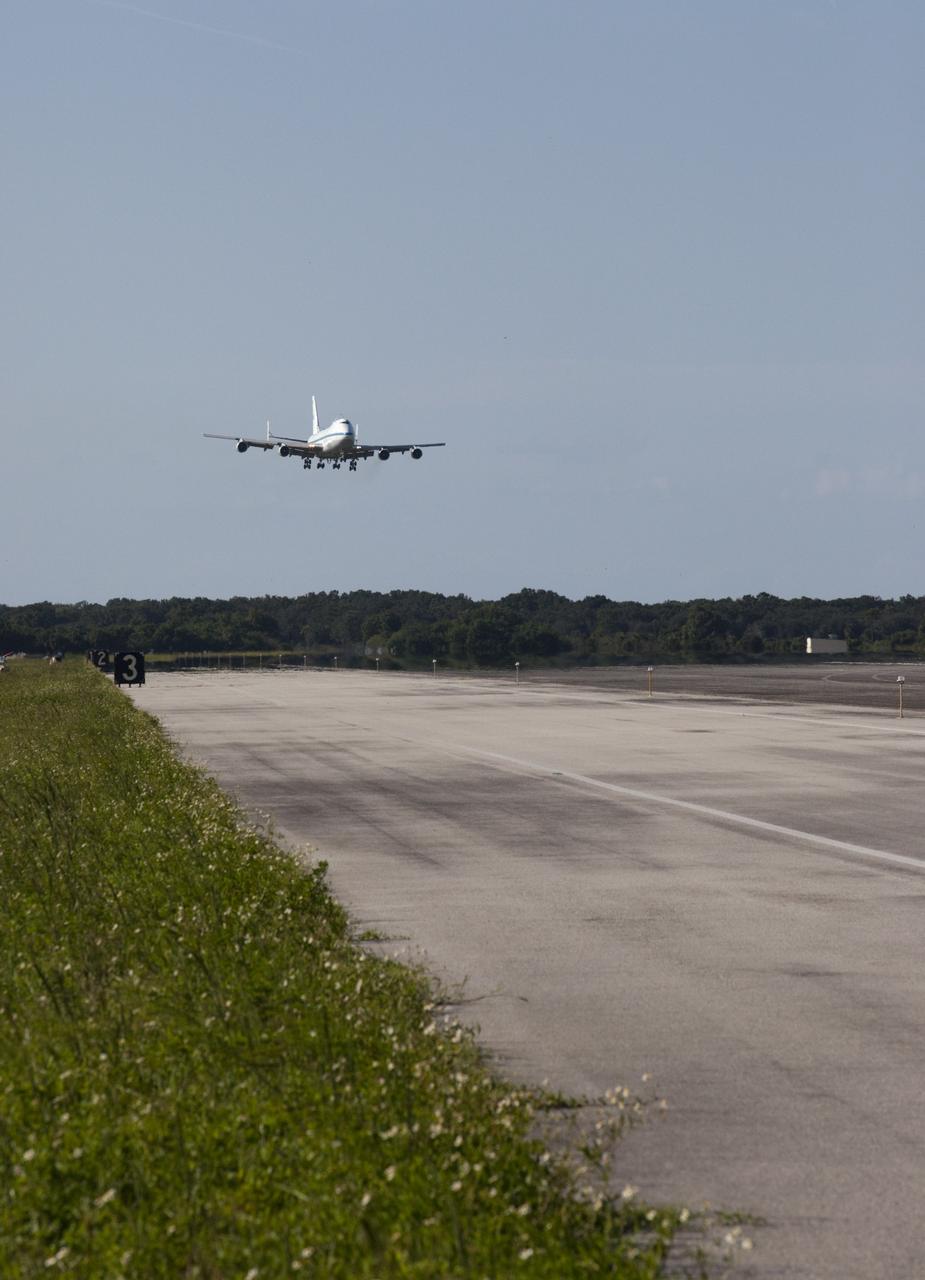
CAPE CANAVERAL, Fla. – The Shuttle Carrier Aircraft, or SCA, approaches the runway at NASA Kennedy Space Center’s Shuttle Landing Facility in Florida. The SCA touched down at 5:05 p.m. EDT to prepare for shuttle Endeavour’s ferry flight to the Los Angeles International Airport on Sept. 17. Photo credit: NASA/Kim Shiflett
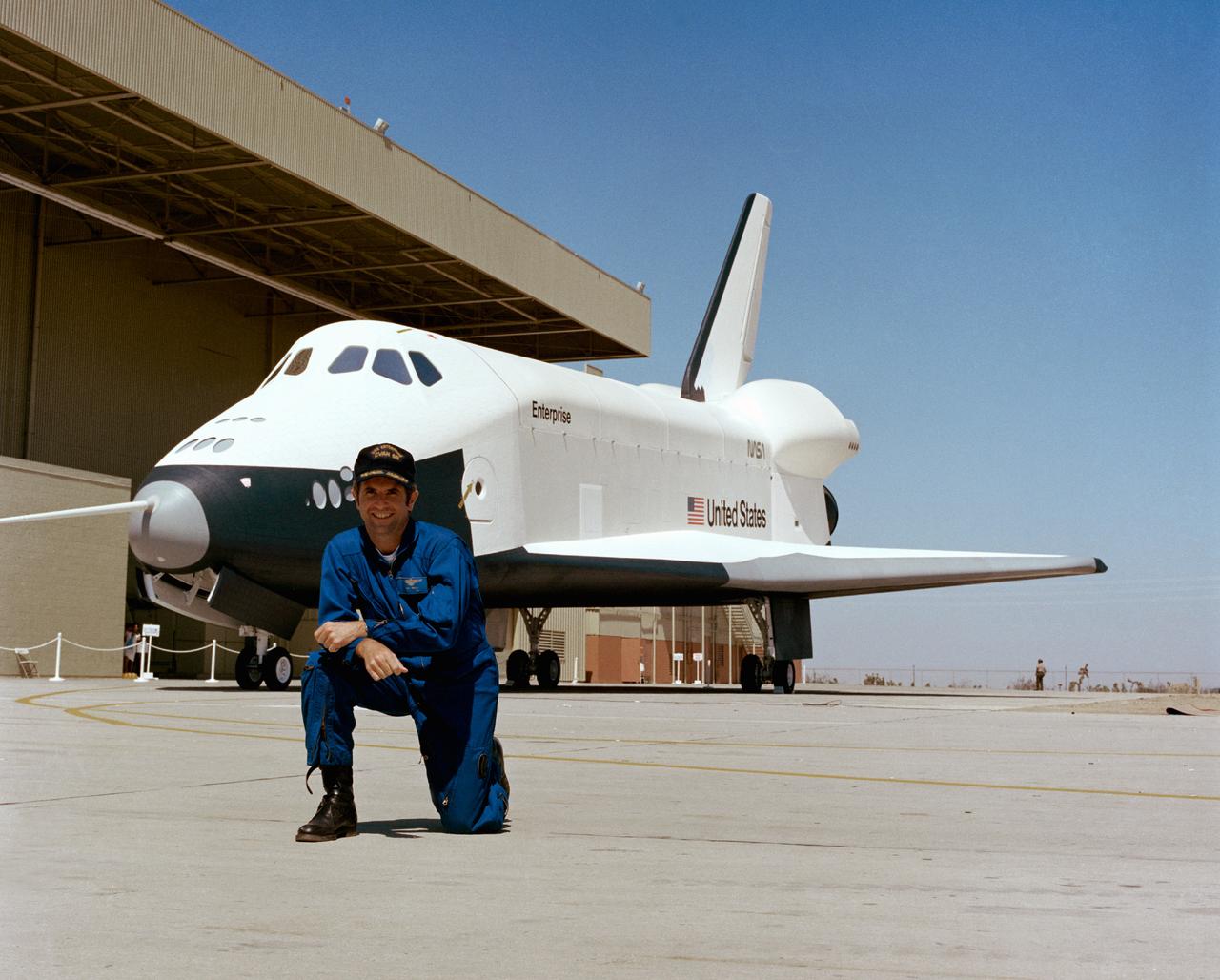
S76-29569 --- Astronaut Richard H. Truly, pilot of the second crew for the Space Shuttle Approach and Landing Tests (ALT), is photographed at the Rockwell International Space Division's Orbiter assembly facility at Palmdale, California on the day of the rollout of the Shuttle Orbiter 101 "Enterprise" spacecraft. The DC-9 size airplane-like Orbiter 101 is in the background.
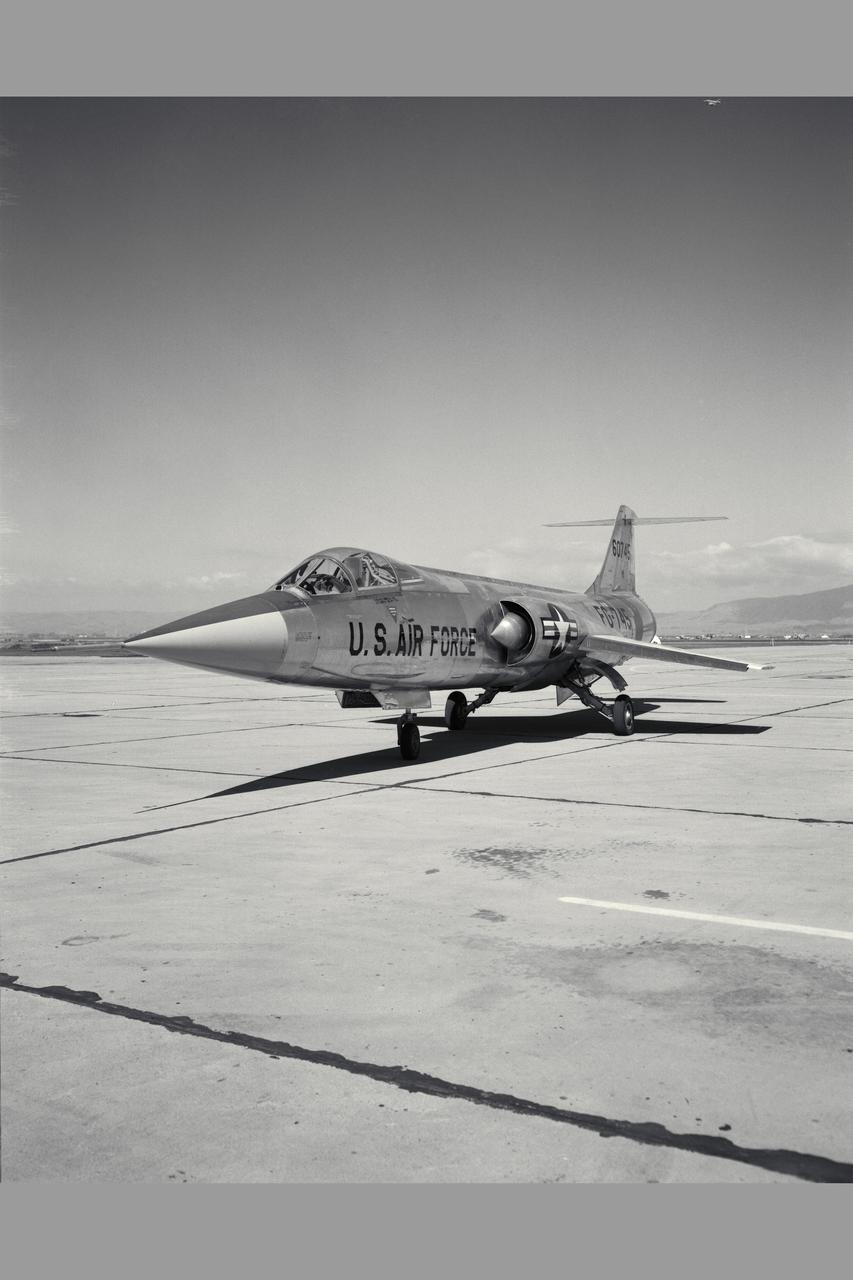
Lockheed JF-104A (AF56-745A Tail No. 60745) Starfighter airplane piloted by Fred Drinkwater conducted flight testing that demonstrated steep approaches that were ultimately used by the space shuttle. Steep descent testing, including power-off landing approaches and demonstration of minimum lift-to-drag ratio (L/D) landings came out of the interest in the use of low L/D lifting bodies for recovery to landing from space. Note: Used in publication in Flight Research at Ames; 57 Years of Development and Validation of Aeronautical Technology NASA SP-1998-3300 fig 93
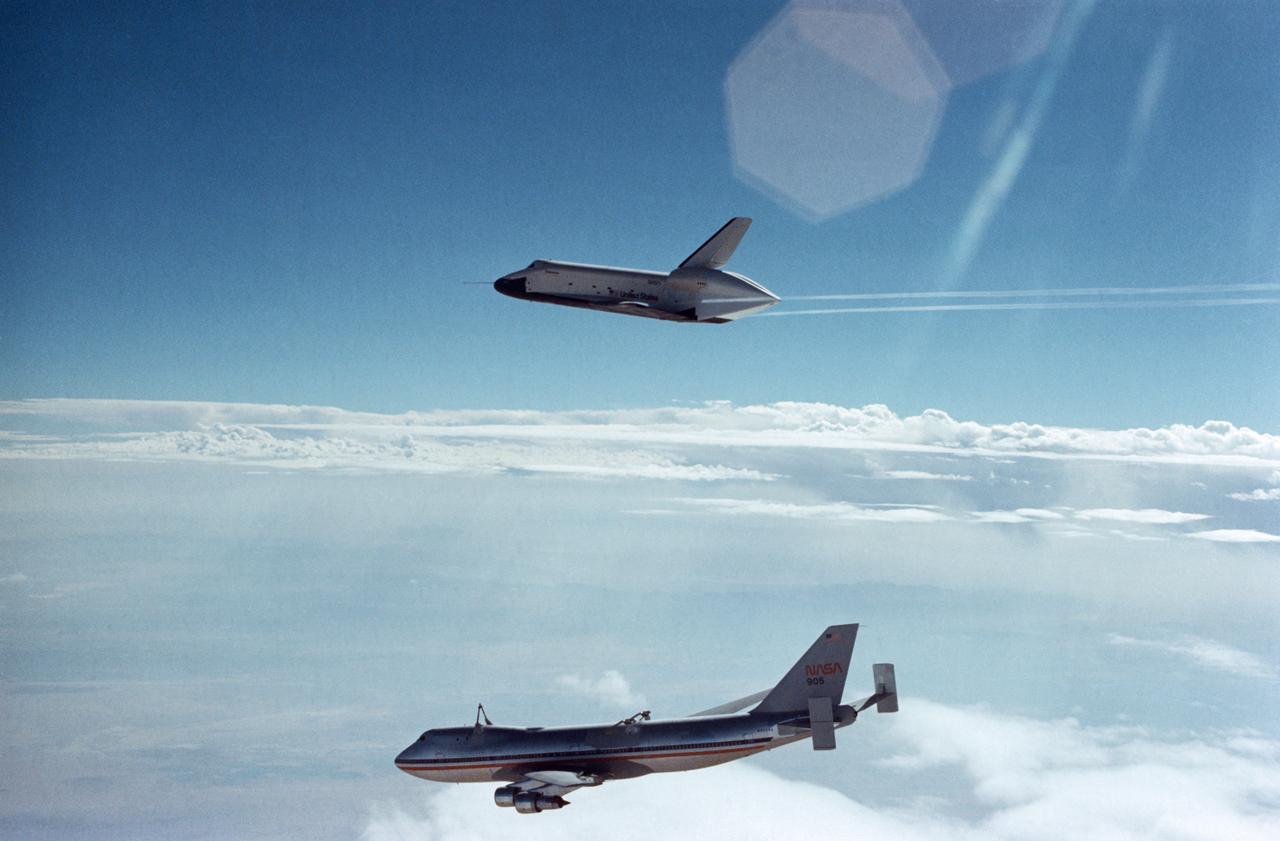
S77-27945 (12 Aug 1977) --- The space shuttle Orbiter 101 "Enterprise" soars above the NASA 747 carrier aircraft after separating during the first free flight of the Shuttle Approach and Landing Tests (ALTs) conducted on Aug. 12, 1977 at Dryden Flight Research Center in Southern California. Astronauts Fred W. Haise Jr., and C. Gordon Fullerton were the crew of the "Enterprise." The ALT free flights are designed to verify Orbiter subsonic airworthiness, integrated systems operations and pilot-guided approach and landing capability and satisfying prerequisites to automatic flight control and navigation mode. Photo credit: NASA
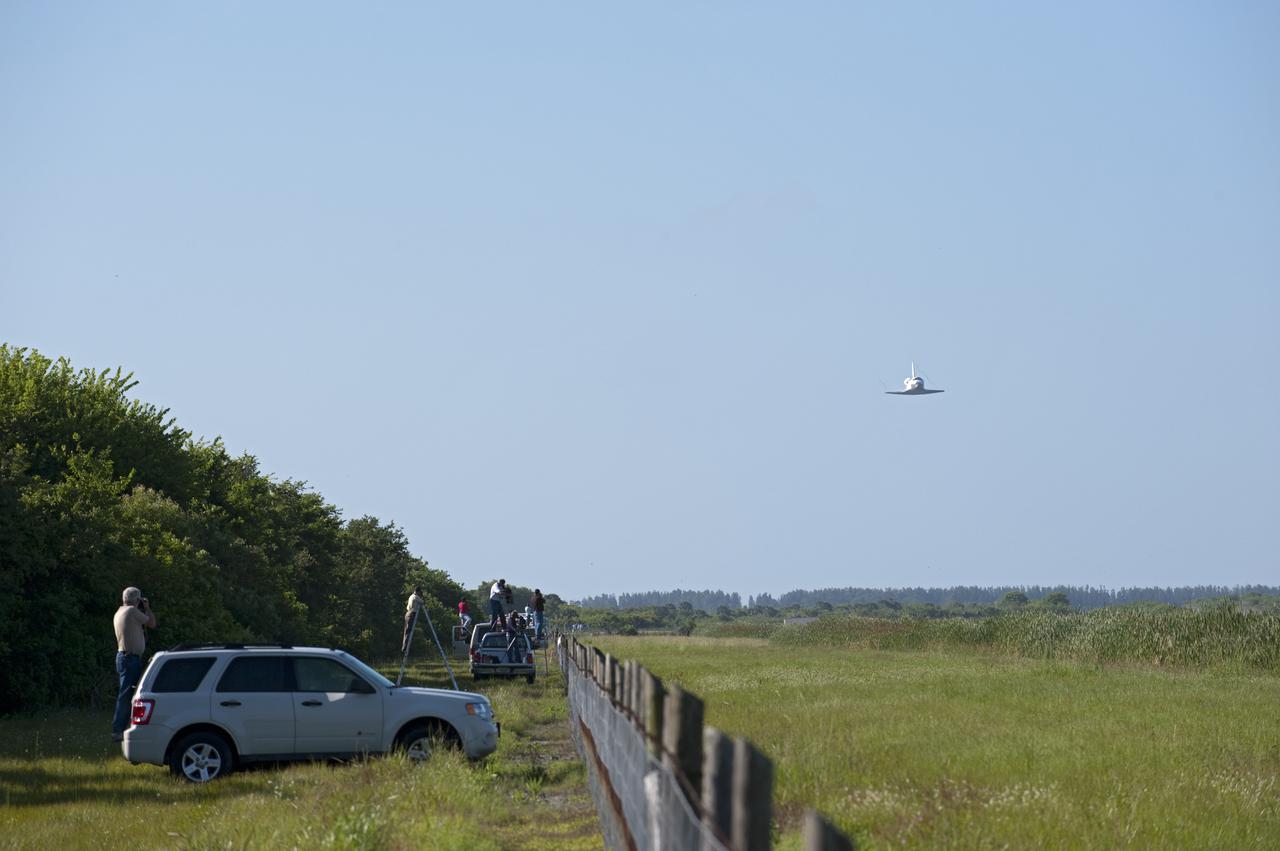
CAPE CANAVERAL, Fla. - Photographers click away as space shuttle Atlantis approaches Runway 33 at the Shuttle Landing Facility at NASA's Kennedy Space Center in Florida. The shuttle approached from the southeast in a crystal-clear blue sky, giving the Space Coast quite a show. Landing was at 8:48 a.m. EDT, completing the 12-day STS-132 mission to the International Space Station. The six-member STS-132 crew carried the Russian-built Mini Research Module-1 to the space station. STS-132 is the 34th shuttle mission to the station, the 132nd shuttle mission overall and the last planned flight for Atlantis. For information on the STS-132 mission and crew, visit www.nasa.gov_mission_pages_shuttle_shuttlemissions_sts132_index.html. Photo credit: NASA_Kevin O'Connell
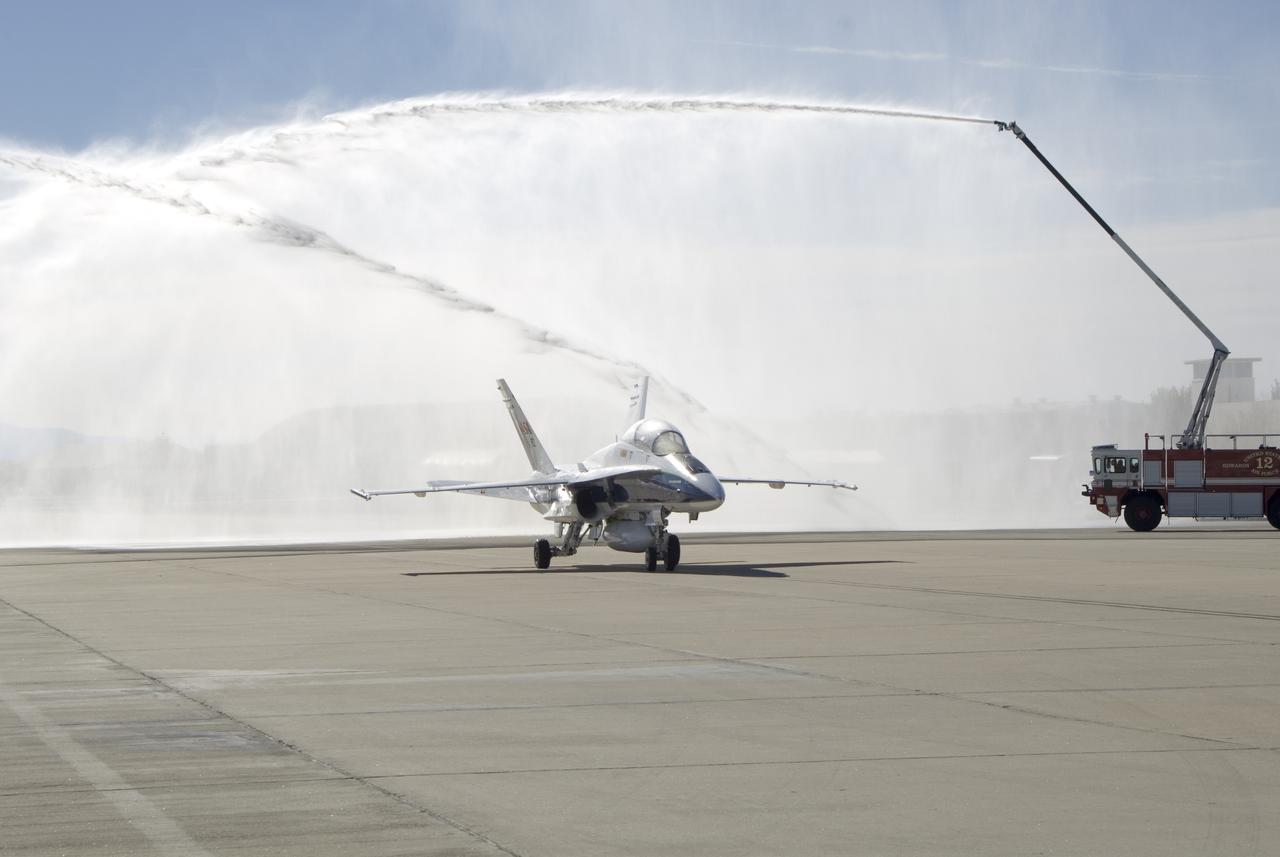
Long-time NASA Dryden research pilot and former astronaut C. Gordon Fullerton capped an almost 50-year flying career, including more than 38 years with NASA, with a final flight in a NASA F/A-18 on Dec. 21, 2007. Fullerton and Dryden research pilot Jim Smolka flew a 90-minute pilot proficiency formation aerobatics flight with another Dryden F/A-18 and a Dryden T-38 before concluding with two low-level formation flyovers of Dryden before landing. Fullerton was honored with a water-cannon spray arch provided by two fire trucks from the Edwards Air Force Base fire department as he taxied the F/A-18 up to the Dryden ramp, and was then greeted by his wife Marie and several hundred Dryden staff after his final flight. Fullerton began his flying career with the U.S. Air Force in 1958 after earning bachelor's and master's degrees in mechanical engineering from the California Institute of Technology. Initially trained as a fighter pilot, he later transitioned to multi-engine bombers and became a bomber operations test pilot after attending the Air Force Aerospace Research Pilot School at Edwards Air Force Base, Calif. He then was assigned to the flight crew for the planned Air Force Manned Orbital Laboratory in 1966. Upon cancellation of that program, the Air Force assigned Fullerton to NASA's astronaut corps in 1969. He served on the support crews for the Apollo 14, 15, 16 and 17 lunar missions, and was later assigned to one of the two flight crews that piloted the space shuttle prototype Enterprise during the Approach and Landing Test program at Dryden. He then logged some 382 hours in space when he flew on two early space shuttle missions, STS-3 on Columbia in 1982 and STS-51F on Challenger in 1985. He joined the flight crew branch at NASA Dryden after leaving the astronaut corps in 1986. During his 21 years at Dryden, Fullerton was project pilot on a number of high-profile research efforts, including the Propulsion Controlled Aircraft, the high-speed landing tests of
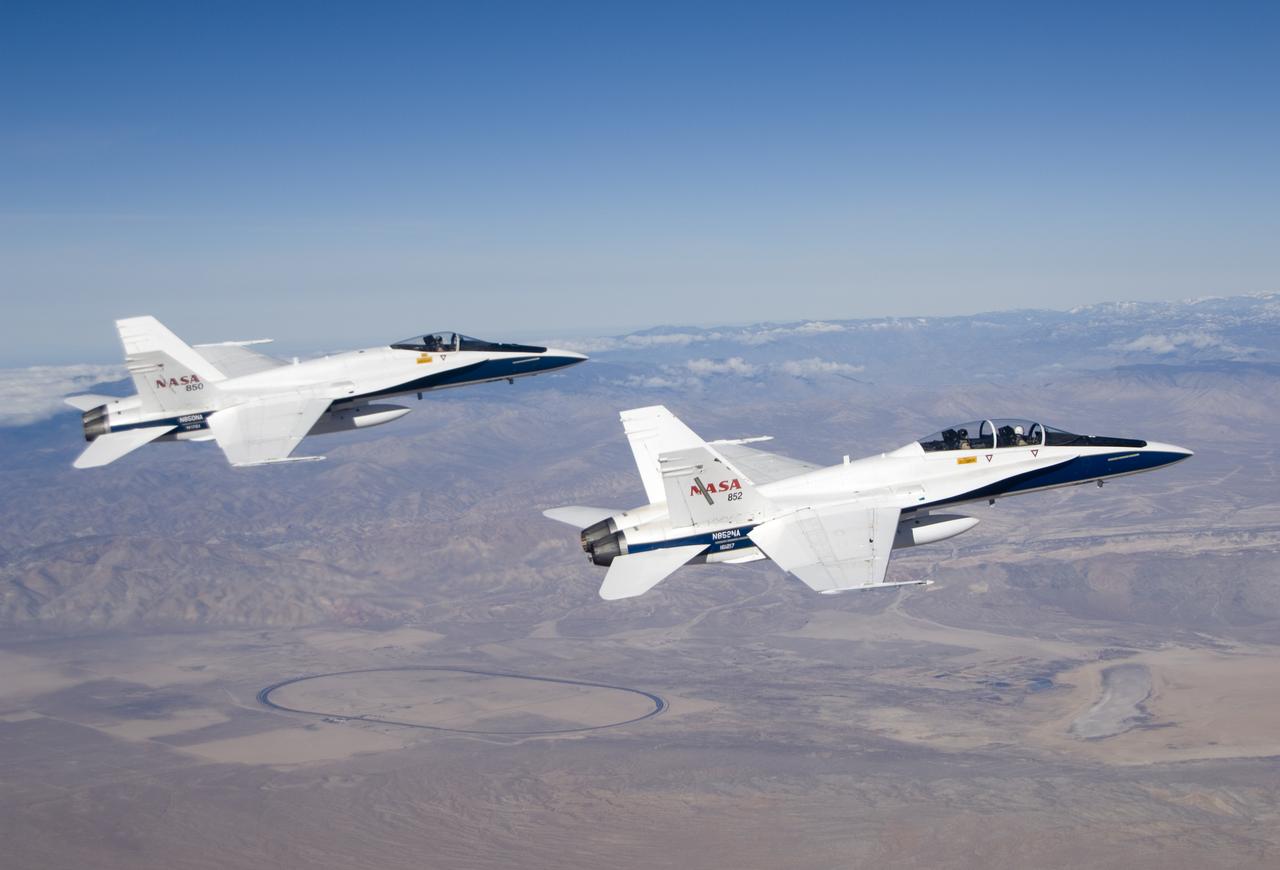
Long-time NASA Dryden research pilot and former astronaut C. Gordon Fullerton capped an almost 50-year flying career, including more than 38 years with NASA, with a final flight in a NASA F/A-18 on Dec. 21, 2007. Fullerton and Dryden research pilot Jim Smolka flew a 90-minute pilot proficiency formation aerobatics flight with another Dryden F/A-18 and a Dryden T-38 before concluding with two low-level formation flyovers of Dryden before landing. Fullerton was honored with a water-cannon spray arch provided by two fire trucks from the Edwards Air Force Base fire department as he taxied the F/A-18 up to the Dryden ramp, and was then greeted by his wife Marie and several hundred Dryden staff after his final flight. Fullerton began his flying career with the U.S. Air Force in 1958 after earning bachelor's and master's degrees in mechanical engineering from the California Institute of Technology. Initially trained as a fighter pilot, he later transitioned to multi-engine bombers and became a bomber operations test pilot after attending the Air Force Aerospace Research Pilot School at Edwards Air Force Base, Calif. He then was assigned to the flight crew for the planned Air Force Manned Orbital Laboratory in 1966. Upon cancellation of that program, the Air Force assigned Fullerton to NASA's astronaut corps in 1969. He served on the support crews for the Apollo 14, 15, 16 and 17 lunar missions, and was later assigned to one of the two flight crews that piloted the space shuttle prototype Enterprise during the Approach and Landing Test program at Dryden. He then logged some 382 hours in space when he flew on two early space shuttle missions, STS-3 on Columbia in 1982 and STS-51F on Challenger in 1985. He joined the flight crew branch at NASA Dryden after leaving the astronaut corps in 1986. During his 21 years at Dryden, Fullerton was project pilot on a number of high-profile research efforts, including the Propulsion Controlled Aircraft, the high-speed landing tests of sp
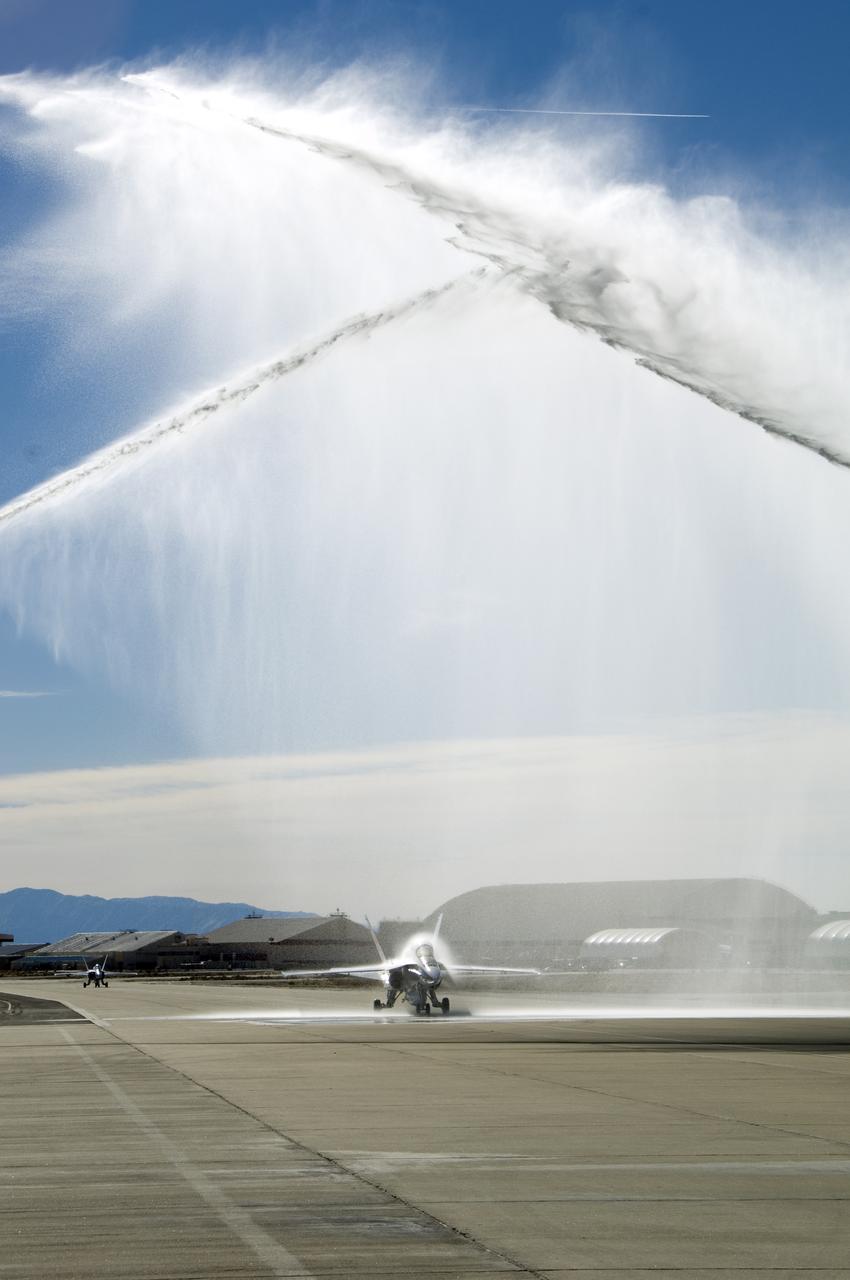
Long-time NASA Dryden research pilot and former astronaut C. Gordon Fullerton capped an almost 50-year flying career, including more than 38 years with NASA, with a final flight in a NASA F/A-18 on Dec. 21, 2007. Fullerton and Dryden research pilot Jim Smolka flew a 90-minute pilot proficiency formation aerobatics flight with another Dryden F/A-18 and a Dryden T-38 before concluding with two low-level formation flyovers of Dryden before landing. Fullerton was honored with a water-cannon spray arch provided by two fire trucks from the Edwards Air Force Base fire department as he taxied the F/A-18 up to the Dryden ramp, and was then greeted by his wife Marie and several hundred Dryden staff after his final flight. Fullerton began his flying career with the U.S. Air Force in 1958 after earning bachelor's and master's degrees in mechanical engineering from the California Institute of Technology. Initially trained as a fighter pilot, he later transitioned to multi-engine bombers and became a bomber operations test pilot after attending the Air Force Aerospace Research Pilot School at Edwards Air Force Base, Calif. He then was assigned to the flight crew for the planned Air Force Manned Orbital Laboratory in 1966. Upon cancellation of that program, the Air Force assigned Fullerton to NASA's astronaut corps in 1969. He served on the support crews for the Apollo 14, 15, 16 and 17 lunar missions, and was later assigned to one of the two flight crews that piloted the space shuttle prototype Enterprise during the Approach and Landing Test program at Dryden. He then logged some 382 hours in space when he flew on two early space shuttle missions, STS-3 on Columbia in 1982 and STS-51F on Challenger in 1985. He joined the flight crew branch at NASA Dryden after leaving the astronaut corps in 1986. During his 21 years at Dryden, Fullerton was project pilot on a number of high-profile research efforts, including the Propulsion Controlled Aircraft, the high-speed landing tests of
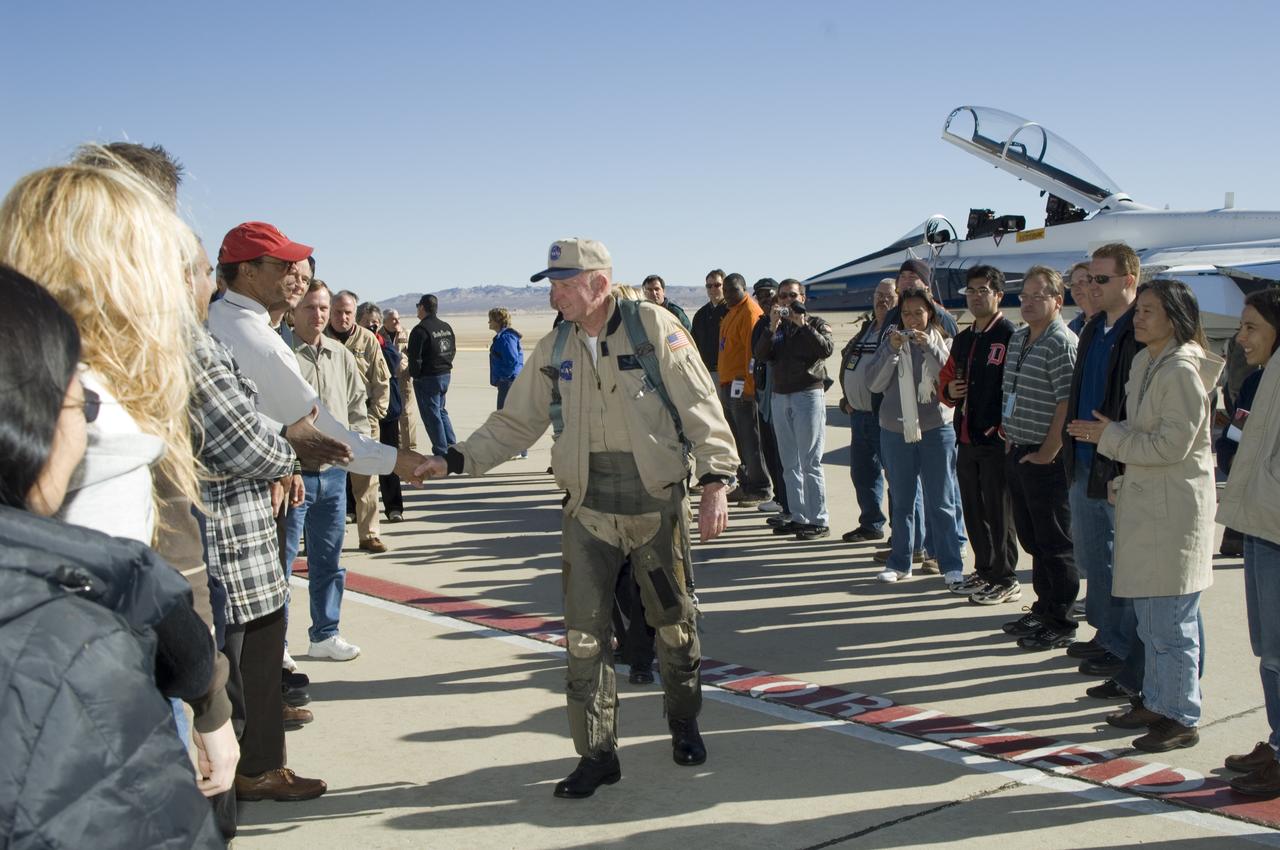
Long-time NASA Dryden research pilot and former astronaut C. Gordon Fullerton capped an almost 50-year flying career, including more than 38 years with NASA, with a final flight in a NASA F/A-18 on Dec. 21, 2007. Fullerton and Dryden research pilot Jim Smolka flew a 90-minute pilot proficiency formation aerobatics flight with another Dryden F/A-18 and a Dryden T-38 before concluding with two low-level formation flyovers of Dryden before landing. Fullerton was honored with a water-cannon spray arch provided by two fire trucks from the Edwards Air Force Base fire department as he taxied the F/A-18 up to the Dryden ramp, and was then greeted by his wife Marie and several hundred Dryden staff after his final flight. Fullerton began his flying career with the U.S. Air Force in 1958 after earning bachelor's and master's degrees in mechanical engineering from the California Institute of Technology. Initially trained as a fighter pilot, he later transitioned to multi-engine bombers and became a bomber operations test pilot after attending the Air Force Aerospace Research Pilot School at Edwards Air Force Base, Calif. He then was assigned to the flight crew for the planned Air Force Manned Orbital Laboratory in 1966. Upon cancellation of that program, the Air Force assigned Fullerton to NASA's astronaut corps in 1969. He served on the support crews for the Apollo 14, 15, 16 and 17 lunar missions, and was later assigned to one of the two flight crews that piloted the space shuttle prototype Enterprise during the Approach and Landing Test program at Dryden. He then logged some 382 hours in space when he flew on two early space shuttle missions, STS-3 on Columbia in 1982 and STS-51F on Challenger in 1985. He joined the flight crew branch at NASA Dryden after leaving the astronaut corps in 1986. During his 21 years at Dryden, Fullerton was project pilot on a number of high-profile research efforts, including the Propulsion Controlled Aircraft, the high-speed landing tests of
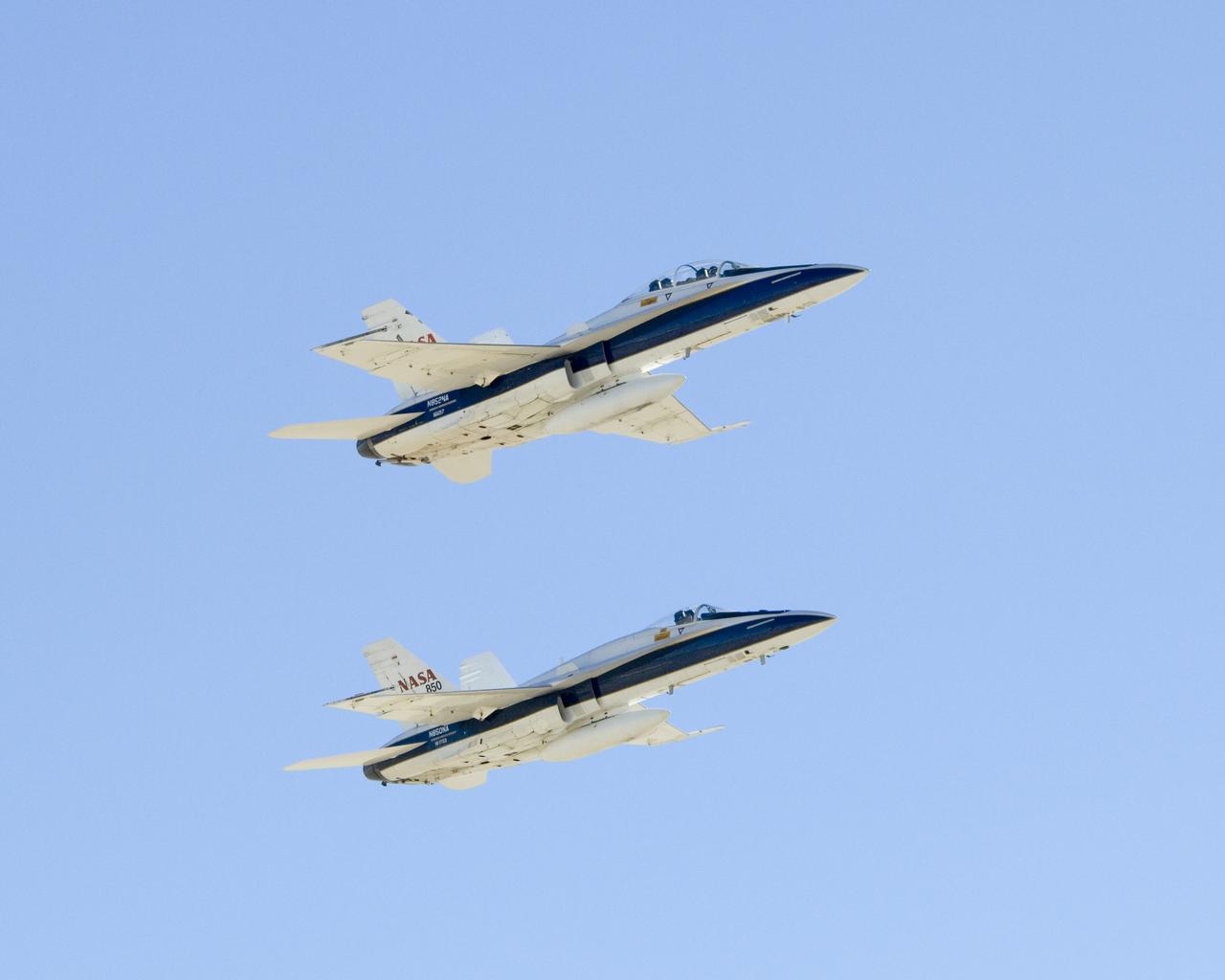
Long-time NASA Dryden research pilot and former astronaut C. Gordon Fullerton capped an almost 50-year flying career, including more than 38 years with NASA, with a final flight in a NASA F/A-18 on Dec. 21, 2007. Fullerton and Dryden research pilot Jim Smolka flew a 90-minute pilot proficiency formation aerobatics flight with another Dryden F/A-18 and a Dryden T-38 before concluding with two low-level formation flyovers of Dryden before landing. Fullerton was honored with a water-cannon spray arch provided by two fire trucks from the Edwards Air Force Base fire department as he taxied the F/A-18 up to the Dryden ramp, and was then greeted by his wife Marie and several hundred Dryden staff after his final flight. Fullerton began his flying career with the U.S. Air Force in 1958 after earning bachelor's and master's degrees in mechanical engineering from the California Institute of Technology. Initially trained as a fighter pilot, he later transitioned to multi-engine bombers and became a bomber operations test pilot after attending the Air Force Aerospace Research Pilot School at Edwards Air Force Base, Calif. He then was assigned to the flight crew for the planned Air Force Manned Orbital Laboratory in 1966. Upon cancellation of that program, the Air Force assigned Fullerton to NASA's astronaut corps in 1969. He served on the support crews for the Apollo 14, 15, 16 and 17 lunar missions, and was later assigned to one of the two flight crews that piloted the space shuttle prototype Enterprise during the Approach and Landing Test program at Dryden. He then logged some 382 hours in space when he flew on two early space shuttle missions, STS-3 on Columbia in 1982 and STS-51F on Challenger in 1985. He joined the flight crew branch at NASA Dryden after leaving the astronaut corps in 1986. During his 21 years at Dryden, Fullerton was project pilot on a number of high-profile research efforts, including the Propulsion Controlled Aircraft, the high-speed landing tests of
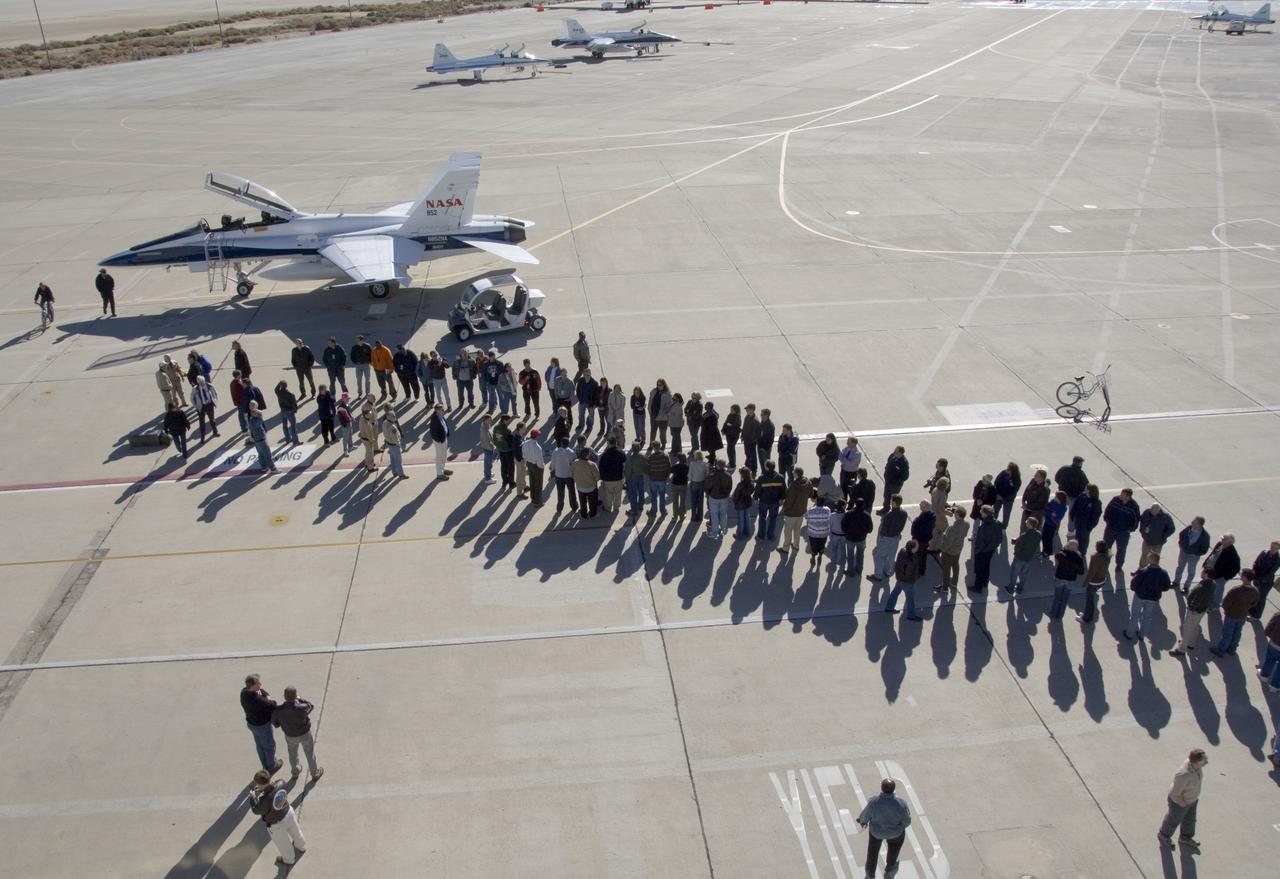
Long-time NASA Dryden research pilot and former astronaut C. Gordon Fullerton capped an almost 50-year flying career, including more than 38 years with NASA, with a final flight in a NASA F/A-18 on Dec. 21, 2007. Fullerton and Dryden research pilot Jim Smolka flew a 90-minute pilot proficiency formation aerobatics flight with another Dryden F/A-18 and a Dryden T-38 before concluding with two low-level formation flyovers of Dryden before landing. Fullerton was honored with a water-cannon spray arch provided by two fire trucks from the Edwards Air Force Base fire department as he taxied the F/A-18 up to the Dryden ramp, and was then greeted by his wife Marie and several hundred Dryden staff after his final flight. Fullerton began his flying career with the U.S. Air Force in 1958 after earning bachelor's and master's degrees in mechanical engineering from the California Institute of Technology. Initially trained as a fighter pilot, he later transitioned to multi-engine bombers and became a bomber operations test pilot after attending the Air Force Aerospace Research Pilot School at Edwards Air Force Base, Calif. He then was assigned to the flight crew for the planned Air Force Manned Orbital Laboratory in 1966. Upon cancellation of that program, the Air Force assigned Fullerton to NASA's astronaut corps in 1969. He served on the support crews for the Apollo 14, 15, 16 and 17 lunar missions, and was later assigned to one of the two flight crews that piloted the space shuttle prototype Enterprise during the Approach and Landing Test program at Dryden. He then logged some 382 hours in space when he flew on two early space shuttle missions, STS-3 on Columbia in 1982 and STS-51F on Challenger in 1985. He joined the flight crew branch at NASA Dryden after leaving the astronaut corps in 1986. During his 21 years at Dryden, Fullerton was project pilot on a number of high-profile research efforts, including the Propulsion Controlled Aircraft, the high-speed landing tests of
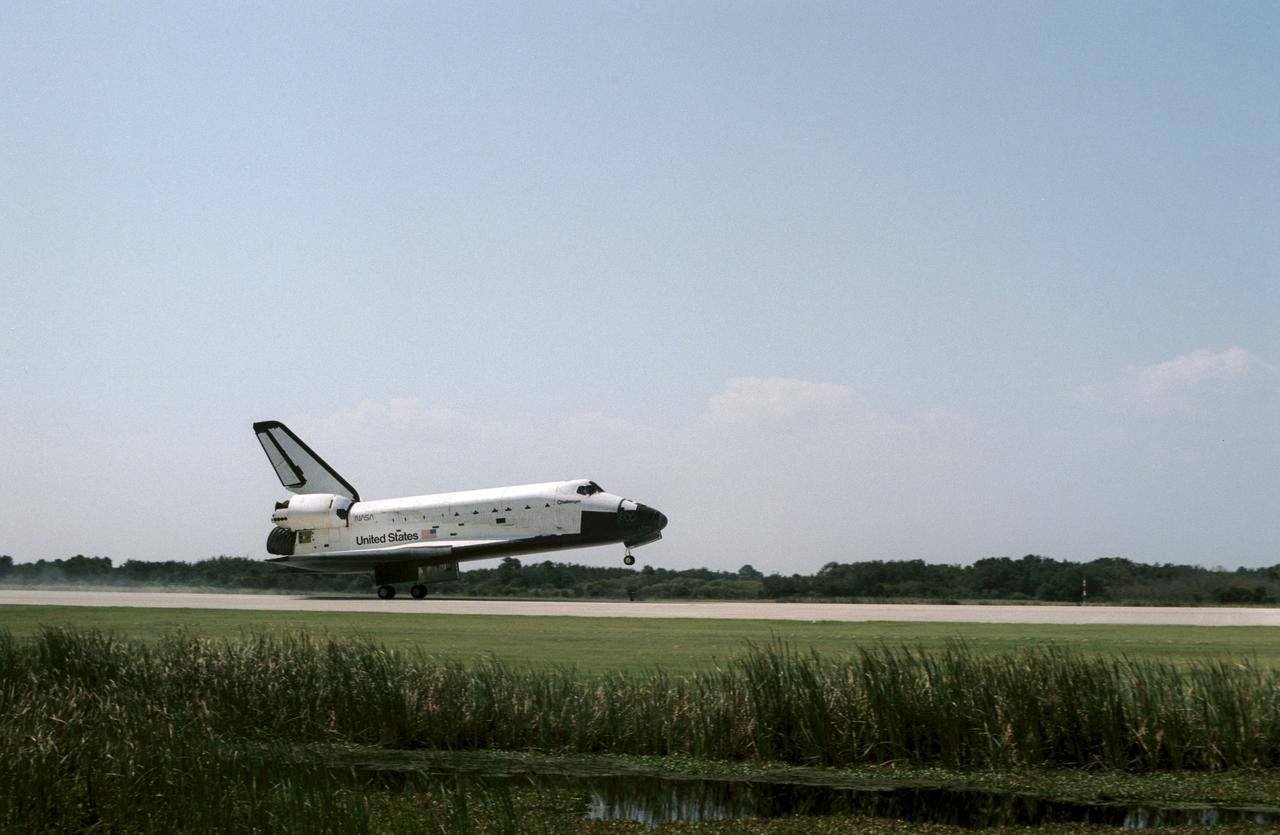
The Space Shuttle Challenger lands at Kennedy Space Center (KSC) at the end of the STS 41-G mission. The main landing gear has already touched down in this view, but the nose gear is still in the air (90232); Front view through tall grass of the Challenger making its landing at KSC (90233); Close-up side view of the Challenger making its landing at KSC (90234); Aerial view of the Challenger making its final approach to the runway to land at KSC (90235).
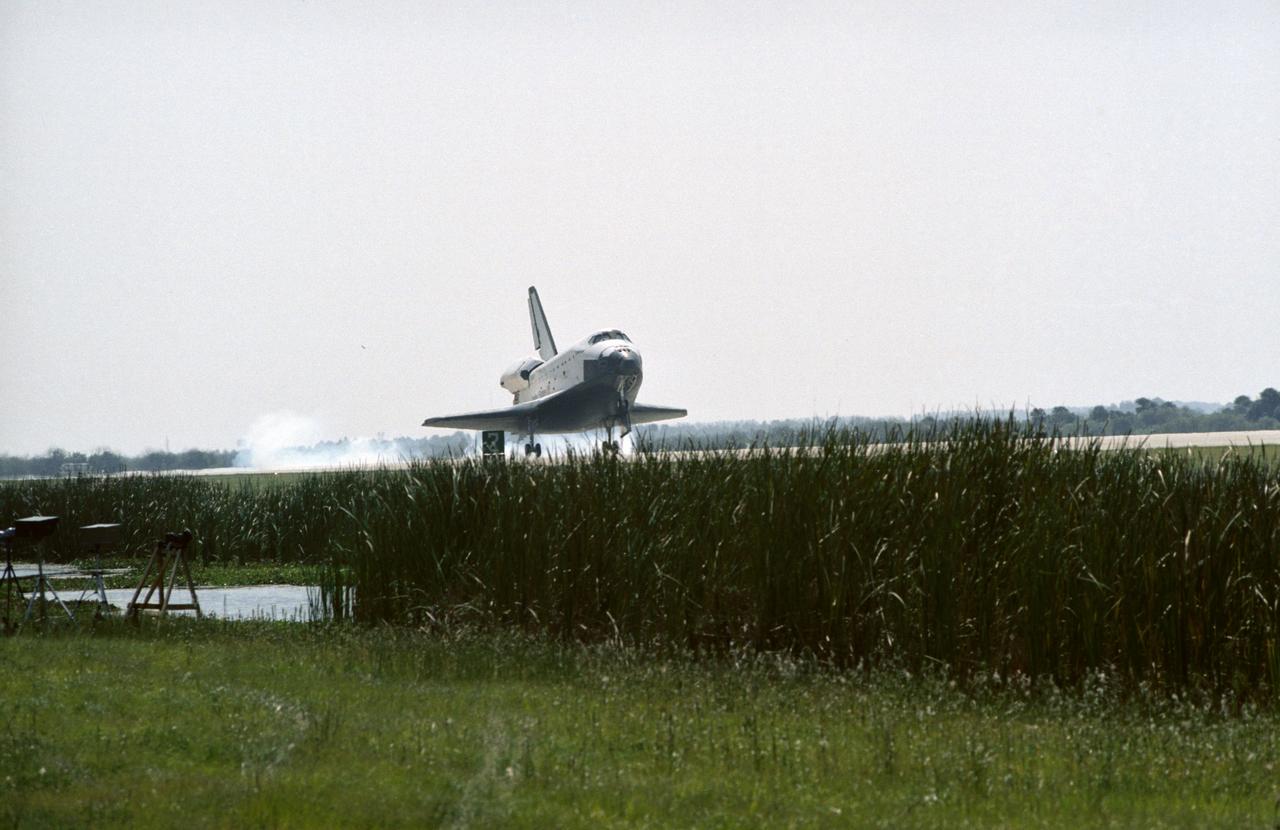
The Space Shuttle Challenger lands at Kennedy Space Center (KSC) at the end of the STS 41-G mission. The main landing gear has already touched down in this view, but the nose gear is still in the air (90232); Front view through tall grass of the Challenger making its landing at KSC (90233); Close-up side view of the Challenger making its landing at KSC (90234); Aerial view of the Challenger making its final approach to the runway to land at KSC (90235).
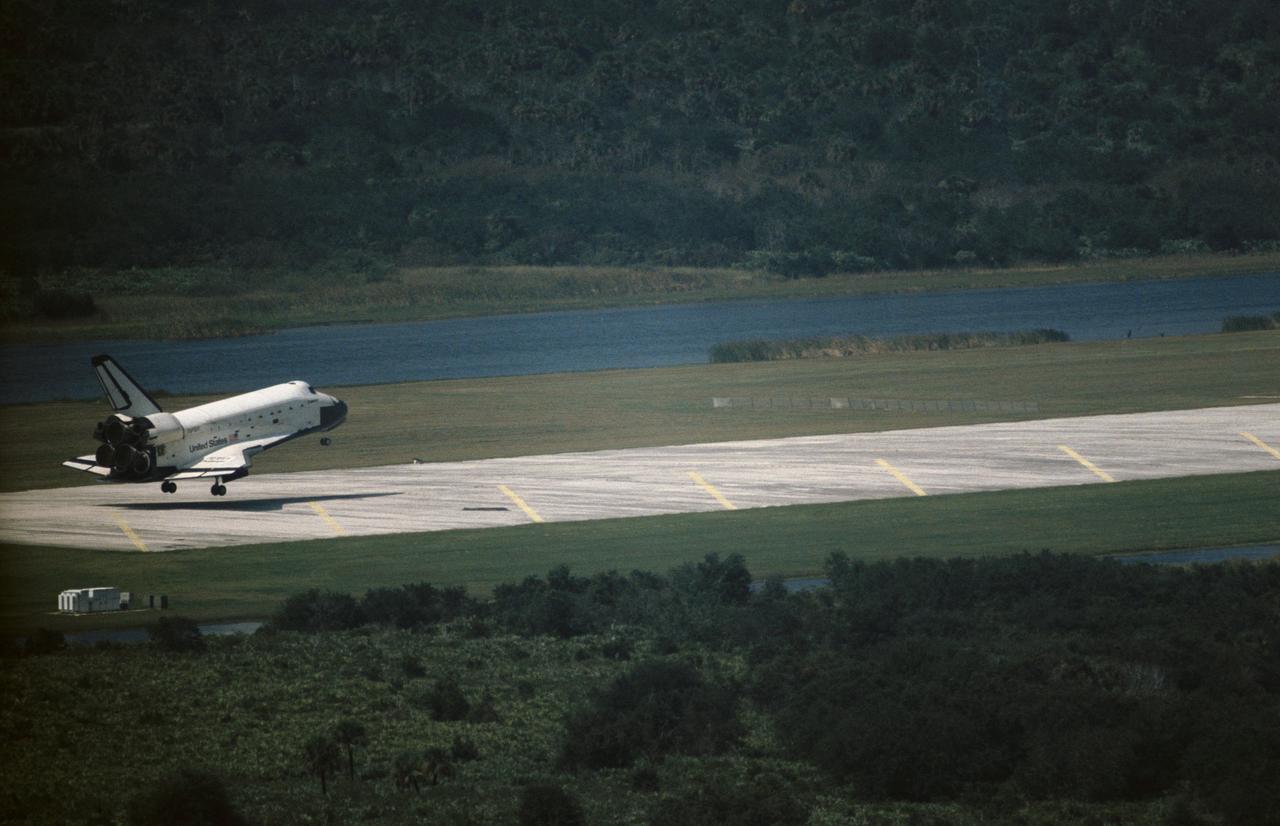
The Space Shuttle Challenger lands at Kennedy Space Center (KSC) at the end of the STS 41-G mission. The main landing gear has already touched down in this view, but the nose gear is still in the air (90232); Front view through tall grass of the Challenger making its landing at KSC (90233); Close-up side view of the Challenger making its landing at KSC (90234); Aerial view of the Challenger making its final approach to the runway to land at KSC (90235).
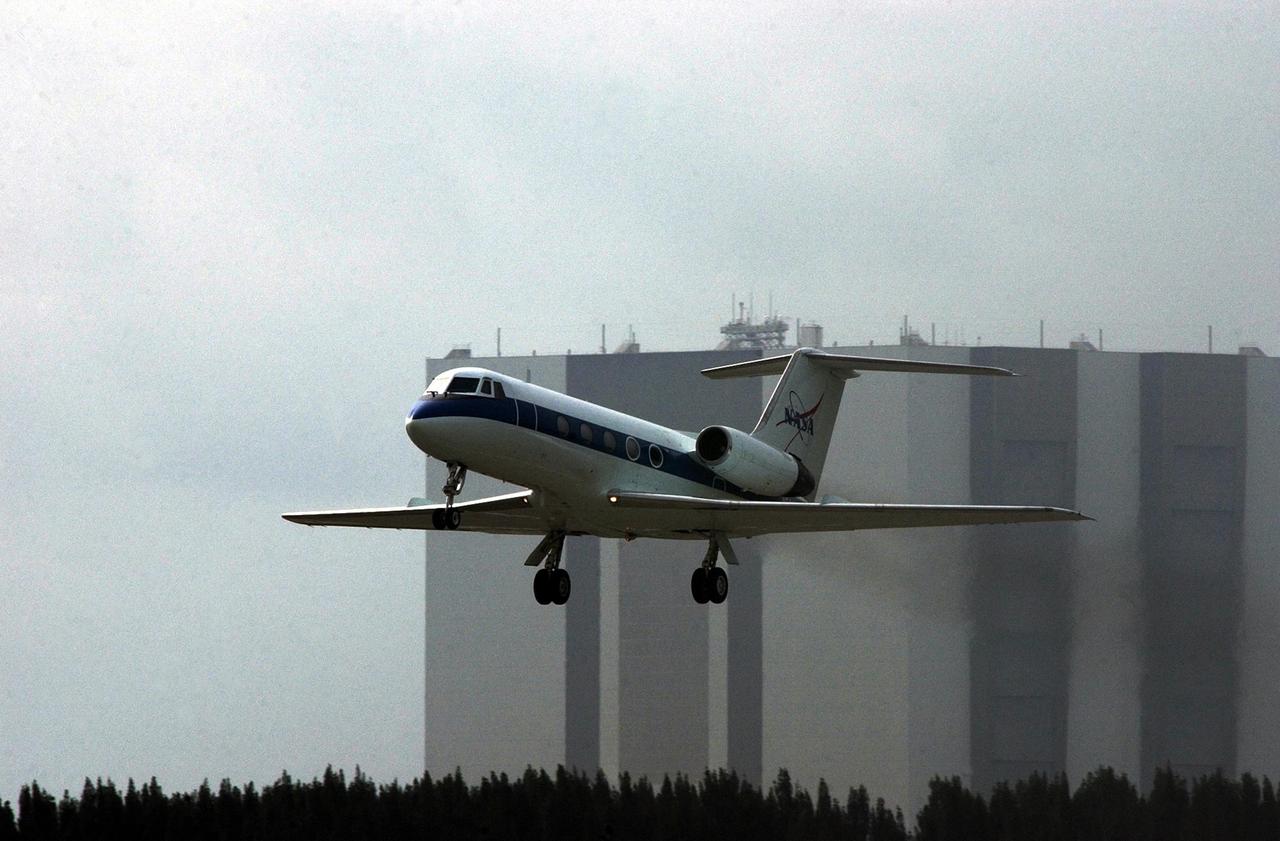
KENNEDY SPACE CENTER, FLA. -- A Shuttle Training Aircraft (STA) approaches the Shuttle Landing Facility after flying weather reconnaissance for the landing of Endeavour, returning from mission STS-111. Low cloud cover and other unfavorable weather conditions resulted in the wave off of two landing opportunities. The STA was flown by astronaut Kent Rominger
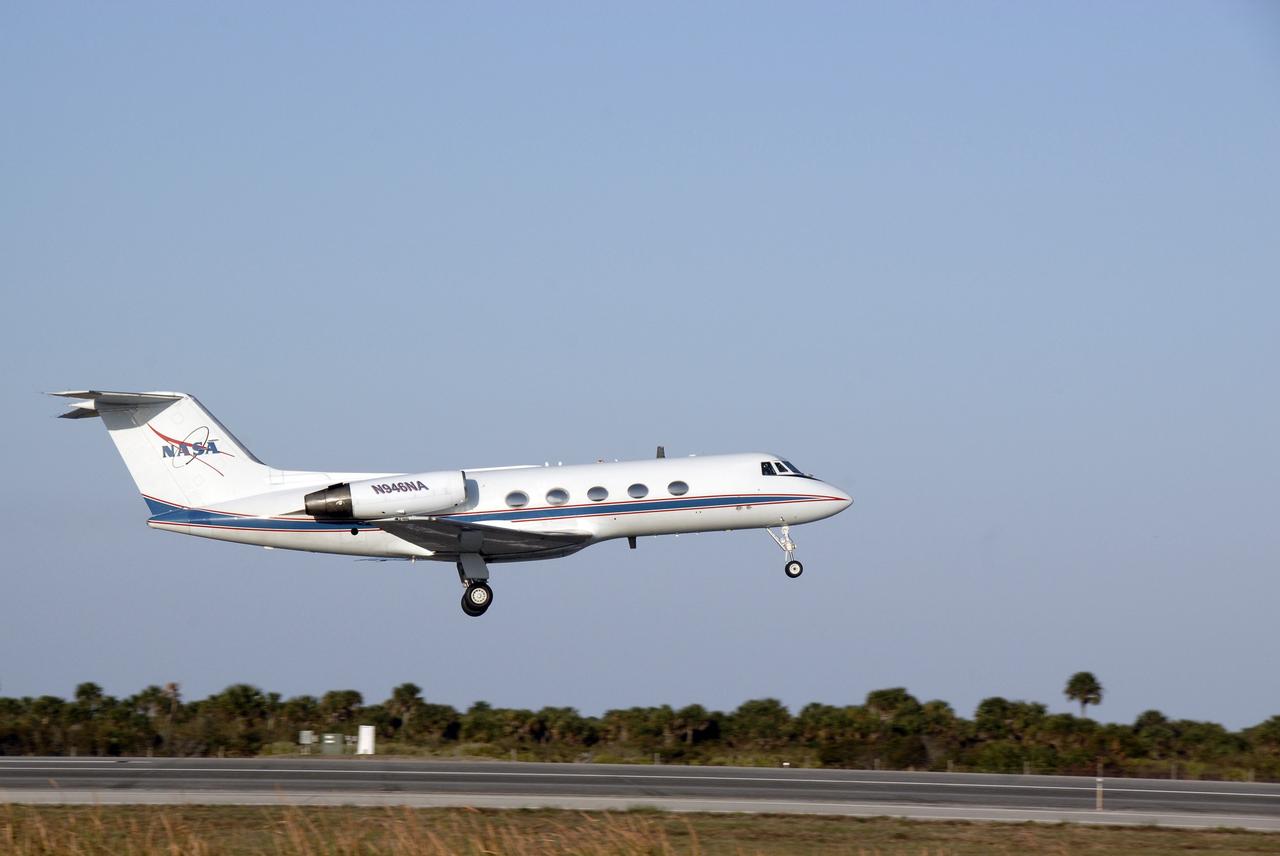
CAPE CANAVERAL, Fla. – One of the two Shuttle Training Aircraft approaches touchdown on the Shuttle Landing Facility runway at NASA's Kennedy Space Center in Florida. STS-119 Commander Lee Archambault and Pilot Tony Antonelli are practicing shuttle landings on the runway. The mission crew members arrived in the afternoon at Kennedy to prepare for launch. The mission is the 28th to the International Space Station and the 125th space shuttle flight. Space shuttle Discovery will deliver the final pair of power-generating solar array wings and truss element, S6. Photo credit: NASA/Kim Shiflett
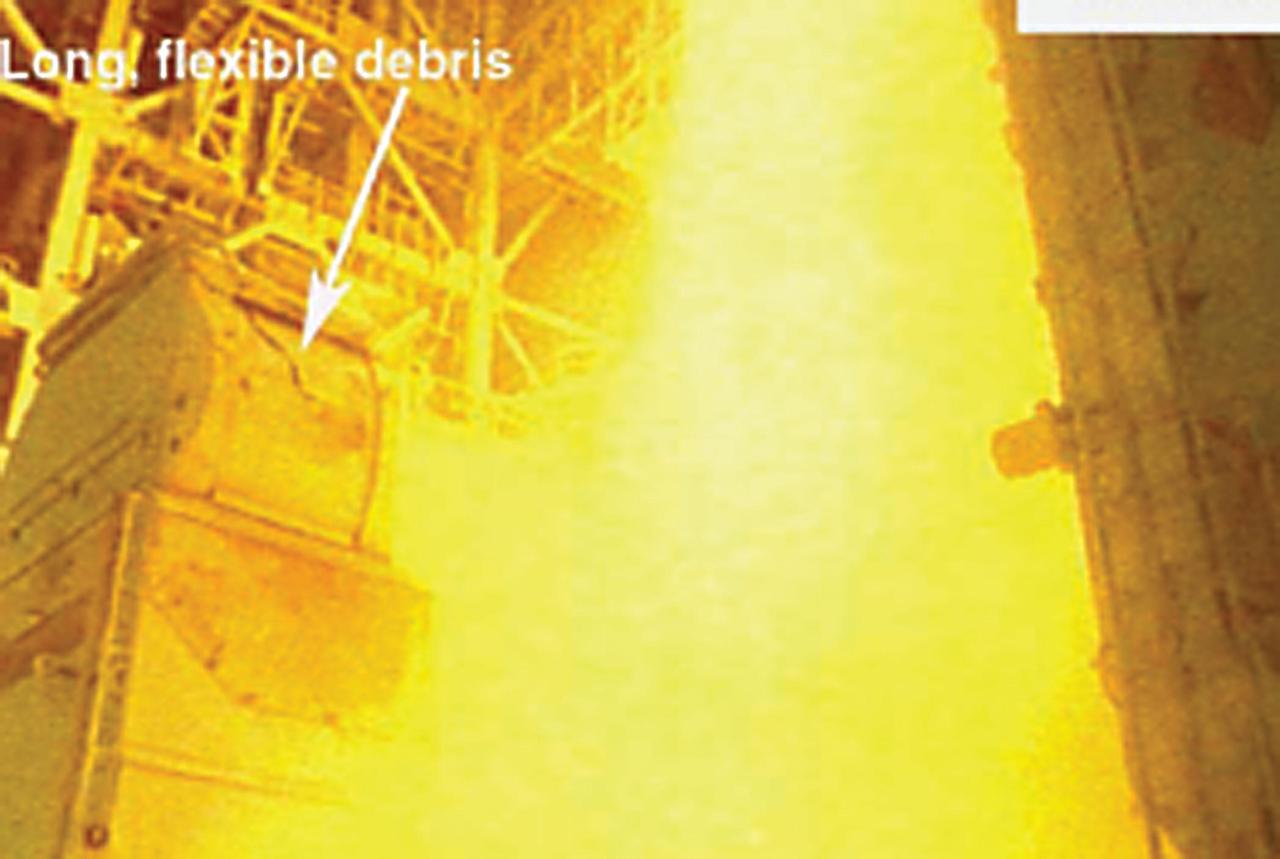
KENNEDY SPACE CENTER, FLA. - At the launch of Space Shuttle Columbia on mission STS-107, long, flexible debris comes out of the liquid helium 2 Tail Service Mast after the door closes. Columbia and crew were lost in a tragic accident over Texas as they made their approach to landing at KSC.
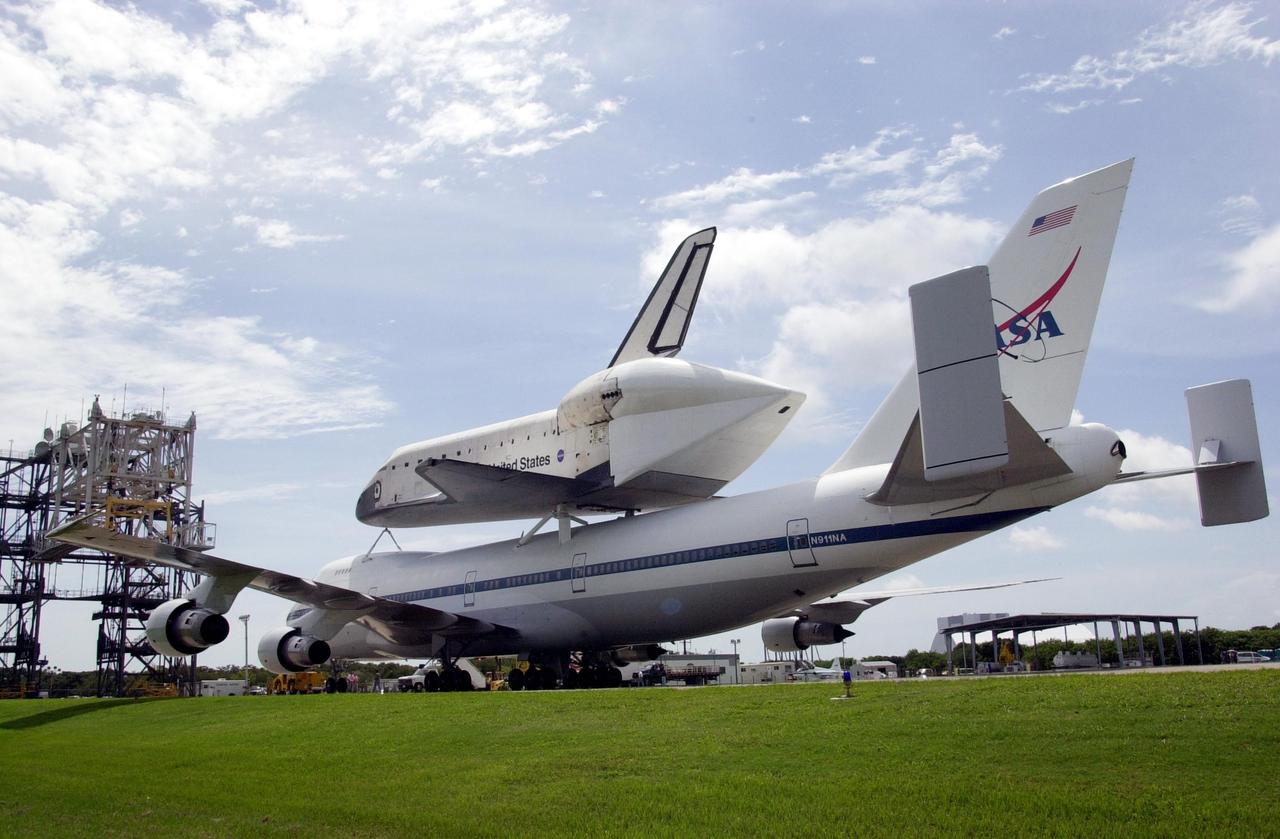
KENNEDY SPACE CENTER, FLA. - Space Shuttle Endeavour approaches the Mate-Demate Device (left) following landing on runway 15 at KSC's Shuttle Landing Facility at 10:58 a.m. EDT atop a modified Boeing 747 Shuttle Carrier Aircraft. The cross-country ferry flight became necessary when three days of unfavorable weather conditions at KSC forced Endeavour to land on runway 22 at Dryden Flight Research Center, Edwards Air Force Base, Calif., on June 19 following mission STS-111. Processing of Endeavour will now begin for the launch of mission STS-113 targeted for October 2002
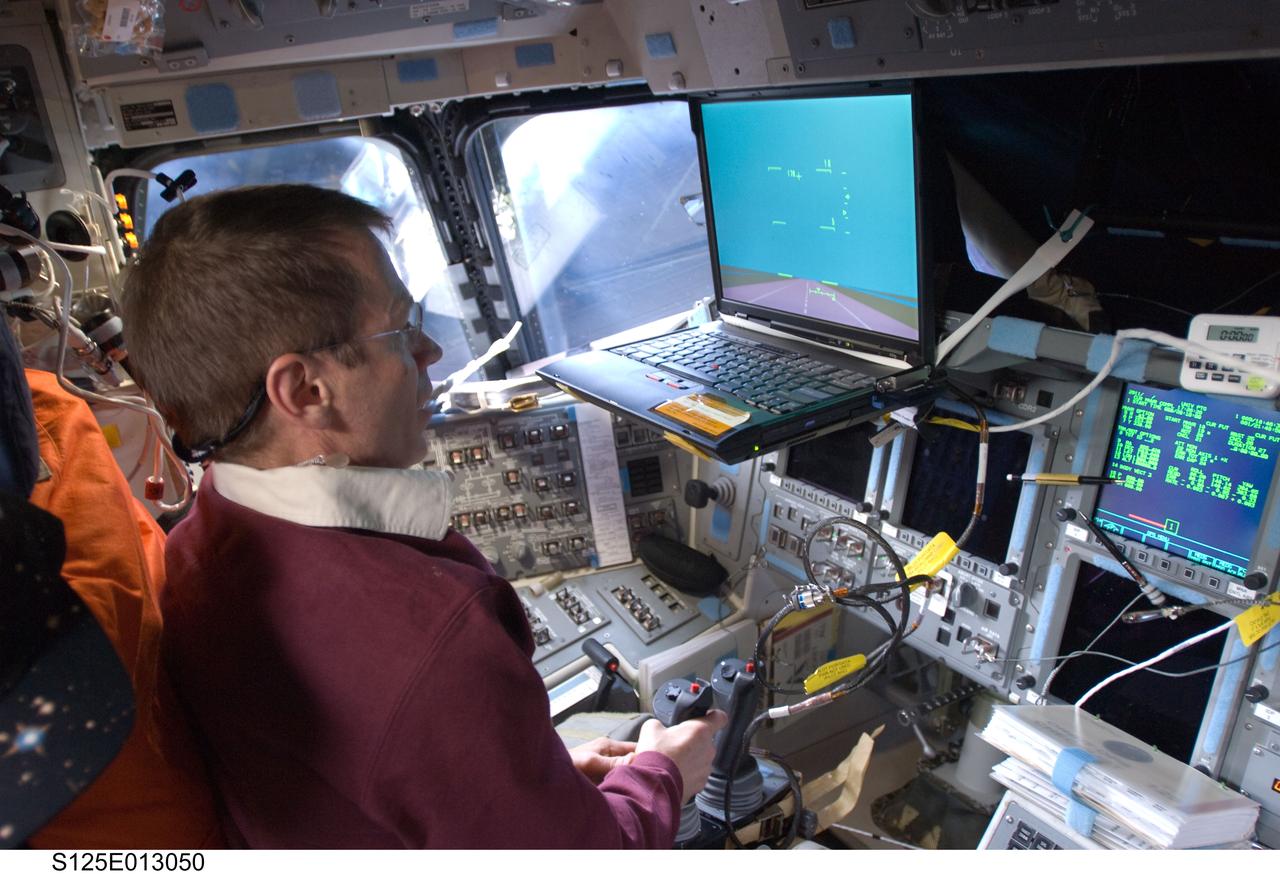
S125-E-013050 (21 May 2009) --- Occupying the commander?s station, astronaut Gregory C. Johnson, STS-125 pilot, uses the Portable In-Flight Landing Operations Trainer (PILOT) on the flight deck of the Earth-orbiting Space Shuttle Atlantis. PILOT consists of a laptop computer and a joystick system, which helps to maintain a high level of proficiency for the end-of-mission approach and landing tasks required to bring the shuttle safely back to Earth.
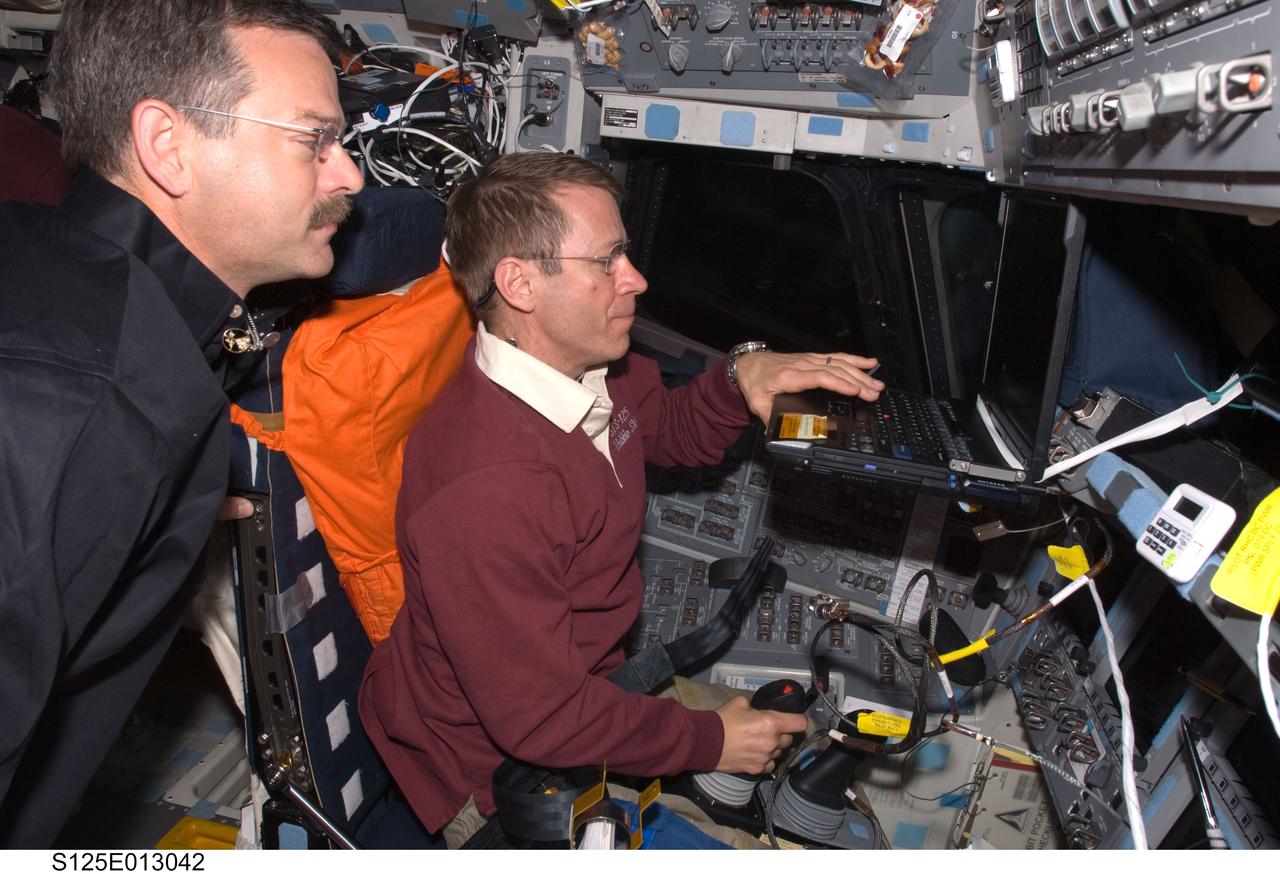
S125-E-013042 (21 May 2009) --- Occupying the commander?s station, astronaut Gregory C. Johnson, STS-125 pilot, uses the Portable In-Flight Landing Operations Trainer (PILOT) on the flight deck of the Earth-orbiting Space Shuttle Atlantis. PILOT consists of a laptop computer and a joystick system, which helps to maintain a high level of proficiency for the end-of-mission approach and landing tasks required to bring the shuttle safely back to Earth. Astronaut Scott Altman, commander, looks on.
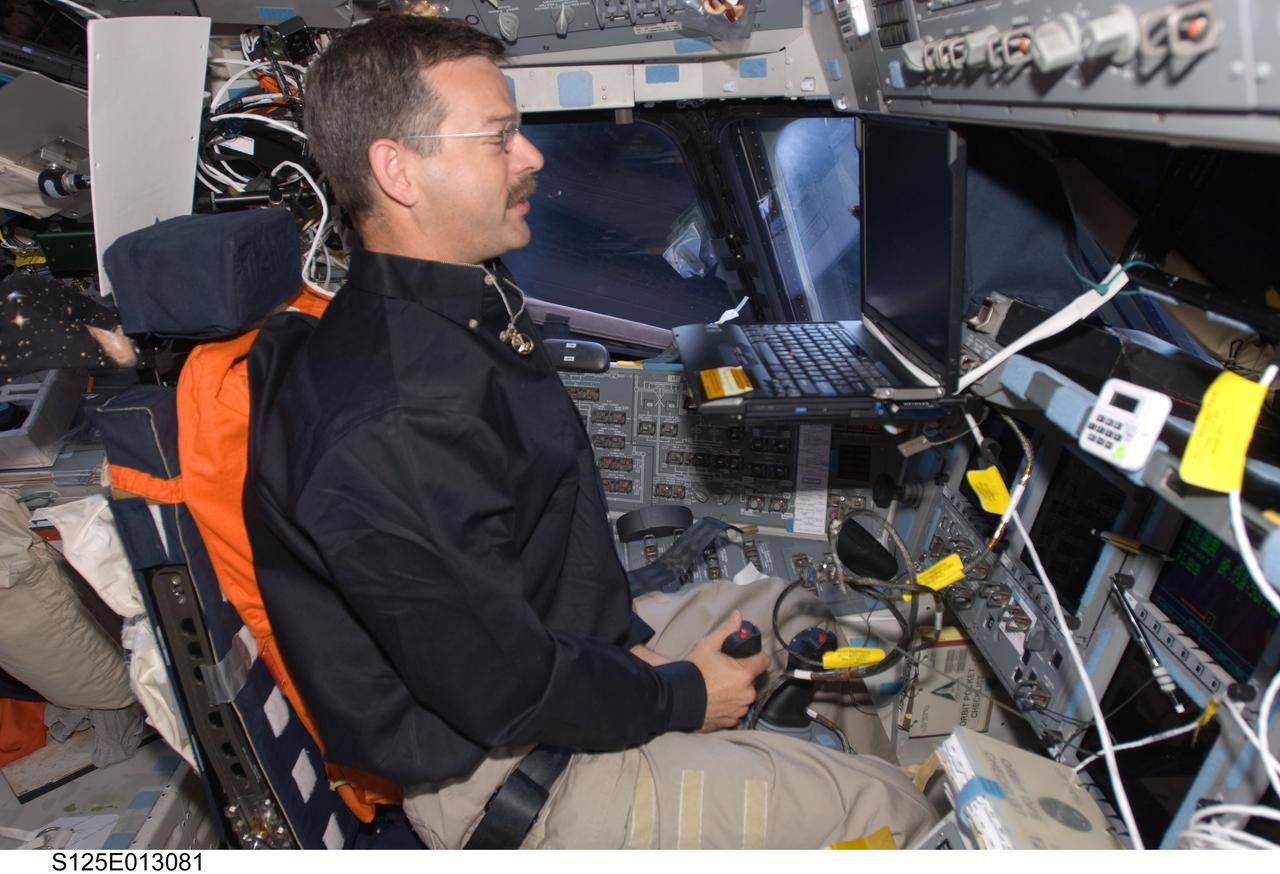
S125-E-013081 (21 May 2009) --- Occupying the commander?s station, astronaut Scott Altman, STS-125 commander, uses the Portable In-Flight Landing Operations Trainer (PILOT) on the flight deck of the Earth-orbiting Space Shuttle Atlantis. PILOT consists of a laptop computer and a joystick system, which helps to maintain a high level of proficiency for the end-of-mission approach and landing tasks required to bring the shuttle safely back to Earth.
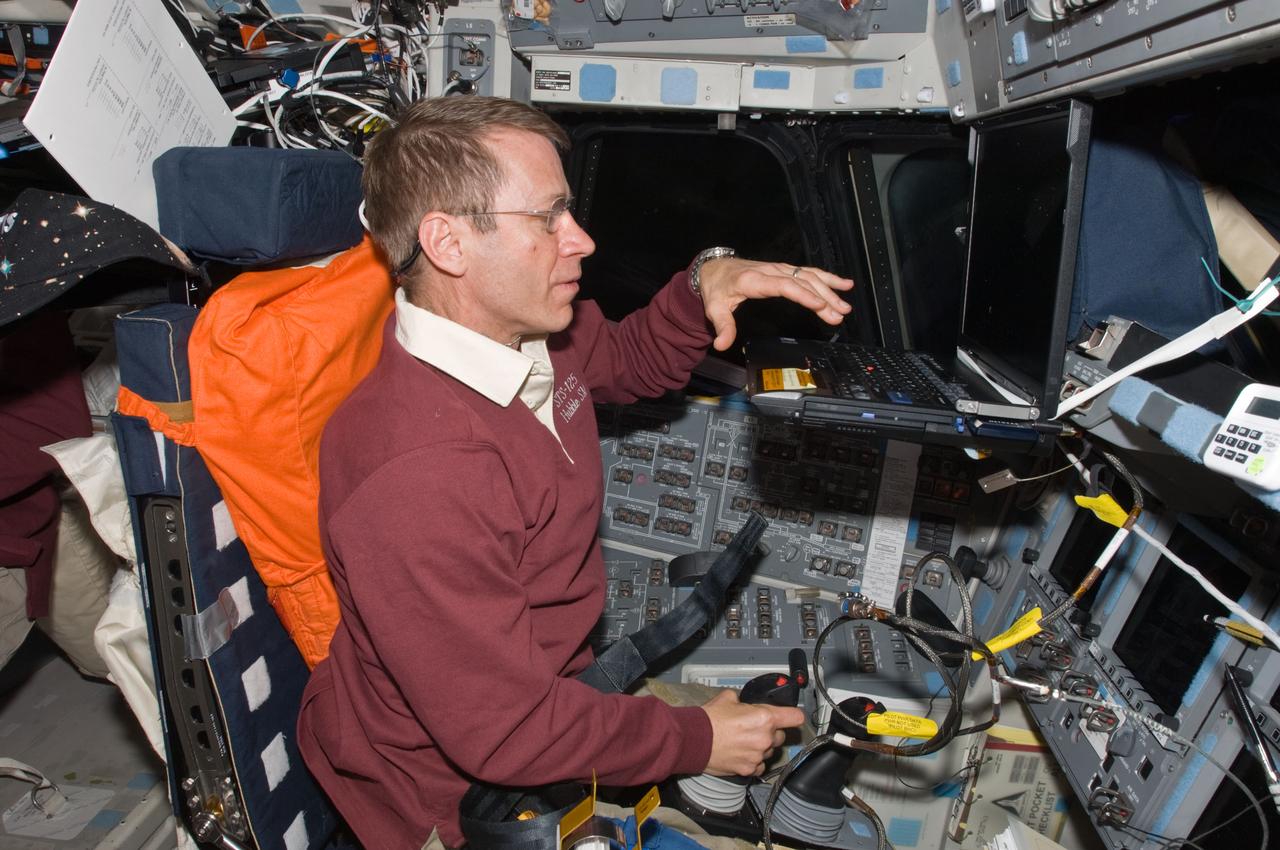
S125-E-013040 (21 May 2009) --- Occupying the commander?s station, astronaut Gregory C. Johnson, STS-125 pilot, uses the Portable In-Flight Landing Operations Trainer (PILOT) on the flight deck of the Earth-orbiting Space Shuttle Atlantis. PILOT consists of a laptop computer and a joystick system, which helps to maintain a high level of proficiency for the end-of-mission approach and landing tasks required to bring the shuttle safely back to Earth.
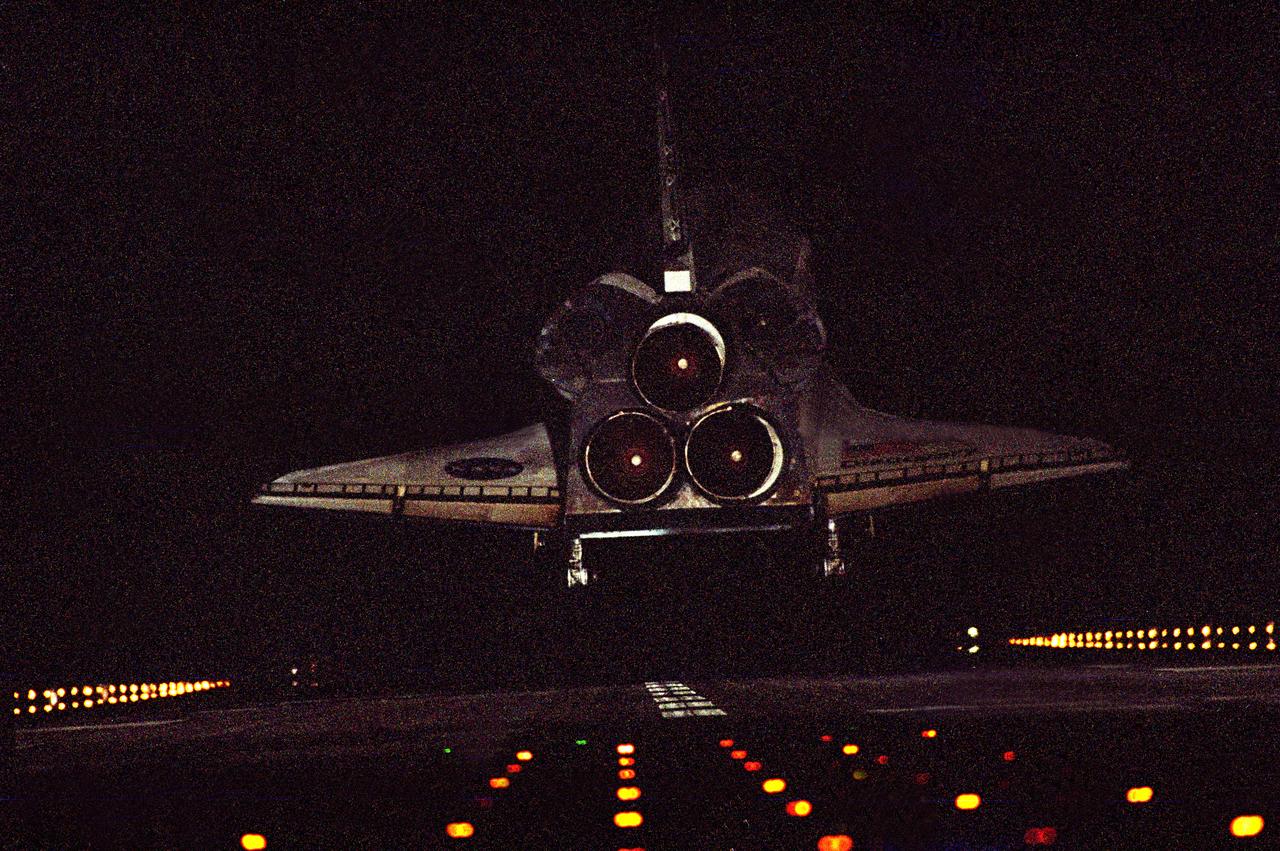
STS102-S-015 (21 March 2001)--- After a 5.3 million mile mission, The Space Shuttle Discovery approaches touchdown on Runway 15 at the KSC Shuttle Landing Facility in this aft view. The landing completed the successful 12-day STS-102 mission. Onboard the shuttle were astronauts James Wetherbee, James Kelly, Andy Thomas, and Paul Richards. Discovery’s touchdown also marked the return of the space station’s first resident crew – Expedition One which were William Shepherd, Yuri Gidzenko and Sergei Krikalev. STS-102 was the 103rd shuttle flight and the eighth shuttle mission to visit the station.
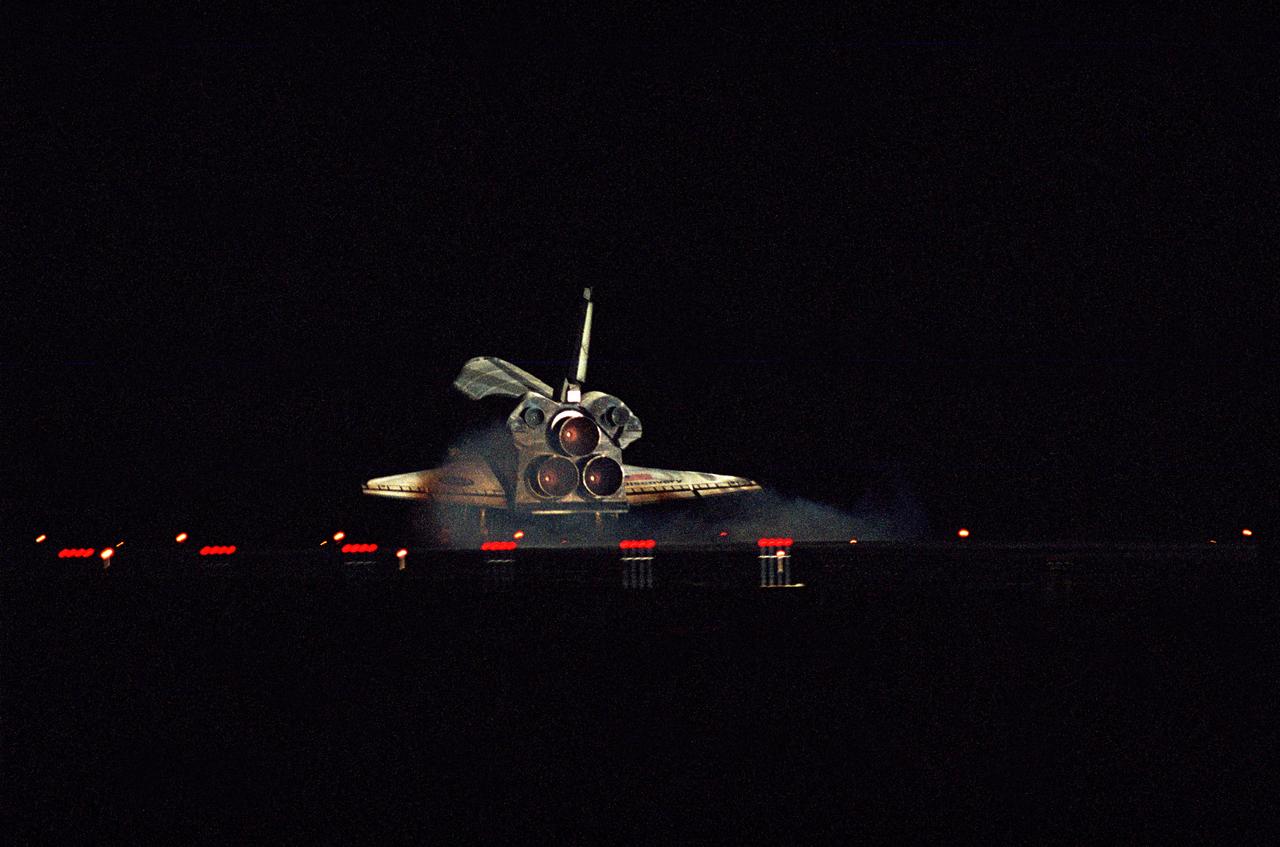
STS102-S-013 (21 March 2001) --- After a 5.3 million mile mission, The Space Shuttle Discovery approaches touchdown on Runway 15 at the KSC Shuttle Landing Facility in this aft view. The landing completed the successful 12-day STS-102 mission. Onboard the shuttle were astronauts James Wetherbee, James Kelly, Andy Thomas, and Paul Richards. Discovery’s touchdown also marked the return of the space station’s first resident crew – Expedition One which were William Shepherd, Yuri Gidzenko and Sergei Krikalev. STS-102 was the 103rd shuttle flight and the eighth shuttle mission to visit the station.
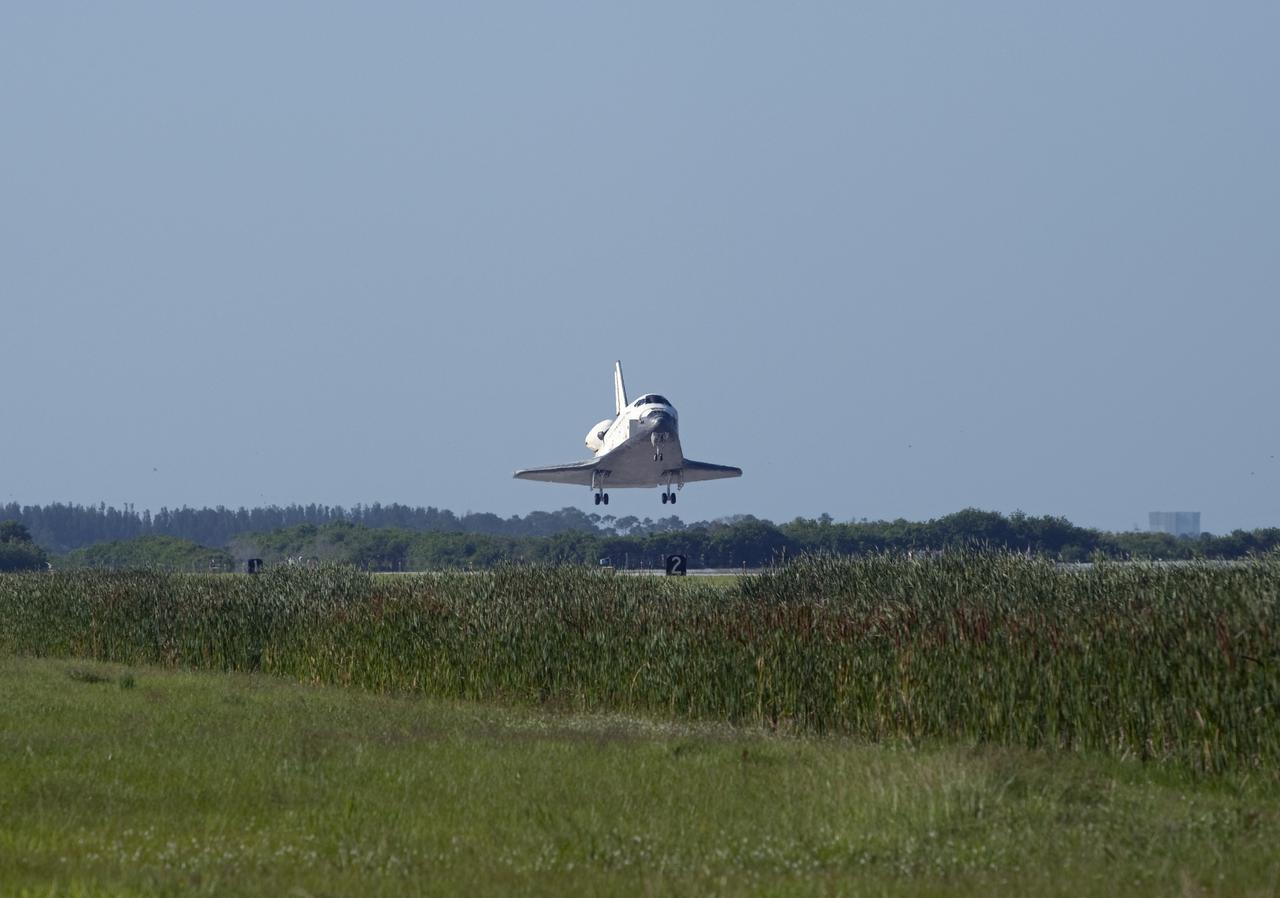
CAPE CANAVERAL, Fla. - Coming in from the southeast, space shuttle Atlantis approaches Runway 33 at the Shuttle Landing Facility at NASA's Kennedy Space Center in Florida. Landing was at 8:48 a.m. EDT, completing the 12-day STS-132 mission to the International Space Station. The six-member STS-132 crew carried the Russian-built Mini Research Module-1 to the space station. STS-132 is the 34th shuttle mission to the station, the 132nd shuttle mission overall and the last planned flight for Atlantis. For information on the STS-132 mission and crew, visit www.nasa.gov_mission_pages_shuttle_shuttlemissions_sts132_index.html. Photo credit: NASA_Tom Joseph
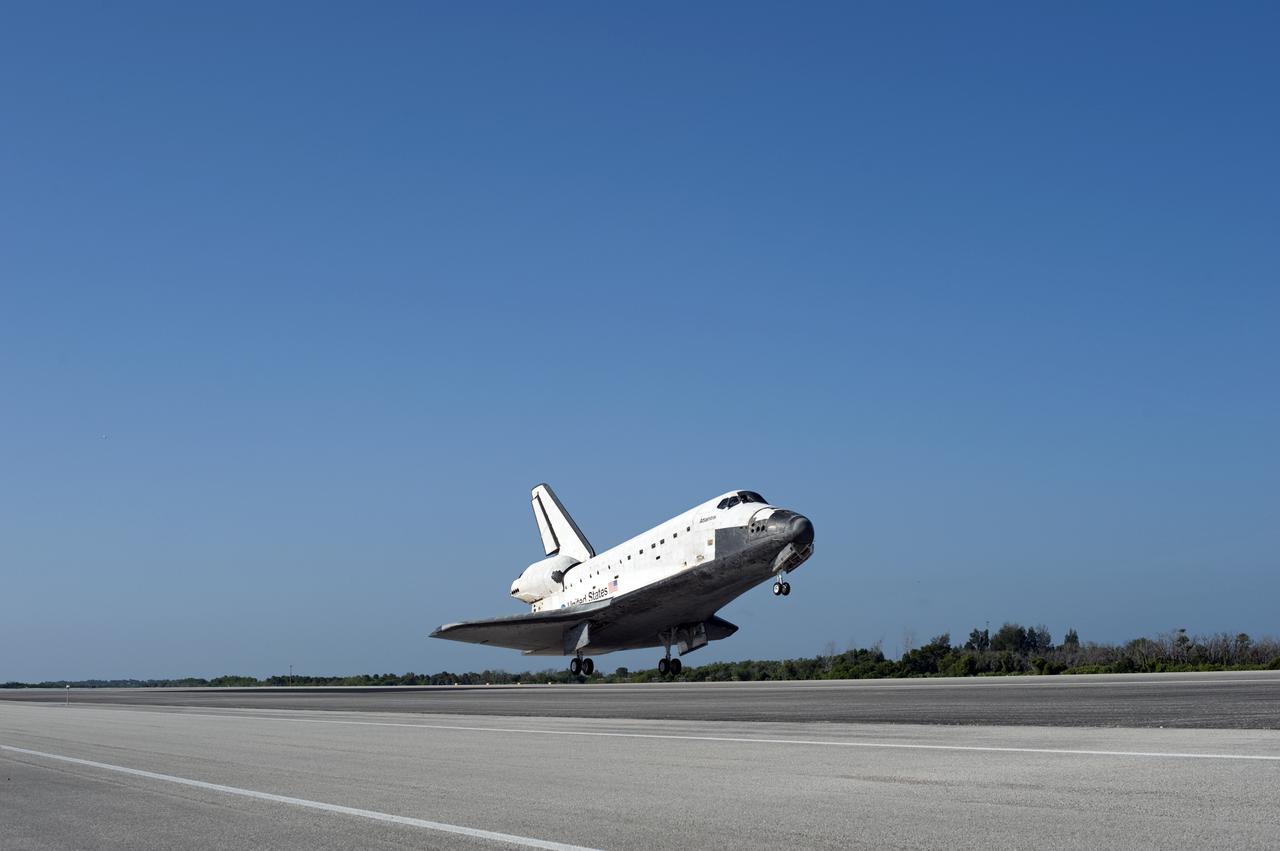
CAPE CANAVERAL, Fla. - Back dropped by a crystal-clear blue sky, space shuttle Atlantis' belly is visible as it approaches Runway 33 at the Shuttle Landing Facility at NASA's Kennedy Space Center in Florida. Landing was at 8:48 a.m. EDT, completing the 12-day STS-132 mission to the International Space Station. The six-member STS-132 crew carried the Russian-built Mini Research Module-1 to the space station. STS-132 is the 34th shuttle mission to the station, the 132nd shuttle mission overall and the last planned flight for Atlantis. For information on the STS-132 mission and crew, visit www.nasa.gov_mission_pages_shuttle_shuttlemissions_sts132_index.html. Photo credit: NASA_Tony Gray and Tom Farrar
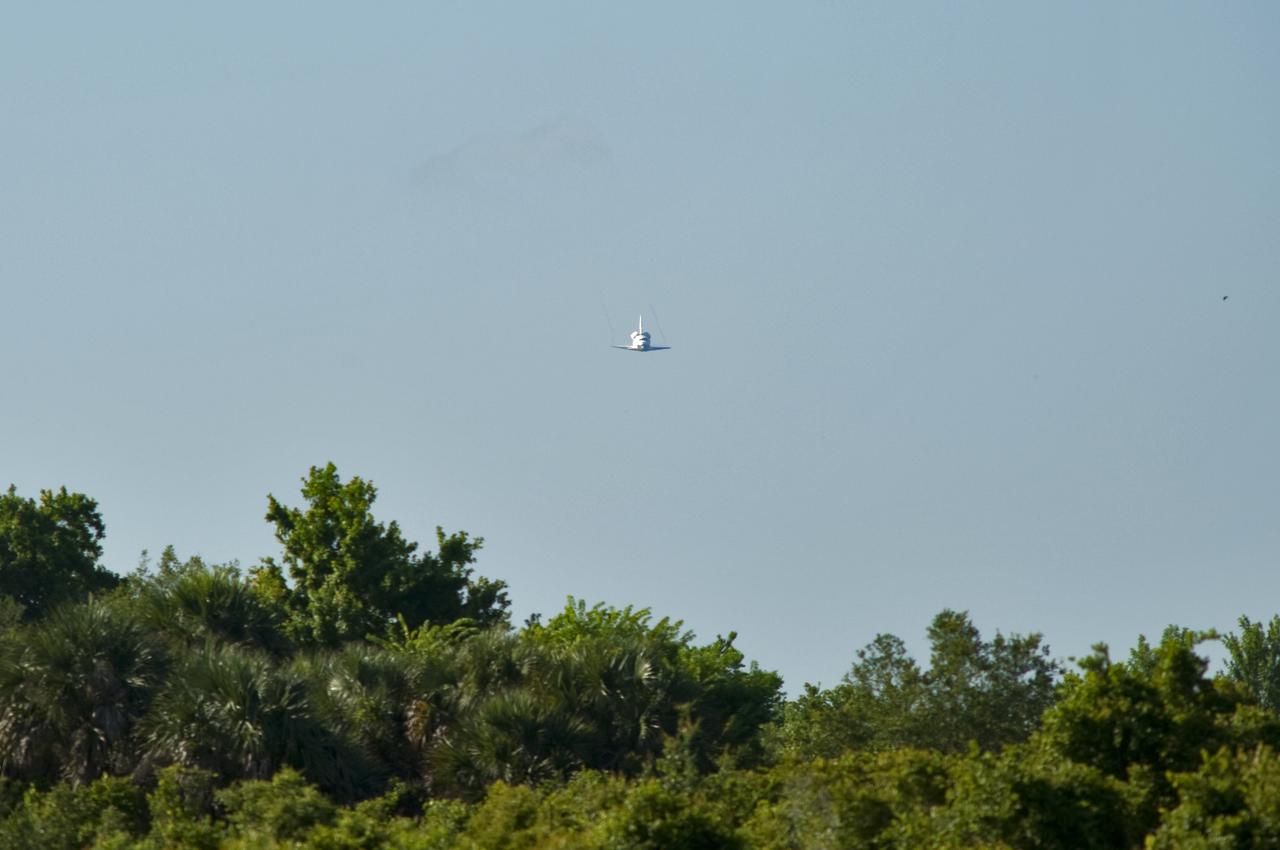
CAPE CANAVERAL, Fla. - Coming in from the southeast, space shuttle Atlantis approaches Runway 33 at the Shuttle Landing Facility at NASA's Kennedy Space Center in Florida. Landing was at 8:48 a.m. EDT, completing the 12-day STS-132 mission to the International Space Station. The six-member STS-132 crew carried the Russian-built Mini Research Module-1 to the International Space Station. STS-132 is the 34th shuttle mission to the station, the 132nd shuttle mission overall and the last planned flight for Atlantis. For information on the STS-132 mission and crew, visit www.nasa.gov_mission_pages_shuttle_shuttlemissions_sts132_index.html. Photo credit: NASA_Rusty Backer
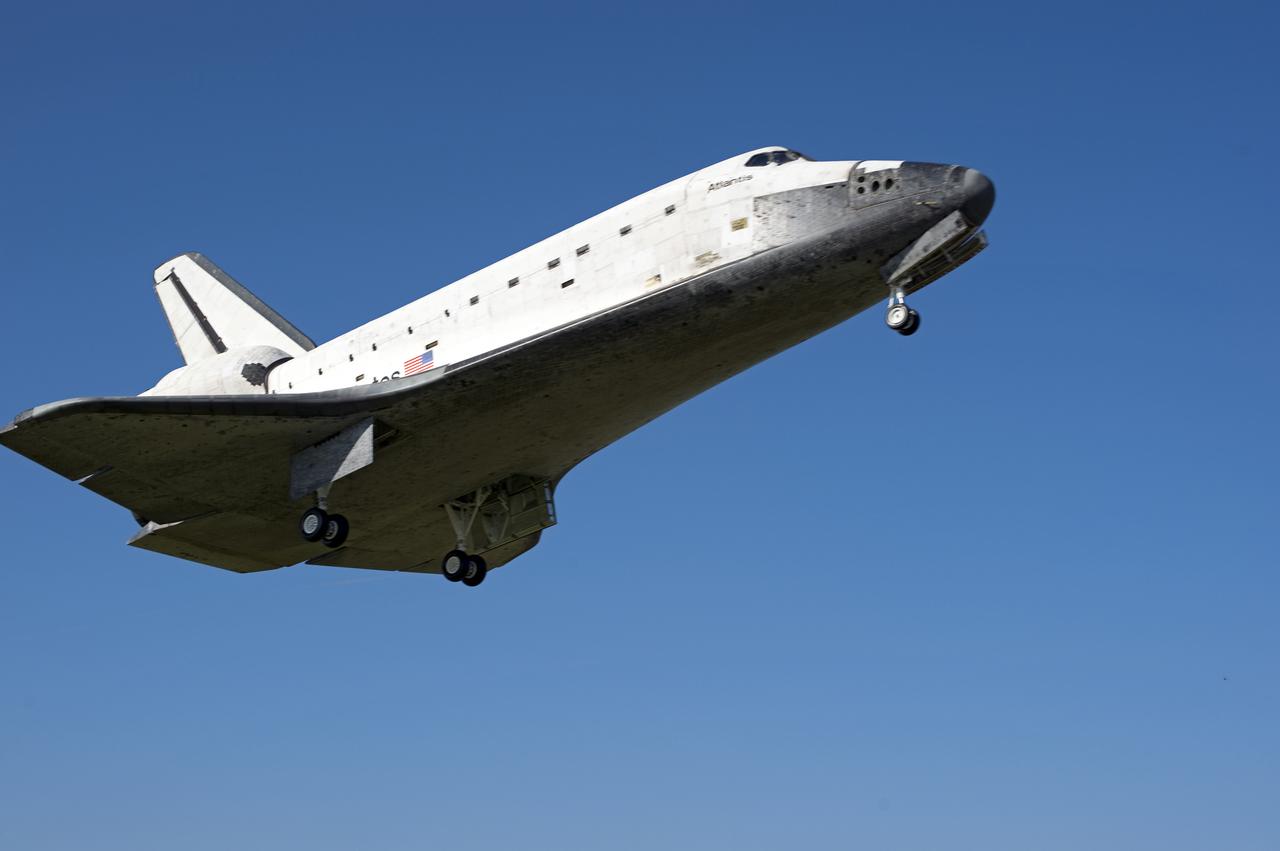
CAPE CANAVERAL, Fla. - Coming in from the southeast, space shuttle Atlantis' belly is visible in a crystal-clear blue sky as it approaches Runway 33 at the Shuttle Landing Facility at NASA's Kennedy Space Center in Florida. Landing was at 8:48 a.m. EDT, completing the 12-day STS-132 mission to the International Space Station. The six-member STS-132 crew carried the Russian-built Mini Research Module-1 to the space station. STS-132 is the 34th shuttle mission to the station, the 132nd shuttle mission overall and the last planned flight for Atlantis. For information on the STS-132 mission and crew, visit www.nasa.gov_mission_pages_shuttle_shuttlemissions_sts132_index.html. Photo credit: NASA_Tony Gray and Tom Farrar
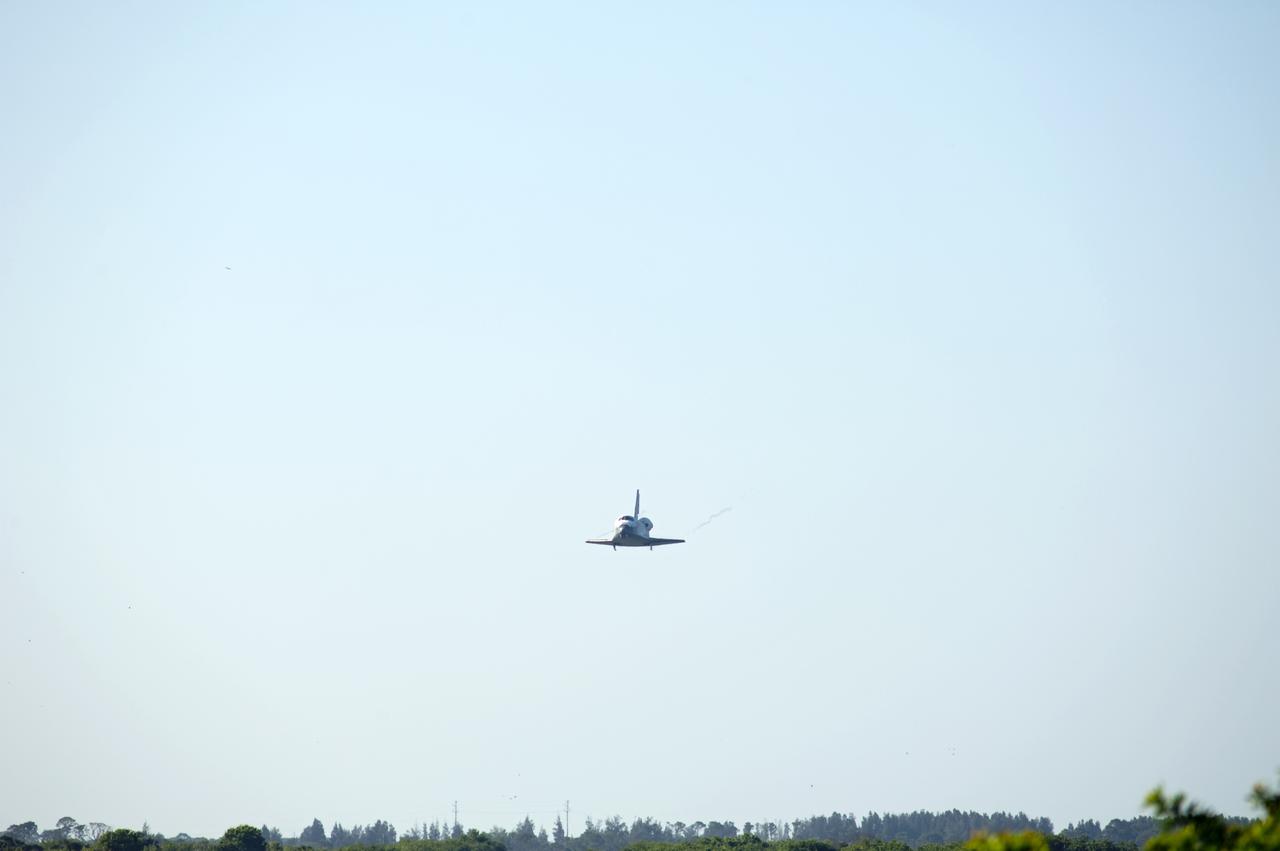
CAPE CANAVERAL, Fla. - Coming in from the southeast, space shuttle Atlantis approaches Runway 33 at the Shuttle Landing Facility at NASA's Kennedy Space Center in Florida. Landing was at 8:48 a.m. EDT, completing the 12-day STS-132 mission to the International Space Station. The six-member STS-132 crew carried the Russian-built Mini Research Module-1 to the space station. STS-132 is the 34th shuttle mission to the station, the 132nd shuttle mission overall and the last planned flight for Atlantis. For information on the STS-132 mission and crew, visit www.nasa.gov_mission_pages_shuttle_shuttlemissions_sts132_index.html. Photo credit: NASA_Sandra Joseph
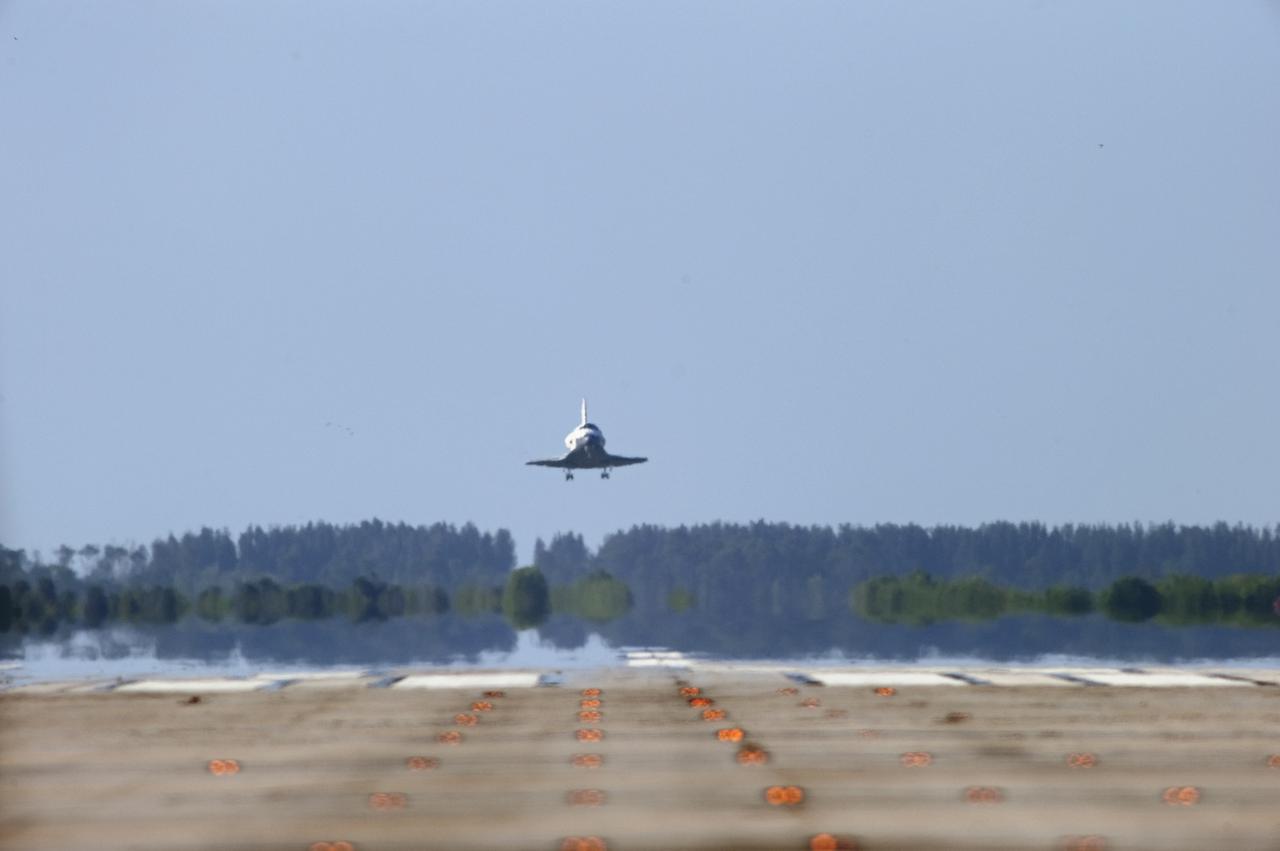
CAPE CANAVERAL, Fla. - Coming in from the southeast, space shuttle Atlantis approaches Runway 33 at the Shuttle Landing Facility at NASA's Kennedy Space Center in Florida. Landing was at 8:48 a.m. EDT, completing the 12-day STS-132 mission to the International Space Station. The six-member STS-132 crew carried the Russian-built Mini Research Module-1 to the space station. STS-132 is the 34th shuttle mission to the station, the 132nd shuttle mission overall and the last planned flight for Atlantis. For information on the STS-132 mission and crew, visit www.nasa.gov_mission_pages_shuttle_shuttlemissions_sts132_index.html. Photo credit: NASA_Sandra Joseph and Carl Winebarger
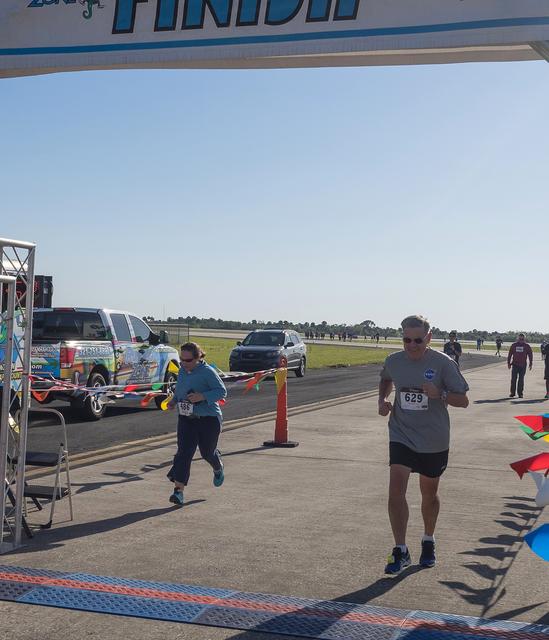
Kennedy Space Center Director Bob Cabana approaches the finish line at the KSC Walk Run on the Shuttle Landing Facility runway. The annual event, part of Kennedy’s Safety and Health Days, offers 10K, 5K and 2-mile options in the spirit of friendly competition.
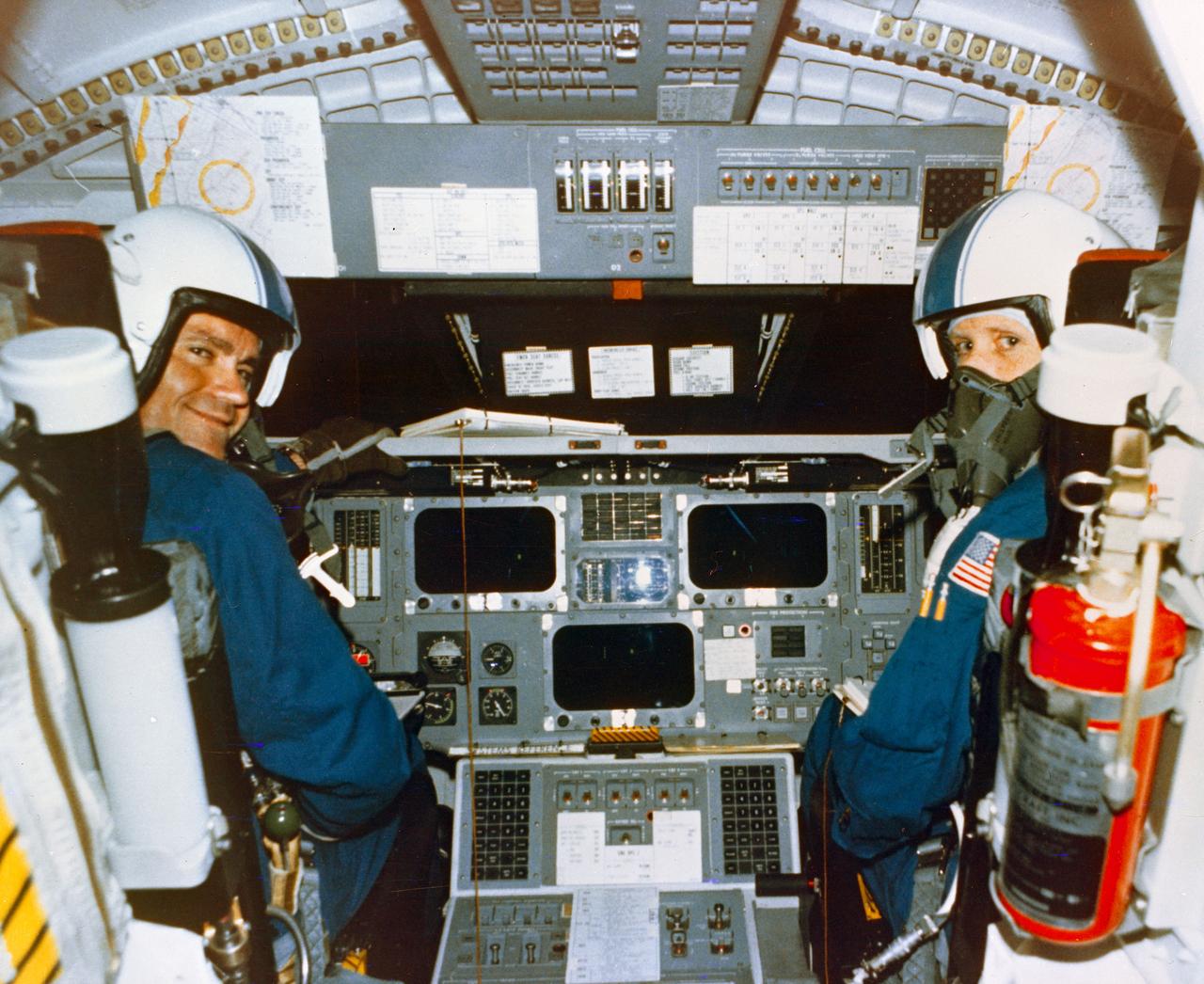
Astronauts Fred W. Haise, Jr., Commander, left, and C. Gordon Fullerton in the cockpit of the Space Shuttle Orbiter 101 "Enterprise" prior to the fifth and final FF in the Approach and Landing Test (ALT) series, from DFRC. Original photo number was 77-HC-446. DFRC, CA

Sierra Nevada Corp’s Dream Chaser being towed from the former space shuttle hangar at NASA Armstrong Flight Research Center in California where it was housed and prepared for its successful Nov. 11, 2017 approach and landing test.
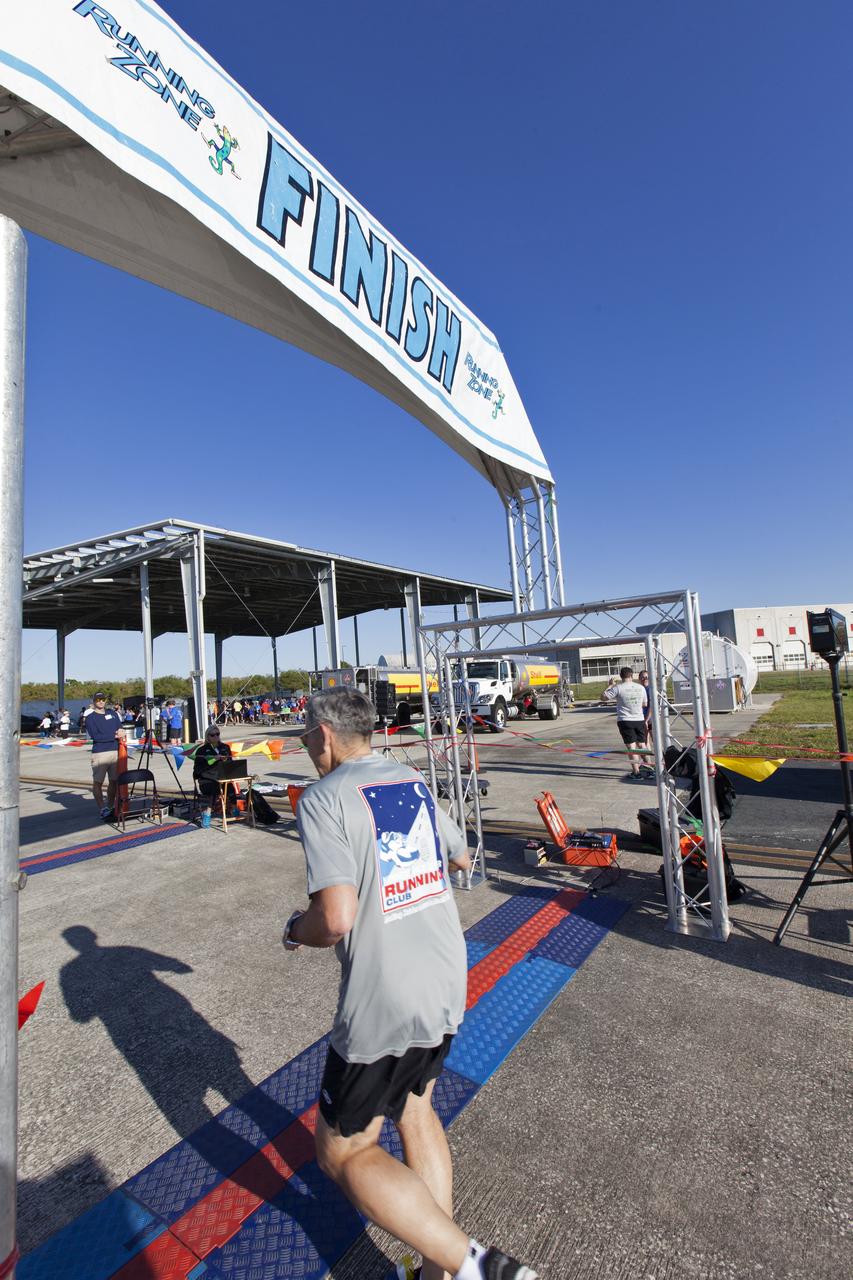
Kennedy Space Center Director Bob Cabana approaches the finish line at the KSC Walk Run on the Shuttle Landing Facility runway. The annual event, part of Kennedy’s Safety and Health Days, offers 10K, 5K and 2-mile options in the spirit of friendly competition.
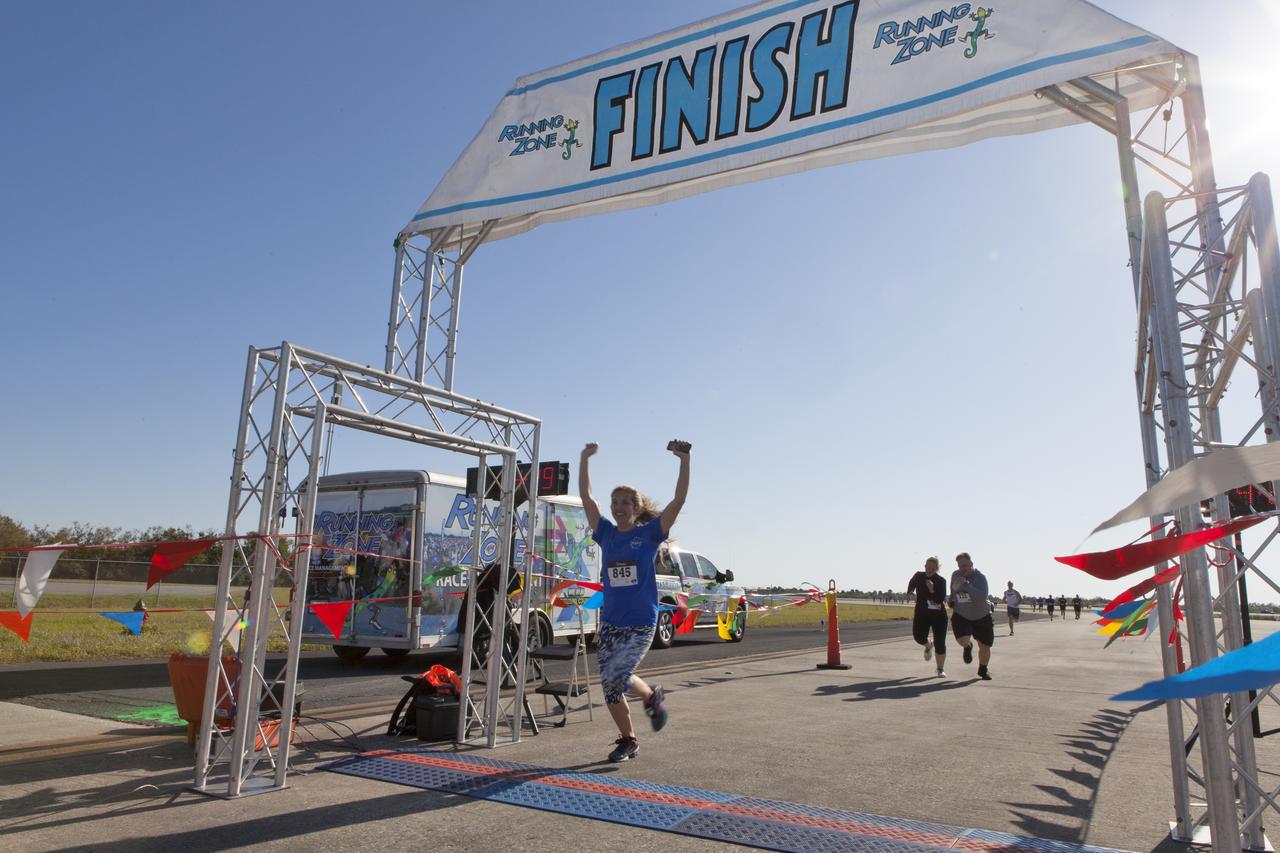
Kennedy Space Center employees and guests approach the finish line during the KSC Walk Run on the Shuttle Landing Facility runway. The annual event, part of Kennedy’s Safety and Health Days, offers 10K, 5K and 2-mile options in the spirit of friendly competition.
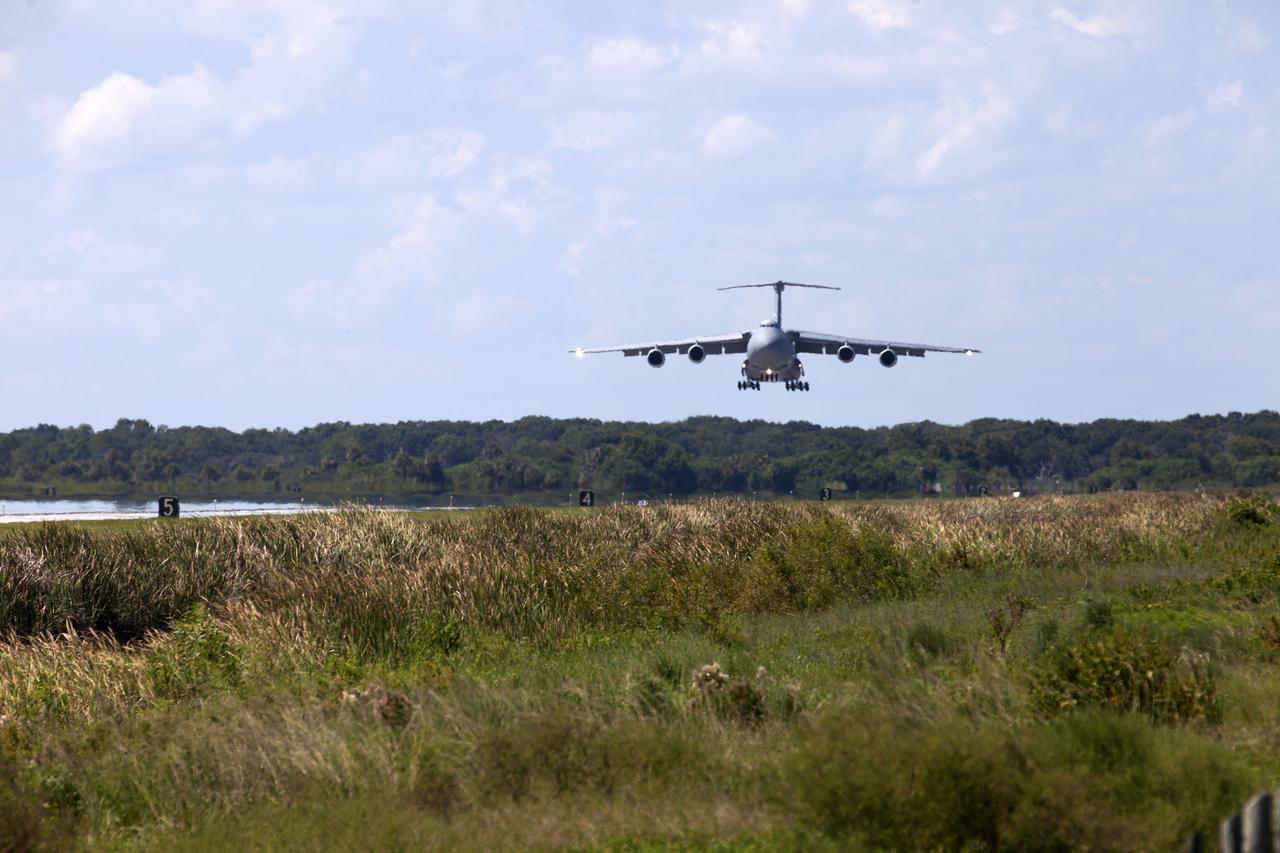
An Air Force C-5 Galaxy transport plane approaches the Shuttle Landing Facility at NASA's Kennedy Space Center in Florida to deliver the GOES-R spacecraft for launch processing. The GOES series are weather satellites operated by NOAA to enhance forecasts. The spacecraft is to launch aboard a United Launch Alliance Atlas V rocket in November.
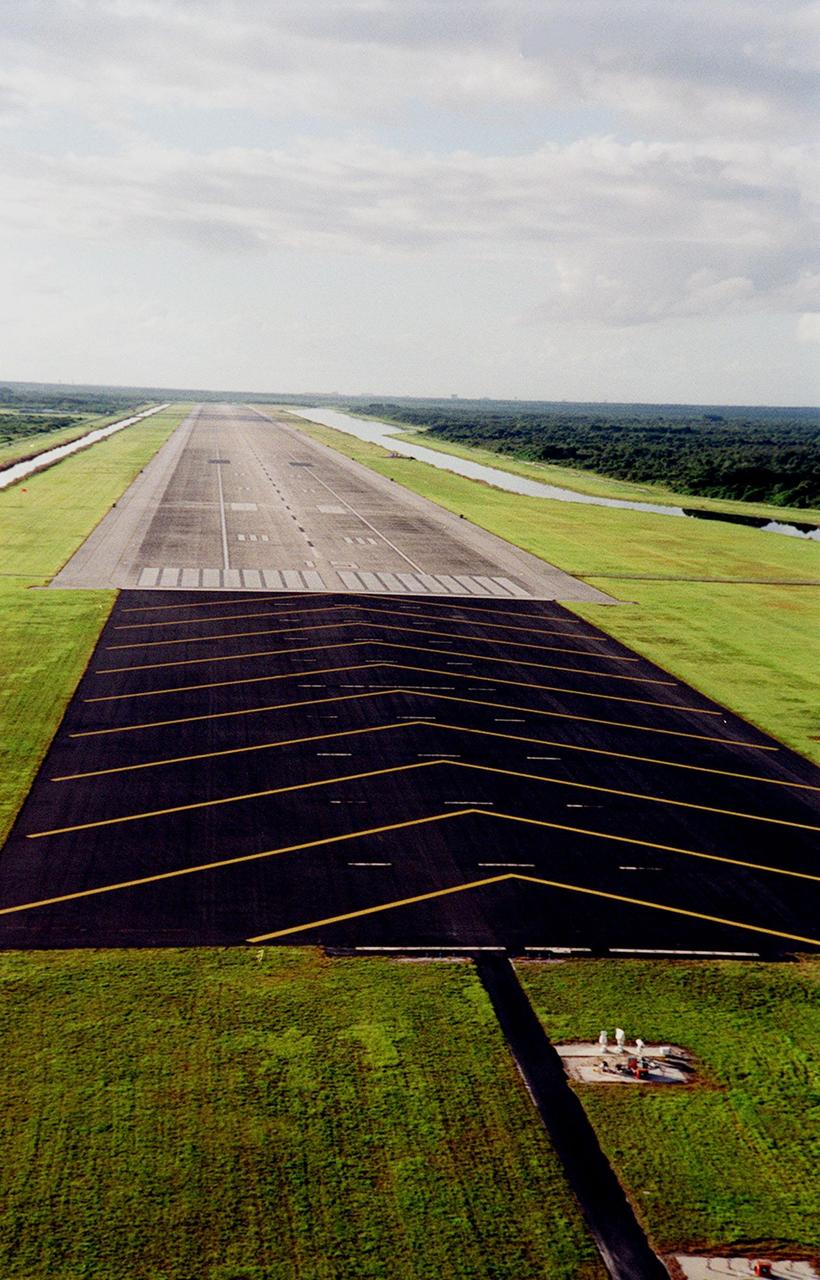
KENNEDY SPACE CENTER, FLA. -- This aerial view shows the approach on Runway 33 at the KSC Shuttle Landing Facility. The runway is 15,000 feet long, with 1,000-foot paved overruns at each end; 300 feet wide (about length of football field), with 50-foot asphalt shoulders each side; 16 inches thick in the center, and 15 inches thick on sides. It has a slope of 24 inches from the center line to the edge for drainage. The single landing strip is considered two runways, depending on approach Runway 15 from northwest, Runway 33 from southeast
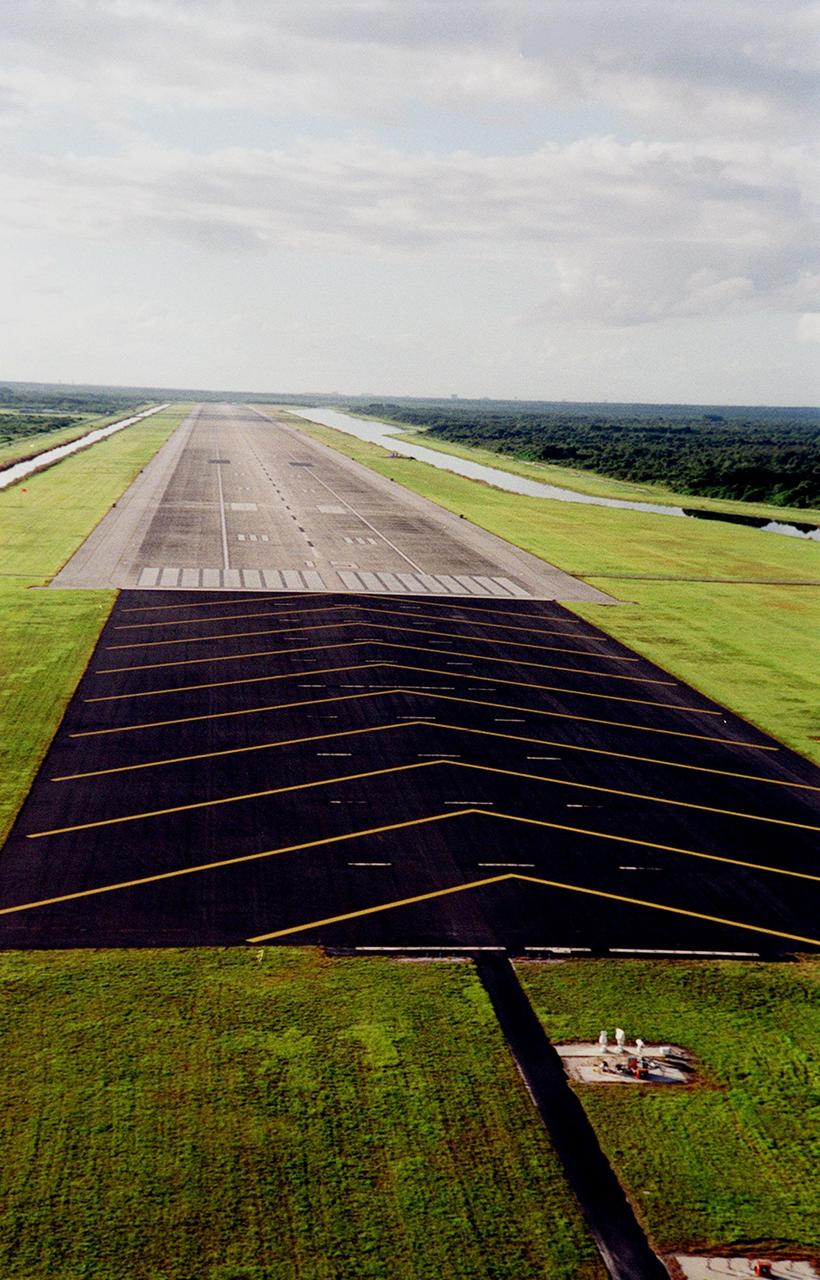
KENNEDY SPACE CENTER, FLA. -- This aerial view shows the approach on Runway 33 at the KSC Shuttle Landing Facility. The runway is 15,000 feet long, with 1,000-foot paved overruns at each end; 300 feet wide (about length of football field), with 50-foot asphalt shoulders each side; 16 inches thick in the center, and 15 inches thick on sides. It has a slope of 24 inches from the center line to the edge for drainage. The single landing strip is considered two runways, depending on approach Runway 15 from northwest, Runway 33 from southeast
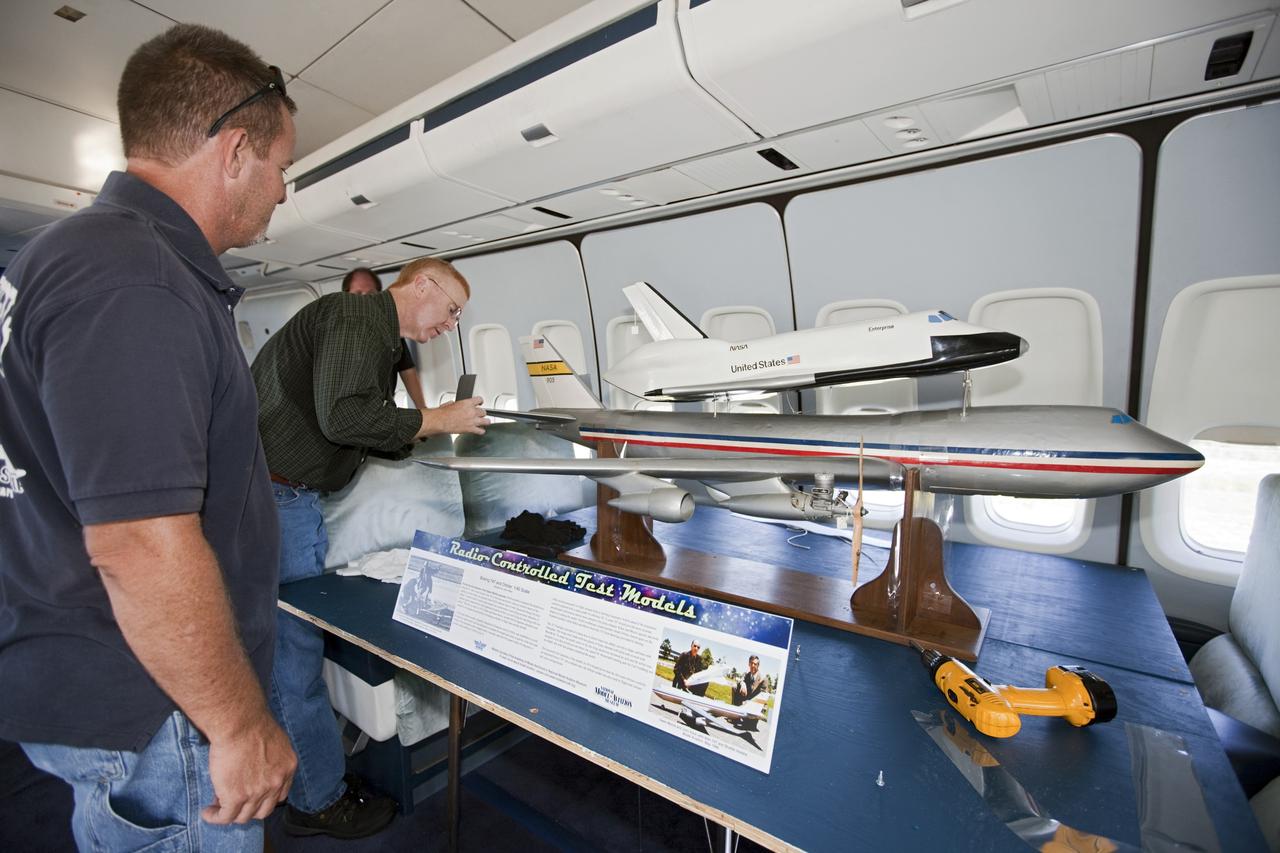
CAPE CANAVERAL, Fla. – Reporters look over a model of the Shuttle Carrier Aircraft, or SCA, and a space shuttle during a tour of the real Shuttle Carrier Aircraft. The model is a radio-controlled scale version of the modified 747 that was used to test theories for how the space shuttle would separate from the SCA during approach and landing tests. Photo credit: NASA/Kim Shiflett
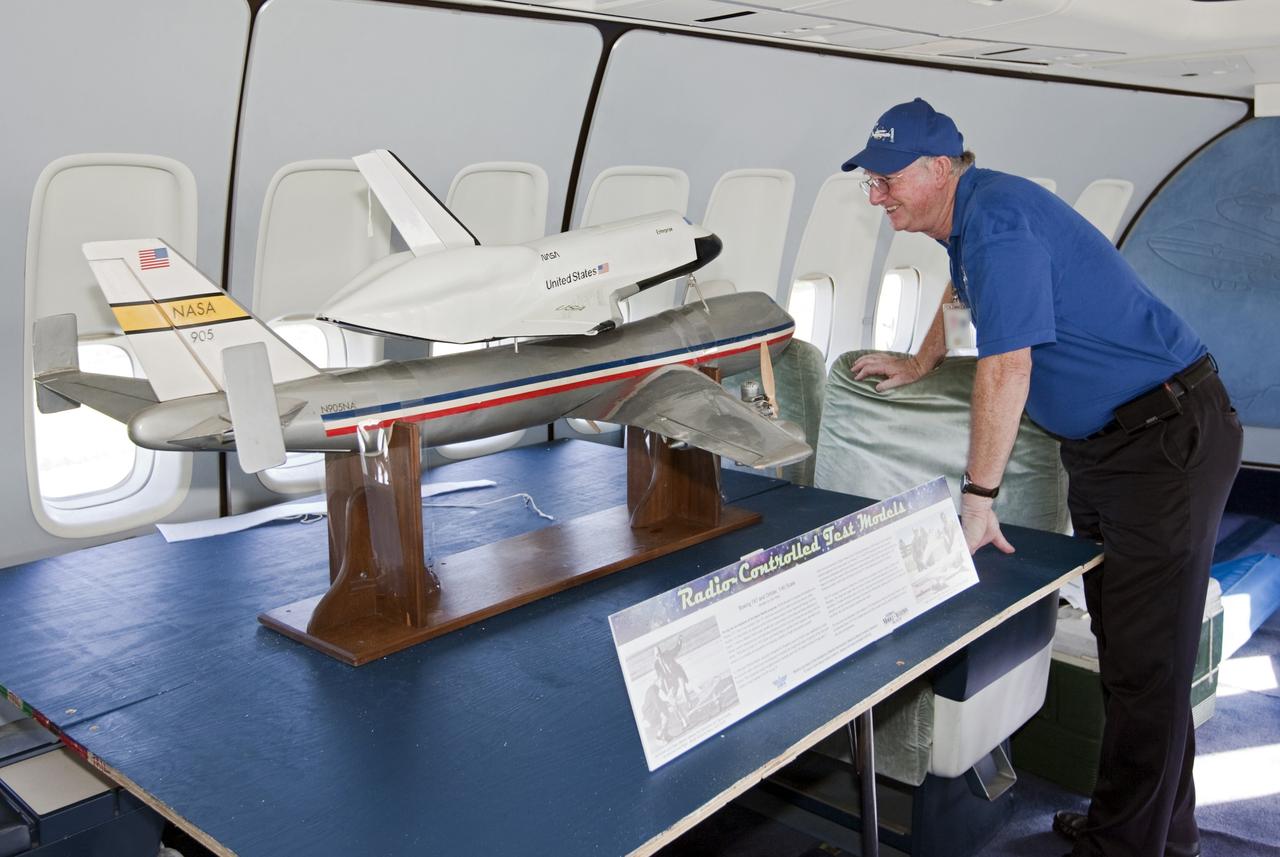
CAPE CANAVERAL, Fla. – A visitor looks over a model of the Shuttle Carrier Aircraft, or SCA, and a space shuttle during a tour of the real Shuttle Carrier Aircraft. The model is a radio-controlled scale version of the modified 747 that was used to test theories for how the space shuttle would separate from the SCA during approach and landing tests. Photo credit: NASA/Kim Shiflett

KENNEDY SPACE CENTER, FLA. -- In the Orbiter Processing Facility, United Space Alliance employee Harrell Watts installs Thermal Protection System tiles on a main landing gear door of Space Shuttle orbiter Enterprise (OV-101). Sections of Enterprise were borrowed from the Smithsonian Institution's Air and Space Museum where the orbiter is being stored at the Washington Dulles International Airport. Enterprise was the first orbiter built in the Shuttle fleet and was used to conduct the Approach and Landing Test Program before the first powered Shuttle flight. After the tile installation is complete, the sections will be transferred to the Southwest Research Institute for testing requested by the Columbia Accident Investigation Board.
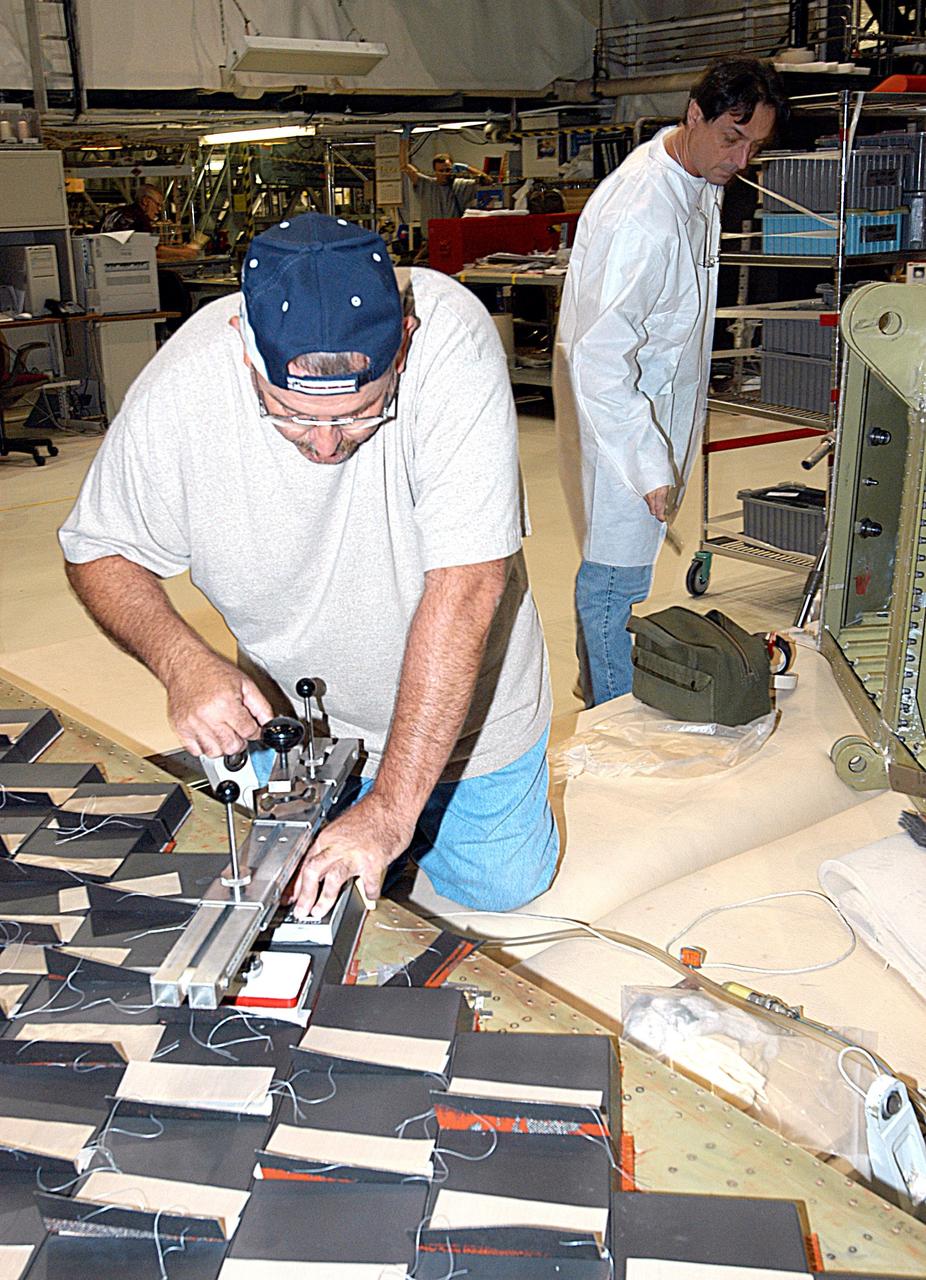
KENNEDY SPACE CENTER, FLA. -- In the Orbiter Processing Facility, United Space Alliance employee Dave Sanborn (left) conducts a bond verification test on Thermal Protection System tiles installed on a main landing gear door of Space Shuttle orbiter Enterprise (OV-101). Sections of Enterprise were borrowed from the Smithsonian Institution's Air and Space Museum where the orbiter is being stored at the Washington Dulles International Airport. Enterprise was the first orbiter built in the Shuttle fleet and was used to conduct the Approach and Landing Test Program before the first powered Shuttle flight. After the tile installation is complete, the sections will be transferred to the Southwest Research Institute for testing requested by the Columbia Accident Investigation Board.
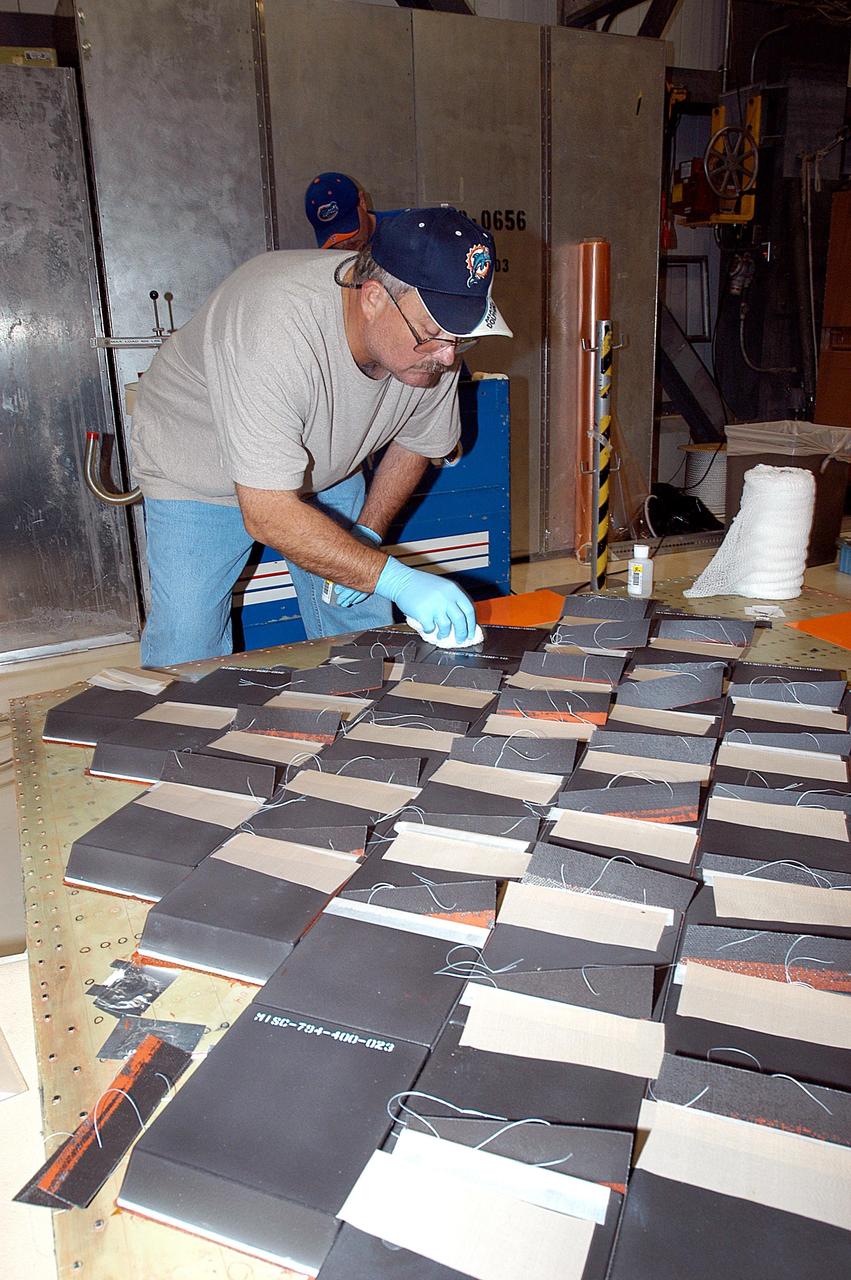
KENNEDY SPACE CENTER, FLA. -- In the Orbiter Processing Facility, United Space Alliance employee Dave Sanborn installs Thermal Protection System tiles on a main landing gear door of Space Shuttle orbiter Enterprise (OV-101). Sections of Enterprise were borrowed from the Smithsonian Institution's Air and Space Museum where the orbiter is being stored at the Washington Dulles International Airport. Enterprise was the first orbiter built in the Shuttle fleet and was used to conduct the Approach and Landing Test Program before the first powered Shuttle flight. After the tile installation is complete, the sections will be transferred to the Southwest Research Institute for testing requested by the Columbia Accident Investigation Board.
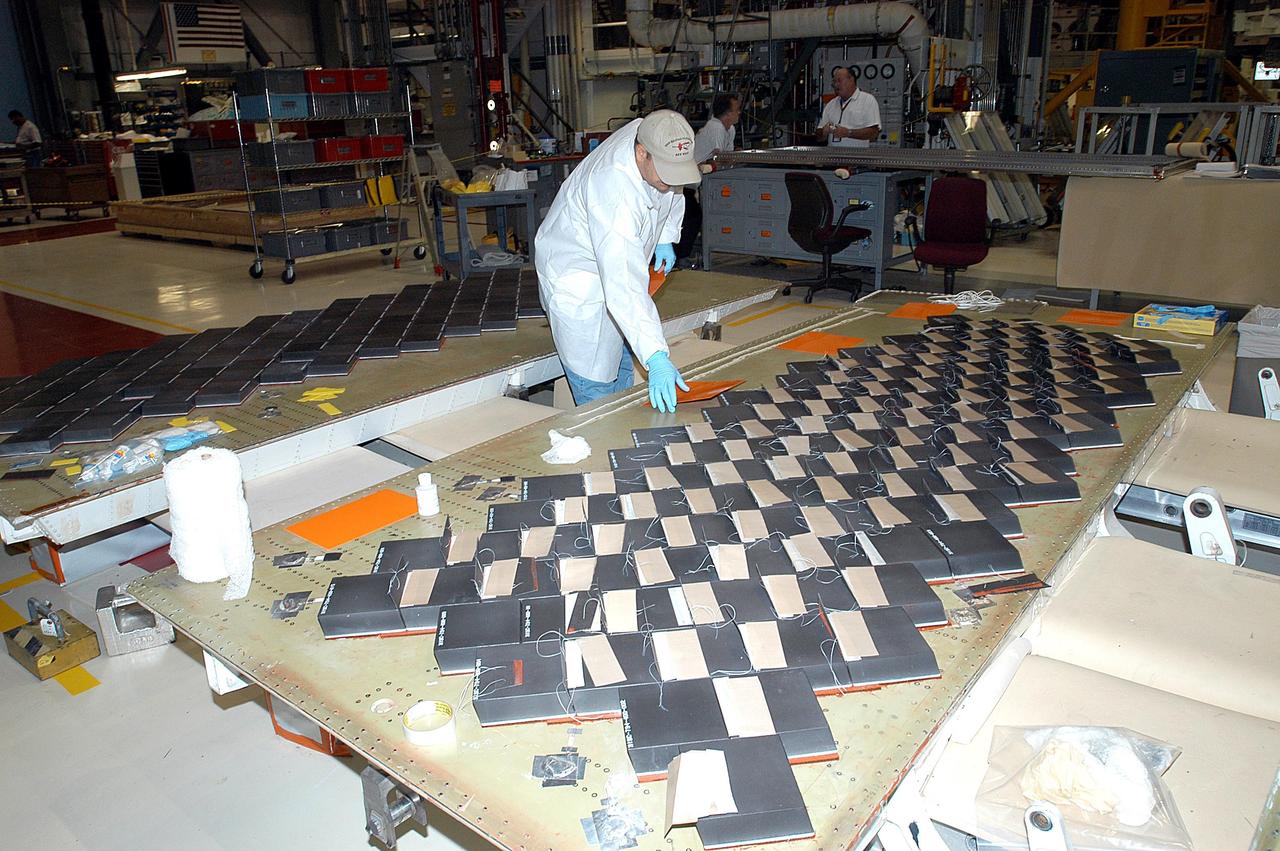
KENNEDY SPACE CENTER, FLA. -- In the Orbiter Processing Facility, United Space Alliance employee Mike Cote works on installing Thermal Protection System tiles on a main landing gear door of Space Shuttle orbiter Enterprise (OV-101). Sections of Enterprise were borrowed from the Smithsonian Institution's Air and Space Museum where the orbiter is being stored at the Washington Dulles International Airport. Enterprise was the first orbiter built in the Shuttle fleet and was used to conduct the Approach and Landing Test Program before the first powered Shuttle flight. After the tile installation is complete, the sections will be transferred to the Southwest Research Institute for testing requested by the Columbia Accident Investigation Board.
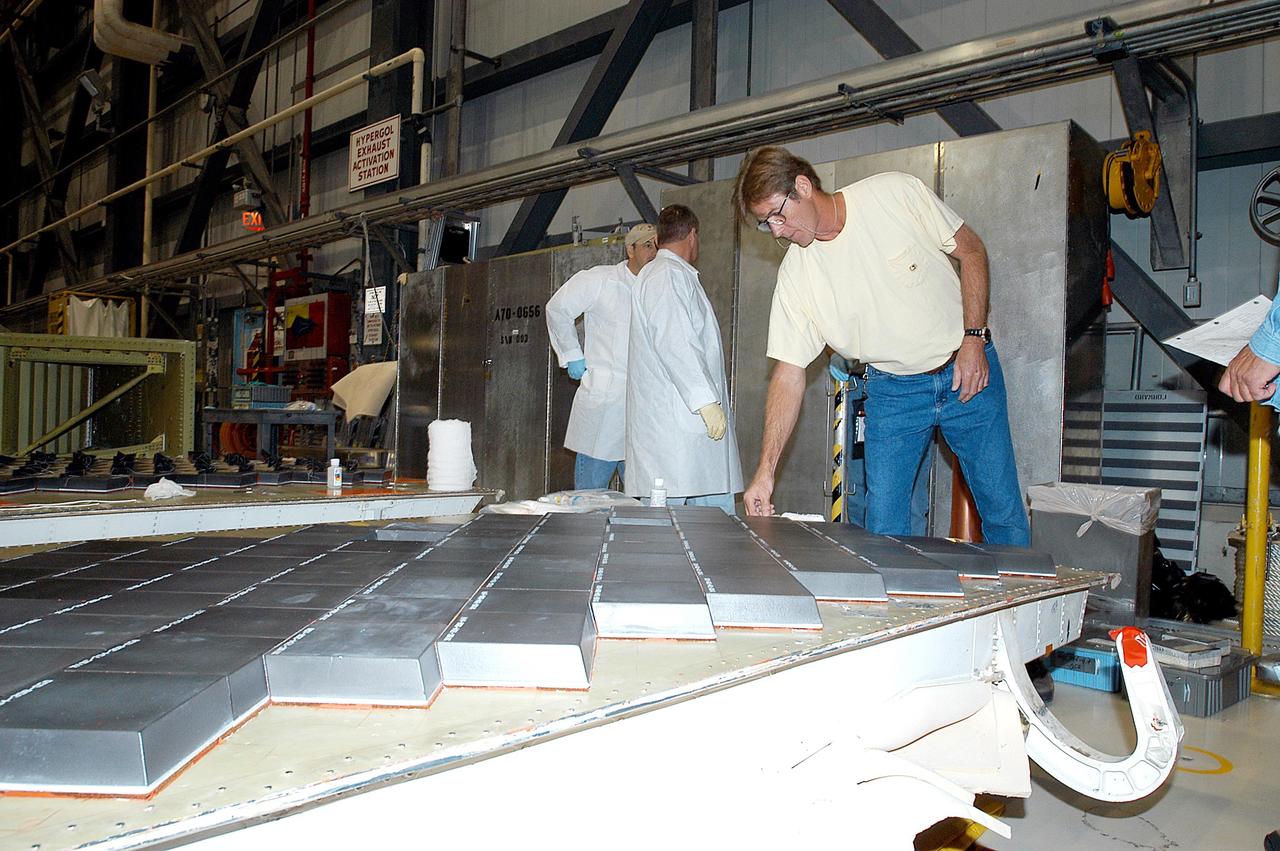
KENNEDY SPACE CENTER, FLA. -- In the Orbiter Processing Facility, United Space Alliance employee Harrell Watts (right) installs Thermal Protection System tiles on a main landing gear door of Space Shuttle orbiter Enterprise (OV-101). Sections of Enterprise were borrowed from the Smithsonian Institution's Air and Space Museum where the orbiter is being stored at the Washington Dulles International Airport. Enterprise was the first orbiter built in the Shuttle fleet and was used to conduct the Approach and Landing Test Program before the first powered Shuttle flight. After the tile installation is complete, the sections will be transferred to the Southwest Research Institute for testing requested by the Columbia Accident Investigation Board.
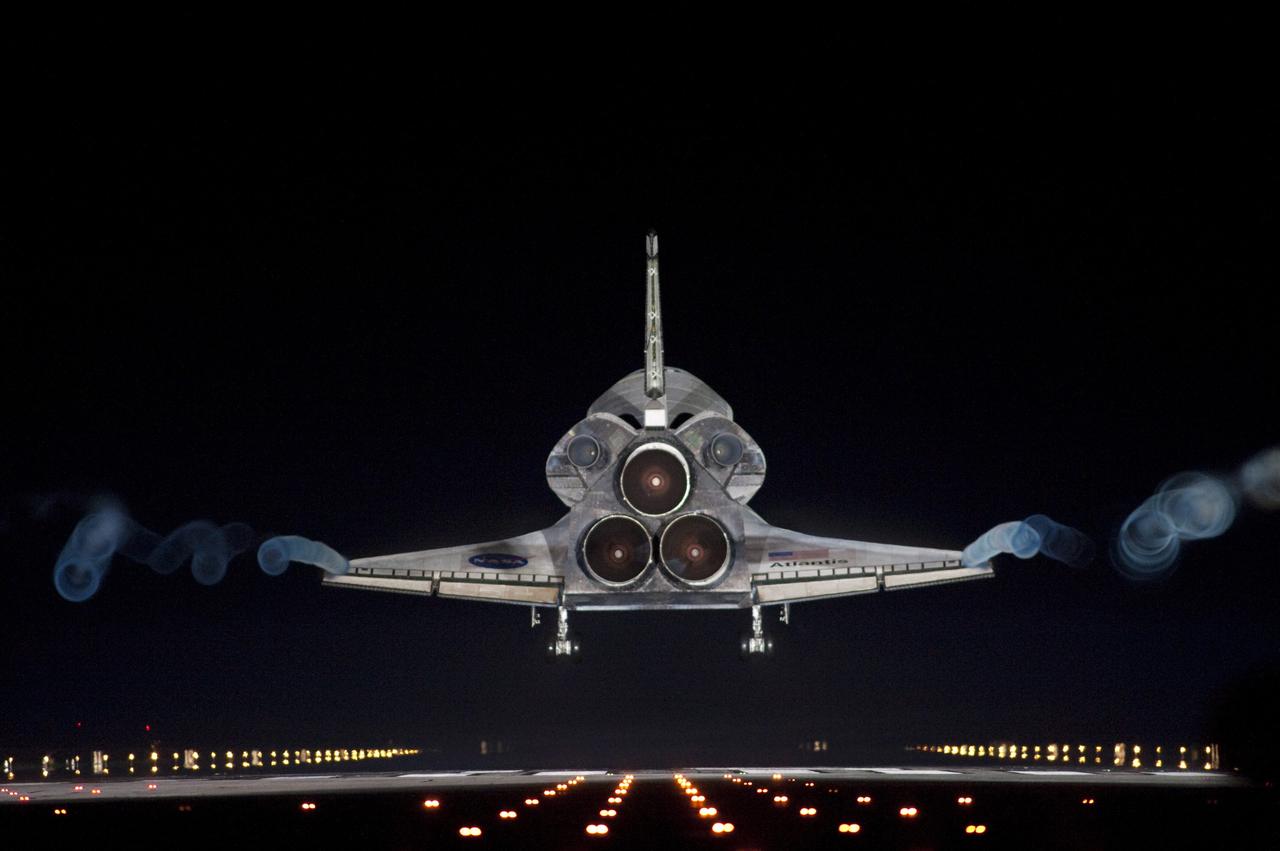
CAPE CANAVERAL, Fla. -- Vapor trails follow space shuttle Atlantis as it approaches Runway 15 on the Shuttle Landing Facility at NASA's Kennedy Space Center in Florida for the final time. A vapor trail, known as a contrail, is a cloud of water vapor that condenses and freezes around the small particles in aircraft exhaust. Atlantis marked the 26th nighttime landing of NASA's Space Shuttle Program and the 78th landing at Kennedy. It also was the final mission for the shuttle program. STS-135 was the 33rd and final flight for Atlantis, which has spent 307 days in space, orbited Earth 4,848 times and traveled 125,935,769 miles. For more information on the space shuttle era, visit www.nasa.gov/mission_pages/shuttle/flyout. Photo credit: NASA/Sandra Joseph and Kevin O'Connell
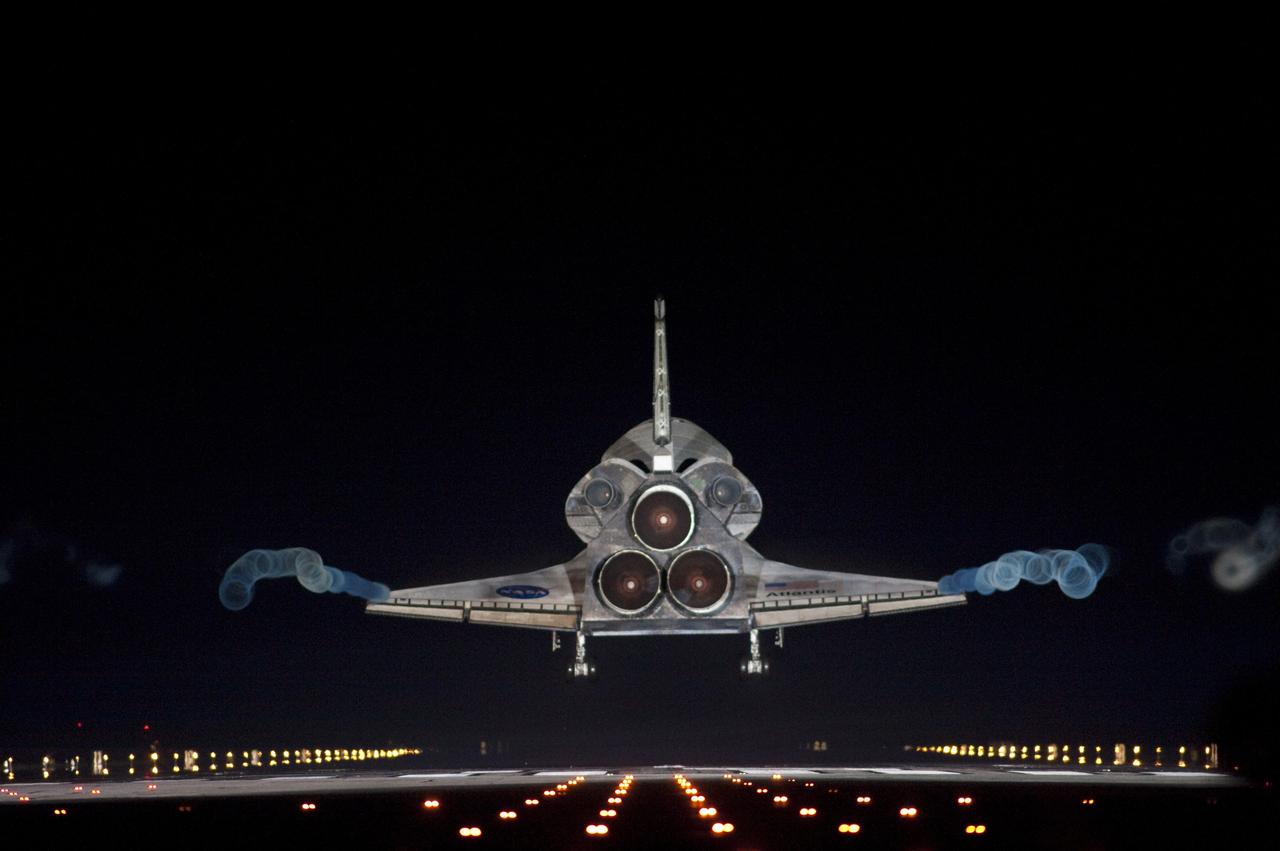
CAPE CANAVERAL, Fla. -- Vapor trails follow space shuttle Atlantis as it approaches Runway 15 on the Shuttle Landing Facility at NASA's Kennedy Space Center in Florida for the final time. A vapor trail, known as a contrail, is a cloud of water vapor that condenses and freezes around the small particles in aircraft exhaust. Atlantis marked the 26th nighttime landing of NASA's Space Shuttle Program and the 78th landing at Kennedy. It also was the final mission for the shuttle program. STS-135 was the 33rd and final flight for Atlantis, which has spent 307 days in space, orbited Earth 4,848 times and traveled 125,935,769 miles. For more information on the space shuttle era, visit www.nasa.gov/mission_pages/shuttle/flyout. Photo credit: NASA/Sandra Joseph and Kevin O'Connell
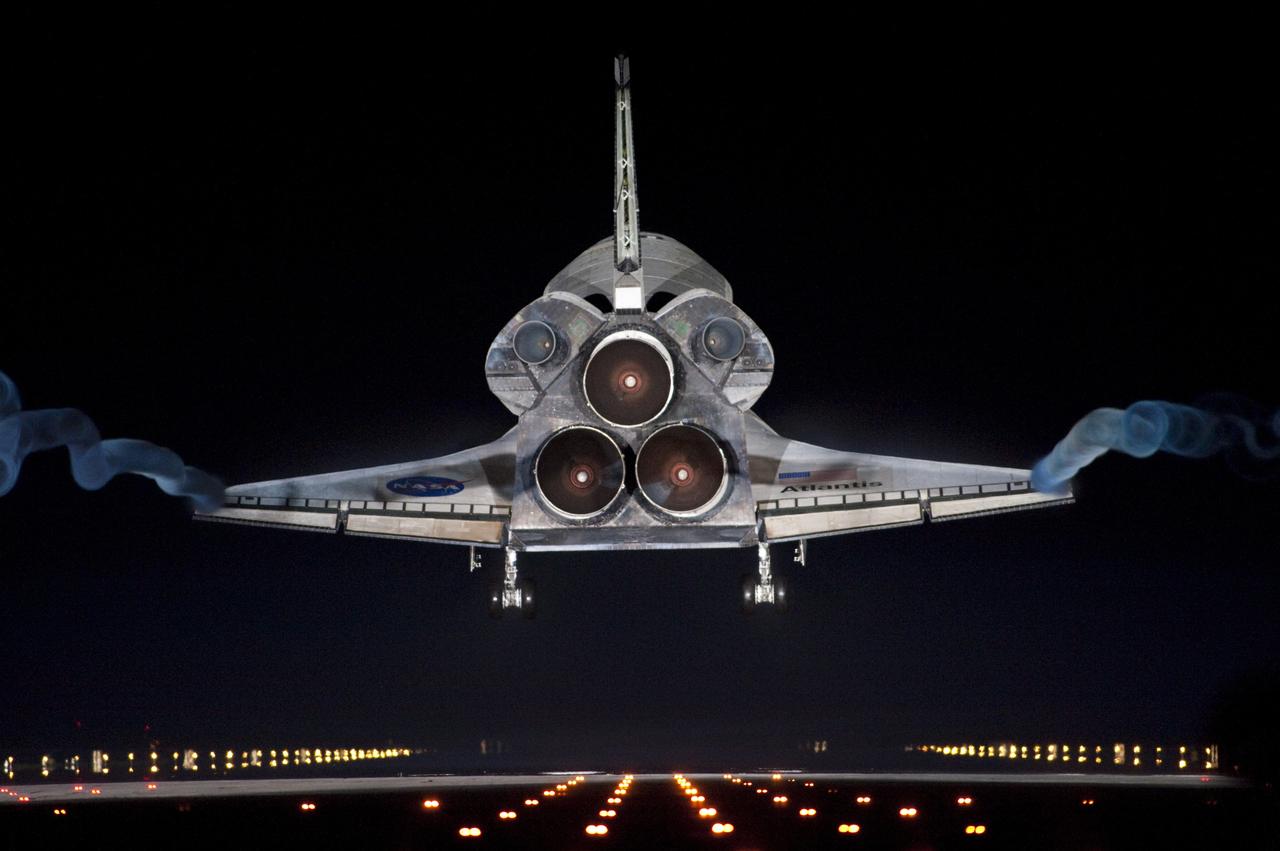
CAPE CANAVERAL, Fla. -- Vapor trails follow space shuttle Atlantis as it approaches Runway 15 on the Shuttle Landing Facility at NASA's Kennedy Space Center in Florida for the final time. A vapor trail, known as a contrail, is a cloud of water vapor that condenses and freezes around the small particles in aircraft exhaust. Atlantis marked the 26th nighttime landing of NASA's Space Shuttle Program and the 78th landing at Kennedy. It also was the final mission for the shuttle program. STS-135 was the 33rd and final flight for Atlantis, which has spent 307 days in space, orbited Earth 4,848 times and traveled 125,935,769 miles. For more information on the space shuttle era, visit www.nasa.gov/mission_pages/shuttle/flyout. Photo credit: NASA/Sandra Joseph and Kevin O'Connell

CAPE CANAVERAL, Fla. -- Vapor trails follow space shuttle Atlantis as it approaches Runway 15 on the Shuttle Landing Facility at NASA's Kennedy Space Center in Florida for the final time. A vapor trail, known as a contrail, is a cloud of water vapor that condenses and freezes around the small particles in aircraft exhaust. Atlantis marked the 26th nighttime landing of NASA's Space Shuttle Program and the 78th landing at Kennedy. It also was the final mission for the shuttle program. STS-135 was the 33rd and final flight for Atlantis, which has spent 307 days in space, orbited Earth 4,848 times and traveled 125,935,769 miles. For more information on the space shuttle era, visit www.nasa.gov/mission_pages/shuttle/flyout. Photo credit: NASA/Sandra Joseph and Kevin O'Connell

CAPE CANAVERAL, Fla. -- Vapor trails follow space shuttle Atlantis as it approaches Runway 15 on the Shuttle Landing Facility at NASA's Kennedy Space Center in Florida for the final time. A vapor trail, known as a contrail, is a cloud of water vapor that condenses and freezes around the small particles in aircraft exhaust. Atlantis marked the 26th nighttime landing of NASA's Space Shuttle Program and the 78th landing at Kennedy. It also was the final mission for the shuttle program. STS-135 was the 33rd and final flight for Atlantis, which has spent 307 days in space, orbited Earth 4,848 times and traveled 125,935,769 miles. For more information on the space shuttle era, visit www.nasa.gov/mission_pages/shuttle/flyout. Photo credit: NASA/Sandra Joseph and Kevin O'Connell
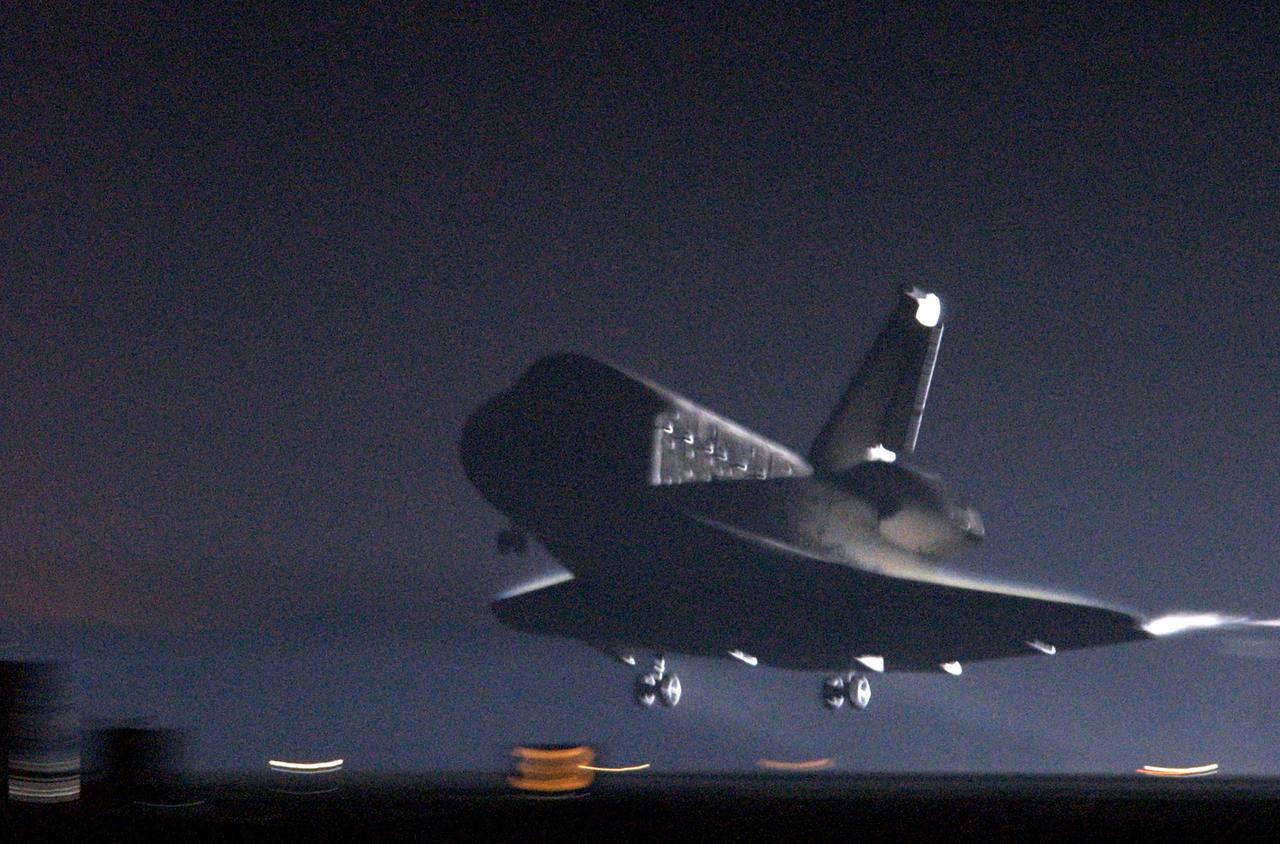
KENNEDY SPACE CENTER, FLA. -- Powerful xenon lights on the Shuttle Landing Facility outline the dark image of orbiter Columbia as it approaches touchdown on Runway 33. The landing completes mission STS-109 to service the Hubble Space Telescope, returning the crew of seven to Earth after a mission elapsed time of 10 days, 22 hours, 11 minutes. Wheel stop occurred on orbit 165 at 4:33:09 a.m. EST. Main gear touchdown occurred at 4:31:52 a.m. and nose wheel touchdown an 4:32:02. It was the 58th landing at KSC out of 108 missions in the history of the Shuttle program
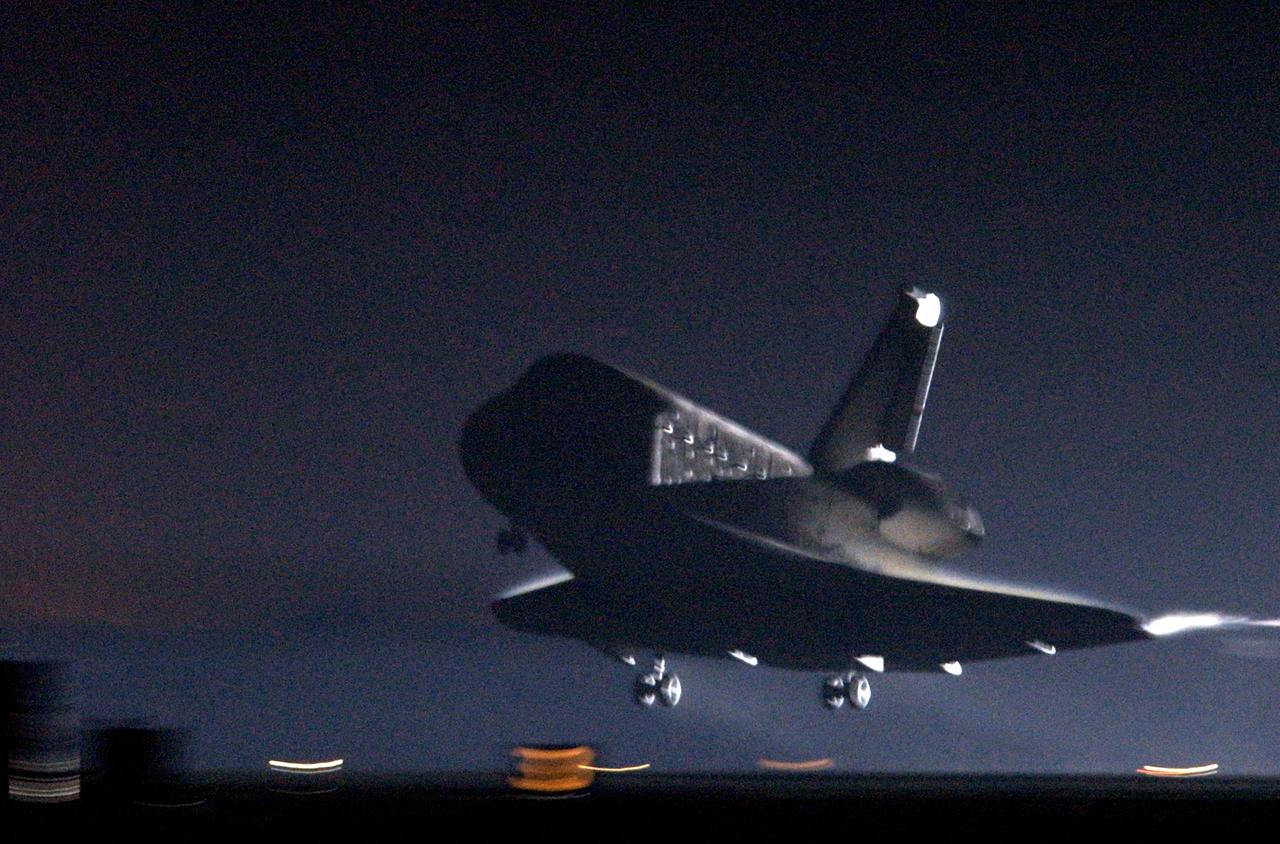
STS109-S-016 (12 March 2002)--- The Space Shuttle Columbia, with its crew of seven astronauts on board, approaches touchdown on Runway 33 of the KSC Shuttle Landing Facility, completing mission STS-109 to service the Hubble Space Telescope. Wheel stop occurred on orbit 165 at 4:33:09 a.m. EST with mission elapsed time of 10 days, 22 hours, 11 minutes. Main gear touchdown occurred at 4:31:52 a.m. and nose wheel touchdown an 4:32:02. It was the 58th landing at KSC out of 108 missions in the history of the Shuttle program.
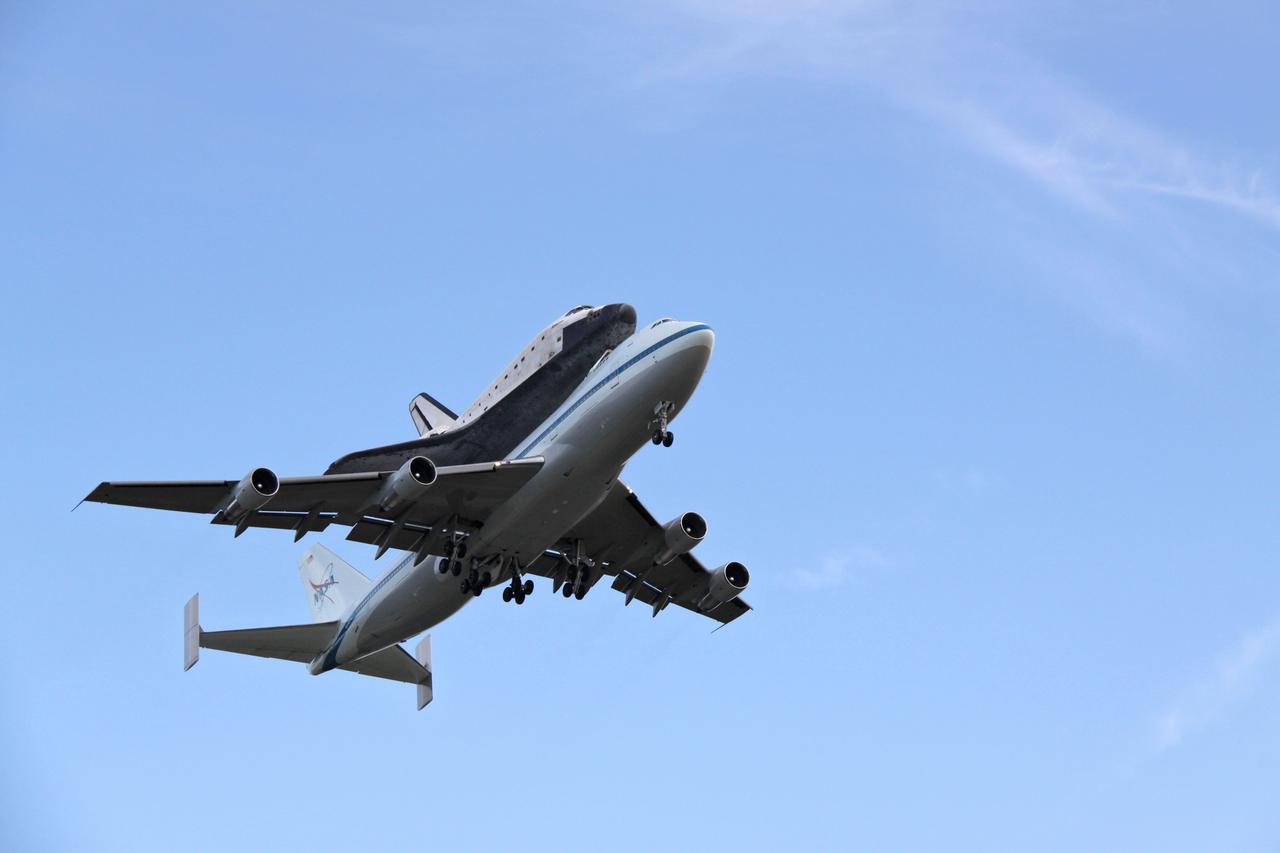
CAPE CANAVERAL, Fla. – After a two-day trip from California, the Shuttle Carrier Aircraft, or SCA, and its piggyback passenger space shuttle Atlantis approach NASA Kennedy Space Center's Shuttle Landing Facility runway. The SCA is a modified Boeing 747 jetliner. Atlantis returned from California atop the SCA after its May 24 landing at Edwards Air Force Base, concluding mission STS-125. The ferry flight from Edwards Air Force Base began June 1. Touchdown at Kennedy was at 6:53 p.m. EDT. Photo credit: NASA/Jack Pfaller
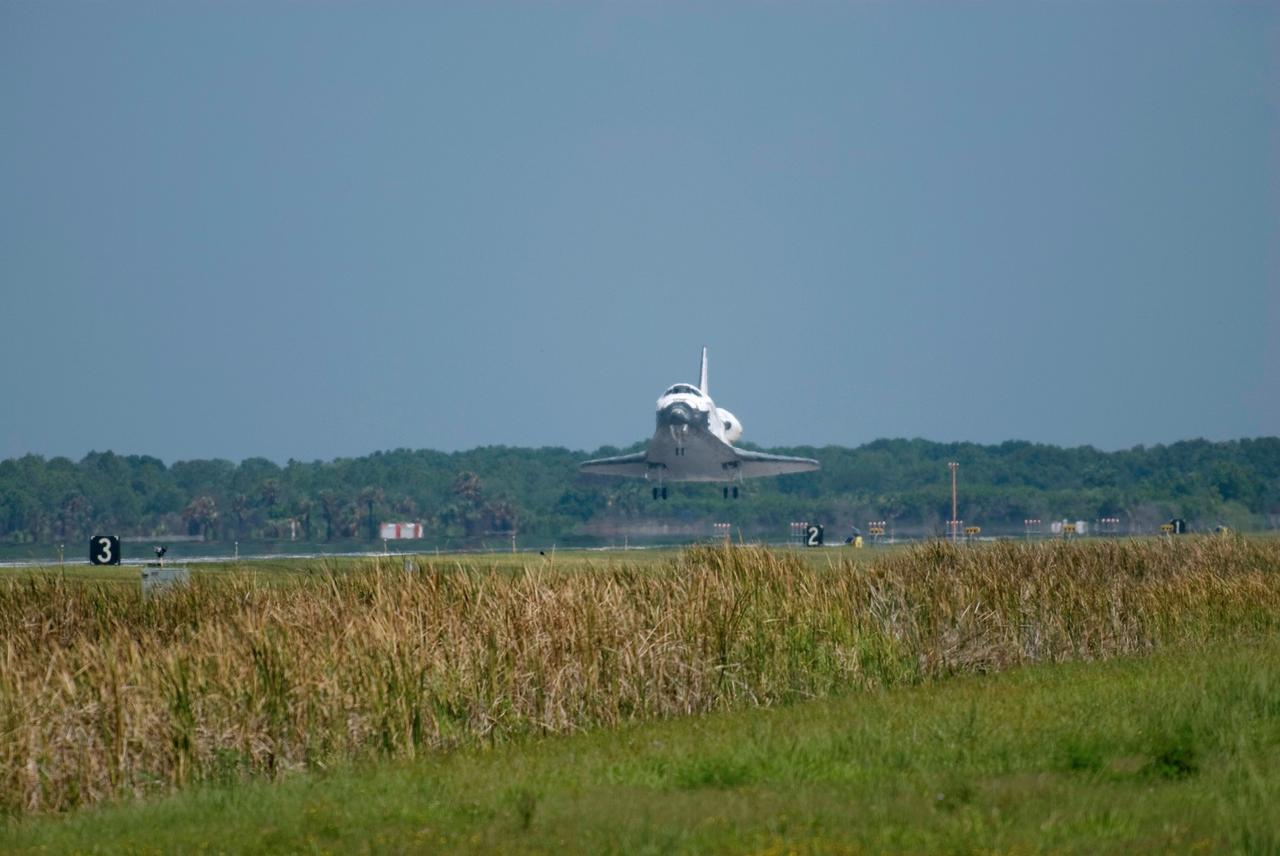
CAPE CANAVERAL, Fla. – In the 69th landing at NASA's Kennedy Space Center, space shuttle Discovery approaches landing on Runway 15 to end the STS-124 mission, a 14-day flight to the International Space Station. The main landing gear touched down at 11:15:19 a.m. EDT. The nose landing gear touched down at 11:15:30 a.m. and wheel stop was at 11:16:19 a.m. The mission completed 5.7 million miles. The STS-124 mission delivered the Japan Aerospace Exploration Agency's large Japanese Pressurized Module and its remote manipulator system to the space station. Photo credit: NASA/Chris Lynch

CAPE CANAVERAL, Fla. – Under blue skies, space shuttle Discovery approaches landing on Runway 15 to end the STS-124 mission, a 14-day flight to the International Space Station. This landing was the 69th at NASA's Kennedy Space Center. The main landing gear touched down at 11:15:19 a.m. EDT. The nose landing gear touched down at 11:15:30 a.m. and wheel stop was at 11:16:19 a.m. The mission completed 5.7 million miles. The STS-124 mission delivered the Japan Aerospace Exploration Agency's large Japanese Pressurized Module and its remote manipulator system to the space station. Photo credit: NASA/Mike Gayle
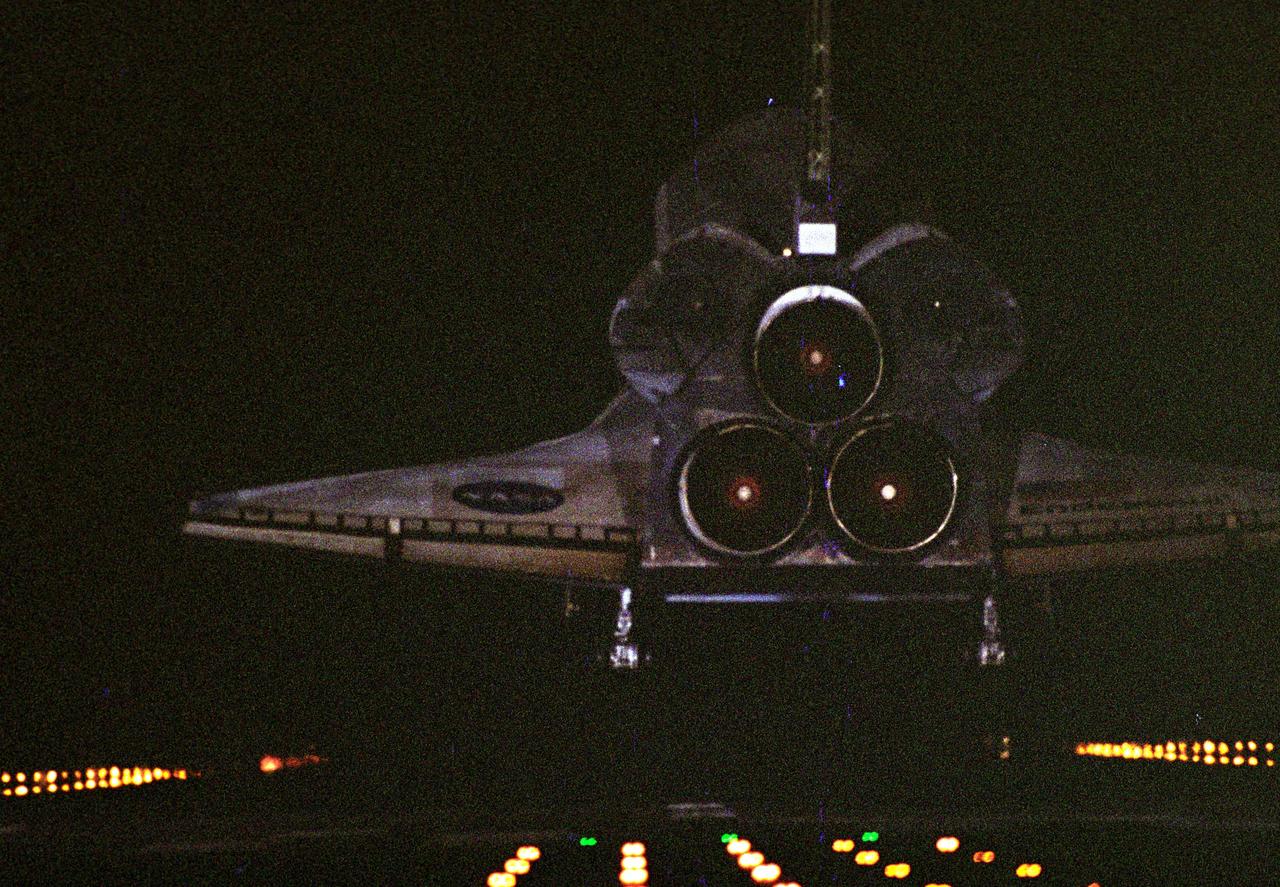
CAPE CANAVERAL, Fla. --- In the 16th night landing at NASA's Kennedy Space Center, space shuttle Endeavour approaches Runway 15 to end the STS-123 mission, a 16-day flight to the International Space Station. The main landing gear touched down at 8:39:08 p.m. EDT. The nose landing gear touched down at 8:39:17 p.m. and wheel stop was at 8:40:41 p.m. The mission completed nearly 6.6 million miles. The landing was the second opportunity after the first was waved off due to unstable weather in the Kennedy Space Center area. Photo credit: NASA/Tony Gray, Kevin O'Connell, Scott Haun
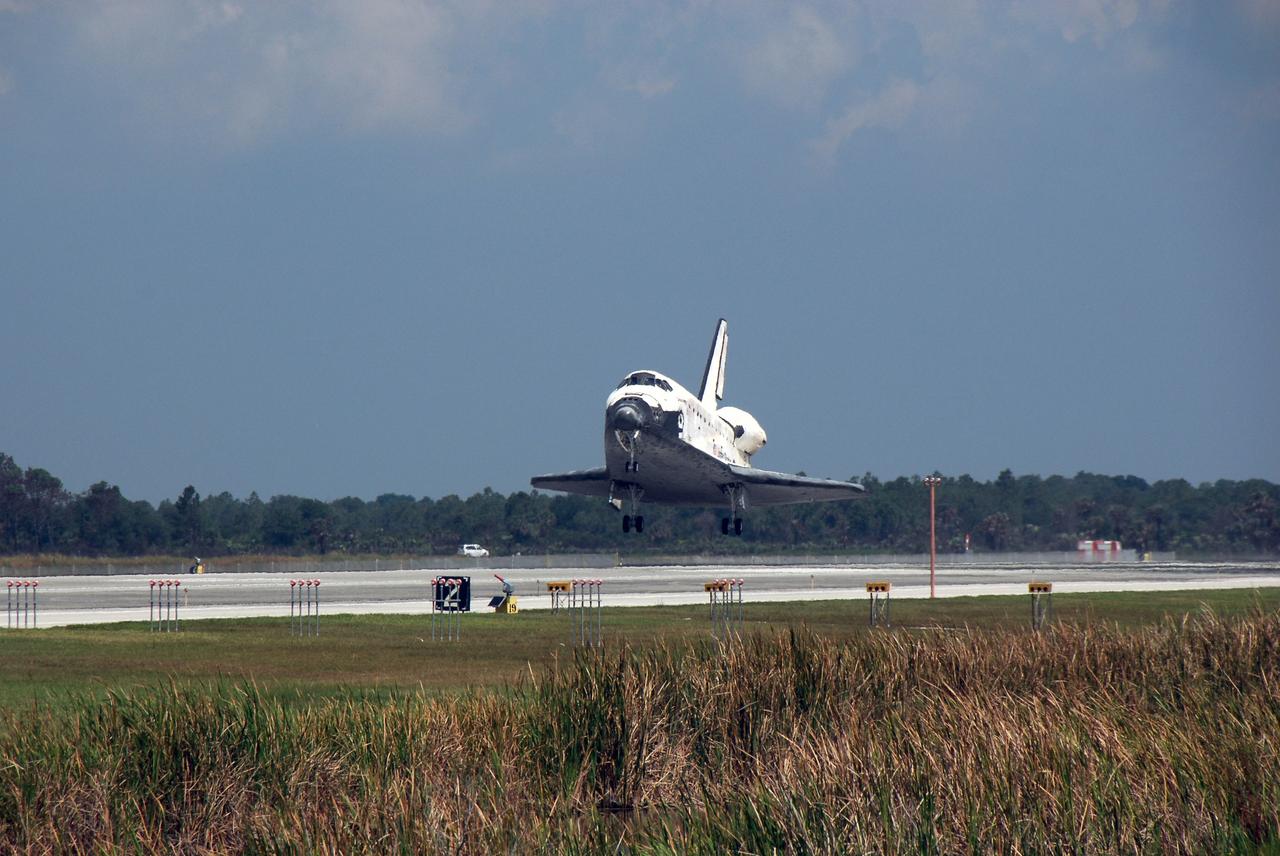
CAPE CANAVERAL, Fla. – In the 69th landing at NASA's Kennedy Space Center, space shuttle Discovery approaches landing on Runway 15 to end the STS-124 mission, a 14-day flight to the International Space Station. The main landing gear touched down at 11:15:19 a.m. EDT. The nose landing gear touched down at 11:15:30 a.m. and wheel stop was at 11:16:19 a.m. The mission completed 5.7 million miles. The STS-124 mission delivered the Japan Aerospace Exploration Agency's large Japanese Pressurized Module and its remote manipulator system to the space station. Photo credit: NASA/Kim Shiflett
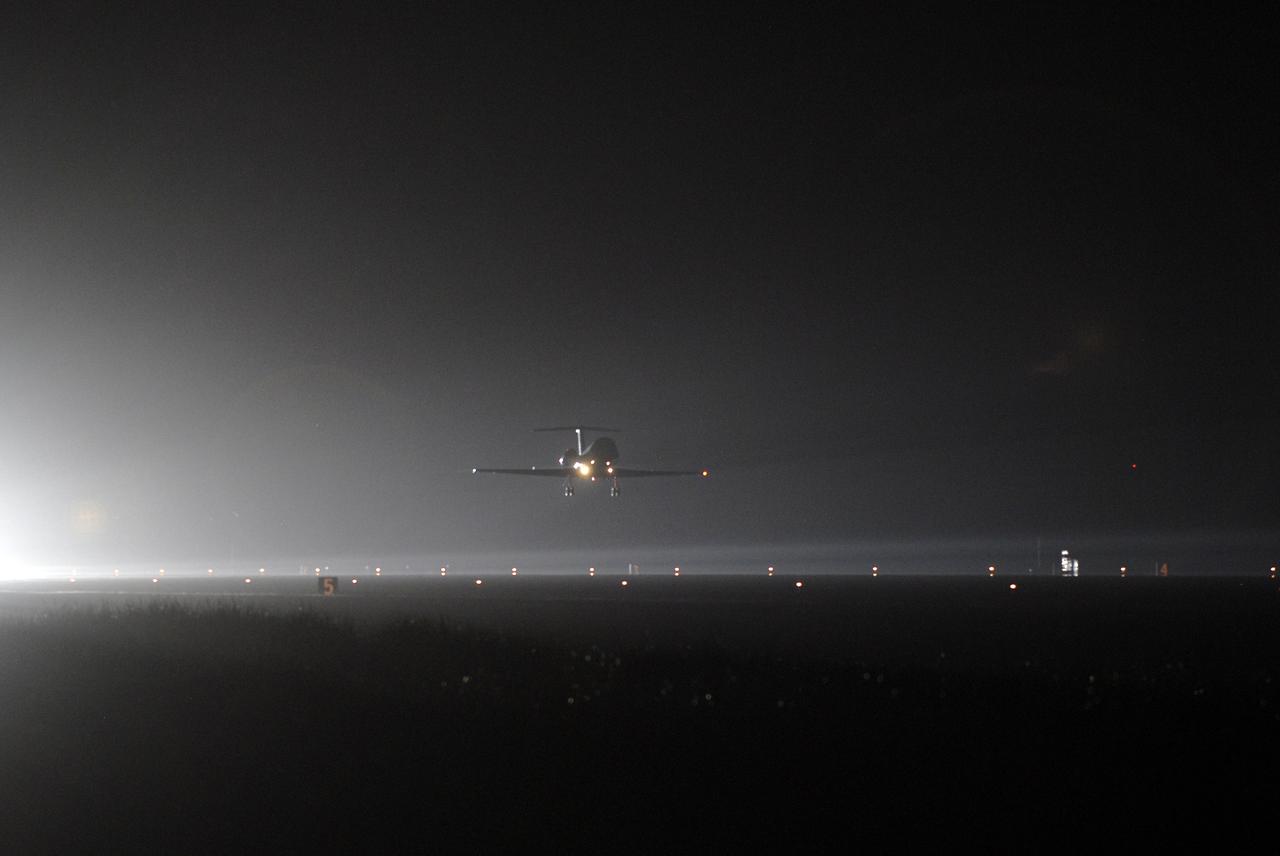
CAPE CANAVERAL, Fla. –At the Shuttle Landing Facility at NASA's Kennedy Space Center in Florida, a Shuttle Training Aircraft, or STA, approaches the runway during landing practice. STS-128 Commander Rick Sturckow and Pilot Kevin Ford are using the STAs to practice shuttle landings. The practice is in preparation for launch of space shuttle Discovery's STS-128 mission in late August to the International Space Station. The STA is a Grumman American Aviation-built Gulfstream II jet that was modified to simulate a shuttle’s cockpit, motion and visual cues, and handling qualities. The STS-128 crew is at Kennedy for a launch dress rehearsal called the terminal countdown demonstration test, or TCDT, which includes emergency exit training and equipment familiarization, as well as a simulated launch countdown. Discovery will deliver 33,000 pounds of equipment to the station, including science and storage racks, a freezer to store research samples, a new sleeping compartment and the COLBERT treadmill. Photo credit: NASA/Kim Shiflett
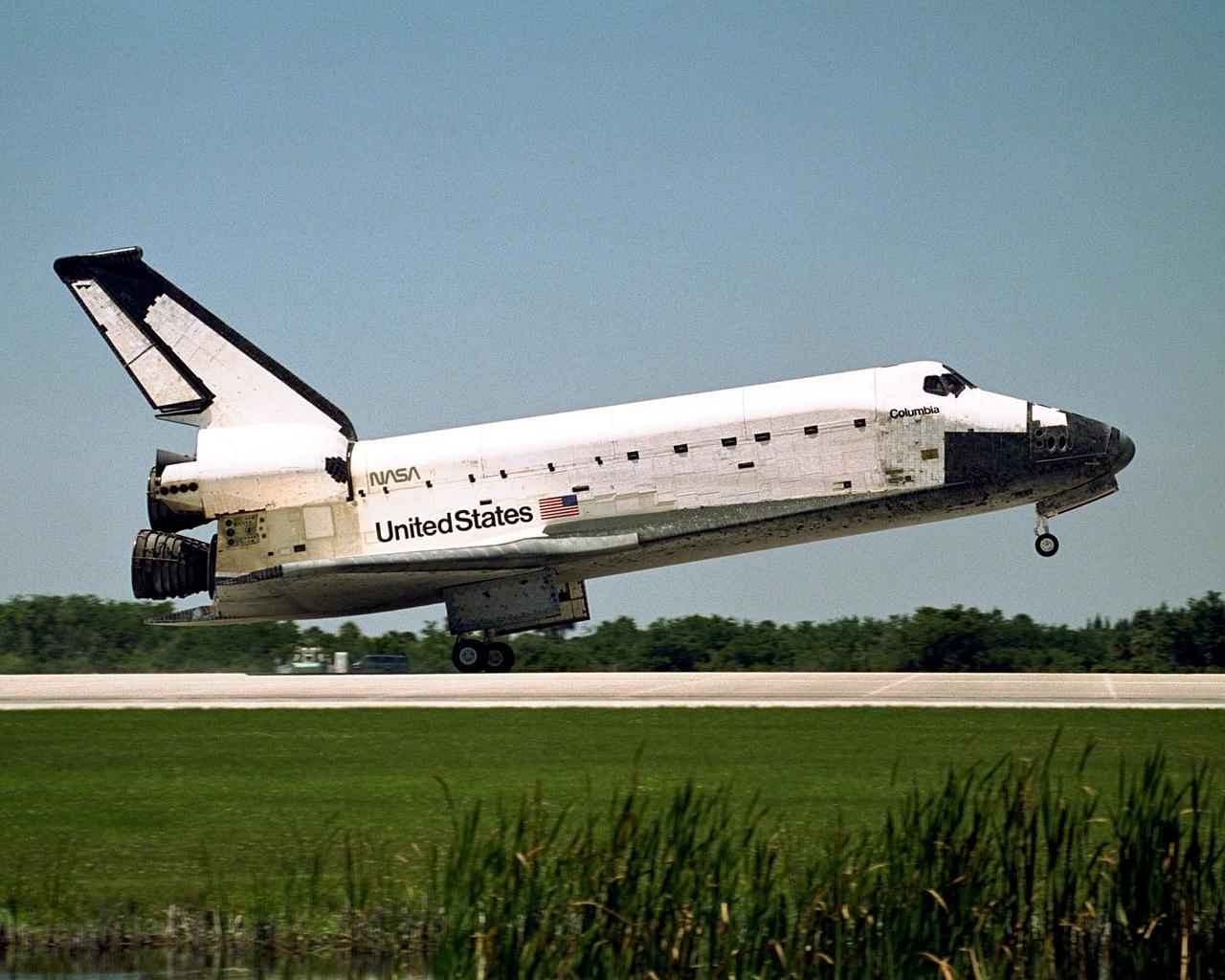
The orbiter Columbia approaches touchdown on Runway 33 of KSC's Shuttle Landing Facility to complete the nearly 16-day STS-90 mission. Main gear touchdown was at 12:08:59 p.m. EDT on May 3, 1998, landing on orbit 256 of the mission. The wheels stopped at 12:09:58 EDT, completing a total mission time of 15 days, 21 hours, 50 minutes and 58 seconds. The 90th Shuttle mission was Columbia's 13th landing at the space center and the 43rd KSC landing in the history of the Space Shuttle program. During the mission, the crew conducted research to contribute to a better understanding of the human nervous system. The crew of the STS-90 Neurolab mission include Commander Richard Searfoss; Pilot Scott Altman; Mission Specialists Richard Linnehan, D.V.M., Dafydd (Dave) Williams, M.D., with the Canadian Space Agency, and Kathryn (Kay) Hire; and Payload Specialists Jay Buckey, M.D., and James Pawelczyk, Ph.D
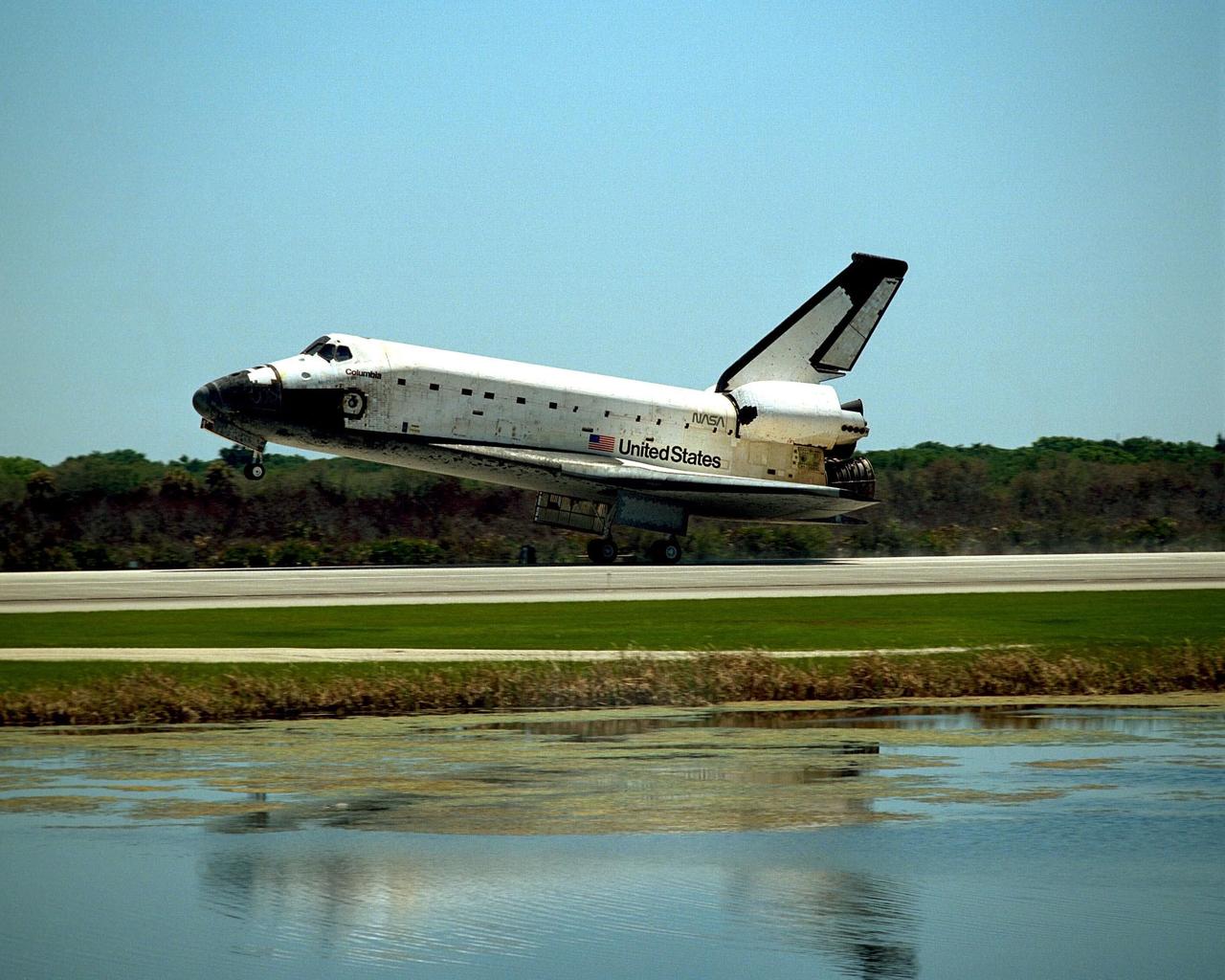
The orbiter Columbia approaches touchdown on Runway 33 of KSC's Shuttle Landing Facility to complete the nearly 16-day STS-90 mission. Main gear touchdown was at 12:08:59 p.m. EDT on May 3, 1998, landing on orbit 256 of the mission. The wheels stopped at 12:09:58 EDT, completing a total mission time of 15 days, 21 hours, 50 minutes and 58 seconds. The 90th Shuttle mission was Columbia's 13th landing at the space center and the 43rd KSC landing in the history of the Space Shuttle program. During the mission, the crew conducted research to contribute to a better understanding of the human nervous system. The crew of the STS-90 Neurolab mission include Commander Richard Searfoss; Pilot Scott Altman; Mission Specialists Richard Linnehan, D.V.M., Dafydd (Dave) Williams, M.D., with the Canadian Space Agency, and Kathryn (Kay) Hire; and Payload Specialists Jay Buckey, M.D., and James Pawelczyk, Ph.D
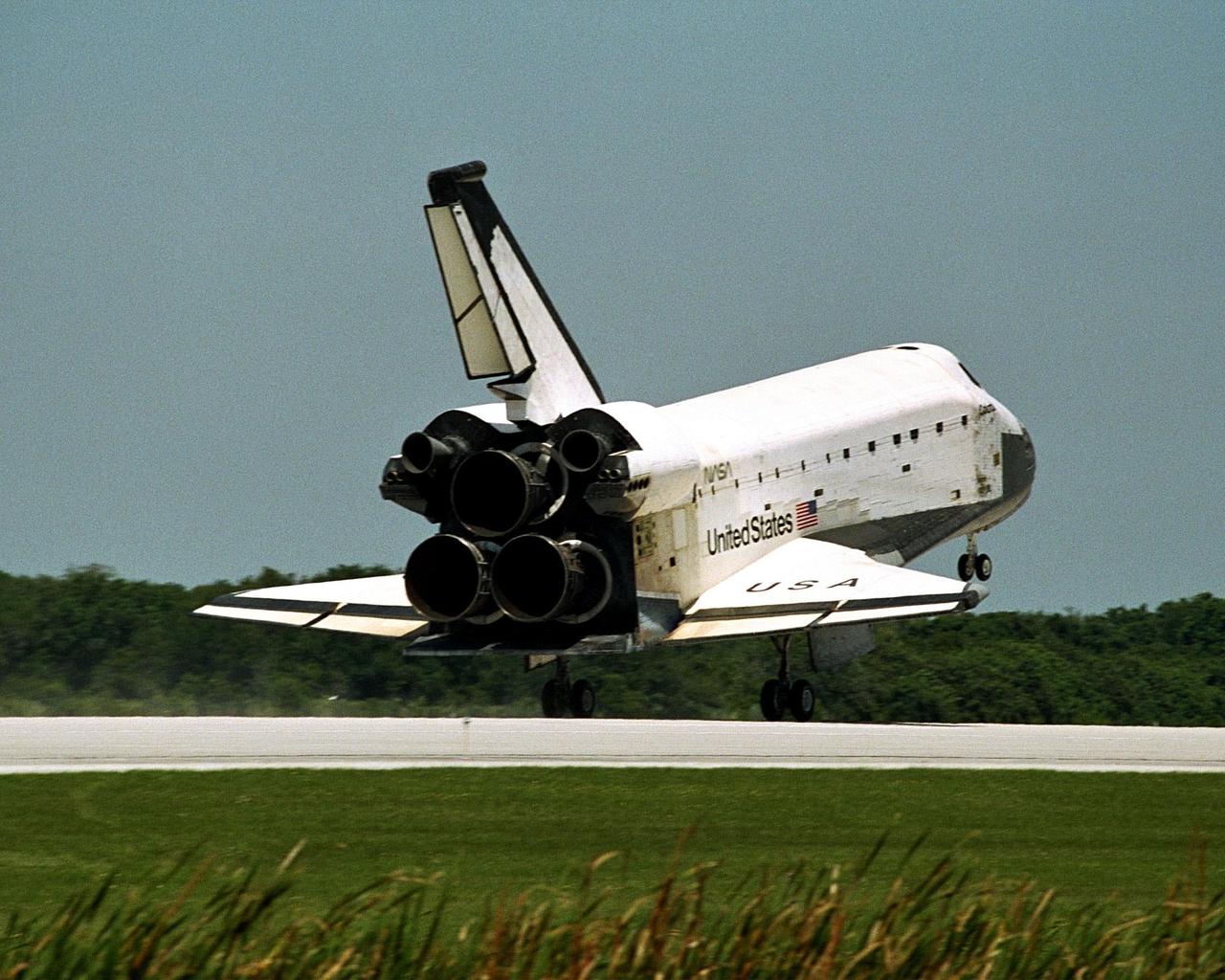
The orbiter Columbia approaches touchdown on Runway 33 of KSC's Shuttle Landing Facility to complete the nearly 16-day STS-90 mission. Main gear touchdown was at 12:08:59 p.m. EDT on May 3, 1998, landing on orbit 256 of the mission. The wheels stopped at 12:09:58 EDT, completing a total mission time of 15 days, 21 hours, 50 minutes and 58 seconds. The 90th Shuttle mission was Columbia's 13th landing at the space center and the 43rd KSC landing in the history of the Space Shuttle program. During the mission, the crew conducted research to contribute to a better understanding of the human nervous system. The crew of the STS-90 Neurolab mission include Commander Richard Searfoss; Pilot Scott Altman; Mission Specialists Richard Linnehan, D.V.M., Dafydd (Dave) Williams, M.D., with the Canadian Space Agency, and Kathryn (Kay) Hire; and Payload Specialists Jay Buckey, M.D., and James Pawelczyk, Ph.D
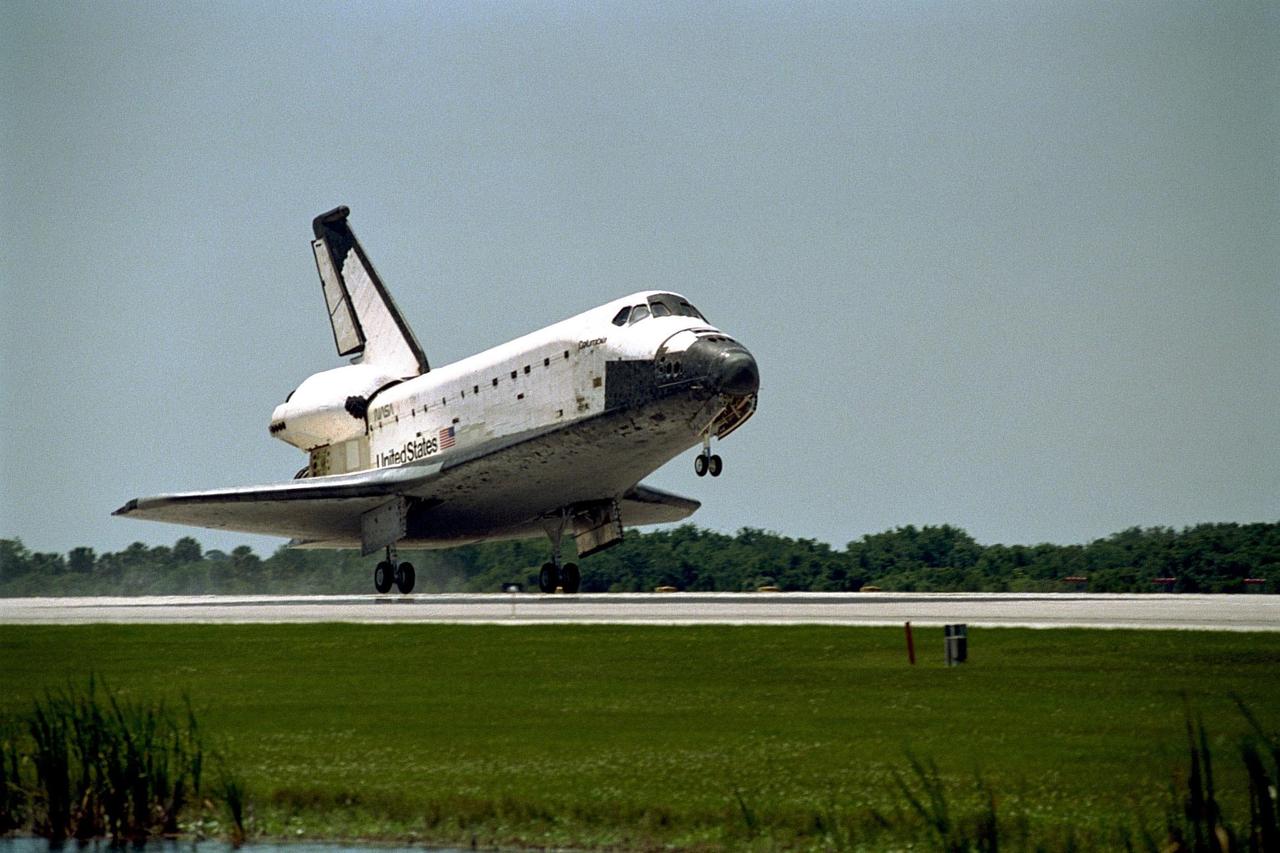
The orbiter Columbia approaches touchdown on Runway 33 of KSC's Shuttle Landing Facility to complete the nearly 16-day STS-90 mission. Main gear touchdown was at 12:08:59 p.m. EDT on May 3, 1998, landing on orbit 256 of the mission. The wheels stopped at 12:09:58 EDT, completing a total mission time of 15 days, 21 hours, 50 minutes and 58 seconds. The 90th Shuttle mission was Columbia's 13th landing at the space center and the 43rd KSC landing in the history of the Space Shuttle program. During the mission, the crew conducted research to contribute to a better understanding of the human nervous system. The crew of the STS-90 Neurolab mission include Commander Richard Searfoss; Pilot Scott Altman; Mission Specialists Richard Linnehan, D.V.M., Dafydd (Dave) Williams, M.D., with the Canadian Space Agency, and Kathryn (Kay) Hire; and Payload Specialists Jay Buckey, M.D., and James Pawelczyk, Ph.D
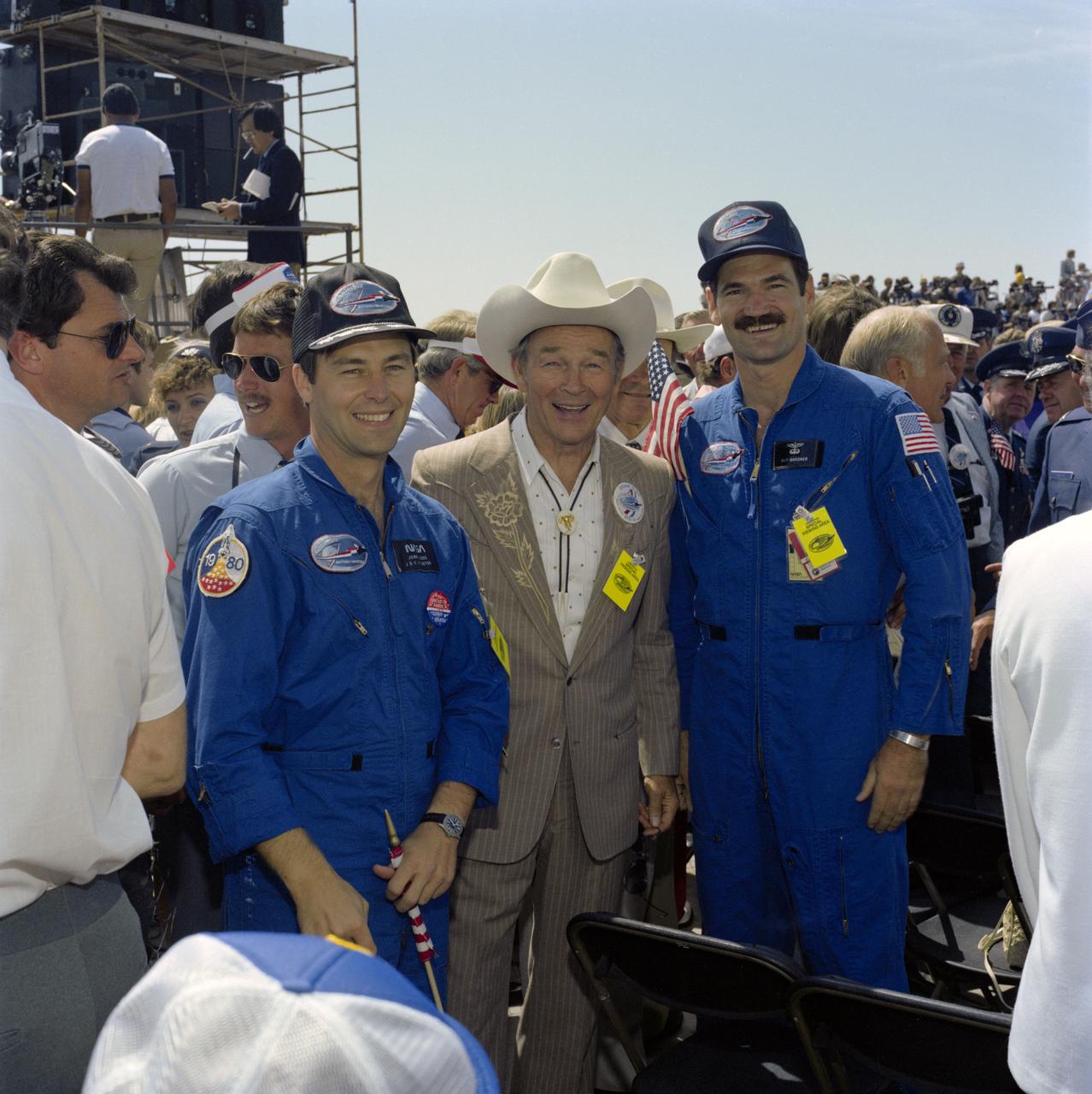
S82-33226 (4 July 1982) --- Inveterate space fan Roy Rogers with astronauts Jerry L. Ross, left, and Guy S. Gardner at Edwards Air Force Base for the landing of the space shuttle Columbia at the conclusion of the STS-4 mission on July 4, 1982. Ross and Gardner piloted chase planes involved in the approach and landing operations for the flight?s conclusion. Also present at the landing was (near far right) former astronaut Edwin E. Aldrin Jr., lunar module pilot for the historic first moon landing of almost 13 years ago. Photo credit: NASA
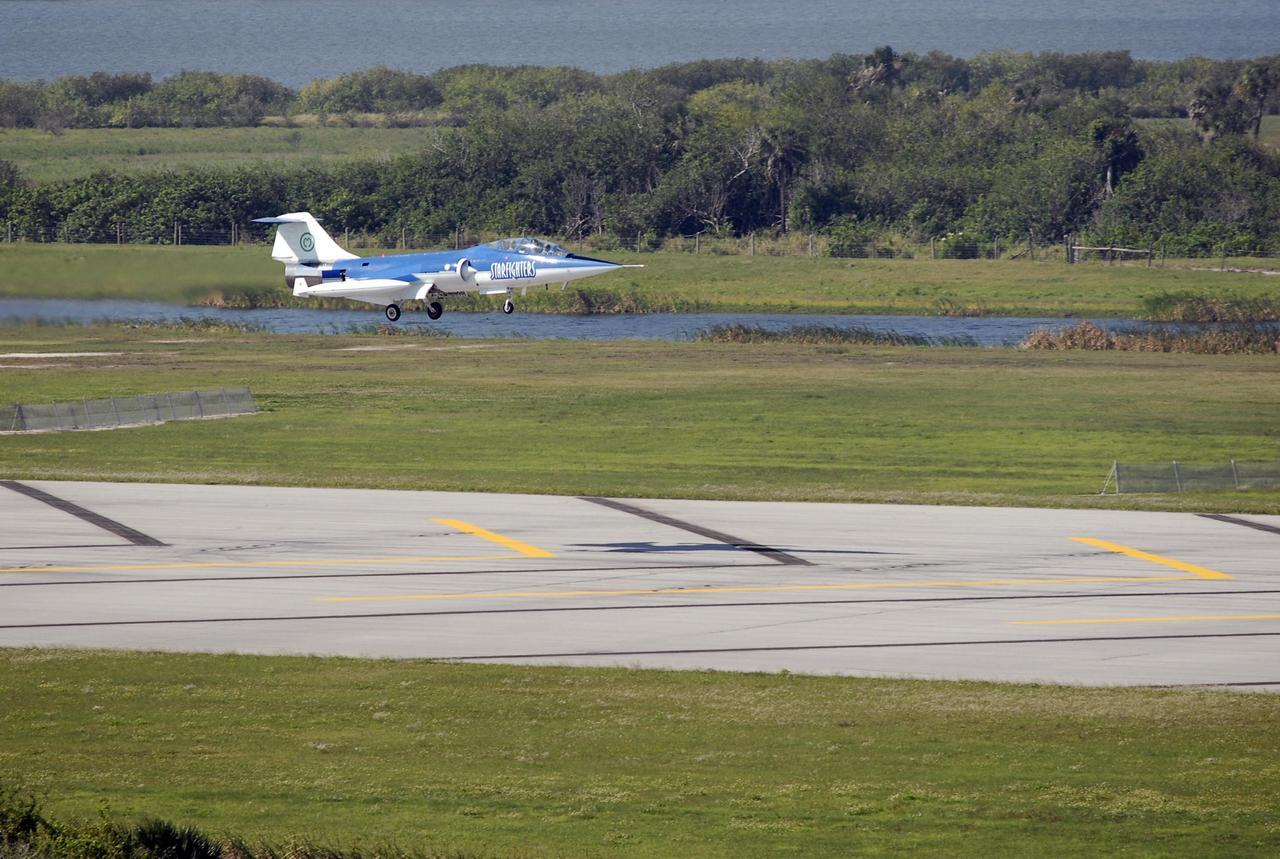
KENNEDY SPACE CENTER, FLA. -- The Starfighter F-104 approaches the runway at the KSC Shuttle Landing Facility for a landing after its test flight. The aircraft is taking part in a series of pathfinder test missions from the space shuttle runway. Two flights will generate test data to validate sonic boom assumptions about the potential impacts of suborbital and orbital commercial spaceflight from the facility. NASA is assessing the environmental impact of such flights. Starfighters Inc. of Clearwater, Fla., will perform the flights to help in assessing suborbital space launch trajectories from the runway and paving the way for future commercial space tourism and research flights from the facility. Photo credit: NASA/Kim Shiflett
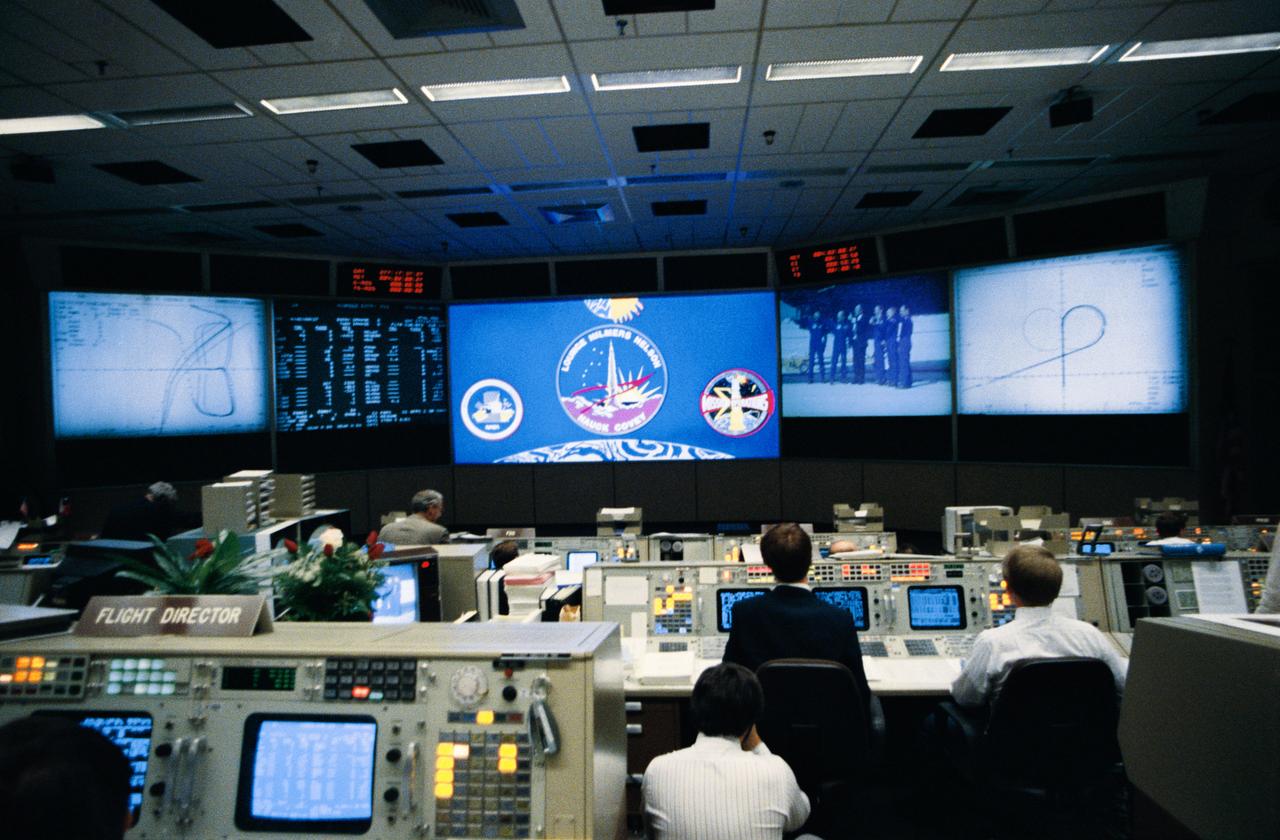
JSC Mission Control Center (MCC) Bldg 30 flight control room (FCR) personnel monitor STS-26 post landing activities and ceremonies at Edwards Air Force Base (EAFB) via their monitors. Displayed on front screens are approach and landing diagrams, data, the space shuttle program insignia, the STS-26 mission insignia, the Mission Operations Directorate insignia, and the STS-26 crew standing in front of Discovery, Orbiter Vehicle (OV) 103.
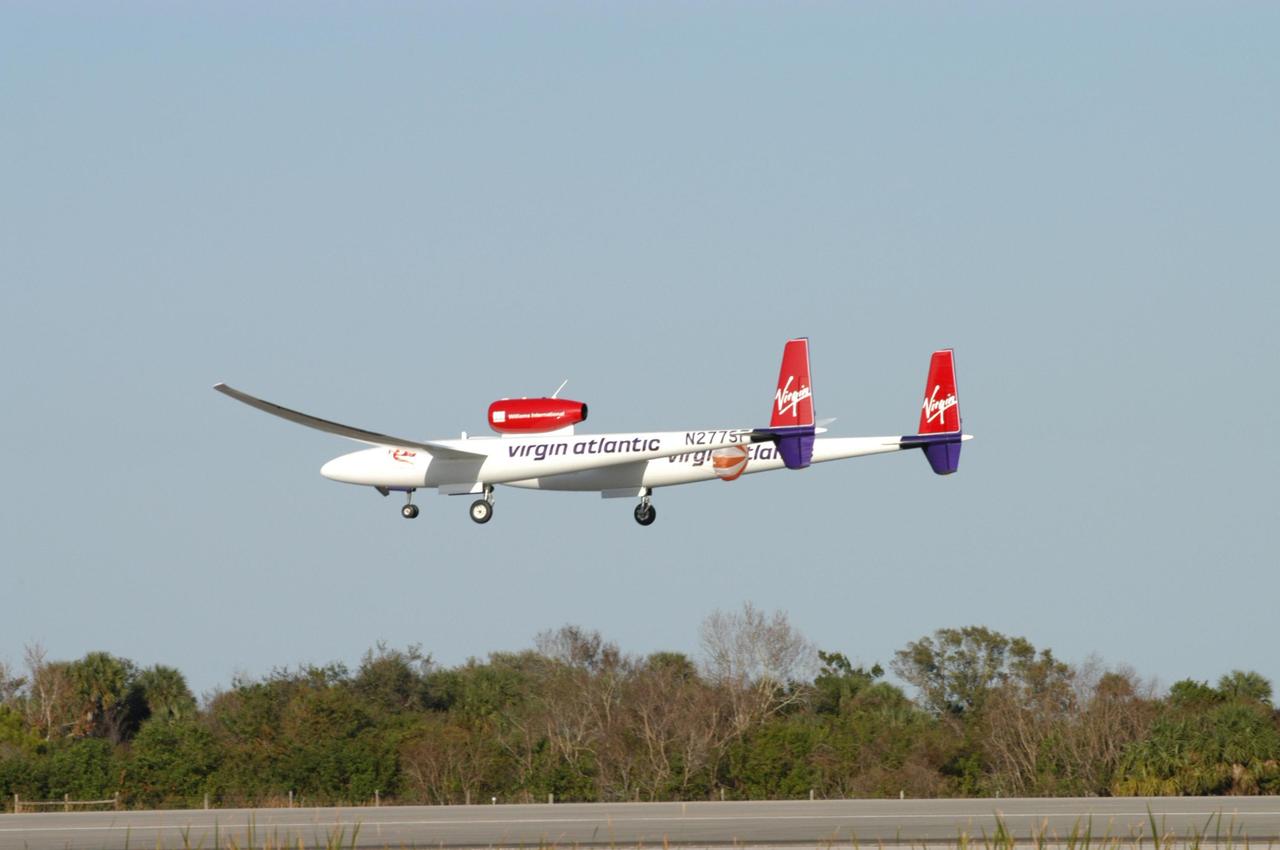
KENNEDY SPACE CENTER, FLA. - The Virgin Atlantic Airways GlobalFlyer aircraft approaches NASA Kennedy Space Center’s Shuttle Landing Facility for a landing. The aircraft, piloted by Steve Fossett, is being relocated from Salina, Kan., to the Shuttle Landing Facility to begin preparations for an attempt to set a new world record for the longest flight made by any aircraft. An exact takeoff date for the record-setting flight has not been determined and is contingent on weather and jet-stream conditions. The window for the attempt opens in mid-January, making the flight possible anytime between then and the end of February. NASA agreed to let Virgin Atlantic Airways use Kennedy's Shuttle Landing Facility as a takeoff site. The facility use is part of a pilot program to expand runway access for non-NASA activities.
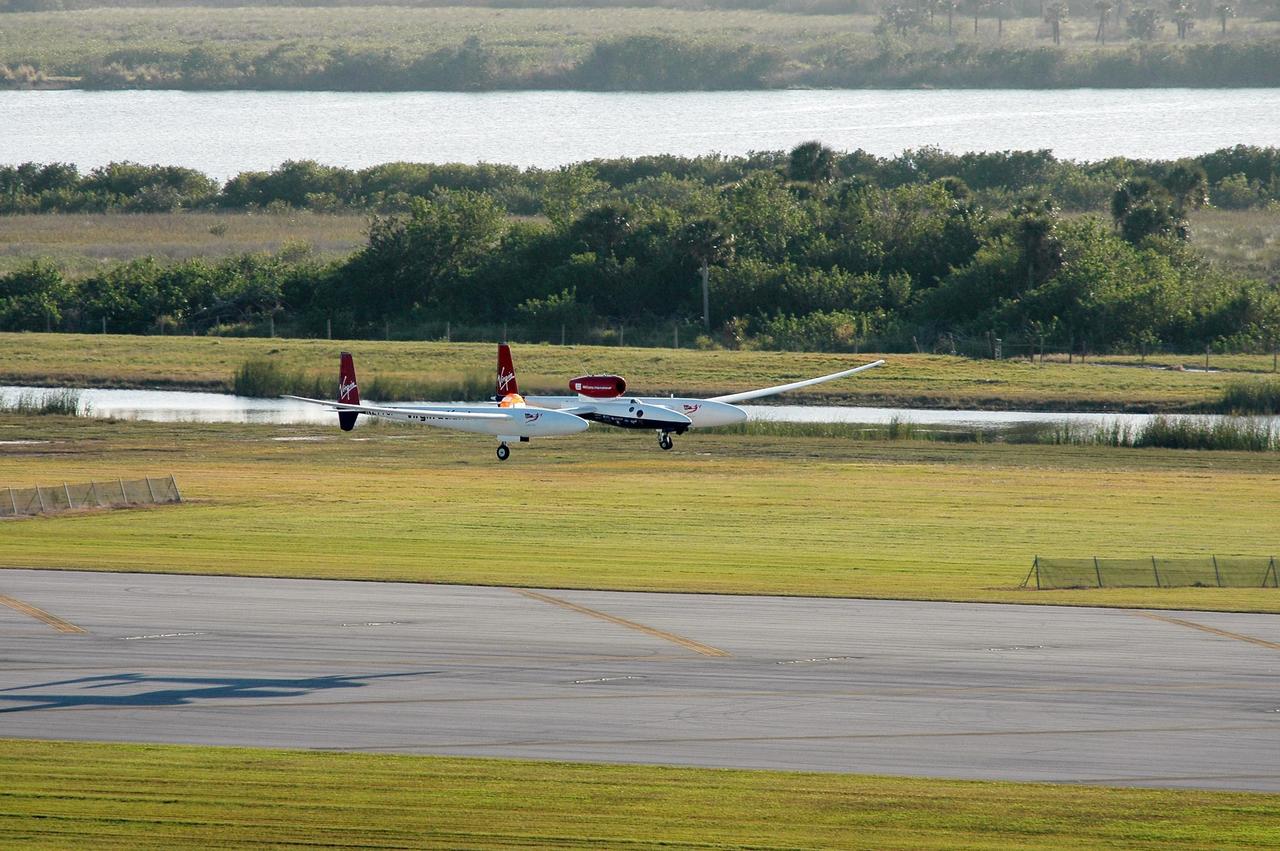
KENNEDY SPACE CENTER, FLA. - The Virgin Atlantic Airways GlobalFlyer aircraft approaches NASA Kennedy Space Center’s Shuttle Landing Facility for a landing. The aircraft, piloted by Steve Fossett, is being relocated from Salina, Kan., to the Shuttle Landing Facility to begin preparations for an attempt to set a new world record for the longest flight made by any aircraft. An exact takeoff date for the record-setting flight has not been determined and is contingent on weather and jet-stream conditions. The window for the attempt opens in mid-January, making the flight possible anytime between then and the end of February. NASA agreed to let Virgin Atlantic Airways use Kennedy's Shuttle Landing Facility as a takeoff site. The facility use is part of a pilot program to expand runway access for non-NASA activities.
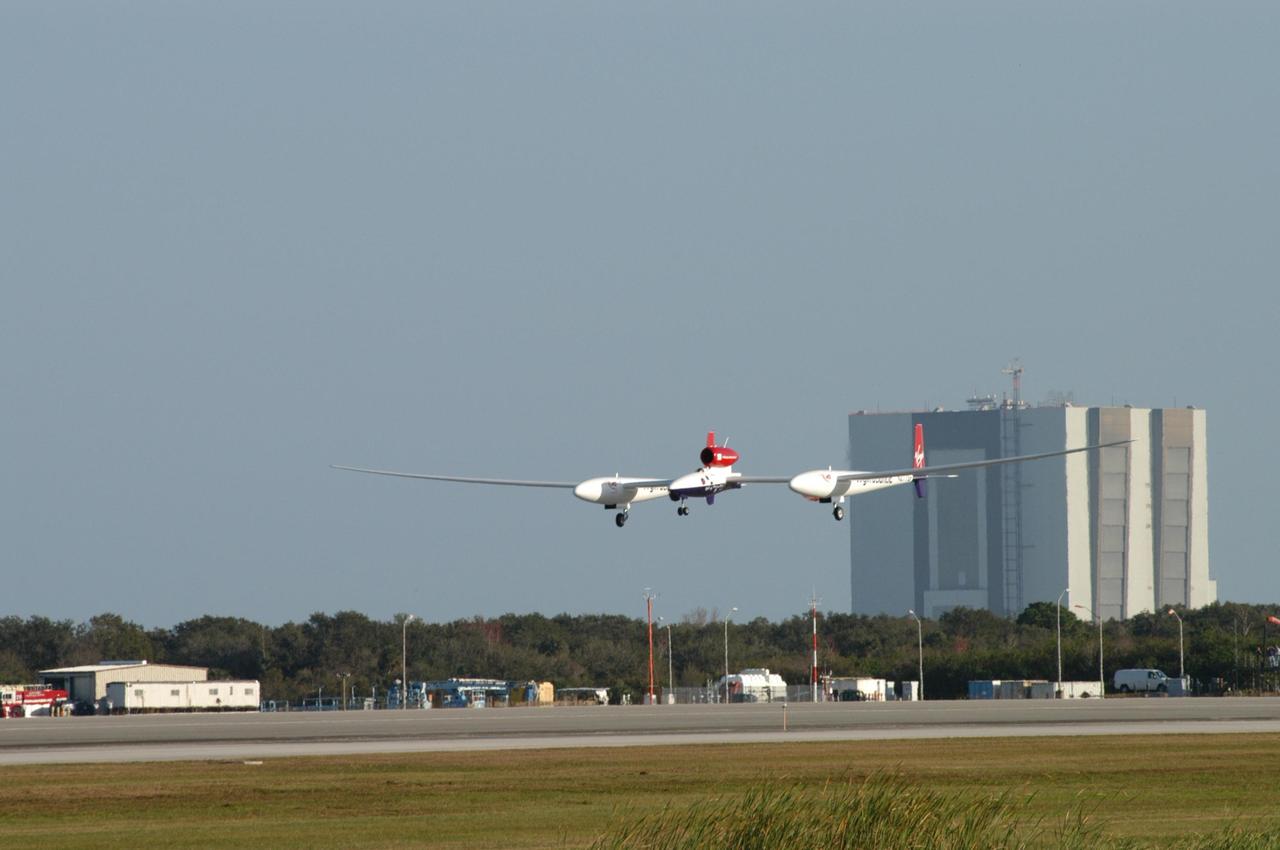
KENNEDY SPACE CENTER, FLA. - The Virgin Atlantic Airways GlobalFlyer aircraft approaches NASA Kennedy Space Center’s Shuttle Landing Facility for a landing. The aircraft, piloted by Steve Fossett, is being relocated from Salina, Kan., to the Shuttle Landing Facility to begin preparations for an attempt to set a new world record for the longest flight made by any aircraft. An exact takeoff date for the record-setting flight has not been determined and is contingent on weather and jet-stream conditions. The window for the attempt opens in mid-January, making the flight possible anytime between then and the end of February. NASA agreed to let Virgin Atlantic Airways use Kennedy's Shuttle Landing Facility as a takeoff site. The facility use is part of a pilot program to expand runway access for non-NASA activities.
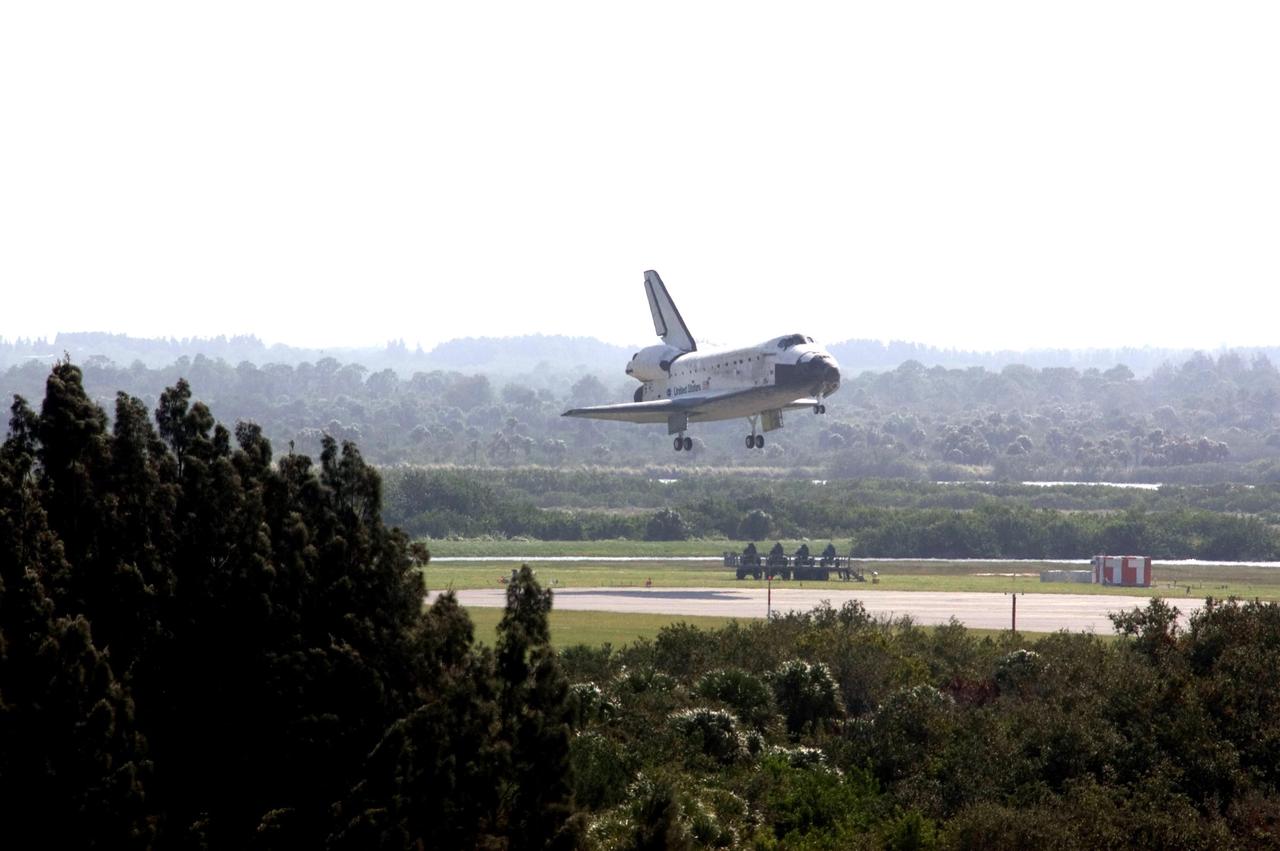
KENNEDY SPACE CENTER, FLA. -- Space shuttle Discovery sinks below the tree line as it approaches landing on Runway 33 of the Shuttle Landing Facility at NASA's Kennedy Space Center, concluding the 15-day mission STS-120. Commander Pamela Melroy is at the controls, along with Pilot George Zamka. Main gear touchdown was 1:01:16 p.m. Wheel stop was at 1:02:07 p.m. Mission elapsed time was 15 days, 2 hours, 24 minutes and 2 seconds. Mission STS-120 continued the construction of the station with the installation of the Harmony Node 2 module and the relocation of the P6 truss. Photo credit: NASA/Scott Haun
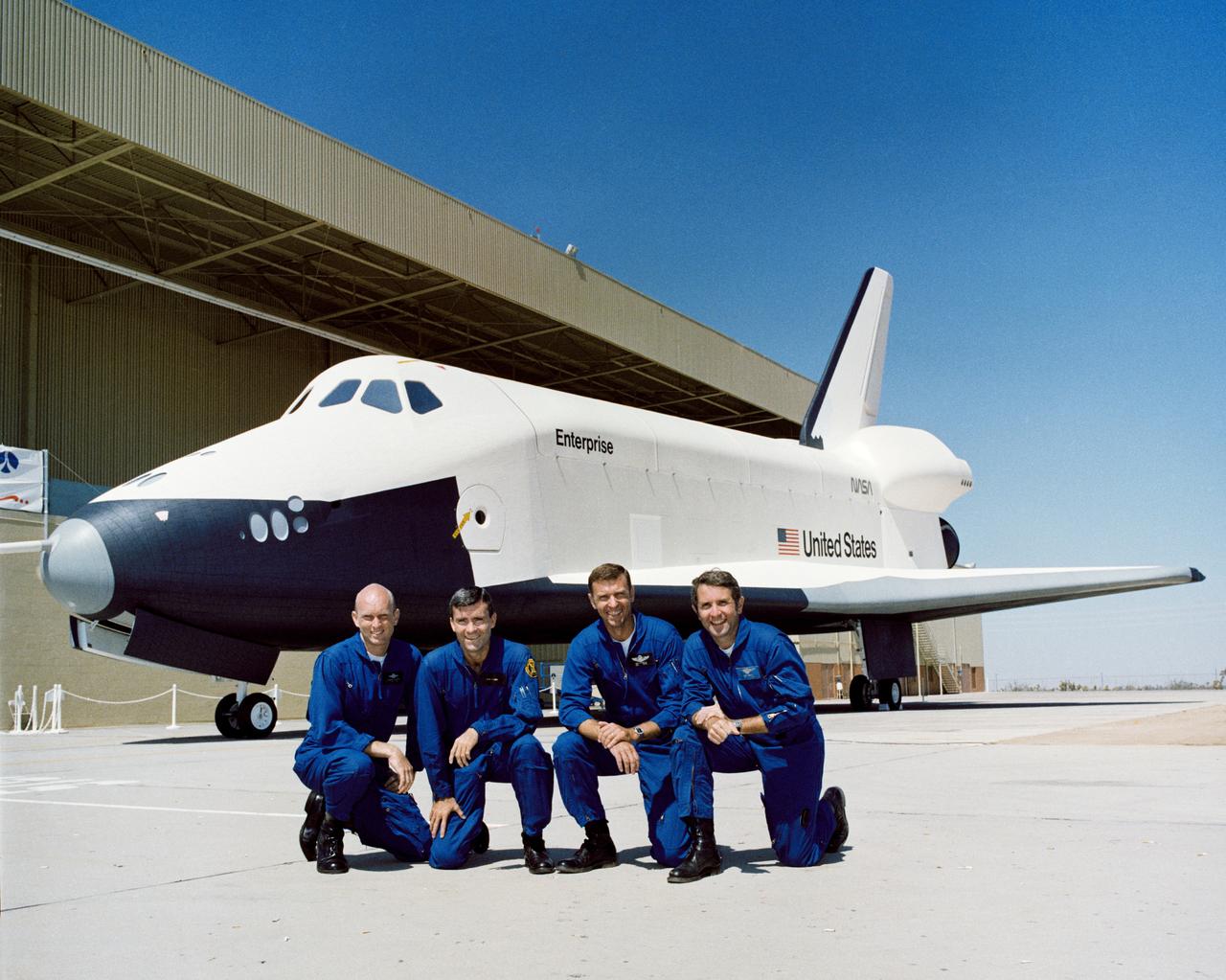
S76-29562 --- The two crews for the Space Shuttle Approach and Landing Tests (ALT) are photographed at the Rockwell International Space Division's Orbiter assembly facility at Palmdale, California on the day of the rollout of the Shuttle Orbiter 101 "Enterprise" spacecraft. They are, left to right, Astronauts C. Gordon Fullerton, pilot of the first crew; Fred W. Haise Jr., commander of the first crew; Joe H. Engle, commander of the second crew; and Richard H. Truly, pilot of the second crew. The DC-9 size airplane-like Orbiter 101 is in the background.
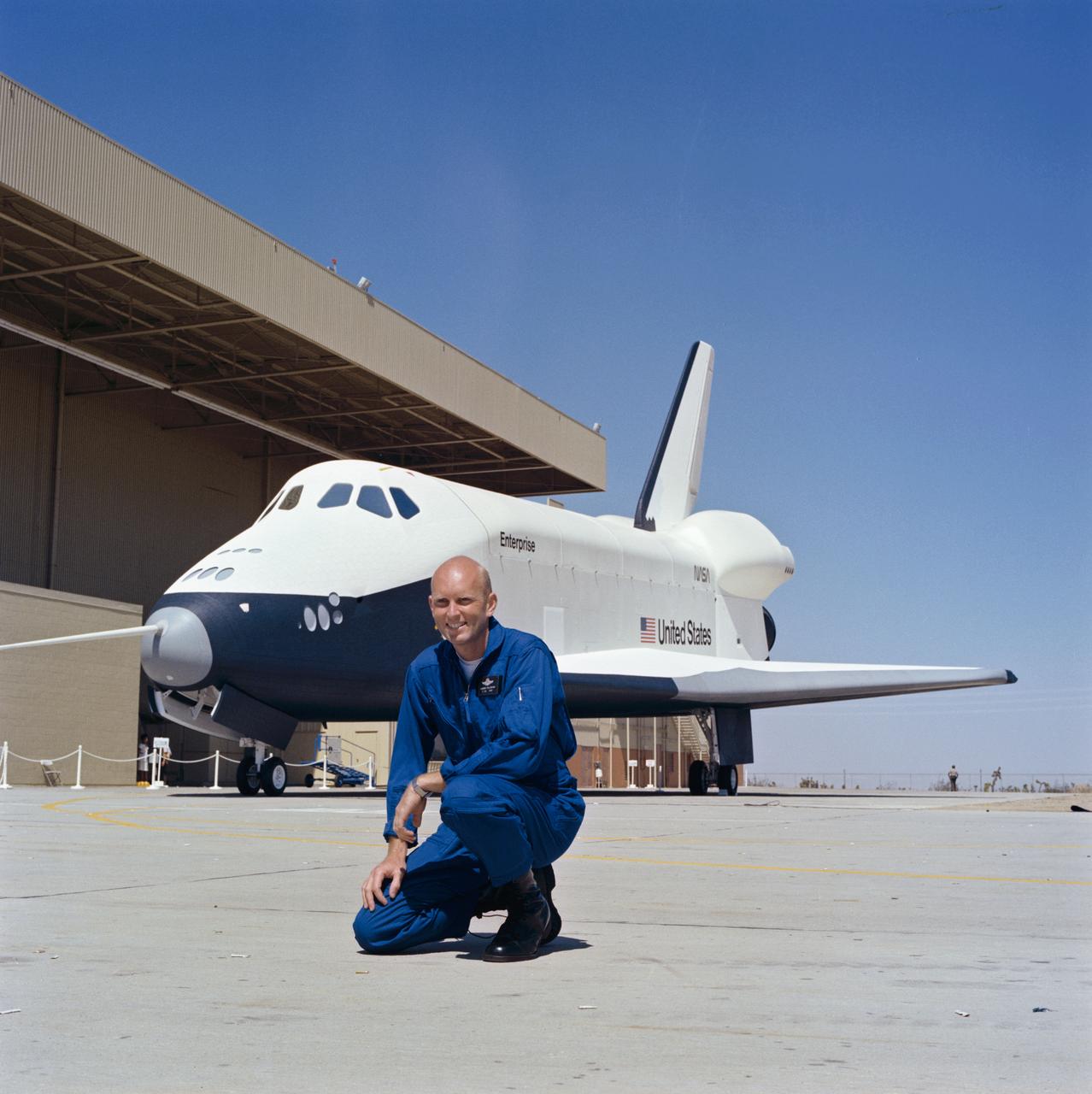
S76-29559 (17 Sept 1976) --- Astronaut C. Gordon Fullerton, pilot of the first crew for the Space Shuttle Approach and Landing Tests (ALT), is photographed at the Rockwell International Space Division's Orbiter assembly facility at Palmdale, California on the day of the rollout of the Shuttle Orbiter 101 "Enterprise" spacecraft. The DC-9 size airplane-like Orbiter 101 is in the background.

S76-29557 (17 Sept 1976) --- The two members of the first crew for the Space Shuttle Approach and Landing Tests (ALT) are photographed at the Rockwell International Space Division's Orbiter assembly facility at Palmdale, California on the day of the rollout of the Shuttle Orbiter 101 "Enterprise" spacecraft. They are Astronauts Fred W. Haise Jr. (left), commander; and C. Gordon Fullerton, pilot. The DC-9 size airplane-like Orbiter 101 is in the background.
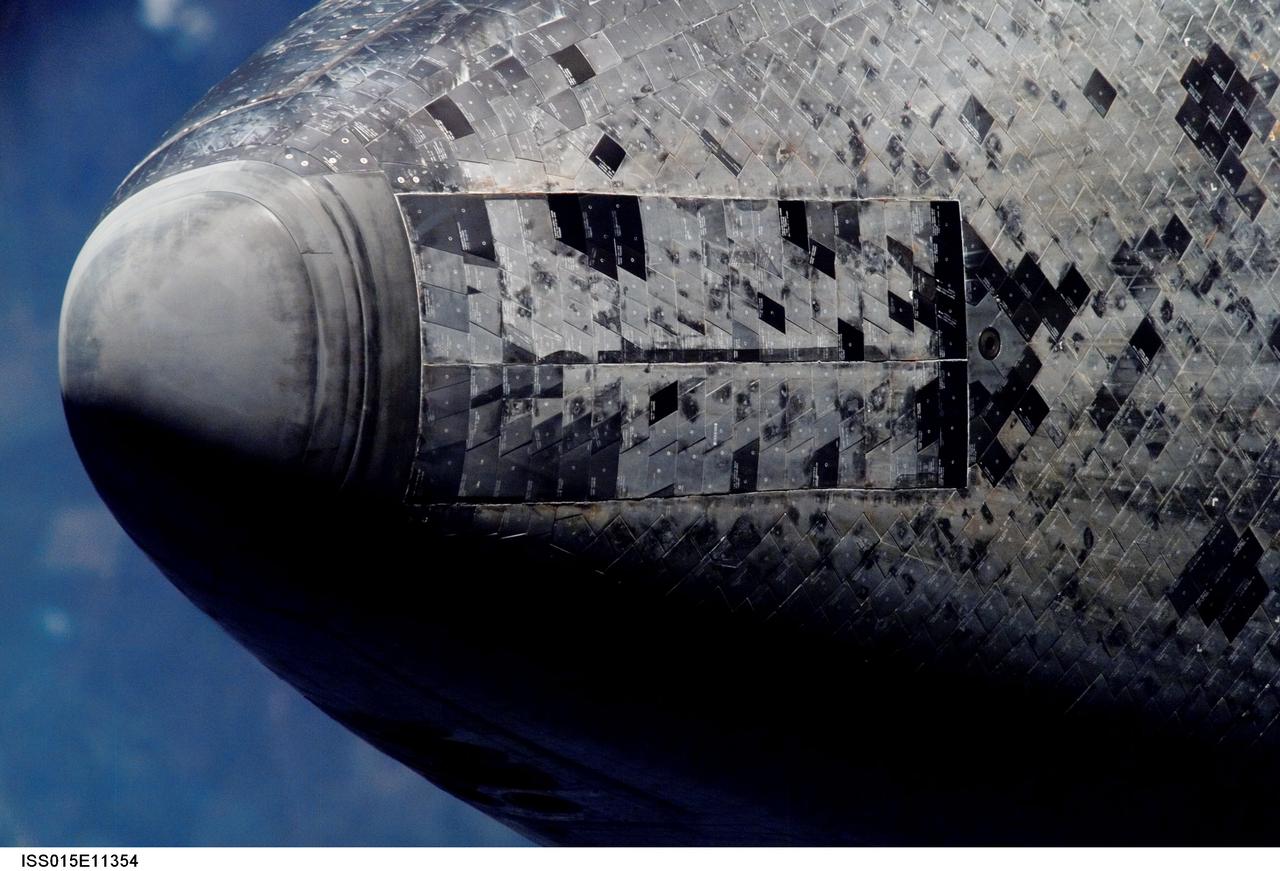
ISS015-E-11354 (10 June 2007) --- This is one of a series of images photographed with a digital still camera using an 800mm focal length featuring the different areas of the Space Shuttle Atlantis as it approached the International Space Station and performed a back-flip to accommodate close scrutiny by eyeballs and cameras. This image shows a view of the underside of nose/nosecap and forward landing gear doors. Distance from the station and shuttle at this time was approximately 600 feet.

STS116-S-079 (22 Dec. 2006) --- David Mould (left), NASA assistant administrator for Public Affairs, Jim Kennedy (center), director of Kennedy Space Center and Michael Griffin, NASA administrator, follow the Space Shuttle Discovery as it approaches Runway 15 at the Shuttle Landing Facility. The STS-116 crew completed its mission at 5:32 p.m. (EST), Dec. 22. (Photo credit: NASA/Bill Ingalls)
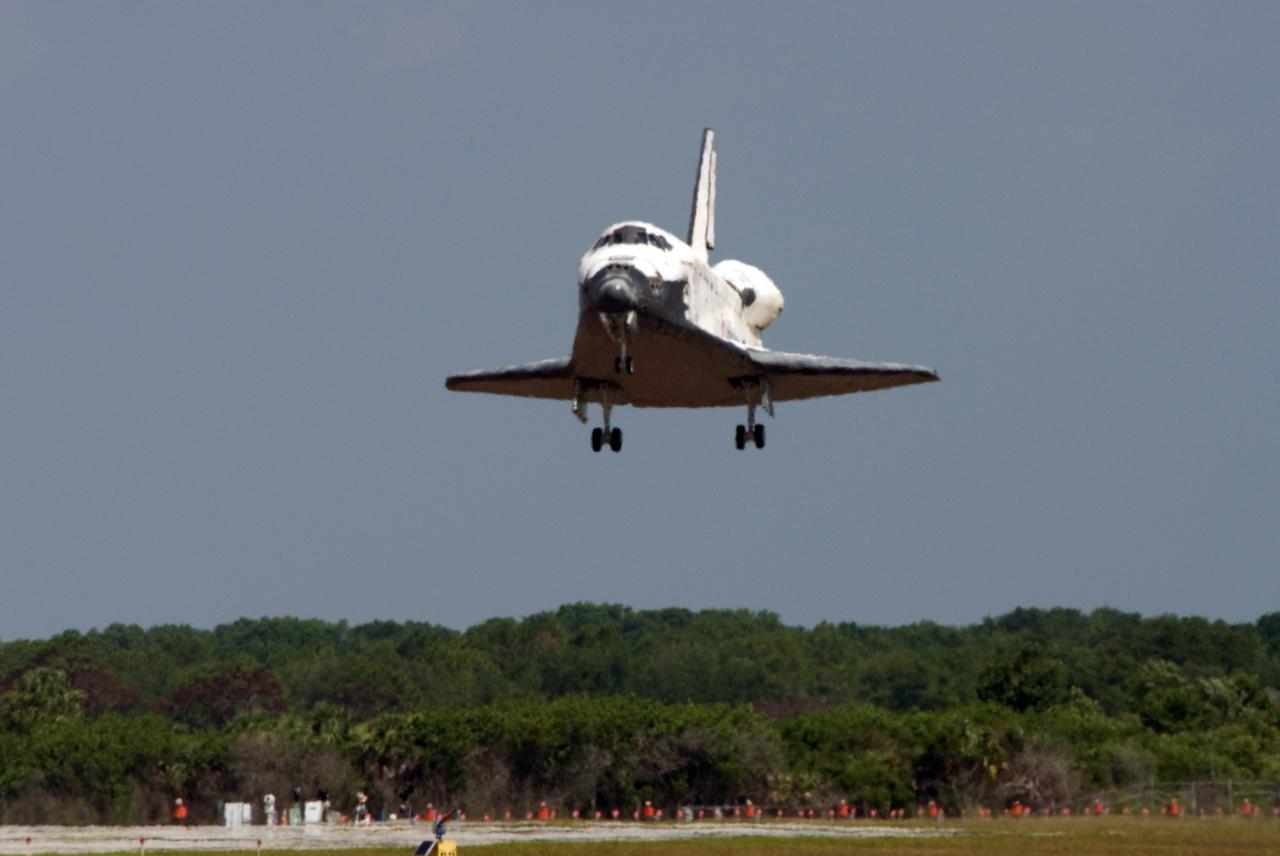
CAPE CANAVERAL, Fla. – Space shuttle Discovery approaches Runway 15 at NASA's Kennedy Space Center to end the STS-124 mission, a 14-day flight to the International Space Station. This landing was the 69th at NASA's Kennedy Space Center. The main landing gear touched down at 11:15:19 a.m. EDT. The nose landing gear touched down at 11:15:30 a.m. and wheel stop was at 11:16:19 a.m. The mission completed 5.7 million miles. The STS-124 mission delivered the Japan Aerospace Exploration Agency's large Japanese Pressurized Module and its remote manipulator system to the space station. Photo credit: NASA/Mike Kerley
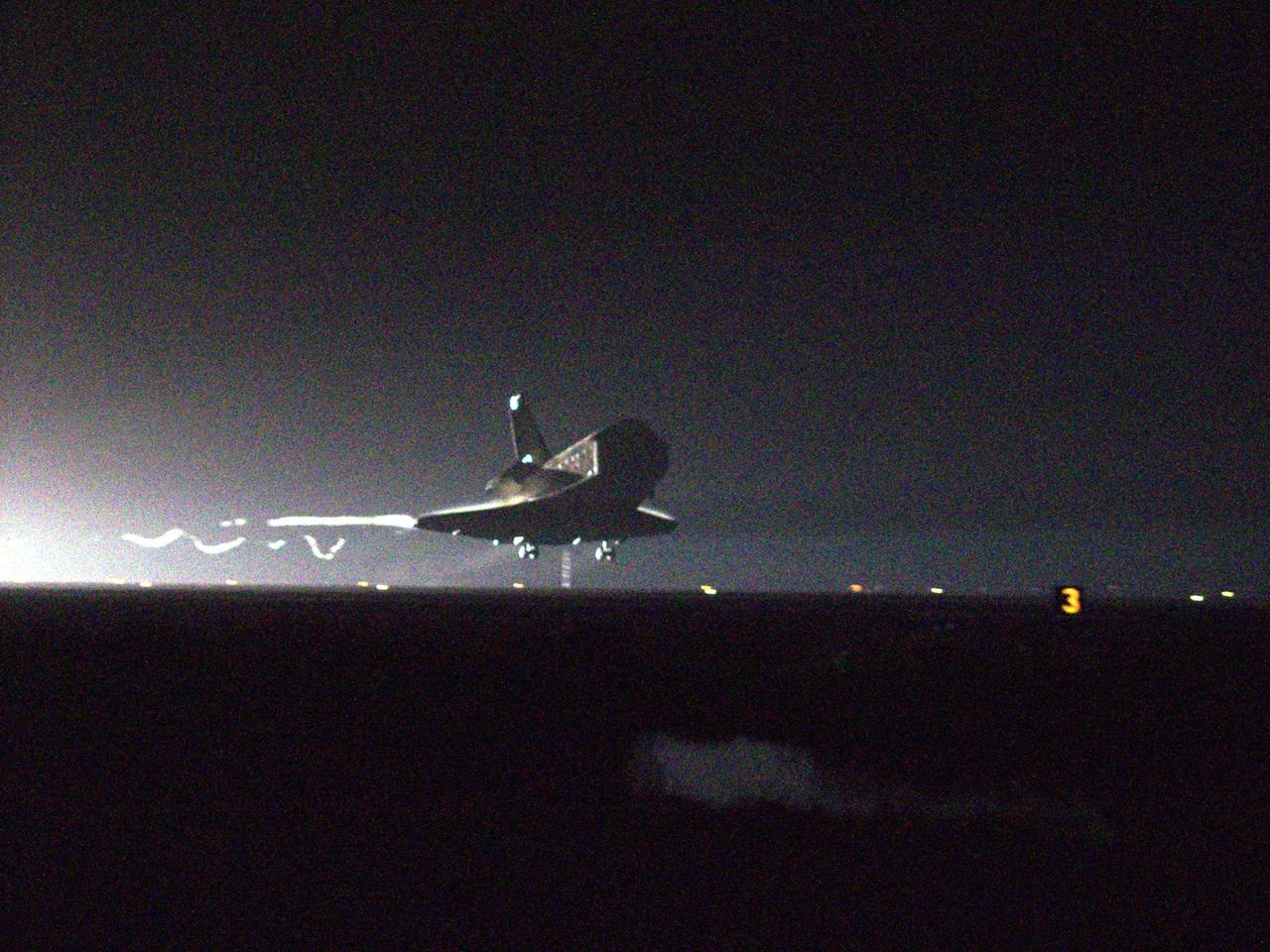
KENNEDY SPACE CENTER, FLA. -- Orbiter Columbia, with its crew of seven, approaches touchdown on Runway 33 of the KSC Shuttle Landing Facility, completing mission STS-109 to service the Hubble Space Telescope. Wheel stop occurred on orbit 165 at 4:33:09 a.m. EST with mission elapsed time of 10 days, 22 hours, 11 minutes. Main gear touchdown occurred at 4:31:52 a.m. and nose wheel touchdown an 4:32:02. It was the 58th landing at KSC out of 108 missions in the history of the Shuttle program
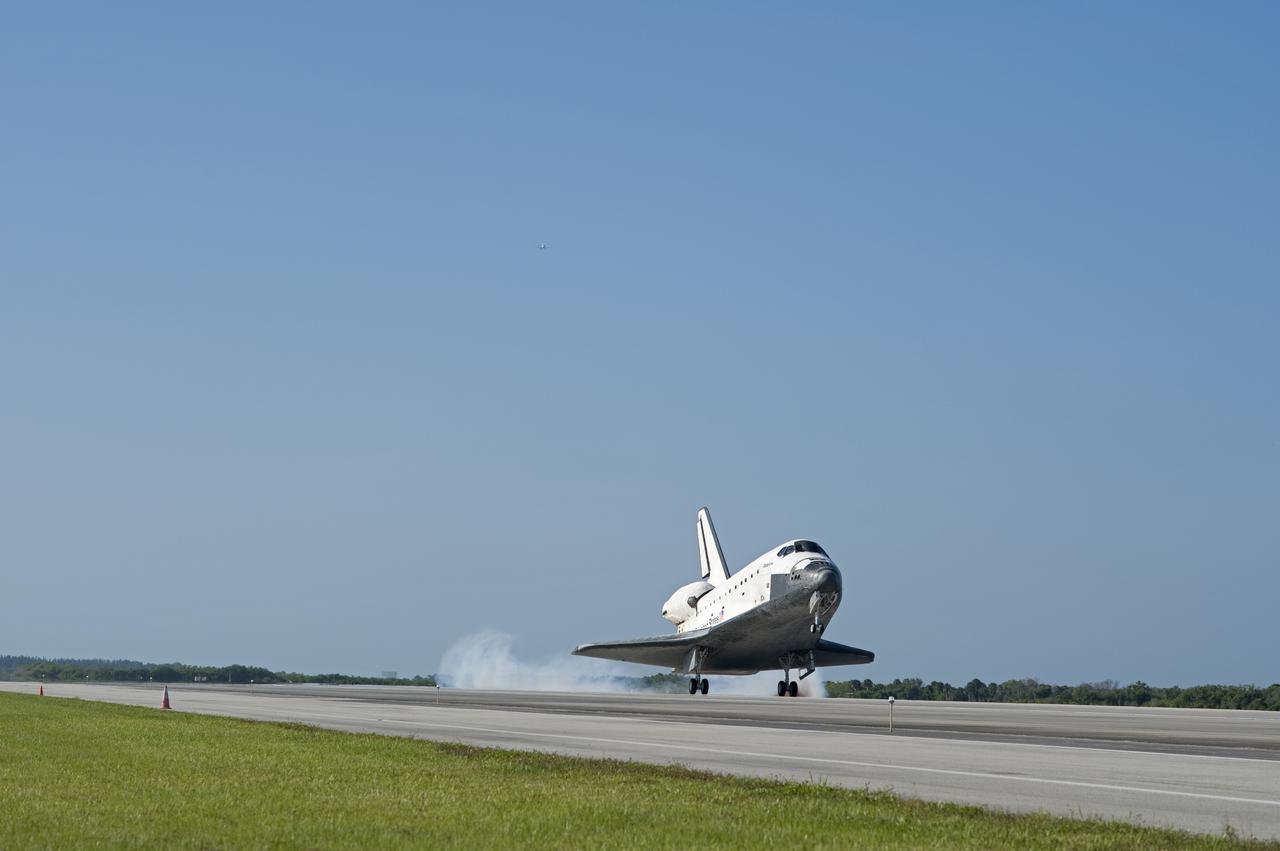
CAPE CANAVERAL, Fla. - A Shuttle Training Aircraft, or STA, top center, watches over space shuttle Atlantis as it touches down on Runway 33 at the Shuttle Landing Facility at NASA's Kennedy Space Center in Florida. The shuttle approached from the southeast in a crystal-clear blue sky, giving the Space Coast quite a show. Landing was at 8:48 a.m. EDT, completing the 12-day STS-132 mission to the International Space Station. The six-member STS-132 crew carried the Russian-built Mini Research Module-1 to the space station. STS-132 is the 34th shuttle mission to the station, the 132nd shuttle mission overall and the last planned flight for Atlantis. For information on the STS-132 mission and crew, visit www.nasa.gov_mission_pages_shuttle_shuttlemissions_sts132_index.html. Photo credit: NASA_Tony Gray and Tom Farrar
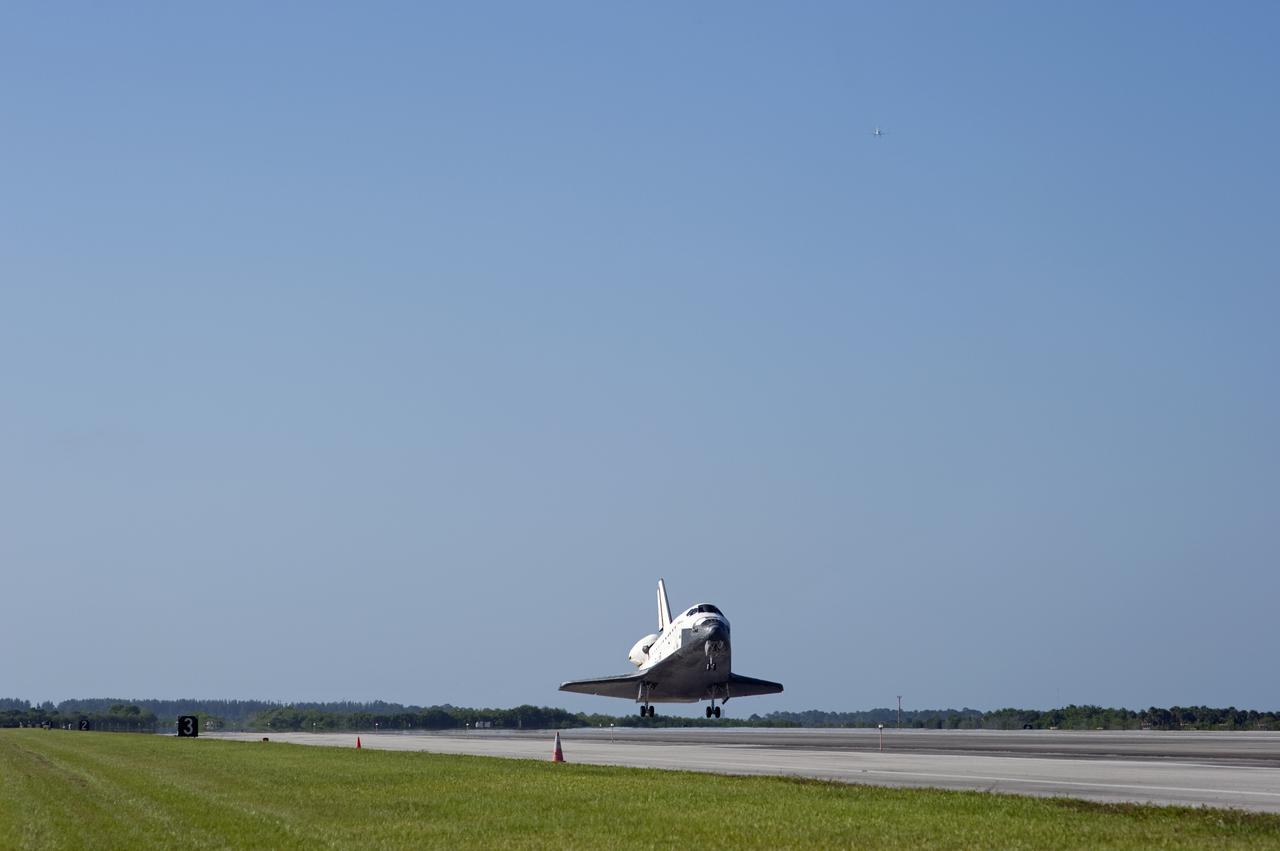
CAPE CANAVERAL, Fla. - A Shuttle Training Aircraft, or STA, top right, watches over space shuttle Atlantis as it touches down on Runway 33 at the Shuttle Landing Facility at NASA's Kennedy Space Center in Florida. The shuttle approached from the southeast in a crystal-clear blue sky, giving the Space Coast quite a show. Landing was at 8:48 a.m. EDT, completing the 12-day STS-132 mission to the International Space Station. The six-member STS-132 crew carried the Russian-built Mini Research Module-1 to the space station. STS-132 is the 34th shuttle mission to the station, the 132nd shuttle mission overall and the last planned flight for Atlantis. For information on the STS-132 mission and crew, visit www.nasa.gov_mission_pages_shuttle_shuttlemissions_sts132_index.html. Photo credit: NASA_Tony Gray and Tom Farrar
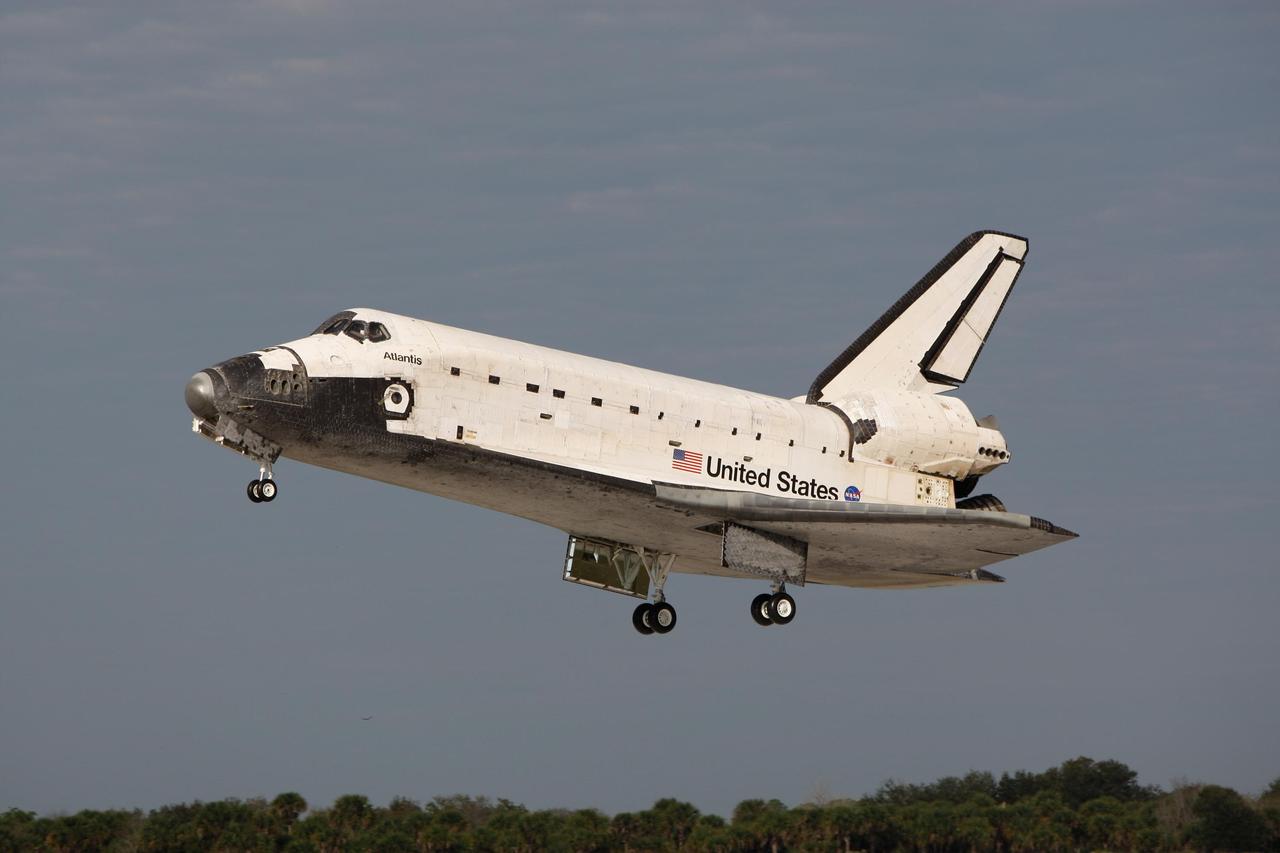
KENNEDY SPACE CENTER, FLA. -- With wheels down, space shuttle Atlantis approaches a landing on Runway 15 of the Shuttle Landing Facility at NASA's Kennedy Space Center after a nearly 5.3 million mile round trip to the International Space Station. The shuttle landed on orbit 202 to complete the 13-day STS-122 mission. Main gear touchdown was 9:07:10 a.m. Nose gear touchdown was 9:07:20 a.m. Wheel stop was at 9:08:08 a.m. Mission elapsed time was 12 days, 18 hours, 21 minutes and 44 seconds. During the mission, Atlantis' crew installed the new Columbus laboratory, leaving a larger space station and one with increased science capabilities. The Columbus Research Module adds nearly 1,000 cubic feet of habitable volume and affords room for 10 experiment racks, each an independent science lab. Photo courtesy of Chuck Luzier

KENNEDY SPACE CENTER, FLA. -- With wheels down, space shuttle Atlantis approaches a landing on Runway 15 of the Shuttle Landing Facility at NASA's Kennedy Space Center after a nearly 5.3 million mile round trip to the International Space Station. The shuttle landed on orbit 202 to complete the 13-day STS-122 mission. Main gear touchdown was 9:07:10 a.m. Nose gear touchdown was 9:07:20 a.m. Wheel stop was at 9:08:08 a.m. Mission elapsed time was 12 days, 18 hours, 21 minutes and 44 seconds. During the mission, Atlantis' crew installed the new Columbus laboratory, leaving a larger space station and one with increased science capabilities. The Columbus Research Module adds nearly 1,000 cubic feet of habitable volume and affords room for 10 experiment racks, each an independent science lab. Photo courtesy of Chuck Luzier
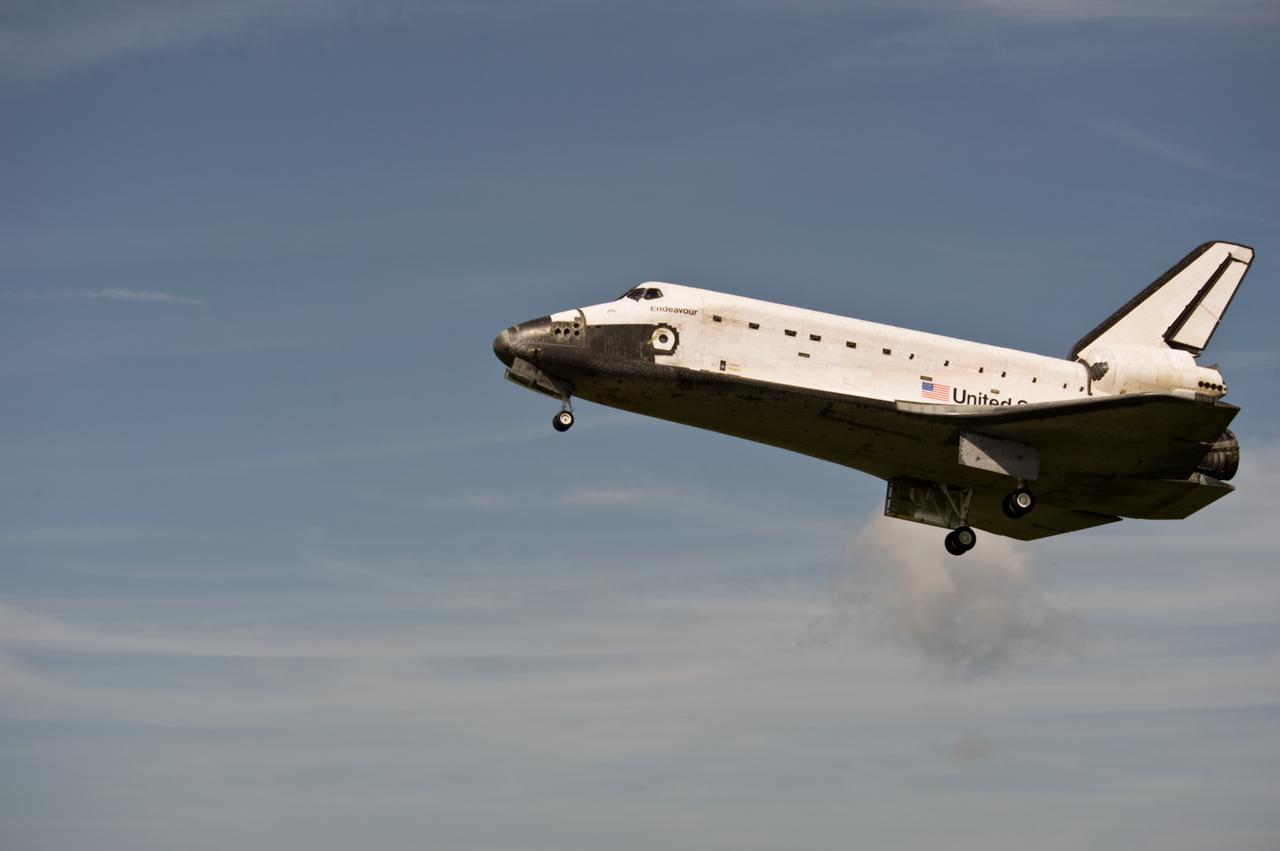
CAPE CANAVERAL, Fla. – Space shuttle Endeavour lowers its landing gear as it approaches Runway 15 at NASA's Kennedy Space Center in Florida. The landing completes Endeavour's 16-day, 6.5-million mile journey on the STS-127 mission to the International Space Station. Endeavour landed on orbit 248. Main gear touchdown was at 10:48:08 a.m. EDT. Nose gear touchdown was at 10:48:21 a.m. and wheels stop was at 10:49:13 a.m. Endeavour delivered the Japanese Experiment Module's Exposed Facility and the Experiment Logistics Module-Exposed Section to the International Space Station. The mission was the 29th flight to the station, the 23rd flight of Endeavour and the 127th in the Space Shuttle Program, as well as the 71st landing at Kennedy. Photo credit: NASA/Tony Gray
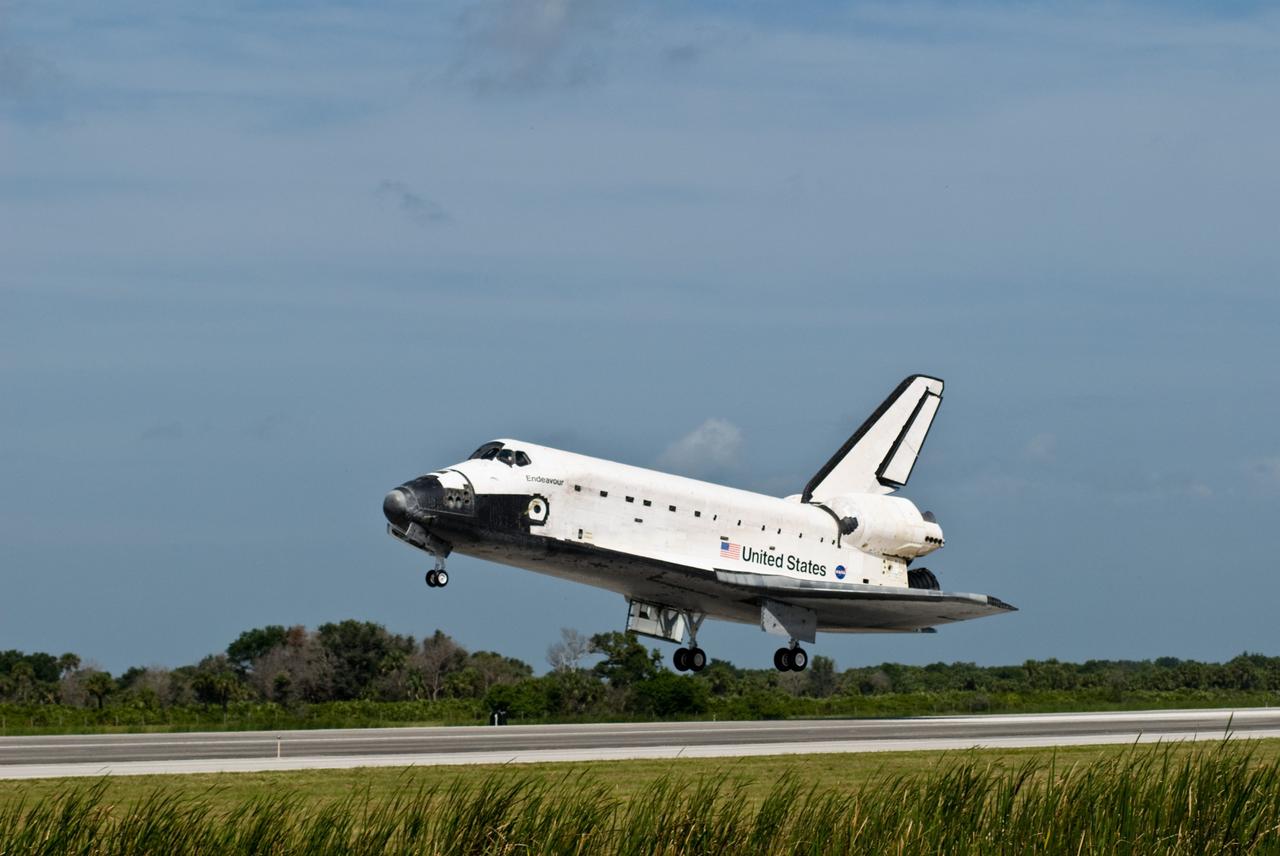
CAPE CANAVERAL, Fla. – With landing gear down, space shuttle Endeavour approaches landing on Runway 15 at NASA's Kennedy Space Center in Florida to complete the 16-day, 6.5-million mile journey on the STS-127 mission to the International Space Station. Endeavour landed on orbit 248. Main gear touchdown was at 10:48:08 a.m. EDT. Nose gear touchdown was at 10:48:21 a.m. and wheels stop was at 10:49:13 a.m. Endeavour delivered the Japanese Experiment Module's Exposed Facility and the Experiment Logistics Module-Exposed Section to the International Space Station. The mission was the 29th flight to the station, the 23rd flight of Endeavour and the 127th in the Space Shuttle Program, as well as the 71st landing at Kennedy. Photo credit: NASA/Linda Perry
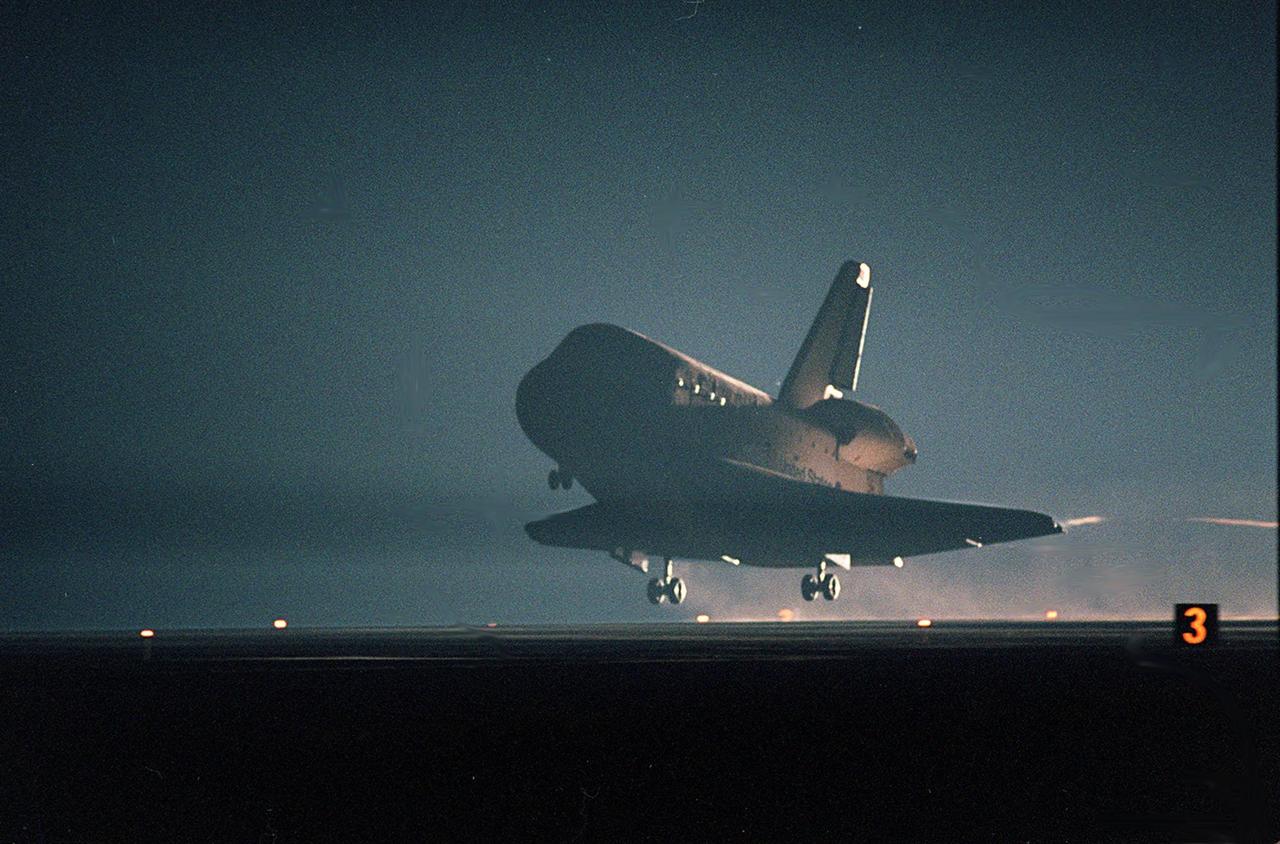
KENNEDY SPACE CENTER, Fla. -- Seen in the landing lights, an illuminated Space Shuttle Atlantis approaches touchdown on KSC’s Shuttle Landing Facility Runway 15 to complete the 9-day, 20-hour, 9-minute-long STS-101 mission. At the controls are Commander James D. Halsell Jr. and Pilot Scott “Doc” Horowitz. Also onboard the orbiter are Mission Specialists Mary Ellen Weber, James S. Voss, Jeffrey N. Williams, Susan J. Helms and Yury Usachev of Russia. The crew is returning from the third flight to the International Space Station. This was the 98th flight in the Space Shuttle program and the 21st for Atlantis, also marking the 51st landing at KSC, the 22nd consecutive landing at KSC, the 14th nighttime landing in Shuttle history and the 29th in the last 30 Shuttle flights. Main gear touchdown was at 2:20:17 a.m. EDT May 29 , landing on orbit 155 of the mission. Nose gear touchdown was at 2:20:30 a.m. EDT, and wheel stop at 2:21:19 a.m. EDT
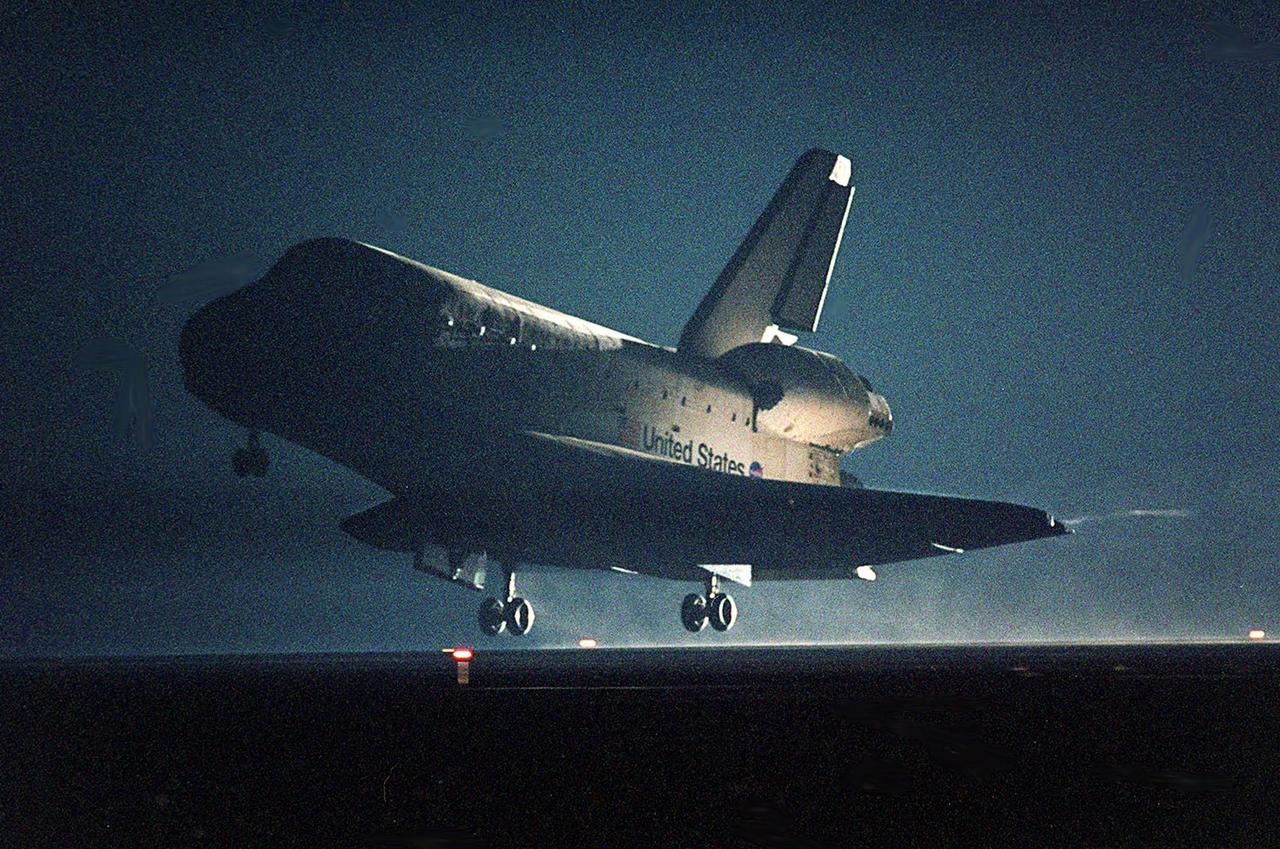
KENNEDY SPACE CENTER, Fla. -- The landing lights on Runway 15 cast a glow as Space Shuttle Atlantis approaches touchdown on KSC’s Shuttle Landing Facility to complete the 9-day, 20-hour, 9-minute-long STS-101 mission. At the controls are Commander James D. Halsell Jr. and Pilot Scott “Doc” Horowitz. Also onboard the orbiter are Mission Specialists Mary Ellen Weber, James S. Voss, Jeffrey N. Williams, Susan J. Helms and Yury Usachev of Russia. The crew is returning from the third flight to the International Space Station. This was the 98th flight in the Space Shuttle program and the 21st for Atlantis, also marking the 51st landing at KSC, the 22nd consecutive landing at KSC, the 14th nighttime landing in Shuttle history and the 29th in the last 30 Shuttle flights. Main gear touchdown was at 2:20:17 a.m. EDT May 29 , landing on orbit 155 of the mission. Nose gear touchdown was at 2:20:30 a.m. EDT, and wheel stop at 2:21:19 a.m. EDT
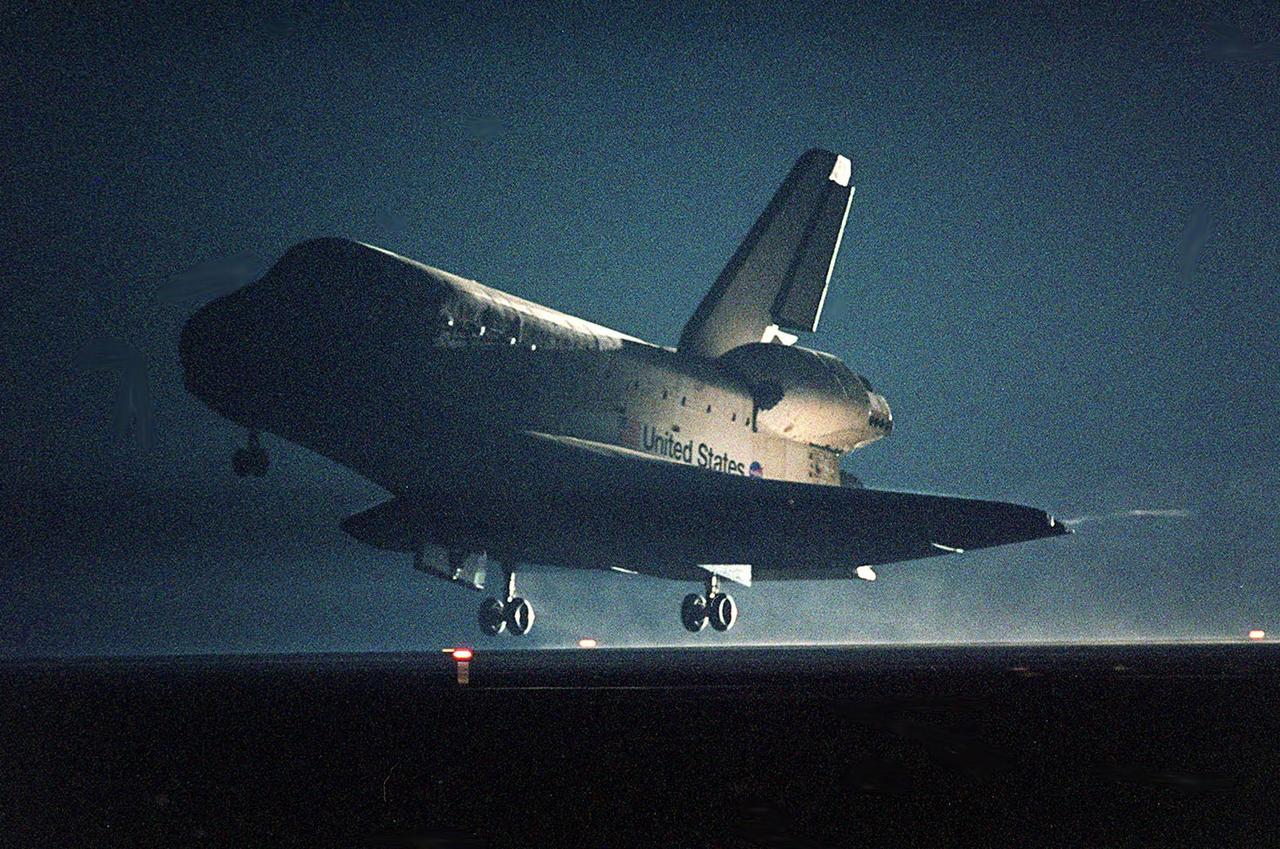
KENNEDY SPACE CENTER, Fla. -- The landing lights on Runway 15 cast a glow as Space Shuttle Atlantis approaches touchdown on KSC’s Shuttle Landing Facility to complete the 9-day, 20-hour, 9-minute-long STS-101 mission. At the controls are Commander James D. Halsell Jr. and Pilot Scott “Doc” Horowitz. Also onboard the orbiter are Mission Specialists Mary Ellen Weber, James S. Voss, Jeffrey N. Williams, Susan J. Helms and Yury Usachev of Russia. The crew is returning from the third flight to the International Space Station. This was the 98th flight in the Space Shuttle program and the 21st for Atlantis, also marking the 51st landing at KSC, the 22nd consecutive landing at KSC, the 14th nighttime landing in Shuttle history and the 29th in the last 30 Shuttle flights. Main gear touchdown was at 2:20:17 a.m. EDT May 29 , landing on orbit 155 of the mission. Nose gear touchdown was at 2:20:30 a.m. EDT, and wheel stop at 2:21:19 a.m. EDT
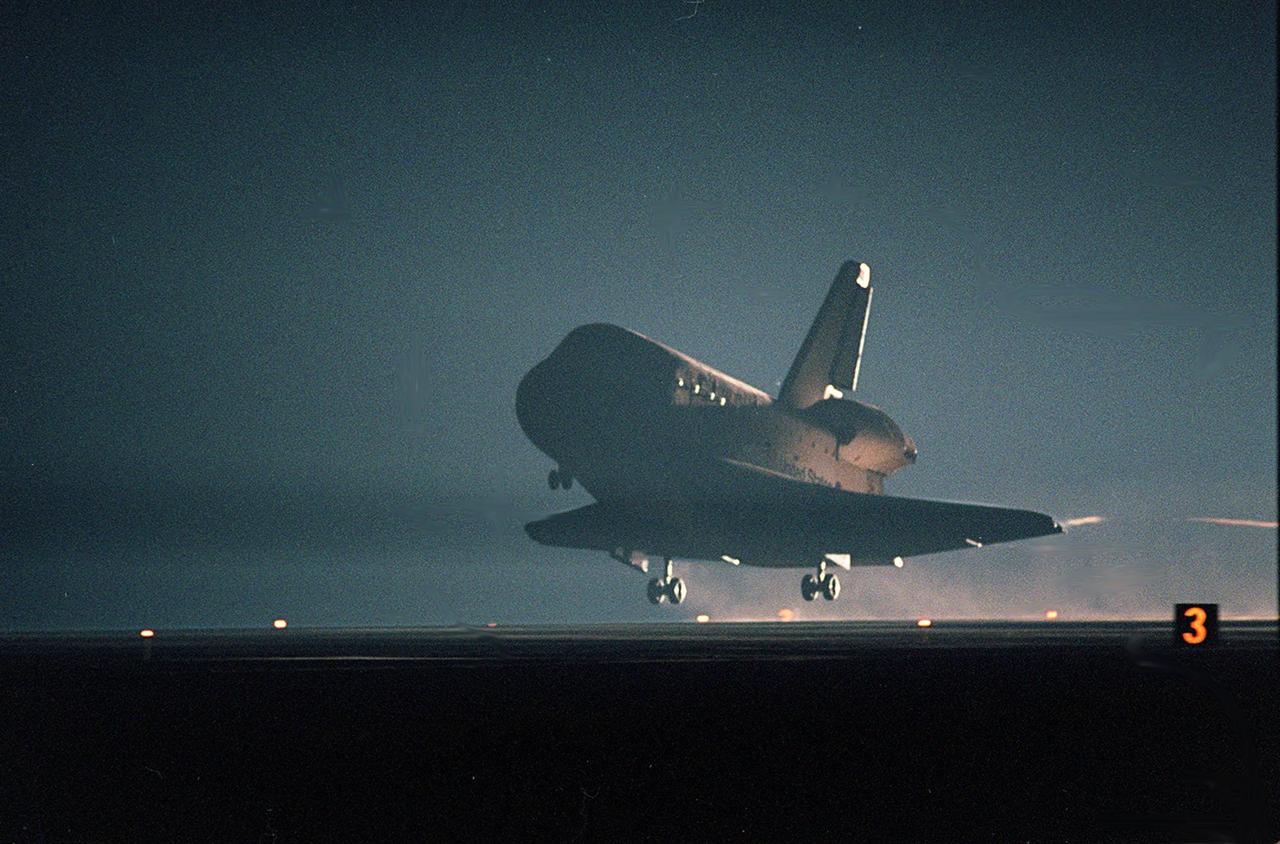
KENNEDY SPACE CENTER, Fla. -- Seen in the landing lights, an illuminated Space Shuttle Atlantis approaches touchdown on KSC’s Shuttle Landing Facility Runway 15 to complete the 9-day, 20-hour, 9-minute-long STS-101 mission. At the controls are Commander James D. Halsell Jr. and Pilot Scott “Doc” Horowitz. Also onboard the orbiter are Mission Specialists Mary Ellen Weber, James S. Voss, Jeffrey N. Williams, Susan J. Helms and Yury Usachev of Russia. The crew is returning from the third flight to the International Space Station. This was the 98th flight in the Space Shuttle program and the 21st for Atlantis, also marking the 51st landing at KSC, the 22nd consecutive landing at KSC, the 14th nighttime landing in Shuttle history and the 29th in the last 30 Shuttle flights. Main gear touchdown was at 2:20:17 a.m. EDT May 29 , landing on orbit 155 of the mission. Nose gear touchdown was at 2:20:30 a.m. EDT, and wheel stop at 2:21:19 a.m. EDT
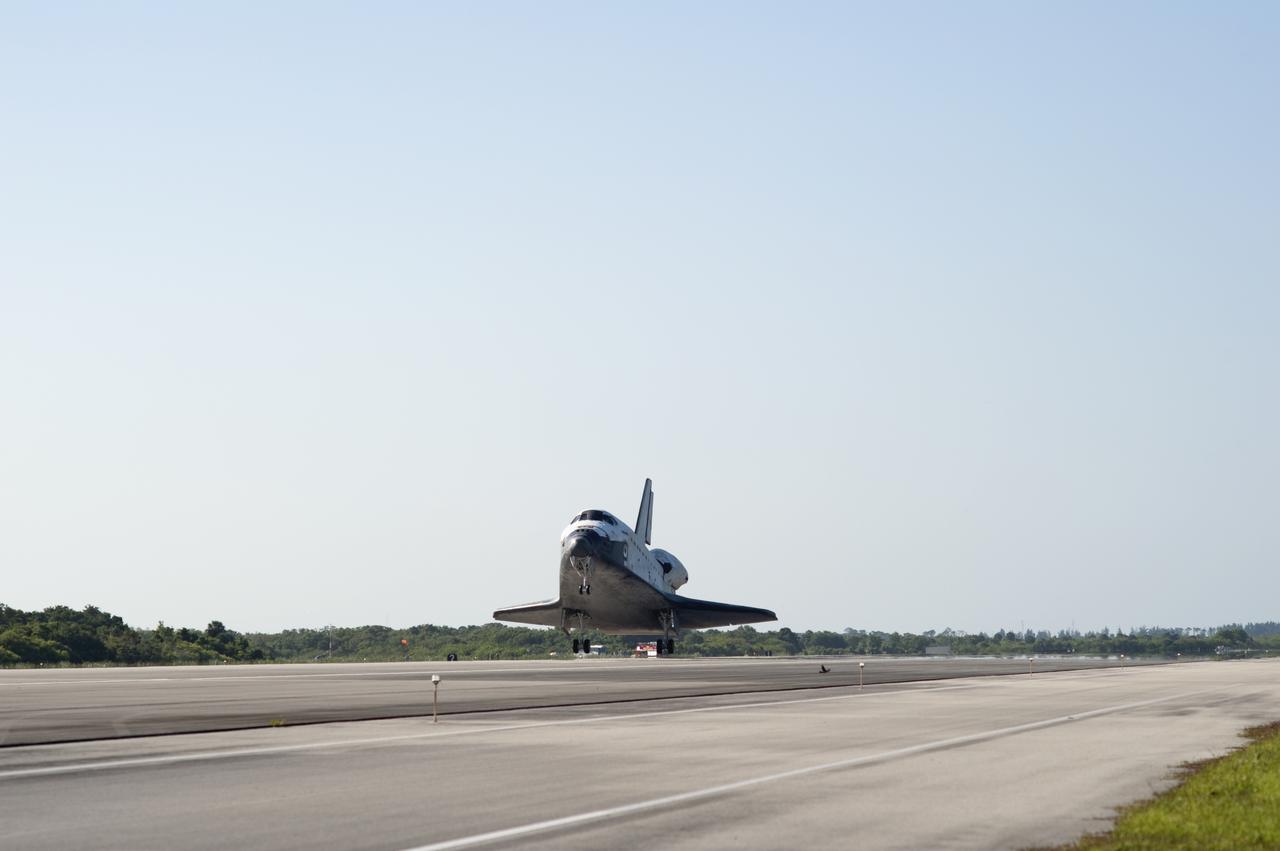
CAPE CANAVERAL, Fla. - Space shuttle Atlantis touches down on one of the world's longest runways, the Shuttle Landing Facility at NASA's Kennedy Space Center in Florida. The shuttle approached from the southeast in a crystal-clear blue sky, giving the Space Coast quite a show. Landing was on Runway 33 at 8:48 a.m. EDT, completing the 12-day STS-132 mission to the International Space Station. The six-member STS-132 crew carried the Russian-built Mini Research Module-1 to the space station. STS-132 is the 34th shuttle mission to the station, the 132nd shuttle mission overall and the last planned flight for Atlantis. For information on the STS-132 mission and crew, visit www.nasa.gov_mission_pages_shuttle_shuttlemissions_sts132_index.html. Photo credit: NASA_Tony Gray and Tom Farrar
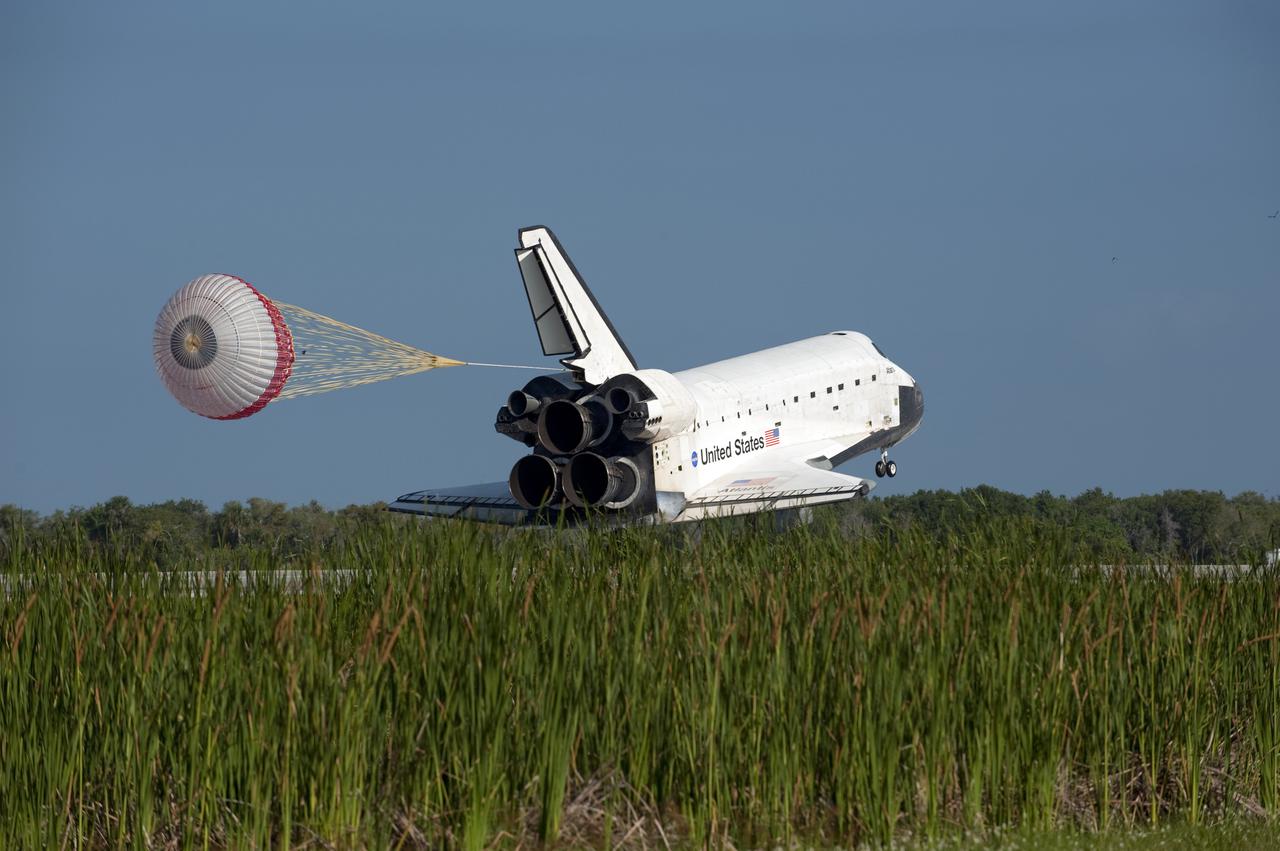
CAPE CANAVERAL, Fla. - Space shuttle Atlantis' drag chute slows the vehicle as it rolls down Runway 33 at the Shuttle Landing Facility at NASA's Kennedy Space Center in Florida. The shuttle approached from the southeast in a crystal-clear blue sky, giving the Space Coast quite a show. Landing was at 8:48 a.m. EDT, completing the 12-day STS-132 mission to the International Space Station. The six-member STS-132 crew carried the Russian-built Mini Research Module-1 to the space station. STS-132 is the 34th shuttle mission to the station, the 132nd shuttle mission overall and the last planned flight for Atlantis. For information on the STS-132 mission and crew, visit www.nasa.gov_mission_pages_shuttle_shuttlemissions_sts132_index.html. Photo credit: NASA_Kevin O'Connell
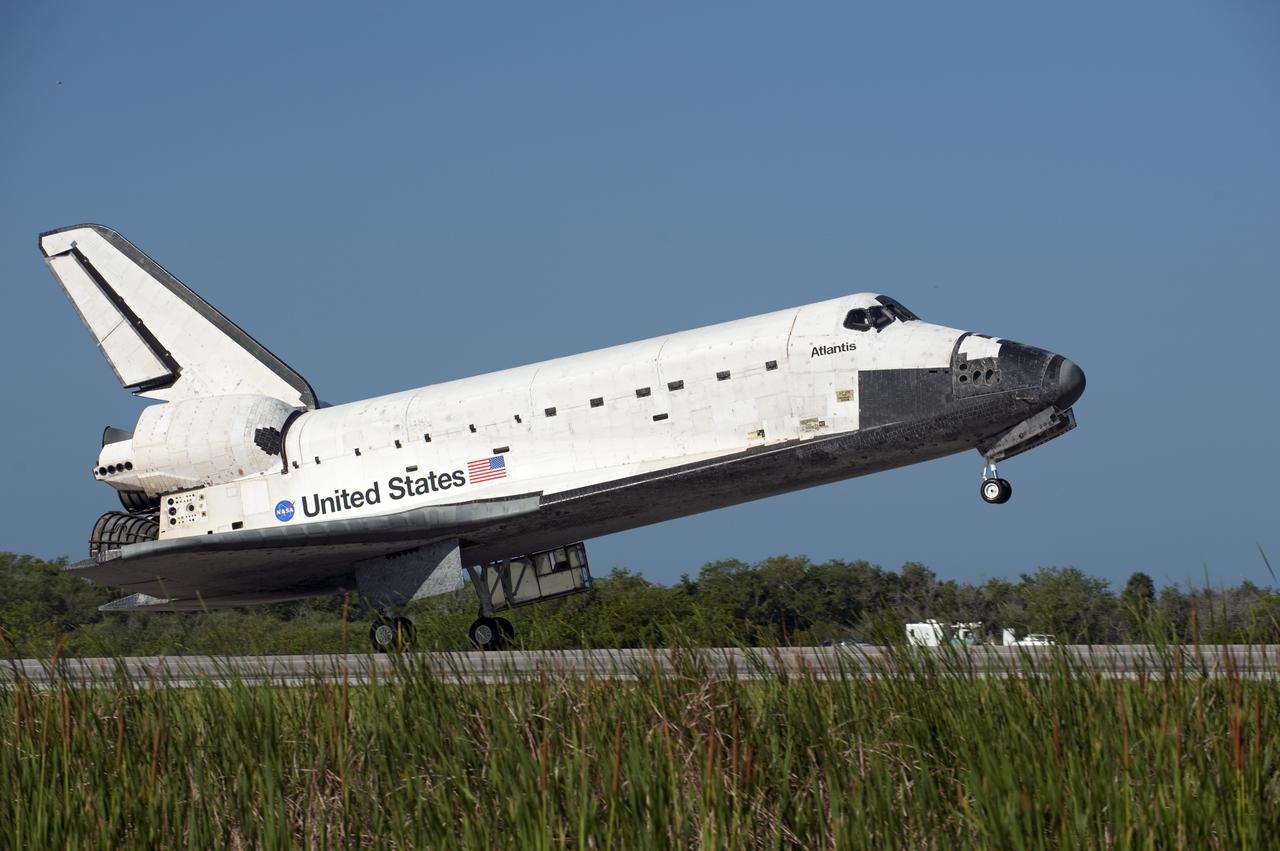
CAPE CANAVERAL, Fla. - Space shuttle Atlantis touches down on Runway 33 at the Shuttle Landing Facility at NASA's Kennedy Space Center in Florida. The shuttle approached from the southeast in a crystal-clear blue sky, giving the Space Coast quite a show. Landing was at 8:48 a.m. EDT, completing the 12-day STS-132 mission to the International Space Station. The six-member STS-132 crew carried the Russian-built Mini Research Module-1 to the space station. STS-132 is the 34th shuttle mission to the station, the 132nd shuttle mission overall and the last planned flight for Atlantis. For information on the STS-132 mission and crew, visit www.nasa.gov_mission_pages_shuttle_shuttlemissions_sts132_index.html. Photo credit: NASA_Kevin O'Connell
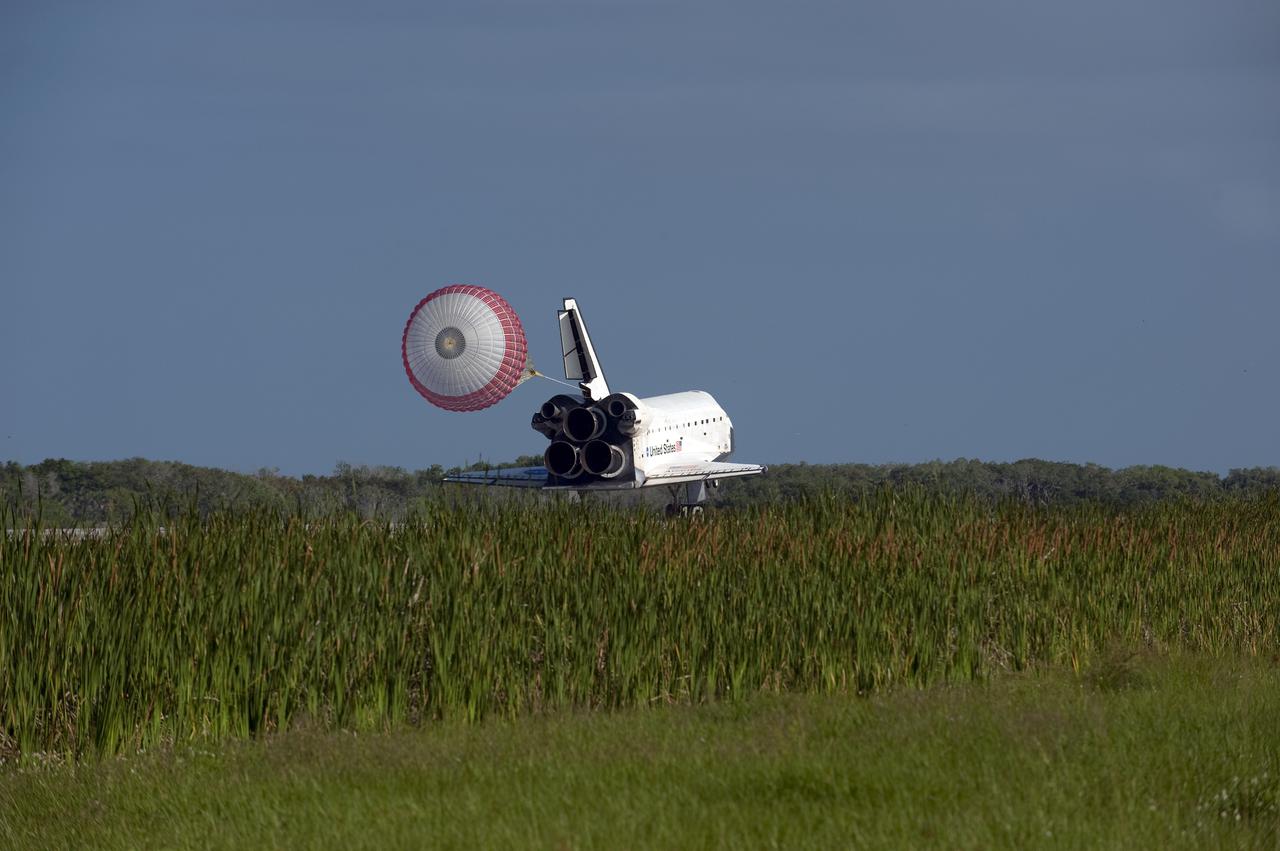
CAPE CANAVERAL, Fla. - Space shuttle Atlantis' drag chute slows the vehicle as it rolls down Runway 33 at the Shuttle Landing Facility at NASA's Kennedy Space Center in Florida. The shuttle approached from the southeast in a crystal-clear blue sky, giving the Space Coast quite a show. Landing was at 8:48 a.m. EDT, completing the 12-day STS-132 mission to the International Space Station. The six-member STS-132 crew carried the Russian-built Mini Research Module-1 to the space station. STS-132 is the 34th shuttle mission to the station, the 132nd shuttle mission overall and the last planned flight for Atlantis. For information on the STS-132 mission and crew, visit www.nasa.gov_mission_pages_shuttle_shuttlemissions_sts132_index.html. Photo credit: NASA_Kevin O'Connell