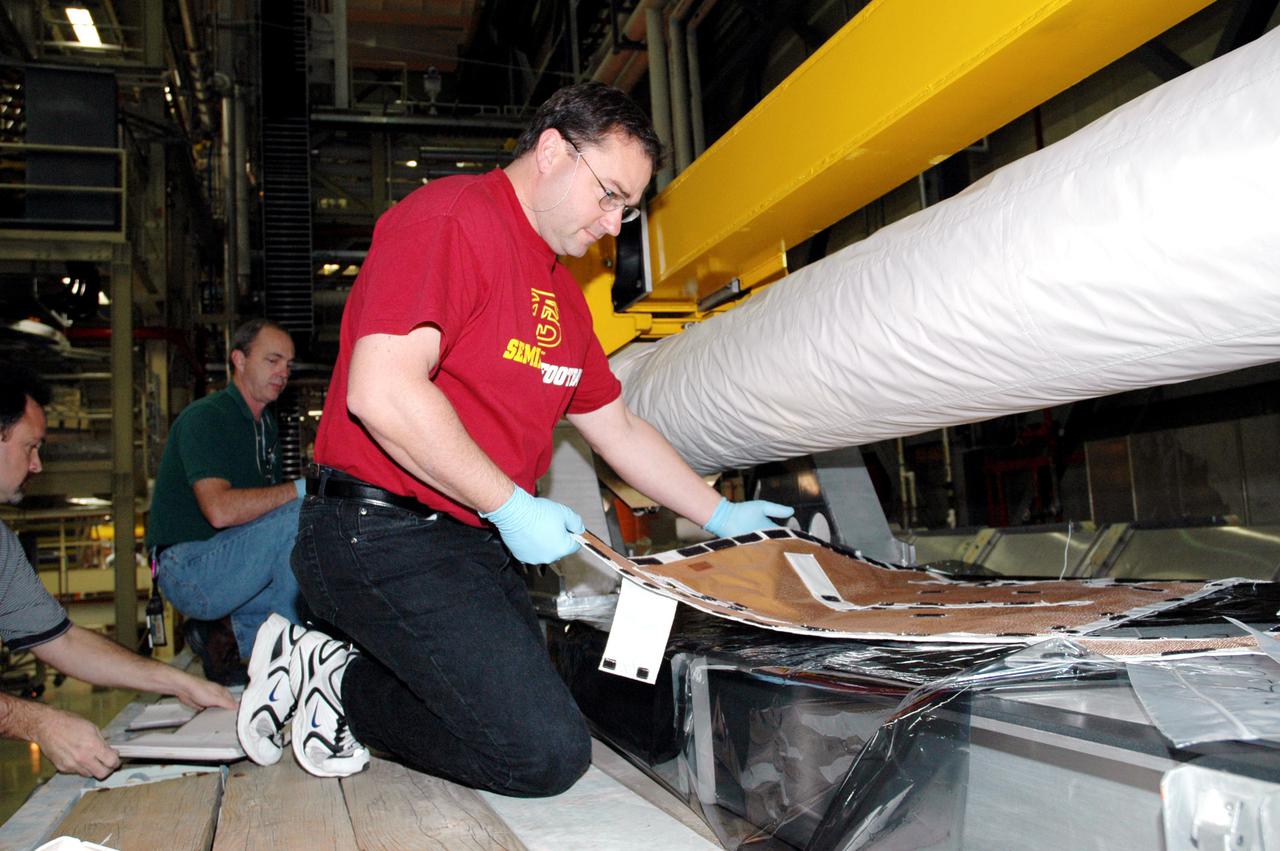
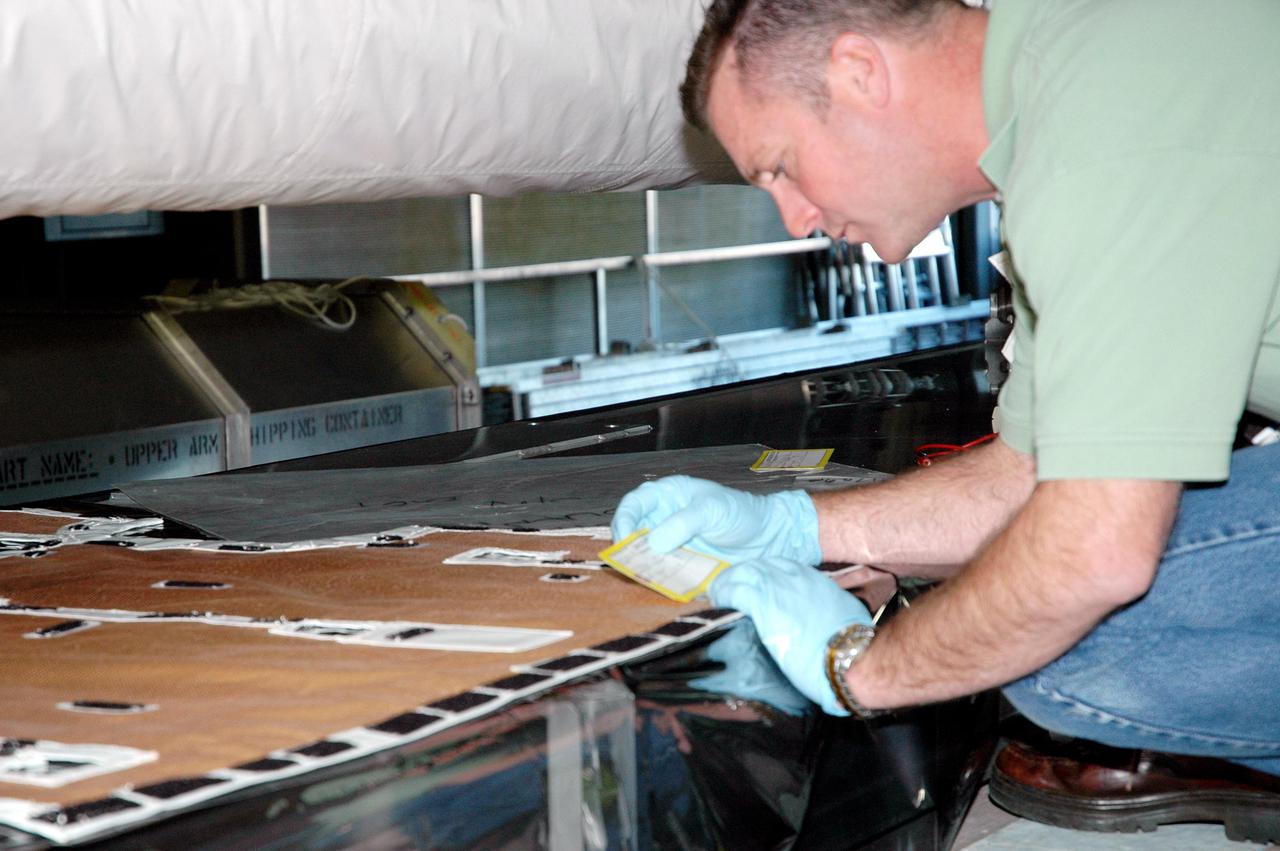
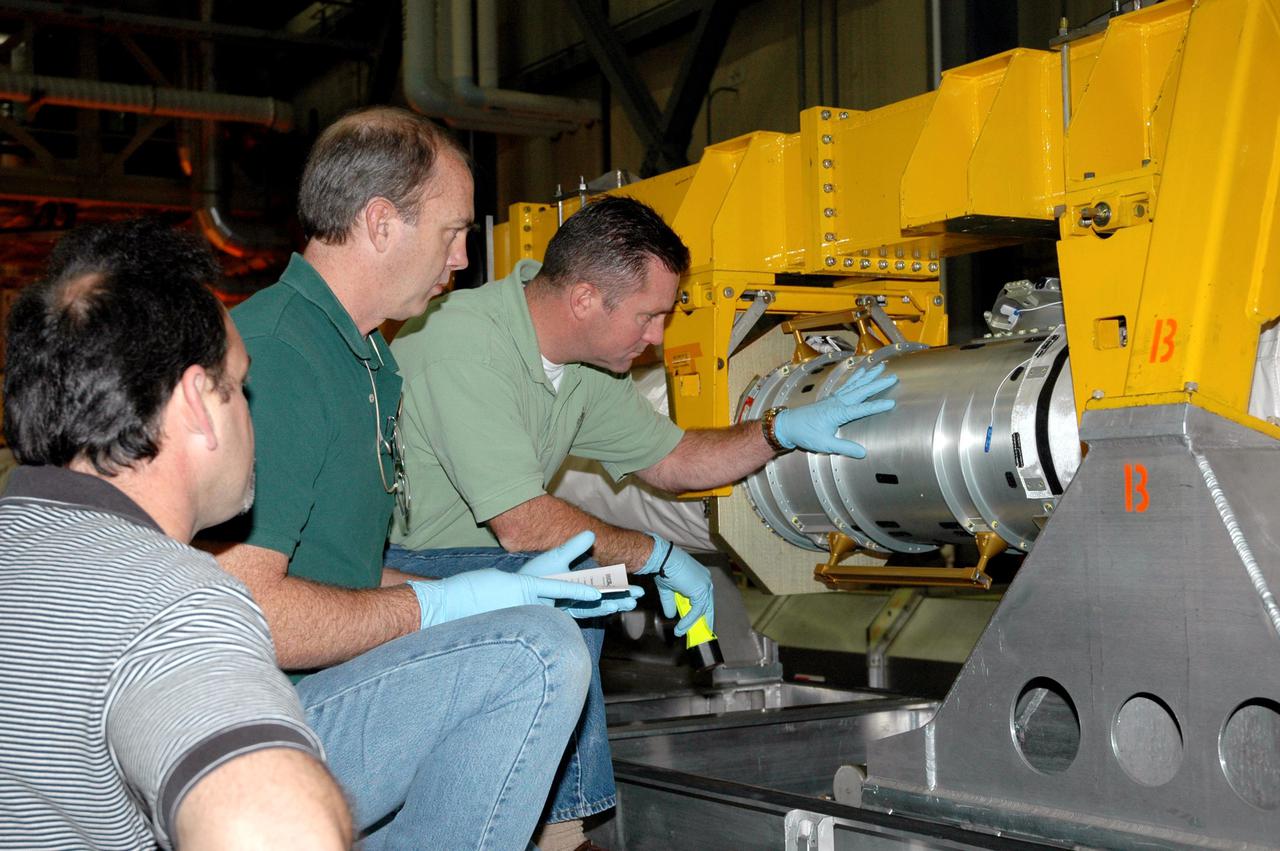
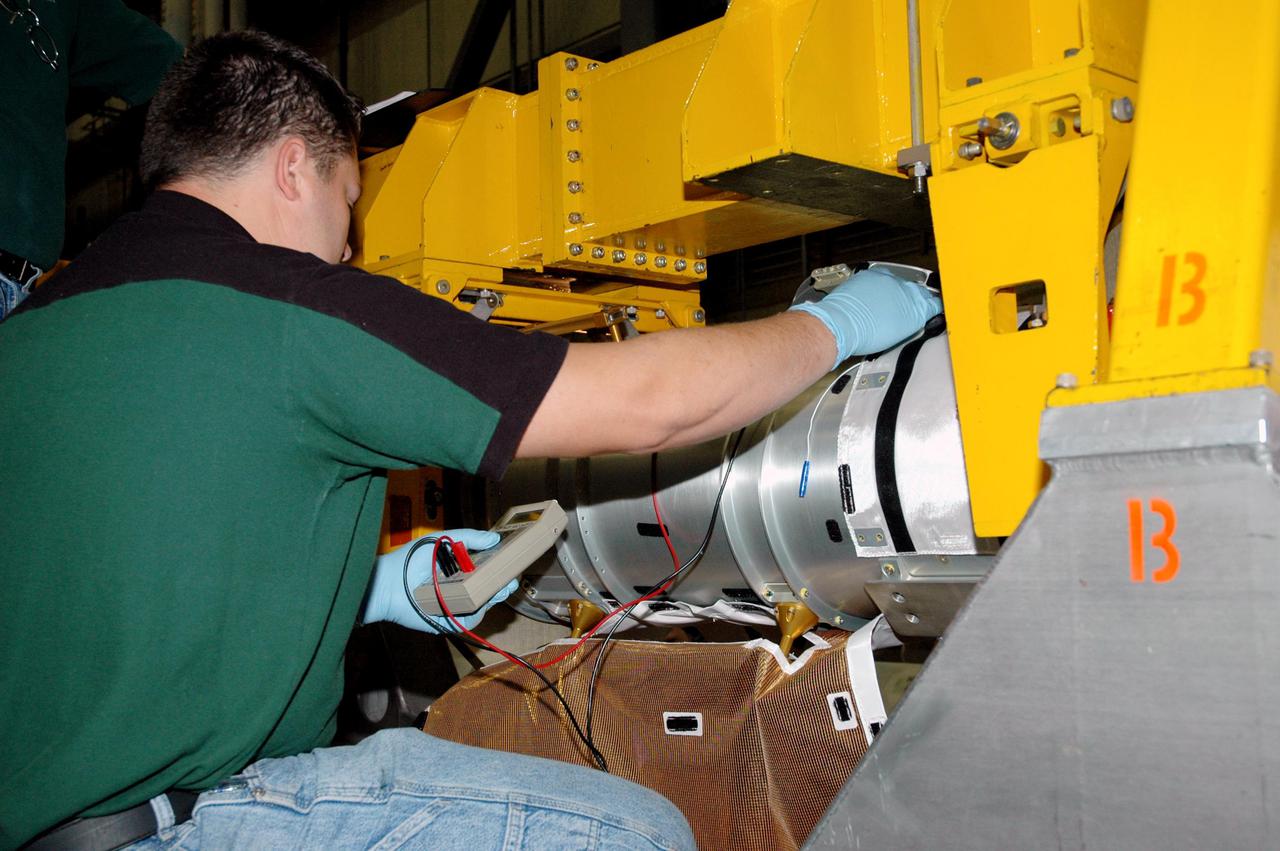
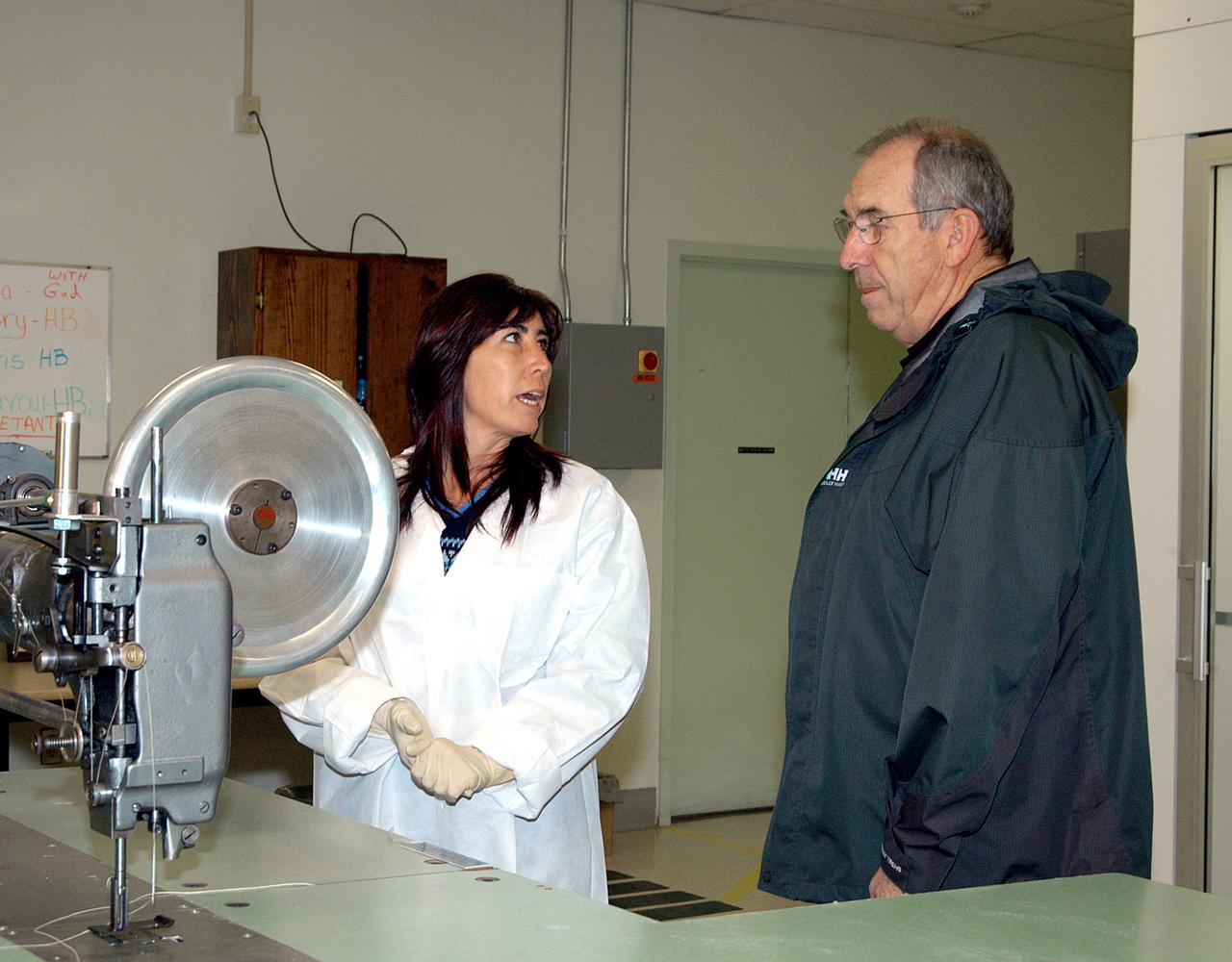
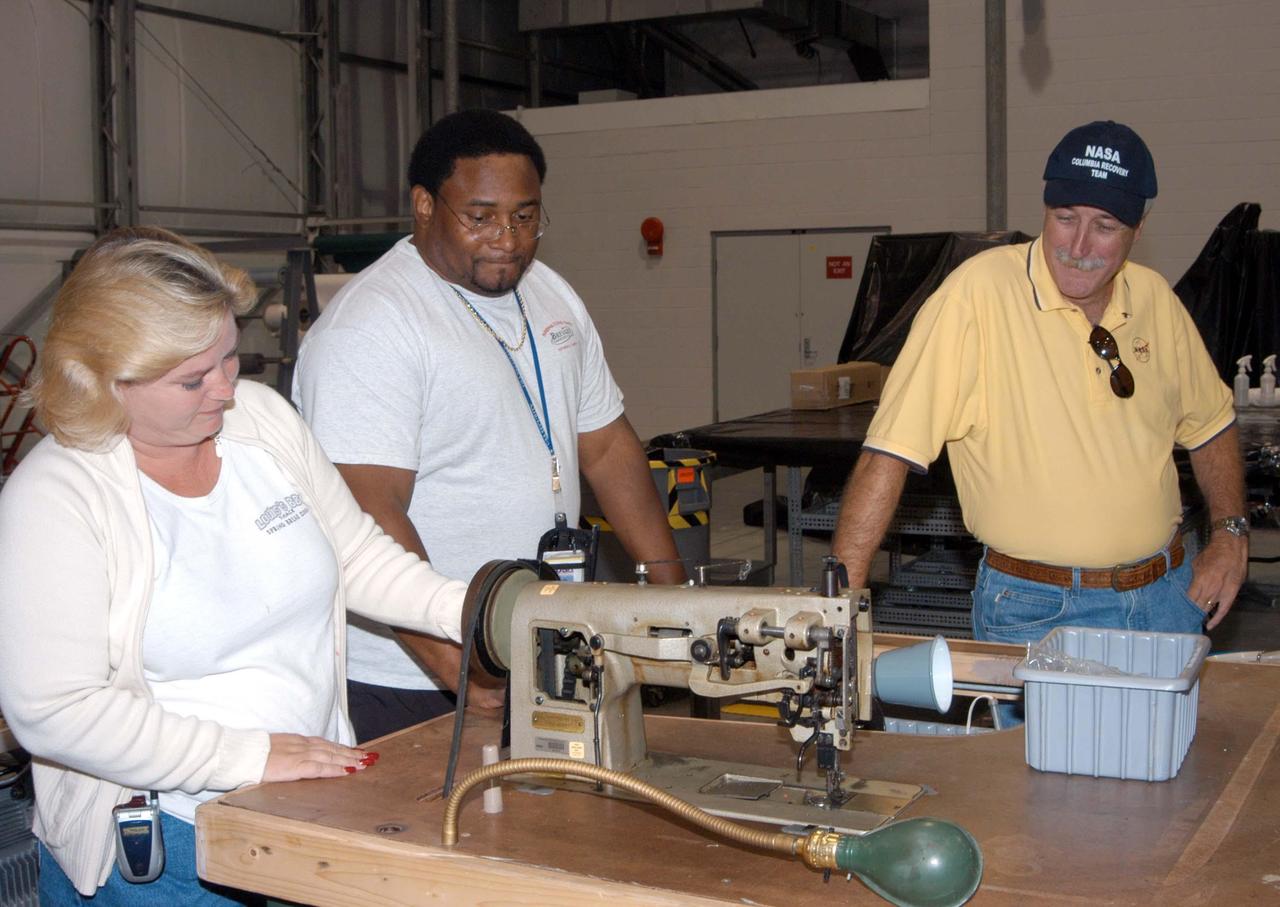
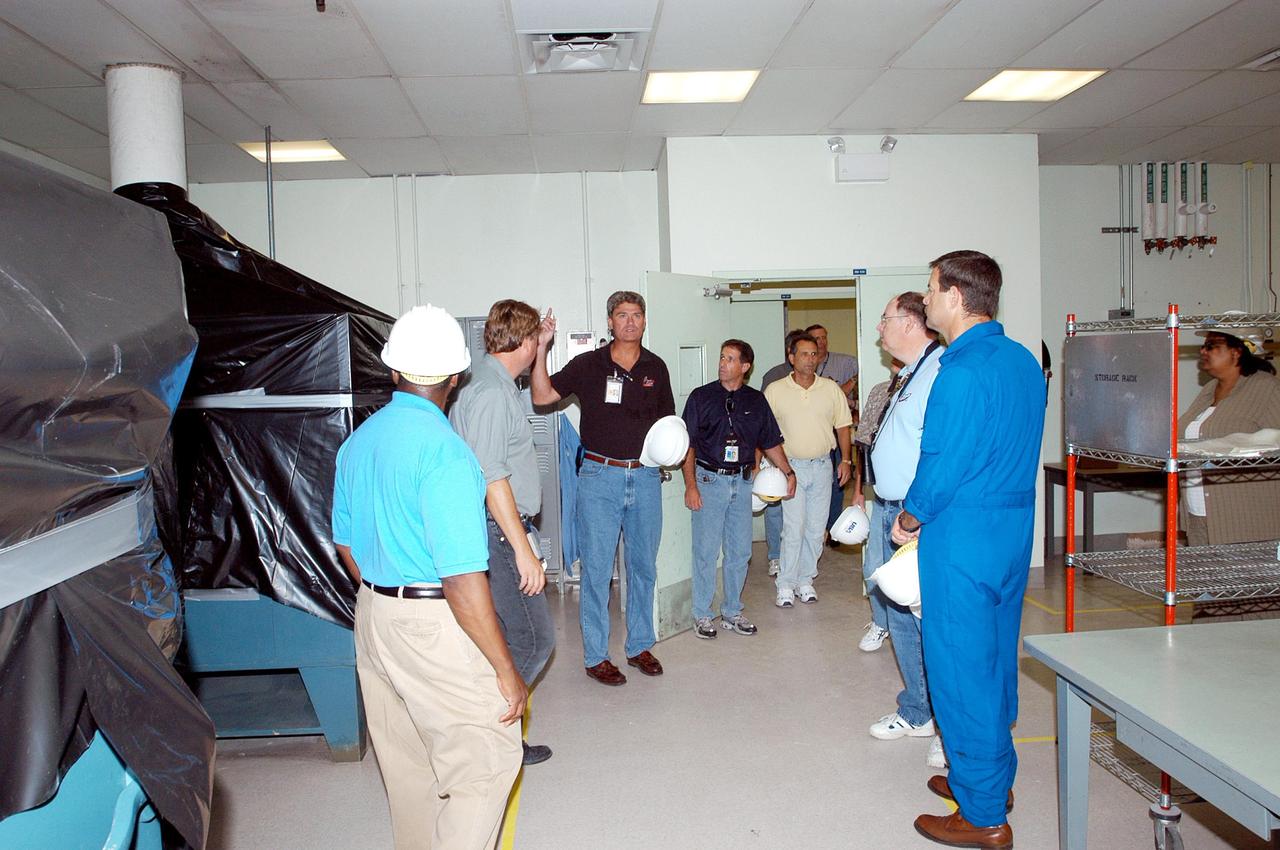
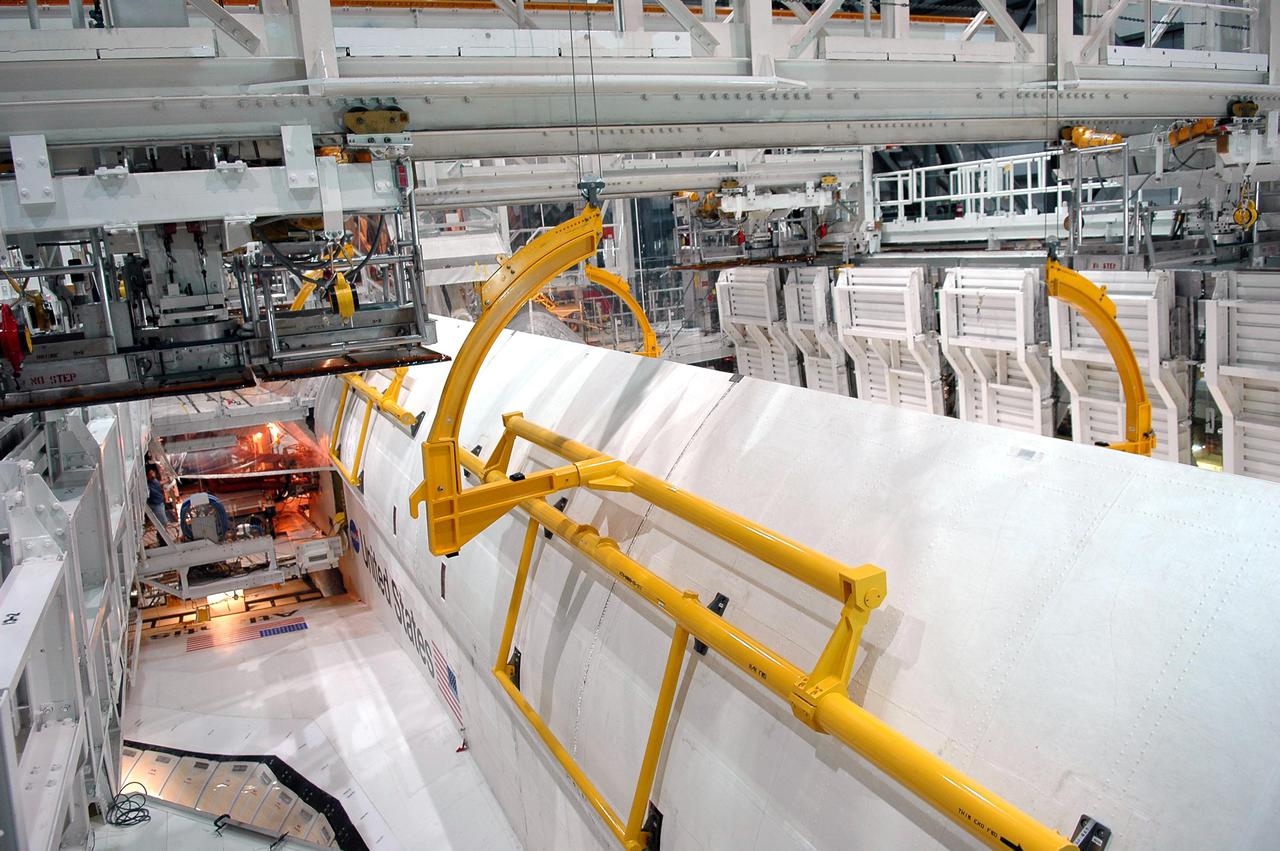
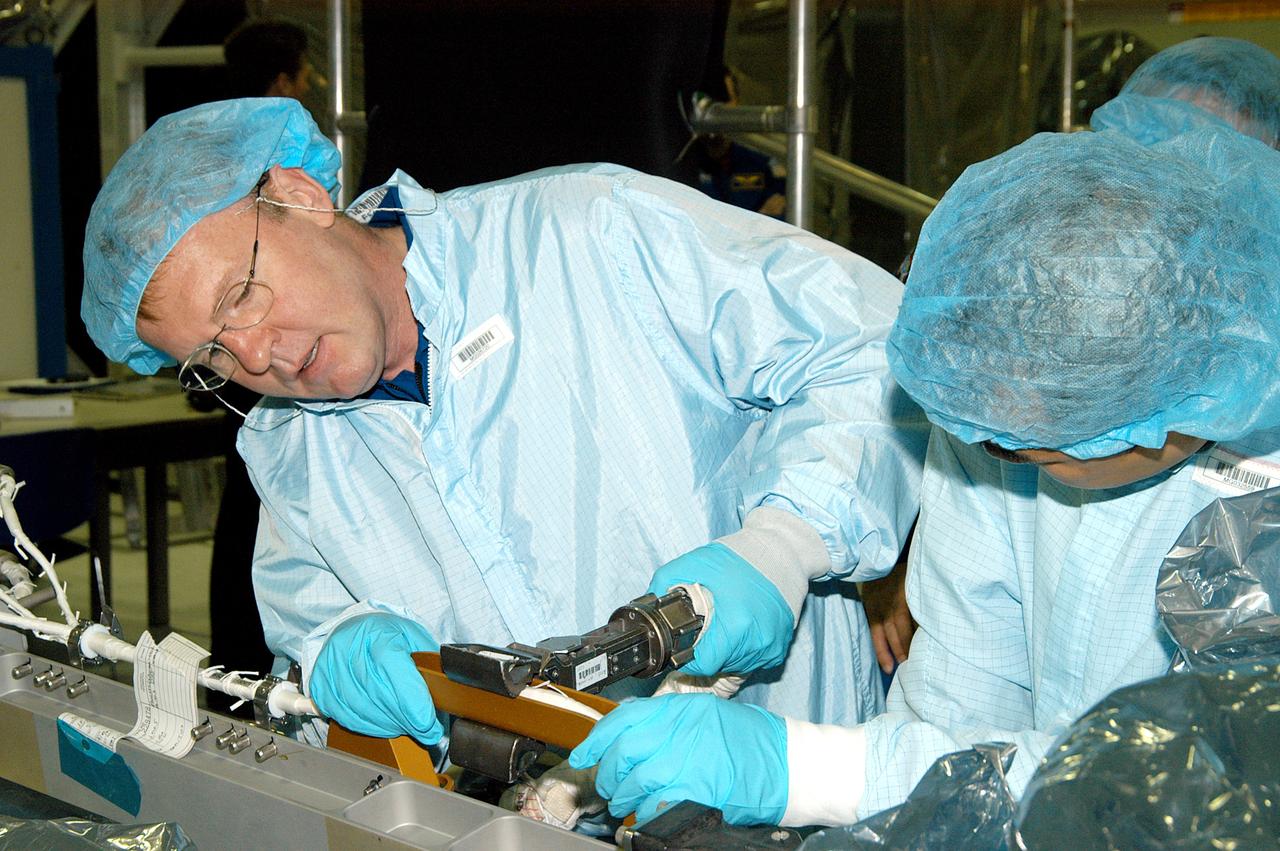
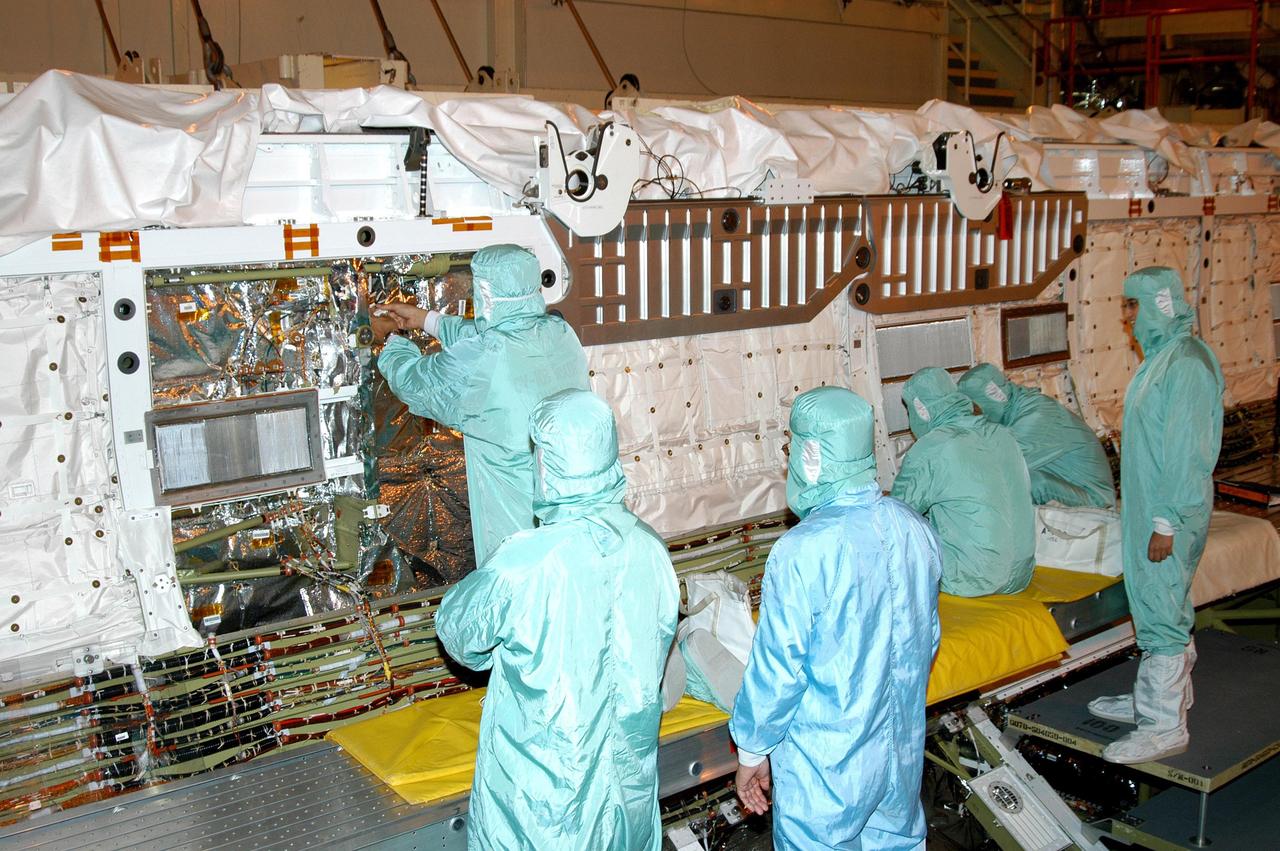
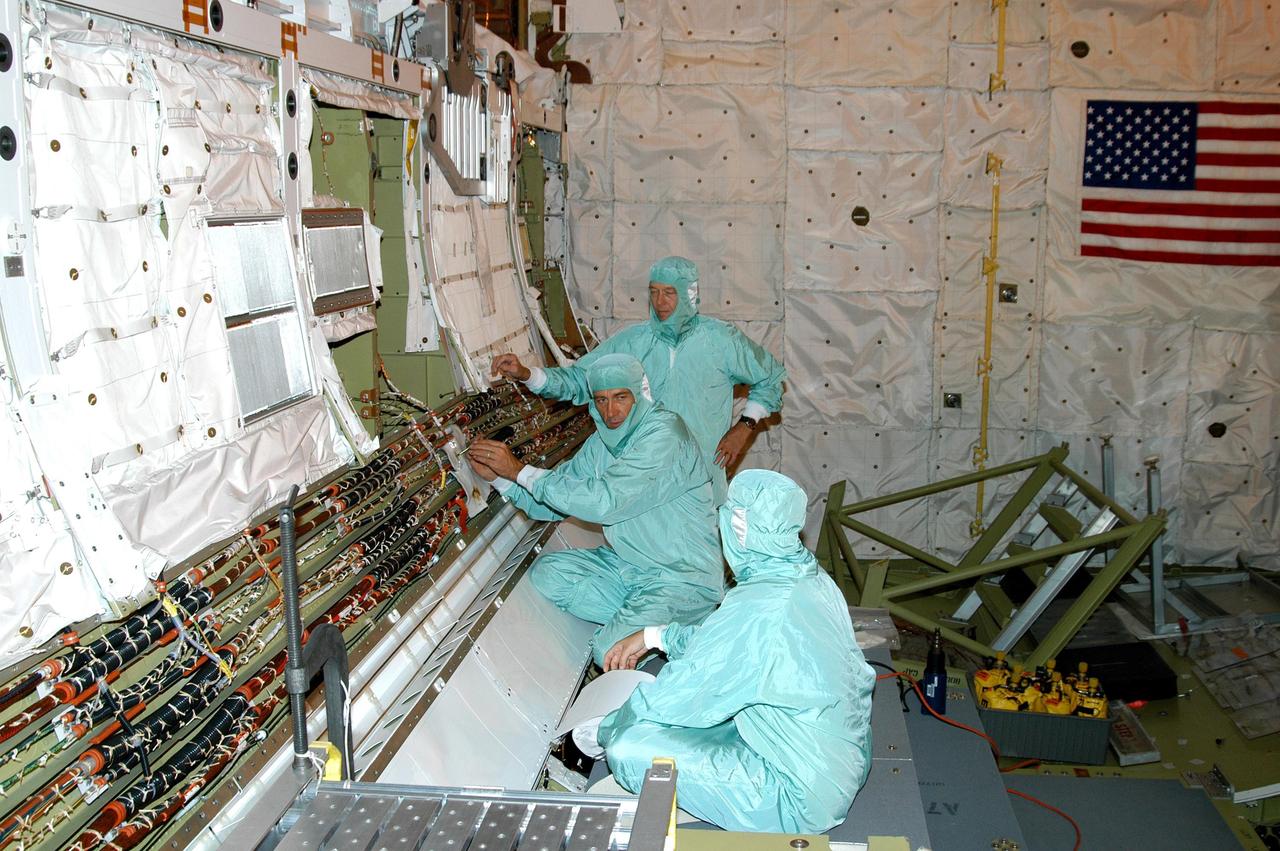
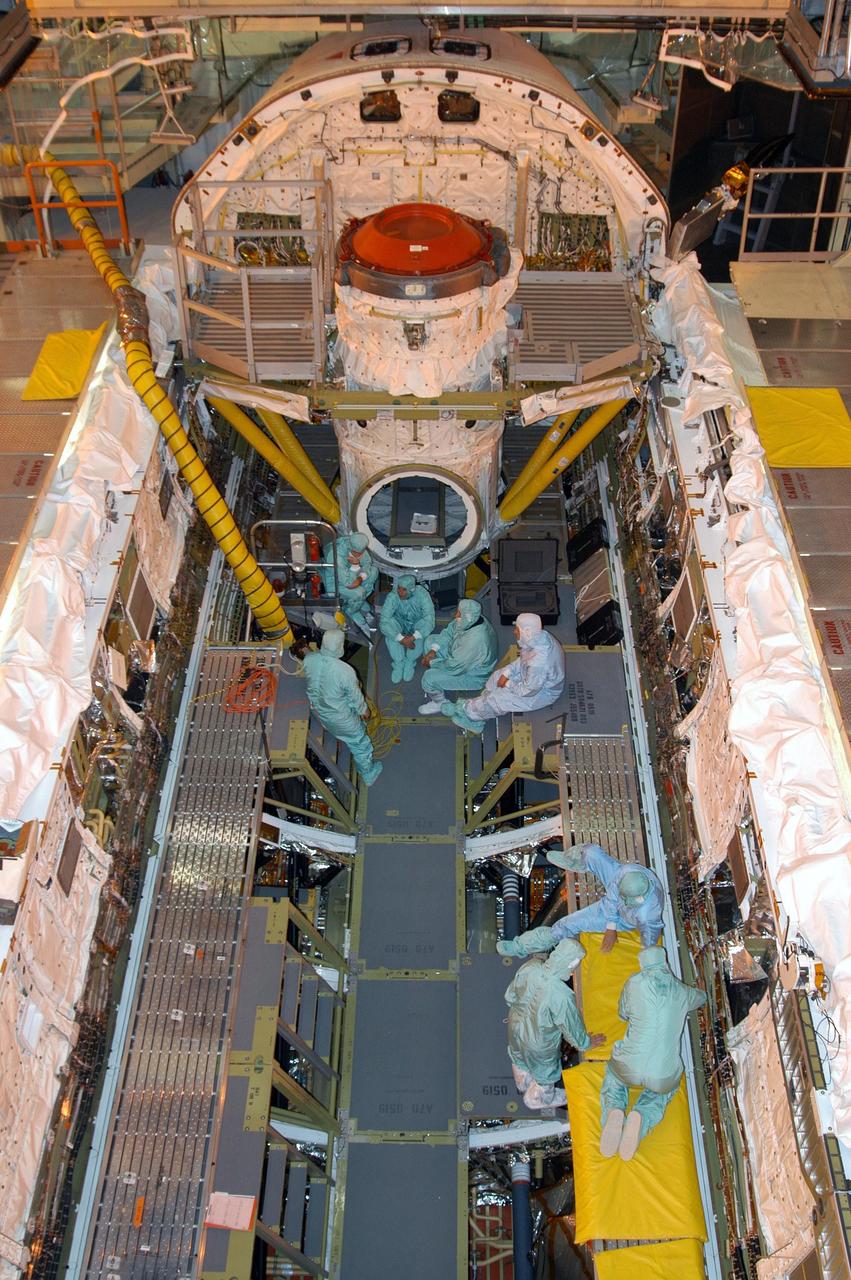
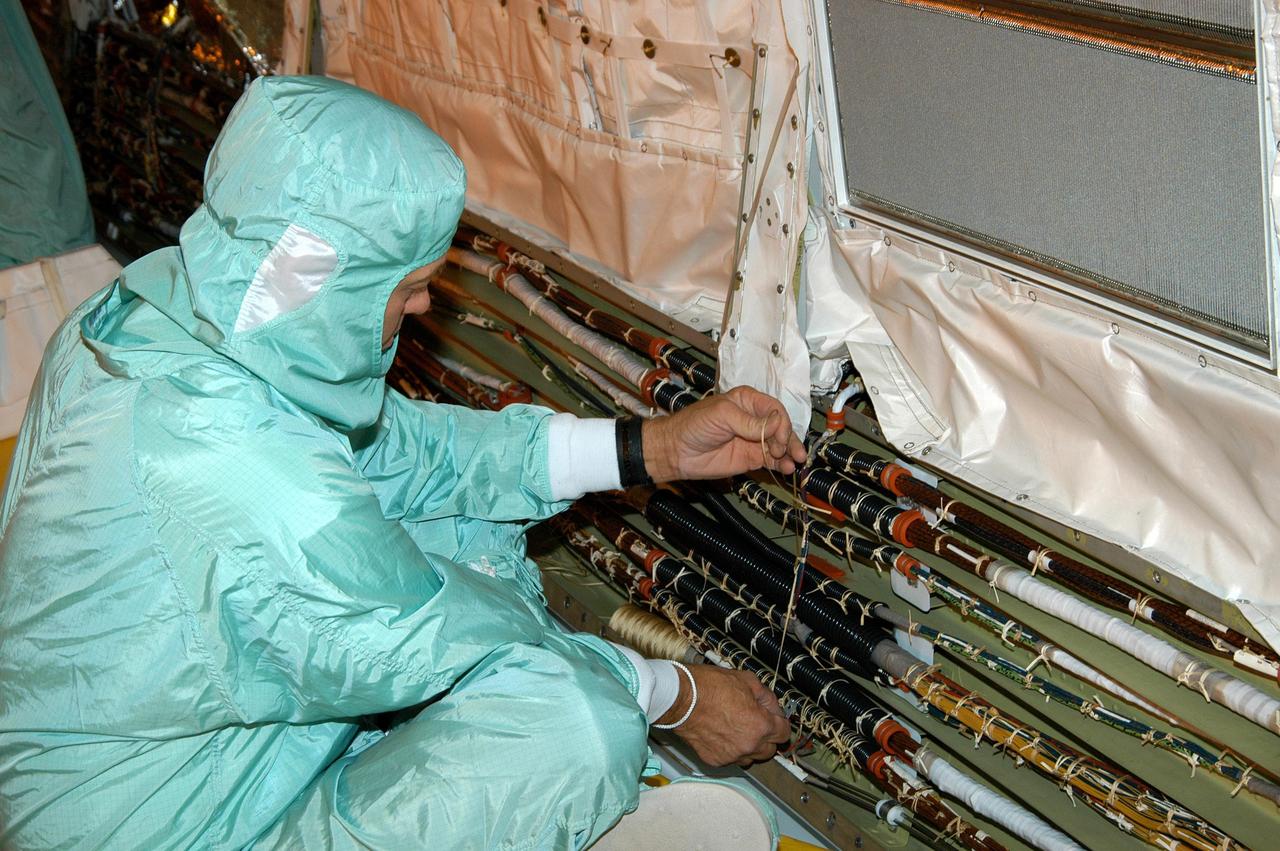
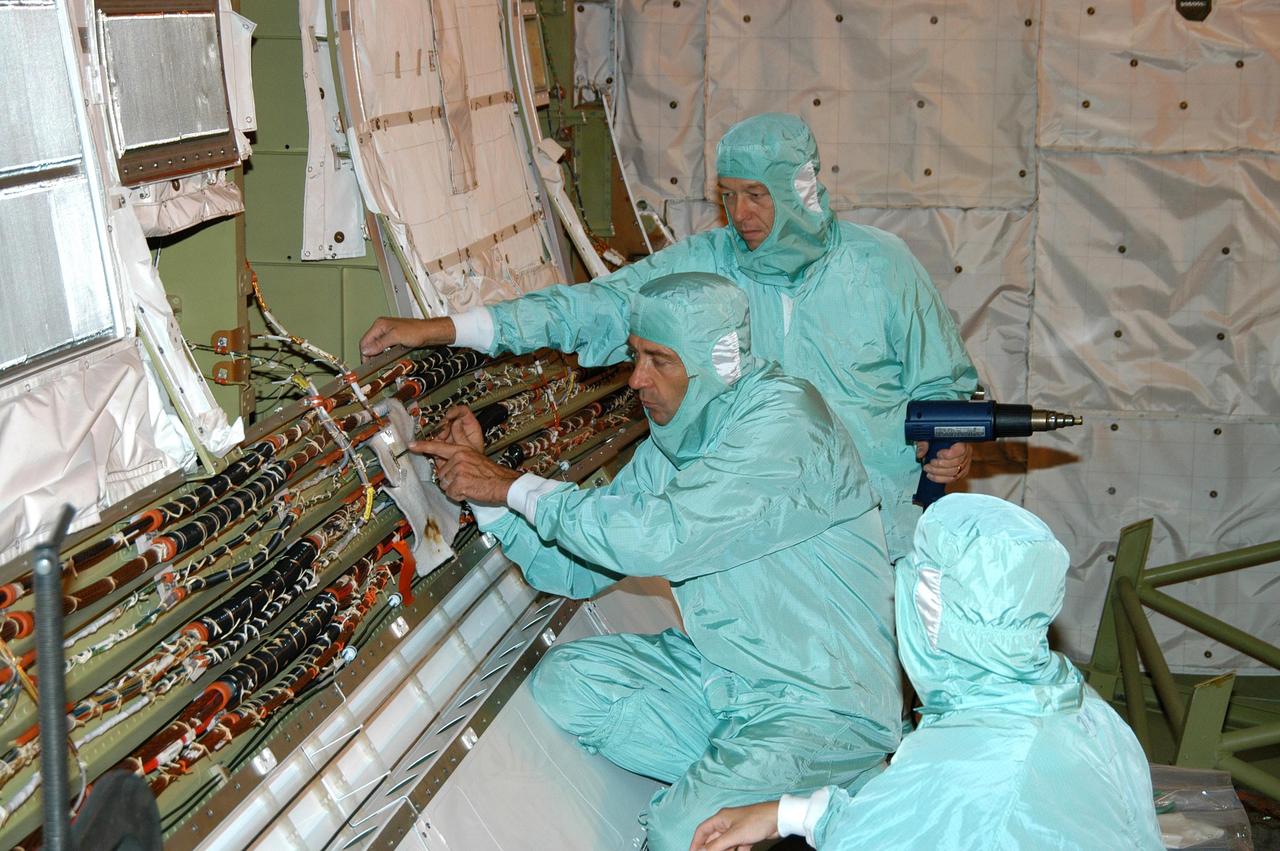
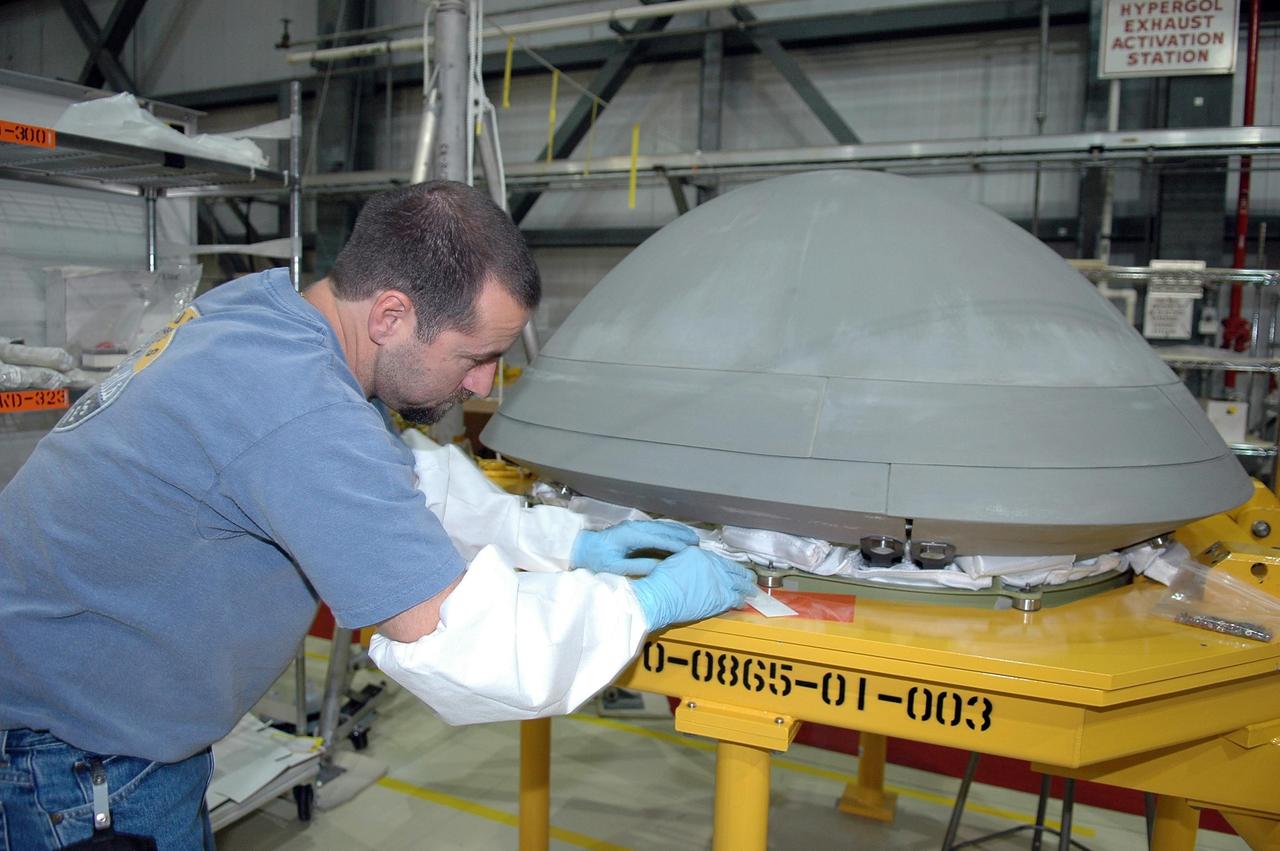
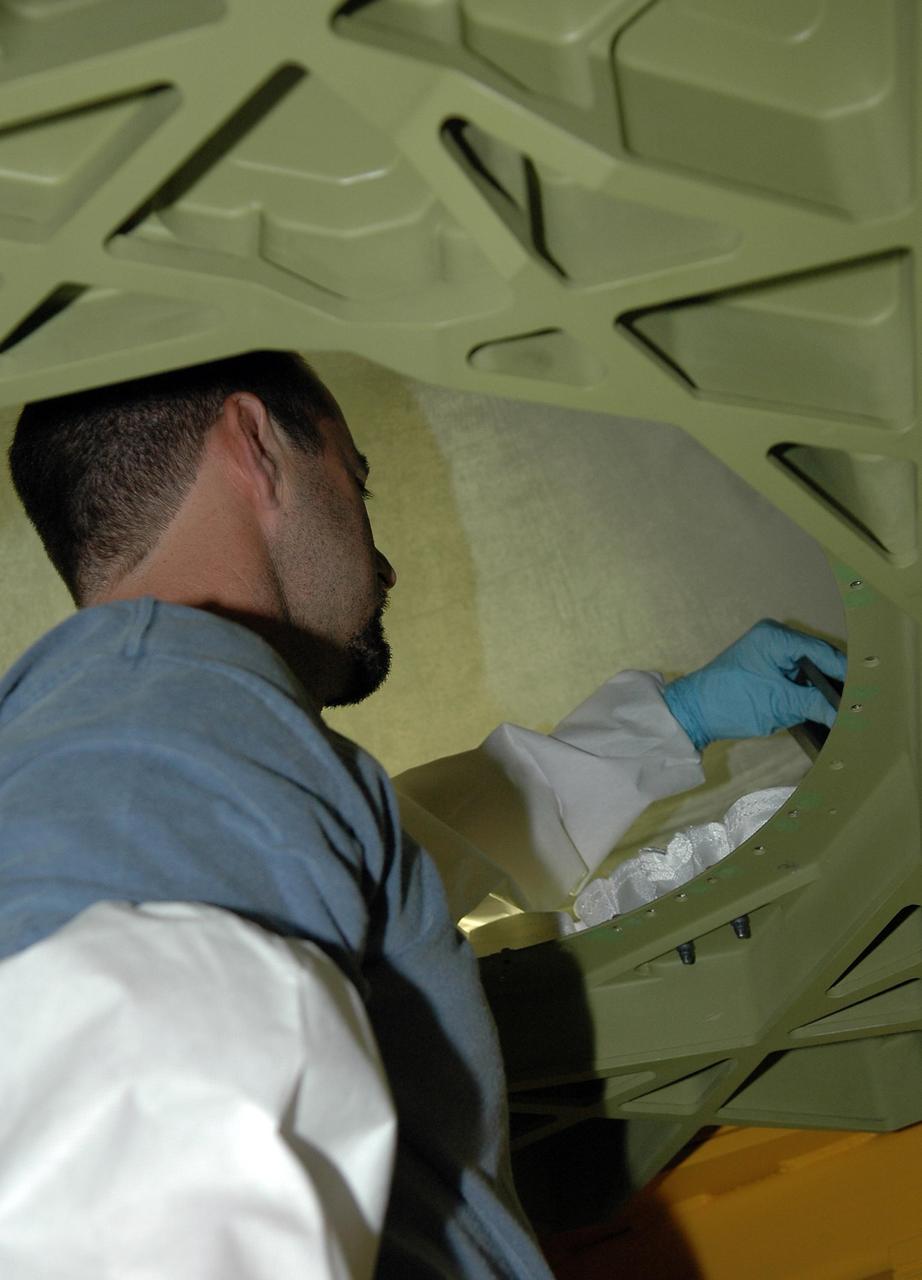
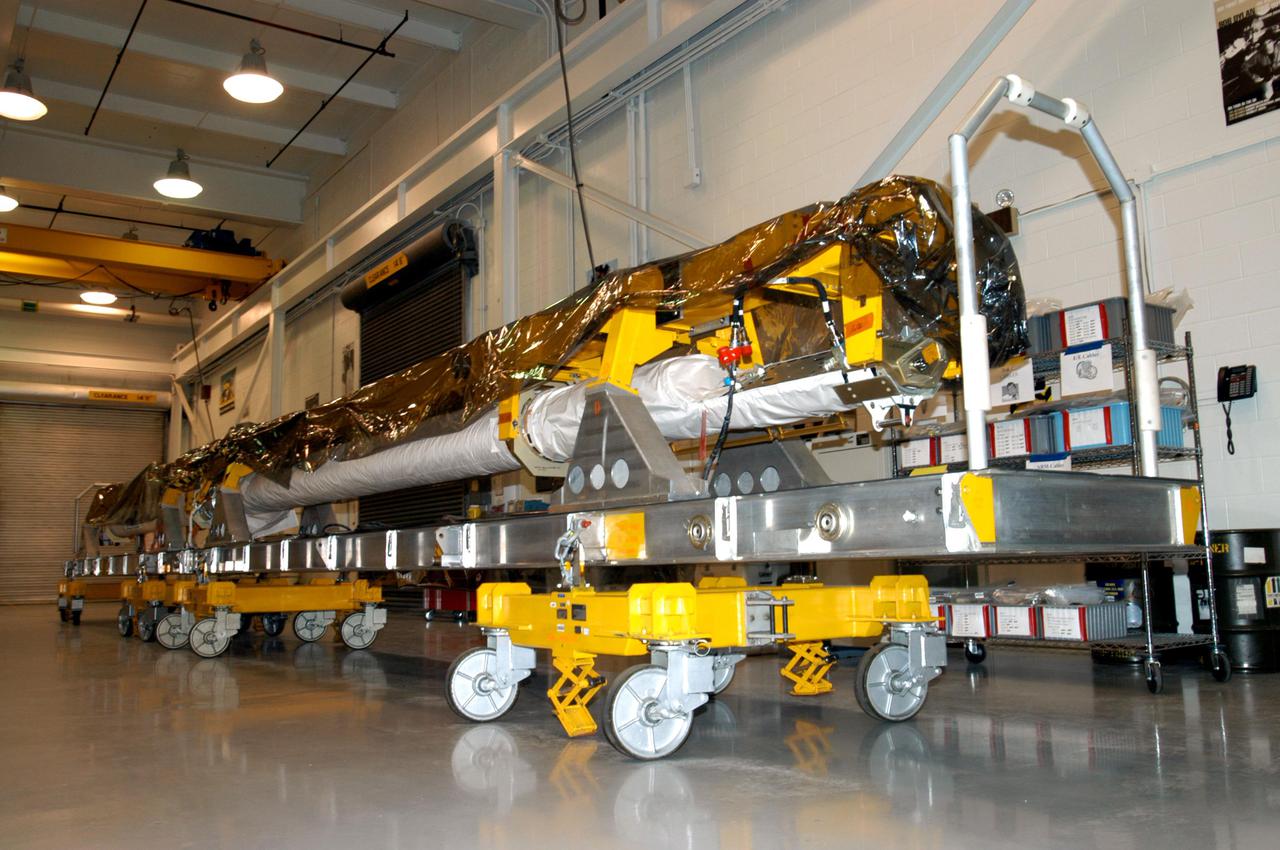
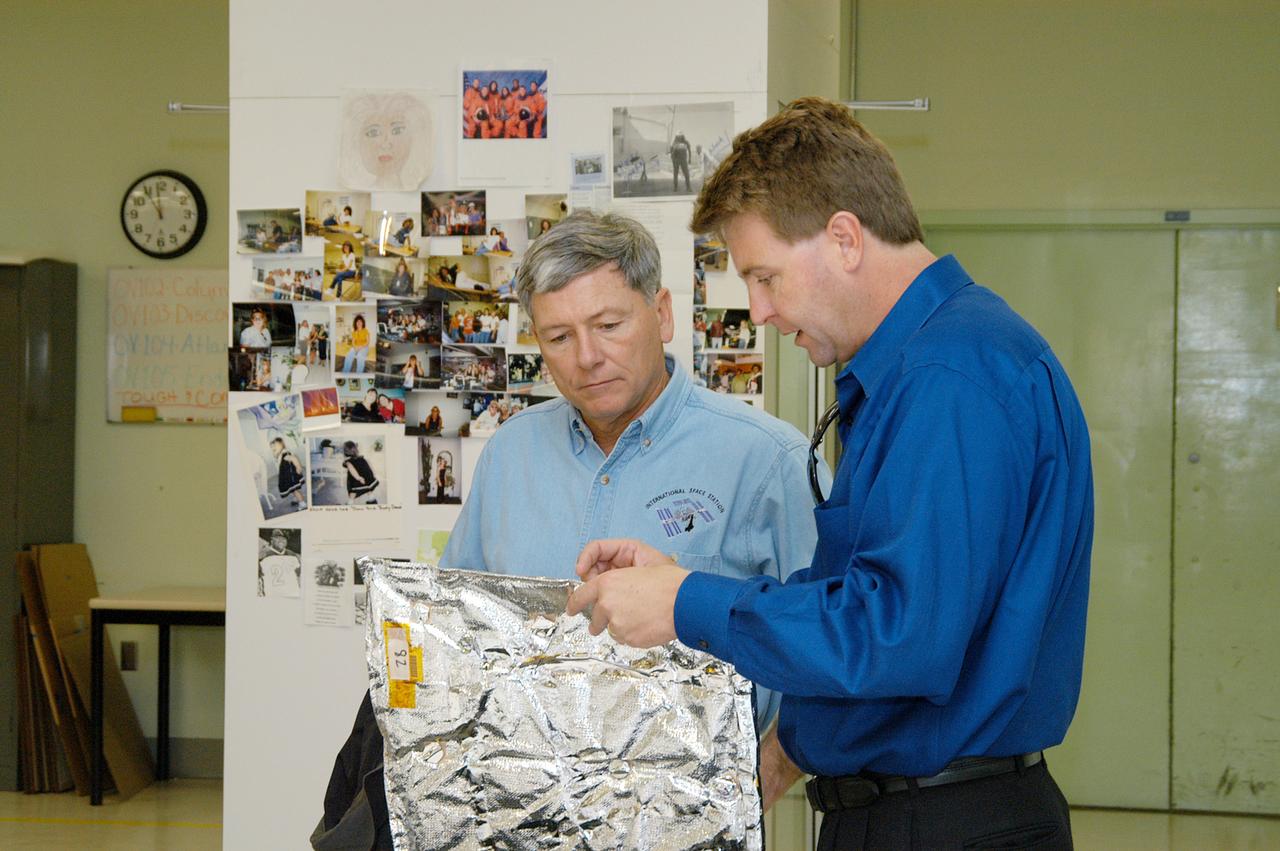
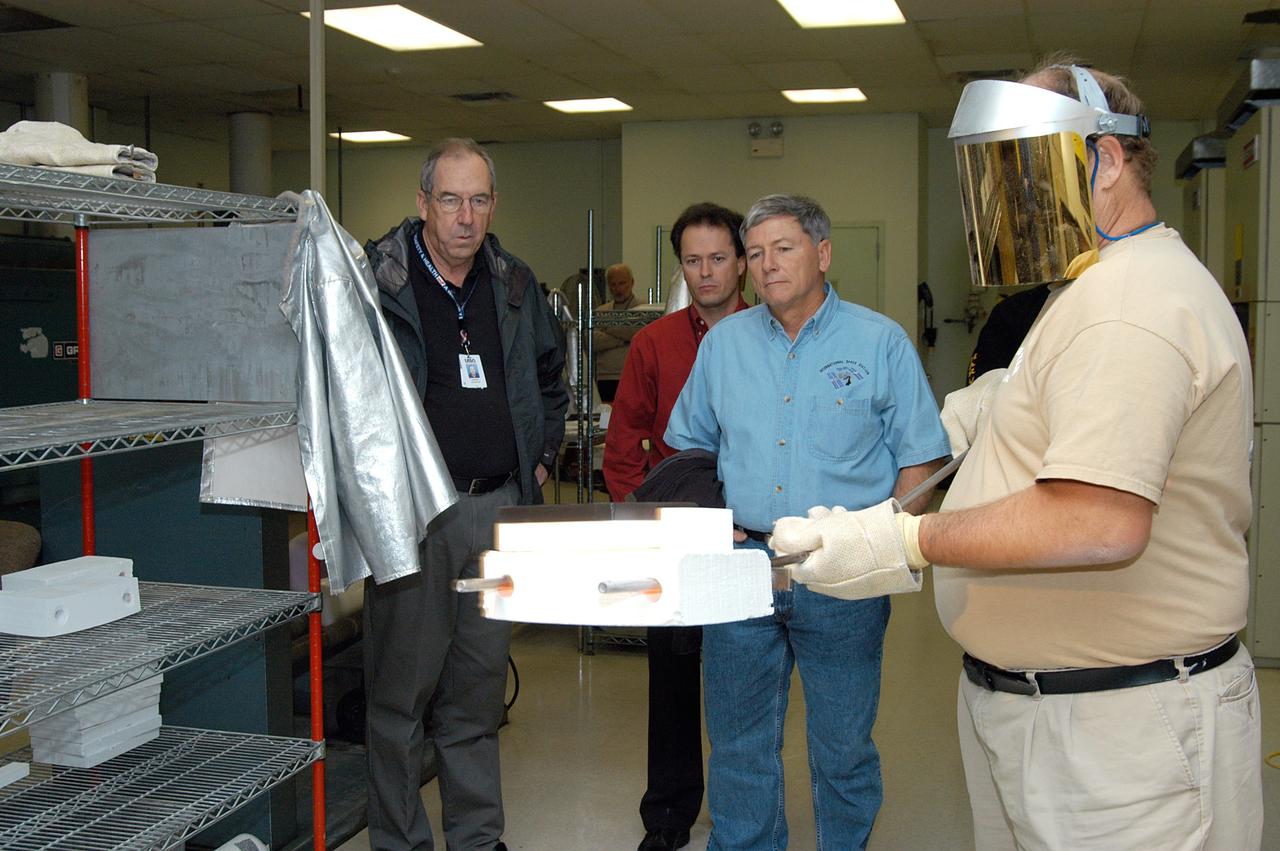
KENNEDY SPACE CENTER, FLA. -- United Space Alliance (USA) technicians demonstrate the construction of a thermal blanket used in the Shuttle's thermal protection system for USA Vice President and Space Shuttle Program Manager Howard DeCastro (second from left) and NASA Deputy Associate Administrator for Space Station and Shuttle Programs Michael Kostelnik (right).  NASA and USA Space Shuttle program management are participating in a leadership workday.  The day is intended to provide management with an in-depth, hands-on look at Shuttle processing activities at KSC.
KENNEDY SPACE CENTER, FLA. -- United Space Alliance (USA) technicians demonstrate the construction of a thermal blanket used in the Shuttle's thermal protection system for USA Vice President and Space Shuttle Program Manager Howard DeCastro (second from left) and NASA Deputy Associate Administrator for Space Station and Shuttle Programs Michael Kostelnik (right). NASA and USA Space Shuttle program management are participating in a leadership workday. The day is intended to provide management with an in-depth, hands-on look at Shuttle processing activities at KSC.
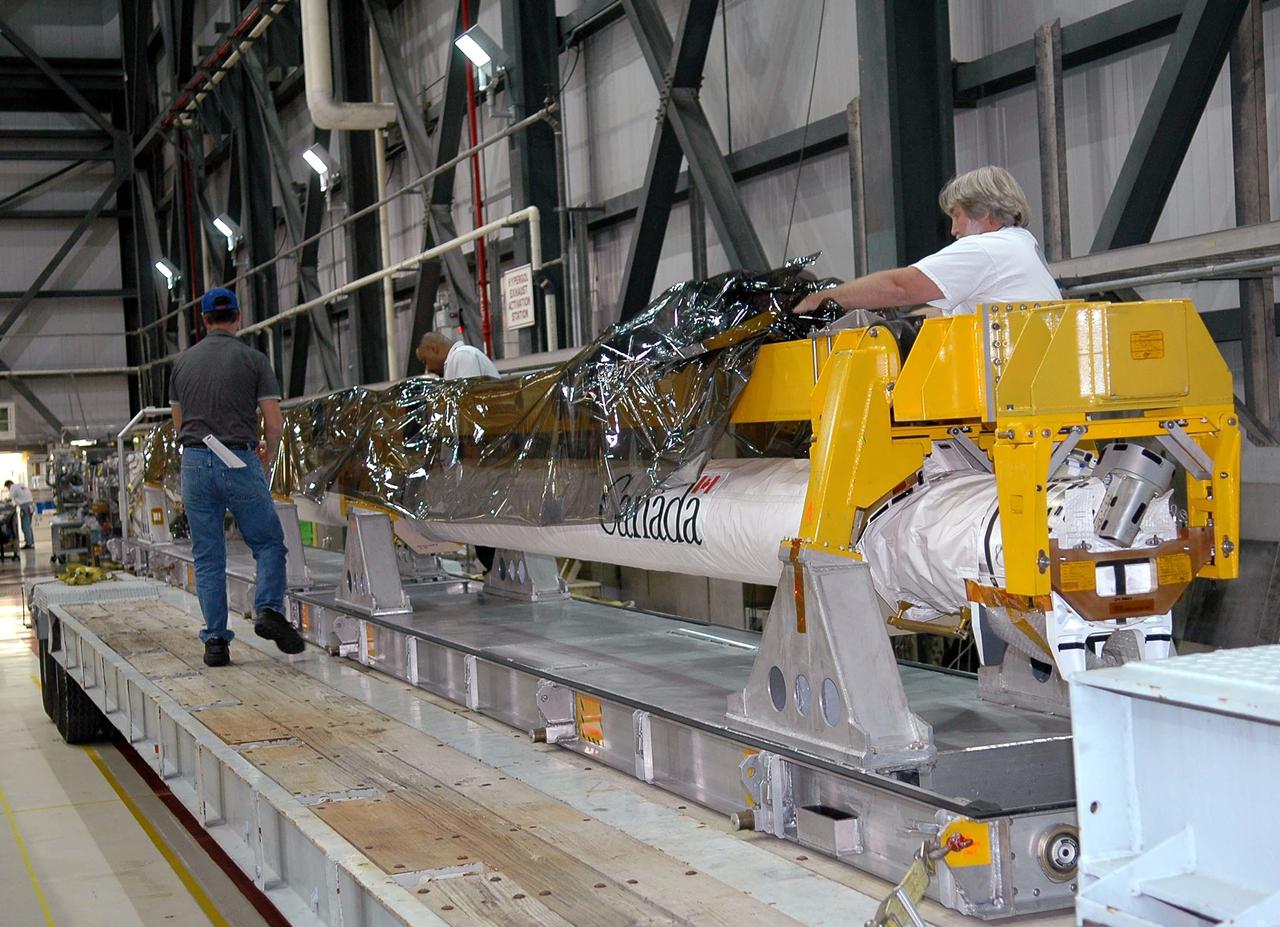
KENNEDY SPACE CENTER, FLA. -- United Space Alliance (USA) Manager of the Thermal Protection System (TPS) Facility Martin Wilson (right) briefs NASA Deputy Associate Administrator for Space Station and Shuttle Programs Michael Kostelnik (left) on the properties of a thermal blanket used in the Shuttle's TPS.  NASA and USA Space Shuttle program management are participating in a leadership workday.  The day is intended to provide management with an in-depth, hands-on look at Shuttle processing activities at KSC.
KENNEDY SPACE CENTER, FLA. -- United Space Alliance (USA) Manager of the Thermal Protection System (TPS) Facility Martin Wilson (right) briefs NASA Deputy Associate Administrator for Space Station and Shuttle Programs Michael Kostelnik (left) on the properties of a thermal blanket used in the Shuttle's TPS. NASA and USA Space Shuttle program management are participating in a leadership workday. The day is intended to provide management with an in-depth, hands-on look at Shuttle processing activities at KSC.
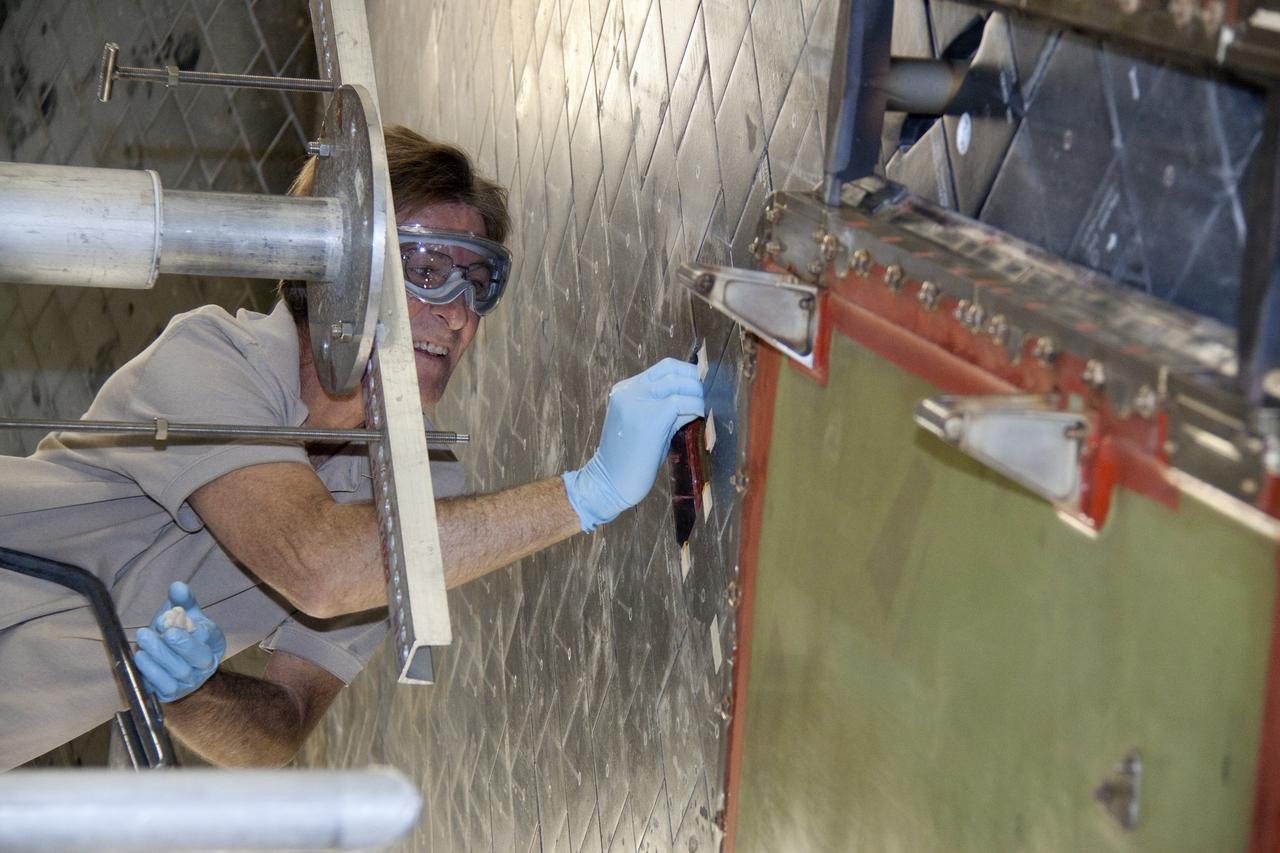
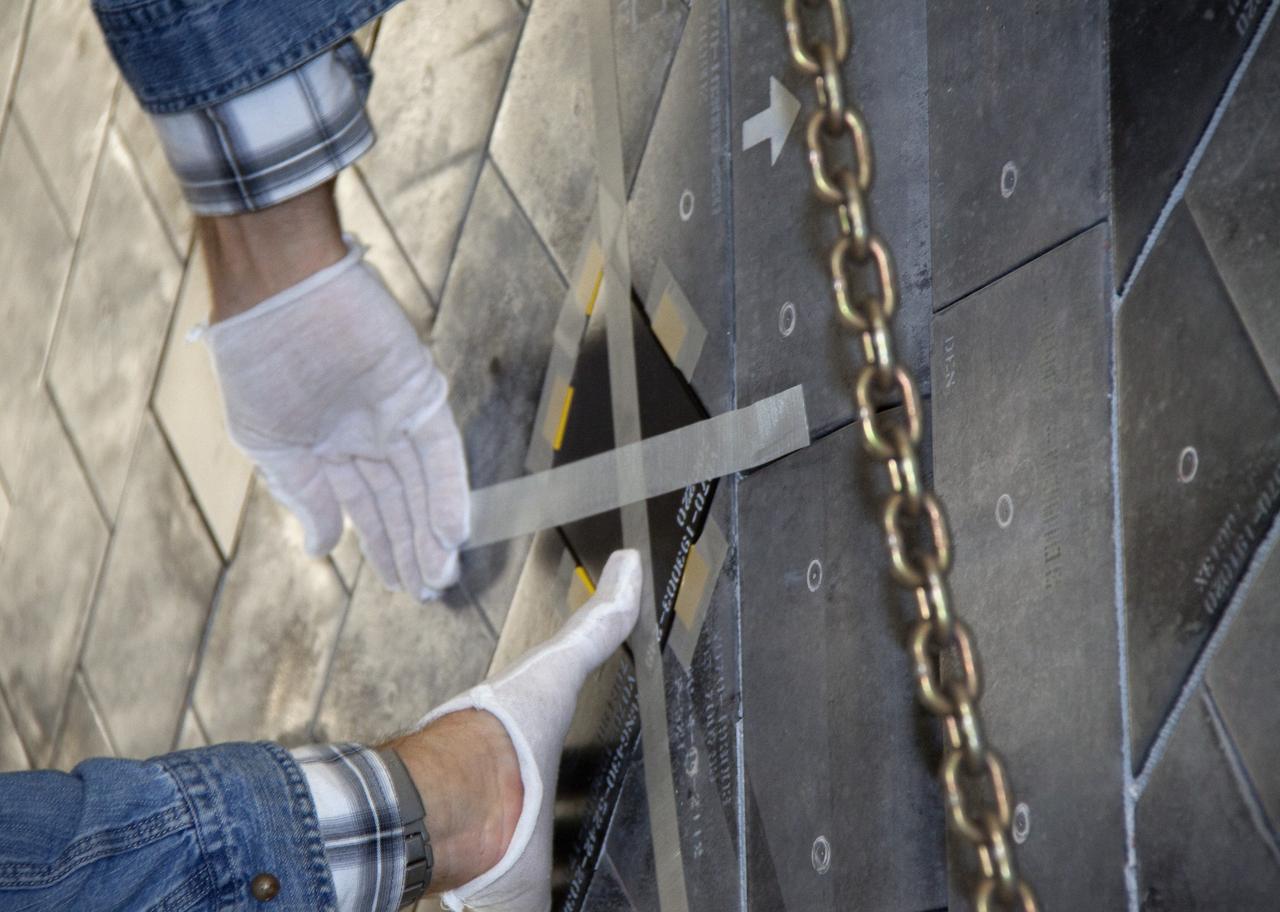
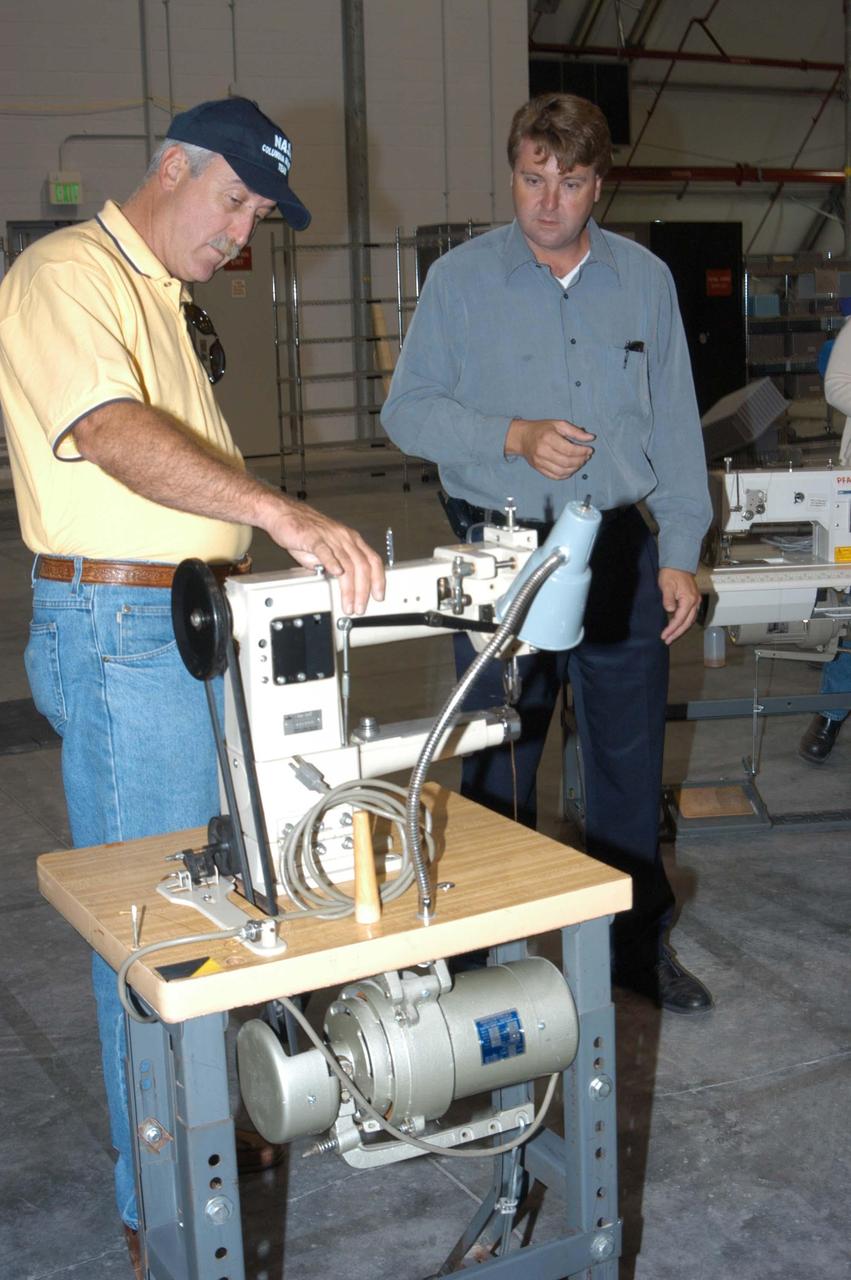
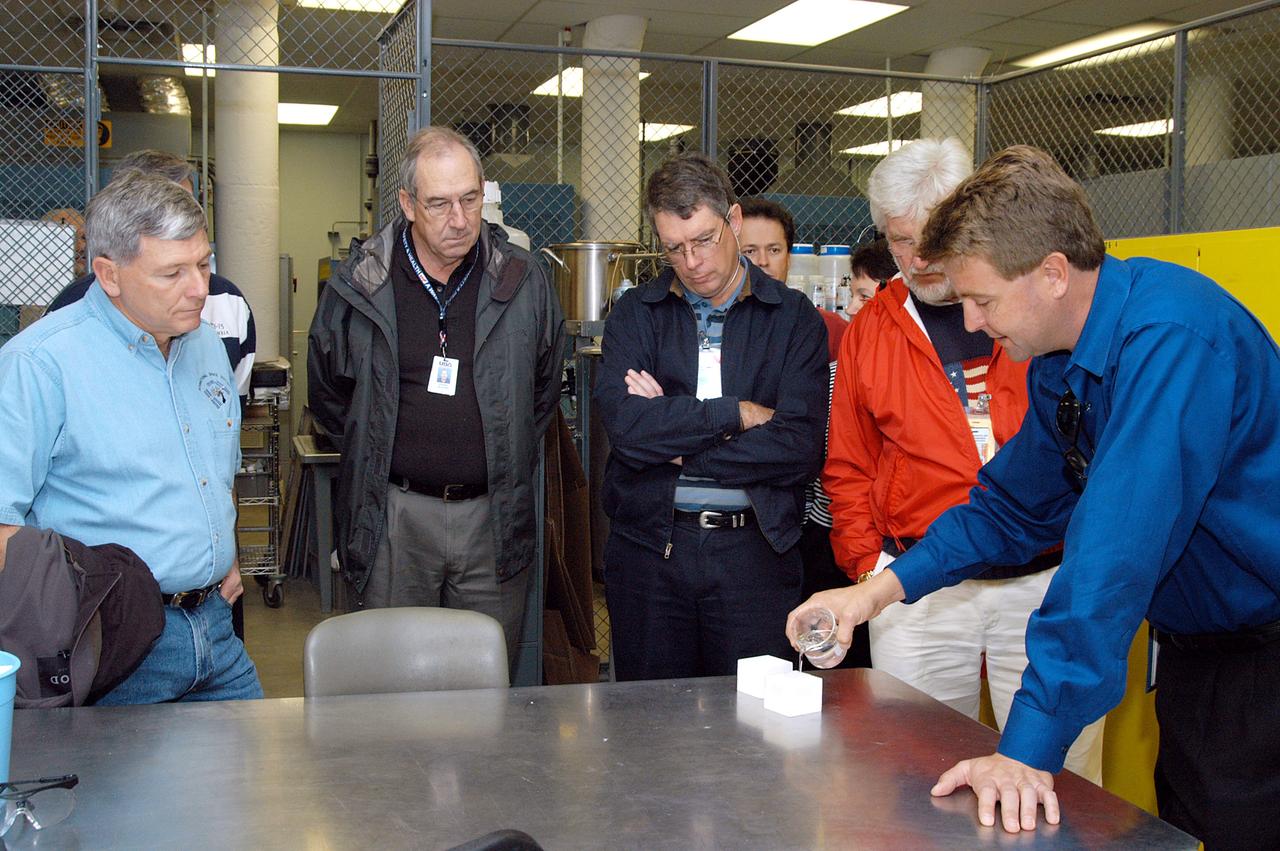
KENNEDY SPACE CENTER, FLA. -- United Space Alliance (USA) Vice President and Space Shuttle Program Manager Howard DeCastro (left) and NASA Deputy Associate Administrator for Space Station and Shuttle Programs Michael Kostelnik (third from left) watch as a USA technician (right) creates a tile for use in the Shuttle's Thermal Protection System (TPS).  NASA and USA Space Shuttle program management are participating in a leadership workday.  The day is intended to provide management with an in-depth, hands-on look at Shuttle processing activities at KSC.
KENNEDY SPACE CENTER, FLA. -- United Space Alliance (USA) Vice President and Space Shuttle Program Manager Howard DeCastro (left) and NASA Deputy Associate Administrator for Space Station and Shuttle Programs Michael Kostelnik (third from left) watch as a USA technician (right) creates a tile for use in the Shuttle's Thermal Protection System (TPS). NASA and USA Space Shuttle program management are participating in a leadership workday. The day is intended to provide management with an in-depth, hands-on look at Shuttle processing activities at KSC.
KENNEDY SPACE CENTER, FLA. -- From left, NASA Deputy Associate Administrator for Space Station and Shuttle Programs Michael Kostelnik and United Space Alliance (USA) Vice President and Space Shuttle Program Manager Howard DeCastro are briefed on the properties of the tile used in the Shuttle's Thermal Protection System (TPS) by USA Manager of the TPS Facility Martin Wilson (right).  NASA and USA Space Shuttle program management are participating in a leadership workday.  The day is intended to provide management with an in-depth, hands-on look at Shuttle processing activities at KSC.
KENNEDY SPACE CENTER, FLA. -- From left, NASA Deputy Associate Administrator for Space Station and Shuttle Programs Michael Kostelnik and United Space Alliance (USA) Vice President and Space Shuttle Program Manager Howard DeCastro are briefed on the properties of the tile used in the Shuttle's Thermal Protection System (TPS) by USA Manager of the TPS Facility Martin Wilson (right). NASA and USA Space Shuttle program management are participating in a leadership workday. The day is intended to provide management with an in-depth, hands-on look at Shuttle processing activities at KSC.
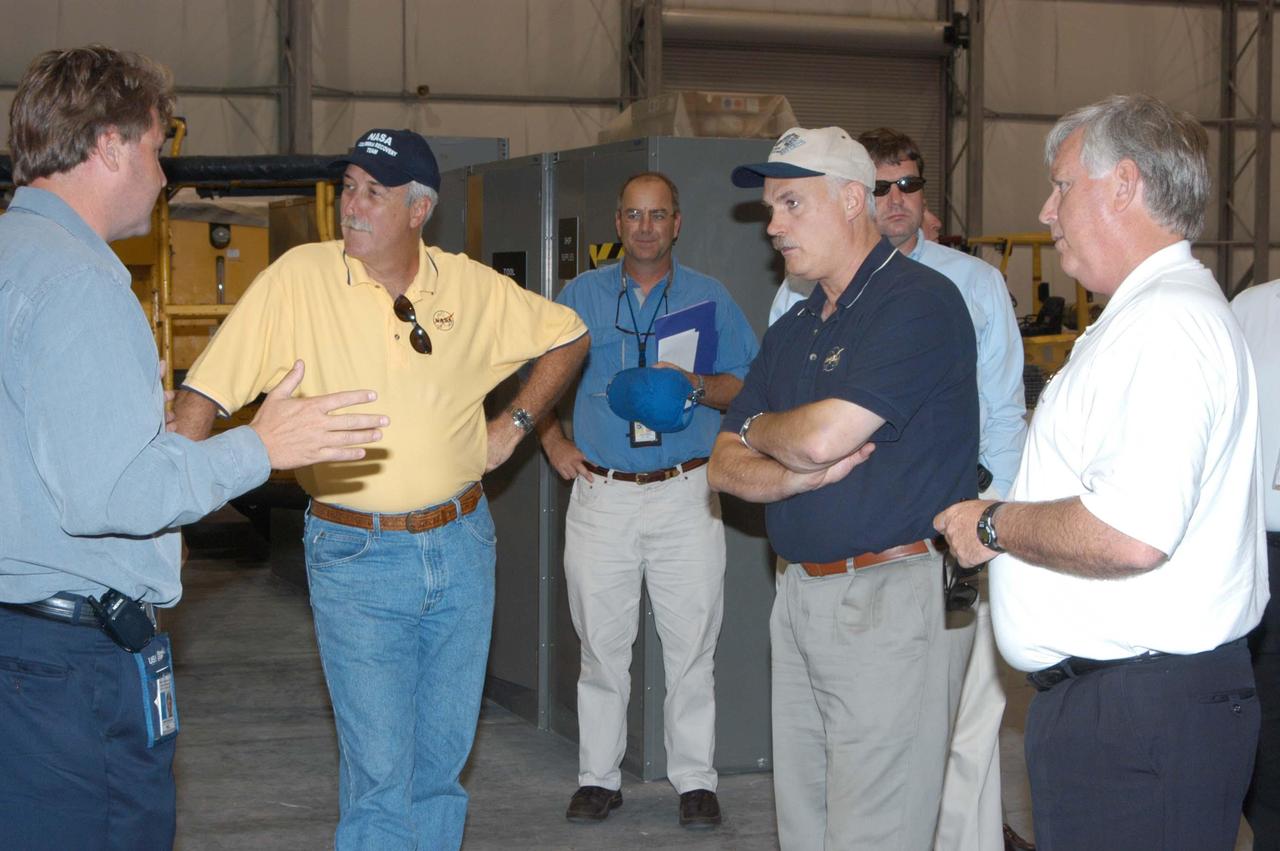
KENNEDY SPACE CENTER, FLA. -- From left, United Space Alliance (USA) Deputy Space Shuttle Program Manager of Operations Loren Shriver, USA Associate Program Manager of Ground Operations Andy Allen, NASA Deputy Associate Administrator for Space Station and Shuttle Programs Michael Kostelnik, and USA Vice President and Space Shuttle Program Manager Howard DeCastro examine a tile used in the Shuttle's Thermal Protection System (TPS) in KSC's TPS Facility.  NASA and USA Space Shuttle program management are participating in a leadership workday.  The day is intended to provide management with an in-depth, hands-on look at Shuttle processing activities at KSC.
KENNEDY SPACE CENTER, FLA. -- From left, United Space Alliance (USA) Deputy Space Shuttle Program Manager of Operations Loren Shriver, USA Associate Program Manager of Ground Operations Andy Allen, NASA Deputy Associate Administrator for Space Station and Shuttle Programs Michael Kostelnik, and USA Vice President and Space Shuttle Program Manager Howard DeCastro examine a tile used in the Shuttle's Thermal Protection System (TPS) in KSC's TPS Facility. NASA and USA Space Shuttle program management are participating in a leadership workday. The day is intended to provide management with an in-depth, hands-on look at Shuttle processing activities at KSC.
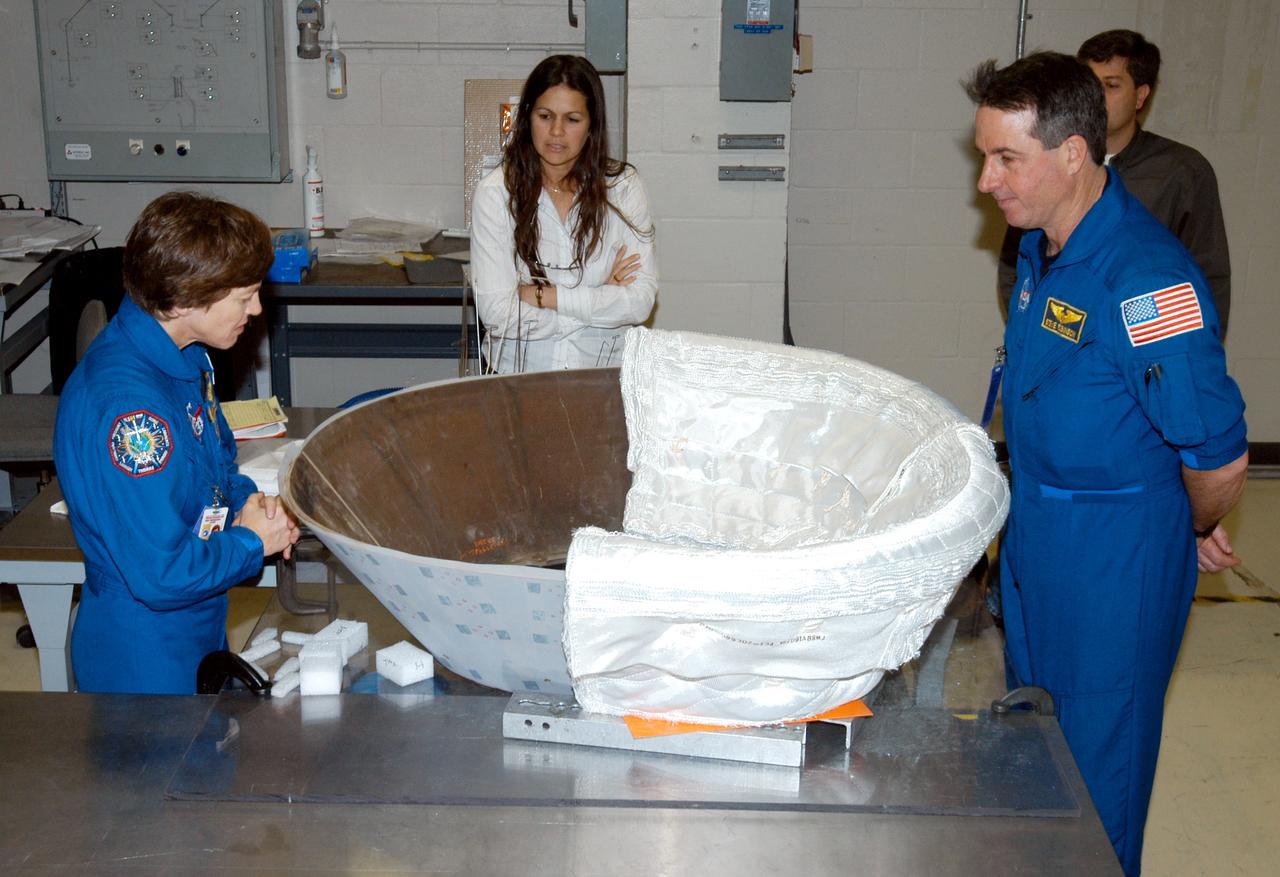
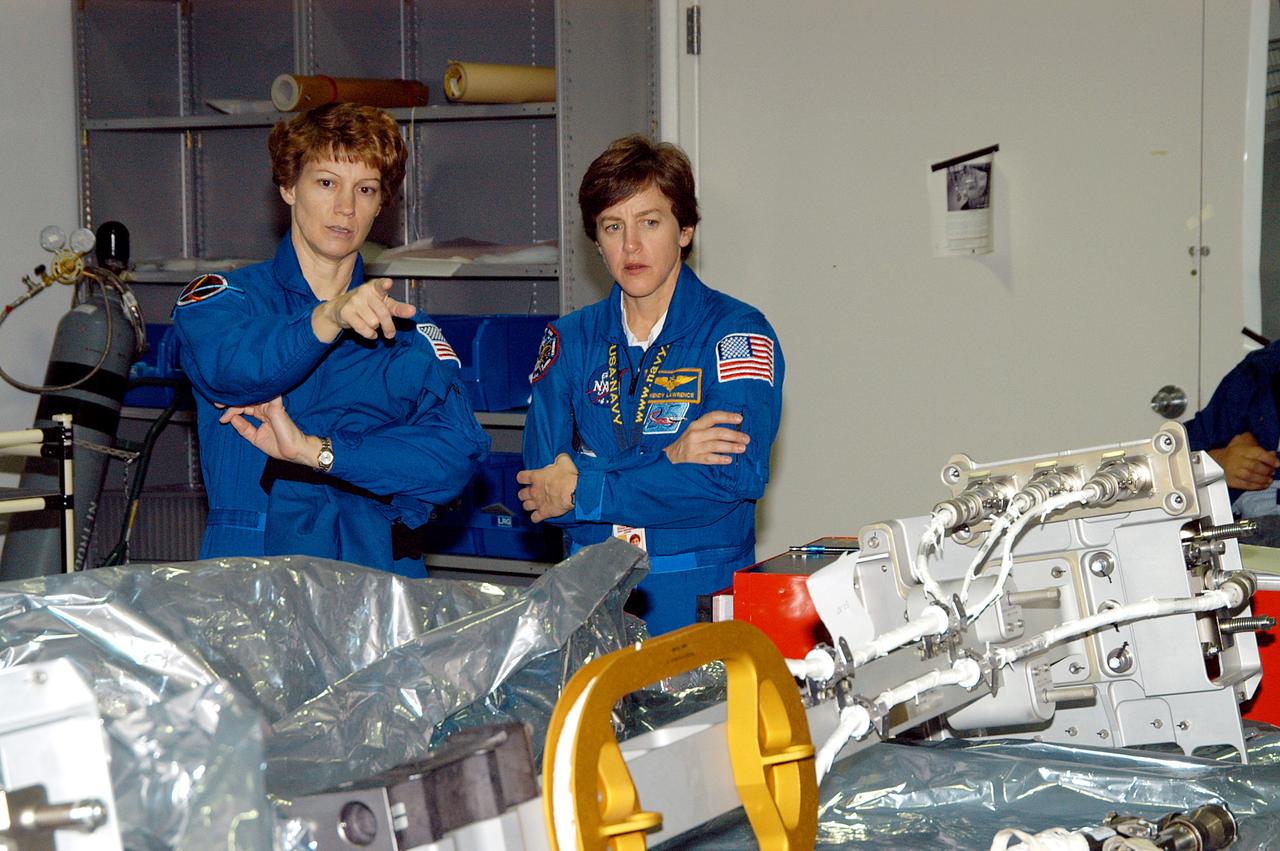
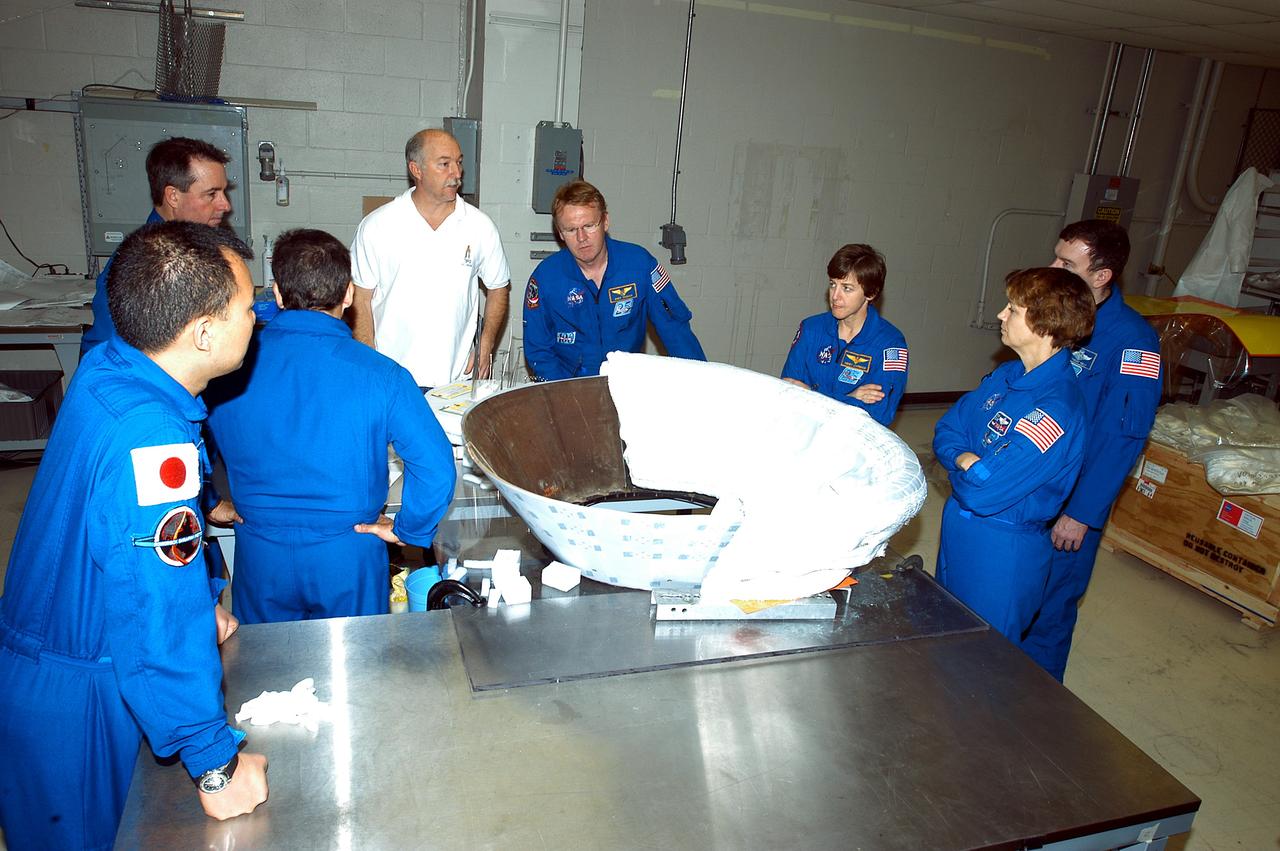
KENNEDY SPACE CENTER, FLA. - STS-114 Mission Specialists Wendy Lawrence (left) and Stephen Robinson (right) look at the insert for Discovery’s nose cap that is being fitted with thermal protection system insulation blankets.  The mission crew is spending time becoming familiar with Shuttle and mission equipment.  The mission is Logistics Flight 1, which is scheduled to deliver supplies and equipment plus the external stowage platform to the International Space Station.
KENNEDY SPACE CENTER, FLA. - STS-114 Mission Specialists Wendy Lawrence (left) and Stephen Robinson (right) look at the insert for Discovery’s nose cap that is being fitted with thermal protection system insulation blankets. The mission crew is spending time becoming familiar with Shuttle and mission equipment. The mission is Logistics Flight 1, which is scheduled to deliver supplies and equipment plus the external stowage platform to the International Space Station.
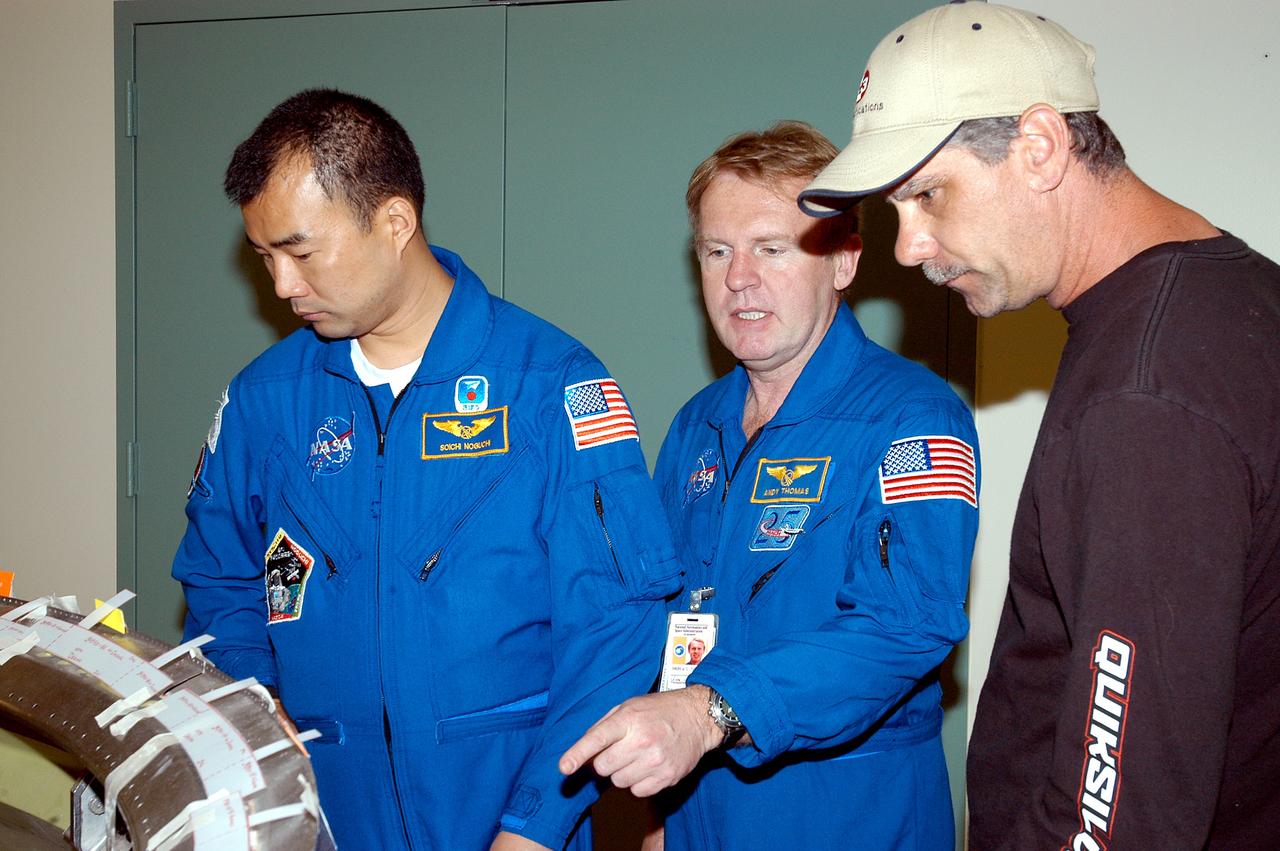
KENNEDY SPACE CENTER, FLA. -  Members of the STS-114 crew spend time becoming familiar with Shuttle and mission equipment.  Mission Specialists Soichi Noguchi (left) and Andrew Thomas (center) look at an engine eyelet, which serves as part of the thermal protection system on an orbiter.  Noguchi is with the Japanese Aerospace Exploration Agency (JAXA).  The mission is Logistics Flight 1, which is scheduled to deliver supplies and equipment and the external stowage platform to the International Space Station.
KENNEDY SPACE CENTER, FLA. - Members of the STS-114 crew spend time becoming familiar with Shuttle and mission equipment. Mission Specialists Soichi Noguchi (left) and Andrew Thomas (center) look at an engine eyelet, which serves as part of the thermal protection system on an orbiter. Noguchi is with the Japanese Aerospace Exploration Agency (JAXA). The mission is Logistics Flight 1, which is scheduled to deliver supplies and equipment and the external stowage platform to the International Space Station.
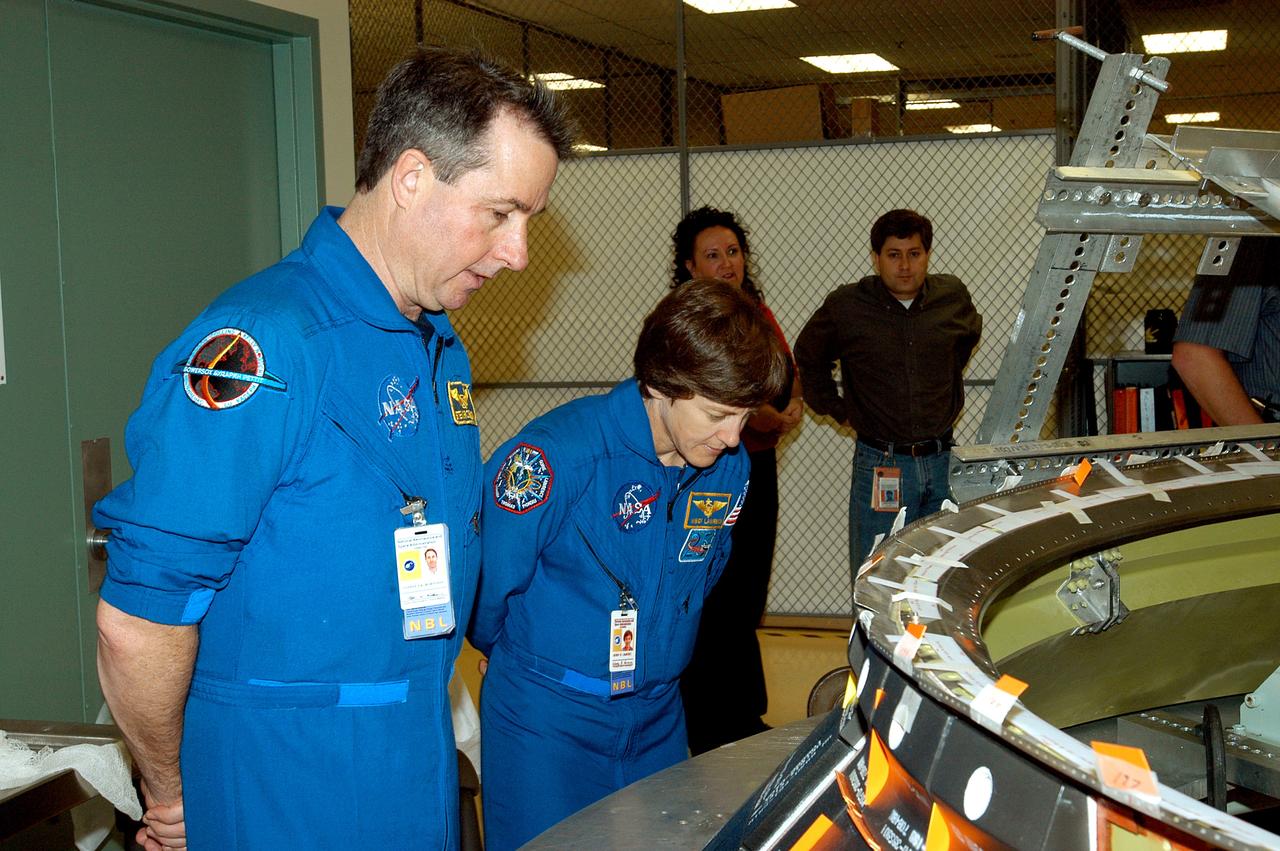
KENNEDY SPACE CENTER, FLA. -  Members of the STS-114 crew spend time in the Orbiter Processing Facility becoming familiar with Shuttle and mission equipment.  Mission Specialists Stephen Robinson (left) and Wendy Lawrence (right) look at an engine eyelet, which serves as part of the thermal protection system on an orbiter.  The STS-114 mission is Logistics Flight 1, which is scheduled to deliver supplies and equipment and the external stowage platform to the International Space Station.
KENNEDY SPACE CENTER, FLA. - Members of the STS-114 crew spend time in the Orbiter Processing Facility becoming familiar with Shuttle and mission equipment. Mission Specialists Stephen Robinson (left) and Wendy Lawrence (right) look at an engine eyelet, which serves as part of the thermal protection system on an orbiter. The STS-114 mission is Logistics Flight 1, which is scheduled to deliver supplies and equipment and the external stowage platform to the International Space Station.
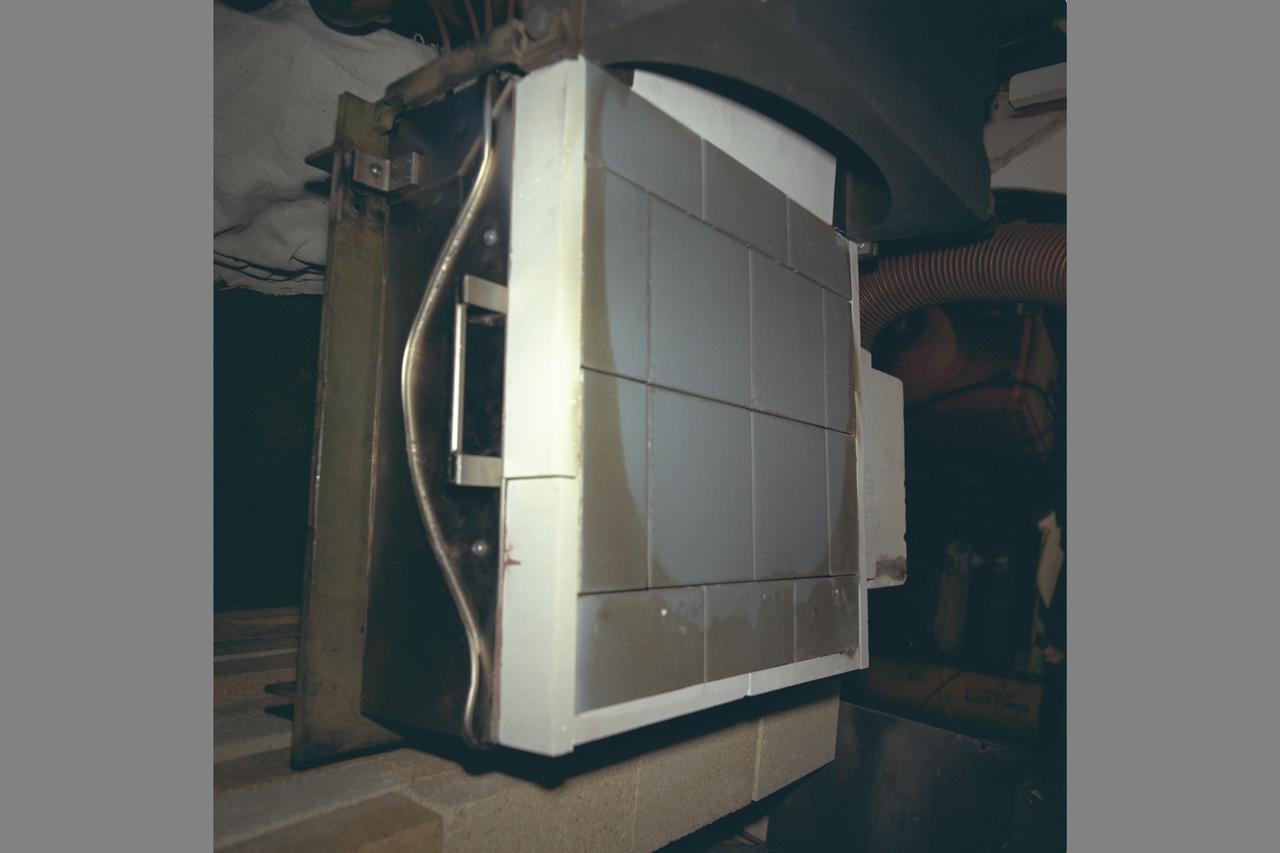
Space Shuttle Tile Thermal Protection System testing in Ames Arc Jet facilities
ARC-1974-AC74-2000
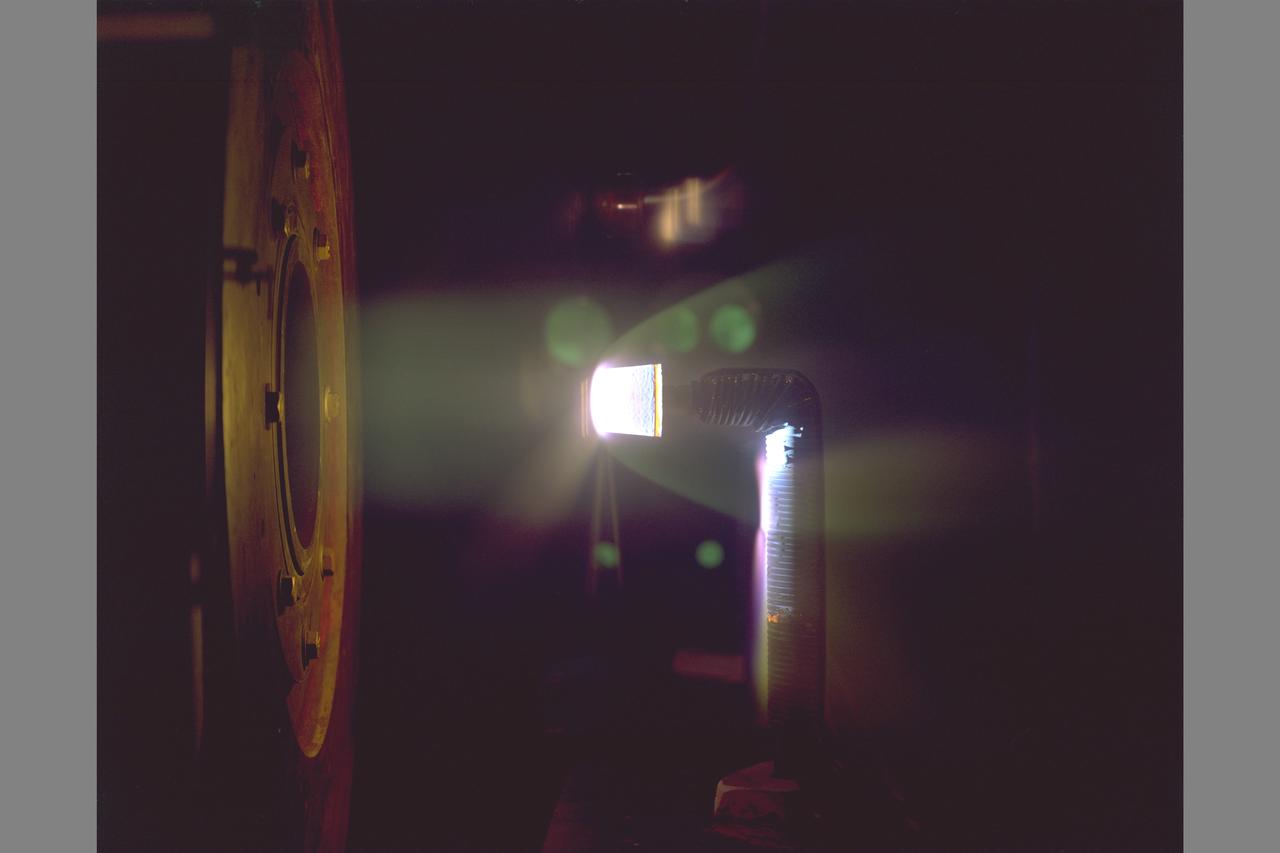
Advanced Space Shuttle TPS (Thermal Protection System) Plasma Stream during run in Arc Heater Facility
ARC-1982-AC82-0121-4
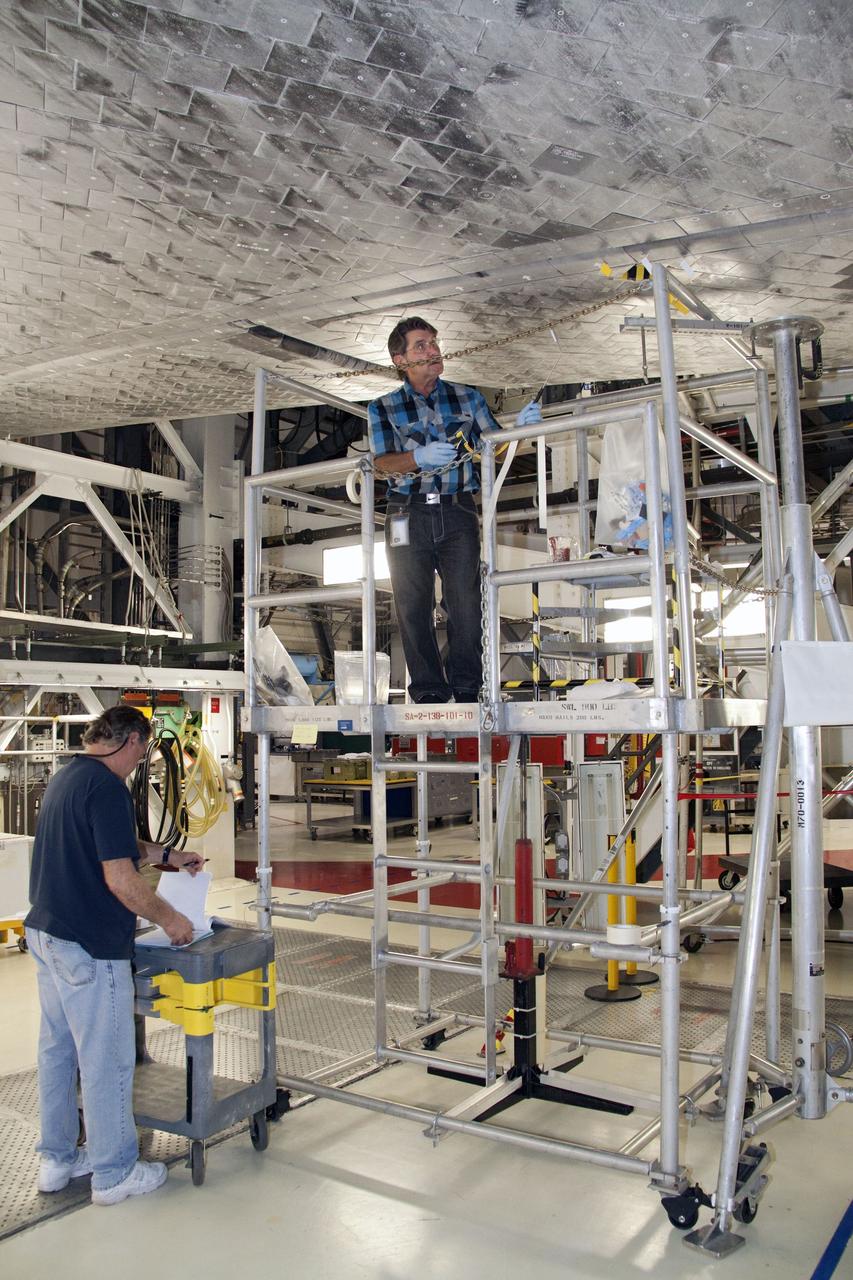
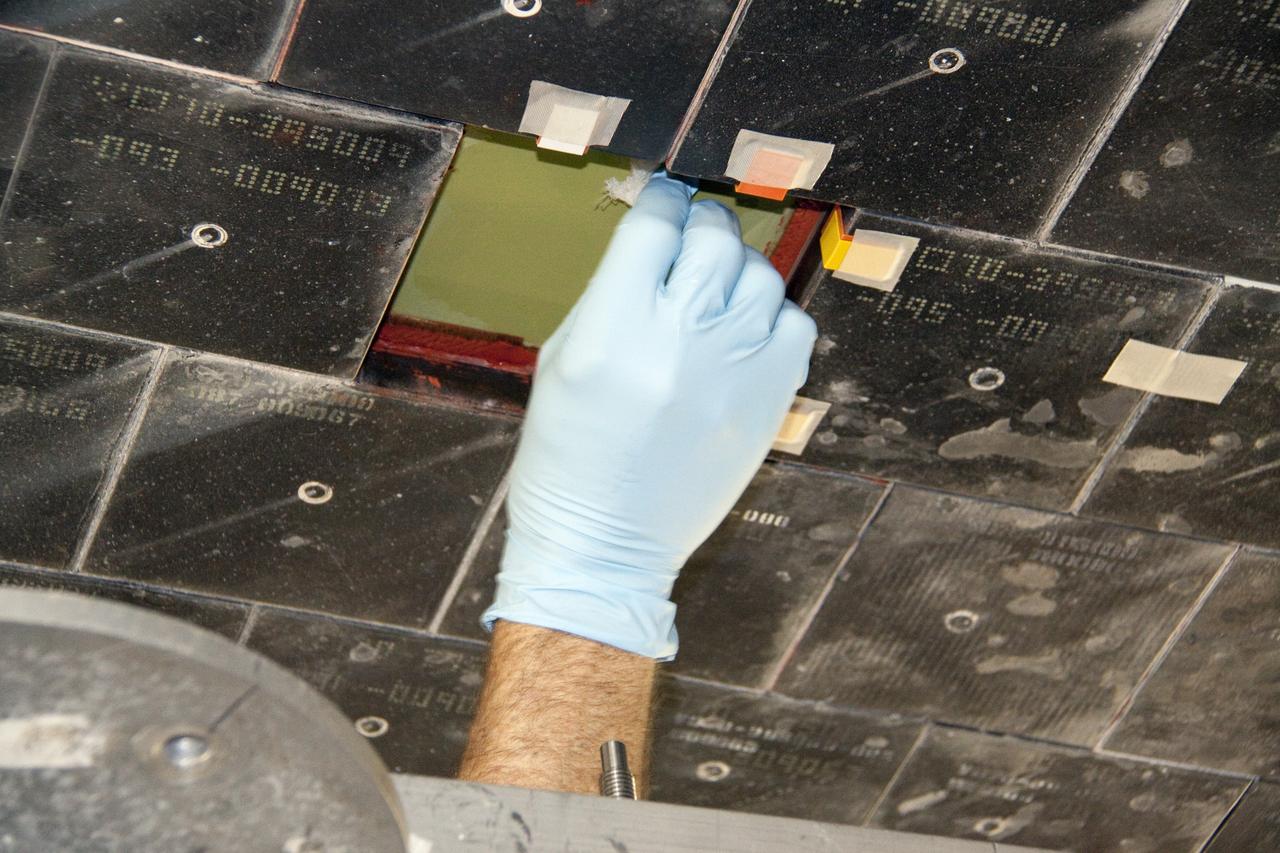
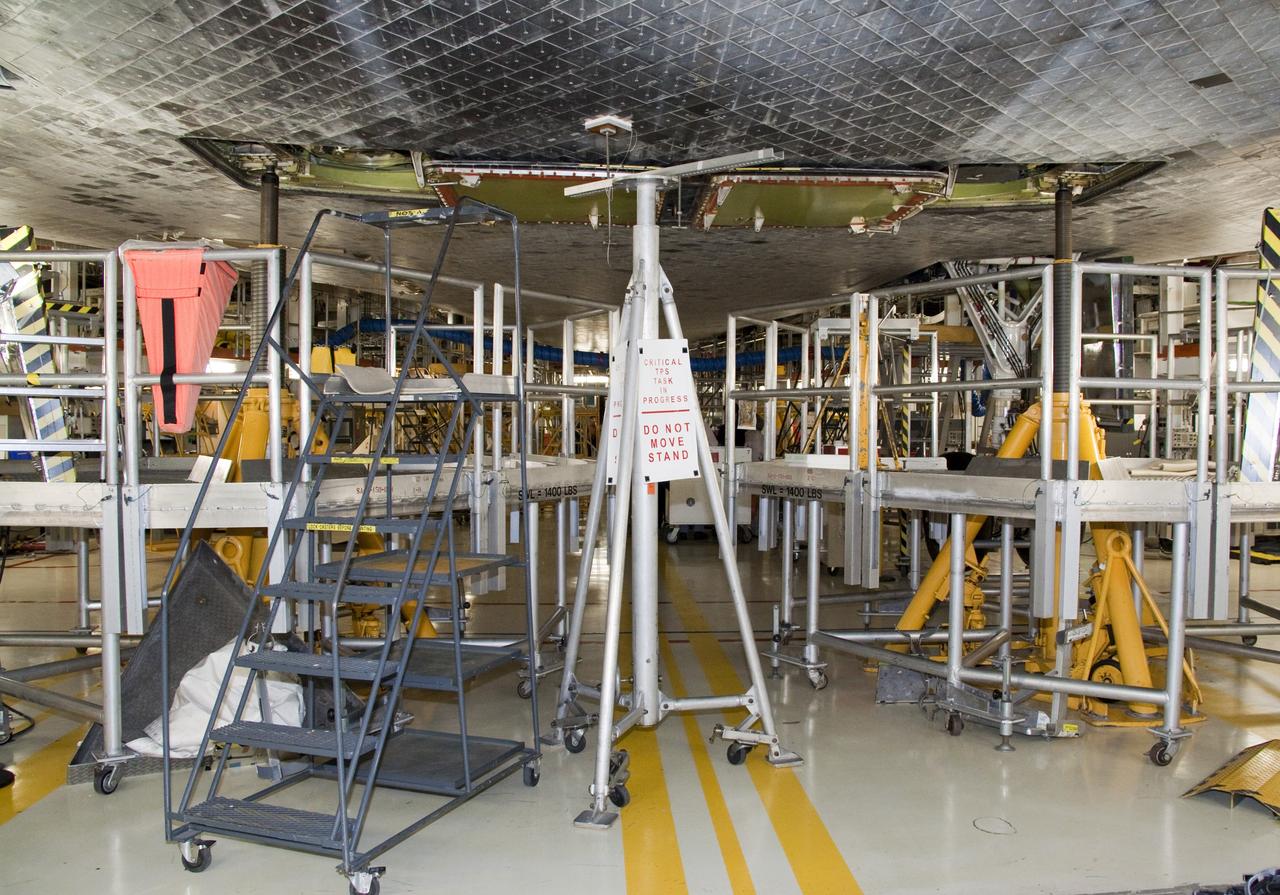
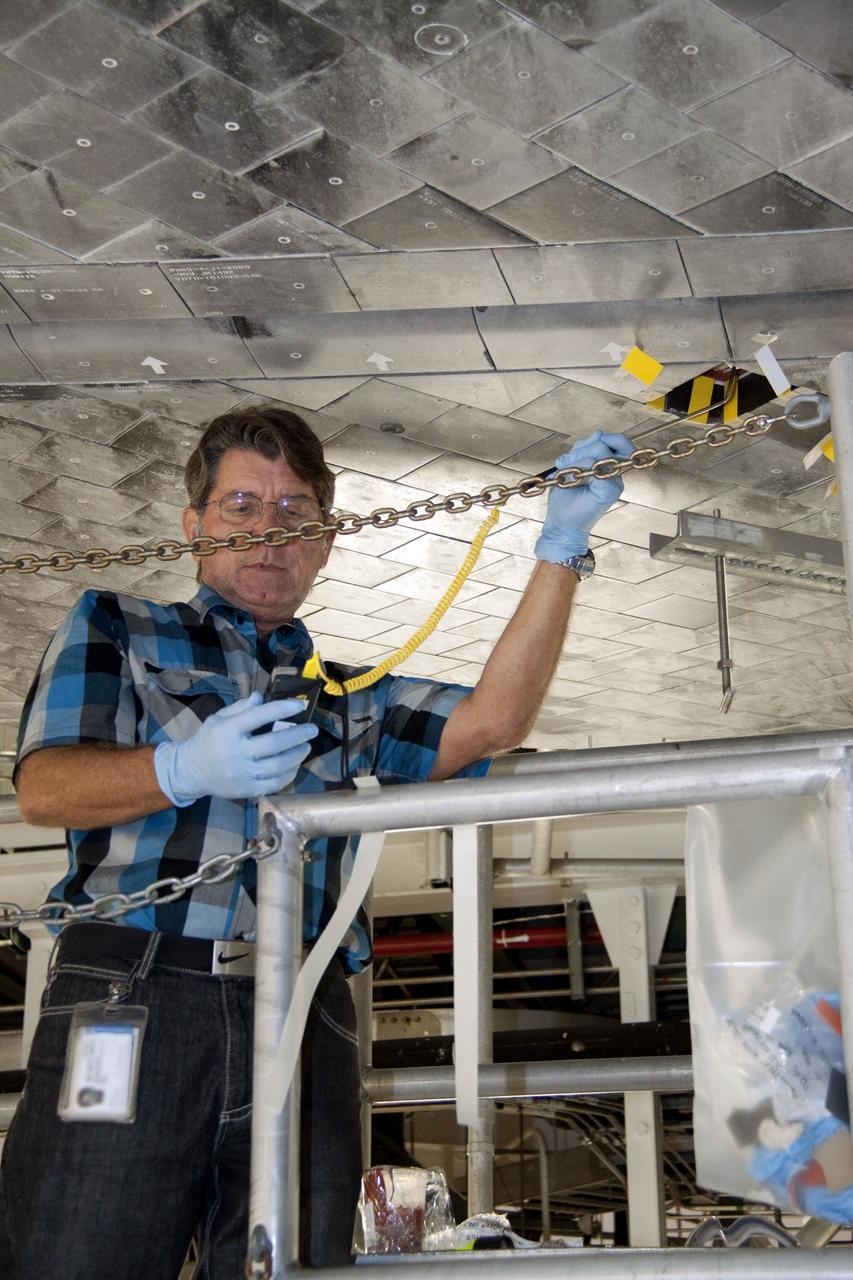
CAPE CANAVERAL, Fla. -- In Orbiter Processing Facility-1 at NASA's Kennedy Space Center in Florida, a thermal protection system technician is ready to work on replacing some of space shuttle Atlantis' heat shield tiles. The tiles are part of the Orbiter Thermal Protection System, thermal shields to protect against temperatures as high as 3,000 degrees Fahrenheit, which are produced during descent for landing.            Atlantis is being prepared for the STS-135 mission, which will deliver the Raffaello multi-purpose logistics module packed with supplies, logistics and spare parts to the International Space Station. STS-135 is targeted to launch June 28, and will be the last spaceflight for the Space Shuttle Program. Photo credit: NASA/Jack Pfaller
KSC-2011-1399
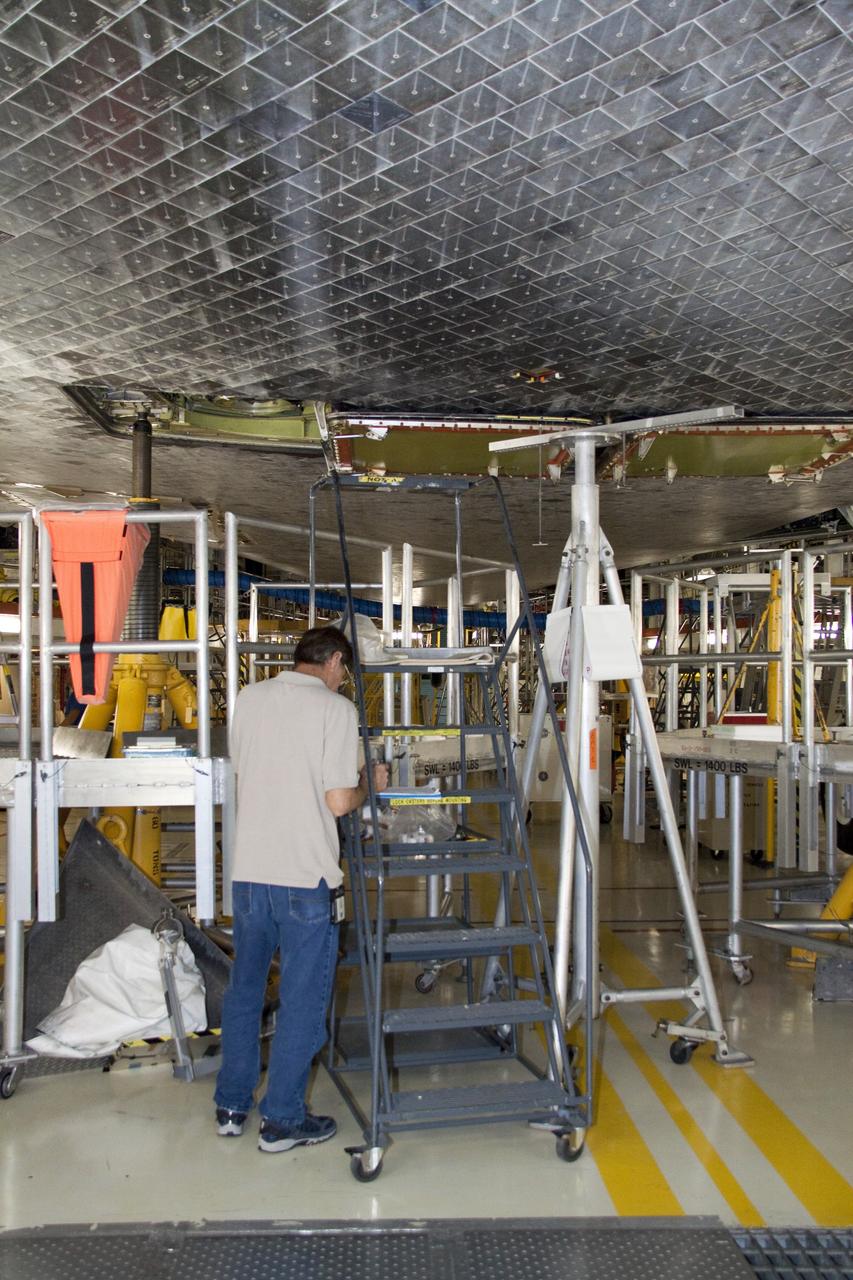
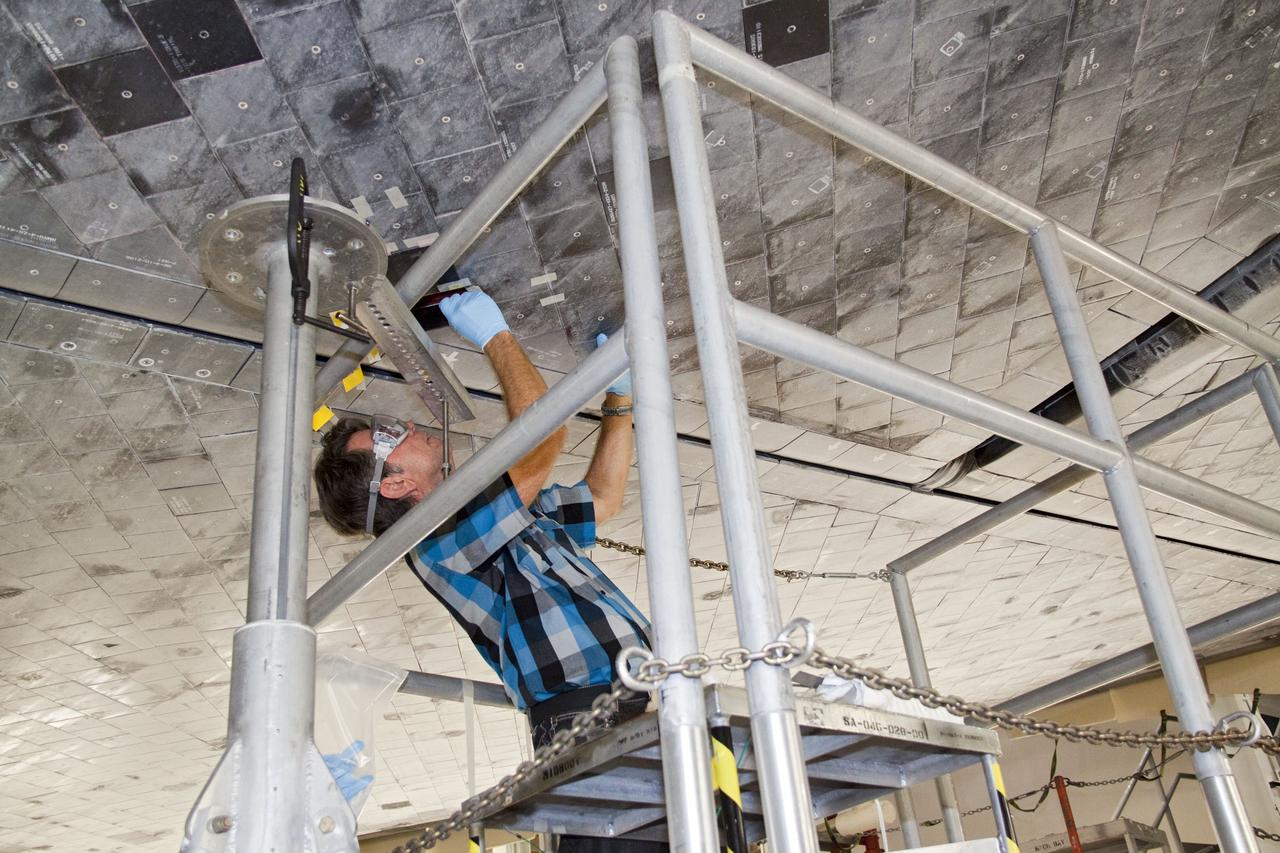
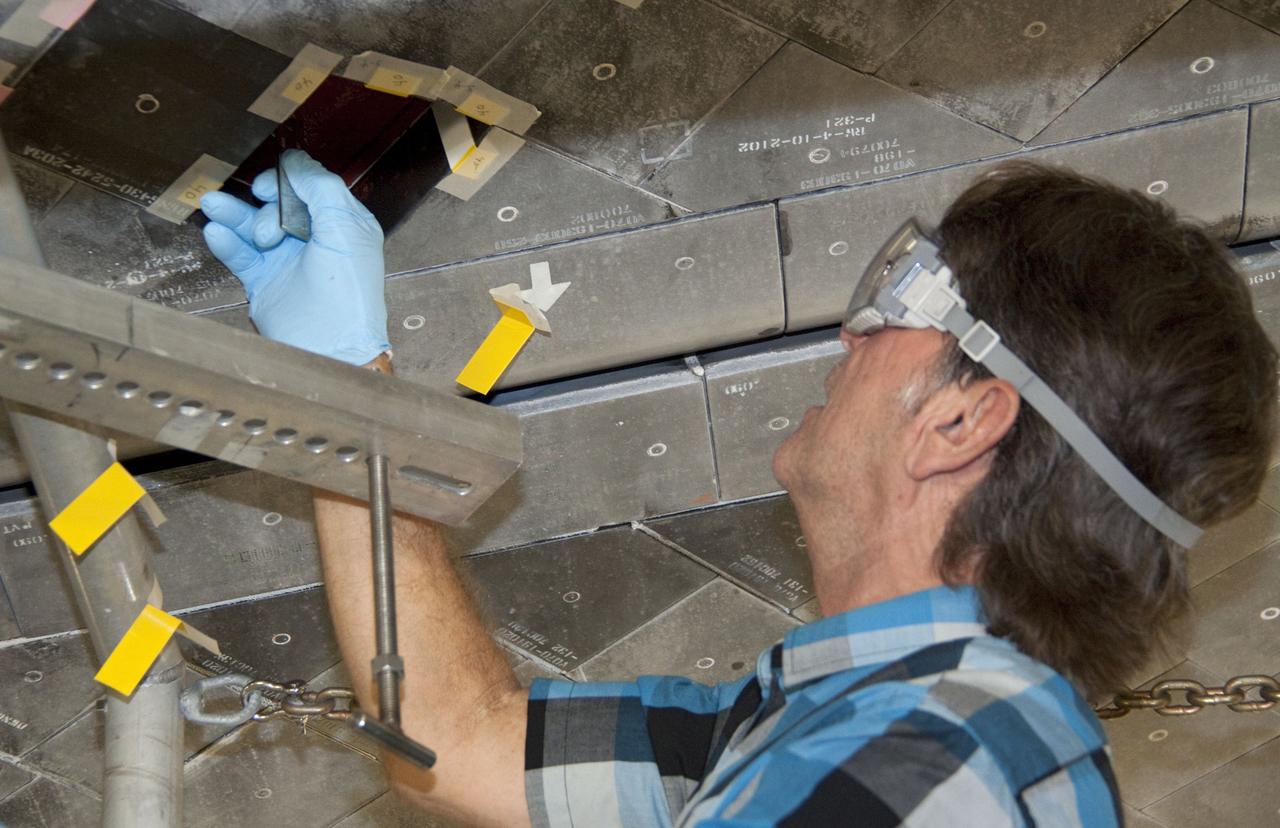
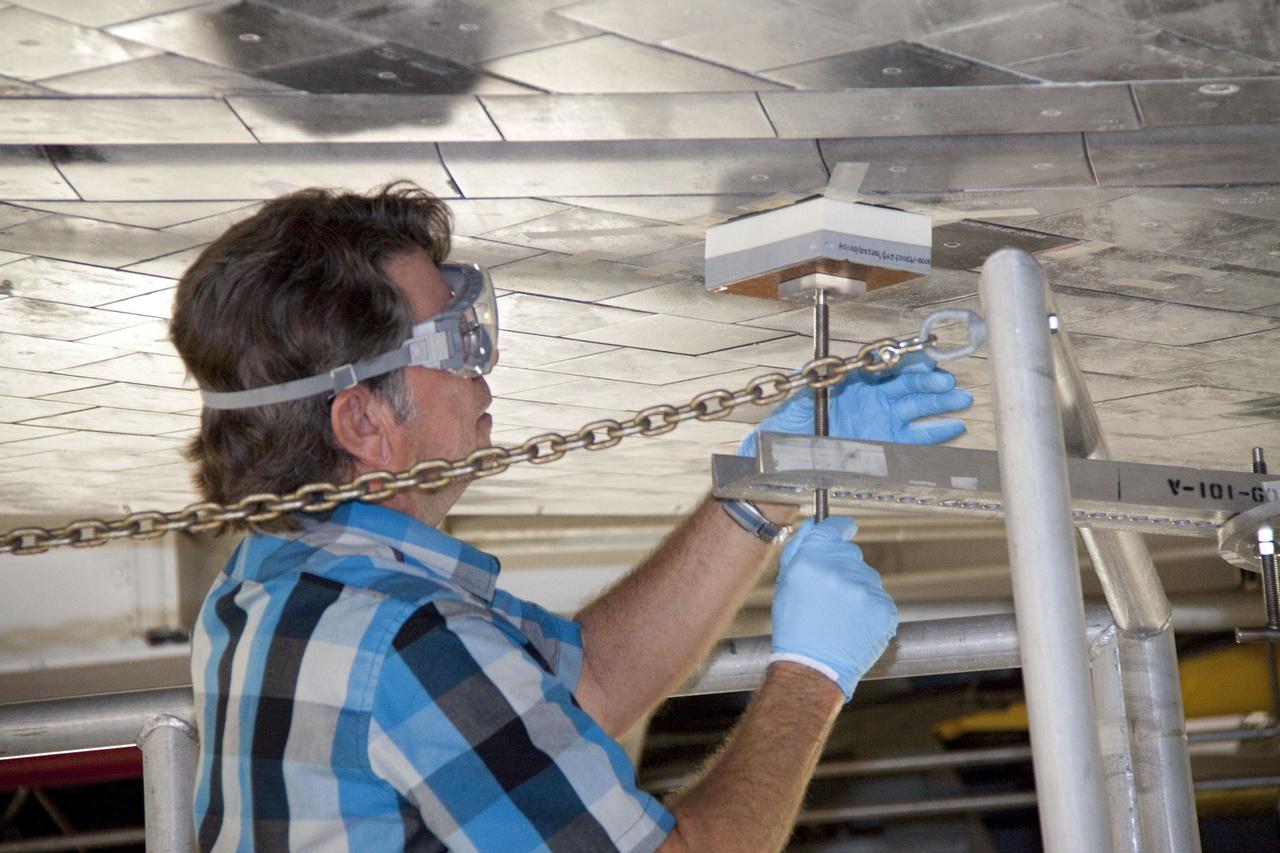
CAPE CANAVERAL, Fla. -- In Orbiter Processing Facility-1 at NASA's Kennedy Space Center in Florida, a thermal protection system technician is replacing a heat shield tile under space shuttle Atlantis. The tiles are part of the Orbiter Thermal Protection System, thermal shields to protect against temperatures as high as 3,000 degrees Fahrenheit, which are produced during descent for landing.  Atlantis is being prepared for the STS-135 mission, which will deliver the Raffaello multi-purpose logistics module packed with supplies, logistics and spare parts to the International Space Station. STS-135 is targeted to launch June 28, and will be the last spaceflight for the Space Shuttle Program. Photo credit: NASA/Jack Pfaller
KSC-2011-1402
KENNEDY SPACE CENTER, FLA. -  STS-114 Commander Eileen Collins and Mission Specialist Wendy Lawrence look over mission equipment in the Space Station Processing Facility.  Crew members are at KSC for equipment familiarization.  STS-114 is classified as Logistics Flight 1 to the International Space Station, delivering new supplies and replacing one of the orbital outpost’s Control Moment Gyroscopes (CMGs). STS-114 will also carry a Raffaello Multi-Purpose Logistics Module and the External Stowage Platform-2.  The crew is slated to conduct at least three spacewalks: They will demonstrate repair techniques of the Shuttle’s Thermal Protection System,  replace the failed CMG with one delivered by the Shuttle, and  install the External Stowage Platform.
KENNEDY SPACE CENTER, FLA. - STS-114 Commander Eileen Collins and Mission Specialist Wendy Lawrence look over mission equipment in the Space Station Processing Facility. Crew members are at KSC for equipment familiarization. STS-114 is classified as Logistics Flight 1 to the International Space Station, delivering new supplies and replacing one of the orbital outpost’s Control Moment Gyroscopes (CMGs). STS-114 will also carry a Raffaello Multi-Purpose Logistics Module and the External Stowage Platform-2. The crew is slated to conduct at least three spacewalks: They will demonstrate repair techniques of the Shuttle’s Thermal Protection System, replace the failed CMG with one delivered by the Shuttle, and install the External Stowage Platform.
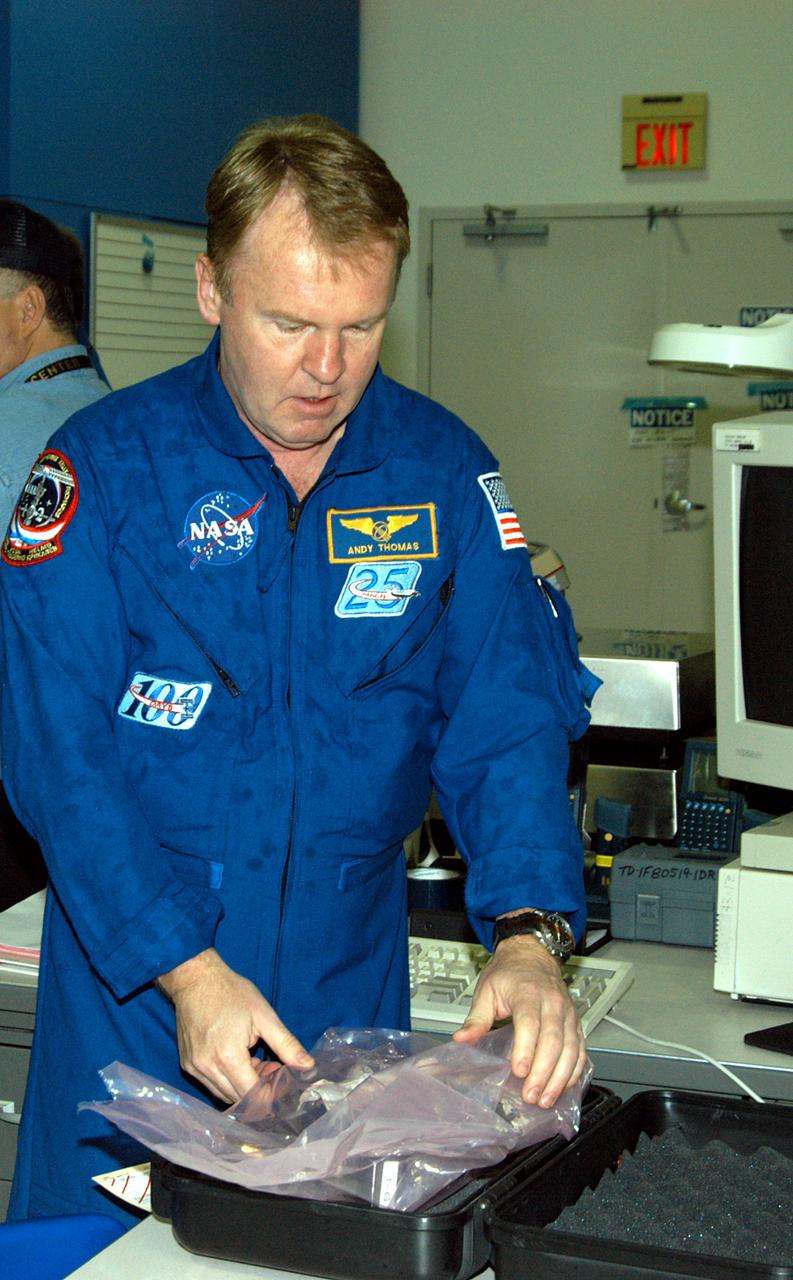
KENNEDY SPACE CENTER, FLA. -  STS-114 Mission Specialist Andrew Thomas works on equipment in the Space Station Processing Facility.  He and other crew members are at KSC for equipment familiarization.  STS-114 is classified as Logistics Flight 1 to the International Space Station,  delivering new supplies and replacing one of the orbital outpost’s Control Moment Gyroscopes (CMGs). STS-114 will also carry a Raffaello Multi-Purpose Logistics Module and the External Stowage Platform-2.  The crew is slated to conduct at least three spacewalks: They will demonstrate repair techniques of the Shuttle’s Thermal Protection System,  replace the failed CMG with one delivered by the Shuttle, and  install the External Stowage Platform.
KENNEDY SPACE CENTER, FLA. - STS-114 Mission Specialist Andrew Thomas works on equipment in the Space Station Processing Facility. He and other crew members are at KSC for equipment familiarization. STS-114 is classified as Logistics Flight 1 to the International Space Station, delivering new supplies and replacing one of the orbital outpost’s Control Moment Gyroscopes (CMGs). STS-114 will also carry a Raffaello Multi-Purpose Logistics Module and the External Stowage Platform-2. The crew is slated to conduct at least three spacewalks: They will demonstrate repair techniques of the Shuttle’s Thermal Protection System, replace the failed CMG with one delivered by the Shuttle, and install the External Stowage Platform.
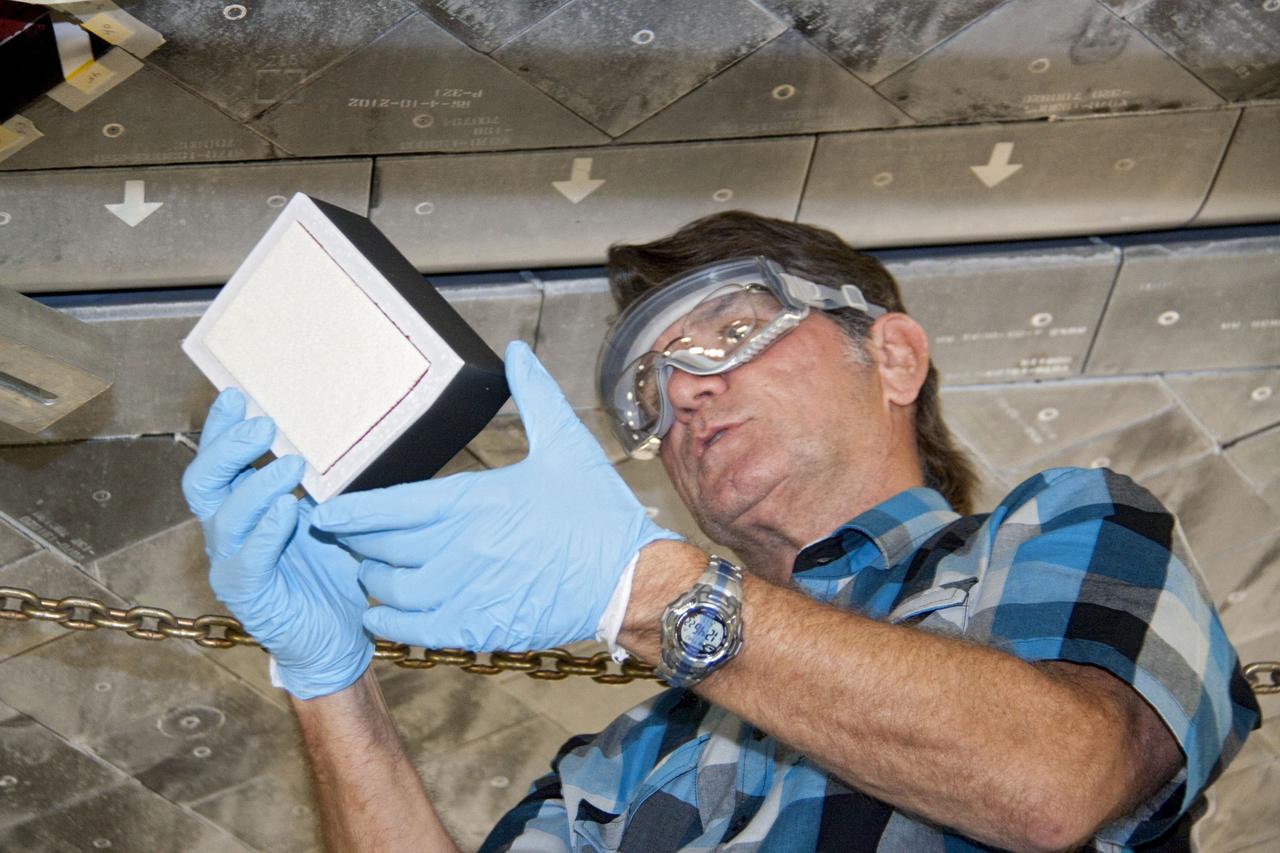
CAPE CANAVERAL, Fla. -- In Orbiter Processing Facility-1 at NASA's Kennedy Space Center in Florida, a thermal protection system technician closely inspects a heat shield tile for space shuttle Atlantis before securing it into position.        The tiles are part of the Orbiter Thermal Protection System that protects the shuttle against temperatures as high as 3,000 degrees Fahrenheit, which are produced during descent for landing. Atlantis is being prepared for the STS-135 mission, which will carry the Raffaello multi-purpose logistics module packed with supplies, logistics and spare parts to the International Space Station. STS-135 is targeted to launch June 28, and will be the last flight for the Space Shuttle Program. Photo credit: NASA/Jack Pfaller
KSC-2011-1476
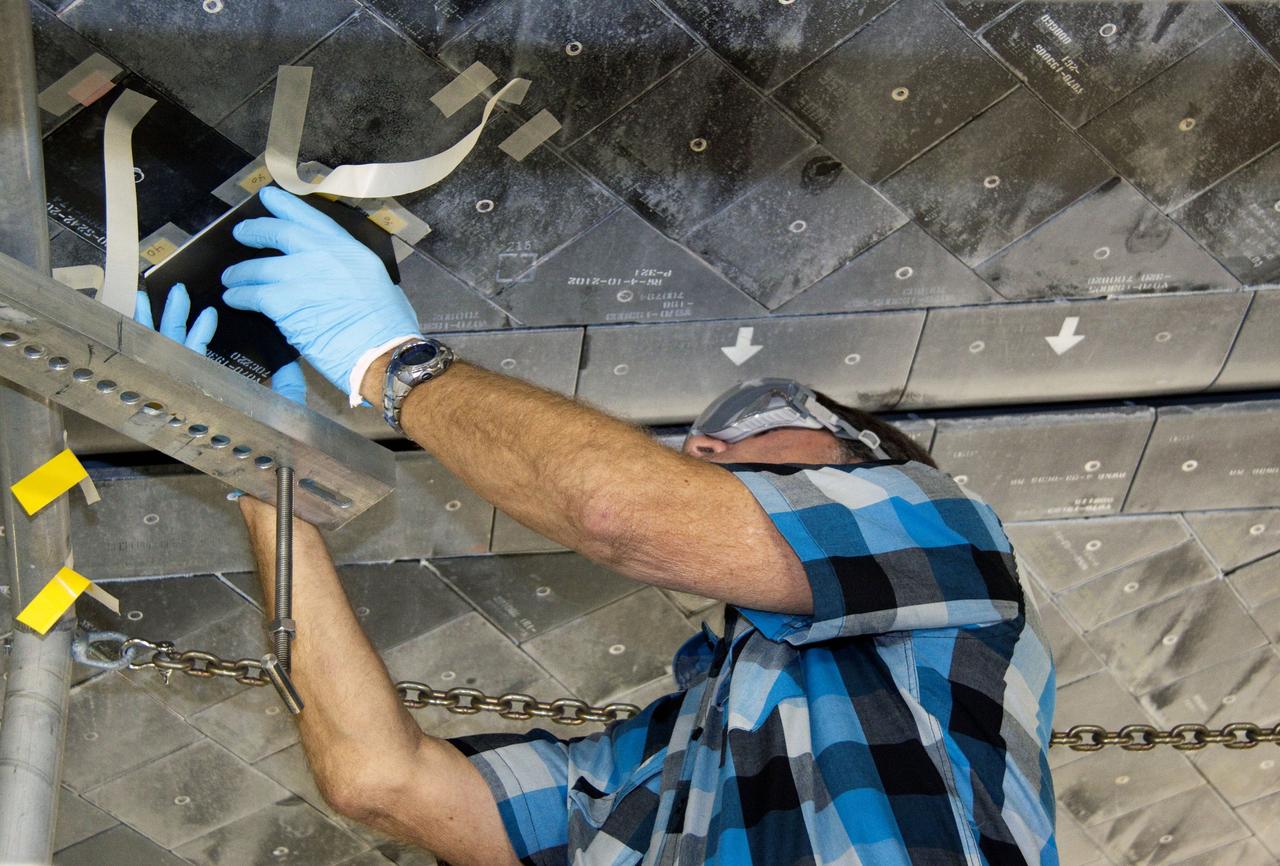
CAPE CANAVERAL, Fla. -- In Orbiter Processing Facility-1 at NASA's Kennedy Space Center in Florida, a thermal protection system technician places a heat shield tile into position under space shuttle Atlantis.      The tiles are part of the Orbiter Thermal Protection System that protects the shuttle against temperatures as high as 3,000 degrees Fahrenheit, which are produced during descent for landing. Atlantis is being prepared for the STS-135 mission, which will carry the Raffaello multi-purpose logistics module packed with supplies, logistics and spare parts to the International Space Station. STS-135 is targeted to launch June 28, and will be the last flight for the Space Shuttle Program. Photo credit: NASA/Jack Pfaller
KSC-2011-1477
CAPE CANAVERAL, Fla. -- In Orbiter Processing Facility-1 at NASA's Kennedy Space Center in Florida, a thermal protection system technician inspects the area on space shuttle Atlantis' underside before a heat shield tile is installed.      The tiles are part of the Orbiter Thermal Protection System that protects the shuttle against temperatures as high as 3,000 degrees Fahrenheit, which are produced during descent for landing. Atlantis is being prepared for the STS-135 mission, which will carry the Raffaello multi-purpose logistics module packed with supplies, logistics and spare parts to the International Space Station. STS-135 is targeted to launch June 28, and will be the last flight for the Space Shuttle Program. Photo credit: NASA/Jack Pfaller
KSC-2011-1474
CAPE CANAVERAL, Fla. -- In Orbiter Processing Facility-1 at NASA's Kennedy Space Center in Florida, a thermal protection system technician is preparing to work on replacing some of space shuttle Atlantis' heat shield tiles.               The tiles are part of the Orbiter Thermal Protection System that protects the shuttle against temperatures as high as 3,000 degrees Fahrenheit, which are produced during descent for landing. Atlantis is being prepared for the STS-135 mission, which will carry the Raffaello multi-purpose logistics module packed with supplies, logistics and spare parts to the International Space Station. STS-135 is targeted to launch June 28, and will be the last flight for the Space Shuttle Program. Photo credit: NASA/Jack Pfaller
KSC-2011-1470
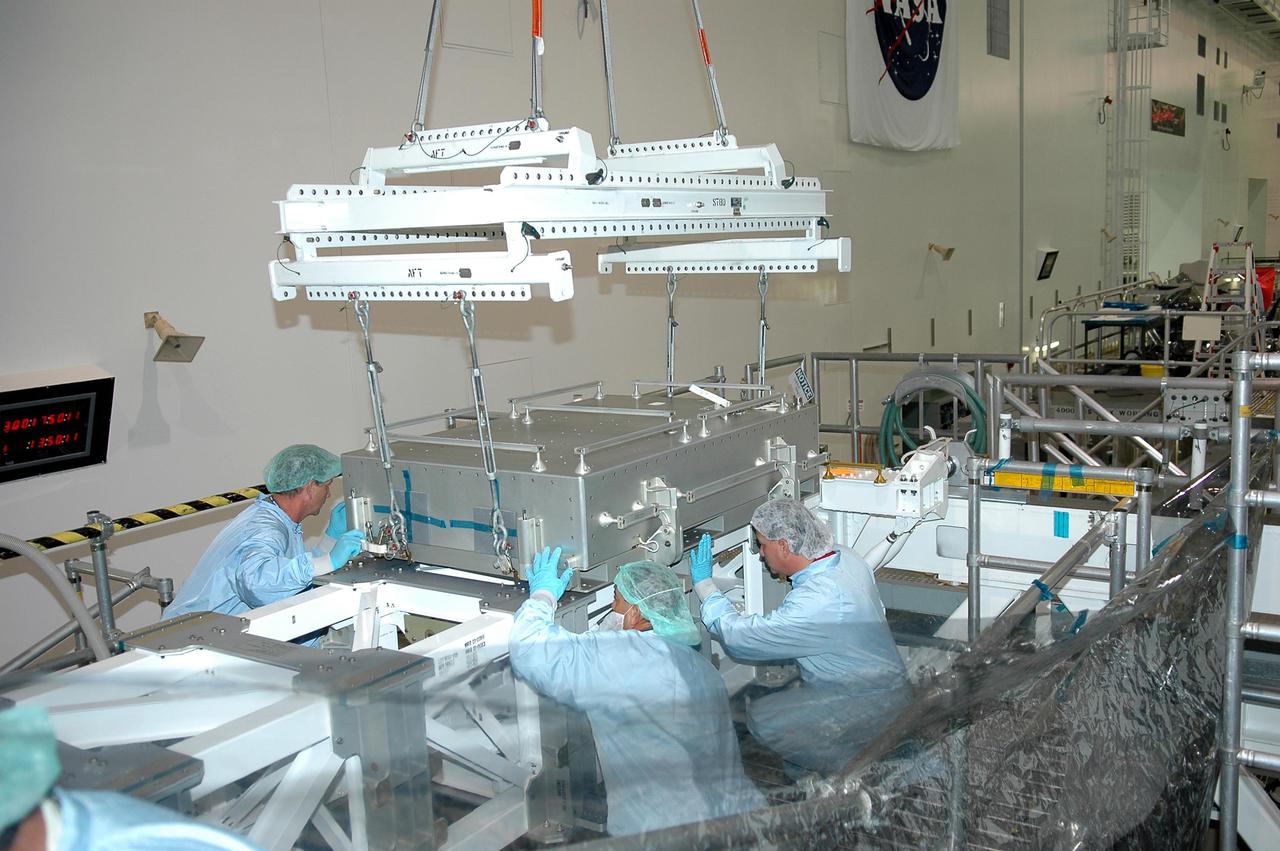
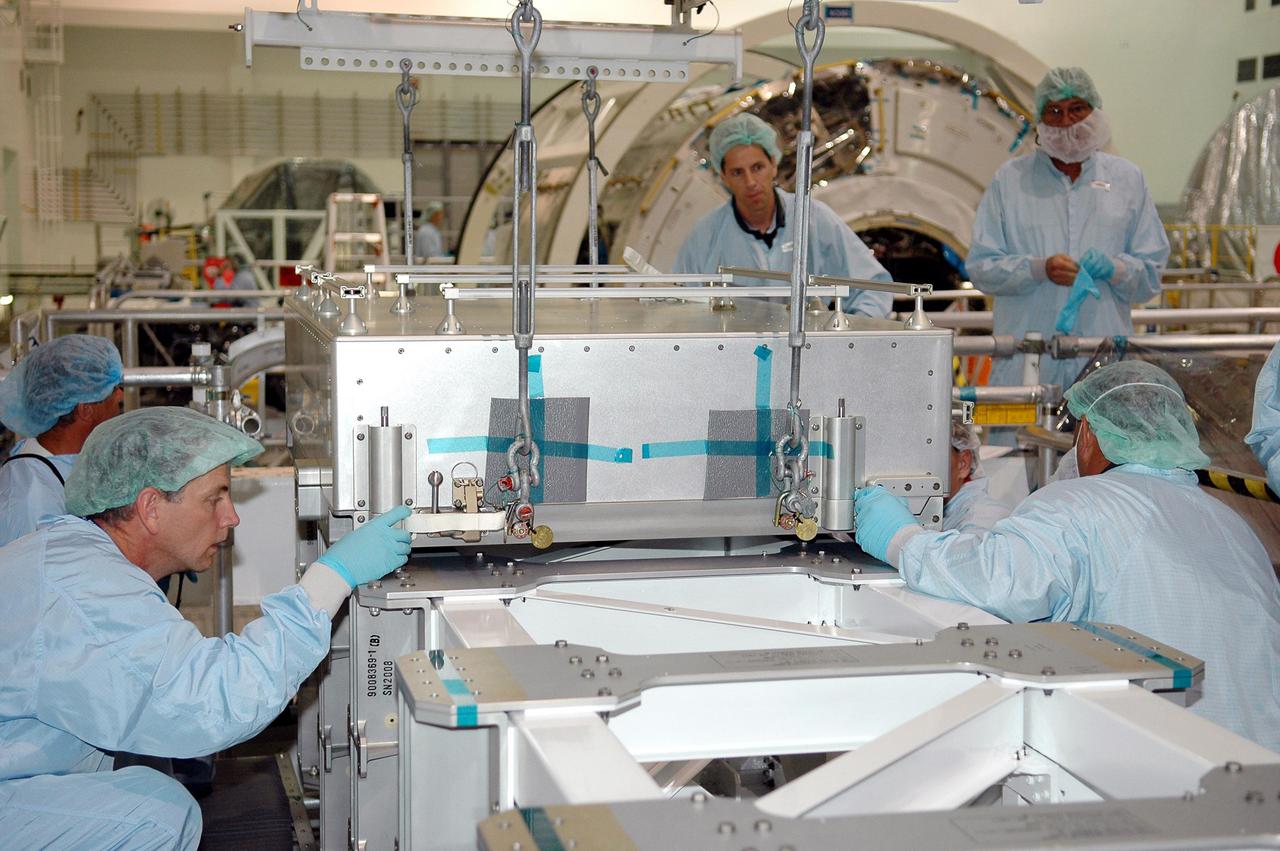
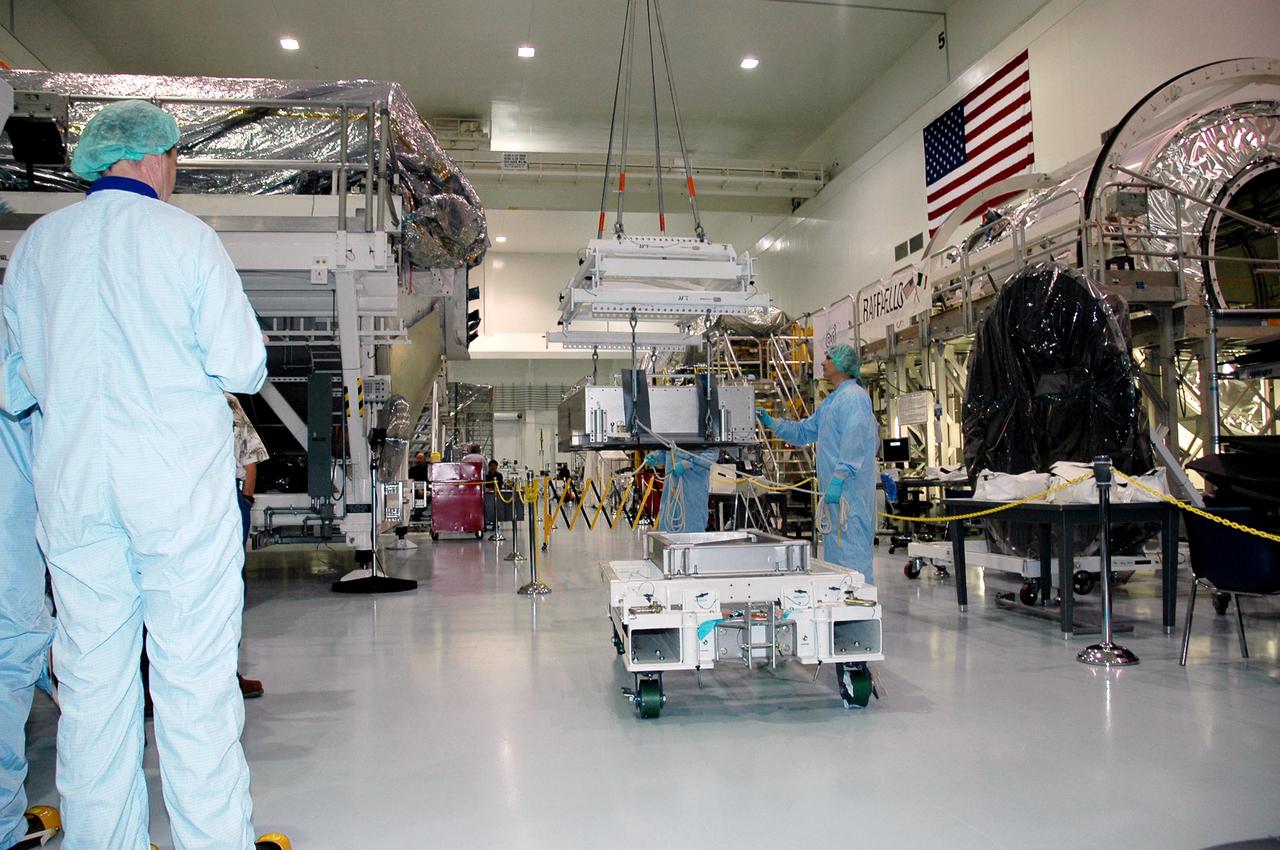
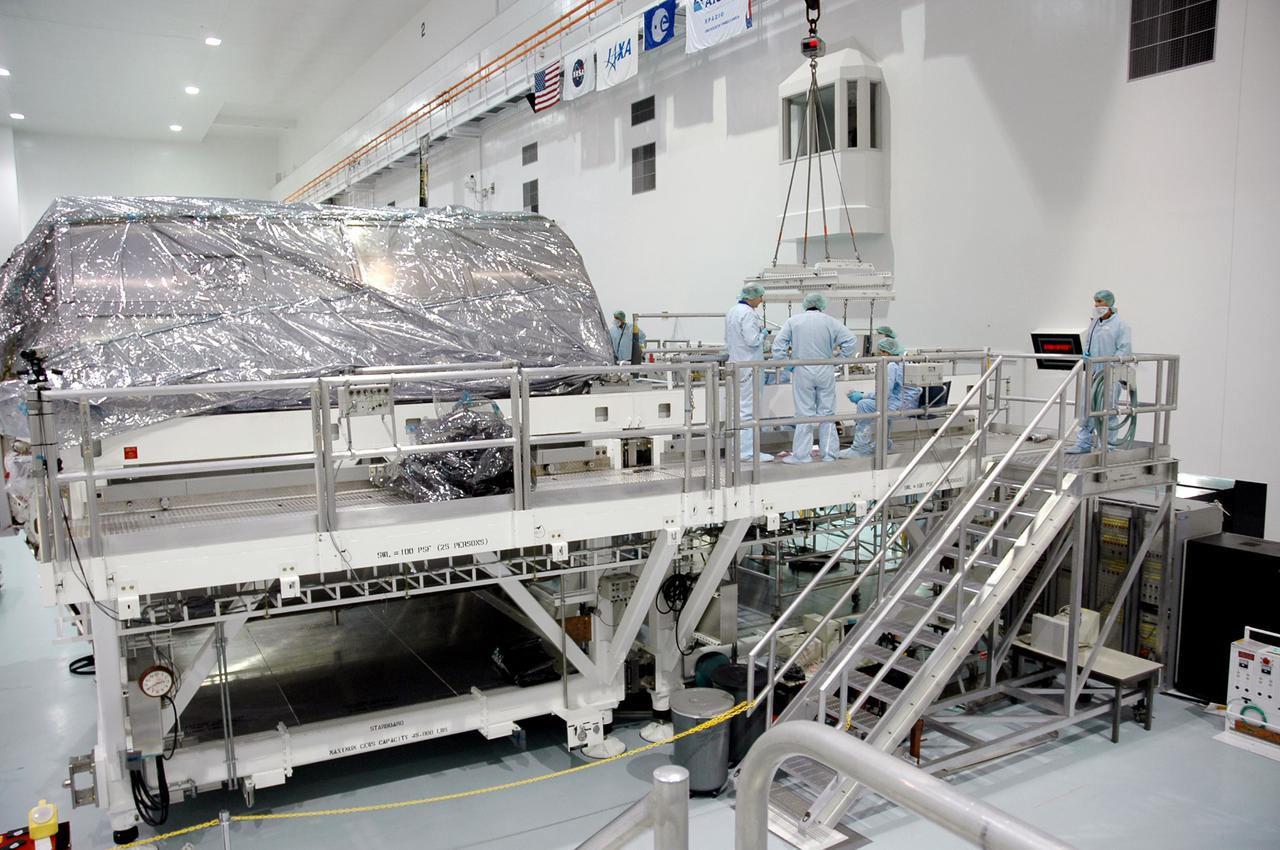
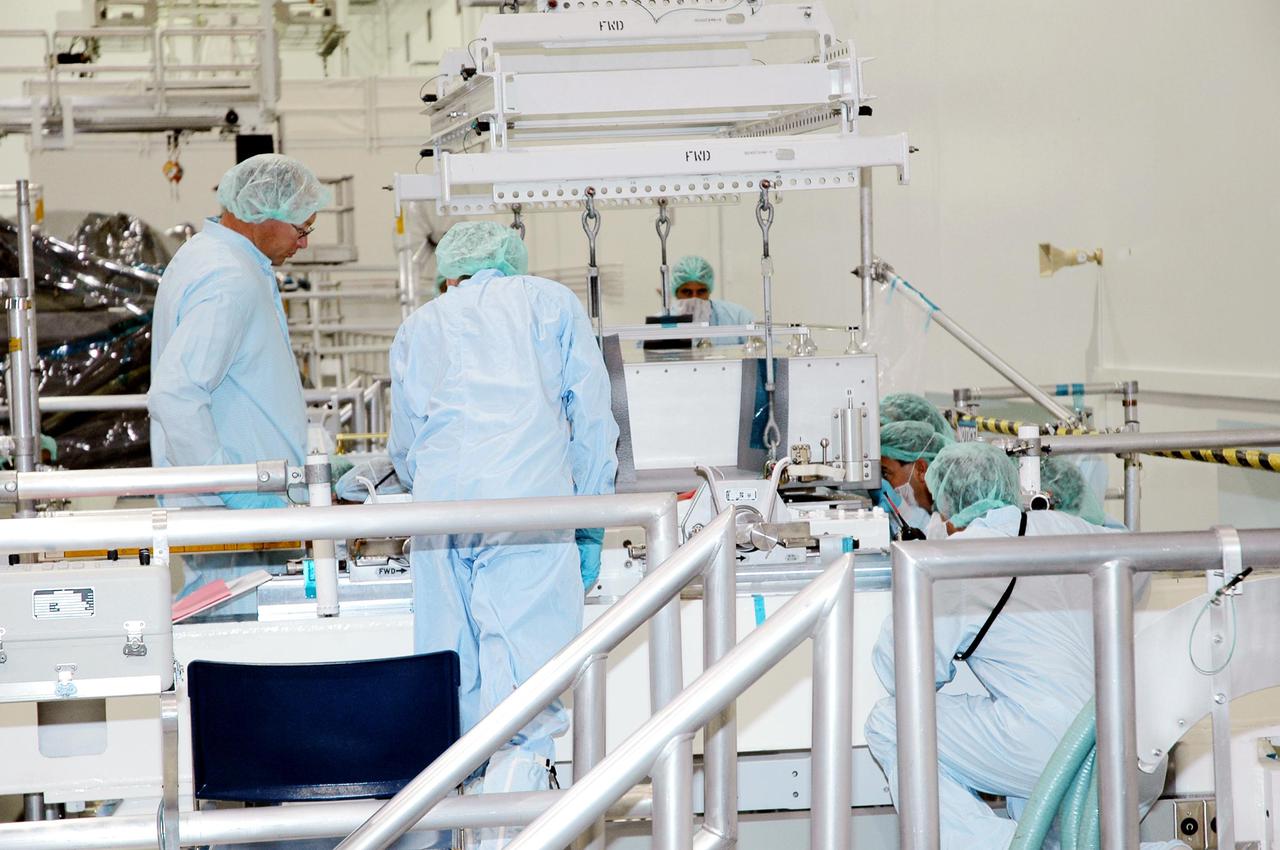
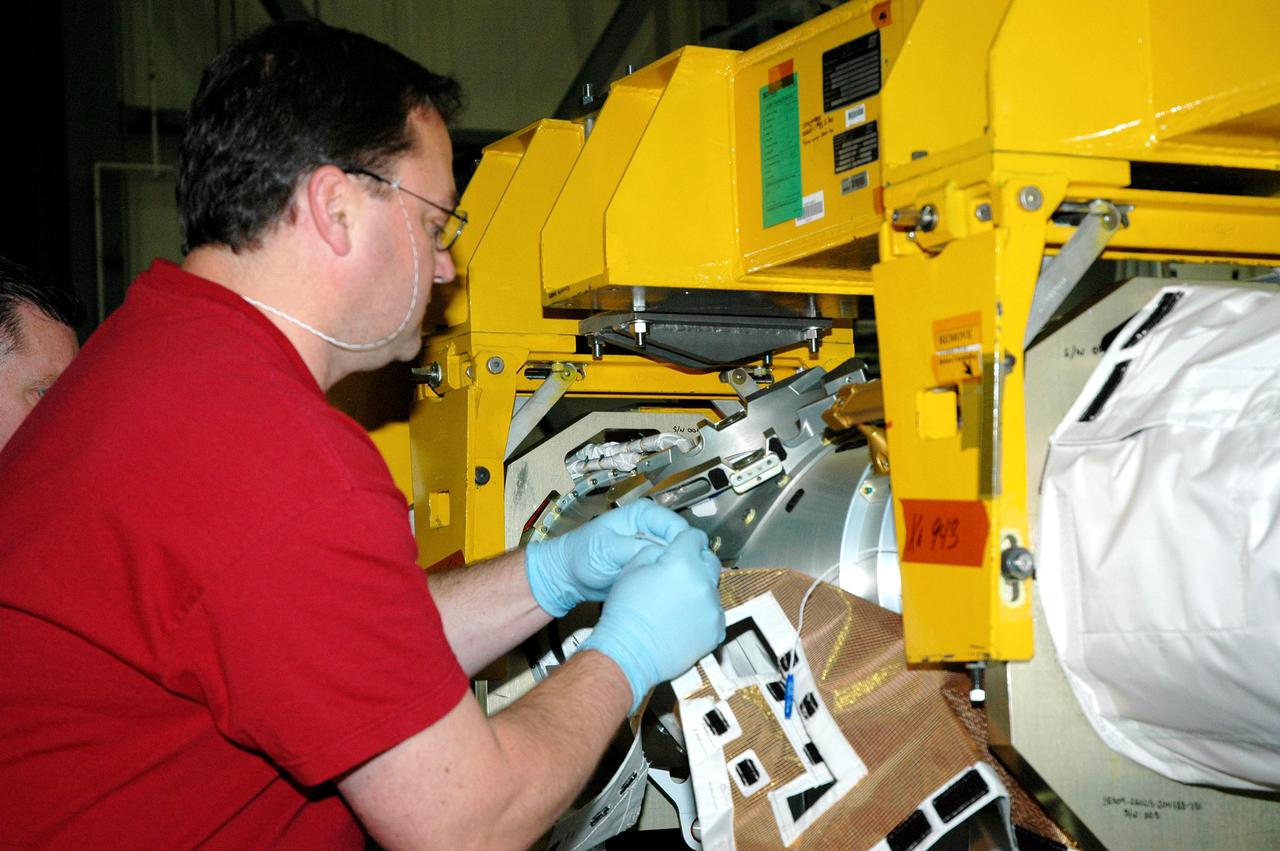
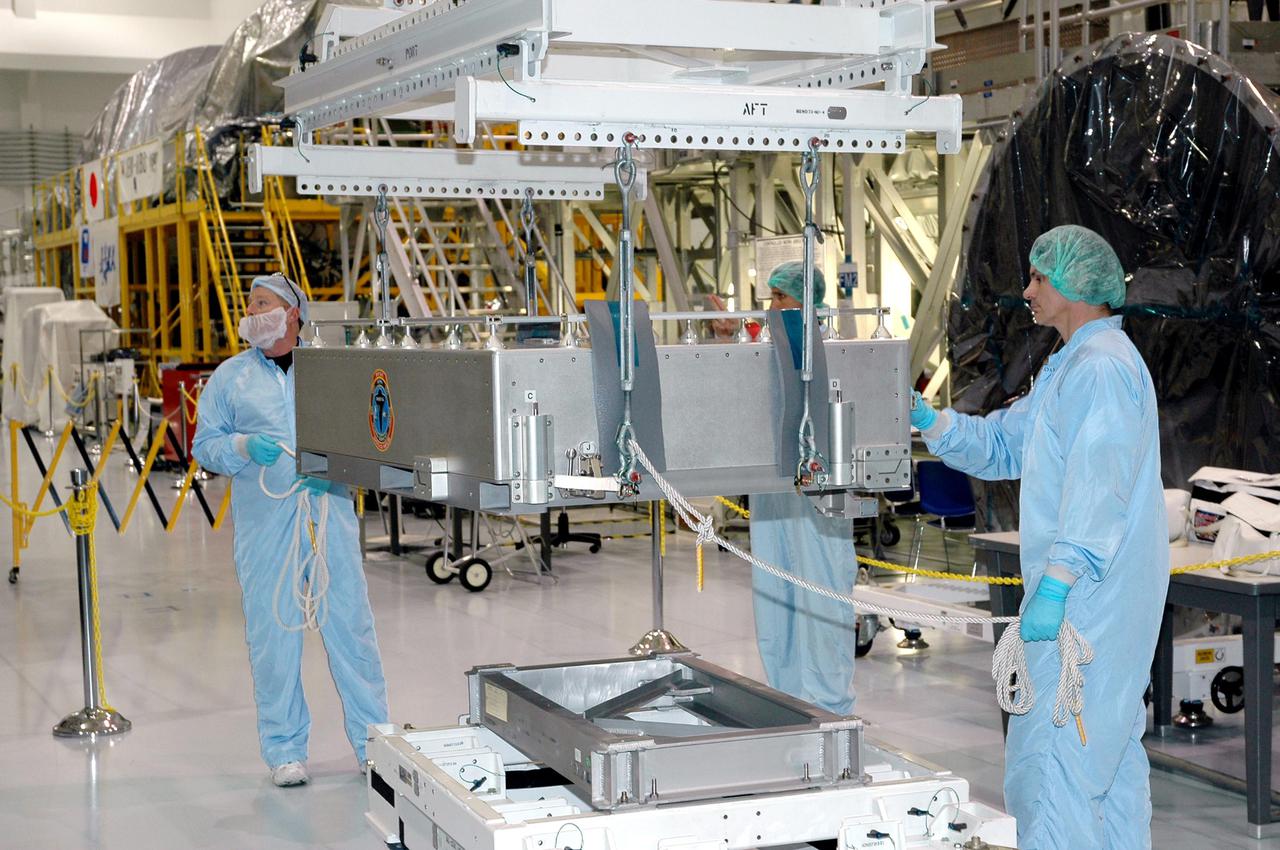
KENNEDY SPACE CENTER, FLA. -   Technicians at the Space Station Processing Facility perform a fit check of the Thermal Protection System Sample Box on the Lightweight Multi-Purpose Experiment Support Structure Carrier (LMC). The box is the actual flight hardware scheduled to fly on the Space Shuttle Return to Flight mission STS-114.  The fit check is performed to ensure the hardware mates properly with the newly modified LMC and will be returned to NASA’s Johnson Space Center for installation of tile samples in support of the STS-114 mission.  The Thermal Protection Detailed Test Objective will enable astronauts to test new on-orbit Thermal Protection System repair techniques.  Mission STS-114 is scheduled to launch in May 2005.
KSC-04pd-2199
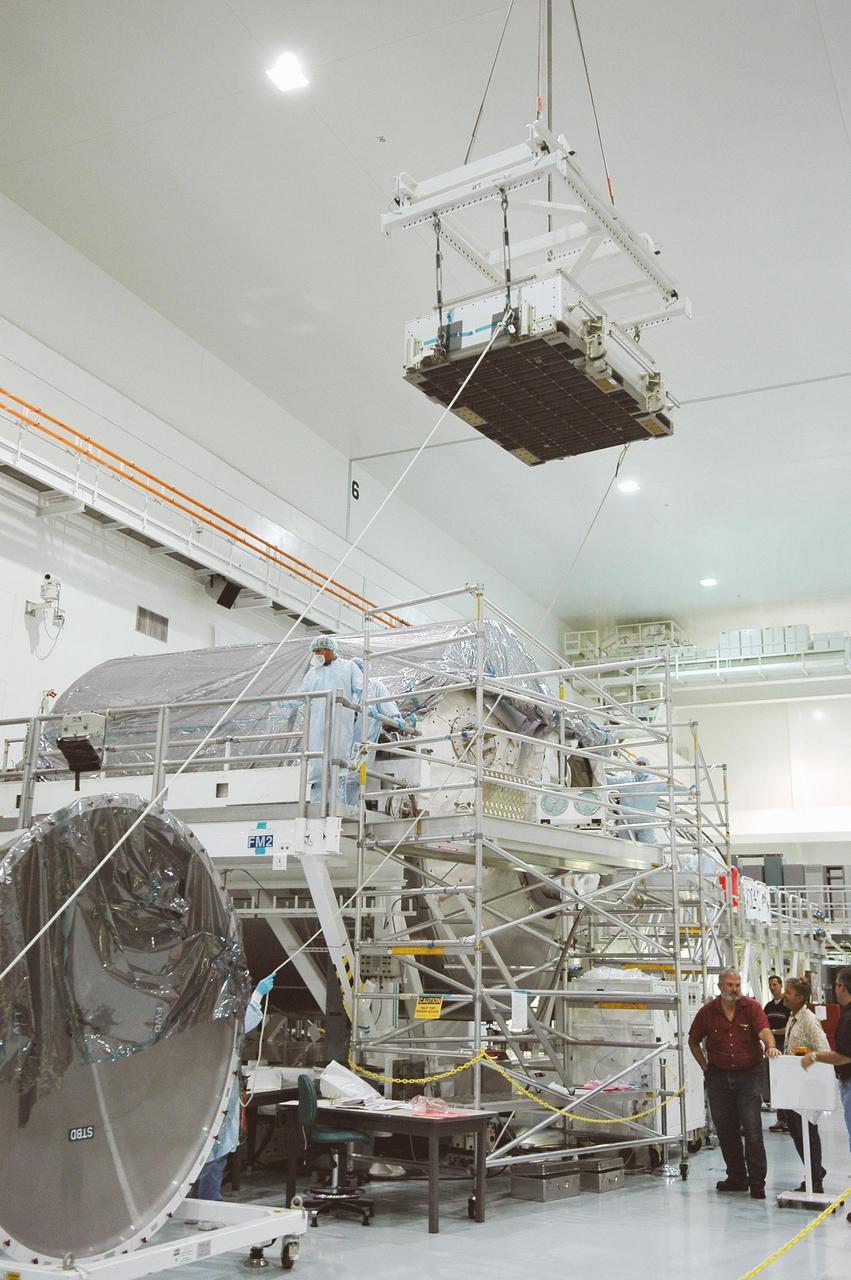
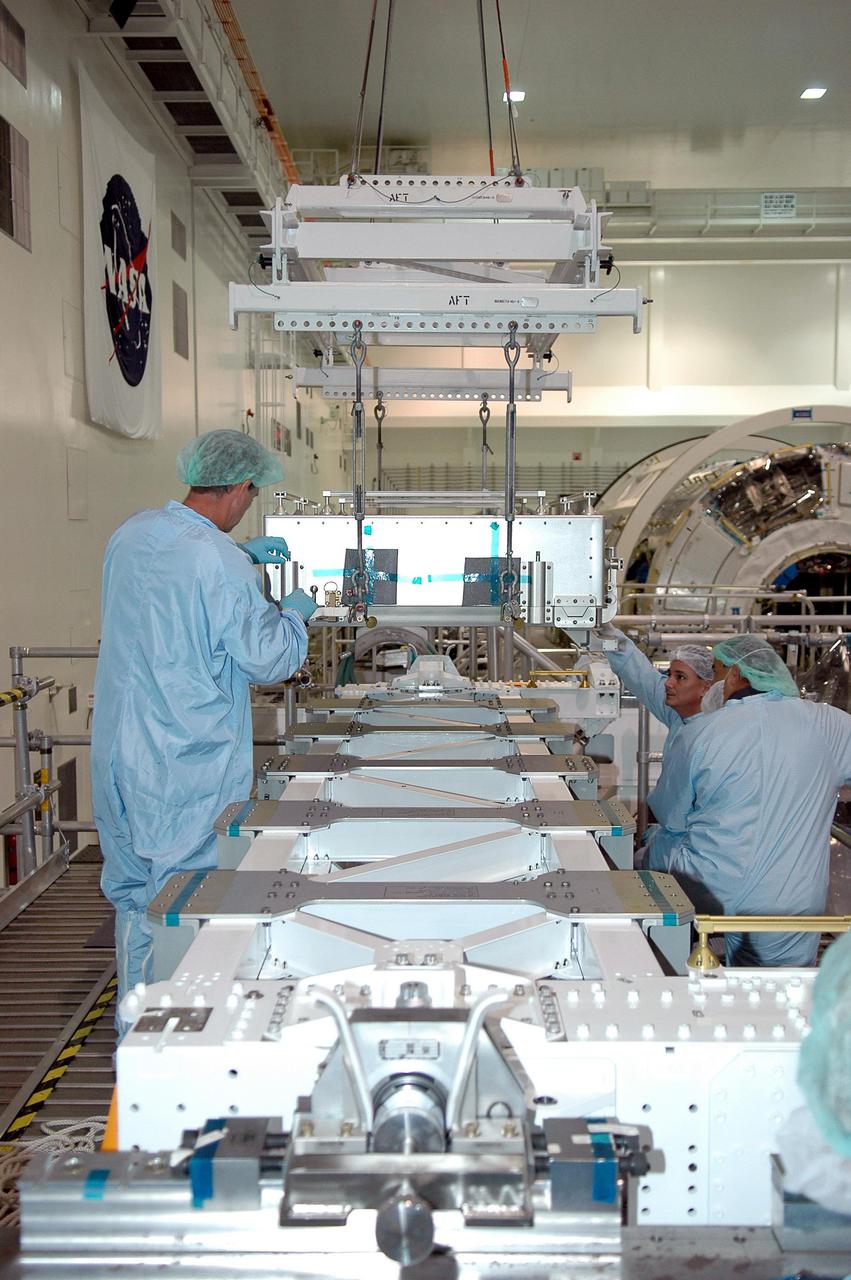
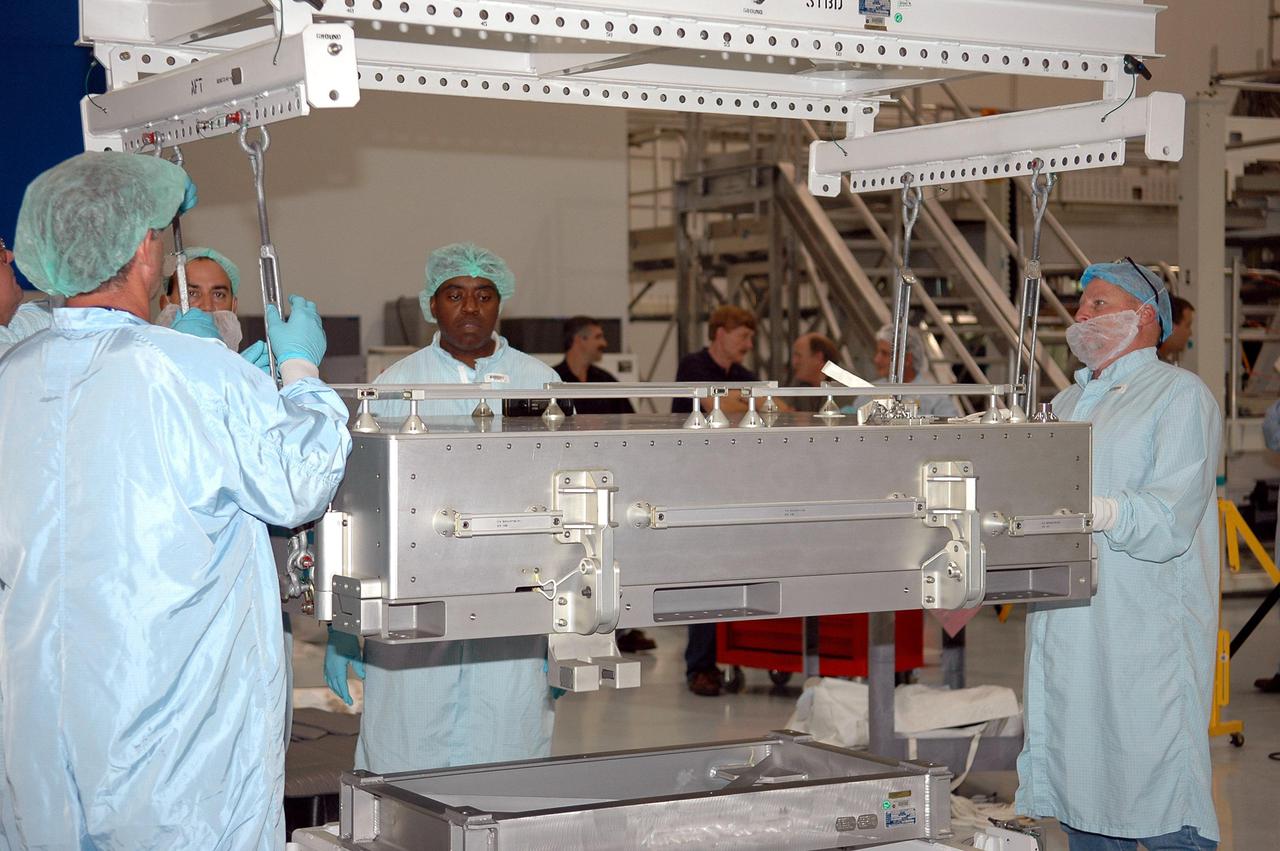
KENNEDY SPACE CENTER, FLA. -   In the Space Station Processing Facility, an overhead crane moves a Thermal Protection System Sample Box to the Lightweight Multi-Purpose Experiment Support Structure Carrier (LMC) for a fit check. The box is the actual flight hardware scheduled to fly on the Space Shuttle Return to Flight mission STS-114.  The fit check is performed to ensure the hardware mates properly with the newly modified LMC and will be returned to NASA’s Johnson Space Center for installation of tile samples in support of the STS-114 mission.  The Thermal Protection Detailed Test Objective will enable astronauts to test new on-orbit Thermal Protection System repair techniques.  Mission STS-114 is scheduled to launch in May 2005.
KSC-04pd-2196
KENNEDY SPACE CENTER, FLA. -   Technicians at the Space Station Processing Facility perform a fit check of the Thermal Protection System Sample Box on the Lightweight Multi-Purpose Experiment Support Structure Carrier (LMC). The box is the actual flight hardware scheduled to fly on the Space Shuttle Return to Flight mission STS-114.  The fit check is performed to ensure the hardware mates properly with the newly modified LMC and will be returned to NASA’s Johnson Space Center for installation of tile samples in support of the STS-114 mission.  The Thermal Protection Detailed Test Objective will enable astronauts to test new on-orbit Thermal Protection System repair techniques.  Mission STS-114 is scheduled to launch in May 2005.
KSC-04pd-2200
KENNEDY SPACE CENTER, FLA. -   Technicians at the Space Station Processing Facility perform a fit check of the Thermal Protection System Sample Box on the Lightweight Multi-Purpose Experiment Support Structure Carrier (LMC). The box is the actual flight hardware scheduled to fly on the Space Shuttle Return to Flight mission STS-114.  The fit check is performed to ensure the hardware mates properly with the newly modified LMC and will be returned to NASA’s Johnson Space Center for installation of tile samples in support of the STS-114 mission.  The Thermal Protection Detailed Test Objective will enable astronauts to test new on-orbit Thermal Protection System repair techniques.  Mission STS-114 is scheduled to launch in May 2005.
KSC-04pd-2198
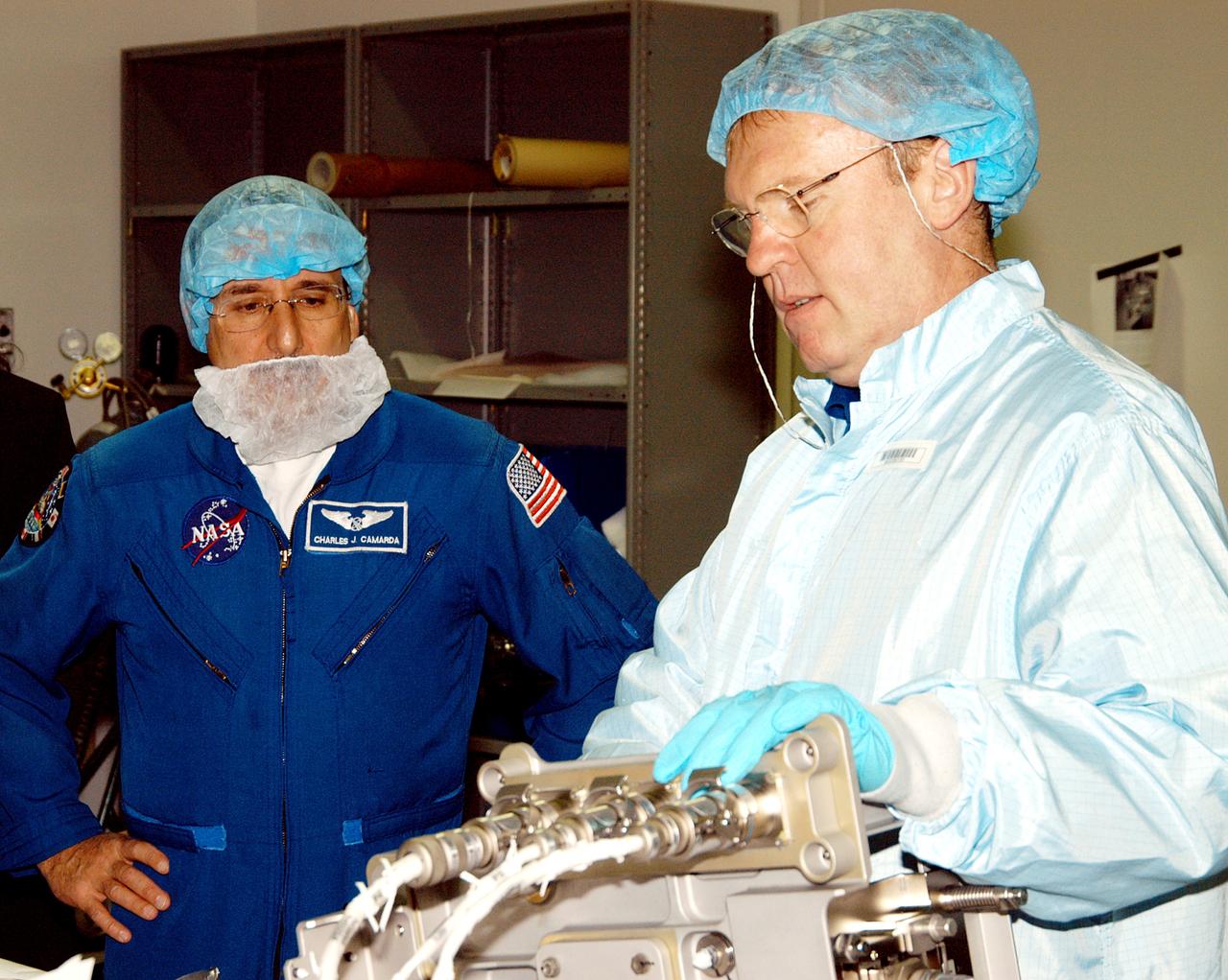
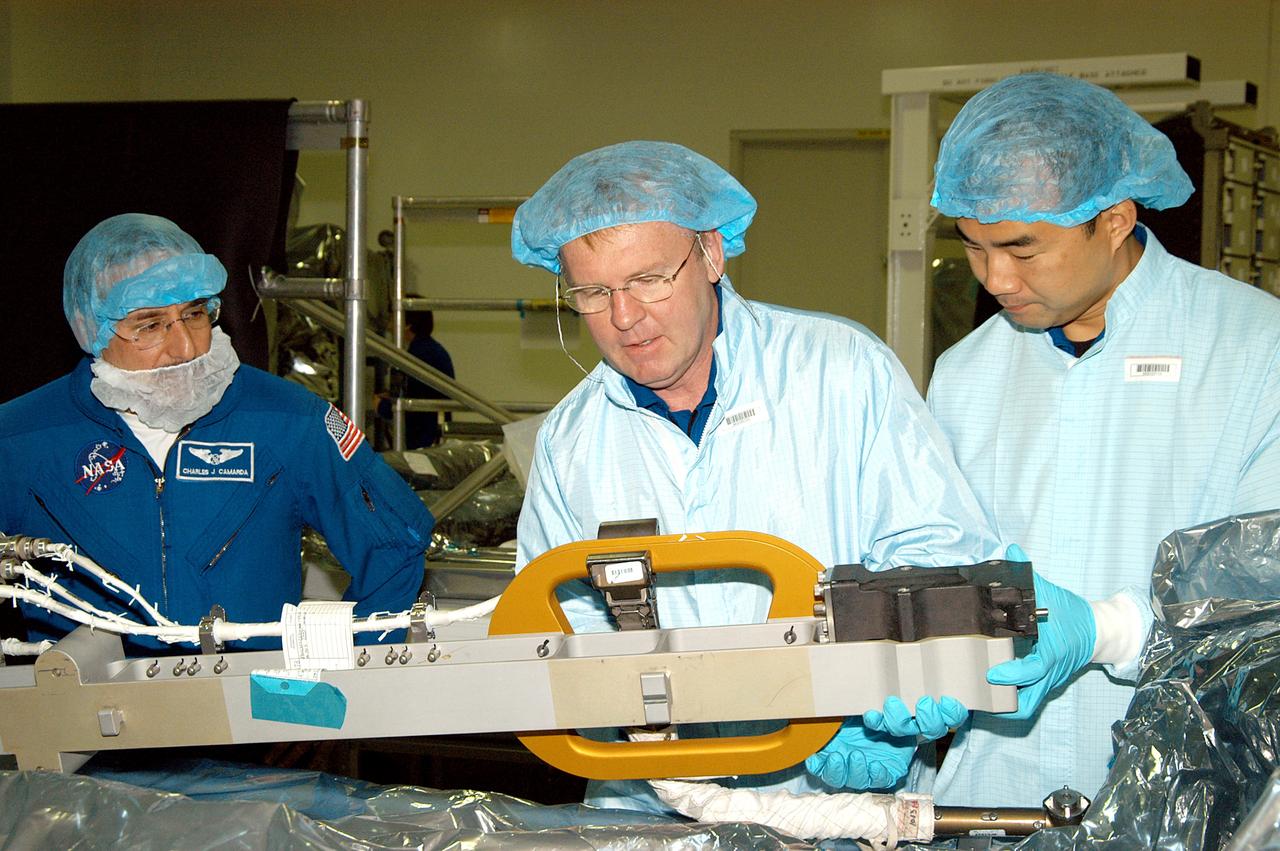
KENNEDY SPACE CENTER, FLA. -  STS-114 Mission Specialist Charles Camarda (left) watches as Mission Specialist  Andrew Thomas manipulates equipment that will be used on the mission.  Crew members are at KSC for equipment familiarization.  STS-114 is classified as Logistics Flight 1 to the International Space Station, delivering new supplies and replacing one of the orbital outpost’s Control Moment Gyroscopes (CMGs). STS-114 will also carry a Raffaello Multi-Purpose Logistics Module and the External Stowage Platform-2.  The crew is slated to conduct at least three spacewalks: They will demonstrate repair techniques of the Shuttle’s Thermal Protection System,  replace the failed CMG with one delivered by the Shuttle, and  install the External Stowage Platform.
KENNEDY SPACE CENTER, FLA. - STS-114 Mission Specialist Charles Camarda (left) watches as Mission Specialist Andrew Thomas manipulates equipment that will be used on the mission. Crew members are at KSC for equipment familiarization. STS-114 is classified as Logistics Flight 1 to the International Space Station, delivering new supplies and replacing one of the orbital outpost’s Control Moment Gyroscopes (CMGs). STS-114 will also carry a Raffaello Multi-Purpose Logistics Module and the External Stowage Platform-2. The crew is slated to conduct at least three spacewalks: They will demonstrate repair techniques of the Shuttle’s Thermal Protection System, replace the failed CMG with one delivered by the Shuttle, and install the External Stowage Platform.
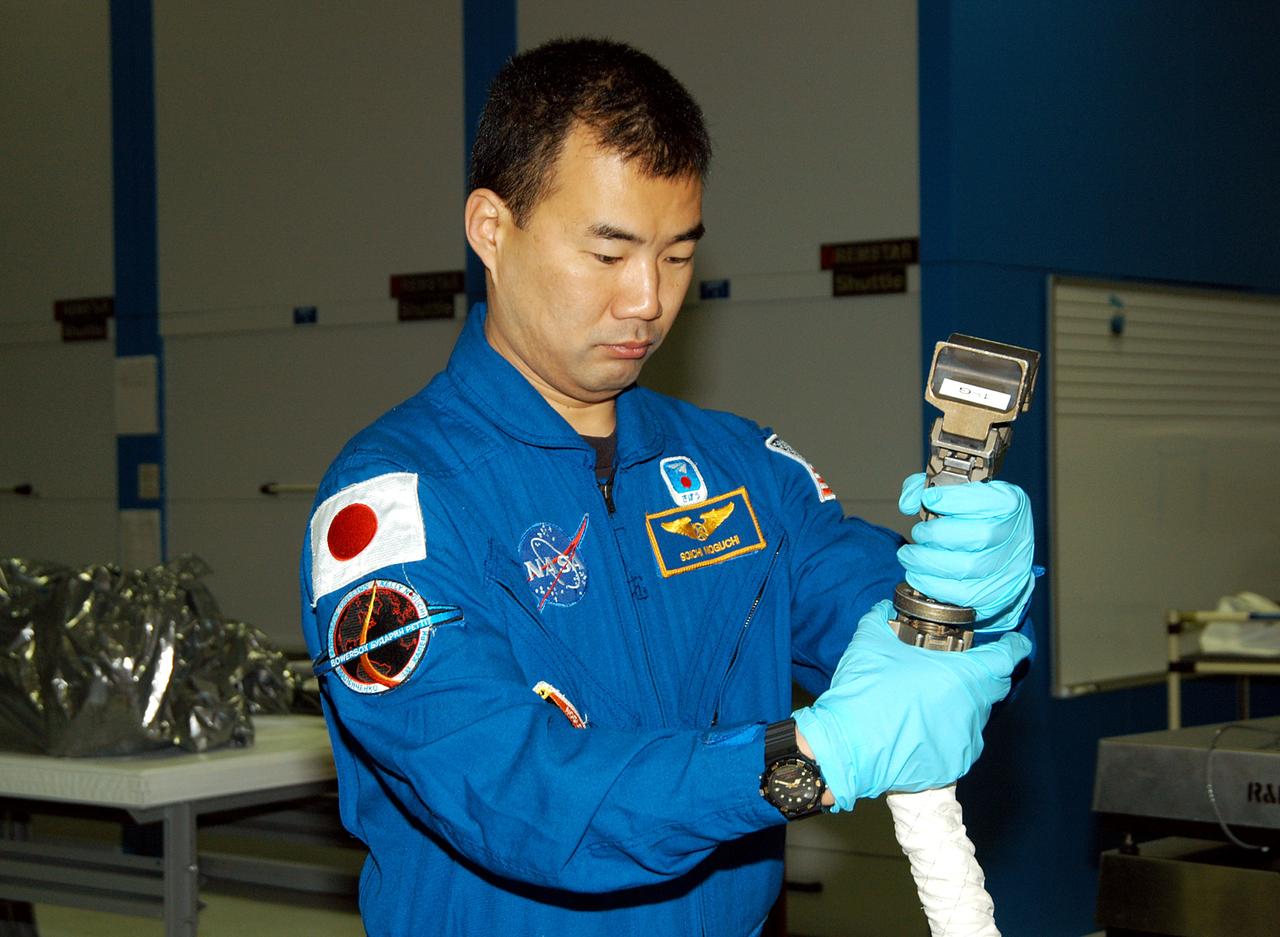
KENNEDY SPACE CENTER, FLA. -  STS-114 Mission Specialist Soichi Noguchi, with the Japanese Aerospace Exploration Agency (JAXA), handles equipment that will be used on the mission.  He and other crew members are at KSC for equipment familiarization.  STS-114 is classified as Logistics Flight 1 to the International Space Station,  delivering new supplies and replacing one of the orbital outpost’s Control Moment Gyroscopes (CMGs). STS-114 will also carry a Raffaello Multi-Purpose Logistics Module and the External Stowage Platform-2.  The crew is slated to conduct at least three spacewalks: They will demonstrate repair techniques of the Shuttle’s Thermal Protection System,  replace the failed CMG with one delivered by the Shuttle, and  install the External Stowage Platform.
KENNEDY SPACE CENTER, FLA. - STS-114 Mission Specialist Soichi Noguchi, with the Japanese Aerospace Exploration Agency (JAXA), handles equipment that will be used on the mission. He and other crew members are at KSC for equipment familiarization. STS-114 is classified as Logistics Flight 1 to the International Space Station, delivering new supplies and replacing one of the orbital outpost’s Control Moment Gyroscopes (CMGs). STS-114 will also carry a Raffaello Multi-Purpose Logistics Module and the External Stowage Platform-2. The crew is slated to conduct at least three spacewalks: They will demonstrate repair techniques of the Shuttle’s Thermal Protection System, replace the failed CMG with one delivered by the Shuttle, and install the External Stowage Platform.
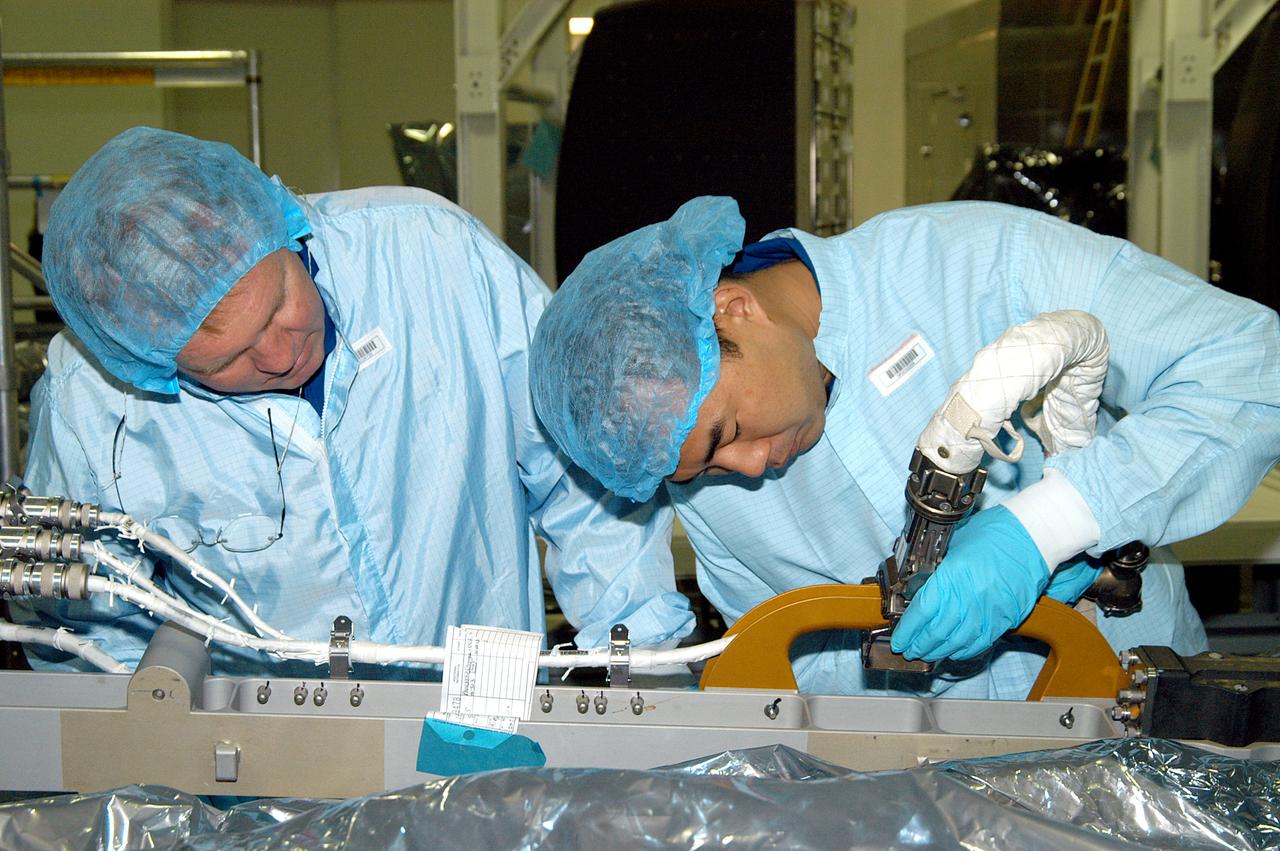
KENNEDY SPACE CENTER, FLA. -  Dressed in protective suits, STS-114 Mission Specialist Andrew Thomas (left) and Soichi Noguchi, who is with the Japanese Aerospace Exploration Agency (JAXA), handle equipment in the Space Station Processing Facility that will be used on the mission.  They and other crew members are at KSC for equipment familiarization.  STS-114 is classified as Logistics Flight 1 to the International Space Station, delivering new supplies and replacing one of the orbital outpost’s Control Moment Gyroscopes (CMGs). STS-114 will also carry a Raffaello Multi-Purpose Logistics Module and the External Stowage Platform-2.  The crew is slated to conduct at least three spacewalks: They will demonstrate repair techniques of the Shuttle’s Thermal Protection System,  replace the failed CMG with one delivered by the Shuttle, and  install the External Stowage Platform.
KENNEDY SPACE CENTER, FLA. - Dressed in protective suits, STS-114 Mission Specialist Andrew Thomas (left) and Soichi Noguchi, who is with the Japanese Aerospace Exploration Agency (JAXA), handle equipment in the Space Station Processing Facility that will be used on the mission. They and other crew members are at KSC for equipment familiarization. STS-114 is classified as Logistics Flight 1 to the International Space Station, delivering new supplies and replacing one of the orbital outpost’s Control Moment Gyroscopes (CMGs). STS-114 will also carry a Raffaello Multi-Purpose Logistics Module and the External Stowage Platform-2. The crew is slated to conduct at least three spacewalks: They will demonstrate repair techniques of the Shuttle’s Thermal Protection System, replace the failed CMG with one delivered by the Shuttle, and install the External Stowage Platform.
KENNEDY SPACE CENTER, FLA.  - Technicians at the Space Station Processing Facility carefully watch as a crane lifts the Thermal Protection System Detailed Test Objective (DTO) box.  It will be placed on the Lightweight Multi-Purpose Experiment Support Structure Carrier (LMC) to fly on Space Shuttle Discovery for mission STS-114. The DTO contains tile samples that will enable astronauts to test new on-orbit Thermal Protection System repair techniques.  The launch window for mission STS-114 is May 12 to June 3.
KSC-05pd-0293
KENNEDY SPACE CENTER, FLA.  - Technicians in the Space Station Processing Facility check the placement of the Thermal Protection System Detailed Test Objective (DTO) box  on the Lightweight Multi-Purpose Experiment Support Structure Carrier (LMC).  The LMC and DTO will fly on Space Shuttle Discovery for mission STS-114.  The DTO contains tile samples that will enable astronauts to test new on-orbit Thermal Protection System repair techniques.  The launch window for mission STS-114 is May 12 to June 3.
KSC-05pd-0296
KENNEDY SPACE CENTER, FLA.  - Technicians in the Space Station Processing Facility ensure the Thermal Protection System Detailed Test Objective (DTO) box  is placed correctly on the Lightweight Multi-Purpose Experiment Support Structure Carrier (LMC).  The LMC and DTO will fly on Space Shuttle Discovery for mission STS-114. The DTO contains tile samples that will enable astronauts to test new on-orbit Thermal Protection System repair techniques.  The launch window for mission STS-114 is May 12 to June 3.
KSC-05pd-0295
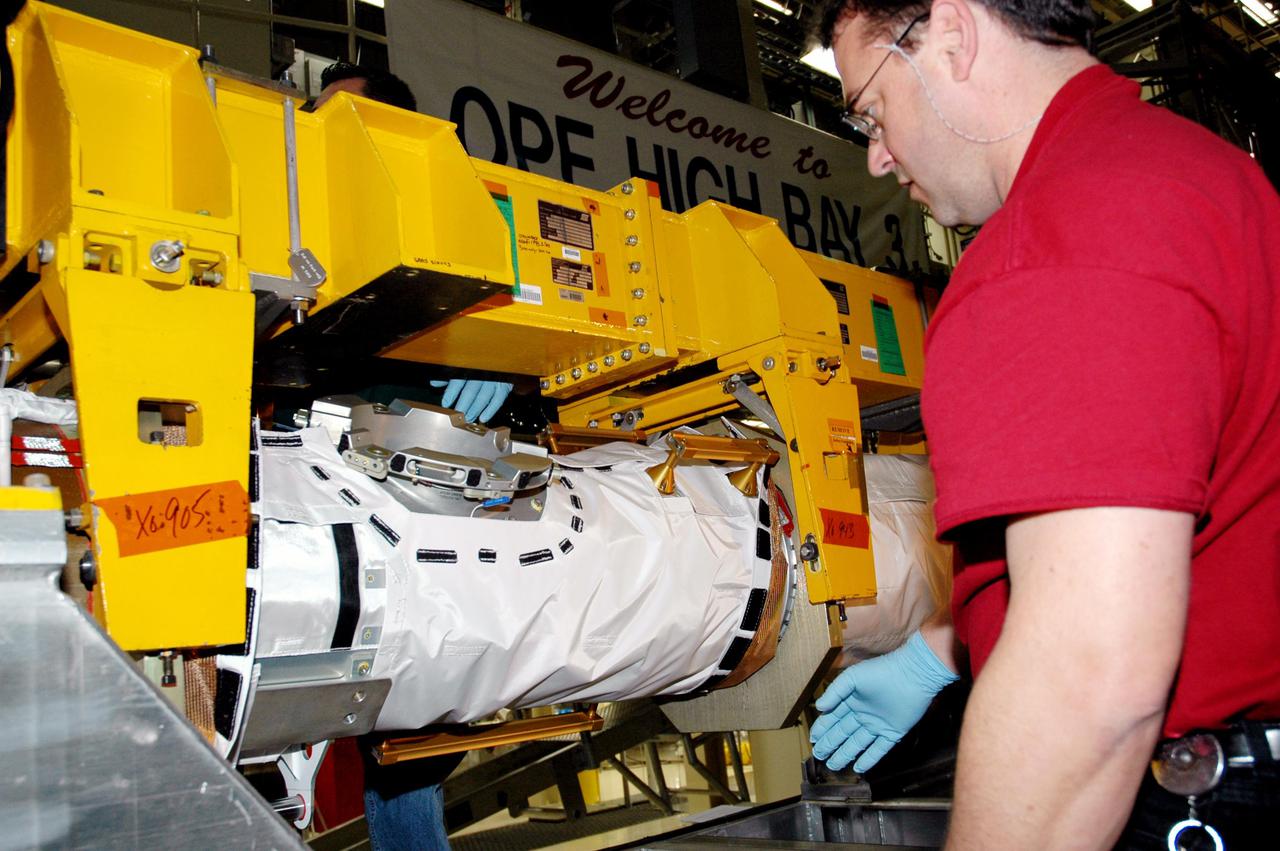
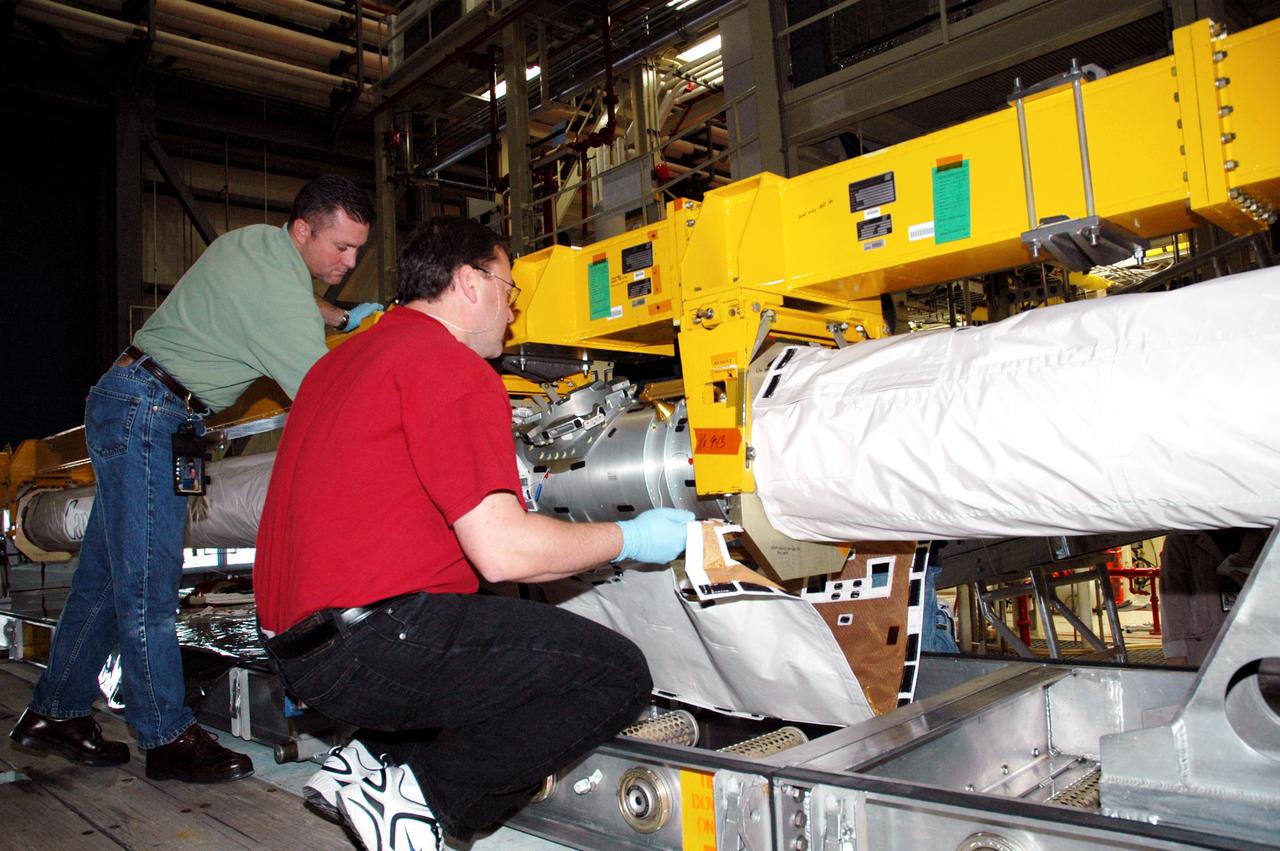
KENNEDY SPACE CENTER, FLA.  - In the back transfer aisle of the Orbiter Processing Facility bay 3, Todd Dugan, a technician with United Space Alliance, begins attaching the Thermal Protection System (TPS) blanket to the Orbiter Boom Sensor System (OBSS).  The installation of the insulation concludes TPS closeout prior to installation of the boom in the orbiter Discovery.  The OBSS is one of the new safety measures for Return to Flight, equipping the Shuttle with cameras and laser systems to inspect the Shuttle’s Thermal Protection System while in space.  Discovery is designated as the Return to Flight vehicle for mission STS-114, with a launch window of May 12 to June 3, 2005.
KSC-05pd-0170
KENNEDY SPACE CENTER, FLA.  - In the back transfer aisle of the Orbiter Processing Facility bay 3, Todd Dugan, a technician with United Space Alliance, checks out the Thermal Protection System (TPS) blanket wrapped around the Orbiter Boom Sensor System (OBSS).  The installation of the insulation concludes TPS closeout prior to installation of the boom in the orbiter Discovery.  The OBSS is one of the new safety measures for Return to Flight, equipping the Shuttle with cameras and laser systems to inspect the Shuttle’s Thermal Protection System while in space.  Discovery is designated as the Return to Flight vehicle for mission STS-114, with a launch window of May 12 to June 3, 2005.
KSC-05pd-0168
KENNEDY SPACE CENTER, FLA.  - In the back transfer aisle of the Orbiter Processing Facility bay 3, Todd Dugan (right), a technician with United Space Alliance, lifts a Thermal Protection System (TPS) blanket onto an area of the Orbiter Boom Sensor System (OBSS).  The installation will conclude TPS closeout prior to installation of the boom in the orbiter Discovery.  The OBSS is one of the new safety measures for Return to Flight, equipping the Shuttle with cameras and laser systems to inspect the Shuttle’s Thermal Protection System while in space.  Discovery is designated as the Return to Flight vehicle for mission STS-114, with a launch window of May 12 to June 3, 2005.
KSC-05pd-0166
KENNEDY SPACE CENTER, FLA.  - In the back transfer aisle of the Orbiter Processing Facility bay 3, Todd Dugan, a technician with United Space Alliance, prepares the Thermal Protection System (TPS) blanket to be installed around the Orbiter Boom Sensor System (OBSS).  The installation concludes TPS closeout prior to installation of the boom in the orbiter Discovery.  The OBSS is one of the new safety measures for Return to Flight, equipping the Shuttle with cameras and laser systems to inspect the Shuttle’s Thermal Protection System while in space.  Discovery is designated as the Return to Flight vehicle for mission STS-114, with a launch window of May 12 to June 3, 2005.
KSC-05pd-0164
KENNEDY SPACE CENTER, FLA.  - In the back transfer aisle of the Orbiter Processing Facility bay 3, a worker checks paperwork for the Thermal Protection System (TPS) blanket to be wrapped around the Orbiter Boom Sensor System (OBSS).  The installation of the insulation concludes TPS closeout prior to installation of the boom in the orbiter Discovery.  The OBSS is one of the new safety measures for Return to Flight, equipping the Shuttle with cameras and laser systems to inspect the Shuttle’s Thermal Protection System while in space.  Discovery is designated as the Return to Flight vehicle for mission STS-114, with a launch window of May 12 to June 3, 2005.
KSC-05pd-0169
KENNEDY SPACE CENTER, FLA.  - In the back transfer aisle of the Orbiter Processing Facility bay 3, workers check an area of the Orbiter Boom Sensor System (OBSS) that will be wrapped with a Thermal Protection System (TPS) blanket.  The installation will conclude TPS closeout prior to installation of the boom in the orbiter Discovery.  The OBSS is one of the new safety measures for Return to Flight, equipping the Shuttle with cameras and laser systems to inspect the Shuttle’s Thermal Protection System while in space.  Discovery is designated as the Return to Flight vehicle for mission STS-114, with a launch window of May 12 to June 3, 2005.
KSC-05pd-0165
KENNEDY SPACE CENTER, FLA.  - In the back transfer aisle of the Orbiter Processing Facility bay 3, a worker checks the resistance measurement of one of the Thermal Protection System (TPS) blanket ground wires to ensure a proper ground between the blanket to be installed and the Orbiter Boom Sensor System (OBSS). The installation will conclude TPS closeout prior to installation of the boom in the orbiter Discovery.  The OBSS is one of the new safety measures for Return to Flight, equipping the Shuttle with cameras and laser systems to inspect the Shuttle’s Thermal Protection System while in space.  Discovery is designated as the Return to Flight vehicle for mission STS-114, with a launch window of May 12 to June 3, 2005.
KSC-05pd-0167
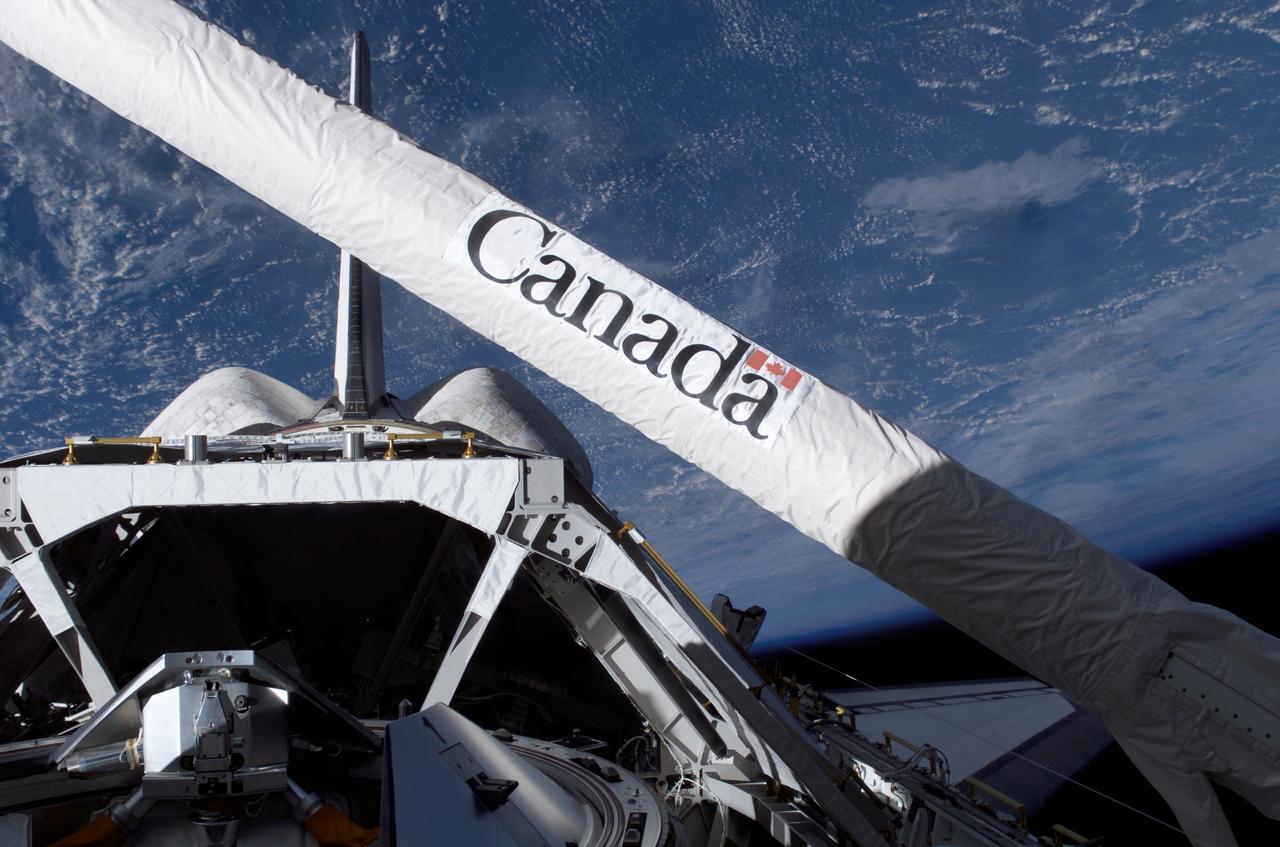
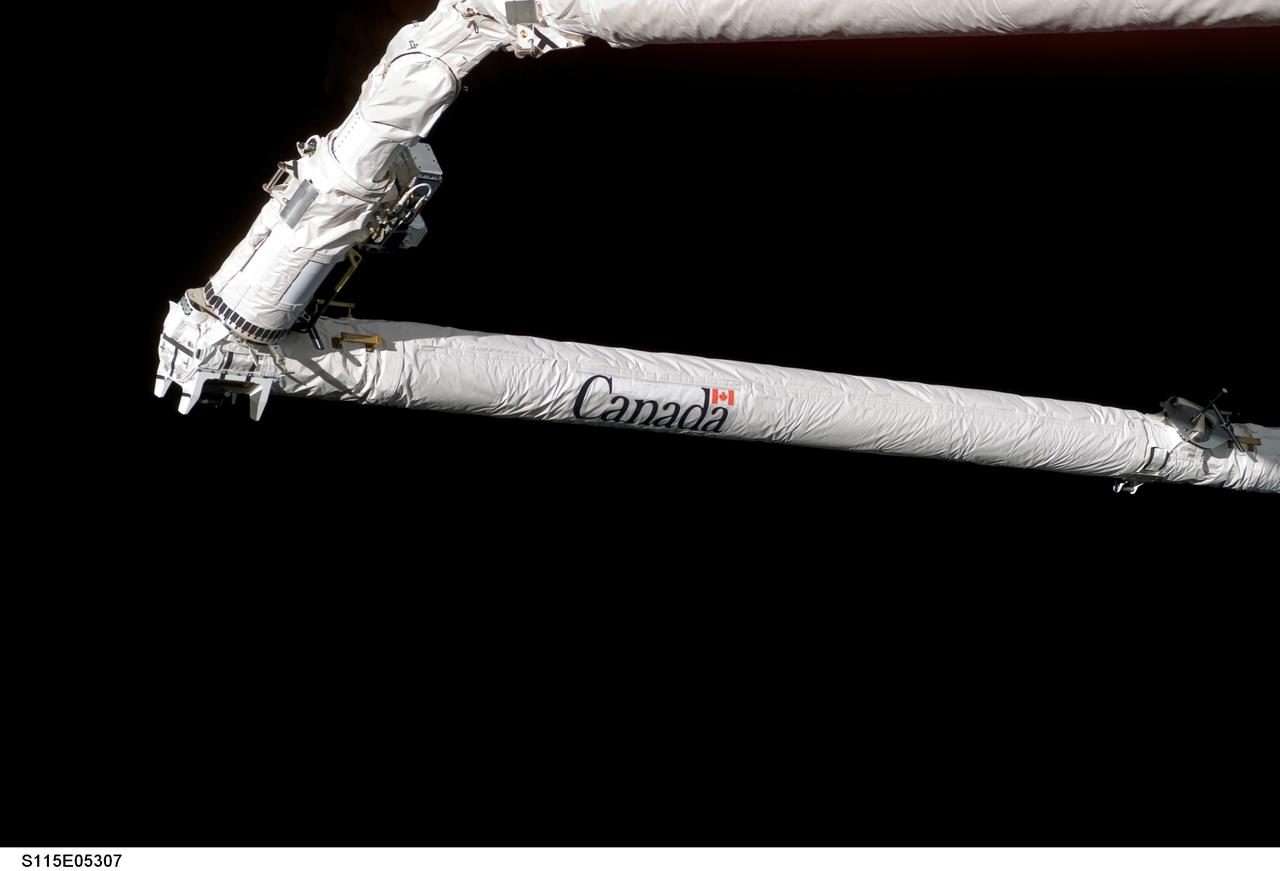
S115-E-05307 (10 Sept. 2006) --- As in the case of the previous two shuttle missions, a tandem of the orbiter boom sensor system (OBSS) and the remote manipulator system (RMS) arm conducts a survey of the thermal protection system on the Space Shuttle Atlantis.
OBSS and RMS arm during a survey of the TPS during STS-115
KENNEDY SPACE CENTER, FLA. -  Dressed in protective suits, STS-114 Mission Specialist Soichi Noguchi, with the Japanese Aerospace Exploration Agency (JAXA), handles equipment that will be used on the mission.  He and other crew members are at KSC for equipment familiarization.  STS-114 is classified as Logistics Flight 1 to the International Space Station, delivering new supplies and replacing one of the orbital outpost’s Control Moment Gyroscopes (CMGs). STS-114 will also carry a Raffaello Multi-Purpose Logistics Module and the External Stowage Platform-2.  The crew is slated to conduct at least three spacewalks: They will demonstrate repair techniques of the Shuttle’s Thermal Protection System,  replace the failed CMG with one delivered by the Shuttle, and  install the External Stowage Platform.
KENNEDY SPACE CENTER, FLA. - Dressed in protective suits, STS-114 Mission Specialist Soichi Noguchi, with the Japanese Aerospace Exploration Agency (JAXA), handles equipment that will be used on the mission. He and other crew members are at KSC for equipment familiarization. STS-114 is classified as Logistics Flight 1 to the International Space Station, delivering new supplies and replacing one of the orbital outpost’s Control Moment Gyroscopes (CMGs). STS-114 will also carry a Raffaello Multi-Purpose Logistics Module and the External Stowage Platform-2. The crew is slated to conduct at least three spacewalks: They will demonstrate repair techniques of the Shuttle’s Thermal Protection System, replace the failed CMG with one delivered by the Shuttle, and install the External Stowage Platform.
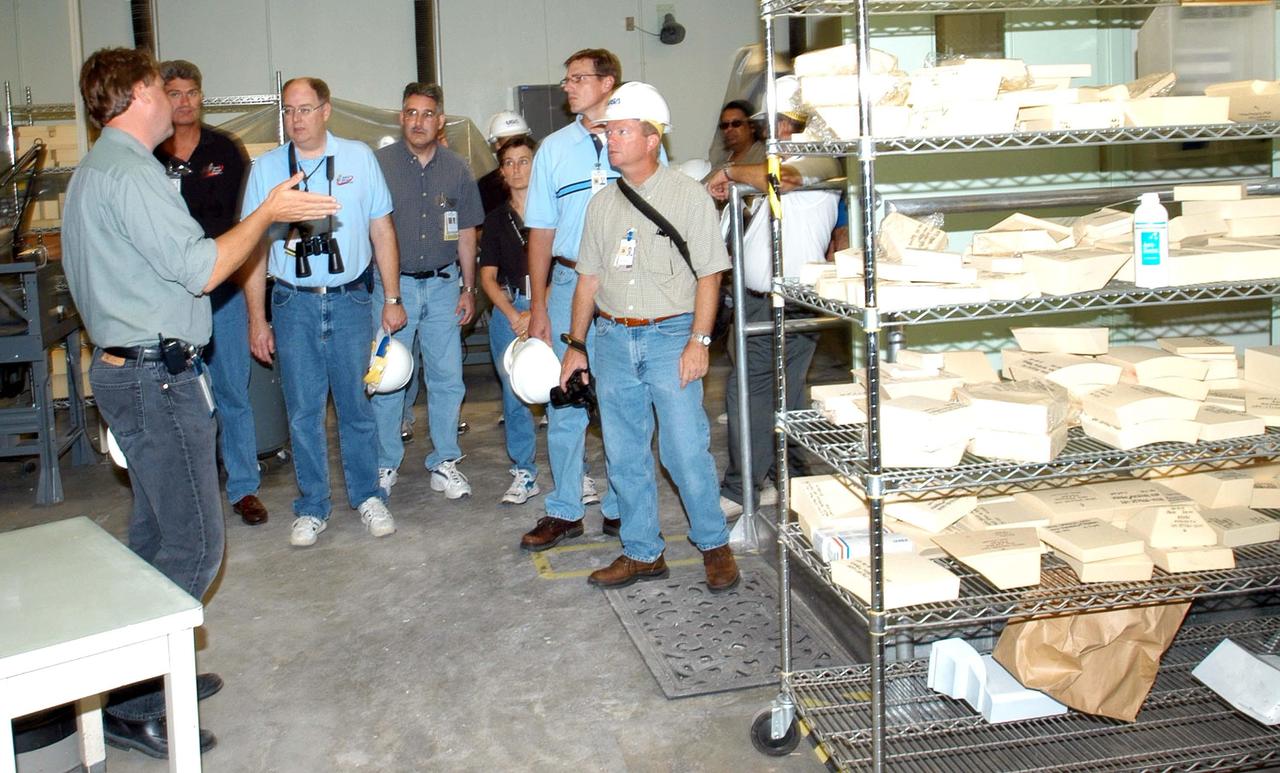
KENNEDY SPACE CENTER, FLA.  -  Martin Wilson, with United Space Alliance, describes an orbiter’s Thermal Protection System for members of the Stafford-Covey Return to Flight Task Group (SCTG).  Handling some of the blanket insulation are Dr. Kathryn Clark and Joe Engle.  Third from left is Richard Covey, former Space Shuttle commander, who is co-chair of the  SCTG, along with Thomas P. Stafford, Apollo commander.  Chartered by NASA Administrator Sean O’Keefe, the task group will perform an independent assessment of NASA’s implementation of the final recommendations by the Columbia Accident Investigation Board.
KENNEDY SPACE CENTER, FLA. - Martin Wilson, with United Space Alliance, describes an orbiter’s Thermal Protection System for members of the Stafford-Covey Return to Flight Task Group (SCTG). Handling some of the blanket insulation are Dr. Kathryn Clark and Joe Engle. Third from left is Richard Covey, former Space Shuttle commander, who is co-chair of the SCTG, along with Thomas P. Stafford, Apollo commander. Chartered by NASA Administrator Sean O’Keefe, the task group will perform an independent assessment of NASA’s implementation of the final recommendations by the Columbia Accident Investigation Board.
KENNEDY SPACE CENTER, FLA.  -  On a tour of the Tile Shop, members of the Stafford-Covey Return to Flight Task Group (SCTG) learn about PU-tiles, part of an orbiter’s Thermal Protection System.   At left is Martin Wilson, with United Space Alliance.  Others (left to right) around the table are James Adamson, Dr. Kathryn Clark, William Wegner, Richard Covey and Joe Engle.  Covey, former Space Shuttle commander, is co-chair of the  SCTG, along with Thomas P. Stafford, Apollo commander.  Chartered by NASA Administrator Sean O’Keefe, the task group will perform an independent assessment of NASA’s implementation of the final recommendations by the Columbia Accident Investigation Board.
KENNEDY SPACE CENTER, FLA. - On a tour of the Tile Shop, members of the Stafford-Covey Return to Flight Task Group (SCTG) learn about PU-tiles, part of an orbiter’s Thermal Protection System. At left is Martin Wilson, with United Space Alliance. Others (left to right) around the table are James Adamson, Dr. Kathryn Clark, William Wegner, Richard Covey and Joe Engle. Covey, former Space Shuttle commander, is co-chair of the SCTG, along with Thomas P. Stafford, Apollo commander. Chartered by NASA Administrator Sean O’Keefe, the task group will perform an independent assessment of NASA’s implementation of the final recommendations by the Columbia Accident Investigation Board.
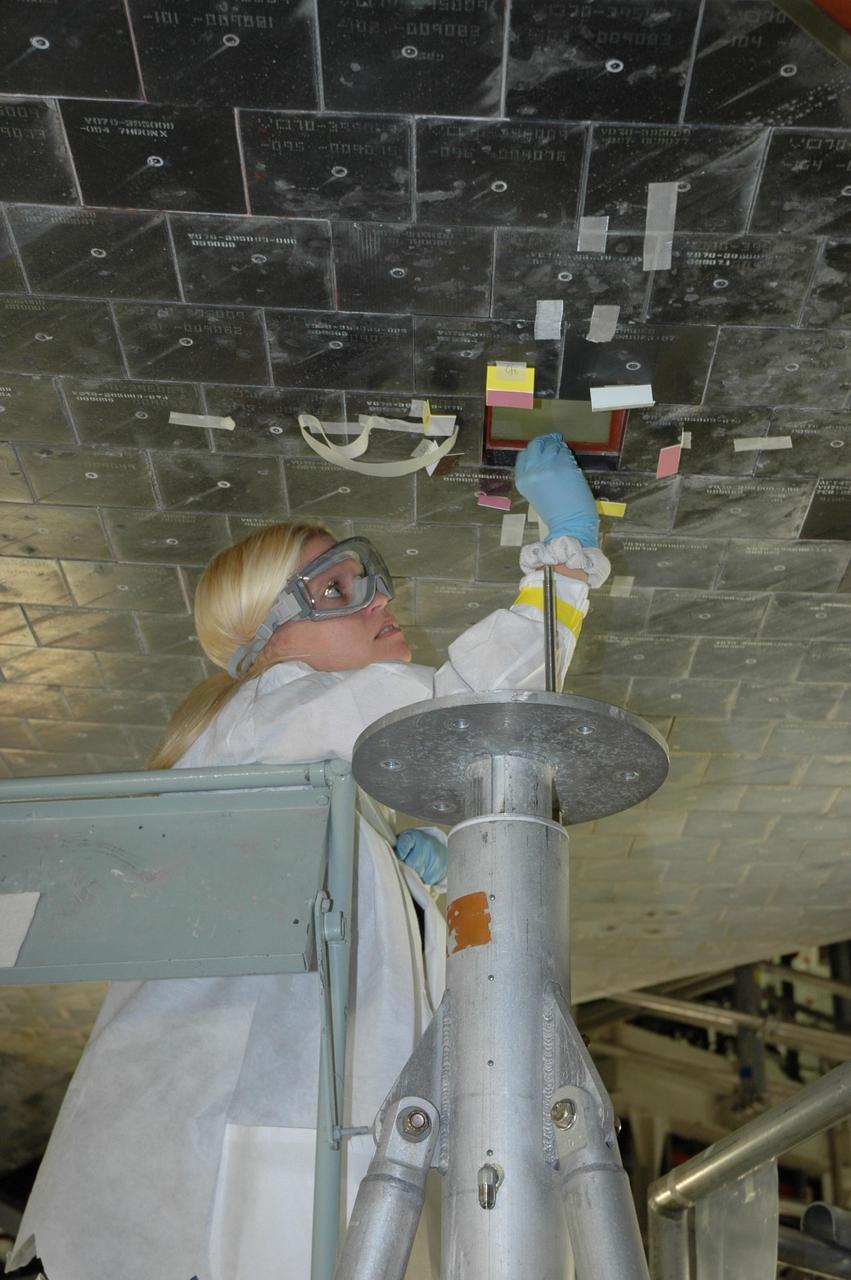
CAPE CANAVERAL, Fla. -- In Orbiter Processing Facility-1 at NASA's Kennedy Space Center in Florida, a thermal protection system technician prepares the surface under space shuttle Atlantis before installing a heat shield tile. The tiles are part of the Orbiter Thermal Protection System, thermal shields to protect against temperatures as high as 3,000 degrees Fahrenheit, which are produced during descent for landing.      Atlantis is being prepared for the STS-135 mission, which will deliver the Raffaello multi-purpose logistics module packed with supplies, logistics and spare parts to the International Space Station. STS-135 is targeted to launch June 28, and will be the last spaceflight for the Space Shuttle Program. Photo credit: NASA/Jack Pfaller
KSC-2011-1401
CAPE CANAVERAL, Fla. -- In Orbiter Processing Facility-1 at NASA's Kennedy Space Center in Florida, a thermal protection system technician secures a newly installed heat shield tile in place under space shuttle Atlantis. The tiles are part of the Orbiter Thermal Protection System, thermal shields to protect against temperatures as high as 3,000 degrees Fahrenheit, which are produced during descent for landing.        Atlantis is being prepared for the STS-135 mission, which will deliver the Raffaello multi-purpose logistics module packed with supplies, logistics and spare parts to the International Space Station. STS-135 is targeted to launch June 28, and will be the last spaceflight for the Space Shuttle Program. Photo credit: NASA/Jack Pfaller
KSC-2011-1403
CAPE CANAVERAL, Fla. --  In Orbiter Processing Facility-1 at NASA's Kennedy Space Center in Florida, a thermal protection system technician prepares the surface under space shuttle Atlantis before installing a heat shield tile. The tiles are part of the Orbiter Thermal Protection System, thermal shields to protect against temperatures as high as 3,000 degrees Fahrenheit, which are produced during descent for landing.        Atlantis is being prepared for the STS-135 mission, which will deliver the Raffaello multi-purpose logistics module packed with supplies, logistics and spare parts to the International Space Station. STS-135 is targeted to launch June 28, and will be the last spaceflight for the Space Shuttle Program. Photo credit: NASA/Jack Pfaller
KSC-2011-1400
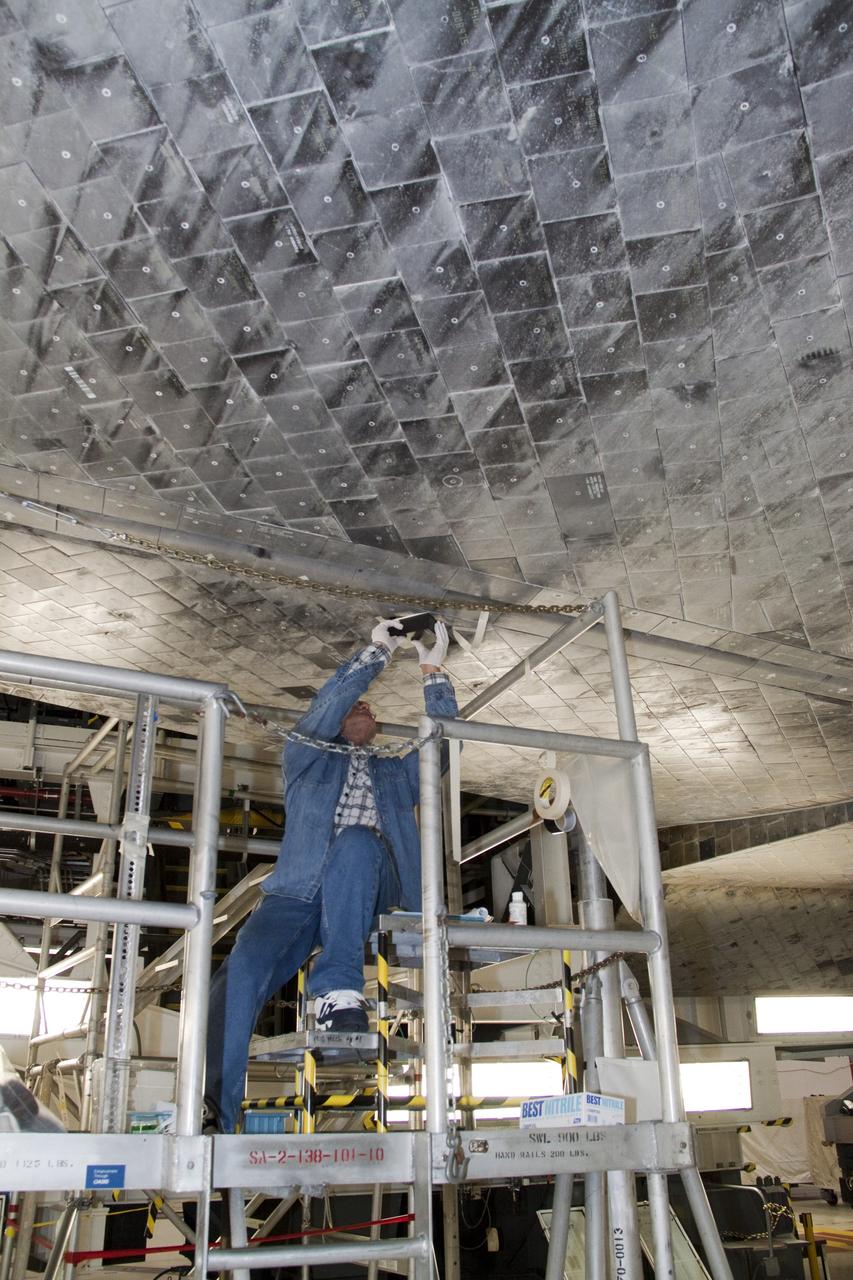
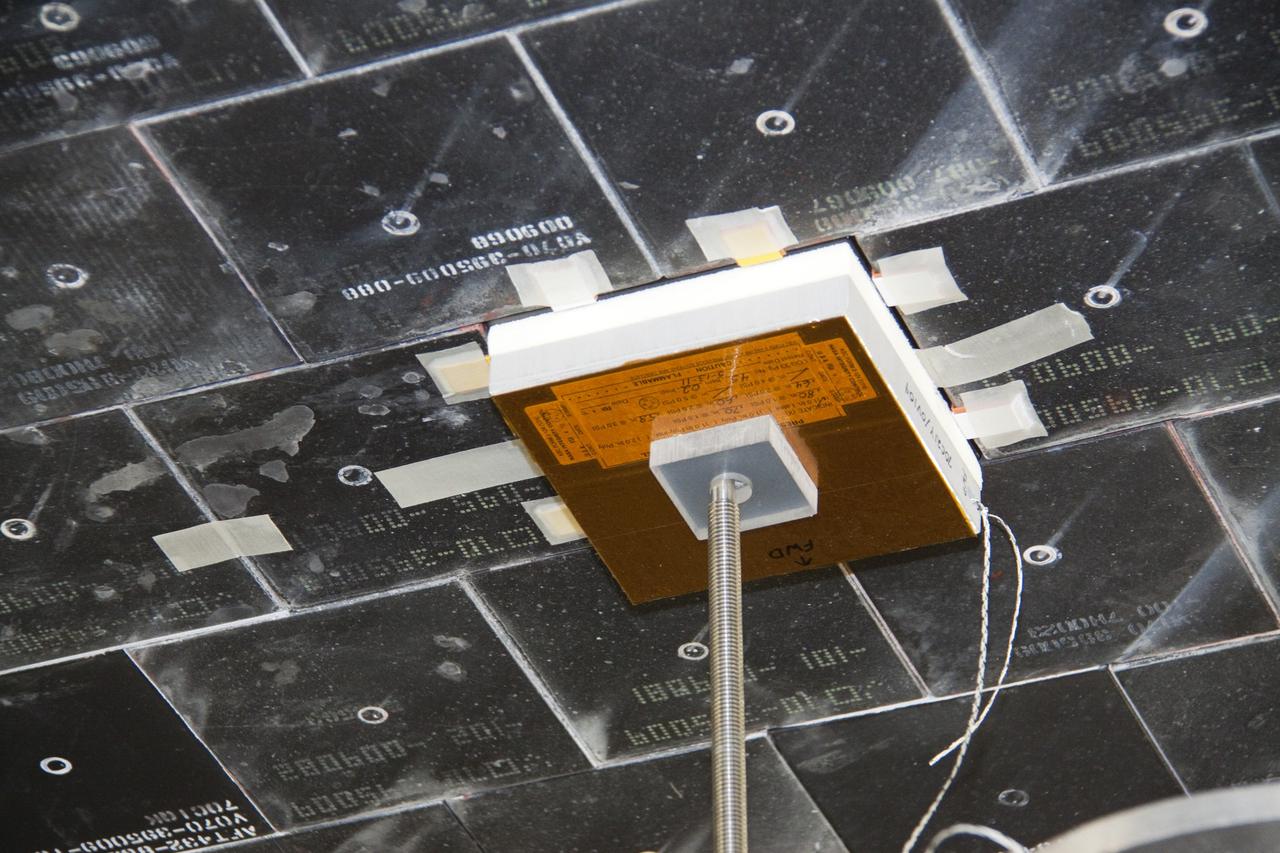
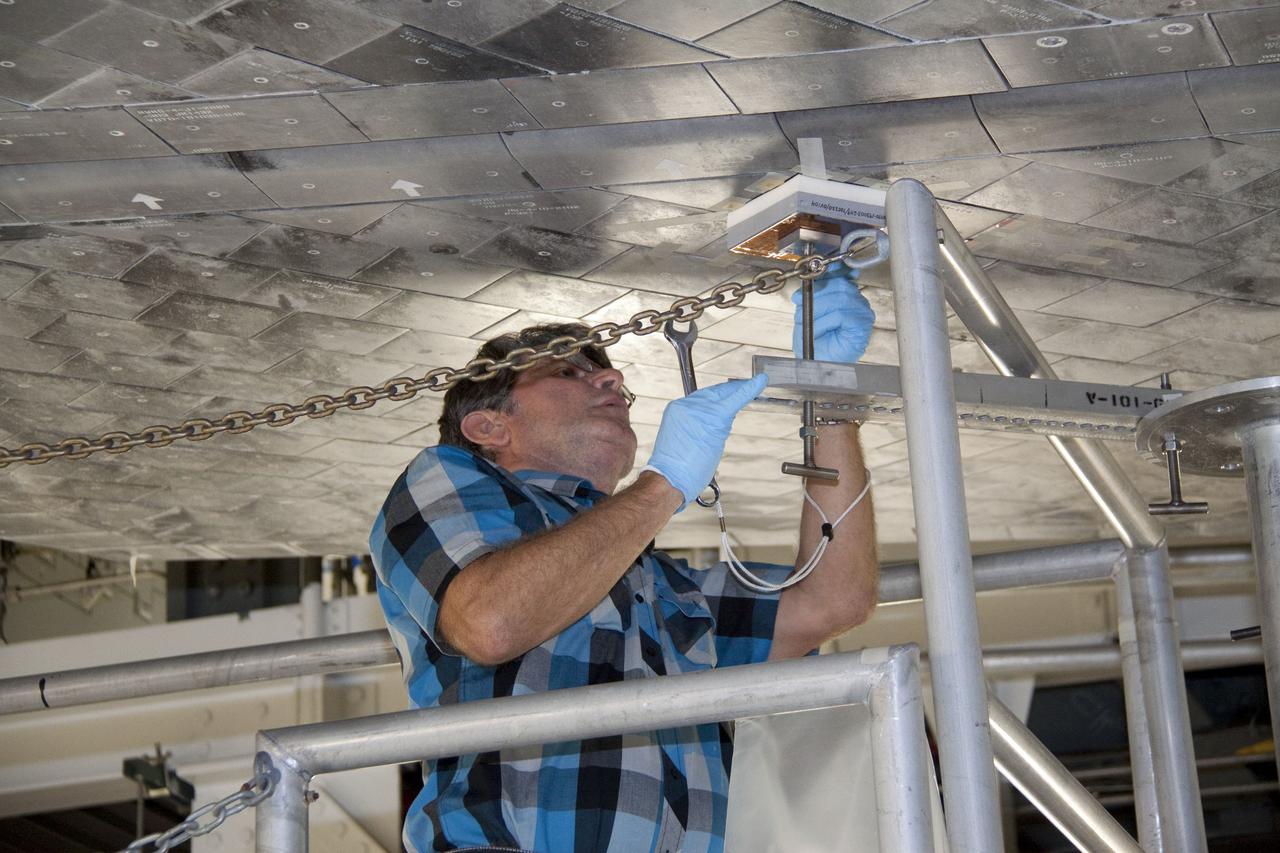
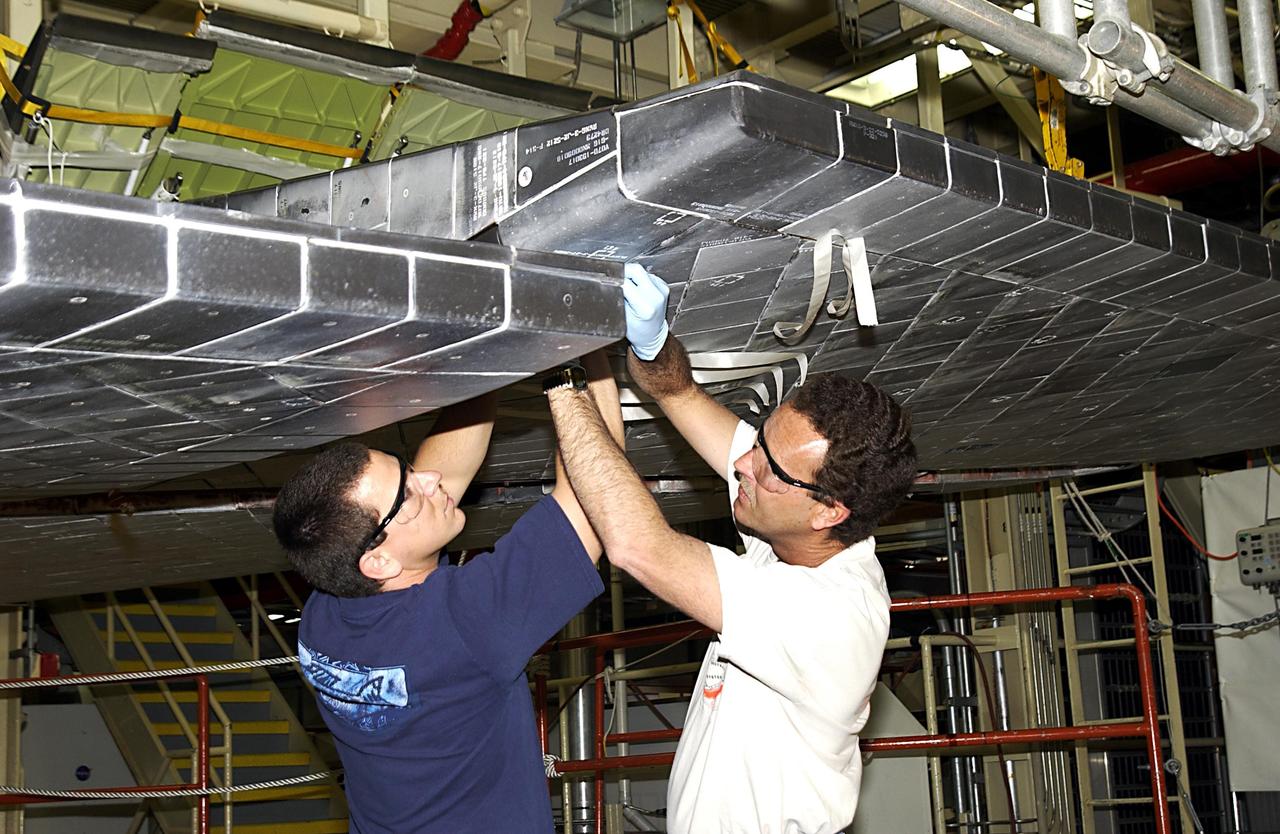
CAPE CANAVERAL, Fla. -- In Orbiter Processing Facility-1 at NASA's Kennedy Space Center in Florida, a thermal protection system technician has secured a newly installed heat shield tile in place under space shuttle Atlantis with a pressure fitting to ensure a tight bond. The tiles are part of the Orbiter Thermal Protection System, thermal shields to protect against temperatures as high as 3,000 degrees Fahrenheit, which are produced during descent for landing.      Atlantis is being prepared for the STS-135 mission, which will deliver the Raffaello multi-purpose logistics module packed with supplies, logistics and spare parts to the International Space Station. STS-135 is targeted to launch June 28, and will be the last spaceflight for the Space Shuttle Program. Photo credit: NASA/Jack Pfaller
KSC-2011-1405
CAPE CANAVERAL, Fla. -- In Orbiter Processing Facility-1 at NASA's Kennedy Space Center in Florida, a thermal protection system technician has secured a newly installed heat shield tile in place under space shuttle Atlantis with a pressure fitting to ensure a tight bond. The tiles are part of the Orbiter Thermal Protection System, thermal shields to protect against temperatures as high as 3,000 degrees Fahrenheit, which are produced during descent for landing.      Atlantis is being prepared for the STS-135 mission, which will deliver the Raffaello multi-purpose logistics module packed with supplies, logistics and spare parts to the International Space Station. STS-135 is targeted to launch June 28, and will be the last spaceflight for the Space Shuttle Program. Photo credit: NASA/Jack Pfaller
KSC-2011-1404
KENNEDY SPACE CENTER, FLA. -- A United Space Alliance (USA) technician (left) discusses the construction of a thermal blanket used in the Shuttle's thermal protection system with USA Vice President and Space Shuttle Program Manager Howard DeCastro (right). NASA and USA Space Shuttle program management are participating in a leadership workday. The day is intended to provide management with an in-depth, hands-on look at Shuttle processing activities at KSC.
KSC-03pd3258
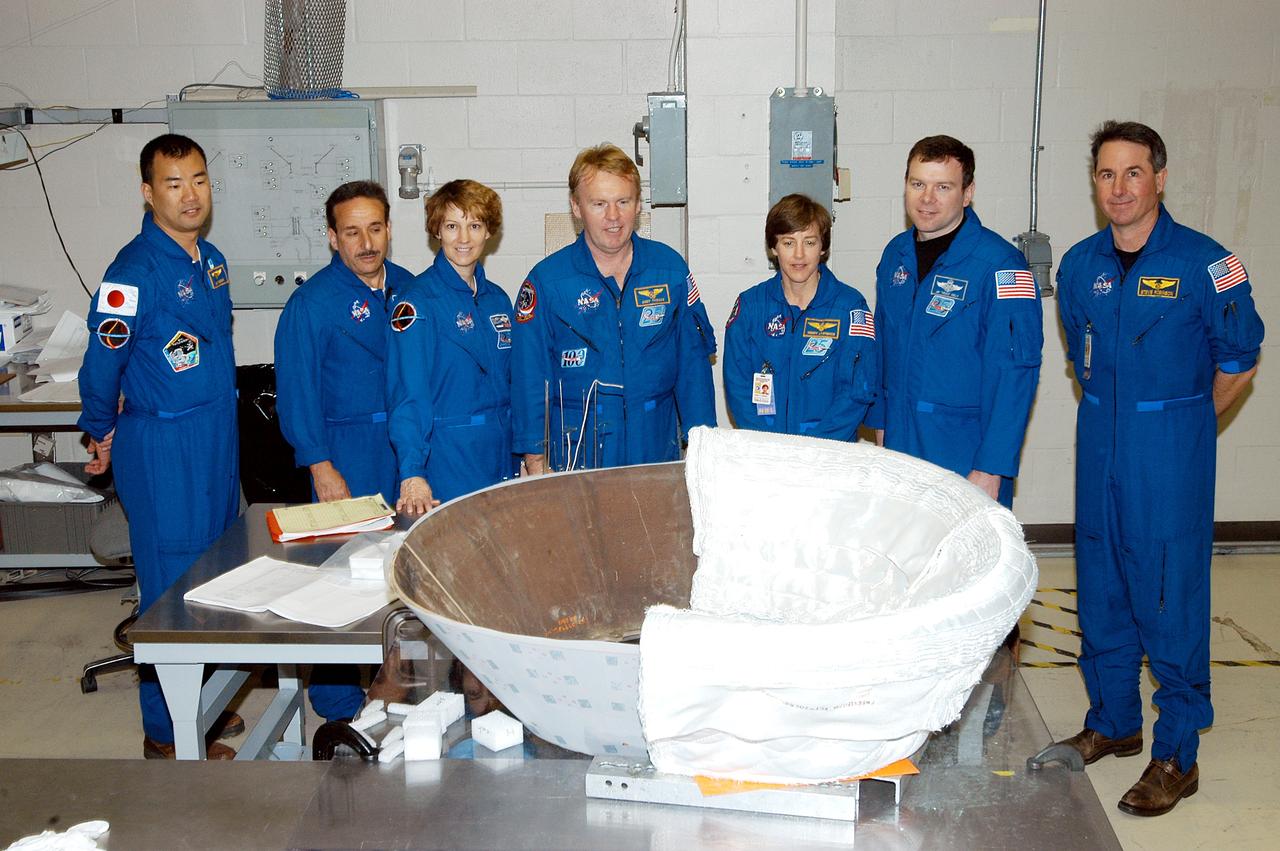
KENNEDY SPACE CENTER, FLA. - Members of the STS-114 crew spend time becoming familiar with Shuttle and mission equipment. From left (in their blue suits) are Mission Specialists Soichi Noguchi, Stephen Robinson, Charles Camarda, Andrew Thomas and Wendy Lawrence; Commander Eileen Collins and Pilot James Kelly. Noguchi represents the Japanese Aerospace and Exploration Agency.   They are looking at the thermal protection system insulation blankets being installed on an insert for Discovery’s nose cap. The STS-114 mission is Logistics Flight 1, which is scheduled to deliver supplies and equipment plus the external stowage platform to the International Space Station.
KENNEDY SPACE CENTER, FLA. - Members of the STS-114 crew spend time becoming familiar with Shuttle and mission equipment. From left (in their blue suits) are Mission Specialists Soichi Noguchi, Stephen Robinson, Charles Camarda, Andrew Thomas and Wendy Lawrence; Commander Eileen Collins and Pilot James Kelly. Noguchi represents the Japanese Aerospace and Exploration Agency. They are looking at the thermal protection system insulation blankets being installed on an insert for Discovery’s nose cap. The STS-114 mission is Logistics Flight 1, which is scheduled to deliver supplies and equipment plus the external stowage platform to the International Space Station.
KENNEDY SPACE CENTER, FLA. - The STS-114 crew gathers around the work stand holding the insert for Discovery’s nose cap.  From left are Mission Specialists Soichi Noguchi, and Charles Camarda; Commander Eileen Collins; Mission Specialists Andrew Thomas and Wendy Lawrence; Pilot James Kelly; and Mission Specialist Stephen Robinson. Noguchi represents the Japanese Aerospace and Exploration Agency.  The insert is being fitted with thermal protection system insulation blankets.  The crew is spending time becoming familiar with Shuttle and mission equipment.  The mission is Logistics Flight 1, which is scheduled to deliver supplies and equipment plus the external stowage platform to the International Space Station.
KENNEDY SPACE CENTER, FLA. - The STS-114 crew gathers around the work stand holding the insert for Discovery’s nose cap. From left are Mission Specialists Soichi Noguchi, and Charles Camarda; Commander Eileen Collins; Mission Specialists Andrew Thomas and Wendy Lawrence; Pilot James Kelly; and Mission Specialist Stephen Robinson. Noguchi represents the Japanese Aerospace and Exploration Agency. The insert is being fitted with thermal protection system insulation blankets. The crew is spending time becoming familiar with Shuttle and mission equipment. The mission is Logistics Flight 1, which is scheduled to deliver supplies and equipment plus the external stowage platform to the International Space Station.
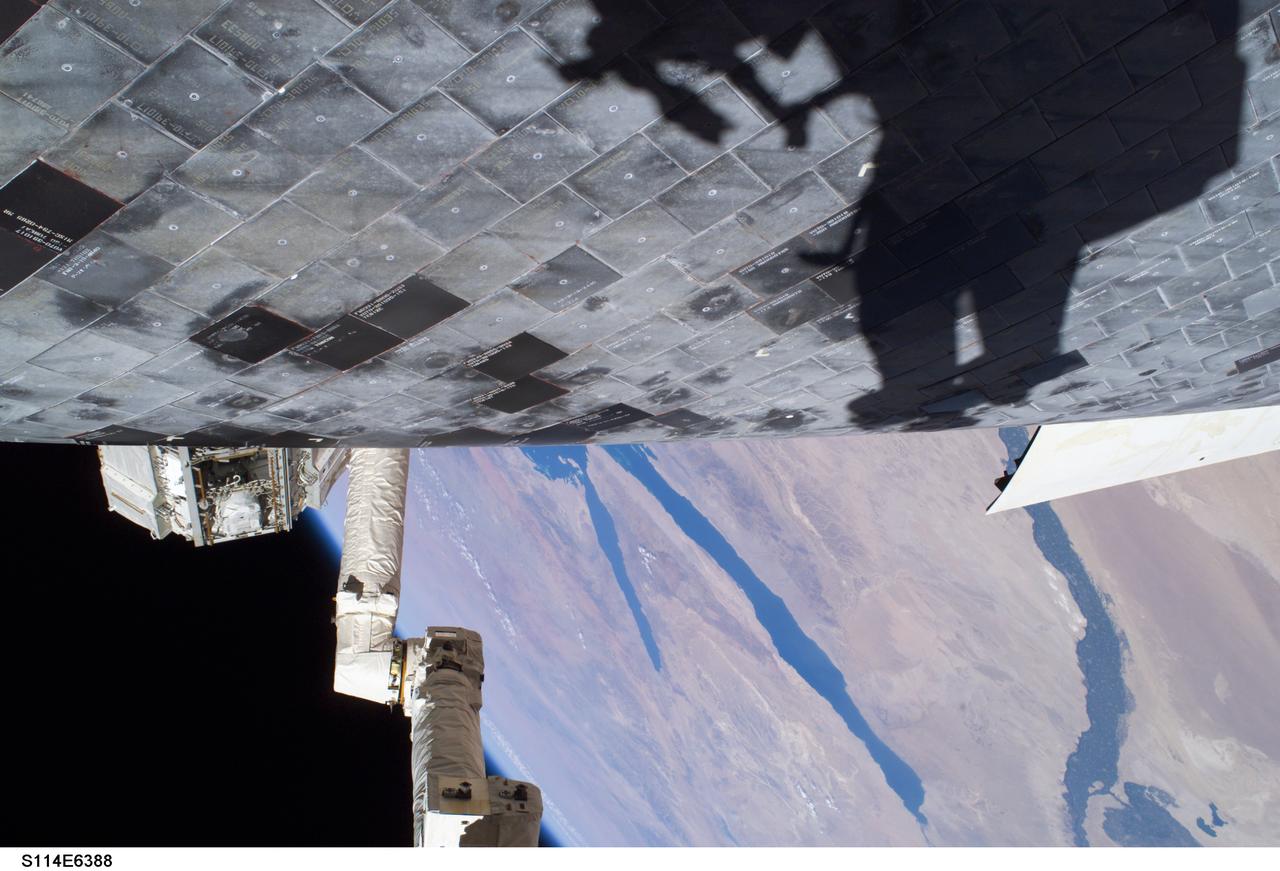
S114-E-6388 (3 August 2005) --- A close-up view of a portion of the thermal protection tiles on Space Shuttle Discovery’s underside is featured in this image photographed by astronaut Stephen K. Robinson, STS-114 mission specialist, during the mission’s third session of extravehicular activities (EVA). Robinson’s shadow is visible on the thermal protection tiles and a portion of the Canadian-built remote manipulator system (RMS) robotic arm and the Nile River is visible at bottom.
Tile survey seen during EVA 3
CAPE CANAVERAL, Fla. -- In Orbiter Processing Facility-1 at NASA's Kennedy Space Center in Florida, a thermal protection system technician installs a gap filler in the area on space shuttle Atlantis' underside before a heat shield tile is installed.    The tiles are part of the Orbiter Thermal Protection System that protects the shuttle against temperatures as high as 3,000 degrees Fahrenheit, which are produced during descent for landing. Atlantis is being prepared for the STS-135 mission, which will carry the Raffaello multi-purpose logistics module packed with supplies, logistics and spare parts to the International Space Station. STS-135 is targeted to launch June 28, and will be the last flight for the Space Shuttle Program. Photo credit: NASA/Jack Pfaller
KSC-2011-1475
CAPE CANAVERAL, Fla. -- In Orbiter Processing Facility-1 at NASA's Kennedy Space Center in Florida, a thermal protection system technician secures a newly installed heat shield tile in place under space shuttle Atlantis with a pressure fitting to ensure a tight bond.      The tiles are part of the Orbiter Thermal Protection System that protects the shuttle against temperatures as high as 3,000 degrees Fahrenheit, which are produced during descent for landing. Atlantis is being prepared for the STS-135 mission, which will carry the Raffaello multi-purpose logistics module packed with supplies, logistics and spare parts to the International Space Station. STS-135 is targeted to launch June 28, and will be the last flight for the Space Shuttle Program. Photo credit: NASA/Jack Pfaller
KSC-2011-1478
CAPE CANAVERAL, Fla. --  In Orbiter Processing Facility-1 at NASA's Kennedy Space Center in Florida, a thermal protection system technician takes a measurement of the surface in the area on space shuttle Atlantis' underside where a heat shield tile will be installed.           The tiles are part of the Orbiter Thermal Protection System that protects the shuttle against temperatures as high as 3,000 degrees Fahrenheit, which are produced during descent for landing. Atlantis is being prepared for the STS-135 mission, which will carry the Raffaello multi-purpose logistics module packed with supplies, logistics and spare parts to the International Space Station. STS-135 is targeted to launch June 28, and will be the last flight for the Space Shuttle Program. Photo credit: NASA/Jack Pfaller
KSC-2011-1471
CAPE CANAVERAL, Fla. -- In Orbiter Processing Facility-1 at NASA's Kennedy Space Center in Florida, a thermal protection system technician secures a newly installed heat shield tile in place under space shuttle Atlantis with a pressure fitting to ensure a tight bond.    The tiles are part of the Orbiter Thermal Protection System that protects the shuttle against temperatures as high as 3,000 degrees Fahrenheit, which are produced during descent for landing. Atlantis is being prepared for the STS-135 mission, which will carry the Raffaello multi-purpose logistics module packed with supplies, logistics and spare parts to the International Space Station. STS-135 is targeted to launch June 28, and will be the last flight for the Space Shuttle Program. Photo credit: NASA/Jack Pfaller
KSC-2011-1479
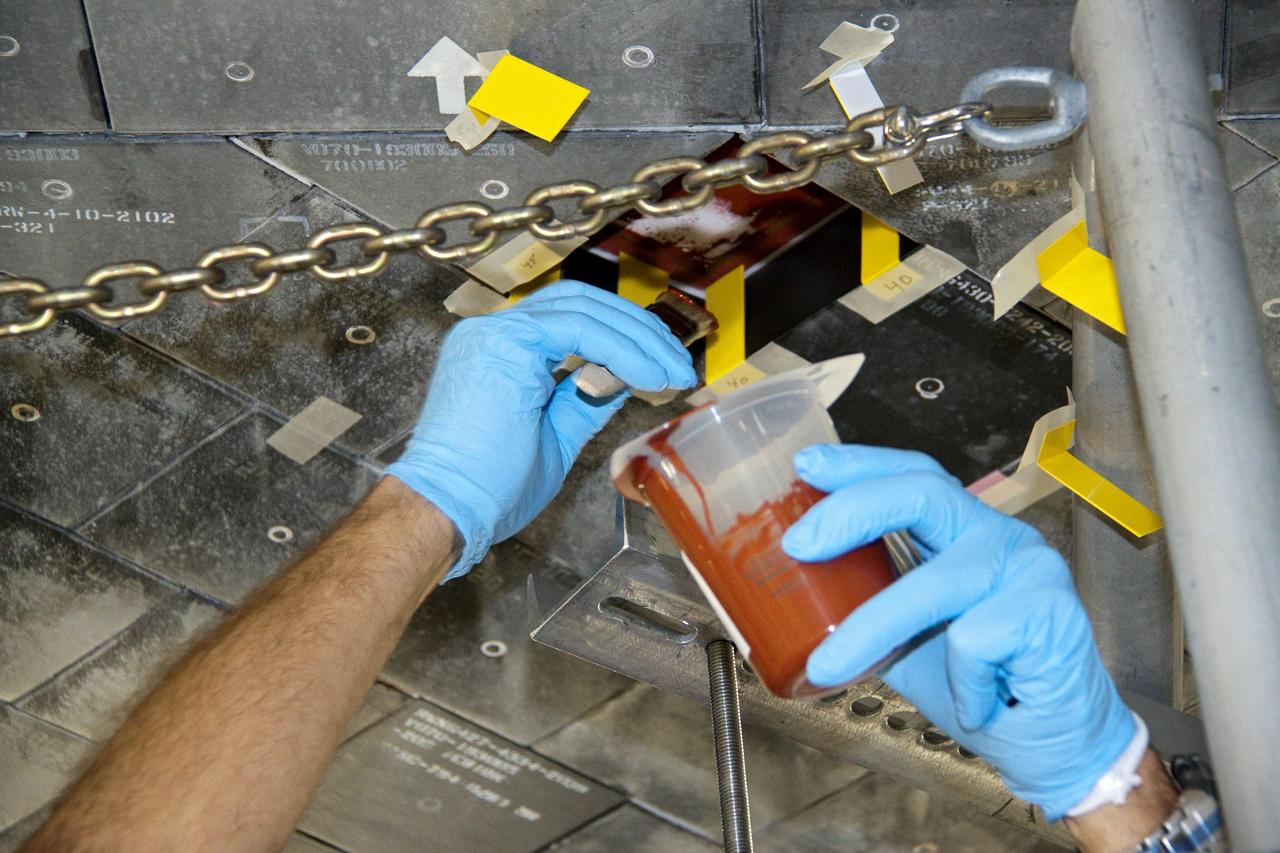
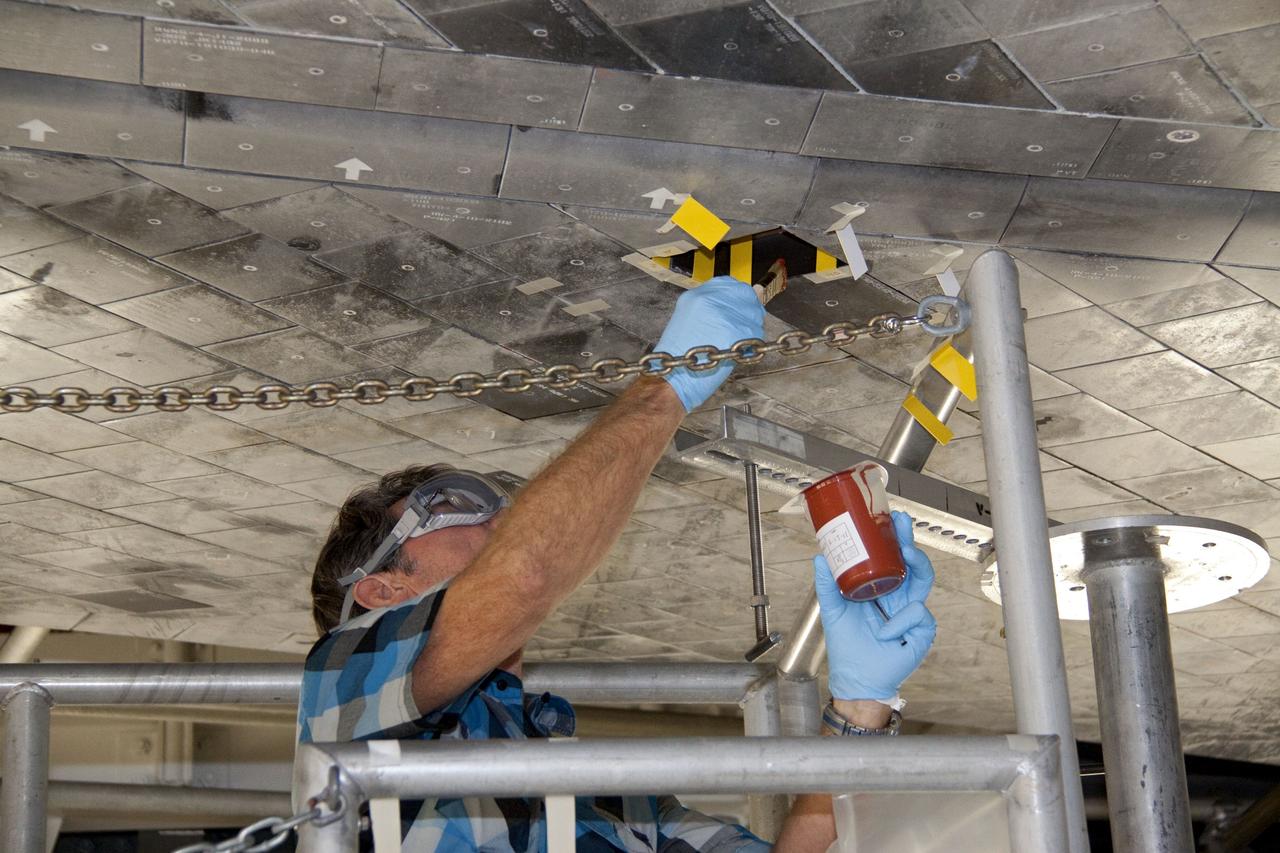
CAPE CANAVERAL, Fla. -- In Orbiter Processing Facility-1 at NASA's Kennedy Space Center in Florida, a thermal protection system technician applies a bonding agent to an area on space shuttle Atlantis' underside where a heat shield tile will be installed.         The tiles are part of the Orbiter Thermal Protection System that protects the shuttle against temperatures as high as 3,000 degrees Fahrenheit, which are produced during descent for landing. Atlantis is being prepared for the STS-135 mission, which will carry the Raffaello multi-purpose logistics module packed with supplies, logistics and spare parts to the International Space Station. STS-135 is targeted to launch June 28, and will be the last flight for the Space Shuttle Program. Photo credit: NASA/Jack Pfaller
KSC-2011-1473
CAPE CANAVERAL, Fla. -- In Orbiter Processing Facility-1 at NASA's Kennedy Space Center in Florida, a thermal protection system technician applies a bonding agent to an area on space shuttle Atlantis' underside where a heat shield tile will be installed.         The tiles are part of the Orbiter Thermal Protection System that protects the shuttle against temperatures as high as 3,000 degrees Fahrenheit, which are produced during descent for landing. Atlantis is being prepared for the STS-135 mission, which will carry the Raffaello multi-purpose logistics module packed with supplies, logistics and spare parts to the International Space Station. STS-135 is targeted to launch June 28, and will be the last flight for the Space Shuttle Program. Photo credit: NASA/Jack Pfaller
KSC-2011-1472
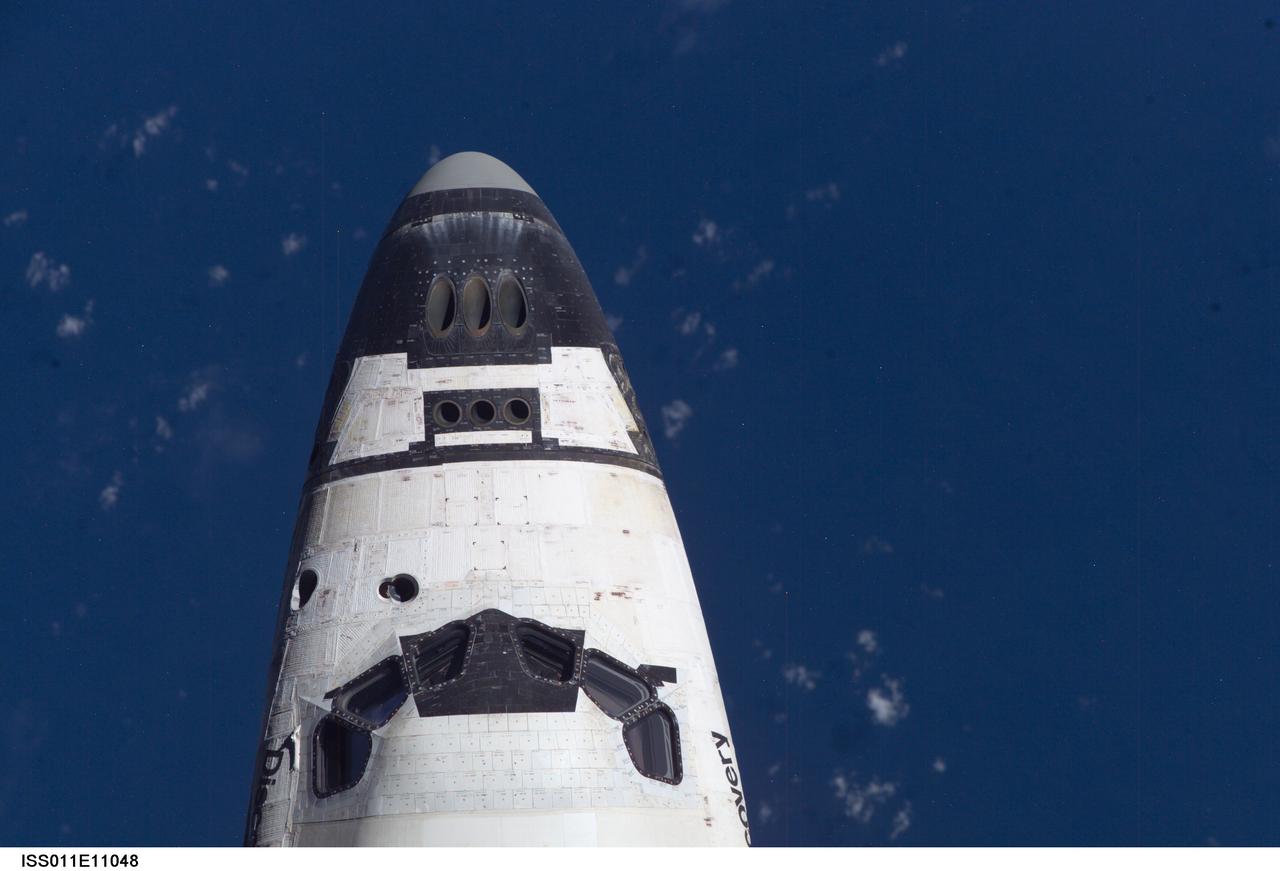
ISS011-E-11048 (28 July 2005) --- The crew cabin of the Space Shuttle Discovery was photographed by the crewmembers of the International Space Station as the two spacecraft approached each other for docking on July 28, 2005.  The Expedition 12 crewmembers onboard the orbital outpost took a battery of survey photographs of the Shuttle thermal protection system.
Mapping sequence performed during the STS-114 R-Bar Pitch Maneuver.
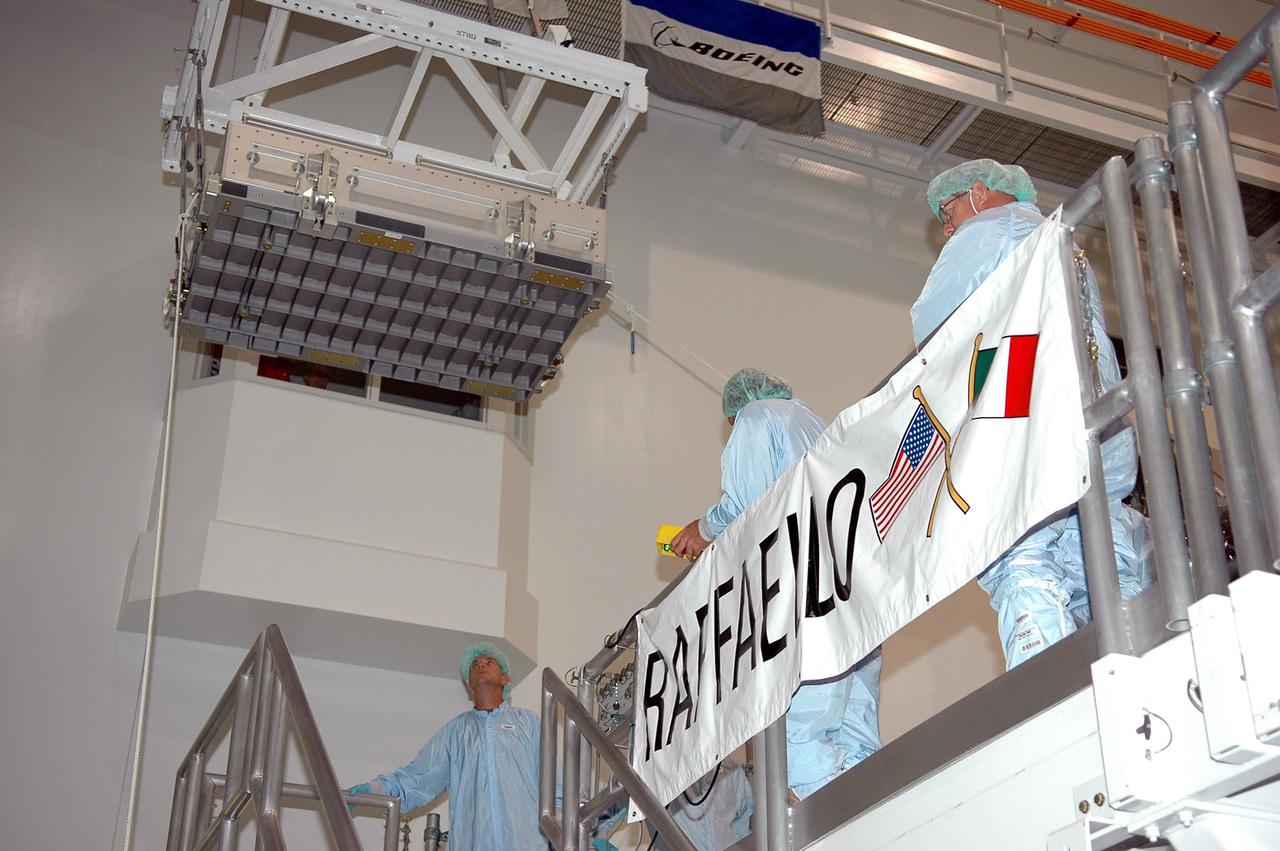
KENNEDY SPACE CENTER, FLA. -   Technicians at the Space Station Processing Facility lower a Thermal Protection System Sample Box (upper left) toward the Lightweight Multi-Purpose Experiment Support Structure Carrier (LMC) for a fit check. The box is the actual flight hardware scheduled to fly on the Space Shuttle Return to Flight mission STS-114.  The fit check is performed to ensure the hardware mates properly with the newly modified LMC and will be returned to NASA’s Johnson Space Center for installation of tile samples in support of the STS-114 mission.  The Thermal Protection Detailed Test Objective will enable astronauts to test new on-orbit Thermal Protection System repair techniques.  Mission STS-114 is scheduled to launch in May 2005.
KSC-04pd-2197
KENNEDY SPACE CENTER, FLA. -   Technicians at the Space Station Processing Facility prepare to lift and move a Thermal Protection System Sample Box onto the Lightweight Multi-Purpose Experiment Support Structure Carrier (LMC) for a fit check. The box is the actual flight hardware scheduled to fly on the Space Shuttle Return to Flight mission STS-114.  The fit check is performed to ensure the hardware mates properly with the newly modified LMC and will be returned to NASA’s Johnson Space Center for installation of tile samples in support of the STS-114 mission.  The Thermal Protection Detailed Test Objective will enable astronauts to test new on-orbit Thermal Protection System repair techniques.  Mission STS-114 is scheduled to launch in May 2005.
KSC-04pd-2195
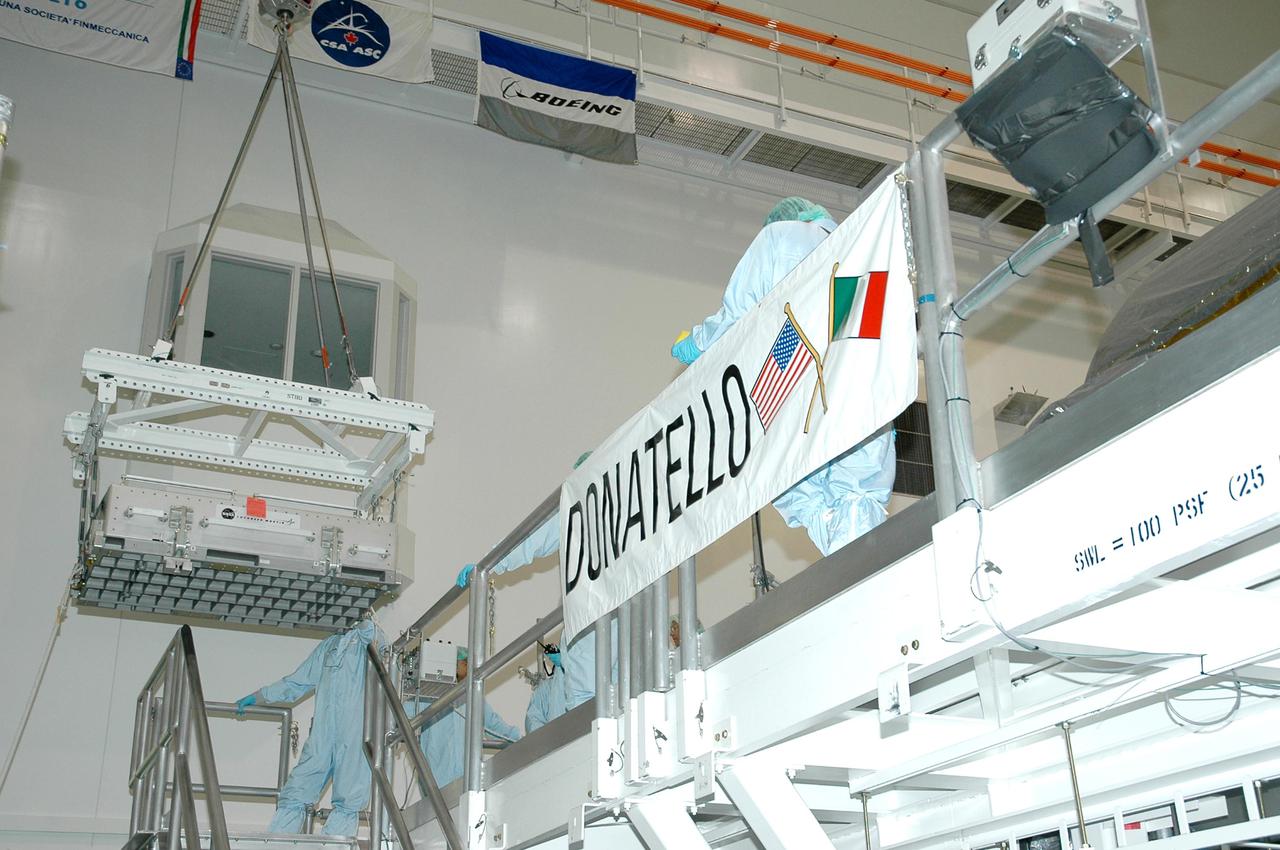
KENNEDY SPACE CENTER, FLA.  - An overhead crane in the Space Station Processing Facility moves the Thermal Protection System Detailed Test Objective (DTO) box toward the Lightweight Multi-Purpose Experiment Support Structure Carrier (LMC) that is situated near the Multi-Purpose Logistics Module Donatello.  The LMC and DTO will fly on Space Shuttle Discovery for mission STS-114.  The DTO contains tile samples that will enable astronauts to test new on-orbit Thermal Protection System repair techniques.  The launch window for mission STS-114 is May 12 to June 3.
KSC-05pd-0294
KENNEDY SPACE CENTER, FLA.  - Technicians at the Space Station Processing Facility prepare the Thermal Protection System Detailed Test Objective (DTO) box to be lifted onto the Lightweight Multi-Purpose Experiment Support Structure Carrier (LMC).  It will be placed on the Lightweight Multi-Purpose Experiment Support Structure Carrier (LMC) to fly on Space Shuttle Discovery for mission STS-114.  The DTO contains tile samples that will enable astronauts to test new on-orbit Thermal Protection System repair techniques.  The launch window for mission STS-114 is May 12 to June 3.
KSC-05pd-0292
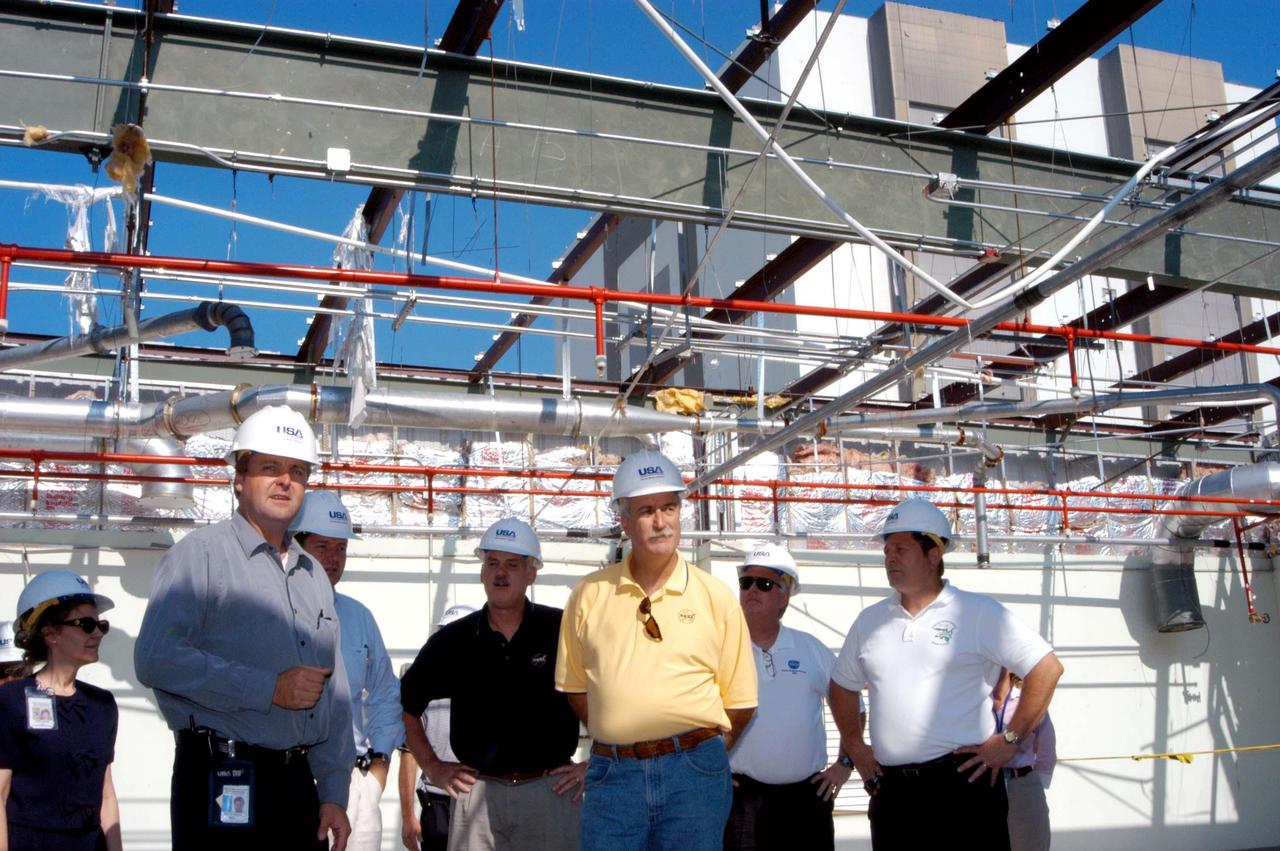
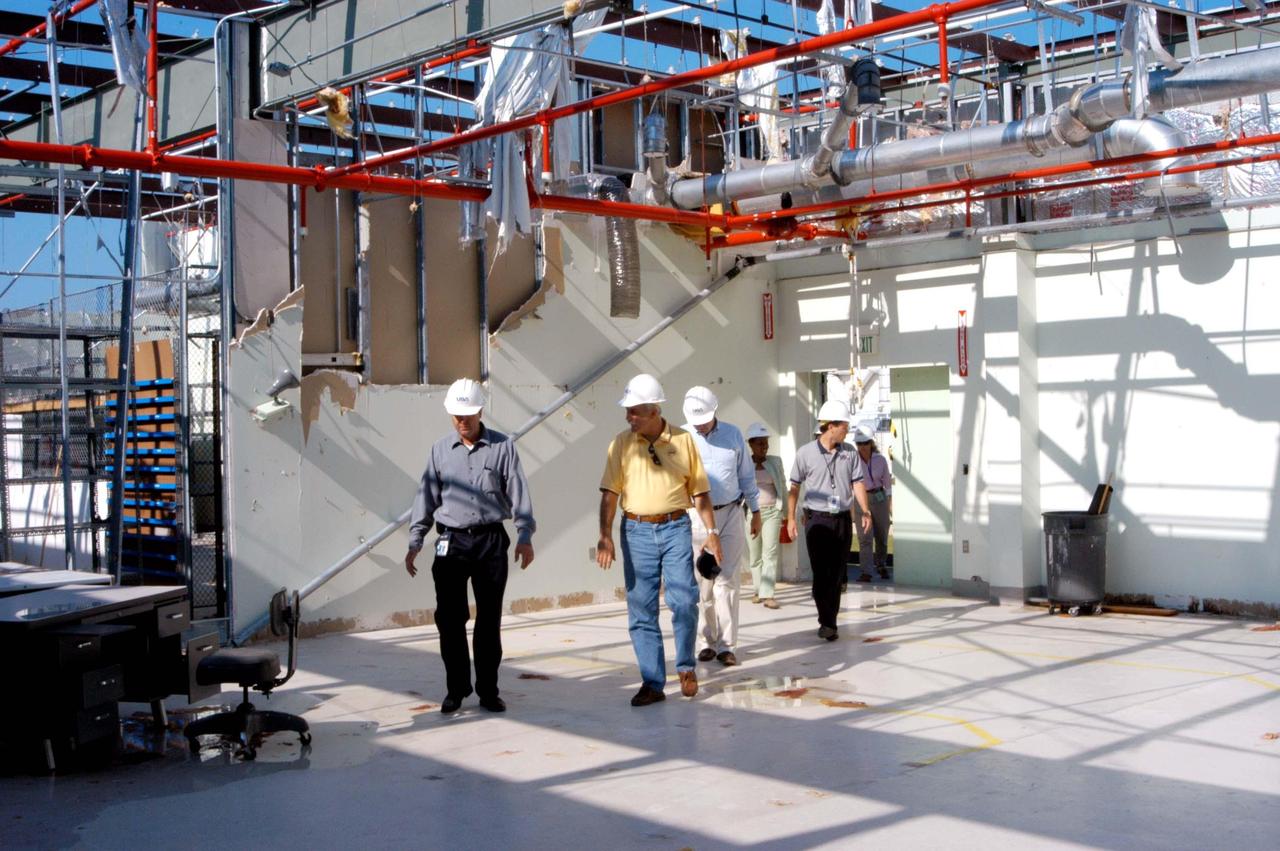
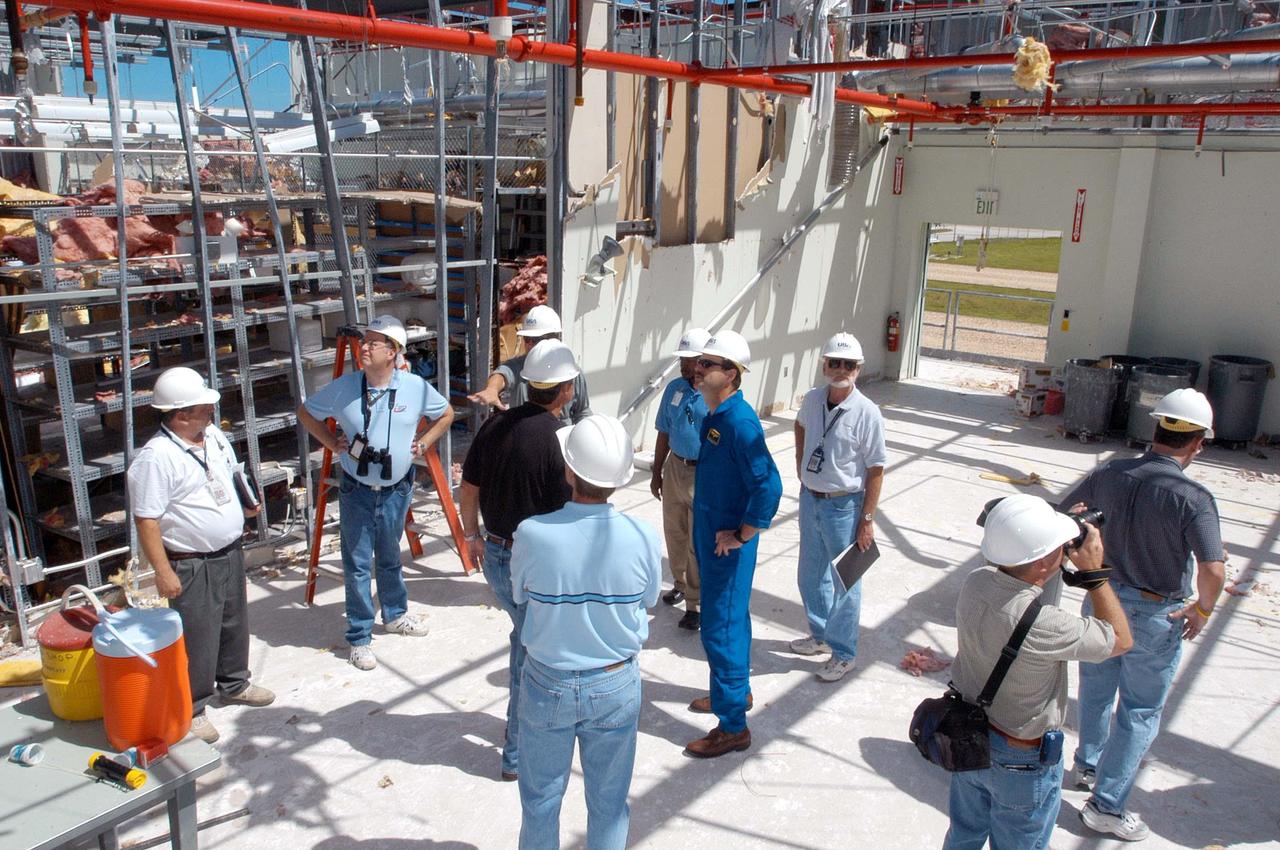
KENNEDY SPACE CENTER, FLA. -  Martin Wilson (left, in foreground), manager of Thermal Protection System (TPS) operations for United Space Alliance (USA), gives a tour of the hurricane-ravaged Thermal Protection System Facility to (from center) NASA Associate Administrator of  Space Operations Mission Directorate William Readdy,  NASA Administrator Sean O’Keefe, Center Director James Kennedy and Director of Shuttle Processing Michael E. Wetmore.  The TPSF, which creates the TPS tiles, blankets and all the internal thermal control systems for the Space Shuttles, is almost totally unserviceable at this time after losing approximately 35 percent of its roof during Hurricane Frances, which blew across Central Florida Sept. 4-5. O’Keefe and Readdy are visiting KSC to survey the damage sustained by KSC facilities from the hurricane.  The Labor Day storm also caused significant damage to the Vehicle Assembly Building and Processing Control Center.  Additionally, the Operations and Checkout Building, Vertical Processing Facility, Hangar AE, Hangar S and Hangar AF Small Parts Facility each received substantial damage. However, well-protected and unharmed were NASA’s three Space Shuttle orbiters - Discovery, Atlantis and Endeavour - along with the Shuttle launch pads, all of the critical flight hardware for the orbiters and the International Space Station, and NASA’s Swift spacecraft that is awaiting launch in October.
KSC-04pd1850
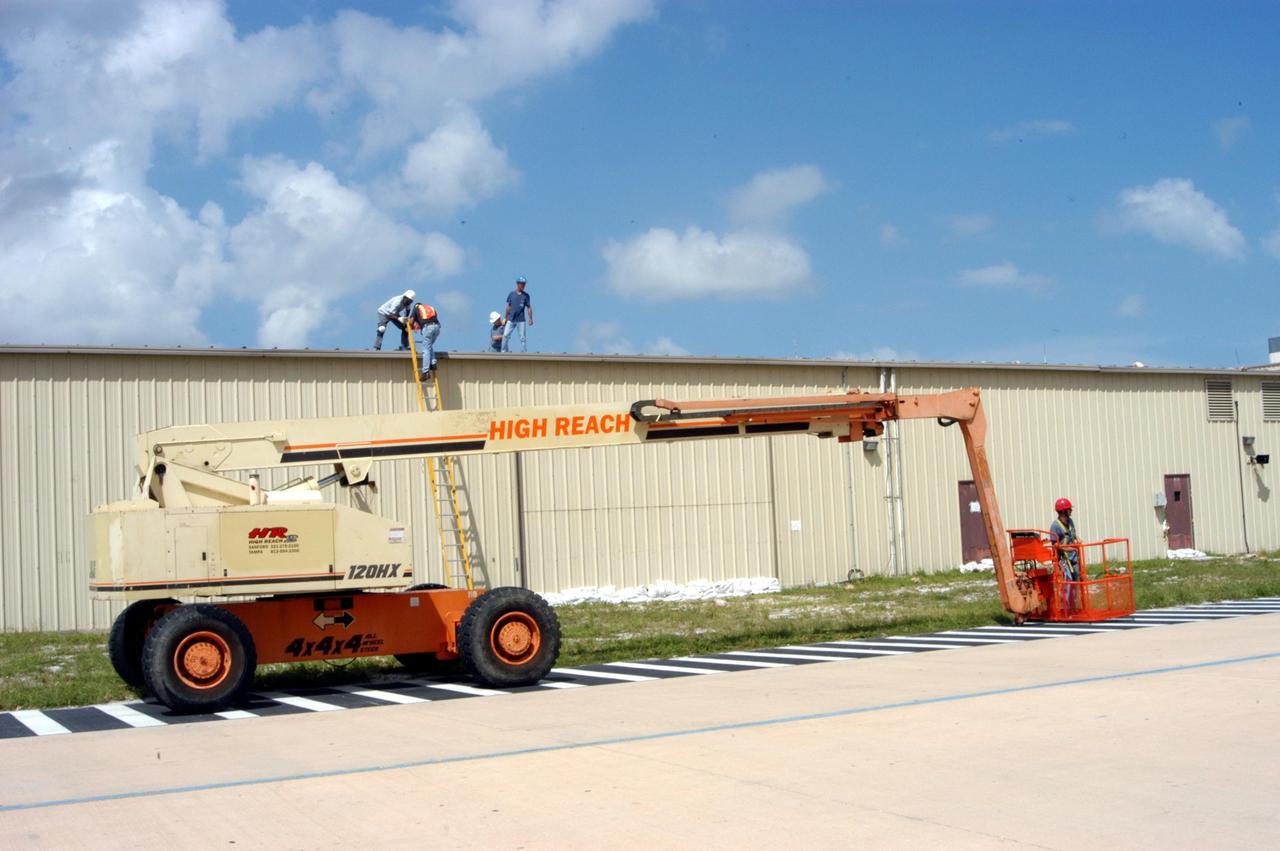
KENNEDY SPACE CENTER, FLA. - Workers attempt to secure the roof of the Tile Shop in the Thermal Protection System Facility (TPSF) in preparation for Hurricane Jeanne, which is expected to impact Central Florida Sunday.  The TPSF, which creates the TPS tiles, blankets and all the internal thermal control systems for the Space Shuttles, lost approximately 35 percent of its roof during Hurricane Frances, which blew across Central Florida Sept. 4.  Jeanne is the fourth hurricane in 45 days to make landfall somewhere in the state.
KSC-04pd1902
S115-E-05305 (10 Sept. 2006) --- While working to survey the thermal protection system on the Space Shuttle Atlantis, the orbiter boom sensor system (OBSS), attached to the remote manipulator system (RMS) arm was positioned near the shuttle's aft cabin windows. This enabled one of the STS-115 crewmembers to record this digital still image of the Canadian-built system and some of the hardware stowed in the payload bay of the shuttle, as well as the vertical stabilizer and the two orbital maneuvering system (OMS) pods.
Survey of the TPS on the STS-115 Space Shuttle Atlantis
KENNEDY SPACE CENTER, FLA. --  In the Orbiter Processing Facility, a United Space Alliance technician prepares the surface of Atlantis for installation of a thermal protection system tile. Space shuttle Atlantis is targeted for launch on mission STS-122 on Dec. 6.  Photo credit: NASA/Jack Pfaller
KSC-07pd2661
KENNEDY SPACE CENTER, FLA. -- United Space Alliance (USA) technicians install thermal protection system tiles on Space Shuttle Discovery.  Discovery is undergoing its Orbiter Major Modification Period, a regularly scheduled structural inspection and modification downtime, which began in September 2002.      .
KSC-03pd0262
KENNEDY SPACE CENTER, FLA. -  Martin Wilson (far left), manager of Thermal Protection System (TPS) operations for United Space Alliance (USA), leads NASA Administrator Sean O’Keefe (second from left) on a tour of the hurricane-ravaged Thermal Protection System Facility.  The TPSF, which creates the TPS tiles, blankets and all the internal thermal control systems for the Space Shuttles, is almost totally unserviceable at this time after losing approximately 35 percent of its roof in the storm, which blew across Central Florida Sept. 4-5. Undamaged equipment was removed from the TPSF and stored in the RLV hangar. O’Keefe and NASA Associate Administrator of  Space Operations Mission Directorate William Readdy are visiting KSC to survey the damage sustained by KSC facilities from the hurricane.  The Labor Day storm also caused significant damage to the Vehicle Assembly Building and Processing Control Center.  Additionally, the Operations and Checkout Building, Vertical Processing Facility, Hangar AE, Hangar S and Hangar AF Small Parts Facility each received substantial damage. However, well-protected and unharmed were NASA’s three Space Shuttle orbiters - Discovery, Atlantis and Endeavour - along with the Shuttle launch pads, all of the critical flight hardware for the orbiters and the International Space Station, and NASA’s Swift spacecraft that is awaiting launch in October.
KSC-04pd1849
KENNEDY SPACE CENTER, FLA. -  From left, Martin Wilson, manager of Thermal Protection System (TPS) operations for United Space Alliance, briefs NASA Administrator Sean O’Keefe, KSC Director of the Spaceport Services Scott Kerr, NASA Associate Administrator of the Space Operations Mission Directorate William Readdy, and Center Director James Kennedy (right) on the temporary tile shop set up in the RLV hangar.  O’Keefe and Readdy are visiting KSC to survey the damage sustained by KSC facilities from Hurricane Frances. The Thermal Protection System Facility (TPSF), which creates the TPS tiles, blankets and all the internal thermal control systems for the Space Shuttles, is almost totally unserviceable at this time after losing approximately 35 percent of its roof in the storm, which blew across Central Florida Sept. 4-5. Undamaged equipment was removed from the TPSF and stored in the hangar. NASA’s three Space Shuttle orbiters -- Discovery, Atlantis and Endeavour - along with the Shuttle launch pads, all of the critical flight hardware for the orbiters and the International Space Station, and NASA’s Swift spacecraft, awaiting launch in October, were well protected and unharmed.
KSC-04pd1839
KENNEDY SPACE CENTER, FLA. -  -  NASA Administrator Sean O’Keefe (right) looks at equipment moved from the Thermal Protection System Facility to the RLV Hangar.  At left are United Space Alliance technicians Shelly Kipp and Eric Moss.  O’Keefe and NASA Associate Administrator of  Space Operations Mission Directorate William Readdy are visiting KSC to survey the damage sustained by KSC facilities from Hurricane Frances. The Thermal Protection System Facility (TPSF), which creates the TPS tiles, blankets and all the internal thermal control systems for the Space Shuttles, is almost totally unserviceable at this time after losing approximately 35 percent of its roof in the storm, which blew across Central Florida Sept. 4-5. Undamaged equipment was removed from the TPSF and stored in the hangar. The Labor Day storm also caused significant damage to the Vehicle Assembly Building and Processing Control Center.  Additionally, the Operations and Checkout Building, Vertical Processing Facility, Hangar AE, Hangar S and Hangar AF Small Parts Facility each received substantial damage. However, well-protected and unharmed were NASA’s three Space Shuttle orbiters - Discovery, Atlantis and Endeavour - along with the Shuttle launch pads, all of the critical flight hardware for the orbiters and the International Space Station, and NASA’s Swift spacecraft that is awaiting launch in October.
KSC-04pd1843
KENNEDY SPACE CENTER, FLA. -  NASA Administrator Sean O’Keefe looks at equipment moved from the Thermal Protection System Facility to the RLV Hangar.  AT right is Martin Wilson, manager of TPS operations for United Space Alliance.  O’Keefe and NASA Associate Administrator of  Space Operations Mission Directorate William Readdy are visiting KSC to survey the damage sustained by KSC facilities from Hurricane Frances. The Thermal Protection System Facility (TPSF), which creates the TPS tiles, blankets and all the internal thermal control systems for the Space Shuttles, is almost totally unserviceable at this time after losing approximately 35 percent of its roof in the storm, which blew across Central Florida Sept. 4-5. Undamaged equipment was removed from the TPSF and stored in the hangar. The Labor Day storm also caused significant damage to the Vehicle Assembly Building and Processing Control Center.  Additionally, the Operations and Checkout Building, Vertical Processing Facility, Hangar AE, Hangar S and Hangar AF Small Parts Facility each received substantial damage.  However, well-protected and unharmed were NASA’s three Space Shuttle orbiters -- Discovery, Atlantis and Endeavour - along with the Shuttle launch pads, all of the critical flight hardware for the orbiters and the International Space Station, and NASA’s Swift spacecraft that is awaiting launch in October.
KSC-04pd1842
KENNEDY SPACE CENTER, FLA. - In the Orbiter Processing Facility bay 1 at NASA’s Kennedy Space Center, workers begin removing the protective cover from the Orbital Boom Sensor System (OBSS) to be installed in the payload bay of Atlantis. The 50-foot-long OBSS attaches to the Remote Manipulator System, or Shuttle robotic arm, and is one of the new safety measures for Return to Flight, equipping the orbiter with cameras and laser systems to inspect the Shuttle’s Thermal Protection System while in space.  The Return to Flight mission STS-121 has a launch window of July 12 - July 31, 2005.
KSC-05pd-0586
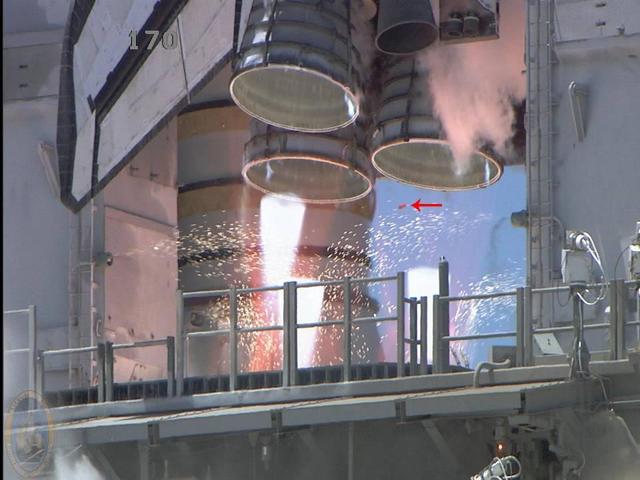
KENNEDY SPACE CENTER, FLA. -  During liftoff of Space Shuttle Discovery on mission STS-121 on July 4, a camera captured a small piece of debris (pointed to by the arrow) that is believed to be a part of a shim used on the thermal protection system on the orbiter. The piece did not cause any damage nor will the loss be a concern for the mission or landing.
KSC-06pd1448
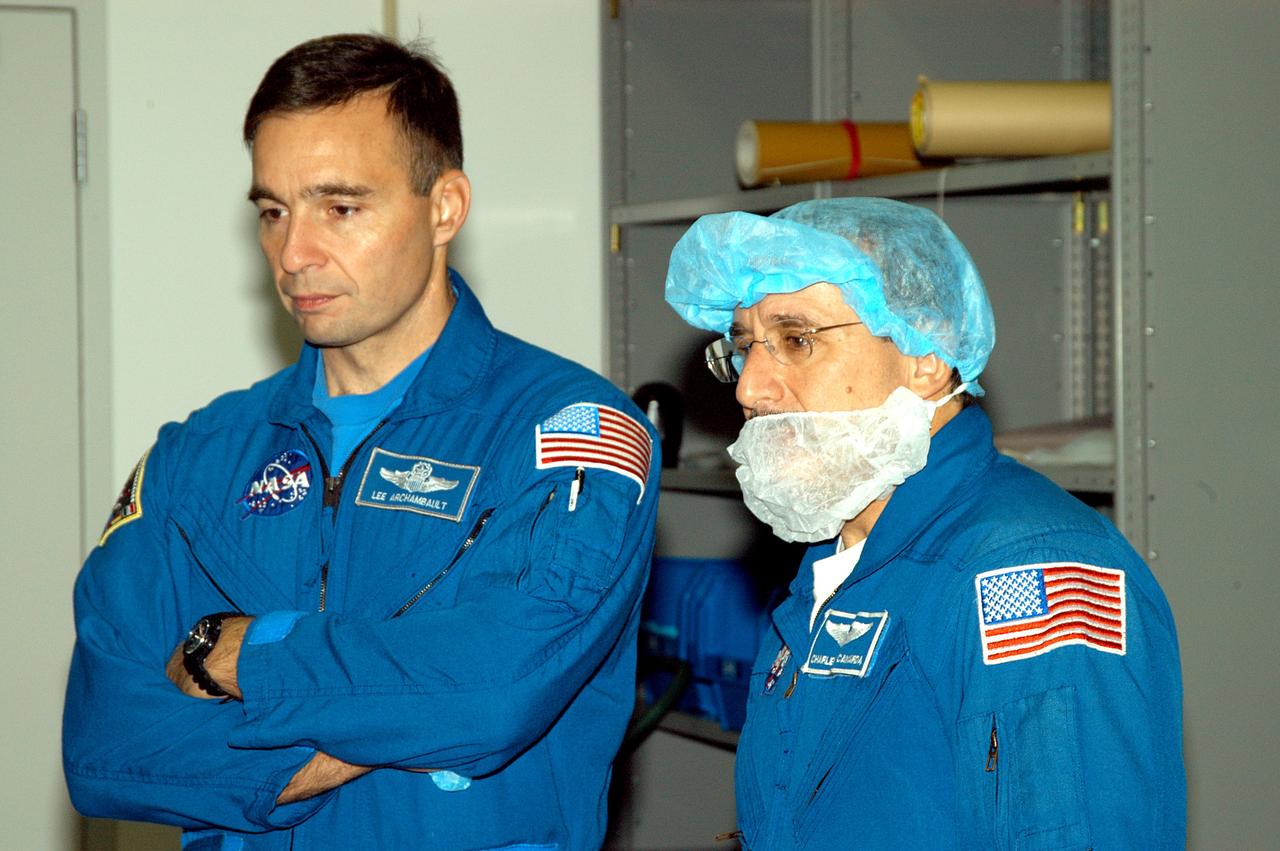
KENNEDY SPACE CENTER, FLA. -  In the Space Station Processing Facility, astronaut Lee Archambault and STS-114 Mission Specialist Charles Camarda watch as crew members work with equipment that will be used on the mission.  Archambault supports launch and landing operations at the Kennedy Space Center as an Astronaut Office representative. Crew members are at KSC for equipment familiarization.  STS-114 is classified as Logistics Flight 1 to the International Space Station, delivering new supplies and replacing one of the orbital outpost’s Control Moment Gyroscopes (CMGs). STS-114 will also carry a Raffaello Multi-Purpose Logistics Module and the External Stowage Platform-2.  The crew is slated to conduct at least three spacewalks: They will demonstrate repair techniques of the Shuttle’s Thermal Protection System,  replace the failed CMG with one delivered by the Shuttle, and  install the External Stowage Platform.
KENNEDY SPACE CENTER, FLA. - In the Space Station Processing Facility, astronaut Lee Archambault and STS-114 Mission Specialist Charles Camarda watch as crew members work with equipment that will be used on the mission. Archambault supports launch and landing operations at the Kennedy Space Center as an Astronaut Office representative. Crew members are at KSC for equipment familiarization. STS-114 is classified as Logistics Flight 1 to the International Space Station, delivering new supplies and replacing one of the orbital outpost’s Control Moment Gyroscopes (CMGs). STS-114 will also carry a Raffaello Multi-Purpose Logistics Module and the External Stowage Platform-2. The crew is slated to conduct at least three spacewalks: They will demonstrate repair techniques of the Shuttle’s Thermal Protection System, replace the failed CMG with one delivered by the Shuttle, and install the External Stowage Platform.
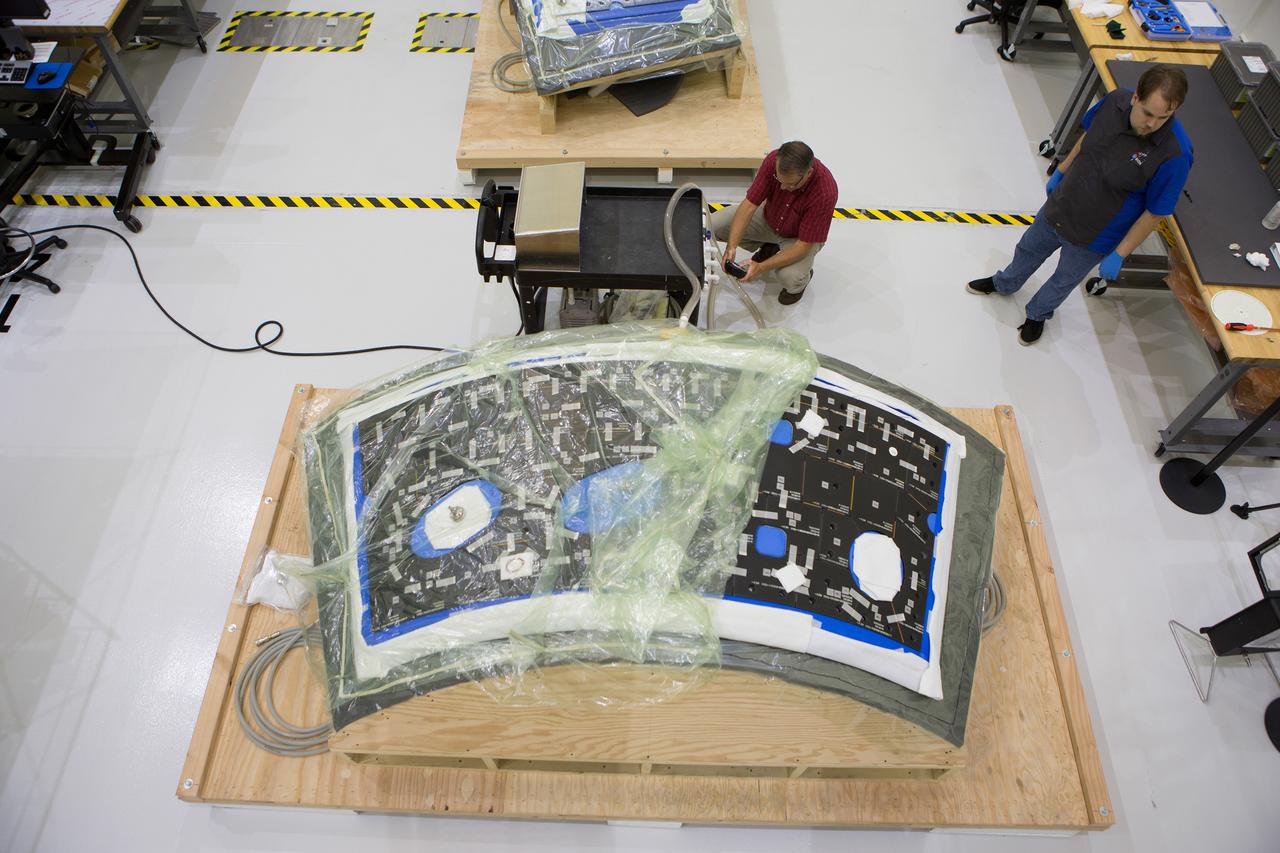
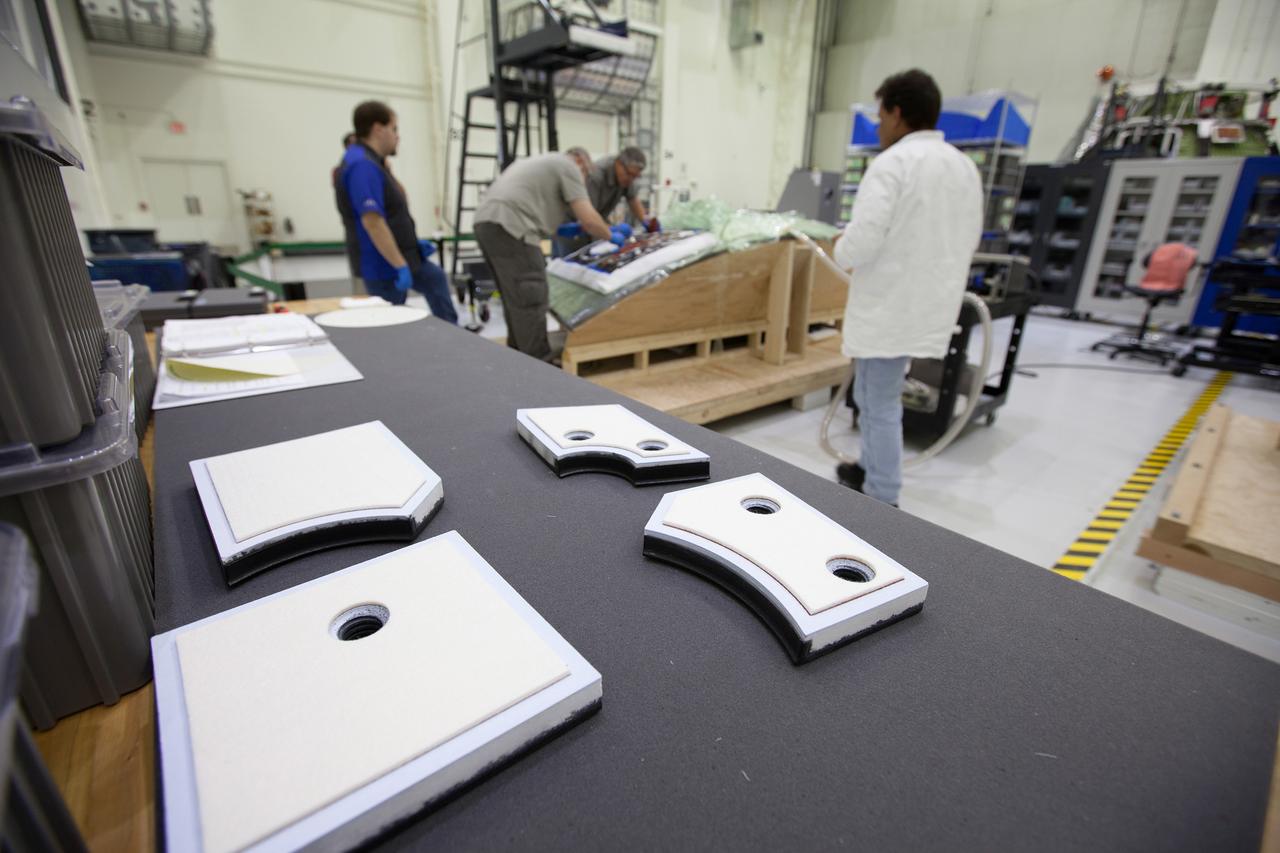
At Kennedy Space Center in Florida, technicians bond thermal protection system tiles to Orion's backshell panels on July 8, 2016...While similar to those used on the space shuttle, Orion only requires about 1,300 tiles compared to more than 24,000 on the shuttle. The tiles, along with the spacecraft’s heat shield, will protect Orion from the 5,000 degree Fahrenheit heat of re-entry.
Orion EM-1 "The Tiles that Bond"
At Kennedy Space Center in Florida, technicians bond thermal protection system tiles to Orion's backshell panels on July 8, 2016...While similar to those used on the space shuttle, Orion only requires about 1,300 tiles compared to more than 24,000 on the shuttle. The tiles, along with the spacecraft’s heat shield, will protect Orion from the 5,000 degree Fahrenheit heat of re-entry.
Orion EM-1 "The Tiles that Bond"
KENNEDY SPACE CENTER, FLA. - In the Orbiter Processing Facility bay 1 at NASA’s Kennedy Space Center, workers are installing the Orbital Boom Sensor System (foreground) in Atlantis’ payload bay.  The 50-foot-long OBSS attaches to the Remote Manipulator System (background), or Shuttle robotic arm, and is one of the new safety measures for Return to Flight.  It equips the orbiter with cameras and laser systems to inspect the Shuttle’s Thermal Protection System while in space.  Mission STS-121 is targeted for launch in July.
KSC-05pd-0636
KENNEDY SPACE CENTER, FLA. - In the Orbiter Processing Facility bay 1 at NASA’s Kennedy Space Center, workers are installing the Orbital Boom Sensor System (foreground) in Atlantis’ payload bay.  The 50-foot-long OBSS attaches to the Remote Manipulator System (background), or Shuttle robotic arm, and is one of the new safety measures for Return to Flight.  It equips the orbiter with cameras and laser systems to inspect the Shuttle’s Thermal Protection System while in space.  Mission STS-121 is targeted for launch in July.
KSC-05pd-0635
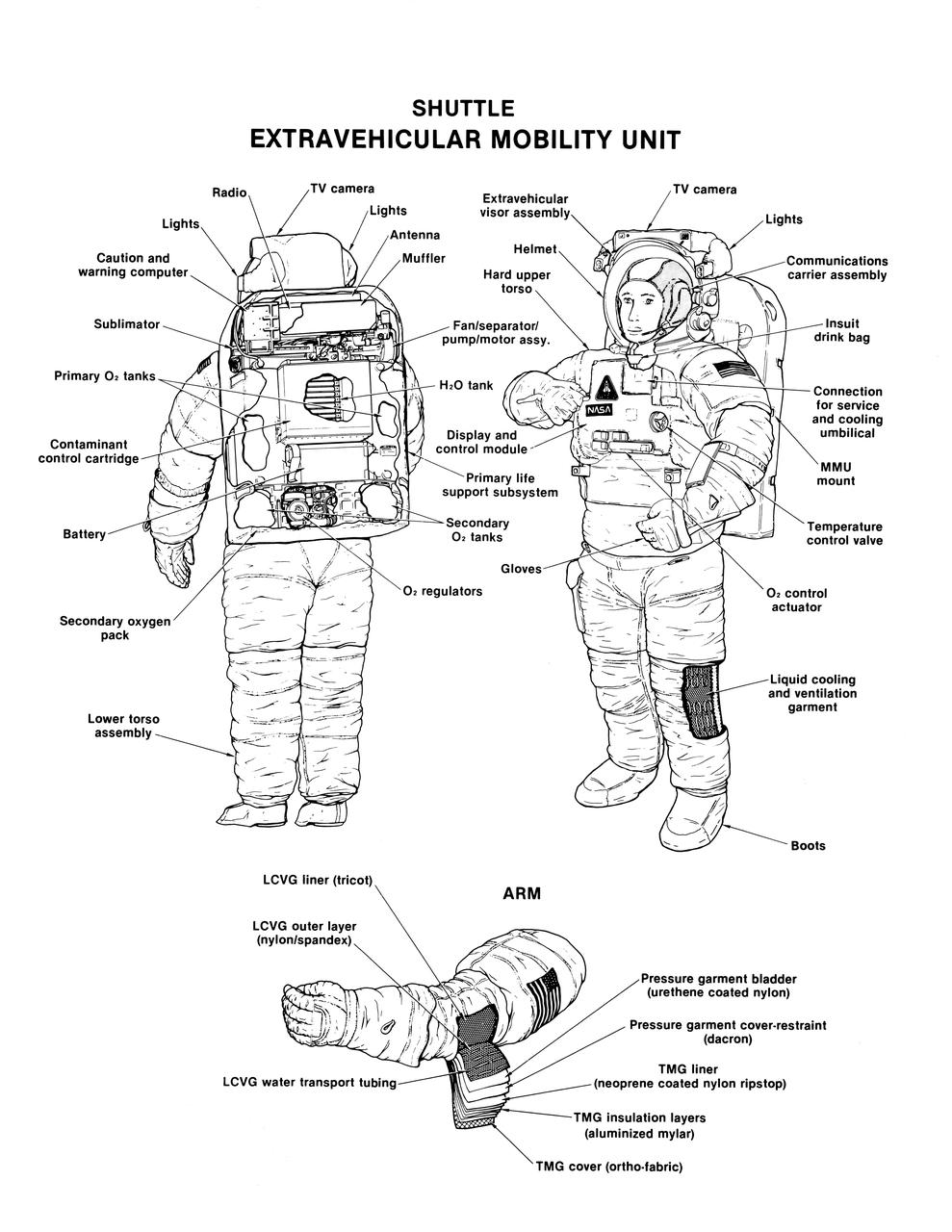
Labeled cutaway line drawing of the Shuttle extravehicular mobility unit (EMU) identifies its various components and equipment. The portable life support system (PLSS) and protective layers of fabric (thermal micrometeoroid garment (TMG)) incorporated in this extravehicular activity (EVA) space suit are shown.
Labeled cutaway line drawing of Shuttle Extravehicular Mobility Unit (EMU)
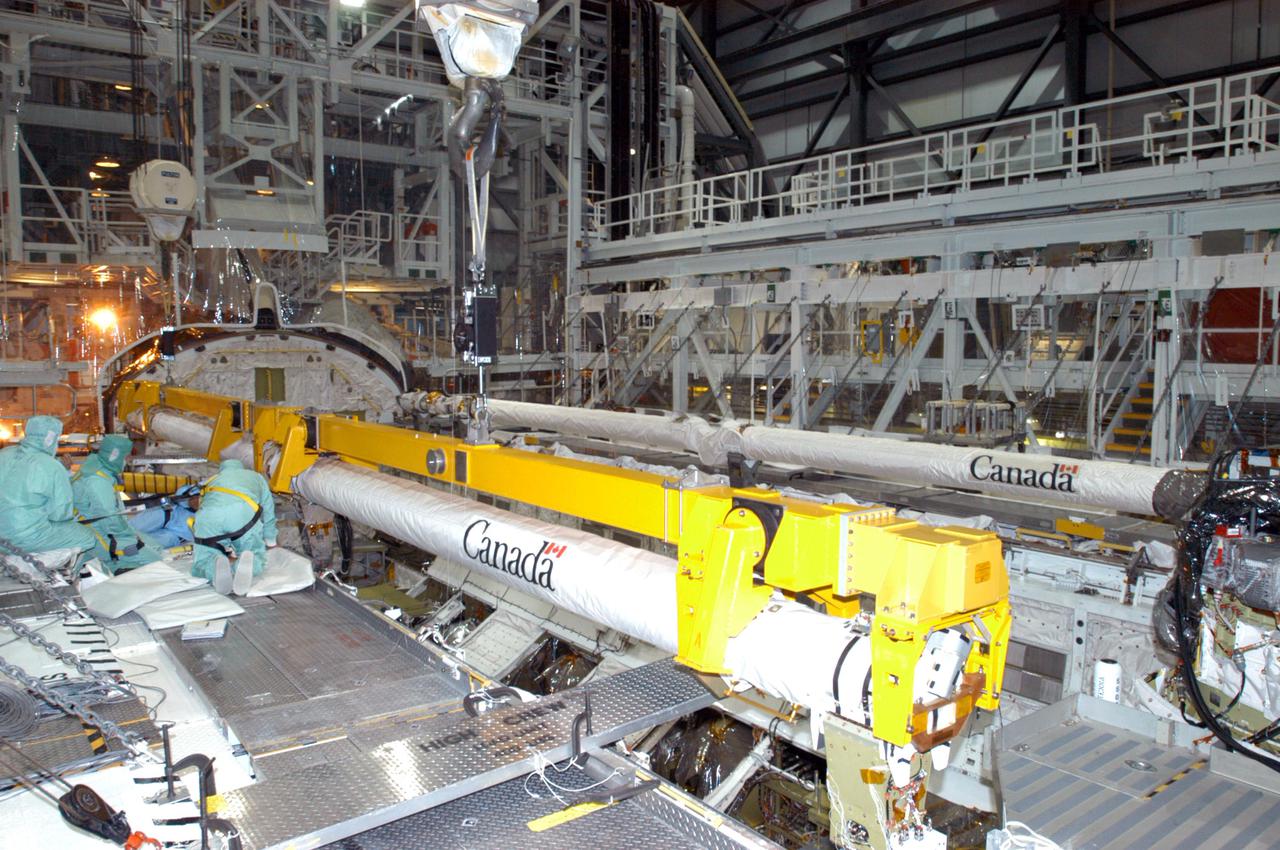
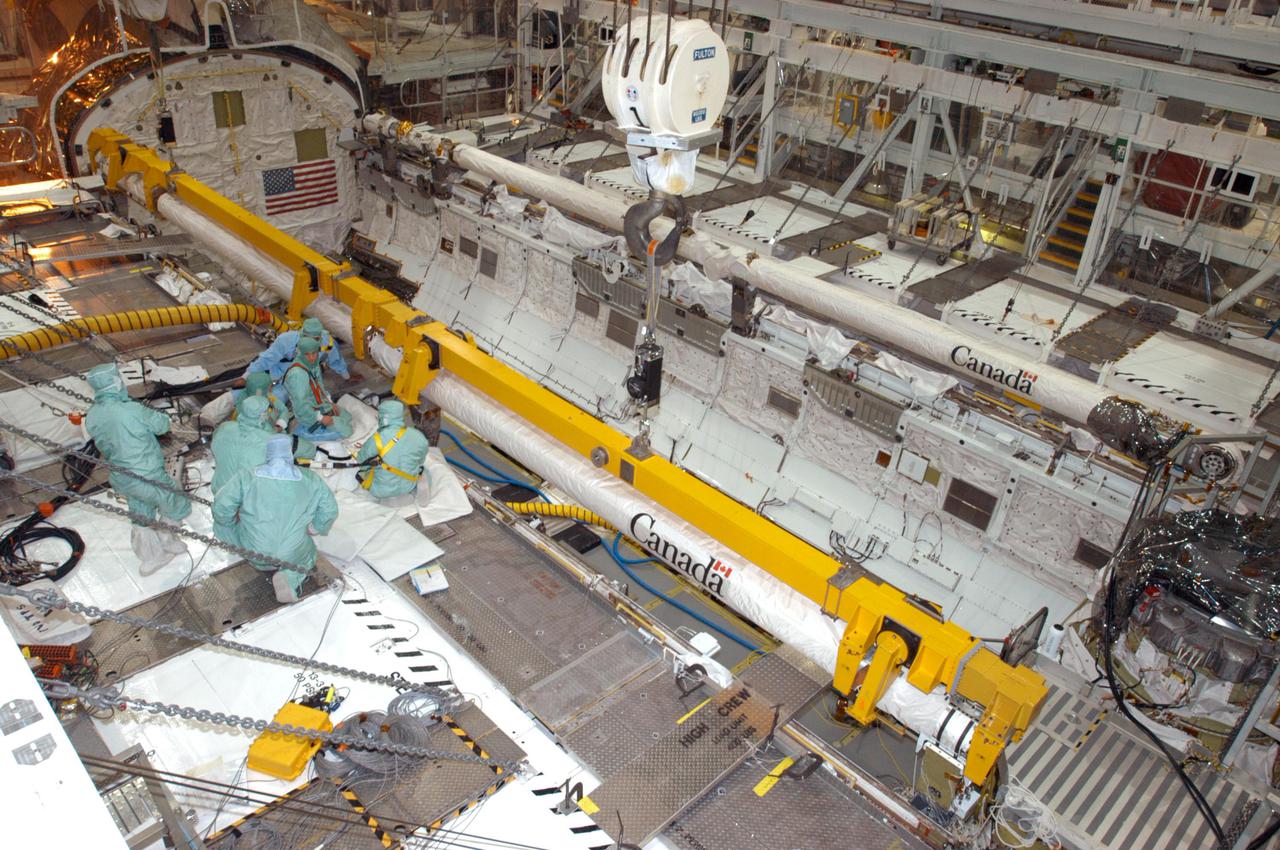
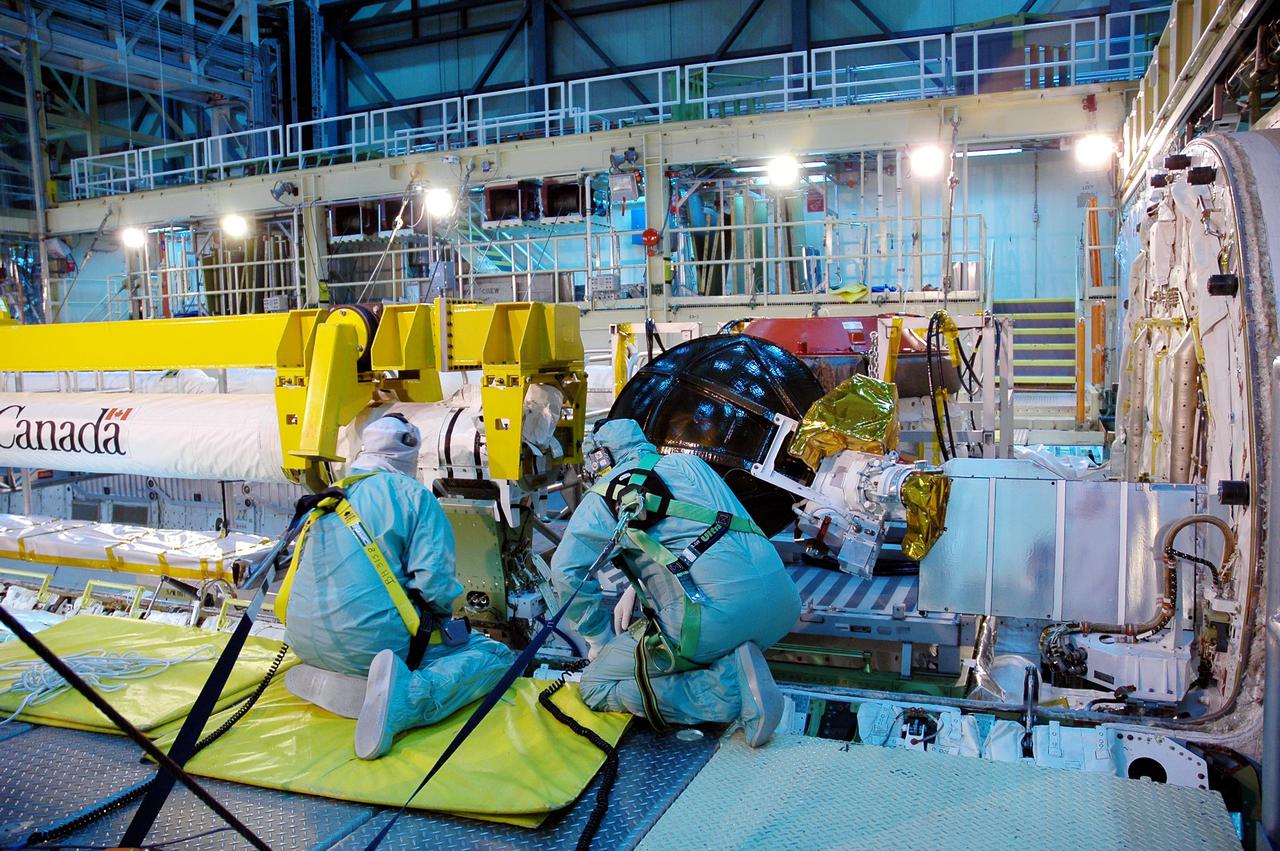
KENNEDY SPACE CENTER, FLA.  - In the Orbiter Processing Facility bay 3, workers install the Orbiter Boom Sensor System (OBSS) onto the starboard side of Discovery’s payload bay.    The 50-foot-long OBSS attaches to the Remote Manipulator System, or Shuttle robotic arm, and is one of the new safety measures for Return to Flight, equipping the orbiter with cameras and laser systems to inspect the Shuttle’s Thermal Protection System while in space.  The Return to Flight mission, STS-114,  has a launch window of May 12 to June 3, 2005.
KSC-05pd-0176
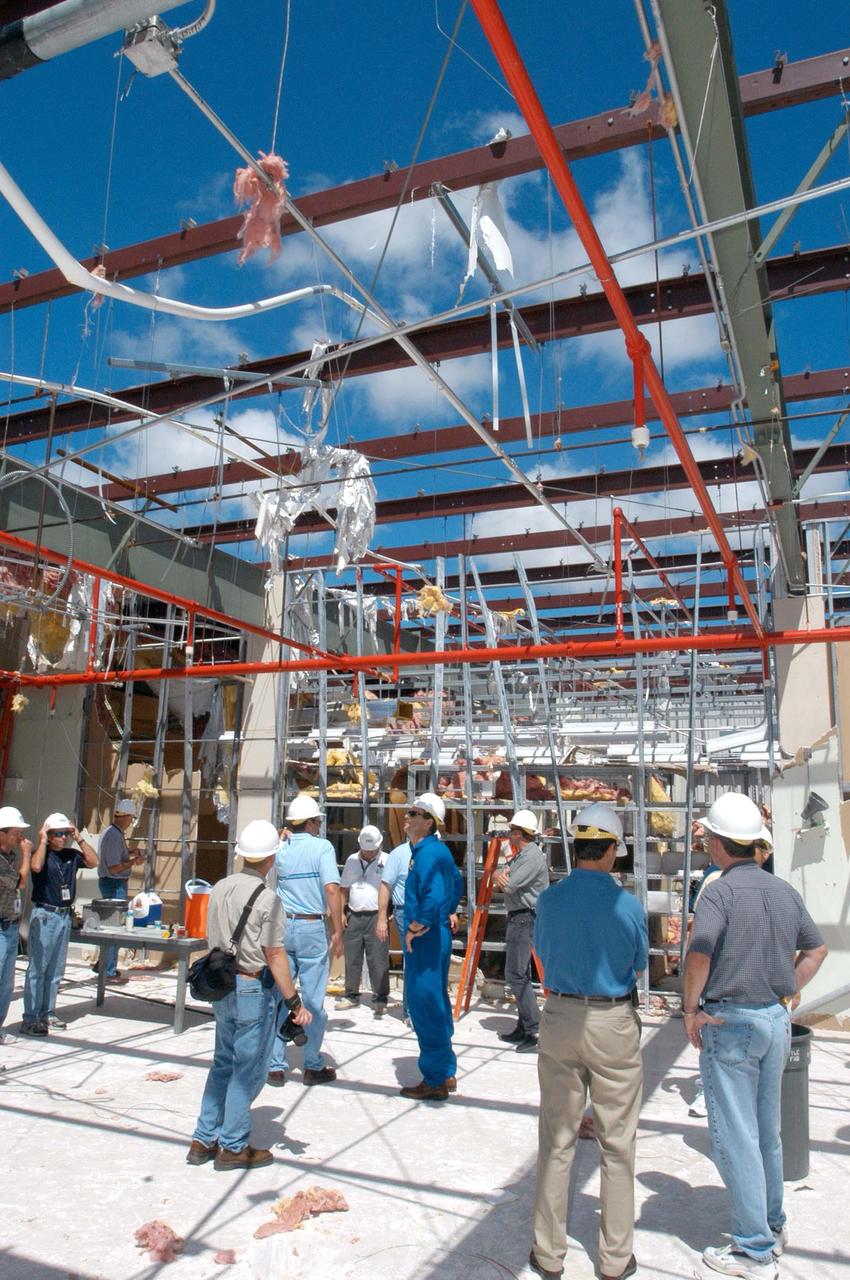
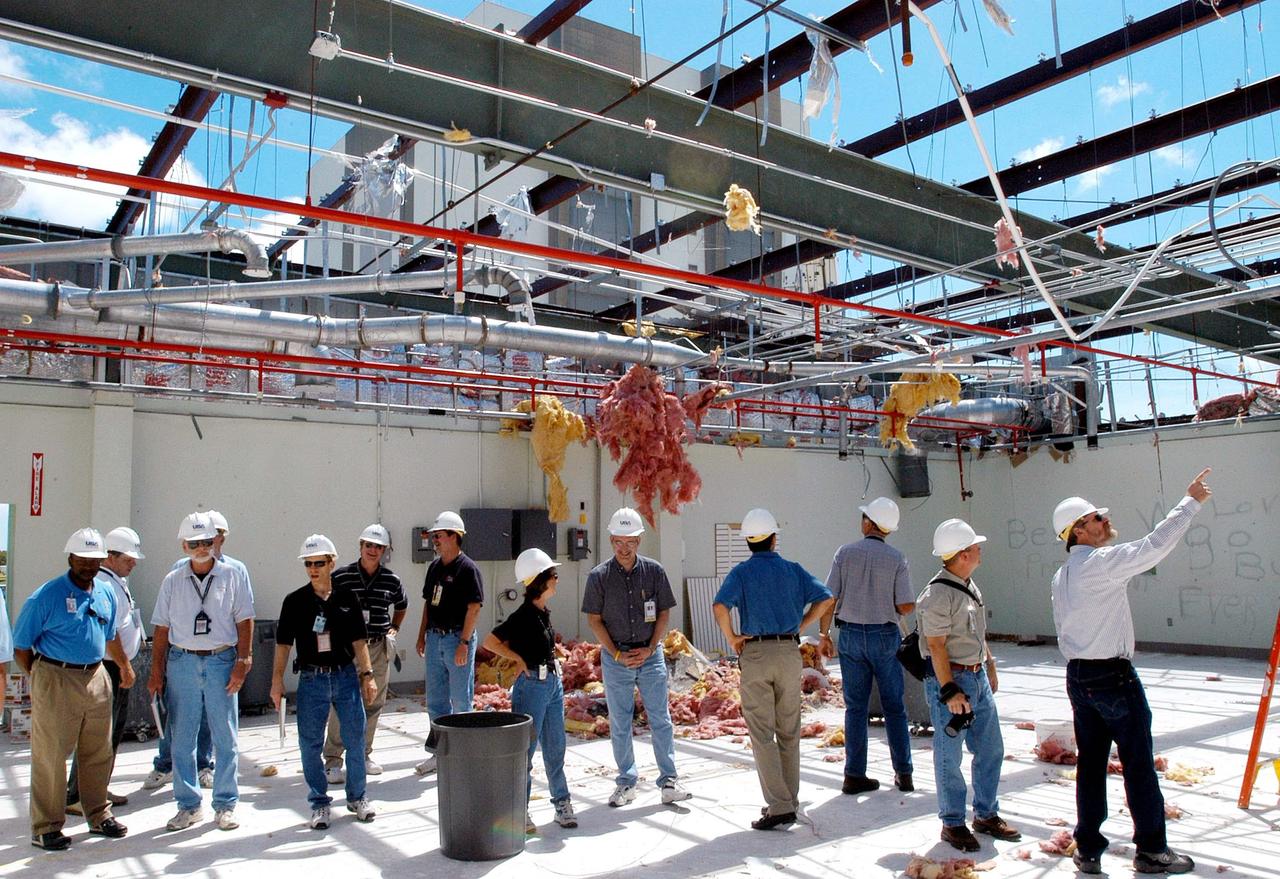
KENNEDY SPACE CENTER, FLA. -  Members of a hurricane assessment team from Johnson Space Center and Marshall Space Flight Center observe the damage to the roof of the Thermal Protection System (TPS) Facility at KSC after Hurricane Frances hit the east coast of Central Florida and Kennedy Space Center.   Near the center is astronaut Scott Altmann, a member of the team.  The facility, which creates the TPS tiles, blankets and all the internal thermal control systems for the Space Shuttles, is almost totally unserviceable at this time after losing approximately 35 percent of its roof.  Equipment and materials that survived the storm have been relocated to the RLV hangar near the KSC Shuttle Landing Facility.
KSC-04pd1772
KENNEDY SPACE CENTER, FLA. -  Members of a hurricane assessment team from Johnson Space Center and Marshall Space Flight Center observe the damage to the roof of the Thermal Protection System (TPS) Facility at KSC after Hurricane Frances hit the east coast of Central Florida and Kennedy Space Center.   Near the center is astronaut Scott Altmann, a member of the team.  The facility, which creates the TPS tiles, blankets and all the internal thermal control systems for the Space Shuttles, is almost totally unserviceable at this time after losing approximately 35 percent of its roof.  Equipment and materials that survived the storm have been relocated to the RLV hangar near the KSC Shuttle Landing Facility.
KSC-04pd1773
KENNEDY SPACE CENTER, FLA. -   Members of a hurricane assessment team from Johnson Space Center and Marshall Space Flight Center tour the Thermal Protection System (TPS) Facility at KSC after Hurricane Frances hit the east coast of Central Florida and Kennedy Space Center.  At left is Martin Wilson, manager of the TPS operations.  The facility, which creates the TPS tiles, blankets and all the internal thermal control systems for the Space Shuttles, is almost totally unserviceable at this time after losing approximately 35 percent of its roof.  Equipment and materials that survived the storm have been relocated to the RLV hangar near the KSC Shuttle Landing Facility.
KSC-04pd1770
KENNEDY SPACE CENTER, FLA. -  Members of a hurricane assessment team from Johnson Space Center and Marshall Space Flight Center observe the damage to the roof of the Thermal Protection System (TPS) Facility at KSC after Hurricane Frances hit the east coast of Central Florida and Kennedy Space Center. The facility, which creates the TPS tiles, blankets and all the internal thermal control systems for the Space Shuttles, is almost totally unserviceable at this time after losing approximately 35 percent of its roof.  Equipment and materials that survived the storm have been relocated to the RLV hangar near the KSC Shuttle Landing Facility.
KSC-04pd1774
KENNEDY SPACE CENTER, FLA. -  Members of a hurricane assessment team from Johnson Space Center and Marshall Space Flight Center tour the Thermal Protection System (TPS) Facility at KSC after Hurricane Frances hit the east coast of Central Florida and Kennedy Space Center.  At right is astronaut Scott Altmann, a member of the team.  The facility, which creates the TPS tiles, blankets and all the internal thermal control systems for the Space Shuttles, is almost totally unserviceable at this time after losing approximately 35 percent of its roof.  Equipment and materials that survived the storm have been relocated to the RLV hangar near the KSC Shuttle Landing Facility.
KSC-04pd1771
KENNEDY SPACE CENTER, FLA. - In Orbiter Processing Facility bay 1 at NASA’s Kennedy Space Center, Atlantis’ payload bay doors are partially opened. The 50-foot-long OBSS attaches to the Remote Manipulator System, or Shuttle arm, and is one of the new safety measures for Return to Flight.  It equips the orbiter with cameras and laser systems to inspect the Shuttle’s Thermal Protection System while in space.  Mission STS-121 is targeted for launch in September.  Once Atlantis' bay doors are open again, further work will be done in the bay.
KSC-05pd-0988
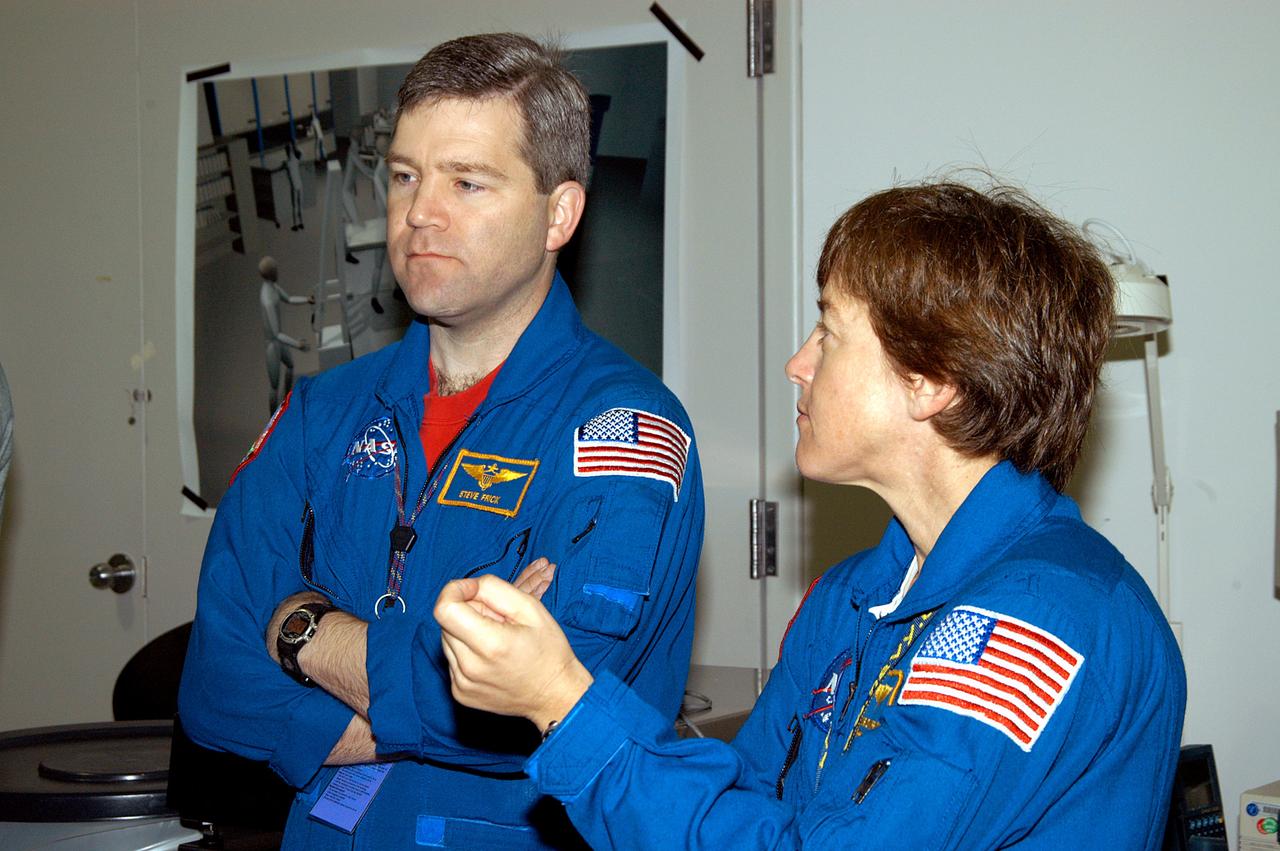
KENNEDY SPACE CENTER, FLA. -  In the Space Station Processing Facility, astronaut Stephen Frick and STS-114 Mission Specialist Wendy Lawrence watch as crew members work with equipment that will be used on the mission.  Frick is a tile specialist, who joined the STS-114 crew during equipment familiarization at KSC. STS-114 is classified as Logistics Flight 1 to the International Space Station, delivering new supplies and replacing one of the orbital outpost’s Control Moment Gyroscopes (CMGs). STS-114 will also carry a Raffaello Multi-Purpose Logistics Module and the External Stowage Platform-2.  The crew is slated to conduct at least three spacewalks: They will demonstrate repair techniques of the Shuttle’s Thermal Protection System,  replace the failed CMG with one delivered by the Shuttle, and  install the External Stowage Platform.
KENNEDY SPACE CENTER, FLA. - In the Space Station Processing Facility, astronaut Stephen Frick and STS-114 Mission Specialist Wendy Lawrence watch as crew members work with equipment that will be used on the mission. Frick is a tile specialist, who joined the STS-114 crew during equipment familiarization at KSC. STS-114 is classified as Logistics Flight 1 to the International Space Station, delivering new supplies and replacing one of the orbital outpost’s Control Moment Gyroscopes (CMGs). STS-114 will also carry a Raffaello Multi-Purpose Logistics Module and the External Stowage Platform-2. The crew is slated to conduct at least three spacewalks: They will demonstrate repair techniques of the Shuttle’s Thermal Protection System, replace the failed CMG with one delivered by the Shuttle, and install the External Stowage Platform.
KENNEDY SPACE CENTER, FLA. -  In the Space Station Processing Facility, STS-114 Mission Specialist Andrew Thomas (left) works with equipment while Mission Specialist Soichi Noguchi watches.  Noguchi is with the Japanese Aerospace Exploration Agency (JAXA).  They and other crew members are at KSC for equipment familiarization.  STS-114 is classified as Logistics Flight 1 to the International Space Station, delivering new supplies and replacing one of the orbital outpost’s Control Moment Gyroscopes (CMGs). STS-114 will also carry a Raffaello Multi-Purpose Logistics Module and the External Stowage Platform-2.  The crew is slated to conduct at least three spacewalks: They will demonstrate repair techniques of the Shuttle’s Thermal Protection System,  replace the failed CMG with one delivered by the Shuttle, and  install the External Stowage Platform.
KENNEDY SPACE CENTER, FLA. - In the Space Station Processing Facility, STS-114 Mission Specialist Andrew Thomas (left) works with equipment while Mission Specialist Soichi Noguchi watches. Noguchi is with the Japanese Aerospace Exploration Agency (JAXA). They and other crew members are at KSC for equipment familiarization. STS-114 is classified as Logistics Flight 1 to the International Space Station, delivering new supplies and replacing one of the orbital outpost’s Control Moment Gyroscopes (CMGs). STS-114 will also carry a Raffaello Multi-Purpose Logistics Module and the External Stowage Platform-2. The crew is slated to conduct at least three spacewalks: They will demonstrate repair techniques of the Shuttle’s Thermal Protection System, replace the failed CMG with one delivered by the Shuttle, and install the External Stowage Platform.
KENNEDY SPACE CENTER, FLA. -  In the Space Station Processing Facility, STS-114 Mission Specialists Andrew Thomas (center) and Soichi Noguchi (right) work with equipment while Mission Specialist Charles Camarda (left) watches.  Noguchi is with the Japanese Aerospace Exploration Agency (JAXA).  They and other crew members are at KSC for equipment familiarization.  STS-114 is classified as Logistics Flight 1 to the International Space Station, delivering new supplies and replacing one of the orbital outpost’s Control Moment Gyroscopes (CMGs). STS-114 will also carry a Raffaello Multi-Purpose Logistics Module and the External Stowage Platform-2.  The crew is slated to conduct at least three spacewalks: They will demonstrate repair techniques of the Shuttle’s Thermal Protection System,  replace the failed CMG with one delivered by the Shuttle, and  install the External Stowage Platform.
KENNEDY SPACE CENTER, FLA. - In the Space Station Processing Facility, STS-114 Mission Specialists Andrew Thomas (center) and Soichi Noguchi (right) work with equipment while Mission Specialist Charles Camarda (left) watches. Noguchi is with the Japanese Aerospace Exploration Agency (JAXA). They and other crew members are at KSC for equipment familiarization. STS-114 is classified as Logistics Flight 1 to the International Space Station, delivering new supplies and replacing one of the orbital outpost’s Control Moment Gyroscopes (CMGs). STS-114 will also carry a Raffaello Multi-Purpose Logistics Module and the External Stowage Platform-2. The crew is slated to conduct at least three spacewalks: They will demonstrate repair techniques of the Shuttle’s Thermal Protection System, replace the failed CMG with one delivered by the Shuttle, and install the External Stowage Platform.
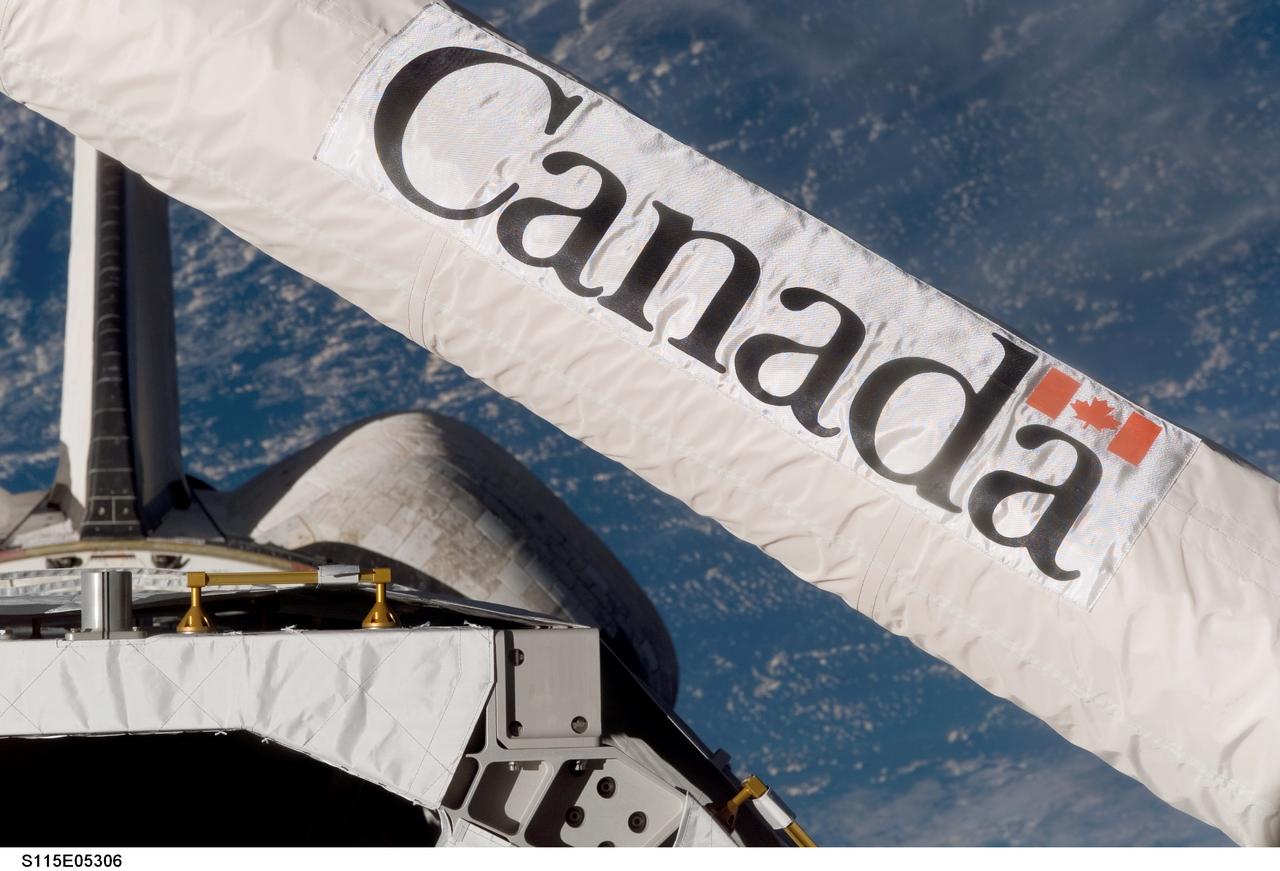
S115-E-05306 (10 Sept. 2006) --- While working to survey the thermal protection system on the Space Shuttle Atlantis, the orbiter boom sensor system (OBSS), attached to the remote manipulator system (RMS) arm was positioned near the shuttle's aft cabin windows. This enabled one of the STS-115 crewmembers to record this digital still close-up image of the Canadian-built system.
Survey of the TPS on the STS-115 Space Shuttle Atlantis
KENNEDY SPACE CENTER, FLA.  - In the Orbiter Processing Facility, two workers (center) check paperwork about the wiring being installed in Discovery’s cargo bay that will support the addition of an Orbiter Boom Sensor System (OBSS) .  The OBSS is one of the new safety measures for Return to Flight, equipping the Shuttle with cameras and laser systems to inspect the Shuttle’s Thermal Protection System while in space.  Discovery is designated as the Return to Flight vehicle for mission STS-114, no earlier than March 2005.
KSC-04pd1281
KENNEDY SPACE CENTER, FLA.  -  In the Orbiter Processing Facility, workers check wiring being installed in Discovery’s cargo bay that will support the addition of an Orbiter Boom Sensor System (OBSS) .  The OBSS is one of the new safety measures for Return to Flight, equipping the Shuttle with cameras and laser systems to inspect the Shuttle’s Thermal Protection System while in space.  Discovery is designated as the Return to Flight vehicle for mission STS-114, no earlier than March 2005
KSC-04pd1283
KENNEDY SPACE CENTER, FLA.  - In the Orbiter Processing Facility, workers are installing wiring in Discovery’s cargo bay that will support the addition of an Orbiter Boom Sensor System (OBSS) .  The OBSS is one of the new safety measures for Return to Flight, equipping the Shuttle with cameras and laser systems to inspect the Shuttle’s Thermal Protection System while in space.  Discovery is designated as the Return to Flight vehicle for mission STS-114, no earlier than March 2005.
KSC-04pd1282
KENNEDY SPACE CENTER, FLA.  - In the Orbiter Processing Facility, workers are installing wiring in Discovery’s cargo bay that will support the addition of an Orbiter Boom Sensor System (OBSS) .  The OBSS is one of the new safety measures for Return to Flight, equipping the Shuttle with cameras and laser systems to inspect the Shuttle’s Thermal Protection System while in space.  Discovery is designated as the Return to Flight vehicle for mission STS-114, no earlier than March 2005.
KSC-04pd1279
KENNEDY SPACE CENTER, FLA.  - In the Orbiter Processing Facility, installation is underway in Discovery’s cargo bay of wiring that will support the addition of an Orbiter Boom Sensor System (OBSS) .  The OBSS is one of the new safety measures for Return to Flight, equipping the Shuttle with cameras and laser systems to inspect the Shuttle’s Thermal Protection System while in space.  Discovery is designated as the Return to Flight vehicle for mission STS-114, no earlier than March 2005.
KSC-04pd1284
KENNEDY SPACE CENTER, FLA.  - In the Orbiter Processing Facility, a worker is installing wiring in Discovery’s cargo bay that will support the addition of an Orbiter Boom Sensor System (OBSS) .  The OBSS is one of the new safety measures for Return to Flight, equipping the Shuttle with cameras and laser systems to inspect the Shuttle’s Thermal Protection System while in space.  Discovery is designated as the Return to Flight vehicle for mission STS-114, no earlier than March 2005.
KSC-04pd1280
KENNEDY SPACE CENTER, FLA.  - In the Orbiter Processing Facility, workers are installing in Discovery’s cargo bay wiring that will support the addition of an Orbiter Boom Sensor System (OBSS).  The OBSS is one of the new safety measures for Return to Flight, equipping the Shuttle with cameras and laser systems to inspect the Shuttle’s Thermal Protection System while in space.  Discovery is designated as the Return to Flight vehicle for mission STS-114, no earlier than March 2005.
KSC-04pd1278
KENNEDY SPACE CENTER, FLA. -   In Orbiter Processing Facility Bay 2, United Space Alliance technician Michael Vanwart installs thermal protection system blankets in the nose cap of space shuttle Endeavour. Endeavour recently came out of a nearly two-year Orbiter Major Modification period which began in December 2003. Engineers and technicians spent 900,000 hours performing 124 modifications to the vehicle. These included all recommended return-to-flight safety modifications, bonding more than 1,000 thermal protection system tiles and inspecting more than 150 miles of wiring throughout the orbiter. Shuttle major modification periods are scheduled at regular intervals to enhance safety and performance, infuse new technology, and allow for thorough inspections of the airframe and wiring of the vehicles. This was the second of these modification periods performed entirely at Kennedy Space Center. Endeavour's previous modification was completed in March 1997.
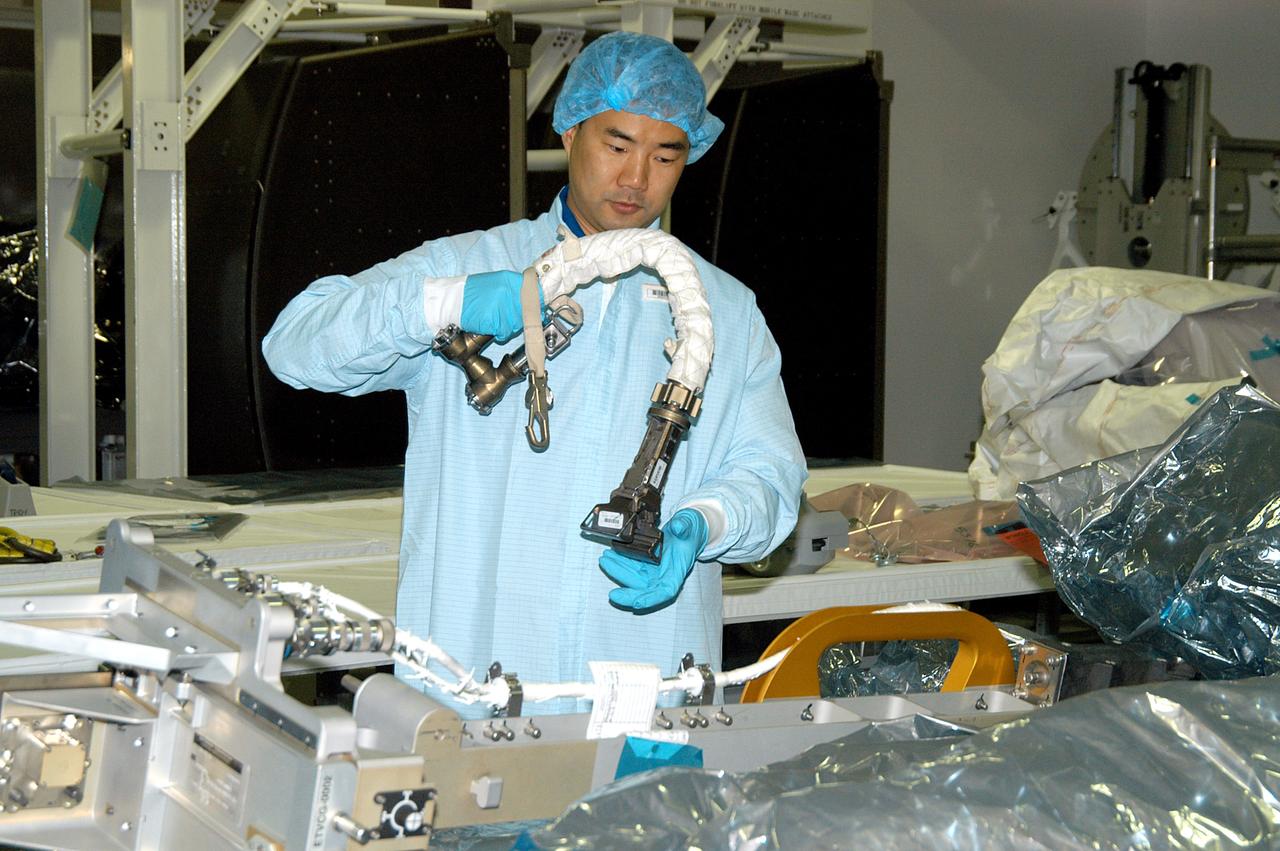
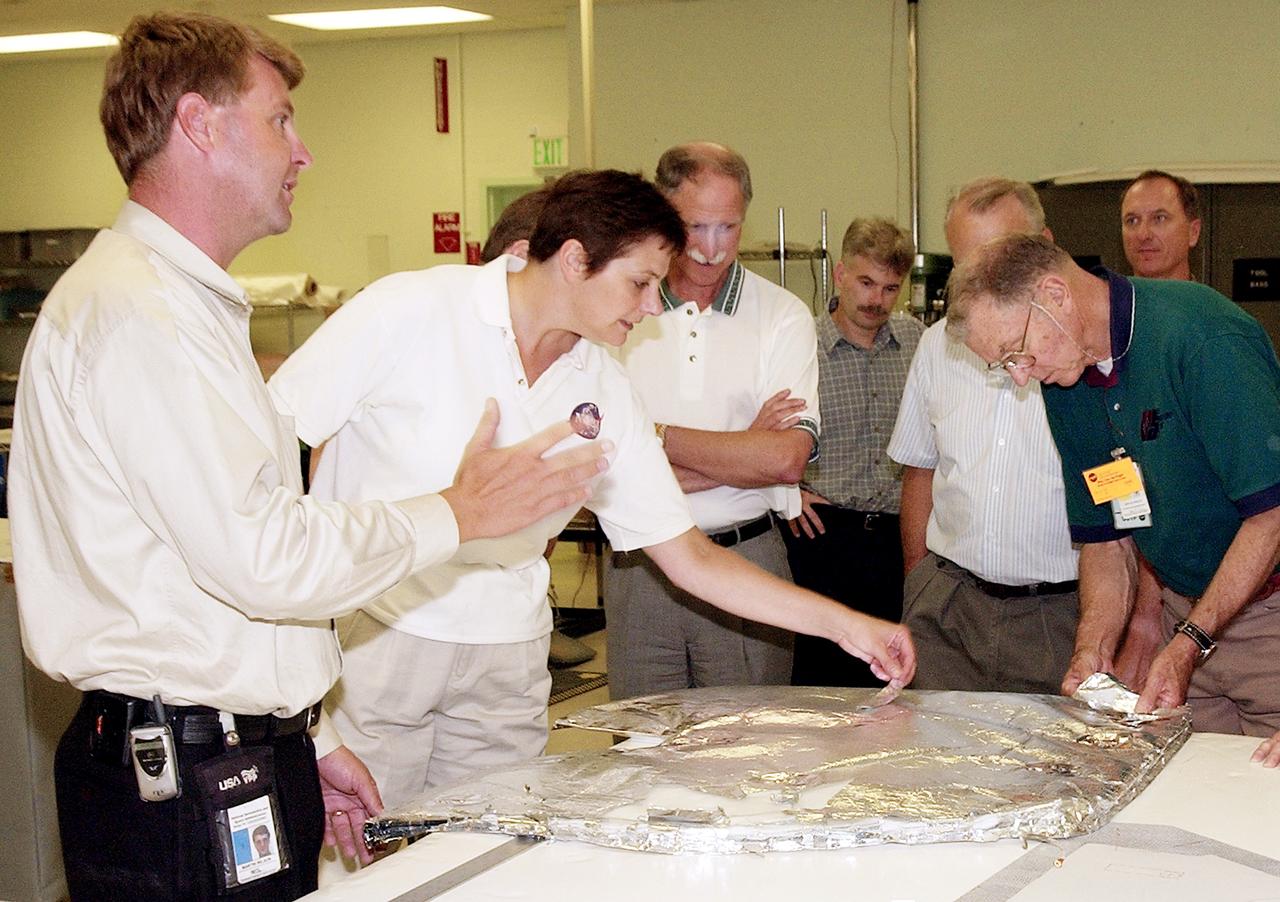
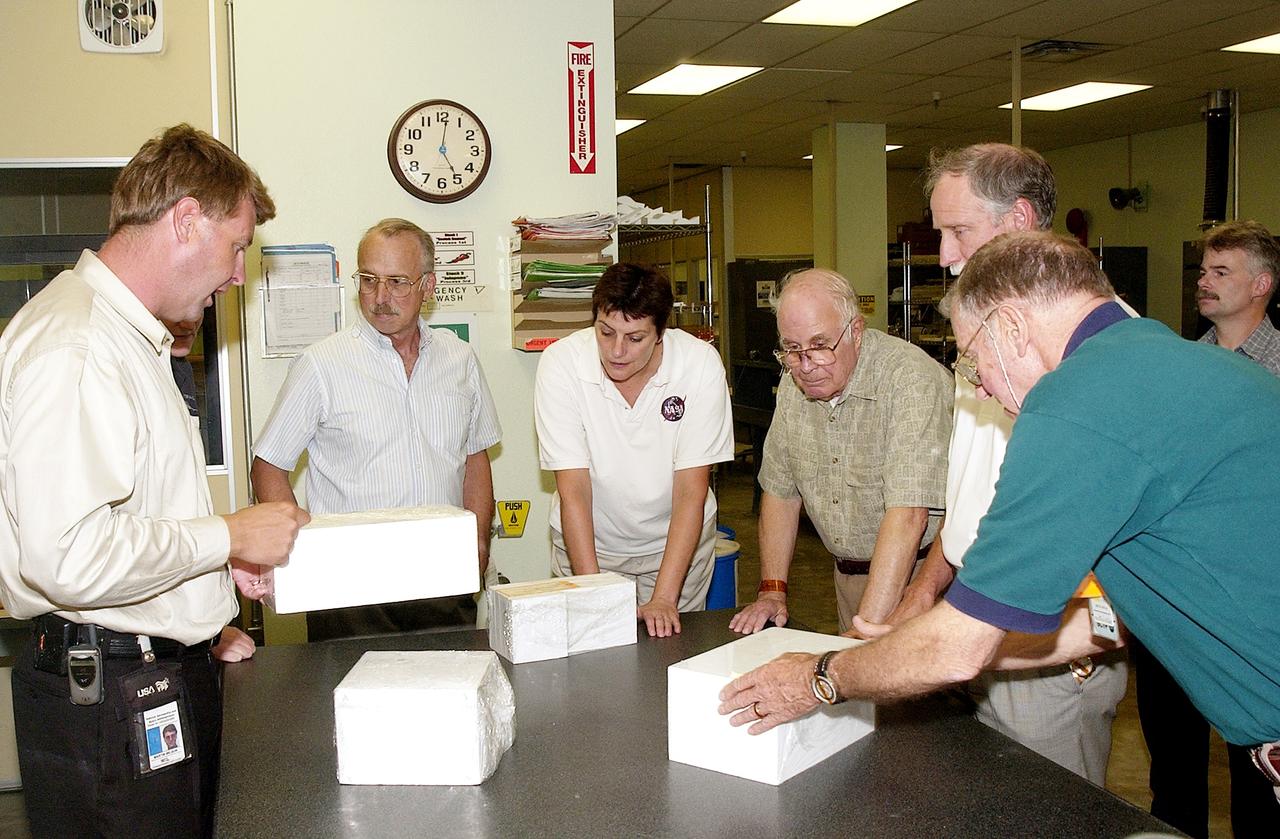
KSC-05pd2533
KENNEDY SPACE CENTER, FLA. -   In Orbiter Processing Facility Bay 2, United Space Alliance technician Michael Vanwart installs thermal protection system blankets in the nose cap of space shuttle Endeavour. Endeavour recently came out of a nearly two-year Orbiter Major Modification period which began in December 2003. Engineers and technicians spent 900,000 hours performing 124 modifications to the vehicle. These included all recommended return-to-flight safety modifications, bonding more than 1,000 thermal protection system tiles and inspecting more than 150 miles of wiring throughout the orbiter. Shuttle major modification periods are scheduled at regular intervals to enhance safety and performance, infuse new technology, and allow for thorough inspections of the airframe and wiring of the vehicles. This was the second of these modification periods performed entirely at Kennedy Space Center. Endeavour's previous modification was completed in March 1997.
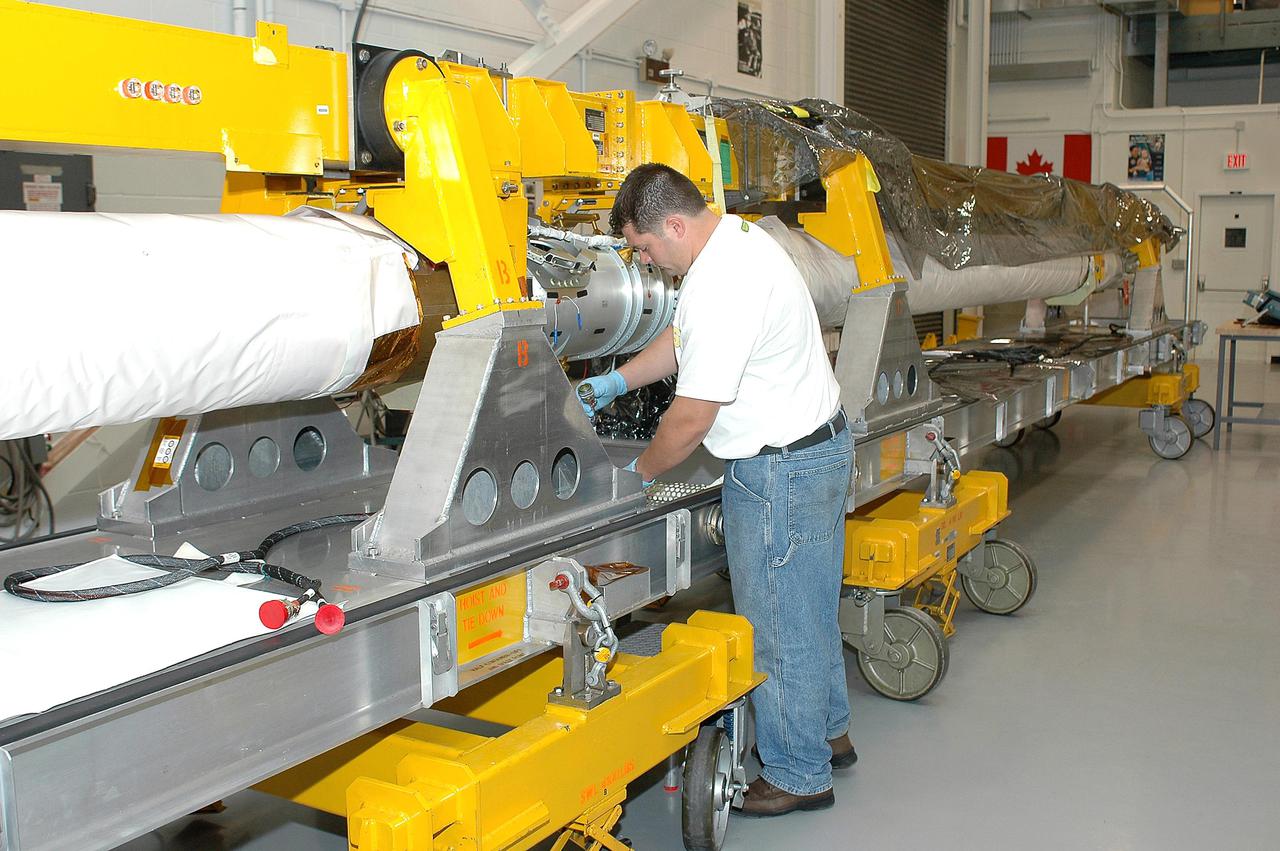
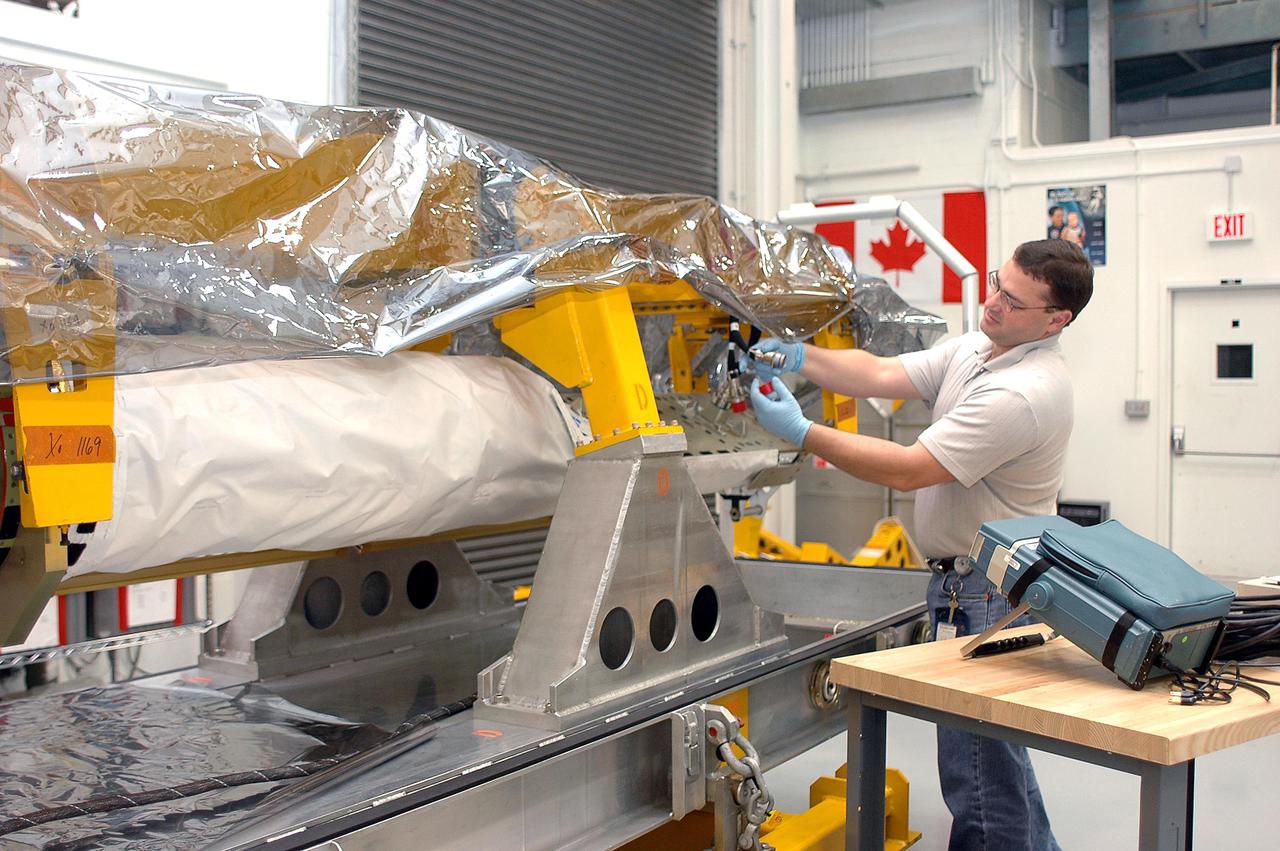
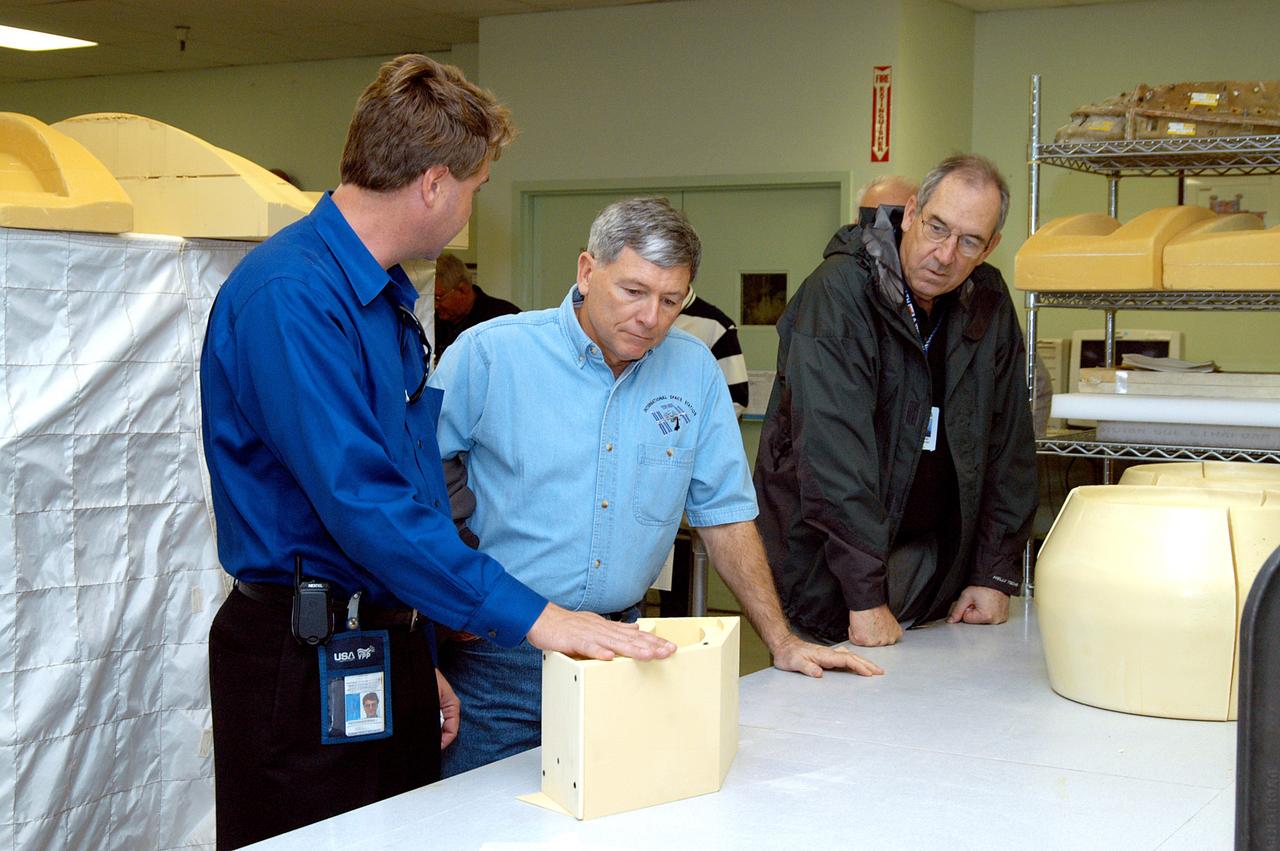
KSC-05pd2532
KENNEDY SPACE CENTER, FLA. - Jake Senior, United Space Alliance technician, prepares the Orbiter Boom Sensor System in the Remote Manipulator System lab for testing.  The OBSS is undergoing final checkout and testing in the lab prior to being transferred to the Orbiter Processing Facility for installation on Space Shuttle Discovery. The 50-foot-long OBSS will be attached to the Remote Manipulator System, or Shuttle arm, and is one of the new safety measures for Return to Flight, equipping the orbiter with cameras and laser systems to inspect the Shuttle's Thermal Protection System while in space. Discovery is slated to fly mission STS-114 once Space Shuttle launches resume.  The launch planning window is May 12 to June 3, 2005.
KSC-05pd-0066
KENNEDY SPACE CENTER, FLA. - In the Remote Manipulator System lab, United Space Alliance technician Todd Dugan works on the Orbiter Boom Sensor System.  The OBSS is undergoing final checkout and testing in the lab prior to being transferred to the Orbiter Processing Facility for installation on Space Shuttle Discovery. The 50-foot-long OBSS will be attached to the Remote Manipulator System, or Shuttle arm, and is one of the new safety measures for Return to Flight, equipping the orbiter with cameras and laser systems to inspect the Shuttle's Thermal Protection System while in space. Discovery is slated to fly mission STS-114 once Space Shuttle launches resume.  The launch planning window is May 12 to June 3, 2005.
KSC-05pd-0070
KENNEDY SPACE CENTER, FLA. -- From left, United Space Alliance (USA) Manager of the Thermal Protection System (TPS) Facility Martin Wilson briefs NASA Deputy Associate Administrator for Space Station and Shuttle Programs Michael Kostelnik and USA Vice President and Space Shuttle Program Manager Howard DeCastro on aspects of creating the tile used in the Shuttle's TPS. NASA and USA Space Shuttle program management are participating in a leadership workday. The day is intended to provide management with an in-depth, hands-on look at Shuttle processing activities at KSC.
KSC-03pd3255
KENNEDY SPACE CENTER, FLA. - The assembled Orbiter Boom Sensor System sits in the Remote Manipulator System lab inside the Vehicle Assembly Building.  The OBSS will undergo final checkout and testing in the lab prior to being transferred to the Orbiter Processing Facility for installation on Space Shuttle Discovery. The 50-foot-long OBSS will be attached to the Remote Manipulator System, or Shuttle arm, and is one of the new safety measures for Return to Flight, equipping the orbiter with cameras and laser systems to inspect the Shuttle’s Thermal Protection System while in space. Discovery is slated to fly Return to Flight mission STS-114 once Space Shuttle launches resume.  The launch planning window is May 12 to June 3, 2005.
KSC-05pd-0063