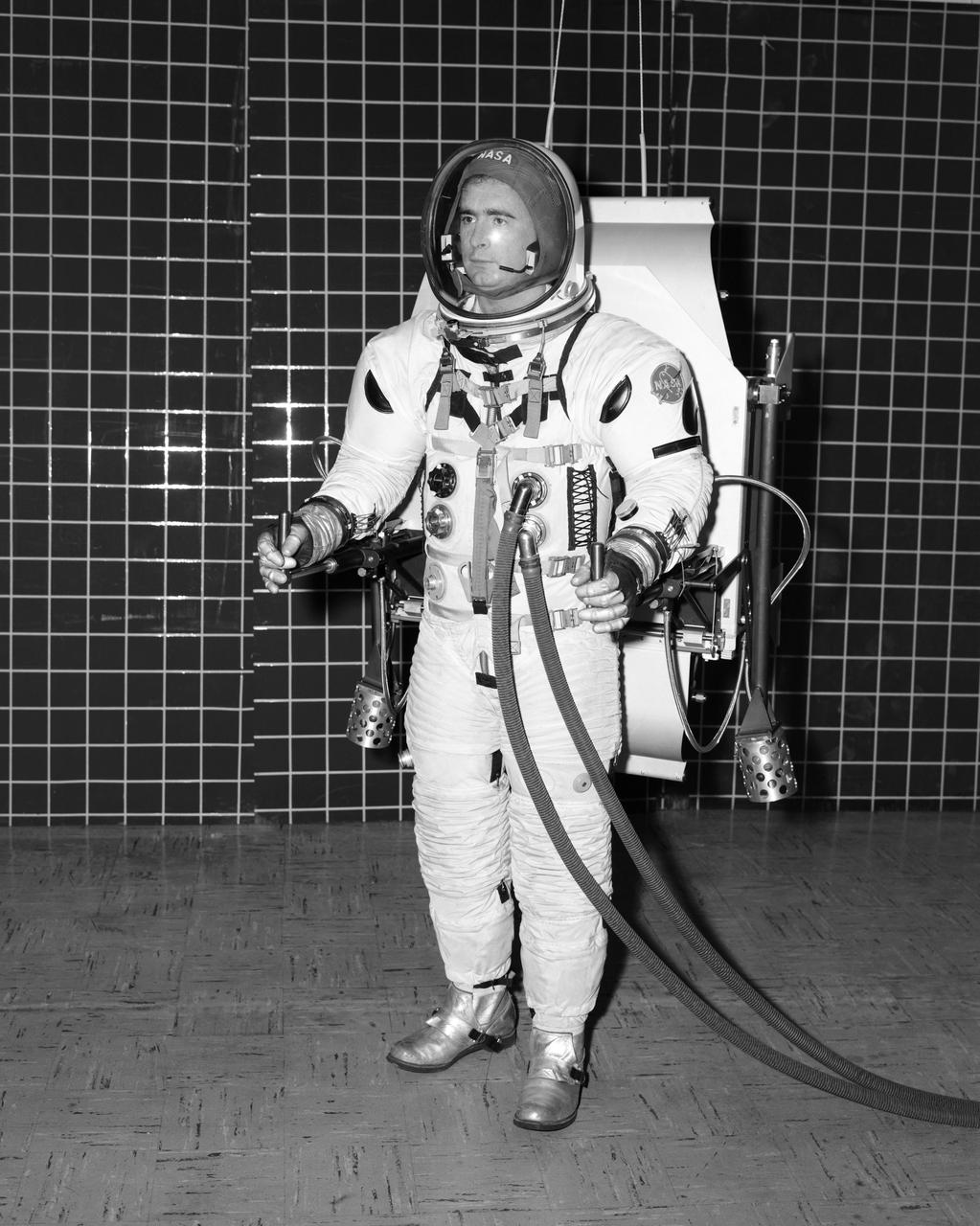
Space Suit: NASA Langley researcher (Kenneth R. Yenni) tries out a proposal for an Apollo space suit.
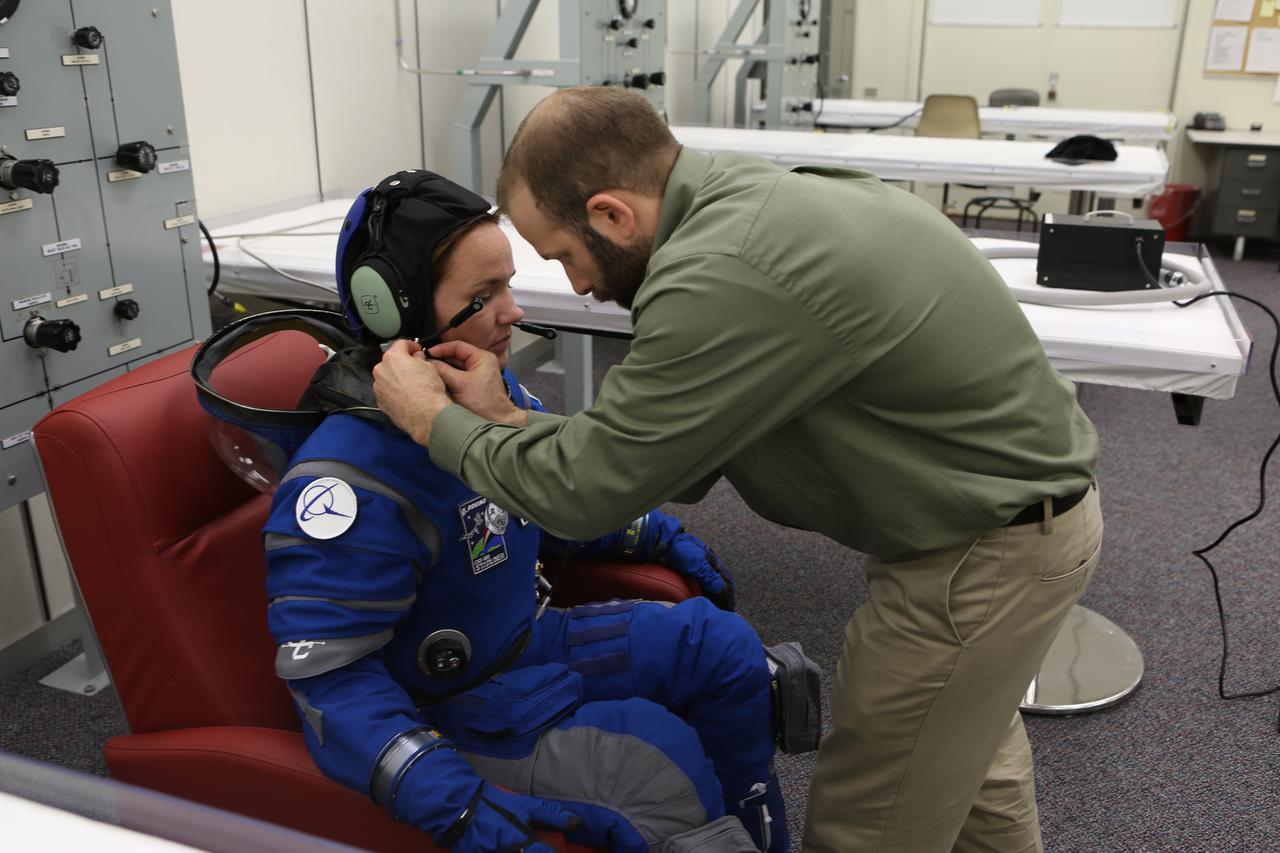
A suit technician prepares for a pressure test of Boeing's new spacesuit designed to be worn by astronauts flying on the CST-100 Starliner. Seen here being worn in the same manner as it will on launch day inside Crew Quarters at NASA's Kennedy Space Center in Florida, the suit is lighter and more flexible than previous spacesuits but retains the ability to pressurize in an emergency. Astronauts will wear the suit throughout the launch and ascent into orbit as well as on the way back to Earth. Starliners will launch atop Atlas V rockets from United Launch Alliance on missions including flights to the International Space Station for NASA's Commercial Crew Program. Photo credit: NASA/Cory Huston
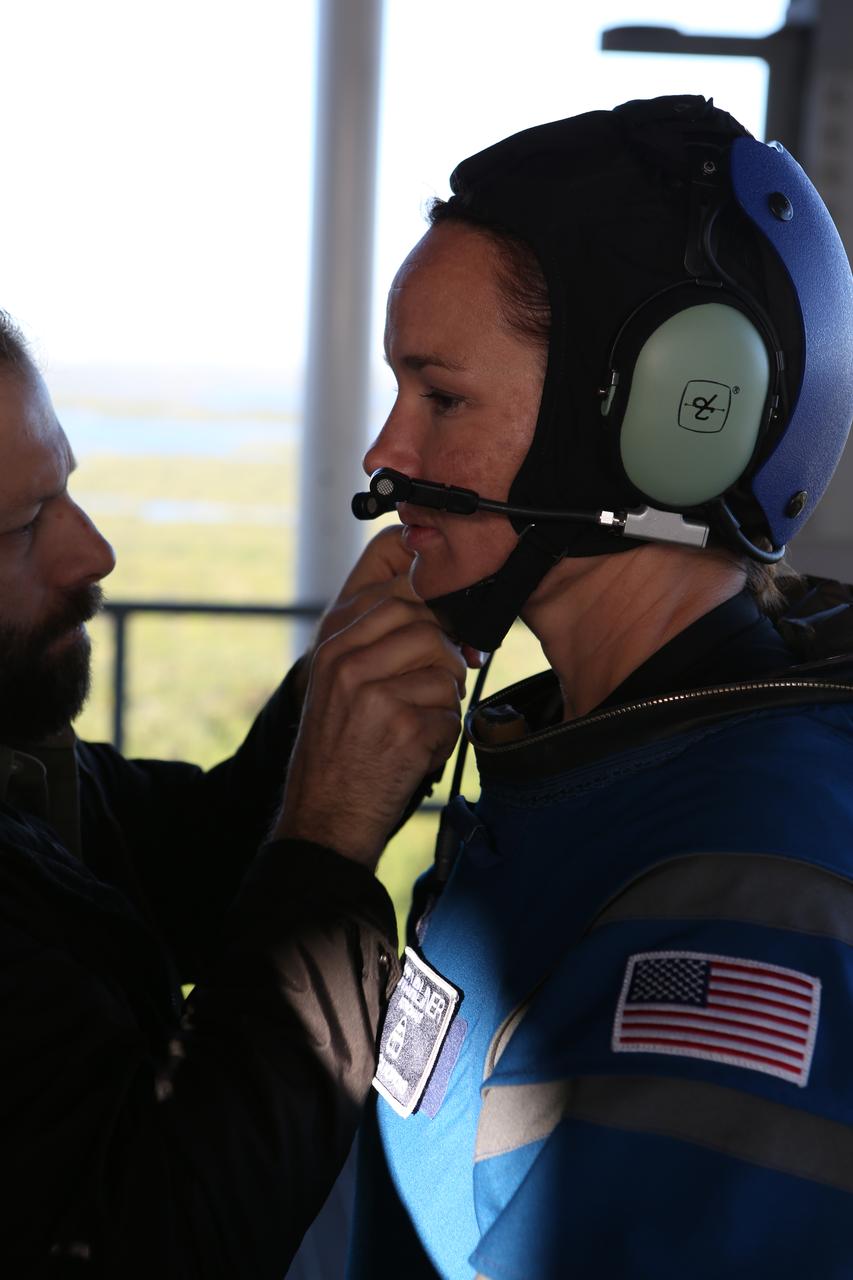
The communications carrier is placed as part of Boeing's new spacesuit designed to be worn by astronauts flying on the CST-100 Starliner. Seen here being worn in the same manner as it will on launch day for the walk to the spacecraft at Space Launch Complex 41, the suit is lighter and more flexible than previous spacesuits but retains the ability to pressurize in an emergency. Astronauts will wear the suit throughout the launch and ascent into orbit as well as on the way back to Earth. Starliners will launch atop Atlas V rockets from United Launch Alliance on missions including flights to the International Space Station for NASA's Commercial Crew Program. Photo credit: NASA/Cory Huston
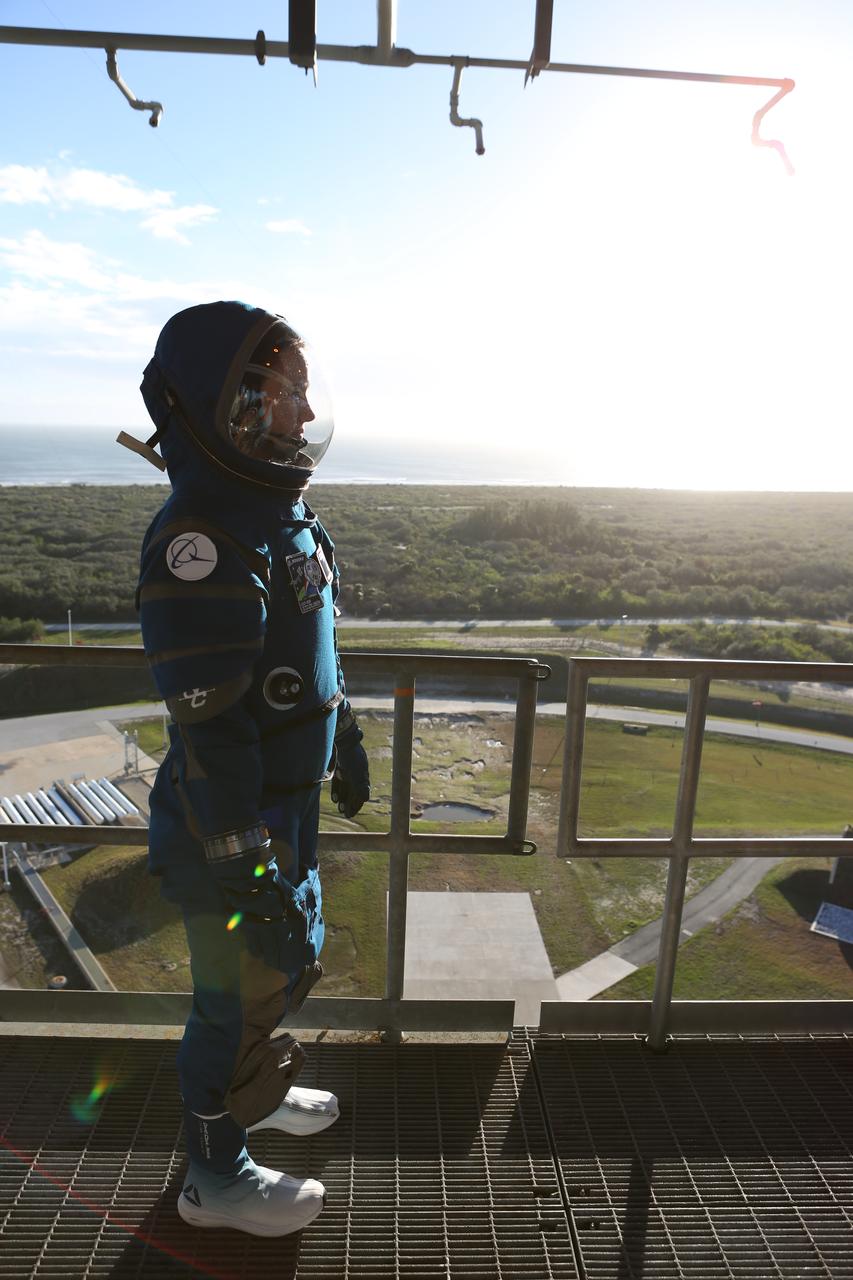
Boeing's new spacesuit designed to be worn by astronauts flying on the CST-100 Starliner. Seen here being worn in the same manner as it will on launch day for the walk to the spacecraft at Space Launch Complex 41, the suit is lighter and more flexible than previous spacesuits but retains the ability to pressurize in an emergency. Astronauts will wear the suit throughout the launch and ascent into orbit as well as on the way back to Earth. Starliners will launch atop Atlas V rockets from United Launch Alliance on missions including flights to the International Space Station for NASA's Commercial Crew Program. Photo credit: NASA/Cory Huston
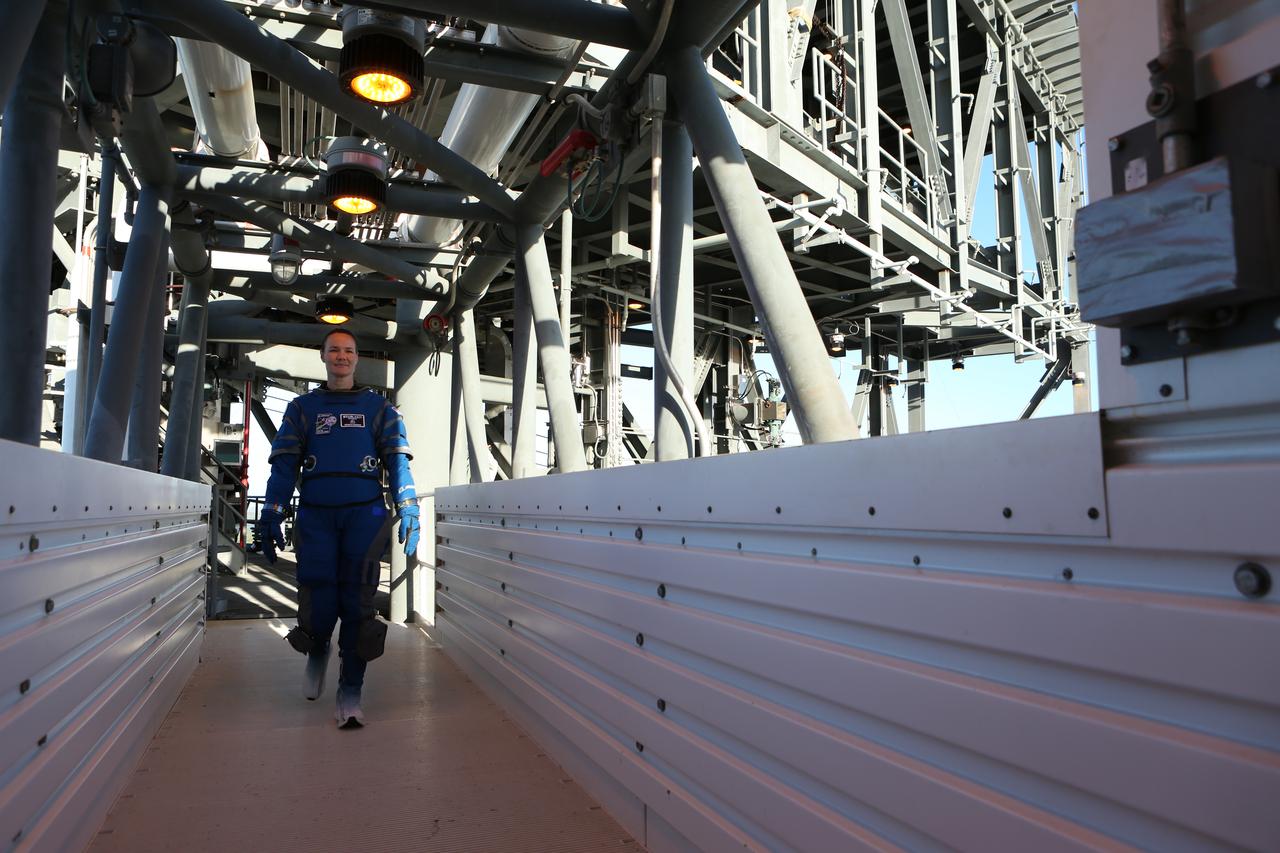
Boeing's new spacesuit designed to be worn by astronauts flying on the CST-100 Starliner. Seen here being worn in the same manner as it will on launch day for the walk to the spacecraft at Space Launch Complex 41, the suit is lighter and more flexible than previous spacesuits but retains the ability to pressurize in an emergency. Astronauts will wear the suit throughout the launch and ascent into orbit as well as on the way back to Earth. Starliners will launch atop Atlas V rockets from United Launch Alliance on missions including flights to the International Space Station for NASA's Commercial Crew Program. Photo credit: NASA/Cory Huston
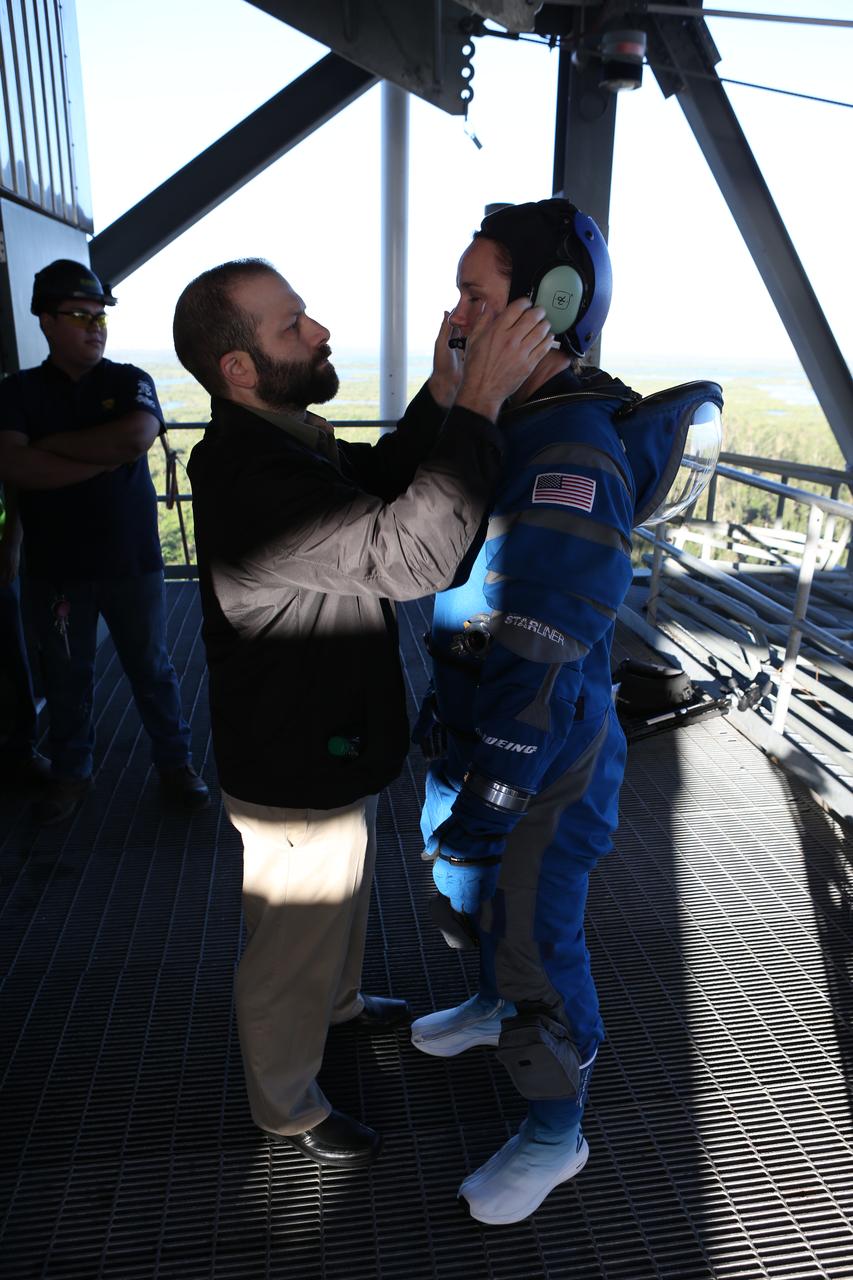
The communications carrier is placed as part of Boeing's new spacesuit designed to be worn by astronauts flying on the CST-100 Starliner. Seen here being worn in the same manner as it will on launch day for the walk to the spacecraft at Space Launch Complex 41, the suit is lighter and more flexible than previous spacesuits but retains the ability to pressurize in an emergency. Astronauts will wear the suit throughout the launch and ascent into orbit as well as on the way back to Earth. Starliners will launch atop Atlas V rockets from United Launch Alliance on missions including flights to the International Space Station for NASA's Commercial Crew Program. Photo credit: NASA/Cory Huston
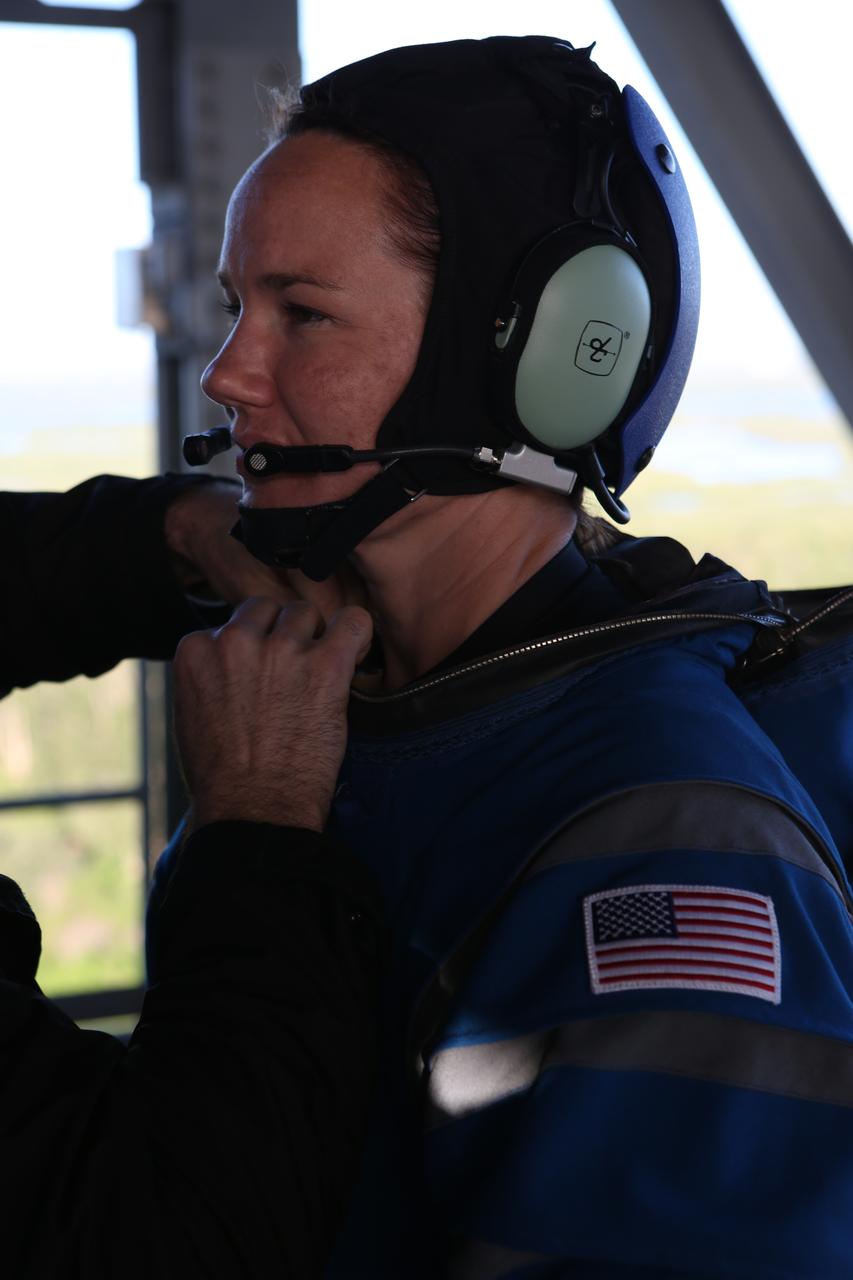
The communications carrier is placed as part of Boeing's new spacesuit designed to be worn by astronauts flying on the CST-100 Starliner. Seen here being worn in the same manner as it will on launch day for the walk to the spacecraft at Space Launch Complex 41, the suit is lighter and more flexible than previous spacesuits but retains the ability to pressurize in an emergency. Astronauts will wear the suit throughout the launch and ascent into orbit as well as on the way back to Earth. Starliners will launch atop Atlas V rockets from United Launch Alliance on missions including flights to the International Space Station for NASA's Commercial Crew Program. Photo credit: NASA/Cory Huston

ISS040-E-013842 (17 June 2014) --- Russian cosmonaut Oleg Artemyev, Expedition 40 flight engineer, is pictured with Russian Orlan spacesuits in the International Space Station's Pirs Docking Compartment. Artemyev and Russian cosmonaut Alexander Skvortsov donned their Orlan suits for a suited "dry run" dress rehearsal and to check out the suits' various components in advance of a spacewalk scheduled for June 19.
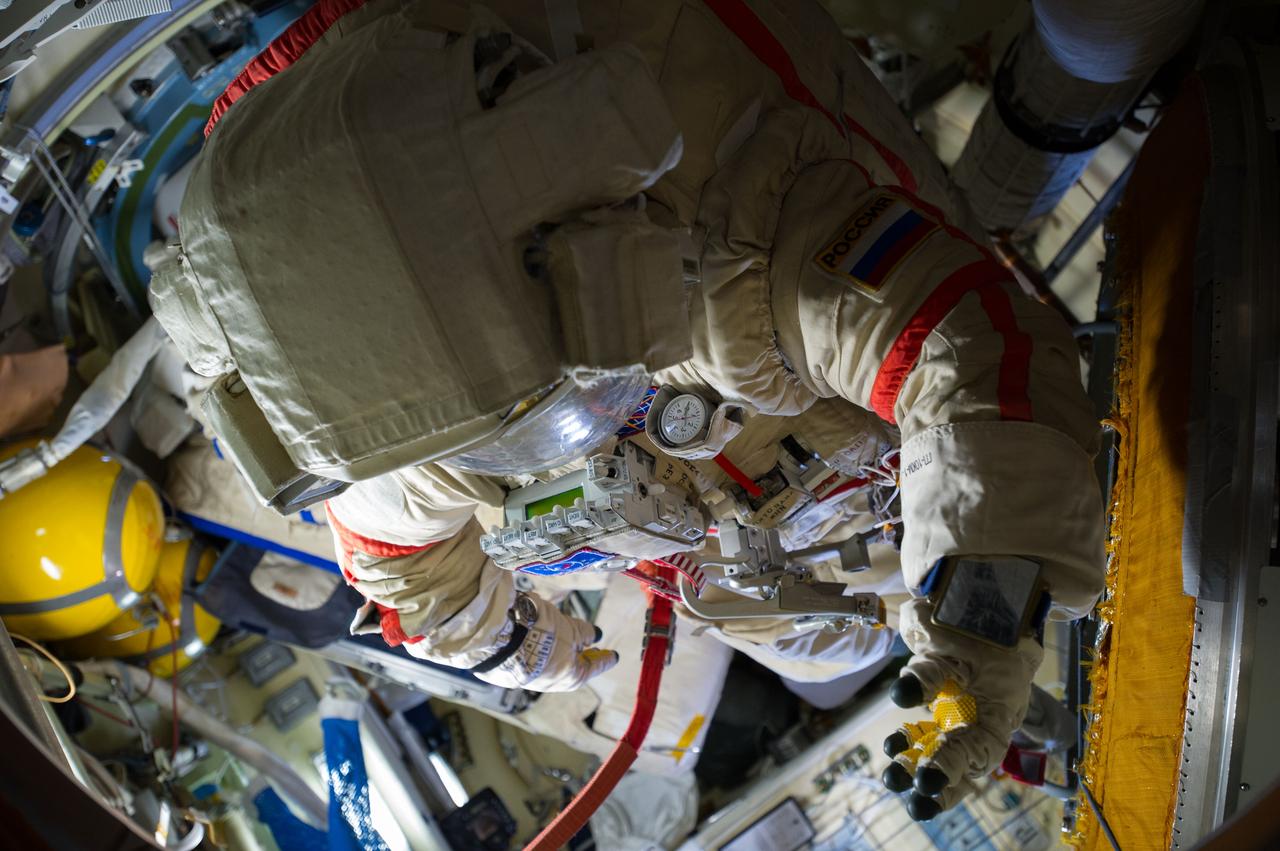
Photographic documentation of Russian ORLAN space suits in the Pirs Docking Compartment (DC1) ready for EVA 38 as photographed by the Expedition 40 crew.
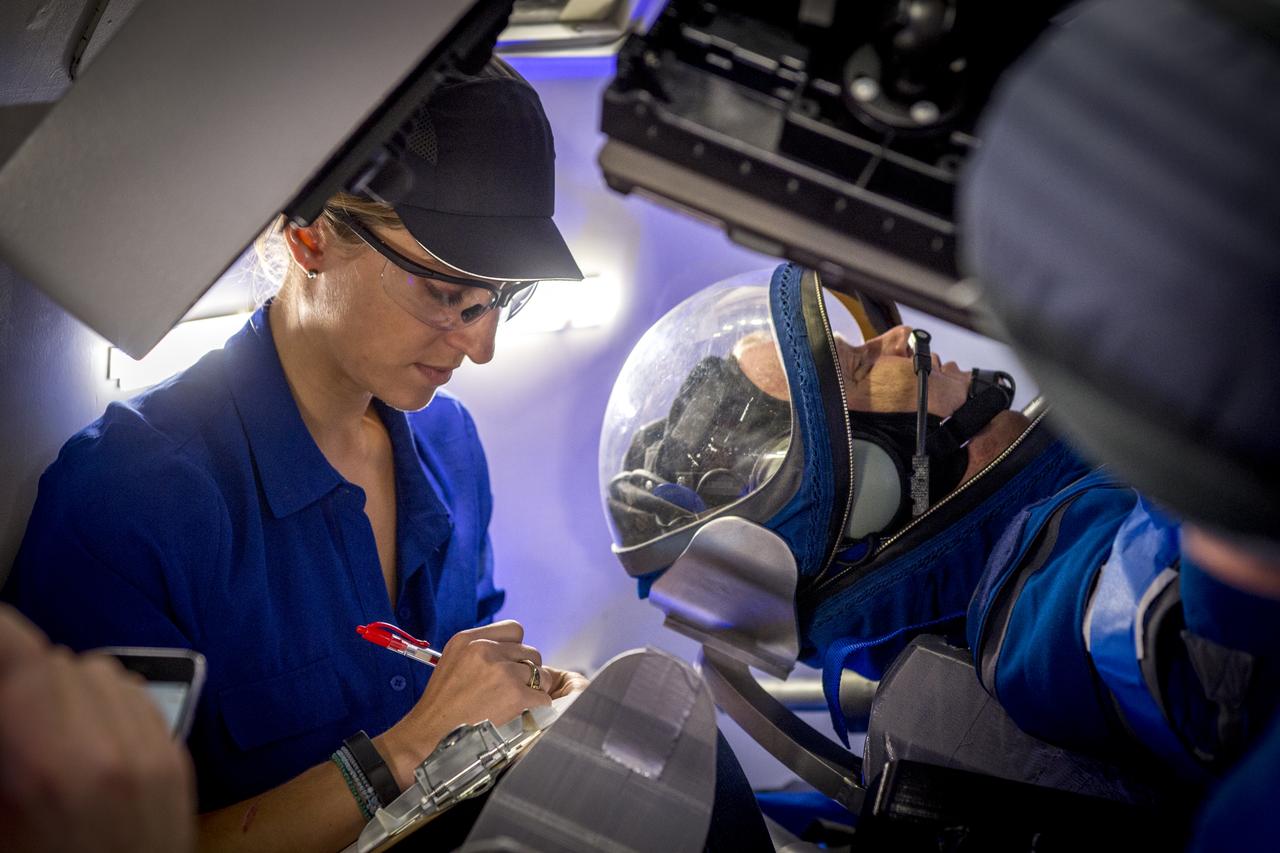
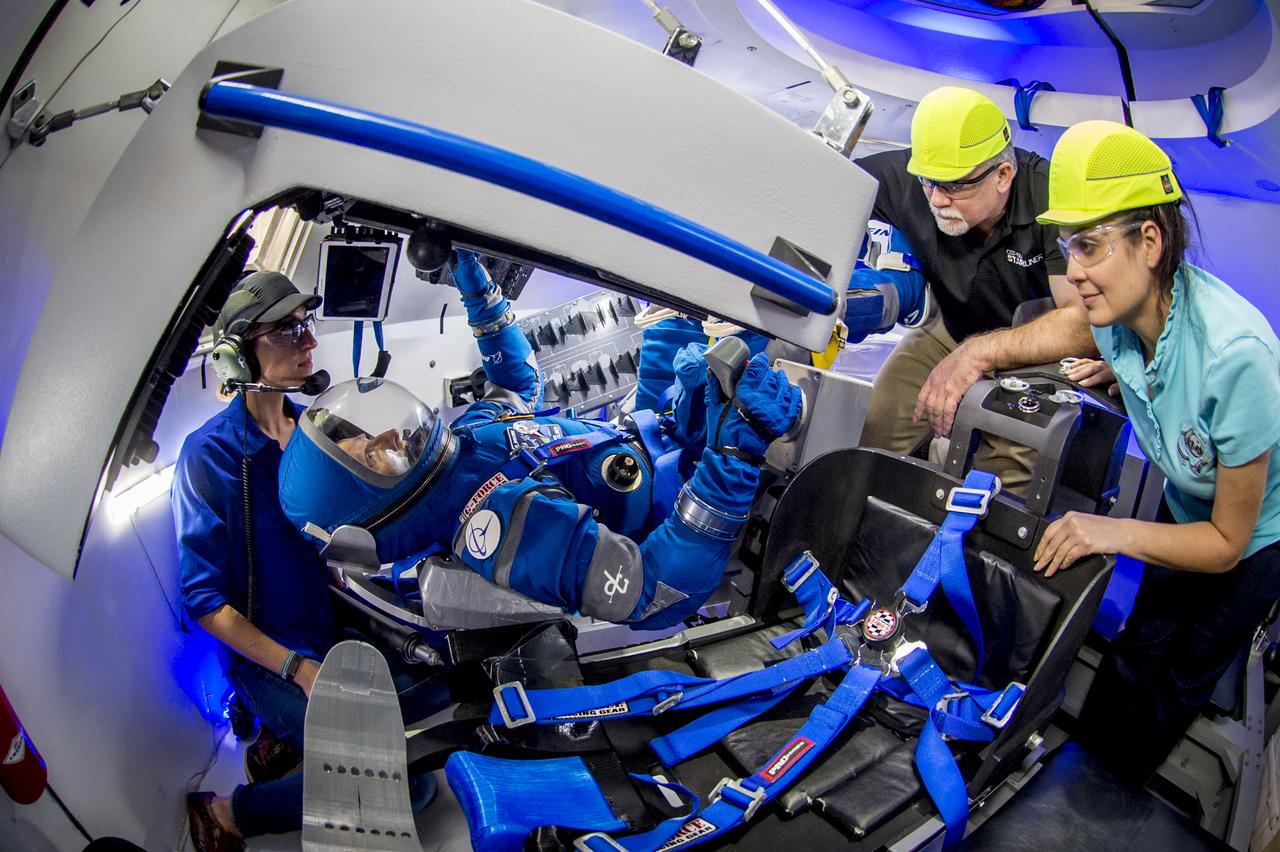
NASA astronaut Eric Boe wears Boeing's new spacesuit designed to be worn by astronauts flying on the CST-100 Starliner. The suit is lighter and more flexible than previous spacesuits but retains the ability to pressurize in an emergency. Astronauts will wear the suit throughout the launch and ascent into orbit as well as on the way back to Earth. Starliners will launch atop Atlas V rockets from United Launch Alliance on missions including flights to the International Space Station for NASA's Commercial Crew Program. NASA's commercial crew astronauts Boe and Suni Williams tried on the suits at Boeing’s Commercial Crew and Cargo Facility at NASA’s Kennedy Space Center. Boe, Williams, Bob Behnken, and Doug Hurley were selected by NASA in July 2015 to train for commercial crew test flights aboard the Starliner and SpaceX’s Crew Dragon spacecraft. The flight assignments have not been set, so all four of the astronauts are rehearsing heavily for flights aboard both vehicles. Photo credit: Boeing
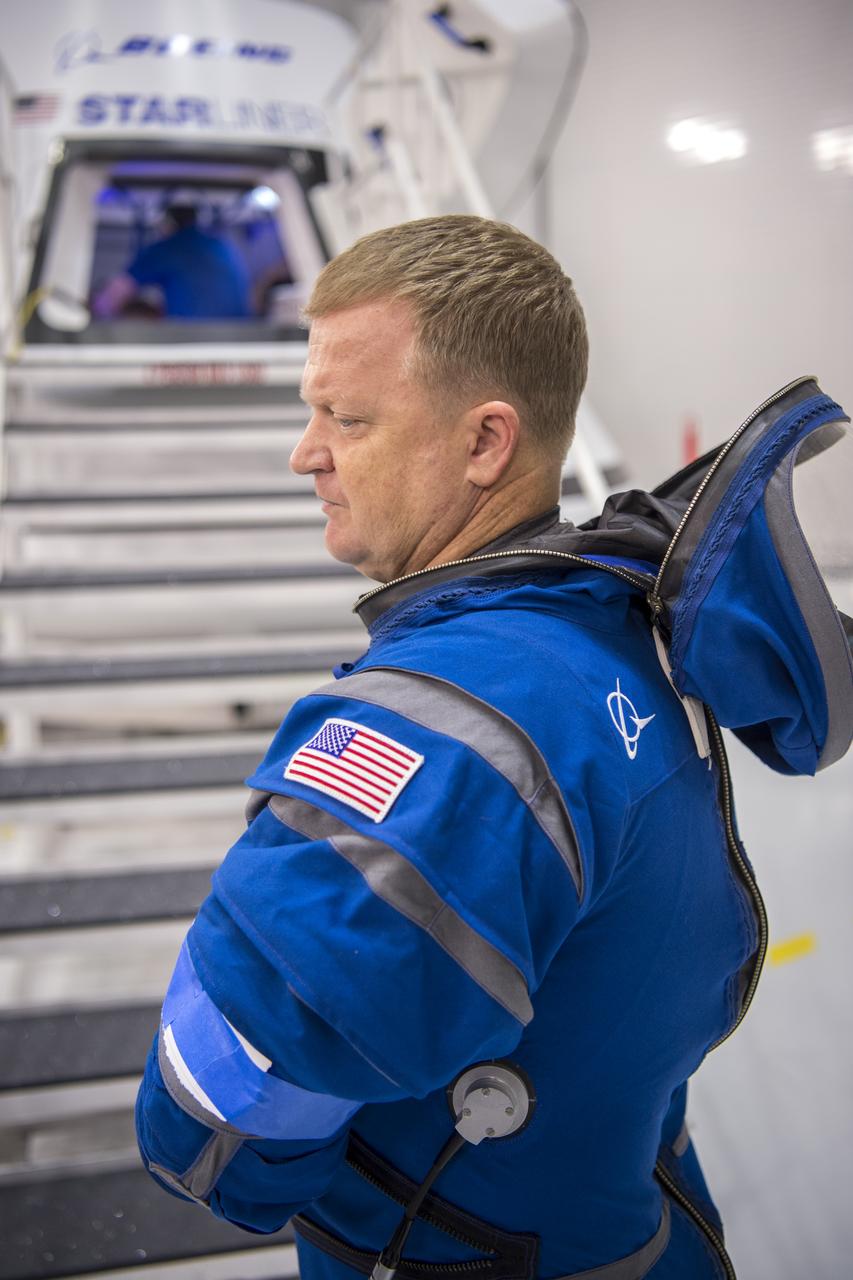
NASA astronaut Eric Boe wears Boeing's new spacesuit designed to be worn by astronauts flying on the CST-100 Starliner. The suit is lighter and more flexible than previous spacesuits but retains the ability to pressurize in an emergency. Astronauts will wear the suit throughout the launch and ascent into orbit as well as on the way back to Earth. Starliners will launch atop Atlas V rockets from United Launch Alliance on missions including flights to the International Space Station for NASA's Commercial Crew Program. NASA's commercial crew astronauts Boe and Suni Williams tried on the suits at Boeing’s Commercial Crew and Cargo Facility at NASA’s Kennedy Space Center. Boe, Williams, Bob Behnken, and Doug Hurley were selected by NASA in July 2015 to train for commercial crew test flights aboard the Starliner and SpaceX’s Crew Dragon spacecraft. The flight assignments have not been set, so all four of the astronauts are rehearsing heavily for flights aboard both vehicles. Photo credit: Boeing
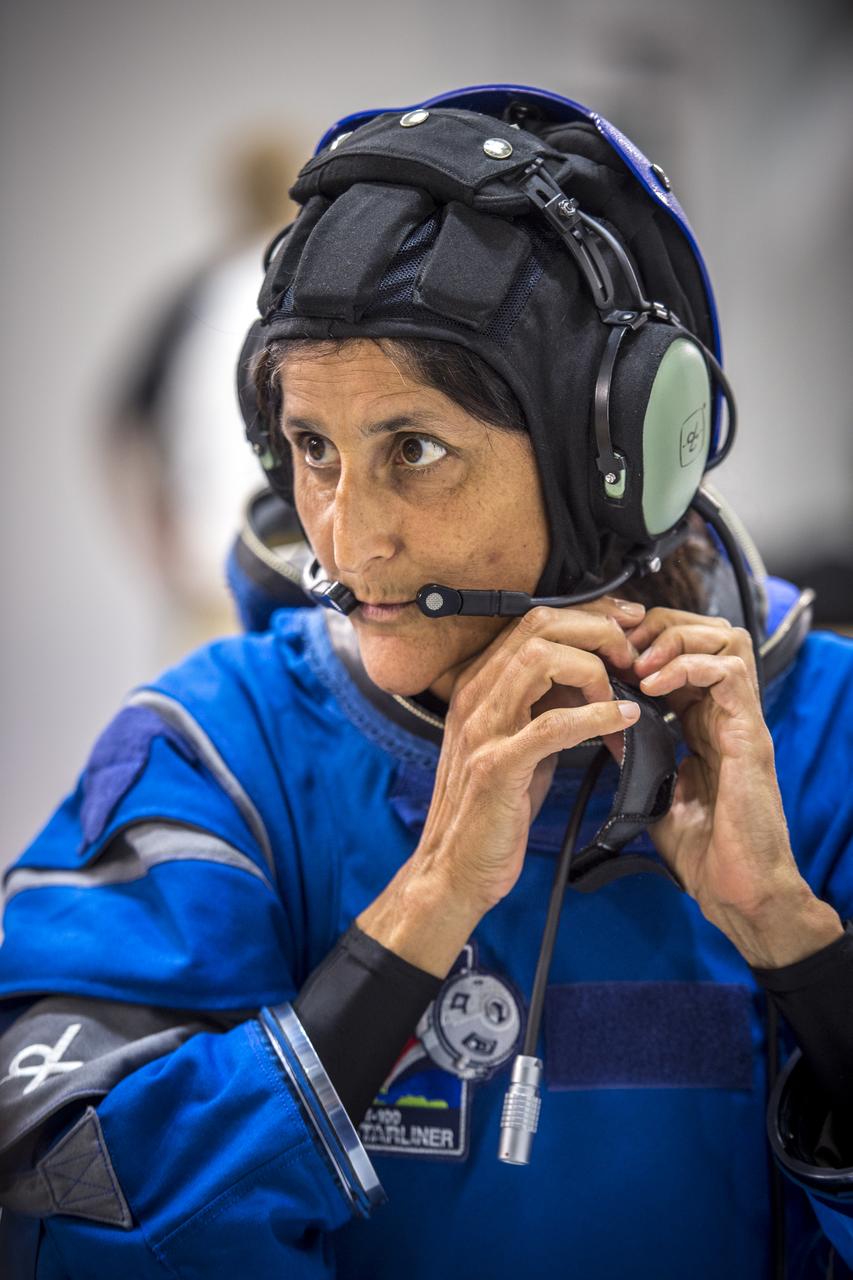
NASA astronaut Suni Williams wears Boeing's new spacesuit designed to be worn by astronauts flying on the CST-100 Starliner. The suit is lighter and more flexible than previous spacesuits but retains the ability to pressurize in an emergency. Astronauts will wear the suit throughout the launch and ascent into orbit as well as on the way back to Earth. Starliners will launch atop Atlas V rockets from United Launch Alliance on missions including flights to the International Space Station for NASA's Commercial Crew Program. NASA's commercial crew astronauts Eric Boe and Williams tried on the suits at Boeing’s Commercial Crew and Cargo Facility at NASA’s Kennedy Space Center. Boe, Williams, Bob Behnken, and Doug Hurley were selected by NASA in July 2015 to train for commercial crew test flights aboard the Starliner and SpaceX’s Crew Dragon spacecraft. The flight assignments have not been set, so all four of the astronauts are rehearsing heavily for flights aboard both vehicles. Photo credit: Boeing
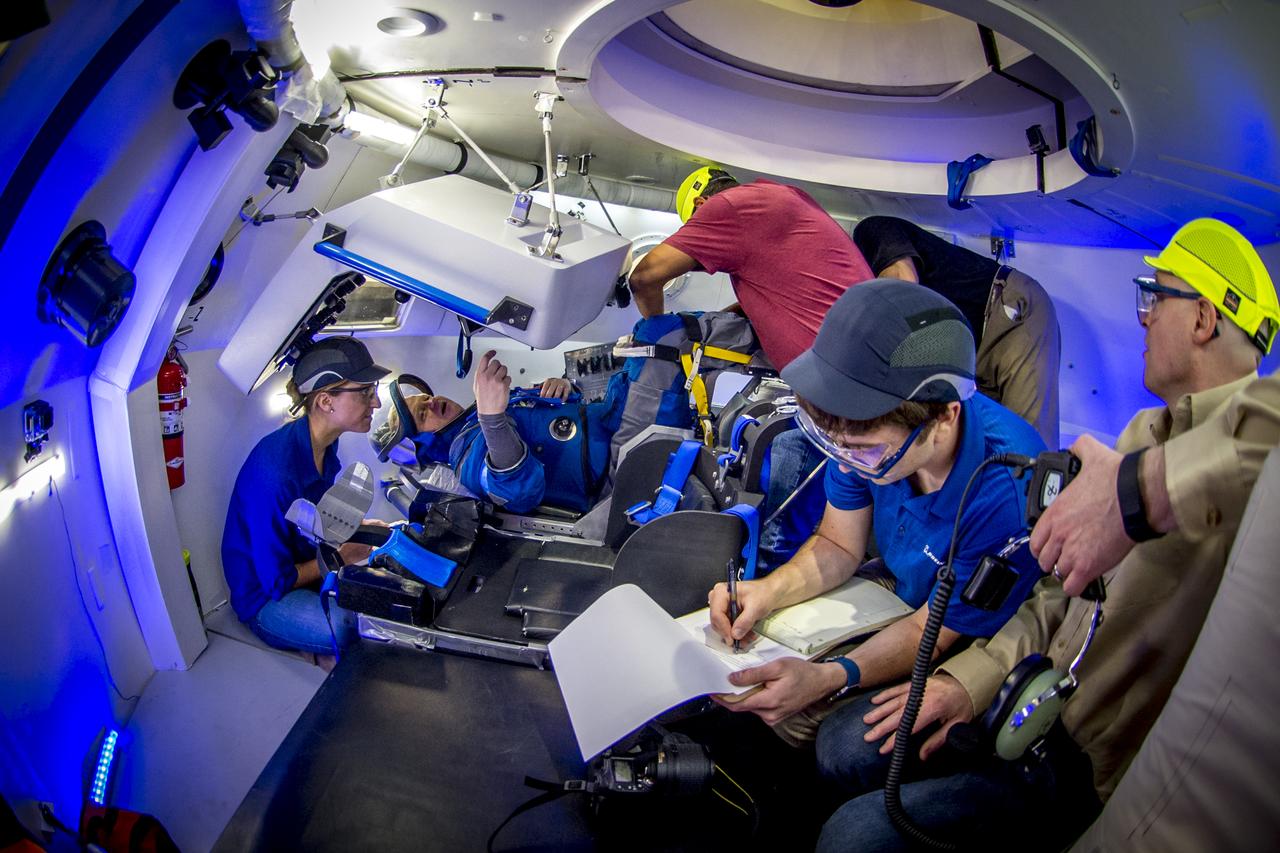
NASA astronaut Eric Boe wears Boeing's new spacesuit designed to be worn by astronauts flying on the CST-100 Starliner. The suit is lighter and more flexible than previous spacesuits but retains the ability to pressurize in an emergency. Astronauts will wear the suit throughout the launch and ascent into orbit as well as on the way back to Earth. Starliners will launch atop Atlas V rockets from United Launch Alliance on missions including flights to the International Space Station for NASA's Commercial Crew Program. NASA's commercial crew astronauts Boe and Suni Williams tried on the suits at Boeing’s Commercial Crew and Cargo Facility at NASA’s Kennedy Space Center. Boe, Williams, Bob Behnken, and Doug Hurley were selected by NASA in July 2015 to train for commercial crew test flights aboard the Starliner and SpaceX’s Crew Dragon spacecraft. The flight assignments have not been set, so all four of the astronauts are rehearsing heavily for flights aboard both vehicles. Photo credit: Boeing
Boeing's Chris Ferguson wears Boeing's new spacesuit designed to be worn by astronauts flying on the CST-100 Starliner. The suit is lighter and more flexible than previous spacesuits but retains the ability to pressurize in an emergency. Astronauts will wear the suit throughout the launch and ascent into orbit as well as on the way back to Earth. Starliners will launch atop Atlas V rockets from United Launch Alliance on missions including flights to the International Space Station for NASA's Commercial Crew Program. NASA's commercial crew astronauts Eric Boe and Williams tried on the suits at Boeing’s Commercial Crew and Cargo Facility at NASA’s Kennedy Space Center. Boe, Williams, Bob Behnken, and Doug Hurley were selected by NASA in July 2015 to train for commercial crew test flights aboard the Starliner and SpaceX’s Crew Dragon spacecraft. The flight assignments have not been set, so all four of the astronauts are rehearsing heavily for flights aboard both vehicles. Photo credit: Boeing
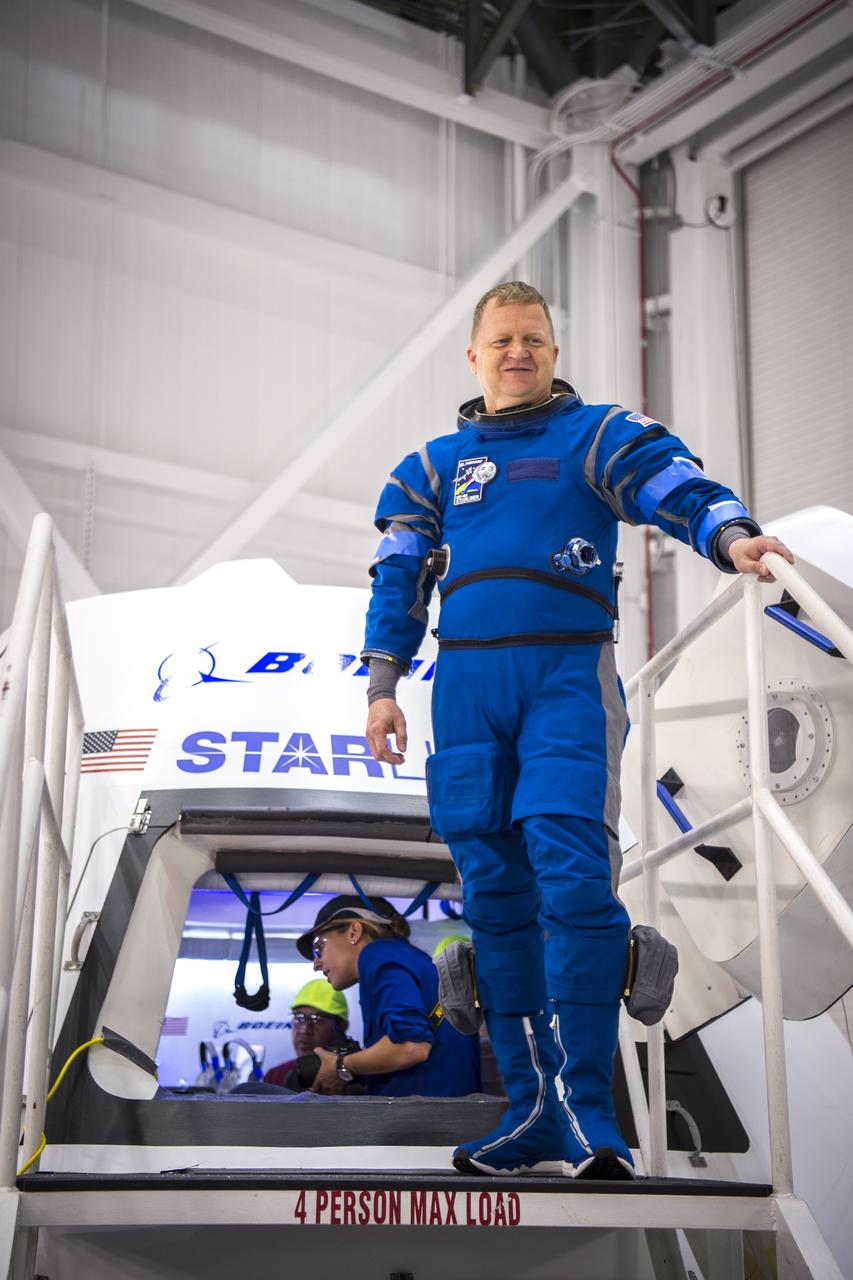
NASA astronaut Eric Boe wears Boeing's new spacesuit designed to be worn by astronauts flying on the CST-100 Starliner. The suit is lighter and more flexible than previous spacesuits but retains the ability to pressurize in an emergency. Astronauts will wear the suit throughout the launch and ascent into orbit as well as on the way back to Earth. Starliners will launch atop Atlas V rockets from United Launch Alliance on missions including flights to the International Space Station for NASA's Commercial Crew Program. NASA's commercial crew astronauts Boe and Suni Williams tried on the suits at Boeing’s Commercial Crew and Cargo Facility at NASA’s Kennedy Space Center. Boe, Williams, Bob Behnken, and Doug Hurley were selected by NASA in July 2015 to train for commercial crew test flights aboard the Starliner and SpaceX’s Crew Dragon spacecraft. The flight assignments have not been set, so all four of the astronauts are rehearsing heavily for flights aboard both vehicles. Photo credit: Boeing
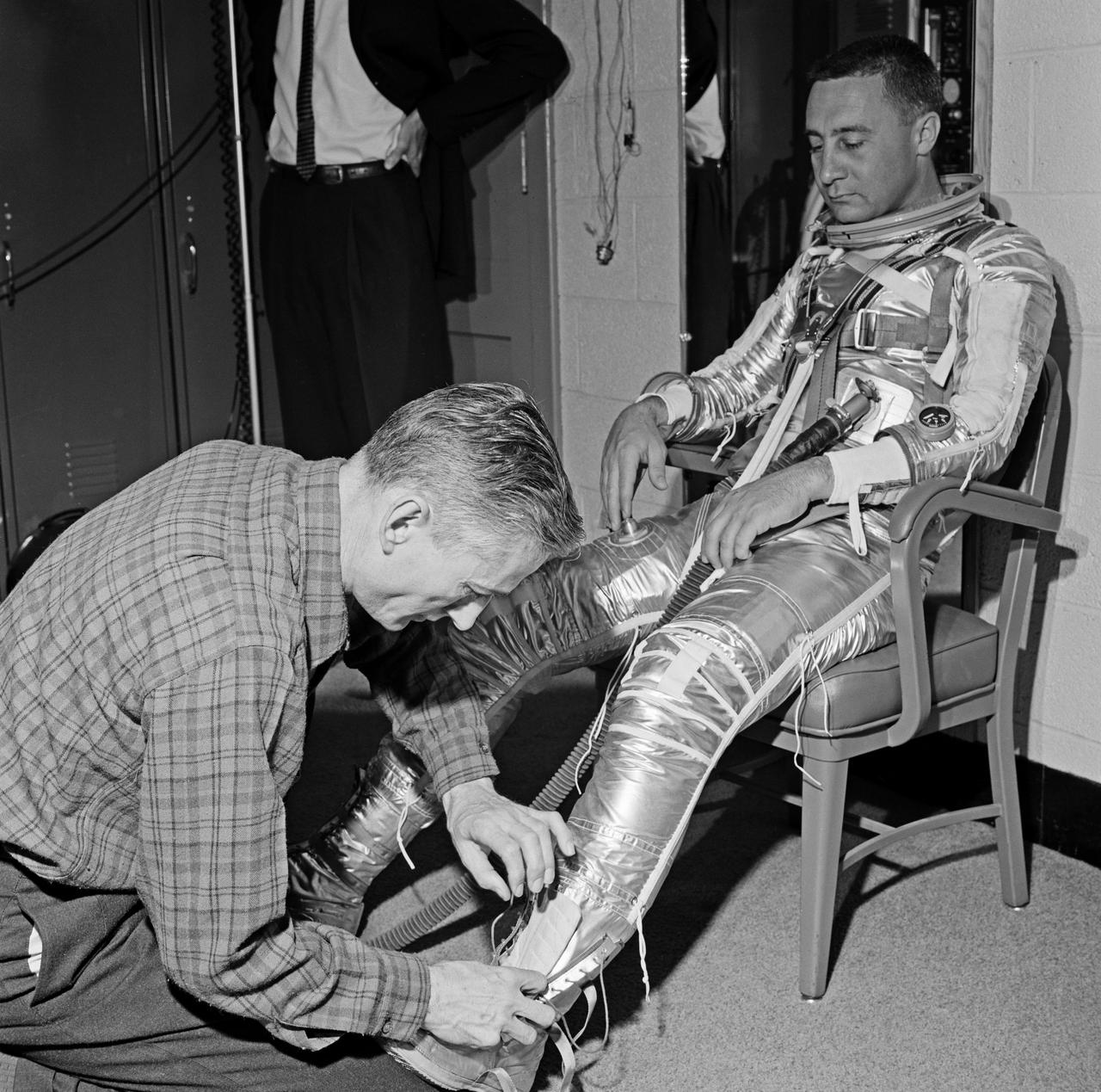
Gus Grissom trying on a Spacesuit; Seated with assistant; Seated with assistant putting on boots; Standing by mirror, name tag visible; Outside in suit, name tag visible. Mercury Project photo, 1961. Original negatives sent to Johnson Space Center when astronauts moved to that center. Photograph take on 03/27/1961.
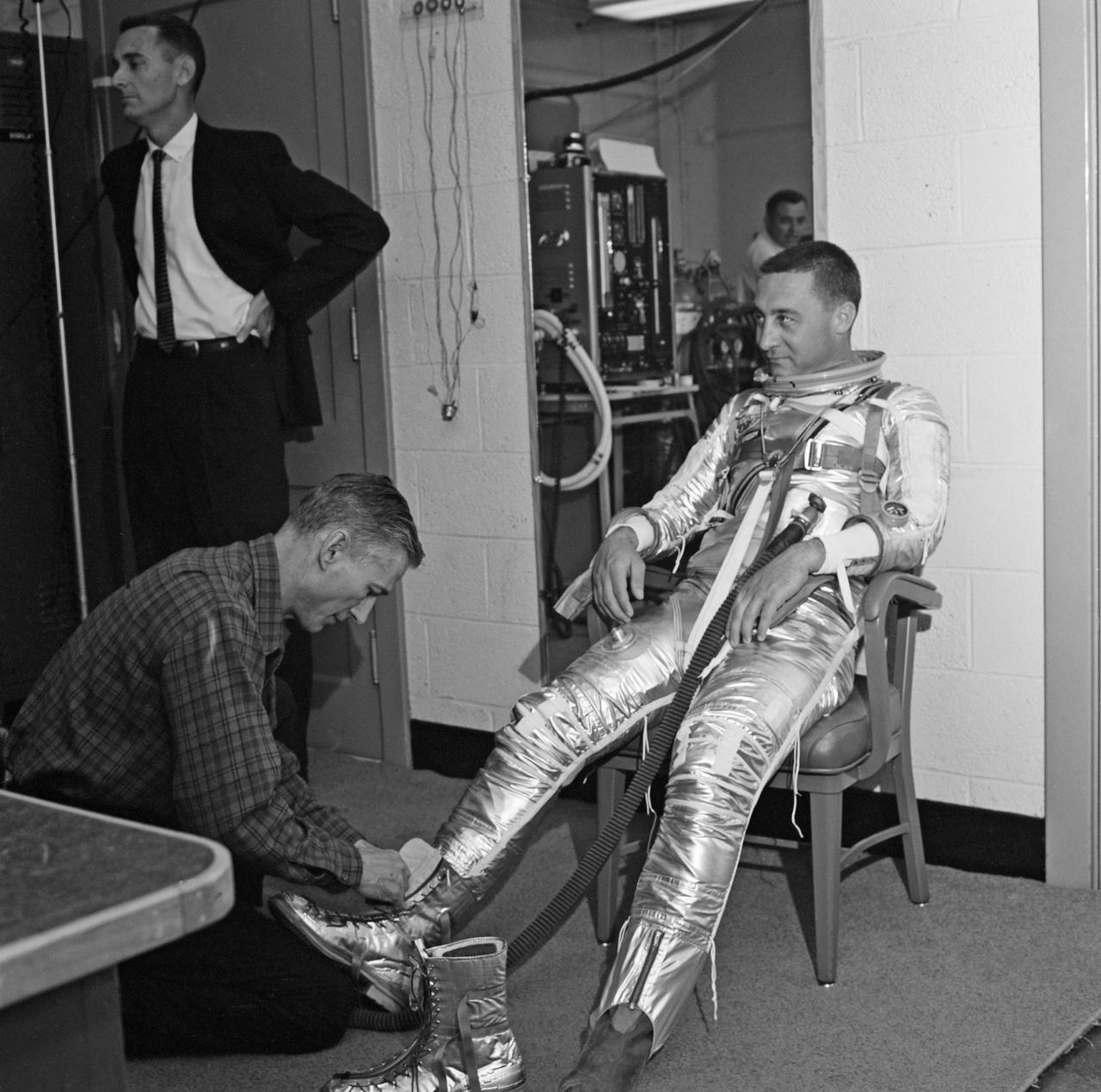
Gus Grissom trying on a Spacesuit; Seated with assistant; Seated with assistant putting on boots; Standing by mirror, name tag visible; Outside in suit, name tag visible. Mercury Project photo, 1961. Original negatives sent to Johnson Space Center when astronauts moved to that center. Photograph take on 03/27/1961.
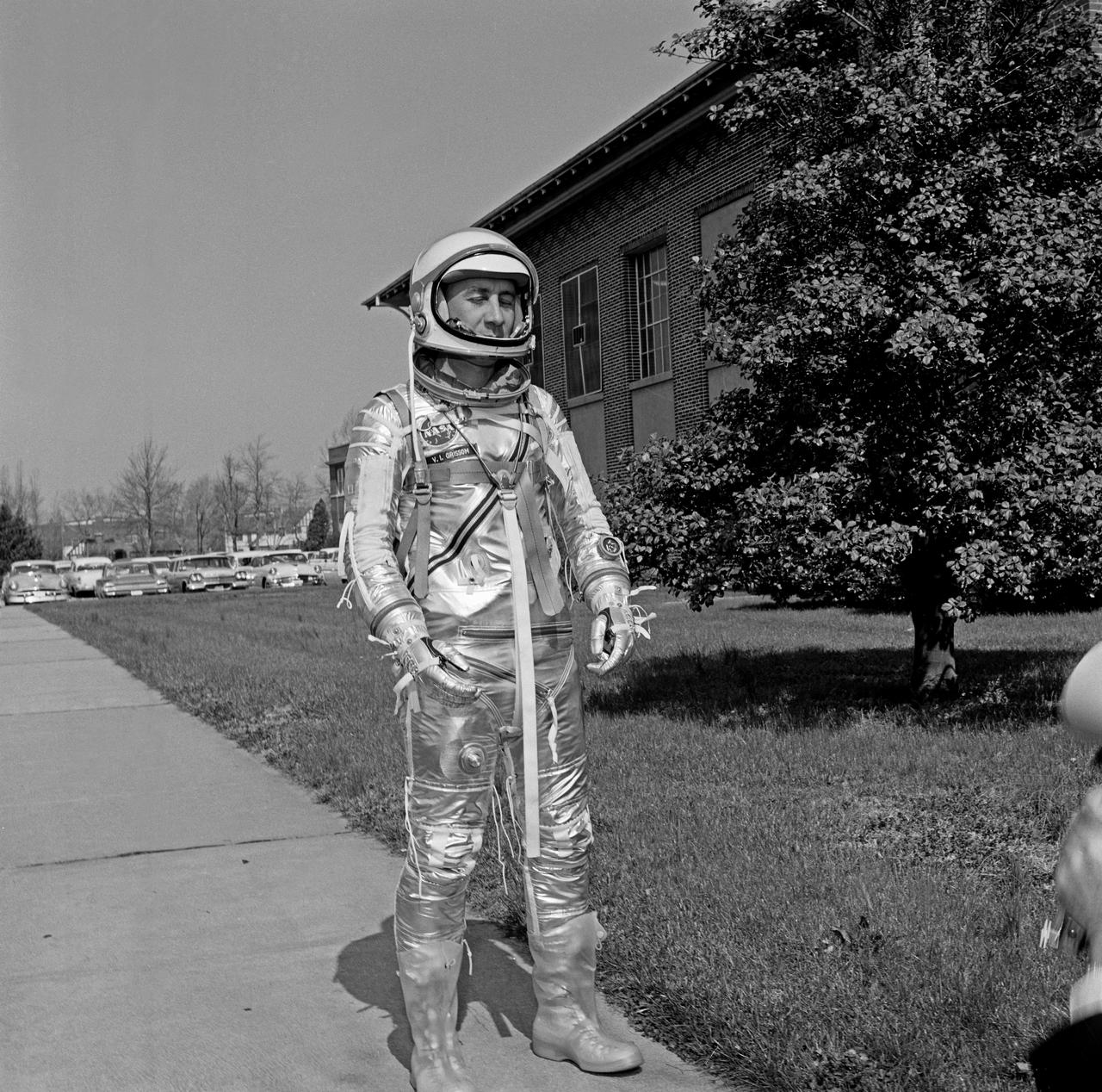
Gus Grissom trying on a Spacesuit; Seated with assistant; Seated with assistant putting on boots; Standing by mirror, name tag visible; Outside in suit, name tag visible. Mercury Project photo, 1961. Original negatives sent to Johnson Space Center when astronauts moved to that center. Photograph take on 03/27/1961.
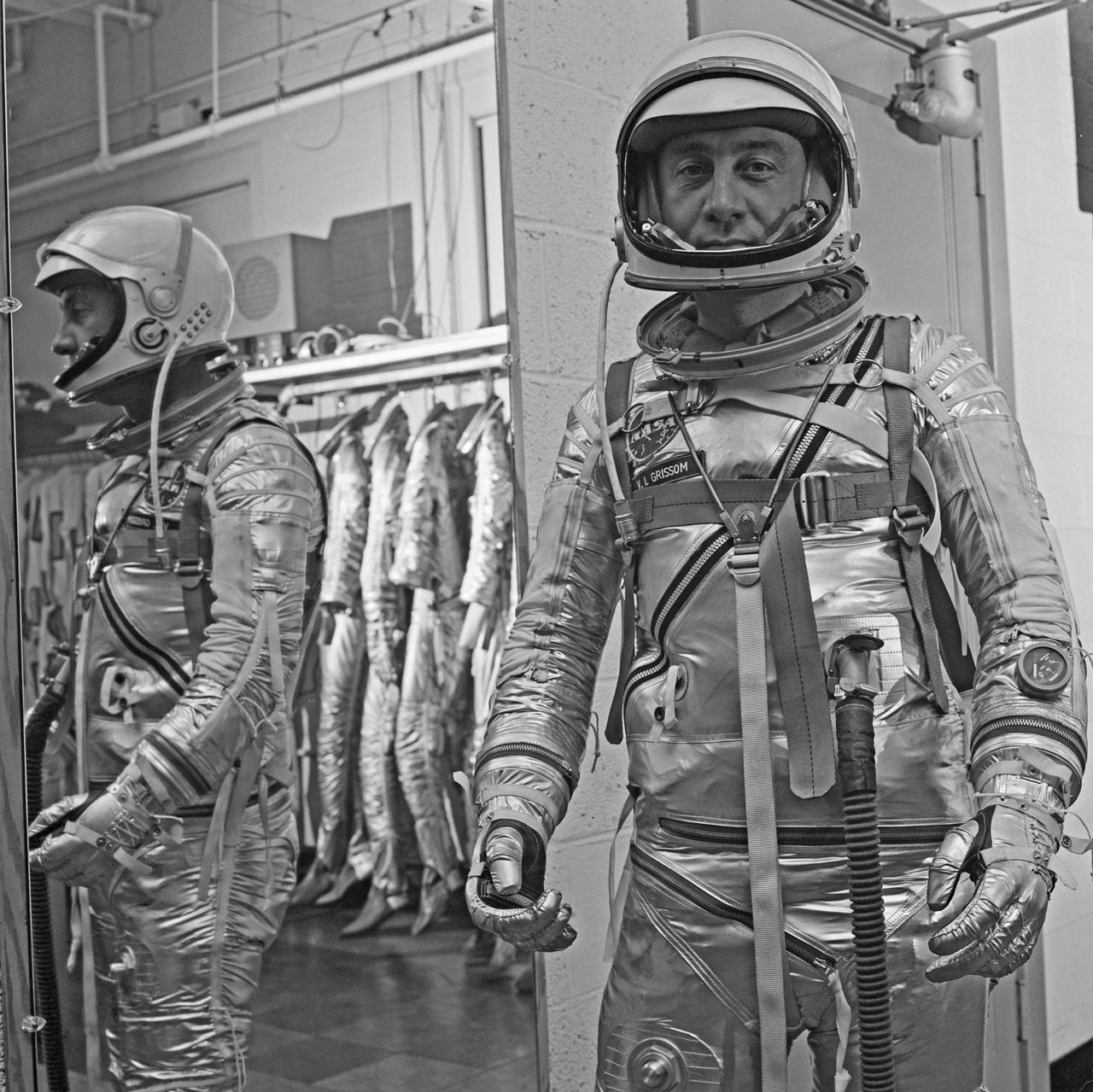
Gus Grissom trying on a Spacesuit; Seated with assistant; Seated with assistant putting on boots; Standing by mirror, name tag visible; Outside in suit, name tag visible. Mercury Project photo, 1961. Original negatives sent to Johnson Space Center when astronauts moved to that center. Photograph take on 03/27/1961.
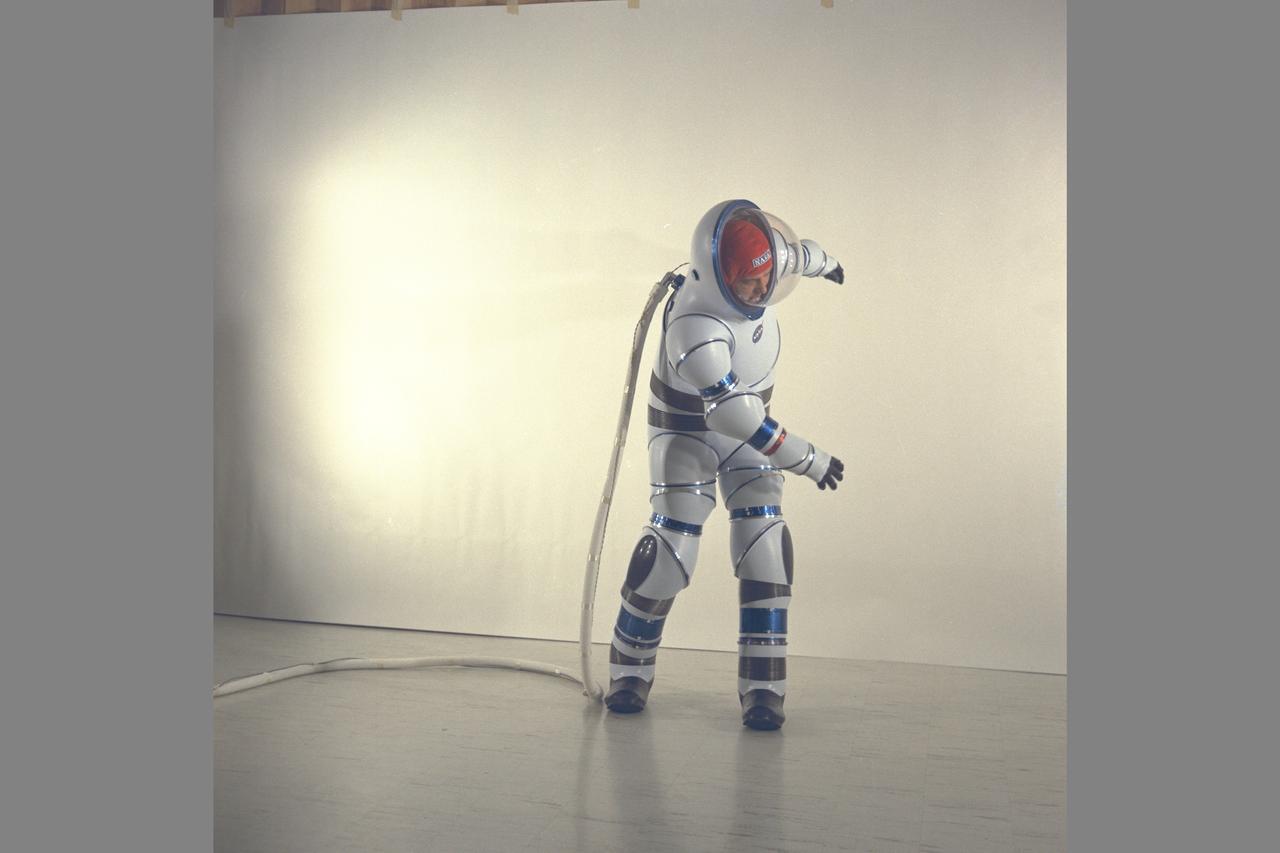
AX-2 Hard Space Suit with Vic Vykukal. Vykukal is the principal investigator of the AX space suit series.

AX-2 Hard Space Suit with Vic Vykukal. Vykukal is the principal investigator of the AX space suit series.
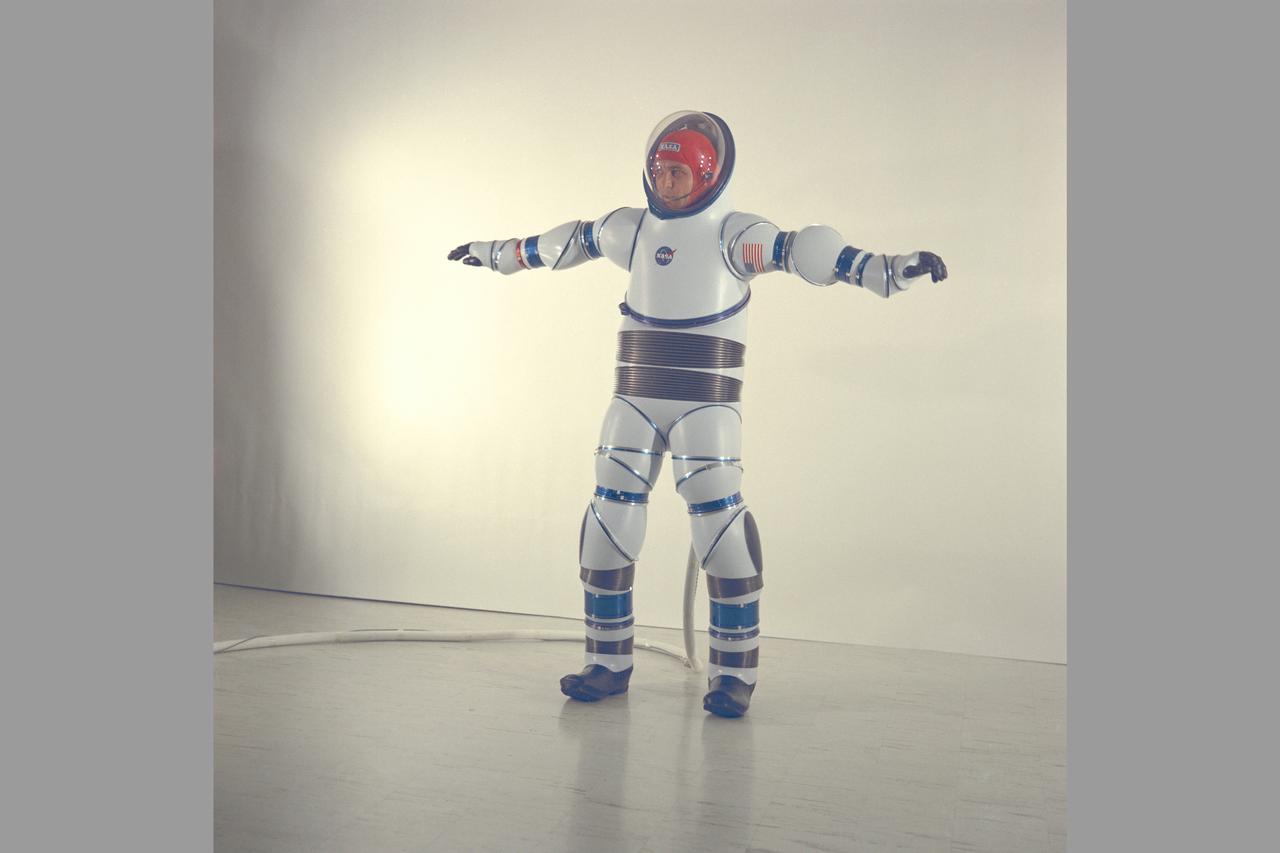
AX-2 Hard Space Suit with Vic Vykukal. Vykukal is the principal investigator of the AX space suit series.
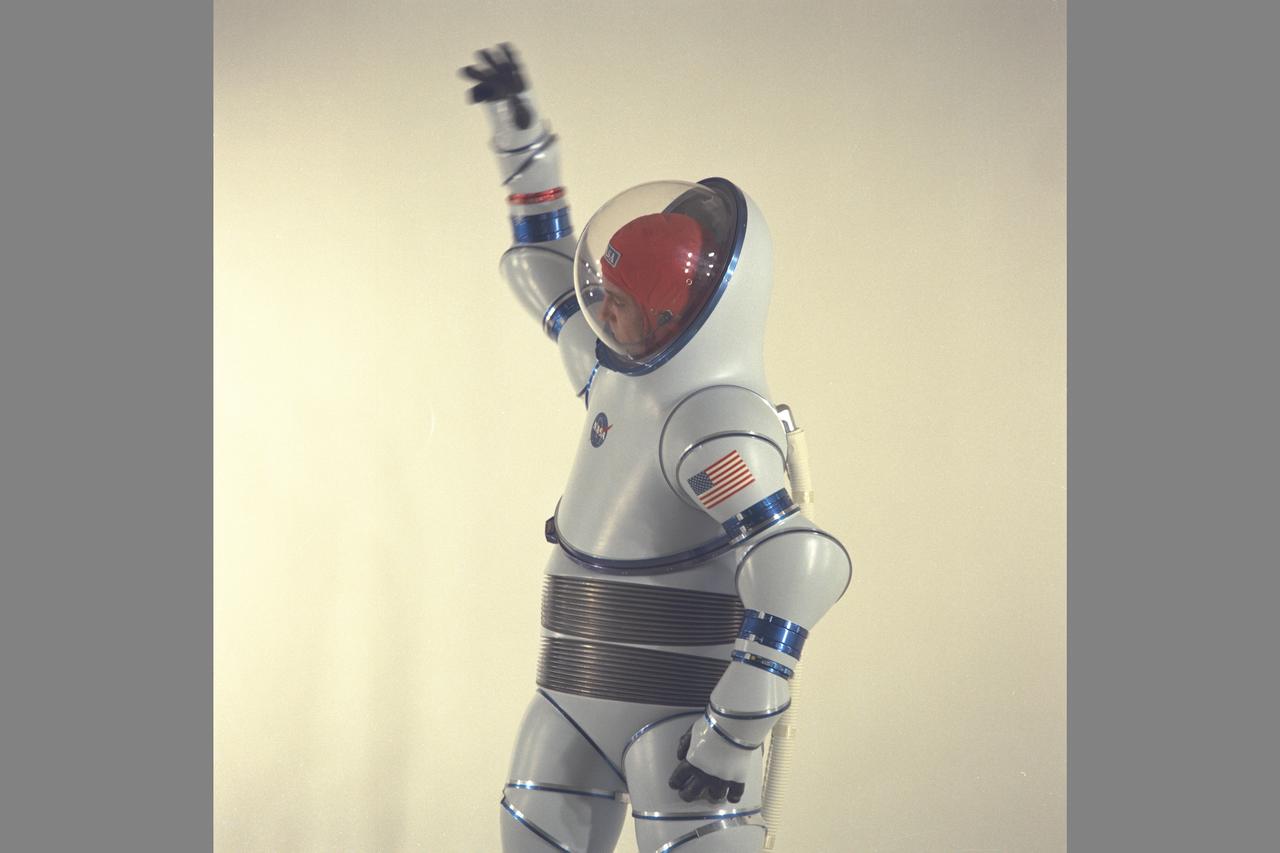
AX-2 Hard Space Suit with Vic Vykukal. Vykukal is the principal investigator of the AX space suit series.
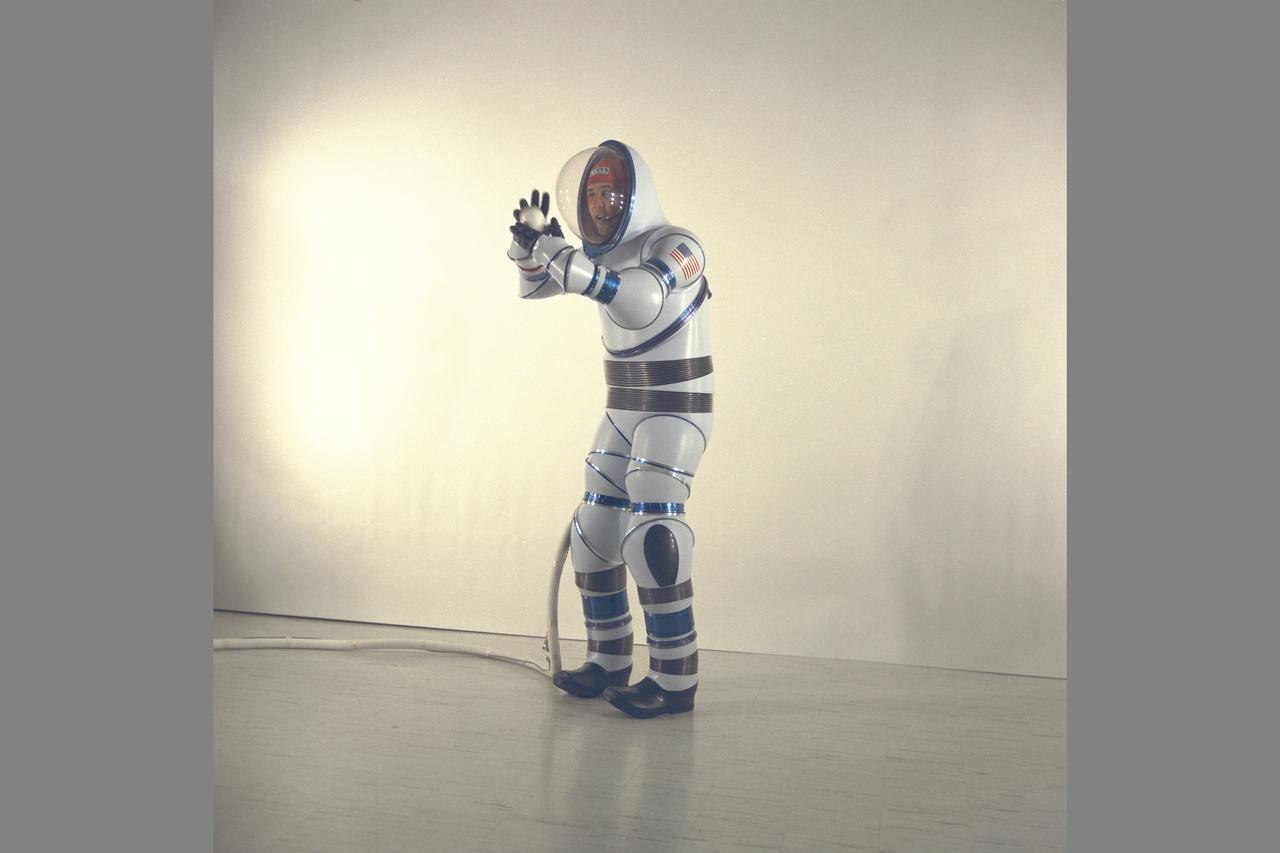
AX-2 Hard Space Suit with Vic Vykukal getting ready to pitch a baseball. Vykukal is the principal investigator of the AX space suit series.
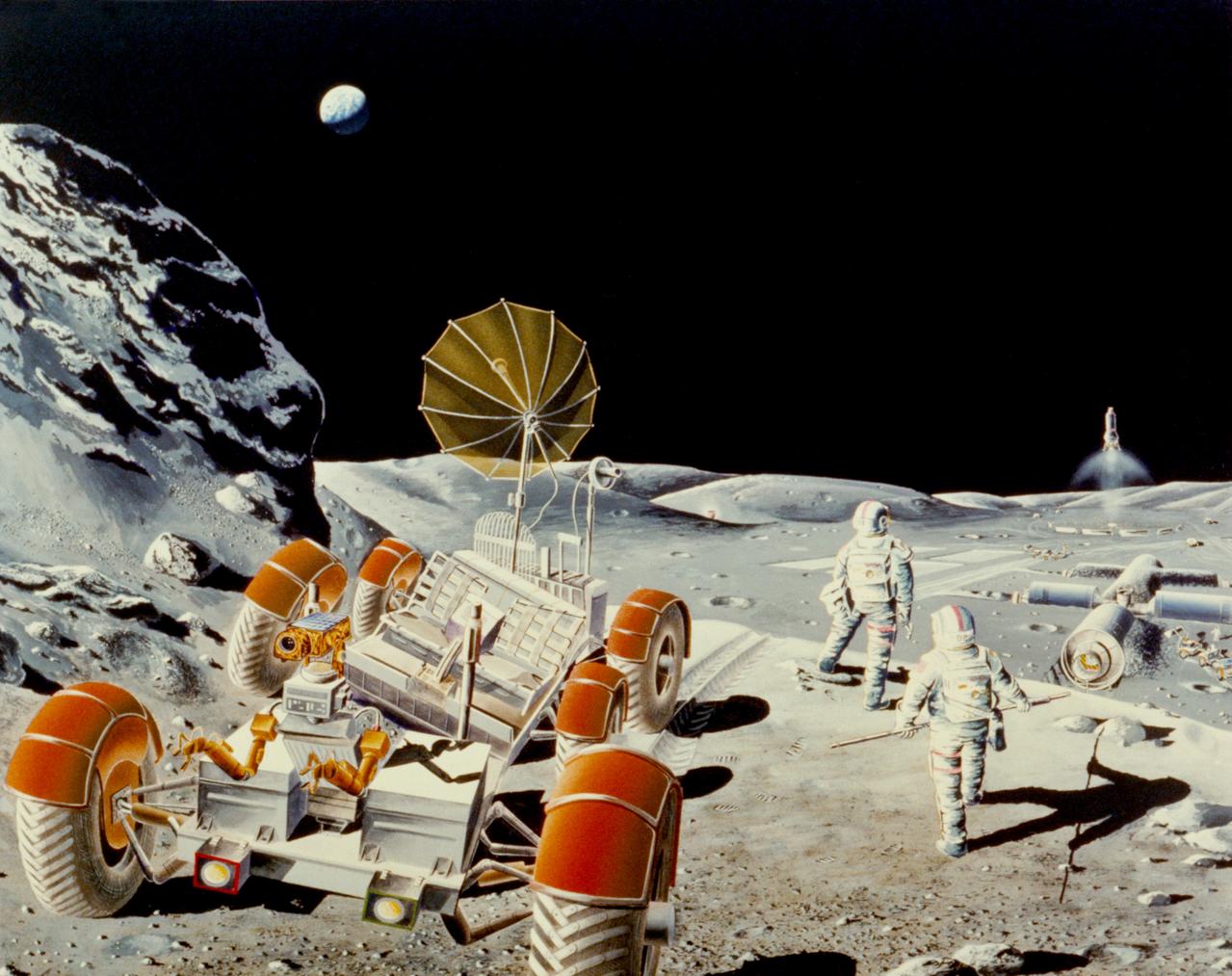
N-239 Space Suit Technology Exhibit: Moon Mission Artwork Art from Johnson Space Center collection (Ref: S86-27756).
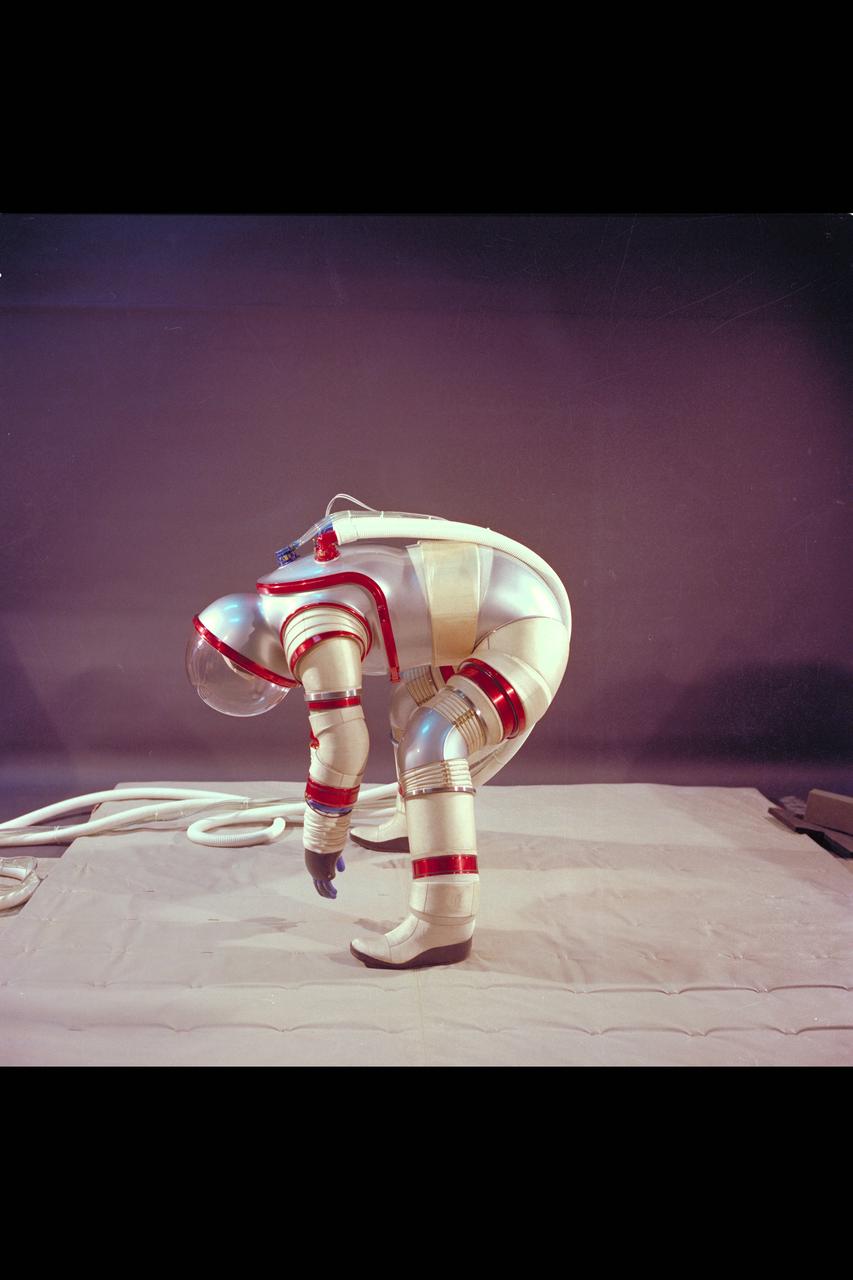
Hubert Vykukal demonstrates mobility of the Hardsuit AX-3 Space Suit design
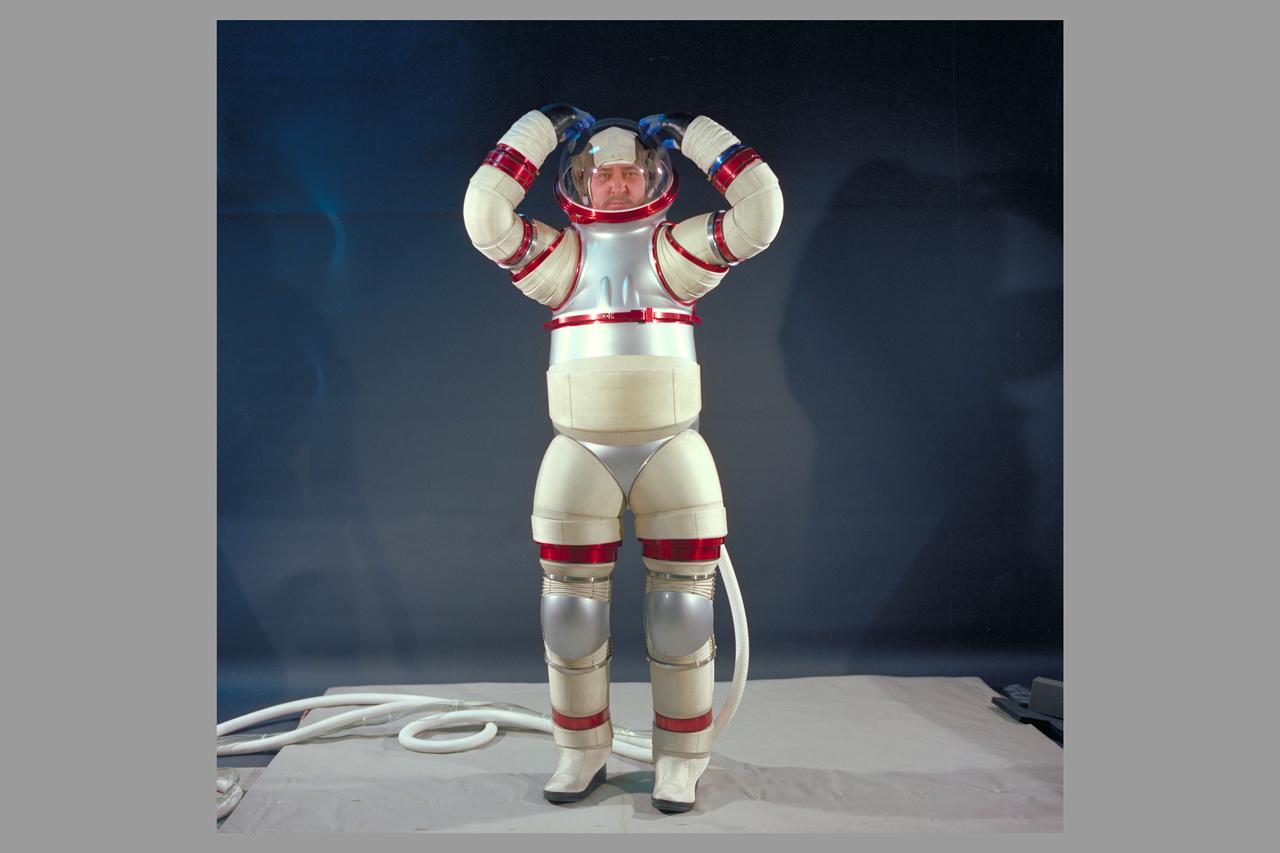
Vic Vykukal model the Ames developed AX-3 Hard Space Suit
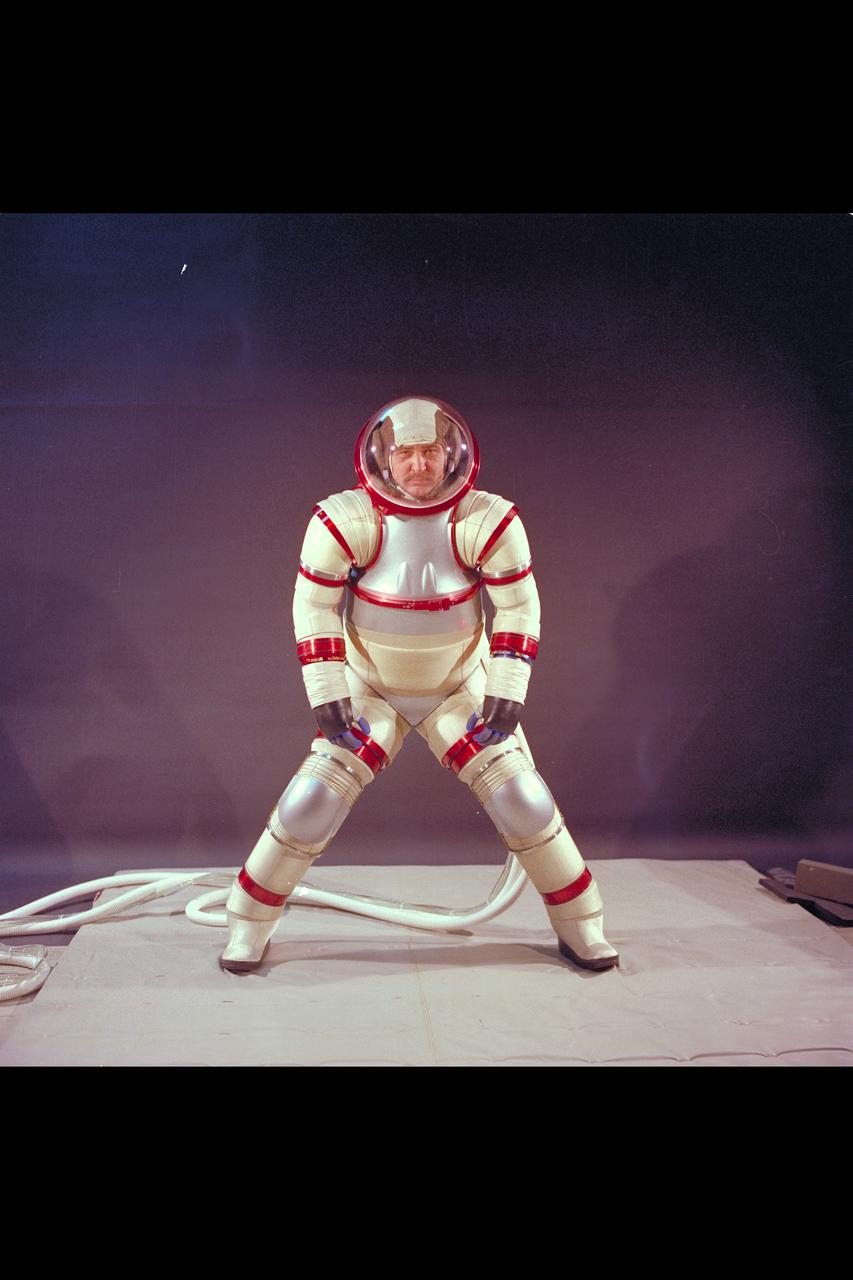
Hubert Vykukal demonstrates mobility of the Hardsuit AX-3 Space Suit design
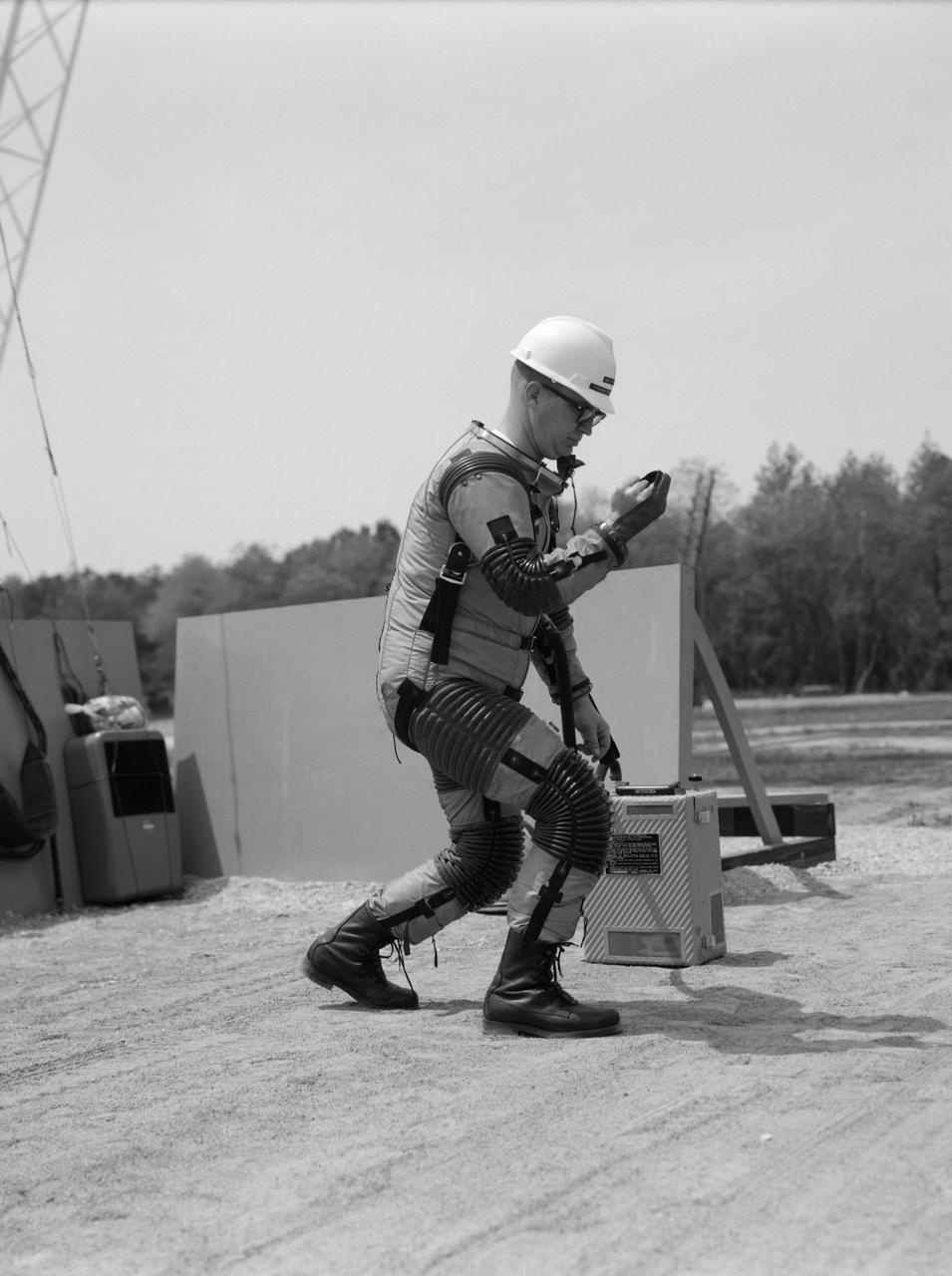
Special "space" suit for the Reduced Gravity Walking Simulator located at the Lunar Landing Facility. The purpose of this simulator was to study the subject while walking, jumping or running. Researchers conducted studies of various factors such as fatigue limit, energy expenditure, and speed of locomotion. A.W. Vigil described the purpose of the simulator in his paper "Discussion of Existing and Planned Simulators for Space Research," "When the astronauts land on the moon they will be in an unfamiliar environment involving, particularly, a gravitational field only one-sixth as strong as on earth. A novel method of simulating lunar gravity has been developed and is supported by a puppet-type suspension system at the end of a long pendulum. A floor is provided at the proper angle so that one-sixth of the subject's weight is supported by the floor with the remainder being supported by the suspension system. This simulator allows almost complete freedom in vertical translation and pitch and is considered to be a very realistic simulation of the lunar walking problem. For this problem this simulator suffers only slightly from the restrictions in lateral movement it puts on the test subject. This is not considered a strong disadvantage for ordinary walking problems since most of the motions do, in fact, occur in the vertical plane. However, this simulation technique would be severely restrictive if applied to the study of the extra-vehicular locomotion problem, for example, because in this situation complete six degrees of freedom are rather necessary. This technique, in effect, automatically introduces a two-axis attitude stabilization system into the problem. The technique could, however, be used in preliminary studies of extra-vehicular locomotion where, for example, it might be assumed that one axis of the attitude control system on the astronaut maneuvering unit may have failed." -- Published in James R. Hansen, Spaceflight Revolution: NASA Langley Research Center From Sputnik to Apollo, (Washington: NASA, 1995), p. 377; A.W. Vigil, "Discussion of Existing and Planned Simulators for Space Research," Paper presented at Conference on the Role of Simulation in Space Technology," Blacksburg, VA, August 17-21, 1964.
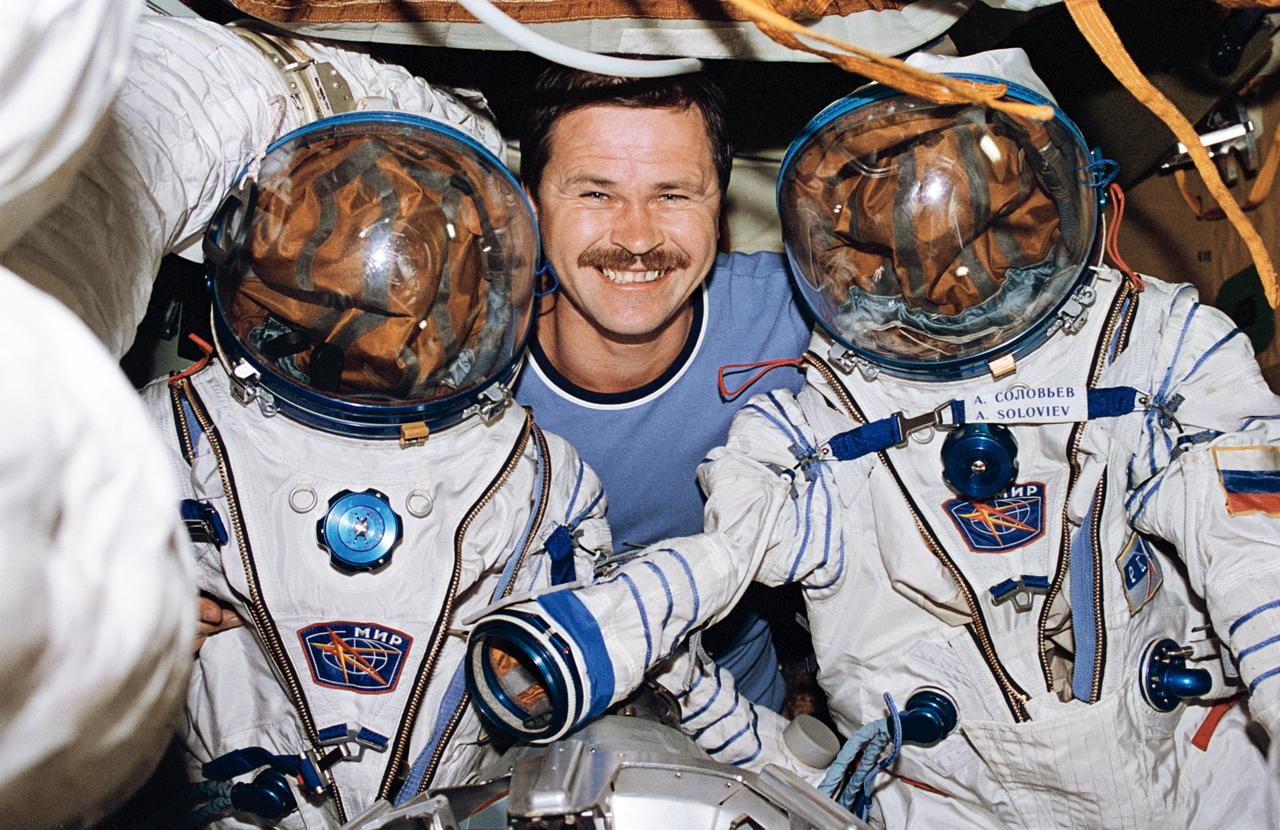
STS071-104-029 (27 June-7 July 1995) --- Cosmonaut Nikolai M. Budarin, Mir-19 flight engineer, is pictured on Russia's Mir Space Station with two Russian space suits. These are for Intravehicular (IVA) wear and are not the suits designed for Extravehicular Activity (EVA). Budarin remained aboard Mir with cosmonaut Anatoly Y. Solovyev, Mir-19 commander, when the three Mir-18 crewmembers and the five STS-71 astronauts later undocked the space shuttle Atlantis from Mir and returned to Earth.
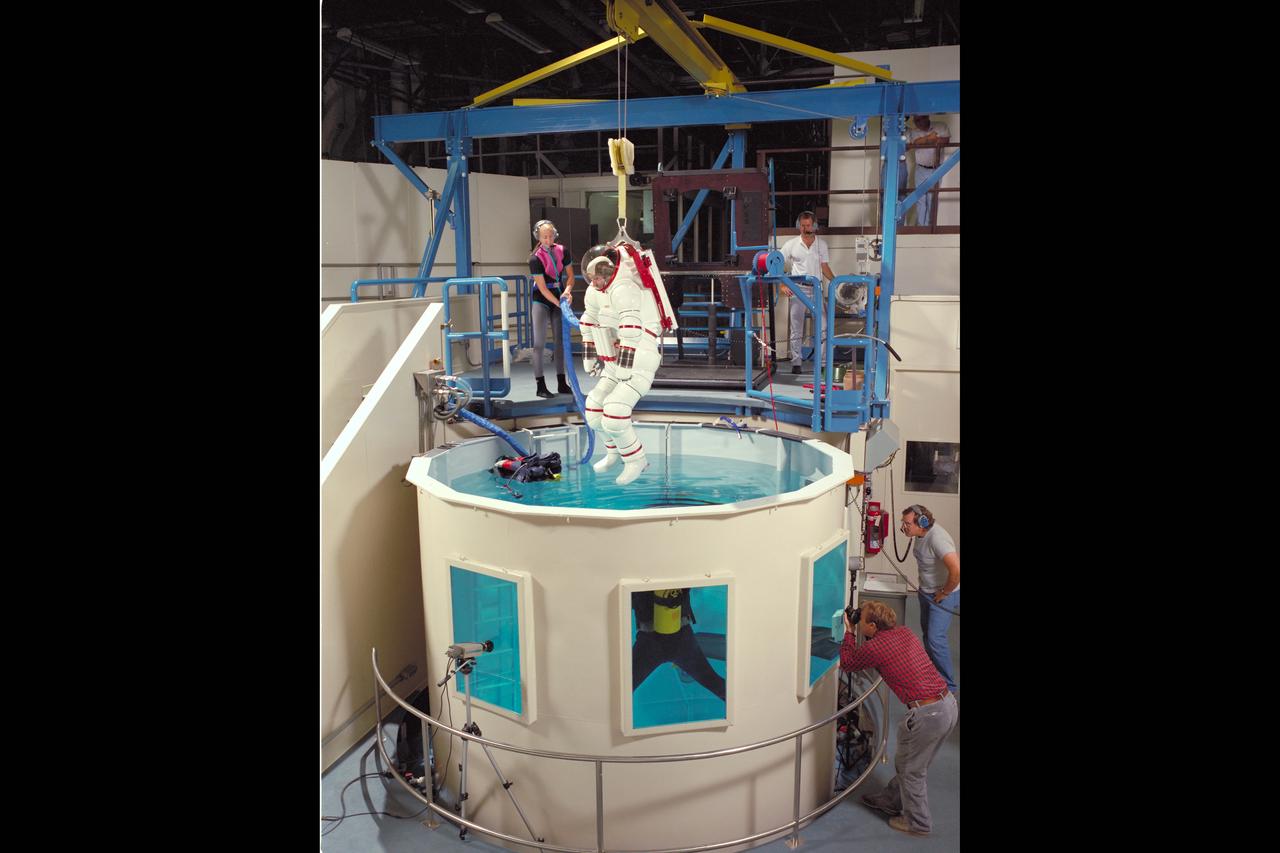
AX-5 SPACE SUIT TESTING AMES NEUTRAL BUOYANCY TANK (NBT) WITH VIC VYKUKAL
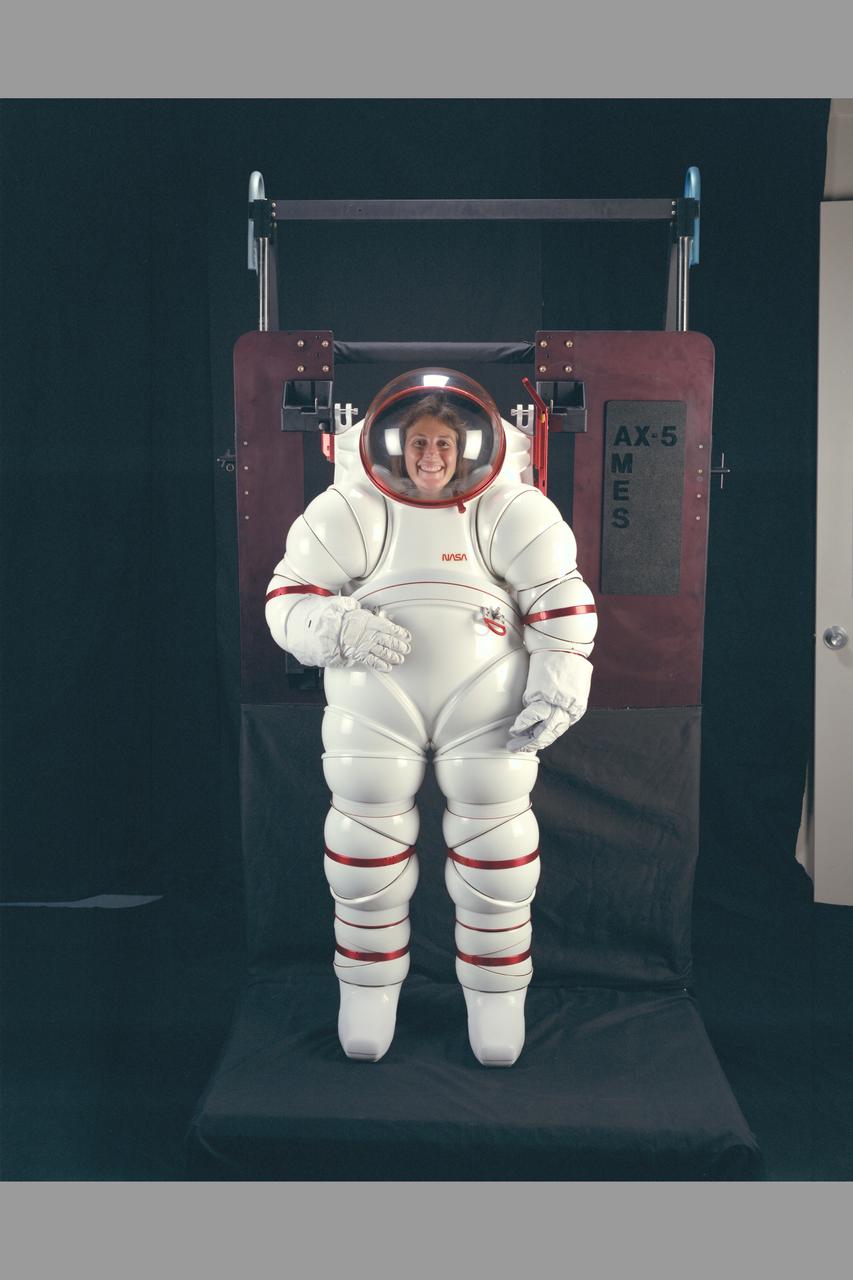
AX-5 Space Suit (Hardsuit) attached to donning stand: This demonstration of new sizing techniques shows the suit adjusted to accommodate the Astronaut's small size. The hardsuit while maintaining mobility offers the astronaut greater protection from debris, micrometerorite penetration, radiation and thermal loads during EVA operations. Developed by NASA Ames. Designer/engineer Hubert 'Vic' Vykukal
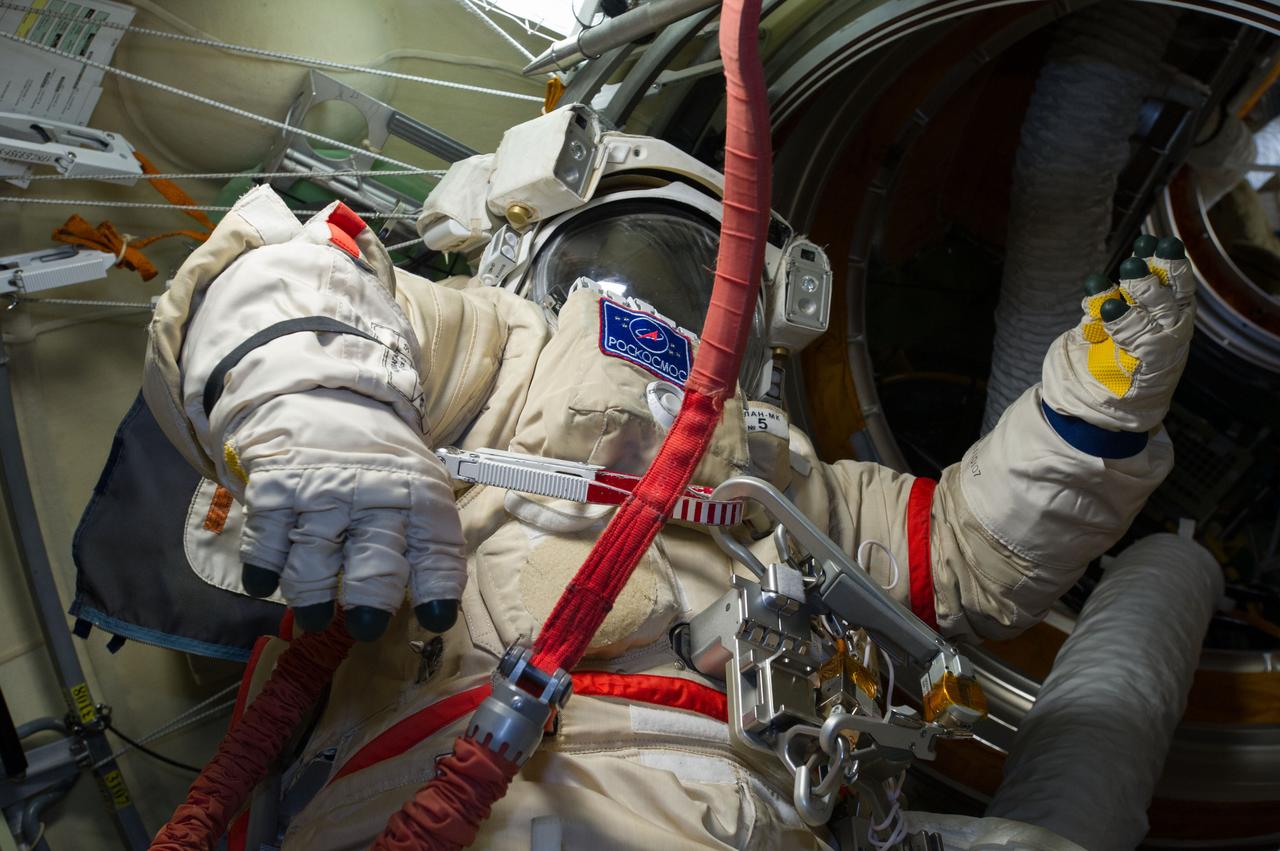
ISS040-E-013827 (17 June 2014) --- This is the Orlan spacesuit of Russian cosmonaut Alexander Skvortsov, Expedition 40 flight engineer. Skvortsov and fellow cosmonaut Oleg Artemyev readied their Russian Orlan suits early on June 17 in preparation for a scheduled spacewalk on June 19.
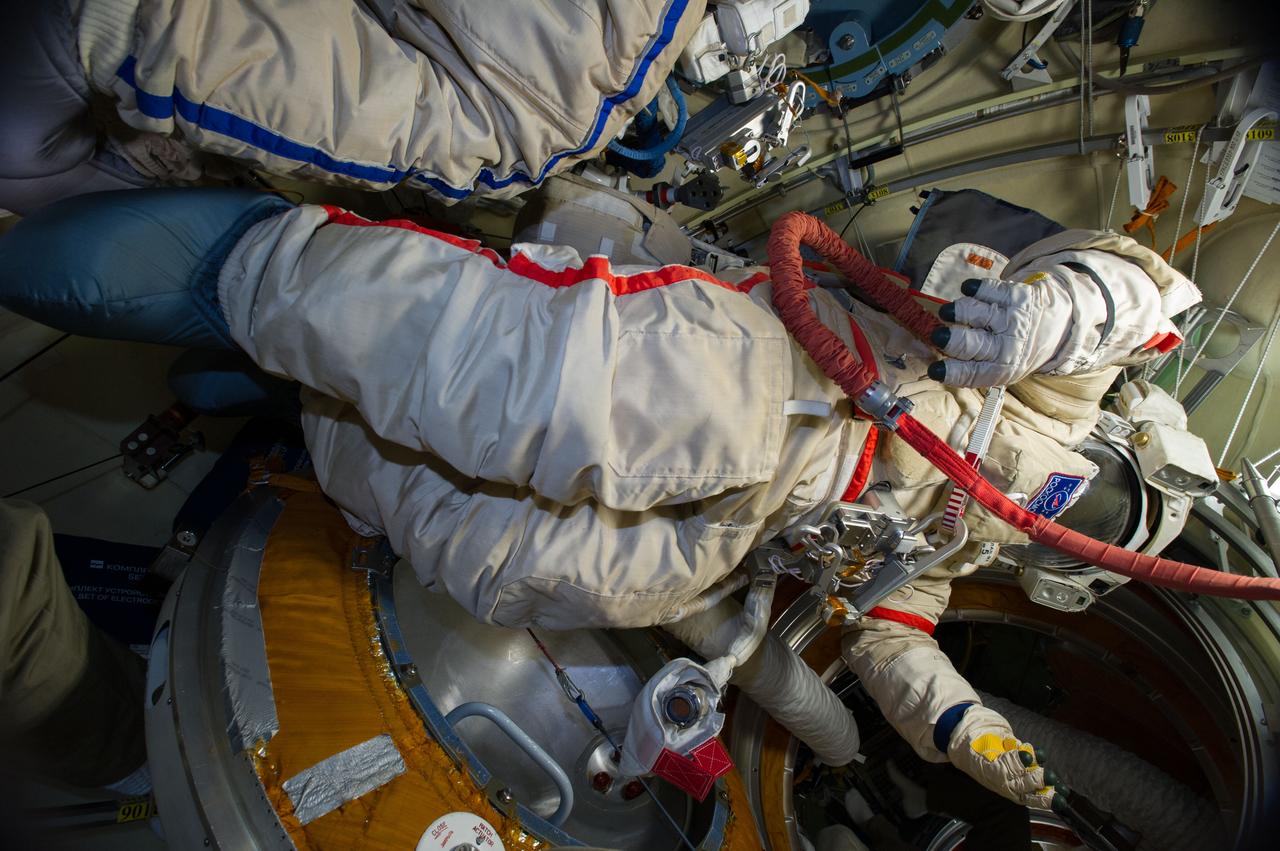
ISS040-E-013826 (17 June 2014) --- This is the Orlan spacesuit of Russian cosmonaut Alexander Skvortsov, Expedition 40 flight engineer. Skvortsov and fellow cosmonaut Oleg Artemyev readied their Russian Orlan suits early on June 17 in preparation for a scheduled spacewalk on June 19.
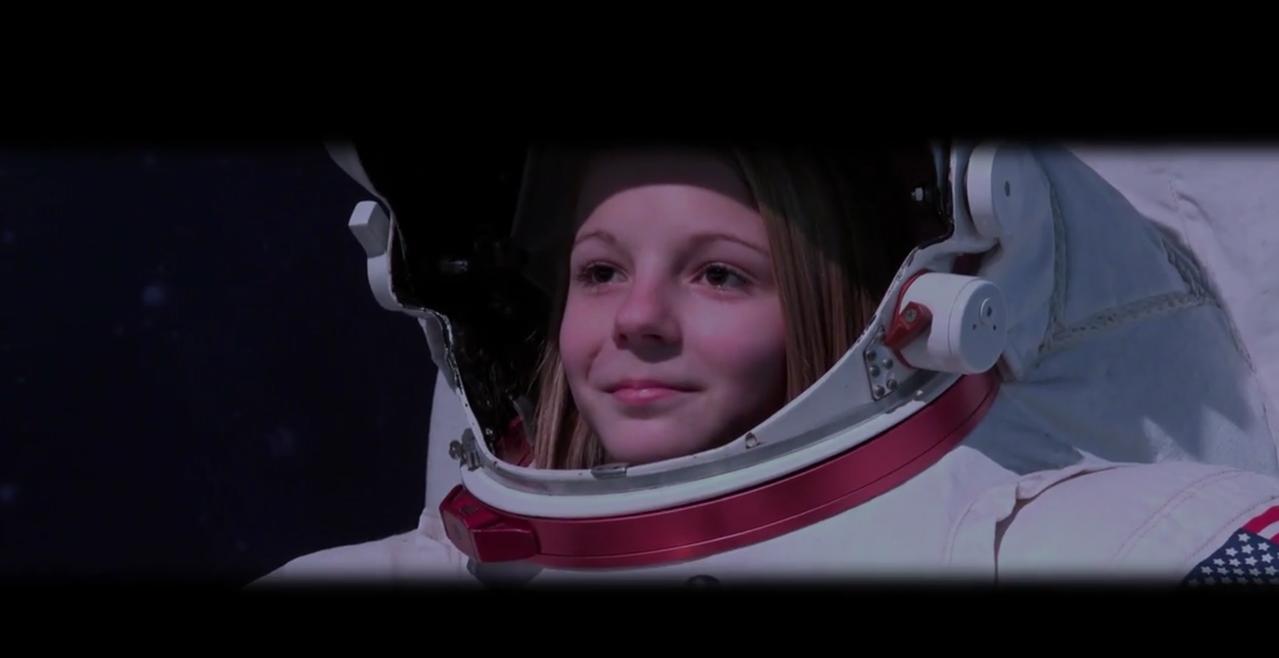
Young girl in astronaut suit, looking out into space.
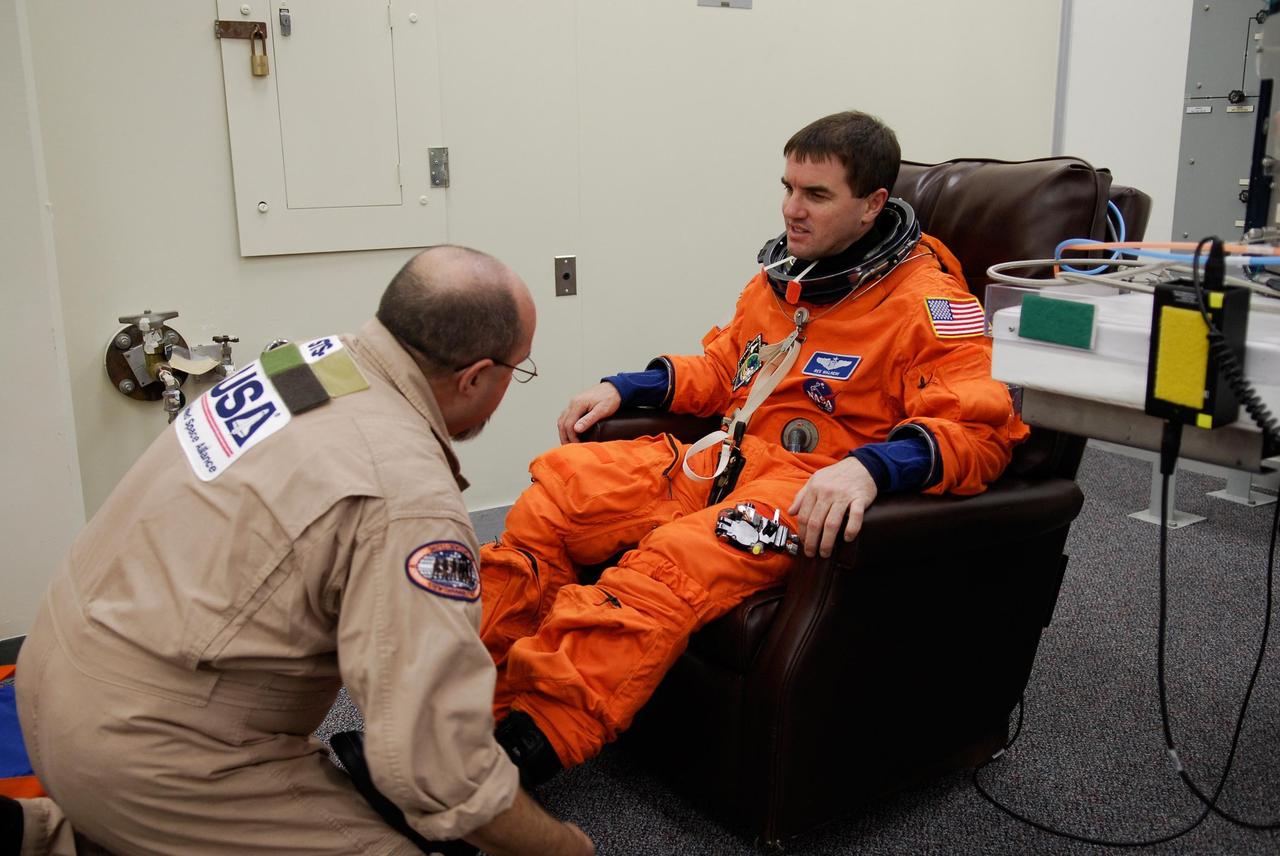
KENNEDY SPACE CENTER, FLA. -- A suit technician helps Space shuttle Atlantis STS-122 Mission Specialist Rex Walheim put on his launch and entry suit, preparing for launch. The fitting is part of terminal countdown demonstration test, or TCDT, activities the crew is undertaking at NASA's Kennedy Space Center. The TCDT provides astronauts and ground crews with equipment familiarization, emergency egress training and a simulated launch countdown. On mission STS-122, Atlantis will deliver the Columbus module to the International Space Station. The European Space Agency's largest single contribution to the station, Columbus is a multifunctional, pressurized laboratory that will be permanently attached to U.S. Node 2, called Harmony. The laboratory will expand the research facilities aboard the station, providing crew members and scientists from around the world the ability to conduct a variety of experiments in the physical, materials and life sciences. Launch is targeted for Dec. 6. Photo credit: NASA/Kim Shiflett
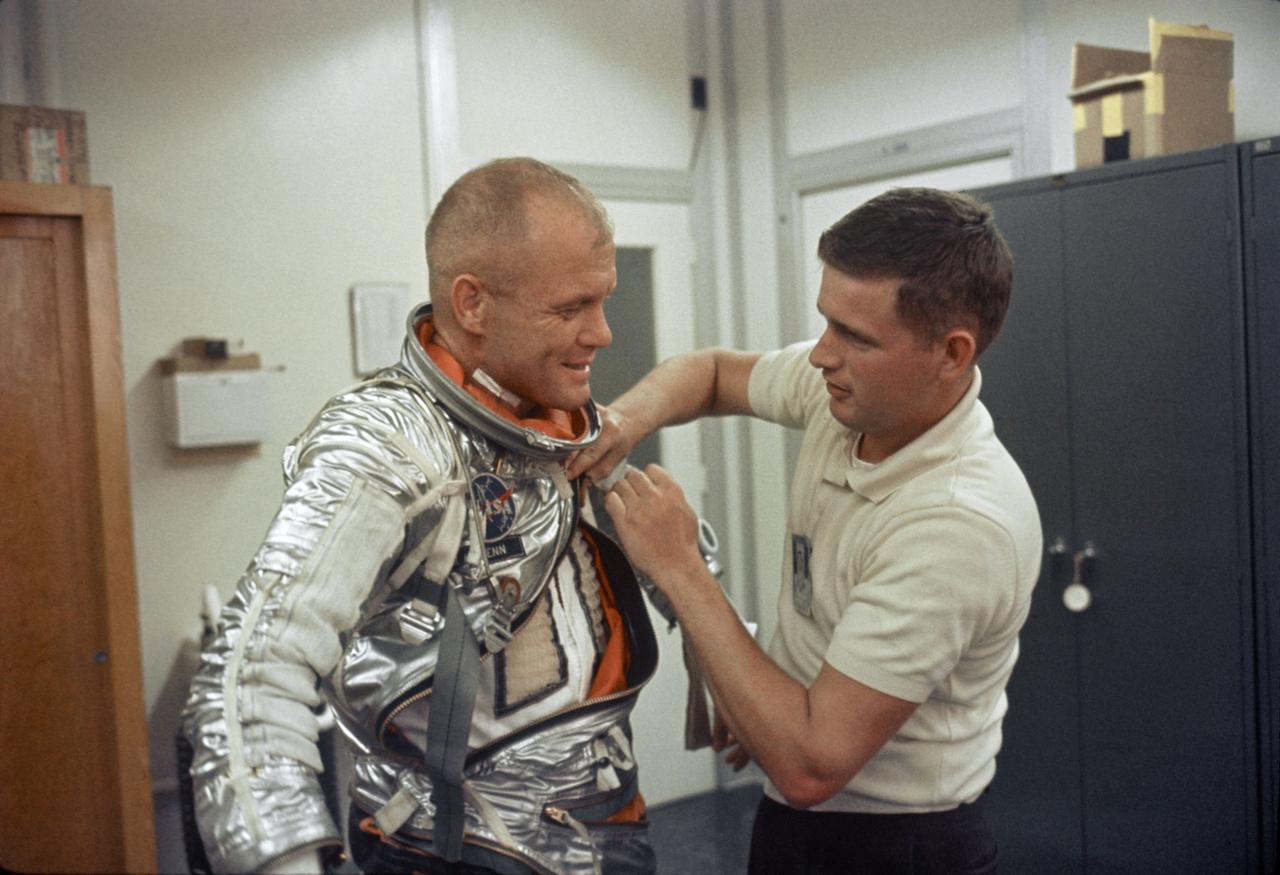
S64-14843 (1962) --- Astronaut John H. Glenn Jr., pilot of the Mercury-Atlas 6 Earth-orbital space mission, is suited up at Cape Canaveral, Florida, during MA-6 preflight activities. Assisting Glenn is suit technician Al Rochford. Photo credit: NASA
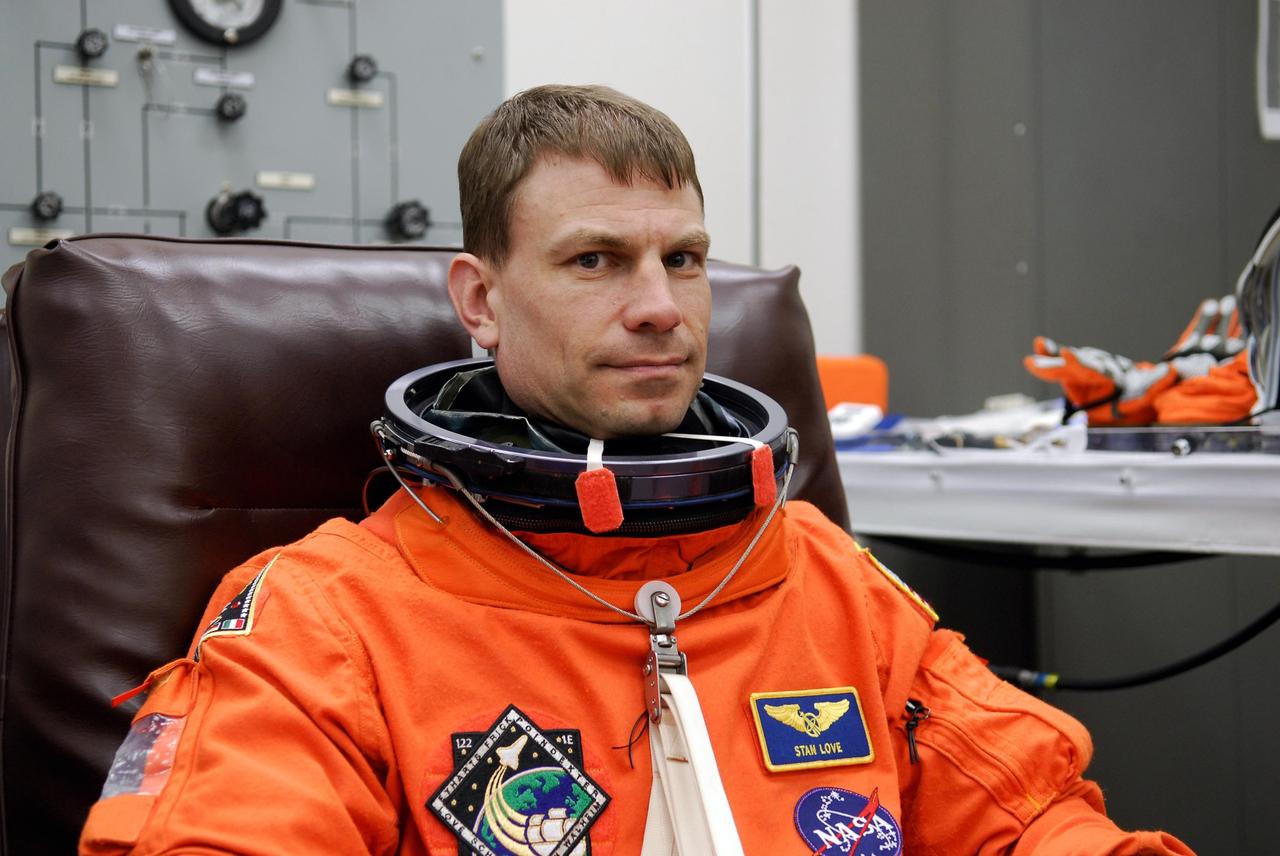
KENNEDY SPACE CENTER, FLA. -- Space shuttle Atlantis STS-122 Mission Specialist Stanley Love tries on his launch and entry suit, preparing for launch. The fitting is part of terminal countdown demonstration test, or TCDT, activities the crew is undertaking at NASA's Kennedy Space Center. The TCDT provides astronauts and ground crews with equipment familiarization, emergency egress training and a simulated launch countdown. On mission STS-122, Atlantis will deliver the Columbus module to the International Space Station. The European Space Agency's largest single contribution to the station, Columbus is a multifunctional, pressurized laboratory that will be permanently attached to U.S. Node 2, called Harmony. The laboratory will expand the research facilities aboard the station, providing crew members and scientists from around the world the ability to conduct a variety of experiments in the physical, materials and life sciences. Launch is targeted for Dec. 6. Photo credit: NASA/Kim Shiflett
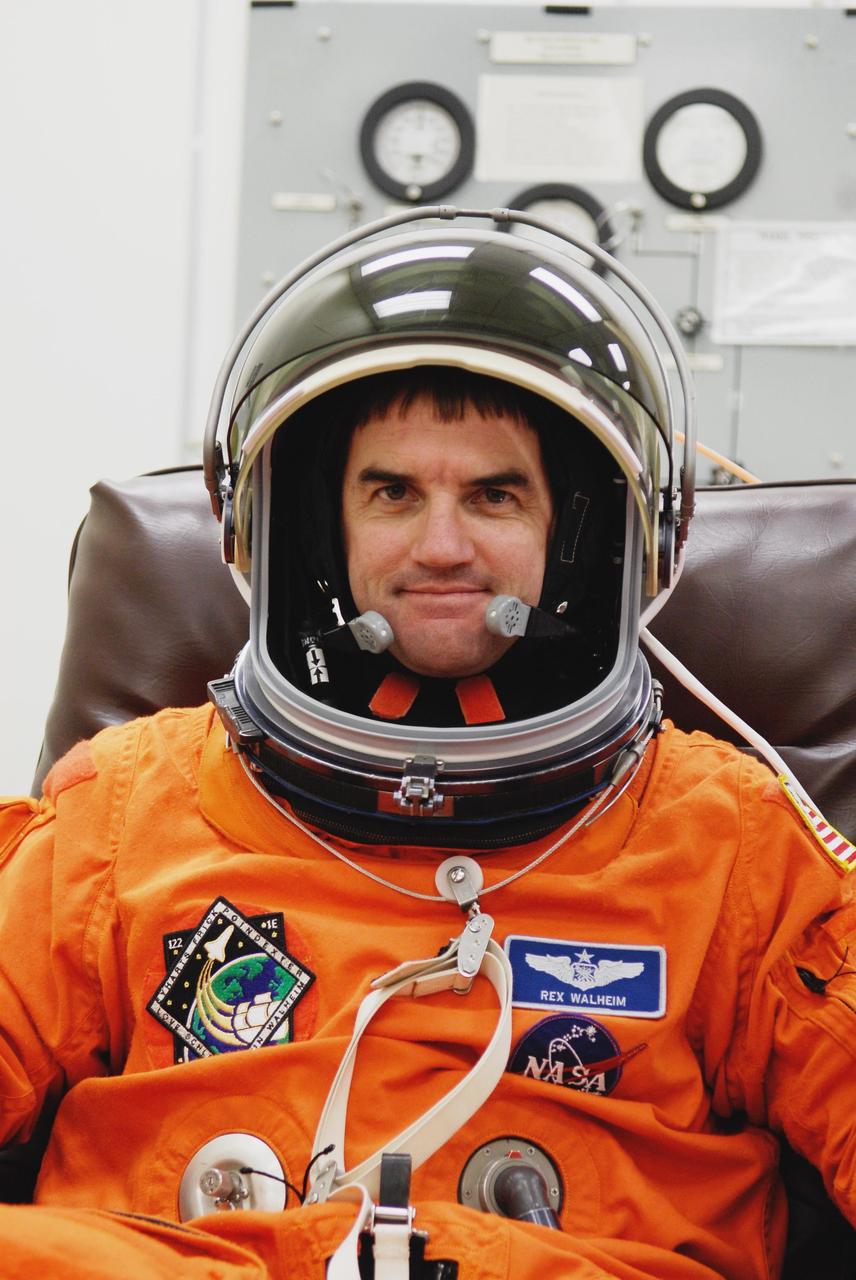
KENNEDY SPACE CENTER, FLA. -- Space shuttle Atlantis STS-122 Mission Specialist Rex Walheim has his helmet fitted on his launch and entry suit, preparing for launch. The fitting is part of terminal countdown demonstration test, or TCDT, activities the crew is undertaking at NASA's Kennedy Space Center. The TCDT provides astronauts and ground crews with equipment familiarization, emergency egress training and a simulated launch countdown. On mission STS-122, Atlantis will deliver the Columbus module to the International Space Station. The European Space Agency's largest single contribution to the station, Columbus is a multifunctional, pressurized laboratory that will be permanently attached to U.S. Node 2, called Harmony. The laboratory will expand the research facilities aboard the station, providing crew members and scientists from around the world the ability to conduct a variety of experiments in the physical, materials and life sciences. Launch is targeted for Dec. 6. Photo credit: NASA/Kim Shiflett
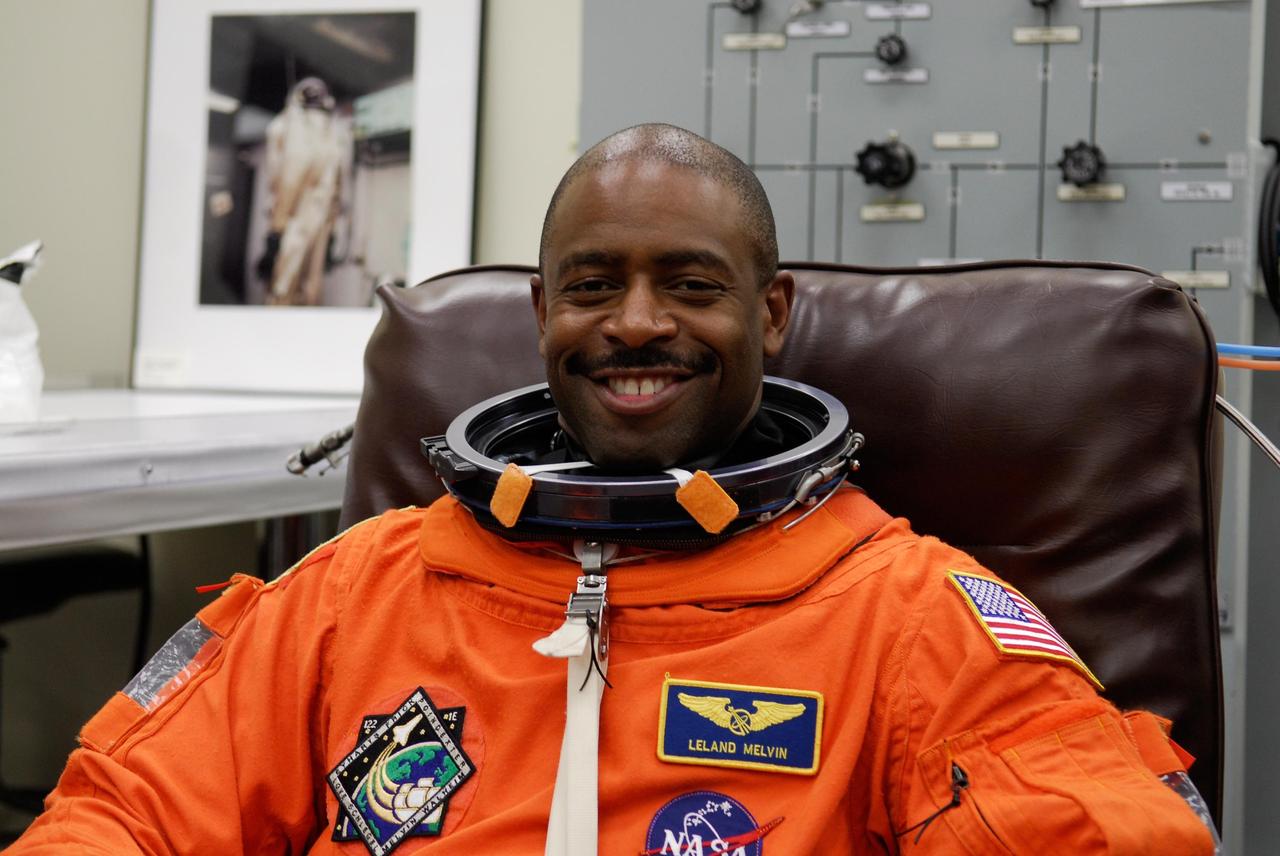
KENNEDY SPACE CENTER, FLA. -- Space shuttle Atlantis STS-122 Mission Specialist Leland Melvin tries on his launch and entry suit, preparing for launch. The fitting is part of terminal countdown demonstration test, or TCDT, activities the crew is undertaking at NASA's Kennedy Space Center. The TCDT provides astronauts and ground crews with equipment familiarization, emergency egress training and a simulated launch countdown. On mission STS-122, Atlantis will deliver the Columbus module to the International Space Station. The European Space Agency's largest single contribution to the station, Columbus is a multifunctional, pressurized laboratory that will be permanently attached to U.S. Node 2, called Harmony. The laboratory will expand the research facilities aboard the station, providing crew members and scientists from around the world the ability to conduct a variety of experiments in the physical, materials and life sciences. Launch is targeted for Dec. 6. Photo credit: NASA/Kim Shiflett
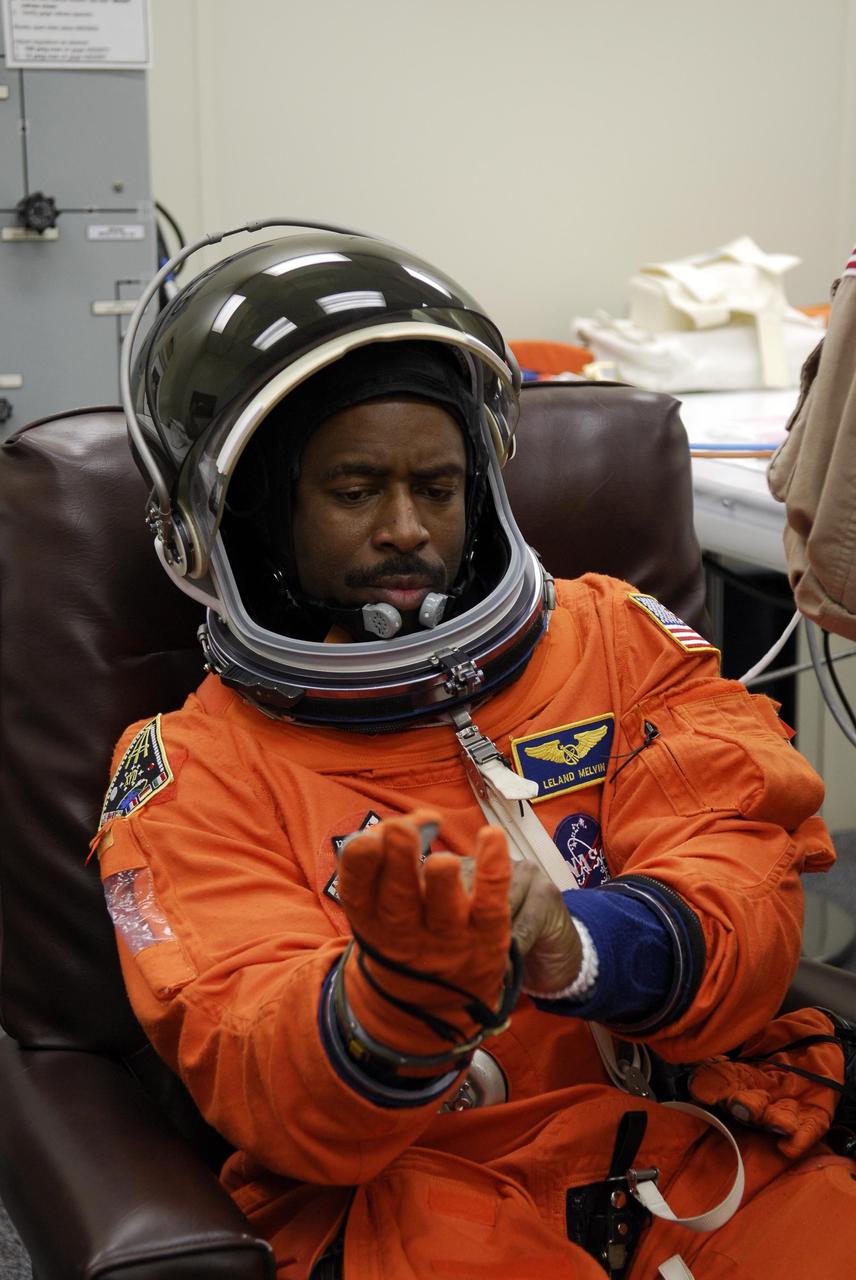
KENNEDY SPACE CENTER, FLA. -- Space shuttle Atlantis STS-122 Mission Specialist Leland Melvin tries on the gloves of his launch and entry suit, preparing for launch. The fitting is part of terminal countdown demonstration test, or TCDT, activities the crew is undertaking at NASA's Kennedy Space Center. The TCDT provides astronauts and ground crews with equipment familiarization, emergency egress training and a simulated launch countdown. On mission STS-122, Atlantis will deliver the Columbus module to the International Space Station. The European Space Agency's largest single contribution to the station, Columbus is a multifunctional, pressurized laboratory that will be permanently attached to U.S. Node 2, called Harmony. The laboratory will expand the research facilities aboard the station, providing crew members and scientists from around the world the ability to conduct a variety of experiments in the physical, materials and life sciences. Launch is targeted for Dec. 6. Photo credit: NASA/Kim Shiflett
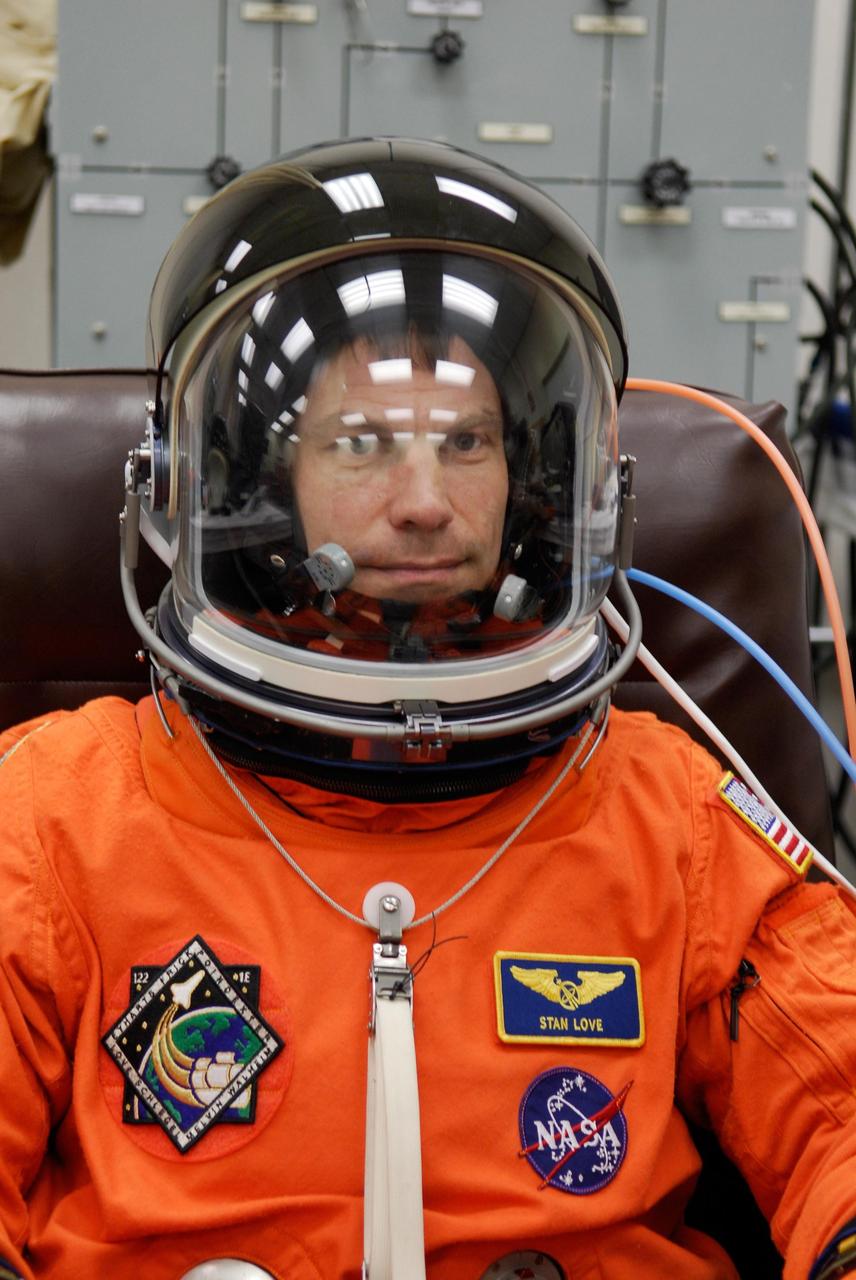
KENNEDY SPACE CENTER, FLA. -- Space shuttle Atlantis STS-122 Mission Specialist Stanley Love has his helmet fitted on his launch and entry suit, preparing for launch. The fitting is part of terminal countdown demonstration test, or TCDT, activities the crew is undertaking at NASA's Kennedy Space Center. The TCDT provides astronauts and ground crews with equipment familiarization, emergency egress training and a simulated launch countdown. On mission STS-122, Atlantis will deliver the Columbus module to the International Space Station. The European Space Agency's largest single contribution to the station, Columbus is a multifunctional, pressurized laboratory that will be permanently attached to U.S. Node 2, called Harmony. The laboratory will expand the research facilities aboard the station, providing crew members and scientists from around the world the ability to conduct a variety of experiments in the physical, materials and life sciences. Launch is targeted for Dec. 6. Photo credit: NASA/Kim Shiflett
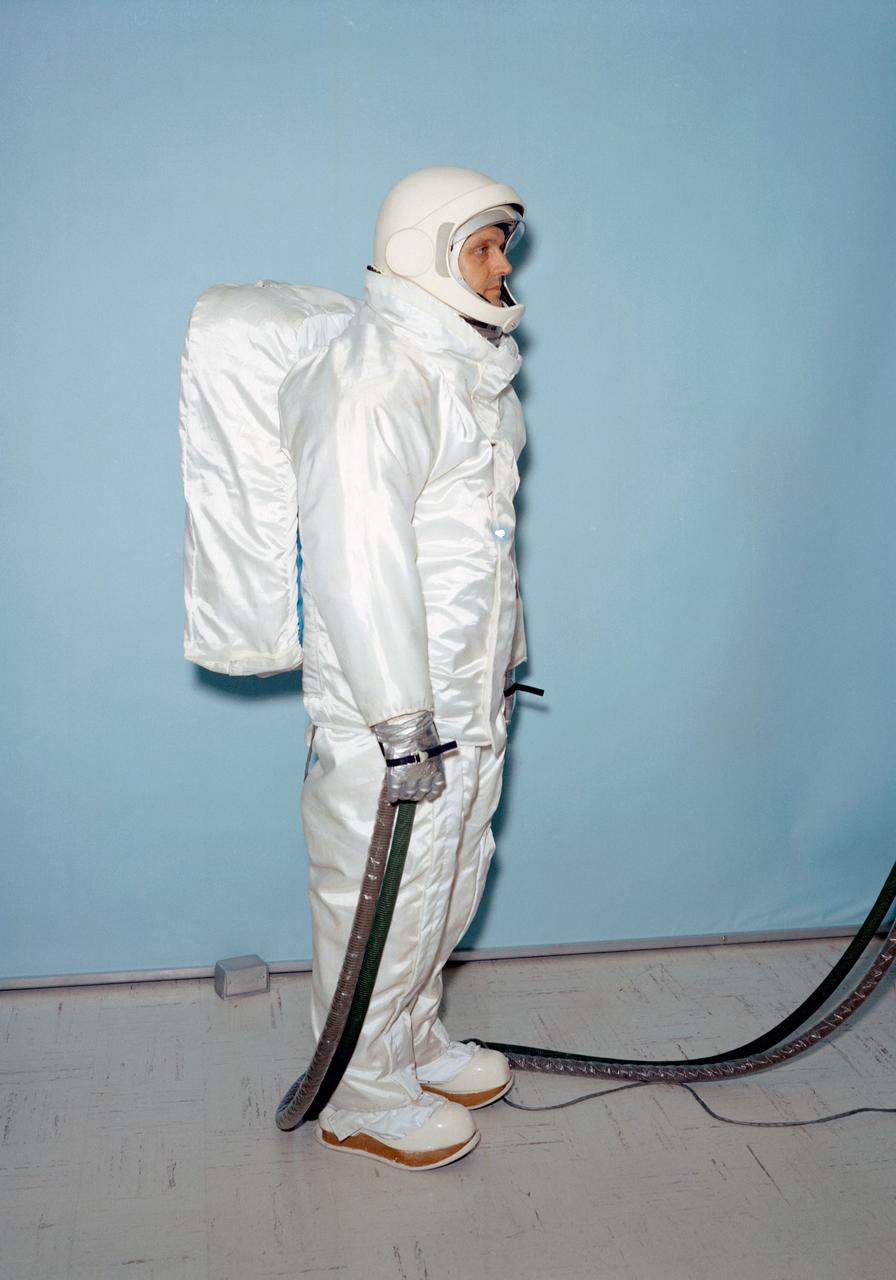
Test subject wears Apollo overgarment designed specially for use by astronauts on lunar surface missions. The overgarment is worn over the Apollo space suit.
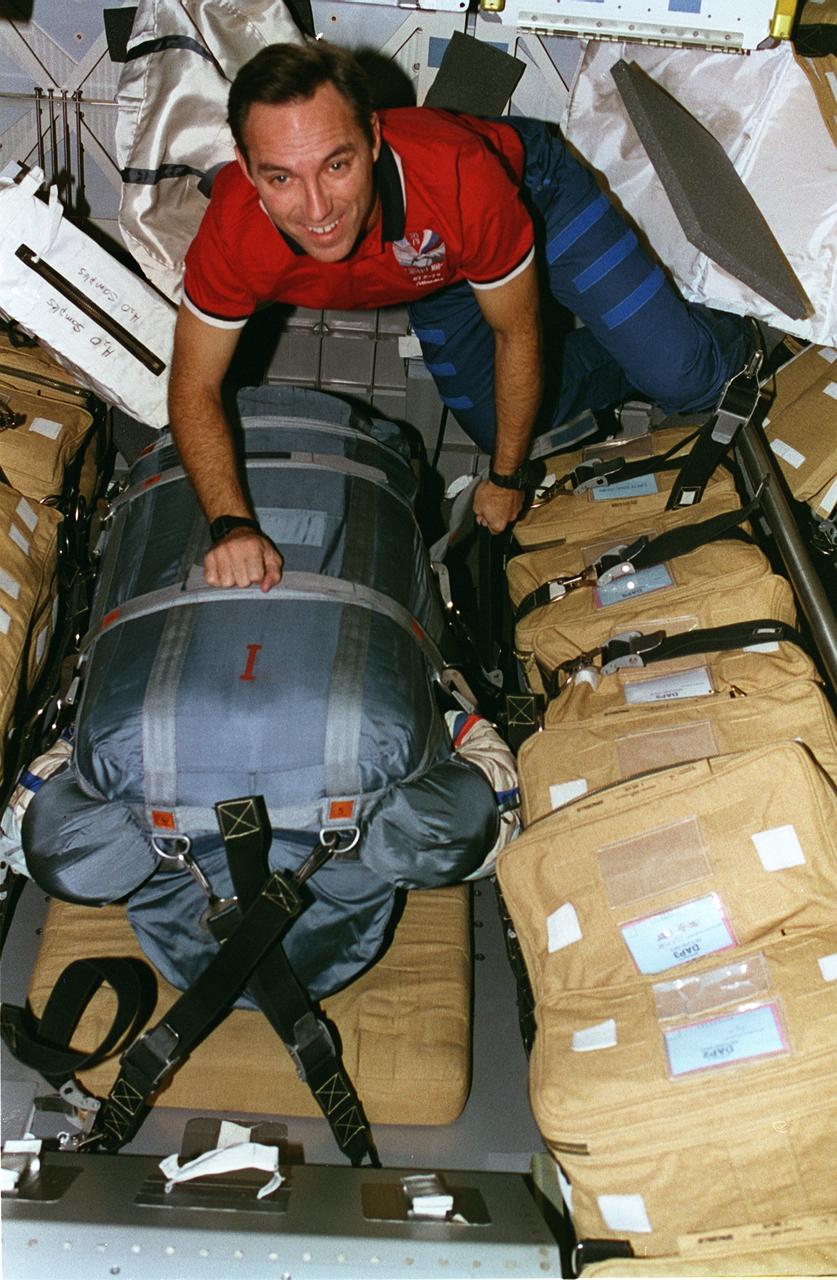
STS079-304-001 (16 Sept. 1996)--- Astronaut Carl E. Walz totes a bag carrying a space suit used by the cosmonauts. At the completion of the STS-79 mission, the suit was brought back to Earth for analysis. This photograph is one of fifteen 35mm frames (along with four 70mm frames) of still photography documenting the activities of NASA's STS-79 mission, which began with a September 16, 1996, liftoff from Launch Pad 39A the Kennedy Space Center (KSC) and ended with a landing at KSC on September 26, 1996. Onboard for the launch were astronauts William F. Readdy, commander; Terrence W. Wilcutt, pilot; John E. Blaha, Jerome (Jay) Apt, Thomas D. Akers and Walz, all mission specialists. On flight day 4, the crew docked with Russia's Mir Space Station. Shannon W. Lucid, who had spent six months aboard Mir, switched cosmonaut guest researcher roles with Blaha. The latter joined fellow Mir-22 crew members Valeri G. Korzun, commander, and Aleksandr Y. Kaleri, flight engineer.
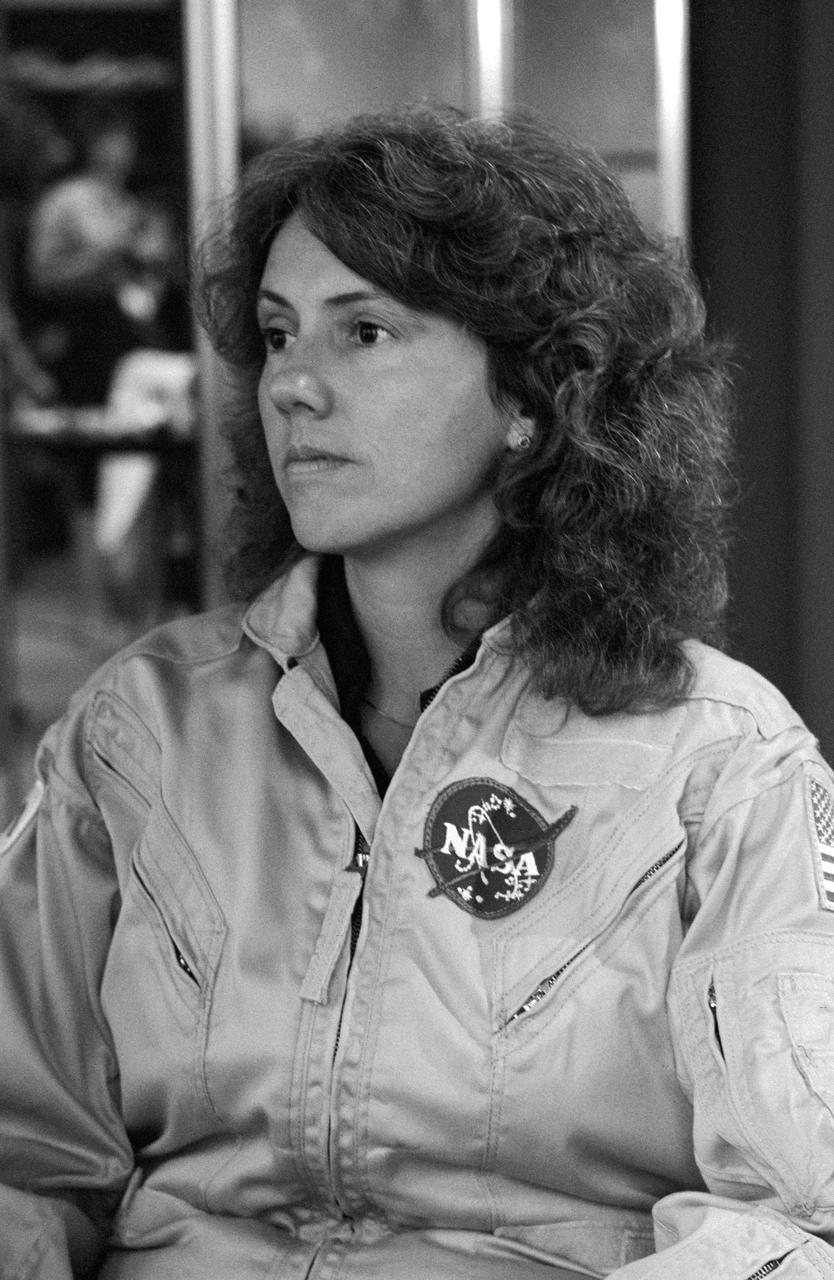
S85-40075 (12 Sept. 1985) --- Teacher-in-Space participant Christa McAuliffe is pictured during her briefing on suit and personal hygiene equipment to be used on the STS-51L mission. Photo credit: NASA
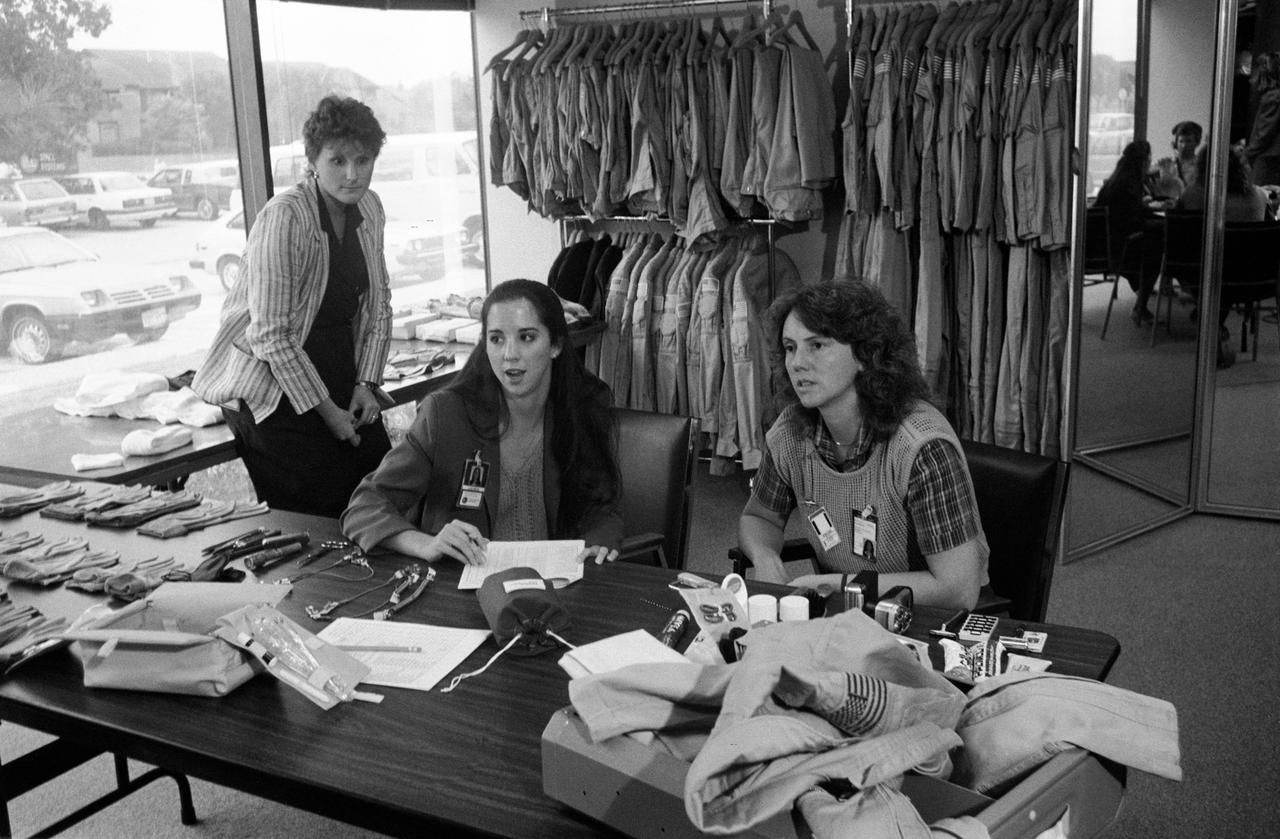
Teacherin-Space participant Christa McAuliffe (right) is briefed on her suit and on personal hygiene equipment to be used on the STS 51L Mission. The briefing was conducted by Laura Louviere (center).
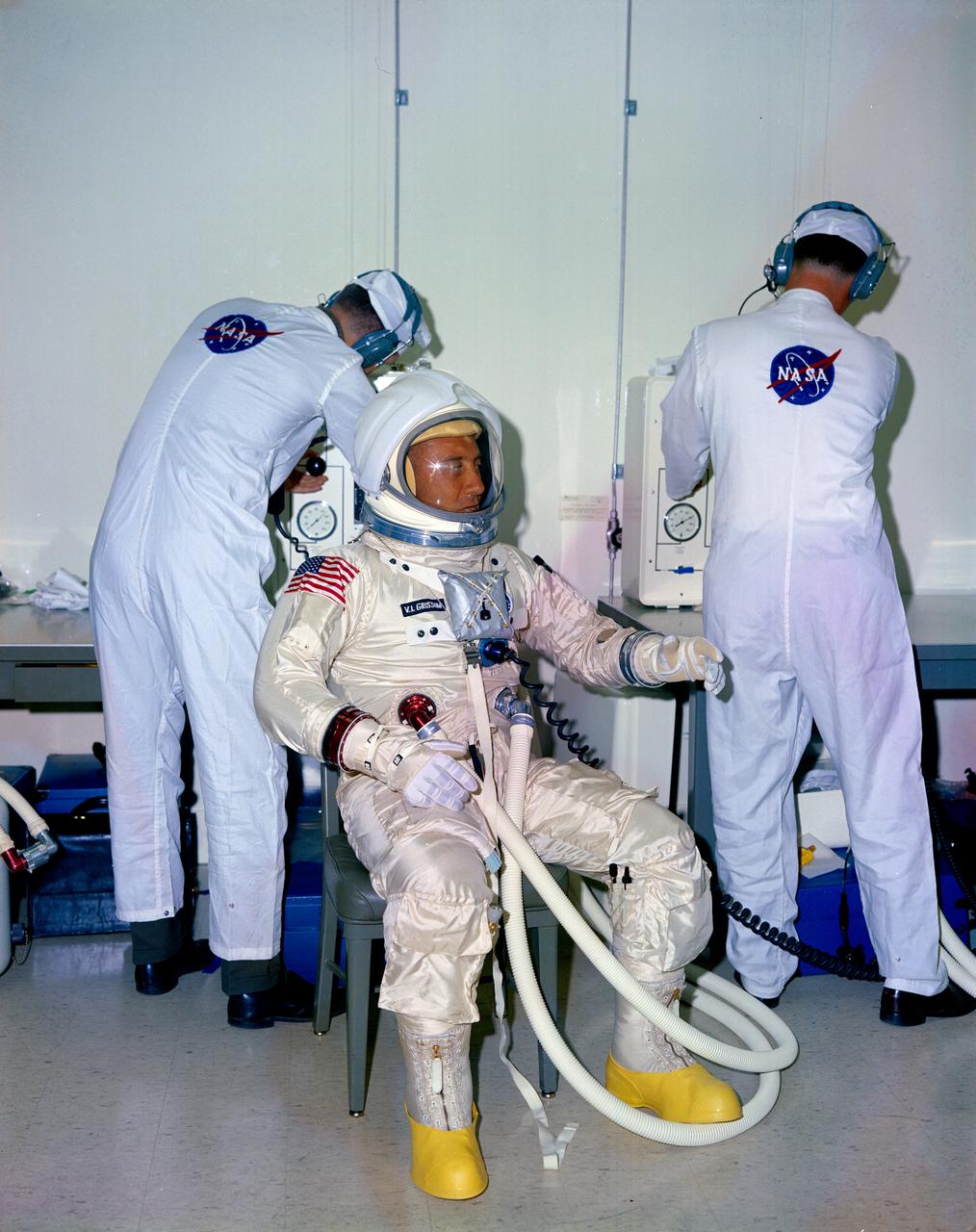
S66-58023 (1966) --- NASA suit technicians assist astronaut Virgil I. Grissom during suiting operations prior to tests at the Kennedy Space Center.

jsc2026e037769 (May 5, 2026) --- CSA (Canadian Space Agency) astronaut Josh Kutryk practices suiting up in a spacesuit in an International Space Station airlock simulator at Johnson Space Center’s (JSC) Space Vehicle Mockup Facility in Houston, Texas. Astronauts familiarize themselves with spacesuit systems and procedures and practice Quest airlock operations before conducting spacewalk training at JSC’s Neutral Buoyancy Laboratory in simulated microgravity. Credit: NASA/Josh Valcarcel
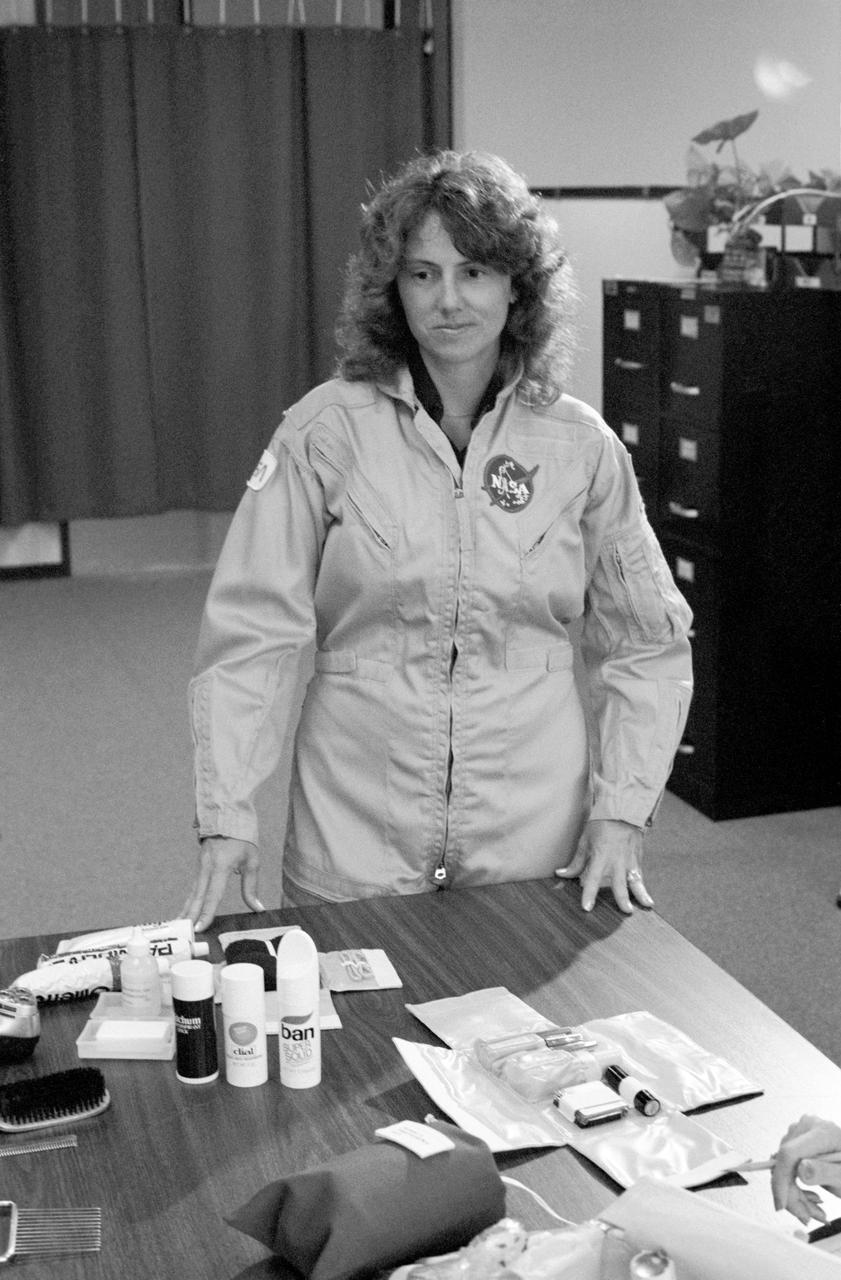
Teacher-in-Space Participant Christa McAuliffe is briefed on her suit and on personal hygiene equipment to be used on the STS 51L Mission. She is standing in front of a table with several of the items to be used on the flight, including one can labeled DIAL and one can labeled BAN.
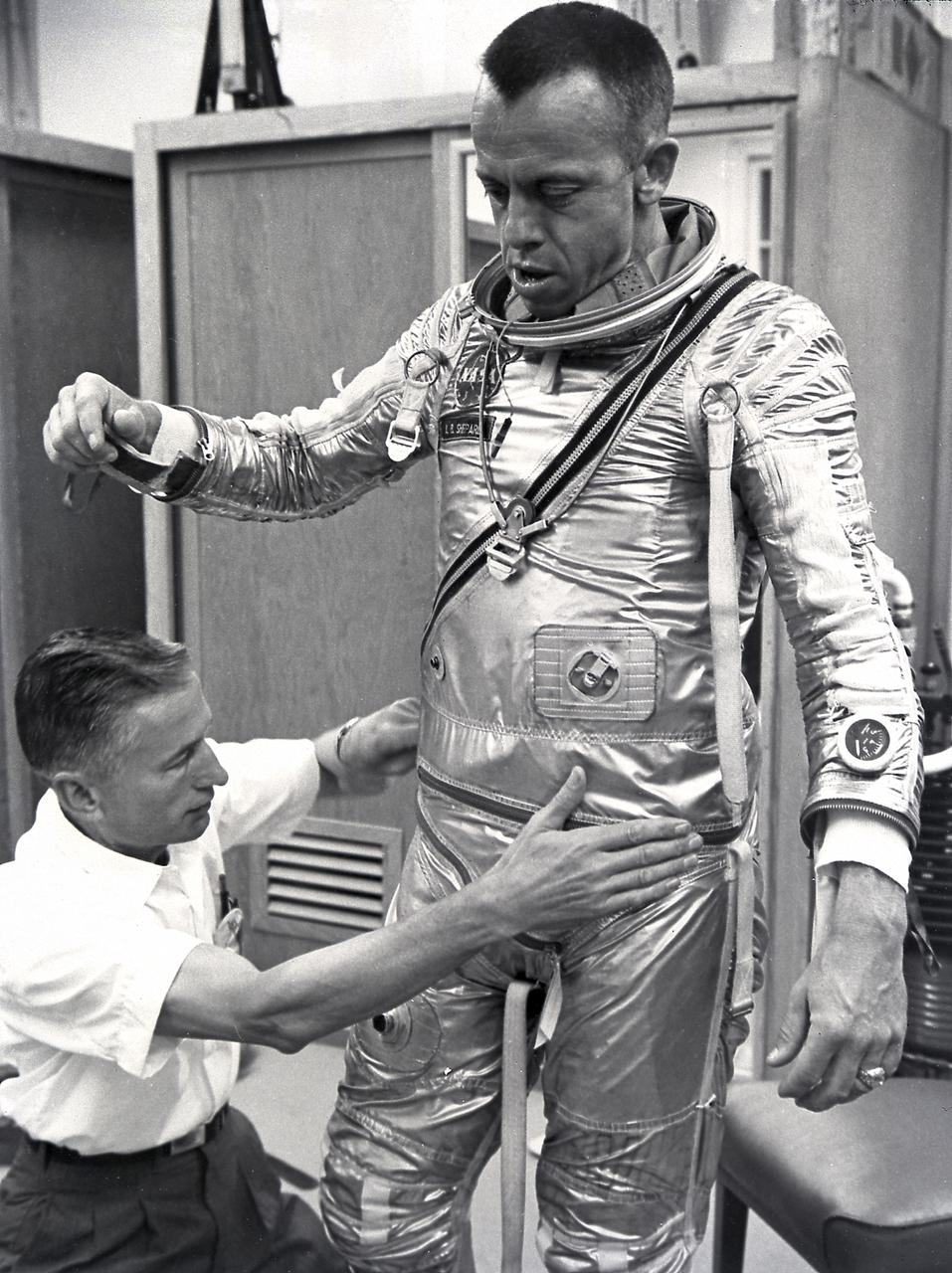
Astronaut Alan Shepard fitted with space suit prior to the first marned suborbital flight. Freedom 7, carrying Astronaut Alan Shepard, boosted by the Mercury-Redstone launch vehicle, lifted off on May 5, 1961. Astronaut Shepard became the first American in space.
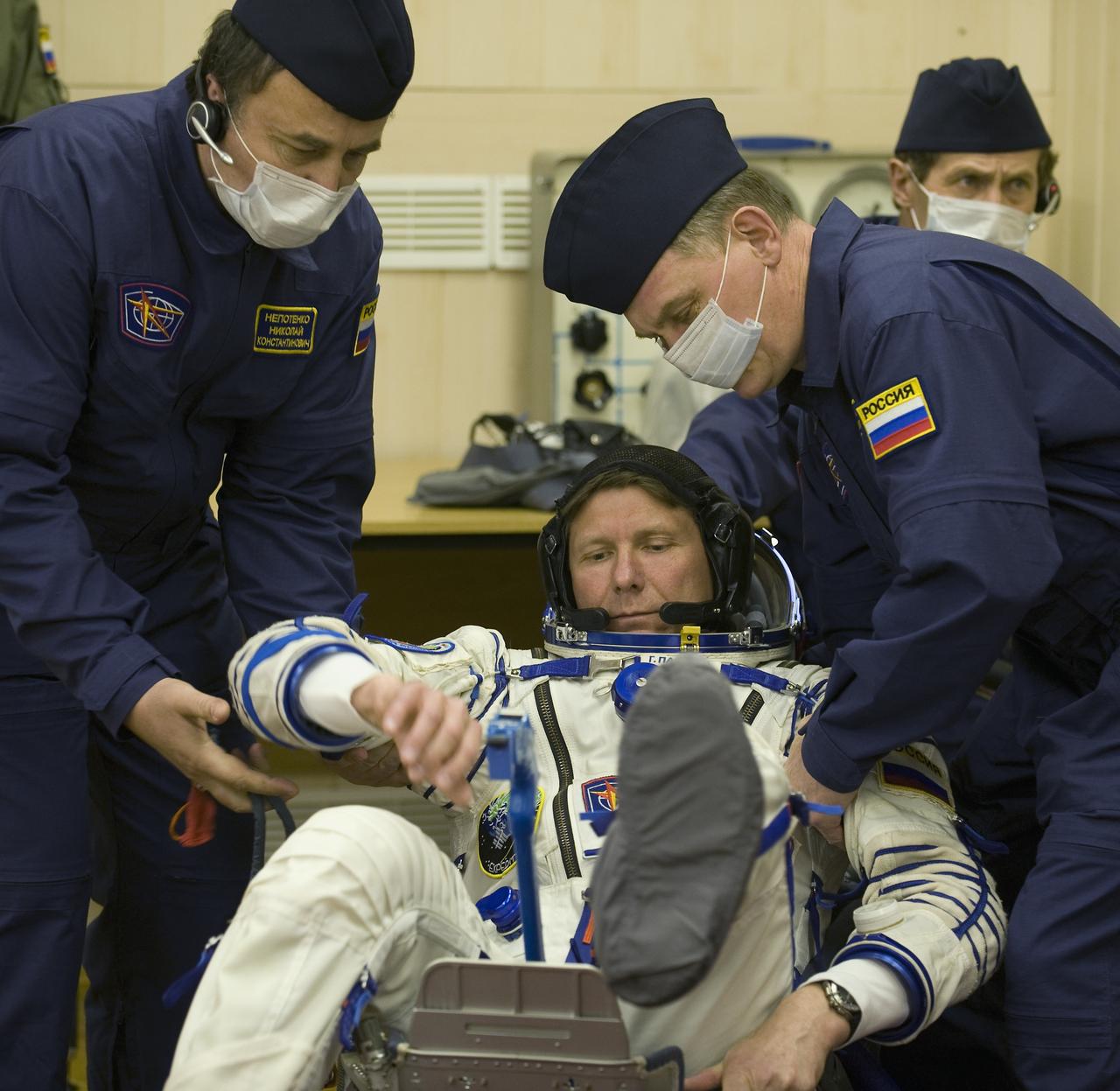
Expedition 19 Commander Gennady I. Padalka is helped into a seat where his suit will be pressure checked in preparation for his Soyuz launch to the International Space Station with Flight Engineer Michael R. Barratt and Spaceflight Participant Charles Simonyi on Thursday, March 26, 2009 in Baikonur, Kazakhstan. (Photo Credit: NASA/Bill Ingalls)
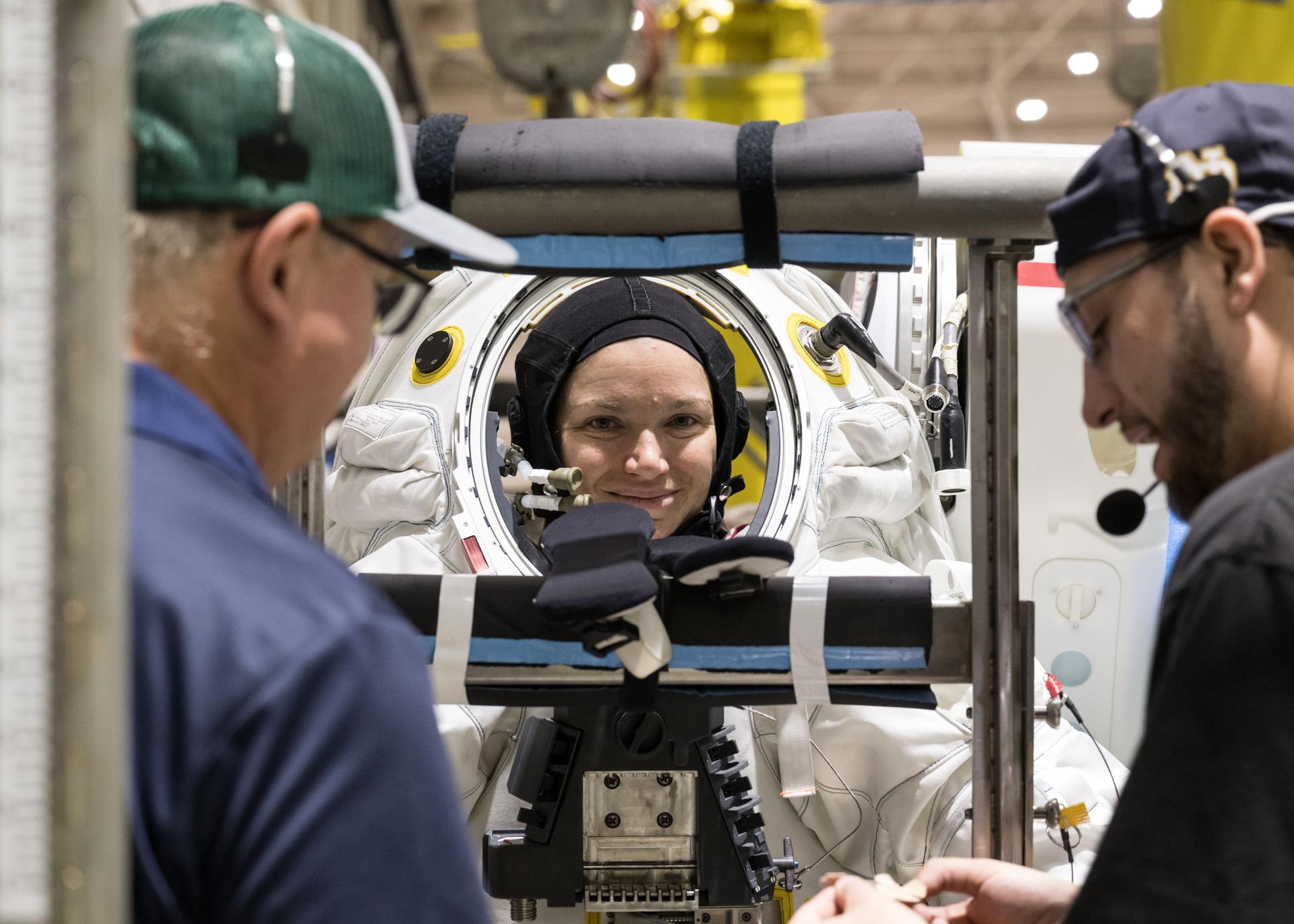
Canadian Space Agency astronaut Jenni Gibbons gets suited up in Axiom Space’s lunar spacesuit at NASA’s Neutral Buoyancy Laboratory in Houston. During a recent test series, NASA engineers and crewmembers wore the lunar spacesuit under water and conducted numerous tasks during simulated lunar operations to test its mobility and functionality and ensure the spacesuit is prepped and ready for Artemis training.
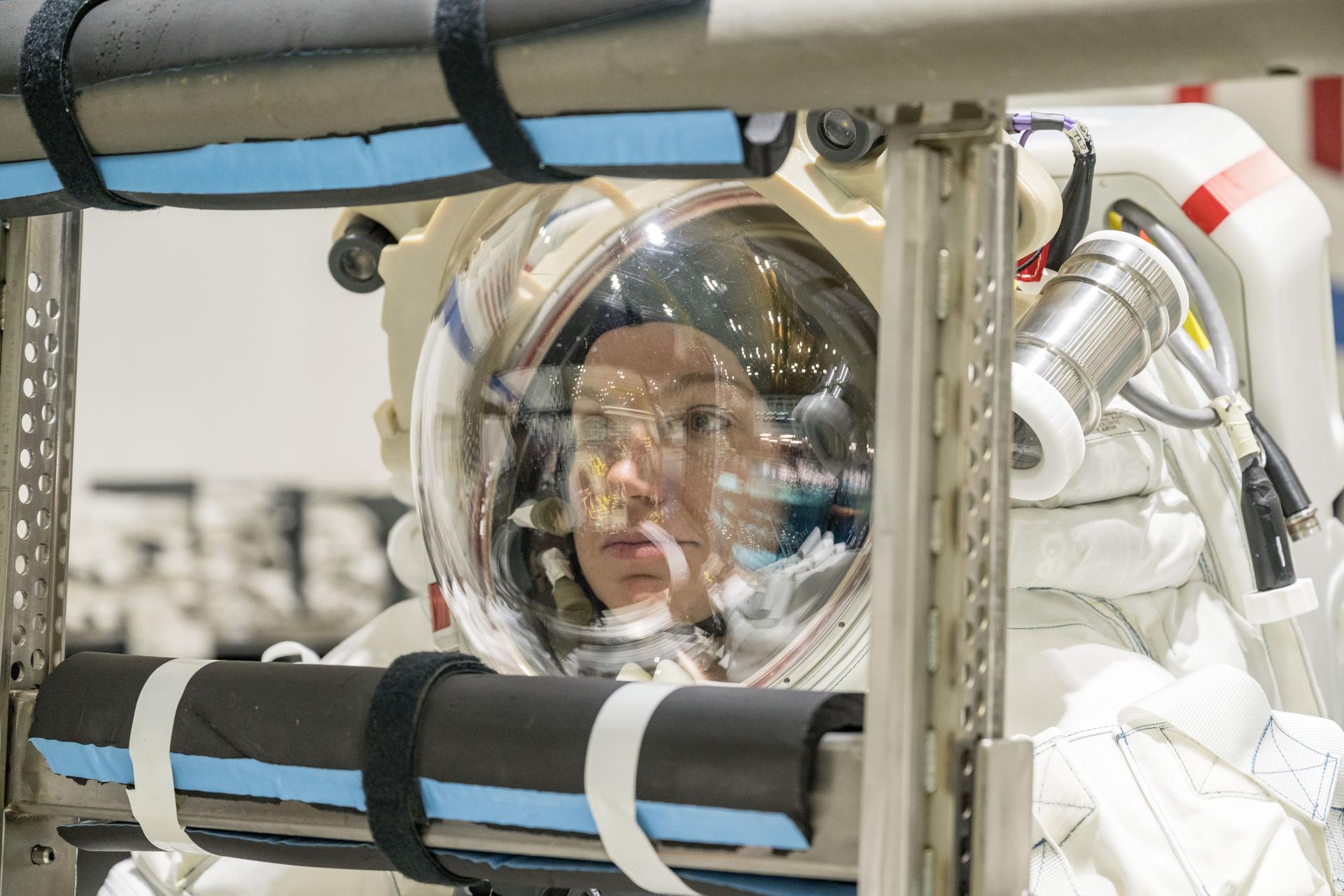
Canadian Space Agency astronaut Jenni Gibbons gets suited up in Axiom Space’s lunar spacesuit at NASA’s Neutral Buoyancy Laboratory in Houston. During a recent test series, NASA engineers and crewmembers wore the lunar spacesuit under water and conducted numerous tasks during simulated lunar operations to test its mobility and functionality and ensure the spacesuit is prepped and ready for Artemis training.
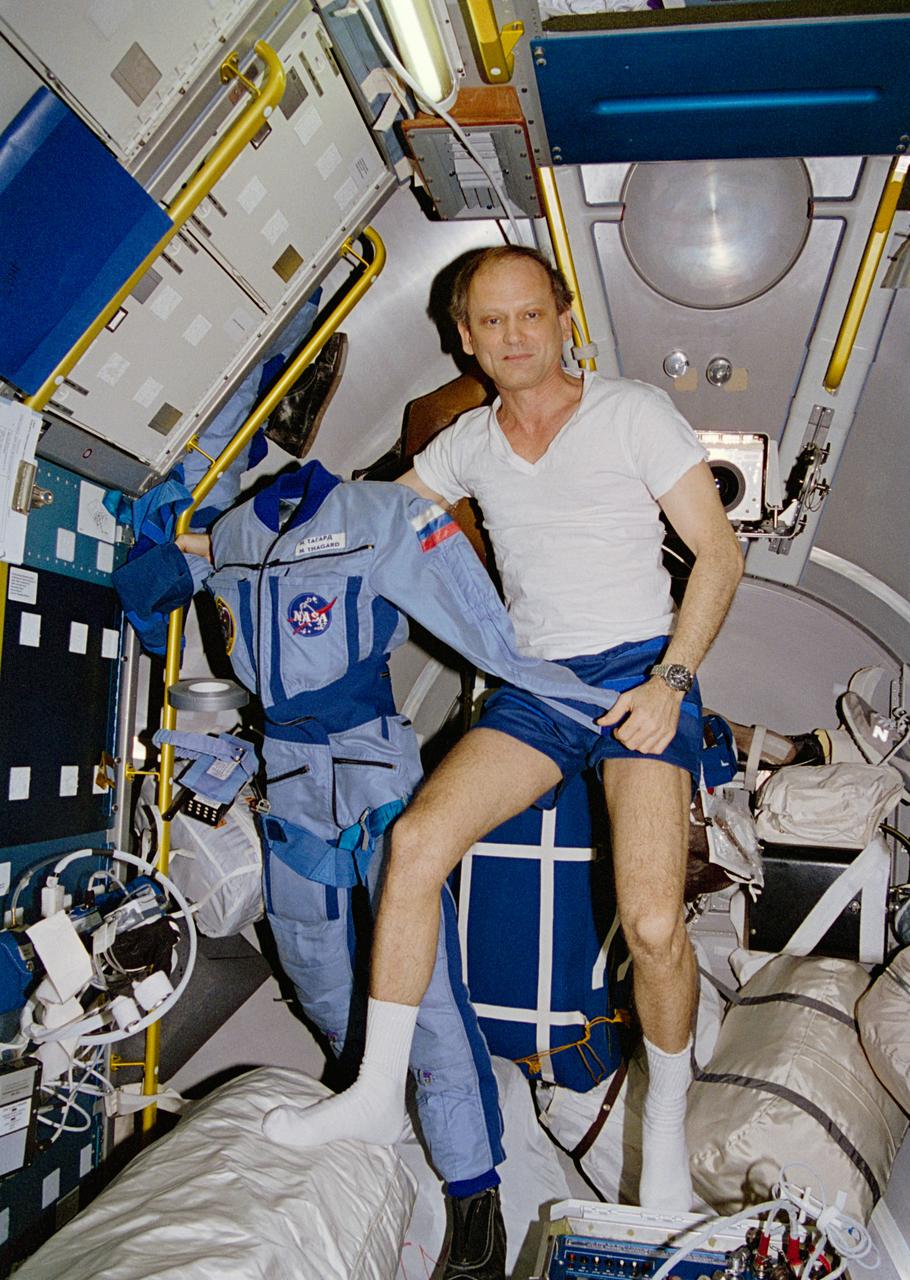
STS071-112-004 (27 June - 7 July 1995) --- Astronaut Norman E. Thagard, displays the flight suit he wore onboard Russia's Mir Space Station during a four month tour of duty as cosmonaut researcher for Mir-18. Thagard is seen in the Spacelab Science Module onboard the Space Shuttle Atlantis, in which he eventually underwent a battery of data collection tests.
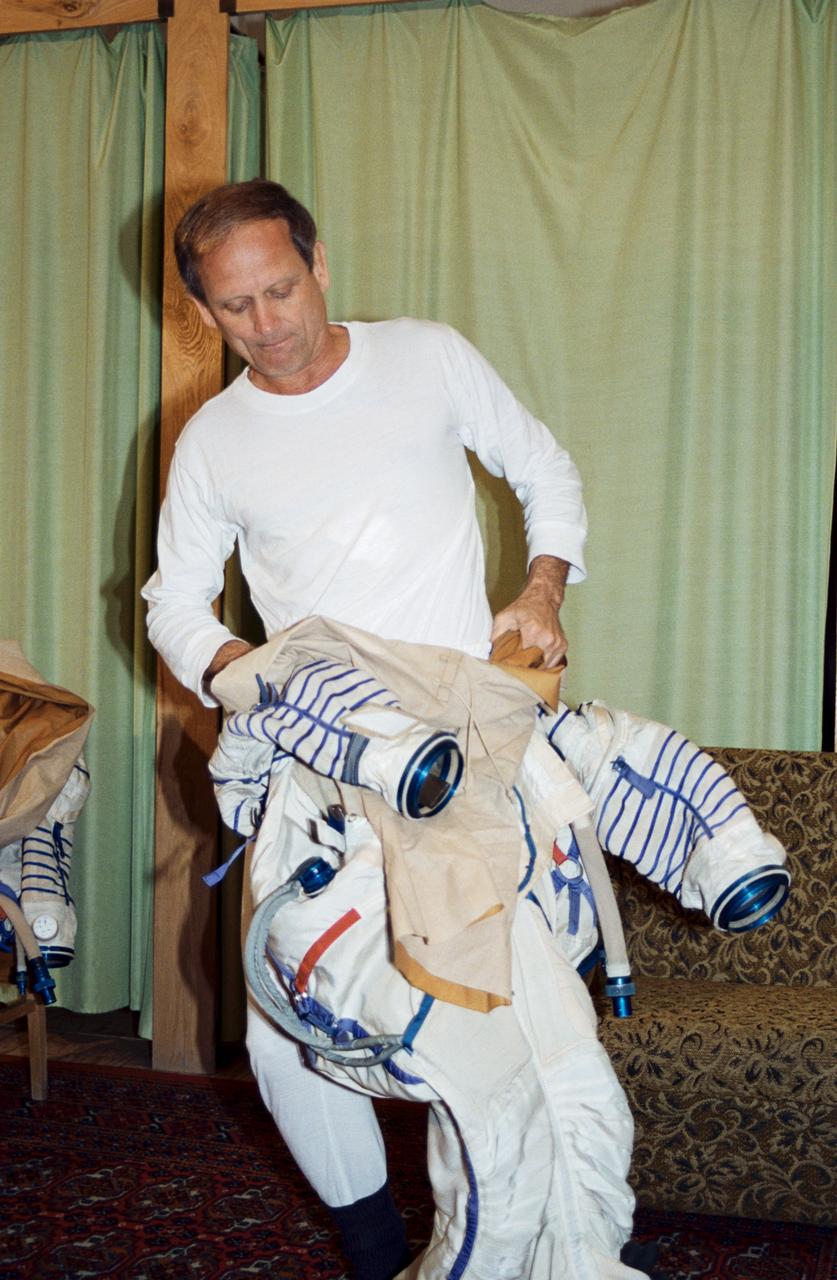
Astronaut Norman E. Thagard getting into a cosmonaut space suit in the Training Simulator Facility at the Gagarin Cosmonaut Training Center (Star City), near Moscow, Russia.
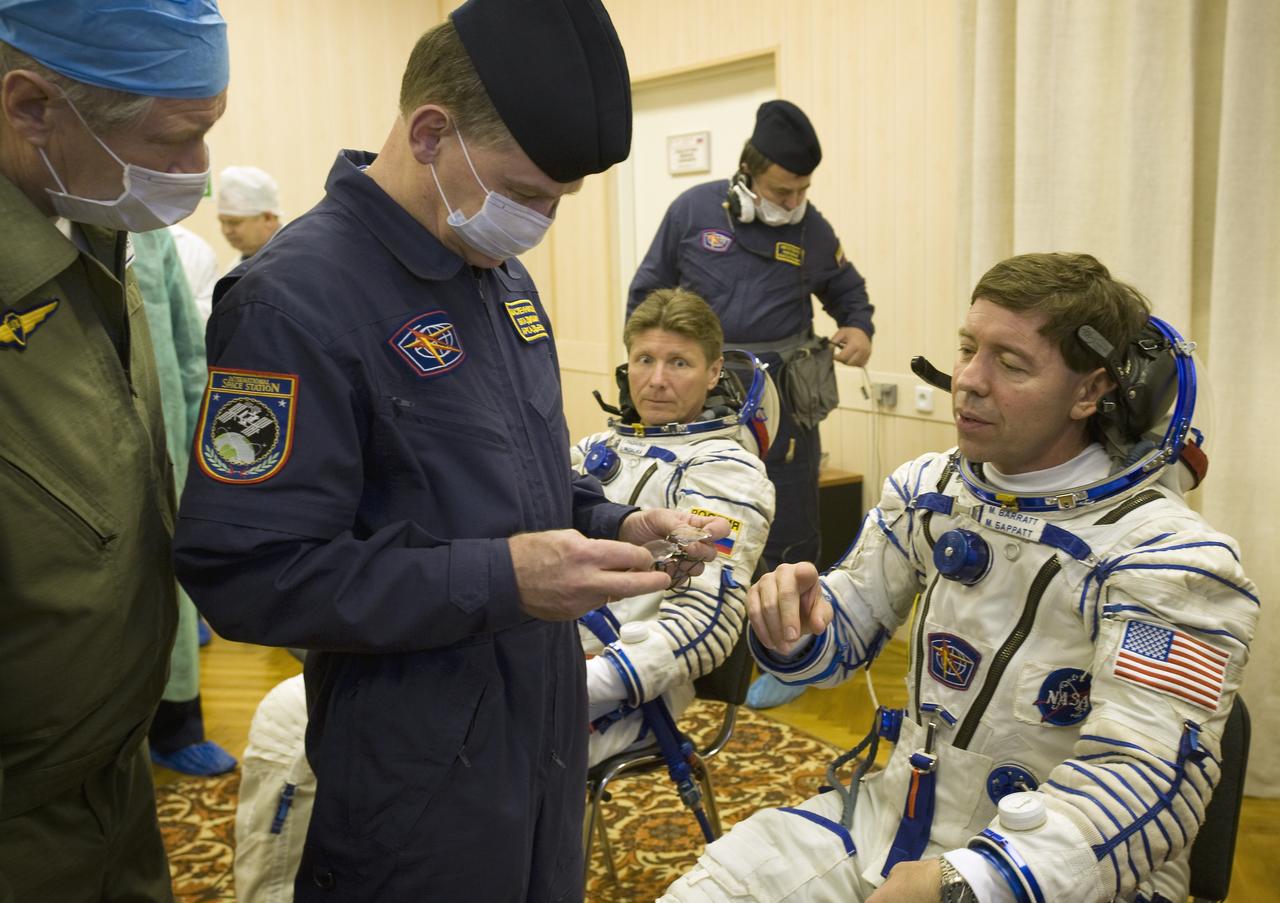
Russian Sokol suit technicians talk with Expedition 19 Flight Engineer Michael R. Barratt about his glasses as he and fellow crew member Expedition 19 Commander Gennady I. Padalka don their Sokol flights suits in preparation for their Soyuz launch to the International Space Station with Spaceflight Participant Charles Simonyi on Thursday, March 26, 2009 in Baikonur, Kazakhstan. (Photo Credit: NASA/Bill Ingalls)
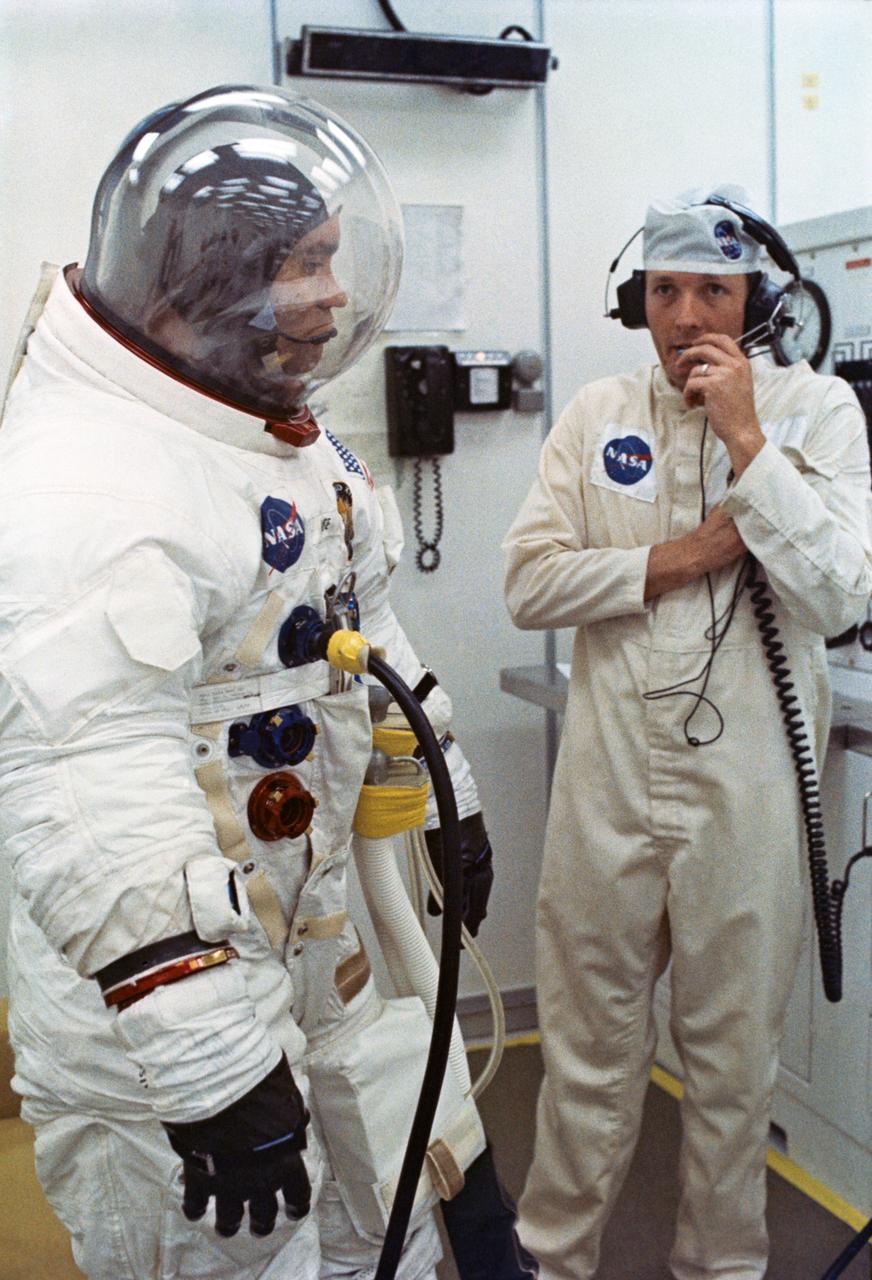
S70-34851 (11 April 1970) --- A space suit technician talks with astronaut Fred W. Haise Jr., lunar module pilot for NASA's Apollo 13 mission, during suiting up procedures at Kennedy Space Center (KSC). Other members of the crew are astronauts James A. Lovell Jr., commander, and John L. Swigert Jr., command module pilot. Swigert replaced astronaut Thomas K. Mattingly II as a member of the crew when it was learned he had been exposed to measles.
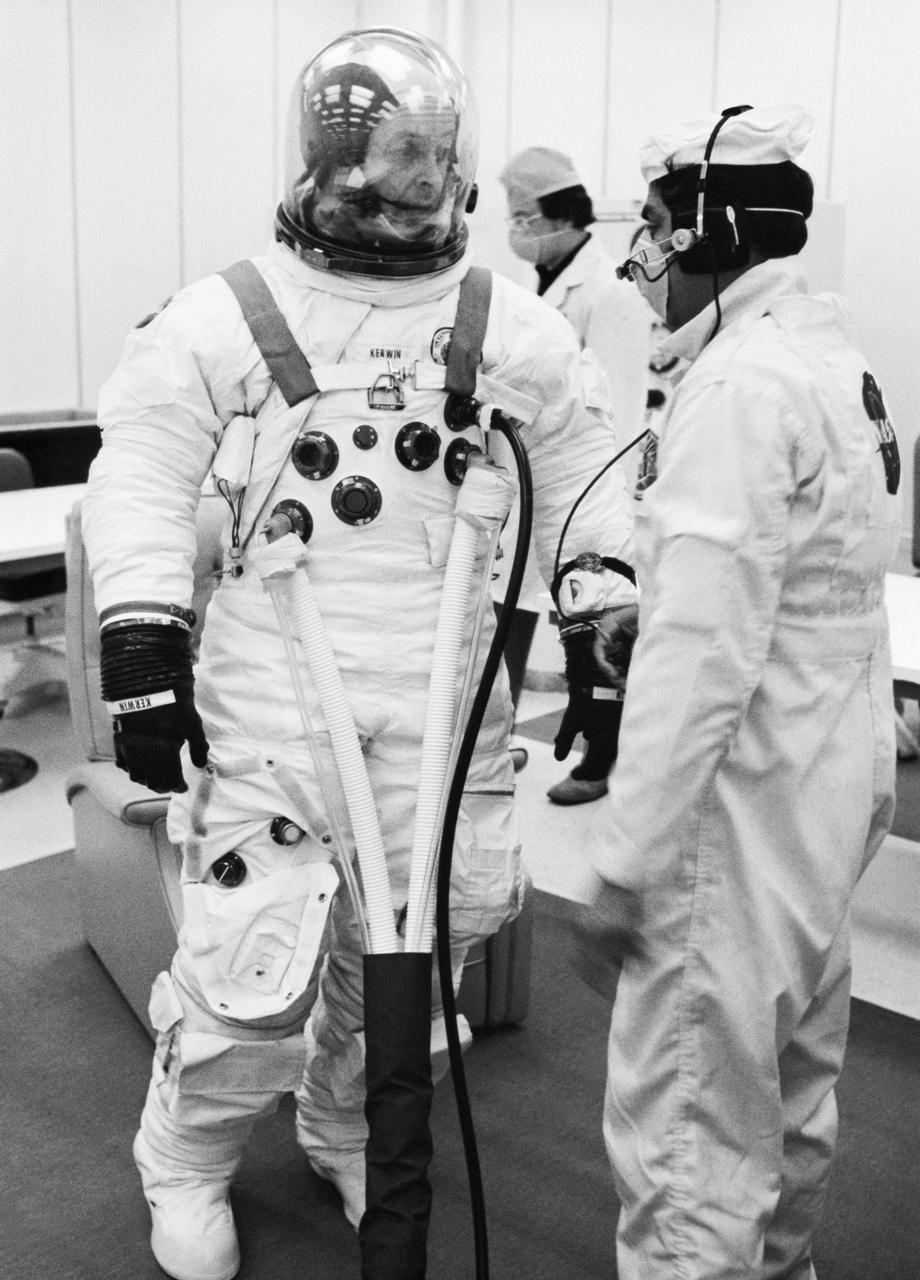
S73-25900 (25 May 1973) --- Scientist-astronaut Joseph P. Kerwin, science pilot of the Skylab 2 mission, is suited up in the Manned Spacecraft Operations Building at the Kennedy Space Center during Skylab 2 prelaunch preparations. Photo credit: NASA
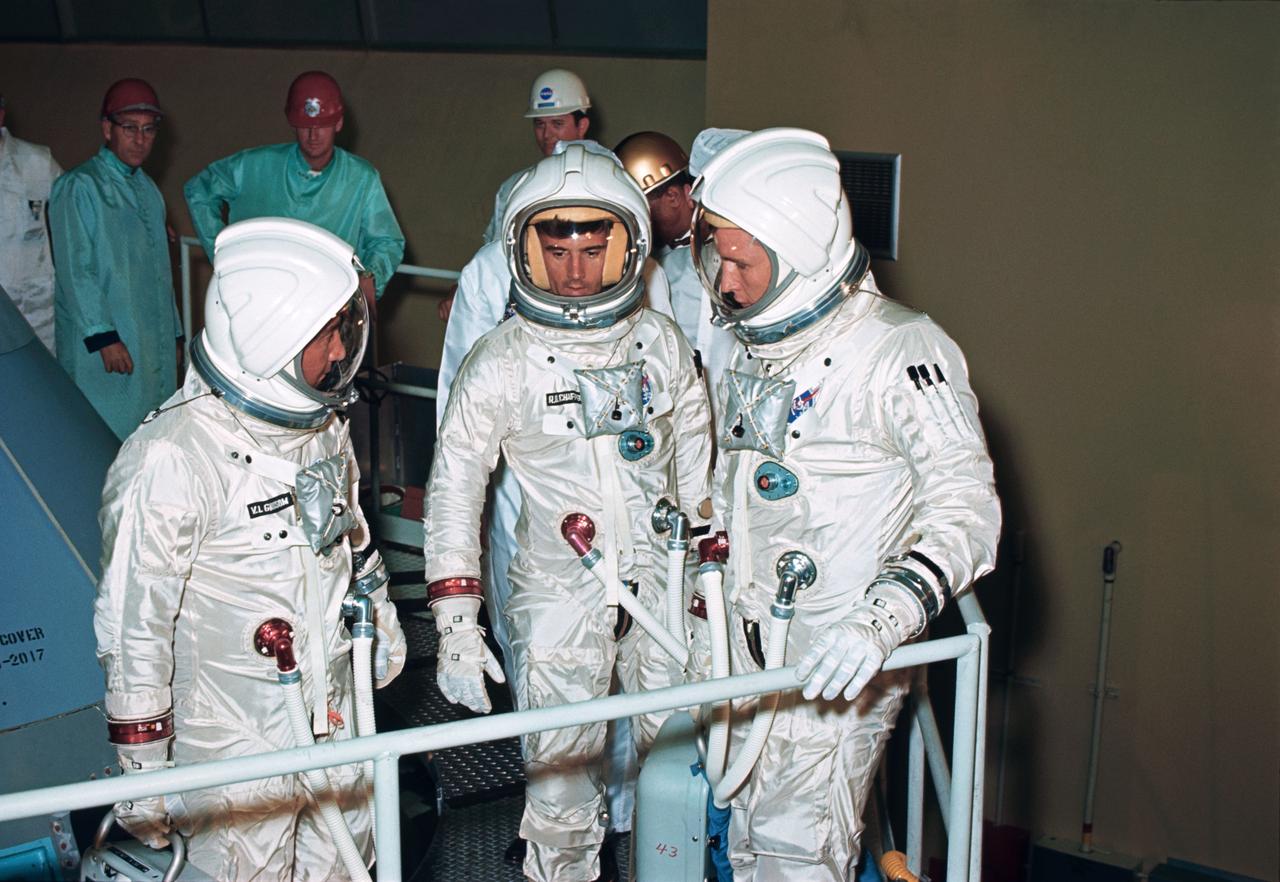
S66-49181 (August 1966) --- The three crew members for the Apollo-Saturn 204 (AS-204) mission check out the couch installation on the Apollo Command Module (CM) at North American's Downey facility. Left to right in their pressurized space suits are astronauts Virgil I. Grissom, Roger B. Chaffee and Edward H. White II. Editor's Note: The three astronauts died in a fire on the launch pad, Jan. 27, 1967.
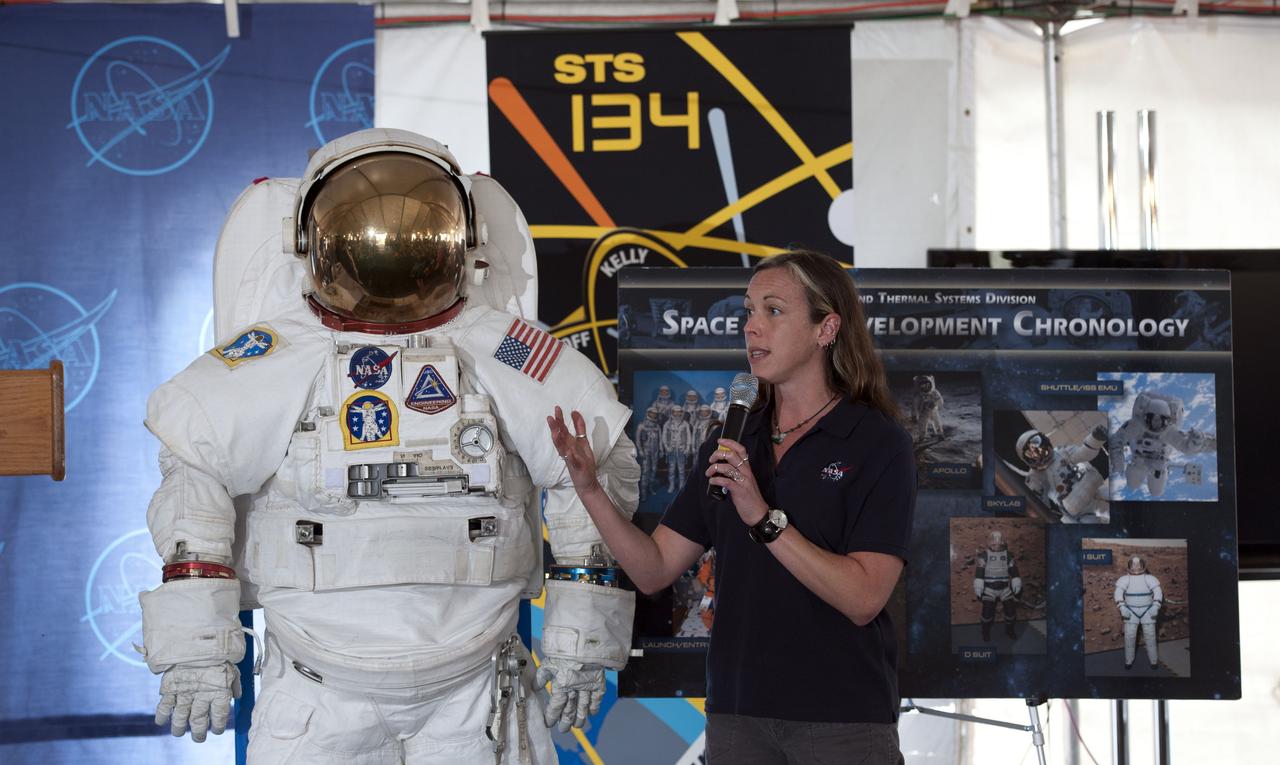
Heather Paul, a project engineer for Johnson Space Center, talks about space suit technology during the STS-134 Tweetup, Thursday, April 28, 2011, at Kennedy Space Center in Cape Canaveral, Fla. About 150 NASA Twitter followers attended the event. Photo Credit: (NASA/Paul E. Alers)

Astronaut Richard F. Gordon Jr., Apollo 12 command module pilot, suits up in the Kennedy Space Center's Manned Spacecraft Operations Building during the Apollo 12 prelaunch countdown.
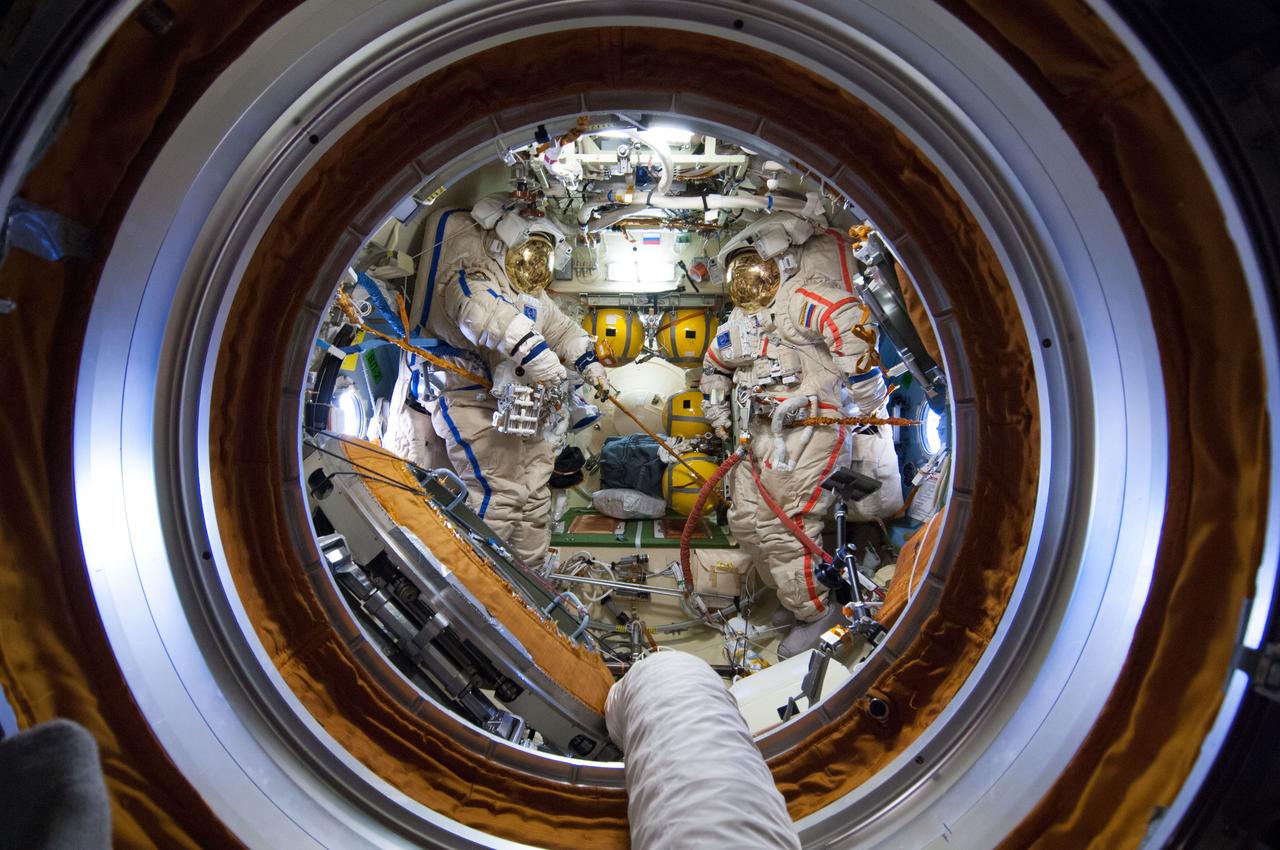
ISS040-E-095615 (17 Aug. 2014) --- Unoccupied Russian Orlan spacesuits for Russian cosmonauts Oleg Artemyev (blue stripes) and Alexander Skvortsov (red stripes), both Expedition 40 flight engineers, are pictured in the Pirs Docking Compartment of the International Space Station on the eve of the spacewalk scheduled for Aug. 18, 2014.
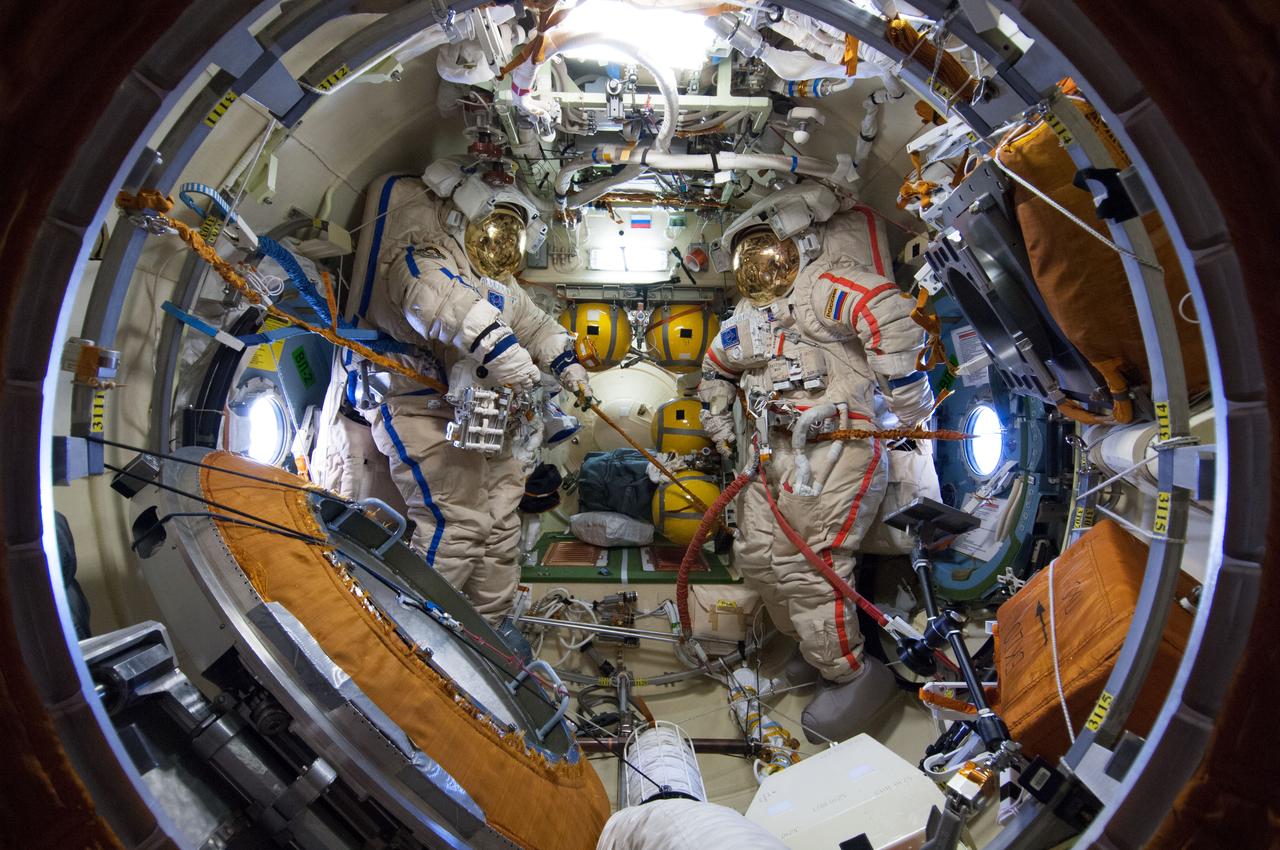
ISS040-E-095617 (17 Aug. 2014) --- Unoccupied Russian Orlan spacesuits for Russian cosmonauts Oleg Artemyev (blue stripes) and Alexander Skvortsov (red stripes), both Expedition 40 flight engineers, are pictured in the Pirs Docking Compartment of the International Space Station on the eve of the spacewalk scheduled for Aug. 18, 2014.
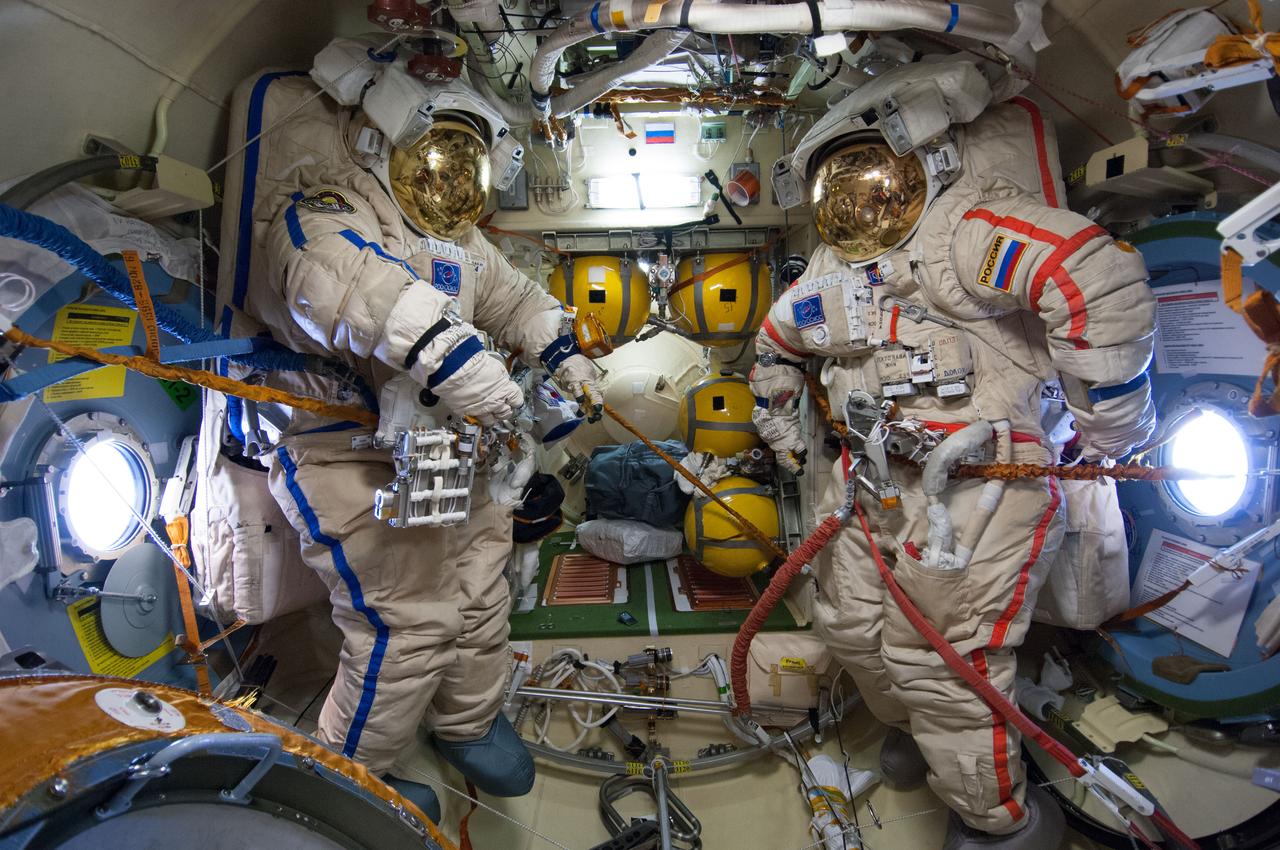
ISS040-E-095619 (17 Aug. 2014) --- Unoccupied Russian Orlan spacesuits for Russian cosmonauts Oleg Artemyev (blue stripes) and Alexander Skvortsov (red stripes), both Expedition 40 flight engineers, are pictured in the Pirs Docking Compartment of the International Space Station on the eve of the spacewalk scheduled for Aug. 18, 2014.
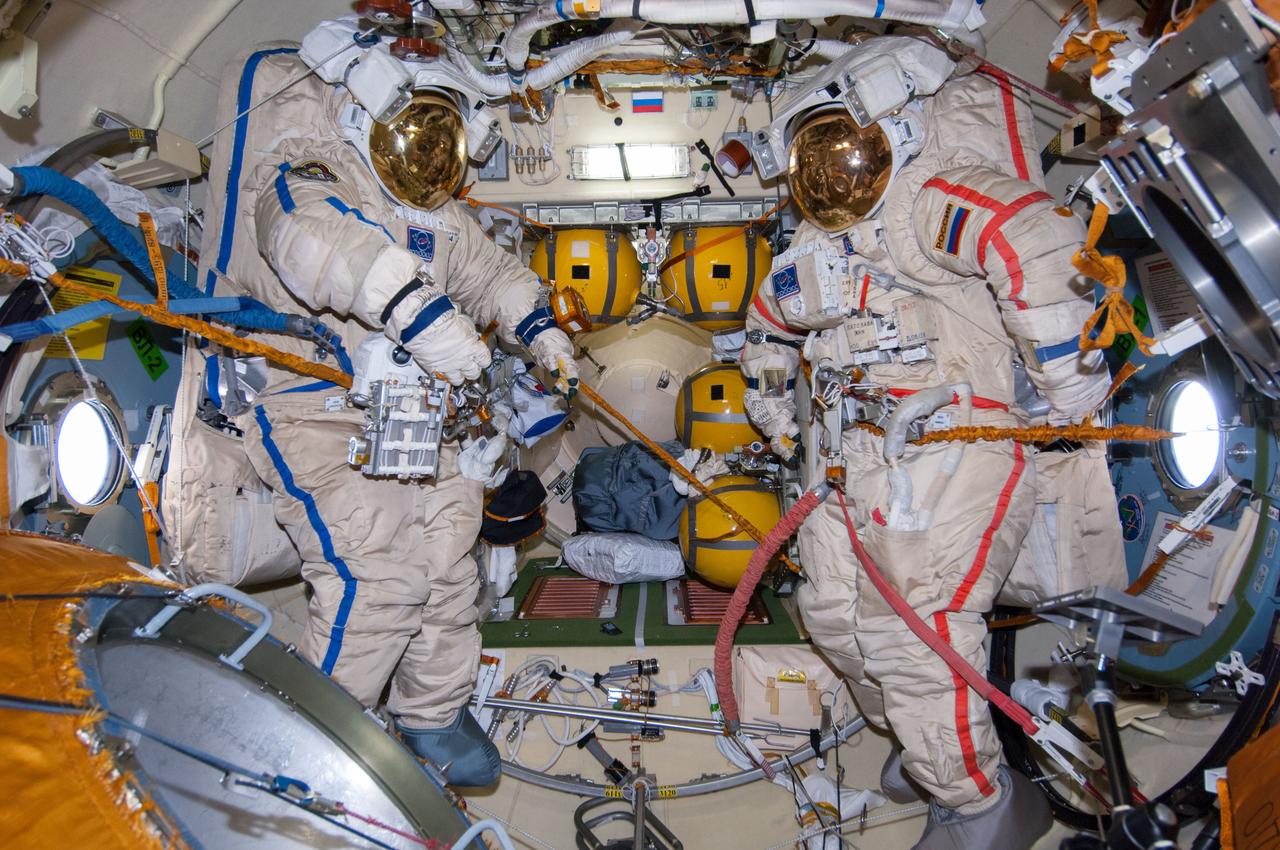
ISS040-E-095609 (17 Aug. 2014) --- Unoccupied Russian Orlan spacesuits for Russian cosmonauts Oleg Artemyev (blue stripes) and Alexander Skvortsov (red stripes), both Expedition 40 flight engineers, are pictured in the Pirs Docking Compartment of the International Space Station on the eve of the spacewalk scheduled for Aug. 18, 2014.
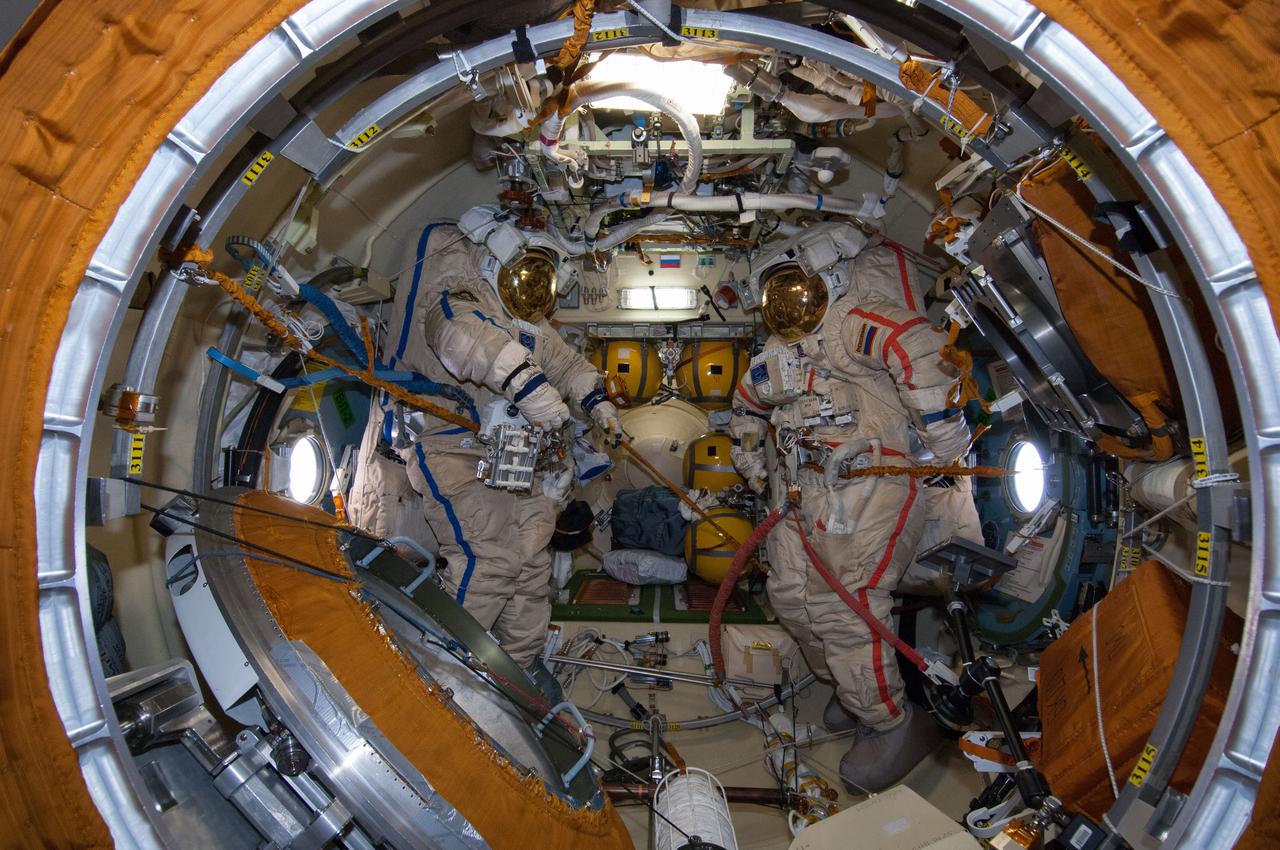
ISS040-E-095612 (17 Aug. 2014) --- Unoccupied Russian Orlan spacesuits for Russian cosmonauts Oleg Artemyev (blue stripes) and Alexander Skvortsov (red stripes), both Expedition 40 flight engineers, are pictured in the Pirs Docking Compartment of the International Space Station on the eve of the spacewalk scheduled for Aug. 18, 2014.
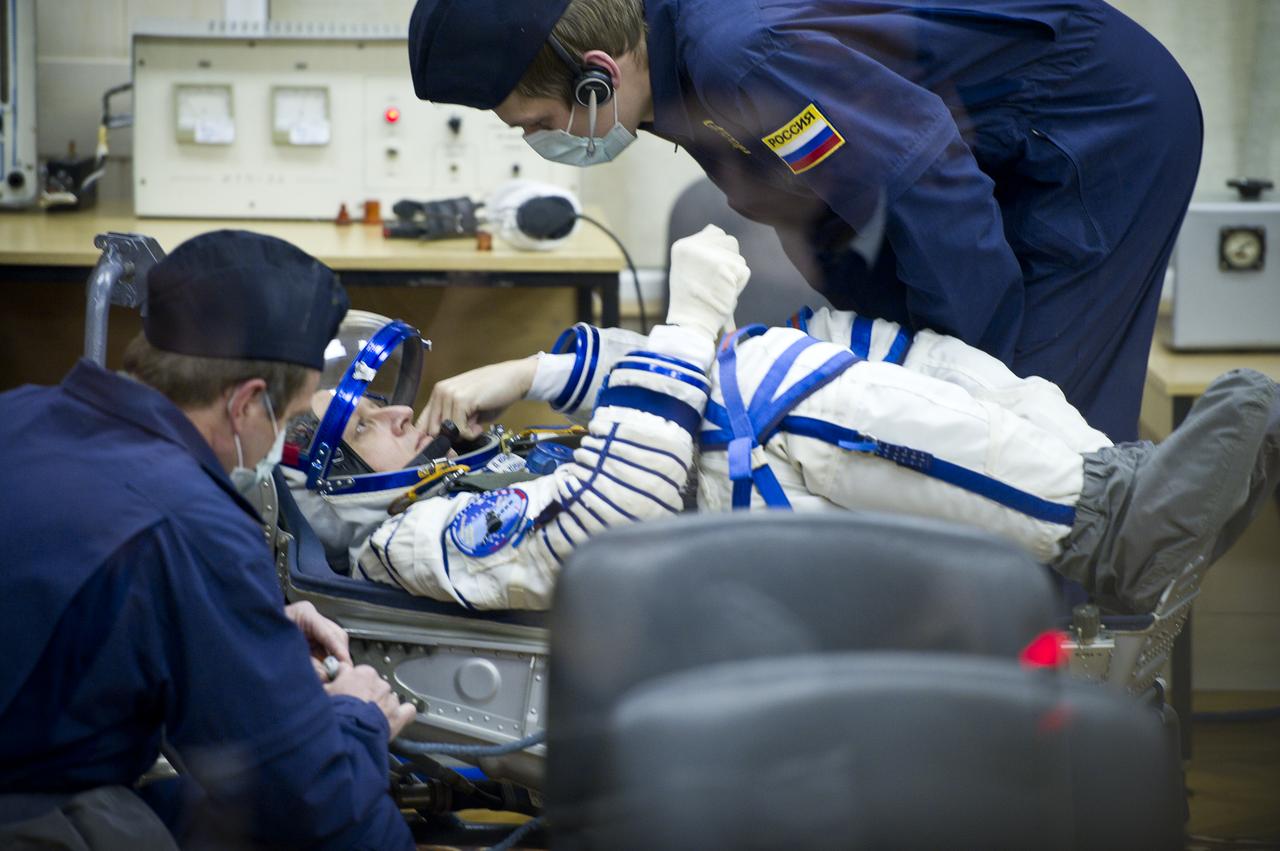
Expedition 26 Soyuz Commander Dmitry Kondratyev has his Russian Sokol suit pressure checked at the Baikonur Cosmodrome in Baikonur, Kazakhstan, Wednesday, Dec. 15, 2010. Kondratyev and fellow Expedition 26 crew members NASA Flight Engineer Catherine Coleman and European Space Agency astronaut Paolo Nespoli launched in their Soyuz TMA-20 rocket from the Baikonur Cosmodrome in Kazakhstan the following morning at 1:09 a.m. local time. (Photo Credit: NASA/Carla Cioffi)
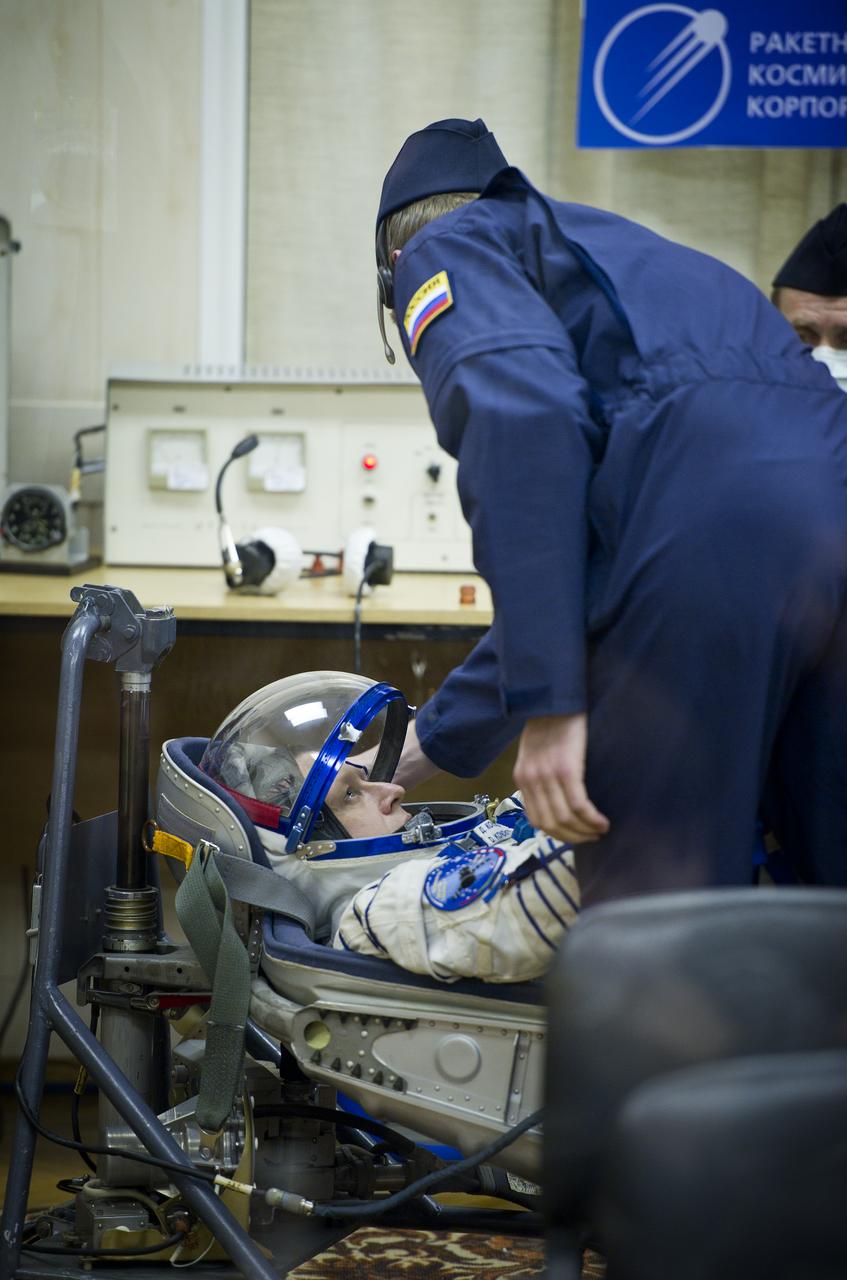
Expedition 26 Soyuz Commander Dmitry Kondratyev has his Russian Sokol suit pressure checked at the Baikonur Cosmodrome in Baikonur, Kazakhstan, Wednesday, Dec. 15, 2010. Kondratyev and fellow Expedition 26 crew members NASA Flight Engineer Catherine Coleman and European Space Agency astronaut Paolo Nespoli launched in their Soyuz TMA-20 rocket from the Baikonur Cosmodrome in Kazakhstan the following morning at 1:09 a.m. local time. (Photo Credit: NASA/Carla Cioffi)
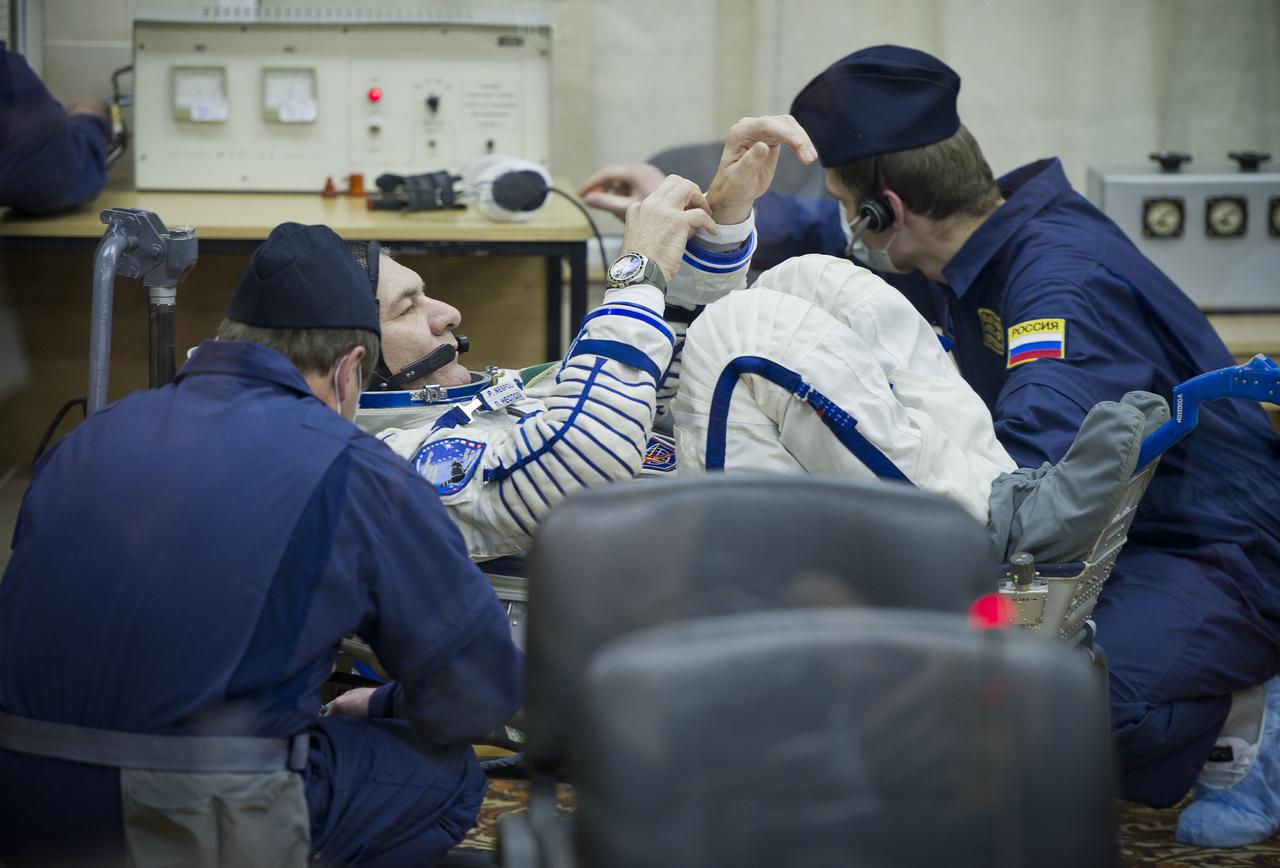
Expedition 26 European Space Agency astronaut Paolo Nespoli has his Russian Sokol suit pressure checked at the Baikonur Cosmodrome in Baikonur, Kazakhstan, Wednesday, Dec. 15, 2010. Nespoli and fellow Expedition 26 crew members Soyuz Commander Dmitry Kondratryev and NASA Flight Engineer Catherine Coleman launched in their Soyuz TMA-20 rocket from the Baikonur Cosmodrome in Kazakhstan the following morning at 1:09 a.m. local time. (Photo Credit: NASA/Carla Cioffi)

The Russian Sokol suits of Expedition 16 Commander Peggy Whitson and Malaysian spaceflight participant Sheikh Muszaphar Shukor are laid out prior to suit-up by the crew, Wednesday, Oct. 10, 2007, in Baikonur, Kazakhstan. Flight Engineer and Soyuz Commander Yuri Malenchenko was the first to don his flight suit. The three crew members launched from the Baikonur Cosmodrome in Kazakhstan at sunset in their Soyuz TMA-11 spacecraft bound for a docking to the International Space Station on Oct. 12. Whitson and Malenchenko will spend six months on the station, while Shukor will return to Earth Oct. 21 with two of the Expedition 15 crewmembers currently on the complex. Photo Credit: (NASA/Bill Ingalls)
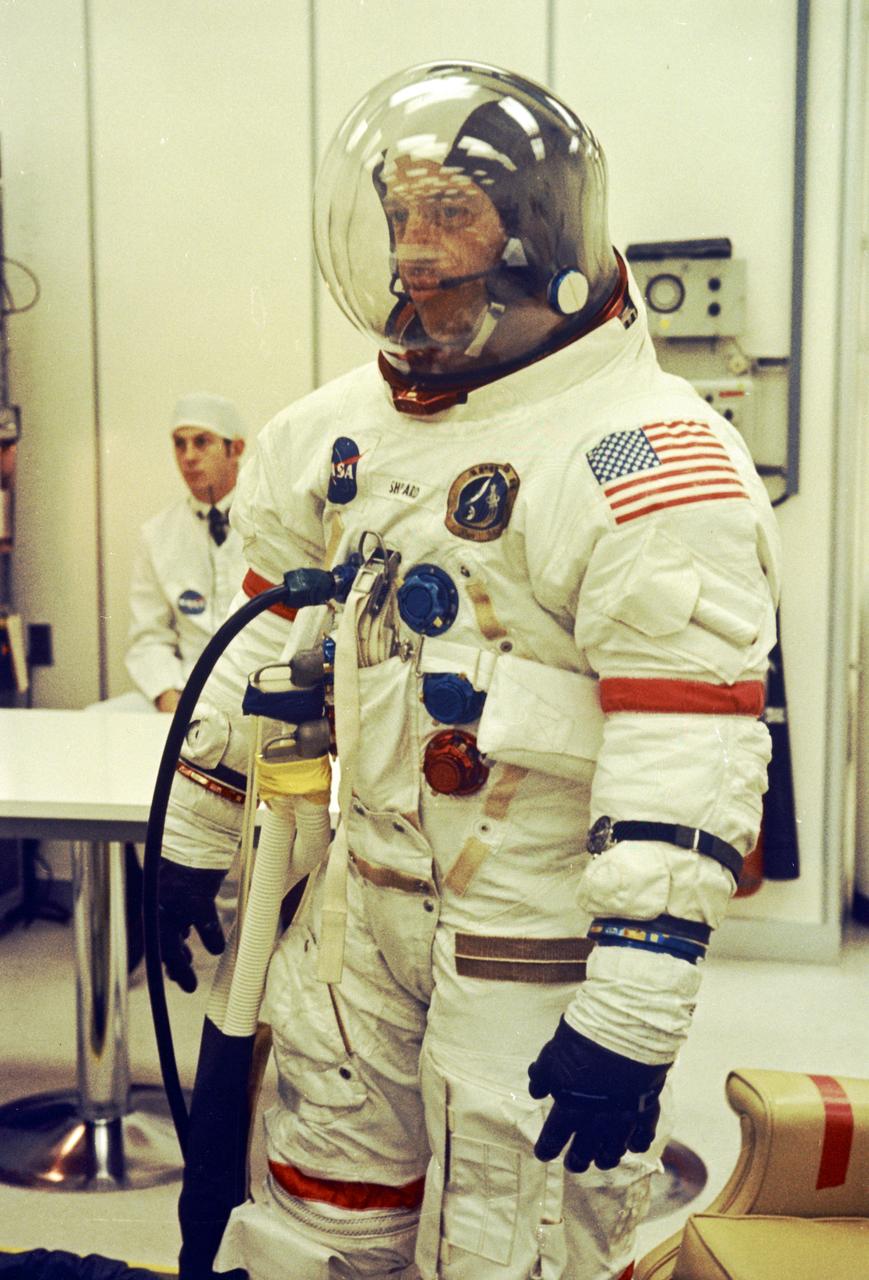
Alan B. Shepard, Jr., Apollo 14 mission commander, watches a technician conduct space suit checks during a demonstration test prior to countdown. The Apollo 14, carrying a crew of three astronauts: Shepard; Command Module pilot Stuart A. Roosa, and Lunar Module pilot Edgar D. Mitchell, lifted off from launch complex 39A at KSC on January 31, 1971. It was the third manned lunar landing, the first manned landing in exploration of the lunar highlands, and it demonstrated pinpoint landing capability. The major goal of Apollo 14 was the scientific exploration of the Moon in the foothills of the rugged Fra Mauro region. The extravehicular activities (EVA) of astronauts Shepard and Mitchell included setting up an automated scientific laboratory called Apollo Lunar Scientific Experiments Package (ALSEP), and collecting a total of about 95 pounds (43 kilograms) of Moon rock and soil for a geological investigation back on the Earth. Apollo 14 safely returned to Earth on February 9, 1971.
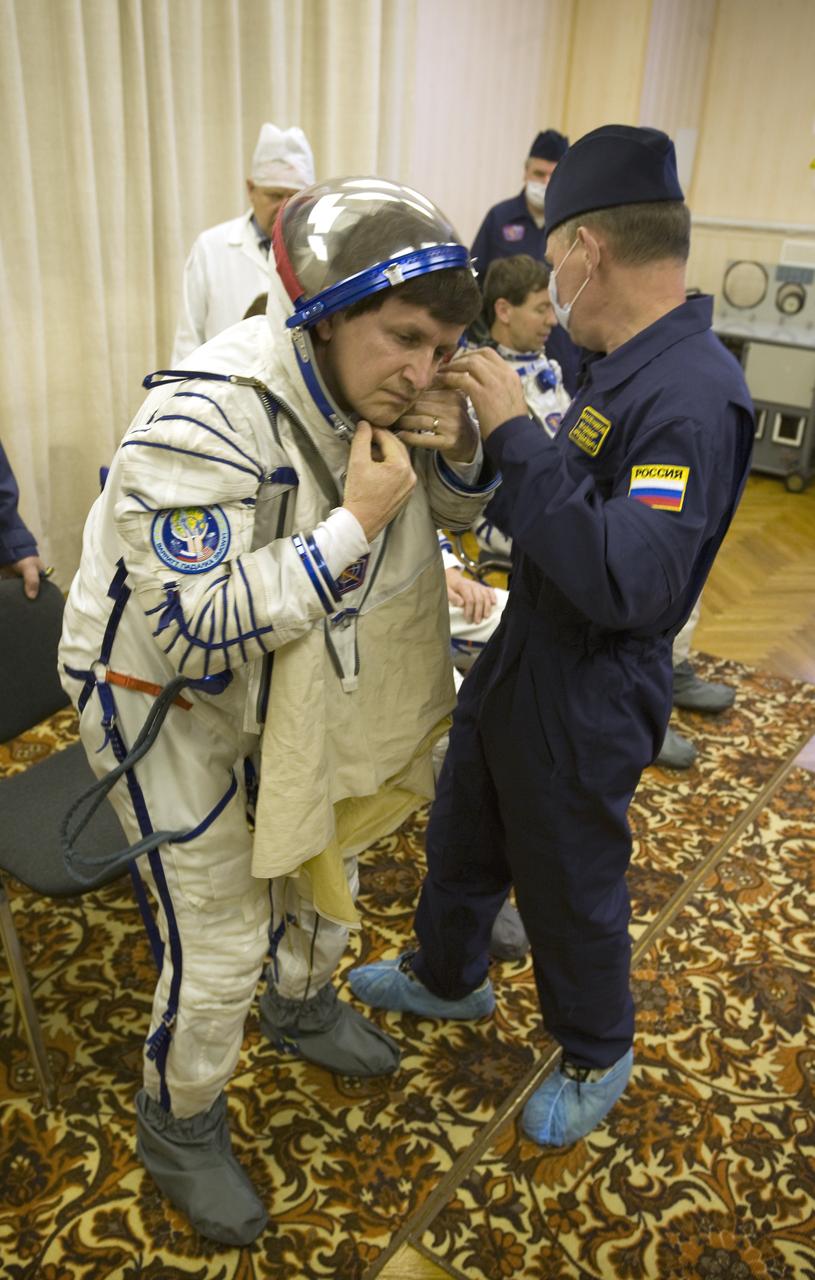
Spaceflight Participant Charles Simonyi dons his Russian Sokol suit in preparation for his Soyuz launch to the International Space Station with Expedition 19 Commander Gennady I. Padalka and Flight Engineer Michael R. Barratt on Thursday, March 26, 2009 in Baikonur, Kazakhstan. (Photo Credit: NASA/Bill Ingalls)
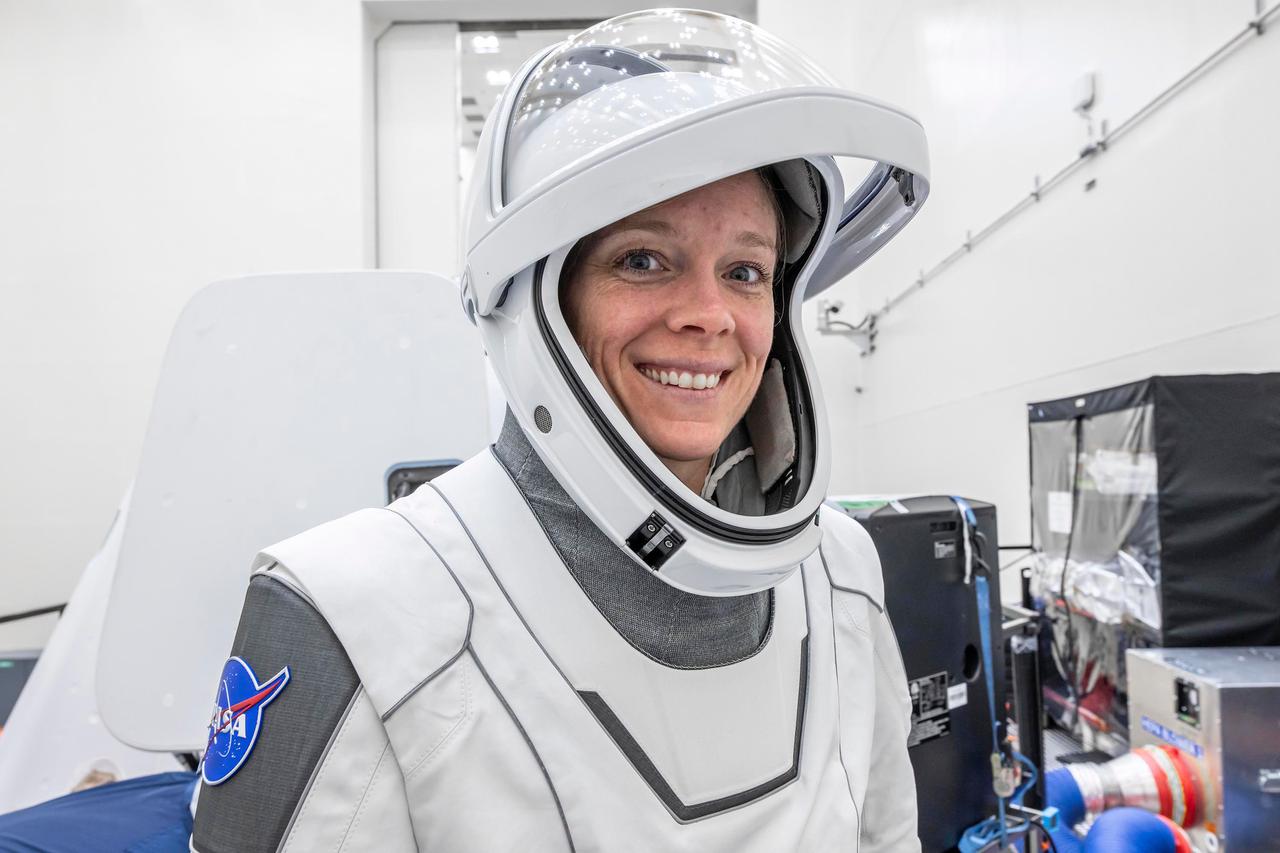
jsc2025e012272 - (February 17, 2025) --- NASA’s SpaceX Crew-10 Pilot Nichole Ayers smiles in her flight suit at NASA's Kennedy Space Center in Florida.
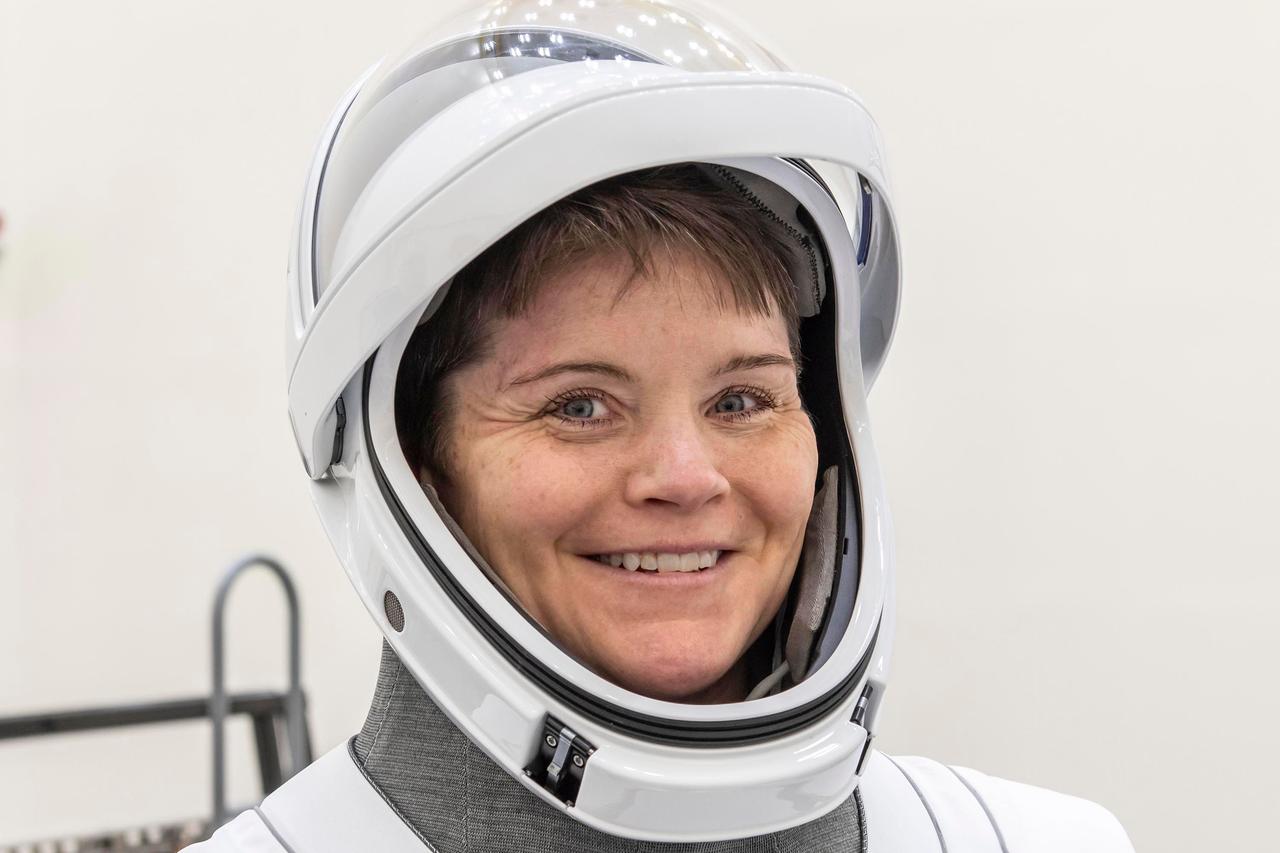
jsc2025e012271 - (February 17, 2025) --- NASA’s SpaceX Crew-10 Commander Anne McClain smiles in her flight suit at NASA's Kennedy Space Center in Florida.
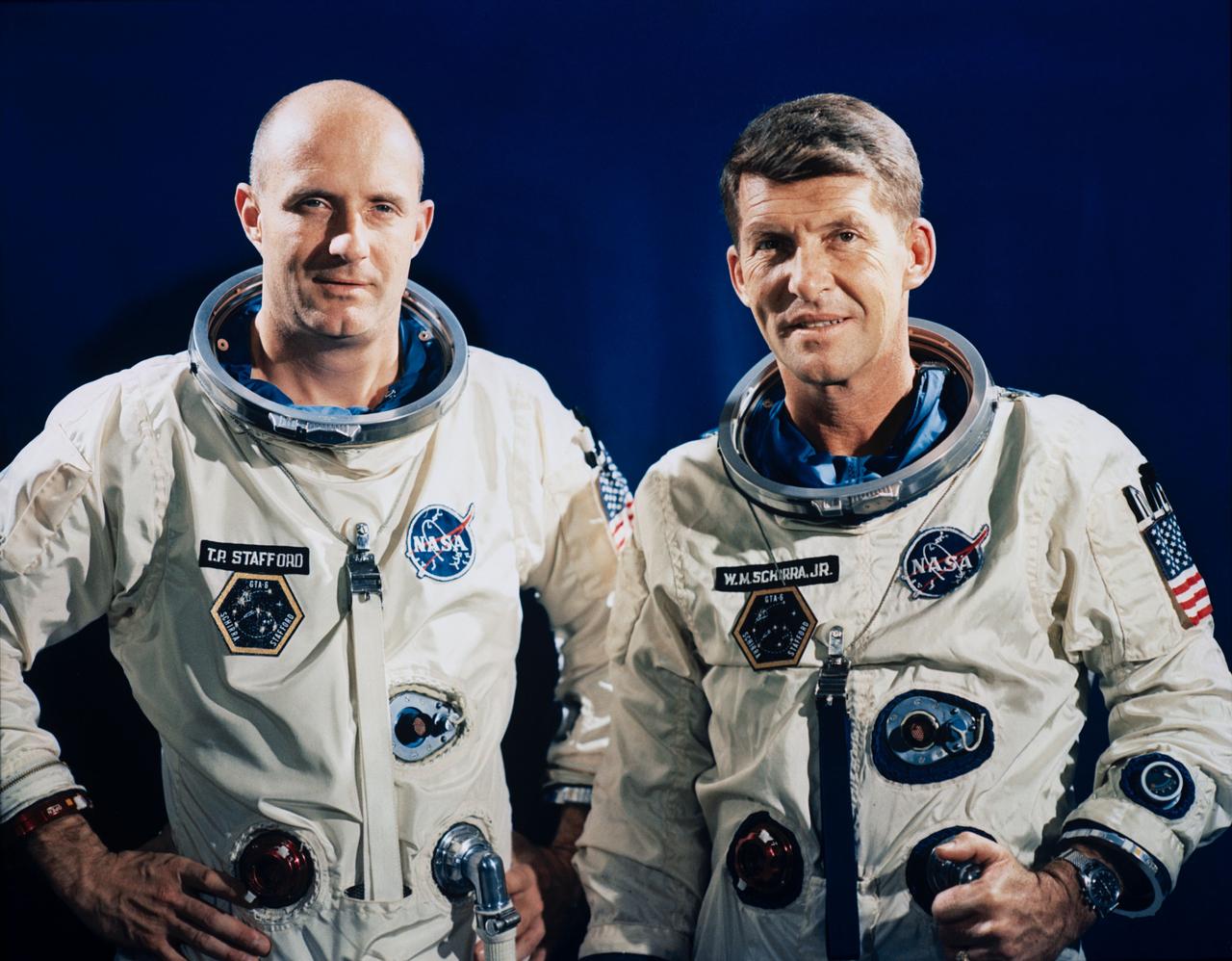
S65-56151 (October 1965) --- Gemini-6 astronauts Thomas P. Stafford (left), pilot, and Walter M. Schirra Jr., command pilot, are shown during suiting up exercises at Cape Kennedy, Florida. Photo credit: NASA or National Aeronautics and Space Administration
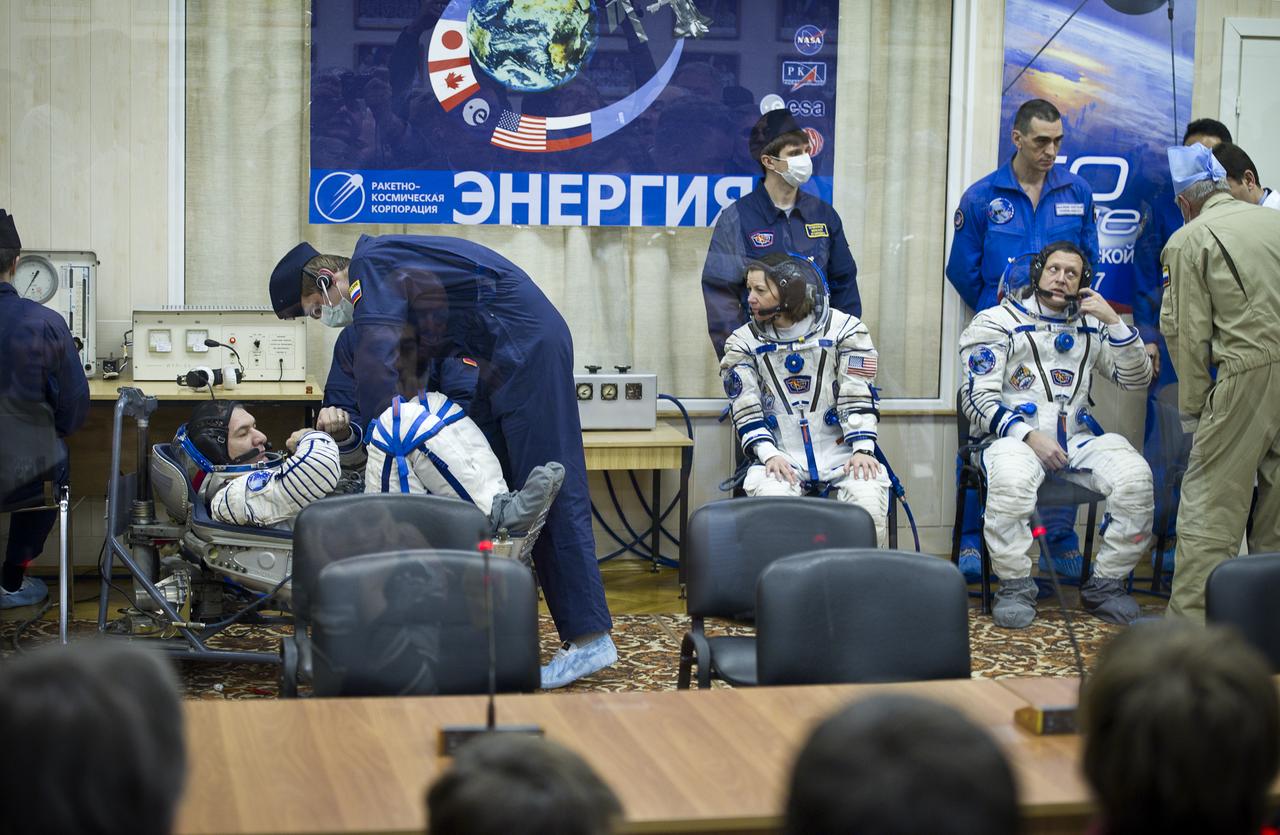
Expedition 26 European Space Agency astronaut Paolo Nespoli has his Russian Sokol suit pressure checked, while his crew mates NASA Flight Engineer Catherine Colemen and Soyuz Commander Dmitry Kondtratyev, far right, look on at the Baikonur Cosmodrome in Baikonur, Kazakhstan, Wednesday, Dec. 15, 2010. Nespoli, Kondratryev and Coleman launched in their Soyuz TMA-20 rocket from the Baikonur Cosmodrome in Kazakhstan the following morning at 1:09 a.m. local time. (Photo Credit: NASA/Carla Cioffi)
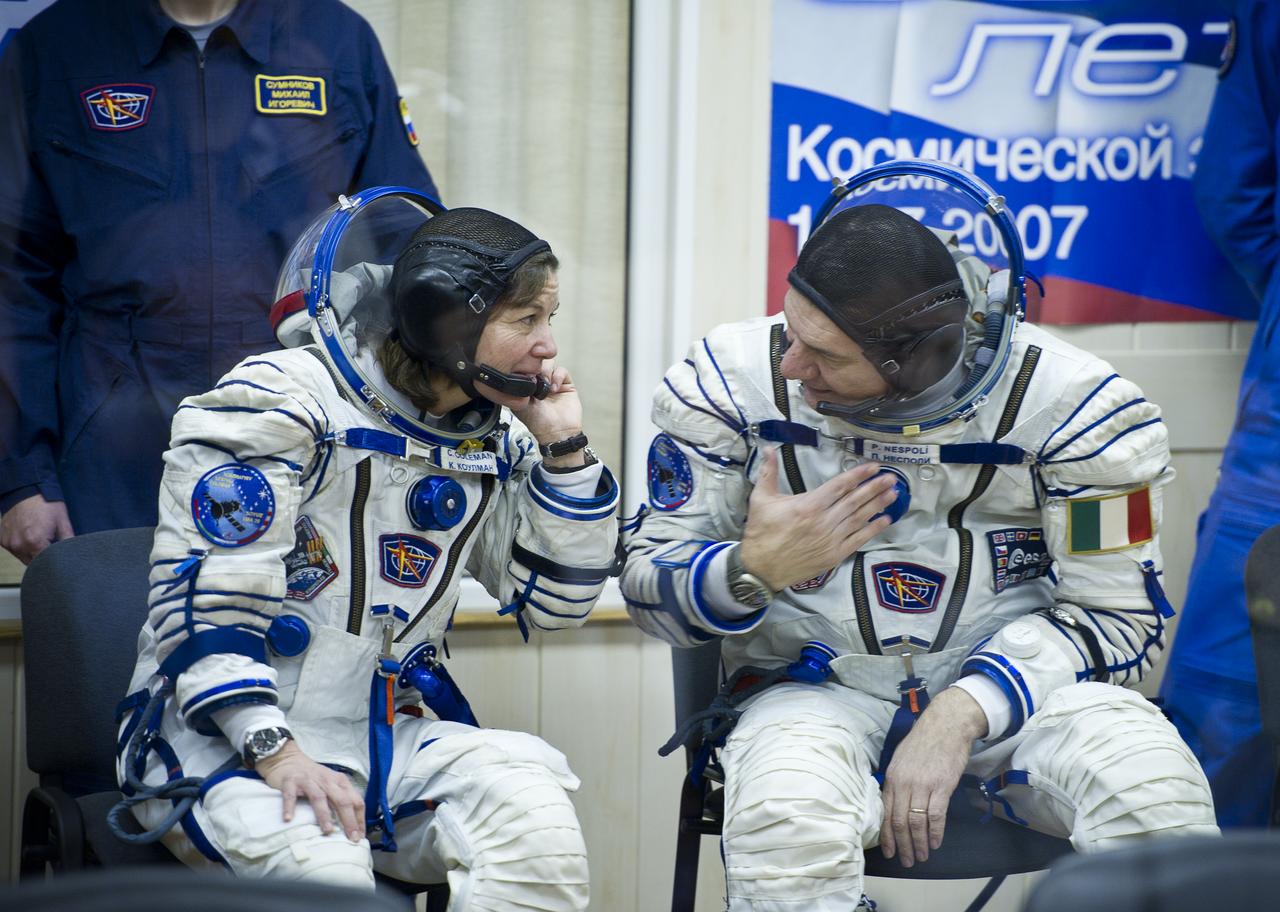
Expedition 26 Soyuz Flight Engineer Catherine Coleman, left, and European Space Agency astronaut Paolo Nespoli share a few words during their Russian Sokol suit pressure check at the Baikonur Cosmodrome in Baikonur, Kazakhstan, Wednesday, Dec. 15, 2010. Coleman, Nespolie and Expedition Soyuz Commander Dmitry Kondratyev launched in their Soyuz TMA-20 rocket from the Baikonur Cosmodrome in Kazakhstan the following morning at 1:09 a.m. local time. (Photo Credit: NASA/Carla Cioffi)
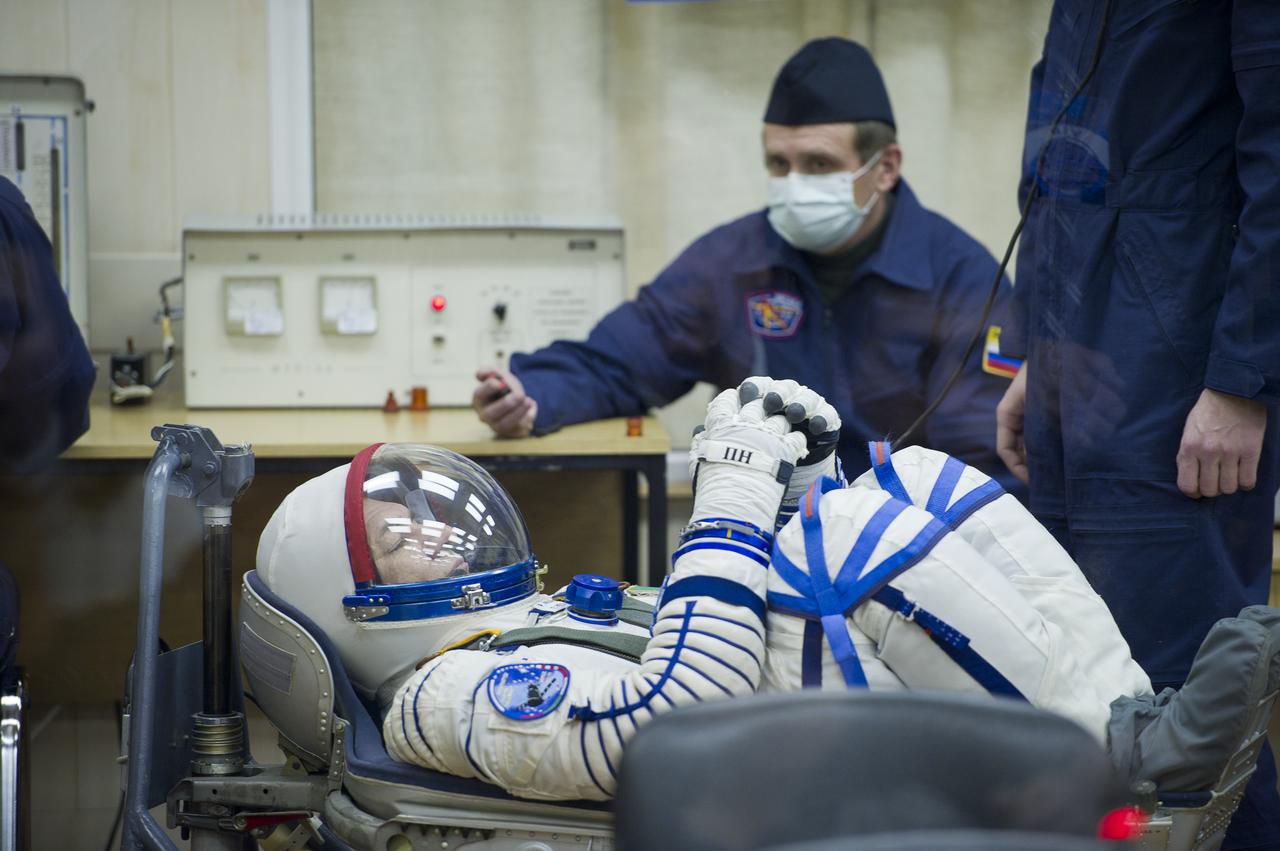
Expedition 26 European Space Agency astronaut Paolo Nespoli has his Russian Sokol suit pressure checked at the Baikonur Cosmodrome in Baikonur, Kazakhstan, Wednesday, Dec. 15, 2010. Nespoli and fellow Expedition 26 crew members Soyuz Commander Dmitry Kondratryev and NASA Flight Engineer Catherine Coleman launched in their Soyuz TMA-20 rocket from the Baikonur Cosmodrome in Kazakhstan the following morning at 1:09 a.m. local time. (Photo Credit: NASA/Carla Cioffi)
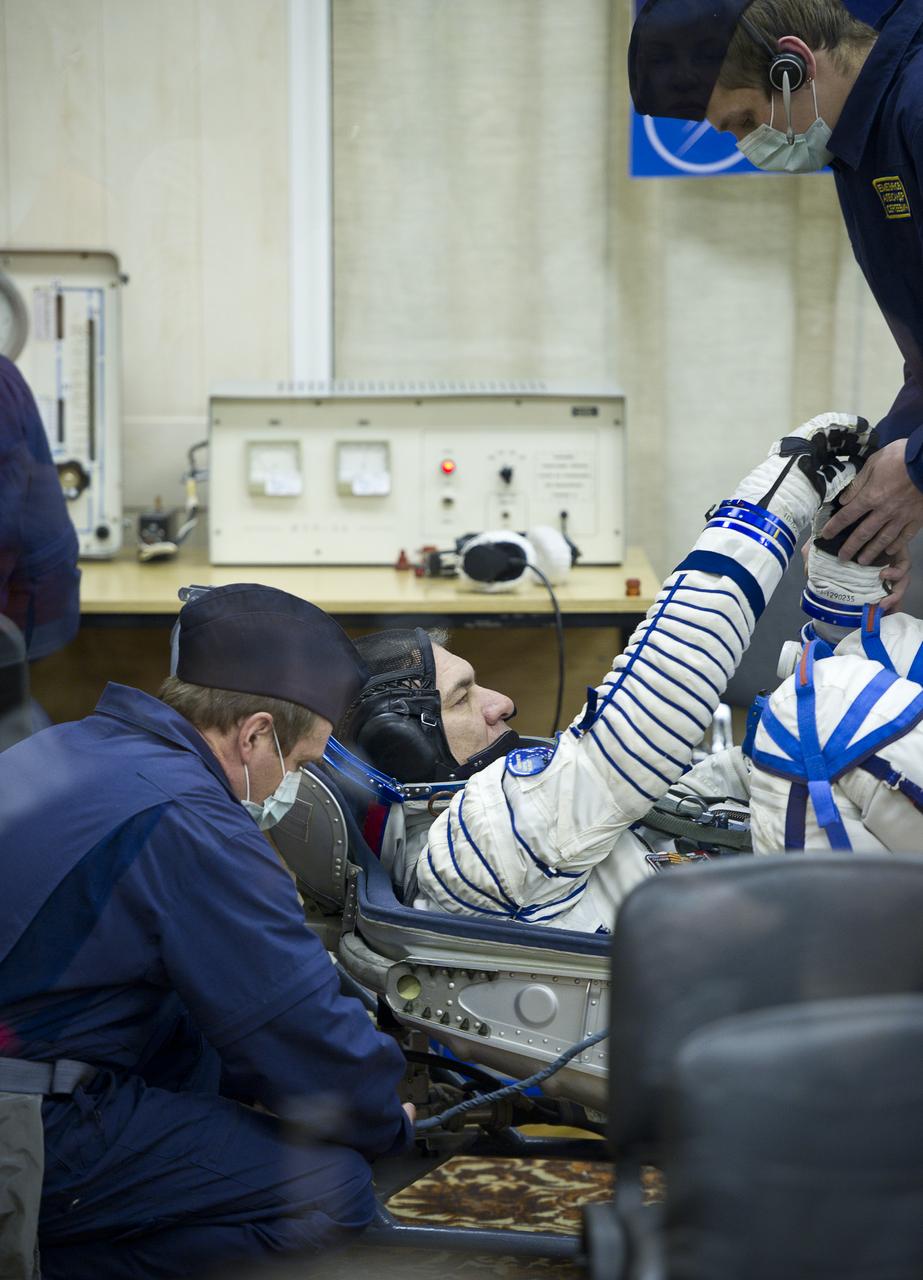
Expedition 26 European Space Agency astronaut Paolo Nespoli has his Russian Sokol suit pressure checked at the Baikonur Cosmodrome in Baikonur, Kazakhstan, Wednesday, Dec. 15, 2010. Nespoli and fellow Expedition 26 crew members Soyuz Commander Dmitry Kondratryev and NASA Flight Engineer Catherine Coleman launched in their Soyuz TMA-20 rocket from the Baikonur Cosmodrome in Kazakhstan the following morning at 1:09 a.m. local time. (Photo Credit: NASA/Carla Cioffi)
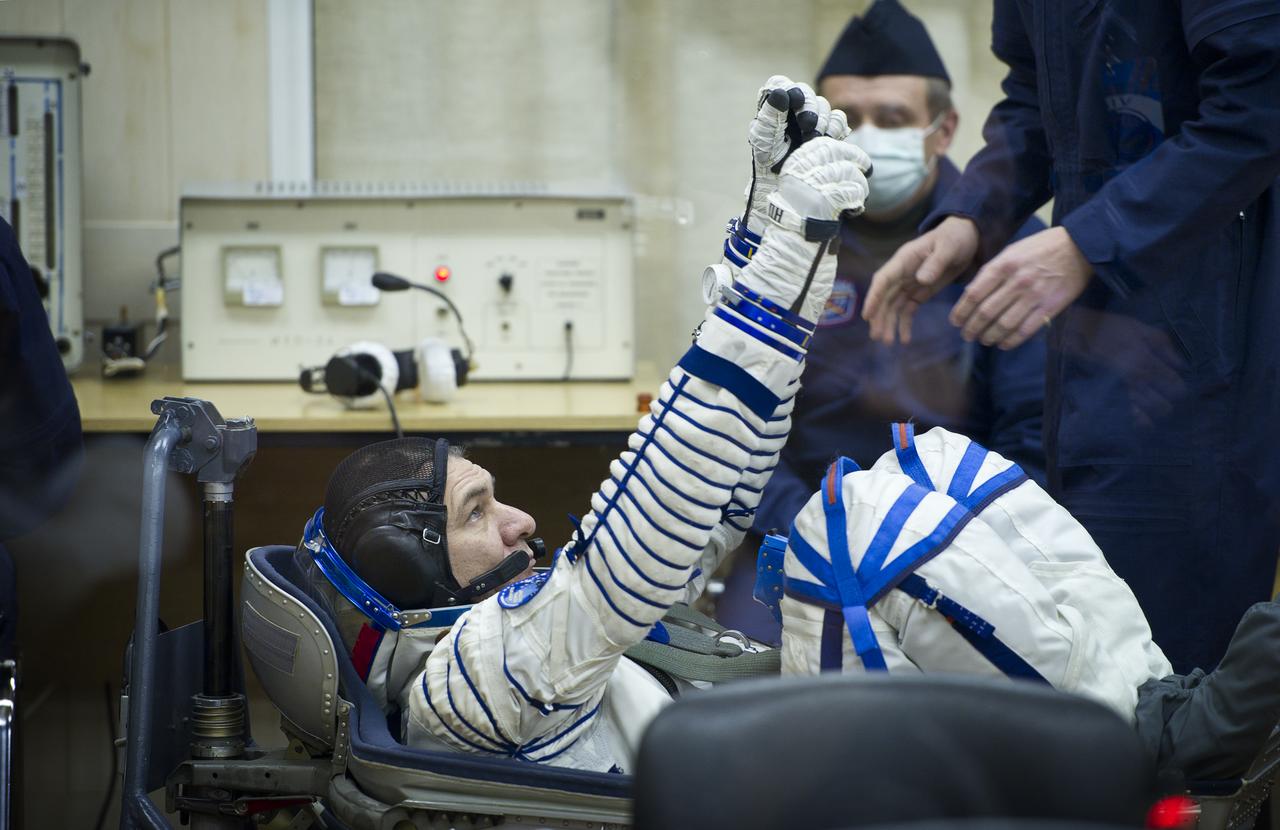
Expedition 26 European Space Agency astronaut Paolo Nespoli has his Russian Sokol suit pressure checked at the Baikonur Cosmodrome in Baikonur, Kazakhstan, Wednesday, Dec. 15, 2010. Nespoli and fellow Expedition 26 crew members Soyuz Commander Dmitry Kondratryev and NASA Flight Engineer Catherine Coleman launched in their Soyuz TMA-20 rocket from the Baikonur Cosmodrome in Kazakhstan the following morning at 1:09 a.m. local time. (Photo Credit: NASA/Carla Cioffi)
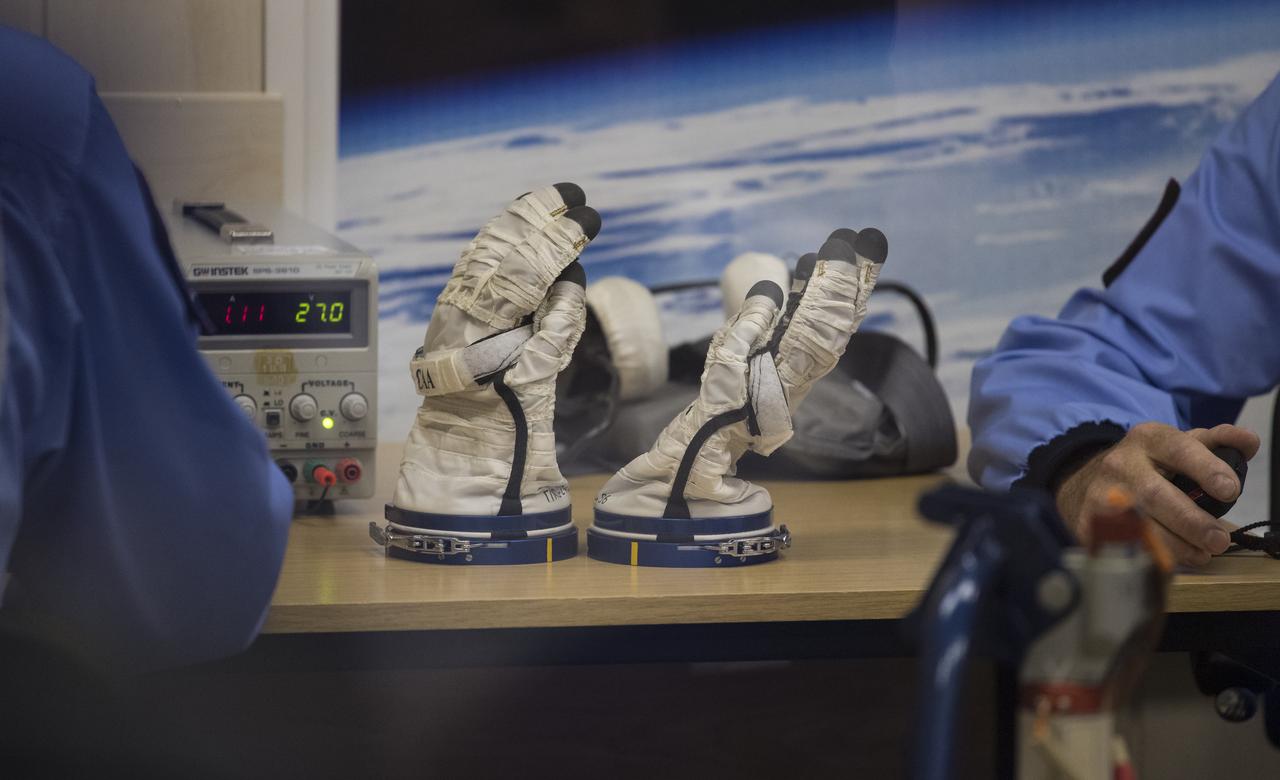
The Russian Sokol suit gloves of Expedition 60 Soyuz Commander Alexander Skvortsov of Rosprepares are seen on a table as he prepares to have his Russian Sokol suit pressure checked in preparation for launch aboard the Soyuz MS-13 spacecraft, Saturday, July 20, 2019 at the Baikonur Cosmodrome in Kazakhstan. launched aboard the Soyuz MS-13 spacecraft at 12:28 p.m. Eastern time (9:28 p.m. Baikonur time) on July 20 to begin their journey to the International Space Station. Photo Credit: (NASA/Joel Kowsky)
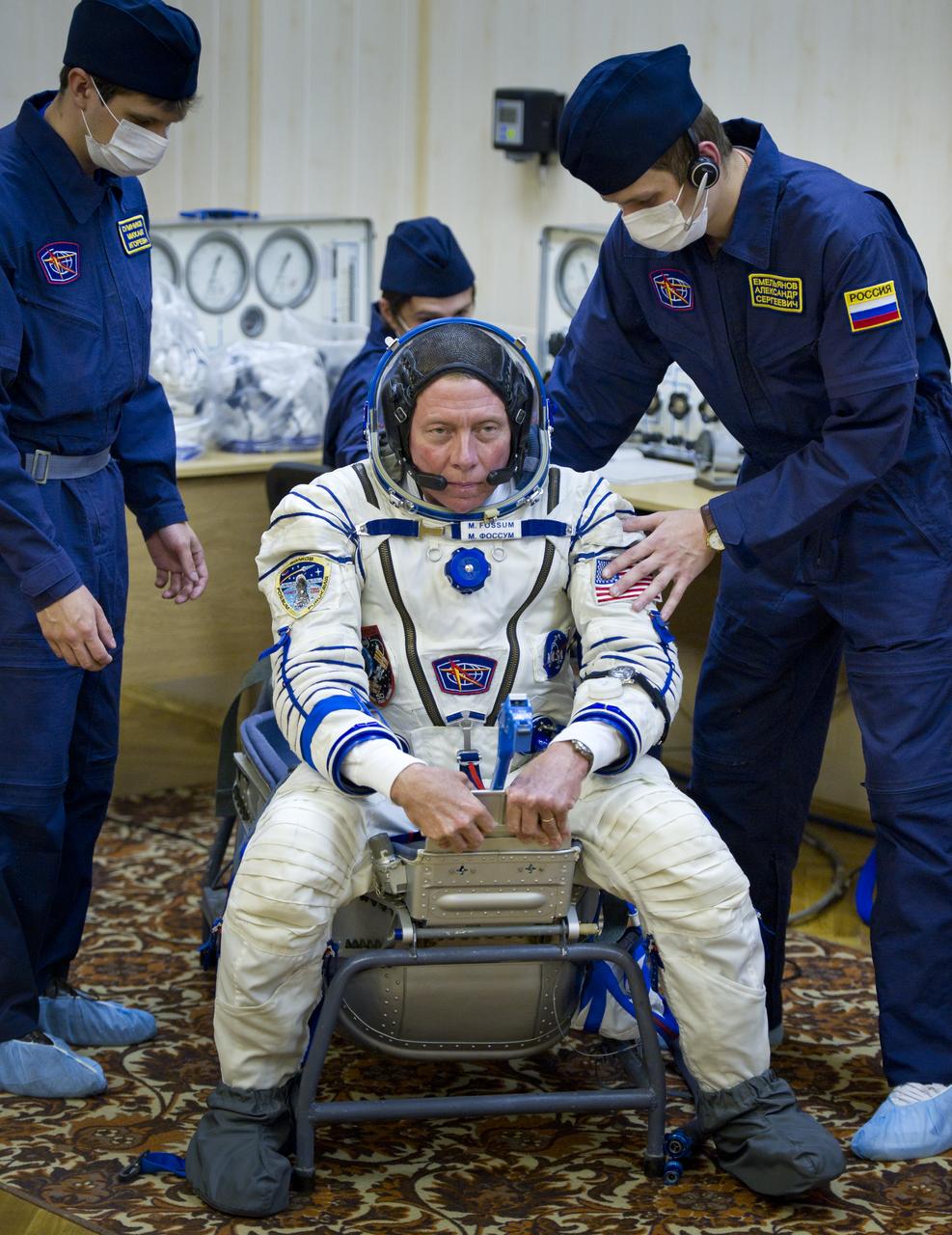
Expedition 28 and NASA astronaut Mike Fossum is helped by Russian suit technicians to a chair where his Russian Sokol suit will be pressure checked in preparation for his launch to the International Space Station, Tuesday, June 7, 2011 at the Baikonur Cosmodrome in Kazakhstan. The Soyuz spacecraft will launch the following morning on June 8 carrying Expedition 28 Soyuz Commander Sergei Volkov, JAXA (Japanese Aerospace Exploration Agency) Flight Engineer Satoshi Furukawa and Fossum. Photo Credit: (NASA/Carla Cioffi)
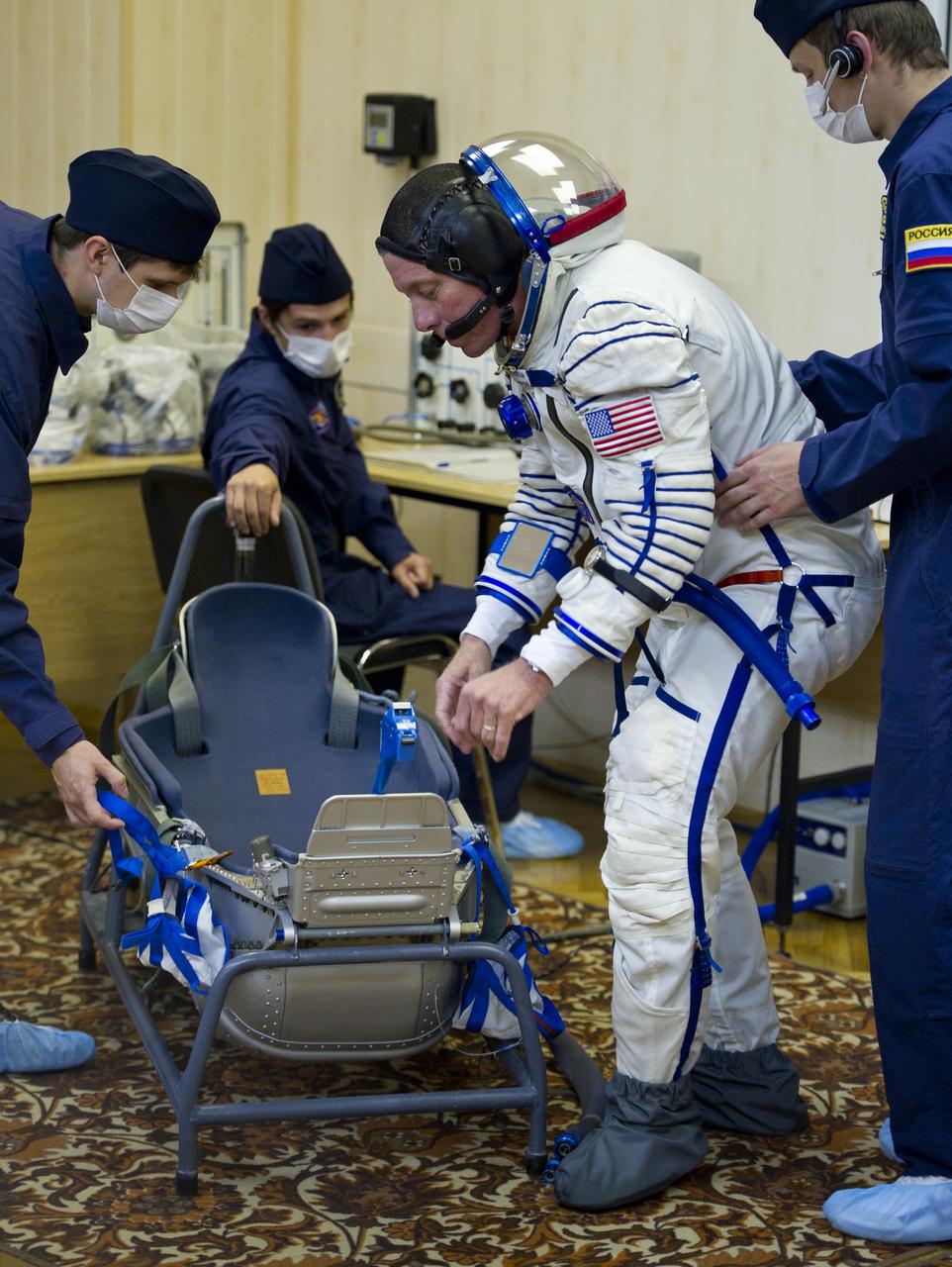
Expedition 28 and NASA astronaut Mike Fossum is helped by Russian suit technicians to a chair where his Russian Sokol suit will be pressure checked in preparation for his launch to the International Space Station, Tuesday, June 7, 2011 at the Baikonur Cosmodrome in Kazakhstan. The Soyuz spacecraft will launch the following morning on June 8 carrying Expedition 28 Soyuz Commander Sergei Volkov, JAXA (Japanese Aerospace Exploration Agency) Flight Engineer Satoshi Furukawa and Fossum. Photo Credit: (NASA/Carla Cioffi)
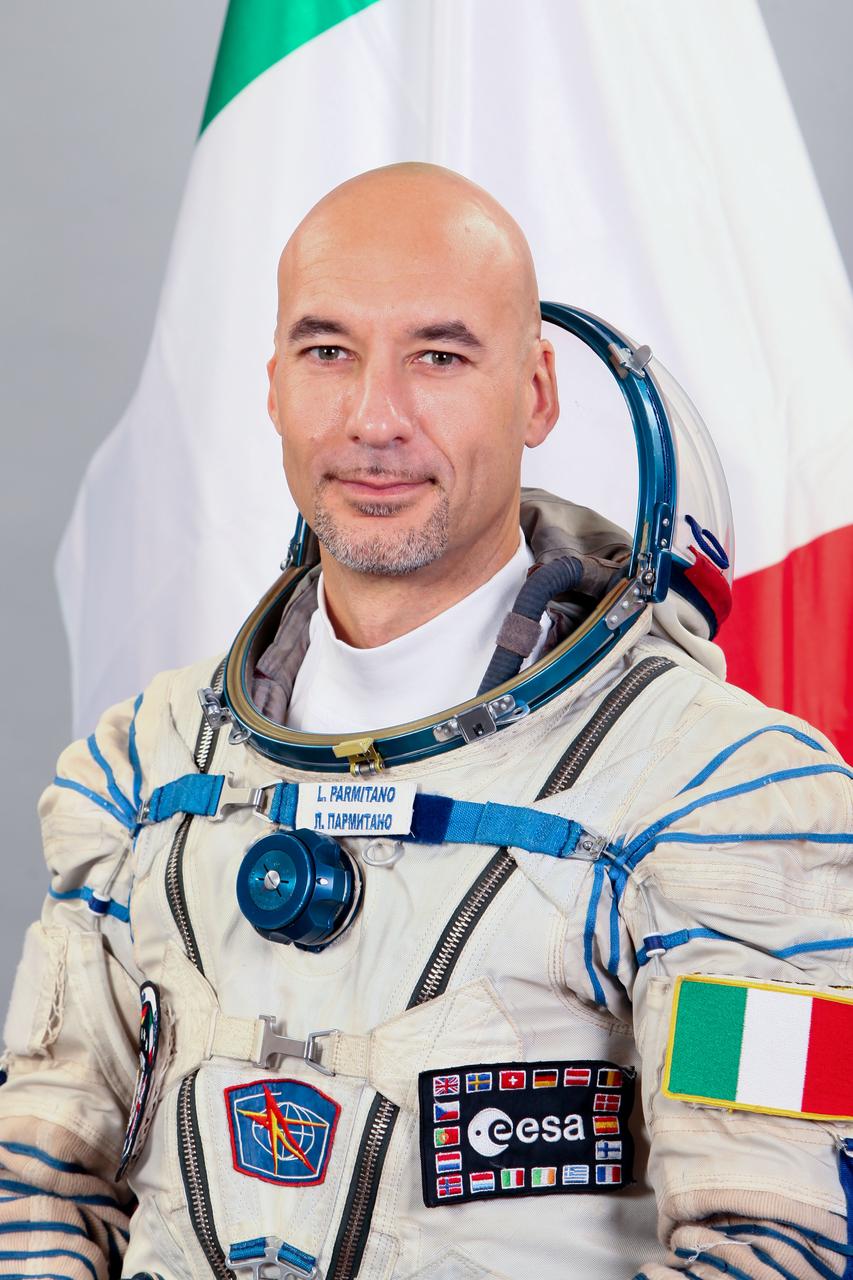
JSC2012-E-238485 (27 Aug. 2012) --- European Space Agency astronaut Luca Parmitano, Expedition 34 backup crew member, attired in a Russian Sokol launch and entry suit, takes a break from training in Star City, Russia to pose for a portrait. Photo credit: Gagarin Cosmonaut Training Center
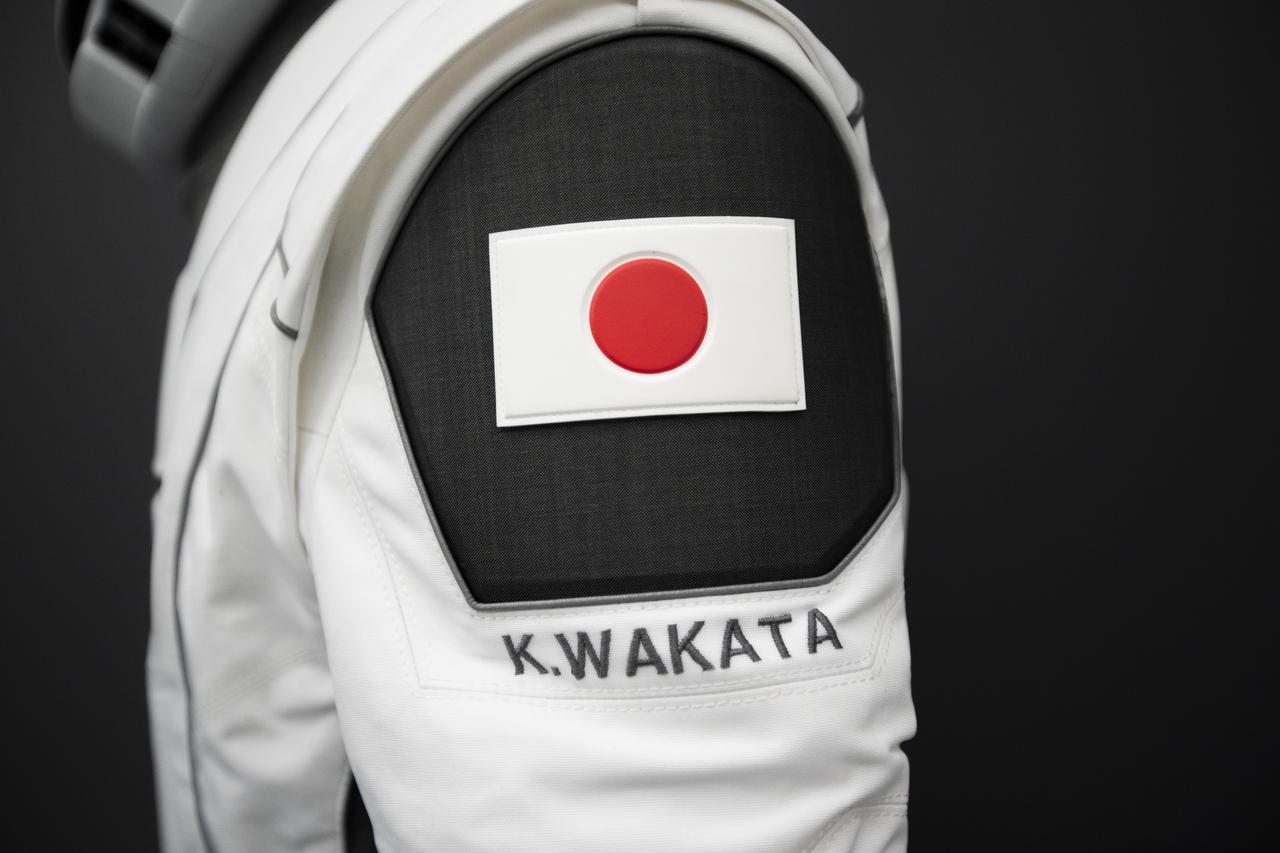
A SpaceX launch and entry suit bears a Japanese flag, and the name of JAXA astronaut Koichi Wakata – a crewmember of NASA's SpaceX Crew-5 mission to the International Space Station.
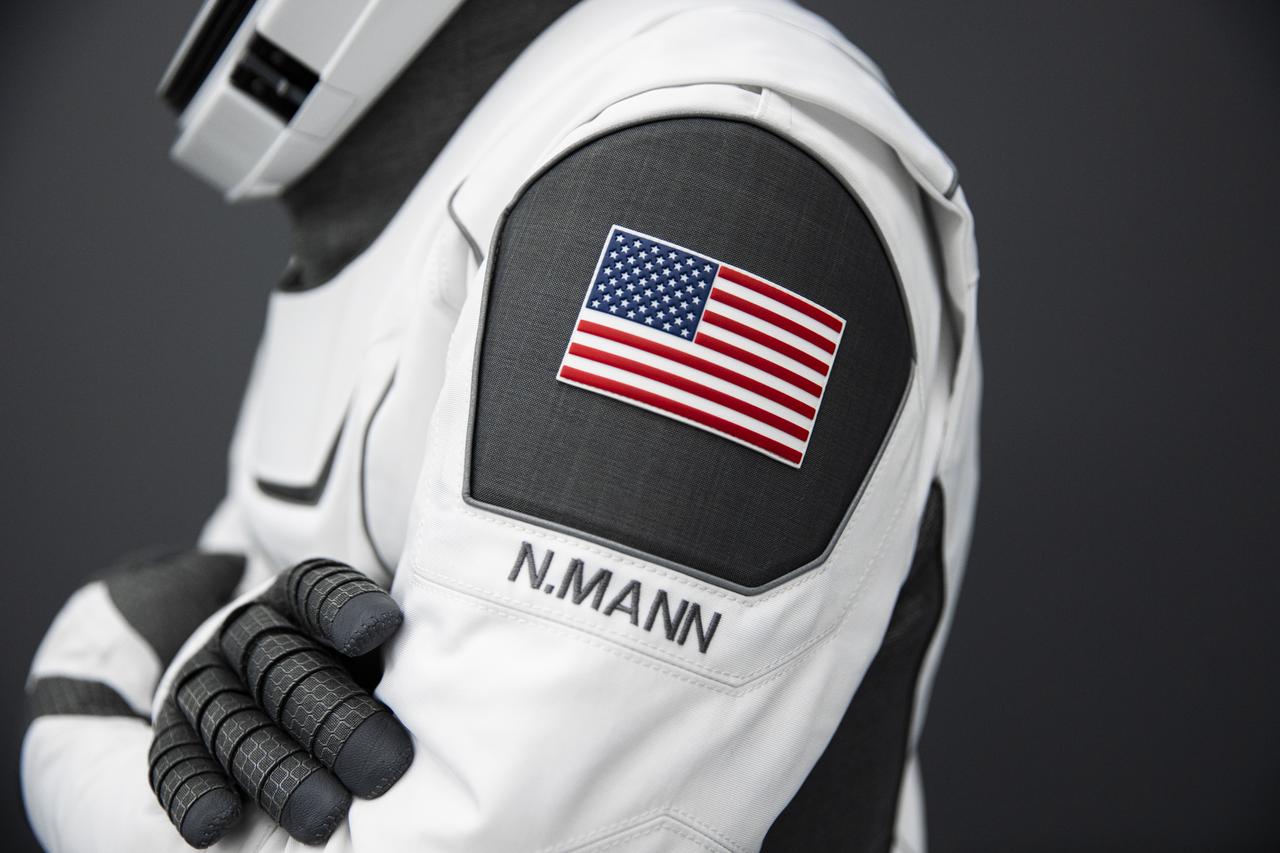
A SpaceX launch and entry suit bears an American flag, and the name of NASA Astronaut Nicole Mann, who will serve as the commander of NASA's SpaceX Crew-5 mission to the International Space Station.
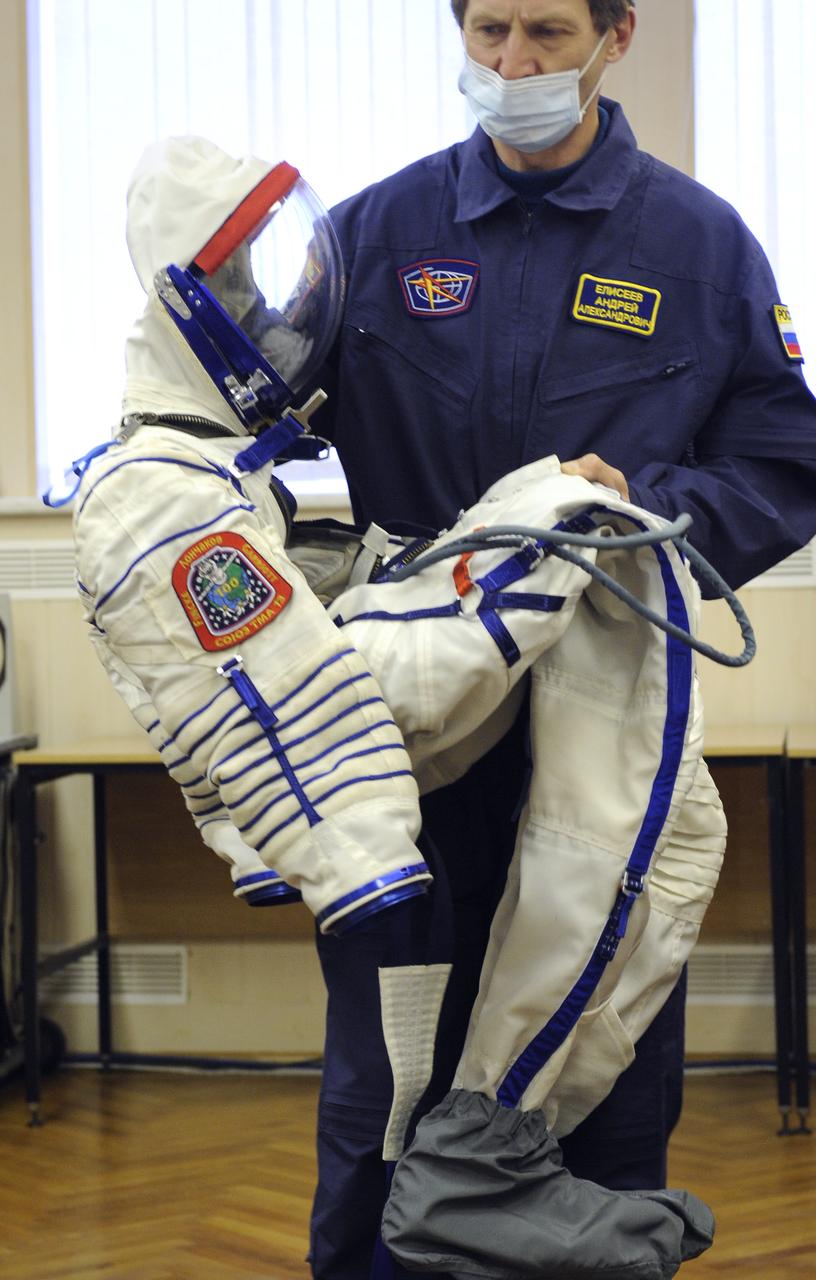
A Russian Sokol suit technician prepares to help American spaceflight participant Richard Garriott don his flight suit prior to the Soyuz TMA-13 launch with Expedition 18 Commander Michael Fincke and Flight Engineer Yuri V. Lonchakov, Sunday, Oct. 12, 2008 in Baikonur, Kazakhstan. The three crew members are scheduled to dock with the International Space Station on Oct. 14. Fincke and Lonchakov will spend six months on the station, while Garriott will return to Earth Oct. 24 with two of the Expedition 17 crew members currently on the International Space Station. Photo Credit: (NASA/Bill Ingalls)
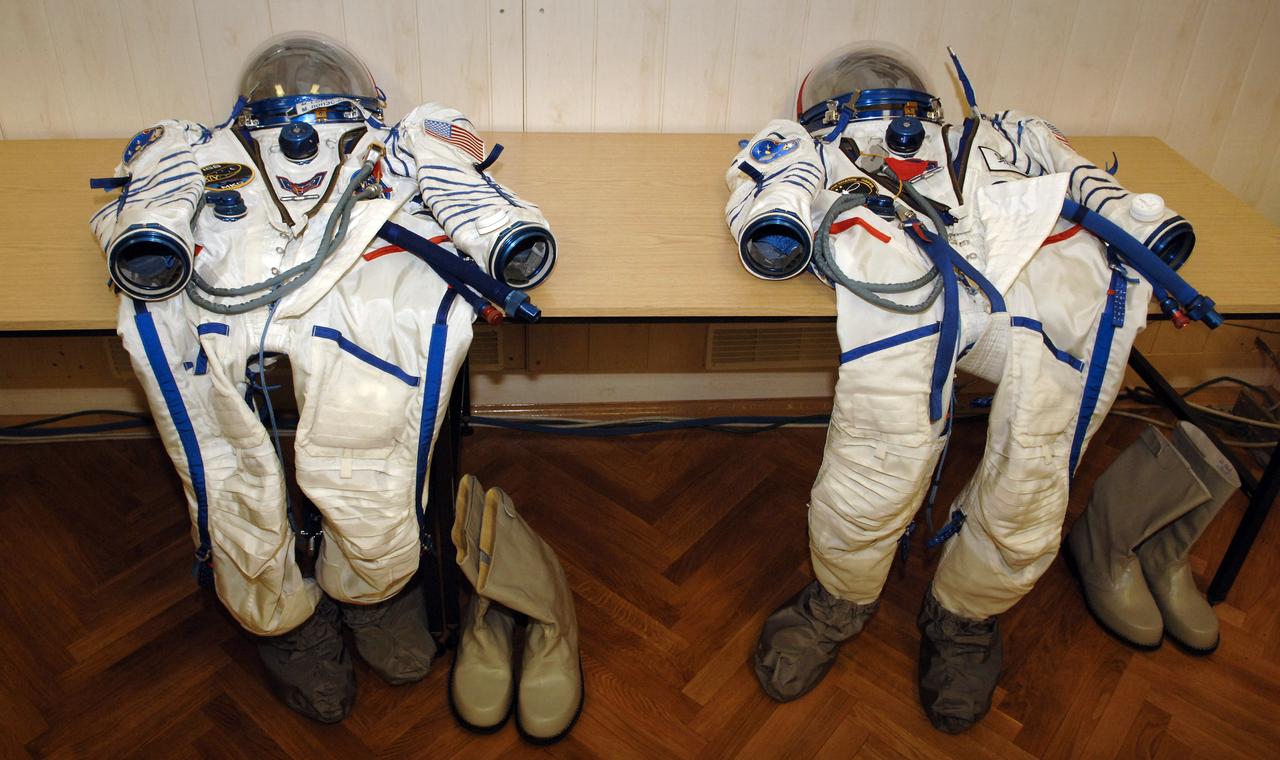
Russian Sokol suits await crew members during suit up at the Baikonur Cosmodrome, Monday, Sept. 18, 2006, in Kazakhstan. The Soyuz TMA-9 spacecraft launched from the Baikonur Cosmodrome at 10:09 a.m. local time carrying Expedition 14 Commander Michael Lopez-Alegria, Soyuz Commander and Expedition 14 Flight Engineer Mikhail Tyurin and American spaceflight participant Anousheh Ansari, who will spend nine days on the International Space Station under a commercial agreement with the Russian Federal Space Agency. Photo Credit: (NASA/Bill Ingalls)
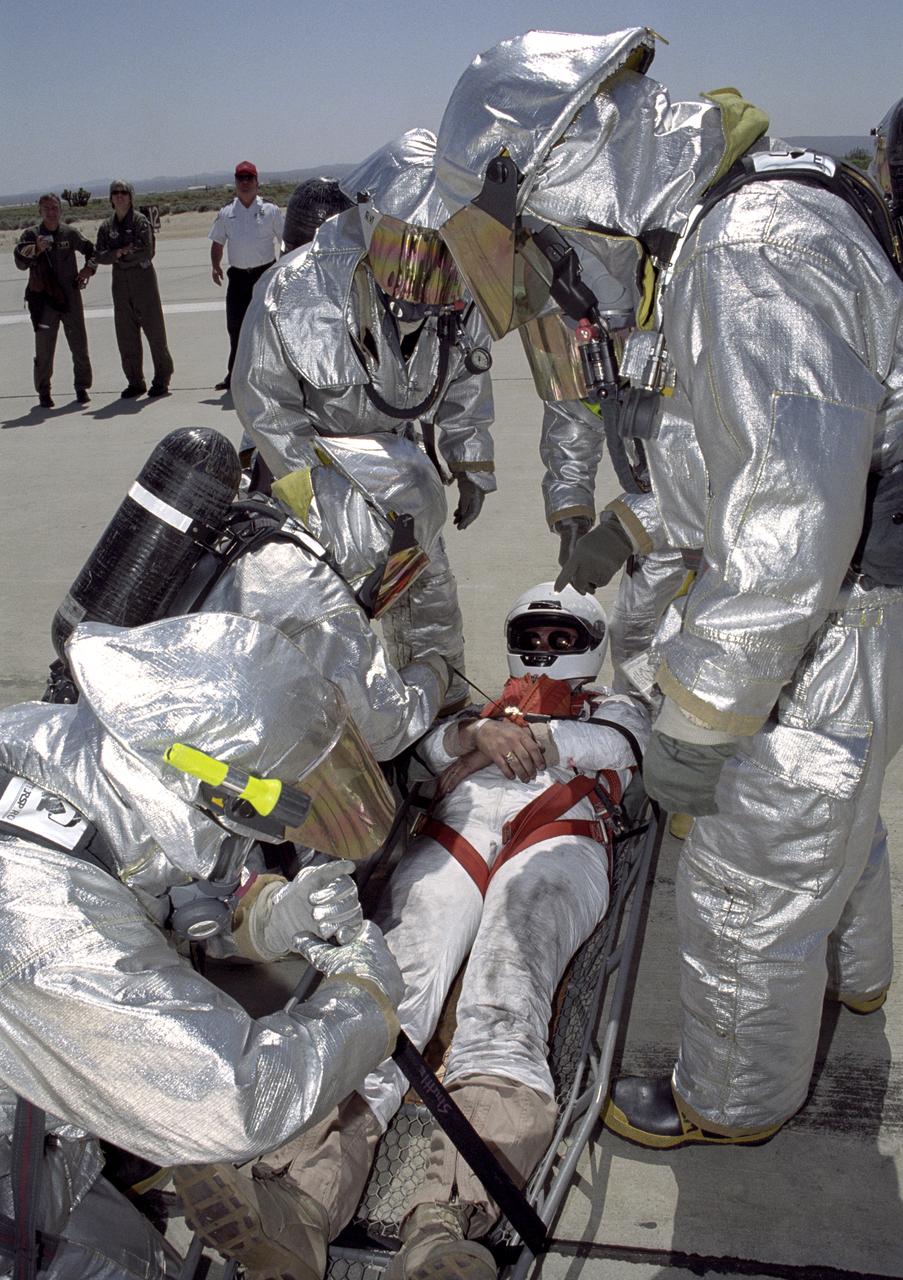
Clad in full thermal protection suits, Air Force fire-rescue crews strap a stand-in "astronaut" into a litter during a Space Shuttle rescue training exercise at Edwards AFB.
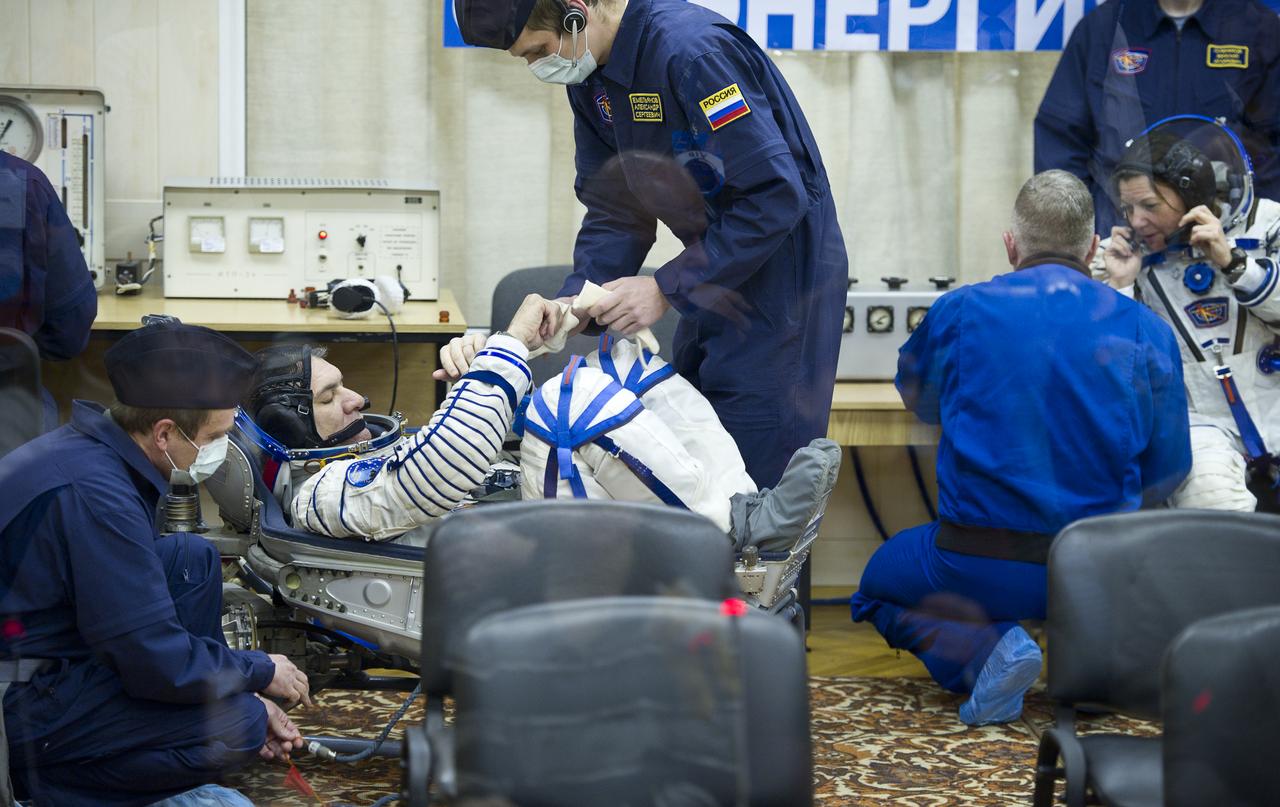
Expedition 26 European Space Agency astronaut Paolo Nespoli has his Russian Sokol suit pressure checked, while Expedition 26 Flight Engineer Catherine Coleman, far right, speaks with back up crew member Mike Fossum at the Baikonur Cosmodrome in Baikonur, Kazakhstan, Wednesday, Dec. 15, 2010. Nespoli and fellow Expedition 26 crew members Soyuz Commander Dmitry Kondratryev and NASA Flight Engineer Catherine Coleman launched in their Soyuz TMA-20 rocket from the Baikonur Cosmodrome in Kazakhstan the following morning at 1:09 a.m. local time. (Photo Credit: NASA/Carla Cioffi)
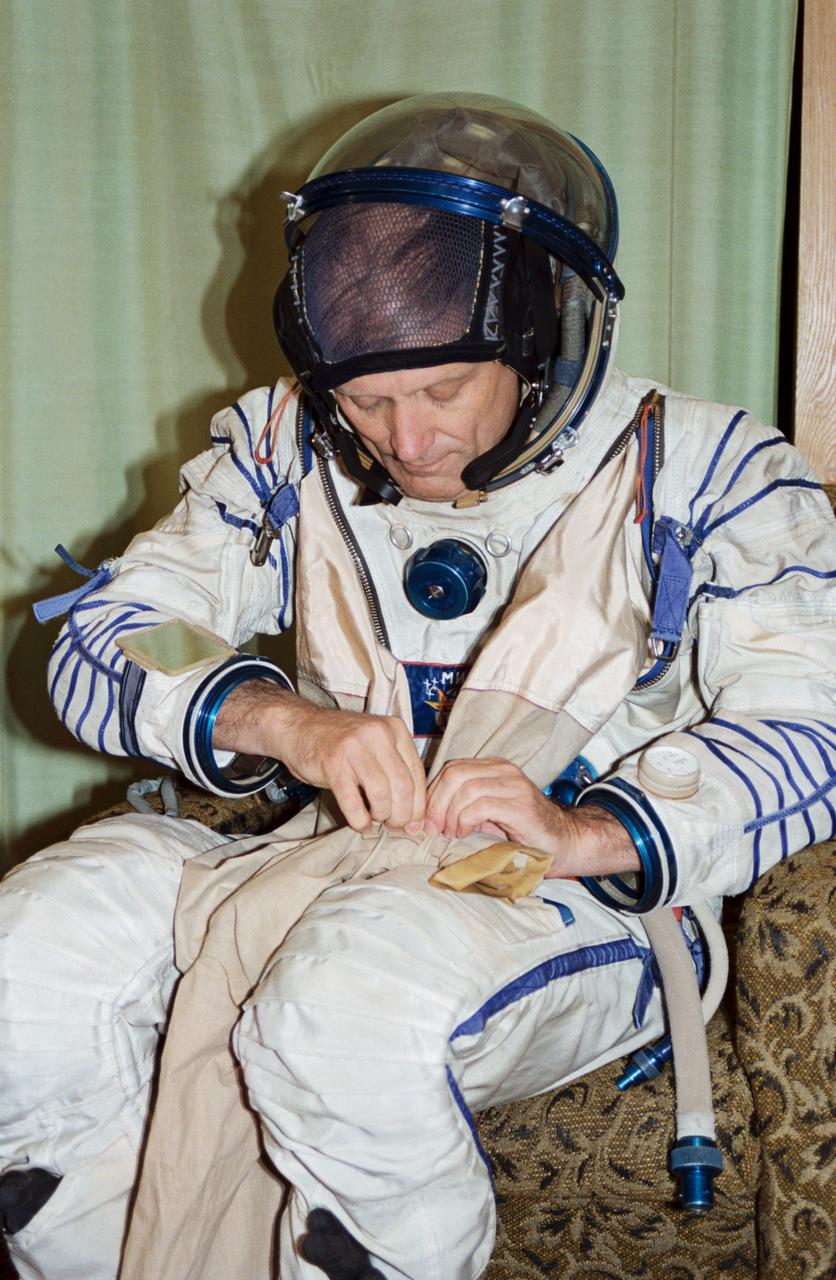
Astronaut Norman E. Thagard in a cosmonaut space suit in the Training Simulator Facility at the Gagarin Cosmonaut Training Center (Star City), near Moscow, Russia. In March 1995, astronaut Thagard is scheduled to be launched in a Russian Soyuz spacecraft with two cosmonauts to begin a three-month tour of duty on the Russian Mir Space Station. Thagard, along with his back-up, astronaut Bonnie J. Dunbar, has been training in Russian since February 1994.
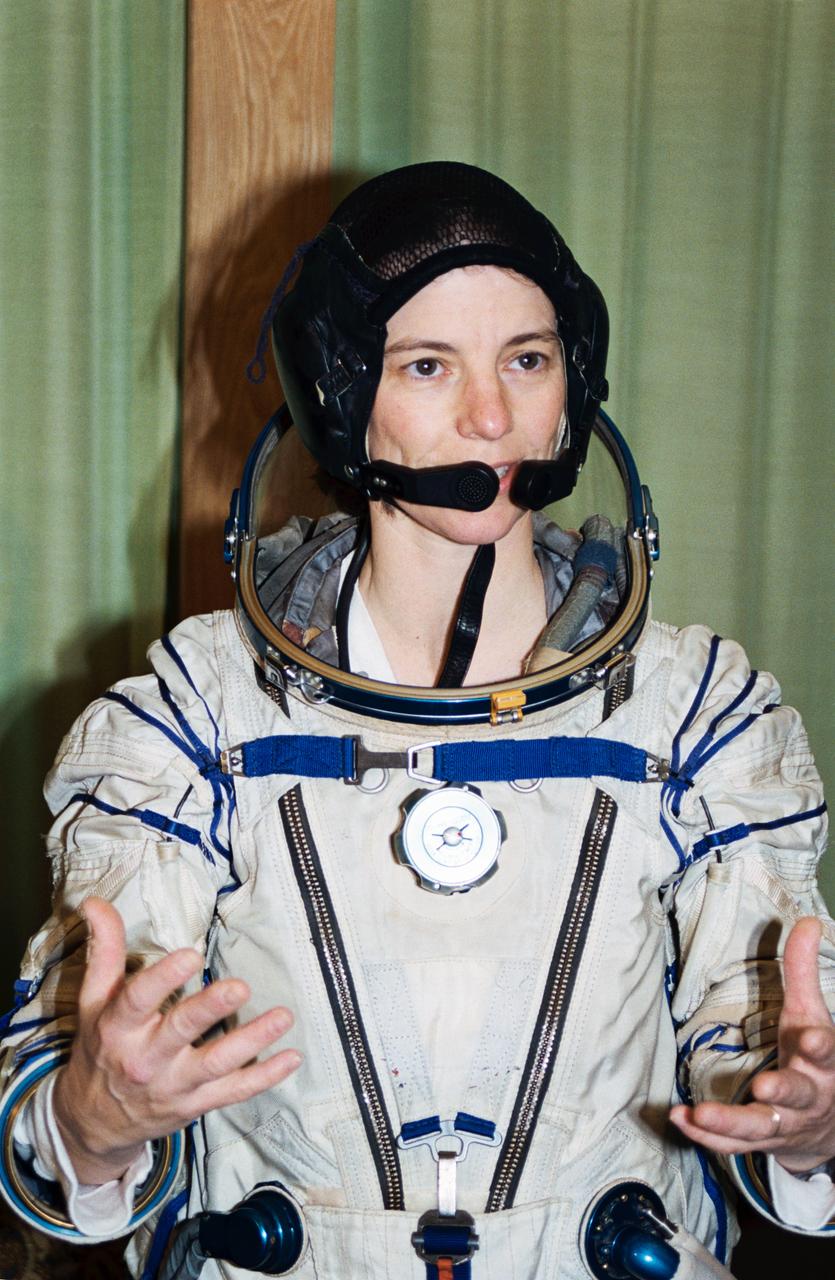
Astronaut Bonnie J. Dunbar in a cosmonaut space suit in the Training Simulator Facility at the Gagarin Cosmonaut Training Center (Star City), near Moscow, Russia. In March 1995, astronaut Norman E. Thagard is scheduled to be launched in a Russian Soyuz spacecraft with two cosmonauts to begin a three-month tour of duty on the Russian Mir Space Station. Thagard, along with his back-up, astronaut Bonnie J. Dunbar, has been training in Russian since February 1994.
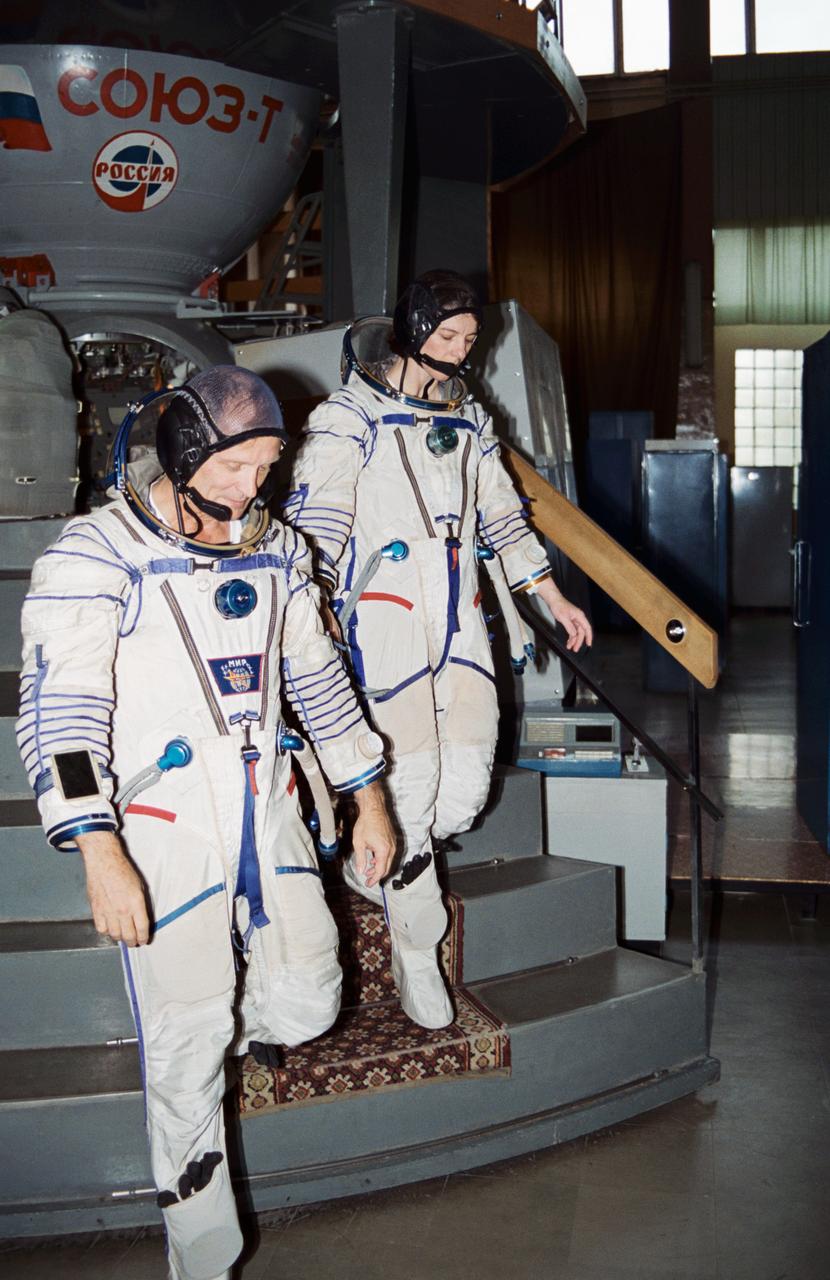
Astronauts Norman E. Thagard and Bonnie J. Dunbar in cosmonaut space suits in the Training Simulator Facility at the Gagarin Cosmonaut Training Center (Star City), near Moscow, Russia. In March 1995, astronaut Thagard is scheduled to be launched in a Russian Soyuz spacecraft with two cosmonauts to begin a three-month tour of duty on the Russian Mir Space Station. Thagard, along with his back-up, astronaut Bonnie J. Dunbar, has been training in Russian since February 1994.
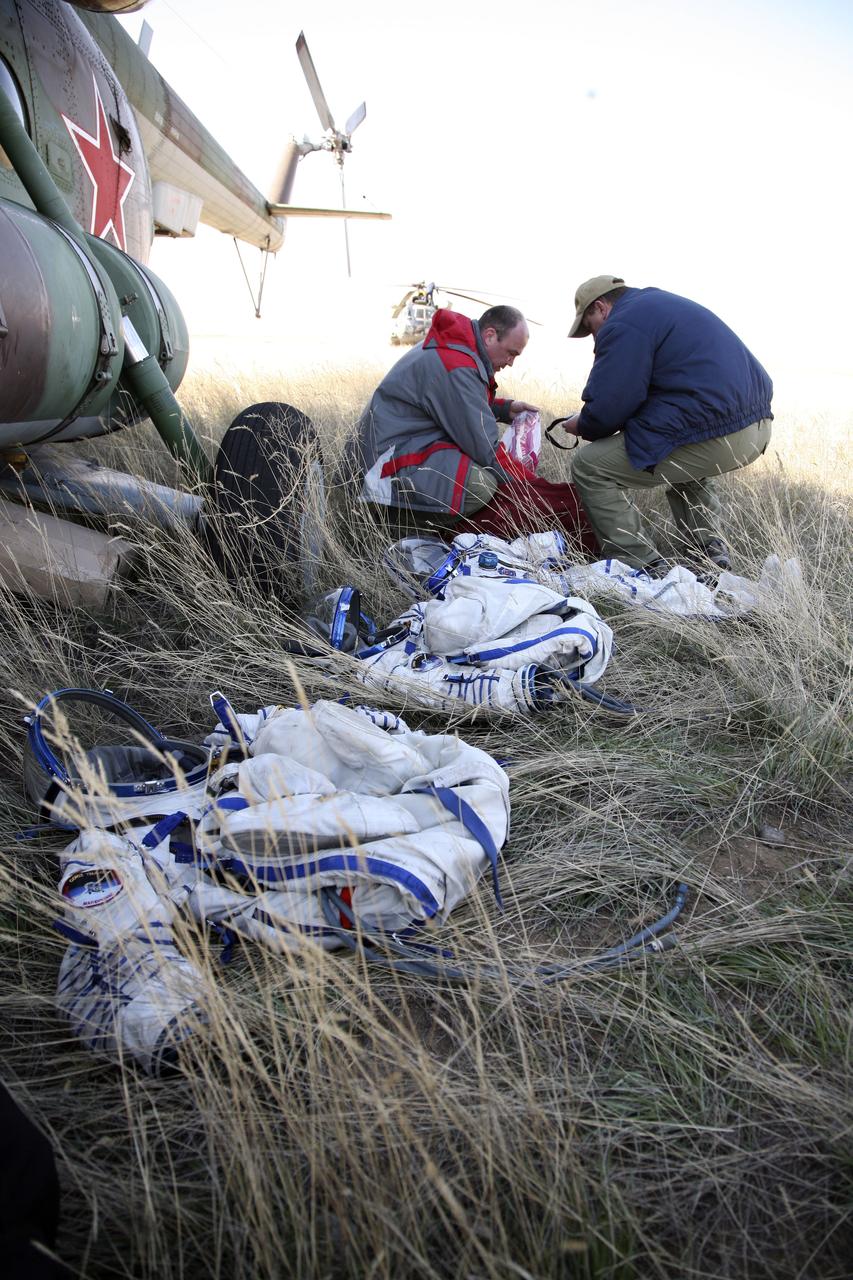
Russian Sokol flight suits of Expedition 16 Commander Peggy Whitson, Flight Engineer and Soyuz Commander Yuri Malenchenko and South Korean spaceflight participant So-yeon Yi are seen laying on the ground shortly after their Soyuz TMA-11 spacecraft landed in central Kazakhstan, Friday, April 19, 2008, to complete 192 days in space for Whitson and Malenchenko and 11 days in orbit for Yi. Photo Credit: (NASA/Reuters/Pool)
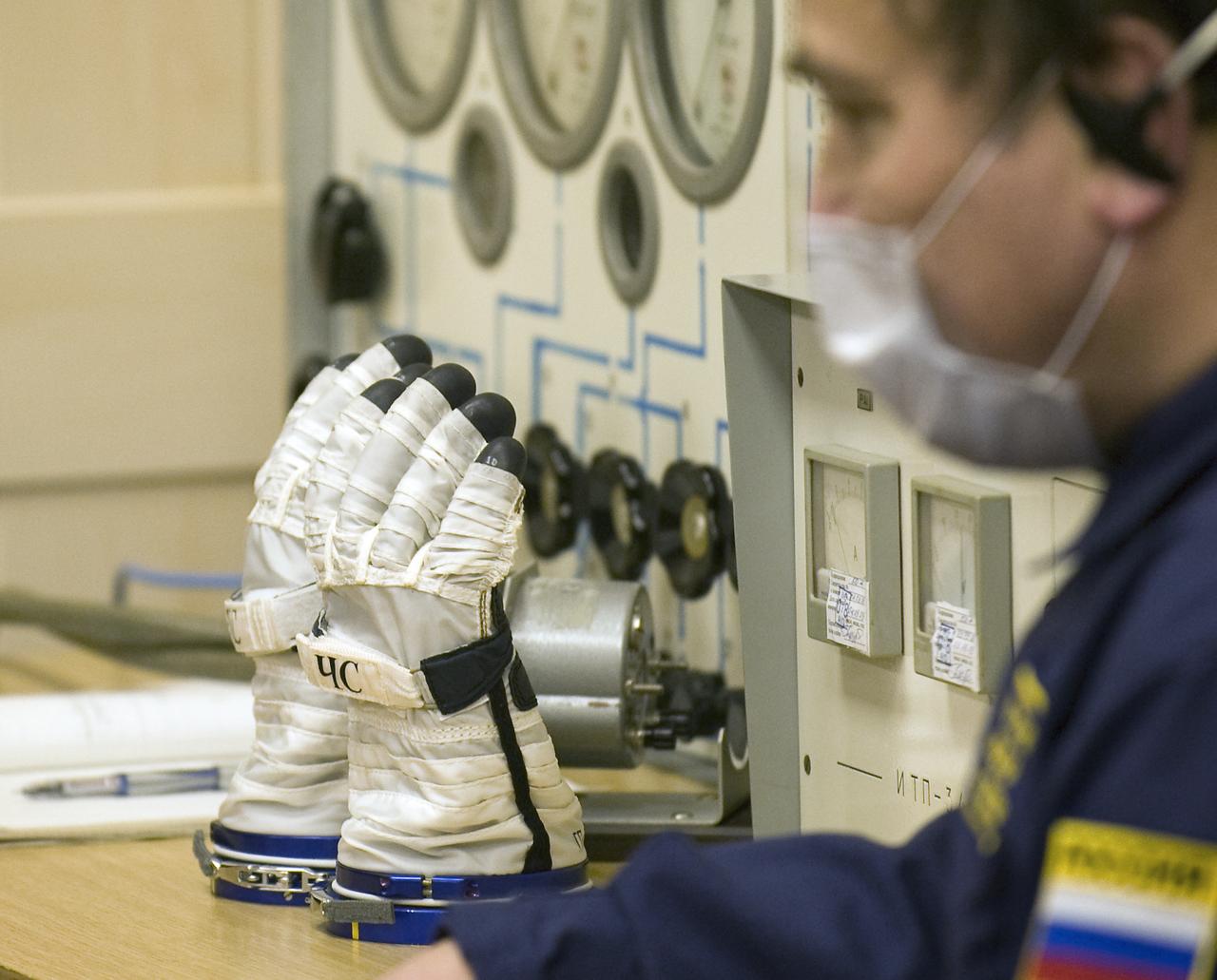
Expedition 19 Flight Engineer Michael R. Barratt's Russian Sokol suit gloves are ready for him to wear during the pressure check procedure prior to the Soyuz launch to the International Space Station with Commander Gennady I. Padalka and Spaceflight Participant Charles Simonyi on Thursday, March 26, 2009 in Baikonur, Kazakhstan. (Photo Credit: NASA/Bill Ingalls)
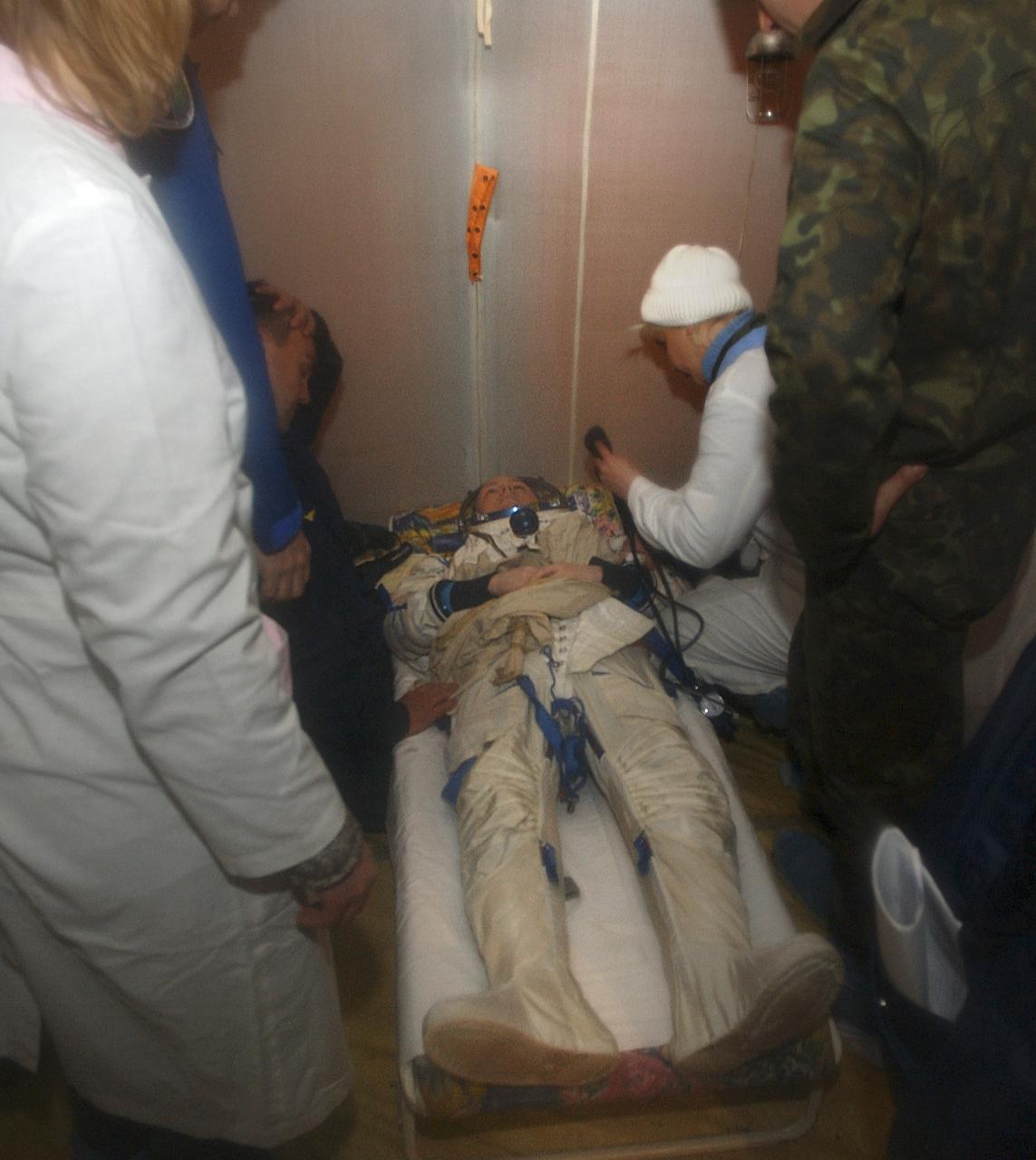
Expedition 9 Flight Engineer Michael Fincke is checked out in the medical tent prior to removal of his sokol suit. Fincke landed in the Soyuz capsule along with Expedition 9 Commander Gennady Padalka and Russian Space Forces cosmonaut Yuri Shargin. The crew landed in their Soyuz capsule approximately 85 kilometers northeast of Arkalyk in northern Kazakhstan, Sunday, October 24, 2004. Photo Credit: (NASA/Bill Ingalls)
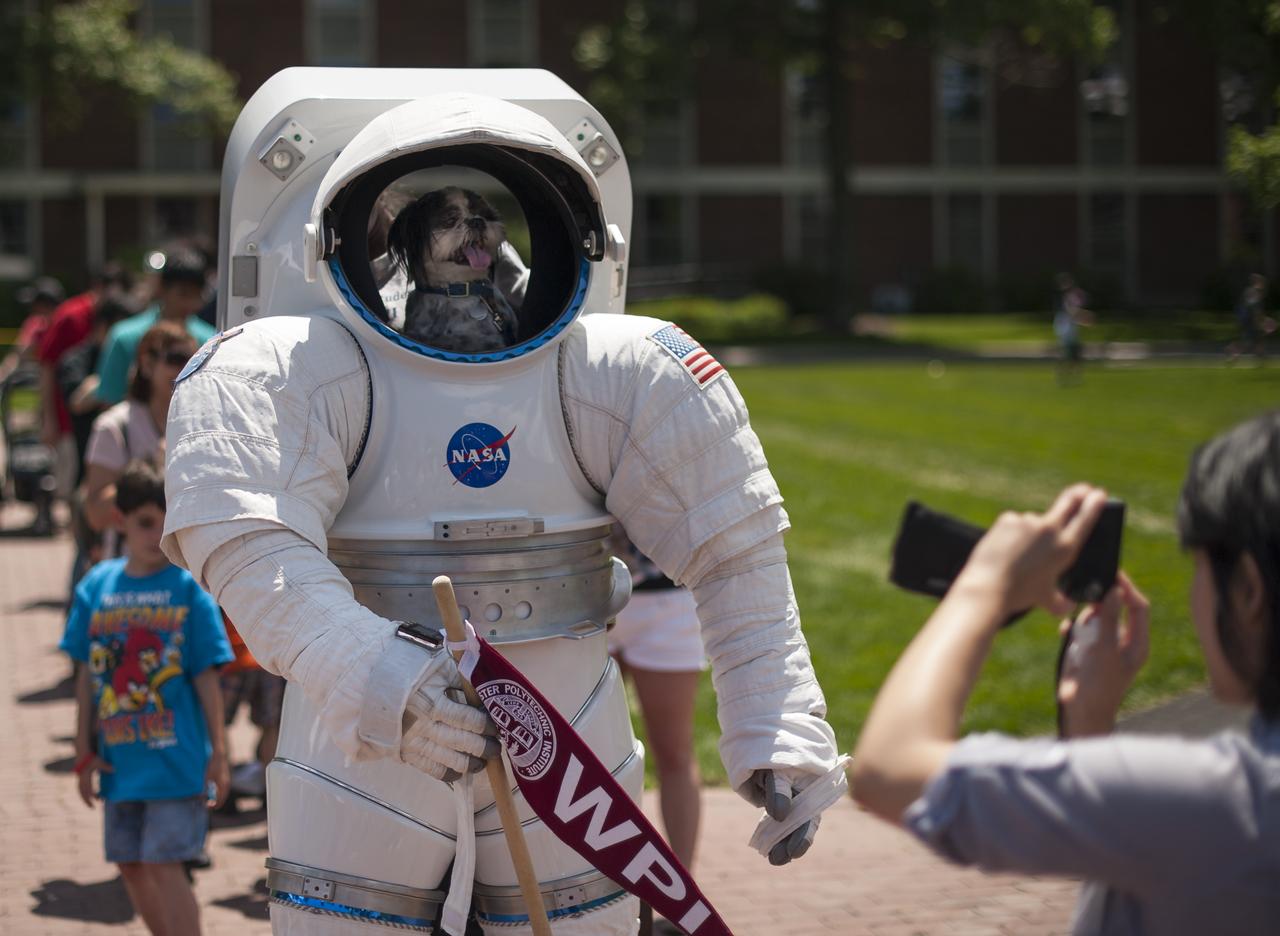
Visitors, some with their dogs, line up to make their photo inside a space suit exhibit during the Worcester Polytechnic Institute (WPI) "TouchTomorrow" education and outreach event that was held in tandem with the NASA-WPI Sample Return Robot Centennial Challenge on Saturday, June 16, 2012 in Worcester, Mass. The NASA-WPI challenge tasked robotic teams to build autonomous robots that can identify, collect and return samples. NASA needs autonomous robotic capability for future planetary exploration. Photo Credit: (NASA/Bill Ingalls)
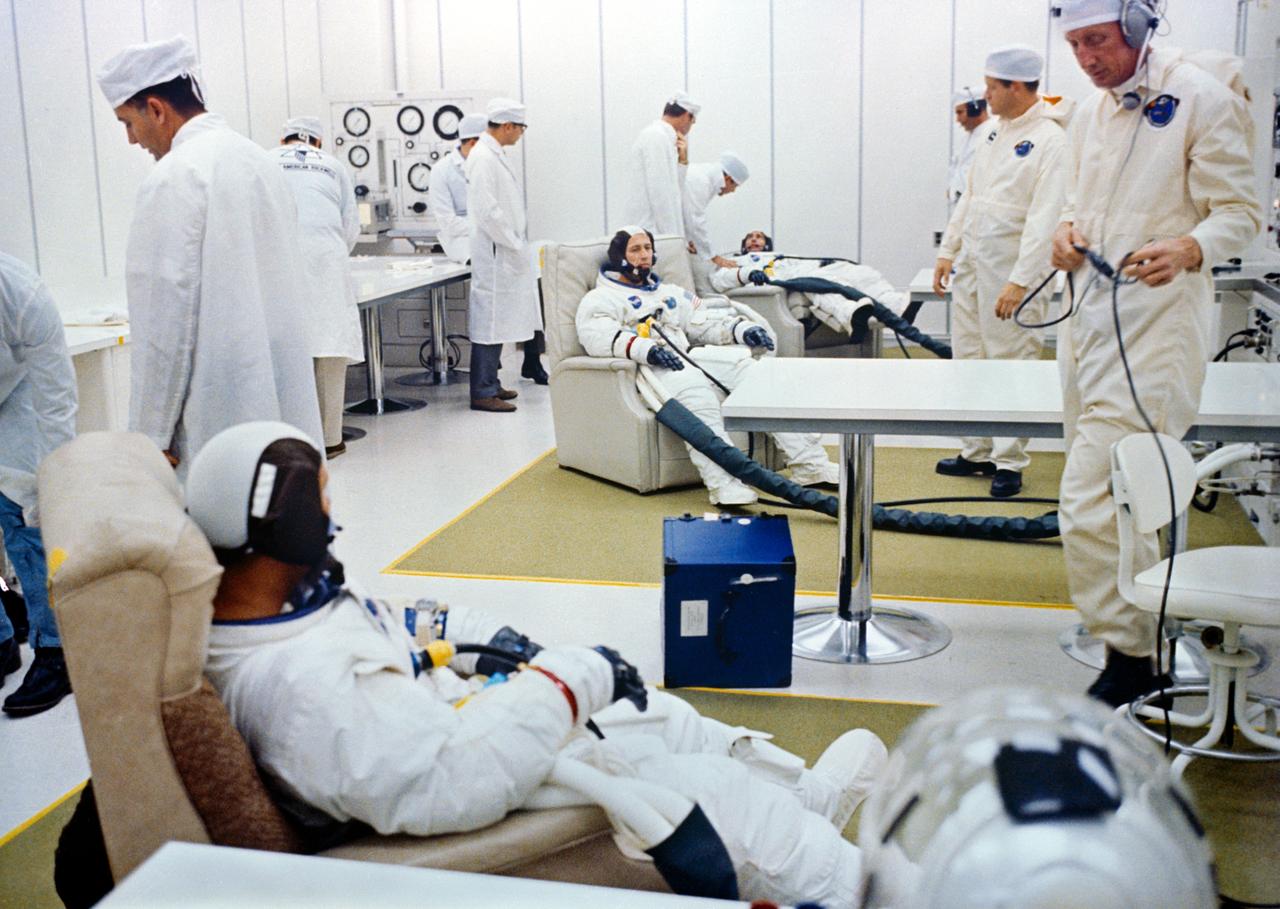
The Apollo 7 prime crew goes through suiting up operations in the Kennedy Space Center's Manned Spacecraft Operations Building during the Apollo 7 prelaunch countdown. From front to rear, are Astronauts Walter M. Schirra Jr., commander; Donn F. Eisele, command module pilot; and Walter Cunningham, lunar module pilot.
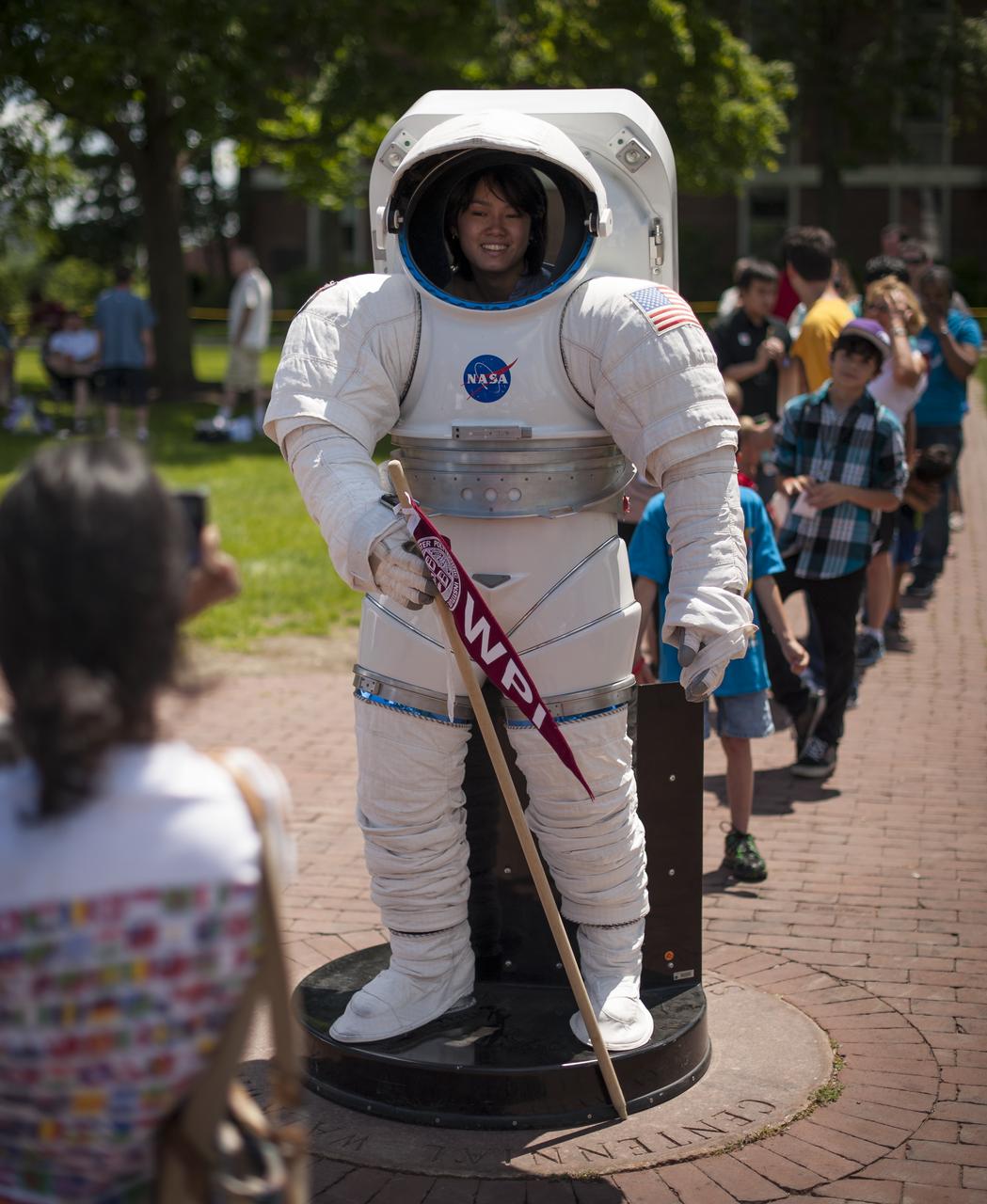
Visitors, some with their dogs, line up to make their photo inside a space suit exhibit during the Worcester Polytechnic Institute (WPI) "TouchTomorrow" education and outreach event that was held in tandem with the NASA-WPI Sample Return Robot Centennial Challenge on Saturday, June 16, 2012 in Worcester, Mass. The NASA-WPI challenge tasked robotic teams to build autonomous robots that can identify, collect and return samples. NASA needs autonomous robotic capability for future planetary exploration. Photo Credit: (NASA/Bill Ingalls)
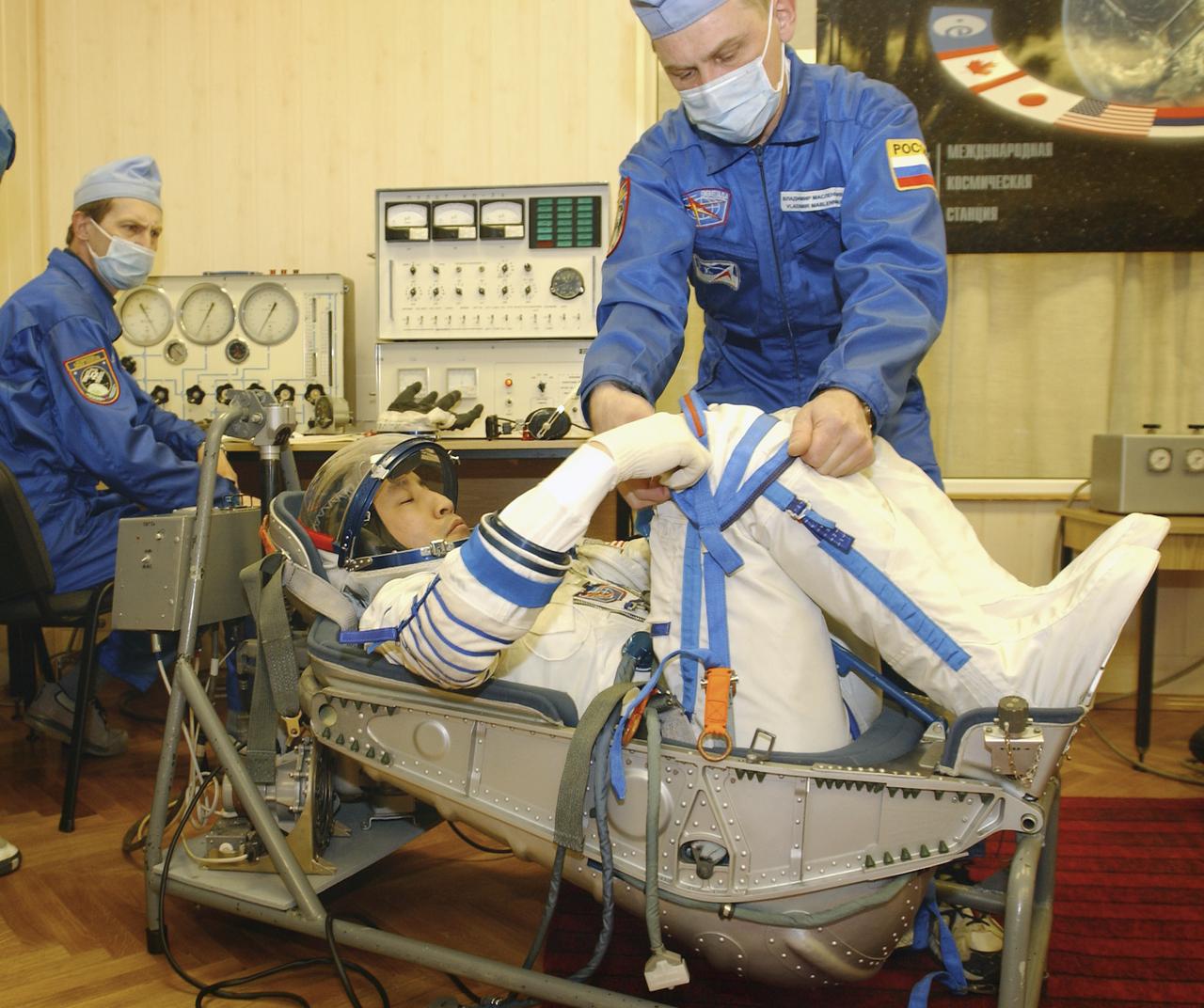
Astronaut Edward T. Lu, Expedition 7 NASA International Space Station Science Officer and Flight Engineer, has a leak check performed on his Russian Sokol suit in the Soyuz Integration Facility at the Baikonur Cosmodrome in Baikonur, Kazakhstan, Thursday, April 10, 2003. Photo Credit: (NASA/Bill Ingalls)