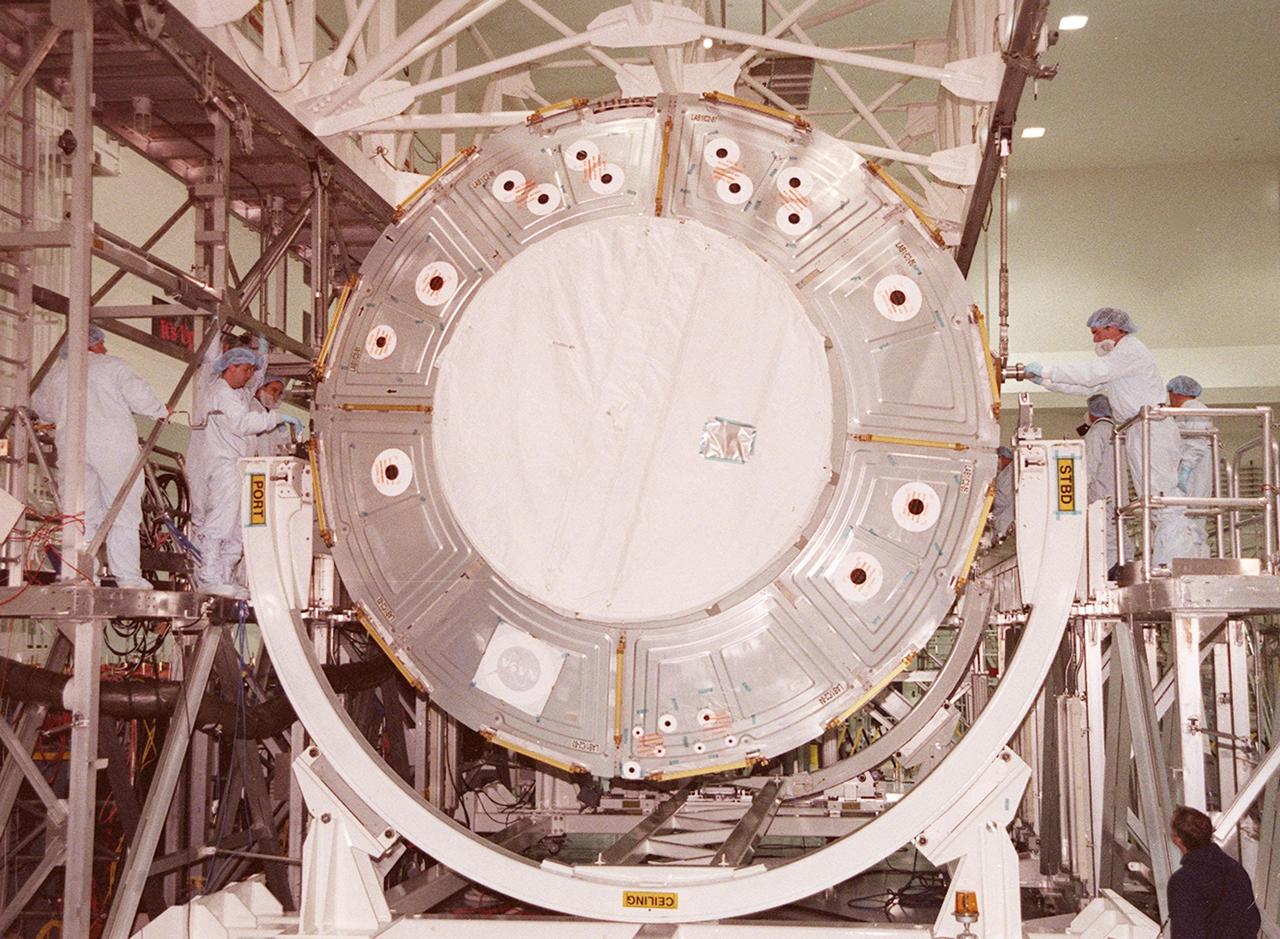
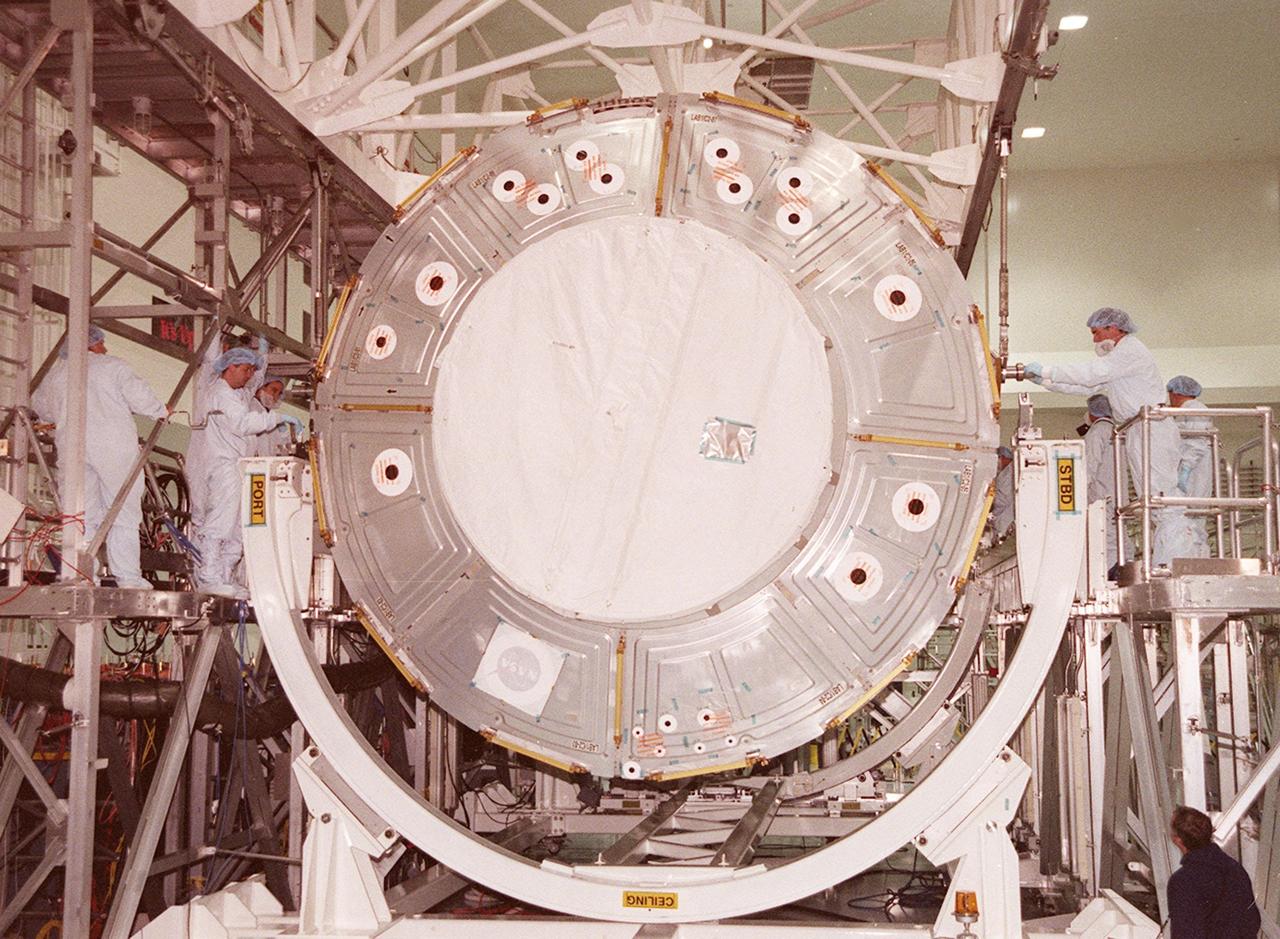
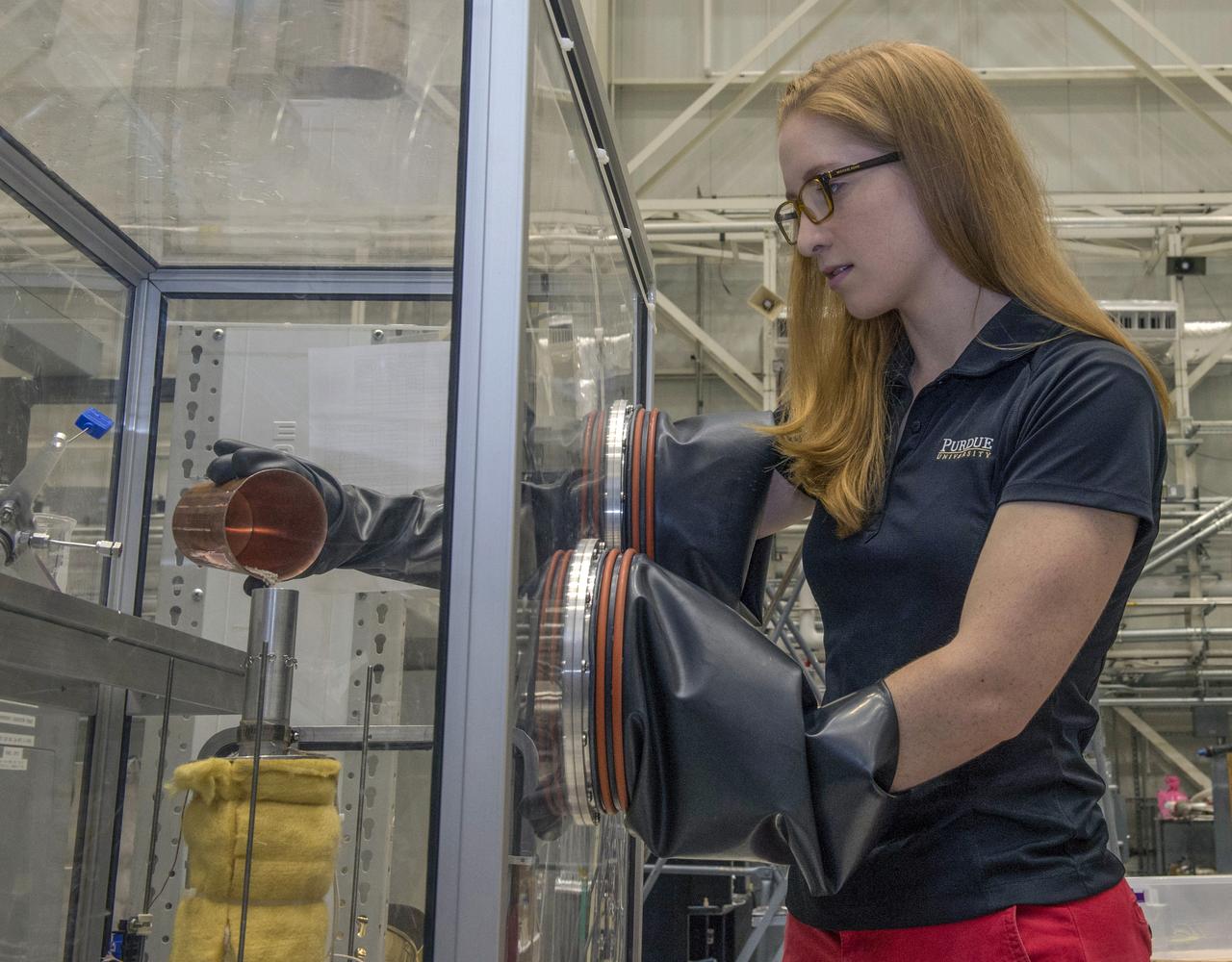
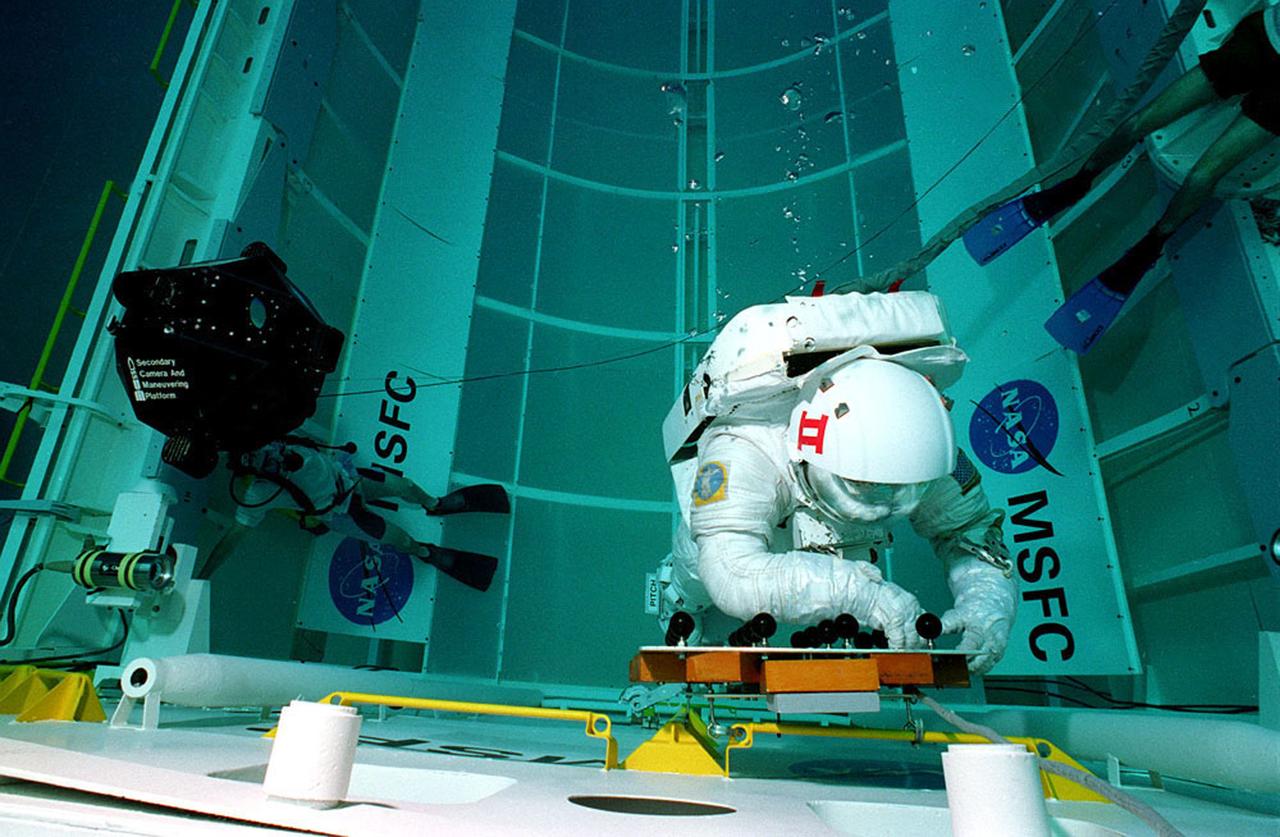
Underwater tests are conducted with Space Systems lab at Marshall's Neutral Buoyancy Simulator (NBS).
Around Marshall
KENNEDY SPACE CENTER, FLA. - Reporters are eager to hear from Armando Oliu about the aid the Image Analysis Lab is giving the FBI in a kidnapping case.  Oliu, Final Inspection Team lead for the Shuttle program, oversees the lab that is using an advanced SGI® TP9500 data management system to review the tape of the kidnapping in progress in Sarasota, Fla.  KSC installed the new $3.2 million system in preparation for Return to Flight of the Space Shuttle fleet.  The lab is studying the Sarasota kidnapping video to provide any new information possible to law enforcement officers.  KSC is joining NASA’s Marshall Space Flight Center in Alabama in reviewing the tape.
KENNEDY SPACE CENTER, FLA. - Reporters are eager to hear from Armando Oliu about the aid the Image Analysis Lab is giving the FBI in a kidnapping case. Oliu, Final Inspection Team lead for the Shuttle program, oversees the lab that is using an advanced SGI® TP9500 data management system to review the tape of the kidnapping in progress in Sarasota, Fla. KSC installed the new $3.2 million system in preparation for Return to Flight of the Space Shuttle fleet. The lab is studying the Sarasota kidnapping video to provide any new information possible to law enforcement officers. KSC is joining NASA’s Marshall Space Flight Center in Alabama in reviewing the tape.
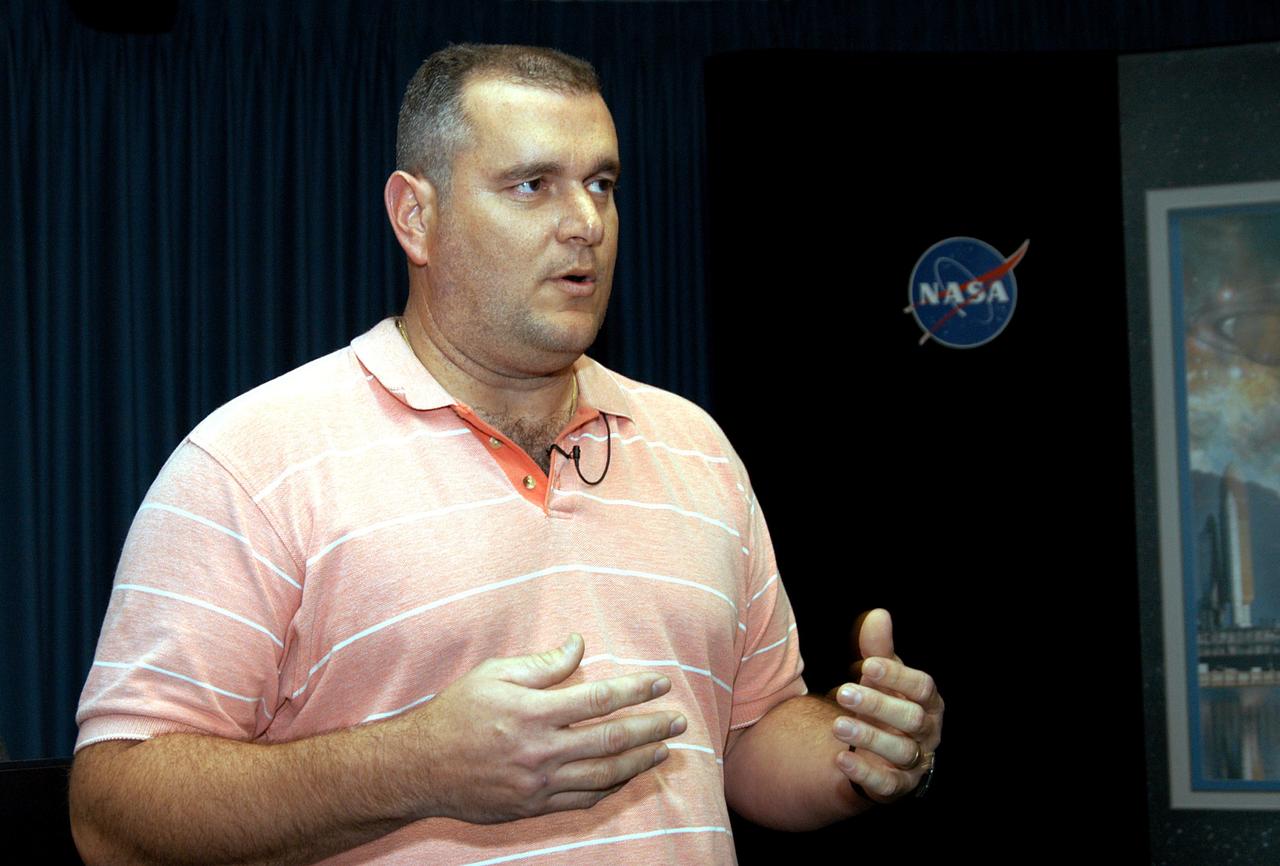
KENNEDY SPACE CENTER, FLA. - Armando Oliu, Final Inspection Team lead for the Shuttle program, speaks to reporters about the aid the Image Analysis Lab is giving the FBI in a kidnapping case.  Oliu oversees the image lab that is using an advanced SGI® TP9500 data management system to review the tape of the kidnapping in progress in Sarasota, Fla.  KSC installed the new $3.2 million system in preparation for Return to Flight of the Space Shuttle fleet.  The lab is studying the Sarasota kidnapping video to provide any new information possible to law enforcement officers.  KSC is joining NASA’s Marshall Space Flight Center in Alabama in reviewing the tape.
KENNEDY SPACE CENTER, FLA. - Armando Oliu, Final Inspection Team lead for the Shuttle program, speaks to reporters about the aid the Image Analysis Lab is giving the FBI in a kidnapping case. Oliu oversees the image lab that is using an advanced SGI® TP9500 data management system to review the tape of the kidnapping in progress in Sarasota, Fla. KSC installed the new $3.2 million system in preparation for Return to Flight of the Space Shuttle fleet. The lab is studying the Sarasota kidnapping video to provide any new information possible to law enforcement officers. KSC is joining NASA’s Marshall Space Flight Center in Alabama in reviewing the tape.
KENNEDY SPACE CENTER, FLA. - Armando Oliu, Final Inspection Team lead for the Shuttle program, speaks to reporters about the aid the Image Analysis Lab is giving the FBI in a kidnapping case.  Oliu oversees the image lab that is using an advanced SGI® TP9500 data management system to review the tape of the kidnapping in progress in Sarasota, Fla.  KSC installed the new $3.2 million system in preparation for Return to Flight of the Space Shuttle fleet.  The lab is studying the Sarasota kidnapping video to provide any new information possible to law enforcement officers.  KSC is joining NASA’s Marshall Space Flight Center in Alabama in reviewing the tape.
KENNEDY SPACE CENTER, FLA. - Armando Oliu, Final Inspection Team lead for the Shuttle program, speaks to reporters about the aid the Image Analysis Lab is giving the FBI in a kidnapping case. Oliu oversees the image lab that is using an advanced SGI® TP9500 data management system to review the tape of the kidnapping in progress in Sarasota, Fla. KSC installed the new $3.2 million system in preparation for Return to Flight of the Space Shuttle fleet. The lab is studying the Sarasota kidnapping video to provide any new information possible to law enforcement officers. KSC is joining NASA’s Marshall Space Flight Center in Alabama in reviewing the tape.
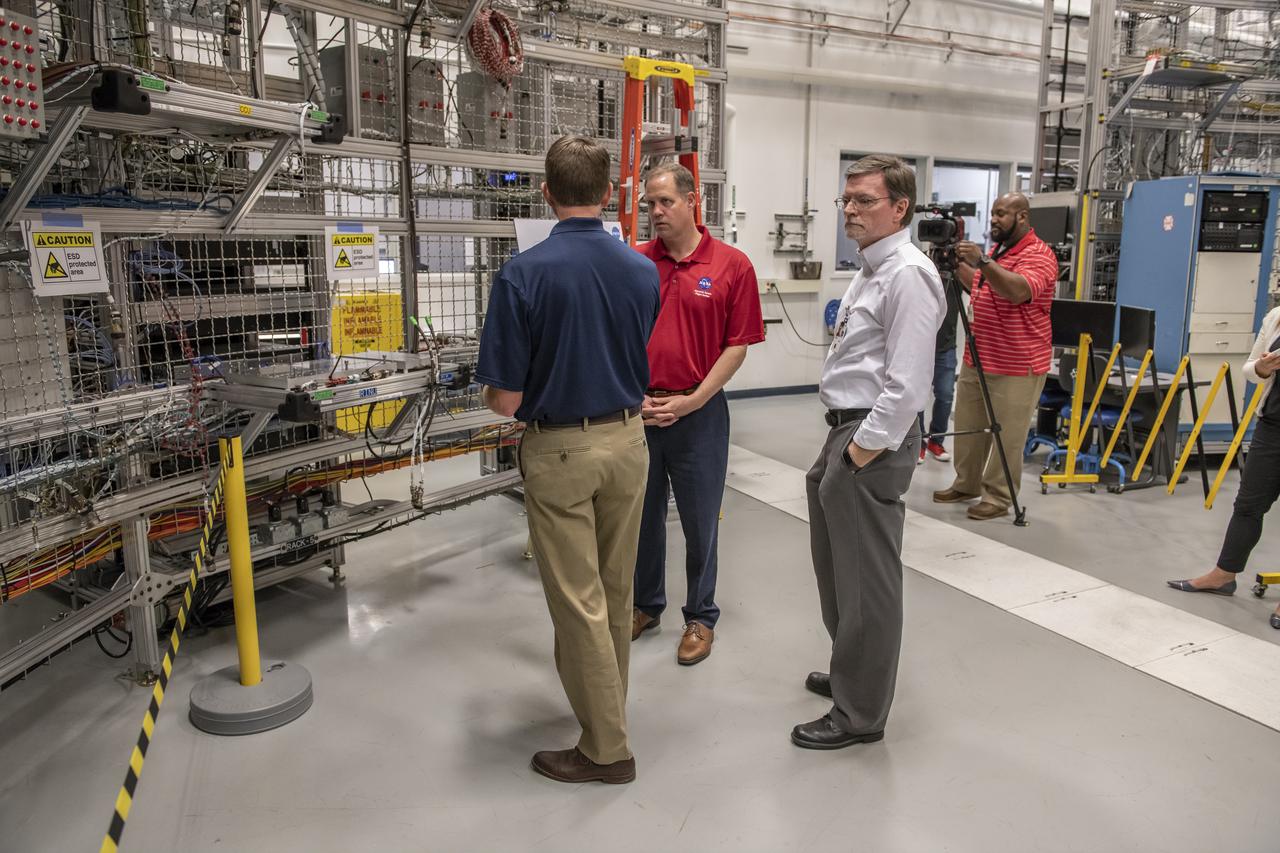
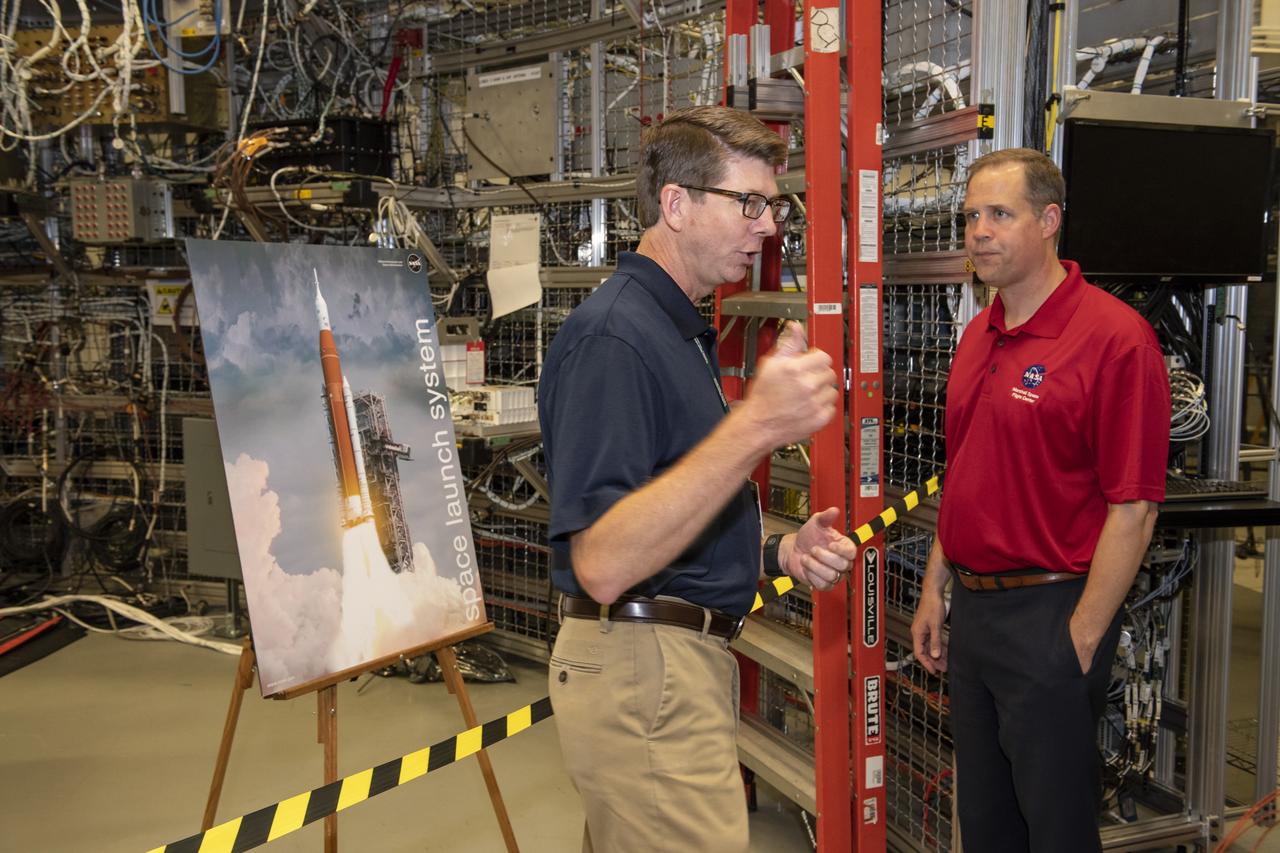
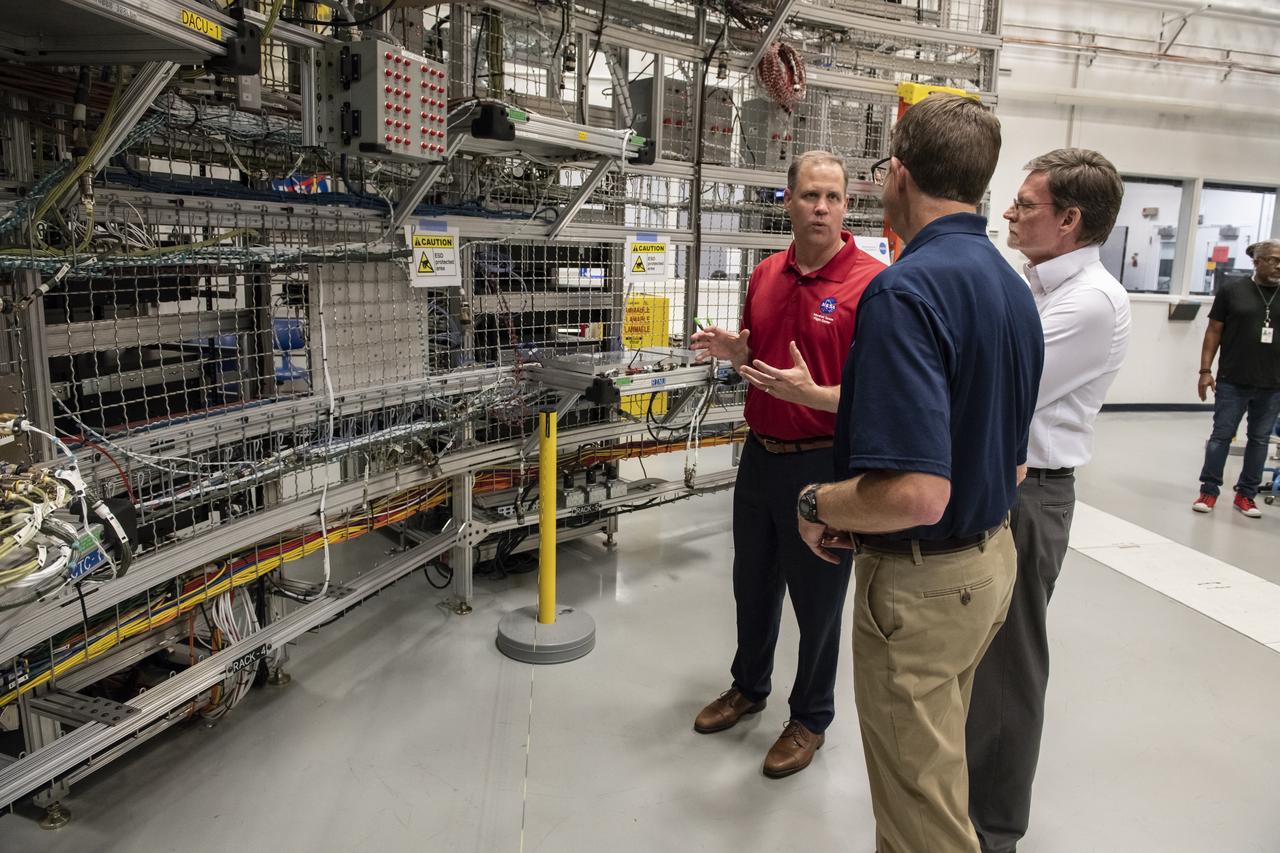
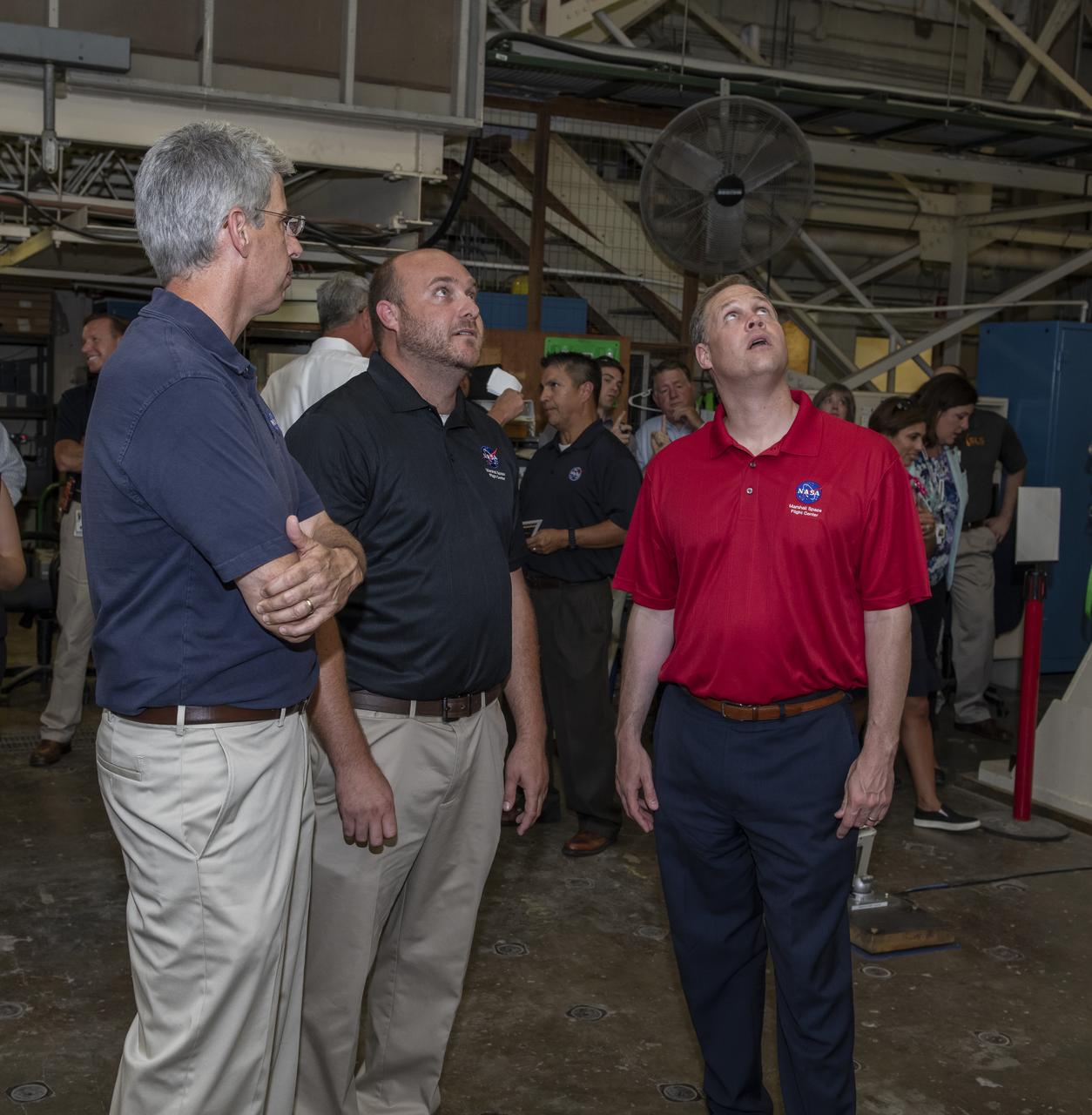
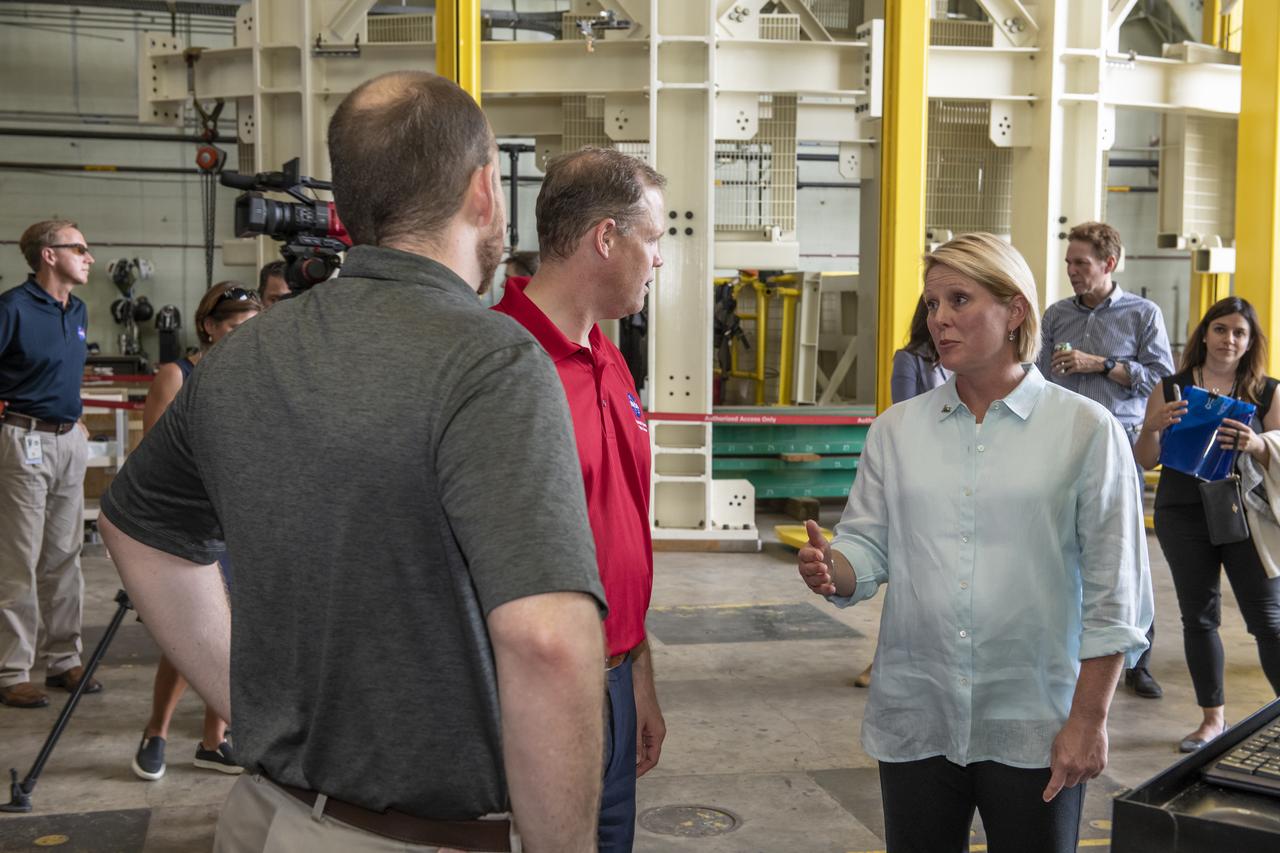
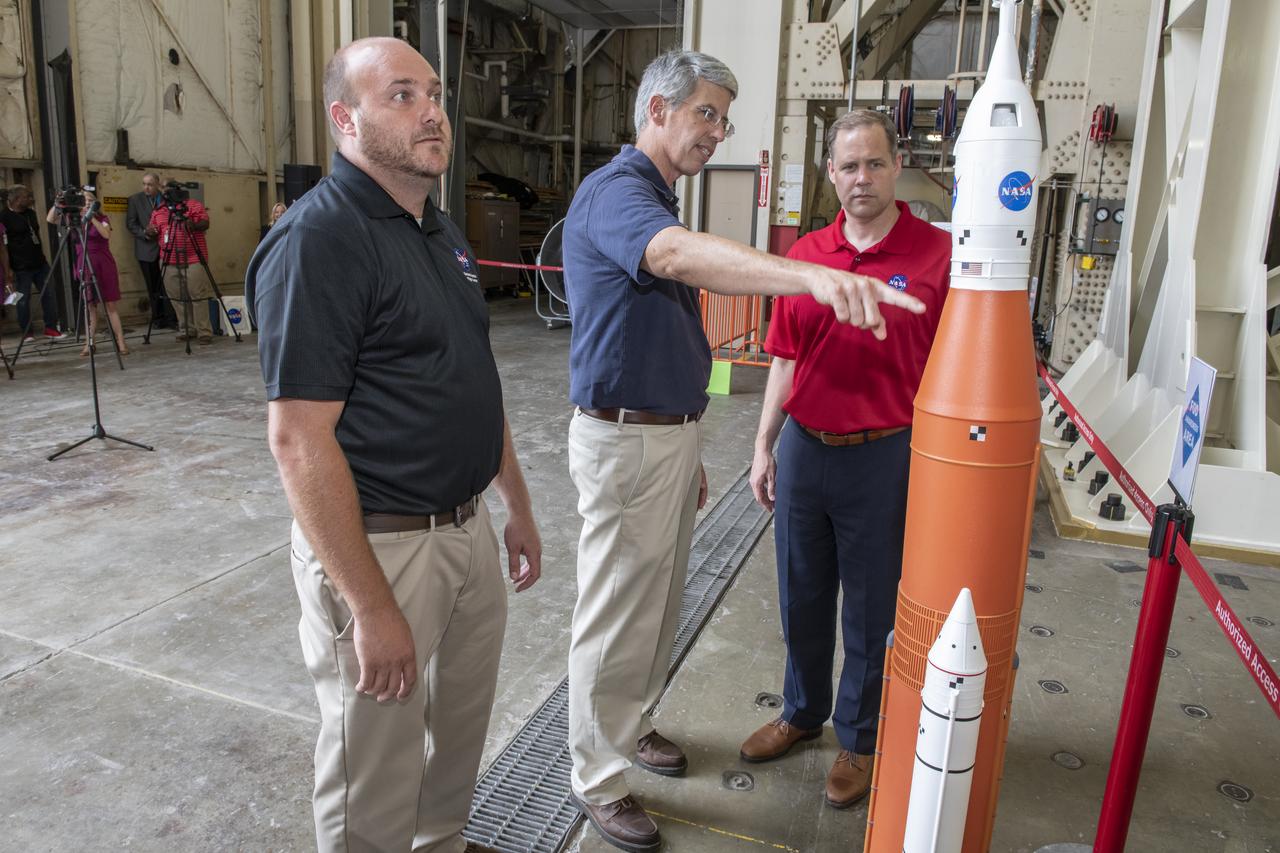
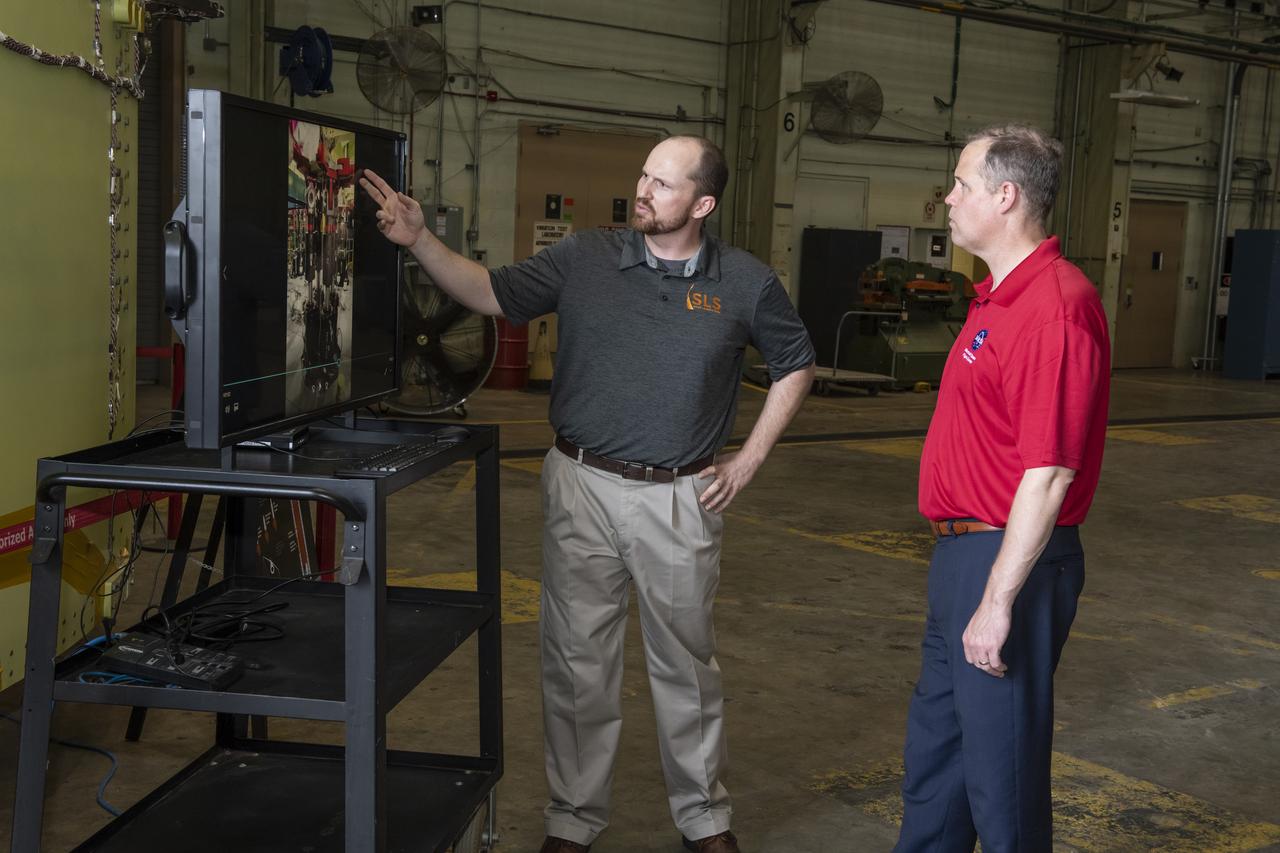
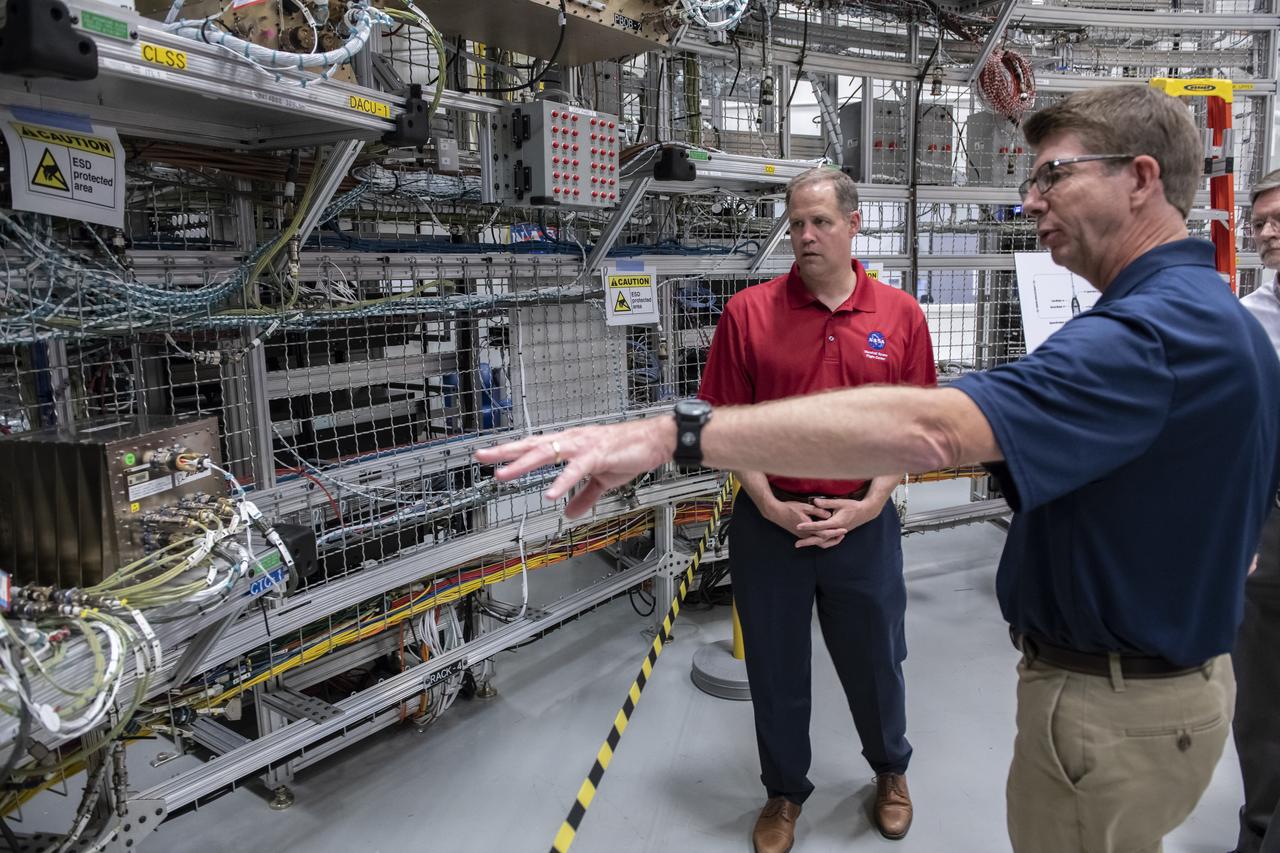
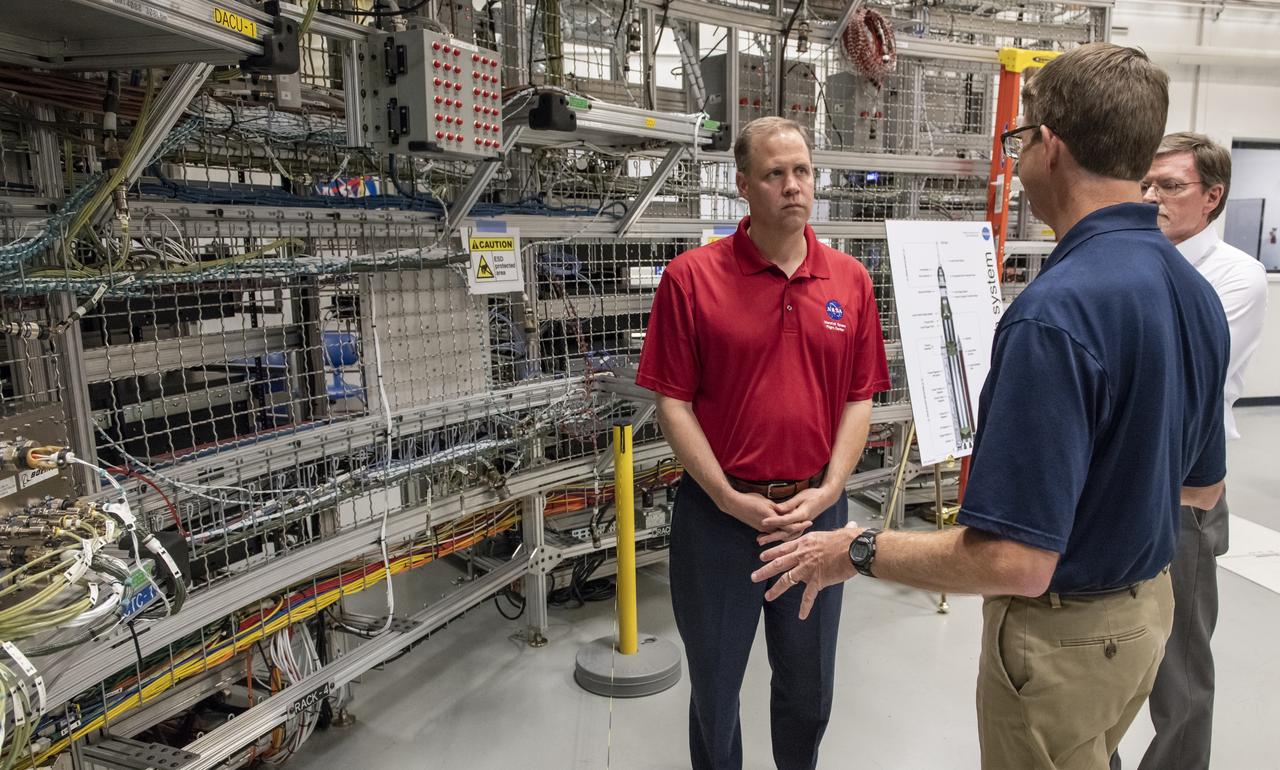
On August 15, 2018 NASA Administrator Jim Bridenstine visited Marshall Space Flight Center. Upon his arrival he was greeted by MSFC Acting Director Jody Singer along with the senior management team. During his tour of the Marshall Center, Bridenstine visited the System Integration Lab and the Software Integration and Testing Facility where Marshall is supporting end-to-end integrated avionics and software integration, check-out, verification and validation for the systems that will control the Space Launch System rocket during its flight and ascent.
NASA Administrator Jim Bridenstine visits Marshall Space Flight
On August 15, 2018 NASA Administrator Jim Bridenstine visited Marshall Space Flight Center. Upon his arrival he was greeted by MSFC Acting Director Jody Singer along with the senior management team. During his tour of the Marshall Center, Bridenstine visited the System Integration Lab and the Software Integration and Testing Facility where Marshall is supporting end-to-end integrated avionics and software integration, check-out, verification and validation for the systems that will control the Space Launch System rocket during its flight and ascent.
NASA Administrator Jim Bridenstine visits Marshall Space Flight
On August 15, 2018 NASA Administrator Jim Bridenstine visited Marshall Space Flight Center. Upon his arrival he was greeted by MSFC Acting Director Jody Singer along with the senior management team. During his tour of the Marshall Center, Bridenstine visited the System Integration Lab and the Software Integration and Testing Facility where Marshall is supporting end-to-end integrated avionics and software integration, check-out, verification and validation for the systems that will control the Space Launch System rocket during its flight and ascent.
NASA Administrator Jim Bridenstine visits Marshall Space Flight
On August 15, 2018 NASA Administrator Jim Bridenstine visited Marshall Space Flight Center. Upon his arrival he was greeted by MSFC Acting Director Jody Singer along with the senior management team. During his tour of the Marshall Center, Bridenstine visited the System Integration Lab and the Software Integration and Testing Facility where Marshall is supporting end-to-end integrated avionics and software integration, check-out, verification and validation for the systems that will control the Space Launch System rocket during its flight and ascent.
NASA Administrator Jim Bridenstine visits Marshall Space Flight
On August 15, 2018 NASA Administrator Jim Bridenstine visited Marshall Space Flight Center. Upon his arrival he was greeted by MSFC Acting Director Jody Singer along with the senior management team. During his tour of the Marshall Center, Bridenstine visited the System Integration Lab and the Software Integration and Testing Facility where Marshall is supporting end-to-end integrated avionics and software integration, check-out, verification and validation for the systems that will control the Space Launch System rocket during its flight and ascent.
NASA Administrator Jim Bridenstine visits Marshall Space Flight
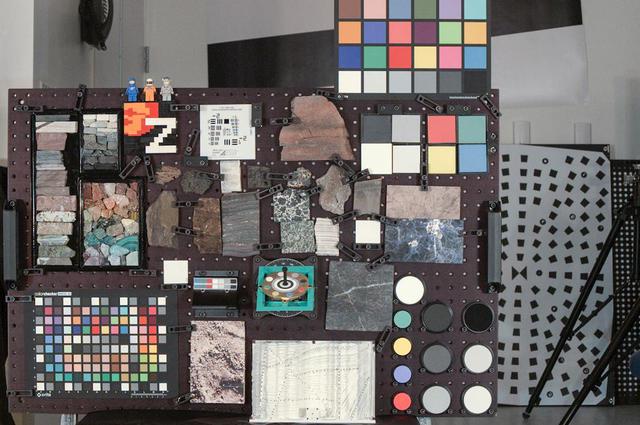
This modern-looking "geoboard" adds a pop of color to the lab at Malin Space Science Systems in San Diego, California. With an array of colors and textures, this board looks like art, but it is an important tool for camera testing. Imaging the color samples and the rock and mineral specimens gives the camera team important references for when they are imaging rocks on Mars with Mastcam-Z.  https://photojournal.jpl.nasa.gov/catalog/PIA24199
Modern Art for Mastcam-Z
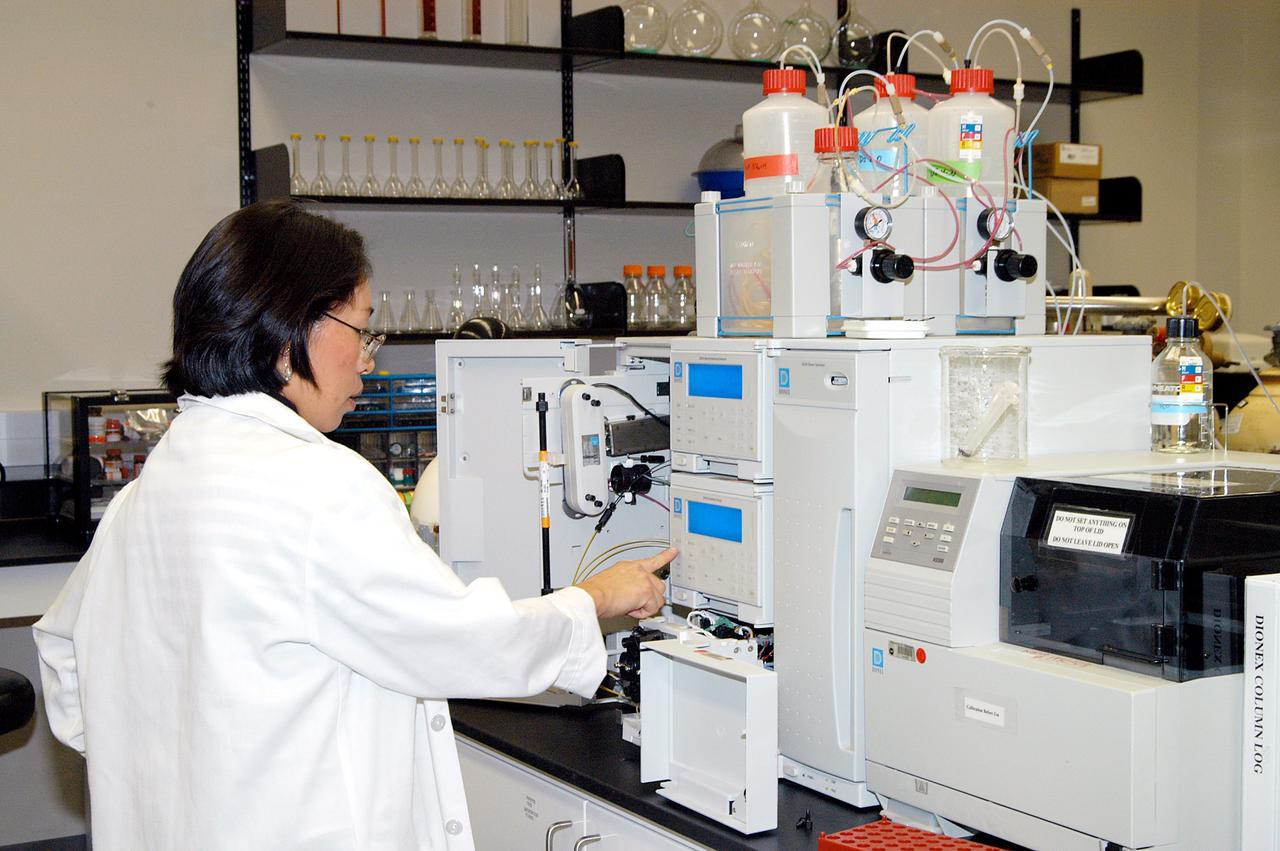
KENNEDY SPACE CENTER, FLA. -- Lanfang Levine, with Dynamac Corp., helps install a Dionex DX-500 IC/HPLC system  in the Space Life Sciences Lab.  The equipment will enable analysis of volatile compounds, such as from plants. The 100,000 square-foot facility houses labs for NASA’s ongoing research efforts, microbiology/microbial ecology studies and analytical chemistry labs. Also calling the new lab home are facilities for space flight-experiment and flight-hardware development, new plant growth chambers, and an Orbiter Environment Simulator that will be used to conduct ground control experiments in simulated flight conditions for space flight experiments.  The SLS Lab, formerly known as the Space Experiment Research and Processing Laboratory or SERPL, provides space for NASA’s Life Sciences Services contractor Dynamac Corporation, Bionetics Corporation, and researchers from the University of Florida. NASA’s Office of Biological and Physical Research will use the facility for processing life sciences experiments that will be conducted on the International Space Station. The SLS Lab is the magnet facility for the International Space Research Park at KSC being developed in partnership with Florida Space Authority.
KENNEDY SPACE CENTER, FLA. -- Lanfang Levine, with Dynamac Corp., helps install a Dionex DX-500 IC/HPLC system in the Space Life Sciences Lab. The equipment will enable analysis of volatile compounds, such as from plants. The 100,000 square-foot facility houses labs for NASA’s ongoing research efforts, microbiology/microbial ecology studies and analytical chemistry labs. Also calling the new lab home are facilities for space flight-experiment and flight-hardware development, new plant growth chambers, and an Orbiter Environment Simulator that will be used to conduct ground control experiments in simulated flight conditions for space flight experiments. The SLS Lab, formerly known as the Space Experiment Research and Processing Laboratory or SERPL, provides space for NASA’s Life Sciences Services contractor Dynamac Corporation, Bionetics Corporation, and researchers from the University of Florida. NASA’s Office of Biological and Physical Research will use the facility for processing life sciences experiments that will be conducted on the International Space Station. The SLS Lab is the magnet facility for the International Space Research Park at KSC being developed in partnership with Florida Space Authority.
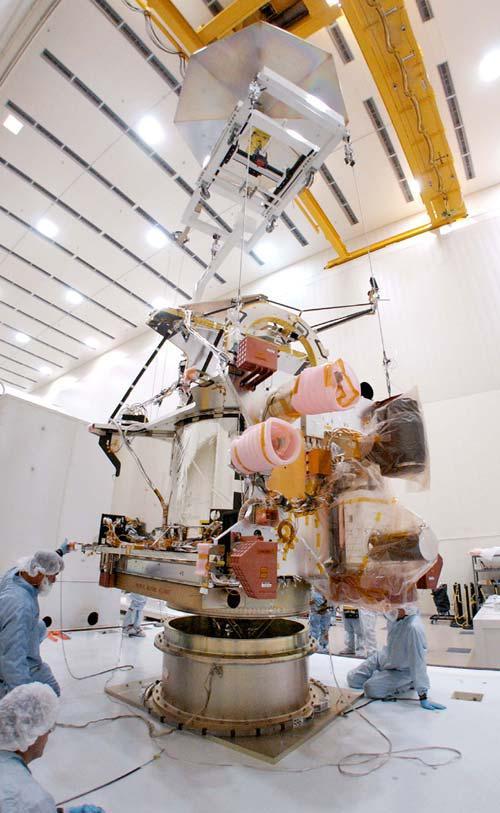
In late October 2004, NASA Mars Reconnaissance Orbiter was moved from the High Bay 100,000-class clean room at Lockheed Martin Space Systems, Denver, to the facility Reverberant Acoustic Lab.
Moving the Mars Reconnaissance Orbiter
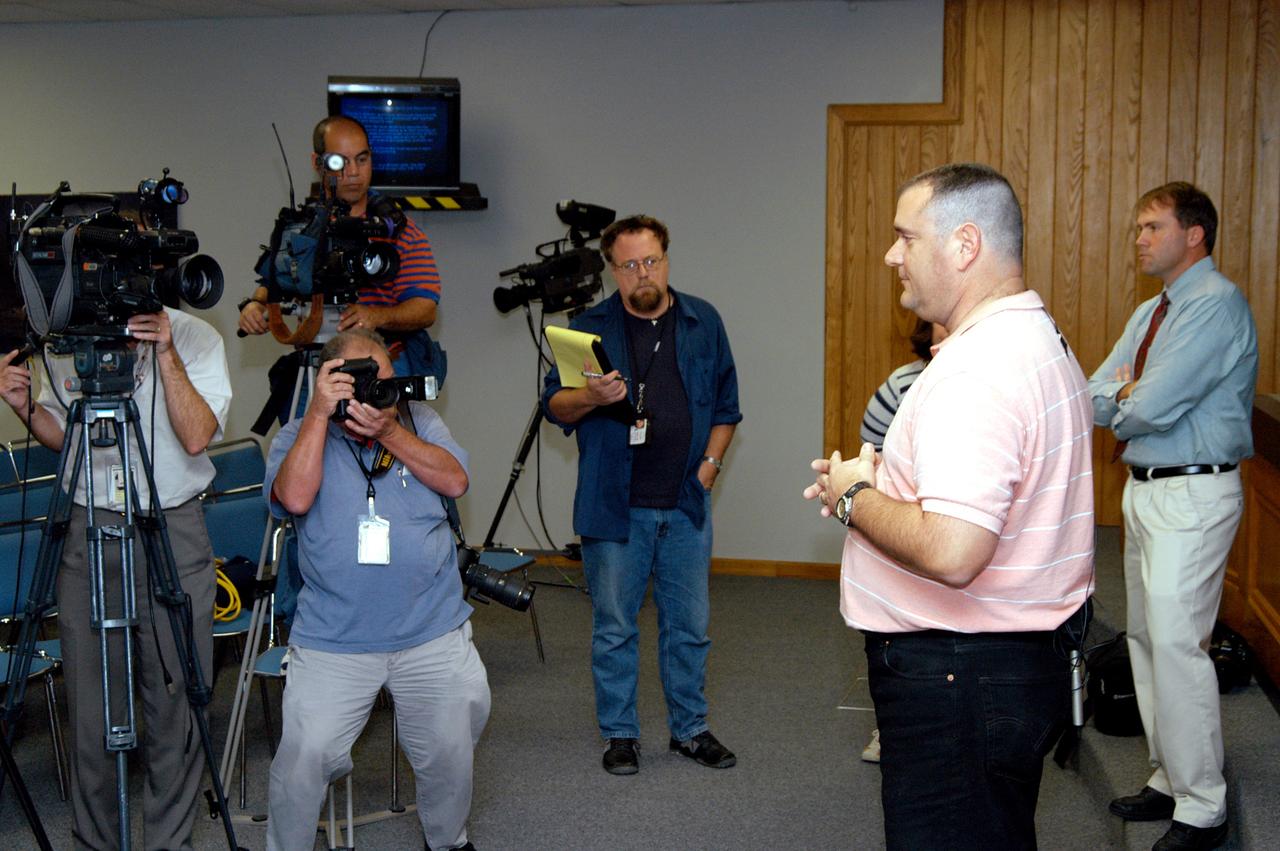
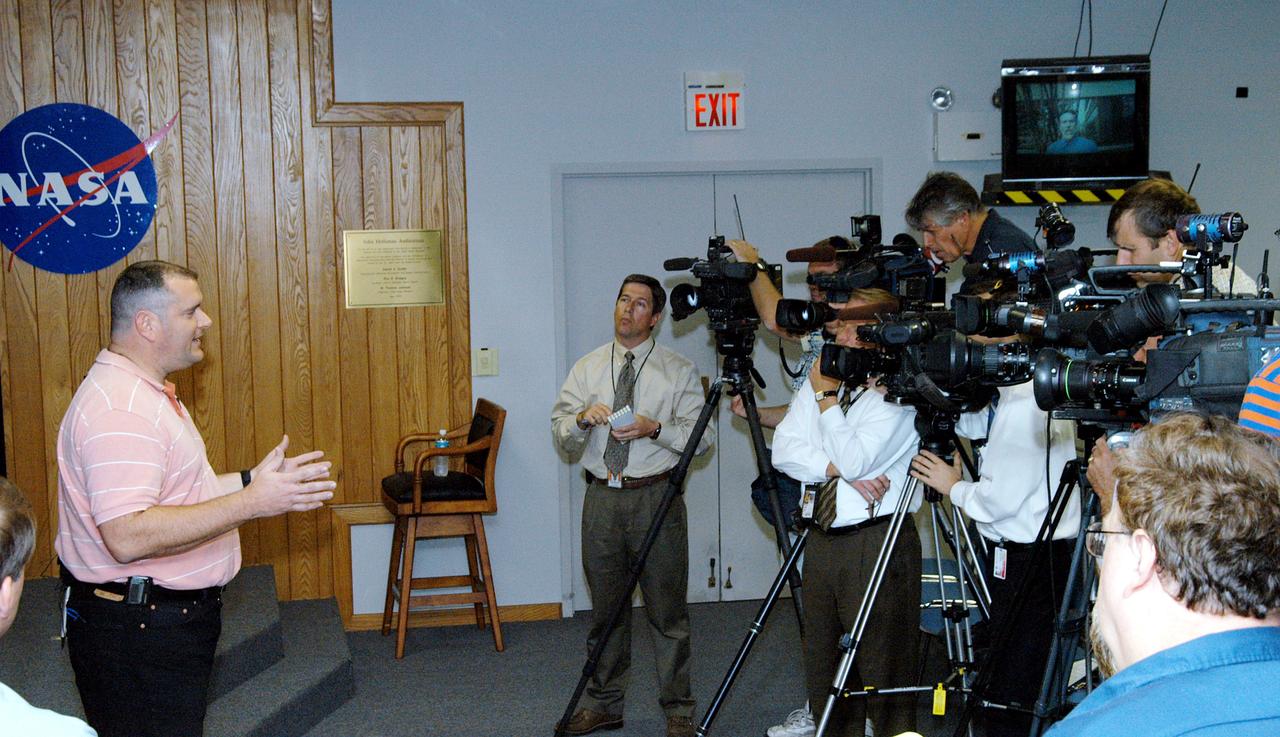
KENNEDY SPACE CENTER, FLA. - Armando Oliu, Final Inspection Team lead for the Shuttle program, speaks to reporters about the aid the Image Analysis Lab is giving the FBI in a kidnapping case.  Behind him at right is Mike Rein, External Affairs division chief.  Oliu oversees the image lab that is using an advanced SGI® TP9500 data management system to review the tape of the kidnapping in progress in Sarasota, Fla.  KSC installed the new $3.2 million system in preparation for Return to Flight of the Space Shuttle fleet.  The lab is studying the Sarasota kidnapping video to provide any new information possible to law enforcement officers.  KSC is joining NASA’s Marshall Space Flight Center in Alabama in reviewing the tape.
KENNEDY SPACE CENTER, FLA. - Armando Oliu, Final Inspection Team lead for the Shuttle program, speaks to reporters about the aid the Image Analysis Lab is giving the FBI in a kidnapping case. Behind him at right is Mike Rein, External Affairs division chief. Oliu oversees the image lab that is using an advanced SGI® TP9500 data management system to review the tape of the kidnapping in progress in Sarasota, Fla. KSC installed the new $3.2 million system in preparation for Return to Flight of the Space Shuttle fleet. The lab is studying the Sarasota kidnapping video to provide any new information possible to law enforcement officers. KSC is joining NASA’s Marshall Space Flight Center in Alabama in reviewing the tape.
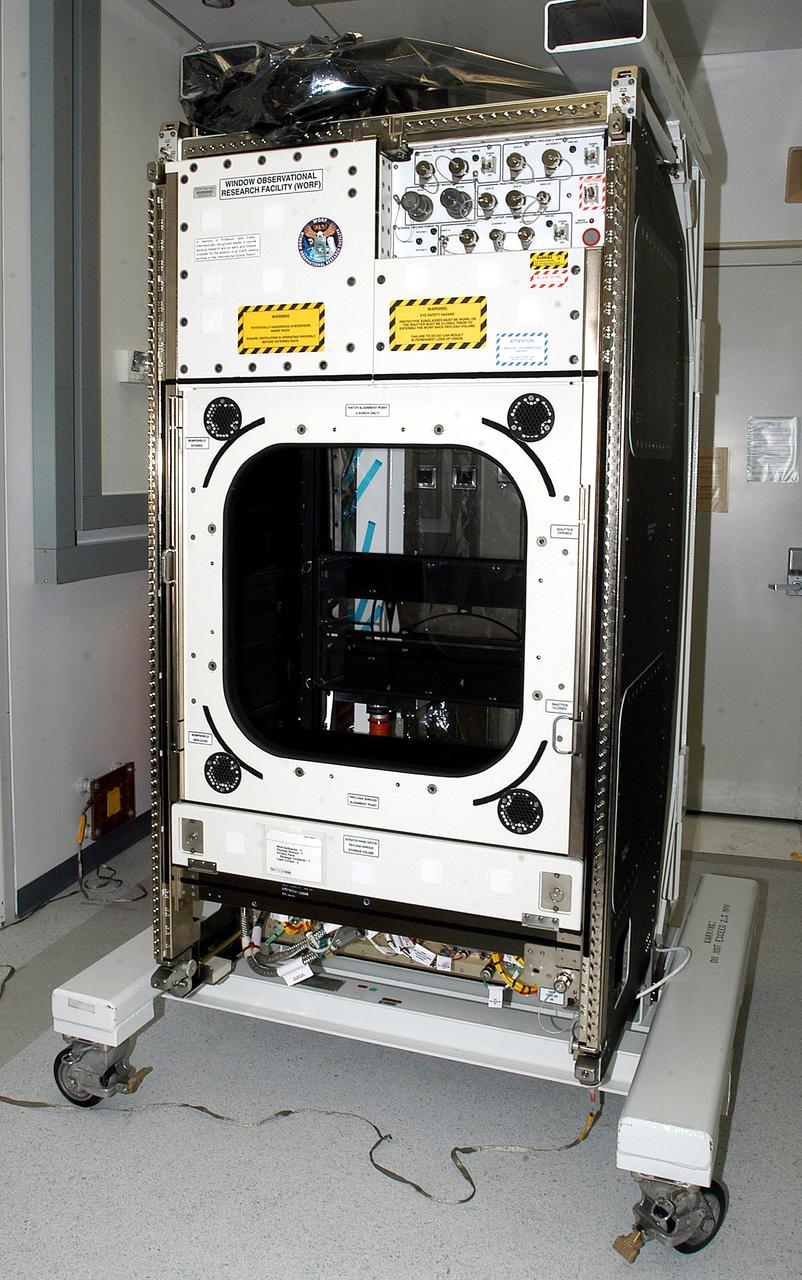
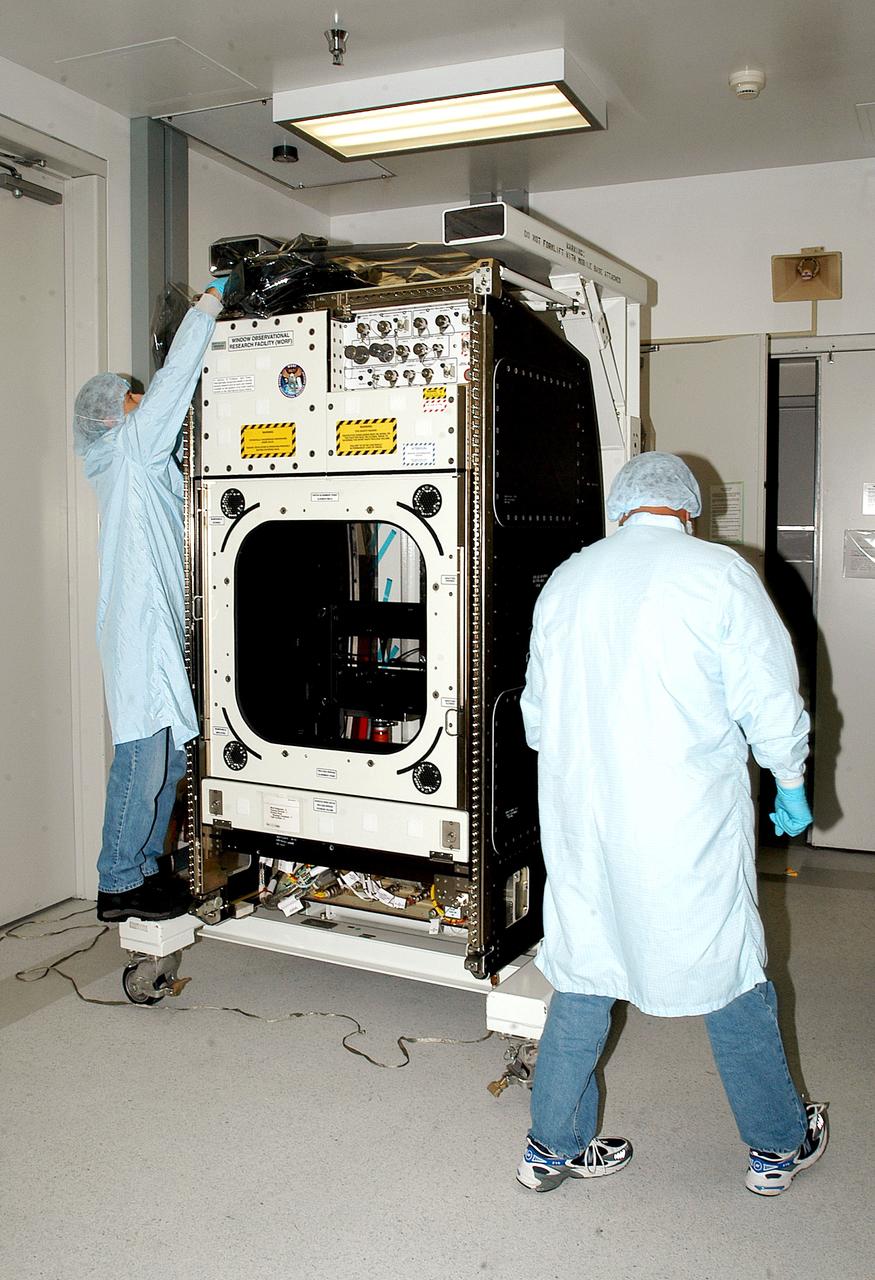
KENNEDY SPACE CENTER, FLA. -  The Window Observational Research Facility (WORF), seen in the Space Station Processing Facility, was designed and built by the Boeing Co. at NASA’s Marshall Space Flight Center in Huntsville, Ala.   WORF will be delivered to the International Space Station and placed in the rack position in front of the Destiny lab window,  providing locations for attaching cameras, multi-spectral scanners and other instruments. WORF will support a variety of scientific and commercial experiments in areas of Earth systems and processes, global ecological changes in Earth’s biosphere, lithosphere, hydrosphere and climate system, Earth resources, natural hazards, and education.  After installation, it will become a permanent focal point for Earth Science research aboard the space station.
KENNEDY SPACE CENTER, FLA. - The Window Observational Research Facility (WORF), seen in the Space Station Processing Facility, was designed and built by the Boeing Co. at NASA’s Marshall Space Flight Center in Huntsville, Ala. WORF will be delivered to the International Space Station and placed in the rack position in front of the Destiny lab window, providing locations for attaching cameras, multi-spectral scanners and other instruments. WORF will support a variety of scientific and commercial experiments in areas of Earth systems and processes, global ecological changes in Earth’s biosphere, lithosphere, hydrosphere and climate system, Earth resources, natural hazards, and education. After installation, it will become a permanent focal point for Earth Science research aboard the space station.
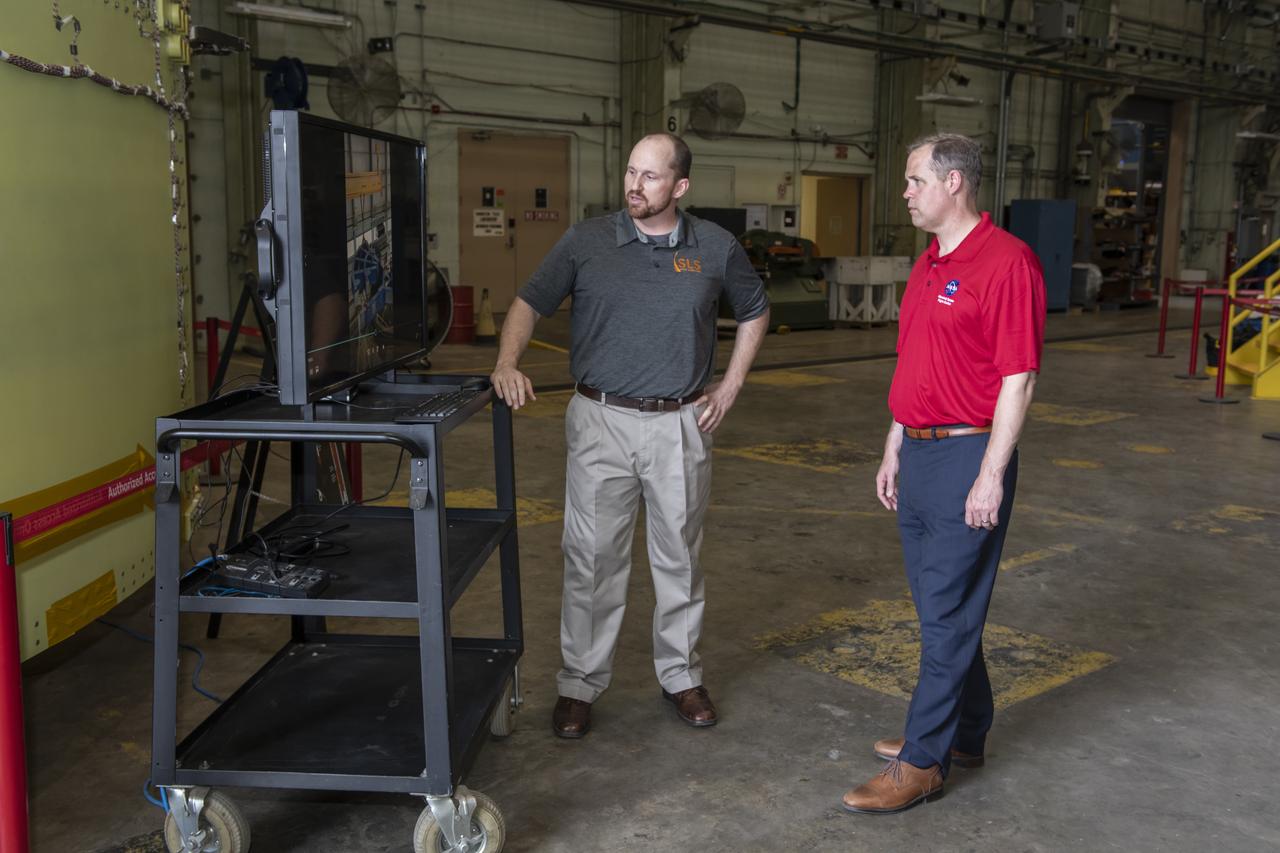
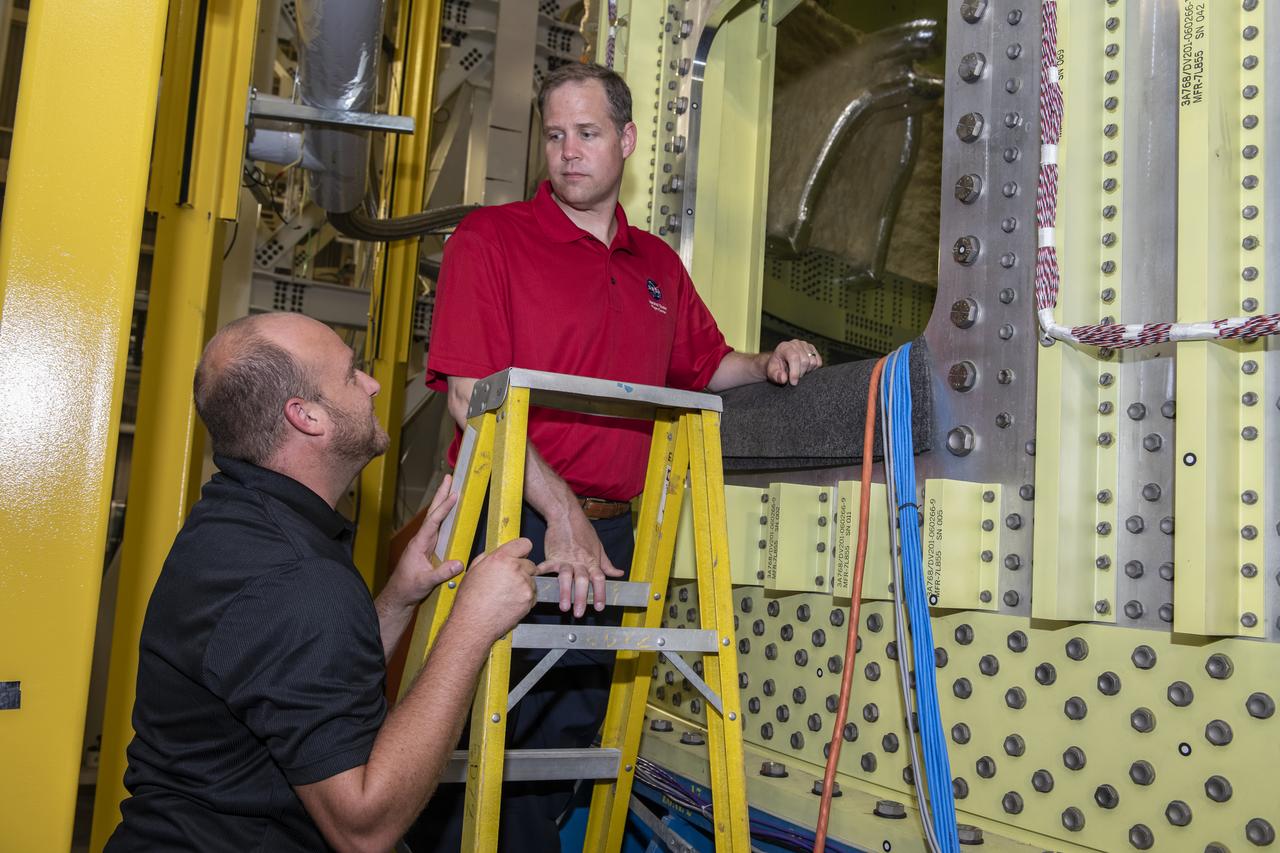
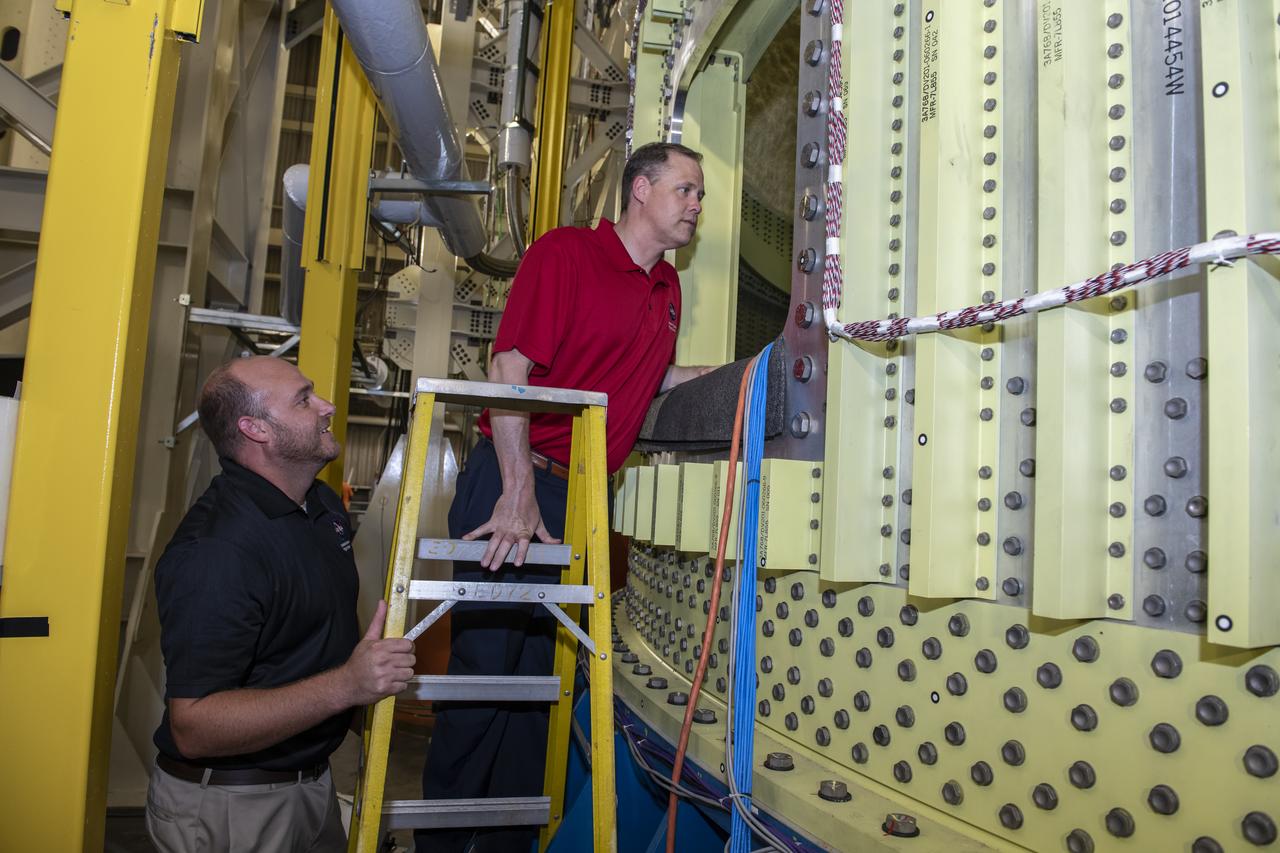
On August 15, 2018 NASA Administrator Jim Bridenstine visited Marshall Space Flight Center. Upon his arrival he was greeted by MSFC Acting Director Jody Singer along with the senior management team. Lead test engineer for the Space Launch System core stage intertank, Matt Cash briefs NASA Administrator Jim Bridenstine on testing progress of the SLS test article in the Structural Strength Lab at Marshall. The test article is structurally identical to the flight version of the intertank that will connect the core stage's two colossal fuel tanks, serve as the upper-connection point for the two solid rocket boosters and house critical avionics and electronics.
NASA Administrator Jim Bridenstine visits Marshall Space Flight
On August 15, 2018 NASA Administrator Jim Bridenstine visited Marshall Space Flight Center. Upon his arrival he was greeted by MSFC Acting Director Jody Singer along with the senior management team. Lead test engineer for the Space Launch System core stage intertank, Matt Cash briefs NASA Administrator Jim Bridenstine on testing progress of the SLS test article in the Structural Strength Lab at Marshall. The test article is structurally identical to the flight version of the intertank that will connect the core stage's two colossal fuel tanks, serve as the upper-connection point for the two solid rocket boosters and house critical avionics and electronics.
NASA Administrator Jim Bridenstine visits Marshall Space Flight
On August 15, 2018 NASA Administrator Jim Bridenstine visited Marshall Space Flight Center. Upon his arrival he was greeted by MSFC Acting Director Jody Singer along with the senior management team. Lead test engineer for the Space Launch System core stage intertank, Matt Cash briefs NASA Administrator Jim Bridenstine on testing progress of the SLS test article in the Structural Strength Lab at Marshall. The test article is structurally identical to the flight version of the intertank that will connect the core stage's two colossal fuel tanks, serve as the upper-connection point for the two solid rocket boosters and house critical avionics and electronics.
NASA Administrator Jim Bridenstine visits Marshall Space Flight
On August 15, 2018 NASA Administrator Jim Bridenstine visited Marshall Space Flight Center. Upon his arrival he was greeted by MSFC Acting Director Jody Singer along with the senior management team. Lead test engineer for the Space Launch System core stage intertank, Matt Cash briefs NASA Administrator Jim Bridenstine on testing progress of the SLS test article in the Structural Strength Lab at Marshall. The test article is structurally identical to the flight version of the intertank that will connect the core stage's two colossal fuel tanks, serve as the upper-connection point for the two solid rocket boosters and house critical avionics and electronics.
NASA Administrator Jim Bridenstine visits Marshall Space Flight
On August 15, 2018 NASA Administrator Jim Bridenstine visited Marshall Space Flight Center. Upon his arrival he was greeted by MSFC Acting Director Jody Singer along with the senior management team. Lead test engineer for the Space Launch System core stage intertank, Matt Cash briefs NASA Administrator Jim Bridenstine on testing progress of the SLS test article in the Structural Strength Lab at Marshall. The test article is structurally identical to the flight version of the intertank that will connect the core stage's two colossal fuel tanks, serve as the upper-connection point for the two solid rocket boosters and house critical avionics and electronics.
NASA Administrator Jim Bridenstine visits Marshall Space Flight
On August 15, 2018 NASA Administrator Jim Bridenstine visited Marshall Space Flight Center. Upon his arrival he was greeted by MSFC Acting Director Jody Singer along with the senior management team. Lead test engineer for the Space Launch System core stage intertank, Matt Cash briefs NASA Administrator Jim Bridenstine on testing progress of the SLS test article in the Structural Strength Lab at Marshall. The test article is structurally identical to the flight version of the intertank that will connect the core stage's two colossal fuel tanks, serve as the upper-connection point for the two solid rocket boosters and house critical avionics and electronics.
NASA Administrator Jim Bridenstine visits Marshall Space Flight
On August 15, 2018 NASA Administrator Jim Bridenstine visited Marshall Space Flight Center. Upon his arrival he was greeted by MSFC Acting Director Jody Singer along with the senior management team. Lead test engineer for the Space Launch System core stage intertank, Matt Cash briefs NASA Administrator Jim Bridenstine on testing progress of the SLS test article in the Structural Strength Lab at Marshall. The test article is structurally identical to the flight version of the intertank that will connect the core stage's two colossal fuel tanks, serve as the upper-connection point for the two solid rocket boosters and house critical avionics and electronics.
NASA Administrator Jim Bridenstine visits Marshall Space Flight
On August 15, 2018 NASA Administrator Jim Bridenstine visited Marshall Space Flight Center. Upon his arrival he was greeted by MSFC Acting Director Jody Singer along with the senior management team. Lead test engineer for the Space Launch System core stage intertank, Matt Cash briefs NASA Administrator Jim Bridenstine on testing progress of the SLS test article in the Structural Strength Lab at Marshall. The test article is structurally identical to the flight version of the intertank that will connect the core stage's two colossal fuel tanks, serve as the upper-connection point for the two solid rocket boosters and house critical avionics and electronics.
NASA Administrator Jim Bridenstine visits Marshall Space Flight
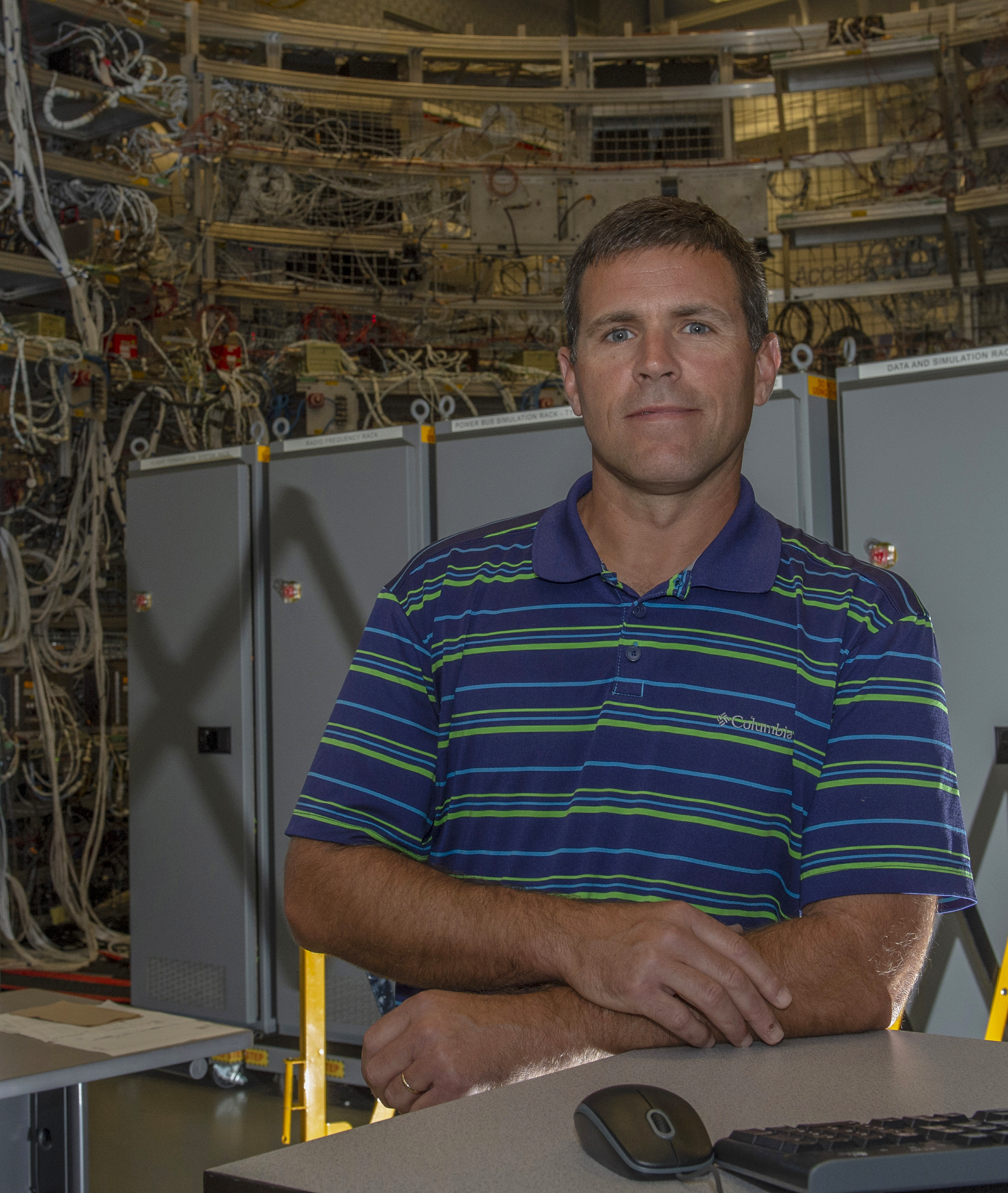
George Plattsmier, ARTEMIS developer supporting hardware/software development, integration and testing for the Space Launch System (SLS) in the Systems Integration Lab (SIL), Building 4205, lab 116.
George Plattsmier, ARTEMIS developer
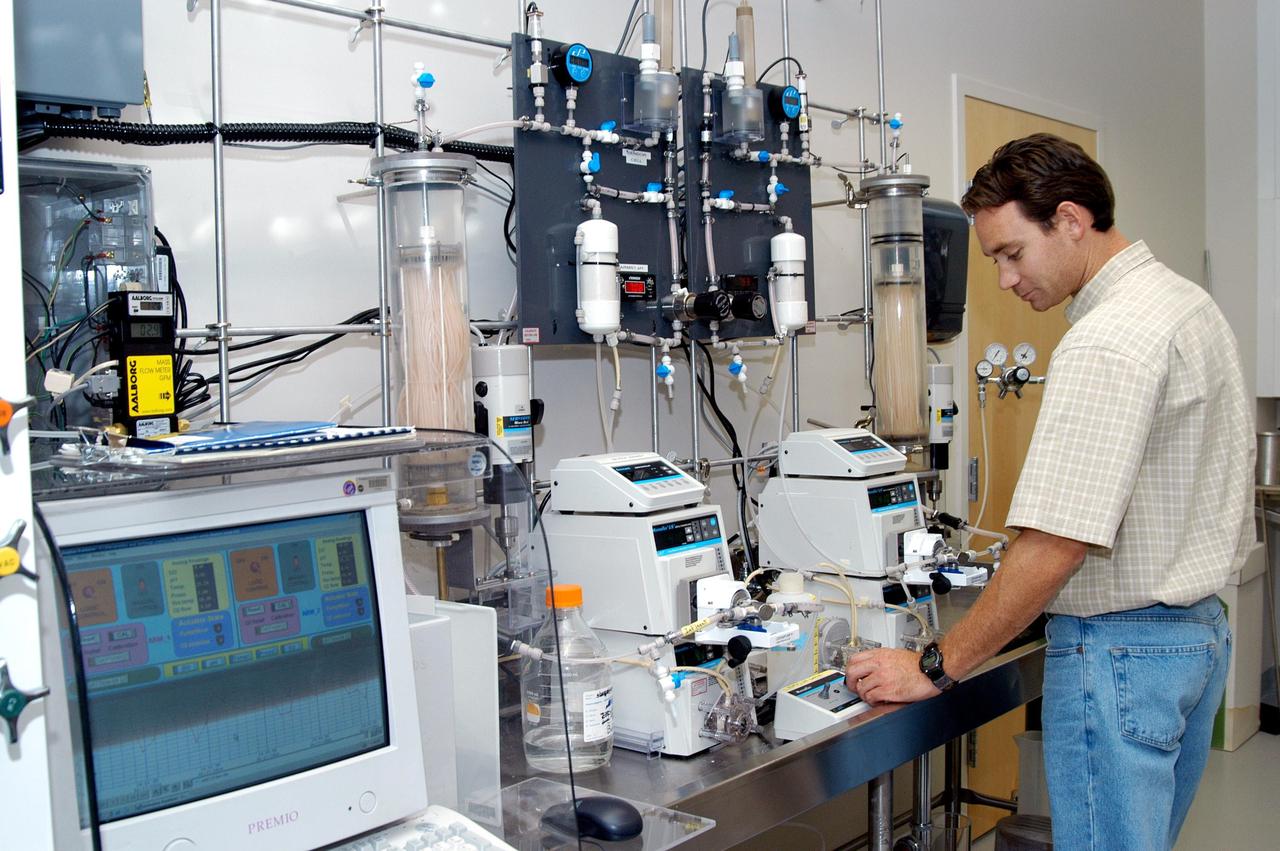
KENNEDY SPACE CENTER, FLA.  -  In the KSC Space Life Sciences Lab’s Resource Recovery lab, bioengineer Tony Rector checks the ARMS reactor vessel.  ARMS, or Aerobic Rotational Membrane System, is a wastewater processing project being tested for use on the International Space Station to collect, clean and reuse wastewater.  It could be adapted for use on the Moon and Mars.   The Lab is exploring various aspects of a bioregenerative life support system. Such research and technology development will be crucial to long-term habitation of space by humans.
KSC-04pd1309
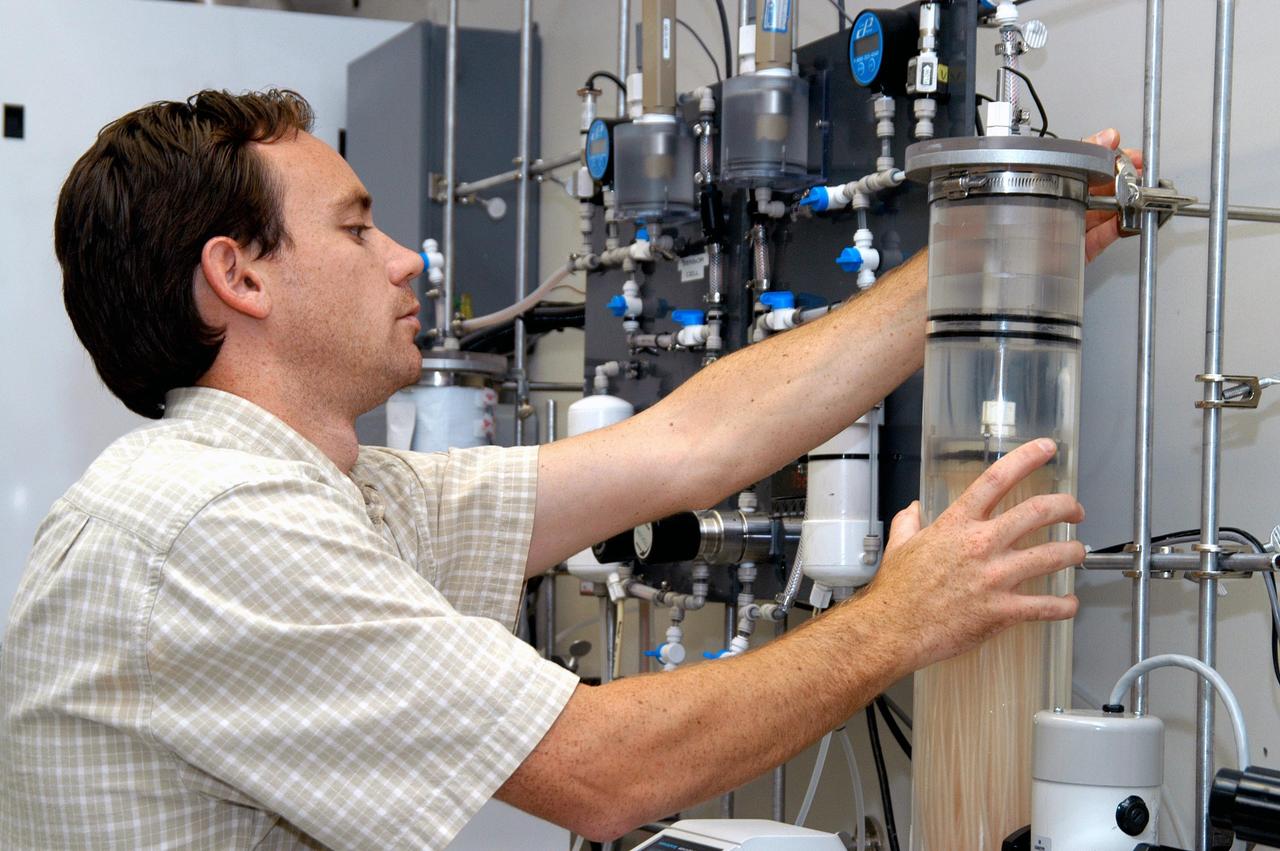
KENNEDY SPACE CENTER, FLA.  -  In the KSC Space Life Sciences Lab’s Resource Recovery lab, bioengineer Tony Rector checks the clear plexiglass ARMS reactor vessel.  ARMS, or Aerobic Rotational Membrane System, is a wastewater processing project being tested for use on the International Space Station to collect, clean and reuse wastewater.  It could be adapted for use on the Moon and Mars.   The Lab is exploring various aspects of a bioregenerative life support system. Such research and technology development will be crucial to long-term habitation of space by humans.
KSC-04pd1310
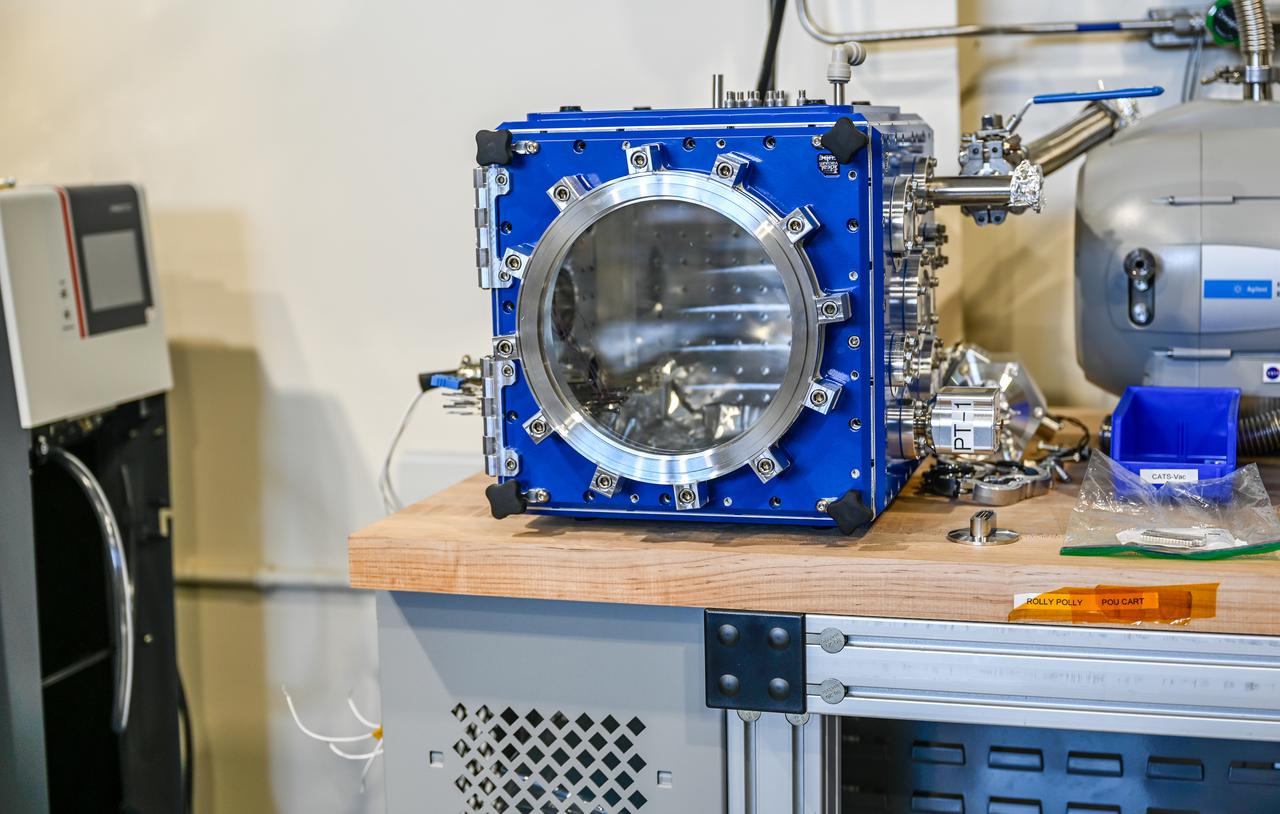
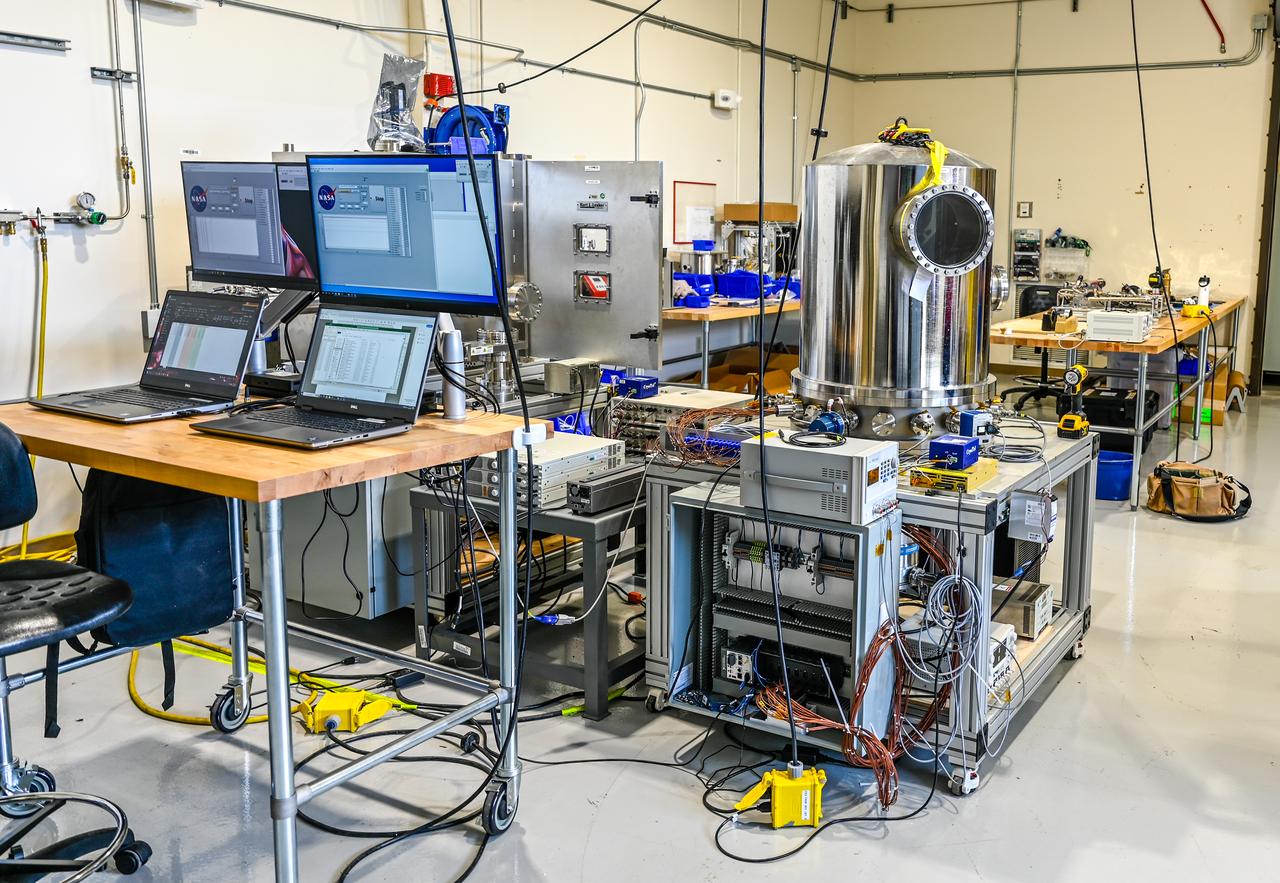
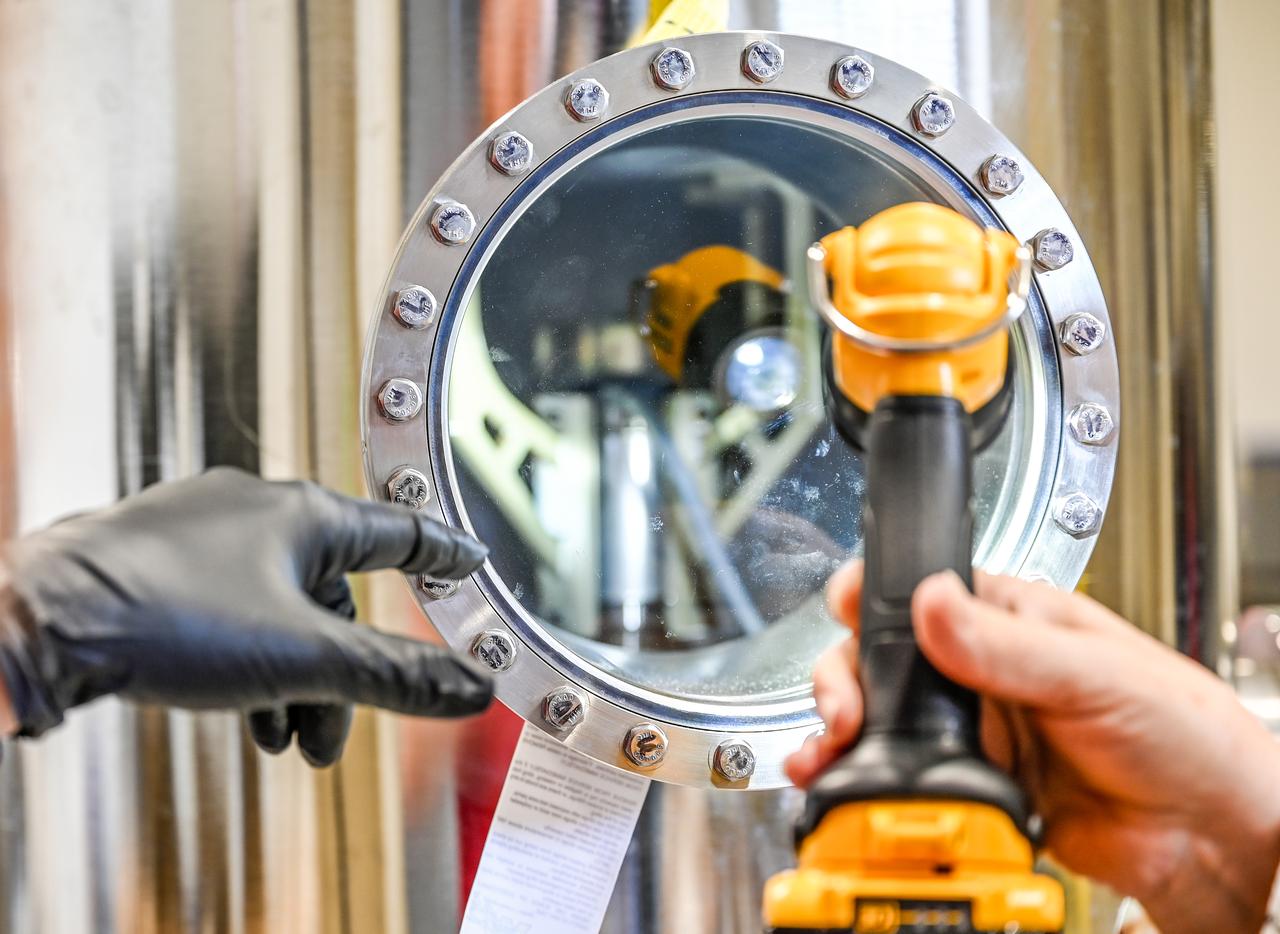
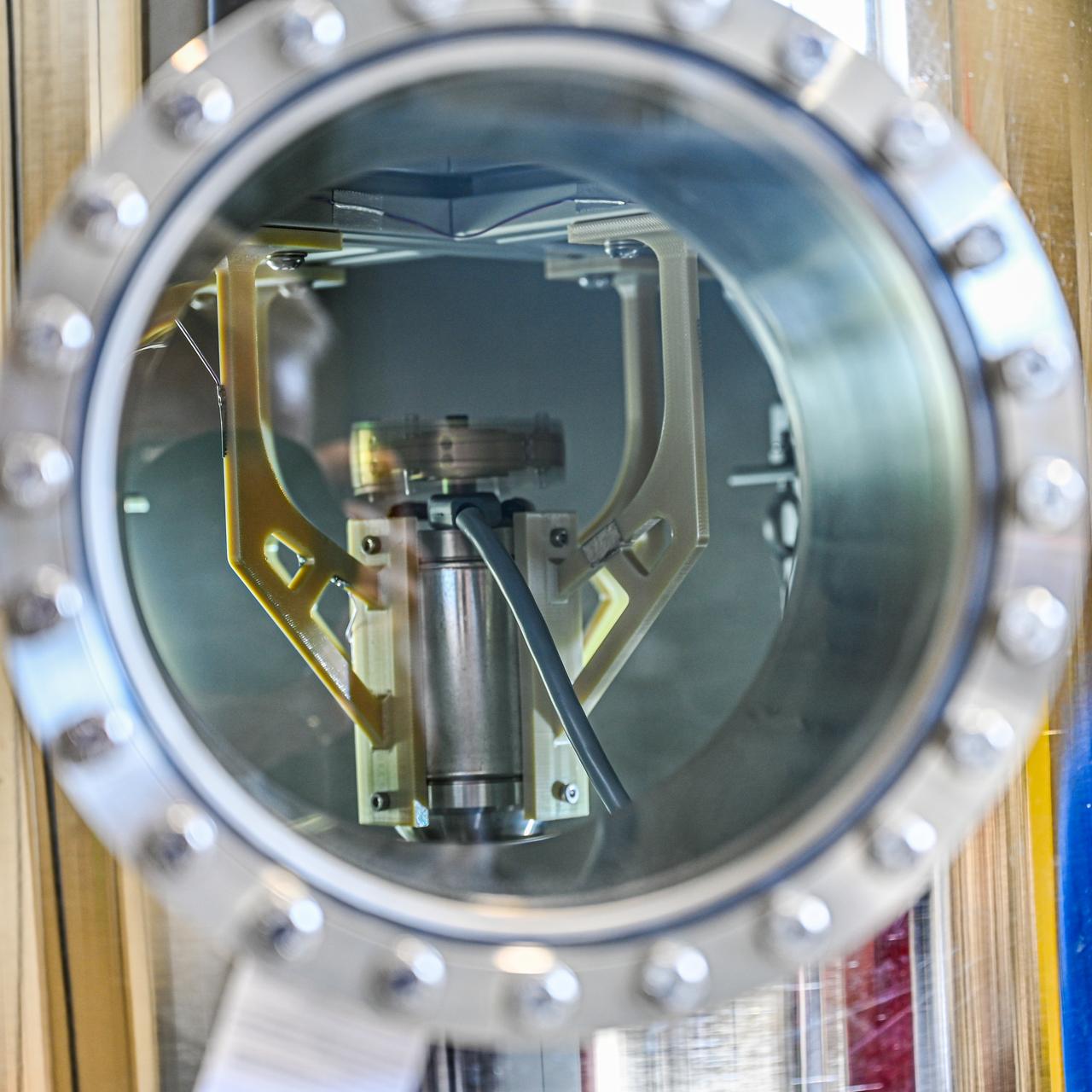
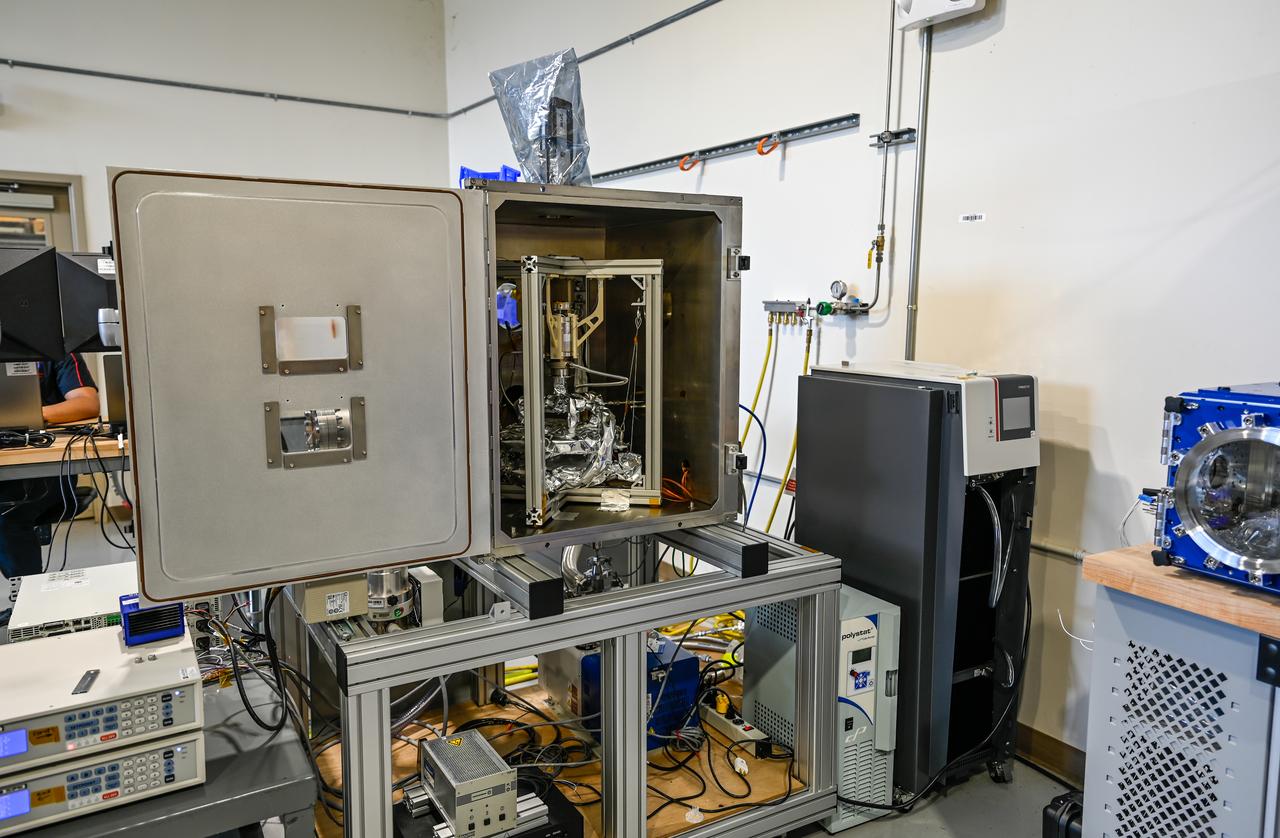
These photos, taken in fall 2024, show how NASA engineers use the Hub for Innovative Thermal Technology Maturation and Prototyping (Hi-TTeMP) laboratory at NASA’s Marshall Space Flight Center in Huntsville, Alabama. NASA engineers working in the HI-TTeMP lab not only design, set up, and run tests, they also provide insight and expertise in thermal engineering to assist NASA’s industry partners, such as SpaceX and other organizations, in validating concepts and models, or suggesting changes to designs. The lab is able to rapidly test and evaluate design updates or iterations.  Engineering teams inside the lab are currently testing how well prototype insulation for SpaceX’s Starship HLS (Human Landing System) will insulate interior environments, including propellant storage tanks and the crew cabin. Starship HLS will land astronauts on the lunar surface during Artemis III and Artemis IV.
NASA Marshall Thermal Engineering Lab Provides Key Insight to Human Landing System
These photos, taken in fall 2024, show how NASA engineers use the Hub for Innovative Thermal Technology Maturation and Prototyping (Hi-TTeMP) laboratory at NASA’s Marshall Space Flight Center in Huntsville, Alabama. NASA engineers working in the HI-TTeMP lab not only design, set up, and run tests, they also provide insight and expertise in thermal engineering to assist NASA’s industry partners, such as SpaceX and other organizations, in validating concepts and models, or suggesting changes to designs. The lab is able to rapidly test and evaluate design updates or iterations.  Engineering teams inside the lab are currently testing how well prototype insulation for SpaceX’s Starship HLS (Human Landing System) will insulate interior environments, including propellant storage tanks and the crew cabin. Starship HLS will land astronauts on the lunar surface during Artemis III and Artemis IV.
NASA Marshall Thermal Engineering Lab Provides Key Insight to Human Landing System
These photos, taken in fall 2024, show how NASA engineers use the Hub for Innovative Thermal Technology Maturation and Prototyping (Hi-TTeMP) laboratory at NASA’s Marshall Space Flight Center in Huntsville, Alabama. NASA engineers working in the HI-TTeMP lab not only design, set up, and run tests, they also provide insight and expertise in thermal engineering to assist NASA’s industry partners, such as SpaceX and other organizations, in validating concepts and models, or suggesting changes to designs. The lab is able to rapidly test and evaluate design updates or iterations.  Engineering teams inside the lab are currently testing how well prototype insulation for SpaceX’s Starship HLS (Human Landing System) will insulate interior environments, including propellant storage tanks and the crew cabin. Starship HLS will land astronauts on the lunar surface during Artemis III and Artemis IV.
NASA Marshall Thermal Engineering Lab Provides Key Insight to Human Landing System
These photos, taken in fall 2024, show how NASA engineers use the Hub for Innovative Thermal Technology Maturation and Prototyping (Hi-TTeMP) laboratory at NASA’s Marshall Space Flight Center in Huntsville, Alabama. NASA engineers working in the HI-TTeMP lab not only design, set up, and run tests, they also provide insight and expertise in thermal engineering to assist NASA’s industry partners, such as SpaceX and other organizations, in validating concepts and models, or suggesting changes to designs. The lab is able to rapidly test and evaluate design updates or iterations.  Engineering teams inside the lab are currently testing how well prototype insulation for SpaceX’s Starship HLS (Human Landing System) will insulate interior environments, including propellant storage tanks and the crew cabin. Starship HLS will land astronauts on the lunar surface during Artemis III and Artemis IV.
NASA Marshall Thermal Engineering Lab Provides Key Insight to Human Landing System
These photos, taken in fall 2024, show how NASA engineers use the Hub for Innovative Thermal Technology Maturation and Prototyping (Hi-TTeMP) laboratory at NASA’s Marshall Space Flight Center in Huntsville, Alabama. NASA engineers working in the HI-TTeMP lab not only design, set up, and run tests, they also provide insight and expertise in thermal engineering to assist NASA’s industry partners, such as SpaceX and other organizations, in validating concepts and models, or suggesting changes to designs. The lab is able to rapidly test and evaluate design updates or iterations.  Engineering teams inside the lab are currently testing how well prototype insulation for SpaceX’s Starship HLS (Human Landing System) will insulate interior environments, including propellant storage tanks and the crew cabin. Starship HLS will land astronauts on the lunar surface during Artemis III and Artemis IV.
NASA Marshall Thermal Engineering Lab Provides Key Insight to Human Landing System
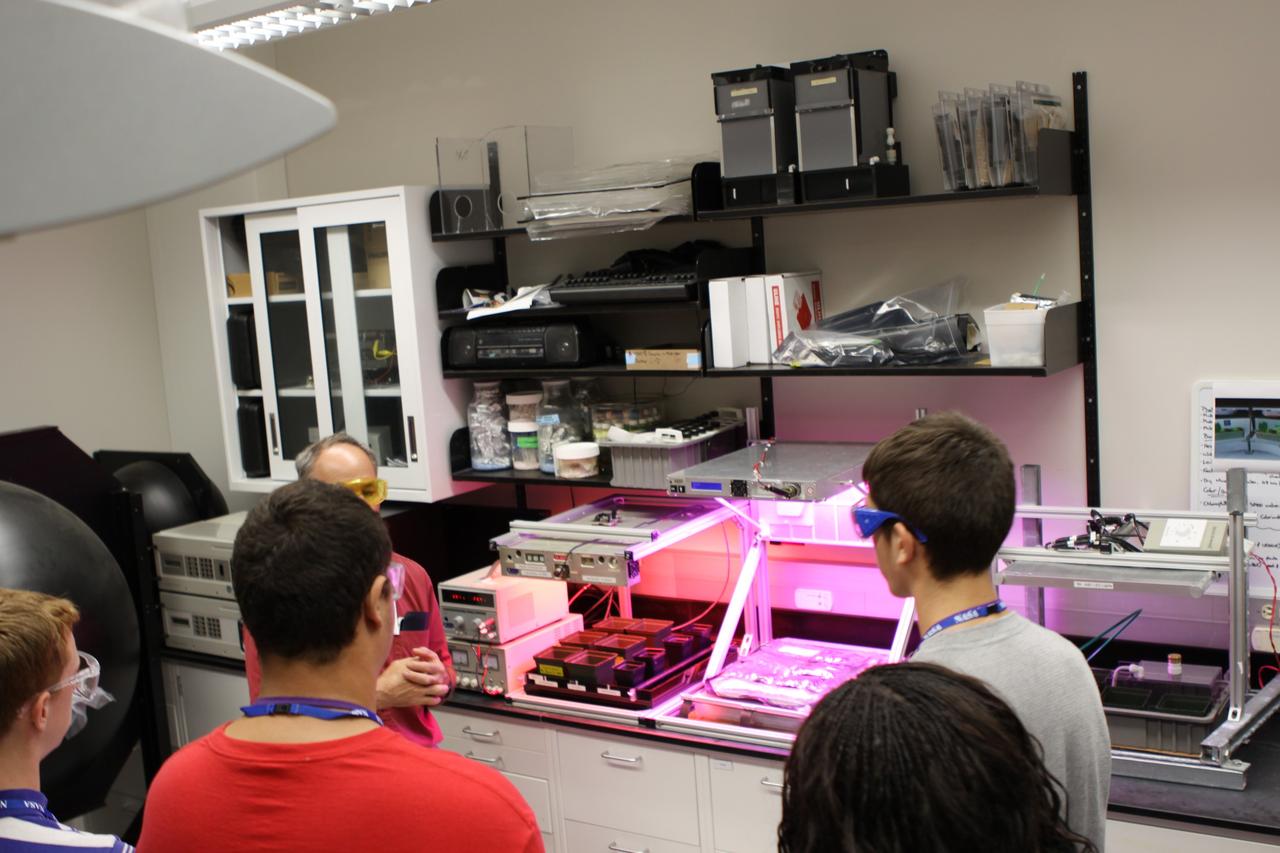
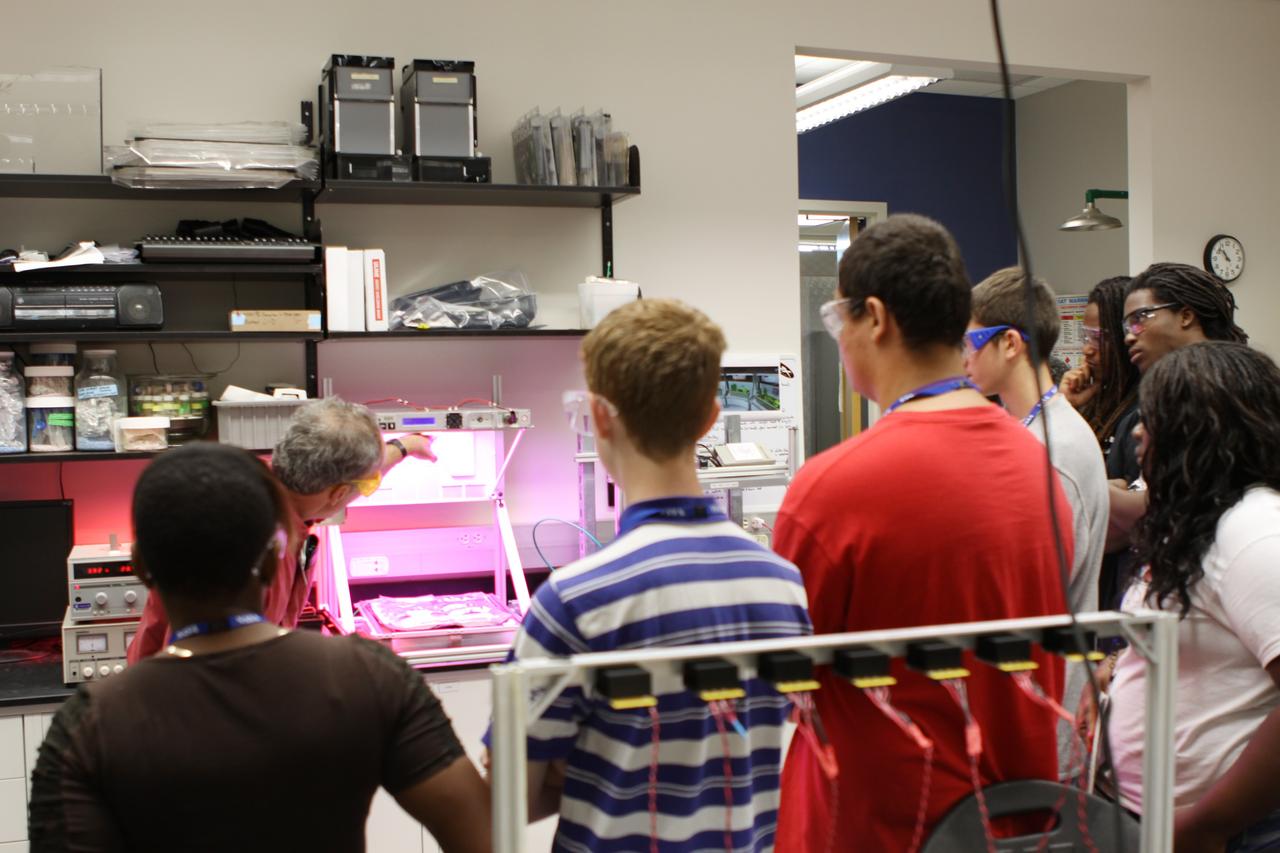
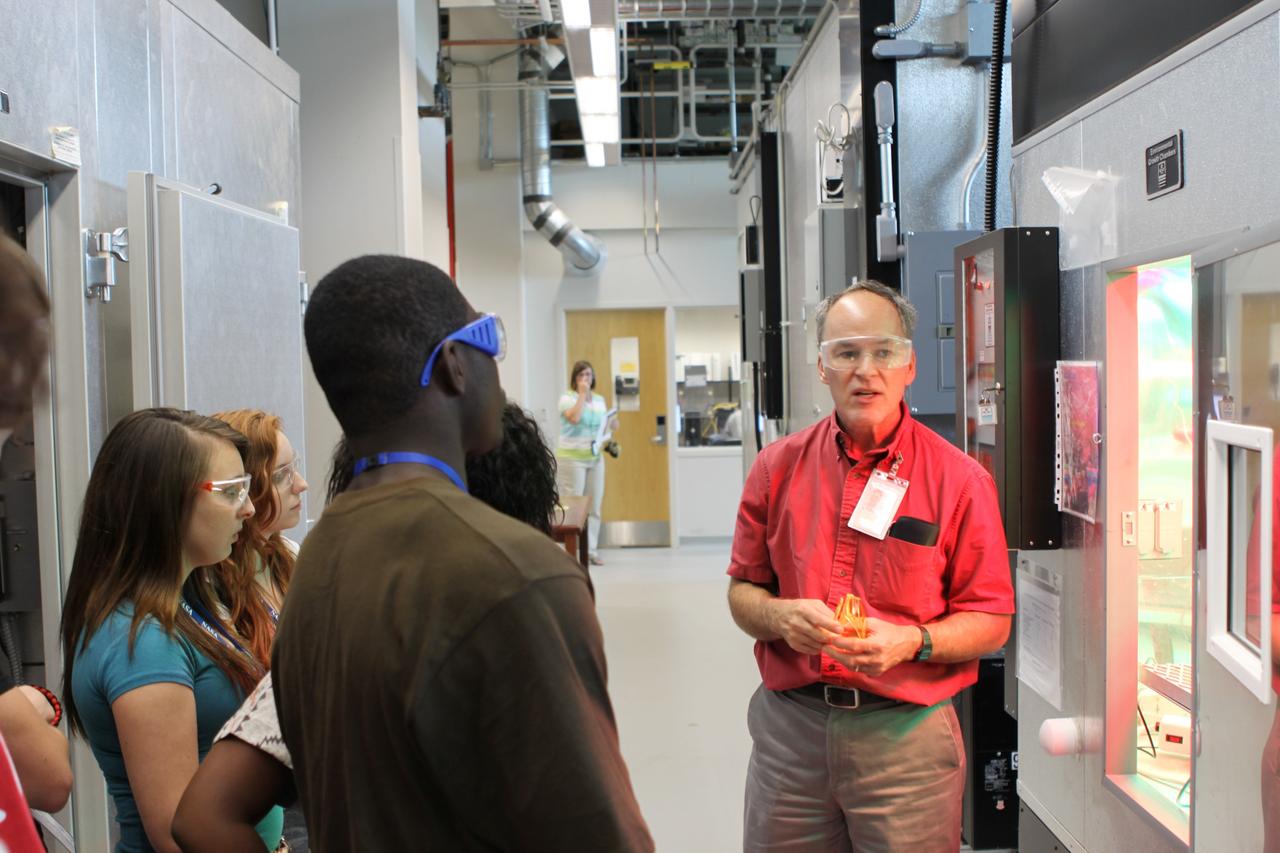
CAPE CANAVERAL, Fla. – Dr. Ray Wheeler explains a system for growing salad crops in space to students in the Life Support and Habitation Systems Lab at the Space Life Sciences Lab facility.          The 26 honor students in chemistry and biology and their teachers got a chance to visit a number of high-tech labs at Kennedy Space Center as part of an effort to encourage students in the areas of science, technology, engineering and math. The tenth and eleventh grade students from Terry Parker High School in Jacksonville, Fla., visited a number of vastly different labs during their one-day tour. The group's visit to Kennedy was hosted by the Education Office as part of a nationwide effort by the National Lab Network to help introduce the nation's students to science careers. Photo credit: NASA/Jim Grossmann
KSC-2012-2763
CAPE CANAVERAL, Fla. – Dr. Ray Wheeler explains a system for growing salad crops in space to students in the Life Support and Habitation Systems Lab at the Space Life Sciences Lab facility.          The 26 honor students in chemistry and biology and their teachers got a chance to visit a number of high-tech labs at Kennedy Space Center as part of an effort to encourage students in the areas of science, technology, engineering and math. The tenth and eleventh grade students from Terry Parker High School in Jacksonville, Fla., visited a number of vastly different labs during their one-day tour. The group's visit to Kennedy was hosted by the Education Office as part of a nationwide effort by the National Lab Network to help introduce the nation's students to science careers. Photo credit: NASA/Jim Grossmann
KSC-2012-2764
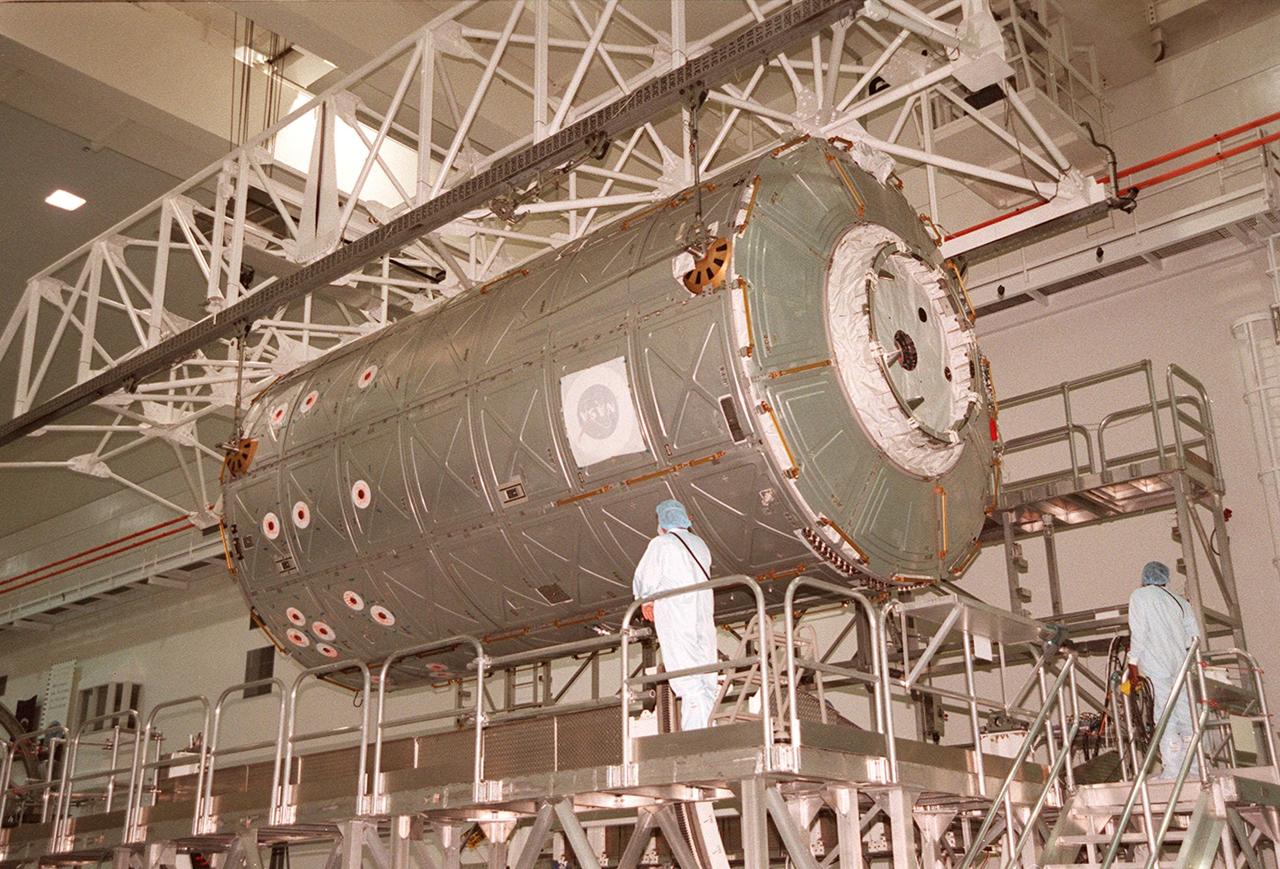
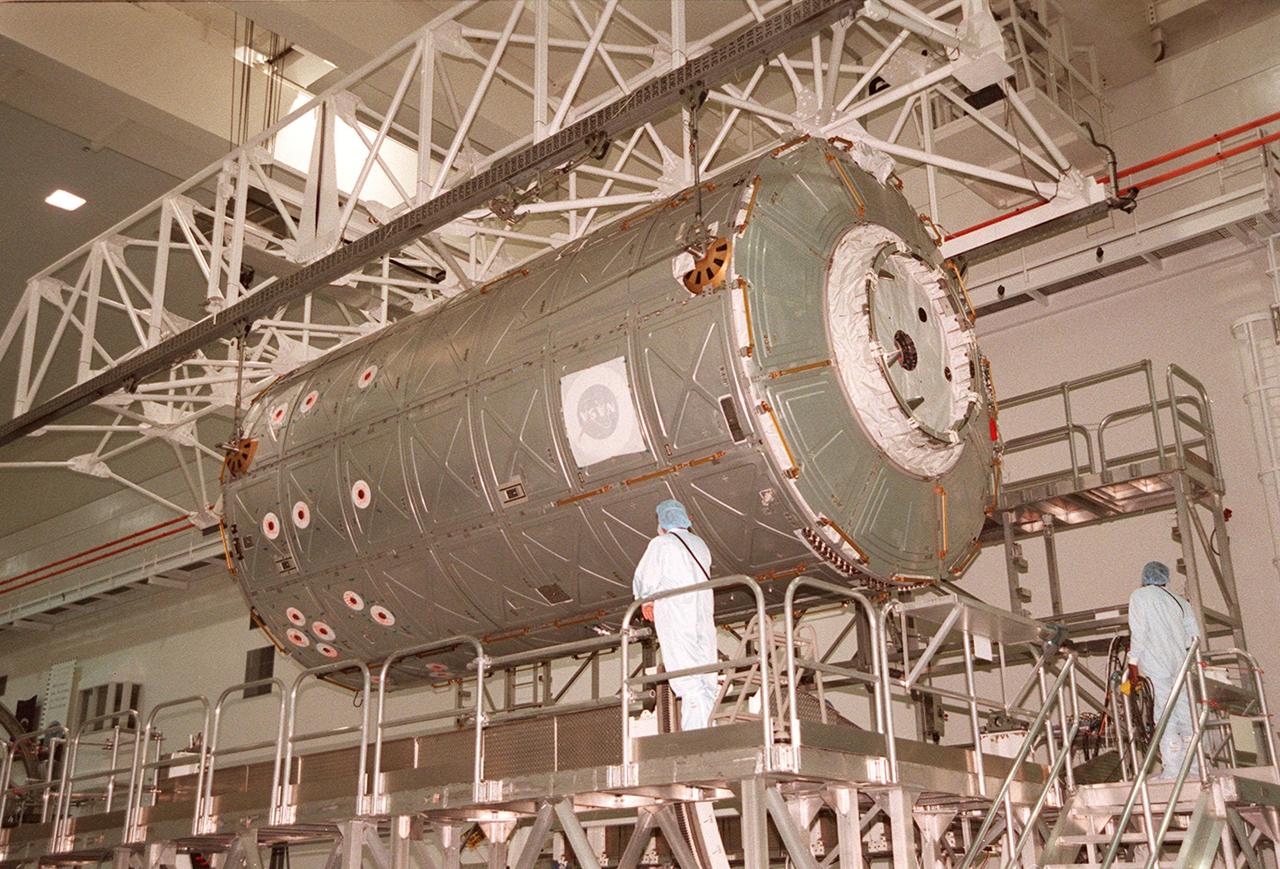
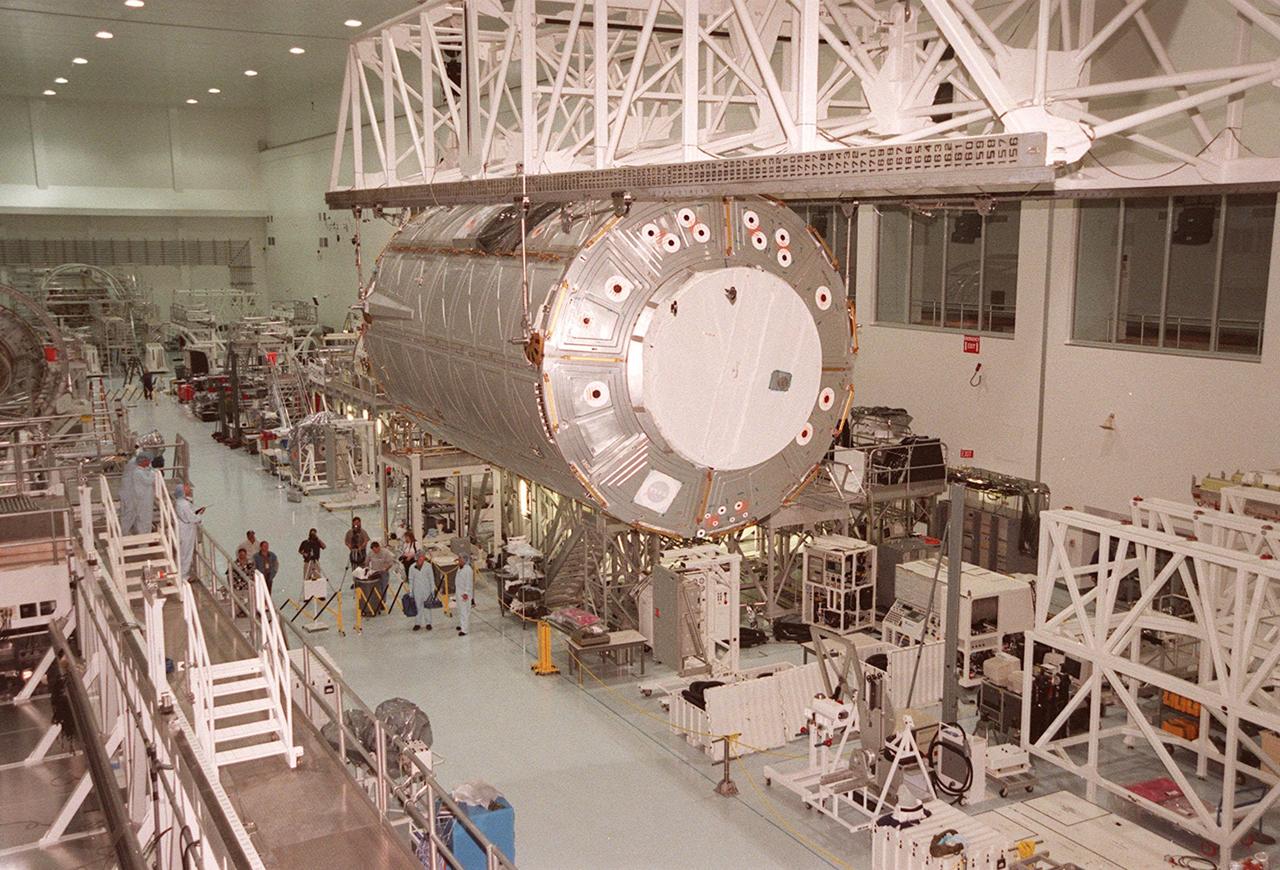
KENNEDY SPACE CENTER, FLA. --  In the Space Station Processing Facility, workers attach an overhead crane to the U.S. Lab Destiny. The lab is being moved from its test and integration stand to the Launch Package Integration Stand (LPIS) for a weight and center of gravity determination. Destiny is the payload aboard Space Shuttle Atlantis on mission STS-98 to the International Space Station. The lab is fitted with five system racks and will already have experiments installed inside for the flight. The launch is scheduled for January 2001
KSC-00pp1931
KENNEDY SPACE CENTER, FLA. --  In the Space Station Processing Facility, workers attach an overhead crane to the U.S. Lab Destiny. The lab is being moved from its test and integration stand to the Launch Package Integration Stand (LPIS) for a weight and center of gravity determination. Destiny is the payload aboard Space Shuttle Atlantis on mission STS-98 to the International Space Station. The lab is fitted with five system racks and will already have experiments installed inside for the flight. The launch is scheduled for January 2001
KSC00pp1931
KENNEDY SPACE CENTER, FLA. -   In the Space Station Processing Facility, STS-120 Mission Specialist Michael Foreman looks over the Japanese Experiment Module (JEM) Pressurized Module. Known as Kibo, the JEM consists of six components: two research facilities -- the Pressurized Module and Exposed Facility; a Logistics Module attached to each of them; a Remote Manipulator System; and an Inter-Orbit Communication System unit. Kibo also has a scientific airlock through which experiments are transferred and exposed to the external environment of space. The various components of JEM will be assembled in space over the course of three Space Shuttle missions.  The STS-120 mission will deliver the second of three Station connecting modules, Node 2, which attaches to the end of U.S. Lab.  It will provide attach locations for the Japanese laboratory, European laboratory, the Centrifuge Accommodation Module and later Multi-Purpose Logistics Modules.  The addition of Node 2 will complete the U.S. core of the International Space Station.
KENNEDY SPACE CENTER, FLA. - In the Space Station Processing Facility, STS-120 Mission Specialist Michael Foreman looks over the Japanese Experiment Module (JEM) Pressurized Module. Known as Kibo, the JEM consists of six components: two research facilities -- the Pressurized Module and Exposed Facility; a Logistics Module attached to each of them; a Remote Manipulator System; and an Inter-Orbit Communication System unit. Kibo also has a scientific airlock through which experiments are transferred and exposed to the external environment of space. The various components of JEM will be assembled in space over the course of three Space Shuttle missions. The STS-120 mission will deliver the second of three Station connecting modules, Node 2, which attaches to the end of U.S. Lab. It will provide attach locations for the Japanese laboratory, European laboratory, the Centrifuge Accommodation Module and later Multi-Purpose Logistics Modules. The addition of Node 2 will complete the U.S. core of the International Space Station.
KENNEDY SPACE CENTER, FLA. -  In the Space Station Processing Facility, STS-120 Mission Specialist Piers Sellers looks over the Japanese Experiment Module (JEM) Pressurized Module. Known as Kibo, the JEM consists of six components: two research facilities -- the Pressurized Module and Exposed Facility; a Logistics Module attached to each of them; a Remote Manipulator System; and an Inter-Orbit Communication System unit. Kibo also has a scientific airlock through which experiments are transferred and exposed to the external environment of space. The various components of JEM will be assembled in space over the course of three Space Shuttle missions.   The STS-120 mission will deliver the second of three Station connecting modules, Node 2, which attaches to the end of U.S. Lab.  It will provide attach locations for the Japanese laboratory, European laboratory, the Centrifuge Accommodation Module and later Multi-Purpose Logistics Modules.  The addition of Node 2 will complete the U.S. core of the International Space Station.
KENNEDY SPACE CENTER, FLA. - In the Space Station Processing Facility, STS-120 Mission Specialist Piers Sellers looks over the Japanese Experiment Module (JEM) Pressurized Module. Known as Kibo, the JEM consists of six components: two research facilities -- the Pressurized Module and Exposed Facility; a Logistics Module attached to each of them; a Remote Manipulator System; and an Inter-Orbit Communication System unit. Kibo also has a scientific airlock through which experiments are transferred and exposed to the external environment of space. The various components of JEM will be assembled in space over the course of three Space Shuttle missions. The STS-120 mission will deliver the second of three Station connecting modules, Node 2, which attaches to the end of U.S. Lab. It will provide attach locations for the Japanese laboratory, European laboratory, the Centrifuge Accommodation Module and later Multi-Purpose Logistics Modules. The addition of Node 2 will complete the U.S. core of the International Space Station.
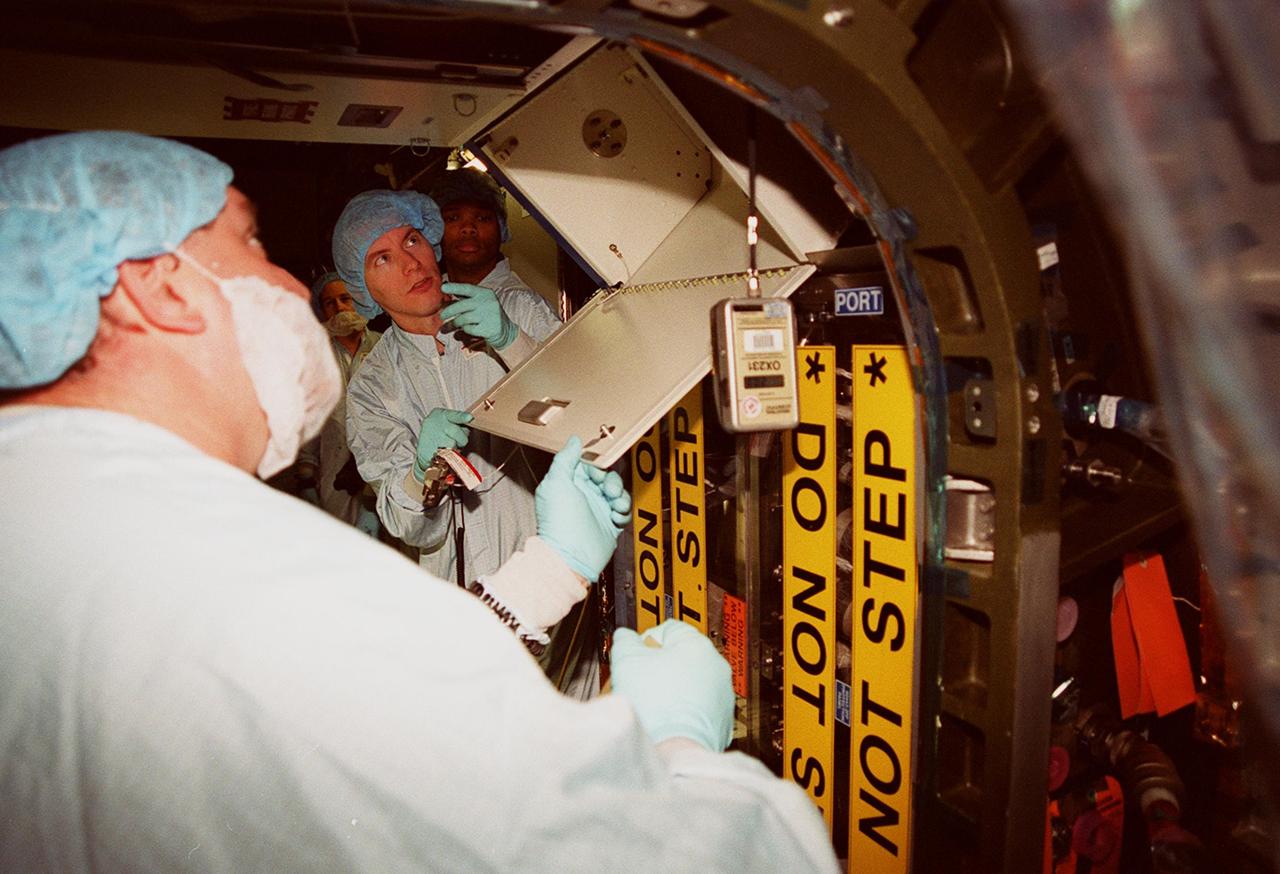
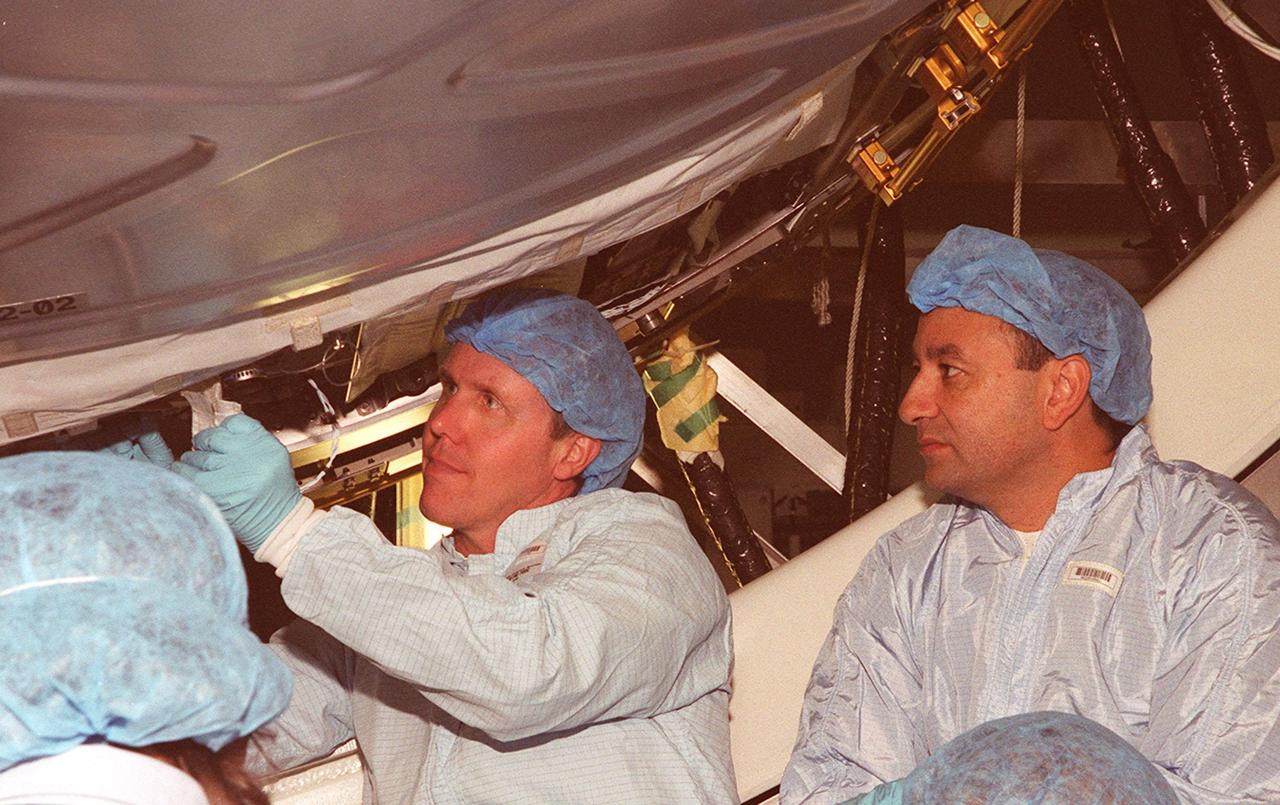
KENNEDY SPACE CENTER, FLA. - STS-120 Mission Specialists Piers Sellers and Michael Foreman look at the Japanese Experiment Module (JEM) Pressurized Module located in the Space Station Processing Facility. Known as Kibo, the JEM consists of six components: two research facilities -- the Pressurized Module and Exposed Facility; a Logistics Module attached to each of them; a Remote Manipulator System; and an Inter-Orbit Communication System unit. Kibo also has a scientific airlock through which experiments are transferred and exposed to the external environment of space. The various components of JEM will be assembled in space over the course of three Space Shuttle missions.  The STS-120 mission will deliver the second of three Station connecting modules, Node 2, which attaches to the end of U.S. Lab.  It will provide attach locations for the JEM, European laboratory, the Centrifuge Accommodation Module and later Multi-Purpose Logistics Modules.  The addition of Node 2 will complete the U.S. core of the International Space Station.
KENNEDY SPACE CENTER, FLA. - STS-120 Mission Specialists Piers Sellers and Michael Foreman look at the Japanese Experiment Module (JEM) Pressurized Module located in the Space Station Processing Facility. Known as Kibo, the JEM consists of six components: two research facilities -- the Pressurized Module and Exposed Facility; a Logistics Module attached to each of them; a Remote Manipulator System; and an Inter-Orbit Communication System unit. Kibo also has a scientific airlock through which experiments are transferred and exposed to the external environment of space. The various components of JEM will be assembled in space over the course of three Space Shuttle missions. The STS-120 mission will deliver the second of three Station connecting modules, Node 2, which attaches to the end of U.S. Lab. It will provide attach locations for the JEM, European laboratory, the Centrifuge Accommodation Module and later Multi-Purpose Logistics Modules. The addition of Node 2 will complete the U.S. core of the International Space Station.
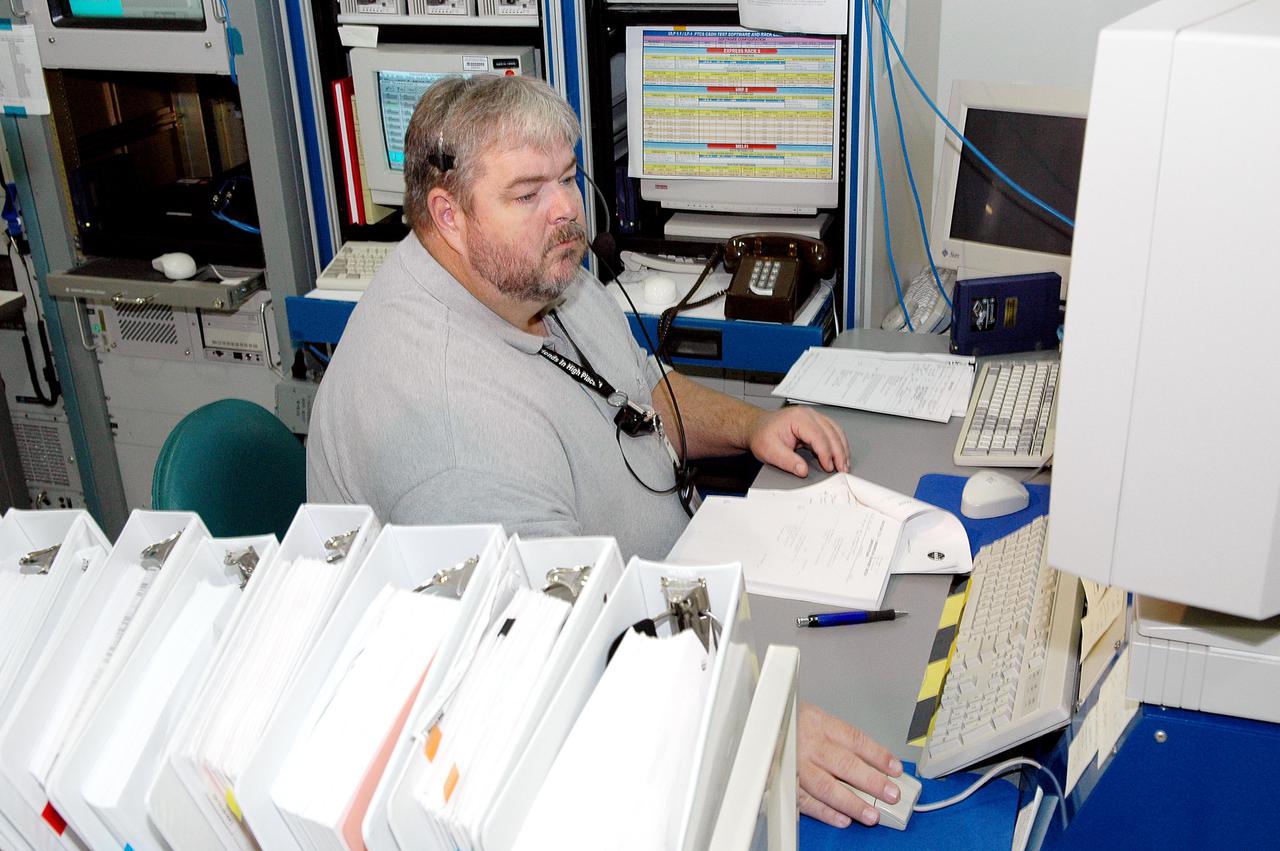
KENNEDY SPACE CENTER, FLA. -    Joe Mounts, with Boeing, monitors the Payload Test and Checkout System for the Human Research Facility (HRF) Rack -2 payload. The HRF-2 is scheduled to fly on Return to Flight Space Shuttle mission STS-114.  The HRF-2 will deliver additional biomedical instrumentation and research capability to the International Space Station.  HRF Rack 1 contains an ultrasound unit and gas analyzer system and has been operational in the U.S. Lab since May 2001.  HRF-2 will also be installed in the U. S. Lab and will provide structural, power, thermal, command and data handling, and communication and tracking interfaces between the HRF biomedical instrumentation and the U. S. Lab.
KSC-04pd-2497
KENNEDY SPACE CENTER, FLA. - Jake Senior, United Space Alliance technician, prepares the Orbiter Boom Sensor System in the Remote Manipulator System lab for testing.  The OBSS is undergoing final checkout and testing in the lab prior to being transferred to the Orbiter Processing Facility for installation on Space Shuttle Discovery. The 50-foot-long OBSS will be attached to the Remote Manipulator System, or Shuttle arm, and is one of the new safety measures for Return to Flight, equipping the orbiter with cameras and laser systems to inspect the Shuttle's Thermal Protection System while in space. Discovery is slated to fly mission STS-114 once Space Shuttle launches resume.  The launch planning window is May 12 to June 3, 2005.
KSC-05pd-0066
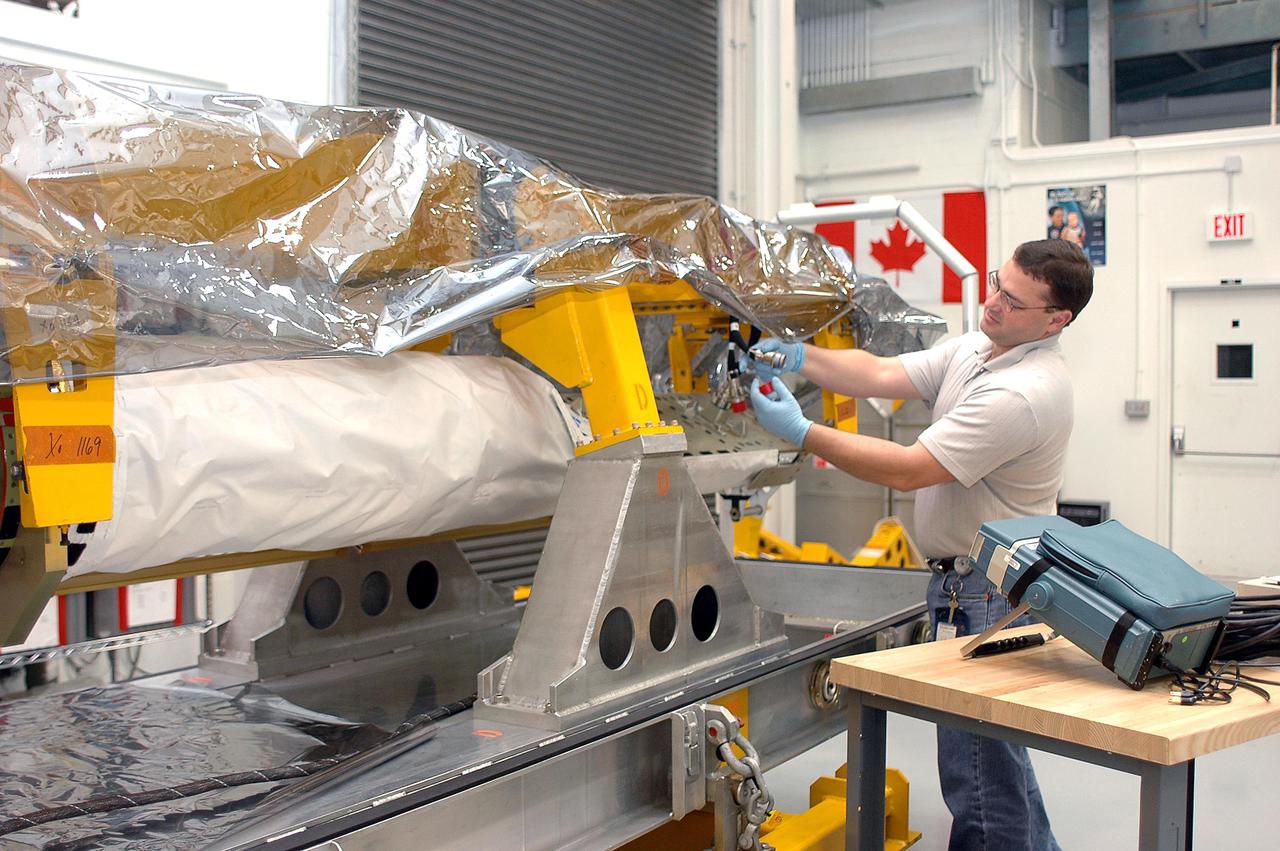
KENNEDY SPACE CENTER, FLA. - In the Remote Manipulator System lab, United Space Alliance technician Todd Dugan works on the Orbiter Boom Sensor System.  The OBSS is undergoing final checkout and testing in the lab prior to being transferred to the Orbiter Processing Facility for installation on Space Shuttle Discovery. The 50-foot-long OBSS will be attached to the Remote Manipulator System, or Shuttle arm, and is one of the new safety measures for Return to Flight, equipping the orbiter with cameras and laser systems to inspect the Shuttle's Thermal Protection System while in space. Discovery is slated to fly mission STS-114 once Space Shuttle launches resume.  The launch planning window is May 12 to June 3, 2005.
KSC-05pd-0070
KENNEDY SPACE CENTER, FLA. - The assembled Orbiter Boom Sensor System sits in the Remote Manipulator System lab inside the Vehicle Assembly Building.  The OBSS will undergo final checkout and testing in the lab prior to being transferred to the Orbiter Processing Facility for installation on Space Shuttle Discovery. The 50-foot-long OBSS will be attached to the Remote Manipulator System, or Shuttle arm, and is one of the new safety measures for Return to Flight, equipping the orbiter with cameras and laser systems to inspect the Shuttle’s Thermal Protection System while in space. Discovery is slated to fly Return to Flight mission STS-114 once Space Shuttle launches resume.  The launch planning window is May 12 to June 3, 2005.
KSC-05pd-0064
KENNEDY SPACE CENTER, FLA. - The assembled Orbiter Boom Sensor System sits in the Remote Manipulator System lab inside the Vehicle Assembly Building.  The OBSS will undergo final checkout and testing in the lab prior to being transferred to the Orbiter Processing Facility for installation on Space Shuttle Discovery. The 50-foot-long OBSS will be attached to the Remote Manipulator System, or Shuttle arm, and is one of the new safety measures for Return to Flight, equipping the orbiter with cameras and laser systems to inspect the Shuttle’s Thermal Protection System while in space. Discovery is slated to fly Return to Flight mission STS-114 once Space Shuttle launches resume.  The launch planning window is May 12 to June 3, 2005.
KSC-05pd-0063
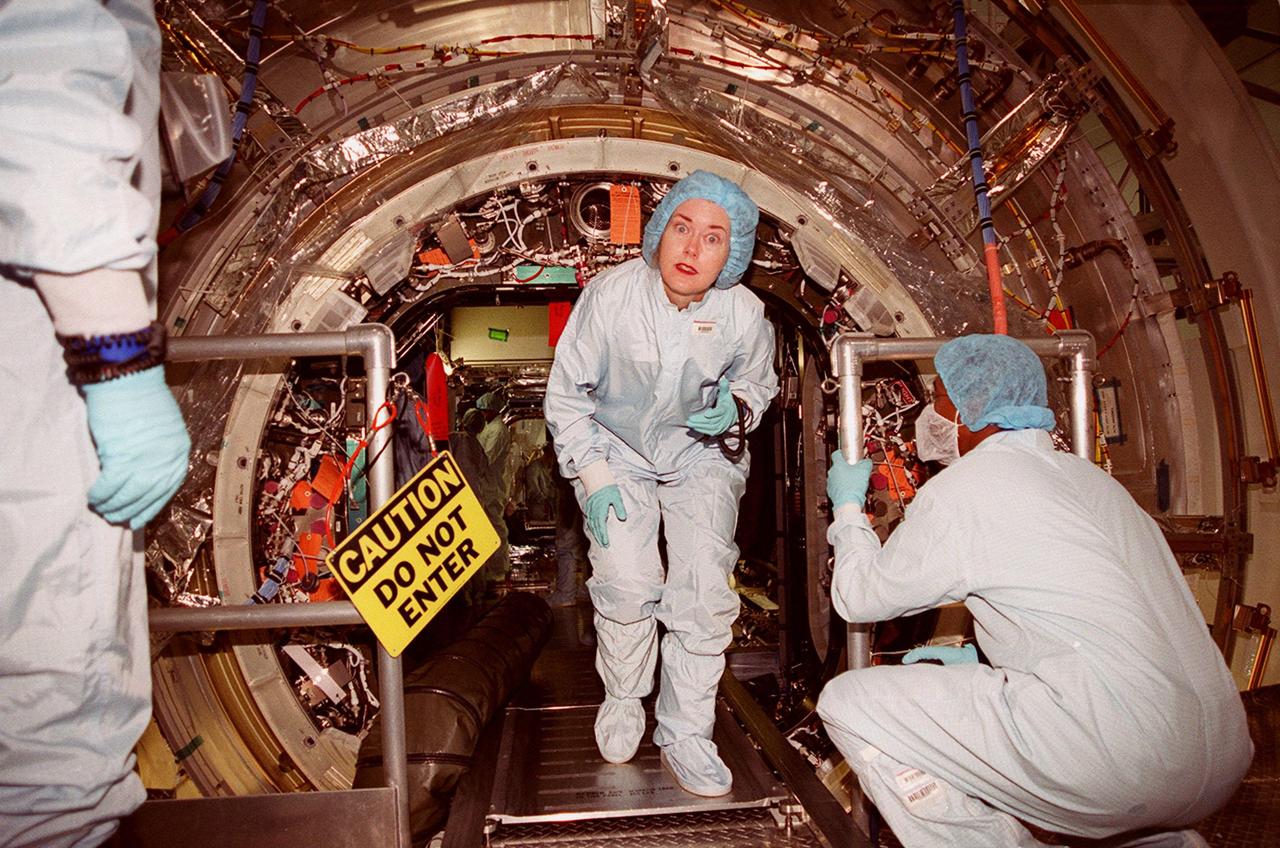
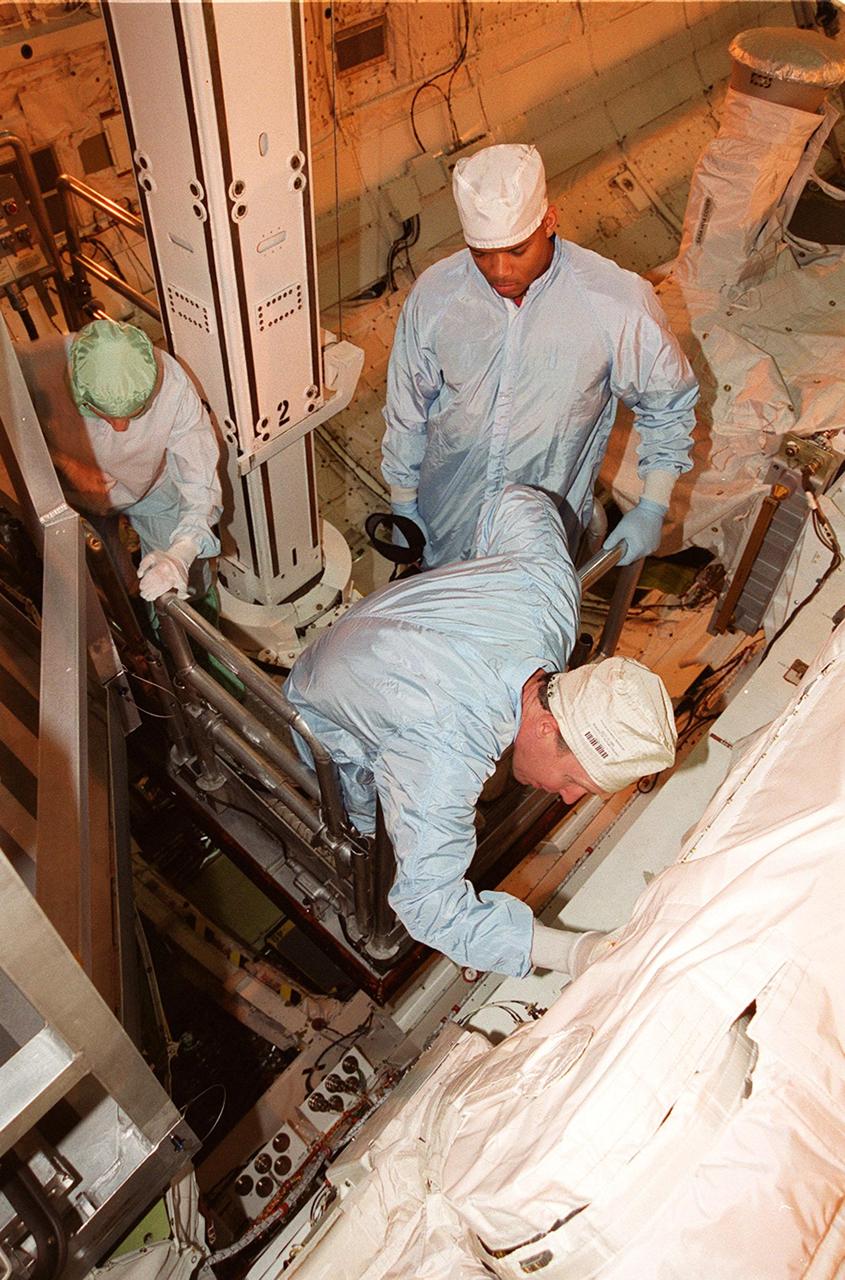
In the Space Station Processing Facility, STS-98 Mission Specialist Marsha Ivins maneuvers a part of the U.S. Lab, Destiny. The crew is checking out equipment inside the lab as part of Crew Equipment Interface Test activities, becoming familiar with equipment it will be handling during the mission. Others in the crew are Commander Ken Cockrell, Pilot Mark Polansky and Mission Specialists Robert Curbeam and Thomas Jones. The mission will be transporting the Lab to the International Space Station with five system racks already installed inside of the module. With delivery of electronics in the lab, electrically powered attitude control for Control Moment Gyroscopes will be activated. The STS-98 launch is scheduled for Jan. 18, 2001
KSC-00pp1603
In the Space Station Processing Facility, a worker is surprised by the camera as she exits the U.S. Lab, Destiny. Inside the lab is the STS-98 crew, which is taking part in Crew Equipment Interface Test activities, becoming familiar with equipment it will be handling during the mission. The crew comprises Commander Ken Cockrell, Pilot Mark Polansky and Mission Specialists Robert Curbeam, Thomas Jones and Marsha Ivins. The mission will be transporting the Lab to the International Space Station with five system racks already installed inside of the module. With delivery of electronics in the lab, electrically powered attitude control for Control Moment Gyroscopes will be activated. The STS-98 launch is scheduled for Jan. 18, 2001
KSC-00pp1601
In the Space Station Processing Facility, STS-98 Mission Specialist Marsha Ivins wields a tool on part of the U.S. Lab, Destiny. The crew is checking out equipment inside the lab as part of Crew Equipment Interface Test activities, becoming familiar with equipment it will be handling during the mission. Others in the crew are Commander Ken Cockrell, Pilot Mark Polansky and Mission Specialists Robert Curbeam and Thomas Jones. The mission will be transporting the Lab to the International Space Station with five system racks already installed inside of the module. With delivery of electronics in the lab, electrically powered attitude control for Control Moment Gyroscopes will be activated. The STS-98 launch is scheduled for Jan. 18, 2001
KSC-00pp1604
Karen Son, a NSTRF fellow at Marshall, uses a virtual test lab to help improve air quality on the next generation of air filtration systems to be used in space
Karen Son uses a virtual test lab
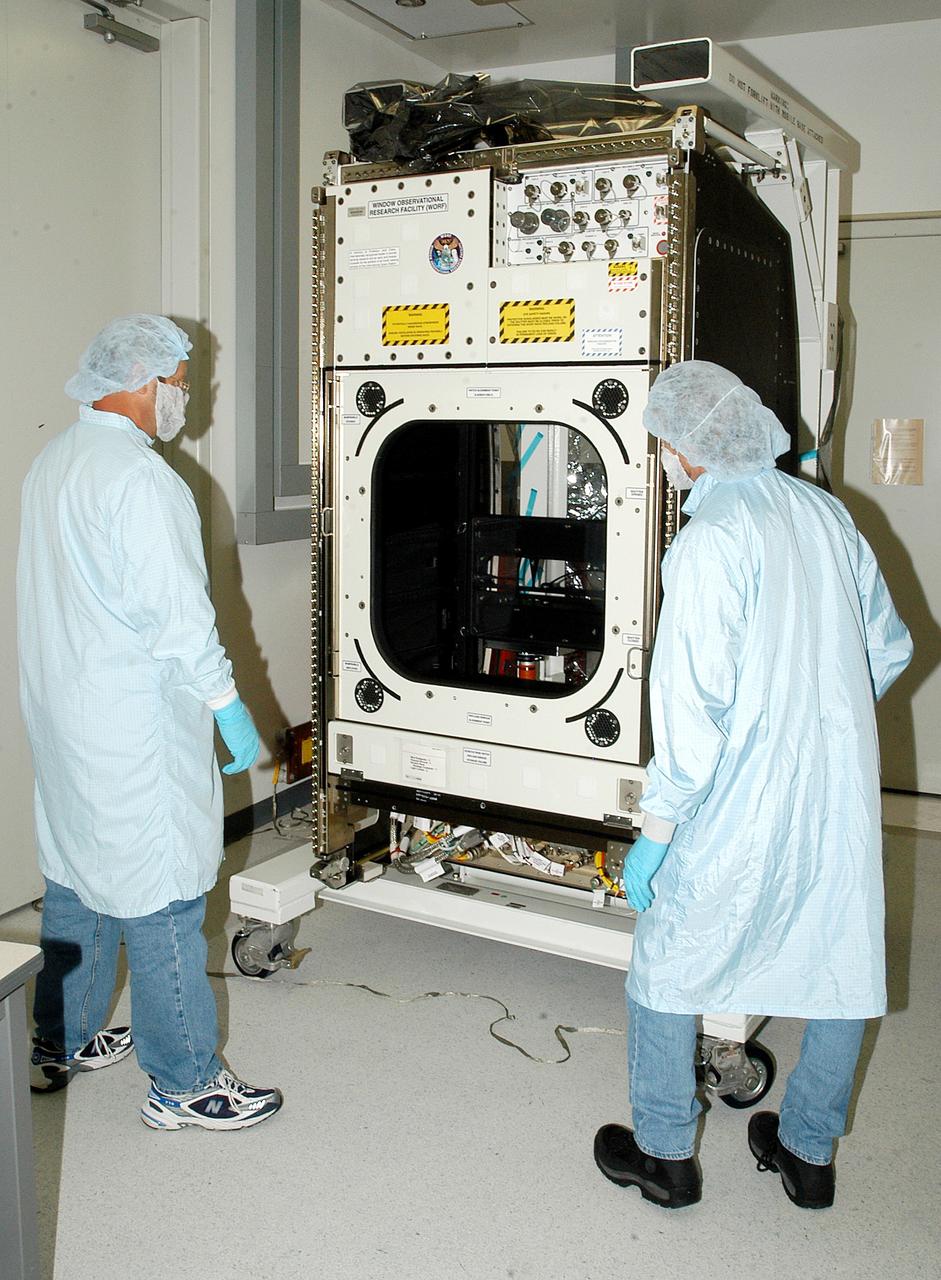
KENNEDY SPACE CENTER, FLA. -   Workers in the Space Station Processing Facility check out the Window Observational Research Facility (WORF),  designed and built by the Boeing Co. at NASA’s Marshall Space Flight Center in Huntsville, Ala.   WORF will be delivered to the International Space Station and placed in the rack position in front of the Destiny lab window,  providing locations for attaching cameras, multi-spectral scanners and other instruments. WORF will support a variety of scientific and commercial experiments in areas of Earth systems and processes, global ecological changes in Earth’s biosphere, lithosphere, hydrosphere and climate system, Earth resources, natural hazards, and education.  After installation, it will become a permanent focal point for Earth Science research aboard the space station.
KENNEDY SPACE CENTER, FLA. - Workers in the Space Station Processing Facility check out the Window Observational Research Facility (WORF), designed and built by the Boeing Co. at NASA’s Marshall Space Flight Center in Huntsville, Ala. WORF will be delivered to the International Space Station and placed in the rack position in front of the Destiny lab window, providing locations for attaching cameras, multi-spectral scanners and other instruments. WORF will support a variety of scientific and commercial experiments in areas of Earth systems and processes, global ecological changes in Earth’s biosphere, lithosphere, hydrosphere and climate system, Earth resources, natural hazards, and education. After installation, it will become a permanent focal point for Earth Science research aboard the space station.
KENNEDY SPACE CENTER, FLA. -  Workers in the Space Station Processing Facility check out the Window Observational Research Facility (WORF),  designed and built by the Boeing Co. at NASA’s Marshall Space Flight Center in Huntsville, Ala.   WORF will be delivered to the International Space Station and placed in the rack position in front of the Destiny lab window,  providing locations for attaching cameras, multi-spectral scanners and other instruments. WORF will support a variety of scientific and commercial experiments in areas of Earth systems and processes, global ecological changes in Earth’s biosphere, lithosphere, hydrosphere and climate system, Earth resources, natural hazards, and education.  After installation, it will become a permanent focal point for Earth Science research aboard the space station.
KENNEDY SPACE CENTER, FLA. - Workers in the Space Station Processing Facility check out the Window Observational Research Facility (WORF), designed and built by the Boeing Co. at NASA’s Marshall Space Flight Center in Huntsville, Ala. WORF will be delivered to the International Space Station and placed in the rack position in front of the Destiny lab window, providing locations for attaching cameras, multi-spectral scanners and other instruments. WORF will support a variety of scientific and commercial experiments in areas of Earth systems and processes, global ecological changes in Earth’s biosphere, lithosphere, hydrosphere and climate system, Earth resources, natural hazards, and education. After installation, it will become a permanent focal point for Earth Science research aboard the space station.
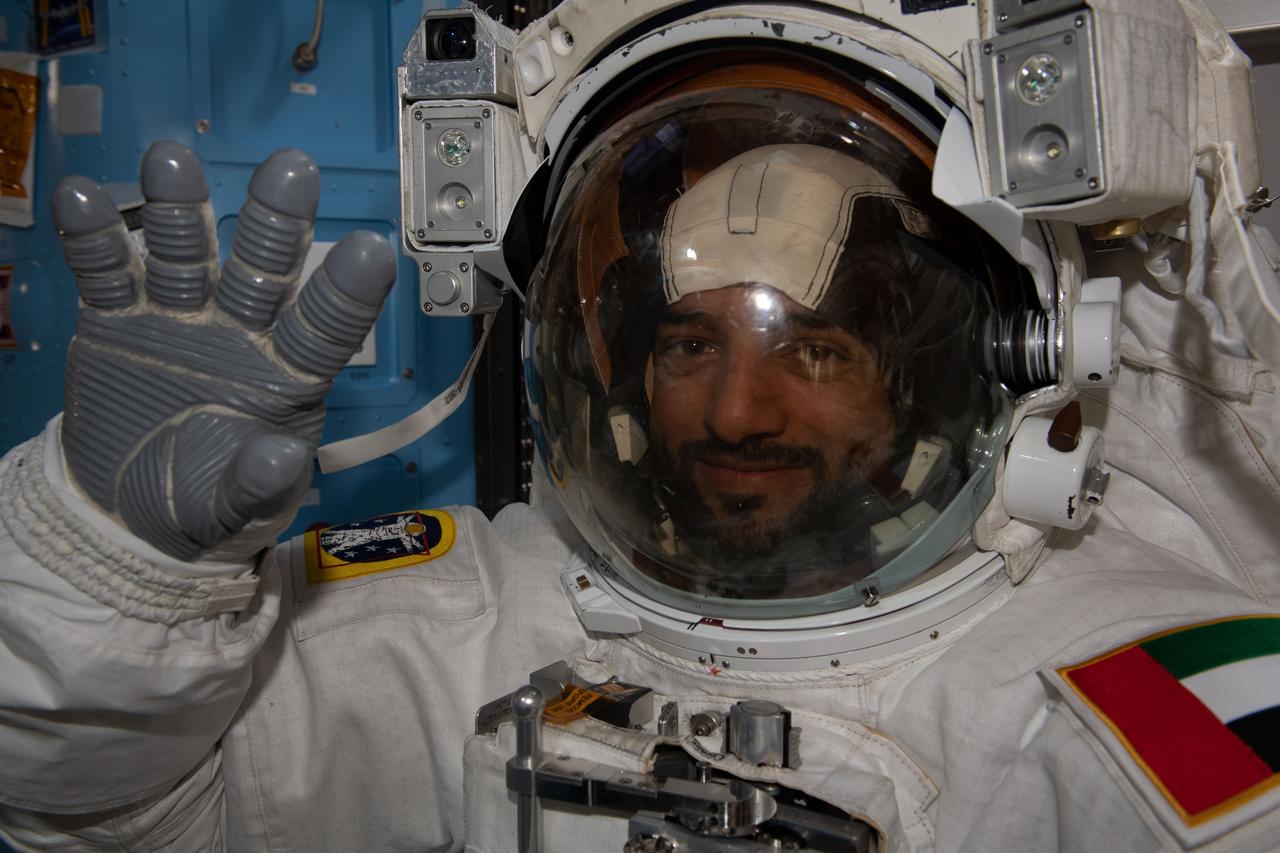
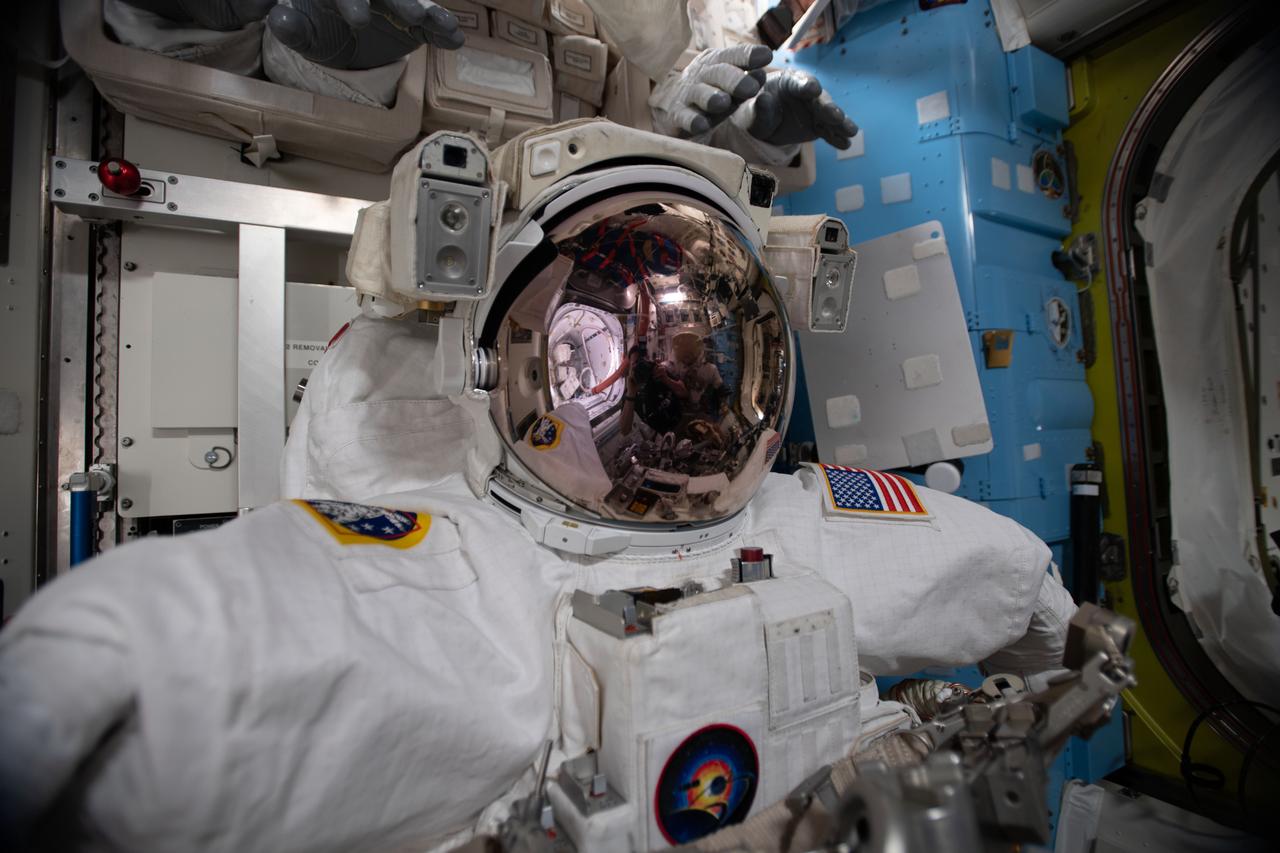
iss069e005102 (April 24, 2023) --- UAE (United Arab Emirates) astronaut and Expedition 69 Flight Engineer Sultan Alneyadi is pictured trying on his Extravehicular Mobility Unit, or spacesuit, and testing it ahead of a spacewalk planned for Friday, April 28. Alneyadi, along with NASA astronaut Stephen Bowen, will spend about six-and-a-half hours in the vacuum of space continuing to upgrade the International Space Station’s power generation system readying the orbiting lab for its next set of roll-out solar arrays.
Astronaut Sultan Alneyadi tries on his spacesuit ahead of a spacewalk
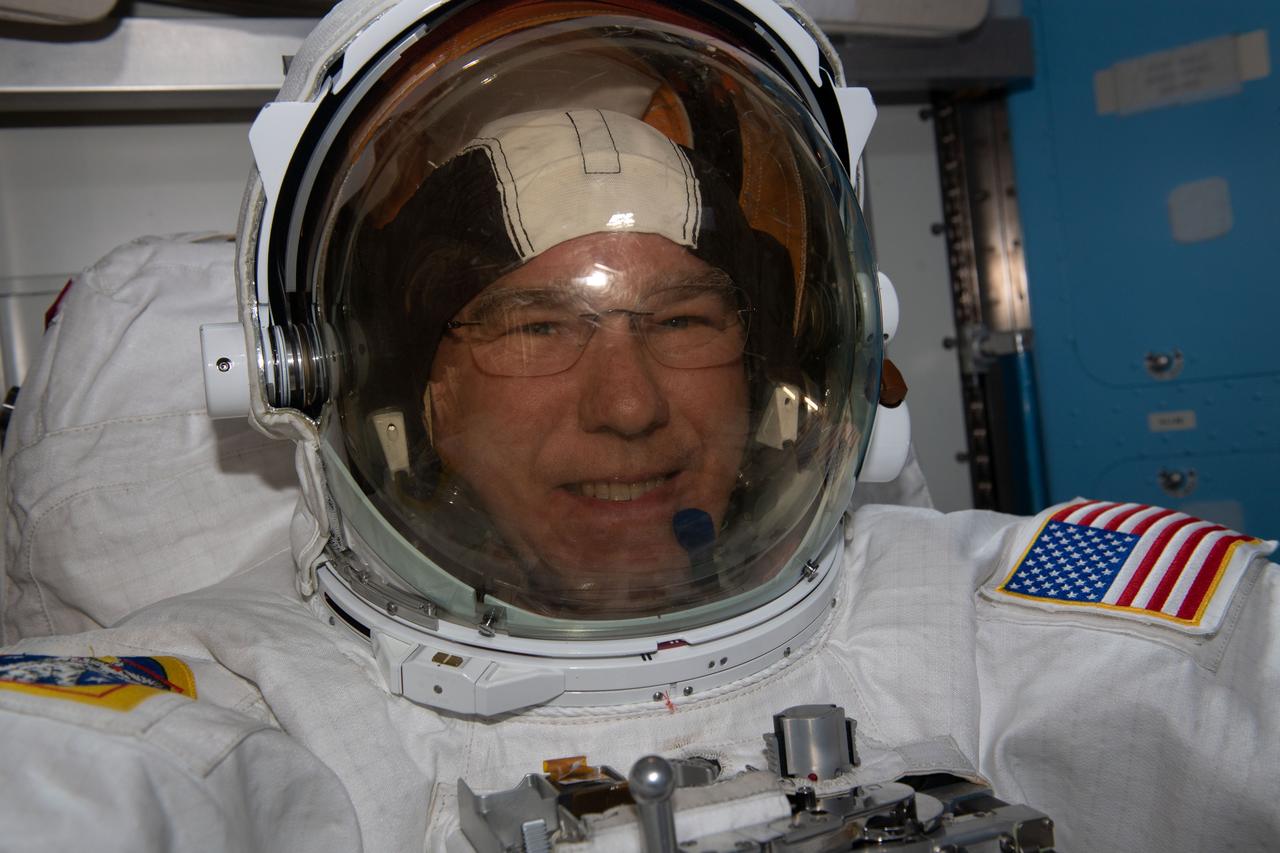
iss069e005093 (April 24, 2023) --- NASA astronaut and Expedition 69 Flight Engineer Stephen Bowen is pictured trying on his Extravehicular Mobility Unit, or spacesuit, and testing it ahead of a spacewalk planned for Friday, April 28. Bowen, along with UAE (United Arab Emirates) astronaut Sultan Alneyadi, will spend about six-and-a-half hours in the vacuum of space continuing to upgrade the International Space Station’s power generation system readying the orbiting lab for its next set of roll-out solar arrays.
Astronaut Stephen Bowen tries on his spacesuit ahead of a spacewalk
KENNEDY SPACE CENTER, FLA. -- Working on the Orbiter Docking System of orbiter Atlantis are Mission Specialists Tom Jones (leaning over) and Robert Curbeam. They and the rest of the crew are at KSC for Crew Equipment Interface Test activities. Launch on mission STS-98 is scheduled for Jan. 18, 2001. It will be transporting the U.S. Lab, Destiny, to the International Space Station with five system racks already installed inside of the module. After delivery of electronics in the lab, electrically powered attitude control for Control Moment Gyroscopes will be activated
KSC00pp1767
KENNEDY SPACE CENTER, FLA. -- Working on the Orbiter Docking System of orbiter Atlantis are Mission Specialists Tom Jones (leaning over) and Robert Curbeam. They and the rest of the crew are at KSC for Crew Equipment Interface Test activities. Launch on mission STS-98 is scheduled for Jan. 18, 2001. It will be transporting the U.S. Lab, Destiny, to the International Space Station with five system racks already installed inside of the module. After delivery of electronics in the lab, electrically powered attitude control for Control Moment Gyroscopes will be activated
KSC-00pp1767
CAPE CANAVERAL, Fla. – Dr. Ray Wheeler explains a plant growth chamber to students in the Life Support and Habitation Systems Lab at the Space Life Sciences Lab facility.             The 26 honor students in chemistry and biology and their teachers got a chance to visit a number of high-tech labs at Kennedy Space Center as part of an effort to encourage students in the areas of science, technology, engineering and math. The tenth and eleventh grade students from Terry Parker High School in Jacksonville, Fla., visited a number of vastly different labs during their one-day tour. The group's visit to Kennedy was hosted by the Education Office as part of a nationwide effort by the National Lab Network to help introduce the nation's students to science careers. Photo credit: NASA/Jim Grossmann
KSC-2012-2762
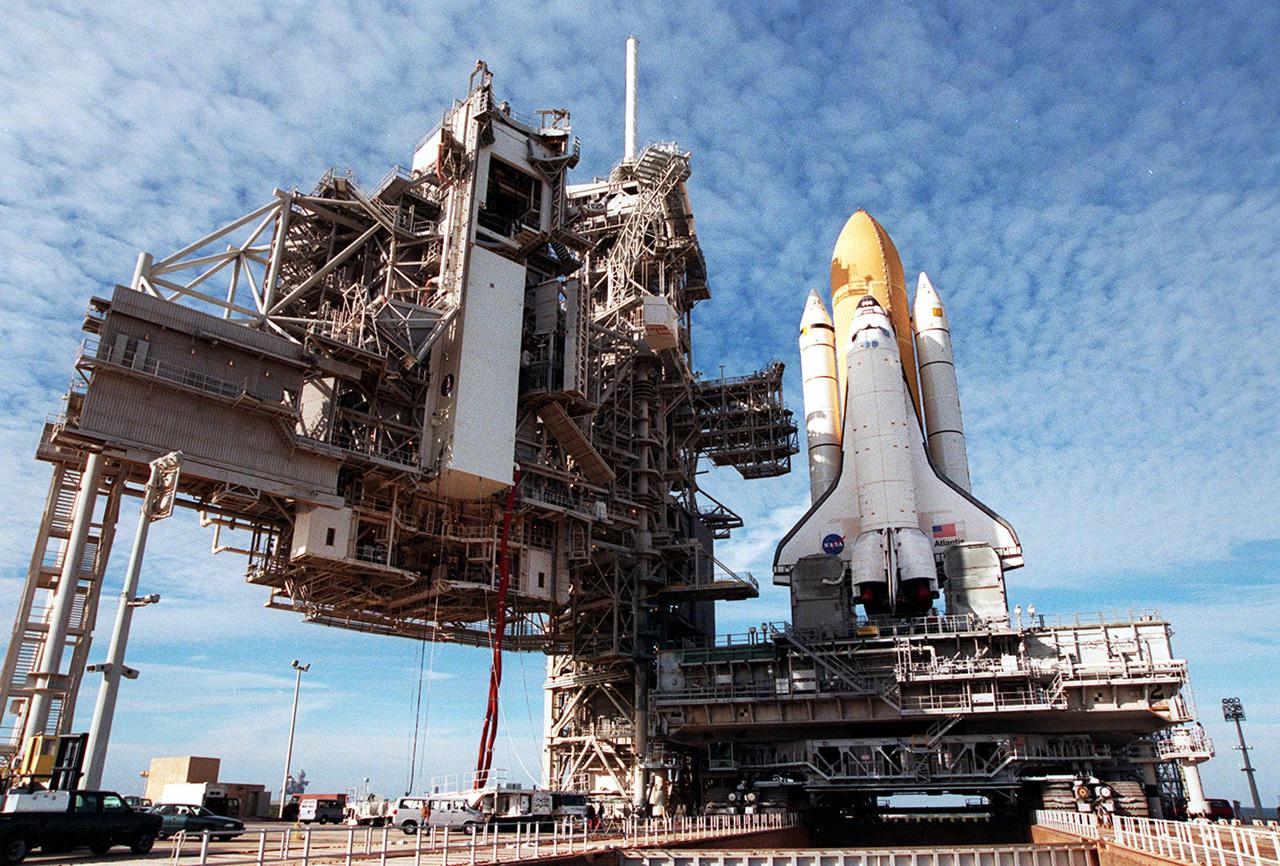
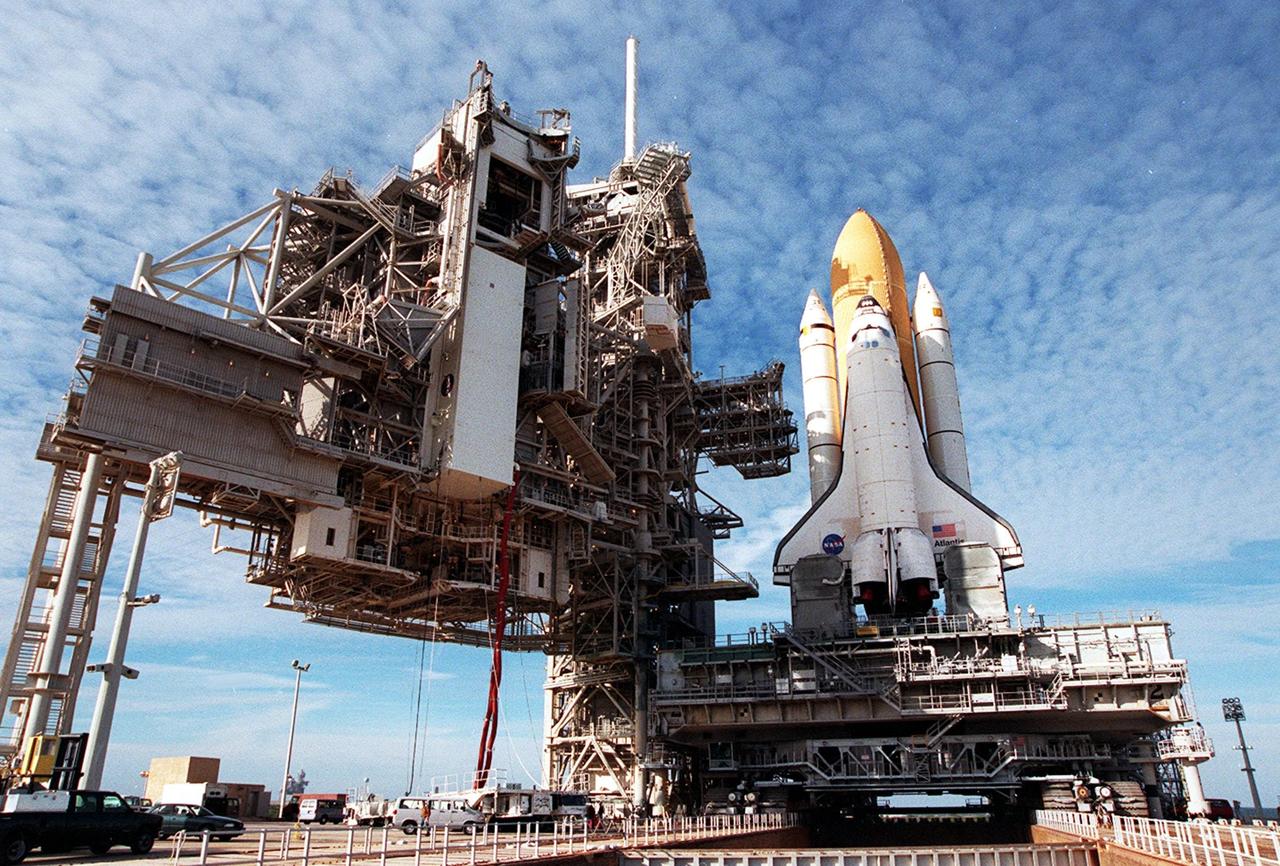
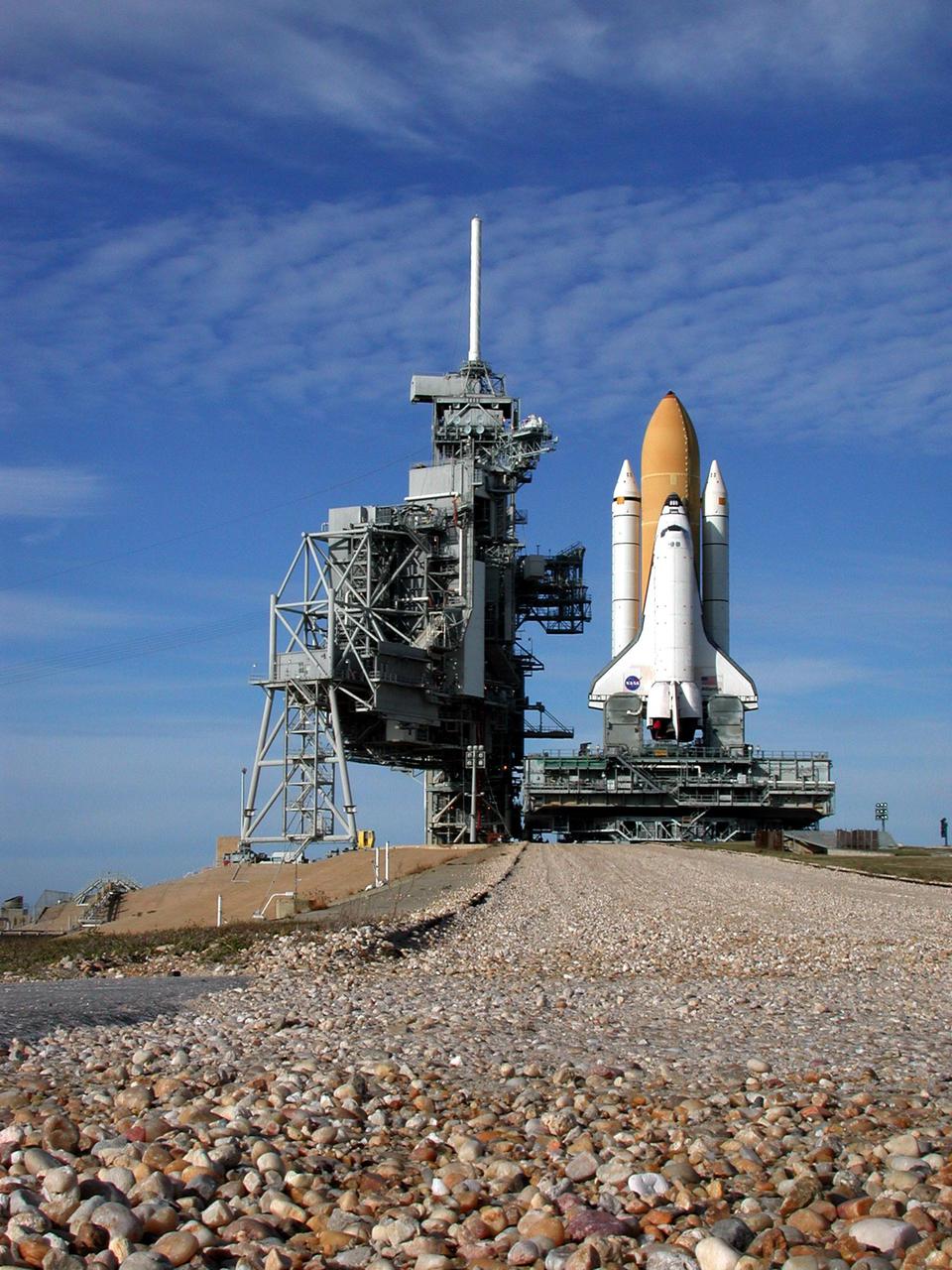
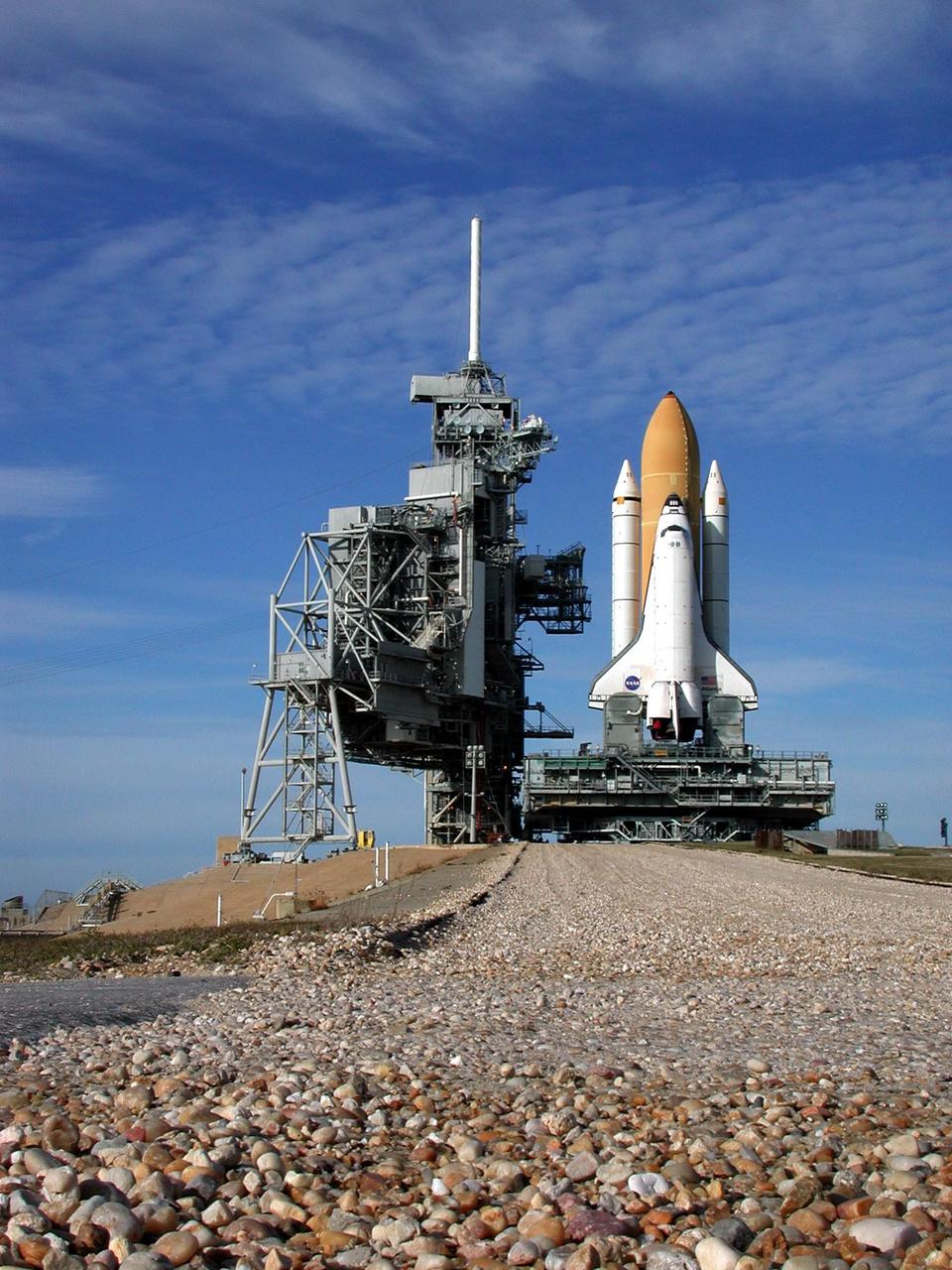
KENNEDY SPACE CENTER, Fla. -- Space Shuttle Atlantis reaches its destination, Launch Pad 39A, for liftoff no earlier than Jan. 19 on mission STS-98. To its immediate left is the Fixed Service Structure, with its 80-foot-tall white lighting mast on top. Further to the left is the Rotating Service Structure, where the white payload canister is being lifted to the Payload Changeout Room. The payload for the mission is the U.S. Lab Destiny, a key element in the construction of the International Space Station. The lab has five system racks for experiments already installed inside the module. After delivery of electronics in the lab, electrically powered attitude control for Control Moment Gyroscopes will be activated
KSC01pp0017
KENNEDY SPACE CENTER, Fla. -- Space Shuttle Atlantis reaches its destination, Launch Pad 39A, for liftoff no earlier than Jan. 19 on mission STS-98. To its immediate left is the Fixed Service Structure, with its 80-foot-tall white lighting mast on top. Further to the left is the Rotating Service Structure, where the white payload canister is being lifted to the Payload Changeout Room. The payload for the mission is the U.S. Lab Destiny, a key element in the construction of the International Space Station. The lab has five system racks for experiments already installed inside the module. After delivery of electronics in the lab, electrically powered attitude control for Control Moment Gyroscopes will be activated
KSC-01PP-0017
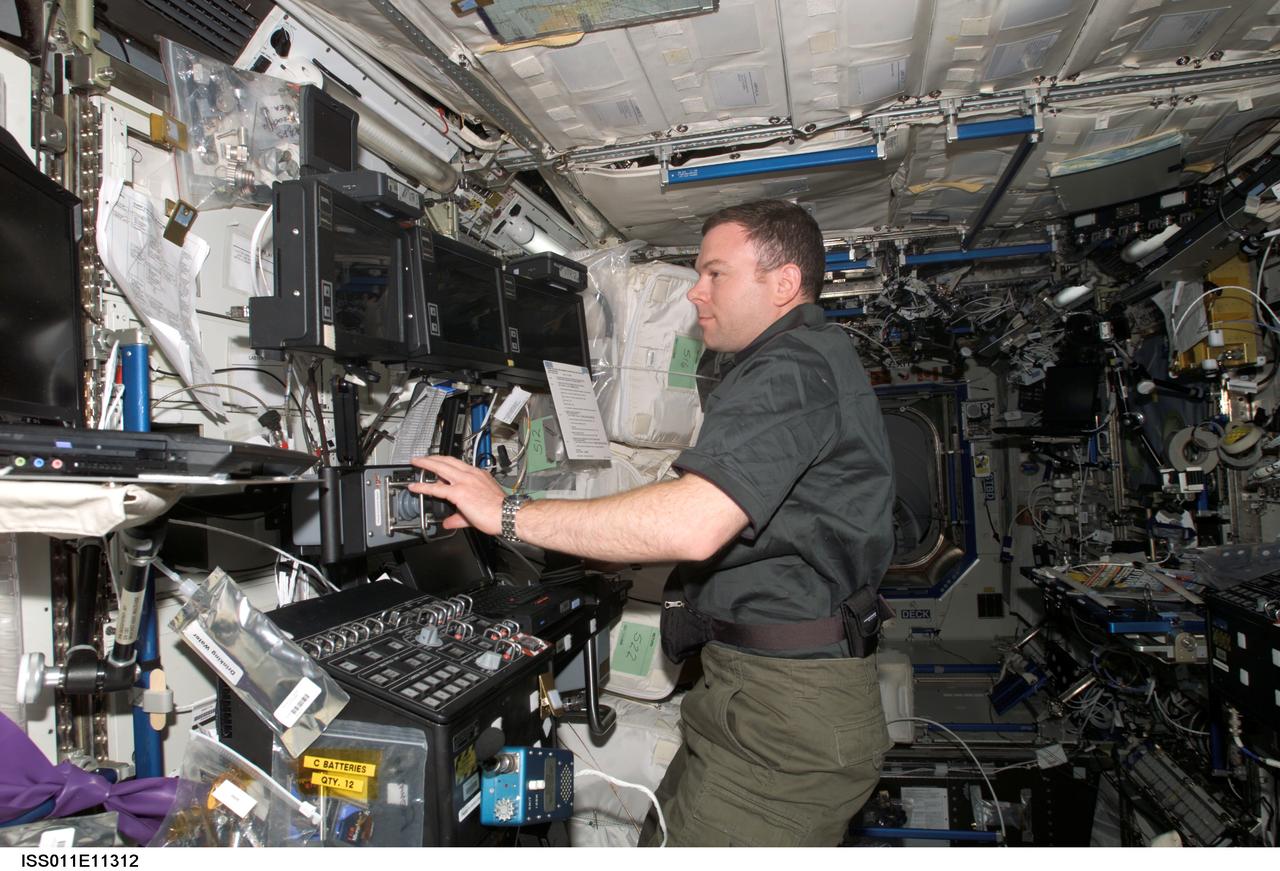
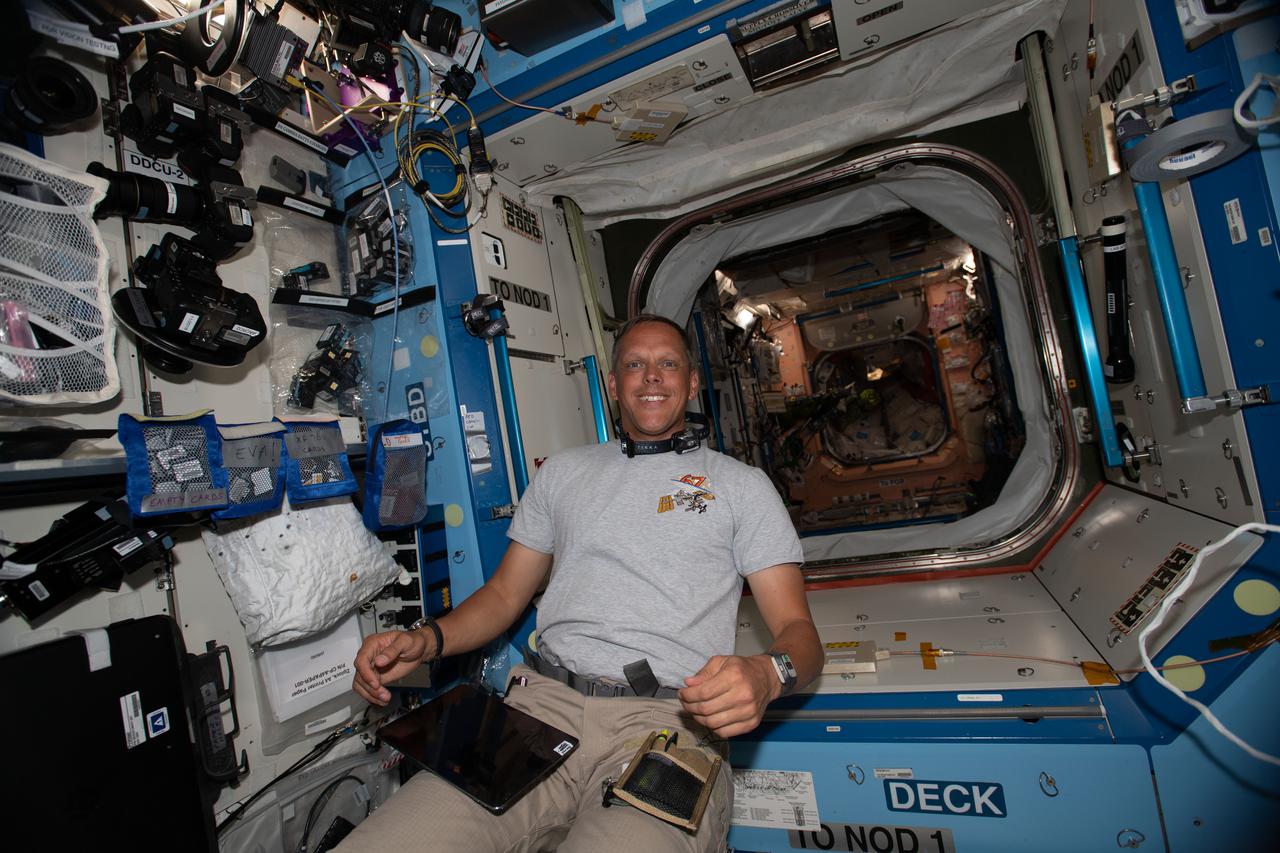
ISS011-E-11312 (29 July 2005) --- Astronaut James M. Kelly, STS-114 pilot, controls the Space Station Remote Manipulator System (Canadarm2)  from the U.S. Lab, Destiny, on the International Space Station.
Kelly at SSRMS controls in U.S. Laboratory
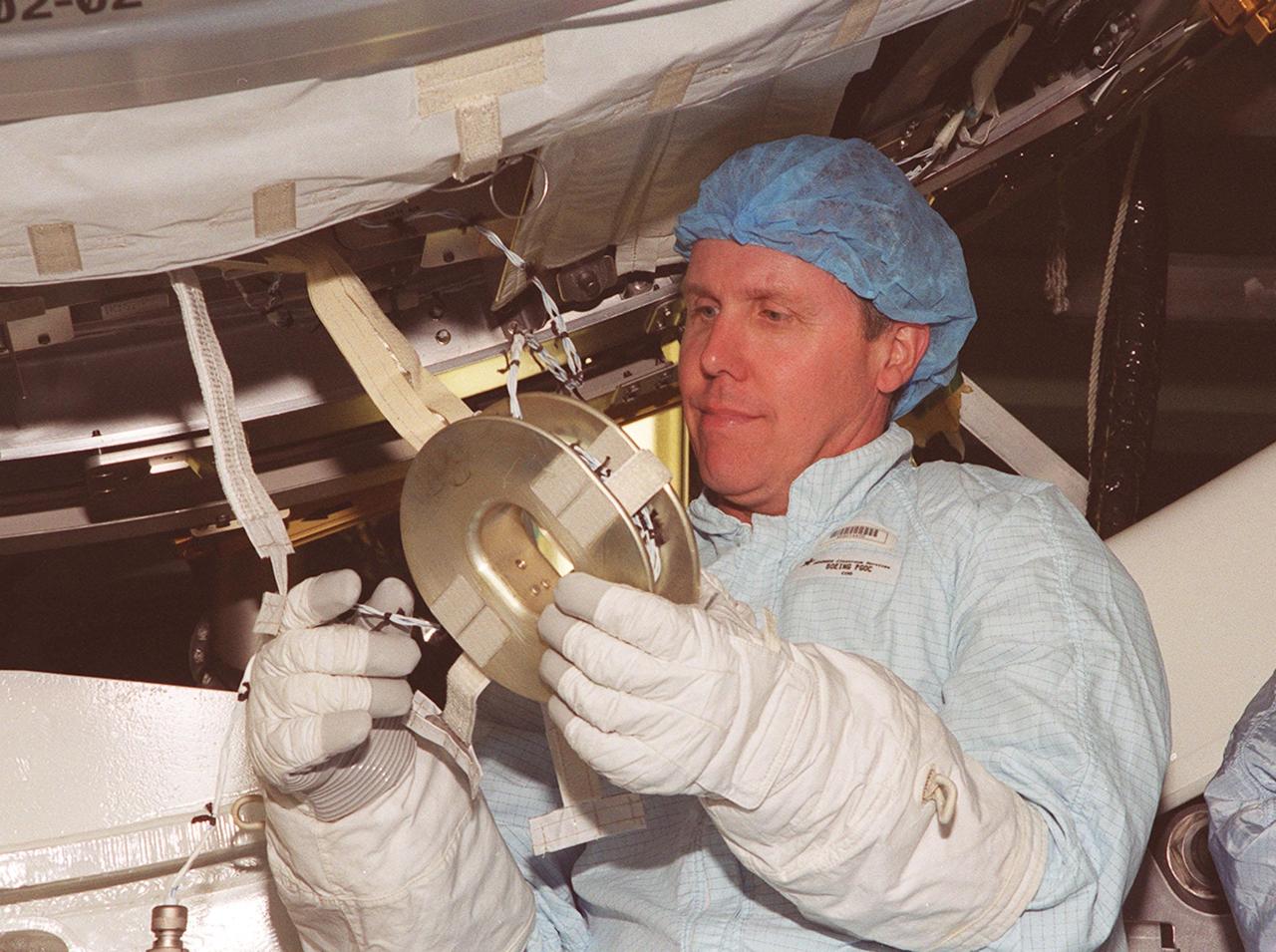
STS-98 Mission Specialist Thomas Jones practices handling a piece of equipment on the U.S. Lab, Destiny, while wearing the gloves he will wear in space. Jones and other crew members are taking part in Crew Equipment Interface Test activities to become familiar with equipment they will be handling during the mission. With launch scheduled for Jan. 18, 2001, the STS-98 mission will be transporting the Lab to the International Space Station with five system racks already installed inside of the module. After delivery of electronics in the lab, electrically powered attitude control for Control Moment Gyroscopes will be activated
KSC-00pp1608
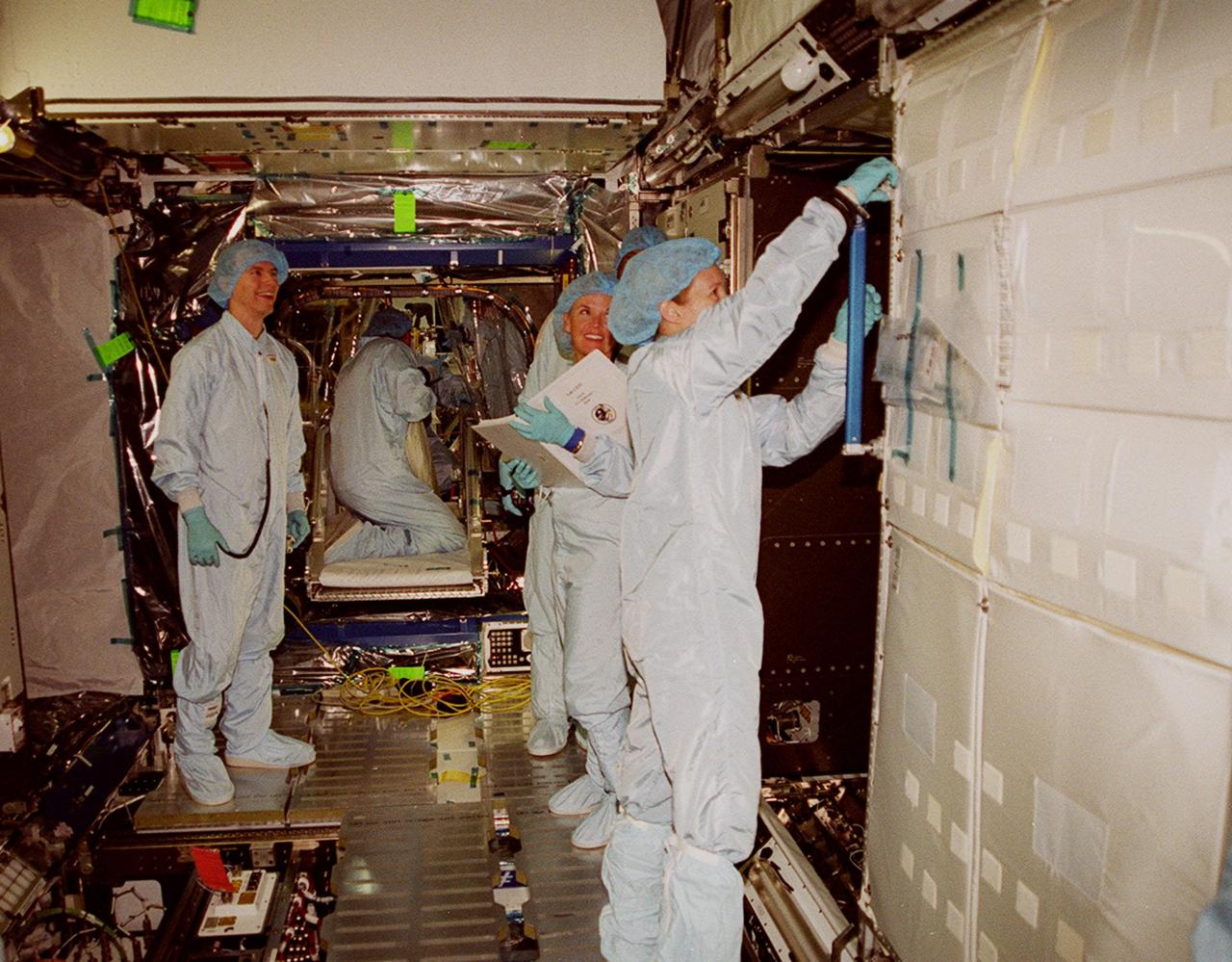
In the Space Station Processing Facility, members of the STS-98 crew check out components inside the U.S. Lab, Destiny, under the watchful eye of trainers. The crew comprises Commander Ken Cockrell, Pilot Mark Polansky and Mission Specialists Robert Curbeam, Thomas Jones and Marsha Ivins. They are taking part in Crew Equipment Interface Test activities, becoming familiar with equipment they will be handling during the mission. The mission will be transporting the Lab to the International Space Station with five system racks already installed inside of the module. With delivery of electronics in the lab, electrically powered attitude control for Control Moment Gyroscopes will be activated. The STS-98 launch is scheduled for Jan. 18, 2001
KSC-00pp1598
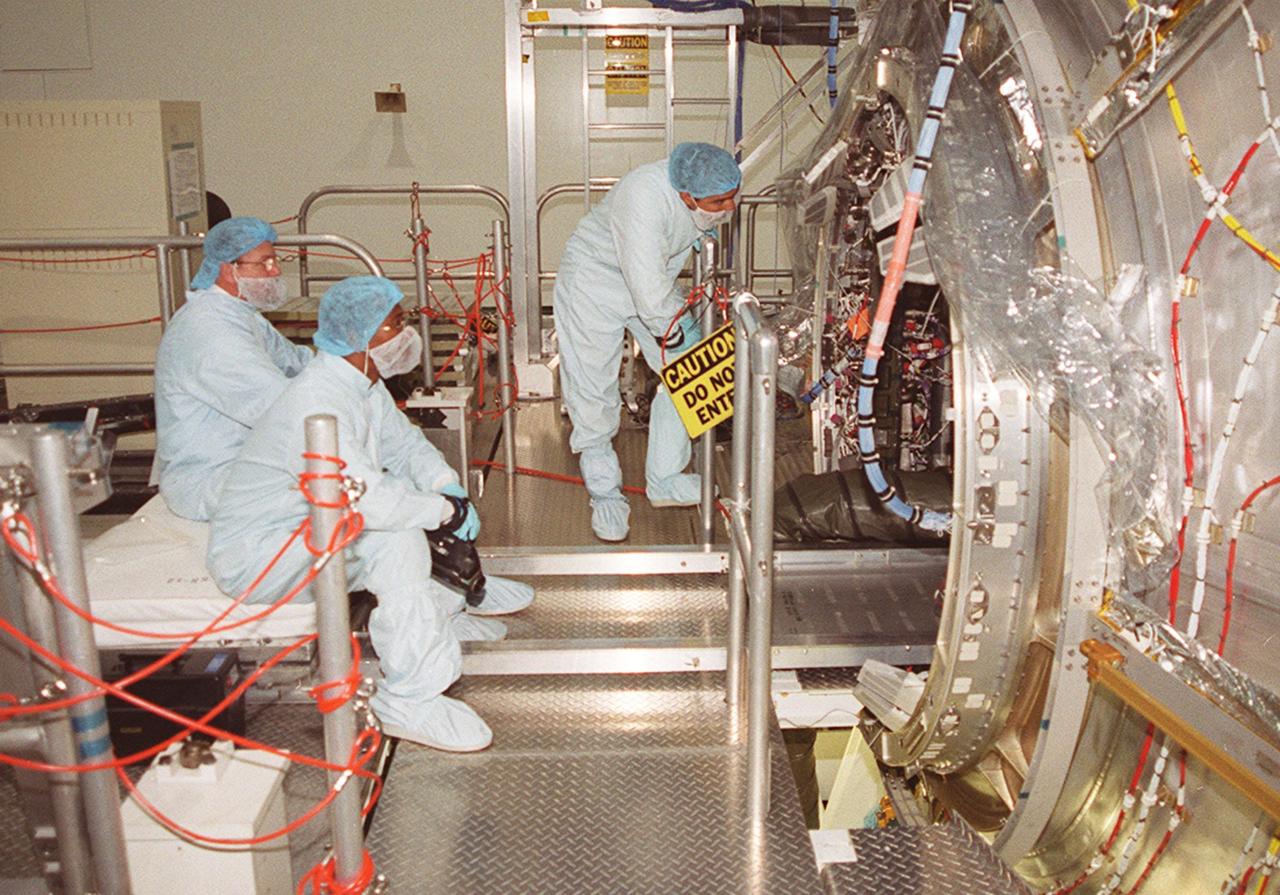
In the Space Station Processing Facility, workers at left watch while members of the STS-98 crew check out equipment inside the U.S. Lab, Destiny (at right). The crew comprises Commander Ken Cockrell, Pilot Mark Polansky and Mission Specialists Robert Curbeam, Thomas Jones and Marsha Ivins. They are taking part in Crew Equipment Interface Test activities, becoming familiar with equipment they will be handling during the mission. The mission will be transporting the Lab to the International Space Station with five system racks already installed inside of the module. With delivery of electronics in the lab, electrically powered attitude control for Control Moment Gyroscopes will be activated. The STS-98 launch is scheduled for Jan. 18, 2001
KSC-00pp1599
In the Space Station Processing Facility, workers in the foreground watch and wait while members of the STS-98 crew check out the U.S. Lab, Destiny in the background. The crew comprises Commander Ken Cockrell, Pilot Mark Polansky and Mission Specialists Robert Curbeam, Thomas Jones and Marsha Ivins. They are taking part in Crew Equipment Interface Test activities, becoming familiar with equipment they will be handling during the mission. The mission will be transporting the Lab to the International Space Station with five system racks already installed inside of the module. With delivery of electronics in the lab, electrically powered attitude control for Control Moment Gyroscopes will be activated. The STS-98 launch is scheduled for Jan. 18, 2001
KSC-00pp1600
In the Space Station Processing Facility, STS-98 Mission Specialist Thomas Jones works on a part of the U.S. Lab, Destiny. Watching at right is Pilot Mark Polansky. Jones and Polansky, along with other crew members, are taking part in Crew Equipment Interface Test activities to become familiar with equipment they will be handling during the mission. Others in the crew are Commander Ken Cockrell and Mission Specialists Robert Curbeam and Marsha Ivins. The mission will be transporting the Lab to the International Space Station with five system racks already installed inside of the module. With delivery of electronics in the lab, electrically powered attitude control for Control Moment Gyroscopes will be activated. The STS-98 launch is scheduled for Jan. 18, 2001
KSC-00pp1606
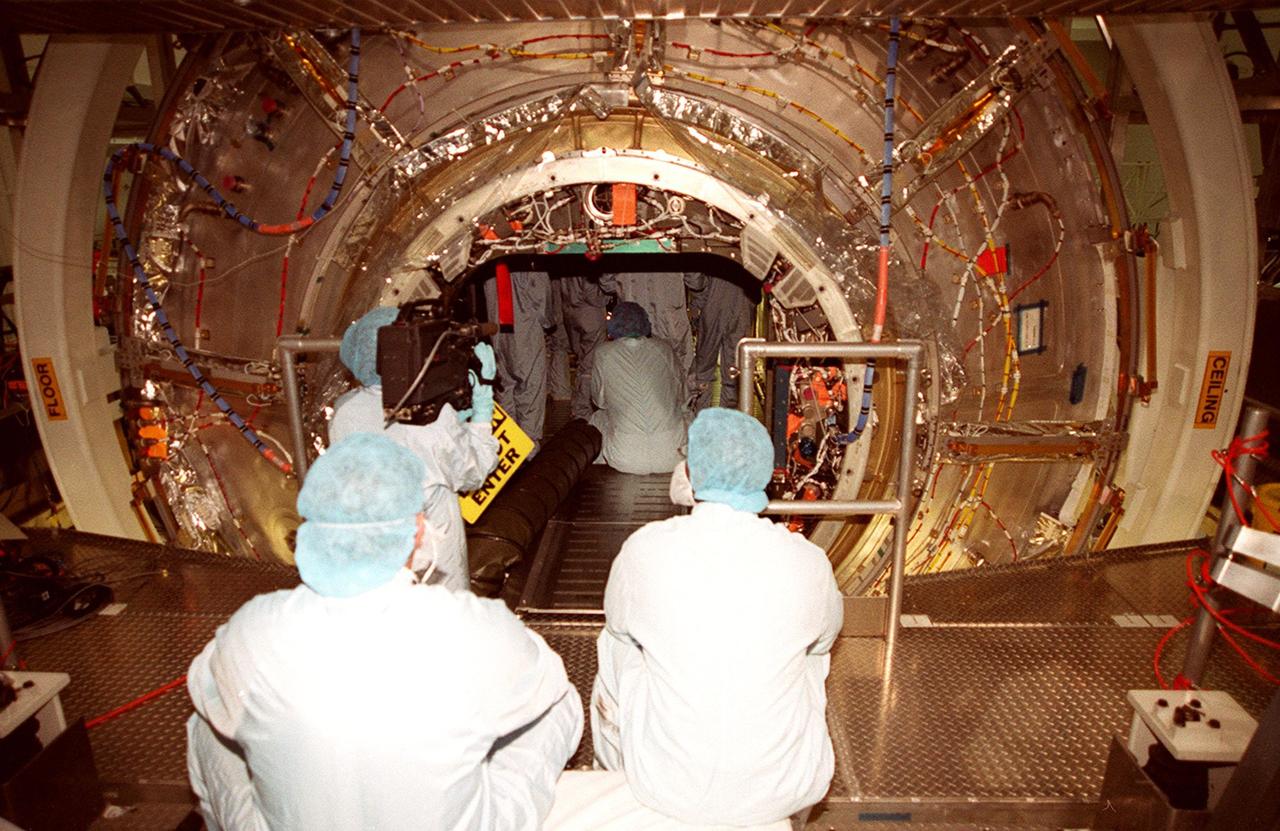
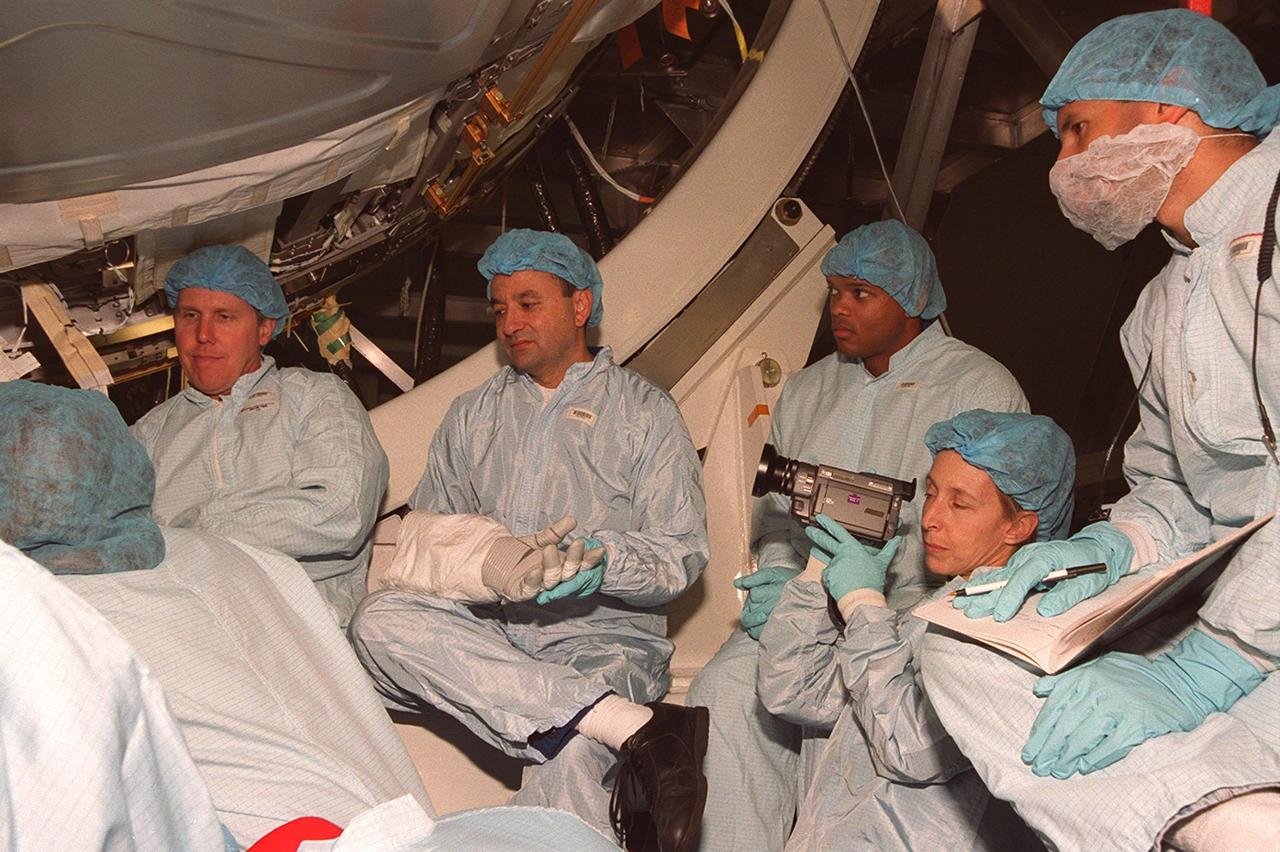
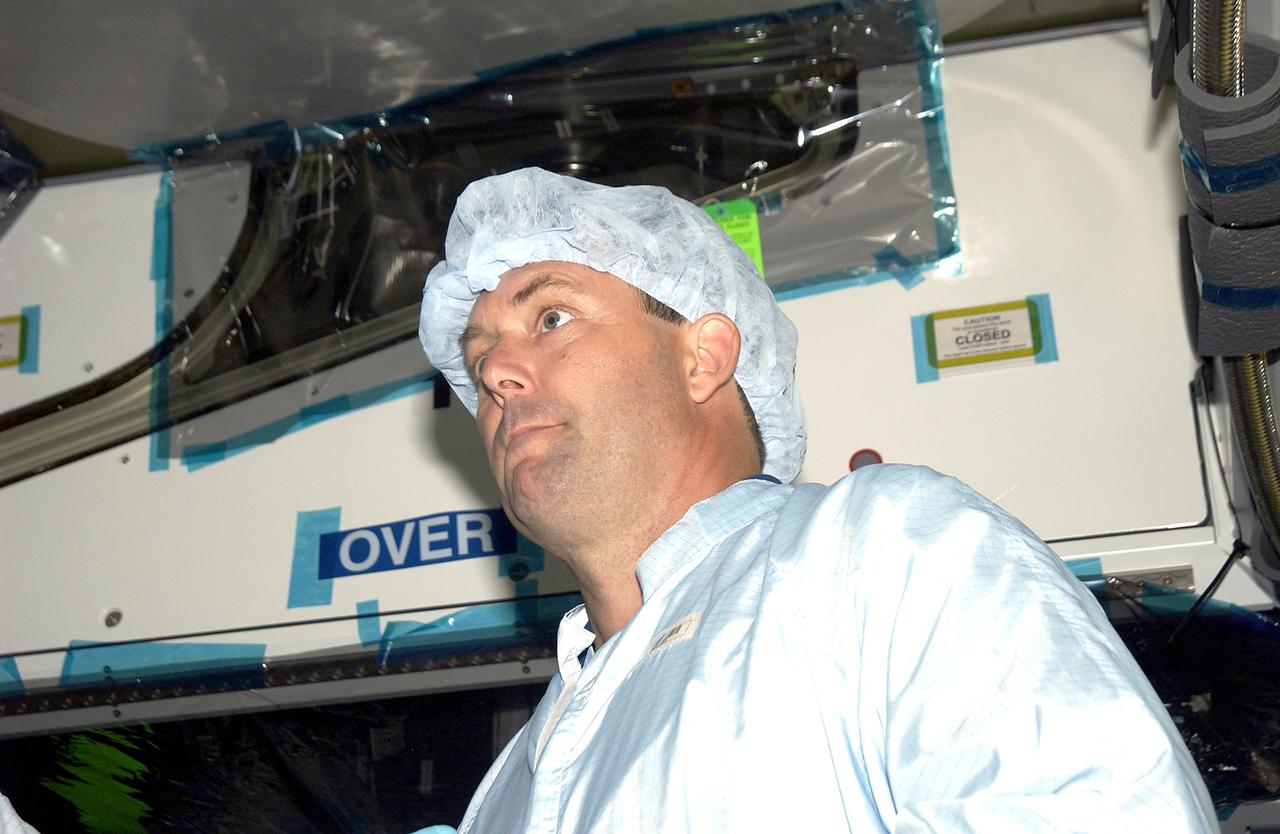
In the Space Station Processing Facility, members of the STS-98 crew, sitting in front of the U.S. Lab, Destiny, listen to a trainer during Crew Equipment Interface Test (CEIT) activities. Seen, left to right, are Mission Specialist Thomas Jones, Pilot Mark Polansky and Mission Specialists Robert Curbeam and Marsha Ivins (with camera). The CEIT allows a crew to become familiar with equipment they will be handling during the mission. With launch scheduled for Jan. 18, 2001, the STS-98 mission will be transporting the Lab to the International Space Station with five system racks already installed inside of the module. After delivery of electronics in the lab, electrically powered attitude control for Control Moment Gyroscopes will be activated
KSC-00pp1607
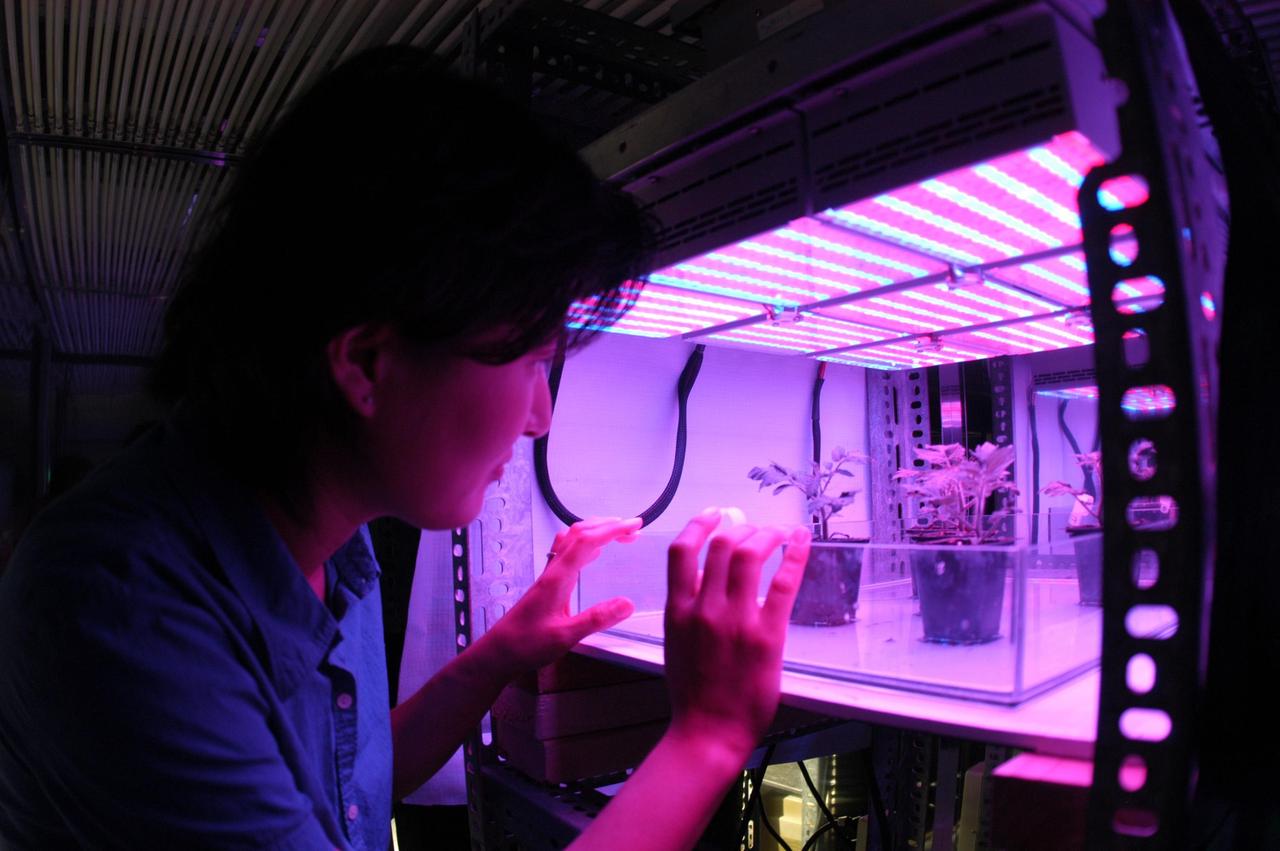
KENNEDY SPACE CENTER, FLA. -  Hyeon-Hye Kim, a plant physiologist with the National Research Council at the Space Life Sciences Lab, discusses the growing of plants utilizing light-emitting diodes (LEDs) during a tour of the Space Life Sciences Lab for members of the news media.  A major challenge to growing plants in space will be controlling and supplying sufficient quantity and quality of light.  LEDs represent an innovative artificial lighting source with several features specific for supporting plants, whether on space-based transit vehicles or planetary life support systems.
KSC-04pd-2551
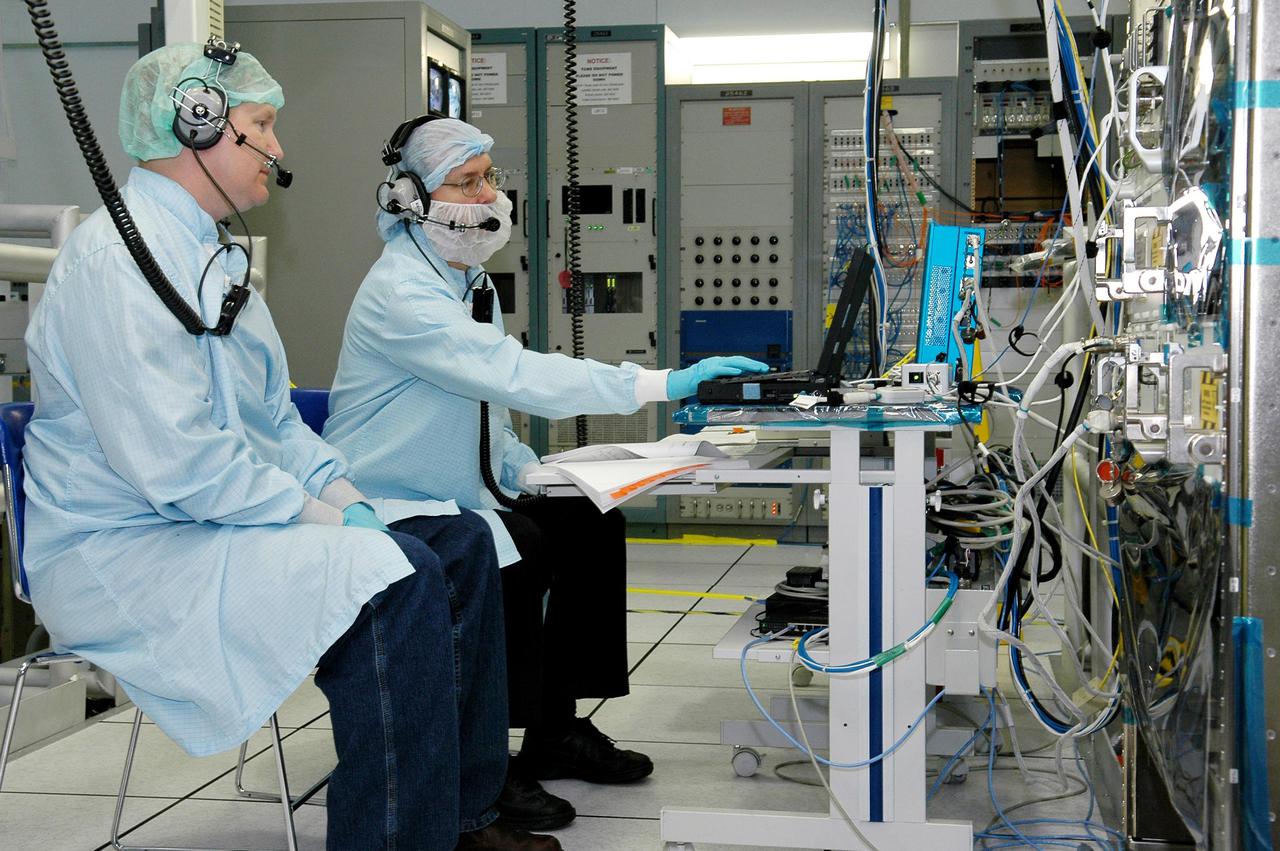
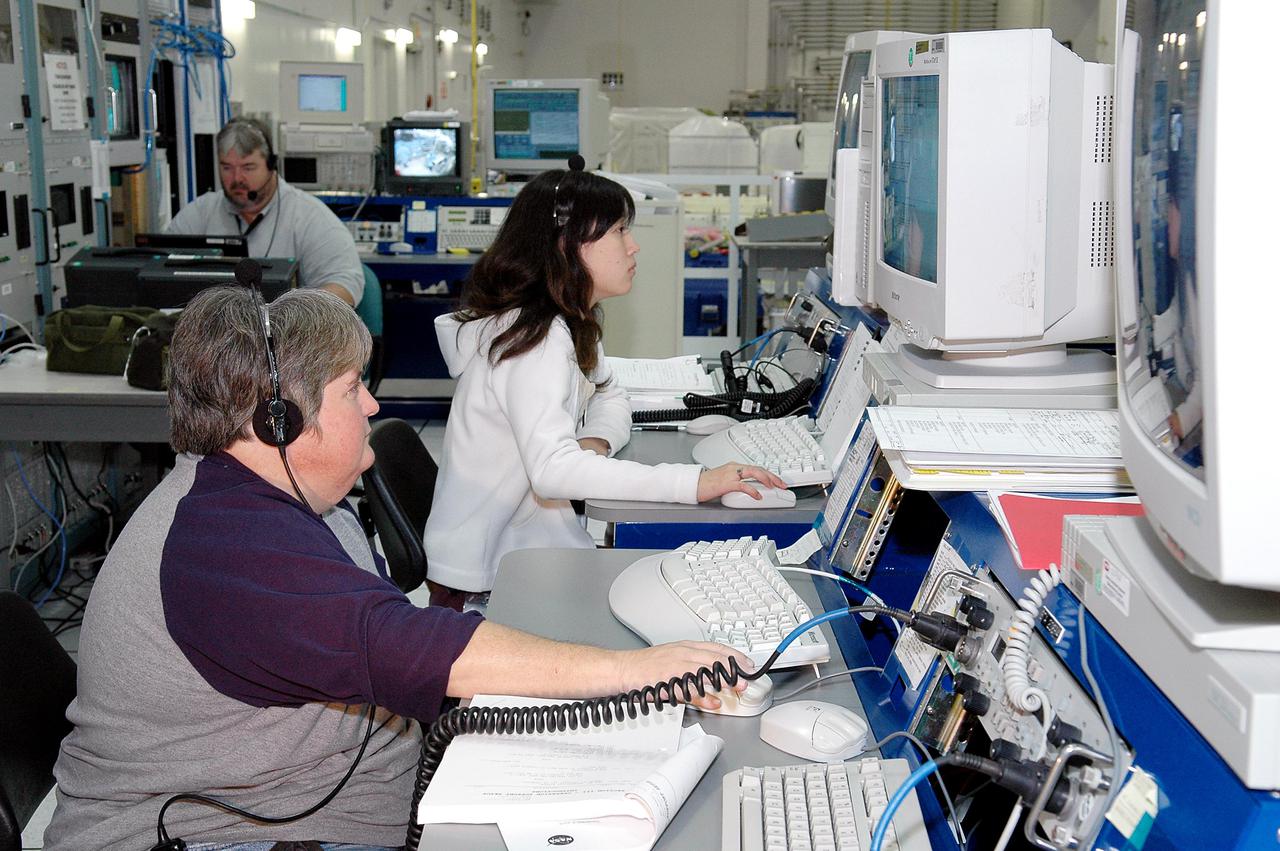
KENNEDY SPACE CENTER, FLA. -   -   In the Space Station Processing Facility, Gaschen Geissen and Elton Witt, with Lockheed Martin, monitor the Payload Test and Checkout System for the Human Research Facility (HRF) Rack -2 payload. The HRF-2 is scheduled to fly on Return to Flight Space Shuttle mission STS-114.  The HRF-2 will deliver additional biomedical instrumentation and research capability to the International Space Station.  HRF Rack 1 contains an ultrasound unit and gas analyzer system and has been operational in the U.S. Lab since May 2001.  HRF-2 will also be installed in the U. S. Lab and will provide structural, power, thermal, command and data handling, and communication and tracking interfaces between the HRF biomedical instrumentation and the U. S. Lab.
KSC-04pd-2492
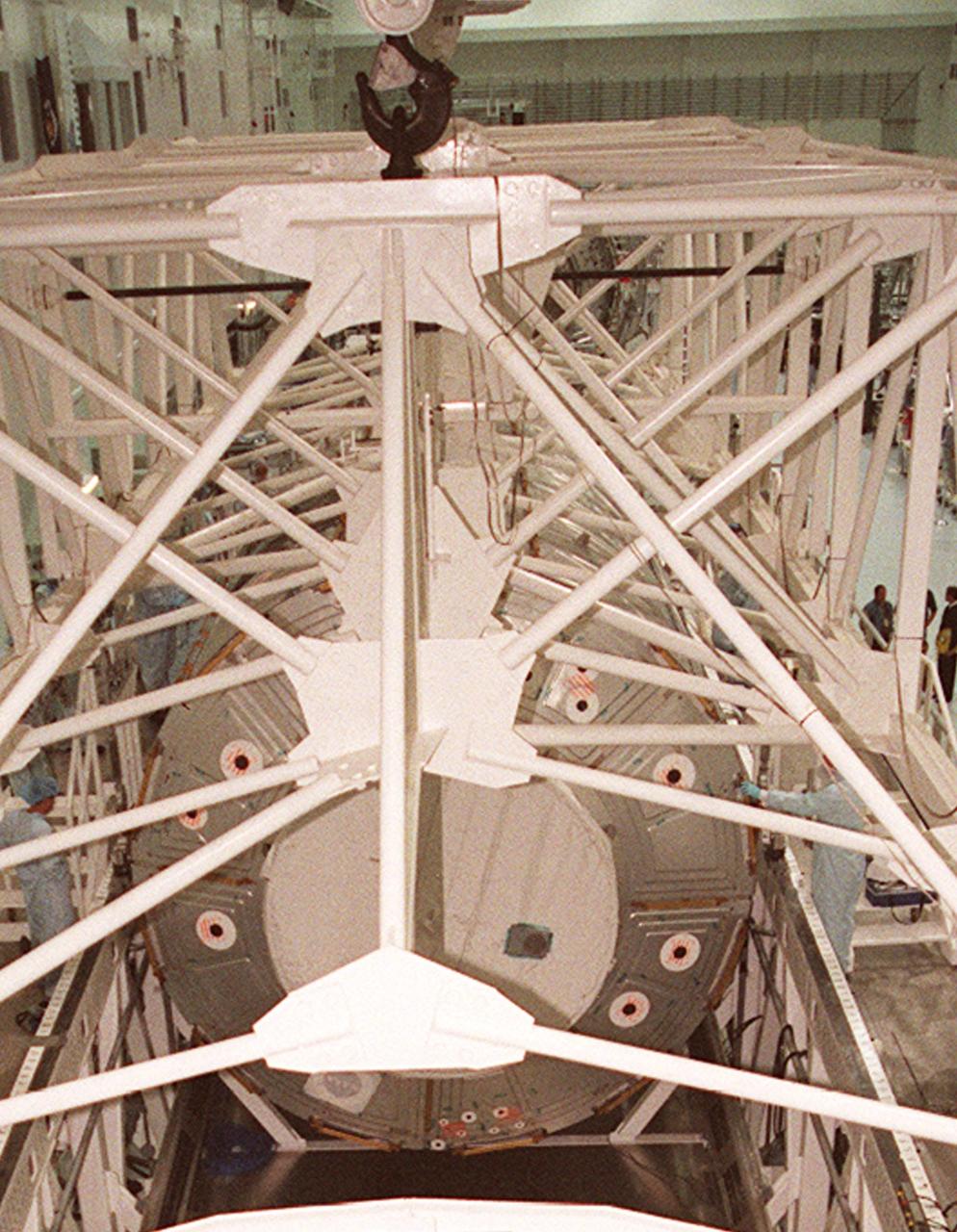
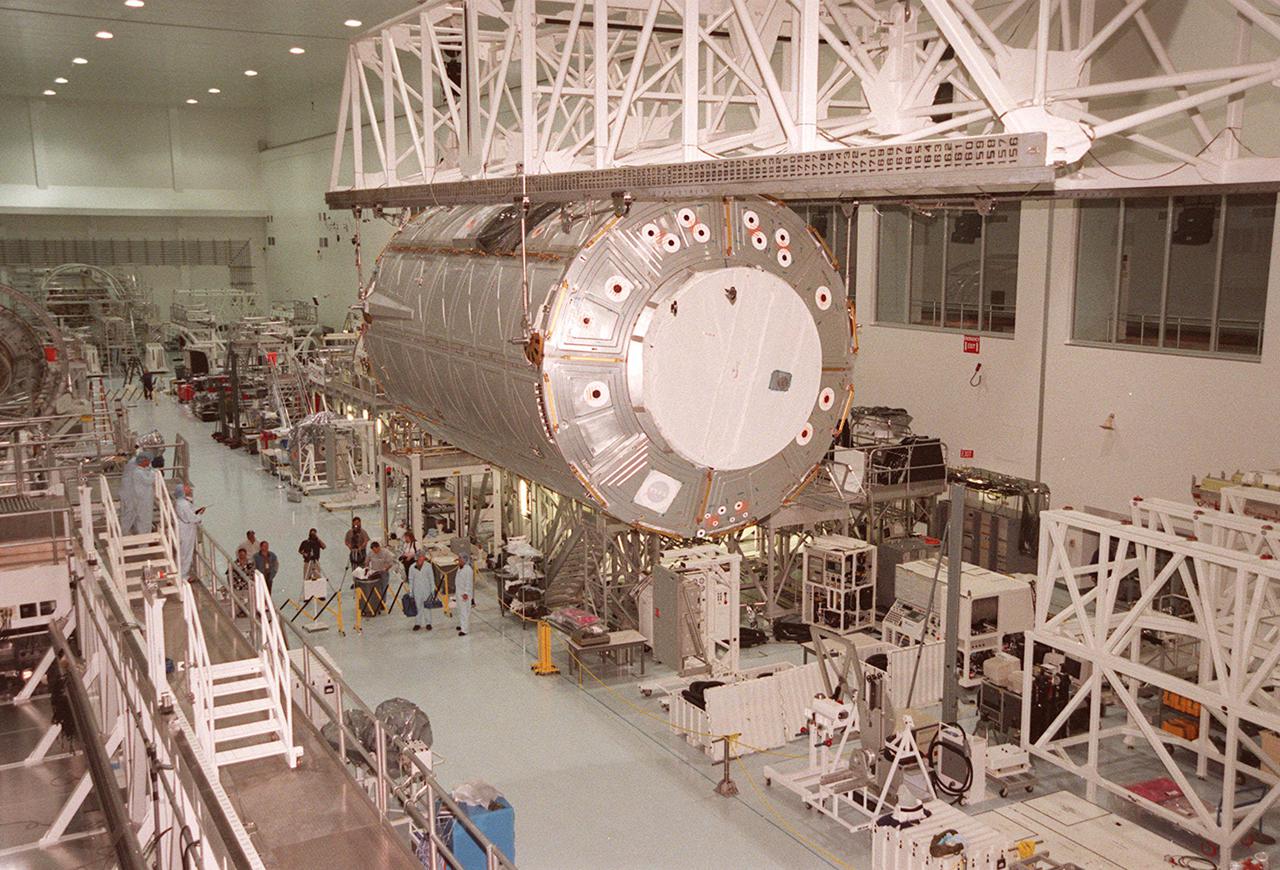
KENNEDY SPACE CENTER, FLA. --  In the Space Station Processing Facility, an overhead crane begins lifting the U.S. Lab Destiny from its test and integration stand. It will be carried to the Launch Package Integration Stand (LPIS) for a weight and center of gravity determination. Destiny is the payload aboard Space Shuttle Atlantis on mission STS-98 to the International Space Station. The lab is fitted with five system racks and will already have experiments installed inside for the flight. The launch is scheduled for January 2001
KSC-00pp1932
KENNEDY SPACE CENTER, FLA. --  In the Space Station Processing Facility, overhead cranes move the U.S. Lab Destiny from its test and integration stand to the Launch Package Integration Stand (LPIS) for a weight and center of gravity determination. Destiny is the payload aboard Space Shuttle Atlantis on mission STS-98 to the International Space Station. The lab is fitted with five system racks and will already have experiments installed inside for the flight. The launch is scheduled for January 2001
KSC00pp1933
KENNEDY SPACE CENTER, FLA. --  Workers in the Space Station Processing Facility watch closely while the U.S. Lab Destiny is lowered onto the Launch Package Integration Stand (LPIS) for a weight and center of gravity determination. Destiny is the payload aboard Space Shuttle Atlantis on mission STS-98 to the Space Station. The lab is fitted with five system racks and will already have experiments installed inside for the flight. The launch is scheduled for January 2001
KSC-00PP-1941
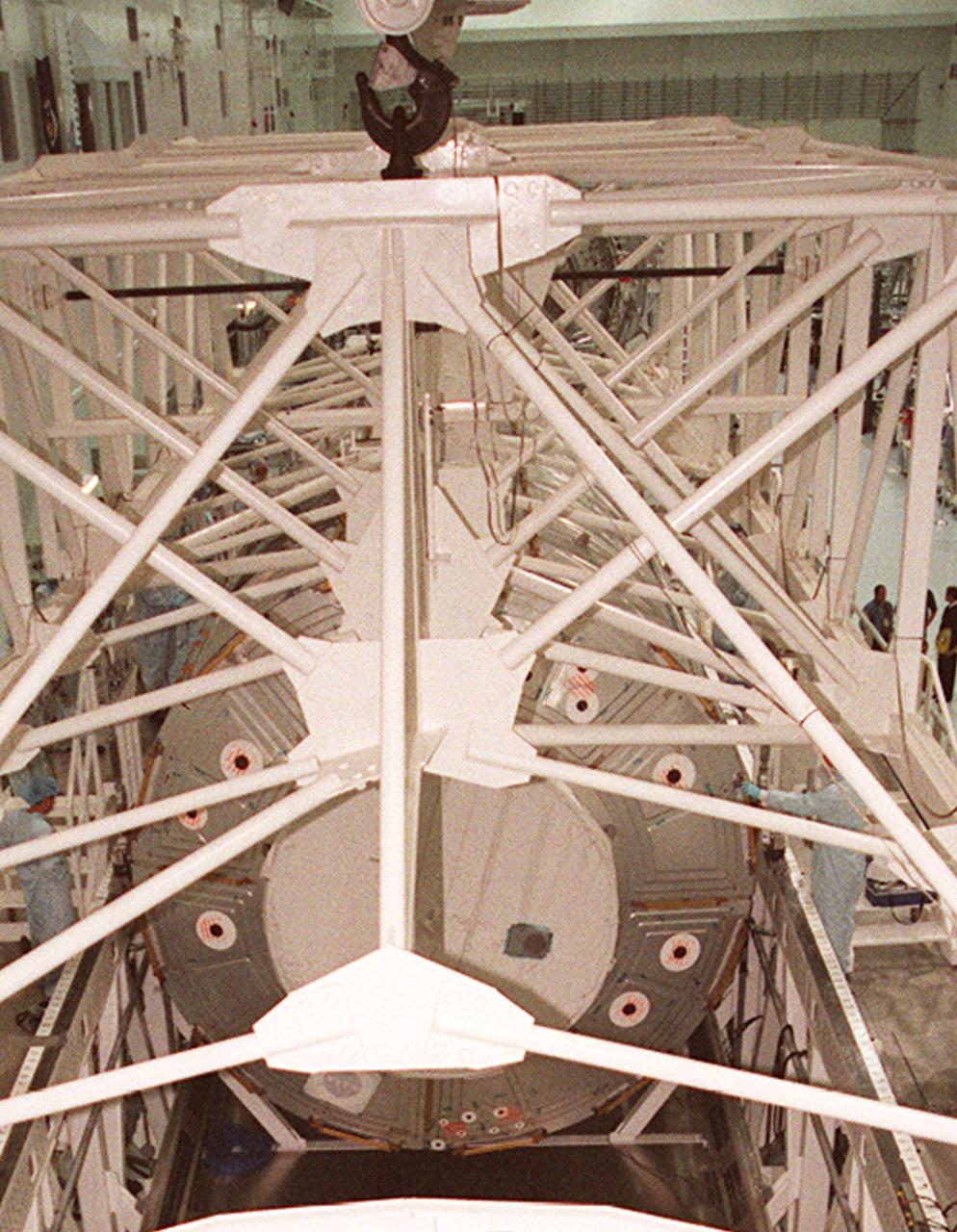
KENNEDY SPACE CENTER, FLA. --  In the Space Station Processing Facility, the overhead crane above the U.S. Lab Destiny is ready to be removed. Destiny rests in the Launch Package Integration Stand (LPIS) for a weight and center of gravity determination. In the foreground is the scale. Destiny is the payload aboard Space Shuttle Atlantis on mission STS-98 to the Space Station. The lab is fitted with five system racks and will already have experiments installed inside for the flight. The launch is scheduled for January 2001
KSC00pp1942
KENNEDY SPACE CENTER, FLA. --  In the Space Station Processing Facility, workers watch while the U.S. Lab Destiny is lowered onto the Launch Package Integration Stand (LPIS) for a weight and center of gravity determination. Destiny is the payload aboard Space Shuttle Atlantis on mission STS-98 to the Space Station. The lab is fitted with five system racks and will already have experiments installed inside for the flight. The launch is scheduled for January 2001
KSC00pp1940
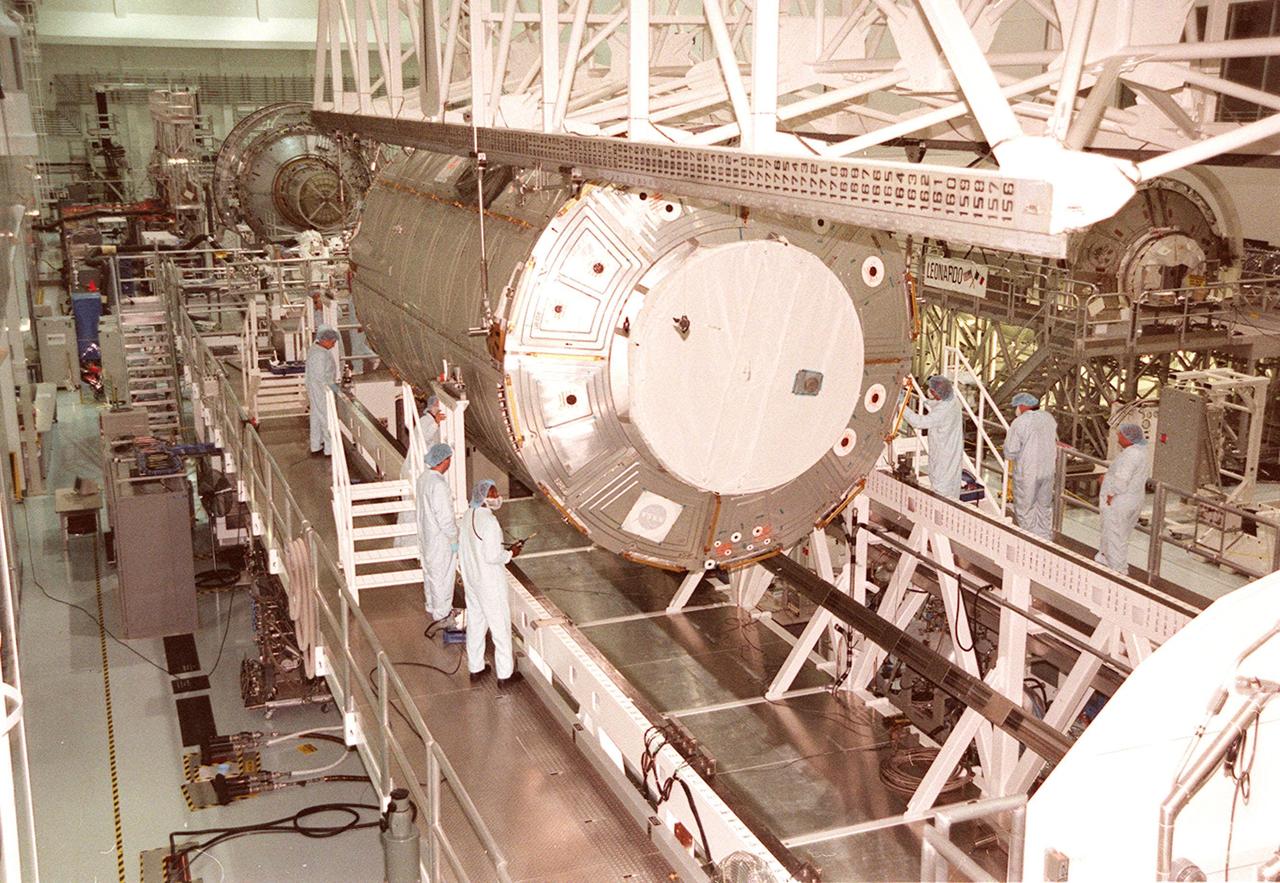
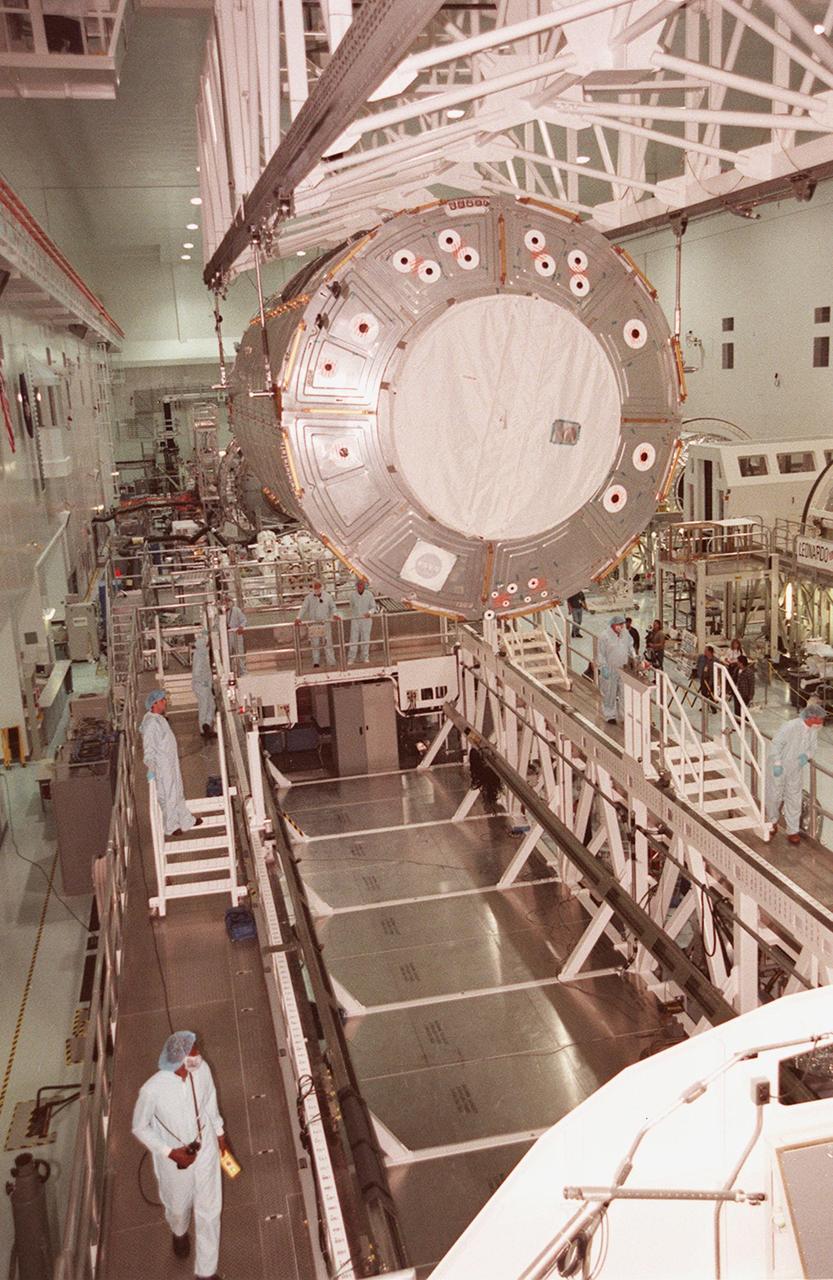
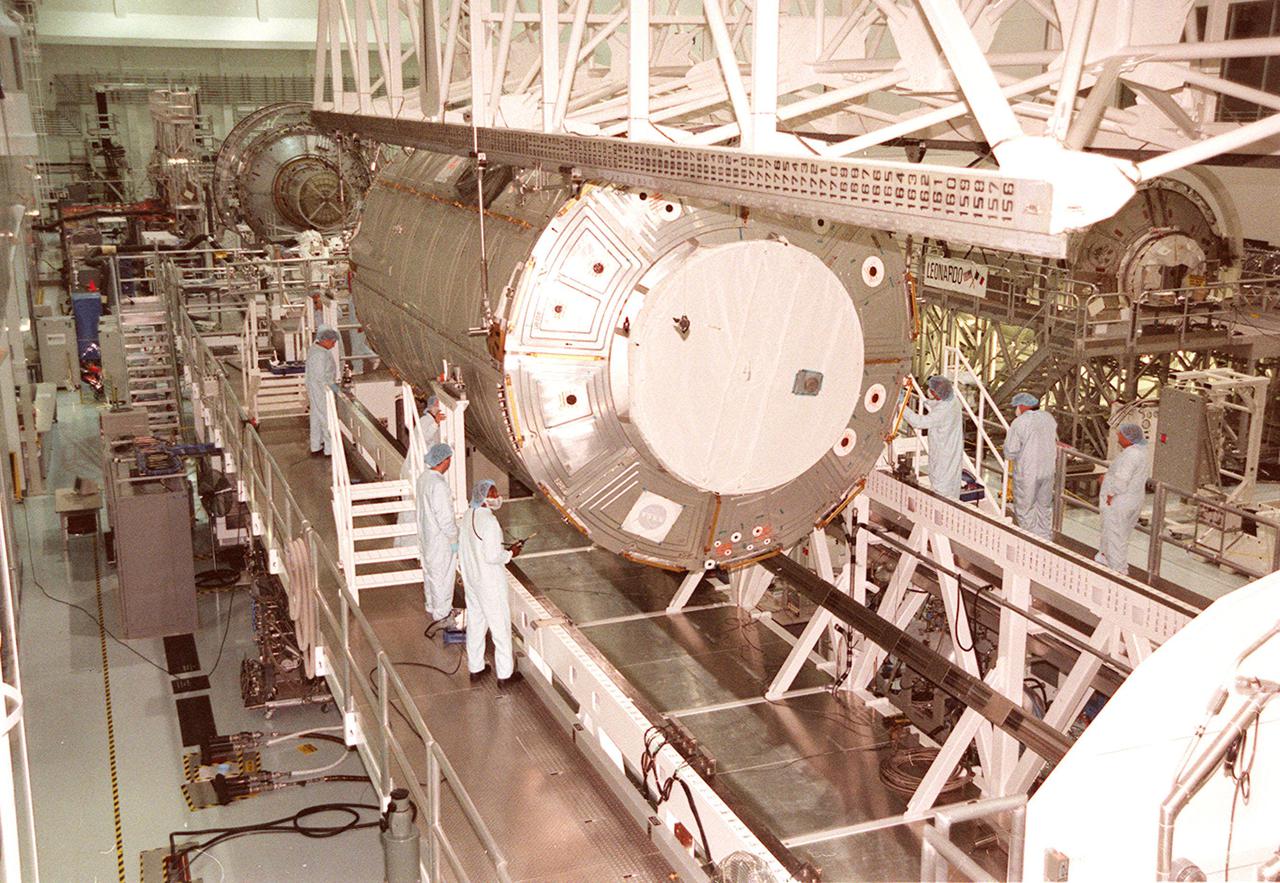
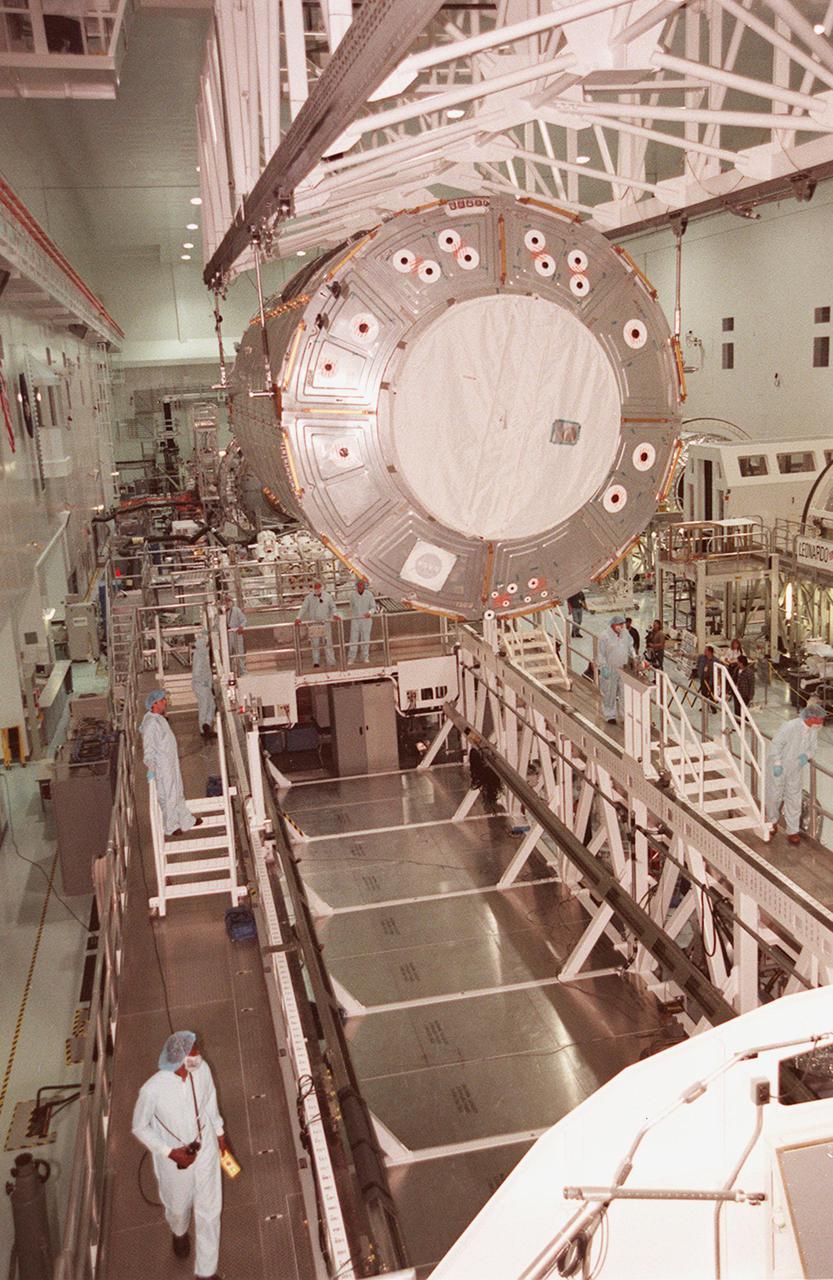
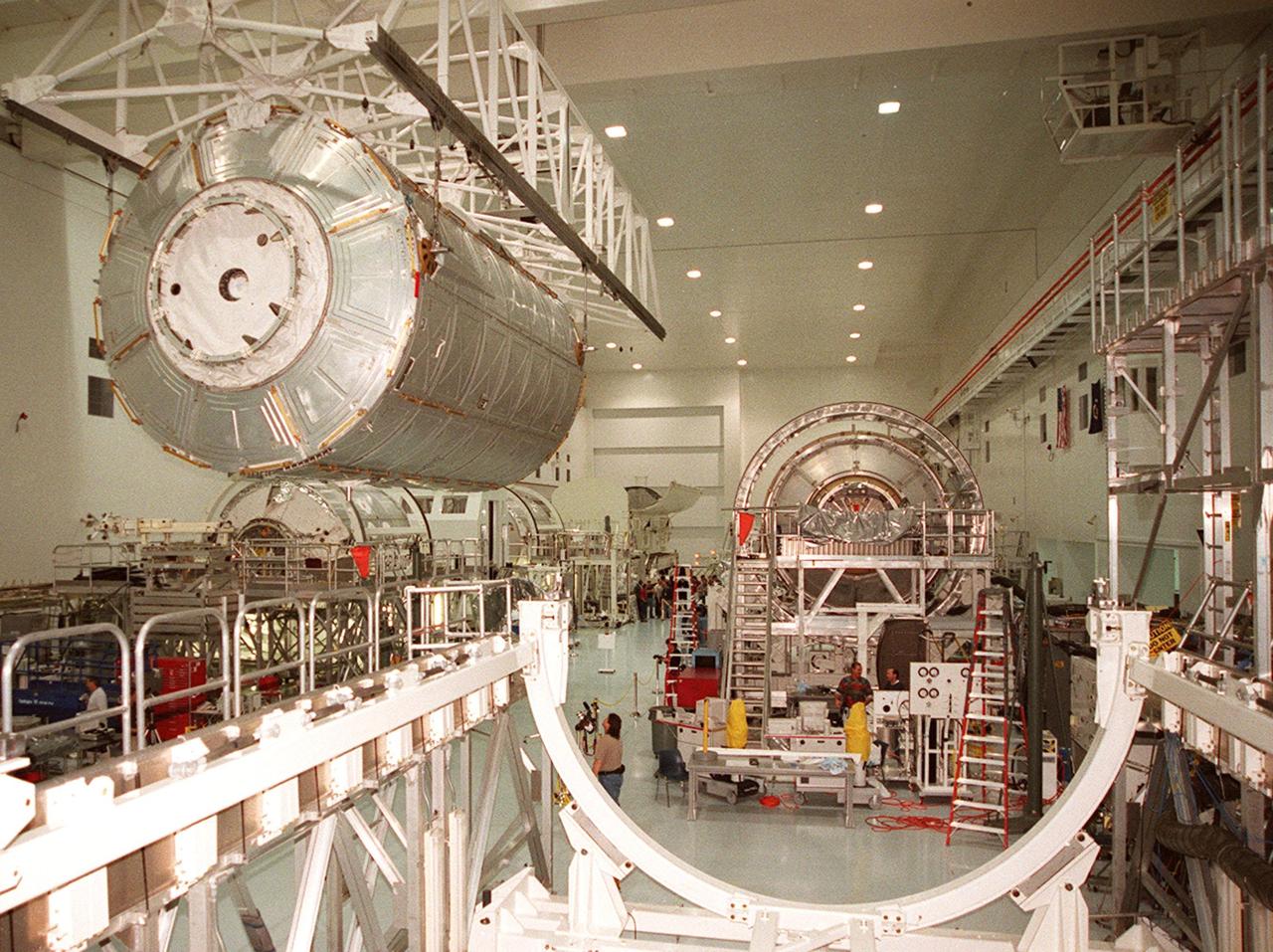
KENNEDY SPACE CENTER, FLA. --  The U.S. Laboratory Destiny travels past the Multi-Purpose Logistics Module Leonardo in its overhead passage down the Space Station Processing Facility. The lab is being moved to the Launch Package Integration Stand (LPIS) for a weight and center of gravity determination. Destiny is the payload aboard Space Shuttle Atlantis on mission STS-98 to the Space Station. The lab is fitted with five system racks and will already have experiments installed inside for the flight. The launch is scheduled for January 2001
KSC-00PP-1938
KENNEDY SPACE CENTER, FLA. --  In the Space Station Processing Facility, the U.S. Lab Destiny is moved from its test and integration stand to go into the Launch Package Integration Stand (LPIS) for a weight and center of gravity determination. Destiny is the payload aboard Space Shuttle Atlantis on mission STS-98 to the International Space Station. The lab is fitted with five system racks and will already have experiments installed inside for the flight. The launch is scheduled for January 2001
KSC-00PP-1934
KENNEDY SPACE CENTER, FLA. --  In the Space Station Processing Facility, the U.S. Lab Destiny is lowered toward the Launch Package Integration Stand (LPIS) for a weight and center of gravity determination. Destiny is the payload aboard Space Shuttle Atlantis on mission STS-98 to the Space Station. The lab is fitted with five system racks and will already have experiments installed inside for the flight. The launch is scheduled for January 2001
KSC00pp1939
KENNEDY SPACE CENTER, FLA. --  In the Space Station Processing Facility, the U.S. Lab Destiny is moved from its test and integration stand to go into the Launch Package Integration Stand (LPIS) for a weight and center of gravity determination. Destiny is the payload aboard Space Shuttle Atlantis on mission STS-98 to the International Space Station. The lab is fitted with five system racks and will already have experiments installed inside for the flight. The launch is scheduled for January 2001
KSC00pp1934
KENNEDY SPACE CENTER, FLA. --  In the Space Station Processing Facility, an overhead crane begins lifting the U.S. Lab Destiny from its test and integration stand. It will be carried to the Launch Package Integration Stand (LPIS) for a weight and center of gravity determination. Destiny is the payload aboard Space Shuttle Atlantis on mission STS-98 to the International Space Station. The lab is fitted with five system racks and will already have experiments installed inside for the flight. The launch is scheduled for January 2001
KSC00pp1932
KENNEDY SPACE CENTER, FLA. --  Workers in the Space Station Processing Facility watch closely while the U.S. Lab Destiny is lowered onto the Launch Package Integration Stand (LPIS) for a weight and center of gravity determination. Destiny is the payload aboard Space Shuttle Atlantis on mission STS-98 to the Space Station. The lab is fitted with five system racks and will already have experiments installed inside for the flight. The launch is scheduled for January 2001
KSC00pp1941
KENNEDY SPACE CENTER, FLA. --  The U.S. Laboratory Destiny travels past the Multi-Purpose Logistics Module Leonardo in its overhead passage down the Space Station Processing Facility. The lab is being moved to the Launch Package Integration Stand (LPIS) for a weight and center of gravity determination. Destiny is the payload aboard Space Shuttle Atlantis on mission STS-98 to the Space Station. The lab is fitted with five system racks and will already have experiments installed inside for the flight. The launch is scheduled for January 2001
KSC00pp1938
KENNEDY SPACE CENTER, FLA. --  In the Space Station Processing Facility, overhead cranes move the U.S. Lab Destiny from its test and integration stand to the Launch Package Integration Stand (LPIS) for a weight and center of gravity determination. Destiny is the payload aboard Space Shuttle Atlantis on mission STS-98 to the International Space Station. The lab is fitted with five system racks and will already have experiments installed inside for the flight. The launch is scheduled for January 2001
KSC-00PP-1933
KENNEDY SPACE CENTER, FLA. --  In the Space Station Processing Facility, workers watch while the U.S. Lab Destiny is lowered onto the Launch Package Integration Stand (LPIS) for a weight and center of gravity determination. Destiny is the payload aboard Space Shuttle Atlantis on mission STS-98 to the Space Station. The lab is fitted with five system racks and will already have experiments installed inside for the flight. The launch is scheduled for January 2001
KSC-00PP-1940
KENNEDY SPACE CENTER, FLA. --  In the Space Station Processing Facility, the U.S. Lab Destiny is lowered toward the Launch Package Integration Stand (LPIS) for a weight and center of gravity determination. Destiny is the payload aboard Space Shuttle Atlantis on mission STS-98 to the Space Station. The lab is fitted with five system racks and will already have experiments installed inside for the flight. The launch is scheduled for January 2001
KSC-00PP-1939
KENNEDY SPACE CENTER, FLA. --  In the Space Station Processing Facility, the overhead crane above the U.S. Lab Destiny is ready to be removed. Destiny rests in the Launch Package Integration Stand (LPIS) for a weight and center of gravity determination. In the foreground is the scale. Destiny is the payload aboard Space Shuttle Atlantis on mission STS-98 to the Space Station. The lab is fitted with five system racks and will already have experiments installed inside for the flight. The launch is scheduled for January 2001
KSC-00PP-1942
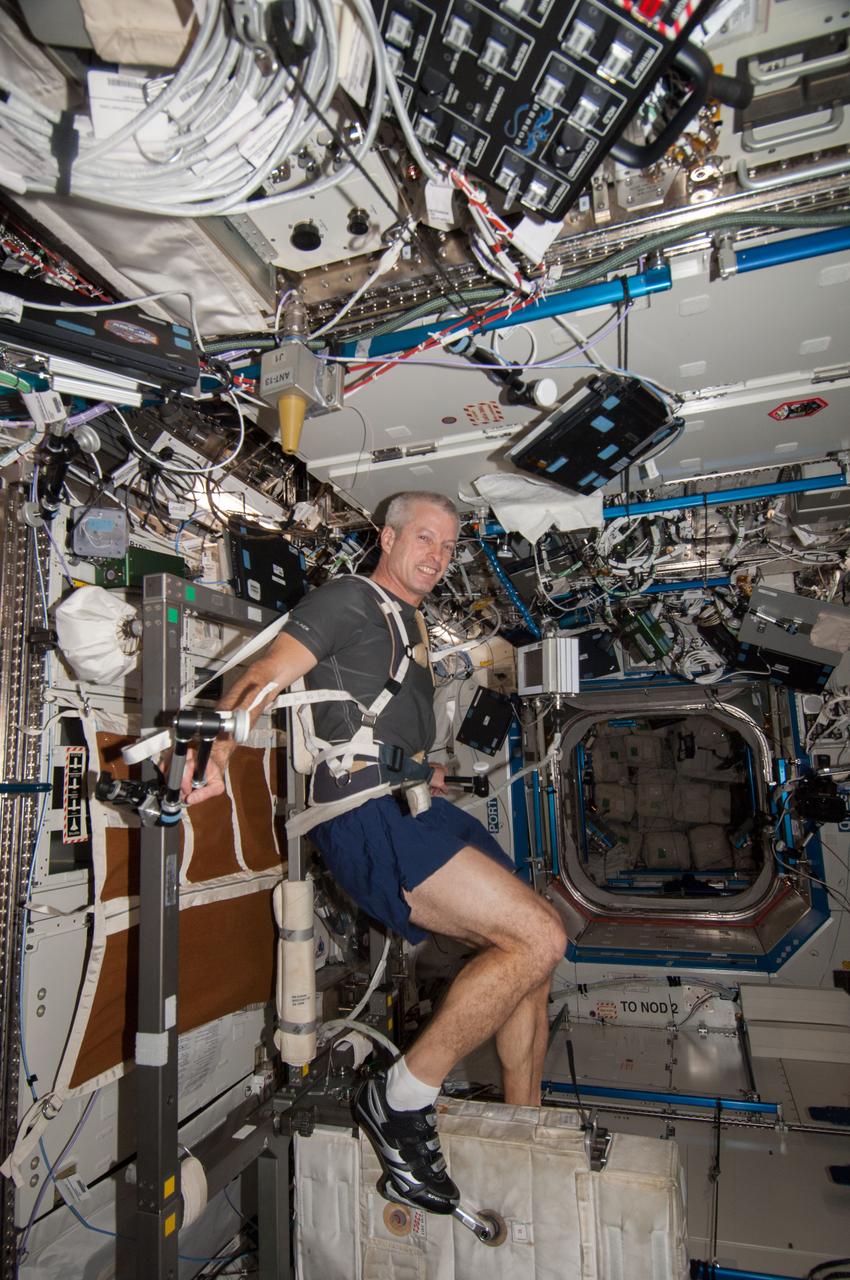
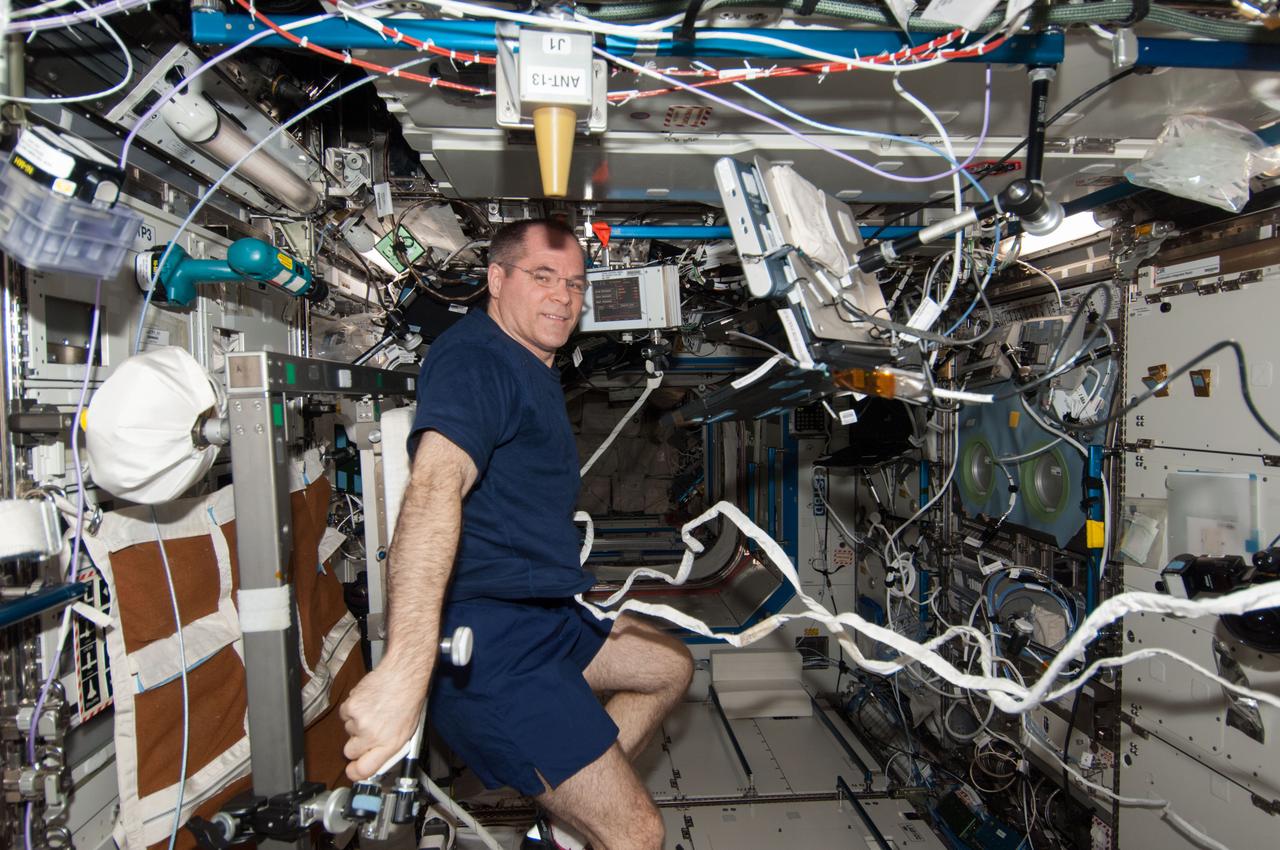
ISS039-E-014696 (22 April 2014) --- Expedition 39 Flight Engineer Steve Swanson of NASA, works out on the Cycle Ergometer with Vibration Isolation System (CEVIS) in the U.S. lab Destiny  of the International Space Station.
Swanson exercises on the CEVIS in the US Lab
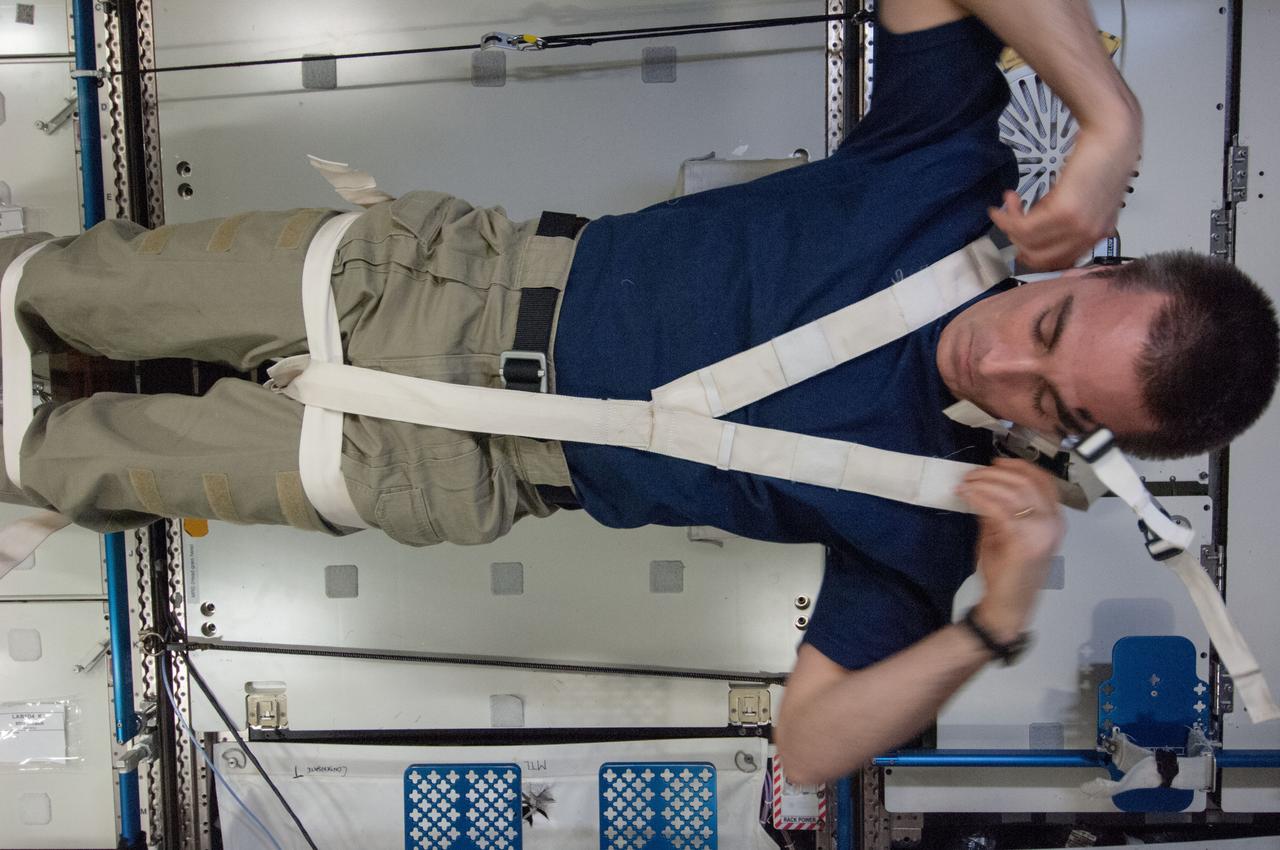
ISS036-E-003301 (22 May 2013) --- In the Destiny lab aboard the International Space Station, NASA astronaut Chris Cassidy, Expedition 36 flight engineer, participates in a Crew Medical Restraint System (CMRS) checkout.
Crew Medical Restraint System Inspection
iss063e030841 (June 21, 2020) --- A U.S. spacesuit is pictured in the Quest airlock of the International Space Station ahead of spacewalks that astronauts Chris Cassidy and Behnken will conduct to upgrade orbital lab power systems.
iss063e030841
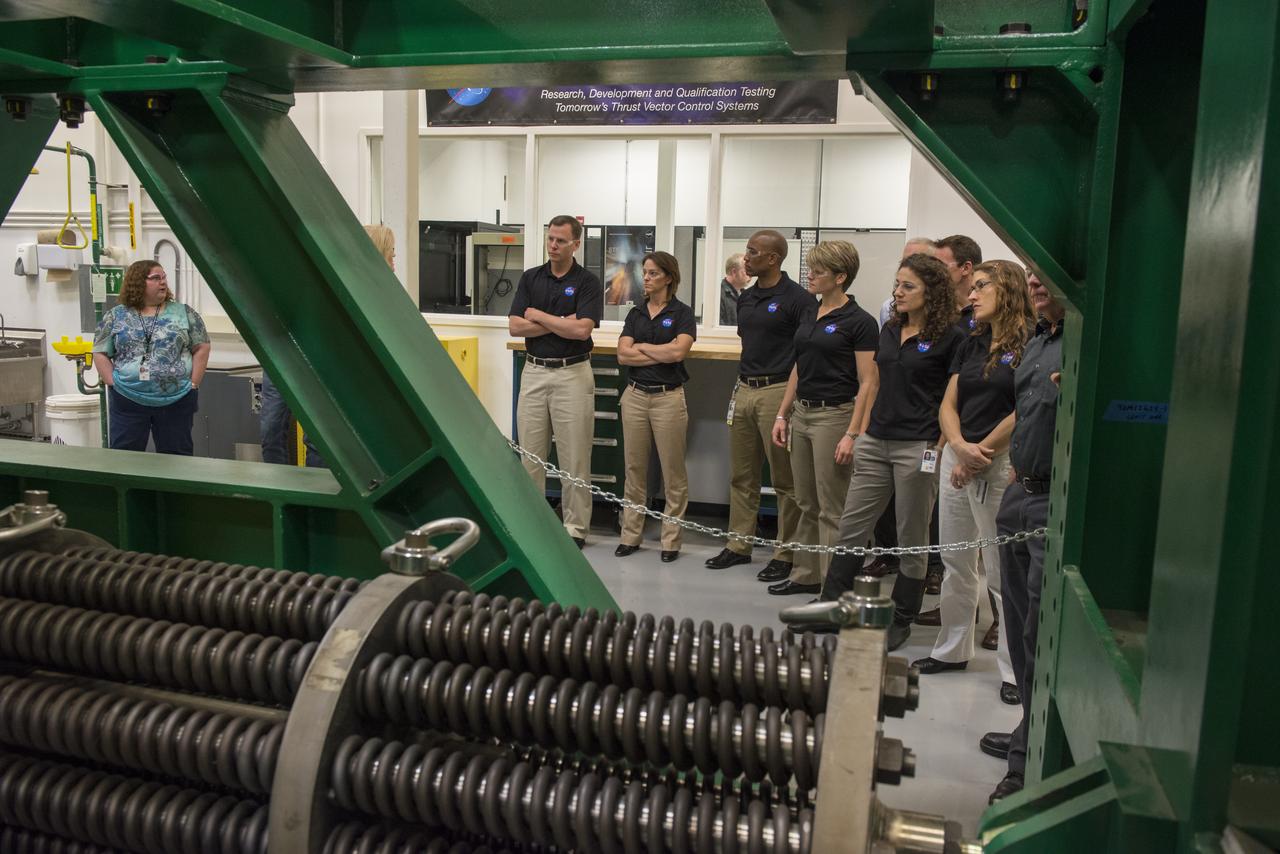
THE 2013 ASTRONAUT CANDIDATE CLASS VISITED THE THRUST VECTOR CONTROL TEST LAB AT MARSHALL'S PROPULSION RESEARCH DEVELOPMENT LABORATORY WHERE ENGINEERS ARE DEVELOPING AND TESTING THE SPACE LAUNCH SYSTEM'S GUIDANCE, NAVIGATION AND CONTROL SOFTWARE AND AVIONICS HARDWARE.
1400144
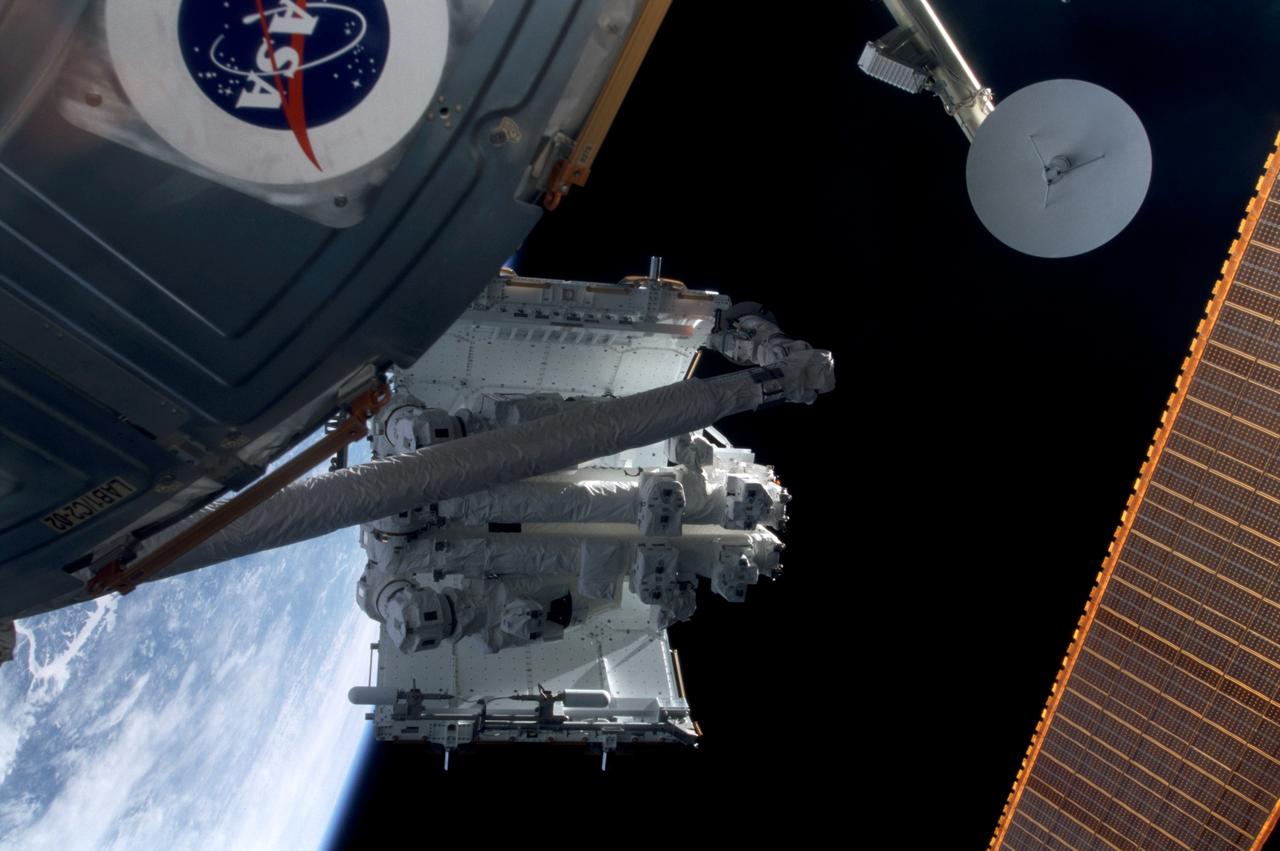
STS100-388-010 (19 April-1 May 2001) --- In the grasp of the shuttle's remote manipulator system (RMS) robot arm, the Spacelab pallet is installed on the Lab Cradle Assembly (LCA) on the International Space Station (ISS).
Installation of Spacelab pallent
ISS034-E-061648 (4 March 2013) --- Inside the U.S. lab Destiny on the Earth-orbiting International Space Station, Expedition 34 Commander Kevin Ford exercises on the Cycle Ergometer with Vibration Isolation System (CEVIS).
Ford exercises on the CEVIS in the U.S. Laboratory
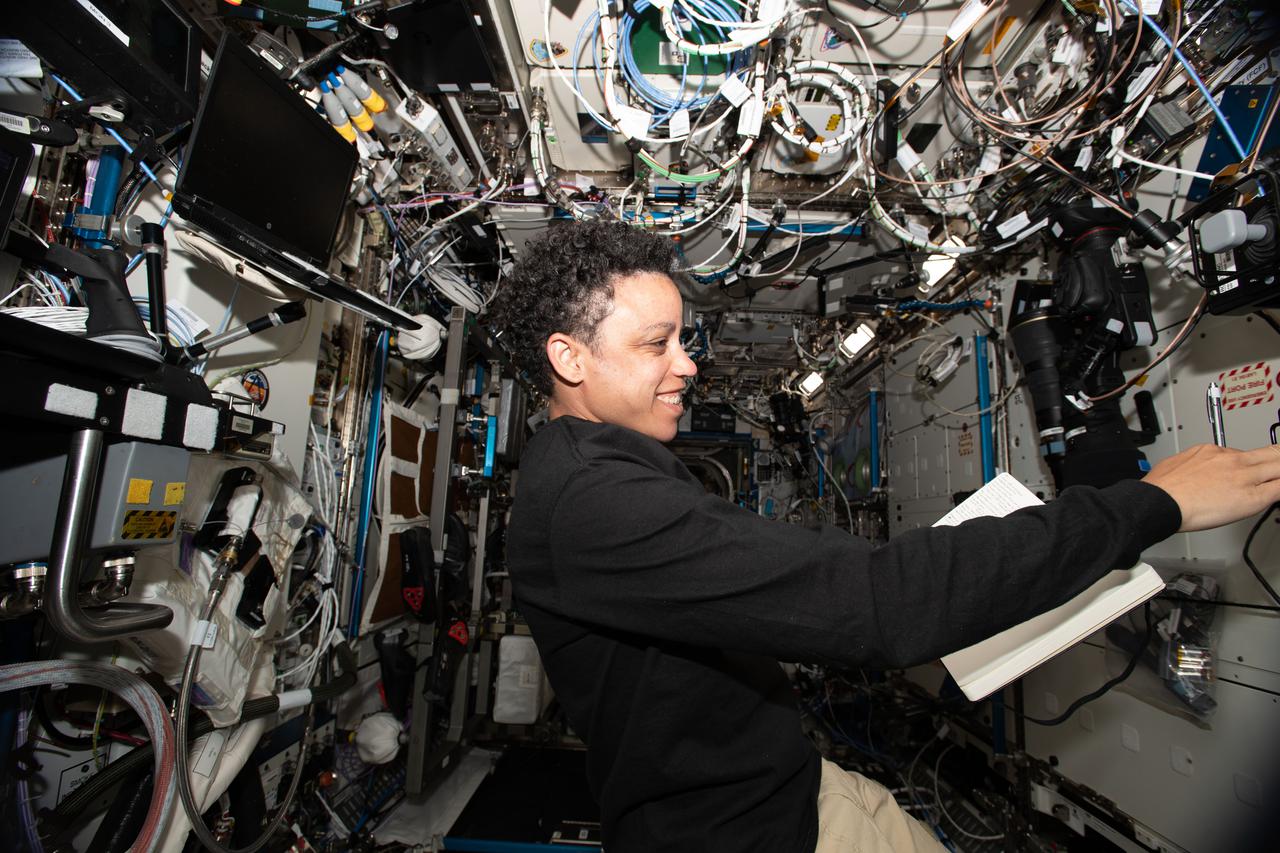
iss067e033341 (May 1, 2022) --- NASA astronaut and Expedition 67 Flight Engineer Jessica Watkins familiarizes herself with systems and procedures aboard the International Space Station having been aboard the orbiting lab for just a few days.
iss067e033341
iss067e033349 (May 1, 2022) --- NASA astronaut and Expedition 67 Flight Engineer Robert Hines familiarizes himself with systems and procedures aboard the International Space Station having been aboard the orbiting lab for just a few days.
iss067e033349
KENNEDY SPACE CENTER, FLA. -    Nancy Lowry (left) and Mikiko Ujihara, with Boeing, monitor the Payload Test and Checkout System for the Human Research Facility (HRF) Rack -2 payload. The HRF-2 is scheduled to fly on Return to Flight Space Shuttle mission STS-114.  The HRF-2 will deliver additional biomedical instrumentation and research capability to the International Space Station.  HRF Rack 1 contains an ultrasound unit and gas analyzer system and has been operational in the U.S. Lab since May 2001.  HRF-2 will also be installed in the U. S. Lab and will provide structural, power, thermal, command and data handling, and communication and tracking interfaces between the HRF biomedical instrumentation and the U. S. Lab.
KSC-04pd-2495
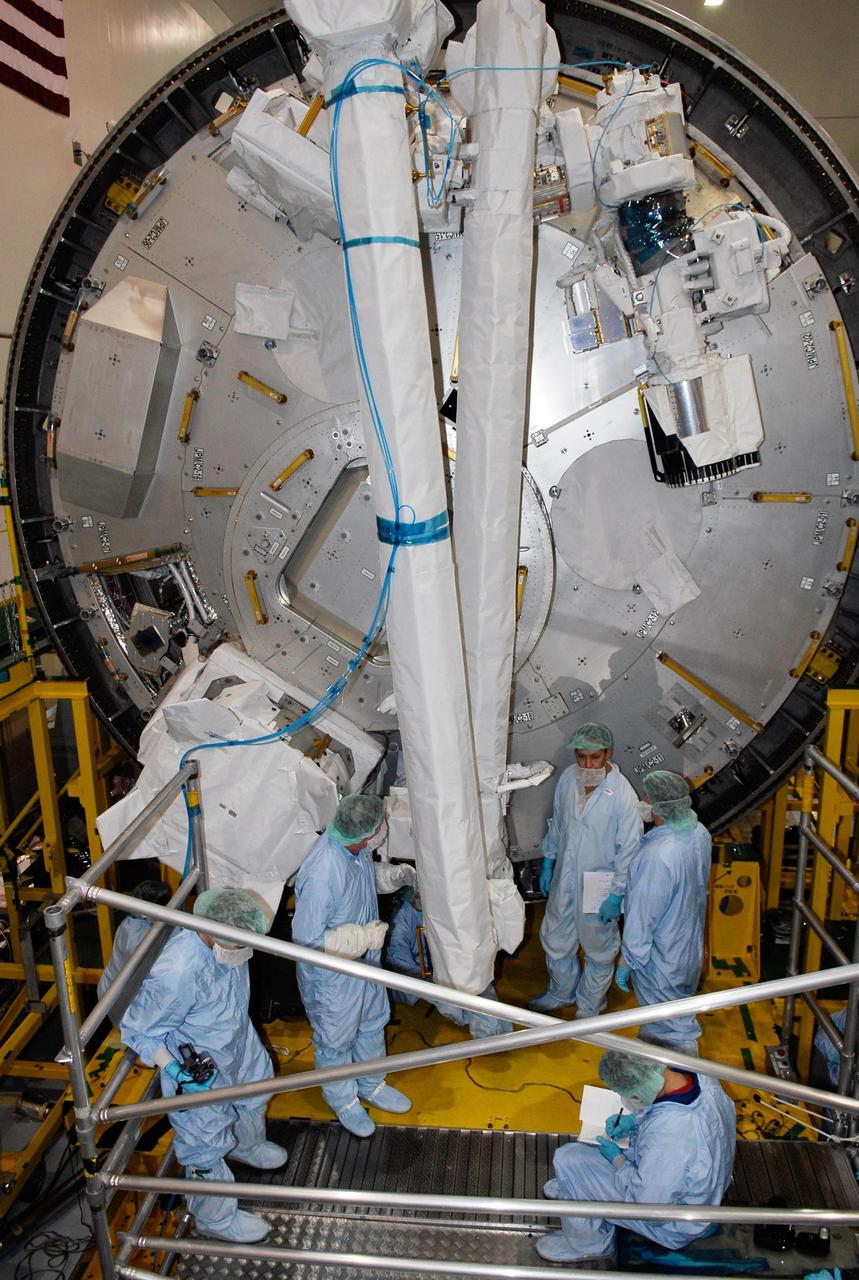
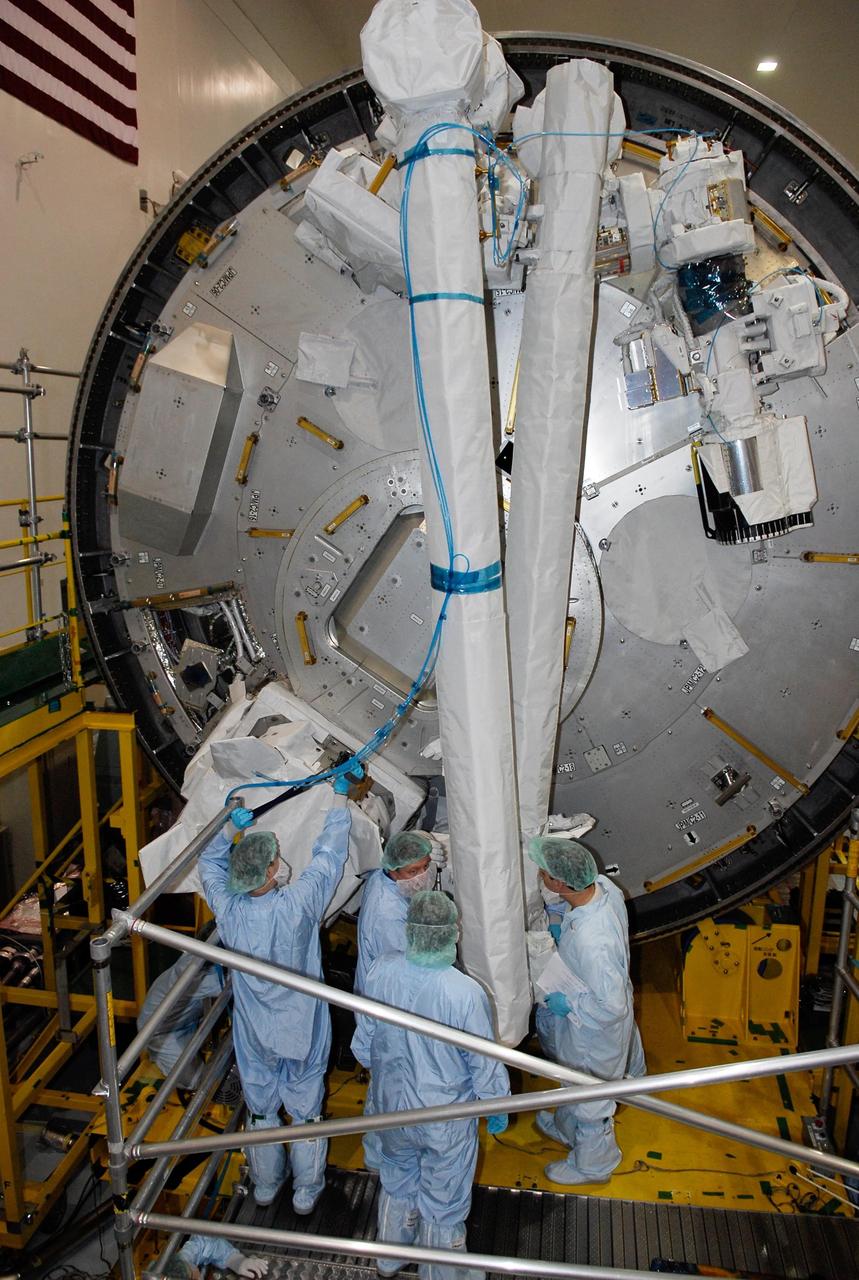
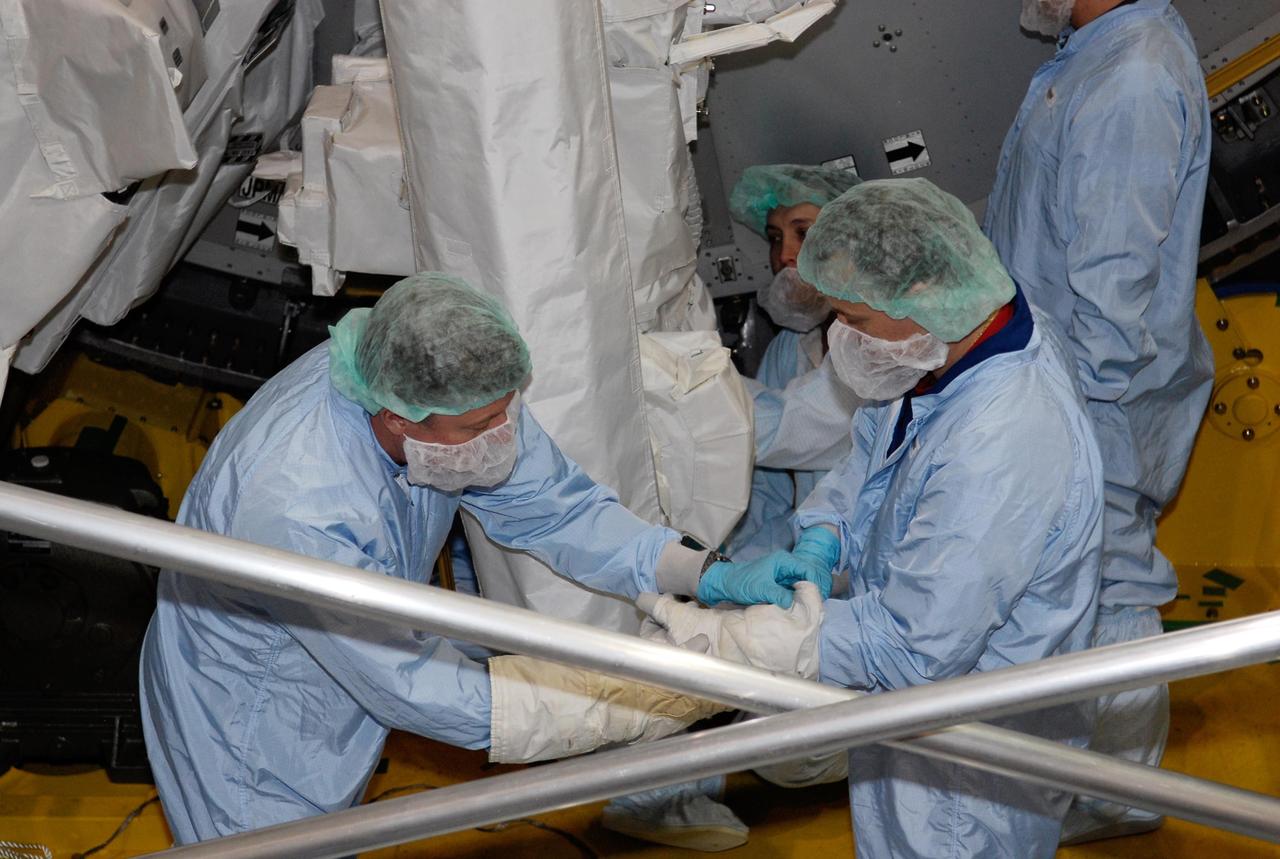
KENNEDY SPACE CENTER, FLA. --  In the Space Station Processing Facility at NASA's Kennedy Space Center, members of the STS-124 crew get a close look at equipment on the Japanese Experiment Module, called Kibo, including the Remote Manipulator System, or RMS, two robotic arms that support operations on the outside of the Kibo.  Crew members are at Kennedy for a crew equipment interface test that includes familiarization with tools and equipment that will be used on the mission.  The STS-124 mission is the second of three flights that will launch components to complete the Japanese pressurized module, the Kibo laboratory. The mission will include two spacewalks to install the new lab and its remote manipulator system. The lab's logistics module, which will have been installed in a temporary location during STS-123, will be attached to the new lab.  Photo credit: NASA/Kim Shiflett
KSC-08pd0060
KENNEDY SPACE CENTER, FLA. -- In the Space Station Processing Facility at NASA's Kennedy Space Center, members of the STS-124 crew get a close look at equipment on the Japanese Experiment Module, called Kibo, including the Remote Manipulator System, or RMS, two robotic arms that support operations on the outside of the Kibo.  Crew members are at Kennedy for a crew equipment interface test that includes familiarization with tools and equipment that will be used on the mission.  The STS-124 mission is the second of three flights that will launch components to complete the Japanese pressurized module, the Kibo laboratory. The mission will include two spacewalks to install the new lab and its remote manipulator system. The lab's logistics module, which will have been installed in a temporary location during STS-123, will be attached to the new lab.  Photo credit: NASA/Kim Shiflett
KSC-08pd0058
KENNEDY SPACE CENTER, FLA. --  In the Space Station Processing Facility at NASA's Kennedy Space Center, members of the STS-124 crew get a close look at equipment on the Japanese Experiment Module, called Kibo, including the Remote Manipulator System, or RMS, two robotic arms that support operations on the outside of the Kibo.  Crew members are at Kennedy for a crew equipment interface test that includes familiarization with tools and equipment that will be used on the mission.  The STS-124 mission is the second of three flights that will launch components to complete the Japanese pressurized module, the Kibo laboratory. The mission will include two spacewalks to install the new lab and its remote manipulator system. The lab's logistics module, which will have been installed in a temporary location during STS-123, will be attached to the new lab.  Photo credit: NASA/Kim Shiflett
KSC-08pd0059
KENNEDY SPACE CENTER, FLA. -- In the Space Station Processing Facility at NASA's Kennedy Space Center, STS-124 Mission Specialist Michael Fossum (left) gets a close look at equipment on the Japanese Experiment Module, called Kibo, including the Remote Manipulator System, or RMS, two robotic arms that support operations on the outside of the Kibo.  Crew members are at Kennedy for a crew equipment interface test that includes familiarization with tools and equipment that will be used on the mission.  The STS-124 mission is the second of three flights that will launch components to complete the Japanese pressurized module, the Kibo laboratory. The mission will include two spacewalks to install the new lab and its remote manipulator system. The lab's logistics module, which will have been installed in a temporary location during STS-123, will be attached to the new lab.  Photo credit: NASA/Kim Shiflett
KSC-08pd0061
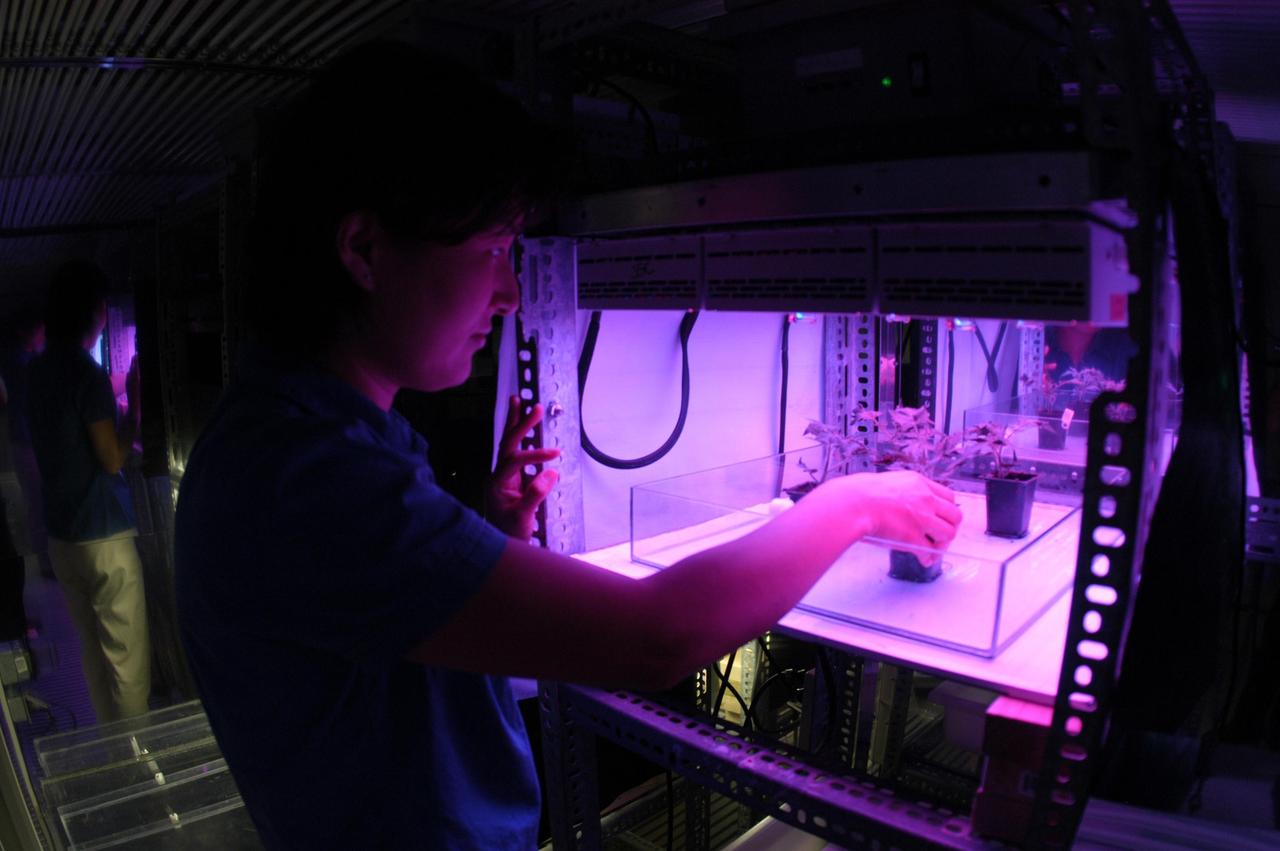
KENNEDY SPACE CENTER, FLA.  -  - In the KSC Space Life Sciences Lab,  Dr. Hyeon-Hye Kim places Arabidopsis plants in a plant growth chamber for testing under various light conditions.  Other plant research includes different CO2 concentrations and temperatures.  The Lab is exploring various aspects of a bioregenerative life support system. Such research and technology development will be crucial to long-term habitation of space by humans.
KSC-04pd1305
KENNEDY SPACE CENTER, FLA.  -  In the KSC Space Life Sciences Lab,  Dr. Hyeon-Hye Kim checks plants in a plant growth chamber for testing under various light conditions.  Other plant research includes different CO2 concentrations and temperatures.  The Lab is exploring various aspects of a bioregenerative life support system. Such research and technology development will be crucial to long-term habitation of space by humans.
KSC-04pd1306
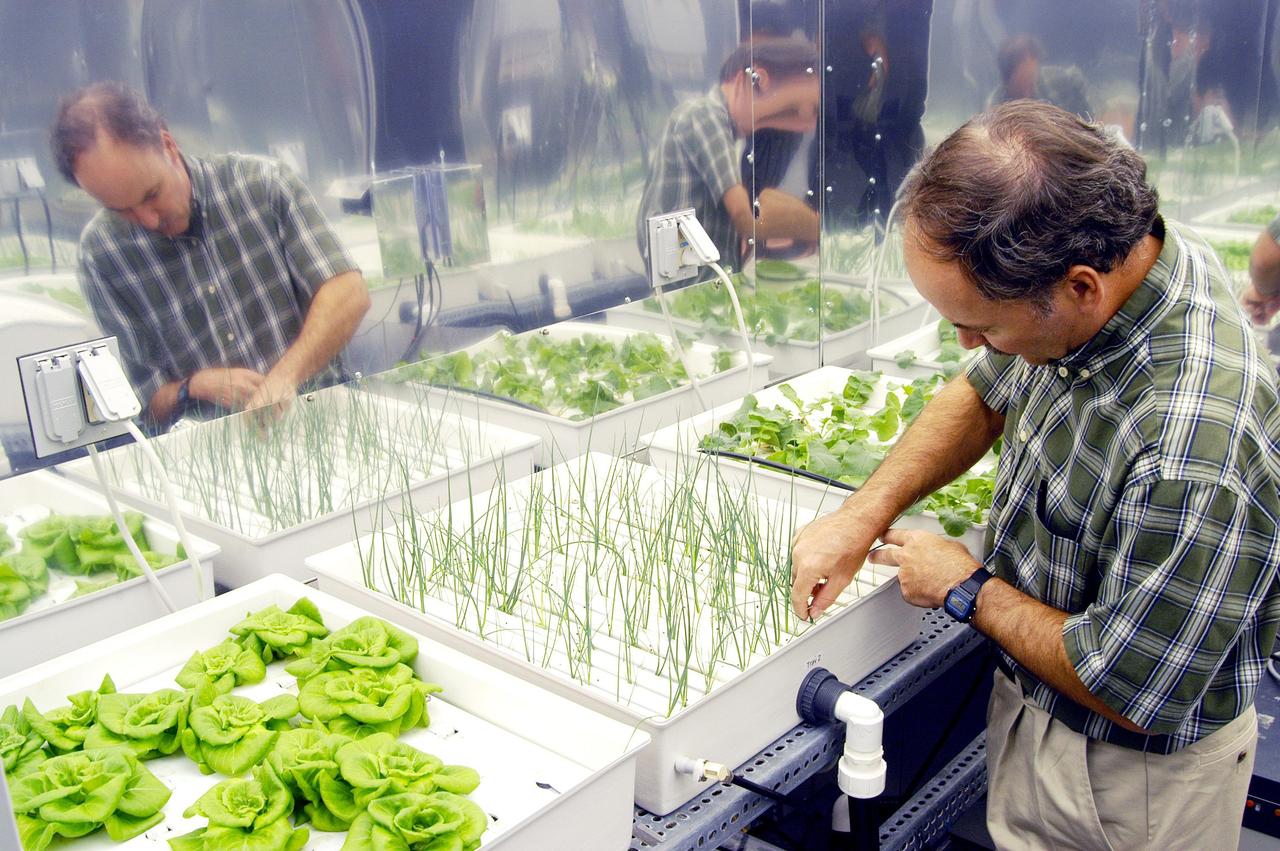
KENNEDY SPACE CENTER, FLA.  -  In a plant growth chamber in the KSC Space Life Sciences Lab,  plant physiologist Ray Wheeler checks onions being grown using hydroponic techniques.  The other plants are Bibb lettuce (left) and radishes (right).  Wheeler and other colleagues are researching plant growth under different types of light, different CO2 concentrations and temperatures.  The Lab is exploring various aspects of a bioregenerative life support system. Such research and technology development will be crucial to long-term habitation of space by humans.
KSC-04pd1312
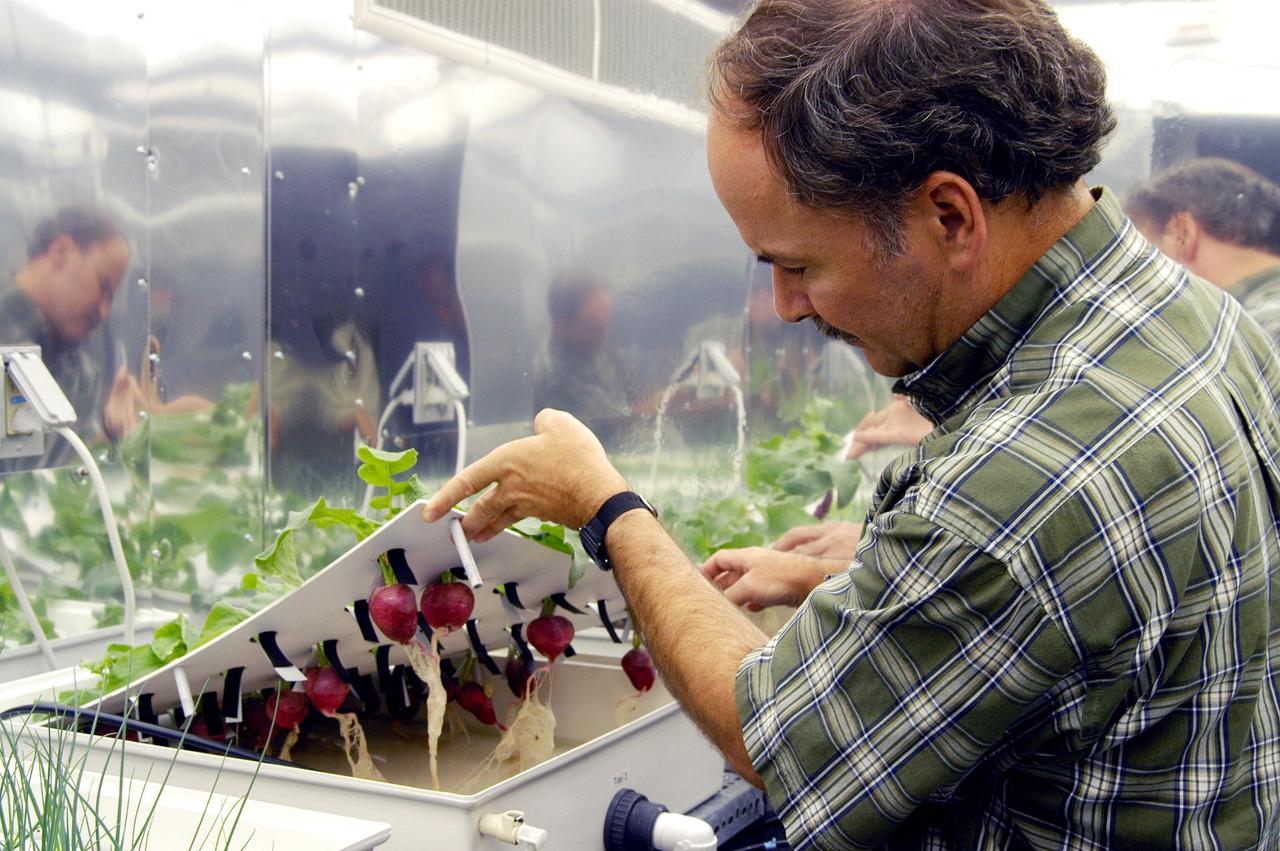
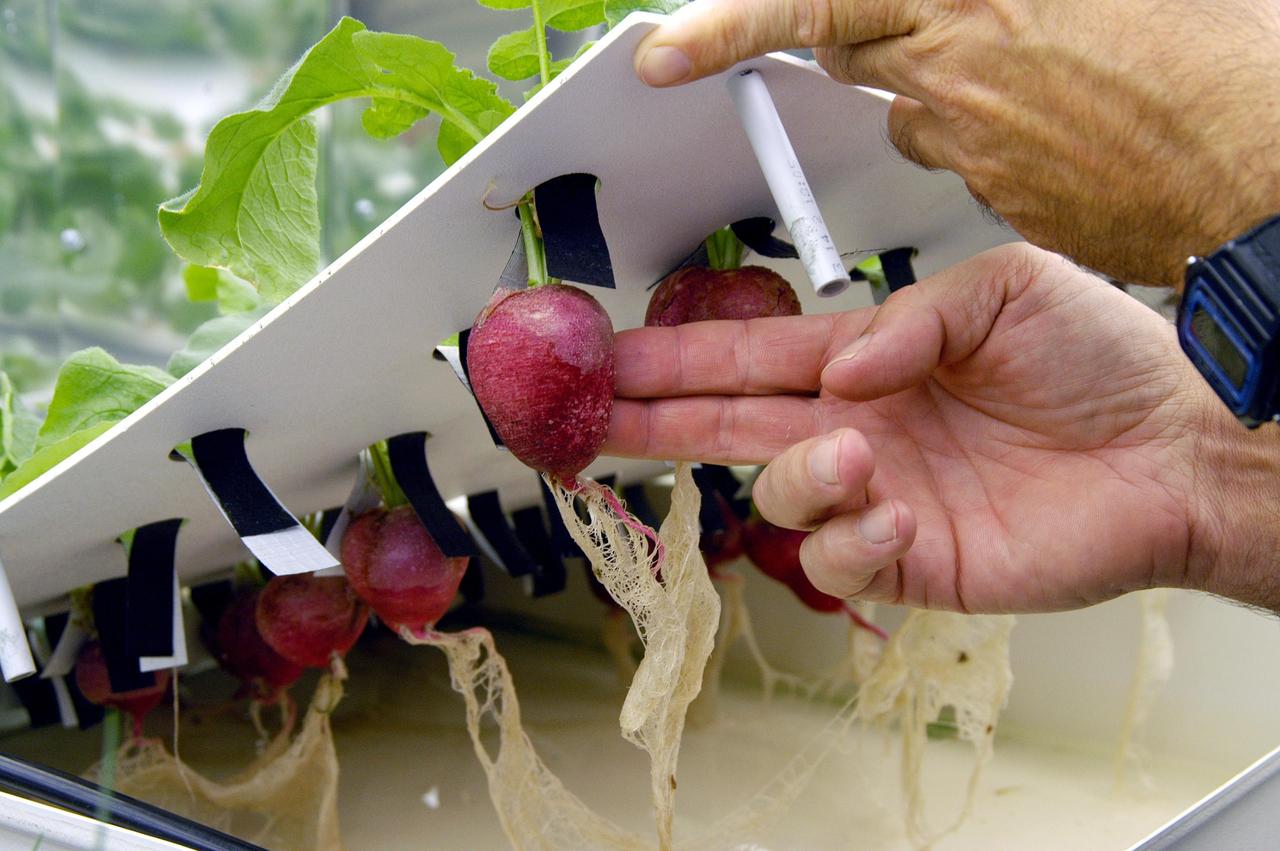
KENNEDY SPACE CENTER, FLA.  -  In a plant growth chamber in the KSC Space Life Sciences Lab,  plant physiologist Ray Wheeler checks radishes being grown using hydroponic techniques.  Wheeler and other colleagues are researching plant growth under different types of light, different CO2 concentrations and temperatures.  The Lab is exploring various aspects of a bioregenerative life support system. Such research and technology development will be crucial to long-term habitation of space by humans.
KSC-04pd1308
KENNEDY SPACE CENTER, Fla. -- At the top of the incline to Launch Pad 39A, Space Shuttle Atlantis nears the Rotating Service Structure (left). Atlantis will fly on mission STS-98, the seventh construction flight to the International Space Station, carrying the U.S. Laboratory, named Destiny. The lab will have five system racks already installed inside the module. After delivery of electronics in the lab, electrically powered attitude control for Control Moment Gyroscopes will be activated. Atlantis is scheduled for launch no earlier than Jan. 19, 2001, with a crew of five
KSC-01PADIG-008
KENNEDY SPACE CENTER, FLA.  -  In a plant growth chamber in the KSC Space Life Sciences Lab,  plant physiologist Ray Wheeler checks radishes being grown using hydroponic techniques.  Wheeler and other colleagues are researching plant growth under different types of light, different CO2 concentrations and temperatures.  The Lab is exploring various aspects of a bioregenerative life support system. Such research and technology development will be crucial to long-term habitation of space by humans.
KSC-04pd1307
KENNEDY SPACE CENTER, FLA.  -  In the KSC Space Life Sciences Lab, Arabidopsis plants appear purple under red and green light as part of research on growth under various light conditions.  Other plant research includes different CO2 concentrations and temperatures.  The Lab is exploring various aspects of a bioregenerative life support system. Such research and technology development will be crucial to long-term habitation of space by humans.
KSC-04pd1304