S61-02455 (19 June 1961) --- Astronaut Alan B. Shepard Jr. met and talked with Boy Scouts from Franklin, Virginia on June 19, 1961. They are photographed in front of the NASA Space Task Group building at Langley Space Flight Center. Photo credit: NASA or National Aeronautics and Space Administration
BOY SCOUTS - SPACE TASK GROUP - ASTRONAUT SHEPARD
KENNEDY SPACE CENTER, FLA.  -  The Stafford-Covey Return to Flight Task Group (SCTG) inspects debris in the Columbia Debris Hangar.   At right is the model of the left wing that has been used during recovery operations.  Chairing the task group are Richard O. Covey, former Space Shuttle commander, and Thomas P. Stafford (third from right, foreground), Apollo commander.  Chartered by NASA Administrator Sean O’Keefe, the task group will perform an independent assessment of NASA’s implementation of the final recommendations by the Columbia Accident Investigation Board.
KENNEDY SPACE CENTER, FLA. - The Stafford-Covey Return to Flight Task Group (SCTG) inspects debris in the Columbia Debris Hangar. At right is the model of the left wing that has been used during recovery operations. Chairing the task group are Richard O. Covey, former Space Shuttle commander, and Thomas P. Stafford (third from right, foreground), Apollo commander. Chartered by NASA Administrator Sean O’Keefe, the task group will perform an independent assessment of NASA’s implementation of the final recommendations by the Columbia Accident Investigation Board.
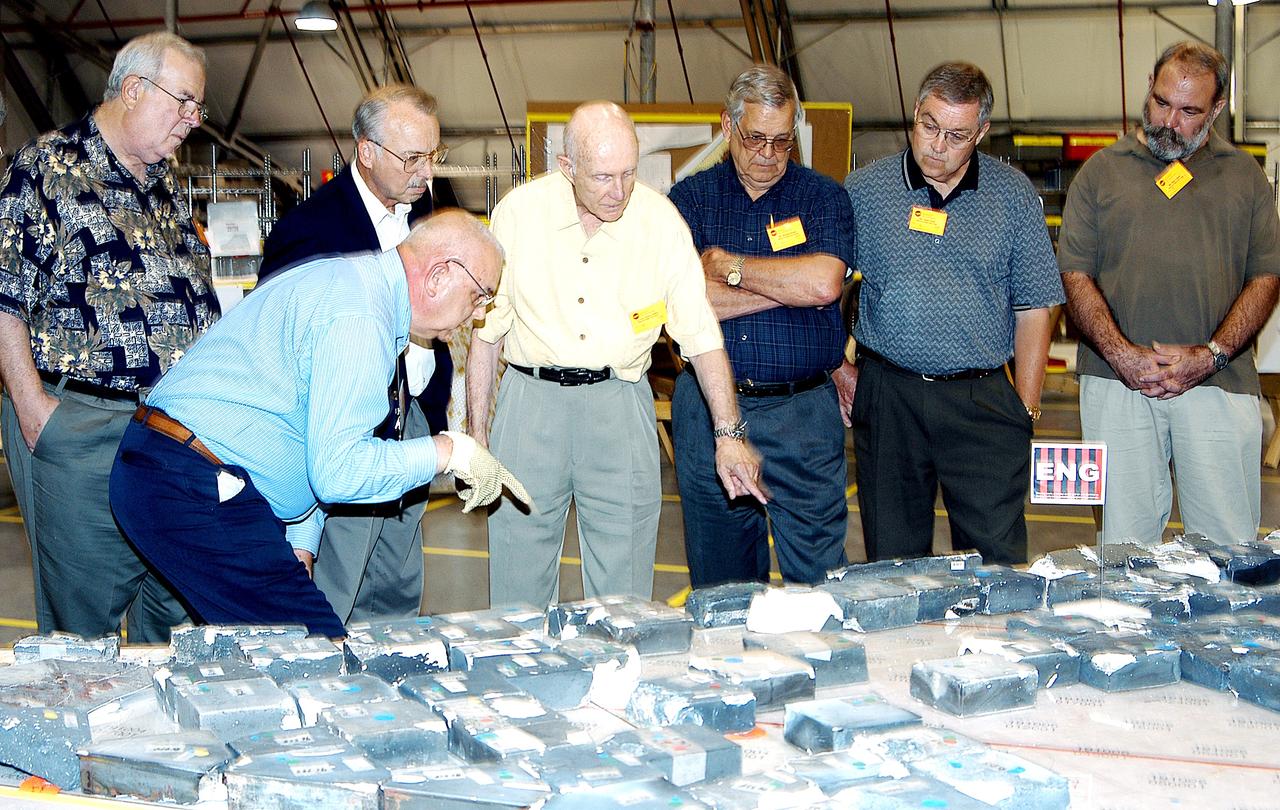
KENNEDY SPACE CENTER, FLA.  -  In the Columbia Debris Hangar, members of the  Stafford-Covey Return to Flight Task Group (SCTG) look at tiles recovered.  Chairing the task group are Richard O. Covey, former Space Shuttle commander, and Thomas P. Stafford (center), Apollo commander.  Chartered by NASA Administrator Sean O’Keefe, the task group will perform an independent assessment of NASA’s implementation of the final recommendations by the Columbia Accident Investigation Board.
KENNEDY SPACE CENTER, FLA. - In the Columbia Debris Hangar, members of the Stafford-Covey Return to Flight Task Group (SCTG) look at tiles recovered. Chairing the task group are Richard O. Covey, former Space Shuttle commander, and Thomas P. Stafford (center), Apollo commander. Chartered by NASA Administrator Sean O’Keefe, the task group will perform an independent assessment of NASA’s implementation of the final recommendations by the Columbia Accident Investigation Board.
KENNEDY SPACE CENTER, FLA.  -   The Stafford-Covey Return to Flight Task Group (SCTG) visits the Columbia Debris Hangar .  Chairing the task group are Richard O. Covey (third from right), former Space Shuttle commander, and Thomas P. Stafford (fourth from right), Apollo commander.  Chartered by NASA Administrator Sean O’Keefe, the task group will perform an independent assessment of NASA’s implementation of the final recommendations by the Columbia Accident Investigation Board.
KENNEDY SPACE CENTER, FLA. - The Stafford-Covey Return to Flight Task Group (SCTG) visits the Columbia Debris Hangar . Chairing the task group are Richard O. Covey (third from right), former Space Shuttle commander, and Thomas P. Stafford (fourth from right), Apollo commander. Chartered by NASA Administrator Sean O’Keefe, the task group will perform an independent assessment of NASA’s implementation of the final recommendations by the Columbia Accident Investigation Board.
KENNEDY SPACE CENTER, FLA.  -  In the Columbia Debris Hangar, Shuttle Launch Director Mike Leinbach (left) talks to members of the  Stafford-Covey Return to Flight Task Group (SCTG) about reconstruction efforts.   Chairing the task group are Richard O. Covey (second from right), former Space Shuttle commander, and Thomas P. Stafford, Apollo commander.  Chartered by NASA Administrator Sean O’Keefe, the task group will perform an independent assessment of NASA’s implementation of the final recommendations by the Columbia Accident Investigation Board.
KENNEDY SPACE CENTER, FLA. - In the Columbia Debris Hangar, Shuttle Launch Director Mike Leinbach (left) talks to members of the Stafford-Covey Return to Flight Task Group (SCTG) about reconstruction efforts. Chairing the task group are Richard O. Covey (second from right), former Space Shuttle commander, and Thomas P. Stafford, Apollo commander. Chartered by NASA Administrator Sean O’Keefe, the task group will perform an independent assessment of NASA’s implementation of the final recommendations by the Columbia Accident Investigation Board.
KENNEDY SPACE CENTER, FLA.  - In the Columbia Debris Hangar, Shuttle Launch Director Mike Leinbach answers questions from the Stafford-Covey Return to Flight Task Group (SCTG).  Chairing the task group are Richard O. Covey (fifth from left), former Space Shuttle commander, and Thomas P. Stafford, Apollo commander.  Chartered by NASA Administrator Sean O’Keefe, the task group will perform an independent assessment of NASA’s implementation of the final recommendations by the Columbia Accident Investigation Board.
KENNEDY SPACE CENTER, FLA. - In the Columbia Debris Hangar, Shuttle Launch Director Mike Leinbach answers questions from the Stafford-Covey Return to Flight Task Group (SCTG). Chairing the task group are Richard O. Covey (fifth from left), former Space Shuttle commander, and Thomas P. Stafford, Apollo commander. Chartered by NASA Administrator Sean O’Keefe, the task group will perform an independent assessment of NASA’s implementation of the final recommendations by the Columbia Accident Investigation Board.
KENNEDY SPACE CENTER, FLA.  -  In the Columbia Debris Hangar, members of the  Stafford-Covey Return to Flight Task Group (SCTG) inspect some of the debris.   Chairing the task group are Richard O. Covey, former Space Shuttle commander, and Thomas P. Stafford (fourth from left), Apollo commander.  Chartered by NASA Administrator Sean O’Keefe, the task group will perform an independent assessment of NASA’s implementation of the final recommendations by the Columbia Accident Investigation Board.
KENNEDY SPACE CENTER, FLA. - In the Columbia Debris Hangar, members of the Stafford-Covey Return to Flight Task Group (SCTG) inspect some of the debris. Chairing the task group are Richard O. Covey, former Space Shuttle commander, and Thomas P. Stafford (fourth from left), Apollo commander. Chartered by NASA Administrator Sean O’Keefe, the task group will perform an independent assessment of NASA’s implementation of the final recommendations by the Columbia Accident Investigation Board.
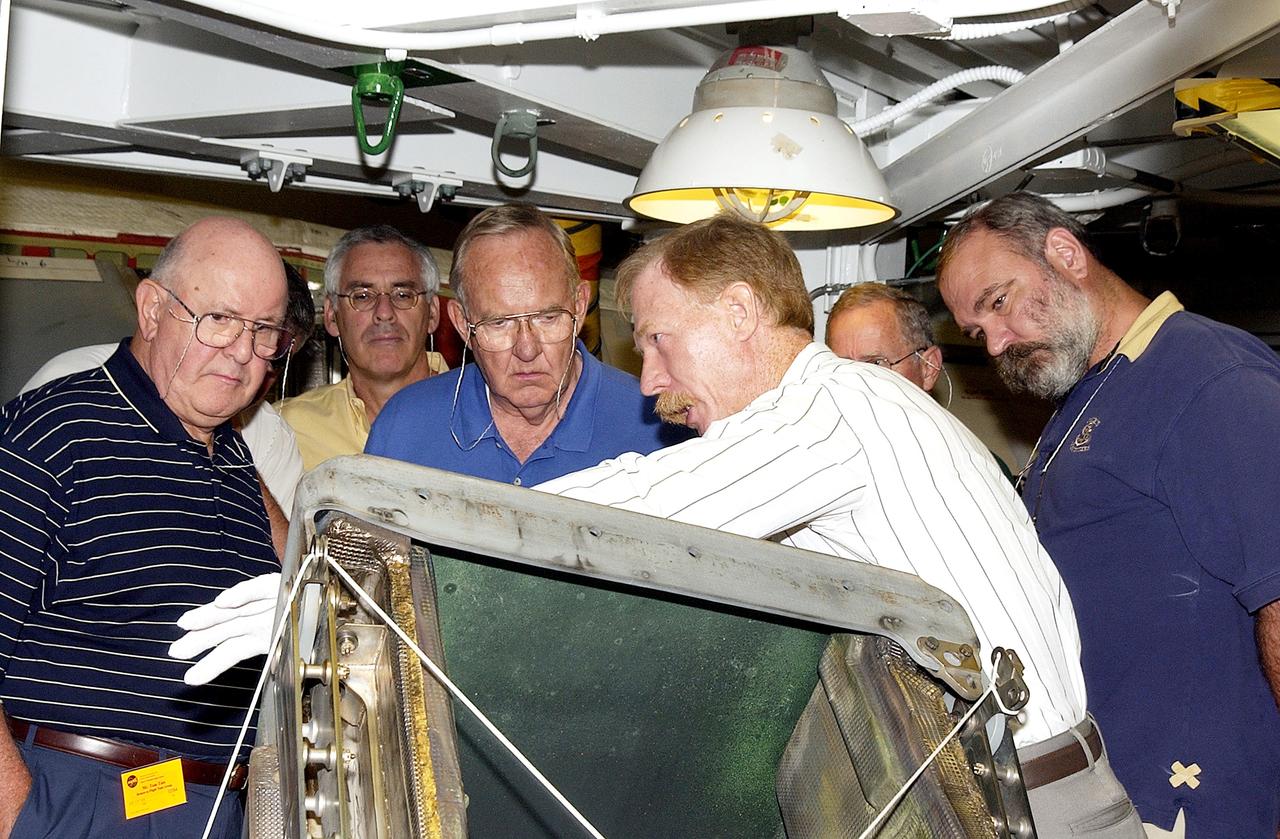
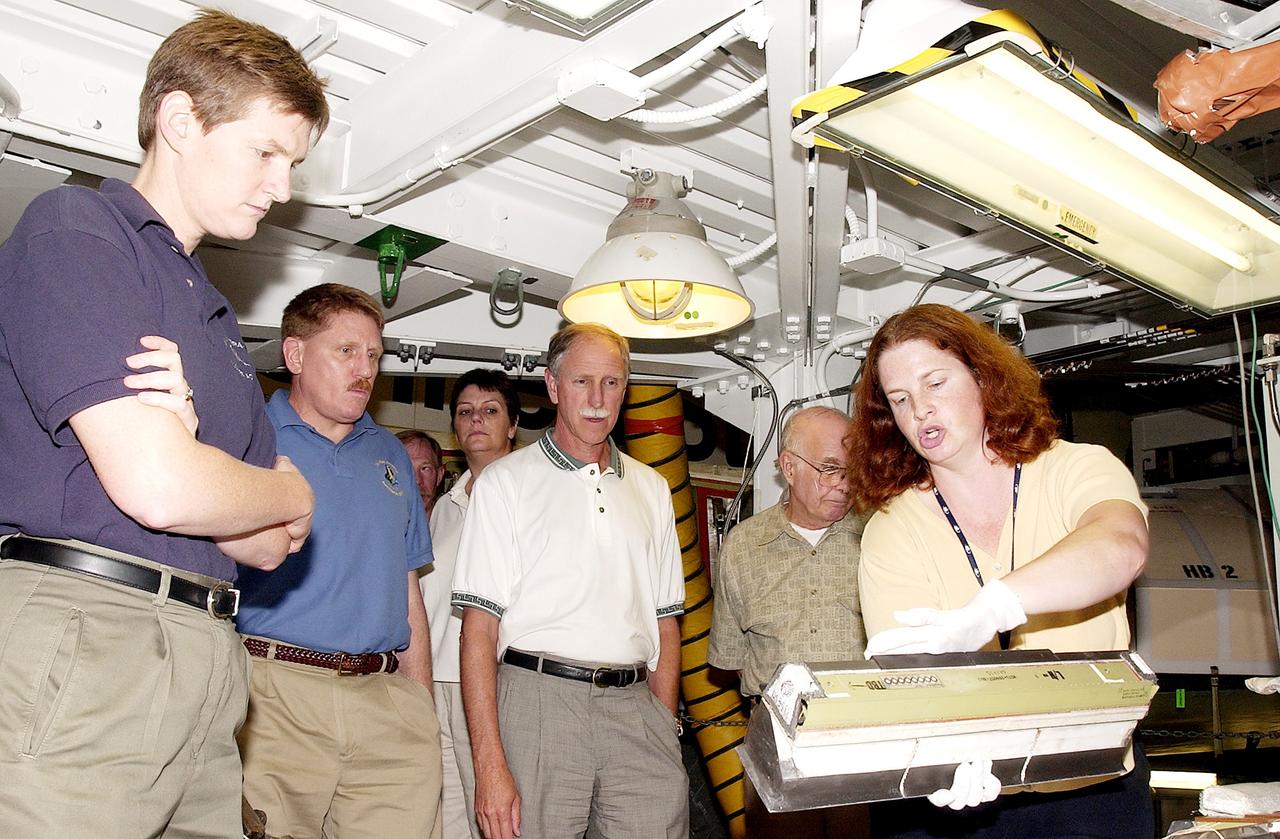
KENNEDY SPACE CENTER, FLA.  - On a tour of the Orbiter Processing Facility, members of the Stafford-Covey Return to Flight Task Group (RTFTG) look at a Reinforced Carbon-Carbon panels with a T-seal held by Tom Roberts, with United Space Alliance.  From left are Richard O. Covey, former Space Shuttle commander, Dr. Kathryn Clark, James Adamson, Joe Engle, William Wegner and Dr. Amy Donahue.  Chairing the task group are Covey and Thomas P. Stafford, Apollo commander.  Chartered by NASA Administrator Sean O’Keefe, the task group will perform an independent assessment of NASA’s implementation of the final recommendations by the Columbia Accident Investigation Board.
KENNEDY SPACE CENTER, FLA. - On a tour of the Orbiter Processing Facility, members of the Stafford-Covey Return to Flight Task Group (RTFTG) look at a Reinforced Carbon-Carbon panels with a T-seal held by Tom Roberts, with United Space Alliance. From left are Richard O. Covey, former Space Shuttle commander, Dr. Kathryn Clark, James Adamson, Joe Engle, William Wegner and Dr. Amy Donahue. Chairing the task group are Covey and Thomas P. Stafford, Apollo commander. Chartered by NASA Administrator Sean O’Keefe, the task group will perform an independent assessment of NASA’s implementation of the final recommendations by the Columbia Accident Investigation Board.
KENNEDY SPACE CENTER, FLA.  -  Members of the  Stafford-Covey Return to Flight Task Group (SCTG) look over equipment in the Orbiter Processing Facility.  At left (back to camera), Fernando Santos, with NASA, and Paul Ogletree (at monitor), with United Space Alliance, describe how flash thermography is used to inspect the structure of Reinforced Carbon Carbon panels and establish a baseline on panels before flight.  Chairing the task group are Richard O. Covey (far right), former Space Shuttle commander, and Thomas P. Stafford, Apollo commander.  Chartered by NASA Administrator Sean O’Keefe, the task group will perform an independent assessment of NASA’s implementation of the final recommendations by the Columbia Accident Investigation Board.
KENNEDY SPACE CENTER, FLA. - Members of the Stafford-Covey Return to Flight Task Group (SCTG) look over equipment in the Orbiter Processing Facility. At left (back to camera), Fernando Santos, with NASA, and Paul Ogletree (at monitor), with United Space Alliance, describe how flash thermography is used to inspect the structure of Reinforced Carbon Carbon panels and establish a baseline on panels before flight. Chairing the task group are Richard O. Covey (far right), former Space Shuttle commander, and Thomas P. Stafford, Apollo commander. Chartered by NASA Administrator Sean O’Keefe, the task group will perform an independent assessment of NASA’s implementation of the final recommendations by the Columbia Accident Investigation Board.
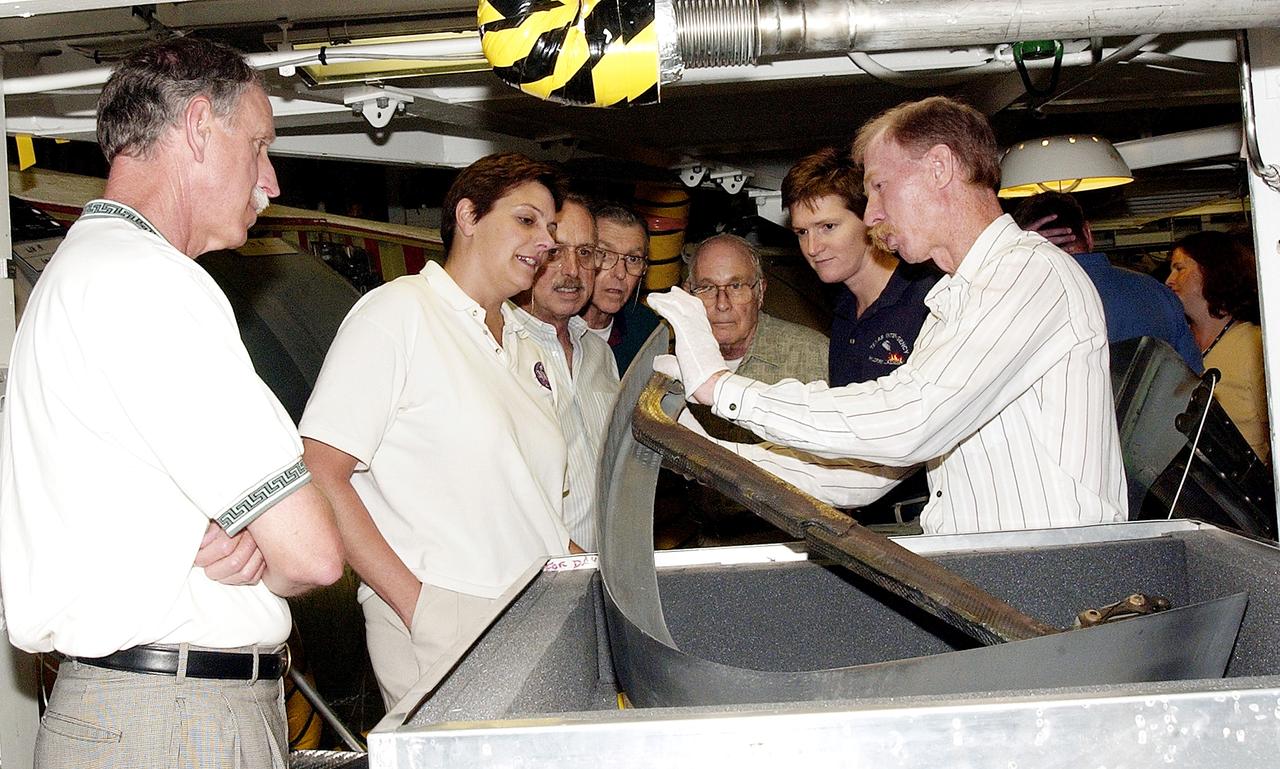
KENNEDY SPACE CENTER, FLA.  - On a tour of the Orbiter Processing Facility, members of the Stafford-Covey Return to Flight Task Group (SCTG) look at one of the Reinforced Carbon-Carbon panels, being shown by Tom Roberts with United Space Alliance, from the orbiter Endeavour.  Chairing the task group are Richard O. Covey, former Space Shuttle commander, and Thomas P. Stafford, Apollo commander.  Chartered by NASA Administrator Sean O’Keefe, the task group will perform an independent assessment of NASA’s implementation of the final recommendations by the Columbia Accident Investigation Board.
KENNEDY SPACE CENTER, FLA. - On a tour of the Orbiter Processing Facility, members of the Stafford-Covey Return to Flight Task Group (SCTG) look at one of the Reinforced Carbon-Carbon panels, being shown by Tom Roberts with United Space Alliance, from the orbiter Endeavour. Chairing the task group are Richard O. Covey, former Space Shuttle commander, and Thomas P. Stafford, Apollo commander. Chartered by NASA Administrator Sean O’Keefe, the task group will perform an independent assessment of NASA’s implementation of the final recommendations by the Columbia Accident Investigation Board.
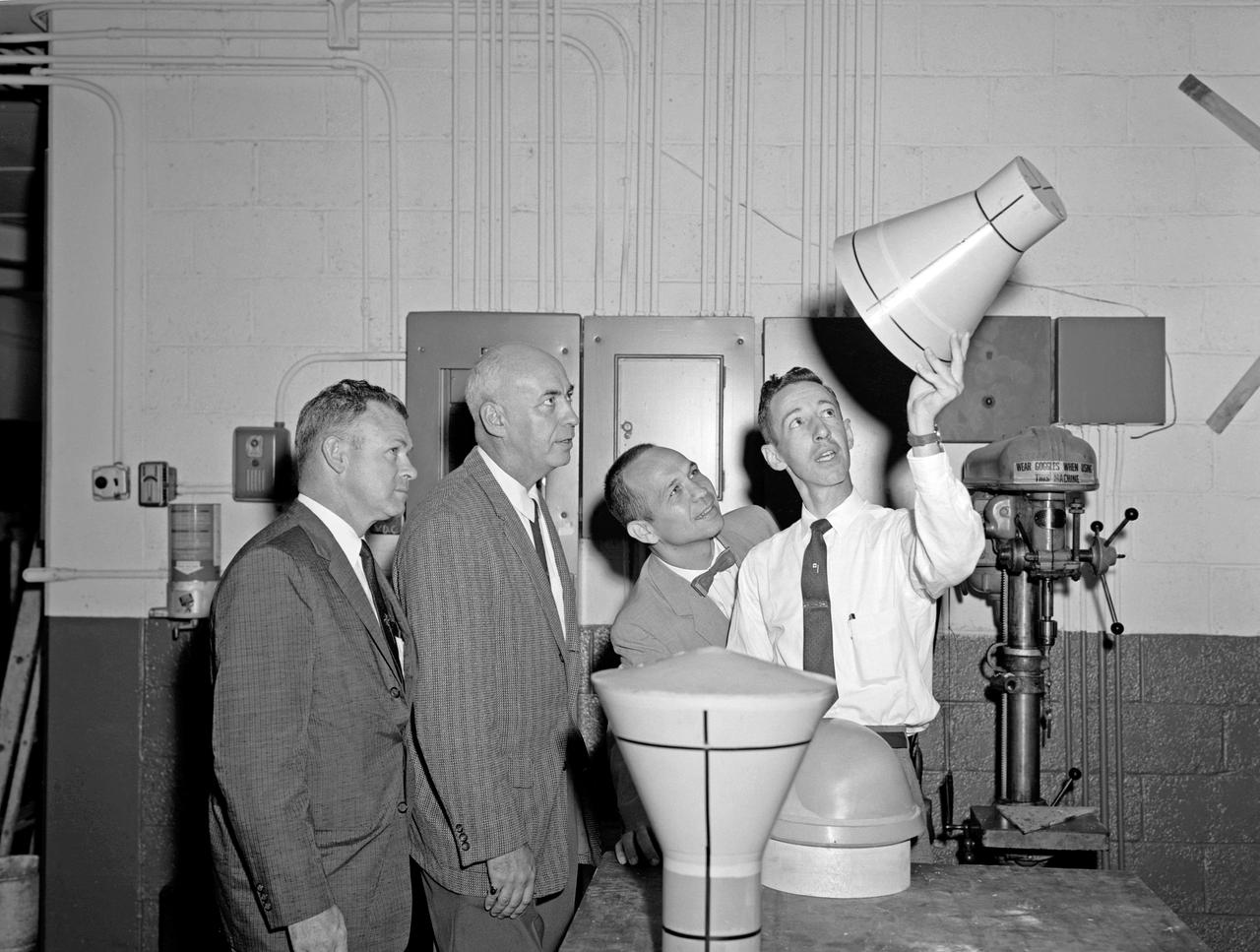
From left to right: Charles Donlan, deputy head, and Robert Gilruth, head of STG, look at a scale model of a Mercury space capsule.
Space Task Group (STG)
KENNEDY SPACE CENTER, FLA.  - As the Stafford-Covey Return to Flight Task Group (SCTG) tours the Orbiter Processing Facility, Richard O. Covey (second from left), former Space Shuttle commander, points to equipment.  Covey is co-chair of the SCTG along with Thomas P. Stafford, Apollo commander. Others in the photo are William Wegner, James Adamson and Joe Engle.  Chartered by NASA Administrator Sean O’Keefe, the task group will perform an independent assessment of NASA’s implementation of the final recommendations by the Columbia Accident Investigation Board.
KENNEDY SPACE CENTER, FLA. - As the Stafford-Covey Return to Flight Task Group (SCTG) tours the Orbiter Processing Facility, Richard O. Covey (second from left), former Space Shuttle commander, points to equipment. Covey is co-chair of the SCTG along with Thomas P. Stafford, Apollo commander. Others in the photo are William Wegner, James Adamson and Joe Engle. Chartered by NASA Administrator Sean O’Keefe, the task group will perform an independent assessment of NASA’s implementation of the final recommendations by the Columbia Accident Investigation Board.
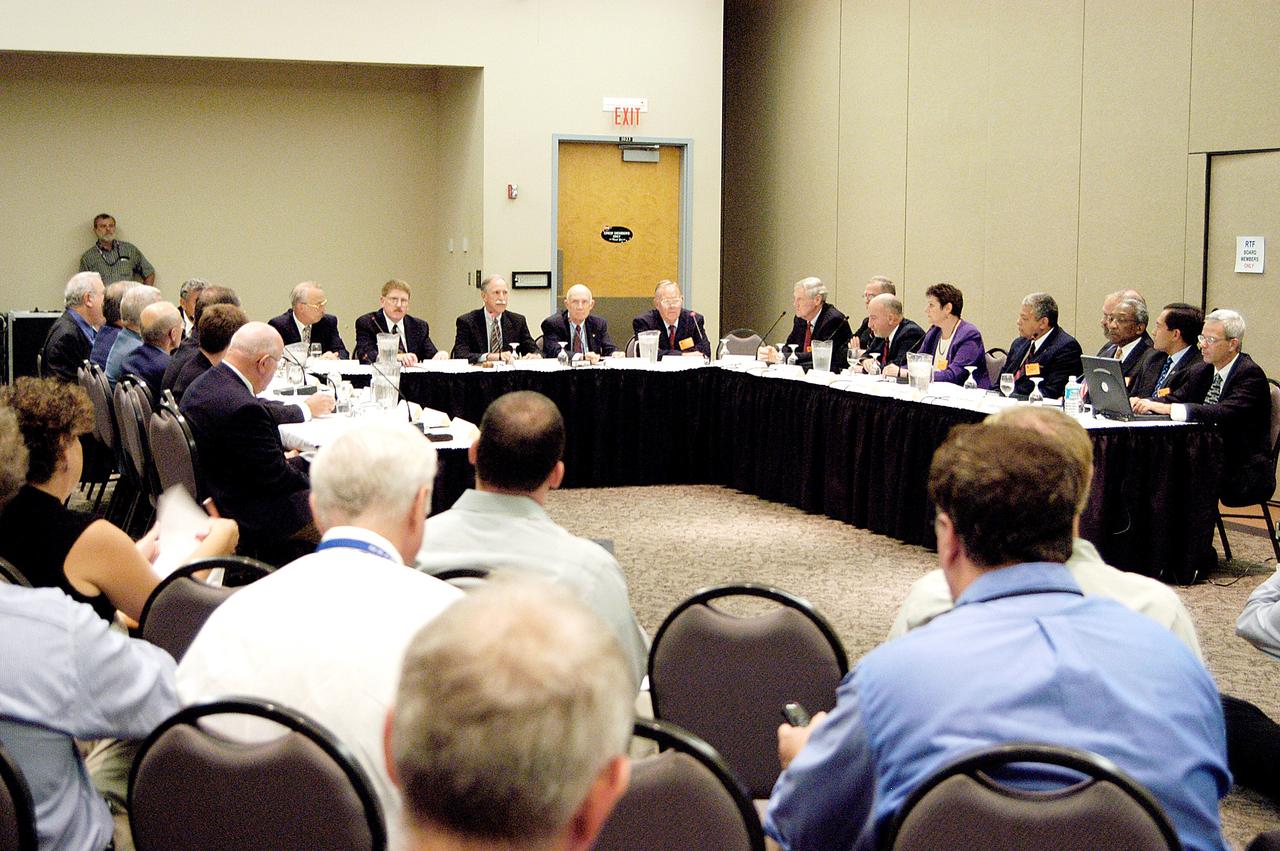
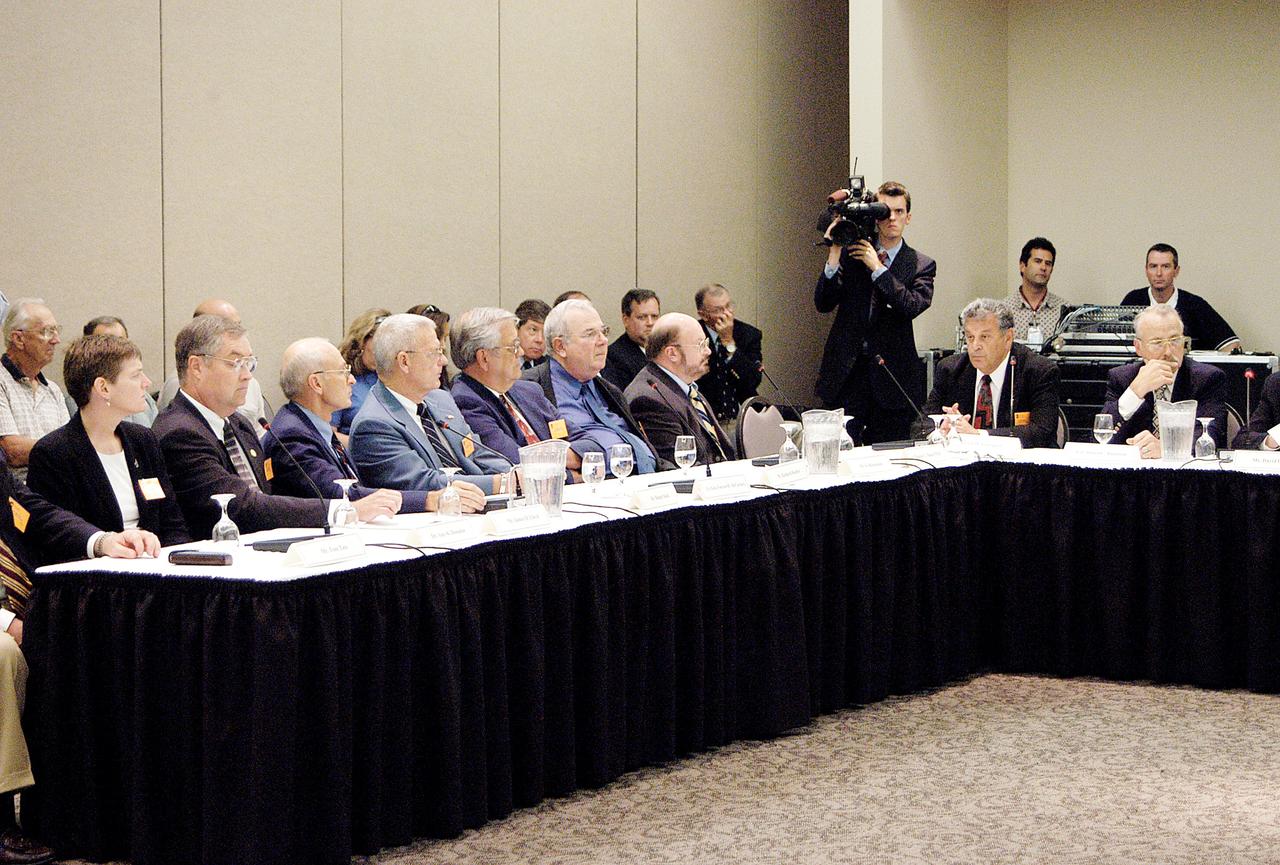
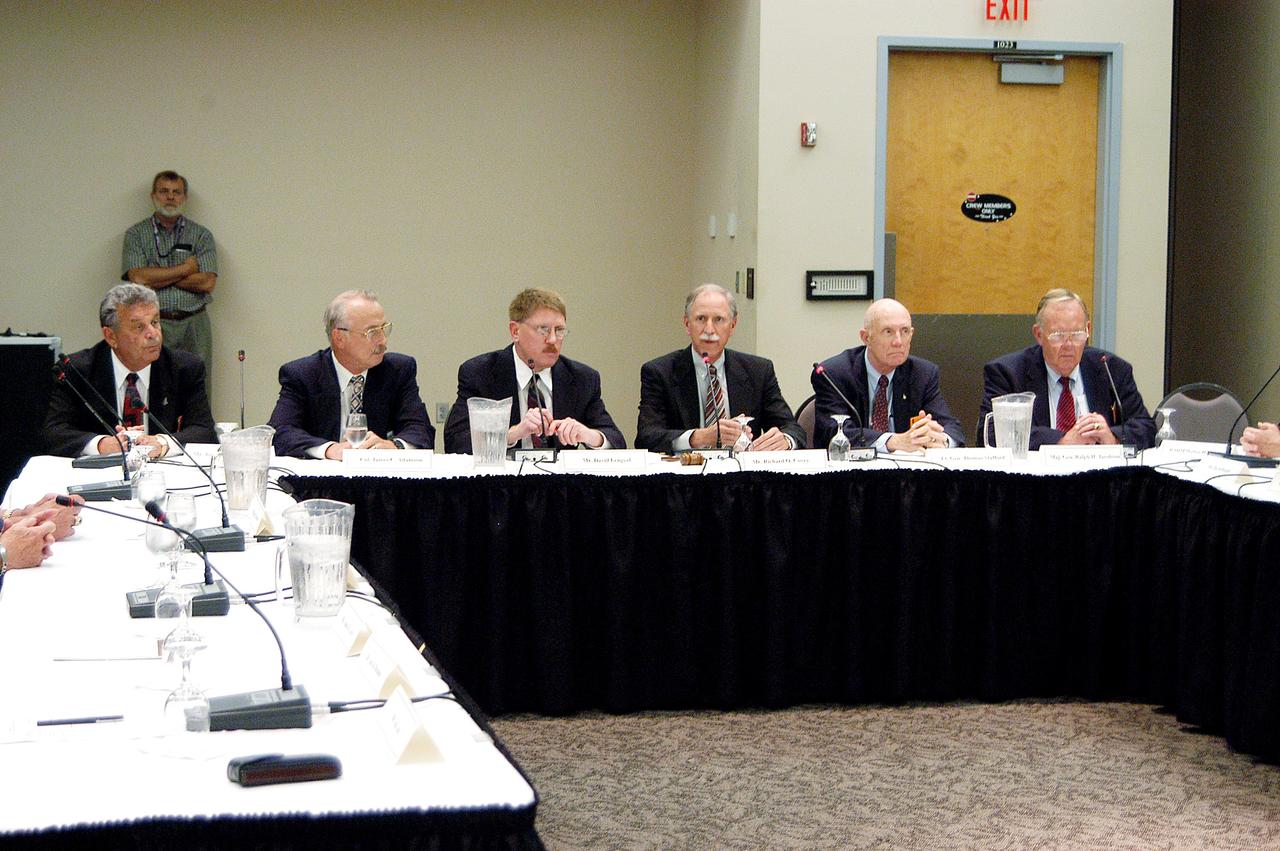
KENNEDY SPACE CENTER, FLA.  -  The Return To Flight Task Group (RTFTG) holds its first public meeting at the Debus Center, KSC Visitor Complex.   The group is co-chaired by former Shuttle commander Richard O. Covey and retired Air Force Lt. Gen. Thomas P. Stafford, who was an Apollo commander.  The RTFTG was at KSC to conduct organizational activities, tour Space Shuttle facilities and receive briefings on Shuttle-related topics.  The task group was chartered by NASA Administrator Sean O’Keefe to perform an independent assessment of NASA’s implementation of the final recommendations of the Columbia Accident Investigation Board.
KENNEDY SPACE CENTER, FLA. - The Return To Flight Task Group (RTFTG) holds its first public meeting at the Debus Center, KSC Visitor Complex. The group is co-chaired by former Shuttle commander Richard O. Covey and retired Air Force Lt. Gen. Thomas P. Stafford, who was an Apollo commander. The RTFTG was at KSC to conduct organizational activities, tour Space Shuttle facilities and receive briefings on Shuttle-related topics. The task group was chartered by NASA Administrator Sean O’Keefe to perform an independent assessment of NASA’s implementation of the final recommendations of the Columbia Accident Investigation Board.
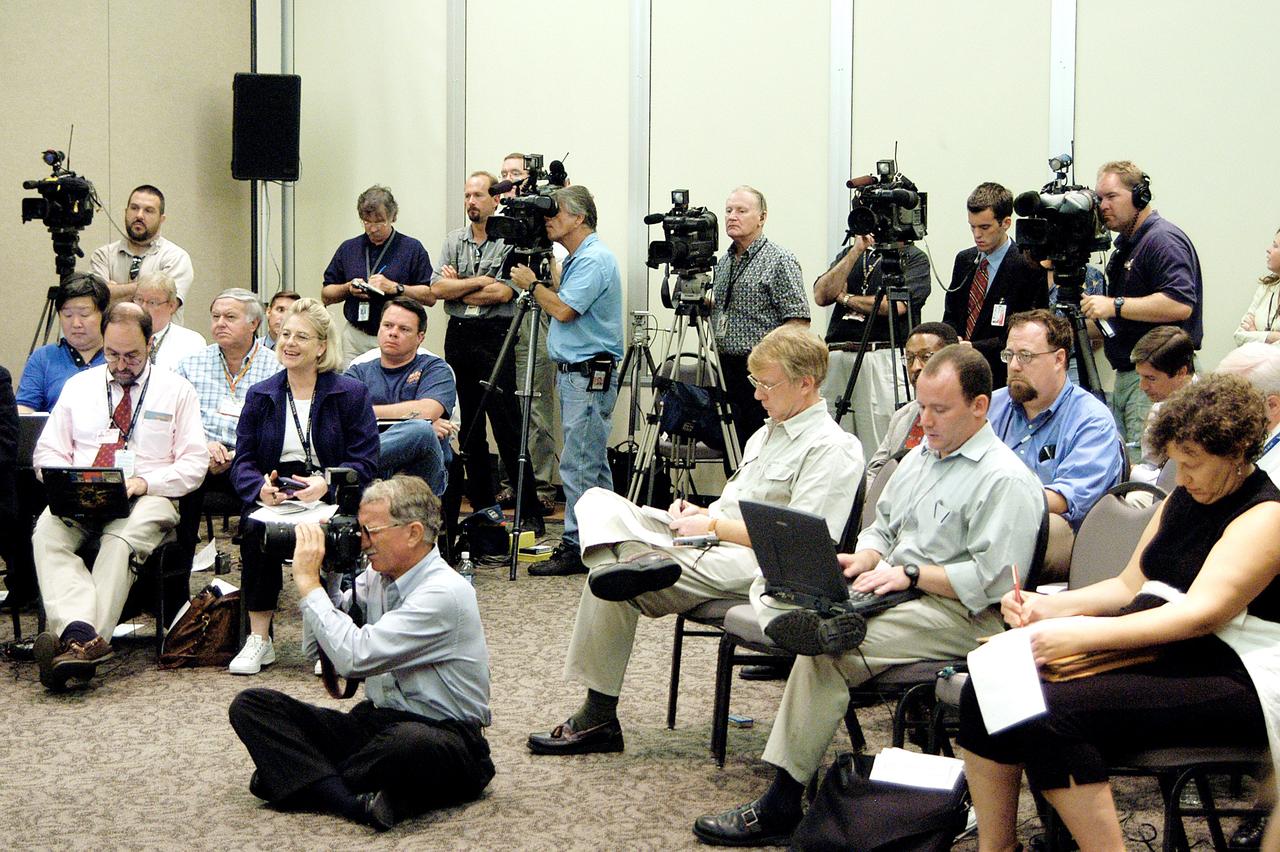
KENNEDY SPACE CENTER, FLA.  -  The news media capture the words and images of the Return To Flight Task Group (RTFTG) which held its first public meeting at the Debus Center, KSC Visitor Complex.  The group is co-chaired by former Shuttle commander Richard O. Covey and retired Air Force Lt. Gen. Thomas P. Stafford, who was an Apollo commander. The RTFTG was at KSC to conduct organizational activities, tour Space Shuttle facilities and receive briefings on Shuttle-related topics.  The task group was chartered by NASA Administrator Sean O’Keefe to perform an independent assessment of NASA’s implementation of the final recommendations of the Columbia Accident Investigation Board.
KENNEDY SPACE CENTER, FLA. - The news media capture the words and images of the Return To Flight Task Group (RTFTG) which held its first public meeting at the Debus Center, KSC Visitor Complex. The group is co-chaired by former Shuttle commander Richard O. Covey and retired Air Force Lt. Gen. Thomas P. Stafford, who was an Apollo commander. The RTFTG was at KSC to conduct organizational activities, tour Space Shuttle facilities and receive briefings on Shuttle-related topics. The task group was chartered by NASA Administrator Sean O’Keefe to perform an independent assessment of NASA’s implementation of the final recommendations of the Columbia Accident Investigation Board.
KENNEDY SPACE CENTER, FLA.  -   The Return To Flight Task Group (RTFTG) holds its first public meeting at the Debus Center, KSC Visitor Complex.   The group is co-chaired by former Shuttle commander Richard O. Covey and retired Air Force Lt. Gen. Thomas P. Stafford, who was an Apollo commander.  The RTFTG was at KSC to conduct organizational activities, tour Space Shuttle facilities and receive briefings on Shuttle-related topics.  The task group was chartered by NASA Administrator Sean O’Keefe to perform an independent assessment of NASA’s implementation of the final recommendations of the Columbia Accident Investigation Board.
KENNEDY SPACE CENTER, FLA. - The Return To Flight Task Group (RTFTG) holds its first public meeting at the Debus Center, KSC Visitor Complex. The group is co-chaired by former Shuttle commander Richard O. Covey and retired Air Force Lt. Gen. Thomas P. Stafford, who was an Apollo commander. The RTFTG was at KSC to conduct organizational activities, tour Space Shuttle facilities and receive briefings on Shuttle-related topics. The task group was chartered by NASA Administrator Sean O’Keefe to perform an independent assessment of NASA’s implementation of the final recommendations of the Columbia Accident Investigation Board.
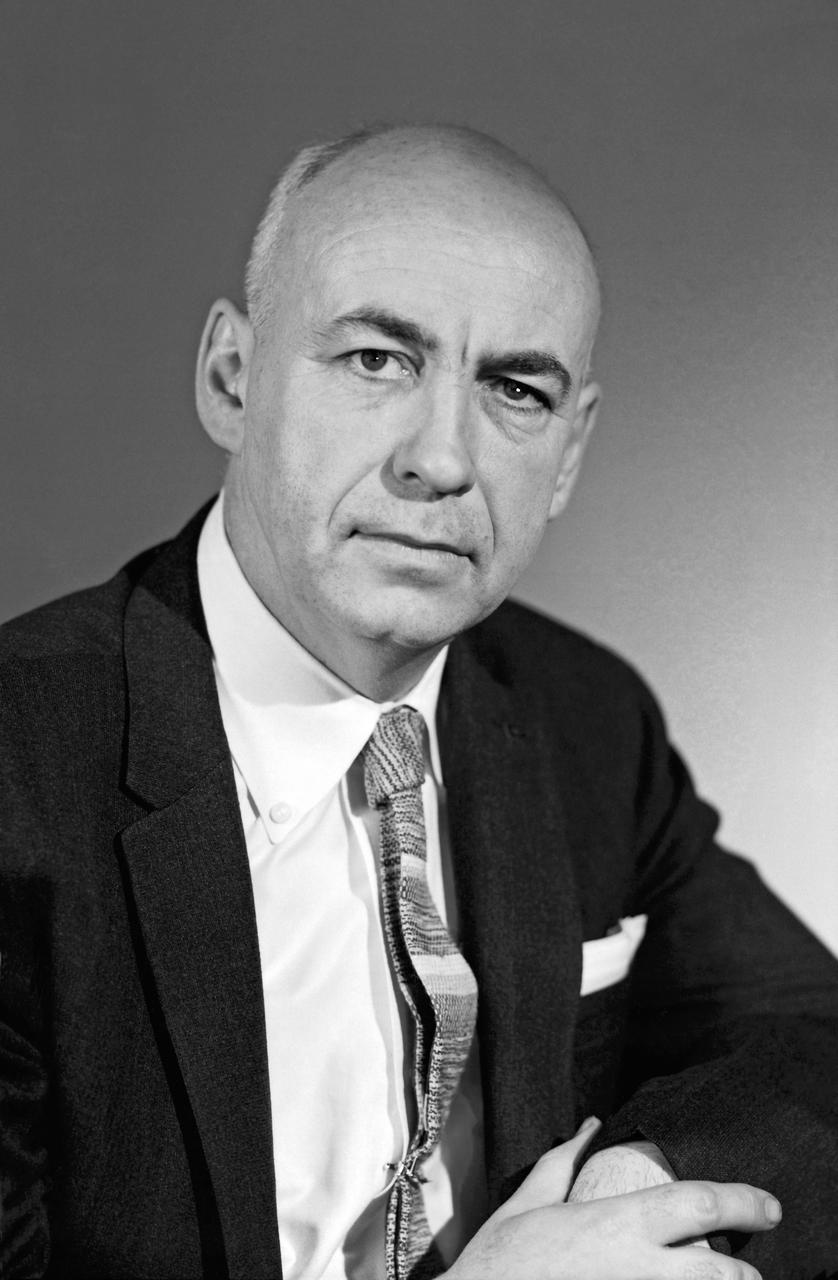
Portrait of Robert R. Gilruth. More than anyone else at Langley, began to push the idea that manned spaceflight was the next great challenge for aeronautic engineers. As head of NASA s Space Task Group, he was responsible for planning and carrying out Project Mercury, the country's first manned spaceflight program. Photograph published in Engineer in Charge: A History of the Langley Aeronautical Laboratory, 1917-1958 by James R. Hansen. Page 386.
Portrait of Robert R. Gilruth
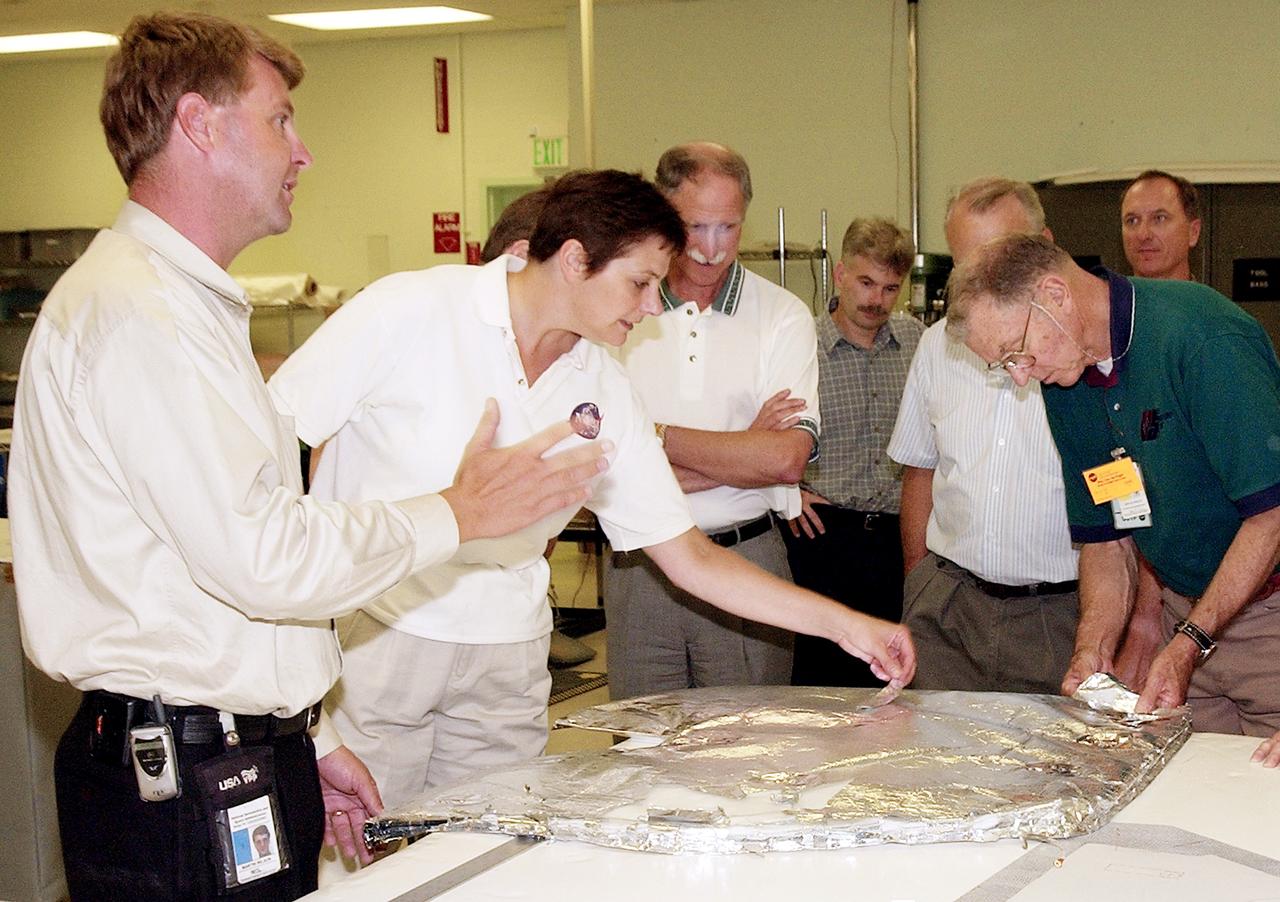
KENNEDY SPACE CENTER, FLA.  -  Martin Wilson, with United Space Alliance, describes an orbiter’s Thermal Protection System for members of the Stafford-Covey Return to Flight Task Group (SCTG).  Handling some of the blanket insulation are Dr. Kathryn Clark and Joe Engle.  Third from left is Richard Covey, former Space Shuttle commander, who is co-chair of the  SCTG, along with Thomas P. Stafford, Apollo commander.  Chartered by NASA Administrator Sean O’Keefe, the task group will perform an independent assessment of NASA’s implementation of the final recommendations by the Columbia Accident Investigation Board.
KENNEDY SPACE CENTER, FLA. - Martin Wilson, with United Space Alliance, describes an orbiter’s Thermal Protection System for members of the Stafford-Covey Return to Flight Task Group (SCTG). Handling some of the blanket insulation are Dr. Kathryn Clark and Joe Engle. Third from left is Richard Covey, former Space Shuttle commander, who is co-chair of the SCTG, along with Thomas P. Stafford, Apollo commander. Chartered by NASA Administrator Sean O’Keefe, the task group will perform an independent assessment of NASA’s implementation of the final recommendations by the Columbia Accident Investigation Board.
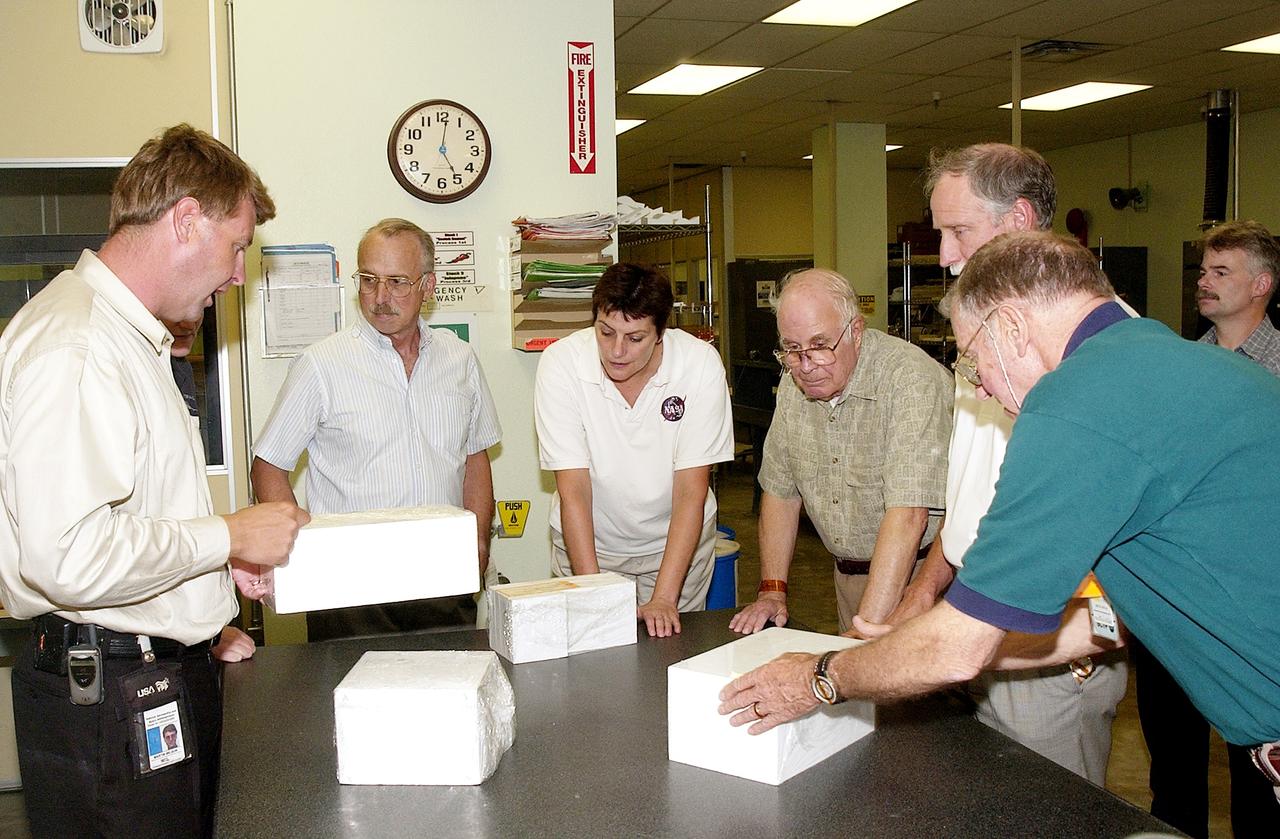
KENNEDY SPACE CENTER, FLA.  -  On a tour of the Tile Shop, members of the Stafford-Covey Return to Flight Task Group (SCTG) learn about PU-tiles, part of an orbiter’s Thermal Protection System.   At left is Martin Wilson, with United Space Alliance.  Others (left to right) around the table are James Adamson, Dr. Kathryn Clark, William Wegner, Richard Covey and Joe Engle.  Covey, former Space Shuttle commander, is co-chair of the  SCTG, along with Thomas P. Stafford, Apollo commander.  Chartered by NASA Administrator Sean O’Keefe, the task group will perform an independent assessment of NASA’s implementation of the final recommendations by the Columbia Accident Investigation Board.
KENNEDY SPACE CENTER, FLA. - On a tour of the Tile Shop, members of the Stafford-Covey Return to Flight Task Group (SCTG) learn about PU-tiles, part of an orbiter’s Thermal Protection System. At left is Martin Wilson, with United Space Alliance. Others (left to right) around the table are James Adamson, Dr. Kathryn Clark, William Wegner, Richard Covey and Joe Engle. Covey, former Space Shuttle commander, is co-chair of the SCTG, along with Thomas P. Stafford, Apollo commander. Chartered by NASA Administrator Sean O’Keefe, the task group will perform an independent assessment of NASA’s implementation of the final recommendations by the Columbia Accident Investigation Board.
KENNEDY SPACE CENTER, FLA.  -  NASA worker Joy Huff (right) shows a leading edge subsystems (LESS) with tile bonded to it to members of the Stafford-Covey Return to Flight Task Group (SCTG).  From left are Dr. Amy Donahue, David Lengyel, Dr. Kathryn Clark,  Richard Covey, former Space Shuttle commander, and William Wegner.  Covey is co-chair of the SCTG along with Thomas P. Stafford, Apollo commander.  Chartered by NASA Administrator Sean O’Keefe, the task group will perform an independent assessment of NASA’s implementation of the final recommendations by the Columbia Accident Investigation Board.
KENNEDY SPACE CENTER, FLA. - NASA worker Joy Huff (right) shows a leading edge subsystems (LESS) with tile bonded to it to members of the Stafford-Covey Return to Flight Task Group (SCTG). From left are Dr. Amy Donahue, David Lengyel, Dr. Kathryn Clark, Richard Covey, former Space Shuttle commander, and William Wegner. Covey is co-chair of the SCTG along with Thomas P. Stafford, Apollo commander. Chartered by NASA Administrator Sean O’Keefe, the task group will perform an independent assessment of NASA’s implementation of the final recommendations by the Columbia Accident Investigation Board.
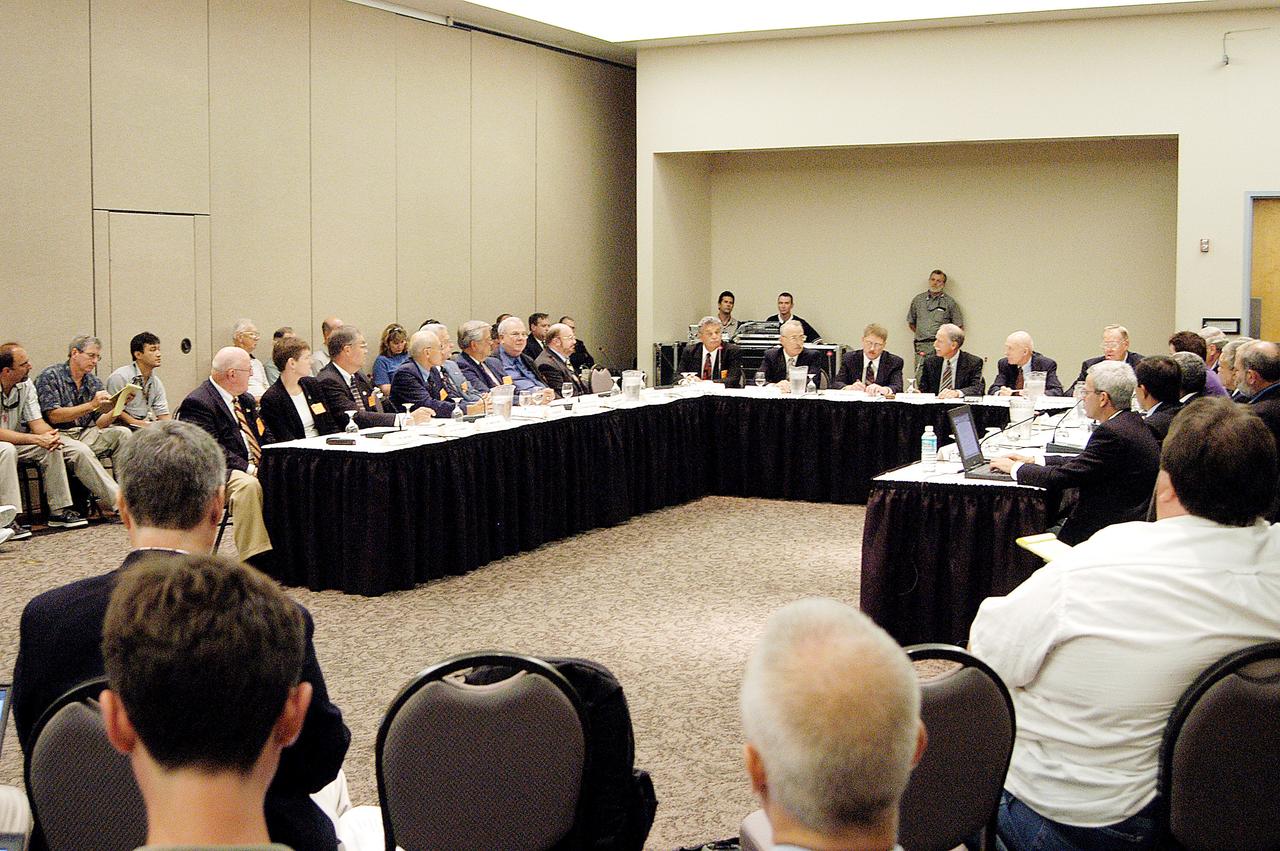
KENNEDY SPACE CENTER, FLA.  - The Return To Flight Task Group (RTFTG) holds the first public meeting at the Debus Center, KSC Visitor Complex.  Shown at the table on the left are Dr. Amy K. Donahue, James D. Lloyd, Robert Sieck, retired Air Force Lt. Gen. Forrest C. McCartney, Richard Kohrs, Sy Rubenstein and Dr. Charles C. Daniel.  The group is co-chaired by former Shuttle commander Richard O. Covey and retired Air Force Lt. Gen. Thomas P. Stafford, who was an Apollo commander.   The RTFTG was at KSC to conduct organizational activities, tour Space Shuttle facilities and receive briefings on Shuttle-related topics.  The task group was chartered by NASA Administrator Sean O’Keefe to perform an independent assessment of NASA’s implementation of the final recommendations of the Columbia Accident Investigation Board.
KENNEDY SPACE CENTER, FLA. - The Return To Flight Task Group (RTFTG) holds the first public meeting at the Debus Center, KSC Visitor Complex. Shown at the table on the left are Dr. Amy K. Donahue, James D. Lloyd, Robert Sieck, retired Air Force Lt. Gen. Forrest C. McCartney, Richard Kohrs, Sy Rubenstein and Dr. Charles C. Daniel. The group is co-chaired by former Shuttle commander Richard O. Covey and retired Air Force Lt. Gen. Thomas P. Stafford, who was an Apollo commander. The RTFTG was at KSC to conduct organizational activities, tour Space Shuttle facilities and receive briefings on Shuttle-related topics. The task group was chartered by NASA Administrator Sean O’Keefe to perform an independent assessment of NASA’s implementation of the final recommendations of the Columbia Accident Investigation Board.
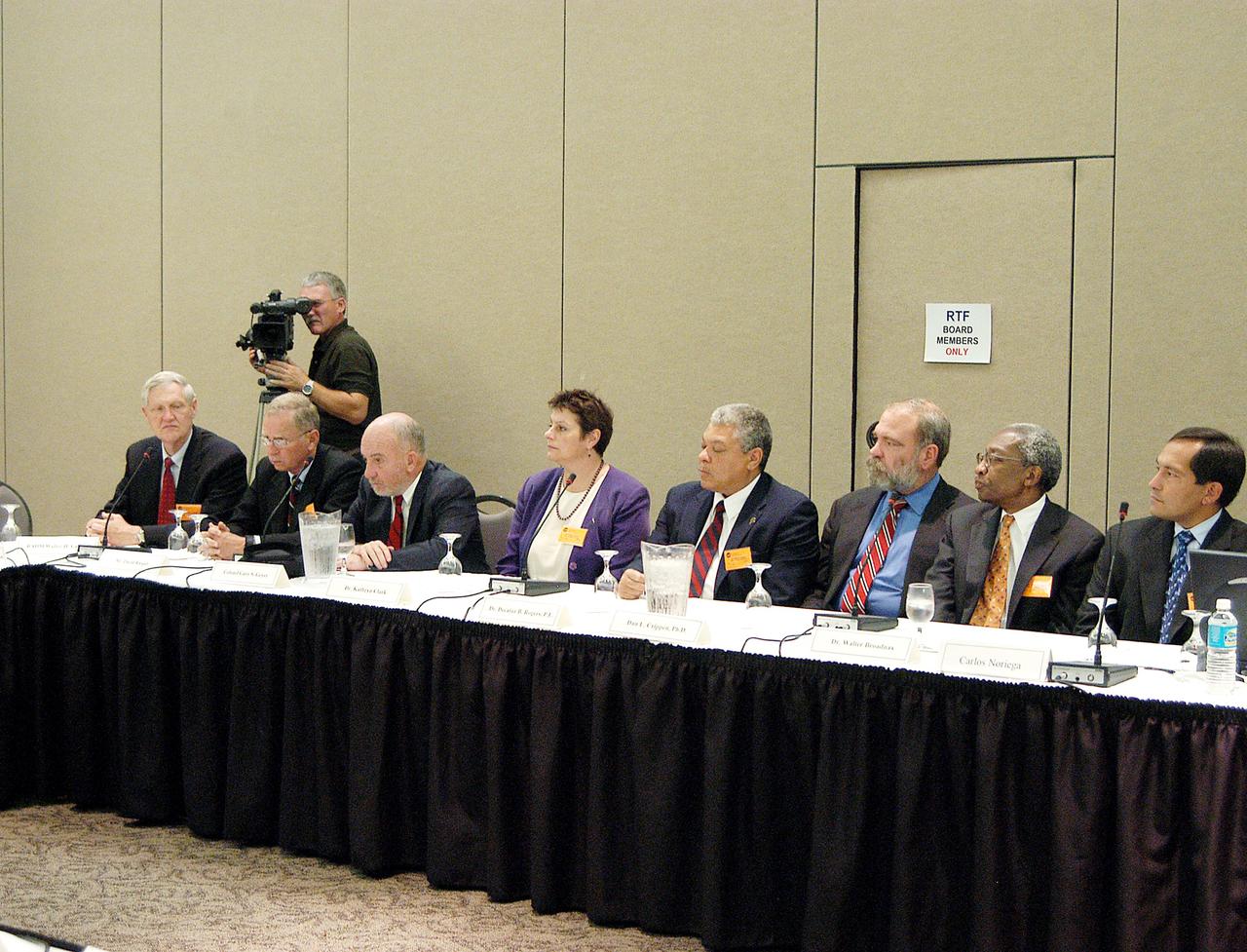
KENNEDY SPACE CENTER, FLA.  -  The Return To Flight Task Group (RTFTG) holds the first public meeting at the Debus Center, KSC Visitor Complex.  Members and staff at the table, from left, are retired Navy Rear Adm. Walter H. Cantrell, David Raspet, retired Air Force Col. Gary S. Geyer, Dr. Kathryn Clark, Dr. Decatur B. Rogers, Dr. Dan L. Crippen, Dr. Walter Broadnax and astronaut Carlos Noriega.  The RTFTG was at KSC to conduct organizational activities, tour Space Shuttle facilities and receive briefings on Shuttle-related topics.  The task group was chartered by NASA Administrator Sean O’Keefe to perform an independent assessment of NASA’s implementation of the final recommendations of the Columbia Accident Investigation Board.  The group is co-chaired by former Shuttle commander Richard O. Covey and retired Air Force Lt. Gen. Thomas P. Stafford, who was an Apollo commander.
KENNEDY SPACE CENTER, FLA. - The Return To Flight Task Group (RTFTG) holds the first public meeting at the Debus Center, KSC Visitor Complex. Members and staff at the table, from left, are retired Navy Rear Adm. Walter H. Cantrell, David Raspet, retired Air Force Col. Gary S. Geyer, Dr. Kathryn Clark, Dr. Decatur B. Rogers, Dr. Dan L. Crippen, Dr. Walter Broadnax and astronaut Carlos Noriega. The RTFTG was at KSC to conduct organizational activities, tour Space Shuttle facilities and receive briefings on Shuttle-related topics. The task group was chartered by NASA Administrator Sean O’Keefe to perform an independent assessment of NASA’s implementation of the final recommendations of the Columbia Accident Investigation Board. The group is co-chaired by former Shuttle commander Richard O. Covey and retired Air Force Lt. Gen. Thomas P. Stafford, who was an Apollo commander.
KENNEDY SPACE CENTER, FLA.  -  The Return To Flight Task Group (RTFTG) holds the first public meeting at the Debus Center, KSC Visitor Complex.  Members and staff at this table, from left, are Joseph W. Cuzzupolui, retired Army Col. James C. Adamson, David Lenyel, co-chairs Richard O. Covey and retired Air Force Lt. Gen. Thomas Stafford, and retired Air Force Maj. Gen. Ralph H. Jacobson.  Covey is a former astronaut and Shuttle commander.  Stafford is a former astronaut and Apollo commander.  The RTFTG was at KSC to conduct organizational activities, tour Space Shuttle facilities and receive briefings on Shuttle-related topics.  The task group was chartered by NASA Administrator Sean O’Keefe to perform an independent assessment of NASA’s implementation of the final recommendations of the Columbia Accident Investigation Board.
KENNEDY SPACE CENTER, FLA. - The Return To Flight Task Group (RTFTG) holds the first public meeting at the Debus Center, KSC Visitor Complex. Members and staff at this table, from left, are Joseph W. Cuzzupolui, retired Army Col. James C. Adamson, David Lenyel, co-chairs Richard O. Covey and retired Air Force Lt. Gen. Thomas Stafford, and retired Air Force Maj. Gen. Ralph H. Jacobson. Covey is a former astronaut and Shuttle commander. Stafford is a former astronaut and Apollo commander. The RTFTG was at KSC to conduct organizational activities, tour Space Shuttle facilities and receive briefings on Shuttle-related topics. The task group was chartered by NASA Administrator Sean O’Keefe to perform an independent assessment of NASA’s implementation of the final recommendations of the Columbia Accident Investigation Board.
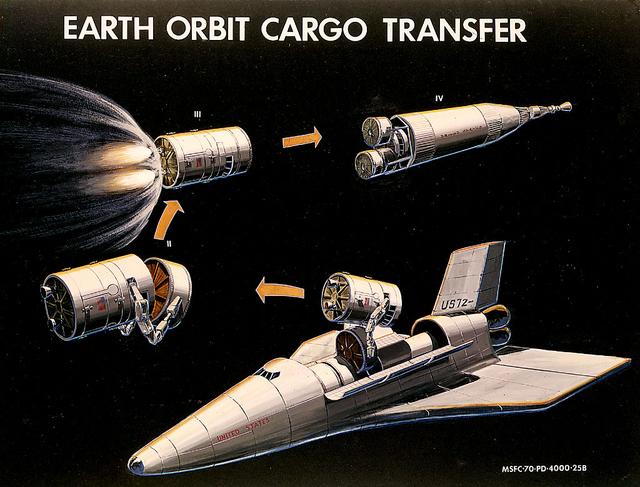
This 1969 artist's concept illustrates the use of three major elements of NASA's Integrated program, as proposed by President Nixon's Space Task Group. In Phases I and II, a Space Tug with a manipulator-equipped crew module removes a cargo module from an early Space Shuttle Orbiter and docks with it. In Phases III and IV, the Space Tug with attached cargo module flys toward a Nuclear Shuttle. As a result of the Space Task Group's recommendations for more commonality and integration in the American space program, Marshall Space Flight Center engineers studied many of the spacecraft depicted here.
Early Program Development
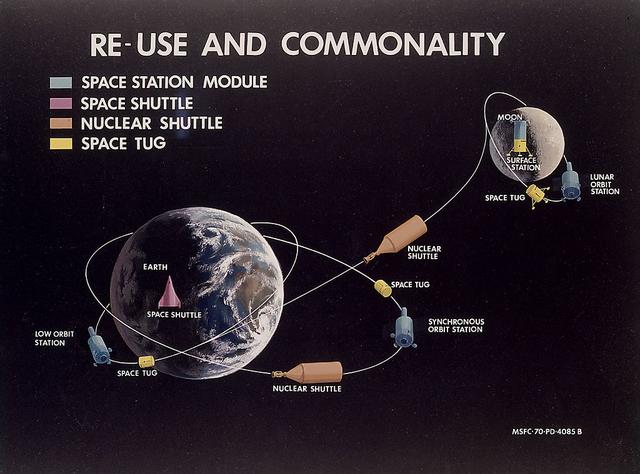
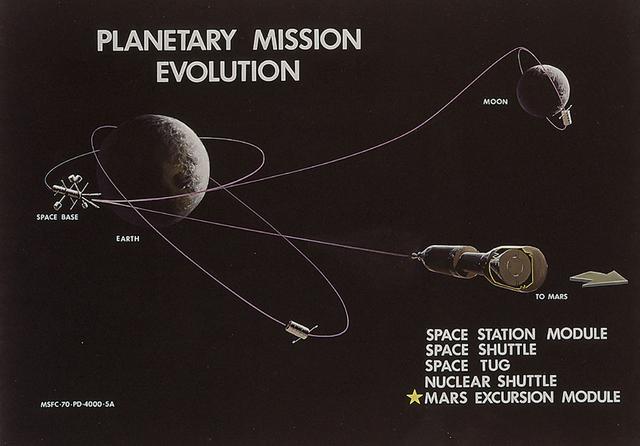
This 1970 artist's concept illustrates the use of the Space Shuttle, Nuclear Shuttle, and Space Tug in NASA's Integrated Program. As a result of the Space Task Group's recommendations for more commonality and integration in the American space program, Marshall Space Flight Center engineers studied many of the spacecraft depicted here.
Early Program Development
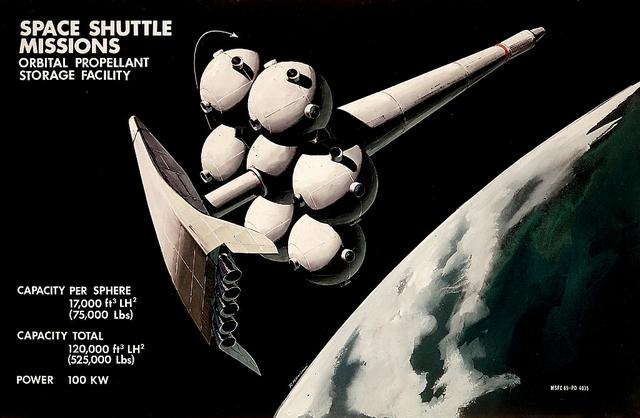
As part of the Space Task Group's recommendations for more commonality and integration in America's space program, Marshall Space Flight Center engineers proposed an orbiting propellant storage facility to augment Space Shuttle missions. In this artist's concept from 1969 an early version of the Space Shuttle is shown refueling at the facility.
Early Program Development
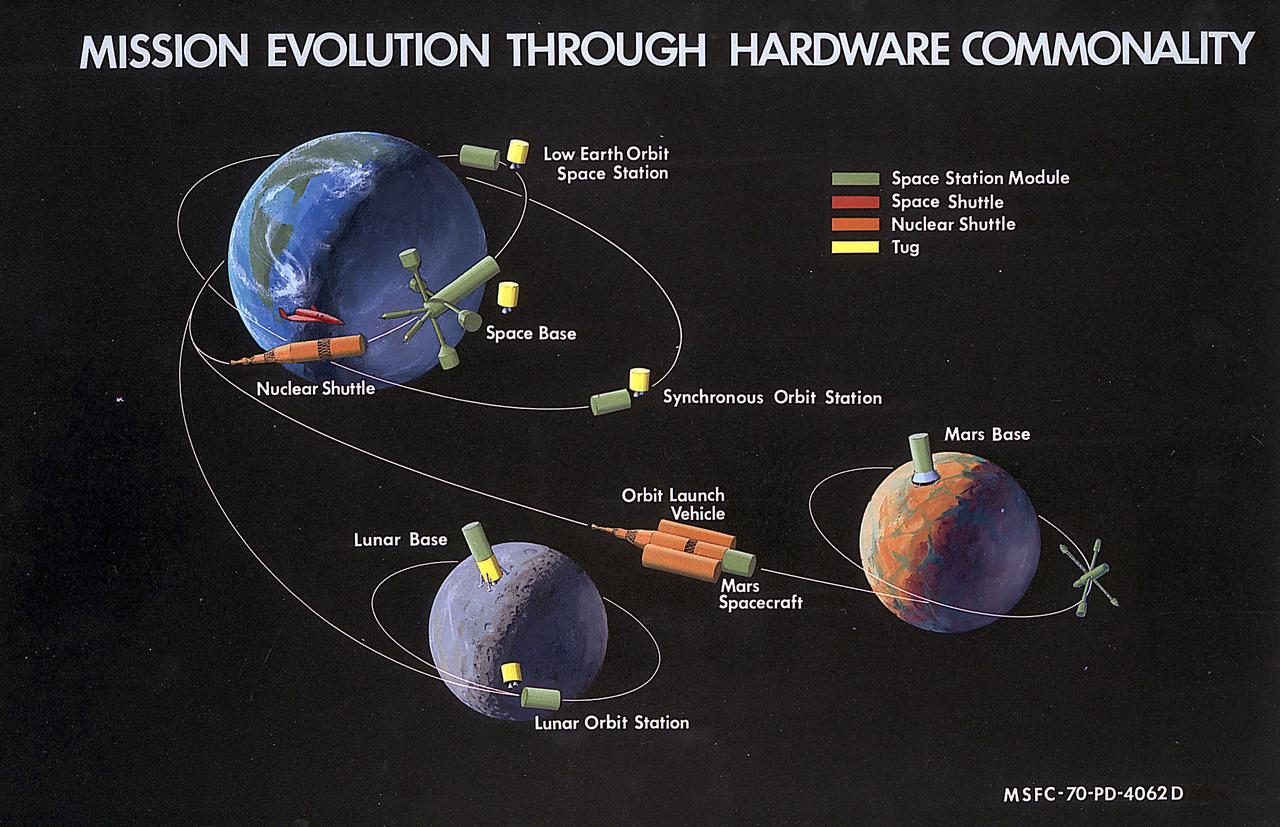
In this artist's concept from 1970, propulsion concepts such as the Nuclear Shuttle and Space Tug are shown in conjunction with other proposed spacecraft. As a result of the recommendations from President Nixon's Space Task Group for more commonality and integration in the American space program, Marshall Space Flight engineers studied many of the spacecraft depicted here.
Early Program Development
As part of the Space Task Group's recommendations for more commonality and integration in America's space program, Marshall Space Flight Center engineers proposed the use of a Nuclear Shuttle in conjunction with a space station module, illustrated in this 1970 artist's concept, as the basis for a Mars excursion module.
Early Program Development
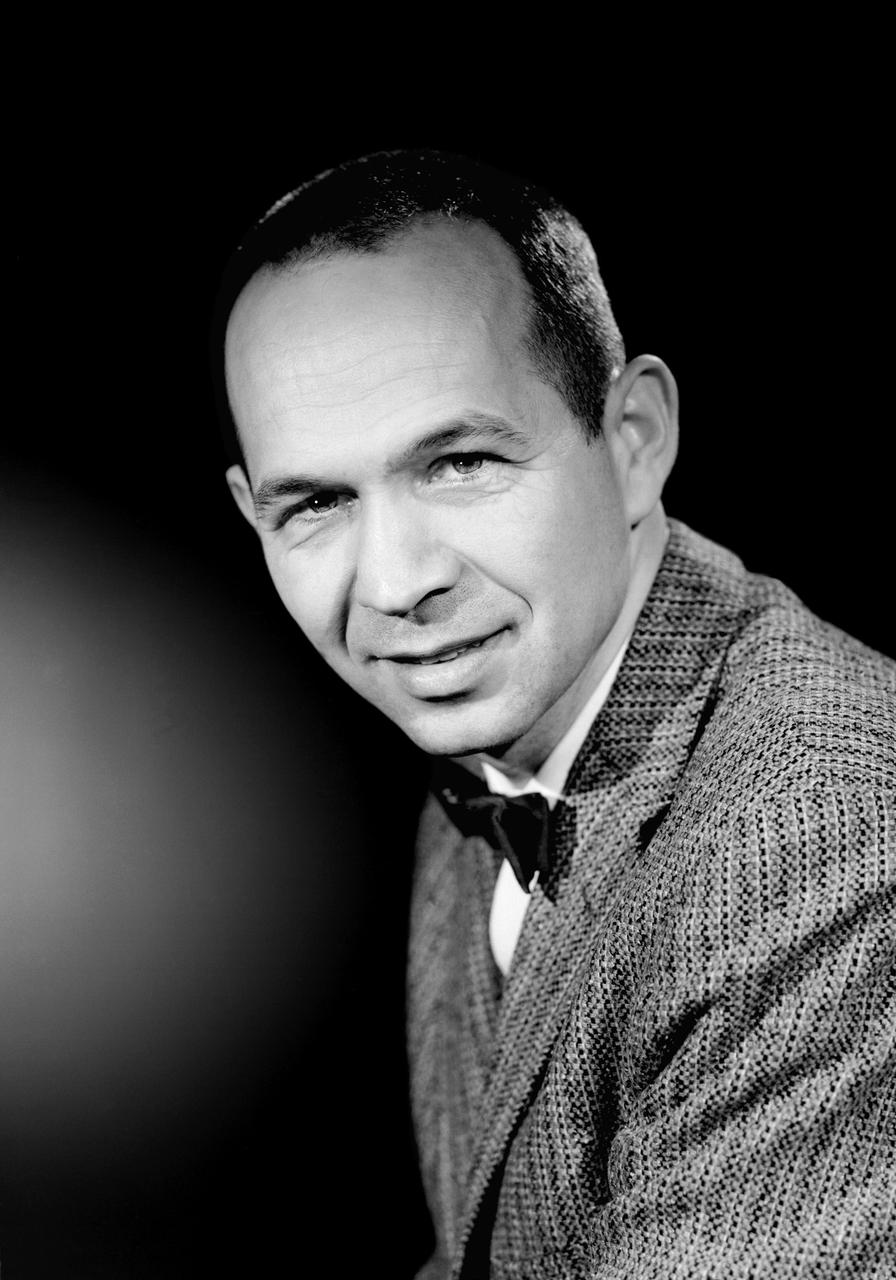
L59-1497-6 Maxime A. Faget was born in British Honduras in 1921, the son of an honored physician of the U.S. Public Health Service. In 1943 he earned a B.S. in mechanical engineering from Louisiana State University. After service as a navy submarine officer, he joined the Langley staff in 1946 as a member of the Pilotless Aircraft Research Division. His early work for PARD involved the invention of choking inlets for ramjets and a flight Mach meter. Photograph published in Engineer in Charge: A History of the Langley Aeronautical Laboratory, 1917-1958 by James R. Hansen. Page 379.
Maxime A. Faget Portrait
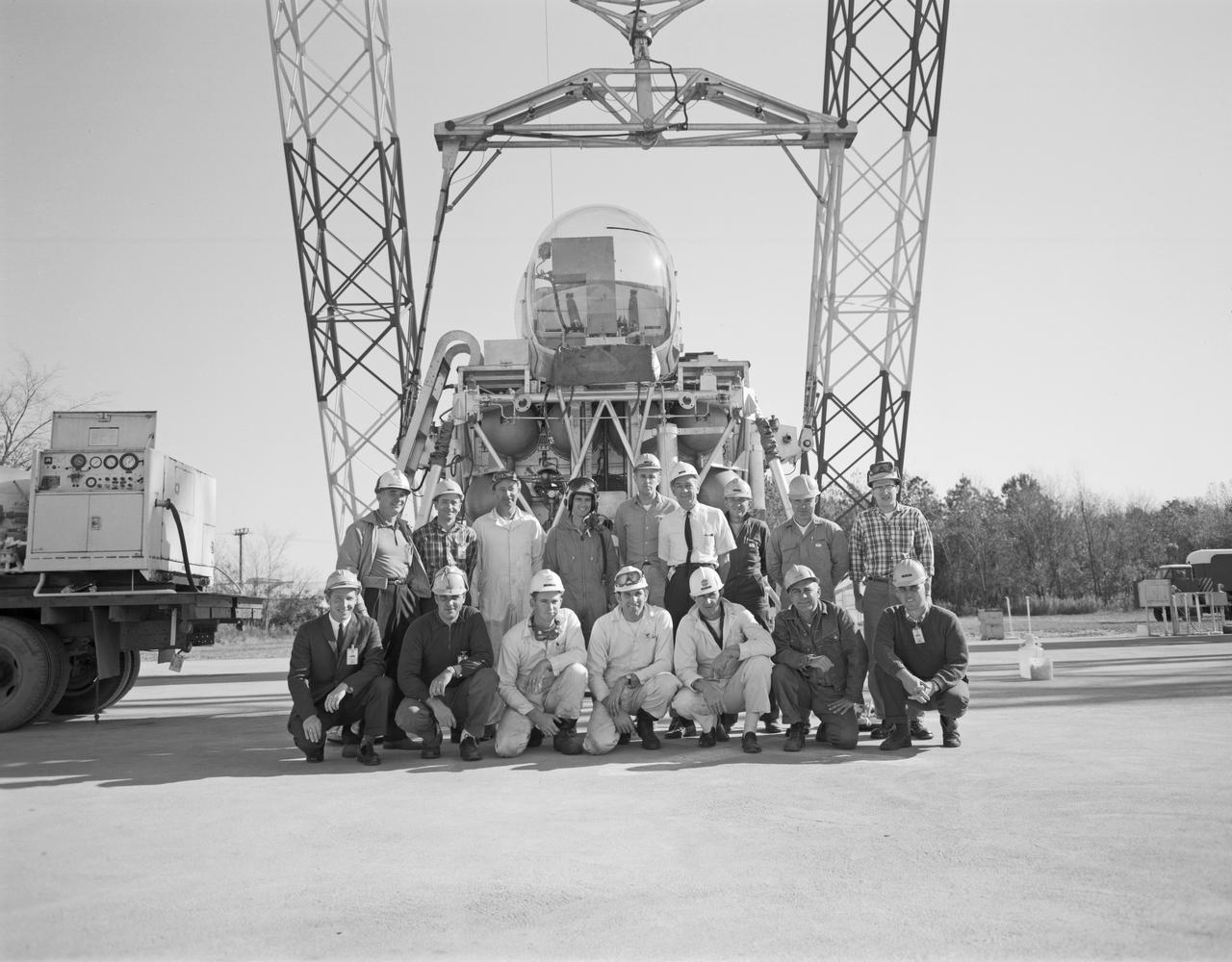
Group photo with crew and Astronaut Roger Chaffee at Lunar Lander Research Facility.  Chaffee was one of the third group of astronauts selected by NASA in October 1963. In addition to participating in the overall training program, he was also tasked with working on flight control communications systems, instrumentation systems, and attitude and translation control systems in the Apollo Branch of the Astronaut office. On March 21, 1966, he was selected as one of the pilots for the AS-204 mission, the first 3-man Apollo flight. Lieutenant Commander Chaffee died on January 27, 1967, in the Apollo spacecraft flash fire during a launch pad test at Kennedy Space Center, Florida.
Astronaut Roger Chaffee at Lunar Lander Research Facility
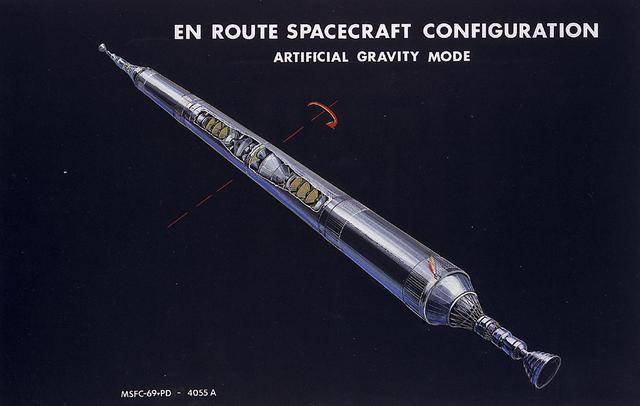
As a result of the recommendations from President Nixon's Space Task Group, Marshall Space Flight Center engineers studied various ways to enhance commonality and integration in the American space program. This artist's concept from 1969 shows a possible spacecraft configuration for a marned Mars mission. In this mode, two planetary vehicles, each powered by a Nuclear Shuttle, are joined together during the flight and rotated to provide artificial gravity for crew members.
Early Program Development
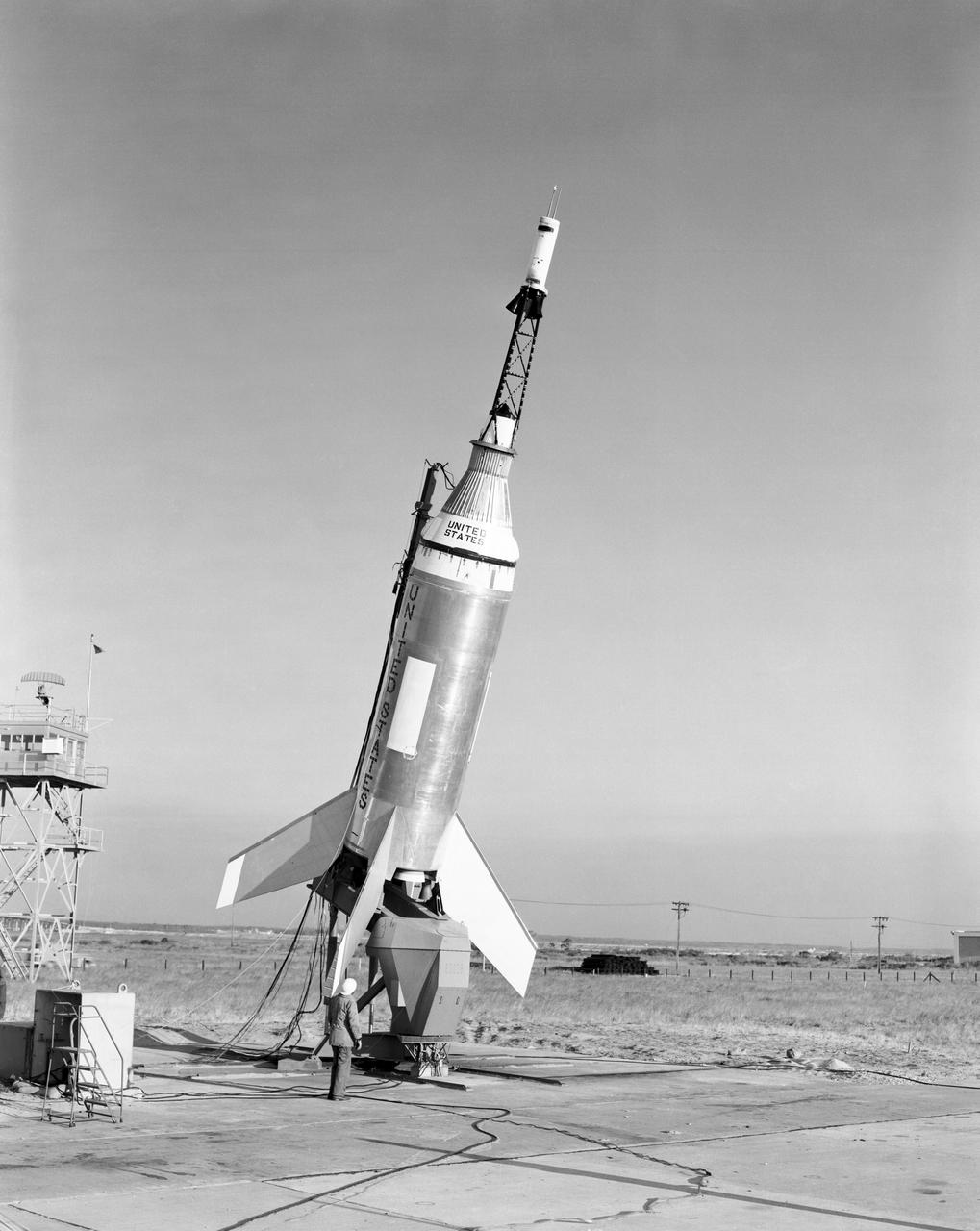
The Little Joe launch vehicle being readied for a test launch from Wallops in January 1960... Page 77. Photograph published in Winds of Change, 75th Anniversary NASA publication, by James Schultz. **note - see L59-5137 page 77 also. Photograph published in Engineer in Charge: A History of the Langley Aeronautical Laboratory, 1917-1958 by James R. Hansen. Page 389.  ...was conceived by Langley engineers Max Faget and Paul Purser even before STG (Space Task Group) was organized.
Little Joe on Launch Pad
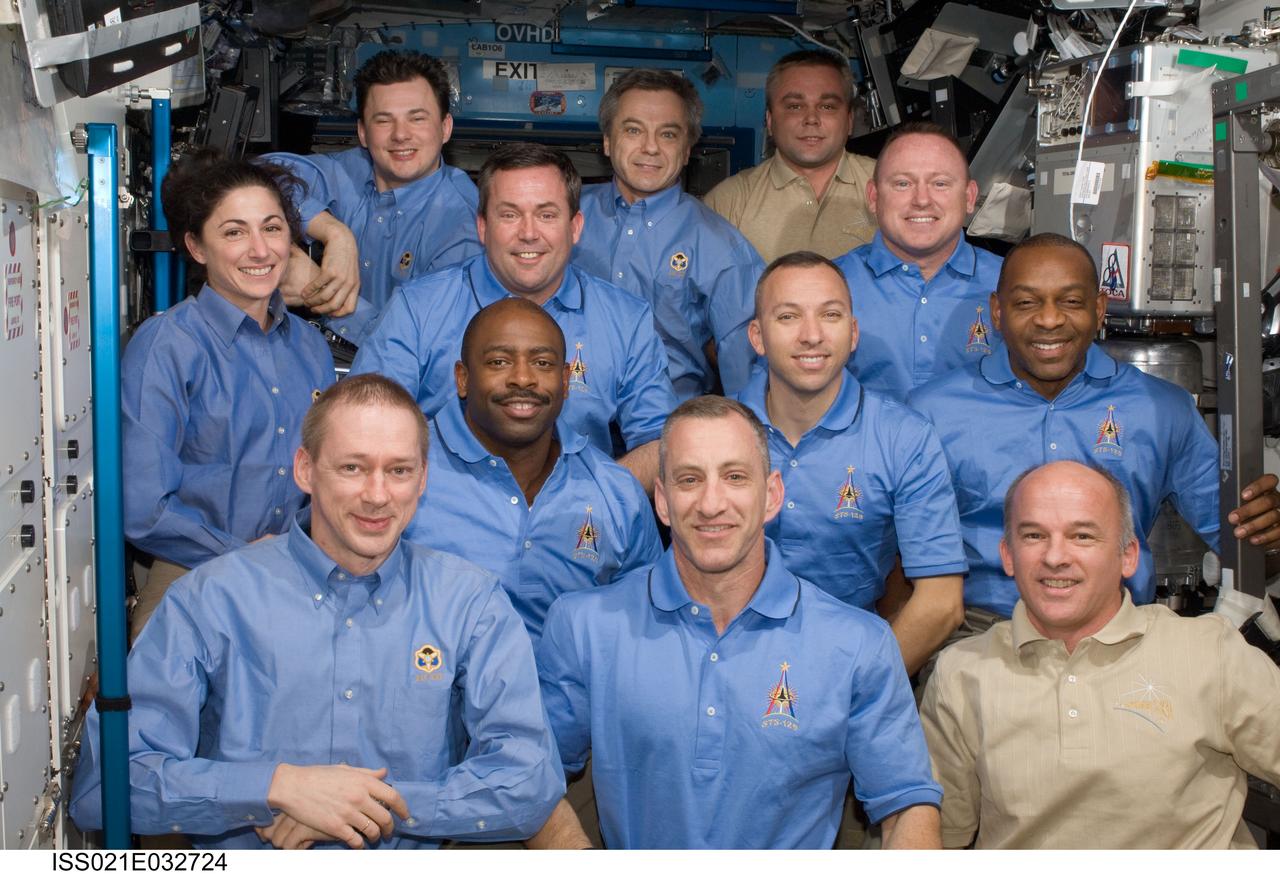
ISS021-E-032724 (24 Nov. 2009) --- One of the last occasions for these twelve internationally-represented astronauts and cosmonauts to spend time together in space was topped off with a series of group portraits aboard the International Space Station.  The group includes the seven STS-129 Atlantis astronauts Charles O. Hobaugh, commander; Barry E. Wilmore, pilot; and Nicole Stott, Mike Foreman, Leland Melvin, Robert L. Satcher Jr. and Randy Bresnik, all mission specialists, plus the five ISS crew members, Jeffrey Williams, the European Space Agency’s Frank De Winne, the Canadian Space agency’s Robert Thirsk and Russia’s Federal Space Agency cosmonauts Roman Romanenko and Maxim Suraev. The dozen are wrapping up almost a full week sharing duties, tasks and chores aimed toward complete development of the orbital outpost.
Expedition 21/STS-129 Crew Portrait in the US Lab
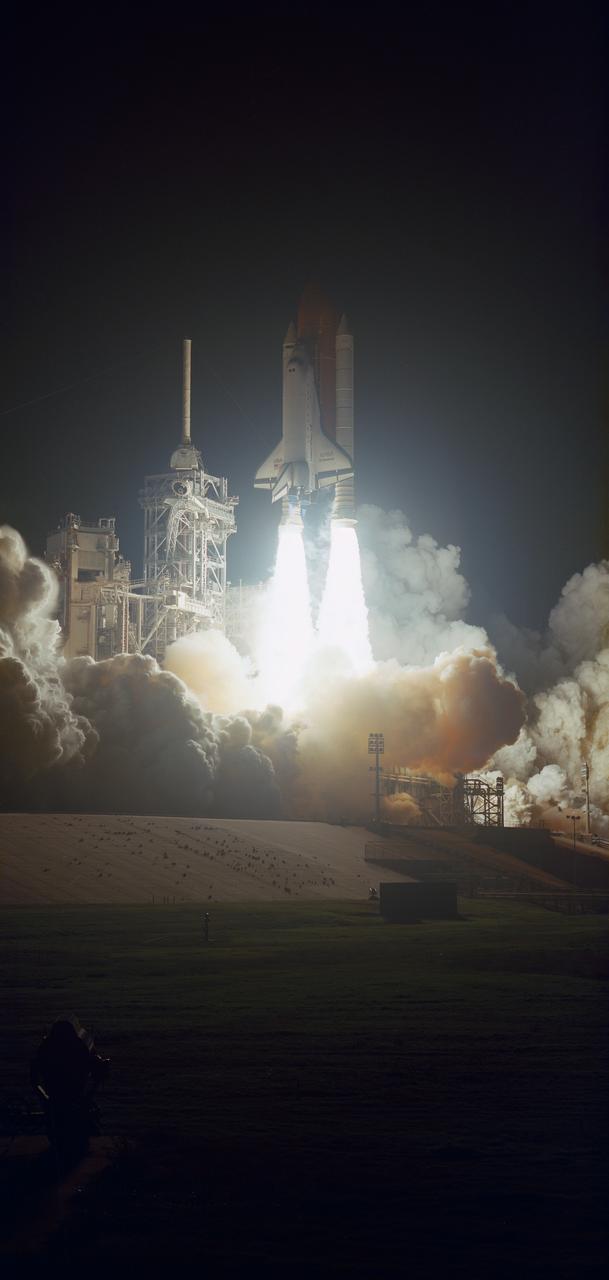
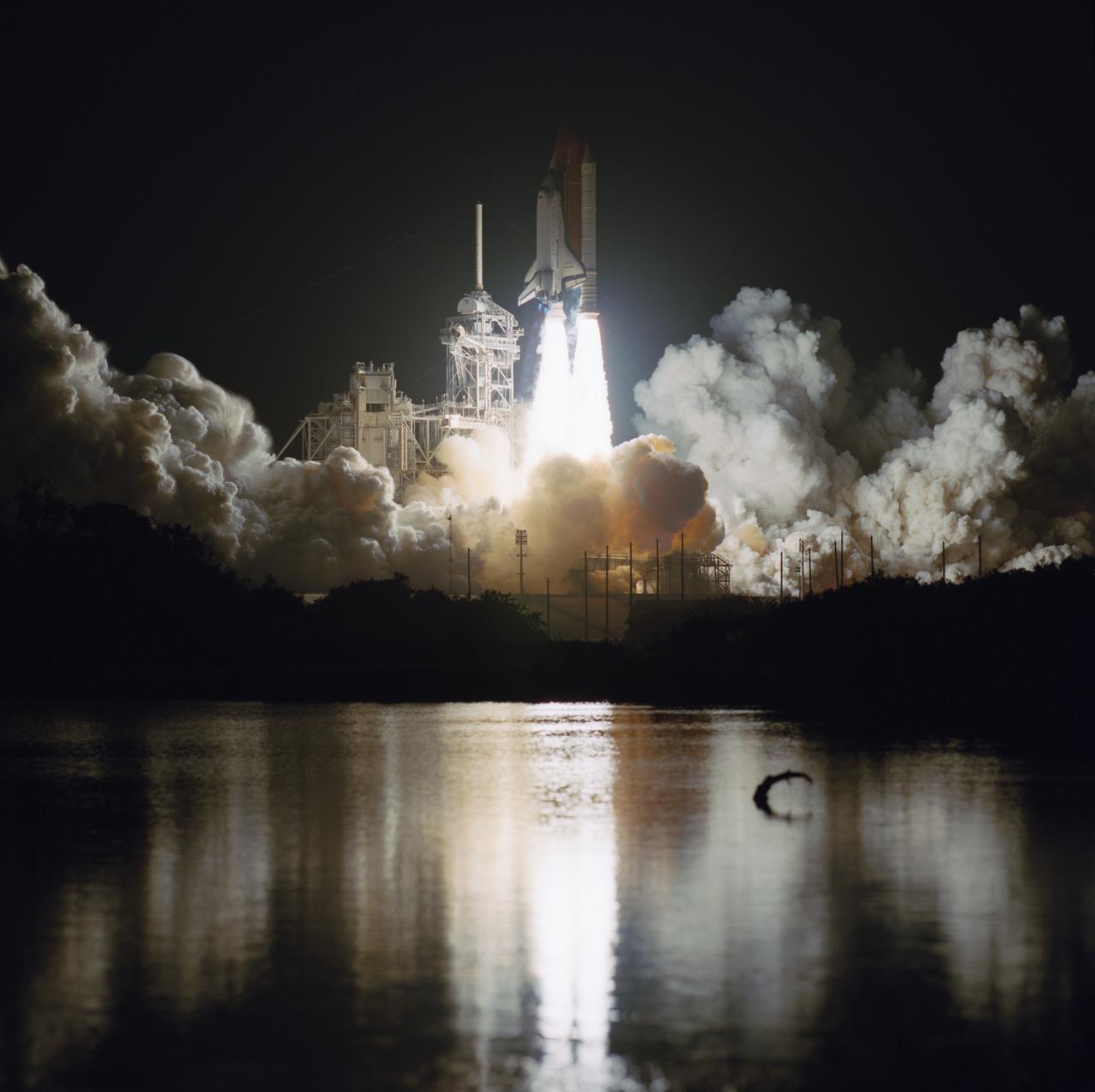
STS061-S-088 (2 Dec 1993) --- The Space Shuttle Endeavour lifts off from Launch Pad 39B with a crew of six NASA astronauts, a Swiss mission specialist and a variety of special tools aboard.  Launch occurred at 4:27:00 a.m. (EST), December 2, 1993.  The seven member crew will team to perform a variety of service tasks on the Hubble Space Telescope (HST).  Four of the group will break into pairs on alternating sessions to carry out a total of five days Extravehicular Activity (EVA).  Onboard are astronauts Richard O. Covey, Kenneth D. Bowersox, F. Story Musgrave, Kathy C. Thornton, Jeffrey A. Hoffman and Thomas D. Akers, along with Swiss scientist Claude Nicollier.
Launch of Space Shuttle Endeavour on mission STS-61
STS061-S-089 (2 Dec 1993) --- The Space Shuttle Endeavour lifts off from Launch Pad 39B with a crew of six NASA astronauts, a Swiss mission specialist and a variety of special tools aboard.  Launch occurred at 4:27:00 a.m. (EST), December 2, 1993.  The seven member crew will team to perform a variety of service tasks on the Hubble Space Telescope (HST).  Four of the group will break into pairs on alternating sessions to carry out a total of five days Extravehicular Activity (EVA).  Onboard are astronauts Richard O. Covey, Kenneth D. Bowersox, F. Story Musgrave, Kathy C. Thornton, Jeffrey A. Hoffman and Thomas D. Akers, along with Swiss scientist Claude Nicollier.
Launch of Space Shuttle Endeavour on mission STS-61
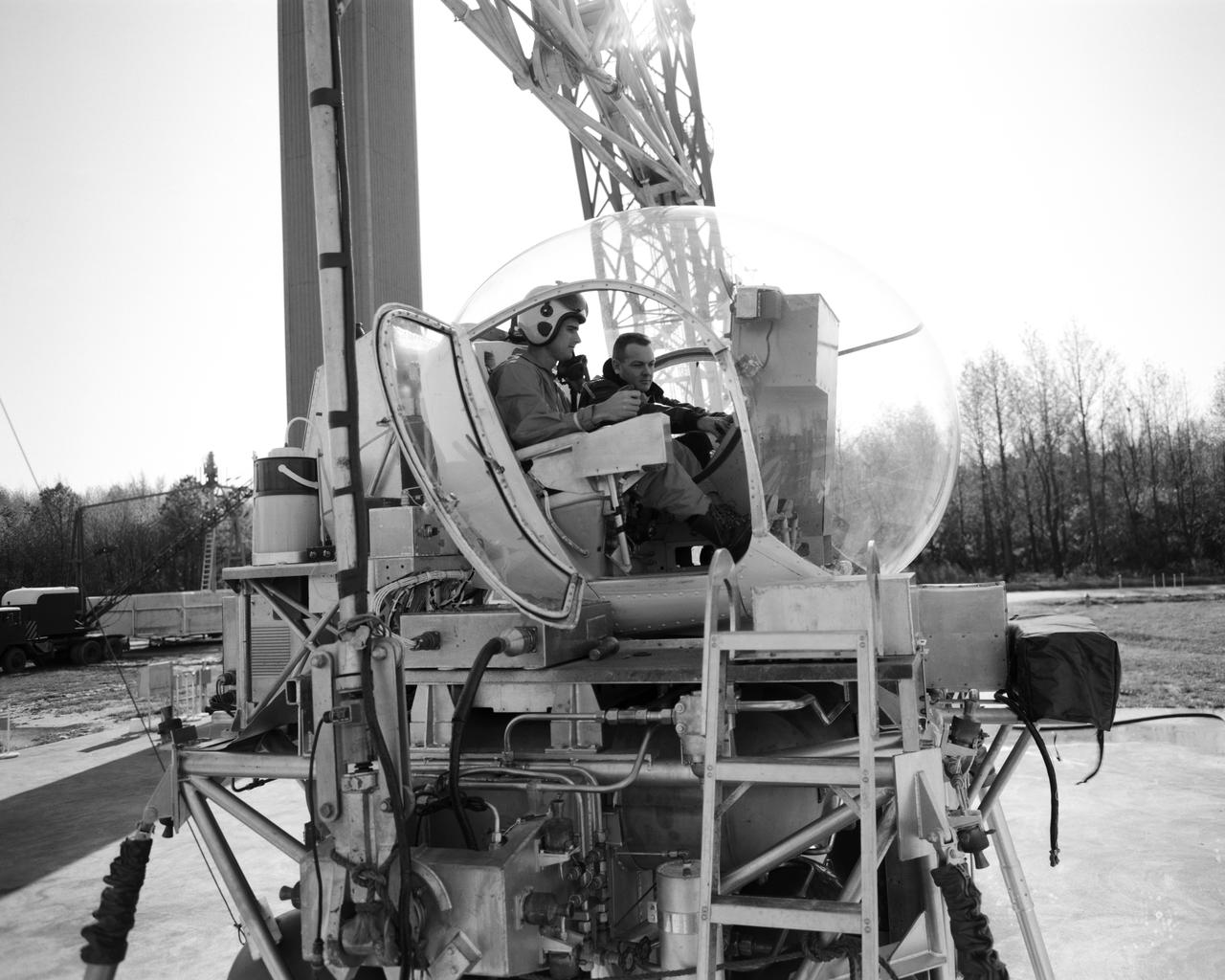
Lunar Landing Simulator: Astronaut Roger B. Chaffee (left) receives instruction from Maxwell W. Goode, a scientist at NASA s Langley Research Center. Goode is explaining the operation of the Lunar Landing Simulator at the Lunar Landing Research Facility. Chaffee was one of the third group of astronauts selected by NASA in October 1963. In addition to participating in the overall training program, he was also tasked with working on flight control communications systems, instrumentation systems, and attitude and translation control systems in the Apollo Branch of the Astronaut office. On March 21, 1966, he was selected as one of the pilots for the AS-204 mission, the first 3-man Apollo flight. Lieutenant Commander Chaffee died on January 27, 1967, in the Apollo spacecraft flash fire during a launch pad test at Kennedy Space Center, Florida.
Astronaut Roger Chaffee at Lunar Lander Research Facility
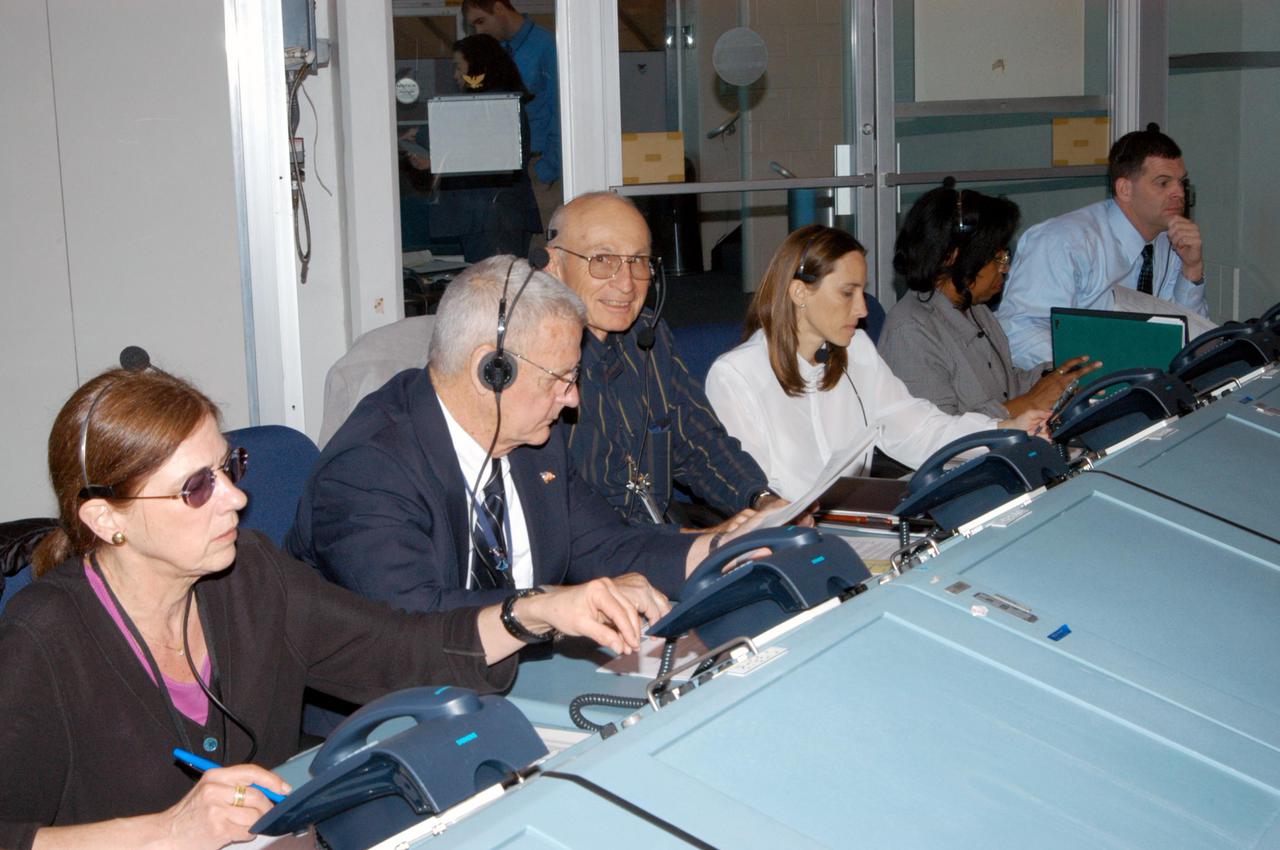
KENNEDY SPACE CENTER, FLA.  -  Space Shuttle Program managers, directors and engineers man the consoles in the Launch Control Center.  They are taking part in an End-to-End (ETE) Mission Management Team (MMT) launch simulation at KSC.  In Firing Room 1 at KSC, Shuttle launch team members put the Shuttle system through an integrated simulation. The control room is set up with software used to simulate flight and ground systems in the launch configuration.  Seated in the center is Bob Sieck, a member of the Stafford-Covey Shuttle Return to Flight Task Group; at his left is Forrest McCartney, former Kennedy Space Center director.  Sieck served as launch director and director of Shuttle Processing in the 80s and 90s.  The ETE MMT simulation included L-2 and L-1 day Prelaunch MMT meetings, an external tanking_weather briefing, and a launch countdown.  The ETE transitioned to the Johnson Space Center for the flight portion of the simulation, with the STS-114 crew in a simulator at JSC.  Such simulations are common before a launch to keep the Shuttle launch team sharp and ready for liftoff.
KSC-05pd-0358
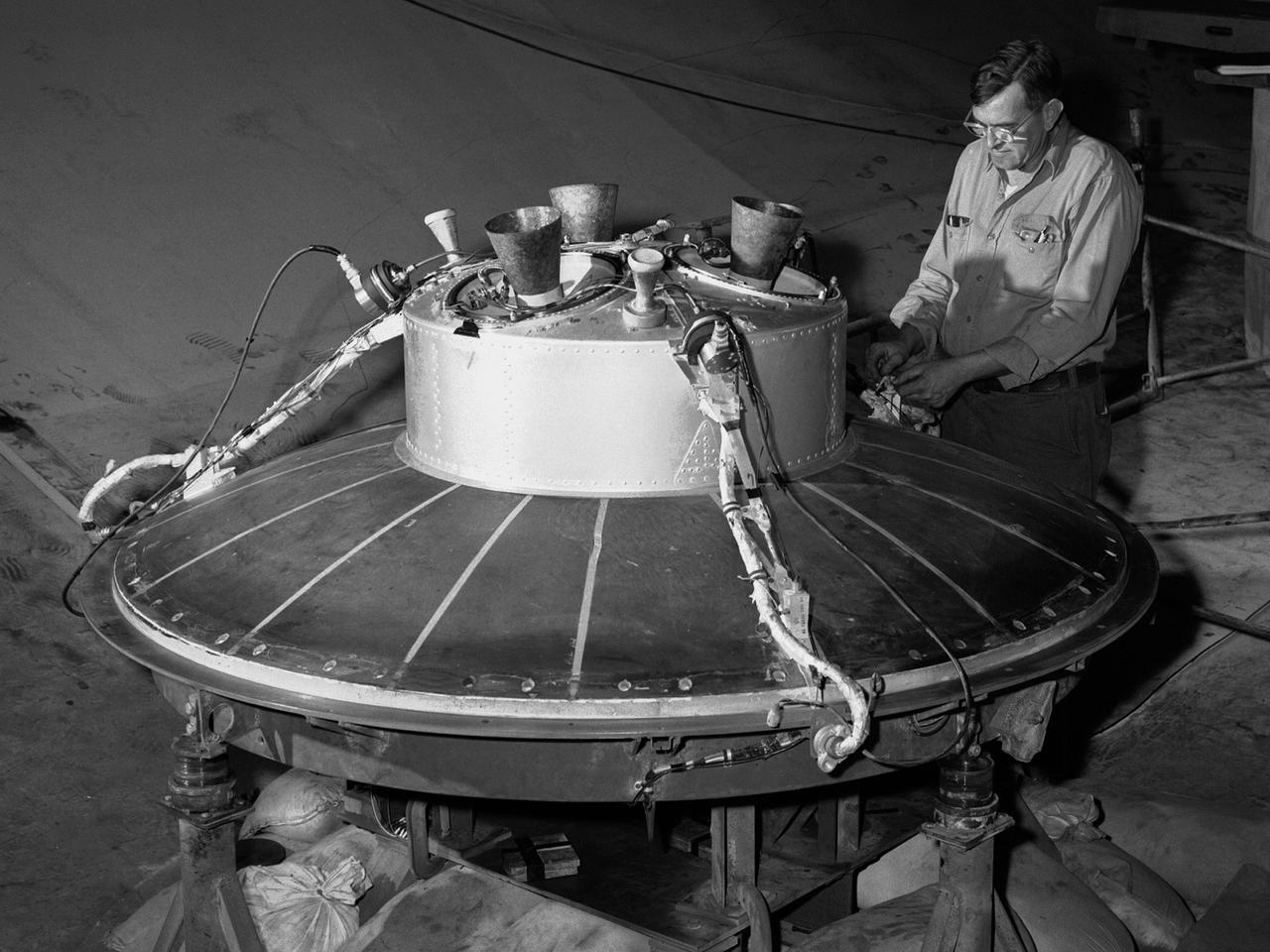
A Mercury capsule is mounted inside the Altitude Wind Tunnel for a test of its escape tower rockets at the National Aeronautics and Space Administration (NASA) Lewis Research Center. In October 1959 NASA’s Space Task Group allocated several Project Mercury assignments to Lewis. The Altitude Wind Tunnel was quickly modified so that its 51-foot diameter western leg could be used as a test chamber.     The final round of tests in the Altitude Wind Tunnel sought to determine if the smoke plume from the capsule’s escape tower rockets would shroud or compromise the spacecraft. The escape tower, a 10-foot steel rig with three small rockets, was attached to the nose of the Mercury capsule. It could be used to jettison the astronaut and capsule to safety in the event of a launch vehicle malfunction on the pad or at any point prior to separation from the booster. Once actuated, the escape rockets would fire, and the capsule would be ejected away from the booster. After the capsule reached its apex of about 2,500 feet, the tower, heatshield, retropackage, and antenna would be ejected and a drogue parachute would be released.    Flight tests of the escape system were performed at Wallops Island as part of the series of Little Joe launches. Although the escape rockets fired prematurely on Little Joe’s first attempt in August 1959, the January 1960 follow-up was successful.
Project Mercury Escape Tower Rockets Tests
A mechanic at the National Aeronautics and Space Administration (NASA) Lewis Research Center prepares the inverted base of a Mercury capsule for a test of its posigrade retrorockets inside the Altitude Wind Tunnel. In October 1959 NASA’s Space Task Group allocated several Project Mercury assignments to Lewis. The Altitude Wind Tunnel was modified to test the Atlas separation system, study the escape tower rocket plume, train astronauts to bring a spinning capsule under control, and calibrate the capsule’s retrorockets. The turning vanes, makeup air pipes, and cooling coils were removed from the wide western end of the tunnel to create a 51-foot diameter test chamber.    The Mercury capsule had a six-rocket retro-package affixed to the bottom of the capsule. Three of these were posigrade rockets used to separate the capsule from the booster and three were retrograde rockets used to slow the capsule for reentry into the earth’s atmosphere. Performance of the retrorockets was vital since there was no backup system.     Qualification tests of the retrorockets began in April 1960 on a retrograde thrust stand inside the southwest corner of the Altitude Wind Tunnel. These studies showed that a previous issue concerning the delayed ignition of the propellant had been resolved. Follow-up test runs verified reliability of the igniter’s attachment to the propellant. In addition, the capsule’s retrorockets were calibrated so they would not alter the capsule’s attitude when fired.
Mercury Capsule Retrorocket Test in the Altitude Wind Tunnel
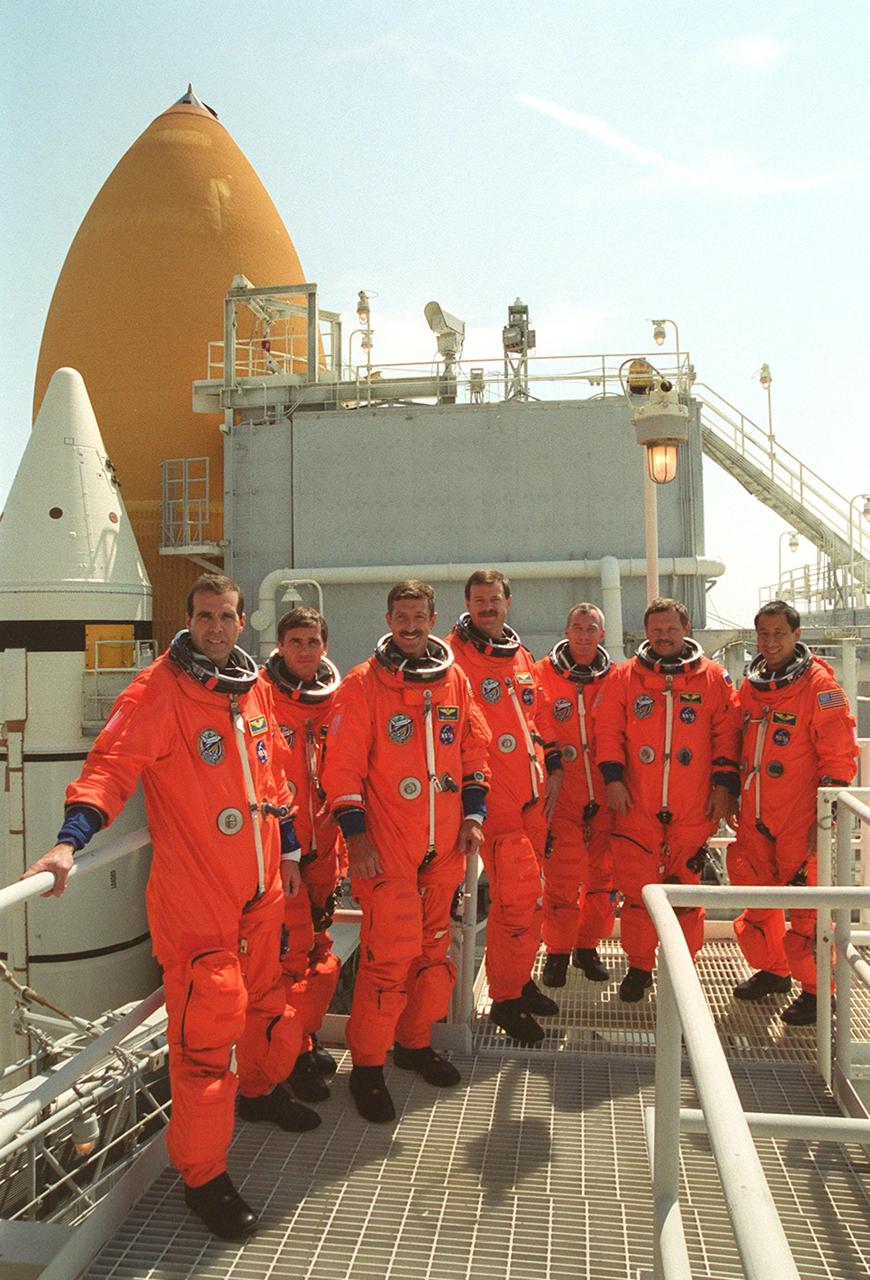
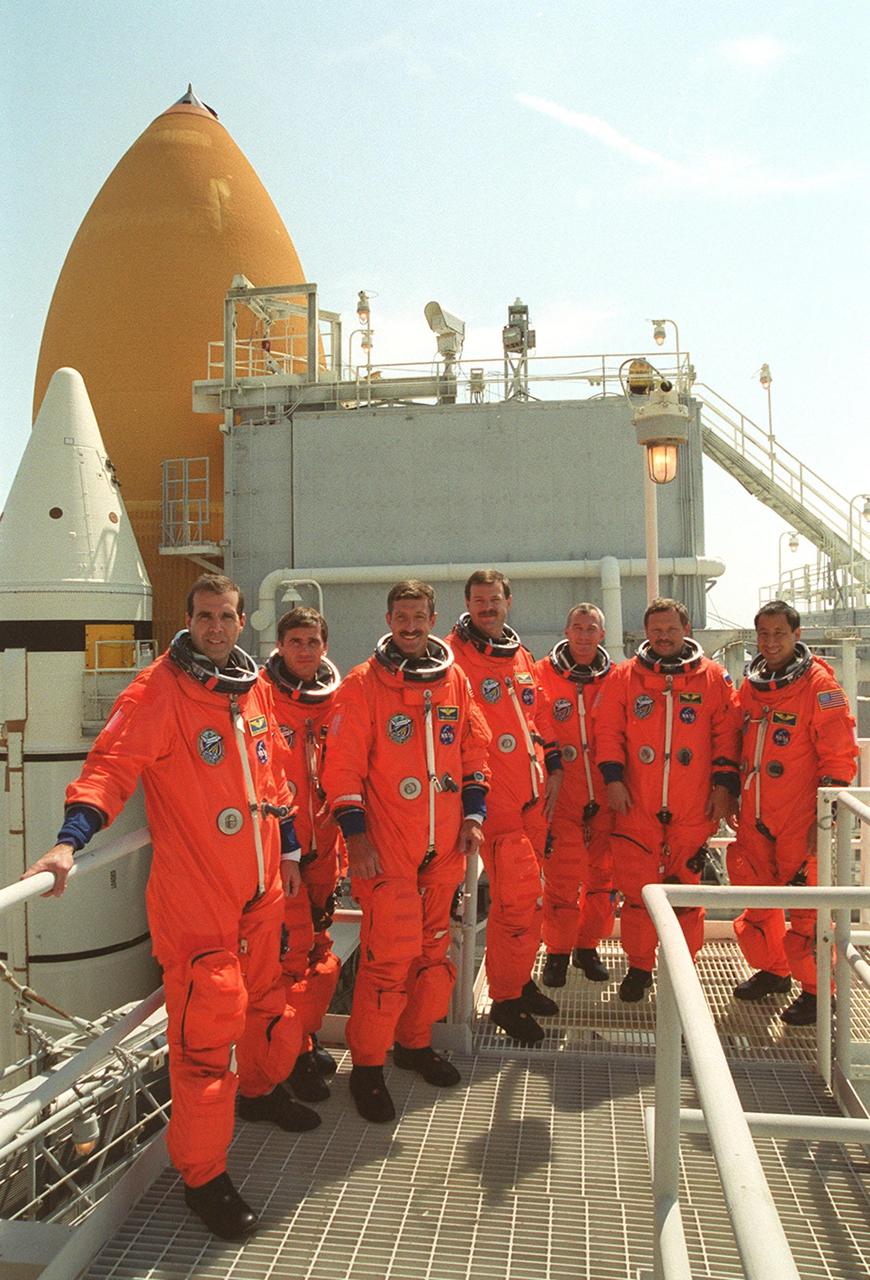
KENNEDY SPACE CENTER, Fla. -- At the 217-foot level of the Rotating Service Structure on Launch Pad 39B, the STS-106 crew takes a break during Terminal Countdown Demonstration Activities (TCDT) for a group photo. Pictured from left are Mission Specialists Richard A. Mastracchio, Yuri I. Malenchenko and Daniel C. Burbank; Pilot Scott D. Altman; Commander Terrence W. Wilcutt; and Mission Specialists Boris V. Morukov and Edward T. Lu. The TCDT provides the crew with emergency egress training, opportunities to inspect their mission payload in the orbiter’s payload bay, and a simulated launch countdown. STS-106 is scheduled to launch Sept. 8, 2000, at 8:31 a.m. EDT from Launch Pad 39B. On the 11-day mission, the seven-member crew will perform support tasks on orbit, transfer supplies and prepare the living quarters in the newly arrived Zvezda Service Module. The first long-duration crew, dubbed “Expedition One,” is due to arrive at the Station in late fall
KSC-00pp1177
KENNEDY SPACE CENTER, Fla. -- At the 217-foot level of the Rotating Service Structure on Launch Pad 39B, the STS-106 crew takes a break during Terminal Countdown Demonstration Activities (TCDT) for a group photo. Pictured from left are Mission Specialists Richard A. Mastracchio, Yuri I. Malenchenko and Daniel C. Burbank; Pilot Scott D. Altman; Commander Terrence W. Wilcutt; and Mission Specialists Boris V. Morukov and Edward T. Lu. The TCDT provides the crew with emergency egress training, opportunities to inspect their mission payload in the orbiter’s payload bay, and a simulated launch countdown. STS-106 is scheduled to launch Sept. 8, 2000, at 8:31 a.m. EDT from Launch Pad 39B. On the 11-day mission, the seven-member crew will perform support tasks on orbit, transfer supplies and prepare the living quarters in the newly arrived Zvezda Service Module. The first long-duration crew, dubbed “Expedition One,” is due to arrive at the Station in late fall
KSC00pp1177
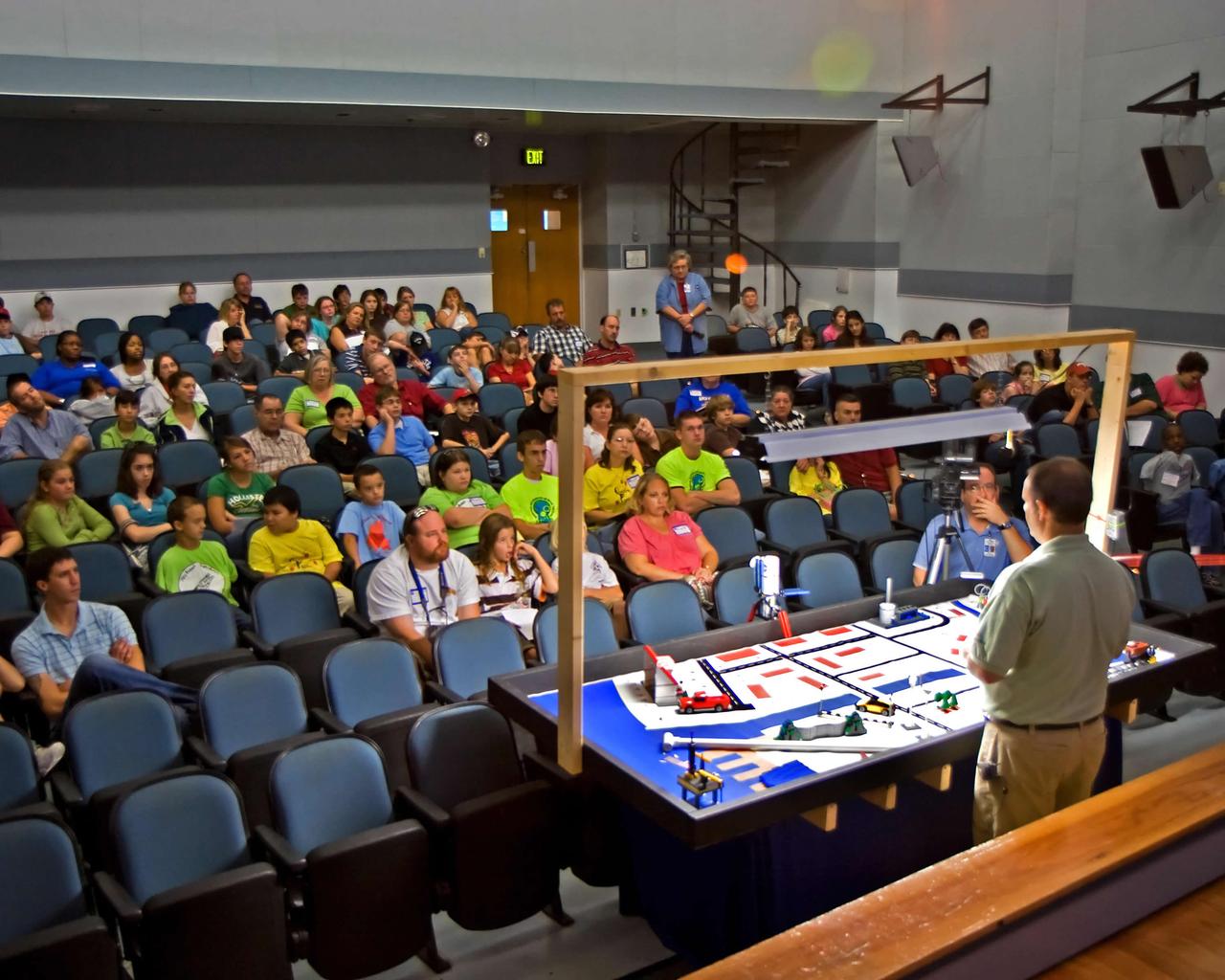
Randall Hicks (right), Jacobs Technology's Education Services manager at NASA John C. Stennis Space Center, answers questions about the playing field for FIRST (For Inspiration and Recognition of Science and Technology) LEGO League's 2007 Challenge, `Power Puzzle.' More than 140 teachers, mentors, parents and students from 15 schools attended the Sept. 15 FLL season kickoff at StenniSphere, the visitor center at SSC. The teams from southern and central Mississippi and Mobile, Ala., who came to SSC heard rules for and asked questions about `Power Puzzle,' and saw robot demonstrations by Gulfport and Picayune high schools' past FIRST Robotics competitions. Using LEGO Mindstorms NXT kits, FLL teams of children ages 9-14 will spend the next three months building and programming robots to perform 'Power Puzzle's' challenge tasks, then pit them in competitions. They also will submit a research project about how energy choices impact the environment and the economy. The season will culminate at the Mississippi Championship Tournament on Dec. 8 at the Mississippi Gulf Coast Community College. FLL, considered the `little league' of the FIRST Robotics Competition, partners FIRST and the LEGO Group. Competitions aim to inspire and celebrate science and technology using real-world context and hands-on experimentation. NASA recognizes FIRST activities as an excellent hands-on method to increase student knowledge of science, engineering, technology and mathematics. Schools represented in this year's kickoff were: Madison Avenue Upper Elementary, the Mississippi Band of Choctaw Indians' Conehatta Elementary, Hattiesburg's Lillie Burney Elementary, Pearl Upper Elementary, Long Beach Middle, Oktibehha Elementary, d'Iberville Middle, Saucier's West Wortham Middle, Picayune's Nicholson Elementary and Roseland Park Baptist Church Academy, Bay St. Louis' St. Stanislaus College and Mobile's Davidson High, as well as two home-school groups from the Jackson area.
FIRST LEGO League Kickoff
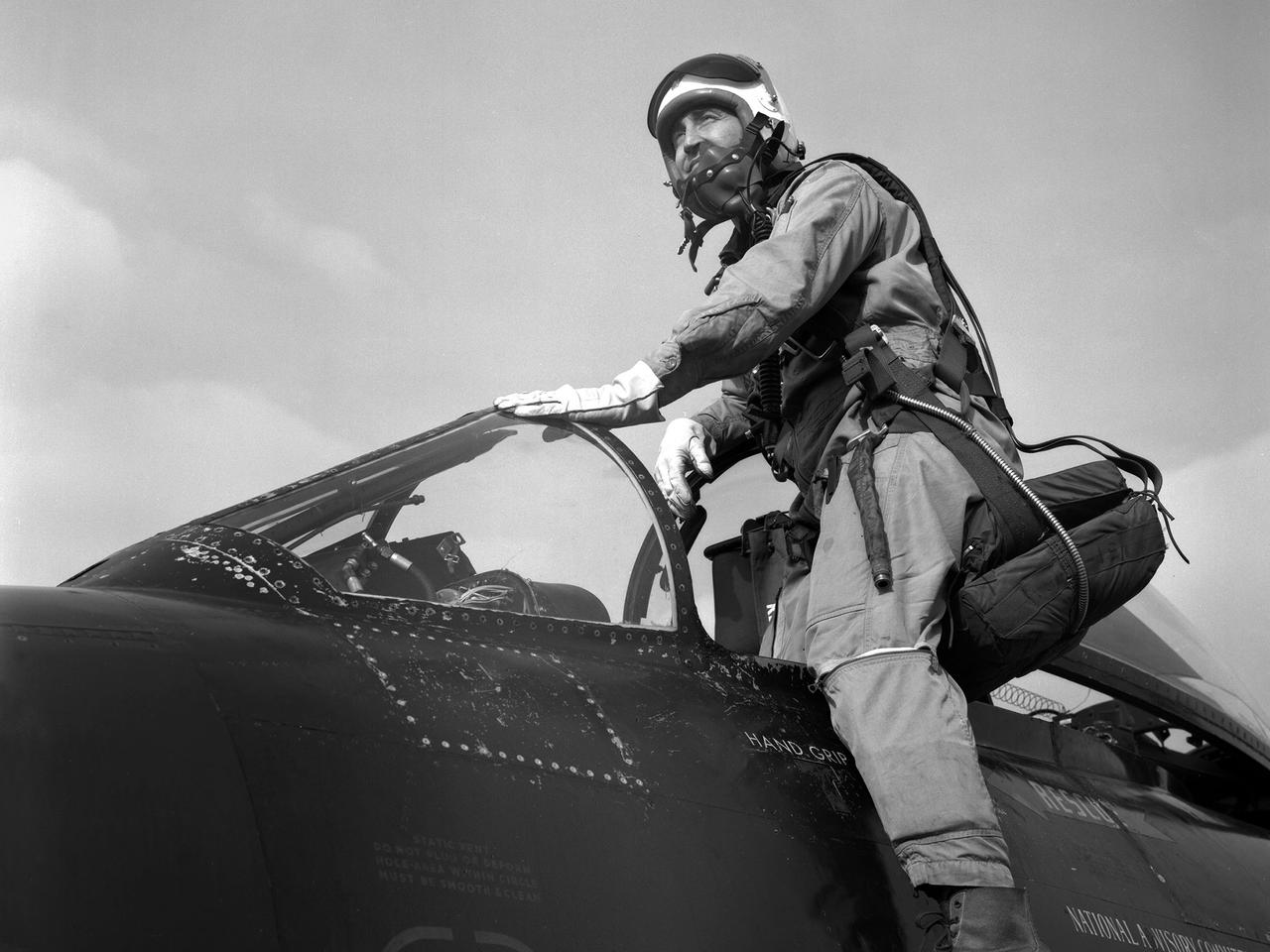
Pilot Joe Algranti climbs into the cockpit of a McDonnell F2H-2B Banshee on the tarmac at the National Advisory Committee for Aeronautics (NACA) Lewis Flight Propulsion Laboratory. Nine months later the laboratory became part of the new National Aeronautics and Space Administration, and the NACA logo was permanently removed from the hangar.    Algranti served as a Navy fighter pilot from 1946 to 1947 and earned a Physics degree from the University of North Carolina. He joined the NACA Lewis staff in 1951 witnessed the technological transformation from high speed flight to space. At Lewis Algranti piloted icing research flights, operated the liquid-hydrogen pump system for Project Bee, and served as the primary test subject for the Multi-Axis Space Test Inertia Facility (MASTIF). The MASTIF was a device used to train the Mercury astronauts how to control a spinning capsule.     In 1960, Algranti and fellow Lewis pilots Warren North and Harold Ream transferred to NASA’s Space Task Group at Langley to actively participate in the space program. Two years later, Algranti became the Chief of Aircraft Operations and Chief Test Pilot at NASA’s new Manned Space Center in Houston. Algranti earned notoriety in 1968 when he test flew the first Lunar Landing Training Vehicle. He operated the vehicle four minutes before being forced to eject moments before it impacted the ground. Algranti also flew the NASA’s modified Boeing 747 Shuttle Carrier Aircraft, the Super Guppy, and the KC-135 "Vomit Comet" training aircraft. He retired in 1992 with over 40 years of NASA service.
Pilot Joseph Algranti entering a McDonnell F2H-2B Banshee
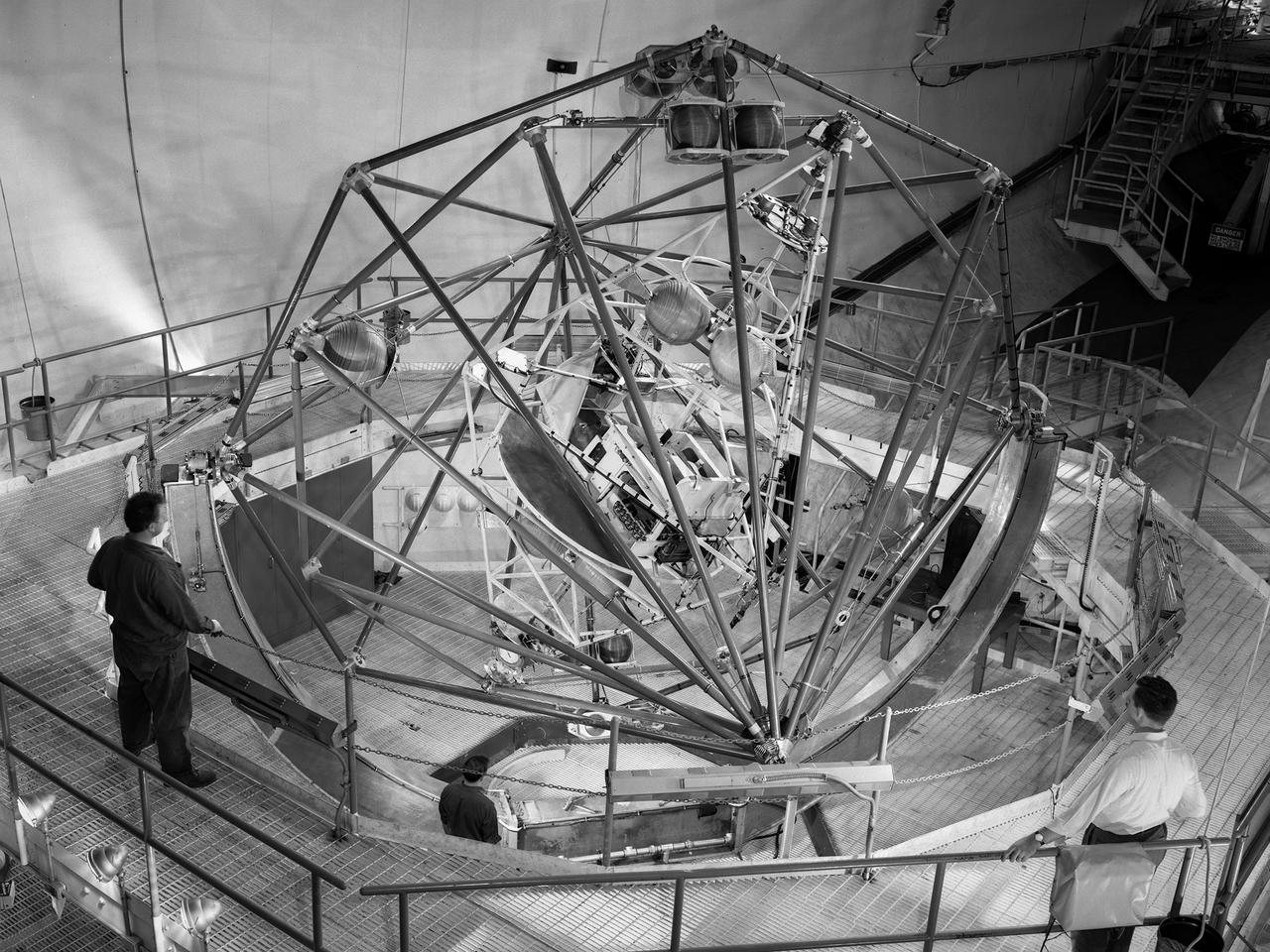
The Multi-Axis Space Test Inertial Facility (MASTIF) in the Altitude Wind Tunnel at the National Aeronautics and Space Administration (NASA) Lewis Research Center. Although the Mercury astronaut training and mission planning were handled by the Space Task Group at Langley Research Center, NASA Lewis played an important role in the program, beginning with the Big Joe launch. Big Joe was a singular attempt early in the program to use a full-scale Atlas booster and simulate the reentry of a mockup Mercury capsule without actually placing it in orbit.      A unique three-axis gimbal rig was built inside Lewis’ Altitude Wind Tunnel to test Big Joe’s attitude controls. The control system was vital since the capsule would burn up on reentry if it were not positioned correctly. The mission was intended to assess the performance of the Atlas booster, the reliability of the capsule’s attitude control system and beryllium heat shield, and the capsule recovery process. The September 9, 1959 launch was a success for the control system and heatshield. Only a problem with the Atlas booster kept the mission from being a perfect success.    The MASTIF was modified in late 1959 to train Project Mercury pilots to bring a spinning spacecraft under control. An astronaut was secured in a foam couch in the center of the rig. The rig then spun on three axes from 2 to 50 rotations per minute. Small nitrogen gas thrusters were used by the astronauts to bring the MASTIF under control.
Multi-Axis Space Inertia Test Facility inside the Altitude Wind Tunnel
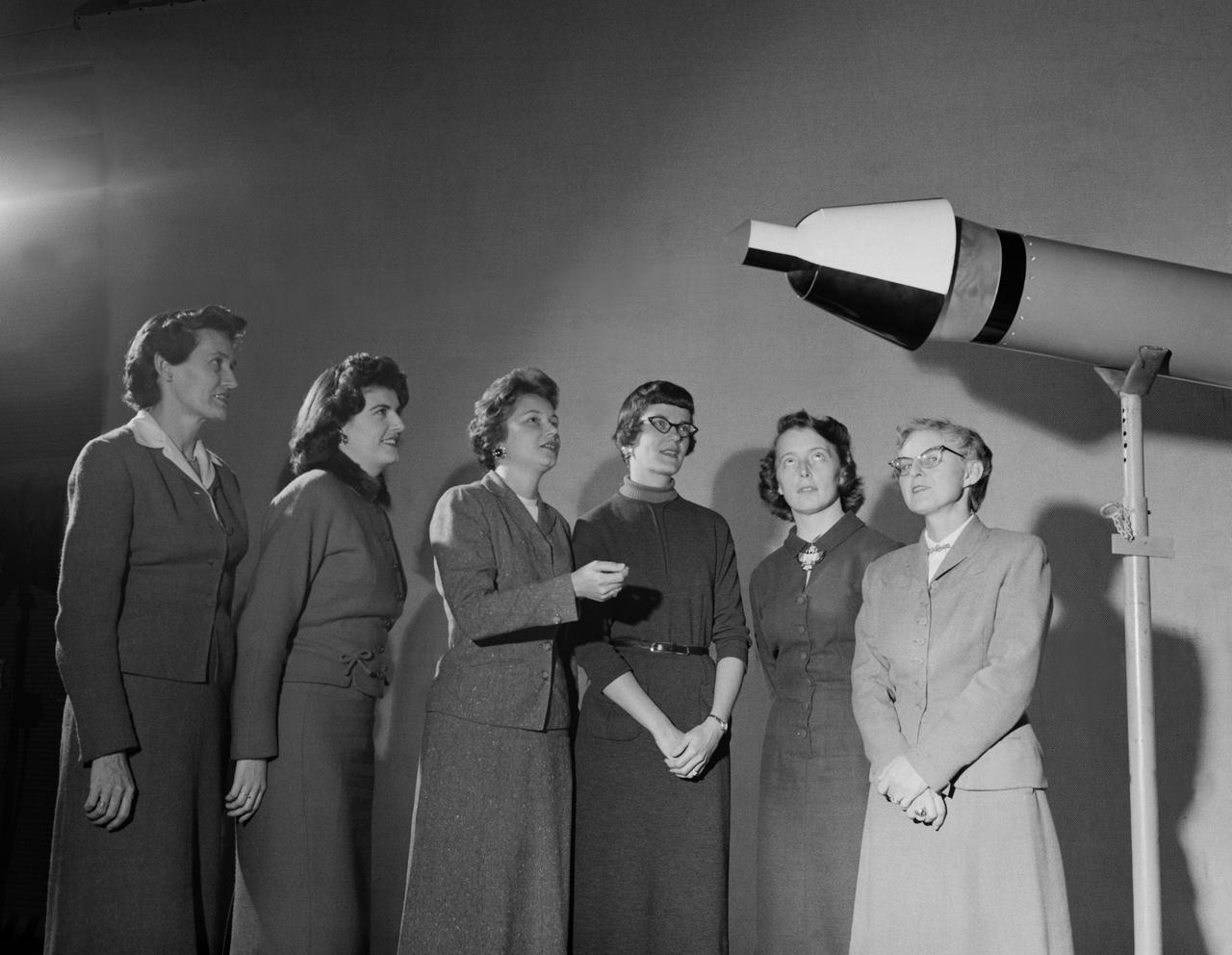
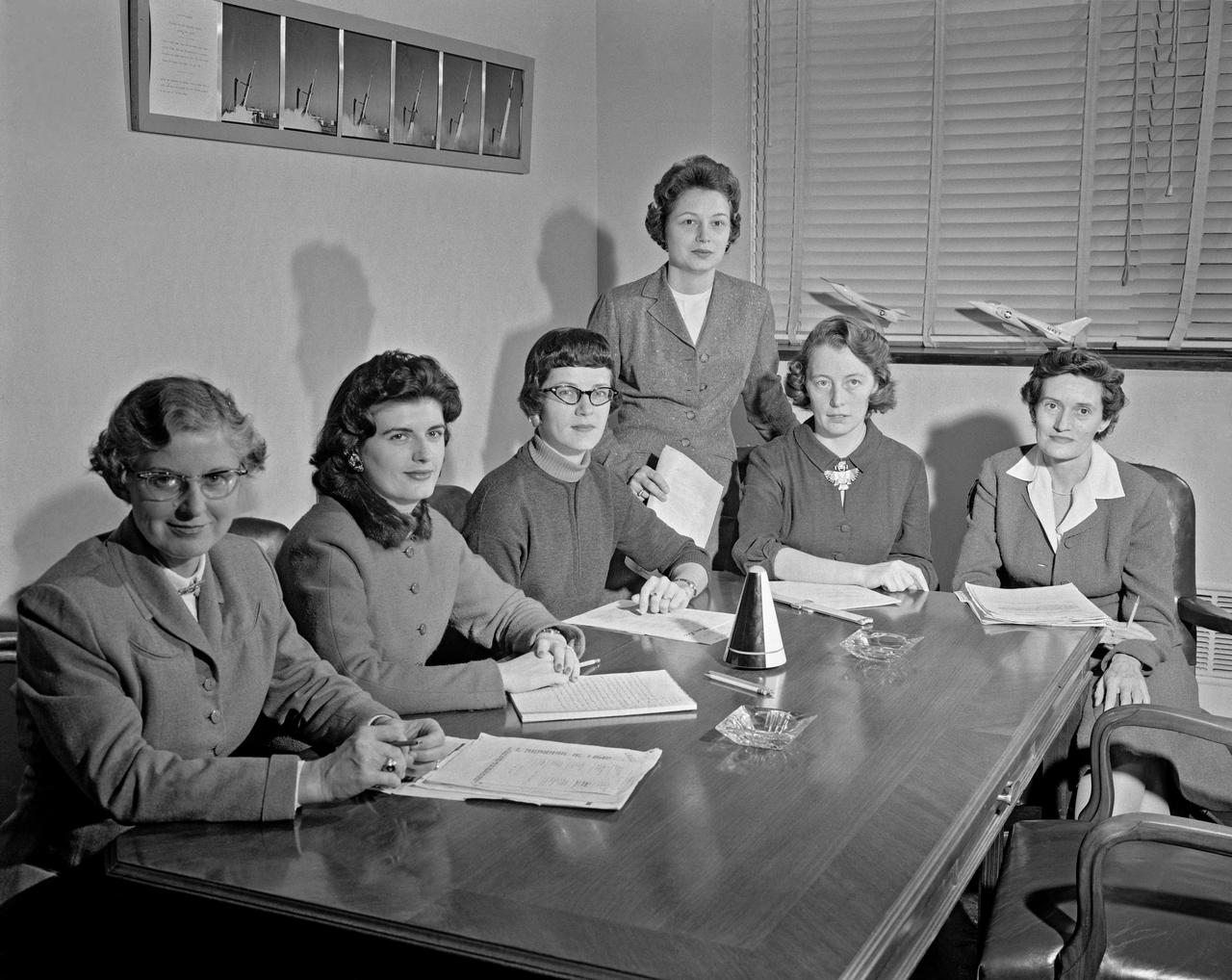
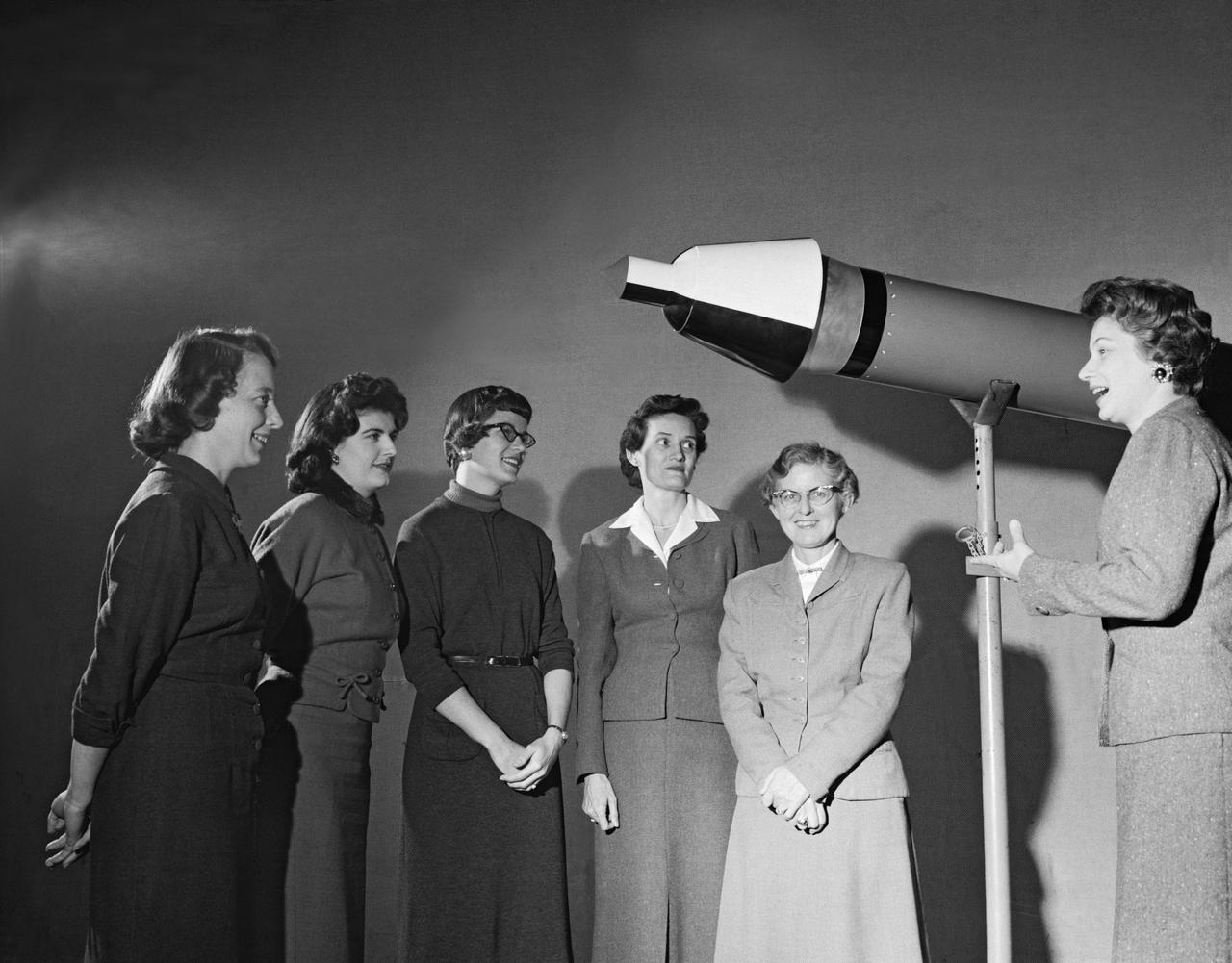
Women Scientists: Lucille Coltrane, Jean Clark Keating, Katherine Cullie Speegle, Doris 'Dot' Lee, Ruth Whitman, and Emily Stephens Mueller,Lucille Coltrane is at the far left. She was a computer and worked for Norm Crabill who provided positive identification. Lucille authored a NACA Research Memorandum, Investigation of Two Bluff Shapes in Axial Free Flight Over a Mach Number Range From 0.35 to 2.15 in 1958.  Next to Lucille is Jean Clark Keating. Jean was identified by Mary Woerner who said that both Jean and her husband Jerry are now deceased.  The third woman from the left is Katherine Cullie Speegle. Katherine co-authored two research papers: Preliminary Results From a Free-Flight Investigation of Boundary-Layer Transition and Heat Transfer on a Highly Polished 8-Inch-Diameter Hemisphere-Cylinder at Mach Numbers up to 3 and Reynolds Numbers Based on a Length of 1 Foot up to 17.7 x 10 to the 6th and Heat Transfer For Mach Numbers Up to 2.2 and Pressure Distributions for Mach Numbers Up to 4.7 From Flight Investigations of a Flat-Face Cone and a Hemisphere-Cone.  Norm remembered the woman standing as Doris. Mary Alice identified her as Doris 'Dot' Lee, who worked with Katherine Speegle. Dot was married to a NASA engineer named John Lee.  Next to Doris is Ruth Whitman. Norm remembered she and her husband owned a Howard DGA 15 at the airport in WEst Point. That prompted Mary Alice to remember her name and that her husband was Jim.  The woman seated on the right is Emily Stephens Mueller. Norm remembers that Emily went to Houston as part of the Space Task Group, but retired back here on the peninsula. In 2008, Emily attended the NACA Reunion X11. She walked over to a table of books about the history of NACA, former NACA facilities and the organization's aviation pioneers and saw a book about women of flight from the Dryden Research Center and paused, then pointed somewhat in amazement. "That’s me," she said of a picture on the cover of her on the far left of a li
Women Scientists
Women Scientists: Lucille Coltrane, Jean Clark Keating, Katherine Cullie Speegle, Doris 'Dot' Lee, Ruth Whitman, and Emily Stephens Mueller,Lucille Coltrane is at the far left. She was a computer and worked for Norm Crabill who provided positive identification. Lucille authored a NACA Research Memorandum, Investigation of Two Bluff Shapes in Axial Free Flight Over a Mach Number Range From 0.35 to 2.15 in 1958.  Next to Lucille is Jean Clark Keating. Jean was identified by Mary Woerner who said that both Jean and her husband Jerry are now deceased.  The third woman from the left is Katherine Cullie Speegle. Katherine co-authored two research papers: Preliminary Results From a Free-Flight Investigation of Boundary-Layer Transition and Heat Transfer on a Highly Polished 8-Inch-Diameter Hemisphere-Cylinder at Mach Numbers up to 3 and Reynolds Numbers Based on a Length of 1 Foot up to 17.7 x 10 to the 6th and Heat Transfer For Mach Numbers Up to 2.2 and Pressure Distributions for Mach Numbers Up to 4.7 From Flight Investigations of a Flat-Face Cone and a Hemisphere-Cone.  Norm remembered the woman standing as Doris. Mary Alice identified her as Doris 'Dot' Lee, who worked with Katherine Speegle. Dot was married to a NASA engineer named John Lee.  Next to Doris is Ruth Whitman. Norm remembered she and her husband owned a Howard DGA 15 at the airport in WEst Point. That prompted Mary Alice to remember her name and that her husband was Jim.  The woman seated on the right is Emily Stephens Mueller. Norm remembers that Emily went to Houston as part of the Space Task Group, but retired back here on the peninsula. In 2008, Emily attended the NACA Reunion X11. She walked over to a table of books about the history of NACA, former NACA facilities and the organization's aviation pioneers and saw a book about women of flight from the Dryden Research Center and paused, then pointed somewhat in amazement. "That’s me," she said of a picture on the cover of her on the far left of a li
Women Scientists
Women Scientists: Lucille Coltrane, Jean Clark Keating, Katherine Cullie Speegle, Doris "Dot" Lee, Ruth Whitman, and Emily Stephens Mueller,Lucille Coltrane is at the far left. She was a computer and worked for Norm Crabill who provided positive identification. Lucille authored a NACA Research Memorandum, Investigation of Two Bluff Shapes in Axial Free Flight Over a Mach Number Range From 0.35 to 2.15 in 1958.  Next to Lucille is Jean Clark Keating. Jean was identified by Mary Woerner who said that both Jean and her husband Jerry are now deceased.  The third woman from the left is Katherine Cullie Speegle. Katherine co-authored two research papers: Preliminary Results From a Free-Flight Investigation of Boundary-Layer Transition and Heat Transfer on a Highly Polished 8-Inch-Diameter Hemisphere-Cylinder at Mach Numbers up to 3 and Reynolds Numbers Based on a Length of 1 Foot up to 17.7 x 10 to the 6th and Heat Transfer For Mach Numbers Up to 2.2 and Pressure Distributions for Mach Numbers Up to 4.7 From Flight Investigations of a Flat-Face Cone and a Hemisphere-Cone.  Norm remembered the woman standing as Doris. Mary Alice identified her as Doris 'Dot' Lee, who worked with Katherine Speegle. Dot was married to a NASA engineer named John Lee.  Next to Doris is Ruth Whitman. Norm remembered she and her husband owned a Howard DGA 15 at the airport in WEst Point. That prompted Mary Alice to remember her name and that her husband was Jim.  The woman seated on the right is Emily Stephens Mueller. Norm remembers that Emily went to Houston as part of the Space Task Group, but retired back here on the peninsula. In 2008, Emily attended the NACA Reunion X11. She walked over to a table of books about the history of NACA, former NACA facilities and the organization's aviation pioneers and saw a book about women of flight from the Dryden Research Center and paused, then pointed somewhat in amazement. "ThatÕs me," she said of a picture on the cover of her on the far left of a line of women. She was at Dryden from 1948-49.
Women Scientists
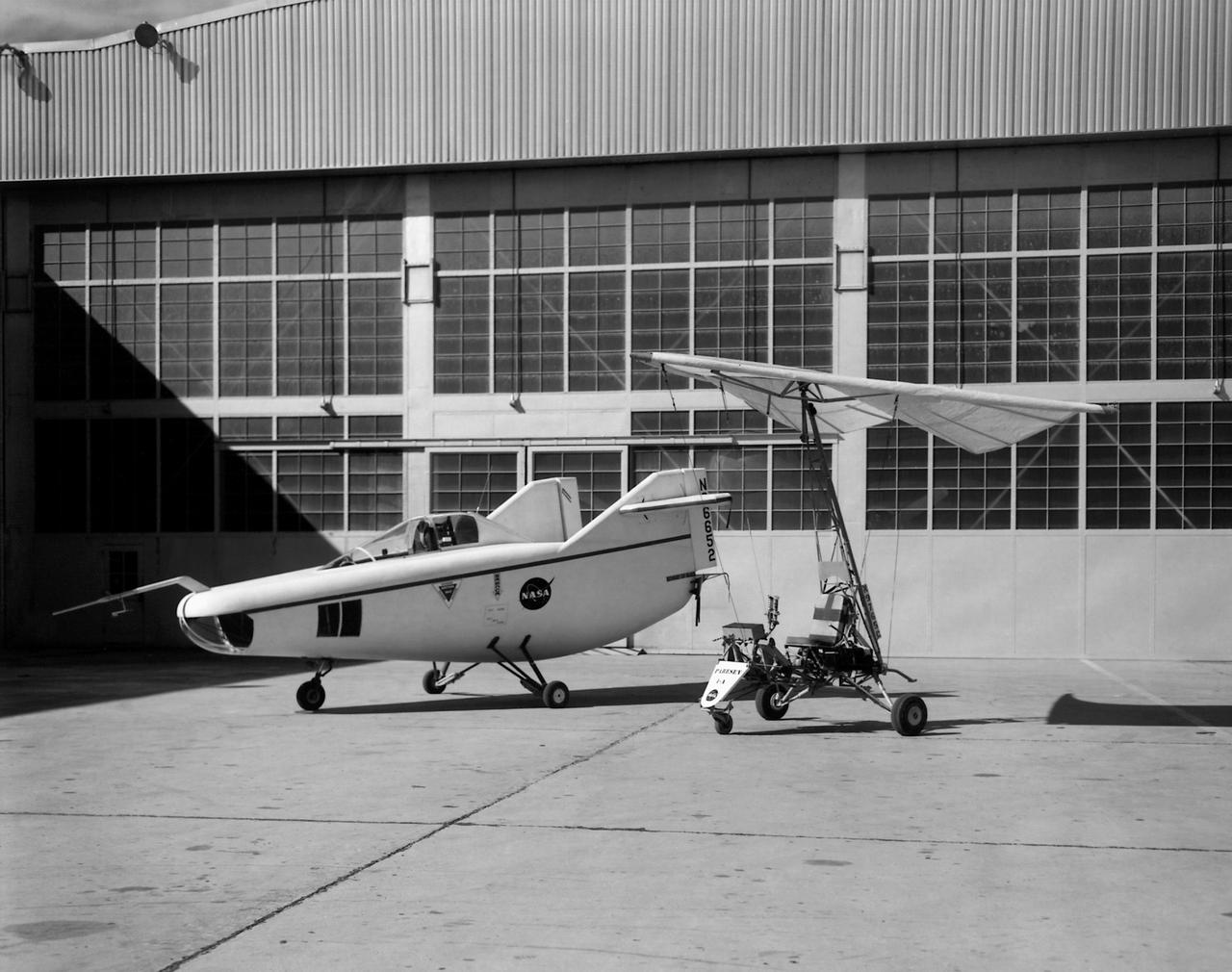
In this photo of the M2-F1 lifting body and the Paresev 1B on the ramp, the viewer sees two vehicles representing different approaches to building a research craft to simulate a spacecraft able to land on the ground instead of splashing down in the ocean as the Mercury capsules did. The M2-F1 was a lifting body, a shape able to re-enter from orbit and land. The Paresev (Paraglider Research Vehicle) used a Rogallo wing that could be (but never was) used to replace a conventional parachute for landing a capsule-type spacecraft, allowing it to make a controlled landing on the ground.
E-10598