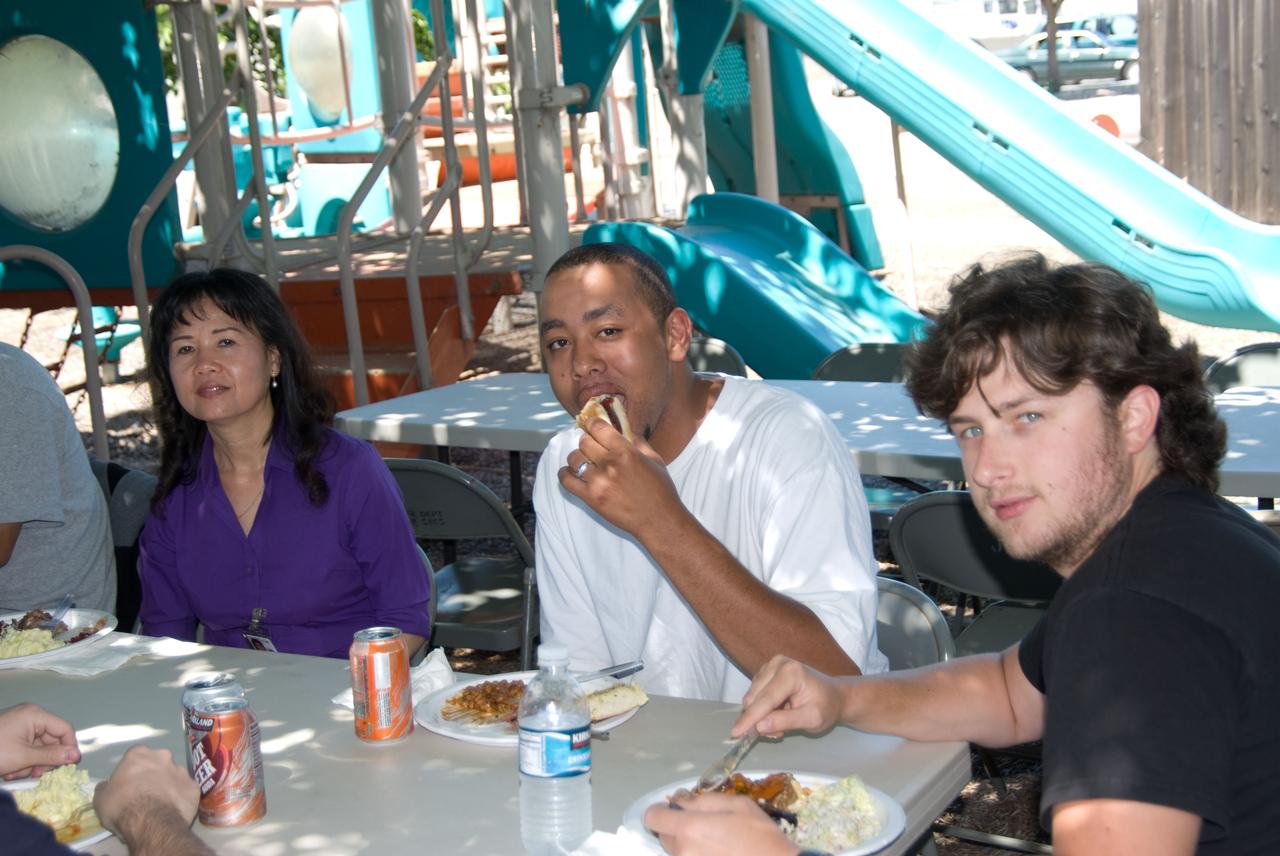
Space Technology Division Summer picnic
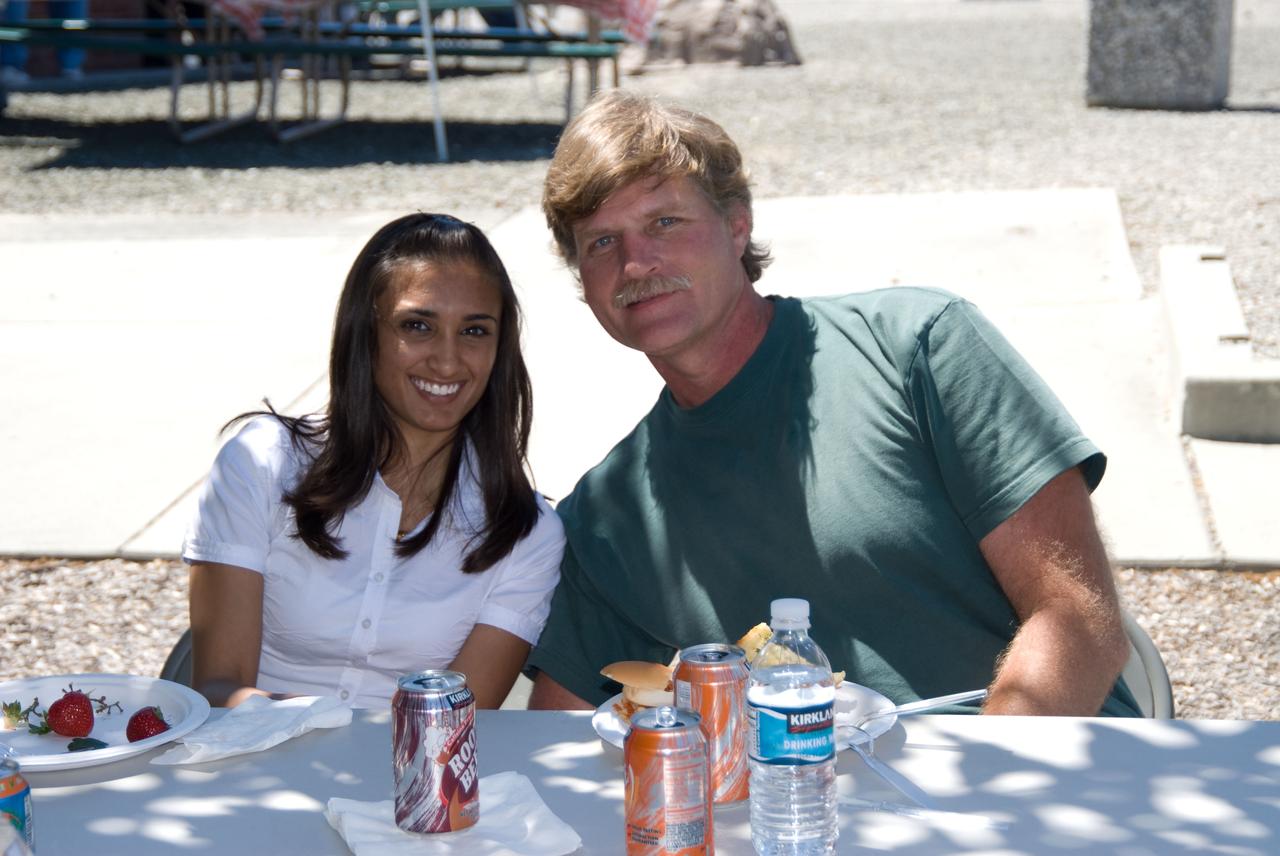
Space Technology Division Summer picnic
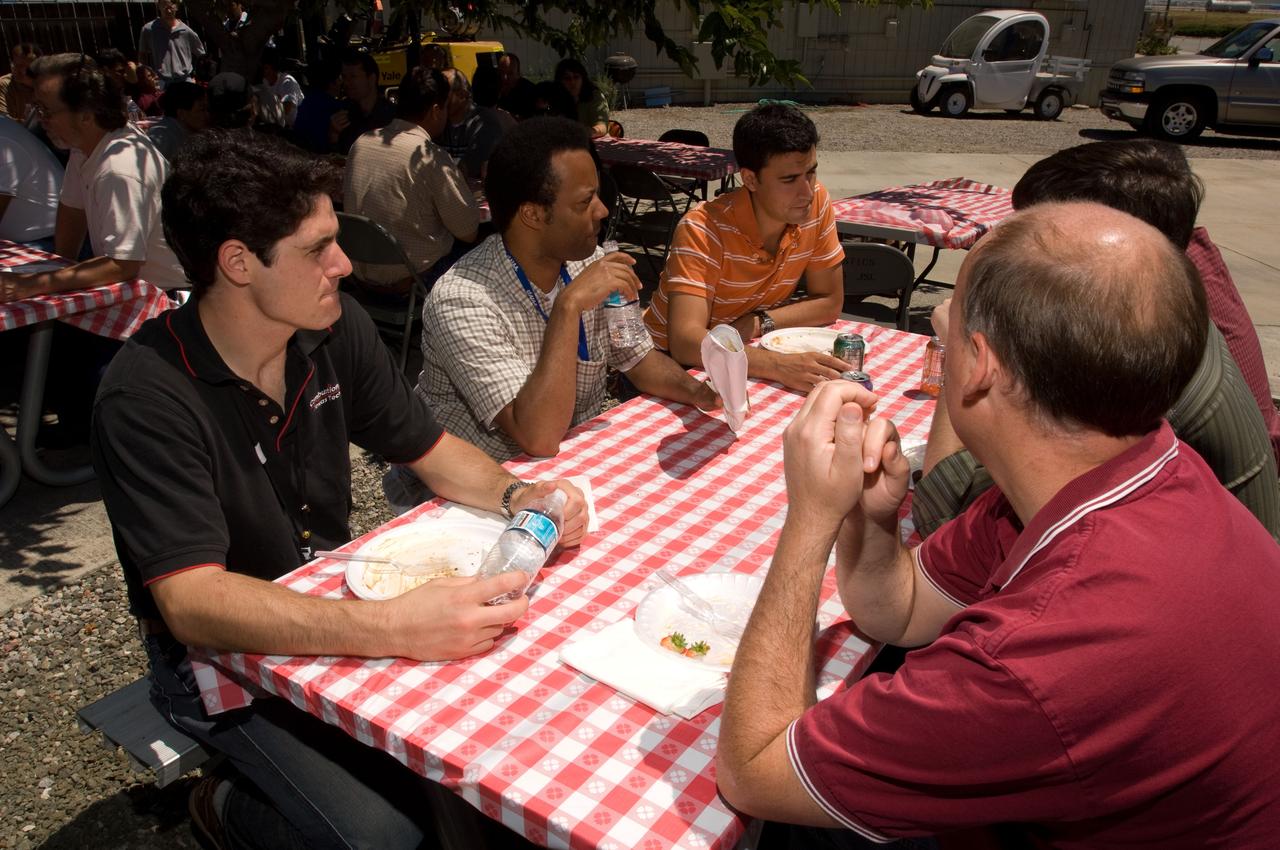
Space Technology Division Summer picnic

Space Technology Division Summer picnic
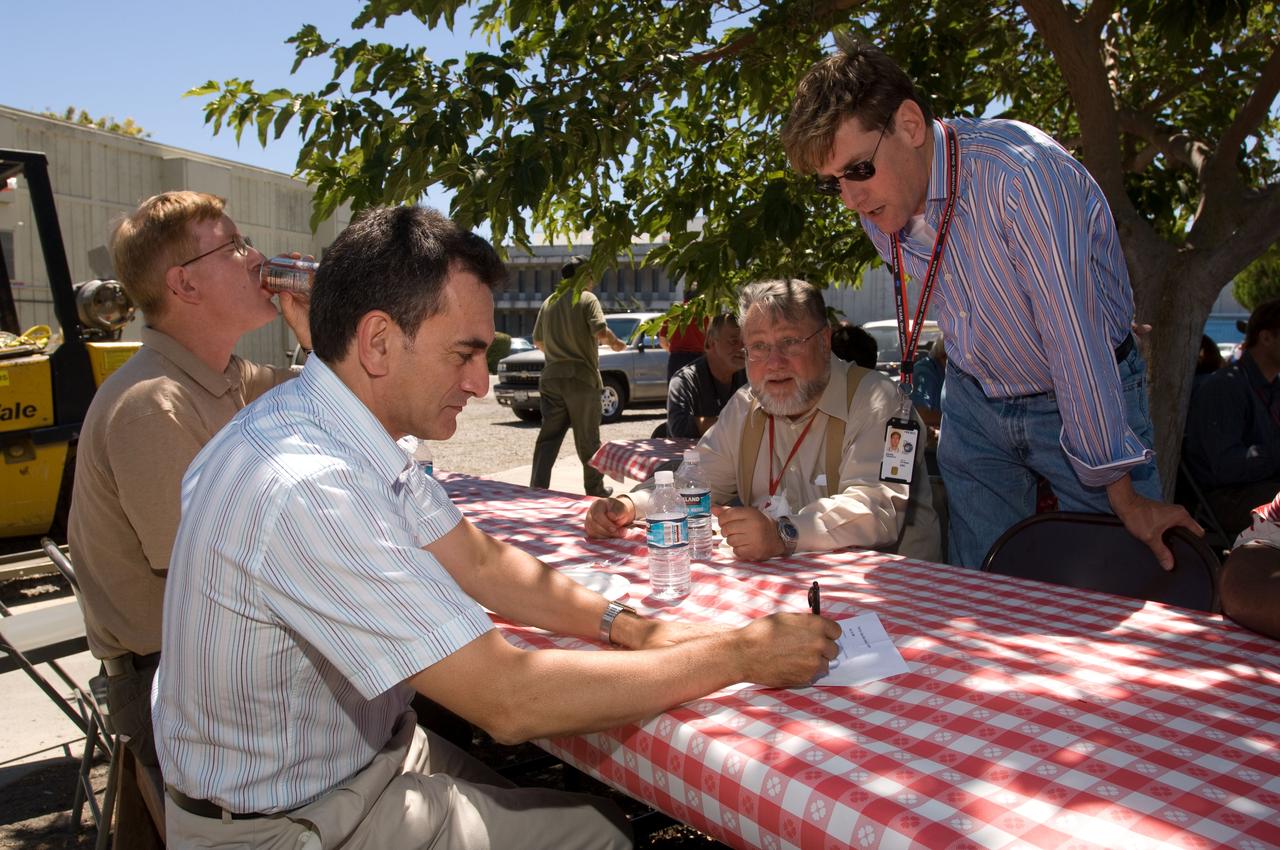
Space Technology Division Summer picnic
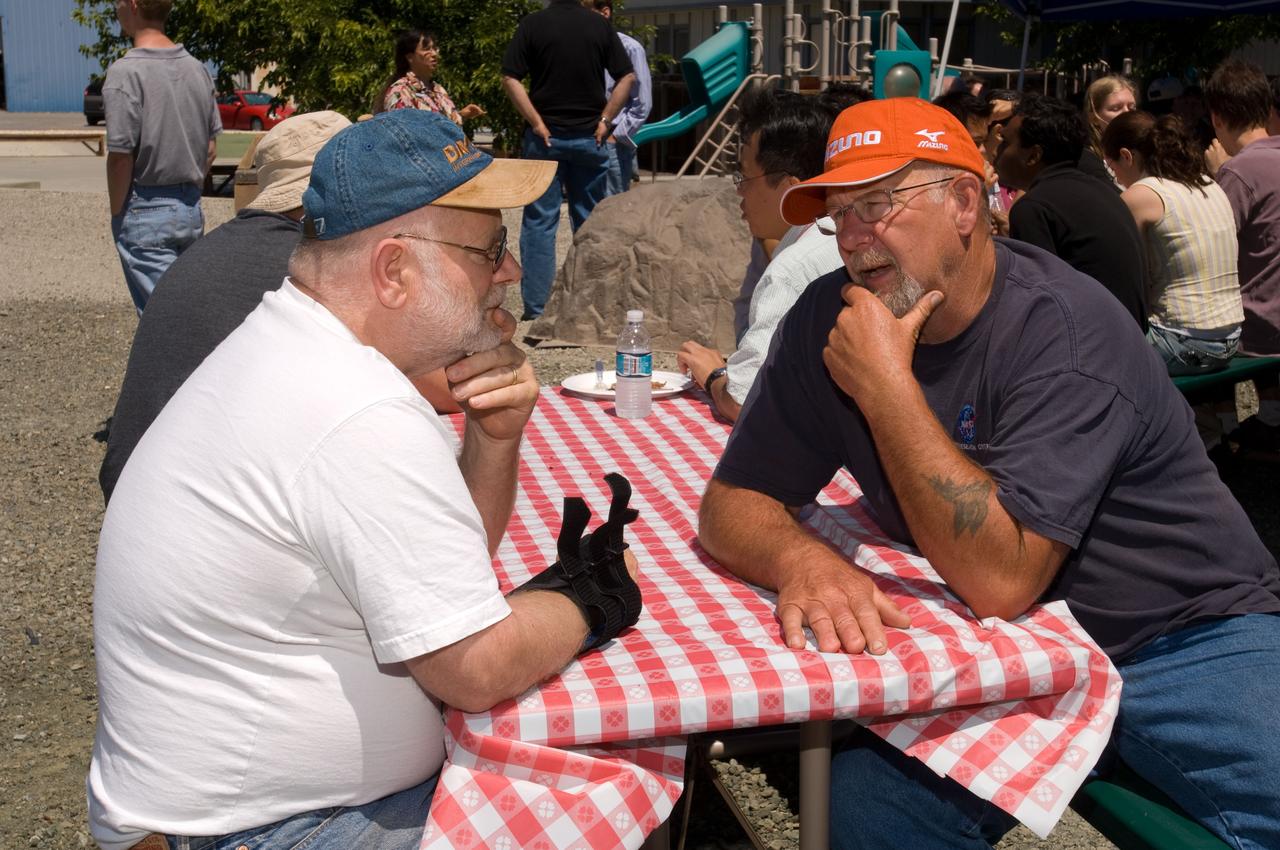
Space Technology Division Summer picnic
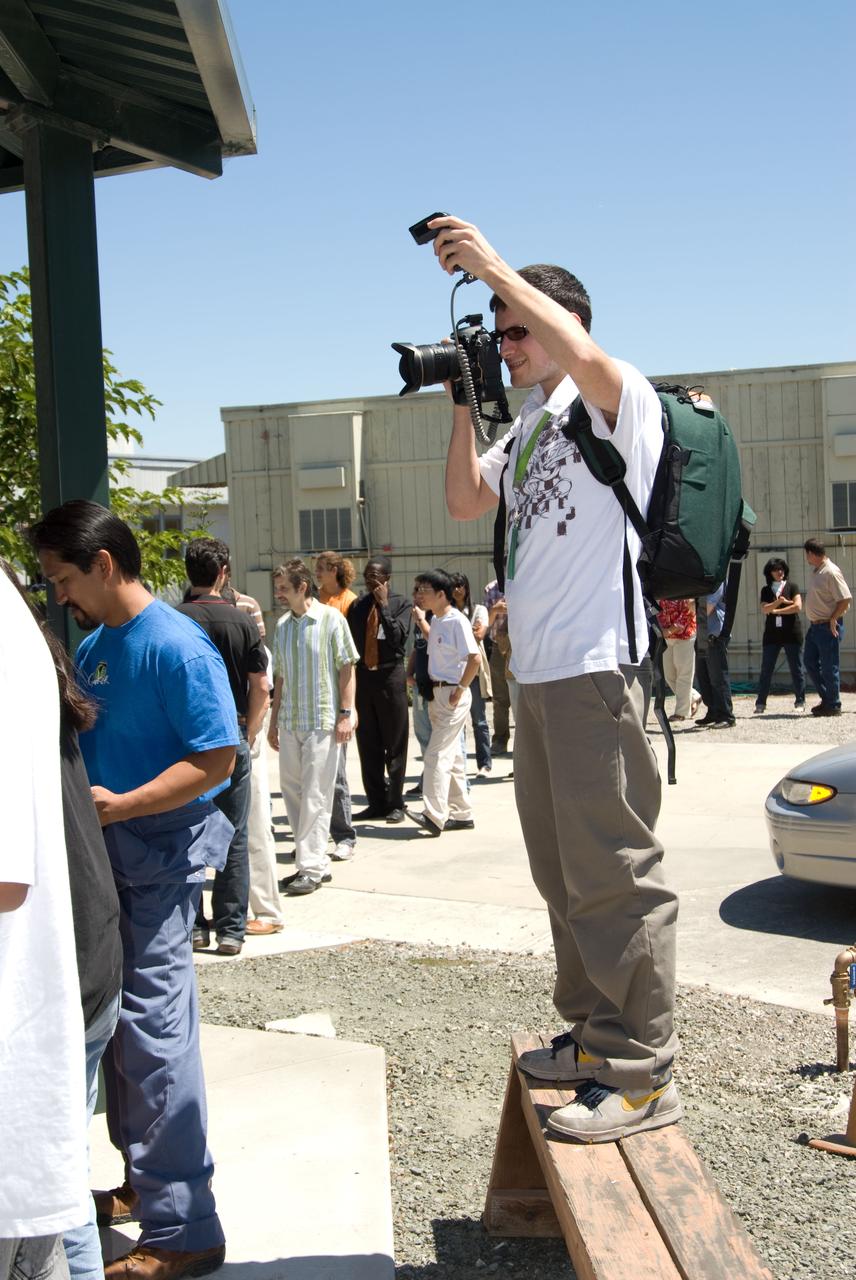
Space Technology Division Summer picnic

Space Technology Division Summer picnic
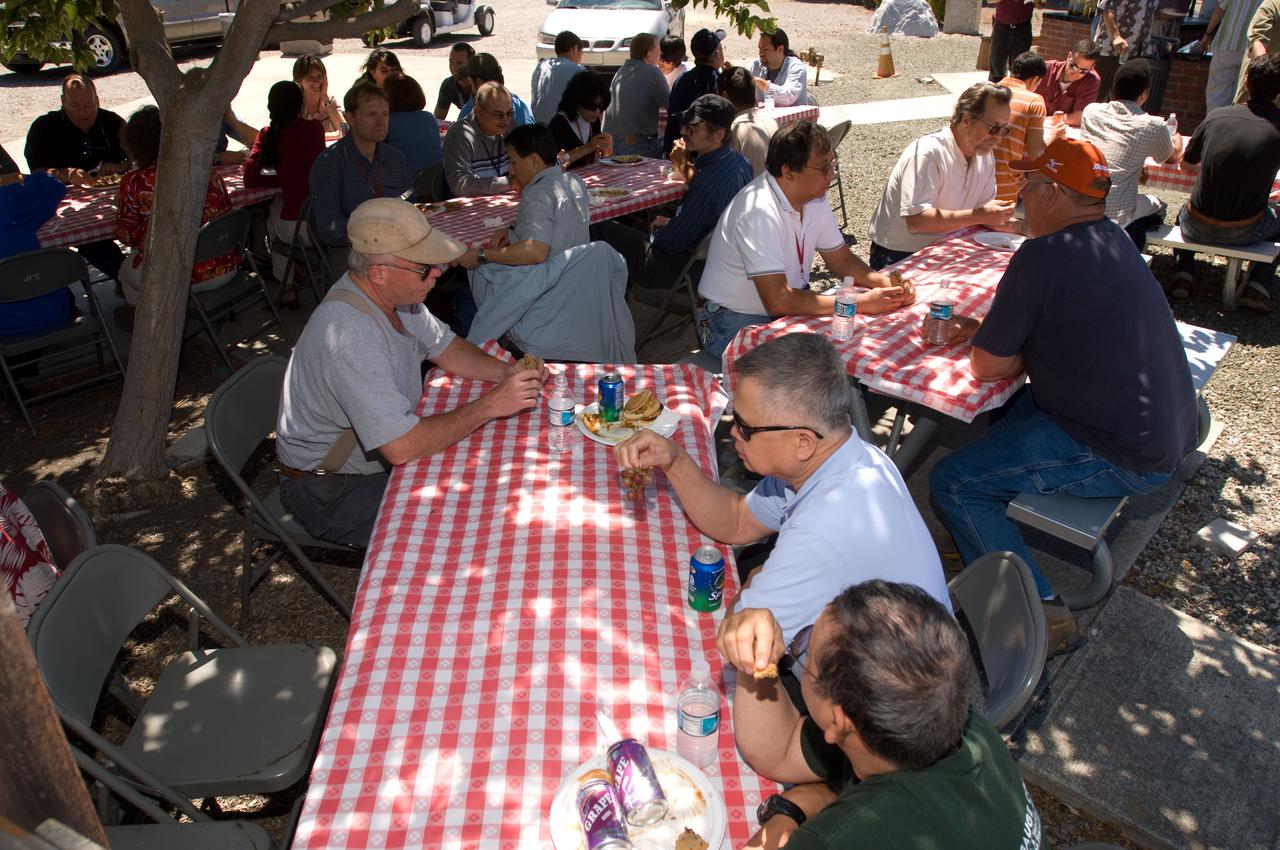
Space Technology Division Summer picnic
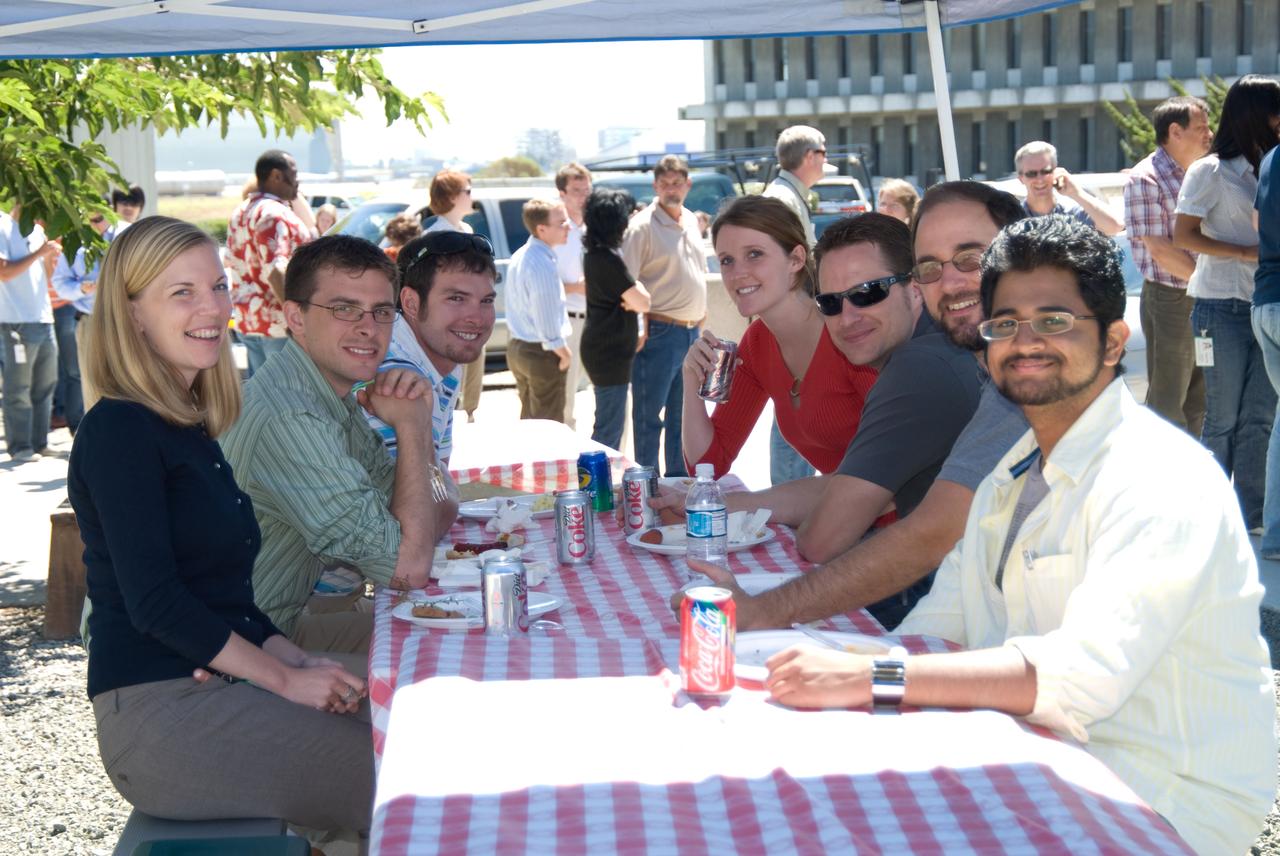
Space Technology Division Summer picnic
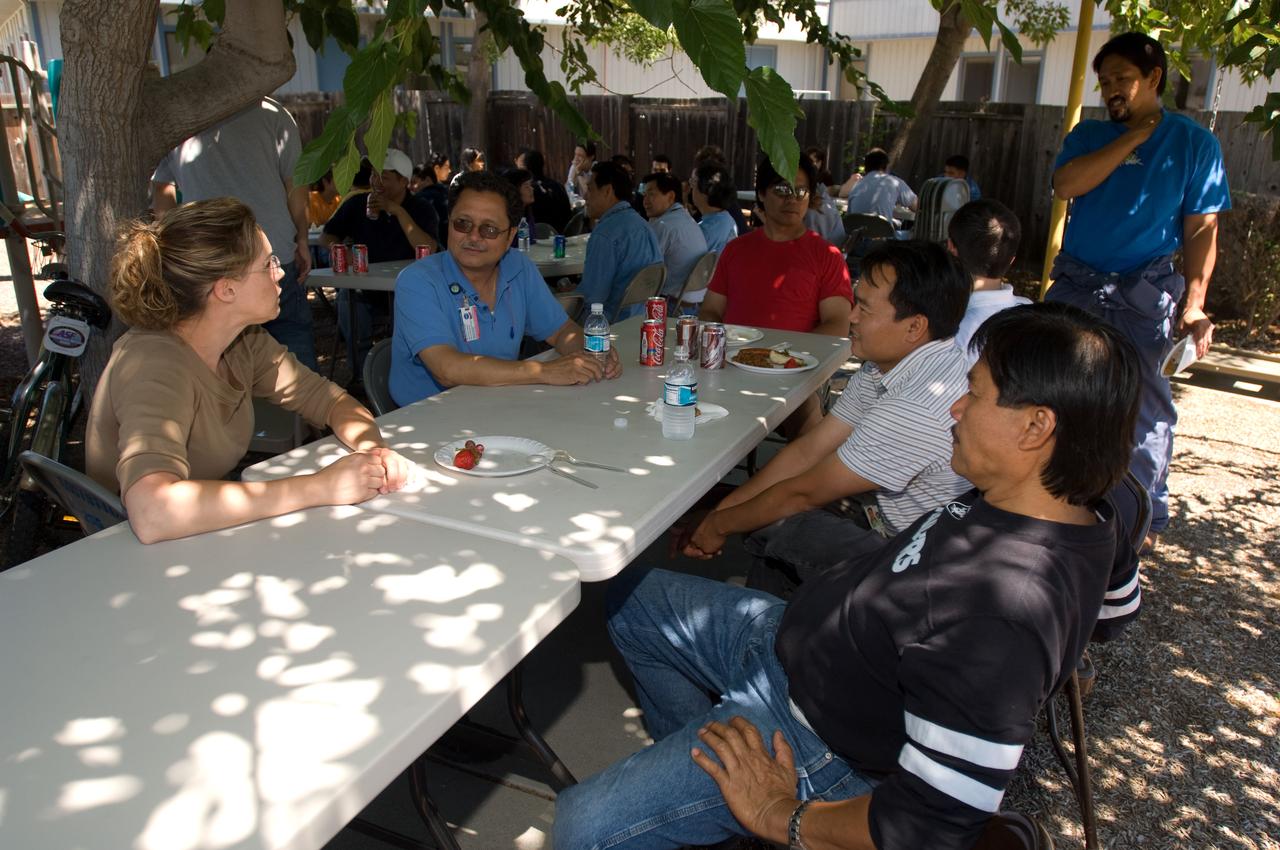
Space Technology Division Summer picnic
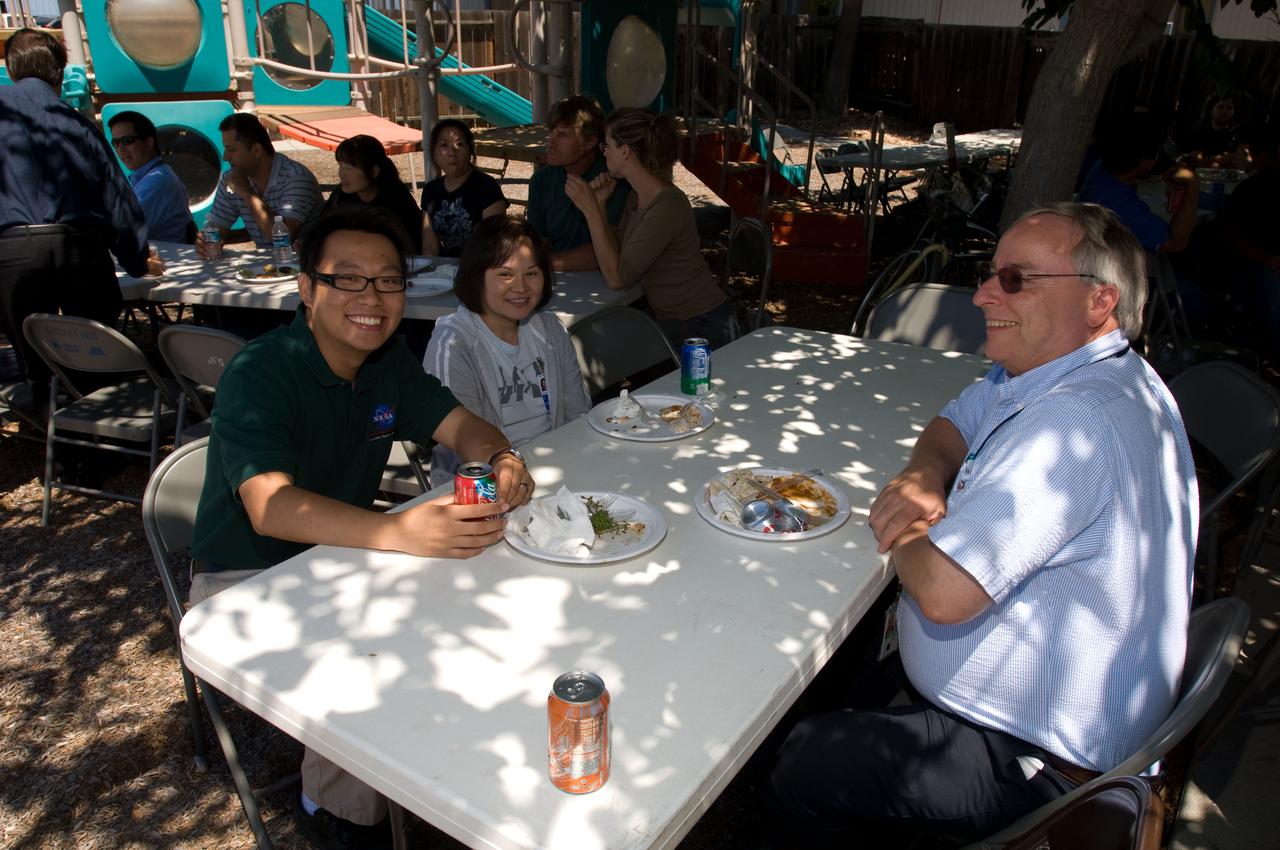
Space Technology Division Summer picnic
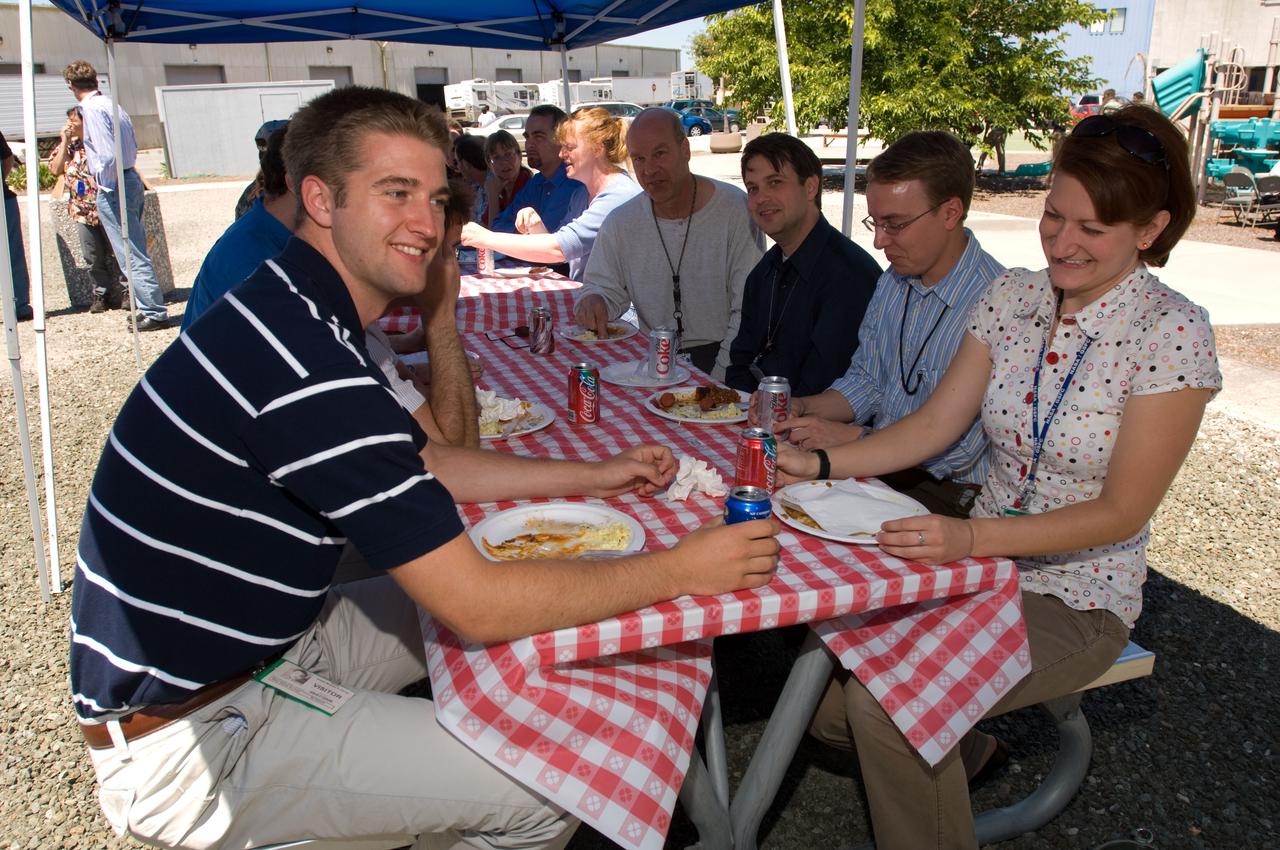
Space Technology Division Summer picnic
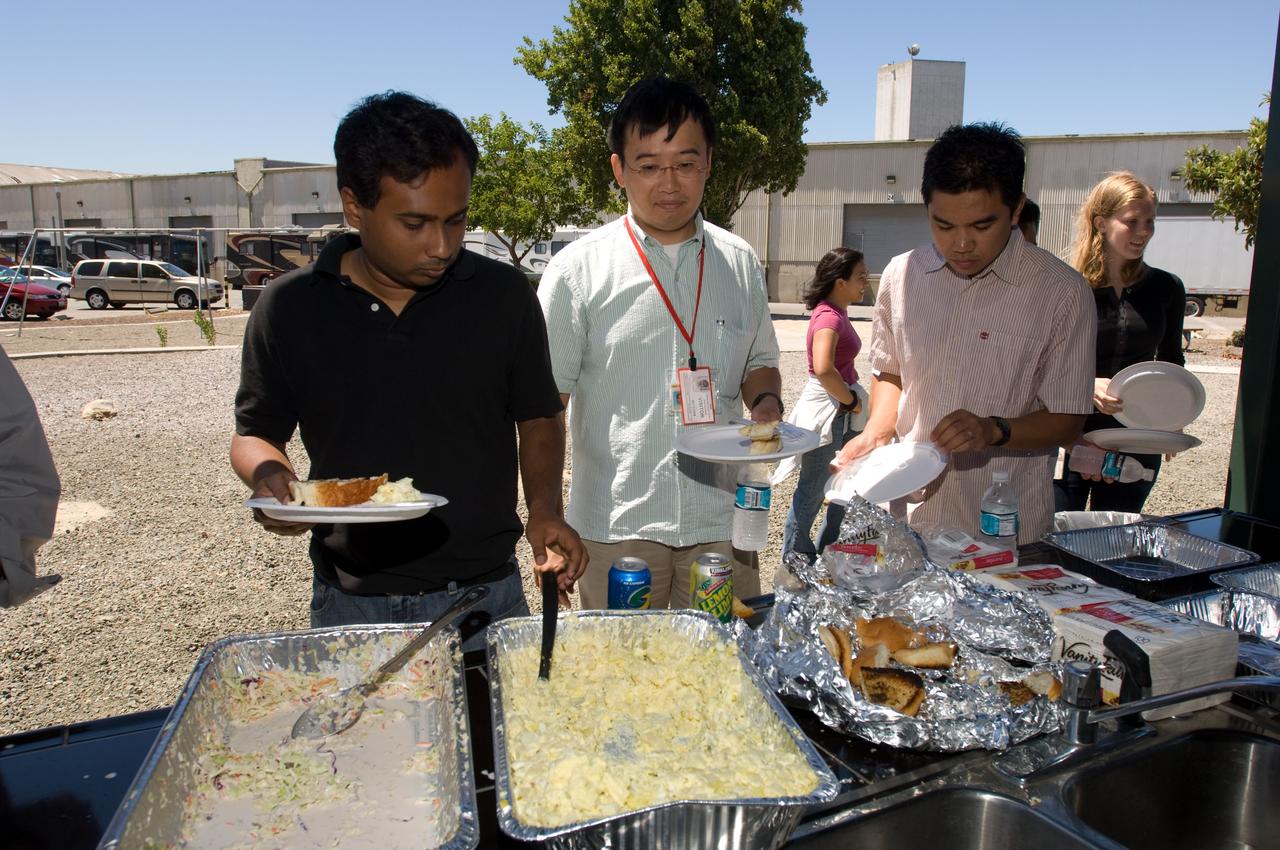
Space Technology Division Summer picnic
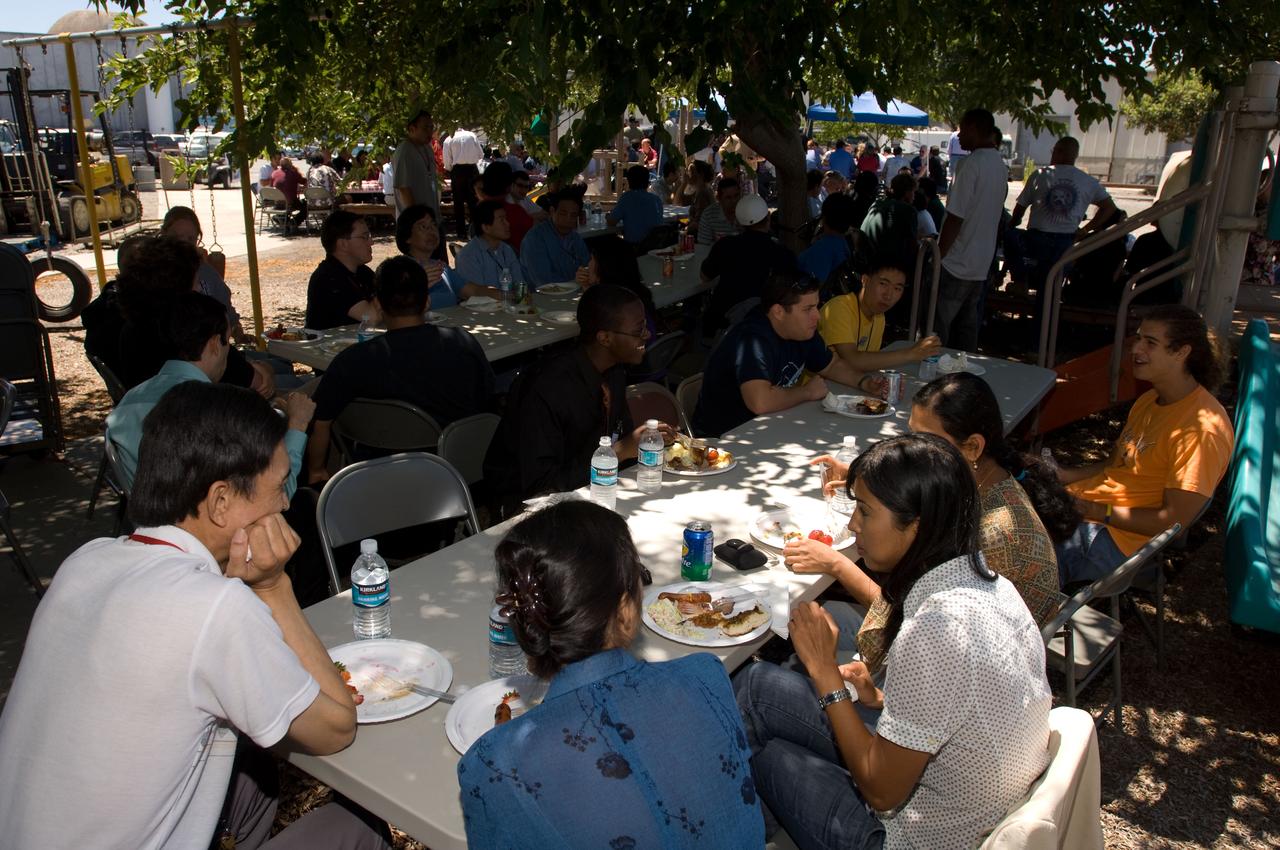
Space Technology Division Summer picnic

Space Technology Division Summer picnic
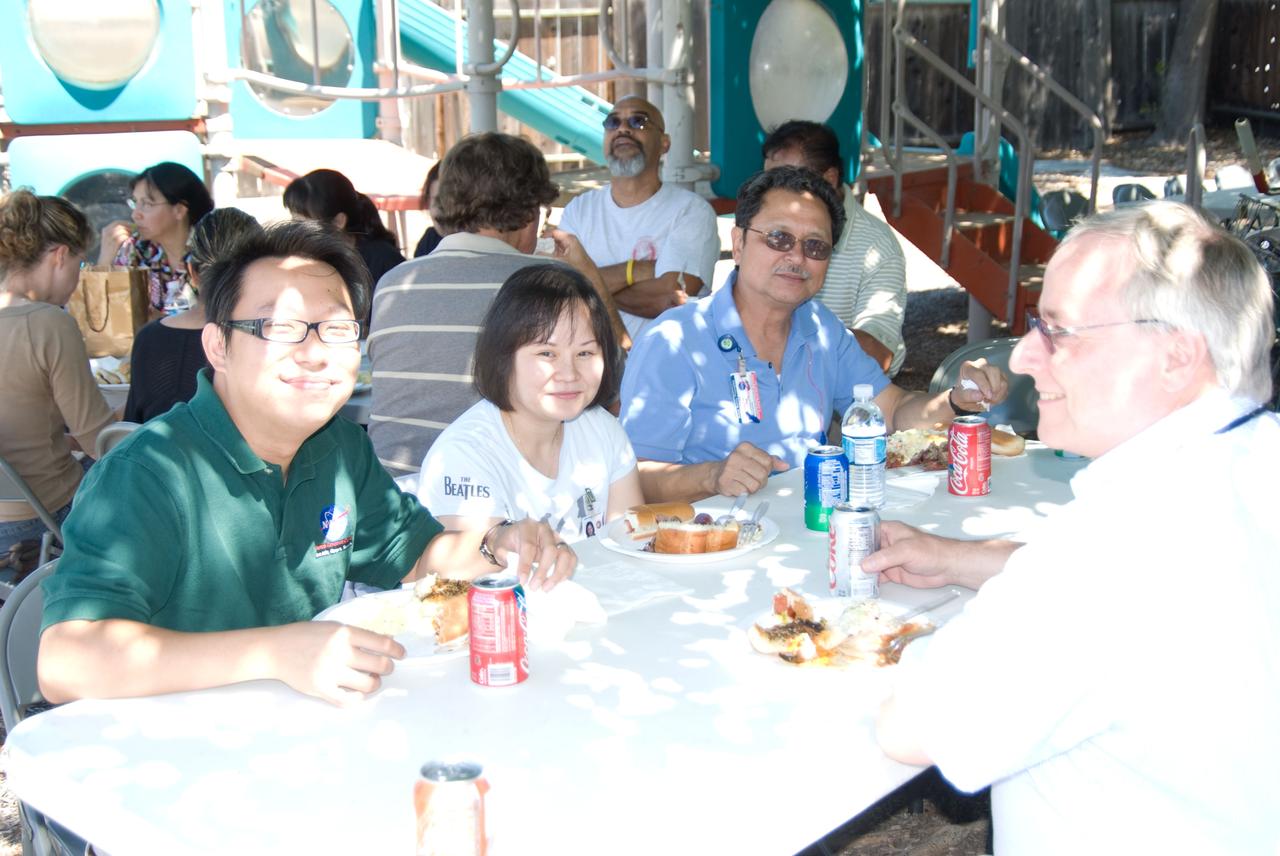
Space Technology Division Summer picnic
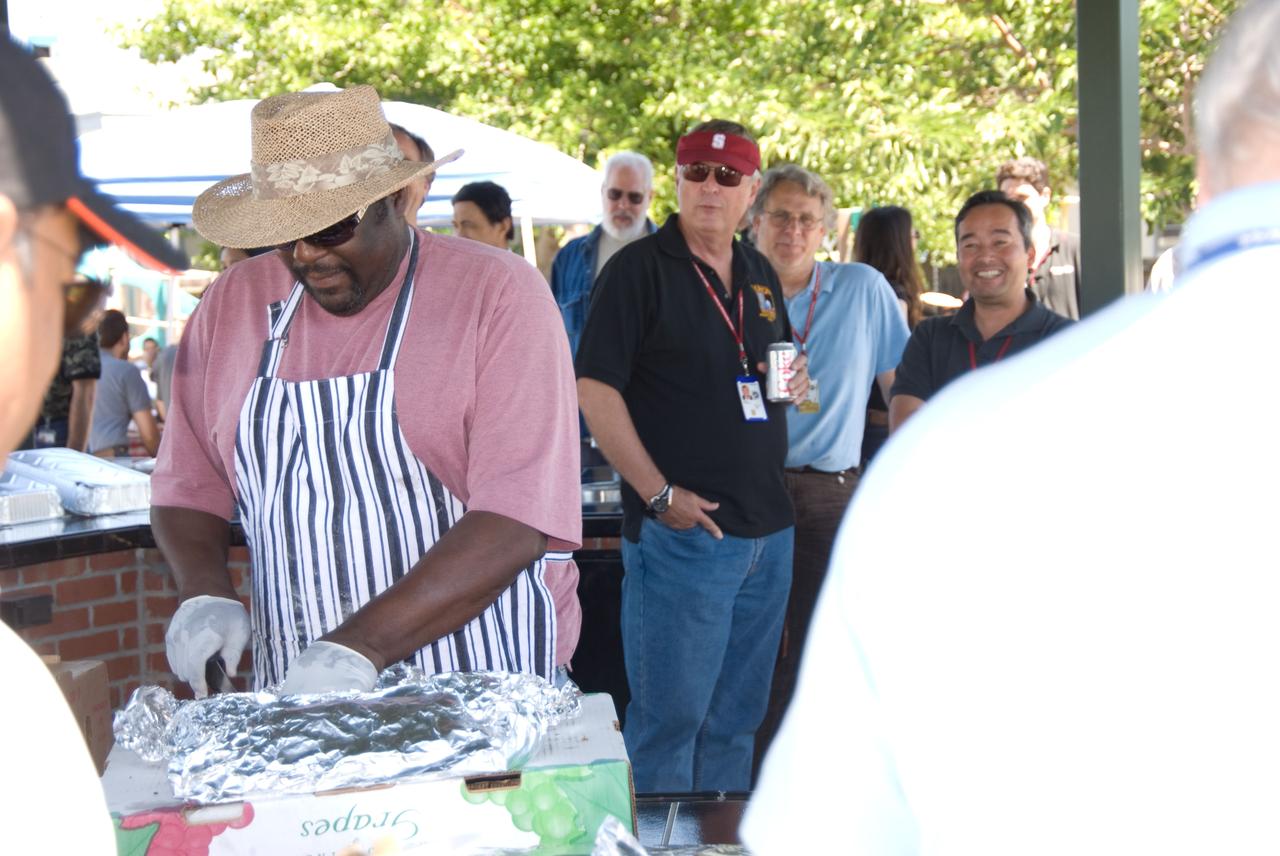
Space Technology Division Summer picnic
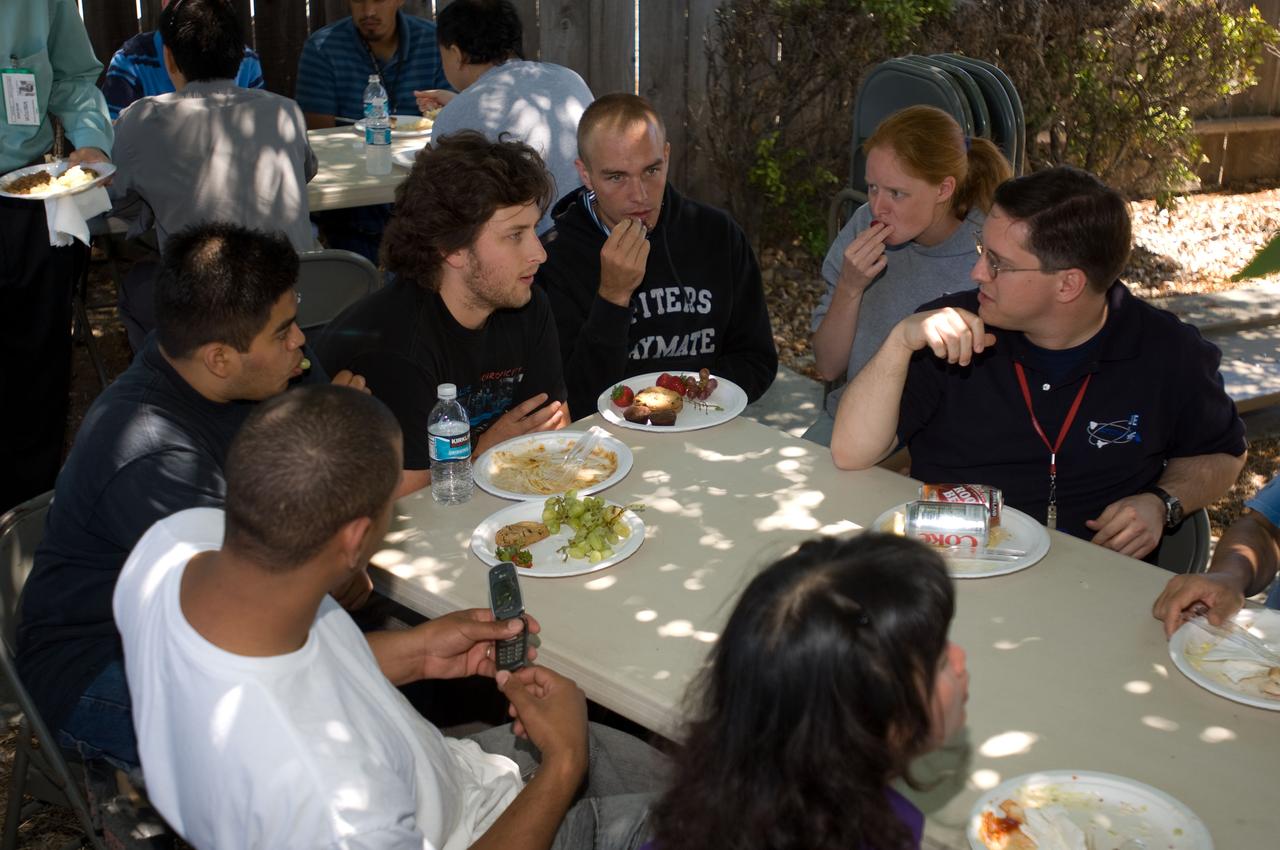
Space Technology Division Summer picnic
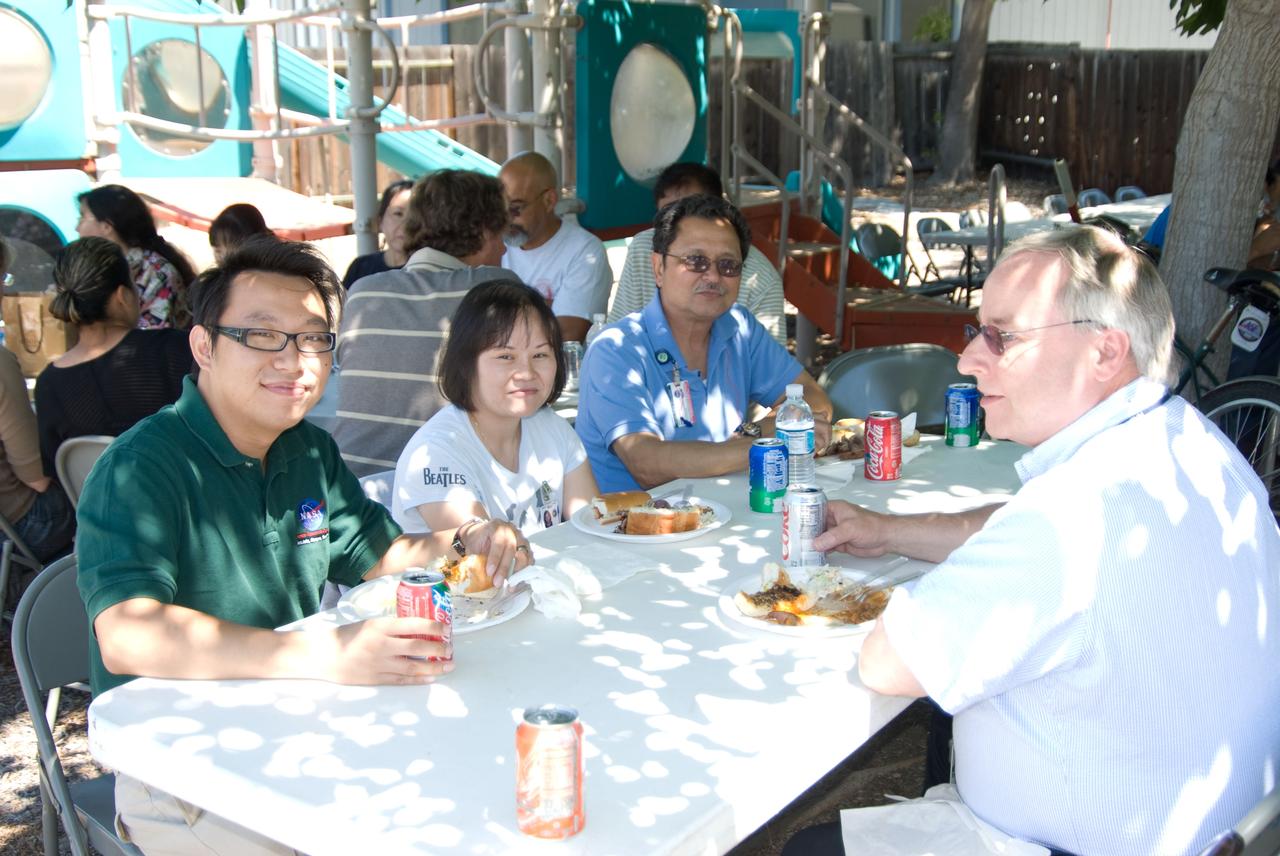
Space Technology Division Summer picnic
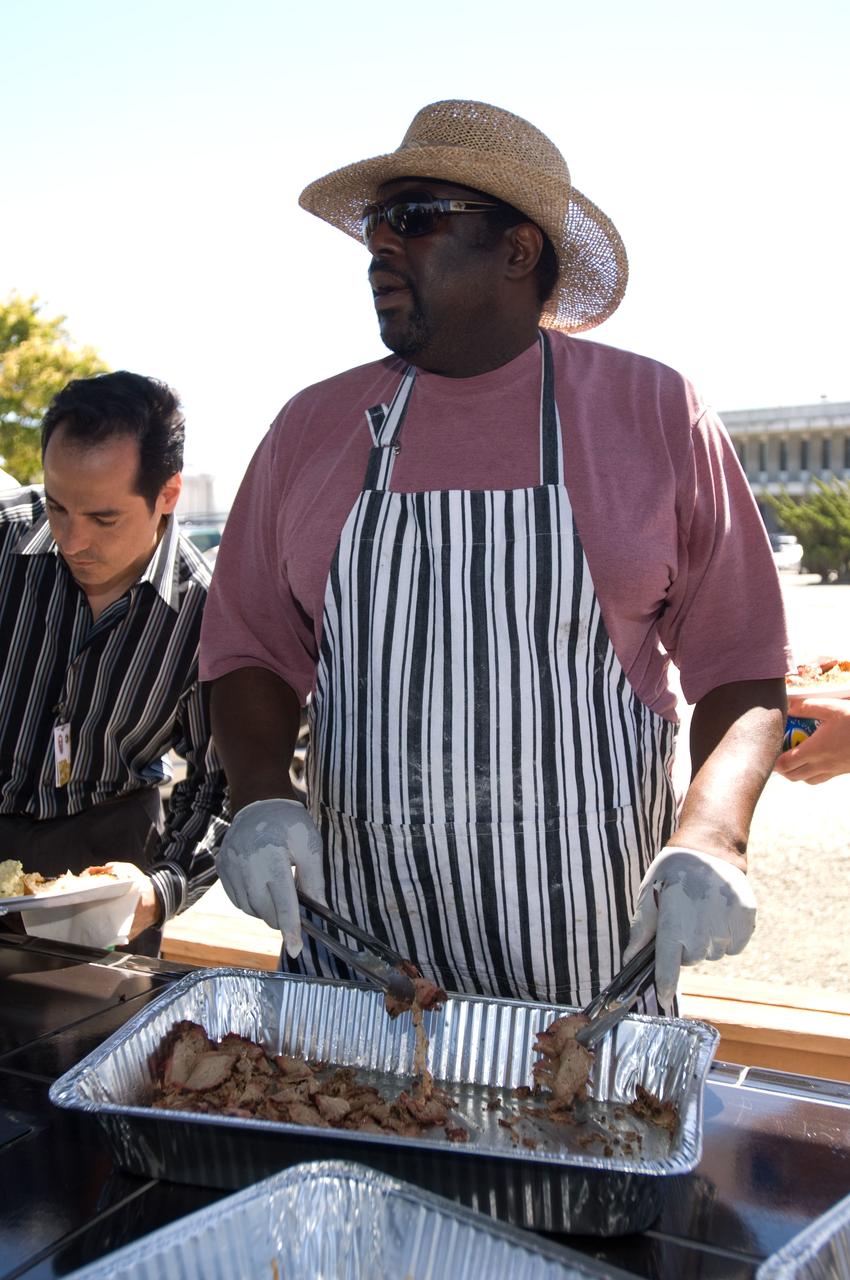
Space Technology Division Summer picnic
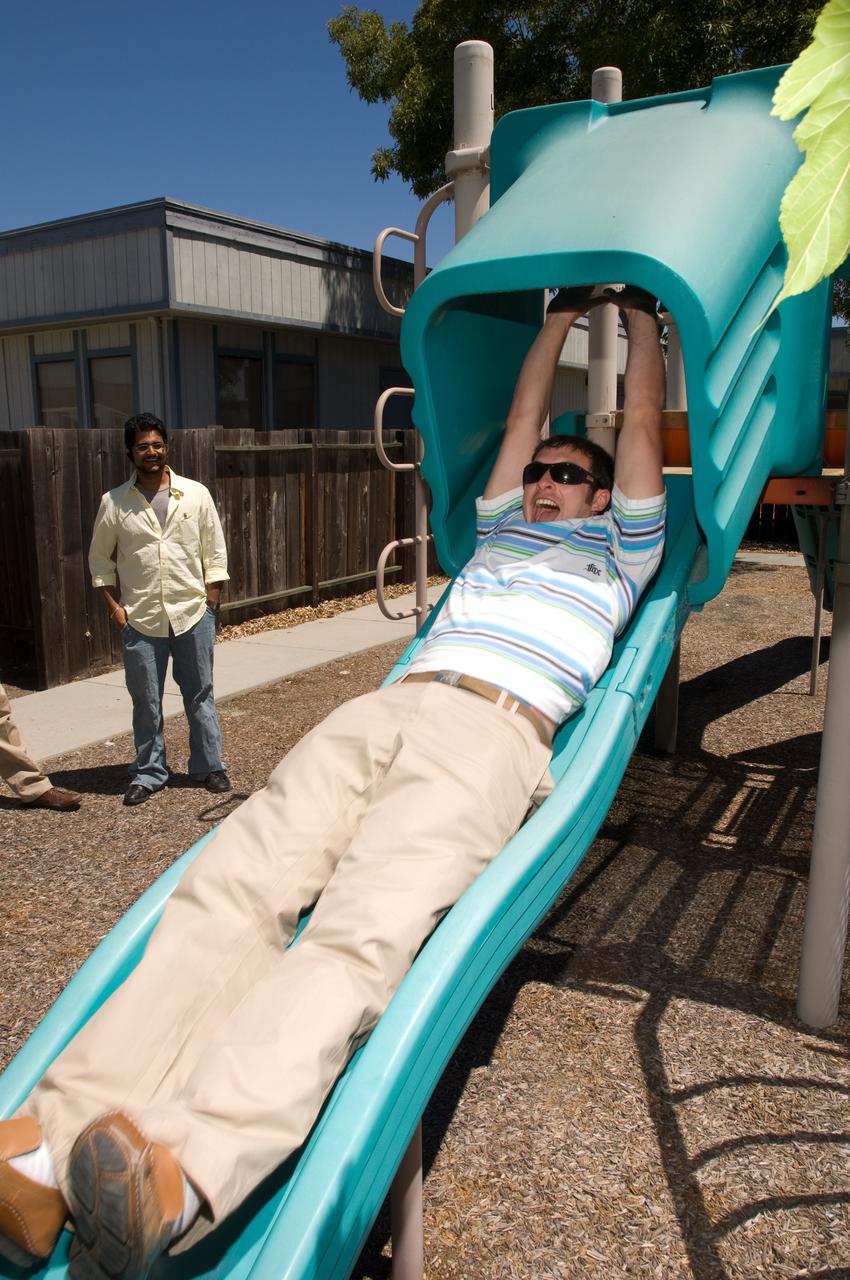
Space Technology Division Summer picnic

Space Technology Division Summer picnic
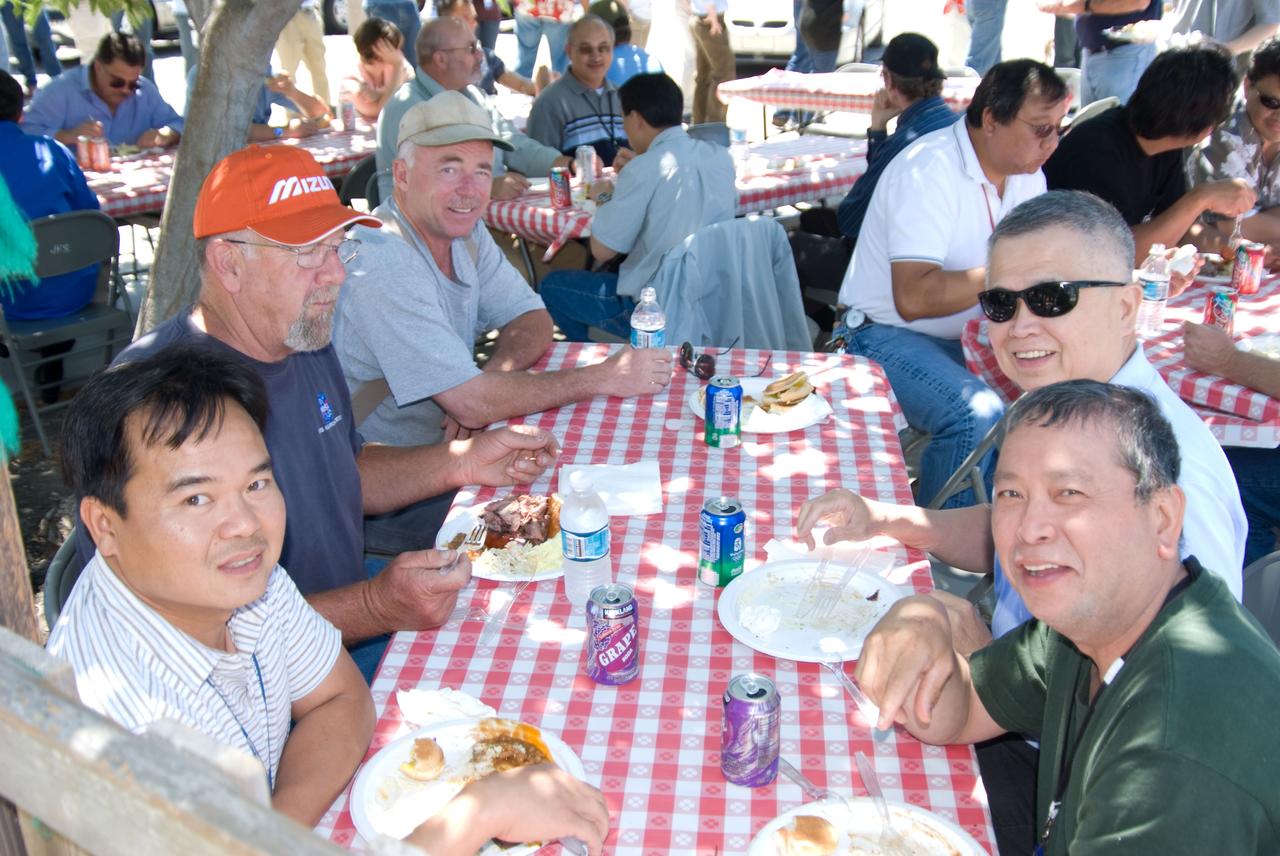
Space Technology Division Summer picnic
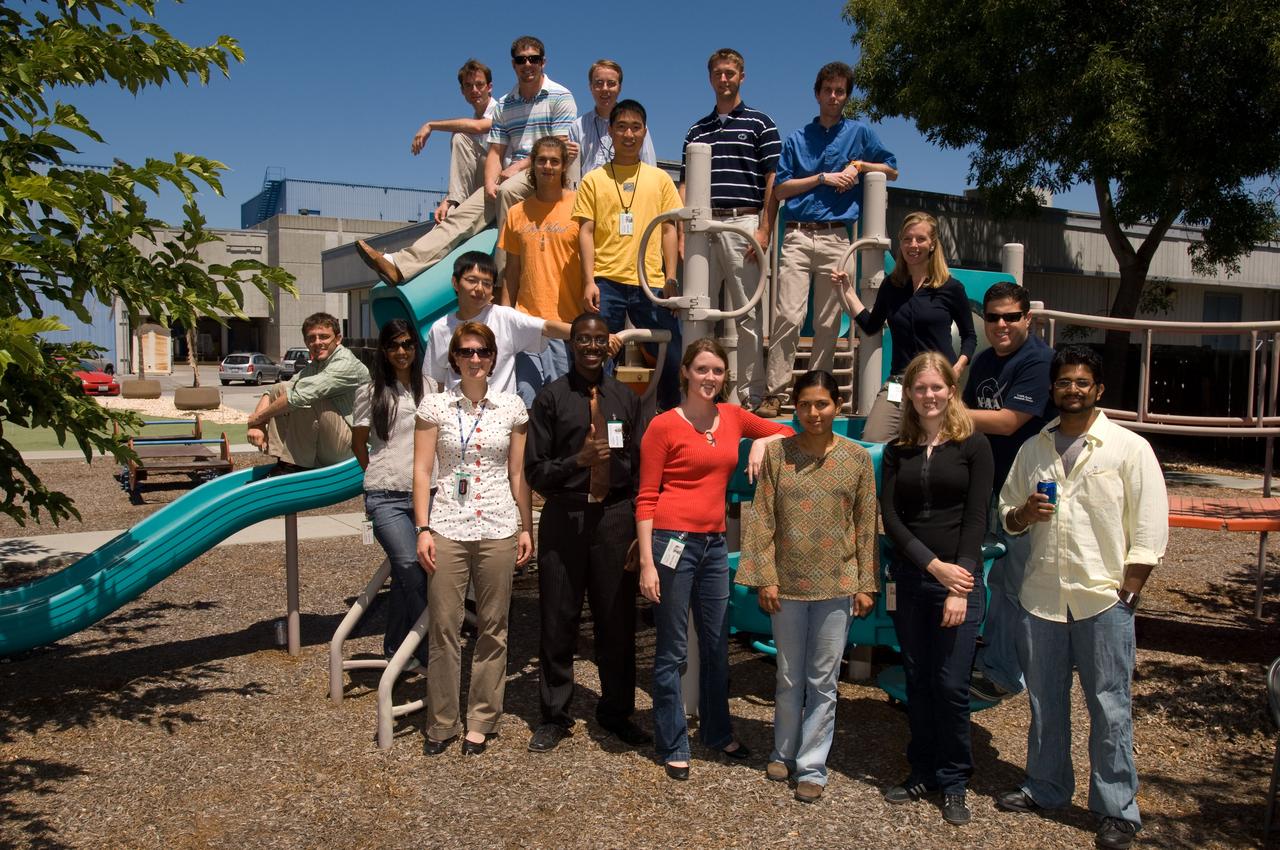
Space Technology Division Summer picnic

Space Technology Division Summer picnic
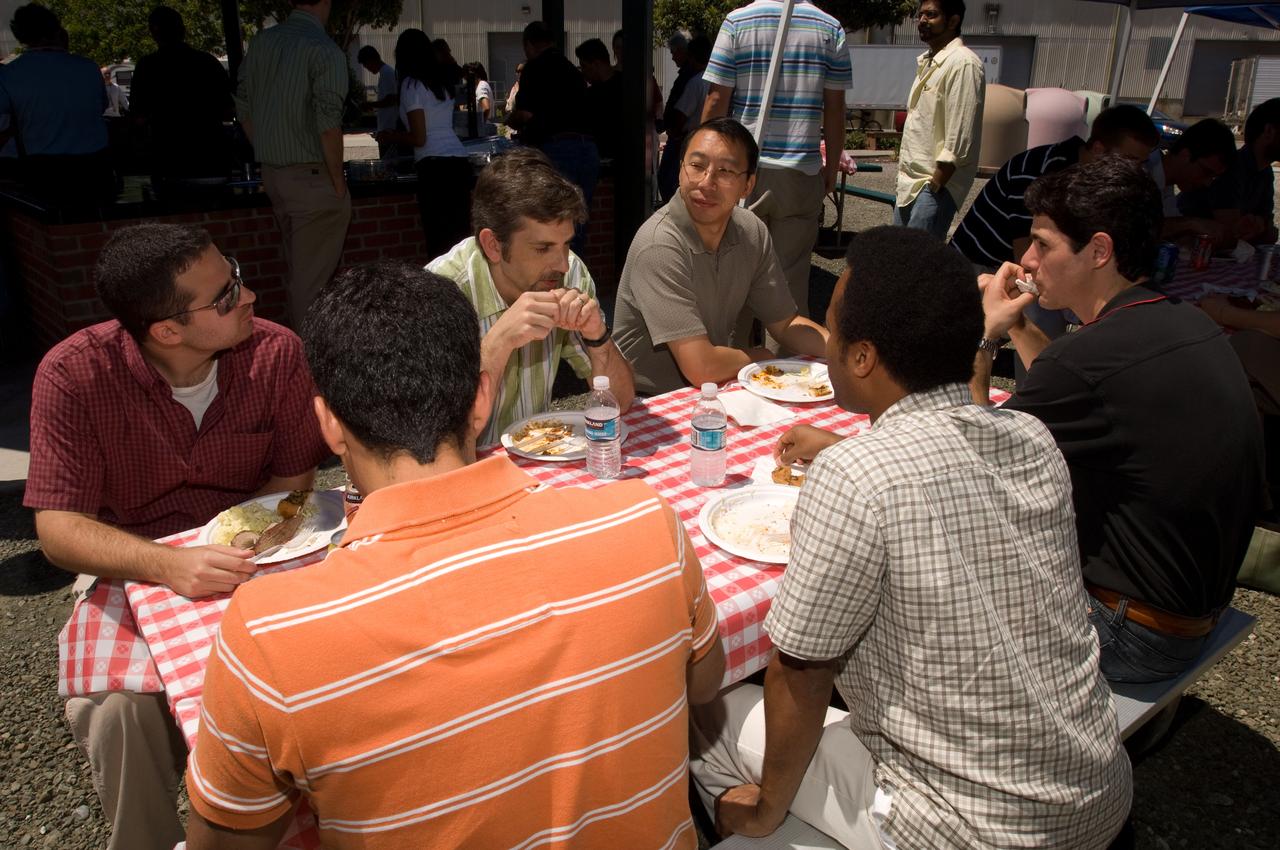
Space Technology Division Summer picnic

Space Technology Division Summer picnic
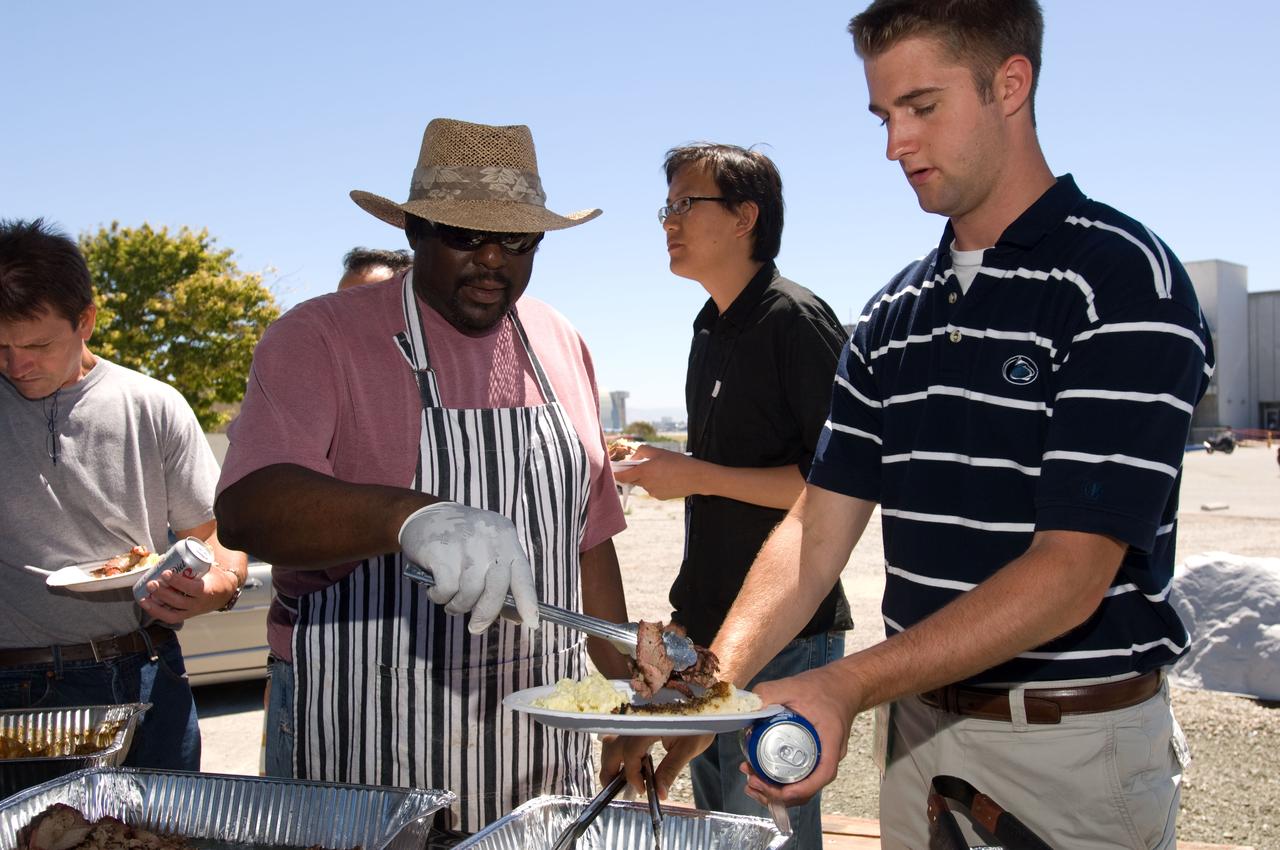
Space Technology Division Summer picnic
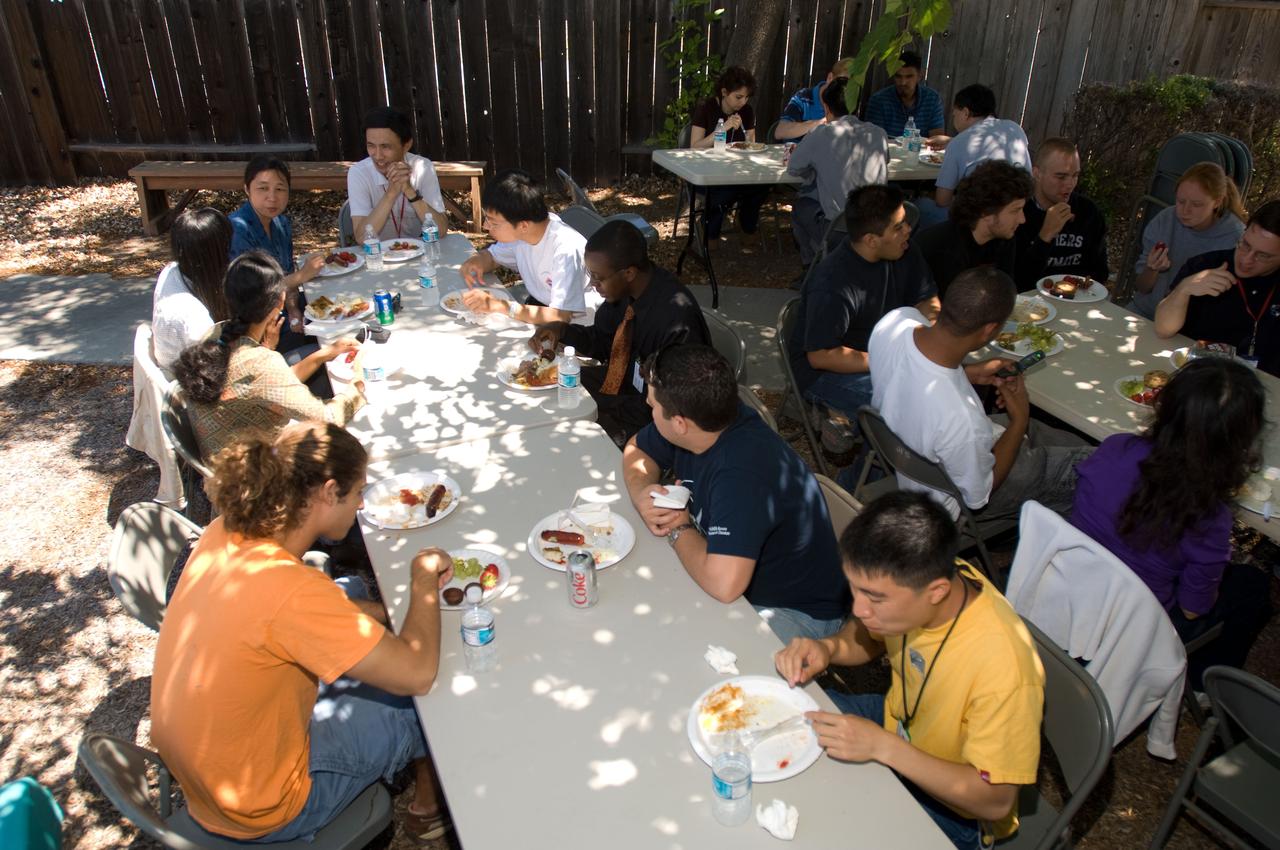
Space Technology Division Summer picnic
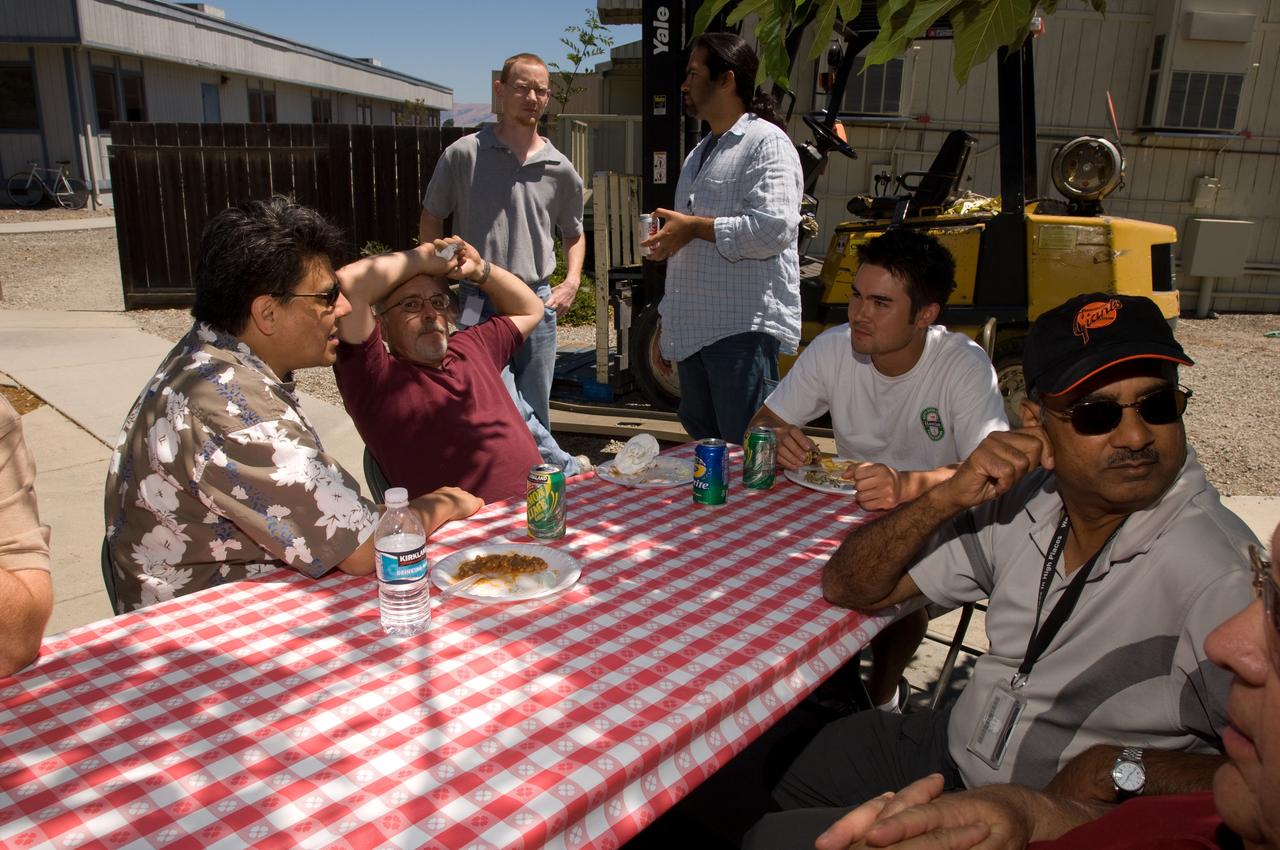
Space Technology Division Summer picnic
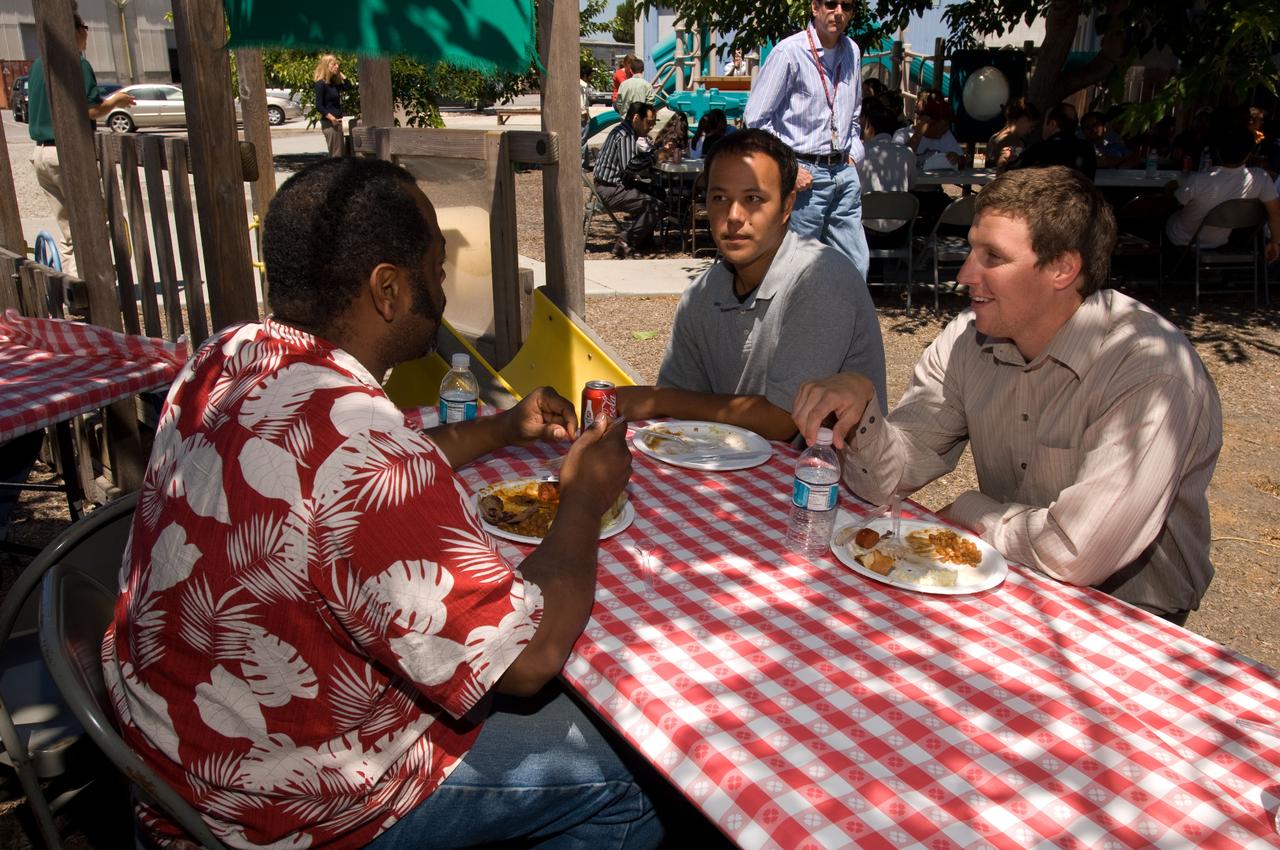
Space Technology Division Summer picnic
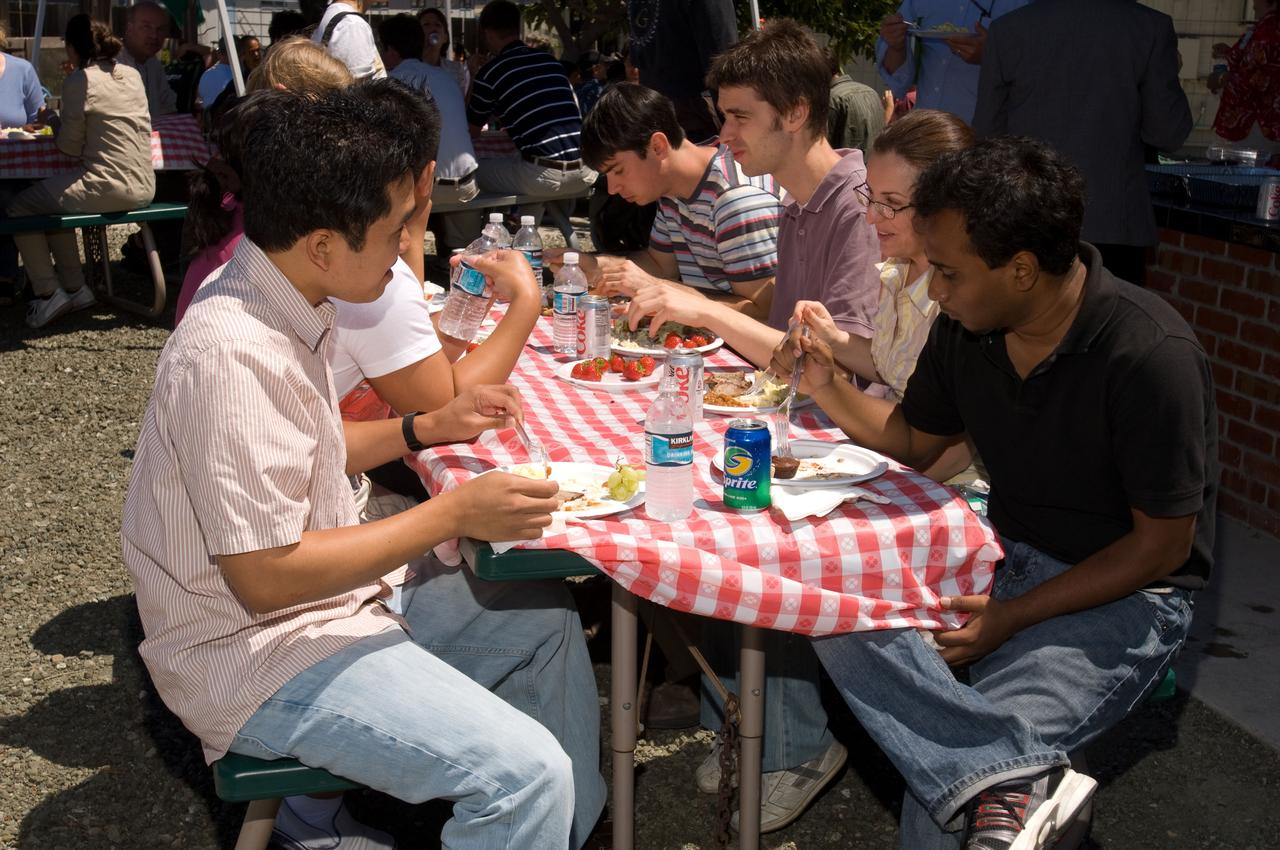
Space Technology Division Summer picnic
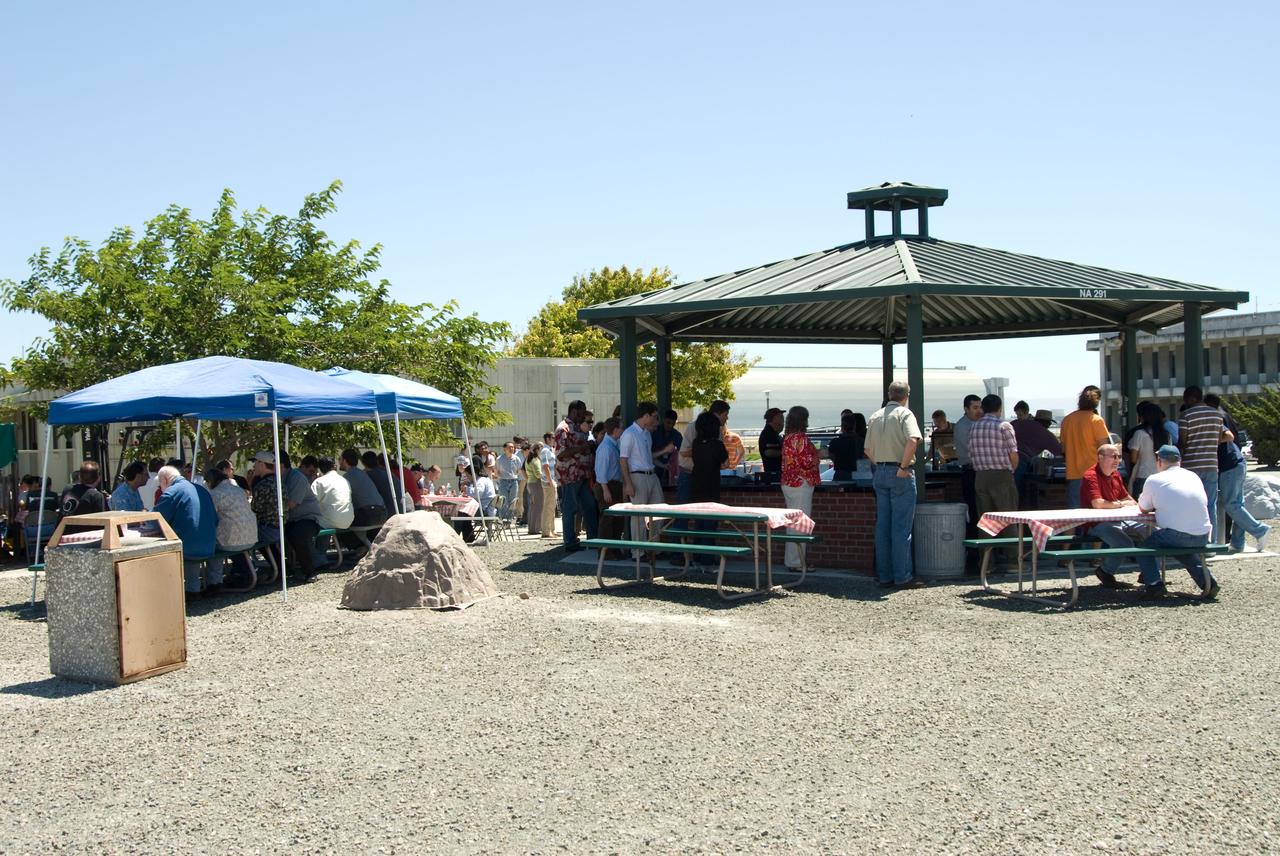
Space Technology Division Summer picnic
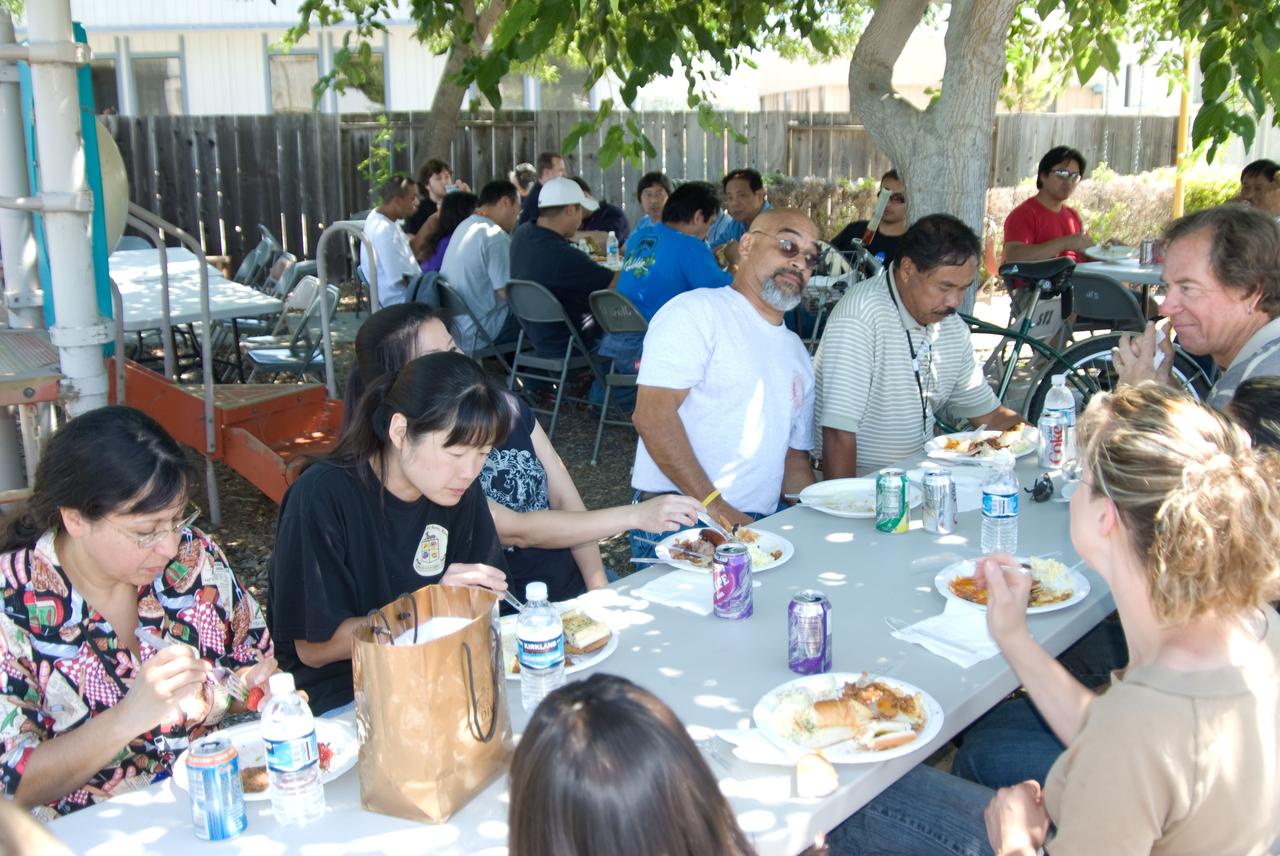
Space Technology Division Summer picnic
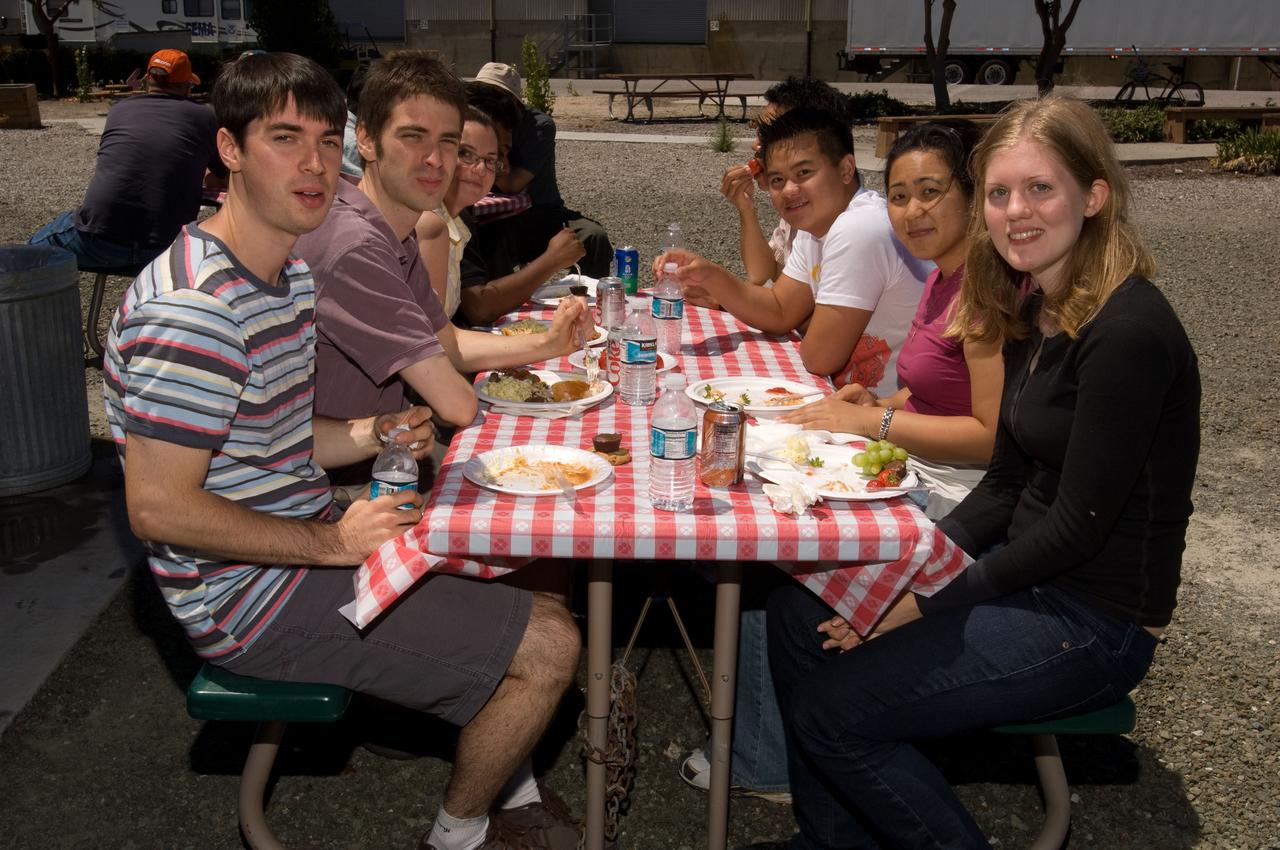
Space Technology Division Summer picnic
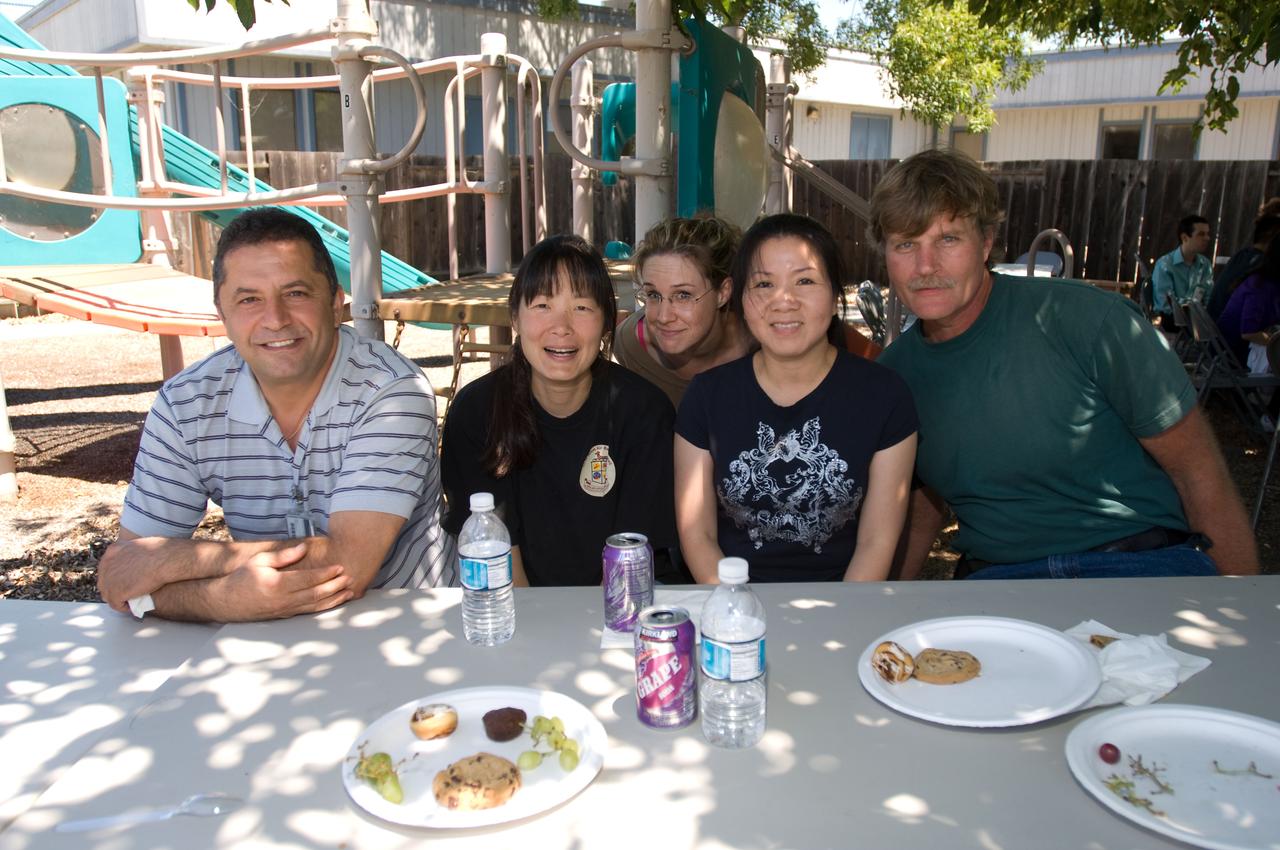
Space Technology Division Summer picnic
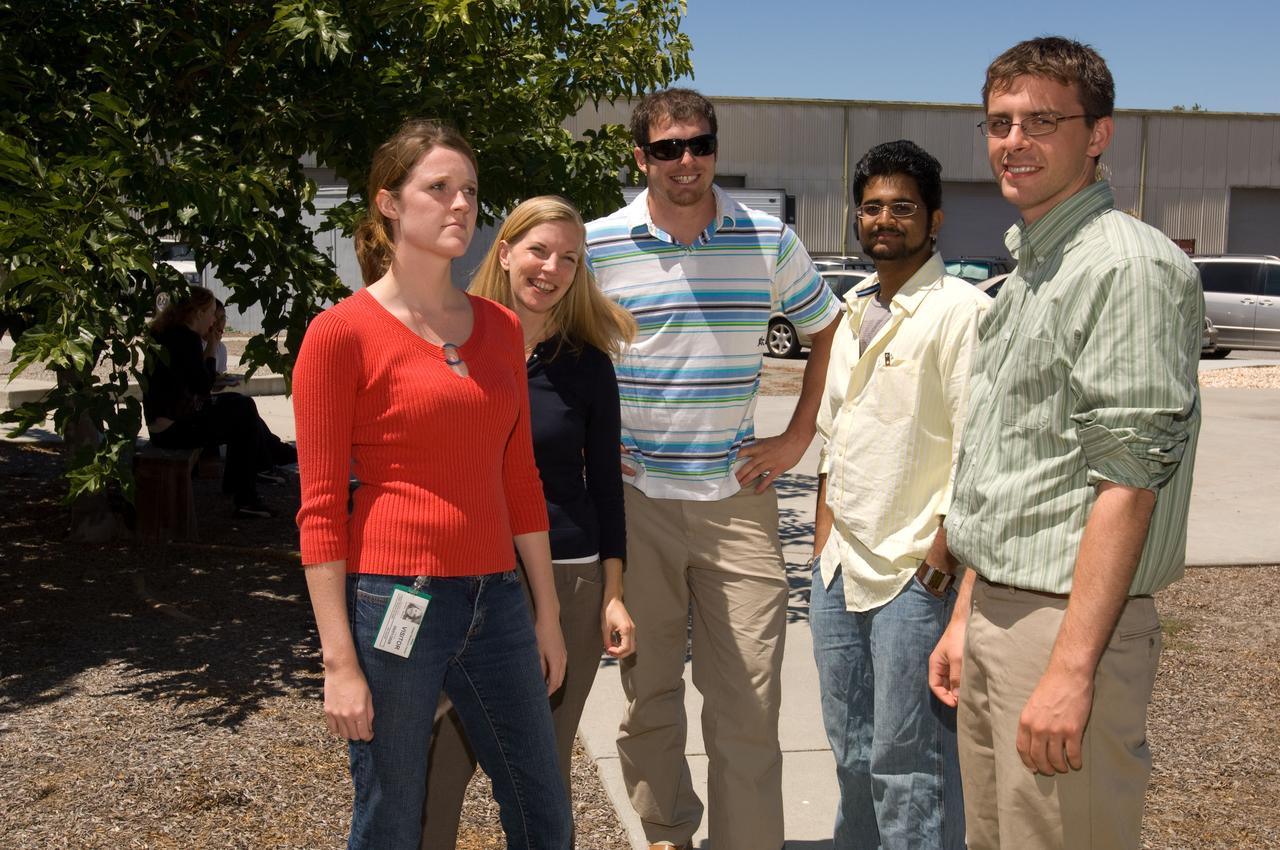
Space Technology Division Summer picnic
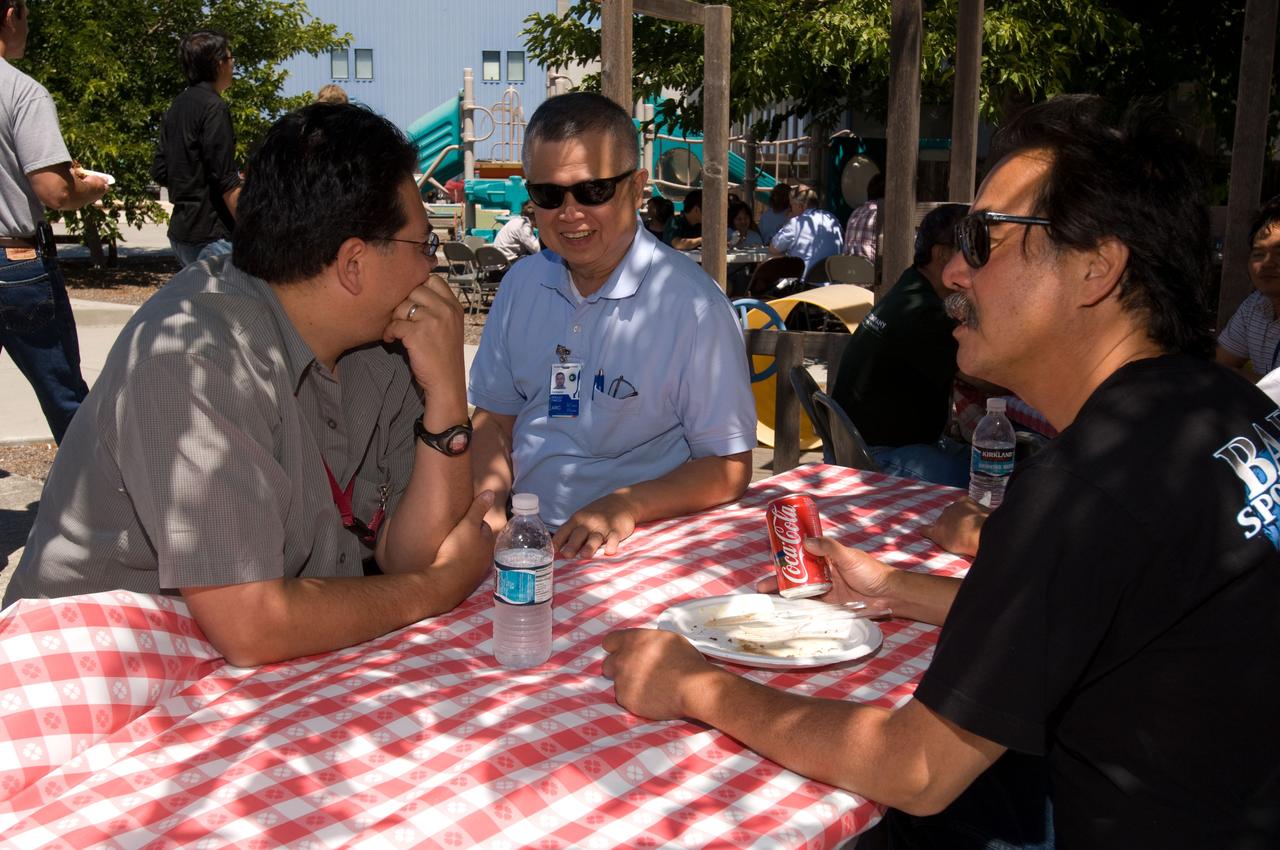
Space Technology Division Summer picnic
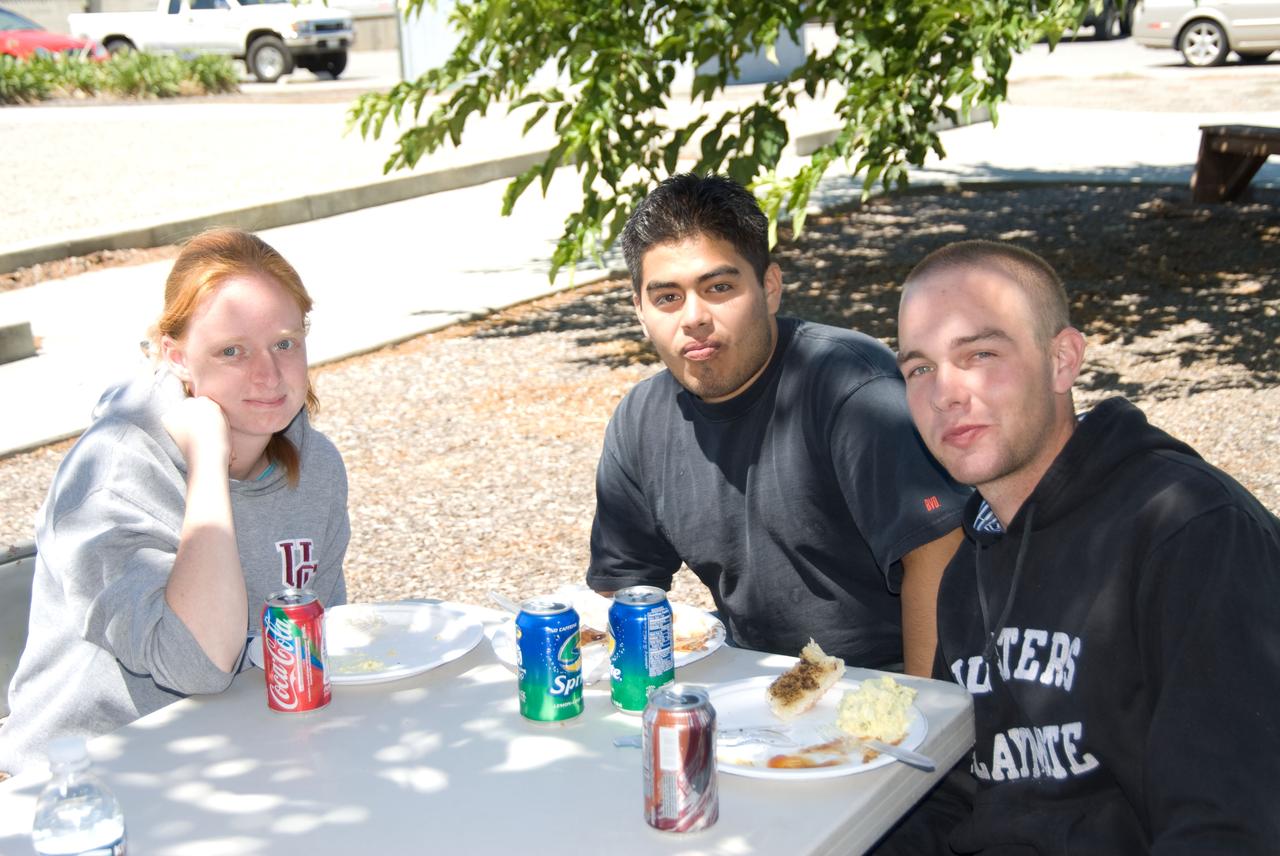
Space Technology Division Summer picnic
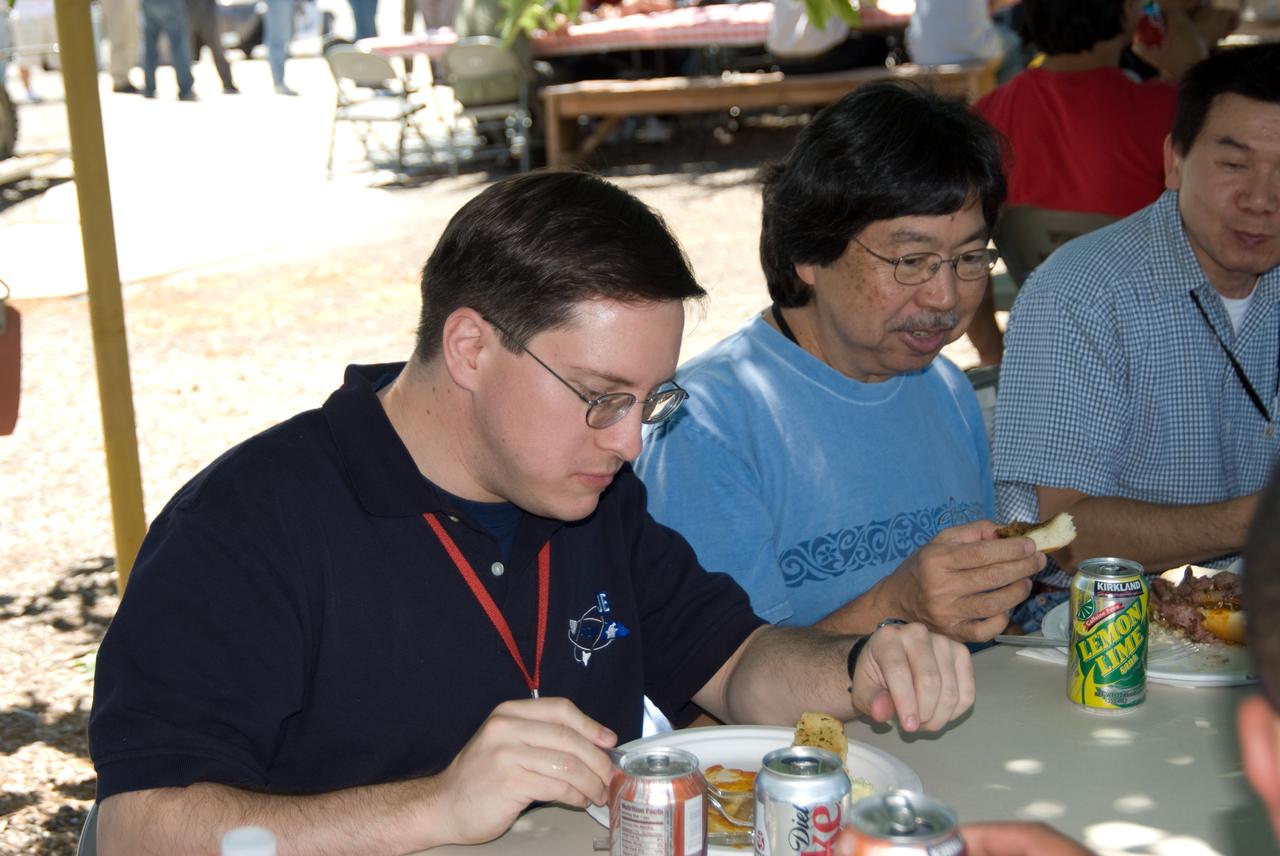
Space Technology Division Summer picnic

Space Technology Division Summer picnic

Space Technology Division Summer picnic
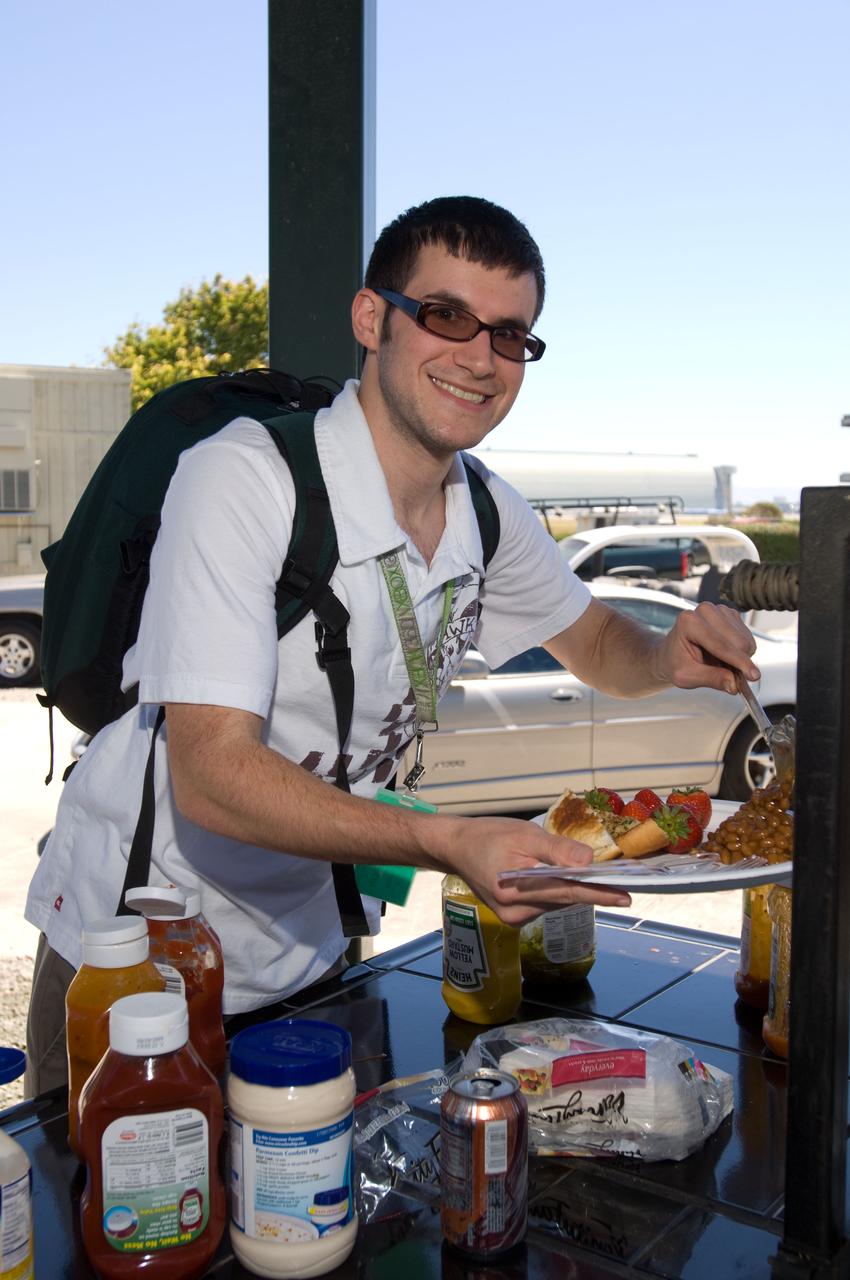
Space Technology Division Summer picnic with Kyle Cavallaro
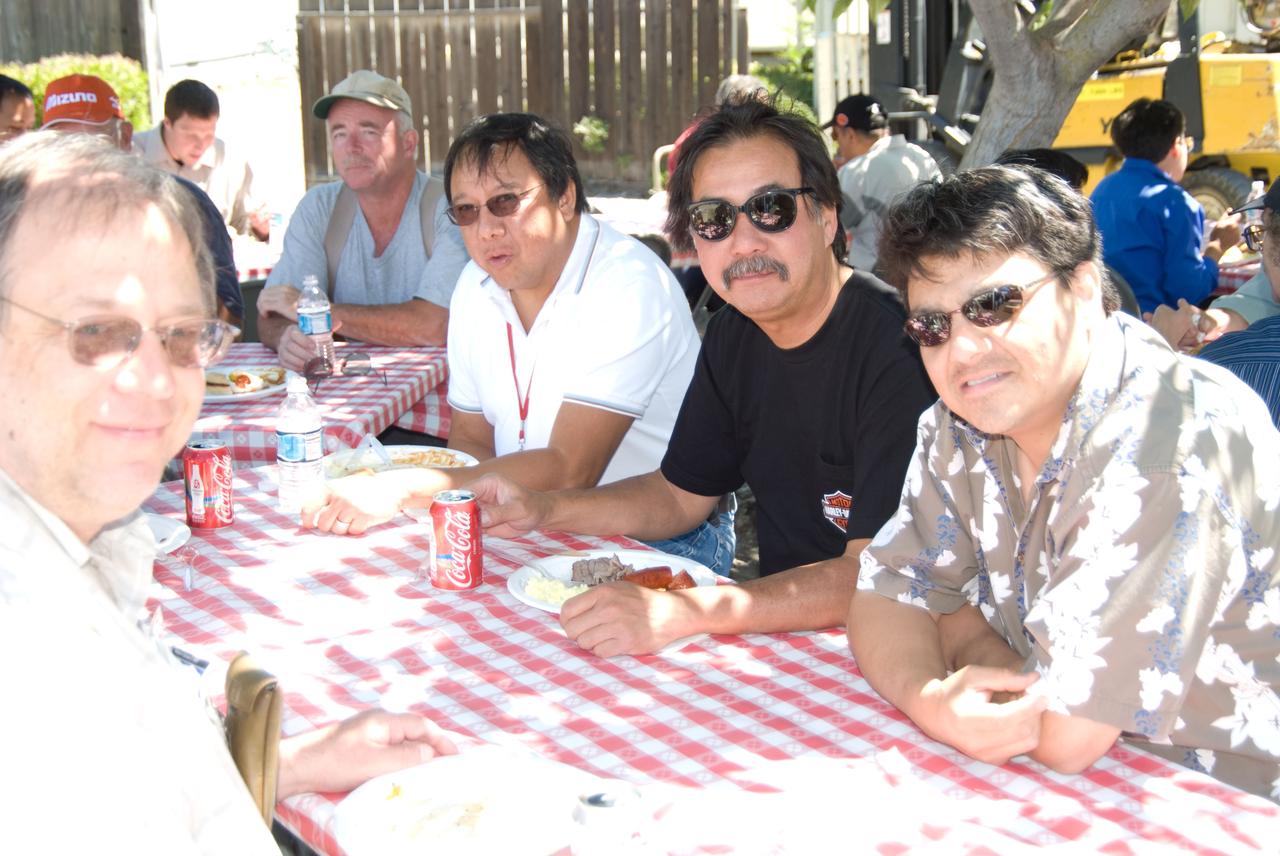
Space Technology Division Summer picnic with Cesar Acosta
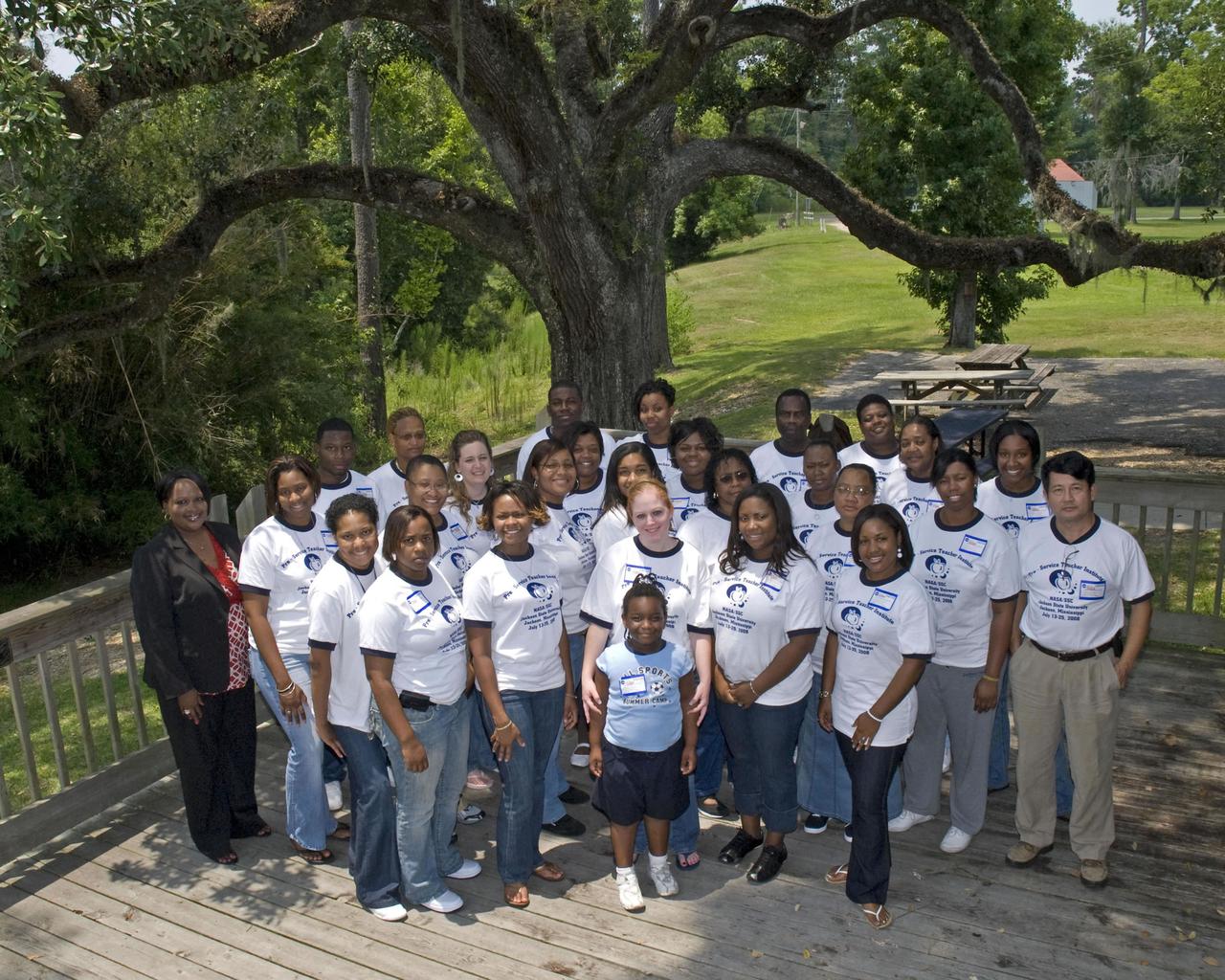
The Pre-Service Teachers Institute sponsored by Jackson (Miss.) State University participated in an agencywide Hubble Space Telescope workshop at Stennis Space Center on July 18. Twenty-five JSU junior education majors participated in the workshop, a site tour and educational presentations by Karma Snyder of the NASA SSC Engineering & Safety Center and Anne Peek of the NASA SSC Deputy Science & Technology Division.
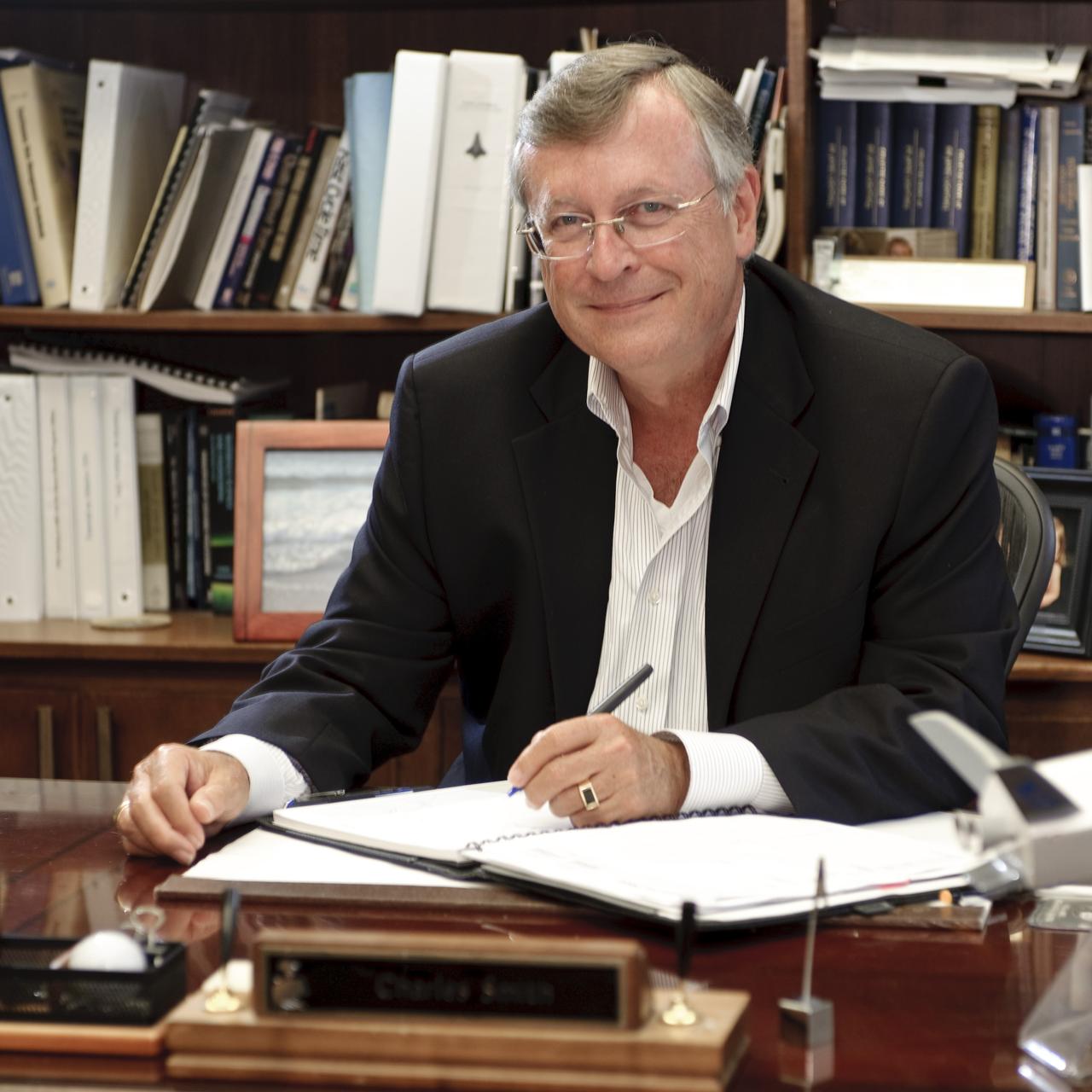
Portrait: Charles A. 'Chuck' Smith, Chief, Space Technology Division in his office

Portrait: Charles A. 'Chuck' Smith, Chief, Space Technology Division in his office
KENNEDY SPACE CENTER, FLA. - Logo for the Mars Reconnaissance Orbiter (MRO) mission, managed for NASA by JPL, a division of the California Institute of Technology, Pasadena.
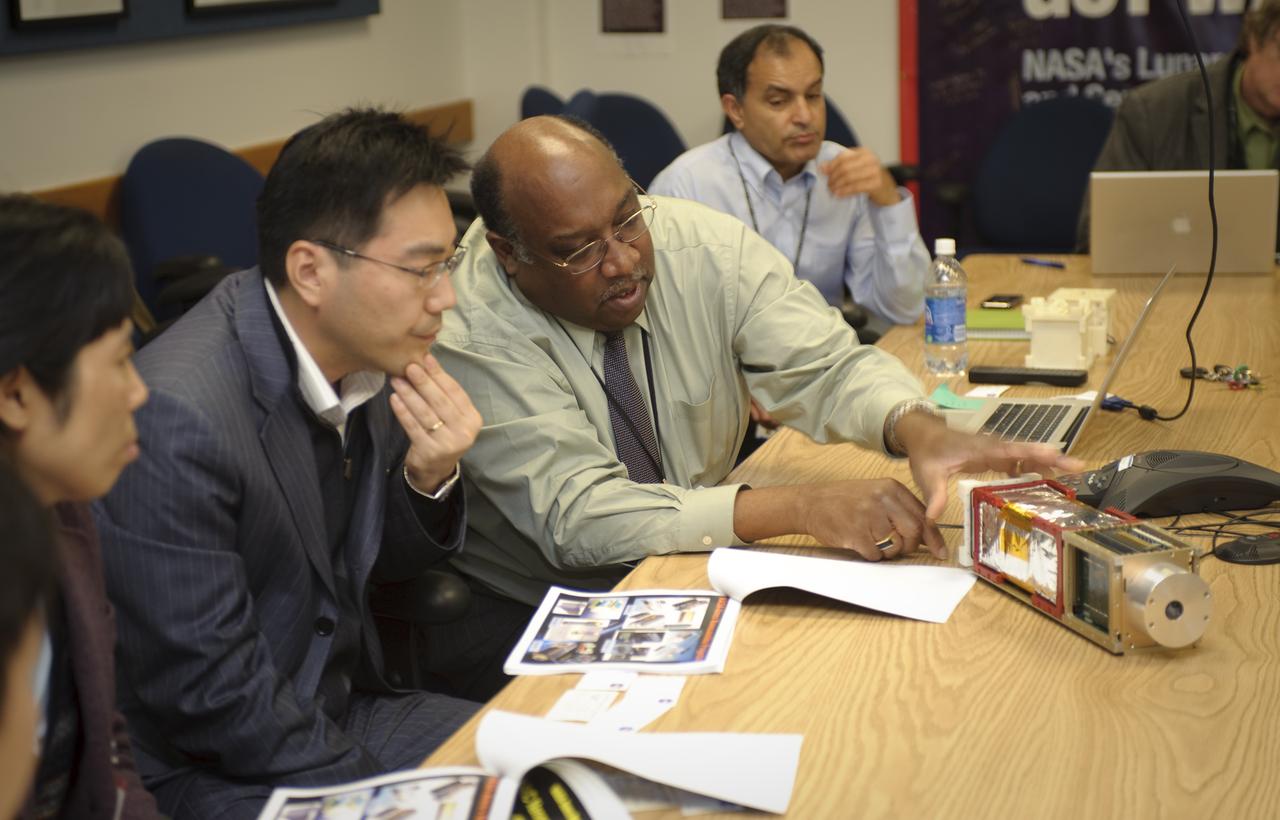
Korean High Level Delegation Visit Ames Certer Director and various Senior staff: John Hines, Ames Center Chief Technologist (middel left) explains PharmaSat (small Satellites) to Soon-Duk Bae, Deputy Director, Big Science Policy Division, Ministry of Educaiton, Science Technology, Young-Mok Hyun, Deputy Director, Space Development Division, Ministry of Educaiton, Science Technology, Seorium Lee, Senior Researcher, International Relations Korea Aerospace Research Institute. Unkonw person at the end of table.
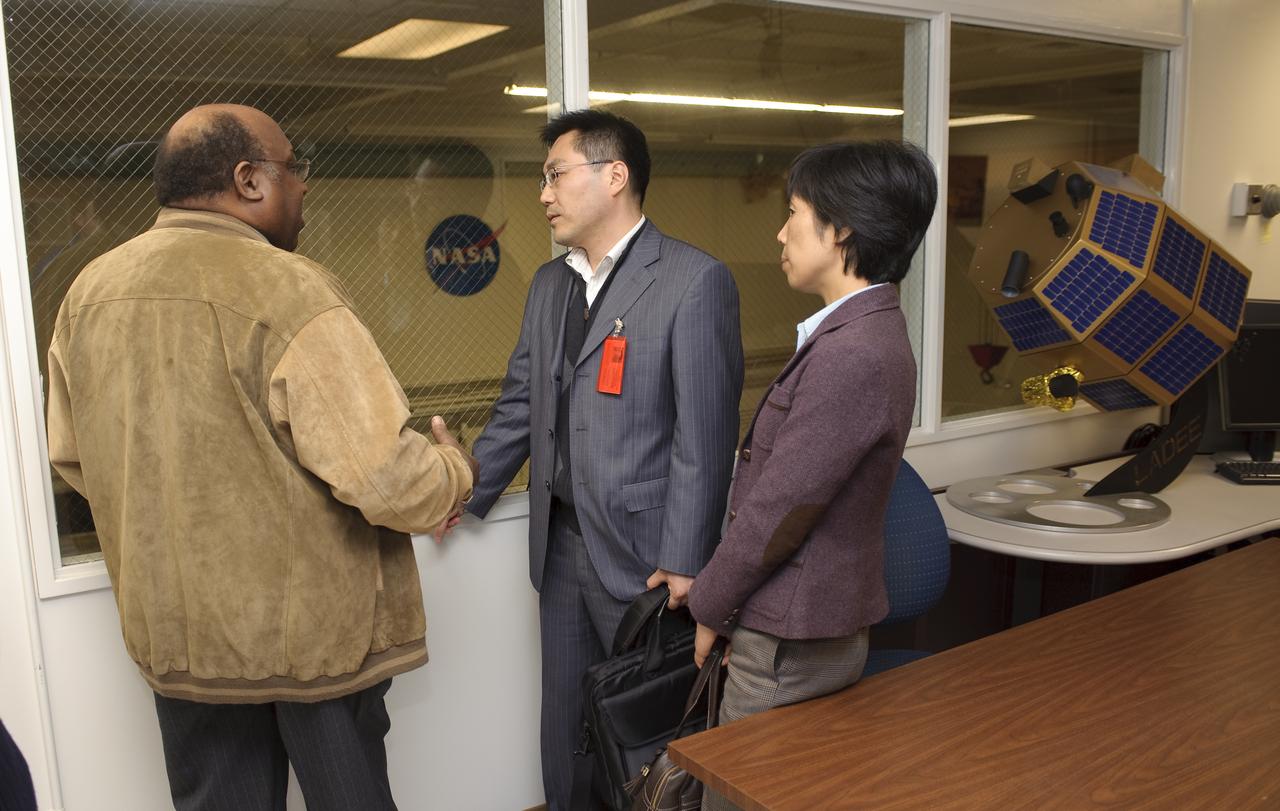
Korean High Level Delegation Visit Ames Certer Director and various Senior staff: John Hines, Ames Center Chief Technologist (middel left) explains operations at the LADEE lab to Soon-Duk Bae, Deputy Director, Big Science Policy Division, Ministry of Educaiton, Science Technology, Young-Mok Hyun, Deputy Director, Space Development Division, Ministry of Educaiton, Science Technology, Seorium Lee, Senior Researcher, International Relations Korea Aerospace Research Institute.
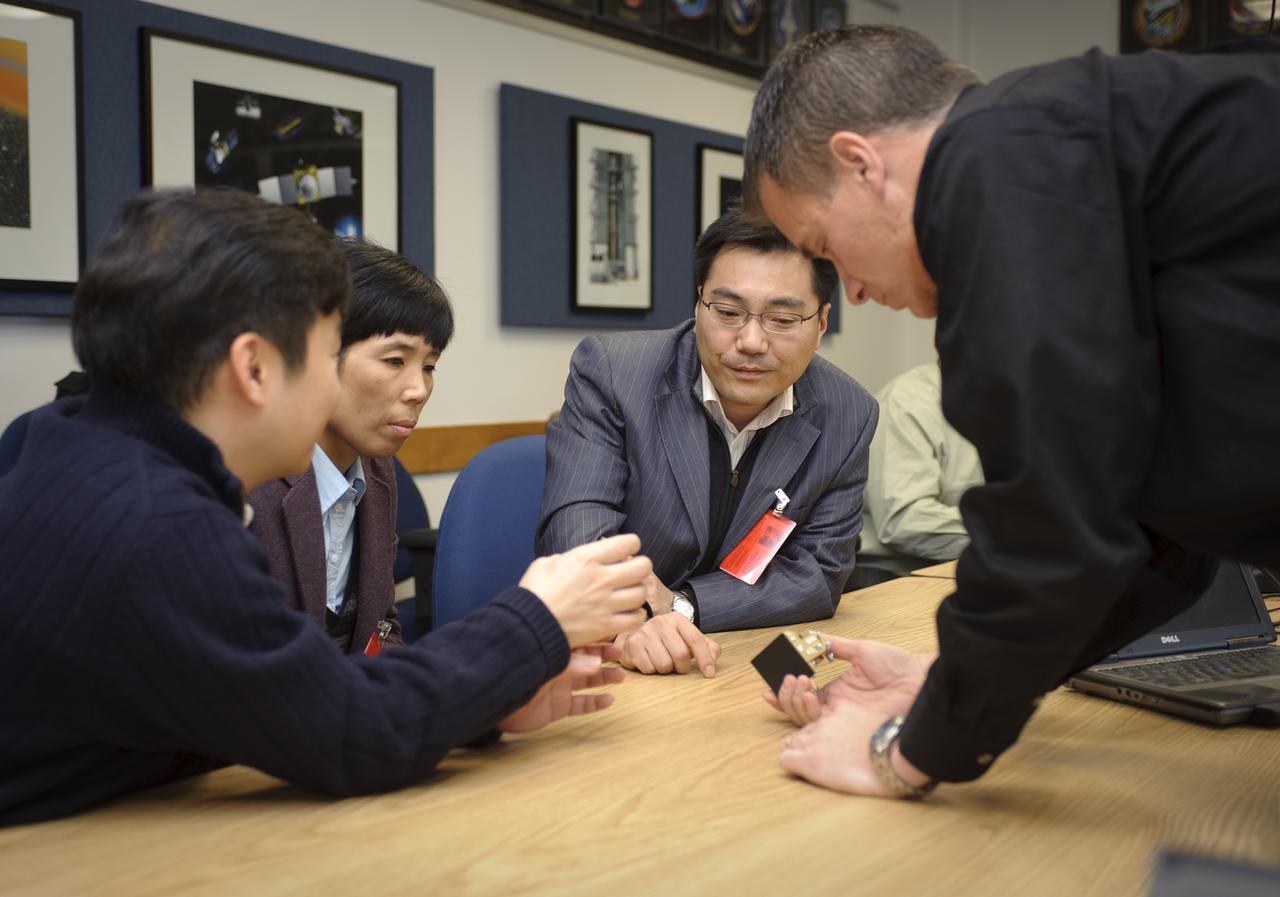
Korean High Level Delegation Visit Ames Certer Director and various Senior staff: Dan Andrews give presentation about LCROSS/LRO to Seorium Lee, Senior Researcher, International Relations Korea Aerospace Research Institute, Soon-Duk Bae, Deputy Director, Big Science Policy Division, Ministry of Educaiton, Science Technology, Young-Mok Hyun, Deputy Director, Space Development Division, Ministry of Educaiton, Science Technology, Seorium Lee, Senior Researcher, International Relations Korea Aerospace Research Institute.
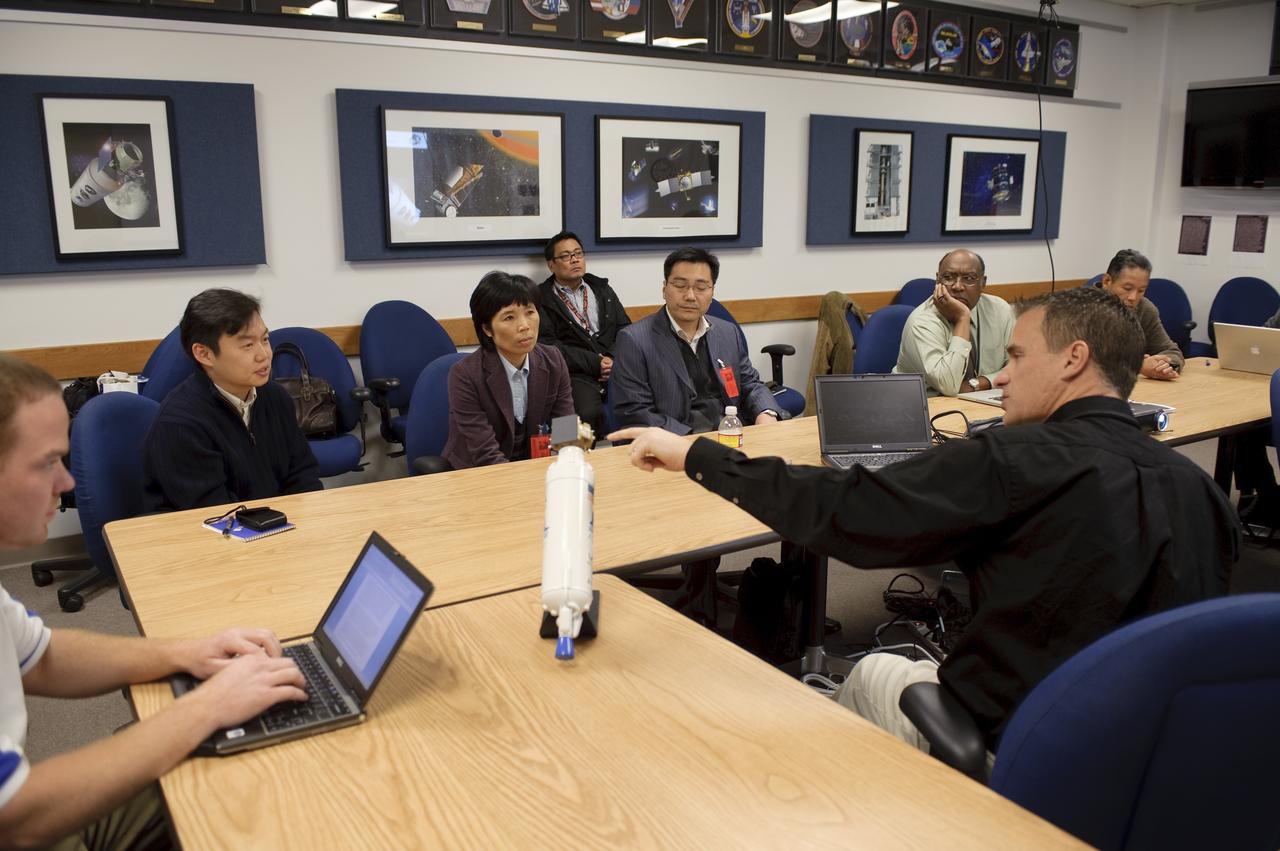
Korean High Level Delegation Visit Ames Certer Director and various Senior staff: Dan Andrews give presentation about LCROSS/LRO to Seorium Lee, Senior Researcher, International Relations Korea Aerospace Research Institute, Soon-Duk Bae, Deputy Director, Big Science Policy Division, Ministry of Educaiton, Science Technology, Young-Mok Hyun, Deputy Director, Space Development Division, Ministry of Educaiton, Science Technology. Also at table are Chris Giulietti, NASA HQ, John Hines, Ames Center Chief Technologist, Unknow person and Terry Pagaduan, Government Relations/Legislative Affairs office.

NASA Marshall Space Flight Center’s Science and Technology Office held its 11th annual Science and Technology Jamboree Dec. 8 at Marshall Activities Building 4316. A poster session with around 60 poster presentations highlighted current science and technology topics and the innovative projects underway across the center. Here, Debra Needham, right, talks with coworker Sabrina Savage about one of the presentations. Both Needham and Savage are scientists in the Heliophysics & Planetary Science Branch of the Science Research and Projects Division.
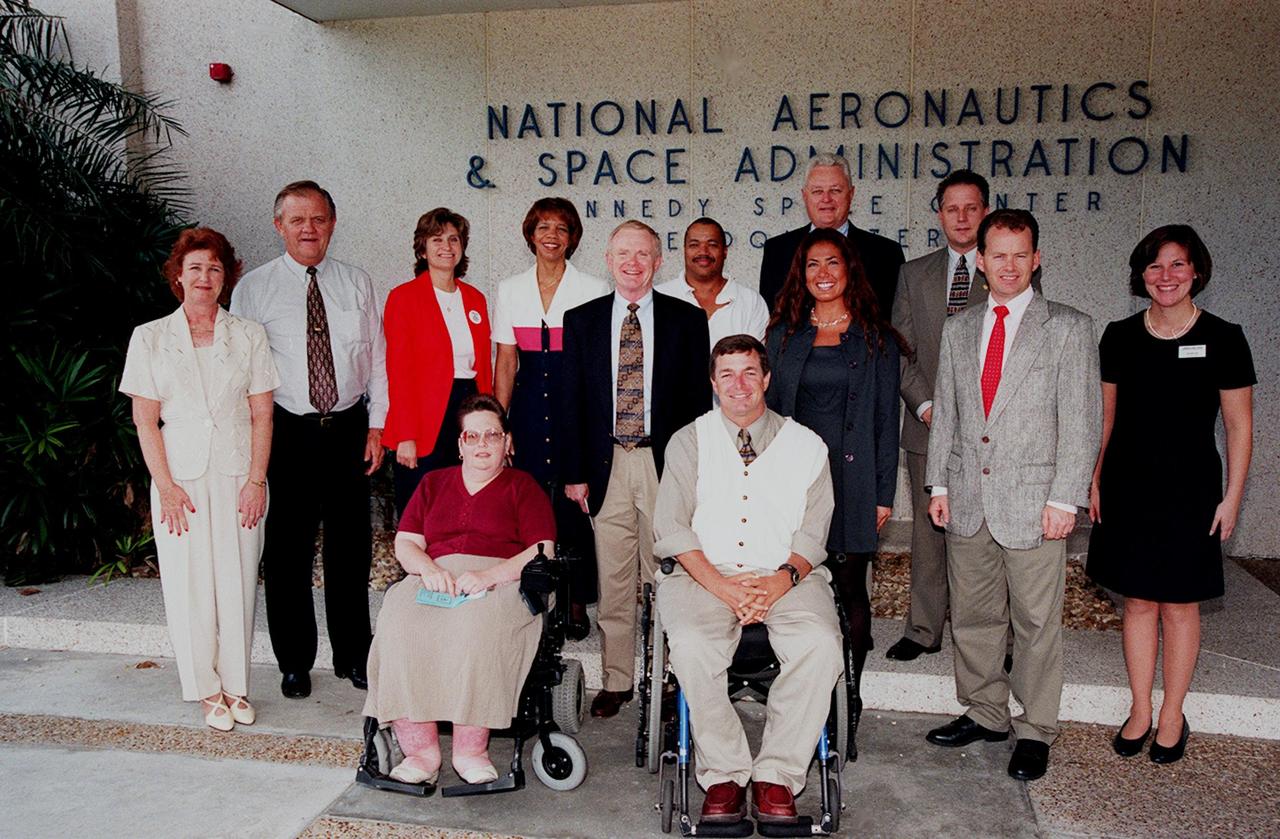
Center Director Roy Bridges (standing, center) poses with members of the Disability Awareness and Action Working Group (DAAWG), which is holding the 1999 Technology Fair Oct. 20-21 at Kennedy Space Center. The Fair is highlighting vendors demonstrating mobility, hearing, vision and silent disability assistive technology. The purpose is to create an awareness of the types of technology currently available to assist people with various disabilities in the workplace. The theme is that of this year's National Disability Employment Awareness Month, "Opening Doors to Ability." Some of the vendors participating are Canine Companions for Independence, Goodwill Industries, Accessible Structures, Division of Blind Services, Space Coast Center for Independent Living, KSC Fitness Center and Delaware North Parks Services
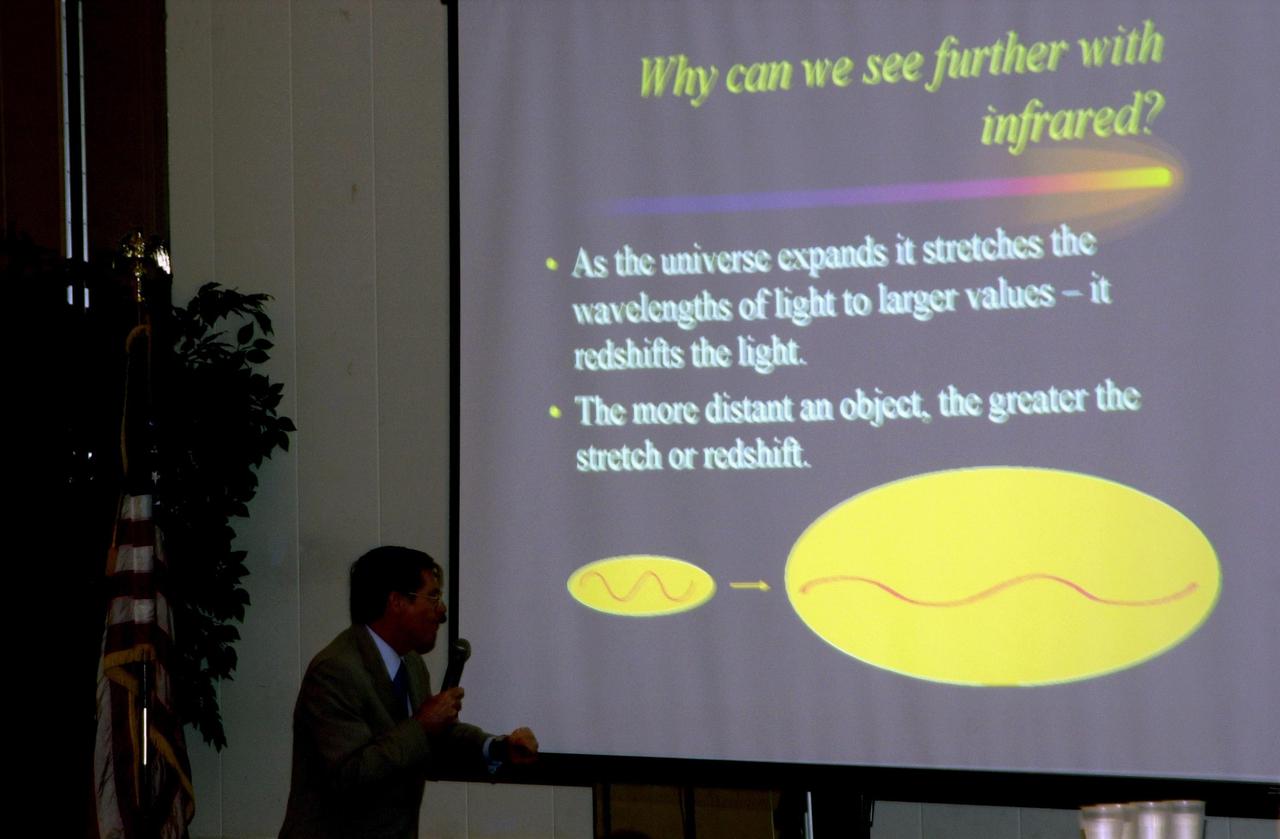
KENNEDY SPACE CENTER, FLA. -- At the 2002 Space Congress, Cape Canaveral, Fla., a presentation on 'Hubble Discoveries' included a discussion on infrared, as seen on the screen. At left is Dr. Mario Liviio, director of Science Division, Space Telescope Science Institute. The Space Congress is held annually to highlight military and space initiatives, new technologies, and Florida's role in programs and research. This year's theme is Beginning a New Era - Initiatives in Space. NASA presented several paper sessions, including Advancements in Technology. Space Congress is sponsored by the Canaveral Council of Technical Societies
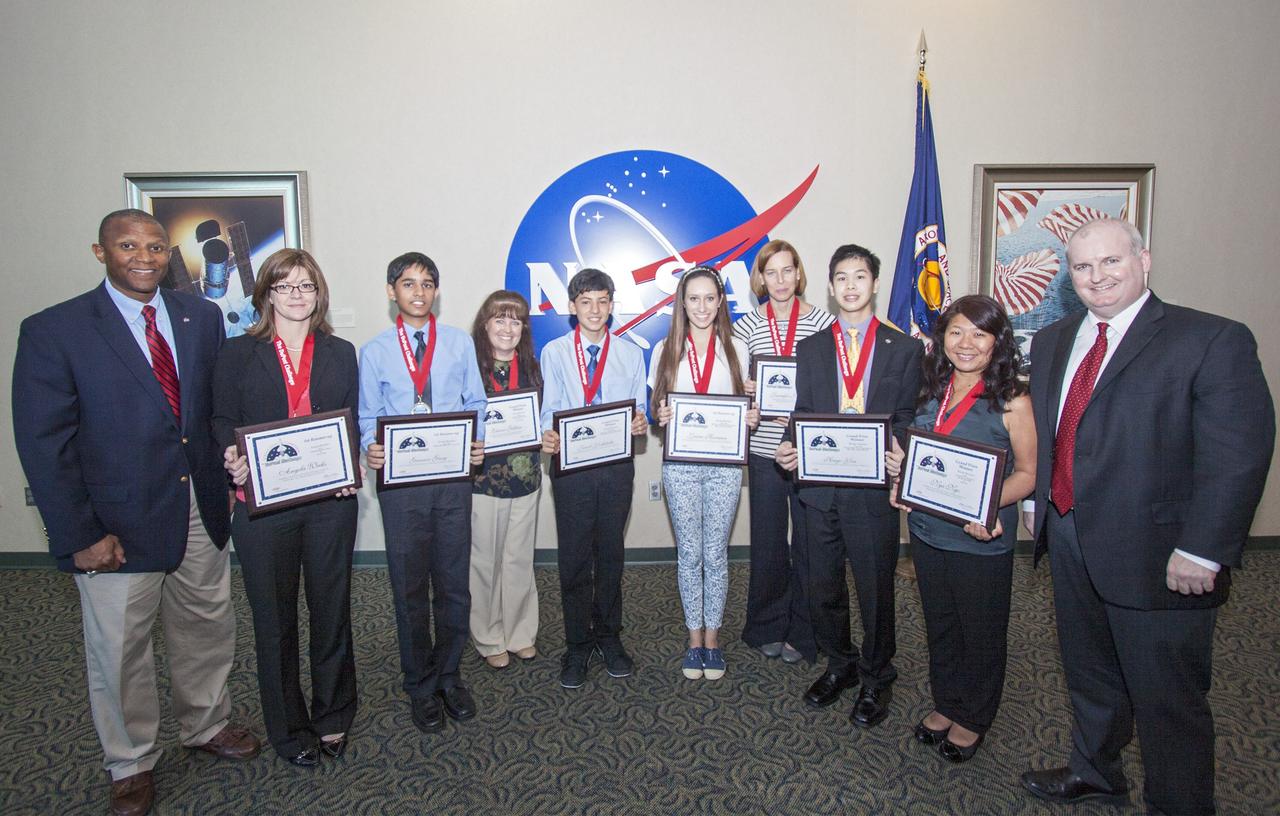
CAPE CANAVERAL, Fla. - The winning students and their teachers of the 2013 DuPont Challenge Science Essay Competition show off their awards after a ceremony at the Kennedy Space Center Visitor Complex in Florida. From left are, Kelvin Manning, the center's associate deputy director sponsoring teacher Angela Weeks and Junior Division first runner-up Gaurav Garg of Beckendorff Junior High in Katy, Texas sponsoring teacher Elaine Gillum and Senior Division grand prize winner Jacob Yoshitake of Marshall Middle School in San Diego, Calif. Senior Division first runner-up Laura Herman and sponsoring teacher Jennifer Gordinier of Pine Crest School in Fort Lauderdale, Fla. and Senior Division grand prize awardee Hugo Yen and sponsoring teacher Nga Ngo of Troy High in Fullerton, Calif. The challenge, now in its 27th year, reaches out to students from grades seven through 12 from all 50 states and Canada. More than 200,000 students entered the competition. The DuPont Challenge aims to inspire students to excel and achieve in scientific writing and pursue careers in science, technology, engineering and mathematics STEM. The challenge honors space shuttle Challenger's STS-51L crew members who gave their lives while furthering the cause of exploration and discovery. For more information on the challenge, go to http://thechallenge.dupont.com/sponsors/nasa.php.
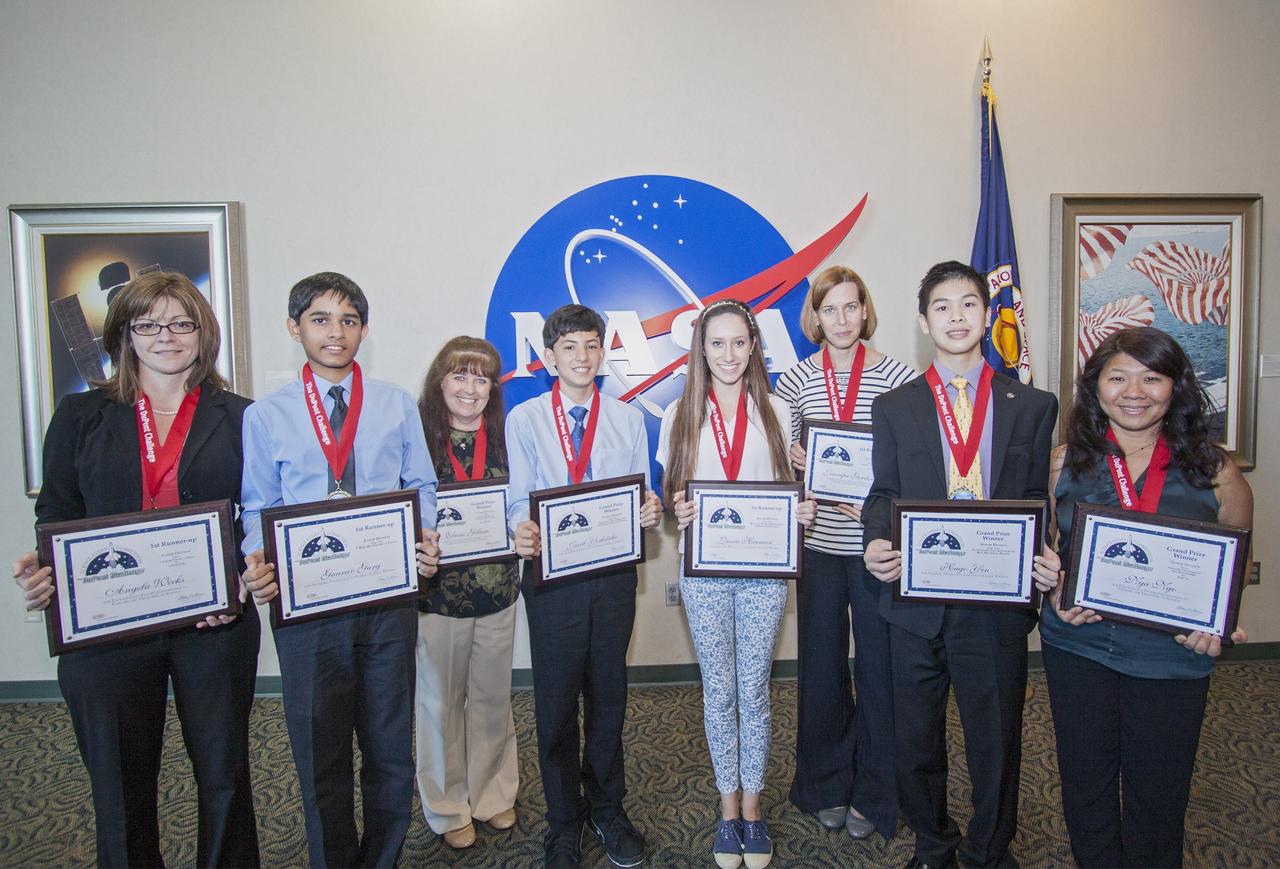
CAPE CANAVERAL, Fla. - The winning students and their teachers of the 2013 DuPont Challenge Science Essay Competition show off their awards after a ceremony at the Kennedy Space Center Visitor Complex in Florida. From left are sponsoring teacher Angela Weeks and Junior Division first runner-up Gaurav Garg of Beckendorff Junior High in Katy, Texas sponsoring teacher Elaine Gillum and Senior Division grand prize winner Jacob Yoshitake of Marshall Middle School in San Diego, Calif. Senior Division first runner-up Laura Herman and sponsoring teacher Jennifer Gordinier of Pine Crest School in Fort Lauderdale, Fla. and Senior Division grand prize awardee Hugo Yen and sponsoring teacher Nga Ngo of Troy High in Fullerton, Calif. The challenge, now in its 27th year, reaches out to students from grades seven through 12 from all 50 states and Canada. More than 200,000 students entered the competition. The DuPont Challenge aims to inspire students to excel and achieve in scientific writing and pursue careers in science, technology, engineering and mathematics STEM. The challenge honors space shuttle Challenger's STS-51L crew members who gave their lives while furthering the cause of exploration and discovery. For more information on the challenge, go to http://thechallenge.dupont.com/sponsors/nasa.php.
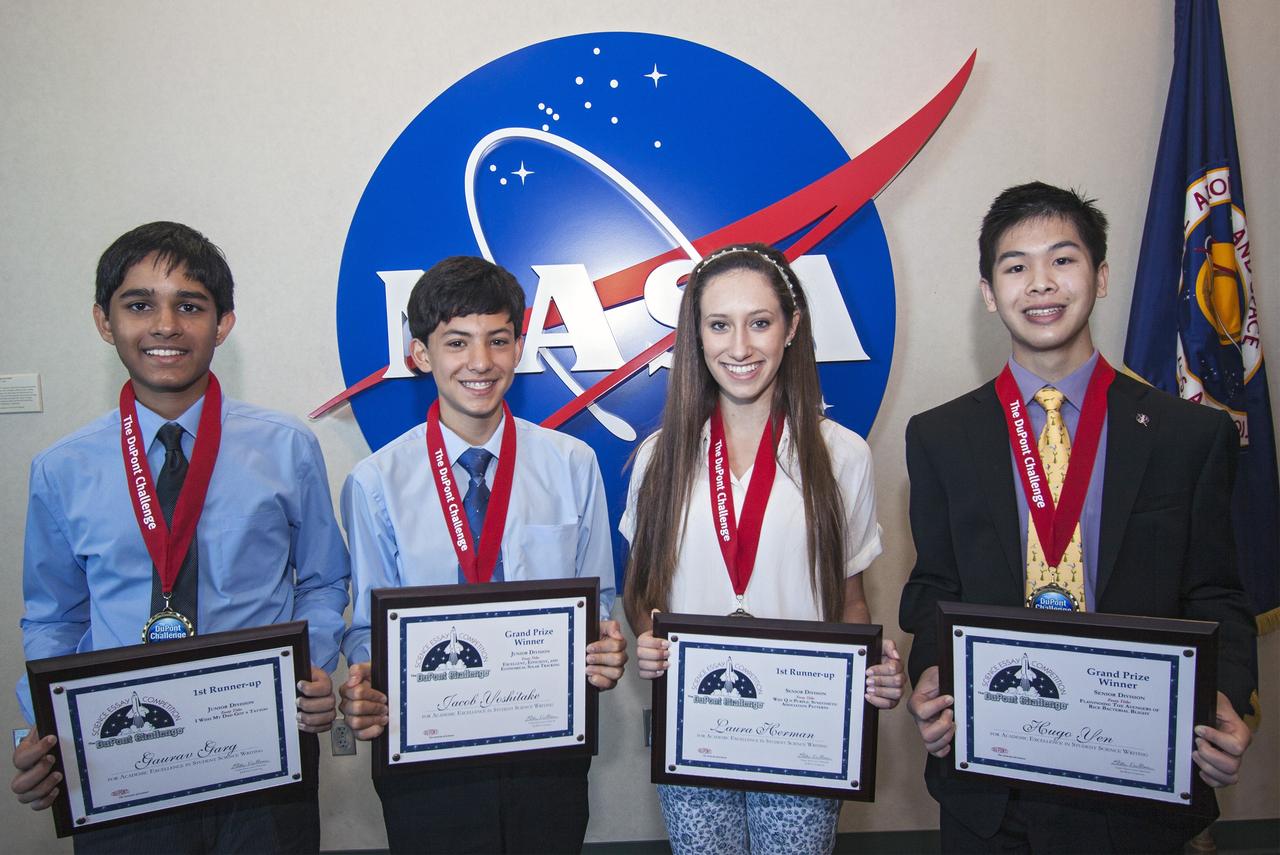
CAPE CANAVERAL, Fla. – The winning students of the 2013 DuPont Challenge Science Essay Competition show off their awards after a ceremony at the Kennedy Space Center Visitor Complex in Florida. From left are Junior Division first runner-up Gaurav Garg of Beckendorff Junior High in Katy, Texas Senior Division grand prize winner Jacob Yoshitake of Marshall Middle School in San Diego, Calif. Senior Division first runner-up Laura Herman of Pine Crest School in Fort Lauderdale, Fla. and Senior Division grand prize awardee Hugo Yen of Troy High in Fullerton, Calif. and Marc Doyle, Dupont's global marketing and product director. The challenge, now in its 27th year, reaches out to students from grades seven through 12 from all 50 states and Canada. More than 200,000 students entered the competition. The DuPont Challenge aims to inspire students to excel and achieve in scientific writing and pursue careers in science, technology, engineering and mathematics STEM. The challenge honors space shuttle Challenger's STS-51L crew members who gave their lives while furthering the cause of exploration and discovery. For more information on the challenge, go to http://thechallenge.dupont.com/sponsors/nasa.php.
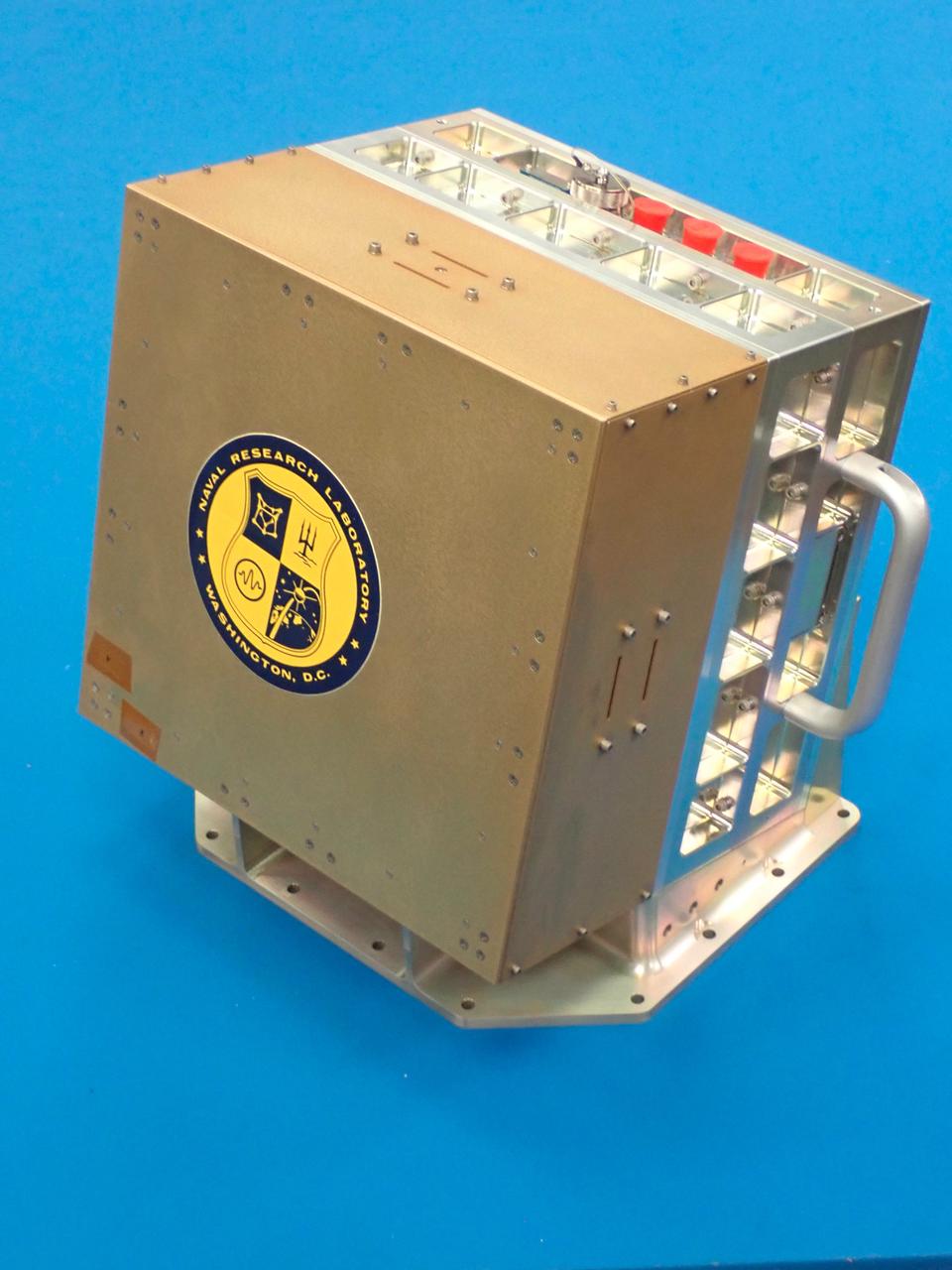
jsc2025e044725 (5/12/2025) --- A gamma-ray spectrometer and imager that uses large-volume cadmium zinc telluride (CZT) is part of the Space Test Program-Houston 10-cadmium Zinc TElluride Radiation Imager (STP-H10-TERI) investigation. The primary science objective of TERI is to qualify this technology for future space operations. Image courtesy of Daniel Shy, High Energy Space Environment Branch, Space Science Division at Naval Research Laboratory.
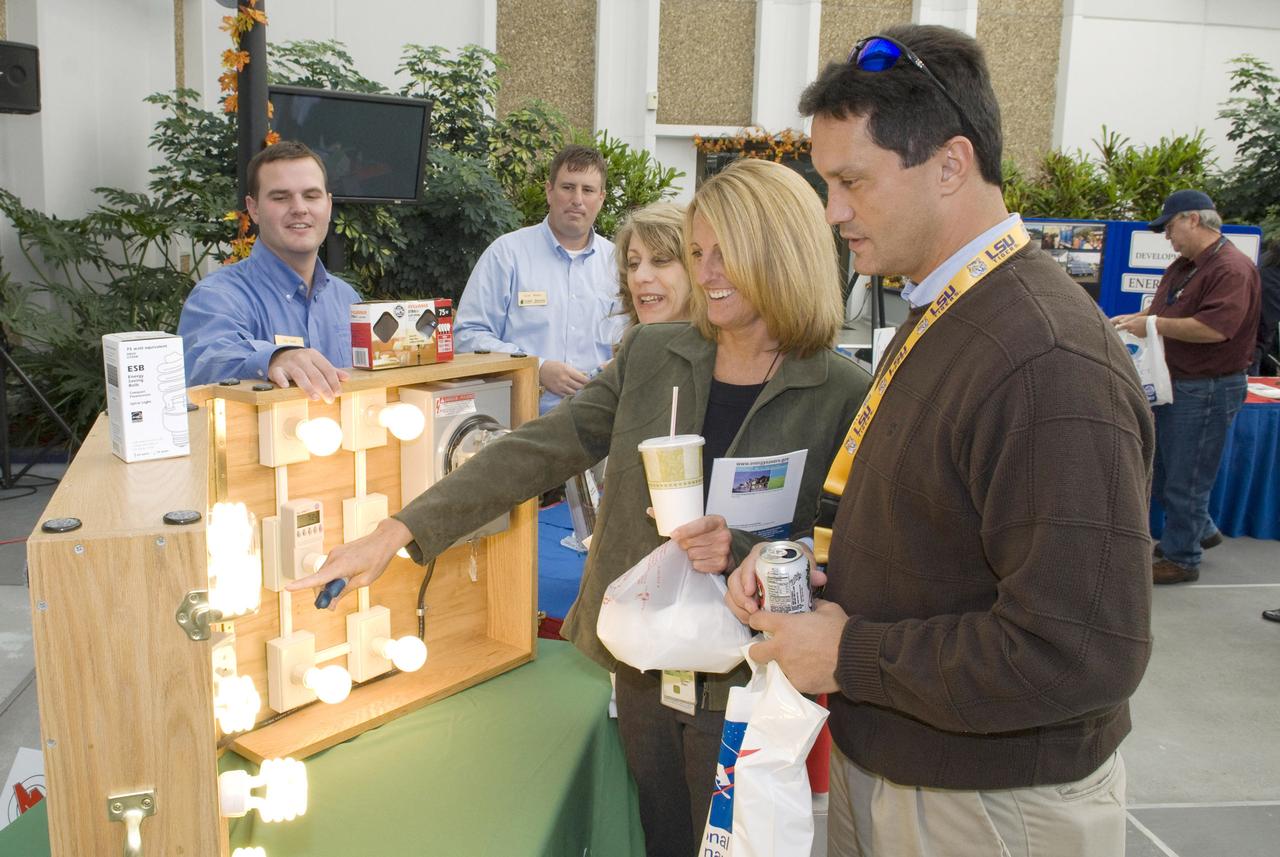
Stennis Space Center employees Maria Etheridge (l to r), Linda Sauland Maurice Prevost visit a Coast Electric Power Association display featuring energy-efficient light bulbs during 2009 Energy Awareness Day activities on Oct. 20. The exhibit was one of several energy-efficiency and energy-awareness displays on-site for employees to visit. Vendors included Mississippi Power Company, Coast Electric Power Association, Mississippi Development Authority - Energy Division,Jacobs FOSC Environmental, Southern Energy Technologies, and Siemens Building Technologies.
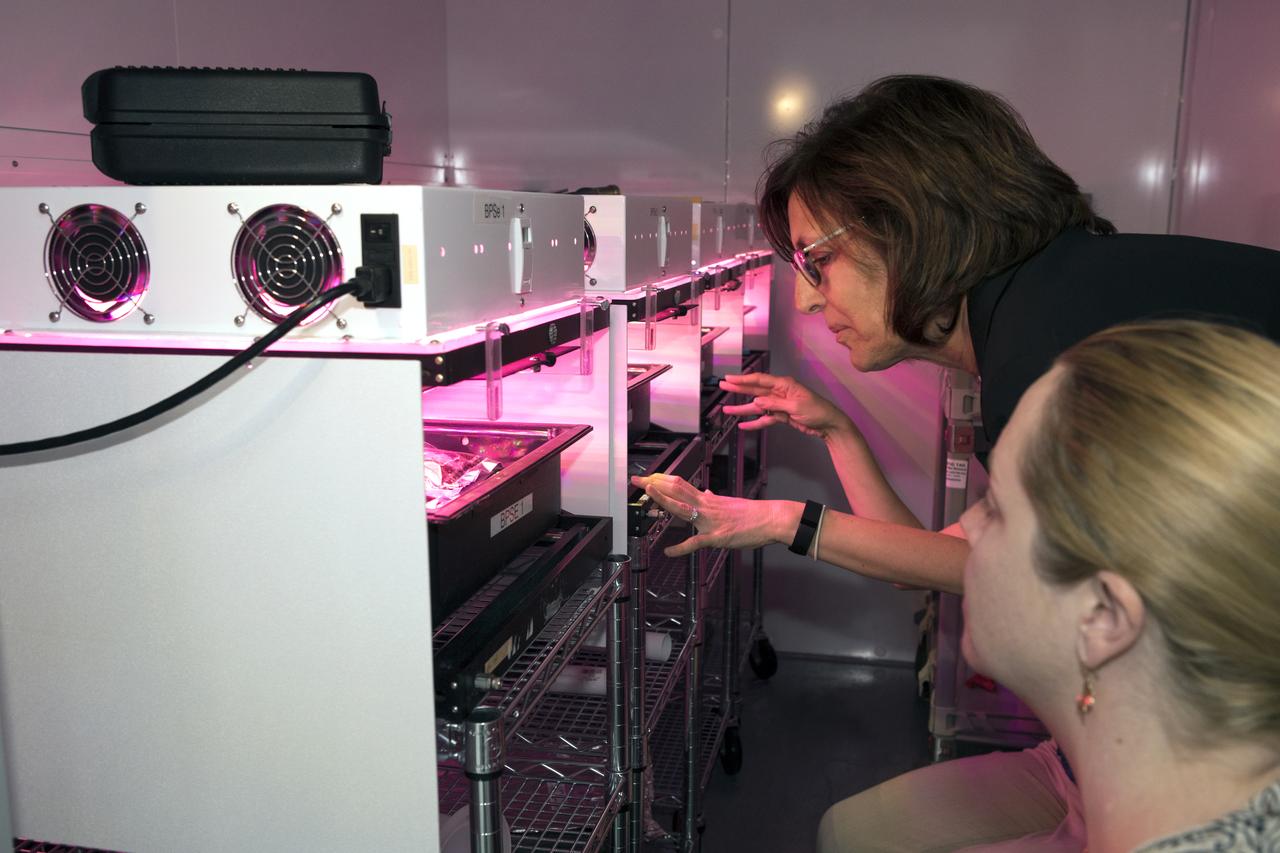
Robyn Gatens, left, deputy director, ISS Division and system capability leader for Environmental Control and Life Support Systems (ECLSS) at NASA Headquarters in Washington, tours laboratories in the Space Station Processing Facility at the agency's Kennedy Space Center in Florida, on June 13, 2018. To her right is Molly Anderson, deputy ECLSS capability lead at Johnson Space Center in Houston. They are viewing plant growth chambers and seeing firsthand some of the capabilities in the center's Exploration Research and Technology Programs.
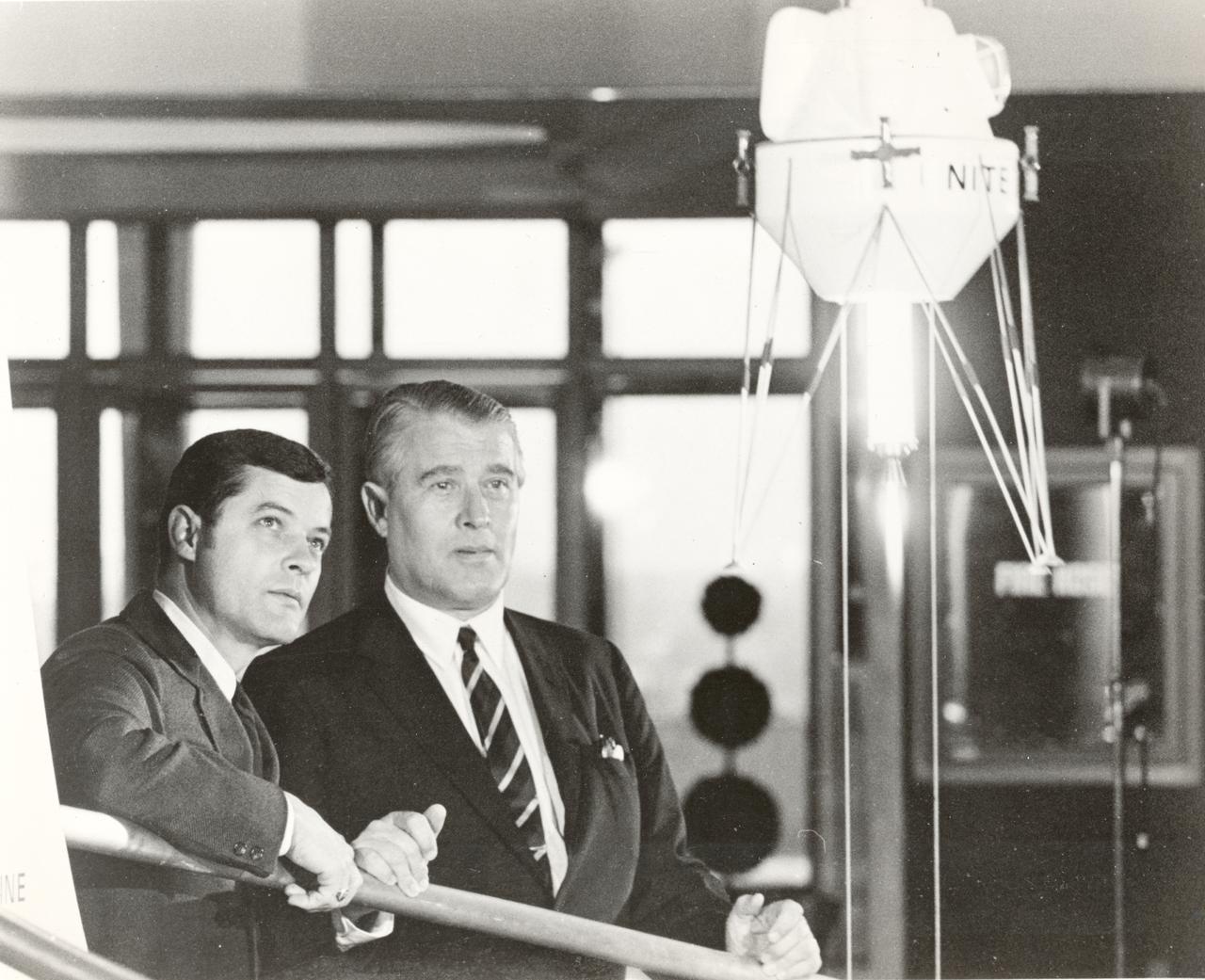
Edward O. Buckbee, the first Director of the Alabama Space Science Center (left), and Dr. Wernher von Braun (right) view a demonstration of a simulated spacecraft which uses an actual hybrid rocket engine for liftoff, hover, and landing. The display was presented to the Alabama Space Science Center, later renamed the U.S. Space and Rocket Center, by United Technology Center, a division of United Aircraft.
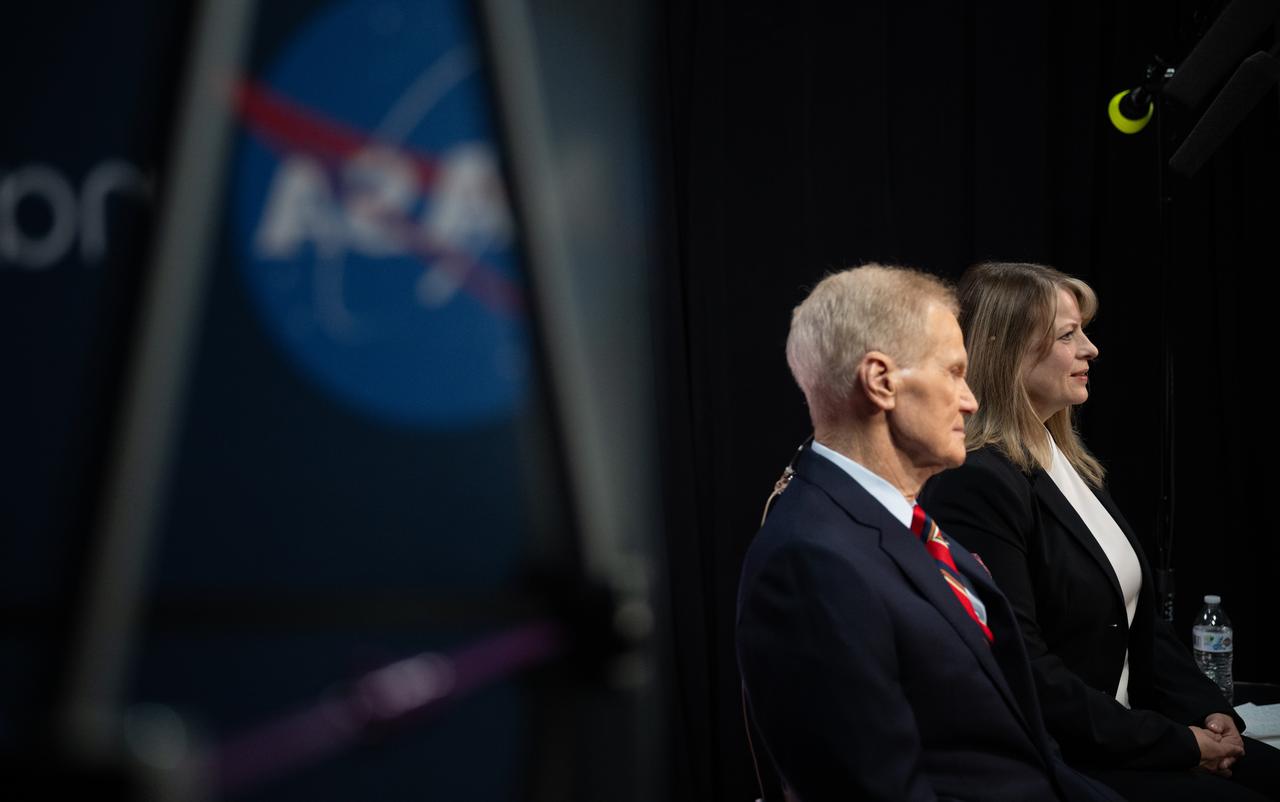
NASA Administrator Bill Nelson, left, and Lisa Carnell, director of NASA’s Biological and Physical Sciences Division are seen during an Earth-to-space call with astronauts aboard the International Space Station, Wednesday, Feb. 21, 2024, at the Mary W. Jackson NASA Headquarters building in Washington. Nelson and Carnell spoke with Expedition 70 crew members Andreas Mogenson of ESA, Jasmin Moghbeli of NASA, and Satoshi Furukawa of JAXA about recent science research and technology demonstrations aboard the orbiting laboratory. Photo Credit: (NASA/Joel Kowsky)
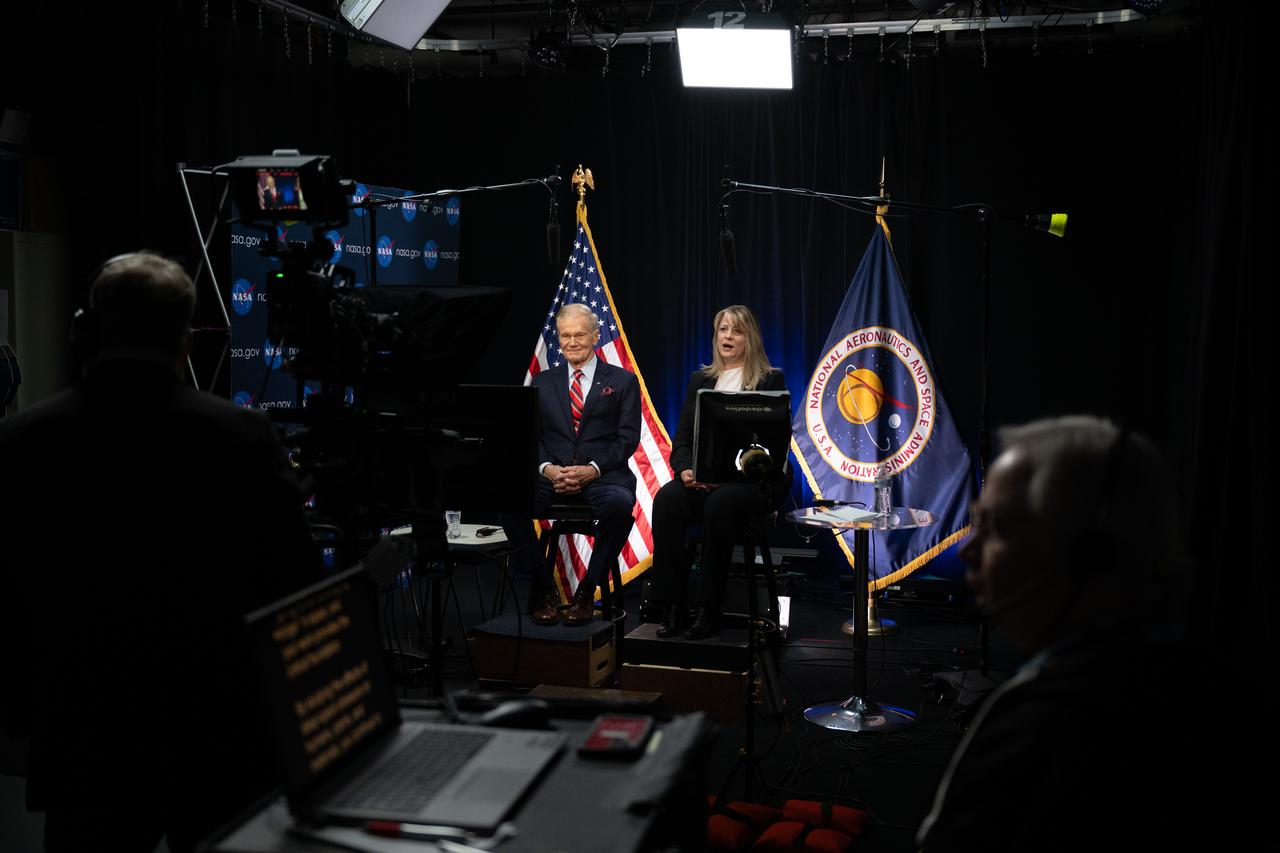
NASA Administrator Bill Nelson, left, and Lisa Carnell, director of NASA’s Biological and Physical Sciences Division are seen during an Earth-to-space call with astronauts aboard the International Space Station, Wednesday, Feb. 21, 2024, at the Mary W. Jackson NASA Headquarters building in Washington. Nelson and Carnell spoke with Expedition 70 crew members Andreas Mogenson of ESA, Jasmin Moghbeli of NASA, and Satoshi Furukawa of JAXA about recent science research and technology demonstrations aboard the orbiting laboratory. Photo Credit: (NASA/Joel Kowsky)
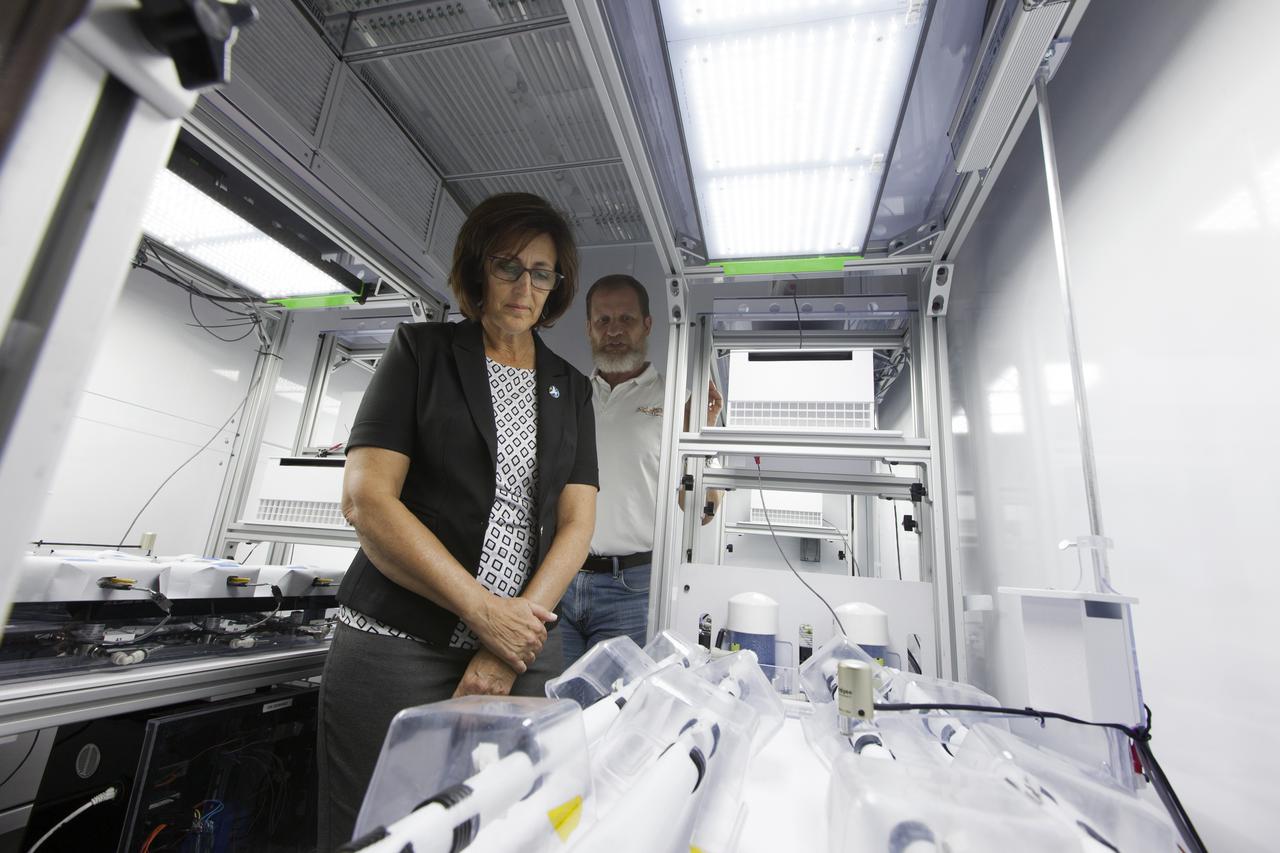
Robyn Gatens, left, deputy director, ISS Division and system capability leader for Environmental Control and Life Support Systems (ECLSS) at NASA Headquarters in Washington, tours laboratories in the Space Station Processing Facility at the agency's Kennedy Space Center in Florida, on June 13, 2018. Standing behind her is Ralph Fritsche, long-duration food production project manager at Kennedy. Gatens is viewing plant growth chambers and seeing firsthand some of the capabilities in the center's Exploration Research and Technology Programs.
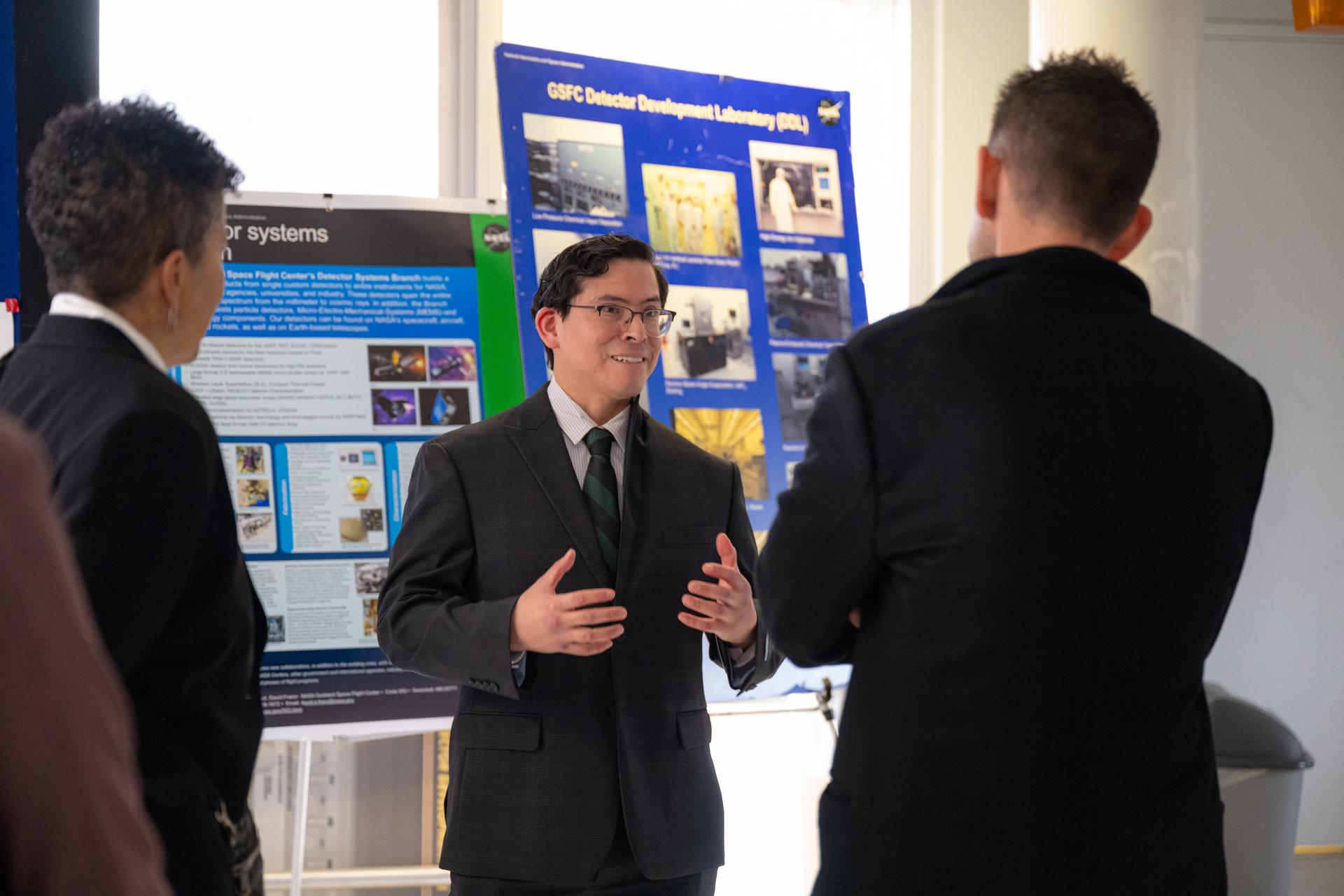
Manuel Balvin, Instrument Systems and Technology Division’s associate chief of operations at NASA’s Goddard Space Flight Center, center, speaks to Cynthia Simmons, acting center director of Goddard, left, and NASA Administrator Jared Isaacman, right, Friday, Jan. 9, 2026, at Goddard Space Flight Center in Greenbelt, Md. Goddard marks the first stop in Isaacman’s roadshow to visit NASA facilities and engage directly with the agency’s workforce. Photo Credit: (NASA/John Kraus)
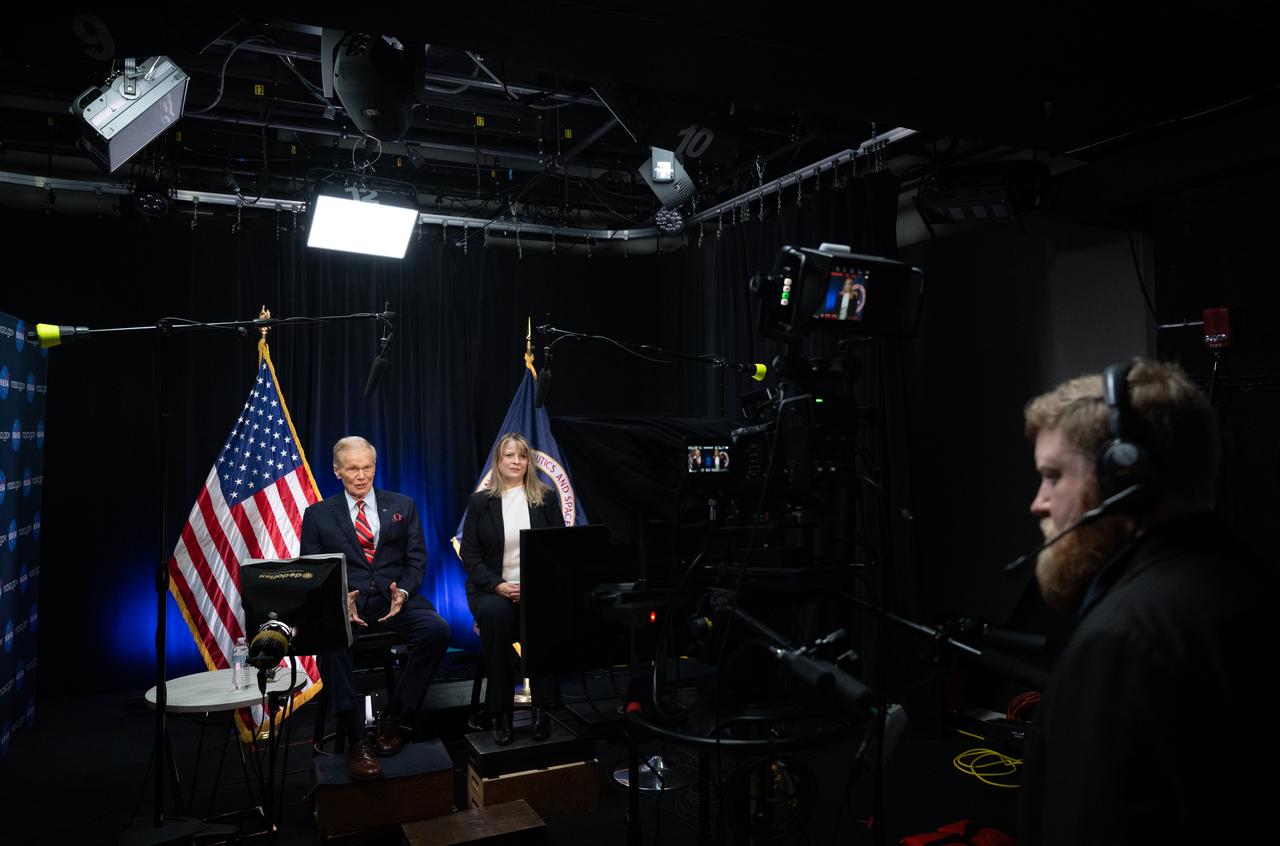
NASA Administrator Bill Nelson, left, and Lisa Carnell, director of NASA’s Biological and Physical Sciences Division are seen during an Earth-to-space call with astronauts aboard the International Space Station, Wednesday, Feb. 21, 2024, at the Mary W. Jackson NASA Headquarters building in Washington. Nelson and Carnell spoke with Expedition 70 crew members Andreas Mogenson of ESA, Jasmin Moghbeli of NASA, and Satoshi Furukawa of JAXA about recent science research and technology demonstrations aboard the orbiting laboratory. Photo Credit: (NASA/Joel Kowsky)
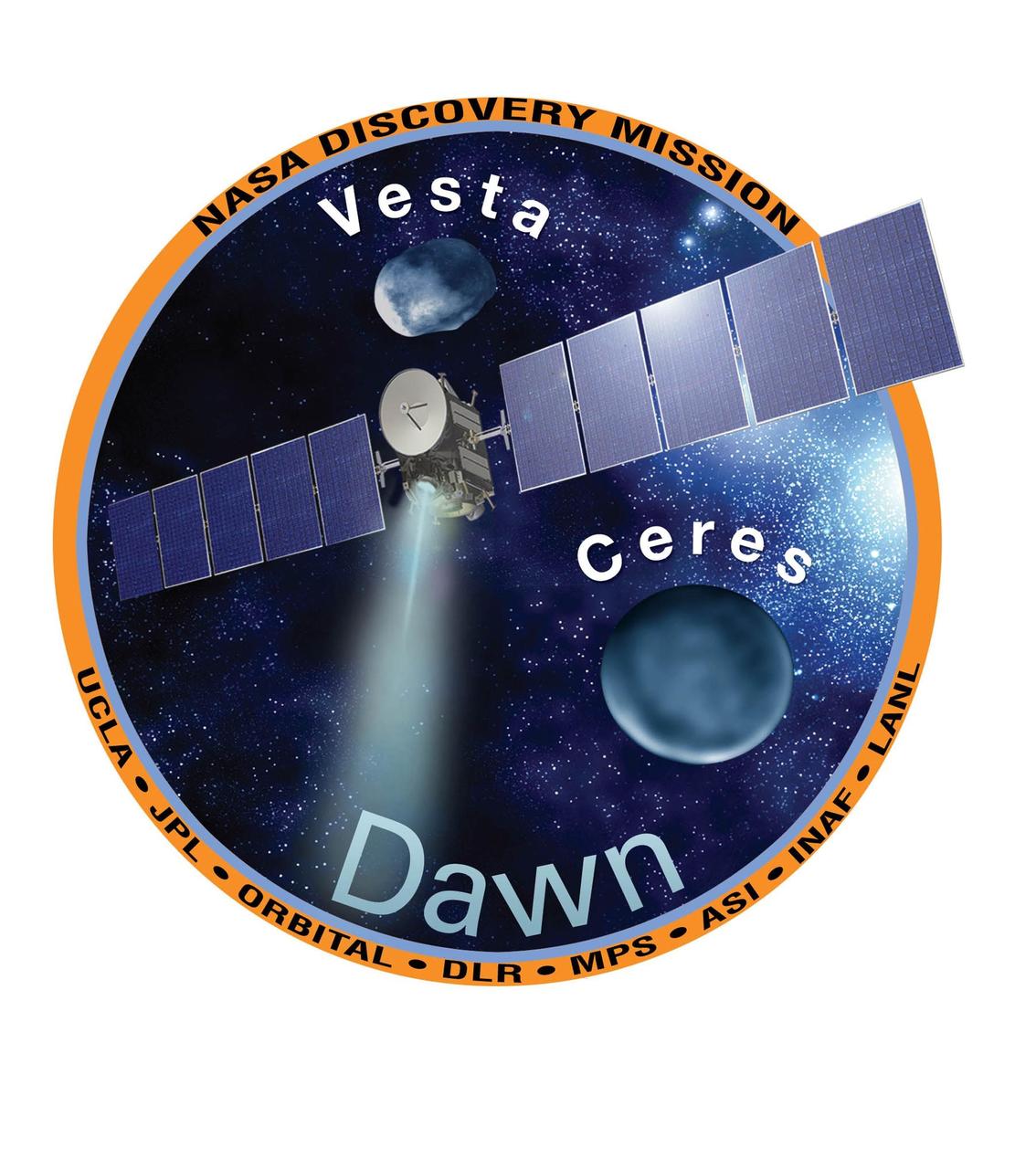
KENNEDY SPACE CENTER, FLA. -- This logo represents the mission of the Dawn spacecraft. During its nearly decade-long mission, Dawn will study the asteroid Vesta and dwarf planet Ceres, celestial bodies believed to have accreted early in the history of the solar system. The mission hopes to unlock some of the mysteries of planetary formation, including the building blocks and the processes leading to their state today. The Dawn mission is managed by the Jet Propulsion Laboratory, a division of the California Institute of Technology in Pasadena, Calif., for NASA's Science Mission Directorate in Washington, D.C.
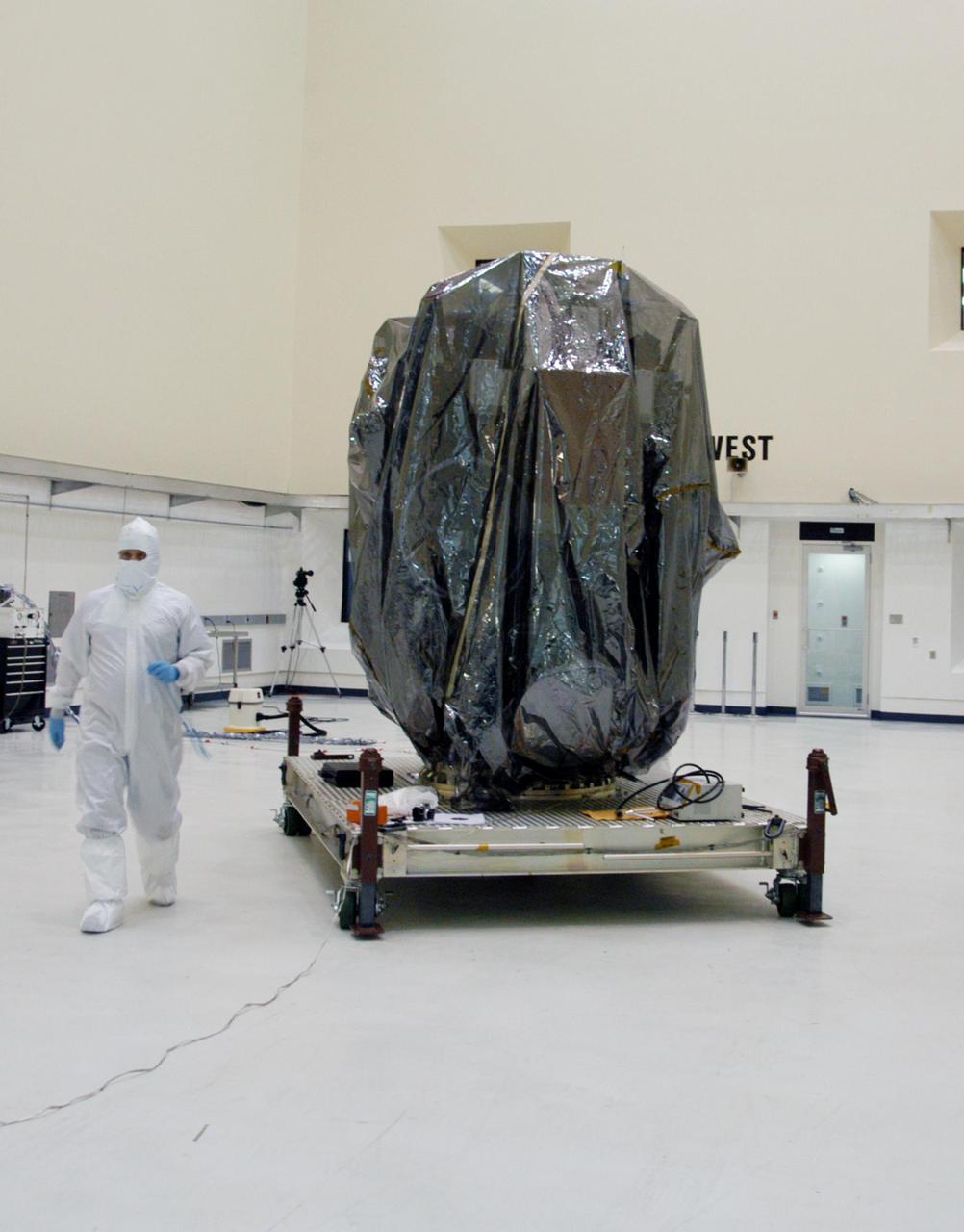
KENNEDY SPACE CENTER, FLA. -- In clean room C of Astrotech's Payload Processing Facility, a worker wears a "bunny suit," or clean-room attire, next to the Dawn spacecraft, which will be unbagged and undergo further processing. Dawn's mission is to explore two of the asteroid belt's most intriguing and dissimilar occupants: asteroid Vesta and the dwarf planet Ceres. The Dawn mission is managed by JPL, a division of the California Institute of Technology in Pasadena, for NASA's Science Mission Directorate in Washington, D.C. Photo credit: NASA/George Shelton
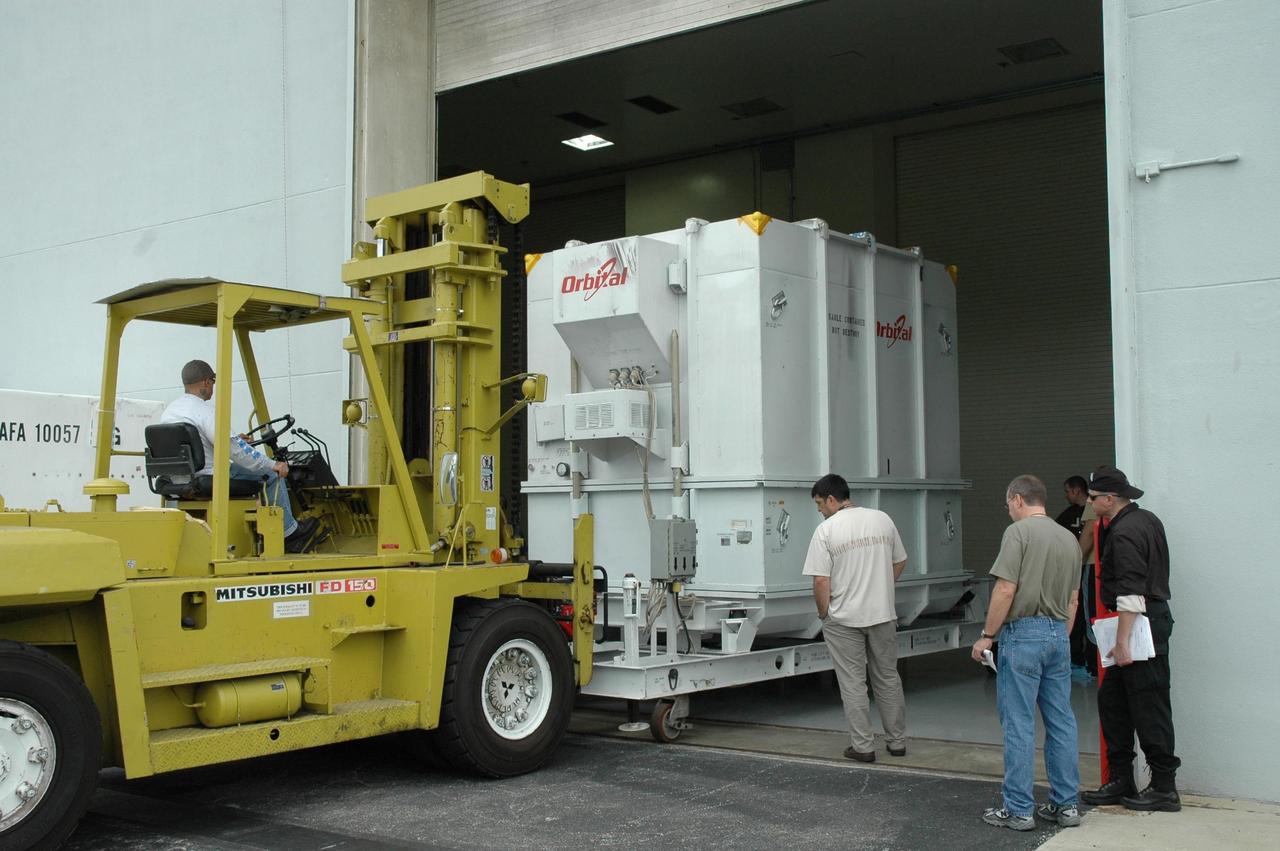
KENNEDY SPACE CENTER, FLA. -- At Astrotech, the shipping container holding the Dawn spacecraft is moved into the high bay of the Payload Processing Facility. The spacecraft will next be removed from the container. Dawn's mission is to explore two of the asteroid belt's most intriguing and dissimilar occupants: asteroid Vesta and the dwarf planet Ceres. The Dawn mission is managed by JPL, a division of the California Institute of Technology in Pasadena, for NASA's Science Mission Directorate in Washington, D.C. Photo credit: NASA/Jim Grossmann
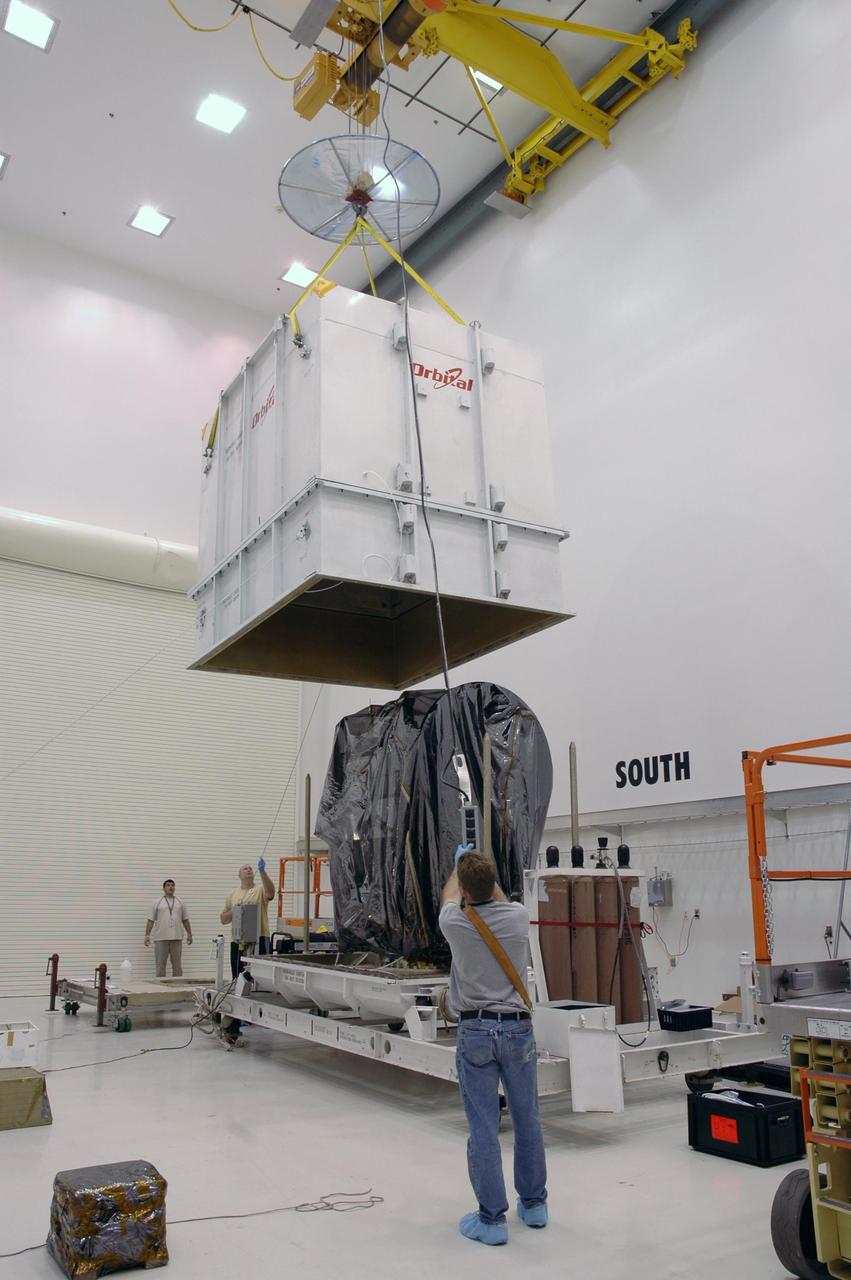
KENNEDY SPACE CENTER, FLA. -- In Astrotech's Payload Processing Facility, a crane lifts the shipping container from the Dawn spacecraft. Dawn's mission is to explore two of the asteroid belt's most intriguing and dissimilar occupants: asteroid Vesta and the dwarf planet Ceres. The Dawn mission is managed by JPL, a division of the California Institute of Technology in Pasadena, for NASA's Science Mission Directorate in Washington, D.C. Photo credit: NASA/Jim Grossmann
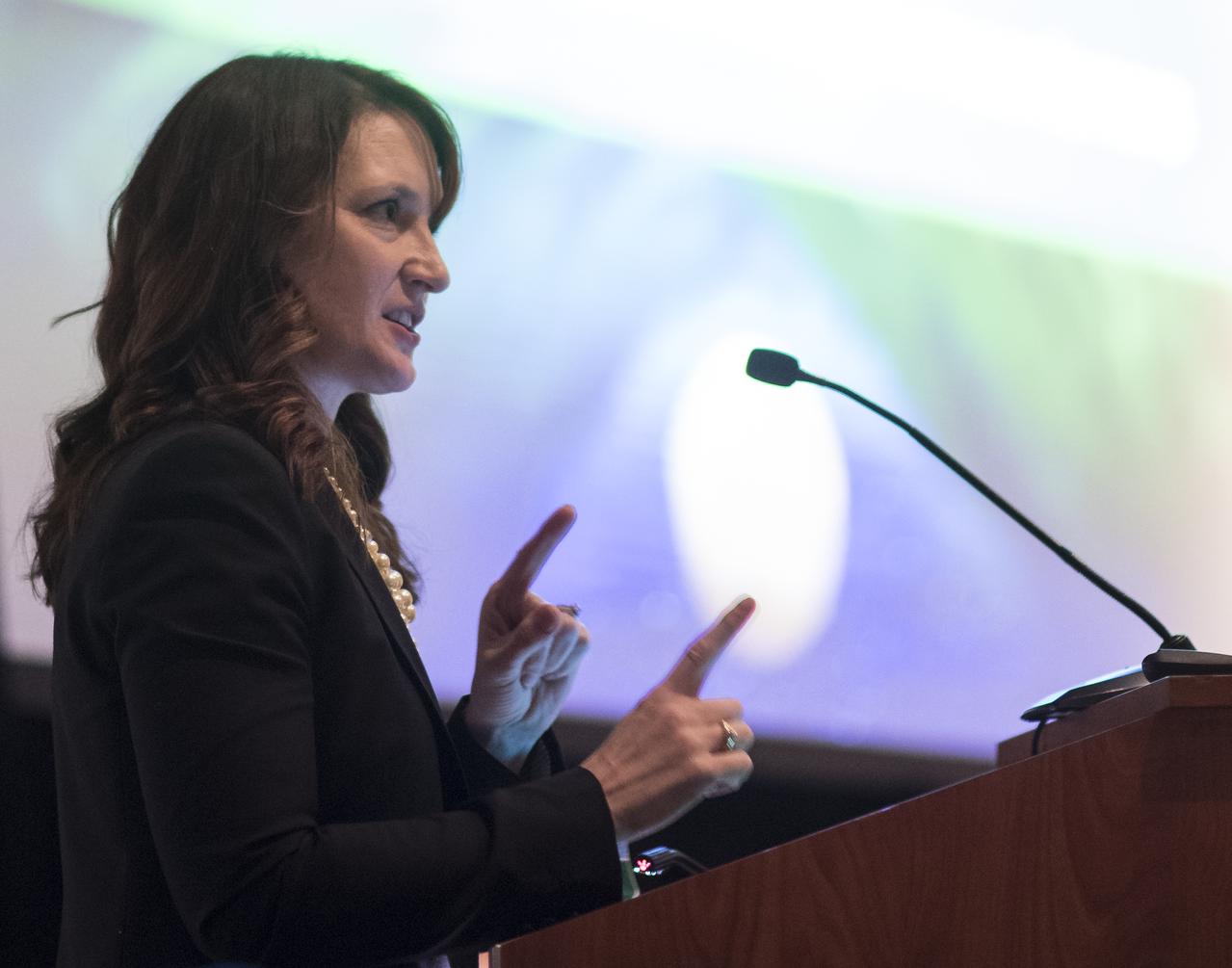
Kathleen Boggs, Systems and Technology Demonstration Manager in the International Space Station Division of NASA’s Human Exploration and Operations Mission Directorate, is seen a keynote titled “From LEO to the Moon, Mars, and Beyond: Shaping Capability Development Strategies for NASA’s Human Exploration Campaign” at the 70th International Astronautical Congress, Thursday, Oct. 24, 2019 at the Walter E. Washington Convention Center in Washington. Photo Credit: (NASA/Joel Kowsky)
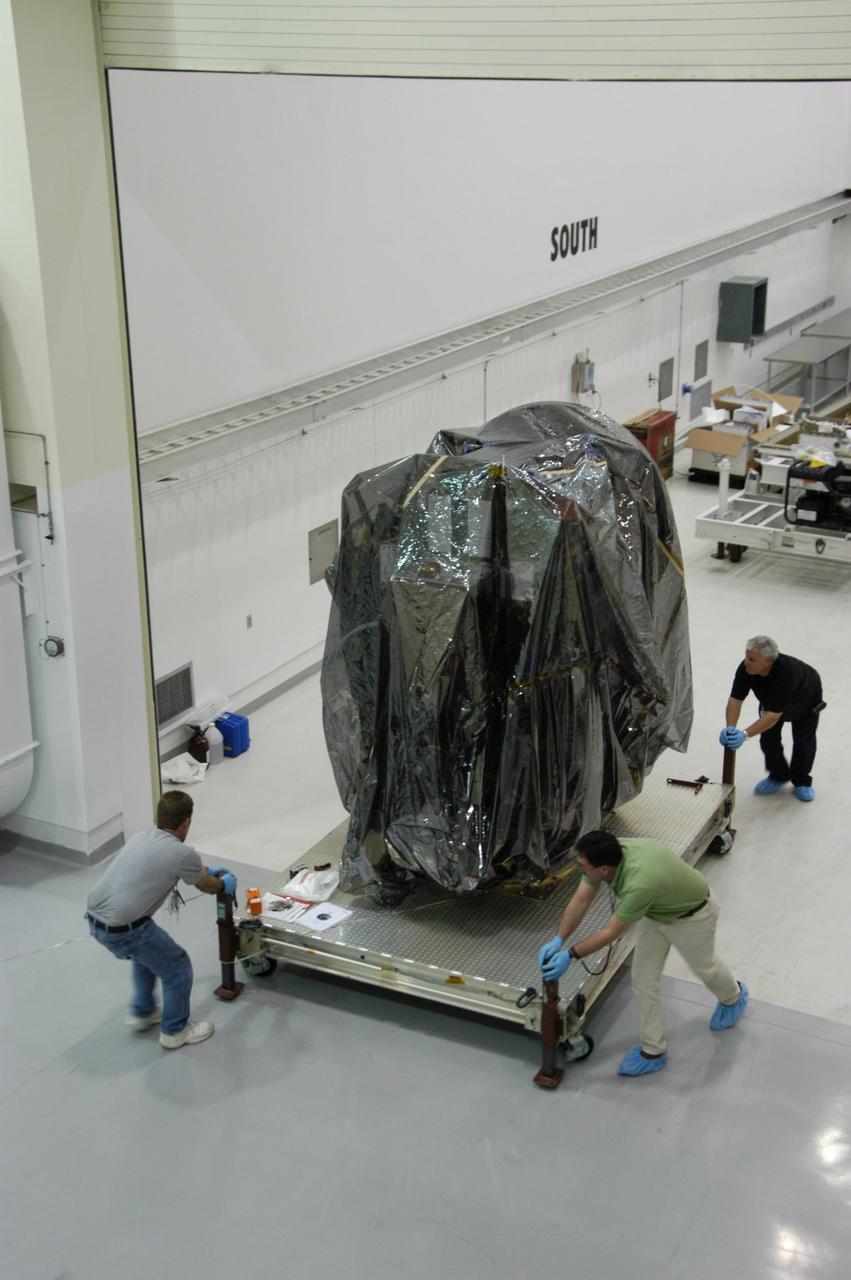
KENNEDY SPACE CENTER, FLA. -- In Astrotech's Payload Processing Facility, technicians roll the Dawn spacecraft into clean room C for unbagging and further processing. Dawn's mission is to explore two of the asteroid belt's most intriguing and dissimilar occupants: asteroid Vesta and the dwarf planet Ceres. The Dawn mission is managed by JPL, a division of the California Institute of Technology in Pasadena, for NASA's Science Mission Directorate in Washington, D.C. Photo credit: NASA/George Shelton
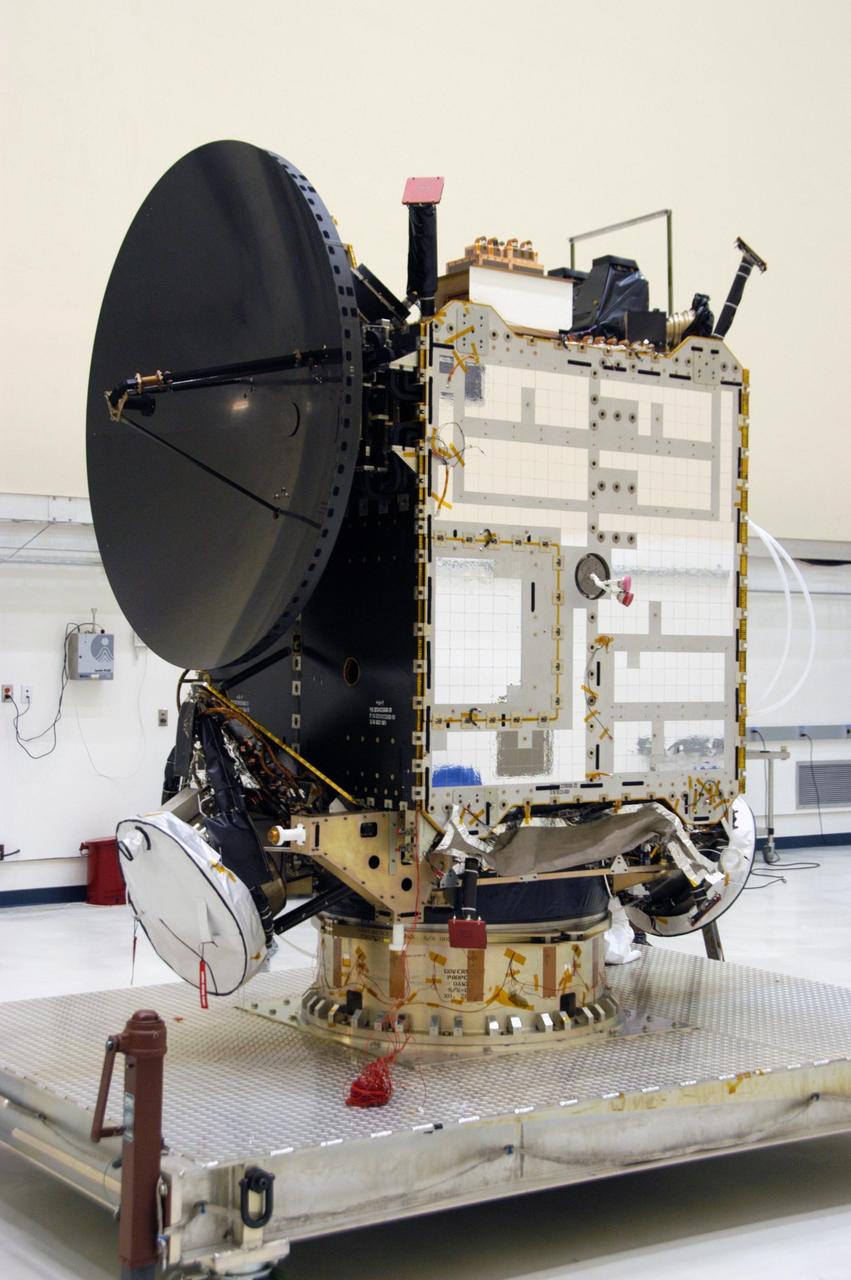
KENNEDY SPACE CENTER, FLA. -- The Dawn spacecraft is seen here in clean room C of Astrotech's Payload Processing Facility. In the clean room, the spacecraft will undergo further processing. Dawn's mission is to explore two of the asteroid belt's most intriguing and dissimilar occupants: asteroid Vesta and the dwarf planet Ceres. The Dawn mission is managed by JPL, a division of the California Institute of Technology in Pasadena, for NASA's Science Mission Directorate in Washington, D.C. Photo credit: NASA/George Shelton
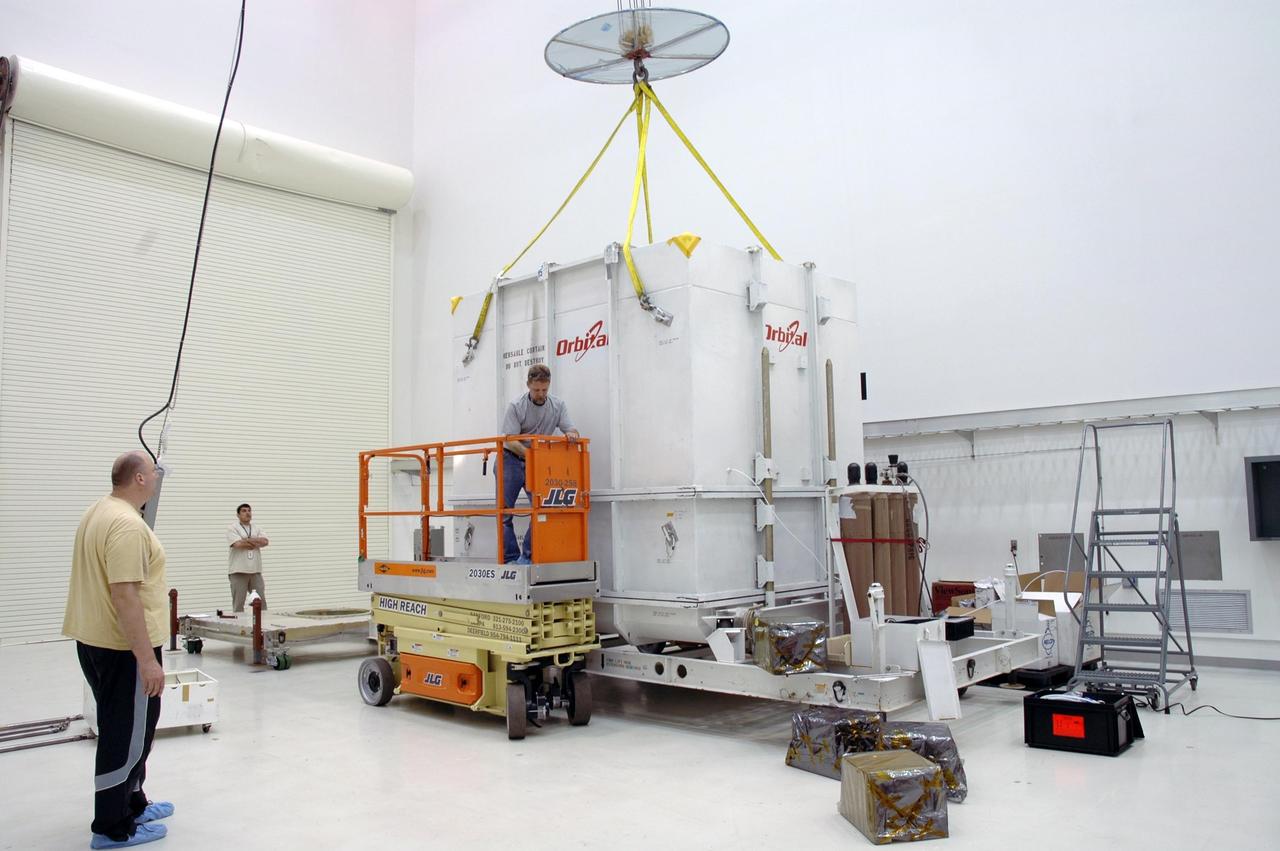
KENNEDY SPACE CENTER, FLA. -- In Astrotech's Payload Processing Facility, a crane is attached to the shipping container to remove it from around the Dawn spacecraft. Dawn's mission is to explore two of the asteroid belt's most intriguing and dissimilar occupants: asteroid Vesta and the dwarf planet Ceres. The Dawn mission is managed by JPL, a division of the California Institute of Technology in Pasadena, for NASA's Science Mission Directorate in Washington, D.C. Photo credit: NASA/Jim Grossmann
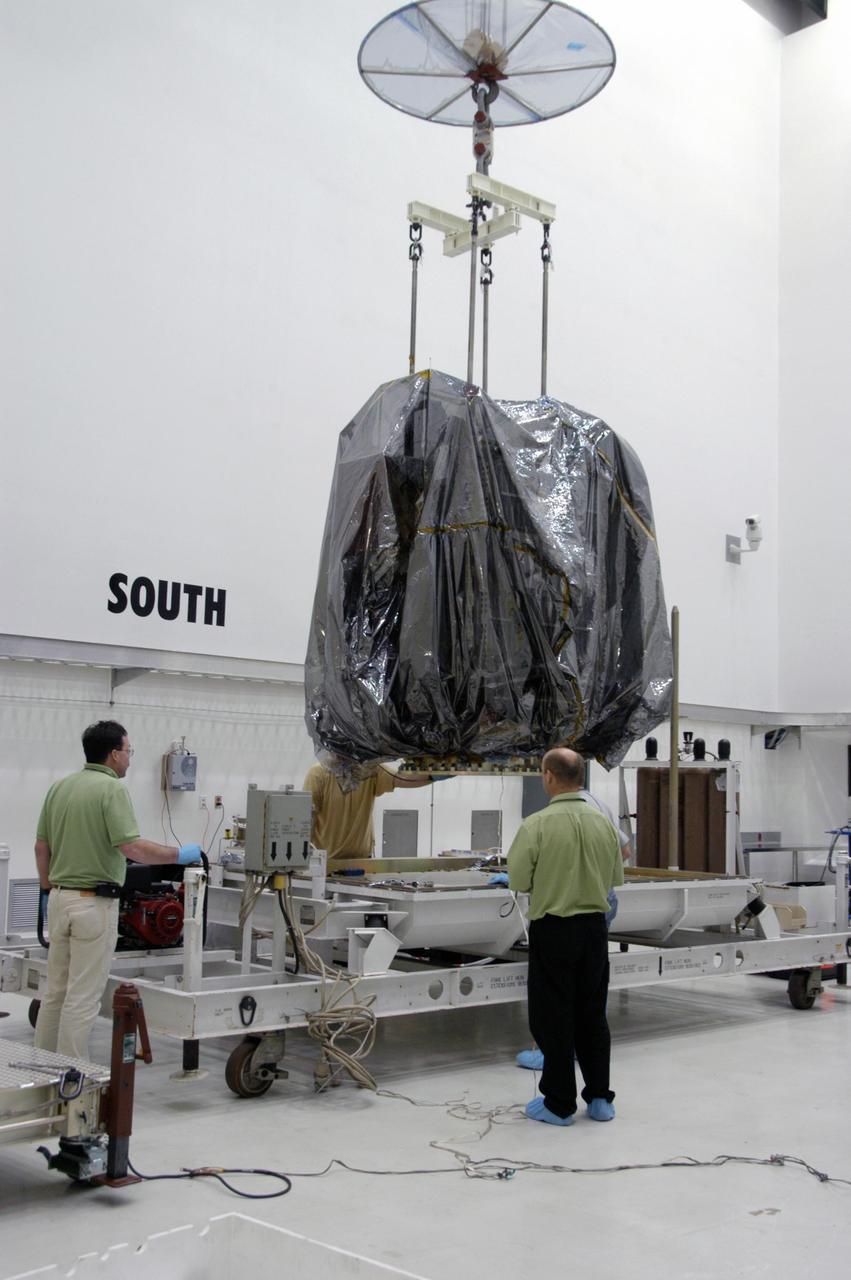
KENNEDY SPACE CENTER, FLA. -- In Astrotech's Payload Processing Facility, an overhead crane lifts the Dawn spacecraft from its transporter. Dawn will be moved into clean room C for unbagging and further processing. Dawn's mission is to explore two of the asteroid belt's most intriguing and dissimilar occupants: asteroid Vesta and the dwarf planet Ceres. The Dawn mission is managed by JPL, a division of the California Institute of Technology in Pasadena, for NASA's Science Mission Directorate in Washington, D.C. Photo credit: NASA/George Shelton

Kathleen Boggs, Systems and Technology Demonstration Manager in the International Space Station Division of NASA’s Human Exploration and Operations Mission Directorate, is seen a keynote titled “From LEO to the Moon, Mars, and Beyond: Shaping Capability Development Strategies for NASA’s Human Exploration Campaign” at the 70th International Astronautical Congress, Thursday, Oct. 24, 2019 at the Walter E. Washington Convention Center in Washington. Photo Credit: (NASA/Joel Kowsky)
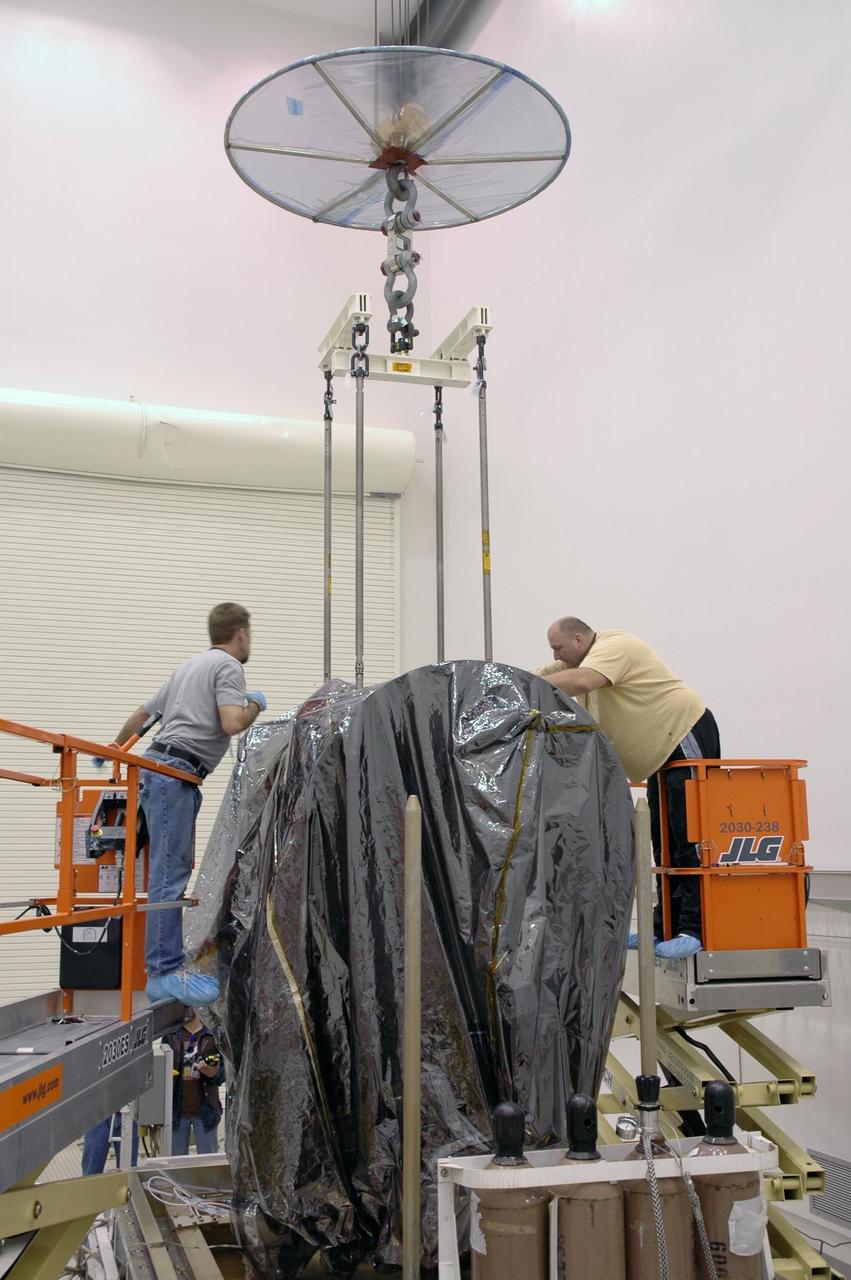
KENNEDY SPACE CENTER, FLA. -- In Astrotech's Payload Processing Facility, a crane is being attached to the Dawn spacecraft to lift it from the transporter. Dawn's mission is to explore two of the asteroid belt's most intriguing and dissimilar occupants: asteroid Vesta and the dwarf planet Ceres. The Dawn mission is managed by JPL, a division of the California Institute of Technology in Pasadena, for NASA's Science Mission Directorate in Washington, D.C. Photo credit: NASA/Jim Grossmann
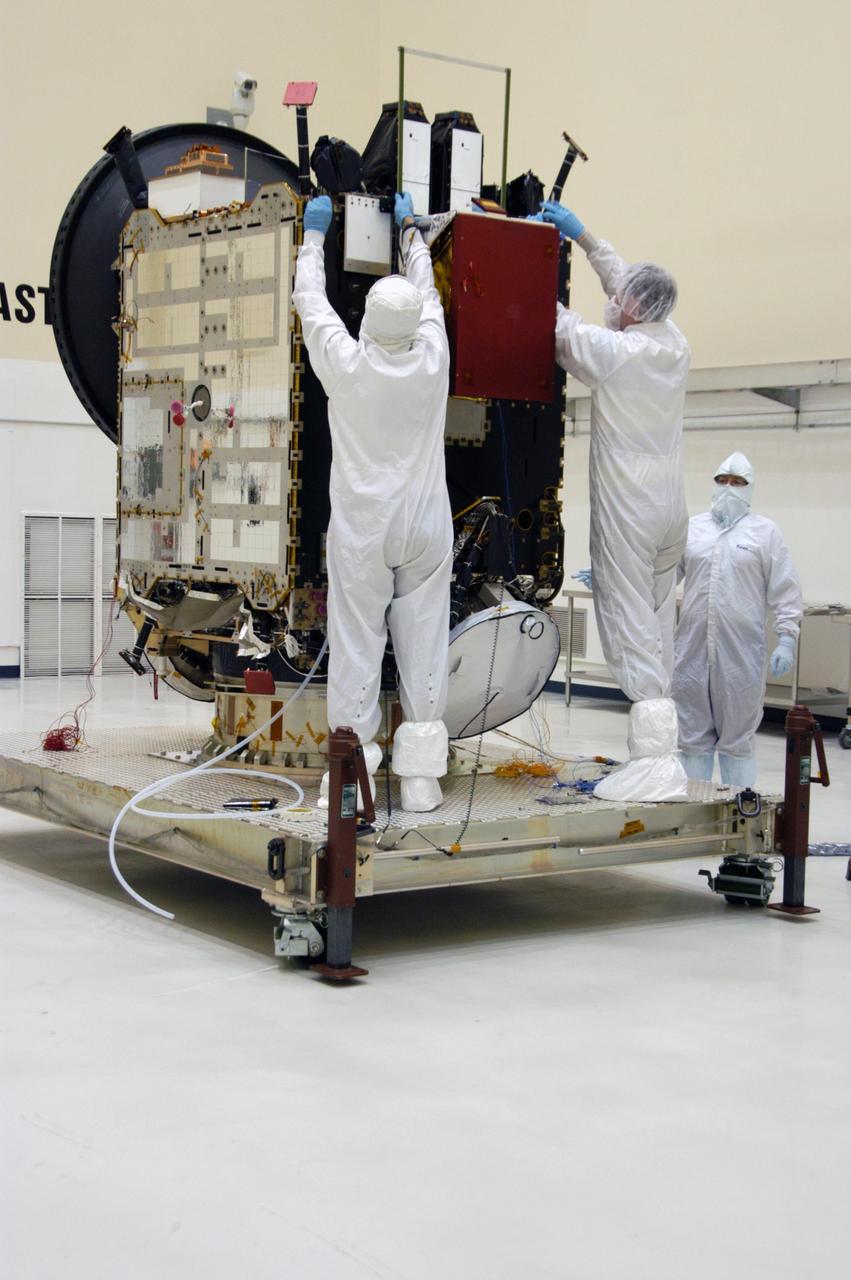
KENNEDY SPACE CENTER, FLA. -- In clean room C of Astrotech's Payload Processing Facility, technicians dressed in "bunny suits," or clean-room attire, begin working on the Dawn spacecraft. Dawn's mission is to explore two of the asteroid belt's most intriguing and dissimilar occupants: asteroid Vesta and the dwarf planet Ceres. The Dawn mission is managed by JPL, a division of the California Institute of Technology in Pasadena, for NASA's Science Mission Directorate in Washington, D.C. Photo credit: NASA/George Shelton
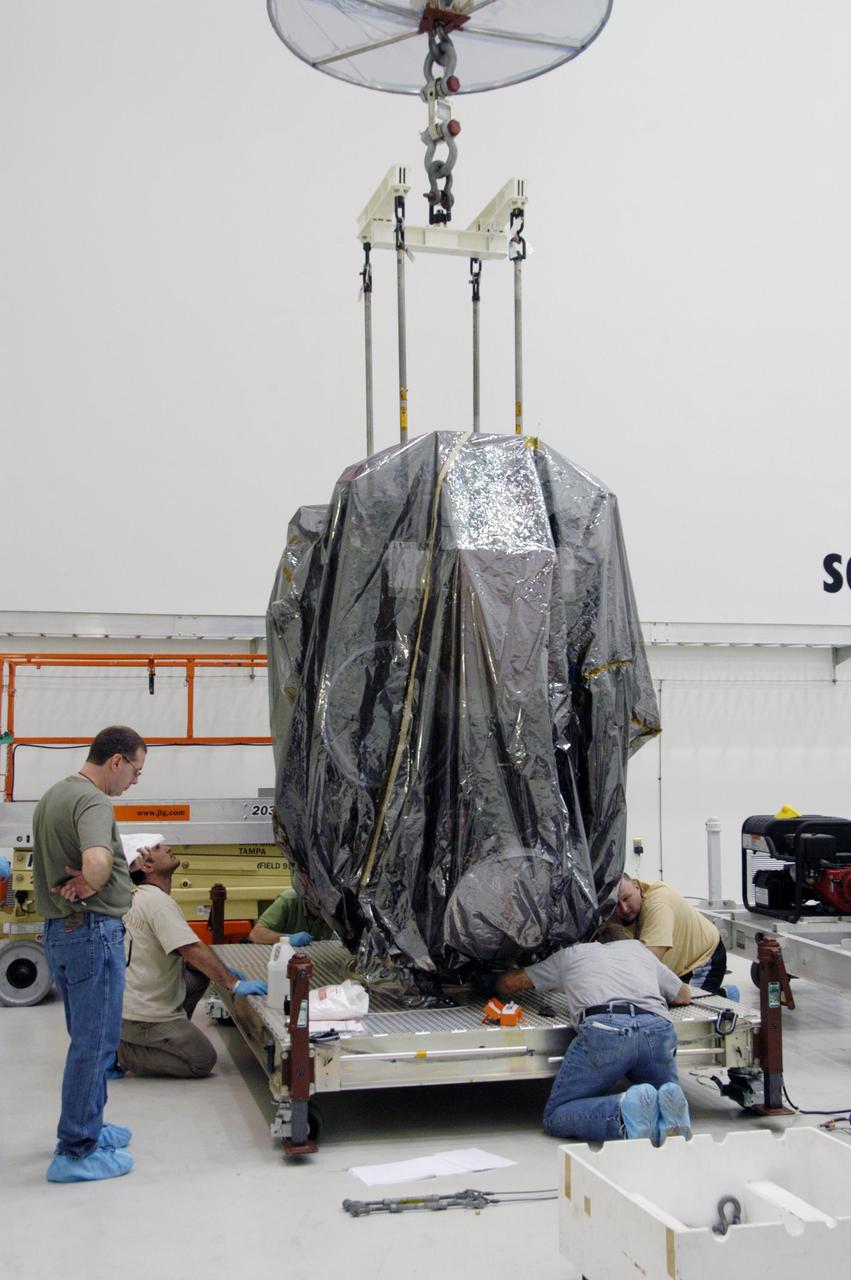
KENNEDY SPACE CENTER, FLA. -- In Astrotech's Payload Processing Facility, technicians help secure the Dawn spacecraft onto a moveable stand. Dawn will be moved into clean room C for unbagging and further processing. Dawn's mission is to explore two of the asteroid belt's most intriguing and dissimilar occupants: asteroid Vesta and the dwarf planet Ceres. The Dawn mission is managed by JPL, a division of the California Institute of Technology in Pasadena, for NASA's Science Mission Directorate in Washington, D.C. Photo credit: NASA/George Shelton
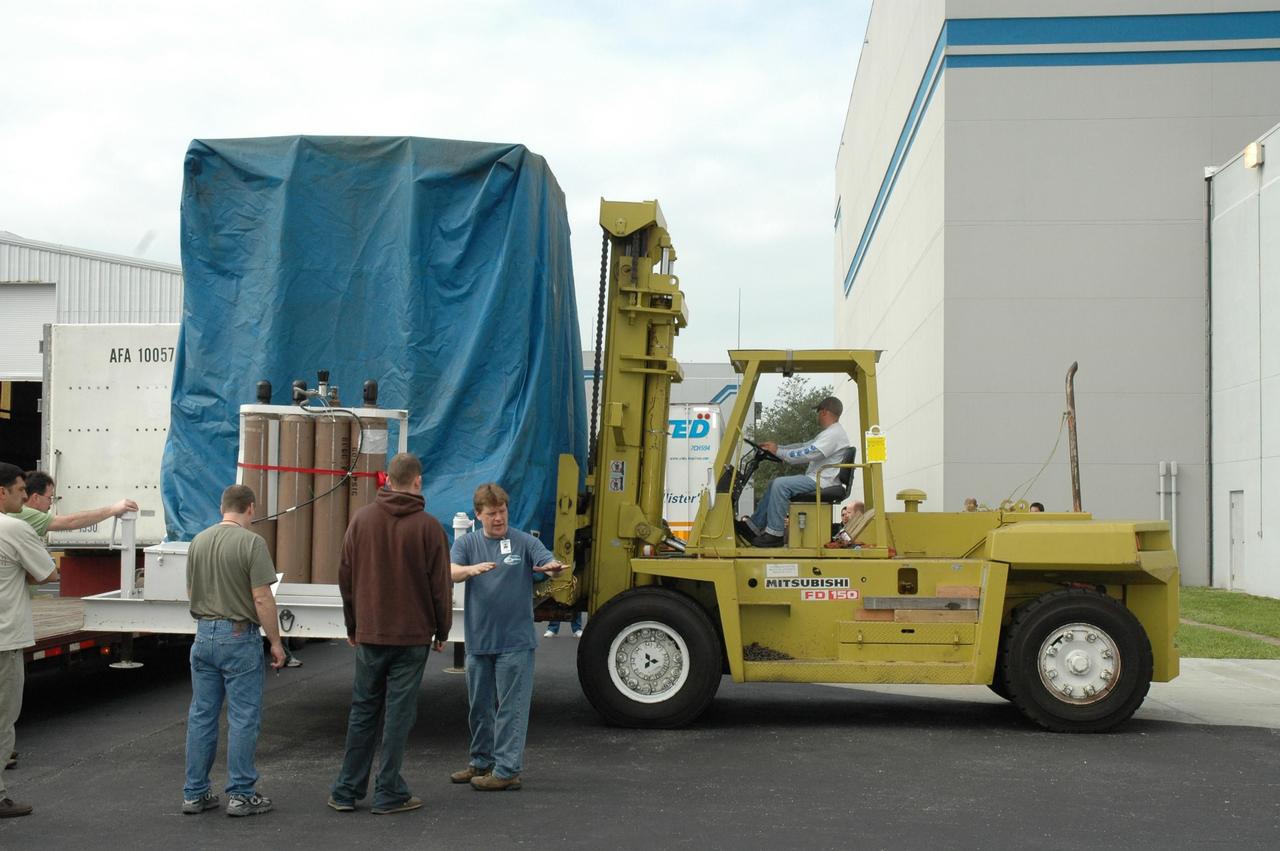
KENNEDY SPACE CENTER, FLA. -- At Astrotech, the shipping container holding the Dawn spacecraft is removed from the truck. The container will then be moved into the high bay of the Payload Processing Facility and the spacecraft removed. Dawn's mission is to explore two of the asteroid belt's most intriguing and dissimilar occupants: asteroid Vesta and the dwarf planet Ceres. The Dawn mission is managed by JPL, a division of the California Institute of Technology in Pasadena, for NASA's Science Mission Directorate in Washington, D.C. Photo credit: NASA/Jim Grossmann

Kathleen Boggs, Systems and Technology Demonstration Manager in the International Space Station Division of NASA’s Human Exploration and Operations Mission Directorate, is seen a keynote titled “From LEO to the Moon, Mars, and Beyond: Shaping Capability Development Strategies for NASA’s Human Exploration Campaign” at the 70th International Astronautical Congress, Thursday, Oct. 24, 2019 at the Walter E. Washington Convention Center in Washington. Photo Credit: (NASA/Joel Kowsky)

KENNEDY SPACE CENTER, FLA. -- At Astrotech, an external cover is removed from around the shipping container holding the Dawn spacecraft. The container will then be moved into the high bay of the Payload Processing Facility and the spacecraft removed. Dawn's mission is to explore two of the asteroid belt's most intriguing and dissimilar occupants: asteroid Vesta and the dwarf planet Ceres. The Dawn mission is managed by JPL, a division of the California Institute of Technology in Pasadena, for NASA's Science Mission Directorate in Washington, D.C. Photo credit: NASA/Jim Grossmann
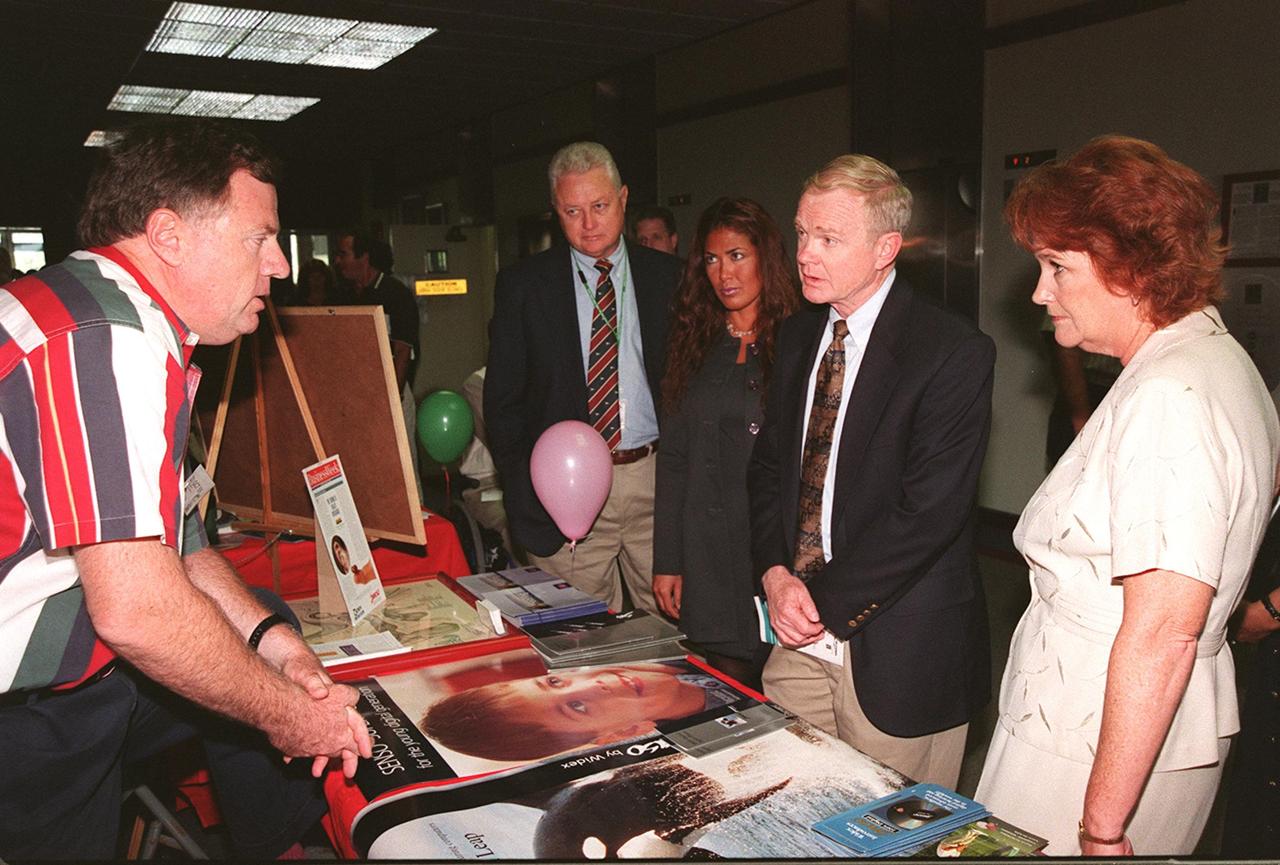
Center Director Roy Bridges stops to talk to one of the vendors at the Disability Awareness and Action Working Group (DAAWG) Technology Fair being held Oct. 20-21 at Kennedy Space Center. With him at the far left is Sterling Walker, director of Engineering Development at KSC and chairman of DAAWG, and Nancie Strott, a multi-media specialist with Dynacs and chairperson of the Fair; at the right is Carol Cavanaugh, with KSC Public Services. The Fair is highlighting vendors demonstrating mobility, hearing, vision and silent disability assistive technology. The purpose is to create an awareness of the types of technology currently available to assist people with various disabilities in the workplace. The theme is that of this year's National Disability Employment Awareness Month, "Opening Doors to Ability." Some of the vendors participating are Canine Companions for Independence, Goodwill Industries, Accessible Structures, Division of Blind Services, Space Coast Center for Independent Living, KSC Fitness Center and Delaware North Parks Services
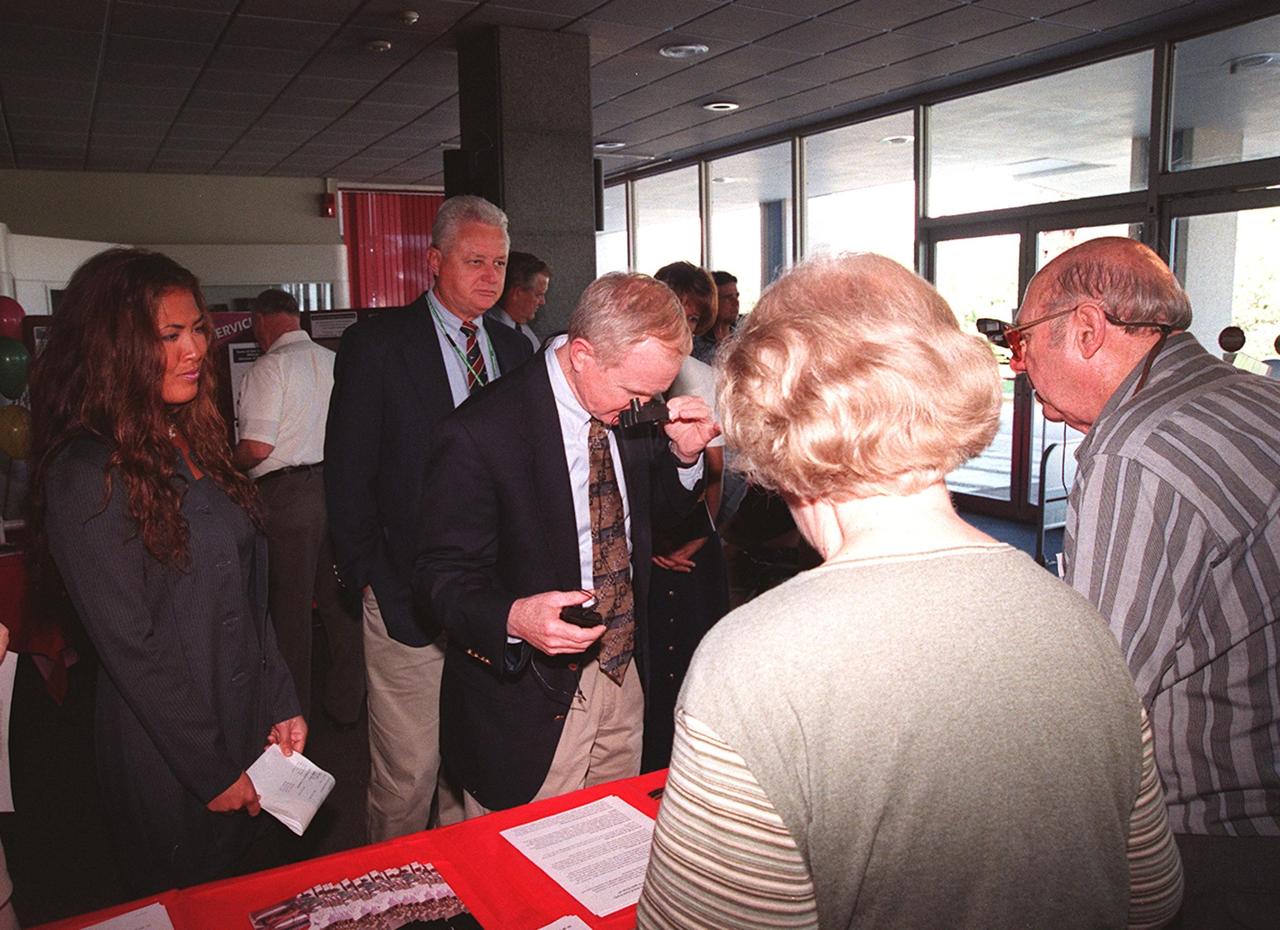
Center Director Roy Bridges stops at the Stewart Eye Institute table at the Disability Awareness and Action Working Group (DAAWG) 1999 Technology Fair being held Oct. 20-21 at Kennedy Space Center. Behind Bridges is Sterling Walker, director of Engineering Development at KSC and chairman of DAAWG. At the near right are George and Marian Hall, who are with the Institute. At the left is Nancie Strott, a multi-media specialist with Dynacs and chairperson of the Fair. The Fair is highlighting vendors demonstrating mobility, hearing, vision and silent disability assistive technology. The purpose is to create an awareness of the types of technology currently available to assist people with various disabilities in the workplace. The theme is that of this year's National Disability Employment Awareness Month, "Opening Doors to Ability." Some of the vendors participating are Canine Companions for Independence, Goodwill Industries, Accessible Structures, Division of Blind Services, Space Coast Center for Independent Living, KSC Fitness Center and Delaware North Parks Services
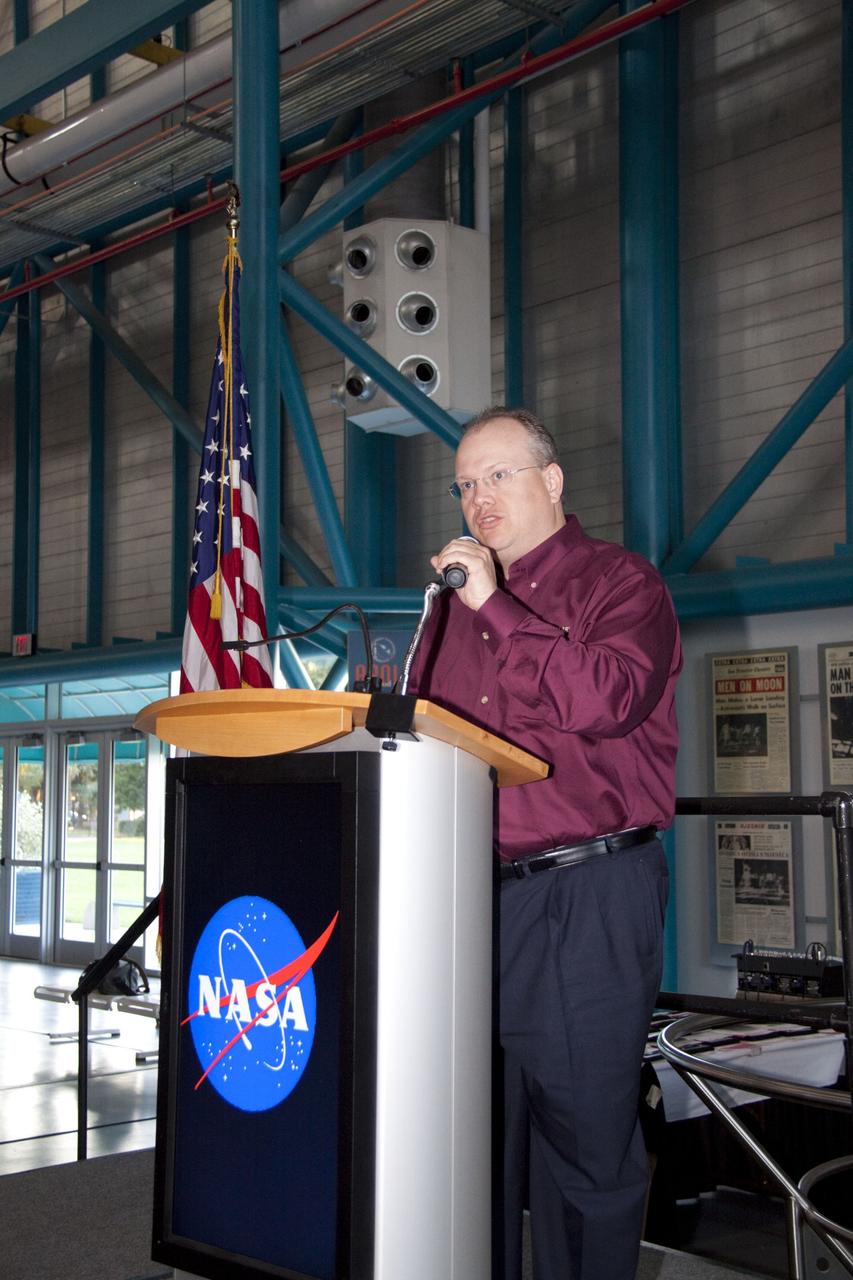
CAPE CANAVERAL, Fla. -- At NASA Kennedy Space Center's Apollo/Saturn V Center, Eric Reiners, manager with the Product Development and Global Technology Division of Caterpillar Inc., speaks to university students at the award ceremony for NASA's second annual Lunabotics Mining Competition. Thirty-six teams of undergraduate and graduate students from the United States, Bangladesh, Canada, Colombia and India participated in NASA's Lunabotics Mining Competition May 26 - 28 at the agency's Kennedy Space Center in Florida. The competition is designed to engage and retain students in science, technology, engineering and mathematics (STEM). Teams will maneuver their remote controlled or autonomous excavators, called lunabots, in about 60 tons of ultra-fine simulated lunar soil, called BP-1. The competition is an Exploration Systems Mission Directorate project managed by Kennedy's Education Division. The event also provides a competitive environment that could result in innovative ideas and solutions for NASA's future excavation of the moon. Photo credit: NASA/Jack Pfaller
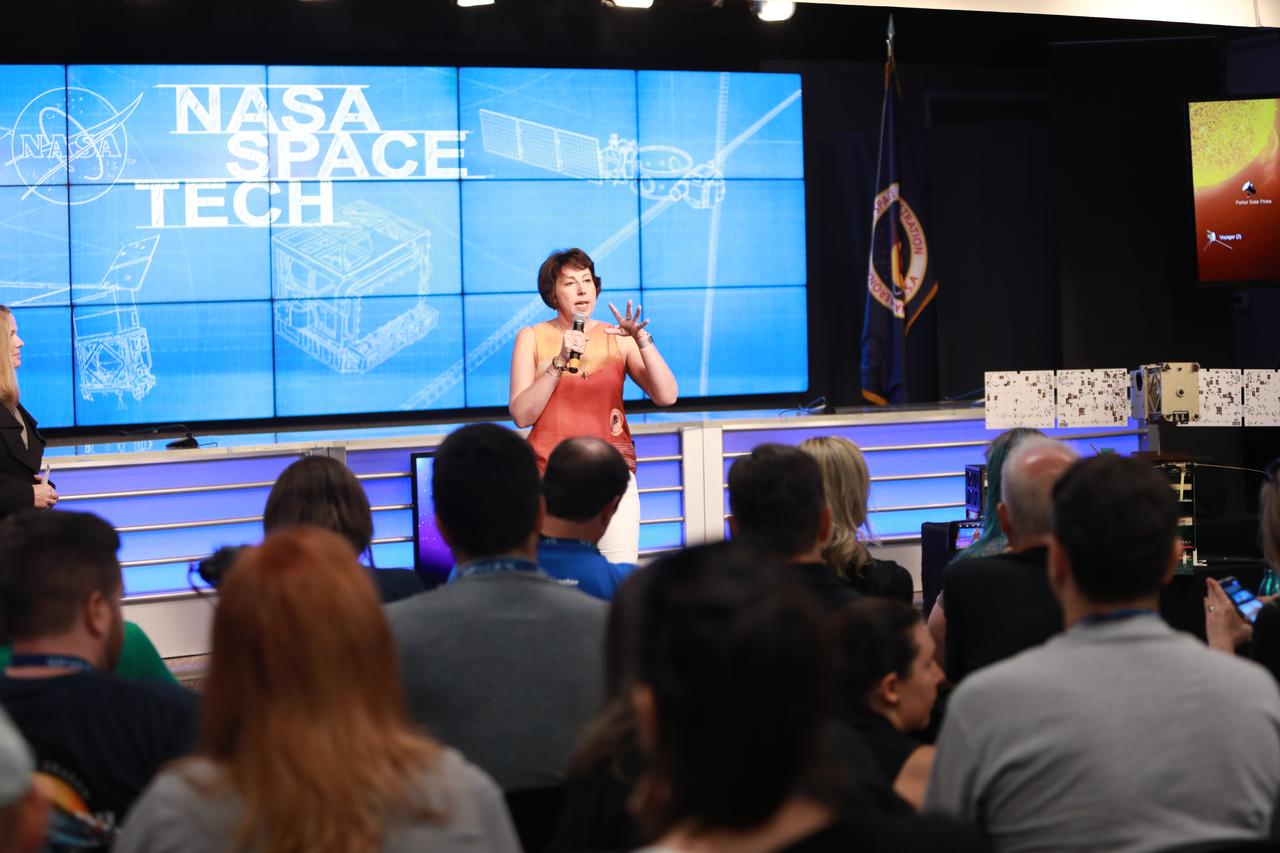
Nicky Fox, director of NASA’s Heliophysics Division, discusses the Space Environment Testbeds payload during a NASA prelaunch technology TV broadcast for the Space Test Program-2 (STP-2) at NASA’s Kennedy Space Center in Florida on June 23, 2019. The payload’s four experiments will reveal the ways local space weather affects spacecraft hardware. It is one of four NASA payloads scheduled to launch on a SpaceX Falcon Heavy rocket from Launch Complex 39A beginning at 11:30 p.m. EDT on June 24, 2019. STP-2 is managed by the U.S. Air Force Space and Missile Systems Center.

Nicky Fox, director of NASA’s Heliophysics Division, discusses the Space Environment Testbeds payload during a NASA prelaunch technology TV broadcast for the Space Test Program-2 (STP-2) at NASA’s Kennedy Space Center in Florida on June 23, 2019. The payload’s four experiments will reveal the ways local space weather affects spacecraft hardware. It is one of four NASA payloads scheduled to launch on a SpaceX Falcon Heavy rocket from Launch Complex 39A beginning at 11:30 p.m. EDT on June 24, 2019. STP-2 is managed by the U.S. Air Force Space and Missile Systems Center.
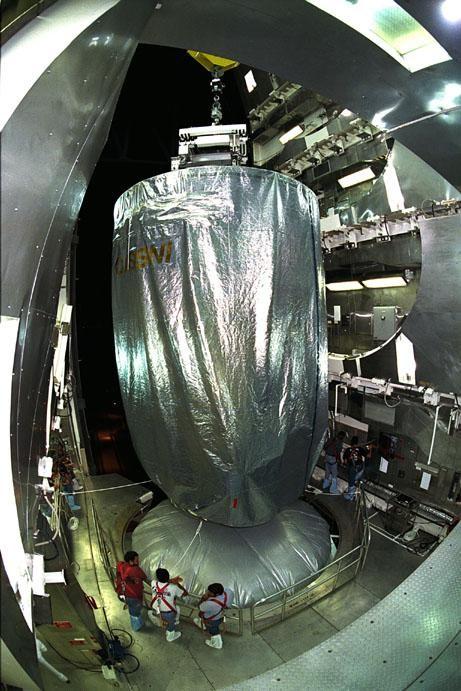
The Cassini spacecraft, covered by an environmentally controlled protective enclosure, is lifted at Launch Complex 40, Cape Canaveral Air Station (CCAS), in preparation to mate it to the top of its Titan IV/Centaur launch vehicle. Cassini is an international mission conducted by the National Aeronautics and Space Administration (NASA), the European Space Agency (ESA), and the Italian Space Agency (ASI). The two-story-tall spacecraft, scheduled for launch on Oct. 13, is destined to arrive at Saturn in July 2004, where it will orbit and study Saturn, its rings, moons and magnetic environment in detail over a four-year period. The Cassini mission is managed for NASA's Office of Space Science by the Jet Propulsion Laboratory, a division of the California Institute of Technology
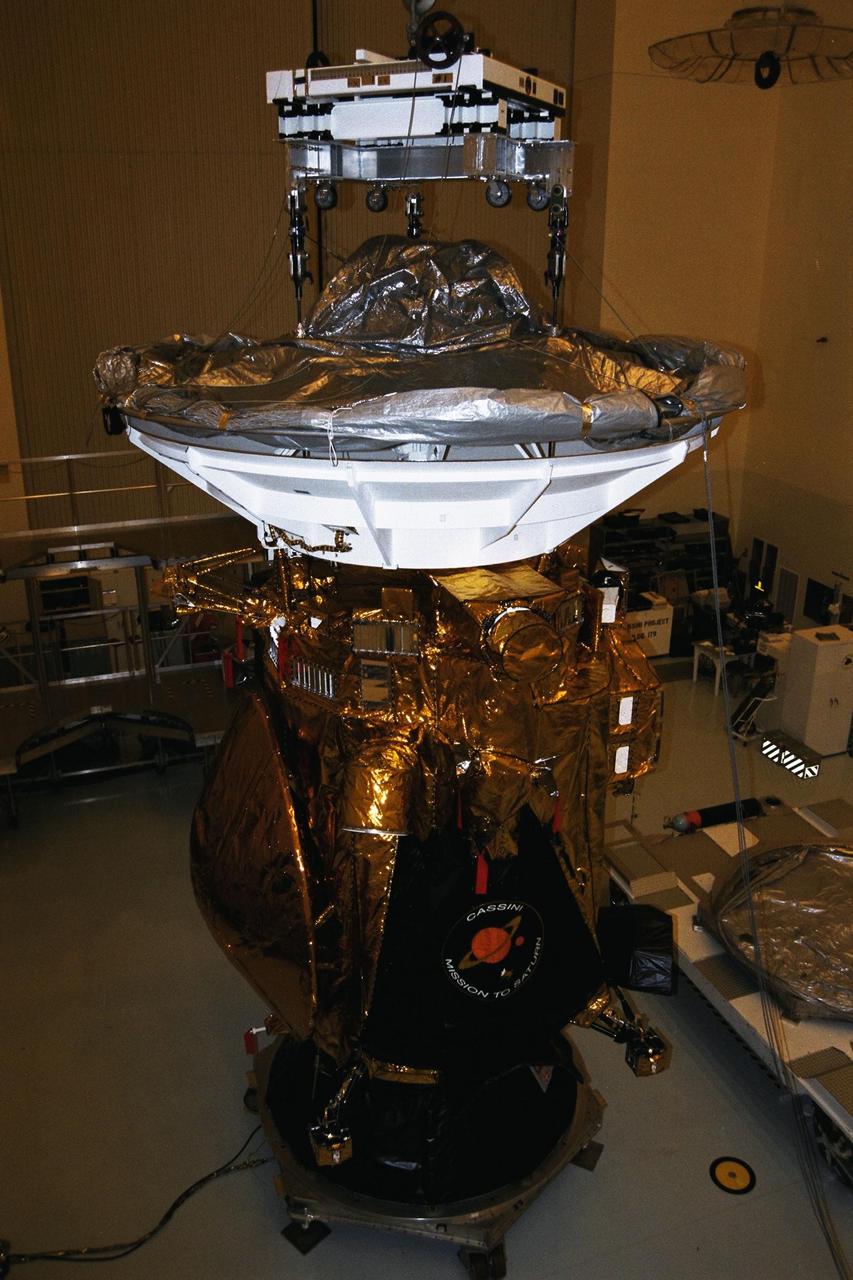
In the Payload Hazardous Servicing Facility (PHSF), the Cassini spacecraft is prepared for its lift onto a transporter which will move it to Launch Complex 40, Cape Canaveral Air Station (CCAS). Cassini is an international mission conducted by the National Aeronautics and Space Administration (NASA), the European Space Agency (ESA), and the Italian Space Agency (ASI). The two-story-tall spacecraft, scheduled for launch on Oct. 6, is destined to arrive at Saturn in July 2004, where it will study the planet, its rings, moons and magnetic environment in detail over a four-year period. The Cassini mission is managed for NASA's Office of Space Science by the Jet Propulsion Laboratory, a division of the California Institute of Technology
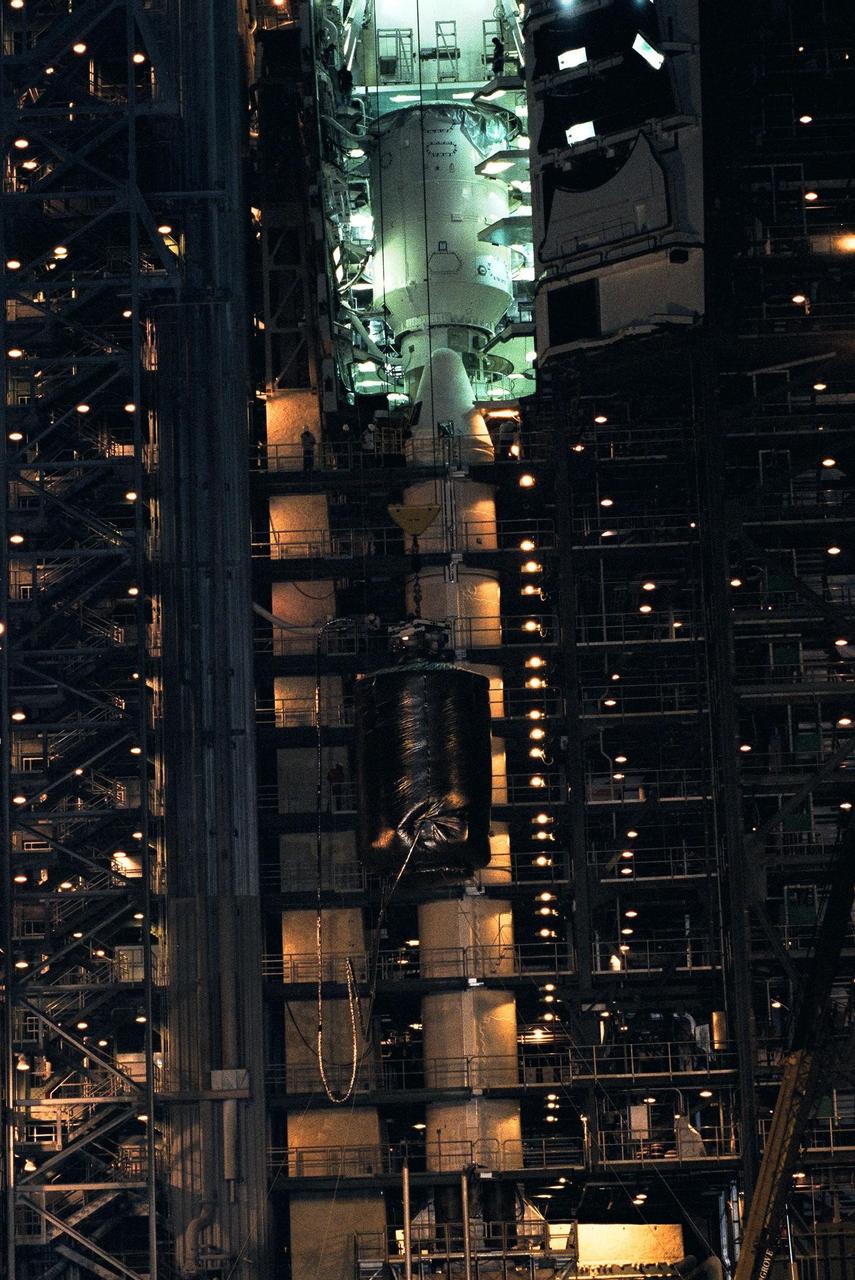
Technicians at Launch Complex 40, Cape Canaveral Air Station (CCAS), connect the crane to the top of the Cassini spacecraft in preparation for the lift to the top of its Titan IV/Centaur launch vehicle. Cassini is an international mission conducted by the National Aeronautics and Space Administration (NASA), the European Space Agency (ESA), and the Italian Space Agency (ASI). The two-story-tall spacecraft, scheduled for launch on Oct. 6, is destined to arrive at Saturn in July 2004, where it will orbit and study Saturn, its rings, moons and magnetic environment in detail over a four-year period. The Cassini mission is managed for NASA's Office of Space Science by the Jet Propulsion Laboratory, a division of the California Institute of Technology
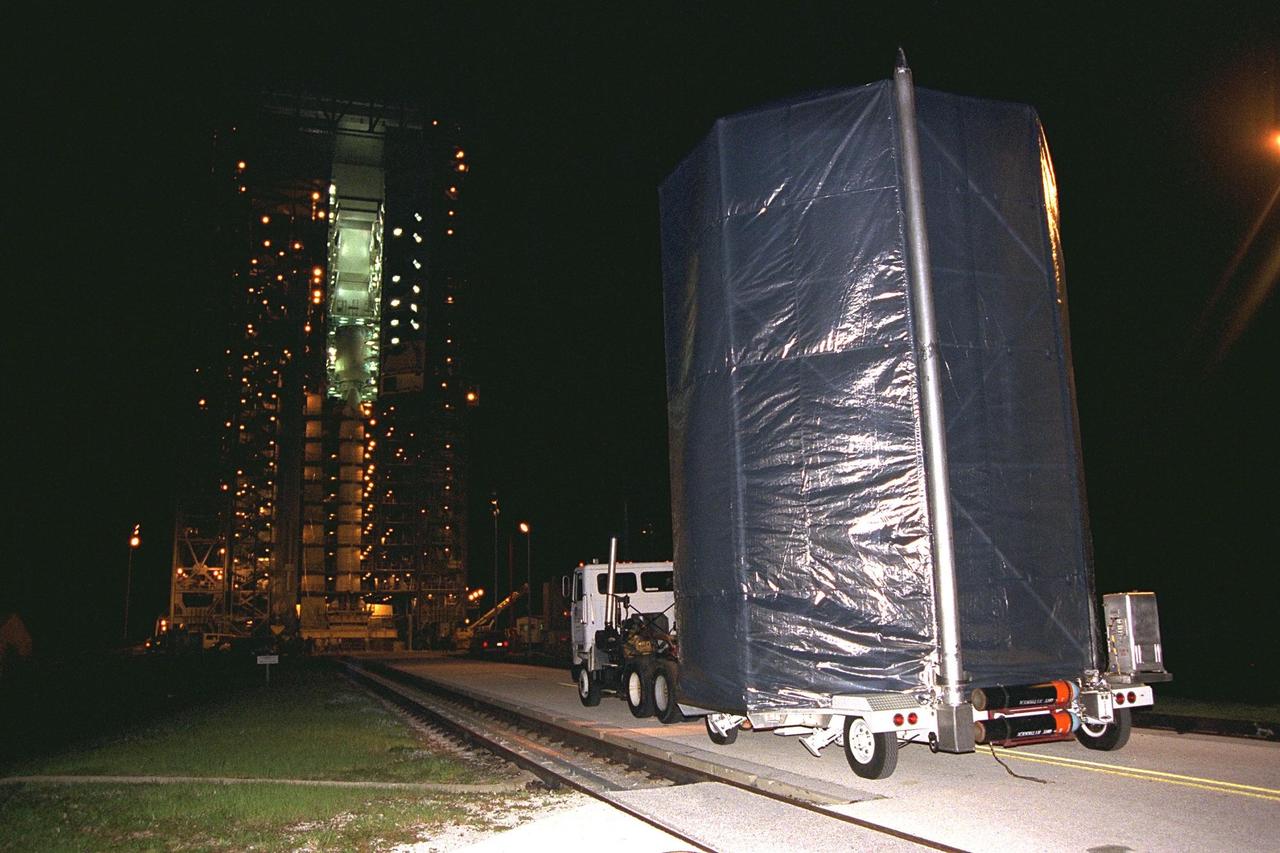
The Cassini spacecraft arrives at Complex 40, Cape Canaveral Air Station (CCAS), where it will be lifted to the top of its Titan IV/Centaur launch vehicle. Cassini is an international mission conducted by the National Aeronautics and Space Administration (NASA), the European Space Agency (ESA), and the Italian Space Agency (ASI). The two-story-tall spacecraft, scheduled for launch on Oct. 6, is destined to arrive at Saturn in July 2004, where it will orbit and study Saturn, its rings, moons and magnetic environment in detail over a four-year period. The Cassini mission is managed for NASA's Office of Space Science by the Jet Propulsion Laboratory, a division of the California Institute of Technology
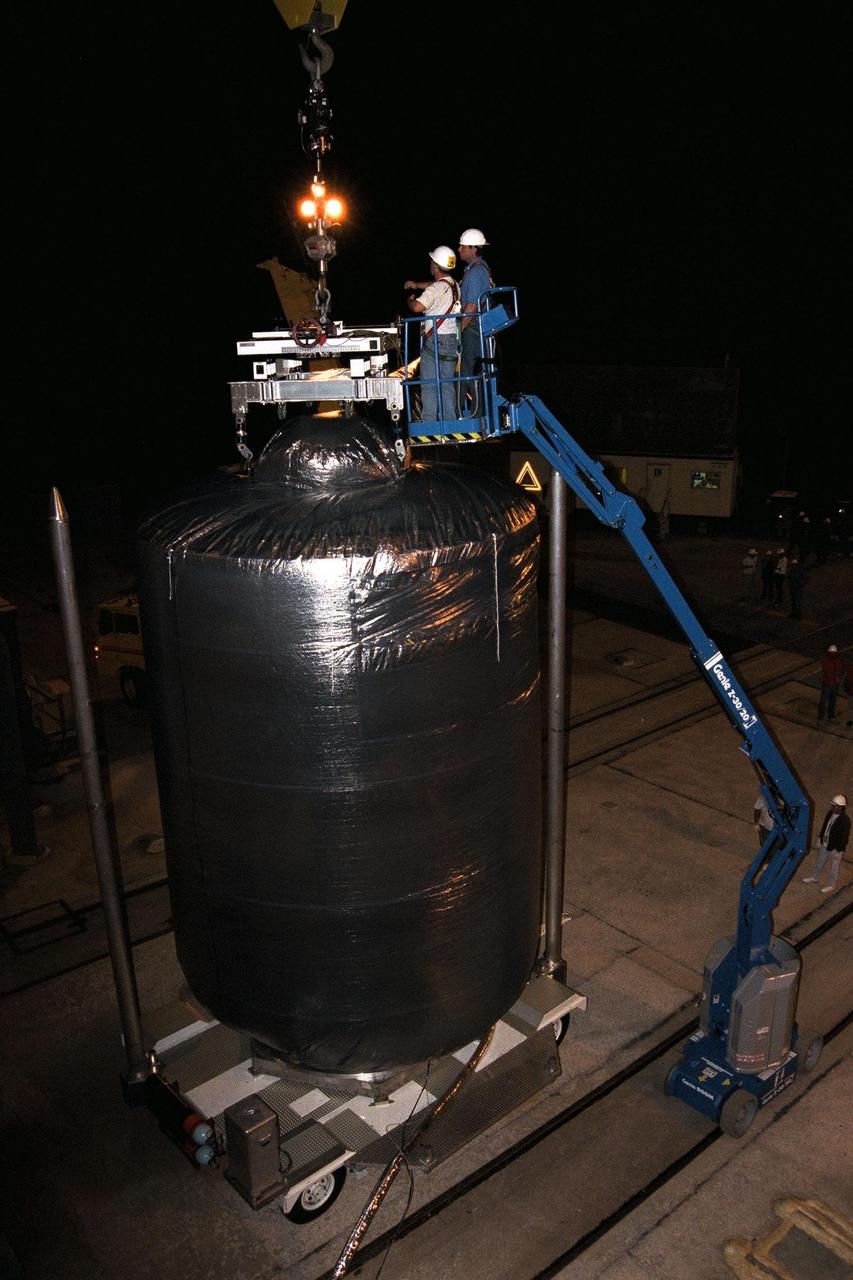
Technicians at Launch Complex 40, Cape Canaveral Air Station (CCAS), connect the crane to the top of the Cassini spacecraft in preparation for the lift to the top of its Titan IV/Centaur launch vehicle. Cassini is an international mission conducted by the National Aeronautics and Space Administration (NASA), the European Space Agency (ESA), and the Italian Space Agency (ASI). The two-story-tall spacecraft, scheduled for launch on Oct. 6, is destined to arrive at Saturn in July 2004, where it will orbit and study Saturn, its rings, moons and magnetic environment in detail over a four-year period. The Cassini mission is managed for NASA's Office of Space Science by the Jet Propulsion Laboratory, a division of the California Institute of Technology
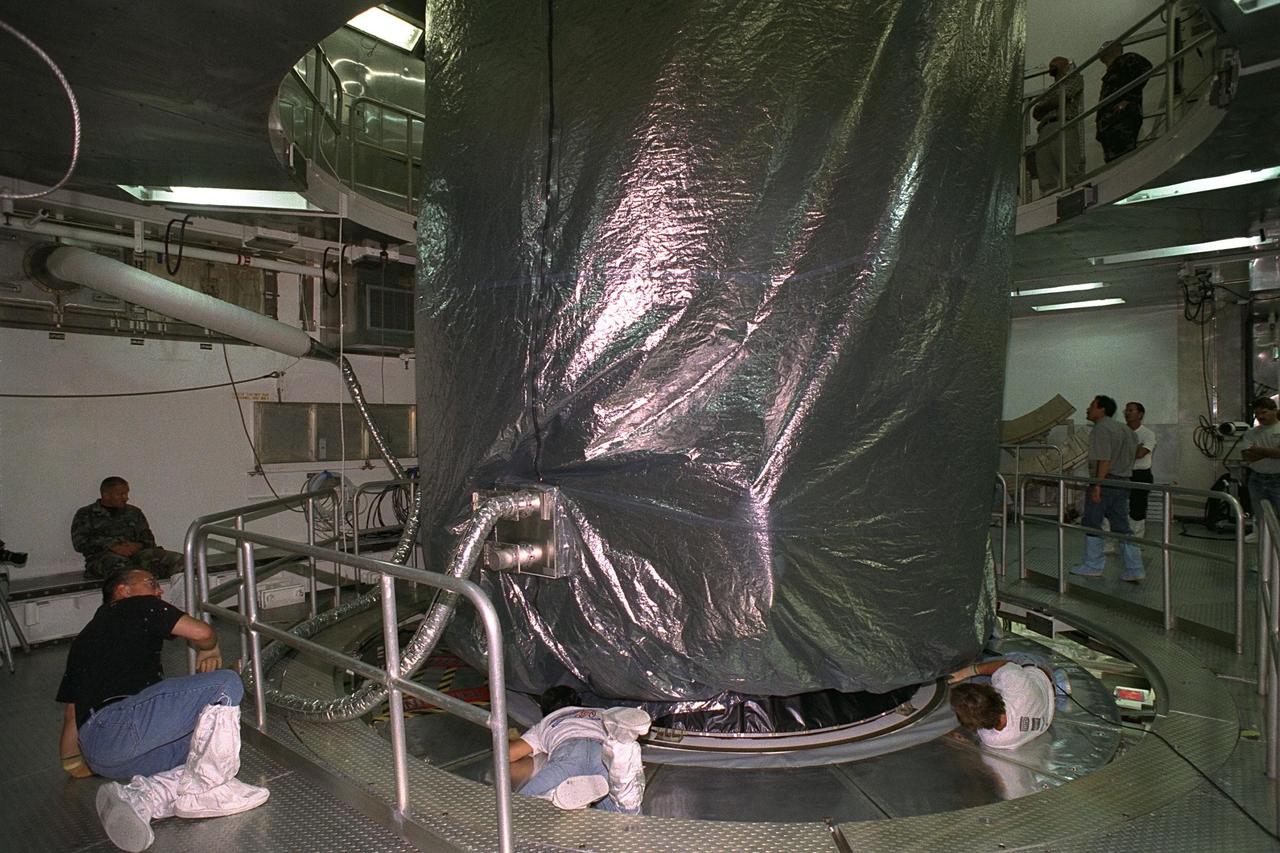
Technicians at Cape Canaveral Air Station (CCAS) begin to remove the transportation cover from the Cassini spacecraft after it was lifted to the top of the Titan IV/Centaur launch vehicle at Complex 40. Cassini is an international mission conducted by the National Aeronautics and Space Administration (NASA), the European Space Agency (ESA), and the Italian Space Agency (ASI). The two-story-tall spacecraft, scheduled for launch on Oct. 6, is destined to arrive at Saturn in July 2004, where it will orbit and study Saturn, its rings, moons and magnetic environment in detail over a four-year period. The Cassini mission is managed for NASA's Office of Space Science by the Jet Propulsion Laboratory, a division of the California Institute of Technology
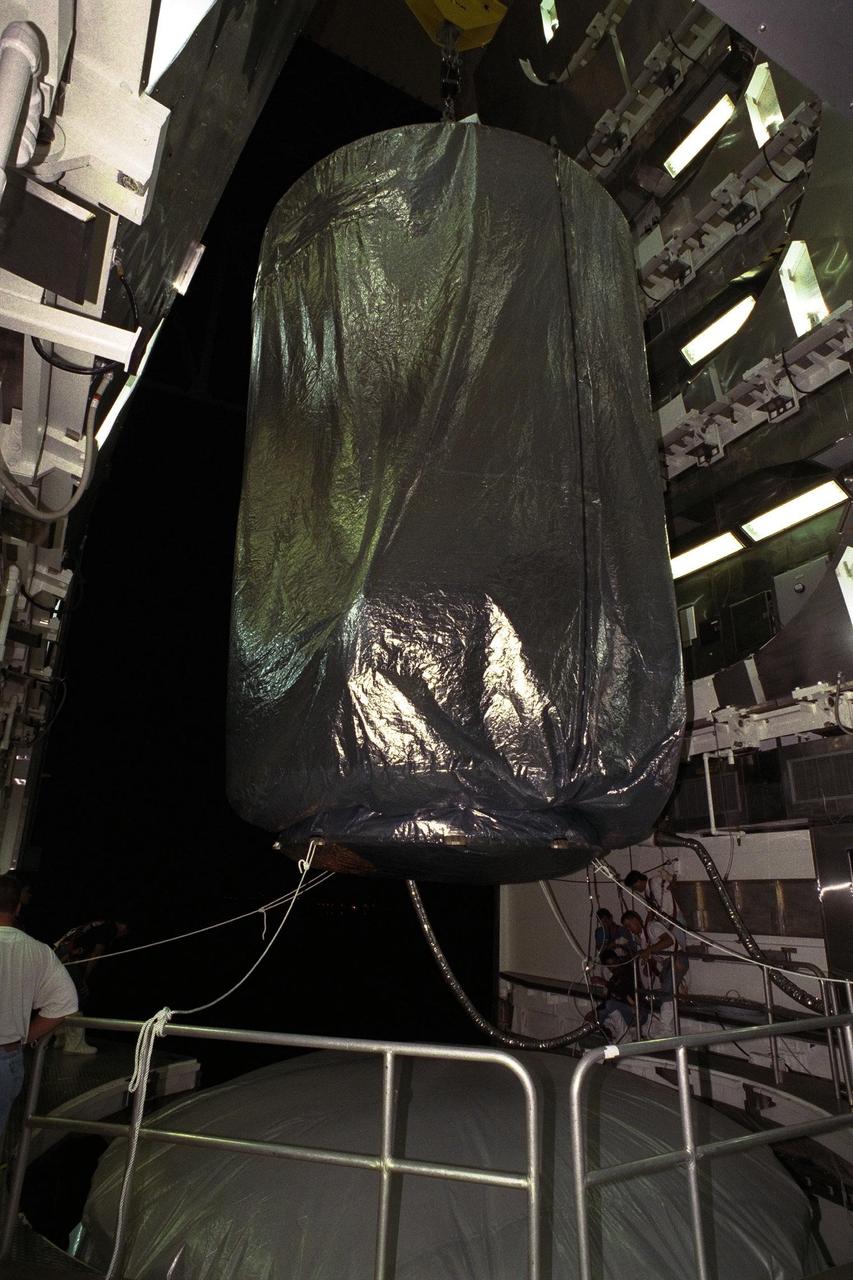
The Cassini spacecraft is lowered to the top of its Titan IV/Centaur launch vehicle at Launch Complex 40, Cape Canaveral Air Station (CCAS). Cassini is an international mission conducted by the National Aeronautics and Space Administration (NASA), the European Space Agency (ESA), and the Italian Space Agency (ASI). The two-story-tall spacecraft, scheduled for launch on Oct. 6, is destined to arrive at Saturn in July 2004, where it will orbit and study Saturn, its rings, moons and magnetic environment in detail over a four-year period. The Cassini mission is managed for NASA's Office of Space Science by the Jet Propulsion Laboratory, a division of the California Institute of Technology
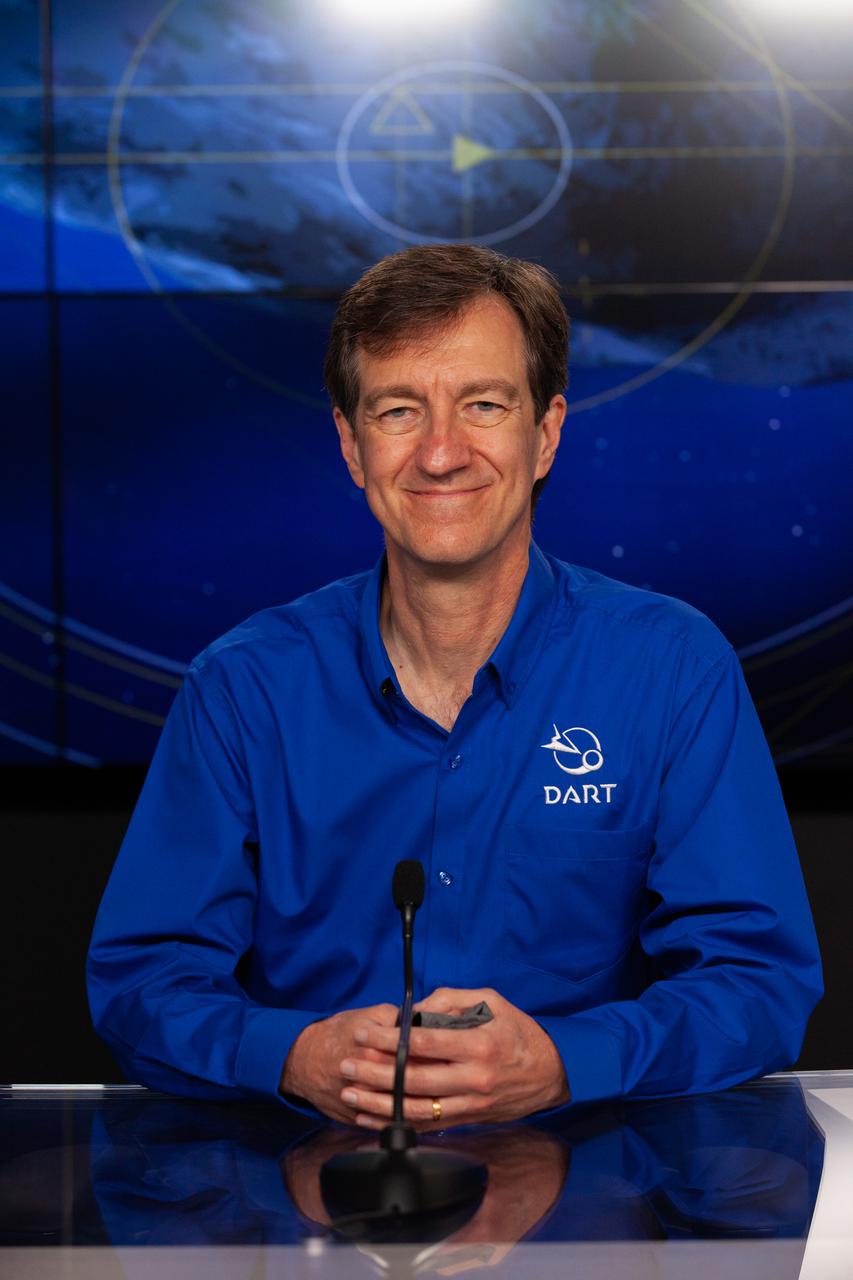
Tom Statler, Double Asteroid Redirection Test (DART) program scientist for NASA’s Science Mission Directorate’s Planetary Science Division, participates in an engineering briefing for the agency’s DART mission at Vandenberg Space Force Base in California on Nov. 21, 2021. DART is the first mission to test technologies for preventing an impact of Earth by a hazardous asteroid. The mission is scheduled to launch no earlier than 1:21 a.m. EST Wednesday, Nov. 24 (10:21 p.m. PST Tuesday, Nov. 23), aboard a SpaceX Falcon 9 rocket from Vandenberg. NASA's Launch Services Program based at Kennedy Space Center in Florida, America's multi-user spaceport, is managing the launch.
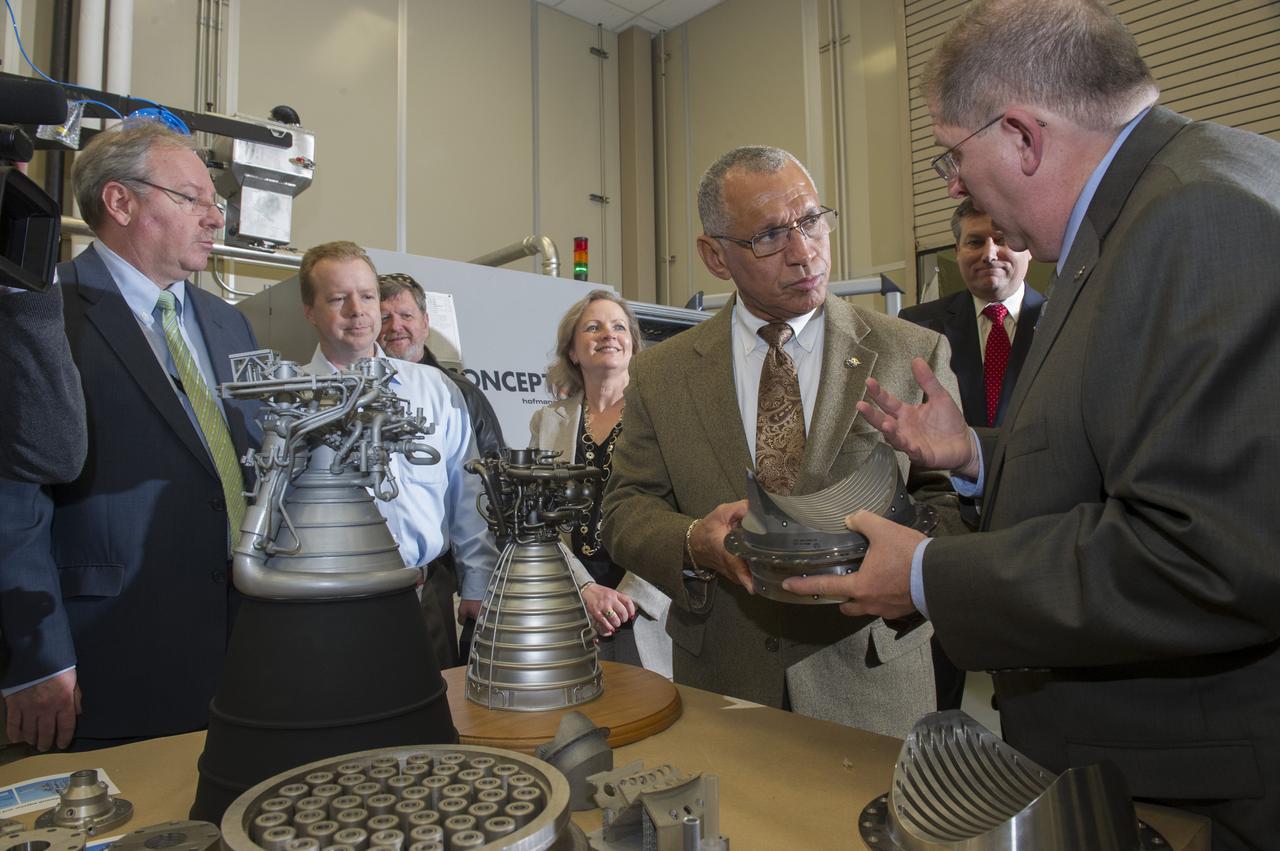
DURING HIS FEB. 22 VISIT TO THE NATIONAL CENTER FOR ADVANCED MANUFACTURING RAPID PROTOTYPING FACILITY AT NASA'S MARSHALL SPACE FLIGHT CENTER, NASA ADMINISTRATOR CHARLES BOLDEN, CENTER, TALKS WITH FRANK LEDBETTER, RIGHT, CHIEF OF THE NONMETALLIC MATERIALS AND MANUFACTURING DIVISION AT MARSHALL, ABOUT THE USE OF 3-D PRINTING AND PROTOTYPING TECHNOLOGY TO CREATE PARTS FOR THE SPACE LAUNCH SYSTEM. ALSO PARTICIPATING IN THE TOUR ARE, FROM BACK RIGHT, MARSHALL CENTER DIRECTOR PATRICK SCHEUERMANN; SHERRY KITTREDGE, DEPUTY MANAGER OF THE SLS LIQUID ENGINES OFFICE; MARSHALL FLIGHT SYSTEMS DESIGN ENGINEER ROB BLACK; AND JOHN VICKERS, MANAGER OF THE NATIONAL CENTER FOR ADVANCED MANUFACTURING.
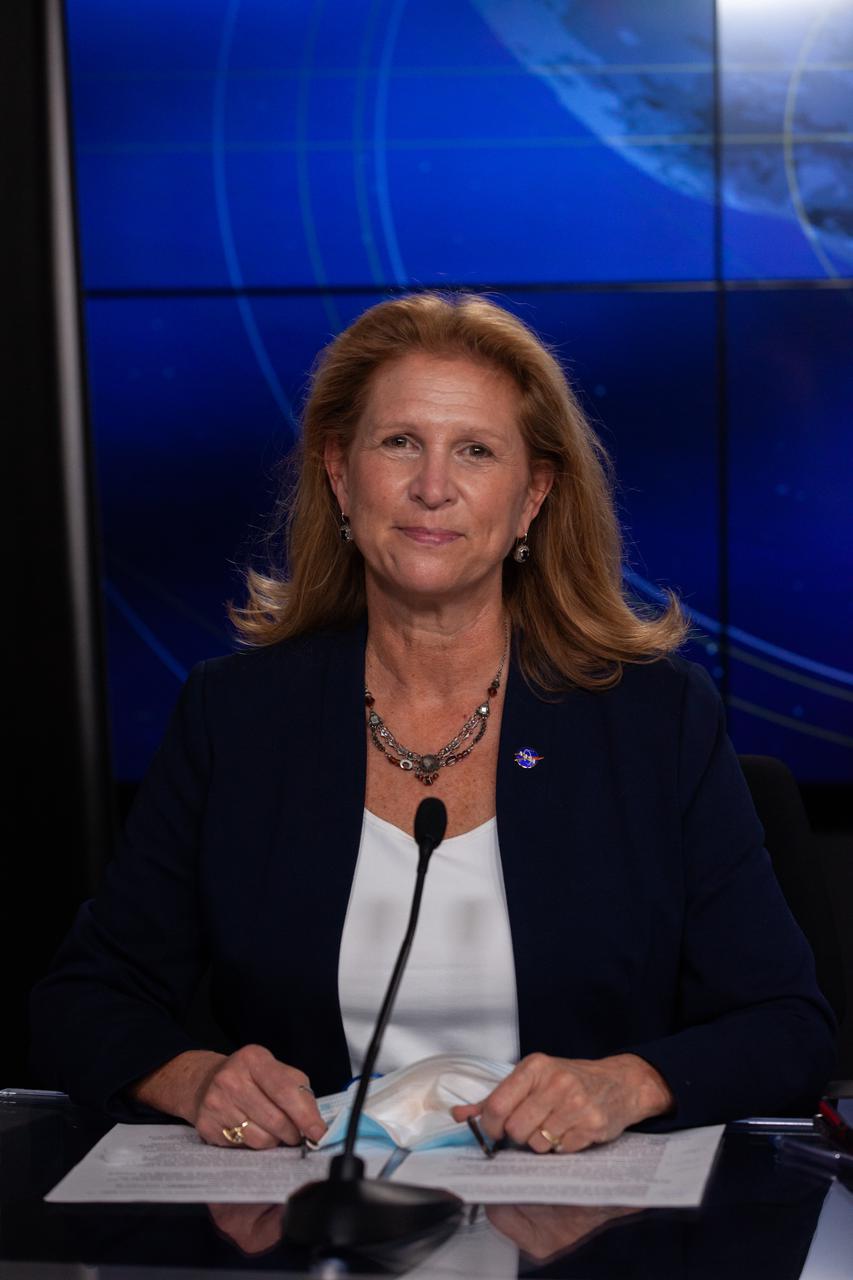
Lori Glaze, director of NASA’s Science Mission Directorate’s Planetary Science Division, participates in an engineering briefing for the agency’s Double Asteroid Redirection Test (DART) mission at Vandenberg Space Force Base in California on Nov. 21, 2021. DART is the first mission to test technologies for preventing an impact of Earth by a hazardous asteroid. The mission is scheduled to launch no earlier than 1:21 a.m. EST Wednesday, Nov. 24 (10:21 p.m. PST Tuesday, Nov. 23), aboard a SpaceX Falcon 9 rocket from Vandenberg. NASA's Launch Services Program based at Kennedy Space Center in Florida, America's multi-user spaceport, is managing the launch.
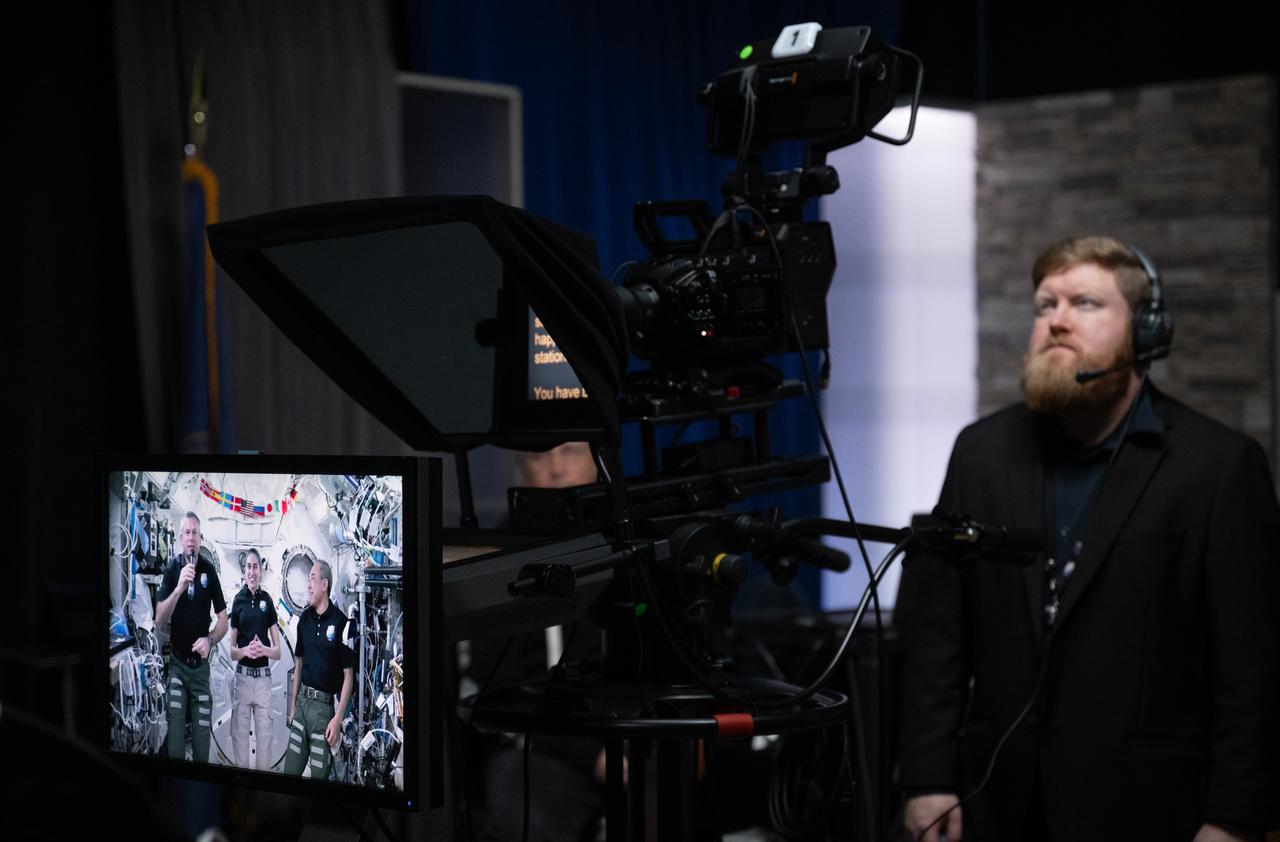
Expedition 70 crew members Andreas Mogenson of ESA left, Jasmin Moghbeli of NASA, and Satoshi Furukawa of JAXA are seen aboard the International Space Station on a monitor as they talk with NASA Administrator Bill Nelson and Lisa Carnell, director of NASA’s Biological and Physical Sciences Division, during an Earth-to-space call, Wednesday, Feb. 21, 2024, at the Mary W. Jackson NASA Headquarters building in Washington. Nelson and Carnell spoke with Mogenson, Moghbeli, and Furukawa about recent science research and technology demonstrations aboard the orbiting laboratory. Photo Credit: (NASA/Joel Kowsky)