
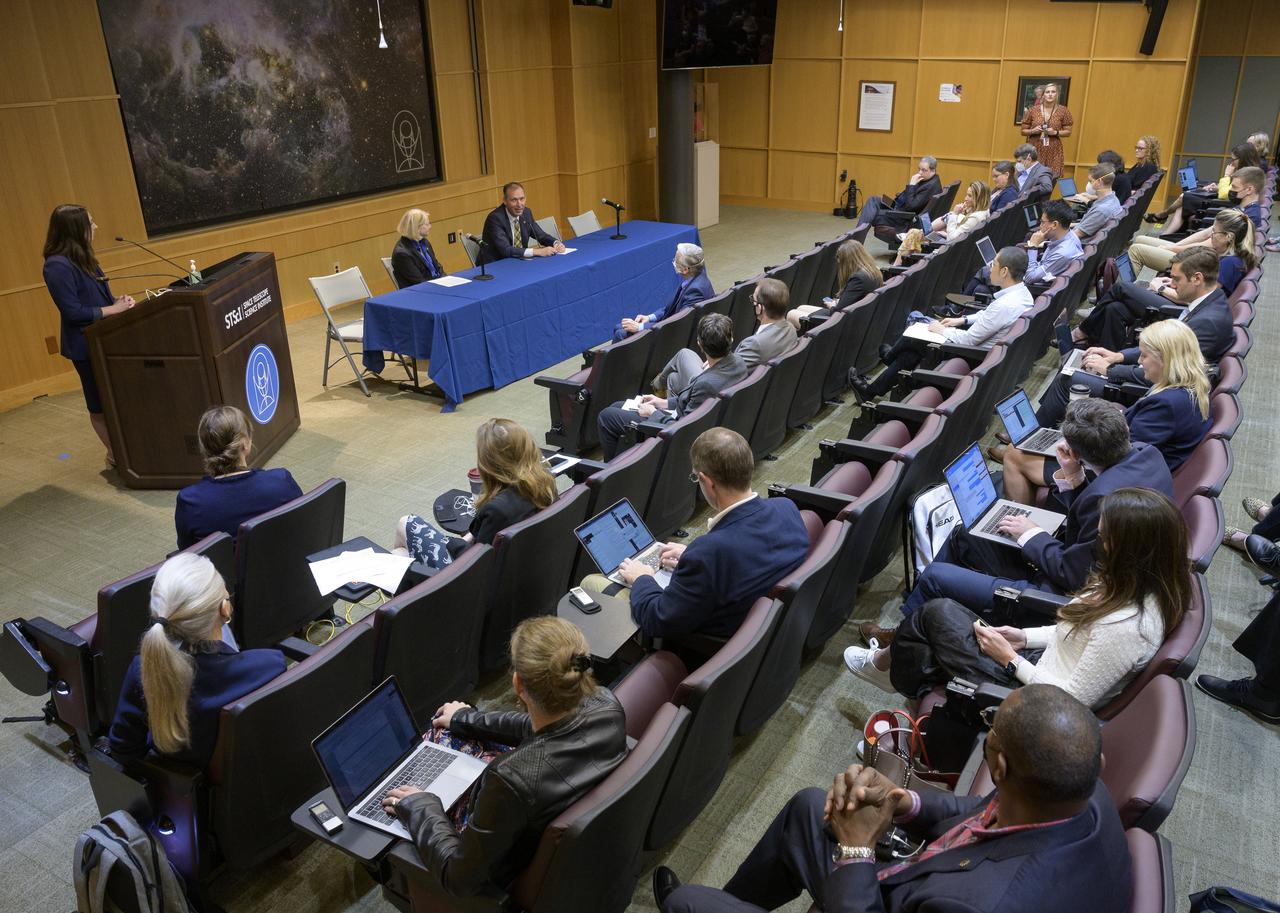
Space Telescope Science Institute (STScI) Director Kenneth Sembach gives remarks during a briefing, Wednesday, June 29, 2022, at the Space Telescope Science Institute (STScI) in Baltimore. The briefing focused on the status of NASA’s James Webb Space Telescope in its final weeks of preparing for its science mission, as well as overviews of planned science for Webb’s first year of operations. Photo Credit: (NASA/Bill Ingalls)
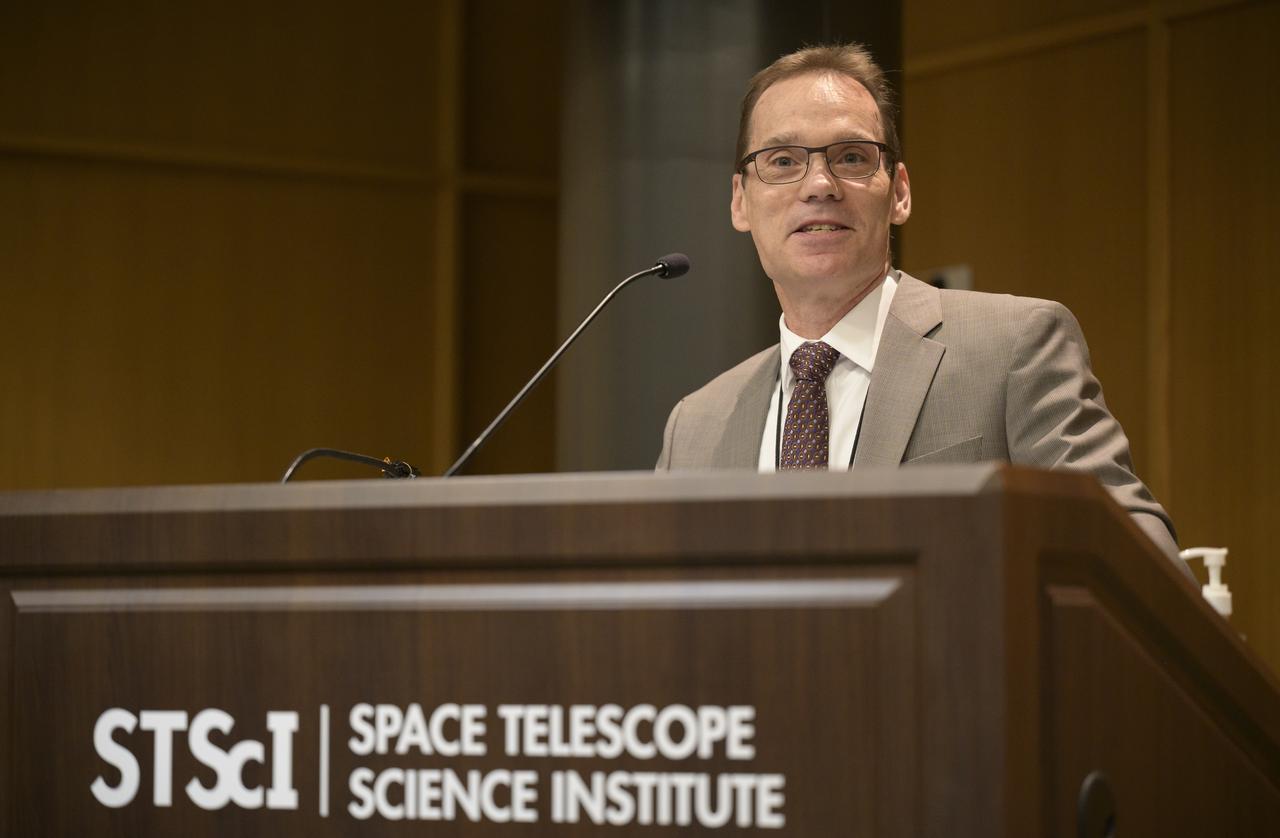
Space Telescope Science Institute (STScI) Director Kenneth Sembach gives remarks during a briefing, Wednesday, June 29, 2022, at the Space Telescope Science Institute (STScI) in Baltimore. The briefing focused on the status of NASA’s James Webb Space Telescope in its final weeks of preparing for its science mission, as well as overviews of planned science for Webb’s first year of operations. Photo Credit: (NASA/Bill Ingalls)
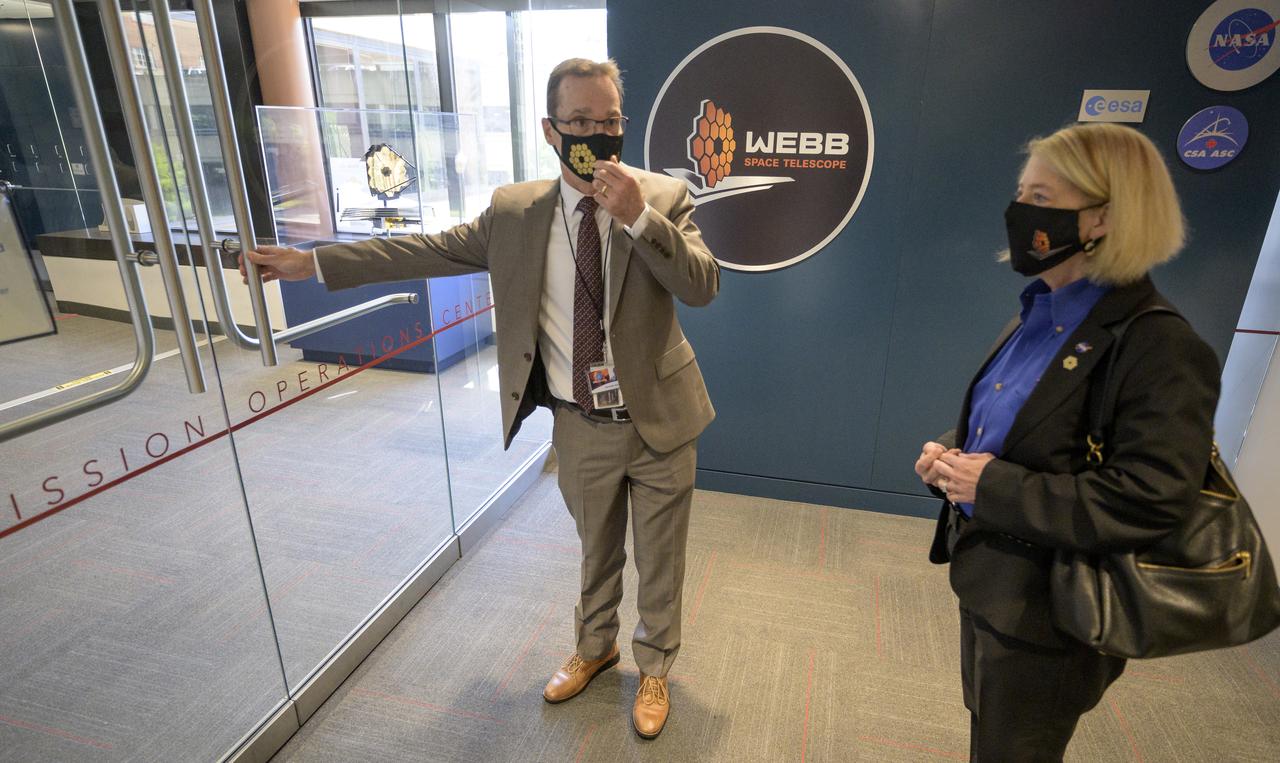
Space Telescope Science Institute (STScI) Director Kenneth Sembach, left, gives NASA Deputy Administrator Pam Melroy a tour of the NASA James Webb Space Telescope Mission Operations Center, Wednesday, June 29, 2022, at the Space Telescope Science Institute (STScI) in Baltimore. Prior to the tour the two spoke at a briefing that focused on the status of NASA’s James Webb Space Telescope in its final weeks of preparing for its science mission, as well as overviews of planned science for Webb’s first year of operations. Photo Credit: (NASA/Bill Ingalls)

NASA Associate Administrator for the Science Mission Directorate Thomas Zurbuchen gives remarks during a briefing, Wednesday, June 29, 2022, at the Space Telescope Science Institute (STScI) in Baltimore. The briefing focused on the status of NASA’s James Webb Space Telescope in its final weeks of preparing for its science mission, as well as overviews of planned science for Webb’s first year of operations. Photo Credit: (NASA/Bill Ingalls)
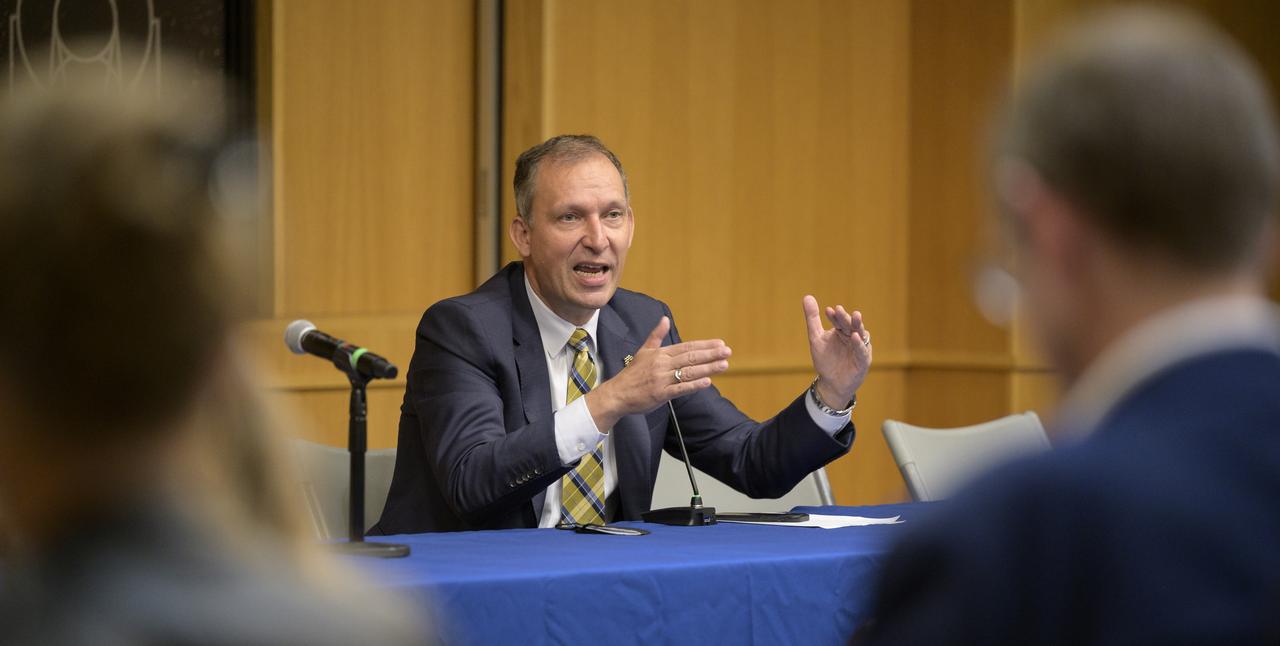
NASA Associate Administrator for the Science Mission Directorate Thomas Zurbuchen gives remarks during a briefing, Wednesday, June 29, 2022, at the Space Telescope Science Institute (STScI) in Baltimore. The briefing focused on the status of NASA’s James Webb Space Telescope in its final weeks of preparing for its science mission, as well as overviews of planned science for Webb’s first year of operations. Photo Credit: (NASA/Bill Ingalls)

NASA Associate Administrator for the Science Mission Directorate Thomas Zurbuchen gives remarks during a briefing, Wednesday, June 29, 2022, at the Space Telescope Science Institute (STScI) in Baltimore. The briefing focused on the status of NASA’s James Webb Space Telescope in its final weeks of preparing for its science mission, as well as overviews of planned science for Webb’s first year of operations. Photo Credit: (NASA/Bill Ingalls)
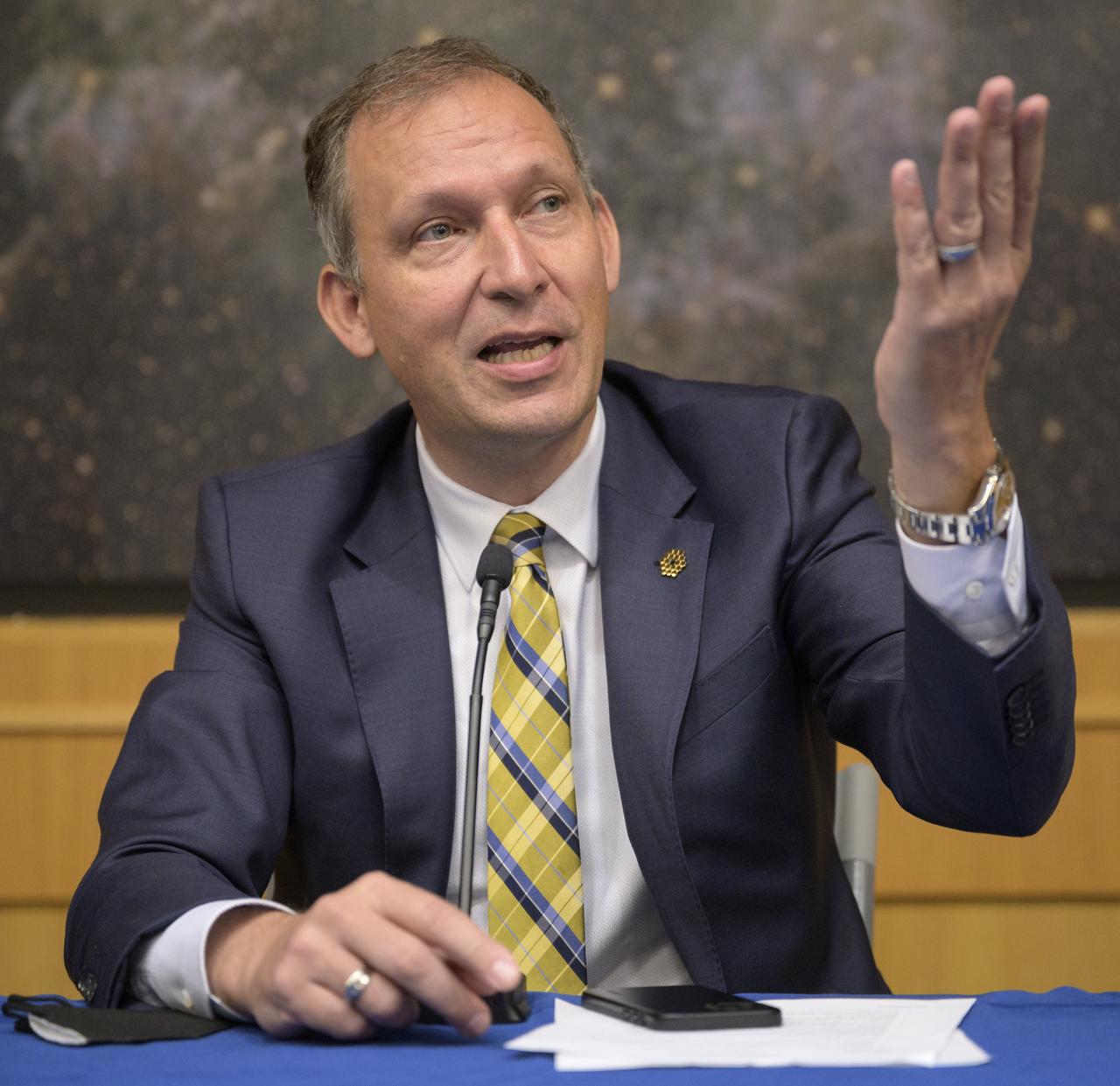
NASA Associate Administrator for the Science Mission Directorate Thomas Zurbuchen gives remarks during a briefing, Wednesday, June 29, 2022, at the Space Telescope Science Institute (STScI) in Baltimore. The briefing focused on the status of NASA’s James Webb Space Telescope in its final weeks of preparing for its science mission, as well as overviews of planned science for Webb’s first year of operations. Photo Credit: (NASA/Bill Ingalls)
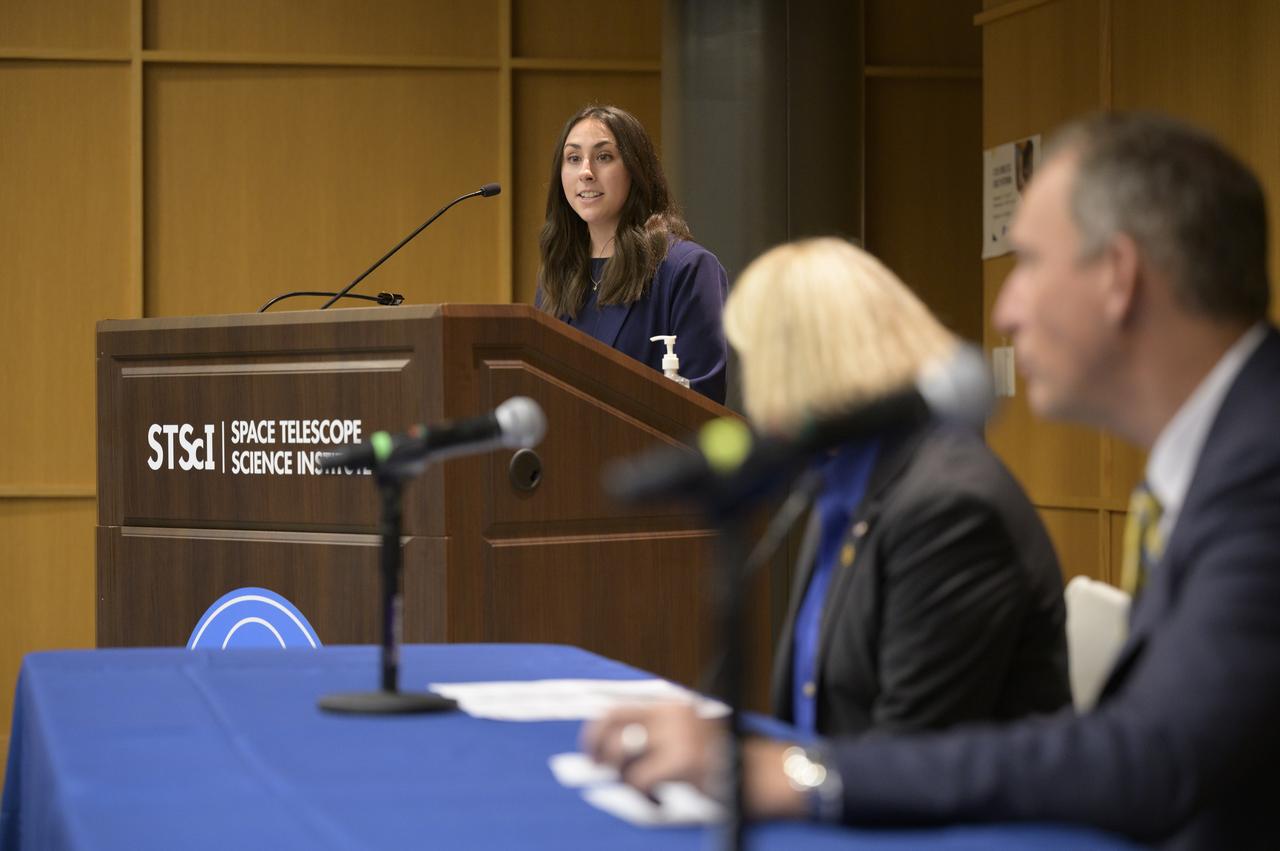
NASA Public Affairs Officer Alise Fisher moderates a briefing, Wednesday, June 29, 2022, at the Space Telescope Science Institute (STScI) in Baltimore. The briefing focused on the status of NASA’s James Webb Space Telescope in its final weeks of preparing for its science mission, as well as overviews of planned science for Webb’s first year of operations. Photo Credit: (NASA/Bill Ingalls)

NASA Deputy Administrator Pam Melroy gives remarks during a briefing, Wednesday, June 29, 2022, at the Space Telescope Science Institute (STScI) in Baltimore. The briefing focused on the status of NASA’s James Webb Space Telescope in its final weeks of preparing for its science mission, as well as overviews of planned science for Webb’s first year of operations. Photo Credit: (NASA/Bill Ingalls)
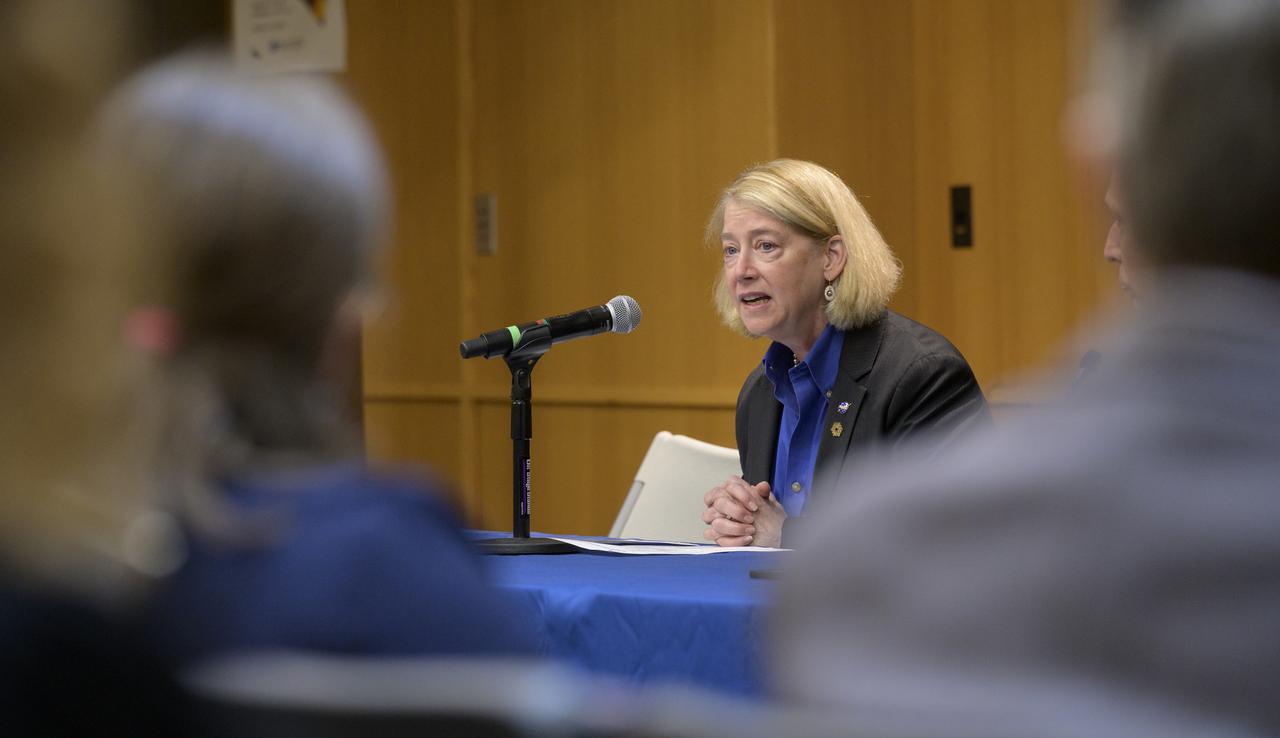
NASA Deputy Administrator Pam Melroy gives remarks during a briefing, Wednesday, June 29, 2022, at the Space Telescope Science Institute (STScI) in Baltimore. The briefing focused on the status of NASA’s James Webb Space Telescope in its final weeks of preparing for its science mission, as well as overviews of planned science for Webb’s first year of operations. Photo Credit: (NASA/Bill Ingalls)
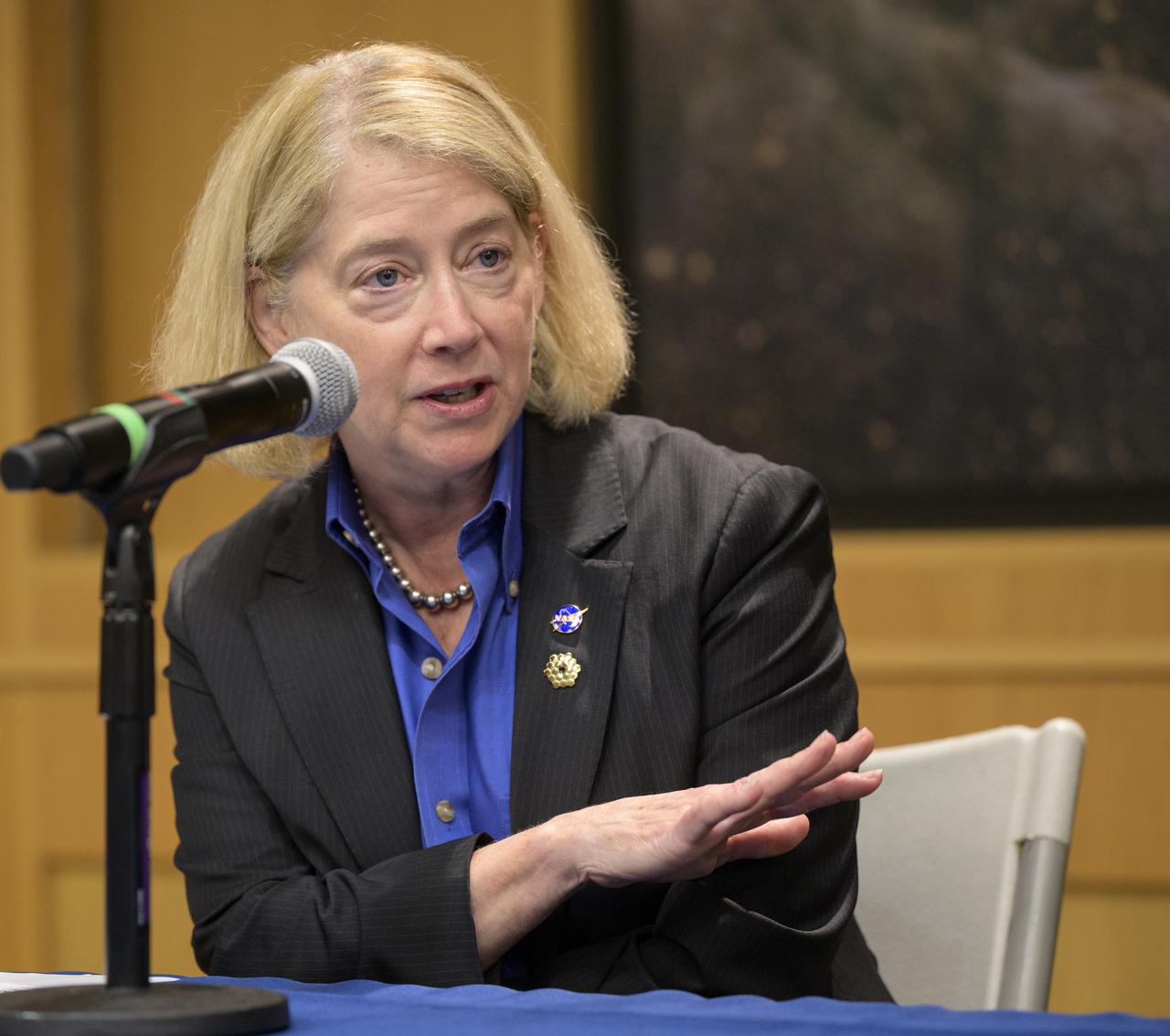
NASA Deputy Administrator Pam Melroy gives remarks during a briefing, Wednesday, June 29, 2022, at the Space Telescope Science Institute (STScI) in Baltimore. The briefing focused on the status of NASA’s James Webb Space Telescope in its final weeks of preparing for its science mission, as well as overviews of planned science for Webb’s first year of operations. Photo Credit: (NASA/Bill Ingalls)

NASA Deputy Administrator Pam Melroy gives remarks during a briefing, Wednesday, June 29, 2022, at the Space Telescope Science Institute (STScI) in Baltimore. The briefing focused on the status of NASA’s James Webb Space Telescope in its final weeks of preparing for its science mission, as well as overviews of planned science for Webb’s first year of operations. Photo Credit: (NASA/Bill Ingalls)
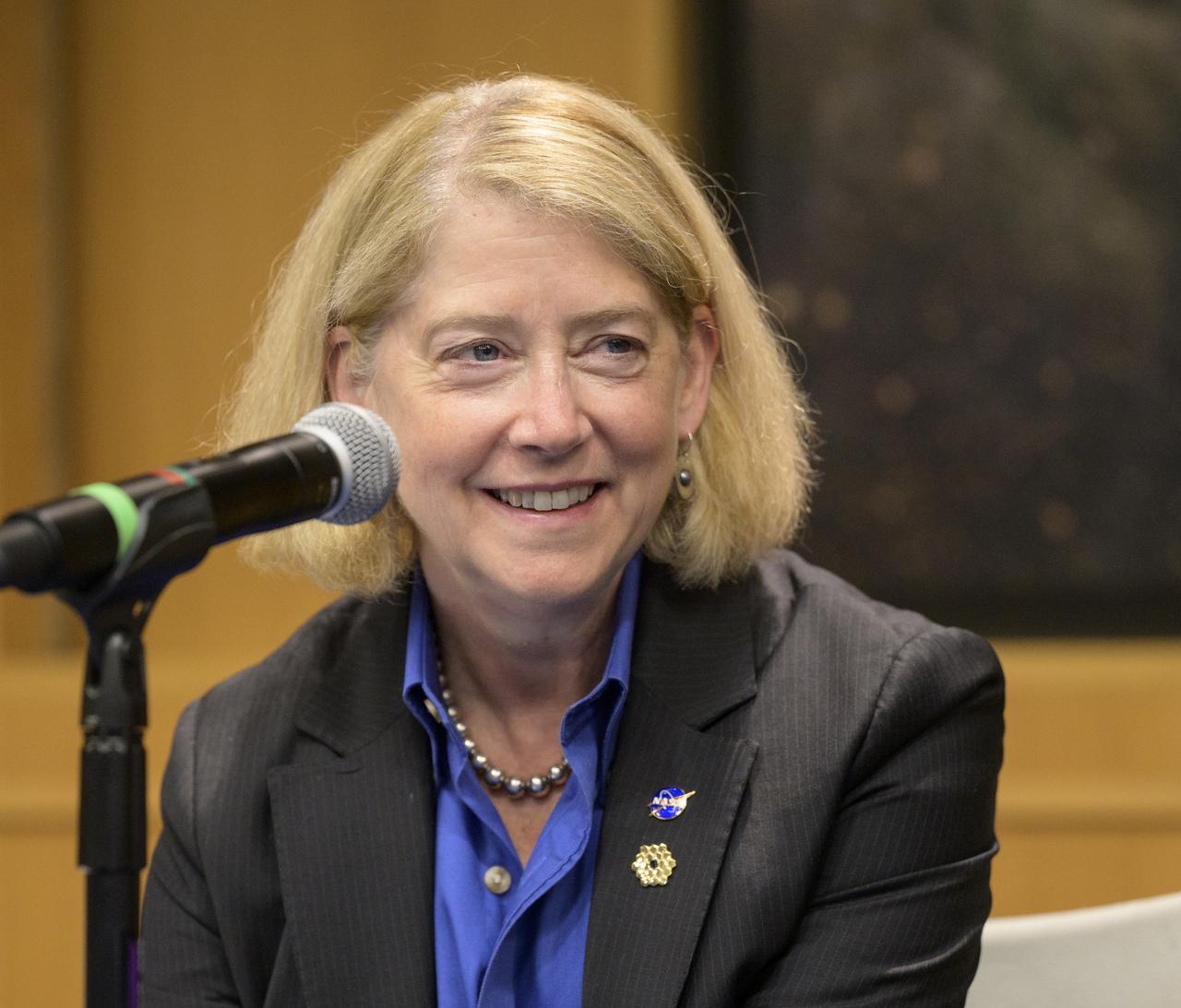
NASA Deputy Administrator Pam Melroy gives remarks during a briefing, Wednesday, June 29, 2022, at the Space Telescope Science Institute (STScI) in Baltimore. The briefing focused on the status of NASA’s James Webb Space Telescope in its final weeks of preparing for its science mission, as well as overviews of planned science for Webb’s first year of operations. Photo Credit: (NASA/Bill Ingalls)
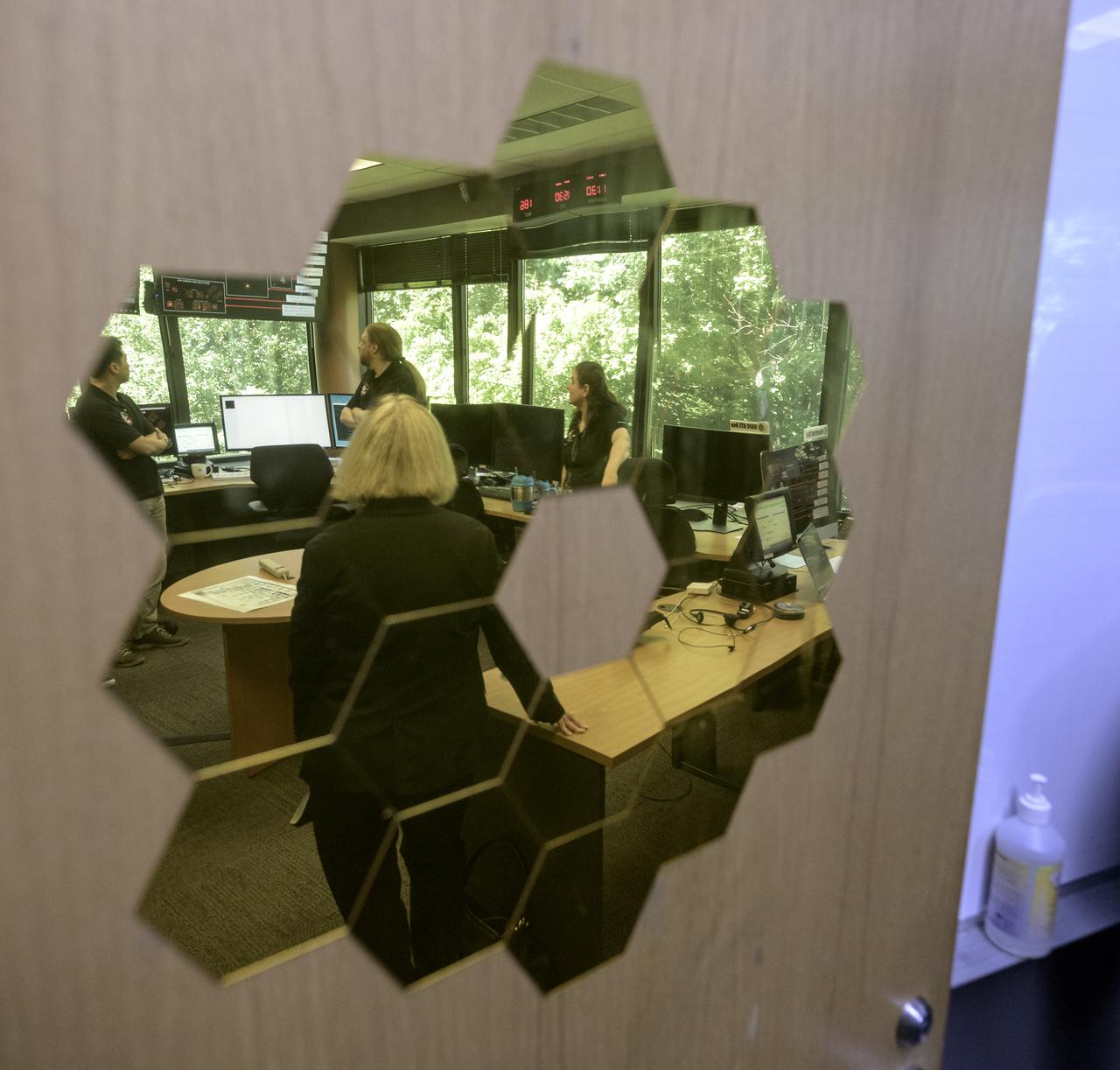
NASA Deputy Administrator Pam Melroy, back to camera, is seen reflected in a door mirror decoration as she meets with members of the NASA James Webb Space Telescope wavefront sensing and control analysis office, Wednesday, June 29, 2022, at the Space Telescope Science Institute (STScI) in Baltimore. Prior to the tour the deputy spoke at a briefing that focused on the status of NASA’s James Webb Space Telescope in its final weeks of preparing for its science mission, as well as overviews of planned science for Webb’s first year of operations. Photo Credit: (NASA/Bill Ingalls)
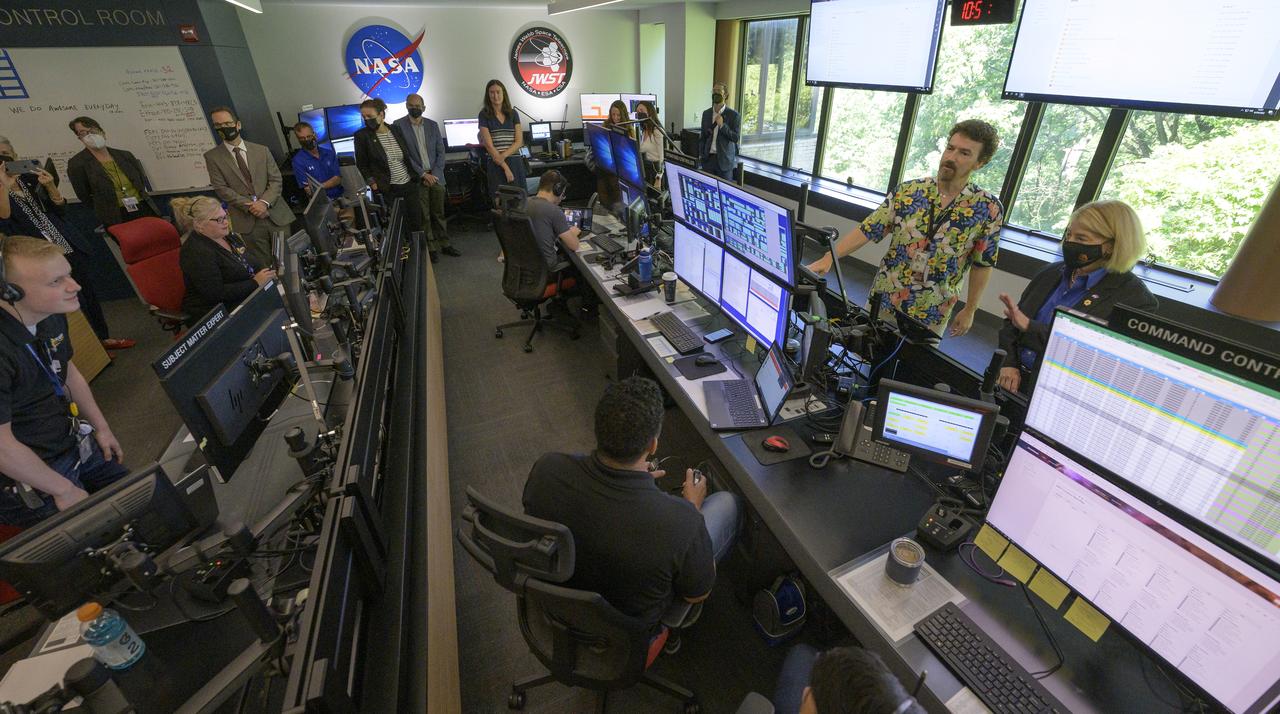
NASA Deputy Administrator Pam Melroy is given a tour of the NASA James Webb Space Telescope Mission Operations Center, Wednesday, June 29, 2022, at the Space Telescope Science Institute (STScI) in Baltimore. Prior to the tour the deputy spoke at a briefing that focused on the status of NASA’s James Webb Space Telescope in its final weeks of preparing for its science mission, as well as overviews of planned science for Webb’s first year of operations. Photo Credit: (NASA/Bill Ingalls)
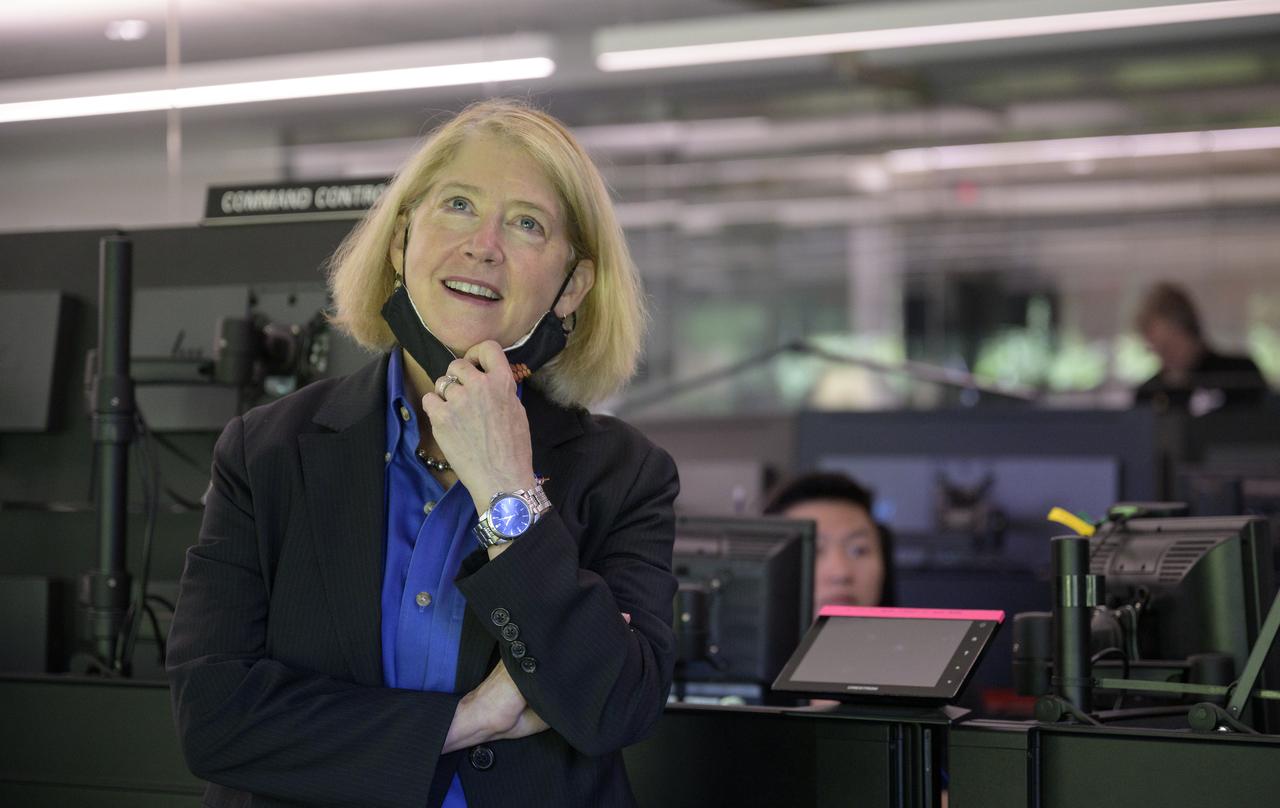
NASA Deputy Administrator Pam Melroy reacts to being shown some raw images from NASA’s James Webb Space Telescope during a tour of the Mission Operations Center, Wednesday, June 29, 2022, at the Space Telescope Science Institute (STScI) in Baltimore. Prior to the tour the deputy spoke at a briefing that focused on the status of NASA’s James Webb Space Telescope in its final weeks of preparing for its science mission, as well as overviews of planned science for Webb’s first year of operations. Photo Credit: (NASA/Bill Ingalls)
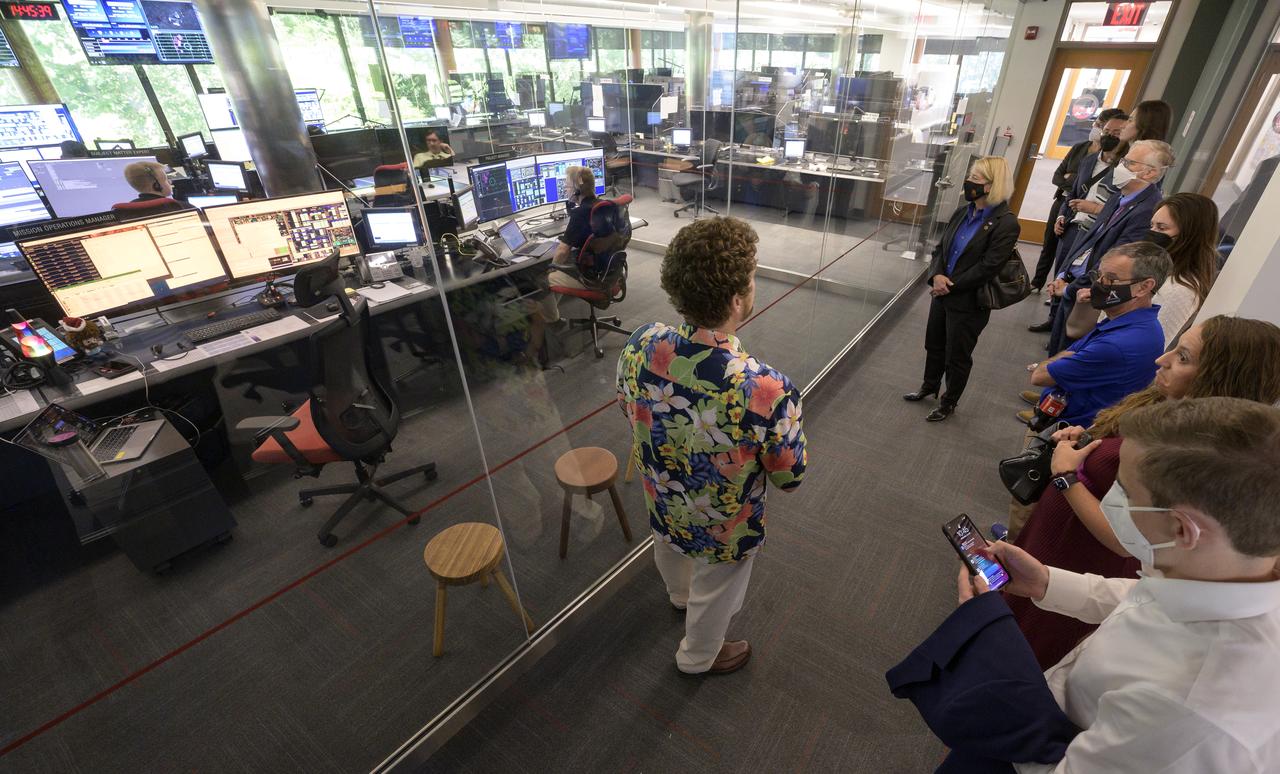
NASA Deputy Administrator Pam Melroy is given a tour of the NASA James Webb Space Telescope Mission Operations Center, Wednesday, June 29, 2022, at the Space Telescope Science Institute (STScI) in Baltimore. Prior to the tour the deputy spoke at a briefing that focused on the status of NASA’s James Webb Space Telescope in its final weeks of preparing for its science mission, as well as overviews of planned science for Webb’s first year of operations. Photo Credit: (NASA/Bill Ingalls)
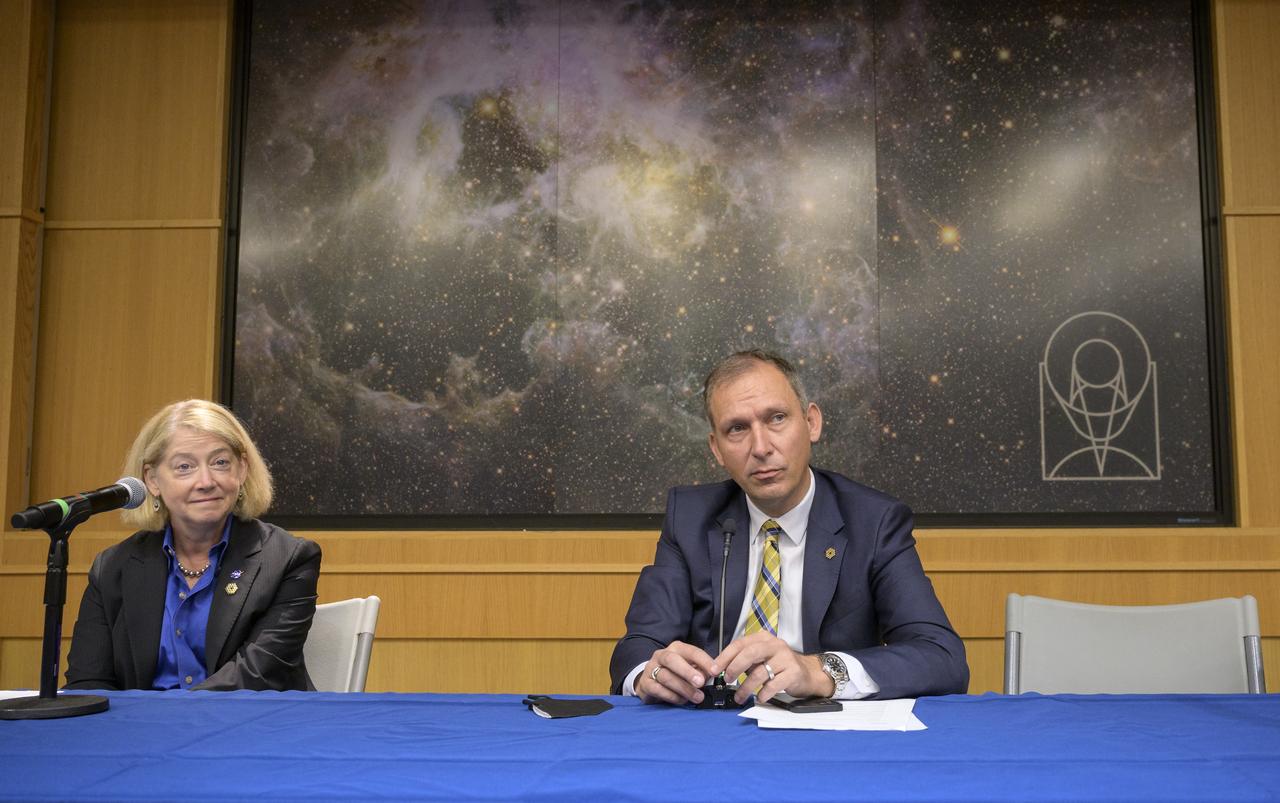
NASA Deputy Administrator Pam Melroy, left, and NASA Associate Administrator for the Science Mission Directorate Thomas Zurbuchen give remarks during a briefing, Wednesday, June 29, 2022, at the Space Telescope Science Institute (STScI) in Baltimore. The briefing focused on the status of NASA’s James Webb Space Telescope in its final weeks of preparing for its science mission, as well as overviews of planned science for Webb’s first year of operations. Photo Credit: (NASA/Bill Ingalls)
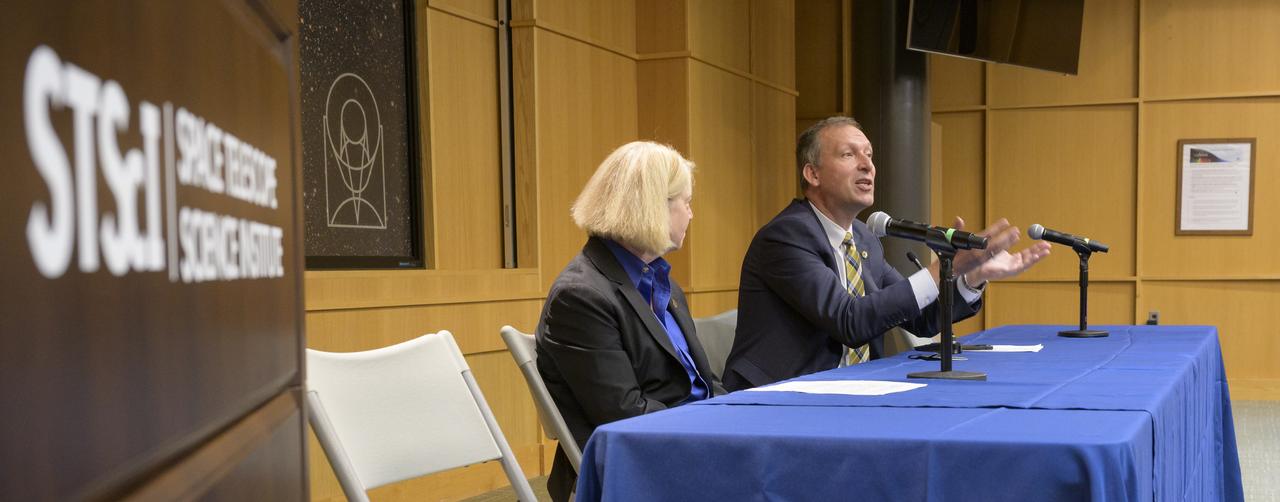
NASA Deputy Administrator Pam Melroy, left, and NASA Associate Administrator for the Science Mission Directorate Thomas Zurbuchen give remarks during a briefing, Wednesday, June 29, 2022, at the Space Telescope Science Institute (STScI) in Baltimore. The briefing focused on the status of NASA’s James Webb Space Telescope in its final weeks of preparing for its science mission, as well as overviews of planned science for Webb’s first year of operations. Photo Credit: (NASA/Bill Ingalls)
NASA Deputy Administrator Pam Melroy, left, and NASA Associate Administrator for the Science Mission Directorate Thomas Zurbuchen give remarks during a briefing, Wednesday, June 29, 2022, at the Space Telescope Science Institute (STScI) in Baltimore. The briefing focused on the status of NASA’s James Webb Space Telescope in its final weeks of preparing for its science mission, as well as overviews of planned science for Webb’s first year of operations. Photo Credit: (NASA/Bill Ingalls)
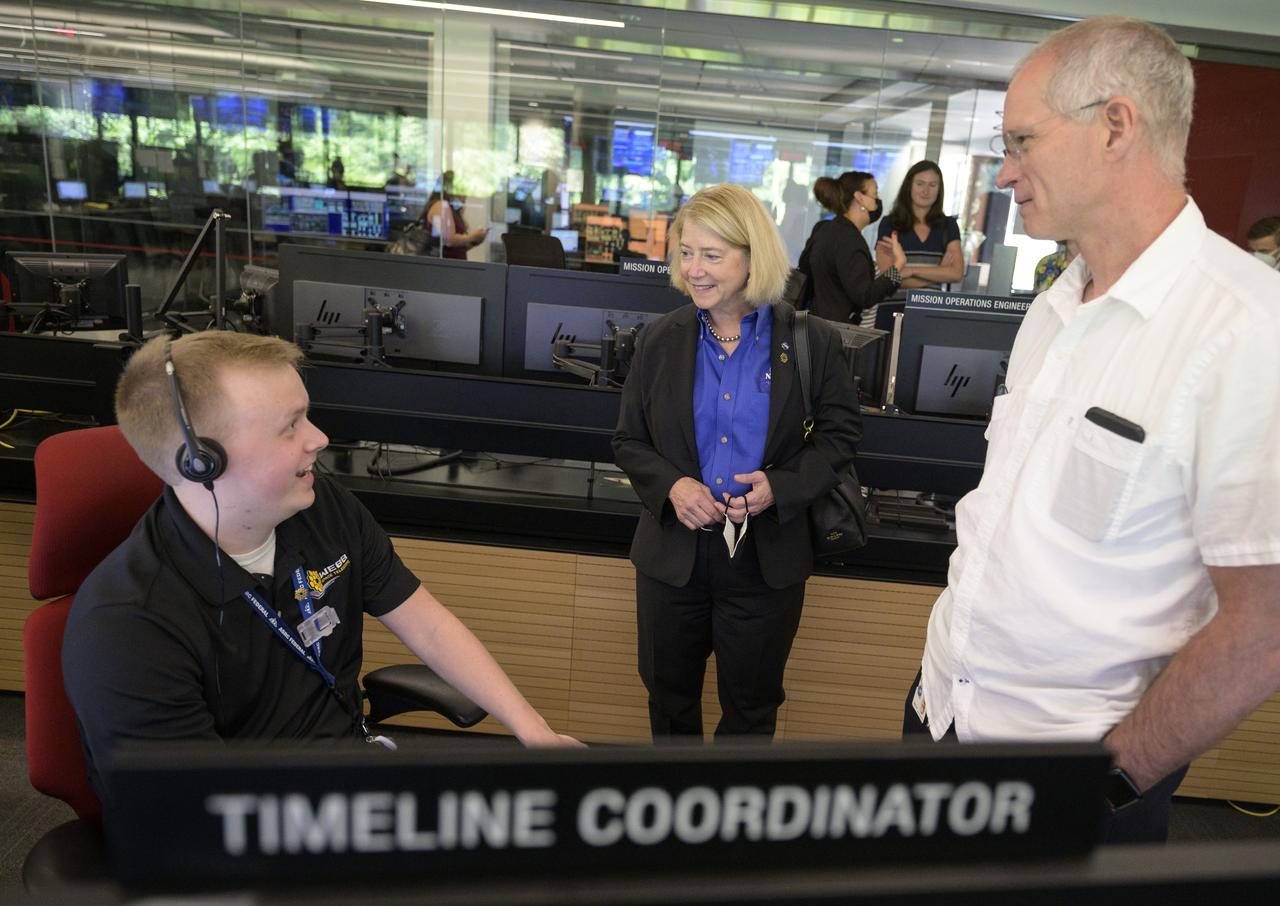
NASA Deputy Administrator Pam Melroy, center, meets with NASA James Webb Space Telescope Timeline Controller Matt Wasiak, left, and NASA James Webb Space Telescope Deputy Mission Operations Manager Ron Jones, right, during a tour of the NASA James Webb Space Telescope Mission Operations Center, Wednesday, June 29, 2022, at the Space Telescope Science Institute (STScI) in Baltimore. Prior to the tour the deputy spoke at a briefing that focused on the status of NASA’s James Webb Space Telescope in its final weeks of preparing for its science mission, as well as overviews of planned science for Webb’s first year of operations. Photo Credit: (NASA/Bill Ingalls)
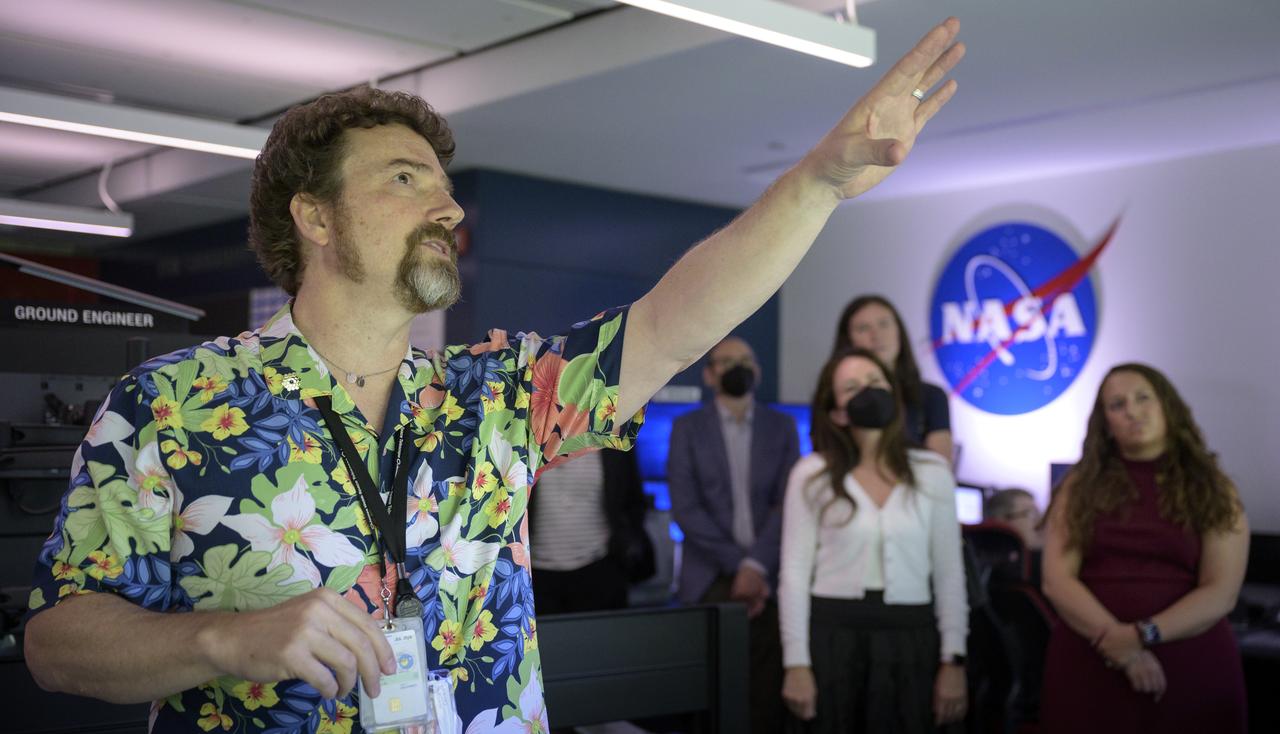
NASA James Webb Space Telescope Mission Operations Manager Carl Starr gives a tour of the NASA James Webb Space Telescope Mission Operations Center, Wednesday, June 29, 2022, at the Space Telescope Science Institute (STScI) in Baltimore. Prior to the tour the NASA Deputy Administrator Pam Melroy and NASA Associate Administrator for the Science Mission Directorate Thomas Zurbuchen spoke at a briefing that focused on the status of NASA’s James Webb Space Telescope in its final weeks of preparing for its science mission, as well as overviews of planned science for Webb’s first year of operations. Photo Credit: (NASA/Bill Ingalls)
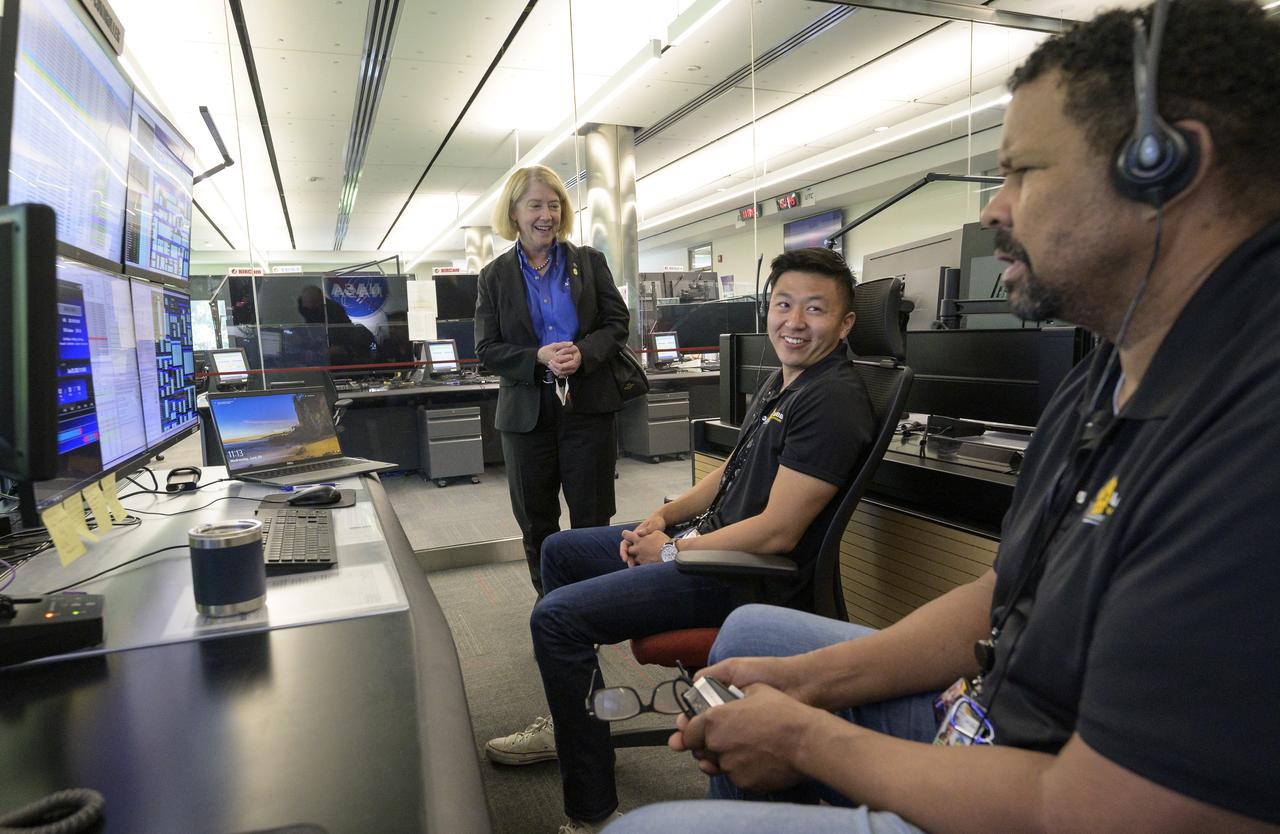
NASA Deputy Administrator Pam Melroy, left, meets with NASA James Webb Space Telescope Command Controllers Justin Truing, and Phil Johnson, right, during a tour of the NASA James Webb Space Telescope Mission Operations Center, Wednesday, June 29, 2022, at the Space Telescope Science Institute (STScI) in Baltimore. Prior to the tour the deputy spoke at a briefing that focused on the status of NASA’s James Webb Space Telescope in its final weeks of preparing for its science mission, as well as overviews of planned science for Webb’s first year of operations. Photo Credit: (NASA/Bill Ingalls)
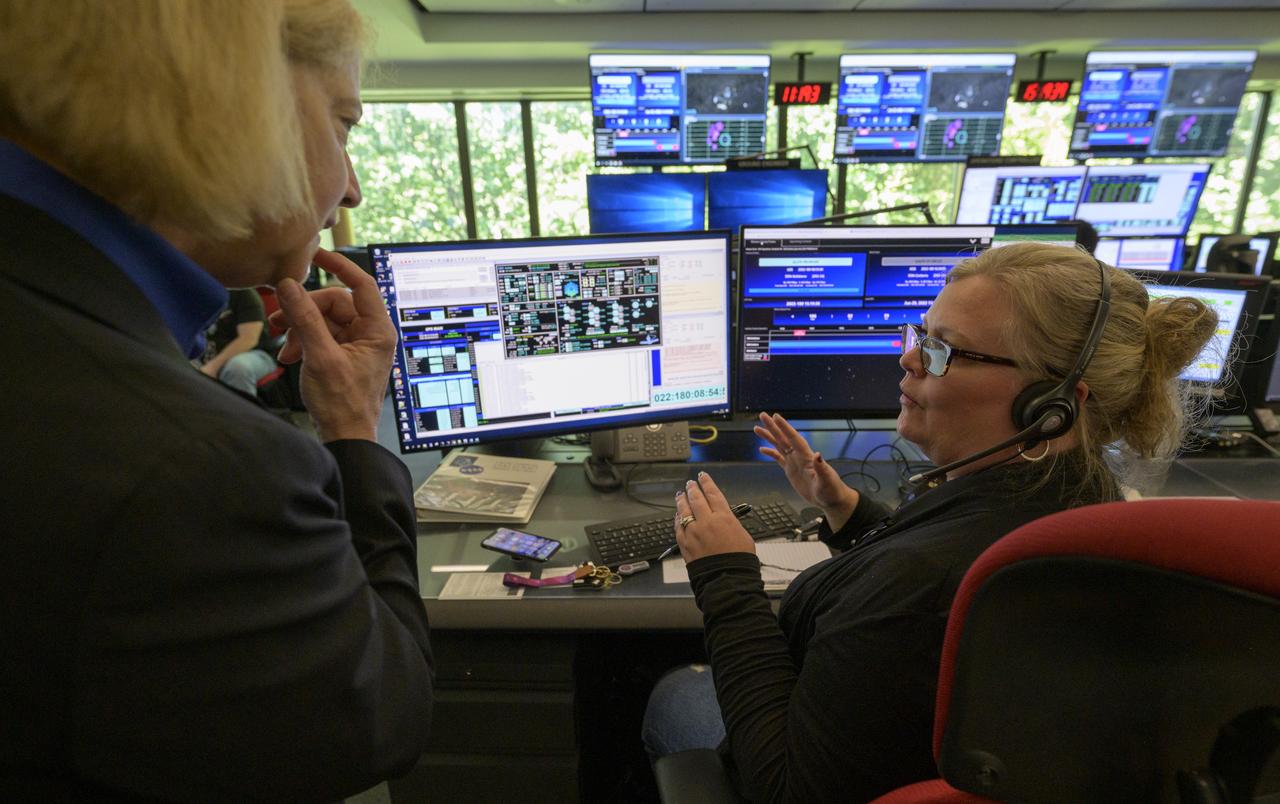
NASA Deputy Administrator Pam Melroy, left, meets with NASA James Webb Space Telescope Mission Planner Kari Bosley during a tour of the NASA James Webb Space Telescope Mission Operations Center, Wednesday, June 29, 2022, at the Space Telescope Science Institute (STScI) in Baltimore. Prior to the tour the deputy spoke at a briefing that focused on the status of NASA’s James Webb Space Telescope in its final weeks of preparing for its science mission, as well as overviews of planned science for Webb’s first year of operations. Photo Credit: (NASA/Bill Ingalls)
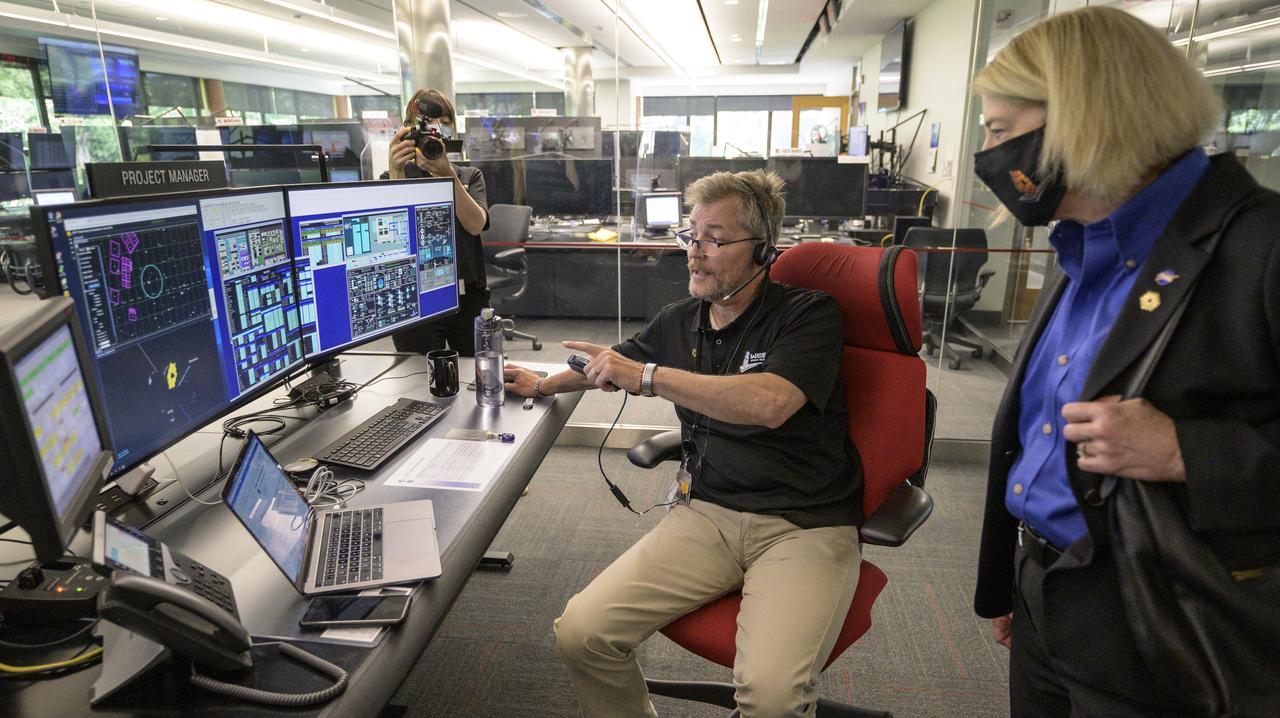
NASA Deputy Administrator Pam Melroy, right, talks with NASA James Webb Space Telescope deputy senior project scientist Jon Gardner, as she is given a tour of the NASA James Webb Space Telescope Mission Operations Center, Wednesday, June 29, 2022, at the Space Telescope Science Institute (STScI) in Baltimore. Prior to the tour the deputy spoke at a briefing that focused on the status of NASA’s James Webb Space Telescope in its final weeks of preparing for its science mission, as well as overviews of planned science for Webb’s first year of operations. Photo Credit: (NASA/Bill Ingalls)
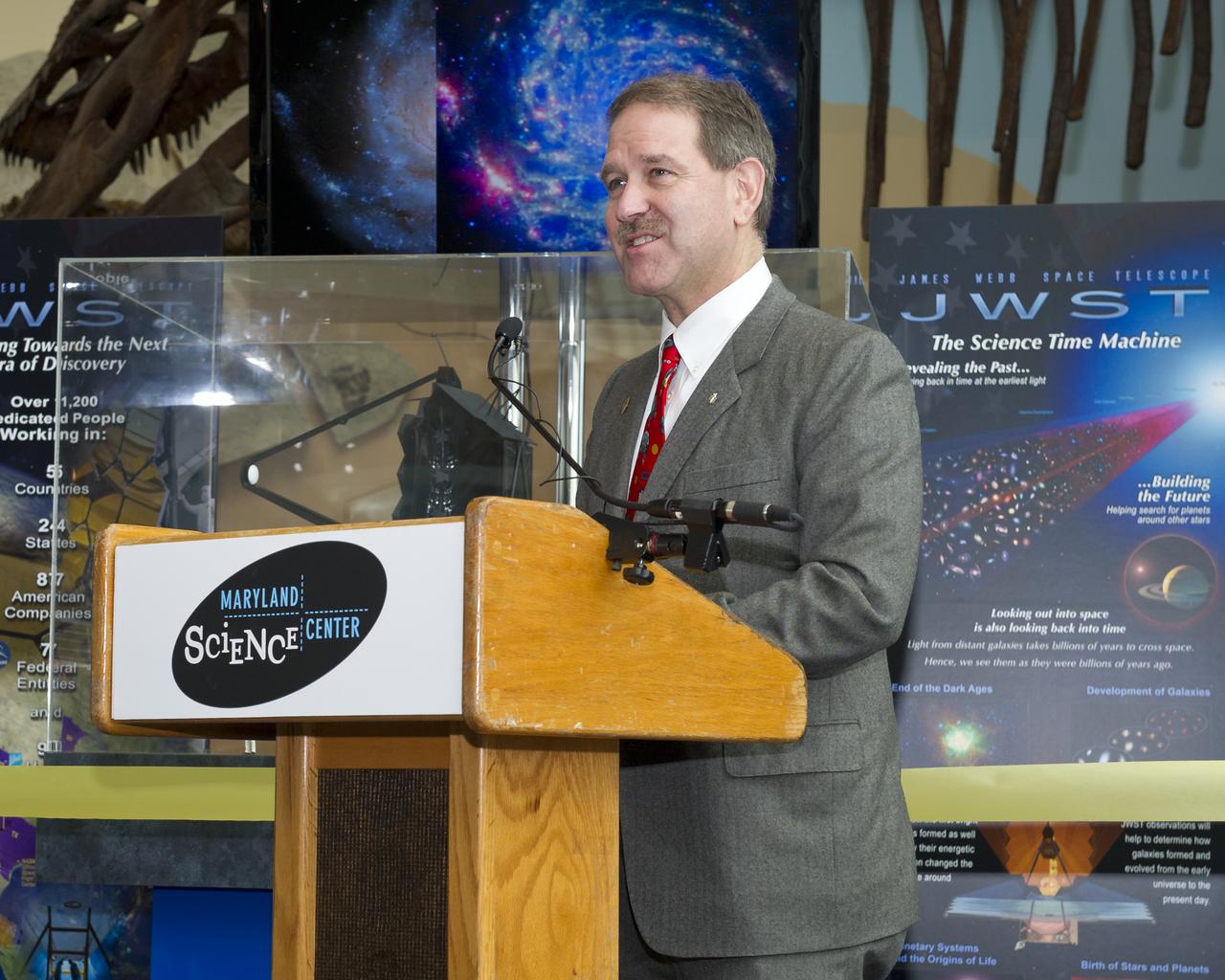
Dr. John Grunsfeld, former astronaut and Deputy Director, Space Telescope Science Institute (STScI), Baltimore speaks at the presentation of the permanent exhibit of the James Webb Space Telescope at the Maryland Science Center on Wednesday, Oct. 26, 2011 in Baltimore. Photo Credit: (NASA/Carla Cioffi)
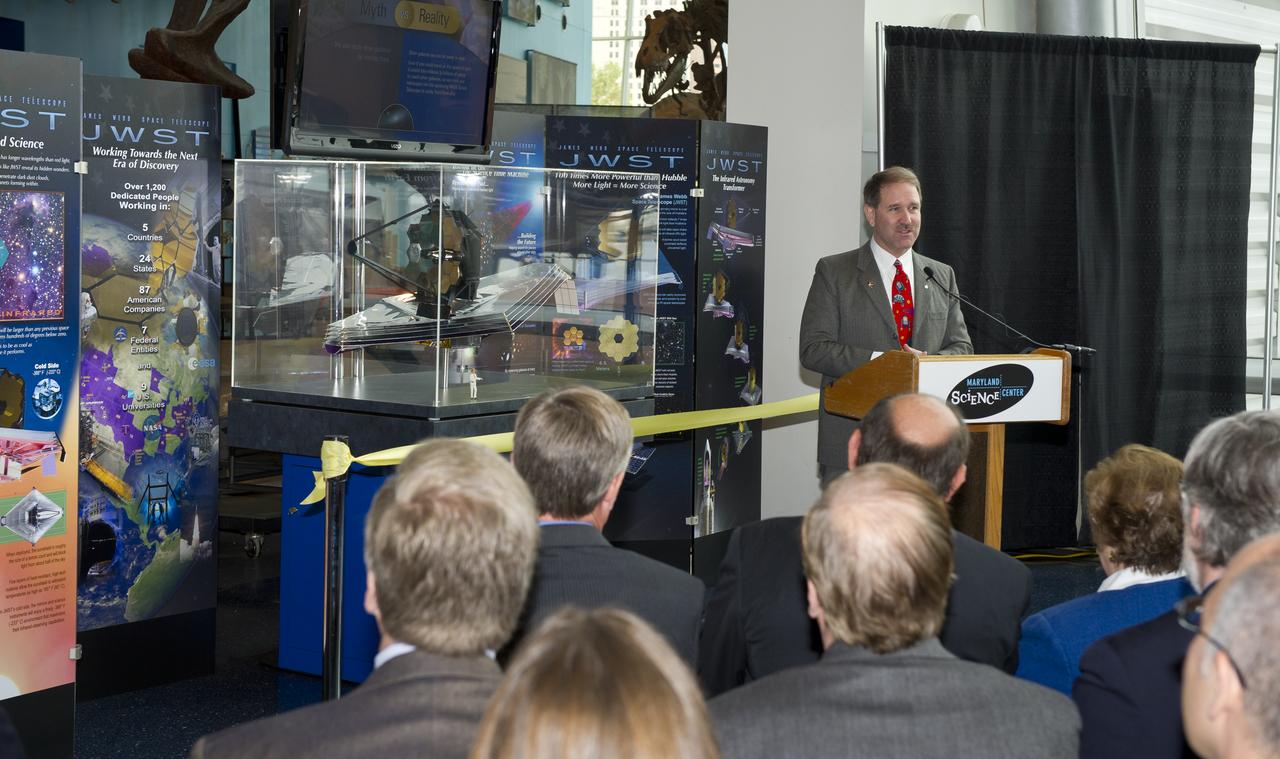
Dr. John Grunsfeld, former astronaut and Deputy Director, Space Telescope Science Institute (STScI), Baltimore speaks at the presentation of the permanent exhibit of the James Webb Space Telescope at the Maryland Science Center on Wednesday, Oct. 26, 2011 in Baltimore. Photo Credit: (NASA/Carla Cioffi)
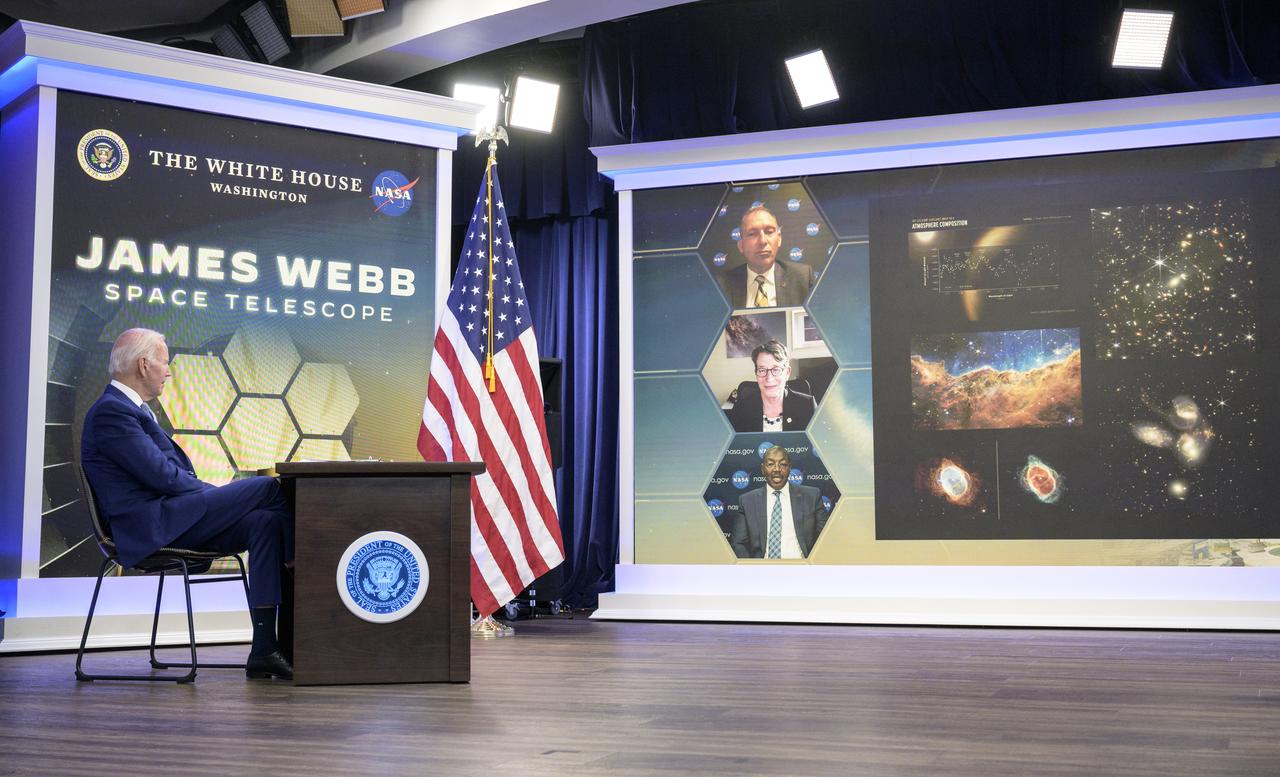
U.S. President Joe Biden previews images from NASA’s James Webb Space Telescope in a meeting, Monday, July 11, 2022, in the South Court Auditorium in the Eisenhower Executive Office Building on the White House complex in Washington. Joining the President on screen are NASA Associate Administrator for the Science Mission Directorate Thomas Zurbuchen, top, Deputy Director of the Space Telescope Science Institute (STScI) Nancy Levenson, and NASA James Webb Space Telescope Program Director Greg Robinson, bottom. Photo Credit: (NASA/Bill Ingalls)
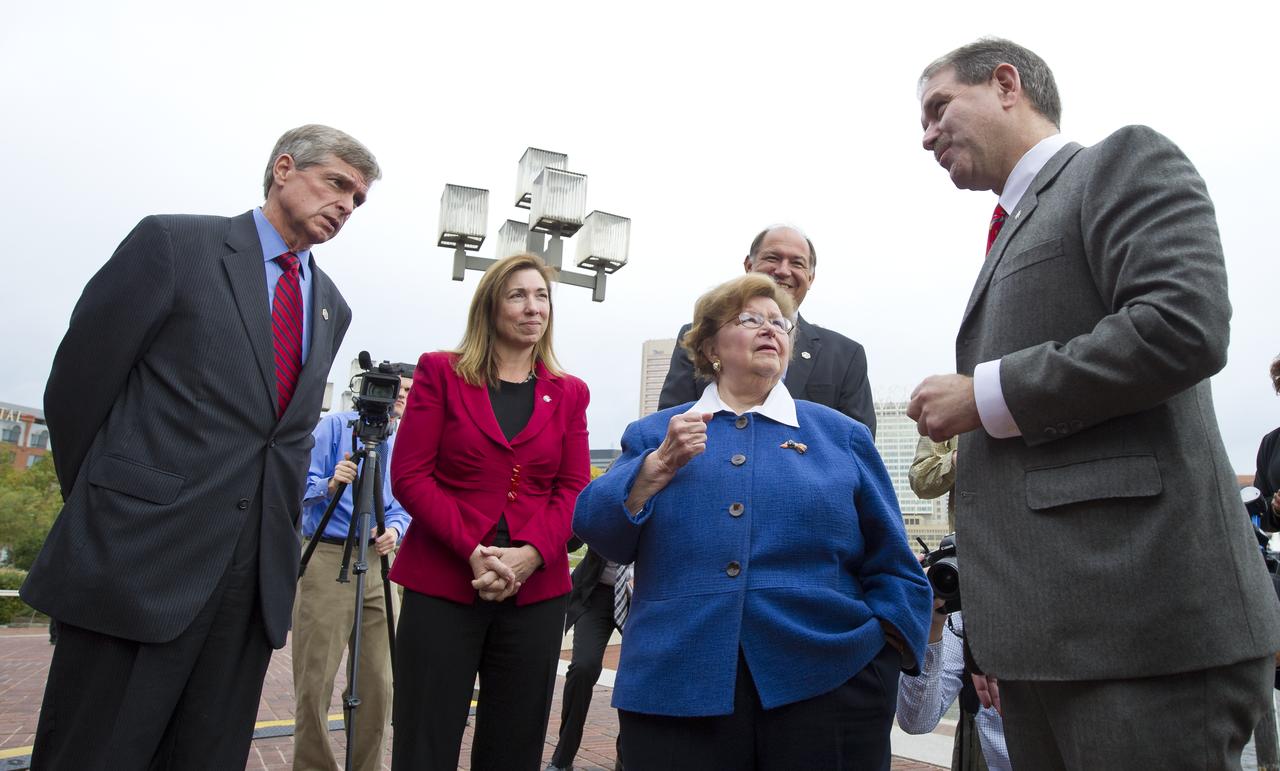
Dr. John Grunsfeld, former astronaut and Deputy Director, Space Telescope Science Institute (STScI), Baltimore, far right, speaks with U.S. Senator Barbara Mikulski about the James Webb Space Telescope at the Maryland Science Center in Baltimore on Wednesday, Oct. 26, 2011. Looking on are Van Reiner, President and CEO of the Maryland Science Center, Baltimore, far left; NASA Deputy Administrator Lori Garver and Jeffrey Grant, VP and General Manager of the Space Systems Division, Northrop Grumman. Photo Credit: (NASA/Carla Cioffi)

Barred Spiral Galaxy NGC 1300 Credit: NASA, ESA, and The Hubble Heritage Team (STScI/AURA) Acknowledgment: P. Knezek (WIYN) The Hubble Space Telescope is a project of international cooperation between NASA and the European Space Agency. NASA's Goddard Space Flight Center manages the telescope. The Space Telescope Science Institute conducts Hubble science operations. Goddard is responsible for HST project management, including mission and science operations, servicing missions, and all associated development activities. To learn more about the Hubble Space Telescope go here: <a href="http://www.nasa.gov/mission_pages/hubble/main/index.html" rel="nofollow">www.nasa.gov/mission_pages/hubble/main/index.html</a>
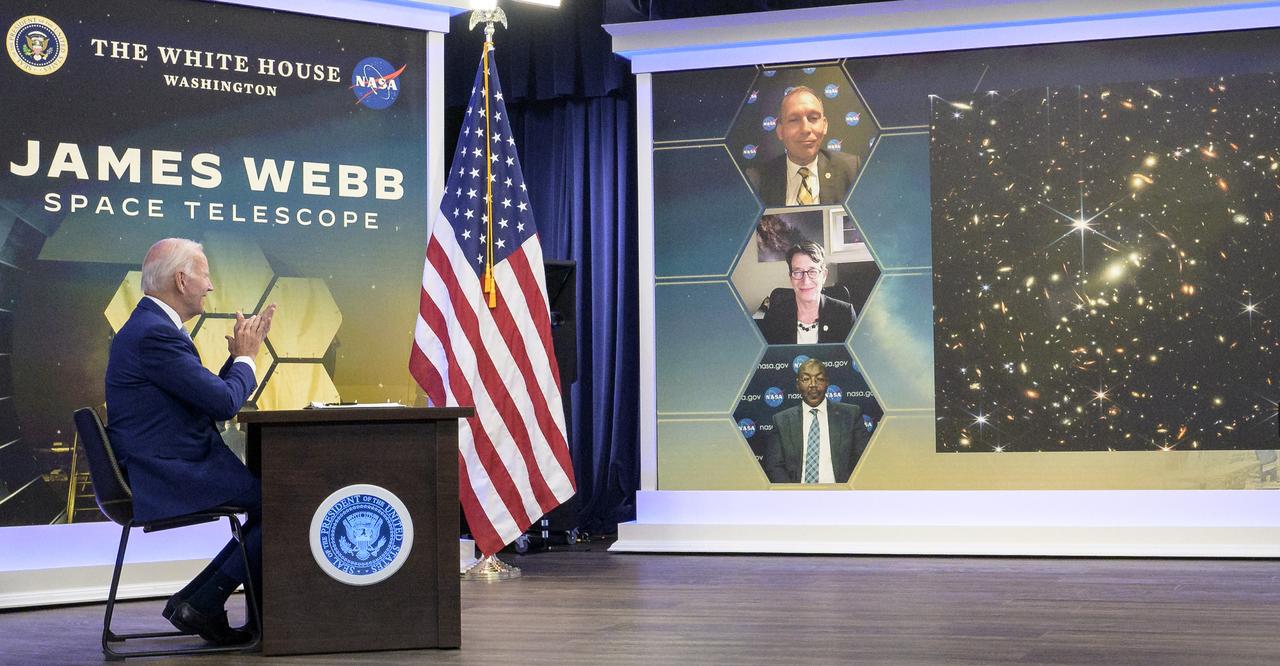
U.S. President Joe Biden previews the first full-color image from NASA’s James Webb Space Telescope, the highest-resolution image of the infrared universe in history, Monday, July 11, 2022, in the South Court Auditorium in the Eisenhower Executive Office Building on the White House complex in Washington. On screen are NASA Associate Administrator for the Science Mission Directorate Thomas Zurbuchen, top, Deputy Director of the Space Telescope Science Institute (STScI) Nancy Levenson, and NASA James Webb Space Telescope Program Director Greg Robinson, bottom. Photo Credit: (NASA/Bill Ingalls)
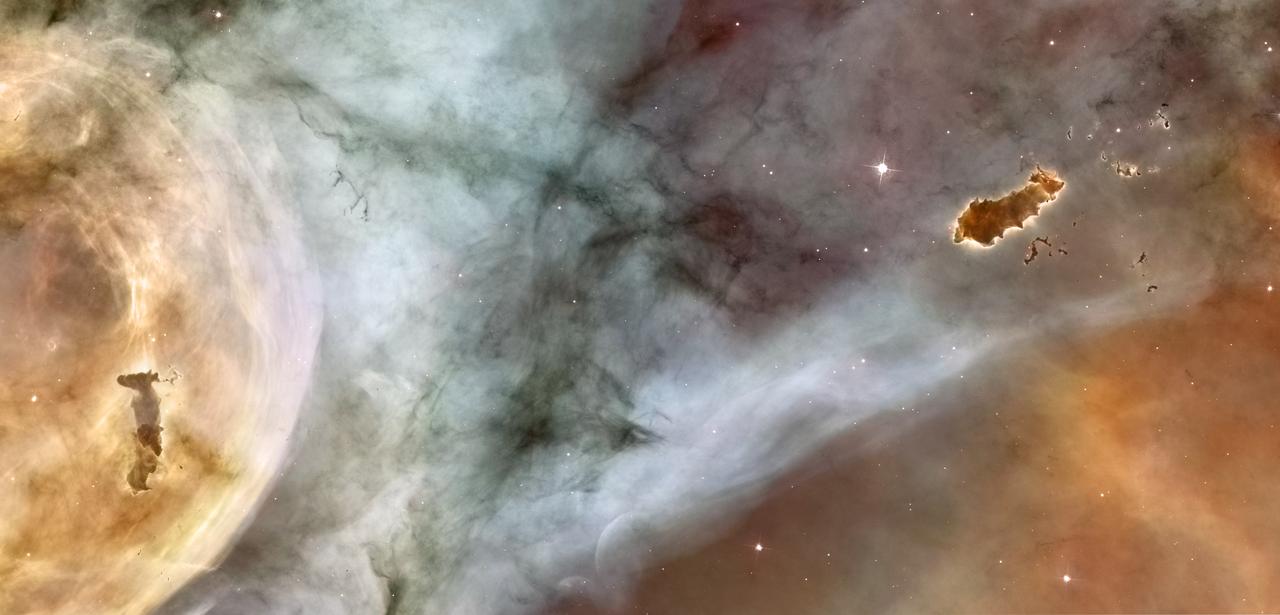
Carina Nebula Details: The Caterpillar Credit for Hubble Image: NASA, ESA, N. Smith (University of California, Berkeley), and The Hubble Heritage Team (STScI/AURA) Credit for CTIO Image: N. Smith (University of California, Berkeley) and NOAO/AURA/NSF The Hubble Space Telescope is a project of international cooperation between NASA and the European Space Agency. NASA's Goddard Space Flight Center manages the telescope. The Space Telescope Science Institute conducts Hubble science operations. Goddard is responsible for HST project management, including mission and science operations, servicing missions, and all associated development activities. To learn more about the Hubble Space Telescope go here: <a href="http://www.nasa.gov/mission_pages/hubble/main/index.html" rel="nofollow">www.nasa.gov/mission_pages/hubble/main/index.html</a>
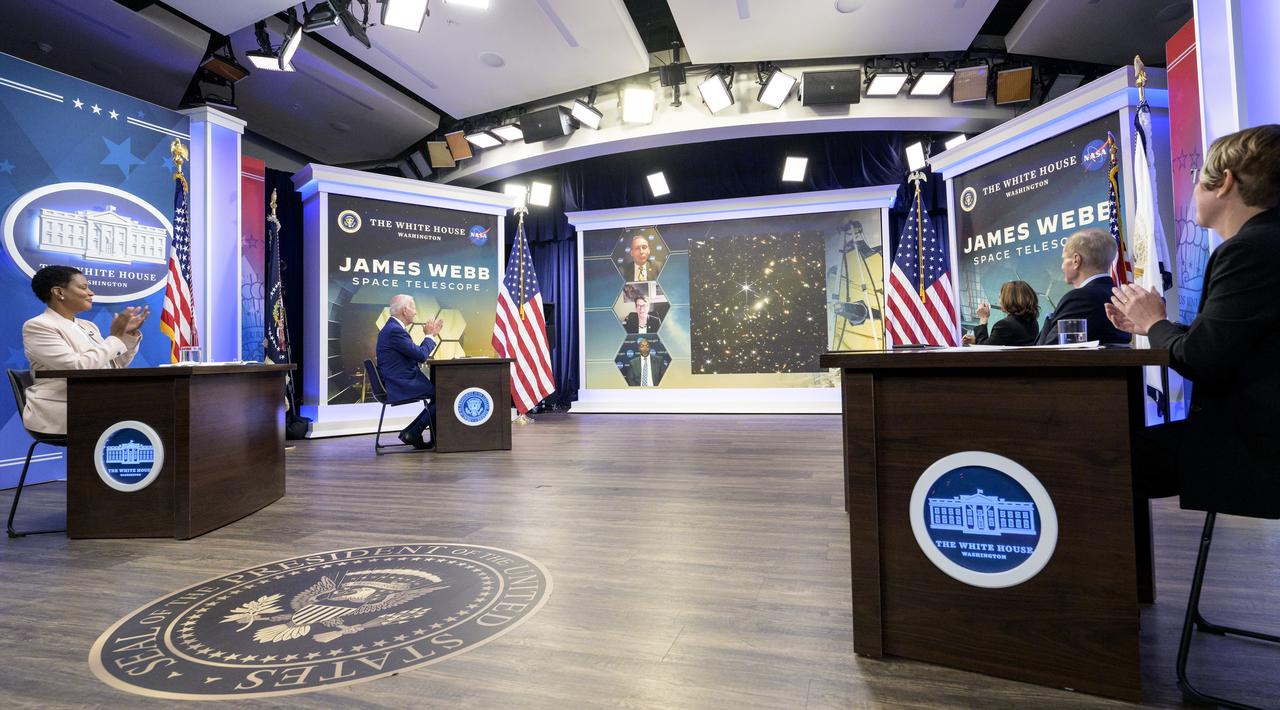
U.S. President Joe Biden and Vice President Kamala Harris preview the first full-color image from NASA’s James Webb Space Telescope, the highest-resolution image of the infrared universe in history, Monday, July 11, 2022, in the South Court Auditorium in the Eisenhower Executive Office Building on the White House complex in Washington. Joining the President and Vice President was Director of the White House Office of Science and Technology Policy (OSTP) Alondra Nelson, left, NASA Administrator Bill Nelson, and NASA James Webb Space Telescope Operations Project Scientist Jane Rigby, right, as well as on screen are NASA Associate Administrator for the Science Mission Directorate Thomas Zurbuchen, top, Deputy Director of the Space Telescope Science Institute (STScI) Nancy Levenson, and NASA James Webb Space Telescope Program Director Greg Robinson, bottom. Photo Credit: (NASA/Bill Ingalls)
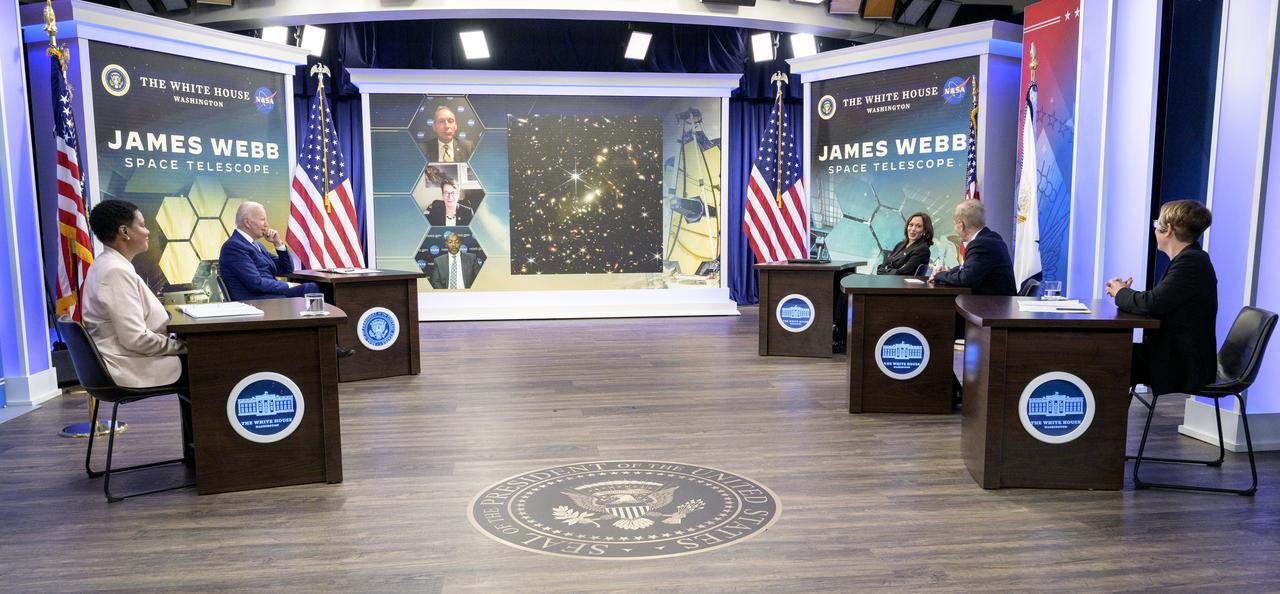
U.S. President Joe Biden and Vice President Kamala Harris preview the first full-color image from NASA’s James Webb Space Telescope, the highest-resolution image of the infrared universe in history, Monday, July 11, 2022, in the South Court Auditorium in the Eisenhower Executive Office Building on the White House complex in Washington. Joining the President and Vice President was Director of the White House Office of Science and Technology Policy (OSTP) Alondra Nelson, left, NASA Administrator Bill Nelson, and NASA James Webb Space Telescope Operations Project Scientist Jane Rigby, right, as well as on screen are NASA Associate Administrator for the Science Mission Directorate Thomas Zurbuchen, top, Deputy Director of the Space Telescope Science Institute (STScI) Nancy Levenson, and NASA James Webb Space Telescope Program Director Greg Robinson, bottom. Photo Credit: (NASA/Bill Ingalls)
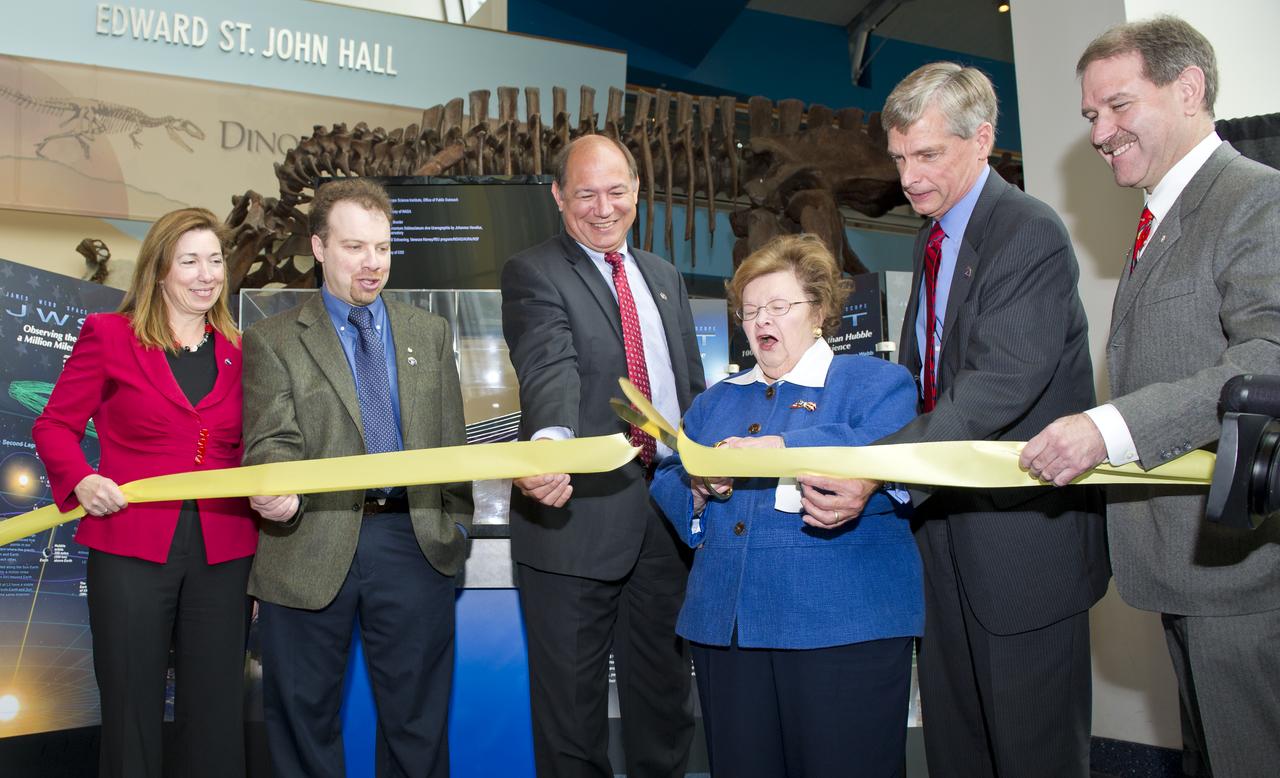
U.S. Senator Barbara Mikulski (D-Md.), third from right, cuts the yellow ribbon presenting the James Webb Space Telescope permanent exhibit at the Maryland Science Center on Wednesday, Oct. 26, 2011 in Baltimore. Mikulski is joined by NASA Deputy Administrator Lori Garver, far left; Adam Reiss, recipient of the 2011 Nobel Prize in Physics and professor of astronomy and physics at Johns Hopkins University; Jeffrey Grant, VP and General Manager of the Space Systems Division, Northrop Grumman; Van Reiner, President and CEO of the Maryland Science Center, Baltimore and Dr. John Grunsfeld, former astronaut and Deputy Director, Space Telescope Science Institute (STScI), Baltimore. The Webb telescope will provide images of the first galaxies ever formed and explore planets around distant stars. Photo Credit: (NASA/Carla Cioffi)
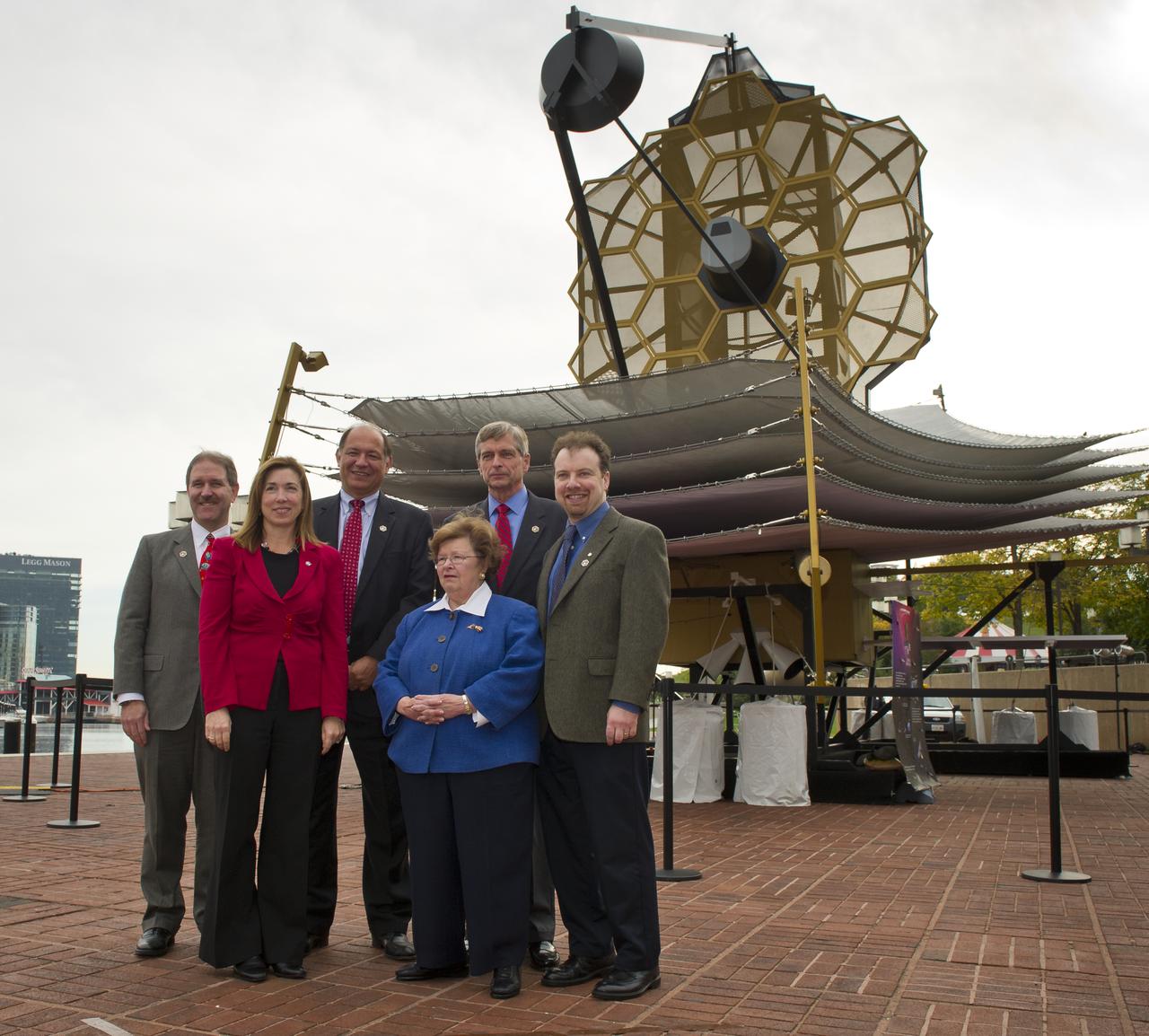
NASA, space science industry and government officials are seen in front of a full-size model of NASA's James Webb Space Telescope at the Maryland Science Center in Baltimore, Wednesday, Oct. 26, 2011. From left, back row are: Dr. John Grunsfeld, former astronaut and Deputy Director, Space Telescope Science Institute (STScI), Baltimore; Jeffrey Grant, VP and General Manager of the Space Systems Division, Northrop Grumman; Van Reiner, President and CEO of the Maryland Science Center, Baltimore and Adam Reiss, recipient of the 2011 Nobel Prize in Physics and professor of astronomy and physics at Johns Hopkins University. In the front row are NASA Deputy Administrator Lori Garver, left, and U.S. Senator Barbara Mikulski (D-Md.). Photo Credit: (NASA/Carla Cioffi)
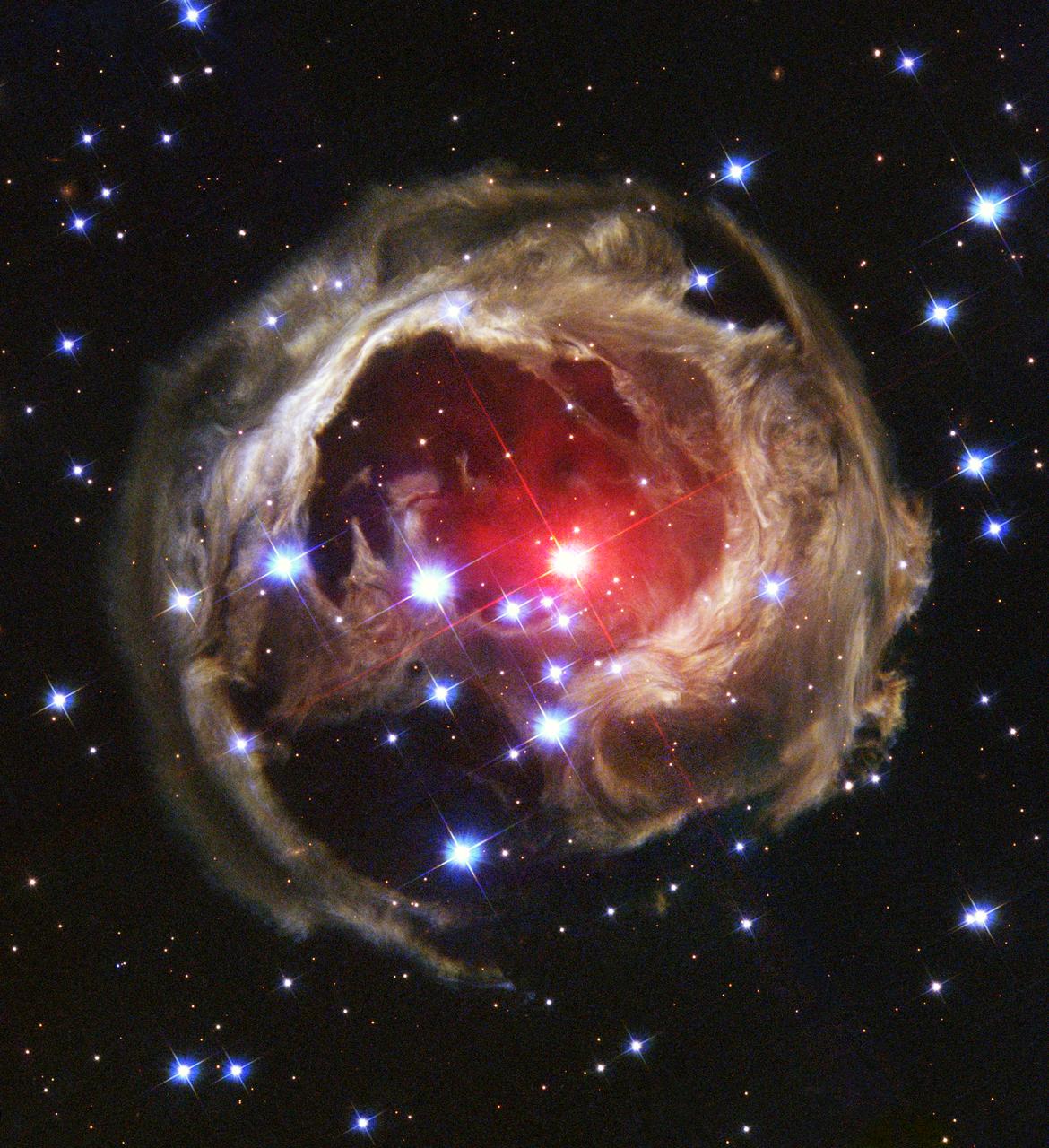
"Light Echo" Illuminates Dust Around Supergiant Star V838 Monocerotis (V838 Mon) Credit: NASA and The Hubble Heritage Team (AURA/STScI) The Hubble Space Telescope is a project of international cooperation between NASA and the European Space Agency. NASA's Goddard Space Flight Center manages the telescope. The Space Telescope Science Institute conducts Hubble science operations. Goddard is responsible for HST project management, including mission and science operations, servicing missions, and all associated development activities. To learn more about the Hubble Space Telescope go here: <a href="http://www.nasa.gov/mission_pages/hubble/main/index.html" rel="nofollow">www.nasa.gov/mission_pages/hubble/main/index.html</a> <b><a href="http://www.nasa.gov/centers/goddard/home/index.html" rel="nofollow">NASA Goddard Space Flight Center</a></b> is home to the nation's largest organization of combined scientists, engineers and technologists that build spacecraft, instruments and new technology to study the Earth, the sun, our solar system, and the universe. <b>Follow us on <a href="http://twitter.com/NASA_GoddardPix" rel="nofollow">Twitter</a></b> <b>Join us on <a href="http://www.facebook.com/pages/Greenbelt-MD/NASA-Goddard/395013845897?ref=tsd" rel="nofollow">Facebook</a><b> </b></b>

Carina Nebula Details: Great Clouds Credit for Hubble Image: NASA, ESA, N. Smith (University of California, Berkeley), and The Hubble Heritage Team (STScI/AURA) Credit for CTIO Image: N. Smith (University of California, Berkeley) and NOAO/AURA/NSF The Hubble Space Telescope is a project of international cooperation between NASA and the European Space Agency. NASA's Goddard Space Flight Center manages the telescope. The Space Telescope Science Institute conducts Hubble science operations. Goddard is responsible for HST project management, including mission and science operations, servicing missions, and all associated development activities. To learn more about the Hubble Space Telescope go here: <a href="http://www.nasa.gov/mission_pages/hubble/main/index.html" rel="nofollow">www.nasa.gov/mission_pages/hubble/main/index.html</a> <b><a href="http://www.nasa.gov/centers/goddard/home/index.html" rel="nofollow">NASA Goddard Space Flight Center</a></b> is home to the nation's largest organization of combined scientists, engineers and technologists that build spacecraft, instruments and new technology to study the Earth, the sun, our solar system, and the universe. <b>Follow us on <a href="http://twitter.com/NASA_GoddardPix" rel="nofollow">Twitter</a></b> <b>Join us on <a href="http://www.facebook.com/pages/Greenbelt-MD/NASA-Goddard/395013845897?ref=tsd" rel="nofollow">Facebook</a><b> </b></b>

NASA image release June 6, 2010 Like a July 4 fireworks display a young, glittering collection of stars looks like an aerial burst. The cluster is surrounded by clouds of interstellar gas and dust - the raw material for new star formation. The nebula, located 20,000 light-years away in the constellation Carina, contains a central cluster of huge, hot stars, called NGC 3603. This environment is not as peaceful as it looks. Ultraviolet radiation and violent stellar winds have blown out an enormous cavity in the gas and dust enveloping the cluster, providing an unobstructed view of the cluster. Most of the stars in the cluster were born around the same time but differ in size, mass, temperature, and color. The course of a star's life is determined by its mass, so a cluster of a given age will contain stars in various stages of their lives, giving an opportunity for detailed analyses of stellar life cycles. NGC 3603 also contains some of the most massive stars known. These huge stars live fast and die young, burning through their hydrogen fuel quickly and ultimately ending their lives in supernova explosions. Star clusters like NGC 3603 provide important clues to understanding the origin of massive star formation in the early, distant universe. Astronomers also use massive clusters to study distant starbursts that occur when galaxies collide, igniting a flurry of star formation. The proximity of NGC 3603 makes it an excellent lab for studying such distant and momentous events. This Hubble Space Telescope image was captured in August 2009 and December 2009 with the Wide Field Camera 3 in both visible and infrared light, which trace the glow of sulfur, hydrogen, and iron. The Hubble Space Telescope is a project of international cooperation between NASA and the European Space Agency. NASA’s Goddard Space Flight Center manages the telescope. The Space Telescope Science Institute (STScI) conducts Hubble science operations. STScI is operated for NASA by the Association of Universities for Research in Astronomy, Inc. in Washington, D.C. Credit: NASA, ESA, R. O'Connell (University of Virginia), F. Paresce (National Institute for Astrophysics, Bologna, Italy), E. Young (Universities Space Research Association/Ames Research Center), the WFC3 Science Oversight Committee, and the Hubble Heritage Team (STScI/AURA) <b><a href="http://www.nasa.gov/centers/goddard/home/index.html" rel="nofollow">NASA Goddard Space Flight Center</a></b> is home to the nation's largest organization of combined scientists, engineers and technologists that build spacecraft, instruments and new technology to study the Earth, the sun, our solar system, and the universe.

This image depicts a vast canyon of dust and gas in the Orion Nebula from a 3-D computer model based on observations by NASA's Hubble Space Telescope and created by science visualization specialists at the Space Telescope Science Institute (STScI) in Baltimore, Md. A 3-D visualization of this model takes viewers on an amazing four-minute voyage through the 15-light-year-wide canyon. Credit: NASA, G. Bacon, L. Frattare, Z. Levay, and F. Summers (STScI/AURA) Go here to learn more about Hubble 3D: <a href="http://www.nasa.gov/topics/universe/features/hubble_imax_premiere.html" rel="nofollow">www.nasa.gov/topics/universe/features/hubble_imax_premier...</a> or <a href="http://www.imax.com/hubble/" rel="nofollow">www.imax.com/hubble/</a> Take an exhilarating ride through the Orion Nebula, a vast star-making factory 1,500 light-years away. Swoop through Orion's giant canyon of gas and dust. Fly past behemoth stars whose brilliant light illuminates and energizes the entire cloudy region. Zoom by dusty tadpole-shaped objects that are fledgling solar systems. This virtual space journey isn't the latest video game but one of several groundbreaking astronomy visualizations created by specialists at the Space Telescope Science Institute (STScI) in Baltimore, the science operations center for NASA's Hubble Space Telescope. The cinematic space odysseys are part of the new Imax film "Hubble 3D," which opens today at select Imax theaters worldwide. The 43-minute movie chronicles the 20-year life of Hubble and includes highlights from the May 2009 servicing mission to the Earth-orbiting observatory, with footage taken by the astronauts. The giant-screen film showcases some of Hubble's breathtaking iconic pictures, such as the Eagle Nebula's "Pillars of Creation," as well as stunning views taken by the newly installed Wide Field Camera 3. While Hubble pictures of celestial objects are awe-inspiring, they are flat 2-D photographs. For this film, those 2-D images have been converted into 3-D environments, giving the audience the impression they are space travelers taking a tour of Hubble's most popular targets. "A large-format movie is a truly immersive experience," says Frank Summers, an STScI astronomer and science visualization specialist who led the team that developed the movie visualizations. The team labored for nine months, working on four visualization sequences that comprise about 12 minutes of the movie. "Seeing these Hubble images in 3-D, you feel like you are flying through space and not just looking at picture postcards," Summers continued. "The spacescapes are all based on Hubble images and data, though some artistic license is necessary to produce the full depth of field needed for 3-D." The most ambitious sequence is a four-minute voyage through the Orion Nebula's gas-and-dust canyon, about 15 light-years across. During the ride, viewers will see bright and dark, gaseous clouds; thousands of stars, including a grouping of bright, hefty stars called the Trapezium; and embryonic planetary systems. The tour ends with a detailed look at a young circumstellar disk, which is much like the structure from which our solar system formed 4.5 billion years ago. Based on a Hubble image of Orion released in 2006, the visualization was a collaborative effort between science visualization specialists at STScI, including Greg Bacon, who sculpted the Orion Nebula digital model, with input from STScI astronomer Massimo Roberto; the National Center for Supercomputing Applications at the University of Illinois at Urbana-Champaign; and the Spitzer Science Center at the California Institute of Technology in Pasadena. For some of the sequences, STScI imaging specialists developed new techniques for transforming the 2-D Hubble images into 3-D. STScI image processing specialists Lisa Frattare and Zolt Levay, for example, created methods of splitting a giant gaseous pillar in the Carina Nebula into multiple layers to produce a 3-D effect, giving the structure depth. The Carina Nebula is a nursery for baby stars. Frattare painstakingly removed the thousands of stars in the image so that Levay could separate the gaseous layers on the isolated Carina pillar. Frattare then replaced the stars into both foreground and background layers to complete the 3-D model. For added effect, the same separation was done for both visible and infrared Hubble images, allowing the film to cross-fade between wavelength views in 3-D. In another sequence viewers fly into a field of 170,000 stars in the giant star cluster Omega Centauri. STScI astronomer Jay Anderson used his stellar database to create a synthetic star field in 3-D that matches recent razor-sharp Hubble photos. The film's final four-minute sequence takes viewers on a voyage from our Milky Way Galaxy past many of Hubble's best galaxy shots and deep into space. Some 15,000 galaxies from Hubble's deepest surveys stretch billions of light-years across the universe in a 3-D sequence created by STScI astronomers and visualizers. The view dissolves into a cobweb that traces the universe's large-scale structure, the backbone from which galaxies were born. In addition to creating visualizations, STScI's education group also provided guidance on the "Hubble 3D" Educator Guide, which includes standards-based lesson plans and activities about Hubble and its mission. Students will use the guide before or after seeing the movie. "The guide will enhance the movie experience for students and extend the movie into classrooms," says Bonnie Eisenhamer, STScI's Hubble Formal Education manager. The Hubble Space Telescope is a project of international cooperation between NASA and the European Space Agency (ESA) and is managed by NASA’s Goddard Space Flight Center (GSFC) in Greenbelt, Md. The Space Telescope Science Institute (STScI) conducts Hubble science operations. The institute is operated for NASA by the Association of Universities for Research in Astronomy, Inc., Washington, D.C.
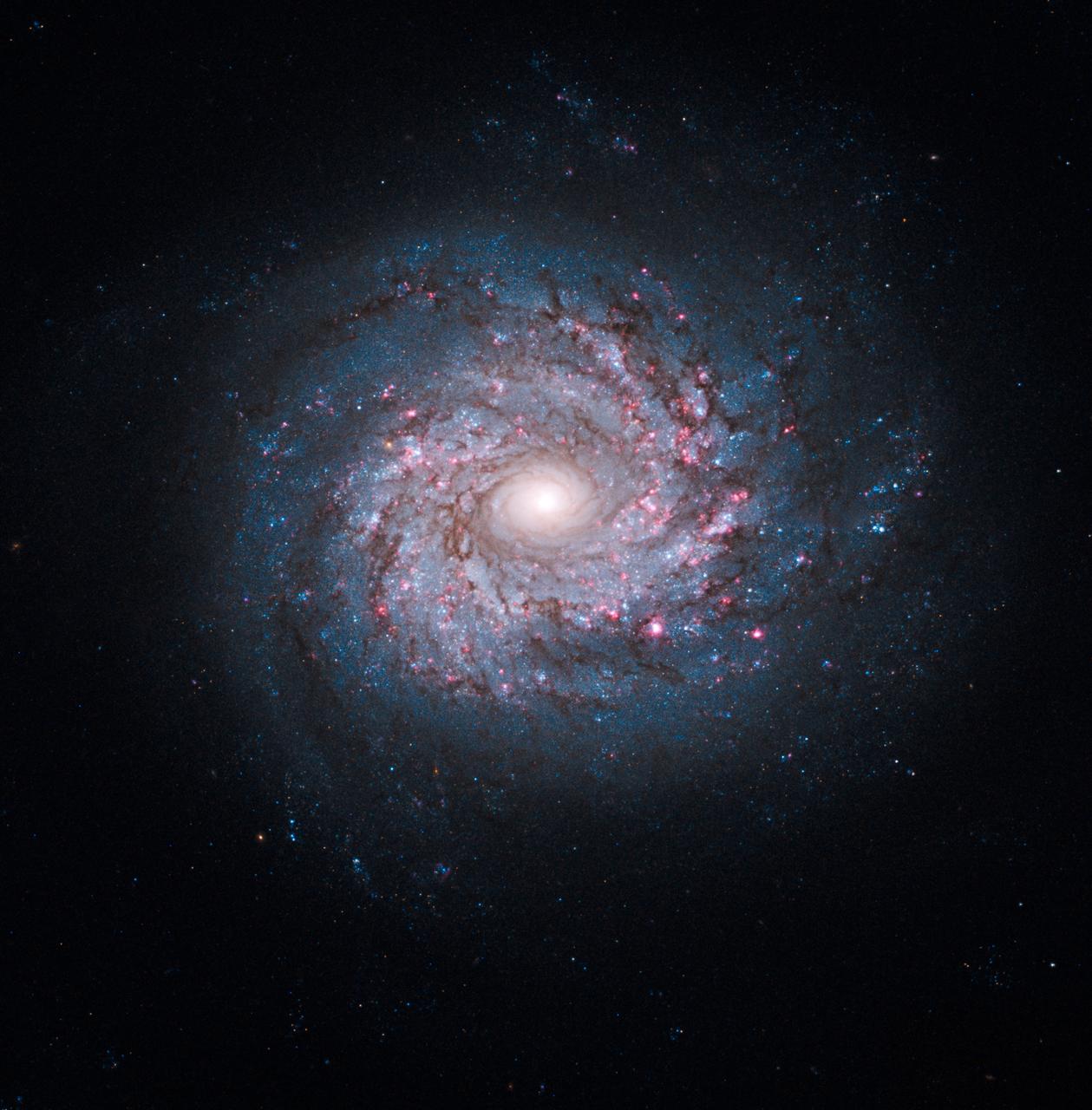
NASA image release October 19, 2010 Though the universe is chock full of spiral-shaped galaxies, no two look exactly the same. This face-on spiral galaxy, called NGC 3982, is striking for its rich tapestry of star birth, along with its winding arms. The arms are lined with pink star-forming regions of glowing hydrogen, newborn blue star clusters, and obscuring dust lanes that provide the raw material for future generations of stars. The bright nucleus is home to an older population of stars, which grow ever more densely packed toward the center. NGC 3982 is located about 68 million light-years away in the constellation Ursa Major. The galaxy spans about 30,000 light-years, one-third of the size of our Milky Way galaxy. This color image is composed of exposures taken by the Hubble Space Telescope's Wide Field Planetary Camera 2 (WFPC2), the Advanced Camera for Surveys (ACS), and the Wide Field Camera 3 (WFC3). The observations were taken between March 2000 and August 2009. The rich color range comes from the fact that the galaxy was photographed invisible and near-infrared light. Also used was a filter that isolates hydrogen emission that emanates from bright star-forming regions dotting the spiral arms. The Hubble Space Telescope is a project of international cooperation between NASA and the European Space Agency. NASA's Goddard Space Flight Center manages the telescope. The Space Telescope Science Institute (STScI) conducts Hubble science operations. STScI is operated for NASA by the Association of Universities for Research in Astronomy, Inc. in Washington, D.C. Credit: NASA, ESA, and the Hubble Heritage Team (STScI/AURA) Acknowledgment: A. Riess (STScI) <b><a href="http://www.nasa.gov/centers/goddard/home/index.html" rel="nofollow">NASA Goddard Space Flight Center</a></b> enables NASA’s mission through four scientific endeavors: Earth Science, Heliophysics, Solar System Exploration, and Astrophysics. Goddard plays a leading role in NASA’s accomplishments by contributing compelling scientific knowledge to advance the Agency’s mission. <b>Follow us on <a href="http://twitter.com/NASA_GoddardPix" rel="nofollow">Twitter</a></b> <b>Join us on <a href="http://www.facebook.com/pages/Greenbelt-MD/NASA-Goddard/395013845897?ref=tsd" rel="nofollow">Facebook</a></b>
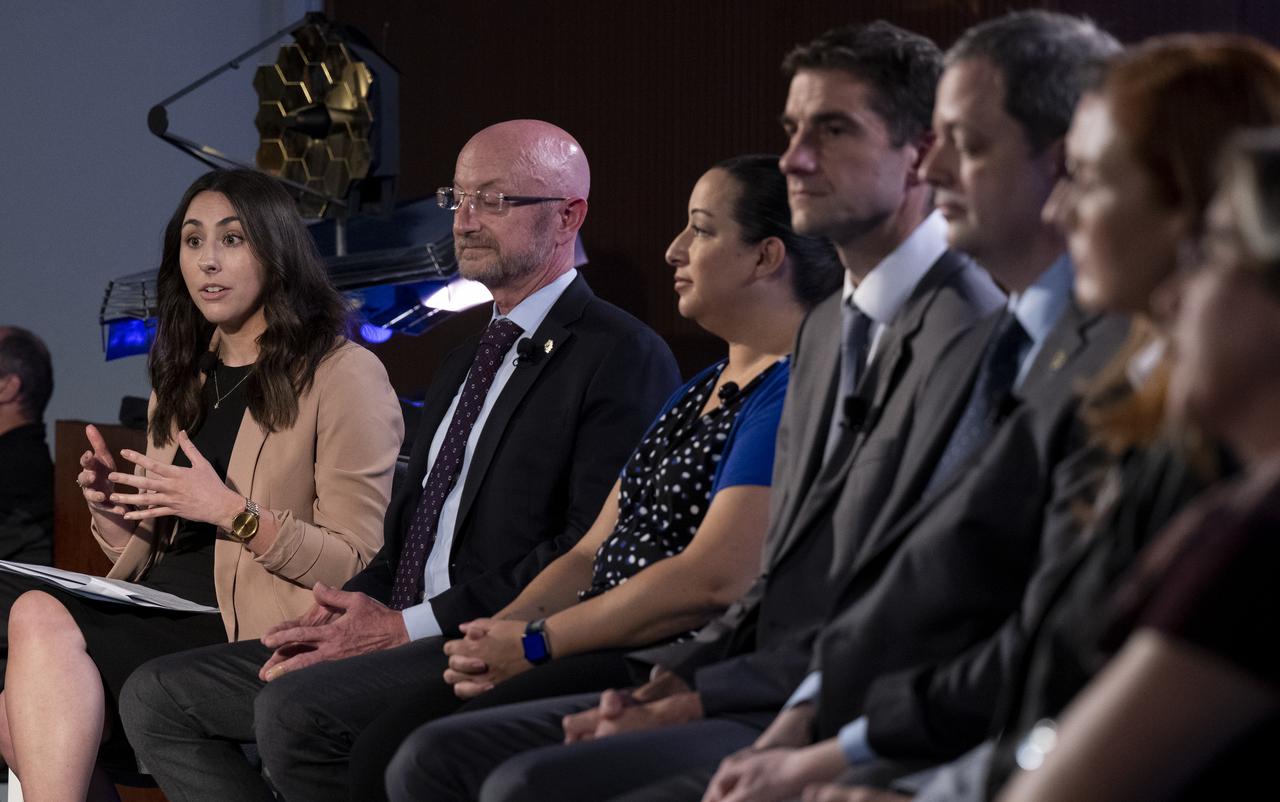
NASA Public Affairs Officer Alise Fisher, left, moderates a briefing with NASA James Webb Space Telescope Program Scientist and Astrophysics Division Chief Scientist Eric Smith, NASA James Webb Space Telescope Deputy Project Scientist for Exoplanet Science Knicole Colón, NASA James Webb Space Telescope Project Scientist at ESA (European Space Agency) Christopher Evans, NASA James Webb Space Telescope project scietntist, Space Telescope Science Institute, Klaus Pontoppidan, Principal Investigator for the Canadian Near-Infrared Imager and Slitless Spectrograph at the University of Montreal René Doyon, NASA James Webb Space Telescope Deputy Project Scientist for Communications Amber Straughn, and NASA James Webb Space Telescope Operations Project Scientist Jane Rigby following the release of the first full-color images from NASA’s James Webb Space Telescope, Tuesday, July 12, 2022, at NASA’s Goddard Space Flight Center in Greenbelt, Md. The first full-color images and spectroscopic data from the James Webb Space Telescope, a partnership with ESA (European Space Agency) and the Canadian Space Agency (CSA), are a demonstration of the power of Webb as the telescope begins its science mission to unfold the infrared universe. Photo Credit: (NASA/Bill Ingalls)
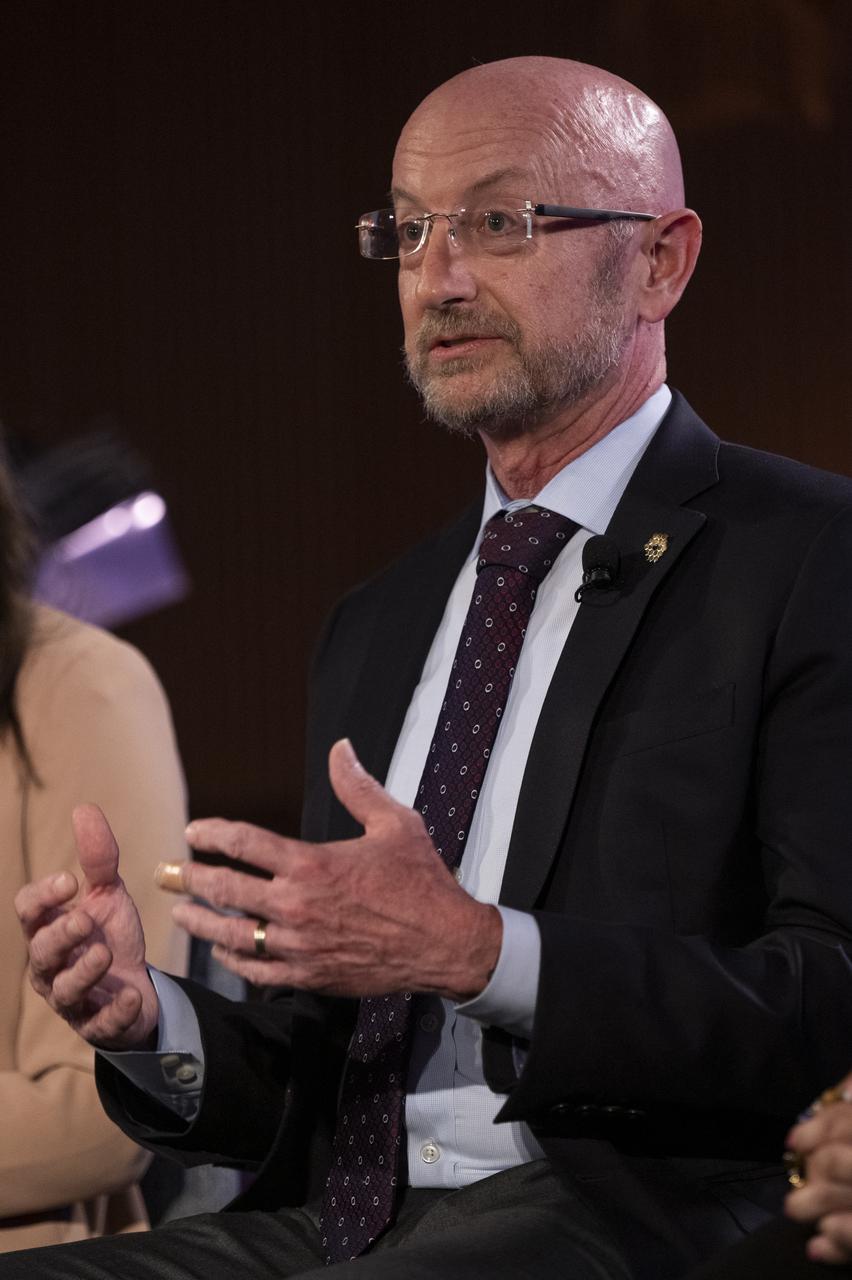
NASA James Webb Space Telescope Program Scientist and Astrophysics Division Chief Scientist Eric Smith delivers opening remarks during a briefing following the release of the first full-color images from NASA’s James Webb Space Telescope, Tuesday, July 12, 2022, at NASA’s Goddard Space Flight Center in Greenbelt, Md. The first full-color images and spectroscopic data from the James Webb Space Telescope, a partnership with ESA (European Space Agency) and the Canadian Space Agency (CSA), are a demonstration of the power of Webb as the telescope begins its science mission to unfold the infrared universe. Photo Credit: (NASA/Bill Ingalls)
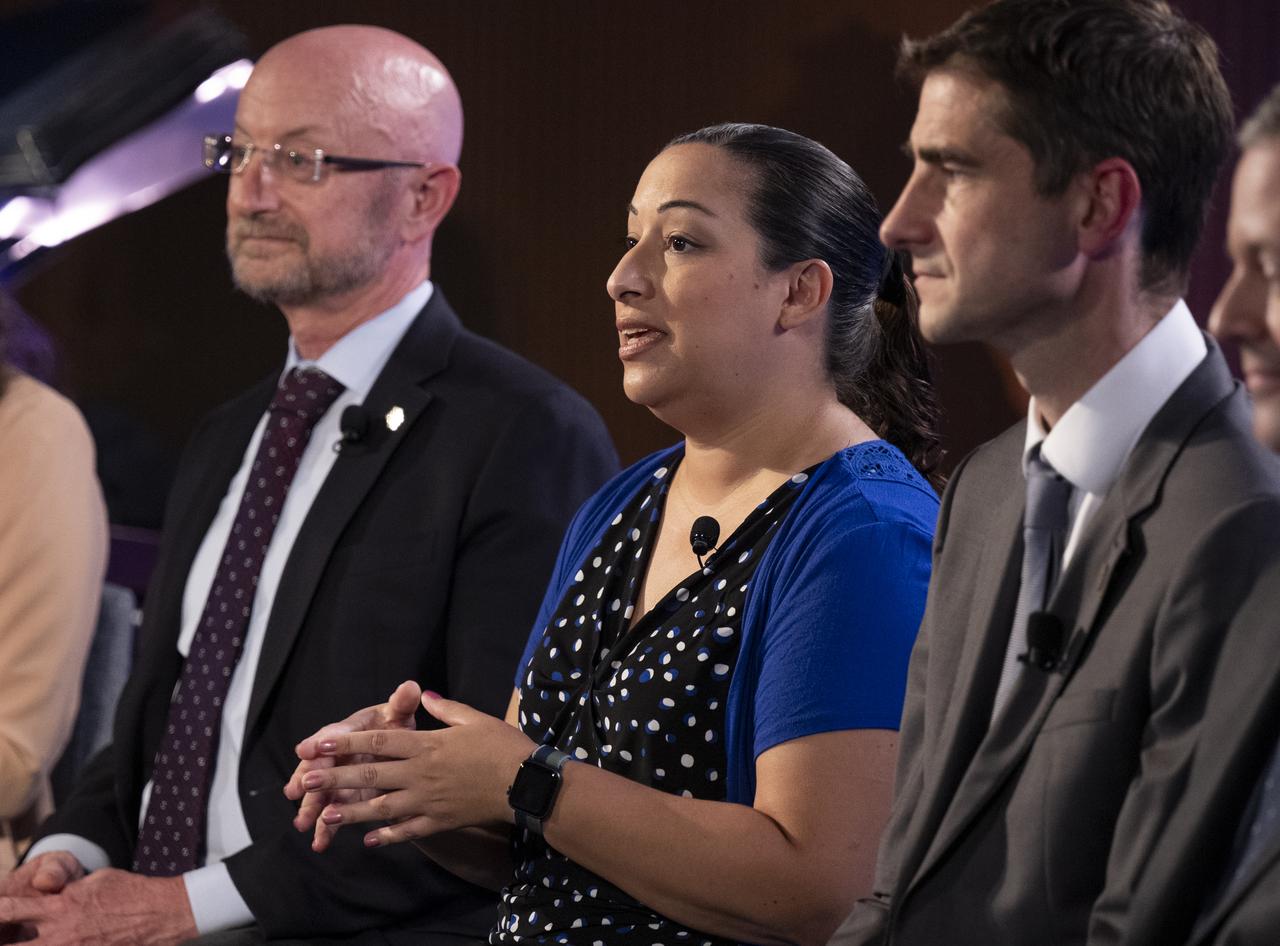
NASA James Webb Space Telescope Deputy Project Scientist for Exoplanet Science Knicole Colón, center, answers a question from a member of the media alongside NASA James Webb Space Telescope Program Scientist and Astrophysics Division Chief Scientist Eric Smith, left, and NASA James Webb Space Telescope Project Scientist at ESA (European Space Agency) Christopher Evans, during a briefing following the release of the first full-color images from NASA’s James Webb Space Telescope, Tuesday, July 12, 2022, at NASA’s Goddard Space Flight Center in Greenbelt, Md. The first full-color images and spectroscopic data from the James Webb Space Telescope, a partnership with ESA (European Space Agency) and the Canadian Space Agency (CSA), are a demonstration of the power of Webb as the telescope begins its science mission to unfold the infrared universe. Photo Credit: (NASA/Bill Ingalls)

Employees and guests at Northrop Grumman Space Park in Redondo Beach, Cal. are seen on screen as they watch the broadcast releasing the first full-color images from NASA’s James Webb Space Telescope, Tuesday, July 12, 2022, at NASA’s Goddard Space Flight Center in Greenbelt, Md. The first full-color images and spectroscopic data from the James Webb Space Telescope, a partnership with ESA (European Space Agency) and the Canadian Space Agency (CSA), are a demonstration of the power of Webb as the telescope begins its science mission to unfold the infrared universe. Photo Credit: (NASA/Bill Ingalls)
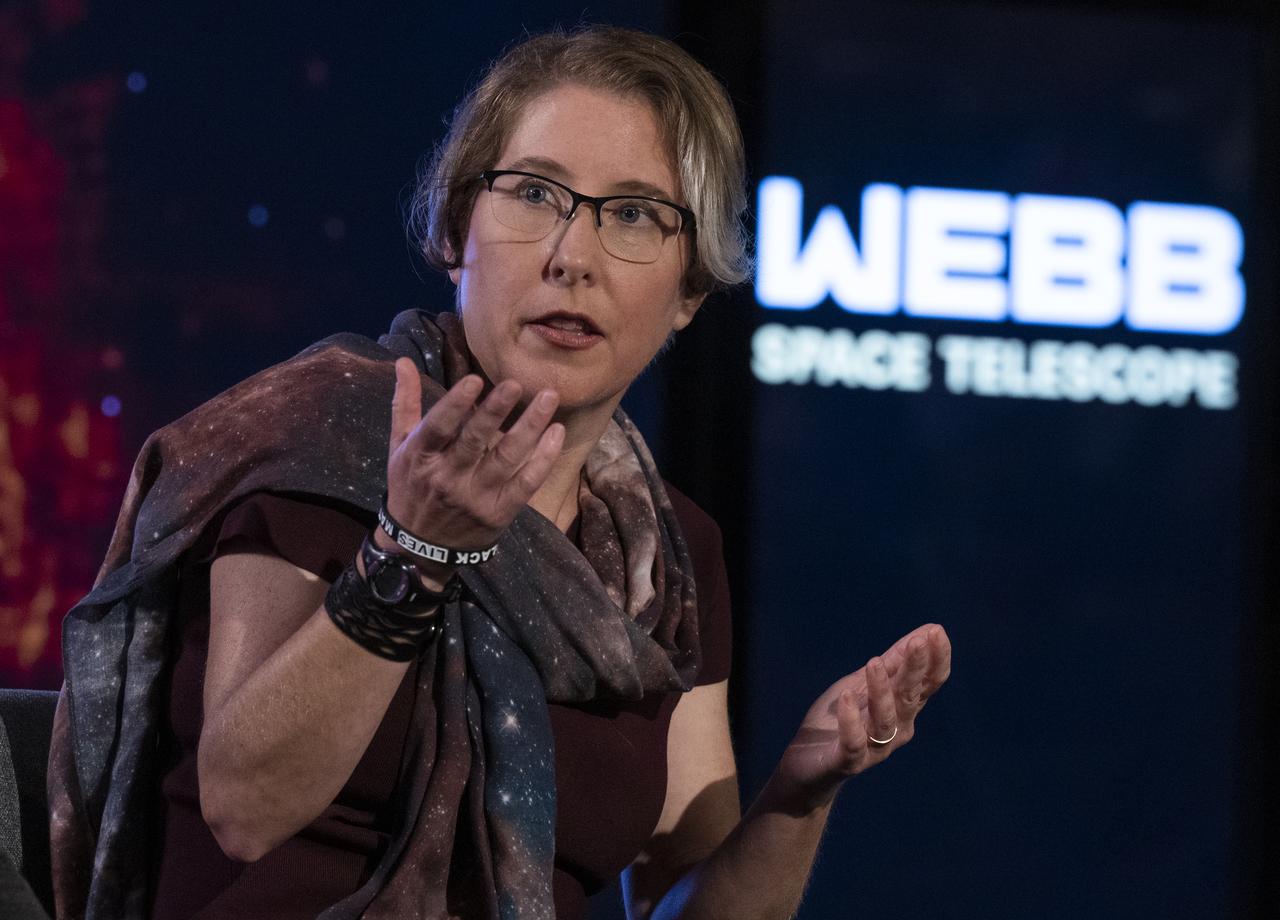
NASA James Webb Space Telescope Operations Project Scientist Jane Rigby answers a question from a member of the media during a briefing following the release of the first full-color images from NASA’s James Webb Space Telescope, Tuesday, July 12, 2022, at NASA’s Goddard Space Flight Center in Greenbelt, Md. The first full-color images and spectroscopic data from the James Webb Space Telescope, a partnership with ESA (European Space Agency) and the Canadian Space Agency (CSA), are a demonstration of the power of Webb as the telescope begins its science mission to unfold the infrared universe. Photo Credit: (NASA/Bill Ingalls)

NASA James Webb Space Telescope project scientist, Space Telescope Science Institute, Klaus Pontoppidan, left, answers a question from a member of the media alongside Principal Investigator for the Canadian Near-Infrared Imager and Slitless Spectrograph at the University of Montreal René Doyon, during a briefing following the release of the first full-color images from NASA’s James Webb Space Telescope, Tuesday, July 12, 2022, at NASA’s Goddard Space Flight Center in Greenbelt, Md. The first full-color images and spectroscopic data from the James Webb Space Telescope, a partnership with ESA (European Space Agency) and the Canadian Space Agency (CSA), are a demonstration of the power of Webb as the telescope begins its science mission to unfold the infrared universe. Photo Credit: (NASA/Bill Ingalls)
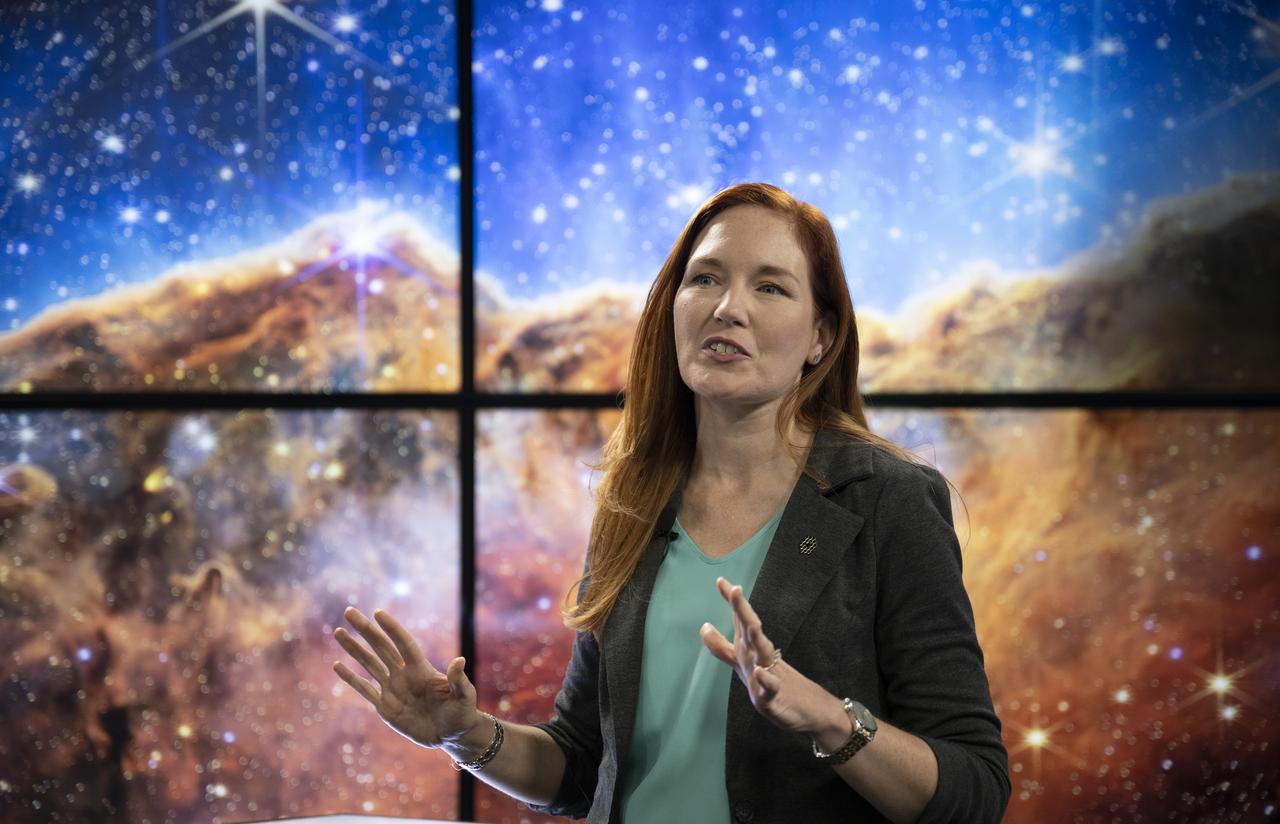
NASA James Webb Space Telescope Deputy Project Scientist for Communications Amber Straughn speaks about the infrared image of the star-forming region called NGC 3324 in the Carina Nebula as it is shown on a screen during a broadcast releasing the telescope’s first full-color images, Tuesday, July 12, 2022, at NASA’s Goddard Space Flight Center in Greenbelt, Md. The first full-color images and spectroscopic data from the James Webb Space Telescope, a partnership with ESA (European Space Agency) and the Canadian Space Agency (CSA), are a demonstration of the power of Webb as the telescope begins its science mission to unfold the infrared universe. Photo Credit: (NASA/Bill Ingalls)
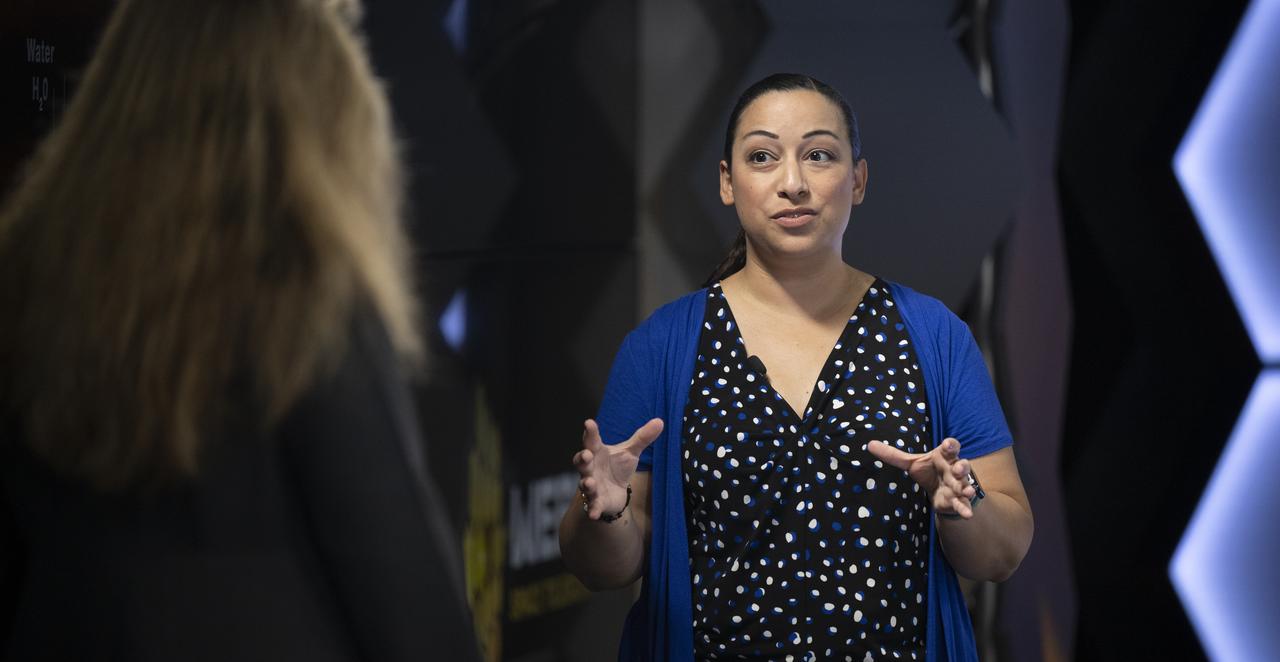
NASA James Webb Space Telescope Deputy Project Scientist for Exoplanet Science Knicole Colón speaks about the measurements of exoplanet WASP-96 b taken by the Near-Infrared Imager and Slitless Spectrograph as it is shown on screen during a broadcast releasing the telescope’s first full-color images, Tuesday, July 12, 2022, at NASA’s Goddard Space Flight Center in Greenbelt, Md. The first full-color images and spectroscopic data from the James Webb Space Telescope, a partnership with ESA (European Space Agency) and the Canadian Space Agency (CSA), are a demonstration of the power of Webb as the telescope begins its science mission to unfold the infrared universe. Photo Credit: (NASA/Bill Ingalls)
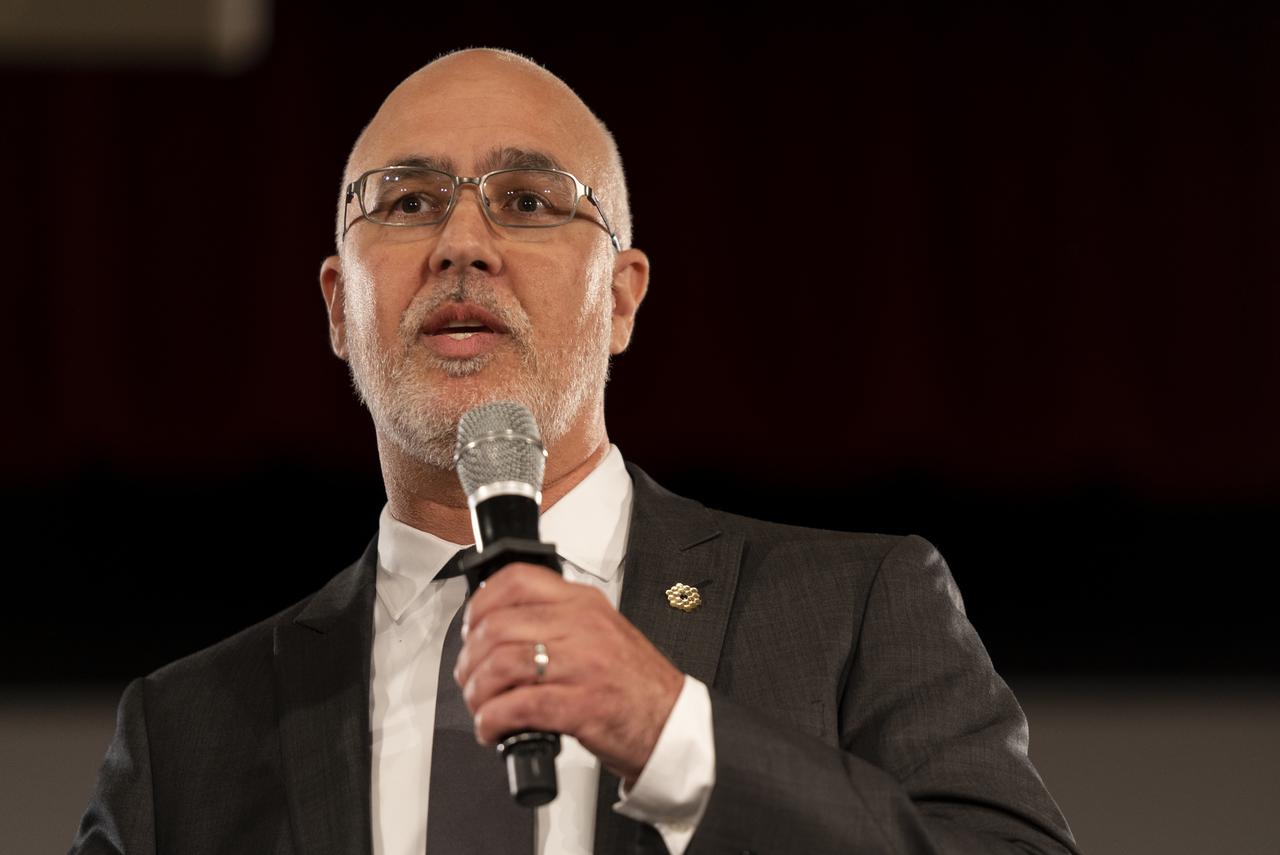
Vice President and Program Manager, Webb, Northrop Grumman, Scott Willoughby, delivers remarks ahead of the release of the first images from NASA’s James Webb Space Telescope, Tuesday, July 12, 2022, at NASA’s Goddard Space Flight Center in Greenbelt, Md. The first full-color images and spectroscopic data from the James Webb Space Telescope, a partnership with ESA (European Space Agency) and the Canadian Space Agency (CSA), are a demonstration of the power of Webb as the telescope begins its science mission to unfold the infrared universe. Photo Credit: (NASA/Taylor Mickal)
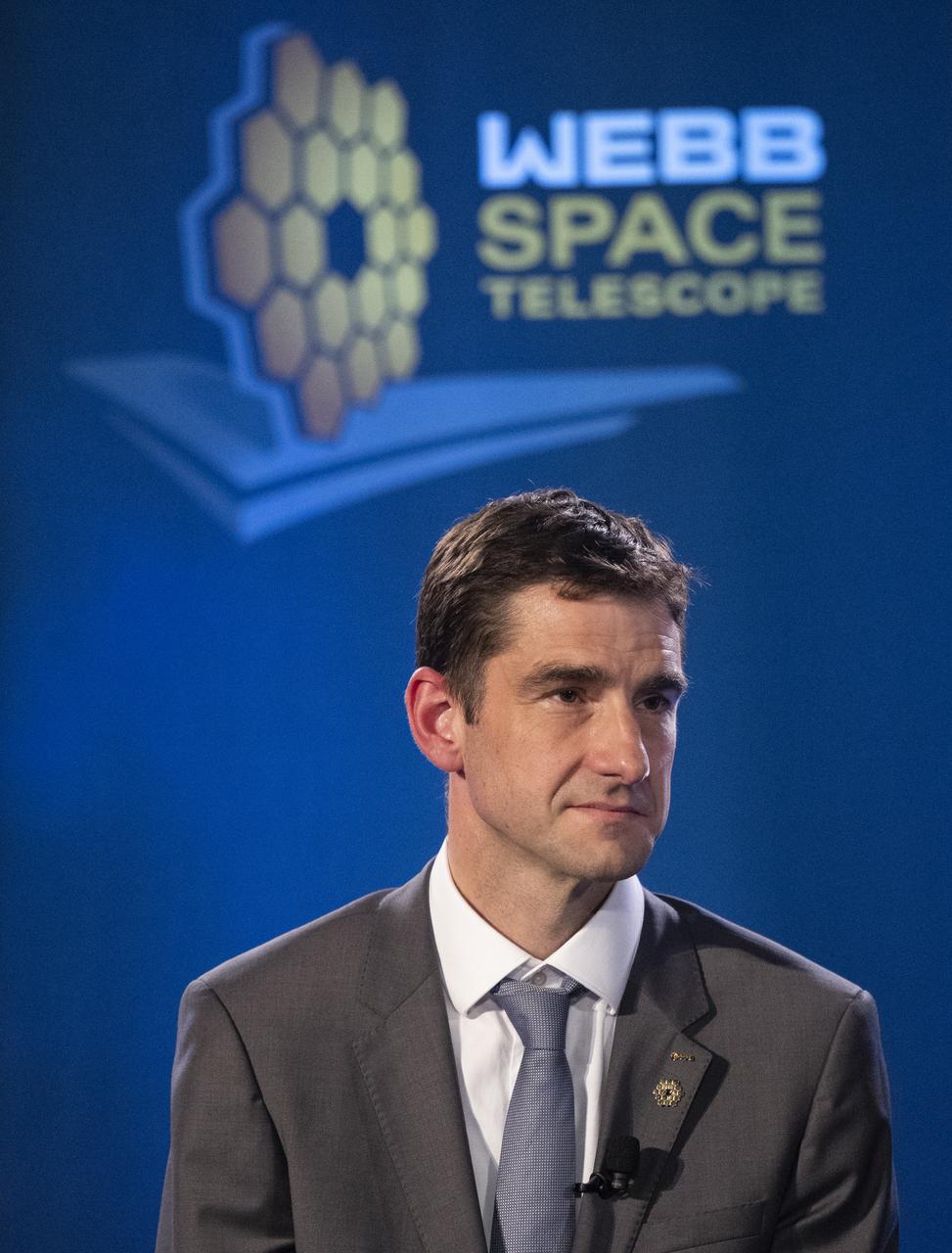
NASA James Webb Space Telescope Project Scientist at ESA (European Space Agency) Christopher Evans is seen during a briefing following the release of the first full-color images from NASA’s James Webb Space Telescope, Tuesday, July 12, 2022, at NASA’s Goddard Space Flight Center in Greenbelt, Md. The first full-color images and spectroscopic data from the James Webb Space Telescope, a partnership with ESA (European Space Agency) and the Canadian Space Agency (CSA), are a demonstration of the power of Webb as the telescope begins its science mission to unfold the infrared universe. Photo Credit: (NASA/Bill Ingalls)
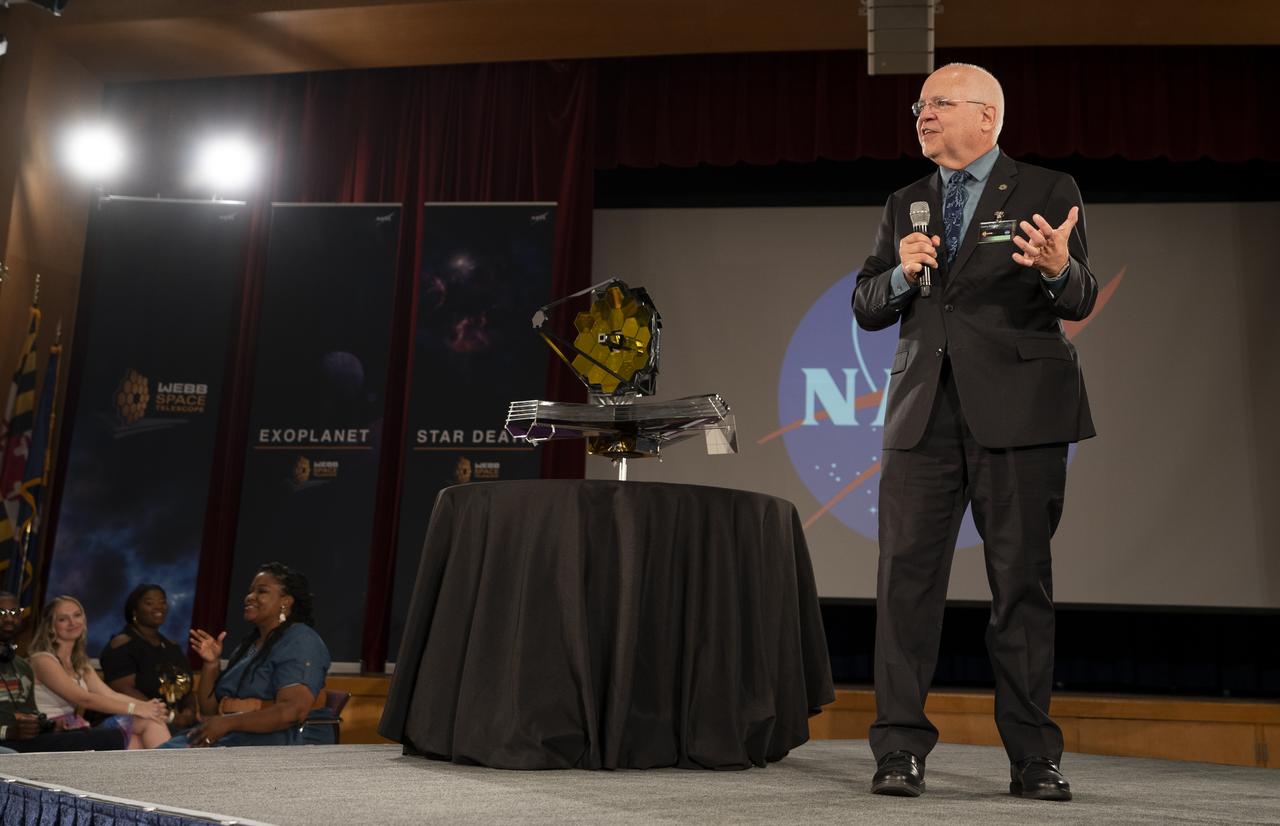
Goddard Space Flight Center Director Dennis Andrucyk delivers remarks ahead of the release of the first images from NASA’s James Webb Space Telescope, Tuesday, July 12, 2022, at NASA’s Goddard Space Flight Center in Greenbelt, Md. The first full-color images and spectroscopic data from the James Webb Space Telescope, a partnership with ESA (European Space Agency) and the Canadian Space Agency (CSA), are a demonstration of the power of Webb as the telescope begins its science mission to unfold the infrared universe. Photo Credit: (NASA/Taylor Mickal)
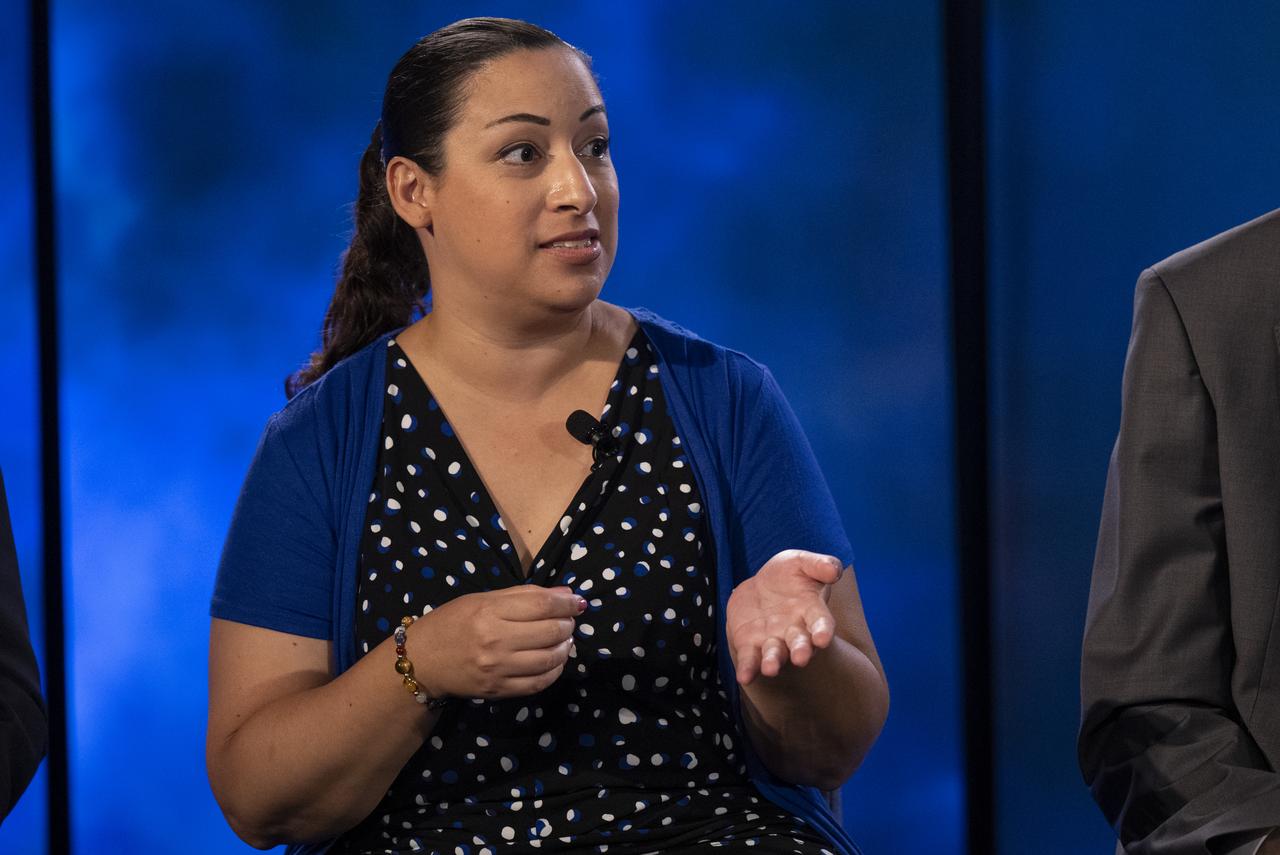
NASA James Webb Space Telescope Deputy Project Scientist for Exoplanet Science Knicole Colón answers a question from a member of the media during a briefing following the release of the first full-color images from NASA’s James Webb Space Telescope, Tuesday, July 12, 2022, at NASA’s Goddard Space Flight Center in Greenbelt, Md. The first full-color images and spectroscopic data from the James Webb Space Telescope, a partnership with ESA (European Space Agency) and the Canadian Space Agency (CSA), are a demonstration of the power of Webb as the telescope begins its science mission to unfold the infrared universe. Photo Credit: (NASA/Bill Ingalls)
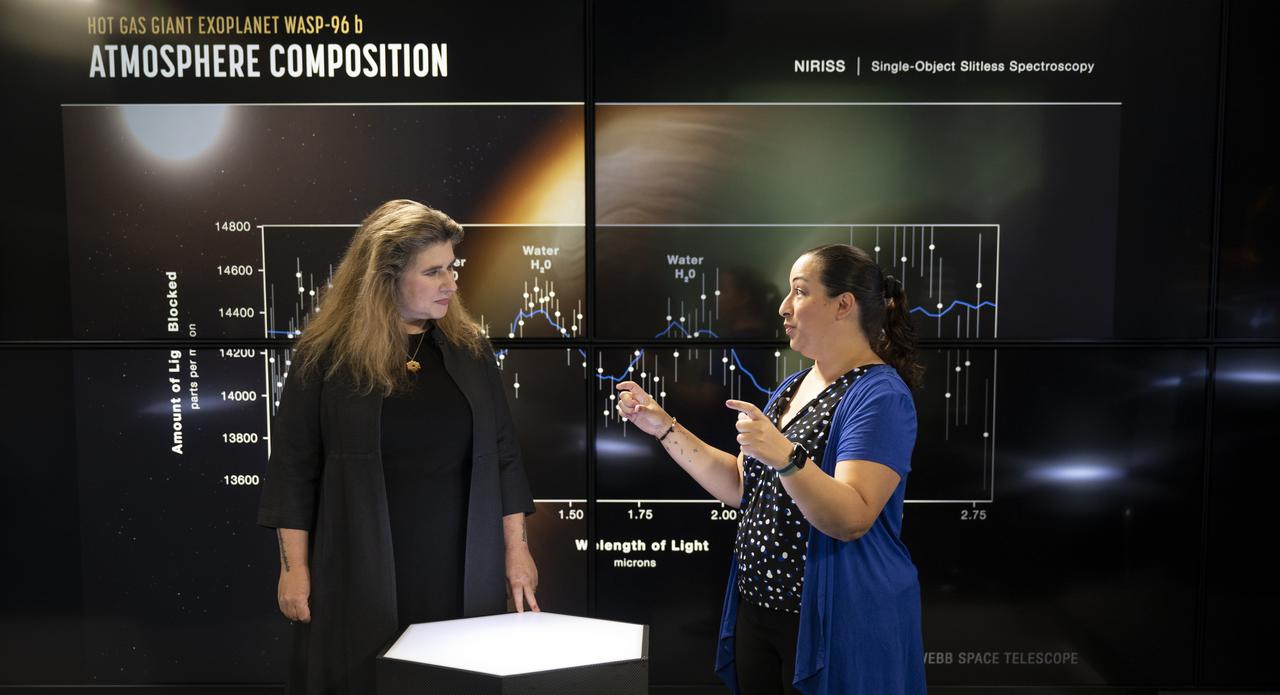
NASA James Webb Space Telescope Deputy Project Scientist for Exoplanet Science Knicole Colón speaks about the measurements of exoplanet WASP-96 b taken by the Near-Infrared Imager and Slitless Spectrograph as it is shown on screen during a broadcast releasing the telescope’s first full-color images, Tuesday, July 12, 2022, at NASA’s Goddard Space Flight Center in Greenbelt, Md. The first full-color images and spectroscopic data from the James Webb Space Telescope, a partnership with ESA (European Space Agency) and the Canadian Space Agency (CSA), are a demonstration of the power of Webb as the telescope begins its science mission to unfold the infrared universe. Photo Credit: (NASA/Bill Ingalls)
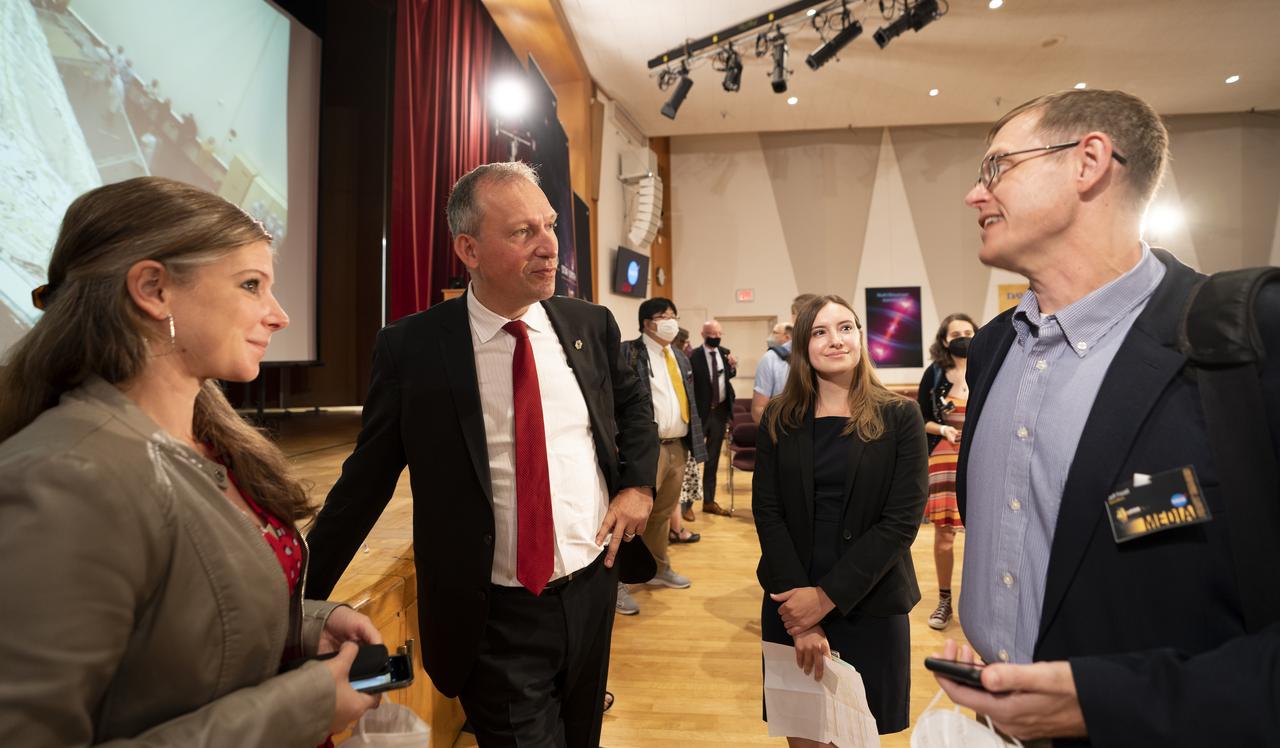
NASA Associate Administrator for the Science Mission Directorate Thomas Zurbuchen speaks with members of the media following the release of the first full-color images from NASA’s James Webb Space Telescope, Tuesday, July 12, 2022, at NASA’s Goddard Space Flight Center in Greenbelt, Md. The first full-color images and spectroscopic data from the James Webb Space Telescope, a partnership with ESA (European Space Agency) and the Canadian Space Agency (CSA), are a demonstration of the power of Webb as the telescope begins its science mission to unfold the infrared universe. Photo Credit: (NASA/Taylor Mickal)

NASA Public Affairs Office Alise Fisher moderates a briefing following the release of the first full-color images from NASA’s James Webb Space Telescope, Tuesday, July 12, 2022, at NASA’s Goddard Space Flight Center in Greenbelt, Md. The first full-color images and spectroscopic data from the James Webb Space Telescope, a partnership with ESA (European Space Agency) and the Canadian Space Agency (CSA), are a demonstration of the power of Webb as the telescope begins its science mission to unfold the infrared universe. Photo Credit: (NASA/Bill Ingalls)
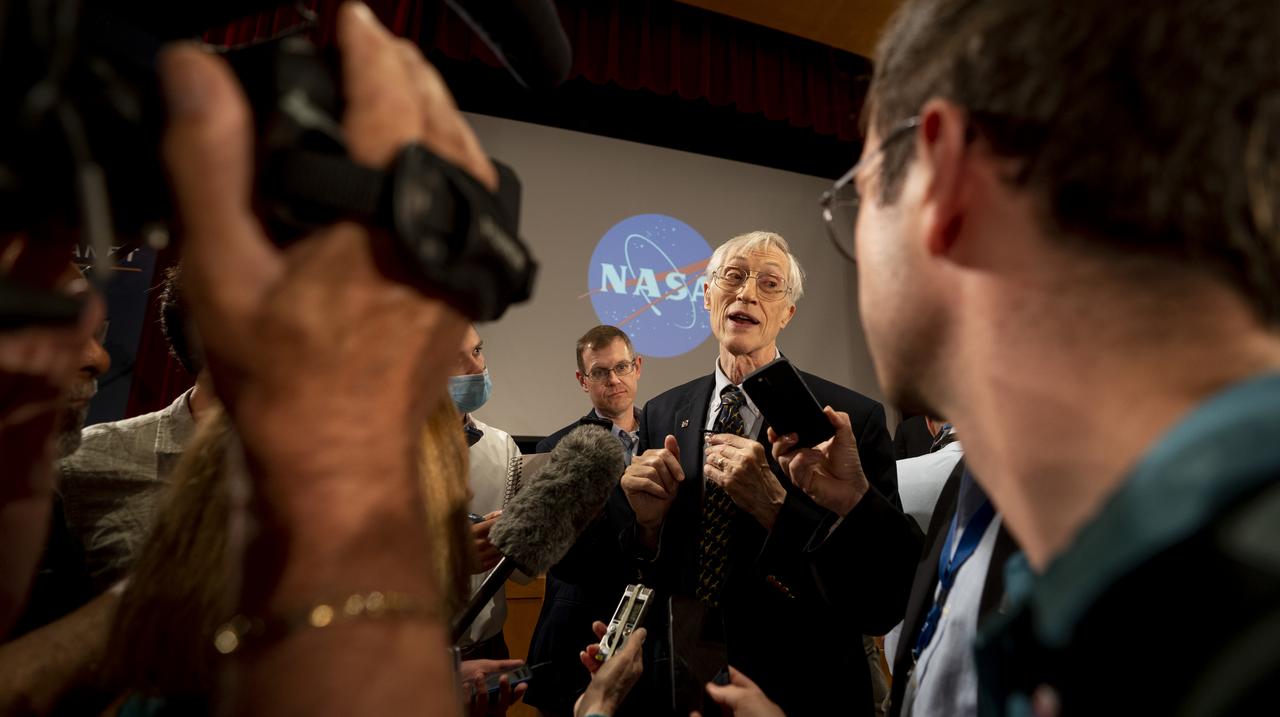
NASA James Webb Space Telescope Senior Project Scientist John Mather speaks with members of the media following the release of the first full-color images from NASA’s James Webb Space Telescope, Tuesday, July 12, 2022, at NASA’s Goddard Space Flight Center in Greenbelt, Md. The first full-color images and spectroscopic data from the James Webb Space Telescope, a partnership with ESA (European Space Agency) and the Canadian Space Agency (CSA), are a demonstration of the power of Webb as the telescope begins its science mission to unfold the infrared universe. Photo Credit: (NASA/Taylor Mickal)
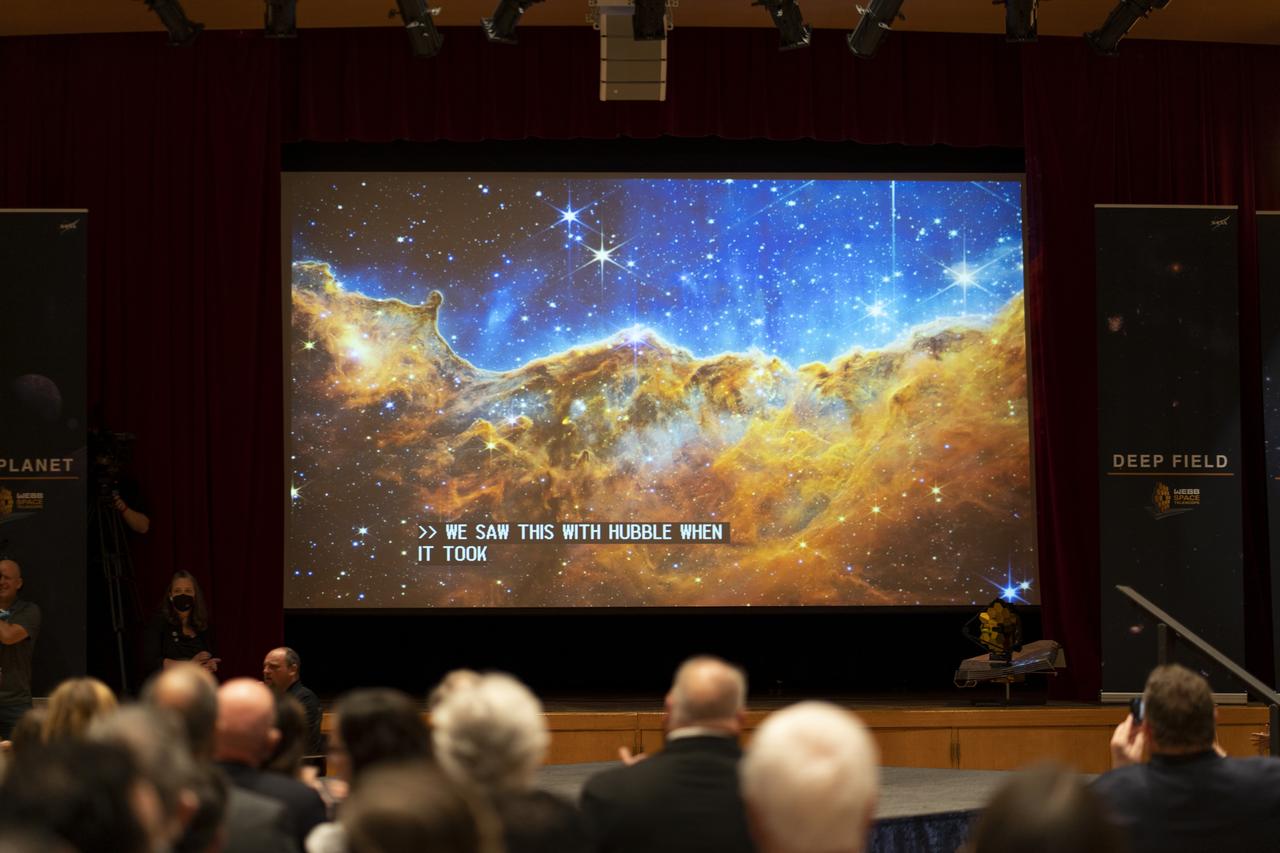
The image captured by NASA’s James Webb Space Telescope of the star-forming region called NGC 3324 in the Carina Nebula is seen on a screen as members of the media and guests watch the broadcast releasing the first full-color images from NASA’s James Webb Space Telescope, Tuesday, July 12, 2022, at NASA’s Goddard Space Flight Center in Greenbelt, Md. The first full-color images and spectroscopic data from the James Webb Space Telescope, a partnership with ESA (European Space Agency) and the Canadian Space Agency (CSA), are a demonstration of the power of Webb as the telescope begins its science mission to unfold the infrared universe. Photo Credit: (NASA/Taylor Mickal)
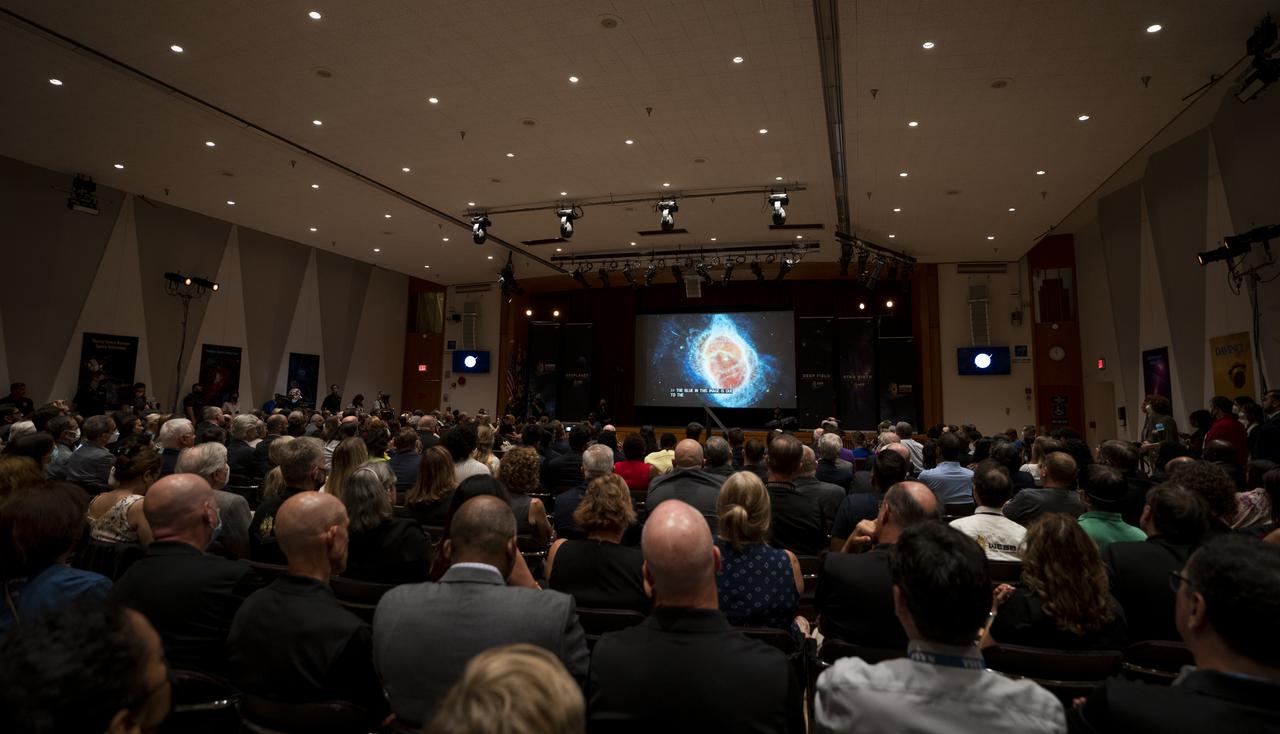
One of the images captured by NASA’s James Webb Space Telescope of the planetary nebula cataloged as NGC 3132, and known informally as the Southern Ring Nebula, is seen on a screen as members of the media and guests watch the broadcast releasing the first full-color images from NASA’s James Webb Space Telescope, Tuesday, July 12, 2022, at NASA’s Goddard Space Flight Center in Greenbelt, Md. The first full-color images and spectroscopic data from the James Webb Space Telescope, a partnership with ESA (European Space Agency) and the Canadian Space Agency (CSA), are a demonstration of the power of Webb as the telescope begins its science mission to unfold the infrared universe. Photo Credit: (NASA/Taylor Mickal)
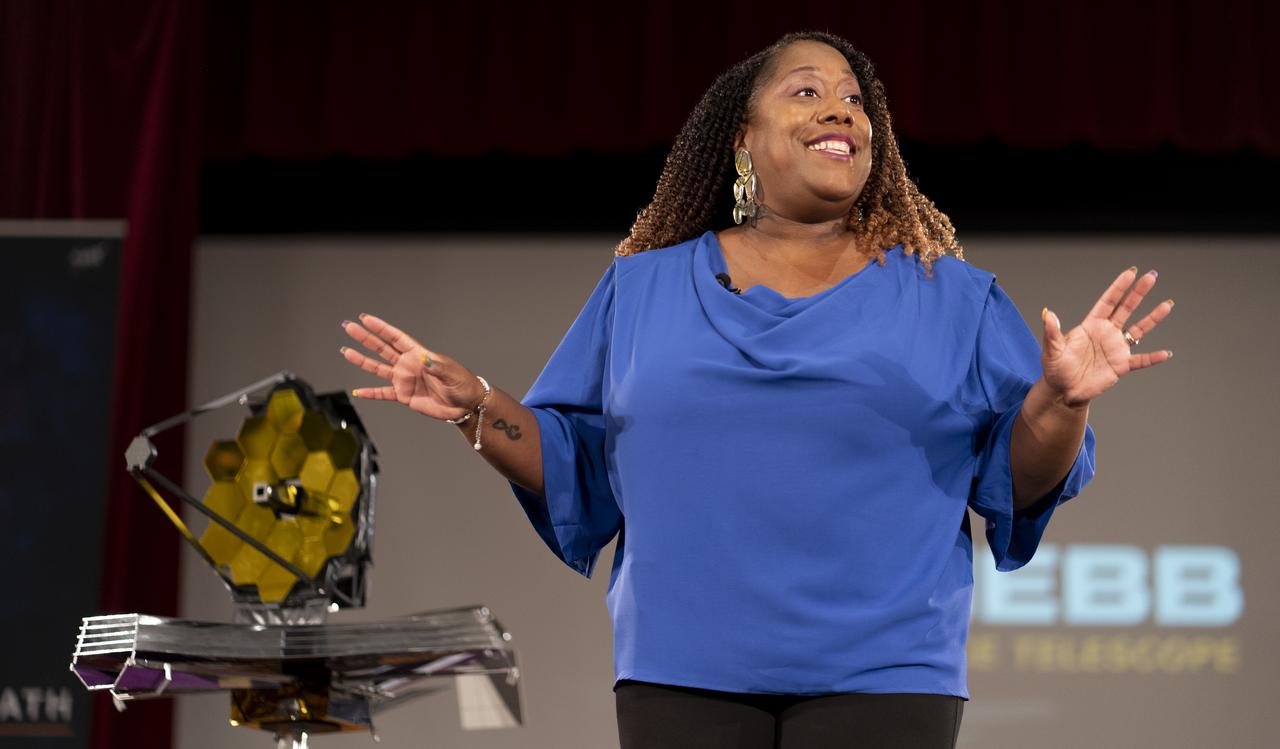
Michelle Jones, Chief of the Office of Communications at NASA's Goddard Space Flight Center, delivers remarks ahead of the release of the first images from NASA’s James Webb Space Telescope, Tuesday, July 12, 2022, at NASA’s Goddard Space Flight Center in Greenbelt, Md. The first full-color images and spectroscopic data from the James Webb Space Telescope, a partnership with ESA (European Space Agency) and the Canadian Space Agency (CSA), are a demonstration of the power of Webb as the telescope begins its science mission to unfold the infrared universe. Photo Credit: (NASA/Taylor Mickal)
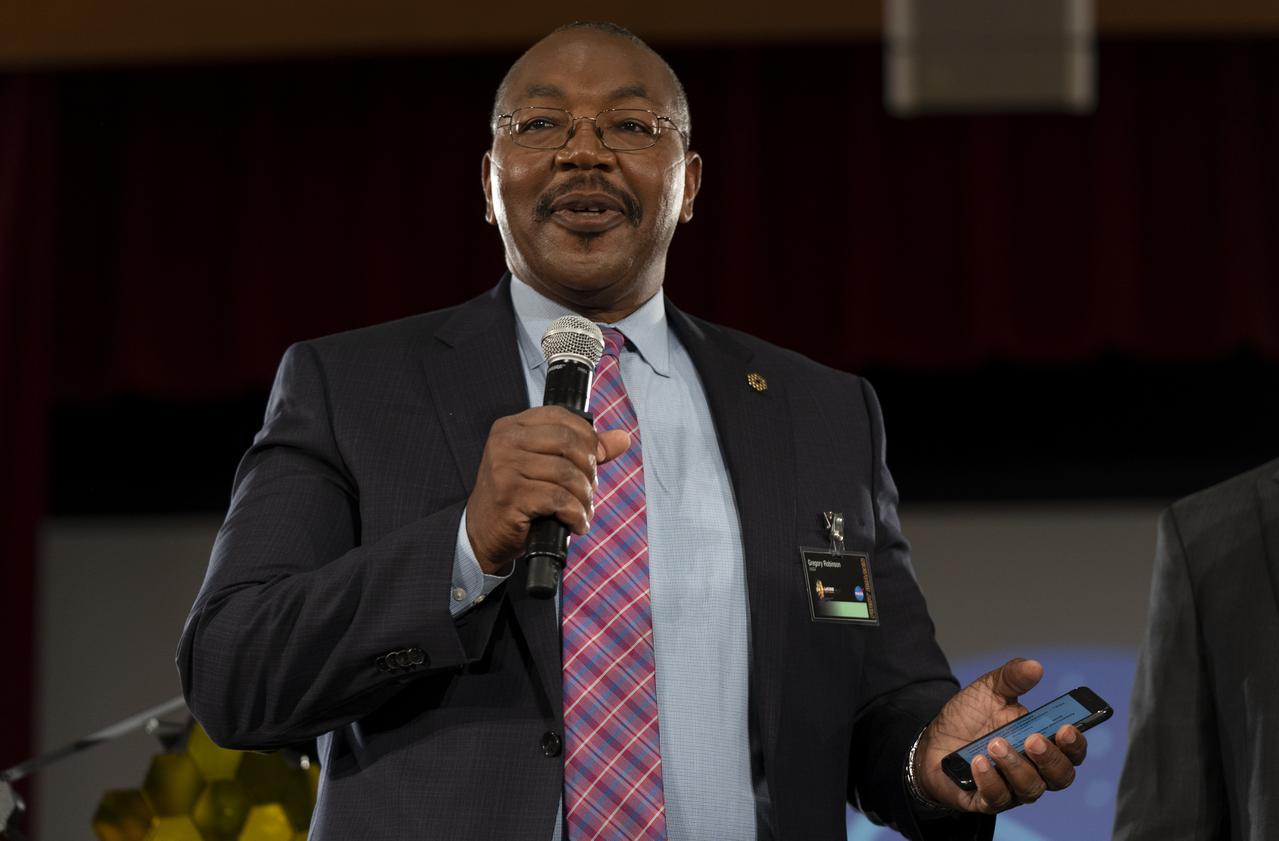
NASA Program Director for the James Webb Space Telescope Program Greg Robinson delivers remarks ahead of the release of the first images from NASA’s James Webb Space Telescope, Tuesday, July 12, 2022, at NASA’s Goddard Space Flight Center in Greenbelt, Md. The first full-color images and spectroscopic data from the James Webb Space Telescope, a partnership with ESA (European Space Agency) and the Canadian Space Agency (CSA), are a demonstration of the power of Webb as the telescope begins its science mission to unfold the infrared universe. Photo Credit: (NASA/Taylor Mickal)

NASA James Webb Space Telescope Deputy Project Scientist for Communications Amber Straughn, right, answers a question from a member of the media alongside Principal Investigator for the Canadian Near-Infrared Imager and Slitless Spectrograph at the University of Montreal René Doyon during a briefing following the release of the first full-color images from NASA’s James Webb Space Telescope, Tuesday, July 12, 2022, at NASA’s Goddard Space Flight Center in Greenbelt, Md. The first full-color images and spectroscopic data from the James Webb Space Telescope, a partnership with ESA (European Space Agency) and the Canadian Space Agency (CSA), are a demonstration of the power of Webb as the telescope begins its science mission to unfold the infrared universe. Photo Credit: (NASA/Bill Ingalls)
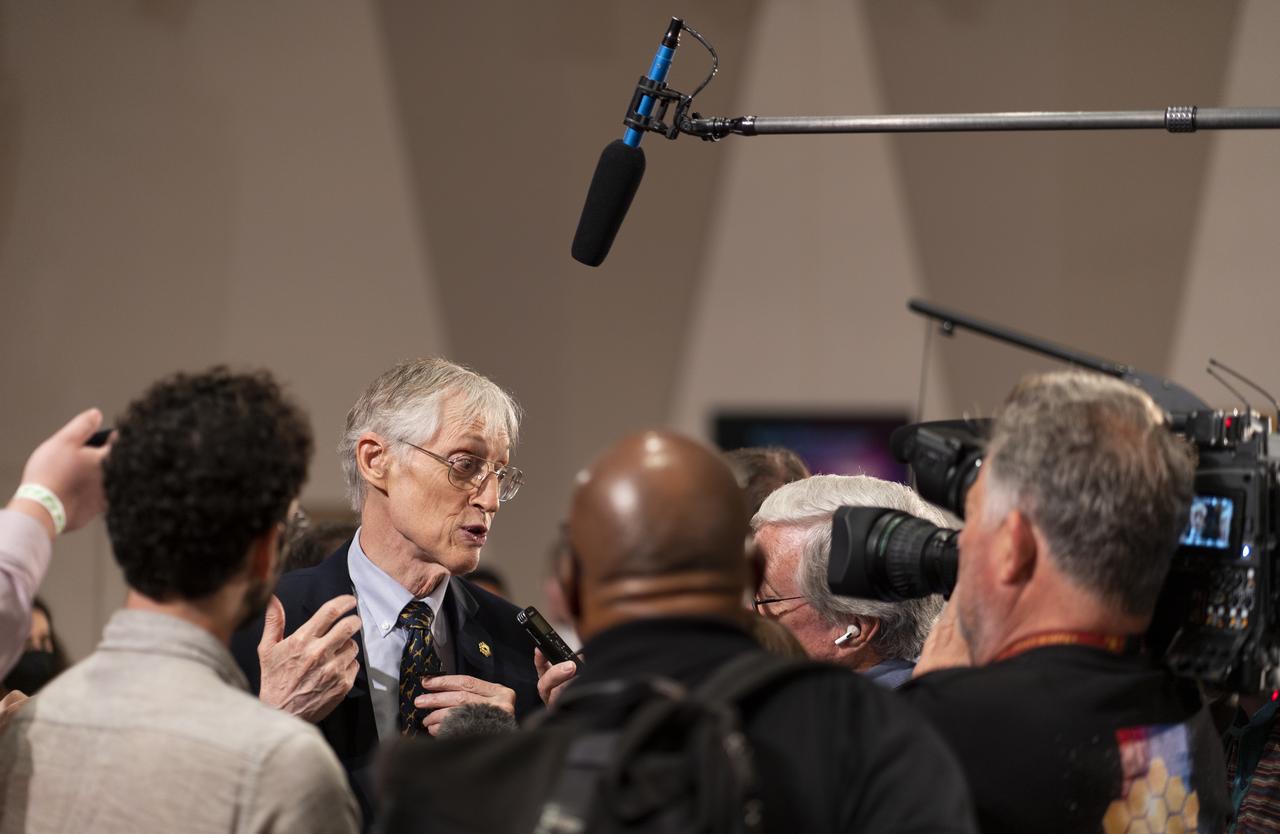
NASA James Webb Space Telescope Senior Project Scientist John Mather speaks with members of the media following the release of the first full-color images from NASA’s James Webb Space Telescope, Tuesday, July 12, 2022, at NASA’s Goddard Space Flight Center in Greenbelt, Md. The first full-color images and spectroscopic data from the James Webb Space Telescope, a partnership with ESA (European Space Agency) and the Canadian Space Agency (CSA), are a demonstration of the power of Webb as the telescope begins its science mission to unfold the infrared universe. Photo Credit: (NASA/Taylor Mickal)
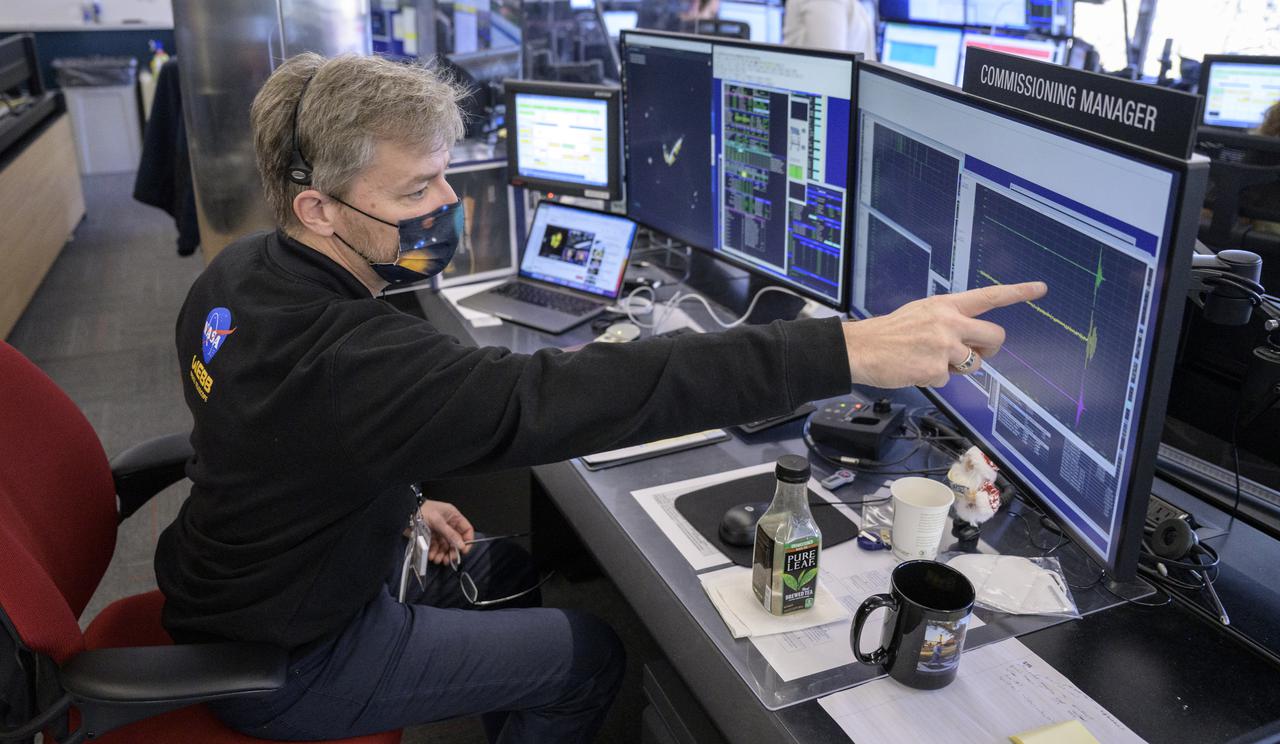
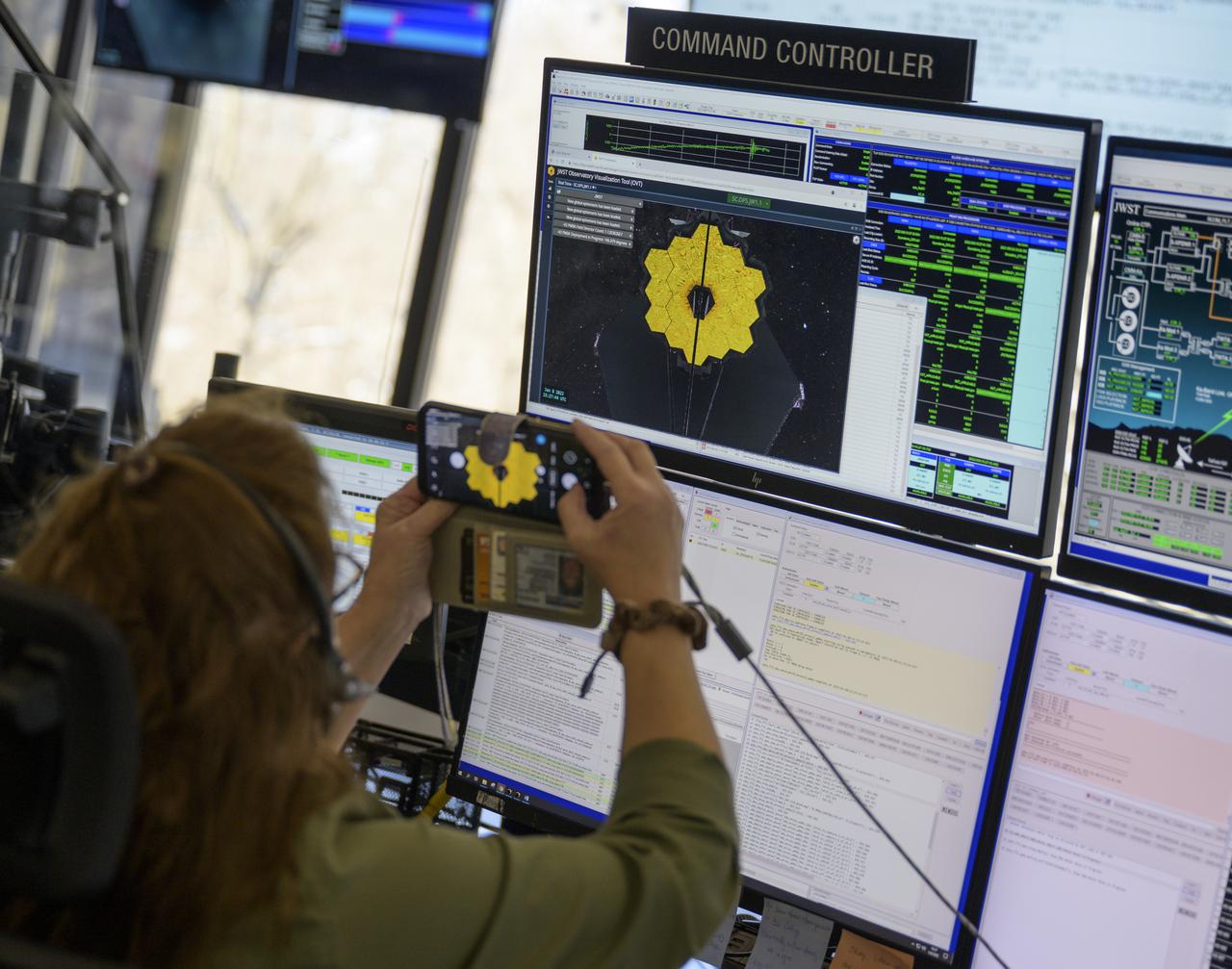
NASA James Webb Space Telescope Commissioning Manager John Durning monitors the progress of the Webb observatory as it’s second primary mirror wing is prepared to rotate into position, Saturday, Jan. 8, 2022, from NASA’s James Webb Space Telescope Mission Operations Center at the Space Telescope Science Institute in Baltimore. Webb, an infrared telescope with a 21.3-foot (6.5-meter) primary mirror, was folded up for launch and underwent an unprecedented deployment process to unfold in space. As NASA's next flagship observatory, Webb will study every phase of cosmic history—from within our solar system to the most distant observable galaxies in the early universe. Photo Credit: (NASA/Bill Ingalls)
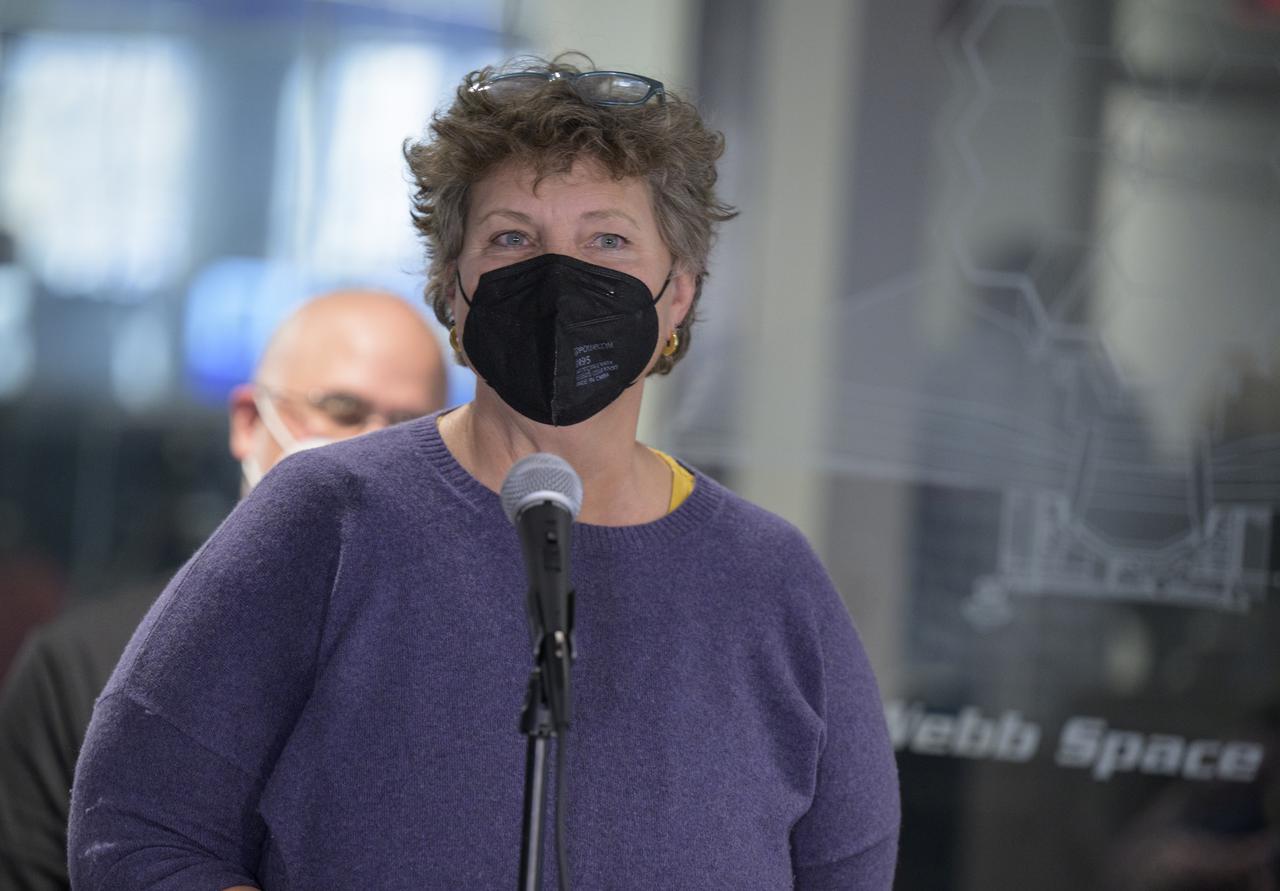
Senior Systems Engineer, Webb, Northrop Grumman, Nanci Shawger answers questions from the media during a briefing following the successful deployment of NASA’s James Webb Space Telescope primary mirror, Saturday, Jan. 8, 2022, from the Webb Space Telescope Mission Operations Center at the Space Telescope Science Institute in Baltimore. With Webb’s 21.3-foot (6.5-meter) primary mirror fully deployed, the infrared observatory has completed its unprecedented process of unfolding in space to prepare for science operations. The observatory will study every phase of cosmic history—from within our solar system to the most distant observable galaxies in the early universe. Photo Credit: (NASA/Bill Ingalls)

NASA James Webb Space Telescope Operations Project Scientist Jane Rigby answers questions from the media during a briefing following the successful deployment of NASA’s James Webb Space Telescope primary mirror, Saturday, Jan. 8, 2022, from the Webb Space Telescope Mission Operations Center at the Space Telescope Science Institute in Baltimore. With Webb’s 21.3-foot (6.5-meter) primary mirror fully deployed, the infrared observatory has completed its unprecedented process of unfolding in space to prepare for science operations. The observatory will study every phase of cosmic history—from within our solar system to the most distant observable galaxies in the early universe. Photo Credit: (NASA/Bill Ingalls)
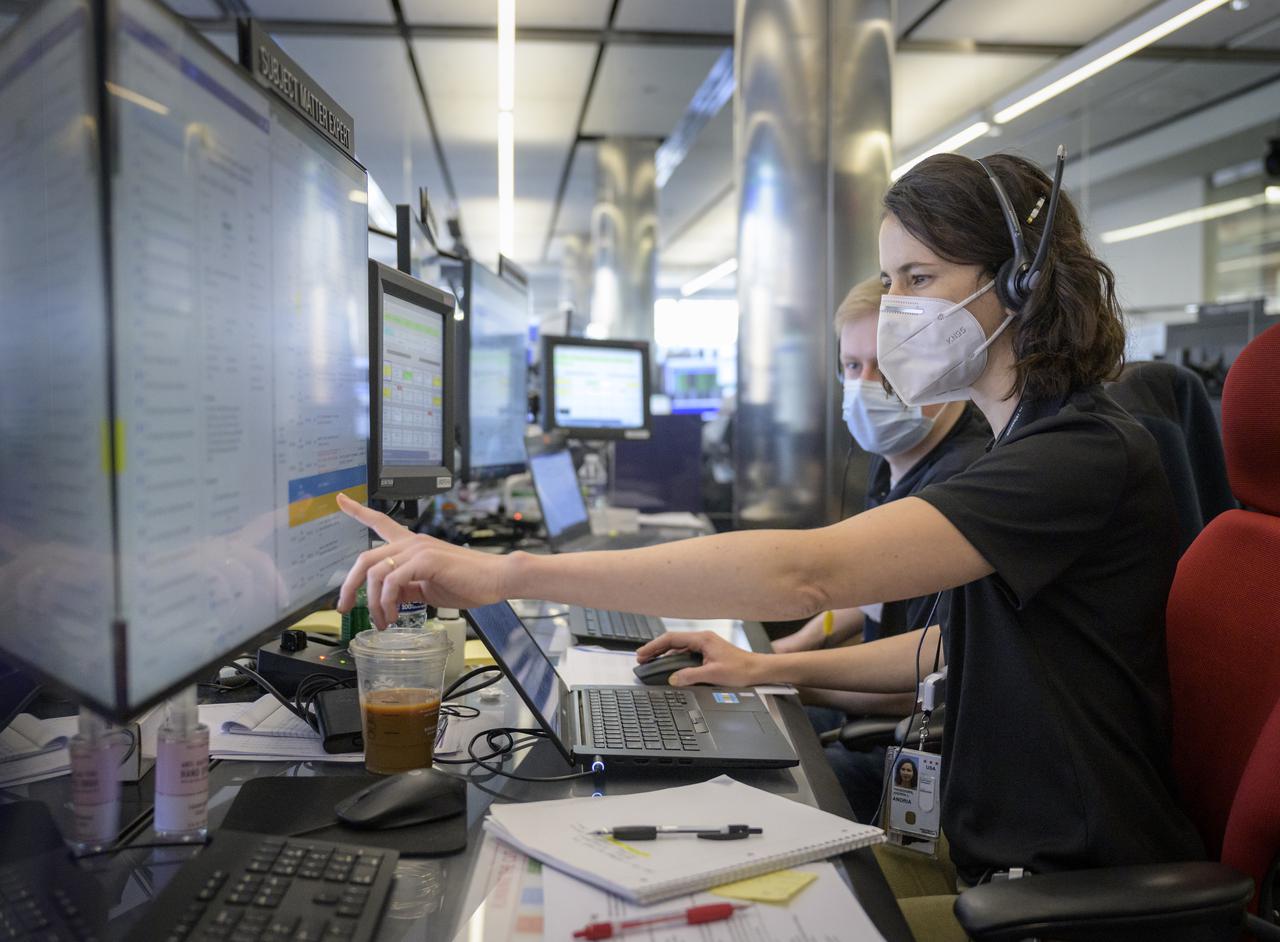
NASA James Webb Space Telescope Timeline Coordinator Andria Hagedorn monitors the progress of the Webb observatory’s second primary mirror wing as it rotates into position, Saturday, Jan. 8, 2022, from NASA’s James Webb Space Telescope Mission Operations Center at the Space Telescope Science Institute in Baltimore. Webb, an infrared telescope with a 21.3-foot (6.5-meter) primary mirror, was folded up for launch and underwent an unprecedented deployment process to unfold in space. As NASA's next flagship observatory, Webb will study every phase of cosmic history—from within our solar system to the most distant observable galaxies in the early universe. Photo Credit: (NASA/Bill Ingalls)
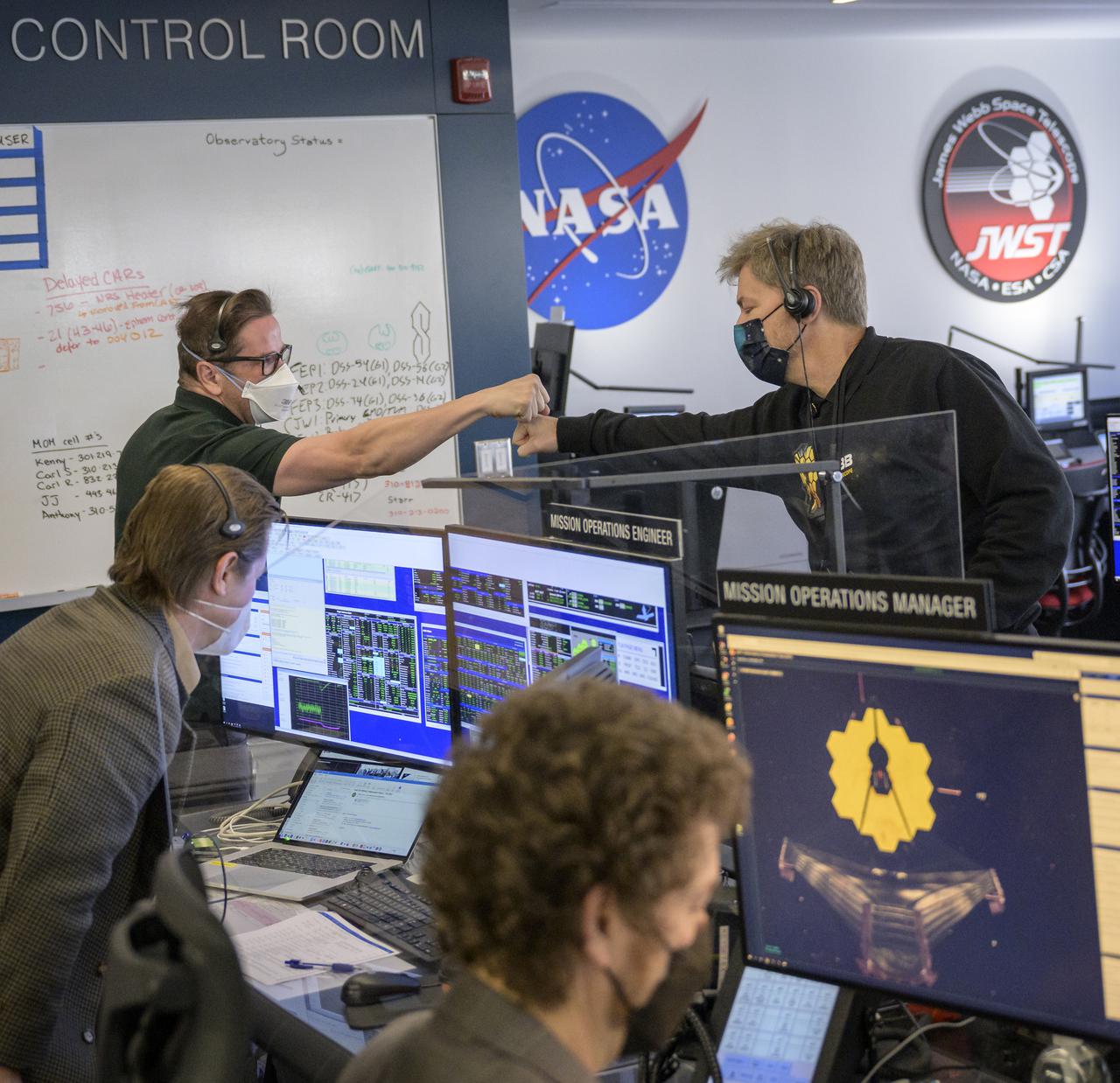
Engineering teams celebrate at the Space Telescope Science Institute in Baltimore as the second primary mirror wing of NASA’s James Webb Space Telescope unfolds, before beginning the process of latching the mirror wing into place, Saturday, Jan. 8, 2022. When fully latched, the infrared observatory will have completed its unprecedented process of unfolding in space to prepare for science operations. Webb will study every phase of cosmic history—from within our solar system to the most distant observable galaxies in the early universe. Photo Credit: (NASA/Bill Ingalls)
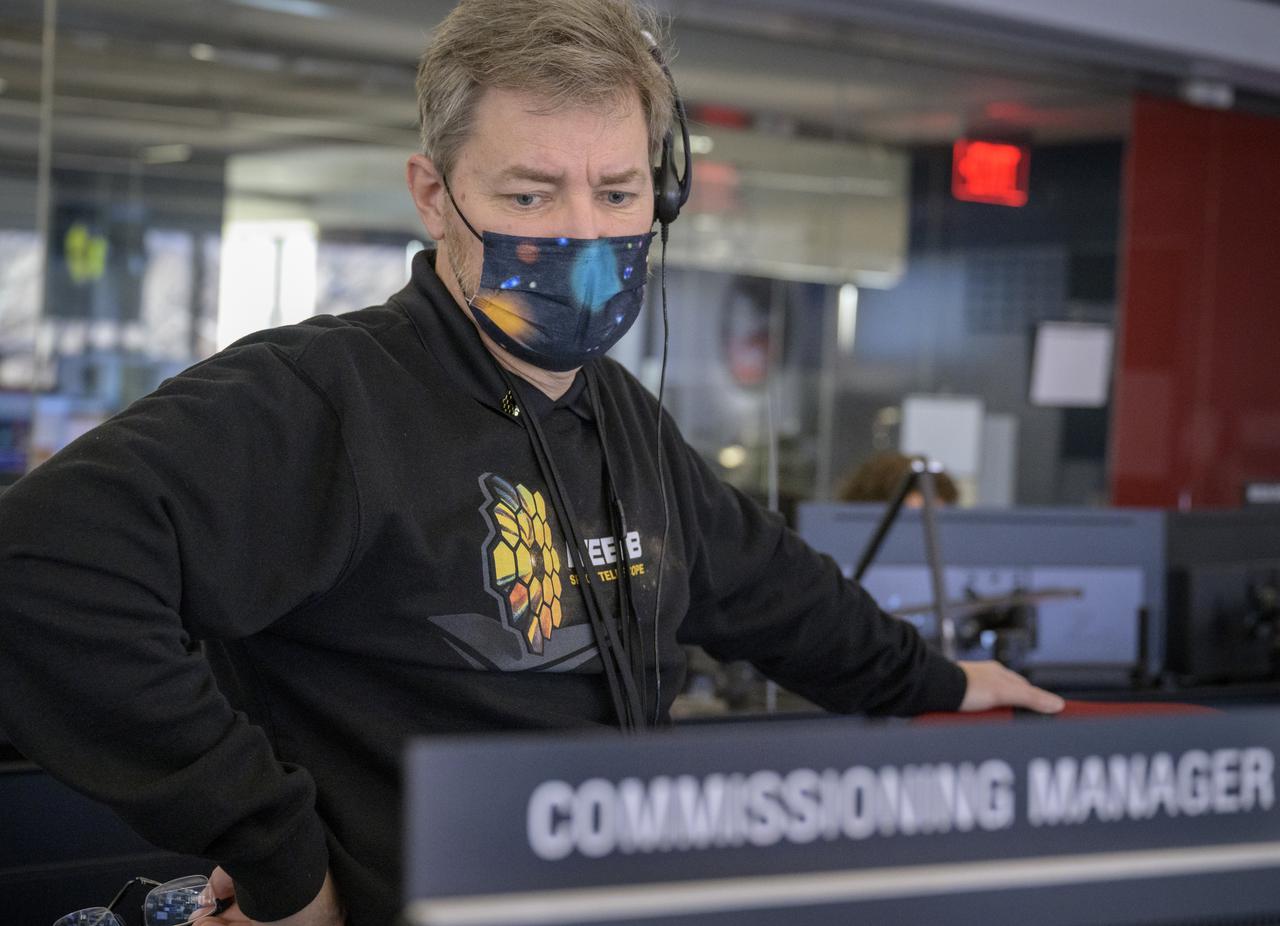
NASA James Webb Space Telescope Commissioning Manager John Durning monitors the progress of the Webb observatory as it’s second primary mirror wing is rotated into position, Saturday, Jan. 8, 2022, from NASA’s James Webb Space Telescope Mission Operations Center at the Space Telescope Science Institute in Baltimore. Webb, an infrared telescope with a 21.3-foot (6.5-meter) primary mirror, was folded up for launch and underwent an unprecedented deployment process to unfold in space. As NASA's next flagship observatory, Webb will study every phase of cosmic history—from within our solar system to the most distant observable galaxies in the early universe. Photo Credit: (NASA/Bill Ingalls)
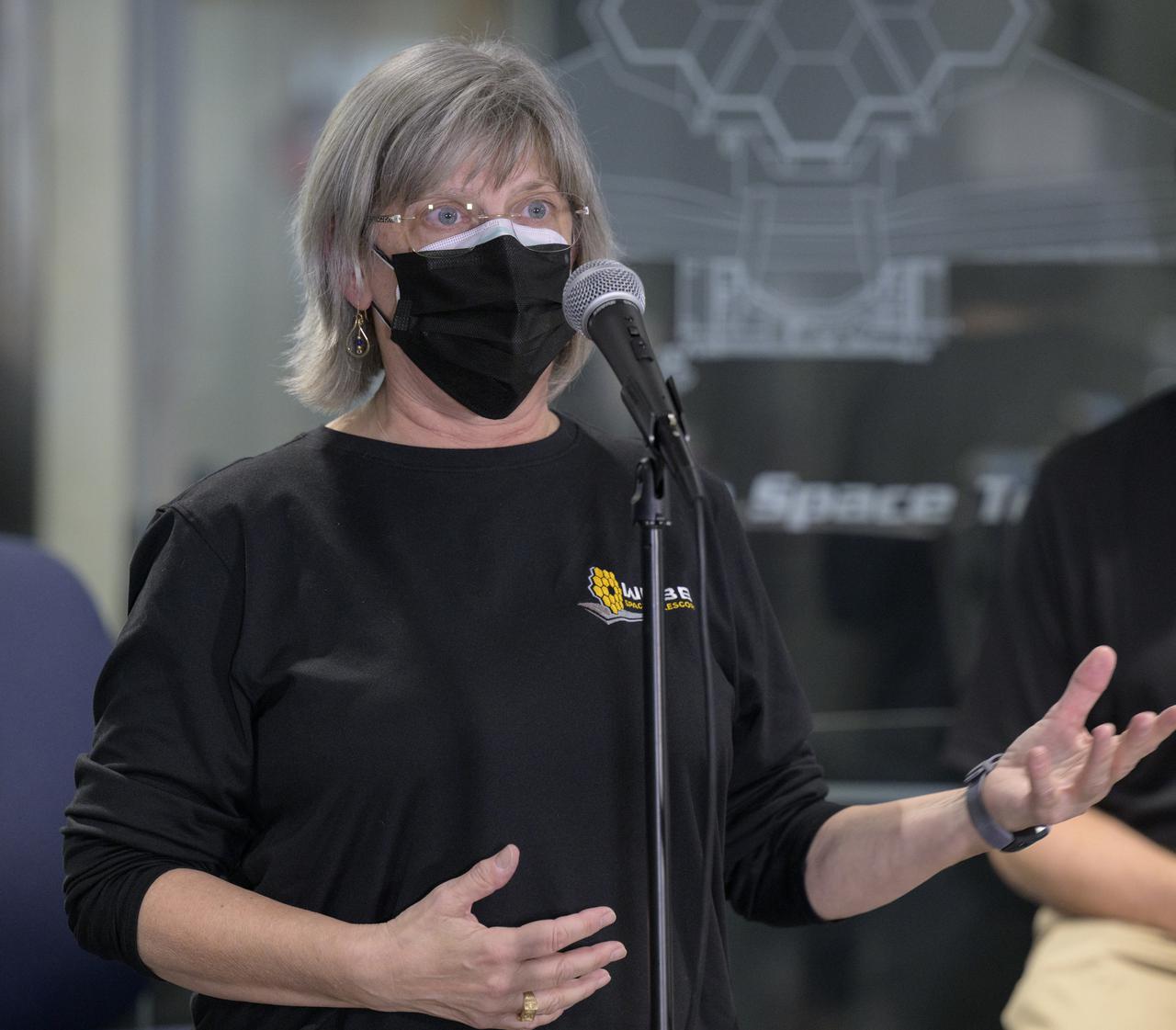
Vice President for Science, Space Telescope Science Institute, Heidi Hammel answers questions from the media during a briefing following the successful deployment of NASA’s James Webb Space Telescope primary mirror, Saturday, Jan. 8, 2022, from the Webb Space Telescope Mission Operations Center at the Space Telescope Science Institute in Baltimore. With Webb’s 21.3-foot (6.5-meter) primary mirror fully deployed, the infrared observatory has completed its unprecedented process of unfolding in space to prepare for science operations. The observatory will study every phase of cosmic history—from within our solar system to the most distant observable galaxies in the early universe. Photo Credit: (NASA/Bill Ingalls)
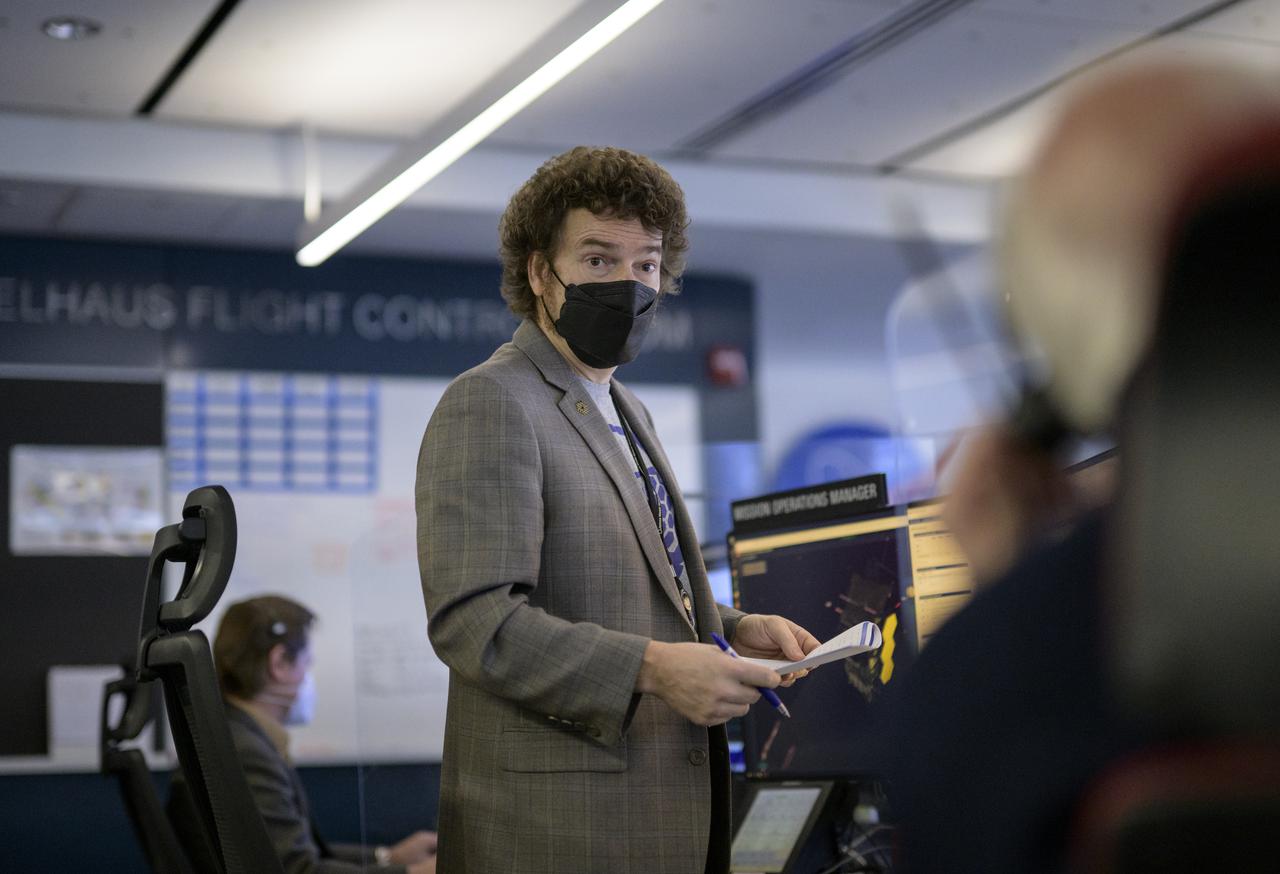
NASA James Webb Space Telescope Mission Operations Manager Carl Starr monitors the progress of the Webb observatory as it’s second primary mirror wing is prepared to rotate into position, Saturday, Jan. 8, 2022, from NASA’s James Webb Space Telescope Mission Operations Center at the Space Telescope Science Institute in Baltimore. Webb, an infrared telescope with a 21.3-foot (6.5-meter) primary mirror, was folded up for launch and underwent an unprecedented deployment process to unfold in space. As NASA's next flagship observatory, Webb will study every phase of cosmic history—from within our solar system to the most distant observable galaxies in the early universe. Photo Credit: (NASA/Bill Ingalls)
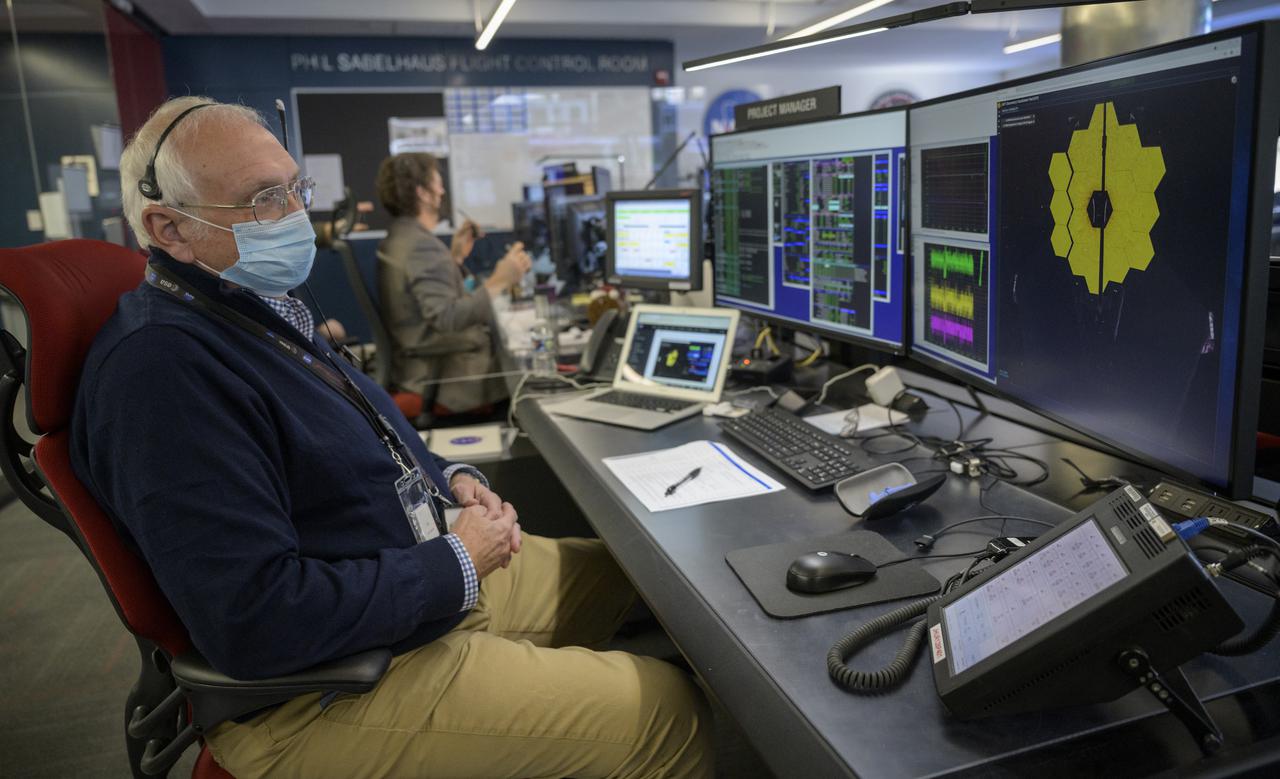
NASA James Webb Space Telescope Project Manager Bill Ochs monitors the progress of the observatory’s second primary mirror wing as it rotates into position, Saturday, Jan. 8, 2022, from NASA’s James Webb Space Telescope Mission Operations Center at the Space Telescope Science Institute in Baltimore. Webb, an infrared telescope with a 21.3-foot (6.5-meter) primary mirror, was folded up for launch and underwent an unprecedented deployment process to unfold in space. As NASA's next flagship observatory, Webb will study every phase of cosmic history—from within our solar system to the most distant observable galaxies in the early universe. Photo Credit: (NASA/Bill Ingalls)
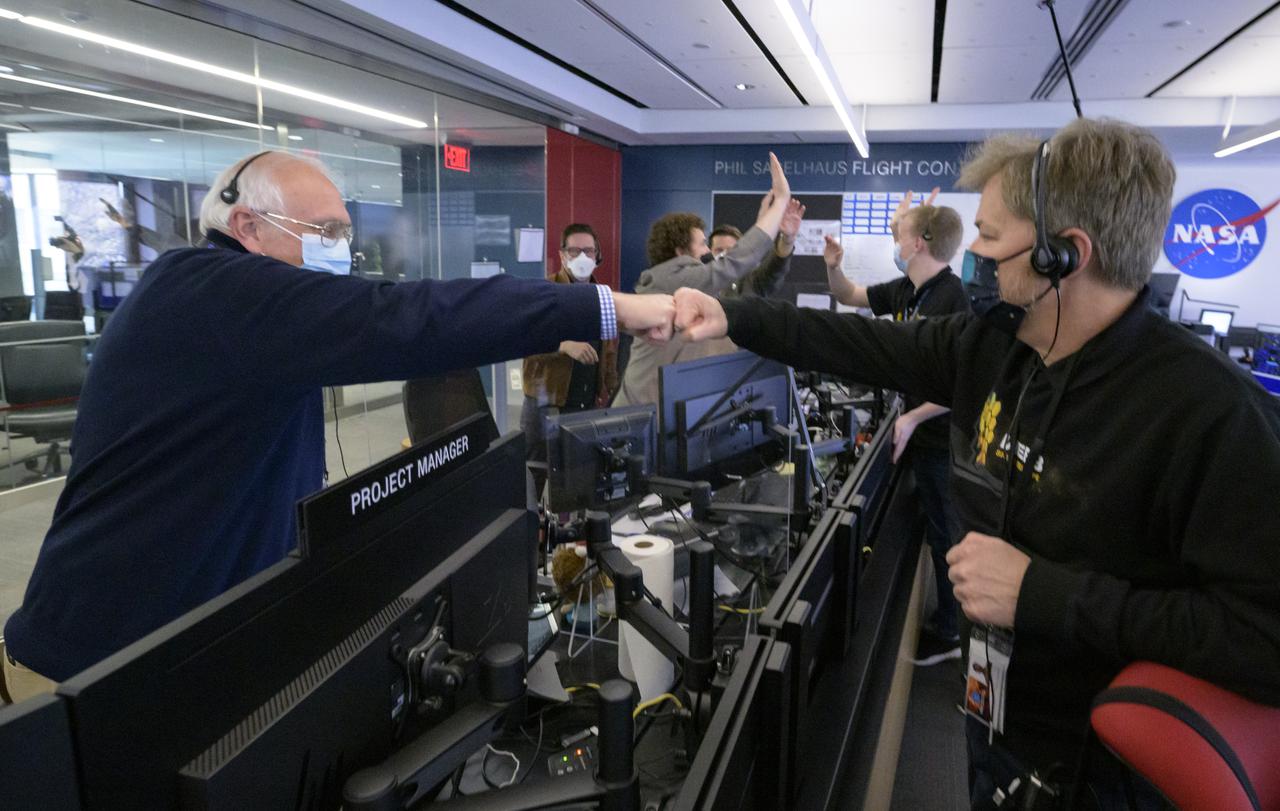
NASA James Webb Space Telescope Project Manager Bill Ochs, left, NASA James Webb Space Telescope Commissioning Manager John Durning, right and others from the operations team celebrate, Saturday, Jan. 8, 2022, at the Space Telescope Science Institute in Baltimore, after confirming that the observatory’s final primary mirror wing successfully extended and locked into place. With Webb’s 21.3-foot (6.5-meter) primary mirror fully deployed, the infrared observatory has completed its unprecedented process of unfolding in space to prepare for science operations. The observatory will study every phase of cosmic history—from within our solar system to the most distant observable galaxies in the early universe. Photo Credit: (NASA/Bill Ingalls)
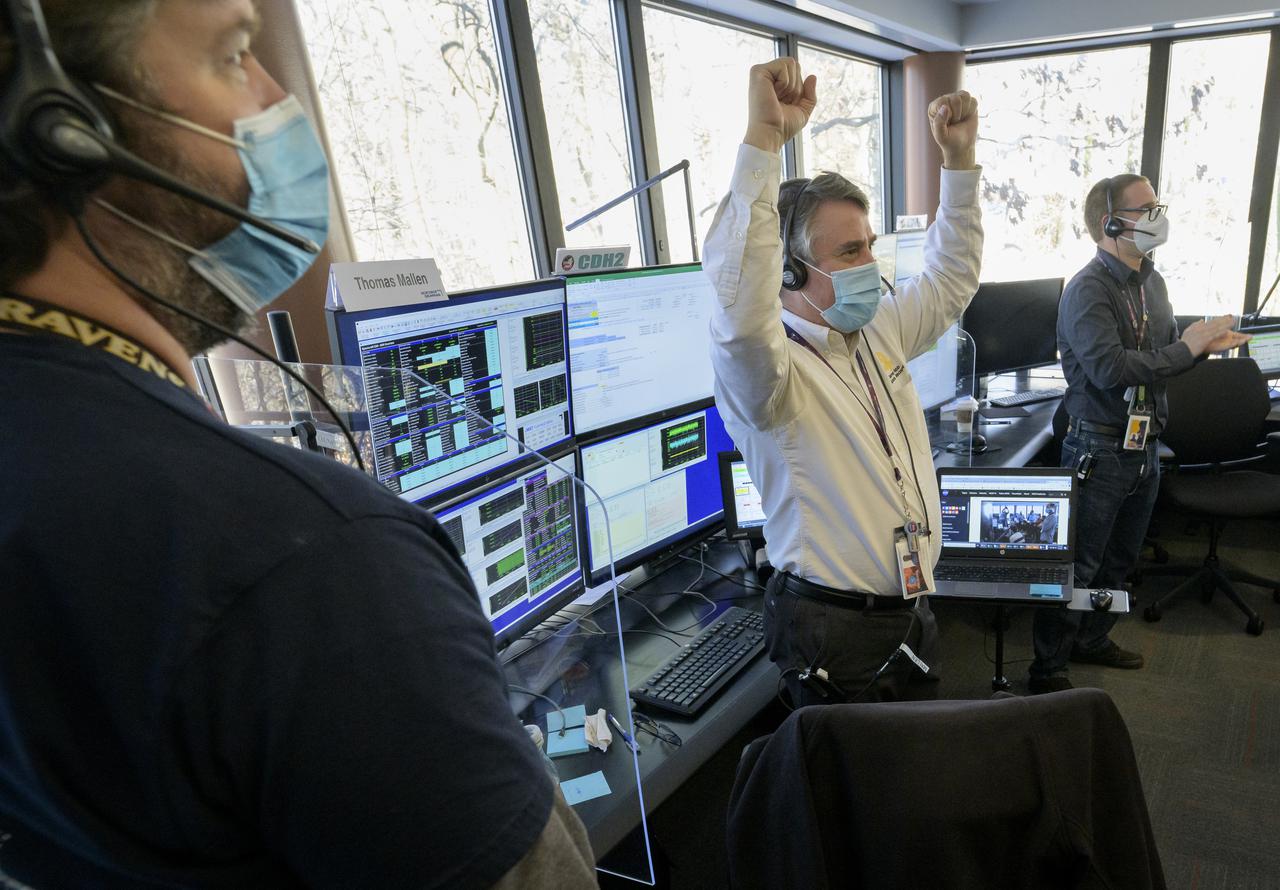
NASA’s James Webb Space Telescope mission operations team celebrates, Saturday, Jan. 8, 2022, at the Space Telescope Science Institute in Baltimore, after confirming that the observatory’s final primary mirror wing successfully extended and locked into place. With Webb’s 21.3-foot (6.5-meter) primary mirror fully deployed, the infrared observatory has completed its unprecedented process of unfolding in space to prepare for science operations. The observatory will study every phase of cosmic history—from within our solar system to the most distant observable galaxies in the early universe. Photo Credit: (NASA/Bill Ingalls)
Engineering teams at NASA’s James Webb Space Telescope Mission Operations Center at the Space Telescope Science Institute in Baltimore monitor progress as the observatory’s second primary mirror wing rotates into position, Saturday, Jan. 8, 2022. Webb, an infrared telescope with a 21.3-foot (6.5-meter) primary mirror, was folded up for launch and underwent an unprecedented deployment process to unfold in space. As NASA's next flagship observatory, Webb will study every phase of cosmic history—from within our solar system to the most distant observable galaxies in the early universe. Photo Credit: (NASA/Bill Ingalls)
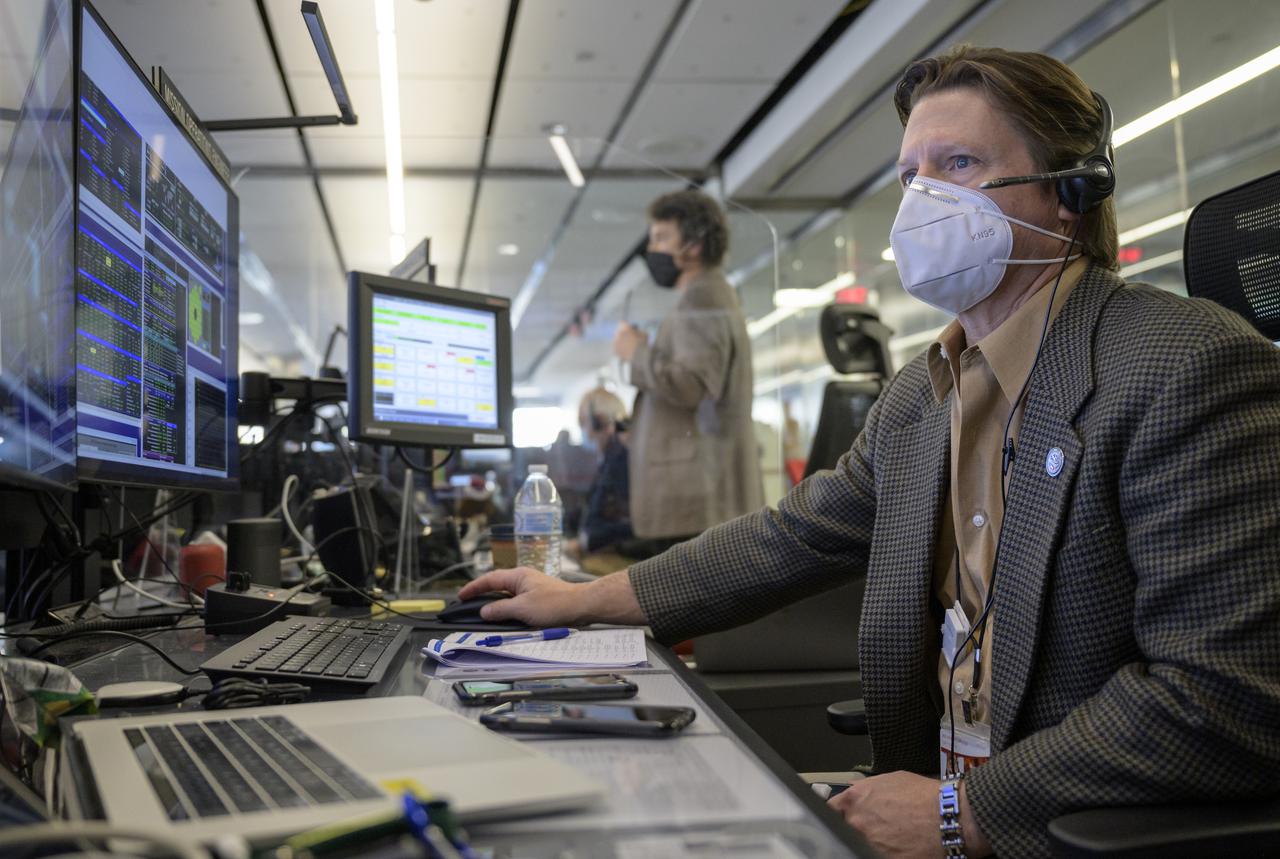
NASA James Webb Space Telescope Mission Operations Engineer Kenny McKenzie monitors the progress of Webb’s second primary mirror wing latching, Saturday, Jan. 8, 2022, in Baltimore. When fully latched, the infrared observatory will have completed its unprecedented process of unfolding in space to prepare for science operations. Webb will study every phase of cosmic history—from within our solar system to the most distant observable galaxies in the early universe. Photo Credit: (NASA/Bill Ingalls)
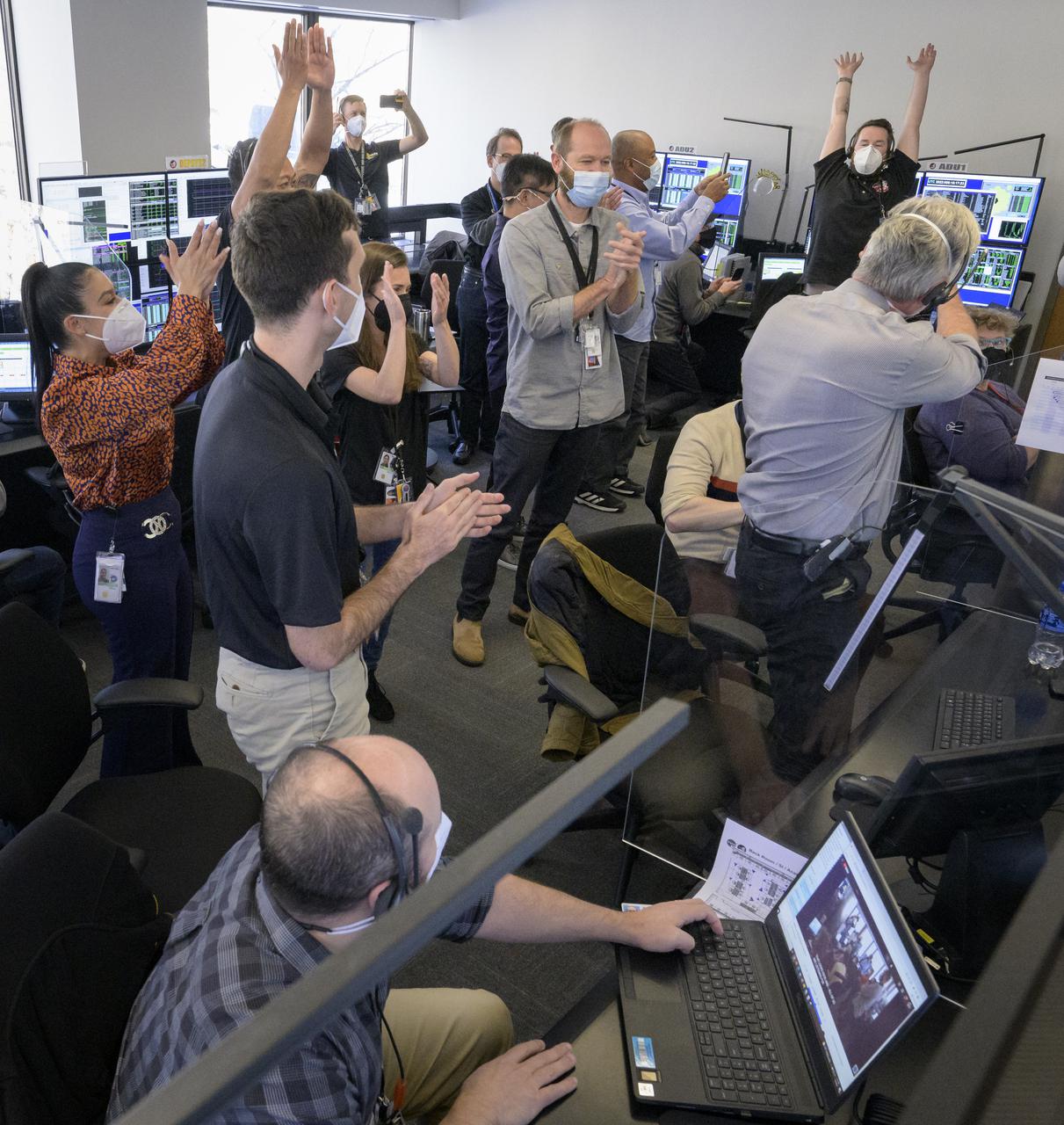
NASA’s James Webb Space Telescope mission operations team celebrates, Saturday, Jan. 8, 2022, at the Space Telescope Science Institute in Baltimore, after confirming that the observatory’s final primary mirror wing successfully extended and locked into place. With Webb’s 21.3-foot (6.5-meter) primary mirror fully deployed, the infrared observatory has completed its unprecedented process of unfolding in space to prepare for science operations. The observatory will study every phase of cosmic history—from within our solar system to the most distant observable galaxies in the early universe. Photo Credit: (NASA/Bill Ingalls)
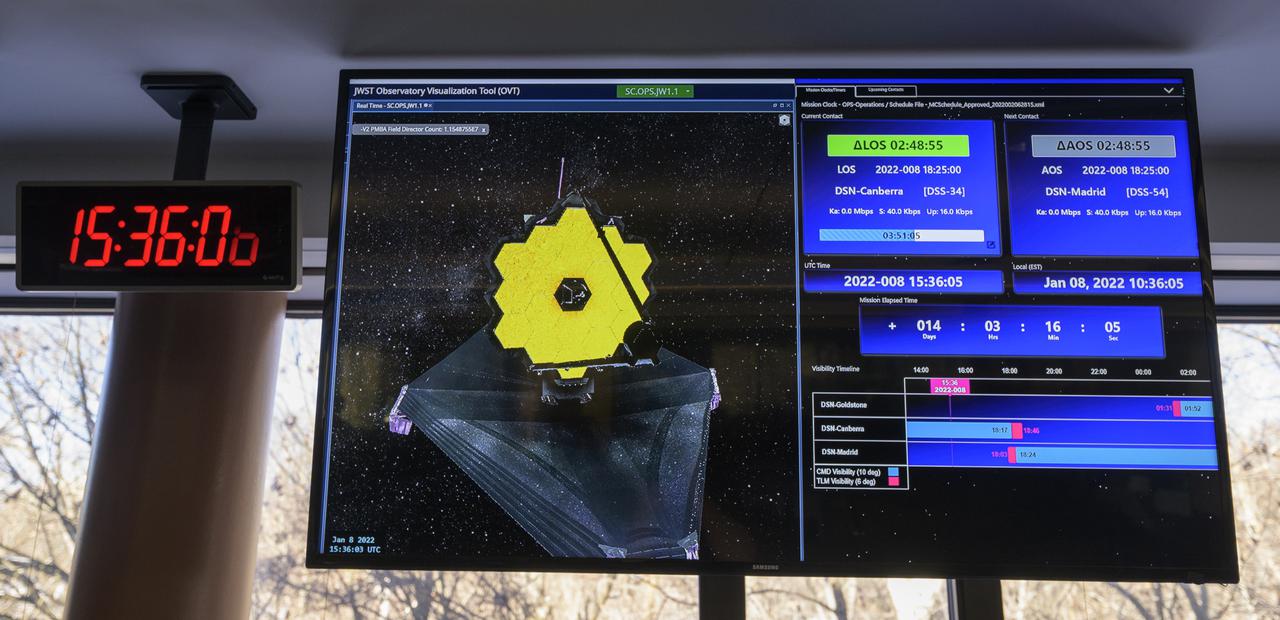
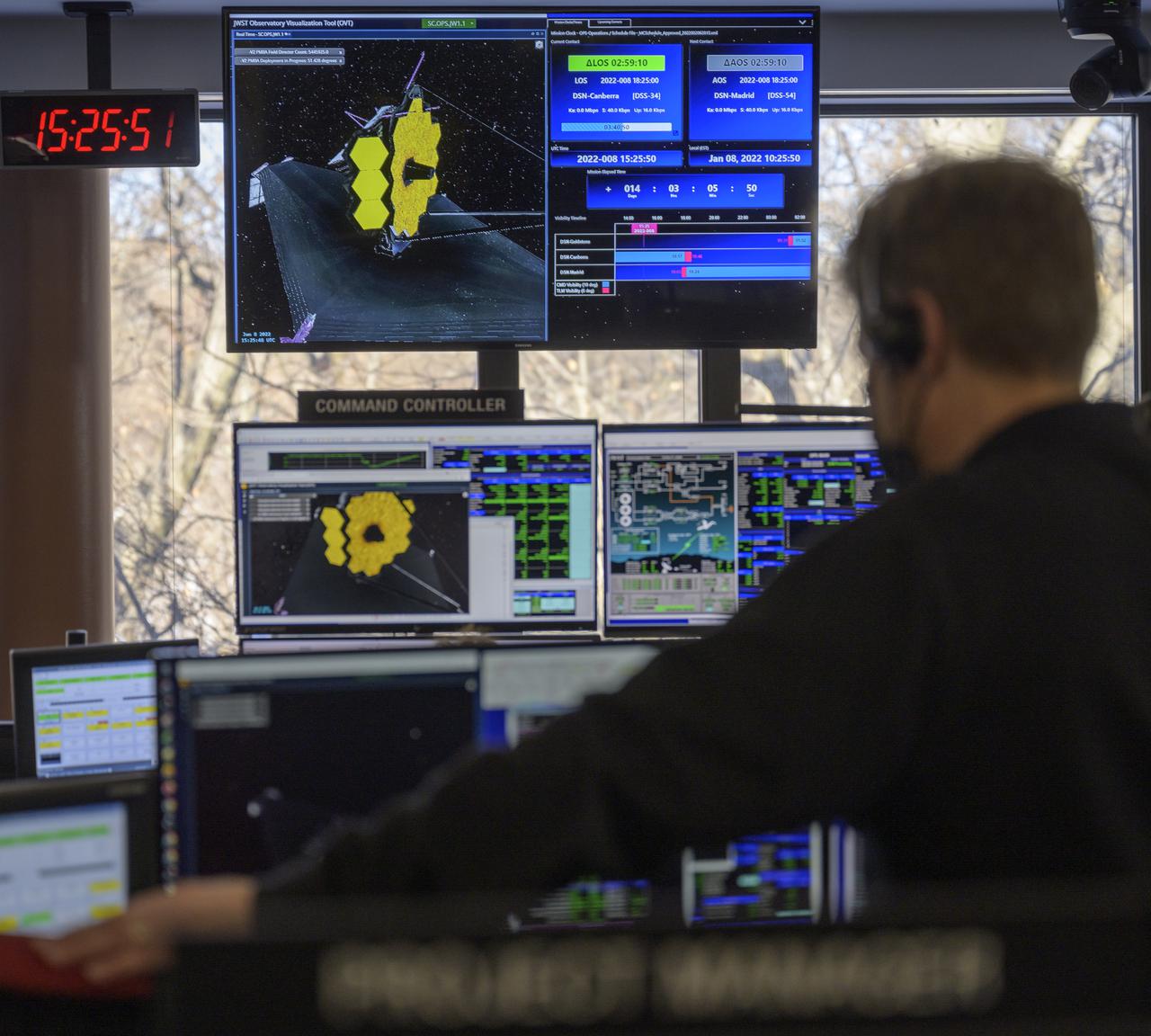
A monitor in the NASA James Webb Space Telescope flight control room of the Space Telescope Science Institute shows the progress of the second primary mirror wing latching on the Webb observatory, Saturday, Jan. 8, 2022, in Baltimore. When fully latched, the infrared observatory will have completed its unprecedented process of unfolding in space to prepare for science operations. Webb will study every phase of cosmic history—from within our solar system to the most distant observable galaxies in the early universe. Photo Credit: (NASA/Bill Ingalls)

NASA James Webb Space Telescope Operations Project Scientist Jane Rigby answers questions from the media during a briefing following the successful deployment of NASA’s James Webb Space Telescope primary mirror, Saturday, Jan. 8, 2022, from the Webb Space Telescope Mission Operations Center at the Space Telescope Science Institute in Baltimore. With Webb’s 21.3-foot (6.5-meter) primary mirror fully deployed, the infrared observatory has completed its unprecedented process of unfolding in space to prepare for science operations. The observatory will study every phase of cosmic history—from within our solar system to the most distant observable galaxies in the early universe. Photo Credit: (NASA/Bill Ingalls)

NASA James Webb Space Telescope Mission Operations Manager Carl Starr monitors the progress of the Webb observatory as it’s second primary mirror wing is prepared to rotate into position, Saturday, Jan. 8, 2022, from NASA’s James Webb Space Telescope Mission Operations Center at the Space Telescope Science Institute in Baltimore. Webb, an infrared telescope with a 21.3-foot (6.5-meter) primary mirror, was folded up for launch and underwent an unprecedented deployment process to unfold in space. As NASA's next flagship observatory, Webb will study every phase of cosmic history—from within our solar system to the most distant observable galaxies in the early universe. Photo Credit: (NASA/Bill Ingalls)
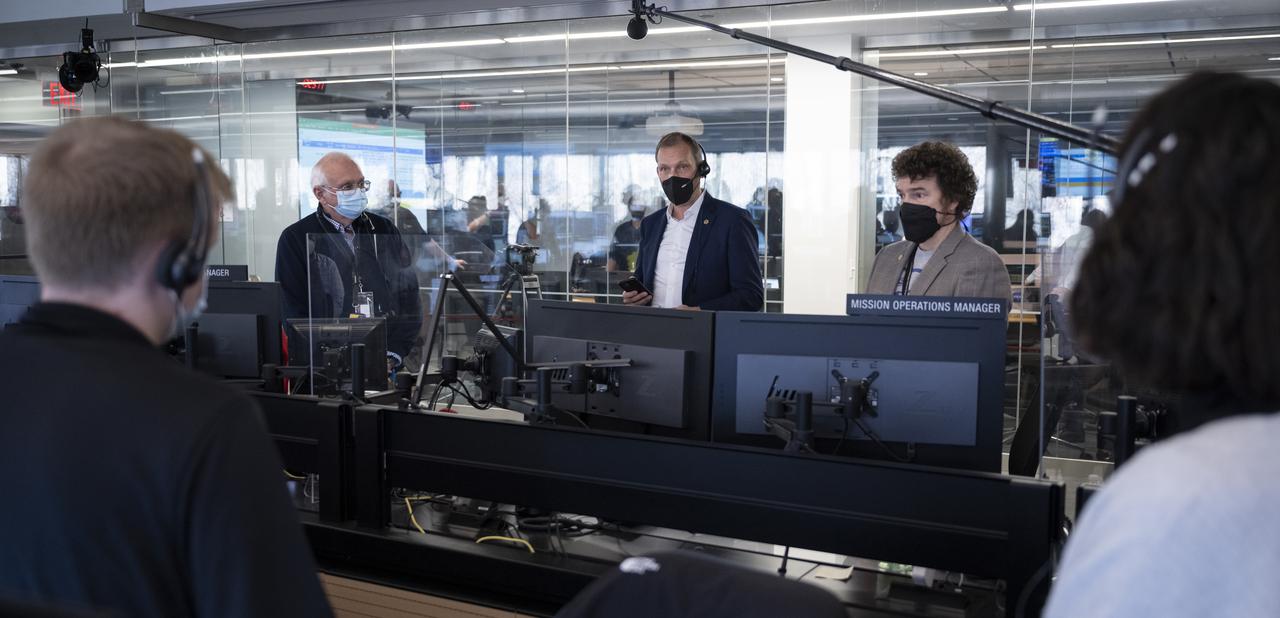
NASA Associate Administrator for the Science Mission Directorate Thomas Zurbuchen congratulates the NASA James Webb Space Telescope mission operations team after confirming that the observatory’s final primary mirror wing successfully extended and locked into place, Saturday, Jan. 8, 2022, at the Space Telescope Science Institute in Baltimore. With Webb’s 21.3-foot (6.5-meter) primary mirror fully deployed, the infrared observatory has completed its unprecedented process of unfolding in space to prepare for science operations. The observatory will study every phase of cosmic history—from within our solar system to the most distant observable galaxies in the early universe. Photo Credit: (NASA/Bill Ingalls)
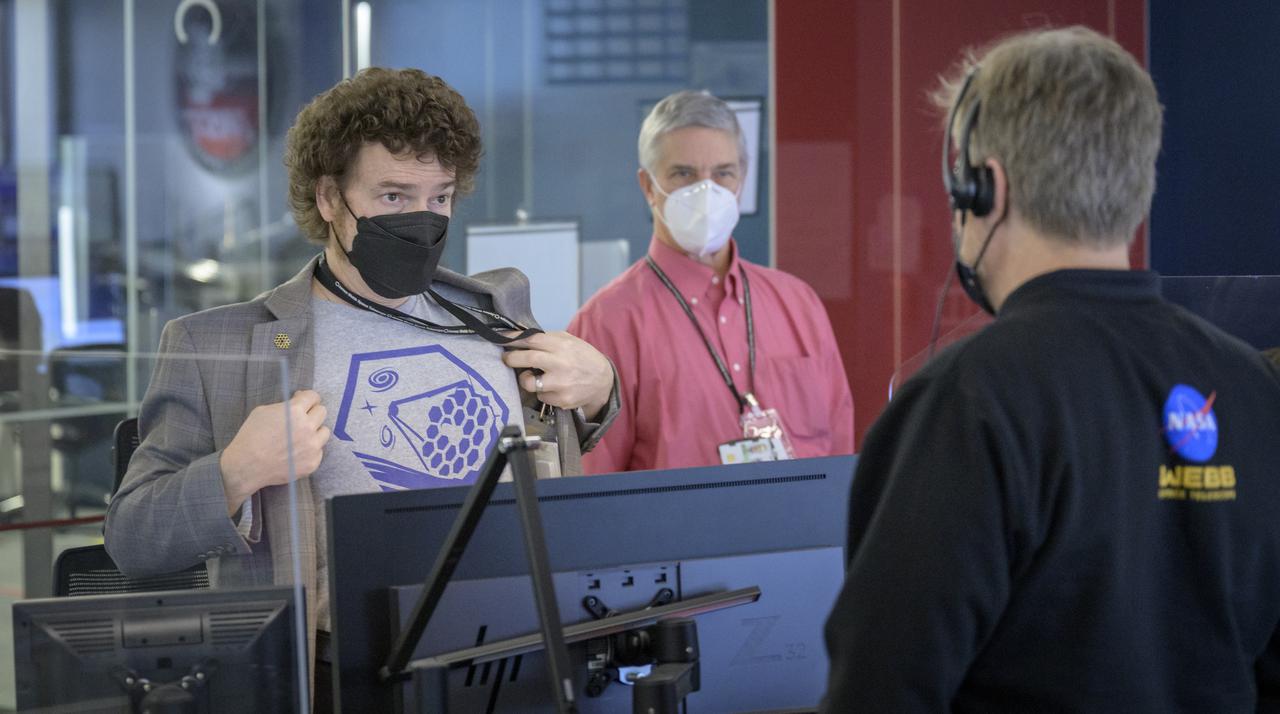
NASA James Webb Space Telescope Mission Operations Manager Carl Starr, left, shows his Webb shirt to NASA James Webb Space Telescope Commissioning Manager John Durning, right, as they prepare to monitor the progress of the observatory’s second primary mirror wing rotating into position, Saturday, Jan. 8, 2022, at NASA’s James Webb Space Telescope Mission Operations Center at the Space Telescope Science Institute in Baltimore. Webb, an infrared telescope with a 21.3-foot (6.5-meter) primary mirror, was folded up for launch and underwent an unprecedented deployment process to unfold in space. As NASA's next flagship observatory, Webb will study every phase of cosmic history—from within our solar system to the most distant observable galaxies in the early universe. Photo Credit: (NASA/Bill Ingalls)
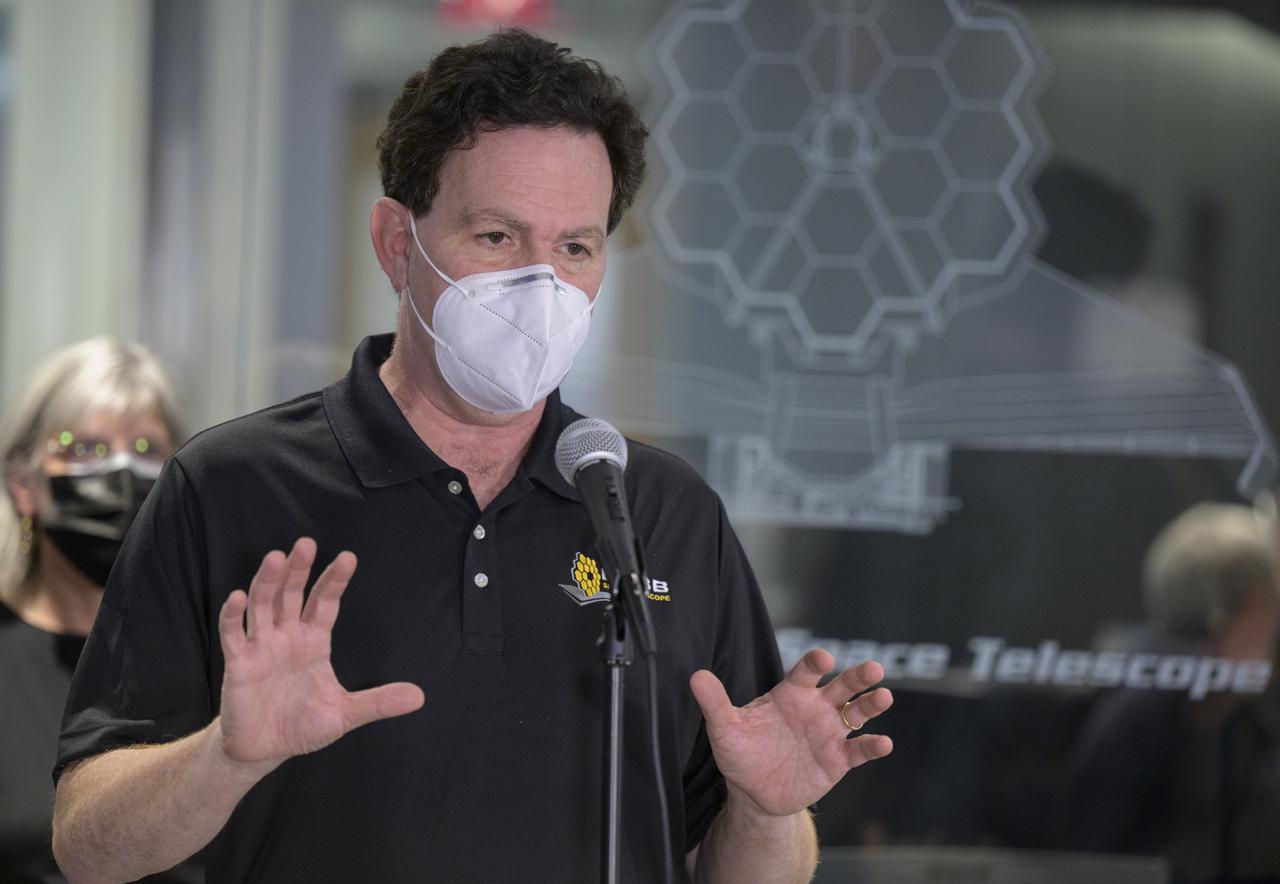
NASA James Webb Space Telescope Element Manager Lee Feinberg answers questions from the media during a briefing following the successful deployment of NASA’s James Webb Space Telescope primary mirror, Saturday, Jan. 8, 2022, from the Webb Space Telescope Mission Operations Center at the Space Telescope Science Institute in Baltimore. With Webb’s 21.3-foot (6.5-meter) primary mirror fully deployed, the infrared observatory has completed its unprecedented process of unfolding in space to prepare for science operations. The observatory will study every phase of cosmic history—from within our solar system to the most distant observable galaxies in the early universe. Photo Credit: (NASA/Bill Ingalls)
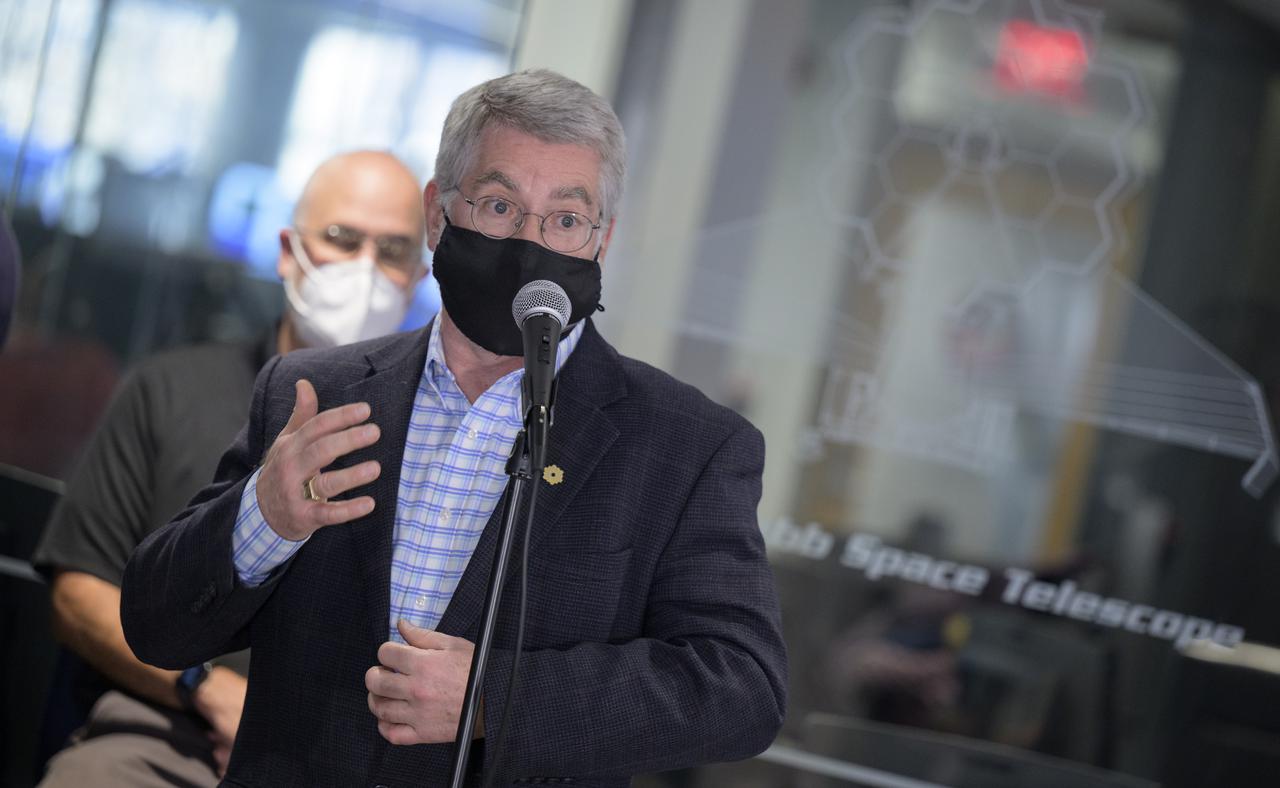
NASA James Webb Space Telescope Mission Systems Engineer Mike Menzel answers questions from the media during a briefing following the successful deployment of NASA’s James Webb Space Telescope primary mirror, Saturday, Jan. 8, 2022, from the Webb Space Telescope Mission Operations Center at the Space Telescope Science Institute in Baltimore. With Webb’s 21.3-foot (6.5-meter) primary mirror fully deployed, the infrared observatory has completed its unprecedented process of unfolding in space to prepare for science operations. The observatory will study every phase of cosmic history—from within our solar system to the most distant observable galaxies in the early universe. Photo Credit: (NASA/Bill Ingalls)
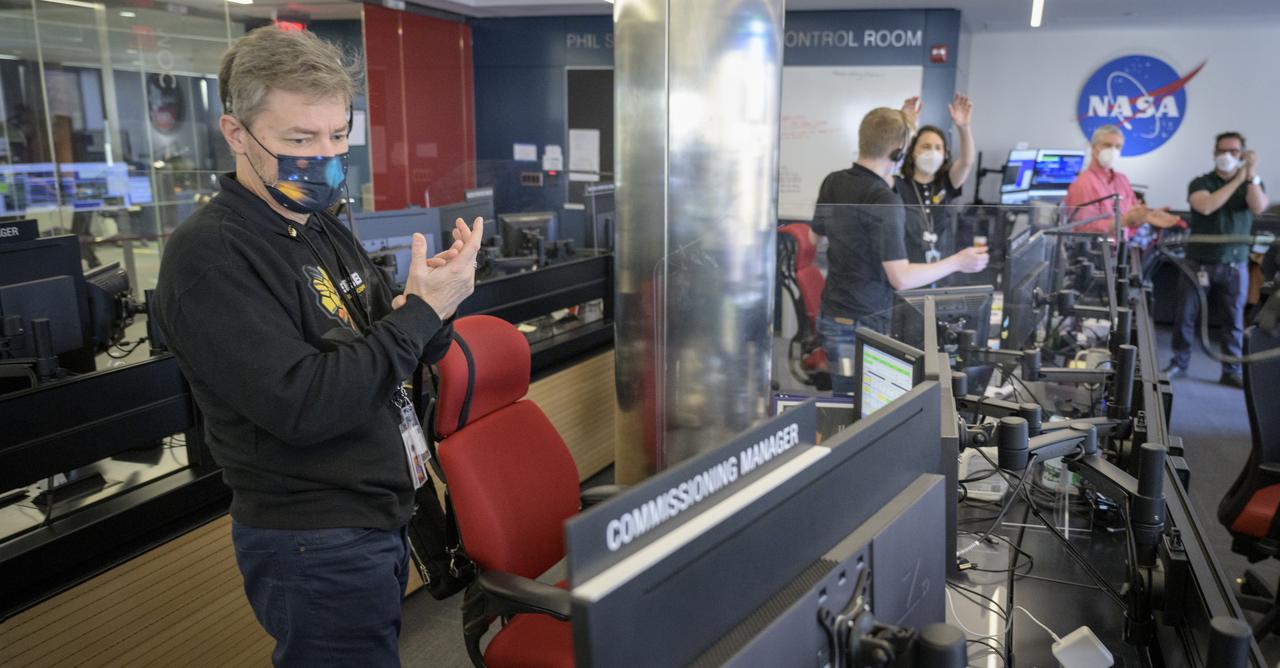
NASA James Webb Space Telescope Commissioning Manager John Durning, left, and engineering teams celebrate at the Space Telescope Science Institute in Baltimore as the second primary mirror wing of NASA’s James Webb Space Telescope unfolds, before beginning the process of latching the mirror wing into place, Saturday, Jan. 8, 2022. When fully latched, the infrared observatory will have completed its unprecedented process of unfolding in space to prepare for science operations. Webb will study every phase of cosmic history—from within our solar system to the most distant observable galaxies in the early universe. Photo Credit: (NASA/Bill Ingalls)
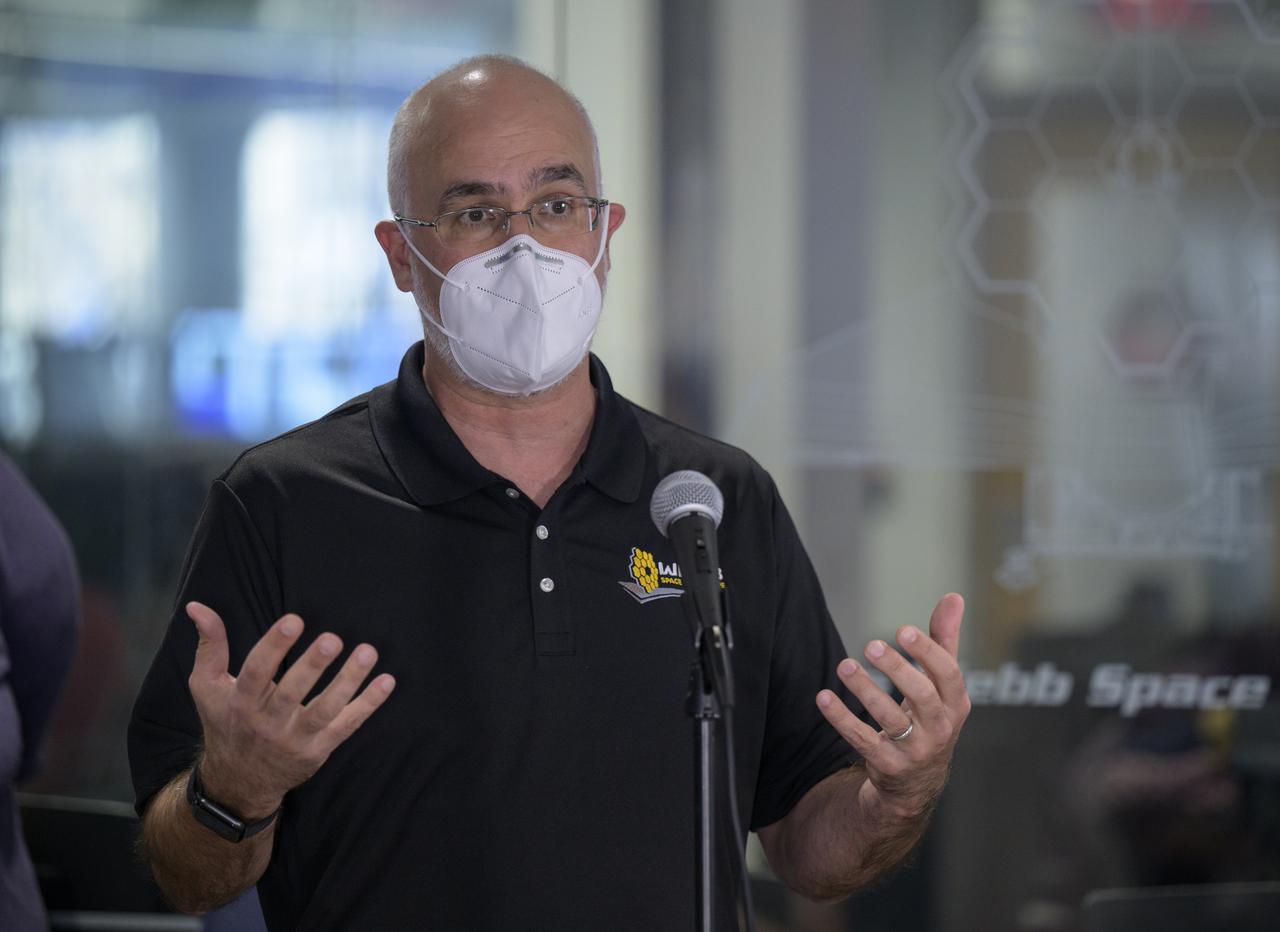
Deputy Program Manager, Northrop Grumman, Vince Heeg answers questions from the media during a briefing following the successful deployment of NASA’s James Webb Space Telescope primary mirror, Saturday, Jan. 8, 2022, from the Webb Space Telescope Mission Operations Center at the Space Telescope Science Institute in Baltimore. With Webb’s 21.3-foot (6.5-meter) primary mirror fully deployed, the infrared observatory has completed its unprecedented process of unfolding in space to prepare for science operations. The observatory will study every phase of cosmic history—from within our solar system to the most distant observable galaxies in the early universe. Photo Credit: (NASA/Bill Ingalls)
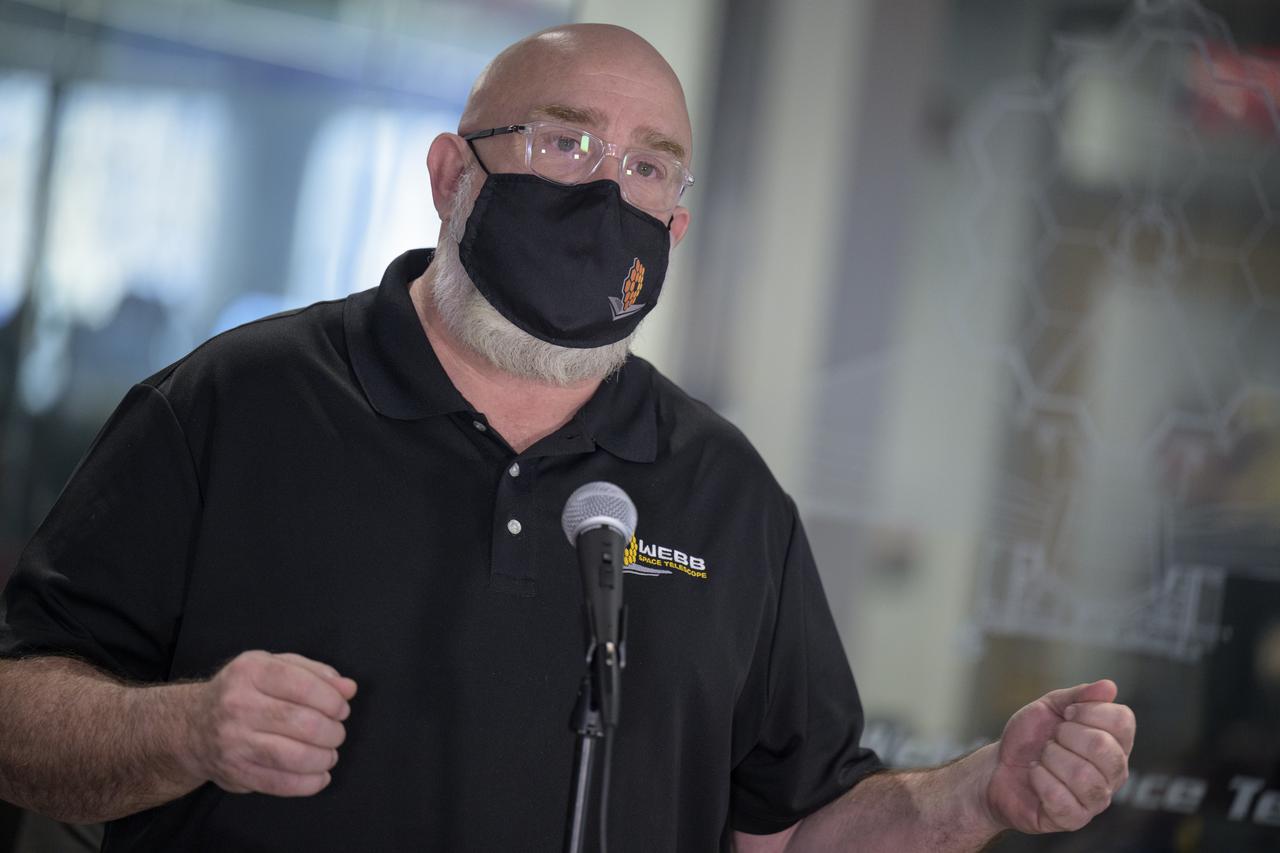
Vice President and Program Manager, Webb, Northrop Grumman, Scott Willoughby answers questions from the media during a briefing following the successful deployment of NASA’s James Webb Space Telescope primary mirror, Saturday, Jan. 8, 2022, from the Webb Space Telescope Mission Operations Center at the Space Telescope Science Institute in Baltimore. With Webb’s 21.3-foot (6.5-meter) primary mirror fully deployed, the infrared observatory has completed its unprecedented process of unfolding in space to prepare for science operations. The observatory will study every phase of cosmic history—from within our solar system to the most distant observable galaxies in the early universe. Photo Credit: (NASA/Bill Ingalls)
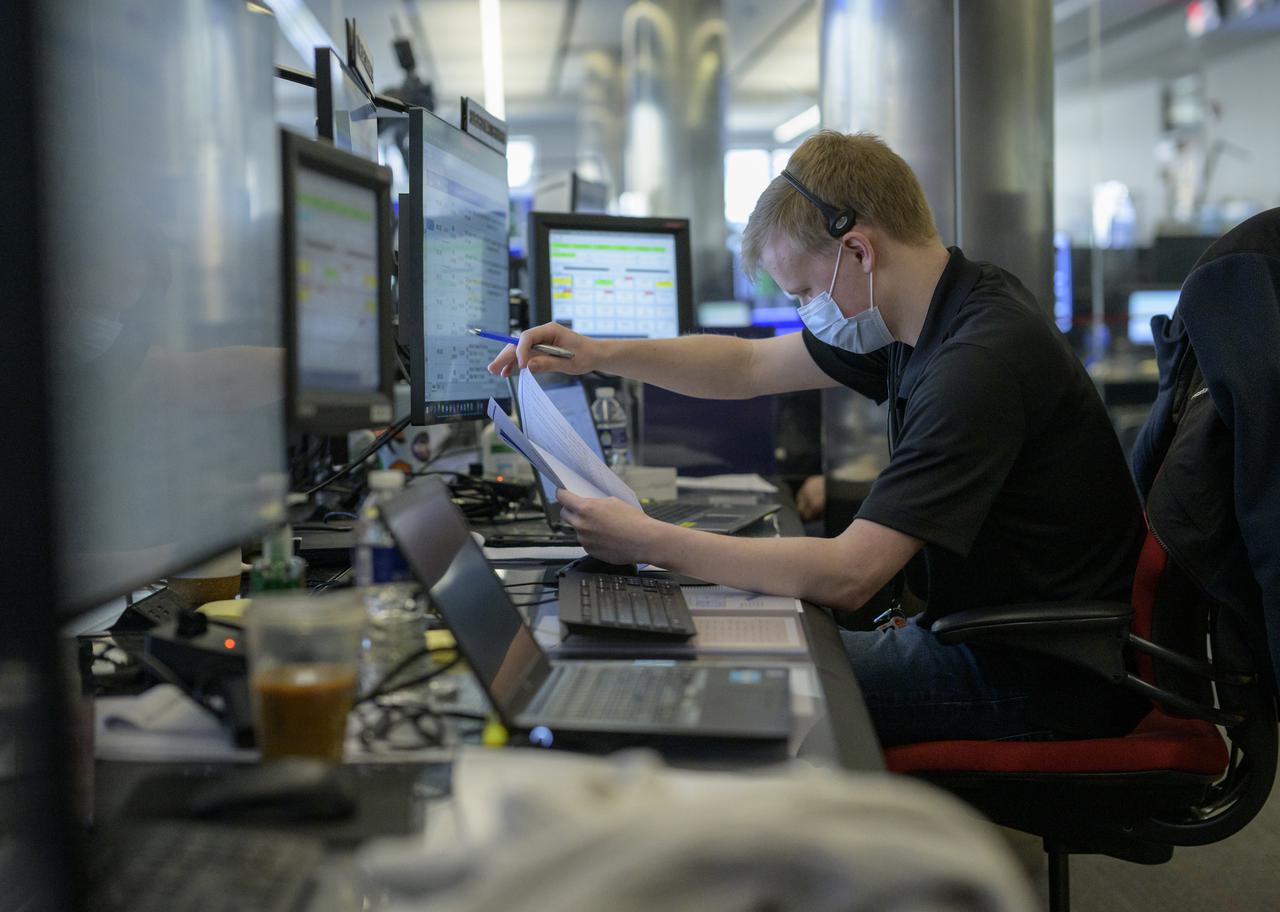
NASA James Webb Space Telescope Timeline Coordinator Matt Wasiak monitors the progress of the Webb observatory as it’s second primary mirror wing is prepared to rotate into position, Saturday, Jan. 8, 2022, from NASA’s James Webb Space Telescope Mission Operations Center at the Space Telescope Science Institute in Baltimore. Webb, an infrared telescope with a 21.3-foot (6.5-meter) primary mirror, was folded up for launch and underwent an unprecedented deployment process to unfold in space. As NASA's next flagship observatory, Webb will study every phase of cosmic history—from within our solar system to the most distant observable galaxies in the early universe. Photo Credit: (NASA/Bill Ingalls)
Engineering teams at NASA’s James Webb Space Telescope Mission Operations Center at the Space Telescope Science Institute in Baltimore monitor progress as the observatory’s second primary mirror wing rotates into position, Saturday, Jan. 8, 2022. Webb, an infrared telescope with a 21.3-foot (6.5-meter) primary mirror, was folded up for launch and underwent an unprecedented deployment process to unfold in space. As NASA's next flagship observatory, Webb will study every phase of cosmic history—from within our solar system to the most distant observable galaxies in the early universe. Photo Credit: (NASA/Bill Ingalls)
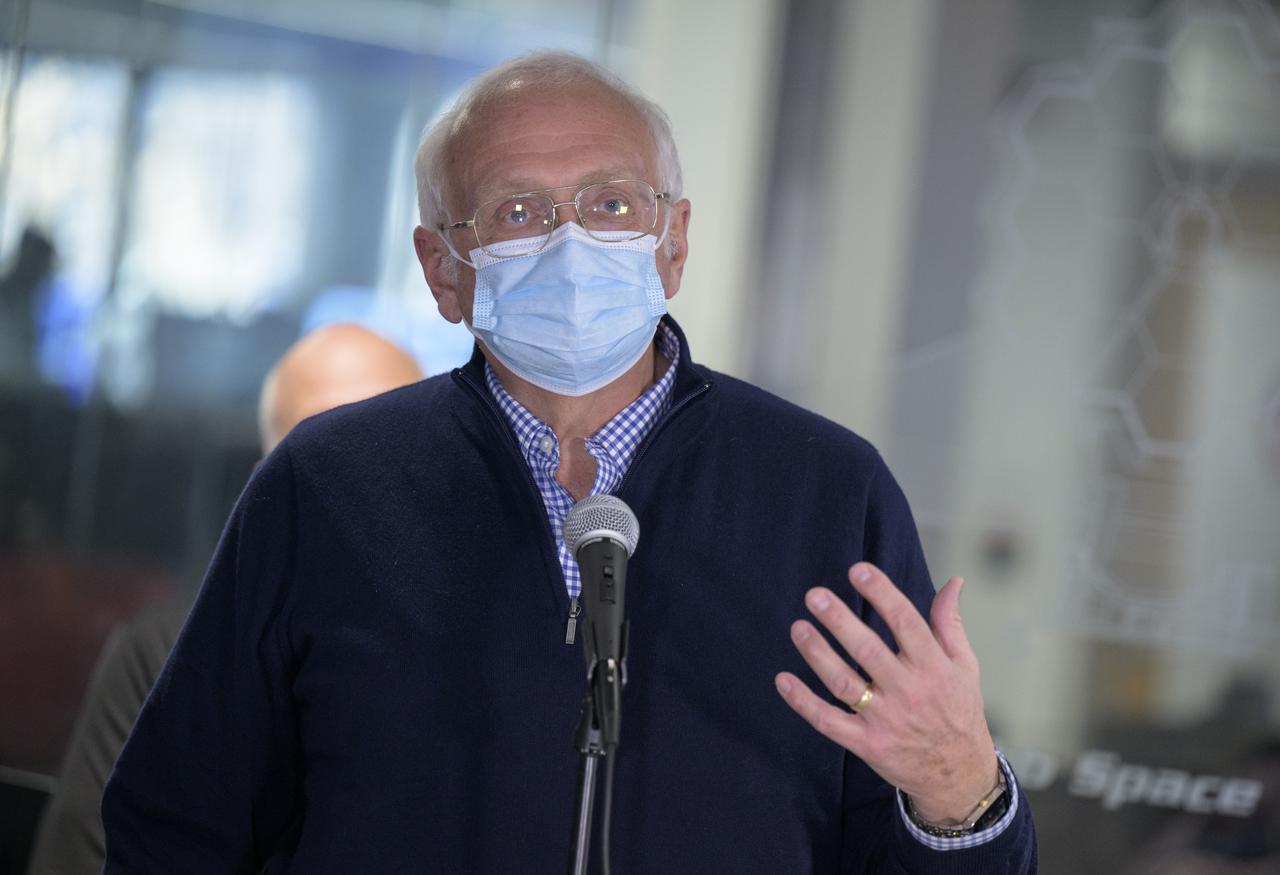
NASA James Webb Space Telescope Project Manager Bill Ochs answers questions from the media during a briefing following the successful deployment of NASA’s James Webb Space Telescope primary mirror, Saturday, Jan. 8, 2022, from the Webb Space Telescope Mission Operations Center at the Space Telescope Science Institute in Baltimore. With Webb’s 21.3-foot (6.5-meter) primary mirror fully deployed, the infrared observatory has completed its unprecedented process of unfolding in space to prepare for science operations. The observatory will study every phase of cosmic history—from within our solar system to the most distant observable galaxies in the early universe. Photo Credit: (NASA/Bill Ingalls)
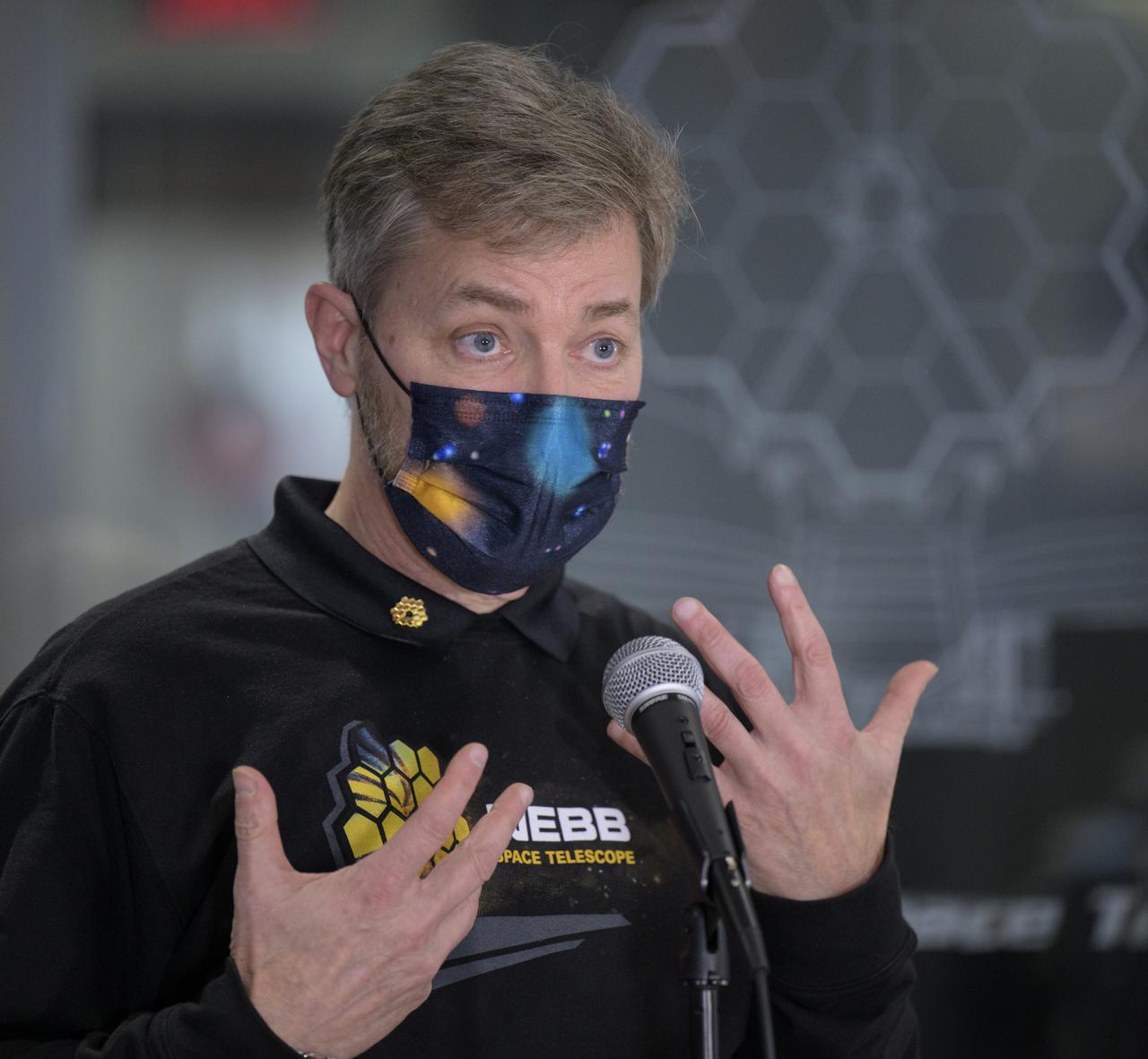
NASA James Webb Space Telescope Commissioning Manager John Durning answers questions from the media during a briefing following the successful deployment of NASA’s James Webb Space Telescope primary mirror, Saturday, Jan. 8, 2022, from the Webb Space Telescope Mission Operations Center at the Space Telescope Science Institute in Baltimore. With Webb’s 21.3-foot (6.5-meter) primary mirror fully deployed, the infrared observatory has completed its unprecedented process of unfolding in space to prepare for science operations. The observatory will study every phase of cosmic history—from within our solar system to the most distant observable galaxies in the early universe. Photo Credit: (NASA/Bill Ingalls)
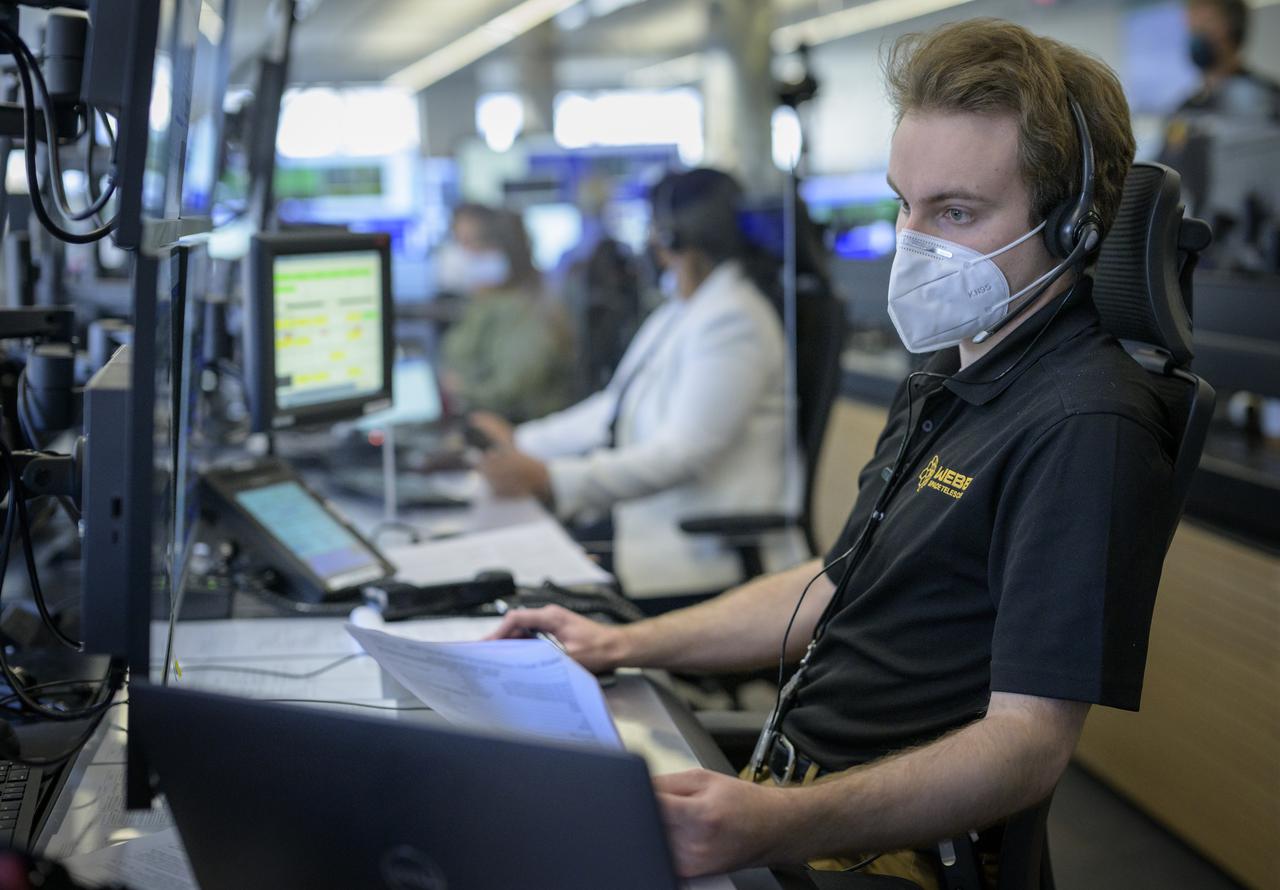
NASA James Webb Space Telescope Ground Engineer Evan Adams monitors the progress of the Webb observatory as it’s second primary mirror wing is prepared to rotate into position, Saturday, Jan. 8, 2022, from NASA’s James Webb Space Telescope Mission Operations Center at the Space Telescope Science Institute in Baltimore. Webb, an infrared telescope with a 21.3-foot (6.5-meter) primary mirror, was folded up for launch and underwent an unprecedented deployment process to unfold in space. As NASA's next flagship observatory, Webb will study every phase of cosmic history—from within our solar system to the most distant observable galaxies in the early universe. Photo Credit: (NASA/Bill Ingalls)
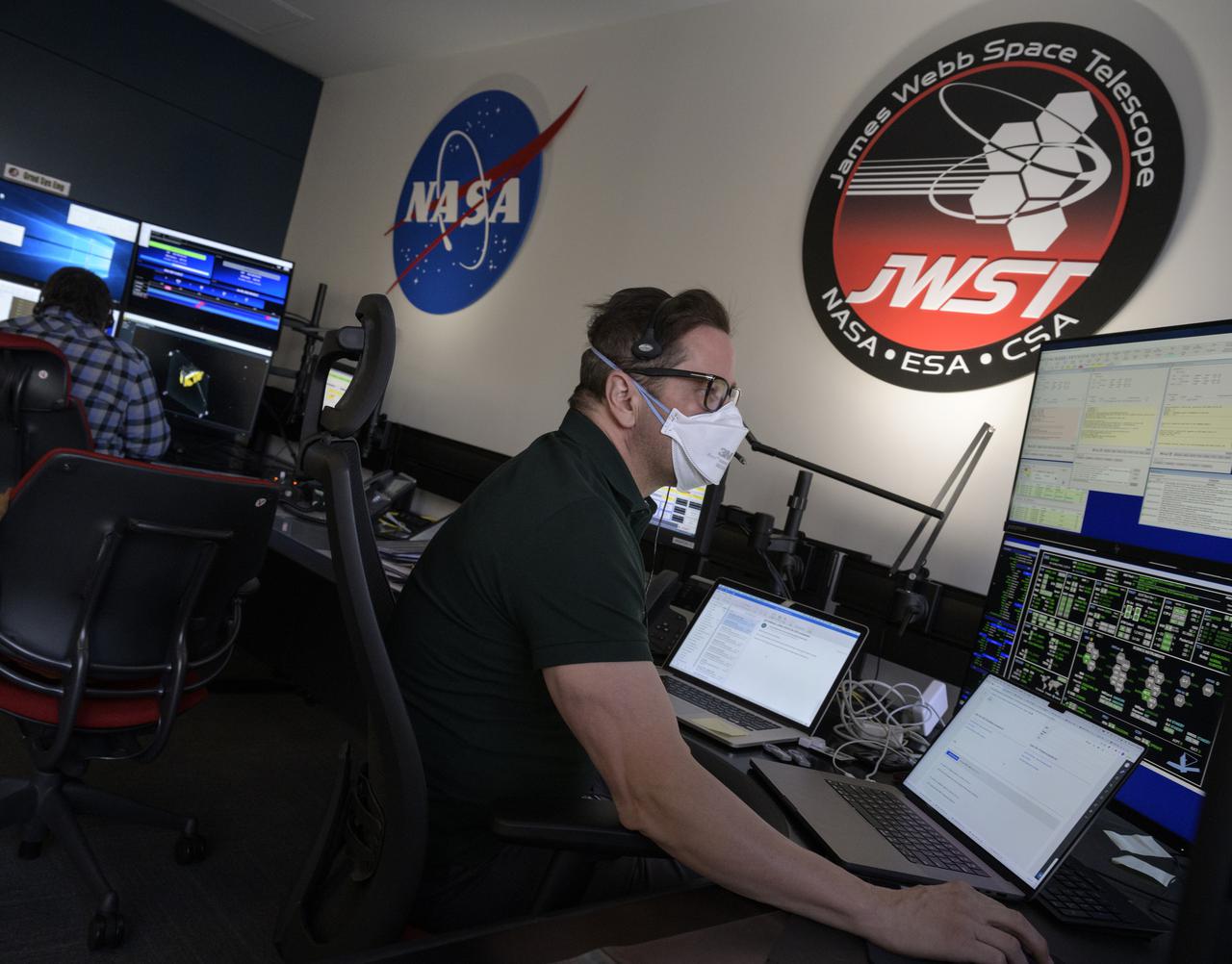
NASA James Webb Space Telescope Ground Systems Engineer Carl Reis at NASA’s James Webb Space Telescope Mission Operations Center at the Space Telescope Science Institute in Baltimore monitors the progress as the observatory’s second primary mirror wing rotates into position, Saturday, Jan. 8, 2022. Webb, an infrared telescope with a 21.3-foot (6.5-meter) primary mirror, was folded up for launch and underwent an unprecedented deployment process to unfold in space. As NASA's next flagship observatory, Webb will study every phase of cosmic history—from within our solar system to the most distant observable galaxies in the early universe. Photo Credit: (NASA/Bill Ingalls)
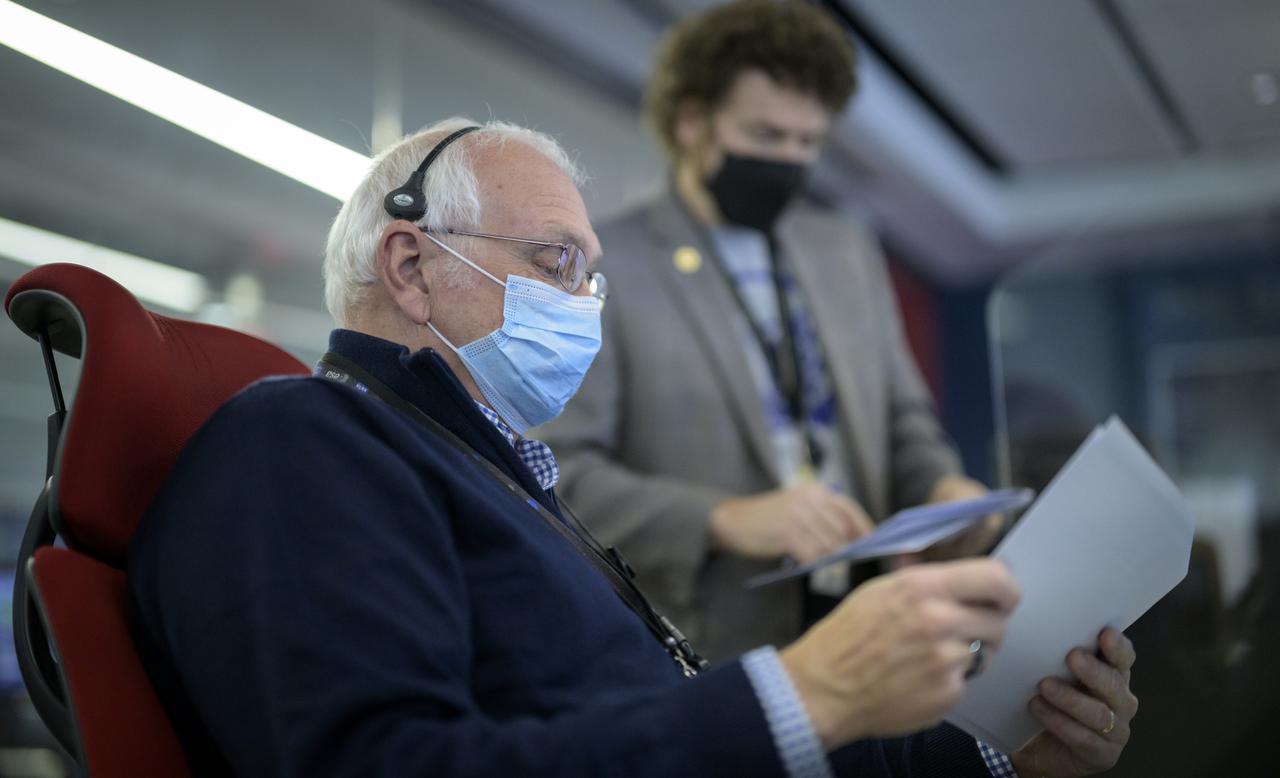
NASA James Webb Space Telescope Project Manager Bill Ochs, left, and NASA James Webb Space Telescope Mission Operations Manager Carl Starr, monitor the progress of the Webb observatory as it’s second primary mirror wing is prepared to rotate into position, Saturday, Jan. 8, 2022, from NASA’s James Webb Space Telescope Mission Operations Center at the Space Telescope Science Institute in Baltimore. Webb, an infrared telescope with a 21.3-foot (6.5-meter) primary mirror, was folded up for launch and underwent an unprecedented deployment process to unfold in space. As NASA's next flagship observatory, Webb will study every phase of cosmic history—from within our solar system to the most distant observable galaxies in the early universe. Photo Credit: (NASA/Bill Ingalls)
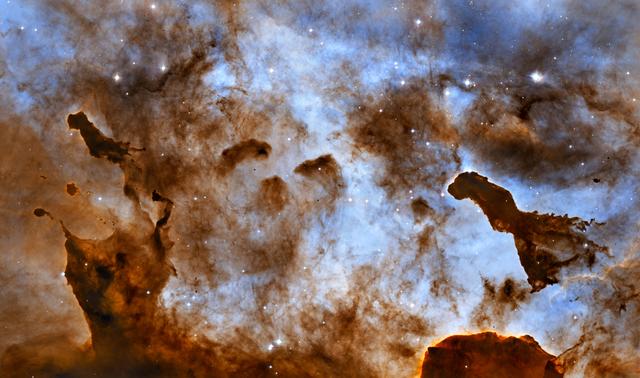
NASA image release September 16, 2010 Enjoying a frozen treat on a hot summer day can leave a sticky mess as it melts in the Sun and deforms. In the cold vacuum of space, there is no edible ice cream, but there is radiation from massive stars that is carving away at cold molecular clouds, creating bizarre, fantasy-like structures. These one-light-year-tall pillars of cold hydrogen and dust, imaged by the Hubble Space Telescope, are located in the Carina Nebula. Violent stellar winds and powerful radiation from massive stars are sculpting the surrounding nebula. Inside the dense structures, new stars may be born. This image of dust pillars in the Carina Nebula is a composite of 2005 observations taken of the region in hydrogen light (light emitted by hydrogen atoms) along with 2010 observations taken in oxygen light (light emitted by oxygen atoms), both times with Hubble's Advanced Camera for Surveys. The immense Carina Nebula is an estimated 7,500 light-years away in the southern constellation Carina. The Hubble Space Telescope is a project of international cooperation between NASA and the European Space Agency. NASA's Goddard Space Flight Center manages the telescope. The Space Telescope Science Institute (STScI) conducts Hubble science operations. STScI is operated for NASA by the Association of Universities for Research in Astronomy, Inc. in Washington, D.C. <b><a href="http://www.nasa.gov/centers/goddard/home/index.html" rel="nofollow">NASA Goddard Space Flight Center</a></b> is home to the nation's largest organization of combined scientists, engineers and technologists that build spacecraft, instruments and new technology to study the Earth, the sun, our solar system, and the universe. <b>Follow us on <a href="http://twitter.com/NASA_GoddardPix" rel="nofollow">Twitter</a></b> <b>Join us on <a href="http://www.facebook.com/pages/Greenbelt-MD/NASA-Goddard/395013845897?ref=tsd" rel="nofollow">Facebook</a></b>
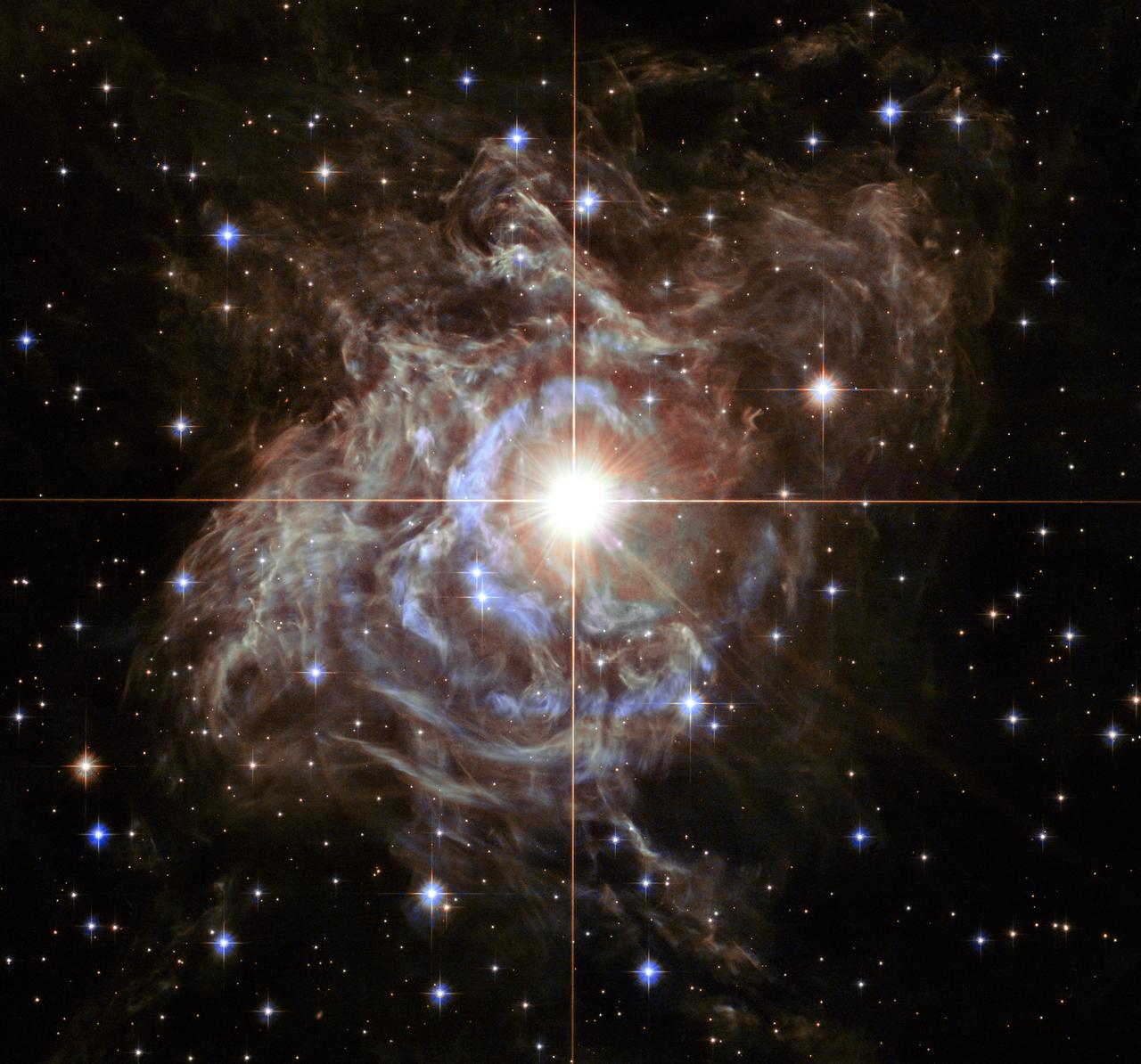
This festive NASA Hubble Space Telescope image resembles a holiday wreath made of sparkling lights. The bright southern hemisphere star RS Puppis, at the center of the image, is swaddled in a gossamer cocoon of reflective dust illuminated by the glittering star. The super star is ten times more massive than our sun and 200 times larger. RS Puppis rhythmically brightens and dims over a six-week cycle. It is one of the most luminous in the class of so-called Cepheid variable stars. Its average intrinsic brightness is 15,000 times greater than our sun’s luminosity. The nebula flickers in brightness as pulses of light from the Cepheid propagate outwards. Hubble took a series of photos of light flashes rippling across the nebula in a phenomenon known as a "light echo." Even though light travels through space fast enough to span the gap between Earth and the moon in a little over a second, the nebula is so large that reflected light can actually be photographed traversing the nebula. By observing the fluctuation of light in RS Puppis itself, as well as recording the faint reflections of light pulses moving across the nebula, astronomers are able to measure these light echoes and pin down a very accurate distance. The distance to RS Puppis has been narrowed down to 6,500 light-years (with a margin of error of only one percent). The Hubble Space Telescope is a project of international cooperation between NASA and the European Space Agency. NASA's Goddard Space Flight Center in Greenbelt, Md., manages the telescope. The Space Telescope Science Institute (STScI) in Baltimore, Md., conducts Hubble science operations. STScI is operated by the Association of Universities for Research in Astronomy, Inc., in Washington, D.C. Acknowledgment: H. Bond (STScI and Pennsylvania State University) <b><a href="http://www.nasa.gov/audience/formedia/features/MP_Photo_Guidelines.html" rel="nofollow">NASA image use policy.</a></b> <b><a href="http://www.nasa.gov/centers/goddard/home/index.html" rel="nofollow">NASA Goddard Space Flight Center</a></b> enables NASA’s mission through four scientific endeavors: Earth Science, Heliophysics, Solar System Exploration, and Astrophysics. Goddard plays a leading role in NASA’s accomplishments by contributing compelling scientific knowledge to advance the Agency’s mission. <b>Follow us on <a href="http://twitter.com/NASA_GoddardPix" rel="nofollow">Twitter</a></b> <b>Like us on <a href="http://www.facebook.com/pages/Greenbelt-MD/NASA-Goddard/395013845897?ref=tsd" rel="nofollow">Facebook</a></b> <b>Find us on <a href="http://instagram.com/nasagoddard?vm=grid" rel="nofollow">Instagram</a></b>
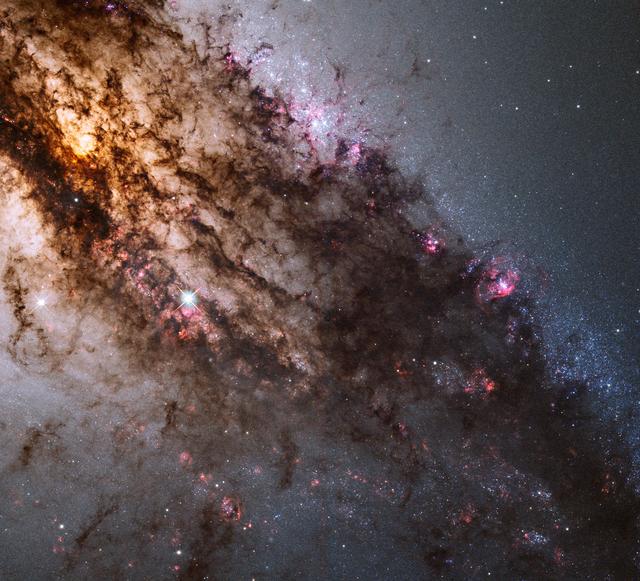
NASA image release June 16, 2011 Resembling looming rain clouds on a stormy day, dark lanes of dust crisscross the giant elliptical galaxy Centaurus A. Hubble's panchromatic vision, stretching from ultraviolet through near-infrared wavelengths, reveals the vibrant glow of young, blue star clusters and a glimpse into regions normally obscured by the dust. The warped shape of Centaurus A's disk of gas and dust is evidence for a past collision and merger with another galaxy. The resulting shockwaves cause hydrogen gas clouds to compress, triggering a firestorm of new star formation. These are visible in the red patches in this Hubble close-up. At a distance of just over 11 million light-years, Centaurus A contains the closest active galactic nucleus to Earth. The center is home for a supermassive black hole that ejects jets of high-speed gas into space, but neither the supermassive or the jets are visible in this image. This image was taken in July 2010 with Hubble's Wide Field Camera 3. The Hubble Space Telescope is a project of international cooperation between NASA and the European Space Agency. NASA's Goddard Space Flight Center manages the telescope. The Space Telescope Science Institute (STScI) conducts Hubble science operations. STScI is operated for NASA by the Association of Universities for Research in Astronomy, Inc., in Washington, D.C. For images and more information about the findings, visit: <a href="http://www.nasa.gov/hubble" rel="nofollow">www.nasa.gov/hubble</a> and <a href="http://www.hubblesite.org/news/2011/18" rel="nofollow">www.hubblesite.org/news/2011/18</a> Cheryl Gundy, STSCI <b><a href="http://www.nasa.gov/centers/goddard/home/index.html" rel="nofollow">NASA Goddard Space Flight Center</a></b> enables NASA’s mission through four scientific endeavors: Earth Science, Heliophysics, Solar System Exploration, and Astrophysics. Goddard plays a leading role in NASA’s accomplishments by contributing compelling scientific knowledge to advance the Agency’s mission. <b>Follow us on <a href="http://twitter.com/NASAGoddardPix" rel="nofollow">Twitter</a></b> <b>Join us on <a href="http://www.facebook.com/pages/Greenbelt-MD/NASA-Goddard/395013845897?ref=tsd" rel="nofollow">Facebook</a></b> <b>Find us on <a href="http://web.stagram.com/n/nasagoddard/?vm=grid" rel="nofollow">Instagram</a></b>

NASA image release January 13, 2011 <b><a href="http://www.flickr.com/photos/gsfc/5352962836">These images</a></b> by NASA's Hubble Space Telescope show off two dramatically different face-on views of the spiral galaxy M51, dubbed the Whirlpool Galaxy. <b>The image above,</b> taken in visible light, highlights the attributes of a typical spiral galaxy, including graceful, curving arms, pink star-forming regions, and brilliant blue strands of star clusters. <b><a href="http://www.flickr.com/photos/gsfc/5352344517">In the image here,</a></b> most of the starlight has been removed, revealing the Whirlpool's skeletal dust structure, as seen in near-infrared light. This new image is the sharpest view of the dense dust in M51. The narrow lanes of dust revealed by Hubble reflect the galaxy's moniker, the Whirlpool Galaxy, as if they were swirling toward the galaxy's core. To map the galaxy's dust structure, researchers collected the galaxy's starlight by combining images taken in visible and near-infrared light. The visible-light image captured only some of the light; the rest was obscured by dust. The near-infrared view, however, revealed more starlight because near-infrared light penetrates dust. The researchers then subtracted the total amount of starlight from both images to see the galaxy's dust structure. The red color in the near-infrared image traces the dust, which is punctuated by hundreds of tiny clumps of stars, each about 65 light-years wide. These stars have never been seen before. The star clusters cannot be seen in visible light because dense dust enshrouds them. The image reveals details as small as 35 light-years across. Astronomers expected to see large dust clouds, ranging from about 100 light-years to more than 300 light-years wide. Instead, most of the dust is tied up in smooth and diffuse dust lanes. An encounter with another galaxy may have prevented giant clouds from forming. Probing a galaxy's dust structure serves as an important diagnostic tool for astronomers, providing invaluable information on how the gas and dust collapse to form stars. Although Hubble is providing incisive views of the internal structure of galaxies such as M51, the planned James Webb Space Telescope (JWST) is expected to produce even crisper images. Researchers constructed the image by combining visible-light exposures from Jan. 18 to 22, 2005, with the Advanced Camera for Surveys (ACS), and near-infrared light pictures taken in December 2005 with the Near Infrared Camera and Multi-Object Spectrometer (NICMOS). Credit: NASA, ESA, S. Beckwith (STScI), and the Hubble Heritage Team (STScI/AURA) The Hubble Space Telescope is a project of international cooperation between NASA and the European Space Agency. NASA's Goddard Space Flight Center manages the telescope. The Space Telescope Science Institute (STScI) conducts Hubble science operations. STScI is operated for NASA by the Association of Universities for Research in Astronomy, Inc., in Washington, D.C. <b><a href="http://www.nasa.gov/centers/goddard/home/index.html" rel="nofollow">NASA Goddard Space Flight Center</a></b> enables NASA’s mission through four scientific endeavors: Earth Science, Heliophysics, Solar System Exploration, and Astrophysics. Goddard plays a leading role in NASA’s accomplishments by contributing compelling scientific knowledge to advance the Agency’s mission. <b>Follow us on <a href="http://twitter.com/NASA_GoddardPix" rel="nofollow">Twitter</a></b> <b>Join us on <a href="http://www.facebook.com/pages/Greenbelt-MD/NASA-Goddard/395013845897?ref=tsd" rel="nofollow">Facebook</a></b>

NASA image release September 29, 2011 This image of the distant active galaxy Markarian 509 was taken in April 2007 with the Hubble Space Telescope's Wide Field Camera 2. To read more go to: <a href="http://www.nasa.gov/mission_pages/hubble/science/turbulent-black-hole.html" rel="nofollow">www.nasa.gov/mission_pages/hubble/science/turbulent-black...</a> Credit: NASA, ESA, G. Kriss (STScI), and J. de Plaa (SRON Netherlands Institute for Space Research); Acknowledgment: B. Peterson (Ohio State University) <b><a href="http://www.nasa.gov/audience/formedia/features/MP_Photo_Guidelines.html" rel="nofollow">NASA image use policy.</a></b> <b><a href="http://www.nasa.gov/centers/goddard/home/index.html" rel="nofollow">NASA Goddard Space Flight Center</a></b> enables NASA’s mission through four scientific endeavors: Earth Science, Heliophysics, Solar System Exploration, and Astrophysics. Goddard plays a leading role in NASA’s accomplishments by contributing compelling scientific knowledge to advance the Agency’s mission. <b>Follow us on <a href="http://twitter.com/NASA_GoddardPix" rel="nofollow">Twitter</a></b> <b>Like us on <a href="http://www.facebook.com/pages/Greenbelt-MD/NASA-Goddard/395013845897?ref=tsd" rel="nofollow">Facebook</a></b> <b>Find us on <a href="http://instagrid.me/nasagoddard/?vm=grid" rel="nofollow">Instagram</a></b>
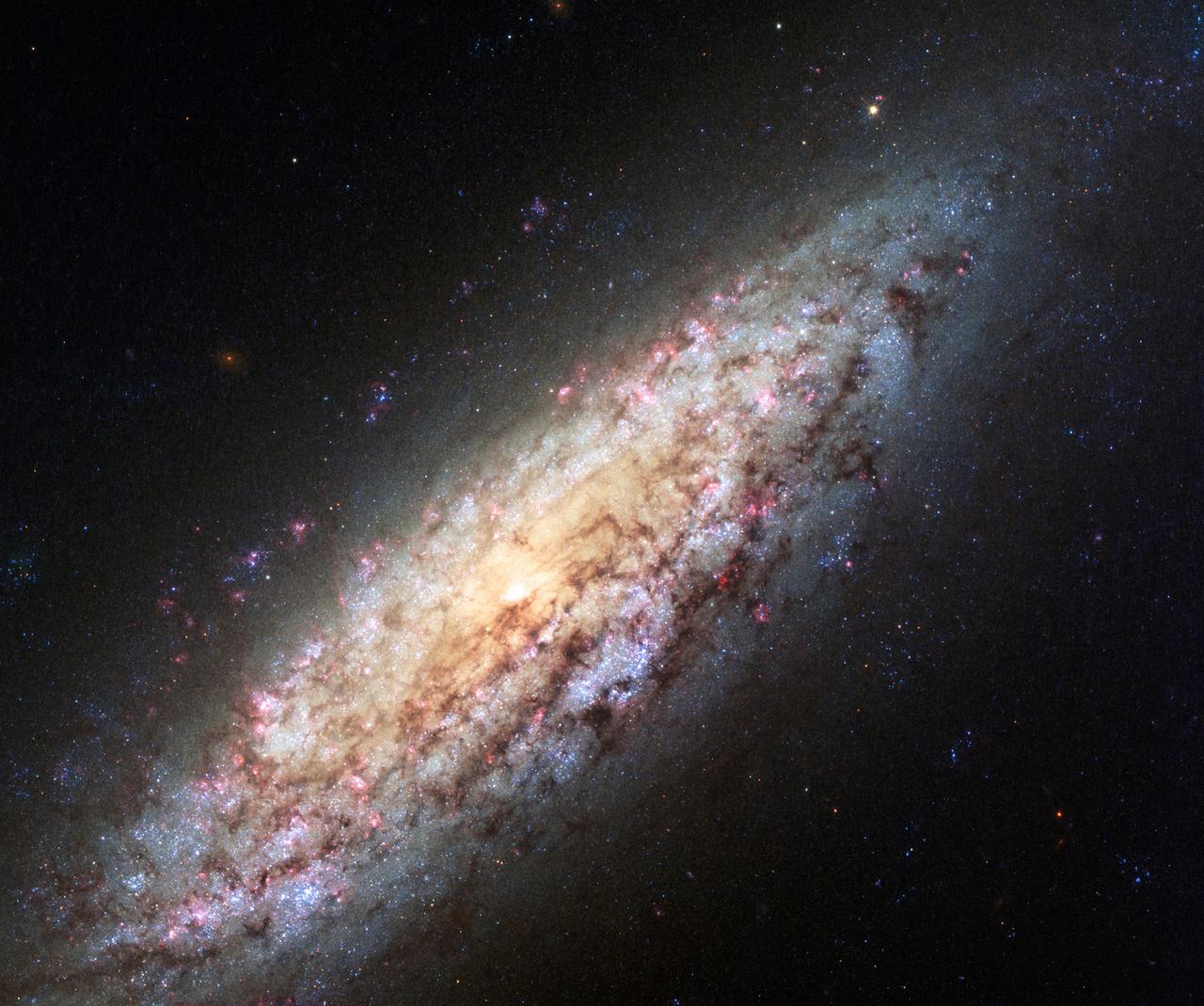
Most galaxies are clumped together in groups or clusters. A neighboring galaxy is never far away. But this galaxy, known as NGC 6503, has found itself in a lonely position, at the edge of a strangely empty patch of space called the Local Void. The Local Void is a huge stretch of space that is at least 150 million light-years across. It seems completely empty of stars or galaxies. The galaxy’s odd location on the edge of this never-land led stargazer Stephen James O’Meara to dub it the “Lost-In-Space galaxy” in his 2007 book, Hidden Treasures. NGC 6503 is 18 million light-years away from us in the northern circumpolar constellation of Draco. NGC 6503 spans some 30,000 light-years, about a third of the size of the Milky Way. This Hubble Space Telescope image shows NGC 6503 in striking detail and with a rich set of colors. Bright red patches of gas can be seen scattered through its swirling spiral arms, mixed with bright blue regions that contain newly forming stars. Dark brown dust lanes snake across the galaxy’s bright arms and center, giving it a mottled appearance. The Hubble Advanced Camera for Surveys data for NGC 6503 were taken in April 2003, and the Wide Field Camera 3 data were taken in August 2013. The Hubble Space Telescope is a project of international cooperation between NASA and the European Space Agency. NASA’s Goddard Space Flight Center in Greenbelt, Maryland, manages the telescope. The Space Telescope Science Institute (STScI) in Baltimore conducts Hubble science operations. STScI is operated for NASA by the Association of Universities for Research in Astronomy, Inc., in Washington, D.C. Photo Credit: NASA, ESA, D. Calzetti (University of Massachusetts), H. Ford (Johns Hopkins University), and the Hubble Heritage Team <b><a href="http://www.nasa.gov/audience/formedia/features/MP_Photo_Guidelines.html" rel="nofollow">NASA image use policy.</a></b> <b><a href="http://www.nasa.gov/centers/goddard/home/index.html" rel="nofollow">NASA Goddard Space Flight Center</a></b> enables NASA’s mission through four scientific endeavors: Earth Science, Heliophysics, Solar System Exploration, and Astrophysics. Goddard plays a leading role in NASA’s accomplishments by contributing compelling scientific knowledge to advance the Agency’s mission. <b>Follow us on <a href="http://twitter.com/NASAGoddardPix" rel="nofollow">Twitter</a></b> <b>Like us on <a href="http://www.facebook.com/pages/Greenbelt-MD/NASA-Goddard/395013845897?ref=tsd" rel="nofollow">Facebook</a></b> <b>Find us on <a href="http://instagrid.me/nasagoddard/?vm=grid" rel="nofollow">Instagram</a></b>