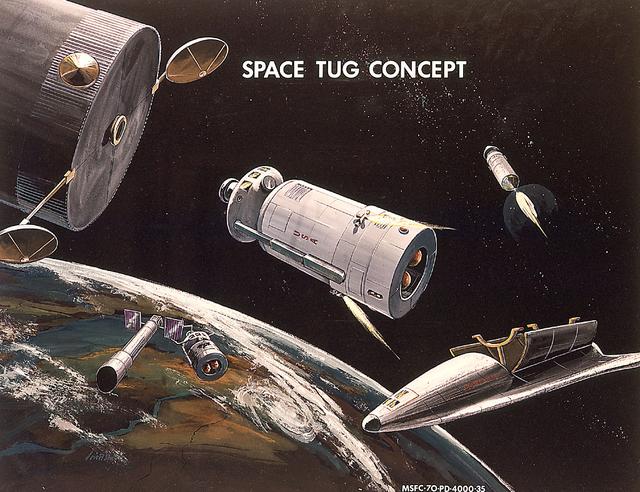
Managed by Marshall Space Flight Center, the Space Tug was intended to be a reusable multipurpose space vehicle designed to transport payloads to different orbital inclinations. Utilizing mission-specific combinations of its three primary modules (crew, propulsion, and cargo) and a variety of supplementary kits, the Space Tug would have been capable of numerous space applications. This 1970 artist's concept illustrates a Space Tug Concept, crew module attached, in conjunction with other space vehicles. The Space Tug program was cancelled and did not become a reality.
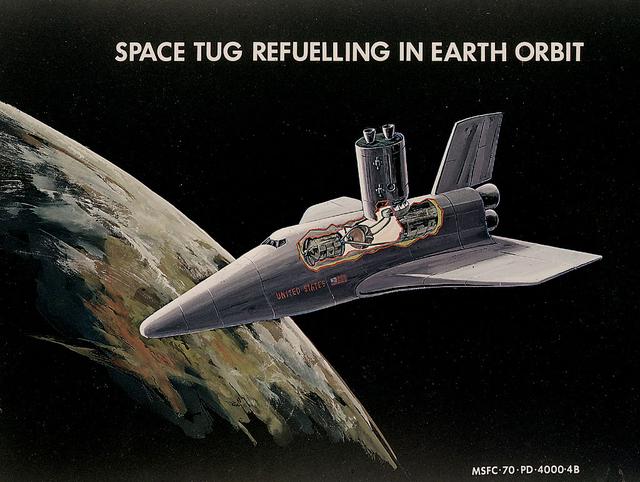
Managed by Marshall Space Flight Center, the Space Tug concept was intended to be a reusable multipurpose space vehicle designed to transport payloads to different orbital inclinations. Utilizing mission-specific combinations of its three primary modules (crew, propulsion, and cargo) and a variety of supplementary kits, the Space Tug would have been capable of numerous space applications. The Tug could dock with the Space Shuttle to receive propellants and cargo, as visualized in this 1970 artist's concept. The Space Tug program was cancelled and did not become a reality.
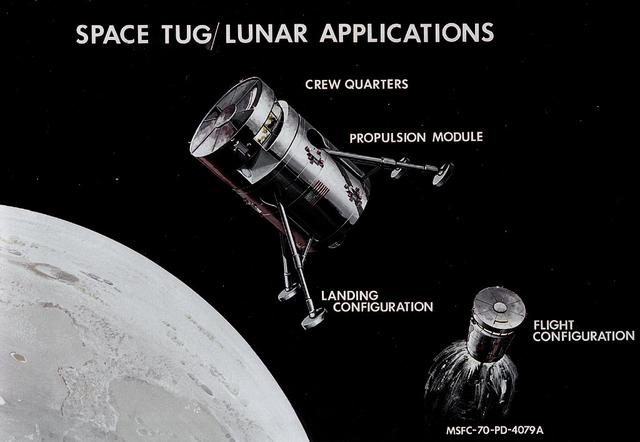
Managed by Marshall Space Flight Center, the Space Tug concept was intended to be a reusable multipurpose space vehicle designed to transport payloads to different orbital inclinations. Utilizing mission-specific combinations of its three primary modules (crew, propulsion, and cargo) and a variety of supplementary kits, the Space Tug was capable of numerous space applications. This 1970 artist's concept illustrates a Space Tug with an attached landing configuration kit as it prepares for a lunar application. The Space Tug program was cancelled and did not become a reality.
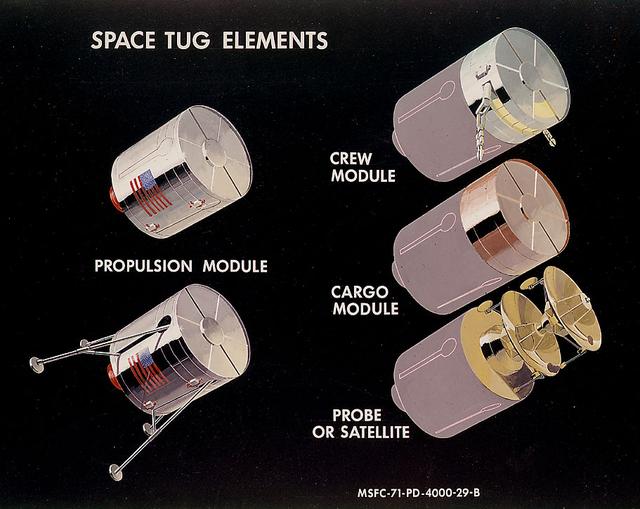
Managed by Marshall Space Flight Center, the Space Tug concept was intended to be a reusable multipurpose space vehicle designed to transport payloads to different orbital inclinations. Utilizing mission-specific combinations of its three primary modules (crew, propulsion, and cargo) and a variety of supplementary kits, the Space Tug would have been capable of numerous space applications. This 1971 image shows the basic Propulsion Module and attached elements in their functional configurations. The Space Tug program was cancelled and did not become a reality.
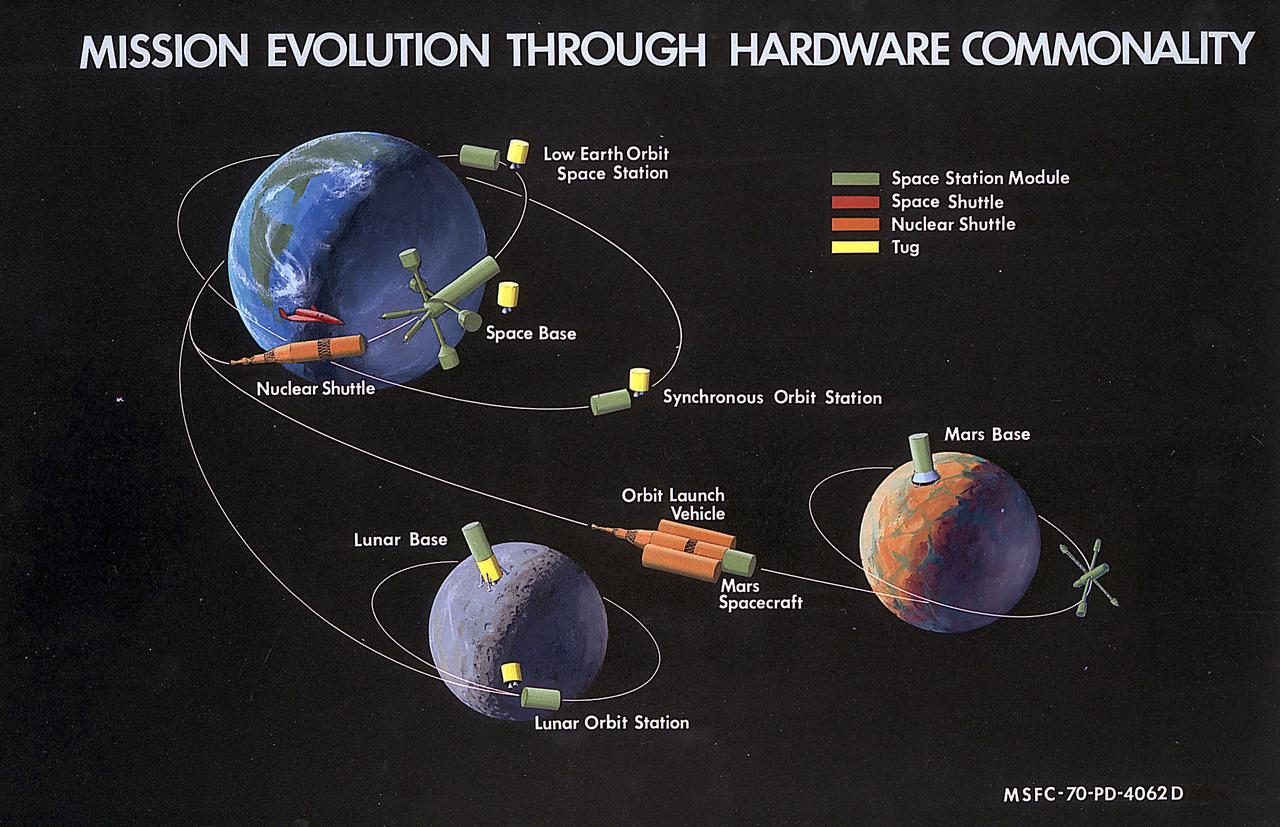
In this artist's concept from 1970, propulsion concepts such as the Nuclear Shuttle and Space Tug are shown in conjunction with other proposed spacecraft. As a result of the recommendations from President Nixon's Space Task Group for more commonality and integration in the American space program, Marshall Space Flight engineers studied many of the spacecraft depicted here.
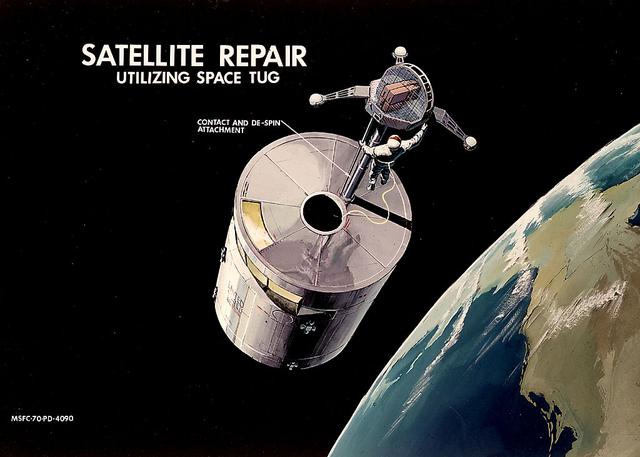
Managed by Marshall Space Flight Center, the Space Tug was a reusable multipurpose space vehicle designed to transport payloads to different orbital inclinations. Utilizing mission-specific combinations of its three primary modules (crew, propulsion, and cargo) and a variety of supplementary kits, the Space Tug was capable of numerous space applications. This 1970 artist's concept depicts the Space Tug during a satellite repair mission with the contact and de-spin attachment kit in place. An astronaut can be seen tethered to the Tug.
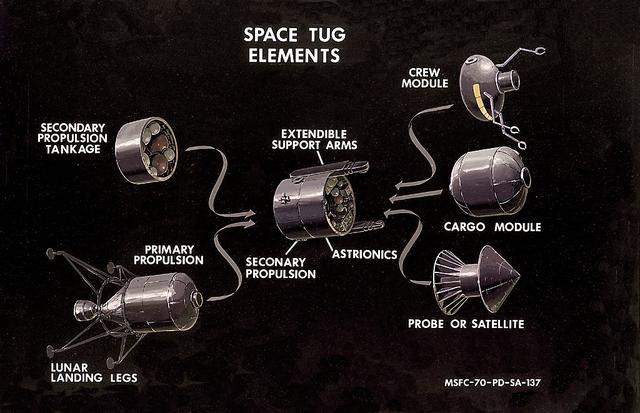
Managed by Marshall Space Flight Center, the Space Tug concept was intended to be a reusable multipurpose space vehicle designed to transport payloads to different orbital inclinations. Utilizing mission-specific combinations of its three primary modules (crew, propulsion, and cargo) and a variety of supplementary kits, the Space Tug would have been capable of numerous space applications. This 1970 illustration depicts the primary modules of the Space Tug system along with some of the supplementary kits: lunar landing legs, extendable support arms, astrionics, and the satellite probe. The Space Tug program was cancelled and did not become a reality.
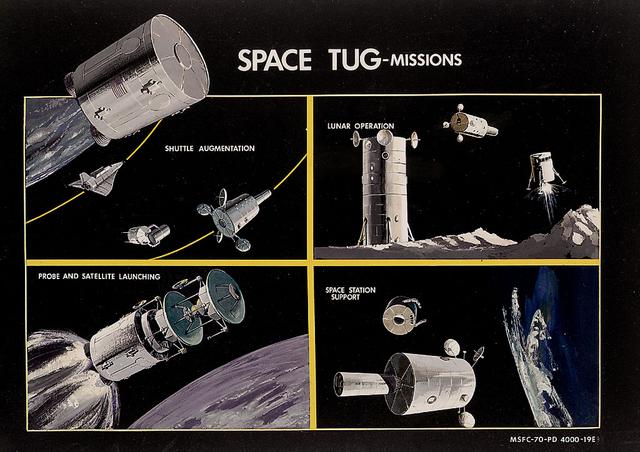
Managed by Marshall Space Flight Center, the Space Tug concept was intended to be a reusable multipurpose space vehicle designed to transport payloads to different orbital inclinations. Utilizing mission-specific combinations of its three primary modules (crew, propulsion, and cargo) and a variety of supplementary kits, the Space Tug was capable of numerous space applications. This 1970 artist's concept illustrates several examples of how the Tug's propulsion module could be implemented to support missions such as landing large payloads on a lunar surface, returning crew and cargo to lunar orbit, launching planetary probes from Earth orbit, and space station support.The Space Tug program was cancelled and did not become a reality.
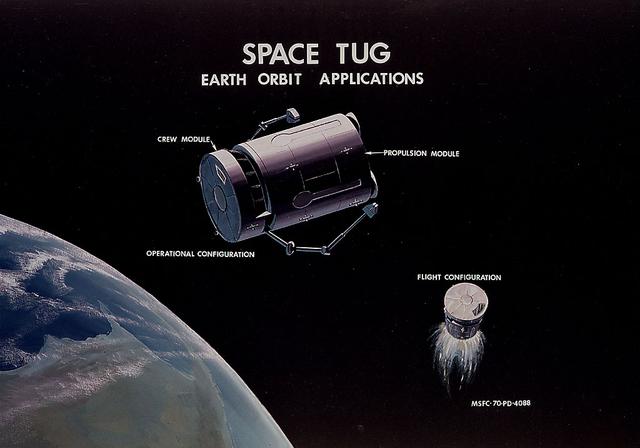
Managed by Marshall Space Flight Center, the Space Tug concept was intended to be a reusable multipurpose space vehicle designed to transport payloads to different orbital inclinations. Utilizing mission-specific combinations of its three primary modules (crew, propulsion, and cargo) and a variety of supplementary kits, the Space Tug was capable of numerous space applications. This 1970 artist's concept represents a typical configuration required to conduct operations and tasks in Earth orbit. The Space Tug program was cancelled and did not become a reality.
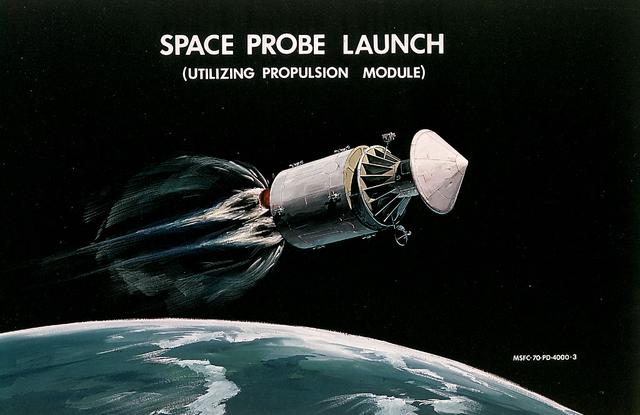
Managed by Marshall Space Flight Center, the Space Tug was a reusable multipurpose space vehicle designed to transport payloads to different orbital inclinations. Utilizing mission-specific combinations of its three primary modules (crew, propulsion, and cargo) and a variety of supplementary kits, the Space Tug was capable of numerous space applications. This 1970 artist's concept depicts the Tug's propulsion module launching a space probe into lunar orbit.
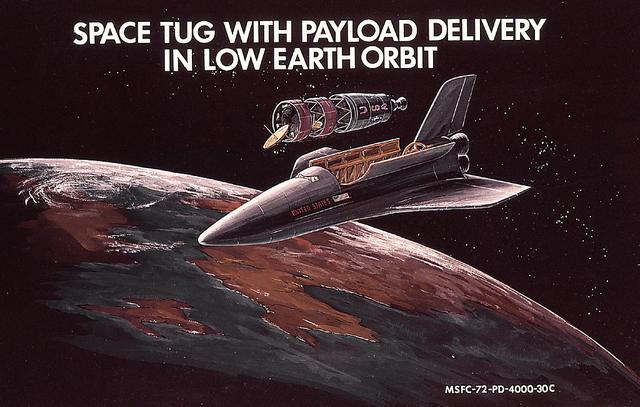
The Space Tug, managed by Marshall Space Flight Center, was designed to carry a variety of cargo into different orbital inclinations. In this 1972 artist's concept, a Space Tug prepares to transport a payload to its intended orbit shortly after its release from the Space Shuttle's cargo bay.
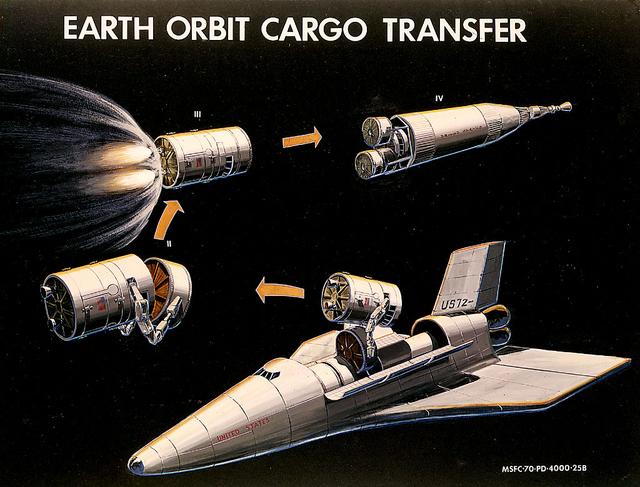
This 1969 artist's concept illustrates the use of three major elements of NASA's Integrated program, as proposed by President Nixon's Space Task Group. In Phases I and II, a Space Tug with a manipulator-equipped crew module removes a cargo module from an early Space Shuttle Orbiter and docks with it. In Phases III and IV, the Space Tug with attached cargo module flys toward a Nuclear Shuttle. As a result of the Space Task Group's recommendations for more commonality and integration in the American space program, Marshall Space Flight Center engineers studied many of the spacecraft depicted here.
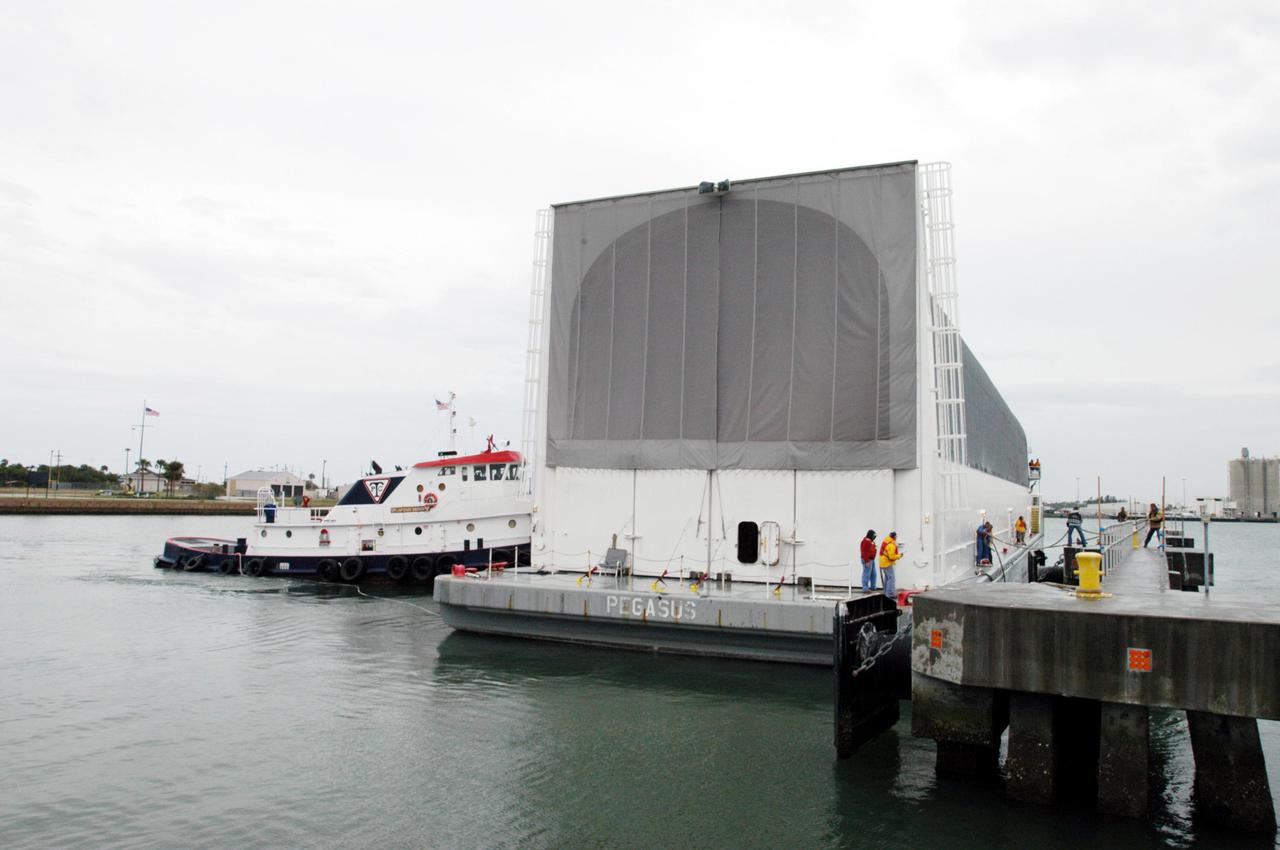
KENNEDY SPACE CENTER, FLA. - At Port Canaveral, a tug maneuvers the barge carrying a newly redesigned External Tank (ET-121) toward the dock. The tank is designated for use on Return to Flight mission STS-121. The barge was towed on a 900-mile journey at sea from the Michoud Assembly Facility in New Orleans by NASA’s Solid Rocket Booster Retrieval Ship Freedom Star. At Port Canaveral, the barge will be hooked up to tugs for the last part of the journey to the Launch Complex 39 Area Turn Basin at NASA’s Kennedy Space Center. It will then be offloaded and transported to the Vehicle Assembly Building.
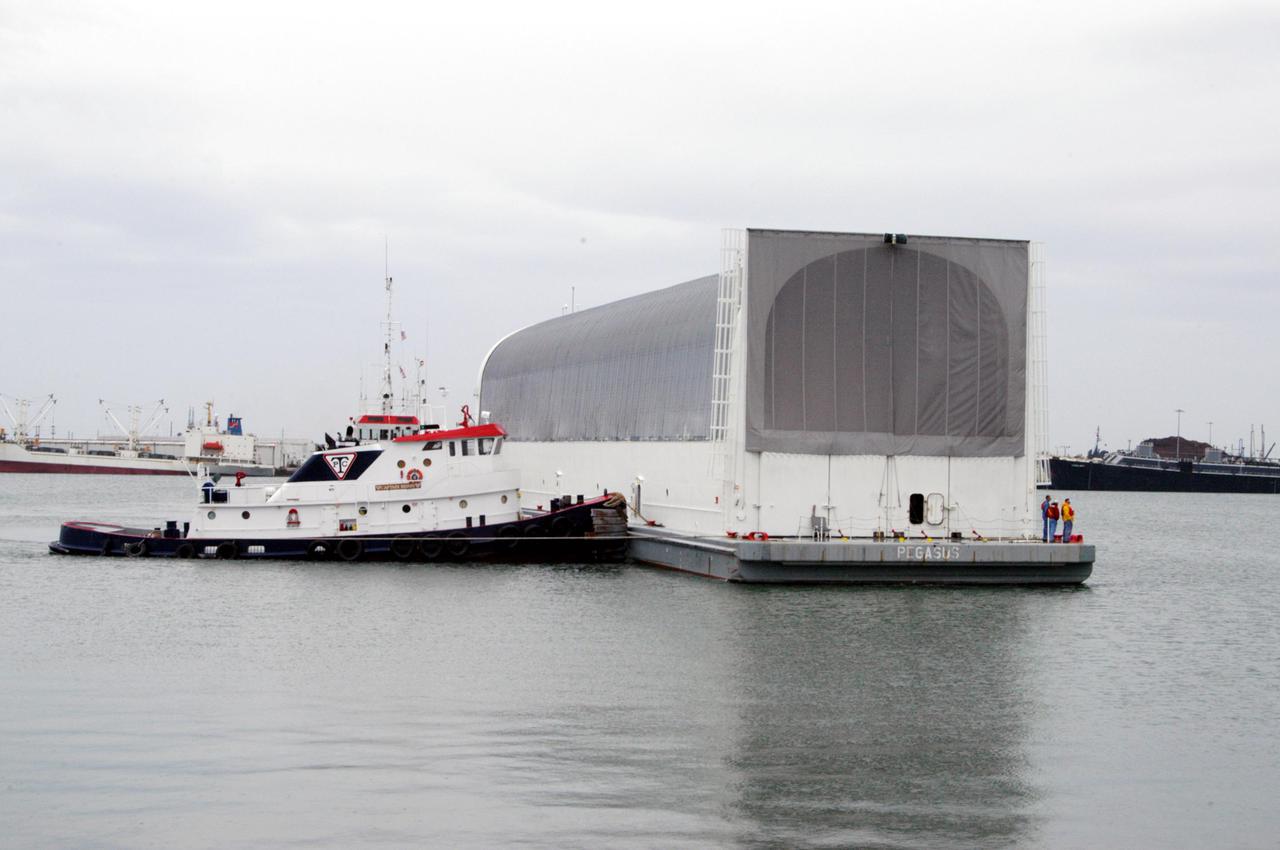
KENNEDY SPACE CENTER, FLA. - At Port Canaveral, a tug maneuvers the barge carrying a newly redesigned External Tank (ET-121) designated for use on Return to Flight mission STS-121. The barge was towed on a 900-mile journey at sea from the Michoud Assembly Facility in New Orleans by NASA’s Solid Rocket Booster Retrieval Ship Freedom Star. At Port Canaveral, the barge will be hooked up to tugs for the last part of the journey to the Launch Complex 39 Area Turn Basin at NASA’s Kennedy Space Center. It will then be offloaded and transported to the Vehicle Assembly Building.
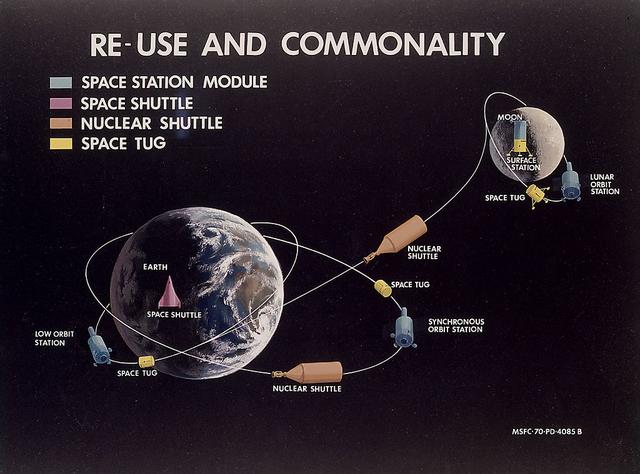
This 1970 artist's concept illustrates the use of the Space Shuttle, Nuclear Shuttle, and Space Tug in NASA's Integrated Program. As a result of the Space Task Group's recommendations for more commonality and integration in the American space program, Marshall Space Flight Center engineers studied many of the spacecraft depicted here.
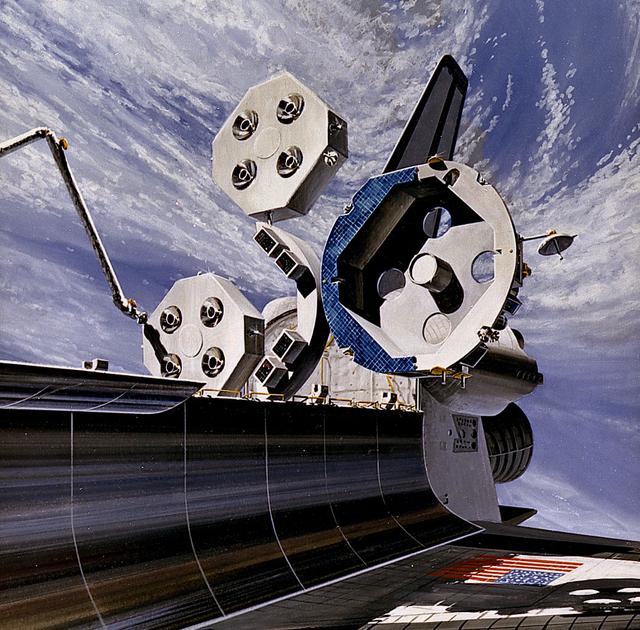
In this 1986 artist's concept, the Orbital Maneuvering Vehicle (OMV), undergoes changeout of the Propulsion Module outside the Space Shuttle Cargo Bay. As envisioned by Marshall Space Flight Center plarners, the OMV would be a remotely-controlled free-flying space tug which would place, rendezvous, dock, and retrieve orbital payloads.
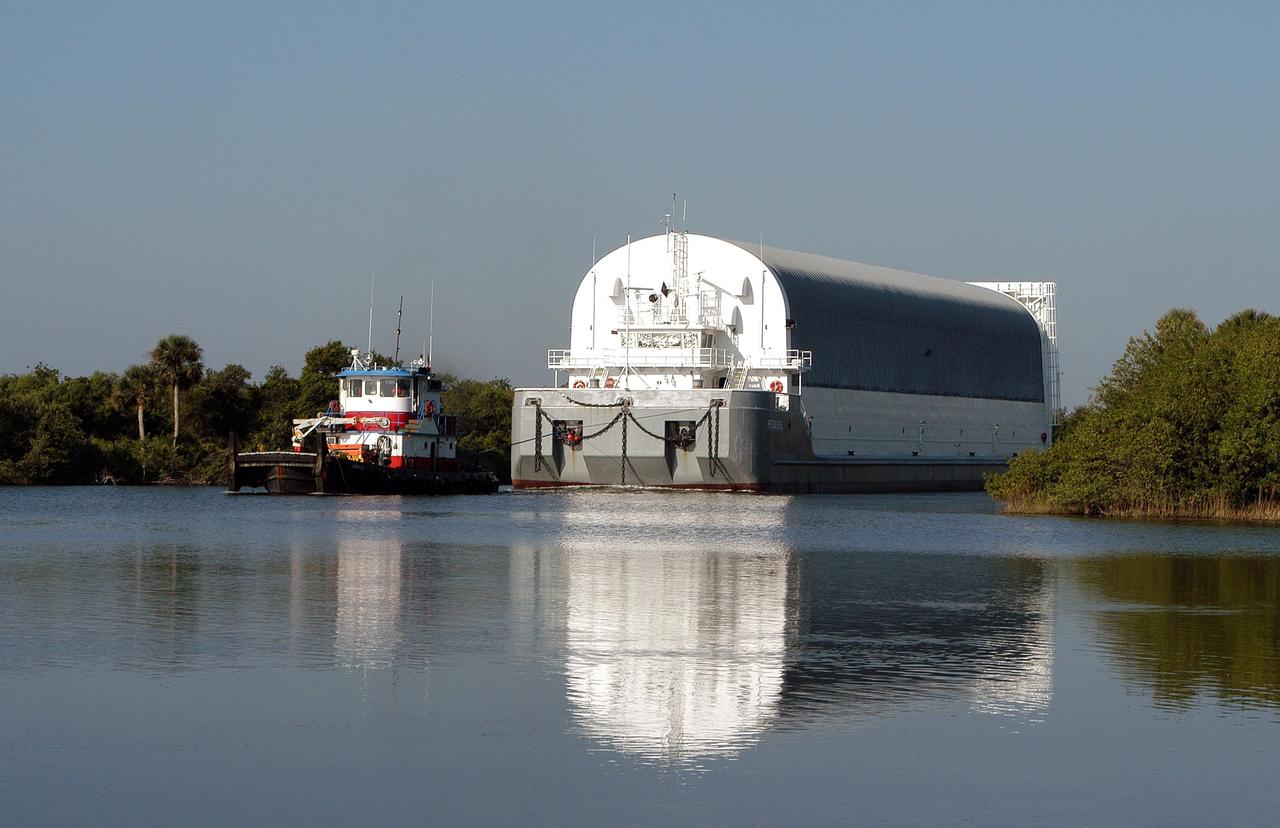
KENNEDY SPACE CENTER, FLA. - A tug boat begins towing the barge containing an External Tank (ET) to Port Canaveral. There one of the SRB Retrieval Ships will take over and tow the ET to the Michoud Space Systems Assembly Facility near New Orleans where redesign of the external tank is underway for Return to Flight.
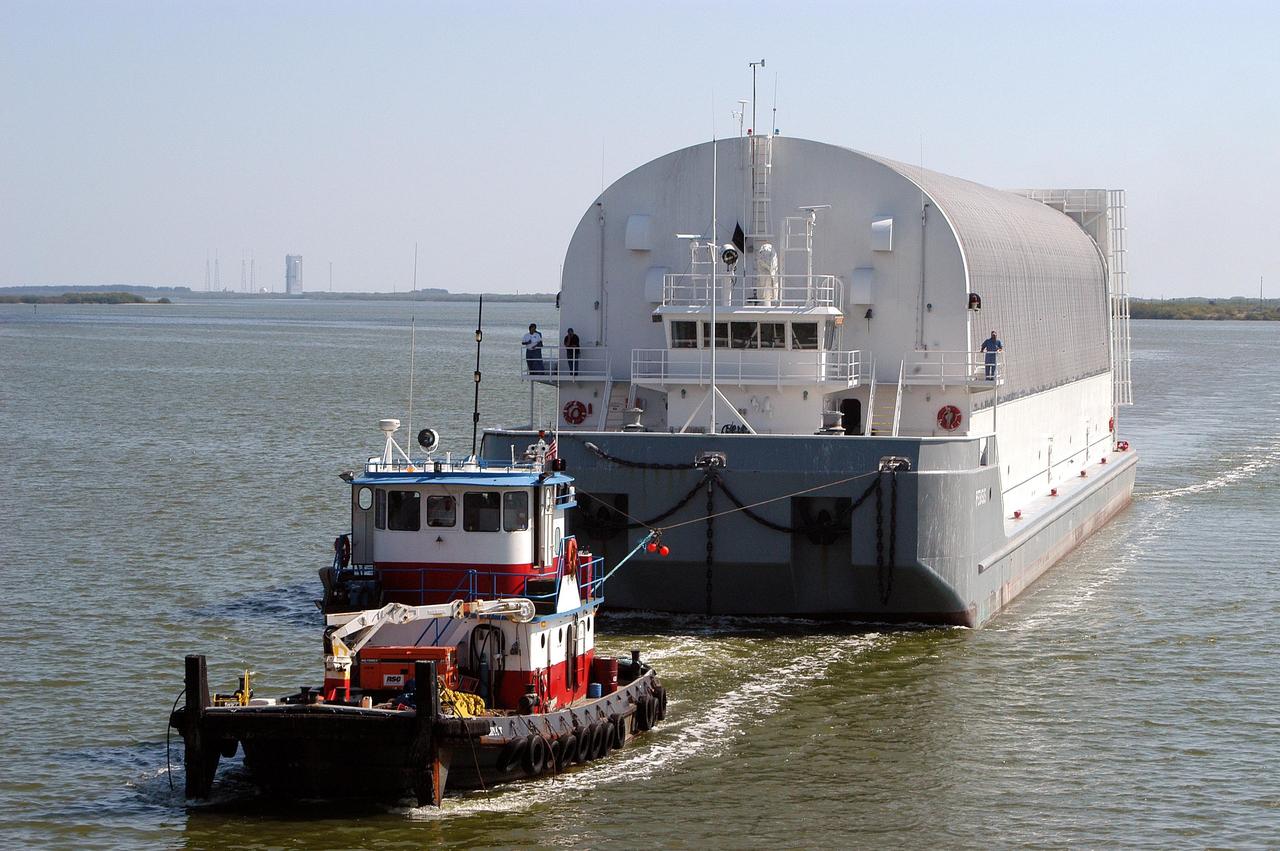
KENNEDY SPACE CENTER, FLA. - A tug boat tows the barge containing an External Tank (ET) to Port Canaveral. There one of the SRB Retrieval Ships will take over and tow the ET to the Michoud Space Systems Assembly Facility near New Orleans where redesign of the external tank is underway for Return to Flight.
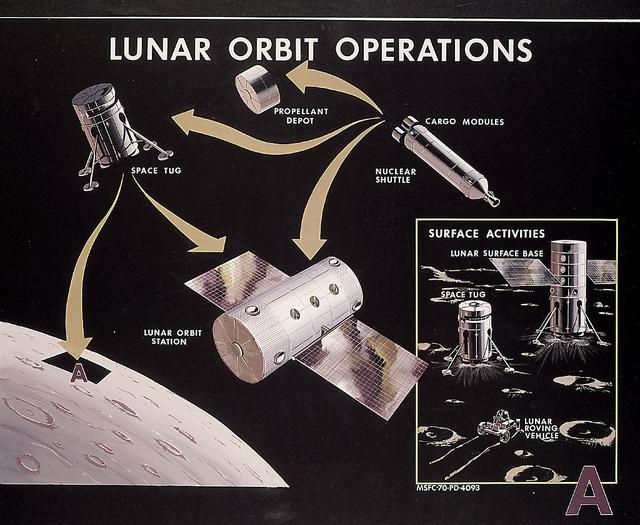
This 1970 artist's concept shows the Nuclear Shuttle and Space Tug operating in conjunction with other spacecraft to support lunar exploration. Marshall Space Flight Center plans during the late 1960s for lunar orbital and surface bases required extensive logistics operations in lunar orbit.
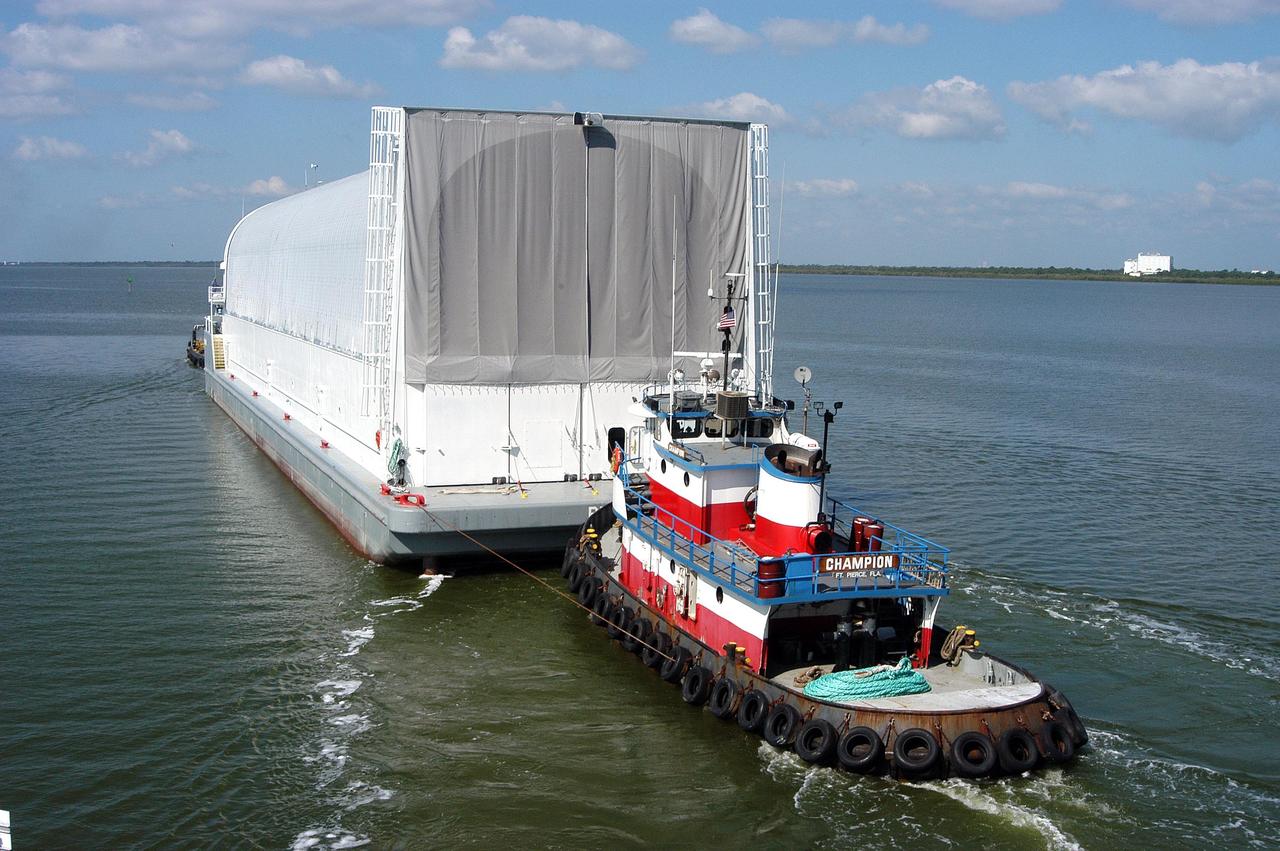
KENNEDY SPACE CENTER, FLA. - A tug boat tows the barge containing an External Tank (ET) to Port Canaveral. There one of the SRB Retrieval Ships will take over and tow the ET to the Michoud Space Systems Assembly Facility near New Orleans where redesign of the external tank is underway for Return to Flight.
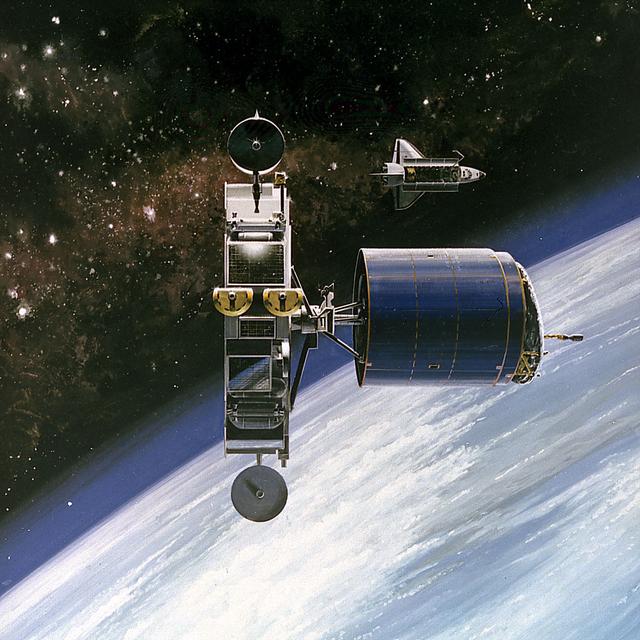
This 1986 artist's concept shows the Orbital Maneuvering Vehicle (OMV) towing a satellite. As envisioned by Marshall Space Flight Center plarners, the OMV would be a remotely-controlled free-flying space tug which would place, rendezvous, dock, and retrieve orbital payloads.
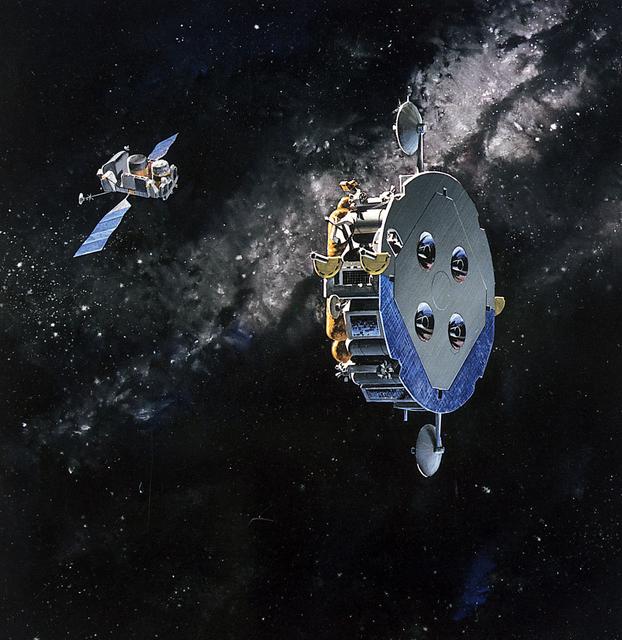
In this 1988 artist's concept, the Orbital Maneuvering Vehicle (OMV), closes in on a satellite. As envisioned by Marshall Space Flight plarners, the OMV would be a remotely-controlled free-flying space tug which would place, rendezvous, dock, and retrieve orbital payloads.
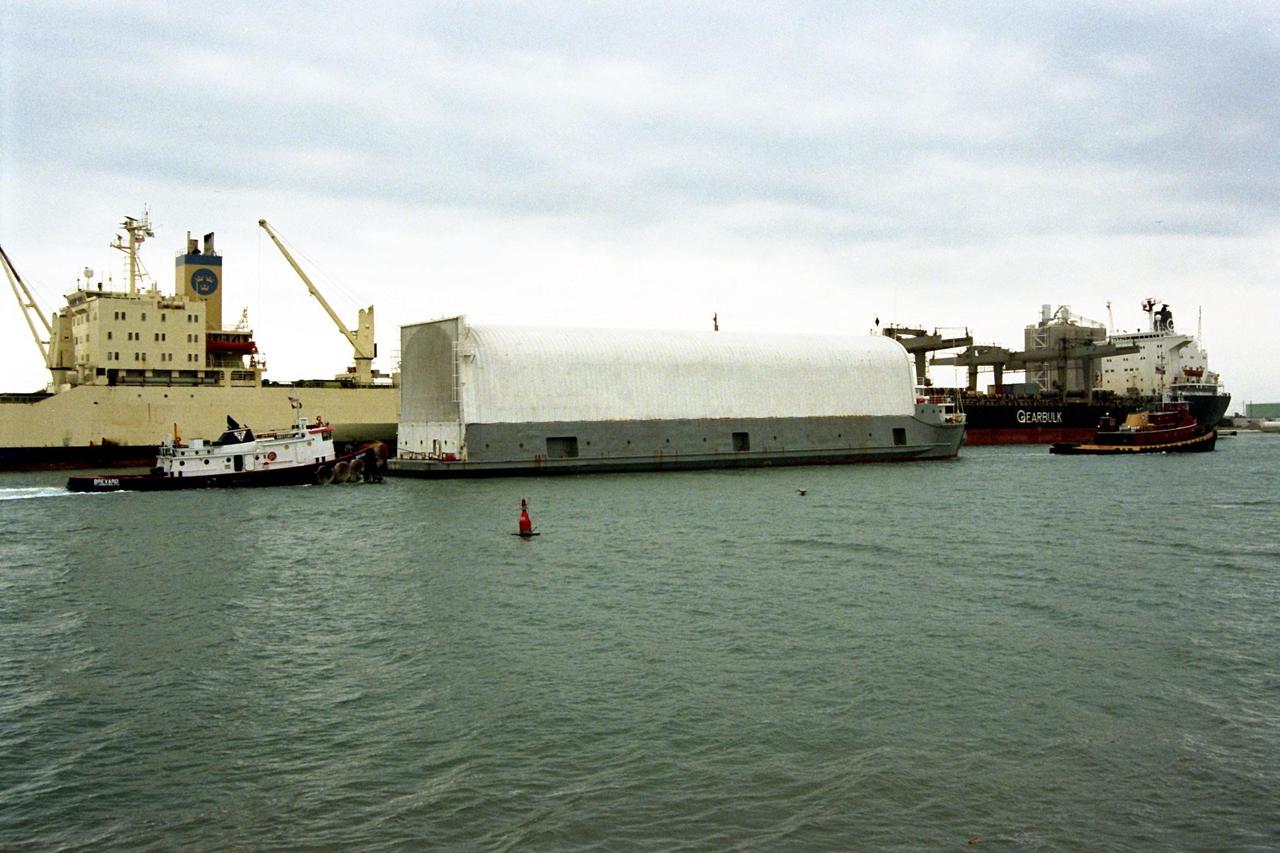
KENNEDY SPACE CENTER, FLA. -- The Space Shuttle's first super lightweight external tank is moved on a barge by two tug boats toward a pier at Port Canaveral, Fla. The tank is scheduled to undergo processing at Kennedy Space Center for flight on STS-91, targeted for launch in late May. The improved tank is 7,500 pounds lighter than its predecessors and was developed to increase the Shuttle payload capacity on International Space Station assembly flights. The tank was sent from the NASA Michoud Assembly Facility in New Orleans
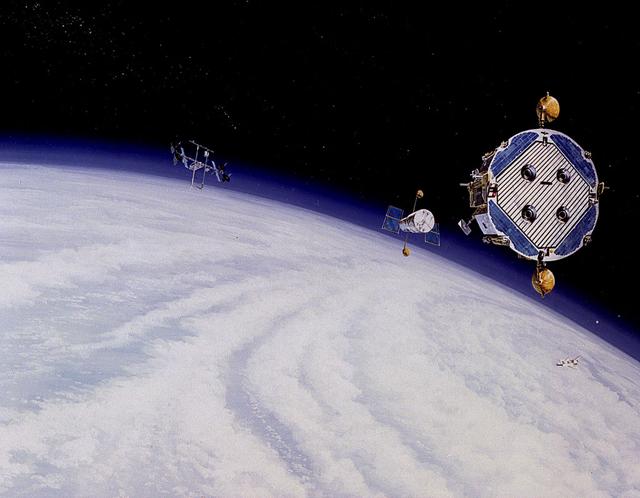
In this 1986 artist's concept, the Orbital Maneuvering Vehicle (OMV), at right, prepares to reboost the Hubble Space Telescope after being deployed from an early Space Station configuration (left). As envisioned by Marshall Space Flight Center plarners, the OMV would be a remotely-controlled free-flying space tug which would place, rendezvous, dock, and retrieve orbital payloads.
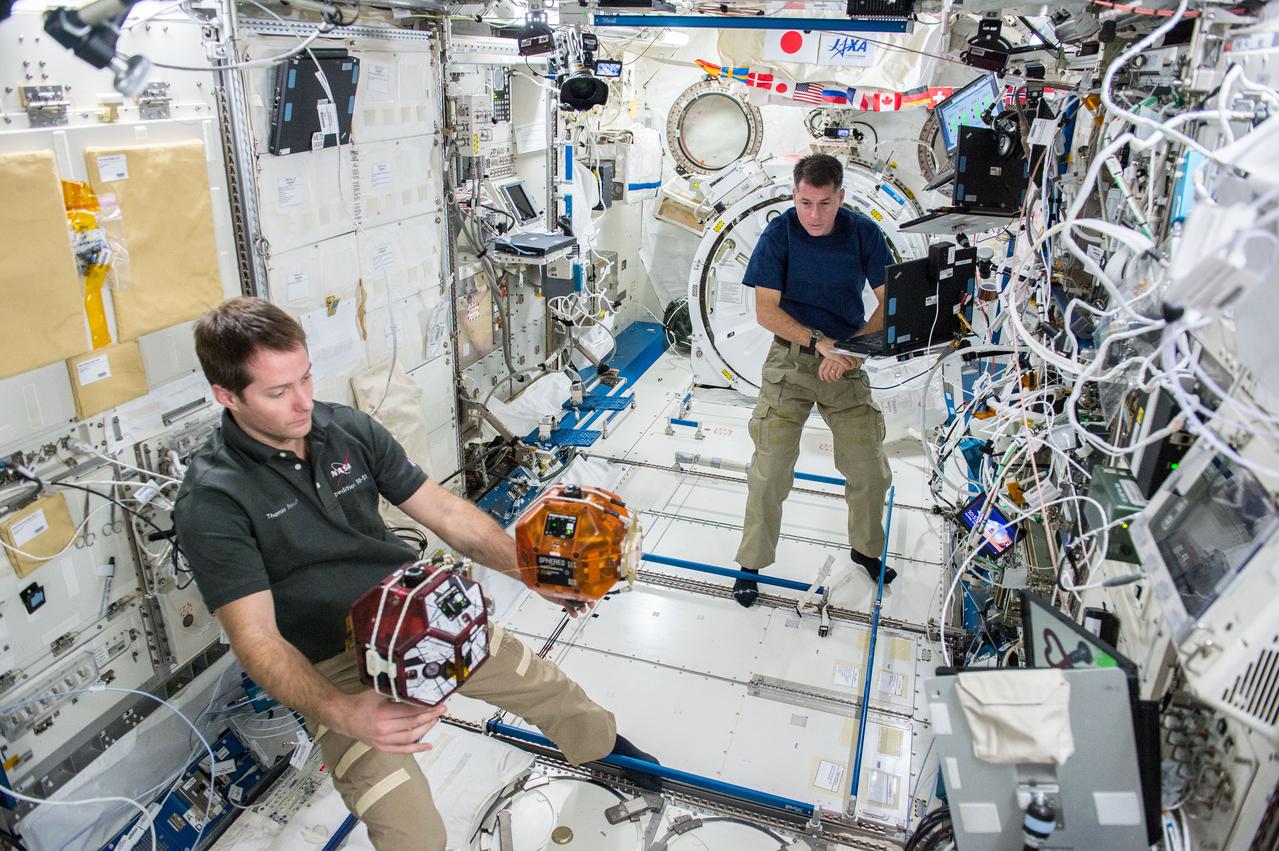
iss050e013146 (12/1/2016) --- NASA astronaut Shane Kimbrough and European Space Agency (ESA) astronaut Thomas Pesquet during the Synchronized Position Hold, Engage, Reorient, Experimental Satellites Tether Demo, in the Japanese Experiment Module (JEM) Pressurized Module (JPM). The SPHERES Tether Demo studies the dynamics of a tethered capture object and a “space tug” chase vehicle, improving computer programs needed for removing space debris as well as capturing scientific samples from other planets.
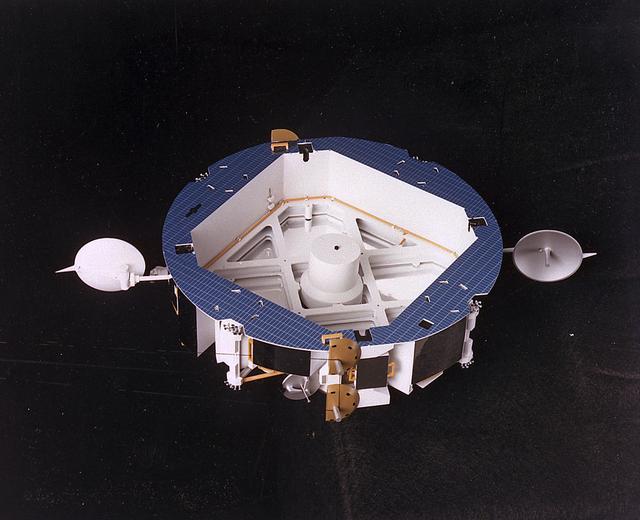
In this 1986 artist's concept, the Orbital Maneuvering Vehicle (OMV), is shown without its main propulsion module. Essentially two propulsion vehicles in one, the OMV could be powered by a main propulsion module , or, in its short range vehicle configuration shown here, use its own hydrazine and cold gas thrusters. As envisioned by Marshall Space Flight Center plarners, the OMV would be a remotely-controlled free-flying space tug which would place, rendezvous, dock, and retrieve orbital payloads.
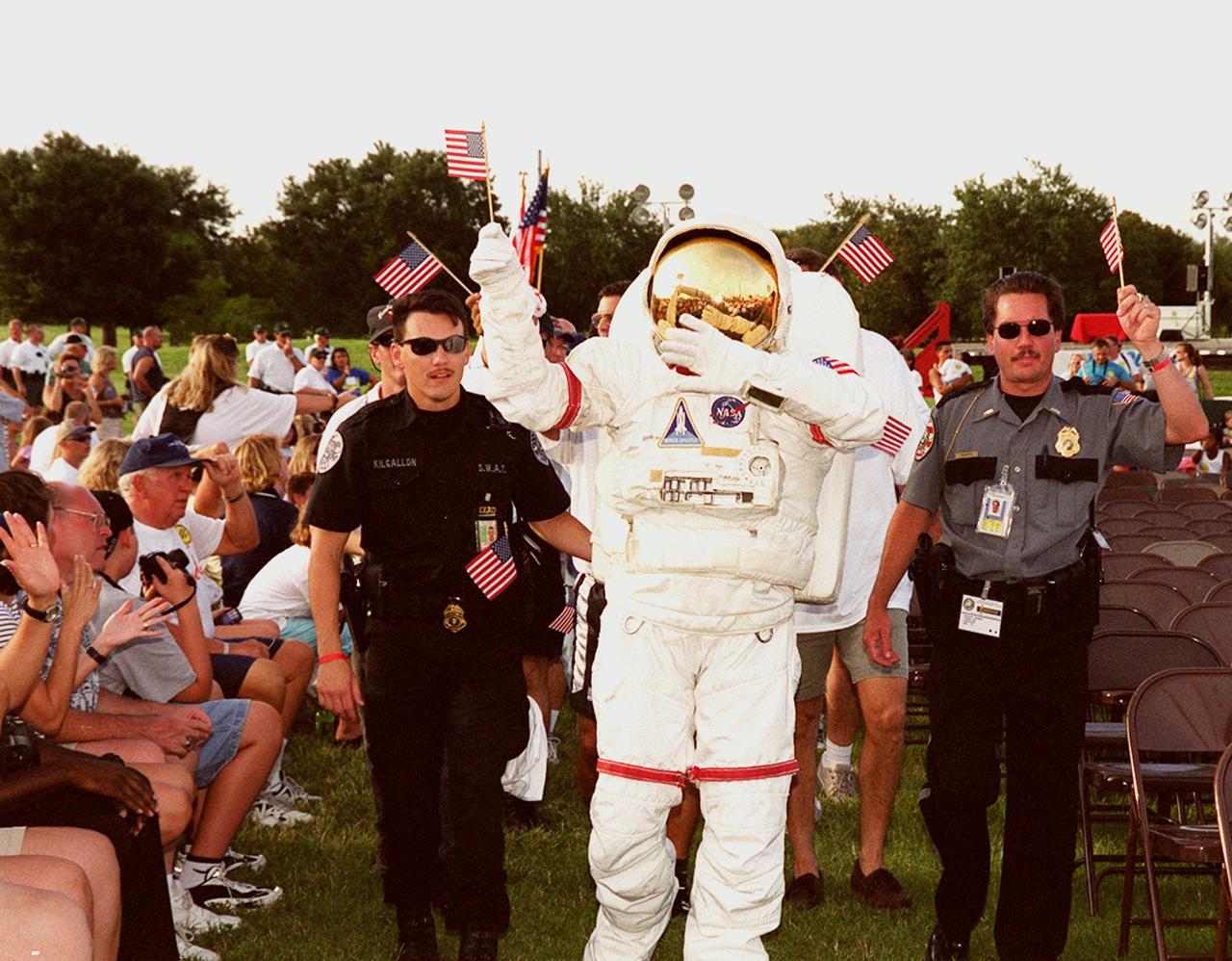
U.S. Police officers join the KSC Space Man in a parade at the KSC Visitor Complex during opening ceremonies of the 2000 International Law Enforcement Games. More than 1,850 participants and their families took part in the opening, held in the Rocket Garden. The ceremony includes parades, torch lighting and a tug of war. The games feature officers from 15 countries and 37 United States in competitions around Brevard County, Fla
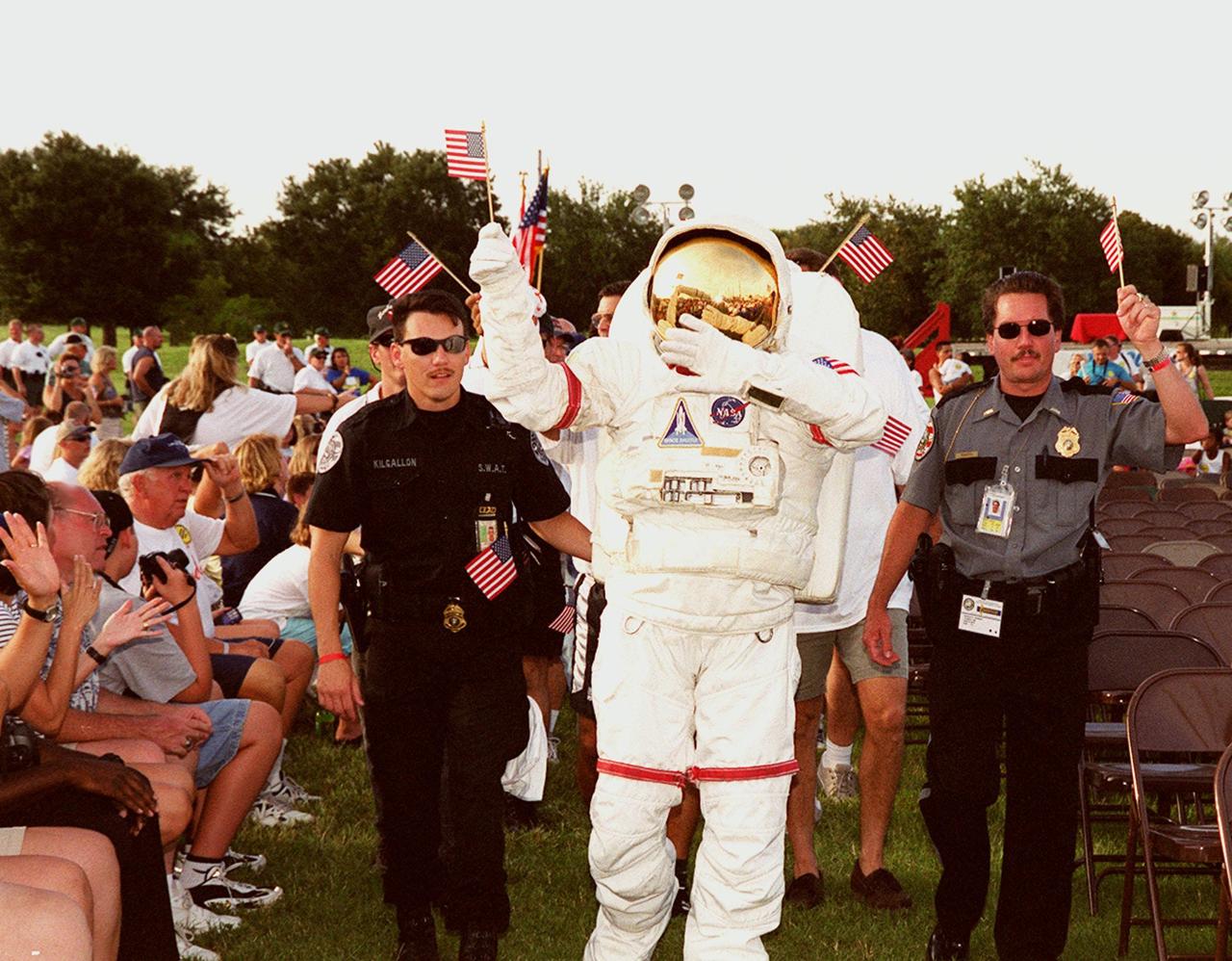
U.S. Police officers join the KSC Space Man in a parade at the KSC Visitor Complex during opening ceremonies of the 2000 International Law Enforcement Games. More than 1,850 participants and their families took part in the opening, held in the Rocket Garden. The ceremony includes parades, torch lighting and a tug of war. The games feature officers from 15 countries and 37 United States in competitions around Brevard County, Fla

Members of KSC’s Native America International Tribal Council and the Space Coast Indian Association (Brevard County) gather in the KSC Visitor Complex during opening ceremonies of the 2000 International Law Enforcement Games. More than 1,850 participants and their families took part in the opening, held in the Rocket Garden. The ceremony included parades, torch lighting and a tug of war. The games feature officers from 15 countries and 37 United States in competitions around Brevard County, Fla
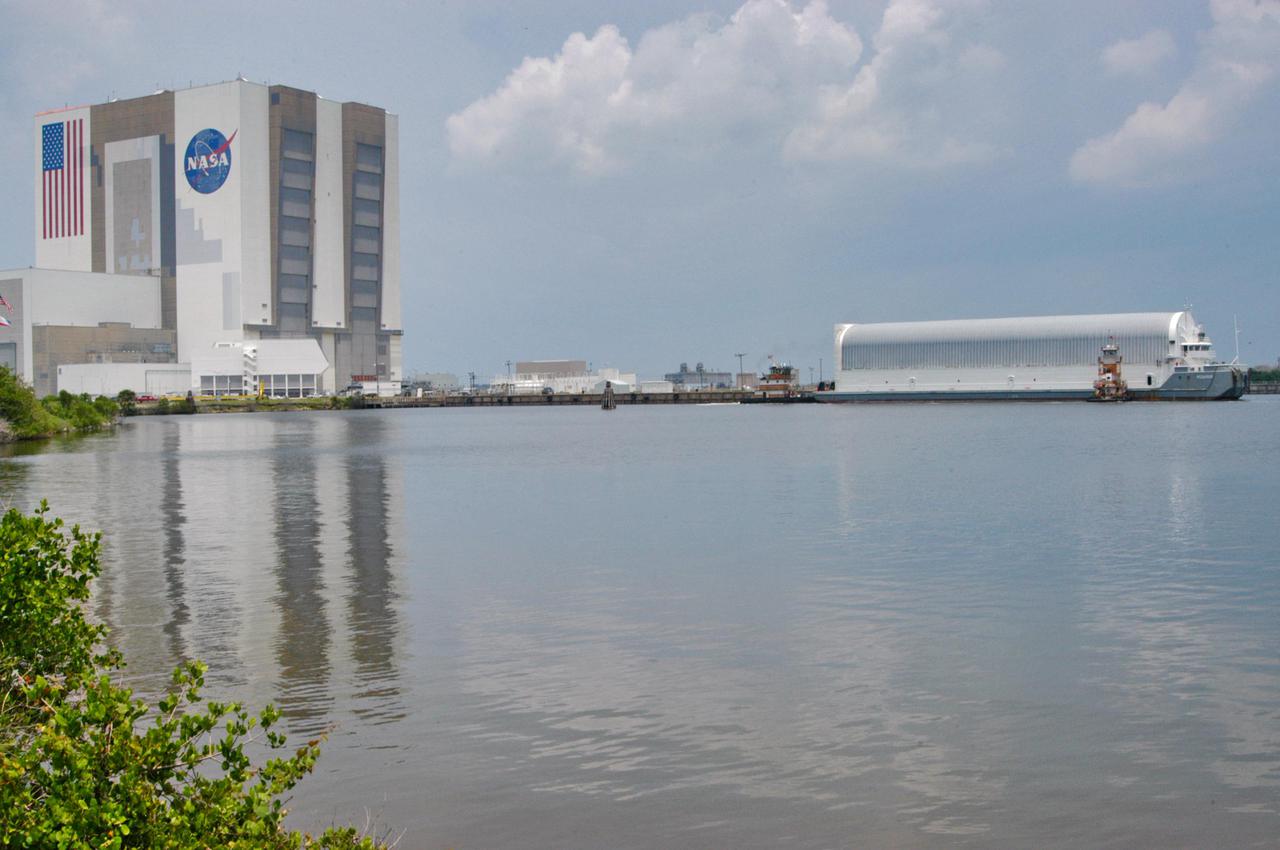
KENNEDY SPACE CENTER, FLA. - At the Turn Basin in the Launch Complex 39 Area, tug boats maneuver the barge carrying a new External Tank (ET) toward the dock. At left is the Vehicle Assembly Building, which will receive the tank after it is offloaded. The barge was towed on a 900-mile journey at sea from the Michoud Assembly Facility in New Orleans by one of NASA’s Solid Rocket Booster Retrieval Ships.

Members of KSC’s Native America International Tribal Council and the Space Coast Indian Association (Brevard County) gather in the KSC Visitor Complex during opening ceremonies of the 2000 International Law Enforcement Games. More than 1,850 participants and their families took part in the opening, held in the Rocket Garden. The ceremony included parades, torch lighting and a tug of war. The games feature officers from 15 countries and 37 United States in competitions around Brevard County, Fla
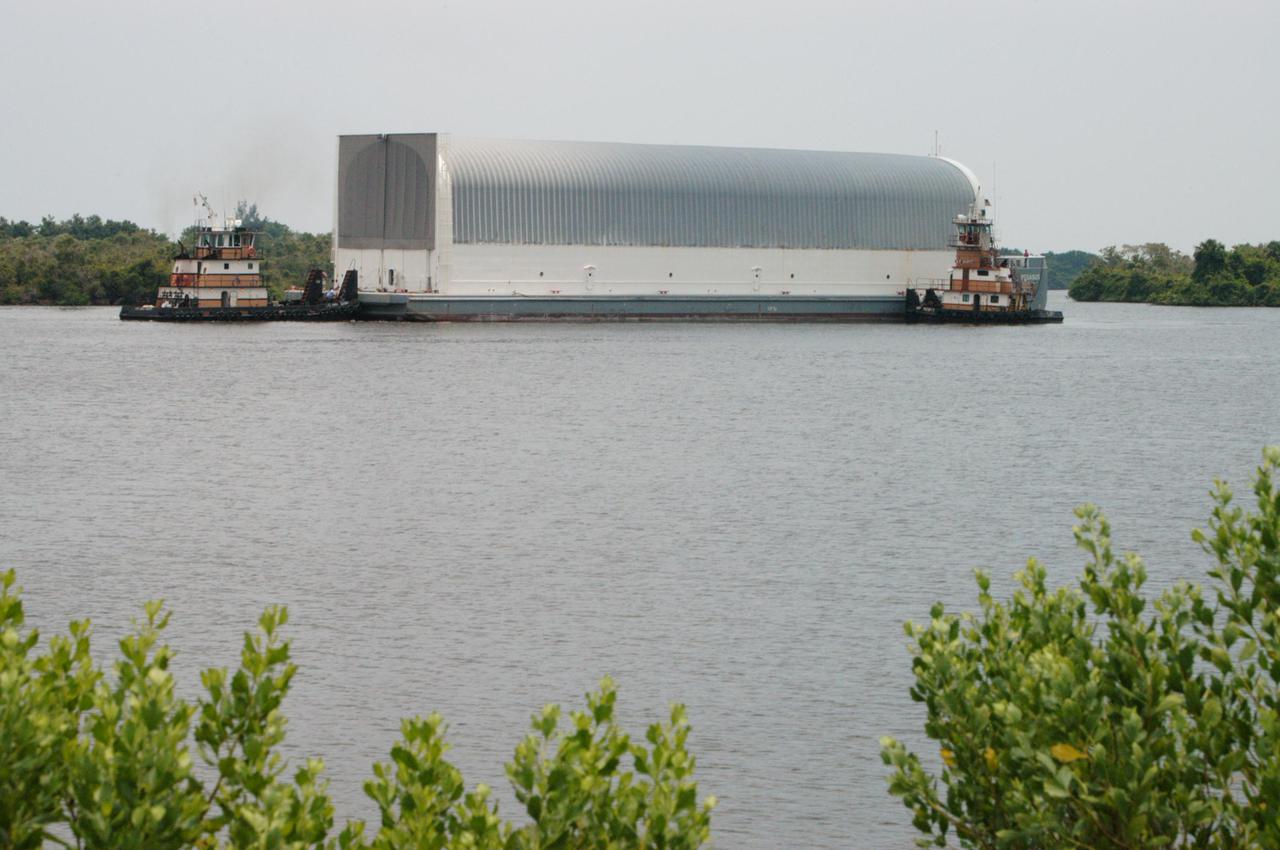
KENNEDY SPACE CENTER, FLA. - At the Turn Basin in the Launch Complex 39 Area, tug boats maneuver the barge carrying a new External Tank (ET) toward the dock. After being offloaded, the tank will be transported to the Vehicle Assembly Building. The barge was towed on a 900-mile journey at sea from the Michoud Assembly Facility in New Orleans by one of NASA’s Solid Rocket Booster Retrieval Ships.
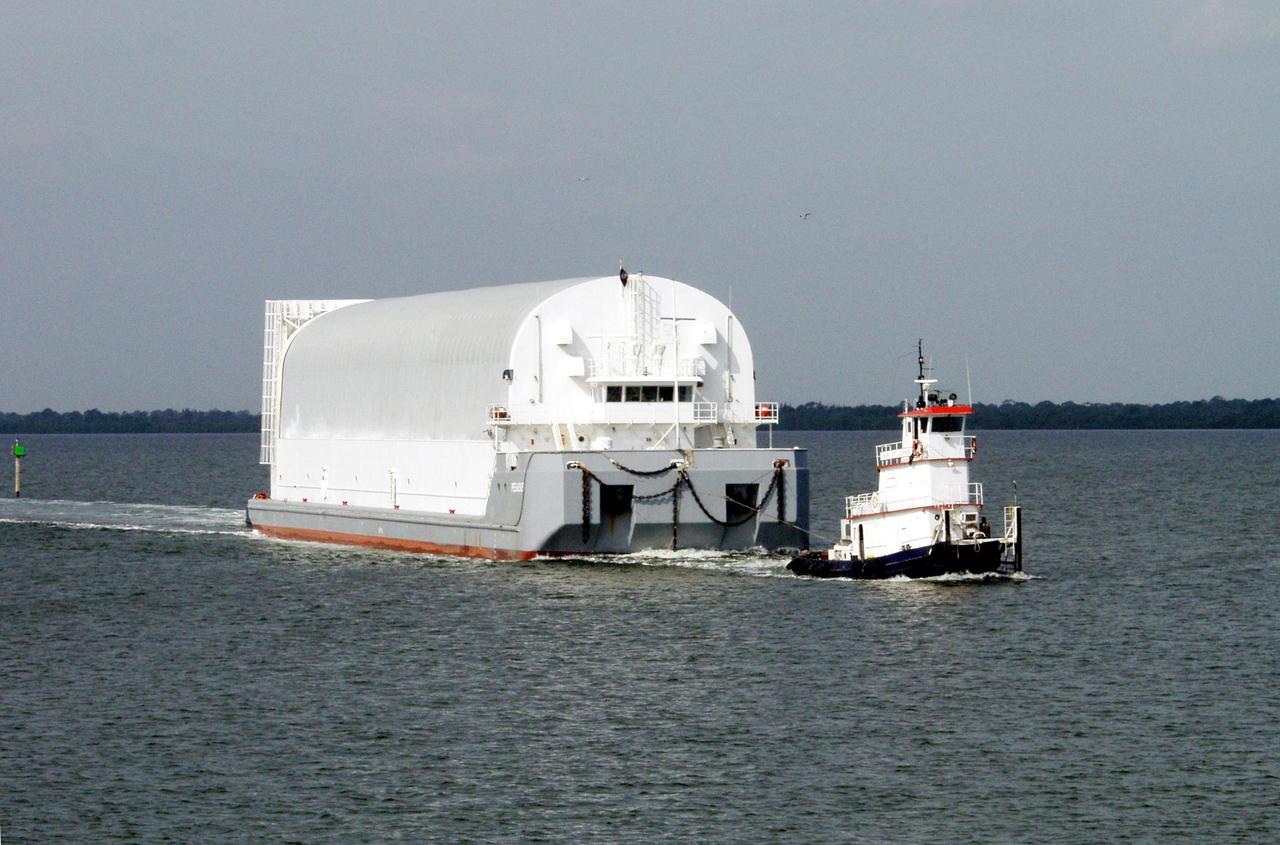
KENNEDY SPACE CENTER, FLA. -- A tug boat tows a newly arrived external tank in the Banana River to its offloading site. External tanks are built by the NASA Michoud Assembly Facility in New Orleans and transported by barge to Cape Canaveral and then up the Banana River to the turn basin in the Launch Complex 39 Area. From there it will be transported to the Vehicle Assembly Building where the tank will await stacking for a future Shuttle mission
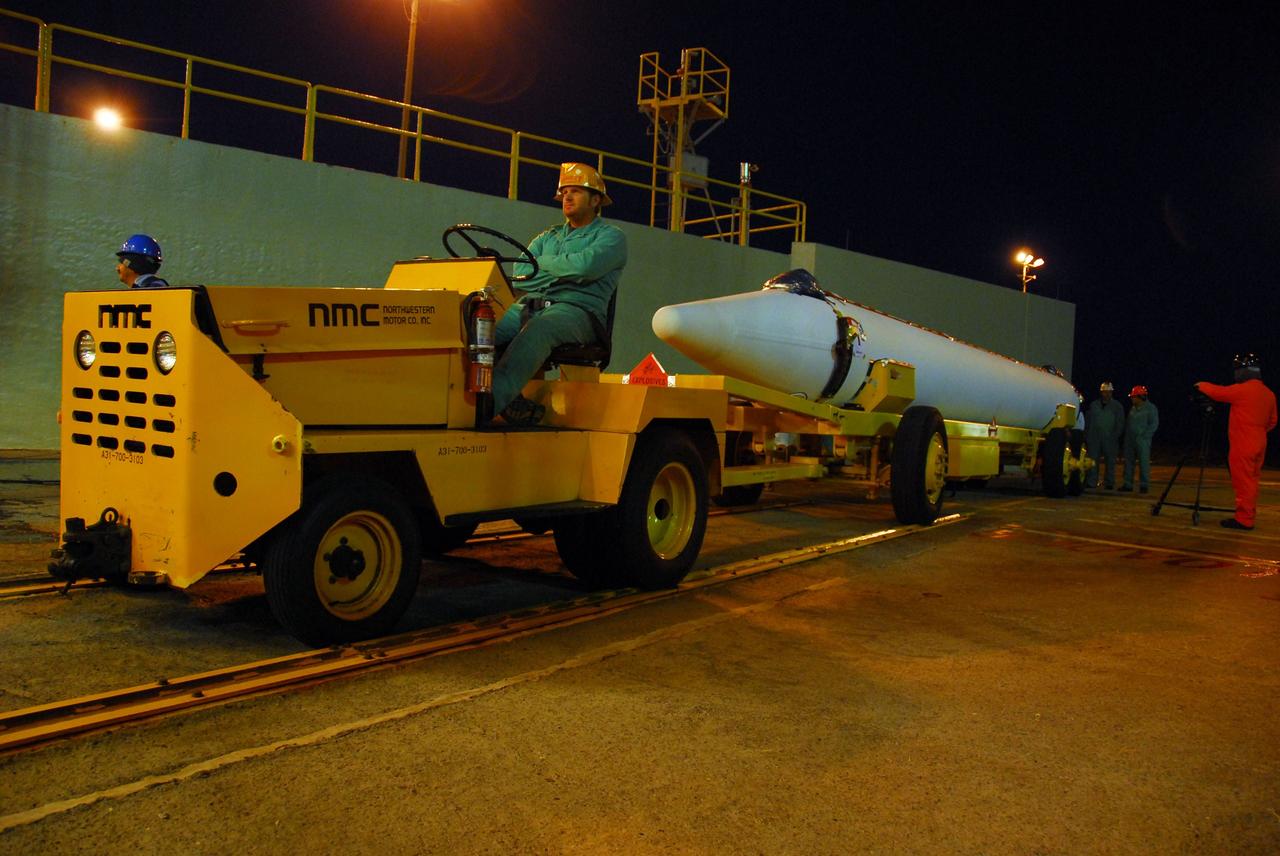
VANDENBERG AIR FORCE BASE, Calif. --Before the sun rises over Vandenberg Air Force Base in California, United Launch Alliance technicians prepare to move one of three Delta II solid rocket motors from the solid motor facility to Space Launch Complex-2 West (SLC-2W) atop a tug. ULA technician Eric Chambless is in the tug's driver seat. Scheduled to launch in June, the Delta II rocket will carry NASA's Aquarius satellite into low Earth orbit. Aquarius' mission will be to provide monthly maps of global changes in sea surface salinity. By measuring ocean salinity from space, Aquarius will provide new insights into how the massive natural exchange of freshwater between the ocean, atmosphere and sea ice influences ocean circulation, weather and climate. Also going up with the satellite are optical and thermal cameras, a microwave radiometer and the SAC-D spacecraft, which were developed with the help of institutions in Italy, France, Canada and Argentina. Photo credit: VAFB/30th Space Wing
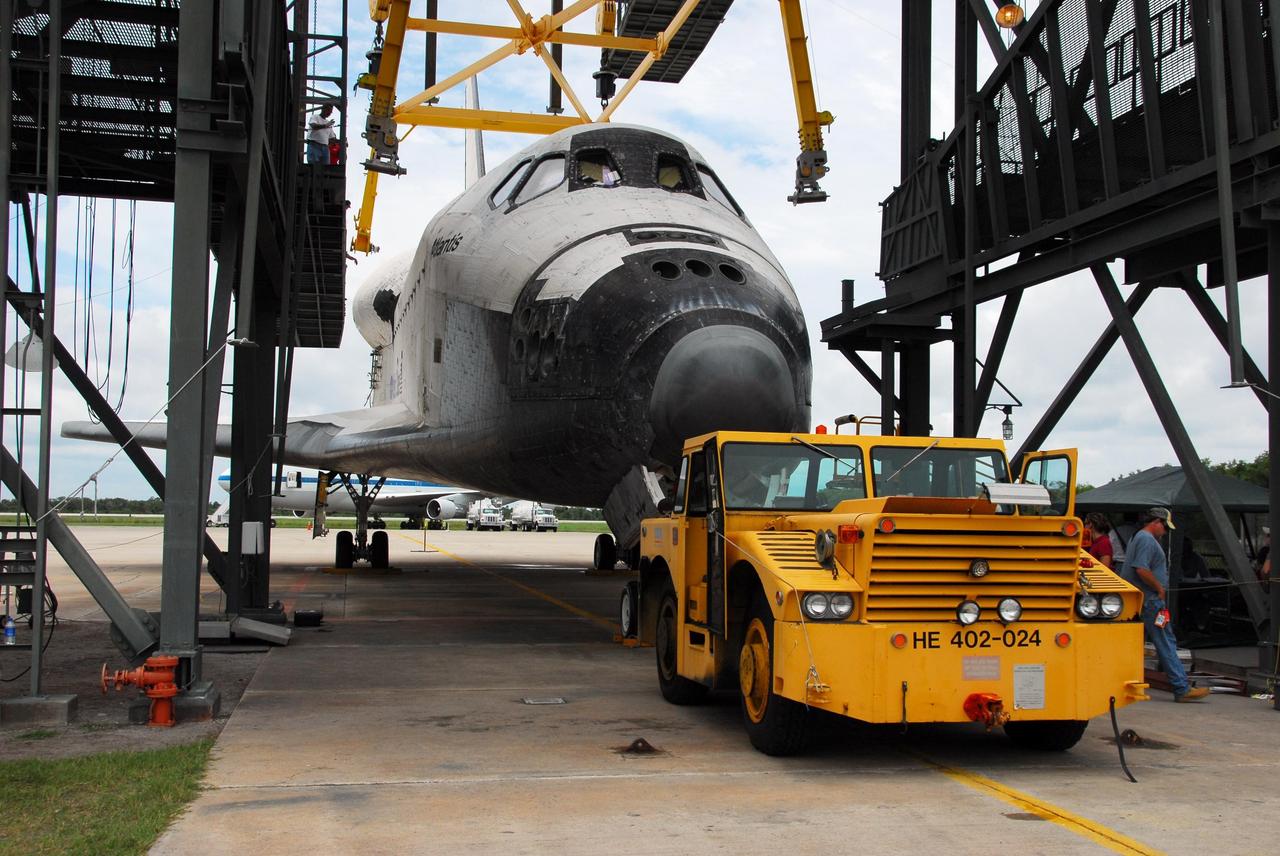
KENNEDY SPACE CENTER, FLA. -- Workers use an aircraft tug vehicle to back Atlantis away from the mate/demate device at Kennedy Space Center's Shuttle Landing Facility. The orbiter will be towed to the Orbiter Processing Facility where processing will begin for its next launch, mission STS-122 in December. Atlantis arrived at Kennedy Space Center atop the SCA on July 3 after a three-day, cross-country flight due to fuel stops and weather delays. Touchdown was at 8:27 a.m. EDT. Atlantis landed at Edwards Air Force Base in California on June 22 to end mission STS-117. Photo credit: NASA/George Shelton.
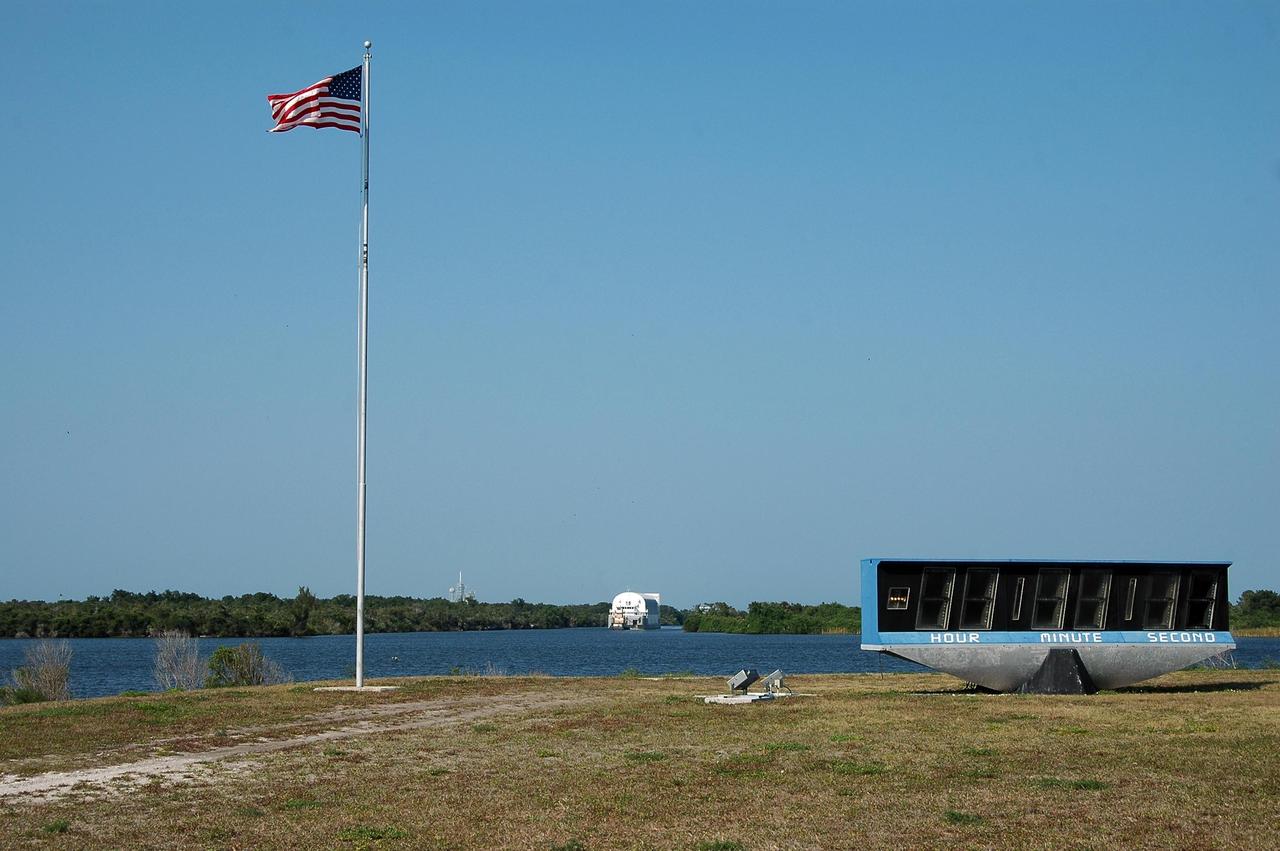
KENNEDY SPACE CENTER, FLA. - Viewed from the NASA News Center, a tug boat in the background maneuvers the Pegasus barge into the turn basin at the Launch Complex 39 Area. The barge holds the redesigned external fuel tank, designated ET-118, that will launch Space Shuttle Atlantis on the next shuttle mission, STS-115. The tank was shipped from the Michoud Assembly Facility in New Orleans. After off-loading, the tank will be moved into the Vehicle Assembly Building and lifted into a checkout cell for further work. The tank will fly with many major safety changes, including the removal of the protuberance air load ramps. Photo credit: NASA/Kim Shiflett
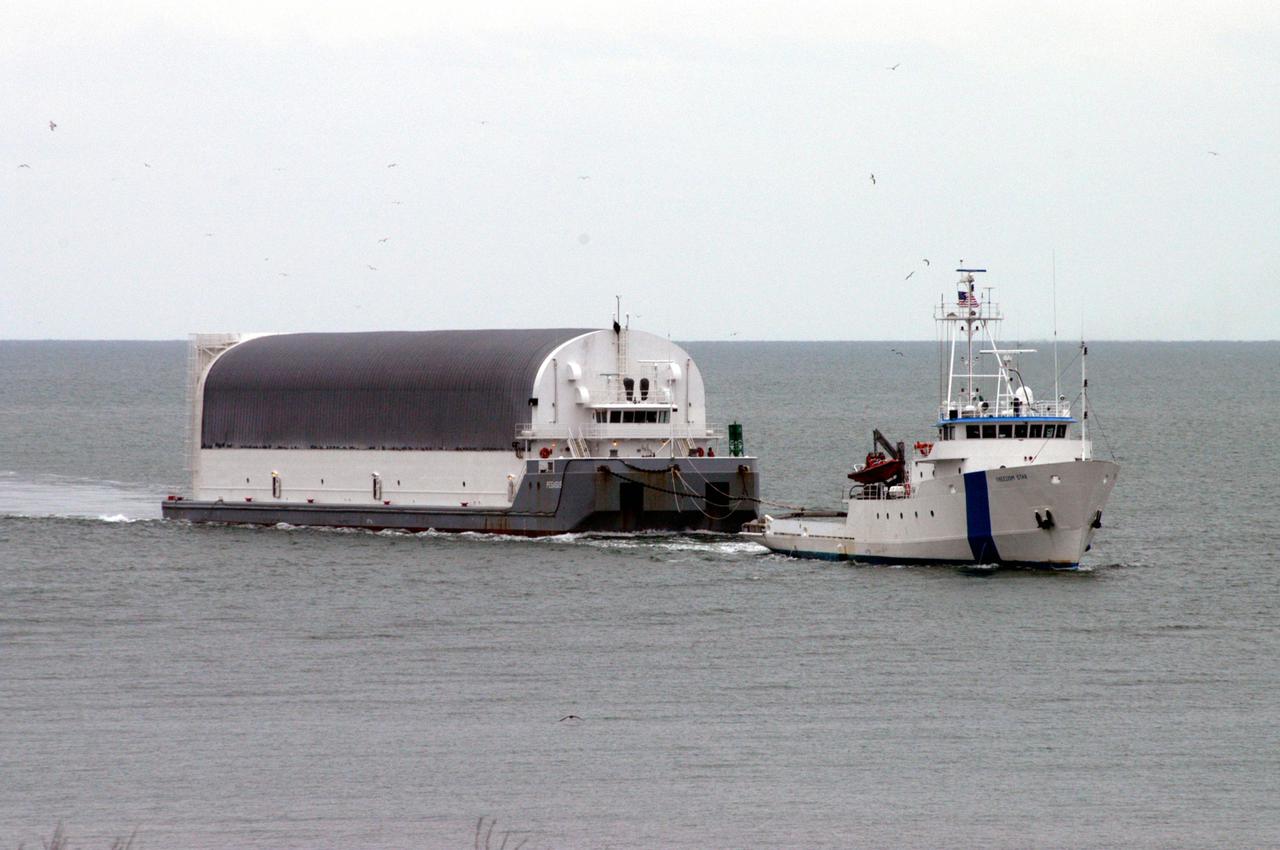
KENNEDY SPACE CENTER, FLA. - The barge carrying a newly redesigned External Tank (ET-121) designated for use on Return to Flight mission STS-121 approaches Port Canaveral after its 900-mile journey at sea from the Michoud Assembly Facility in New Orleans. It is being towed by NASA’s Solid Rocket Booster Retrieval Ship Freedom Star. At Port Canaveral, the barge will be hooked up to tugs for the last part of the journey to the Launch Complex 39 Area Turn Basin at NASA’s Kennedy Space Center. It will then be offloaded and transported to the Vehicle Assembly Building.
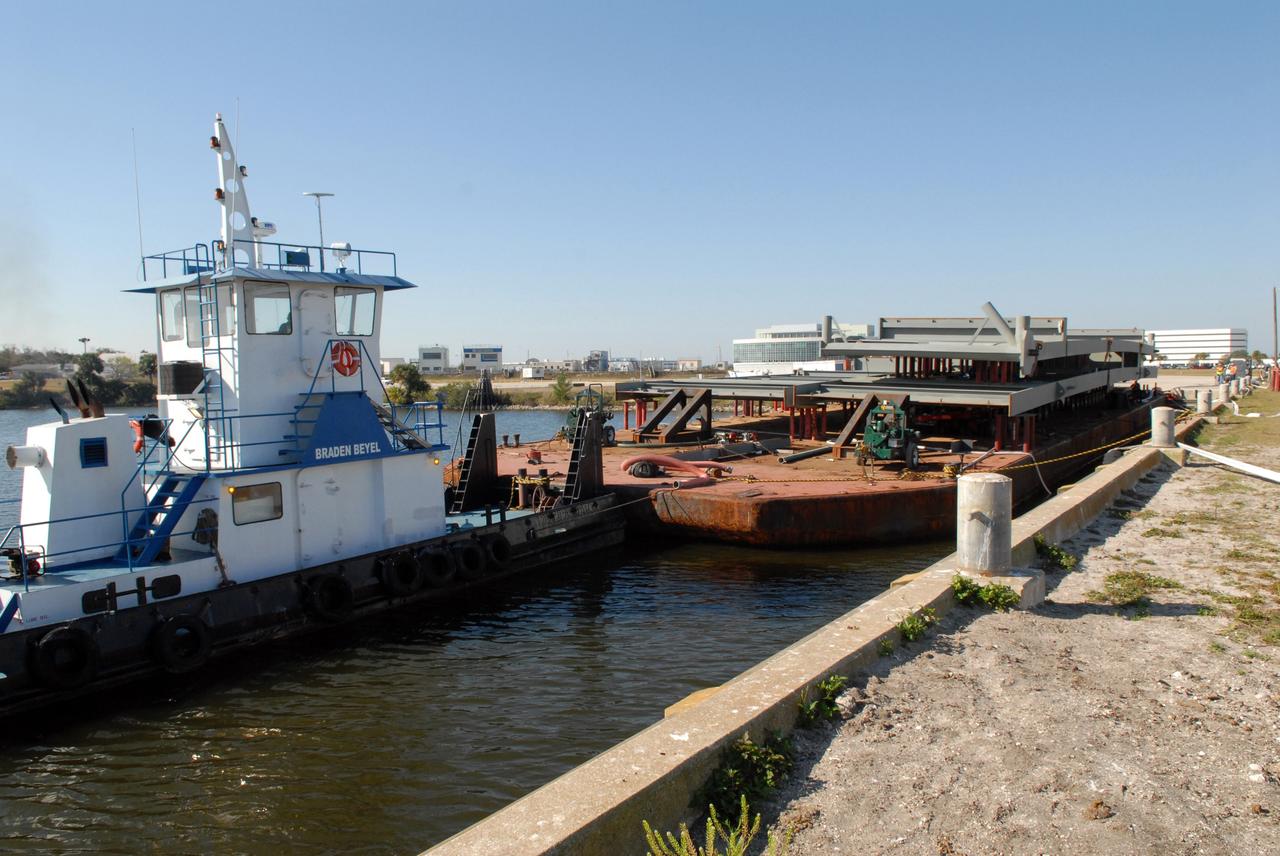
CAPE CANAVERAL, Fla. – At the turn basin at NASA's Kennedy Space Center in Florida, a tug boat keeps the barge in place for the offloading of the girder for the new mobile launcher. The new mobile launcher will be the base for the Ares rockets to launch the Orion crew exploration vehicle and the cargo vehicle. The base is being made lighter than space shuttle mobile launcher platforms so the crawler-transporter can pick up the added load of the 345-foot tower and taller rocket. When the structural portion of the new mobile launcher is complete, umbilicals, access arms, communications equipment and command/control equipment will be installed. Photo credit: NASA/Jack Pfaller
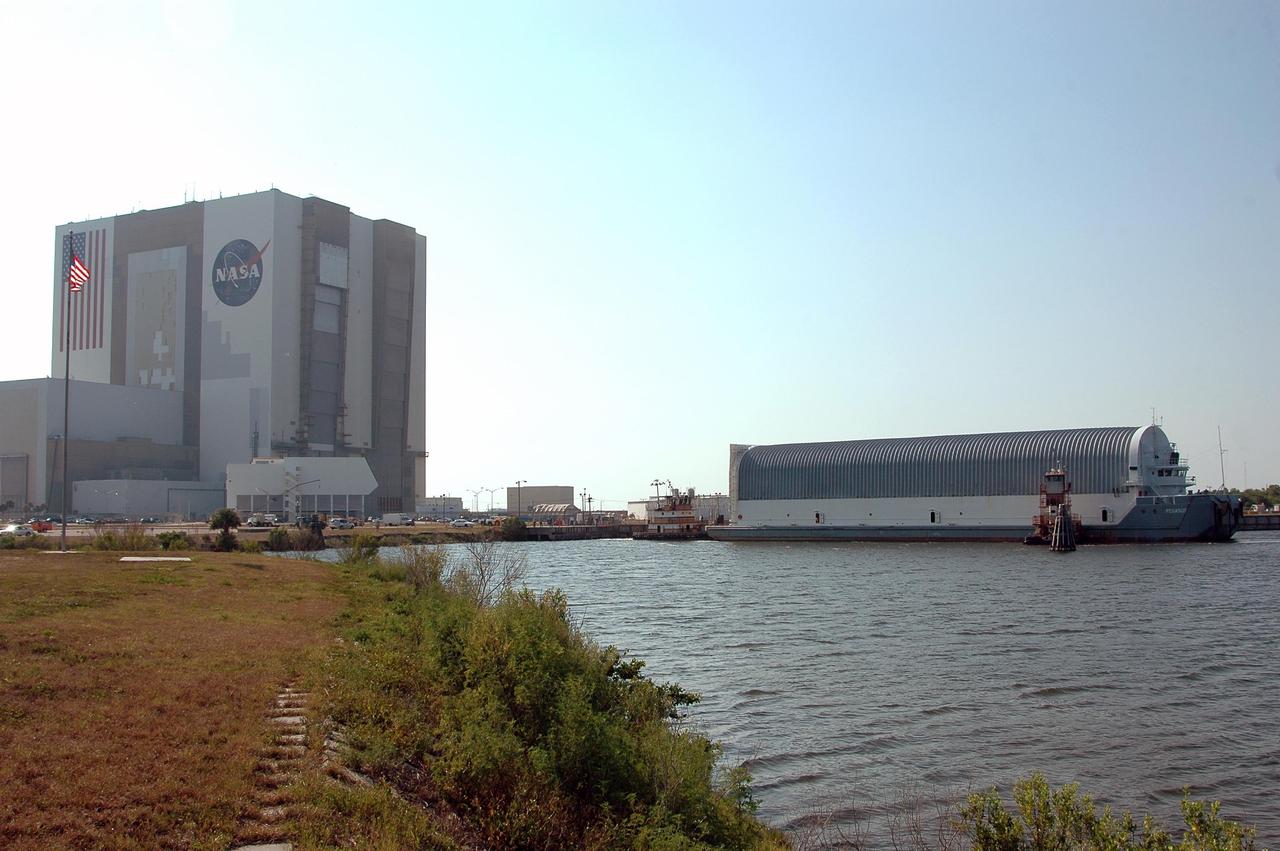
KENNEDY SPACE CENTER, FLA. - Tug boats maneuver the Pegasus barge next to the dock in the turn basin at the Launch Complex 39 Area. The barge holds the redesigned external fuel tank, designated ET-118, that will launch Space Shuttle Atlantis on the next shuttle mission, STS-115. The tank was shipped from the Michoud Assembly Facility in New Orleans. After off-loading, the tank will be moved into the Vehicle Assembly Building and lifted into a checkout cell for further work. The tank will fly with many major safety changes, including the removal of the protuberance air load ramps. Photo credit: NASA/Kim Shiflett
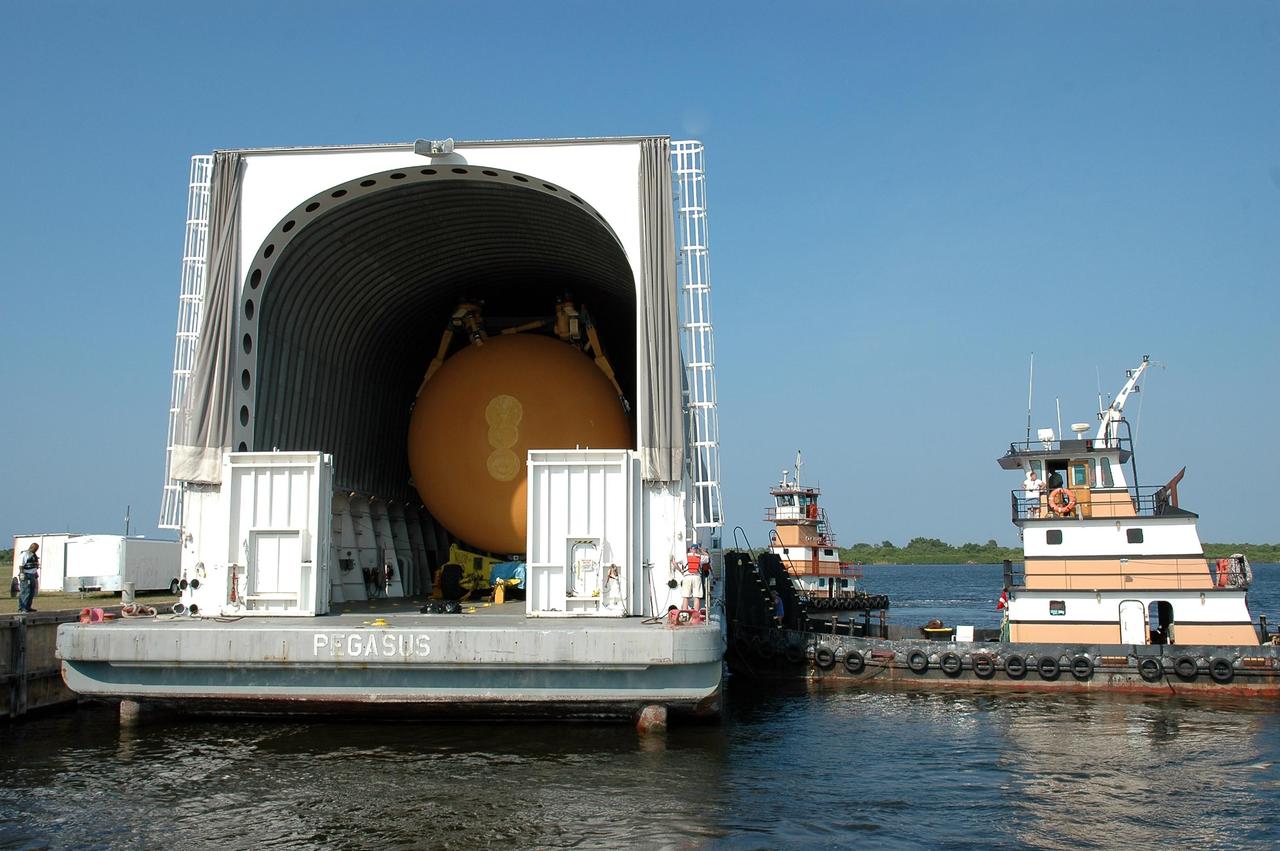
KENNEDY SPACE CENTER, FLA. - Tug boats maneuver the Pegasus barge next to the dock in the turn basin at the Launch Complex 39 Area. The barge holds the redesigned external fuel tank, seen inside, that will launch Space Shuttle Atlantis on the next shuttle mission, STS-115. The tank, designated ET-118, was shipped from the Michoud Assembly Facility in New Orleans. After off-loading, the tank will be moved into the Vehicle Assembly Building and lifted into a checkout cell for further work. The tank will fly with many major safety changes, including the removal of the protuberance air load ramps. Photo credit: NASA/Kim Shiflett
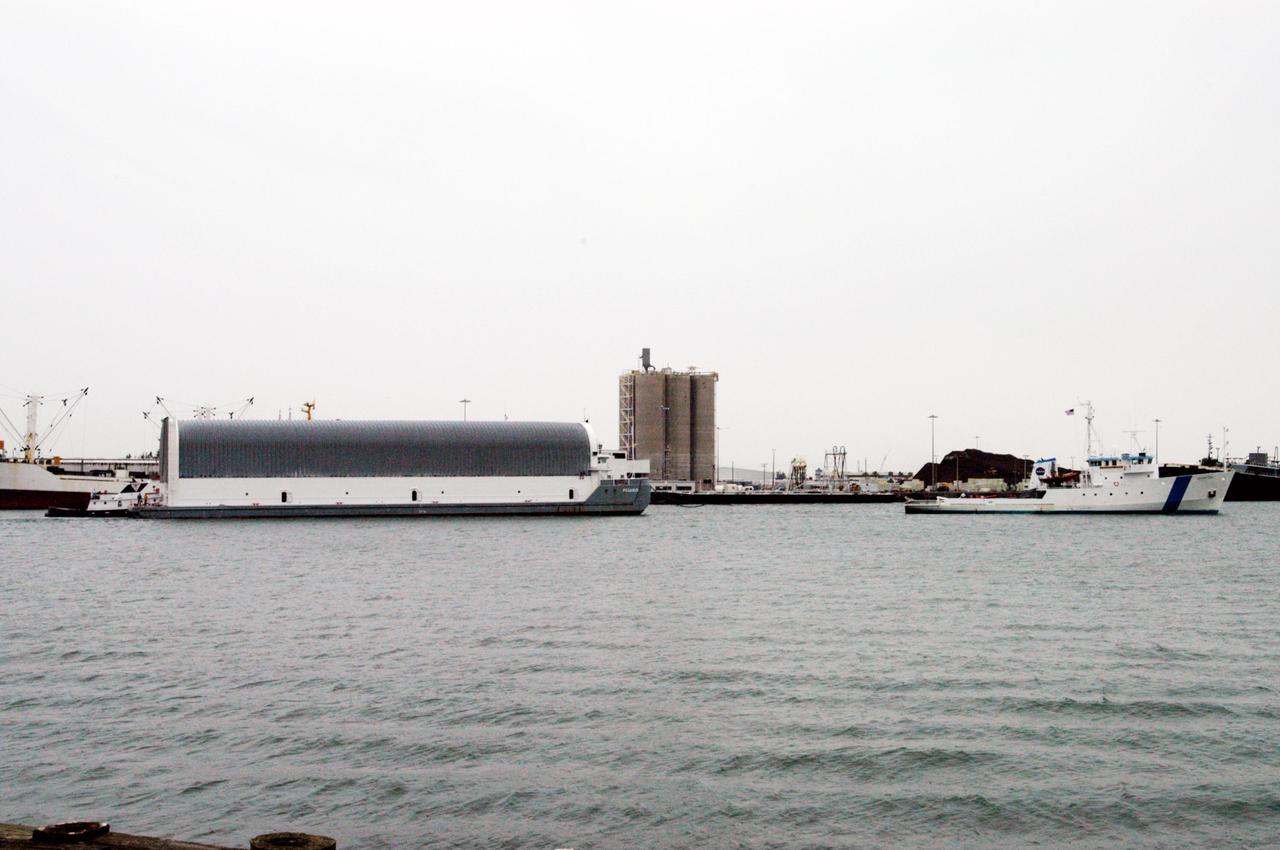
KENNEDY SPACE CENTER, FLA. - The barge carrying a newly redesigned External Tank (ET-121) designated for use on Return to Flight mission STS-121 approaches Port Canaveral after its 900-mile journey at sea from the Michoud Assembly Facility in New Orleans. It is being towed by NASA’s Solid Rocket Booster Retrieval Ship Freedom Star. At Port Canaveral, the barge will be hooked up to tugs for the last part of the journey to the Launch Complex 39 Area Turn Basin at NASA’s Kennedy Space Center. It will then be offloaded and transported to the Vehicle Assembly Building.
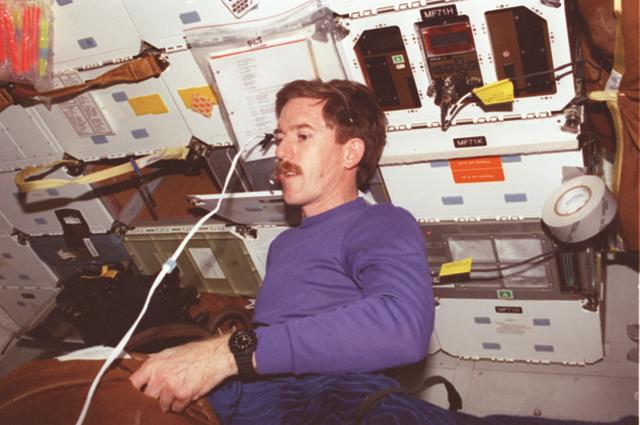
STS089-372-031 (22-31 Jan. 1998) --- Astronaut James F. Reilly, STS-89 mission specialist, tugs on a bag of supplies to be transferred from the space shuttle Endeavour's middeck to Russia's Mir Space Station, to which the shuttle was docked for several days. In the midst of the nine-day flight, Endeavour dropped off a number of supplies for the Mir crew members, along with Andrew S. W. Thomas, cosmonaut guest researcher; and the shuttle crew also retrieved David A. Wolf, who had spent four months on Mir. Photo credit: NASA
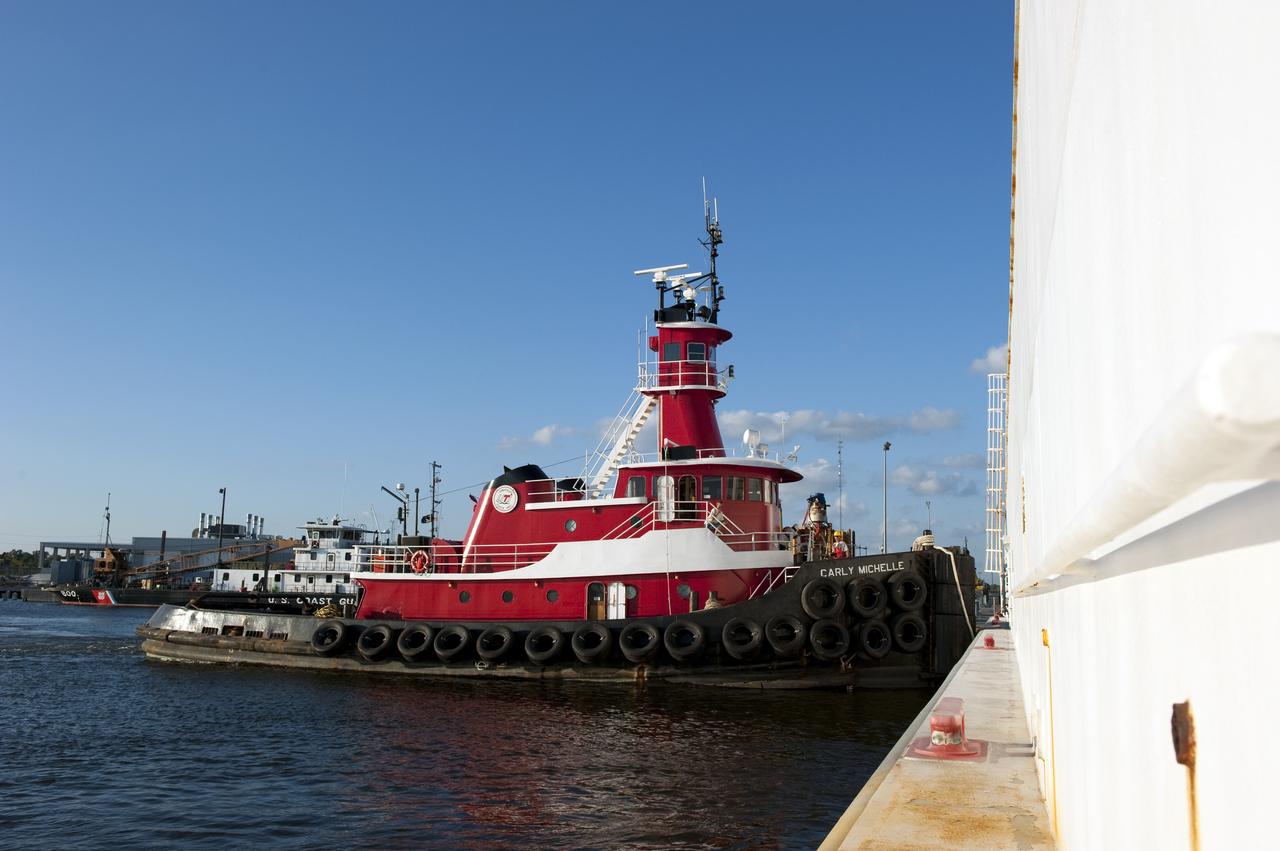
NEW ORLEANS -- At NASA's Michoud Assembly Facility in New Orleans a tug boat is prepared to escort the Space Shuttle Program's last external fuel tank, ET-122, for transportation to NASA's Kennedy Space Center in Florida. Secured aboard the Pegasus Barge the tank will travel 900 miles by sea before being offloaded and moved to Kennedy's Vehicle Assembly Building. There it will be integrated to space shuttle Endeavour for the STS-134 mission to the International Space Station. The tank, which is the largest element of the space shuttle stack, was damaged during Hurricane Katrina in August 2005 and restored to flight configuration by Lockheed Martin Space Systems Company employees. STS-134, targeted to launch Feb. 2011, currently is scheduled to be the last mission in the Space Shuttle Program. Photo credit: NASA/Kim Shiflett
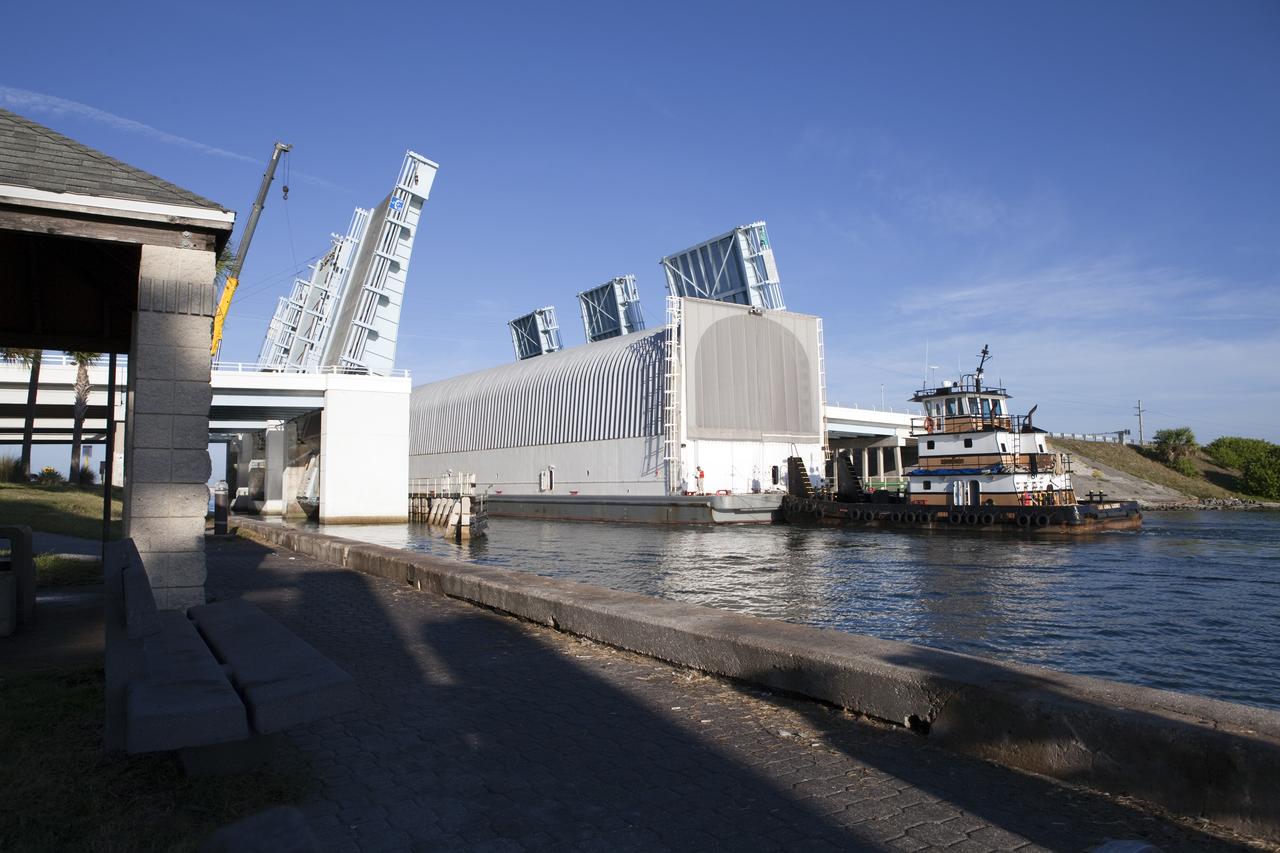
CAPE CANAVERAL, Fla. -- A tug boat pulls the Space Shuttle Program's last external fuel tank, ET-122, toward the Turn Basin at NASA's Kennedy Space Center in Florida. The tank traveled 900 miles by sea from NASA's Michoud Assembly Facility in New Orleans aboard the Pegasus Barge. Next, the tank will be offloaded and moved to Kennedy's Vehicle Assembly Building where it eventually will be attached to space shuttle Endeavour for the STS-134 mission to the International Space Station. STS-134, targeted to launch in Feb., 2011, currently is scheduled to be the last mission in the Space Shuttle Program. The tank, which is the largest element of the space shuttle stack, was damaged during Hurricane Katrina in August 2005 and restored to flight configuration by Lockheed Martin Space Systems Company employees. Photo credit: NASA/Frankie Martin
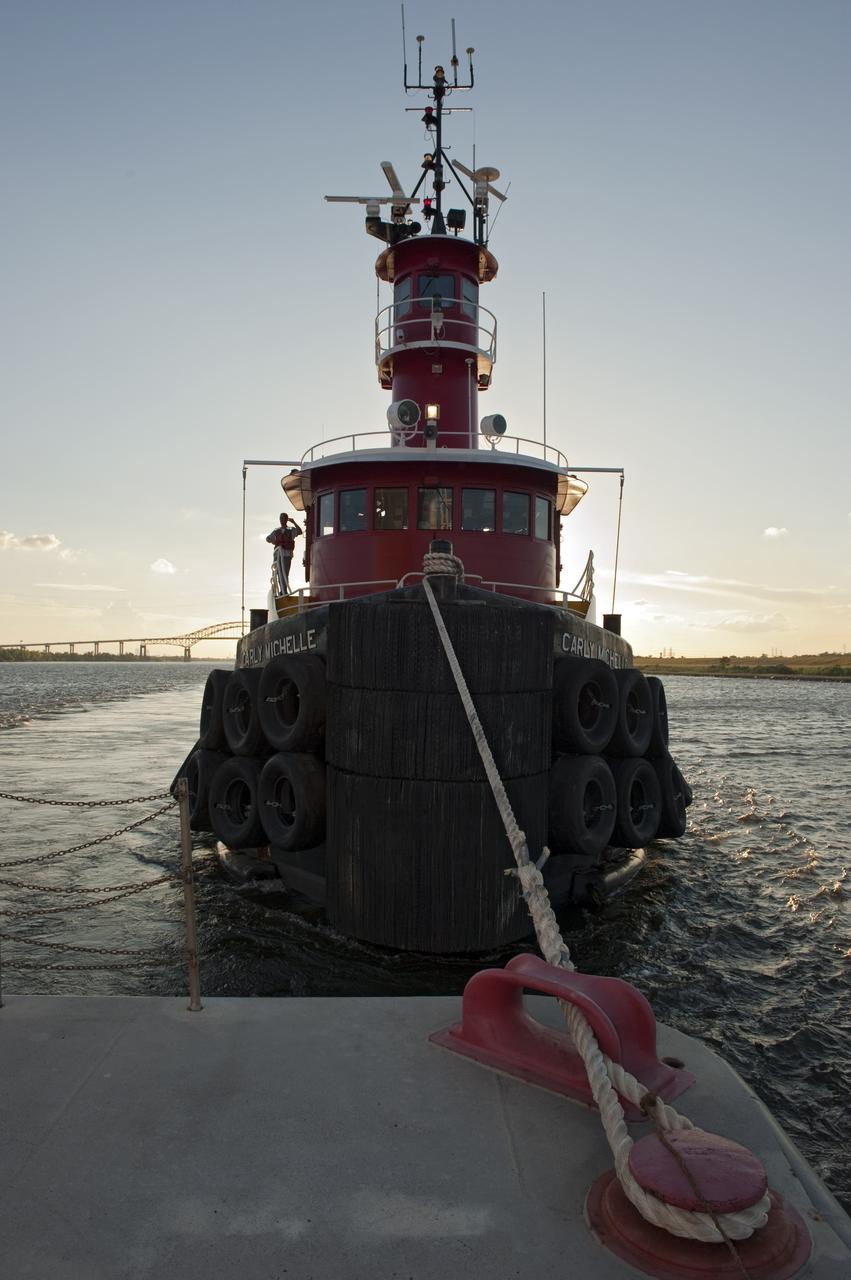
NEW ORLEANS -- A tug boat pulls the Pegasus Barge carrying the Space Shuttle Program's last external fuel tank, ET-122, from NASA's Michoud Assembly Facility in New Orleans to NASA's Kennedy Space Center in Florida. The tank will travel 900 miles by sea before being offloaded and moved to Kennedy's Vehicle Assembly Building. There it will be integrated to space shuttle Endeavour for the STS-134 mission to the International Space Station. The tank, which is the largest element of the space shuttle stack, was damaged during Hurricane Katrina in August 2005 and restored to flight configuration by Lockheed Martin Space Systems Company employees. STS-134, targeted to launch Feb. 2011, currently is scheduled to be the last mission in the Space Shuttle Program. Photo credit: NASA/Kim Shiflett
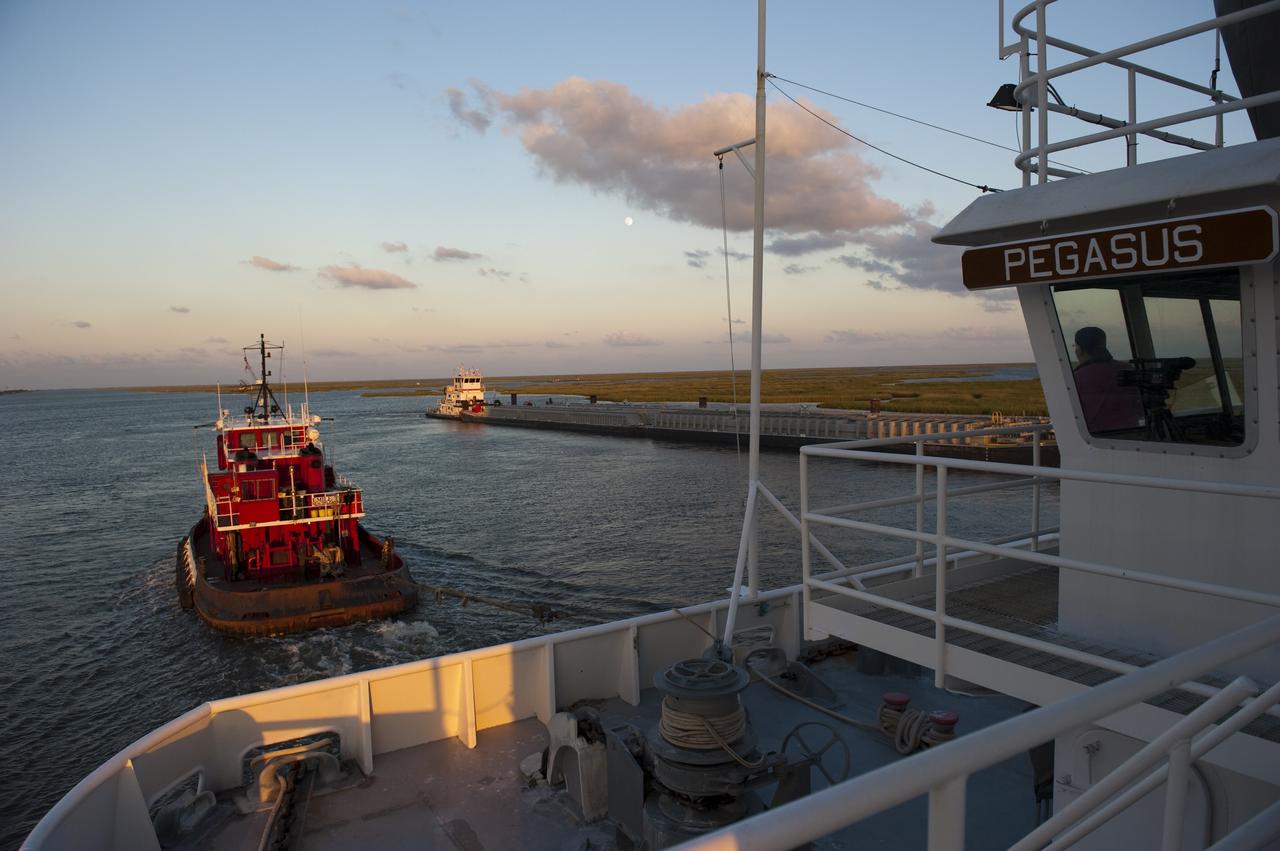
NEW ORLEANS -- A tug boat is pulls the Pegasus Barge carrying the Space Shuttle Program's last external fuel tank, ET-122, from NASA's Michoud Assembly Facility in New Orleans to NASA's Kennedy Space Center in Florida. The tank will travel 900 miles by sea before being offloaded and moved to Kennedy's Vehicle Assembly Building. There it will be integrated to space shuttle Endeavour for the STS-134 mission to the International Space Station. The tank, which is the largest element of the space shuttle stack, was damaged during Hurricane Katrina in August 2005 and restored to flight configuration by Lockheed Martin Space Systems Company employees. STS-134, targeted to launch Feb. 2011, currently is scheduled to be the last mission in the Space Shuttle Program. Photo credit: NASA/Kim Shiflett
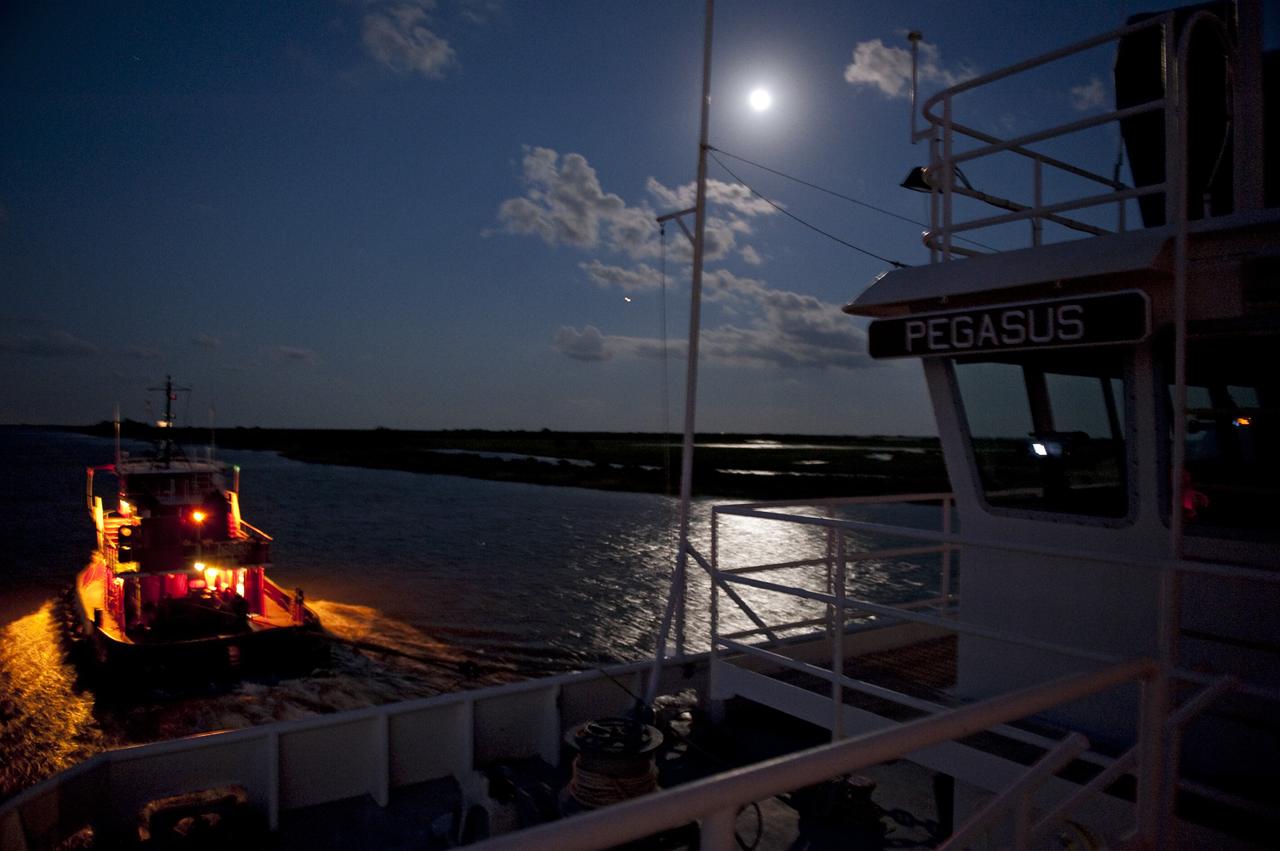
NEW ORLEANS -- As the moon lights up the water, as tug boat pulls the Pegasus Barge carrying the Space Shuttle Program's last external fuel tank, ET-122, from NASA's Michoud Assembly Facility in New Orleans to NASA's Kennedy Space Center in Florida. The tank will travel 900 miles by sea before being offloaded and moved for Kennedy's Vehicle Assembly Building. There it will be integrated to space shuttle Endeavour for the STS-134 mission to the International Space Station. The tank, which is the largest element of the space shuttle stack, was damaged during Hurricane Katrina in August 2005 and restored to flight configuration by Lockheed Martin Space Systems Company employees. STS-134, targeted to launch Feb. 2011, currently is scheduled to be the last mission in the Space Shuttle Program. Photo credit: NASA/Kim Shiflett
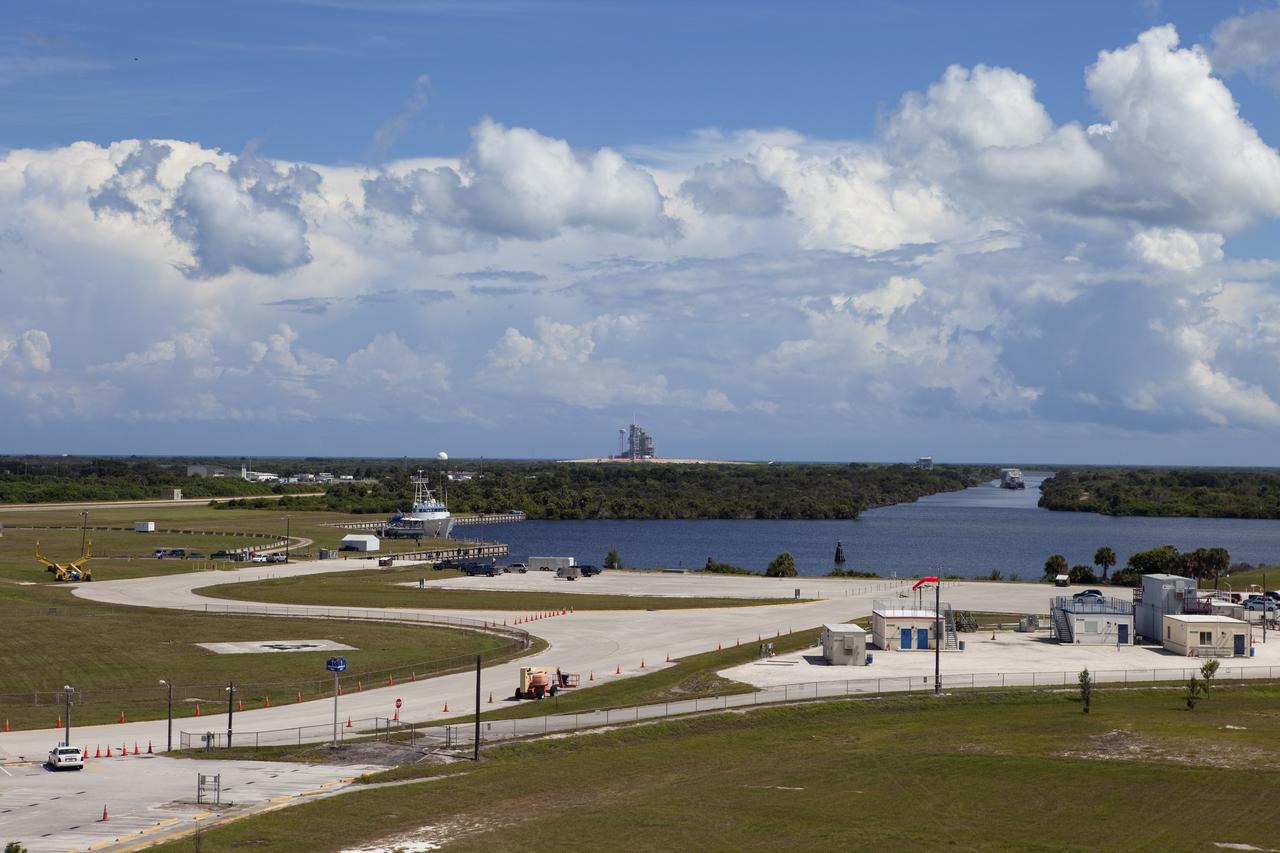
CAPE CANAVERAL, Fla. -- A tug boat pulls the Space Shuttle Program's last external fuel tank, ET-122, to the Turn Basin at NASA's Kennedy Space Center in Florida. The tank traveled 900 miles by sea from NASA's Michoud Assembly Facility in New Orleans aboard the Pegasus Barge. Next, the tank will be offloaded and moved to Kennedy's Vehicle Assembly Building where it eventually will be attached to space shuttle Endeavour for the STS-134 mission to the International Space Station. STS-134, targeted to launch in Feb. 2011, currently is scheduled to be the last mission in the Space Shuttle Program. The tank, which is the largest element of the space shuttle stack, was damaged during Hurricane Katrina in August 2005 and restored to flight configuration by Lockheed Martin Space Systems Company employees. Photo credit: NASA/Frankie Martin
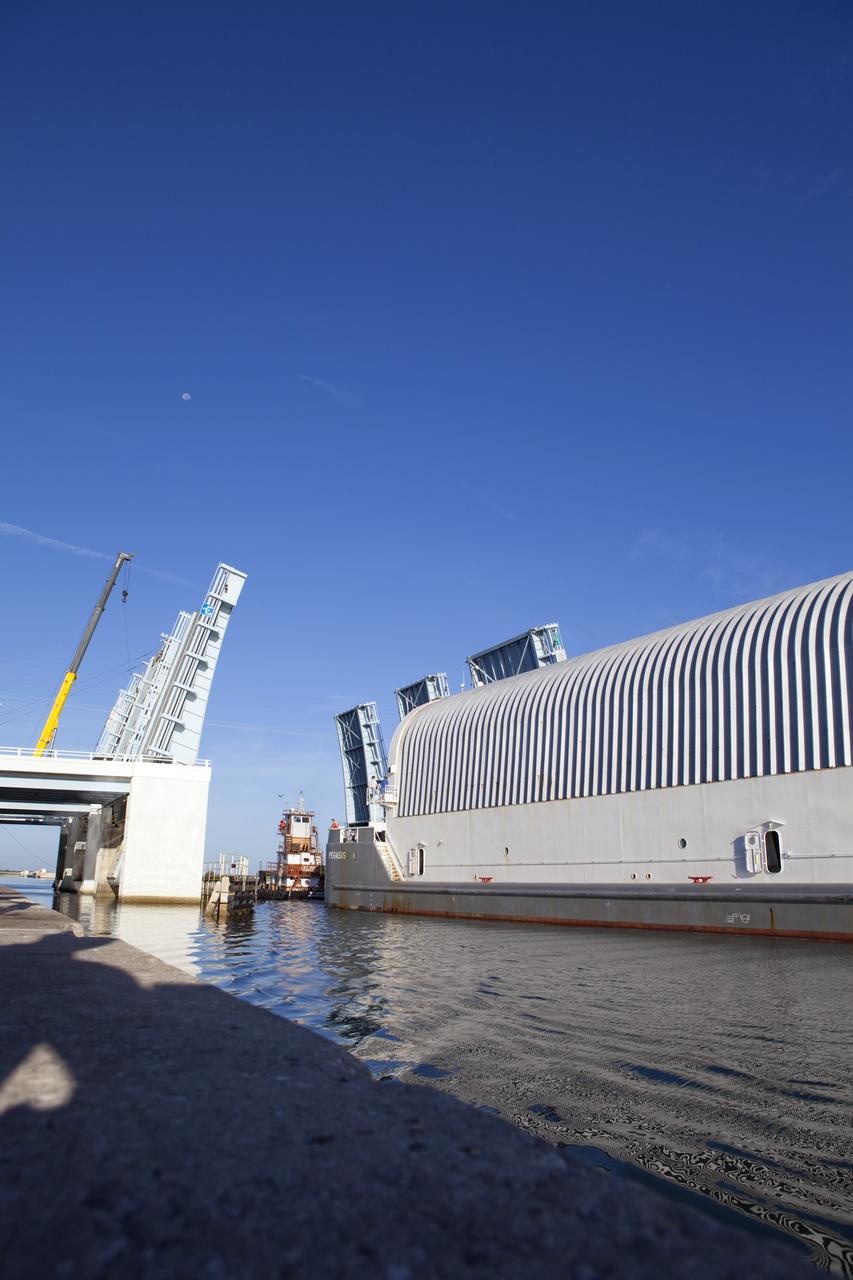
CAPE CANAVERAL, Fla. -- A tug boat pulls the Space Shuttle Program's last external fuel tank, ET-122, toward the Turn Basin at NASA's Kennedy Space Center in Florida. The tank traveled 900 miles by sea from NASA's Michoud Assembly Facility in New Orleans aboard the Pegasus Barge. Next, the tank will be offloaded and moved to Kennedy's Vehicle Assembly Building where it eventually will be attached to space shuttle Endeavour for the STS-134 mission to the International Space Station. STS-134, targeted to launch in Feb. 2011, currently is scheduled to be the last mission in the Space Shuttle Program. The tank, which is the largest element of the space shuttle stack, was damaged during Hurricane Katrina in August 2005 and restored to flight configuration by Lockheed Martin Space Systems Company employees. Photo credit: NASA/Frankie Martin
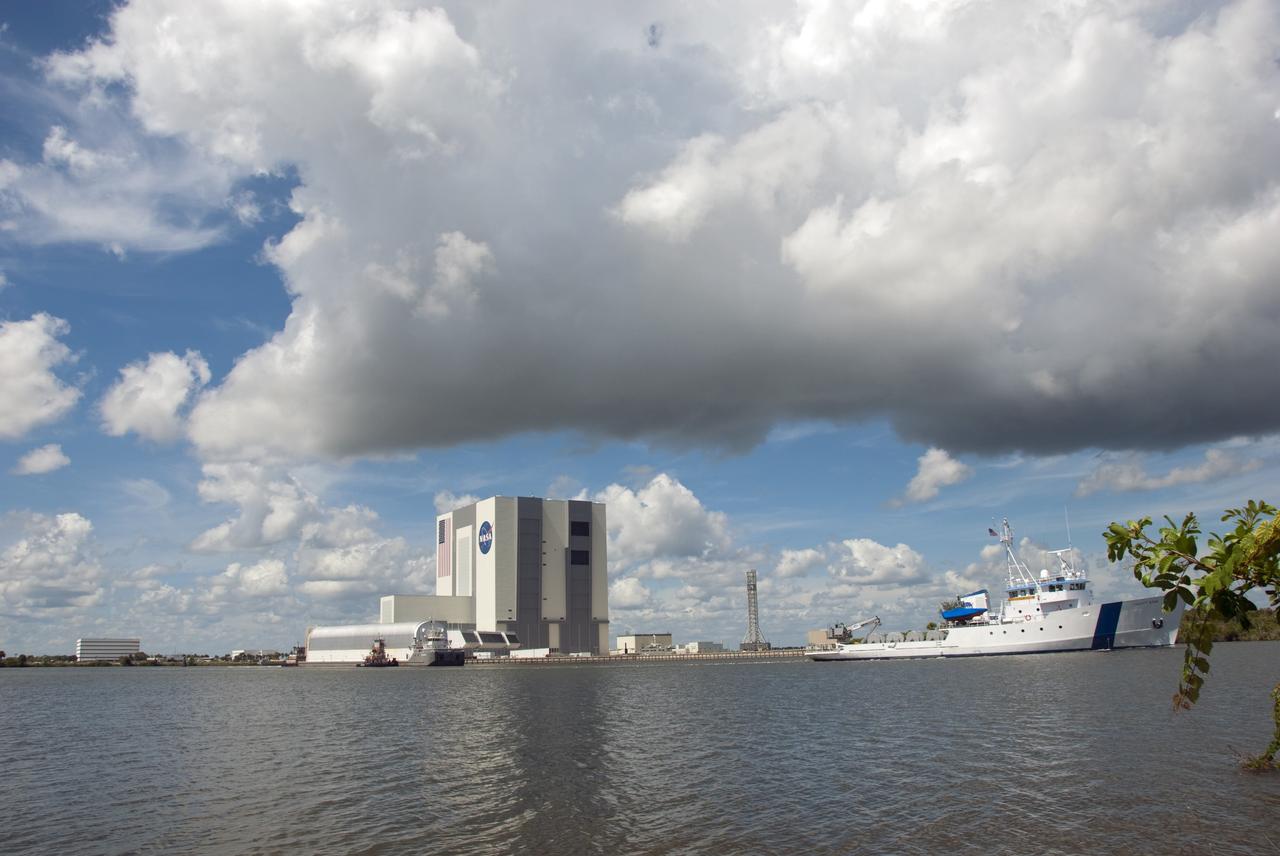
CAPE CANAVERAL, Fla. -- NASA's Pegasus barge, which was ushered by two tug boats and Liberty Star, arrives at NASA's Kennedy Space Center in Florida. The barge is carrying the Space Shuttle Program's last external fuel tank, ET-122 and traveled 900 miles by sea from NASA's Michoud Assembly Facility in New Orleans. Next, the tank will be offloaded and moved to the Vehicle Assembly Building where it eventually will be attached to space shuttle Endeavour for the STS-134 mission to the International Space Station. STS-134, targeted to launch in Feb. 2011, currently is scheduled to be the last mission in the Space Shuttle Program. The tank, which is the largest element of the space shuttle stack, was damaged during Hurricane Katrina in August 2005 and restored to flight configuration by Lockheed Martin Space Systems Company employees. Photo credit: NASA/Jim Grossmann
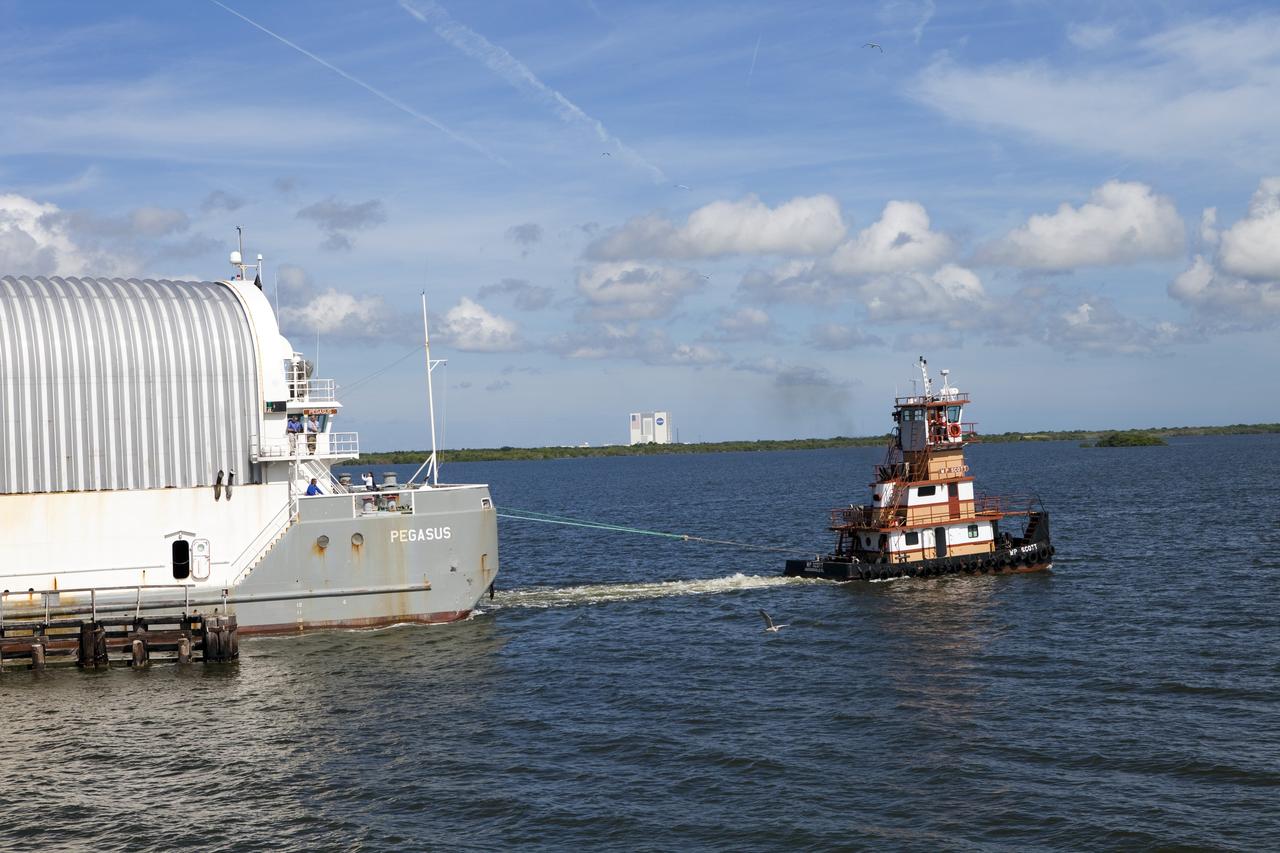
CAPE CANAVERAL, Fla. -- A tug boat pulls the Space Shuttle Program's last external fuel tank, ET-122, to the Turn Basin at NASA's Kennedy Space Center in Florida. The tank traveled 900 miles by sea from NASA's Michoud Assembly Facility in New Orleans aboard the Pegasus Barge. Next, the tank will be offloaded and moved to Kennedy's Vehicle Assembly Building where it eventually will be attached to space shuttle Endeavour for the STS-134 mission to the International Space Station. STS-134, targeted to launch in Feb. 2011, currently is scheduled to be the last mission in the Space Shuttle Program. The tank, which is the largest element of the space shuttle stack, was damaged during Hurricane Katrina in August 2005 and restored to flight configuration by Lockheed Martin Space Systems Company employees. Photo credit: NASA/Frankie Martin
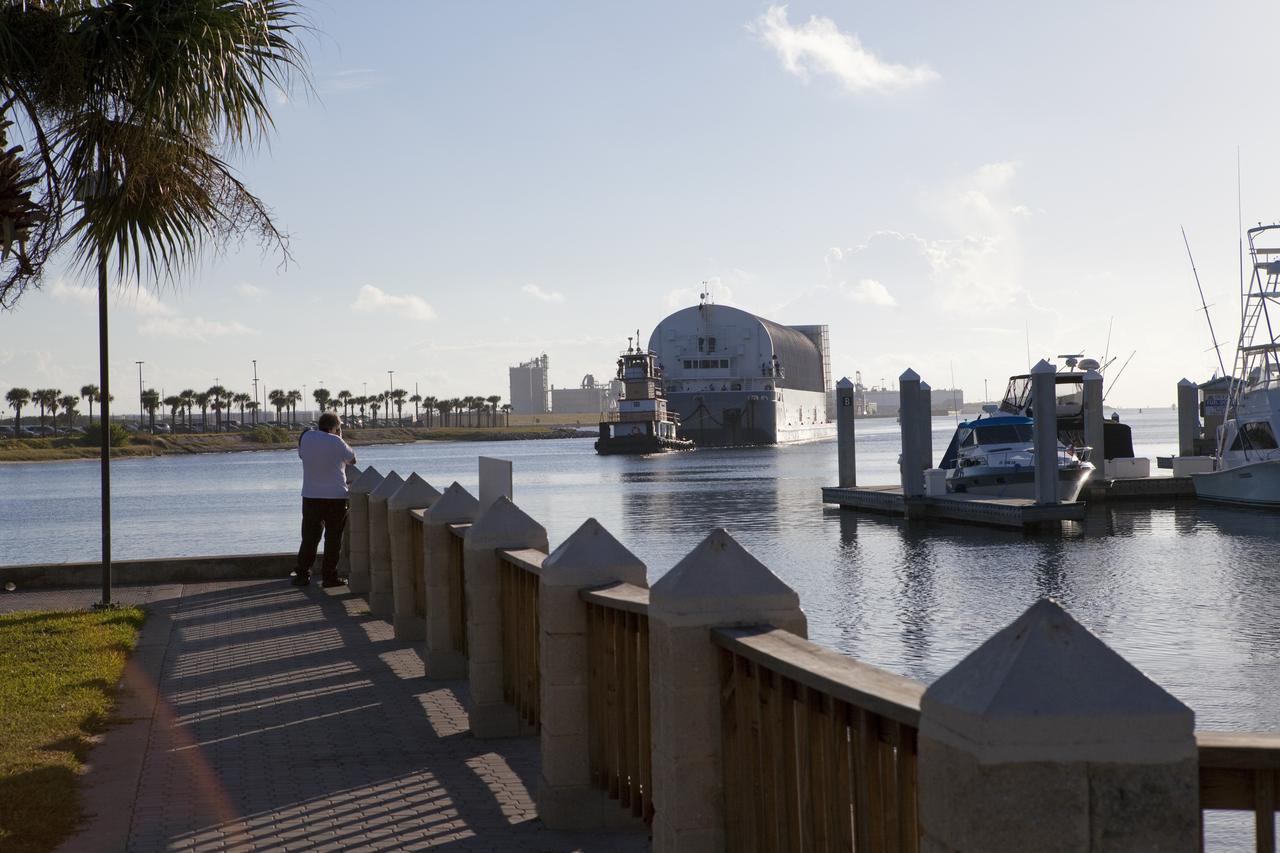
CAPE CANAVERAL, Fla. -- A tug boat pulls the Space Shuttle Program's last external fuel tank, ET-122, toward the Turn Basin at NASA's Kennedy Space Center in Florida. The tank traveled 900 miles by sea from NASA's Michoud Assembly Facility in New Orleans aboard the Pegasus Barge. Next, the tank will be offloaded and moved to Kennedy's Vehicle Assembly Building where it eventually will be attached to space shuttle Endeavour for the STS-134 mission to the International Space Station. STS-134, targeted to launch in Feb. 2011, currently is scheduled to be the last mission in the Space Shuttle Program. The tank, which is the largest element of the space shuttle stack, was damaged during Hurricane Katrina in August 2005 and restored to flight configuration by Lockheed Martin Space Systems Company employees. Photo credit: NASA/Frankie Martin
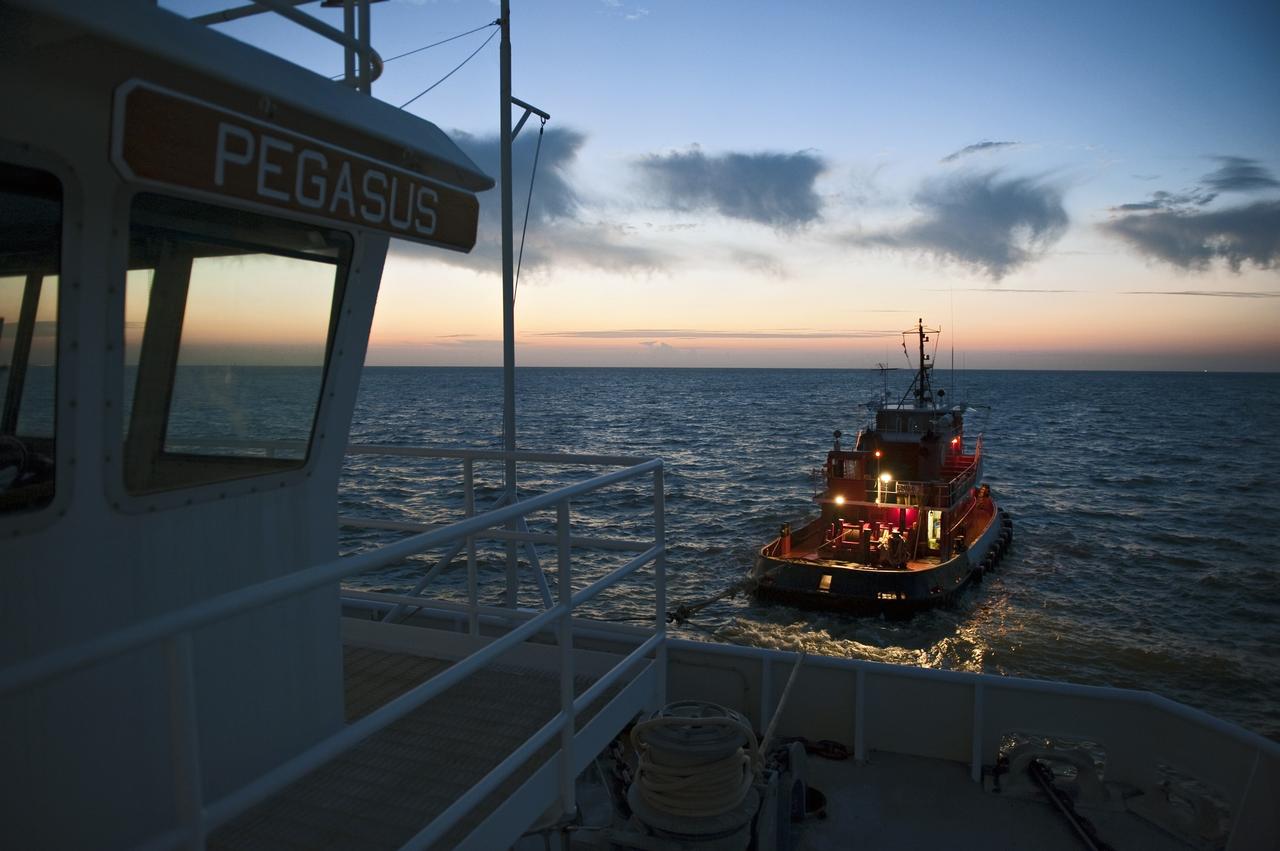
LOUISIANA -- A tug boat pulls the Pegasus Barge carrying the Space Shuttle Program's last external fuel tank, ET-122, from NASA's Michoud Assembly Facility in New Orleans toward Gulfport, La. The barge will meet up with Freedom Star, NASA's solid rocket booster retrieval ship, which will escort it to NASA's Kennedy Space Center in Florida. The tank will travel 900 miles by sea before being offloaded and moved to Kennedy's Vehicle Assembly Building. There it will be integrated to space shuttle Endeavour for the STS-134 mission to the International Space Station. The tank, which is the largest element of the space shuttle stack, was damaged during Hurricane Katrina in August 2005 and restored to flight configuration by Lockheed Martin Space Systems Company employees. STS-134, targeted to launch Feb. 2011, currently is scheduled to be the last mission in the Space Shuttle Program. Photo credit: NASA/Kim Shiflett
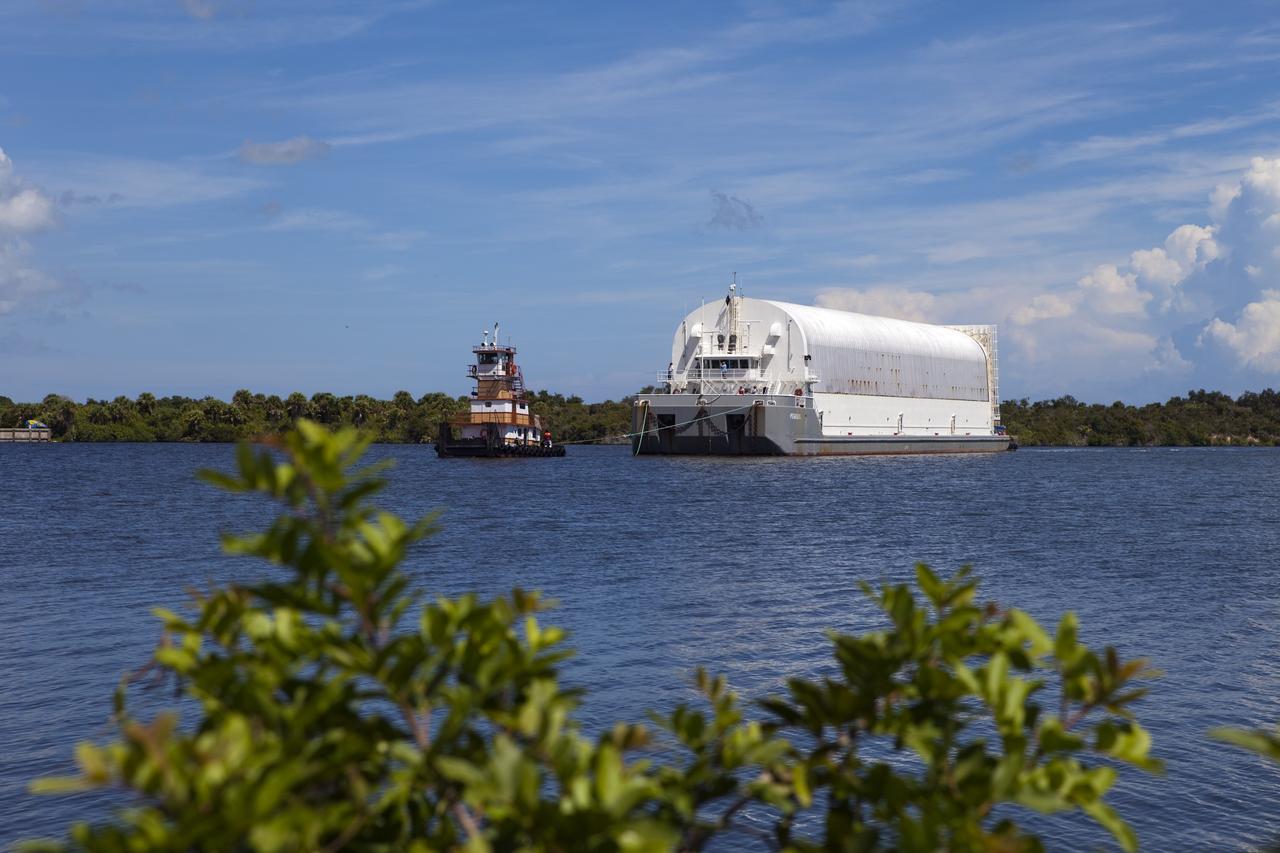
CAPE CANAVERAL, Fla. -- A tug boat pulls the Space Shuttle Program's last external fuel tank, ET-122, to the Turn Basin at NASA's Kennedy Space Center in Florida. The tank traveled 900 miles by sea from NASA's Michoud Assembly Facility in New Orleans aboard the Pegasus Barge. Next, the tank will be offloaded and moved to Kennedy's Vehicle Assembly Building where it eventually will be attached to space shuttle Endeavour for the STS-134 mission to the International Space Station. STS-134, targeted to launch in Feb. 2011, currently is scheduled to be the last mission in the Space Shuttle Program. The tank, which is the largest element of the space shuttle stack, was damaged during Hurricane Katrina in August 2005 and restored to flight configuration by Lockheed Martin Space Systems Company employees. Photo credit: NASA/Frankie Martin
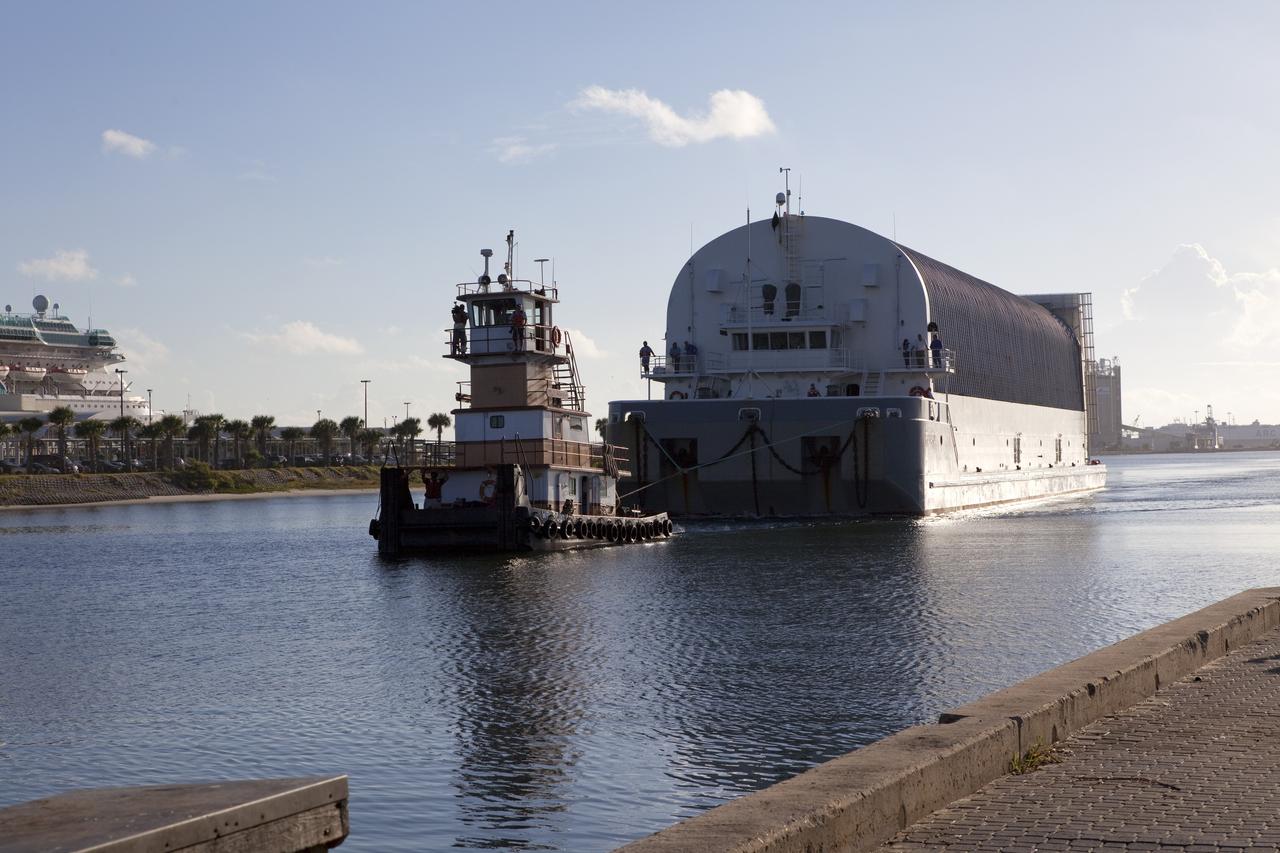
CAPE CANAVERAL, Fla. -- A tug boat pulls the Space Shuttle Program's last external fuel tank, ET-122, toward the Turn Basin at NASA's Kennedy Space Center in Florida. The tank traveled 900 miles by sea from NASA's Michoud Assembly Facility in New Orleans aboard the Pegasus Barge. Next, the tank will be offloaded and moved to Kennedy's Vehicle Assembly Building where it eventually will be attached to space shuttle Endeavour for the STS-134 mission to the International Space Station. STS-134, targeted to launch in Feb., 2011, currently is scheduled to be the last mission in the Space Shuttle Program. The tank, which is the largest element of the space shuttle stack, was damaged during Hurricane Katrina in August 2005 and restored to flight configuration by Lockheed Martin Space Systems Company employees. Photo credit: NASA/Frankie Martin

NEW ORLEANS -- A tug boat pulls the Pegasus Barge carrying the Space Shuttle Program's last external fuel tank, ET-122, from NASA's Michoud Assembly Facility in New Orleans to NASA's Kennedy Space Center in Florida. The tank will travel 900 miles by sea before being offloaded and moved to Kennedy's Vehicle Assembly Building. There it will be integrated to space shuttle Endeavour for the STS-134 mission to the International Space Station. The tank, which is the largest element of the space shuttle stack, was damaged during Hurricane Katrina in August 2005 and restored to flight configuration by Lockheed Martin Space Systems Company employees. STS-134, targeted to launch Feb. 2011, currently is scheduled to be the last mission in the Space Shuttle Program. Photo credit: NASA/Kim Shiflett
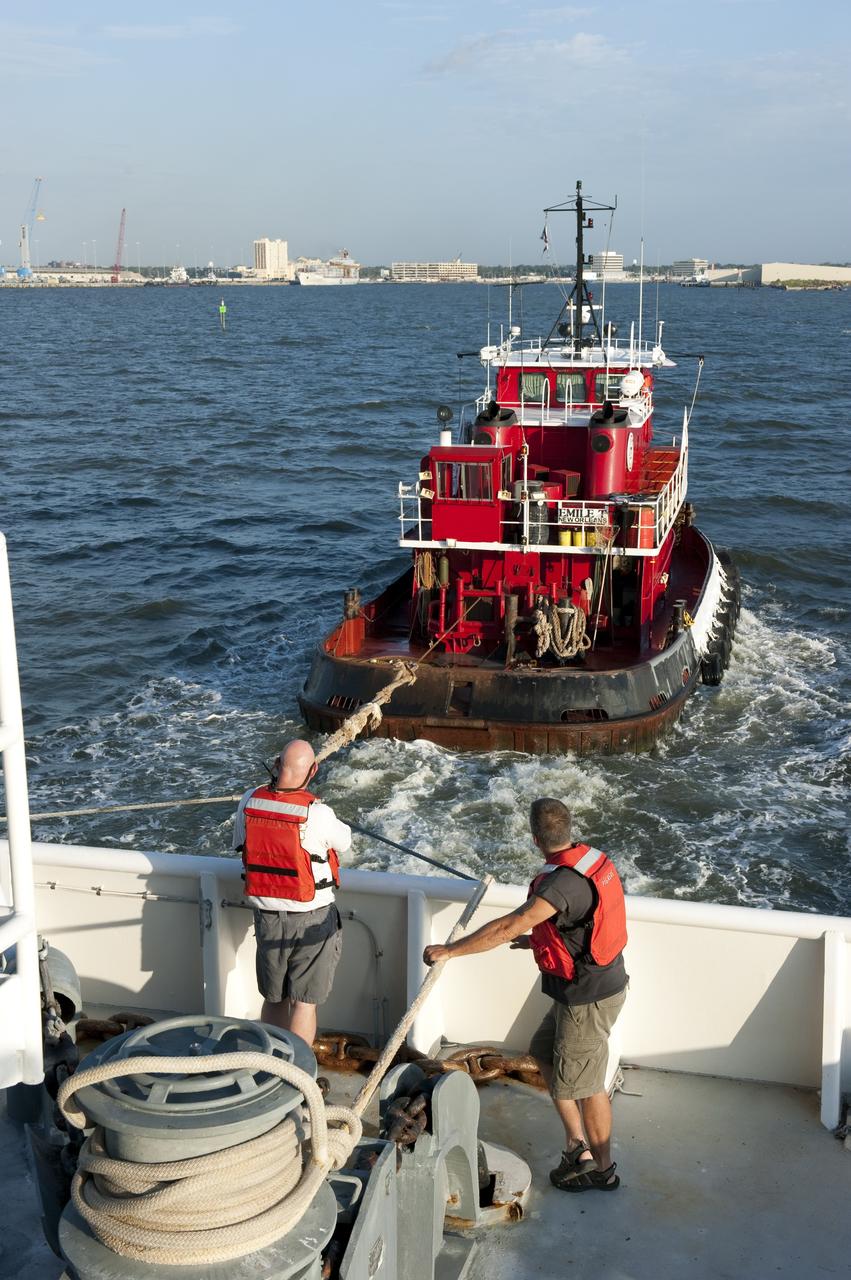
LOUISIANA -- A tug boat pulls the Pegasus Barge carrying the Space Shuttle Program's last external fuel tank, ET-122, from NASA's Michoud Assembly Facility in New Orleans toward a dock in Gulfport, La. The barge will meet up with Freedom Star, NASA's solid rocket booster retrieval ship, which will escort it to NASA's Kennedy Space Center in Florida. The tank will travel 900 miles by sea before being offloaded and moved to Kennedy's Vehicle Assembly Building. There it will be integrated to space shuttle Endeavour for the STS-134 mission to the International Space Station. The tank, which is the largest element of the space shuttle stack, was damaged during Hurricane Katrina in August 2005 and restored to flight configuration by Lockheed Martin Space Systems Company employees. STS-134, targeted to launch Feb. 2011, currently is scheduled to be the last mission in the Space Shuttle Program. Photo credit: NASA/Kim Shiflett
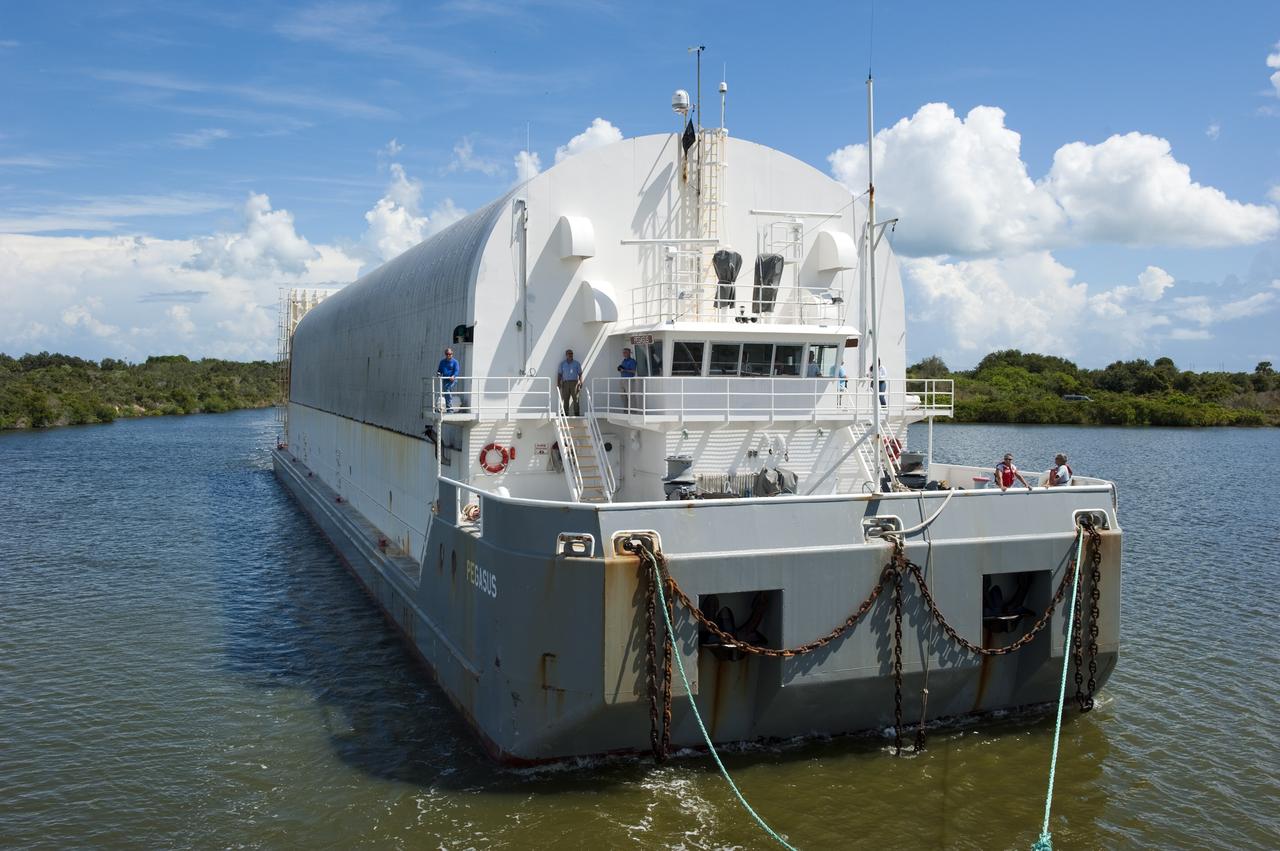
CAPE CANAVERAL, Fla. -- NASA's Pegasus barge is pulled toward NASA's Kennedy Space Center in Florida by a tug boat. The barge is carrying the Space Shuttle Program's last external fuel tank, ET-122 and traveled 900 miles by sea from NASA's Michoud Assembly Facility in New Orleans. After reaching the Turn Basin at Kennedy, the tank will be offloaded and moved to the Vehicle Assembly Building where it eventually will be attached to space shuttle Endeavour for the STS-134 mission to the International Space Station. STS-134, targeted to launch in Feb. 2011, currently is scheduled to be the last mission in the Space Shuttle Program. The tank, which is the largest element of the space shuttle stack, was damaged during Hurricane Katrina in August 2005 and restored to flight configuration by Lockheed Martin Space Systems Company employees. Photo credit: NASA/Kim Shiflett
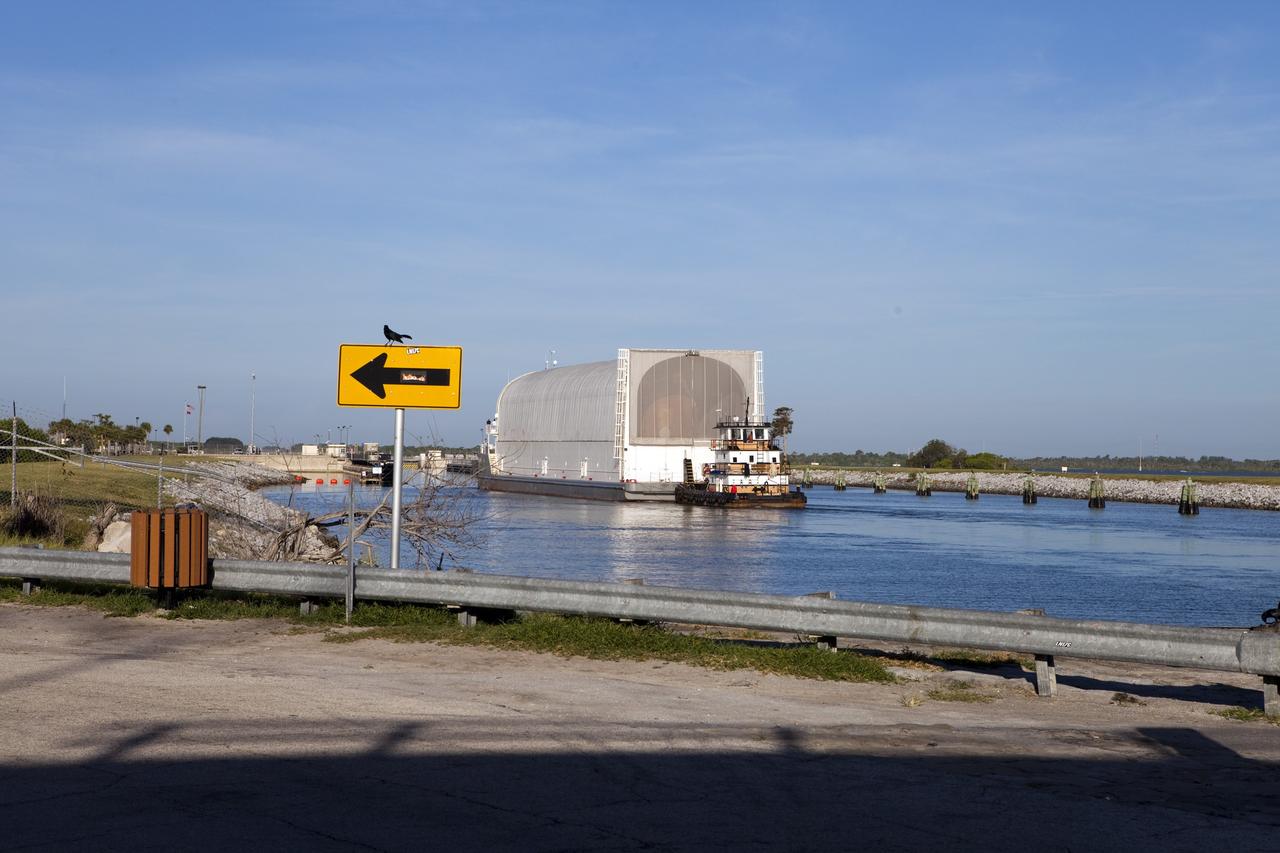
CAPE CANAVERAL, Fla. -- A tug boat pulls the Space Shuttle Program's last external fuel tank, ET-122, toward the Turn Basin at NASA's Kennedy Space Center in Florida. The tank traveled 900 miles by sea from NASA's Michoud Assembly Facility in New Orleans aboard the Pegasus Barge. Next, the tank will be offloaded and moved to Kennedy's Vehicle Assembly Building where it eventually will be attached to space shuttle Endeavour for the STS-134 mission to the International Space Station. STS-134, targeted to launch in Feb., 2011, currently is scheduled to be the last mission in the Space Shuttle Program. The tank, which is the largest element of the space shuttle stack, was damaged during Hurricane Katrina in August 2005 and restored to flight configuration by Lockheed Martin Space Systems Company employees. Photo credit: NASA/Frankie Martin
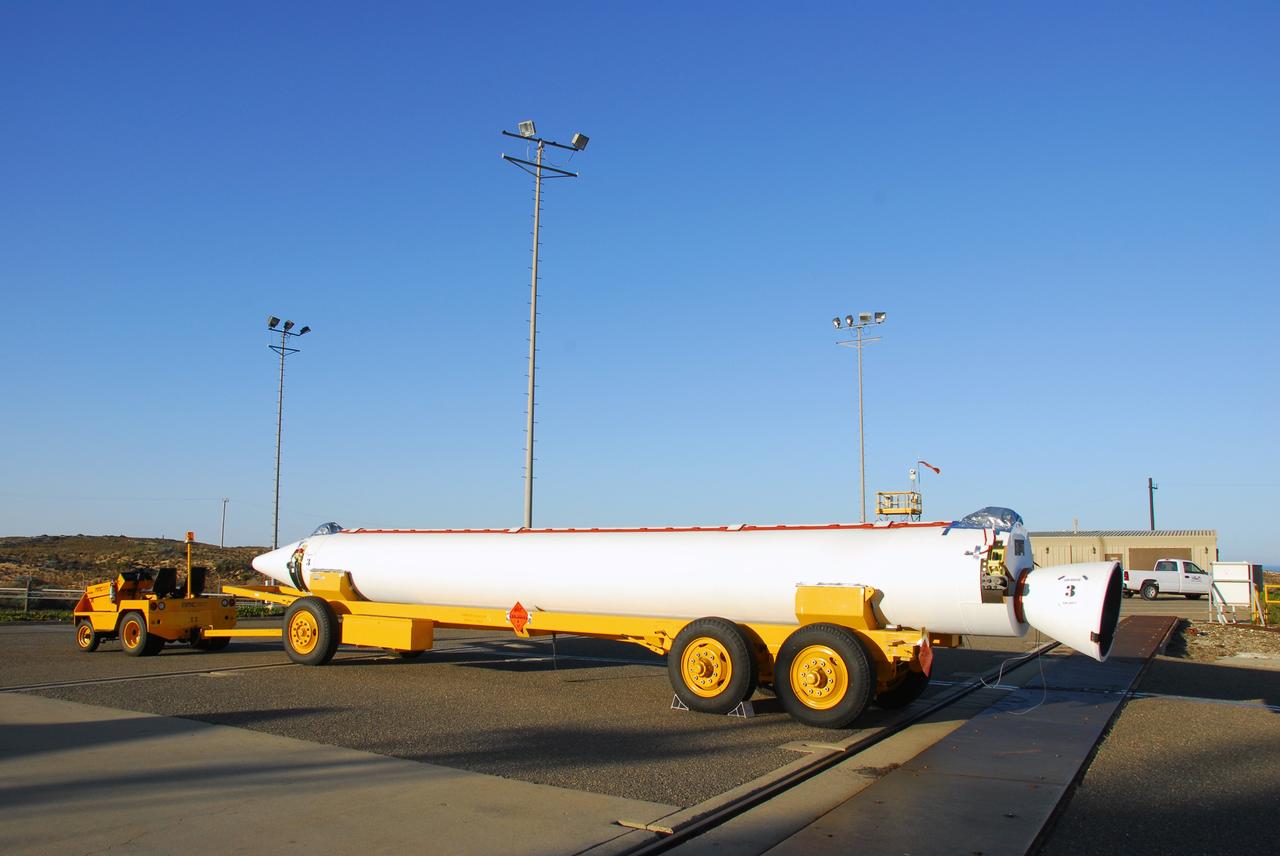
VANDENBERG AIR FORCE BASE, Calif. --At Vandenberg Air Force Base in California, one of three United Space Alliance Delta II solid rocket motors is atop a tug for the move from the solid motor facility to Space Launch Complex-2 West (SLC-2W). Scheduled to launch in June, the Delta II rocket will carry NASA's Aquarius satellite into low Earth orbit. Aquarius' mission will be to provide monthly maps of global changes in sea surface salinity. By measuring ocean salinity from space, Aquarius will provide new insights into how the massive natural exchange of freshwater between the ocean, atmosphere and sea ice influences ocean circulation, weather and climate. Also going up with the satellite are optical and thermal cameras, a microwave radiometer and the SAC-D spacecraft, which were developed with the help of institutions in Italy, France, Canada and Argentina. Photo credit: VAFB/30th Space Wing
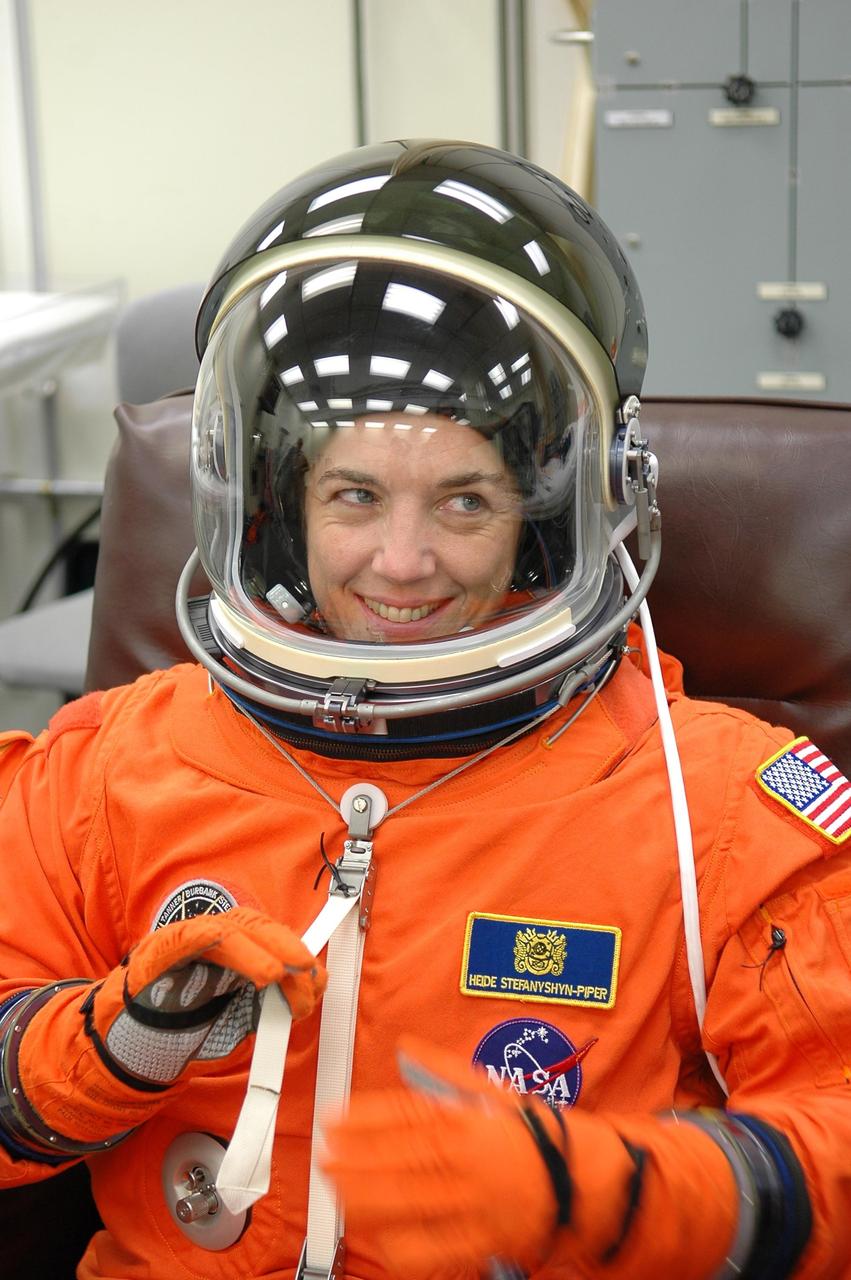
KENNEDY SPACE CENTER, FLA. - STS-115 Mission Specialist Heidemarie Stefanyshyn-Piper gives one last tug on the strap of her launch suit. Piper is making her first flight on a shuttle. She and other crew members are checking their launch suits and apparatus before the launch on Aug. 27. Mission STS-115 is scheduled to lift off about 4:30 p.m. Aug. 27 on Space Shuttle Atlantis. The crew will deliver and install the P3/P4 segment to the port side of the integrated truss system on the International Space Station. The truss includes a new set of photovoltaic solar arrays. When unfurled to their full length of 240 feet, the arrays will provide additional power for the station in preparation for the delivery of international science modules over the next two years. The mission is expected to last 11 days and includes three scheduled spacewalks. Photo credit: NASA/Kim Shiflett
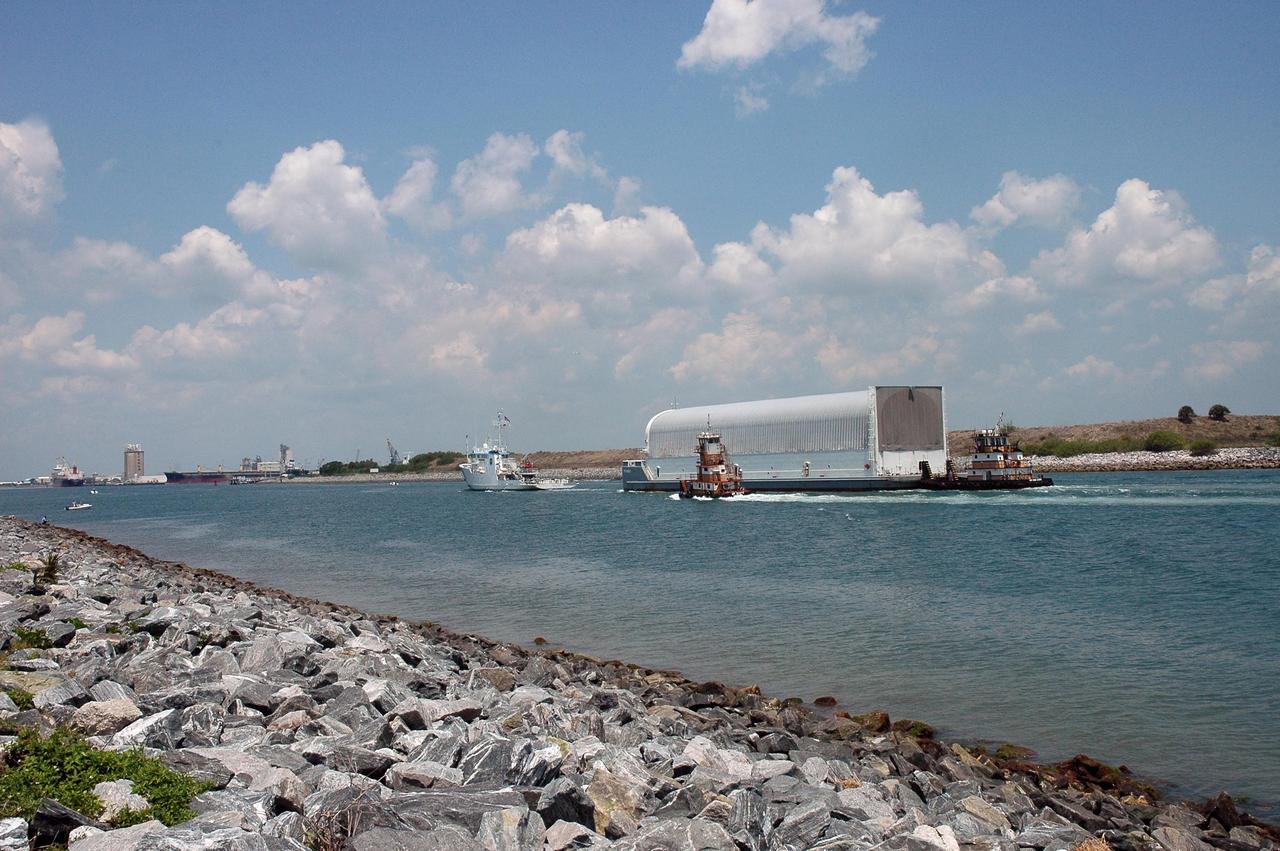
KENNEDY SPACE CENTER, FLA. - With the help of tug boats, the Liberty Star (left) tows the Pegasus barge toward Port Canaveral, the last leg of its journey from the Michoud Assembly Facility in New Orleans to Kennedy Space Center. The barge carries the redesigned external fuel tank that will launch Space Shuttle Atlantis on the next shuttle mission, STS-115. The tugboats will continue the journey upriver to the Turn Basin where, after off-loading, the tank will be moved into the Vehicle Assembly Building and lifted into a checkout cell for further work. The tank, designated ET-118, will fly with many major safety changes, including the removal of the protuberance air load ramps. Photo credit: NASA/Jack Pfaller

KENNEDY SPACE CENTER, FLA. - In the distance, a tug boat maneuvers the Pegasus barge out of the Turn Basin at NASA’s Kennedy Space Center. The barge is carrying external tank #120, which is being returned to NASA’s Michoud Assembly Facility in Louisiana for additional modifications. The barge is being moved to Port Canaveral where one of NASA’s solid rocket booster retrieval ships will take it and tow it around the Florida peninsula to Michoud. This tank is the first of the newly designed tanks that were delivered to Kennedy. Previously, the tank was stacked with Discovery and, more recently, Atlantis. The tank has already gone through two tanking cycles during tanking tests but was replaced with tank #121 for Discovery’s return to flight mission STS-114.

Every second a star somewhere out in the universe explodes as a supernova. But some extremely massive stars go out with a whimper instead of a bang. When they do, they can collapse under the crushing tug of gravity and vanish out of sight, only to leave behind a black hole. The doomed star N6946-BH1 was 25 times as massive as our sun. It began to brighten weakly in 2009. But, by 2015, it appeared to have winked out of existence. By a careful process of elimination, based on observations by the Large Binocular Telescope and NASA's Hubble and Spitzer space telescopes, researchers eventually concluded that the star must have become a black hole. This may be the fate for extremely massive stars in the universe. This illustration shows the final stages in the life of a supermassive star that fails to explode as a supernova, but instead implodes to form a black hole. https://photojournal.jpl.nasa.gov/catalog/PIA21466
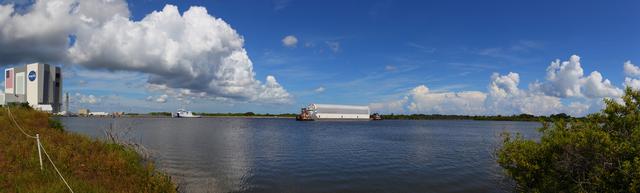
CAPE CANAVERAL, Fla. -- This panoramic image shows tug boats maneuvering the Pegasus Barge carrying the Space Shuttle Program's last external fuel tank, ET-122, through the Turn Basin at NASA's Kennedy Space Center in Florida. Once docked, the tank will be offloaded from the barge and transported to the Vehicle Assembly Building (VAB). NASA's Liberty Star solid rocket booster retrieval ship is also seen (left) docked at the Turn Basin. The tank traveled 900 miles by sea, carried in the barge, from NASA's Michoud Assembly Facility in New Orleans. Once inside the VAB, it eventually will be attached to space shuttle Endeavour for the STS-134 mission to the International Space Station targeted to launch Feb. 2011. STS-134 currently is scheduled to be the last mission in the shuttle program. The tank, which is the largest element of the space shuttle stack, was damaged during Hurricane Katrina in August 2005 and restored to flight configuration by Lockheed Martin Space Systems Company employees. Photo credit: NASA/Frankie Martin
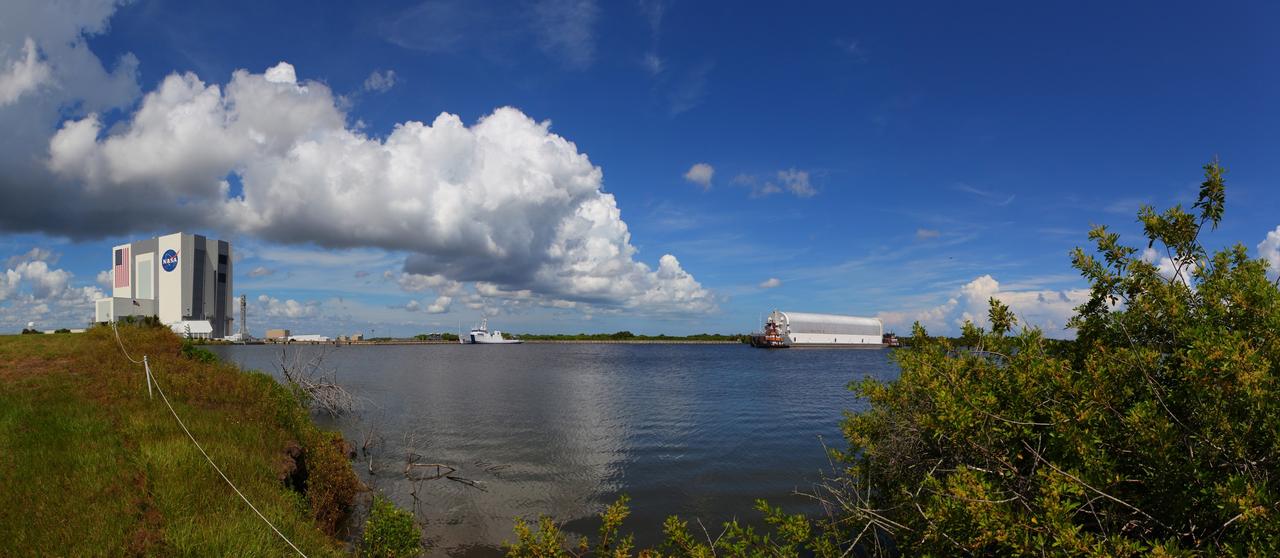
CAPE CANAVERAL, Fla. -- This panoramic image shows tug boats maneuvering the Pegasus Barge carrying the Space Shuttle Program's last external fuel tank, ET-122, through the Turn Basin at NASA's Kennedy Space Center in Florida. Once docked, the tank will be offloaded from the barge and transported to the Vehicle Assembly Building (VAB). NASA's Liberty Star solid rocket booster retrieval ship is seen (left) docked at the Turn Basin. The tank traveled 900 miles by sea, carried in the barge, from NASA's Michoud Assembly Facility in New Orleans. Once inside the VAB, it eventually will be attached to space shuttle Endeavour for the STS-134 mission to the International Space Station targeted to launch Feb. 2011. STS-134 currently is scheduled to be the last mission in the shuttle program. The tank, which is the largest element of the space shuttle stack, was damaged during Hurricane Katrina in August 2005 and restored to flight configuration by Lockheed Martin Space Systems Company employees. Photo credit: NASA/Frankie Martin
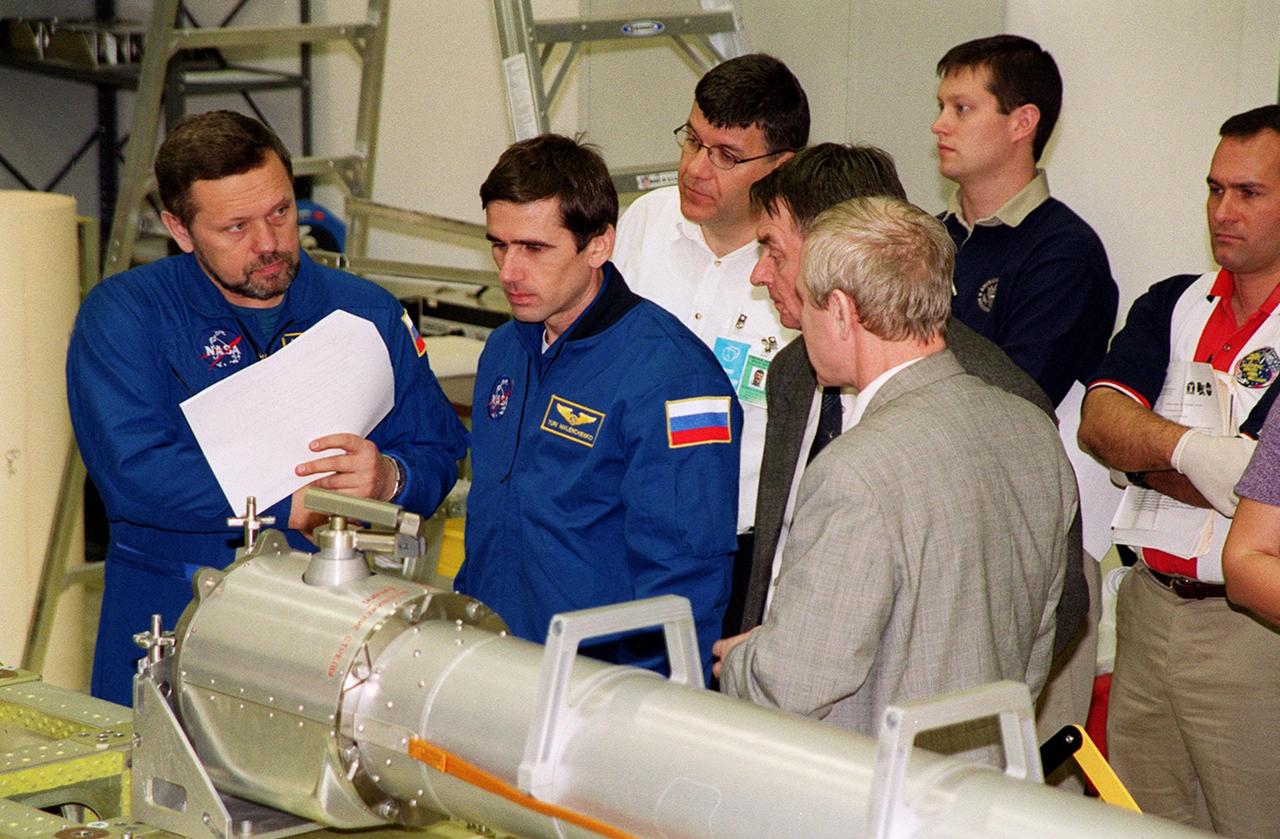
During a Crew Equipment Interface Test (CEIT), members of the STS-101 crew learn about some of the cargo that will be on their mission from workers at SPACEHAB, in Cape Canaveral, Fla. At left are Mission Specialists Boris W. Morukov and Yuri Malenchenko, who are with the Russian Space Agency. Other crew members are Commander James Donald Halsell Jr., Pilot Scott Horowitz, and Mission Specialists Mary Ellen Weber (Ph.D.), Edward Lu, and Jeffrey N. Williams, The primary objective of the STS-101 mission is to complete the initial outfitting of the International Space Station, making it fully ready for the first long-term crew. The seven-member crew will transfer almost two tons of equipment and supplies from SPACEHAB's Logistics Double Module. Additionally, they will unpack a shipment of supplies delivered earlier by a Russian Progress space tug and begin outfitting the newly arrived Zvezda Service Module. Three astronauts will perform two space walks to transfer and install parts of the Russian Strela cargo boom that are attached to SPACEHAB's Integrated Cargo Container, connect utility cables between Zarya and Zvezda, and install a magnetometer/pole assembly on the Service Module. Additional activities for the STS-101 astronauts include working with the Space Experiment Module (SEM-06) and the Mission to America's Remarkable Schools (MARS), two educational initiatives. STS-101 is scheduled for launch no earlier than March 16, 2000
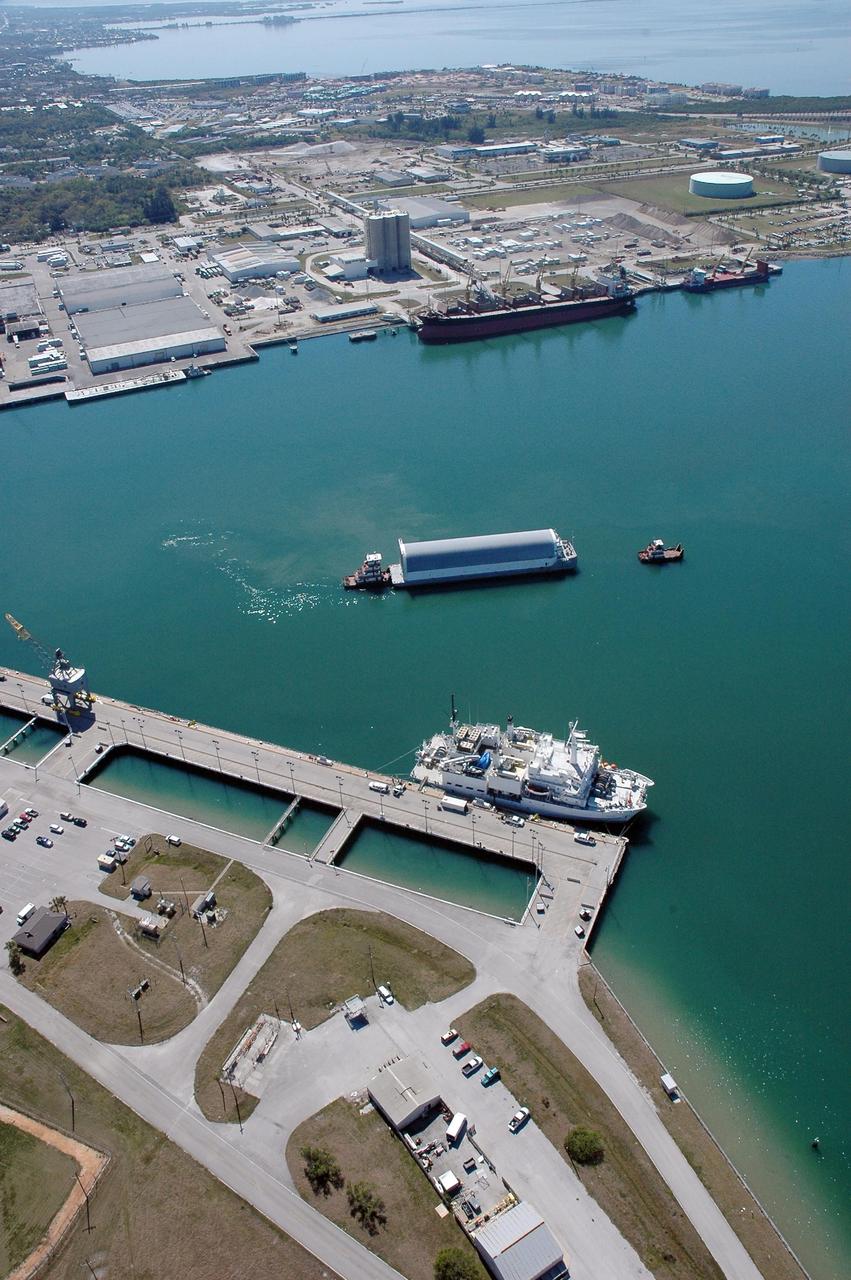
KENNEDY SPACE CENTER, FLA. - The Pegasus barge, towed by the solid rocket booster retrieval ship Freedom Star to Port Canaveral from the Michoud Assembly Facility in New Orleans, waits for a tug boat to finish the trip to the turn basin near NASA Kennedy Space Center's Vehicle Assembly Building. The barge carries the redesigned external fuel tank that will launch the Space Shuttle Discovery on the next shuttle mission, STS-121. After off-loading, the tank will be moved into the Vehicle Assembly Building and lifted into a checkout cell for further work. The tank, designated ET-119, will fly with many major safety changes, including the removal of the protuberance air load ramps. A large piece of foam from one of the ramps came off during the July 2005 launch of the last shuttle mission. The ramps were removed to help eliminate a potential source of damaging debris to the space shuttle. Launch of Discovery is scheduled for May 2006. Photo credit: NASA/Cory Huston
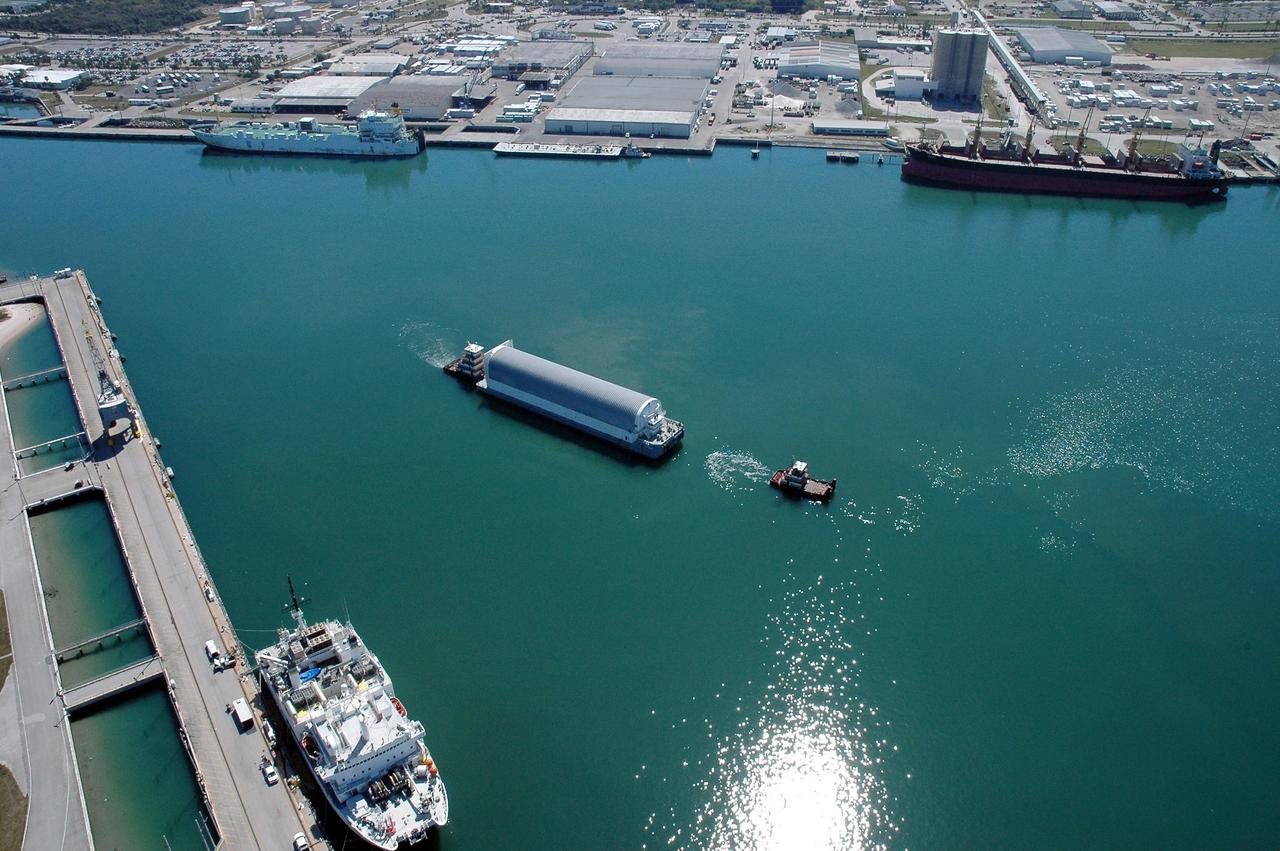
KENNEDY SPACE CENTER, FLA. - The Pegasus barge, towed by the solid rocket booster retrieval ship Freedom Star to Port Canaveral from the Michoud Assembly Facility in New Orleans, waits for a tug boat to finish the trip to the turn basin near NASA Kennedy Space Center's Vehicle Assembly Building. The barge carries the redesigned external fuel tank that will launch the Space Shuttle Discovery on the next shuttle mission, STS-121. After off-loading, the tank will be moved into the Vehicle Assembly Building and lifted into a checkout cell for further work. The tank, designated ET-119, will fly with many major safety changes, including the removal of the protuberance air load ramps. A large piece of foam from one of the ramps came off during the July 2005 launch of the last shuttle mission. The ramps were removed to help eliminate a potential source of damaging debris to the space shuttle. Launch of Discovery is scheduled for May 2006. Photo credit: NASA/Cory Huston
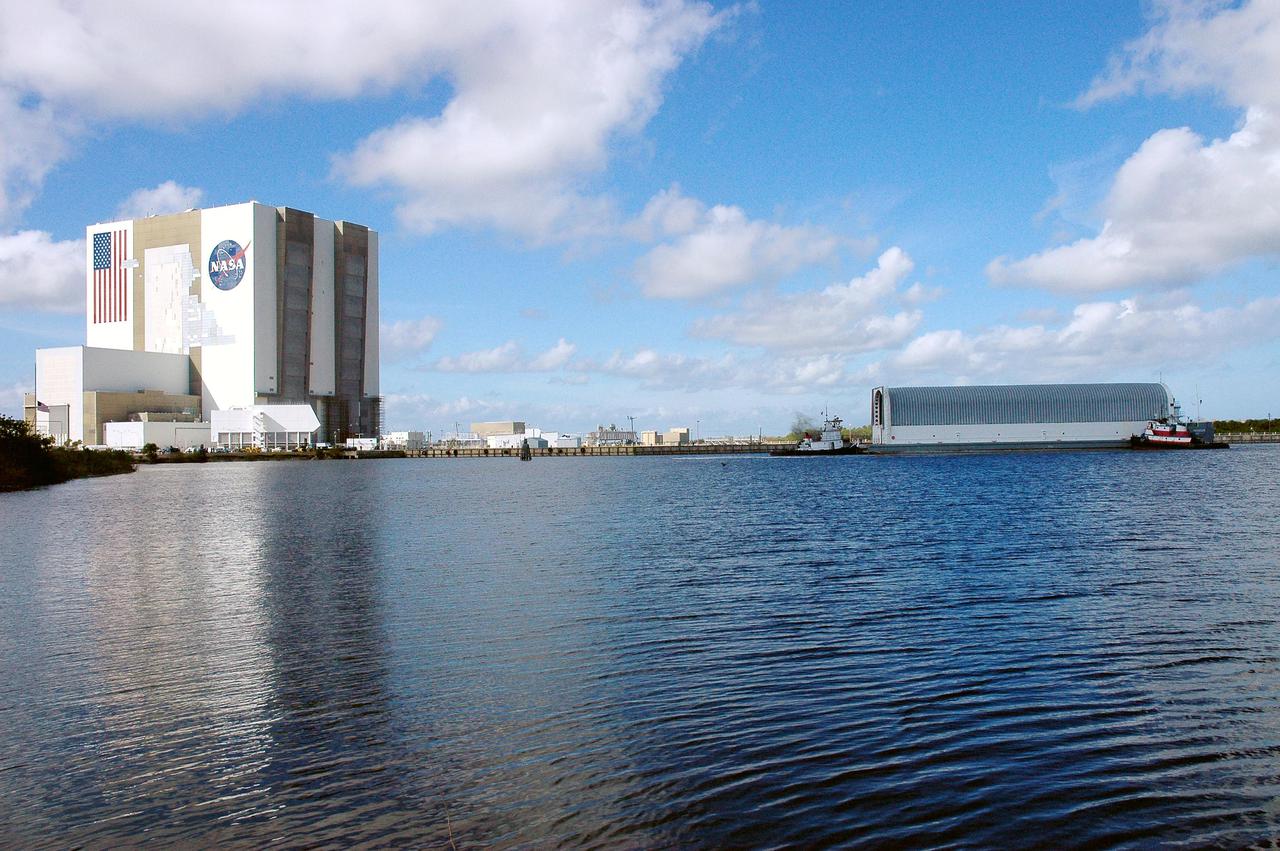
KENNEDY SPACE CENTER, FLA. - The barge carrying the newly redesigned External Tank, designated for use on Return to Flight mission STS-114, is towed toward the Launch Complex 39 Area Turn Basin at Kennedy. At left is the Vehicle Assembly Building. The barge arrived after an approximately 900-mile journey at sea from the Michoud Assembly Facility in New Orleans. It left the facility Dec. 31 on the Pegasus, NASA’s specially designed barge, towed by Solid Rocket Booster retrieval ship Liberty Star. At Port Canaveral, the barge was then hooked up to the tugs for the last part of the journey. Next, the External Tank will be off-loaded from the barge and transported to the Vehicle Assembly Building for its final checkout and mating to the twin Solid Rocket Boosters and orbiter Discovery. NASA and Lockheed Martin Corp. spent nearly two years modifying the 15-story, bronze-colored tank to make it safer for liftoff. Among dozens of changes is a redesigned forward bipod fitting -- a design that meets the recommendation of the Columbia Accident Investigation Board to reduce the risk to the Space Shuttle from falling debris during ascent. STS-114 is targeted for a launch opportunity beginning in May. The seven-member Discovery crew will fly to the International Space Station primarily to test and evaluate new procedures for flight safety, including Space Shuttle inspection and repair techniques.
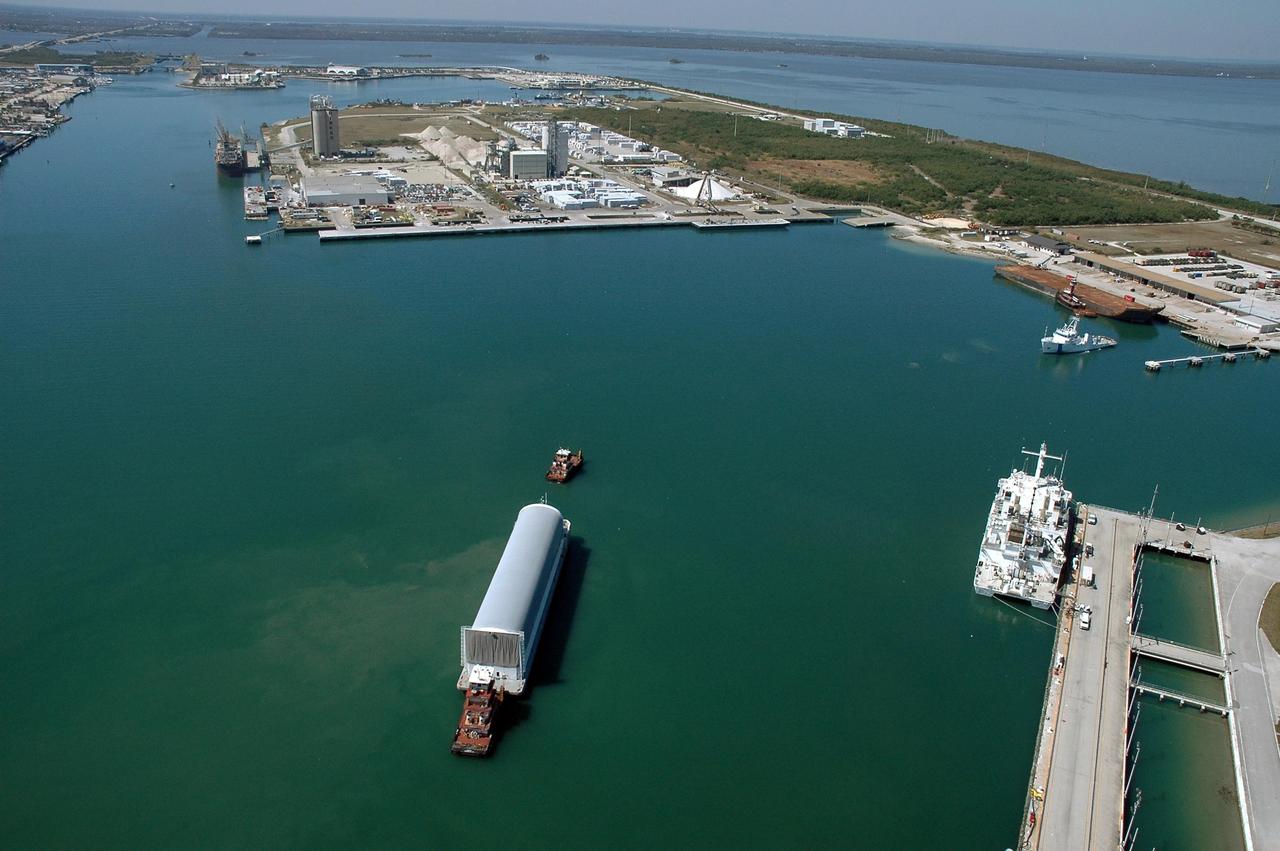
KENNEDY SPACE CENTER, FLA. - The Pegasus barge, towed by the solid rocket booster retrieval ship Freedom Star to Port Canaveral from the Michoud Assembly Facility in New Orleans, waits for a tug boat to finish the trip to the turn basin near NASA Kennedy Space Center's Vehicle Assembly Building. The barge carries the redesigned external fuel tank that will launch the Space Shuttle Discovery on the next shuttle mission, STS-121. After off-loading, the tank will be moved into the Vehicle Assembly Building and lifted into a checkout cell for further work. The tank, designated ET-119, will fly with many major safety changes, including the removal of the protuberance air load ramps. A large piece of foam from one of the ramps came off during the July 2005 launch of the last shuttle mission. The ramps were removed to help eliminate a potential source of damaging debris to the space shuttle. Launch of Discovery is scheduled for May 2006. Photo credit: NASA/Cory Huston
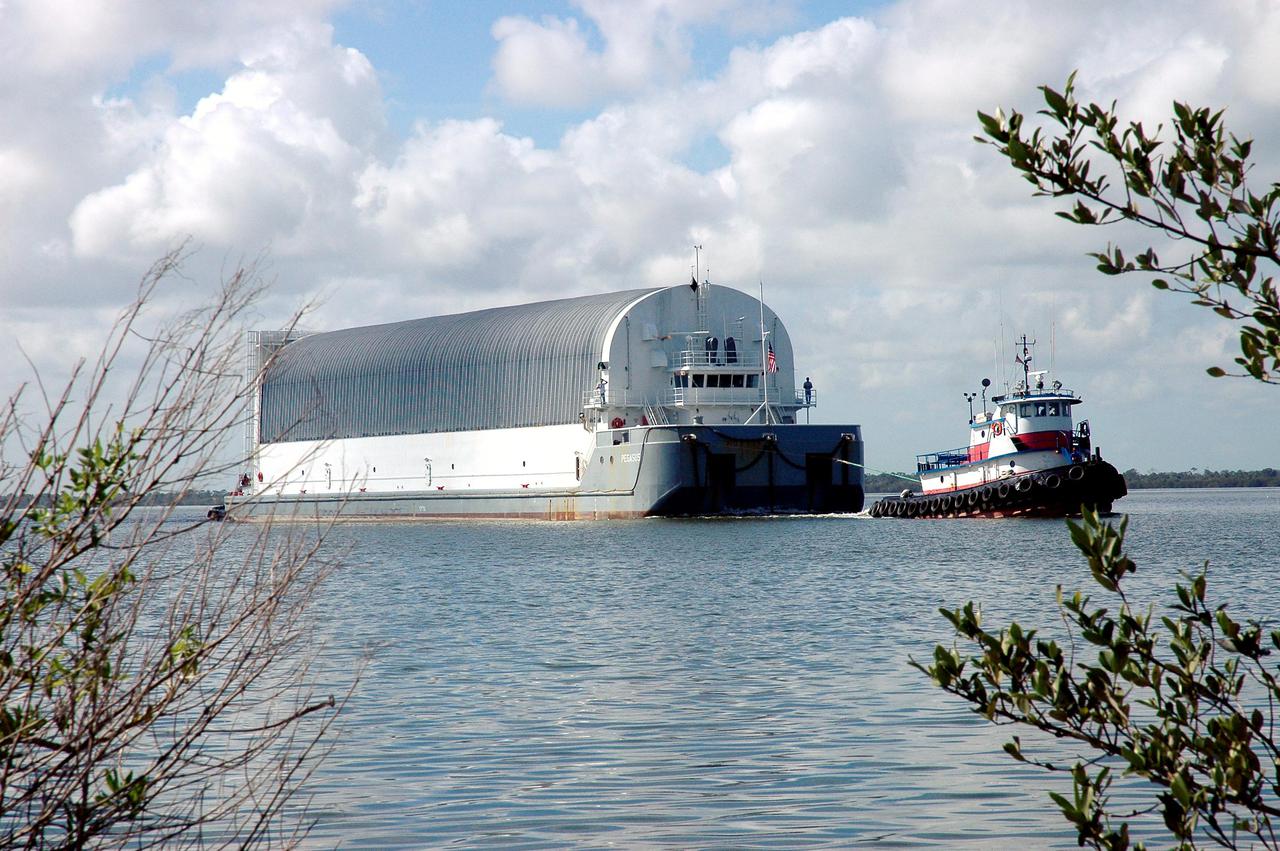
KENNEDY SPACE CENTER, FLA. - A tugboat tows the barge carrying the newly redesigned External Tank, designated for use on Return to Flight mission STS-114, to the dock at the Launch Complex 39 Area Turn Basin at Kennedy. The barge arrived after an approximately 900-mile journey at sea from the Michoud Assembly Facility in New Orleans. It left the facility Dec. 31 on the Pegasus, NASA’s specially designed barge, towed by Solid Rocket Booster retrieval ship Liberty Star. At Port Canaveral, the barge was then hooked up to the tugs for the last part of the journey to the Launch Complex 39 Area Turn Basin at Kennedy. Next, the External Tank will be off-loaded from the barge and transported to the Vehicle Assembly Building for its final checkout and mating to the twin Solid Rocket Boosters and orbiter Discovery. NASA and Lockheed Martin Corp. spent nearly two years modifying the 15-story, bronze-colored tank to make it safer for liftoff. Among dozens of changes is a redesigned forward bipod fitting -- a design that meets the recommendation of the Columbia Accident Investigation Board to reduce the risk to the Space Shuttle from falling debris during ascent. STS-114 is targeted for a launch opportunity beginning in May. The seven-member Discovery crew will fly to the International Space Station primarily to test and evaluate new procedures for flight safety, including Space Shuttle inspection and repair techniques.
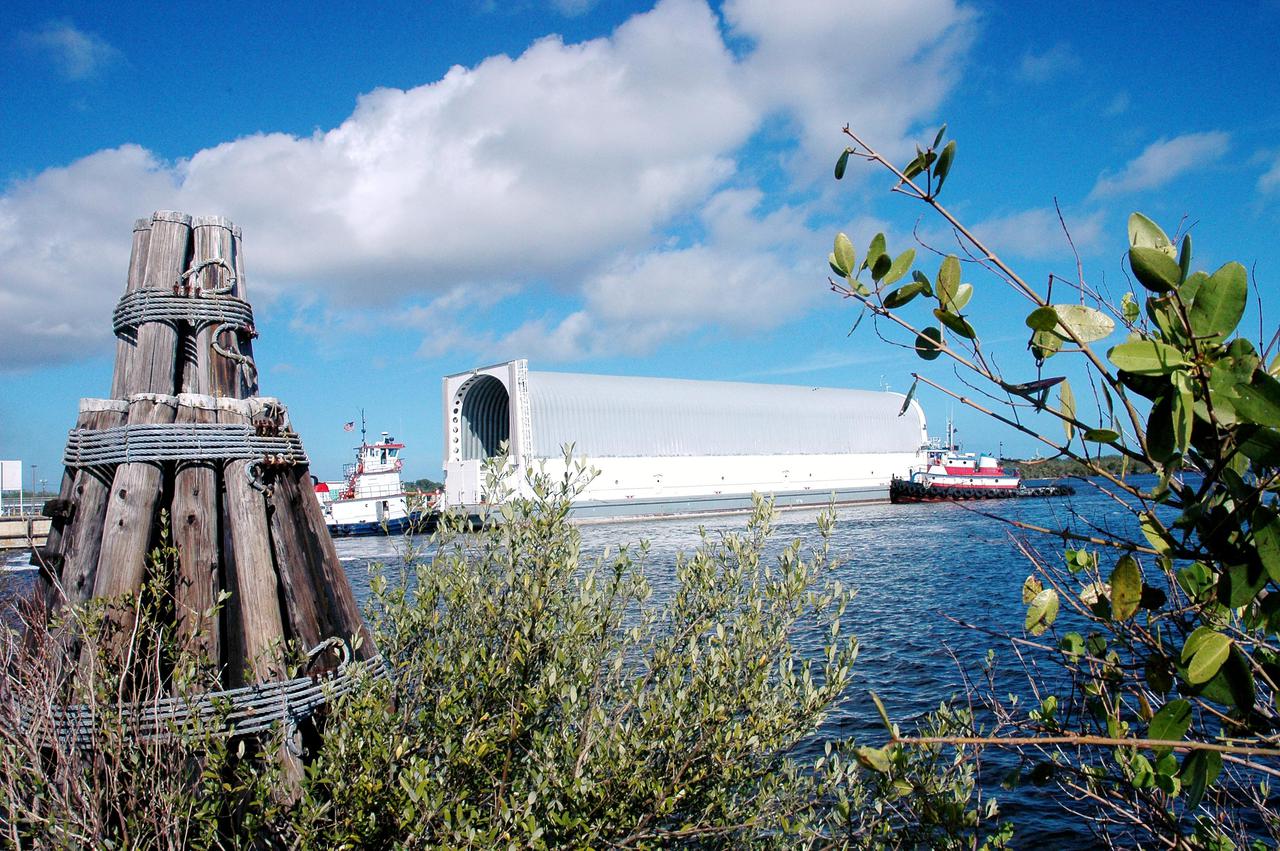
KENNEDY SPACE CENTER, FLA. - - Tugboats maneuver the barge carrying the newly redesigned External Tank, designated for use on Return to Flight mission STS-114, toward the dock at the Launch Complex 39 Area Turn Basin at Kennedy. The barge arrived after an approximately 900-mile journey at sea from the Michoud Assembly Facility in New Orleans. It left the facility Dec. 31 on the Pegasus, NASA’s specially designed barge, towed by Solid Rocket Booster retrieval ship Liberty Star. At Port Canaveral, the barge was then hooked up to the tugs for the last part of the journey. Next, the External Tank will be off-loaded from the barge and transported to the Vehicle Assembly Building for its final checkout and mating to the twin Solid Rocket Boosters and orbiter Discovery. NASA and Lockheed Martin Corp. spent nearly two years modifying the 15-story, bronze-colored tank to make it safer for liftoff. Among dozens of changes is a redesigned forward bipod fitting -- a design that meets the recommendation of the Columbia Accident Investigation Board to reduce the risk to the Space Shuttle from falling debris during ascent. STS-114 is targeted for a launch opportunity beginning in May. The seven-member Discovery crew will fly to the International Space Station primarily to test and evaluate new procedures for flight safety, including Space Shuttle inspection and repair techniques.
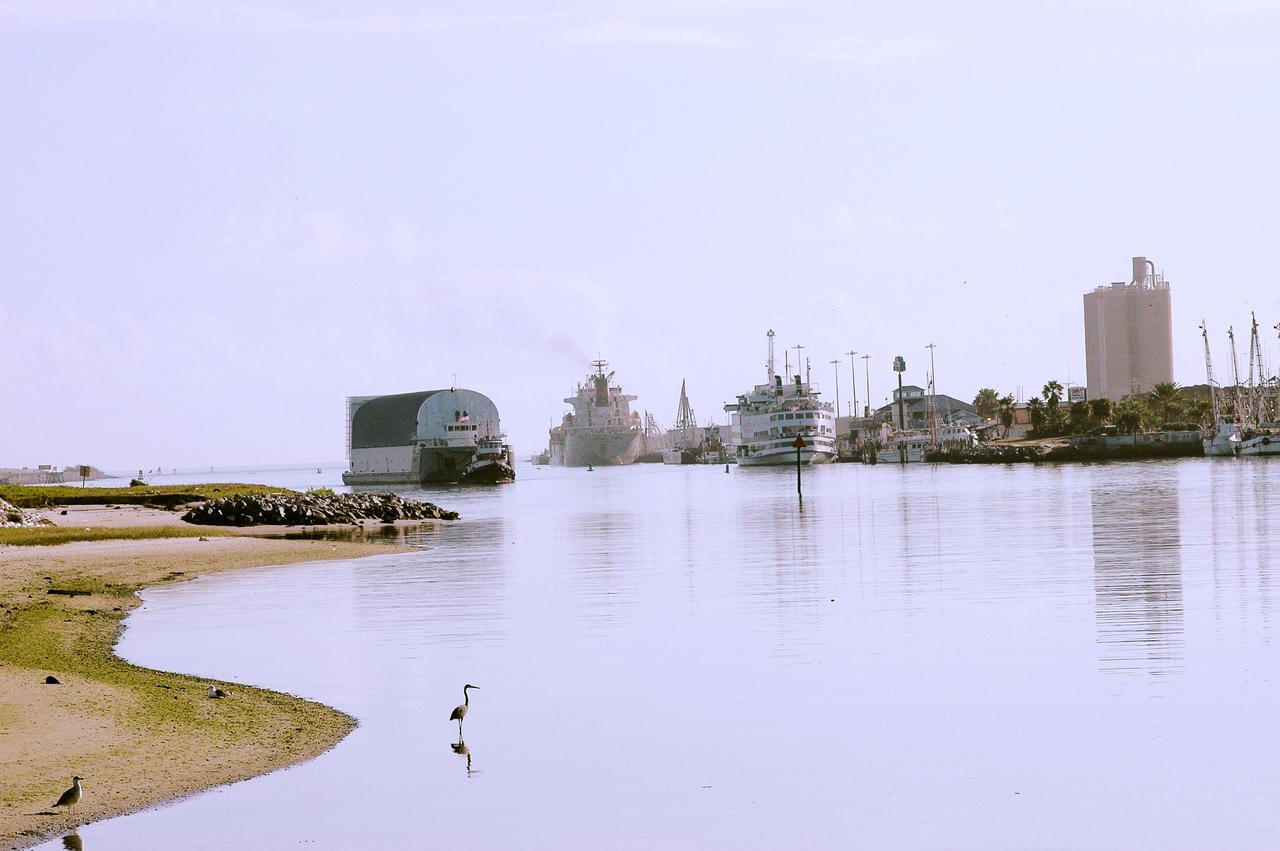
KENNEDY SPACE CENTER, FLA. - The barge carrying the newly redesigned External Tank, designated for use on Return to Flight mission STS-114, passes cruise ships as it enters Port Canaveral, Fla. The barge arrived after an approximately 900-mile journey at sea from the Michoud Assembly Facility in New Orleans. It left the facility Dec. 31 on the Pegasus, NASA’s specially designed barge, towed by Solid Rocket Booster retrieval ship Liberty Star. At Port Canaveral, the barge was then hooked up to the tugs for the last part of the journey to the Launch Complex 39 Area Turn Basin at Kennedy. Next, the External Tank will be off-loaded from the barge and transported to the Vehicle Assembly Building for its final checkout and mating to the twin Solid Rocket Boosters and orbiter Discovery. NASA and Lockheed Martin Corp. spent nearly two years modifying the 15-story, bronze-colored tank to make it safer for liftoff. Among dozens of changes is a redesigned forward bipod fitting -- a design that meets the recommendation of the Columbia Accident Investigation Board to reduce the risk to the Space Shuttle from falling debris during ascent. STS-114 is targeted for a launch opportunity beginning in May. The seven-member Discovery crew will fly to the International Space Station primarily to test and evaluate new procedures for flight safety, including Space Shuttle inspection and repair techniques.
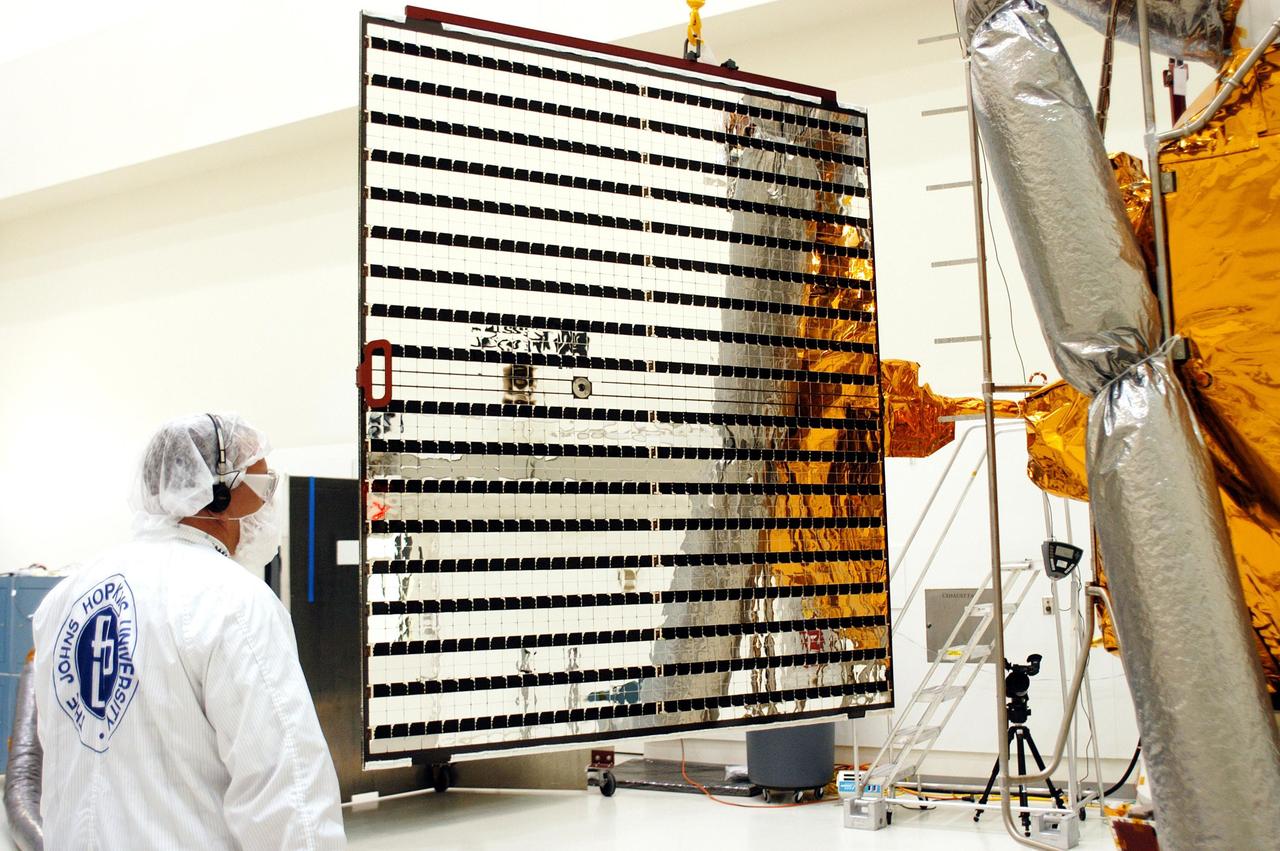
KENNEDY SPACE CENTER, FLA. - At Astrotech in Titusville, Fla., a technician with The Johns Hopkins University Applied Physics Laboratory (APL) watches as one of the solar array panels on the MESSENGER spacecraft is deployed. The two panels will provide MESSENGER’s power on its journey to Mercury. MESSENGER is scheduled to launch Aug. 2 aboard a Boeing Delta II rocket from Pad 17-B, Cape Canaveral Air Force Station, Fla. It will return to Earth for a gravity boost in July 2005, then fly past Venus twice, in October 2006 and June 2007. The spacecraft uses the tug of Venus’ gravity to resize and rotate its trajectory closer to Mercury’s orbit. Three Mercury flybys, each followed about two months later by a course-correction maneuver, put MESSENGER in position to enter Mercury orbit in March 2011. During the flybys, MESSENGER will map nearly the entire planet in color, image most of the areas unseen by Mariner 10, and measure the composition of the surface, atmosphere and magnetosphere. It will be the first new data from Mercury in more than 30 years - and invaluable for planning MESSENGER’s year-long orbital mission. MESSENGER was built for NASA by APL in Laurel, Md.
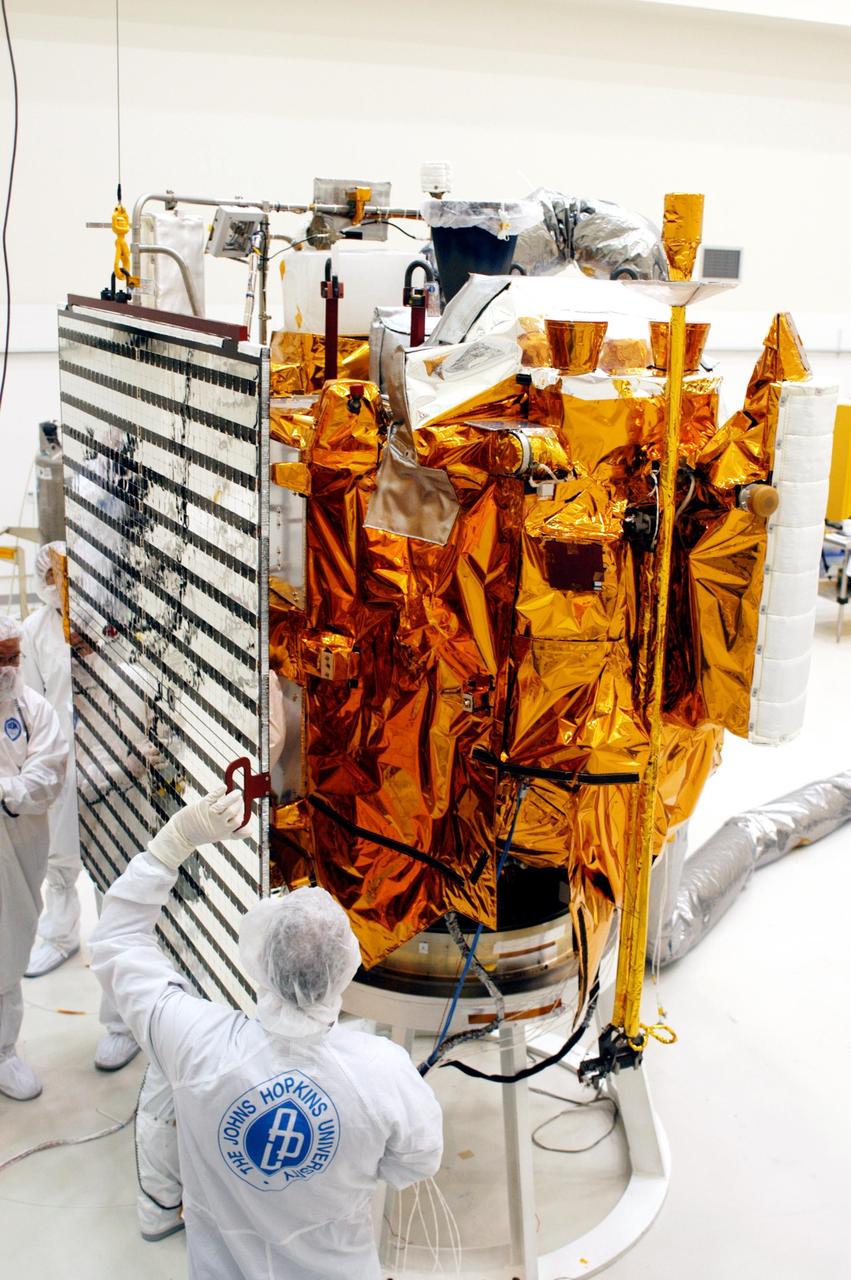
KENNEDY SPACE CENTER, FLA. - Technicians at Astrotech in Titusville, Fla., maneuver a solar panel into place for installation on NASA’s MESSENGER spacecraft. It is one of two large solar panels, supplemented with a nickel-hydrogen battery, that will provide MESSENGER’s power. MESSENGER is scheduled to launch Aug. 2 aboard a Boeing Delta II rocket from Pad 17-B, Cape Canaveral Air Force Station, Fla. It will return to Earth for a gravity boost in July 2005, then fly past Venus twice, in October 2006 and June 2007. The spacecraft uses the tug of Venus’ gravity to resize and rotate its trajectory closer to Mercury’s orbit. Three Mercury flybys, each followed about two months later by a course-correction maneuver, put MESSENGER in position to enter Mercury orbit in March 2011. During the flybys, MESSENGER will map nearly the entire planet in color, image most of the areas unseen by Mariner 10, and measure the composition of the surface, atmosphere and magnetosphere. It will be the first new data from Mercury in more than 30 years - and invaluable for planning MESSENGER’s year-long orbital mission. MESSENGER was built for NASA by the Johns Hopkins University Applied Physics Laboratory in Laurel, Md.

KENNEDY SPACE CENTER, FLA. - Technicians at Astrotech in Titusville, Fla., attach a bar to a solar panel in order to lift it and move it to NASA’s MESSENGER spacecraft for installation. The two large solar panels, supplemented with a nickel-hydrogen battery, will provide MESSENGER’s power. MESSENGER is scheduled to launch Aug. 2 aboard a Boeing Delta II rocket from Pad 17-B, Cape Canaveral Air Force Station, Fla. It will return to Earth for a gravity boost in July 2005, then fly past Venus twice, in October 2006 and June 2007. The spacecraft uses the tug of Venus’ gravity to resize and rotate its trajectory closer to Mercury’s orbit. Three Mercury flybys, each followed about two months later by a course-correction maneuver, put MESSENGER in position to enter Mercury orbit in March 2011. During the flybys, MESSENGER will map nearly the entire planet in color, image most of the areas unseen by Mariner 10, and measure the composition of the surface, atmosphere and magnetosphere. It will be the first new data from Mercury in more than 30 years - and invaluable for planning MESSENGER’s year-long orbital mission. MESSENGER was built for NASA by the Johns Hopkins University Applied Physics Laboratory in Laurel, Md.
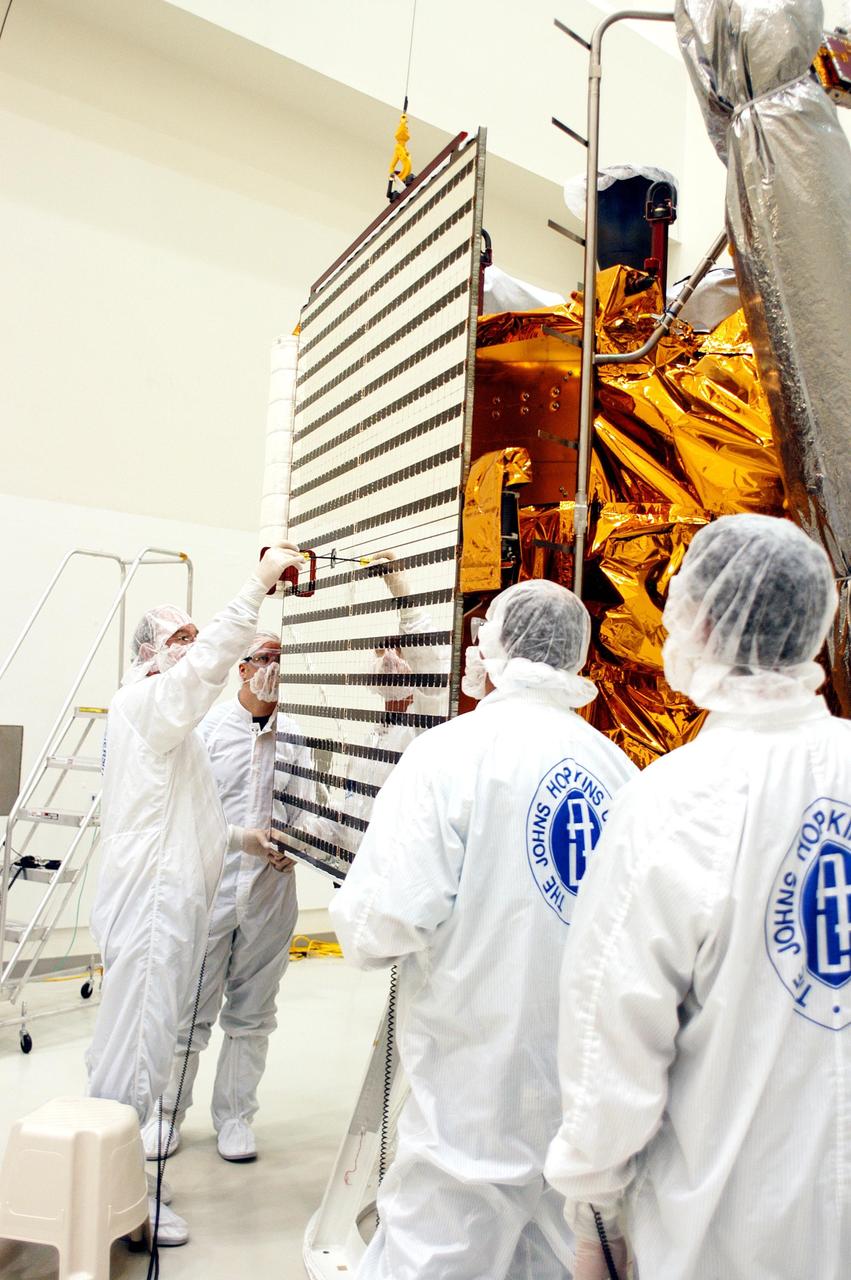
KENNEDY SPACE CENTER, FLA. - At Astrotech in Titusville, Fla., technicians with The Johns Hopkins University Applied Physics Laboratory (APL) prepare one of two solar array panels on the MESSENGER spacecraft for deployment. The panels will provide MESSENGER’s power on its journey to Mercury. MESSENGER is scheduled to launch Aug. 2 aboard a Boeing Delta II rocket from Pad 17-B, Cape Canaveral Air Force Station, Fla. It will return to Earth for a gravity boost in July 2005, then fly past Venus twice, in October 2006 and June 2007. The spacecraft uses the tug of Venus’ gravity to resize and rotate its trajectory closer to Mercury’s orbit. Three Mercury flybys, each followed about two months later by a course-correction maneuver, put MESSENGER in position to enter Mercury orbit in March 2011. During the flybys, MESSENGER will map nearly the entire planet in color, image most of the areas unseen by Mariner 10, and measure the composition of the surface, atmosphere and magnetosphere. It will be the first new data from Mercury in more than 30 years - and invaluable for planning MESSENGER’s year-long orbital mission. MESSENGER was built for NASA by APL in Laurel, Md.
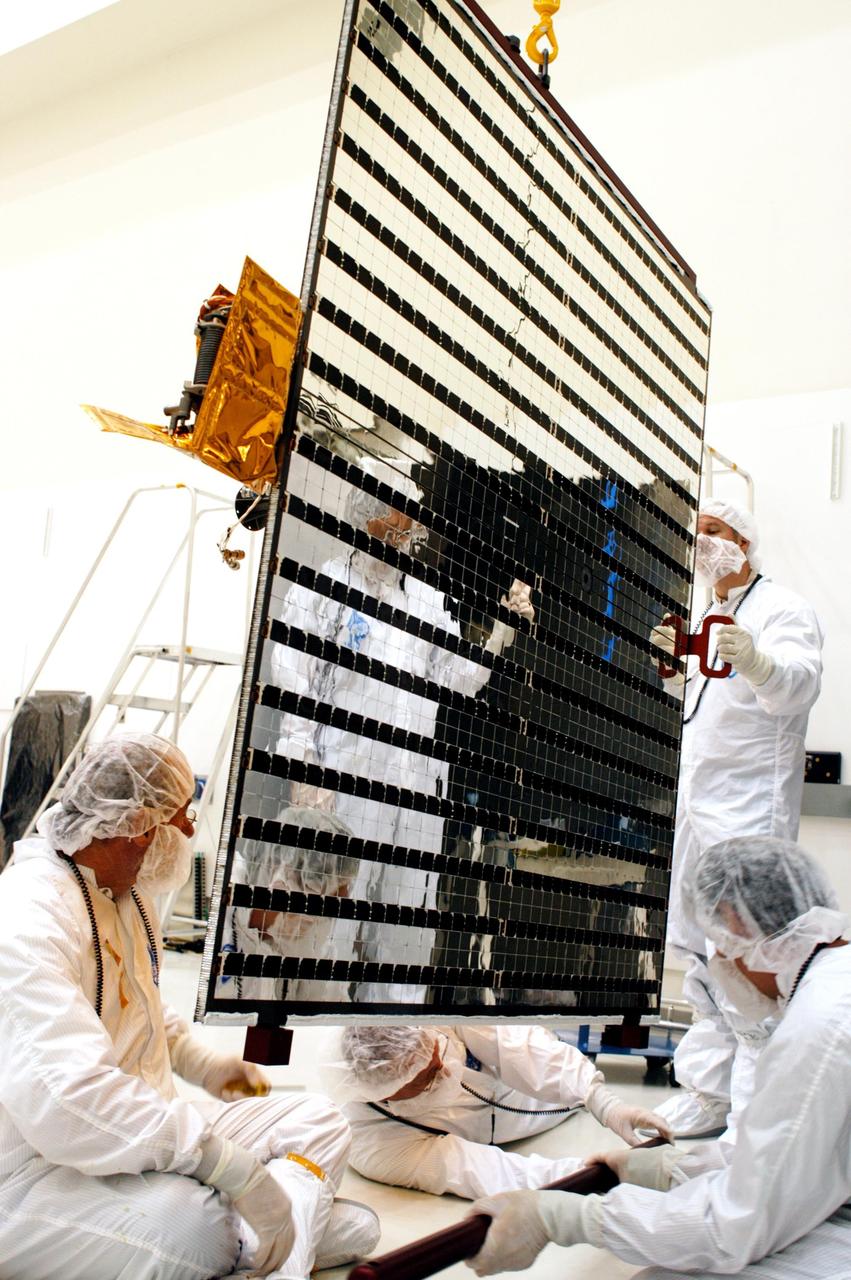
KENNEDY SPACE CENTER, FLA. - Technicians at Astrotech in Titusville, Fla., adjust a solar panel suspended from above for installation on NASA’s MESSENGER spacecraft. It is one of two large solar panels, supplemented with a nickel-hydrogen battery, that will provide MESSENGER’s power. MESSENGER is scheduled to launch Aug. 2 aboard a Boeing Delta II rocket from Pad 17-B, Cape Canaveral Air Force Station, Fla. It will return to Earth for a gravity boost in July 2005, then fly past Venus twice, in October 2006 and June 2007. The spacecraft uses the tug of Venus’ gravity to resize and rotate its trajectory closer to Mercury’s orbit. Three Mercury flybys, each followed about two months later by a course-correction maneuver, put MESSENGER in position to enter Mercury orbit in March 2011. During the flybys, MESSENGER will map nearly the entire planet in color, image most of the areas unseen by Mariner 10, and measure the composition of the surface, atmosphere and magnetosphere. It will be the first new data from Mercury in more than 30 years - and invaluable for planning MESSENGER’s year-long orbital mission. MESSENGER was built for NASA by the Johns Hopkins University Applied Physics Laboratory in Laurel, Md.

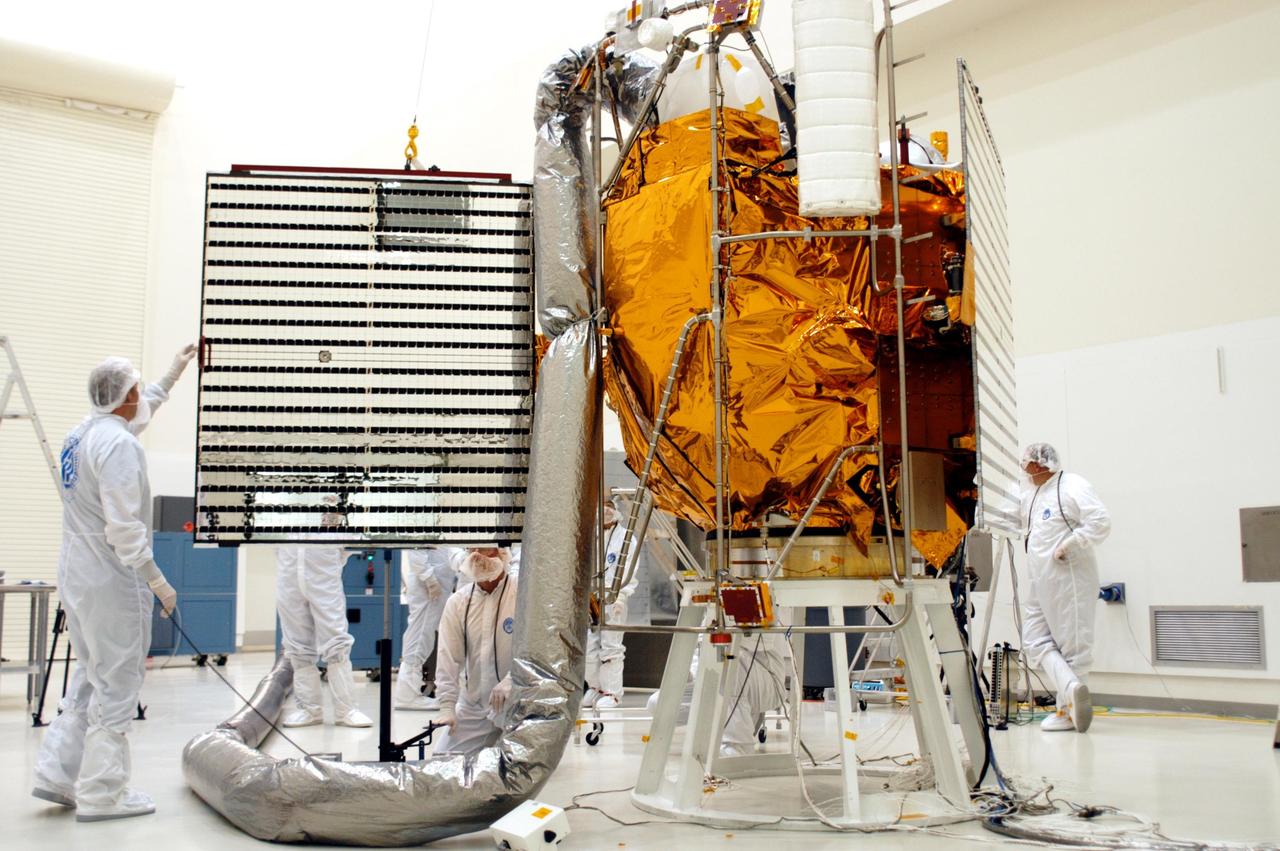
KENNEDY SPACE CENTER, FLA. - At Astrotech in Titusville, Fla., technicians secure guide wires on the second solar panel to be installed on NASA’s MESSENGER spacecraft. The two large solar panels, supplemented with a nickel-hydrogen battery, will provide MESSENGER’s power. MESSENGER is scheduled to launch Aug. 2 aboard a Boeing Delta II rocket from Pad 17-B, Cape Canaveral Air Force Station, Fla. It will return to Earth for a gravity boost in July 2005, then fly past Venus twice, in October 2006 and June 2007. The spacecraft uses the tug of Venus’ gravity to resize and rotate its trajectory closer to Mercury’s orbit. Three Mercury flybys, each followed about two months later by a course-correction maneuver, put MESSENGER in position to enter Mercury orbit in March 2011. During the flybys, MESSENGER will map nearly the entire planet in color, image most of the areas unseen by Mariner 10, and measure the composition of the surface, atmosphere and magnetosphere. It will be the first new data from Mercury in more than 30 years - and invaluable for planning MESSENGER’s year-long orbital mission. MESSENGER was built for NASA by the Johns Hopkins University Applied Physics Laboratory in Laurel, Md.
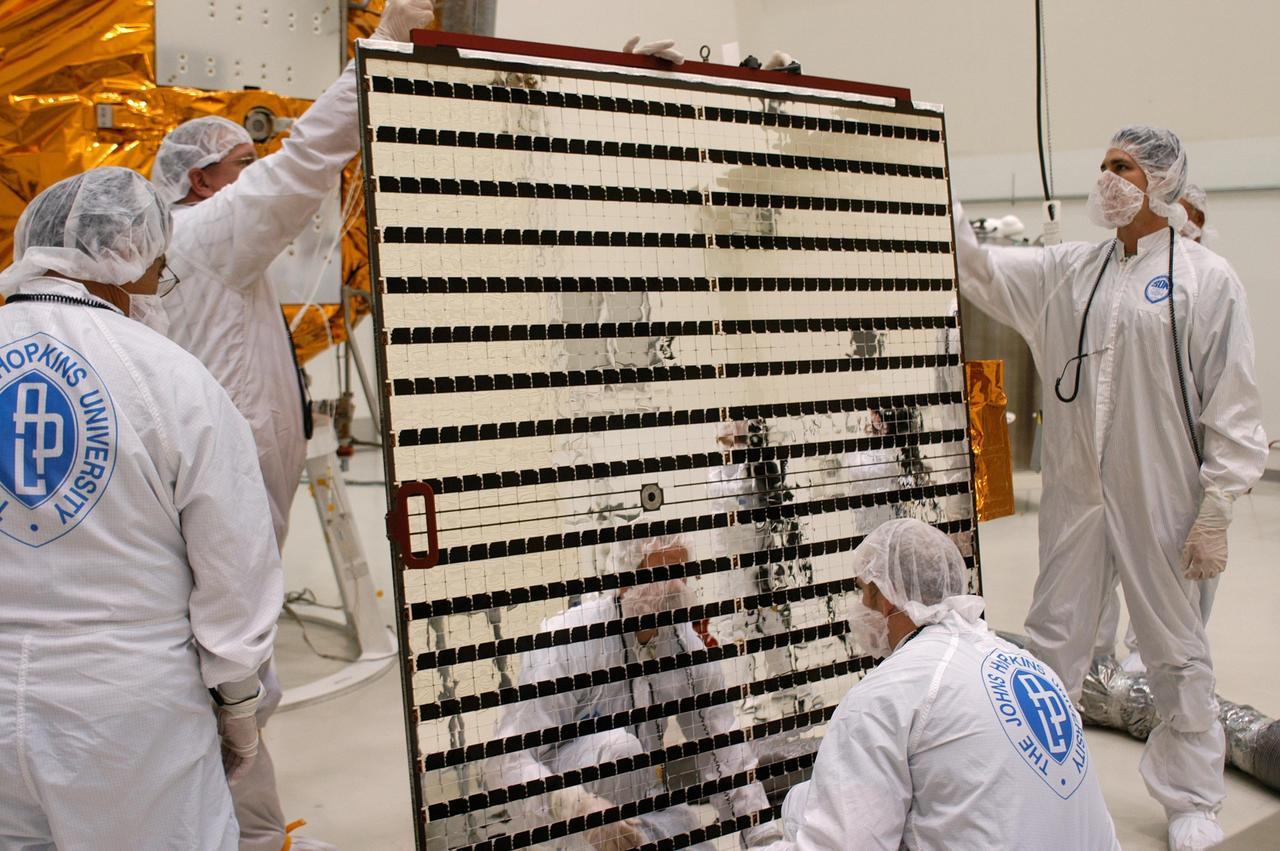
KENNEDY SPACE CENTER, FLA. - At Astrotech in Titusville, Fla., technicians check the second solar panel that will be installed on NASA’s MESSENGER spacecraft. The two large solar panels, supplemented with a nickel-hydrogen battery, will provide MESSENGER’s power. MESSENGER is scheduled to launch Aug. 2 aboard a Boeing Delta II rocket from Pad 17-B, Cape Canaveral Air Force Station, Fla. It will return to Earth for a gravity boost in July 2005, then fly past Venus twice, in October 2006 and June 2007. The spacecraft uses the tug of Venus’ gravity to resize and rotate its trajectory closer to Mercury’s orbit. Three Mercury flybys, each followed about two months later by a course-correction maneuver, put MESSENGER in position to enter Mercury orbit in March 2011. During the flybys, MESSENGER will map nearly the entire planet in color, image most of the areas unseen by Mariner 10, and measure the composition of the surface, atmosphere and magnetosphere. It will be the first new data from Mercury in more than 30 years - and invaluable for planning MESSENGER’s year-long orbital mission. MESSENGER was built for NASA by the Johns Hopkins University Applied Physics Laboratory in Laurel, Md.
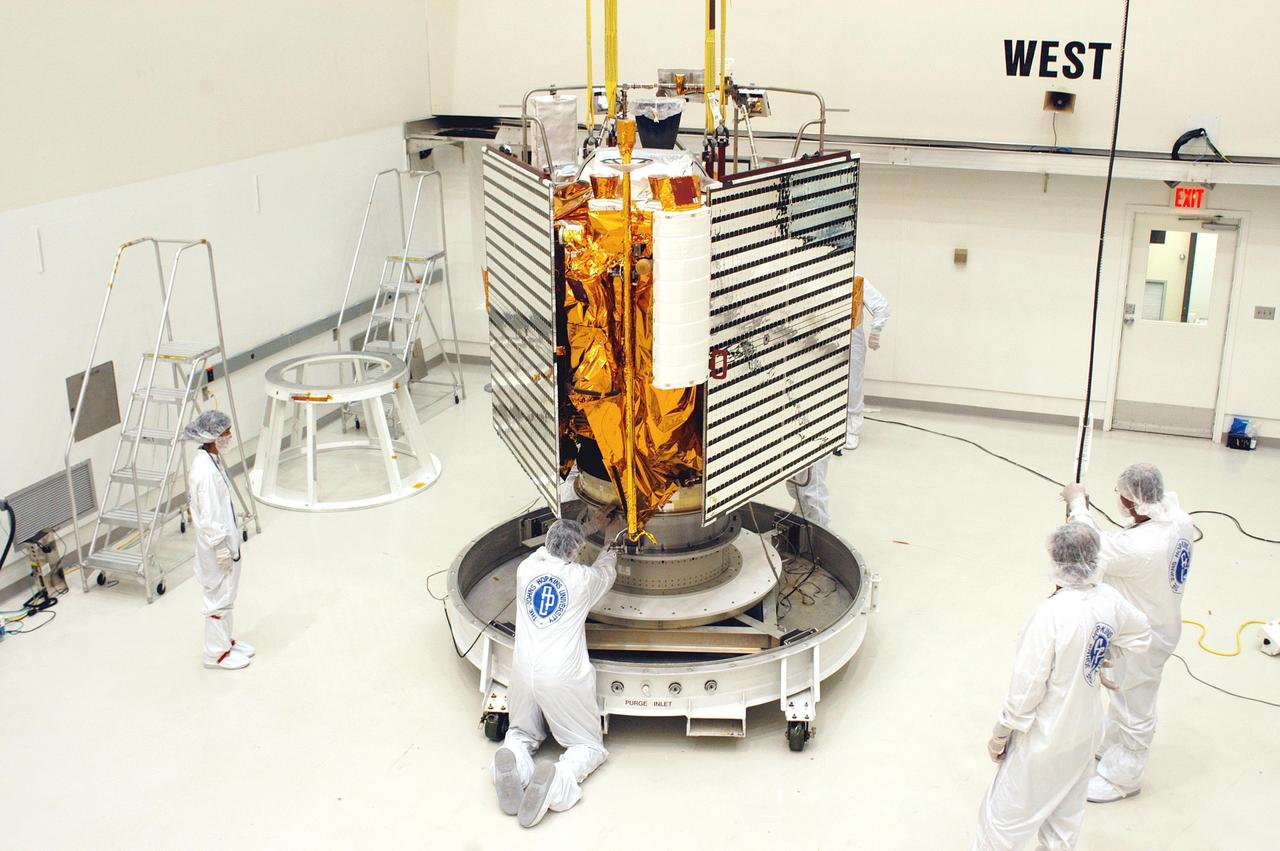
KENNEDY SPACE CENTER, FLA. - At Astrotech in Titusville, Fla., technicians with The Johns Hopkins University Applied Physics Laboratory (APL) prepare the MESSESNGER spacecraft for a move to a hazardous processing facility in preparation for loading the spacecraft’s complement of hypergolic propellants. MESSENGER is scheduled to launch Aug. 2 aboard a Boeing Delta II rocket from Pad 17-B, Cape Canaveral Air Force Station, Fla., on a journey to Mercury. It will return to Earth for a gravity boost in July 2005, then fly past Venus twice, in October 2006 and June 2007. The spacecraft uses the tug of Venus’ gravity to resize and rotate its trajectory closer to Mercury’s orbit. Three Mercury flybys, each followed about two months later by a course-correction maneuver, put MESSENGER in position to enter Mercury orbit in March 2011. During the flybys, MESSENGER will map nearly the entire planet in color, image most of the areas unseen by Mariner 10, and measure the composition of the surface, atmosphere and magnetosphere. It will be the first new data from Mercury in more than 30 years - and invaluable for planning MESSENGER’s year-long orbital mission. MESSENGER was built for NASA by APL in Laurel, Md.
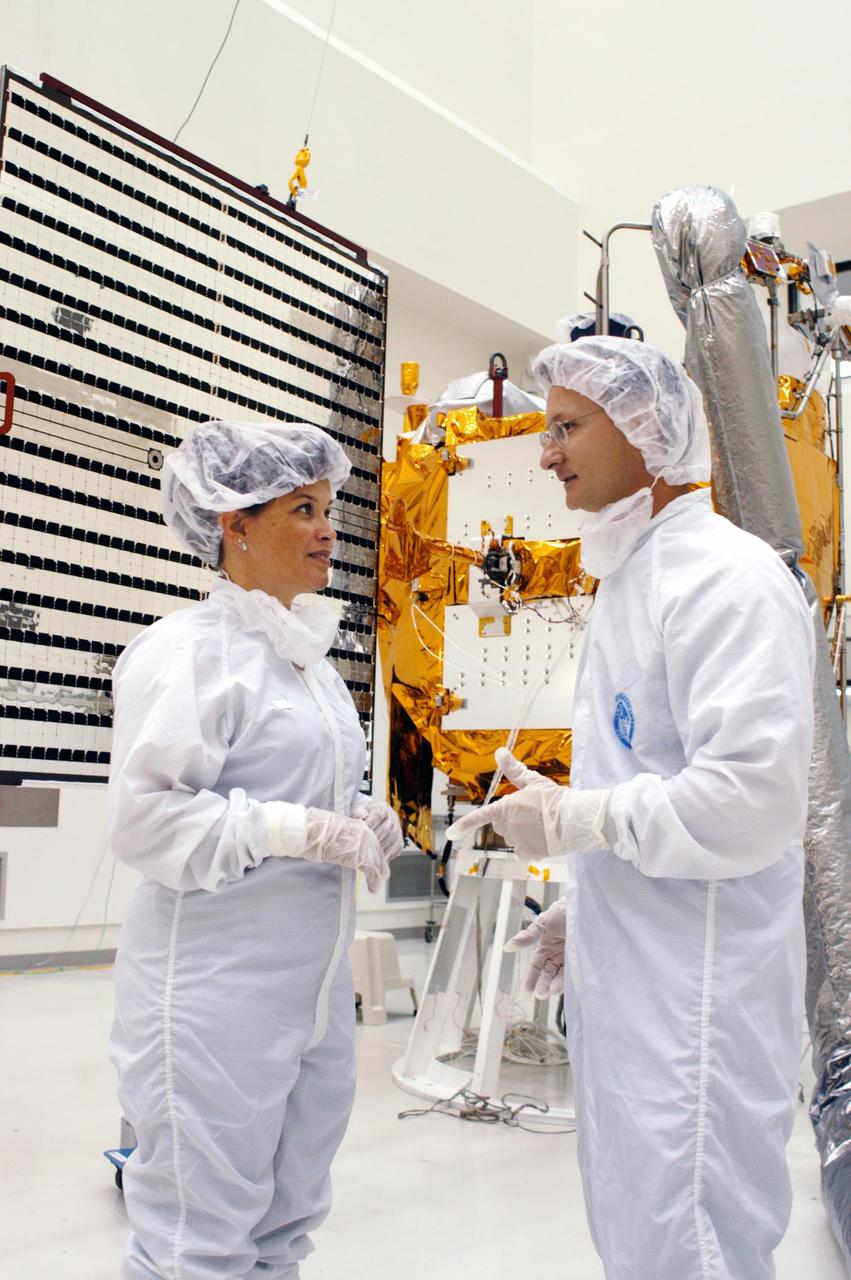
KENNEDY SPACE CENTER, FLA. - At Astrotech in Titusville, Fla., NASA Mission Integration Manager Cheryle Mako and NASA Launch Site Integration Manager John Hueckel talk before the deployment of the solar array panels on the MESSENGER spacecraft behind them. The solar arrays will provide MESSENGER’s power on its journey to Mercury. MESSENGER is scheduled to launch Aug. 2 aboard a Boeing Delta II rocket from Pad 17-B, Cape Canaveral Air Force Station, Fla. It will return to Earth for a gravity boost in July 2005, then fly past Venus twice, in October 2006 and June 2007. The spacecraft uses the tug of Venus’ gravity to resize and rotate its trajectory closer to Mercury’s orbit. Three Mercury flybys, each followed about two months later by a course-correction maneuver, put MESSENGER in position to enter Mercury orbit in March 2011. During the flybys, MESSENGER will map nearly the entire planet in color, image most of the areas unseen by Mariner 10, and measure the composition of the surface, atmosphere and magnetosphere. It will be the first new data from Mercury in more than 30 years - and invaluable for planning MESSENGER’s year-long orbital mission. MESSENGER was built for NASA by the Johns Hopkins University Applied Physics Laboratory in Laurel, Md.
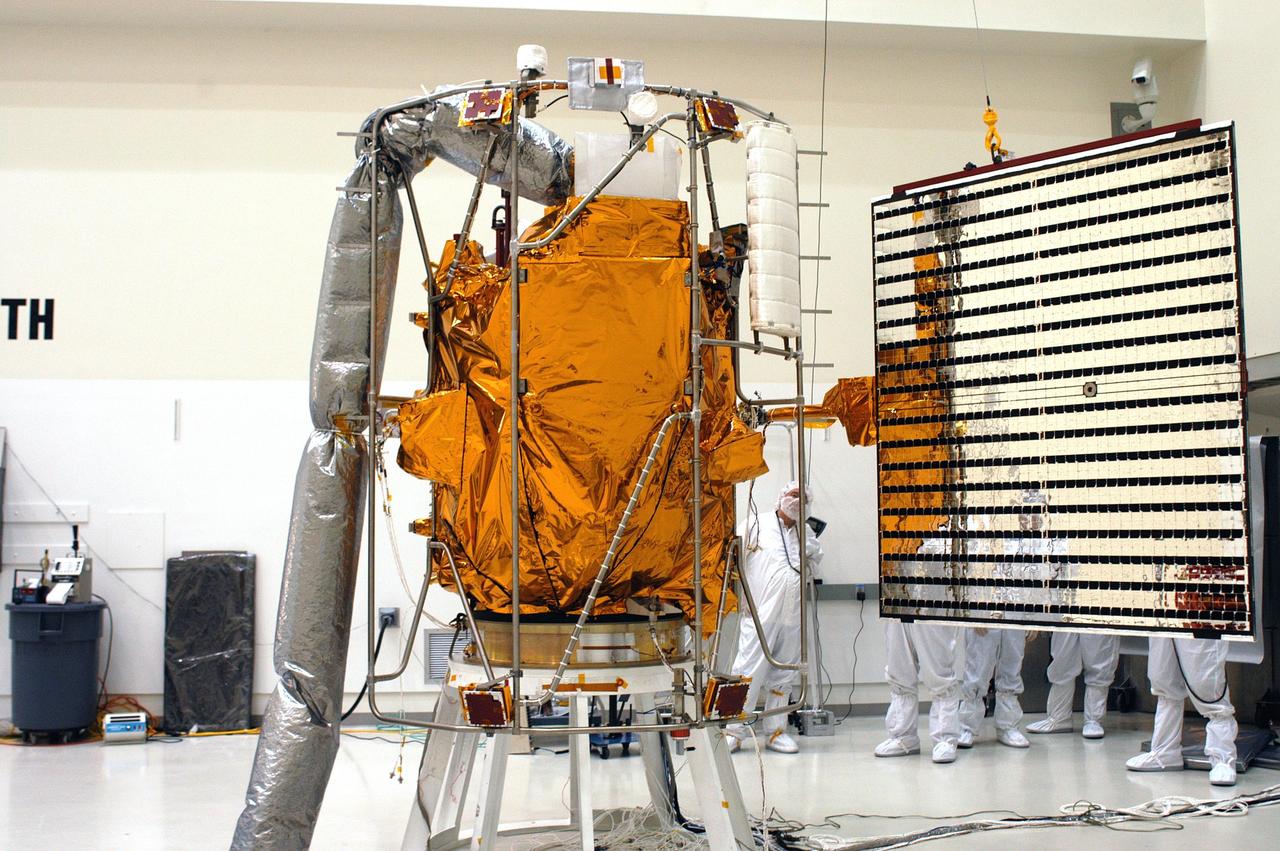
KENNEDY SPACE CENTER, FLA. - Technicians at Astrotech in Titusville, Fla., hold steady the second solar panel being installed on NASA’s MESSENGER spacecraft. At left is the first panel already installed. The two large solar panels, supplemented with a nickel-hydrogen battery, will provide MESSENGER’s power. MESSENGER is scheduled to launch Aug. 2 aboard a Boeing Delta II rocket from Pad 17-B, Cape Canaveral Air Force Station, Fla. It will return to Earth for a gravity boost in July 2005, then fly past Venus twice, in October 2006 and June 2007. The spacecraft uses the tug of Venus’ gravity to resize and rotate its trajectory closer to Mercury’s orbit. Three Mercury flybys, each followed about two months later by a course-correction maneuver, put MESSENGER in position to enter Mercury orbit in March 2011. During the flybys, MESSENGER will map nearly the entire planet in color, image most of the areas unseen by Mariner 10, and measure the composition of the surface, atmosphere and magnetosphere. It will be the first new data from Mercury in more than 30 years - and invaluable for planning MESSENGER’s year-long orbital mission. MESSENGER was built for NASA by the Johns Hopkins University Applied Physics Laboratory in Laurel, Md.
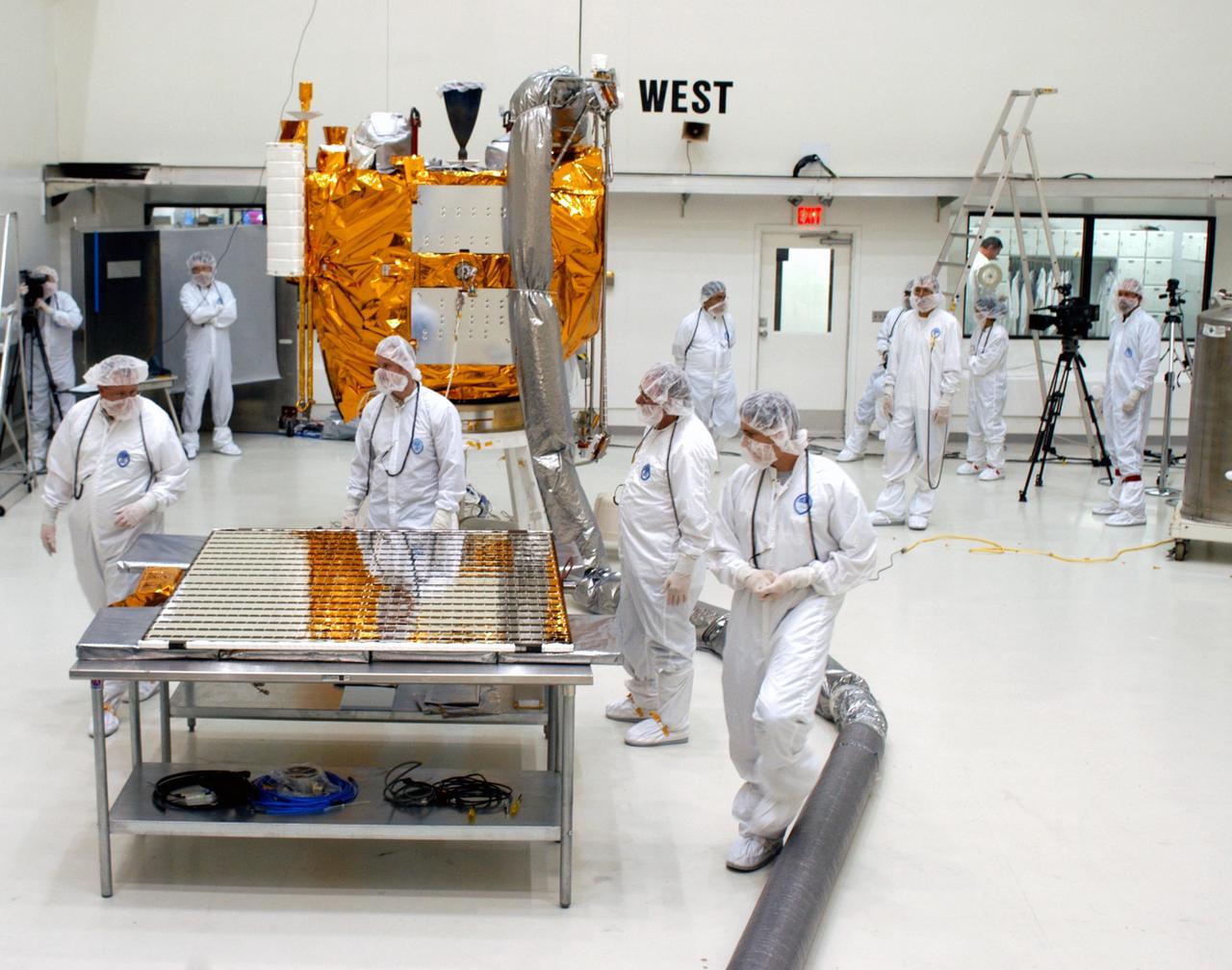
KENNEDY SPACE CENTER, FLA. - Technicians at Astrotech in Titusville, Fla., look over a solar panel ready to be installed on NASA’s MESSENGER spacecraft. It is one of two large solar panels, supplemented with a nickel-hydrogen battery, that will provide MESSENGER’s power. MESSENGER is scheduled to launch Aug. 2 aboard a Boeing Delta II rocket from Pad 17-B, Cape Canaveral Air Force Station, Fla. It will return to Earth for a gravity boost in July 2005, then fly past Venus twice, in October 2006 and June 2007. The spacecraft uses the tug of Venus’ gravity to resize and rotate its trajectory closer to Mercury’s orbit. Three Mercury flybys, each followed about two months later by a course-correction maneuver, put MESSENGER in position to enter Mercury orbit in March 2011. During the flybys, MESSENGER will map nearly the entire planet in color, image most of the areas unseen by Mariner 10, and measure the composition of the surface, atmosphere and magnetosphere. It will be the first new data from Mercury in more than 30 years - and invaluable for planning MESSENGER’s year-long orbital mission. MESSENGER was built for NASA by the Johns Hopkins University Applied Physics Laboratory in Laurel, Md.
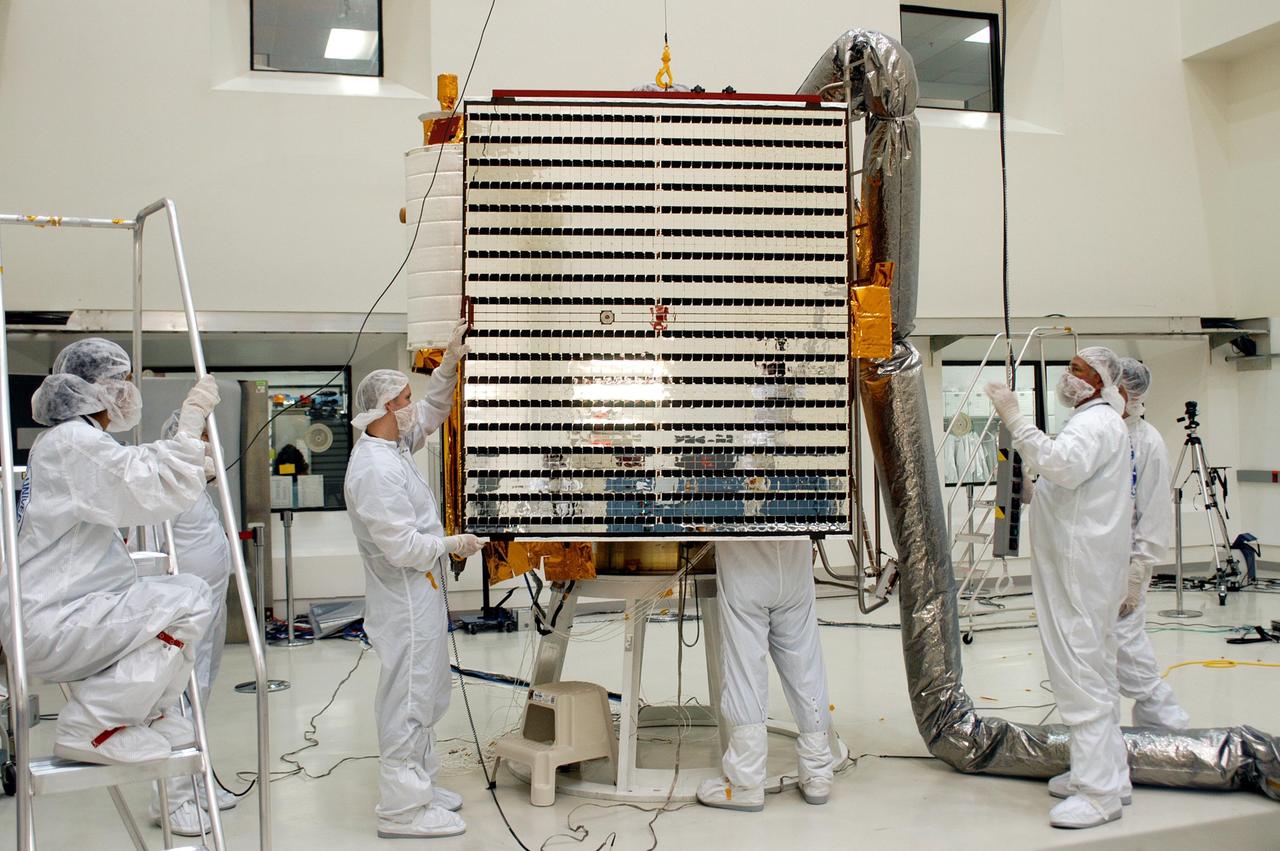
KENNEDY SPACE CENTER, FLA. - Technicians at Astrotech in Titusville, Fla., help guide a solar panel toward NASA’s MESSENGER spacecraft for installation. It is one of two large solar panels, supplemented with a nickel-hydrogen battery, that will provide MESSENGER’s power. MESSENGER is scheduled to launch Aug. 2 aboard a Boeing Delta II rocket from Pad 17-B, Cape Canaveral Air Force Station, Fla. It will return to Earth for a gravity boost in July 2005, then fly past Venus twice, in October 2006 and June 2007. The spacecraft uses the tug of Venus’ gravity to resize and rotate its trajectory closer to Mercury’s orbit. Three Mercury flybys, each followed about two months later by a course-correction maneuver, put MESSENGER in position to enter Mercury orbit in March 2011. During the flybys, MESSENGER will map nearly the entire planet in color, image most of the areas unseen by Mariner 10, and measure the composition of the surface, atmosphere and magnetosphere. It will be the first new data from Mercury in more than 30 years - and invaluable for planning MESSENGER’s year-long orbital mission. MESSENGER was built for NASA by the Johns Hopkins University Applied Physics Laboratory in Laurel, Md.

KENNEDY SPACE CENTER, FLA. - - After the deployment test of two solar panels at Astrotech in Titusville, Fla., technicians with The Johns Hopkins University Applied Physics Laboratory (APL) prepare the MESSESNGER spacecraft for a move to a hazardous processing facility in preparation for loading the spacecraft’s complement of hypergolic propellants. The solar arrays will provide MESSENGER’s power on its journey to Mercury. MESSENGER is scheduled to launch Aug. 2 aboard a Boeing Delta II rocket from Pad 17-B, Cape Canaveral Air Force Station, Fla. It will return to Earth for a gravity boost in July 2005, then fly past Venus twice, in October 2006 and June 2007. The spacecraft uses the tug of Venus’ gravity to resize and rotate its trajectory closer to Mercury’s orbit. Three Mercury flybys, each followed about two months later by a course-correction maneuver, put MESSENGER in position to enter Mercury orbit in March 2011. During the flybys, MESSENGER will map nearly the entire planet in color, image most of the areas unseen by Mariner 10, and measure the composition of the surface, atmosphere and magnetosphere. It will be the first new data from Mercury in more than 30 years - and invaluable for planning MESSENGER’s year-long orbital mission. MESSENGER was built for NASA by APL in Laurel, Md.
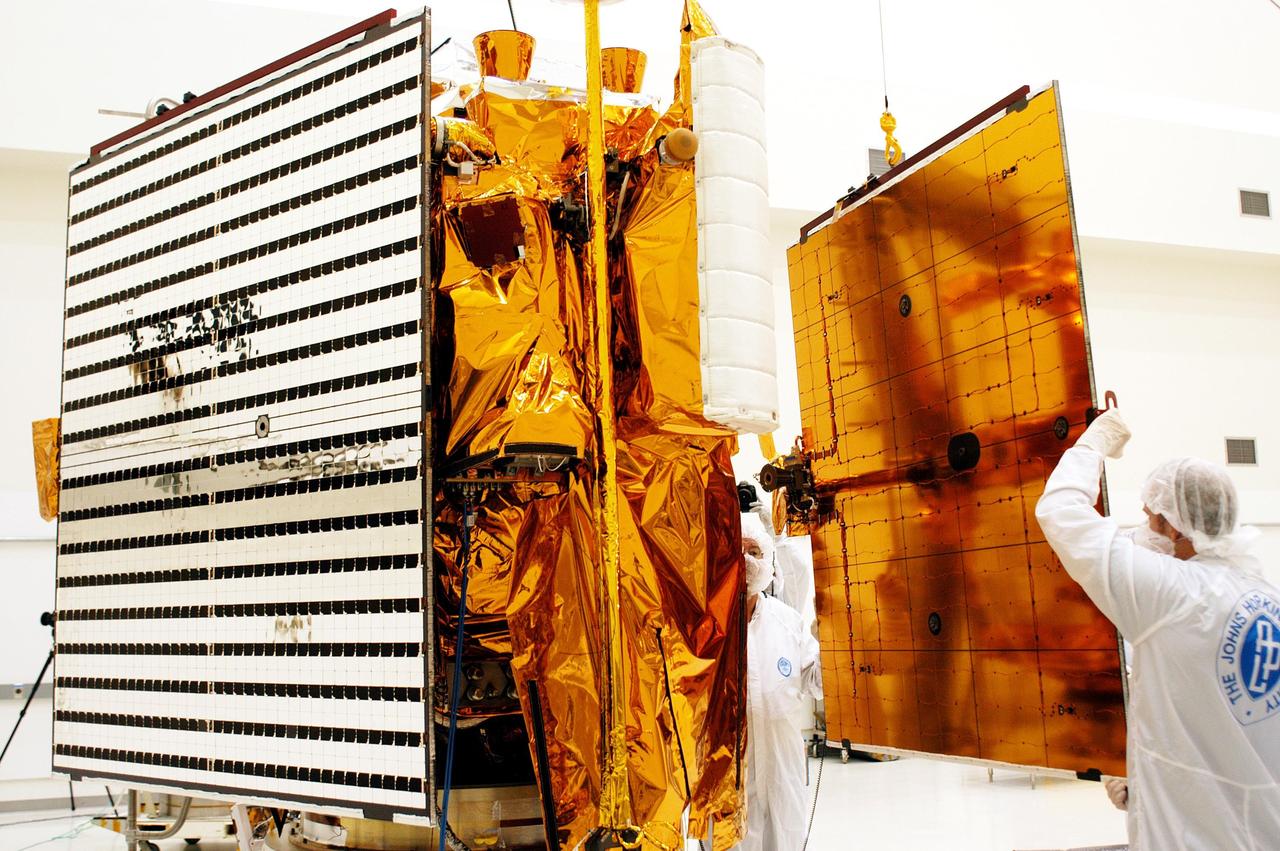
KENNEDY SPACE CENTER, FLA. - At right, technicians at Astrotech in Titusville, Fla., guide into place the second solar panel to be installed on NASA’s MESSENGER spacecraft. At left is the first panel already installed. The two large solar panels, supplemented with a nickel-hydrogen battery, will provide MESSENGER’s power. MESSENGER is scheduled to launch Aug. 2 aboard a Boeing Delta II rocket from Pad 17-B, Cape Canaveral Air Force Station, Fla. It will return to Earth for a gravity boost in July 2005, then fly past Venus twice, in October 2006 and June 2007. The spacecraft uses the tug of Venus’ gravity to resize and rotate its trajectory closer to Mercury’s orbit. Three Mercury flybys, each followed about two months later by a course-correction maneuver, put MESSENGER in position to enter Mercury orbit in March 2011. During the flybys, MESSENGER will map nearly the entire planet in color, image most of the areas unseen by Mariner 10, and measure the composition of the surface, atmosphere and magnetosphere. It will be the first new data from Mercury in more than 30 years - and invaluable for planning MESSENGER’s year-long orbital mission. MESSENGER was built for NASA by the Johns Hopkins University Applied Physics Laboratory in Laurel, Md.
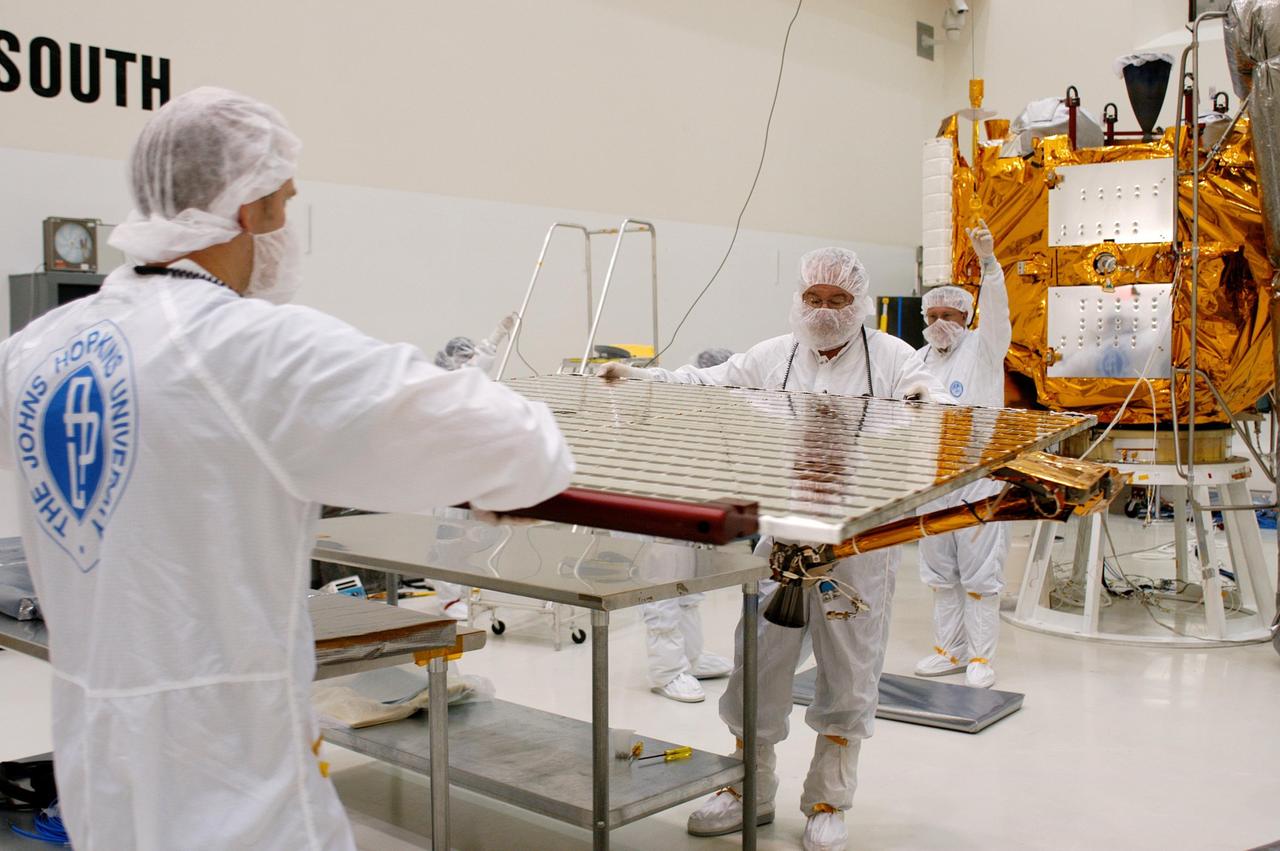
KENNEDY SPACE CENTER, FLA. - At Astrotech in Titusville, Fla., technicians maneuver a second solar panel to a vertical position to move it toward NASA’s MESSENGER spacecraft for installation. The two large solar panels, supplemented with a nickel-hydrogen battery, will provide MESSENGER’s power. MESSENGER is scheduled to launch Aug. 2 aboard a Boeing Delta II rocket from Pad 17-B, Cape Canaveral Air Force Station, Fla. It will return to Earth for a gravity boost in July 2005, then fly past Venus twice, in October 2006 and June 2007. The spacecraft uses the tug of Venus’ gravity to resize and rotate its trajectory closer to Mercury’s orbit. Three Mercury flybys, each followed about two months later by a course-correction maneuver, put MESSENGER in position to enter Mercury orbit in March 2011. During the flybys, MESSENGER will map nearly the entire planet in color, image most of the areas unseen by Mariner 10, and measure the composition of the surface, atmosphere and magnetosphere. It will be the first new data from Mercury in more than 30 years - and invaluable for planning MESSENGER’s year-long orbital mission. MESSENGER was built for NASA by the Johns Hopkins University Applied Physics Laboratory in Laurel, Md.
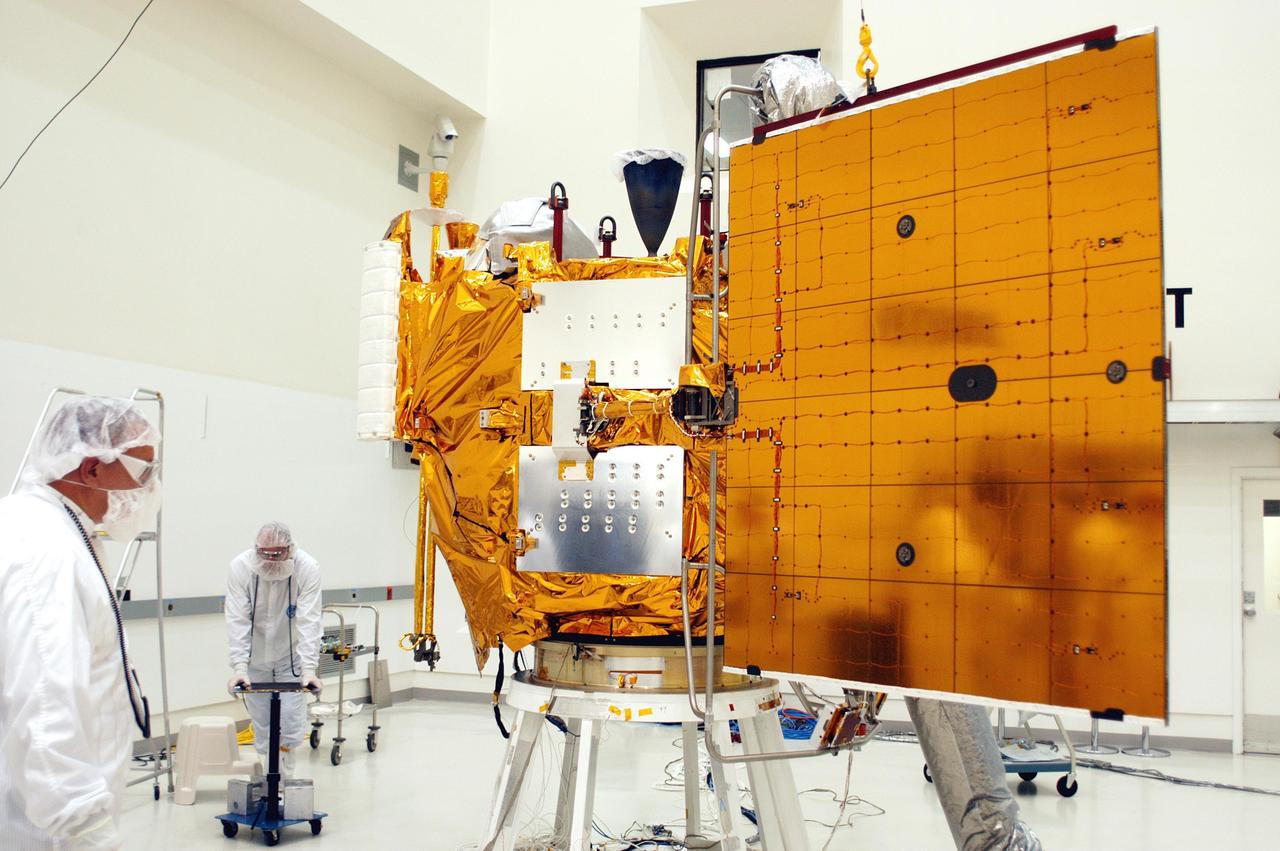
KENNEDY SPACE CENTER, FLA. - At Astrotech in Titusville, Fla., technicians with The Johns Hopkins University Applied Physics Laboratory (APL) monitor the progress of the solar array deployment on the MESSENGER spacecraft. The two panels will provide MESSENGER’s power on its journey to Mercury. MESSENGER is scheduled to launch Aug. 2 aboard a Boeing Delta II rocket from Pad 17-B, Cape Canaveral Air Force Station, Fla. It will return to Earth for a gravity boost in July 2005, then fly past Venus twice, in October 2006 and June 2007. The spacecraft uses the tug of Venus’ gravity to resize and rotate its trajectory closer to Mercury’s orbit. Three Mercury flybys, each followed about two months later by a course-correction maneuver, put MESSENGER in position to enter Mercury orbit in March 2011. During the flybys, MESSENGER will map nearly the entire planet in color, image most of the areas unseen by Mariner 10, and measure the composition of the surface, atmosphere and magnetosphere. It will be the first new data from Mercury in more than 30 years - and invaluable for planning MESSENGER’s year-long orbital mission. MESSENGER was built for NASA by APL in Laurel, Md.
KENNEDY SPACE CENTER, FLA. - At Astrotech in Titusville, Fla., technicians with The Johns Hopkins University Applied Physics Laboratory (APL) check one of two solar panels on the MESSENGER spacecraft after a deployment test. The other panel is at right, undeployed. The solar arrays will provide MESSENGER’s power on its journey to Mercury. MESSENGER is scheduled to launch Aug. 2 aboard a Boeing Delta II rocket from Pad 17-B, Cape Canaveral Air Force Station, Fla. It will return to Earth for a gravity boost in July 2005, then fly past Venus twice, in October 2006 and June 2007. The spacecraft uses the tug of Venus’ gravity to resize and rotate its trajectory closer to Mercury’s orbit. Three Mercury flybys, each followed about two months later by a course-correction maneuver, put MESSENGER in position to enter Mercury orbit in March 2011. During the flybys, MESSENGER will map nearly the entire planet in color, image most of the areas unseen by Mariner 10, and measure the composition of the surface, atmosphere and magnetosphere. It will be the first new data from Mercury in more than 30 years - and invaluable for planning MESSENGER’s year-long orbital mission. MESSENGER was built for NASA by APL in Laurel, Md.
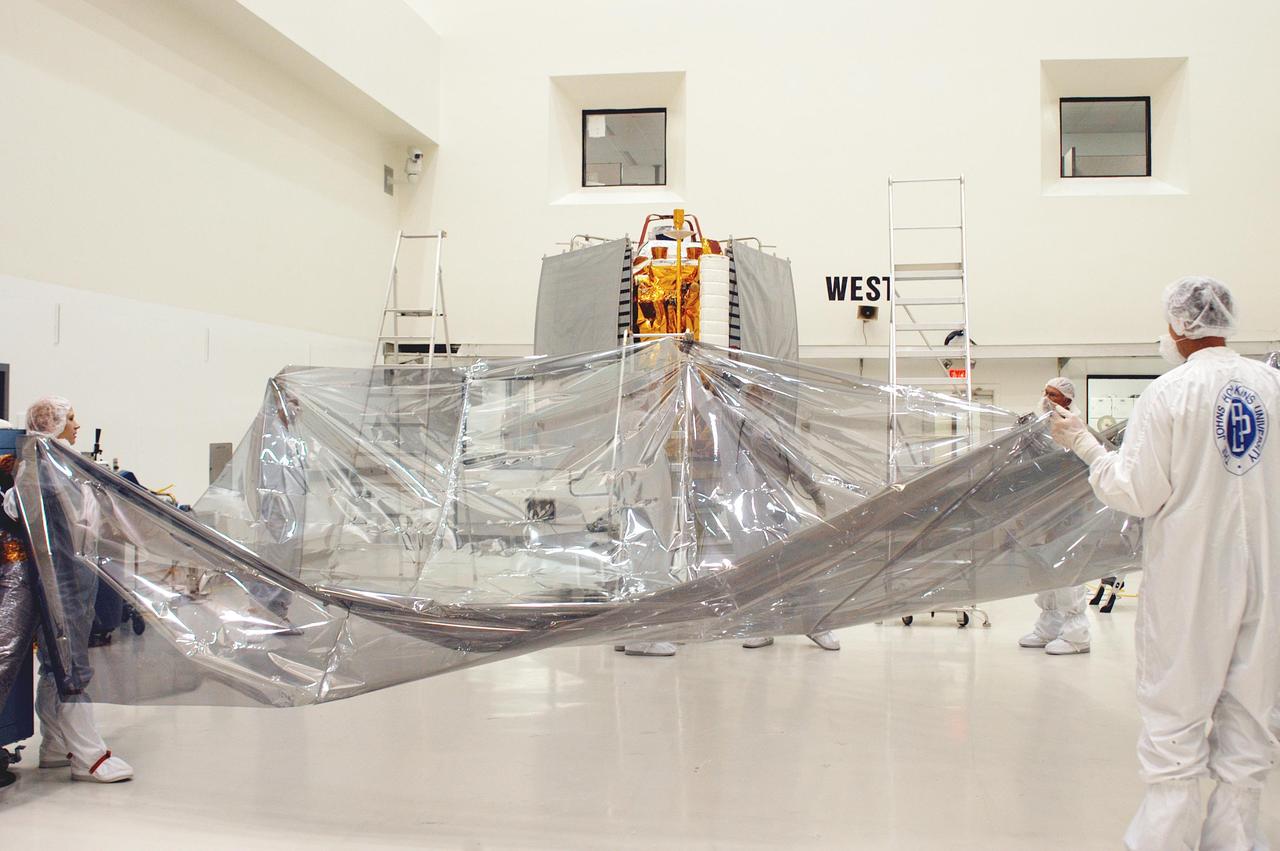
KENNEDY SPACE CENTER, FLA. - At Astrotech in Titusville, Fla., technicians with The Johns Hopkins University Applied Physics Laboratory (APL) prepare to cover the MESSESNGER spacecraft for a move to a hazardous processing facility in preparation for loading the spacecraft’s complement of hypergolic propellants. MESSENGER is scheduled to launch Aug. 2 aboard a Boeing Delta II rocket from Pad 17-B, Cape Canaveral Air Force Station, Fla., on a journey to Mercury. It will return to Earth for a gravity boost in July 2005, then fly past Venus twice, in October 2006 and June 2007. The spacecraft uses the tug of Venus’ gravity to resize and rotate its trajectory closer to Mercury’s orbit. Three Mercury flybys, each followed about two months later by a course-correction maneuver, put MESSENGER in position to enter Mercury orbit in March 2011. During the flybys, MESSENGER will map nearly the entire planet in color, image most of the areas unseen by Mariner 10, and measure the composition of the surface, atmosphere and magnetosphere. It will be the first new data from Mercury in more than 30 years - and invaluable for planning MESSENGER’s year-long orbital mission. MESSENGER was built for NASA by APL in Laurel, Md.
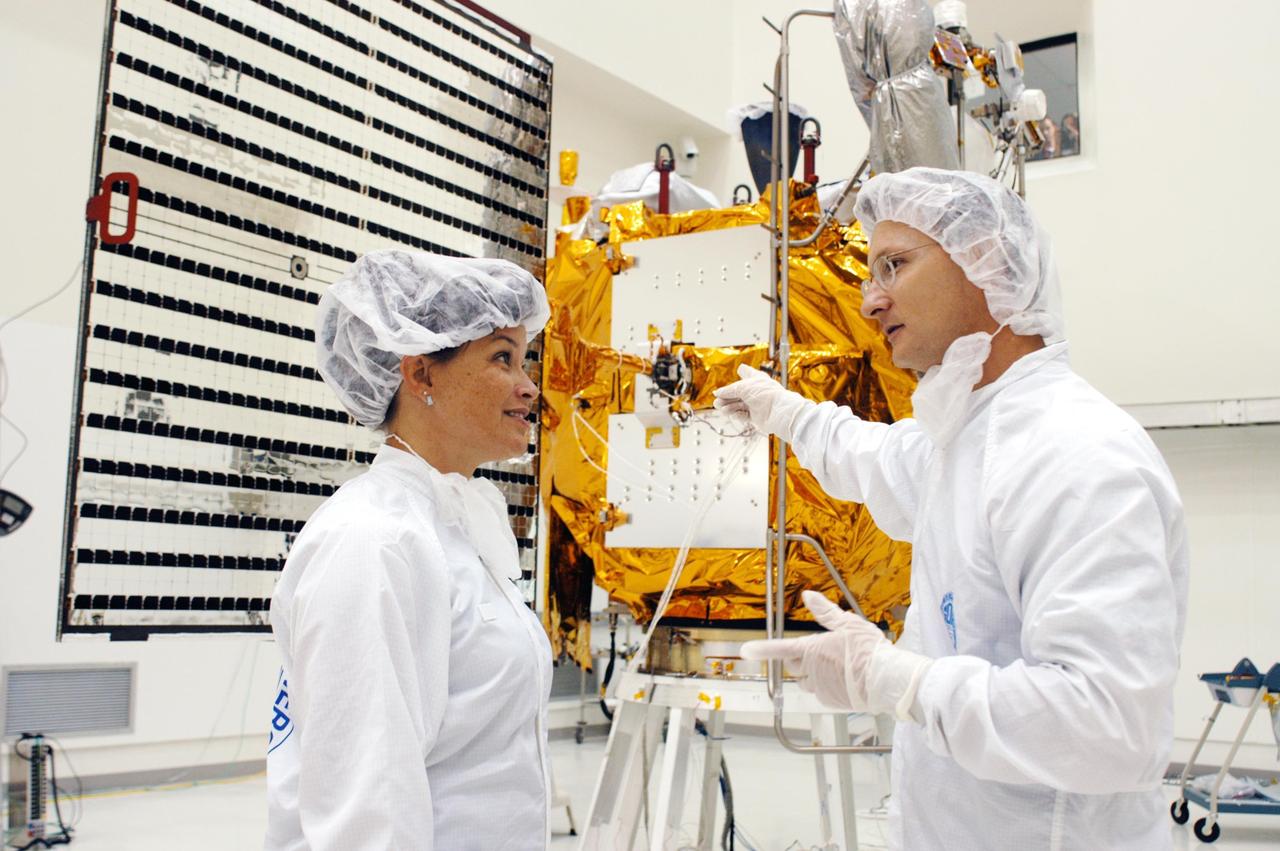
KENNEDY SPACE CENTER, FLA. - At Astrotech in Titusville, Fla., NASA Mission Integration Manager Cheryle Mako and NASA Launch Site Integration Manager John Hueckel talk before the deployment of the solar array panels on the MESSENGER spacecraft behind them. The solar arrays will provide MESSENGER’s power on its journey to Mercury. MESSENGER is scheduled to launch Aug. 2 aboard a Boeing Delta II rocket from Pad 17-B, Cape Canaveral Air Force Station, Fla. It will return to Earth for a gravity boost in July 2005, then fly past Venus twice, in October 2006 and June 2007. The spacecraft uses the tug of Venus’ gravity to resize and rotate its trajectory closer to Mercury’s orbit. Three Mercury flybys, each followed about two months later by a course-correction maneuver, put MESSENGER in position to enter Mercury orbit in March 2011. During the flybys, MESSENGER will map nearly the entire planet in color, image most of the areas unseen by Mariner 10, and measure the composition of the surface, atmosphere and magnetosphere. It will be the first new data from Mercury in more than 30 years - and invaluable for planning MESSENGER’s year-long orbital mission. MESSENGER was built for NASA by APL in Laurel, Md.
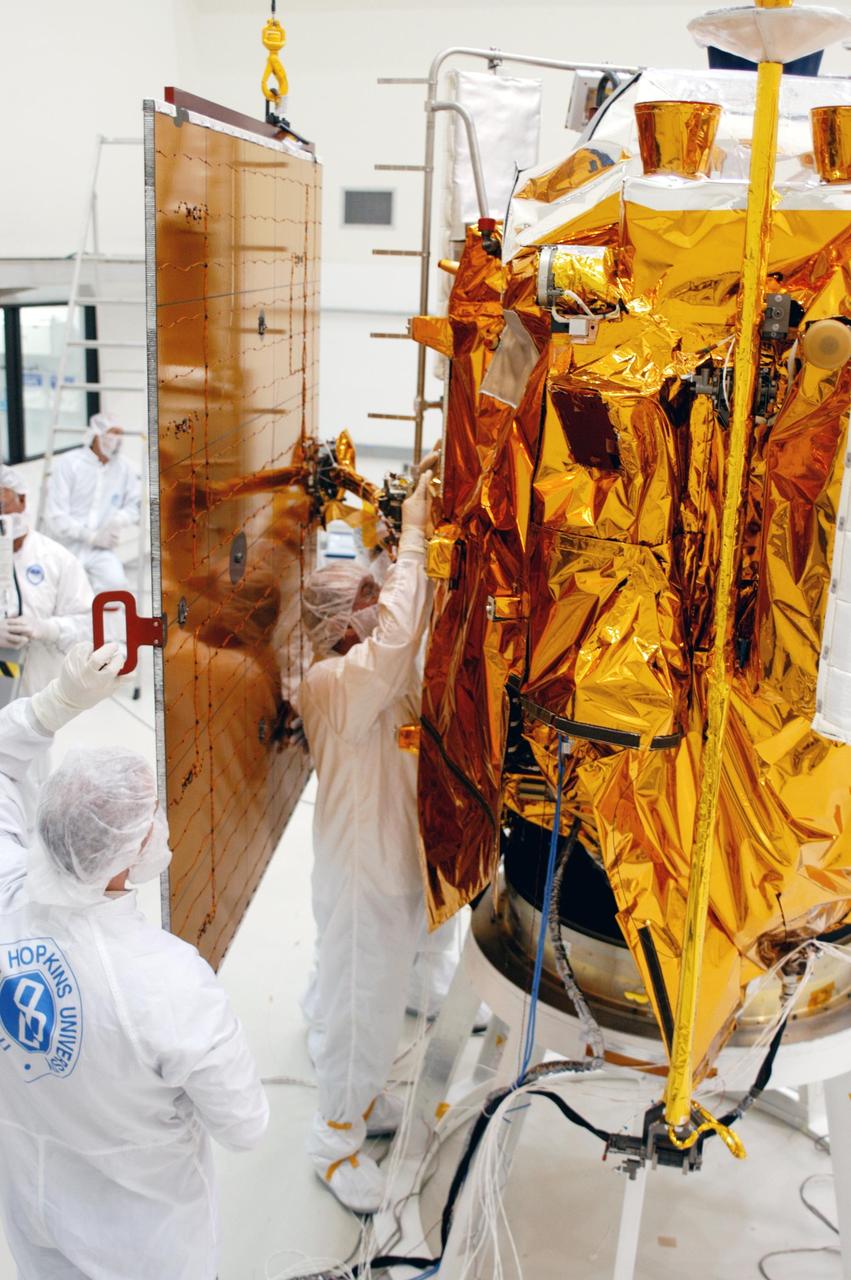
KENNEDY SPACE CENTER, FLA. - Technicians at Astrotech in Titusville, Fla., steady a solar panel suspended from above as others prepare to install it on NASA’s MESSENGER spacecraft. It is one of two large solar panels, supplemented with a nickel-hydrogen battery, that will provide MESSENGER’s power. MESSENGER is scheduled to launch Aug. 2 aboard a Boeing Delta II rocket from Pad 17-B, Cape Canaveral Air Force Station, Fla. It will return to Earth for a gravity boost in July 2005, then fly past Venus twice, in October 2006 and June 2007. The spacecraft uses the tug of Venus’ gravity to resize and rotate its trajectory closer to Mercury’s orbit. Three Mercury flybys, each followed about two months later by a course-correction maneuver, put MESSENGER in position to enter Mercury orbit in March 2011. During the flybys, MESSENGER will map nearly the entire planet in color, image most of the areas unseen by Mariner 10, and measure the composition of the surface, atmosphere and magnetosphere. It will be the first new data from Mercury in more than 30 years - and invaluable for planning MESSENGER’s year-long orbital mission. MESSENGER was built for NASA by the Johns Hopkins University Applied Physics Laboratory in Laurel, Md.
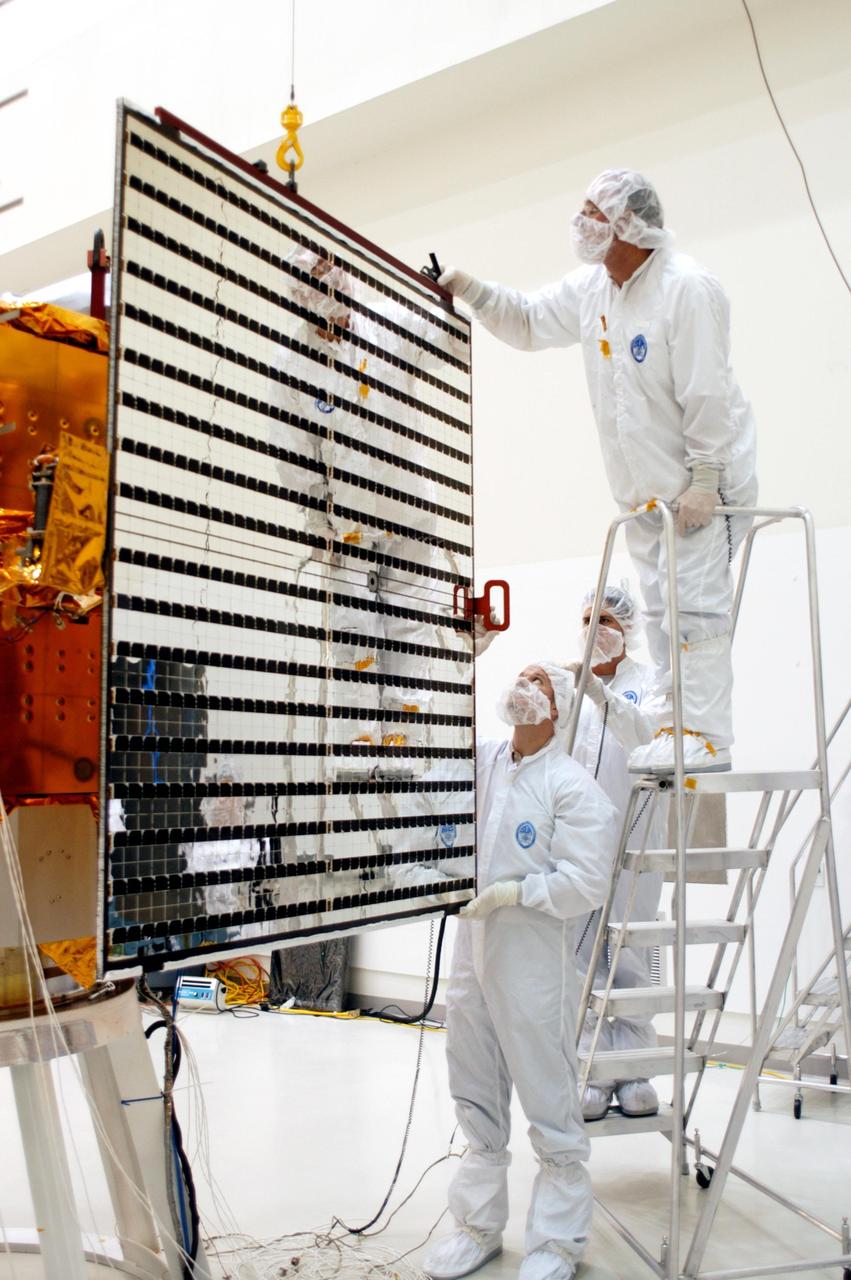
KENNEDY SPACE CENTER, FLA. - Technicians at Astrotech in Titusville, Fla., guide a solar panel closer to NASA’s MESSENGER spacecraft for installation. It is one of two large solar panels, supplemented with a nickel-hydrogen battery, that will provide MESSENGER’s power. MESSENGER is scheduled to launch Aug. 2 aboard a Boeing Delta II rocket from Pad 17-B, Cape Canaveral Air Force Station, Fla. It will return to Earth for a gravity boost in July 2005, then fly past Venus twice, in October 2006 and June 2007. The spacecraft uses the tug of Venus’ gravity to resize and rotate its trajectory closer to Mercury’s orbit. Three Mercury flybys, each followed about two months later by a course-correction maneuver, put MESSENGER in position to enter Mercury orbit in March 2011. During the flybys, MESSENGER will map nearly the entire planet in color, image most of the areas unseen by Mariner 10, and measure the composition of the surface, atmosphere and magnetosphere. It will be the first new data from Mercury in more than 30 years - and invaluable for planning MESSENGER’s year-long orbital mission. MESSENGER was built for NASA by the Johns Hopkins University Applied Physics Laboratory in Laurel, Md.
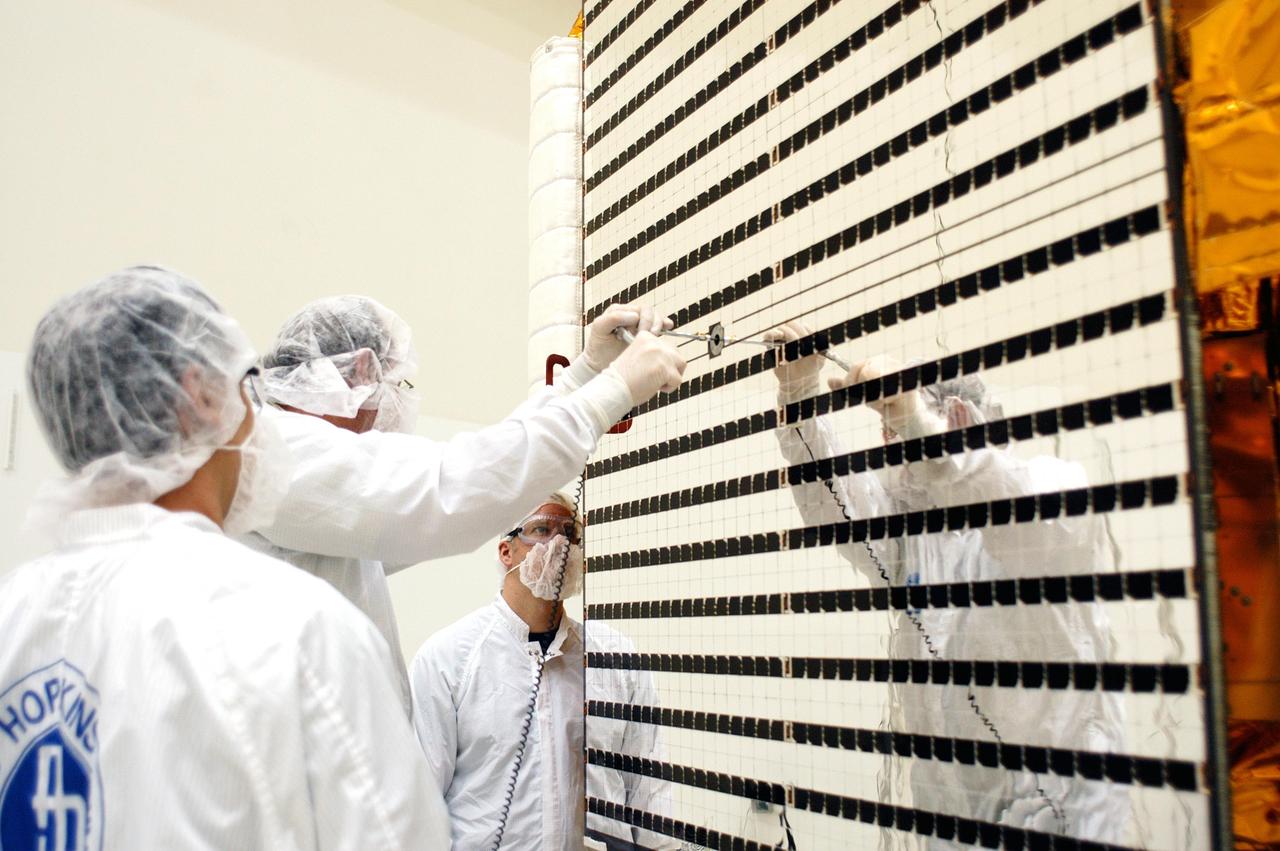
KENNEDY SPACE CENTER, FLA. - At Astrotech in Titusville, Fla., technicians with The Johns Hopkins University Applied Physics Laboratory (APL) prepare one of two solar array panels on the MESSENGER spacecraft for deployment. The panels will provide MESSENGER’s power on its journey to Mercury. MESSENGER is scheduled to launch Aug. 2 aboard a Boeing Delta II rocket from Pad 17-B, Cape Canaveral Air Force Station, Fla. It will return to Earth for a gravity boost in July 2005, then fly past Venus twice, in October 2006 and June 2007. The spacecraft uses the tug of Venus’ gravity to resize and rotate its trajectory closer to Mercury’s orbit. Three Mercury flybys, each followed about two months later by a course-correction maneuver, put MESSENGER in position to enter Mercury orbit in March 2011. During the flybys, MESSENGER will map nearly the entire planet in color, image most of the areas unseen by Mariner 10, and measure the composition of the surface, atmosphere and magnetosphere. It will be the first new data from Mercury in more than 30 years - and invaluable for planning MESSENGER’s year-long orbital mission. MESSENGER was built for NASA by APL in Laurel, Md.
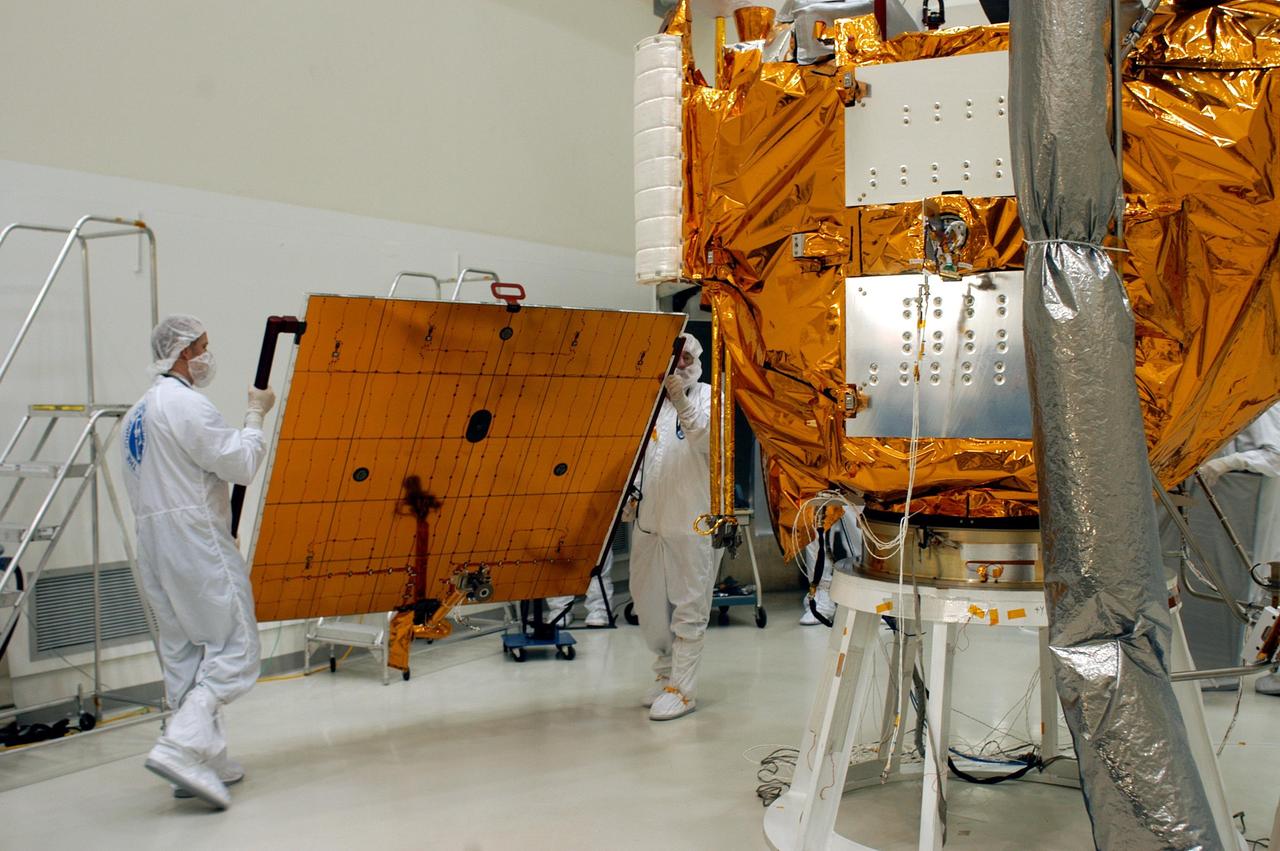
KENNEDY SPACE CENTER, FLA. - Technicians at Astrotech in Titusville, Fla., carry a solar panel toward NASA’s MESSENGER spacecraft for installation. It is one of two large solar panels, supplemented with a nickel-hydrogen battery, that will provide MESSENGER’s power. MESSENGER is scheduled to launch Aug. 2 aboard a Boeing Delta II rocket from Pad 17-B, Cape Canaveral Air Force Station, Fla. It will return to Earth for a gravity boost in July 2005, then fly past Venus twice, in October 2006 and June 2007. The spacecraft uses the tug of Venus’ gravity to resize and rotate its trajectory closer to Mercury’s orbit. Three Mercury flybys, each followed about two months later by a course-correction maneuver, put MESSENGER in position to enter Mercury orbit in March 2011. During the flybys, MESSENGER will map nearly the entire planet in color, image most of the areas unseen by Mariner 10, and measure the composition of the surface, atmosphere and magnetosphere. It will be the first new data from Mercury in more than 30 years - and invaluable for planning MESSENGER’s year-long orbital mission. MESSENGER was built for NASA by the Johns Hopkins University Applied Physics Laboratory in Laurel, Md.

KENNEDY SPACE CENTER, FLA. -- During a Crew Equipment Interface Test (CEIT) at SPACEHAB, in Cape Canaveral, Fla., members of the STS-101 crew learn about some of the cargo that will be on their mission. At left are Mission Specialists Jeffrey N. Williams and Edward Tsang Lu (Ph.D.); at right are Commander James Donald Halsell Jr., and Mission Specialist Boris W. Morukov, who is with the Russian Space Agency (RSA). Other crew members are Pilot Scott Horowitz, and Mission Specialists Mary Ellen Weber, (Ph.D.) and Boris W. Morukov and Yuri Malenchenko, who are with the Russian Space Agency. The primary objective of the STS-101 mission is to complete the initial outfitting of the International Space Station, making it fully ready for the first long-term crew. The seven-member crew will transfer almost two tons of equipment and supplies from SPACEHAB's Logistics Double Module. Additionally, they will unpack a shipment of supplies delivered earlier by a Russian Progress space tug and begin outfitting the newly arrived Zvezda Service Module. Three astronauts will perform two space walks to transfer and install parts of the Russian Strela cargo boom that are attached to SPACEHAB's Integrated Cargo Container, connect utility cables between Zarya and Zvezda, and install a magnetometer/pole assembly on the Service Module. Additional activities for the STS-101 astronauts include working with the Space Experiment Module (SEM-06) and the Mission to America's Remarkable Schools (MARS), two educational initiatives. STS-101 is scheduled for launch no earlier than March 16, 2000
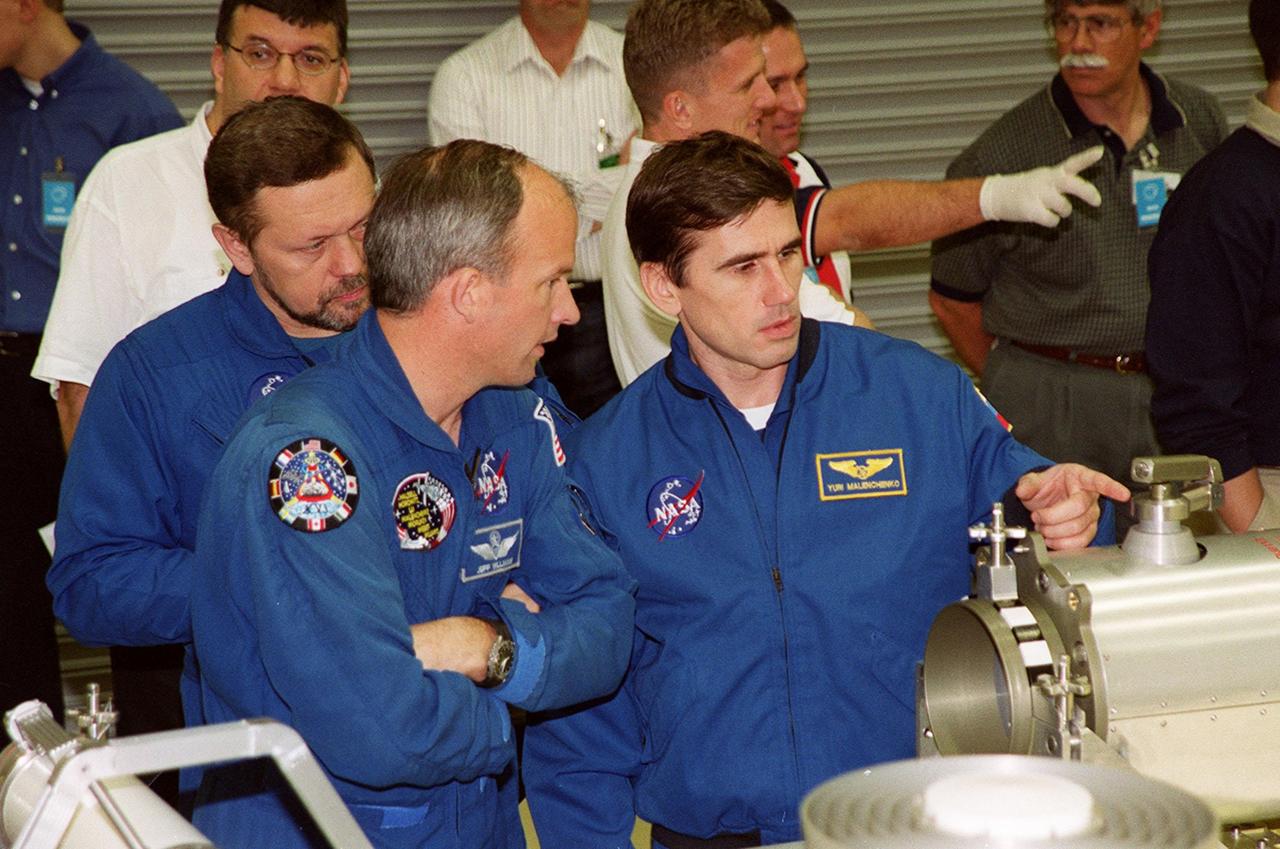
KENNEDY SPACE CENTER, FLA. -- During a Crew Equipment Interface Test (CEIT) at SPACEHAB, in Cape Canaveral, Fla., STS-101 crew members check out some of the cargo that will be carried on their mission. From left are Mission Specialists Boris W. Morukov, who is with the Russian Space Agency (RSA), Jeffrey N. Williams, and Yuri Malenchenko, also with RSA. Other crew members are Commander James Donald Halsell Jr., Pilot Scott J. "Doc" Horowitz (Ph.D.) and Mission Specialists Mary Ellen Weber, (Ph.D.) and Edward Tsang Lu (Ph.D.). The primary objective of the STS-101 mission is to complete the initial outfitting of the International Space Station, making it fully ready for the first long-term crew. The seven-member crew will transfer almost two tons of equipment and supplies from SPACEHAB's Logistics Double Module. Additionally, they will unpack a shipment of supplies delivered earlier by a Russian Progress space tug and begin outfitting the newly arrived Zvezda Service Module. Three astronauts will perform two space walks to transfer and install parts of the Russian Strela cargo boom that are attached to SPACEHAB's Integrated Cargo Container, connect utility cables between Zarya and Zvezda, and install a magnetometer/pole assembly on the Service Module. Additional activities for the STS-101 astronauts include working with the Space Experiment Module (SEM-06) and the Mission to America's Remarkable Schools (MARS), two educational initiatives. STS-101 is scheduled for launch no earlier than March 16, 2000
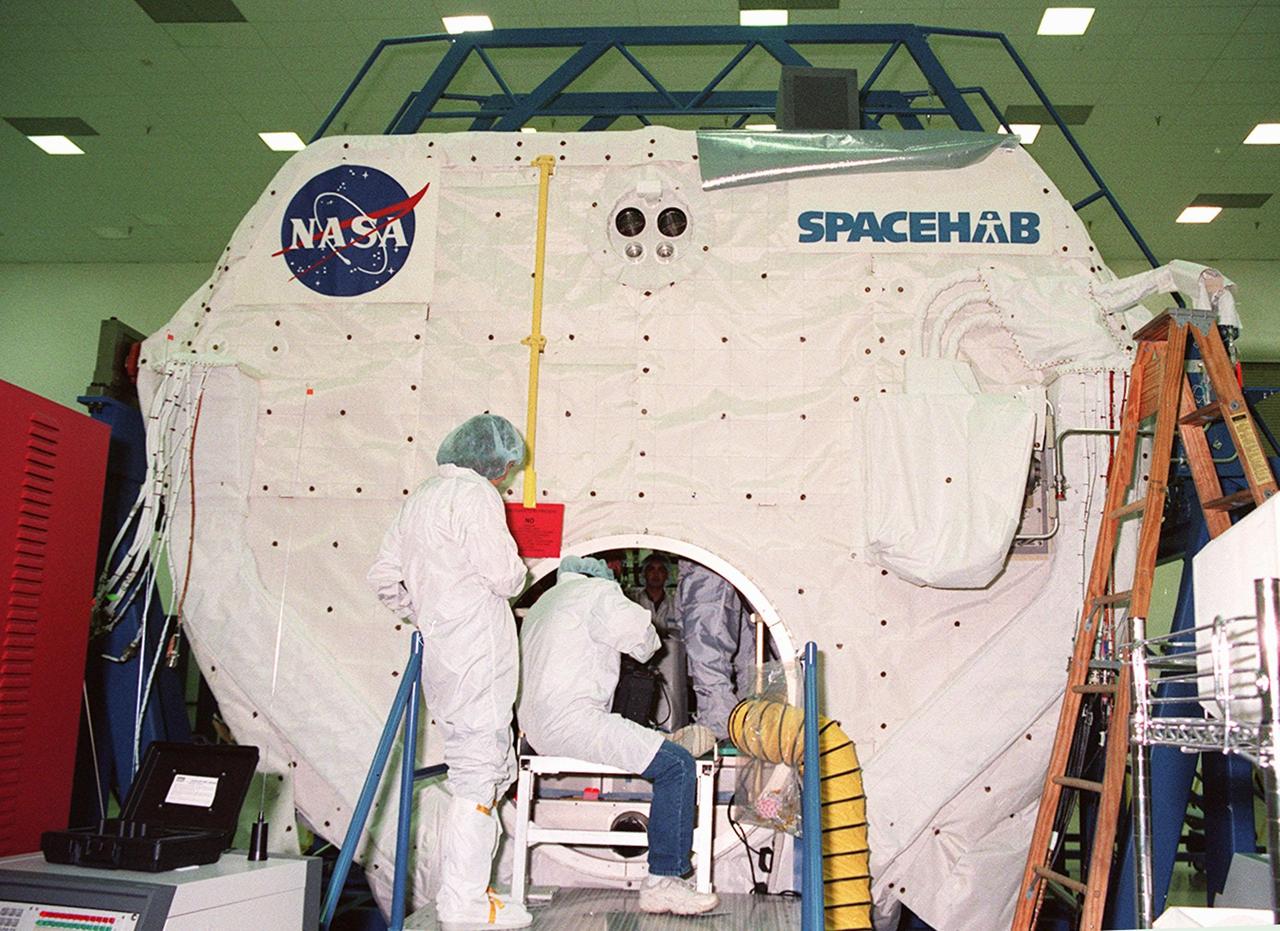
KENNEDY SPACE CENTER, FLA. -- At SPACEHAB, in Titusville, Fla., STS-101 crew members take part in a Crew Equipment Interface Test (CEIT). Here they are checking out the SPACEHAB Logistics Double Module. The crew is composed of Commander James Donald Halsell Jr., Pilot Scott J. "Doc" Horowitz (Ph.D.), and Mission Specialists Mary Ellen Weber (Ph.D.), Edward Tsang Lu (Ph.D.), Jeffrey N. Williams, and Yuri Malenchenko and Boris W. Morukov, who are with the Russian Space Agency. The primary objective of the STS-101 mission is to complete the initial outfitting of the International Space Station, making it fully ready for the first long-term crew. The seven-member crew will transfer almost two tons of equipment and supplies from SPACEHAB. Additionally, they will unpack a shipment of supplies delivered earlier by a Russian Progress space tug and begin outfitting the newly arrived Zvezda Service Module. Three astronauts will perform two space walks to transfer and install parts of the Russian Strela cargo boom that are attached to SPACEHAB's Integrated Cargo Container, connect utility cables between Zarya and Zvezda, and install a magnetometer/pole assembly on the Service Module. Additional activities for the STS-101 astronauts include working with the Space Experiment Module (SEM-06) and the Mission to America's Remarkable Schools (MARS), two educational initiatives. STS-101 is scheduled for launch no earlier than March 16, 2000