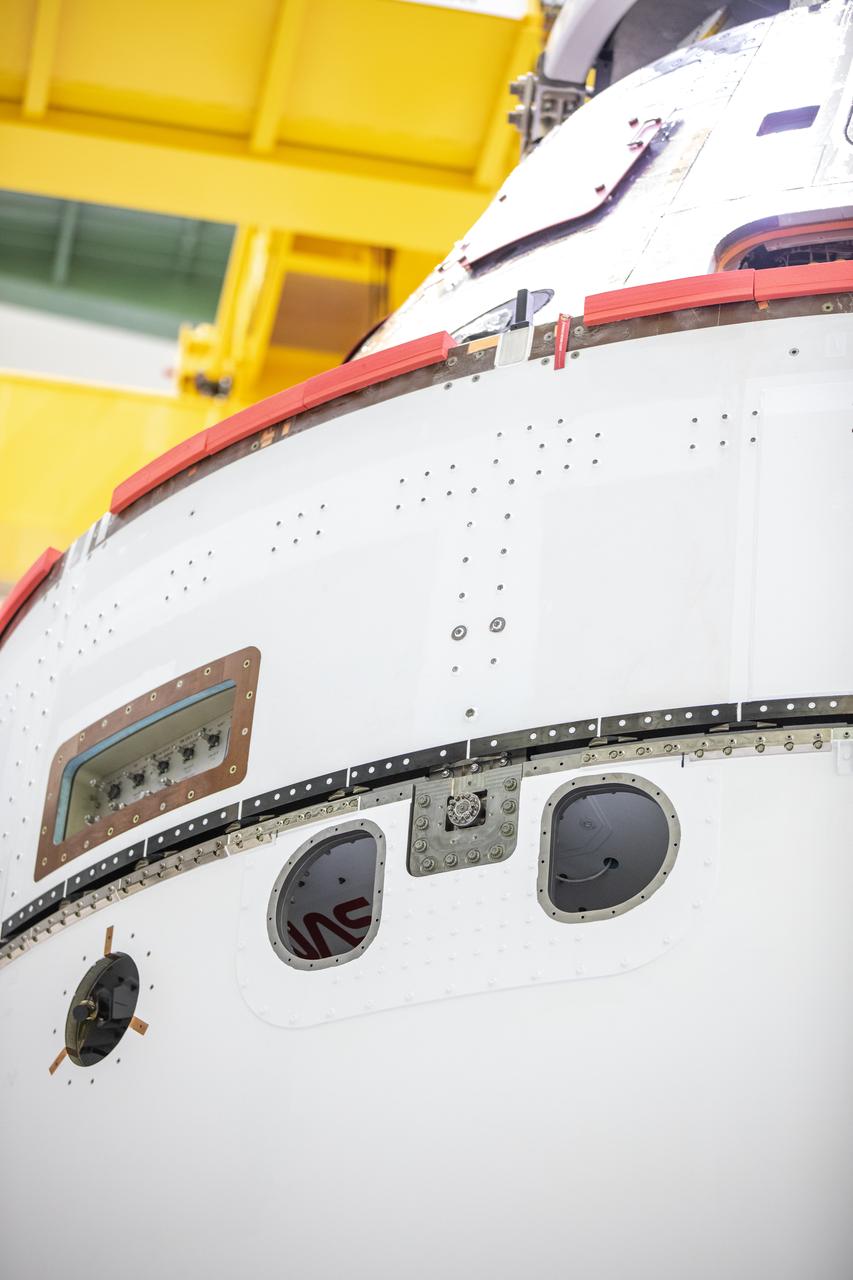
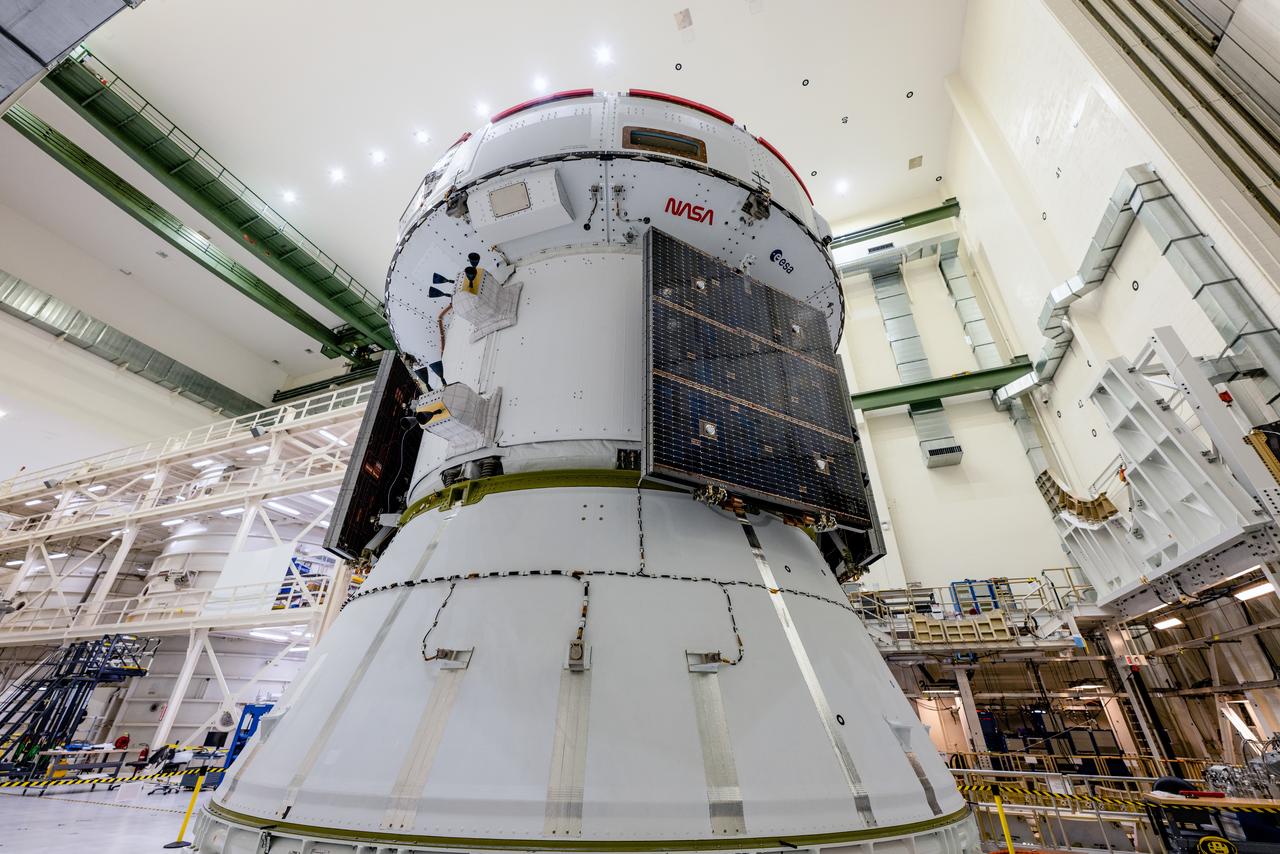
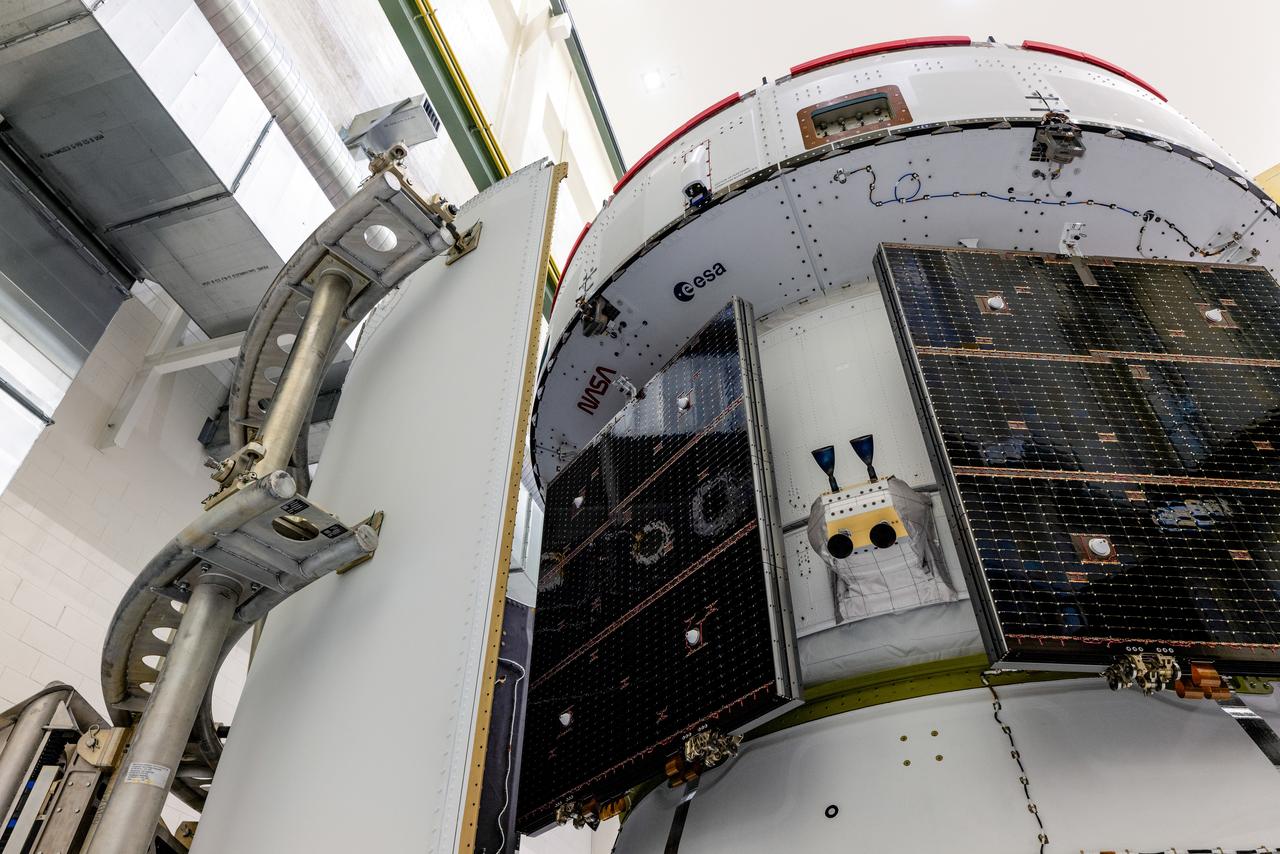
A close-up view of the Orion’s crew module adapter with the spacecraft adapter jettison fairing panels secured in place shows a peak of the iconic NASA worm insignia on Oct. 27, 2020, inside the Neil Armstrong Operations and Checkout Building (O&C) at NASA’s Kennedy Space Center in Florida. The panels were inspected and moved into place for installation by technicians with Lockheed Martin. Recently, teams from across the globe installed the four solar array wings, which are housed inside the protective covering of the fairings. Once secured, they will encapsulate the ESM to protect it from harsh environments such as heat, wind, and acoustics as the spacecraft is propelled out of Earth’s atmosphere atop the Space Launch System (SLS) rocket during NASA’s Artemis I mission.
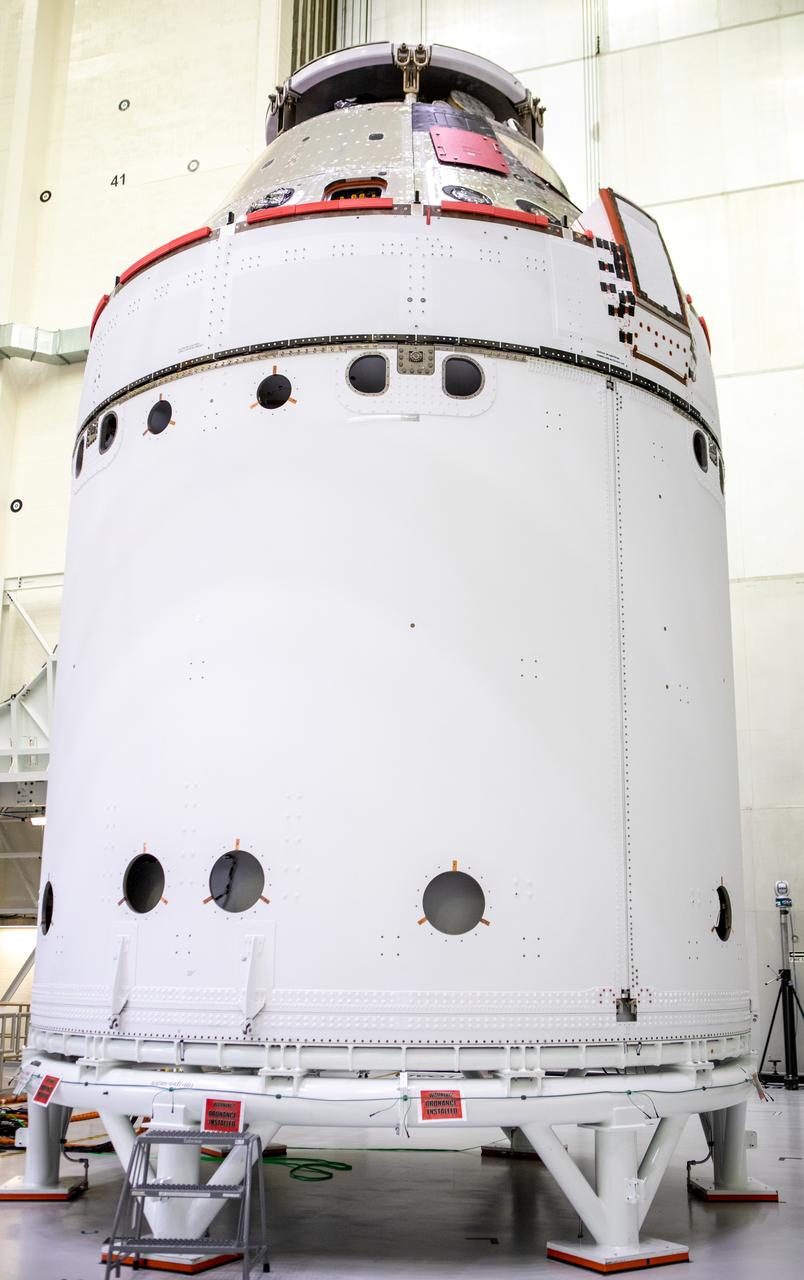
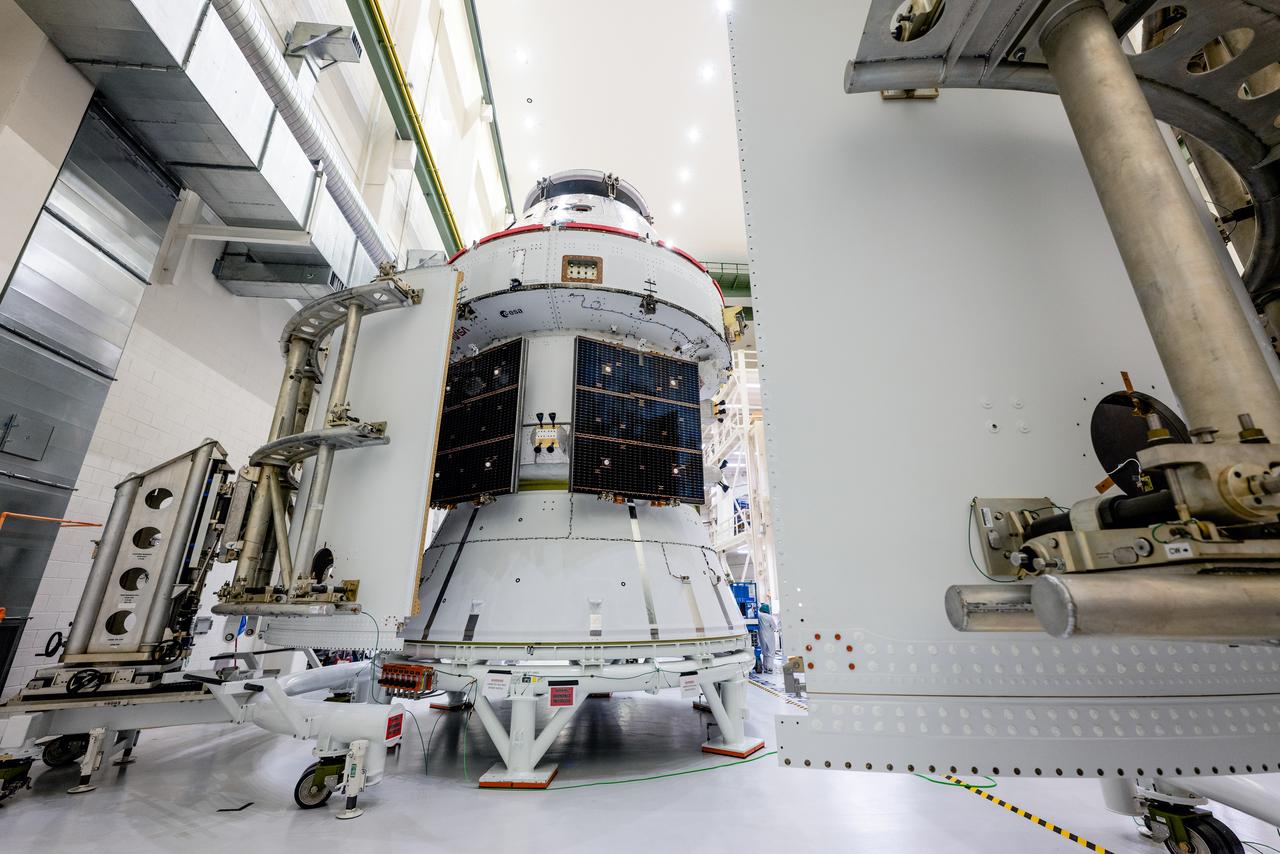
The spacecraft adapter jettison fairing panels are secured onto Orion’s European Service Module (ESM) on Oct. 27, 2020, inside the Neil Armstrong Operations and Checkout Building (O&C) at NASA’s Kennedy Space Center in Florida. The three panels were inspected and moved into place for installation by technicians with Lockheed Martin. Recently, teams from across the globe installed the four solar array wings, which are housed inside the protective covering of the fairings. The fairing panels will encapsulate the ESM to protect it from harsh environments such as heat, wind, and acoustics as the spacecraft is propelled out of Earth’s atmosphere atop the Space Launch System rocket during NASA’s Artemis I mission.
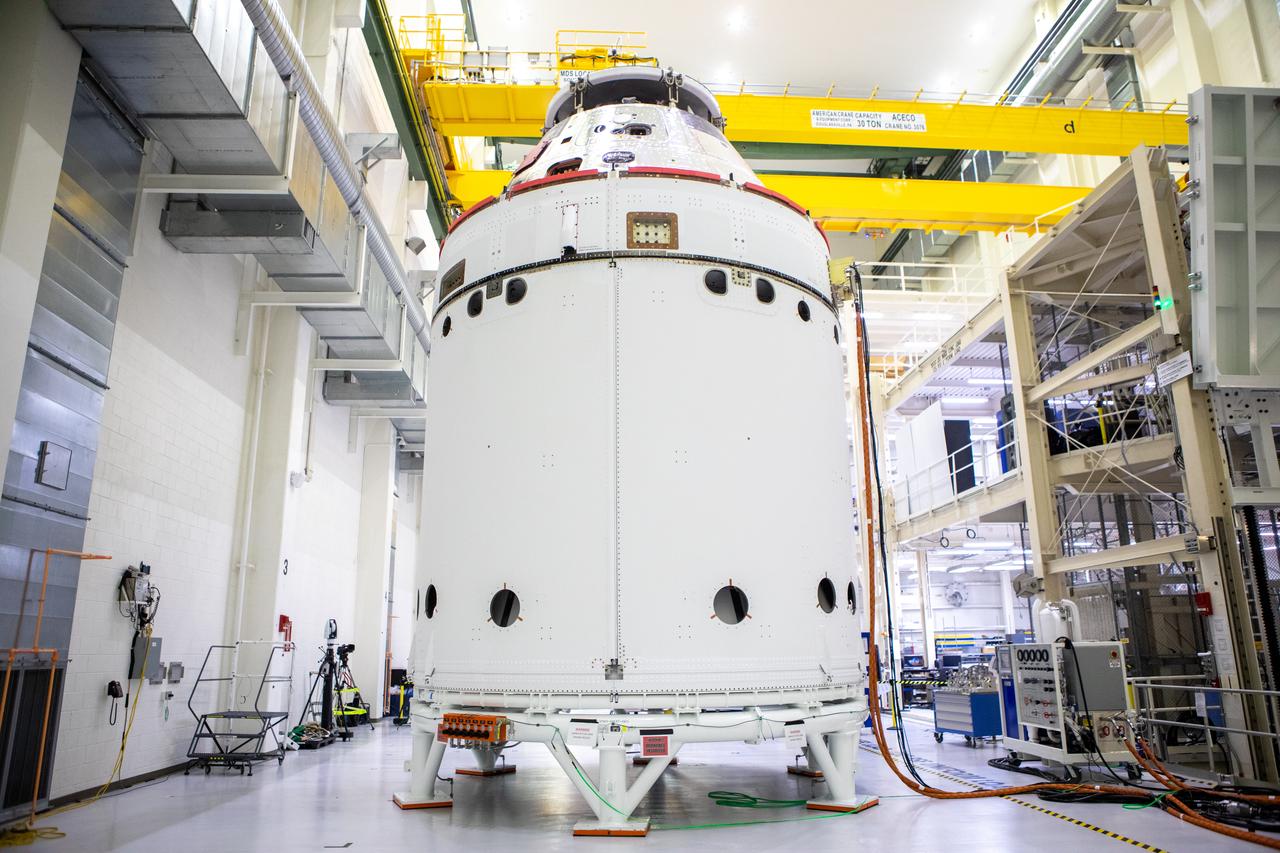
The spacecraft adapter jettison fairing panels are secured onto Orion’s European Service Module (ESM) on Oct. 27, 2020, inside the Neil Armstrong Operations and Checkout Building (O&C) at NASA’s Kennedy Space Center in Florida. The three panels were inspected and moved into place for installation by technicians with Lockheed Martin. Recently, teams from across the globe installed the four solar array wings, which are housed inside the protective covering of the fairings. The fairing panels will encapsulate the ESM to protect it from harsh environments such as heat, wind, and acoustics as the spacecraft is propelled out of Earth’s atmosphere atop the Space Launch System rocket during NASA’s Artemis I mission.
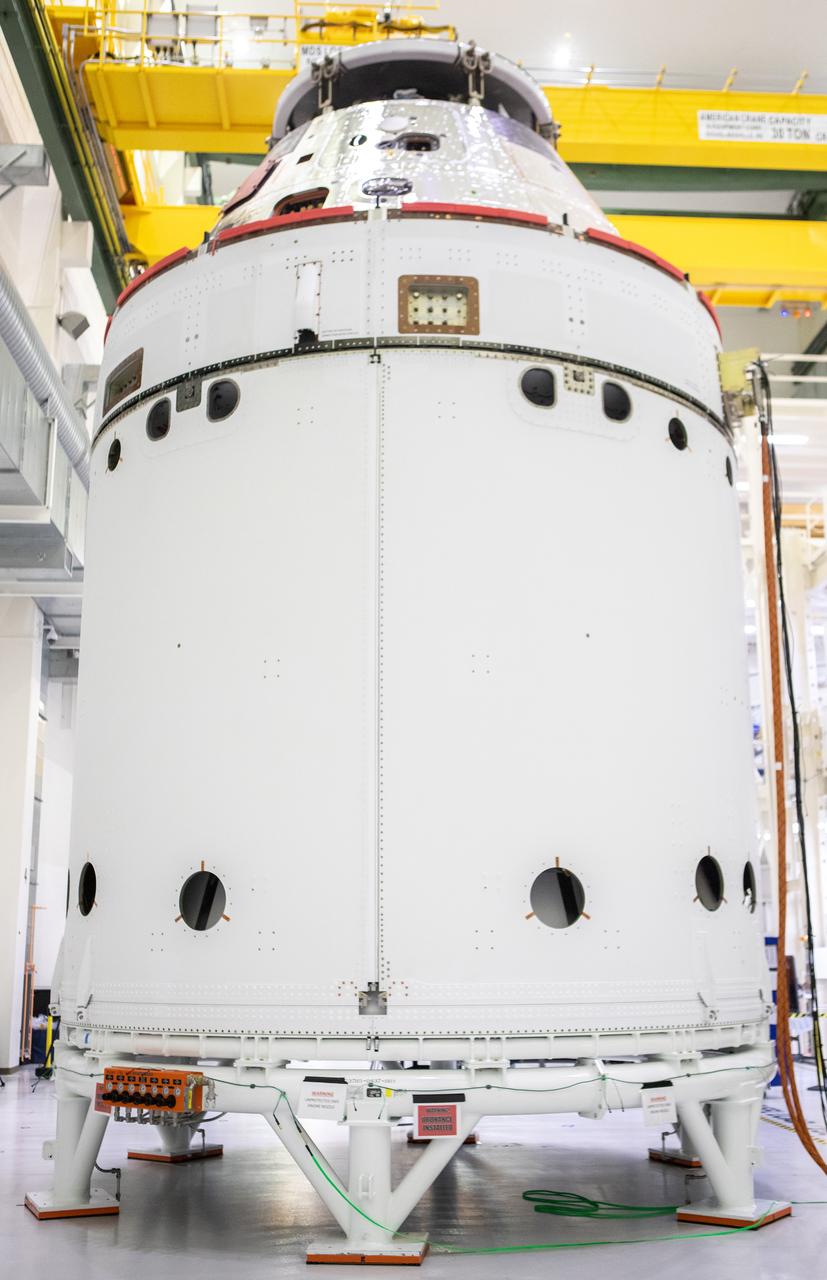
The spacecraft adapter jettison fairing panels are secured onto Orion’s European Service Module (ESM) on Oct. 27, 2020, inside the Neil Armstrong Operations and Checkout Building (O&C) at NASA’s Kennedy Space Center in Florida. The three panels were inspected and moved into place for installation by technicians with Lockheed Martin. Recently, teams from across the globe installed the four solar array wings, which are housed inside the protective covering of the fairings. The fairing panels will encapsulate the ESM to protect it from harsh environments such as heat, wind, and acoustics as the spacecraft is propelled out of Earth’s atmosphere atop the Space Launch System rocket during NASA’s Artemis I mission.
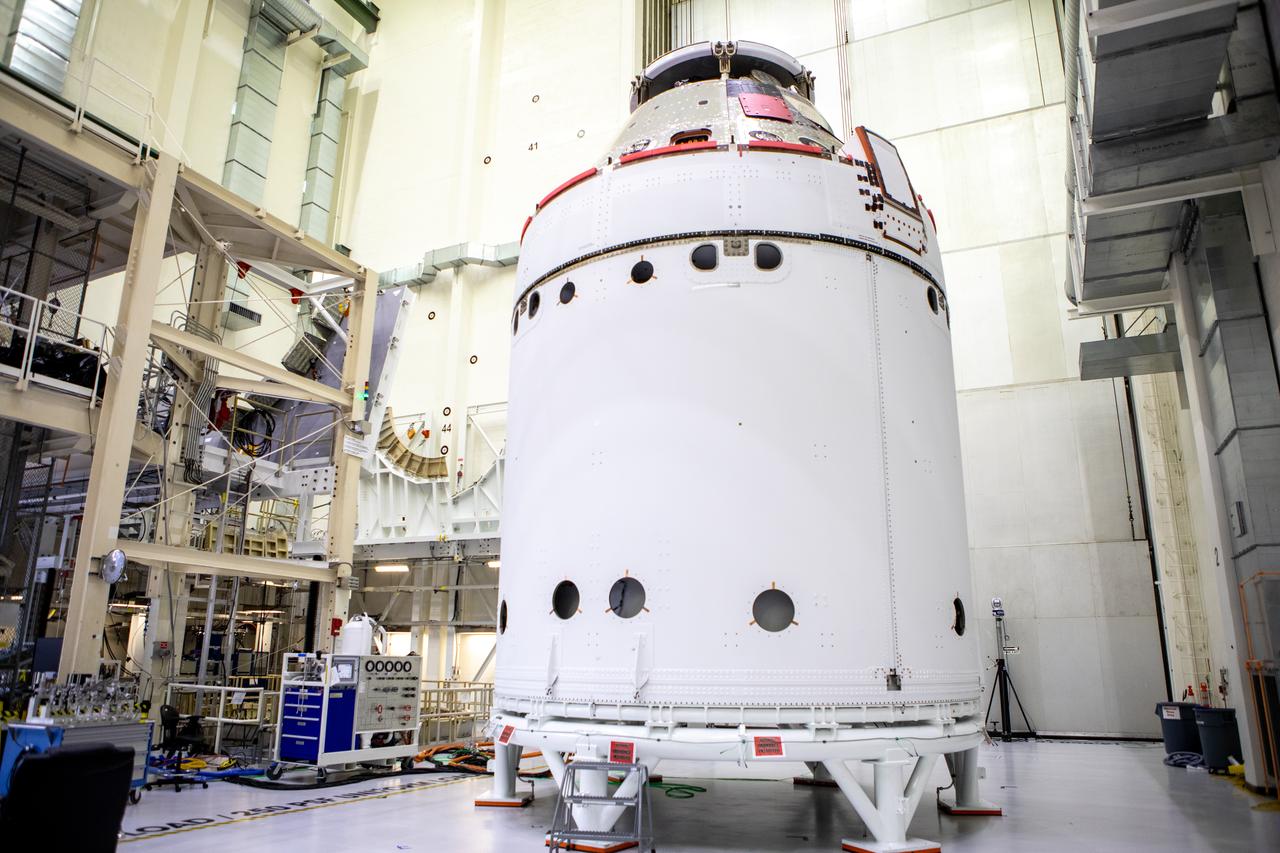
The spacecraft adapter jettison fairing panels are secured onto Orion’s European Service Module (ESM) on Oct. 27, 2020, inside the Neil Armstrong Operations and Checkout Building (O&C) at NASA’s Kennedy Space Center in Florida. The three panels were inspected and moved into place for installation by technicians with Lockheed Martin. Recently, teams from across the globe installed the four solar array wings, which are housed inside the protective covering of the fairings. The fairing panels will encapsulate the ESM to protect it from harsh environments such as heat, wind, and acoustics as the spacecraft is propelled out of Earth’s atmosphere atop the Space Launch System rocket during NASA’s Artemis I mission.
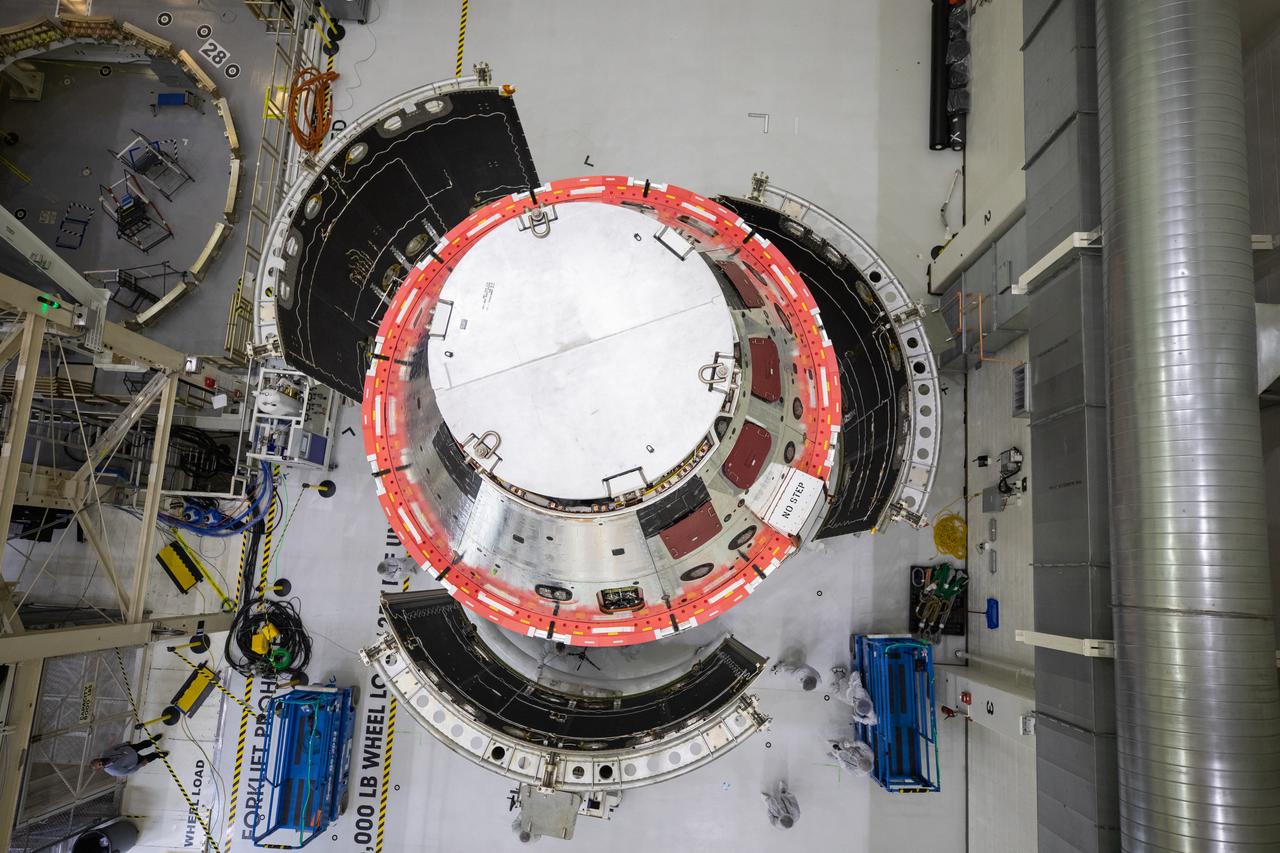
Shown is an overhead view of three spacecraft adapter jettison fairing panels fitted onto Orion’s European Service Module (ESM) on Oct. 13, 2020, inside the Neil Armstrong Operations and Checkout Building (O&C) at NASA’s Kennedy Space Center in Florida. The panels were inspected and moved into place for installation by technicians with Lockheed Martin. Recently, teams from across the globe installed the four solar array wings, which are housed inside the protective covering of the fairings. Once secured, they will encapsulate the ESM to protect it from harsh environments such as heat, wind, and acoustics as the spacecraft is propelled out of Earth’s atmosphere atop the Space Launch System (SLS) rocket during NASA’s Artemis I mission.
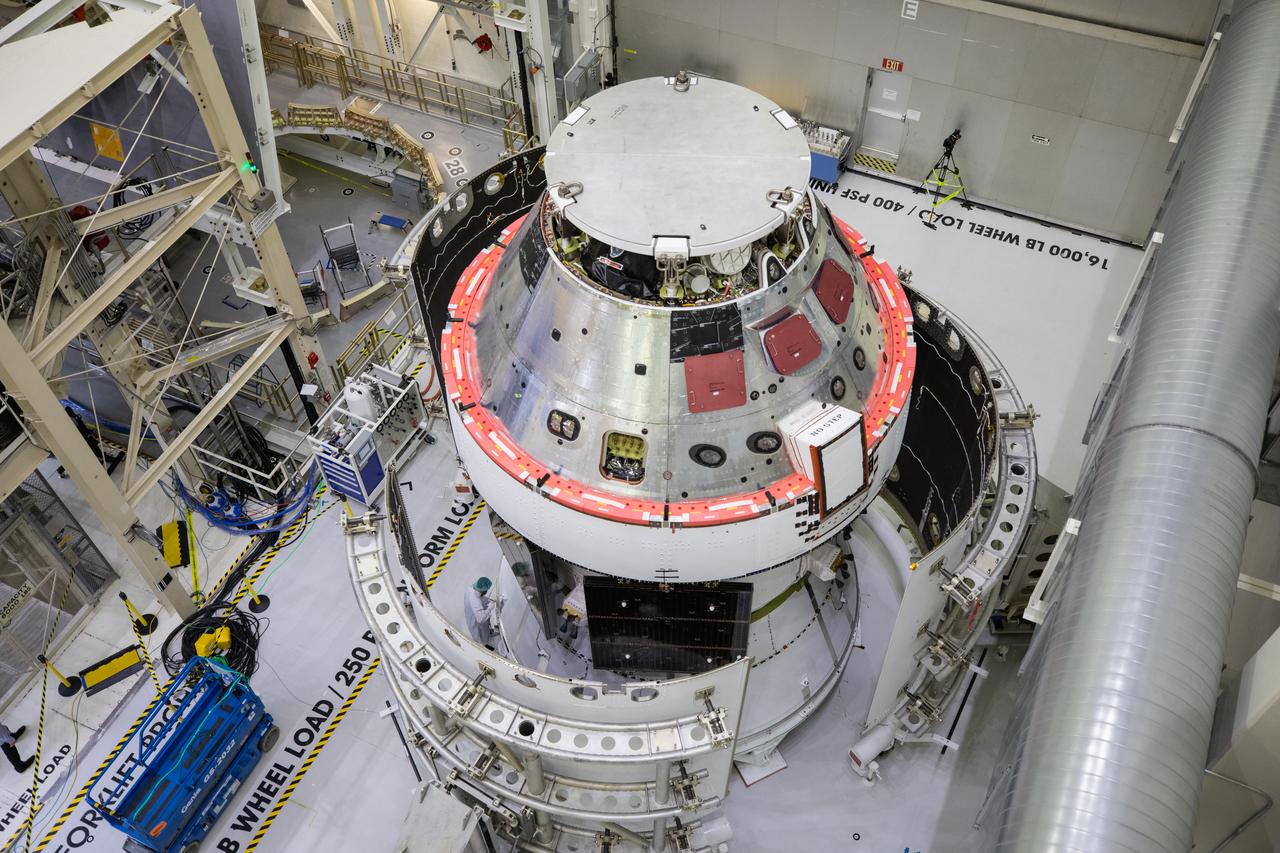
Shown is an overhead view of three spacecraft adapter jettison fairing panels fitted onto Orion’s European Service Module (ESM) on Oct. 13, 2020, inside the Neil Armstrong Operations and Checkout Building (O&C) at NASA’s Kennedy Space Center in Florida. The panels were inspected and moved into place for installation by technicians with Lockheed Martin. Recently, teams from across the globe installed the four solar array wings, which are housed inside the protective covering of the fairings. Once secured, they will encapsulate the ESM to protect it from harsh environments such as heat, wind, and acoustics as the spacecraft is propelled out of Earth’s atmosphere atop the Space Launch System (SLS) rocket during NASA’s Artemis I mission.
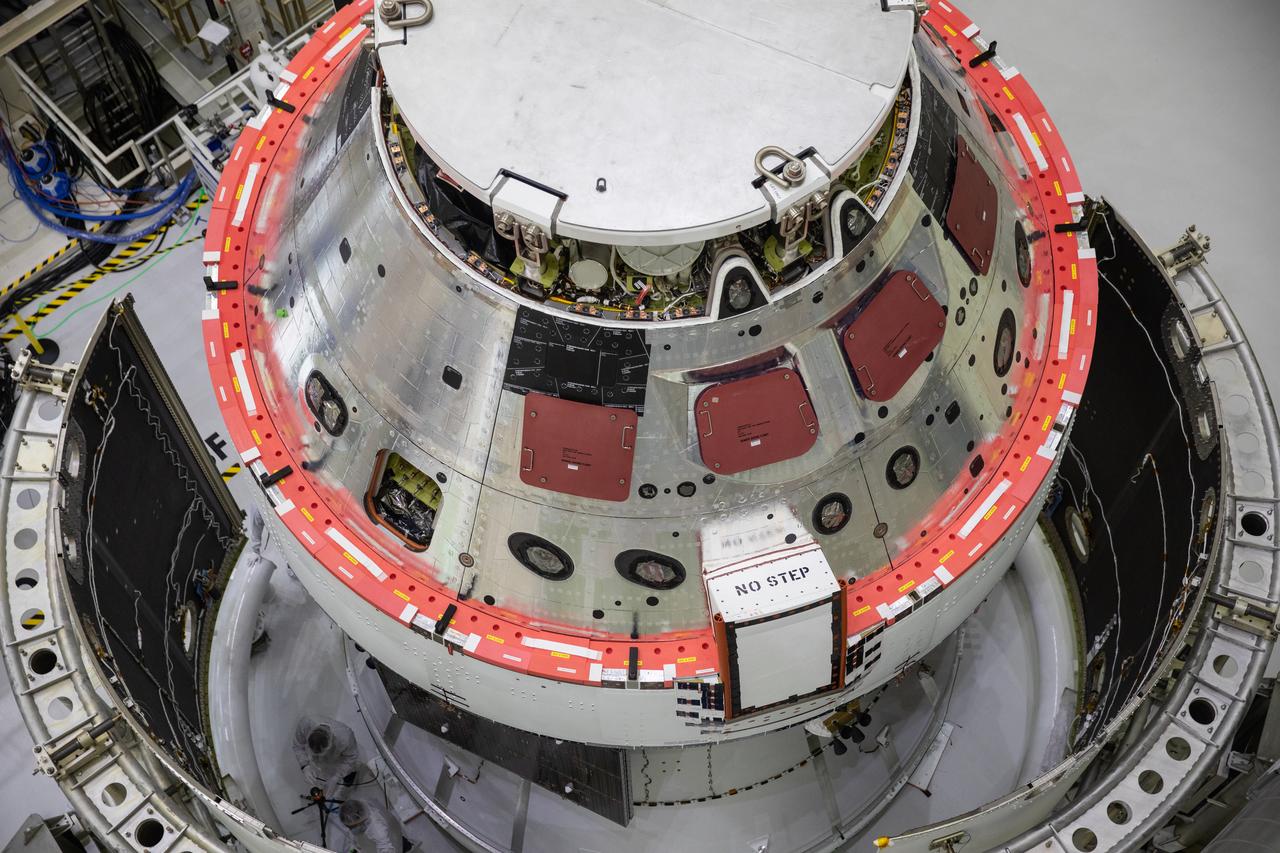
Shown is an overhead view of three spacecraft adapter jettison fairing panels fitted onto Orion’s European Service Module (ESM) on Oct. 13, 2020, inside the Neil Armstrong Operations and Checkout Building (O&C) at NASA’s Kennedy Space Center in Florida. The panels were inspected and moved into place for installation by technicians with Lockheed Martin. Recently, teams from across the globe installed the four solar array wings, which are housed inside the protective covering of the fairings. Once secured, they will encapsulate the ESM to protect it from harsh environments such as heat, wind, and acoustics as the spacecraft is propelled out of Earth’s atmosphere atop the Space Launch System (SLS) rocket during NASA’s Artemis I mission.
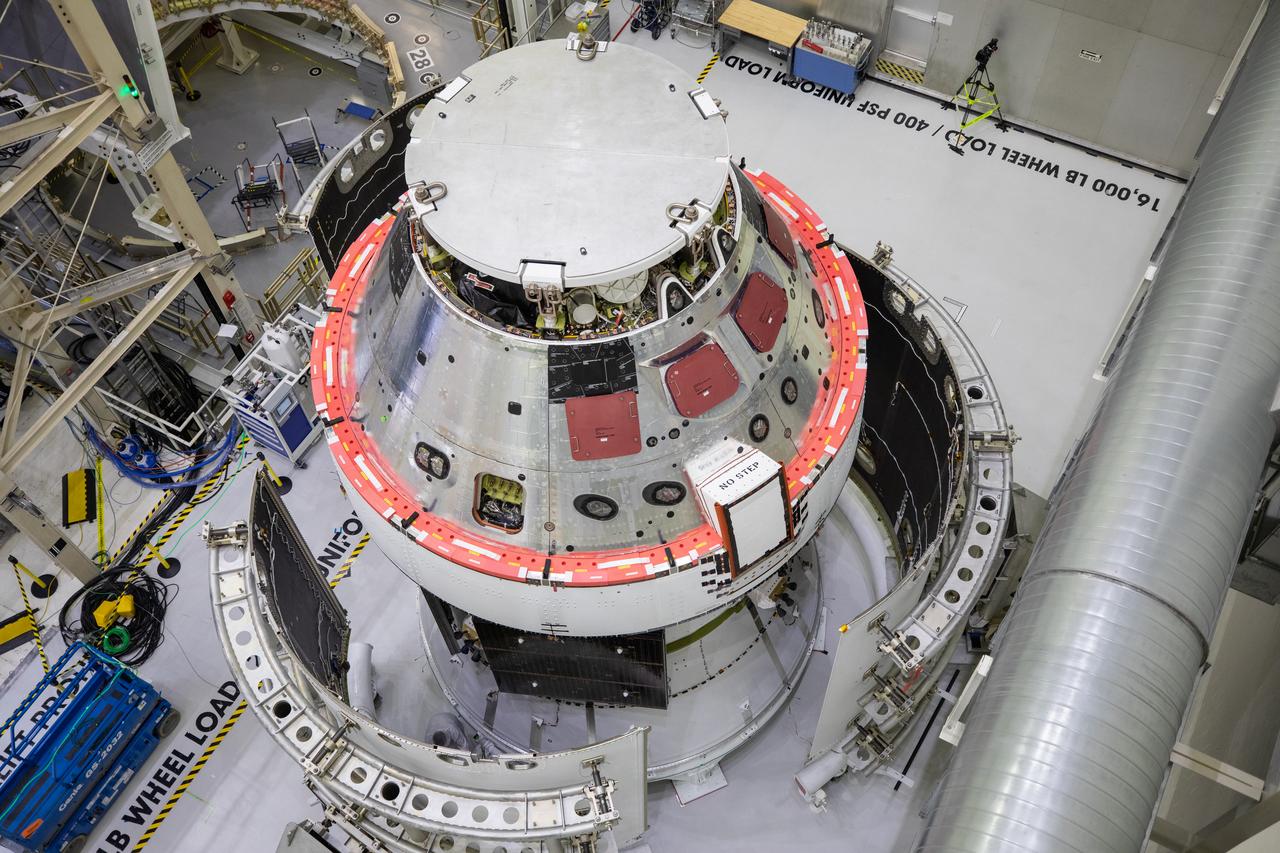
Shown is an overhead view of three spacecraft adapter jettison fairing panels fitted onto Orion’s European Service Module (ESM) on Oct. 13, 2020, inside the Neil Armstrong Operations and Checkout Building (O&C) at NASA’s Kennedy Space Center in Florida. The panels were inspected and moved into place for installation by technicians with Lockheed Martin. Recently, teams from across the globe installed the four solar array wings, which are housed inside the protective covering of the fairings. Once secured, they will encapsulate the ESM to protect it from harsh environments such as heat, wind, and acoustics as the spacecraft is propelled out of Earth’s atmosphere atop the Space Launch System (SLS) rocket during NASA’s Artemis I mission.
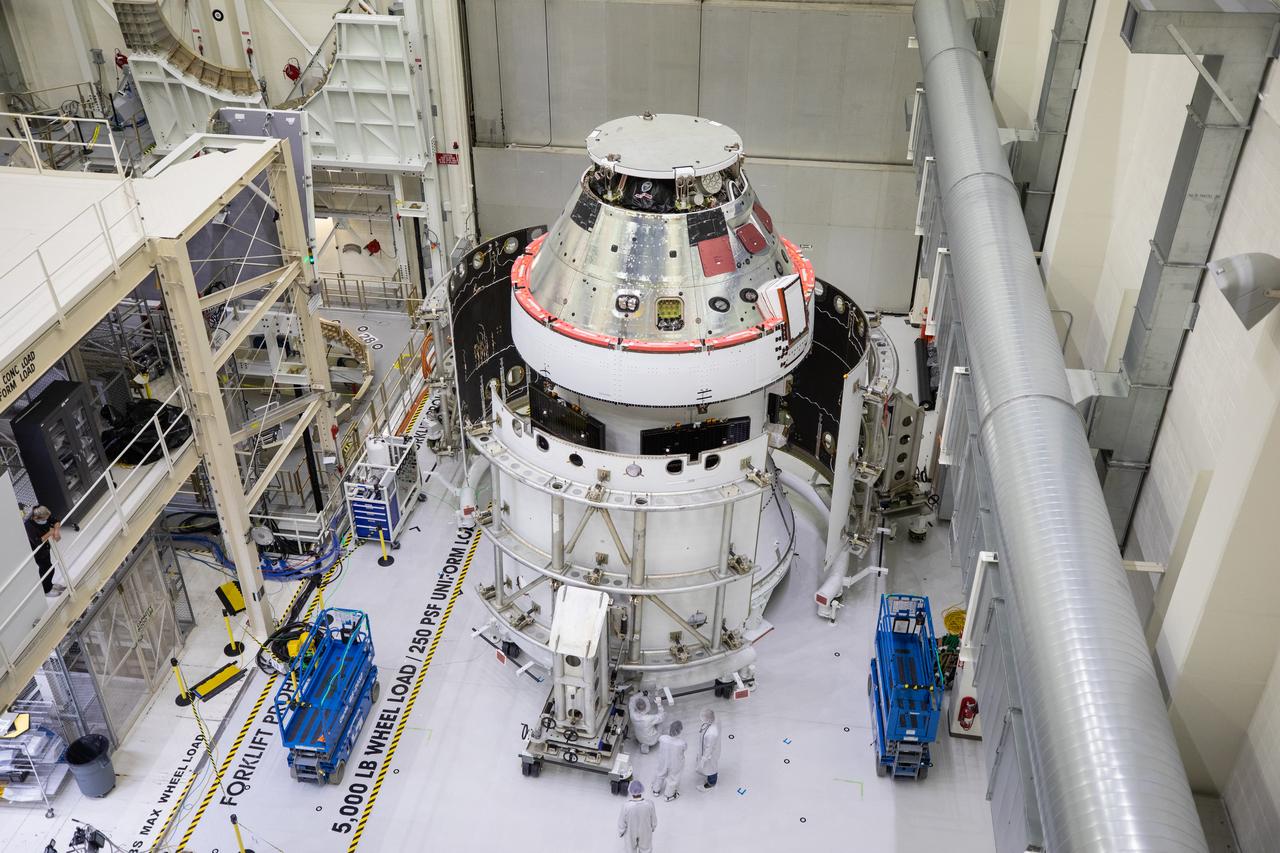
Shown is an overhead view of three spacecraft adapter jettison fairing panels fitted onto Orion’s European Service Module (ESM) on Oct. 13, 2020, inside the Neil Armstrong Operations and Checkout Building (O&C) at NASA’s Kennedy Space Center in Florida. The panels were inspected and moved into place for installation by technicians with Lockheed Martin. Recently, teams from across the globe installed the four solar array wings, which are housed inside the protective covering of the fairings. Once secured, they will encapsulate the ESM to protect it from harsh environments such as heat, wind, and acoustics as the spacecraft is propelled out of Earth’s atmosphere atop the Space Launch System (SLS) rocket during NASA’s Artemis I mission.
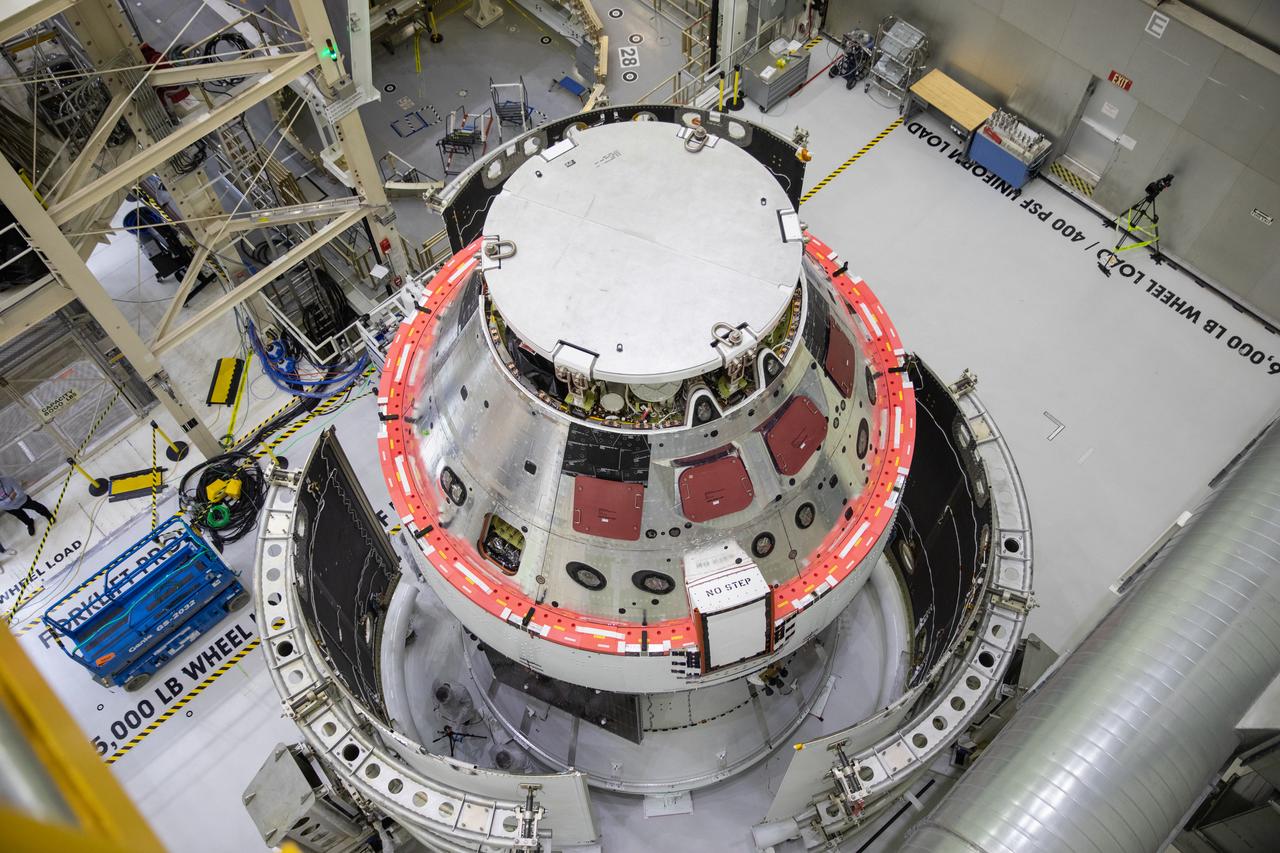
Shown is an overhead view of three spacecraft adapter jettison fairing panels fitted onto Orion’s European Service Module (ESM) on Oct. 13, 2020, inside the Neil Armstrong Operations and Checkout Building (O&C) at NASA’s Kennedy Space Center in Florida. The panels were inspected and moved into place for installation by technicians with Lockheed Martin. Recently, teams from across the globe installed the four solar array wings, which are housed inside the protective covering of the fairings. Once secured, they will encapsulate the ESM to protect it from harsh environments such as heat, wind, and acoustics as the spacecraft is propelled out of Earth’s atmosphere atop the Space Launch System (SLS) rocket during NASA’s Artemis I mission.
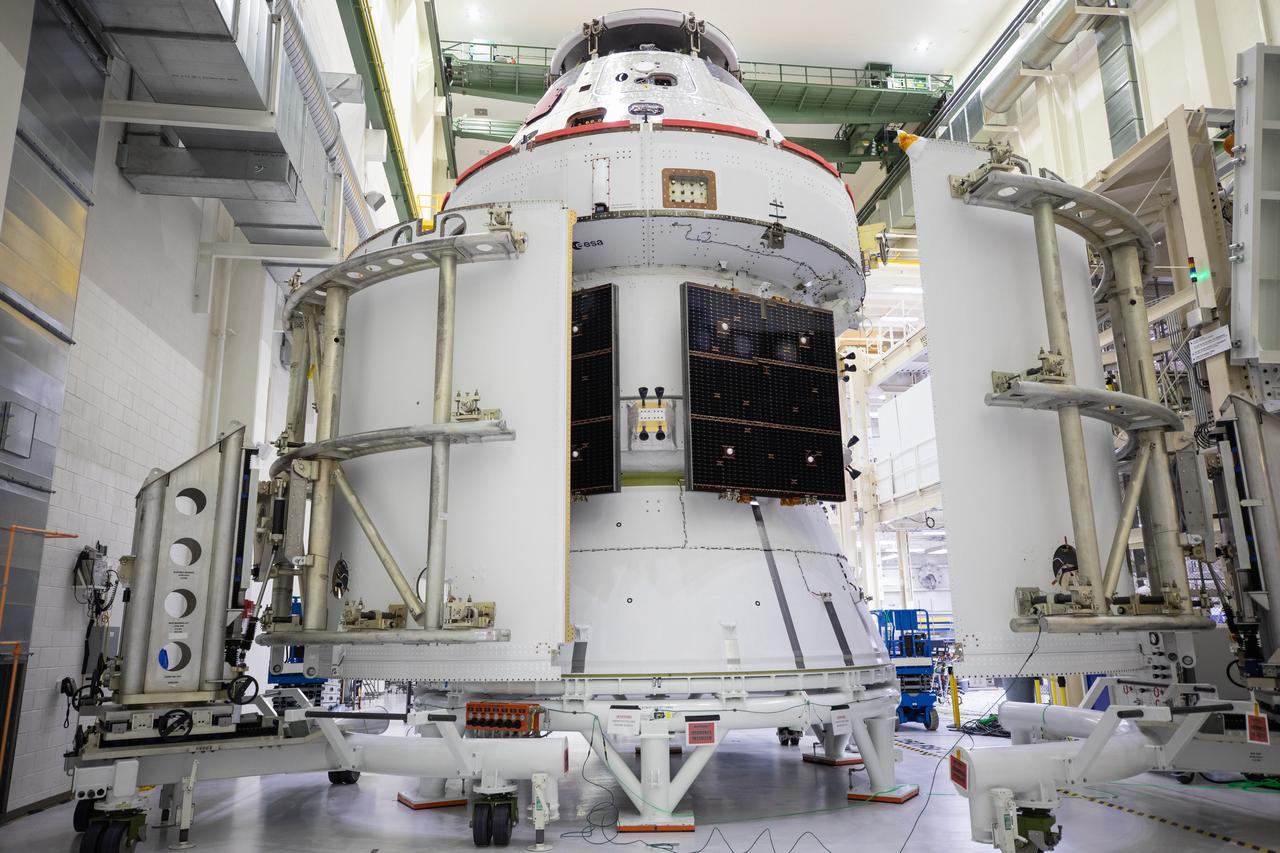
Shown is an overhead view of three spacecraft adapter jettison fairing panels fitted onto Orion’s European Service Module (ESM) on Oct. 13, 2020, inside the Neil Armstrong Operations and Checkout Building (O&C) at NASA’s Kennedy Space Center in Florida. The panels were inspected and moved into place for installation by technicians with Lockheed Martin. Recently, teams from across the globe installed the four solar array wings, which are housed inside the protective covering of the fairings. Once secured, they will encapsulate the ESM to protect it from harsh environments such as heat, wind, and acoustics as the spacecraft is propelled out of Earth’s atmosphere atop the Space Launch System (SLS) rocket during NASA’s Artemis I mission.
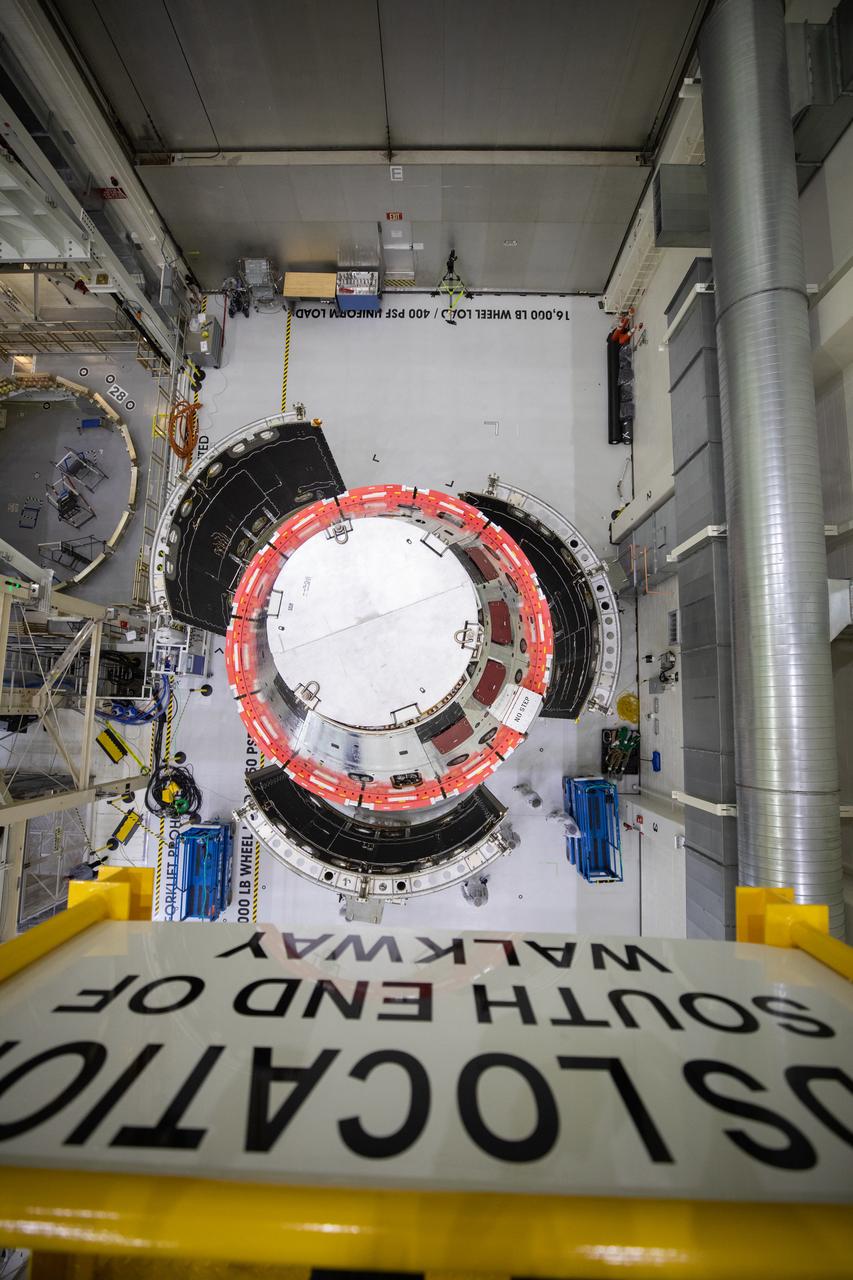
Shown is an overhead view of three spacecraft adapter jettison fairing panels fitted onto Orion’s European Service Module (ESM) on Oct. 13, 2020, inside the Neil Armstrong Operations and Checkout Building (O&C) at NASA’s Kennedy Space Center in Florida. The panels were inspected and moved into place for installation by technicians with Lockheed Martin. Recently, teams from across the globe installed the four solar array wings, which are housed inside the protective covering of the fairings. Once secured, they will encapsulate the ESM to protect it from harsh environments such as heat, wind, and acoustics as the spacecraft is propelled out of Earth’s atmosphere atop the Space Launch System (SLS) rocket during NASA’s Artemis I mission.
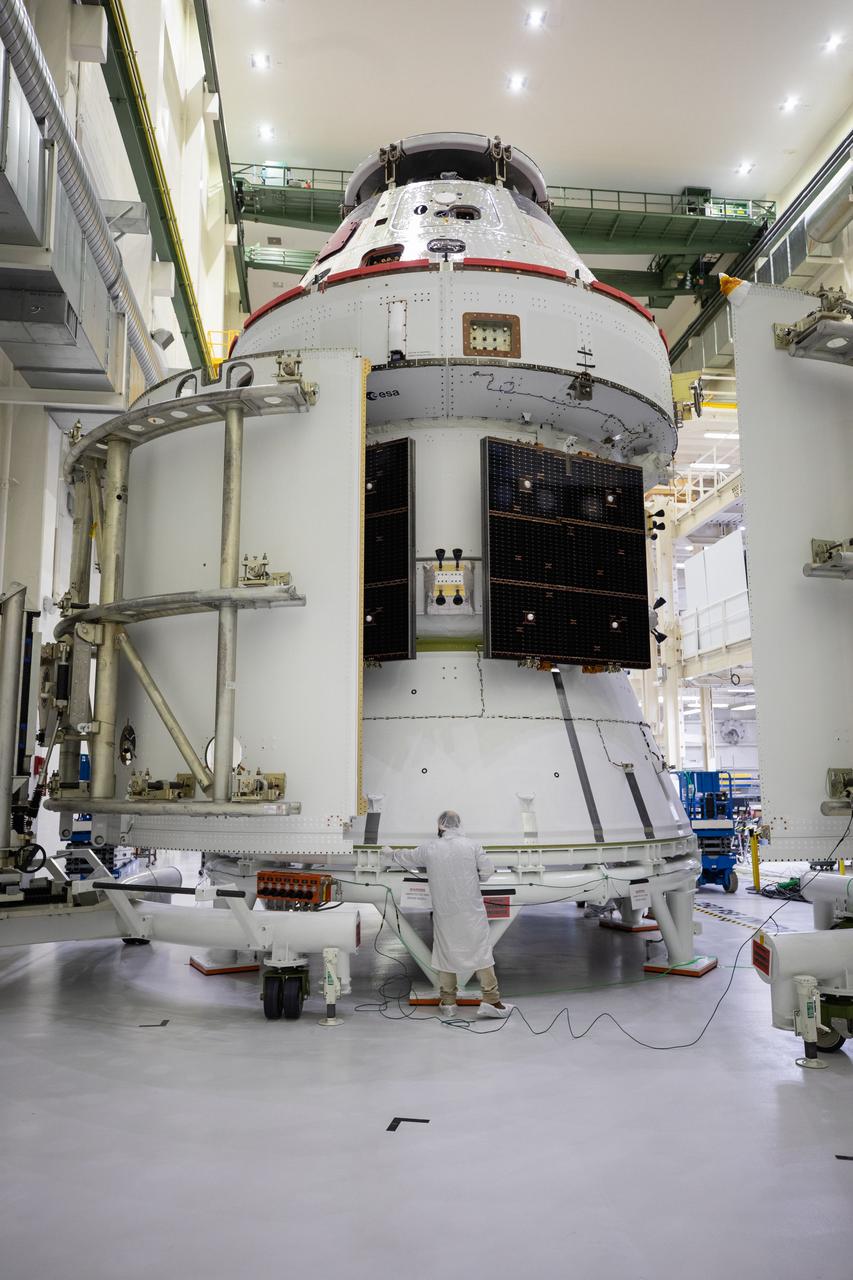
Shown is an overhead view of three spacecraft adapter jettison fairing panels fitted onto Orion’s European Service Module (ESM) on Oct. 13, 2020, inside the Neil Armstrong Operations and Checkout Building (O&C) at NASA’s Kennedy Space Center in Florida. The panels were inspected and moved into place for installation by technicians with Lockheed Martin. Recently, teams from across the globe installed the four solar array wings, which are housed inside the protective covering of the fairings. Once secured, they will encapsulate the ESM to protect it from harsh environments such as heat, wind, and acoustics as the spacecraft is propelled out of Earth’s atmosphere atop the Space Launch System (SLS) rocket during NASA’s Artemis I mission.
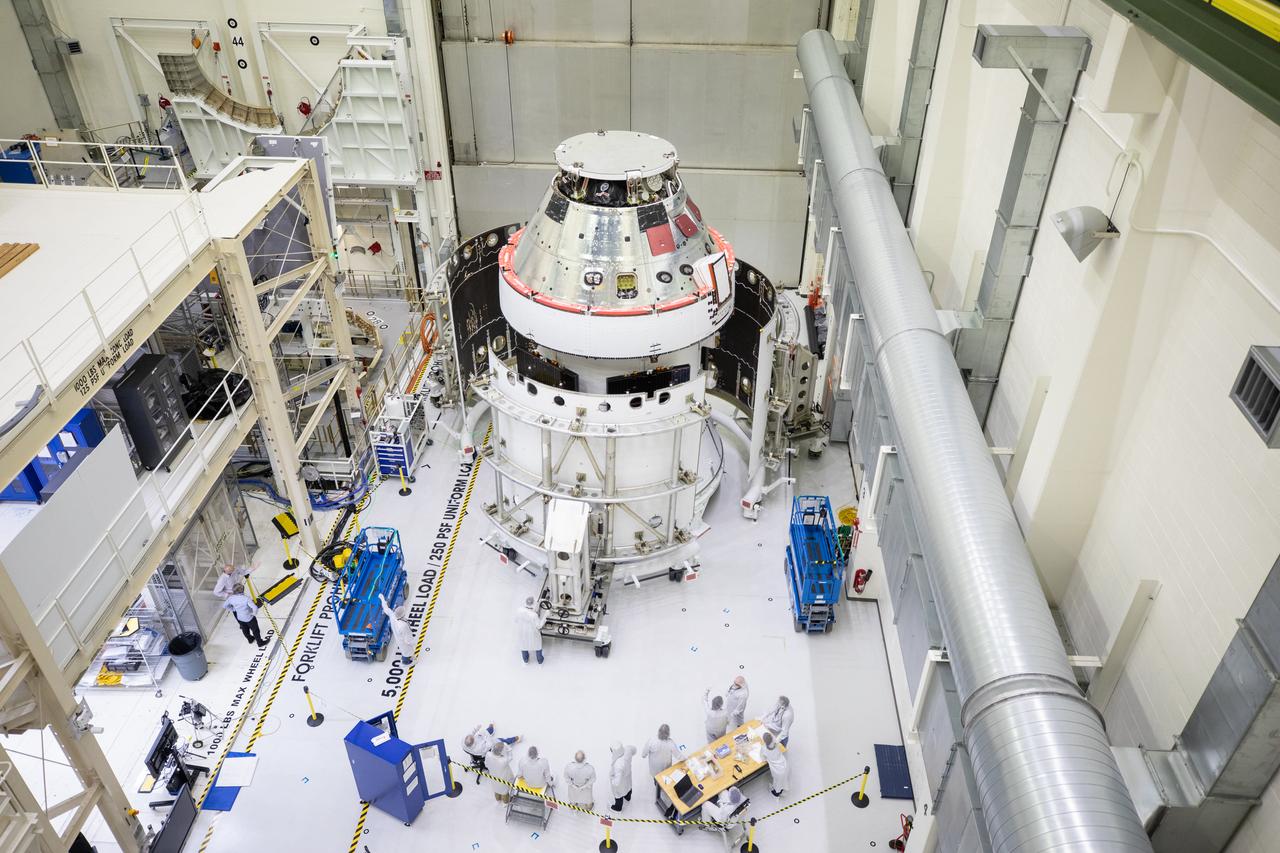
Shown is an overhead view of three spacecraft adapter jettison fairing panels fitted onto Orion’s European Service Module (ESM) on Oct. 13, 2020, inside the Neil Armstrong Operations and Checkout Building (O&C) at NASA’s Kennedy Space Center in Florida. The panels were inspected and moved into place for installation by technicians with Lockheed Martin. Recently, teams from across the globe installed the four solar array wings, which are housed inside the protective covering of the fairings. Once secured, they will encapsulate the ESM to protect it from harsh environments such as heat, wind, and acoustics as the spacecraft is propelled out of Earth’s atmosphere atop the Space Launch System (SLS) rocket during NASA’s Artemis I mission.
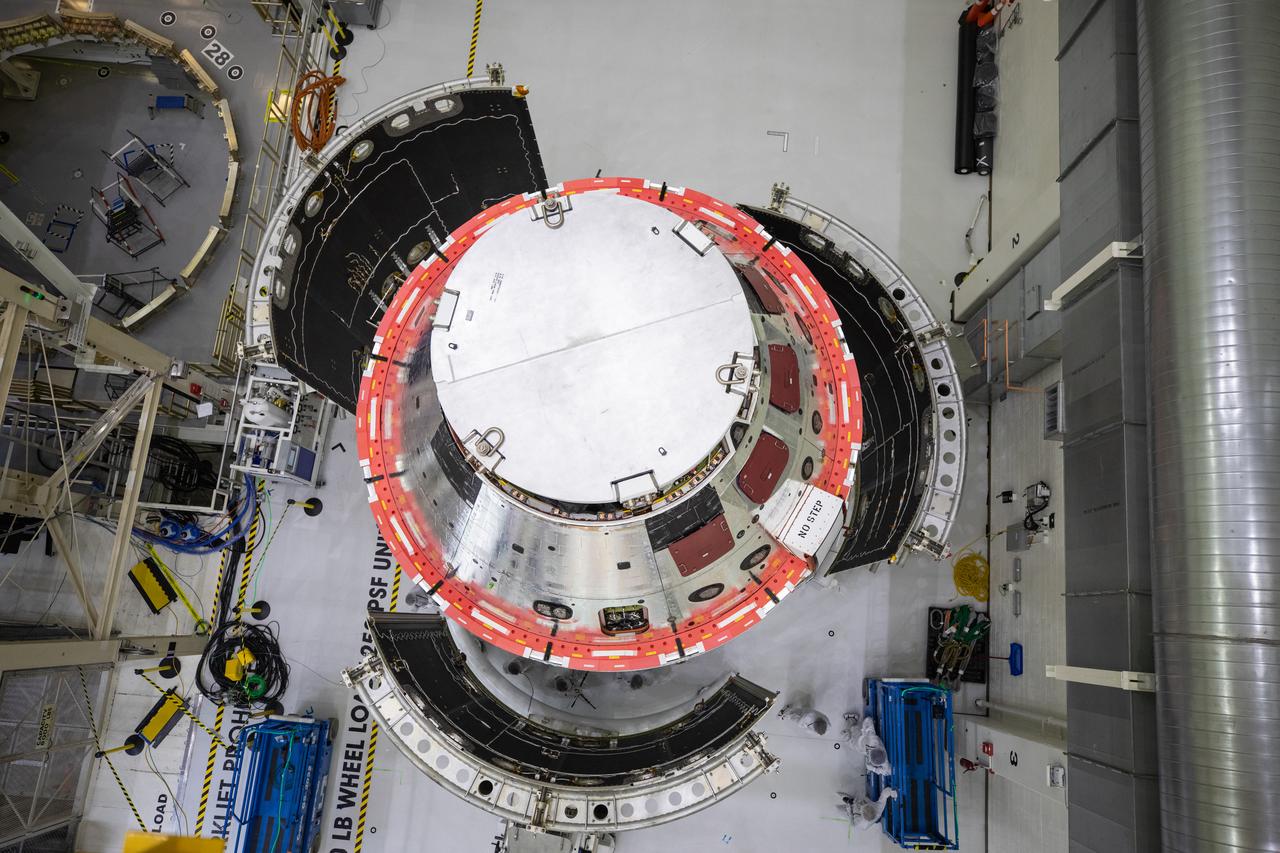
Shown is an overhead view of three spacecraft adapter jettison fairing panels fitted onto Orion’s European Service Module (ESM) on Oct. 13, 2020, inside the Neil Armstrong Operations and Checkout Building (O&C) at NASA’s Kennedy Space Center in Florida. The panels were inspected and moved into place for installation by technicians with Lockheed Martin. Recently, teams from across the globe installed the four solar array wings, which are housed inside the protective covering of the fairings. Once secured, they will encapsulate the ESM to protect it from harsh environments such as heat, wind, and acoustics as the spacecraft is propelled out of Earth’s atmosphere atop the Space Launch System (SLS) rocket during NASA’s Artemis I mission.
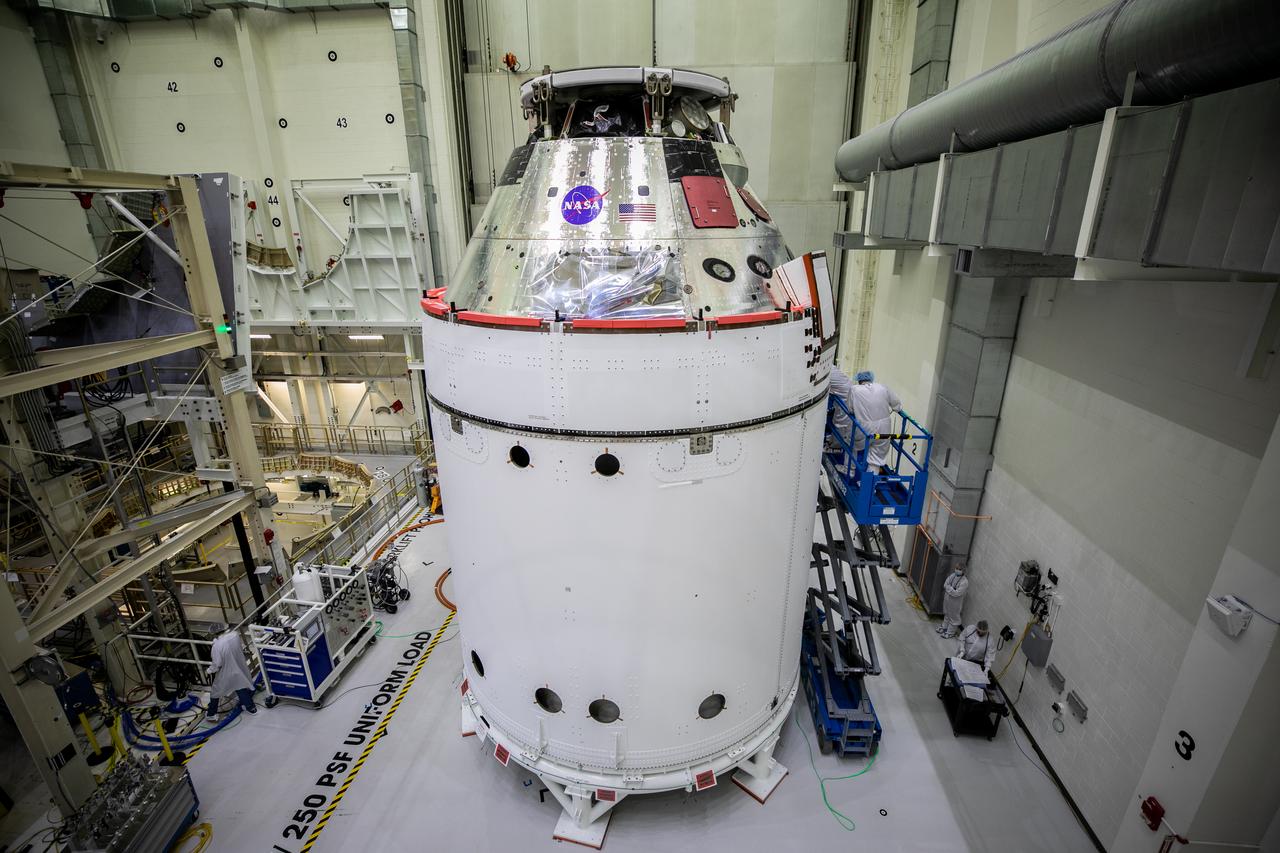
The Orion spacecraft for NASA’s Artemis I mission is in view inside the Neil Armstrong Operations and Checkout Building high bay on Oct. 28, 2020, at NASA’s Kennedy Space Center in Florida. The NASA insignia, also called the “meatball,” and the American Flag have been applied to the Orion crew module back shell. Attached below Orion are the crew module adapter and the European Service Module (ESM) with spacecraft adapter jettison fairings installed. Recently, teams from across the globe installed the four solar array wings, which are housed inside the protective covering of the fairings. The fairing panels will encapsulate the ESM to protect it from harsh environments such as heat, wind, and acoustics as the spacecraft is propelled out of Earth’s atmosphere atop the Space Launch System rocket during NASA’s Artemis I mission.
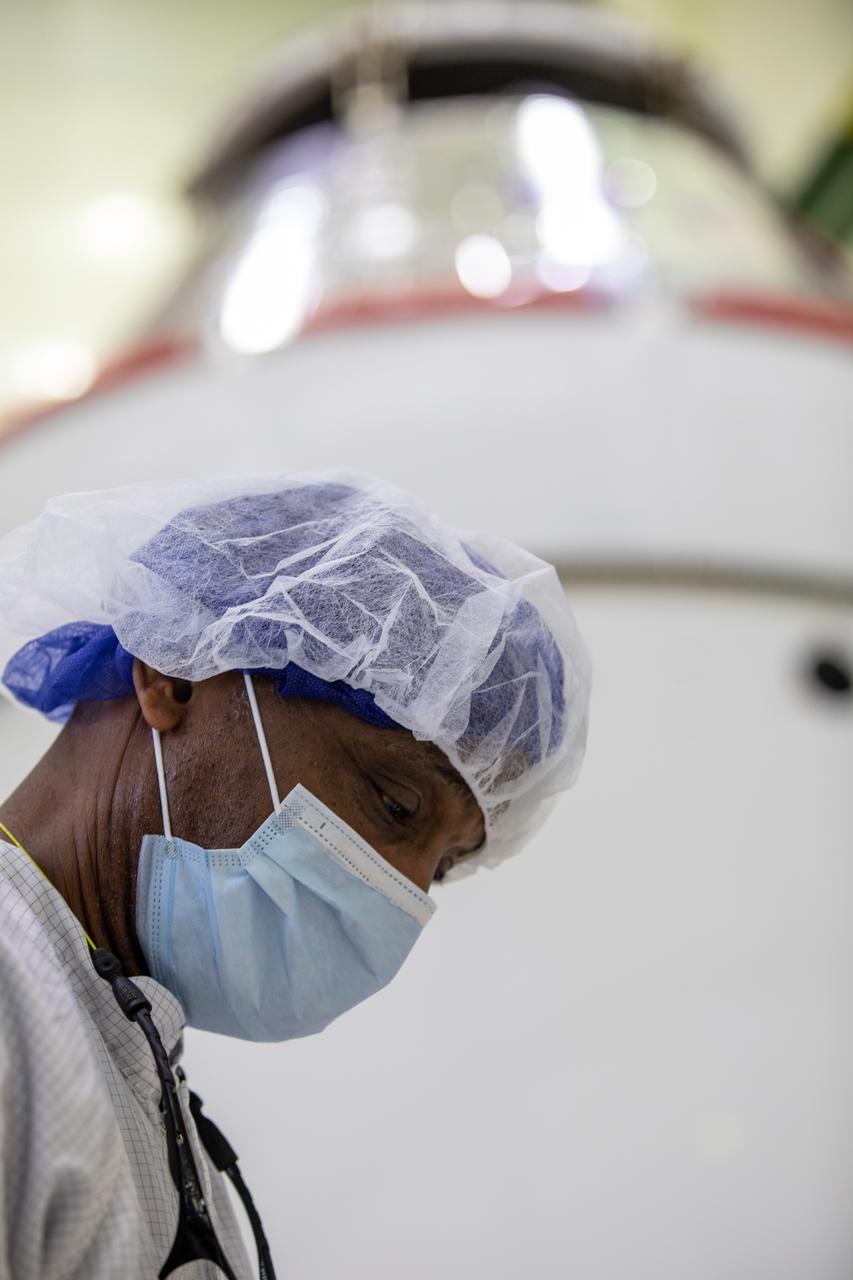
Izeal Battle, ASRC technician, is shown in the foreground with the Orion spacecraft for the Artemis I mission on Oct. 28, 2020, inside the Neil Armstrong Operations and Checkout Building (O&C) at NASA’s Kennedy Space Center in Florida. Attached below Orion (not in view) are the crew module adapter and the European Service Module (ESM) with spacecraft adapter jettison fairings installed. Recently, teams from across the globe installed the four solar array wings, which are housed inside the protective covering of the fairings. The fairing panels will encapsulate the ESM to protect it from harsh environments such as heat, wind, and acoustics as the spacecraft is propelled out of Earth’s atmosphere atop the Space Launch System rocket during NASA’s Artemis I mission.

Shawn Corwin, at left, ASRC technician, Shawn Corwin, at left, points to the Orion spacecraft for the Artemis I mission inside the Neil Armstrong Operations and Checkout Building at NASA’s Kennedy Space Center in Florida on Oct. 28, 2020. At right is Eric Nolan, ASRC technician. The NASA insignia, also called the “meatball,” and American Flag have been applied to the Orion crew module back shell. Attached below Orion are the crew module adapter and the European Service Module (ESM) with spacecraft adapter jettison fairings installed. Recently, teams from across the globe installed the four solar array wings, which are housed inside the protective covering of the fairings. The fairing panels will encapsulate the ESM to protect it from harsh environments such as heat, wind, and acoustics as the spacecraft is propelled out of Earth’s atmosphere atop the Space Launch System rocket during NASA’s Artemis I mission.
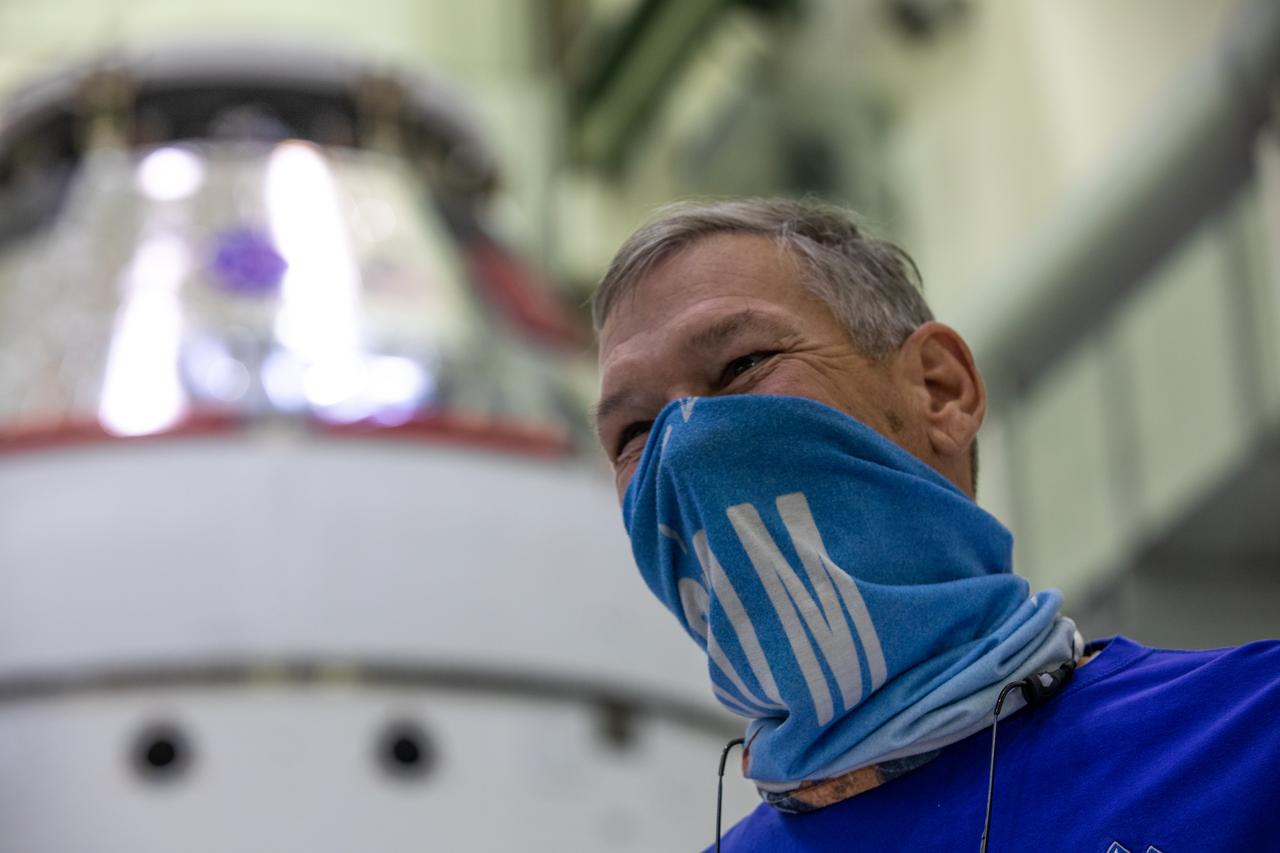
Todd Biddle, ASRC technician, is shown in the foreground with the Orion spacecraft for the Artemis I mission behind him inside the Neil Armstrong Operations and Checkout Building at NASA’s Kennedy Space Center in Florida on Oct. 28, 2020. The NASA insignia, also called the “meatball,” and American Fag have been applied to the Orion crew module back shell. Attached below Orion are the crew module adapter and the European Service Module (ESM) with spacecraft adapter jettison fairings installed. Recently, teams from across the globe installed the four solar array wings, which are housed inside the protective covering of the fairings. The fairing panels will encapsulate the ESM to protect it from harsh environments such as heat, wind, and acoustics as the spacecraft is propelled out of Earth’s atmosphere atop the Space Launch System rocket during NASA’s Artemis I mission.
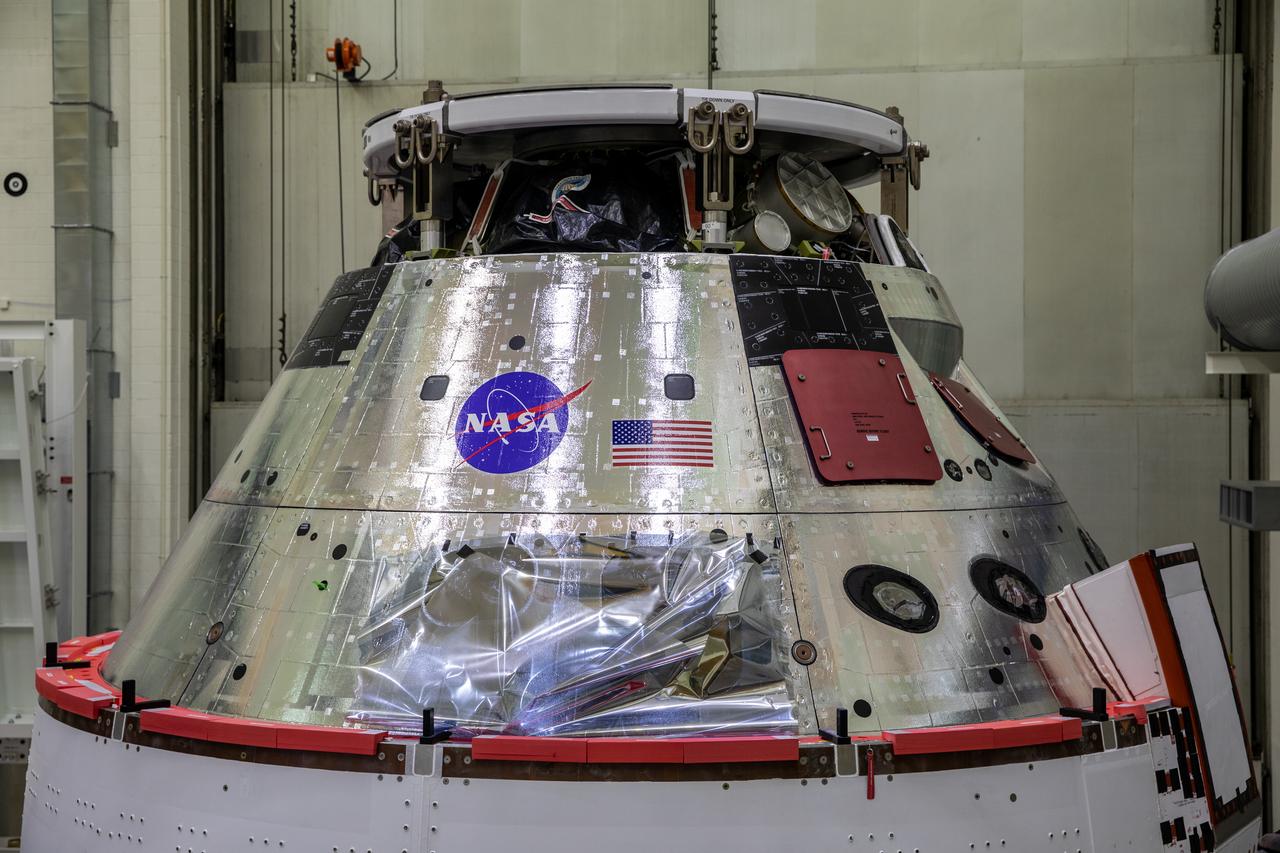
The NASA insignia, also called the “meatball,” and the American Flag are applied to the Orion crew module back shell for the Artemis I mission on Oct. 28, 2020, inside the Neil Armstrong Operations and Checkout Building at NASA’s Kennedy Space Center in Florida. Attached below Orion are the crew module adapter and the European Service Module (ESM) with spacecraft adapter jettison fairings installed. Recently, teams from across the globe installed the four solar array wings, which are housed inside the protective covering of the fairings. The fairing panels will encapsulate the ESM to protect it from harsh environments such as heat, wind, and acoustics as the spacecraft is propelled out of Earth’s atmosphere atop the Space Launch System rocket during NASA’s Artemis I mission.
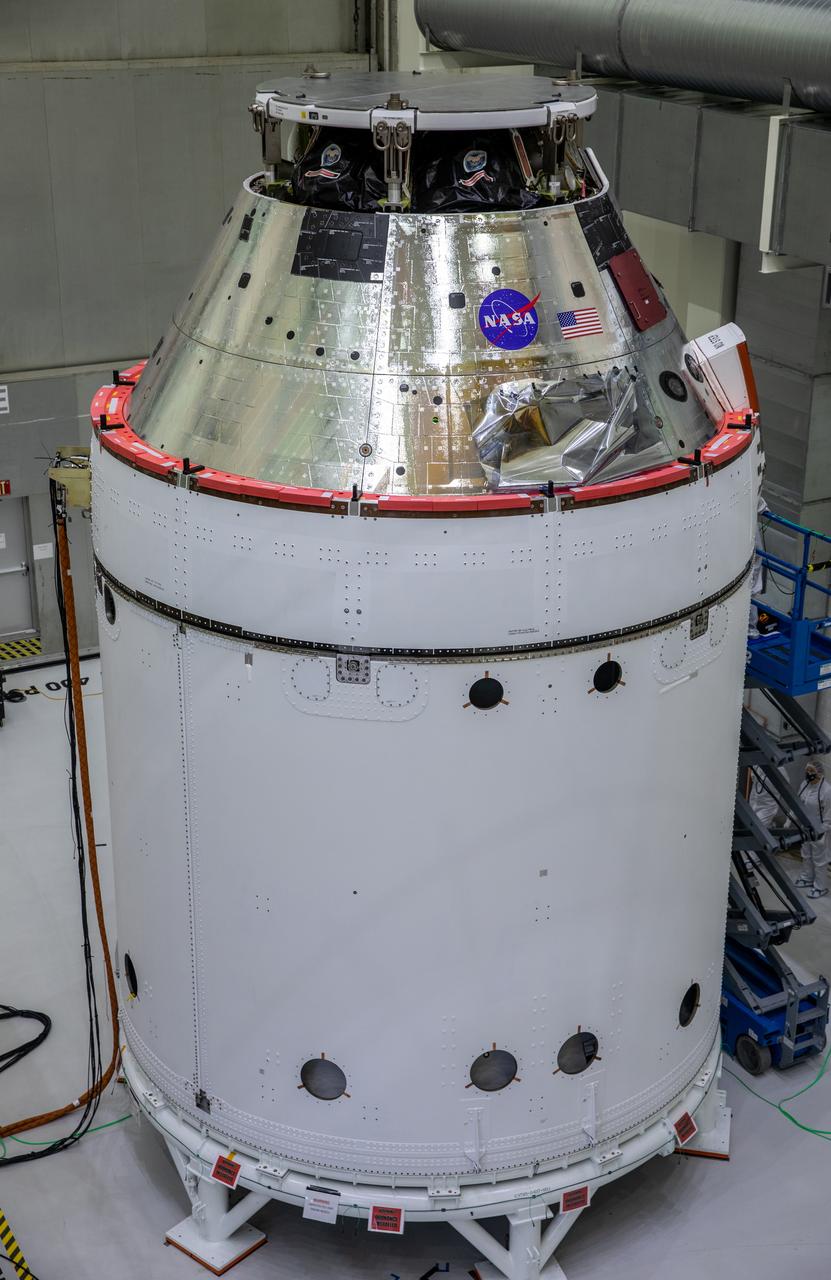
The NASA insignia, also called the “meatball,” and the American Flag are applied to the Orion crew module back shell for the Artemis I mission on Oct. 28, 2020, inside the Neil Armstrong Operations and Checkout Building at NASA’s Kennedy Space Center in Florida. Attached below Orion are the crew module adapter and the European Service Module (ESM) with spacecraft adapter jettison fairings installed. Recently, teams from across the globe installed the four solar array wings, which are housed inside the protective covering of the fairings. The fairing panels will encapsulate the ESM to protect it from harsh environments such as heat, wind, and acoustics as the spacecraft is propelled out of Earth’s atmosphere atop the Space Launch System rocket during NASA’s Artemis I mission.

The NASA insignia, also called the “meatball,” and the American Flag are applied to the Orion crew module back shell for the Artemis I mission on Oct. 28, 2020, inside the Neil Armstrong Operations and Checkout Building at NASA’s Kennedy Space Center in Florida. Attached below Orion are the crew module adapter and the European Service Module (ESM) with spacecraft adapter jettison fairings installed. Recently, teams from across the globe installed the four solar array wings, which are housed inside the protective covering of the fairings. The fairing panels will encapsulate the ESM to protect it from harsh environments such as heat, wind, and acoustics as the spacecraft is propelled out of Earth’s atmosphere atop the Space Launch System rocket during NASA’s Artemis I mission.
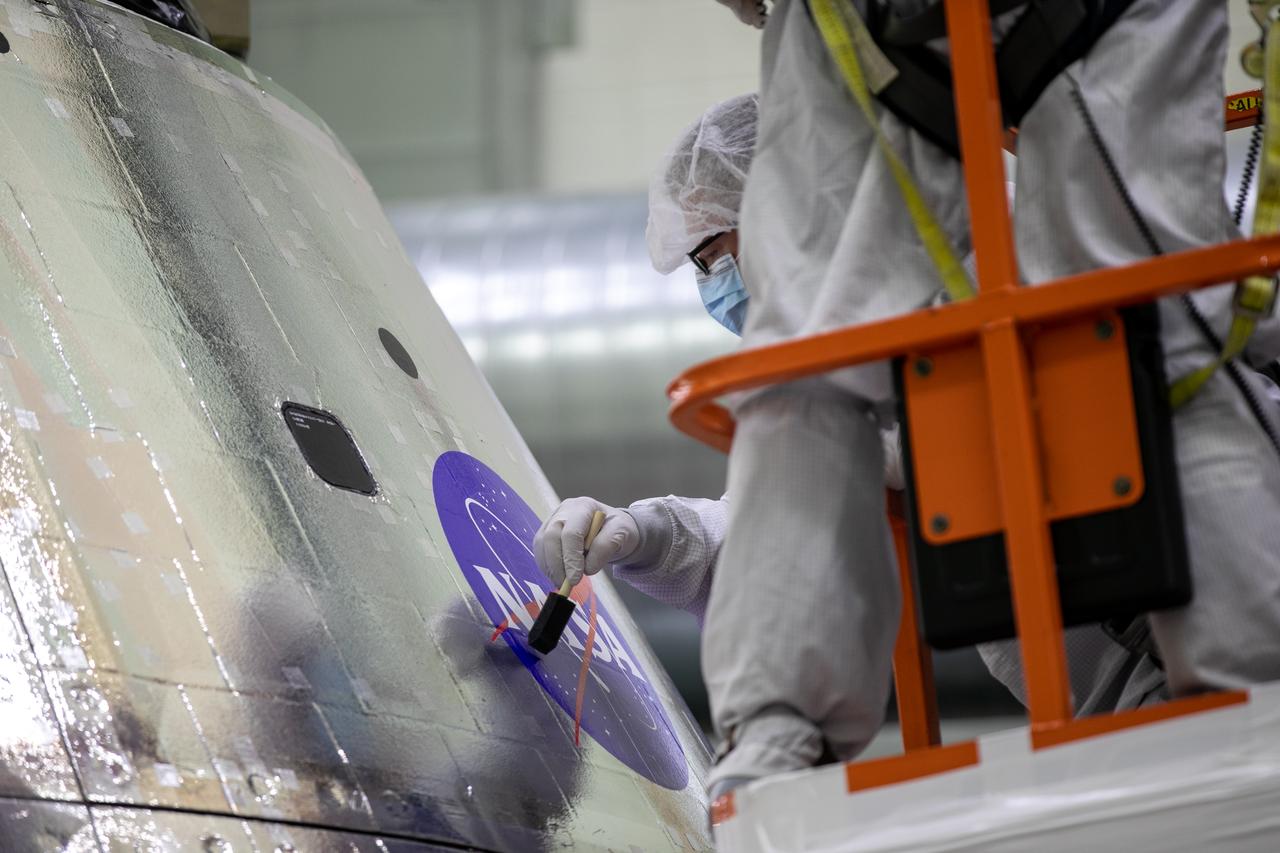
Frank Pelkey, ASRC technician, paints a clear adhesive over the NASA insignia, also called the “meatball,” on the Orion crew module back shell for the Artemis I mission on Oct. 28, 2020, inside the Neil Armstrong Operations and Checkout Building (O&C) at NASA’s Kennedy Space Center in Florida. The American Flag also has been added. Attached below Orion (not in view) are the crew module adapter and the European Service Module (ESM) with spacecraft adapter jettison fairings installed. Recently, teams from across the globe installed the four solar array wings, which are housed inside the protective covering of the fairings. The fairing panels will encapsulate the ESM to protect it from harsh environments such as heat, wind, and acoustics as the spacecraft is propelled out of Earth’s atmosphere atop the Space Launch System rocket during NASA’s Artemis I mission.
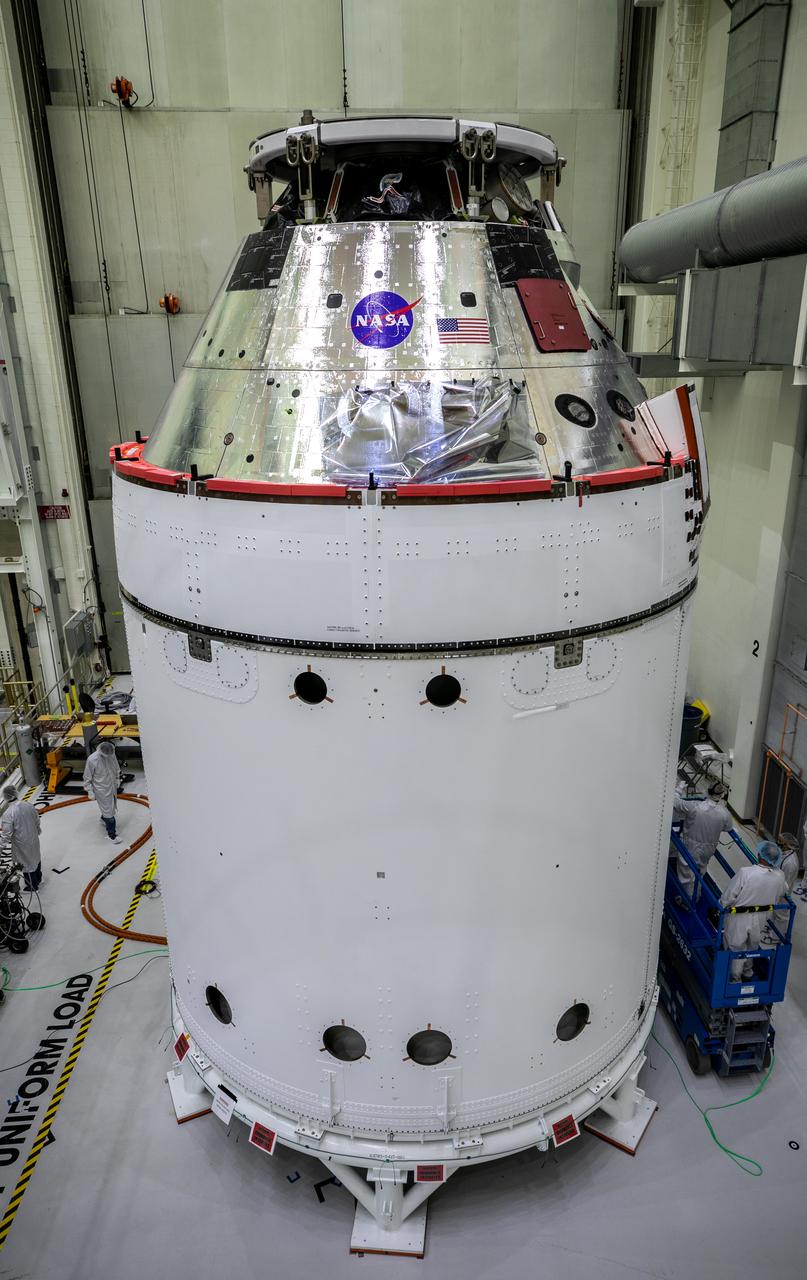
The NASA insignia, also called the “meatball,” and the American Flag are applied to the Orion crew module back shell for the Artemis I mission on Oct. 28, 2020, inside the Neil Armstrong Operations and Checkout Building at NASA’s Kennedy Space Center in Florida. Attached below Orion are the crew module adapter and the European Service Module (ESM) with spacecraft adapter jettison fairings installed. Recently, teams from across the globe installed the four solar array wings, which are housed inside the protective covering of the fairings. The fairing panels will encapsulate the ESM to protect it from harsh environments such as heat, wind, and acoustics as the spacecraft is propelled out of Earth’s atmosphere atop the Space Launch System rocket during NASA’s Artemis I mission.
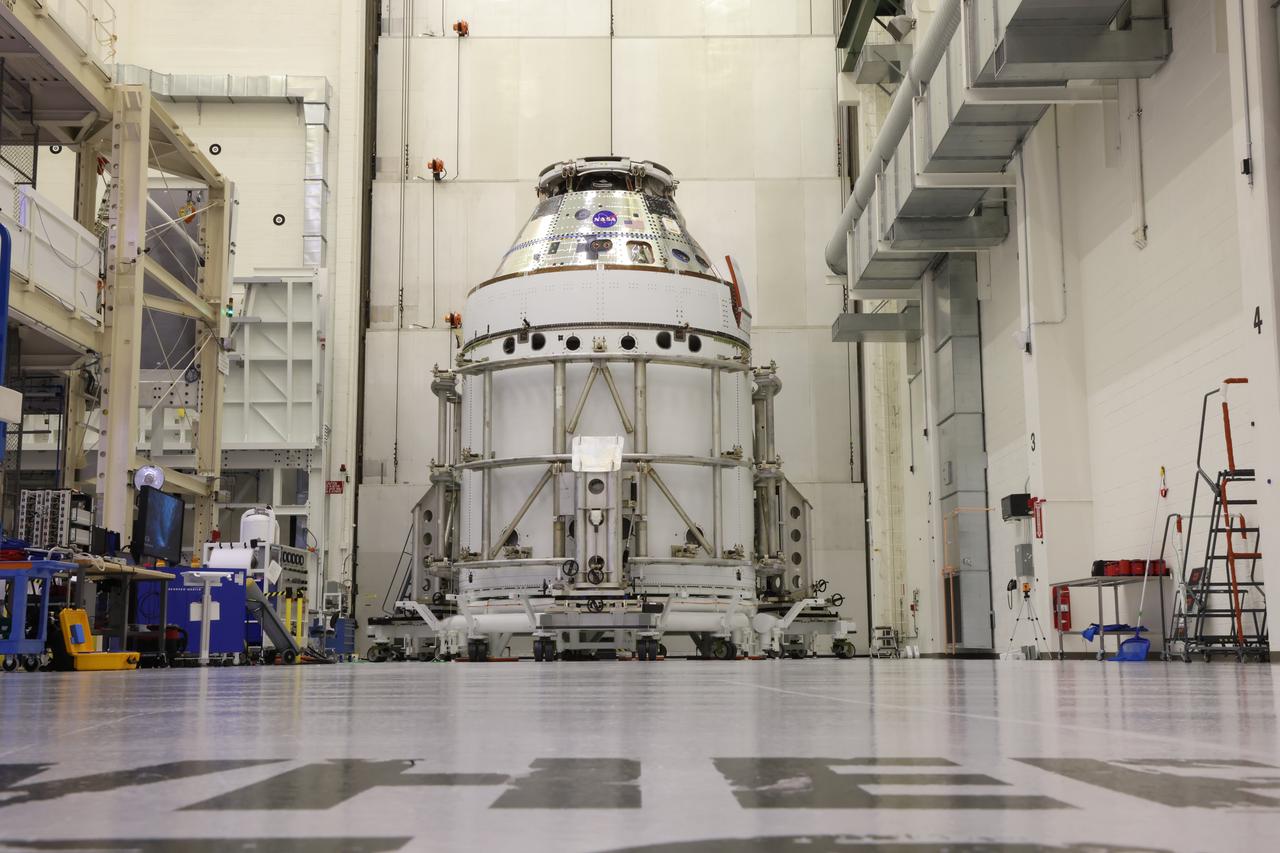
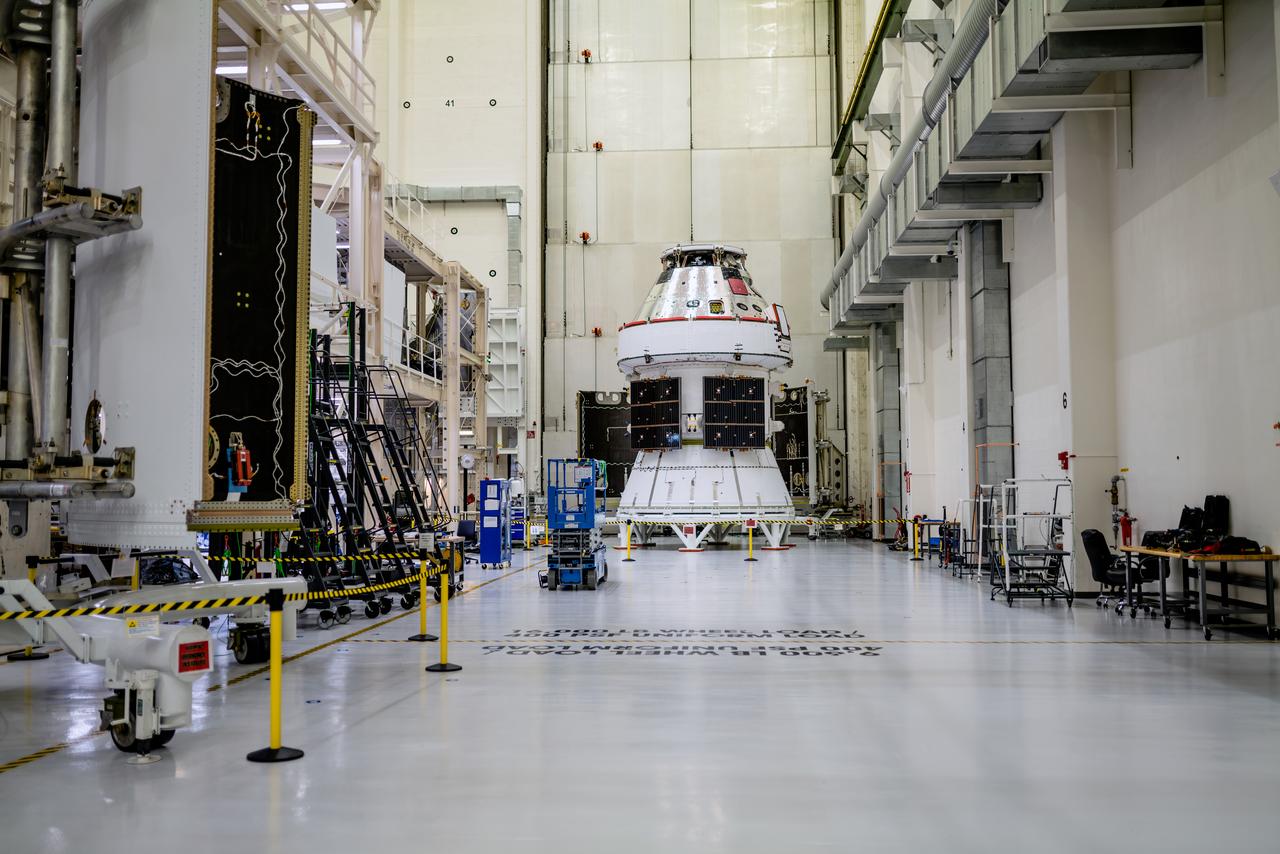
The Artemis II Orion spacecraft sits in the transfer aisle in the Neil A. Armstrong Operations and Checkout Building at NASA’s Kennedy Space Center in Florida following successful installation of three spacecraft adapter jettison fairings on Wednesday, March 19, 2025. The fairings encapsulate the service module and protect the solar array wings, shielding them from the heat, wind, and acoustics of launch and ascent, as well as help redistribute the load between Orion and the massive thrust of the SLS (Space Launch System) rocket during liftoff and ascent. Once the spacecraft is above the atmosphere, the three fairing panels will separate from the service module reducing the mass of the spacecraft.
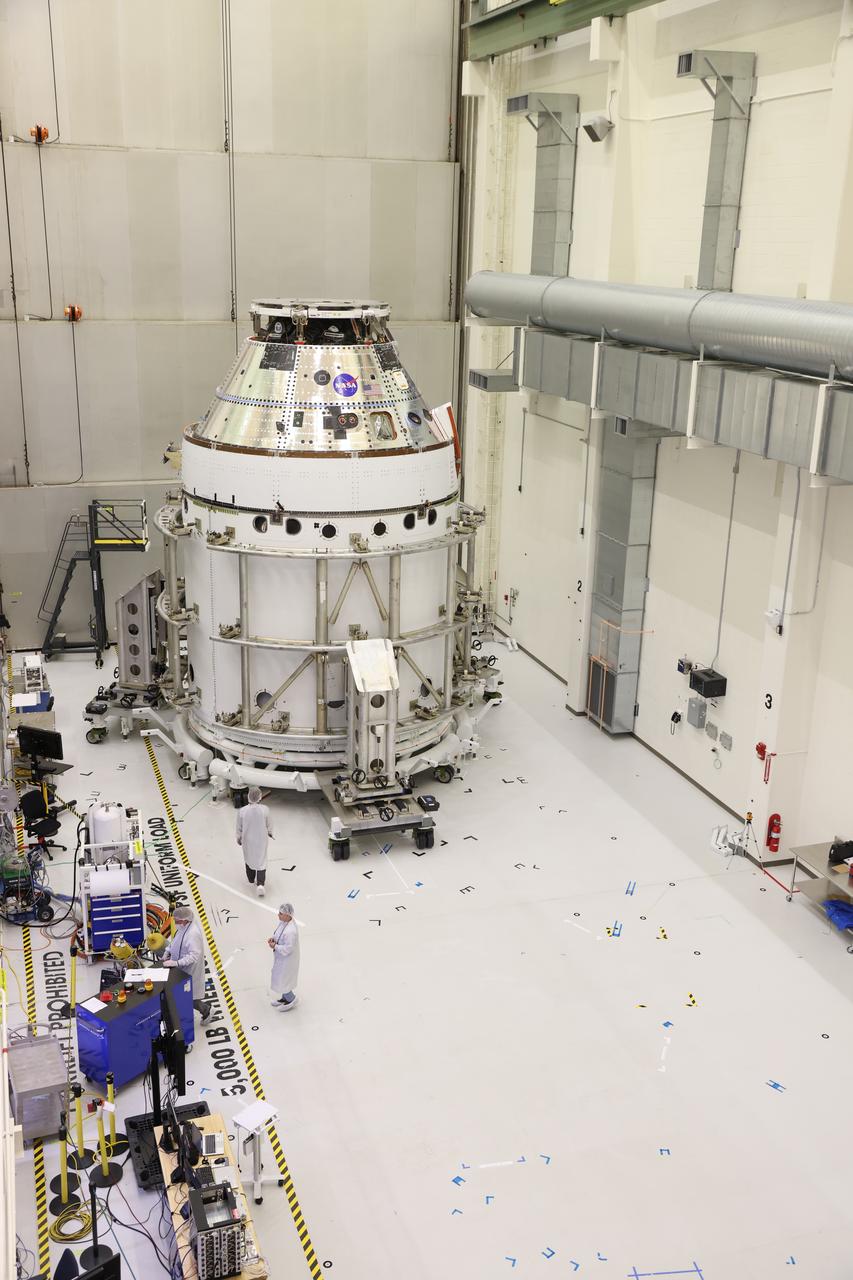
The Artemis II Orion spacecraft sits in the transfer aisle in the Neil A. Armstrong Operations and Checkout Building at NASA’s Kennedy Space Center in Florida following successful installation of three spacecraft adapter jettison fairings on Wednesday, March 19, 2025. The fairings encapsulate the service module and protect the solar array wings, shielding them from the heat, wind, and acoustics of launch and ascent, as well as help redistribute the load between Orion and the massive thrust of the SLS (Space Launch System) rocket during liftoff and ascent. Once the spacecraft is above the atmosphere, the three fairing panels will separate from the service module reducing the mass of the spacecraft.
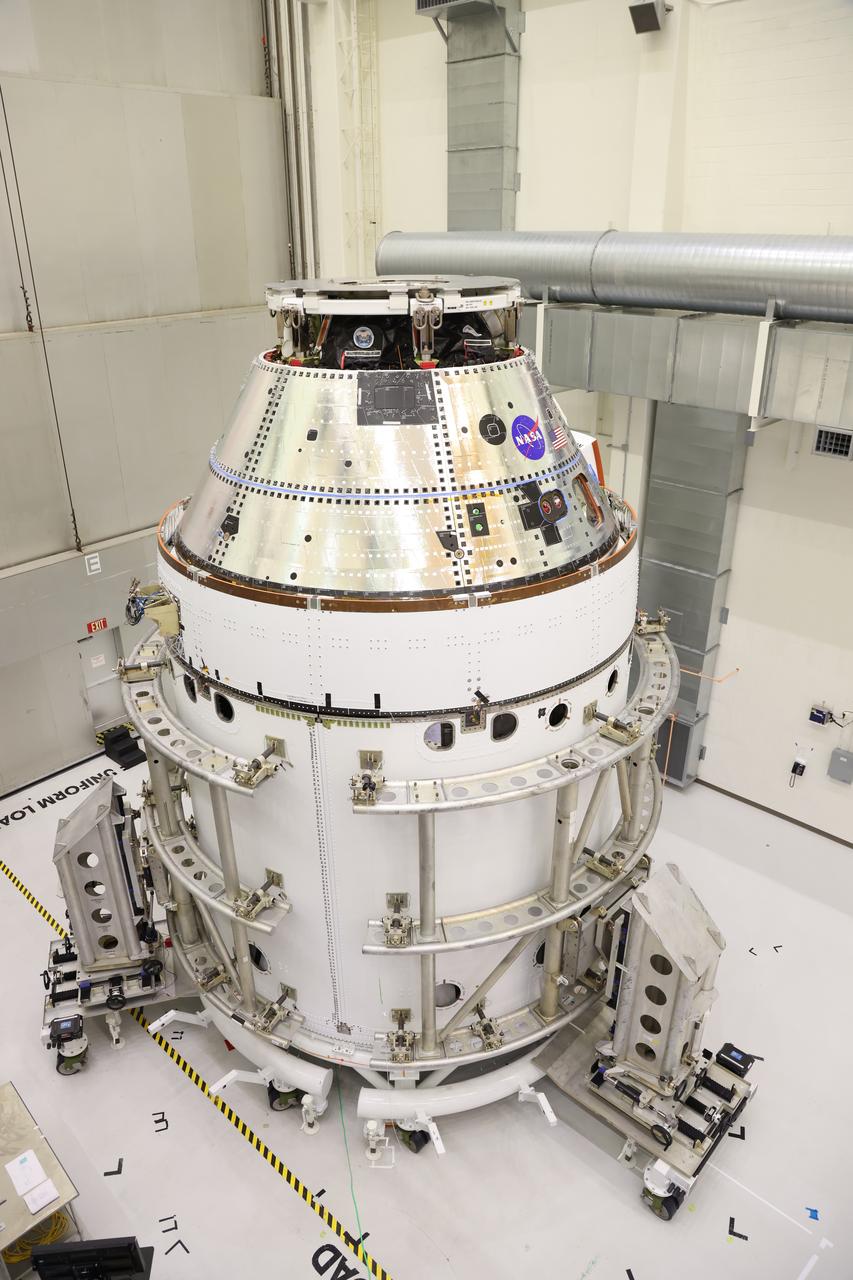
The Artemis II Orion spacecraft sits in the transfer aisle in the Neil A. Armstrong Operations and Checkout Building at NASA’s Kennedy Space Center in Florida following successful installation of three spacecraft adapter jettison fairings on Wednesday, March 19, 2025. The fairings encapsulate the service module and protect the solar array wings, shielding them from the heat, wind, and acoustics of launch and ascent, as well as help redistribute the load between Orion and the massive thrust of the SLS (Space Launch System) rocket during liftoff and ascent. Once the spacecraft is above the atmosphere, the three fairing panels will separate from the service module reducing the mass of the spacecraft.
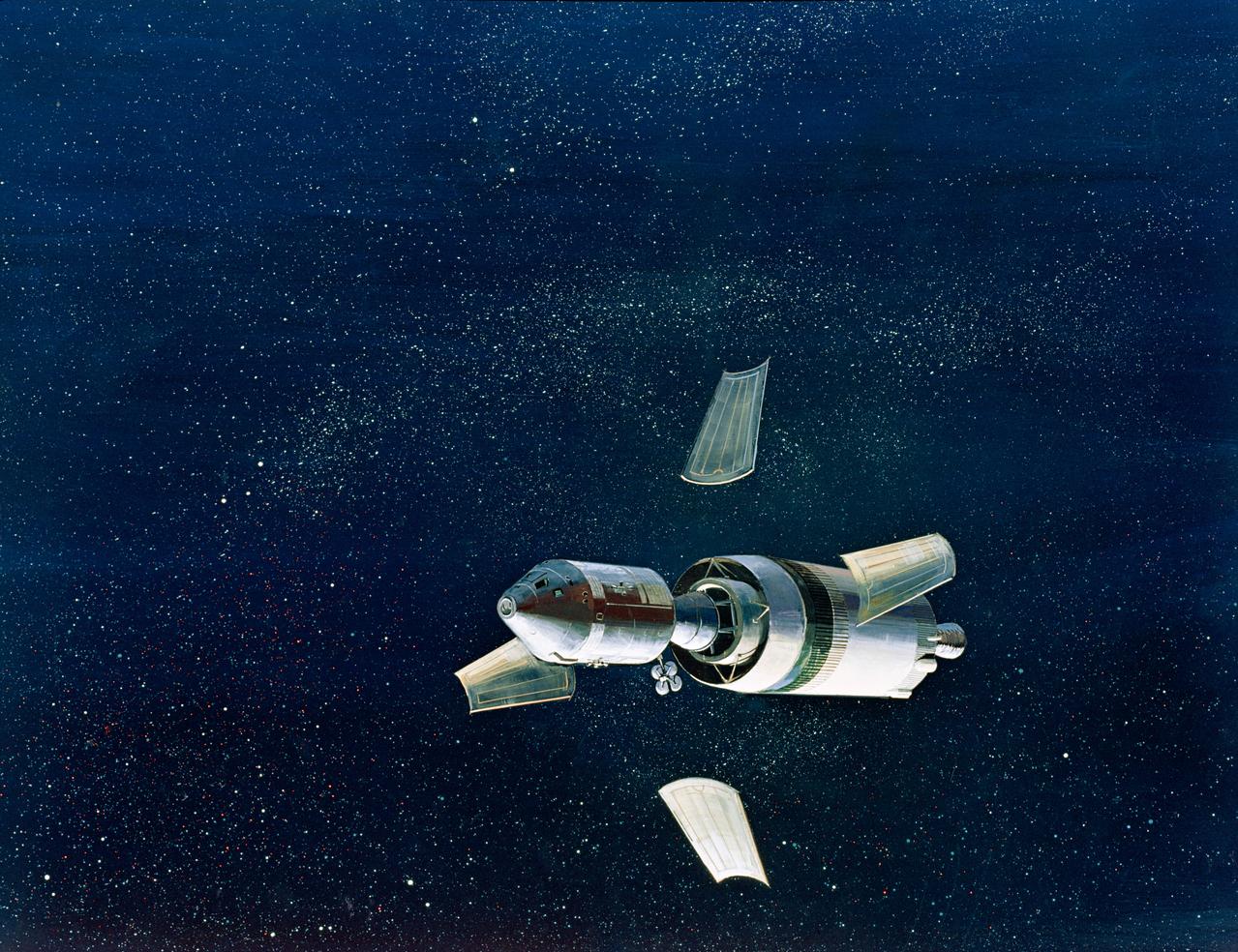
S68-51306 (December 1968) --- North American Rockwell artist's concept illustrating a phase of the scheduled Apollo 8 lunar orbit mission. Here, the Apollo 8 spacecraft lunar module adapter (SLA) panels, which have supported the Command and Service Modules, are jettisoned. This is done by astronauts firing the service module reaction control engines. A signal simultaneously deploys and jettisons the panels, separating the spacecraft from the SLA and deploying the high gain (deep space) antenna.

Portrait of Orion Service Module Spacecraft Adapter Jettisonable (SAJ) Hardware Lead Engineer Lizalyn Smith. Ms. Smith participated in various 'Hidden Figures to Modern Figures' events sponsored by NASA Glenn Research Center to encourage students to pursue STEM-based careers.
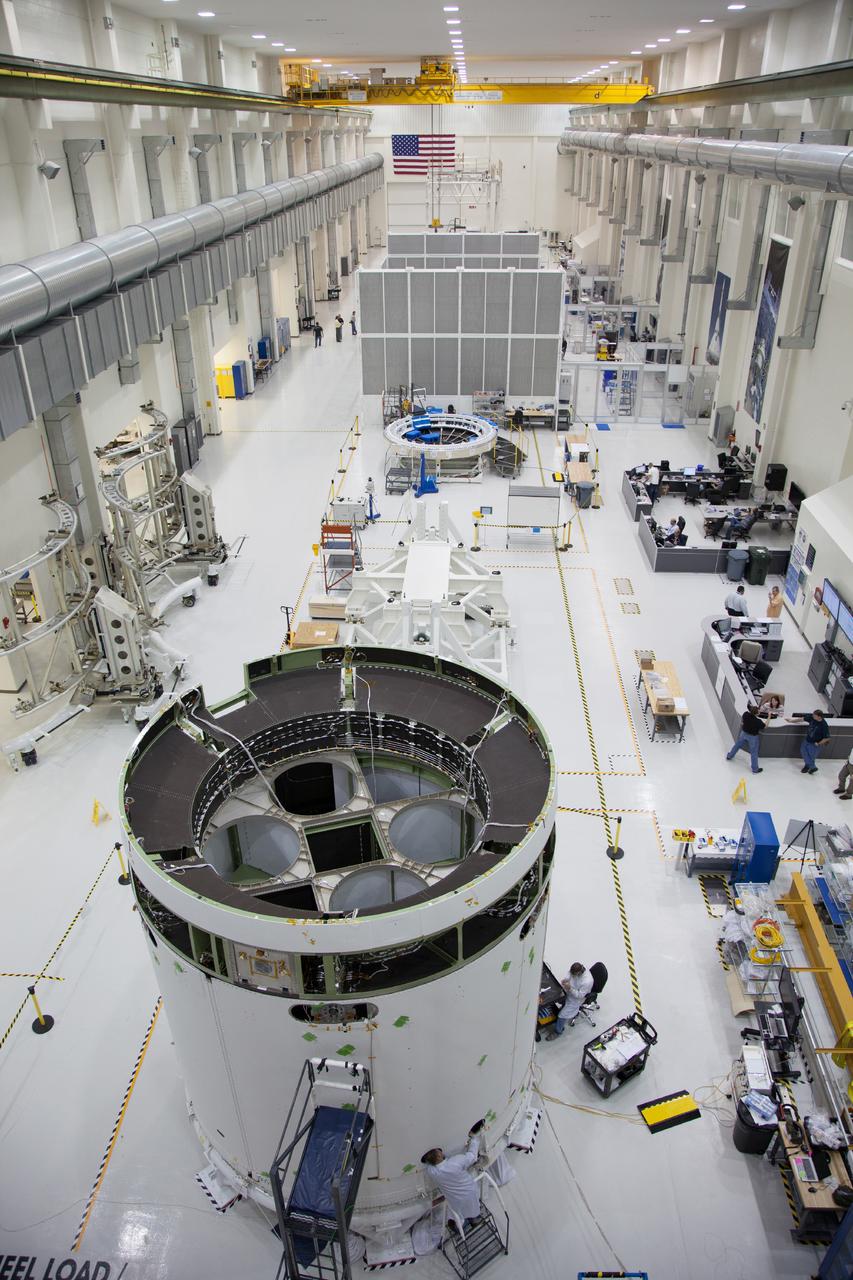
The spacecraft adapter jettison fairing panels are installed on the Exploration Flight Test-1 (EFT-1) Orion service module in the Operations and Checkout (O&C) Building at Kennedy Space Center on Jan. 14 , 2014. Part of Batch image transfer from Flickr.
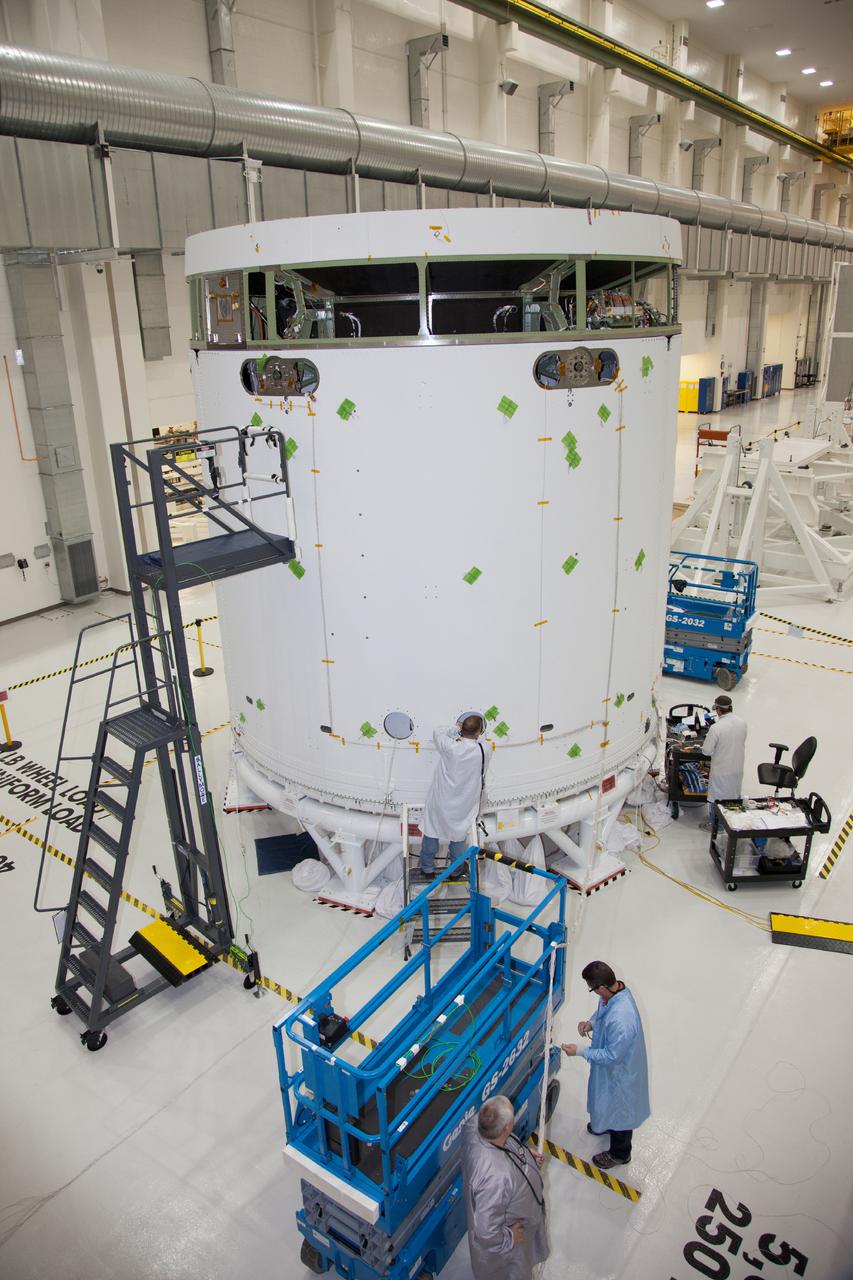
The spacecraft adapter jettison fairing panels are installed on the Exploration Flight Test-1 (EFT-1) Orion service module in the Operations and Checkout (O&C) Building at Kennedy Space Center on Jan. 14 , 2014. Part of Batch image transfer from Flickr.
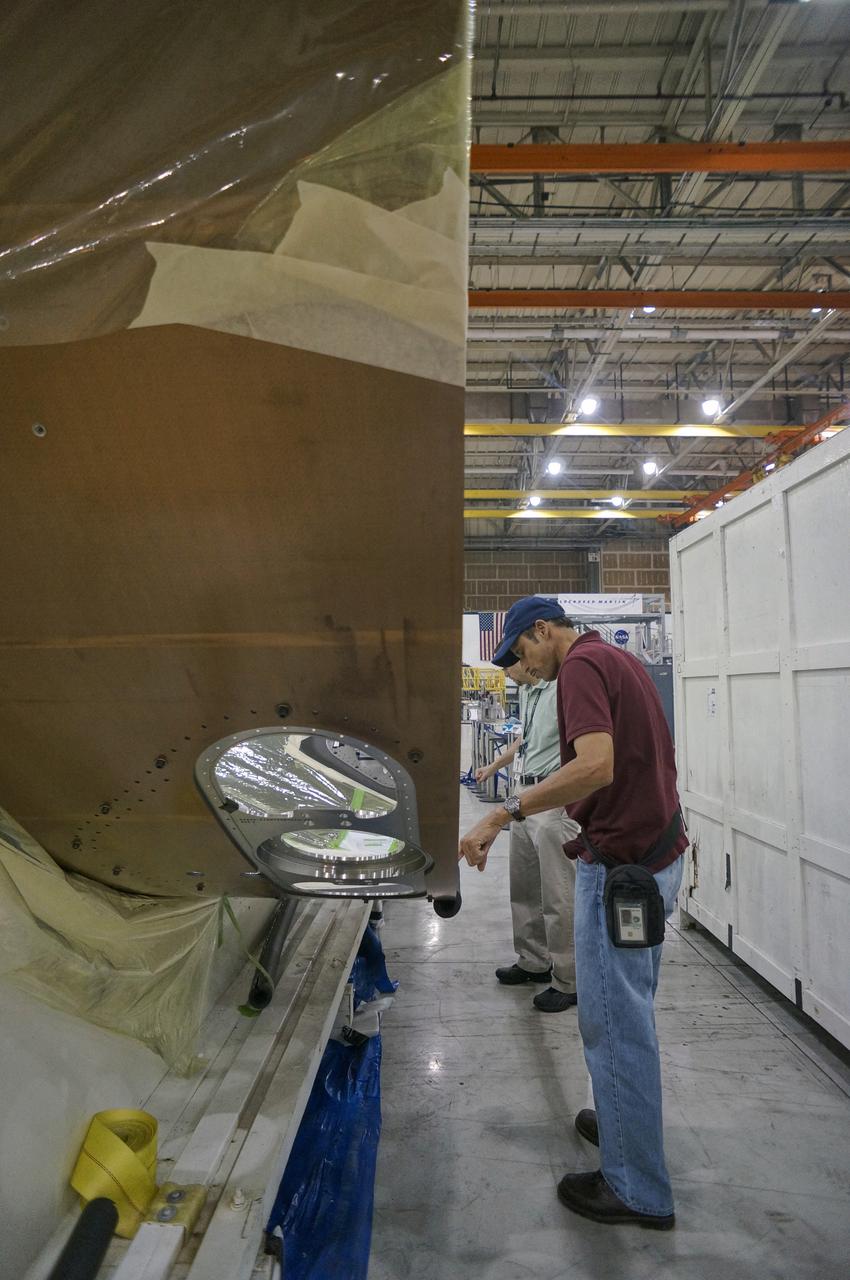
Lockheed Martin technicians work on a Exploration Flight Test-1 (EFT-1) spacecraft adapter jettison fairing at NASA's Michoud Assembly Facility in New Orleans on Nov. 10, 2011. Part of Batch image transfer from Flickr.
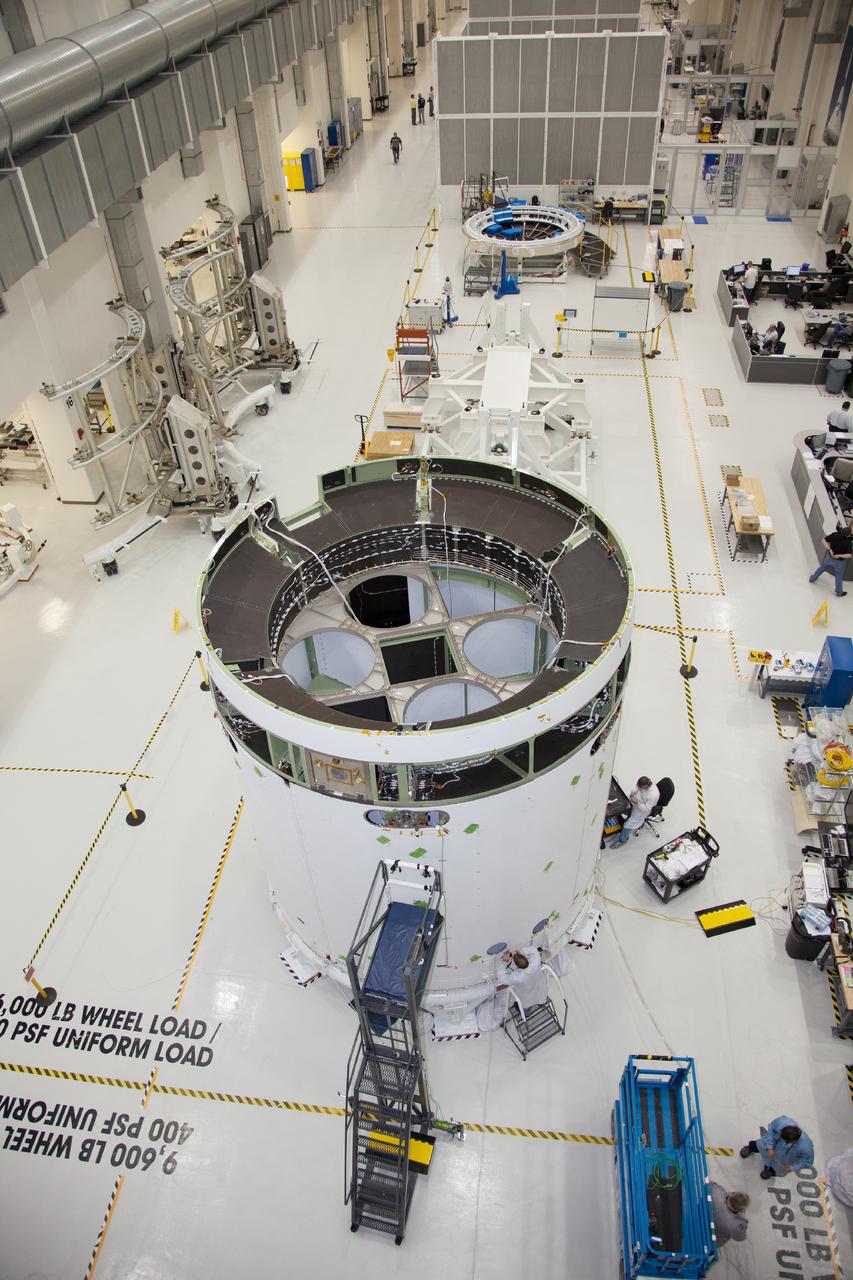
The spacecraft adapter jettison fairing panels are installed on the Exploration Flight Test-1 (EFT-1) Orion service module in the Operations and Checkout (O&C) Building at Kennedy Space Center on Jan. 14 , 2014. Part of Batch image transfer from Flickr.
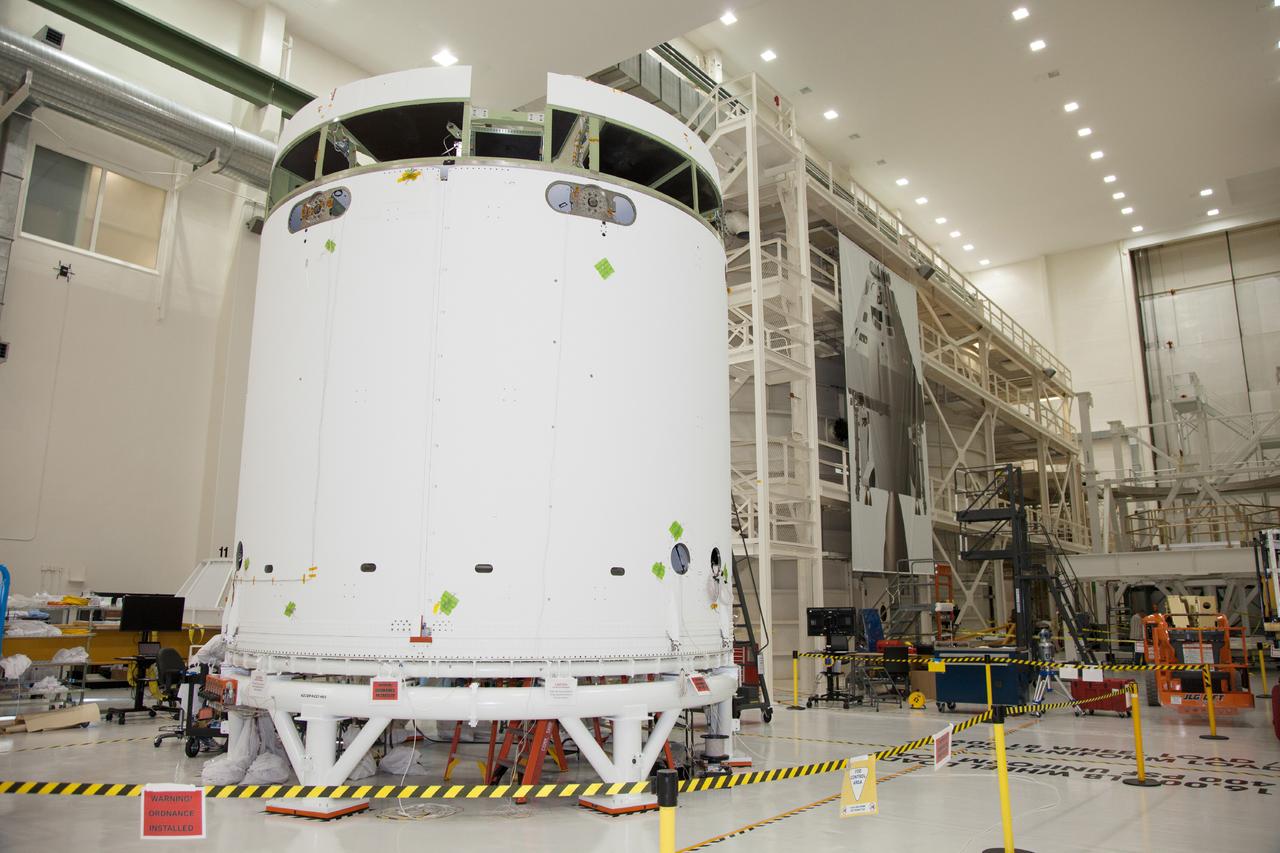
The spacecraft adapter jettison fairing panels are installed on the Exploration Flight Test-1 (EFT-1) Orion service module in the Operations and Checkout (O&C) Building at Kennedy Space Center on Jan. 14 , 2014. Part of Batch image transfer from Flickr.
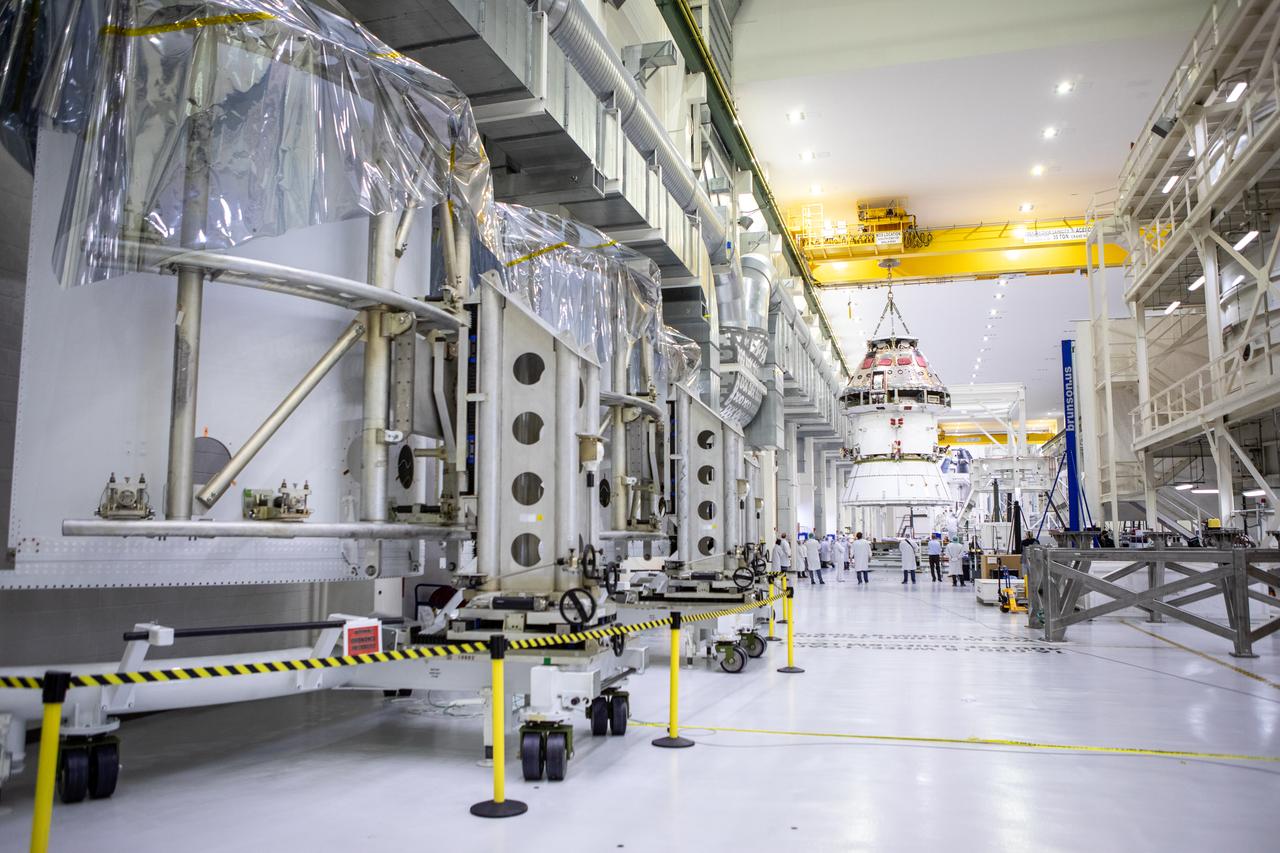
Technicians at NASA’s Kennedy Space Center in Florida work to safely return the Artemis I Orion spacecraft to the FAST cell after completing the installation of the spacecraft adapter (SA) cone inside the Neil Armstrong Operations and Checkout Building on Aug. 20, 2020. This is one of the final major hardware operations the spacecraft will undergo during closeout processing prior to being integrated with the Space Launch System (SLS) rocket in preparation for the first Artemis mission. The spacecraft adapter cone connects the bottom portion of Orion’s service module to the top part of the rocket known as the interim cryogenic propulsion stage (ICPS). In view at left in the foreground are the Spacecraft Adapter Jettison Fairing panels that will protect Orion’s service module from the environment around it during the ascent. Orion will fly on the agency’s Artemis I mission – the first in a series of increasingly complex missions to the Moon that will ultimately lead to the exploration of Mars.
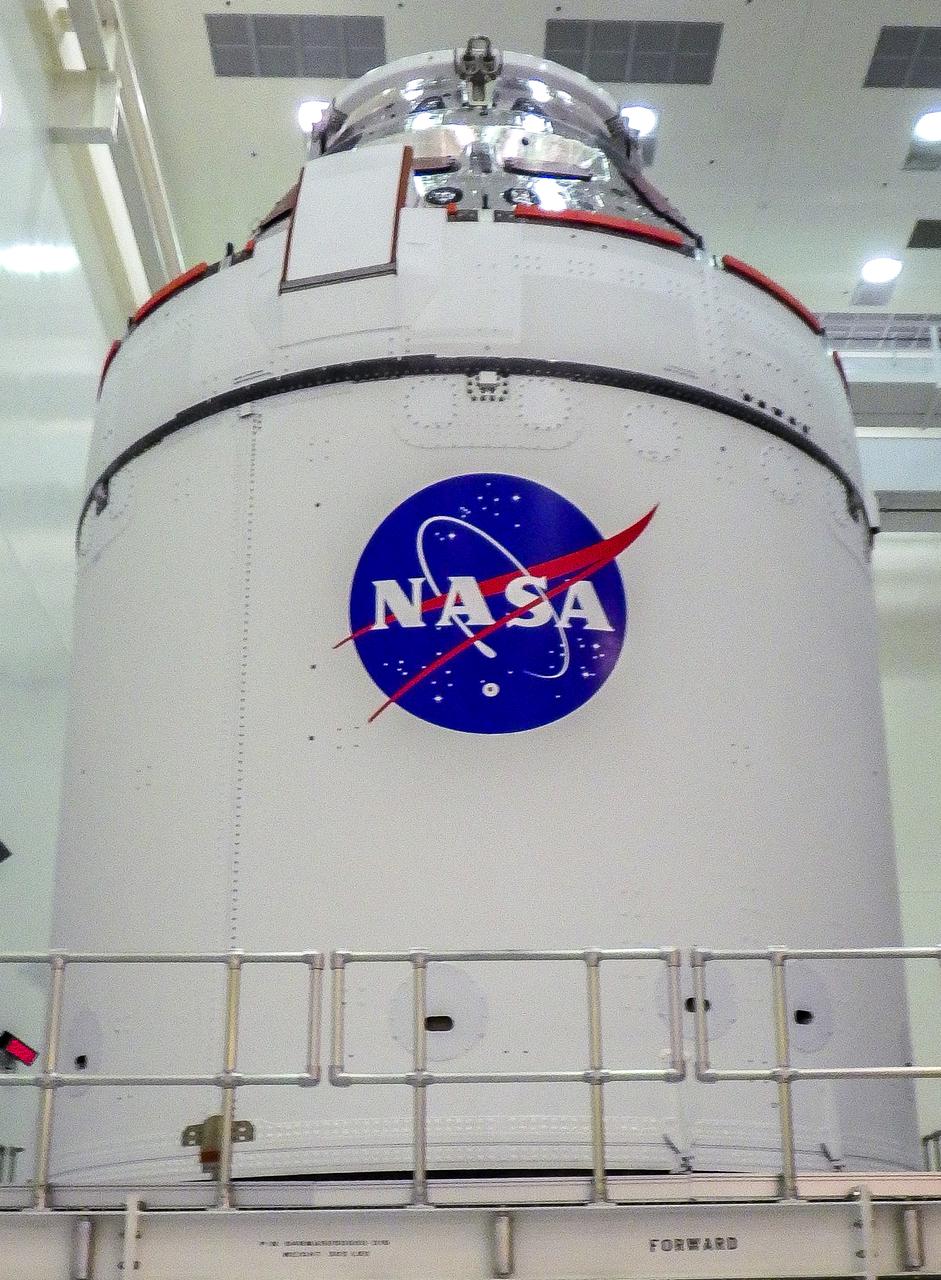
A close-up view of the Artemis I Orion spacecraft with NASA’s famous “meatball” insignia is affixed to the spacecraft adapter jettison fairings, which protect the European built service module, inside the Multi-Payload Processing Facility at Kennedy Space Center on Jan. 20, 2021. Ground processing will begin on Orion, with the Exploration Ground Systems and Jacobs teams performing checkouts and fueling the spacecraft with commodities as part of preparations ahead of the Artemis I mission.
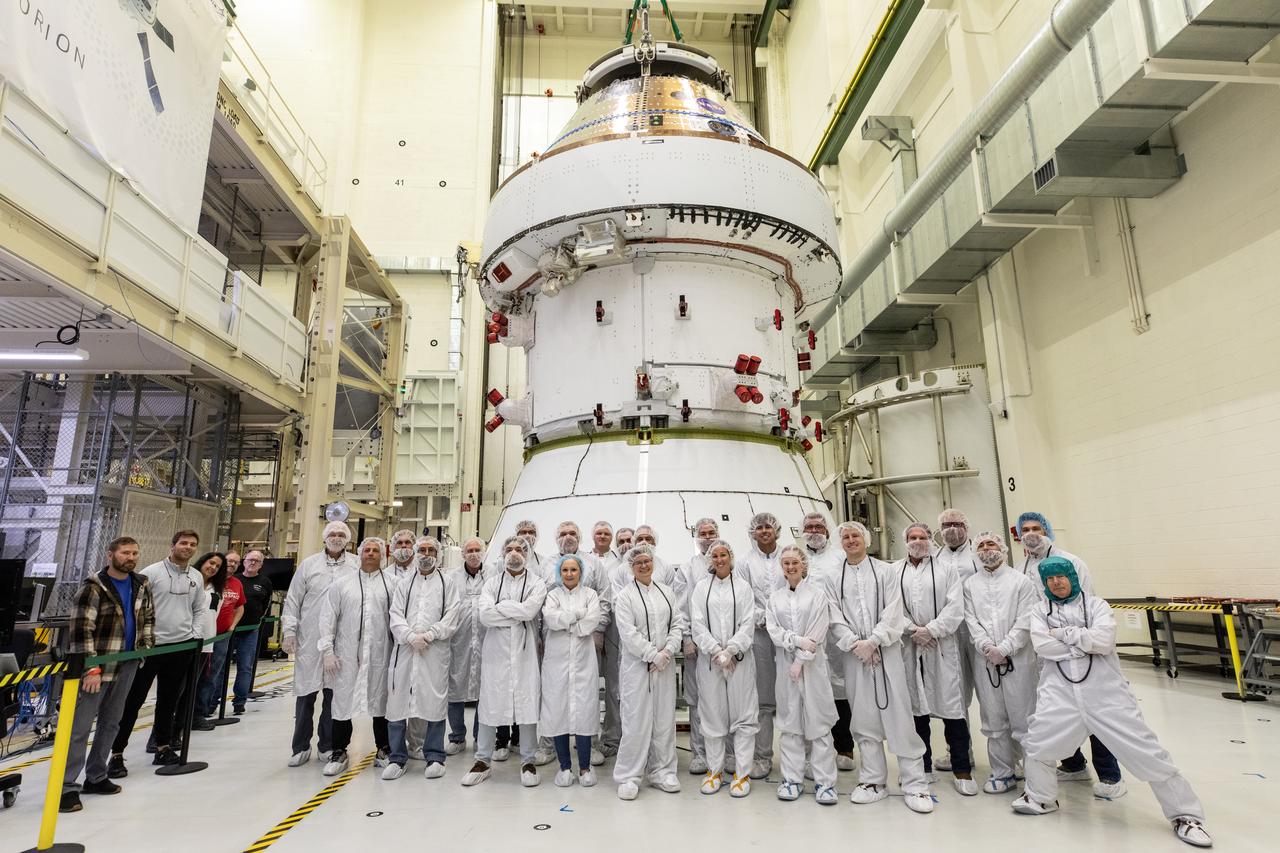
Crews with NASA and Lockheed Martin pose for a photo in front of NASA’s Artemis II Orion spacecraft inside the Neil A. Operations and Checkout Building at NASA’s Kennedy Space Center in Florida on Saturday, Feb. 22, 2025. Technicians operated a 30-ton crane to move the spacecraft from the Final Assembly and System Testing cell to prepare for upcoming installation of four solar array wings and spacecraft adapter jettison fairings for the agency’s first crewed flight test under the Artemis campaign.
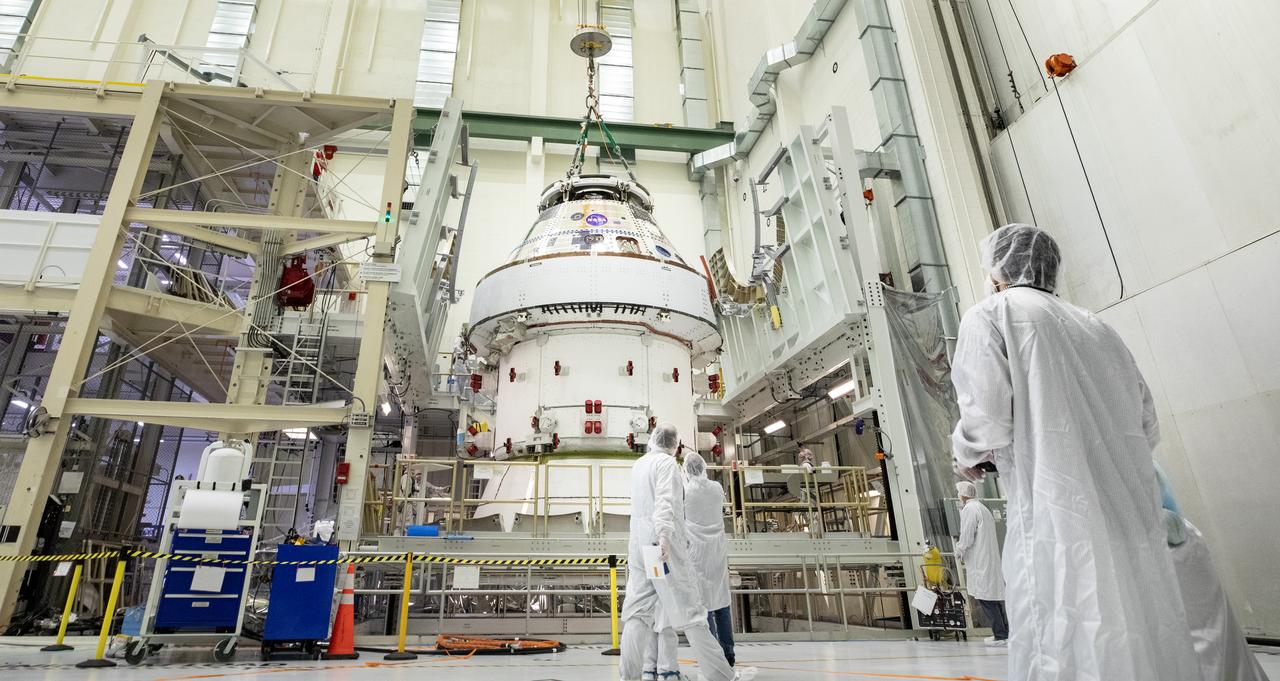
Technicians with NASA and Lockheed Martin operate a 30-ton crane to move NASA’s Artemis II Orion spacecraft out of the Final Assembly and System Testing cell inside the Neil A. Operations and Checkout Building at NASA’s Kennedy Space Center in Florida on Saturday, Feb. 22, 2025. The move prepares for the upcoming installation of four solar array wings and spacecraft adapter jettison fairings for the agency’s first crewed flight test under the Artemis campaign.

Technicians with NASA and Lockheed Martin operate a 30-ton crane to move NASA’s Artemis II Orion spacecraft out of the Final Assembly and System Testing cell inside the Neil A. Operations and Checkout Building at NASA’s Kennedy Space Center in Florida on Saturday, Feb. 22, 2025. The move prepares for the upcoming installation of four solar array wings and spacecraft adapter jettison fairings for the agency’s first crewed flight test under the Artemis campaign.
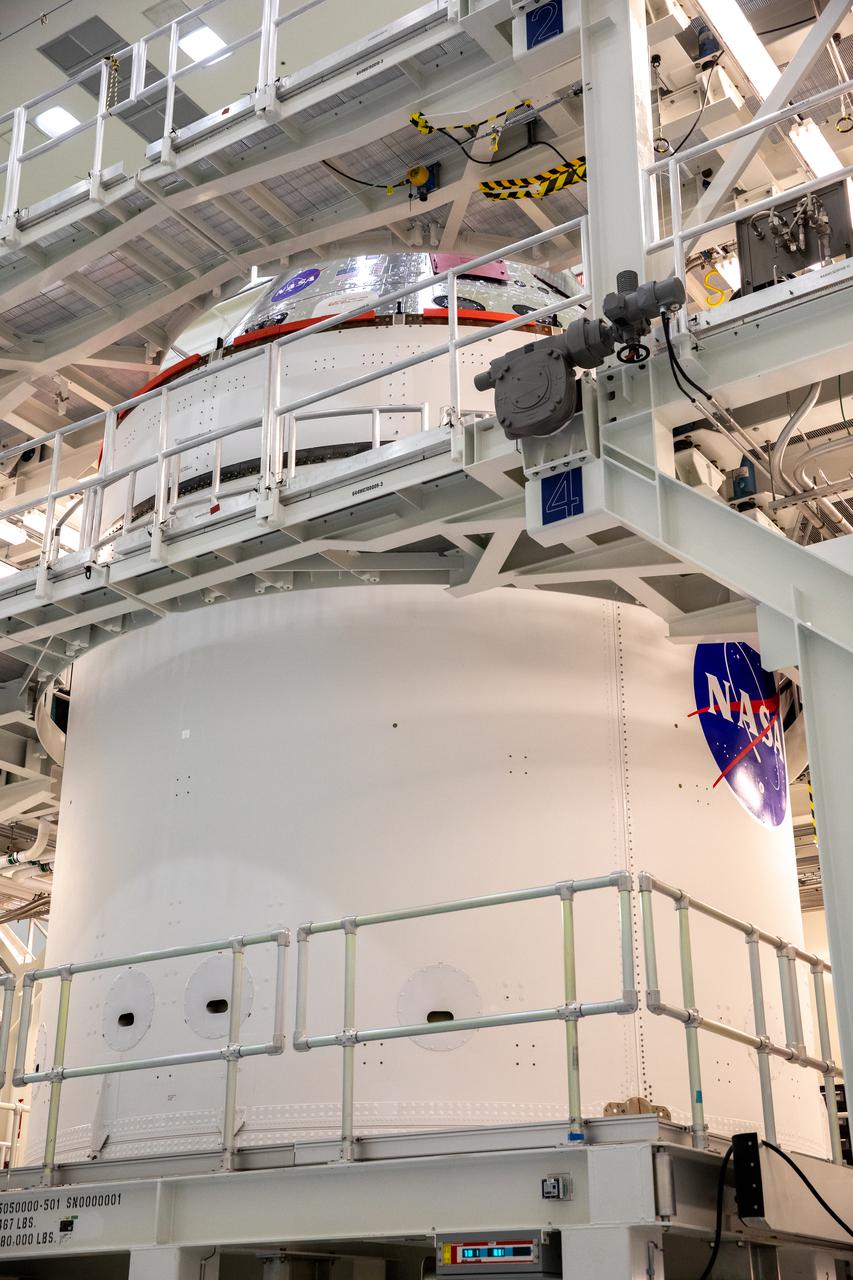
NASA’s famous “meatball” insignia is affixed to the Artemis I Orion spacecraft adapter jettison fairings, which protect the European built service module, Jan. 20, 2021, inside the Multi-Payload Processing Facility at NASA’s Kennedy Space Center in Florida. Shown inside its servicing stand, ground processing begins on Orion, with the Exploration Ground Systems and Jacobs teams performing checkouts and fueling the spacecraft with commodities as part of preparations ahead of the Artemis I mission.
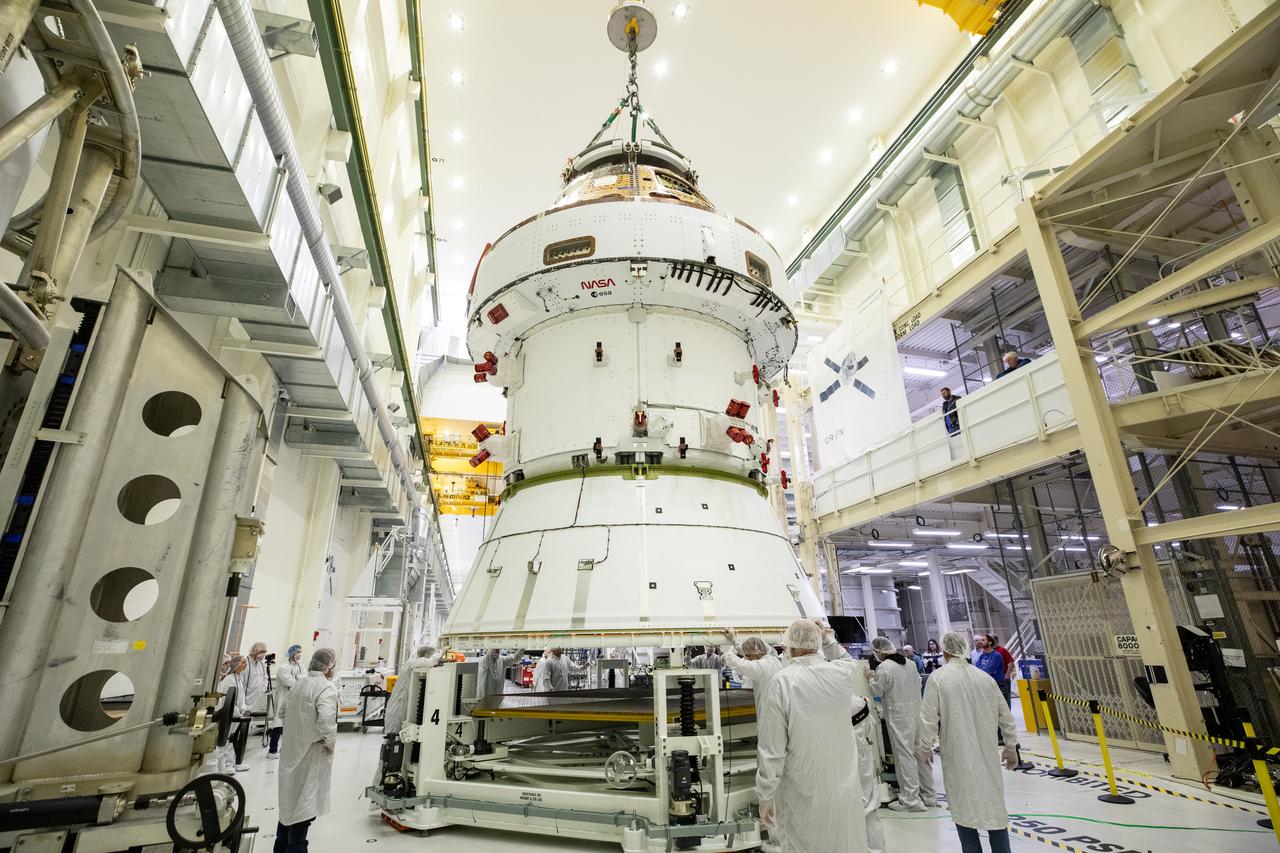
Technicians with NASA and Lockheed Martin operate a 30-ton crane to move NASA’s Artemis II Orion spacecraft out of the Final Assembly and System Testing cell inside the Neil A. Operations and Checkout Building at NASA’s Kennedy Space Center in Florida on Saturday, Feb. 22, 2025. The move prepares for the upcoming installation of four solar array wings and spacecraft adapter jettison fairings for the agency’s first crewed flight test under the Artemis campaign.
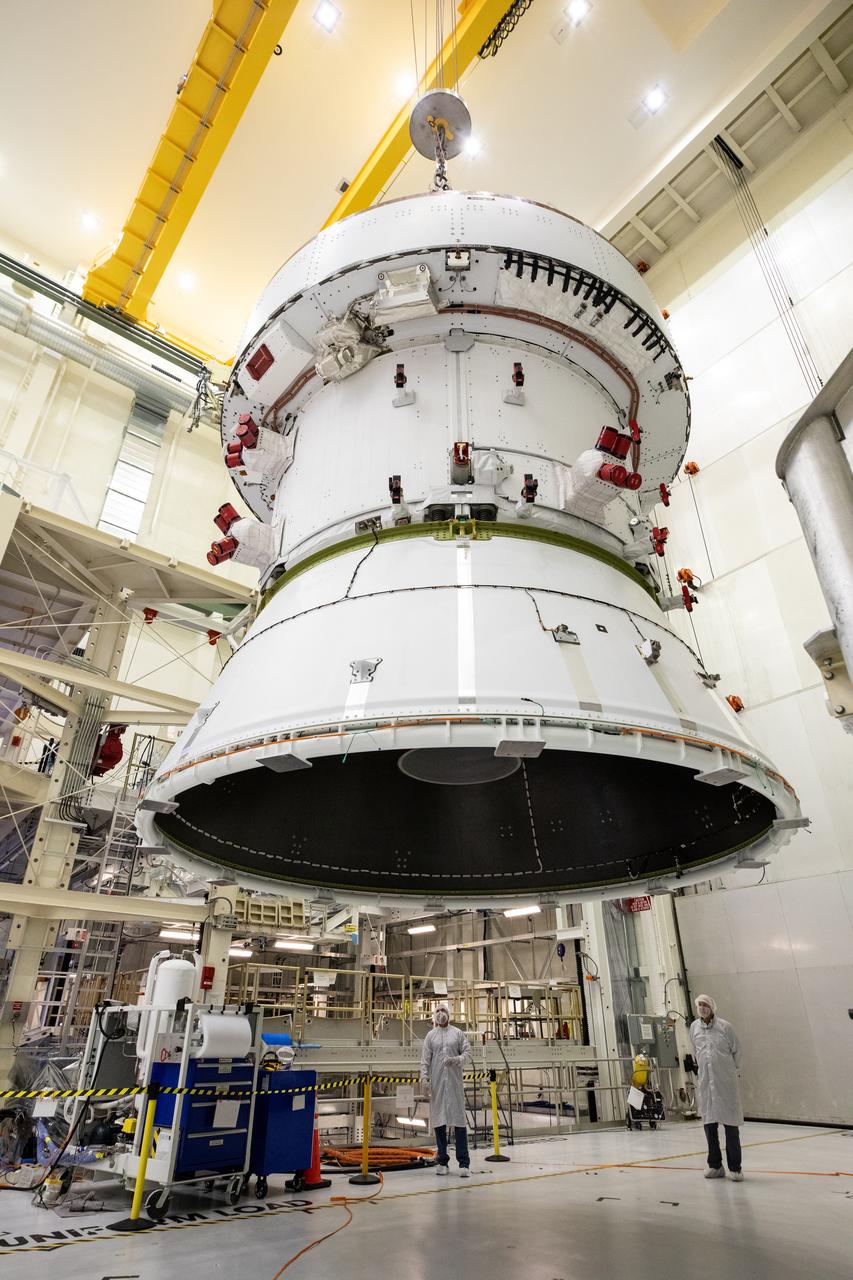
Technicians with NASA and Lockheed Martin operate a 30-ton crane to move NASA’s Artemis II Orion spacecraft out of the Final Assembly and System Testing cell inside the Neil A. Operations and Checkout Building at NASA’s Kennedy Space Center in Florida on Saturday, Feb. 22, 2025. The move prepares for the upcoming installation of four solar array wings and spacecraft adapter jettison fairings for the agency’s first crewed flight test under the Artemis campaign.
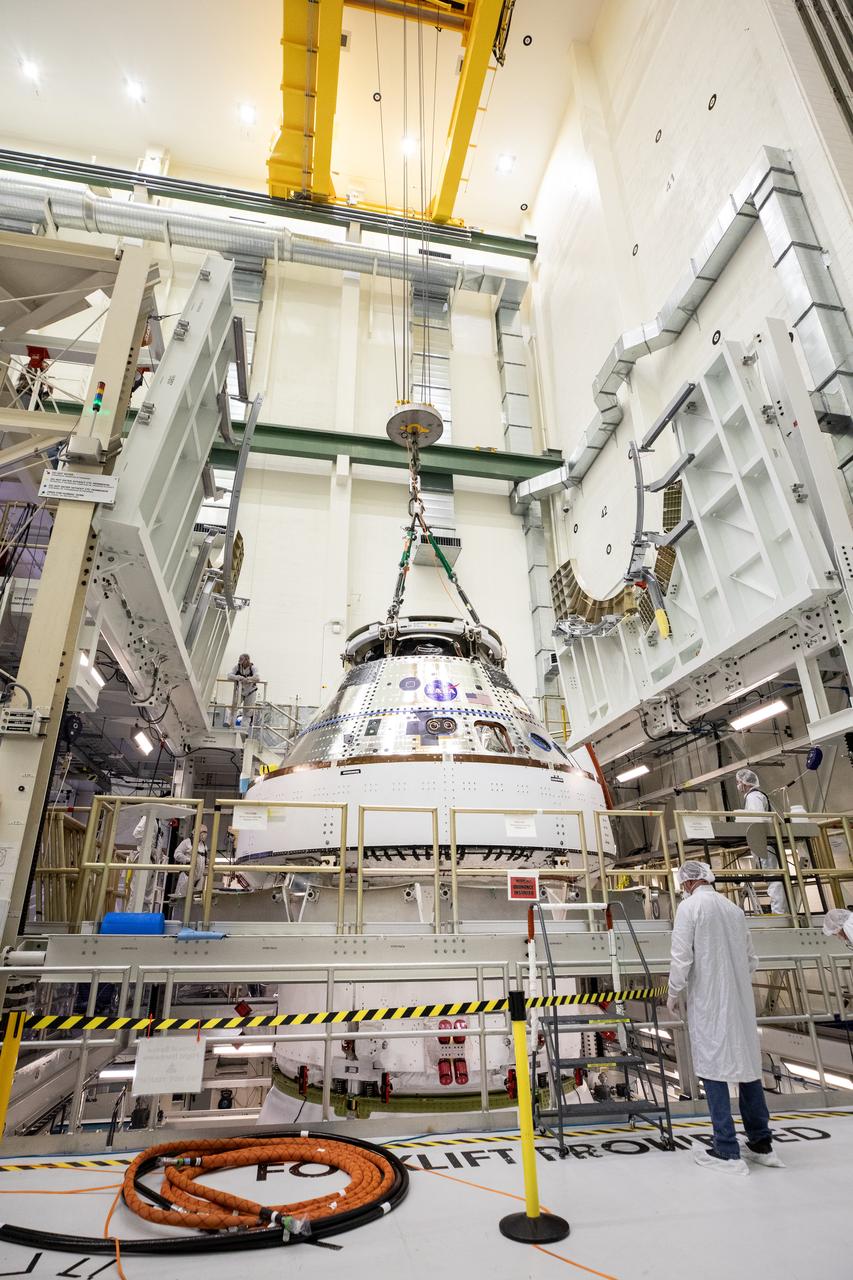
Technicians with NASA and Lockheed Martin operate a 30-ton crane to move NASA’s Artemis II Orion spacecraft out of the Final Assembly and System Testing cell inside the Neil A. Operations and Checkout Building at NASA’s Kennedy Space Center in Florida on Saturday, Feb. 22, 2025. The move prepares for the upcoming installation of four solar array wings and spacecraft adapter jettison fairings for the agency’s first crewed flight test under the Artemis campaign.
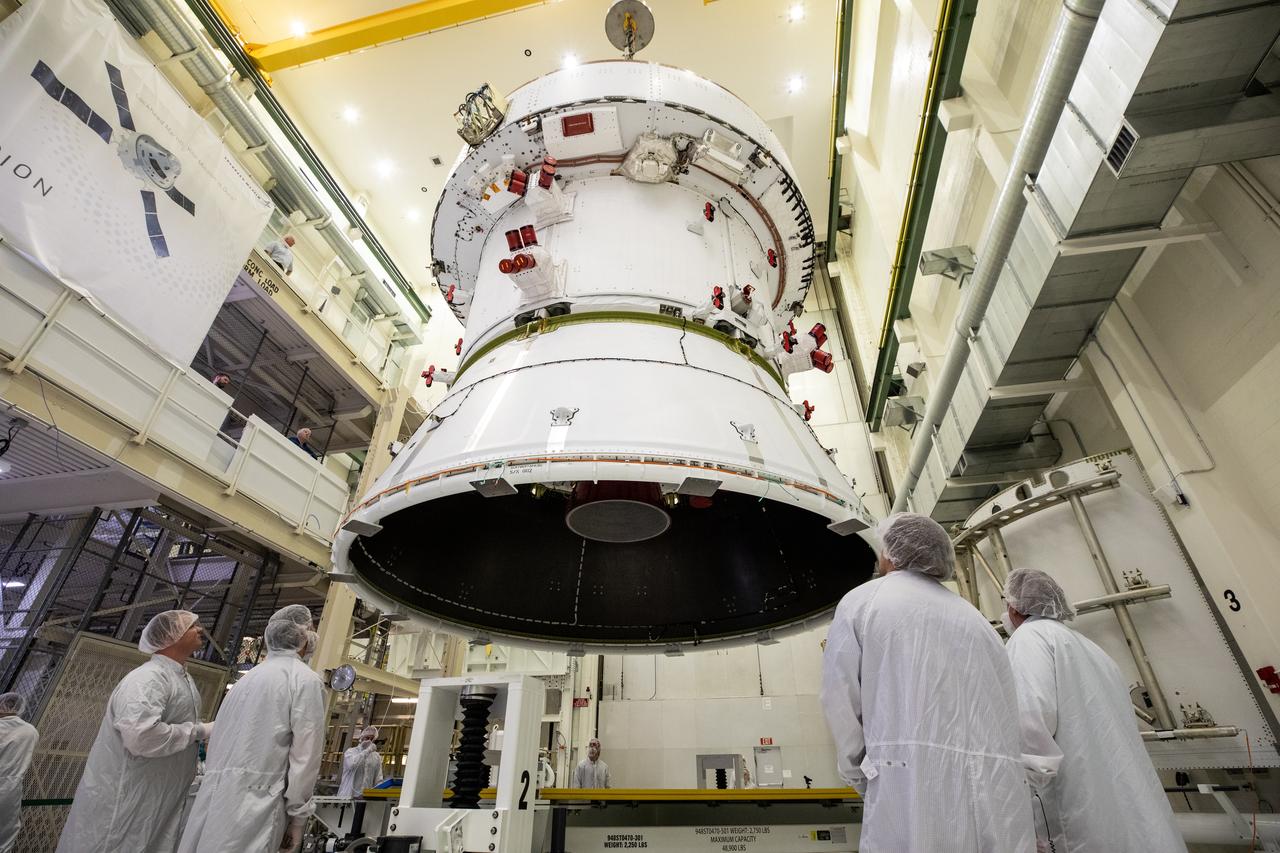
Technicians with NASA and Lockheed Martin operate a 30-ton crane to move NASA’s Artemis II Orion spacecraft out of the Final Assembly and System Testing cell inside the Neil A. Operations and Checkout Building at NASA’s Kennedy Space Center in Florida on Saturday, Feb. 22, 2025. The move prepares for the upcoming installation of four solar array wings and spacecraft adapter jettison fairings for the agency’s first crewed flight test under the Artemis campaign.
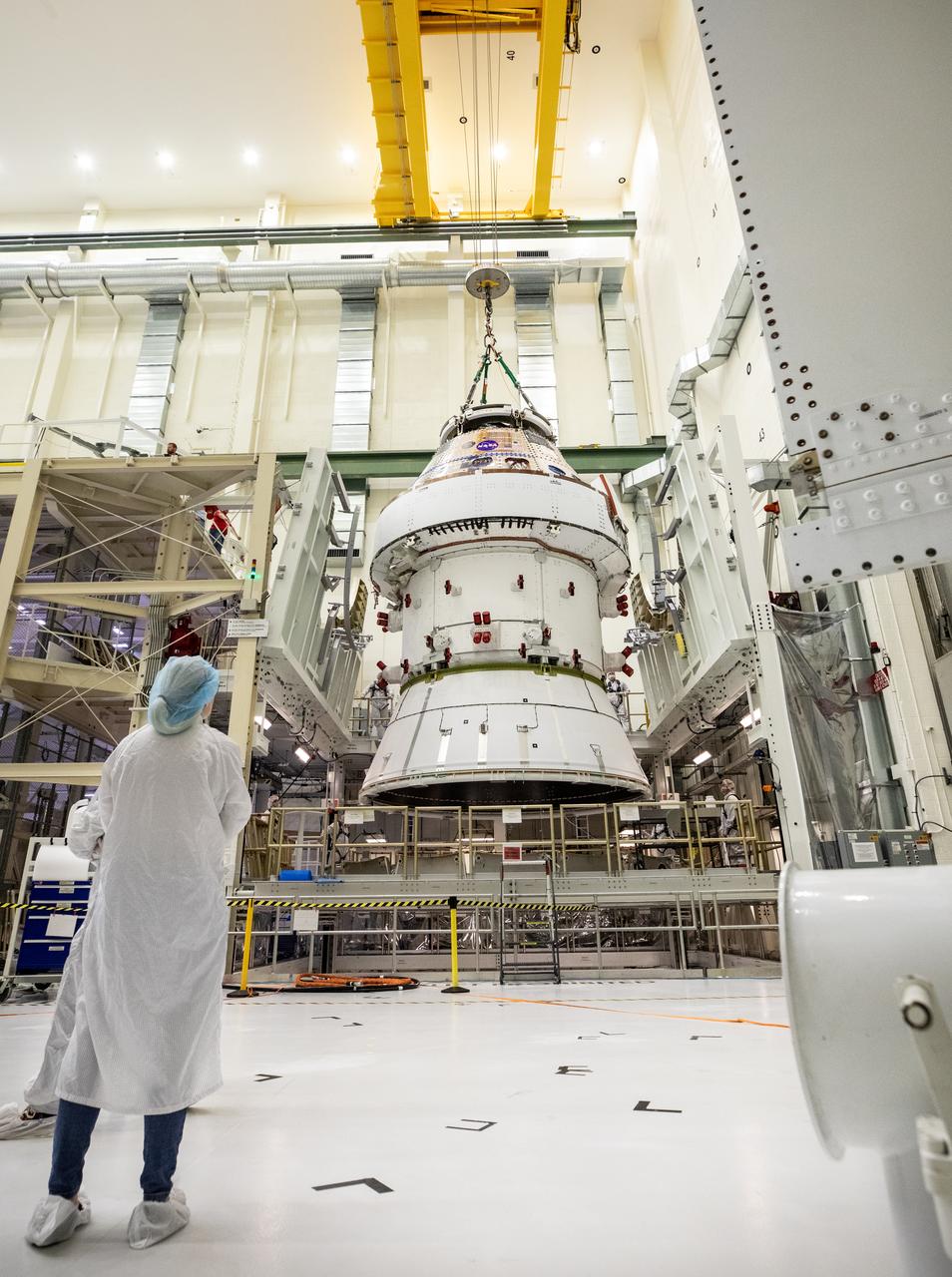
Technicians with NASA and Lockheed Martin operate a 30-ton crane to move NASA’s Artemis II Orion spacecraft out of the Final Assembly and System Testing cell inside the Neil A. Operations and Checkout Building at NASA’s Kennedy Space Center in Florida on Saturday, Feb. 22, 2025. The move prepares for the upcoming installation of four solar array wings and spacecraft adapter jettison fairings for the agency’s first crewed flight test under the Artemis campaign.
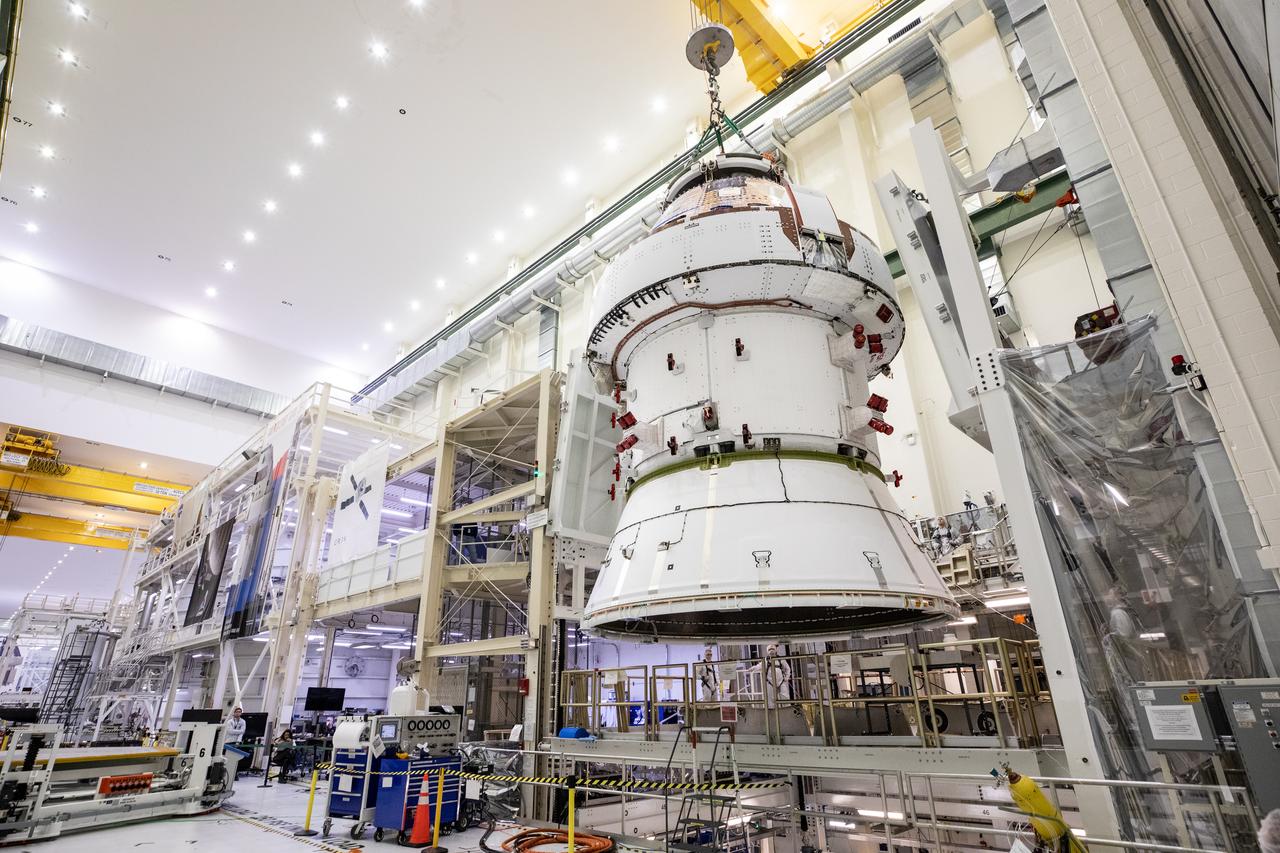
Technicians with NASA and Lockheed Martin operate a 30-ton crane to move NASA’s Artemis II Orion spacecraft out of the Final Assembly and System Testing cell inside the Neil A. Operations and Checkout Building at NASA’s Kennedy Space Center in Florida on Saturday, Feb. 22, 2025. The move prepares for the upcoming installation of four solar array wings and spacecraft adapter jettison fairings for the agency’s first crewed flight test under the Artemis campaign.
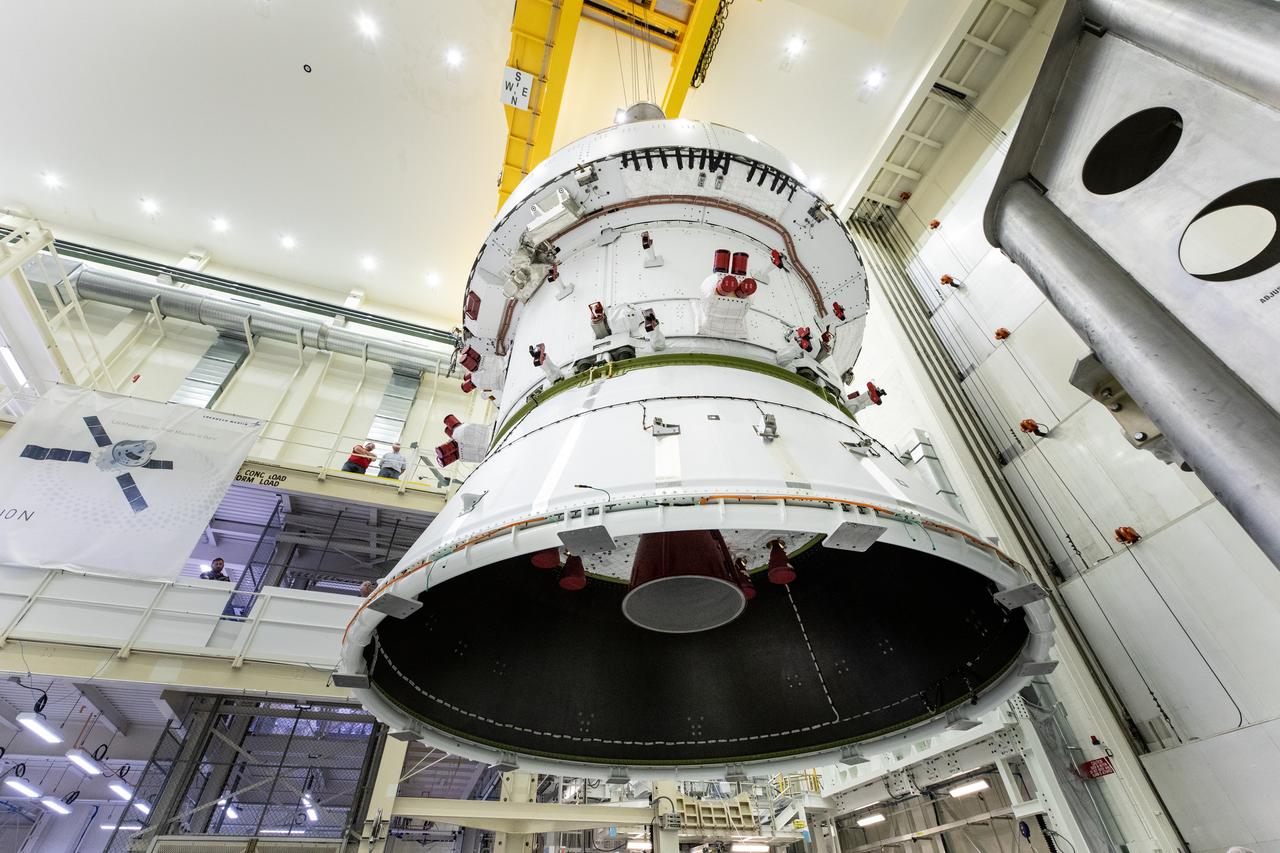
Technicians with NASA and Lockheed Martin operate a 30-ton crane to move NASA’s Artemis II Orion spacecraft out of the Final Assembly and System Testing cell inside the Neil A. Operations and Checkout Building at NASA’s Kennedy Space Center in Florida on Saturday, Feb. 22, 2025. The move prepares for the upcoming installation of four solar array wings and spacecraft adapter jettison fairings for the agency’s first crewed flight test under the Artemis campaign.
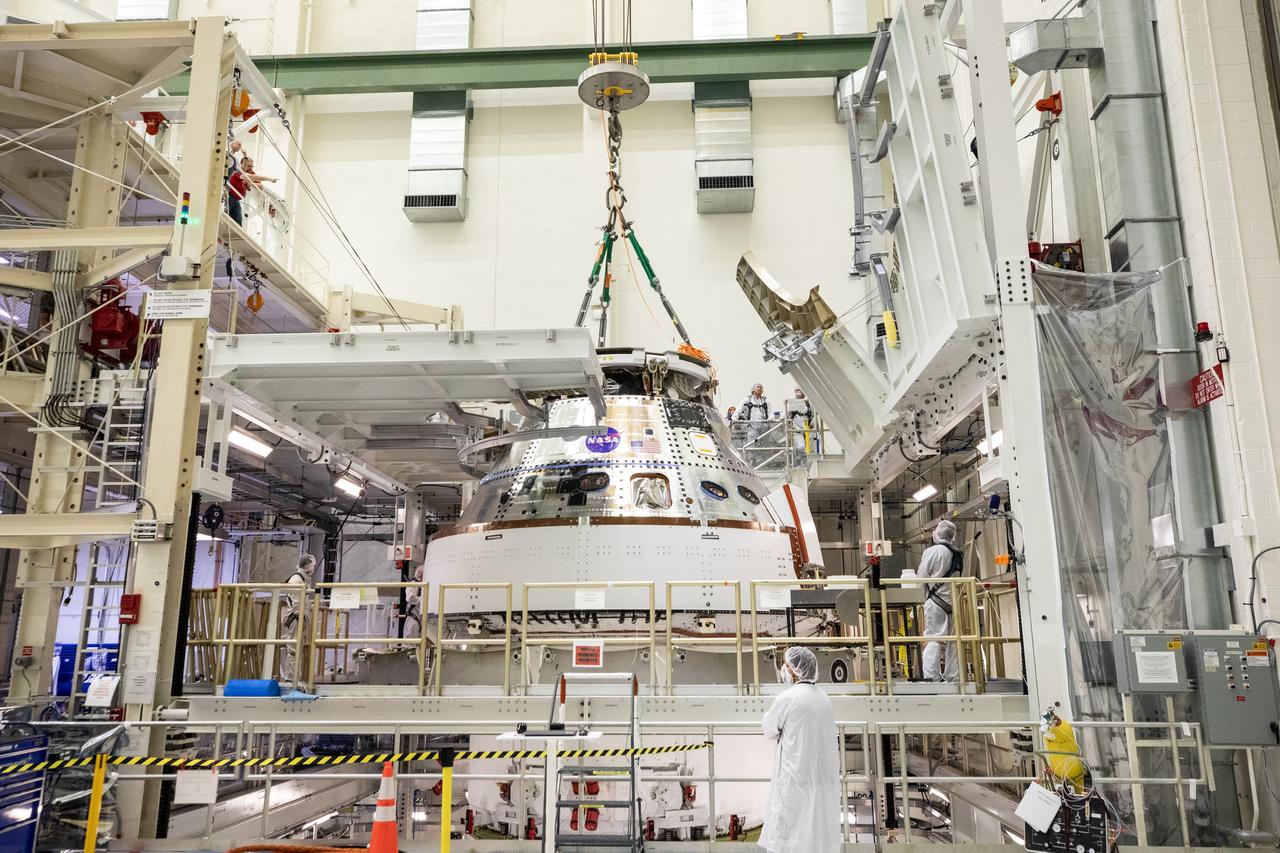
Technicians with NASA and Lockheed Martin operate a 30-ton crane to move NASA’s Artemis II Orion spacecraft out of the Final Assembly and System Testing cell inside the Neil A. Operations and Checkout Building at NASA’s Kennedy Space Center in Florida on Saturday, Feb. 22, 2025. The move prepares for the upcoming installation of four solar array wings and spacecraft adapter jettison fairings for the agency’s first crewed flight test under the Artemis campaign.
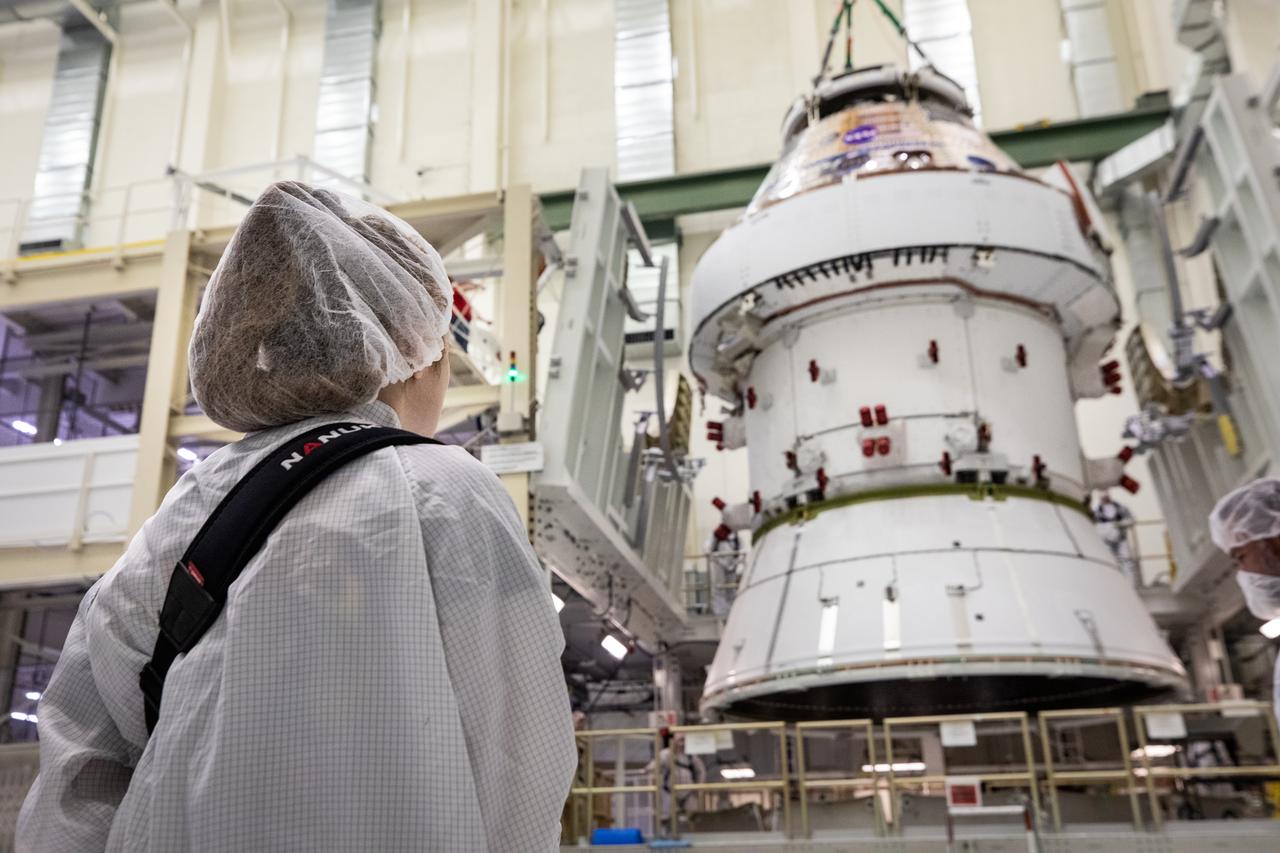
Rebekah Tolatovicz, a technician with Lockheed Martin, operates a 30-ton crane to move NASA’s Artemis II Orion spacecraft out of the Final Assembly and System Testing cell inside the Neil A. Operations and Checkout Building at NASA’s Kennedy Space Center in Florida on Saturday, Feb. 22, 2025. The move prepares for the upcoming installation of four solar array wings and spacecraft adapter jettison fairings for the agency’s first crewed flight test under the Artemis campaign.
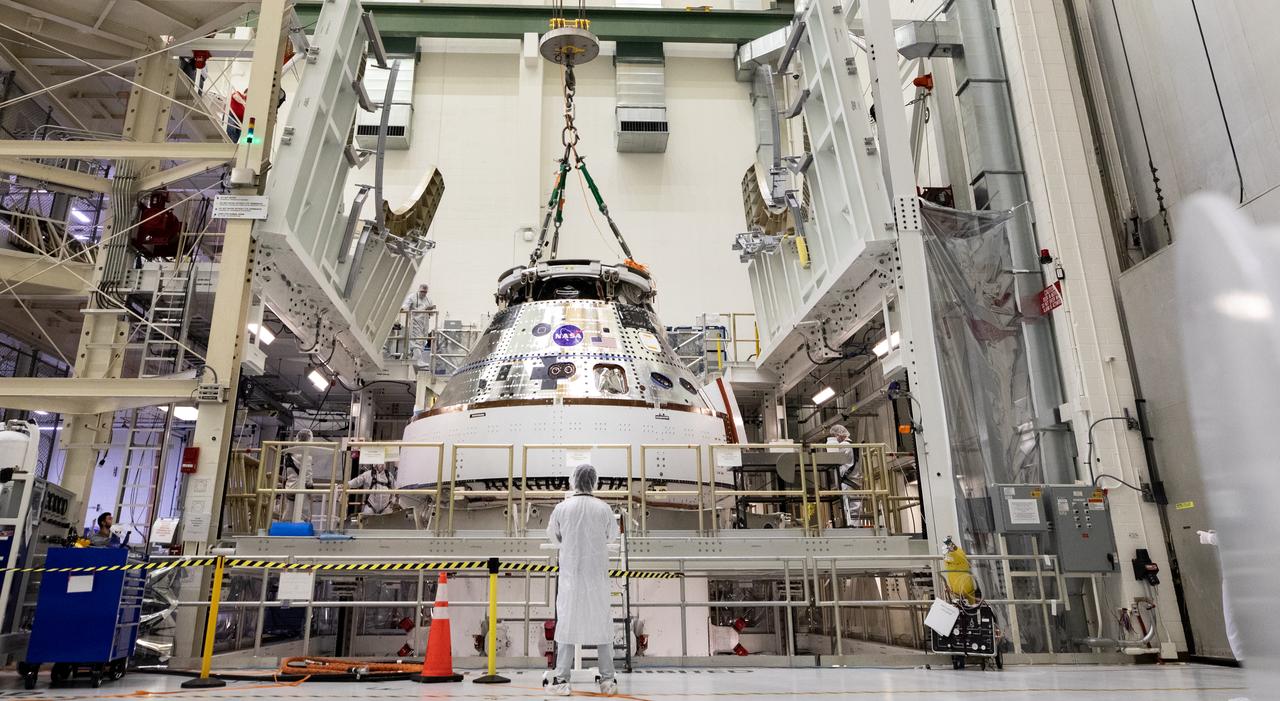
Technicians with NASA and Lockheed Martin operate a 30-ton crane to move NASA’s Artemis II Orion spacecraft out of the Final Assembly and System Testing cell inside the Neil A. Operations and Checkout Building at NASA’s Kennedy Space Center in Florida on Saturday, Feb. 22, 2025. The move prepares for the upcoming installation of four solar array wings and spacecraft adapter jettison fairings for the agency’s first crewed flight test under the Artemis campaign.
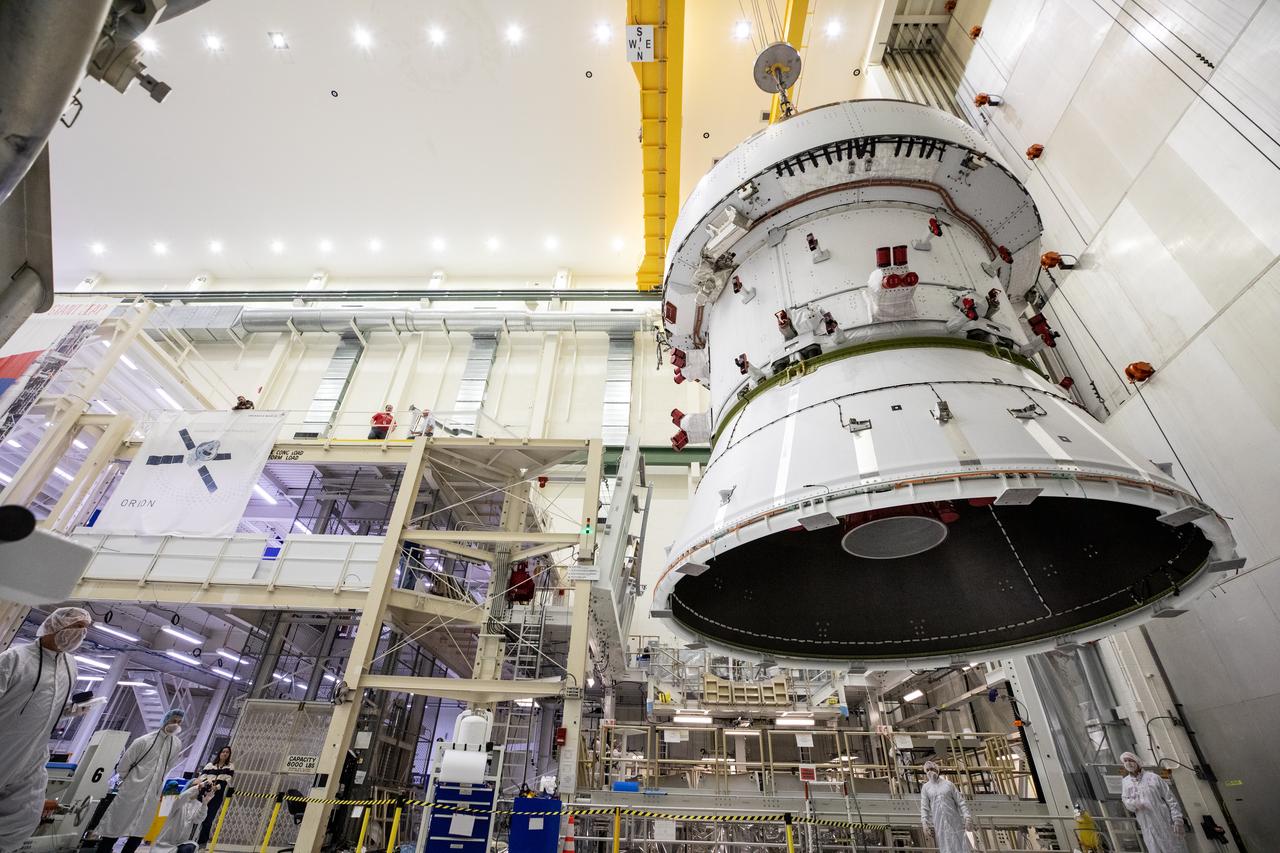
Technicians with NASA and Lockheed Martin operate a 30-ton crane to move NASA’s Artemis II Orion spacecraft out of the Final Assembly and System Testing cell inside the Neil A. Operations and Checkout Building at NASA’s Kennedy Space Center in Florida on Saturday, Feb. 22, 2025. The move prepares for the upcoming installation of four solar array wings and spacecraft adapter jettison fairings for the agency’s first crewed flight test under the Artemis campaign.
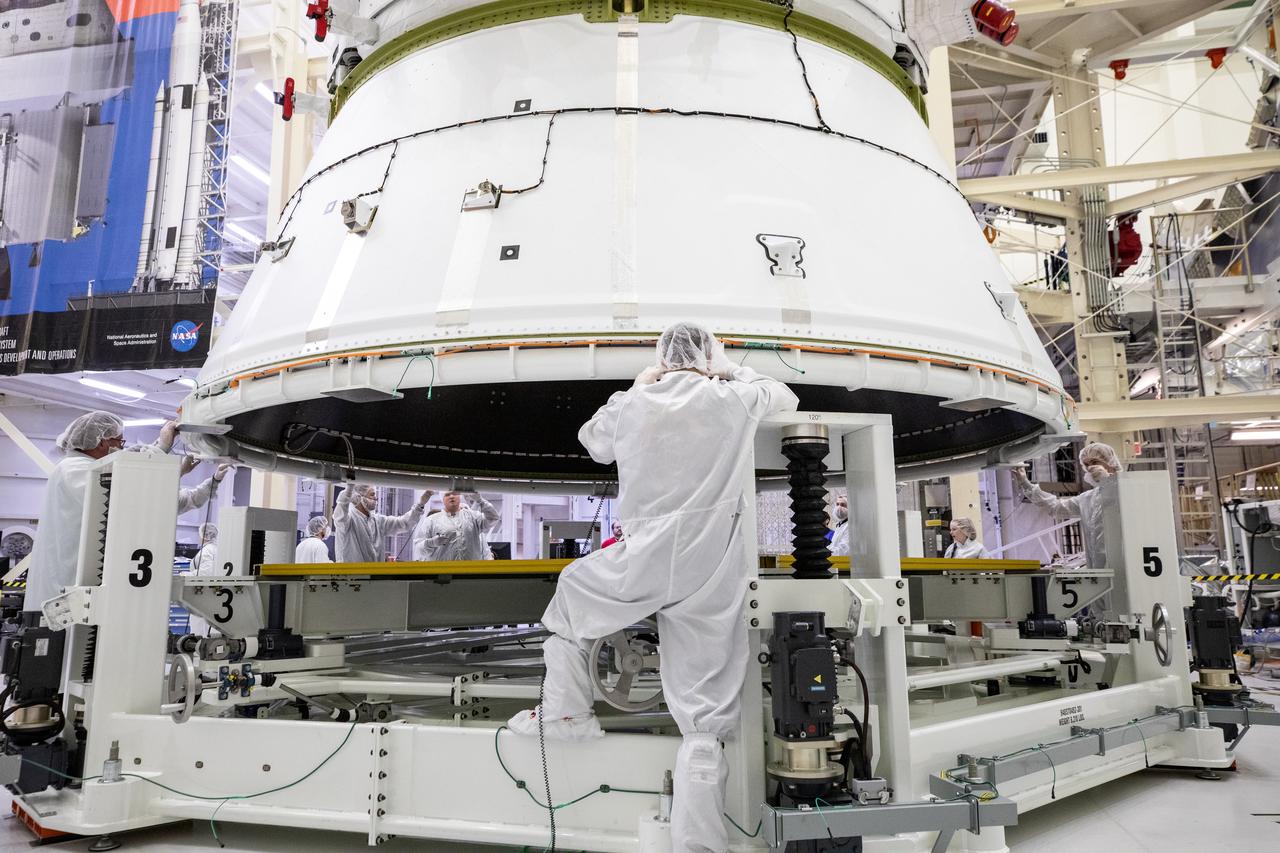
Technicians with NASA and Lockheed Martin operate a 30-ton crane to move NASA’s Artemis II Orion spacecraft out of the Final Assembly and System Testing cell inside the Neil A. Operations and Checkout Building at NASA’s Kennedy Space Center in Florida on Saturday, Feb. 22, 2025. The move prepares for the upcoming installation of four solar array wings and spacecraft adapter jettison fairings for the agency’s first crewed flight test under the Artemis campaign.
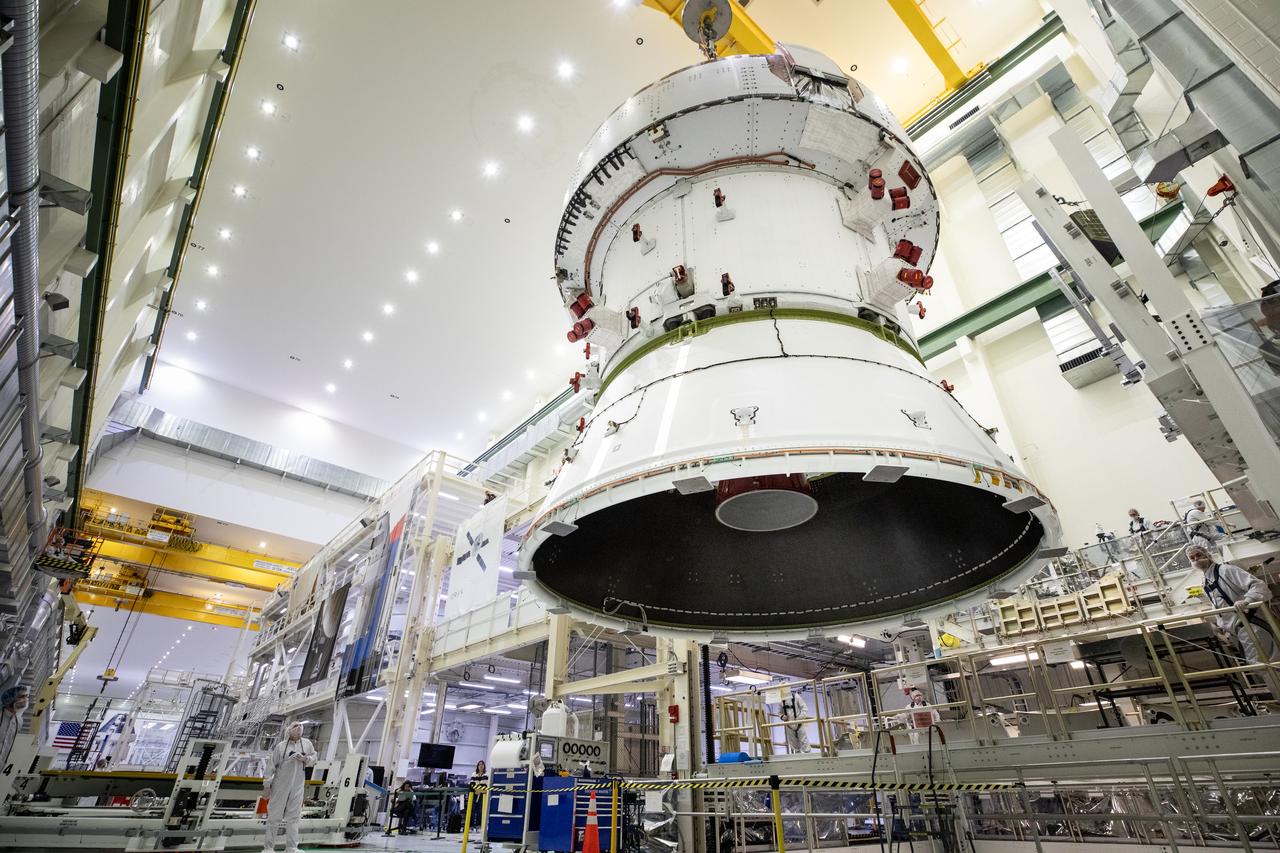
Technicians with NASA and Lockheed Martin operate a 30-ton crane to move NASA’s Artemis II Orion spacecraft out of the Final Assembly and System Testing cell inside the Neil A. Operations and Checkout Building at NASA’s Kennedy Space Center in Florida on Saturday, Feb. 22, 2025. The move prepares for the upcoming installation of four solar array wings and spacecraft adapter jettison fairings for the agency’s first crewed flight test under the Artemis campaign.

Technicians with NASA and Lockheed Martin operate a 30-ton crane to move NASA’s Artemis II Orion spacecraft out of the Final Assembly and System Testing cell inside the Neil A. Operations and Checkout Building at NASA’s Kennedy Space Center in Florida on Saturday, Feb. 22, 2025. The move prepares for the upcoming installation of four solar array wings and spacecraft adapter jettison fairings for the agency’s first crewed flight test under the Artemis campaign.
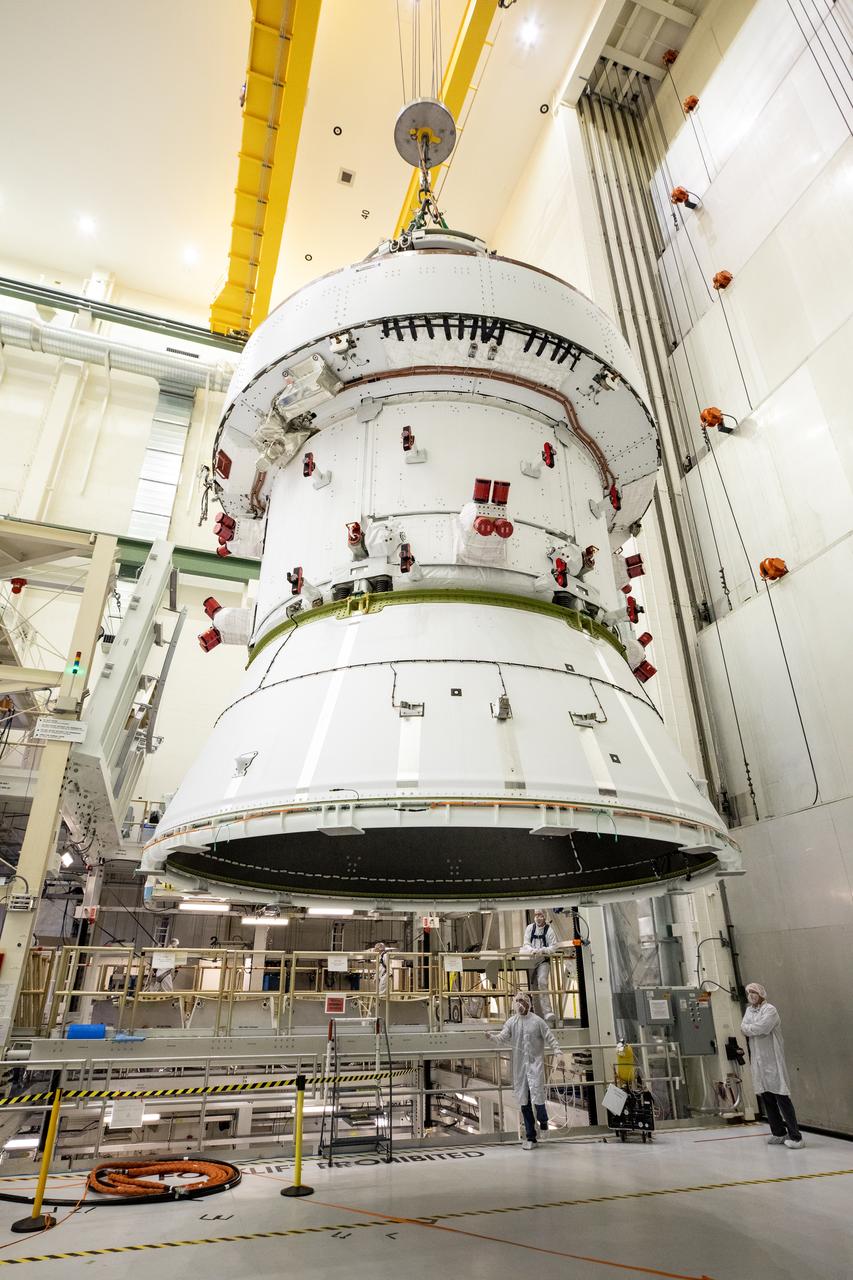
Technicians with NASA and Lockheed Martin operate a 30-ton crane to move NASA’s Artemis II Orion spacecraft out of the Final Assembly and System Testing cell inside the Neil A. Operations and Checkout Building at NASA’s Kennedy Space Center in Florida on Saturday, Feb. 22, 2025. The move prepares for the upcoming installation of four solar array wings and spacecraft adapter jettison fairings for the agency’s first crewed flight test under the Artemis campaign.

NASA’s famous “meatball” insignia is affixed to the Artemis I Orion spacecraft adapter jettison fairings, which protect the European built service module, Jan. 20, 2021, inside the Multi-Payload Processing Facility at NASA’s Kennedy Space Center in Florida. Shown inside its servicing stand, ground processing begins on Orion, with the Exploration Ground Systems and Jacobs teams performing checkouts and fueling the spacecraft with commodities as part of preparations ahead of the Artemis I mission.
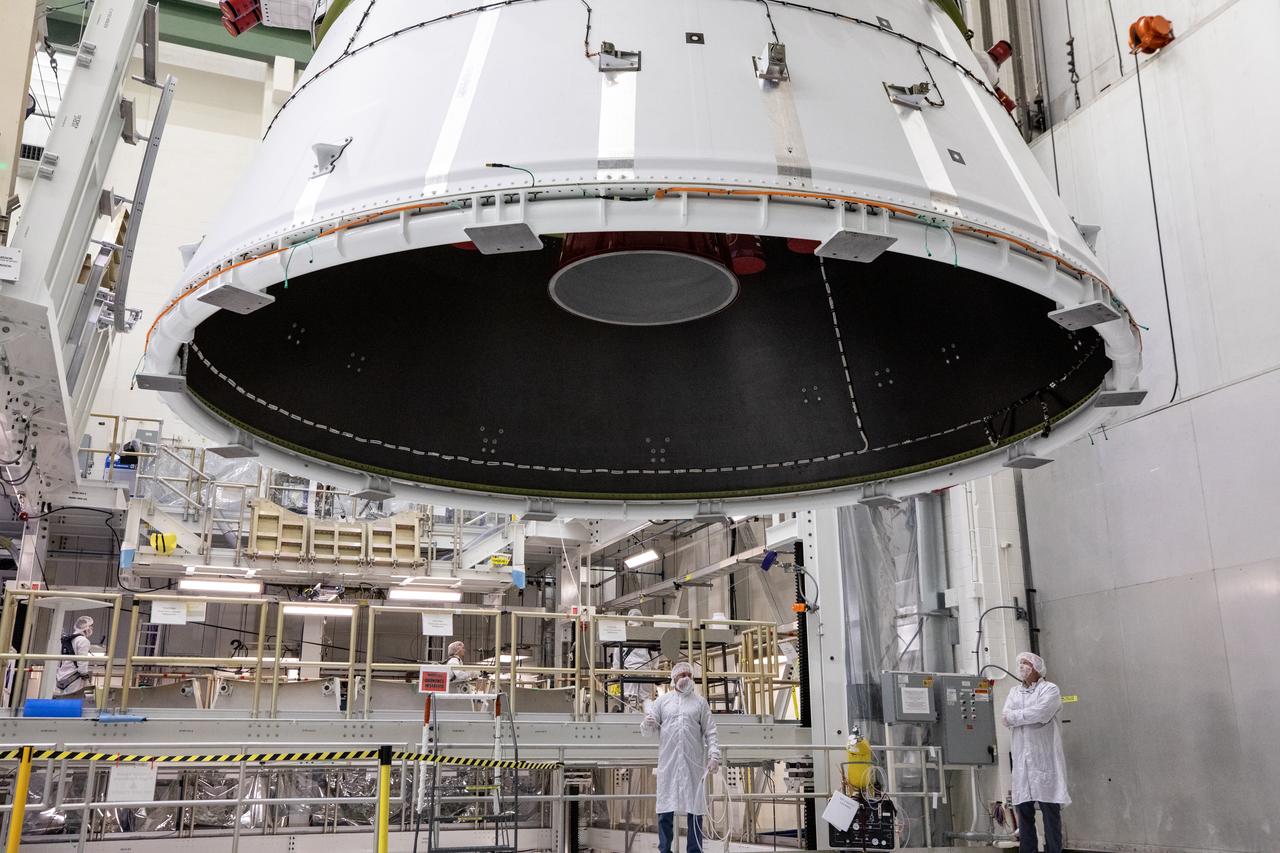
Technicians with NASA and Lockheed Martin operate a 30-ton crane to move NASA’s Artemis II Orion spacecraft out of the Final Assembly and System Testing cell inside the Neil A. Operations and Checkout Building at NASA’s Kennedy Space Center in Florida on Saturday, Feb. 22, 2025. The move prepares for the upcoming installation of four solar array wings and spacecraft adapter jettison fairings for the agency’s first crewed flight test under the Artemis campaign.
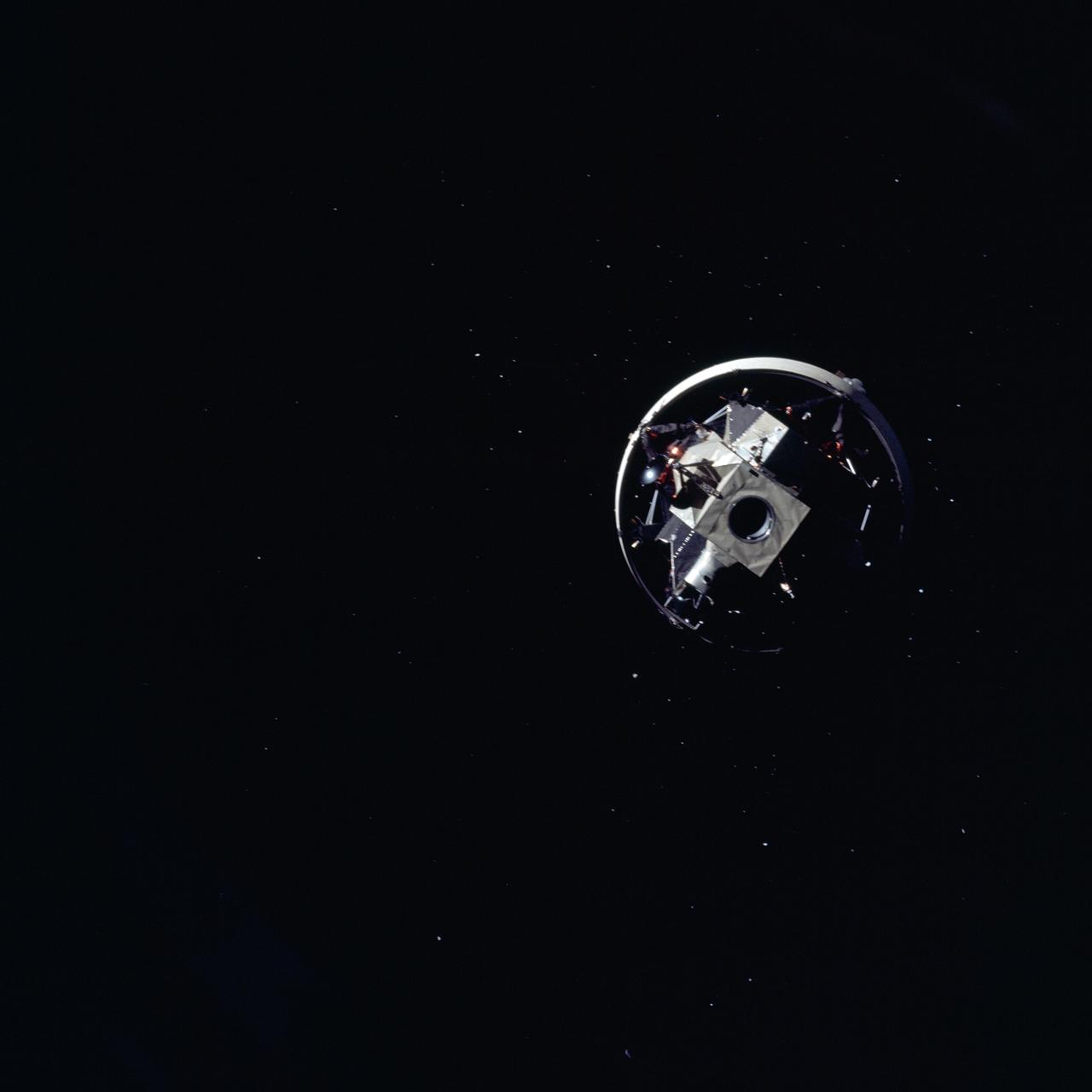
AS12-50-7328 (14 Nov. 1969) --- Apollo 12 Lunar Module (LM), still attached to the Saturn V third (S-IVB) stage, is pictured as seen from Apollo 12 Command and Service Modules (CSM) on the first day of the Apollo 12 lunar landing mission. This photograph was taken following CSM separation from LM/S-IVB and prior to Lunar Module extraction from the S-IVB stage. The Spacecraft Lunar Module Adapter (SLA) panels have already been jettisoned.
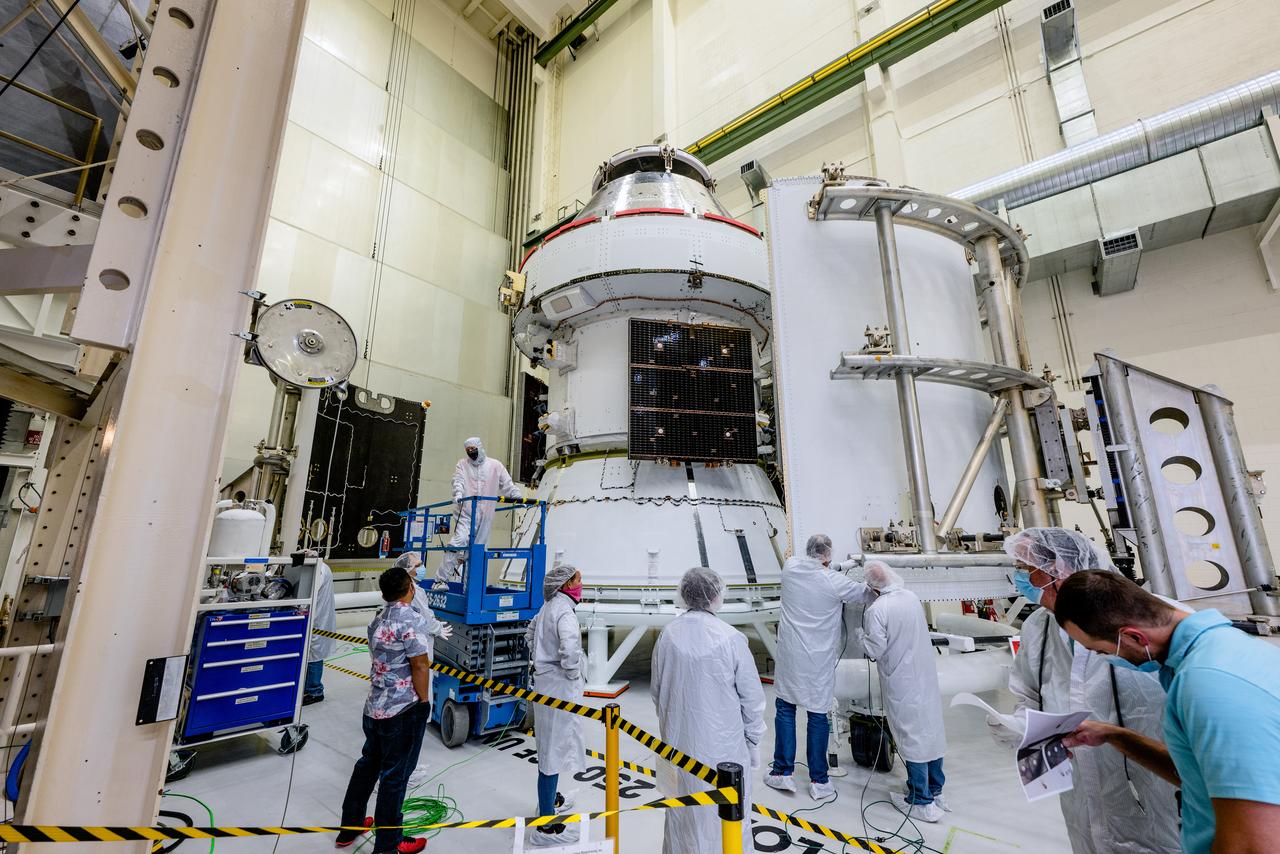
In the Operations and Checkout Building (O&C) at Kennedy Space Center, three spacecraft adapter jettison (SAJ) fairings are prepared for installation and will be moved into place by technicians with Lockheed Martin, lead contractor for Orion on Oct. 12, 2020. They will be secured around the spacecraft, encapsulating the European Service Module to protect it from the harsh environment as the spacecraft is propelled out of Earth’s atmosphere atop the Space Launch System (SLS) rocket during NASA’s Artemis I mission. The next time the solar array wings will be visible will be when Orion is in space. Artemis I will test the Orion spacecraft and SLS as an integrated system ahead of crewed flights to the Moon.
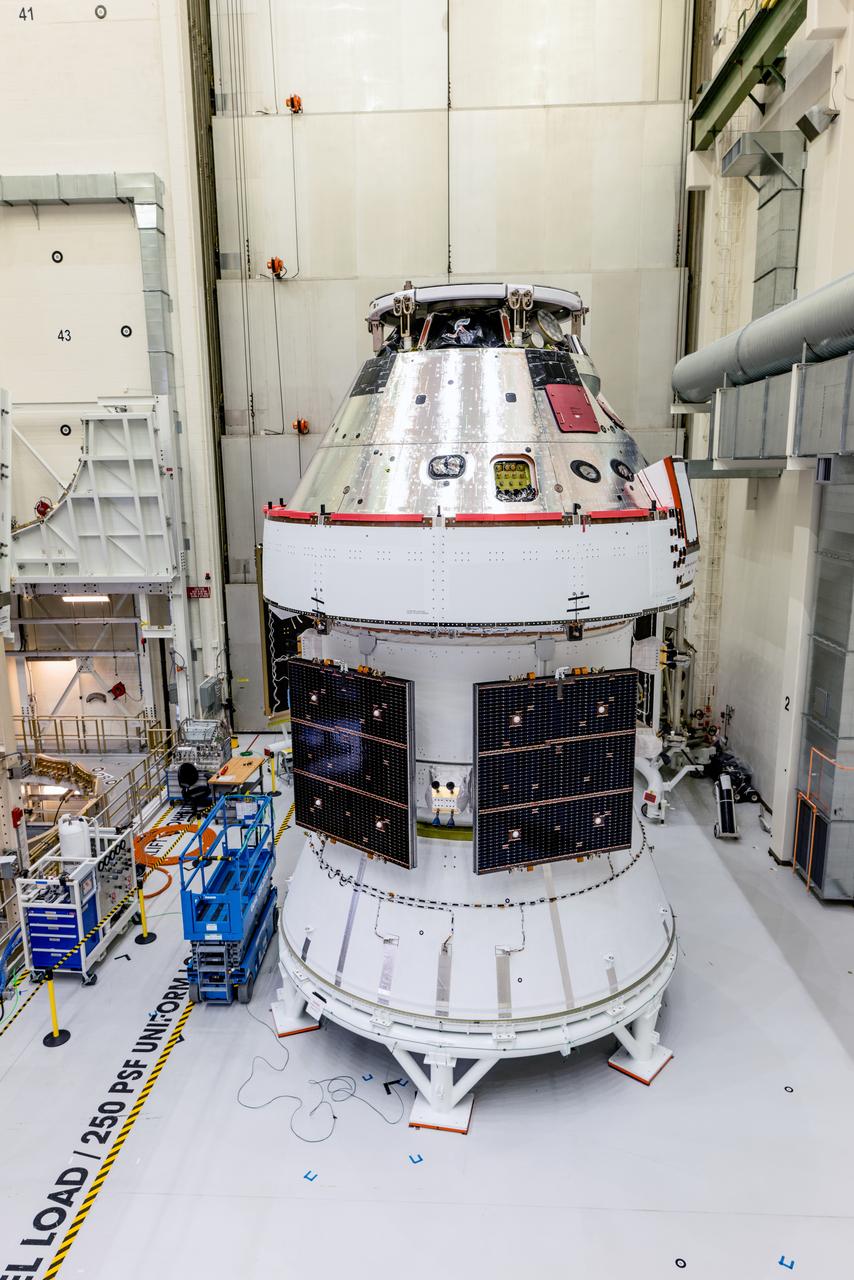
In the Operations and Checkout Building (O&C) at Kennedy Space Center, three spacecraft adapter jettison (SAJ) fairings are prepared for installation and will be moved into place by technicians with Lockheed Martin, lead contractor for Orion on Oct. 12, 2020. They will be secured around the spacecraft, encapsulating the European Service Module to protect it from the harsh environment as the spacecraft is propelled out of Earth’s atmosphere atop the Space Launch System (SLS) rocket during NASA’s Artemis I mission. The next time the solar array wings will be visible will be when Orion is in space. Artemis I will test the Orion spacecraft and SLS as an integrated system ahead of crewed flights to the Moon.
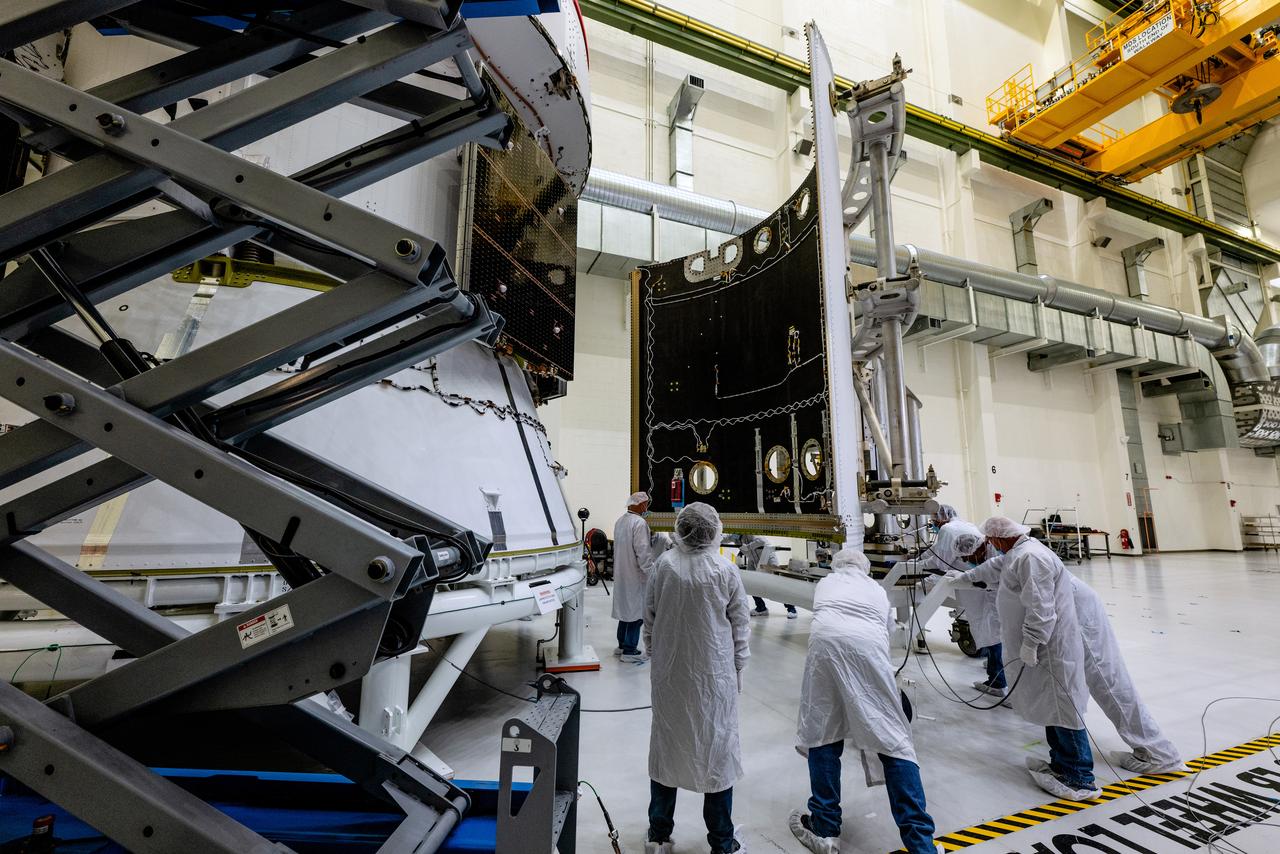
In the Operations and Checkout Building (O&C) at Kennedy Space Center, three spacecraft adapter jettison (SAJ) fairings are prepared for installation and will be moved into place by technicians with Lockheed Martin, lead contractor for Orion on Oct. 12, 2020. They will be secured around the spacecraft, encapsulating the European Service Module to protect it from the harsh environment as the spacecraft is propelled out of Earth’s atmosphere atop the Space Launch System (SLS) rocket during NASA’s Artemis I mission. The next time the solar array wings will be visible will be when Orion is in space. Artemis I will test the Orion spacecraft and SLS as an integrated system ahead of crewed flights to the Moon.
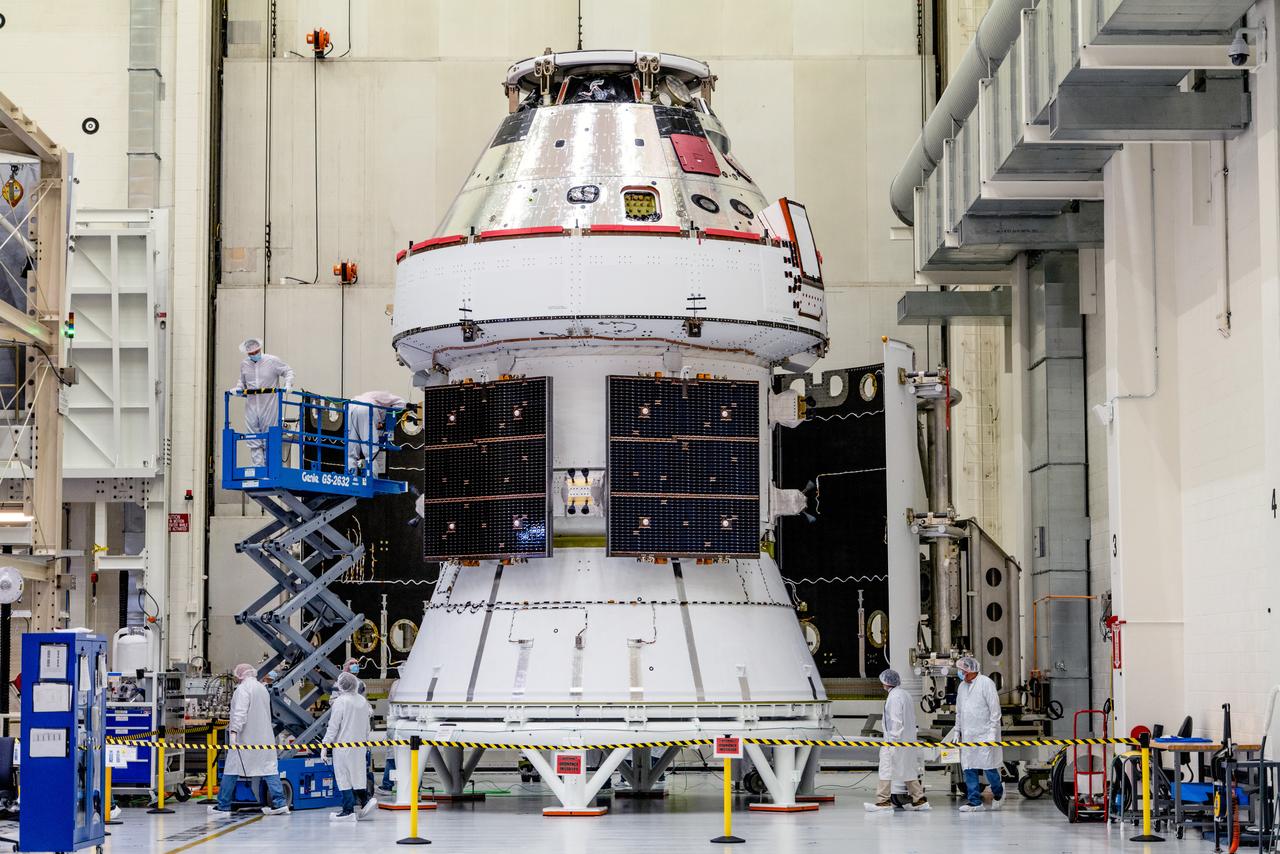
In the Operations and Checkout Building (O&C) at Kennedy Space Center, three spacecraft adapter jettison (SAJ) fairings are prepared for installation and will be moved into place by technicians with Lockheed Martin, lead contractor for Orion on Oct. 12, 2020. They will be secured around the spacecraft, encapsulating the European Service Module to protect it from the harsh environment as the spacecraft is propelled out of Earth’s atmosphere atop the Space Launch System (SLS) rocket during NASA’s Artemis I mission. The next time the solar array wings will be visible will be when Orion is in space. Artemis I will test the Orion spacecraft and SLS as an integrated system ahead of crewed flights to the Moon.
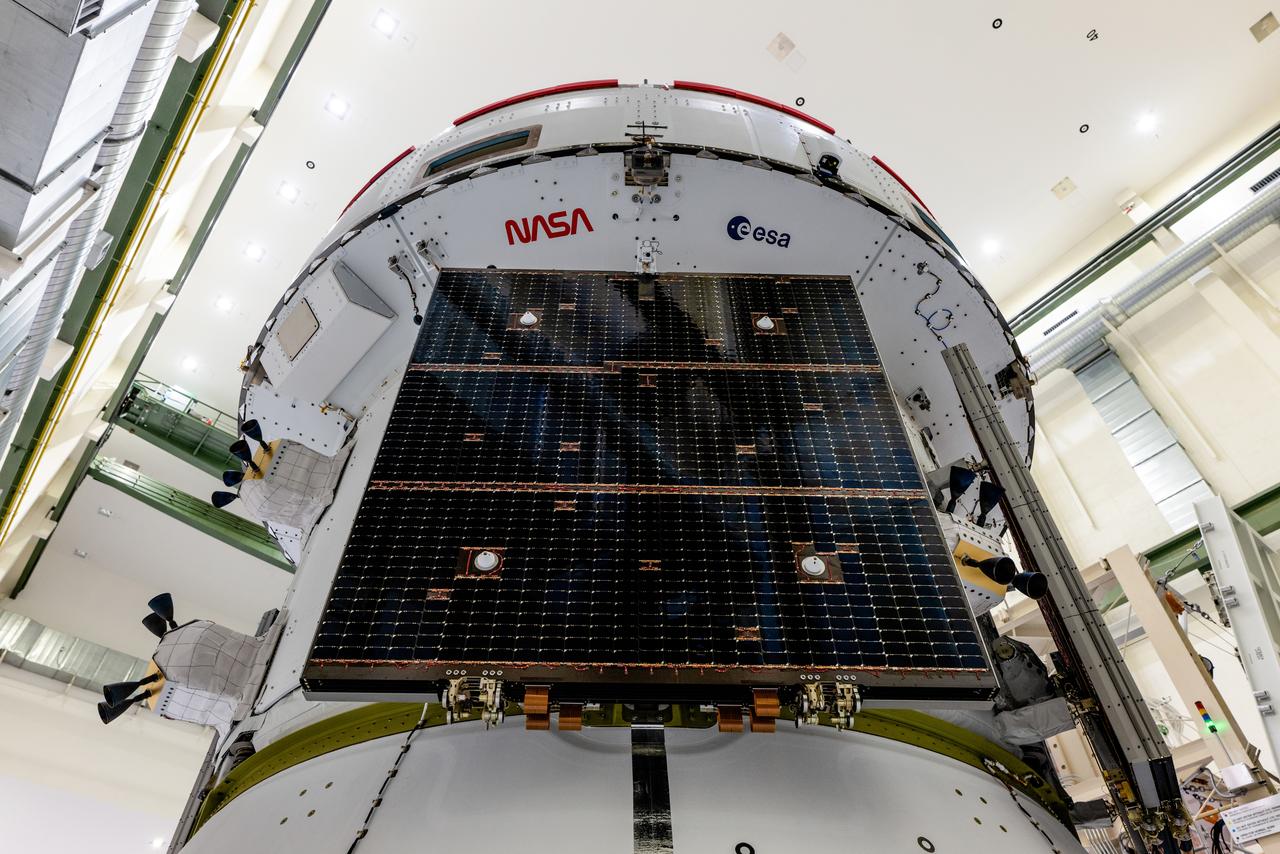
In the Operations and Checkout Building (O&C) at Kennedy Space Center, three spacecraft adapter jettison (SAJ) fairings are prepared for installation and will be moved into place by technicians with Lockheed Martin, lead contractor for Orion on Oct. 12, 2020. They will be secured around the spacecraft, encapsulating the European Service Module to protect it from the harsh environment as the spacecraft is propelled out of Earth’s atmosphere atop the Space Launch System (SLS) rocket during NASA’s Artemis I mission. The next time the solar array wings will be visible will be when Orion is in space. Artemis I will test the Orion spacecraft and SLS as an integrated system ahead of crewed flights to the Moon.
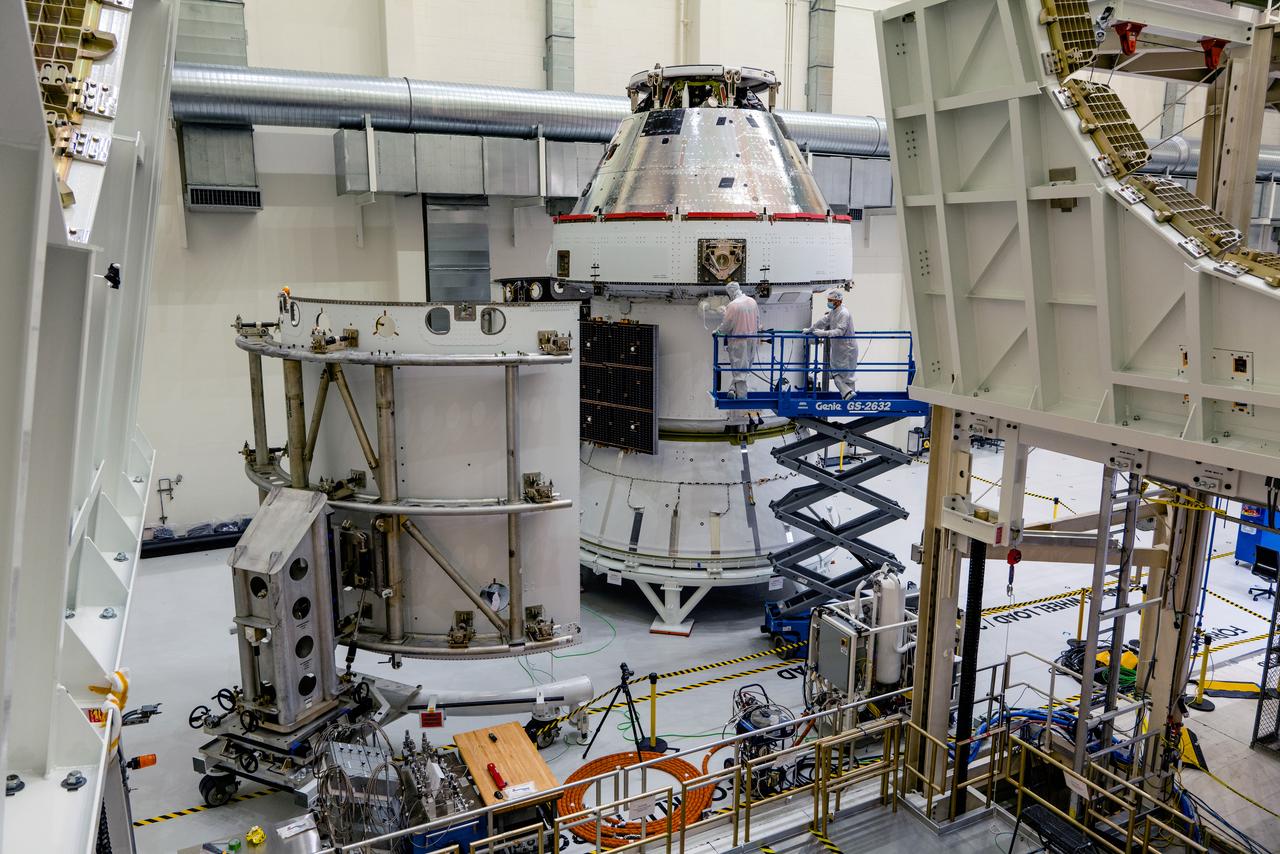
In the Operations and Checkout Building (O&C) at Kennedy Space Center, three spacecraft adapter jettison (SAJ) fairings are prepared for installation and will be moved into place by technicians with Lockheed Martin, lead contractor for Orion on Oct. 12, 2020. They will be secured around the spacecraft, encapsulating the European Service Module to protect it from the harsh environment as the spacecraft is propelled out of Earth’s atmosphere atop the Space Launch System (SLS) rocket during NASA’s Artemis I mission. The next time the solar array wings will be visible will be when Orion is in space. Artemis I will test the Orion spacecraft and SLS as an integrated system ahead of crewed flights to the Moon.
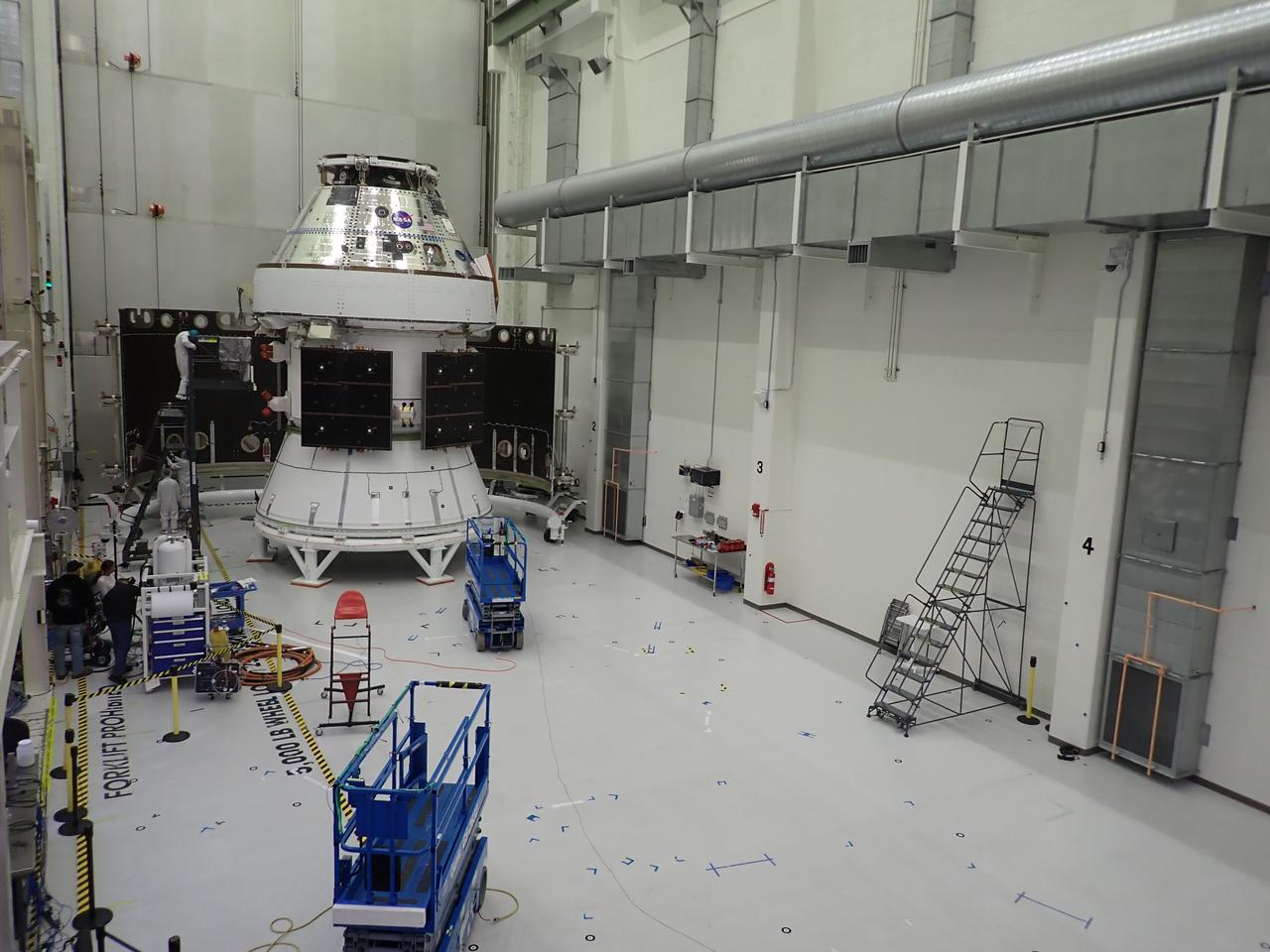
Technicians with Lockheed Martin prepare the Artemis II Orion spacecraft for the installation of three spacecraft adapter jettison fairings inside the Neil A. Armstrong Operations and Checkout Building at NASA’s Kennedy Space Center in Florida in on Tuesday, March 11, 2025. The fairings encapsulate the service module and protect the solar array wings, shielding them from the heat, wind, and acoustics of launch and ascent, plus help redistribute the load between Orion and the massive thrust of the SLS (Space Launch System) rocket during liftoff and ascent. Once the spacecraft is above the atmosphere, the three fairing panels will separate from the service module reducing the mass of the spacecraft.
In the Operations and Checkout Building (O&C) at Kennedy Space Center, three spacecraft adapter jettison (SAJ) fairings are prepared for installation and will be moved into place by technicians with Lockheed Martin, lead contractor for Orion on Oct. 12, 2020. They will be secured around the spacecraft, encapsulating the European Service Module to protect it from the harsh environment as the spacecraft is propelled out of Earth’s atmosphere atop the Space Launch System (SLS) rocket during NASA’s Artemis I mission. The next time the solar array wings will be visible will be when Orion is in space. Artemis I will test the Orion spacecraft and SLS as an integrated system ahead of crewed flights to the Moon.
In the Operations and Checkout Building (O&C) at Kennedy Space Center, three spacecraft adapter jettison (SAJ) fairings are prepared for installation and will be moved into place by technicians with Lockheed Martin, lead contractor for Orion on Oct. 12, 2020. They will be secured around the spacecraft, encapsulating the European Service Module to protect it from the harsh environment as the spacecraft is propelled out of Earth’s atmosphere atop the Space Launch System (SLS) rocket during NASA’s Artemis I mission. The next time the solar array wings will be visible will be when Orion is in space. Artemis I will test the Orion spacecraft and SLS as an integrated system ahead of crewed flights to the Moon.
In the Operations and Checkout Building (O&C) at Kennedy Space Center, three spacecraft adapter jettison (SAJ) fairings are prepared for installation and will be moved into place by technicians with Lockheed Martin, lead contractor for Orion on Oct. 12, 2020. They will be secured around the spacecraft, encapsulating the European Service Module to protect it from the harsh environment as the spacecraft is propelled out of Earth’s atmosphere atop the Space Launch System (SLS) rocket during NASA’s Artemis I mission. The next time the solar array wings will be visible will be when Orion is in space. Artemis I will test the Orion spacecraft and SLS as an integrated system ahead of crewed flights to the Moon.
In the Operations and Checkout Building (O&C) at Kennedy Space Center, three spacecraft adapter jettison (SAJ) fairings are prepared for installation and will be moved into place by technicians with Lockheed Martin, lead contractor for Orion on Oct. 12, 2020. They will be secured around the spacecraft, encapsulating the European Service Module to protect it from the harsh environment as the spacecraft is propelled out of Earth’s atmosphere atop the Space Launch System (SLS) rocket during NASA’s Artemis I mission. The next time the solar array wings will be visible will be when Orion is in space. Artemis I will test the Orion spacecraft and SLS as an integrated system ahead of crewed flights to the Moon.
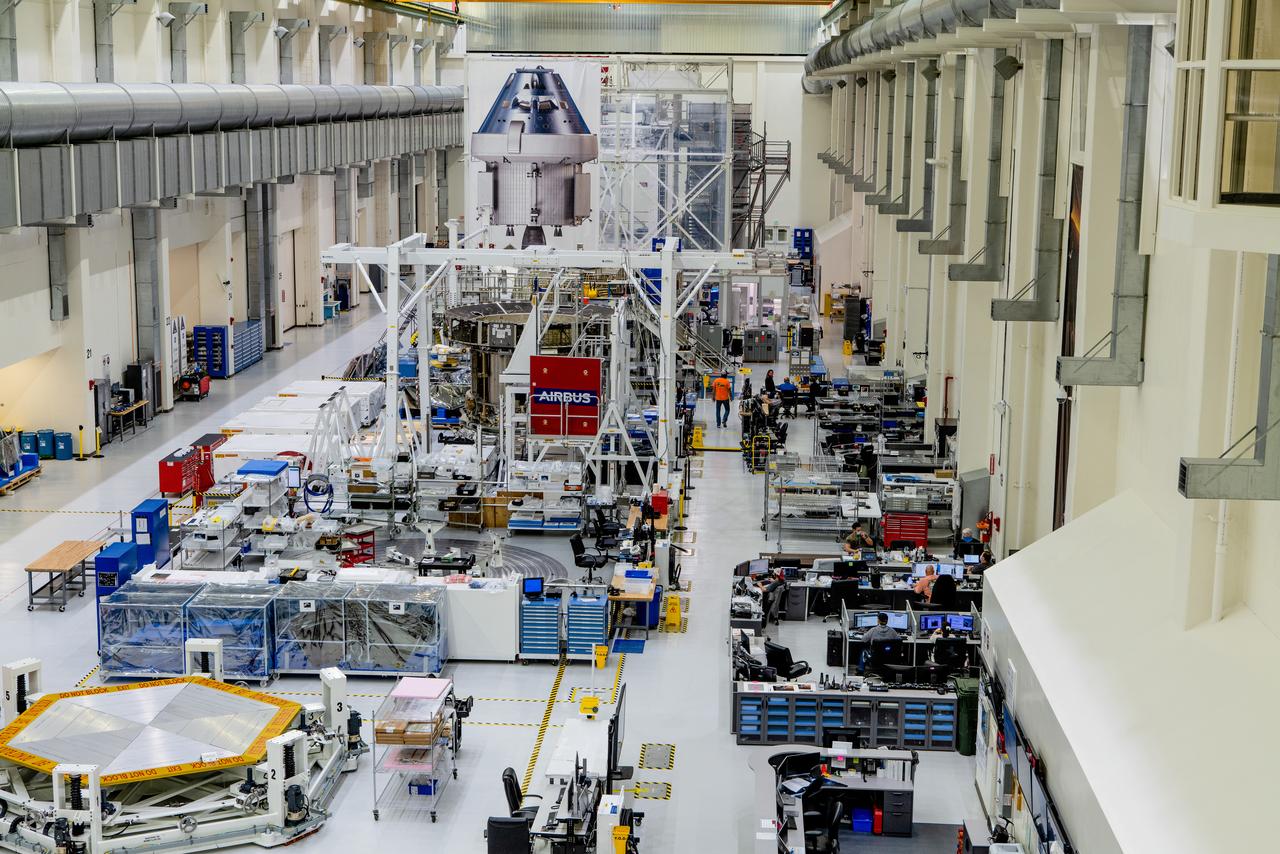
In the Operations and Checkout Building (O&C) at Kennedy Space Center, three spacecraft adapter jettison (SAJ) fairings are prepared for installation and will be moved into place by technicians with Lockheed Martin, lead contractor for Orion on Oct. 12, 2020. They will be secured around the spacecraft, encapsulating the European Service Module to protect it from the harsh environment as the spacecraft is propelled out of Earth’s atmosphere atop the Space Launch System (SLS) rocket during NASA’s Artemis I mission. The next time the solar array wings will be visible will be when Orion is in space. Artemis I will test the Orion spacecraft and SLS as an integrated system ahead of crewed flights to the Moon.
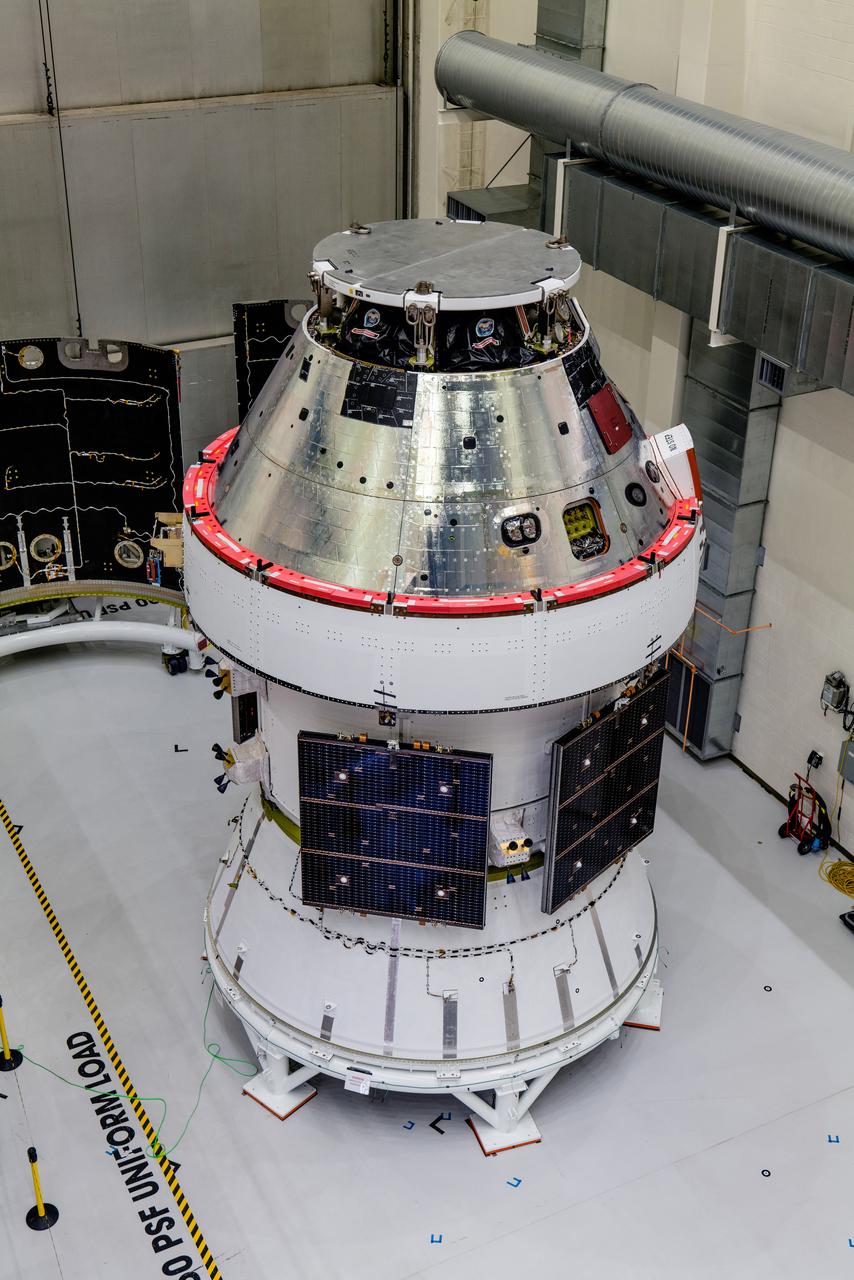
In the Operations and Checkout Building (O&C) at Kennedy Space Center, three spacecraft adapter jettison (SAJ) fairings are prepared for installation and will be moved into place by technicians with Lockheed Martin, lead contractor for Orion on Oct. 12, 2020. They will be secured around the spacecraft, encapsulating the European Service Module to protect it from the harsh environment as the spacecraft is propelled out of Earth’s atmosphere atop the Space Launch System (SLS) rocket during NASA’s Artemis I mission. The next time the solar array wings will be visible will be when Orion is in space. Artemis I will test the Orion spacecraft and SLS as an integrated system ahead of crewed flights to the Moon.
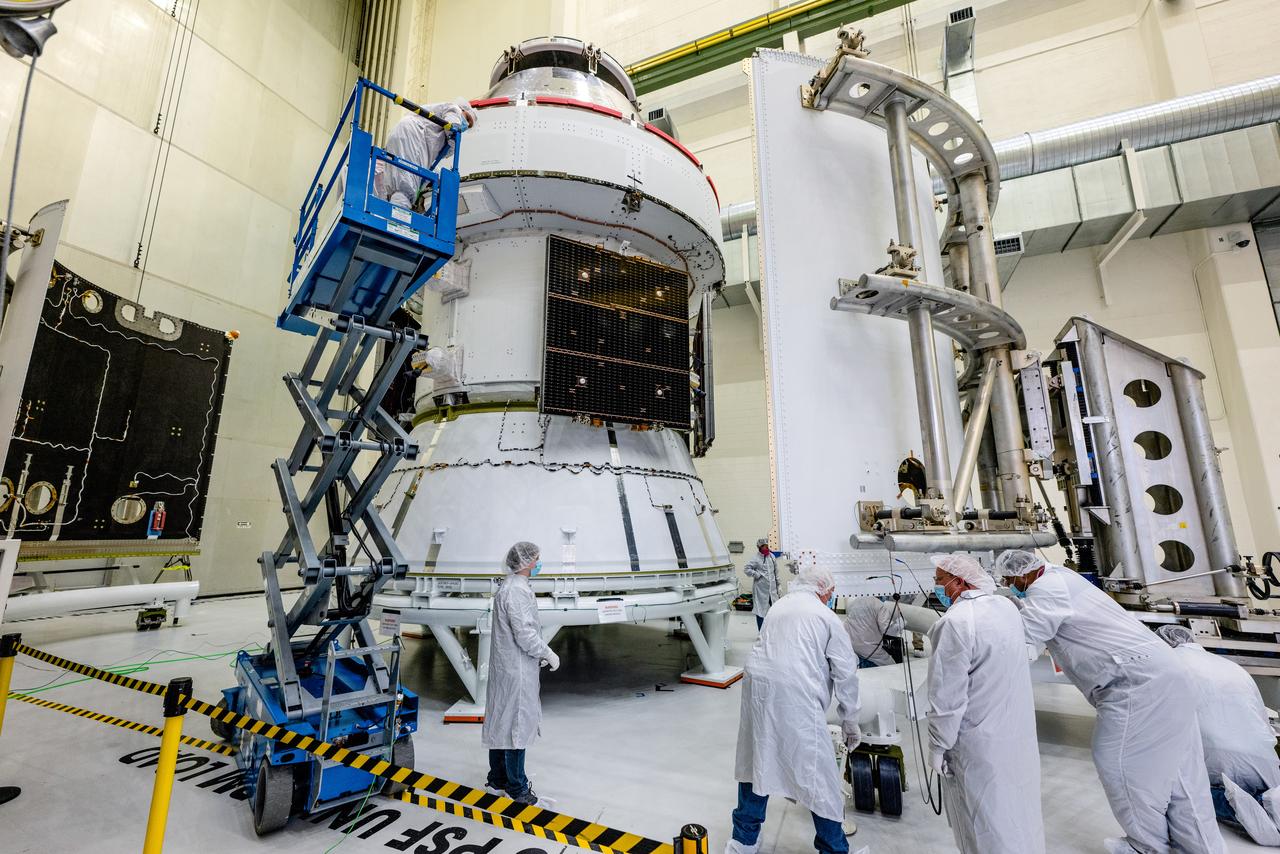
In the Operations and Checkout Building (O&C) at Kennedy Space Center, three spacecraft adapter jettison (SAJ) fairings are prepared for installation and will be moved into place by technicians with Lockheed Martin, lead contractor for Orion on Oct. 12, 2020. They will be secured around the spacecraft, encapsulating the European Service Module to protect it from the harsh environment as the spacecraft is propelled out of Earth’s atmosphere atop the Space Launch System (SLS) rocket during NASA’s Artemis I mission. The next time the solar array wings will be visible will be when Orion is in space. Artemis I will test the Orion spacecraft and SLS as an integrated system ahead of crewed flights to the Moon.
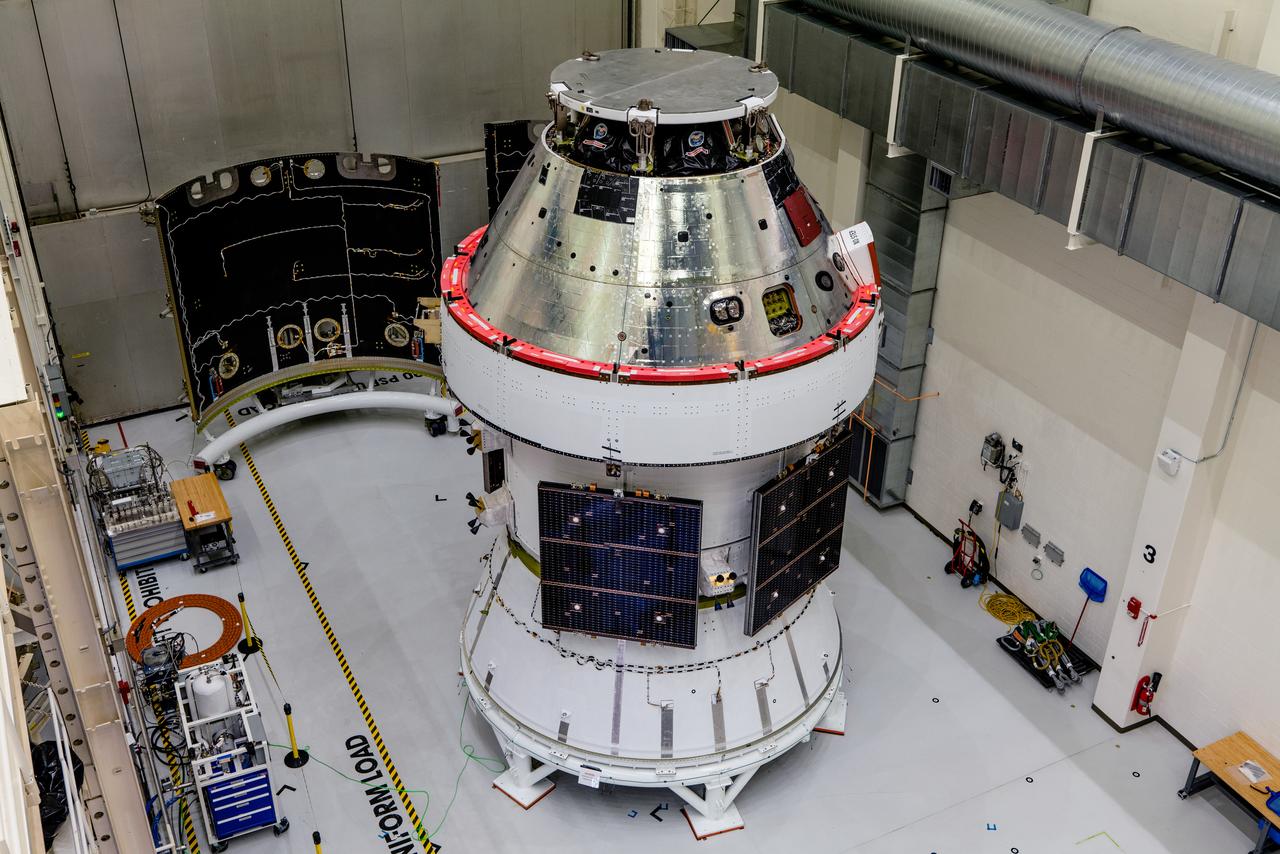
In the Operations and Checkout Building (O&C) at Kennedy Space Center, three spacecraft adapter jettison (SAJ) fairings are prepared for installation and will be moved into place by technicians with Lockheed Martin, lead contractor for Orion on Oct. 12, 2020. They will be secured around the spacecraft, encapsulating the European Service Module to protect it from the harsh environment as the spacecraft is propelled out of Earth’s atmosphere atop the Space Launch System (SLS) rocket during NASA’s Artemis I mission. The next time the solar array wings will be visible will be when Orion is in space. Artemis I will test the Orion spacecraft and SLS as an integrated system ahead of crewed flights to the Moon.
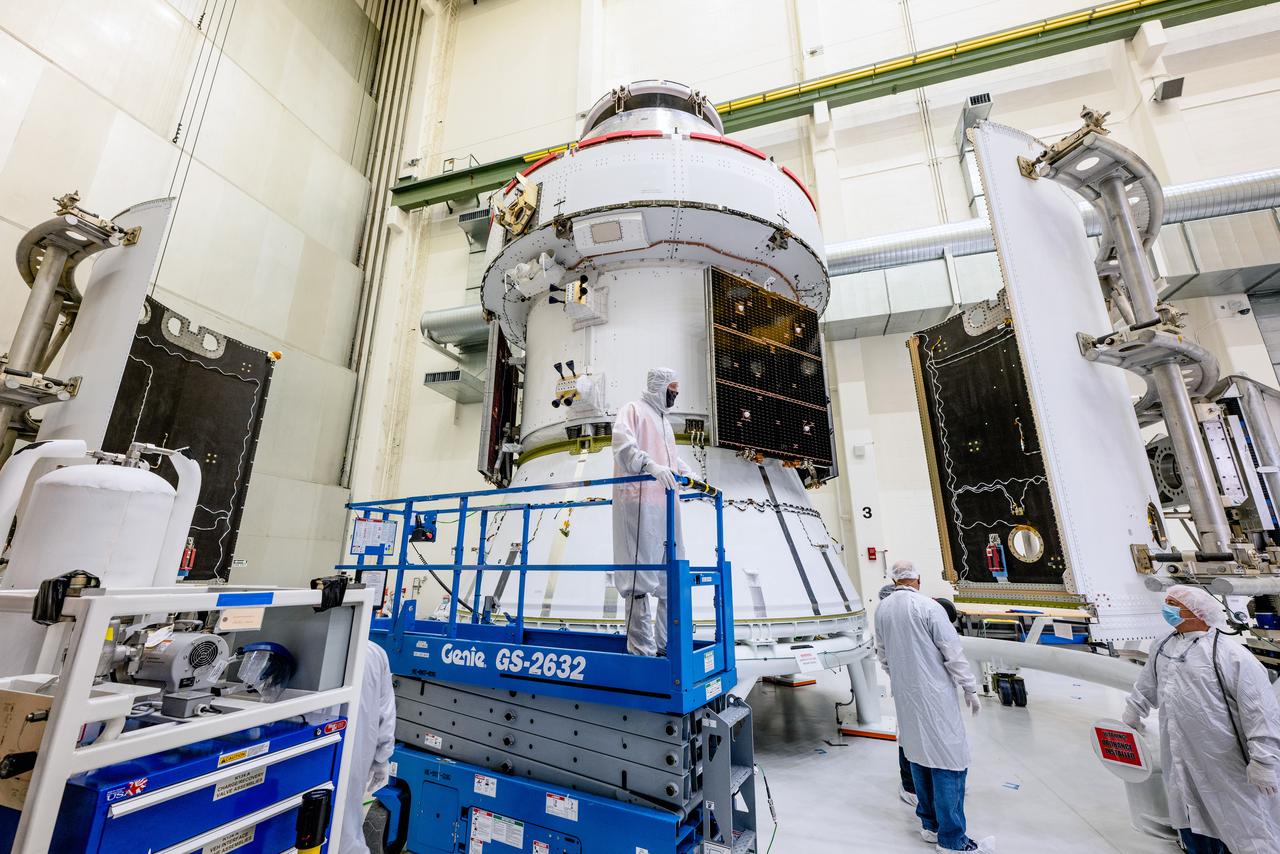
In the Operations and Checkout Building (O&C) at Kennedy Space Center, three spacecraft adapter jettison (SAJ) fairings are prepared for installation and will be moved into place by technicians with Lockheed Martin, lead contractor for Orion on Oct. 12, 2020. They will be secured around the spacecraft, encapsulating the European Service Module to protect it from the harsh environment as the spacecraft is propelled out of Earth’s atmosphere atop the Space Launch System (SLS) rocket during NASA’s Artemis I mission. The next time the solar array wings will be visible will be when Orion is in space. Artemis I will test the Orion spacecraft and SLS as an integrated system ahead of crewed flights to the Moon.
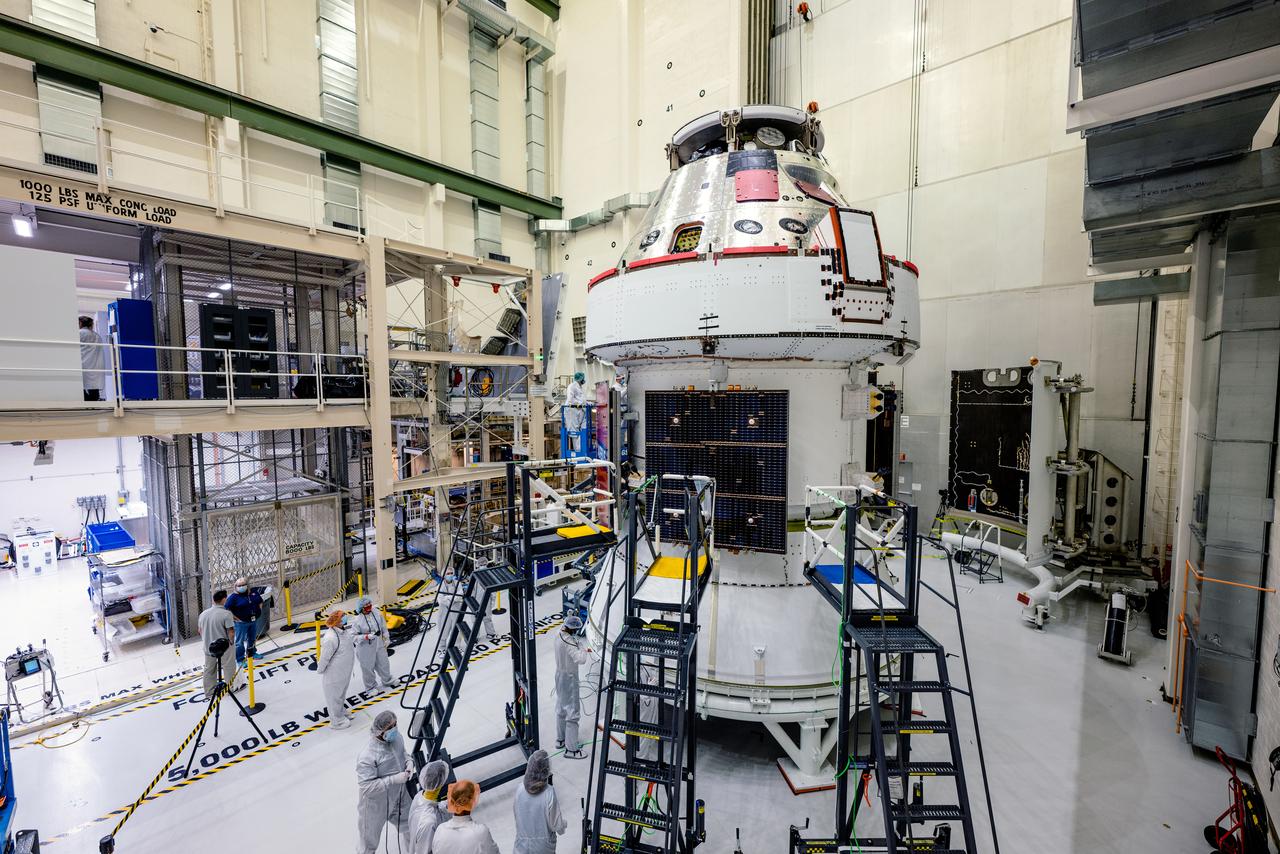
In the Operations and Checkout Building (O&C) at Kennedy Space Center, three spacecraft adapter jettison (SAJ) fairings are prepared for installation and will be moved into place by technicians with Lockheed Martin, lead contractor for Orion on Oct. 12, 2020. They will be secured around the spacecraft, encapsulating the European Service Module to protect it from the harsh environment as the spacecraft is propelled out of Earth’s atmosphere atop the Space Launch System (SLS) rocket during NASA’s Artemis I mission. The next time the solar array wings will be visible will be when Orion is in space. Artemis I will test the Orion spacecraft and SLS as an integrated system ahead of crewed flights to the Moon.
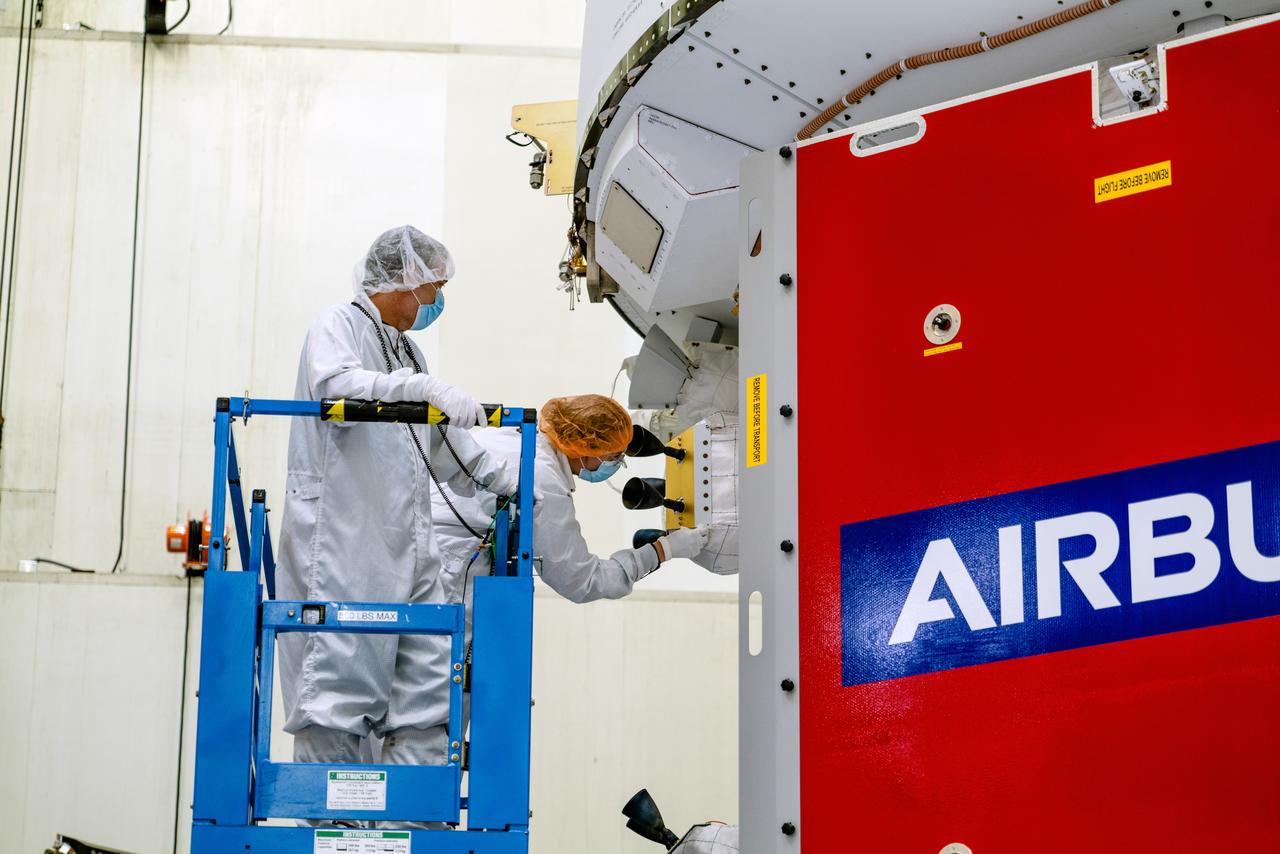
In the Operations and Checkout Building (O&C) at Kennedy Space Center, three spacecraft adapter jettison (SAJ) fairings are prepared for installation and will be moved into place by technicians with Lockheed Martin, lead contractor for Orion on Oct. 12, 2020. They will be secured around the spacecraft, encapsulating the European Service Module to protect it from the harsh environment as the spacecraft is propelled out of Earth’s atmosphere atop the Space Launch System (SLS) rocket during NASA’s Artemis I mission. The next time the solar array wings will be visible will be when Orion is in space. Artemis I will test the Orion spacecraft and SLS as an integrated system ahead of crewed flights to the Moon.
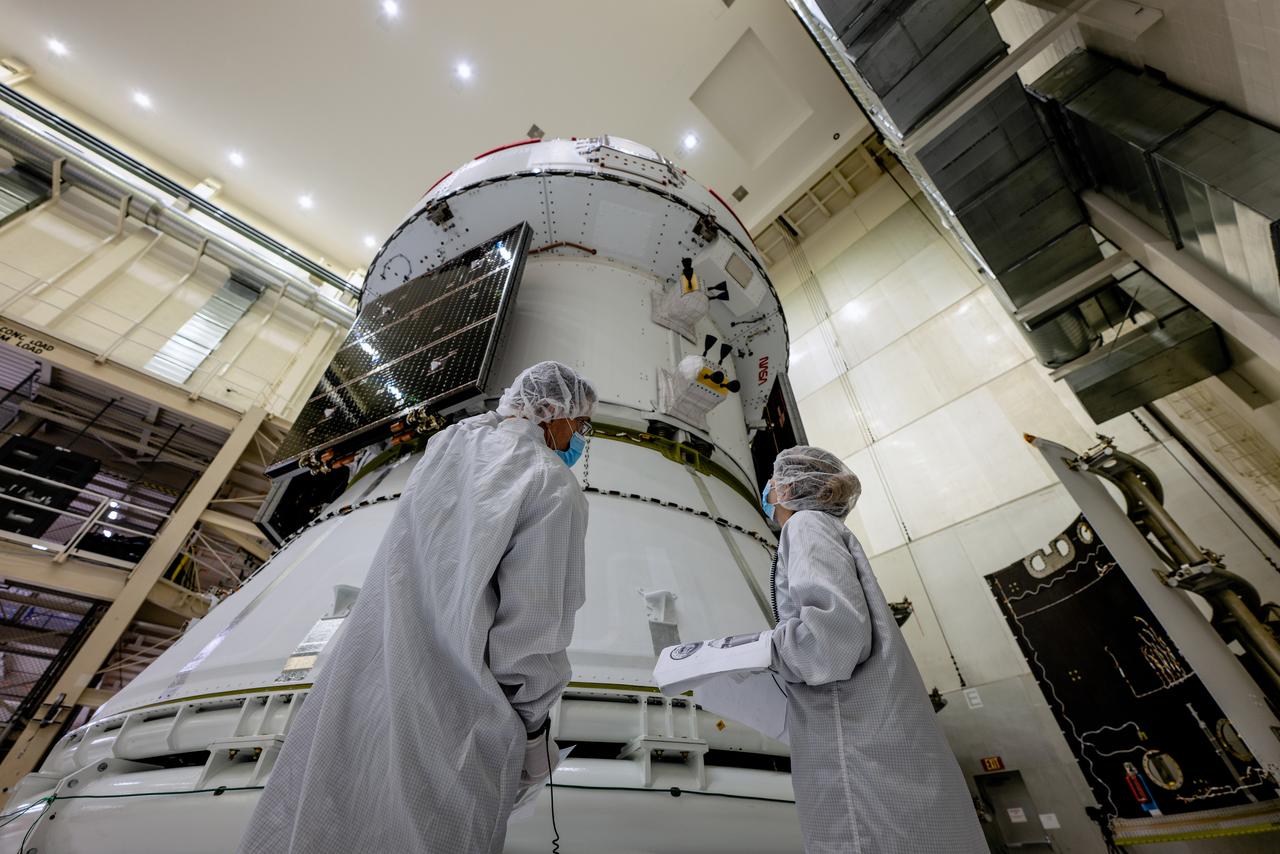
In the Operations and Checkout Building (O&C) at Kennedy Space Center, three spacecraft adapter jettison (SAJ) fairings are prepared for installation and will be moved into place by technicians with Lockheed Martin, lead contractor for Orion on Oct. 12, 2020. They will be secured around the spacecraft, encapsulating the European Service Module to protect it from the harsh environment as the spacecraft is propelled out of Earth’s atmosphere atop the Space Launch System (SLS) rocket during NASA’s Artemis I mission. The next time the solar array wings will be visible will be when Orion is in space. Artemis I will test the Orion spacecraft and SLS as an integrated system ahead of crewed flights to the Moon.
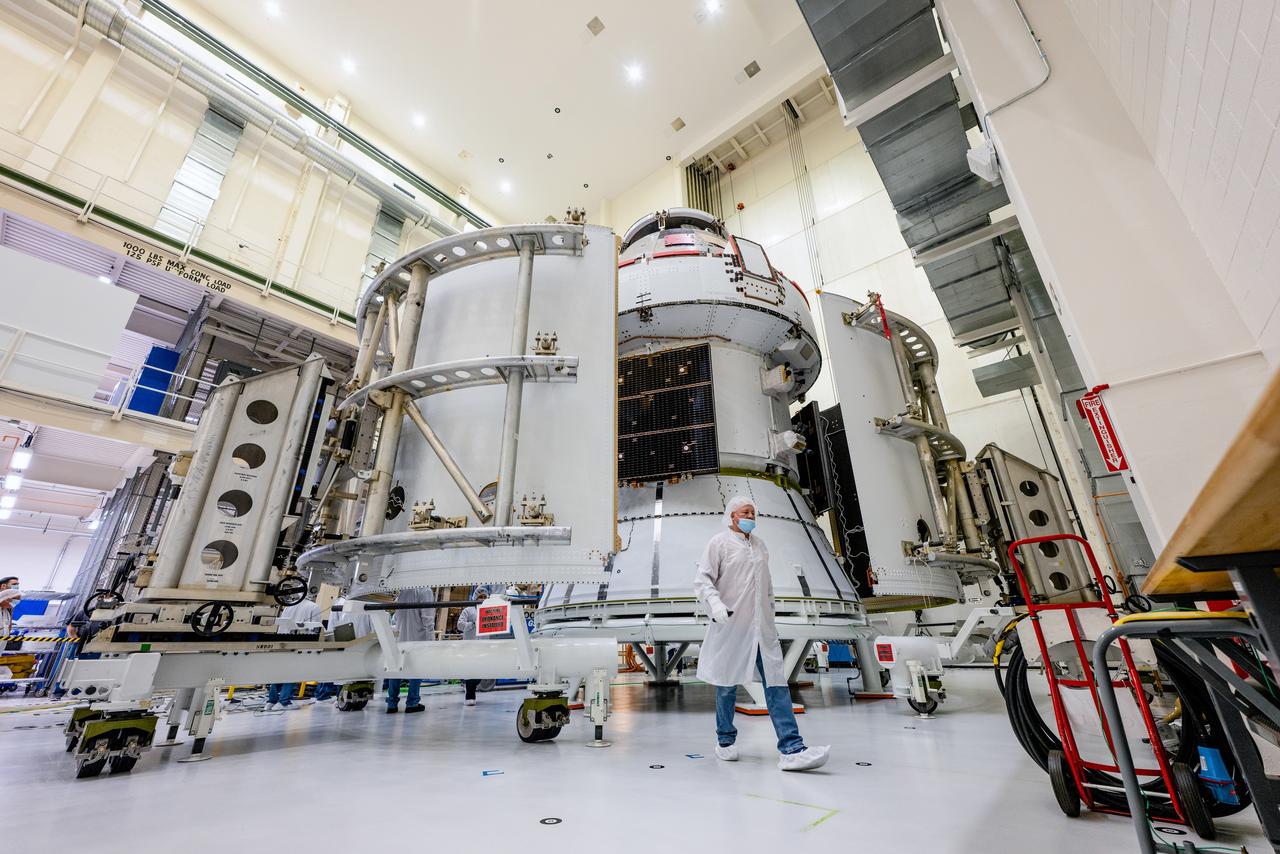
In the Operations and Checkout Building (O&C) at Kennedy Space Center, three spacecraft adapter jettison (SAJ) fairings are prepared for installation and will be moved into place by technicians with Lockheed Martin, lead contractor for Orion on Oct. 12, 2020. They will be secured around the spacecraft, encapsulating the European Service Module to protect it from the harsh environment as the spacecraft is propelled out of Earth’s atmosphere atop the Space Launch System (SLS) rocket during NASA’s Artemis I mission. The next time the solar array wings will be visible will be when Orion is in space. Artemis I will test the Orion spacecraft and SLS as an integrated system ahead of crewed flights to the Moon.
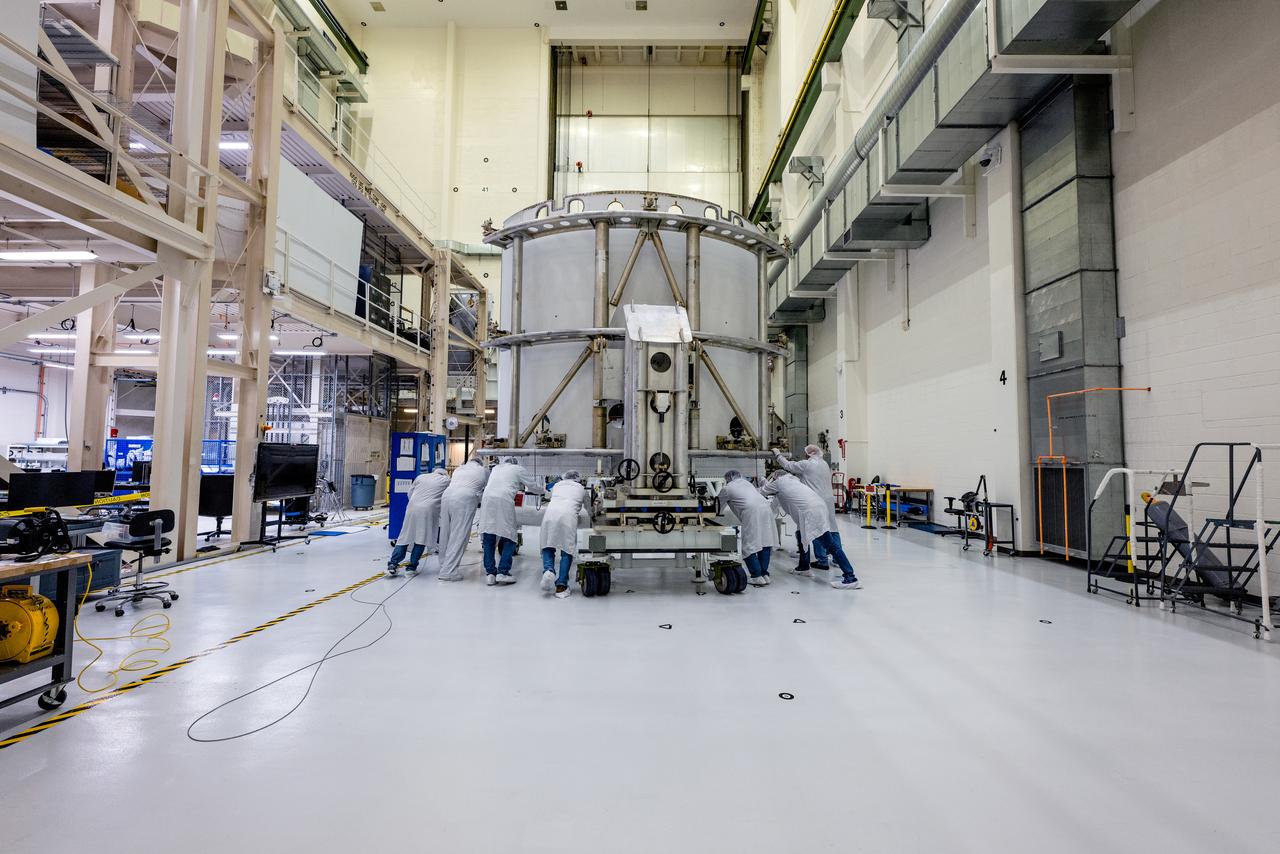
In the Operations and Checkout Building (O&C) at Kennedy Space Center, three spacecraft adapter jettison (SAJ) fairings are prepared for installation and will be moved into place by technicians with Lockheed Martin, lead contractor for Orion on Oct. 12, 2020. They will be secured around the spacecraft, encapsulating the European Service Module to protect it from the harsh environment as the spacecraft is propelled out of Earth’s atmosphere atop the Space Launch System (SLS) rocket during NASA’s Artemis I mission. The next time the solar array wings will be visible will be when Orion is in space. Artemis I will test the Orion spacecraft and SLS as an integrated system ahead of crewed flights to the Moon.
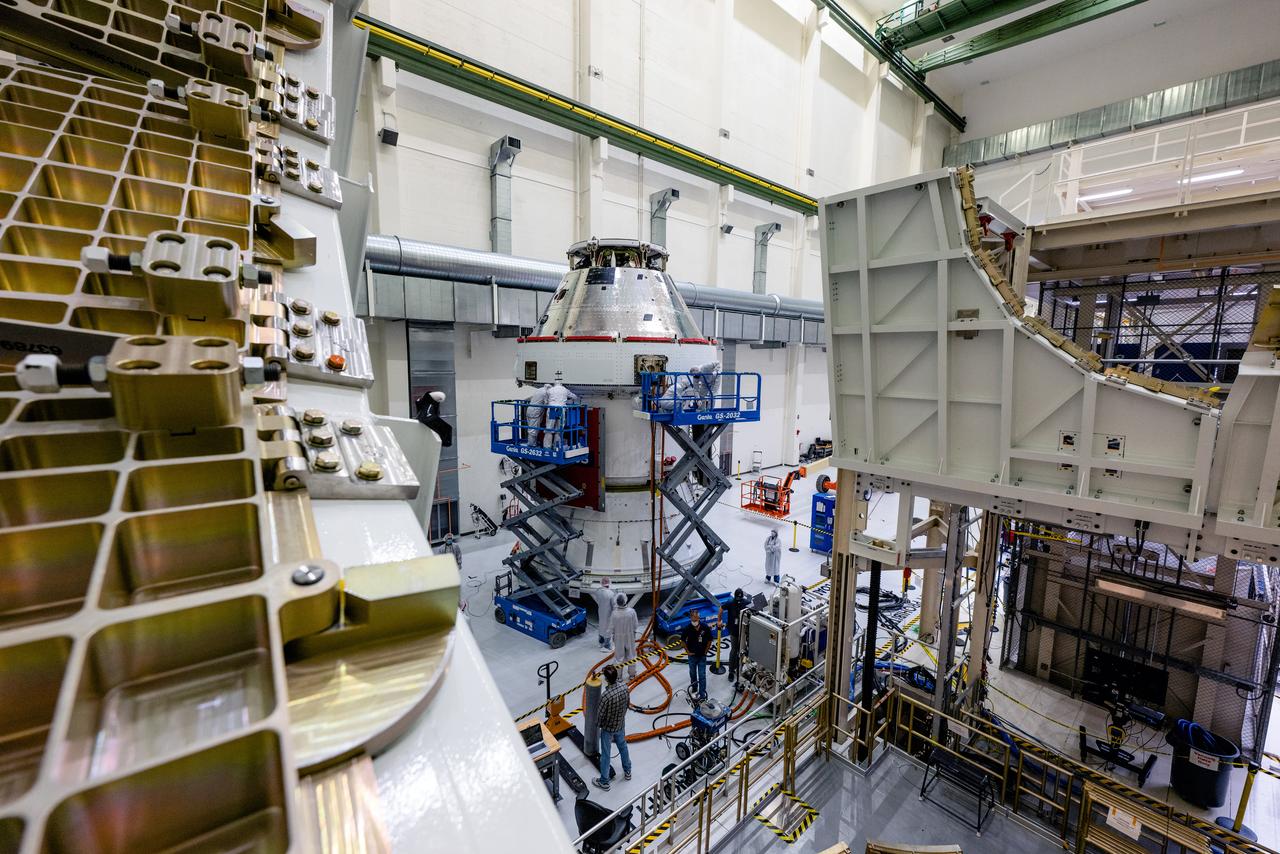
In the Operations and Checkout Building (O&C) at Kennedy Space Center, three spacecraft adapter jettison (SAJ) fairings are prepared for installation and will be moved into place by technicians with Lockheed Martin, lead contractor for Orion on Oct. 12, 2020. They will be secured around the spacecraft, encapsulating the European Service Module to protect it from the harsh environment as the spacecraft is propelled out of Earth’s atmosphere atop the Space Launch System (SLS) rocket during NASA’s Artemis I mission. The next time the solar array wings will be visible will be when Orion is in space. Artemis I will test the Orion spacecraft and SLS as an integrated system ahead of crewed flights to the Moon.
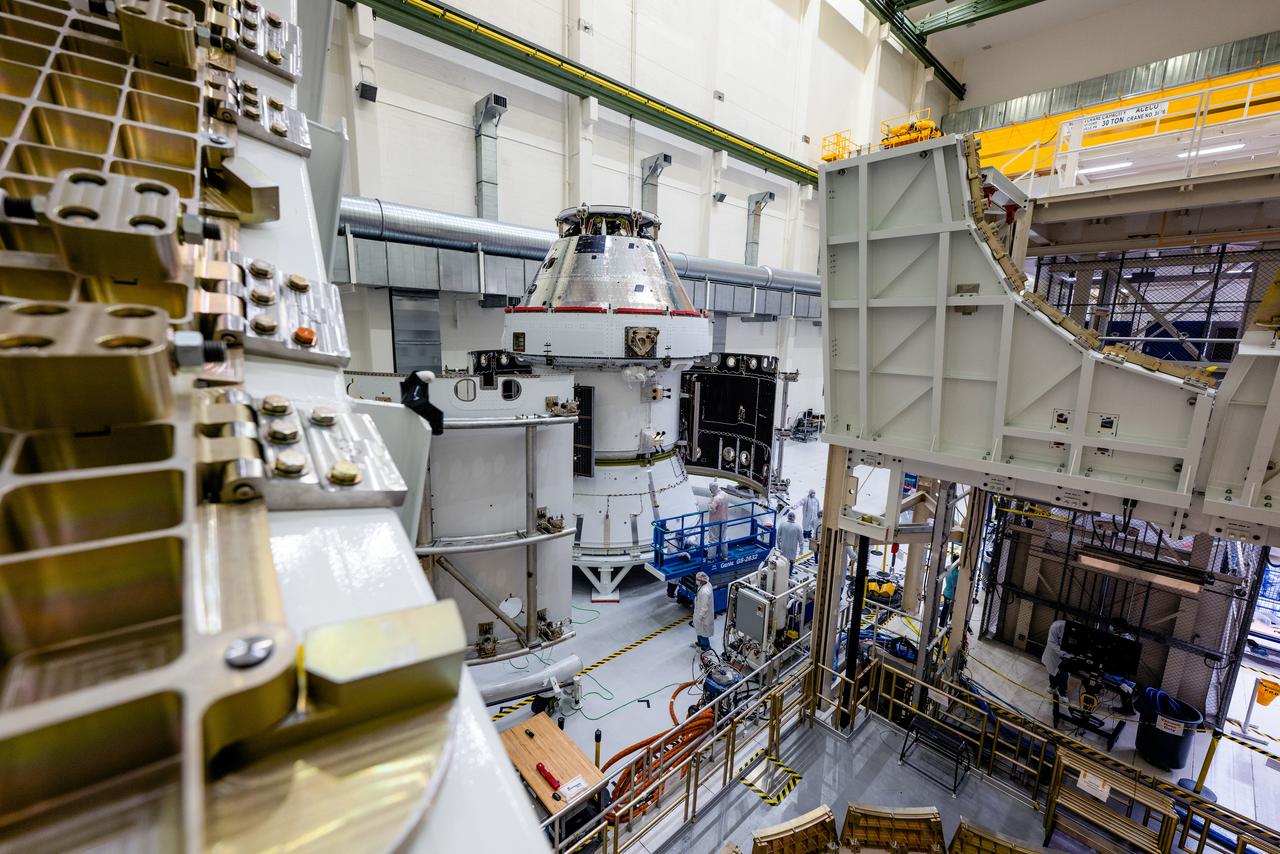
In the Operations and Checkout Building (O&C) at Kennedy Space Center, three spacecraft adapter jettison (SAJ) fairings are prepared for installation and will be moved into place by technicians with Lockheed Martin, lead contractor for Orion on Oct. 12, 2020. They will be secured around the spacecraft, encapsulating the European Service Module to protect it from the harsh environment as the spacecraft is propelled out of Earth’s atmosphere atop the Space Launch System (SLS) rocket during NASA’s Artemis I mission. The next time the solar array wings will be visible will be when Orion is in space. Artemis I will test the Orion spacecraft and SLS as an integrated system ahead of crewed flights to the Moon.
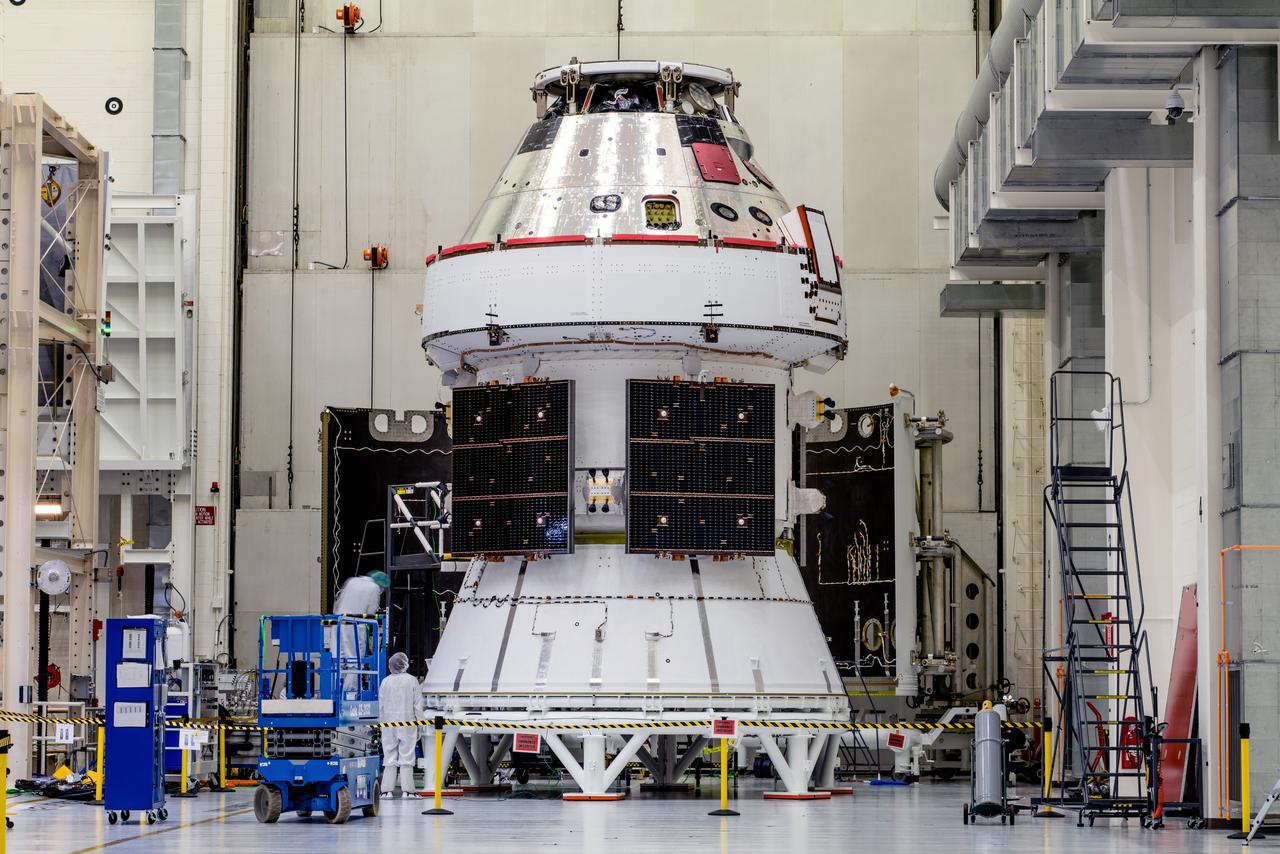
In the Operations and Checkout Building (O&C) at Kennedy Space Center, three spacecraft adapter jettison (SAJ) fairings are prepared for installation and will be moved into place by technicians with Lockheed Martin, lead contractor for Orion on Oct. 12, 2020. They will be secured around the spacecraft, encapsulating the European Service Module to protect it from the harsh environment as the spacecraft is propelled out of Earth’s atmosphere atop the Space Launch System (SLS) rocket during NASA’s Artemis I mission. The next time the solar array wings will be visible will be when Orion is in space. Artemis I will test the Orion spacecraft and SLS as an integrated system ahead of crewed flights to the Moon.
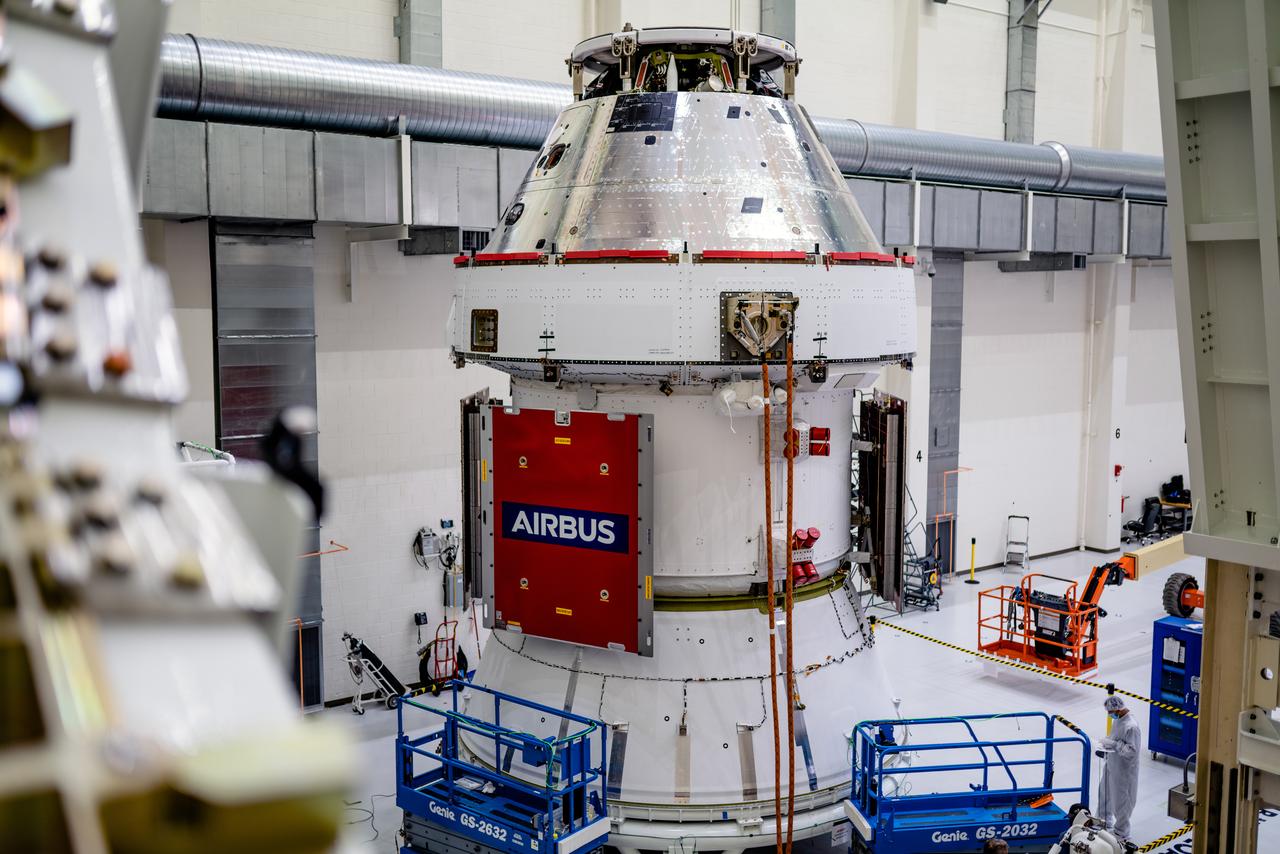
In the Operations and Checkout Building (O&C) at Kennedy Space Center, three spacecraft adapter jettison (SAJ) fairings are prepared for installation and will be moved into place by technicians with Lockheed Martin, lead contractor for Orion on Oct. 12, 2020. They will be secured around the spacecraft, encapsulating the European Service Module to protect it from the harsh environment as the spacecraft is propelled out of Earth’s atmosphere atop the Space Launch System (SLS) rocket during NASA’s Artemis I mission. The next time the solar array wings will be visible will be when Orion is in space. Artemis I will test the Orion spacecraft and SLS as an integrated system ahead of crewed flights to the Moon.
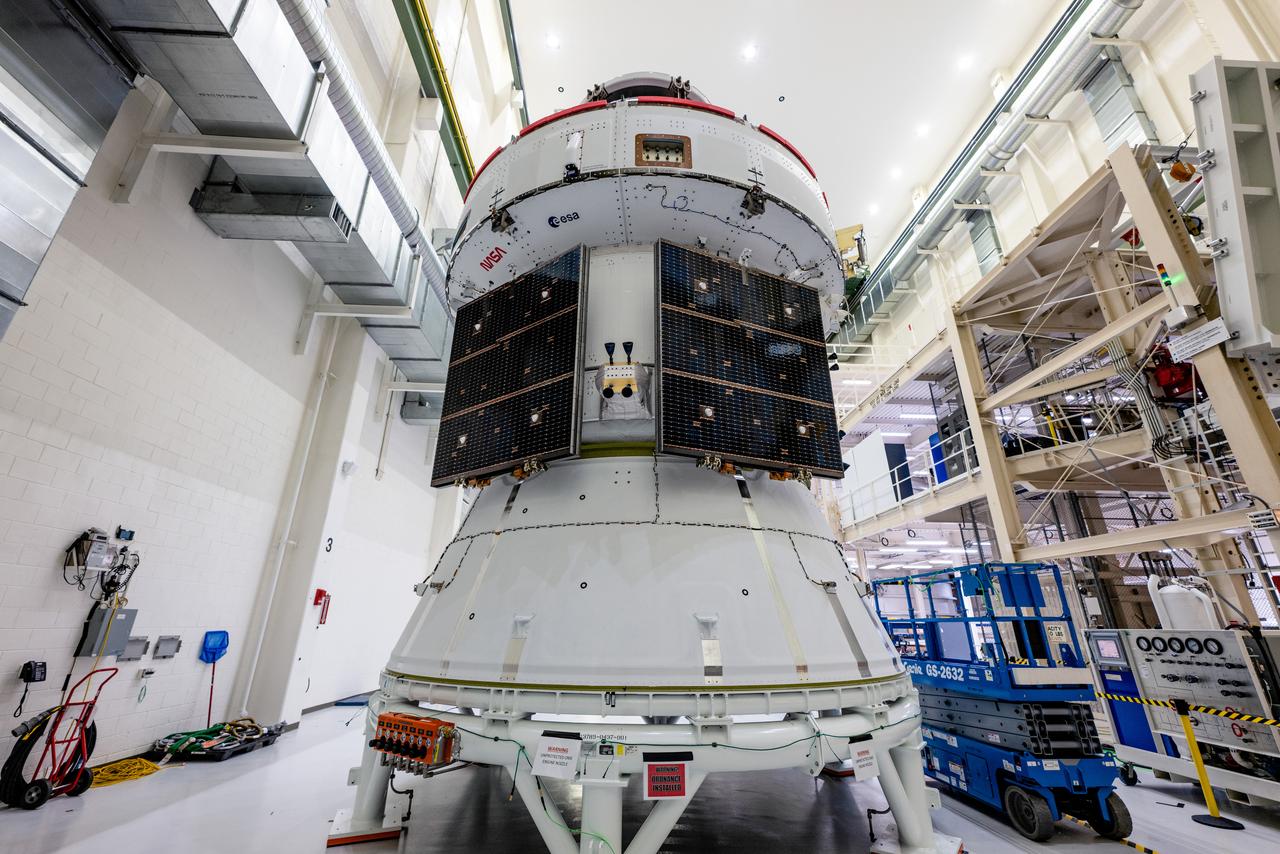
In the Operations and Checkout Building (O&C) at Kennedy Space Center, three spacecraft adapter jettison (SAJ) fairings are prepared for installation and will be moved into place by technicians with Lockheed Martin, lead contractor for Orion on Oct. 12, 2020. They will be secured around the spacecraft, encapsulating the European Service Module to protect it from the harsh environment as the spacecraft is propelled out of Earth’s atmosphere atop the Space Launch System (SLS) rocket during NASA’s Artemis I mission. The next time the solar array wings will be visible will be when Orion is in space. Artemis I will test the Orion spacecraft and SLS as an integrated system ahead of crewed flights to the Moon.
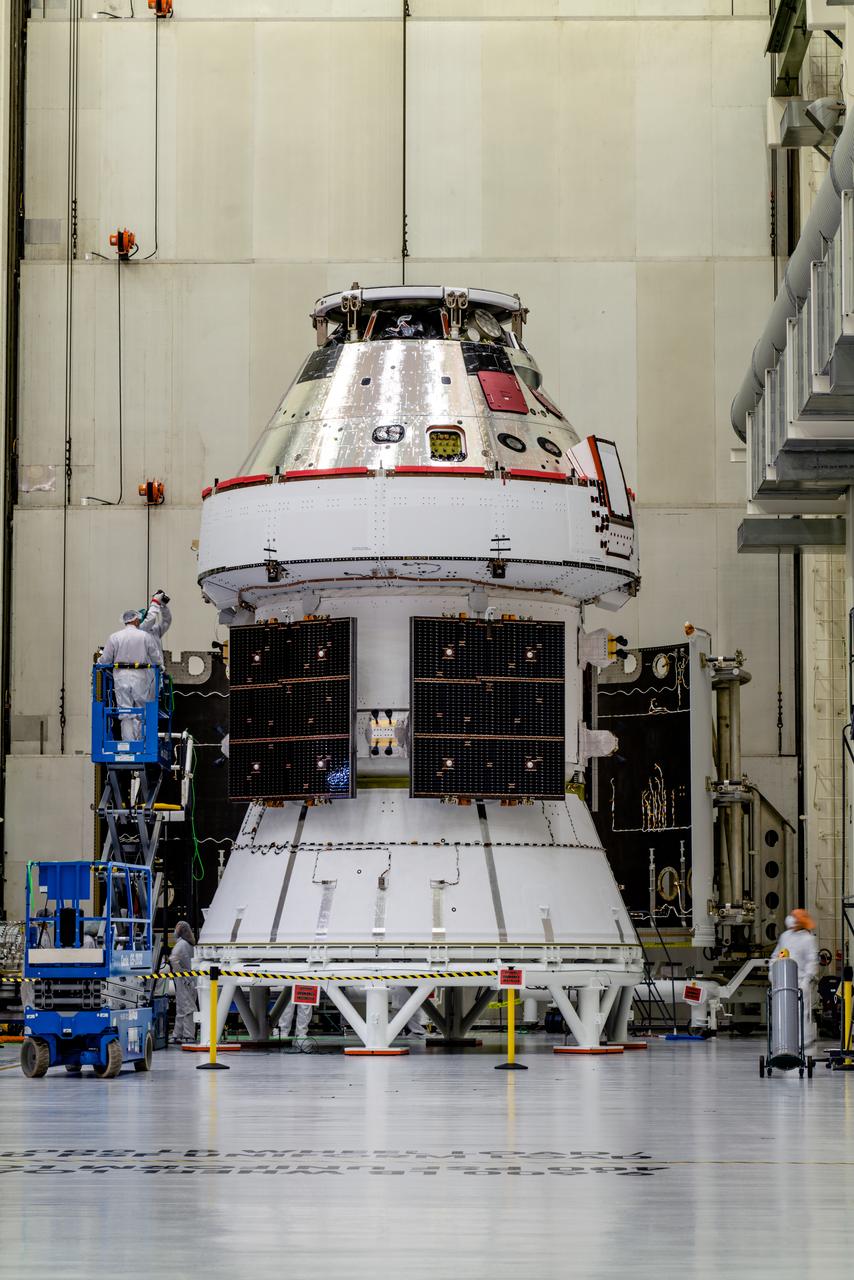
In the Operations and Checkout Building (O&C) at Kennedy Space Center, three spacecraft adapter jettison (SAJ) fairings are prepared for installation and will be moved into place by technicians with Lockheed Martin, lead contractor for Orion on Oct. 12, 2020. They will be secured around the spacecraft, encapsulating the European Service Module to protect it from the harsh environment as the spacecraft is propelled out of Earth’s atmosphere atop the Space Launch System (SLS) rocket during NASA’s Artemis I mission. The next time the solar array wings will be visible will be when Orion is in space. Artemis I will test the Orion spacecraft and SLS as an integrated system ahead of crewed flights to the Moon.
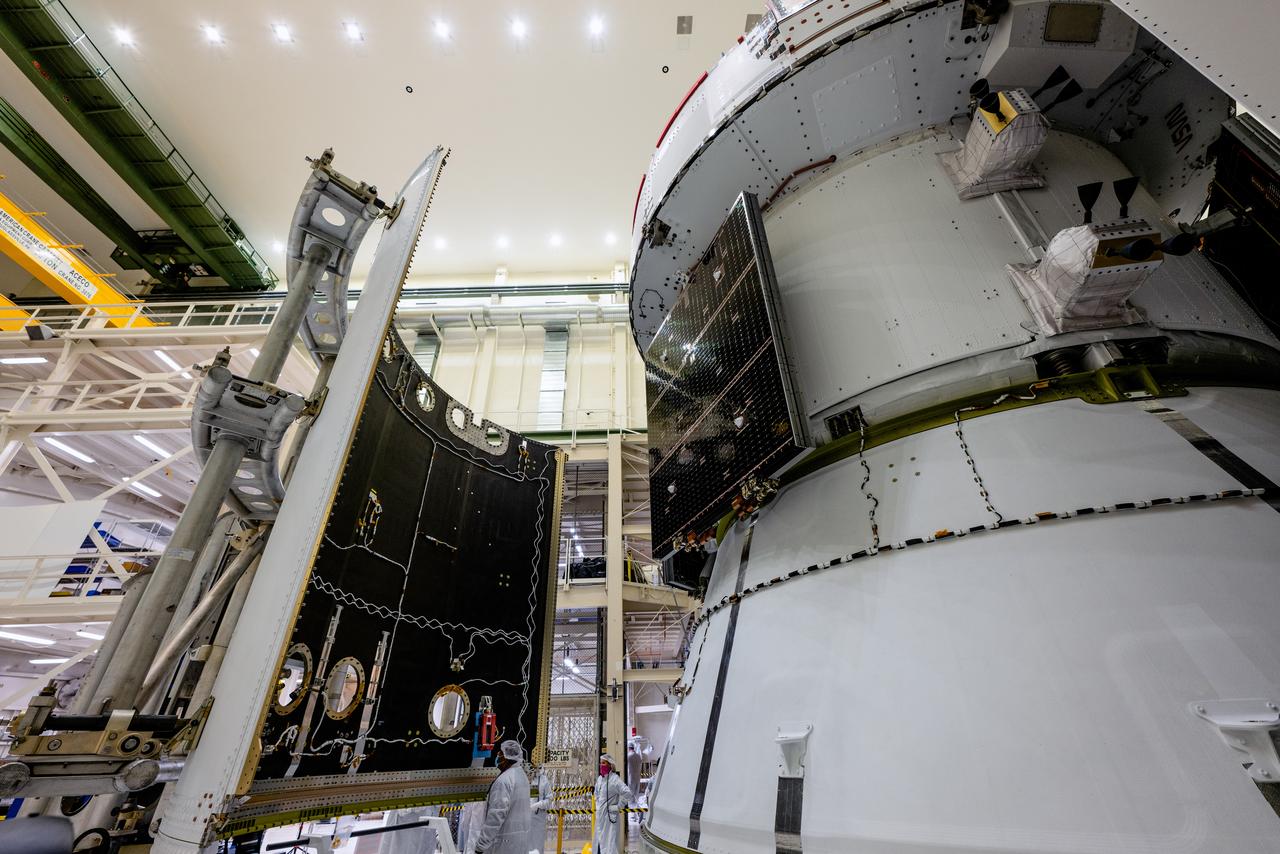
In the Operations and Checkout Building (O&C) at Kennedy Space Center, three spacecraft adapter jettison (SAJ) fairings are prepared for installation and will be moved into place by technicians with Lockheed Martin, lead contractor for Orion on Oct. 12, 2020. They will be secured around the spacecraft, encapsulating the European Service Module to protect it from the harsh environment as the spacecraft is propelled out of Earth’s atmosphere atop the Space Launch System (SLS) rocket during NASA’s Artemis I mission. The next time the solar array wings will be visible will be when Orion is in space. Artemis I will test the Orion spacecraft and SLS as an integrated system ahead of crewed flights to the Moon.
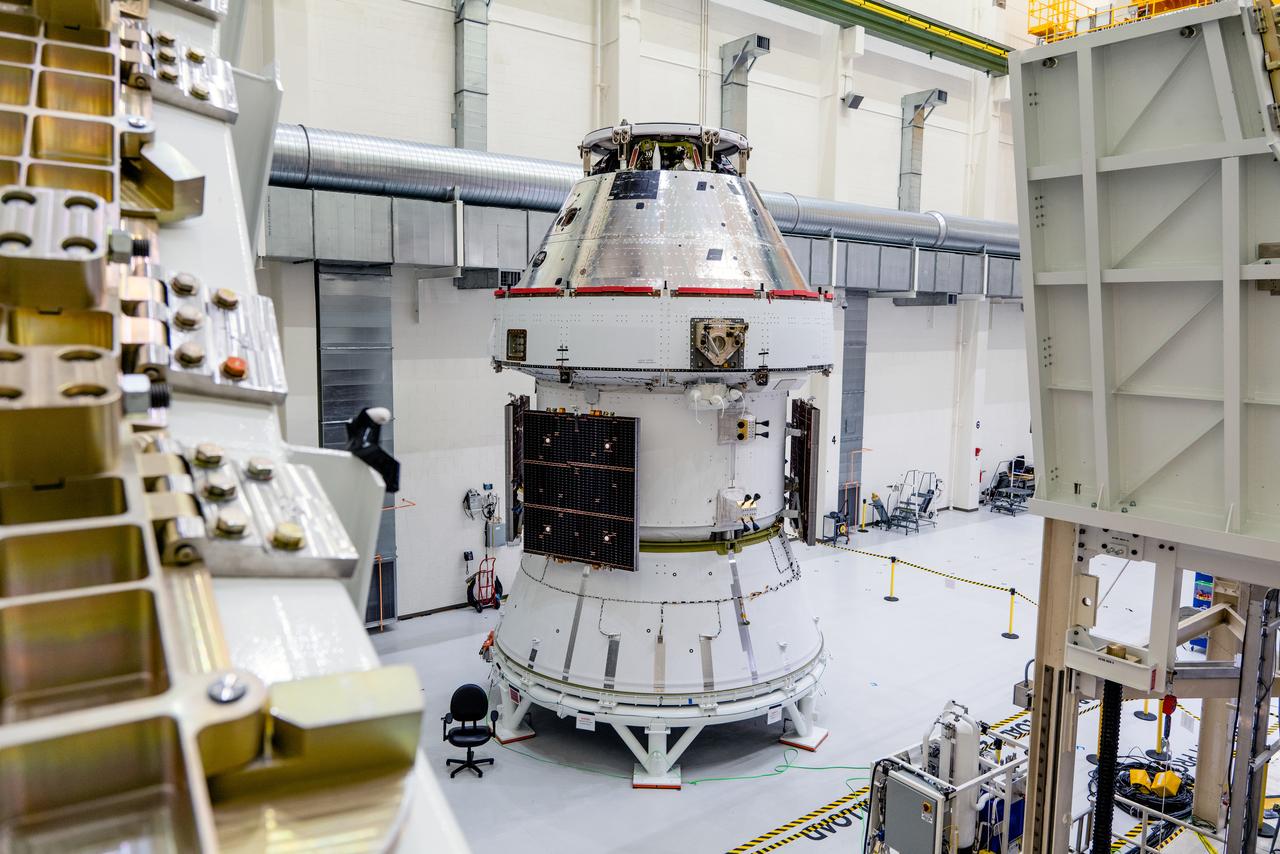
In the Operations and Checkout Building (O&C) at Kennedy Space Center, three spacecraft adapter jettison (SAJ) fairings are prepared for installation and will be moved into place by technicians with Lockheed Martin, lead contractor for Orion on Oct. 12, 2020. They will be secured around the spacecraft, encapsulating the European Service Module to protect it from the harsh environment as the spacecraft is propelled out of Earth’s atmosphere atop the Space Launch System (SLS) rocket during NASA’s Artemis I mission. The next time the solar array wings will be visible will be when Orion is in space. Artemis I will test the Orion spacecraft and SLS as an integrated system ahead of crewed flights to the Moon.
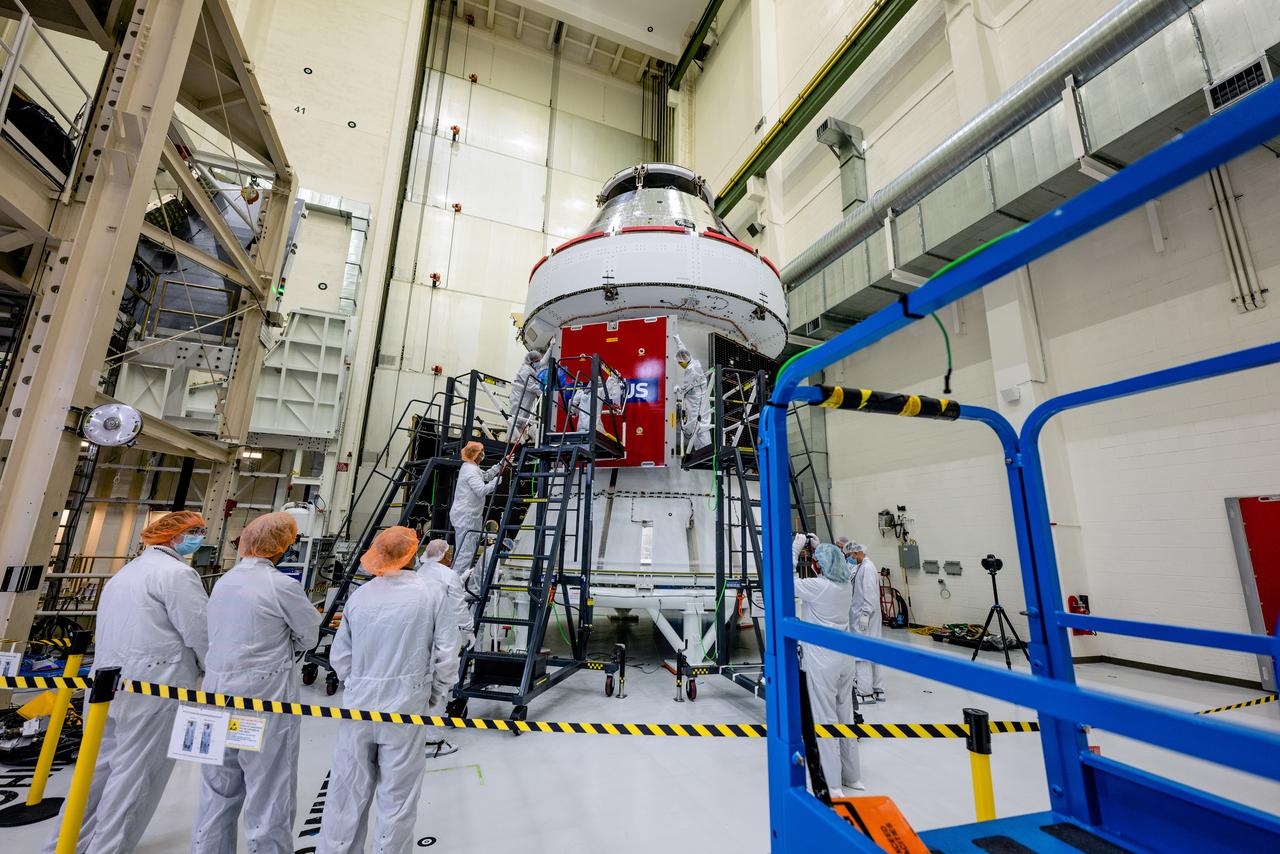
In the Operations and Checkout Building (O&C) at Kennedy Space Center, three spacecraft adapter jettison (SAJ) fairings are prepared for installation and will be moved into place by technicians with Lockheed Martin, lead contractor for Orion on Oct. 12, 2020. They will be secured around the spacecraft, encapsulating the European Service Module to protect it from the harsh environment as the spacecraft is propelled out of Earth’s atmosphere atop the Space Launch System (SLS) rocket during NASA’s Artemis I mission. The next time the solar array wings will be visible will be when Orion is in space. Artemis I will test the Orion spacecraft and SLS as an integrated system ahead of crewed flights to the Moon.
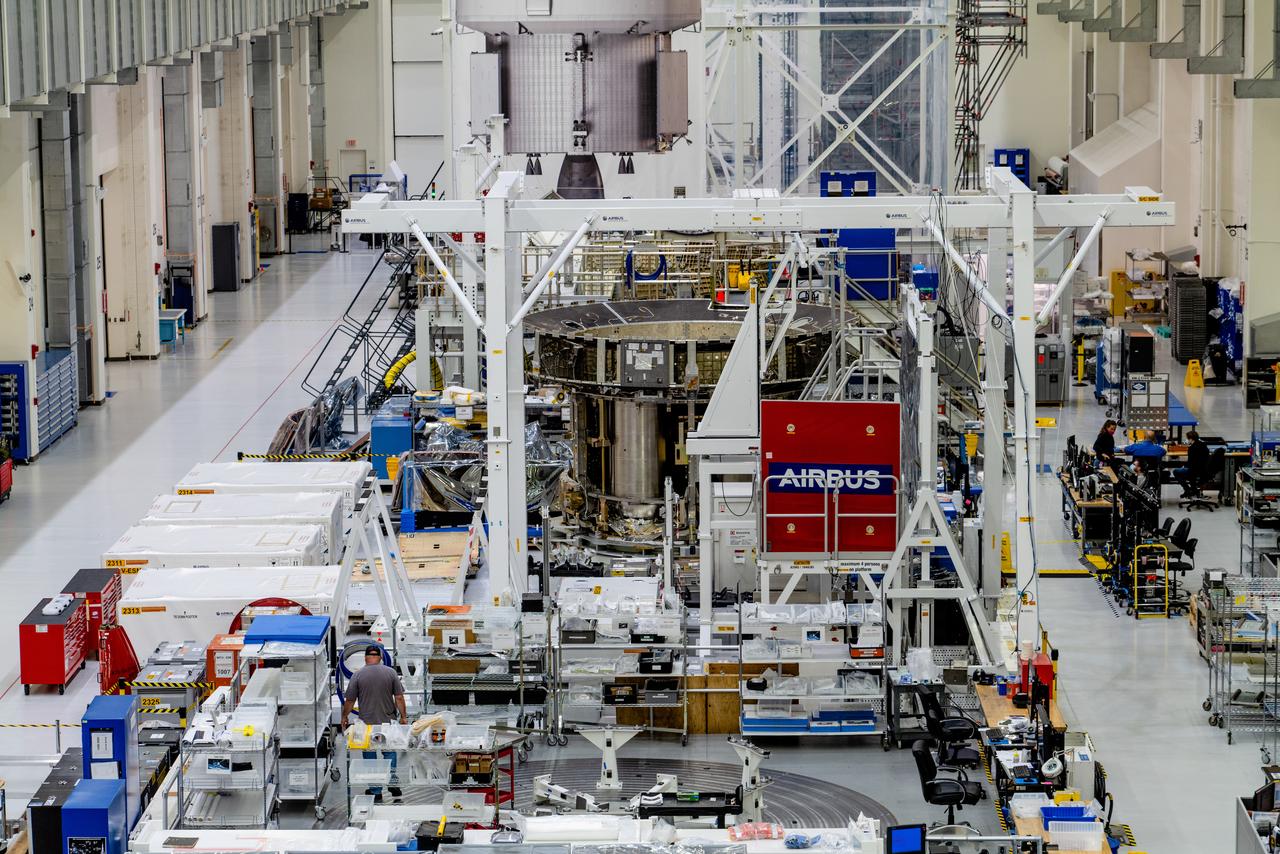
In the Operations and Checkout Building (O&C) at Kennedy Space Center, three spacecraft adapter jettison (SAJ) fairings are prepared for installation and will be moved into place by technicians with Lockheed Martin, lead contractor for Orion on Oct. 12, 2020. They will be secured around the spacecraft, encapsulating the European Service Module to protect it from the harsh environment as the spacecraft is propelled out of Earth’s atmosphere atop the Space Launch System (SLS) rocket during NASA’s Artemis I mission. The next time the solar array wings will be visible will be when Orion is in space. Artemis I will test the Orion spacecraft and SLS as an integrated system ahead of crewed flights to the Moon.
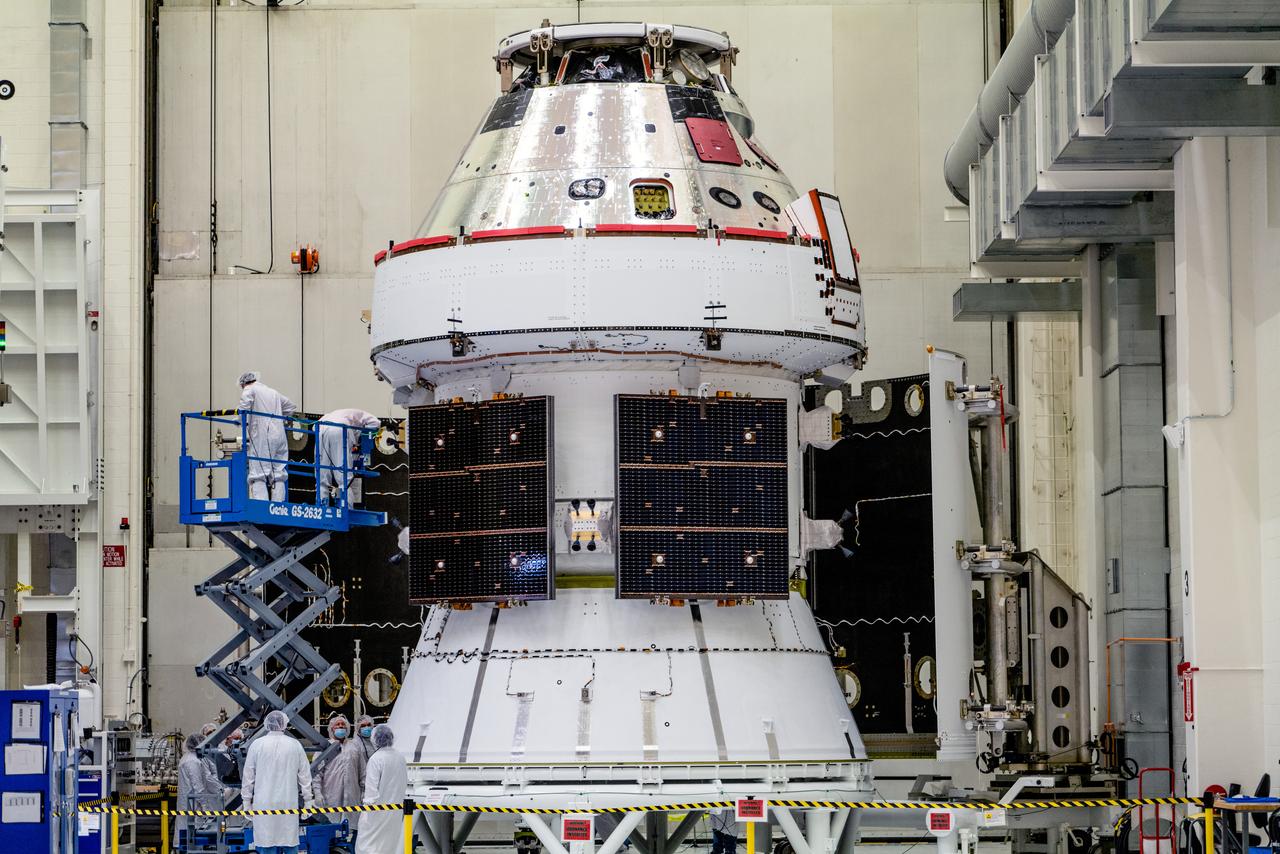
In the Operations and Checkout Building (O&C) at Kennedy Space Center, three spacecraft adapter jettison (SAJ) fairings are prepared for installation and will be moved into place by technicians with Lockheed Martin, lead contractor for Orion on Oct. 12, 2020. They will be secured around the spacecraft, encapsulating the European Service Module to protect it from the harsh environment as the spacecraft is propelled out of Earth’s atmosphere atop the Space Launch System (SLS) rocket during NASA’s Artemis I mission. The next time the solar array wings will be visible will be when Orion is in space. Artemis I will test the Orion spacecraft and SLS as an integrated system ahead of crewed flights to the Moon.
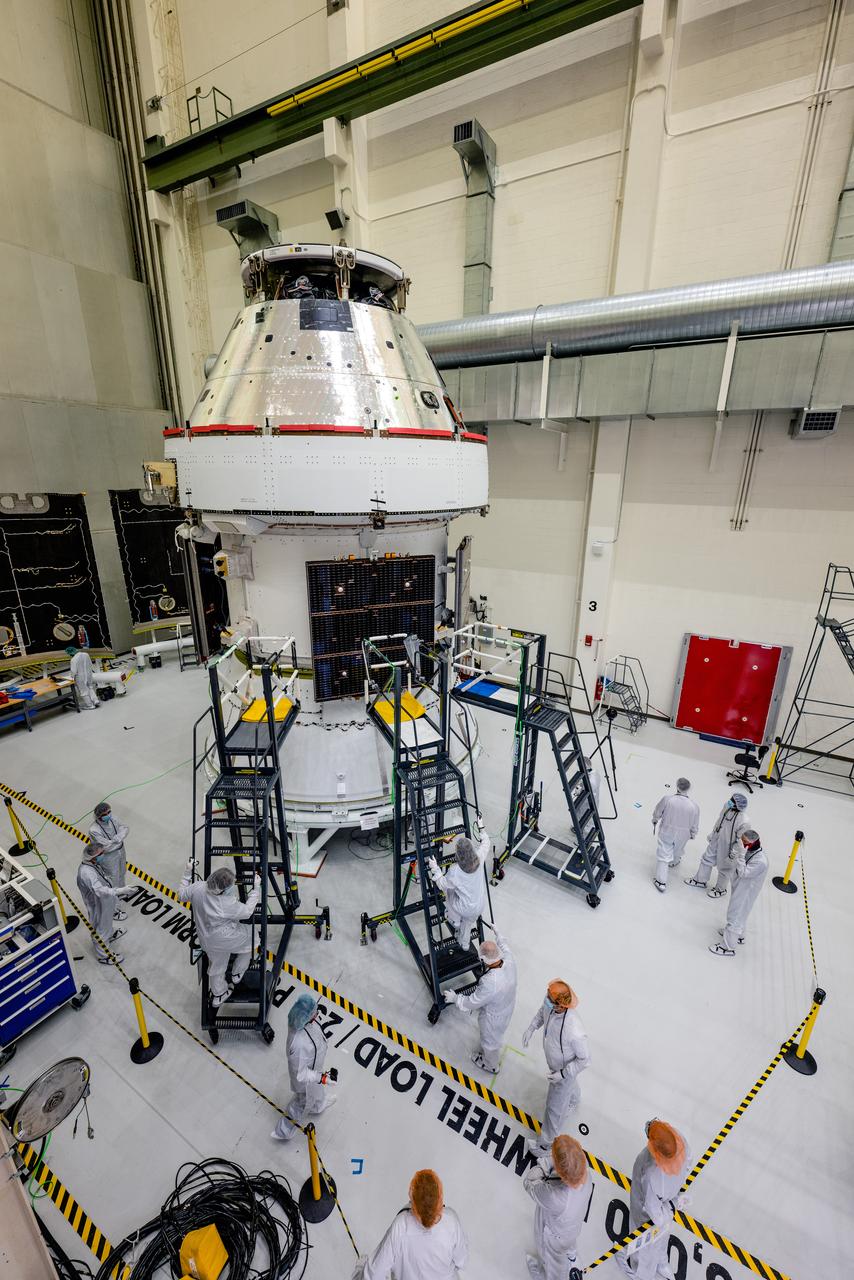
In the Operations and Checkout Building (O&C) at Kennedy Space Center, three spacecraft adapter jettison (SAJ) fairings are prepared for installation and will be moved into place by technicians with Lockheed Martin, lead contractor for Orion on Oct. 12, 2020. They will be secured around the spacecraft, encapsulating the European Service Module to protect it from the harsh environment as the spacecraft is propelled out of Earth’s atmosphere atop the Space Launch System (SLS) rocket during NASA’s Artemis I mission. The next time the solar array wings will be visible will be when Orion is in space. Artemis I will test the Orion spacecraft and SLS as an integrated system ahead of crewed flights to the Moon.
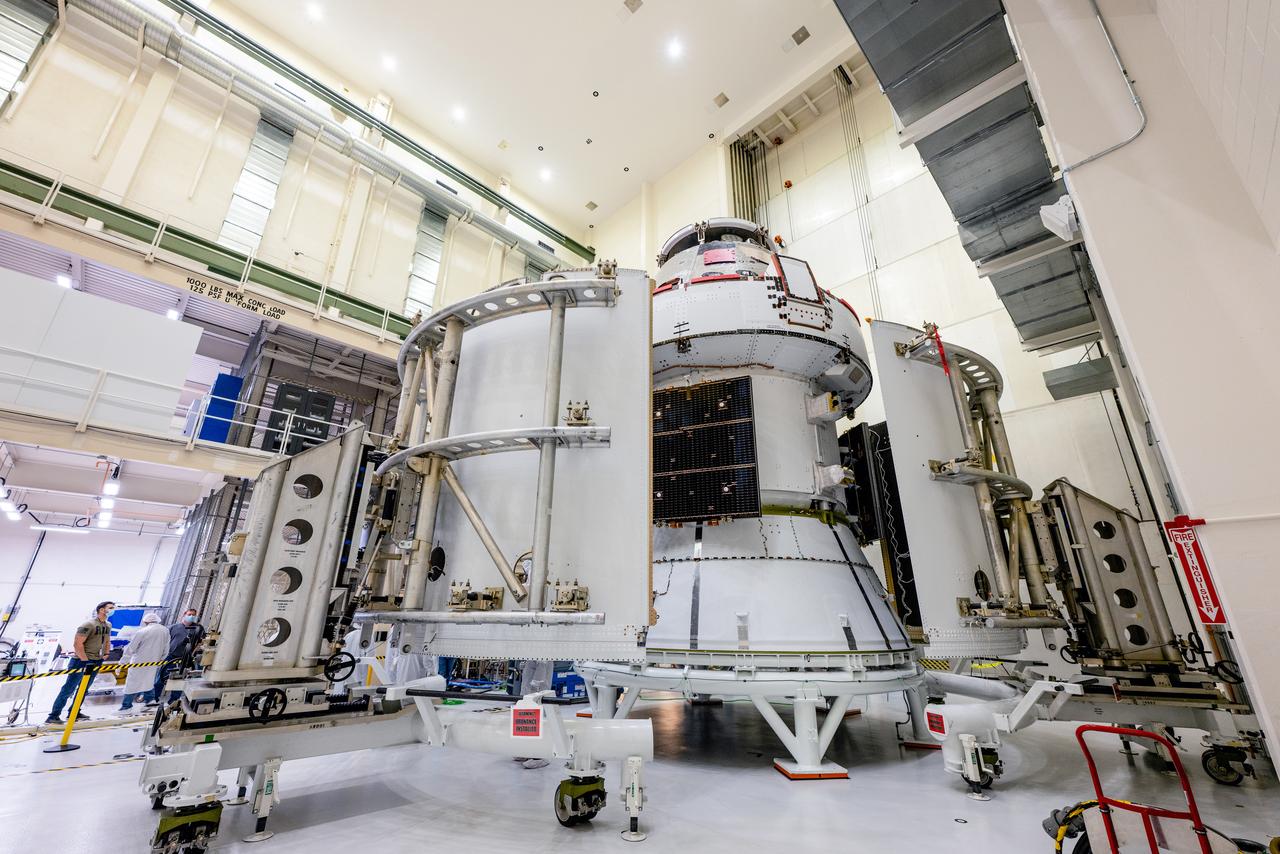
In the Operations and Checkout Building (O&C) at Kennedy Space Center, three spacecraft adapter jettison (SAJ) fairings are prepared for installation and will be moved into place by technicians with Lockheed Martin, lead contractor for Orion on Oct. 12, 2020. They will be secured around the spacecraft, encapsulating the European Service Module to protect it from the harsh environment as the spacecraft is propelled out of Earth’s atmosphere atop the Space Launch System (SLS) rocket during NASA’s Artemis I mission. The next time the solar array wings will be visible will be when Orion is in space. Artemis I will test the Orion spacecraft and SLS as an integrated system ahead of crewed flights to the Moon.
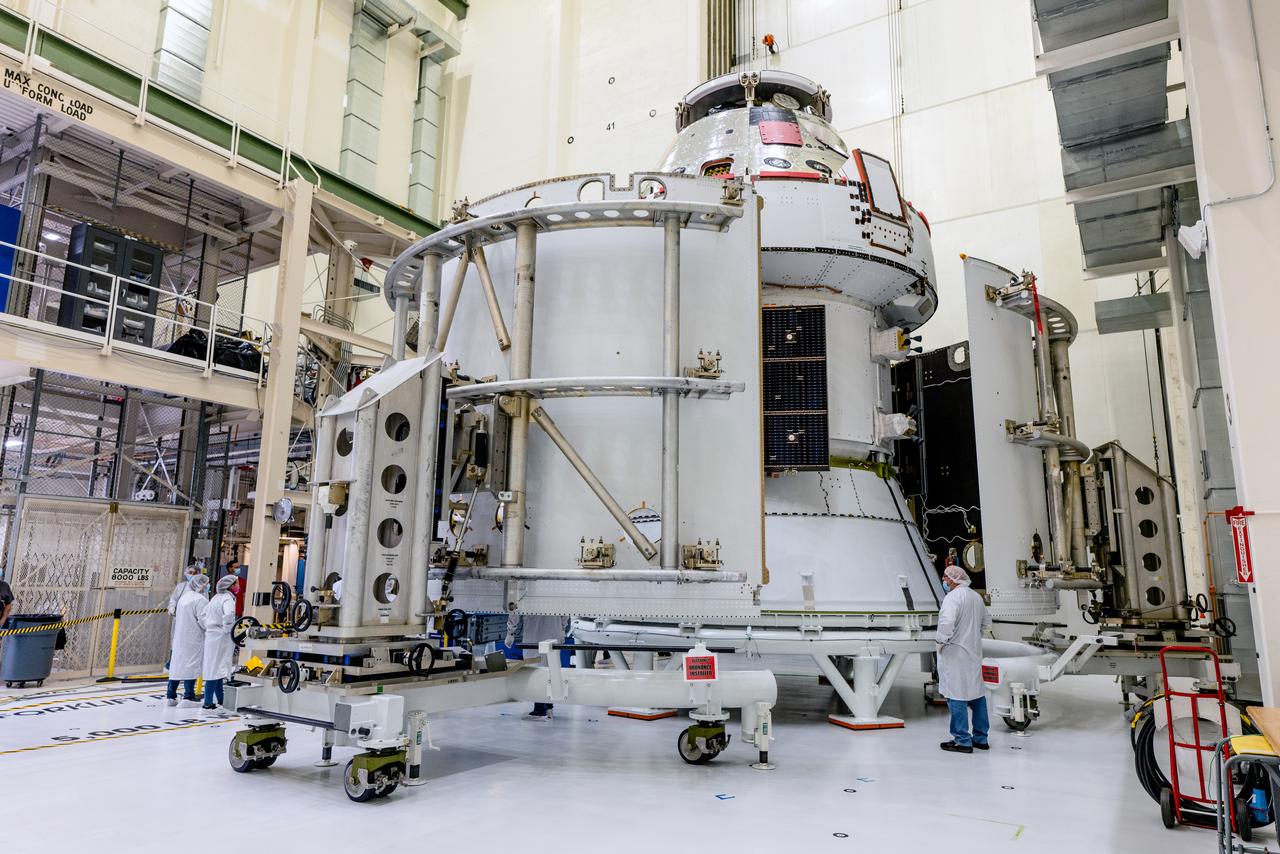
In the Operations and Checkout Building (O&C) at Kennedy Space Center, three spacecraft adapter jettison (SAJ) fairings are prepared for installation and will be moved into place by technicians with Lockheed Martin, lead contractor for Orion on Oct. 12, 2020. They will be secured around the spacecraft, encapsulating the European Service Module to protect it from the harsh environment as the spacecraft is propelled out of Earth’s atmosphere atop the Space Launch System (SLS) rocket during NASA’s Artemis I mission. The next time the solar array wings will be visible will be when Orion is in space. Artemis I will test the Orion spacecraft and SLS as an integrated system ahead of crewed flights to the Moon.
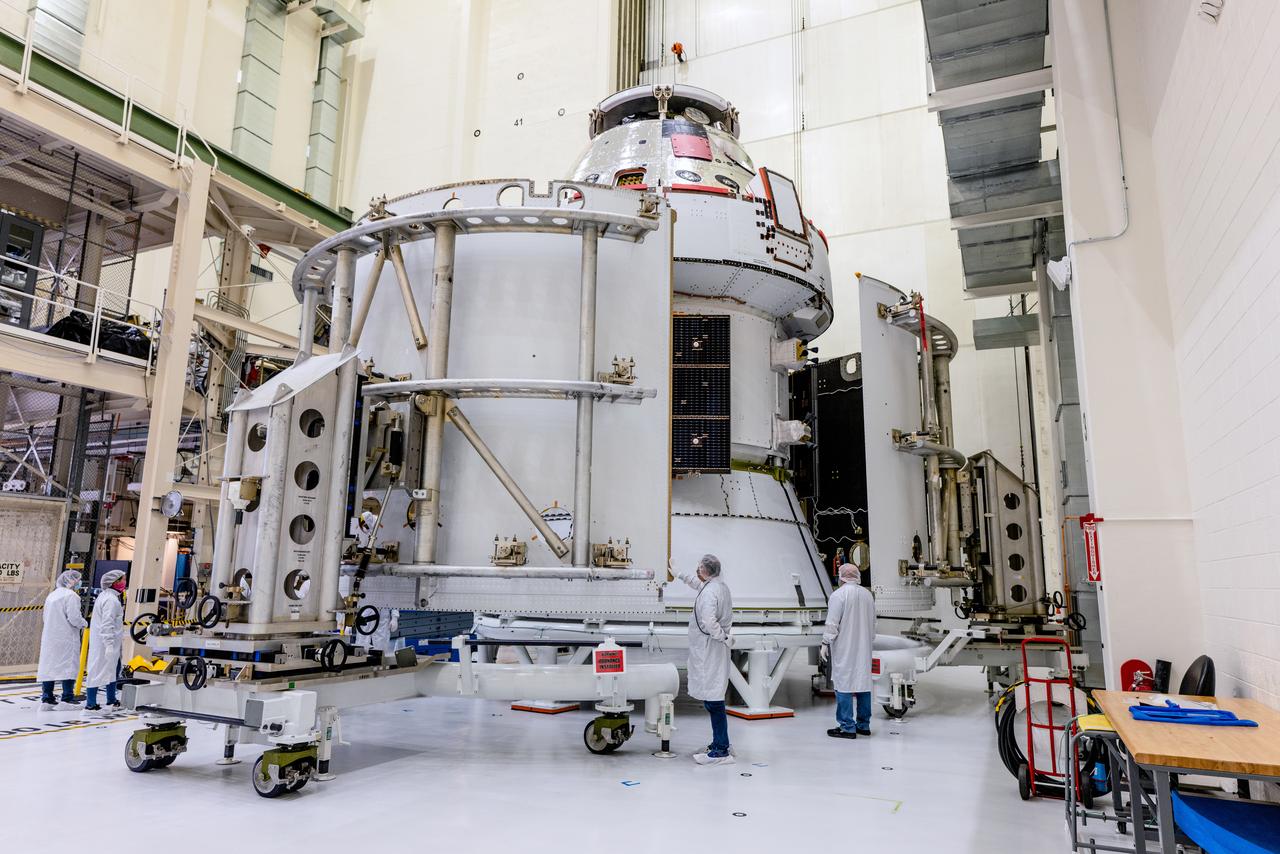
In the Operations and Checkout Building (O&C) at Kennedy Space Center, three spacecraft adapter jettison (SAJ) fairings are prepared for installation and will be moved into place by technicians with Lockheed Martin, lead contractor for Orion on Oct. 12, 2020. They will be secured around the spacecraft, encapsulating the European Service Module to protect it from the harsh environment as the spacecraft is propelled out of Earth’s atmosphere atop the Space Launch System (SLS) rocket during NASA’s Artemis I mission. The next time the solar array wings will be visible will be when Orion is in space. Artemis I will test the Orion spacecraft and SLS as an integrated system ahead of crewed flights to the Moon.
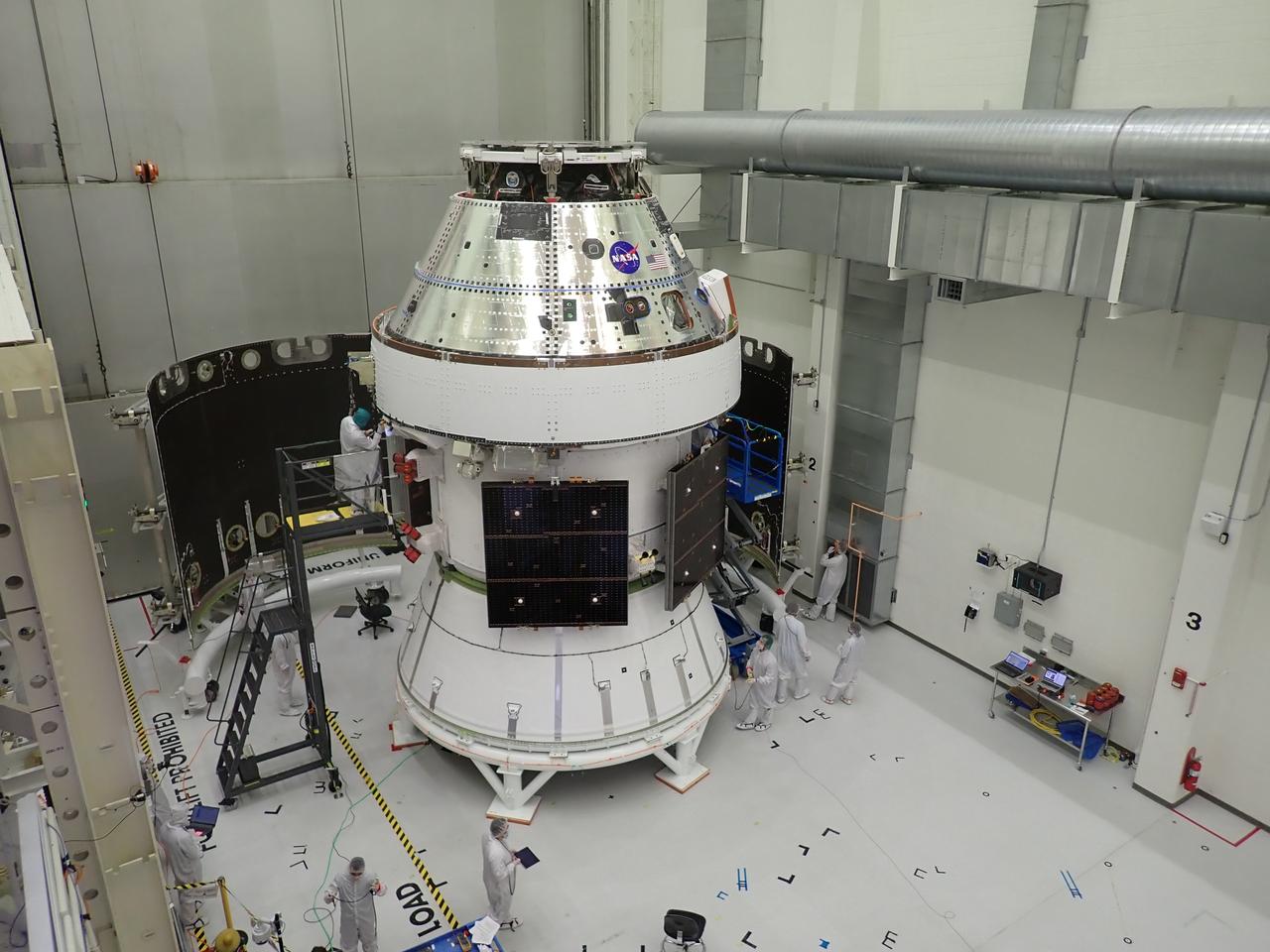
Technicians with Lockheed Martin prepare the Artemis II Orion spacecraft for the installation of three spacecraft adapter jettison fairings inside the Neil A. Armstrong Operations and Checkout Building at NASA’s Kennedy Space Center in Florida in on Tuesday, March 11, 2025. The fairings encapsulate the service module and protect the solar array wings, shielding them from the heat, wind, and acoustics of launch and ascent, plus help redistribute the load between Orion and the massive thrust of the SLS (Space Launch System) rocket during liftoff and ascent. Once the spacecraft is above the atmosphere, the three fairing panels will separate from the service module reducing the mass of the spacecraft.
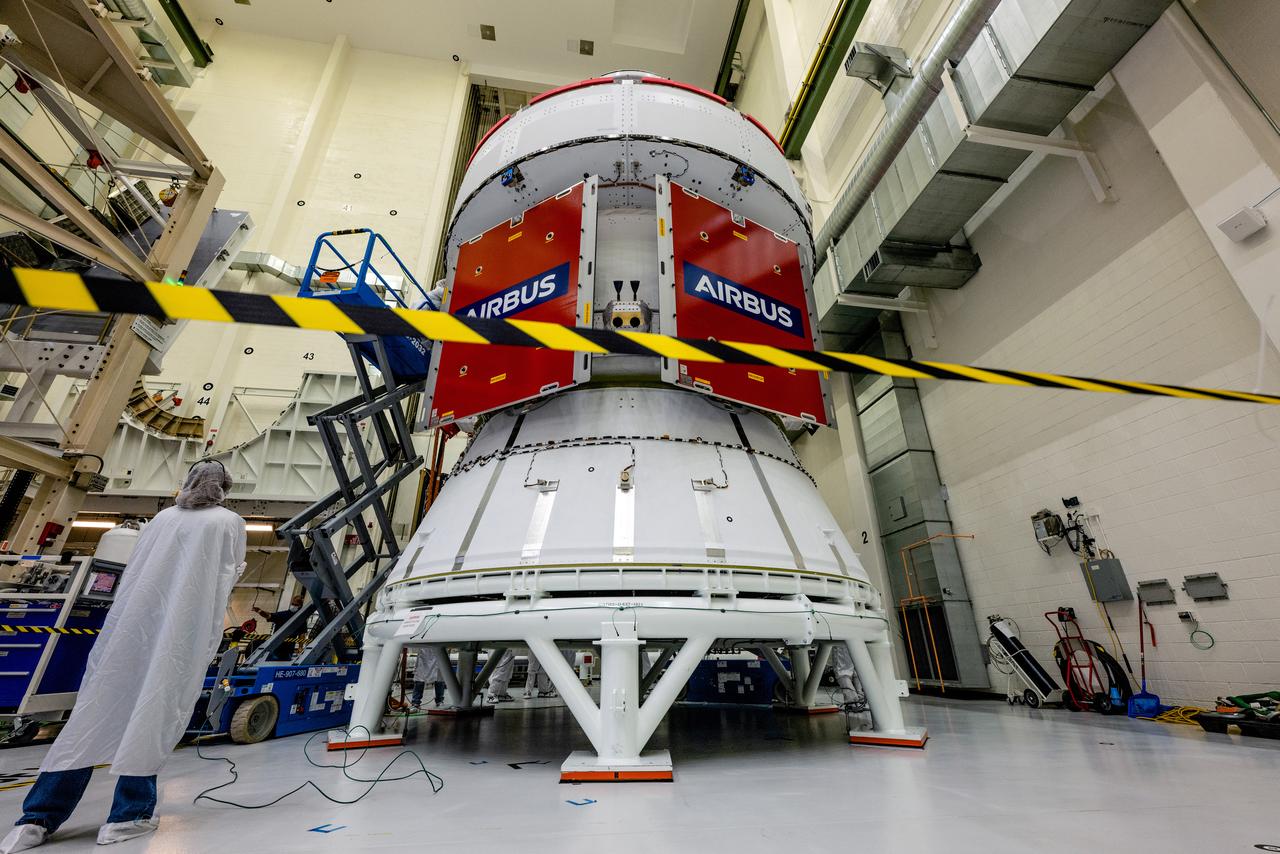
In the Operations and Checkout Building (O&C) at Kennedy Space Center, three spacecraft adapter jettison (SAJ) fairings are prepared for installation and will be moved into place by technicians with Lockheed Martin, lead contractor for Orion on Oct. 12, 2020. They will be secured around the spacecraft, encapsulating the European Service Module to protect it from the harsh environment as the spacecraft is propelled out of Earth’s atmosphere atop the Space Launch System (SLS) rocket during NASA’s Artemis I mission. The next time the solar array wings will be visible will be when Orion is in space. Artemis I will test the Orion spacecraft and SLS as an integrated system ahead of crewed flights to the Moon.
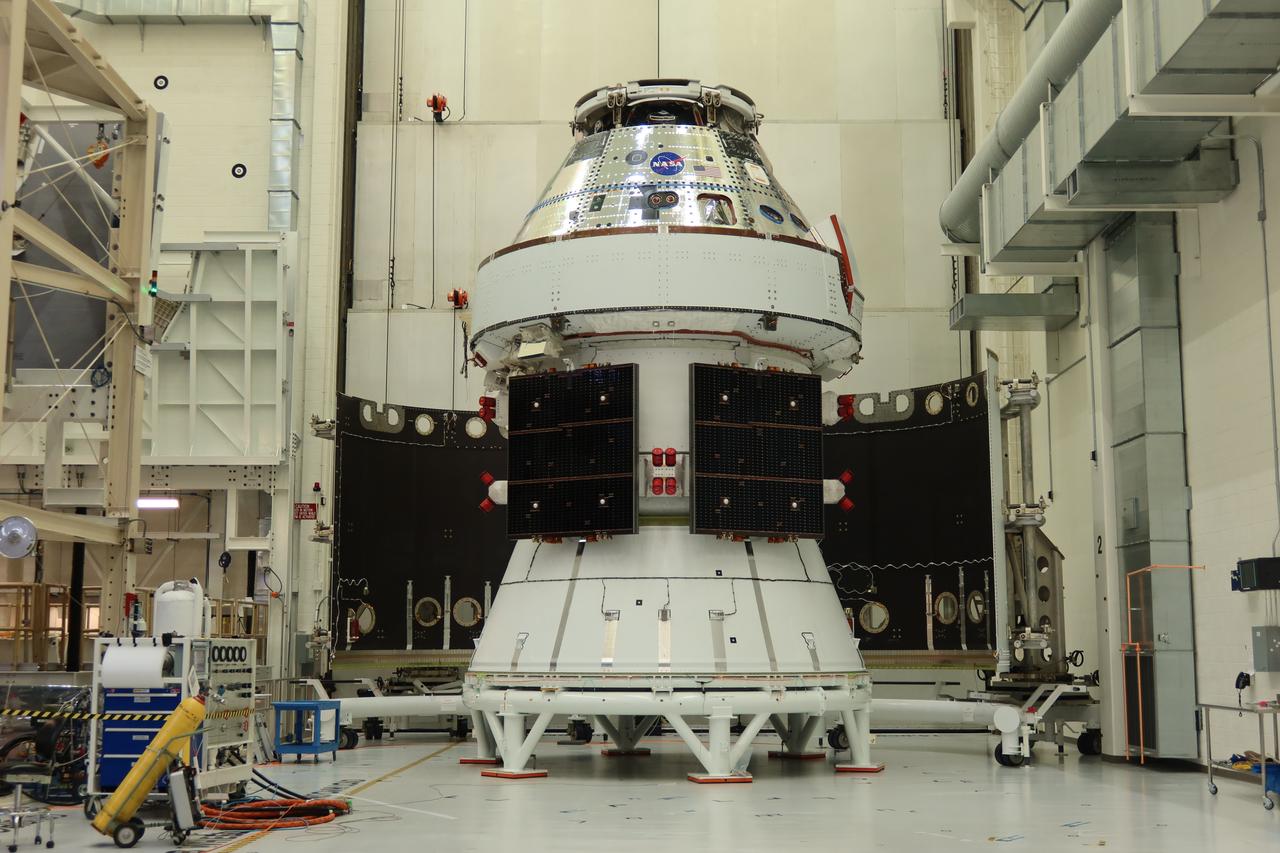
The Artemis II Orion spacecraft sits in the transfer aisle in the Neil A. Armstrong Operations and Checkout Building at NASA’s Kennedy Space Center in Florida in preparation for the installation of three spacecraft adapter jettison fairings on Tuesday, March 11, 2025. The fairings encapsulate the service module and protect the solar array wings, shielding them from the heat, wind, and acoustics of launch and ascent, plus help redistribute the load between Orion and the massive thrust of the SLS (Space Launch System) rocket during liftoff and ascent. Once the spacecraft is above the atmosphere, the three fairing panels will separate from the service module reducing the mass of the spacecraft.
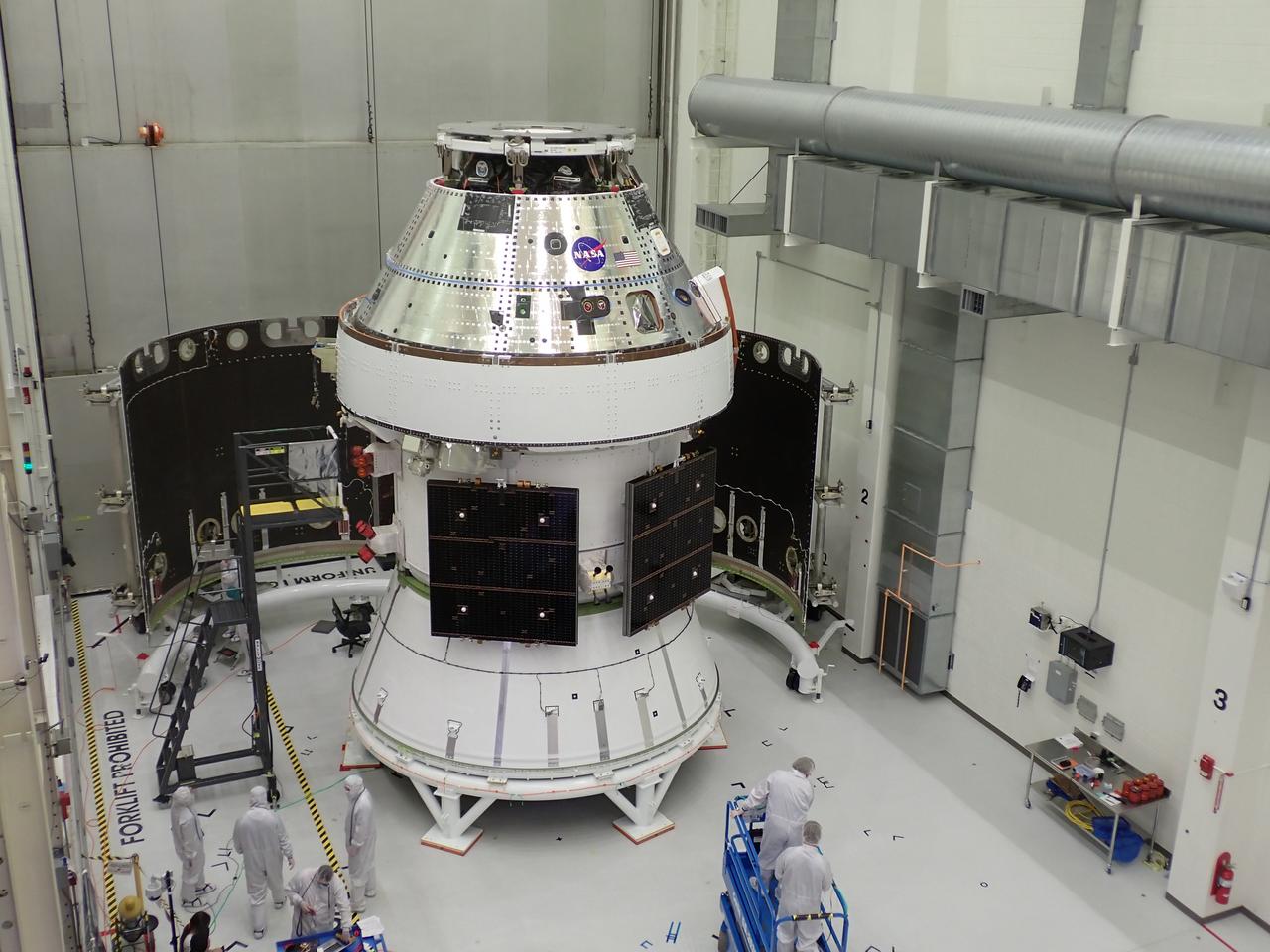
Technicians with Lockheed Martin prepare the Artemis II Orion spacecraft for the installation of three spacecraft adapter jettison fairings inside the Neil A. Armstrong Operations and Checkout Building at NASA’s Kennedy Space Center in Florida in on Tuesday, March 11, 2025. The fairings encapsulate the service module and protect the solar array wings, shielding them from the heat, wind, and acoustics of launch and ascent, plus help redistribute the load between Orion and the massive thrust of the SLS (Space Launch System) rocket during liftoff and ascent. Once the spacecraft is above the atmosphere, the three fairing panels will separate from the service module reducing the mass of the spacecraft.
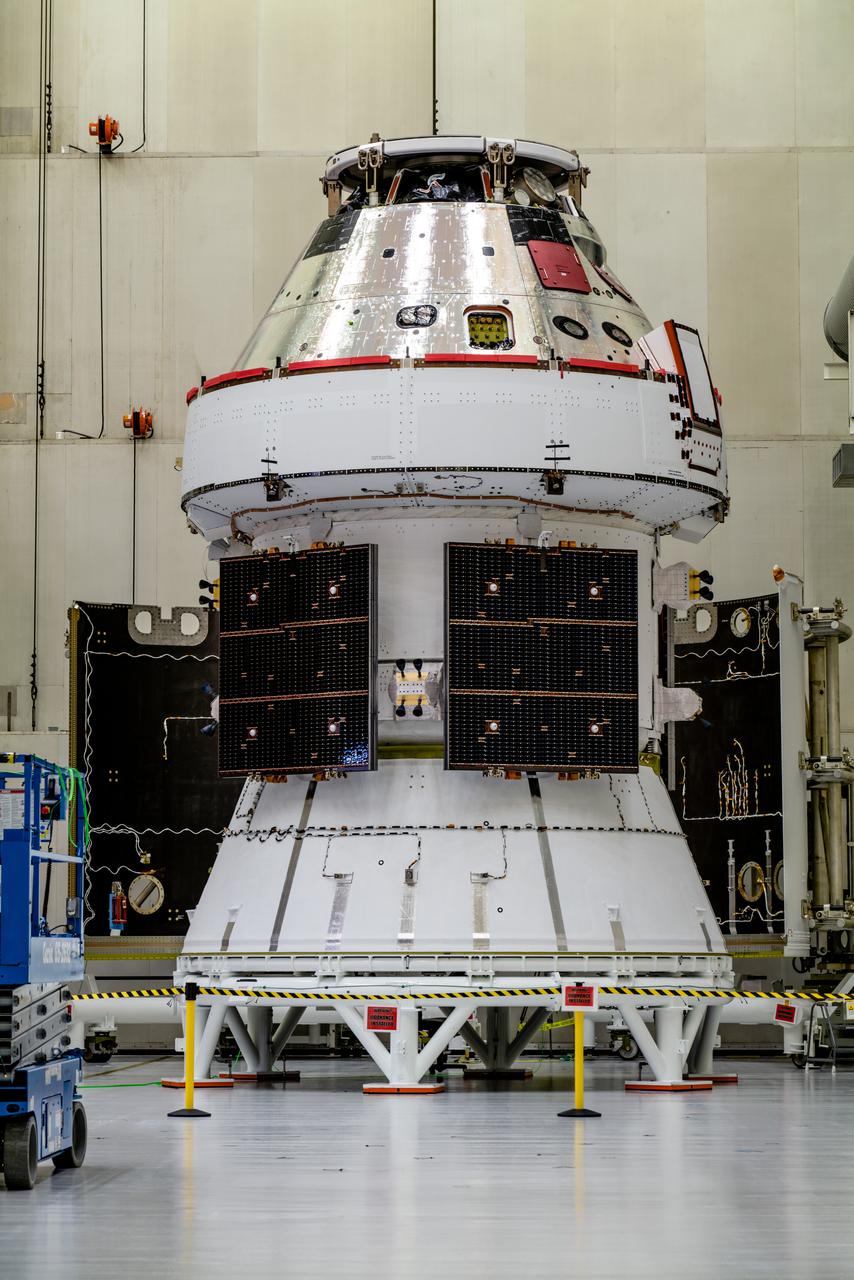
In the Operations and Checkout Building (O&C) at Kennedy Space Center, three spacecraft adapter jettison (SAJ) fairings are prepared for installation and will be moved into place by technicians with Lockheed Martin, lead contractor for Orion on Oct. 12, 2020. They will be secured around the spacecraft, encapsulating the European Service Module to protect it from the harsh environment as the spacecraft is propelled out of Earth’s atmosphere atop the Space Launch System (SLS) rocket during NASA’s Artemis I mission. The next time the solar array wings will be visible will be when Orion is in space. Artemis I will test the Orion spacecraft and SLS as an integrated system ahead of crewed flights to the Moon.